This Month's New Reading
pp. 86-89 · Read in the full issue
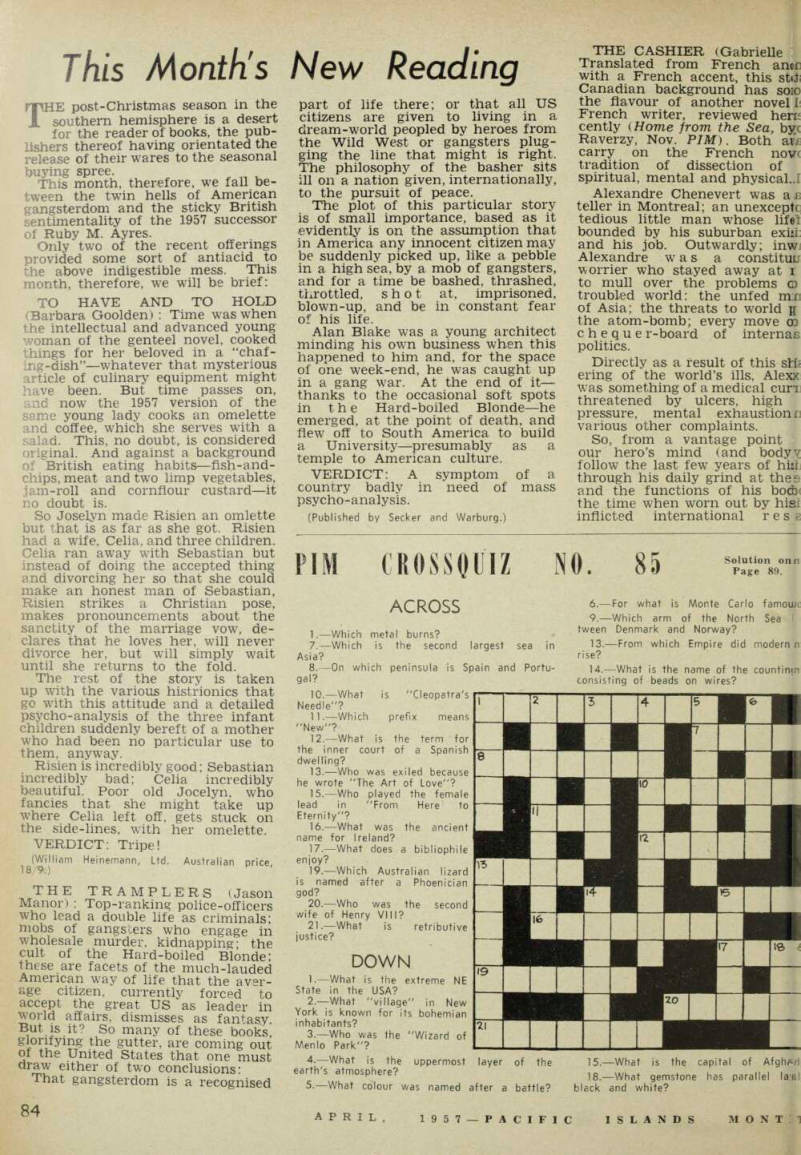



r E post-Christmas season in the southern hemisphere is a desert for the reader of books, the pub- Ushers thereof having orientated the revise of their wares to the seasonal luvins soree This month, therefore, we fall be tween the twin hells of American < angsterdom and the sticky British sentimentality of the 1957 successor of Rubv M. Ayres.
Only two of the recent offerings provided some sort of antiacid to the above indigestible mess. This month, therefore, we will be brief:
To Have And To Hold
.B™baraG V oolde^ ND TJe°was H wh™ \ne intellectual and advanced young oman of the genteel novel, c°9 k^ d imngs for her beloved in a chaf mg-dish”—whatever that mysterious rticle o( culinary equipment might a ve been But time passes on and now the 1957 version of the seme young lady cooks an omelette and coffee, which she serves with a salad. This, no doubt, is considered original. And against a background of British eating habits—fish-and chips, meat and two limp vegetables, jam-roll and cornflour custard—it no doubt is.
So Joselyn made Risien an omlette but that is as far as she got. Risien had a wife, Celia, and three children.
Celia ran away with Sebastian but instead of doing the accepted thing and divorcing her so that she could make an honest man of Sebastian, Risien strikes a Christian pose, makes pronouncements about the sanctity Of the marriage VOW, de dares that he loves her, will never divorce her, but will simply wait Until she returns to the fold.
The rest of the story is taken up with the various histrionics that go with this attitude and a detailed psycho-analysis of the three infant children suddenly bereft of a mother who had been no particular use to them, anyway. inci t dibly bad, Celia inci edlbly beautiful. Poor old Jocelyn, who fancies that she might take up where Celia left off. gets stuck on the side-lines, with her omelette.
VPPntPT- rp • .
VERDICT. Tlipe! (William Heinemann, Ltd. Australian orice 18 9.) '
The Tramplers (Jason
Manor i : Top-ranking police-officers who lead a double life as criminals: mobs of gangsters who engage in wholesale murder, kidnapping; the cult of the Hard-boiled Blonde; these are facets of the much-lauded American way of life that the aver age citizen, currently forced to accept great US as leader in Scorifying the gutter, are coming out
draw^ithi^ot^w^eo^cltslJnsr
That gangsterdom is a recognised
part of life there; or that all US citizens are given to living in a dream-world peopled by heroes from the Wild West or gangsters plug ging the line that might is right.
The philosophy of the basher sits ill on a nation given, internationally, to the pursuit of peace.
The plot of this particular story is of small importance, based as it evidently is on the assumption that in America any innocent citizen may be suddenly picked up, like a pebble in a high sea, by a mob of gangsters, and for a time be bashed, thrashed, throttled, shot at, imprisoned, blown-up, and be in constant fear of his life.
Alan Blake was a young architect minding his own business when this happened to him and, for the space of one week-end, he was caught up in a gang war. At the end of it — thanks to the occasional soft spots in the Hard-boiled Blonde—he emerged, at the point of death, and flew off to South America to build a University—presumably as a temple to American culture.
VERDICT: A symptom of a country badly in need of mass psycho-analysis. (Published by Seeker and Warburg.)
THE CASHIER (Gabrielle Translated from French anon with a French accent, this std< Canadian background has soio the flavour of another novel 1 French writer, reviewed hen cently (Home from the Sea , by< Raverzy, Nov. PIM ). Both an carry on the French tradition of dissection of spiritual, mental and physical..!
Alexandre Chenevert was teller in Montreal; an unexceptq tedious little man whose life! bounded by his suburban exisi; and his job. Outwardly; inw Alexandre was a constituu worrier who stayed away at i to mull over the problems cd troubled world: the unfed m:n of Asia; the threats to world n the atom-bomb; every move od cheque r-board of internal politics.
Directly as a result of this sMf ering of the world’s ills, Alexx was something of a medical curu threatened by ulcers, high pressure, mental exhaustion n various other complaints.
So, from a vantage point : our hero’s mind (and bodyy follow the last few years of hid. through his daily grind at thes and the functions of his bodx the time when worn out by hisi inflicted international re s a
sibilities, he makes a mistake s bank and is persuaded to tsJ holiday in the country rather t resign.
In the end he develops a sac complaint that takes him to hoso and at last, death. During hise: last illness he claims some soe attention from those who prevv regarded him as one of the dome or banking-house fixtures.
VERDICT: Apt to be tediouu less you prefer psychology to 0 tainment. (Published by Wm. Heinemann. Auu/ price, 18/9.)
The Daphne Du Maul
OMNIBUS: This large volumes tains, unabridged, three ofh writer’s most popular site Rebecca, Jamaica Inn and fm man’s Creek.
All of these stories were 9 published in the 1930’5, butfi nothing of their freshness b T d elapse of a generation, and ” 1 this month as considerable after the omelettes of the womn books, the gangsters of the of the Free, and the case-hiss: of bank clerks.
All of these stories have s good characterisation, good wm They are credible and entertainment.
All of these things are exc«o reasons for a book being. n are other reasons for a booo< course; one being to put ovc message.
The overwhelming majority books published these days none of the above requirerm Their messages, if any, are scos torted as to create bewildern Their entertainment val u 11 sacrificed to what is constis cleverness or the pursuit of amn exploration of the psyche. NH per cent, of the books that f come the reviewer’s way area worth reading and would be tf unwritten.
It could be that reading hi have changed—but this is doulu The best sellers that have ermn since the end of World War 111 have the proven characteristic a good book: they hold the as tion of the reader of averages telligence, and grip his imaginsr The same number of good If is still being written, and invam find their way to the top. Bv£ the same time there has beei flood of poor or mediocre bef There on the bookstalls to-dayyj morrow forgotten. To-day’s ii overbooked world.
Daphne du Maurier is a tellli tales not a maker of messes she is also a fine craftsman, becca begins with the opening 11 “Last night I dreamt I werrn Manderlay again. It seemed td I stood by the iron gate leadini the drive, and for a while I 0 not enter, for the way was bsd to me. .
Rebecca is a contemporary —even now, perhaps 20 years ; it was first written. The othens
ies in the Omnibus are period es. All three have been made movies —Rebecca of particular lienee and in which Laurence ier made one of his early >arances in motion pictures.
Wished by Angus and Robertson, Ltd. ilian price,
Lom The Valley I Came
Jon Edwards) : A factual and le tale, well told, of a man who •ged from the Welsh coalfields ;he Labour Party. Edwards tells story of his life, from his birth poor miner’s cottage, in 1888, Ruskin College. Oxford, to the jral Strike in 1926. It is a period covers also the beginning and acute phase of what Edwards “class conflict” which led, in to the elevation of Labour political force. e story is liberally sprinkled references to Karl Marx and ■ prophets of the time, but, so irds explains in the preface, book lay for long years after id written it, and only recently ,t been revised for publication, later revision has no doubt »wed many of the opinions of writer. is, therefore, not a book to d the most rabid Tory, but r a plain and undramatic mt of the life of an individual n on by a god-given spark: lesire to know. Edwards has derable gifts as a descriptive r and this story of the coal ig industry at the beginning
of the century is of great general interest, apart from any value it might have as a social document.
Wil Jon Edwards, and many of the men he introduces into his narrative, may well have significance in the history of the British Labour Party; but their names are un known here to most of us in the Southern Hemisphere.
VERDICT; Of particular interest now that the social wheel has turned almost full circle. (Published by Angus and Robertson, ltd.
Australian price, 20/-.)
•' A familiar sight around Port Moresby these days is a blue station waggon with its symbolic Red Cross —a gift from the Victorian Division of the Red Cross. The gift is much appreciated. Previously the Society was dependent upon the use of private cars. The station waggon will be used for all Red Cross work, especially the blood transfusion ser vice. t There are now about 190 Credit Unions operating in Fiji. In 1956, 48 new Unions were formed.