All At
pp. 86-103 · Read in the full issue
Sea
By Peter England
(Illustrations by Bill Gill)
LOOK, you can go by plane if you want to, but not me. Even a psychologist knows that the answer to “islands” is “boats”; the answer to planes is jets, bombs, plastic ashtrays, radio serials, and bacon in cellophane wrappers, and all that muck. Now listen.
The tale of the New Guinea islands is a long one, and the biggest part of it is tied up in one way or another with boats. Schooners, luggers, gunboats, lakatois, mail boats, copra tramps, luxury liners.
British boats, Chinese boats, Ger man boats, Dutch boats, boats of every nationality under the sun. Big overseas boats, little coastal boats, crazy plantation pinnaces crossing impossible distances of blue water, patrol launches on the Sepik, mission boats on the Fly, rafts on the Purari, pors on the Ramu. Ad venturers’ boats, beachcombers’
boats, millionaires’ boats, pirates’ and blackbirders’ boats. And the Bulolo.
The Bulolo is a beautiful white ship which says good-bye to Sydney once every six weeks makes a dignified exit through the Heads, takes a quick look round to see that nobody is watching, then turns sharply to the left and heads like a homing pigeon for the sun—and the Islands.
This beautiful white ship is com manded by a small boy named Bill Wilding, who dresses up as a sea captain and has the time of his life steering it through tropic seas and bullying his passengers into enjoy ing the trip whether they like it or not. As a hobby he collects tropical fish, and for all I know, probably also cigarette cards, snakes, stamps, butterflies and bull-ants. ☆ Well—the siren has given a warn ing blast, the bells are ringing, and everyone is moving towards the gangway. “All visitors ashore!”
Friends, relations, wives, uncles, mothers-in-law, sweethearts and children have finished their tour of the ship. Examined the lounge, the cabins, the smoke room, the swim ming pool; criticised the furniture, the weather, the library, the colour of the seamen’s pants; read all the notices on the notice board, and pocketed large quantities of the ship’s stationery. Kids have been lost, found, slapped, told to come here. Last-m inu t e admonitions, greetings, advice, are still being ex changed.
But the siren has sounded, the bells are ringing—“ All visitors ashore.” and everybody’s shoving and pushing along the deck. Those down on the wharf are starting to throw streamers. Here’s a cove rac
ing around taking last minute shots with a camera, followed by a giraffe taking last-minute notes in a little note-book. Yes, certainly you can put me in your paper, r m a missionary on my way to Turkestan.
What? This boat doesn’t go to Turkestan? Well, I’m sorry about that, I’ve always wanted to see Turkestan.
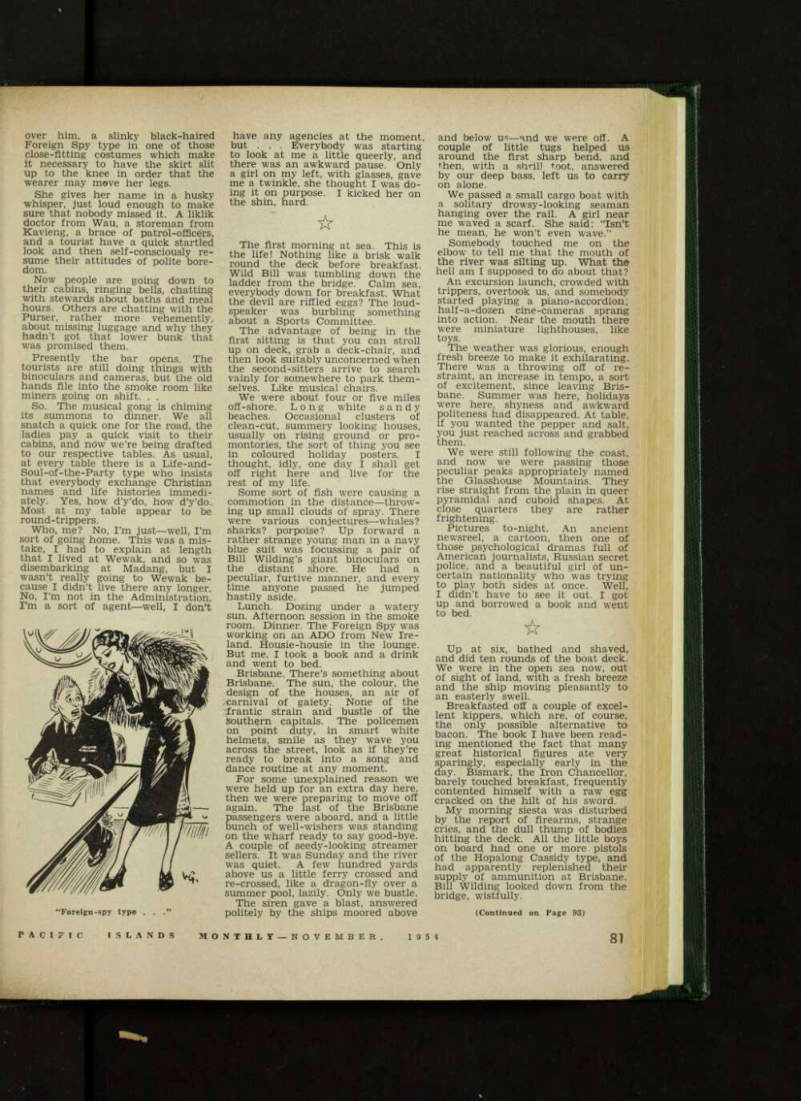
“Streamers! Streamers! Any more streamers? Three for two shillings. Here you are, lady.” They started at threepence each, but as the excitement mounts the vendors are thoughtfully matching the price to the demand. Now we all hold a bunch in each hand—at the other end friends, wives, kiddies, uncles, sweethearts, mother s-in-law. A plump and expensively dressed woman walking backwards and talk ing at the same time gets tangled up with a bunch held by a little girl with corn-coloured pigtails. A grandmother sizzles her with a look.
We shout to each other and make signs, but are only half heard. Why don’t they hurry up—hell. We glance this way and that, feigning an in terest in the bustle around us, the last-minute officials going ashore, the little tug that is manoeuvring under our bows. Then we just look at each other.
At last. The gangway is up, the moorings cast off, and a little space of water appears and widens be tween the ship and the wharf.
“Good-bye, darling, good-bye, good-bye!” ☆ Down the harbour the wind is cold and biting. Grey winter Sydney skies, ugh! Groups of tourists are doing things with binoculars and cameras.
In the lounge the Second Steward is taking names and allotting tables for the dining room, a dozen or so people waiting their turn. Bending
“Streamers —any more streamers?”
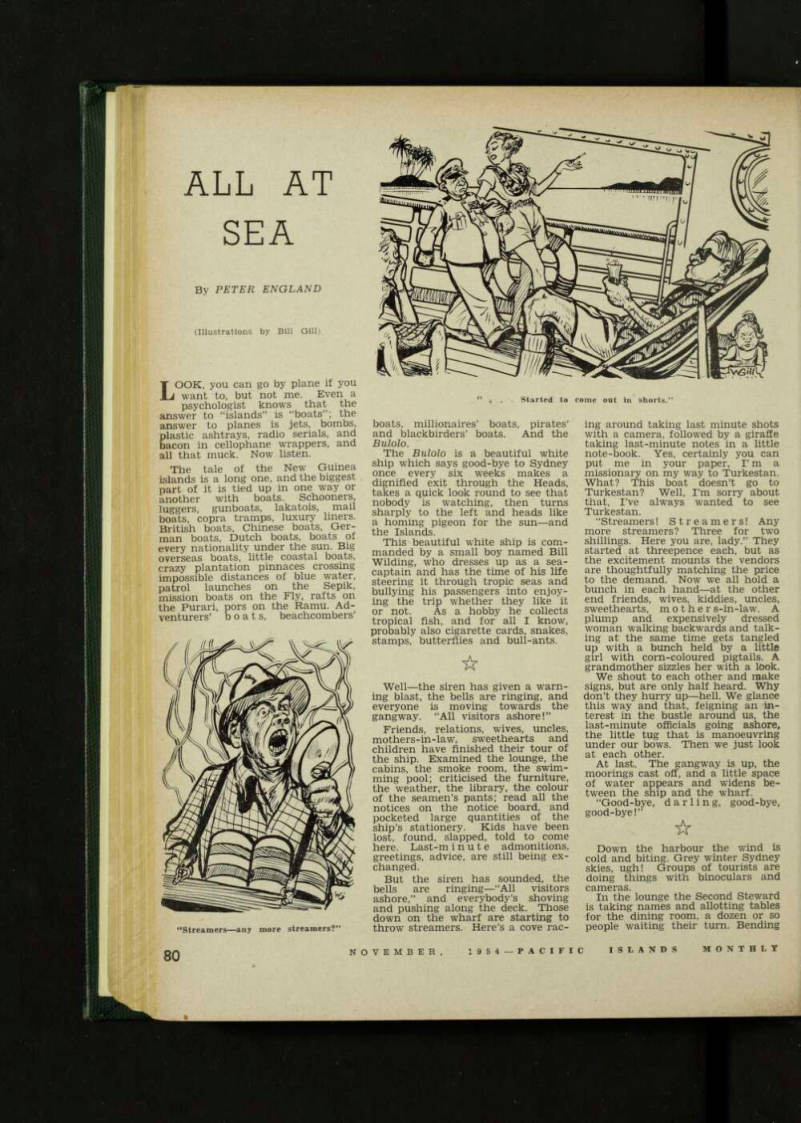
“... Started to come out in shorts.”
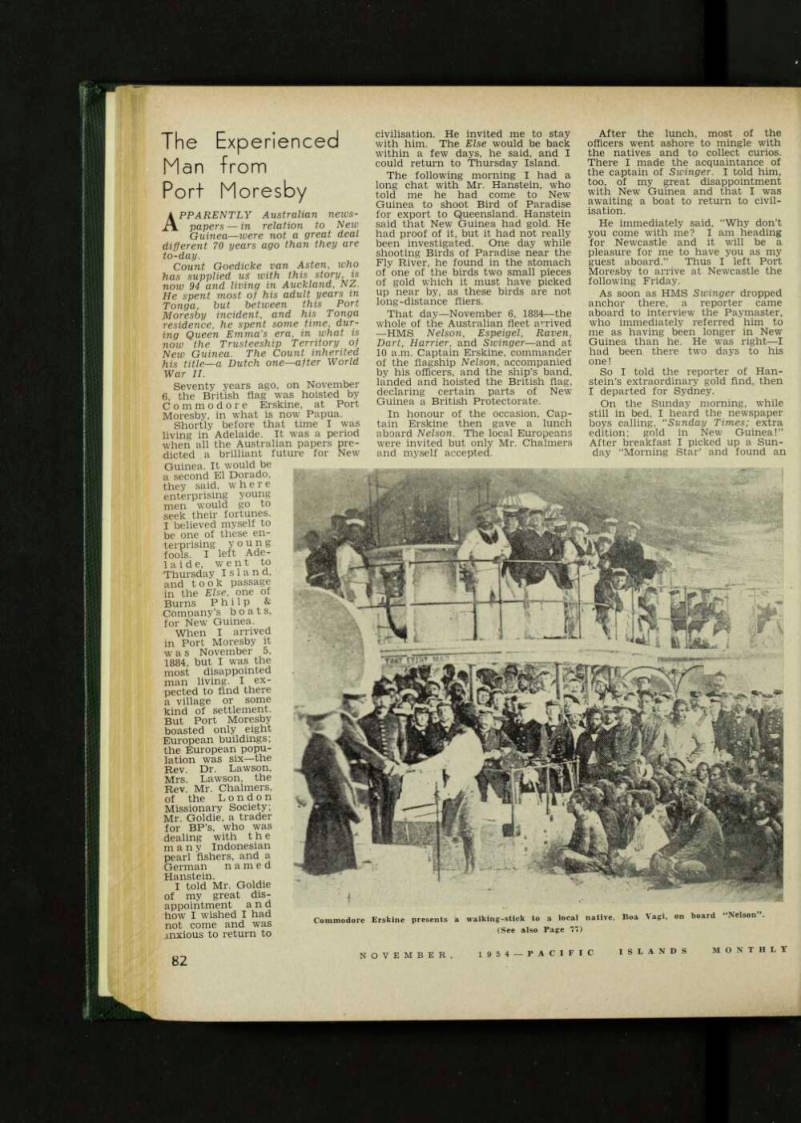
over him, a slinky black-haired Foreign Spy type in one of those close-fitting costumes which make it necessary to have the skirt slit up to the knee in order that the wearer may move her legs.
She gives her name in a husky whisper, just loud enough to make sure that nobody missed it. A liklik doctor from Wau, a storeman from Kavieng, a brace of patrol-officers, and a tourist have a quick startled look and then self-consciously re sume their attitudes of polite bore dom.
Now people are going down to their cabins, ringing bells, chatting with stewards about baths and meal hours. Others are chatting with the Purser, rather more vehemently, about missing luggage and why they hadn’t got that lower bunk that was promised them.
Presently the bar opens. The tourists are still doing things with binoculars and cameras, but the old hands file into the smoke room like miners going on shift. . .
So. The musical gong is chiming its summons to dinner. We all snatch a quick one for the road, the ladies pay a quick visit to their cabins, and now we’re being drafted to our respective tables. As usual, at every table there is a Life-and- Soul-of-the-Party type who insists that everybody exchange Christian names and life histories immedi ately. Yes, how d’y’do, how d’y’do.
Most at my table appear to be round-trippers.
Who, me? No, I’m just—well, I’m sort of going home. This was a mis take, I had to explain at length that I lived at Wewak, and so was disembarking at Madang, but I wasn’t really going to Wewak be cause I didn’t live there any longer.
No, I’m not in the Administration, I’m a sort of agent—well, I don’t
have any agencies at the moment but . . . Everybody was starting to look at me a little queerly, and there was an awkward pause. Only a girl on my left, with glasses, gave me a twinkle, she thought I was do ing it on purpose. I kicked her on the shin. hard. ☆ The first morning at sea. This is the life! Nothing like a brisk walk round the deck before breakfast.
Wild Bill was tumbling down the ladder from the bridge. Calm sea, everybody down for breakfast. What the devil are riffled eggs? The loud speaker was burbling something about a Sports Committee.
The advantage of being in the first sitting is that you can stroll up on deck, grab a deck-chair, and then look suitably unconcerned when the second-sitters arrive to search vainly for somewhere to park them selves. Like musical chairs.
We were about four or five miles off-shore. Long white sandy beaches. Occasional clusters of clean-cut, summery looking houses, usually on rising ground or pro montories, the sort of thing you see in coloured holiday posters. I thought, idly, one day I shall get off right here and live for the rest of my life.
Some sort of fish were causing a commotion in the distance —throwing up small clouds of spray. There were various conjectures—whales? sharks? porpoise? Up forward a rather strange young man in a navy blue suit was focussing a pair of Bill Wilding’s giant binoculars on the distant shore. He had a peculiar, furtive manner, and every time anyone passed he jumped hastily aside.
Lunch. Dozing under a watery sun. Afternoon session in the smoke room. Dinner. The Foreign Spy was working on an ADO from New Ire land. Housie-housie in the lounge.
But me, I took a book and a drink and went to bed.
Brisbane. There’s something about Brisbane. The sun, the colour, the design of the houses, an air of -carnival of gaiety. None of the frantic strain and bustle of the Isouthern capitals. The policemen on point duty, in smart white helmets, smile as they wave you across the street, look as if they’re ready to break into a song and dance routine at any moment.
For some unexplained reason we were held up for an extra day here, then we were preparing to move off again. The last of the Brisbane passengers were aboard, and a little bunch of well-wishers was standing on the wharf ready to say good-bye.
A couple of seedy-looking streamer sellers. It was Sunday and the river was quiet. A few hundred yards above us a little ferry crossed and re-crossed, like a dragon-fly over a summer pool, lazily. Only we bustle.
The siren gave a blast, answered politely by the ships moored above
and below —and we were off. A couple of little tugs helped us around the first sharp bend, and then, with a shrill toot, answered by our deep bass, left us to carry on alone.
We passed a small cargo boat with a solitary drowsy-looking seaman hanging over the rail. A girl near me waved a scarf. She said; “Isn’t he mean, he won’t even wave.”
Somebody touched me on the elbow to tell me that the mouth of the river was silting up. What the hell am I supposed to do about that?
An excursion launch, crowded with trippers, overtook us, and somebody started playing a piano-accordion; half-a-dozen cine-cameras sprang into action. Near the mouth there were miniature lighthouses, like toys.
The weather was glorious, enough fresh breeze to make it exhilarating.
There was a throwing off of re straint, an increase in tempo, a sort of excitement, since leaving Bris bane. Summer was here, holidays were here, shyness and awkward politeness had disappeared. At table, if you wanted the pepper and salt, you just reached across and grabbed them.
We were still following the coast, and now we were passing those peculiar peaks appropriately named the Glasshouse Mountains. They rise straight from the plain in queer pyramidal and cuboid shapes. At close quarters they are rather frightening.
Pictures to-night. An ancient newsreel, a cartoon, then one of those psychological dramas full of American journalists, Russian secret police, and a beautiful girl of un certain nationality who was trying to play both sides at once. Well, I didn’t have to see it out. I got up and borrowed a book and went to bed. ☆ Up at six, bathed and shaved, and did ten rounds of the boat deck.
We were in the open sea now, out of sight of land, with a fresh breeze and the ship moving pleasantly to an easterly swell.
Breakfasted off a couple of excel lent kippers, which are, of course, the only possible alternative to bacon. The book I have been read ing mentioned the fact that many great historical figures ate very sparingly, especially early in the day. Bismark, the Iron Chancellor, barely touched breakfast, frequently contented himself with a raw egg cracked on the hilt of his sword.
My morning siesta was disturbed by the report of firearms, strange cries, and the dull thump of bodies hitting the deck. All the little boys on board had one or more pistols of the Hopalong Cassidy type, and had apparently replenished their supply of ammunition at Brisbane.
Bill Wilding looked down from the bridge, wistfully.
(Continued on Page 93)
“Foreign-spy type ...”
After lunch we had boat drill — “a succession of short blasts on the siren; alarm bells will ring through out the ship.” After some confusion in finding our right stations (some body had painted over the num bers on the boats), we stood around looking sheepish and passing weak witticisms on the subject of ship wrecks. Nobody ever remembers whether it is the front or the back strings of a lifebelt that should be tied. Presently a junior officer with a very much more up-to-date life belt than ours came along and dis missed us.
By dinner time quite a number of people had retired to their cabins.
The sea was quite moderate, but we were rolling a bit. My own room mate was curled up in his bunk, groaning gently. When I asked him if I could do anything for him, he turned over and groaned rather more loudly.
After dinner, dancing on the Lido deck. A few young couples shrugged their way around the floor to some of those weird sounds that pass for modern dance music. Then the skipper turned up, re-shuffled the gramophone records, and led a pretty girl off in an old-fashioned barn dance. After a few minutes everybody was on the floor and encoring it for half an hour.
I got stuck with a cove who said
his name was Henry. He came from Tasmania. We had a whisky to gether and talked. Or, at least, he talked.
He had lost his wife a year ago.
She had been a true mate, a wonderful woman, in twenty years they had never had a quarrel, he had vowed to devote the rest of his life to her memory. He was a
violinist, he had five violins, all old masters, he loved them all. But most of all he loved his wife who had left him twelve months ago.
At night he played to her on his violin, he more than played, his very soul went into every note, every chord, and she came back to him. Came back to him, every night, wonderful wife, wonderful music. He sagged slightly in his chair and started to snore gently. ☆ Beautiful morning. Whispy clouds, light breeze, warm sun. The ship’s officers had changed into whites, the girls were starting to come out in shorts and sun suits, the men in violently striped tee-shirts and loose jackets covered with palm trees, hula girls, and other tropical motifs.
Interest turned to the swimming pool, which had just been filled for the first time. This is a sort of huge tank set on the boat deck and reached by a ladder leading to another flying deck of its own. Its walls on the boat deck, however, contained a number of large glass panels, so that from here you get a sort of Esther Williams underwater ballet of flashing swim suits, bubbles and various shaped legs.
About a mile away on our port side was a long and winding line of breakers —Jolief Reef. Deep-sea navigation is always a miracle to me. That we should be able to
travel six or seven hundred miles over this trackless waste, and then pass a lonely reef with exactly the clearance indicated by the pencil line on the chart in the smokeroom, fills me with the greatest admiration. Don’t tell me that it is perfectly simple with modern inmathen "
directional radio, etc., I know—but I prefer to believe it is done by magic.
We had a birthday at lunch. The placid, motherly-looking woman opposite me was ensconced behind a large and highly decorated cake.
We stood up and sang, “Happy birthday,” rather self-consciously.
Her husband, a greying estate agent with bi-focal glasses, from Manly, Sydney, squeezed her hand, sur repitiously, under the table. We all felt very happy.
The loud-speaker said there would be a fancy dress ball to-night, and then went on to draw our atten tion to the necessity of filling in Customs Declarations and handing them to the Purser before reaching Port Moresby.
The sea was calmer. We had turned on a more northerly course after passing the reef this morn ing, and there was now only a light following swell. Everyone was be coming very matey. Introductions were no longer needed. We nodded, smiled, chatted, borrowed cigarettes, and had drinks with anyone we bumped into. This would have been impossible a week ago, now it seemed the only natural thing to do.
A few dinner jackets appeared to-night, for the first time. The ladies, of course, have been using war paint ever since we left Syd ney. The estate agent from Manly was in elegant pearl grey. His daughter, who sat on my right— rather attractive —called it “Daddy’s tux.” For some reason the fancy dress ball had been postponed. ☆ There w r ere strange noises com ing from the overflow in my hand basin—gurglings, with an occasional sharp metallic ding. At breakfast we discussed rumours that we should reach Moresby at five this evening The loud-speaker said it would like to see everybody in the lounge, at eleven-fifteen.
I had a talk with an old chap, his name was Joe, he would be 75 next birthday, he was going up to visit his married daughter in Lae.
He had been a young engineer on the boat that laid the first cable from Australia to Vancouver via Fiji, Australia, and Honolulu in 1902.
He told me quite a lot about cable laying. Recently the Australian end of his old cable had been renewed, and he had made a pilgrimage to the shore station, near Brisbane, on the occasion. He had been very tickled to be interviewed and photo graphed by the local press.
The Lido deck was justifying its name. Loungers in bath robes and towels sipped long drinks on their way up to, or down from, the swim ming pool. The sitters on deck, when they got tired of reading, sun ning, or gazing at the empty ex panse of sea, turned their deck chairs round to watch the lower ex tremities of the swimmers pedalling past the windows. For an hour or so each day the water was lowered to about thirty inches to let the kiddies have a splash.
As we got nearer to New Guinea, Territorians were starting to fall into well-defined groups. Senior
Administration officers were get ting more exclusive, and greeted their subordinates with an increas ingly glassy eye. On leave in Aus tralia they are just ordinary frogs; at home in New Guinea they are very large frogs, in a very small pool. Now they were back in their tropical uniform of starched whites they were swelling visibly, their voices were becoming richer, fruitier.
They discussed obscure points of law, racial problems, long-term policies. . .
The planters and traders were dropping their reminiscences of golf, night clubs, sports cars, and Castle reagh Street hotels, and starting to get together on the respective merits of hot-air and Ceylon driers, the iniquities of BP’s and WRC, and
who knows what the hell the Ad ministration will do next?
A lik-lik doctor, a brace of Treasury clerks, an Agricultural officer and a native labour overseer had formed a small protective asso ciation of their own, and had their heads together on questions of seniority, postings, family allow ances, and how they put the District Commissioner in his place.
At four o’clock we had medical inspection. Show me your hands, please. Thank you. Next please.
Rumour now says we shall berth at seven.
At five o’clock the smoke room was packed. Excitement. The frogs had swollen to an incredible size and threatened to burst at any moment. I had a drink with a party
of tourists. They were very anxious to know what points of interest they should visit. The Moresbyites were packed, ready to go ashore, their hand-luggage on the deck near the gangway.
Actually we got in about nine— and anchored off-shore for the night. An anti-climax. Everybody returned to the smoke room, the frogs first carefully removing their best suits of whites and putting them on hangers for the morning.
Mr. Daniel W. Montenegro, Ameri can Consul at Noumea, is to make an official routine visit to Papeete, one of the areas under his care, in November. The American Consul was withdrawn from Papeete in 1948.
Two CSIRO experts are now visit ing Netherlands New Guinea ex changing information and experi ences with the Dutch. They are Dr. R. Pilgrim, Botanist, and Mr.
H. A. Haantjes, soil expert and head of the P-NG Regional Land Survey Unit.
A Public Works programme is go ing ahead in Aitutaki. The islanders are assisting the Administration by renovating the water catchments of the outer villages and by collecting the thousands of stones needed for levelling off the site of the new hospital. Voluntary labour has com pleted a 10,000 gallon water tank at Reureu, and a second tank, at Nikaupara, is under construction