Europeans Change at Tari
pp. 85-99 · Read in the full issue
Old Books Re-Read
19 Years On—And Only
NINETEEN years ago two young officers of the Papuan Admini stration, Hides and O’Malley, under took a patrol between the headwaters of the Strickland and Kikori Rivers, It was the only large tract of Papua left unexplored, and in writing after wards of their task, Sir Hubert Murray, Lieut.-Governor of Papua, said that it was high time that the “ugly blank on the map should be filled in.”
In the course of this patrol, the men, the police and their carriers, came down off the treacherous lime stone barrier that straggles across N-W Papua, and into the beautiful valey which they were told was the Tarifuroro.
Today, it is simply known as Tari —part of the Southern Highlands district of Papua—and, in part of it, 10 minutes’ flight from the patrol post at Tari, is the valley called Lavani—also the Hidden Valley, Shangri-La and other fanciful names.
Heaven alone knows what sets some incidents apart to become newspaper sensations. But that is what happened in relation to Lavani in May this year, when first it was visited, as part of a much bigger project, by a geologist, John Zehnder; and flown over shortly afterwards by the P-NG Directors of District Services and Civil Aviation.
Lavani is only one of many small pockets of population in an esti mated, unvisited 60,000 people in this Highlands area, but as usual in such affairs, there have been the various side reactions to the great publicity build-up it, received.
One reaction came from a sister of the late Jack Hides, now residing in Sydney. She claims that Zehnder did not discover Lavani; that, in fact, Hides did and that his writ ings, photographs and maps prove it. Much of this material was pub lished in a book by Hides in 1936 called PapvWonderland. I have had a amount of pleasure in re-reading it in the last few weeks.
Although, it is obvious from what he says in this book, that Hides never did go down into the valley of Lavani, it is remarkable that virtually nothing has been said about him, in the last few months, in connection with the Southern Highlands.
For Hides was the Colin Simpson of the 30’s; his books, and he wrote several, were best-sellers: and what he wrote made the world Papua conscious. It would be interesting
to know how many post-war Terri torians have heard of him, or have read his books.
This has its amusing side —because Hides, in his day, had a bigger blast of publicity than Lavani or Zehnder and, turning back recently through the PIMs of that time, I came on a sort of apology for the fact that Hides’ patrol had been selected for headlines; it was a matter of luck, we said, and no one would begrudge him his fame although there had been other fine patrols, both in Papua and New Guinea.
I went to New Guinea during the days of Hides, and one of the first things told me there was that there had been just as meritorious patrols on that side of the border—but that the Administration did not en courage its staff to write books about them!
And the Melbourne Herald of that time told how this patrol of
(Continued on Page 91)
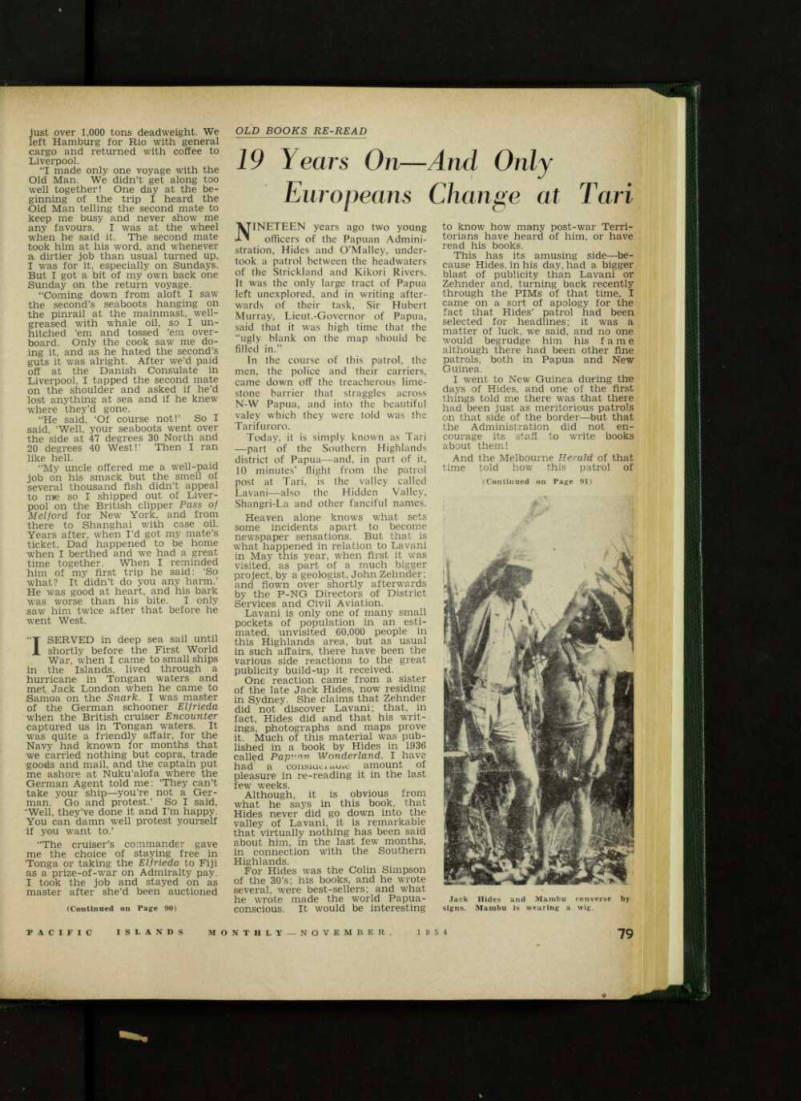
Jack Hides and Mambu converse by signs. Mambu is wearing a wig.
Hides’ had discovered an entirely new race of people beyond the lime-stone barrier tall, intelligent agricul turalists —w ith near-white skins.
Whether the Tari people have ever been proved to be more intelligent than the rest of the P-NG natives I do not know; but Hides himself, when he reached Australia, denied that they were tall or white. The photo, page 79, taken of Hides and Mambu (which in local language still means “friend) proved that point. But in 1936 Hides certainly got his full measure of publicity, shaken down and running over. If he is a forgotten man in the Terri tories to-day, we can blame the war which divides “before” from “be hind” as surely as any limestone barrier. Too many Territorians of to-day believe that history began, in P-NG, in 1946.
Reams have been written in the last few months by Colin Simpson and others, about Tari and the Lavani Valley, much of it making the same observations as Hides made in Papuan Wonderland. One of the first men Hides met in the Tari valley told him, in sign language, that they had never seen a Euro pean, but they had heard of them.
The old man who led Zehnder into Lavani is reported to have said much the same thing.
There are the same descriptions of the agriculture and the men’s wigs decorated with bachelor but tons and edelweiss: the same dis posal of the dead.
When Hides’ party left the lime stone barrier they had their first glimpse of the Tari Valley and the river they called the Ryan (or the Tari) but they had a ten-hours’ crossing of what they named Land
slide Mountain before they followed a spur running northwards into the vn 11pv v , . ~, 1 , It was here they found the land of cultivated squares, the scattered farm houses and the friendly people who fed the spent party on sweetpotatoes, spinach and sugar-cane, The canyon they first entered opened out into a valley and for days they marched across it, northwards and eastwards over great rolling slopes, always rising until they had gained the tableland, From the tableland, Hides looked back over the valley and described it thus; The two main sources of the Tarlfuroro appeared to lie north-west and north-east of the majestic peak we called Mt. Jubilee, and from the broad valleys thus formed
on both sides of it, the Tarifuroro came down between valley slopes 15 to 35 miles wide. It then carried on south, drawing to it the waters of numerous small streams of the cultivated lands, and then this mighty mountain river could be seen sweeping south-east to thunder through a deep limestone gorge of the barrier, and from there out to the plains of the great plateau. I had no doubt that it was the Kikori.
Across the tableland, after many days their path led them over Mt. Champion by a pass 11,000 feet high and down into the Wagi Furari. . . “We had passed through the backdoor of the Purari and I knew by the countless number of little spirals of smoke going up, that we had found an even greater population than the Tarifuroro.”
(Continued on Page 93)
In order to get back again into the headwaters of the Kikori, Hides and his party crossed the limestone barrier for the second time and in due course reached the coast at Kikori Government station, opera tion completed.
One is struck, of course, in re reading this 20 years’ old book, at the difference that air transport— then in its infancy—and radio have made to this type of patrolling, even in darkest Papua. Struck, too, by a few lines in Sir Hubert Murray’s foreword to the book. He said; “The country traversed is too far from the coast, and too difficult of access to admit of agricultural develop ment by European enterprise, or the production of base metals; and it would appear, therefore, that as far as white capital is concerned, it must remain undeveloped.”
Sir Hubert’s prophecy has held for 19 years. But the search for oil has been extended to that area; planes fly in to Mendi and Tari; and it is anyone’s guess what the next 19 years will bring.—J.T.
B. F. Hooper, who joined the Fiji Police Force in 1929, recently left the Colony on pre retirement leave. fl Brigadier A. E. Brown, Secretary- General of the Anzac Agency of the Imperial War Graves Commission, was visiting Fiji in October, in specting the Suva military cemetry.