Fifty Years of Sea,
pp. 84-97 · Read in the full issue
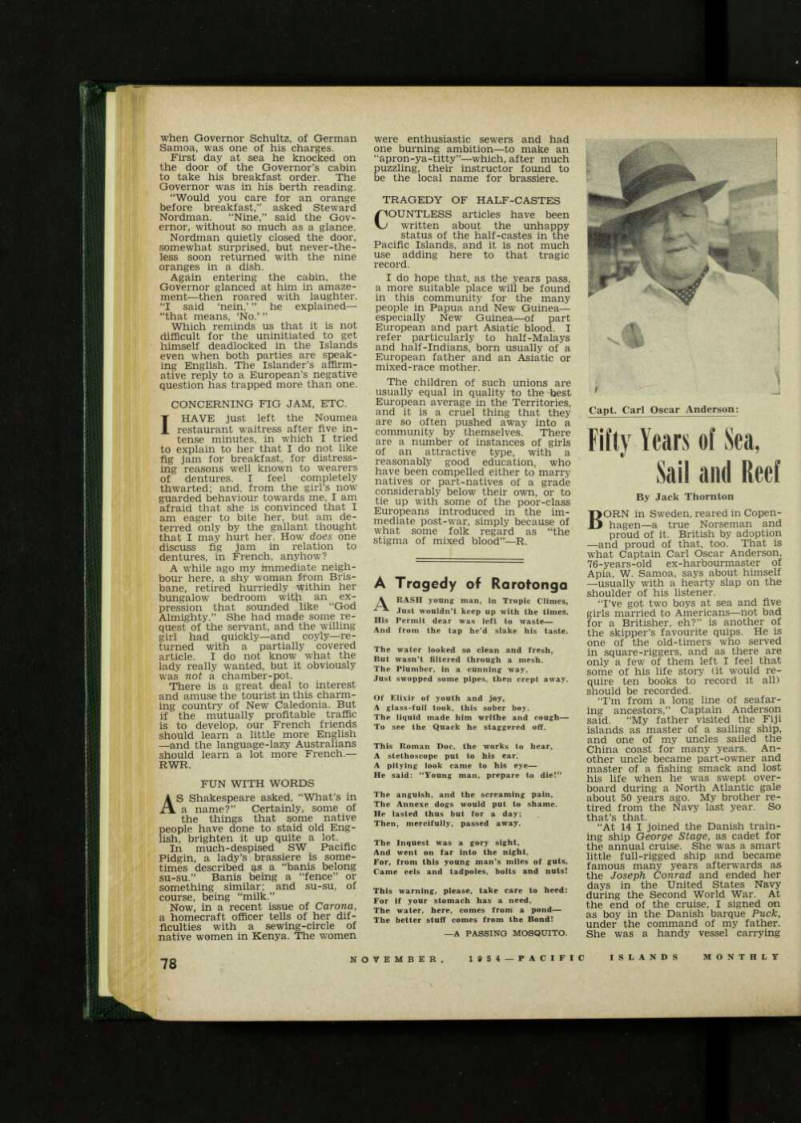
Capt. Carl Oscar Anderson:
Sail and Reef
By Jack Thornton
BORN in Sweden, reared in Copen hagen—a true Norseman and proud of it. British by adoption —and proud of that, too. That is what Captain Carl Oscar Anderson, 76-years-old ex-harbourmaster of Apia, W. Samoa, says about himself —usually with a hearty slap on the shoulder of his listener.
“I’ve got two boys at sea and five girls married to Americans —not bad for a Britisher, eh?” is another of the skipper’s favourite quips. He is one of the old-timers who served in square-riggers, and as there are only a few of them left I feel that some of his life story (it would re quire ten books to record it all) should be recorded.
“I’m from a long line of seafar ing ancestors,” Captain Anderson said. “My father visited the Fiji islands as master of a sailing ship, and one of my uncles sailed the China coast for many years. An other uncle became part-owner and master of a fishing smack and lost his life when he was swept over board during a North Atlantic gale about 50 years ago. My brother re tired from the Navy last year. So that’s that.
“At 14 I joined the Danish train ing ship George Stage, as cadet for the annual cruise. She was a smart little full-rigged ship and became famous many years afterwards as the Joseph Conrad and ended her days in the United States Navy during the Second World War. At the end of the cruise, I signed on as boy in the Danish barque Puck, under the command of my father.
She was a handy vessel carrying
just over 1,000 tons deadweight. We left Hamburg for Rio with general cargo and returned with coffee to Liverpool.
“I made only one voyage with the Old Man. We didn’t get along too well together! One day at the be ginning of the trip I heard the Old Man telling the second mate to keep me busy and never show me any favours. I was at the wheel when he said it. The second mate took him at his word, and whenever a dirtier job than usual turned up, I was for it, especially on Sundays.
But I got a bit of my own back one Sunday on the return voyage.
“Coming down from aloft I saw the second’s seaboots hanging on the pinrail at the mainmast, well greased with whale oil, so I un hitched ’em and tossed ’em over board. Only the cook saw me do ing it, and as he hated the second’s guts it was alright. After we’d paid off at the Danish Consulate in Liverpool, I tapped the second mate on the shoulder and asked if he’d lost anything at sea and if he knew where they’d gone.
“He said, ‘Of course not!’ So I said, ‘Well, your seaboots went over the side at 47 degrees 30 North and 20 degrees 40 West!’ Then I ran like hell.
“My uncle offered me a well-paid job on his smack but the smell of several thousand fish didn’t appeal to me so I shipped out of Liver pool on the British clipper Pass of Melford for New York, and from there to Shanghai with case oil.
Years after, when I’d got my mate’s ticket, Dad happened to be home when I berthed and we had a great time together. When I reminded him of my first trip he said: ‘So what? It didn’t do you any harm.’
He was good at heart, and his bark was worse than his bite. I only saw him twice after that before he went West.
“T SERVED in deep sea sail until J. shortly before the First World War, when I came to small ships in the Islands, lived through a hurricane in Tongan waters and met Jack London when he came to Samoa on the Snark. I was master of the German schooner Elfrieda when the British cruiser Encounter captured us in Tongan waters. It was quite a friendly affair, for the Navy had known for months that we carried nothing but copra, trade goods and mail, and the captain put me ashore at Nuku’alofa where the German Agent told me: ‘They can’t take your ship—you’re not a Ger man. Go and protest.’ So I said, •Well, they’ve done it and I’m happy.
You can damn well protest yourself if you want to.’
“The cruiser’s commander gave me the choice of staying free in Tonga or taking the Elfrieda to Fiji as a prize-of-war on Admiralty pay.
I took the job and stayed on as master after she’d been auctioned
(Continued on Page 90)
to the new owner, till after the war, when I shipped as first mate on the American four-masted schooner Etseltane from Suva to ’Frisco, where I stevedored for a year then joined my first steam ship—the Australian —for a trip to China, Japan, India and Australia, where I joined the Dawn —she was quite famous in the South-West Pacific —and brought her back to the islands, where I’ve served ever since.
A lot of water’s passed under the keel since then. I sailed about six years in Fiji and Wallis Island waters, navigating reef passages at night to keep up with company schedules, and never piled up on the reef. I’m proud of that record, just as I’m proud of being able to say that I’ve never lost a life, though I’ve saved more than one at sea.
“After two years as master of the Dawn they couldn’t kill her naturally and eventually took her out of Suva and sank her outside the reef —I joined the Fiji Shipping Company and skippered the Sir John Forrest and the Matusa. If some of the old-time skippers hap pen to read this they’ll understand the terrific strain of maintaining a day and night cargo service when we had no radar.
“It was an experience that de cided me to take a spell ashore,
50 when 1 heard about a sailmaking business up for sale in Levuka I bought it, and did very well until 1 was offered a good billet as master Tongan Government’s Hl M ua > the call of th e sea proved
too strong so I sold out and became master of the Hifufua for 3J years.
She was specially designed with accommodation for Tongan Royalty, and Queen Salote made many visits to outlying islands aboard my ship.
I look back on this, and my previ ous voyages in Tongan waters, as the most satisfying parts of my life at sea. When my contract expired I would have renewed it if I’d got on better with the British Consul in Nukualofa, but as things turned out I swallowed the anchor on April Fool’s Day, 1932—0 r at least I thought I had until I came to Apia the same year, and for the next seven years did charter trips for the Western Samoa adminis tration and commercial firms trad ing to the Tokelaus, Puka Puka and Niue. Navigation on these voyages was child’s play after sailing in Tongan and Fiji waters.
“On the outbreak of the Second World War I was appointed harbour master and pilot at Apia, a job I held till the end of the war, after which I gracefully swallowed the anchor for the very last time.”
Captain Anderson in retirement is a familiar figure as he walks with sprightly step into Apia each day.
Many Europeans remark upon his physical resemblance to Sir Winston Churchill.