The Experienced
pp. 88-89 · Read in the full issue
Flan from Port Moresby
APPARENTLY Australian newspapers —in relation to New Guinea—were not a great deal different 70 years ago than they are to-dav rnninf rnpdirkp van Asten who with this story is now living in Auckland^N Z.
He spent most of his adult years in Tonga but between this Port Moresby incident, and his Tonga residence , he spent some time, during Queen Emma’s era , in what is now the Trusteeship Territory of New Guinea. The Count inherited his Dutch one — after World War 11. c; o ,, onh , vpnr( . nPT , nn November 6 British flag* was hoisted by Commodore Erskine, at Port Moresby, in what is now Papua.
Shortly before that time I was living in Adelaide. It was a period when all the Australian papers predicted a brilliant future for New
Guinea. It would be a second El Dorado, they said, where enterprising young men would go to seek their fortunes.
I believed myself to be one of these en terprising young fools. I left Ade laide, went to Thursday Island, and took passage in the Else, one of Burns Phi 1 p & Comoany’s boats, for New Guinea.
When I arrived in Port Moresby it was November 5, 1884, but I was the
most disappointed
man living. I ex pected to find there a village or some kind of settlement.
But Port Moresby boasted only eight European buildings; the European popu lation was six—the Rev. Dr. Lawson, Mrs. Lawson, the Rev. Mr. Chalmers, of the London Missionary Society; Mr. Goldie, a trader for BP’s, who was dealing with the many Indonesian pearl fishers, and a German named Hanstein.
I told Mr. Goldie of my great dis appointment and how I wished I had not come and was inxious to return to
civilisation. He invited me to stay with him. The Else would be back within a few days, he said, and I could return to Thursday Island.
The following morning I had a long chat with Mr. Hanstein, who told me he had come to New Guinea to shoot Bird of Paradise for export to Queensland. Hanstein said that New Guinea had gold. He had proof of it, but it had not really been investigated. One day while shooting Birds of Paradise near the Fly River, he found in the stomach of one of the birds two small pieces of gold which it must have picked up near by, as these birds are not long-distance fliers.
That day—November 6, 1884 —the whole of the Australian fleet arrived —HMS Nelson, Espeigel, Raven, Dart, Harrier, and Sivinger —and at 10 a.m. Captain Erskine, commander of the flagship Nelson, accompanied by his officers, and the ship’s band, landed and hoisted the British flag, declaring certain parts of New Guinea a British Protectorate.
In honour of the occasion, Cap tain Erskine then gave a lunch aboard Nelson. The local Europeans were invited but only Mr. Chalmers and myself accepted.
After the lunch, most of the officers went ashore to mingle with the natives and to collect curios.
There I made the acquaintance of the captain of Swinger. I told him, too, of my great disappointment with New Guinea and that I was awaiting a boat to return to civil isation.
He immediately said, “Why don’t you come with me? I am heading for Newcastle and it will be a pleasure for me to have you as my guest aboard.” Thus I left Port Moresby to arrive at Newcastle the following Friday.
As soon as HMS Swinger dropped anchor there, a reporter came aboard to interview the Paymaster, who immediately referred him to me as having been longer in New Guinea than he. He was right—l had been there two days to his one!
So I told the reporter of Han stein’s extraordinary gold find, then I departed for Sydney.
On the Sunday morning, while still in bed, I heard the newspaper boys calling, “Sunday Times; extra edition; gold in New Guinea!”
After breakfast I picked up a Sun day “Morning Star’ and found an
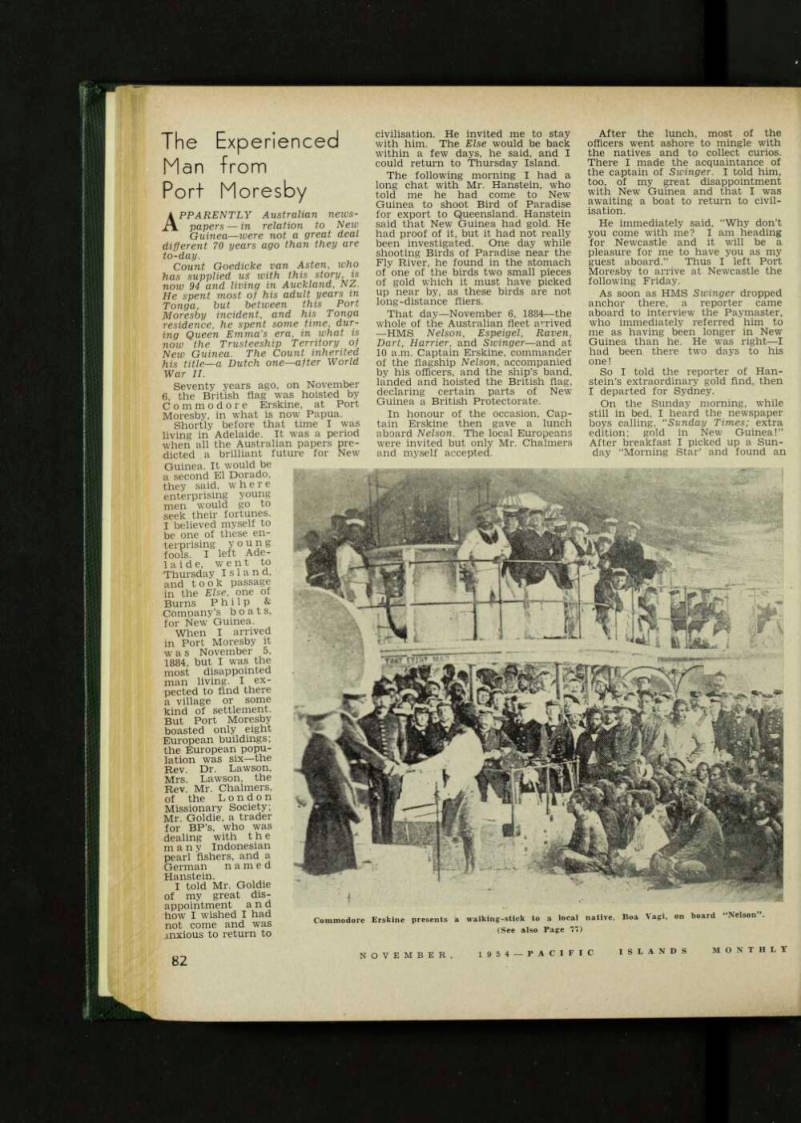
Commodore Erskine presents a walking-stick to a local native, Boa Vagi, on board “Nelson”. (See also Page 77)
interesting story—quoted from the Newcastle “Courier.” HMS Swinger, it said, had just arrived from New Guinea with a passenger who had reported that gold had been found near the Fly River.
But what the story did not say was that the gold had been found in the stomach of a bird.
Two Fijian boys, Petero Mataca, of Vuaka, Yasawas, and Ilario Nale. of Votua, and a Gilbert Islander, Sione Klies, recently began theii 7-year studies for the Catholic priesthood at Holy Cross College, Mosgiel, NZ. Two Rotumans at the College have completed their second year. Also in NZ at the Marist Fathers’ Seminary at Green meadows are a Fijian, a Rotuman and an Indian. It is expected that all will eventually return to the Islands.