Ranching On The Island
p. 83 · Read in the full issue
Of Inscrutable Images
WHENEVER Easter Island is in the news, it is almost always in connection with its great stone images or its uses as a pos sible air-route staging point. And so, as Percy H. Edmunds is not a scientist or an aviator, the news papers overlooked his visit to New Zealand recently.
Yet for 28 years Percy Edmunds managed the 40,000-acre sheep-and cattle station that has given the island its only real importance all through the years. What a history he could write of those 28 years— if only he felt inclined. He has an amazingly clear recollection of num erous interesting events—of trouble on the island, of droughts, of scientists calling, and of ship wrecks. The very ship that took him there in 1900 was promptly wrecked on its arrival.
The horrors of that voyage are still very vivid to him.
The Picpus Fathers seem to have been the first outsiders to introduce stock —partly for their own purposes but also to encourage the local people to develop a trade with ships needing such supplies, and perhaps with South America.
Up to their arrival in 1864, the island had been a sort of no-man’s land, and a happy hunting ground for the nitrate and guano slavers.
French warships, after 1864, watched the interests of the missionaries, and the island began to develop ties with Tahiti for that reason.
By the early 1870’s, John Brander, of Tahiti, who saw the business possibilities of the island, estab lished a manager there. Alexander Salmon seems to have been the
first, then later a retired French army captain, a veteran of the Crimea War, took over, and a period of great unrest developed due to his strong antagonism towards the missionaries. This culminated in the temporary evacuation of the missionaries, who went, in 1878, with 300 faithful supporters, to Manga reva. At about the same time, Brander took 500 other natives to Tahiti to work the sugar planta tions at Atimaono, and also bought the s.ock on Easter which belonged to the missionaries.
IN 1888, the island was formally annexed to Chile. Possibly the Chilean Government then bought out the Brander interests — because soon afterwards a Val paraiso man with big pastoral in terests, named Enrique Marlet, acquired the stock-raising con cession by tender or auction. A man named Cooper was placed in charge.
A few years later a London firm, Williamson, Balfour & Co., with in terests in North and South America, gained the major share from Mar let, who was said to have originally paid £4,000 for the concession.
It was at this stage that Percy Edmunds’ association with Easter began.
He was a young Englishman, and went to Chile after working on stations in the Argentine. At Valparaiso, in 1899, he met Marlet and was persuaded to take the job. At that time, like most people, he knew nothing about this 12-by-5 miles island that lies over 2,000 miles west of Valparaiso—and there was precious little enlighten ment in the encyclopedias which he consulted.
But the following year he was on his way, in the chartered Chilean Government schooner Sarita, which had been launched only three years previously.
No adjectives, says Edmunds, can adequately describe the discomforts of that long voyage. The ship was filthy, the food frightful, and he was very seasick. The island was overshot but was located by the Swedish skipper and his German mate after a few days of beating about in bad weather. She had scarcely made her anchorage, before she was ashore, dragging her anchor in a squall. She become a total loss.
Only regular contact with the island then—as now—was by ttfe supply boat once each year, in mid summer. But, luckily for Sarita’s crew—Japanese, Polynesian, Chilean, Scandinavian—a passing vessel called and took them with her. Six months later, the British warships Flora and Cambrin called, picked up the master and mate who had
remained, and landed them at Suva. ,° n his arrival at the island Edmunds found a human population of about 200 (which rose to twice that during his 28 years “reign” and is now about 700), a great many cattle of indeterminate strain, and about 5,000 Merino sheep. Each Summer, wool, dried meat, hides and tallow were shipped away. But prices declined and in 1904 the com pany decided to abandon opera tions, sending orders that as many cattle as possible were to be killed.
About 2,000 were shot before Edmunds left, returning to England for a holiday. Three years later, operations were again commenced, there then being some 400 cattle.
This number rose during the years to 23,000 head and 7,000 sheep— drought and lack of food being the limiting factors.
In 1932, three years after Edmunds departed for the last time, there were said to be 30,000 head of cattle on the island. Marlet died about 1910.
PERCY EDMUNDS travelled to Valparaiso every five to seven years for a look at the outside world. He recalls that in 1921 he returned to the island aboard a yacht recently mentioned in PIM and now in Sydney— Cariad I, now owned by A. W. Flitton, of South Africa. She was then the Fidra, which had been purchased for £5,000 from Lord Dunrevan, by a group of Swedish reserve Army and Navy officers. One of them later wrote a book — Around the World in Fidra —which contains a photo of Edmunds aboard the vessel. But the nautical history of Easter Island is a considerable story in itself.
Somewhere in the mid-1920’s a Mr. Charlie Daley gained an im portant interest in the pastoral company, and it was he who took over from Edmunds in 1929, but in the late 1930’s the company became a public one with its shares quoted on the Valparaiso stock-market, Williamson, Balfour & Co. continu ing to have a substantial interest.
For some years now, an Australian named Jack Lord has managed the holding. In recent years a radio station, operated by the Chile ad ministration, has been established and the present manager makes daily contact with Daley, who appears to be the overall manager, at Valparaiso. From him Percy Edmunds has lately heard that as from January 1, of this year, the pastoral concession was nation alised by the Chilean Government.
The present company may, perhaps, continue to manage it on the Gov ernment’s behalf. They were given a 20-year concession in 1944.
Percy Edmunds has lived in quiet retirement in Tahiti since he left the island in 1929—apart from one trip back to Valparaiso on business, a trip home to England, and an occasional visit to his grown-up family in New Zealand. He returned to Tahiti from NZ in February
Jim Shortall.
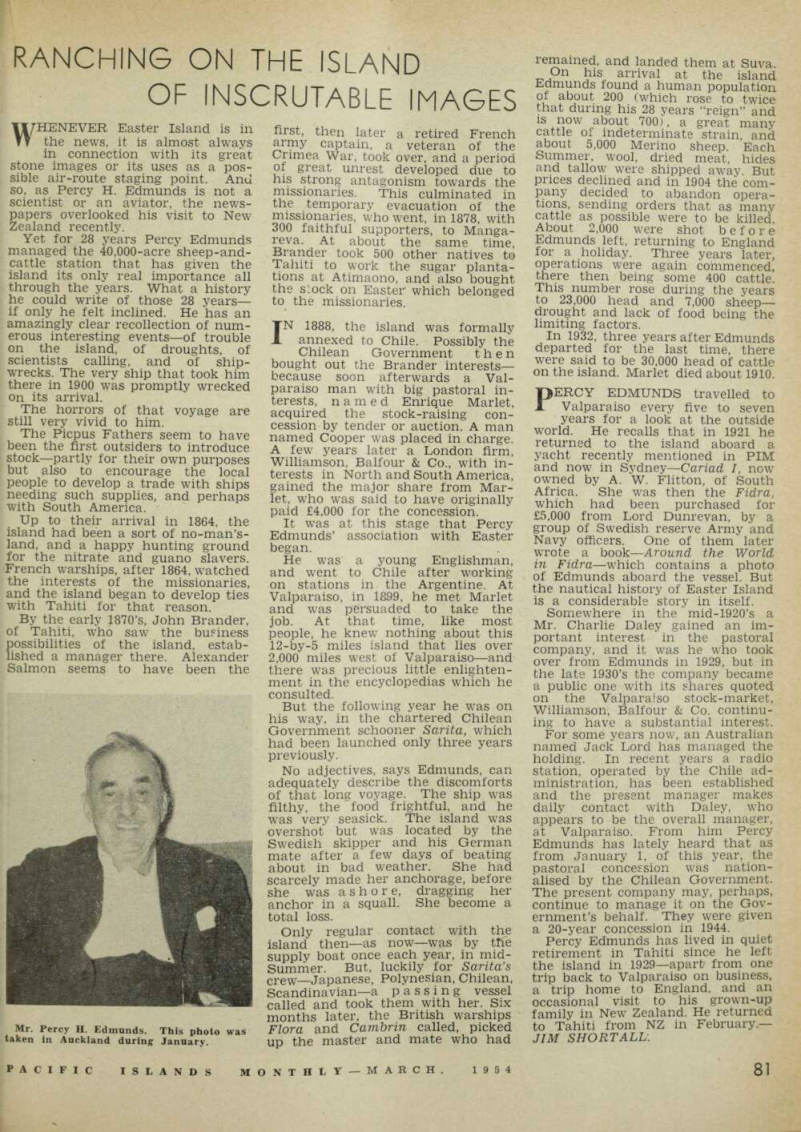
Mr. Percy H. Edmunds. This photo was taken in Auckland during January.