How Segi Rose and Fell
pp. 84-85 · Read in the full issue
Personal War Tragedy of Harold Markham
MANY famous people—especially
world-travellers and writers — will learn with sorrow that Harold Aubrey Markham, aged and sick and poor, died in Sydney on February 8. In the two decades be tween the World Wars, H. A. Mark ham became famous as the South Pacific’s finest host, and for the beauty of the plantation home he personally built on the Morovo Lagoon, in the Solomon Islands.
Before the turn of the century, Harold Markham was probably the youngest quartermaster in the Union Castle Line. But his post on the Northam Castle did not satisfy his itchy feet, and he left the service in South Africa. He was successively
officer in charge of the Durban fire brigade, and the Kimberley fire brigade* The latter job included some police duties. Markham used to bash the side of his hands on wood, to toughen them for the frequent occasions when he had to handle criminals—illicit diamond buyers made the pace in Kimberley s crime list then.
Came the Boer War, and Markham went through the campaign in a Light Horse regiment. He wandered around and then he went to Australia as quartermaster of the Aberdeen White Star liner Nmeveji.
In Sydney, in 1912 he agreed to so to Ontong JB.V3, (Southern Solomcn s) to take charge of a Lever’s trade-store and co p r a-b uyi n g agency.
So the Islands “got” him. He was then in his middle thirties, and seeking an anchorage. Ontong Java is a Polynesian outlier, and Markham met an attractive Polynesian girl, and settled down there with her—after a few years he was called “the uncrowned king of Ontong Java.”
WHILE a trader in Ontong Java, Markham decided to plant up his own plantation in the Solomons; and he chose, as the site of his new home, a very beautiful place on Njai Passage, at the south west end of the Marovo Lagoon. He not only planted coconuts —he per sonally designed and, over a period of six or seven years, built his famous homestead, Segi.
Segi had everything in the way of amenities and beauty—a private wharf, crushed coral roads and pathways, lawns and gardens, a 6holes golf-course, even a quarter acre of English clover maintained at a cost of £2OO per annum, so that the owner could walk about in comfort with bare feet. The house was surrounded by a very deep verandah, and was planned with an eye always to comfort and coolness.
After the lapse of some seven years, in the early ’Twenties, when the palms were big enough to give an income, Markham sold his On tong Java place to “Tas” Walton, and settled down at Segi, to live the life he loved best—complete in dependence, and dispensing hos pitality to countless friends and visitors.
Markham bought from Jack London the famous yacht Lily, and
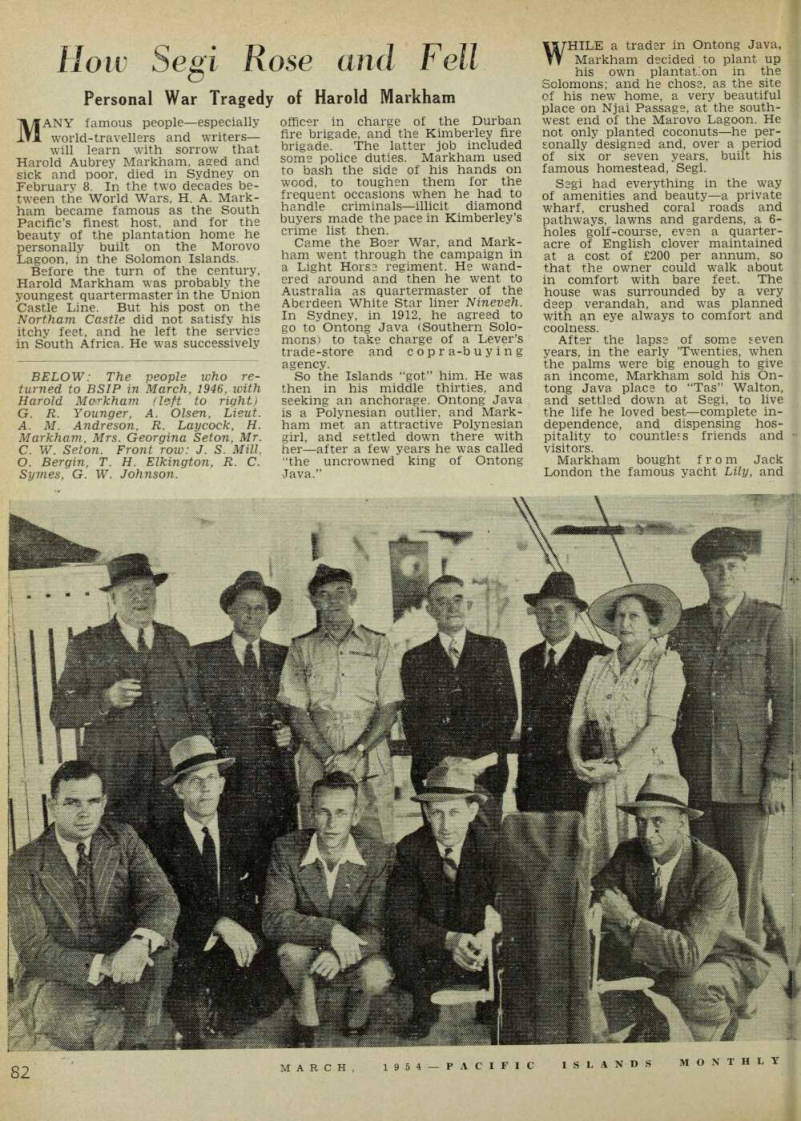
BELOW: The people who re turned to BSIP in March, 1946, with Harold Markham (left to right) G. R. Younger, A. Olsen, Lieut.
A. M. Andreson, R. Laycock, H.
Markham, Mrs. Georgina Seton, Mr.
C. W. Seton. Front row: J. S. Mill, O. Bergin, T. H. Elkington, R. C.
Symes, G. W. Johnson.
ran her for years before he sold her to “Bob” McKerlie, of Malasogo, Vella Lavella. (Mr. McKerlie now has a hotel in Bathurst Street, Sydney). Markham’s one daughter by his Ontong Java wife was named Lily, after the yacht. Lily was wrecked while in McKerlie’s owner ship.
All kinds of famous and rich people were guests of Harold Mark ham at Segi. Among them was the American yeast millionaire, Fleisch man, who travelled in one of the most magnificent yachts of that time, the Canarqo. The American loved Markham’s home; and, one day, he said: “Harold, I’ll trade you Canargo for Segi.’
“Nothing doing,” said Markham.
“I would not sell Segi at any price.”
Every voyager who sailed through the Solomons in the ’Thirties had stories to tell of Segi. To know Markham was to become his friend, for all time. He appeared in many books.
WHEN the Japs invaded the Solomons in 1942, all Europeans were evacuated, and Markham spent four miserable years in Aus tralia, and doing war work.
Early in 1946, after the Japs had surrendered, the BSI plantation owners gathered in Sydney, clamor ous to get back to their homes.
Finally, they sailed off as the scratch crew of the mission ship Southern Cross —here is the group photograph which the PIM published in March, 1946, Markham among them.
It was a heartbreaking experi ence for all of them. Their planta tions had either gone back to jungle, or were smashed. Unlike the Papua- New Guinea planters, they got no war damage compensation. None was worse hit than Markham.
The war had rolled right over his property—the great battle of Munda was actually fought around Morovo Lagoon. Segi’s famous homestead had been literally blown to pieces.
Markham, now over 70, had neither the means nor the heart to start all over again. He hovered around for a while, and then he said goodbye to the famous place of his dreams. It was one of the real tragedies of the war.
He accepted a position from the Western Pacific High Commission, and was administrative officer at Christmas Island for a couple of years. But he was a sick man, and his spirit was broken. He came back to Sydney, and made his home with his daughter, Lily, now a widow.
He was bed-ridden for four or five years.
I HAD written the first paragraph of this article, and was trying to piece together the story of H. A. Markham’s life, when a voice called me on the telephone. “Could you tell me, please, how I could get in touch with H. A. Markham, who
used to have Segi plantation, in the Solomons?” I told him that the old man died, at 78, on February 8.
He was silent a moment, and then he said: “I have been away for years—l have been waiting for my return to Sydney to look him up.”
He was Captain Harold Robinson, who used to run Burns Philp ships to the Solomons over 30 years ago, and who then was a very close friend of H. A. Markham. It was he who gave me most of the fore going details of Markham’s early life.—RWß.
What is a Spinet?
rpHE young daughter of an Islands JL resident, attending a Melbourne school, sat for a music exam, and had to write an essay on Johann Sabastian Bach. Apart from his use of a spinet, she had evidently been most impressed by the unusual size of his family.
“Bach was a great musician,” she wrote. “He had 21 children and every day he practised on a spinster.” : Mr. H. A. Ragg has been appointed Director of Public Works, Fiji, in succession to Mr. J. P. Bruen, who recently resigned. Mr. Ragg, who was born in the Colony, has been Deputy Director since 1952.
Monkey Business
A young man named Cholmondeley Colquhoun Once kept as a pet a Daholquboun; His mother said, “Cholmondeley I don’t think its coimondelely To feed your babolquhoun with a spolquhoun.”