Famous Ex-Sultan To
pp. 82-88 · Read in the full issue
Live In South Seas
SINCE it was officially announced that the deposed Sultan of Morocco, Sidi Mohammed Ben Youssef, is being sent by France to live in Tahiti, European and Aus tralian newspapers have been ting ling with stories about what one of them calls “this bloody, sadistic Bluebeard.”
The stories are of two classes. In some of them, Ben Youssef is shown to be a focal-point of grave political danger in the Middle East, with France determined to get him as far away from North Africa as possible.
Hence, Tahiti.
The other stories are concerned more with the ex-Sultan’s harem— it appears that he is accompanied by numerous concubines, and that Ben Youssef governs this institution in a manner not usually followed in the South Pacific Islands.
The original report, early Feb ruary, said that the ex-Sultan and his menage were going to Tahiti via Mauritius. This indicated a Qantas-TEAL air-booking. There was no record of such a booking: so the PIM, publishing the report, cast doubt on its authenticity.
However, a couple of weeks later, in New York, Senator Henri Lafleur, President of the French Overseas Territories Commission, on his way to the South Pacific, told the news papers officially that the French Council of Ministers had de cided to send Ben Youssef to Tahiti; and it then appeared that the ex- Sultan and party had already started the journey to the South Seas in an Air France charter plane.
THERE has been nationalist un rest in Morocco for a long time. Last August the French, having decided that Sultan Sidi Mahomed Ben Youssef was assist ing an independence movement, deposed him. They permitted him to make his own domestic arrange ments —under official supervision, of course. So, with a considerable establishment of wives, sons, daughters, concubines and servants, Ben Youssef took up his residence at the Napoleon Bonaparte Hotel, in Bastia, in the French Mediter ranean island of Corsica.
But it has been an uneasy in terlude. The nationalist movement in Morocco is active; and impetus has been given to it because, for some reason, General Franco, Dictator of Spain, who is the official head of Spanish Morocco, gives his moral support to Ben Youssef.
Some sensationalist newspapers reported, not long ago, that Franco had got into touch with the former Nazi paratroop ace, Otto Skorzeny (famous for having rescued Musso lini, by air, from a mountain-top) and offered him a fantastic sum if he could get Ben Youssef away
from French control in Corsica, and back into anti-French Africa. All this disturbed the French because— as seen in a dozen places at this moment—the ‘whole Arabic-North African world is in a ferment.
ON January 25, the French carried out a coup. Ben Youssef and his family were aroused early that morning, and conducted politely but firmly to a large plane that had been chartered from Air France. According to some reports, another plane followed with a large quantity of luggage and foodstuffs.
Both planes flew directly to Brazza ville, in French Equatorial Africa; and on January 27 the party arrived at Tananarive, in Madagascar (the large island, owned by France, on the east coast of Africa).
One report said that the party included two wives, two sons, and seven concubines; another said three wives, two sons, three daughters, and 20 concubines dressed in blue robes; while other reduced the wives to one, and the concu bines to eight.
Late in February, the ex-Sultan and his party were still in Mada gascar, while the French were or ganising transport (an Air France charter was indicated) and proper housing in Tahiti.
Transport probably was a diffi culty, because Air France organi sation does not extend eastwards
(Continued on Page 86)
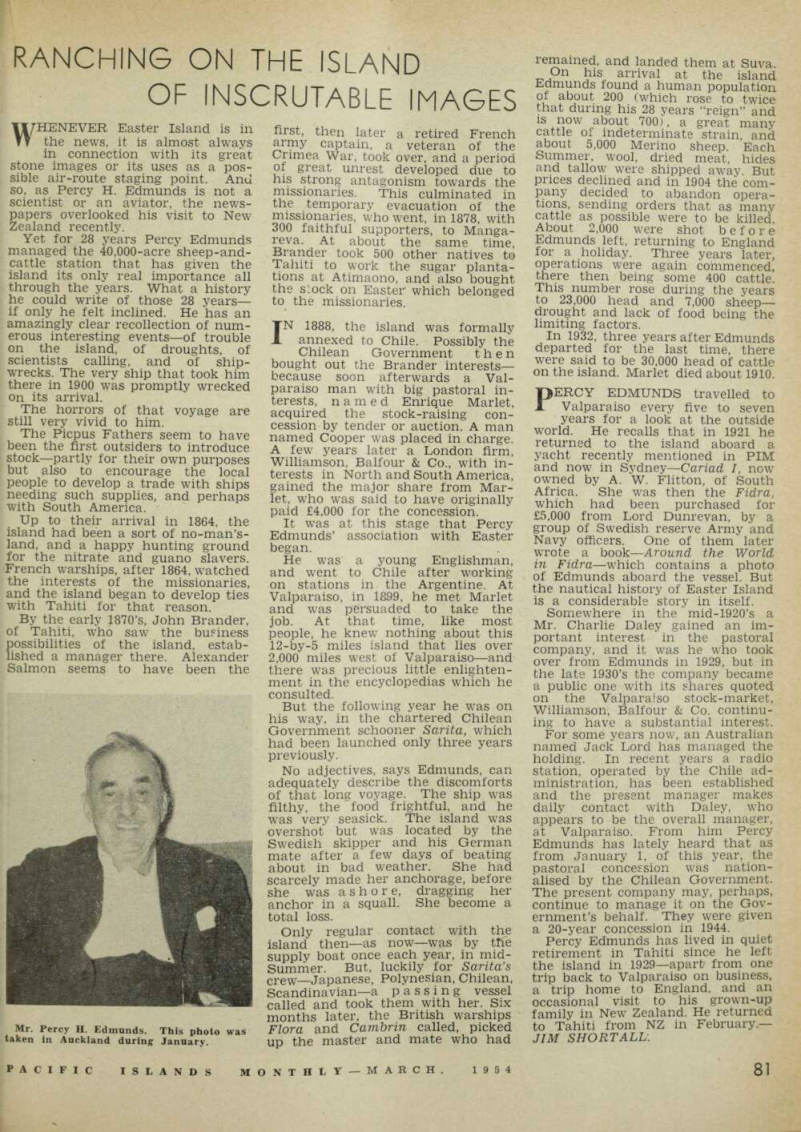
An artist’s impression of Ex-Sultan Sidi Mohammed Ben Youssef, from Sydney "Daily Telegraph.”
beyond New Caledonia. Air France planes run regularly from South east Asia, via Brisbane, to New Caledonia. A land plane could get beyond that point, to Fiji; but, after that, a flyingboat is required.
MEANWHILE, some newspapers really let themselves go on the history of Ben Youssef’s harem in Morocco. France Soir, which has the biggest daily newspaper cir culation in France, reported early in February that the Sultan once learned that some half-dozen of his concubines had been seduced; and, immediately thereafter, seven palace servants were arrested and the angry Sultan gave them the choice between revolver bullets and lions.
Officials interceded, and the seven were sent to prison for life. Here are some more juicy morsels from the same newspaper (France Soir ) : One junior officer of the Sultan’s Imperial Guard who seduced a con cubine was sentenced to 1,000 blows of the whip, at the rate of 100 lashes a day. At the end of three days and 300 lashes he died.
Once, when the Sultan sent male servants to flog some women for “a peccadillo,” the men “were con quered by their charms, and, toss ing aside the implements of tor ment, subjected the pretty victims to a more tender treatment. The monarch found them in flagrante delicto.
The women were whipped while the Sultan laughed at their screams, and they were then thrown into foul cells, where they were kept on starvation rations. The men were also whipped and then chained to the walls of their cells.
HOWEVER, when a prominent
personage is dragged down, the sensational newspapers are prone to publish imaginative stories of this description; and these colourful pictures of life in a Sultan’s palace should be well salted before being taken, and not accepted as an indication of what is likely to happen in Tahiti.
Some writers, in recent articles, have had good things to say about Ben Youssef, and have presented him as a courageous Moroccan patriot who was prepared to sacri fice his throne and privileges in the cause of freedom and independence.
Life in Tahiti always has been colourful and picturesque, and it would appear the establishment of the ex-Sultan there will not detract from those qualities.
Mr. Harold Cooper, who was In formation Officer in Fiji during the war and who later became Public Relations Officer in Nigeria, has re tired from the Colonial Service. He now is living in America, and is active in broadcasting and tele vision.