Murdock of the Gilbert Islands
pp. 62-83 · Read in the full issue
By William Burrows
1 FIRST met Murdock at Tarawa, where he had come from his home in the island of Kurai to get treatment by that able Fijian doctor Sowani (later decorated with the ISO on his retirement) who was in charge of the only hospital in the Group.
It was in 1920 when, a newcomer to the islands, I was spending a short time in Tarawa, before taking up my appointment as Deputy Commissioner of the Ellice and Tokelau Islands.
At that time, the normal communication in the islands was sustained by trading schooners, mostly owned by Messrs. Burns Philp There was no Government vessel stationed in the group, but the schooners were comfortable and well-run.
With S. F. Anderson (an old-timer in the Gilberts) Sowani and Murdock (who at one period had acted as Resident Com missioner) I was more than content to spend some weeks in Tarawa and absorb as much of the local life as possible.
Murdock and I found ourselves travel ling in a BP schooner and, on the voyage to Kuria, he told me of his experiences, and how he had become a life-long resident. He was then a well preserved man of sixty. This was his story, told in the quiet evenings of the voyage;— AS a youngster, I was an apprentice in sail, and I left Aberdeen on my first —and, I may say, last—voyage in a full rigged ship bound for San Francisco round the Horn, and thence to Sydney, New South Wales. The ship was well found, and well-manned. The other three apprentices and I in the half-deck were not bullied by either the Mate or the Captain; although we did have a whole some fear of the latter. Neither did the Horn treat us too badly, and we reached San Francisco in a time which was well short of the average of those days.
Very few ships were able to keep their crews whilst in San Francisco at that period. The high wages and opportunities open to men who were prepared to work, were too alluring, and ships were frequently held up for long periods, wait ing for a crew. And, when they got a crew, it consisted of failures and dead beats of the town, usually “shanghaied” on board by agents.
Anyhow, that is what happened to us. and when we finally left on the next leg of our voyage the atmosphere on board was entirely different. The crew were a sullen, quarrelsome lot; insubordination and fights frequent.
There was one particular able seaman named Scarson who, after refusing duty, was nearly killed by the Mate and after wards dealt with by the Old Man. It was whispered that whilst recovering from his injuries in the fo’castle he swore that he would “get” the captain before the ship reached Sydney.
The usual course of a sailing ship from San Francisco, bound for Sydney, takes her through the Gilbert Islands; and this was the course we were on. One night, when we were a few days’ to the eastward of the Gilberts—under all plain sail with a light breeze on the quarter and in perfect weather —the watch on deck, of which I was one, were lying about asleep, except the helmsman and lookout.
I myself was curled up close under the break of the poop, when, at about two bells in the middle' watch, I was awakened by the sound of a scuffle. As I jumped up
I heard a shot and I ran across the deck in the direction of the noise.
It was too dark to see until I found myself standing close to the Captain, who had a revolver in his hand. Lying on the deck in front of him was Scarson, dead.
No one could have seen what had taken place except myself and, actually, I had only been properly awakened by the sound of the shot.
PERHAPS Scarson had been waiting for the Captain to come out on deck.
It was a habit of his to take a walk round at odd times during the night.
Then, how was it he had a revolver in his hand? I don’t know. Anyhow, I was the only possible witness, and I was made to feel a very important and unsatisfactory one when cross-questioned next morning.
The Captain, therefore, decided I would be better out of the way, and I was to be marooned on one of the Gilbert Islands.
An entry in the ship’s log to the effect that I was “lost overboard” would satisfy the authorities in Sydney, and would in no way be connected with the tragedy which had occurred. Of course, I knew nothing about this plan, and even if I had, I could have done nothing about it.
A few days later, the ship passed south ward of Abemama Lagoon and rounded up close to an islet on the westward fringe of the reef. Here, with a few minutes’ notice only, I was put in one of the ship’s boats with my gear, some food, a bottle of water and a box of matches, and told I should be left there. I was landed on the beach, the boat returned to the ship, and I saw her square away and disappear to the westward.
IF ever a boy felt lonely and frightened, it was me at that moment. I knew nothing whatever about the natives and pictured them as cannibals, at least. The islet I was on was quite small; just a patch of sand with a few coconut trees on the reef.
It took no more than a few minutes to explore, and I found nothing of interest Across the lagoon, about three miles away, was the large island. Obviously, people lived there. Whatever else might happen, I could not exist where I was for more than a day or two, and the added fear of starvation drove me into a panic.
Then I remembered the matches and I gathered some dry twigs and coconut fronds which I lit on the beach, facing the main island. This would at any rate let the natives know that some one was on the islet. No sleep that night; but the fire was company, and warming.
EARLY next morning, a canoe arrived with four men. Without speaking, they literally picked up me and my belongings and threw us into the canoe. This treatment did not allay my fears, as can be imagined, but I had a surprise on reaching the village. There I was taken no particular notice of, and I was handed over to the King’s women to be looked
after. Practically a prisoner, but not treated unkindly.
At that time the King of Abemama was a complete autocrat, who ruled the three islands of Abemama, Kuria and Aranuka with great cruelty. He was hated and feared by all his people, but kept himself secure by having a bodyguard consisting of women. He also kept all firearms in side his palace, which was constructed almost as a fort. He owned a cutter, commanded by a European, which traded to Auckland and which brought him gin, clocks, rifles and ammunition.
I remember once seeing him trying out his new rifles, the targets being a gang of his slaves who were on the reef about a hundred yards from the palace. They were cutting slabs of coral for a wharf, and he would pick off a man or two who did not appear to be working hard enough.
He knew he was being swindled by the captain of his cutter but, being quite illiterate, could do nothing about it. He
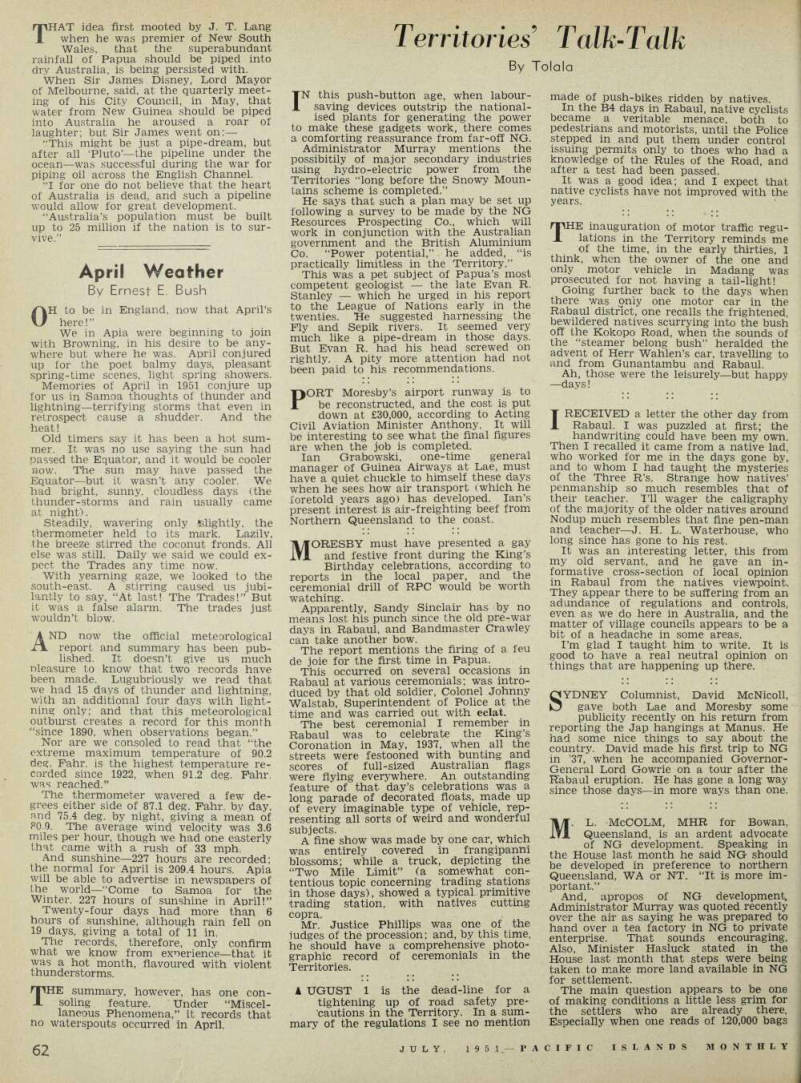
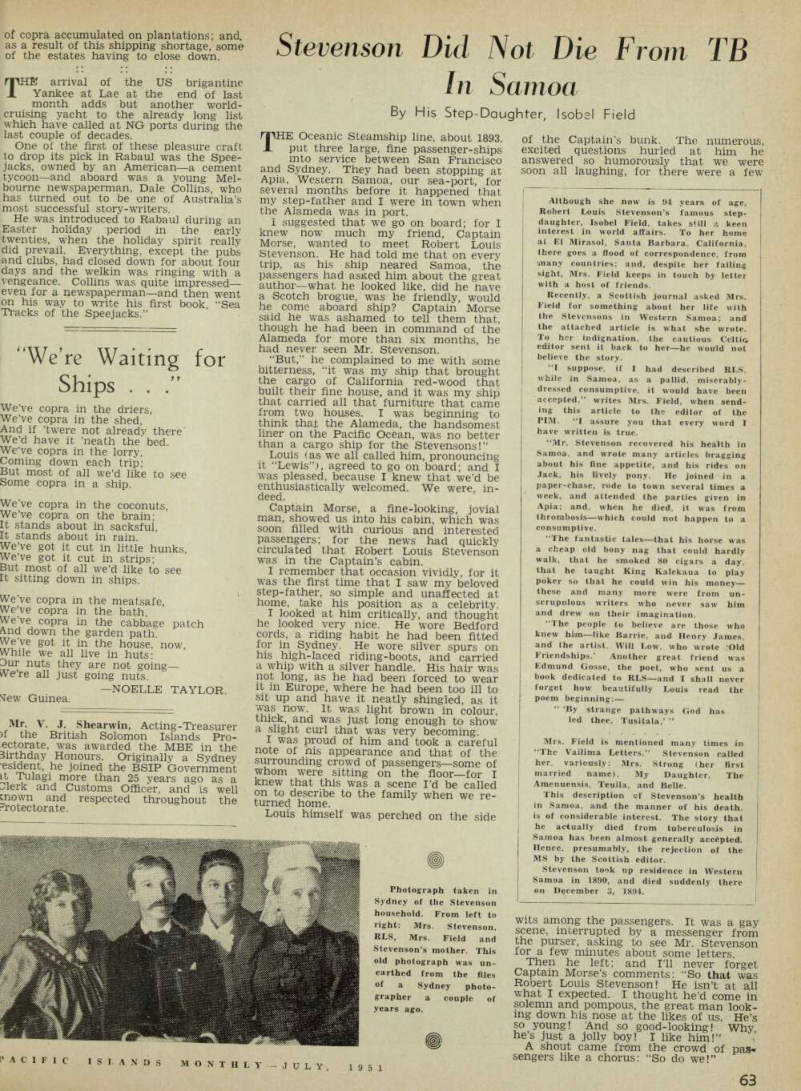
At Top: Agnes Murdoch, who was born in a tank and lived to marry the King of Abemama. This photograph, taken by PIM editor in 1941, shows her with her two sons. The lower photograph shows Agnes as a young woman lately re turned from school in California. On the right is her father.
They are on the schooner Nuevo Tigre which had been sailed to Tarawa by the notorious Mortelmans and Skerrett, who had murdered the rest of the crew on the way from Souh America.
It was Murdoch, then Acting Chief of Police, who arrested them as pirates.
trusted none of his men and his body guard were as ignorant of figures as he was.
Then, one day, he thought of a use which could be made of me. I was to be his accountant, and I was confronted with a large tin box full of invoices, letters and accounts, and told to get on with it. I had no knowledge of book keeping; but it did not seem advisable to say so, and I was glad at having some thing to do. Indeed, it was not long before I was recognised as the King’s Treasurer; no longer a prisoner, but a man of some consequence.
Of course, I longed to get away, but the chances of doing so were very few and far between. I was prevented from leaving by the King on the one or two oppor tunities which did occur, until I had been in Abemama for over three years.
THEN a schooner came in, which was bound for Tarawa. I think perhaps that the King had begun to suspect me and, quite suddenly, he said I could go.
Needless to say, I went straight on board and found that the schooner was German, with trade goods for a store in Tarawa owned by a German firm. Not that that made any difference to me; and, when it was found that the storekeeper was down with dysentery on our arrival at Tarawa, I gladly accepted the job of manager.
At that time Tarawa was split into two “kingdoms,” the north and the south. My store was situated on some land which was considered neutral, between the opposing forces. Here I settled down comfortably and married a woman of the country.
The north and the south were almost always at war, but it was a desultory sort of war; flared up with a raid or two and then quieting down again for a while.
I did very well out of this, because neither side knew that I was supplying the other with the necessary muskets, ball and powder.
This desirable state of affairs could not last indefinitely and, when one side found out that the other was being treated equally well, both sides decided to have a scrap for my store. This was very awkward, for on the night that bullets began to hit the house, my wife was about to be confined with our first child.
Muskets with powder used sparingly do not have much penetrating power, and I was wondering where would be the safest place to put my wife when I remembered the brand new 400 gal. tank which was empty and waiting to be installed. Into this I put her and there, safe from bullets, she gave birth to a daughter during the night.
THE only thing to do was to try and get away, so I sent my Gilbertese servant to get the boat ready on the inside beach, and to put water and food into her.
As I had thought probable, the battle did not continue all night. About an hour before dawn, I, with family and servant, slipped unobserved out of the nouses and into the boat. A fair wind took us out of the lagoon, and I decided to make for Abaiang. This island is some thmg over a hundred miles from Tarawa, out the wind was a fair one and we got there comfortably. My wife and child were none the worse, and after a rest in :he house of a storekeeper who kindly :ook us in, we were quite fit.
Here I fell on my feet. The store keeper represented a firm that was ex :ending its activities and the number of
(Continued on Page 81.)
ts trading stations. Storekeepers were wanted, and I was offered a post in charge »f one of them. nOR many years I was with this firm L and prospered; also my family grew.
Then came the time when the Gilbert slands were proclaimed a Protectorate •y Great Britain—and high time it was hat something of the sort should have teen done. Despotic native “kings” and lub law had to be superseded for the irotection of the natives themselves.
With my long residence in the islands ,nd my intimate knowledge of the people ,nd language, I was asked if I would take , job in the administration. This I ccepted and, for a while, I was the Act rig Resident of the group. And now I m in retirement, living in the island of Luria, which I lease from the present Ling of Abemama.
By the way, he is married to my eldest aughter—she who was born in the water ank—and I am anxious to get home and ee how my grandchildren—twin boys— re getting on.