Tromcalities
pp. 63-64 · Read in the full issue
HOME builders these days do not need to go looking for trouble, for they are assured of their full quota from the moment they peg out the ground.
But one resident of Port Moresby cut himself an extra big slice of trouble when he put the first pegs into the ground. By the time the pegs had given away to piles, and a house built on top, he discovered that he had built so far off his lease boundaries that he was actually on another man’s land. Then the headache spread to the Lands Depart ment whose help was enlisted in trying to find a way out of the problem. The experts were still puzzling out the prob lem when this despatch was written —PM.
NON-OFFICIAL persons in the British Solomons do not think much of the Government-controlled “Trade Scheme” (which has taken the place there of the big private stores, since World War II ended and Socialism took control of the British Empire). They call it “The Trade Shame.”
MR. LEONARD MORAN, who over the years has befriended hundreds of Island visitors to Sydney, says that the reason why a number of the Fijian and other Island boxers have Anglicised their names when fighting in Australia, is because they fear that no Australian could get his tongue around Atunaissa and similar appellations.
He says, however, that the name busi ness can have its humorous side in Poly nesia. He recalls meeting a part-Samoan in Auckland who had the same name as his mother’s mother (who came from Tip perary). He told the Samoan that his ancestress had the same name and was thereupon adopted. The Islander after wards always introduced Moran as his relative.
THE Commonwealth Government is seeking 50 carpenters for work on Manus Island.
We cannot tell you the duties but the rewards include free return plane trip, free movies, free transport, free sporting equipment, beer at 1/7 per bottle, board and lodging at 16/6 per week and tax free wages of £2O/3/0.
As Walt Whitman said: ‘ O Pioneers, O Pioneers!”
According to Lieut.-colonel n. p.
Maddem, CO of the P-NG Volun teer Rifles, the Giant Snails which have plagued local planters since the end of the war, may be a blessing in disguise.
All new recruits to the PNGVR are ex pected to learn to live off the country and. according to the CO, boiled, baked or fried, snails are “mighty good kai.”
Colonel Maddern, who was a POW in Malava is an authority on the culinary possibilities of snails; but, so far, recruits to the Volunteers show no signs of de veloping his enthusiasm for the slimy pests.
Teaching recruits to live off the land will be generally applauded. It will be remembered that members of the 22nd Battalion, AIF, when forced to take to the New Britain bush after the occuoa tion of Rabaul in 1942, literally starved to death in sight of edible plants which they failed to recognise as food.
Recruiting for the PNGVR is going on steadily in all Territory centres. Route marches—accompanied by the usual con tingents of natives and dogs and the per ennial query, “Masta, when this fight ’e start?” have been held in Port Moresby, Rabaul and Lae.
THE Germans, who specialise in making anything from nothing, can now make gas from compost heaps which is capable of running farm tractors and providing fuel for a gas stove.
Someone has suggested that because places like New Guinea and the Solo mons have a lot of vegetation and a lot of heat, which helps it to ferment quickly, there may be something in the idea for tropical dwellers.
The cost of running a tractor on this gas is about one-fifth the price of petrol; and in the stove, gas costing one-fifth of a penny did the work of 1 KW of elec tricity.
Farm waste is composted in cubicles or rotting chambers where the waste gasses given off are collected in holding tanks.
From the tanks the gas is usually com pressed into high-pressure cylinders.
Experiments have shown that a cham ber 13 ft. x 13 ft. x 13 ft. gave off 50 cubic metres of gas per day.
It sounds slightly more cumbersome than driving up to the petrol pump. But remembering the evil “Gas-producers” of World War 11, and dwelling for an un pleasant moment on what is going on in Persia, we can file the idea away for future reference. Anything to keep the wheels turning! (Continued next page.)
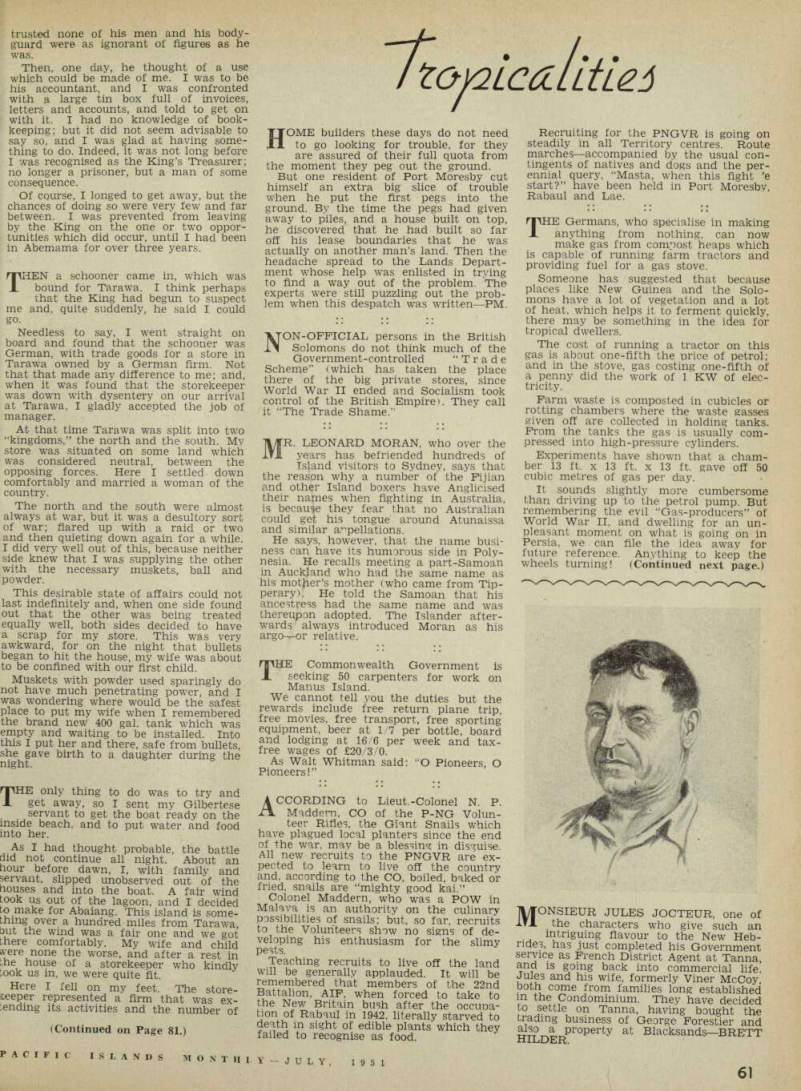
Monsieur jules jocteur, one of the characters who give such an mtriguing flavour to the New Heb rides, has just completed his Government service as French District Agent at Tanna, and is going back into commercial life.
Jules and his wife, formerly Viner McCoy, both come from families long established in the Condominium. They have decided to settle on Tanna, having bought the trading business of George Forestier and lso J property at Blacksands—BßETT
Wilder.
THAT idea first mooted by J. T. Lang when he was premier of New South Wales, that the superabundant rainfall of Papua should be piped into dry Australia, is being persisted with.
When Sir James Disney, Lord Mayor of Melbourne, said, at the quarterly meet ing of his City Council, in May, that water from New Guinea should be piped into Australia he aroused a roar of laughter; but Sir James went on:— “This might be just a pipe-dream, but after all ‘Pluto’ —the pipeline under the ocean—was successful during the war for piping oil across the English Channel.
“I for one do not believe that the heart of Australia is dead, and such a pipeline would allow for great development.
“Australia’s population must be built up to 25 million if the nation is to sur vive.”