Islands
Pacific
Monthly
July, 1951
tyol. XXI. No. 12.
Established 1930.
IRegistered at the G.P.0., Sydney, )or transmission by post as a newspaper ]
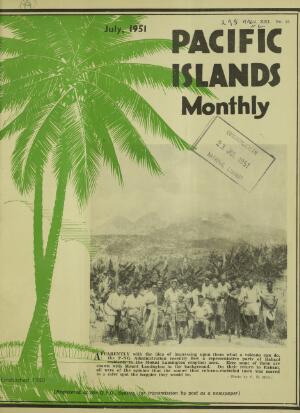
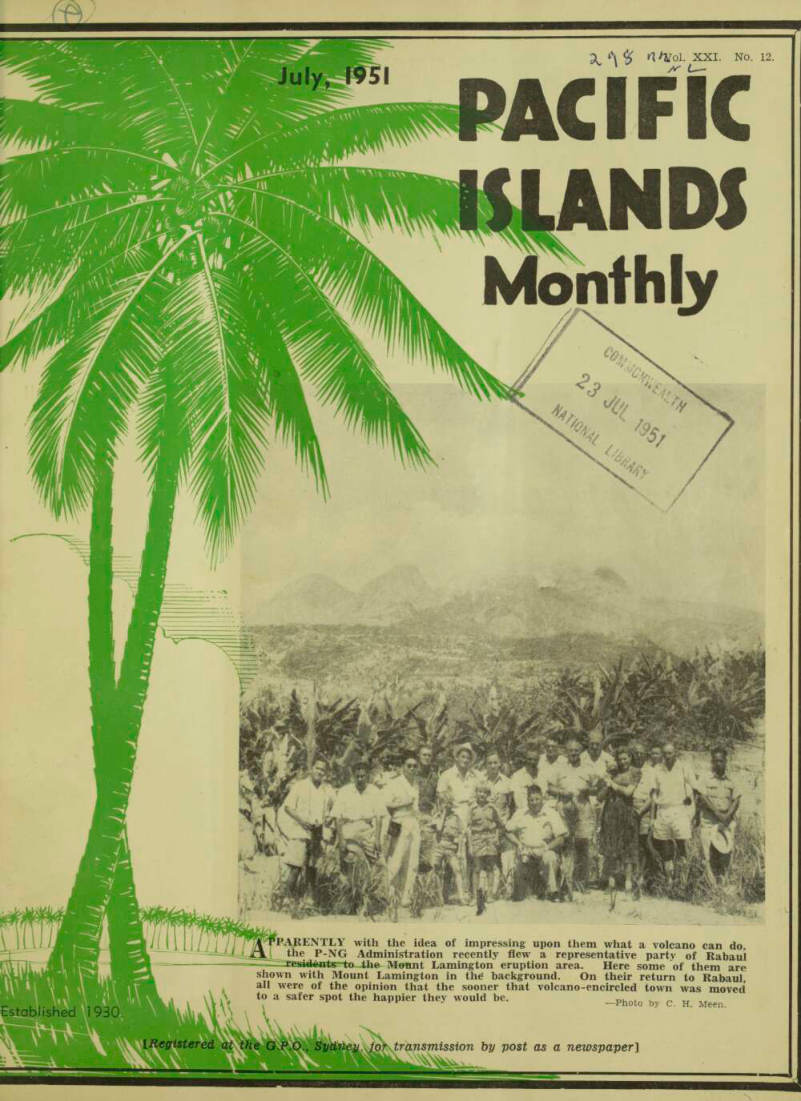
APPARENTLY with the idea of impressing upon them what a volcano can do, the P-NG Administration recently flew a representative party of Rabaul residents to the Mount Lamington eruption area. Here some of them are shown with Mount Lamington in the! background. On their return to Rabaul, all were of the opinion that the sooner that volcano-encircled town was moved to a safer spot the happier they would be. - Ph o t o by c. H. Meen.
Advertisements & other items, pp. 2-4 (1 item)
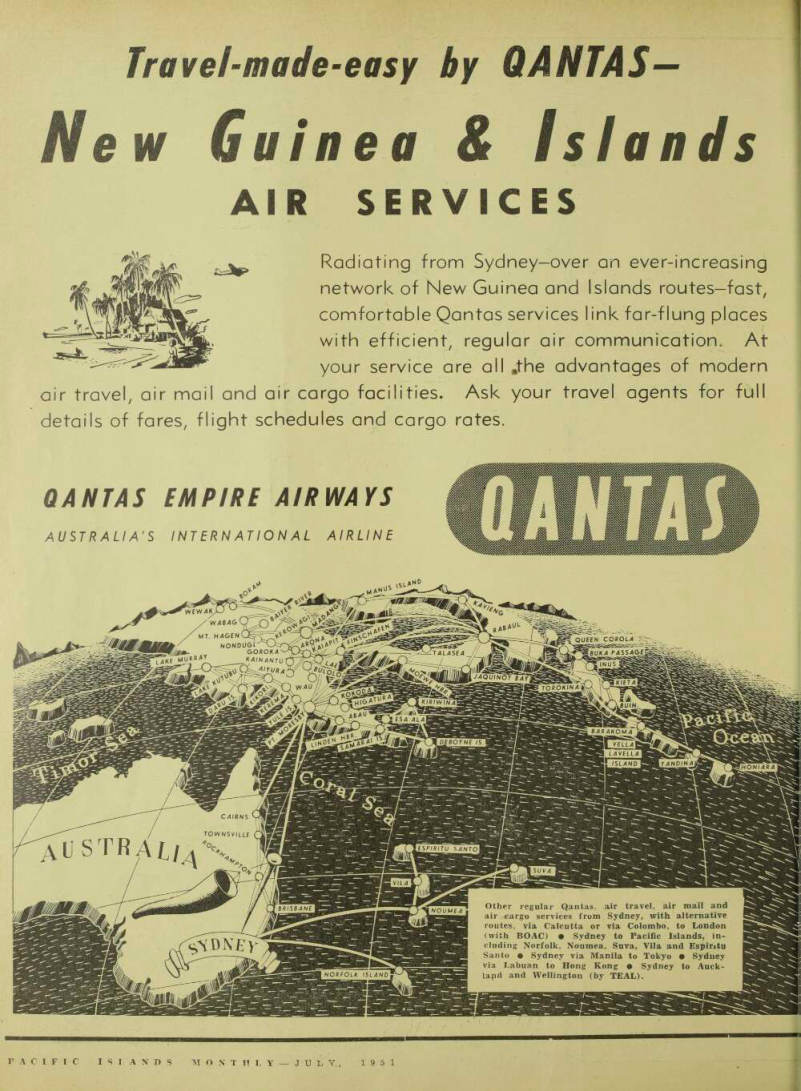
Ne w Guinea & Islands
Travel-made-easy by Q ANT AS
AIR SERVICES
Radiating from Sydney—over an ever-increasing
network of New Guinea and Islands routes—fast,
comfortable Qantas services link far-flung places
with efficient, regular air communication. At
your service are all .the advantages of modern air travel, air mail and air cargo facilities. Ask your travel agents for full details of fares, flight schedules and cargo rates. m A
QANTAS EMPIRE AIRWAYS
AUSTRALIA'S INTERNATIONAL AIRLINE
SLA nd mah« s ' A'** //M , / mt. hagenG^=^* i j/Ji/M NONDUGI'O /~V-. A * * A' A ? V ! -- G o R O K A
M_UR rA !_ KAINAHTUfJ
a ul rAB
ALASEA
i 523 jaquinot
BAY
KIETA
WAU
TOROKIN A
&Al^
KIRIWINA
BUI N
abau
ESA ALA
BAR AROMA
Mm ii
DEBOYNE IS
VELLA
LAVELLA
ISLAND SeMr ANDINA
HONIAR
A USTRAi / 4
Other regular Qantas. air travel, air mail and air cargo services from Sydney, with alternative routes, via Calcutta or via Colombo, to London (with BOAC) • Sydney to Pacific Islands, including Norfolk, Noumea, Suva, Vila and Espintu Santo e Sydney via Manila to Tokyo • Sydney via Labuan to Hong Kong • Sydney to Auckland and Wellington (by TEAL). / ■Mi WA
crfuNEy
I
Lit
1 w ' * mmm
KEEPS S#
A Coleman Pressure Lantern makes all outdoor night jobs easier, quicker and safer.
It is storm-proof; defies rain or a 105 mile gale to put it out .. . it’s safe because it cannot be filled while lighted and cannot spill fuel if overturned. Lights instantly and has an automatic tip cleaner which operates at a touch and a turn.
Most important of all . . . it floodlights a one hundred foot area with dependable light, so bright you can read a newspaper fifty feet away and gives forty hours of lighting service per gallon of fuel.
Available for petrol and kerosene in capacities of 200 300 and 500 C.P.
bleman
•« j aw L Ui I % ✓ ■ ' m
LANTERNS
Representatives for the Pacific Islands: - ' - y ’ - -
54a PITT STREET
SYDNEY
ROBERT GILLESPIE P T JI™
PEARCE & CO. LTD.
SUVA
FOR FIJI ISLANDS
NEW SERIES “NEVDEN”
Weatherproof A' Economical A Efficient A Water-cooled A Kerosene or Diesel A Fully guaranteed
NEW SERIES I
This plant can be supplied as Direct Running or Battery Charging and can also be supplied to suit the following voltages: 24-32—50-110 Volts, 2 Kw. m THE NEW SERIES “NEVDEN” WEATHER PROOF LIGHTING PLANTS
PETROL - KEROSENE - DIESEL
Manufactured in Australia by NOCK & WEIDENHOFER, Electrical Engineers.
* "NEVDEN" LIGHTING
PLANT KITS. For use when Clients have their own Engines.
Sizes from 500 Watts to 4 Kw., 6 to 110 Volts.
Complete specification on application.
ILLUSTRATIONS SHOW:—
Above : Switchboard.
At right: Generator.
Pulleys.
Slide Rails.
Belts and Bolts. (Batteries and Housing supplied on request) Hi
* "NEVDEN" AUTOMATIC
PRESSURE WATER SYSTEM.
Will supply a constant stream of water at high pressure, day or night, without an elevated tank.
Write for details.
All inquiries to Sole Export Agent : .
S. H. CANTOR
& CO.
P.O. Box 6, Roseville,
N.S.W.
Cables: “CANTOROO,”
Sydney or “NEVDEN,”
Sydney.
Telephone; JA 3952.
Index to Advertisers
Achun. Gabriel . . 45 “Akta-Vite” ... 46 Aladdin Industries . 80 Alois Akun & Co. . 78 Aluminium Union . 28 Amplion (A sia) . . 39 Angus & Robertson 21 Ardath Tobacco Co. 114 “Aspaxadrene” . . 23 “Aspro” 78 Balchin, W.. Ltd. . 39 Bank of NSW ... 50 Bell. Stanley P., <Sc Co 20 “Bellhaven” Guest House 99 Bergers Paints . 43 Berry’s Bay Boat yard 99 Bethell, Gwyn Co. . 53 Blaxland Rae Pty. . 97 Blundell Spence Co. 54 8.0.A.C 94 Borthwick’s Paint . 81 Bovril. Ltd 44 Brasso Polish ... 95 Bristol-Myers Co. . 47 Broomfields, Ltd. . 55 Brunton & Co. . . 22 Bunting, A. H., 30, 55 Burns Philp (NG) . 65 Burns Philp (NH) 112 Burns Philp (SS) . 44 Burns Philp Trust 32 Butterfly World Supply House . . 37 Caine’s Studios . . 79 Cantor, S. H. & Co. 2 Carpenter, W. R. & Co. Ltd., 72, cov. iv.
Central Pharmacy 114 Classified Advts. . 116 Colonial Meat Co. 52 Columbia Pictures Pty. Ltd 24 Colyer Watson (NG) Ltd., 34, 75, 108 Crammond Radio . 48 Crawford’s Hatchery 69 Crilley, R. J.. Ltd. 93 “Cystex” ... 100 Cunningham, R. H., Pty. Ltd. ... 102 Dangar, Gedye & M'alloch Ltd. . . 3 Davison Paints . . 67 “Dettol” 88 Donaghy & Sons . 81 Donald, A. 8.. Ltd. (Auckland) ... 67 Donald, A. 8., Ltd. (Rarotonga) ... 80 Douglass, W. C. . . 27 Dunlop Rubber Co. 21 Electrolux ... 72 Etablissements Donald Tahiti . 107 Sxcelsior Supply Co.
Pty. Ltd 45 Ford Sherington 29 French Chamber of Commerce ... 41 >arrett, Davidson & Matthey, Ltd. . 118 Garrick Hotel ... 99 341 bey, W. & A. . 20 Hllespie Bros. Ltd. 85 jillespie. Robert.
Pty., Ltd.. 1. 70. 91
jillespie, Robert,
(NG) Ltd. ... 41 jordon’s Gin ... 53 >rand Pacific Hotel 4 >ough & Co.. E. J. 37 Gregory, A., Ltd. . 91 >rove, W. H., & Sons Ltd. . . 17, 51 lalvorsen Sons Ltd. 95 lay, K. H. D. . 83 leinz & Co.. Ltd. . ill lemingway & Robertson, Ltd. . 30 lolland Rusk . . 101 lorlicks Pty. Ltd. 66 lygeia Sanitary Co. 42 lyne Si Son Ltd. 117 lytest Axe & Tool Pty. Ltd. ... 105 sland Industries . 83 s 1 a n d s Service Bureau 89 Lennedy, Captain . 93
Kerr Bros 33 Kodak (A/asia) Pty.
Ltd 33 Kolynos, Inc. ... 15 Kopsen. W., & Co. 87 Lillis & Co. Ltd. . 68 Macintyre. Thomas, & Co.. Ltd. ... 90 Macquarie Chemi cal Laboratories 107 Mac Robertson Pty. 73 Mcllrath’s, Ltd. . . 22 “Mendaco” . . . 112 Millers. Ltd. (Fiji) 103 Mobile Industrial Equipment. Ltd. 110 Moderne Knitwear 115 Morris Hedstrom Ltd 12 Morris Hedstrom (Aust.) Pty., Ltd. 14 Mungo Scott Ltd. . 101 Nelson & Robertson 29 N. Guinea Memorial Scholarship ... 105 “Nixoderm” ... 85 Nordman, Oscar G. 46 NZ National Air ways Corporation 84 O’Brien, Geo. ... 93 Oliver Corporation 18 Pabco Products . . 31 Pacific Is. Society 70 Pacific Islands Trading Co. ... 35 Pan American Air ways Inc. ... 16 “Pinkettes” ... 73 P.I.M. Agents . . 117 P.I. Year Book 109 Qantas Airways, cov. ii.
Qld. Insurance Co. 26 Q u i r k’s Victory Light Co. . . . 56 Ransomes, Sims <fc Jefferies Ltd. . . 86 Reed. Wm„ E. . 104 Riverstone Meat Co. 76 Robinson, G. H., Ltd 42 Rohu, Sil 75 Savitz, B 87 Scott, J.. Pty., Ltd. 51 Seward. N. H.. Ltd. 108 Shell Co. of Aust. S 9 Simpson Bros. Pty. 34 Sims, A. G., Ltd. . 92 Southern Pacific Insurance Co. . 115 Spartan Paints 13 Spruso Co 20 Steamships Trading Co. Ltd. (Papua) 100 Stewarts & Lloyds 90 Sullivan, C., Ltd. . 38 Suva Motors Ltd. . 79 Swift & Horndale Pty.. Ltd. ... 74 Sydney Meat Pre serving Co. (Ltd.) 19 Tallerman & Co. . 103 Tasman Empire Air ways Ltd. ... 98 Taylor, Allen & Co. 49 Thornycroft, Ltd. . 96 Tilley Lamp Co. 49, 71 Tillock & Co.. Ltd. 82 T o n g a n Photos Bureau ... 43 Tooth & Co., Ltd. . 69 Trans Oceanic Air ways ... cov. iii.
Tyneside Engineer ing Co., Ltd. . . 74 Undersee Novelties 25 United Island Traders Ltd. . . 71 Vacuum Oil Co. . . 40 Valiant Rum ... 77 Ventura Trading Co. Ltd. . . 25, 118 Vincent Chem. Co. 38 Walsh. A. D. . . 116 West. Harry, Pty., Ltd 96 “Where the Trade Winds Blow” 106 Williams’ Pills . . 102 Wills. W. D. & H. 0., Ltd 36 Yorkshire Insur ance Co., Ltd. . . 77
Advertisements & other items, p. 5 (1 item)
Truth To Teli
We Can Supply You
With All These!
• Batteries Electric Lighting Plants
Fence Chargers
Fire Fighters
Hargans Saws
Lister Diesel Engines
Marine Engines
Seagull Outboard Motors Orchard Spray Plants
Refrigeration
Todd Insecticidal Fog Applicator
Multi-Tool Sets
Pumping Units
Tractors Water Pressure Systems Air Compressor Sets • Sole Distributors in N.S.W.: Dangar Gedye & Malloch Ltd.
Malloch House, 10-14 Young Street, Circular Quay, Sydney.
In This Issue:
Editorials: The Meaning of Cease Fire in Korea :: £B,OOO for Port Moresby Native Landowners :: Official Misjudgment in Western Samoa :: Australians Have “Pro tection” but No Butter or Mar garine 5-6 Fiji’s Coconut Oil—Raw Deal for Crushers 7 The New Minister’s Visit to Papua- New Guinea 7 PIM is 21 Years Old 7 New Status of American Pacific Ter ritories 7 Internal Air Services for Fiji .. .. 7 The Increasing Cost of Copra Production 8 Cook Islands Jubilee —50 Years of NZ Administration 8 Bulolo Wages Agreement Reached 9 Lamington Erupts Again—but Harm lessly 9 Polynesians Barred in Australia and New Zealand 9 Electricity for the New Guinea High lands 9 Battle of the Markham —Site for Bridge Challenged 10 Thieme Family Returns to Samoa by Yacht 10 Australia Takes Over Cocos Islands 11 South Pacific Commission —Research Council’s Third Meeting 13 Brief Notes from Tahiti 14 Another Politician for Territory Administratorship 17 Fiji Trade Shows Favourable Balance 17 Future of the Solomon Islands ... 17 Convicts Run Amok —Three Days of Terrorism in Samoa 18 TEAL’S New Polynesian Service Not for Some Months Yet 21 Election of Deputy Startles New Caledonia 23 Fiji Birthday Honours 23
Registration of Cars in Papua ... 25 New Civil Administration in Ameri can Samoa 27 Jack Hides Was Not on Pullen Patrol 27 The Month in Papua-New Guinea 29 Hanuabadans Cannot Balance Their Budgets—Anthropologist’s Concern 33 Kikori’s Cutch Industry Gets a Start 35 Bank Will Open Soon in Honiara .. 35 Pacific Islanders in New Zealand .. 37 Food Shortage in BSI —Copra Piles Up 39 The Outlook for Copra—Factors Which Influence The Pacific’s Staple Product 41 Niueans Visit American Samoa ... 43 Madang Newsletter 45 Romney Marsh Sheep in New Guinea 46 Honiara Prepared for a Big Bang— But it Did Not Come Off ... 47 Islands Get New Zealand Ships at Last 49 Fijian Cricketers for UK? 49 Memory of Von Luckner —Was His Treasure Hidden on Mopelia ... 50 News from Santo .. 51 Rabaul Roundabout 53 Five Times Round the World With the Yankee 57 Book Review: One More Paradise .. 58 Dampier Passed This Way 59 Murdoch of the Gilbert Islands ... 60
Tropicalities 61
Territories Talk-Talk 62 Stevenson Did Not Die of TB in Samoa 63 Fashion :: Children’s Section ... 64 Origin of Polynesians 67 King’s Birthday at Honiara 69 Putters-Back of Clocks —Reader Thinks all Old-Timers Should be
Dumped 70
Give That Reporter a Wide Berth
—Reader Claims He was Mis reported 73 New Suva Medical School 73 Norfolk Island Notes 75 Matua Calls at Niue After Five Months 77 Rice Shortage in BSI 78 Capt. Henry Has Seaman Trouble .. 79 BSI Polio Outbreak Over 79 More About the Kukukukus 83 Notes from the Goldfields 86 Qantas Mishap in Vila 88 New Ship to Replace Laurabada .. 90 Amphibious Airways Services in New Britain 90 Over 6,000 NG Highlanders Work on Coast 91 Plane and Shipping Services 93 Lae’s Government Sawmill Cannot Supply Demand 99 News Notes from Lae 101 18 Japs Finally Accept End of War 104 Japs Seek Return of Northern Islands 104 Danger of Short Supplies to Islands 104 Head Tax off in Nauru 105 New Samoan Democratic Party .. 105 The Pacific Islands Monthly and Its Readers 107 More Tales from Old New Guinea 112 North Borneo —Conditions in Britain’s New Crown Colony .. 114 Life in the Remote Fead Islands .. 117 Commercial, Markets, etc 118 OBITUARY: James Norman Hall, 9; Lady Scott, 11; Aiden Gooding, 15; Ratu George Tonganivalu, 22; A. K.
M. Edwards, 34; H. J. Berryman, 43; Ukinga Rau, 71; Miss E. Hansen, 74; C. S. Evennett, 75; E. V. O’Brien, 115.
ORGANISATIONS: New Guinea Women’s Club of Sydney, 13; New Guinea Ex- Servicemen’s Club, Sydney, 14; Poly nesian Association, 69; New Guinea Memorial Scholarship Fund, 115; Paci fic Island Society, 115.
INDUSTRIES: Copra, 7, 8. 41; Oil, 20, 50; Gold, 20, 51.
Advertisements & other items, p. 6 (1 item)
■griMf
' B mSSm > % I - ♦ bP ■ S’ I i I MB HI M' sso/ r ° u Sh ® s fliay , o/®f o/®,. eff ec ted aa Pacif t :
Pacific Islands Monthly
The Newspaper-Magazine of the South Seas [Registered at the G.P.0., Sydney , for transmission by post as a newspaper ]
Published Once Each Month and Circulated in Australia and New Zealand and in the following Pacific Territories and Islands Groups:
Australian Territory of Papua.
Frustee Territory (Australia) of New Guinea.
Australian Territory of Norfolk Island. trustee Territory of Nauru (Aust., NZ and UK), tfew Zealand Territory of Cook Islands, few Zealand Territory of Niue Island.
Trustee Territory (NZ) of Western Samoa.
British Crown Colony of FIJI.
British Solomon Islands Protectorate.
British Protectorate of Tongan Islands.
British Crown Colony of Gilbert and Ellice Islands.
British and French Condominium of New Hebrides.
French Colony of New Caledonia.
French Establishment of Oceania (Tahiti, etc.).
American Territory of Eastern Samoa.
American Territory of Hawaiian Islands.
Trustee Territory (USA) of Micronesia.
Owned ond Produced by Pocific Publications Pty. Ltd., Union House, 247 George Street, Sydney.
Telephone: General Office and Advertising,
Bw 5037. Bu 6082.
1.P.0. Box 3408
leglstered Address for Telegrams, Radiograms, and Cables: ‘Tacpub,” Sydney.
Contributions.
rticles. Stories, and Photographs dealing with Pacific Islands subjects are invited and will be paid for on publication.
Subscription Rates.
n Australia, New Zealand, Fiji. Papua and New Guinea. Western Samoa, Cook Islands, Niue, Tonga, British Solomon Is.. Gilbert and Ellice Colony, Nauru. New Hebrides, and Norfolk Island 18 0 ew Caledonia (French) and French Oceania (Tahiti, etc.) £ 1 1 0 United Kingdom, British. Com monwealth, United States of America, US Pacific Territories, and Foreign Countries .. .. $3.50 £1 10 0
Editor and PnbUsher:
R. W. Robson, F.R.G.S.
Assistant Editor: JUDY TUDOR.
General Office: Union House. 247 George Street, Sydney. Telephone: B\y 5037, BU 6082.
Business Manager: BELWYN HUGHES
Representative In London.
J. T. Wallis. Coronation House. 4 Lloyd’s Avenue, London, E.C.3, from whom may be obtained copies of Pacific Islands Monthly.
Pacific Is. Year Book, advertising schedules, etc
Agents.
The following are authorised to receive sub scriptions for Pacific Islands Monthly:— Burns, Philp & Co. Ltd. All branches.
W. R. Carpenter & Co., Ltd. All branches.
Morris, Hedstrom, Ltd. All branches.
Steamships Trading Co.. Papua. All branches Colyer Watson (NG) Ltd. All branches.
Mrs. Jean Fraser, Lae. New Guinea.
R. F. Smith. Rabaul, New Guinea.
A. H. Bunting Ltd.. Samarai. Papua.
Steele’s Central Store. Suva. FIJI.
Adams Pharmacies Ptv.. Lautoka. FIJI.
Cook Islands Trading Co., Rarotonga. Cook Is.
United Island Traders Ltd., Rarotonga. Cook I* A. Vercoe, Apia, Western Samoa.
Oscar Nordman, Papeete. Tahiti Islands Branches and Representatives of W. H Grove <fe Sons. Ltd., Auckland. New Zealand Ed. Pentecost, Noumea. New Caledonia.
Societe Gubbay Kerr et Cie. Noumea, NC.
V. E. White, Brisbane, Qld.
01. Xxi. No. 12.
July, 1 951
f 1/9 Per Copy.
Price ] Prepaid, pa.: 18/- Aust.
I In South Pacific.
The Meaning of “Cease Fire” in Korea
VHEN the United Nations’ helicopter landed in Kaesong on July 8, it was surrounded by armed Reds. As our walked to the hall, to discuss )ase-fire and an armistice in Korea, they ere attended by armed Reds. Mean time. every radio station in Red China id Red Russia was announcing that we ad gone to Kaesong to sue for peace t that very moment, in Moscow, the Rus ans were staging their biggest demon ration yet of the quantity and Quality of leir air forces and saluting Red Joe talin as saviour of the world.
It is against that background that we' ust judge the value of the cease-fire i Iks in Korea. There may be an armi ice and a conference; but, as a contri ition to world peace, these things are lite useless.
All that has happened is that Russia doing all she can to gain time to pre ire for what she regards as the inevitable inflict between West and East, between uscovite Totalitarianism and European idividualism. With amazing speed, the nited States has prepared for war, and •agged the Western European Powers ith her into similar preparations. Within year, we have gained so much in military rength that we look towards the Iron irtain with some confidence. Above all, tnerica has built up a terrifying stock atomic bombs.
Our new strength, and especially our ;w bombs, have slightly dislocated Red ans. The Muscovite conspirators do not ar our armies; but they are worried >out our capacity to produce atomic mbs, and other very modern armaments, Russia can make atomic bombs; but ie has not our ability to produce bombs, anes and armaments generally in huge )lume. But she is very rapidly develop g her industries for war production; and le believes that if only she can get time
enough, she can meet us on something like equal terms. She wants her hands free until 1954, at least. Meanwhile, she weaken and embarrass us with the kind of bloodless but important strategic victories she has gained in Tibet and Persia.
With her limitless man-power, at least, "he can at any time overwhelm us, on land, with countless divisions. Her air forces are now perhaps comparable with ours. But in naval power, and in war machines. especially atomic weapons, we have a big advantage. So Russia meets us, in cease-fire talks, in Korea; but that *s only because the huge power we have developed in Korea is causing the Red armies very serious losses in the kind of equipment which the Muscovites wish to conserve for the more serious' struggle later on.
It has been part of the Russian plan to involve the Westerners in embarrassing and wasteful campaigns in Korea. Indo china Malaya, Burma, Tibet, and prob ably Persia; but when the Westerners refuse the invitation to engage in a suici dal campaign against China, but simply stand in Korea and endlessly smash Red equipment, it is time for the plotters to change the plan, somewhat.
Korea fighting may cease: but the
Cold War will go on. Russia hones that we may be lulled into a sense of false se curity; and, if we should slacken our preparations for defence, the doom of Western civilisation will be sealed. But if our present rate of re-arming is main tained, we shall at least be able to main tain our living standards and protect our most cherished institutions. And. if we attain sufficient strength and are resolute in our mimeses, we may yet avoid World War 111 altogether. But that is the only wav.
With the Reds fully armed, and the Democracies disarmed, as in 1947-49. Rus sia had a terrifying appearance. But. as we acquire the means to defend our selves, the picture changes.
The Western Powers, armed, should have no fear of Russia and the hotch potch of satellite nations she has gathered into the Red bloc. In a military sense, the Russians can be regarded with con tempt. Judged on their prowess in war, they are not in the same street as the Western European peonies, and especially the Anglo-American Powers, the French ahd the Germans. The chief, and almost the onlv strength of Russia and China in war is their almost unlimited man-nower: and, more and more, modern war depends on genius in organisation and direction, and the production of machines. In this respect—once we are ready—we need not fear Russia, or any combination of Reds.
£8,000 For Port Moresby Native Landowners!
IN June, the Papua-New Guinea Ad ministration paid over no less than £8,025 to the Kila Kila and Korobosea natives, for 321 acres of land, which is to be included in the district of Boroko. a new suburb of Port Moresby.
In other words, the Administration paid the ridiculous price of £25 per acre for land in a muggy little valley tucked away in the hills at the back of Port Moresby,
when it is obvious that the only suitable nlace for European settlement there is the cool and accessible country close to the sea.
The officials, of course, will retort that there is no accessible land available along the sea-front; but there would be plentv of space there if so much suitable land had not been wasted on police barracks labour compounds, and other Depart
mental brain-waves. Why reserve the choicest sea-front lands for native accommodation, while making plans to dump a European residential area back in the hot and unhealthy valleys?
Above all, who authorised the payment to these natives of £25 per acre? How was the price arrived at? The natives never occupied the land, never used it, and as waste-land it is worth about £2 per acre. The transaction is typical of the way this present Administration develops a frenzy for spending Australian money whenever anything involving native interests is under consideration.
It is a pity that there is no Legislative Council or similar body in this Territory, to which the Administration could be compelled to submit details of its annual expenditure. An examination of some of the expenditure on activities affecting natives—such as “compensation for war damage” and Mount Lamington relief— would give startling results, A pleasant time is had by all, so long as poor old over-taxed Australia continues to pay. But how much longer is Australia going to shovel out £5 or £6 million pounds per annum, to make a Socialist planners’ holiday in Papua-New Guinea?
Official Misjudgment In Western Samoa
JUDGED from this distance, there seems to be something rather seriously wrong with the Western Samoan methods of enforcing law and order. In due course, no doubt, the circumstances surrounding the gaol-break of June 10 (see report elsewhere) will be investigated; but the inquiry should extend also to the state of mind of the higher authorities who tried to put an end to the gaolbreakers’ terrorism by making persuasive gestures and soft, cooing noises. r_. „„„ „ of .
Th6se were young native cnminals of Mhe most objectionable lime-hghtmg type.
To a degree, they are products Of that period of administrative weakness which was introduced by ttie .
Socialists in the early Thirties, and Whicn has been distinguished more by appeasement and compromise than by any insistence on discipline and orderliness.
In the past twenty years, a very bad type of arrogant, lazy and useless young Samoan has come into prominence— irresponsible, swaggering hoodlums who partake of the worst characteristics of both Europeans and Samoans. If they are not firmly dealt with, and soon, they are going to constitute a very serious social problem in Samoa.
The attempts by Samoan hoodlums to emulate the Wild West characters of their favourite films—the stealing of small ships in 1949 and 1950, the store thefts and plantation assaults, this terrorising of the countryside last month—are not going to be discouraged by the tactics followed, on June 10-12, by the Samoan authorities.
The efforts made, through Samoan leaders and the radio, to persuade these silly criminals to be good boys and go back to gaol, would be comic, if it were not for their social repercussion. What effect will such methods have upon the hun dreds of young Samoans who already are on the verge of hooliganism? Will they also not dream of the day when they will have high official personages pleading with them to put away their guns and come ho^ e l .. , . ~, Pernaps Samoan high officialdom did end the p terrorism quiet iy, and avoid a bit 0 j extra shooting. But at what cost! It bn „ maHp f b p nnlipp Innk nnrt bas given direct encouragement to the hoodlum element to emulate its heroes. .. hnat-stpalpr*? wifp-mnrdprprs and br °a k |r? ’ murderers ana There is nothing wrong with the Sa ™ an police . £ s on as t g e gao h b reak occurred, they were courageously on the j ob . They should have been left on the j 0 b, and given all possible encouragement and help in hunting down—and, if neces sary, shooting down—the armed gang of ruffians. The quartette, anti-social and completely useless human animals, were n bt entitled to any consideration or mercy, It was more important that the rest of the community should have been given an unforgettable demonstration of the fact that crime generally—and especially spectacular gaol-breaks and shooting of policemen—does not pay. Instead, the exploits of dashing “Dynamite Mac” and his comrades will be discussed and ad mired in many a fale on many long even ings to come.
Australians Have “Protection” But No Butter or Margarine
IN this age of natter-and-do-nothing it cannot be said that we have not been warned about every possible calamity that could hit us. More words have been spilled in dire newspaper forebodings in the last five years than our grandfathers indulged in in half a century.
To see most of these predictions coming true would be of great academic interest to the student of human nature, were it not that the student of human nature, like everyone else, has got to eat and that it is becoming increasingly evident that eating in the pretty near future is going to be a number one problem.
One thing the student of human nature has learned, is that in a democracy the people cannot be led by newspaper articles; only economic pressure is likely to turn them from the easy path that they are determined to follow.
The food shortages of this Australian winter have been a shock to the Australian consumer but he is still not likely to do anything about it—for the present The reasons for the food shortages in a country traditionally a food producer are not far to seek.
The Primary one is that the economy of Australia is orientated to the wool in-
dustry. The sheep farmer finds it more profitable to grow wool than sell his stock for meat. He does not plant wheat and other grain because it is easier to run sheep. Wheat and other grain, being scarce and dear, makes the feeding of poultry, pigs and other live stock so ex pensive as to be uneconomic, Farmers who cannot get labour struggle a certain distance and then give up, fol lowing their former workers into the sfe condary industries where there is a 40 hour week and an assured income, The ’ consumer suddenly finds that he cannot buy milk or butter or meat or po tatoes or onions. He does not do much about it. If he lives in the city—as over 50 per cent, of Australians do—indeed, he cannot do much. He sits down and puts the blame on “Them.”
There are, of course, many things that could be done but it is unlikely that they will be dope, There is, for example, the question of butter—virtually unobtainable in New South Wales at the present time. Much of the pressure on butter could be relieved if, some years back, this situation had been prepared for by the encouragement of the margarine industry.
The price of butter in Australia is fixed
at 2/2 per pound. This does not pay for the cost of production so the Common wealth Government subsidises it—cost of butter subsidy in 1950 amounted to about £l5 million.
Australians have been so educated to the superiority of butter over margarine that they will not buy the latter product if they can get butter at a comparable price. Therefore the selling price of margarine in Australia is about 1/10 per pound. This too, is probably unprofitable to the manufacturer and does not give him the margin of profit that would en courage him to manufacture more. So, at present, one cannot buy margarine either.
If butter were selling at its true price it probably would be something between 3 and 4/- per pound. The price of margarine could therefore rise substantially also, and still be competitive.
It could be competitive and it could re lieve the demand on butter, but it will do neither while the Australian States cling to the archaic laws that restrict the manu facture of margarine in order to “protect the dairying industry.”
This law may have had some worth in the pre-war depression days. It has no merit now when the world market is starved for edible fats and Australia is so tied to its wool economy that its popula tion is likely to join the other hungry millions of the world.
The manufacture of margarine is re stricted in all Australian States and al though the country has taken in hundreds of thousands of migrants with no anti margarine complexes in the last few years, there is no more margarine being manu factured now than prior to 1939.
Experts are agreed that margarine made from vegetable oils can be as good a food as butter. Experts are also agreed that Australia’s butter production, under exist ing conditions, will increasingly fail to meet demand.
It is unlikely, with the price of butter pegged and the margarine price tied to it that Australian manufacturers of margarine will throw themselves en thusiastically into the job of giving Aus tralians enough to eat, even if restrictions were lifted.
But a solution could be found in the im portation of margarine from Fiji during Australia’s lean butter months. This would also help balance Fiji’s adverse trade with the Commonwealth.
It is unlikely, however, that such a commonsense and revolutionary step will be taken. In Australia it is still believed that it is better to have no butter (or potatoes or onions) at a fixed price, than allow them to find their own price levels on an open market. And that it is better to protect the sacred short working week than to let outside competition force workers into a little more effort.
Australians have yet to learn that you cannot take more out of a pint pot than you put into it.
Gibbes Airways Pune In
Emergency Unding
Rabaul, June 29.
A GIBBES Airways Lockheed Lodestar, which left Rabaul on June 26 to carry a score of time-expired labourers to the mainland, made a forced landing on the seldom-used Jacquinot Bay airstrip, and was slightly damaged. The plane’s radio had cut out; the weather was threatening; the pilot could get no report from Lae; so he made this emergency landing. Mr. Gibbes later landed along side the Lodestar in his Norseman plane, and reported that the strip was quite usable, and the Lodestar would go to Lae for repairs.
Fiji’S Coconut Oil
Oil-Crushers Get the Same Raw Deal as Copra Producers
THERE was an article in the May issue of the PIM, headed “Fiji Copra Being Milled in Fiji.” Herein, these sentences occurred;— “The Suva Mills receive copra at ap proximately the same price as is paid under the MOF contract—which is at least £5O per ton under world parity. If the products of the Suva mills are being sold on the world markets, the Suva millers obviously are enjoying a big advantage over millers in countries which pay more than £lOO ner ton for copra.”
It has been pointed out to us that this may give a totally wrong impression. The writer of the article apparently was think ing of the Fiji mill’s excellent new pro duct, margarine. But little of this mar garine goes outside Fiji; and the chief products of the mill are coconut and meal.
The prices paid by the British Ministry of Food for Fiji’s coconut oil and meal are directly related to the price paid by the MOF for Fiji copra. All the oil and meal produced in Fiji by local millers must go to the British Ministry of Food; and the MOF pays the millers a price based on the MOF copra price—which is about half world parity. (See article else where in this issue.) The price received by the Fiji millers for their coconut oil is very much less than the nrice received for coconut oil, for example, by Ceylon. When Britain de valued her currency, and then proposed to continue to pay Ceylon under the MOF contract in the de-valued Sterling. Ceylon promptly refused to go on with the con tract. As a result, Ceylon now is receiving in the world market £4O or £5O per ton more for her coconut oil than the Fiji millers are getting.
Papua-New Guinea
New Minister’s Visit To Papua-New Guinea
THE Australian Minister for Territories, Mr. Paul Hasluck. accompanied bv the new Secretary of the Department tMr. Lambert) and nroHablv bv Mrs.
Hasluck, proposes to visit the main centres of Paoua-New Guinea in August. He will spend a fcfrtnight there, making a quick inspection of localities where some local knowledge is necessary; and he Wans to return to the Territories later, to spend another month on a more detailed inspec tion.
The Administrator, Colonel J. K. Mur ray, and Mrs. Murray, were the guests of the Australian Governor-General in Can berra during the Jubilee celebrations: and, during this time, the Minister and the Administrator discussed Territories affairs at a series of conferences.
Mr. Powles on Sick Leave
From Oar Own Correspondent APIA, June 20.
THE High Commissioner of Western Samoa, Mr. R. G. Powles. will be away from the Territory for some weeks.
He is having medical treatment in Fiii and New Zealand. Until his return, Mr.
J. B. Wright. Secretary to the Samoan Government, is Acting High Commissioner.
To mark their 28th wedding anniversary, Mr. and Mrs. John Stubbs, of Norfolk Island, entertained a large party at the popular “Oceanside” guesthouse, NI., in June. .
Years Old
PIM Is Now 21 Years Old World-wide Distribution
THIS issue of the Pacific Islands Monthly completes the 21st Volume.
The journal was founded in August, 1930, and has been continuously published ever since.
In a special article on pao-e 107 the founder and editor of the FIM recalls some of the storms and vicissitudes of this interesting period; and thanks sub scribers and advertisers for their kindness and co-operation during two decades.
When the PIM first was published, in August. 1930, and in the middle of the Depression, it was merely an idea in the mind of a newsoaner-man who had travelled extensively in the Islands. To day, the PTM. and its associated nublica tion, the Pacific Islands Year Book, are soundly established in public favour.
Most of the PlM’s subscribers are in the Pacific Islands, of course; but it has readers in many countries, and notablv in Australia. New Zealand and the United States. The Year Book goes to practically every country—manv to institutions be hind the Iron Curtain.
The PIM originally was nubb'shed as a “broadsheet,” which was sold for 6/- ner annum. It was changed to its present ('maeazine) form in 1932. but it retained its subscrintion rate (fid per cony) for manv years, until constantlv rising costs forced it, step by step, up to the present price.
The now extraordinary nrice of paner has become the maior problem of pub lishers everywhere. In our case, the mner which cost us less than 3d ner pound in 1939. is now more than 1/fi per pound, and still rising. In addition, everv other item of cost —especially labour —has increased substantially, and is going higher.
New Form For Pim
ALL producers are raising their charges.
The publishers of this journal, help less as they are in this vicious spiral of inflation, must do the same. However, we can postpone an increase in sub scription and advertising rates, for the present, by taking other steps.
Commencing with the August issne of the PIM, the pages of the journal will be reduced in size, from Demv quarto to Crown quarto. This alteration will not make much difference in the appearance of the periodical Crown quarto is a common size for popular magazines—but it will allow us to effect certain economies in paper consumption and factory opera tion which will nartlv offset the increas ing costs of production.
Wider Delivery By Air
AT present, the charge for the FIM is based on an annual subscription, for countries within the British postal system, of 18/-, delivery by surface mail.
New postal charges have just been indicated which will bring the postage on the PIM to not less than 2d per single copy, within Western Pacific territories, with a considerable addition for places further afield. This will compel us, sooner or later, to raise the annual rate.
Meanwhile, a steadily increasing pro portion of our subscribers are paying, in addition to the annual rate, a super charge of as much, or more, to provide for delivery by air. As the Pacific Islands air services grow, their operators are making it easier for publishers to give Islands residents an amenitv which all Islanders appreciate namely, quick delivery of newspapers and magazines. Before the
war, shipping services were quick and frequent: but post-war conditions have created new handicaps for shipowners, and surface mail deliveries have suffered accordingly.
We hope to offer delivery by air (that is, delivery within a few days of publi cation) to readers in the Fiji-Samoa- Tonga-Cook Islands area very soon after the PIM appears in its new form, in August.
New Status Of
American
Pacific Territories
WHEN, in February, we reported the arrival in Suva of 53 medical and dental students from the United States Trust Territory of Micronesia, to undergo training at the Central Medical School in Fiji, we referred to the Ameri can Trust Territory as being then under Civil Administration.
This was not so. The Trust Territory of Micronesia was not transferred to the Territories Office of the United States De partment of the Interior until July 1, 1951.
With due and proper ceremony, that Territory, and the Territory of American Samoa, were handed over bv the Navy to the Department at the beginning of this month.
Incidentally, the Micron esian students from Guam, Carolines, Marshalls and Marianas are reported to have settled down happily at the Medical School in Suva, and are doing well.
For Fiji
Internal Air Services
THE internal air services which Fiji has wanted for so lone: are to be provided bv Fiii Airwavs. newly es tablished by Mr. Harold Gattv, MLC.
Through the several Trans-Pacific ser vices which call at Nadi, and the Qantas, NZ National Airways and TEA services, which call at Nadi and Suva. Fiii is in very freauent air communication with New Zealand. Australia and North Ameri ca. But the internal air services are poor.
It takes almost as long to get from Nadi to Suva as from Sydney to Nadi.
The Fiii Government, through a com mittee of leading citizens, has been trying to induce various air interests to under take an internal service, based on Govern ment subsidy; but, while manv were interested, none could bridge the gap between what the Government could pay, and what the onerators demanded.
Finally, a plan was submitted bv Mr.
Gattv, famous airman and business or ganiser, who has settled down in Fi.ii and become a member of the Legislative Council. Acceptance of his offer means that the local services can be run at a cost to Government of little more than is now represented by subsidising the Suva- Labasa service.
Fiii Airways will use the airfield at Nausori. ten miles from Suva. In August, a de Havilland Rapide will run. probablv three times a week, between Nausori and Nadi. A de Havilland Drover (a sturdy 3-engined, 8-seater craft, which can fly on any two engines) will be brought into use soon, when it is planned to give a three-times-weekly service between Suva and Labasa. If conditions warrant, ser vices will be provided to Drasa (near Lautoka), Savu Savu (western end of Vanua Levu) and the big island of Taveuni .
South Pacific Planters Plan A
United Protest
Iniquity of the British MOF Contract
AT the beginning of July, there was afoot an active move to organise a conference in Sydney between rep resentatives of the New Guinea Planters’
Association, the Fiji Planters’ Union and the British Solomon Islands nlanters, to consider, and if thought desirable, to take action in relation to: fa) The price being paid to copra pro ducers under the British Ministry of Food Contract; fb) The high and increasing price of copra sacks.
The MOF price of copra, which is in the neighbourhood of £5O per ton, has been for a year or more a source of increasing irritation to South Pacific copra producers.
The New Guinea and Fiji planters, while generally discontented, do not actu ally challenge the nine-years contract it self. They take the view that the contract was entered into bv both sides in good faith and, if the world price is now far in advance of the MOF contract price, that only means that the luck of the contract has been with the British Min istry of Pood. If the world price had fallen substantially in the same period, the luck ,of course, would have been with the growers.
The strong objection to the present arrangement lies in the fact that the British Government devalued Sterling by at least 30 per cent., in terms of world values, after the MOF contract was made, and continues to pay planters in this de preciated currency, although the world price of copra has been more than double the amount provided for in the MOF con tract. In other words, the British Gov ernment, by sheer trickery, has for a year or more been robbing the South Pacific planters of about £3O per ton. Rearrange ment of Sterling values should have been followed by a rearrangement of the MOF contract.
Strong representations have been made on this matter by both New Guinea and Fiji planters; but the Ministers and burea crats concerned will not face up to the situation, and run away from questions.
The British Solomon Islands are in a different position. They insist that at no time did they accept the MOF contract, and that it was forced upon them by the BSI Government. They have been making inquiries lately concerning their legal po sition, and there may be some interest ing developments.
Concerted action by the planters from the three Territories may be expected to produce results of a more tangible charac ter than have been secured by isolated action over the past year.
Copra Sacks Position Serious
THE position in relation to copra sacks is serious, and is becoming worse.
There is a world wide shortage of jute, and copra bags are only one of several jute products which are in short supply. Copra bags, which a few years ago could be purchased for a few pence, -are now more than 6/- each, and in creasing in cost. , Wherever possible, planters are meeting the situation by shipping copra in bulk — that is, using the bags only for transport to ship, and bringing them back empty for use again. But this system calls for organisation and co-operation as between producer and consumer, and few trans portation concerns are in a position to co-operate. The Carpenter ships are
among the few which take copra in bulk.
The shortage of bags could easily create a situation crippling to the copra industry, and the outlook is so blue that consulta tion among South Pacific copra producers is urgently needed.
All over the world, experts are examin ing fibres which they hope may be used as an alternative to jute, and some thing of the kind doubtless will be brought into use in a big way. But nothing appears at the moment to be in sight; and the change-over to the use of new material in any event will take time.
European Copra Market Recedes
BETWEEN April and mid-June the copra market in Europe showed an easier tendency, and prices steadily declined. The Bank of New Zealand’s Produce Circular, dated June 1, said that this fall in prices was due to freer offer ings from Singapore, Indonesia and the Philippines. “Buyers have been reserved and have limited their purchases to im mediate requirements,” says the circular.
The following prices were quoted in London early in June: — Straits—£97 Sterling per ton GIF Europe (a fall of £2l in two months).
Philippines—22o US Dollars GIF Europe (a fall of 65 dollars per ton in two months).
Quotations for coconut oil had similarly receded in April and May. Ceylon coco nut oil was quoted at £155 per ton GIF, and Straits at £152.
Ng Planter Wants To Know
ON June 19, the PIM editor wrote as follows to the Australian Minister for Territories: — “Several times, in the past year, I have been asked by coconut planters in the Pacific Islands whether they are compelled to sell their copra to the various bodies which have made a contract with the British Ministry of Food. They want to know what is to prevent them from selling their copra to agencies which offer them the world price, which as you know is practically double the Ministry of Food’s contract price.
“For example, I have to-day received this letter from a well-known New Guinea planter: ‘Can you tell me if we planters are bound in some way to sell our copra to the Production Control Board? What would happen if I were to take a load of my copra in my schooner and sell it in Hollandia just over the New Guinea border in Dutch New Guinea? Why should I be compelled to sell my copra here at less than £5O per ton when, in non-British ports it can be sold for anything between £lOO and £l3O per ton.’
“I should be grateful if you would give me some information which would allow the Pacific Islands Monthly to reply to this question and to put an end to these frequent queries. No one to whom I have applied hitherto has been able to give me any definite information concerning the way in which copra producers in the Pacific Islands are bound by the terms and conditions of the contract made with the British Ministry of Food.”
On July 6, the Minister informed us that to ensure fulfilment of the obligations un dertaken bv the Australian Government in its contract with the British Ministry of Pood in 1949, the Government works through the Production Control Board: “This Board is authorised to buy and
sell copra on the Government’s behalf, and is the only authority in the Terri tory to whom export permits are given bv the Administrator who, under the Terri tory Customs Ordinance has. by procla mation, prohibited the export of any copra from the Territory except with his con sent.”
New Guinea-Papua now produces about 70,000 tons of copra per annum. Ap proximately 25,000 tons of this is sold to Australian crushers, presumably for con sumption in Australia, and 45,000 tons go to Britain under the MOF contract.
Jubilee Without
Excitement
Cooks 50 Years of NZ Rule
THE Cook Island formally became part of the Dominion of New Zealand on June 11, 1901.
The Golden Jubilee of NZ rule, which occurred last month, seems to have passed without any great excitement either with in the Dominion or in the Cooks.
New Zealand has had her hands full dealing with striking seamen, miners and wharfies and the residents of the Cook Islands, at the time of the anniversary, had been isolated from their motherland for about five months. It was only after the anniversary was over that the Maui Pomare, manned by a volunteer crew, left Auckland to relieve the acute food short ages that had developed in the Group since the ship’s last call—in February this year.
In her 50 years of rule, New Zealand has done remarkably little to develop the Group. However, it is doubtful if any other nation would have done more. The Cook Islands have nothing particularly vauable to offer the world—no minerals, and a population that prefers to work for itself.
Its only commercial activity of note is the export of fruit to the Dominion citrus fruit mainly, plus tomatoes, in the season when New Zealand growers cannot produce them, pineapples, etc. There is also a small amount of copra exported.
About 22,000 cases of bananas were ex ported in 1935 but in 1947 this trade had fallen off to only 18 cases.
There may be some revival of the fruit trade in the Cooks when the Union Steam ships Co’s new vessel Tofua comes into service in a few months time. Since the war, any progress that the Group may have made has been virtually ham-strung by lack of shipping facilities.
The population has increased slowly— -10,000-odd in 1926 and a little over 14,000 in 1947. There are about 1,000 Cook Islanders living in New Zealand.
The New Zealand administration of the Cooks has been benevolent enough but uninspired. Possibly there was a lot that could have been done in developing the Cooks to take care of NZ’s tropical needs —if it had been necessary.
The Cook Islanders, a peaceful people normally, were caught up in post-war Nationalism, a few years back. Most of the trouble seemed to emanate from the Cook Island Progressive Association, sus pected of having Communistic sympathies.
The troubles reached their head in 1948 when a plane load of armed New Zealand police arrived at Rarotonga and called the CIPA bluff. Since then Cook Islands nationalistic troubles appear to have di minished.
The Produce Circular of the Bank of NZ, of June 1. reports that Samoan cocoa was then selling in London at around 295/- per cwt. for No. 1 and 280/- for No. 2.
Death Of James
Norman Hall
End of Tahiti’s Famous Literary Partnership
THAT famous and distinguished Ameri can writer, James Norman Hall, died suddenly at his home in Tahiti on the night of July 5. He was about 60 years old.
The writing partnership of Charles Nordhoff and James Norman Hall made literary history. Their trilogy of the ’thirties, “Mutiny,” “Men Against the Sea,” and “Pitcairn’s Island,” won them top-rank recognition throughout the world, and substantial riches. The film based on their first book—in which Charles Laughton so memorably portrayed Cap tain Bligh—was an outstanding produc tion of that decade. After that. Nordhoff and Hall, sometimes alone but generally as collaborators, wrote several books, and countless articles. They were first-class literary craftsmen, and much of their work will live.
The two young Americans became asso rted when they went to World War I as aviators; and, as America was not then in the war, they joined the famous French Lafayette Squadron, and saw much ser vice. After the war, seeking peace, beauty and freedom from care, they went to gether to Tahiti, married French Tahitian girls, and settled down there. For years before the Bounty trilogy brought fame and fortune, they earned a modest living as writers. Both were highly esteemed in Tahiti.
Nordhoff’s marriage was not a success; and in the late ’Thirties he left Tahiti and settled in California. He was in poor health, and he died there in 1947. Hall’s marriage, on the other hand, was very happy; and he and his wife retained their home outside of Papeete, where they were highly respected and greatly loved. Inti mate friends liked to visit Norman Hall in his “beach bungalow”—a personal .den which he established a little distance from his big house, and where he could write and read at leisure. Papeete will miss this genial, friendly and unaffected American.
Mr. and Mrs. Hall had a small family.
A married daughter lives in Honolulu, and their only son, now a young man, has also lived there recently.
Bulolo Wages Agreement
DREDGES of Bulolo Gold Dredging Ltd. are again operating full time, seven days a week, following an agreement between the management and employees over wages.
In April members of the European staff refused to work overtime—that is, more than a 40 hour week—until they received higher wages. The Company closed down two dredges and about 30 European em ployees were sent back to Australia.
Lamington Blows Off Again—But
No Harm Done
ON June 28, Vulcanologist Taylor issued a warning that Mount Lamington, in Northeast Papua, was showing such iveliness that another eruption seemed ikely. (The volcano exploded in January, md killed nearly 4,000 people.) The eruption took place during the en suing weekend; but while exceedingly spectacular, it was not a disaster, and its effect did not extend beyond the region ormerly devastated. People in the dcinity had been moved to safety, and lone was hurt.
Polynesians Barred
Another Appeal To Australia And New Zealand
ALTHGUGH years have passed since JTI the PIM first directed attention to the restrictions placed by the Governments of Australia and New Zealand upon travel by persons of Polynesian and done"^o^ y mnedv *** -k T „ 7o Ne ’ ;
?ecfors d o?th? Yet* fhev
classifv Polvnesian Deonfe as' foreienpr<f
rank re them with o/ Afrf?ans and do notTdmit freelv residents 101 aamit tnem Heely as possible especlaily^'is 1 r?dk;ulous by irf W her ai ovro Maoris New Zealand has inn nnn
nes°an^ Yet if a NiSean or
«aV r ra S e a e m rnts Wh t°o glan a d, Three or four vears a°Ti when thp An?
tralian Immmratfon Minister raWli
placed a bX upon all Polvnesfan people
deluding Maoris°°he roar
land could be hel?d all over” 1 thl south Sects Ml' Cfilwpll moved with celerity to give exemption to the Mao?fs But both Australia and New Zealand leave cal poUtteVsminess? Polynesians - The PIM has asain brought this matt-pr before the ?eTponsTte tralia and New Zealand. Australia is silent; but a senior New Zealand Minister writes to say that the matter is now before the NZ Prime Minister, who will discuss it with his Minister for Immigration.
Still With Pim
Hundreds of Pacific Inlands residents have written for the Pacific Islands Monthly since it was established 21 years ago; scores have acted as regional correspondents; but the only regular correspondent who has made the com plete distance of 21 years is Mr. A. M. Gurau, MLA, pictured above. He has been Western Samoa correspondent of the PIM since 1930.
Mr. Gurau was born in Berlin in 1885, and when 21 he went to Russia and Poland as accountant for timber firms. In 1910 he was in South-west Africa as a native labour commis sioner and English interpreter. In January, 1914, he went with the late G. Kronfeld to
Samoa; and in Samoa he has been successively accountant, plantation overseer, commission agent and cocoa-planter. He has taken a keen interest in public affairs, has filled many posi tions, and, only this year, he contested and won a seat in the Legislative Assembly. In 1926, Mr. Gurau married Mrs. Elizabeth Ruland, daughter of a well-known Apia merchant, and most of their ten children now live in New Zealand.
Electricity For The Ng
Highlands
Prom Our Own Correspondent
Port Moresby. June 30.
HYDRO-ELECTRIC installations are to be constructed at Goroka and Kain antu, in the Central Highlands ol New Guinea.
These will be small units to take care of local requirements, but will be capable of expansion as the demand increases.
This welcome move means all-electric homes for Europeans and improved work shop facilities. Likewise it will permit a big saving in the freight charges on light ing fuel which has to be flown in from the coast.
Mr. George Greathead. the District Commissioner at Goroka, has long been interested in getting hydro-electric in stallations and much credit for this de cision should go to him. The construct ing engineers are assured of every possible help from .the District Office.
Although’ no forecast can be made as to the completion date, an engineer is already working on the survey, and the Works and Housing Department is plan ning further surveys for hydro-electric schemes at Lae, Madang, Mt. Hagen, Wapenamanda and Kundiawa.
Port Moresby, of course, is to have the Rouna Hydro-Electric scheme, and ten ders have already been called for much of the equipment. But even the optimists are not anticipating Rouna power for at least three years.
Hydro-Electricity Potential
IN Australia, at the end of June, the Administrator, Colonel J. K.
Murray, painted a glowing picture of the future New Guinea would play in sup plying Australia and other parts of the world with jute, and other fibres, tea, cof fee, etc.
Colonel Murray said that what New Guinea needed was : • A guaranteed Australian market and equitable price for New Guinea products. • Development of New Guinea’s hydro electric possibilities. Fifteen million kilowatts could be developed easily, and 100 million could be generated. • More men, money and “know how” for the tremendous work ahead. Special needs at present were shipping and tradesmen.
He urged more Australians to go to New Guinea.
This is the first time that Colonel Mur ray has appeared anxious for Europeans to develop the Territories. He has, to date, appeared more concerned about native de velopment.
Meanwhile, the New Guinea Resources Prospecting Company has undertaken a survey in the Territory for the Common wealth Government and the British Alu minium Company. The Government holds 51 per cent, of the shares in the Pros pecting Co. and the BAG the remainder.
It is thought that hydro-electric plants at several places in the Territories, each generating about a quarter to half a mil lion horse-power, could be developed be fore the completion of Australia’s Snowy River scheme. This would allow new in dustries to be established in the Terri tory where the power potential is practically limitless.
Battle Of The Markham, Ng
M. J. Leahy Strongly Challenges Official Selection of Site for Quarter-Million Developmental Bridge
THE road made by the Army in 1944, to connect the goldmining towns of the Bulolo Valley, New Guinea, with the port of Lae, has been in general use ever since; but it has one serious disadvantage.
Between the mountains in which the Bulolo Valley is situated, and the coast on which Lae is built, there flows the large, rapid and ever-shifting Markham River.
The Markham River flows into the Huon Gulf about two miles south of Lae.
The Bulolo country is generally southward of the Markham. The Bulolo-Lae road comes out into the Markham about 50 miles from its mouth; and, as the Army roadbuilders could find no place suitable for crossing, they brought their road right down along the south bank of the river, to its mouth; and then they put on a vehicular ferry, which carries trucks and cars across the mouth of the Markham and along a mile of coast, right up to the southern side of Lae town.
The shifting Markham is constantly eroding its southern bank. Again and again, in the last five years, the road has fallen into the river, and stretches of new road have had to be built. The vehicular crossing is frequently menaced by river floodwaters, or storms in Huon Gulf.
OBVIOUSLY, the Markham has to be bridged. The Administration applied itself to the task, and sought the guidance of the Australian Department of Works and Housing (which, in New Guinea, takes the place of a Public Works Department). They, in their wisdom, decided to bridge the shifting treacherous river at Markham Point, about 25 miles from its mouth.
The decision has been challenged by many of the “old hands”; and especially by Mr. M. J. Leahy, one of the pioneers of this area of New Guinea, and now a considerable property-holder in the Zenag highlands (between the Markham and. the Bulolo Valley).
With all the resources at his command, and using an incisive pen, Mr. Leahy attacked the W&H plan; and, finally, his arguments reached the late Territories Minister, Mr. Spender. Mr. Leahy urged Kirklands, much higher up the river, as a more suitable bridge site than Markham Point.
Mr. Spender said the Commonwealth Director-General of Works, guided by expert technical advice, chose Markham Point, and his decision was concurred in by the Administrator. As that means nothing to a practical man, Mr. Spender set out the “considerations” which in fluenced the decision.
It should perhaps be interpolated here that Mr. Leahy’s big argument against the Point site is that if the river is bridged here the road becomes lost in the wilder ness of swamps, hills and deep valleys south of the Markham; whereas if it is kept north of the river as long as possible, it will provide, not only the road to the Bulolo, but also the main highway to the Central Highlands. The natural route to the Highlands is up the Markham Valley (north side of river) to the Ramu Divide, and thence over the ranges into the headwaters of the Purari and Ramu Rivers.
HERE are Mr. Spender’s “considera tions” in black type, and Mr. Leahy’s answers, in light type.
Mr. Spender wrote to Mr. Leahy in April, just before leaving for Washington; and Mr. Leahy’s reply has been sent to
Mr. Hasluck, Mr. Spender’s successor:— The Markham Point site has been proved by boring and is known to be
satisfactory.
No other site has been bored so far.
At this site the river is narrower, better defined and less liable to interruption to the road during flooding of the river than at the Kirkland site.
There has been dumped, and there is still being dumped, into the Markham River, ABOVE Markham Point, hundreds of truck loads of fill in the vain endeavour to stop the rapid erosion of the river
banks along which the road runs. W&H have a deviation ready into which to divert the traffic when the river once again chops away the present road. A conservative estimate of deviations made and eroded away by the river (in this particular stretch of road ABOVE Mark ham Point) in the last four years would be five —and they are still trying to stop it!
The road at Kirklands would run AWAY from the river, NOT along it for a few miles, as at Markham Point. I cannot imagine why the river should be narrower near the coast than at Nadzab, 30 miles inland. It is running through a 200-inch annual rainfall area from Nadzab to Lae, more rivers and creeks flow into it. It is a braided stream from the Umi River, its headwaters, to the coast at Lae. A river usually flattens out and spreads near its mouth. (See next page)
The three children of Mrs. L. Thieme, of Apia, Western Samoa, and of her late husband, Dr.
Thieme, returned to Samoa recently after a long residence in Europe. They were sent to Germany to be educated, and remained there, and were caught up in all the troubles of World War II.
They plan now to make their permanent residence in the South Seas. Left to right, the group shows: Mr. F. F. Thieme; his sister, Mrs.
Senning; and, on the right, Dr. H. C. Thieme, his attractive German wife and their small daughter, Luise.
The estimated time for completion of the work at this site is approximately two years. It is estimated that completion of the work at Kirklands site would re quire approximately four years.
The reason for this must be a close W & H secret. I cannot see why there should be any difference.
The work can be carried out, using the existing camp accommodation at Lae.
The air base at Nadzab abounds in camp sites on concrete, and the Govern ment sawmill is nearby. There are 30 miles of milling timber from Lae to Nad zab. The Agricultural Department has a farm at Erap. Permanent road camps will be needed on the road to Bulolo and the Highlands. In any event, this is a poor reason for influencing the choice of the site of a £250,000 bridge, which will have so much bearing on the future development of this country.
The Kirklands site would involve a great deal more work, both in approach road construction and in bridge work The approach road to the Markham Point site is through heavy timber and swamps which will require many hundreds, perhaps thousands, of tons to fill. There has never been a road to this site from the Lae side. The approach to Kirklands is flat, grass-covered gravel— a grader job only. On the south side the Army had a road. I personally drove on to Kirklands Pt. in a jeep over the Army road in 1944.
It is estimated that completion of the work at this site would require approxi mately four years and would involve twice the cost as compared with the Markham Point site.
I cannot imagine why. I do not think it can be true.
It would also involve a major project in the bridging of the Erap River.
The Erap Bridge would not be a neces sity, as there are other possible bridge sites, below the Erap in the Nadzab area.
In any case, the Erap Bridge would serve the road to the Highlands. The Highlands road MUST go through Nadzab and Erap.
A road to the Highlands on the south side of the Markham is impossible.
It would involve 15 miles additional length of route to the Bulolo area.
This would be a flat and practically straight road. Although 15 miles longer, the trip from Lae to Bulolo via Kirklands would take less driving time, than through the endless bends and sharp pinches of the present road from Markham Point up.
It would involve a fraction of the main tenance required on the road from Markham Point and involve a fraction of the wear and tear on transport the present route entails. It is the only practicable route to move the Bulolo timber to the coast economically. These points can be confirmed by people who are in a position to know.
The road link necessary to join the Kirklands site with the existing road to Wau would be particularly tortuous owing to the nature of the country.
This statement is completely erroneous.
Prom my experience when I drove over it in 1944, it is not nearly so tortuous as the 12 miles of bends, and eight miles of bends, md all the other bends in between Mark ham Point and where the Kirklands road vould join up. Also, the Kirklands road vould be dead flat running, as against the t and 6 wheel drive, low ratio pinches on ;he present road.
The road from Lae to Nadzab is to be •etained, and there will therefore be no •eduction in the road service available. It s estimated that the cost of maintenance >f the Nadzab road to the Erap River to rether with that of the route via Markham *oint would be appreciably less than that or the maintenance of the route via Kirklands to the same interconnection >oint.
This statement is rather ambiguous, but
(Continued on page 111)
if it means that 15 miles of flat, grass covered and sidling cut along bare ridges, will cost more than 30 miles of road from Lae to Erap, IN ADDITION to a dupli cation of that road via Markham Point along the present road to where the Erap-Kirklands road would connect, it is definitely untrue, and could only be made by a person, who does not know what he Is talking about.
The construction of an all-weather road suitable for heavy traffic on the northern side of the Markham River, and between Nadzab and the Ramu Divide, is con sidered impracticable from an engineering standpoint owing to the great number of unstable river channels to be crossed on the Markham Flat.
Do you think the Army would have sent their transports, constructed a 16-wire telephone line, and salvaged planes, etc., along this natural road if a better route existed on the south side? There are more unstable rivers on the south side than on the north side; and, in addition, miles of swamp to be filled, heavy bush country to be cleared, and hard rock points to be climbed over and blasted away. The country should be seen, if one is to fully realise the utter absurdity of these claims.
The through road to the Ramu Valley, and possibly later to Madang, will almost certainly be ultimately located along the south bank of the Markham River until the Umi-Yatu River junction is passed.
This route would serve the pastoral and agricultural lands in the area bounded by the Wampit, Markham and Watut Rivers and between Pesen and Onga; while development of the area north of the Markham River, north of the Umi-Yatu River junction, could be effected by roads
of lower standard, with fords or light bridge structures for crossing wandering stream channels. Any road to the Central Highlands from Lae would branch from this through road.
This is the most fantastic of all the “considerations.” I cannot imagine any sane person advocating a south-side route.
I can assure you one aerial survey flight will convince you on this point.
The whole of the Markham River is pushed against the south side of the valley. The hard backbones of the ranges form the points which jut out into the Markham River. The stretches between the points are erosion and flood bays, mostly swamps or thick scrub country subject to periodic flooding. The route would be 25 per cent, longer. It would be circling the valley, instead of an almost straight line to the lowest gap into the Highlands.
For every acre of pastoral and agri cultural land in the area bounded by the Markham, Wampit and Watut Rivers and between Pesen and Onga on the south side, there are over 100 acres on the north side; and, in addition, that flat grass covered valley runs for 60 to 80 miles below where the road to the Highlands would branch off, and continues on into the scrub and grass-covered flat land of the Mamu and Sepik Rivers, 400-500 miles to the Dutch border.
That is the end of the pro-and-con argument.
T WANT to again stress the urgency of 1 this matter,” says Mr. Leahy. “It affects the future of the country, and will have a direct bearing on whether we can build up a strong first line of defence and an economy which can assist, instead
of depending upon the taxpayer of Aus tralia.
Even if the Kirklands-Nadzab bridge sites presented many times the difficulties (which they definitely do not) of any other route, the defensive and economic advantages of this route so far outweigh every other consideration that it becomes a national tragedy to continue with the Markham Point site.
“The Kirklands-Nadzab route would give this country an all-weather highway to the best air base (Lae) north of Queens land; a flat, almost straight road for 40 miles out of Lae to the Bulolo timber; a timber road on which the largest timber trucks and trailers could operate economically; and, would open up tens of thousands of acres of arable land in the Markham Valley. It would also be 30 miles along the route into the ‘eternal spring’ lands of the Highlands, second only to Kenya in size, and second to none in potential wealth. Here could be pro duced Australia’s £10,000,000 of tea and a
large share of the world’s blending coffee, which is £787 per ton on the London market to-day.
“This Markham Bridge is the most im portant facility in New Guinea to-day.
The whole future development of the interior depends upon it. Short circuit that development by constructing the bridge at Markham Point, and you condemn this country to the ignominious indignity of continuing to be a charge on the Australian Taxpayer.
"I will pay the cost of chartering a plane, and will personally conduct any qualified person you choose to send, to fly over the area in question and check on my statements.”
The Fairymead Co. has taken over Mr.
J. M. Clift’s Aruligo Plantation, in Gua dalcanal, which was wrecked in the war there. The company has commenced erecting new buildings, ipreparatory to tidying up the wreck.
Family Returns From Germany To Samoa
From Our Own Correspondent
APIA, June 20.
ON Sunday morning, June 10, the 5-ton yacht Kalua arrived at Apia from Vavau, Tonga, after a stormy and difficult trip, during which it was delayed by engine trouble for two days, when outside Apia.
On board were, besides Captain Thomas five members of the well-known Thieme family, who had boarded the little vessel at Auckland and, in observance of shipping regulations, had had to sign on as crew. They were Dr. C. Thieme, a surgeon and heart specialist, and his
German wife and six-year-old daughter; Mr. L. Thieme, construction and aero nautic engineer: and Mrs. Senning. The two Thieme brothers and Mrs. Senning are the children of Mrs. L. Thieme, of Apia. Their father, the late Dr. F. Thieme, who died in Samoa during World War I, practised in Apia for long years under the German regime, and he was widely known and greatly respected by Euro peans and Samoans for his professional skill. Dr. Thieme has been offered a posi tion at the Government Hospital at Apia and may shortly take up his work there.
Australia Takes Over Cocos Islands
Clunies Ross Kingdom Means New Air Route, Greater Security, Phosphate Development
IT was officially announced in June that the administrative control of the Cocos Islands (a group of over 20 atolls in the Indian Ocean, 1,100 nautical miles from Hedland, Western Australia, and 600 miles southwest of the southern tip of Java) has been transferred from the British Colonial office (which exercised control through Singapore) to Australia.
The Australian Department of Terri tories will now have responsibility for Papua-New Guinea, Nauru, Norfolk Island.
Northern Territory and Cocos Island. It is reported that an Administrator and a unit from the Australian Department of Civil Aviation will be sent to Cocos.
There are about 1,400 people in the Cocos Islands. They are described as a mixture of Malay, Zulu, Tamil and Chinese. As the atolls are overcrowded, facilities will be provided by the Aus tralian Government to transfer about 1,200 Malays to North Borneo. The 200 who remain will acquire limited Australian citizenship, similar to that given New Guinea natives.
The move to bring Cocos under Aus tralian control is, of course, the direct result of the nationalistic and Communist flare-up in Asia.
When Australian air-line communication with Europe was first developed, the air liners on the route could land, everywhere, in British or in friendly territory—Dutch East Indies, Singapore, India, Iraq, Egypt.
Italy, France. To-day, as a result of post-war political developments, there is danger along most of that line. None of it is really friendly. By taking the Indian Ocean-Africa route, many dangers can be avoided.
As long ago as 1938-39, the Australian air-navigator and pathfinder. Captain P.
G. Taylor (he who has just blazed a new air trail from Australia to South America, via Tahiti) urged the development of a new route from Australia via the islands of the Indian Ocean, and Africa, to Europe. With the assistance of the American millionaire Archbold, who brought out a big flying-boat to help him collect natural history specimens in the interior of New Guinea, Taylor made a preliminary survey of the Cocos, Chagos and Seychelles groups of islands, in the Indian Ocean.
The Pacific War came, and showed that Taylor was right. Asia could—and did, for a time—interrupt our air communi cations with Europe. When the Japs occupied Java, we were forced to take an alternative route. RAF engineers built a big air-strip on the largest of the Cocos Islands; but the route via the Indian Ocean archipelagoes and Africa, although practicable, was not surveyed and organised, and was not regularly used.
But now, with events pointing towards another war, with Indonesia in the hands of an anti-European mob, and India un friendly, Australia is preparing the “Empire Reserve Air Mail Route”; and the Cocos Islands are a key to that. There are two or three routes which may be followed across the Indian Ocean, further west, towards Africa; but all must use Cocos.
Australia proposes immediately to spend a large sum on the development of the
existing airstrip on Cocos.
THE Cocos Islands are the hereditary domain of the Clunies Ross family.
The first Clunies Ross settled there, with a few Malay servants, over 100 years ago, and established the kind of
patriarchal community which has been found on many tropical islands, and in spired thousands of romantic books. The estate was passed on from father to son; Queen Victoria in 1886 granted to the then reigning Clunies Ross (George) a per petual lease of the little archipelago; and the Australian Government has an nounced that it has no intention of inter fering with the perpetual lease, or the Clunies Ross succession.
The present incumbent of the Cocos Island kingship is John Clunies Ross, who was born about 1929, and educated in England. A few years ago. he threatened the Pacific Islands Monthly with an action for libel, because the PIM rather incautiously printed a report, which had appeared in many British and American newspapers, casting a reflection upon the succession. The PIM explained the source of the rather silly story, and apologised for an inaccuracy, and that was the last of the matter.
The Clunies Ross family has been greatly enriched in recent times because in 1949, the Governments of Australia and New Zealand jointly paid a huge sum for the rights to certain islands in the Cocos area which carry large and valuable phosphate deposits. One of the early members of the Clunies Ross clan shrewdly appraised the value of the phos phate, long before it was generally recog nised, and established rights to the islands.
The extension of Australian authority over the group doubtless will assist in develop ing the phosphate industry in that area.
Sudden Death
In Fiji
Of Lady Scott
ONE of Fiji’s leading citizens, Sir Henry Milne Scott, KC, had only just re turned from a business visit to United States and Europe when, on June 27, his wife, the well-known and greatly esteemed Lady Scott, died suddenly. She had suffered for some time from a heart ailment, but her death was quite un expected.
Like her husband, Lady Scott was a member of an old Fiji family. Her father was the Rev. William Weir Lindsay who, long ago, was chairman of the Methodist Mission, at its Navuloa headquarters. He translated the Bible into Fijian, and Lady Scott similarly had an intimate knowledge of the Fijian tongue. The Fijian natives’ love of her was demonstrated at her funeral, when four of the leading chiefs of Fiji acted as her pall-bearers. Her coffin was wrapped in a large Fijian mat.
She married Henry Milne Scott in 1900; and, sharing his notable career, she won the respect and esteem of all of Fiji’s four large communities. She is survived by her husband, and by their one son, the Hon. H. Maurice Scott, DFC, MLC. Two daughters pre-deceased her. The death of one, Mrs. H, E. Snell, only a few months ago, came as a grave shock; and much sympathy is felt for Sir Henry Milne Scott in his double bereavement.
Mr. Dick Honson, son of a well-known family of Chinese merchants long settled in Fiji, has gained his degree of Bachelor of Arts, at Hongkong University. Dick was born in Fiji, given secondary edu cation in Auckland, and in 1947 he went to Hongkong to study economics.
Advertisements & other items, p. 14 (1 item)
Morris Hedstrom Limited
General Merchants, Importers and Exporters,
Shipowners, Plantation Owners,
Commission and Insurance Agents
HEAD OFFICE
SUVA, FIJI
Established 1868
SERVICE IN THE SOUTH PACIFIC TERRITORIES
rpHROUGH our Large Establishments in Suva and our Numerous Branches, we distribute a wide and comprehensive range of General Merchandise and provide almost every kind of service. Our departments and associated businesses include:
DRAPERY
MOTOR SALES
AND SERVICE
TOBACCO
TIMBER AND
BUILDING
GROCERY
CONFECTIONERY
HARDWARE
ELECTRICAL
LIQUORS
DRUGS
Branches Throughout Fiji, Samoa and Tonga
There is a Branch or Agent of Morris Hedstrom Limited in every Town in the Three Territories.
We are Sole Agents in these Territories for British Drug Houses Ltd.
Electrolux Ltd.
Ford Motor Co.
General Electric Co. Ltd.
Goodyear Tyre & Rubber Co.
B. A. Hjorth & Co. (Primus Products) Imperial Chemical Industries Ltd.
International Harvester Export Co.
Matson Navigation Company Max Factor and Co. Inc.
Pacific Islands Transport Line Ransomes, Sims & Jefferies Ltd.
Ruston £r Hornsby Ltd.
Vacuum Oil Co. Pty. Ltd.
Yorkshire Copper Works Ltd.
Morris Hedstrom Limited are LLOYD'S AGENTS in Fiji and Samoa.
IN AUSTRALIA:
Morris Hedstrom (Aust.) Pty. Ltd.,
Asbestos House, 65 York Street, SYDNEY
IN GREAT BRITAIN:
Morris Hedstrom Limited,
Barclay's Bank Building, 73 Cheapside, LONDON, E.C.2.
South Pacific
Commission
Plans and Projects at Research Council’s Third Meeting
Headquarters: Anse Vata, Noumea, New Caledonia
THE Third Meeting of the Research Council of the South Pacific Com mission was held from 17th to 25th June at Commission headquarters in Noumea. Seventeen specialists in the Commission’s three main fields of activity Df health, economic development and social development attended, mainly from territories in the South Pacific area. Mr.
EL Hayden (Director of Education in Fiji) was chairman.
The Council reviewed the work pro gramme of the Commission and formu ated recommendations for 1952. Those will be considered by the Commission at ts Eighth Session, in October.
Forty-three projects were reviewed in he three fields—9 in Health, 13 in Econo nic Development and 21 in Social De velopment.
Health projects included those dealing vith tuberculosis, filariasis and elephan nasis, and nutrition (including infant ceding).
Arrangements were also reviewed for he international conference of filariasis txperts, to be held in Tahiti next August mder Commission auspices.
The Council considered the programme )f the Commission’s tuberculosis team rtiich is continuing in Eastern Polynesia he work carried on last year in the terri ories of Papua and New Guinea, New reland, New Caledonia and Tahiti.
The work of the Commission’s nutrition xpert, who is now in the New Hebrides, ontinuing research carried out last year a New Ireland, New Britain and the ’robriands, was similarly reviewed.
One of the main items discussed in ae economic field was the project on cash tops, or crops grown for commercial dis osal. The Commission will secure the jrvices of experts to investigate the copra, acao, coffee and tea industries through ut the South Pacific.
Other projects considered in this field icluded fisheries, the subsistence of in igenous peoples and the control of ests, diseases and weeds in the region, xperts will be engaged to carry out these ivestigations.
In the field of social development the 2 projects considered included three on immunity development, located in Fiji, apua-New Guinea, and Netherlands New ruinea.
The Commission has approved the en agement of experts to investigate native ousing, and to find means for assisting >land peoples to play a more important art in commerce and industry in the rea.
A survey of the vocational training of Jands peoples was carried out last year >r the Commission by Mr. R. A. Derrick, f Fiji. In approving his report at its -st Session, the Commission strongly -ressed its importance to member overnments, and agreed to the appoint ient of an expert to produce a detailed lan for setting up a central vocational aining institute in the Pacific.
During the meeting a provisional agenda as also considered for the Second South acific Conference, which will be held in oumea early in 1953.
The following attended the Research
ouncil meeting:—
Health
:. E. Massal.—Executive Officer for Health, Sbuth Pacific Commission.
Dr. J. M. Cruikshank. —Inspector-General, South Pacific Health Service and Director, Medical Services, Fiji.
Dr. T. R. A. Davis.—Chief Medical Officer, Cook Islands.
Dr. D. Jamieson (vice Dr. J. T. Gunther). — Tuberculosis Officer, Department of Public Health, Papua and New Guinea.
Dr. M. E. J. M. Heckenroth. —Major, Colonial Health Service, Colonial Hospital, Noumea.
New Caledonia.
Dr. J. C. van Hell.—Head of Government Mlalariplogicai Service, Netherlands New Guinea.
Economic Development
Dr. H. G. MacMillan.—Executive Officer for Economic Development, South Pacific Com mission.
Dr. F. Bugnicourt.—Director, French Institute of Oceania, New Caledonia.
Dr. B. T. Dickson.—Chief of the Division of Plant Industry, Commonwealth Scientific and Industrial Research Organisation, Canberra.
Mr. D. R. Eden. —General Manager, NZ Repara tion Estates, Western Samoa.
Mr. B. E. V. Parham. —Acting Deputy Director Department of Agriculture. Fiji.
Mr. Homer Baker (vice Dean K. A. Ryerson).— Economist to the High Commissioner for the Trust Territory of the Pacific Islands.
Social Development
Mr. H. E. Maude.—Executive Officer for Social Development, South Pacific Commission.
Dr. J. van Baal (vice Dr. J. V. de Bruyni.— Head of the Office of Native Affairs and of the Department of Education, Netherlands New Guinea.
M. M. Grangie.—Director of Education, New Caledonia.
Mr. W. C. Groves.—Director of Education, Papua and New Guinea.
Mr. H. Hayden.—Director of Education. Fiji, and Educational Adviser, Western Pacific High Commission.
Observers
Health.—Dr. E. Hipsley: Medical Officer in Charge. Australian Institute of Anatomy, Canberra.
Economic Development.—Mr. D. T. Lattin: Senior Research Officer, Department of Territories, Canberra.
South Pacific Commission
Mr. John Ryan.—Acting Secretary-General.
Ng Women’S Club Of Sydney
THE New Guinea Women’s Club members met at Sydney Cenotaph at 3 p.m. on July 1. A short memorial service to those who lost their lives in the sinking of the Montevideo Maru was conducted by the Rev. C. F. Gribble.
The Annual General Meeting of the Club will be held on July 19 following morning tea in the Feminist Club Rooms, 77 King Street.
Toa Solent Damaged
TRANS Oceanic Airways’ Solent, Star of Papua, was badly holed forward when it collided with a small ship on Hamilton Rearch, Brisbane River, on the night of June 18.
The flying-boat was on a routine Port Moresby-Sydney flight. Captain P. G.
Taylor was the pilot.
The aircraft is now undergoing repairs but it is not expected that it will resume the New Guinea service until mid-August.
In the meantime, TOA are running Sandringham flying-boats from Sydney to Port Moresby.
PIM Advertisements Win a World Award
World Award
ISLANDS residents who have noted the effective advertisements published by Robert Gillespie Pty., Ltd., of Sydney, on page 1 of the Pacific Islands Monthly will not be surprised to learn that these displays and especially the two-page “spread” in the issue of June, 1950 won the world contest conducted annually by the Coleman Company Inc. of Canada, for the best Coleman Lamp advertisements published outside the United States. Ex pert judges, after considering entries from 40 different countries, put the PIM dis plays at the top of the list.
Mr. Arthur A. Warner, F.0.A., Sydney advertising agent, was responsible for the design and layout of the series. Last year, Mr. Warner’s Coleman entries, from PIM, filled third place.
Advertisements & other items, p. 15 (2 items)
Acific Islands Monthly July, 1951
fills
Prevent the havoc caused to home and property by burning, blistering heat, soaking torrential rains and steamy, trying conditions!
PROTECT WITH
SPARTAN
—the prepared Paints that defy the elements!
Ask for SPARTAN in its wide range of colours.
Paint with SPARTAN—and paint successfully!
Ask your Store for only SPARTAN Paints, Enamels, Lacquers and Varnishes.
MANUFACTURED UNDER IDEAL CONDITIONS FROM SELECTED
PIGMENTS AND OILS.
If your store cannot supply contact direct :
SPARTAN PAINTS PTY. LIMITED
CNR. KAVANAGH & IRELAND STREETS, SOUTH MELBOURNE, 5.C.4.
Victoria, Australia.
K mt
fills
PAIN
m
Prepared J
of Sydney
New Guinea Ex-Servicemens Club of Sydney
THE July meeting of the New Guinea Ex-Servicemen’s Club of Sydney was held at the Gallipoli Legion Club on July 9.
It has been decided to hold the annual ball on October 24 at the Sky Ballroom. 66 Phillip Street. Charges will be 17/6 per person, inclusive of supper and beer.
New members who have joined recently are Messrs. W. J. Knox, J. T. Kenny, and William English.
Mr. J. C. Mullaly has accepted the position of Senior Patron of the Club.
Mr. C. Gordon, managing director of Australian Fibres Ltd., Kokopo, New Britain, who recently was in New Caledonia on business, returned to the Territory in June.
Russia Can’t Win!
PASTOR J. B. CONLEY, of the Seventh Day Adventist Mission, who with Pastor G. Butler, is conducting an evangelistic campaign in Western Samoa, said at a large meeting in Apia on June 10, that the rise and fall of Empires had been accurately foretold by Bible prophets and that Russia would never succeed in conquering the world.
An interesting philosophy, of course, and one that presumably pre-supposes that those who rule the Empires do so on the old principle that the Lord helps
those who help themselves.-
Mag.
The people of Nikunau, a small island in the Southern Gilberts, recently raised £32 by purely voluntary effort for the help of orphans and widows in Europe. The Western Pacific High Commission has sent the money to the United Nations International Children’s Emergency Fund.
Brief Notes From Tahiti
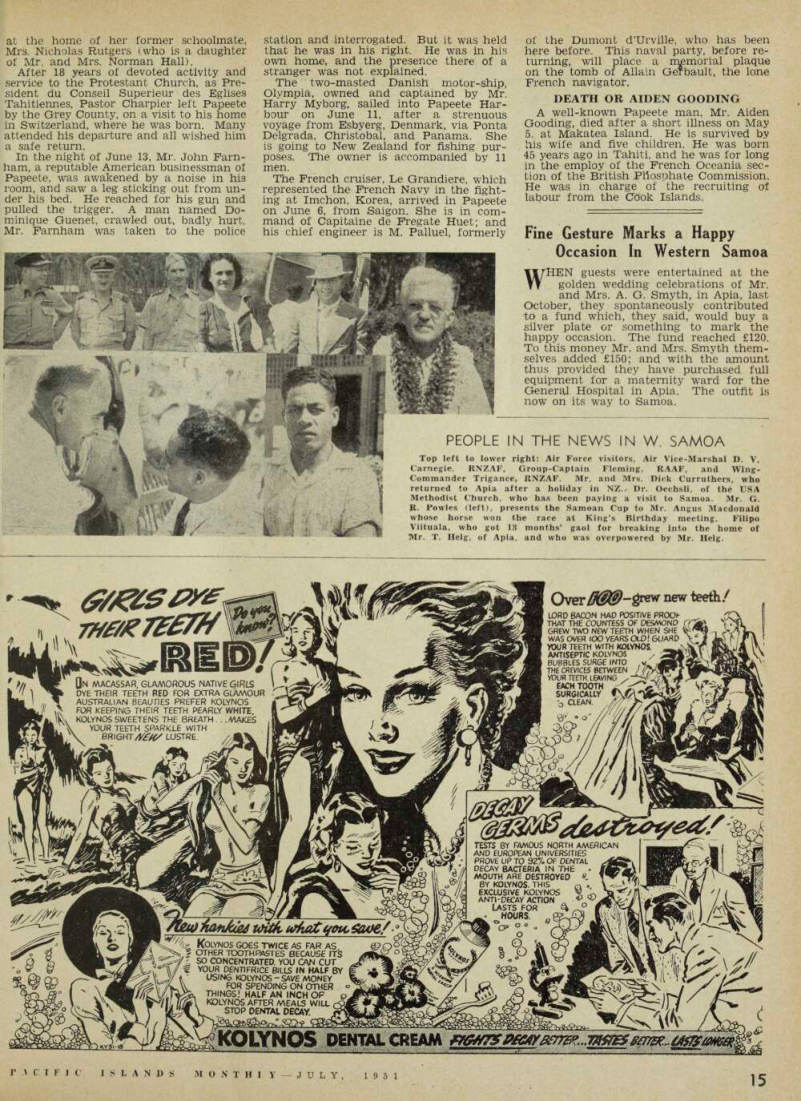
Community Honours De Gaulle
IN no uncertain manner, Tahiti cele brated De Gaulle’s Day—that famous occasion in June, 1940, when General de Gaulle, from London, called on all Frenchmen to keep on fighting, with the phrase, “France has lost a battle, but France has not lost the war.”
Proceedings began with a grand ball on June 16, wherein the citizens were led by Governor Petitbon and Mayor Poroi, and supported by the British and Ameri can communities. On June 17, most of the people took part in services at the Catholic and Protestant churches.
On Monday, the whole population lined the streets around the war memorial, and watched the leaders arrive to take part in a day-long series of ceremonies and speeches, to mark an occasion that most of us vividly recall —the time when we rallied to the support of De Gaulle and Fighting France.
The Governor (M. Petitbon) led the procession, and he was assisted by M.
Carrisey (head of the garrison) comman dant Lamour (commanding Naval and Air forces in French Oceania). Senator Lassale-Sere, Monsieur J. Millaud, (Presi dent of the Assemblee Representative), Monsieur de Monlezun, (Attorney-Gen eral), Monsieur Maisonnat (Chef de Cab inet) and numerous officials, Naval and Military officers, and civilians.
M. Jean Breaud, a wealthy businessman and banker, of Paris, arrived recently to take charge of some of the public works undertaken by some of the interests he controls. It will take some years to com plete what is to be done —sewers, hospital, wharves, roads. Technicians and engin eers have arrived and commenced the task.
M. Breaud is well known here. Some years ago he bought the big plantation at Atimaono. once known as the Stuart Estate. He turned the plantation into a large cattle ranch and has also specialised in grapefruit production.
Mons. G. G. A. Sully has been appointed to succeed M. Daufresne as Secretary- General of French Oceania.
M. Charles Albert Leboucher has been awarded the rank of Chevalier de la Le gion d’Honneur. He was the first President of the Assemblee Representative of Pa peete and has had 411 years of profes sional practice. He is greatly esteemed for his untiring service to the native population, as a homeopathy leader. He was bom in Tahiti 63 years ago.
Succeeding M. Le Maitre, who has gone to France on a well-deserved vacation be fore reporting for a new assignment, Mon sieur Maurice Vienne, has already settled down as Director of the Banque De Llndo-Chine, and has made many friends.
When the steamer. Grey County, left Papeete on June 12, loaded to the water line with Copra and Islands products, a passenger, leaving Tahiti for the first time, was Mr. Martial lorss—born in Tahiti, and was well-liked by the community, lorss, like many of the Euronesians of Samoa, was born of a German father, but became a good Frenchman, and loved Tahiti. This was evident when he em barked, laden to. his eyes with the tradi tional Heis (garlands of the tiare flowers). lorss is going to France to undergo an operation which we all hope will be suc cessful. He is connected with the De partment of Justice.
Miss Anatila Nordman. who has travelled widely since she left Tahiti two years ago, has radio’d from Honolulu to her father, Mr. Oscar Nordman. that she hopes to return home by the New Zea land yacht Golden Hind, towards the end of July. In Honolulu she has been staying
at the home of her former schoolmate, Mrs. Nicholas Rutgers (who is a daughter of Mr. and Mrs. Norman Hall).
After 18 years of devoted activity and service to the Protestant Church, as Pre sident du Conseil Superieur des Eglises Tahitiennes, Pastor Charpier left Papeete by the Grey County, on a visit to his home in Switzerland, where he was born. Many attended his departure and all wished him a safe return.
In the night of June 13, Mr. John Farn ham, a reputable American businessman of Papeete, was awakened by a noise in his room, and saw a leg sticking out from un der his bed. He reached for his gun and pulled the trigger. A man named Do minique Guenet, crawled out, badly hurt.
Mr. Farnham was taken to the police
station and interrogated. But it was held that he was in his right. He was in his own home, and the presence there of a stranger was not explained.
The two-masted Danish motor-ship, Olympia, owned and captained by Mr.
Harry Myborg, sailed into Papeete Har bour on June 11, after a strenuous voyage from Esbyerg, Denmark, via Ponta Delgrada, Christobal, and Panama. She is going to New Zealand for fishing pur poses. The owner is accompanied by 11 men.
The French cruiser, Le Grandiere, which represented the French Navy in the fight ing at Imchon, Korea, arrived in Papeete on June 6, from Saigon. She is in com mand of Capitaine de Fregate Huet; and his chief engineer is M. Palluel, formerly
of the Dumont d’Urville, who has been here before. This naval party, before re turning, will place a memorial plaque on the tomb of Allain Gerbault, the lone French navigator.
Death Or Aiden Gooding
A well-known Papeete man. Mr. Aiden Gooding, died after a short illness on May 5. at Makatea Island. He is survived by his wife and five children. He was born 45 years ago in Tahiti, and he was for long in the employ of the French Oceania sec tion of the British Phosphate Commission.
He was in charge of the recruiting of labour from the Cook Islands.
PEOPLE IN THE NEWS IN W. SAMOA Top left to lower right: Air Force visitors, Air Vice-Marshal D. V.
Carnegie, RNZAF, Group-Captain Fleming, RAAF, and Wing- Commander Trigance, RNZAF. Mr. and Mrs. Dick Curruthers, who returned to Apia after a holiday in NZ. Dr. Oechsli, of the USA Methodist Church, who has been paying a visit to Samoa. Mr. G- R. Powles (left), presents the Samoan Cup to Mr. Angus Macdonald whose horse won the race at King’s Birthday meeting. Filipo Viituala, who got IS months’ gaol for breaking into the home of Mr. T. Helg, of Apia, and who was overpowered by Mr. Helg.
Advertisements & other items, p. 16 (1 item)
Morris Hedstrom (Australia) Pty. Ltd.
INQUIRIES ARE INVITED
Concerning the Distribution and Sale of All Types of Merchandise in the
Pacific Islands
WE ARE AUSTRALIAN AGENTS FOR—
MORRIS HEDSTROM LTD., Fiji, Tonga and Samoa.
MILLERS LTD., Fiji.
8.5.1. P. GOVERNMENT TRADE SCHEME, Honiara
G. Cr E.I.C. WHOLESALE SOCIETY, Tarawa
MAX HALECK, Pago Pago, American Samoa.
Original Invoices Supplied Quotations on Request ★
MORRIS HEDSTROM (Australia) PTY. LTD.
(Established 1922)
MERCANTILE BROKERS
Asbestos House, 65 York Street, Sydney.
Box No. 2530, G.P.0., Sydney. Cable Address: “MORSTROM,” Sydney.
BANKERS: BANK OF NEW ZEALAND, SYDNEY.
Fine Gesture Marks a Happy
Occasion In Western Samoa
WHEN guests were entertained at the golden wedding celebrations of Mr. and Mrs. A. G. Smyth, in Apia, last October, they spontaneously contributed to a fund which, they said, would buy a silver plate or something to mark the happy occasion. The fund reached £l2O.
To this money Mr. and Mrs. Smyth them selves added £150; and with the amount thus provided they have purchased full equipment for a maternity ward for the General Hospital in Apia. The outfit is now on its way to Samoa.
Advertisements & other items, pp. 17-18 (2 items)
earn
Qn macassar, glamorous native girls DYE THEIR TEETH RED FOR EXTRA GLAMOUR
AUSTRALIAN BEAUTIES PREFER KOLYNOS
FOR KEEPING THEIR TEETH PEARLY WHITE.
KOLYNOS SWEETENS THE BREATH . .MAKES
YOUR TEETH SPARKLE WITH
BRIGHT #£#/ LUSTRE.
W'
new teeth/
LORO BACON HAD POSITIVE PROOh
THAT THE COUNTESS OF DESMOND
GREW TWO NEW TEETH WHEN SHE
WAS OVER 100 YEARS OLD! GUARD
YOUR TEETH WITH KOLYNOS _x»
ANTISEPTIC KOLYNOS y
BUBBLES SURGE INTO
THE CREVICES BETWEEN
YOUR TEETH, LEAVING
EACH TOOTH
SURGICALLY
b CLEAN.
& -I- -m I,
KOLYNOS GOES TWICE AS FAR AS,
OTHER TOOTHPASTES BECAUSE ITS
SO CONCENTRATED. YOU CAN CUT
YOUR DENTIFRICE BILLS IN HALF BY
USING KOLYNOS - SAVE MONEY
FOR SPENDING ON OTHER
THINGS! HALF AN INCH OF p,
KOLYNOS AFTER MEALS WILL "
STOP DENTAL DECAY.
earn
TESTS BY FAMOUS NORTH AMERICAN
AND EUROPEAN UNIVERSITIES
PROVE UP TO 92% OF DENTAL
DECAY BACTERIA IN THE •
MOUTH ARE DESTROYED
BY KOLYNOS. THIS o ..
EXCLUSIVE KOLYNOS
ANTI-DECAY ACTION
LASTS FOR
HOURS.
o o o O °o <£> o» 1>
iCA I
N i
KOLYNOS DENTAL CREAM
Pm Mmcm Would Mwm
A cs> 4 U i i 3 V
ENJOY STSATO”* CLIPPER
- - * y -<
AU THE WAY TO THE V.S.A.
30% FASTER! With Pan American’s New double-decked Clippers, you can fly Sydney to San F rancisco in hours flying time.
ROOMINESS. Seats are so far apart you can stretch way out and not touch the seat in front!
Wide aisle on upper deck, club lounge on lower deck, give lots of “strolling” room.
PRIVATE BERTHS. Everyone sleeps in big foam-soft berths on Pan American’s exclusive
bed-length Sleeperette.*
FINEST FOOD. Magnificent gourmet meals — served with California Wines and Champagne.
All complimentary. Planes are pressurized for "living-room” comfort however high you fly.
Book now with Pan American or your Travel Agent
Pm Mmcm Would Mwm
WORLD'S MOST EXPERIENCED AIRLINE
PAN AMERICAN WORLD AIRWAYS, INC. LTD., INCORPORATED IN U.S.A. *Trade Marks, Pan American World Airways, Inc.
PA2O
Another Politician
For
Territory Administratorship
THE Australian Government has selected Mr. P. J. S. Wise, leader of the Labour Party in the West Australian Parliament, and a former Premier, to be Administrator of the Northern Territory in succession to Mr. A. R. Driver, retired, and gone to a job in Italy.
As the Northern Territory now is under the Australian Department of Territories (responsible also for Papua-New Guinea, Nauru and Norfolk Island) the latter might have given some thought to the idea of appointing, to the post of Adminis trator of a Territory well within the tropics, some one of the many men in its service who have been trained and done well in the profession of tropical adminis tration. But, apparently, the Menzies Government, like the Socialist Govern ment, regards these Administratorships as gifts for politicians.
Although 80 per cent, of Australia’s innumerable members of Parliament are undistinguished Party hacks, Australian Governments generally seem convinced that a politician or ex-politician can fill any job within their gift. The result is that trained men frequently are ignored, while the inevitable politician appears in the highly-paid Australian Commissioner ships, Administratorships, Consulships and Ambassadorships.
Mr. Richards, now Administrator of Nauru, was a Labour Party leader in South Australia. Mr. Wilson, Adminis trator in Norfolk Island, was a member of the Commonwealth Parliament who ren dered political service to the Socialist
Government. Colonel Murray, Adminis trator of Papua-New Guinea, was a Socialist selection. He was a Professor of Agriculture at Queensland University.
He was not a politician: and he had not had any experience in administering a tropical territory.
Mr. Wise was born in Queensland 54 years ago; went to the West as a young man to be an adviser in tropical agri culture; had a distinguished political career as Minister for Lands and Agri culture, Treasurer and Premier; and is regarded as a man of outstanding ability.
Fiji Trade Shows
Favourable Balance
FIJI trade figures for 1950 created a new record and were over £1 million greater than in 1949.
Total trade for the year was £14,772,501 (£13,834,843 in 1949); imports were nearly £7 million and exports nearly £8 million, with an excess of exports over imports of £851,257 (£147.111 in 1949).
In 1944 the value of imports was about £2 I million and exceeded exports by over half a million pounds.
In 1950, chief exports were sugar, 114,254 tons, valued at £37 million; copra, 10,158 tons valued at £554.401; coconut oil, 10,083 tons valued at £946,281: gold and silver valued at £1,429,107.
Over 80 per cent, of exports went to the United Kingdom and other Common wealth countries.
Future Of The Solomon
Islands
Prom a Special Correspondent
Honiara, June 25.
rpHE rumour that Australia may take L over the British Solomon Islands has been the subject of a great deal of talk here—all unofficial and after-dinner.
No one here seems to know anything about its probability or otherwise at present.
Similarly, we know nothing of the re ported decision to move the headquarters of the High Commission for the Western Pacific from Suva to Honiara. We are told, by sources which are not official— and not always reliable —that it is all fixed; but there is no official statement. Natur ally, this is a matter of keen interest to everyone.
If either, or both of these things occur, this little town of Honiara will assume considerably greater importance.
Editorial Note: As was indicated in the last PIM, the report that Britain may hand over the Solomons to Australia is without confirmation. It is definite that the future of the Solomons, and the British side of the New Hebrides, were discussed at the highest official level in London and Paris in 1950; but there is no Indication of an agreement. Mr. Hasluck said, when taking over the Australian Territories Department in May, that he knew nothing whatever officially of the matter . . . It is understood that the transfer of the headquarters of the Western Pacific High Commission to Honiara has been decided on; but apparently there will be no further move for the present.
Advertisements & other items, p. 19 (1 item)
W. H. Grove
m f M ■ F
GROVE
84JIL&W6S
H "m i arr fP% <*
W. H. GROVE
AND
SONS LIMITED
P.O. BOX 490, AUCKLAND,
NEW ZEALAND.
ISLAND
MERCHANTS
REPRESENTING
ENGLISH
MANUFACTURERS
THROUGHOUT THE
PACIFIC ISLANDS
In Fiji as:
W. H. GROVE & SONS (FIJI)
LTD.
Office and Sample Room: Bank of New South Wales Chambers, Suva, Fiji.
Convicts Run Amok

Three Days of Terrorism in Samoa
From Our Own Correspondent APIA, June 20.
FOUR Samoan natives, all convicted criminals of evil character, broke out of Tafaigata gaol (six miles south of Apia) on June 10, possessed themselves of arms, roamed the countryside for three days, shot and gravely wounded a police man, terrorised the citizens, and were finally rounded up and captured by the police after an excising chase. They were Luapo (usually called Mano) of Saleufi, who is serving five years for the theft of a motor-boat, last year, and who had broken gaol before. He was ringleader.
Fetuiai of Faleasiu, serving a life sentence for wife-murder.
Mene of Vailima, serving seven years for rape.
Paulo Tuala of Leauvaa, serving 21 years for theft.
The escape was carefully planned. They got out of gaol at 8 a.m. on Friday, June 10, made straight for the house of the European gaoler, Mr. Bower, (who was absent at the time), broke in and took from a cupboard a .303 rifle, a .22 rifle and an automatic revolver, and much am-
TOP: The thief and gaol-breaker Mago, in hospital in Apia, with a 303 bullet in the muscles of his left shoulder.
MIDDLE: The taxi-cab, showing the holes made by the bullets of the pursuing police.
Beside the car is Constable Tavita Fitisemanu who shot and arrested Mago.
LOWER: Sergeant Muliaga with Fetuiai, the only one of the four gaol-breakers who gave himself up.
munition Thev stole also some spirits
Td supplieswVtonly shotkilled
the eaoler’s two dairy cows and disap- {Sired into the bush Search parties, headed by police, were soon scouring the country. Somehow, one of the searching police was cornered by the convicts. They took from him his shot-gun and ammunition, and then debated, among themselves, whether they should kill him. They let him go.
A small police patrol, led by Sergeant F. Kruse, got into a clash with the convicts and Sergeant Kruse was shot at close range with a shotgun and suffered serious injuries to face and chest.
By this time the wildest reports were in circulation, and the district was terror-stricken.
On Saturday morning the Fautua, High Chiefs Tamasese and Malietoa. went out to Faleasiu and Leauvaa villages, where the families of two of the prisoners live, and tried to make contact with the men to persuade them to give themselves up.
Amongst other statements, the prisoners were reported to have made the threat that they would get hold of a motorcar and drive through Apia town, shooting and killing until they were killed themselves.
Late on Saturday, it was reported that the prisoners had sent a letter to Tofa Tomasi (Samoan member of the Legislative Assembly* who lives at Faleasiu, on the West Coast. This letter set out grievances which had allegedly caused the four prisoners to revolt. The letter requested that an answer be broadcast on Saturday evening over Apia Station 2AP, and seemed to indicate a willingness to surrender.
The Hon Tofa Tomasi, with the consent of the High Commissioner (Mr. G. R.
Powles) broadcast an appeal to the men to give themselves up, promising that any grievance would be investigated. He
asked tne men to come to his house at Faleasiu on Sunday morning, at 7 a.m., so that he might accompany them to Apia Police Station.
TJOWEVER. when the Assembly man XX returned the same evening from Apia, after his broadcast, the four men were awaiting him at the roadside, near Faleula. They begged him to allow them to spend the night with their families, before surrendering themselves on Sunday morning at 9 a.m. They were still fully armed, and refused to surrender their weapons. The Hon. Tofa left them with the Leauvaa village authorities, expecting them to present themselves at Faleasiu at 9 a.m. on Sunday.
Instead, however, two of the convicts, Mano and Mene, went in to Apia by motor bus and in Apia, still fully armed, they engaged a taxi and forced the driver, at gunpoint, to drive them to Vailima, where the family of Mene lives. Defiantly and jeeringly, they drove past the Apia Police Station.
The Apia police at once took up the chase. On the convict’s return from Vailima, near Saleufi, home of Mano, the police caught up with the taxi. The taxi driver then wrestled with Mano, and took the gun away from him, and brought the taxi to a stop.
Mano jumped from the taxi, and was wounded in the shoulder by a shot fired by the police, who then arrested him and took him to the Apia Hospital. A shot fired by the police at the back of the taxi went right through the back and front seats, and narrowly missed the driver.
After that, Mene was arrested at Saleufi, where he had stayed with his family.
Paulo Tuala was arrested by a police party at Leauvaa, at his family’s fale.
Several shots were fired before he found it advisable to surrender tamely.
The only prisoner who abided by the agreement with the, Horn To a was the wife-murderer, Fetuiai of Faleasiu, who surrendered to Tofa and was brought to Apia police station at noon on Sunday. . npHUS, a dangerous incident ended with- X out loss of life. The situation, dur ing the three days, caused a near panic amongst European women and children in Apia and on the cocoa plan tations. A commendable feature of the activities was the co-operation between the Government authorities, particularly the police, and the Samoan leaders, who exerted all their influence to prevent more ugly aspects and bloodshed, Both Sergeant Kruse and Mano are recovering and out of danger. The trial of the escapees will take place when Sergeant Kruse can appear m Court.
“ Dynamite Mac Again!
J rpHE leader of the gaol escapees seems X to be none ether than our old friend, the pinheaded and bombastic Samoan thief. “Dynamite Mac Mago.”
This is the buffoon who, early in January, 1950, induced a couple of other Samoan hoodlums (who already had achieved notoriety by running away with Mr. A. G. Smyth’s little vessel, Wyben, and losing her in the Solomons) to accom pany him in stealing O. F. Nelson and Co.s motor-vessel, Gaumatau. They sneaked out of Apia port at midnight; and “Dyna : mite Mac” decided they should sail forth with to Tahiti, and spend their lives in luxury and romance.
After a month of wandering around— they did not know where—they came upon an island, which “Dynamite Mac” assured them was Tahiti. But they were actually in Eastern Samoa—only 160 miles from their starting-point. Although they had
clumsily disguised themselves and their ship, they soon were arrested, and sent back to Apia, where they got five years.
This Samoan criminal and public nuisance has been more or less under police observation for years—ever since he sought public adulation as a boxer, and assumed the name of “Dynamite Mac.”
Certain aspects of this Samoan gaolbreak of June 10-12 are dealt with in an article on page 6.
Advertisements & other items, pp. 20-21 (2 items)
Plantations
and
Uses
on
\\ f ind Many
You
Pams for
CR/ONIB
HG
tractor
|THE
OLIVER
sc ft B B E The Oliver “HG.”
Drawbar h.p. 21.85; Belt h.p. 26.36. \ SMALL tractor that's BEG in performance, the versatile "HG" is at * home on hillsides and in slippery, boggy going. You'll use your Oliver r HG" the whole year round!
OLIVER “HG” WITH “IMP” DOZER: A compact, efficient, easily air-transported unit that’s ideal for plantation, road arid airstrip maintenance. Available either as a ’Dozer (at left) or as a trailbuilder (tilts and angles).
Si OLIVER ROWCROP “77” with mounted cultivator (right). The Oliver line includes wheel tractors from 22.6 d.b. h.p. to 42 d.b. h.p.; Cane cultivators, harrows, plows; cotton, rice and peanut harvesters; potato diggers; mowers for ramie and other grasses; drills, spreaders, balers.
BRITSTAND EQUIPMENT. There’s a full range of industrial equipment for road-making, land-clearing, airport construction, logging: Powered by famous Oliver crawlers, from the “HG” to the mighty “PDE” (110 drawbar h.p.).
For full details, see your Oliver Distributor now!
NEW GUINEA
COMPANY LIMITED
(BRITSTAND) MANGO AVENUE,
Rabaul.
BRITSTAND Branches: Lae. Madang, Kavieng. Associated Companies: J. R. Clay & Co., GRADER Port Moresby; W. R. Carpenter & Co. (Solomon Islands) Pty., Ltd.
DITCHER. Tulagi.
Riverside
CANNED MEATS
SUPPLIES WILL BE AVAILABLE SHORTLY FOR EXPORT
TO ALL PACI FIC ISLANDS
Address All Enquiries to: —
SYDNEY MEAT PRESERVING CO. (LTD.)
(ESTABLISHED 18701
Parramatta Rd., Auburn, N.S.W. —P.O. Box 40, Auburn Phone: TJX 6611. Cable Address: “Meatwalk,” Sydney.
Anti-Tb Work In Fiji
THE report for the first year’s activities of the War Memorial Anti-Tubercu losis Fund of Fiji was issued in Suva in mid-June.
The Fund is Fiji’s war memorial and an appeal for funds from all sections of the Fiji community in 1949, plus a Gov ernment grant of £20.000, established the Fund with over £82,000. Since then in terest and donations have brought it up to £83,467.
During the first year, £8,388 was spent and orders placed for equipment not yet received total another £20,600.
Information supplied by Dr. J. M. Cruik shank, Fiji Director of Medical Services, shows that over 40,000 tests have been made for TB in a survey being carried out and as a result 9,000 inoculations of BCG vaccine were given.
From 1,500 X-Rays taken during a sur vey of three schools and several Govern ment departments, 5 active cases were discovered and are being treated.
Two Land Rover vehicles have been provided from the Fund for the use in rural areas of the two AMP’s who have been trained in the technique of treat ing discharged patients, giving tests and BCG vaccinations.
The Trustees of the War Memorial Anti- Tuberculosis Fund are Sir Hugh Ragg (chairman), Dr. J. M. Cruikshank, Mr.
R. S. Kay, Mr. Vishnu Deo, MLC, and Joeli Ravai, MLC. The secretary and treasurer is Mr. W. E. Donovan.
A rifle club has been formed in Rabaul.
Members will use the Police Force rifle range and later, it is hoped to arrange matches between clubs now established at Kokopo and Kavieng (New Ireland).
Search For Oil
Goes On In Papua
Official Summary of the Position
ONE of the most interesting questions concerning Papua-New Guinea is concerned with the future of the oil search there.
The search has been proceeding for nearly 20 years, except for the interrup tion of the Japanese invasion. In more recent times, operations have been con centrated in the hands of the great Anglo- American oil companies, and especially Anglo-Iranian Oil Company (now facing grave dislocation in Persia) and Standard Vacuum Oil Co.; and 'these interests, amalgamated as Australasian Petroleum Co. Pty., Ltd., have spent already at least £6.000,000 on the search in Papua. So far, they have not found payable oil.
How long are these powerful companies prepared to continue the search? If they go on, and succeed, Papua-New Guinea will have a prosperous future, quite irres pective of Australian Government sub sidies.
If, on the other hand, the oil companies tire of the unsuccessful search, and puli out of Papua, the present economic set up in Papua-New Guinea can continue only if (a) important new industries are established or (b) Australia is prepared indefinitely to spend five or six million pounds per annum on the Territories.
Recently, the General Manager and Chief Geologist of Australasian Petroleum Co. (Mr, L. A. Pym and Mr. N. A. Osborne) went to London for a conference with representatives of the big oil companies After their return, the APC, in a special statement on June 29, said the London discussion centred on “the pro gress of the Papuan exploration pro gramme,” and continued:— The results of the wells drilled to date were discussed at length.
The Wana well was drilled to a final depth of 9,866 feet. Its objective had been to provide stratigraphic information, and it has proved a thick limestone with good reservoir characteristics. This limestone produced salt water at the rate of 18,000 barrels per day, together with a small amount of gas.
The seismic surveys have been ener getically carried out in the vicinity of Wana; but, as yet, a site for a definite test has not been found; the work continues.
The personnel on this work was increased from one seismic party to two, last Octo ber, and it has been decided to increase it still further with the provision of a third party as soon as arrangements for it can be made. This will allow opera tions to extend over a greater area.
The two wells now drilling, Hohoro No. 2 and Omati No. 1, have not yet reached conclusive depths; and drilling continues.
Matua’s “Wonderful Cruise”
WHEN MV Matua returned to Auck land in mid-June after her first trip to the Islands in several months, her officers and crew said they had had a “wonderful cruise.”
No passengers were carried and the crew consisted of volunteers—former stewards, seamen, clerks and members of the Union Company’s shore establish ment.
The ship carried 2,400 tons of urgentiy needed foodstuffs and Island residents claimed that she was the best sight they had seen for months.
Advertisements & other items, p. 22 (1 item)
Sppo
• Buying Agents for Island Clients. • Graymarine Diesel Engine Parts. • Trochus and Green Snail Shell. • Islands Products sold on Commission.
INQUIRIES CORDIALLY INVITED
STANLEY P. BELL & Company
Exporters, importers. Ship Brokers Cr Agents
ASSOCIATES OF:
Henderson Trlppe (Philippines) Inc.
Henderson Trlppe Shipping Co. Inc. (OFFICES: Manila, Hong Kong, Tokyo, Baltimore.)
173 EAGLE STREET
BRISBANE, AUSTRALIA
Cables: “Pacent, Brisbane.”
pruce up on
SPPO
u~ JJL •
up fra ip
SPRUSO LIQUID, SPRUSO LIQUIDSHEEN, and SPRUSO
CRYSTALLISED SHEEN.
SPRUSO is the best selling Hairdressing in Australia TRADERS : write for samples.
SPRUSO COMPANY, Redfern, New South Wales, Australia.
Tea’S New Polynesian
Service
Will Not Commence For Few Months Yet
PROBABLY, it will be close to the end of 1951 before the service with flying boats, planned by Tasman Empire Airways, to run fortnightly between Syd ney and Tahiti, via Auckland, Suva, Apia and Aitutaki, will be commenced.
The announcement made at the end of May by a spokesman for TEA, gave a wrong impression. He did not say that the service would commence very soon— only that a survey flight would be under taken at once. That survey is now pro ceeding, and a flying-boat, staffed with experts, is now examining all possible landing places, and mooring, fuelling and accommodation facilities, in those parts of the Polynesian groups which are likely to be affected.
These widely-scattered archipelagoes— some of which consist entirely of atolls— provide flying-boat conditions very dif ferent from those encountered in the high islands of the Pacific.
Consequently TEA—which has a fine record of efficient and accident-free opera tion—is taking great care in planning the new service. "When it starts, it will keen going” said one high official. “It will not go off half-cock.”
Samoa Welcomes New Service
From Our Own Correspondent APIA. June 20.
WITH great satisfaction, we have re ceived the announcement that Tas man Empire Airways, Ltd., follow
ing on recent test flights, have decided to include Western Samoa in a fortnightly air service to Tahiti. This new air-link with the outside world, and particularly with Australia, is of importance to Western Samoa, which so greatly depends on Australia for essential supplies. The new service will be used by passengers, airmails and freight and it will stimulate the
extending trade relations between Wes tern Samoa and Australia, Our only airlink with the outside world —the NZ National Airways fortnightly service from Suva (Fiji) via Tonga and Samoa has proved insufficient for the needs of the territories concerned, so that a fortnightly special plane had to be added to the regular fortnightly plane
The regular plane proceeds from Apia to Aitutaki and Rarotonga and returns from there to Apia and Suva. But even these planes at present can hardly cope with the increasing public demand for air pas sages, and the special plane may be taken off the service at any time.
The engagement has been announced of Miss Audrey Watt of Sydney, to Mr.
Keith Barton of Lautoka, Fiji.
Since the signing of the trade agree ment between Australia and Indonesia, six months ago, the volume of trade has been almost double the estimated total. Aus tralia’s main exports to Indonesia are wheat, flour and non-ferrous metals and Indonesia’s exports to Australia include rubber, coffee and petroleum. About 29 per cent, of Australia’s oil requirements come from Indonesia and this figure does not include oil imported from Singapore but originating in the Indies.
Advertisements & other items, pp. 23-24 (1 item)
“Duraplas” Overlays
BOOKS YOU’LL ENJOY
PEOPLE WE MET. By A. C. C. Lock. Rambles through tropical Queensland with a friendly companion whose easy style of writing is spiced with dashes of whimsical humour. With 75 photographs. 18/6 (post Bd.) WAKE ME UP AT NINE. By Emile Mercier. A selection of the cartoons which have made tens of thousands of people see the funny, sunny side of to-day’s problems, perplexities and frustrations. 7/6 (post 4d.) DEAD MEN DO TELL TALES. By Byron de Prorok. Exciting adventure and enlightening information about Abyssinia from the pen of an archaeologistexplorer whose party faced death more than once. Illustrated. 13/6 (post 6d.)
ANGUS 4 ROBERTSON LTD.
Booksellers ; Publishers :: Librarians
89 CASTLEREAGH ST., SYDNEY, AUSTRALIA.
7 1951
AUSTRALIAN SINGLES
TENNIS TITLES*
WON WITH DUNLOP
RACKETS
FEATURING EXCLUSIVE
“DURAPLAS” OVERLAYS
★ MEN'S SINGLES CHAMPIONSHIP
★ JUNIOR BOYS' SINGLE CHAMPIONSHIP
★ JUNIOR GIRLS' SINGLES CHAMPIONSHIP
• NO warping or cracking at the shoulders. • Extra strength for tighter stringing. • More restrings.
S 99
l/ty
S A 10 m s %
Won
GIVE
YOURSELF
CHAMPION'S
CHANCE
'DURAPLAS" NOW available at your local sports store. DUNLOP MAXP L Y, for 30 years Wimbledon's most popular racket.
DO-1371
PLAIN AND
SELF RAISING
FLOUR,
d&k fob it/
ESTABLISHED 1868
Agents for Fiji, Tonga and Samoa: C. SULLIVAN (PACIFIC ISLANDS) LTD., Suva, Fiji
McILRATHS for Groceries
“VICTOREE”
ORANGE MARMALADE
24 oz. tins 13/6 doz.
“CAPITAL”
PLUM JAM
24 oz. tins 16/6 doz.
“LETONA”
BAKED BEANS
16 oz. tins 15/- doz.
“Sunrich” Concentrated
VEGETABLE SOUP
12 oz. tins 7/- doz.
Add double quantity hot milk or water
“RALEIGH”
OYSTER SOUP
8 oz. tins 13/6 doz. 16 oz. tins 21/- doz.
“SUNRISE” DRIED WHOLE EGG POWDER, 8 oz. tins (each tin equal to 18 Hen Eggs) 8/11 t , NEW SEASON’S PURE ORANGE JUICE (rich in Vitamin “C”). 16 oz. tins 23/9 doz NEW SEASON’S CANNED APRICOTS, 16 oz. tins. 18/-. 30 oz tins >B/6 doz “ROSA” CUSTARD POWDER, 16 oz. pkts. 00/a d ‘ “KRAFT” ICE CREAM MIXTURE, 4 oz. tins i//q ,J oz “McILRATH S” FRUIT SALINE, 7 oz.. 1/8. 16 oz. 2/9 iar CHOICE STRAWBERRY CONSERVE, 8 oz. tins, 1/6; 24 oz. tins 3/414 tin “LETONA” TOMATO JUICE, 8 oz. tins, 8/6. 16 oz. tins 15/ doz “LETONA” SWEET CORN, 8 oz. tins. 12/9. 16 oz. tins 22/6 doz.* “IMPERIAL” STEAK AND TOMATO (a delicious and quickly prepared meal), 16 oz. tins 34/. OZ- “DEWCRISP” DEHYDRATED ONIONS. 6 oz. tins (each tin equal to 2 3 i lb. fresh onions) 6/6 tin
“BIOMITE”
BROTH CUBES
Pkts. of 6—4|d.
Each cube makes a cup of tasty beef tea.
“BRONTE”
BRAISED STEAK Cr
ONIONS
16 oz. tins 29/6 doz.
“HUONCRY” BLACKCURRANT SYRUP. 26 oz. 4/6 bot. “HUONCRY” RASPBERRY SYRUP. 26 oz. 4/6 bot.
Rich in Vitamin C—Specially recommended for children.
“VICTOREE”
TOMATO SAUCE
13 oz. bots. 19/6 doz.
“LETONA”
CELERY STICKS
16 oz. tins 12/6 doz.
“SUNRICH” VEGALL (Pure Vegetable Extract rich in Vitamins). 1 oz. jars 6/- doz.
FINEST TASMANIAN HOPS 2 oz. pkts. 17/9 doz.
NEW SEASON’S 3 CROWN SULTANIAS, loose 2/- lb.
NEW SEASON’S 3 CROWN CURRANTS, loose 2/- lb.
“KIA ORA” PURE FRUIT JUICE CORDIALS (Orange Cup. Fruit Cup.
Lemon, etc.). 26 oz. bottlesi 39/- doz.
“MYNOR” PURE FRUIT JUICE CORDIALS (Tops. Fruit Cup, Orange Cup, Lemon, etc.). 26 oz. bottles 39/- doz.
BRANDY SULTANA
CAKES
3 lb. in utility tin 9/6
“GLEN ELLEN”
GREEN PEAS
16 oz. tins 21/- doz.
PRICES SUBJECT TO STOCKS AND TO MARKET FLUCTUATIONS Revised comprehensive price lists available on application.
ALL PRICES F. 0.8. STEAMER, SYDNEY, including Australian permits, cases, packing, etc. All shipments excluding deck cargo are insured against pillage, theft and non-delivery. Join the many satisfied Island customers who obtain their grocery requirements from Mcllrath’s Export Department, 202 Pitt Street, Sydney, and effect considerable savings.
THE QUALITY OF ALL GOODS POSITIVELY GUARANTEED.
McILRATH’S PTY. LTD.
EXPORT DEPARTMENT
202 PITT ST., SYDNEY, AUSTRALIA
Death Of Fijian Leader
THE death occurred in Suva, Fiji, on June 17 of Ratu George Tonganivalu, QBE, an outstanding leader of his people.
Ratu George, under the name of George Brown, joined the Maori Battalion in the First World War and served in France.
After his return to Fiji, in 1919, he joined the Government service and was appointed Native Assistant Commissioner, Bua, in 1928; he became Roko Tui of the Pro vince in 1936.
He was commissioned as a Captain in the Labour Battalion of the FMF in 1943 and went to Ba as Roko Tui in 1946. He was a Member of the Legislative Council from 1940, a member of the Fijian Affairs Board and in the 1949 New Year Honours was awarded the OBE.
He is survived by his widow, Adi Alisi, and four sons and one daughter.
His eldest son, William, is an Agricul tural Assistant at Ba; David is a student at the Wanganui Collegiate School in New Zealand. Another son, Julian, has recently entered the Royal Military Academy at Sandhurst, and Joshua is attending a course of instruction at the Gatton Agricultural College, Queensland.
A holiday cottage is available in a Sydney seaside suburb for letting to Islands folk on leave. It will accommo date four and has a garage. We will forward inquiries to the owner.
Startles
Election Of Deputy
N. Caledonia Interests
THERE was dismay in European circles in New Caledonia at the end of June, when it became known that, as a re sult of the general election under the new electoral system, M. Gervolino, of Noumea, had lost his seat in the Chamber of De puties. as representative of New Caledonia —having been defeated, bv a substantial majority, bv M. Maurice Le Normand.
The election apparently means that the black and brown residents of New Cale donia are likely in future to exercise more influence than in the past upon the ad ministration.
Formerly, they had a voice only through the elected Council-General, or local Par liament, which advises the Governor, More recently, the common vote has been given to all New Caledonian residents, irrespective of race, who can sign their names; which means that the vote of the mission-trained village native has the same value as that of a leading Euro pean. The Chamber of Deputies, to which they elect a representative, directs rather than advises the Governor.
The new Deputy. M. Le Normand —he displaces M. Gervolino, who had held the seat for five years—is a dispensing chemist in Noumea, and is generally regarded as strongly pro-native. His wife is a full native—she was the adopted daughter of M. Calambre.
Under the new electoral law, both natives and Asiatics who can sign their names, got a vote. It is anticipated that, through their new Deputy, they will try to introduce into New Caledonia a system of taxation of incomes. This will be strongly resisted and resented by estab lished interests, and by Europeans gen erally.
The new electoral system, which is esti mated to have enfranchised 8.000 native men and women, was forced by Paris upon New Caledonia without the latter’s wishes being consulted. The natives and pro natives openly boast that, at the next local elections, they will take control of the Council-General.
Already, in some quarters, there is talk of a movement of secession from Prance.
Some European interests declare they would rather seek alliance with Australia or America than be ruled by certain ele ments which now dominate the natives.
Other sections argue that this drastic change is merely the swing of the pendu lum. For a long time, New Caledonia has been ruled by monopolistic and selfish commercial interests, who have had little or no regard for the wellbeing of the Colony as a whole. Now, the anti monopolists are in control.
Fiji Birthday Honours
IN spite of bad weather, a large crowd of spectators gathered in Albert Park, Suva, on the morning of June 7 to see the King’s Birthday Trooping of the Colour ceremony.
In the afternoon, the Governor and Lady Freeston entertained 500 guests at a garden party at Government House.
Seven local residents received honours in the Birthday list.
They are: Dr. J. M. Cruikshank, OBE, Director of Medical Services, who was ap pointed a Companion of the Most Distin guished Order of St. Michael and St.
George.
Joeli Ravai, Roko Tui Tailevu, and Mr.
E. H. Griffiths, who retired recently as Manager and Attorney in Fiji of the Colonial Sugar Refining Co., Ltd., were appointed Officers of the Most Excellent Order of the British Empire.
Mr. S. H. Wilson, of Savu Savu, Rari kua Vera, Live Stock Officer of Labasa, and Mr. G. S. Barrack, Chief Accountant.
Western Pacific High Commission Office, Suva, were appointed Members of the same Order.
Mr. W. J. G. Holland, Acting Commis sioner of Police, received the Colonial Police Medal.
The Governor awarded a Certificate of Honour to Joni Misikini, Fijian Magis trate at Lawaqa, Nadroga.
It is said that the coldest man in Auckland, NZ, on June 23 was Sofeni Fonotia, a Samoan carpenter who had just arrived in the PAA Clipper seeking work in the Dominion. He had boarded the aircraft in Fiji and wore only a thin cotton shirt and sulu. Those who tried to talk to him got only one sentence out of him :‘Tt’s cold.”
Miss Lila Hayes, who is a bacteriologist and has been senior research officer at Prince Henry Hospital. Sydney, for the past four years, was married to Mr. John Bertrand Smith, at Rose Bay Presbyterian Church on June 30. Miss Hayes is the daughter of Mr. W. R. Hayes of Fiji, and Mrs. Hayes of Sydney.
Eleven priests of the Society of St.
Columban have been appointed to Roman Catholic Missions in Fiji. Previously most priests in Fiji have belonged to the French Marist Order; of recent years, however, English speaking priests have been ap pointed. The new appointees are:— The Rev. Fathers Dennis Fitspatrick (Superior), Charles O’Mahony, John J.
Doyle, Martin Dobey, Gerald Hurley, Sea mus O’Connor. John J. OLoughlin, Arthur Tierney, Patrick J. Kelly, Kevin F. Flem ing and James Garigan.
Advertisements & other items, pp. 25-26 (1 item)
aspaXadrene
ASTHMAS, BRONCHITIS, CATARRH.
HAY FEVER
Coughs, Colds, ’Flu, Tonsilitis, Sinus, Antrum,
Whooping Cough, etc.
are still best treated by atomized inhalant
aspaXadrene
"The Answer to the Asthmatic's Prayer"
Five little whiffs and , in five little jiffs, “off she pops.” Relief is instantaneous—it “touches the spot” unchanged, because it is an atomized inhalant.
All the above are akin—insofar as they are associated with inflamed capillaries of the mucous membrane.
Absolutely harmless—same spray, same liquid for babies and adults.
C. H. Tilton, Umina P. 0., via Woy Woy, N.S W yesteryear:— wrote yesterweek, not Awaited full test before writing—surprise of my life after a few whiffs Asthma all my life . . . now eighty! ! ! Weak heart last two years—giddy dizzy feeling, but now never a heart turn in any way. Started when I heart a man had never had a cold since using Aspaxadrene—neither have I Usi this testimonial as you wish. Hope you will always have the good healtl I am enjoying.” (Condensed from two-page letter.)
Ask for it Today-Not "Manana"
Same Prices—no price "pop-ups"
Complete Outfit, 28/6. Refills, 12/6 each.
ALL CHEMISTS AND STORES
or
A. H. CRUNDALL
BOX 58, PRAHRAN, VICTORIA, AUSTRALIA
COLUMBIA
pictdms
NEW
Pleased To Announce
The Appointment' Of
GUINEA COMPAQ
As Distributing
Agent §
COLUMBIA
\6 m.m
Throughout
GUINEA and CENT
FILNV
ISLANDS
mi m
WHERE TO OBTAIN INFORMATION
RABAUL:
NEW GUINEA CO. LTD.
LAE:
NEW GUINEA CO. LTD,
MADANG:
NEW GUINEA CO. LTD.
KAViENG:
NEW GUINEA CO. LTD,
PORT MORESBY:
J. R. CLAY & CO.
FIJI:
HUNTS AGENCY
VICTORIA PARADE,
SUVA
AUSTRALIA:
COLUMBIA PICTURES PTY. LTD.
251 a Pitt Street, Sydney.
Love-Kerr Wedding
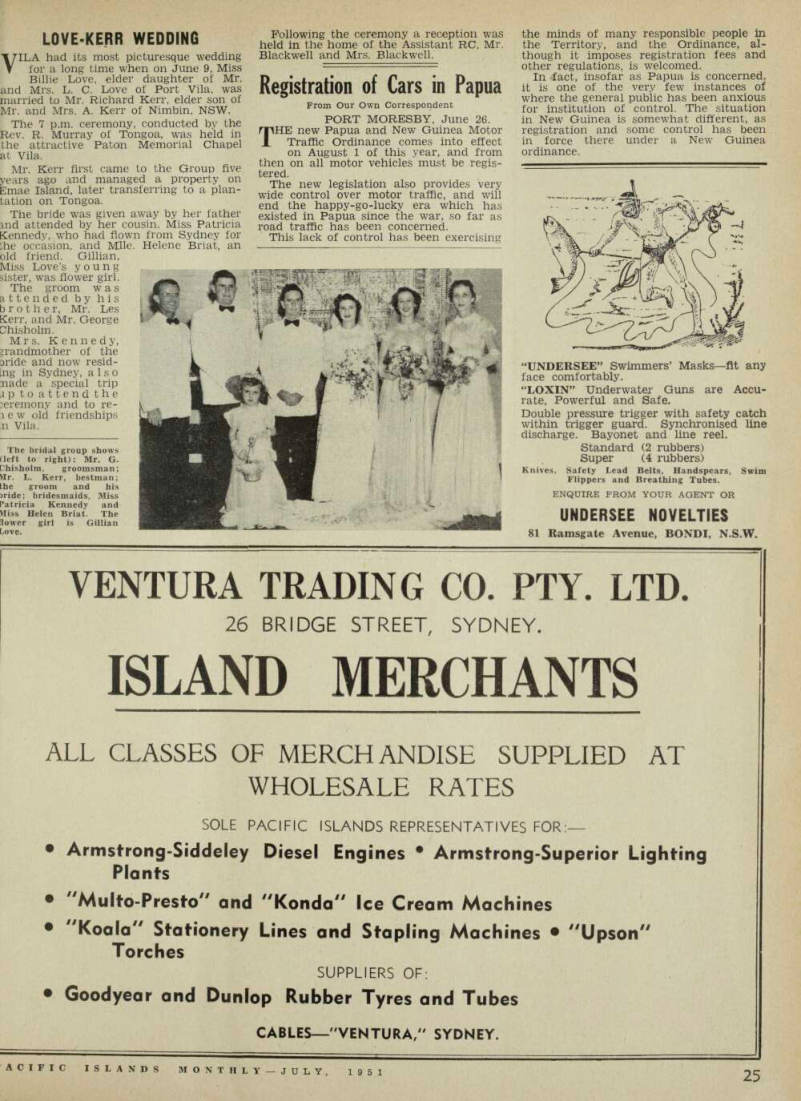
VILA had its most picturesque wedding for a long time when on June 9, Miss Billie Love, elder daughter of Mr. and Mrs. L. C. Love of Port Vila, was married to Mr. Richard Kerr, elder son of Mr. and Mrs. A. Kerr of Nimbin, NSW.
The 7 p.m. ceremony, conducted by the Rev. R. Murray of Tongoa, was held in the attractive Paton Memorial Chapel at Vila.
Mr. Kerr first came to the Group five years ago and managed a property on Emae Island, later transferring to a plan tation on Tongoa.
The bride was given away by her father and attended by her cousin. Miss Patricia Kennedy, who had flown from Sydney for :he occasion, and Mile. Helene Briat, an
old friend. Gillian, Miss Love’s young sister, was flower girl.
The groom was attended by his brother, Mr. Les Kerr, and Mr. George Chisholm.
Mrs. Kennedy, grandmother of the aride and now resid ing in Sydney, also nade a special trip jp to attend the ceremony and to re lew old friendships n Vila.
Following the ceremony a reception was held in the home of the Assistant RC, Mr.
Blackwell and Mrs. Blackwell.
Registration of Cars in Papua
From Our Own Correspondent
Port Moresby, June 26.
THE new Papua and New Guinea Motor Traffic Ordinance comes into effect on August 1 of this year, and from then on all motor vehicles must be regis tered.
The new legislation also provides very wide control over motor traffic, and will end the happy-go-lucky era which has existed in Papua since the war, so far as road traffic has been concerned.
This lack of control has been exercising
the minds of many responsible people in the Territory, and the Ordinance, al though it imposes registration fees and other regulations, is welcomed.
In fact, insofar as Papua is concerned, it is one of the very few instances of where the general public has been anxious for institution of control. The situation in New Guinea is somewhat different, as registration and some control has been in force there under a New Guinea ordinance.
The bridal group shows (left to right): Mr. G.
Chisholm, groomsman; Mr. L. Kerr, bestman; the groom and his oride; bridesmaids, Miss Patricia Kennedy and Miss Helen Briat. The flower girl is Gillian Love.
Advertisements & other items, pp. 27-28 (2 items)
25
ACIFIC ISLANDS MONTHLY JULY, 1951
Island Merchants
-M \ Sc “UNDERSEE” Swimmers’ Masks—fit any face comfortably.
LOXIN” Underwater Guns are Accurate, Powerful and Safe.
Double pressure trigger with safety catch within trigger guard. Synchronised line discharge. Bayonet and line reel.
Standard (2 rubbers) Super (4 rubbers) Knives, Safety Lead Belts, Handspears, Swim Flippers and Breathing Tubes.
ENQUIRE FROM YOUR AGENT OR
UNDERSEE NOVELTIES
81 Ramsgate Avenue, BONDI, N.S.W.
VENTURA TRADING CO. PTY. LTD.
26 BRIDGE STREET, SYDNEY.
ISLAND MERCHANTS
ALL CLASSES OF MERCHANDISE SUPPLIED AT
WHOLESALE RATES
SOLE PACIFIC ISLANDS REPRESENTATIVES FOR:—
• Armstrong-Siddeley Diesel Engines • Armstrong-Superior Lighting Plants • "Multo-Presto" and "Konda" Ice Cream Machines • 'Koala" Stationery Lines and Stapling Machines • "Upson"
Torches
SUPPLIERS OF:
• Goodyear and Dunlop Rubber Tyres and Tubes
CABLES—"VENTURA," SYDNEY.
QUEENSLAND
INSURANCE
COMPANY
LIMITED
(Incorporated 1886 in Australia).
ASSETS EXCEED £6,000,000
Head Office :
QUEENSLAND INSURANCE BUILDING,
80-83 PITT STREET. SYDNEY.
Specialists in South Sea Fire,
Marine tr Accident Insurances
Apply to: —
FIJI. Branch Office: J. F. Drury, Manager.
Burns Philp (South Sea) Co., Ltd.
VlLA.—Burns Philp (New Hebrides), Ltd.
Comptoirs Francais Des Nouvelles Hebrides.
NOUMEA.—L. & W. Johnston.
NEW GUlNEA—Manager for the Territory of New Guinea and Papua, W. A.
Anderson.
PORT MORESBY—SAMARAI—LAE
—MADANG—RABAUL.
Burns Philp (New Guinea), Ltd.
PAGO PAGO.
Burns Philp (South Sea) Co., Ltd.
G. H. C. Reid & Co.
OTHER SOUTH SEA ISLANDS.
Burns Philp (South Sea) Co., Ltd.
Also to any of the Company's
Offices in Australia or New
Zealand.
o t . fp\ /J W. 4 A.
the
C A hh
is /«»*
GILBEY’S
G/lßfy L TO. helb OUr "e. SY Dnb *■ e
RISBa
Ne Address all enquiries to W. & A, GILB£Y LTD., 33 Rossiyn Street, West Melbourne.
Tonga
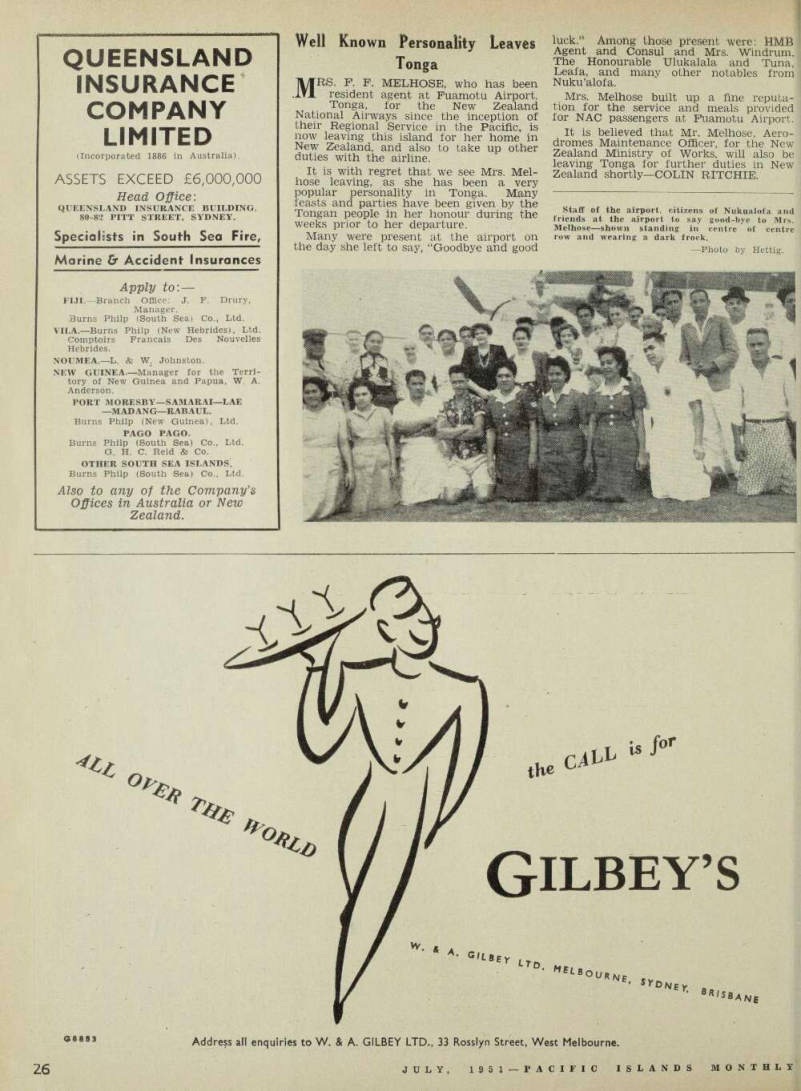
Well Known Personality Leaves Tonga
MRS. F. F. MELHOSE, who has been resident agent at Fuamotu Airport, Tonga, for the New Zealand National Airways since the inception of their Regional Service in the Pacific, is now leaving this island for her home in New Zealand, and also to take up other duties with the airline.
It is with regret that we see Mrs. Mel hose leaving, as she has been a very popular personality in Tonga. Many feasts and parties have been given by the Tongan people in her honour during the weeks prior to her departure.
Many were present at the airport on the day she left to say, “Goodbye and good
luck.** Among those present were: HMB Agent and Consul and Mrs. Windrum, The Honourable Ulukalala and Tuna, Leafa, and many other notables from Nukualofa.
Mrs. Melhose built up a fine reputa tion for the service and meals provided for NAC passengers at Fuamotu Airport.
It is believed that Mr. Melhose, Aero dromes Maintenance Officer, for the New Zealand Ministry of Works, will also be leaving Tonga for further duties in New Zealand shortly—COLlN RITCHIE.
Staff of the airport, citizens of Nukualofa and friends at the airport to say good-bye to Mrs.
Melhose —shown standing in centre of centre row and wearing a dark frock. —Photo by Hettig.
Hides Was Not There!
Old Papuan Official On A Matter of History
Letter to the Editor IN your May number you published a eulogy on the late Dave Pullen. It was written by Mr. Middleton. The article is so full of inaccuracies that I cannot let his criticisms of Jack Hides pass without comment.
Both Dave and Jack were friends of mine. Dave did so little patrolling, and Hides so much successfully, that compari sons cannot be made. Hides was one of the best Patrol Officers; and, for his crossing from the Fly to the Kikori, he was recommended for the RGS Medal by the late Sir Hubert Murray. As Sir Hu bert explained to the Secretary, in Lon don, Staniforth-Smith got the medal for failing to cross from the Kikori to the Fly, so why should not Jack get the medal for succeeding?
As regards Hides being to blame for the deaths of the mountain carriers (not “on the Tafa,” but near Mavi) Dave Pullen alone was responsible—Jack Hides wasn’t even there!
The morning of the disaster, Jack, after advising against the handcuffing to the wire rope (I have the photo) at Mondo, left in the opposite direction, for the coast. I know all about the deaths, for I was sent up there to clean up the mess.
“De mortius nihil nisi bonum,” I know; but if Mr. Middleton wished to eulogise Pullen there was no need for him to say cruel things about Hides. Mr. Middleton would have been well-advised to have avoided the incident altogether.
I am. etc.,
Brisbane, 1/7/1951.
S. H. Chance.
New Era In American
Samoa
Changes Follow Advent of Civilian Governor
AMERICAN SAMOA, under the direc tion of its first civilian governor, Mr. Phelps Phelps, is undergoing a transition to a civilian economy.
The Department of the Navy, which has administered this area since 1900 in connection with the Naval Station, turned over full responsibility for the government of the area to the Depart ment of the Interior on July 1, 1951.
The Navy has transferred to the Civil ian Government all of the land, buildings, equipment and supplies which might be of use either for governmental purposes or for commercial development. These properties, together with the natural deep water of Pago Pago Harbour, are expected to open a new era for American Samoa.
It is anticipated that an airline connec tion with Honolulu and another with the Fiji Islands and New Zealand will be in operation soon. Tafuna airfield can be made ready for plane service on short notice, and Pago Pago Harbour requires but a small amount of additional equip ment to handle flying-boats.
Plans are under way for supplying fuel and limited ships’ stores to commercial ships and to planes. Petroleum products can be discharged from tankers and ships can be fueled alongside the oil dock.
The economy of bulk purchases and of direct fueling should be attractive to trans-Pacific shipping companies which will be able to reduce their fuel load and
increase their payloads. Interested companies are invited to communicate with the Commerce and Industry Division regarding the quantities and types of petroleum products and stores which they might require, and the approximate dates.
Consideration is also being given to the establishment of a bonded warehouse area, which would enable trans-shipment cargo to be discharged alongside and held for distribution and shipment. A number of former Navy buildings can readily be altered to serve as warehouses, when the extent of the demand is indicated.
Governor Phelps recently set aside a building, located on the shores of beautiful Pago Pago Bay—and across the bay from the renowned Rainmaker Mountain —as a hotel for tourists and commercial
representatives. The facilities will be ex panded as required, until private enter prise takes over. It already has attracted tourists and business men from Australia, Niue Island, New Zealand and Rarotonga, Copra is the main export from the area. Production has been increased sub stantially because of the increase in the price paid to the producer, Laufala mats are being exported in in creasing quantities. These mats are made of strands of the long laufala leaves woven double into such sizes as required, They also make attractive wall coverings, which are easily installed and decorated.
Persons or firms interested in this area have been invited to address their com munications to the Commerce & Industry Division, Government of American Samoa, American Samoa.
Advertisements & other items, pp. 29-30 (1 item)
Tomato Sauce
FOUNTAIN food products are famous throughout the South Pacific for their consistent quality and suitability of packing for tropical conditions.
You are assured satisfaction when you specify FOUNTAIN brand.
Trade inquiries are welcome and all orders are promptly despatched. m I m M
TOMATO SAUCE
W.C.DOUGLASS
FOVCAUX ST. SYDNEY AUSTRALIA
(C
fPP*!
aft
OTHER
FAMOUS
FOUNTAIN
PRODUCTS
FRUIT
CfIUTN
RTTCHENTESinj
ill * u M : m a IS I ■r Registered Trade Mark
THE PAINT PIGMENT
with
A DIFFERENCE
The main difference between Alpaste and other paint pigments is that it is not granular in form. Alpaste consists of commercially pure “atomized” aluminium which, when milled and polished produces tiny, flat and very thin leaf-shaped particles.
These particles arrange themselves in overlapping parallel layers when mixed with suitable vehicles.
The result is an improved and consistently uniform paint, which, in effect, gives a thin sheathing of pure aluminium to anything to which the paint is applied.
The illustration shows part of the Hargreaves Park Housing Settlement, New South Wales, Australia, where aluminium paint was used by the contractors, Stayseal Products Pty. Ltd.
mhi mm imm
(incorporated in the Dominion of Canada) Principal British Commonwealth Distributor of Aluminium Ocean House, 34 Martin Place, Sydney, N.S.W.
An ALUMINIUM LIMITED Company
SALES AGENTS:
Fiji, Western Samoa and Tonga— MORRIS HEDSTROM LIMITED, Suva, Fiji.
Cook Islands —A. B. DONALD LTD., Rarotonga, Cook Islands.
French Oceania —ETABLISSEM ENTS DONALD TAHITI,
Papeete, Tahiti.
New Caledonia and New Hebrides AGENCE ALMA, 39 rue de I'Alma, Noumea, New Caledonia.
LONDON • MONTREAL • CALCUTTA • S Y D NEY • KARACHI
Month In Papua-N. Guinea
Prom Our Own Correspondent
Port Moresby, June 30.
Headquarters To Replace
Higaturu
POPENDETTA is to be the new head quarters of the Northern Division of Papua, replacing the ill-fated station at Higaturu.
It has none of the scenic advantages of Higaturu, nor does it enjoy the fine high land climate which attracted so many people to the forest-covered ridge below Mount Lamington. But it is probably the only reasonable alternative as a head quarters.
Kokoda would be an expensive centre as the land route would be even longer than that to Higaturu. Moreover, it is not central for the division, and is ill located as regards the density of popu lation.
Popendetta, before the eruption, was a miniature hamlet with an agricultural officer and District Services Co-operatives official. This, with a trade store run by Buntings, comprised the sum total of the settlement.
Climate is often humid, it has a good crop of mosquitoes, and it is located on flat land.
But it still has some pleasant' features with some good timber stands, a pleasant little stream, and rich soil. Moreover, it is linked with Cape Killerton on the north coast by a reasonably good wartime army road, and freight charges to the new station will be quite a bit less than to Higaturu.
It is probable that the Popendetta air strip will be brought up to Douglas standard since it took plenty of these planes in the emergency weeks after the eruption.
Popendetta is about eight miles in a direct line from Mount Lamington and beyond what is considered to be the limit of blast danger.
It is unlikely, however, that there will be any elbowing among Government officials for appointment to Popendetta as there was in the case of Higaturu. But at least it is safe, and after Lamington that is an important consideration.
Red Cross Centre
AFTER interminable building delays, the new Red Cross headquarters structure has been completed and officially opened at Port Moresby.
On June 22, the hall was officially opened by the Deputy Administrator, Mr.
Justice Phillips, at a Red Cross ball. The great event was marked by a special visit to the Territory of the Australian Red Cross Chairman, Sir John Newman- Morris, and the Secretary-General, Capt.
A. Brown.
There is only one thing wrong about this very handsome building, and that is that it blocks yet another strip of rapidly diminishing sea frontage to Ela Beach.
With another slice being taken up shortly by a Bowling Club building, Port Moresby folk will soon have to crawl under the foundations of public and semi-public edifices to get a glimpse of the open sea.
However, the Red Cross building is now an accomplished fact, and is quite attrac tive. It will also be useful, as the town badly needs a public hall for social func tions. Until now the only hall has been the RSL Clubroom, and with the town’s increasing growth another hall was essen tial.
The Arts Council is tagging along, too, reconstructing and redecorating the Library Institute building, but the in evitable timber supply problem is retard ing completion of the job.
The new Red Cross building has a central hall capable of seating three or four hundred people, a stage, wide verandas, and offices and workrooms for the Red Cross organisation.
Already the Pre-School organisation has transferred from the RSL quarters, and the youngsters have an ideal place in
which to make their first acquaintance with future schoolmates.
Kelanoa Still Stuck Fast
11HE Production Control Board’s 300-ton ship, Kelanoa, is still hard on coral off a New Ireland beach, with the sea washing through the engine room and pessimists forecasting that she will break up in the first storm.
Meanwhile, the experts are arguing as to whether salvage of the ship should be attempted, or if it would be wiser to make
the best of a bad job and offer the im paled craft where she lies.
Afloat she is worth about £25,000; on the rocks around the same number of pennies since the sea can strip it down to matchwood any time it decides to turn up rough.
Not very much has been heard about the preliminary inquiry into the strand ing, but probably something will be made public eventually.
Many would like to know how a ship
went head on to a beach and got herself perched on a couple of niggerheads.
Duty On Disposals Goods
DISPOSALS goods from the Islands are going to cost buyers more after the end of this year, for the Common wealth Government is terminating the duty-free concession on Decomber 31, 1951.
Materials going from the Territory to Australia will then be assessed at the standard tariff rates.
There may be quite a bit of revenue in this for the Commonwealth.
Most of the cream has long since been skimmed off the disposals business, but there is some solid money in it yet for anyone with persistence and resourceful ness in salvaging stuff which at first glance may not seem marketable.
Then, too, private individuals working for themselves and not to a time sheet can afford to put labour into salvaging.
A lot of useful stuff may yet come out of the Islands.
Kukukuku Patrol
MORE uncontrolled tribes have been contacted in the general region of the Kukukuku country by a patrol which started from Mumeng, moved up the Banir River and across to the new District Services outpost at Menyama.
Patrol Officer J. P. Sinclair had a few anxious moments among suspicious and well-armed natives, but got through with out actual trouble. He found that many of the tribes are antagonistic to one another, and a lot of uneasy truces exist among them.
These people fight with bows and arrows and stone clubs, and, in appear ance, are short, stocky and not at all handsome. They wear grass skirts tapered to a point just above their knees, and
this is common to both men and women.
Despite the generally unfriendly atti tude to the patrol, several natives assisted the party by acting as guides, and several volunteered to return to the sta tion with the patrol.
They are now at Mumeng and will be very useful ambassadors on the next trip.
Pir Recruits
CIMALL groups of recruits from all over 3 the Territory are now in training at the Pacific Islands Regiment 3amp near Port Moresby.
The OC of the unit, Major W. R.
Shields, considers that he will have a full company of 120 native troops. Recruiting, which at first was very slow, has im aroved, and batches of volunteers are doming in from points as widely scattered is Wewak and Kerema.
The P.I.R. is a full time Regular Army mit which eventually will have detach nents stationed at several centres in the Ferritory.
Vew Public Servants For P-Ng
a NOTHER crop of optimists will be /V arriving in the Territory within the next few weeks as members of the Papua and New Guinea Public Service.
Mr. E. A. F. Head, the Public Service Commissioner, has just had a spell in Australia picking the winners in Govern nent offices by interviewing applicants or Territory jobs.
This caused the Public Service Associa tion to prick up its ears and ask where he newcomers were going to live, and vhat about the public servants already >n the waiting list for houses.
But Mr. Head reassured the Associa ,ion that no married quarters would be illocated to the newly recruited staff who vould have to accept mess accommoda ,ion, at least in the first instance.
At this rate it will need half a dozen hiploads of imported prefabricated louses to whittle down the waiting list or married quarters.
Hanuabadans Tax Themselves
rHE “Civic Fathers” of Hanuabada Village, elected late last year under the 1949 Village Councils Ordinance, lave imposed a local tax.
Every man in the village over 17 years »ld must now pay £2 a year, unless he can >rove unavoidable hardship or impecuni >us old age. The women, however, have he option of paying a 10/- tax, and thus icquiring the right to vote at village ;ouncil elections.
There is a very interesting angle on his women’s tax roll for all those with hree or more children, their own or idopted youngsters, are automatically exempt from tax but are eligible to vote.
The £1,400 revenue from taxes, plus mall amounts from cemetery fees and a ax for registration of village dogs, will >e spent on road and hygiene mainten mce, wages for village constables, pay nent of a librarian at the Hanuabada Social Club, and capital expenditure on i workshop where the men can make heir own furniture.
At their meetings the Council members how quite a good knowledge of proced ure, and apparently they have accepted he principle of municipal taxes for the naintenance of essential services.
This is a very healthy move, for the lanuabada people have previously shown i persistent and highly successful faculty or getting everything for nothing,, and hey have rarely missed a hand-out for ack of asking.
Over at Rabaul the Reimber Council las done much the same thing on vil
lage taxes, except that they have set the rates just about double those of Hanuabada. Their budget includes provision for payment of a native teacher’s salary, expenditure on the digging of new wells for the village water supply, and salaries for two cocoa inspectors and two forrestry assistants as well as other Council employees.
More Prefabs
A SECOND shipment of Hawkesley prefabricated aluminium houses arrived at Port Moresby early in June, making a total of 120 now in the Territory.
This completes the Hawkesley orders but
the Administration will call tenders for another lot of 200 prefabricated homes, It is expected that several overseas firms will be interested in quoting on this lot.
The Boroko Extension has already assumed the look of a very new and very raw suburb with 10 Hawkesley houses occupied and about 20 more in the process of completion.
By the time all the building operations are finished it will be quite a good resi dential area, but there are plenty of people in Port Moresby who would much prefer to have seen the town extended
along the coast, east of the business sec- j tion rather than inland.
Anyway, the sea view is nice for the Kila Kila labour compound, the police : barracks and other Government Depart ments straggling over the hills.
Planting Co. Representative
ONE of the largest plantation agency firms in the world, Francis .Peek & Co., has a representative, Mr. J.
Lincoln, visiting the Territory. He arrived early in June, and then spent some time in the Central Highlands before going on to Rabaul.
Towards the end of his six weeks’ stay he will be looking over the rubber areas of Papua.
Mr. Lincoln’s firm has extensive con nections in Indonesia and Malaya. With all the difficulties bedeviling property owners in these two countries, some people are wondering if Mr. Lincolns visit has anything to do with extension of Peek interests to Papua and New Guinea.
Documentaries
A SERIES of documentary films on native welfare and development have just been made in the Territory for the Information Section of the Common wealth Department of the Interior. These have been filmed by Cinesound Newsreel photographer, Mr. R. Horner.
One will show how Native Medical and Hygiene Assistants are trained; another will depict the work of the Anti-Tuber culosis medical team; and a third will feature a District Services patrol in the Goilala District.
These and similar subjects make very good films for overseas audiences, but it might be an idea one day for the Com monwealth to do a really factual docu mentary on the very good job of work being done by Australians in the Terri tory.
There are advantages and disadvan tages about making a career in the Islands, but the men who put in years of service, either on Government staffs or as private individuals, contribute a whole lot to the improvement of conditions and general progress of the native people.
They seldom get much credit, and it is time that their contribution to Territory progress got some recognition.
It is an old saying that coming events caste their shadow before them. Two Native Land Commissioners are to be appointed to the Papua and New Guinea Public Service, and Dame Rumour has it that this is the first step towards owner ship registration of native land. The Chief Native Lands Commissioner is to get £1,744 a year, and the runner-up £1,496.
Public Servants who have had a lot of experience in untangling native land ownership forecast that these two new dignitaries are going to earn their money when they get their wavelengths tuned to the clamour of disputing native land claimants.
Payday For Pngvr
IN July CMP members of the Papua and] New Guinea Volunteer Rifles received! their first half yearly pay, and those; who enlisted at Port Moresby in March] collected about £lO each.
The pay-roll for all CMP members was; nearly £l,OOO. and it will be much bigger* when the next pay parade is held some; time around Christmas.
At the end of June enlistments at Porte Moresby, Rabaul, Lae and Wau totalled] 191, and the CO, Colonel Maddem, is? about to start a new recruiting drive im
(Continued on Page 89)
Port Moresby where the organisation is now ready to take on more volunteers.
Mt. Lamington Relief
LATE contributions to the Mt. Laming ton Relief Fund are still coming in although the appeal closed at the end of May.
The total at the end of June stood at £20,298. The Committee in charge of the Fund will be meeting again shortly to draft final plans for its allocation.
The tentative proposal, made when the figure was well below its present total, was £lO,OOO for European relief, and £5,000 for native rehabilitation.
Give Them A Name!
PORT MORESBY is seeking suggestions for renaming its streets and sub urbs. This move is sponsored by the Town Advisory Council which is seeking suggestions from public organisations and private citizens.
The first crop of new names favours those of Territory pioneers, both govern ment and mission people. One submission was that the Rouna Road should be re named the Hubert Murray Highway; the road to Hanuabada, the William McGregor Highway; and the golf course road as Le Hunte Road.
Adoption of the names of the main mountain ranges and river systems was also suggested, likewise native names and some of the main battle areas in the New Guinea campaign.
Natives Keep Island
THE natives who own Local Island, off Port Moresby, have declined to sell or lease it as a European recreation area.
But their refusal was accompanied by a statement that they had no objection to picnic parties visiting the Island.
All proposals for acquisition of Local Island have now been dropped.
Prefab Schools
FIVE Hawkesley aluminium, prefab ricated two-classroom school build ings are on order by the Administra tion, Two will be erected at Lae, two at the new Boroko suburb in Port Moresby, and the fifth will be used to add two new schoolrooms to the Ela Beach European School at Port Moresby.
Each building will have a wide veranda, and it> seems that these will make very good school buildings. The houses at Boroko admittedly are not masterpieces of architectural beauty, but at least they are cool and airy.
Advertisements & other items, pp. 31-34 (2 items)
Nelson & Robertson Ki
FIBRE TRAVEL AND ATTACHE
CASES OF ALL QUALITIES!
In sizes to serve all needs and at prices to suit all types of trade. Write for full particulars to—
FORD SHERINGTON LTD.
Makers of Globite, Airway and Fordite Travel Cases.
Kippax Street, Sydney, Australia.
NELSON and ROBERTSON Pty. Ltd.
Estqblished 1895.
Shipowners - Brokers and
Islands Merchants
All classes of Merchandise purchased at Best Wholesale Prices. Original Invoices supplied to Island Clients. Cocoa Beans, Copra, Rubber, Trochus Shell and All Islands Produce Sold on Commission.
Entrust your requirements to the firm with over fifty-five years' practical experience in the Pacific Islands.
Sole Agents :
SKANDIA DIESEL ENGINES
Inquiries Solicited.
Prompt attention given to all inquiries
NELSON & ROBERTSON Ki
12 SPRING STREET, SYDNEY, AUSTRALIA
Telegraphic Address; "IVAN," SYDNEY.
Managing Agents:
"Tusculum "
PRIVATE HOTEL
Potts Point, Sydney.
Represented in AH Parts of the World.
Overseas Indents Arranged for Clients.
The Key ieEar nitty t*otver
Sometimes men think that a general education or an elementary knowledge of business is enough to get ahead. But experience soon teaches that thorough, specialised training is just as necessary for success in business as it is in the professions of Law, Medicine or Dentistry. If you are interested in the many opportunities in the Business World ... if you seek responsibility, success and economic security, commence training now —in some specialised business subject. H.R.I. is available always to help and advise ambitious men and women, or wire for particulars and career information.
H.R.I. tutorial service is proved by the tvinning of more honours than all coaches in Australasia combined.
H.R.I. Career Training • ACCOUNTANCY • SECRETARYSHIP • COST ACCOUNTANCY
• PRACTICAL BOOKKEEPING • MARKETING SELLING—
ADVERTISING o BANKING • LOCAL GOVERNMENT EXAMS.
Hemingway Robertson Institute
Founded and Owned by Hemingway & Robertson Pty. Ltd.
Consulting Aceoutitants :: Professional Tutors
126 BANK HOUSE. BANK PLACE. MELBOURNE
126 BARRACK HOUSE. 16 BARRACK STREET, SYDNEY 126/814
A. H. BUNTING LTD.
SAMARAI, PAPUA
Select your own musical programme with an
AUTO-TABLE CONVERTOGRAM
Just plug in and your radio becomes a radiogram "NATIONAL BAND" Auto-Table Convertograms are fitted with latest pattern Garrard Automatic Record Changer, which automatically plays eight mixed 10-inch or 12-inch records of any make and in any combination. High fidelity magnetic pick-up, with rotating head.
Needle cups for new and used needles. Cabinets are of delicately grained and matched walnut, beautifully polished in medium or light colour to choice, measuring 1 in. high, 16-2in. deep, 21 in. wide. The motor board slides forward to receive records immediately the door handle is pulled ... a slight push and the unit returns to its place inside the cabinet.
Model 80 for A.C. Mains 100/250 Volts, 50 Cycles.
Manufactured by National Band Gramophone Co., London.
A. H. BUNTING LTD., SAMARAI, PAPUA.
Also procurable from Bunting's, Lae. m F. 0.8., Samurai, £35.
i
Protect
foots with
FAMOUS
PABCO
PRODUCTS
PABCO
PABCOTE
An attractive waterproof sheath Keep iron and fibre surfaces sound, weatherproof and attractive with Pabco bituminous-base paint. Pabcote will add years to the life of any iron structure. Tile Red colour.
HYDROSEAL
Effective patching of bad rust holes Hydroseal will patch bad rust spots and nail holes quickly and effectively. Save the expense of repairing water-damaged interiors.
TANK-SEALER
Tank sealing system—even for bad leaks Give a new lease of life to badly corroded tanks (and roofs) with Pabco Tank Sealing Compounds. Even large holes can be effectively stopped up, giving the iron a new lease of life. Treat good iron now with Pabco bituminous-base paint, arresting corrosion and saving considerable future expense. u \ a u I I r Available from all leading Island Stores.
Pabco Products Pty. Limited 50 Wigram Rd., Glebe, N.S.W. MW 2424 Sole makers of famous Malthoid roofing.
PA26-51
'THAT
m rnt
Put Your Family
FIRST
Every estate and trust, regardless of size, MUST have efficient administration. Otherwise your family’s interests cannot be fully protected. The first step towards ensuring capable management is a consultation with your solicitor regarding the appointment of Burns Philp Trust Company Limited as executor or trustee of your estate.
To assist you in planning this practical safeguard for your beneficiaries, a most interesting booklet, “Hands That Never Leave The Wheel,” is available. A complimentary copy can be obtained from any branch of Burns Philp (South Sea) Company, Burns Philp (New Guinea) Limited, Burns Philp (New Hebrides) Limited, or direct from the head office of this company.
DIRECTORS:
James Burns.
P. T. W. Black.
Joseph Mitchell.
Eric Priestley Lee.
MANAGER: L. S. Parker.
SECRETARY: E. R. Overton, F.F.I.A.
Bums Philp Trust
COMPANY LIMITED
Executor • Trustee • Attorney
Head Office: 7 Bridge Street, Sydney.
Tel.: BU 5901 Box 543, G.P.O.
N.S.W. Agencies at Armidale, Orange and Tamworth.
Also Registered Offices at Melbourne, Brisbane, Port Moresby {Papua), and Vila {New Hebrides) .
31
ACIFIC ISLANDS MONTH LY JULY, 1951
Household Budgets
Hanuabadans Can’t Balance Their Household Budgets Anthropologist Worried About Their Economic Position
From Our Own Correspondent
Port Moresby, June 28.
DR. CYRIL BELSHAW, who is doing re search work at Hanuabada village, near Port Moresby, painted a very gloomy picture of native economic stan dards in the village at a lecture before the Papua and New Guinea Scientific Society recently.
He worked it out that the per capita income of family groups surveyed was only £3/5/- a month, but he did not specify how many sisters, aunts, uncles, cousins, brothers and other tag ends of relatives were horning in on the income of the actual workers.
A similar calculation for an Australian family would be probably even less if all the near and distant relatives came in and took a slice out of the wage earner’s pay packet.
Dr. Belshaw was also grieved at their diet—bread, some butter, and other store goods—but again did not mention how many native women were no longer bothering to cultivate gardens.
One analysis of a family income showed a very big cash payment in respect of “bride price.” He explained that pay ments of “bride price” represented cir culating wealth since goods and cash were distributed to all kinsfolk. Therefore, it seems that if they pay out “bride price” they also get it back on the next or sub sequent distributions, so the heavy lump
sum payment represented investment for future “bride price” receipts.
The analysis of family income distri bution given on information supplied by the natives themselves showed only frac tional amounts spent on “lolly water,” none at all on gambling, and no informa tion on wages lost through non-atten dance at work, or periods of not working.
If the natives* economic position is as bad as Dr. Belshaw paints it, it is diffi cult to reconcile this with the huge trade in non-essential goods at the trade stores.
Wristlet watches at £lO or more, sewing machines, pressure lamps, and scores of other high-price goods sell in volume at all the major trade stores.
Also there is the constant depletion of family or individual funds by hordes of visiting relatives who periodically “milk” the wage-earning town natives of their money and food supply. In hundreds of cases it is borne out that every time a working native saves a few pounds, his “father,” his “mother,” his “brother” or his “sister” arrives from the village,
stays for a merry spending of accumulated wages, and then goes home until the money has piled up for another visit.
Or, worse still, if he draws on future wages, and if his employer is foolish enough to allow it, the native is in debt for weeks ahead.
IT is pretty obvious that it is not the wage rate that is at fault, but rather the natives’ own social system, and until he can free himself of depredations
by his relatives, ho wage will be large enough to give him a good living standard.
The average native also has to learn to put necessities ahead of foolish spending on any old thing that catches his fancy.
And as for the wives getting out and working in gardens to supplement the family food supply and balance the food value deficiencies, they have their example in the fact that in practically all middle wage European families in Port Moresby
the wives are also working on salaried jobs.
The native children need not suffer by their mothers working in the gardens, for if they are too small to be taken along, there are plenty of elderly relatives to take on the job of baby-minding.
To give Dr. Belshaw credit, he ex plained that his analysis was based on only a preliminary survey, and he ad mitted that his figures were supplied by the natives themselves. A much more ex haustive and more closely investigated survey is needed before too much im portance is attached to the results of such a check.
Advertisements & other items, pp. 35-36 (2 items)
Aci F I C Islands Monthly - July, 1951
Kerr Bros. S
G.P.O. Box 3838, Sydney.
ISLAND MERCHANTS SINCE 1895
50 years old, hut as young as ever and eager to serve you.
Cocoa Beans, Copra, Coffee and all Island Produce Sold on Commission.
All merchandise purchased at best wholesale prices and original invoices supplied.
Use Our Co-operative Specialised Overseas Buying Service.
To KODAK (A/asia) Pty. Ltd., Service Dept., Box 4146, G.P.0., Sydney.
NAME
ADDRESS
Please send me the Free Photographic literature you are offering.
7 wmk
. . . to help you to gain more enjoyment from your hobby, Kodak offers this splendid array of informative literature . . . aids to better picturemaking and processing.
Write to-day for your free copies by filling in the accompanying coupon. fti & &(** ivv; %' i *
POST THIS COUPON NOW!
The
SIMPSON
TEST
KITCHEN
tells how to make
AAAA a aii/p / M nprer\ Ingredients: IV4 cups SIMPSON’S SELF-RAISING uUUUA UAfVC Cgg; FLOUR, J 4 teaspoon salt. 2 oz. shortening, % cup brown sugar, 1 egg, well-beaten, V* cup cocoa, Vi cup hot water. Vi teaspoon baking soda, Vz cup milk.
Method: Combine cocoa, water and soda, mix smooth. Cream together shortening and sugar; add well-beaten egg. Blend in cooled cocoa mixture. Add silted flour and salt alternately with the milk. Beat smooth. Bake in a greased and flour-dusted 8-inch layer pan in mod. oven (350 deg. Pahr.) about 25 minutes. When cold ice with plain butter icing.
Note to Brides: This cake is very tender, so let stand in pan five minutes before inverting on rack to cool. a The SIMPSON TEST KITCHEN, with Miss R. P. Borrowdale as Superintendent, exists ™to encourage excellence in Home Baking. It pre-tests all Simpson products and its service in an advisory capacity is FREE.
SIMPSON’S Raising FLOUR
N k
PENTAL
the new soap powder that washes clothes
sparkling white.
Harmless to the skin and excellent for any washing purpose, including silks and the daintiest of fabrics. Economical, too!
Pacific Islands Distributorss COLYER WATSON PTY. LTD. " s “ SI
Death Of A. K. M. Edwards
A MAN who had given long and valuable service to the Territory died in Fort Moresby on June 21 under tragic circumstances.
He was Mr. A. K. M. Edwards, aged 50, and a geologist whose Island experience went back to 1935. He died from injuries received when he was thrown from his motor cycle while travelling along the Koki Road towards Badili on June 18.
Mr. Edwards started his Territory career with Oil Search Limited in 1935, and later went to the Australasian Petroleum Company, finally taking up a government appointment in June, 1949.
At the time of his death he was on the staff of the Commonwealth Bureau of Mineral Resources, seconded to the Administration as Chief Geologist. In the war years he served with the American forces in the Islands and later with the RAAF.
His knowledge of Territory geological matters was extensive and his death is a severe loss to Papua and New Guinea.
He is survived by his widow and a schoolboy son.
Industry
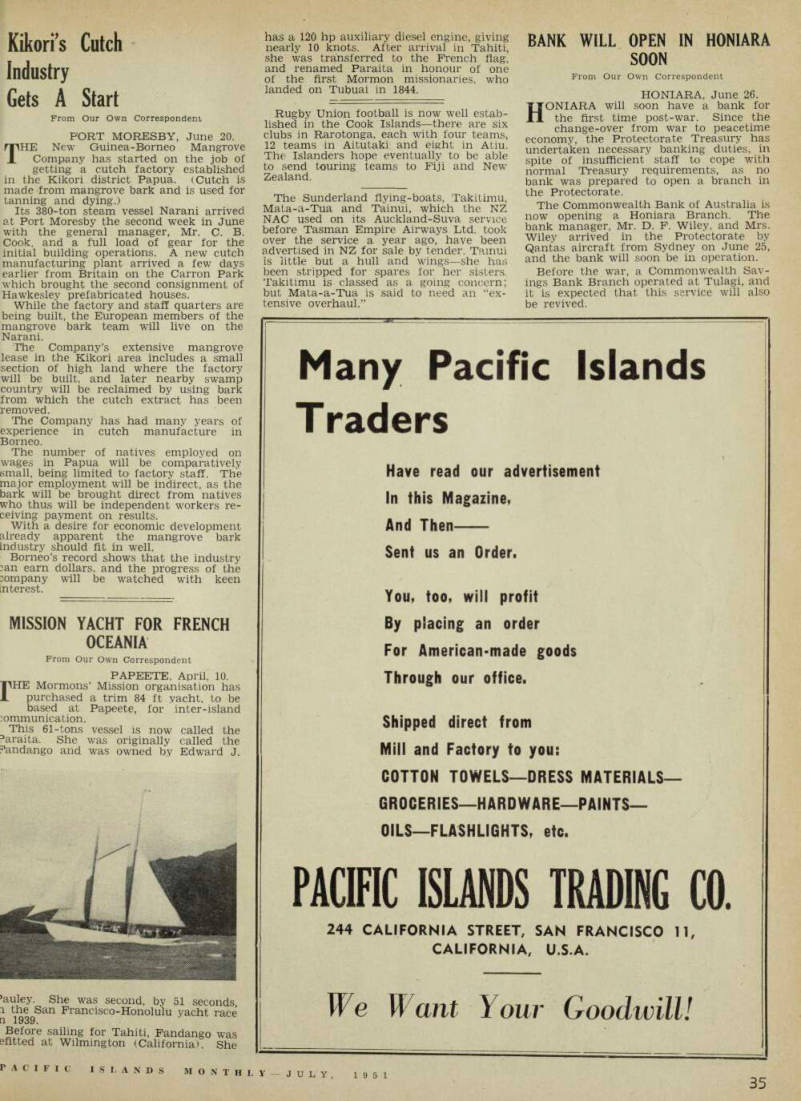
Kikori’s Cutch Industry Gets A Start
From Our Own Correspondent
Fort Moresby, June 20.
THE New Guinea-Borneo Mangrove Company has started on the job of getting a cutch factory established in the Kikori district Papua. (Cutch is made from mangrove bark and is used for tanning and dying.) Its 380-ton steam vessel Narani arrived at Port Moresby the second week in June with the general manager, Mr. C. B.
Cook, and a full load of gear for the initial building operations. A new cutch manufacturing plant arrived a few days earlier from Britain on the Carron Park which brought the second consignment of Hawkesley prefabricated houses.
While the factory and staff quarters are being built, the European members of the mangrove bark team will live on the Narani.
The Company’s extensive mangrove lease in the Kikori area includes a small section of high land where the factory will be built, and later nearby swamp country will be reclaimed by using bark from which the cutch extract has been removed.
The Company has had many years of experience in cutch manufacture in Borneo.
The number of natives employed on wages in Papua will be comparatively small, being limited to factory staff. The major employment will be indirect, as the bark will be brought direct from natives who thus will be independent workers re ceiving payment on results.
With a desire for economic development already apparent the mangrove bark industry should fit in well.
Borneo’s record shows that the industry :an earn dollars, and the progress of the company will be watched with keen interest.
Mission Yacht For French
Oceania
From Our Own Correspondent PAPEETE, April, 10. rHE Mormons’ Mission organisation has purchased a trim 84 ft yacht, to be based at Papeete, for inter-island communication.
This 61-tons vessel is now called the 3 araita. She was originally called the fandango and was owned by Edward J.
‘auley. She was second, by 51 seconds, ti t i939 San Francisco " H °nolulu yacht race Before sailing for Tahiti, Fandango was entted at Wilmington (California). She
has a 120 hp auxiliary diesel engine, giving nearly 10 knots. After arrival in Tahiti, she was transferred to the French flag, and renamed Paraita in honour of one of the first Mormon missionaries, who landed on Tubuai in 1844.
Rugby Union football is now well estab lished in the Cook Islands —there are six clubs in Rarotonga, each with four teams, 12 teams in Aitutaki and eight in Atiu.
The Islanders hope eventually to be able to send touring teams to Fiji and New Zealand.
The Sunderland flying-boats, Takitimu, Mata-a-Tua and Tainui, which the NZ NAC used on its Auckland-Suva service before Tasman Empire Airways Ltd. took over the service a year ago, have been advertised in NZ for sale by tender. Tainui is little but a hull and wings—she has been stripped for spares for her sisters.
Takitimu is classed as a going concern; but Mata-a-Tua is said to need an “ex tensive overhaul.”
Bank Will Open In Honiara
Soon
From Our Own Correspondent
Honiara, June 26.
HONIARA will soon have a bank for the first time post-war. Since the change-over from war to peacetime economy, the Protectorate Treasury has undertaken necessary banking duties, in spite of insufficient staff to cope with normal Treasury requirements, as no bank was prepared to open a branch in the Protectorate.
The Commonwealth Bank of Australia is now opening a Honiara Branch. The bank manager, Mr. D. F. Wiley, and Mrs.
Wiley arrived in the Protectorate by Qantas aircraft from Sydney on June 25, and the bank will soon be in operation.
Before the war, a Commonwealth Sav ings Bank Branch operated at Tulagi, and it is expected that this service will also be revived.
Advertisements & other items, pp. 37-38 (1 item)
Pacific Islands Trading Co.
Many Pacific Islands
T raders
I Have read our advertisement In this Magazine, And Then Sent us an Order.
You, too, will profit By placing an order For American-made goods Through our office.
Shipped direct from Mill and Factory to you:
COTTON TOWELS—DRESS MATERIALS—
GROCERIES—HARDWARE—PAINTS—
OILS—FLASHLIGHTS, etc.
PACIFIC ISLANDS TRADING CO.
244 CALIFORNIA STREET, SAN FRANCISCO 11,
CALIFORNIA, U.S.A.
We Want You Goodwill!
An ornate example of historical
keys, this XVlth Century
French key features the sporting motif in its club and animal carvings. It seems to have been the key to a Duke’s country
lodge.
.c B ■■mi
The key
to smoking pleasure
CAPSTAN
FINE CUT
NAVY CUT
TOBACCOS
or
Pacific Islanders In
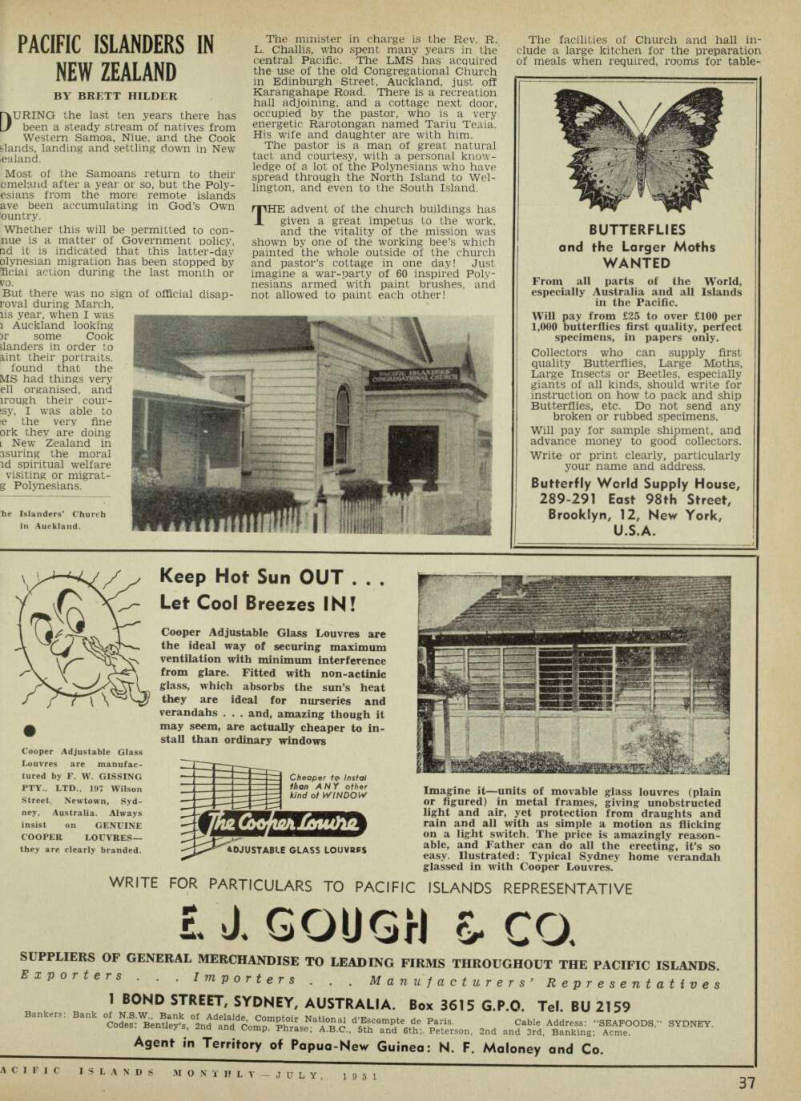
New Zealand
By Brett Hilder
DURING the last ten years there has been a steady stream of natives from Western Samoa, Niue, and the Cook slands, landing and settling down in New ealand.
Most of the Samoans return to their omeland after a year or so, but the Poly esians from the more remote islands ave been accumulating in God’s Own ountry.
Whether this will be permitted to con nue is a matter of Government policy, nd it is indicated that this latter-day olynesian migration has been stopped by ficiai action during the last month or vo.
But there was no sign of official disap roval during March,
iis year, when I was i Auckland looking )r some Cook danders in order to aint their portraits. found that the MS had things very ell organised, and irough their cour ssy, I was able to e the very fine ork they are doing l New Zealand in isuring the moral id spiritual welfare visiting or migrat g Polynesians.
The minister in charge is the Rev. R.
L. Challis, who spent many years in the central Pacific. The LMS has acquired the use of the old Congregational Church in Edinburgh Street, Auckland, just off Karangahape Road. There is a recreation hall adjoining, and a cottage next door, occupied by the pastor, who is a very energetic Rarotongan named Tariu Teaia.
His wife and daughter are with him.
The pastor is a man of great natural tact and courtesy, with a personal know ledge of a lot of the Polynesians who have spread through the North Island to Wel lington, and even to the South Island.
THE advent of the church buildings has given a great impetus to the work, and the vitality of the mission was shown by one of the working bee’s which painted the whole outside of the church and pastor’s cottage in one day! Just imagine a war-party of 60 inspired Poly nesians armed with paint brushes, arid not allowed to paint each other!
The facilities of Church and hall in clude a large kitchen for the preparation of meals when required, rooms for table
he Islanders’ Church in Auckland.
tennis, for reading, writing and study, and a “green” for indoor bowls which are now so popular in New Zealand.
The programme of events for the week is a striking example of the vigour of the members, for in addition to normal church services, there are club nights on Monday, Tuesday and Wednesday for Cook Islanders, Niueans, and Samoans respec tively; an open night on Thursday; tennis on Saturday afternoons; a social event on Saturday night; and a monthly dance.
At the same time there is a weeklv pro gramme of studies, Bible on Monday, Everyday Law on Tuesday, a Preachers’ class on Wednesday. English Reading and
Understanding on Thursday. These studies are conducted by the Rev. Challis and his wife, and a lawyer friend of the mis sion.
Typed news sheets are sent out in three languages—Samoan, Niuean and Raro tongan—to cater for the three groups.
Such a programme does not seem to leave much room for idle hands and the Devil only gets a chance for mischief on Fridays. As a layman, I should like to pay my tribute to such a shining example of mission work, to the officials both lay and clerical, and to the unseen supporters of the good work.
THERE are several points of interest in regard to these islanders which at- : tracted my attention, the first being the large number of these wanderers.
They now total 2,000 in New Zealand, about half of them being Cook Islanders, the rest mostly Samoans, with a sprink ling from Niue.
Such a large number of Cook Islanders, about 1,000, represent a fair slice of the total population of the Cooks, given as 14.000. though they can hardly be expected to have much significance in NZ com pared with the New Zealand Maoris who number about 45,000 of pure bloods.
The Cook Islanders —also known as Maoris —particularly the Rarotongans, are the closest known relatives of the NZ Maoris, having old genealogies which mesh together, and a very similar lan guage. However, a close comparison ot the two races as they live side by side in New Zealand, reveals some differences.
The most noticeable is in their skin colour. Although the islanders appear fairly dark on their arrival from the tropics, they quickly lose this tan in the colder climate, and after a few years they become so pale that one is forced to the conclusion that the Maori race, with all its Polynesian speech, culture and tra ditions, must have assimilated a much darker race of aboriginals in New Zea land.
Their darker colour could hardly be accounted for by the assumption of a few wandering tribes of Melanesians being there before them, or by the Maori canoes “touching” the fringes of Melanesia on their way to the south..
The Maori legends concerning the pre vious inhabitants of NZ, as quoted by Sir Peter Buck, described them as “tall and upright, with large bones, thin calves, prominent knees, flat faces, quick side glacing eyes, expanded nostrils, straight or lank hair, and reddish-brown skins.
They were also lazy, and hugged the fire.”
Sir Peter Buck regards this whole de scription as invalid, because the straight or lank hair would rule out the possibility of their being Melanesians. I wonder whether he has considered the chance of their being similar to the Australian abo riginals?
The description seems, to me, to fit them rather well, but perhaps Sir Peter has not seen much of the aboriginals. Similar Australoids are believed to have lived in New Caledonia, in which case there is just as much chance of their getting to New Zealand as there is of any Melan esians getting there in any numbers.
ANOTHER interesting point about the Pacific Islanders now living in New Zealand is that they are reported to keep away from the Maoris and to tend to mix more with the Europeans there Considering how little English any of them speak, and how strange must an industrial city be to them after their own remote islets, it’s very strange that they are not drawn into community with their Maori cousins.
Part of their reluctance may be due to the bad name which the Maoris have been getting around the settlements since they have been allowed free, access to hotel bars. '■ The islanders do appear to have a stronger moral fibre than the easy-going Maoris. .
At the time of writing there is a move to give the aboriginals in New South Wales a similar access to alcohol, in spite of the opinion of the police and others that the aboriginal cannot drink without losing his senses. If there is any real truth in this assertion, it might have a little bear ing on the make-up of the Maori, if he has some aboriginal ancestry in his back ground. However, we may say that even the European has hardly learned to drink decently after all these years of practice —and this criticism is very much to the
point in New South Wales, with its bar baric drinking customs.
If the Government allows the native migrants from Polynesia to remain in New Zealand, if not to increase by fur ther migration, they will form a new basis in the modern world for the esteem in which the Polynesian race has always been held.
Advertisements & other items, pp. 39-40 (2 items)
37
ACI F I C ISLANDS JULY, 1951
£. J. Gougri S. Co.
BUTTERFLIES
and the Larger Moths
WANTED
From all parts of the World, especially Australia and all Islands in the Pacific.
Will pay from £25 to over £lOO per 1,000 butterflies first quality, perfect specimens, in papers only.
Collectors who can supply first quality Butterflies, Large Moths, Large Insects or Beetles, especially giants of all kinds, should write for instruction on how to pack and ship Butterflies, etc. Do not send any broken or rubbed specimens.
Will pay for sample shipment, and advance money to good collectors.
Write or print clearly, particularly your name and address.
Butterfly World Supply House,
289-291 East 98th Street,
Brooklyn, 12, New York,
U.S.A.
oS r Cooper Adjustable Glass Louvres are manufactured by F. W. GISSING PTY., LTD., 197 Wilson Street. Newtown, Sydney. Australia. Always insist on GENUINE
COOPER LOUVRES—
they are clearly branded.
Keep Hot Sun OUT . . .
Let Cool Breezes IN!
Cooper Adjustable Glass Louvres are the ideal way of securing maximum ventilation with minimum interference from glare. Fitted with non-actinic glass, which absorbs the sun’s heat they are ideal for nurseries and verandahs . . . and, amazing though it may seem, are actually cheaper to install than ordinary windows Cheaper to Insfal than ANY other kind of WINDOW ♦;», j i •
ADJUSTABLE GLASS LOUVHES
WRITE FOR PARTICULARS TO PACIFIC ISLANDS REPRESENTATIVE Imagine it —units of movable glass louvres (plain or figured) in metal frames, giving unobstructed light and air, yet protection from draughts and rain and all with as simple a motion as flicking on a light switch. The price is amazingly reasonable, and Father can do all the erecting, it’s so easy. Ilustrated: Typical Sydney home verandah glassed in with Cooper Louvres.
£. J. GOUGrI S. CO.
SUPPLIERS OF GENERAL MERCHANDISE TO LEADING FIRMS THROUGHOUT THE PACIFIC ISLANDS.
Exporters . . . Importers . . . Manufacturers’ Representatives 1 BOND STREET, SYDNEY, AUSTRALIA. Box 3615 G.P.O. Tel. BU 2159 Bank c £ 0 5' e ®:' i°J nd d M4 d comp"pta C . Cable ''SEAFOODS." SYDNEY. 3 , rn aim uoinp. Bnrase, A.8.C., Sth and 6th; Peterson, 2nd and 3rd, Banking; Acme.
Agent in Territory of Papua-New Guinea: N. F. Maloney and Co.
3
Medicines
In One
For Fever
Headache &
Nerve Pains
Genuine v-.
Vincent’s a.p.c •;•../ provide a welllialanced combination of the three valuable medicinal ingredients: Aspirin, Phcnacetin, Caffeine.
ONE DOSE
BRINGS RELIEF!
Get Vincent's a.p.c now and from the very first dose you will obtain quick, safe relief! Vincent’s a.p.c Powders and Tablets produce a rapid change from pain, tired feeling and depression to bright, smiling alertness!
PROVED OVER 30 YEARS
Vincent's a.p.c have been proved safe and effective by thousands of men and women and these wonderful pink powders and tablets have been famous throughout Australia for over 30 years.
Take Vincent s a.p.c For
COLDS & 'FLU, RHEUMATISM
MALARIA, FATIGUE, NERVES
TOOTHACHE, NEURALGIA
HOSPITAL
PRESCRIPTION!
Genuine Vincent's a.p.c Powders and Tablets are prepared to the original hospital prescription first used by the medical superintendent of one of Australia’s largest public hospitals.
VINCENT’S FAMOUS PINK POWDERS & TABLETS
Food Short in Honiara
Copra Piles Up
From Our Own Correspondent
Honiara, June 26.
HONIARA is going through one of its periodical lean periods as regards supplies.
There is plenty to eat, but it can hardly be regarded as a varied diet. Fresh meat is obtainable only for a few weeks after the Morinda’s arrival, or on the rare occasions when one of Lever’s cattle which have run wild at Kaukua, on the Guadalcanal coast, can be brought in.
The drought weather (only five inches of rain having fallen in May, and 70 points up to June 22) has curtailed the never over-plentiful supply of fresh vege tables.
A serious rice shortage, due to lack of incoming overseas ships and consequent inadequate shipping space, has necessi tated priority for rice over other cargo.
Some employers have had to discharge labour for want of rice to feed them.
The rice position is being alleviated as far as possible by small ships such as the A. V. Evaleeta from Sydney, which arrived in the Protectorate early in June, and left again for Sydney on June 26 to pick up some more cargo for Honiara.
The A. V. Miena, which was expected to bring up cargo, has broken down at Ballina in New South Wales. Residents are being adequately but monotonously fed on such tinned meat and local pro duce as is available, with occasional small shipments of fruit and vegetables from the Districts, a few chickens and a very occasional turtle or two.
A further shock to local systems is an acute shortage of anything but water to
drink, shipping priority having been given to basic foodstuffs at the expense of the evening liquid diet. As a corollary, copra stocks are mounting owing to lack of outward shipping.
Much is hoped for in the way of in ward cargo by next Muliama and the July Morinda, and the Banks Line copra ship Lochybank is expected in the Pro tectorate about the end of July to load copra for the United Kingdom.
Advertisements & other items, pp. 41-42 (1 item)
Aidpuoh
WORLD PARITY FOR YOUR PRODUCE!
We are outright buyers of —
TROCHUS SHELL M.O.P. SHELL
IVORY NUTS GREEN SNAIL SHELL
As direct exporters to World’s consuming centres we can offer
TOP PRICES.
We supply TIMBER, DOORS, JOINERY, MOULDINGS, Etc,
W. BALCHIN PTY. LTD.
(Established 1848).
TIMBER, IMPORT Cr EXPORT MERCHANTS
Head office Also at SYDNEY: 247 George St. LONDON: 78 Gt. Bushey Drive ’Phones: BW 1538-9 Totteridge Cables: “BALCHINCO”
ONE HORSEPOWER
PETROL ENGINES
W The Amplion makes the most of your petrol, runs longer on a tankful, 8 to 10 hours to the gallon. It’s light in weight, too—4o lb.
Obviously the best proposition for driving:
ELECTRIC
LIGHTING PLANTS
Bring you brilliant electric light in your home, week-ender or plantation.
Low operating and initial costs. Treated for the tropics. •¥■ Press button starting. * * 300 watts output. ♦ * 12 and 32 volt models. * Weight 70 lb. \ Special Islands
PRICE :
£77/16/6 Pumps—Compressors—Post hole borers— Lawn mowers—Saws—Shearing Machines— Crutching Machines—Spraying outfits —Concrete Mixers —Concrete Vibrators —Milking Machines.
★ 4 CYCLE AIR COOLED DESIGN
★ FULL FLOAT CARBURETTOR
★ EFFICIENT AIR CLEANER
F. 0.8.
PRICE:
£4l/8/6
DISTRIBUTORS THROUGHOUT
AUSTRALIA AND THE ISLANDS,
AIdPUOH
(Australasia) Pty. Ltd. 36-40 Parramatta Road, Camperdown.
Telegrams: Amplion, Sydney Telephone: LA 2828 (6 lines)
LAUREL
UUREL
Kerosene Ke sene ro
PANV
CO
VACUUM
For the best light
at the lowest cost
always use
LAUREL
also ideal for
Cooking and Refrigeration
VACUUM OIL CO
LTD. (Inc. in A u st.)
VACUUM
MODULI
The Outlook For Copra
Factors Which Influence Future of Pacifies Staple Product
In this article, specially written for Pacific Islands Monthly, JB (an ex perienced coconut planter), shrewdly and convincingly discusses the prospects of the copra-producing industry. His references to the possible extended use of margarine are of particular interest at the present time.
THE Pacific planter who wishes to fore cast the trend of the copra market in the years to come finds difficulty in obtaining accurate information on which to base his estimates.
In the British sections of the copra world, Government control —which is per haps the most important feature of post war production—appears to be more concerned with tying up production than with any long-range plans for develop ment of the industry.
One result of this policy is that owners of coconut plantations and prospective investors in tne Islands have been forced to the conclusion that, whilst existing plantations can be worked at a profit, there is not sufficient inducement to warrant the heavy expense and time involved in laying-out new plantations.
After World War I, in the Mandated Territory of New Guinea, a fairly heavy planting programme was undertaken.
Even under the Expropriation Board (which was mainly concerned with the maintenance of plantations until the properties were sold) many new areas of palms were laid down; and, when the plantations were disposed of by tender, 10 difficulty was experienced in obtain ing bids for virgin land suitable for the establishment of coconut plantations.
From the time the Expropriation Board :ook over, early in 1920, a steady fall took ilace in the world price of copra. Where is, in 1920, the price was in excess of £3O ier ton, and remained above that figure for three or four years, by 1925 the price had fallen below £3O and. month by month, we saw a steady falling away in vorld prices, until the disastrous collanse )f copra prices—along with the collapse of nirnary products prices generally—oc ;urred during the depression years.
During the years of depression, and the var years, practically no new plantations vere established in any copra-producing irea of the world; and indications are hat very little new planting has taken )lace since the war finished. In addition, n some areas, plantations were destroyed >r damaged as a result of war activities.
Uso, a proportion of very old plantings vent out of production.
Most producing countries have not got jack to pre-war production figures. It s very doubtful whether pre-war figures ;an be obtained for many years to come.
SUBSTITUTES for coconut oil have not J made the headway that their spon sors expected. The failure of the Ministry of Pood’s groundnuts scheme in Africa is a case in point. Before the war, ilso, whale fishing provided an important übstitute for coconut oil, and the cheap ness of whale oil was used as a lever to lepress the price of copra. Whale fishing s no longer cheap, nor is the volume of ►reduction from this source to be corn ered with that of pre-war days.
The question of demand requires at ention, in order to make a long-term orecast. In many countries of the world margarine is not a substitute for butter
but the primary staple for people who have never been able to afford butter.
Australia, New Zealand and Great Britain now enjoy the cheapest butter in the world. In Australia the price of butter is heavily subsidised in order that it may retail at 2/2 per lb. A large in crease in the present subsidy is long over due. The price of butter in Great Britain is kept low because of the existence of long-term agreements between the Min istry of Food and the Governments of Australia and New Zealand. In western
European countries the average price is around 6/- per lb., and in USA 8/- per lb.
With the present drift from the dairy
ing industry in Australia, and the diver sion of an ever-increasing proportion of milk to the manufacture of milk products other than butter (a tendency which is world-wide in dairying countries, and not unique to Australia) the statistical posi tion for high world-parity butter prices for years to come seems assured.
The comparison between butter pro duction in Australia and the production of copra in the British sections of the Pacific is very close.
Neither the dairying industry nor the
production of copra, can be greatly in creased overnight. The population of the world is increasing fast; but a more im portant factor in maintaining demand will be found in the improved standards of living demanded by the peoples of the world.
WORLD parity prices for copra to-day are well over £I3OA per ton at European or American ports. In countries where planters are in a position to sell at world parity prices, this will be
a powerful inducement to increase their planted areas, where suitable land is avail able.
In the Pacific countries, however, where the price is controlled, to the disadvantage of planters, a policy of stagnation will en sue until the price is increased to an amount which will act as a spur to plan ters to take the risk of what their returns will be in 10 or 12 years after planting, when the areas really come into bearing.
INCREASES in costs since the inception of the British Ministry of Food’s nine years marketing agreements have, in most cases, wiped out completely the bene fits of any increased prices under the annual revision clauses.
On June 13, 1951, the Chairman of the Colonial Sugar Refining Co. stated, in regard to the price of jute; “Abandonment of price control (in India) on both raw and manufactured jute goods . . . resulted in a phenomenal increase on the previous official prices. Cornsacks . . . rose quickly from 3/4 to 5/- each and are now around 6 6, compared with 7«d in 1939. ...” That is an illustration of how production costs have been affected.
Tinned meats (for ration purposes) are around £5/10/- to £6/10/- per case of 48/12 oz. tins at Island ports. Before the war the cost would have been around 30per case, or less. Calicos, which cost around 4d. or sd. per yard pre-war, are now between 5/- and 6/- per yard, and becoming almost unprocurable. Equipment costs have soared. In 1926 to 1928 the Expropriation Board was able to charter ships to load copra at Rabaul and other islands ports for shipment to Europe at around 30/per ton. At present it costs four, five, or six times that much to ship copra to Syd ney. Rice, the chief food for labour on many plantations, is now about eight times pre-war cost.
IITITH high wages and boundless oppor ▼ f tunities for well-paid employment in Australia, it is very difficult for plan iation companies or individual owners of plantations to obtain suitable European itaff, although they are prepared to offer >reviously unheard-of inducements in the vay of salary, bonuses, and amenities.
Native employees, demoralised to- a great ixtent by the War, and encouraged by nexperienced Government officials and >oliticians, are expensive and inefficient, rhe virtual abandonment of the long erm labour contract makes it very diffi ult for the plantation manager to bring lewly recruited labour to a reasonable tandard of efficiency.
The Governments of the Pacific should ecide quickly whether they wish the copra idustry to decay over the coming years, r whether they are prepared to alter tieir policies in order to give positive en ouragement to an industry which at one ime merited the name of “The Consols f the Pacific ,5 The development and economic stability f the copra industry must no longer be abordinated to the desire of the various (ritish Governments controlling Pacific jrritories to provide cheap copra for the linistry of Food.
Advertisements & other items, pp. 43-44 (1 item)
Robert Gillespie
BUSINESS EXECUTIVES !
Increase your business between Australia, Prance and French Overseas Territories.
Join the French Chamber of Commerce in Australia now.
Ask for a free copy of our BULLETIN.
HOMMES D'AFFAIRES !
Augmentez votre chiffre d’affaires entre I’Australie, la France et les Territoires Francais d’Outre-Mer. Devenez Membre de la Chambre de Commerce Francaise en Australie.
Demandez un exemplaire gratuit de notre
BULLETIN.
FRENCH CHAMBER OF
COMMERCE IN AUSTRALIA
72 Pitt Street. Sydney. Tel. BL 1936.
WHOL9SAL
MANUFACTURERS AGENTS
r Mr
CHANTS 1
f re
EET
X mb 9k iv. ft C u C£
ROBERT GILLESPIE
NEW GUINEA |^jp
HEAD OFFICE LAE
BRANCH OFFICE RABAUL
cAqen+s ROBERT GILLESPIE PTY.LTD.
54a Pitt Street
A Guaranteed Sanitary System
Approved by the N.S.W. Board of Health.
THE HYGEIA DISSOLVENATOR
Established 1927.
No Water Supply Required
The Sewage matter is chemically transformed into a sterile solution which is absorbed by the surrounding soli.
NO FLIES
NO GERMS
NO SMELLS
NO EMPTYING
AUTOMATIC >
Any handy man can install.. J Correspondence Invited.
HYGEIA SANITARY COMPANY PTY. LTD,
26-30 BRIDGE STREET, SYDNEY, N.S.W.
Phone: BU 2521 Cables: “Berbl,” Sydney ■ ■
G. H. ROBINSON EXPORTS & IMPORTS PTY. LTD.
Pacific Island Traders and Merchants.
Sole Distributor of Bradford Commercial Sellers on Commission of all kinds of Vehicles, Jowett Javelin Cars and Uniporn Island produce—Cocoa Beans, Green Snail, Diesel Engines—(Franchises available in Copra, Fungus, M.O.P. Shell, Trochus certain Pacific Groups.) Shell, etc.
Agents in London and Manchester for the Disposal and Supply of Produce and Special Requirements.
EVERY ATTENTION GIVEN TO ORDERS IRRESPECTIVE OF SIZE.
Make use of our 30 years’ personal experience and direct your inquiries to: G. H. ROBINSON EXPORTS & IMPORTS PTY. LTD. 51 MACQUARIE STREET, SYDNEY. Telephone; BW 4575.
Cables: “SUNRISE,” SYDNEY. Postal Address: Box 3317, G.P.0., Sydney
Niueans Visit American
Samoa
From Our Own Correspondent
Niue. May 15.
JINETY-TWO Niueans and eight Euro- N peans chartered the Manuatele from the American Samoan Government l May in order to visit Tutuila. The ip was organised by the Niuean Church the London Missionary Society as they ished to visit their members resident in le American Territory.
The arrangement, as it subsequently de doped, was a benefit to the island as the jssel was the first contact with the out ie for four months. A few badly-needed ores were obtained and an outward mail as dispatched. Several replacements r the Administration staff were also >le to take up their appointments.
The Niuean party was welcomed by the jw Governor of American Samoa, the on. Phelps-Phelps. The Niueans, ac rding to their custom, made presenta ms to the Governor and Commander lick and other members of the Adminis ation staff.
The Governor said that he thought such ter island visits were beneficial to better iderstanding between Polynesian peoples they broadened their knowledge of the ly in which they lived and the condi >ns of life. He expressed the hope that ore visists would be arranged.
The Niueans were treated royally by the ople of Tutuila during their stay. It hoped to soon charter the Manuatele ain, either for a trip to Tonga or a re rn trip to Tutuila.
Death Of H. J. Berryman
Ir. Harold John Berryman, One
of New Guinea’s early aviation pioneers, died at his home in storia on June 14.
He was one of those responsible for the production of Junkers transport planes ;o New Guinea in the late 20’s. It was sse planes which made the dredging of 3 Bulolo Valley possible.
Vlr. Berryman served with the Royal val Air Service before and during irld War 1. He was 67.
He is survived by his wife, three Lighters and a son.
Mr. Robert Boulton of Suva, has been pointed to the staff of Burns Philo at ae. He arrived on the June Matua.
Some Reach!
THE things these reporters write!
When Mrs. Harold Rabling, wife of Vacuum Oil Co.’s chief, returned to Melbourne recently after a visit to Fiji, a female gossip columnist had it that Mrs.
Rabling was enthusiastic about the colony “where frangipanni blossoms floated to the ground and ripe coconuts fall at a touch.”
Could be, of course, that the coconuts in question were of the dwarf variety.
Advertisements & other items, pp. 45-46 (2 items)
43
%CI F I C ISLANDS MONTHLY JULY, 1951
paint
ART POSTCARDS OF
TONGA
Per Dozen (Including a Tin-Can Mail Cover), Postage Paid: 6/- (or one US Dollar).
TONGAN PHOTOS BUREAU
Nukualofa, Tonga
where
HEAT
hits the high spots The ever-changing conditions of tropical climates demand the use of only the best possible paint for adequate protection of property and equipment.
For nearly two hundred years Berger has lead in the field of paints and finishes and gives you the benefits of vast research and experience in the Berger product. ergei uppr CloS m
paint
KEEPS ON KEEPING ON
BURNS PHILP (SOUTH SEA) Go. ltd.
Registered Office: SUVA, FIJI
Code Address: “BURNSOUTH”
ISLAND TRADERS AND SHIPOWNERS
General Merchants (Wholesale and Retail)
Shipping, Customs and General Agents
Representatives ;
QUEENSLAND INSURANCE CO. LTD. BURNS PHILP TRUST CO. LTD.
Distributing Agents :
SHELL COMPANY (P. 1.) LTD. FERGUSON TRACTORS STANDARD MOTOR CAR COMPANY CROSSLEY MARINE ENGINES
BRANCHES:
FIJI—
SUVA.
LEVUKA.
LAUTOKA.
LABASA.
BA.
SIGATOKA.
TAVUA.
ROTUMA ISLAND.
NORFOLK ISLAND.
SAMOA—
APIA.
PAGO PAGO.
TONGA—
NUKUALOFA.
HAAPAI.
VAVAU.
NIUE ISLAND.
Sydney Agents:
BURNS, PHILP & CO. LTD.,
7 Bridge Street.
London Agents:
BURNS, PHILP & CO. LTD.,
35 Crutched Friars, E.C.3.
San Francisco Agents:
BURNS-PHILP CO. OF SAN FRANCISCO INC.
Matson Building, 215 Market Street.
Agencies Throughout the World.
TASTY
12
SAHDVYKHES FROM
one teaspoonful
OF BOVR'L
* V tfT. ■f' 3> S-i ?l r ? » ■“ 1
BOVRIL
makes a good spread!
Everyone enjoys delicious sandwiches made with Bovril.
They’re tasty, economical and just right for every occasion.
BOVRIL
puts Beef into you
Agents: BURNS, PHILP {NEW GUINEA) LTD
Madang Newsletter
From Our Own Correspondent
Madang, June 28.
THE wedding of Miss Pat Skene to Mr.
Reg. Vogler took place at the Madang Catholic Church, on June 23. Mr. T. Huxley gave the bride away, while Miss Thelma Huxley acted as bridesmaid, and Mr. “Lofty” Whitehead as best man.
Afterwards the guests gathered at the borne of Mr. and Mrs. R. Mitchell, where the breakfast was served al fresco.
At Tusbab, the Native Education Centre, a gala day and night celebrated their anniversary. Prizes for athletic “vents were presented by the District Commissioner, Mr. lan Downs. The en rolment now stands at 90 males and 77 'emales.
Dr. and Mrs. T. G. Braun, from Vagaum Lutheran Hospital, have gone Dn 12 months’ leave in the United States.
While there, Dr. Braun will do a six months’ post-graduate course.
The staff of the local Commonwealth Bank has grown to five.
Mr. Hardwick is in charge of the new duster plane being used by the American Lutheran Mission for freighting to and :rom the Highlands.
Late in June, Mr. Donald Smith, of the American Consular service in Australia, made a short visit to Madang to observe the welfare and general conditions of Americans living in Madang. Most of :hem are attached to the Lutheran and Catholic Mission Centres.
Among plane travellers South in June were Mr. J. Duncan, manager of the Madang Marine Workshops, and Mrs.
Duncan; Mr. Tom Leyer, foreman car penter of Works and Housing Dept.; ind Mr. Roy Collins, manager of Modillon Victors —he joined his wife and family in Melbourne. Mrs. H. Longmore, with laughter Janice, flew South for health reasons.
UNEXPECTED travellers on the MV Malaita were Mr. and Mrs. Jack Sherry and family; Mr. Sherry is ;oing South on medical advice.
On June 5, pupils of Madang Private Kindergarten, assisted by their elder Asters, presented a Musical Revue, The Awakening of Spring.
The cast: Ann and Sue Willis, Suzanne Brown and Margot Herriot as flower dairies; Wally Weidenhofer, Johnny Sherry and Sandy Esson as caterpillar goblins; Marie and Maureen Sherry, 31za and Robyn Nolan and Glynnis Clark is Spring Fairies; Helen Reason (Caps Eligney) as Fairy of Lavender Blue and
Margaret Weidenhofer as the Kinder garten teacher or Butterfly fairy.
The audience of 80 consisted of parents and associate members, who assisted in the production and prepared the delight ful buffet meal served on the lawn after the show.
As it was the Kindergarten Anniver sary, a birthday cake was cut and the one candle blown out by the children on stage.
All the children received a birthday present and a posy.
Chinese contract labour is building three new R-Type houses on Kalibobo.
Other blocks are being cleared and offered for tender.
Handrails have been added to the bridge across the neck of the lagoon joining Kalibobo residential area to the business centre. These add to the pic
turesque qualities of the bridge but for perfect safety, foot bridges either side are still necessary.
Madang’s younger children really had something to talk about after Brody Shields’ birthday party. Mrs. Shields decorated the cake in the form of a warship, with pins and cotton for the rails, flags and candles for the guns. So fascinated was Brody, when the candles were lit, that he would not blow them out and the flags caught alight.
Mr. W. Spencer left Madang by plane for Port Moresby on June 26. His wife and family expect to join him soon. The Spencers will be missed by many in the district.
A New Zealand poultry expert, Mr. J.
Kissling, visited Fiji in July to advise local poultry farmers on their problems.
There are 50 veterans of the last war living at Niue. They banded together and formed a branch of the RSA which is affiliated with the NZRSA. The “old Soldiers” paraded at Alofi on Anzac Day, which has recently been declared a public holiday hy the NZ Government. They first met at dawn at the Alofi War Mem orial where the Resident Commissioner and the Rev. M. G. Check took part in a short service. Later, a service was held in the Alofi Church and was attended by the Resident Commissioner and Mrs. Lar sen. and European returned servicemen resident in Niue.
Advertisements & other items, pp. 47-48 (1 item)
Gabriel Achun
"ACME" and "ESCO"
LINE DATERS
for Clearness and Uniformity
These daters surpass others of similar kind.
Made in various styles and sizes—the year hand is good for many years.
C/W£ wr
VIM
in *wvA 19*3 Bands with
special
characters made to order.
Bands revolve on metal rollers and are of special quality rubber
rmrnmmm .lU]
iiiKiriitnniirii Miii piii
Manufacturers of Rubber Stamps, Pads, Inks, Stencils, etc.
HEAD OFFICE:
160 BROADWAY,
SYDNEY, N.S.W.
50 Victoria Street,
WELLINGTON, N.Z
278 Post Office Place,
MELBOURNE, VIC.
Sole Australasian Representative of AEROGRAPH-DeVILBISS Spray Painting and Finishing Equipment.
GABRIEL ACHUN
Importer and Wholesale Merchant
Specialises in:
BEERS
BICYCLES
AERATED WATER MANUFACTURING
COTTON PIECEGOODS FOR NATIVE TRADE
AGENT FOR “STANDARD” AND “TRIUMPH” CARS
Malaguna Road
RABAUL
Territory of New Guinea Proprietor:
RABAUL CORDIAL FACTORY.
Telegraphic Address:
“GABRIEL ACHUN,” RABAUL.
TAHITI
To Shipmasters and Visitors
When calling at Tahiti, and seeking SHIPS SUPPLIES and FRESH
PROVISIONS, see—
OSCAR G. NORDMAN
Supply Agent for Messageries Maritimes, Union S.S. Co. of N.Z. Ltd., Matson-Oceanic Line, United States Line, General S.S. Corp., Etc.
We supply General Service Act as Shipping Agents Address all inquiries to the Tourist Bureau.
OSCAR G. NORDMAN
Ship Chandler
PAPEETE. TAHITI
Wire before your arrival to
“OCEANIC, PAPEETE” —Our
registered cable address.
IkeAKTAVITEwauto
Good nutrition and really buoyant health go hand in hand.
Modern cooking methods can destroy a hif h proportion of the vitamins in our food ana, although our meals may satisfy our appetites, the essential vitamins may be lacking.
A diet inadequate in vitamins can so frequently cause, especially in tropical climates, troublesome “run-down” conditions characterised by lassitude, nerviness, sleeplessness, loss of appetite, etc. ‘AKTA-VITE’ Nutritive Food Tonic is valuable in correcting these conditions, particularly because it provides definite and stated quantities of four vitamins essential to good nutrition.
Each two teaspoonful dose contains: Vitamin A 2000 International Units Vitamin Bl 300 „ Vitamin C 300 „ „ Vitamin D 1000 „ plus calcium, phosphorus and carbohydrate. ‘AKTA-VITE’ is especially valuable for nursing mothers and growing children.
trio*
ST i' <3 t % y
FOR
ALL
AGE
GROUPS
‘ AKTA-VITE ’ is so pleasant and easy to take : it combines the four vitamins, together with calcium and phosphorus in delicious crunchy granules. This can be taken as such straight off a spoon, mixed with t ot cr chilled milk to make a pleasant drink, spread on sandwiches or sprinkled on other loods, desserts cereals, etc. To preserve the vitamins. ‘AKTA-VITE’ should not be cooked with foods but added when serving.
Ethical Division NICHOLAS PTY. LTD. Melbourne, Sydney. Brisbane Adelaide, and Perth.
AE P 3
Romney Marsh Sheep In New
Guinea
THE first two years of sheep farming at Nondugl, New Guinea Central Highlands, seems to indicate that Romney Marsh sheep will thrive in that country.
Nondugl is 5,000 feet above sea level and has an annual rainfall of 90 inches.
The land is carrying about seven sheep to the acre of pasture and the original 1,000 sheep have increased most satis factorily—lambing has been about 80 per cent.
Possibilities Of Kenaf Fibre
EXTENSIVE experiments in the growing of kenaf fibre are being undertaken in Papua-New Guinea by the local Department of Agriculture from seed im ported from Cuba by one of the principals of Colyer Watson Ltd.
It is understood that about four acres have been planted and that the plants are doing: well.
Kenaf is one of the quickest maturing fibres—it is ready for harvesting about three months after planting. The fibre is obtained from the tissue .iust under the bark of the stem and under favourable conditions can produce about one ton of dry fibre per acre. Thousands of acres would have to be planted before kenaf could be counted a commercial success but, to date, it promises to be the most likely substitute for scarce Pakistan jute.
Kenaf was grown experimentally by the NSW Department of Agriculture in Northern NSW in 1942 but little has been heard of the results. It also has been grown in South Africa where the Govern ment, in 1949, was guaranteeing growers £65 per ton of fibre or the ruling Cal cutta price for jute, whichever was the higher.
Kenaf makes a very strong fibre but there is doubt whether it can be grown in sufficient quantities in New Guinea to make any impression on the jute shortage.
It probably could be grown to better effect in Queensland —but Australia’s agricultural economy is so overstrained at present that it is unlikely that any new crop will get much of a chance.
The motor vessel, Manu’a Tele, recently took a party of 14 lepers from Apia, Wes tern Samoa, to the Leper island of Mako gai, Fiji.
Honiara Prepared For Big Bang
But It Did Not Go Off
From Our Own Correspondent
Honiara, June 24.
HONIARA was thrown into some consternation on June 19, when a fire broke out in a small ammunition dump on which the Australian Services Bomb Disposal Unit, at present in the Solomons, was working.
Most of the ammunition being handled is in a potentially dangerous condition owing to age and exposure to the weather, and an Oerlikon shell is reported to have exploded and set alight some cordite which scattered and ignited further shells.
One native labourer was killed and three injured, and one European member of the unit was admitted to hospital for observation suffering from shock and minor shrapnel wounds.
The small dump where the trouble started is about half a mile from the big dump locally known as Hell’s Point, some 10 mies from Honiara, where an accumu lation of shells roughly estimated at 37,000 tons, is heaped up. With the drought weather prevailing it was pos sible that a grass fire, or hot shrapnel fragments falling on the Hell’s Point dump, might send the whole collection up, and in view of the considerable blast effect to be expected if Hell’s Point went up, precautions were hastily organised.
A road block was established between Honiara and Hell’s Point. A 24-hour watch was set up at the Honiara Radio Station. Police and members of the Bomb Disposal Unit kept a constant watch on the dumps, and a warning siren which has replaced the old Public Works De partment “bello” was to be continuously sounded in the event of danger.
It was planned to evacuate European women and children to the Rove Police Depot and Training School, where they were to remain confined in the Rove prison area, which is sheltered by high hills.
Natives in the vicinity of Honiara were told to assemble in the Cruz Creek area, which is also sheltered, if the siren sounded, and the Chinese settlement was instructed to take shelter between the deep banks of the Matanikau River.
These precautions fortunately did not have to be put into action, the fire at the smaller dump being brought under control and extinguished, and by the morning of the 20th the “alert” was dis continued, without any further damage or casualties having occurred.
The excitement while it lasted was con siderable. There are, however, many valleys running towards the sea between the coastal hills, and these hills provide excellent natural obstacles to any blast from explosions, though it was thought that Honiara buildings might suffer. All Public Works Department Trucks were “grounded” and lined up in readiness to evacuate hospital patients and provide transport generally. The P.W.D. philo sophically took the opportunity of getting all their heavy vehicles oiled and greased during the “standby” period, the trucks being freed for once from their almost continuous normal duties.
THE odd grenade embedded in a road surface and shells and other bombs in gardens and ditches, were a com monplace in Honiara life before the arrival of the Bomb Disposal Unit, and a red-painted sign which read “Unex posives—Keep Clear” or just a couple of sticks crossed as a tambu sign were often called into use.
The township area has now been
cleared but the large dumps, which contaln a bewildering variety of all kinds of shells, bombs, grenades, flares and so on, present an awkward problem for disposal.
Residents who arrived shortly after the war got used to the presence of all this within 10 miles of the township and are inclined to be perhaps unduly fatalistic, ' They’ll go up, or they won’t” being a fairly usual outlook, but it is recognised that the Government must take all possible precautions if there is any chance of a major explosion, particularly in one of the drought periods which occur now and then in the Honiara section of the coastline.
Mr. P. A. Richardson, has been ap pointed Secretary to Government, British Solomon Islands Protectorate, succeeding Mr. \. J. Andersen who is shortly going on leave. Mr. Richardson, who amved m the Protectorate at the end of May, was formerly with the administration in Tonga.
Mr. K. Maesepp, managing director of Island Electric Co., Suva, Fiji, is at present on a lengthy business trip to Australia, He emphasises that there is enough hydro electric power in the mountains of Viti Levu to run all the machinery, transport and kitchens in Fiji—if only the equip ment were made available.
Advertisements & other items, pp. 49-50 (1 item)
I Pan A
TAKE THIS
MOST IMPORTANT STEP
to kccp Teem sparkling mne
use
I PAN A
TOOTH PASTE
Doctors and dertists all agree that gum troubles are the cause of most tooth extractions. That's one important reason why you should always use IPANA— the tooth paste that keeps both teeth and gums clean and healthy.
IPANA gives lasting radiance to your smile because It protects as well as cleans jjpS your teeth to sparkling whiteness.
Sold Everywhere X T * <</ ft y V O O IP a0 d spa« klE T ° Y ount
SMILi
F 111
A PRODUCT OF i]iL< BRISTOL-MYERS
World-Wid
TROPICAL
e v * /. *
0 of th'c-
Reception
MON D
RECEIVERS
CRAMMOND ”
TROPIC PORTABLE
You’ll find day and night reception perfect on every station throughout the world with a 6 Valve Dual or Triple Wave CRAMMOND
TROPIC PORTABLE. The CRAMMOND
PORTABLE is specially suited for tropic conditions and is Tropic-proofed.
The cabinet is attractively covered with leatherette and will withstand all weather conditions.
This set is also available for use with ; 6 Volt Battery or A.C. Supply (240 Volts 50 Cycles). ( HAMMOND TROPIC RECEIVERS embody all that is new in radio and will provide a Lifetime of Service and Satisfaction. You’ll be wise to write to CRAMMONDS when you need your new radio— CRAMMOND TROPIC RECEIVERS are unequalled. They include the famous TROPIC EAGLE and TROPIC HAWK—write now for full particulars.
CRAMMOND RADIO
TROP I COL D!VON
NO 8 QUEEN STREET.
i-'l
stands Get NZ Ships At Last

Matua, Maui Pomare and Alexander on the Job
HHE motor vessel, Matua, manned by a [ scratch crew which left Auckland for Suva, Apia and Tonga at the end : May, and Maui Pomare, which left NZ ith a volunteer crew in mid-June for ie Cook Islands, have done something ) relieve the acute shortage of foodstuffs id other essential supplies which de floped in the South Pacific territories > a result of the four-months-long NZ aterside dispute.
Fiji has fared somewhat better than ie other islands as Australian cargo ships i the Sydney-Vancouver route have been )le to take supplies to the Colony. Her ain shortages were fresh meat, potatoes id onions—but as these last two commo ties have been unprocurable in Australia lyway, it can be said that they are no □rse off than the Sydney housewife.
There were acute shortages of flour, igar, butter and canned goods in the ,her Island territories^—particularly in ie Cooks which have been cut off from ew Zealand, except by air, since the aui Pomare’s last call in February.
After her return to NZ in February, ;aui Pomare was withdrawn for annual irvey. By the time she was ready to re ime service the waterfront dispute had sd up all NZ shipping.
In addition to shortage of supplies, the ick Islanders who depend on their fruit :port for ready cash, had been unable ship their crops. This had meant fur ler hardship. On her return trip, Maui imare is expected to lift 5,000 cases of trus fruit and 600 cases of tomatoes for nckland.
A 48-YEAR-OLD 300-tonher which was rescued six months ago from Nelson mudflats where she has been lying for several years, is doing a great job carrying essential supplies to Suva during the hold-up.
She is the Alexander, once part of the Anchor Shipping Co.’s Cook Straight fleet plying between Nelson and Wellington.
A group of young men bought her some months ago for trading in the islands. She has acquired the title of Little Mercy Ship and made her second Pacific Island run in mid-June with 300 tons of potatoes, onions and canned meat for Suva.
The NZ Minister in charge of Island Territories said that the response to the call for volunteers to man Maui Pomare was splendid and that the Government could hot avail itself of all the offers that had been received. Cook Islanders living in New Zealand had been eager to help and 18 had been included in the crew.
The Rev. W. Gibbins. a Baptist Minister from Newcastle, NSW, has become director of the South Seas Evangelical Mission which has its headquarters in the Solomons. He will leave Sydney on July 7, for his new job. His wife will follow same weeks later.
United Kingdom?
Fijian Cricketers For
MR. P. A. SNOW, well-known Admin istrative Officer and cricketer, of Fiji, left Sydney in the May Orcades for leave in the United Kingdom. While there he hopes to arrange a tour of a Fijian cricket team similar to that which toured New Zealand in 1948.
He says that he is not looking for a Test series with England; he hopes to arrange a tour —and the MCC is inter ested —to play the bottom six teams in the County League and the top six minor County teams. He considers that the Fijians would more than hold their own in this company and he bases his opinion on his knowledge of English cricket. He was a former Cambridge and County cricketer before he went to Fiji 15 years ago.
Empire Day celebrations in Madang, New Guinea, included a European sports meeting on Madang Oval which was organised by Mr, R. Johnston. Novelty races caused more amusement to the spectators than to the entrants who were too puffed to drink beer supplied by Mr.
T. Huxley as one of the “obstacles.”
Advertisements & other items, p. 51 (2 items)
49
ACIFIC ISLANDS MONTHLY— JULY, 1951
Sew Tilley
Allen Taylor & Co. Ltd.
COMMERCIAL ROAD, ROZELLE, SYDNEY
Sawmillers and Wholesale Suppliers of Hardwoods for Contructional Purposes GIRDERS . . . PILES . . . POLES . . . SLEEPERS, Etc.
Exporting to the Pacific Islands Since 1893.
Sew TILLEY
KEROSENE DOMESTIC IRON
MODEL DN2SO
MADE AT HENDON. ENGLAND
BY THE MANUFACTURERS OF
THE WORLD-FAMOUS TILLEY
LAMPS AND RADIATORS
WEIGHT 5 LBS. INCLUDING OIL
NO FLEXES-NO WIRES
SIMPLE HEAT CONTROL
SPARKLING MODERN FINISH
IN CHROMIUM & CREAM
EVEN HEAT DISTRIBUTION
EXTRA LARGE IRONING PLATE
WITH BEVELLED EDGE
• NOT AFFECTED BY DRAUGHT
THUMB-RESTS FOR RIGHT OR
LEFT HAND WORKING
• VITREOUS ENAMELLED BODY
G
limit
Send for complete
details to: — BRITISH PAT. No. 5247 H AUSTRALIAN PAT. No. 114305 AUSTRALIA & NEW GUINEA; T. H. Bentley, Pty. Ltd., 123-125 William
Street, Melbourne, C.l.
TASMANIA: Mr. H. V. Sellers, 108 a Charles Street, Launceston.
FIJI: Mr. K. Witherington, 2 Burns Philp Buildings, Suva.
Oil Search In Papua
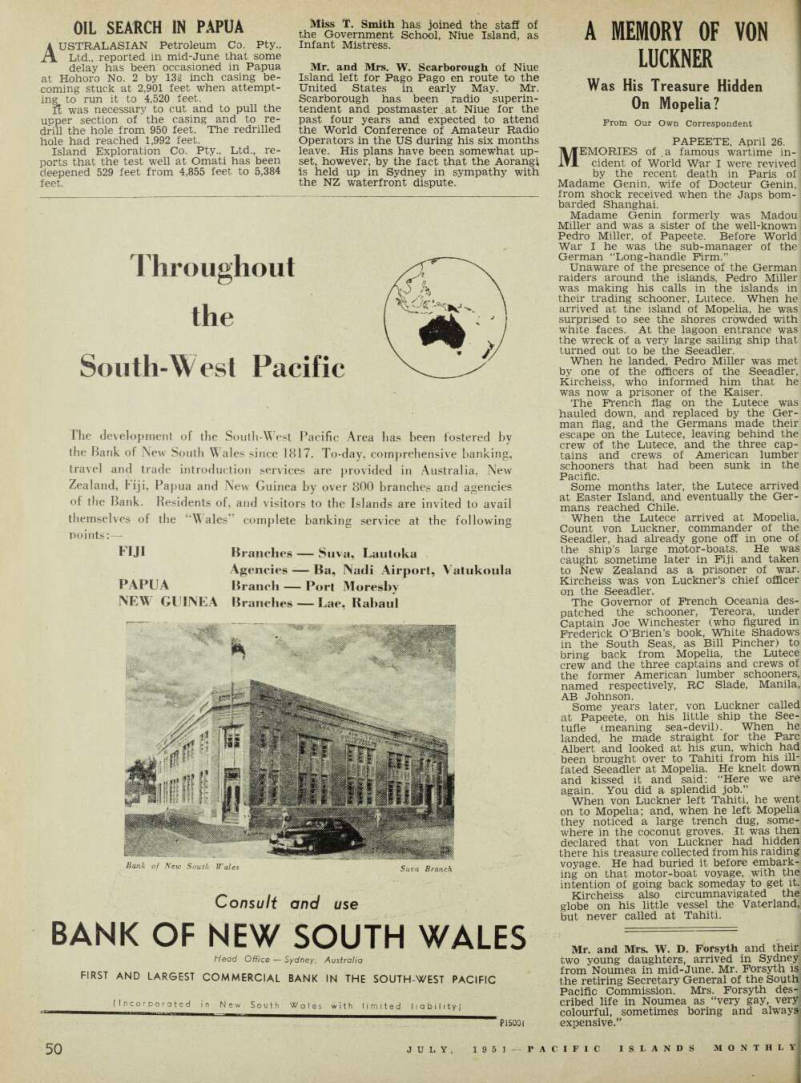
Australasian Petroleum Co. Pty., Ltd., reported in mid-June that some delay has been occasioned in Papua at Hohoro No. 2 by 13g inch casing be coming stuck at 2,901 feet when attempt ing to run it to 4,520 feet. ft was necessary to cut and to pull the uoper section of the casing and to re drill the hole from 950 feet. The redrilled hole had reached 1,992 feet.
Island Exploration Co. Pty., Ltd., re ports that the test well at Omati has been deepened 529 feet from 4,855 feet to 5,384 feet.
Miss T. Smith has joined the staff of the Government School, Niue Island, as Infant Mistress.
Mr. and Mrs. W. Scarborough of Niue Island left for Pago Pago en route to the United States in early May. Mr.
Scarborough has been radio superin tendent and postmaster at Niue for the past four years and expected to attend the World Conference of Amateur Radio Operators in the US during his six months leave. His plans have been somewhat up set, however, by the fact that the Aorangi is held up in Sydney in sympathy with the NZ waterfront dispute.
A Memory Of Von
Luckner
Was His Treasure Hidden On Mopelia?
From Our Own Correspondent PAPEETE. April 26.
MEMORIES of . a famous wartime in cident of World war I were revived by the recent death in Paris of - Madame Genin, wife of Docteur Genin, from shock received when the Japs bom barded Shanghai.
Madame Genin formerly was Madou Miller and was a sister of the well-known Pedro Miller, of Papeete. Before World War I he was the sub-manager of the German “Long-handle Firm.”
Unaware of the presence of the German raiders around the islands, Pedro Miller was making his calls in the islands in their trading schooner, Lutece. When he arrived at the island of Mopelia, he was surprised to see the shores crowded with white faces. At the lagoon entrance was the wreck of a very large sailing ship that turned out to be the Seeadler.
When he landed, Pedro Miller was met by one of the officers of the Seeadler, Kircheiss, who informed him that he was now a prisoner of the Kaiser.
The French flag on the Lutece was hauled down, and replaced by the Ger man flag, and the Germans made their escape on the Lutece, leaving behind the crew of the Lutece, and the three cap tains and crews of American lumber schooners that had been sunk in the Pacific.
Some months later, the Lutece arrived at Easter Island, and eventually the Ger mans reached Chile.
When the Lutece arrived at Mopelia, Count von Luckner, commander of the Seeadler, had already gone off in one of the ship’s large motor-boats. He was caught sometime later in Fiji and taken to New Zealand as a prisoner of war.
Kircheiss was von Luckner’s chief officer on the Seeadler.
The Governor of French Oceania des patched the schooner, Tereora, under Captain Joe Winchester (who figured in Frederick O’Brien’s book, White Shadows in the South Seas, as Bill Pincher) to bring back from Mopelia, the Lutece crew and the three captains and crews of the former American lumber schooners, named respectively, RC Slade, Manila, AB Johnson.
Some years later, von Luckner called at Papeete, on his little ship the See tufle (meaning sea-devil). When he landed, he made straight for the Parc Albert and looked at his gun, which had been brought over to Tahiti from his ill fated Seeadler at Mopelia. He knelt down and kissed it and said: “Here we are again. You did a splendid job.”
When von Luckner left Tahiti, he went on to Mopelia; and, when he left Mopelia they noticed a large trench dug, some where in the coconut groves. It was then declared that von Luckner had hidden there his treasure collected from his raiding voyage. He had buried it before embark ing on that motor-boat voyage, with the intention of going back someday to get it.
Kircheiss also circumnavigated the globe on his little vessel the Vaterland, but never called at Tahiti.
T Mr, and Mrs. W. D. Forsyth and their two young daughters, arrived in Sydney from Noumea in mid-June. Mr. Forsyth is the retiring Secretary General of the South Pacific Commission. Mrs. Forsyth des cribed life in Noumea as “very gay, very colourful, sometimes boring and always
expensive.”
Advertisements & other items, p. 52 (1 item)
Throughout
the
South-West Pacific
K I The development of the South-West Pacific Area has been fostered by the Bank of New South ales since 1817. To-day, comprehensive banking, travel and trade introduction services are provided in Australia, New Zealand, Fiji, Papua and New Guinea by over 800 branches and agencies of the Bank. Residents of, and visitors to the Islands are invited to avail themselves of the ‘"U ales’' complete banking service at the following points:— FIJI Branches Suva, Lauloka Agencies Ba, Nadi Airport, Vatukoula PAPUA Branch Port Moresby NEW GUINEA Branches Lae, Rahaul m. i m Bank of New South Wales Suva Branch
Consult and use
BANK OF NEW SOUTH WALES
Head Office Sydney, Australia FIRST AND LARGEST COMMERCIAL BANK IN THE SOUTH-WEST PACIFIC ( Incorporated in New South Wales with limited liability) Pl5OOl
News Items From Santo
By Vernon Wheatley
KING’S BIRTHDAY: This event was celebrated on the night of June 6-7 in the Cine Harris.
The British residents entertained a representative gathering of French resi dents. Major D. Fregard, local British District Agent proposed the health of the King. M. Rossi represented the French Delegation in the absence of the French Delegate, and the Ladies Committee pre pared an excellent supper from the many items donated by generous British planters. The ball carried on until dawn.
SHIPPING: This part of the New Heb rides will shortly see a host of new small ships. M. Graziani, en route from Sydney to Santo, was forced to delay at Noumea for major engine repairs. Ships pur chased by Mr. Roy Gubbay, Messrs. Lo Po and L. D. Cao are expected soon. Mr.
Pat Savage, in a 42-footer, is expected to leave Brisbane shortly. Mr. Joe Faucher’s small launch will come up on the next Morinda, as deck cargo.
Locally. Mr. John Smith’s newly ac quired Blue Hawk is undergoing a refit and is having a new diesel engine in stalled.
DEPARTING: Mr. Bill Love and M.
Guy Marty, both of BP’s. The former hopes to go to Suva while M. Marty’s objective is Manila, PI. Mr. Ron Baker, also of BP’s, will shortly return to Aus tralia.
RUMOUR DEPARTMENT: It is reliably rumoured that the gentleman who has been assiduously tramping over Espiritu Santo with a Geiger counter has dis covered gold bearing quartz.
There is no doubt that there is gold in them thar hills, but the big question is, is it a paying proposition? There is plenty of quartz on the west coast, and, as nobody has done anything about it
all these years, it would appear that it is not worth working. Back in the coastal hills there is plenty of gold in another form—millable timber.
Mr. Malcolm M. Brodie, of Suva, Fiji, has been spending a few weeks in Aus tralia. He is head of Pacific Biscuit Company and allied concerns.
Archbishop of York to Visit
Pacific
THE Archbishop of York, Dr. C. F.
Garbett, who will visit Australia in October expects also to visit Fiji and New Guinea.
He will travel to Australia in the Dominion Monarch.
Advertisements & other items, pp. 53-54 (1 item)
W. H. Grove & Sons Ltd.
t-O'tOß-()•«». ()«
Scott’s “Renown” Brand Rope,
Cordage and
Binder
Twine
of Every
Description
Cable Address: Ropeyard, Sydney.
MANUFACTURED AT
MASCOT, N.S.W.
J. SCOTT
PTY. LTD.
Head Office and Store
163 CLARENCE STREET,
SYDNEY,
N.S.W.
W. H. GROVE & SONS LTD.
Established 1896.
Telegraphic and Cable Address: “Grove,” Auckland.
ISLAND MERCHANTS
16-18 Fcmshawe St.
AUCKLAND
P.O. Box 490, Auckland, New Zealand.
Entrust your requirements to the firm with more than fifty years' practical experience in the Island trade.
REPRESENTING ENGLISH MANUFACTURERS
THROUGHOUT THE FIJI, SAMOAN AND TONGAN ISLANDS, NEW HEBRIDES, NEW CALEDONIA, THE SOLOMON ISLANDS, THE SOCIETY ISLANDS, THE COOK ISLANDS,
NIUE, ETC.
SHIPPERS OF ALL CLASSES OF NEW ZEALAND MANUFACTURES AND PRODUCTS SPECIALLY PREPARED FOR THE ISLAND TRADE WE HANDLE ALL KINDS OF ISLAND PRODUCE.
IN FIJI as : W. H. GROVE & SONS (FIJI) LIMITED.
Office and Sample Room: Bank of New South Wales Chambers, Suva, Fiji.
Insist on. . .
mtONTg
CANNED MEATS, HOTMEALS AND SOUPS
Available in 12 oz. and 1 lb. sealed cans the following
appetising flavours and combinations:
• Corned Beef Loaf With Cereal • Braised Steak and Onions • Boiled and Roast Beef O Beef Steak Pudding • Mutton and Peas • Steak and Onions • Chili Con Came • Curried Mutton • Curried Beef • Irish Stew • Mulligatawny Scup • Vegetable Soup Mutton Broth • Tomato Soup • Camp Pie
“ BRONTE” Brand high-grade products
are made from the finest fat stock
and the richest vegetables in Australia,
deliciously flavoured.
THE COLONIAL WHOLESALE MEAT CO.
PTY. LTD.
Canning Factory: State Abbatoirs, Homebush, Sydney,
N.S.W.
’PHONE: UM 8436
CABLE ADDRESS: “WOOLMILL,” SYDNEY.
Rabaul Roundabout
From Our Own Correspondent
Rabaul, June 20.
Philately Society
THE first meeting of the newly-formed philatelic society was held on June 12 at the home of Mr. Keith Armi sted of Rabaul.
Apparently there are a number of keen stamp collectors in Rabaul, and they have decided to form a Society. All interested in this subject are invited to contact either Mr. Keith Armisted. or Mr.
Graham, care of the Post Office Rabaul.
The Society also desires to make an appeal for used stamps, of any origin or value, on behalf of various charities such as the Crippled Children’s Homes, the Blind, Cancer Research, and other de serving causes. Any donations will be personally acknowledged by the Secretary, Mr. L. Graham, acting as forwarding authority.
King’S Birthday Celebrations
ONE of the most brilliant functions seen for many years in Rabaul, was the performance by native choirs, from villages and schools, given during the King’s Birthday celebrations.
The singing of these choirs, which has become an Island tradition, was better than ever this year in the opinion of old residents.
Adjudicators were Mr. Keith Chambers, Mr. Len Olive, Mr. Frank Mollinger, two pastors from the Seventh Day Adventist Mission, and two Catholic priests.
Winning village chior was Matupi No. 1, who also won the shield last year.
Village schools trophy was won by Nor dup, who after tying with Tavalui, resang, and won the shield.
Village Higher Schools was won, for the second year, by Velavulo. Boarding schools by St. Pauls, Vu Vu, from St. Marys, who had held it for three years.
Singing commenced at nine in the morning and continued throughout the morning. The grand march past, brilliant spectacle in colour—the boys’ lap-laps and school banners standing out brilliantly against the green playing field—took place in the early afternoon.
The Prefabs
THE first three Bulolo pre-cut houses erected in Rabaul are now nearing completion. They are being built on behalf of the Shell Company, as staff quarters.
First building is already occupied by one married couple. The second cottage is expected to be ready for occupation soon.
Quarters for unmarried men comprise the third building in the installation.
Dwellings are fitted with all conveniences.
Rabaul resident, Mr. Jack Allan, ex pected back on the Meleitai, is bringing with him another type of pre-fabricated house, purchased in Australia, for erection on his property at Kokopo.
When building is completed, Mrs. Allan, at present holidaying South, will return to Rabaul.
Kokopo Rifle Club
THE Kokopo Rifle Club held its first meet on the King’s Birthday holiday at Kokopo.
Meeting was opened by Mr. V. Penne father with a shoot off.
Results were: 100 yards shoot with four possibles, Mr. Peter Reid; 200 yards won by F. Towner, Peter Reid second; 300 yards won by Peter Reid; 400 yards by H.
Boyle, with the score of 20.
Aggregate shoot won by Peter Reid.
Trophy was presented by Mr. F. Dobell of Kokopo. Further shoots will be held each Sunday at 9 a.m. (See next page)
Training A Doctor-Boy
SYDNEY Cinesound man, R. Horner, arrived in Rabaul in early June to make a short film showing the train ing of a native as a Doctor-Boy.
This film will be shown in all countries and a special showing for UNO officials will be screened at Lake Success, USA.
Chosen to play the leading role was a fully trained Doctor-Boy, at present serv ing on the Native Hospital staff at Rabaul.
Film will show his progress from the time of leaving his village, his training, and conclude with his return to his own people, as a qualified Medical Assistant, who will be capable of looking after the health of his fellow villagers.
Red Star Rising!
RABAUL residents recently became in trigued with a istrange red istar, which appeared regularly in the night sky over Rabaul. Several residents observed the phenomenon and discussed it. Also talk was rife amongst natives, who also had seen the light.
It always appears at about eight every night, said the star gazers.
DCA officials, however, blasted their theories when asked if they too had ob served the slowly moving red star.
It turned out to be their small obser vation balloon which is sent up most nights at eight, forsaking wind observa tions. To the balloon is attached a little lighted candle, apparently enclosed in red glass, which twinkles as brightly as any star.
Soccer Association
ON June 23 the Rabaul Soccer Associa tion will charter a plane to carry a mixed team to Lae.
As guests of the Association. Mr. and Mrs. J. K. Macarthy will accompany the players.
Mr. Frank Mollinger, as official spokes man for the Association, said that interest in this first outside game had been so great that it was almost necessary to charter a second plane to accommodate everyone.
Farewell To Popular
Dorothy Stewart
RABAUL loses another of its person alities in Miss Dorothy Stewart, who left for Australia on May 28. having terminated her services as manageress at the Ascot Hotel.
Previous to joining the staff of the Ascot, Miss Stewart was known to every body in and out of Rabaul, as the licencee of the Cosmopolitan Hotel. Most Terri torians remembered her from her early days in the country when she first came to visit her family in Samarai.
There is no one from the goldfields who does not remember her in the good old days of the first Hotel at Wau. Many a prospector who later “struck it rich,” was never refused help by Dorothy Stewart when he was down on his luck.
Now she is to leave us. We hope that she will, like Macarthur, return, as she always has done.
Under that somewhat grtuff exterior beats a heart of the purest gold. We can’t have too many people like Dorothy Stewart in any community.
Mt. Lamington Relief
THE Mount Lamington Relief Fund concluded its all-out drive for funds in Rabaul with an all-day Carnival and Sports on Jubilee Day.
Both Chinese and Europeans competed in races and tests of strength and skill.
Champion for the 100 yard sprint was F. Macrae. Tony Normoyle won the Throw-the-Cricket-Ball-Competition. The Mixed Relay race was won by Audrey Woods, Peggy McEvoy, Les Sorrell and Evan Smith.
Profit from the Carnival was satisfying; £27 was collected, and a big portion of
;his came from the profits at the cool Irink stall which drew a constant stream )f perspiring customers.
Second Vessel Ashore
|LTO wonder sailors are superstitious
W people.
Following upon the grounding of the ressel, MV Kelanoa, came news that the filler Salvage Company ship, Gona, had ilso foundered off the coast of New Ire and at the Island of Djaoul.
Timber vessel, Weston, privately owned, vent to investigate, and found the Gona veil up, with both props badly bent.
However, at high tide they were able o pull her off, and tow her to Rabaul, inhere she is at present on the slipway un lergoing repairs.
Some time previously the vessel was ad ertised as being for sale.
She was being used by the Miller Sal age Company of Bougainville, mainly for
he transportation of personnel.
Mr. Riordan Departs
POPULAR bank manager, Mr. Prank Riordan, of the Commonwealth Bank has also decided to leave for ►outhern climes.
He has been with the Commonwealth Jank here for three years, and will be reatly missed by the many friends he lade during his stay.
At his farewell party at the Catholic fission Hall, Malaguna Road, there was tremendous gathering to see him off.
Songs were sung in sixteen different mguages. This, one would imagine, to e an unusual occurrence in any part of tie world except perhaps Lake Success.
Good wishes go with Mr. Riordan from 11 his friends in Rabaul.
CHE engagement is announced of Jac oueline Palmer, only daughter of Police Inspector and Mrs. J. H.
'aimer of Rabaul, to Mr. Roy Park, of le Royal Papuan Constabulary.
AT the Masonic Hall, Rabaul, on June 2, Miss Louise Burrows was married to Mr. Jock Lee of the Vacuum Oil Company. Relatives of the bride and groom flew to Rabaul from Australia for the wedding.
THE New Guinea Club, wreathed in frangipanni, was the scene this year of the traditional Frangipanni Ball.
Blooms were massed profusely in trop ical splendour. Each lady guest, as she arrived, was presented with a wristlet of flowers.
Two songs, which were composed around 1938, and were sung at the first Frangi panni Ball, were performed by a choir, ably led by Mr. Dudley Jones.
The Prangipanni Blooms Again and The Citizens Lament brought many a nostalgic tear as the Befores dwelt for a few moments in the elusive past.
Rabaul is to lose one of its Bachelors Gay in the person of Mr. George Hill, un til lately Acting-Superintendent at the Directorate of Shipping. He is bound for Moresby, has been with us since early in ’46, and he will be missed.
Advertisements & other items, pp. 55-58 (2 items)
is V Gto
LONDON-SUVA
’0^ ECT s Esjs
Av vu 7 CV.
V PANAMA V
For Sailings and Further Particulars Apply To: BETHELL, GWYN & CO., BURNS PHILP (SOUTH SEA) 138 LEADENHALL ST., CO - LTD »
LONDON, E.C.3. SUVA.
01ST1LL6P
«5# m m m
is V Gto
Sbccrm^a/L€*&e
Gordon's
Stands Sup’UMHJL
By Appointment Gin Distiller* to H.M. King George VI Tenqueray, Gordon & Co. LW.
r.
MM m Made in the Australian Branch Factory of BLUNDELL SPENCE & CO., LTD , Hull, B. & S. SUPER PREPARED PAINT embodies the knowledge and experience gained from nearly 140 years of Paint manufacture.
Tested and proved for tropical conditions, B. £r S. PREPARED PAINT is also available in a special Lead-free series for use in volcanic and other sulphurous regions. (Specify B. & S.-Series 2301 ).
Ask for supplies of these and other BLUN- DELL Paints and Enamels from your local Storekeeper, or write for particulars and colour-cards to the Agent for Pacific Islands :
KERR BROTHERS PTY. LTD.
255 a GEORGE STREET, SYDNEY
BfiOOMFIELDS Ltd.
Suppliers of Building Hardware, Ship Chandlery, Paint Materials
WRITE DIRECT TO:
Broomfields Ltd., 152 Sussex Street, Sydney
k. H. BUNTING LIMITED
SAMARAI PAPUA
Branches at: MISIMA, TUFI, ORO BAY, SOPUTA.
SAMARAI AGENTS FOR;
Vacuum Oil Co. Pty., Ltd.
South British Insurance Co.
National Mutual Life Association
SOLE AGENTS IN PAPUA/NEW GUINEA FOR:
Polarizers (U.K.), Ltd.—Polaroid Sun Glasses.* C.S.A. Industries, Eng.—Dual Freeze Refrigerators.
Webley & Scott, Ltd.—Shot Guns, Air Pistols, etc.
E. K. Cole, Ltd., London.—“Ekco” Radio Receivers.
“Getula.”—Nylon Monofilament Fish Lines.
Davison Paints, Ltd., N.S.W.—Paint for Tropical Conditions. • Trade mark patented In U.5.A.. Great Britain, and other countrlea
REGULAR SUPPLIES OF EASTERN GOODS
WHOLESALE & RETAIL MERCHANTS IMPORTERS PLANTERS
CITY
NlfO* TS
and*o* K
ppUAN& s
IN YOUR COUNT HOME
SAVING A
with
ELECTRICITY
ii
FROM THE WIND
WITH QUIRK’S WIND-DRIVEN LIGHTING PLANT
You don't have to live in the city to enjoy these modern electrical appliances by Quirk's. Now they're available to every country home to give you hours of entertainment and save hours of work. They are operated by electricity FREE from the wind with a Quirk's Wind Driven Lighting Plant.
Operating In winds as low as 5 m.p.h., this plant will provide economical electricity for all your lighting and household appliances.
Supplied as a complete unit with batteries, or as an addition to your present engine-driven plant, the saving in fuel and upkeep will amply repay the purchase price of Windlite.
Quirk's Windlite plants cost nothing to run —need no attention whatever, apart from a yearly change of oil. Available in either 12, 32, or 50 volt sizes.
Windlite Is a necessity that no country man or woman can afford to overlook.
Quirk's are also suppliers of electrical goods which can be operated by Windlite—fans, radios, cake mixers, vacuum cleaners, dishwashers, and washing machines.
Obtainable from
QUIRK’S VICTORY LIGHT CO.
229 Castlereagh Street, Sydney. Phone M 3114 )jr"
L
55
ACIFIC ISLANDS MONTHLY JULY, 1951
Magazine Section
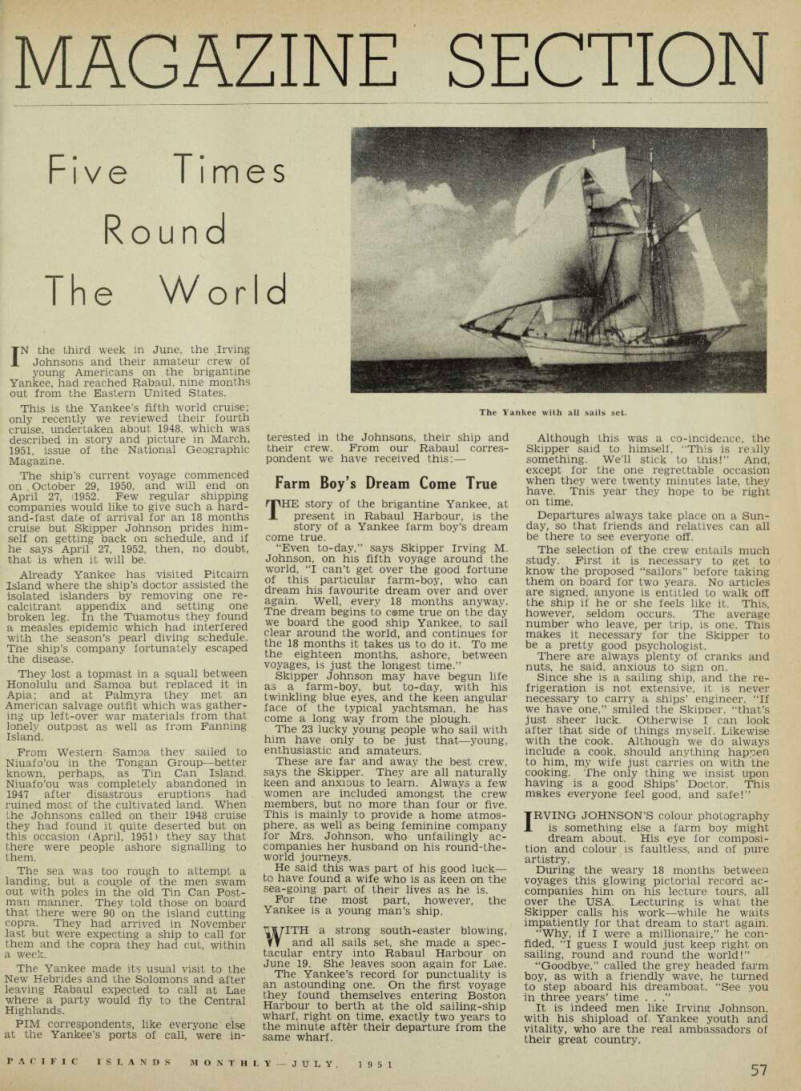
Five Times Round The World
IN the third week in June, the Irving Johnsons and their amateur crew of young Americans on the brigantine Yankee, had reached Rabaul, nine months out from the Eastern United States.
This is the Yankee’s fifth world cruise; only recently we reviewed their fourth cruise, undertaken about 1948. which was described in story and picture in March, 1951, issue of the National Geographic Magazine.
The ship’s current voyage commenced on October 29, 1950, and will end on April 27, 11952. Few regular shipping companies would like to give such a hard and-fast date of arrival for an 18 months cruise but Skipper Johnson prides him self on getting back on schedule, and if he says April 27, 1952, then, no doubt, that is when it will be.
Already Yankee has visited Pitcairn Island where the ship’s doctor assisted the isolated islanders by removing one re calcitrant appendix and setting one broken leg. In the Tuamotus they found a measles epidemic which had interfered with the season’s pearl diving schedule.
The ship’s company fortunately escaped the disease.
They lost a topmast in a squall between Honolulu and Samoa but replaced it in Apia; and at Palmyra they met an American salvage outfit which was gather ing up left-over war materials from that lonely outpost as well as from Fanning Island.
From Western Samoa they sailed to Niuafo’ou in the Tongan Group—better known, perhaps, as Tin Can Island.
Niuafo’ou was completely abandoned in 1947 after disastrous eruptions had ruined most of the cultivated land. When the Johnsons called on their 1948 cruise they had found it quite deserted but on this occasion (April, 1951) they say that there were people ashore signalling to them.
The sea was too rough to attempt a landing, but a couple of the men swam out with poles in the old Tin Can Post man manner. They told those on board that there were 90 on the island cutting copra. They had arrived in November last but were expecting a ship to call for them and the copra they had cut, within a week.
The Yankee made its usual visit to the New Hebrides and the Solomons and after leaving Rabaul expected to call at Lae where a party would fly to the Central Highlands.
PIM correspondents, like everyone else at the Yankee’s ports of call, were in
terested in the Johnsons, their ship and their crew. From our Rabaul correspondent we have received this:—
Farm Bov's Dream Come True
* THE story of the brigantine Yankee, at present in Rabaul Harbour, is the story of a Yankee farm boy’s dream come true.
“Even to-day,” says Skipper Irving M.
Johnson, on his fifth voyage around the world, “I can’t get over the good fortune of this particular farm-boy, who can dream his favourite dream over and over again. Well, every 18 months anyway.
Tne dream begins to come true on the day we board the good ship Yankee, to sail clear around the world, and continues for the 18 months it takes us to do it. To me the eighteen months, ashore, between voyages, is just the longest time.”
Skipper Johnson may have begun life as a farm-boy, but to-day, with his twinkling blue eyes, and the keen angular face of the typical yachtsman, he has come a long way from the plough.
The 23 lucky young people who sail with him have only to be just that—young, enthusiastic and amateurs.
These are far and away the best crew, says the Skipper. They are all naturally keen and anxious to learn. Always a few women are included amongst the crew members, but no more than four or five.
This is mainly to provide a home atmosphere, as well as being feminine company for Mrs. Johnson, who unfailingly accompanies her husband on his round-theworld journeys.
He said this was part of his good luck— to have found a wife who is as keen on the sea-going part of their lives as he is.
For the most part, however, the Yankee is a young man’s ship. , ... :TnTH a strong south-easter blowing, f? and all sails set, she made a spectacular entry into Rabaul Harbour on June 19. She leaves soon again for Lae.
The Yankee’s record for punctuality is an astounding one. On the first voyage they found themselves entering Boston Harbour to berth at the old sailing-ship wharf, right on time, exactly two years to the minute after their departure from the same wharf.
Although this was a co-incidence, the Skipper said to himself, “This is really something. We’ll stick to this!” And, except for the one regrettable occasion ™ hen they were twenty minutes late, they have. This year they hope to be right on time.
Departures always take place on a Sun day, so that friends and relatives can all be there to see everyone off.
The selection of the crew entails much study. First it is necessary to get to know the proposed “sailors” before taking them on board for two years. No articles are signed, anyone is entitled to walk off the ship if he or she feels like it. This, however, seldom occurs. The average number who leave, per trip, is one. This makes it necessary for the Skipper to be a pretty good psychologist, There are always plenty of cranks and nuts, he said, anxious to sign on.
Since she is a sailing ship, and the re frigeration is not extensive, it is never necessary to carry a ships’ engineer. “If we have one,” smiled the Skipper, “that’s just sheer luck. Otherwise I can look after that side of things myself. Likewise with the cook. Although we do always include a cook, should anything hapnen to him, my wife just carries on with the cooking. The only thing we insist upon having is a good Ships’ Doctor. This makes everyone feel good, and safe!”
TRYING JOHNSON’S colour photography 1 i s something else a farm boy might dream about. His eye for composi tion and colour is faultless, and of pure artistry.
During the weary 18 months between voyages this glowing pictorial record ac companies him on his lecture tours, all over the USA. Lecturing is what the Skipper calls his work—while he waits impatiently for that dream to start again.
“Why, if I were a millionaire,” he con fided, “I guess I would just keep right on sailing, round and round the world!”
“Goodbye,” called the grey headed farm boy, as with a friendly wave, he turned to step aboard his dreamboat, “See you i n three years’ time . . .” it is indeed men like Irving Johnson, with his shipload of Yankee youth and vitality, who are the real ambassadors of their great country.
The Yankee with all sails set.
One More Paradise
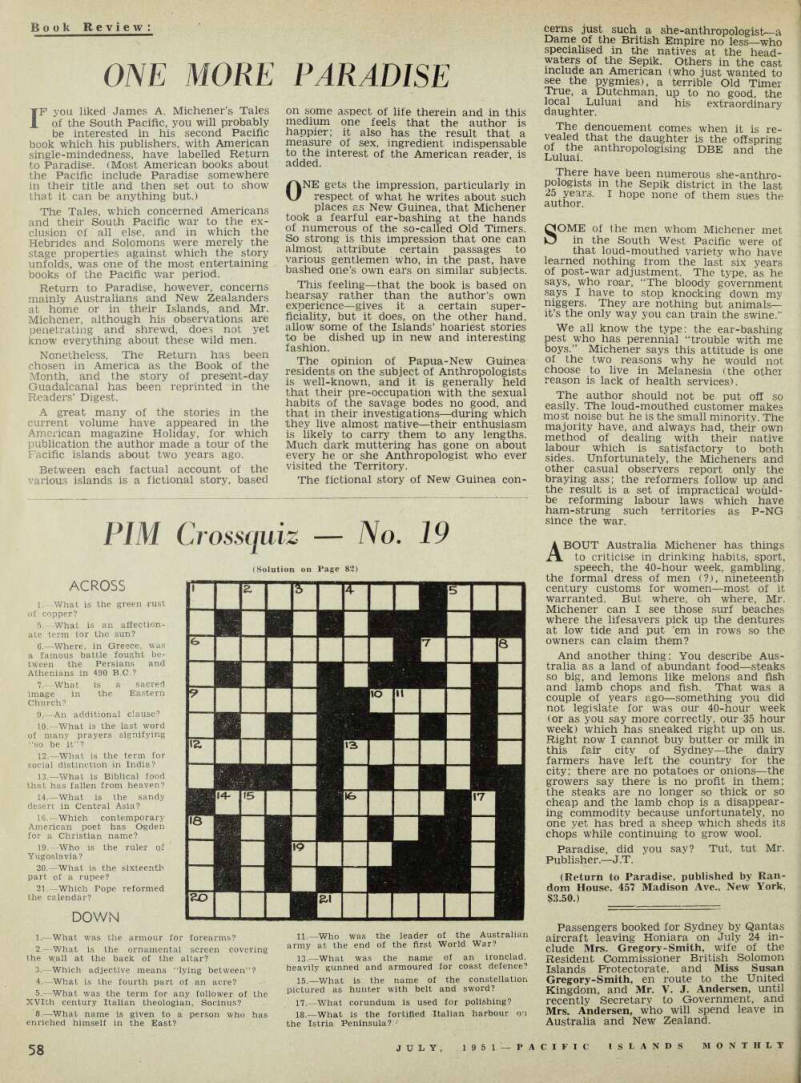
Book Review:
1F you liked James A. Michener’s Tales of the South Pacific, you will probably be interested in his second Pacific book which his publishers, with American single-mindedness, have labelled Return to Paradise. (Most American books about the Pacific include Paradise somewhere in their title and then set out to show that it can be anything but.) The Tales, which concerned Americans and their South Pacific war to the ex clusion of all else, and in which the Hebrides and Solomons were merely the stage properties against which the story unfolds, was one of the most entertaining books of the Pacific war period.
Return to Paradise, however, concerns mainly Australians and New Zealanders at home or in their Islands, and Mr.
Michener, although his observations are penetrating and shrewd, does not yet know everything about these wild men.
Nonetheless, The Return has been chosen in America as the Book of the Month, and the story of preseht-day Guadalcanal has been reprinted in the Readers’ Digest.
A great many of the stories in the current volume have appeared in the American magazine Holiday, for which publication the author made a tour of the Pacific islands about two years ago.
Between each factual account of the various islands is a fictional story, based
on some aspect of life therein and in this medium one feels that the author is happier; it also has the result that a measure of sex, ingredient indispensable to the interest of the American reader, is added.
ONE gets the impression, particularly in respect of what he writes about such places as New Guinea, that Michener took a fearful ear-bashing at the hands of numerous of the so-called Old Timers.
So strong is this impression that one can almost attribute certain passages to various gentlemen who, in the past, have bashed one’s own ears on similar subjects.
This feeling—that the book is based on hearsay rather than the author’s own experience—gives it a certain super ficiality, but it does, on the other hand, allow some of the Islands’ hoariest stories to be dished up in new and interesting fashion.
The opinion of Papua-New Guinea residents on the subject of Anthropologists is well-known, and it is generally held that their pre-occupation with the sexual habits of the savage bodes no good, and that in their investigations—during which they live almost native—their enthusiasm is likely to carry them to any lengths.
Much dark muttering has gone on about every he or she Anthropologist who ever visited the Territory.
The fictional story of New Guinea con-
PIM Crossquiz - No. 19
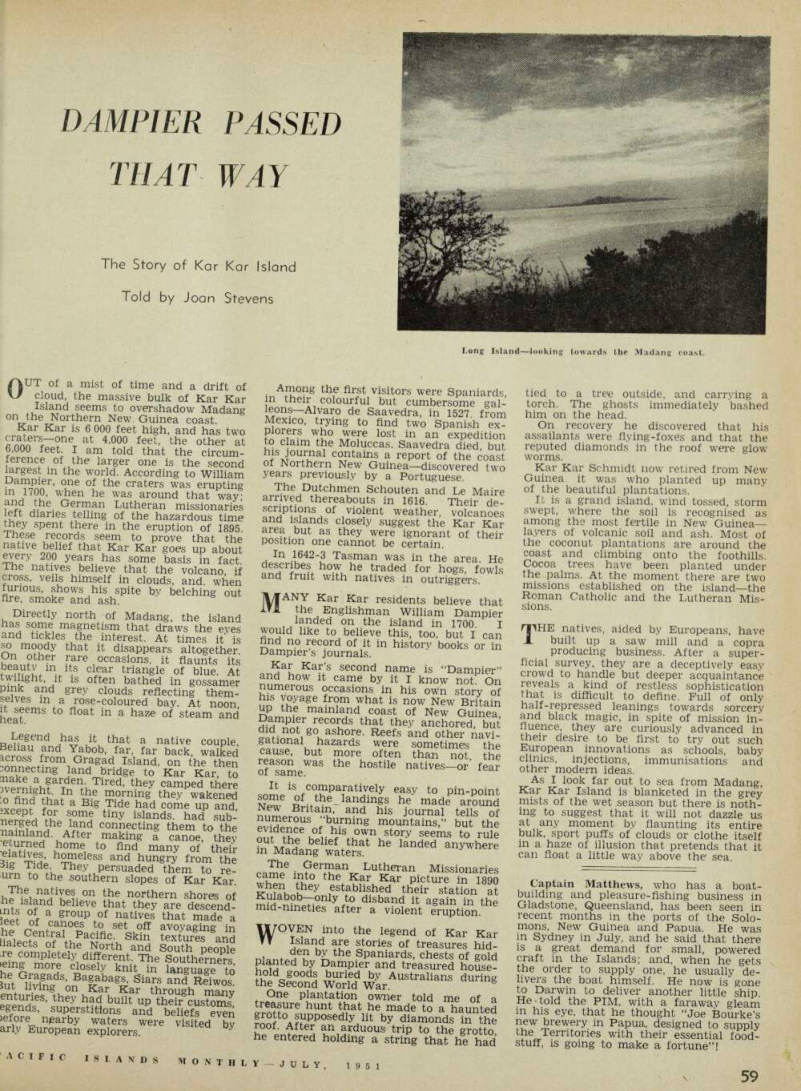
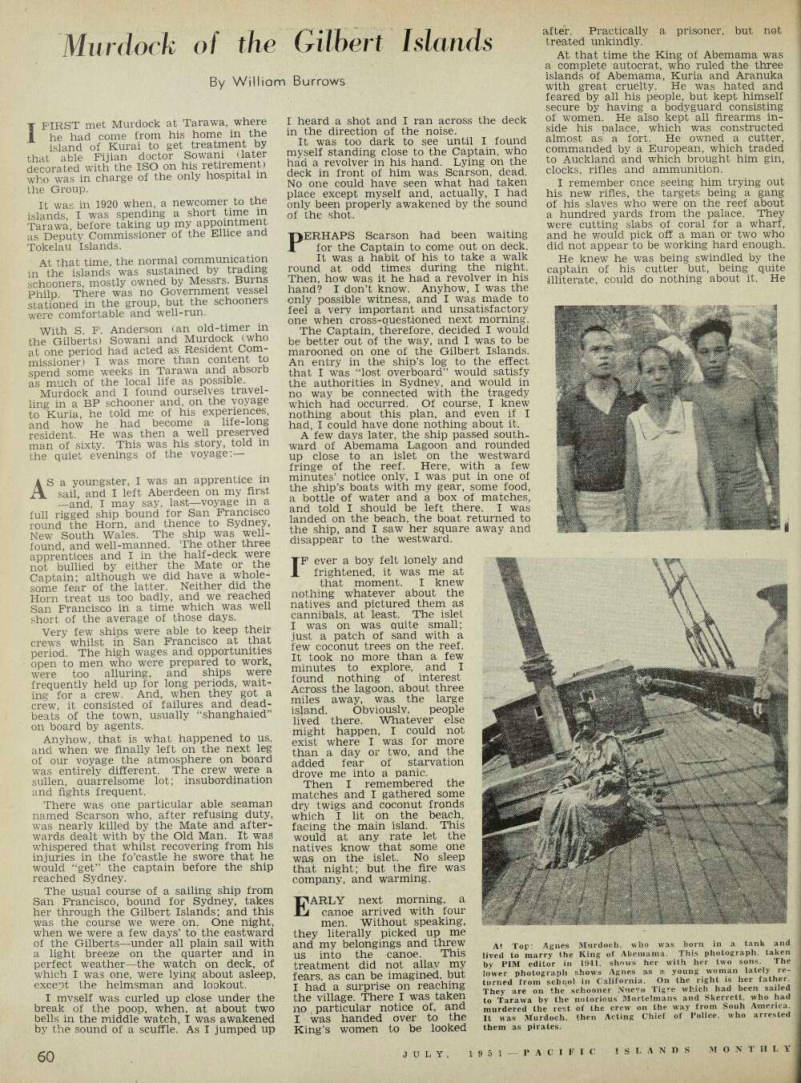
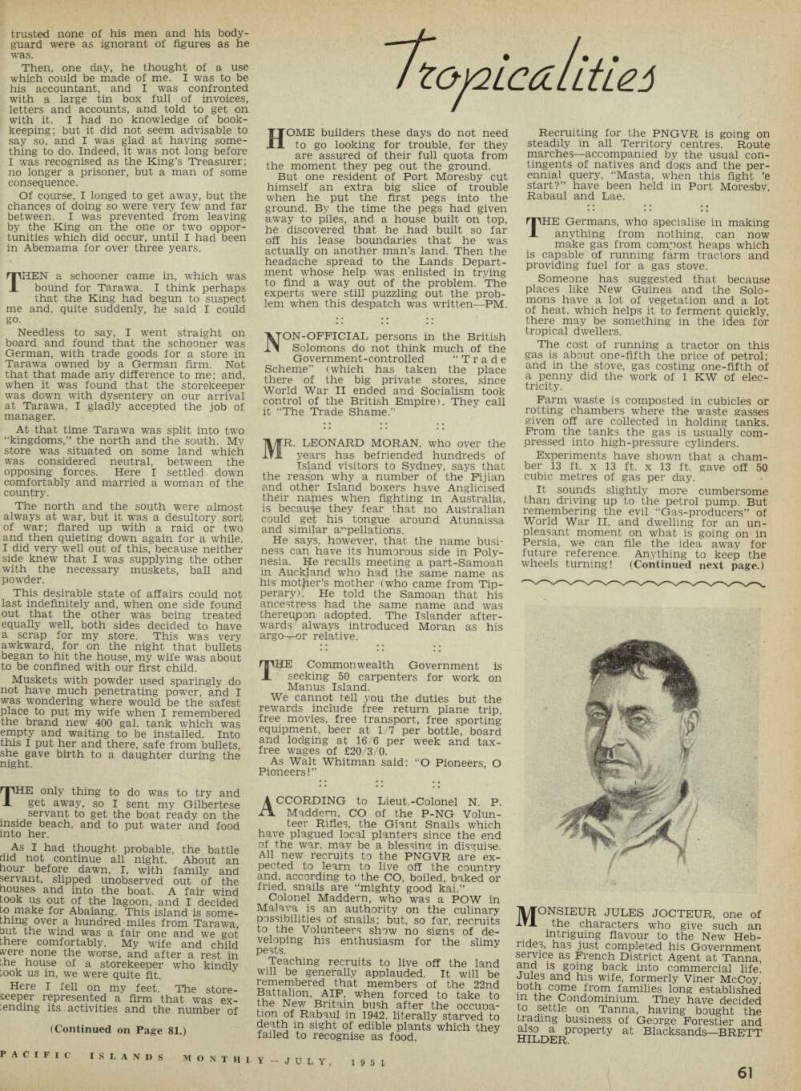
(Solution on Page 83)
Across
1. —What is the green rust of copper? 5. —What is an affection ate term for the sun? 6. Where, in Greece, was a famous battle fought be tween the Persians and Athenians in 490 8.C.? 7. —What is a sacred image in the Eastern Church? 9. —An additional clause? 10. —What is the last word of many prayers signifying “so be it”? 12. —What is the term for social distinction in India? 13. —What is Biblical food that has fallen from heaven? 14. —What is the sandy desert in Central Asia? 16. —Which contemporary American poet has Ogden for a Christian name? 19. —Who is the ruler Qf Yugoslavia? 20. —What is the sixteenth part of a rupee? 21. —Which Pope reformed the calendar?
Down
1. —What was the armour for forearms? 2. —What is the ornamental screen covering the wall at the back of the altar? 3. —Which adjective means “lying between”? 4. —-What is the fourth part of an acre? 5. —What was the term for any follower of the XVlth century Italian theologian, Socinus?
B.—What name is given to a person who has enriched himself in the East?
11, —Who was the leader of the Australian army at the end of the first World War? 13.—What was the name of an ironclad, heavily gunned and armoured for coast defence? 15.—What is the name of the constellation pictured as hunter with belt and sword? 17. What corundum is used for polishing? 18. What is the fortified Italian harbour on the Istria Peninsula? •
cerns just such a Dame of the British Empire no less—who specialised in the natives at the head waters of the Sepik. Others in the cast include an American (who just wanted to see the pygmies), a terrible Old Timer True, a Dutchman, up to no good, the local Luluai and his extraordinary daughter.
The denouement comes when it is re vealed that the daughter is the offspring of the anthropologising DBE and the Luluai.
There have been numerous she-anthro pologists in the Sepik district in the last 25 years. I hope none of them sues the author.
SOME of the men whom Michener met in the South West Pacific were of that loud-mouthed variety who have learned nothing from the last six years of post-war adjustment. The type, as he says, who roar, “The bloody government says I have to stop knocking down my niggers. They are nothing but animals— it’s the only way you can train the swine.”
We all know the type: the ear-bashing pest who has perennial “trouble with me boys.” Michener says this attitude is one of the two reasons why he would not choose to live in Melanesia (the other reason is lack of health services).
The author should not be put off so easily. The loud-mouthed customer makes most noise but he is the small minority. The majority have, and always had, their own method of dealing with their native labour which is satisfactory to both sides. Unfortunately, the Micheners and other casual observers report only the braying ass; the reformers follow up and the result is a set of impractical would be reforming labour laws which have ham-strung such territories as P-NG since the war.
ABOUT Australia Michener has things to criticise in drinking habits, sport, speech, the 40-hour week, gambling, the formal dress of men (?), nineteenth century customs for women—most of it warranted. But where, oh where, Mr.
Michener can I see those surf beaches where the lifesavers pick up the dentures at low tide and put ’em in rows so the owners can claim them?
And another thing: You describe Aus tralia as a land of abundant food—steaks so big, and lemons like melons and fish and lamb chops and fish. That was a couple of years ago—something you did not legislate for was our 40-hour week (or as you say more correctly, our 35 hour week) which has sneaked right up on us.
Right now I cannot buy butter or milk in this fair city of Sydney—the dairy farmers have left the country for the city; there are no potatoes or onions—the growers say there is no profit in them; the steaks are no longer so thick or so cheap and the lamb chop is a disappear ing commodity because unfortunately, no one yet has bred a sheep which sheds its chops while continuing to grow wool.
Paradise, did you say? Tut, tut Mr.
Publisher. —J.T. (Return to Paradise, published by Ran dom House, 457 Madison Ave., New York, $3.50.) Passengers booked for Sydney by Qantas aircraft leaving Honiara on July 24 in clude Mrs. Gregory-Smith, wife of the Resident Commissioner British Solomon Islands Protectorate, and Miss Susan Gregory-Smith, en route to the United Kingdom, and Mr. V. J. Andersen, until recently Secretary to Government, and Mrs. Andersen, who will spend leave in Australia and New Zealand.
Dampier Passed
That Way
The Story of Kar Kar Island Told by Joan Stevens
OUT of a mist of time and a drift of cloud, the massive bulk of Kar Kar Island seems to overshadow Madang on the Northern New Guinea coast.
Kar Kar is 6 000 feet high, and has two * r n a ™ rs /~ one at 4,000 feet, the other at 6,000 feet. I am told that the circum ference of the larger one is the second largest in the world. According to William Dar TP™ r ’ 9 ne the craters was erupting m 1700, when he was around that way , ai l d J^ 16 - German Lutheran missionaries left diaries telling of the hazardous time they spent there in the eruption of 1895 These records seem to prove that the native belief that Kar Kar goes up about every 200 years has some basis in fact.
The natives believe that the volcano, if cross, veils himself in clouds, and. when furious, shows his spite by belching out fire, smoke and ash.
Directly north of Madang, the island ha,s some magnetism that draws the eyes and tickles the interest. At times it is so moody that it disappears altogether. hiL,? th ? r r are occasions, it flaunts its m ., T 8 cl J; ar triangle of blue. At twilight, it is often bathed in gossamer pink and grey clouds reflecting them selves in a rose-coloured bay. At noon, heat OmS * n a baze of steam and R o \f gend J l ?® a native couple, fprncc ? nd far, far back, walked across from Gragad Island, on the then land bridge to Kar Kar, to a Tn 6r }b Tlred ’ they cam P ed there n S 6 ™ rnm g they wakened * hat a Blg , Tlde bad come up and, nerild S i om w tmy islands - had sub- V£ nd con necting them to the ih^ii d 'i. After . making a canoe - they home to find many of their latl lf?’ homeless and hungry from the * lg They persuaded them to re urn to the southern slopes of Kar Kar. pie natives on the northern shores of mts o? n ? seheve5 eheve *bat they are descend- S ° f f a group of natives that made a If?* canoes to set off avoyaging in lialeSs n of al thp a M fi< ;T Skin textures a n d uaiects of the North and South peonle -re completely different. The Southerners •emg more closely knit in language td Jut G livirfff dS n^ a^ giars and Reiwos ut living on Kar Kar through manv entunes, they had built up their customs superstitions and beliefs even a 6 r f i or %> nparby waters were visited by arly European explorers. y
• the first visitors were Spaniards, m their colourful but cumbersome gal leons—Alvaro de Saavedra, in 1527 from Mexico, trying to find two Spanish ex plorers who were lost in an expedition to claim the Moluccas. Saavedra died, but !?i S^ 0U . r u al stains a report of the coast of Northern New Guinea—discovered two years previously by a Portuguese.
The Dutchmen Schouten and Le Maire arrived thereabouts in 1616. Their de scriptions of violent weather, volcanoes and islands closely suggest the Kar Kar area but as they were ignorant of their position one cannot be certain.
In 1642-3 Tasman was in the area. He describes how he traded for hogs, fowls and fruit with natives in outriggers.
MANY Kar Kar residents believe that the Englishman William Dampier landed on the island in 1700. I would like to believe this, too, but I can find no record of it in history books or in Dampier s journals.
Kar Kar s second name is “Dampier” and how it came by it I know not. On numerous occasions in his own story of his voyage from what is now New Britain up the mainland coast of New Guinea Dampier records that they anchored, but o-iniSPS g 0 as b°re. Reefs and other navi gational hazards were sometimes the cause, but more often than not, the reason was the hostile natives—or fear of same.
It is comparatively easy to pin-point n^ G ° f h e y mad e P around S P mn ta S’ a^ d hIS J° Urnal tells Of numerous burning mountains,” but the out d n£ e h°r ls own story seems to rule belief that he landed anywhere in Madang waters.
The German Lutheran Missionaries 2 “to the Kar Kar picture in 1890 established their station at Kulabob—only to disband it again in the mid-nineties after a violent eruption WOVEN into the legend of Kar Kar J sland are stories of treasures hid nlQ , de £ by the Spaniards, chests of gold planted by Dampier and treasured house hold goods buried by Australians during the Second World War.
One plantation owner told me of a treasure hunt that he made to a haunted t0 A supposedly lit by diamonds in the u° p of pn f a f p te ; an arduous trip to the grotto, he entered holding a string that he had
tied to a tree outside, and carrying a torch. The ghosts immediately bashed him on the head.
On recovery he discovered that his assailants were flying-foxes and that the reputed diamonds in the roof were glow worms.
Kar Kar Schmidt now retired from New Guinea it was who planted up many of the beautiful plantations.
It is a grand island, wind tossed, storm swept, where the soil is recognised as among the most fertile in New Guinea layers of volcanic soil and ash. Most of the coconut plantations are around the coast and climbing onto the foothills.
Cocoa trees have been planted under the palms. At the moment there are two missions established on the island—the Roman Catholic and the Lutheran Mis sions. 11HE natives, aided by Europeans, have built up a saw mill and a copra producing business. After a super ficial survey, they are a deceptively easy crowd to handle but deeper acquaintance reveals a kind of restless sophistication that is difficult to define. Full of only half-repressed leanings towards sorcery and black magic, in spite of mission in fluence, they are curiously advanced in their desire to be first to try out such European innovations as schools, baby clinics, injections, immunisations and other modern ideas.
As I look far out to sea from Madang, Kar Kar Island is blanketed in the grey mists of the wet season but there is noth ing to suggest that it will not dazzle us at any moment by flaunting its entire bulk, sport puffs of clouds or clothe itself in a haze of illusion that pretends that it can float a little way above the sea.
Captain Matthews, who has a boat building and pleasure-fishing business in Gladstone, Queensland, has been seen in recent months in the ports of the Solo mons, New Guinea and Papua. He was in Sydney in July, and he said that there is a great demand for small, powered craft in the Islands; and, when he gets the order to supply one, he usually de livers the boat himself. He now is gone to Darwin to deliver another little ship He • told the PIM, with a faraway gleam in his eye, that he thought “Joe Bourke’s new brewery in Papua, designed to supply the Territories with their essential food stuff, is going to make a fortune”!
Long Island—looking towards the Madang coast.
Advertisements & other items, p. 61 (1 item)
59
ACI F I C ISLANDS MONTH I. Y-JULY, 1951
Murdock of the Gilbert Islands
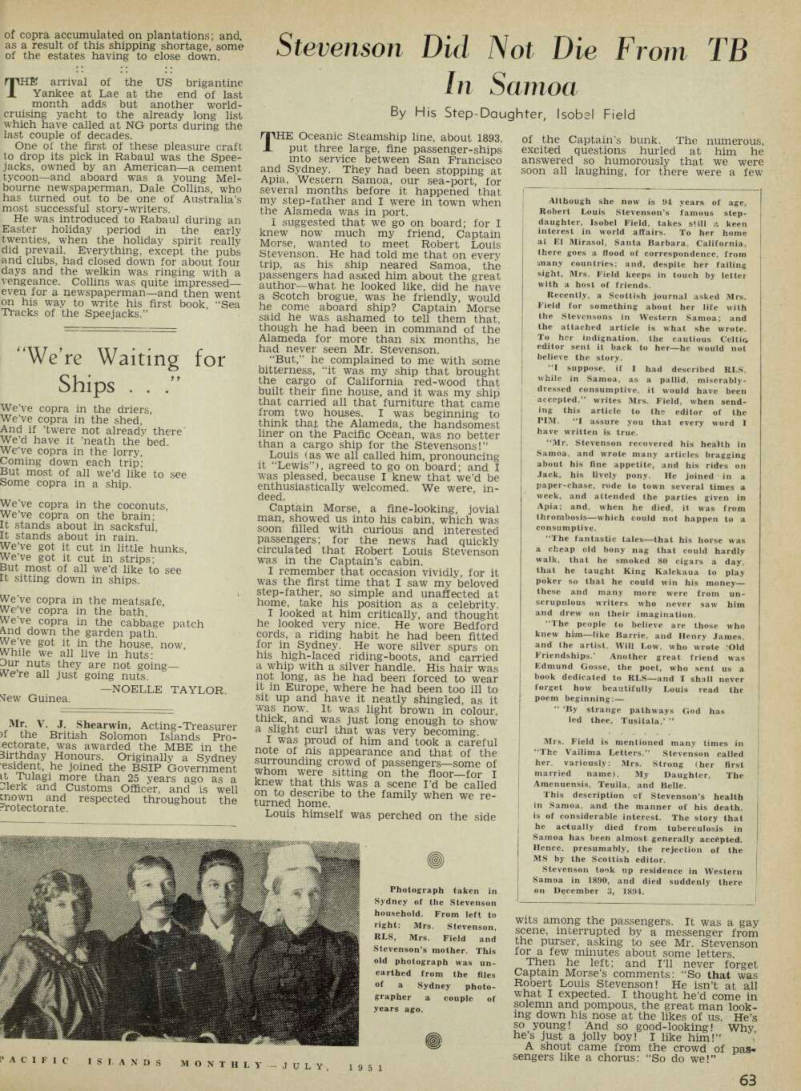
By William Burrows
1 FIRST met Murdock at Tarawa, where he had come from his home in the island of Kurai to get treatment by that able Fijian doctor Sowani (later decorated with the ISO on his retirement) who was in charge of the only hospital in the Group.
It was in 1920 when, a newcomer to the islands, I was spending a short time in Tarawa, before taking up my appointment as Deputy Commissioner of the Ellice and Tokelau Islands.
At that time, the normal communication in the islands was sustained by trading schooners, mostly owned by Messrs. Burns Philp There was no Government vessel stationed in the group, but the schooners were comfortable and well-run.
With S. F. Anderson (an old-timer in the Gilberts) Sowani and Murdock (who at one period had acted as Resident Com missioner) I was more than content to spend some weeks in Tarawa and absorb as much of the local life as possible.
Murdock and I found ourselves travel ling in a BP schooner and, on the voyage to Kuria, he told me of his experiences, and how he had become a life-long resident. He was then a well preserved man of sixty. This was his story, told in the quiet evenings of the voyage;— AS a youngster, I was an apprentice in sail, and I left Aberdeen on my first —and, I may say, last—voyage in a full rigged ship bound for San Francisco round the Horn, and thence to Sydney, New South Wales. The ship was well found, and well-manned. The other three apprentices and I in the half-deck were not bullied by either the Mate or the Captain; although we did have a whole some fear of the latter. Neither did the Horn treat us too badly, and we reached San Francisco in a time which was well short of the average of those days.
Very few ships were able to keep their crews whilst in San Francisco at that period. The high wages and opportunities open to men who were prepared to work, were too alluring, and ships were frequently held up for long periods, wait ing for a crew. And, when they got a crew, it consisted of failures and dead beats of the town, usually “shanghaied” on board by agents.
Anyhow, that is what happened to us. and when we finally left on the next leg of our voyage the atmosphere on board was entirely different. The crew were a sullen, quarrelsome lot; insubordination and fights frequent.
There was one particular able seaman named Scarson who, after refusing duty, was nearly killed by the Mate and after wards dealt with by the Old Man. It was whispered that whilst recovering from his injuries in the fo’castle he swore that he would “get” the captain before the ship reached Sydney.
The usual course of a sailing ship from San Francisco, bound for Sydney, takes her through the Gilbert Islands; and this was the course we were on. One night, when we were a few days’ to the eastward of the Gilberts—under all plain sail with a light breeze on the quarter and in perfect weather —the watch on deck, of which I was one, were lying about asleep, except the helmsman and lookout.
I myself was curled up close under the break of the poop, when, at about two bells in the middle' watch, I was awakened by the sound of a scuffle. As I jumped up
I heard a shot and I ran across the deck in the direction of the noise.
It was too dark to see until I found myself standing close to the Captain, who had a revolver in his hand. Lying on the deck in front of him was Scarson, dead.
No one could have seen what had taken place except myself and, actually, I had only been properly awakened by the sound of the shot.
PERHAPS Scarson had been waiting for the Captain to come out on deck.
It was a habit of his to take a walk round at odd times during the night.
Then, how was it he had a revolver in his hand? I don’t know. Anyhow, I was the only possible witness, and I was made to feel a very important and unsatisfactory one when cross-questioned next morning.
The Captain, therefore, decided I would be better out of the way, and I was to be marooned on one of the Gilbert Islands.
An entry in the ship’s log to the effect that I was “lost overboard” would satisfy the authorities in Sydney, and would in no way be connected with the tragedy which had occurred. Of course, I knew nothing about this plan, and even if I had, I could have done nothing about it.
A few days later, the ship passed south ward of Abemama Lagoon and rounded up close to an islet on the westward fringe of the reef. Here, with a few minutes’ notice only, I was put in one of the ship’s boats with my gear, some food, a bottle of water and a box of matches, and told I should be left there. I was landed on the beach, the boat returned to the ship, and I saw her square away and disappear to the westward.
IF ever a boy felt lonely and frightened, it was me at that moment. I knew nothing whatever about the natives and pictured them as cannibals, at least. The islet I was on was quite small; just a patch of sand with a few coconut trees on the reef.
It took no more than a few minutes to explore, and I found nothing of interest Across the lagoon, about three miles away, was the large island. Obviously, people lived there. Whatever else might happen, I could not exist where I was for more than a day or two, and the added fear of starvation drove me into a panic.
Then I remembered the matches and I gathered some dry twigs and coconut fronds which I lit on the beach, facing the main island. This would at any rate let the natives know that some one was on the islet. No sleep that night; but the fire was company, and warming.
EARLY next morning, a canoe arrived with four men. Without speaking, they literally picked up me and my belongings and threw us into the canoe. This treatment did not allay my fears, as can be imagined, but I had a surprise on reaching the village. There I was taken no particular notice of, and I was handed over to the King’s women to be looked
after. Practically a prisoner, but not treated unkindly.
At that time the King of Abemama was a complete autocrat, who ruled the three islands of Abemama, Kuria and Aranuka with great cruelty. He was hated and feared by all his people, but kept himself secure by having a bodyguard consisting of women. He also kept all firearms in side his palace, which was constructed almost as a fort. He owned a cutter, commanded by a European, which traded to Auckland and which brought him gin, clocks, rifles and ammunition.
I remember once seeing him trying out his new rifles, the targets being a gang of his slaves who were on the reef about a hundred yards from the palace. They were cutting slabs of coral for a wharf, and he would pick off a man or two who did not appear to be working hard enough.
He knew he was being swindled by the captain of his cutter but, being quite illiterate, could do nothing about it. He
At Top: Agnes Murdoch, who was born in a tank and lived to marry the King of Abemama. This photograph, taken by PIM editor in 1941, shows her with her two sons. The lower photograph shows Agnes as a young woman lately re turned from school in California. On the right is her father.
They are on the schooner Nuevo Tigre which had been sailed to Tarawa by the notorious Mortelmans and Skerrett, who had murdered the rest of the crew on the way from Souh America.
It was Murdoch, then Acting Chief of Police, who arrested them as pirates.
trusted none of his men and his body guard were as ignorant of figures as he was.
Then, one day, he thought of a use which could be made of me. I was to be his accountant, and I was confronted with a large tin box full of invoices, letters and accounts, and told to get on with it. I had no knowledge of book keeping; but it did not seem advisable to say so, and I was glad at having some thing to do. Indeed, it was not long before I was recognised as the King’s Treasurer; no longer a prisoner, but a man of some consequence.
Of course, I longed to get away, but the chances of doing so were very few and far between. I was prevented from leaving by the King on the one or two oppor tunities which did occur, until I had been in Abemama for over three years.
THEN a schooner came in, which was bound for Tarawa. I think perhaps that the King had begun to suspect me and, quite suddenly, he said I could go.
Needless to say, I went straight on board and found that the schooner was German, with trade goods for a store in Tarawa owned by a German firm. Not that that made any difference to me; and, when it was found that the storekeeper was down with dysentery on our arrival at Tarawa, I gladly accepted the job of manager.
At that time Tarawa was split into two “kingdoms,” the north and the south. My store was situated on some land which was considered neutral, between the opposing forces. Here I settled down comfortably and married a woman of the country.
The north and the south were almost always at war, but it was a desultory sort of war; flared up with a raid or two and then quieting down again for a while.
I did very well out of this, because neither side knew that I was supplying the other with the necessary muskets, ball and powder.
This desirable state of affairs could not last indefinitely and, when one side found out that the other was being treated equally well, both sides decided to have a scrap for my store. This was very awkward, for on the night that bullets began to hit the house, my wife was about to be confined with our first child.
Muskets with powder used sparingly do not have much penetrating power, and I was wondering where would be the safest place to put my wife when I remembered the brand new 400 gal. tank which was empty and waiting to be installed. Into this I put her and there, safe from bullets, she gave birth to a daughter during the night.
THE only thing to do was to try and get away, so I sent my Gilbertese servant to get the boat ready on the inside beach, and to put water and food into her.
As I had thought probable, the battle did not continue all night. About an hour before dawn, I, with family and servant, slipped unobserved out of the nouses and into the boat. A fair wind took us out of the lagoon, and I decided to make for Abaiang. This island is some thmg over a hundred miles from Tarawa, out the wind was a fair one and we got there comfortably. My wife and child were none the worse, and after a rest in :he house of a storekeeper who kindly :ook us in, we were quite fit.
Here I fell on my feet. The store keeper represented a firm that was ex :ending its activities and the number of
(Continued on Page 81.)
ts trading stations. Storekeepers were wanted, and I was offered a post in charge »f one of them. nOR many years I was with this firm L and prospered; also my family grew.
Then came the time when the Gilbert slands were proclaimed a Protectorate •y Great Britain—and high time it was hat something of the sort should have teen done. Despotic native “kings” and lub law had to be superseded for the irotection of the natives themselves.
With my long residence in the islands ,nd my intimate knowledge of the people ,nd language, I was asked if I would take , job in the administration. This I ccepted and, for a while, I was the Act rig Resident of the group. And now I m in retirement, living in the island of Luria, which I lease from the present Ling of Abemama.
By the way, he is married to my eldest aughter—she who was born in the water ank—and I am anxious to get home and ee how my grandchildren—twin boys— re getting on.
Tromcalities
HOME builders these days do not need to go looking for trouble, for they are assured of their full quota from the moment they peg out the ground.
But one resident of Port Moresby cut himself an extra big slice of trouble when he put the first pegs into the ground. By the time the pegs had given away to piles, and a house built on top, he discovered that he had built so far off his lease boundaries that he was actually on another man’s land. Then the headache spread to the Lands Depart ment whose help was enlisted in trying to find a way out of the problem. The experts were still puzzling out the prob lem when this despatch was written —PM.
NON-OFFICIAL persons in the British Solomons do not think much of the Government-controlled “Trade Scheme” (which has taken the place there of the big private stores, since World War II ended and Socialism took control of the British Empire). They call it “The Trade Shame.”
MR. LEONARD MORAN, who over the years has befriended hundreds of Island visitors to Sydney, says that the reason why a number of the Fijian and other Island boxers have Anglicised their names when fighting in Australia, is because they fear that no Australian could get his tongue around Atunaissa and similar appellations.
He says, however, that the name busi ness can have its humorous side in Poly nesia. He recalls meeting a part-Samoan in Auckland who had the same name as his mother’s mother (who came from Tip perary). He told the Samoan that his ancestress had the same name and was thereupon adopted. The Islander after wards always introduced Moran as his relative.
THE Commonwealth Government is seeking 50 carpenters for work on Manus Island.
We cannot tell you the duties but the rewards include free return plane trip, free movies, free transport, free sporting equipment, beer at 1/7 per bottle, board and lodging at 16/6 per week and tax free wages of £2O/3/0.
As Walt Whitman said: ‘ O Pioneers, O Pioneers!”
According to Lieut.-colonel n. p.
Maddem, CO of the P-NG Volun teer Rifles, the Giant Snails which have plagued local planters since the end of the war, may be a blessing in disguise.
All new recruits to the PNGVR are ex pected to learn to live off the country and. according to the CO, boiled, baked or fried, snails are “mighty good kai.”
Colonel Maddern, who was a POW in Malava is an authority on the culinary possibilities of snails; but, so far, recruits to the Volunteers show no signs of de veloping his enthusiasm for the slimy pests.
Teaching recruits to live off the land will be generally applauded. It will be remembered that members of the 22nd Battalion, AIF, when forced to take to the New Britain bush after the occuoa tion of Rabaul in 1942, literally starved to death in sight of edible plants which they failed to recognise as food.
Recruiting for the PNGVR is going on steadily in all Territory centres. Route marches—accompanied by the usual con tingents of natives and dogs and the per ennial query, “Masta, when this fight ’e start?” have been held in Port Moresby, Rabaul and Lae.
THE Germans, who specialise in making anything from nothing, can now make gas from compost heaps which is capable of running farm tractors and providing fuel for a gas stove.
Someone has suggested that because places like New Guinea and the Solo mons have a lot of vegetation and a lot of heat, which helps it to ferment quickly, there may be something in the idea for tropical dwellers.
The cost of running a tractor on this gas is about one-fifth the price of petrol; and in the stove, gas costing one-fifth of a penny did the work of 1 KW of elec tricity.
Farm waste is composted in cubicles or rotting chambers where the waste gasses given off are collected in holding tanks.
From the tanks the gas is usually com pressed into high-pressure cylinders.
Experiments have shown that a cham ber 13 ft. x 13 ft. x 13 ft. gave off 50 cubic metres of gas per day.
It sounds slightly more cumbersome than driving up to the petrol pump. But remembering the evil “Gas-producers” of World War 11, and dwelling for an un pleasant moment on what is going on in Persia, we can file the idea away for future reference. Anything to keep the wheels turning! (Continued next page.)
Monsieur jules jocteur, one of the characters who give such an mtriguing flavour to the New Heb rides, has just completed his Government service as French District Agent at Tanna, and is going back into commercial life.
Jules and his wife, formerly Viner McCoy, both come from families long established in the Condominium. They have decided to settle on Tanna, having bought the trading business of George Forestier and lso J property at Blacksands—BßETT
Wilder.
THAT idea first mooted by J. T. Lang when he was premier of New South Wales, that the superabundant rainfall of Papua should be piped into dry Australia, is being persisted with.
When Sir James Disney, Lord Mayor of Melbourne, said, at the quarterly meet ing of his City Council, in May, that water from New Guinea should be piped into Australia he aroused a roar of laughter; but Sir James went on:— “This might be just a pipe-dream, but after all ‘Pluto’ —the pipeline under the ocean—was successful during the war for piping oil across the English Channel.
“I for one do not believe that the heart of Australia is dead, and such a pipeline would allow for great development.
“Australia’s population must be built up to 25 million if the nation is to sur vive.”
April Weather
By Ernest E. Bush
OH to be in England, now that April’s here!”
We in Apia were beginning to join with Browning, in his desire to be any where but where he was. April conjured up for the poet balmy days, pleasant spring-time scenes, light spring showers.
Memories of April in 1951 conjure up for us in Samoa thoughts of thunder and lightning—terrifying storms that even in retrospect cause a shudder. And the heat!
Old timers say it has been a hot sum mer. It was no use saying the sun had passed the Equator, and it would be cooler now. The sun may have passed the Equator—but it wasn’t any cooler. We had bright, sunny, cloudless days (the thunder-storms and rain usually came at night).
Steadily, wavering only slightly, the thermometer held to its mark. Lazily, the breeze stirred the coconut fronds. All else was still. Daily we said we could ex pect the Trades any time now.
With yearning gaze, we looked to the south-east. A stirring caused us jubi lantly to say, “At last! The Trades!” But it was a false alarm. The trades just wouldn’t blow.
AND now the official meteorological report and summary has been pub lished. It doesn’t give us much measure to know that two records have been made. Lugubriously we read that we had 15 days of thunder and lightning, with an additional four days with light ning only; and that this meteorological outburst creates a record for this month “since 1890, when observations began.”
Nor are we consoled to read that “the extreme maximum temperature of 90.2 deg. Fahr. is the highest temperature re corded since 1922, when 91.2 deg. Fahr. was reached.”
The thermometer wavered a few de grees either side of 87.1 deg. Fahr. by day. and 75.4 deg. by night, giving a mean of 80.9. The average wind velocity was 3.6 miles per hour, though we had one easterly that came with a rush of 33 mph.
And sunshine—227 hours are recorded; the normal for April is 209.4 hours. Apia will be able to advertise in newspapers of the world—“ Come to Samoa for the Winter. 227 hours of sunshine in April!”
Twenty-four days had more than 6 hours of sunshine, although rain fell on 19 days, giving a total of 11 in.
The records, therefore, only confirm what we know from experience—that it was a hot month, flavoured with violent thunderstorms.
THE summary, however, has one con soling feature. Under “Miscel laneous Phenomena,” it records that no waterspouts occurred in April.
Territories’ Talk-Talk
By Tolala
IN this push-button age, when labour saving devices outstrip the national ised plants for generating the power to make these gadgets work, there comes a comforting reassurance from far-off NG.
Administrator Murray mentions the possibitily of major secondary industries using hydro-electric power from the Territories “long before the Snowy Moun tains scheme is completed.”
He says that such a plan may be set up following a survey to be made by the NG Resources Prospecting Co., which will work in conjunction with the Australian government and the British Aluminium Co. “Power potential,” he added, “is practically limitless in the Territory.”
This was a pet subject of Papua’s most competent geologist the late Evan R.
Stanley which he urged in his report to the League of Nations early in the twenties. He suggested harnessing the Fly and Sepik rivers. It seemed very much like a pipe-dream in those days.
But Evan R. had his head screwed on rightly. A pity more attention had not been paid to his recommendations.
PORT Moresby’s airport runway is to be reconstructed, and the cost is put down at £30,000, according to Acting Civil Aviation Minister Anthony. It will be interesting to see what the final figures are when the job is completed. lan Grabowski, one-time general manager of Guinea Airways at Lae, must have a quiet chuckle to himself these days when he sees how air transport (which he foretold years ago) has developed. lan’s present interest is air-freighting beef from Northern Queensland to the coast.
MORESBY must have presented a gay and festive front during the King’s Birthday celebrations, according to reports in the local paper, and the ceremonial drill of RPC would be worth watching.
Apparently, Sandy Sinclair has by no means lost his punch since the old pre-war days in Rabaul, and Bandmaster Crawley can take another bow.
The report mentions the firing of a feu de joie for the first time in Papua.
This occurred on several occasions in Rabaul at various ceremonials; was intro duced by that old soldier, Colonel Johnny Walstab, Superintendent of Police at the time and was carried out with eclat.
The best ceremonial I remember in Rabaul was to celebrate the King’s Coronation in May, 1937, when all the streets were festooned with bunting and scores of full-sized Australian flags were flying everywhere. An outstanding feature of that day’s celebrations was a long parade of decorated floats, made up of every imaginable type of vehicle, rep resenting all sorts of weird and wonderful subjects.
A fine show was made by one car, which was entirely covered in frangipanni blossoms; while a truck, depicting the “Two Mile Limit” (a somewhat con tentious topic concerning trading stations in those days), showed a typical, primitive trading station, with natives cutting copra.
Mr. Justice Phillips was one of the iudges of the procession; and, by this time, he should have a comprehensive photo graphic record of ceremonials in the Territories, A UGUST 1 is the dead-line for a tightening up of road safety pre cautions in the Territory. In a sum mary of the regulations I see no mention
made of push-bikes ridden by natives.
In the B 4 days in Rabaul, native cyclists became a veritable menace, both to pedestrians and motorists, until the Police stepped in and put them under control issuing permits only to thoes who had a knowledge of the Rules of the Road, and after a test had been passed.
It was a good idea; and I expect that native cyclists have not improved with the years.
THE inauguration of motor traffic regu lations in the Territory reminds me of the time, in the early thirties, 1 think, when the owner of the one and only motor vehicle in Madang was prosecuted for not having a tail-light!
Going further back to the days when there was only one motor car in the Rabaul district, one recalls the frightened, bewildered natives scurrying into the bush off the Kokopo Road, when the sounds of the “steamer belong bush” heralded the advent of Herr Wahlen’s car, travelling to and from Gunantambu and Rabaul.
Ah, those were the leisurely—but happy —days!
I RECEIVED a letter the other day from Rabaul. I was puzzled at first; the handwriting could have been my own.
Then I recalled it came from a native lad, who worked for me in the days gone by, and to whom I had taught the mysteries of the Three R’s. Strange how natives’ penmanship so much resembles that of their teacher. I’ll wager the caligraphy of the majority of the older natives around Nodup much resembles that fine pen-man and teacher —J. H. L. Waterhouse, who long since has gone to his rest.
It was an interesting letter, this from my old servant, and he gave an in formative cross-section of local opinion in Rabaul from the natives viewpoint.
They appear there to be suffering from an abundance of regulations and controls, even as we do here in Australia, and the matter of village councils appears to be a bit of a headache in some areas.
I’m glad I taught him to write. It is good to have a real neutral opinion on things that are happening up there.
SYDNEY Columnist, David McNicoll, gave both Lae and Moresby some publicity recently on his return from reporting the Jap hangings at Manus. He had some nice things to say about the country. David made his first trip to NG in ’37, when he accompanied Governor- General Lord Gowrie on a tour after the Rabaul eruption. He has gone a long way since those days—in more ways than one.
M. L. McCOLM, MHR for Bowan, Queensland, is an ardent advocate of NG development. Speaking in the House last month he said NG should be developed in preference to northern Queensland, WA or NT. “It is more im nortant.”
And, apropos of NG development.
Administrator Murray was quoted recently over the air as saying he was prepared to hand over a tea factory in NG to private enterprise. That sounds encouraging.
Also, Minister Hasluck stated in the House last month that steps were being taken to make more land available in NG for settlement.
The main question appears to be one of making conditions a little less grim for the settlers who are already there.
Especially when one reads of 120,000 bags
of copra accumulated on plantations; and, as a result of this shipping shortage, some of the estates having to close down.
THE arrival of the US brigantine Yankee at Lae at the end of last month adds but another world cruising yacht to the already long list which have called at NG ports during the last couple of decades.
One of the first of these pleasure craft to drop its pick in Rabaul was the Spee jacks, owned by an American—a cement tycoon—and aboard was a young Mel bourne newspaperman, Dale Collins, who has turned out to be one of Australia’s most successful story-writers.
He was introduced to Rabaul during an Easter holiday period in the early twenties, when the holiday spirit really did prevail. Everything, except the pubs and clubs, had closed down for about four days and the welkin was ringing with a vengeance. Collins was quite impressed— even for a newspaperman—and then went on his way to write his first book, “Sea Tracks of the Speejacks.”
"We’re Waiting for Ships
Ships . . .”
We’ve copra in the driers, We’ve copra in the shed, And if ’twere not already there We’d have it ’neath the bed.
We’ve copra in the lorry, Coming down each trip; But most of all we’d like to see Some copra in a ship.
We’ve copra in the coconuts, We’ve copra on the brain; It stands about in sacksful, It stands about in rain.
We’ve got it cut in little hunks, We’ve got it cut in strips: But most of all we’d like to see It sitting down in ships.
We’ve copra in the meatsafe, We’ve copra in the bath We’ve copra in the cabbage patch And down the garden path We’ve got it in the house, now While we all live in huts; Dur nuts they are not going— We’re all just going nuts.
Noelle Taylor.
'Jew Guinea.
Mr. V. J. Shearwin, Acting-Treasurer )f the British Solomon Islands Pro ectorate, was awarded the MBE in the Birthday Honours. Originally a Sydney •esident, he joined the BSIP Government it Tulagi more than 25 years ago as a and Customs Officer, and is well mown and respected throughout the protectorate.
In Samoa
Stevenson Did Not Die From TB In Samoa
By His Step-Daughter, Isabel Field
THE Oceanic Steamship line, about 1893, put three large, fine passenger-ships into service between San Francisco and Sydney. They had been stopping at Apia, Western Samoa, our sea-port, for several months before it happened that my step-father and I were in town when the Alameda was in port.
I suggested that we go on board; for I knew now much my friend, Captain Morse, wanted to meet Robert Louis Stevenson. He had told me that on every trip, as his ship neared Samoa, the passengers had asKed him about the great author—what he looked like, did he have a Scotch brogue, was he friendly, would he come aboard ship? Captain Morse said he was ashamed to tell them that, though he had been in command of the Alameda for more than six months, he had never seen Mr. Stevenson.
“But,” he complained to me with some bitterness, “it was my ship that brought the cargo of California red-wood that built their fine house, and it was my ship that carried all that furniture that came from two houses. I was beginning to think that the Alameda, the handsomest liner on the Pacific Ocean, was no better than a cargo ship for the Stevensons!”
Louis (as we all called him, pronouncing it “Lewis”), agreed to go on board; and I was pleased, because I knew that we’d be enthusiastically welcomed. We were, in deed.
Captain Morse, a fine-looking, jovial man, showed us into his cabin, which was soon filled with curious and interested passengers; for the news had quickly circulated that Robert Louis Stevenson was in the Captain’s cabin.
I remember that occasion vividly, for it was the first time that I saw my beloved step-father, so simple and unaffected at home, take his position as a celebrity.
I looked at him critically, and thought he looked very nice. He wore Bedford cords, a riding habit he had been fitted for in Sydney. He wore silver spurs on his high-laced riding-boots, and carried a whip with a silver handle. His hair was not long, as he had been forced to wear it in Europe, where he had been too ill to sit up and have it neatly shingled, as it was now. It was light brown in colour, thick, and was just long enough to show a slight curl that was very becoming.
I was proud of him and took a careful note of his appearance and that of the surrounding crowd of passengers—some of whom were sitting on the floor—for I knew that this was a scene I’d be called on to describe to the family when we re turned home.
Louis himself was perched on the side
wits among the passengers. It was a gay scene, interrupted by a messenger from the purser, asking to see Mr. Stevenson for a few minutes about some letters Then he left; and I’ll never forget Captain Morse’s comments; “So that was Robert Louis Stevenson! He isn’t at all what I expected. I thought he’d come in solemn and pompous, the great man look ing down his nose at the likes of us. He’s so young! And so good-looking! Why he’s just a jolly boy! I like him!”
A shout came from the crowd of pas sengers like a chorus; “So do we!”
of the Captain’s bunk. The numerous, excited questions hurled at him he answered so humorously that we were soon all laughing, for there were a few
Although she now is 94 years of age, Robert Louis Stevenson’s famous step daughter, Isobel Field, takes still a keen interest in world affairs. To her home at El Mirasol, Santa Barbara, California, there goes a flood of correspondence, from imany countries; and, despite her failing sight, Mrs. Field keeps in touch by letter with a host of friends.
Recently, a Scottish journal asked Mrs.
Field for something about her life with the Stevensons in Western Samoa; and the attached article is what she wrote.
To her indignation, the cautious Celtic editor sent it back to her—he would not believe the story.
“I suppose, if I had described RLS, while in Samoa, as a pallid, miserably dressed consumptive, it would have been accepted.” writes Mrs. Field, when send ing this article to the editor of the PIM. ‘‘l assure you that every word I have written is true.
“Mr. Stevenson recovered his health in Samoa, and wrote many articles bragging about his fine appetite, and his rides on Jack, his lively pony. He joined in a paper-chase, rode to town several times a week, and attended the parties given in Apia; and, when he died, it was from thrombosis—which could not happen to a consumptive. ‘‘The fantastic tales—that his horse was a cheap old bony nag that could hardly walk, that he smoked 80 cigars a day, that he taught King Kalekaua to play poker so that he could win his money— these and many more were from un scrupulous writers who never saw him and drew on their imagination. ‘‘The people to believe are those who knew him—like Barrie, and Henry James, and the artist, Will Low. who wrote ‘Old Friendships.’ Another great friend was Edmund Gosse, the poet, who sent us a book dedicated to RLS—and I shall never forget how beautifully Louis read the poem beginning:— “ ‘By strange pathways God has led thee, Tusitala.’ ”
Mrs. Field is mentioned many times in ‘ The Vailima Letters.” Stevenson called her. variously: Mrs. Strong (her first married name). My Daughter, The Amenuensis, Teuila, and Belle.
This description ef Stevenson’s health in Samoa, and the manner of his death, is of considerable interest. The story that he actually died from tuberculosis in Samoa has been almost generally accepted.
Hence, presumably, the rejection of the MS by the Scottish editor.
Stevenson took up residence in Western Samoa in 1890, and died suddenly there on December 3, 1894.
Photograph taken in Sydney of the Stevenson household. From left to right: Mrs. Stevenson, RLS, Mrs. Field and Stevenson’s mother. This old photograph was un earthed from the files of a Sydney photo grapher a couple of years ago.
Advertisements & other items, p. 66 (1 item)
Corner For The Children
but certainly glamorous.
fashion . . .
MAGNIFICENT ball gown by French designer Jean Desses. It is of bias folds of ivory satin encrusted with multi-coloured pearls with full flares of white tulle forming a train. Not exactly suitable for wear on a night of tropical storm —
Advertisements & other items, pp. 67-68 (1 item)
Burns Philp (New Guinea) Limited
General Merchants, Shipping, Customs and
General Agents
Head Office: PORT MORESBY, PAPUA
BRANCHES:
NEW GUINEA: Rabaul (Kavieng, Kokopo), Lae (Wau, Bulolo), Madang.
PAPUA: Port Moresby, Samarai.
AUSTRALIAN AGENTS:
LONDON AGENTS:
SAN FRANCISCO AGENTS;
BURNS, PHILP Cr CO. LTD.
All States.
BURNS, PHILP Cr CO. LTD.
"London House/ 7 35 Crutched Friars, E.C.3.
BURNS-PHILP CO. OF SAN FRANCISCO INC.
510 Matson Building.
REPRESENTATIVES FOR
Queensland Insurance Co. Ltd. Lloyd's of London. Burns Philp Trust Co. Ltd.
Distributing Agents in the Territory of Papua-New Guinea for:
SHELL COMPANY OF AUSTRALIA LTD.
Petroleum Products
VAUXHALL MOTORS LIMITED
Vauxhall Cars and Bedford Trucks
THE ROVER COMPANY LIMITED
Landrovers and Rover Cars
A. J. ELLERKER
Blue Streak Power Chain Saws
THE COLONIAL SUGAR REFINING CO.
Caneite, Asbestos Cement Sidings, Asphalt Floor Tiles
GENERAL MOTORS CORPORATION
Cars and Trucks
HARRY FERGUSON LIMITED
Ferguson Tractors and Equipment
CROSSLEY BROS. LIMITED
Crossley Marine £r Stationary Engines
IMPERIAL CHEMICAL INDUSTRIES
Pharmaceutical & Agricultural Chemicals, Corrugated Perspex
JOHN FOWLER Cr CO. (LEEDS) LTD.
Fowler 95 H.P. Diesel Crawler Tractors
She thought
she needed "medicines .
but it was reallv
V
Doctors and
Nutrition
*- Aperts w
p( agree
that although we are blessed with an abundance of food, "Hidden Hunger" is far more common than most people realise. They say also that you can satisfy your hunger by having three meals every day—and still not satisfy your body's needs. When we eat the wrong kind of foods, or not enough of the right kind, then we suffer from "Hidden Hunger"—and our system is hungry for certain essential food elements in our daily diet. This means that while we may not feel actually ill, we ore never really well —and seldom look our best.
Your children— and "Hidden Hunger"
Do they tend to tire easily?
Do they lose weight—or find it difficult to pain?
Do they lead other children, or just droop along in the background. These are symptoms of "'Hidden Hunger" in children.
Your husband—and "Hidden Hunger"
Does your husband take medicines to attempt to keep himself fit? Does he sleep badly and wake feeling tired? Does he suffer from ‘"in bet ween" health never really but seldom really well? could easily he "Hidden His trouble Hunger."
Horlicks guards against
HIDDEN HUNGER" because it induces
sound sleep, and gives you balanced,
easily-digested nourishment.
You must have sound sleep to guard against the effects of “Hidden Hunger."
A cup of hot Horlicks before bed soothes your nerves, relaxes your mind and off you go ... to replace lost energy and wake refreshed.
BALANCED FOOD
You must have nourishing food not “medicines” to guard against “Hidden Hunger." However, with today's rising costs it is not always possible to have the kind of food you want. That is why Horlicks is invaluable in your home. Made from full-cream milk and
HORLICKS
guards against
.'W the nutritive extracts of malted barley and wheat. Horlicks is a balanced nourishing food. Taken between meal and just before bed at night Horlick supplies those essential nutritional foo elements your body needs every da to guard agains "Hidden Hunger”
NERVOUS
INDIGESTION
As well as being a balanced food-drink, Horlicks has the added advantage of helping digestion. Taken between meals, it relieves nervous indigestion, and so makes sure that you get the full benefit from your daily food. in i-lb. and
mm TINS
COPYRIGHT
HI-4
Hamlet, Galloping Crabs and
Making The Guadalcanal
Club Pay
Hamlet, Galloping Crabs and Square Dancing All Help
THE new Guadalcanal Club, which was opened in March, replacing the old leaf building which burned down in 1949, has added a good deal to the en tertainment of the small European com munity in Honiara, British Solomon Islands.
Five or six very successful dances have been held there. On one evening, the Club was loaned by the Committee for an amateur theatrical performance, held, partly, to see what sort of show local European residents could put on; and partly to raise funds to add to the Club’s somewhat meagre bank account. Many rehearsals had been held in the two months before the show, which turned out to be extraordinarily good.
In order to avoid copyright complica tions, some of the short plays and duo logues had been written by the performers.
The stage was a hastily constructed dais made of timber borrowed from the PWD and effective improvised stage lighting was also arranged by PWD technicians in their spare time.
The performers did not attempt any thing too long or ambitious and the even ing sailed along to a successful conclu sion without even the technical hitches usual in amateur theatricals. A surpris ing amount of local talent came to light and the show was a credit both to organ isers and actors. One of the most amusing and unexpected items was the ghost scene from Hamlet, in Pidgin English and per formed by Government administrative officers.
Square dancing has also caught on among some of the Club members, and several times a week one or two sets are made up and a local “caller” puts them through their paces. These enthusiasts feel now that they could join in ade quately if square dancing is still popular when they go on leave.
ANOTER diversion on one Saturday evening was crab racing. Improvised “stalls” were constructed out of scrap plywood for the runners: a barrier when lifted, released them.
Small landcrabs, collected beforehand, each had a number painted in white on its back, and the “course” was a space six feet by twenty enclosed with plywood.
A small totalisator operated during the evening, with shilling tickets.
The “horses” caused mild consterna tion among some of the Club’s lady mem bers by wriggling out of their stalls and joining the onlookers in the members’ stand. There were eight races on the programme and the tote’s percentage of profit went to Club funds.
One member said, thoughtfully, that it would have been more exciting with large coconut crabs as runners. However, the small ones, with a good deal of spirited sideways prancing and some doubt about where the winning post was, provided a good deal of fun.
Doping was strictly forbidden, and one horse was disqualified because it had been given a gin and water. Just as the tee totallers (very rare in Honiara) always say, it did it no good, and the poor thing died.
Mr. F. W. P. Roe, who has, for some years, been manager of Bums Philp (South Seas) Co. in Rotuma has been transferred to Tonga where he will be come manager of the Vavau branch of the Company.
Advertisements & other items, p. 68 (1 item)
66
JULY, 1951 PACIFIC INLANDS MONTHLY
Origin of the Polynesians

Tin* following interesting speculation occurs in an article on Tonga, in the May issue of the magazine Corona: THERE is relatively little disease and almost no crime of any consequence.
In fact, the only blots on an ap parently model society would seem to be a shortage of pure water and a plethora Df corrugated iron, both of which seem to be inevitable features of even the most carefully regulated tropics.
It would be interesting to know where :he Tongans qame from in the very far 3ff days. The official account, given in ;he Annual Reports, says that their early listory is “shrouded in myth,” except -hat an authentic list of Kings goes back or a thousand years. These Kings ruled )ver “a vast area of Polynesia,” their >ower was absolute, and they left mem jrials of great stones and their royal )urial grounds.
The greatest of these memorials is the tfa’amonga, which probably dates from he thirteenth century. It consists of wo great upright coral stones, about six een feet tall, with another, nineteen feet ong, laN. across the top and mortised into hem. The uprights are thought to yeigh between 30 and 40 tons.
The royal burial grounds are four-sided nounds, faced by huge blocks of coral and ismg in terraces to a height of up to wenty feet. These stones are of immense /eight and could only have been built by arge numbers of men and a people skilled i the use of rollers and levers. Tradition ays that many of the stones came from he reefs of distant islands.
It was, in fact, these and other island raditions of migration from the East—
and the monoliths on Easter Island— which led Thor Heyerdahl to organise the Kon-Tiki expedition in an attempt to solve this mystery of Polynesian origins.
A s to the value of his contribution we must await the verdict of the scientists, but meanwhile no one who has sat up in the small, still hours, enthralled by his great stor y’ could bear not to believe
that Heyerdahl is right and that the Polynesians did come on rafts of balsa wood from the coast of South America.
Speculation apart, it is known that about the fifteenth century one of the Tui Tonga, as the ancient kings were called, devolved most of his executive powers on to his brother and retained only his spiritual functions. For four hundred
years thereafter there were two kings in Tonga, one priestly and the other secular.
The islands were discovered by Tasman in 1643 but were not visited again until Wallis arrived in 1767. Cook went there twice, in 1773 and 1777 (and christened them the Friendly Islands), and Bligh in 1789. It was, in fact, in the waters of the Ha-apai Group that the crew of the Bounty mutinied.
Advertisements & other items, pp. 69-70 (2 items)
67
ACIFIC ISLANDS MONTHLY JULY, 1951
Da Mo# Paints
A. B. DONALD Ltd.
AUCKLAND, N.Z.
ISLAND TRADERS & GENERAL MERCHANTS
P.O. Box 1509. Cables £r Telegrams, "Kingdom," Auckland.
i
DA mo# PAINTS
frumd ran the tropics
M&ica
PviKYLITt
VIKYLITE
Super gloss porcelain hard Enamel.
.VELVENE
L* f IVET FINISH
mm®
M oAVCo
ONI COAT
METAL MINI
ync3
\FIATOII FINISH if"’ » tIUb,RC
huhisi wade Nil »«*«*
PAINT
VELVENE
Velvet Finish Water Paint for inside and outside use.
DAVCO
One Coat Metal Paint protects all exposed metal-work.
VELTONE
Flat Oil Washable Wall Paint; interior use.
VELUSTRE
Highest grade Tit. Zinc based House Paint.
Davison Paints have for many years proved their resistance to severe
tropical
conditions. The Davison range
of products
includes high
quality finishes
for all purposes. You can be sure of V Davison. /
ALL DAVISON FINISHES AVAILABLE FROM
A. H. BUNTING LIMITED
Samarai, Papua
and Lae, New Guinea
AUSTRALIAN FIBRES LIMITED
Kokopo
New Britain
G. G. SMITH & CO. LIMITED
Port Moresby
Papua
IT CAKE
R BAKED
ST
EVE
%p m & s@?: Ci ij* 7 K v% bt S' RS ?v Sg &» ig Sister" Rich Fruit Cake is the real home-style Fruit Cake.
Mellowed with fine old rum and brandy, studded with sweet red cherries, tenderized lemon and orange peels, and sun-rich sultanas, currants and raisins. In 3 lb. and 6 lb. cartons.
"Big Sister" is so good it improves with keeping; delicious to the last crumb! Each "Big Sister" cake is individually boxed and an inner wrap of moisture-proof cellophane seals in its oven-freshness.
Special packing guarantees
that every “Big Sister” product comes to your plate oven-fresh, as luscious in flavour and as moist and rich as the day it was baked. r "Prize Recipe" is a special light fruit cake, for those who prefer it. Super-milled flour, first-grade shortening, and tender fruits give It a fine texture, and the most delightful home-made flavour.
bouM
REC/P£ PRODUCTS
PP/ZE
8!
Sh t W. am • i» m
THE FINEST PLUM PUDDING
EVER MADE! its vacuum packed for freshness, gloriously rich with goodness, and just as nice cold as hot. In I lb., 2 lb. and big 3 lb, tins.
MADE BY LILLIS & CO. LIMITED, SYDNEY, AUSTRALIA ALSO ASK FOR DATE PUDDING, MINCEMEAT, DATE & NUT ROLL & GLACE CHERRIES
King’S Birthday At Honiara
Prom Our Own Correspondent THE King’s Birthday was celebrated this year in the British Solomon Islands on June 8.
This holiday is marked every year by a flag parade at the Rove Police Depot and Training School, a mile out of Honiara, held with all the ceremony possible in a small settlement.
A Guard of Honour of the Solomon Islands Armed Constabulary is mounted, The Resident Commissioner makes a short speech, the Union flag is hauled down and the Royal Standard broken out, and the assembled company (which in cludes most Honiara residents and all Government officials) sings God Save the King.
Against the Rove background of green lawn and foothills, the little ceremony is reasonably impressive, and the police Guard of Honour which is inspected by the Resident Commissioner, is always smartly turned out, the Superintendent of Police in full Colonial Police uniform, with white jacket, white helmet and sword, taking the parade.
Most sympathised-with member of the official party was the Judicial Commis sioner, who had to stand, in wig and gown, out in the full heat of the tropical sun for half an hour.
Polynesian Association Of
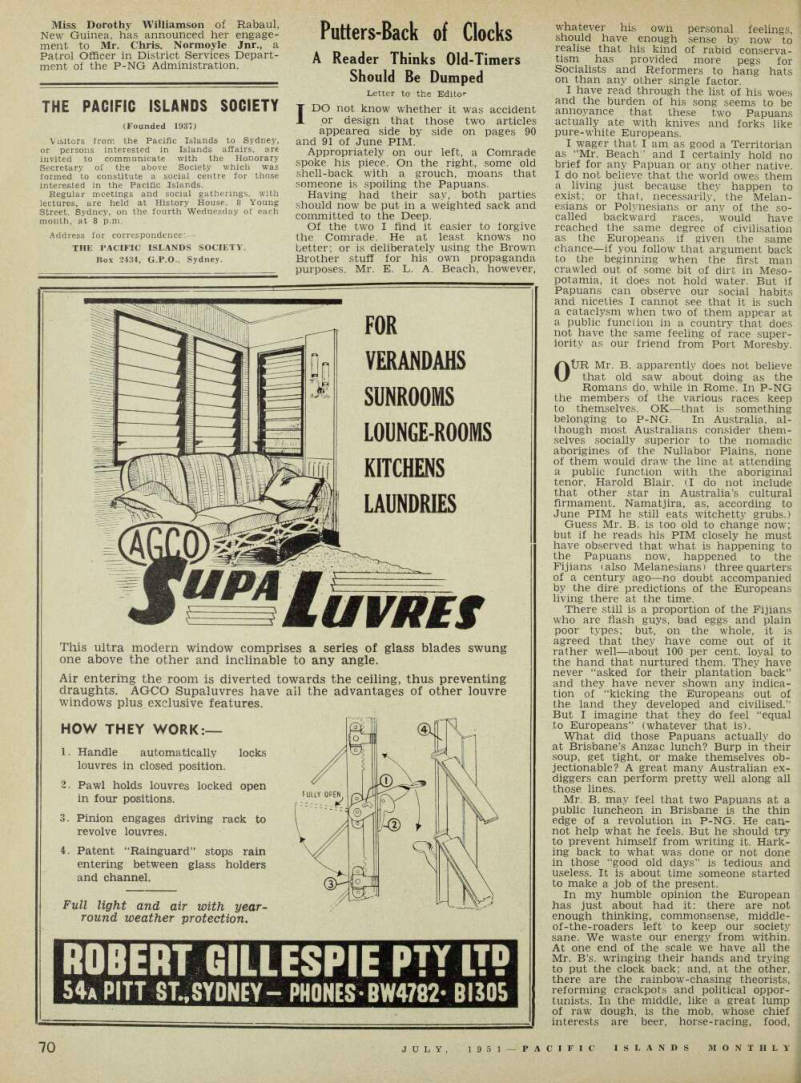
Sydney
THE Polynesian Association of Sydney is keeping the social flag flying at their weekly gatherings held every Wednesday at Kirribilli. During recent months many island people visiting Sydney called in.
From Fiji: John (Junior) Fenton, Bruce Kirkham, Fritz Ragg, Mr. and Mrs. P.
Miller; John Morris (who will be remem bered as skipper of the small ship Fetu Moana, which was blown from the Lau Group to the Queensland Coast). Another Fijian identity was Jack Barley, formerly of Sigatoka, who is now Chief Officer of one of the British Solomon Islands Ships.
Another visitor was former resident of Rotuma, now Chief Engineer Ben Criss, now somewhere at sea with a US tanker.
The outbreak of Polio in Tahiti caused a surprise visit of the MM ship Changchow, which gave some Tahitian people a chance of seeing the big city before going on to Noumea.
Among them was Madame Sybille Polinelli, who belongs to the Richmond family of Tahiti. Sybille wore her black wavy hair hanging down waist length “a la Tahitienne,” causing much open mouthed staring, plus admiration, from Sydneyites accustomed only to short haired lassies.
Another Tahitian was Madame Lucie Farone of the Chevrier family. Gn their honeymoon were Monsieur and Madame Claude Benoit, who now are stationed at the Aviation base at Tontouta, New Caledonia. Claude is from Vincennes, France, and his bride is Loretta Anahoa, the daughter of Monsieur and Madame Pierre Marrand of Fariipiti, Tahiti.
Among other visitors to the Association were practically the entire and en thusiastic crews of HMNZS Bellona led by
L S Alf Lang of Ohinemutu, an old Member, and Hawea led by Billy Taui, who is from North Auckland. For these lads, the Club arranged several special evenings.
Owing to circumstances beyond their control, Miss Margaret Wong and Mr.
Louis Chegg of Madang, New Guinea, have postponed their marriage until August 4, 1951. (See January PIM page 35.)
Miss Dorothy Williamson of Rabaul, New Guinea, has announced her engage ment to Mr. Chris. Normoyle Jnr., a Patrol Officer in District Services Depart ment of the P-NG Administration.
Advertisements & other items, pp. 71-72 (1 item)
you/tke it,
Introducing
CRAWFORD’S
TROPIC BRED
Day-Old Chicks
Specialising in Islands deliveries by “Bird of Paradise” Plane Service only.
Australorps, £6 15 - per 100.
White Leghorns, £5 15/- per 100.
Cross Breds, £6 5/- per 100. (Plus Air Freight.) Free Rearing Instructions with each consignment.
For Honest Dealing Order From
Tom Crawford’s Poultry
Breeding Farm & Hatchery,
Stratford, via Cairns, North Queensland.
Established 1933
laqeras
i • BR O • J 7fr £T> I #/
you/tke it,
ical thirst than There’S no finer way to <J U re K- B - L " g< ’ r firm favourite
TOOTH’S
UGER
TOO
« AND bottled by ewed and o
THE PACIFIC ISLANDS SOCIETY
(Founded 1937) Visitors from the Pacific Islands to Sydney, or persons interested in Islands affairs, are invited to communicate with the Honorary- Secretary of the above Society which was formed to constitute a social centre for those interested in the Pacific Islands.
Regular meetings and social gatherings, with lectures, are held at History House. 8 Young Street, Sydney, on the fourth Wednesday of each month, at 8 p.m.
Address for correspondence:—
THE PACIFIC ISLANDS SOCIETY,
Box 2434, G.P.0., Sydney.
A 0
FOR
VERANDAHS
SUNROOMS
LOUNGE-ROOMS
KITCHENS
LAUNDRIES
This ultra modern window comprises a series of glass blades swung one above the other and inclinable to any angle.
Air entering the room is diverted towards the ceiling, thus preventing draughts. AGCO Supaluvres have all the advantages of other louvre windows plus exclusive features.
HOW THEY WORK:—
1. Handle automatically locks louvres in closed position. 2. Pawl holds louvres locked open in four positions. 3. Pinion engages driving rack to revolve louvres. 4. Patent “Rainguard” stops rain entering between glass holders and channel.
Full light and air with yearround weather protection.
XD
ROBERT GILLESPIE PIT IT?
S 4« PITT ST..SYDNEY- PHONES 8W4782- 81505
Putters-Back of Clocks
A Reader Thinks Old-Timers Should Be Dumped
Letter to the Editor IDO not know whether it was accident or design that those two articles appeared side by side on pages 90 and 91 of June PIM.
Appropriately on our left, a Comrade spoke his piece. On the right, some old shell-back with a grouch, moans that someone is spoiling the Papuans.
Having had their say, both parties should now be put in a weighted sack and committed to the Deep.
Of the two I find it easier to forgive the Comrade. He at least knows no better; or is deliberately using the Brown Brother stuff for his own propaganda purposes. Mr. E. L. A. Beach, however,
whatever his own personal feelings, should have enough sense by now to realise that his kind of rabid conserva tism has provided more pegs for Socialists and Reformers to hang hats on than any other single factor.
I have read through the list of his woes and the burden of his song seems to be annoyance that these two Papuans actually ate with knives and forks like pure-white Europeans.
I wager that I am as good a Territorian as “Mr. Beach" and I certainly hold no brief for any Papuan or any other native.
I do not believe that the world owes them a living just because they happen to exist; or that, necessarily, the Melan esians or Polynesians or any of the so called backward races, would have reached the same degree of civilisation as the Europeans if given the same chance—if you follow that argument back to the beginning when the first man crawled out of some bit of dirt in Meso potamia, it does not hold water. But if Papuans can observe our social habits and niceties I cannot see that it is such a cataclysm when two of them appear at a public function in a country that does not have the same feeling of race super iority as our friend from Port Moresby.
OtTR Mr. B. apparently does not believe that old saw about doing as the Romans do, while in Rome. In P-NG the members of the various races keep to themselves. OK—that is something belonging to P-NG. In Australia, al though most Australians consider them selves socially superior to the nomadic aborigines of the Nullabor Plains, none of them would draw the line at attending a public function with the aboriginal tenor, Harold Blair. (I do not include that other star in Australia’s cultural firmament, Namatjira, as, according to June PIM he still eats witchetty grubs.) Guess Mr. B. is too old to change now; but if he reads his PIM closely he must have observed that what is happening to the Papuans now, happened to the Fijians (also Melanesians) three quarters of a century ago—no doubt accompanied by the dire predictions of the Europeans living there at the time.
There still is a proportion of the Fijians who are flash guys, bad eggs and plain poor types; but, on the whole, it is agreed that they have come out of it rather well —about 100 per cent, loyal to the hand that nurtured them. They have never “asked for their plantation back” and they have never shown any indica tion of “kicking the Europeans out of the land they developed and civilised.”
But I imagine that they do feel “equal to Europeans” (whatever that is).
What did those Papuans actually do at Brisbane’s Anzac lunch? Burp in their soup, get tight, or make themselves ob jectionable? A great many Australian ex diggers can perform pretty well along all those lines.
Mr. B. may feel that two Papuans at a public luncheon in Brisbane is the thin edge of a revolution in P-NG. He can not help what he feels. But he should try to prevent himself from writing it. Hark ing back to what was done or not done in those “good old days” is tedious and useless. It is about time someone started to make a job of the present.
In my humble opinion the European has just about had it: there are not enough thinking, commonsense, middle of-the-roaders left to keep our society sane. We waste our energy from within.
At one end of the scale we have all the Mr. B’s. wringing their hands and trying to put the clock back; and, at the other, there are the rainbow-chasing theorists, reforming crackpots and political oppor tunists. In the middle, like a great lump of raw dough, is the mob, whose chief interests are beer, horse-racing, food,
fornication, and the movies, in that order, and whose greatest cultural stimulant is reading the Sunday papers.—l am, etc.,
Martin Mackinlay.
Sydney, June 20.
99-Year-Old Mangaian Dies
In Nz
A 99-YEAR-OLD Mangaian (Cook Islands) living in New Plymouth, New Zealand, died at the end of May. He was Ukinga Rau who has been living with his son Pepe in NZ since 1946.
As a young man in Mangaia he took a prominent part in public affairs and was one of those responsible for having the road built around the island. Later he went to live in Rarotonga where he married the daughter of a London Missionary Society native pastor, the Rev. Pare Ratu, who was for some time a missionary in New Guinea.
In Rarotonga Ukinga Rau set up a bakery business which he conducted until 1935.
He is survived by one son in NZ, another, Mato, in Rarotonga, and three daughters, Mrs. Tenga Taneao, Mrs.
Ngapoko Terei, and Mrs. Mangati Crum mer, all of Rarotonga.
Sandy Creek Gold
ADVICE has been received from Sandy Creek Gold Sluicing Ltd., that dur ing the month of May, 1951, 93 oz. 8 dwt. of gold were recovered from 7,910 cubic yards of material treated at their Morobe, NG, leases.
The 1951 meeting of the British Solomon Islands Protectorate Advisory Council, which was to have been held in June, has been postponed till August.
A Year In A Sydney Dock
THE 400-ton Island ship Awahou which made the headlines in June 1950, when she was feared lost in a hurri cane between the Solomons and Sydney, is just about to emerge from a dock in Sydney where she has been undergoing repairs to damage sustained on that voyage.
Her owners, the Carr Shipping and Trading Co., said that it was expected that she would be in dock 13 weeks —but with
shortage of materials, strikes, bad weather and other misfortunes it has taken a year.
Her owners say that she will be “like new." Her former skipper and crew will sail in her and her first trip will be to Samarai, Papua.
An RAAF “steak and eggs” special plane landed at Honiara on June 18, en route to Noumea. Warned of the local fresh food shortage, the aircraft unloaded 220 lbs. of fresh meat, a case of eggs and some fresh butter.
Advertisements & other items, pp. 73-74 (1 item)
Tilleyjmt Lamps
Serving the Needs of the Cook Islands . . .
UNITED ISLAND TRADERS LTD.
(Established 1930)
F.O. BOX 42, RAROTONGA, COOK ISLANDS.
Managing Director: W. H. Watson.
IMPORTERS OF:-
Cotton Cr Silk Piece Goods Apparel & Drapery Building Materials Musical Instruments Trade jewellery Secretary: R, J. A. Ingram, A.R.A., N.Z.
EXPORTERS OF:-
Tomatoes & Cassava Tropical Fruits Sea-shells & Necklaces Island Handicrafts "Broad-last" Footwear STAMP DEALERS & SUPPLIERS OF ISLAND PHOTOS
INQUIRIES INVITED.
Cables: Bankers: “Watson,” Rarotonga. National Bank of New Zealand, Auckland.
U.K. Agents: Geo. H. Penney & Co. Ltd., 197 Aldersgate St., London, E.C.I.
TILLEYjMt LAMPS
BURN
ORDINARY
KEROSENE
uw
BURN
ORDINARY
KEROSENE
aM* 1
THE QUEEN” TABLE LAMP
300 CANDLEPOWER
THE GUARDSMAN” STORM LANTERN
300 CANDLE POWER
THE VICTOR” HANGING LAM»
300 CANDLE POWER
REPRESENTATION:
AUSTRALIA £r NEW GUINEA: T. H. Bentley, Pty. Ltd., 123-125 William
Street, Melbourne, Cl.
TASMANIA: Mr. H. V. Sellers, 108 a Charles Street, Launceston.
FIJI: Mr. K. Witherington, 2 Burns Philp Buildings, Suva.
There is only one
ELECTROLUX
THE MODERN KEROSENE-OPERATED REFRIGERATOR
THAT ACHIEVES THE MIRACLE OF ICE FROM HEAT
Lasting Efficiency, Silent Operation, Streamlined Beauty
& * ■ Economically operated by kerosene, with a simple precision-built freezing unit that has no moving parts and is GUARANTEED FOR
FIVE (5) YEARS.
Only obtainable from :
NEW GUINEA COMPANY, LIMITED,
Rabaul, Madang, Lae, Kavieng.
J. R. CLAY & CO., LTD., Port Moresby.
W. R. CARPENTER & CO. (Sol. Is.), LTD., Tulagl
THE NORFOLK ISLAND SERVICE DEPOT,
Norfolk Island.
SOCIETE HEBRIDA, Port Vila.
SOCIETE CALEDONIENNE DTMPORTATTON ET
D’EXPORTATION, Noumea.
For Gilbert and Ellice Islands Colony, etc., apply
W. R. CARPENTER & CO., LTD.
Model LKSSI
PRICES ON APPLICATION.
Storage capacity: 5i cub. ft. (approx.) shelf area, 10 sq. ft. Food shelves, six—five removable; 2 self-supporting when hal drawn. Ice-making: Four trays —5 lb. ice per freezing; 80 cubes. Fuel consumption 1.8 pints kerosene per day (approx.) Height; 4 ft. 10 in. Depth: 2 ft. 3i in Weight, unpacked, 406 lb. Packed, 574 lb direct to: Head Office: 16 O'Connell St., Sydney, N. S. Wales
Berth!
Give That Reporter a Wide Berth!
Reader Claims That He Was Misreported
Letter to the Editor “T ET’S Speed the Dark Age” is the Lj heading on page 116 of the May issue of PIM, above a staff contri bution. The initials "JT” are doubtless those of Mrs. Tudor. She takes me to task on each of two points contained in the reported statement that I hope “50 years from now, New Guinea natives will be holding the executive positions which ‘whites’ are now filling.”
Objection is taken to use of the word “whites” and to the prophecy itself.
Mrs. Tudor should more rightly take to task the reporter, a member of her own profession, on a Brisbane daily paper, who chatted to me while the May Bulolo was in Brisbane.
Without his adulteration of my state ments there would have been no basis for her argument, at any rate with me per sonally. After I had discussed, in a very factual way, my own particular job, the reporter asked me what I thought would be the future role of the native people here. I am too pre-occupied with the problems of the present to give much thought to the future as a rule, but I thought I would be on fairly safe ground tvhen I said that “some of the positions low occupied by Europeans will probably 3e filled by natives in 50 years time.”
By omitting the phrase “some of” and :he word “probably,” the reporter has changed a reasonable enough idea into i sweeping generality. What I had in nind was the postmaster, a local native, it Nauru Island where I spent some time jefore the war. There is no evidence to
suggest that, even among Europeans like Mrs. Tudor, this is regarded as being the thin edge of the wedge.
BY substituting the word “whites” for “Europeans,” the reporter has furnished Mrs. Tudor with the grounds for her second criticism. I have always preferred the term Europeans.
Probably I used it a dozen times in talk ing to the reporter, but apparently he preferred “whites” and that is what he attributed .to me in his copy. I suppose Mrs. Tudor would excuse this as journal istic licence.
What amazes me, however, is that Mrs.
Tudor, with her wide experience, should be so naive as to accept at its face value the “fill-in” of a junior reporter.—l am, etc.,
W. C. Steele.
Department of Education, Port Moresby.
June 21, 1951.
Visits Uk
Native Bsi Representative
From Our Own Correspondent
Honiara, June 20.
WILLIE' FAIA left Honiara by Qantas plane on June 26, en route to the United Kingdom as the official representative of the British Solomon Islands Protectorate Government. Paia, who is 42 years old, is a Special Grade clerk and customs officer with 25 years’
Government service, and a member of the Advisory Council.
A native of Roviana in the Western Solomons, he has earned respect and con siderable standing in the Protectorate both among his own people and from members of the European administration.
He was awarded the British Empire Medal for his services during the Japanese occupation of the Solomons.
New Suva Medical School
AS part, of Fiji’s Development Plan, the building of the new Central Medical School in Suva will be commenced before the end of the year.
The building, which will be three storeyed and of reinforced concrete, will house approximately 100 students and be capable of being extended to house 160.
It will be built at Tamavua, a few miles out of Suva, adjoining the projected Nurses Home and Training School.
The Rev. M. G. Check, of the London Missionary Society has left Niue for Suva, and is then to proceed to New Zealand by air. He is going to New Zealand for medical attention.
Advertisements & other items, p. 75 (3 items)
73
ACIFIC ISLANDS MONTHLY JULY, 1951
Here’s Hope
For A
Persistent Worry
CONSTIPATION, forerunner of many troubles, affects people of all ages and walks of life and causes much annoyance and worry.
When the bowels refuse to work naturally and regularly, the body absorbs poisons from the waste that remains In the system. Constipation brings sick headaches, biliousness, coated tongue and unpleasant breath, flatulence, loss of appetite, blemishes and other troubles which quickly upset your health and well-being.
These troubles are easily corrected by safe, gentle Pinkettes for you and all the family.
Pinkettes are simple to take; and do not have harsh after-effects which can be dangerous.
Being compounded of harmless vegetable ingredients only. Pinkettes act in Nature’s way.
Thousands and thousands of people have found Pinkettes the ideal laxative, because they are not habit-forming and the dose is reduced as they make you regular. Always at chemists and stores.
Columbines
the richest
caramels
of all!
m c Made by Agents for “Butter-rich
“Glucose-rich ”,
Each 66 Columbine' is individually wrapped for freshness and protection.
The Great Name in Confectionery Pacific Islands: 5. E. TATHAM & CO. PTY. LTD. 178 Collins St., Melbourne - 73 York St., Sydney
Suicide Of European Nurse
From Our Own Correspondent APIA, June 4.
A EUROPEAN nurse, Miss Esther Han sen, apparently committed suicide on May 31. She left the Apia Hospital nurses’ home in the late afternoon os tensibly to have a swim in the sea near Fagali’i. When she failed to return, a police search was undertaken, but no trace of the missing woman could be found. Some of her clothing was found on the beach at Fagali’i.
Later a letter was found in which Miss Hansen stated her intention of committing suicide. Her body has not yet been found.
The Island schooner, Ranui, made a mercy call at Niue Island in early May with urgently needed medical supplies and lettter mail. Essential drugs had been exhausted two weeks before the vessel arrived—on its first attempt to reach Niue, the Ranui developed engine trouble and had to put back to Auckland.
Samoan Flag Raising And
King’S Birthday
From Our Own Correspondent APIA. June 4.
THE fourth anniversary of the raising of the Samoan flag was celebrated on June 1 on the Malae at Mulinu’u, by an official reception, a Kava ceremony, and the raising of the Samoan and New Zealand flags.
The morning’s festivities ended with a march past of the various local youth groups.
During the afternoon, pupils of the various Government and Mission schools entertained a large and appreciative audience with songs and Samoan sivas.
On Saturday, June 2, the King’s birth day festivities commenced with the usual function at Apia Court House where the High Commissioner and the Hon. Malietoa addressed those present. Later a recep tion was held at Vailima, official resi dence of the High Commissioner.
The afternoon was devoted to horse racing at Apia Park, where in beautiful sunshine, the Apia Turf Club held its King’s Birthday Race Meeting.
A large gathering of Europeans and Samoans thoroughly enjoyed the day’s events.
For the first time the Apia Turf Club had donated a handsome trophy, the “Samoa Cup,” to be competed for an nually.
This year it was won against strong competition by King Midas, owned by Mr.
Angus Macdonald, to whom the trophy was presented by the High Commissioner.
Miss Margaret Stubbs, who has beer visiting her father, Mr. John Stubbs, ii Lae, New Guinea, returned to Sydney ii early June. She will go back to Nev Guinea in January.
Advertisements & other items, p. 76 (2 items)
74
JULY, 1951 rACIFIC ISLANDS MONTHLY
Chula Machinery
BARDINET
SYDNEY, AUSTRALIA
N V]STRAii4A'
THIS LABEL MEANS
Agents:
SWIFT AND HORNDALE
PTY. LTD.
26 CLARENCE STREET
SYDNEY AUSTRALIA
Chula Machinery
for the
Coconut Grower...
★ COPRA DRYERS
Capacities 1,000 to 10,000 nuts per day
★ DESICCATED COCONUT DRYERS
Producing 1,500 lbs. of desiccated coconut per day also Parers , Disintegrators and Sifters.
Write direct to manufacturers or to nearest agent for fully-illustrated literature and further information .
TYNESIDE FOUNDRY ... ENGINEERING
Company Limited.
Established 1898.
ELSWICK, NEWCASTLE UPON TYNE, ENGLAND.
Telegrams & Cubits: "FOUNDRY. NE W CASTLE-ON- T ) NE."
Co.ies: A til Chula Coconut Processing Machines pro vide: 9 The Answer to the Labour Shortage Problem. > Greater Efficiency at Reduced Cost.
► Bigger Output of Higher
Grade Produce.
I C„ AGENTS-
J nch Islands in c Lev^u e Freres S T h Fiji., S ’ Tahlti PUa ’
Norfolk Island Notes
From Our Own Correspondent June 15.
FOR the last few weeks, the main topic of conversation on the Island has been that of food.
It is three months since a New Zealand ship called —and the visible supply of flour disappeared three weeks ago.
Since then the residents ihave been either without bread, have drawn on their private, meagre stocks of flour to make their own bread—sometimes without great success—or, as some have done, ground up some of their fowls’ wheat and utilised the resultant wholemeal flour.
Shelves in the shops are pretty bare but the tobacco situation is not acute yet —and the arrival of the Morinda within a week or so (weather permitting) should allay many of our worries.
The customary Bounty Bay celebra tions on June 8 were very much curtailed this year owing to heavy rain.
The ceremony at Kingston Jetty in which uniformed descendants of the Pit cairners parade, plus the cricket match and the community open-air lunch, were all washed out and the substitute cele brations at the new Rawson Hall were poorly attended.
The news that Canberra had authorised £27,000 for the erection of terminal build ings on the air strip is very welcome but construction will not be rushed as the local Works and Housing superintendent has not yet received the plans.
It. is understood that a much-needed waiting room for passengers will be pro vided together with accommodation for ambulance and fire engine.
Another of the fine old Georgian houses on Quality Row was gutted by fire re cently. The house was occupied by the local doctor, Dr. Downing, and it is under stood that an overturned lamp was responsible.
Within a few minutes of the outbreak, the place was gutted—to the amazement of the few helpers on hand who did not know that a stone house could generate such a blaze.
Death of C. S. Evennett
A YOUNG member of a well-known Territory family, Colin Stephen Evennett, 22 years old, was drowned at Port Moresby on June 2.
It seems that on the night of June 1 a party was held aboard the Adminis tration ship Nivani of whch Evennett was the Master. At the time the ship was moored near the Steamships slipway undergoing repairs before being returned to its base at Samarai. The last guest at the party left in the early hours of Satur day morning, and apparently Evennett went to sleep on the upper part of the ship. 'A folded lifejacket and a pair of boots were found there later.
In the morning Evennett was not about and it was thought that he had gone into town, but about two o’clock in the afternoon his body was found floating in the water near the ship. Prom the evidence it seems that he had probably slipped and fallen into the water at night, striking his head in the fall and being rendered unconscious.
His body was flown to Samarai for burial.
A London businessman writing to the editor of the PIM says: “As a matter of interest, I know you and others will be glad to learn that Mrs. Ursula Harris has been successful in getting Biua planta tion going again on Djaul Island. A very decent laddie named Hitchcock has taken it over and it is running again—at last.”
Three Frenchmen, one of them, Mon sieur Pierre Plossu, an engineer, have arrived in Noumea to undertake the im provement of Noumea’s water supply from the Dumbea River area. They are work ing for the local company responsible for Noumea’s water supply and sewerage system.
Mrs, Norman Wiles, a SDA missionary who has been in Papua for the past 20 years, was on leave in Melbourne in June.
Mi’s, Wiles was taken to Pitcairn Island by her parents, Pastor and Mrs. E. S.
Butz, also of the SDA, when she was 8months old, and she has been on Pacific mission stations ever since.
Advertisements & other items, pp. 77-78 (1 item)
Colyer Watson (Guinea) Ltd.
"OUR HANDS MAKE GOOD ARMS"
For your Fishing and Shooting Wants Consult Us.
S I L
Lithgow .22 Cal. Repeating Rifles .. £l5 15 Lithgow .22 Cal. Single Shot ... £8 2 (Prices Subject to Change Without Notice.)
R O H U us
Post Extra.
ELIZABETH STREET, SYDNEY.
mm &
UTSr
Wholesale and Retail Merchants—Sawmillers and Timber Merchants—
Plantation Proprietors and Managing Agents—Ship Owners—
Shipping, Insurance and Customs Agents—Plantation Suppliers— Exporters of Island Produce.
AGENTS FOR:
Australia-West Pacific Line.
Canton Insurance Office, Ltd.
Union Assurance Society, Ltd.
Aust. T. & G. Mutual Life Society, Ltd.
ASSOCIATED WITH:
Colyer, Watson Pty., Ltd., Sydney, Melbourne, Brisbane.
Colyer, Watson & Co., Ltd., Wellington, Auckland, Christchurch.
DISTRIBUTING AGENTS
Hillman, Humber, Sunbeam-Talbot, Chrysler and Plymouth Cars.
Commer, Karrier and Fargo Trucks.
Willys Overland Jeeps.
Chula Copra Dryers and Desiccated Coconut Machinery.
G.M. Marine and Industrial Engines.
IN NEW GUINEA FOR:
Olympic Tyres and Cables.
Hygeia Dissolvenators.
Sherwin-Williams Paints.
Prefect Refrigerators.
Mullard Radios.
Aladdin Lamps.
Anchor and Tiger Beers.
Snowflake Unsweetened Evaporated Milk.
Rental Soaps.
COLYER WATSON (guinea) LTD.
• RABAUL * MADANG • KAVIENG •
TAKE YOUR CHOICE
• '1 From this list of quality canned foods. Packed by the largest meat-processing company in Australia, the Imperial label brings you the Quality meats, right to your table —tasty hot meals and cold meats ready for any occasion. Stock up with Imperial, the Flavour Sealed Quality Foods.
II
HOT PACKS.
\ SAUSAGES.
16-oz. Beef Steak Pudding. \ 16 -° z - Sausages. 16-oz. Steak & Kidney Pud- \ 16-oz. Oxford Sausages. ding, \ 16-oz. Cambridge Sausages. 12-oz. Meat & Beans. \ 16-oz. Pork Sausages. 16-oz. Sausages & Vegetables. \ io-oz. Vienna Sausages. 12-oz. Savourie. 4-oz. Meat and Spaghetti. *■> v * J\ ■ I I ★
COLD MEATS.
12-oz. Trim (Pork & Beef). 12-oz. Camp Pie. 12-oz. Meatreat. 12-oz. Corned Beef W/C. 12-oz. Taper Corned Beef 6-lb. Taper Corned 4 W/C. „ , 6-lb. Taper Corned Beef
%4-oz. Hampe.
4-oz. Beef Snack. 3i-oz. Pate de Foie.
DRIPPING & LARD.
1-lb. tins Lard. 16-oz. tins Dripping. 36-lb. Dripping. ★
SOUPS.
8-oz. Tomato Soup. 8-oz. Clear Beef Soup. ★
TONGUES.
12-oz. Sheep Tongues. 12-oz. Lamb Tongues.
Beef \ 12-oz. Calves Tongues. 6-lb. Ox Tongues. 2-lb. Ox Tongues.
MARGARINE.
56-lb. Boxes Cake Margarine 56-lb. Boxes Pastry Margarine.
I h % %
ifm
CANNED FISH.
4-oz. Flair Fish Cutlets. 8-oz. Flair Fish Cutlets. 12-oz. Flair Fish Cutlets.
IU-oz. Flair Squab in Aspic U-oz. Flair Fish Paste. 8-oz. Flair Scallop cheon.
RIVERMEDE” BUTTER.
56-lb. Boxes Bulk Butter. 16-oz. Pats Butter, i-lb. Pats Butter. 12-oz. Tins Butter. 16-oz. Tins Butter.
Lun-
SWEET PUDDINGS.
16 oz. Plum Pudding. 12-oz. Jam Pudding. 12-oz. Chocolate Pudding. 12-oz. Ginger Pudding.
MILDURA FRUIT
JUICES.
16-oz. Grapefruit Juice. 16-oz. Orange Juice.
CANNED FRUITS
30-oz. Cherries. 20-oz. Raspberries. 20-oz. Gooseberries. 20-oz, Loganberries. *4 m ■
RIVERSTONE MEAT CO. PTY. LTD.
, V/ '
S-7 O’CONNELL STREET, SYDNEY.
Sports Day To Honour
The King
From Our Own Correspondent VILA. June 16.
KING’S BIRTHDAY holiday was cele brated in the New Hebrides by a Condominium public holiday on Thursday, June 7.
On the previous Saturday there was the annual native sports to commemorate the event held in the British paddock.
This year a precedent was created when a European team was invited to compete against the native teams. In previous years the sports carnival has been a com petition between local native villages ex clusively, with British members of the community acting as time-keepers, track stewards, judges, etc.
This annual sports day I's a much looked-forward-to event among the natives and they enter into it with great enthusiasm. The tug-o’-war and the 220 are not matters to be trifled with! The high jump is so serious an affair tha|-, in the spirit of the occasion, contestants do not always await their turn to jump.
Results are often alarming. But this is all part of the fun.
This year the team representing Fila Island were the winners and were pre sented with the Challenge Cup by Mr H. Flaxman. The European team scored the highest points and their leader was presented with a plaque.
The following Wednesday night, the eve of the public holiday, Mr. Flaxman entertained a hundred guests to a dance at the Residency on Iririki Island.
Although it had rained heavily during the day, the weather cleared somewhat and did not mar the evening. Supper was served under marquees on the extensive lawns of the Residency.
Niue's Long Isolation Ended
Matua Calls After Five Months
From Our Own Correspondent NIUE. June 6.
THE Matua arrived at Niue on June 4.
The food situation had become des nerate. No bread, meat, sugar or flour; and many other necessary commodi ties had been sold out or were in short supply.
This ship was the first supply vessel to call at the island for nearly five months and if she had not appeared when she did, the food situation would have become desperate in a matter of days.
In suite of hardships experienced by the European population, the majority are of the opinion that the shortages and in conveniences are worthwhile if the New Zealand wharf dispute is settled for all time.
The shipping situation is also having its effect upon the basket trade. At pre sent no baskets are being bought, although one firm has orders for over 30,000, when there is shipping to lift them.
Helping Pacific Aviation
THE Australian Department of Civil Aviation will spend more than £27,000 on a passenger terminal at Norfolk Island. Qantas Empire Airways and the NZ National Airways Corporation operate services to the island.
The CA Department will also spend £20,000 to complete the aerodrome on Fisherman’s Island off the coast of Papua near Port Moresby. This aero drome will be an alternative when bad weather closes the drome at Moresby.
At present Lae, on the other side of the Owen Stanleys, or Cooktown on the Aus j tralian mainland, are the nearest alter natives.
A Tahitian boy named Hector Bennett, arrived in Sydney in mid-June on the Chungking. But all Hector saw of the nietronolis was from the ship’s brig. While the liner was in Papeete he mingled with friends who were on their way to Noumea and just did not get off when other visitors went ashore. When the ship’s Master found that he had a non-paying passenger, he put Hector in the brig.
Advertisements & other items, p. 79 (1 item)
Insurance
THE
YORKSHIRE
CO. LTD.
(Incorporated in England)
ALL CLASSES OF
INSURANCE
Including Fire Accident Guarantee Motor Workers Marine Island Representatives:
PORT MORESBY E. A. James
RABAUL G. B. Black LAE .. .. New Guinea Industries Ltd.
MADANG R. Macgregor MANUS Edge 11 & Whiteley Ltd.
SUVA .. .. Williams & Gosling Ltd.
NOUMEA .. Y. Mortensen NORFOLK ISLAND . . . A. E. Martin
1 a I Er \)S J£-t=
j \^J_ n;'
7 u V K \ /;
You can taste the quality in
"VALIANT” RUM
“Valiant” Rum has a smoothness on the tongue, and a richness which comes from the use of the finest ingredients. “Valiant” Rum has a deep, ruby colour and a mellow maturity which is the natural result of long ageing in the cask.
Words cannot fully describe a flavour, so we’ll simply say that here’s a refreshing, bracing flavour that makes a very happy first impression, and improves with acquaintance.
If you haven’t tried “Valiant” Rum as yet, then the best time for you may be your next opportunity.
7 Valiant PURE RUM
7/ Fully-matured in the wood
Rice Shortage In Bsi
From Our Own Correspondent
Honiara, June 10.
AN acute shortage of rice in the British Solomons which began towards the end of May is causing concern among planters and traders.
The Muliama brought in a little rice in the last week of May, and the ketch Evaleeta brought a further supply, but considerably more is needed.
The hold-up appears to be in Sydney.
Many private traders are losing labour needed for copra cutting and construction work, as the boys see no reason to work without their rice ration.
Miss Glen Bulwinkel was married at the Presbyterian Church, Lismore, NSW, on June 9 to First Officer John Keene, of Qantas Empire Airways, Lae, NG.
Hammett Family Get Best
Out of Life
From Our Own Correspondent
Honiara, June 20.
MR. J. C. HAMMETT’S family settle ment in the Shortlands, ESI, is flourishing. He now has two daughters and sons-in-law, Mr. and Mrs.
L. J. Ruglen and Mr. and Mrs. E. O.
Gurney, and a son, Mr. P. H. J. Hammett and his wife, to make up the family party.
Mr. and Mrs. Ruglen are now estab lished on their own property in the Shortlands, and the other members of the family are at Laumono with Mr. and Mrs. J. C. Hammett. Two small grand children have been at Laumono for some time, and a daughter, named Lynnette, was born recently at Buin hospital to Mr. and Mrs. Ruglen.
Mrs. Gurney went into hospital at Nila recently to wait for the arrival of another addition to the clan. There is no Euro pean hospital at Nila, so the Roman Catholic Mission convent was made avail able to Mrs. Gurney as a temporary measure, with Mrs. Clara Scott, who is a fully trained nursing sister, in atten dance.
The family is resisting the temptation to hit the headlines with the announce ment "Baby Born in a Convent.”
All the members of the family are well, and Mr. Hammett is going ahead with improvements to Laumono, which is already one of the most attractive home steads in the Solomons and producing well.
Advertisements & other items, p. 80 (1 item)
AsprO
Telephone 136. Telegrams: “AKUN,” RABAUL.
ALOIS AKUN & COMPANY
RABAUL, TERRITORY OF PAPUA-NEW GUINEA
Also at 180 NATHAN ROAD. KOWLOON, HONG KONG,
Planters and General Merchants
WE CARRY STOCKS OF:—
(1) Embroidered Silkware. Carved Camphor-wood Boxes. Eastern Fancy Goods. (2) The Best of Beers, in different Brands “San Miguel,” “Red Horse” and “Three Horse.” (3) Cotton Piece Goods suitable for trade and issues. (4) Trade goods of all descriptions: Wholesale and Retail.
Prompt attention to all orders Sydney Representatives: NELSON & ROBERTSON PTT., LTD,, Electra House, 12 Spring Street, Sydney. N.S.W.
mm In
TROPIC TROUBLES
Quickly yield to
jgR
S&O0H
v
ASPRO r
does not harm &
HEARTor fe
STOMACH/
N.C.6 Most tropic troubles have an element of irritability about them.
For that reason 'ASPRO' is the desirable form of relief. 'ASPRO,' in addition to its swift effectiveness, acts in a SOOTH- ING manner, so that you immediately feel calmed and serene. There are no unpleasant after-effects. Take 'ASPRO' with you wherever you go and be ready. You can tear off several tablets from the sani-
AsprO
REC . TRADE MARK
EADACHES
tape strip and carry them hygienicaily in pocket or handbag.
The Purity of ASPRO' The purity of ‘ASPRO’ conforms to the standards laid down by the British Pharmacopoeia—a guiding authority of the Medical Profession.
HEAT ENERVATION
NERVI NESS
RHEUMATISM
COLDS and FLU
IJichulaA (Flvxlilcl
Captain Goya Henry Has
Seaman Trouble
From Our Own Correspondent
Rabaul, June 8.
IN the District Court at Kavieng, on May 29, Goya Henry, Master of MV Matoko, charged one, Lilom, casual labourer, and native Boss Boy of the vessel, under Section 112 of the Native Labour Ordinance, 1946, which provides that: “Any person who entices or induces a labourer to absent himself from the services of the employer or knowingly harbours an absentee labourer, shall be guilty of an offence.”
The Magistrate ruled that this section was void, and non-suited the Master.
A charge under Section 113, of the same Ordinance, was heard against four native contract members of the crew of the vessel. This section provides that; ‘Any labourer who without reasonable excuse fails to perform, or carelessly or improperly performs any work, which under the contract it was his duty to perform, shall be guilty of an offence.
Captain Henry said in evidence that tor eight days his ship had been loading copra on the New Ireland coast. He oerthed at Kavieng at six a.m., on May 27, and shortly afterwards noticed that most of his crew were missing. Upon their return about 10 a.m., he ordered them to wash the decks, but on the ground that it was a Sunday, they re fused his order and walked ashore in a Dody.
Addressing the Court, Captain Henry said: “My vessel is licensed to carry 51 aassengers, and I have a normal crew of 17. From open, flagrant and forthright iefiance at a wharf, it is but a step, and a short one at that, to defiance at anchor, md defiance at sea. It seems to me that my trade as a ship’s Master in these waters carries enough hazards as it is without this danger. Except for a steer boy and a lookout, none of the crew ever works whilst the ship is under way. My decks had not been touched for eight days!”
The defendants pleaded not guilty and swore they had not heard the alleged order.
The Magistrate said there appeared to be a doubt. The prosecution’s case lacked corroborative testimony. He thought that such supporting evidence might have been available, but the Captain had not brought it. The charge against two of the defendants was dismissed, and that against a third withdrawn. Fourth de fendant was fined 5/-.
CAPTAIN HENRY asked the Court for a ruling as to his power to discharge casual labour which had been en gaged at Rabaul at Kavieng, adding that it was his intention, unless the Court ruled otherwise “incontinently to dis charge” certain of his casuals since it appeared he had no redress at law, and this case had wider economic repercus sions involving all employers of casual labour.
Mr. Dyer said that Captain Henry had authority to discharge such casual labourers, adding that if after four days they were not gainfully employed they were liable to come under the attention Df the Native Labour authorities.
Interviewed after the hearing, Captain Henry said: “It’s no wonder these Gov ernment ships lose money. To describe jneself as a Master is an empty form ality—a quaint, old-fashioned conceit.
Fhe truth is that a vessel may be held to ransom at the whimsy of any loafer Dr malcontent down on the books as a Drew member, but better described as a cabin-class tourist!”
Bsi Polio Outbreak Over
.From Our Own Correspondent
Honiara, June 26.
THE poliomyelitis outbreak in Honiara is now regarded as over. Honiara and Yandina have been declared “clean” ports, and local restrictions on schools and picture shows have been lifted.
Though there were a number of deaths and partially disabled patients, a feature of the outbreak was the camparatively large proportion of mild cases.
In contrast to outbreaks in other years, this year’s infection for the first time affected Europeans, one death and several minor cases occurring. Areas in which the 1947 epidemic took heavy toll of natives were comparatively lightly affected this year.
The Rev. Father J. Doyle, MSC, who has been parish priest of Randwick, NSW, has been appointed Prefect Apostolic of Samarai, Eastern Papua.
The Melanesian Mission’s MV Southern Cross left Honiara for New Zealand in the last week of May. Passengers in cluded Father Edwards of the Melanesian Mission, Miss Rachel Davies, a Mission teacher, Mrs. E. J. Harrison and child, and Mr. Garth Simmons, a New Zealander returning home at the expiration of his contract with the Lands and Mines De partment of the British Solomon Islands Protectorate Government.
Advertisements & other items, pp. 81-82 (2 items)
Suva Motors Limited
IST DAY COVER ENVELOPES
AND FIRST FIJI HEALTH
STAMPS.
To he issued about July. 2 Stamps, 2d. and 3d sd. 1 Ist Day Envelope 2d.
Our Service of purchasing Stamps, addressing and mailing to you . . 3d.
Per set, 9d. Cash with order.
Order now from:
CAINE’S STUDIOS, Suva, Fiji
MORRIS CARS
MORRIS COMMERCIAL VEHICLES
Petrol and Diesel
MORRIS MARINE MOTORS
6/12 H.P. and 12/24 H.P.
Direct or Reducing Drive
ALLEN MOTOR SCYTHES
For Plantation Weeding— For Parks and Roads
MOTOR REPAIRS
MICHELIN TYRES
SPARE PARTS AND ACCESSORIES
CHAPMAN PUP MARINE ENGINES
Super 3 H.P. Master 4i H.P.
KEROSENE REFRIGERATORS
Icemaster—6 cubic feet Airstream—6 cubic feet
ECONOMICAL, BEAUTIFUL AND REASONABLY PRICED
ENQUIRIES INVITED
SUVA MOTORS LIMITED
VICTORIA PARADE, SUVA, FIJI—P.O. BOX 299
Telephone: 236
a&» 3K Aladdin lights the way to better livir Good lighting and convenient cooking contribute much to comfortal living, and Aladdin lamps and cooking appliances have been famous ■ more than a century. Burning ordinary lighting kerosene, Aladdin prodm provide the comfort and convenience of gas or electricity. They c unequalled in efficiency and ease of operation.
“The world’s most wonderful lamp”
Aladdin light is the closest of all to natural daylight, and these non-pressure lamps give a steady white light of 75 candle-power. There is no smoke or fumes, no pumping. They light at the touch of a match! Burning 94% air and only 6% kerosene, these modern lamps are extremely economical ii use, and safe and easy to use.
STORMPROOF LANTERN
The Aladdin Pressure Kerosene Stormproof Lantern gives 300 candle-power of brilliant light—in any kind of weather. Ruggedly built, it will stand up to many years of hard use.
ENGLISH 81-ALADDIN
Sturdy all-weather pressure-lante made by the English associate-hou of Aladdin. Gives a bright, steac 200 candle-power light. Sturdily mac for outdoor use.
TWO-BURNER PORTABLE STOVE
HEATER-COOKER
Cooks and heats! Pressure-keroser one-burner cooker can be converte into an efficient radiator. Heat adjustable, operation simple.
Compact, efficient pressure-kerosene stove has adjustable self-pricking burners. Available with metal carrying case for outdoor cooking.
MODEL
1680
MODEL
1620
MODEL
167
MODEL
1630
WALL
BRACKET
ELEVATED RANGE
Modern, porcelain-finished pressurekerosene range has all the advantages of gas or electric stoves. Five selfpricking burners are adjustable to any heat, and insulated oven cooks perfectly. Simple and economical to operate.
I
5-BURNER RANGE
Compact, modern range has fiv adjustable, self-pricking burners an< is attractively finished in porcelain Heat is adjustably from "simmer to "boil" and insulated oven cook perfectly. Pressure-kerosene operatic is simple and economical.
Obtainable through your Australian Buying House or Local Storekeeper.
Manufacturers: Aladdin Industries Pty. Ltd., 61-71 Bourke St. Waterloo, N.S.W. 63/
July, 19 5 1 Pacific Islands Mont
The Life of Agnes Murdoch
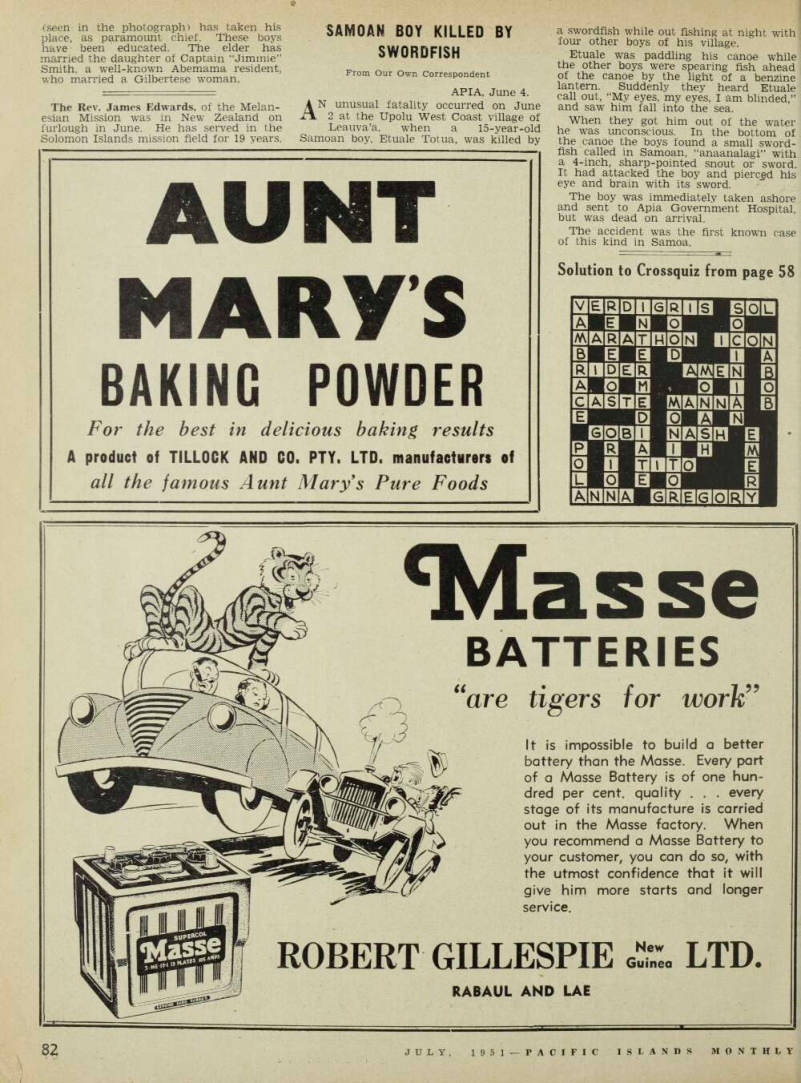
By R. W. Robson
nOR years, I had sought the full story V of the interesting life of George Murdoch: and I am very glad that lommander Burrows has supplied it. It 5 fitting now that' it shoud be ounded off with the story of Murdoch’s aughter, Agnes.
When I was in the Gilberts, doing an ntelligence job, in September, 1941, I r as ashore for a little while on Abemama; nd there ;i met (and photographed) .gnes Murdoch, her two sons and Cap
tain “Jimmie” Smith, last of the old tiaders of the Bully Hayes era. The lad on the left of the photograph, and who married the daughter of Captain Smith, became the “king” of Abemama, and probably still holds that office. I think that Agnes Murdoch is still alive. Here is her story, exactly as I wrote it in 1941: For long years, Mr. G. M. Murdoch, an educated Englishman, was an adminis trative officer m the service of the Gil bert and Ellice Islands Colony. He was stationed mostly at Tarawa. He married a Gilbertese girl, and had several child ren.
Through his wife, he acquired substan tial land interests in Kuria, as a trader and planter. He lived strictly according to European standards, and insisted that his children be properly educated.
Of one daughter, Agnes, he was es pecially fond —she was good-looking, vivacious and intelligent. So he sent her to San Francisco, to be educated.
When she returned, she was a slim and attractive young girl, with plenty of poise, and a full-bodied American accent. She should have married a European, but European men were not plentiful in the equatorial islands in those days. She married, instead, a son of the king of Abemama. .Readers of Islands romances will find plenty about Abemama and its “royal family” in Stevenson’s book. The Abe mama kings were ferocious warriors, and, when Britain took over the group, they held all Abemama, and the neighbouring islands of Kuria and Aranuka, in sub jection.
Agnes Murdoch now is an elderly woman. Briefly, while a boat waited to take me back to the ship through a menacing surf, I interviewed her at her
home in Abemama, not one hundred yards from the spot where Stevenson lived, during his sojourn there. She still is slim, and straight and distinctive, with a charming voice and an American accent; and, in spite of her isolation, she can talk interestingly of people and affairs.
She has two handsome sons;—and, in this picture (see page 60 of this issue) she is seen between the two of them. When the old king died, Agnes Murdoch’s brother-in-law became king; and now he is dead, and Agnes Murdoch’s elder son
(seen in the photograph) has taken his place, as paramount chief. These boys have been educated. The elder has married the daughter of Captain “Jimmie”
Smith, a well-known Abemama resident, who married a Gilbertese woman.
The Rev. James Edwards, of the Melan esian Mission was in New Zealand on furlough in June. He has served in the Solomon Islands mission field for 19 years.
Advertisements & other items, pp. 83-84 (2 items)
81
ACIFIC ISLANDS MONTHLY JULY, 1951
MURDOCH OF THE GILBERTS
(Continued from page 60.)
Ropes,
KANGAROO BRAND
Cordage,
and Twines for every purpose Backed by 98 years of service Manufactured hy:
M. DONAGHY AND SONS,
PTY. LTD., Geelong Cr Sydney.
Fiji Representatives :
PEARCE AND CO.
LIMITED
P.O. BOX 237, SUVA.
i/a m : -r. % ■ ■ ‘ \
rm iimnd wins
Preserve it, in all its enchantment, with a paint fortified for tropical weather resistance, for a rich color permanency and for a mellow, even weathering.
In the Tropics
USE ONLY
BORTHWICKS
HIGH « ■■ ■■ GRADE
REINFORCED
HOUSE PAINT
MORRIS HEDSTROM (AUST.) PTY. LTD. AGENTS FOR
BORTHWICKS PTY. CO.
SYDNEY.
AUNT
MARYS
BAKING POWDER
For the best in delicious baking results A product of TILLOCK AND CO. PTY. LTD. manufacturers of all the famous Aunt Mary s Pure Foods
(♦ 5)) J r m &
*Masse
BATTERIES
are tigers for work
9?
It is impossible to build a better battery than the Masse. Every part of a Masse Battery is of one hundred per cent, quality . . . every stage of its manufacture is carried out in the Masse factory. When you recommend a Masse Battery to your customer, you can do so, with the utmost confidence that it will give him more starts and longer service.
ROBERT GILLESPIE JS. LTD
RA6AUL AND LAE
Swordfish
Samoan Boy Killed By
From Our Own Correspondent APIA, June 4.
AN unusual fatality occurred on June 2 at the Upolu West Coast village of Leauva’a. when a 15-year-old Samoan boy, Etuale Totua, was killed by
a swordfish while out fishing at night with four other boys of his village.
Etuale was paddling his canoe while the other boys were spearing fish ahead of the canoe by the light of a benzine lantern. Suddenly they heard Etuale call out, “My eyes, my eyes, I am blinded,” and saw him fall into the sea.
When they got him out of the water he was unconscious. In the bottom of the canoe the boys found a small sword fish called in Samoan, “anaanalagi” with a 4-mch, sharp-pointed snout or sword.
It had attacked the boy and pierced his eye and brain with its sword.
The boy was immediately taken ashore and sent to Apia Government Hospital, but was dead on arrival.
The accident was the first known case of this kind in Samoa.
Advertisements & other items, p. 84 (1 item)
82
JULY, 1951 PACIFIC ISLANDS MONTHLY
Solution to Crossquiz from page 58
More About The Kukukukus
By A. P. Lyons
ERIC FELDT’S interesting account of a patrol he conducted into the Kuku kuku country in the New Guinea Territory during 1931, which was pub lished in the April PIM, has prompted me to write something concerning these people on the South or Papuan side of the main range.
The word Kukukuku I believe to be a nickname for inland native tribes living between the Lakekamu River and Kerema. It was bestowed by native traders of the Motu tribes (living in and around Port Moresby), and came to be used with other names by the numerous coastal natives of the Gulf of Papua between the places above stated. Miners and other Europeans who first came to the Lakekamu Goldfields always referred to bush natives as Kukukukus.
Some of these miners, notably Joe Sloan. Shark-eye (Black) Bill Park, “Red Bill” Parkes, Frank Pryke and Les (Ji embo) Joubert. were soon on the Morobe Goldfield after gold was found there abouts, and I have no doubt they con tinued to use Kukukuku for the mountain natives, and that newcomers to the field adopted the name.
The so-called Kukukuku were not numerous. They lived in small and scattered hamlets. They made predatory raids on the gardens of the coastal tribes, both day and night, using torches during the hours of darkness, and often massac ring men, women and children. Their guerilla tactics thoroughly scared the numerous salt-water men, and caused them to believe that the Kukukuku were almost supernatural.
THE first recorded use of the nam© Kukukuku appears in the Annual Report of British New Guinea for the year ended June 30, 1900. Dr. J. A.
Blaney, RM, CD, and Mr. A. Guilianetti, the Government Agent at Mekeo, to gether had made one of their infrequent visits to Kerema, where they learned that some Ipisi natives had been massacred by a mysterious inland tribe called Ku kukuku. These officers made an unsuc cessful attempt to trace the raiders.
Incidentally, Guilianetti was shot dead by a native at Mekeo on November 4, 1901. Until 1906, when the present Gulf Division was established, it was included in the boundaries of the Central Division.
During Captain F. R. Barton’s adminis tration, the Gulf Division was proclaimed.
Kerema was selected for its headquarters and Mr. H. L. Griffin took up duty there as the first RM of the Division.
In the Annual Report for 1905-1906, Griffin refers to the Kukukuku as “an inland hill tribe, local name Eariva but generally known as the Kukukuku.” In another part of the same Report, he re ports having got into touch with the so called Kukukuku at a village called Korolauve, situated a few miles up stream from Kerema, through the good offices of friendly natives. He did not visit the village of the Kukukuku.
Mr. C. B. Higginson, RM, took charge of the Gulf Division during September, 1907.
In the Annual Report for 1906-1907, the Acting Administrator, Judge J. H. P.
Murray, remarks as follows: “There seem to be at least two—probably several— different sets of villages called by that name (Kukukuku). The other village or group of villages is apparently some days journey from Korolauve and is situated in the mountains but what mountains is not yet definitely ascertained.”
In 1907-1908, Mr. Higginson, RM, re ports having visited villages at the head
of Laiki Creek in the foothills of the Albert Range distant about 35 miles north of Kerema, but does not say whether he made contact with any natives. He goes on to say that “Maiheri, the local name, has now almost been dropped, and Kukukuku becomes uni versal.’ 1 He continues: “The word Kuku kuku is a Motuan (Port Moresby) term, and was bestowed by the early Lakatoi (large trading canoe) people on their trips to the west, in the same lordly way they renamed the villages, rivers and other parts of the coast.”
CHARLIE HIGGINSON says in the same Annual Report, apropos the terror inspired by the Kukukuku in the large coastal village communities: “It is well that the Kukukuku do not
know their powers, as I am sure if one Kukukuku came out on the beach, he could chase the local population as long as he liked to run after them. Some time back Toaripi people on a visit to Kerema and returning by the beach, got a Kuku
kuku scare. They swam out to sea and then swam back to Kerema along the shore.”
One fantastic tale I, myself, heard from a Moviavi man was that no one could dodge the Kukukuku arrows. ‘‘Could you not get behind a tree?” I asked. “Yes,’ he replied, “but the arrow would follow you.”
Finding of payable gold near the Tiviri River (a branch of the Lakekamu River) was reported by the prospectors Mat Crowe and Frank and Jim Pryke towards the end of 1909. Immediately afterwards, the Lakekamu Goldfield was proclaimed, followed by a visit to the Field of Lieutenant Governor J. H. P. Murray.
He proceeded on a short journey into the mountains, accompanied by Mat Crowe and others. His object was to try and get into touch with the Kukukuku and make friends with them. The visit was fruitless and had to be abandoned for lack of food. It seems that the Pryke Bros, had been sniped by bush natives a short time previously, but happily no one was hit.
During 1910 when I was RM and Warden of the Lakekamu Goldfield I made a few days journey into the moun tains to the north of Nepa, my head quarters. Nepa was situated about eight miles south of the then Anglo-German boundary. It is most likely that my journey took me across the border. I followed a ridge from Nepa, and then dropped down to a small creek to visit a miner named Stan Smith. He asked and was granted permission to accompany me.
We continued along the ridges, and eventually came to the Tiviri River where it was very narrow, with water rushing down as a roaring torrent. We crossed it by saplings placed on to a large flat rock in mid-stream, getting the whole party onto the rock and reaching the other side in the same way. We found a deep and rock-strewn gully having two
tiers of water-Worn ledges. By sapling ladders we reached the ledges and then climbed up the rest of the gully through scrub and boulders. We found a track leading northwards.
Following it, we came to an open table land. Soon the native police espied some native women working in a garden. They surrounded them, and managed to cap ture one woman and a small boy, who were brought to me. The woman was yelling out an alarm. To pacify her, I placed a looking glass before her eyes.
Momentarily she ceased her noise. I gave her the glass but she dropped it. Then I tried to make friends with the boy, but he tried hard to bury his strong teeth in my leg. Meanwhile the woman resumed yelling.
Seeing that it was hopeless to make friends without an interpreter, I let them go. Continuing along the track we reached a small village which contained a few round houses. Each house had a conical shaped roof and a circle of stones in the centre for a fireplace. In one house I found a conventional mummy. The legs and arms were bent and disposed along side the torso and then bound around with ratten. The skull was attached to the torso.
I found several torches. The torch was made by filling an inter-node of bamboo with an inflammable tree resin.
Meanwhile the police had brought in an infant whose mother had thrown it on the ground when chased by the police.
This put me on the spot as I had decided to camp in that village for the night. But, leaving the infant with the mummy and a gift of a trade knife in one of the houses, we continued on and reached another small village. Here in one of the houses I found a wood shield which was pitted with the marks of arrow heads.
We followed a track out of the village which led down to a small creek. After
crossing the creek we found a place to camp. While the police were getting the tents erected we were attacked by a shower of arrows. Three arrows pene trated my tent and two embedded in a tree alongside it.
We could not see our attackers so I ordered a volley of rifle shots to be fired at the place where the arrows were com ing from. This stopped the attack. Mean while Smith returned from the creek where he had been panning off. He reported that a few arrows had been fired at him.
Happily no one was hit.
Next morning we proceeded further north without the aid of a track. We got into very rough boulder country, with
water gurgling beneath. 1 decided to retrace our way back to the villages that we had visited the day before. I found that the infant, the mummy and the knife had disappeared. We followed another track and suddenly surprised about a dozen armed natives in a hut.
They made off with the police in pursuit.
None of them were caught but some of their bows and arrows were brought back.
These were destroyed. Continuing along the track we reached another village (the
third). It was deserted. From there we made our way to the Tiviri River.
A few days afterwards we reached Nepa without further incident.
The Lutheran Mission School at Baita bag, near Madang New Guinea has recently opened a science department. The Science Hall was dedicated at a ceremony on July 1. The Rev. A. Walck, who is pastor in charge of the school, will conduct science lessons.
Advertisements & other items, pp. 85-88 (1 item)
Marjarine
K. H. D. HAY
GENERAL COMMISSION
AND POSTAGE STAMP
AGENT,
GUADALCANAL 8.5.1.
SETS OF BRITISH SOLOMON
ISLANDS STAMPS. MINT OR
CANCELLED COPIES.
Price: £1 /5/- per set.
mm\m
9 sm(top)
TAB /t n:%. ir
MARJARINE
Packaged like this, DEL AN A TABLE MARGARINE, a Product of Fiji, is now available to
ALL PACIFIC ISLANDS
Wherever and Whenever Suitable Transport Can Be Found.
A SUBSTITUTE
FOR
BUTTER
In i lb. Pats In
Shipping Outers
of 2j lb.
Fresh, wholesome and nutritious, this is a pure Vitamised Vegetable Product made in accordance with the Pure Food Laws of the Colony of Fiji, It contains no animal fat.
You'll enjoy eating DELANA . . .
You'll appreciate its ECONOMY Export Prices and Further Information from
ISLAND INDUSTRIES LIMITED
P.O. Box 299, SUVA, FIJI.
Telegraphic Address: “DELANA,” SUVA. • For Local Reasons, the Product is Labelled “Marjarine” in Fiji, and “Margarine” Elsewhere.
TrnHi (A
bwi!
The 2947 miles of the N.A.C. internal network routes are the highways to New Zealand’s scenic and sporting attractions.
Save travel time, see more ... fly for extra comfort with -'W/
WLHa
.Nl :: .\v\4iii, B 5* Offices and Agents throughout New Zealand and the South- West Pacific for the Dominion and South-West Pacific Air Network.
I />is m t i 4'
Eczema Itch
Dispelled
Your skin has nearly 50 million tiny seams and pores where germs hide and cause terrible Itching, Cracking, Peeling, Burning, Acne. Ringworm, Psoriasis, Blackheads, Pimples, Foot Itch and other blemishes. Ordinary treatments give only temporary relief because they do not kill the germ cause. The new discovery, Nixoderm, kills the germs quickly and is guaranteed to give you a soft, clear, attractive, smooth skin, or money back on return of empty package. Get guaranteed Nixoderm from your chemist or store to-day and attack the real cause of many skin troubles.
The guarantee protects you.
Nixoderm
For Skin Sores, Pimples and Itch.
fOR 01/W & VtAKS
m *° ST
PACIFIC 181***
GILLESPIE'S
Gillespie's Anchor Flour is milled from selected high quality Australian wheats and is entoleted for purity. Its consistent high quality has made it the best-known, most asked-for brand of flour in the Islands. (Entolelion is a special new purifying process which reduces the risk of insect infestation).
ANCHOR
FLOUR
GILLESPIE BROS. PTY. LTD.. ANCHOR FLOUR MILLS, SYDNEY G. 1.97
PLOUGHS for EVERY PLANTER
There is a Ransomes Plough for every planter. For nearly 150 years Ransomes have been leaders in plough design, and to-day they offer a range for animal and tractor draught covering all possible requirements. Whether a light steel plough or a tractor disc plough weighing more than 3 tons is required, there is a Ransomes model which will give complete satisfaction.
Qansomes
THE
"CUB"
PLOUGH
Write for illustrated catalogues and all information. Ask also for particulars of our lawn mowers, aerodrome equipment, etc.
MORRIS, HEDSTROM LTD.
Suva, Lautoka and Ba.
Made by: RANSOMES, SIMS & JEFFERIES LTD., IPSWICH, ENG.
A. B. DONALD LIMITED
TELEGRAPHIC ADDRESS; “DONALD, RAROTONGA.”
General Merchants (Wholesale & Retail) and Shipowners Importers & Exporters Branches Throughout Cook Islands Fire, Marine & Motor Vehicles Insurance Agents for Yorkshire
Insurance Co.
RAROTONGA COOK ISLANDS
Agents
Head Office:— A, B. DONALD, LTD., Auckland.
Agents and Distributors for : Associate Houses:—
ETABLISSEMENTS DONALD TAHITI,
ENGLAND.—Austin Cars & Trucks, Pye Radios, Dunlop Rubber Co., Ltd., Vauxhall Cars & Trucks, R. A. Lister & Co., Ltd., Phillips' Cycles, Marples Tools.
Papeete, Society Islands.
DOMINION FRUIT CO., Suva, Fiji Islands.
U.S.A.—Remington Rand Corp., Radio Corp. of America Champion Spark Plug Co.. Firestone Tyres, General Steamship Corp.
NEW ZEALAND.—Vacuum Oil Co. Pty., Ltd.
Products.
NEW ZEALAND.—Vacuum Oil Co. Pty., Ltd* Petroleum AUSTRALlA.—Wunderlich, Ltd., Cement Asbestos Products.
NORWAY.—O. Mustad & Sons, Fish Hooks.
SWEDEN.—B. A. HJorth & Co., Primus Products.
CODES: Bentley's Complete Phrase, Acme Sydney Agents :
BURNS, PHILP & CO., LTD.
London Agents :
BURNS, PHILP & CO., LTD.
San Francisco Agents :
BURNS-PHILP CO. OF SAN FRANCISCO INC.
Nites From The Ng
Goldfields
From Our Own Correspondent WAU, June 28.
General Seccombe, Goc, Northern
Command, accompanied by Colonel Maddern and Group Captain Carr, arrived here on May 30, 1951, and in the evening addressed a large gathering of men at the Wau Club. They left the next day per RAAF Douglas for other areas.
Mr. and Mrs. R. Paul, with their young sons David and lan, returned from three months leave spent in Australia; Mr.
Paul is manager for Burns Philp & Co., Ltd., Wau.
Mr. and Mrs. H. Clissold also returned after nearly four months leave in Aus tralia. Mr. Clissold is attached to Kor anga Gold Sluicing.
Mr. and Mrs. J. Harridge also returned this month from leave spent in Sydney and Australia, Mrs. Harridge was Sister J. Rice of the European Hospital, Wau, before her recent marriage. Mr. Harridge is also with Koranga Gold Sluicing.
A “Hamburger Barbecue” was held at the Wau Golf Club on June 28 to say farewell to Mr. and Mrs. Wally Doe who leave this week for a year’s furlough overseas.
Colonel Maddern and Captain Beat chain were here during the month to commence recruiting for the Papua-New Guinea Volunteer Rifles. Recruits in cluded two officers and 15 O/R’s; five more men will be joining shortly.
Two babies were born at the Wau Hos pital during June—a son to Mr. and Mrs.
Harber of Bulolo; a daughter to Mr. and Mrs. Pelazarro of Golden Ridges, Wau.
Mr. Jim Dalgetty departed for Cairns, Qld., in June for a well-earned holiday.
Again
The Johnsons Are Back Again Yankee in the Solomons
From Our Own Correspondent
Honiara. June 2.
THE brigantine Yankee (Captain Irving Johnson) with Mrs. Johnson and their son Arthur, and 23 passengers who are also crew, arrived in Honiara, BSI, at the end of May.
The Yankee, which last visited the Solo mons in 1948, is on another world cruise.
Two of her crew are women.
Mr. James Ford, of Detroit, a member of the motor car Ford family, is also among the crew members.
Mr. Ford brought with him on the cruise a small glass boat, powered with a fast engine, which is something quite new in the BSIP. It iS made by spraying liquid glass over a wooden mould, and when the glass, in its hundreds of thin layers, is considered thick enough, you just stop spraying.
The Yankee’s lifeboat is called the Doodle. Mr. Ford has named his glass boat the Dandy.
Mr. Osmar White, well-known Austra lian journalist had joined the Yankee in the New Hebrides and was another unexpected visitor.
While the Yankee and most of her pas senger-crew went to Malaita for a cruise round the coast, Mr. Ford remained in Honiara with his glass boat, and with Mr. Wjhite made an expedition up the Nalimbu River, which is some 20 miles east of Honiara. There is reported to be a tambu cave, into which no native will go, a long way up the Nalimbu, and this was one of their objectives.
The Nalimbu is one of the many large rivers which intersect the Guadalcanal coastline. It is very beautiful, as tropical rivers are, but is full of snags, with wide reaches of shallow water in some places, good bathing pools in others, and a fast current in flood time, when it is capable of rising ten feet in twenty minutes and keeping on rising, to subside almost as quickly when the rainstorm at its head waters is over. The Americans bridged the Nalimbu during the war years, but the bridge was rotted and carried away and only a few old timbers remain, with part of the western approach. One or two people were doubtful about the wisdom of taking a glass boat up a tropical river even in a dry spell, but the boat is said to be stronger than steel, and the pair returned safely. They later made an ex pedition along the Guadalcanal coast.
The Yankee left Honiara in the second week in June for New Guinea ports.
American Consul-General
Sees Good Prospects For
P-Ng
Prom Our Own Correspondent
Port Moresby, June 28.
AN American who has seen a fair bit of the world and should be a good judge, thinks that the Territory could build up a thriving tourist trade.
He says that it has many unique fea tures, all types of scenery and climate, a:nd some publicity could turn these assets into cash.
He is Mr. Donald Smith. American Consul-General at Sydney, who visited the Territory to look up American resi dents in the Islands. He went to Lae, Rabaul, Madang and the Central High lands, then Port Moresby. He liked not only the picturesque out-stations' but also the main settlements.
It is wise, sometimes, to look at things
which have become too familiar, through
the eyes of a stranger. And seeing the Territory through the eyes of Mr. Smith should make a lot of Australians review their notions about our oft-maligned Ter ritory.
If he is as hard-headed about business matters as some of our Yankee friends, then his comments on the economic pos sibilities are interesting. He sized up the Territory as a very promising proposition for economic development. Perhaps he did not have ;a stack of information about our .problems in this respect, but Americans are no novices about tackling problems. And there was neither wealth nor a great population when America was first developed.
A plywood expert was expected to arrive In New Guinea in May to inspect Bulolo Gold Dredging timber leases. If his report is favourable, BGD will probably set up a plywood industry at Bulolo. An agree ment covering the prospective plywood industry has already been signed by BGD and the Commonwealth Government.
Mr. and Mrs. A. G. Smyth, of Apia, Wes tern Samoa—he is one of the best-known merchants in Polynesia—arrived in Syd ney in June to attend the wedding of their grandson (Chisholm Junior), The prevailing wog caught up with them be fore they had greeted the Harbour Bridge, and they both endured a week of bad in fluenza. They had not planned an early return to Samoa; but the unusually cold Australian winter may alter the family viewpoint.
Advertisements & other items, p. 89 (1 item)
W. Kopsen & Co. M. Itd.
POSTAGE STAMP DEALERS
AND COLLECTORS.
London wholesaler requires AGENTS in
all BRITISH COLONIES in the PACIFIC,
for regular supplies of used postage stamps from MISSIONARIES, BANKS
and SHIPPING OFFICES.
Current London market prices will be paid for all clean usable material.
Remittances by Air for all sendings valued £2 and over.
B. SAVITZ, 8.P.A.,
6!) Greenvale Road, Eltham, London, 5.E.9, Eng.
CASH
REGISTERS
Electric Model.
HUGIN Cash Registers are built in Sweden with the precision and finish for which Sweden is world famous. They are built in one of the largest register factories in the world and are completely modern in design. HUGIN Cash Registers have been tested and proved over the years and several large emporiums in Australia have had numbers in use since 1938. During the past four years hundreds have been installed in stores all over Australia and New Zealand.
HUGIN machines are most suitable for use in the Islands. The base and cash drawer are made of polished stainless steel not affected by humidity or tropical conditions and all parts that are touched by hand are made of stainless steel or highly chrome-plated special alloy steel. HUGIN design and mechanical efficiency win praises wherever they are used and they provide printed office records for a complete cash sale system.
HUGIN Cash Registers can be provided with a keyboard capacity of £9/19/112 or £99/19/11. Issue a printed receipt for the customer or print on a duplicate cash sale docket. Also provide detailed audit strip, total counter, customer counter and several other attractive and useful features.
Can be supplied with one or two drawers, or totals, and, shortly, with itemising device.
Please send us details of your business, without obligation, and we will be glad to supply full details of suitable machines. Orders will be accepted through any accredited Sydney export house.
W. KOPSEN & CO. m. ITD.
376-382 KENT STREET, SYDNEY
Cables: KOPSEN, Sydney.
Hand Model.
Qantas Mishap In Vila
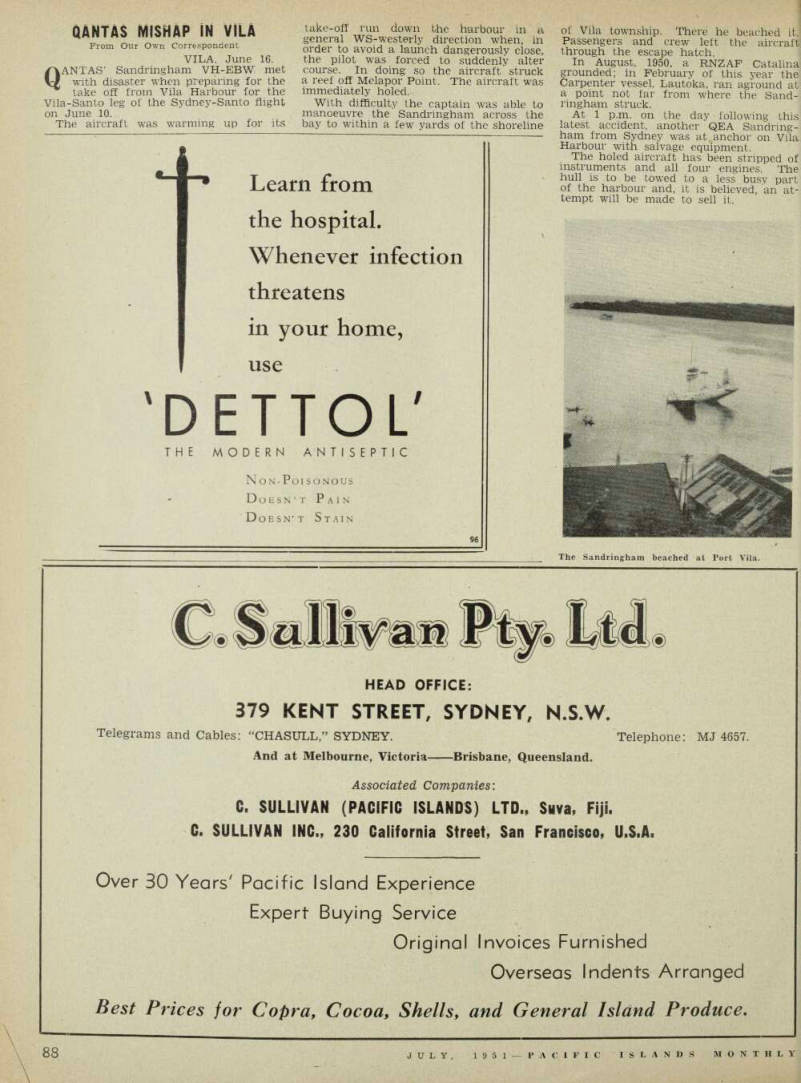
From Our Own Correspondent VILA. June 16.
QANTAS’ Sandringham VH-EBW met with disaster when preparing for the take off from Vila Harbour for the Vila-Santo leg of the Sydney-Santo flight on June 10.
The aircraft was warming up for its
take-off run down the harbour in a general WS-westerly direction when, in order to avoid a launch dangerously close, the pilot was forced to suddenly alter course. In doing so the aircraft struck a reef off Melapor Point. The aircraft was immediately holed.
With difficulty the captain was able to manoeuvre the Sandringham across the bay to within a few yards of the shoreline
of Vila township. There he beached it.
Passengers and crew left the aircraft through the escape hatch.
In August, 1950, a RNZAF Catalina grounded; in February of this year the Carpenter vessel, Lautoka, ran aground at a point not far from where the Sand ringham struck.
At 1 p.m. on the day following this latest accident, another QEA Sandring ham from Sydney was at anchor on Vila Harbour with salvage equipment.
The holed aircraft has been stripped of instruments and all four engines. The hull is to be towed to a less busy part of the harbour and, it is believed, an at tempt will be made to sell it.
The Sandringham beached at Port Vila.
Advertisements & other items, p. 90 (1 item)
C.Sullivan PlVg ML
Learn from
the hospital.
Whenever infection threatens in your home, use
'DETTOL'
THE MODERN ANTISEPTIC
Non-Poi sonous Doesn’t Pain Doesn’t Stain
C.Sullivan PlVg ML
f
HEAD OFFICE:
379 KENT STREET, SYDNEY, N.S.W.
Telegrams and Cables: “CHASULL,” SYDNEY. Telephone: MJ 4657.
And at Melbourne, Victoria Brisbane, Queensland.
Associated Companies: C. SULLIVAN (PACIFIC ISLANDS) LTD., Suva, Fiji.
C. SULLIVAN INC., 230 California Street, San Francisco, U.S.A.
Over 30 Years' Pacific Island Experience Expert Buying Service Original Invoices Furnished Overseas Indents Arranged Best Prices for Copra, Cocoa, Shells, and General Island Produce.
MBE to G. S. Barrack
In the recent Birthday Honours, Mr. Graburn Stan ley Barrack was awarded an MBE for his services to Fiji and the BSIP.
He is a member of a very old and re spected Fiji pioneer family. He was born at Savu Savu and was educated in Fiji.
He went to Australia in May, 1916, en listed in the AIF, and served in the 20th Battalion until June, 1919. He en tered the Fiji Civil
Service in 1935, and held numerous appoint ments in the Audit Department and the Treasury until 1945, when he was transferred to the Wesern Pacific High Commission, where he is now Chief Accountant.
Harbour Fouled By Oil
From A Wreck
Rabaul, June 26.
THE other week, a wrecked ship which lies on the foreshore of Rabaul harbour, and has certain uses, slipped over—and up came her stern and down went her bows. Soon afterwards, the surface of part of the harbour became befouled by heavy black oil, apparently from the wreck.
Some reports said there were 50 tons there, which the new position released.
It is a nuisance—many harbour craft are showing a black band along the water line—but no one seems to care, and high authority naturally does nothing about it.
The Queensland Country Women’s As sociation now has two branches in Papua:—One in Samarai, which has been flourishing for some time, and a new formed one in Port Moresby where Mrs.
W. C. Groves has been elected president.
A son (their second) was born to Mr. and Mrs. Lionel Mansfield at Rabaul, New Guinea, recently.
Advertisements & other items, p. 91 (2 items)
89
THE MONTH IN P-NG
(Continued from Page 32)
PACIFIC ISLANDS MONTHLY JULY, 1951
Shelc
DO YOU WANT
Anything done in Sydney? Shopping? Clothes perhaps? Or books? Reservations? Bookings?
Subscriptions? Information? In short, do you want anything?
Haven’t you often wished for the service of some reliable person in Sydney who could carry out tasks you can’t do yourself?
At last there is someone to help you; someone who makes your problems theirs—the ISLANDS SERVICE BUREAU (Mrs. 11. G. Laffin), 33 Beach Street, Balgowlah, Sydney, Australia.
SEND YOUR ORDER NOW—cost plus 10 per cent, and freight.
SHELC
Get that British spirit!
For 46 years, more Shell has been bought by more motorists than any other brand of petrol. It’s a good British habit.
In Australia alone, Shell is refining British petrol from British crude at the rate of 72,000,000 gallons a year.
The crude is brought to Australia in British tankers from British wells in British Borneo by Shell—a British company.
Get that British spirit—always fill up at the Shell pump.
BUY BRITISH—BUY SHELL
always fill up
at the SHELL pump
shell]
Tie Shell Co. of Aust. Ltd. (Inc. in Gt. Britain)
MSSOSJ
Traffic Cops
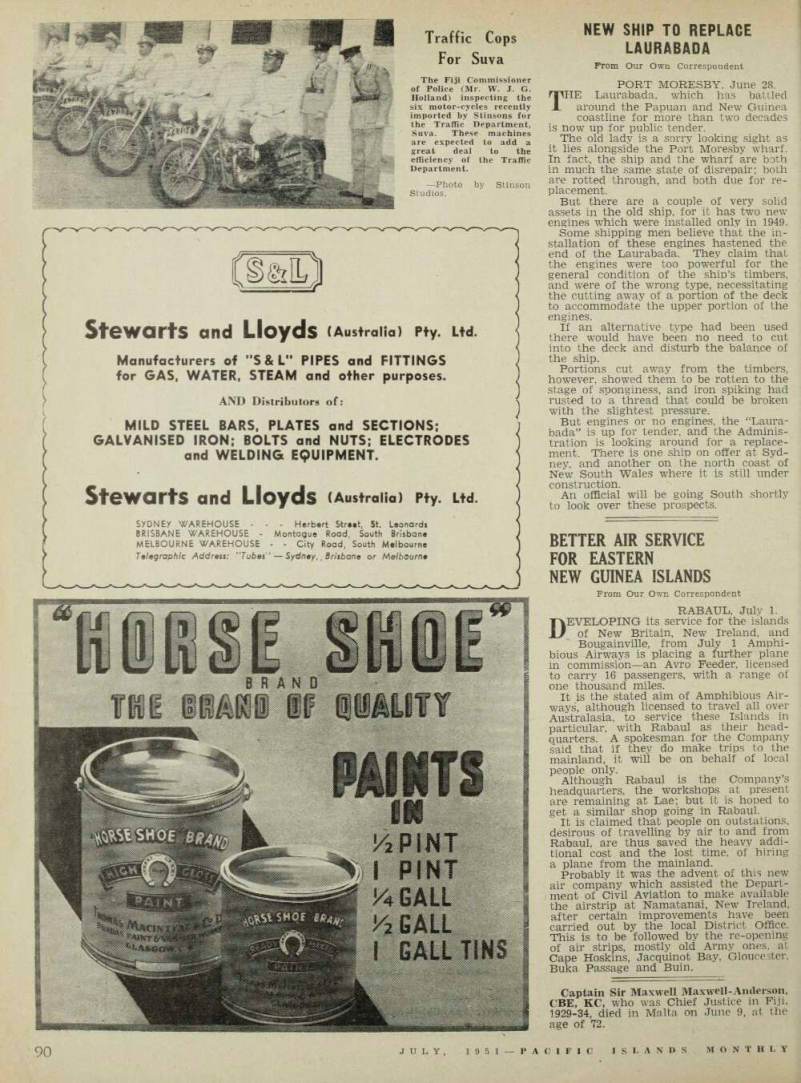
For Suva
The Fiji Commissioner of Police (Mr. W. J. G.
Holland) inspecting the six motor-cycles recently imported by Stinsons for the Traffic Department, Suva. These machines are expected to add a great deal to the efficiency of the Traffic Department. —Photo by Stinson Studios.
New Ship To Replace
Laurabada
Prom Our Own Correspondent
Port Moresby, June 28.
THE Laurabada, which has battled around the Papuan and New Guinea coastline for more than two decades is now up for public tender.
The old lady is a sorry looking sight as it lies alongside the Port Moresby wharf.
In fact, the ship and the wharf are both in much the same state of disrepair; both are rotted through, and both due for re placement.
But there are a couple of very solid assets in the old ship, for it has two new engines which were installed only in 1949.
Some shipping men believe that the in stallation of these engines hastened the end of the Laurabada, They claim that the engines were too powerful for the general condition of the ship’s timbers, and were of the wrong type, necessitating the cutting away of a portion of the deck to accommodate the upper portion of the engines.
If an alternative type had been used there would have been no need to cut into the deck and disturb the balance of the ship.
Portions cut away from the timbers, however, showed them to be rotten to the stage of sponginess, and iron spiking had rusted to a thread that could be broken with the slightest pressure.
But engines or no engines, the “Laura bada” is up for tender, and the Adminis tration is looking around for a replace ment. There is one ship on offer at Syd ney, and another on the north coast of New South Wales where it is still under construction.
An official will be going South shortly to look over these prospects.
Better Air Service
For Eastern
New Guinea Islands
Prom Our Own Correspondent
Rabaul. July 1.
DEVELOPING its service for the islands of New Britain, New Ireland, and Bougainville, from July 1 Amphi bious Airways is placing a further plane in commission—an Avro Feeder, licensed to carry 16 passengers, with a range of one thousand miles.
It is the stated aim of Amphibious Air ways, although licensed to travel all over Australasia, to service these Islands in particular, with Rabaul as their head quarters. A spokesman for the Company said that if they do make trips to the mainland, it will be on behalf of local people only.
Although Rabaul is the Company’s headquarters, the workshops at present are remaining at Lae; but it is hoped to get a similar shop going in Rabaul.
It is claimed that people on outstations, desirous of travelling by air to and from Rabaul, are thus saved the heavy addi tional cost and the lost time, of hiring a plane from the mainland.
Probably it was the advent of this new air company which assisted the Depart ment of Civil Aviation to make available the airstrip at Namatanai, New Ireland, after certain improvements have been carried out by the local District Office.
This is to be followed by the re-opening of air strips, mostly old Army ones, at Cape Hoskins, Jacquinot Bay, Gloucester, Buka Passage and Buin.
Captain Sir Maxwell Maxwell-Amlerson.
CBE, KC, who was Chief Justice in Fiji, 1929-34, died in Malta on June 9, at the age of 72.
Advertisements & other items, p. 92 (1 item)
(Mm
Stewarts and Lloyds (Australia) pt y . ud.
Manufacturers of "S&L" PIPES and FITTINGS for GAS, WATER, STEAM and other purposes.
AND Distributors of:
MILD STEEL BARS, PLATES and SECTIONS;
GALVANISED IRON; BOLTS and NUTS; ELECTRODES
and WELDING EQUIPMENT.
Stewarts and Lloyds (Australia) pt y . Ltd.
SYDNEY WAREHOUSE - - - Herbert Street, St, Leonard* BRISBANE WAREHOUSE - Montague Road, South Brisbane MELBOURNE WAREHOUSE ■ - City Road, South Melbourne Telegraphic Address: "Tubes ' — Sydney, Brisbane or Melbourne
9
BRAND
Highlanders
Over 6,000 NG Highlanders Work on Coast
From Our Own Correspondent
Port Moresby. June 28.
CENTRAL Highland natives have been leaving Goroka airstrip, Central New Guinea, this year at the rate of 370 a month for service under the Native Labour Ordinance which came into effect at the beginning of this year.
By the end of June there was a surplus of recruits at Goroka —the first time this had happened since the ban on Highland recruiting was lifted early in 1950.
Last year, under the old Ordinance, they signed on for twelve months em ployment, taut this year the term, as with all other recruits, is eighteen months.
Figures for Highlanders in private em ployment during 1950 were: — Central Division . 1.302 Bougainville . . 122 New Britain . . 1,214 Gulf Division . . 78 Morobe ... 1,1.01 Manus 82 !\Jadang ... 1,06 b Milne Bay ... 42 New Ireland . . 205 REPORTS on the Highlanders vary.
Some employers say they work quite well and are the equal of coastal natives. But others say that they can run circles around the coastal boys at the art of dodging work.
Stories are told of Chimbus who sat down to sweep a floor, and who took months to learn even the simplest task.
Yet some plantations have had very good work quotas by these Highlanders, so it seems, as with other tribal groups, the mixture of good, bad and indifferent is much the same.
But good or bad, the labour output of 6.100 Highlanders in 1950 must have made some difference to the Territory produc tion figures.
Mr. Charles Sullivan, of Sydney, well known Islands merchant, plans to leave Sydney on July 19 for New Caledonia and Fiji. Thence he will go on to the United States and Europe, and he expects to be
in London in August. This business trip Vill occupy four or five months—-he will be buck in Sydney before the end of the year.
Mrs. John F. Womersley, of Lae, New Guinea, with her two young children will spend a year with her mother in South Australia. Mr. Womersley, a P-NG Fores try Department official, will join them towards the end of this year.
Advertisements & other items, pp. 93-94 (2 items)
91
1 AC;I F I C ISLANDS MONTHLY JULY, 1951
Robert Gillespie Ptv Ltd
A. GREGORY PTY. LTD.
IMPORTERS, EXPORTERS AND
MANUFACTURERS
Leather Saddlery and Paint Merchants ALL CLASSES OF LEATHER SUPPLIED FROM STOCK Apply direct to: A. GREGORY PTY. LTD., 107 York St, Sydney
All classes of merchandise purchased for Island clients throughout the South-west Pacific.
Island produce sold on Australian and overseas markets on a commission basis.
IMPORTERS-EXPORTERS
ROBERT GILLESPIE PTV LTD
BANKERS; BANK OF N.S.W.
COMPTOIR NATIONAL
D*ESCOMPTE DE PARIS
54a PITT ST. SVDNEV N SW.
CABLE ADDRESS
• ROBERGILL-
PHONE •• 8U2221.
CASH
for
SCRAP METALS
HIGHEST PRICES F.0.W., NEW GUINEA
Shells Cartridges Copper Brass Radiators Cable Aluminium Lead Muntz Metal Steel Rails Pipe ★
t.Sims/s?
Wilford Street, Newtown, N.S.W.
LA 5111 LA 5111
BRANCHES THROUGHOUT N.S.W., VICTORIA & STH. AUSTRALIA Leader of the Secondary Metal Industry for 30 Years Telegraphic Address: "SCRAPMETAL," Sydney
Sydney-NZ-Fiji-Hawaii-Nth. America
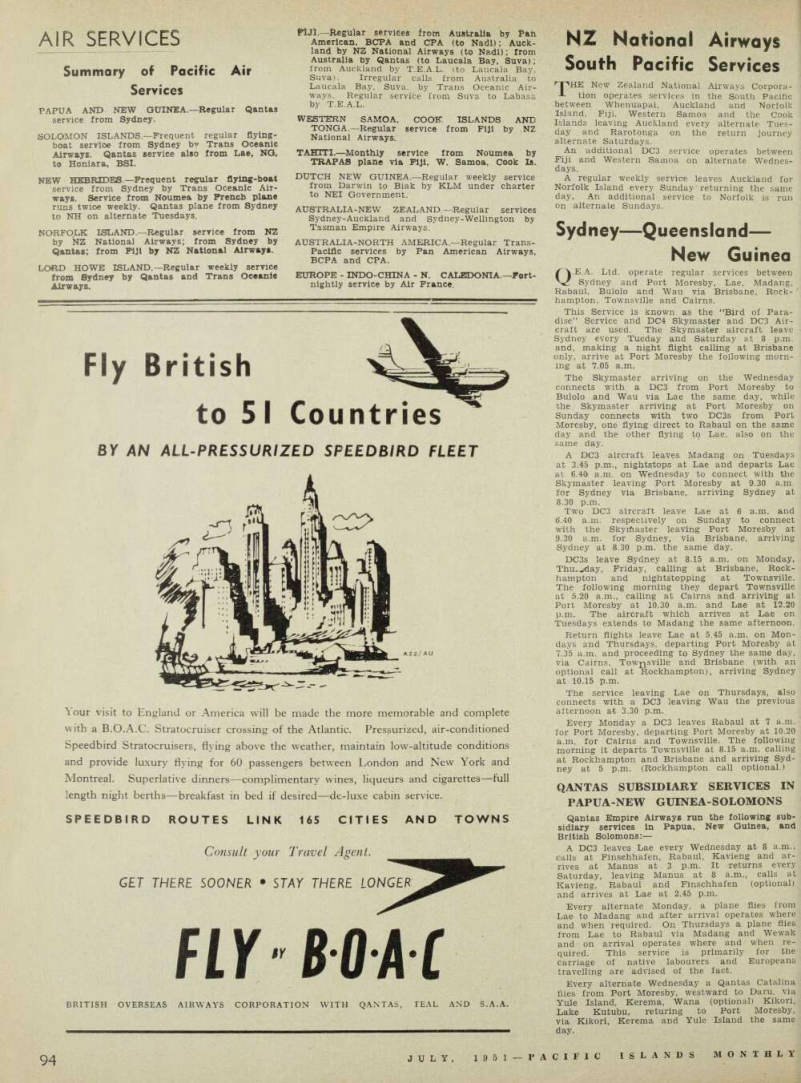
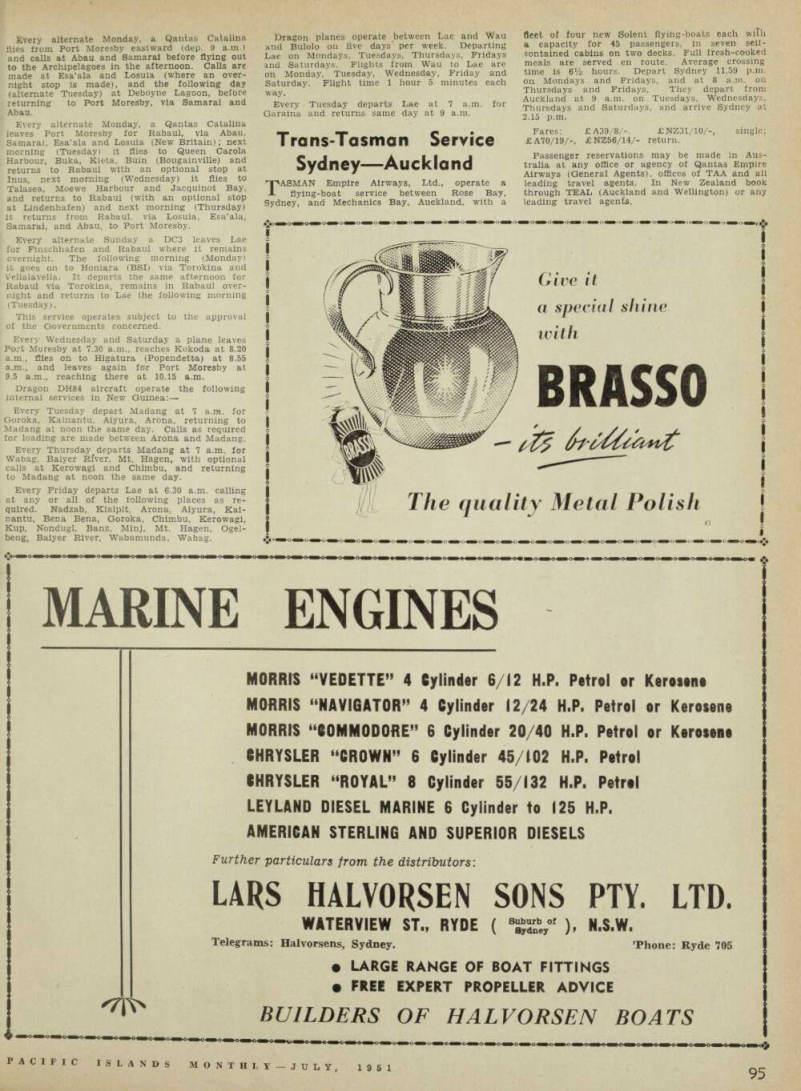
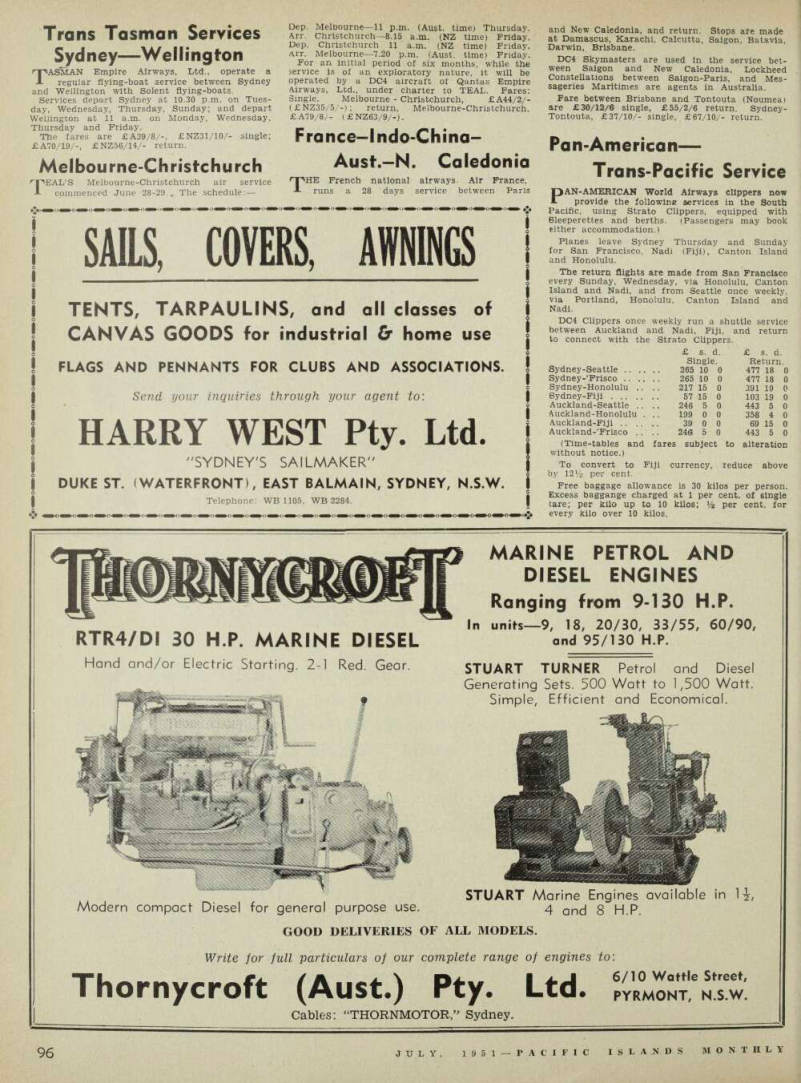
Shipping And Plane Services
Ship Services
THE itinerary of the Canadian-Australasian liner “Aorangi” (17,500 tons) is Sydney, Auckland, Suva (Fiji), Honolulu (Hawaii), Victoria (Vancouver Island), and Vancouver (British Columbia, Canada).
Aorangi has been held up in, Australia for about a month by seamen who were in sympathy with the NZ watersiders. She sailed from Sydney on July 5, and new time-tables are now being prepared) by the company.
New Zealand —Fiji—
Samoa —Tonga
Monthly Service by MV “Matua”
Service Conducted By Union Ss Co.,
Ltd.—Subject To Alteration Without
Notice.
This ship has been held up by the New Zealand watersiders’ strike. With a volunteer crew she left Auckland for island ports at the end of ■May. She expects to make trips again in July and August, and then withdraw for annual survey.
Matua normally makes calls at Suva, Nukua lofa, Vavau, Niue, Pago Pago, Apia and returns to Auckland via Suva.
New Zealand—Cook
Is.—>Niue —Samoa
THE motor vessel “Maui Pomare” owned and operated by the NZ Gov ernment, maintains a direct service between Auckland and Rarotonga (.Cook Islands), with alternative calls at Niue
and Apia (Samoa).
Sydney-N. Caledonia-
Tahiti
LINERS of the Messagerles Maritimes main tain a service at about two-monthly intervals between Sydney, Vila (New Hebrides;, Noumea (New Caledonia) and Papeete (Tahiti), en route to Marseilles, via the Panama Canal; and they return by the same route.
New Caledonia—New Hebrides
THE New Caledonian Government has sub sidised and maintained the coastal ship ping services. The East Coast, West Coast, and the Loyalty Islands, under present conditions, receive 10 round trips per annum rhe ships call at the following ports: EAST COAST.—Yate, Ounla, Thio, Nakcty.
Oanala, Kouaoua Kua, Moneo, Ponerthouen, Tibarama, Polndlmle, Wagap, Touho, Tlpindje, Hienghene, Tac, Oubatch, Pouebo, Balade, Pam, Arama, and return.
WEST COAST. —Pouembout. Kone, Temala, Voh. Ouaco Gomen, Koumac, Tangalou, Tiebaghl, Nehoue, Poume, Baaba, Belep and return.
LOYALTY ISLANDS.—Mare (Tadlne), Llfou (Chepenehe) Ouvea (Pajaoue, St. Joseph) and return.
The steamer “Neo Hebrldals” runs regularly setween Noumea and Svdney. with occasional trips to the New Hebrides (mostly Aneityum), rhe owners are Soclete Maritime et Manlere Hagen, Noumea. Sydney agents: F C. Sleigh.
'54 George Street, Sydney.
The Messagerles Maritimes motor-ship Poly nesien sails from Sydney about every six weeks to Noumea, Vila and Santo (New Hebrides) and outports, with occasional trips to the Wallis and Futuna Islands. Details from Messagerles Mari times branch office, in Sydney, Noumea and Vila.
Sydney-Popua-
New Guinea
BURNS, PHLLP LINE motor-vessels "Bulolo” and “Malaita” maintain regular services be tween Sydney and ports In Papua-New Guinea.
“Bulolo” leaves Sydney, northbound, approxi mately every six weeks; “Malaita” every seven weeks.
"Bulolo” calls at Brisbane. Port Moresby, Samaral, Lae, Dregarhafen, Rabaul, Samaral, Port Moresby, Brisbane, thence back to Sydney.
The “Malalta’s” schedule varies considerably.
She calls at Port Moresby only occasionally, but usually calls at Samaral, Lae. Madang.
Manus, Rabaul, Samaral, thence direct to Syd
ney—ports of call being in that order. Sometimes the order of calls Is Samaral, Rabaul, Manus, Madang, Lae, Samaral. Intending passengers should check with Burns, Phllp <fe Co., Ltd., Sydney, or Island branches.
Sydney-Norfolk Island-
New Hebrides
THE SS “Morinda,” Burns, Philp & Co., Ltd., runs at approximately three monthly intervals from Sydney to Lord Howe Island, Norfolk Island, and main ports of the New Hebrides, and re turn.
Air Services
Summary of Pacific Air
Services
PAPUA AND NEW GUlNEA.—Regular Qantas service from Sydney.
SOLOMON ISLANDS. —Frequent regular flying boat service from Sydney by Trans Oceanic Airways. Qantas service also from Lae, NG, to Honiara, BSI.
NEW HEBRIDES. —Frequent regular flying-boat service from Sydney by Trans Oceanic Air ways. Service from Noumea by French plane runs twice weekly. Qantas plane from Sydney to NH on alternate Tuesdays.
NORFOLK ISLAND.— Regular service from NZ by NZ National Airways; from Sydney by Qantas; from FIJI by NZ National Airways.
LORD HOWE ISLAND.—Regular weekly service from Sydney by Qantas and Trans Oceanic Airways.
FlJl.—Regular services from Australia by Pah American. BCPA and CPA (to Nadi); Auck land by NZ National Airways (to Nadi); from Australia by Qantas (to Laucala Bay, Suva); from Auckland by T.E.A.L. (to Laucala Bay.
Suva i. Irregular calls from Australia to Laucala Bay, Suva, by Trans Oceanic Air ways. Regular service from Suva to Labasa by T.E.A.L.
Western Samoa, Cook, Islands And
TONGA. —Regular service from Fiji by NZ National Airways.
TAHlTl.—Monthly service from Noumea by TRAPAS plane via Fiji, W. Samoa, Cook la.
DUTCH NEW GUlNEA.—Regular weekly service from Darwin to Biak by KLM under charter to NEI Government.
AUSTRALIA-NEW ZEALAND—ReguIar services Sydney-Auckland and Sydney-Wellington by Tasman Empire Airways.
AUSTRALIA-NORTH AMERICA.—Regular Trans pacific services by Pan American Airways,
Bcpa And Cpa.
Europe - Indo-Chtna -N. Caledonla.—Port
nightly service by Air Prance.
NZ National Airways
South Pacific Services
r l A HE New Zealand National Airways Corpora- A tion operates services in the South Pacific between WhenUapai, Auckland and Norfolk Island, Fiji, Western Samoa and the Cook Islands leaving Auckland every alternate Tues day and Rarotonga on the return journey alternate Saturdays.
An additional DCS service operates between Fiji and Western Samoa on alternate Wednes days.
A regular weekly service leaves Auckland for Norfolk Island every Sunday returning the same day. An additional service to Norfolk is run on alternate Sundays.
Sydney—Queensland—
New Guinea
Q.E.A. Ltd. operate regular services between Sydney and Port Moresby, Lae, Madang, Rabaul, Bulolo and Wau via Brisbane, Rock hampton, Townsville and Cairns.
This Service is known as the “Bird of Para dise” Service and DC4 Skymaster and DCS Air craft are used. The Skymaster aircraft leave Sydney every Tueday and Saturday at 8 p.m. and, making a night flight calling at Brisbane only, arrive at Port Moresby the following morn ing at 7.05 a.m.
The Skymaster arriving on the Wednesday connects with a DCS from Port Moresby to Bulolo and Wau via Lae the same day, while the Skymaster arriving at Port Moresby on Sunday connects with two DCSs from Port Moresby, one flying direct to Rabaul on the same day and the other flying to Lae, also on the same day.
A DCS aircraft leaves Madang on Tuesdays at 3.45 p.m., nightstops at Lae and departs Lae at 6.40 a.m. on Wednesday to connect with the Skymaster leaving Port Moresby at 9.30 a.m for Sydney via Brisbane, arriving Sydney at 8.30 p.m.
Two DCS aircraft leave Lae at 6 a.m. and 6.40 a.m. respectively on Sunday to connect with the Skyrfiaster leaving Port Moresby at 9.30 a.m. for Sydney, via Brisbane, arriving Sydney at 8.30 p.m. the same day.
DC3s leave Sydney at 8.15 a.m. on Monday, Thu-..day, Friday, calling at Brisbane, Rock hampton and nightstopping at Townsville.
The following morning they depart Townsville at 5.20 a.m., calling at Cairns and arriving at Port Moresby at 10.30 a.m. and Lae at 12.20 p.m. The aircraft which arrives at Lae on Tuesdays extends to Madang the same afternoon.
Return flights leave Lae at 5.45 a.m. on Mon days and Thursdays, departing Port Moresby at 7.35 a.m. and proceeding to Sydney the same day, via Cairns, Townsville and Brisbane (with an optional call at Rockhampton), arriving Sydney at 10.15 p.m.
The service leaving Lae on Thursdays, also connects with a DC3 leaving Wau the previous afternoon at 3.30 p.m.
Every Monday a DC3 leaves Rabaul at 7 a.m. for Port Moresby, departing Port Moresby at 10.20 a.m. for Cairns and Townsville. The following morning it departs Townsville at 8.15 a.m. calling at Rockhampton and Brisbane and arriving Syd ney at 5 p.m. (Rockhampton call optional.)
Qantas Subsidiary Services In
Papua-New Guinea-Solomons
Qantas Empire Airways run the following sub sidiary services in Papua, New Guinea, and British Solomons:— A DCS leaves Lae every Wednesday at 8 a.m., calls at Finschhafen, Rabaul, Kavieng and ar rives at Manus at 3 p.m. It returns every Saturday, leaving Manus at 8 a.m., calls at Kavieng, Rabaul and Finschhafen (optional) and arrives at Lae at 2.45 p.m.
Every alternate Monday, a plane flies from Lae to Madang and after arrival operates where and when required. On Thursdays a plane flies from Lae to Rabaul via Madang and Wewak and on arrival operates where and when re quired. This service is primarily for the carriage of native labourers and Europeans travelling are advised of the fact.
Every alternate Wednesday a Qantas Catalina flies from Port Moresby, westward to Daru. via Yule Island, Kerema, Wana (optional) Kikori, Lake Kutubu, returing to Port Moresby, via Kikori, Kerema and Yule Island the same day.
Every alternate Monday, a Qantas Catalina flies from Port Moresby eastward (dep. 9 a.m.) and calls at Abau and Samaral before flying out to the Archipelagoes in the afternoon. Calls are made at Esa’ala and Losuia (where an over night stop is made), and the following day (alternate Tuesday) at Deboyne Lagoon, before returning to Port Moresby, via Samarai and Abau.
Every alternate Monday, a Qantas Catalina leaves Port Moresby for Rabaul, via Abau, Samarai, Esa’ala and Losuia (New Britain): next morning (Tuesday) it flies to Queen Carola Harbour, Buka, Kieta, Buin (Bougainville) and returns to Rabaul with an optional stop at Inus, next morning (Wednesday) it flies to Talasea, Moewe Harbour and Jacquinot Bay, and returns to Rabaul (with an optional stop at Lindenhafen) and next morning (Thursday) it returns from Rabaul, via Losuia, Esa’ala, Samarai, and Abau, to Port Moresby.
Every alternate Sunday a DC3 leaves Lae for Finschhafen and Rabaul where it remains overnight. The following morning (Monday) it goes on to Honiara (BSI) via Torokina and Vellalavella. It departs the same afternoon for Rabaul via Torokina, remains in Rabaul over night and returns to Lae the following morning (Tuesday).
This service operates subject to the approval of the Governments concerned.
Every Wednesday and Saturday a plane leaves Port Moresby at 7.30 a.m., reaches Kokoda at 8.20 a.m., flies on to Higatura (Popendetta) at 8.55 a.m., and leaves again for Port Moresby at 9.5 a.m., reaching there at 10.15 a.m.
Dragon DHB4 aircraft operate the following internal services in New Guinea:— Every Tuesday depart Madang at 7 a.m. for Goroka, Kainantu, Aiyura, Arona, returning to Madang at noon the same day. Calls as required for loading are made between Arona and Madang.
Every Thursday departs Madang at 7 a.m. for Wabag, Baiyer River, Mt. Hagen, with optional calls at Kerowagi and Chimbu, and returning to Madang at noon the same day.
Every Friday departs Lae at 6.30 a.m. calling at any or all of the following places as re quired. Nadzab, Kiaipit, Arona, Aiyura, Kai nantu, Bena Bena, Goroka, Chimbu, Kerowagi, Kup, Nondugl, Banz, Minj, Mt. Hagen, Ogel beng, Baiyer River, Wabamunda, Wabag.
t)ragon planes operate between Lae and Wau and Bulolo on five days’ per week. Departing Lae on Mondays, Tuesdays, Thursdays, Fridays and Saturdays. Flights from Wau to Lae are on Monday, Tuesday, Wednesday, Friday and Saturday. Flight time 1 hour 5 minutes each way.
Every Tuesday departs Lae at 7 a.m. for Garaina and returns same day at 9 a.m.
Trans-Tasmon Service
Sydney—Auckland
TASMAN Empire Airways, Ltd., operate a flying-boat service between Rose Bay, Sydney, and Mechanics Bay, Auckland, with a
fleet of four hew Solent flying-boats each with a capacity for 45 passengers in Severn £*ll - cabins on two decks. Full fresh-cooked meals are served en route Average crossing time is 6/2 hours. Depart Sydney 11.59 p.m.
They “depaH"f rom
“and
2 15 p m Fares: £A39/8/-. £NZ3I/10/-, single; £A7O/19/-, £NZS6/14/- return, Passenger reservations may be made in Aus-
Stss
leading travel agents. In New Zealand book through TEAL (Auckland and Wellington) or any leading travel agents.
Trans Tasman Services
Sydney—Wellington
TASMAN Empire Airways, Ltd., operate a regular flying-boat service between Sydney and Wellington with Solent flying-boats.
Services depart Sydney at 10.30 p.m. on Tues day, Wednesday, Thursday, Sunday; and depart Wellington at 11 a.m. on Monday, Wednesday, Thursday and Friday.
The fares are £A39/8/-, £NZ3I/10/- single; £ A7O/19/-, £ NZS6/14/- return.
Melbourne-Christchurch
TEAL’S Melbourne-Christchurch air service commenced June 28-29., The schedule:—
Dep. Melbourne—ll p.m. (Aust. time) Thursday.
Arr. Christchurch—B.ls a.m. (NZ time) Friday.
Dep. Christchurch 11 a.m. (NZ time) Friday.
Arr. Melbourne—7.2o p.m. (Aust. time) Friday.
For an initial period of six months, while the service is of an exploratory nature, it will be operated by a DC4 aircraft of Qantas Empire Airways, Ltd., under charter to TEAL. Fares: Single, Melbourne - Christchurch, £A44/2/- (£NZ3S/5/-); return, Melbourne-Christchurch,
£ A79/8/- ( £ Nz63/9/-).
Fronce-Indo-China-
Aust.-N. Caledonia
THE French national airways Air France, runs a 28 days service between Pans
and New Caledonia, and return. Stops are made at Damascus, Karachi, Calcutta, Saigon, Batavia, Darwin, Brisbane.
DC4 Skymasters are used in the service bet ween Saigon and New Caledonia, Lockheed Constellations between Saigon-Paris, and Mes sageries Marltimes are agents in Australia.
Fare between Brisbane and Tontouta (Noumea) are £3O/12/6 single, £55/2/6 return. Sydney- Tontouta, £37/10/- single, £67/10/- return.
Pan-American—
Trans-Pacific Service
PAN-AMERICAN World Airways clippers now provide the following services in the South Pacific, using Strato Clippers, equipped with Sleeperettes and berths. (Passengers may book either accommodation.) Planes leave Sydney Thursday and Sunday for San Francisco, Nadi (Fiji), Canton Island and Honolulu.
The return flights are made from San Francisco every Sunday, Wednesday, via Honolulu, Canton Island and Nadi, and from Seattle once weekly, via Portland, Honolulu, Canton Island and Nadi.
DC4 Clippers once weekly run a shuttle service between Auckland and Nadi, Fiji, and return to connect with the Strato Clippers.
(Time-tables and fares subject to alteration without notice.) To convert to Fiji currency, reduce above by 12 V 2 per cent.
Free baggage allowance is 30 kilos per person.
Excess baggange charged at 1 per cent, of single tare; per kilo up to 10 kilos; Vz per cent, for every kilo over 10 kilos.
£ s. d. £ s. d.
Single. Return.
Sydney-Seattle 265 10 0 477 18 0 Sydney-’Frisco 265 10 0 477 18 0 Sydney-Honolulu .. .. 217 15 0 391 19 0 Sydney-Fiji 57 15 0 103 19 0 Auckland-Seattle .. .. 246 5 0 443 5 0 Auckland-Honolulu ... 199 0 0 358 4 0 Auckland-Flji 39 0 0 69 15 0 Auckland-’Frisco .. .. 249 5 0 443 5 0
Sydney-Vancouver
BCPA Service
BRITISH Commonwealth Pacific Airlines. Ltd., operate a twice weekly trans-Pac(flc service from Sydney to Vancouver, via Fiji, Canton Island, Honolulu and San Francisco; and a weekly service between Auckland and Vancouver via the same ports.
Planes leave Sydney every Wednesday and Saturday, and Vancouver on the Southbound trip every Monday and Thursday. Every fourth trip from Sydney terminates at San Francisco Instead of Vancouver.
Planes leave Auckland every Tuesday and arrive in Vancouver the following Wednesday The Southbound trip to Auckland commences from Vancouver every alternate Friday. Every other Friday the service commences at San Francisco.
B.C.P.A. services make regular connections at both San Francisco and Vancouver for onward carriage, via either New York or Montreal to the United Kingdom or Europe. The through fare from Sydney to London Is £325 (Aust.).
The fares for the Pacific flight are: Sydney- Nandi (Fiji). £AS7/15/- single, £AIO3/19/- re turn. Sydney-San Francisco, Seattle, Portland.
Los Angeles or Vancouver, £A265/8/- single, £ A477/15/- return. Auckland-Nandi (Fiji), £NZ3I single, £NZSS/16/- return. Auckland- San Francisco. Seattle, Portland, Los Angeles or Vancouver, £NZI97/3/- single. £NZ3S4/18/- re turn.
CPA Sydney-Vancouver
Service
CANADIAN Pacific Airlines, Ltd., run a trans pacific service between Sydney and Van couver. For the present there will be one northbound and one southbound trip per fort night. Stops are made at Nadi (Fiji), Canton Island. Honolulu and San Francisco. The north bound flight commences from Sydney every alter nate Wednesday.
Accommodaton is provided at hotels in Nadi and Honolulu, which is, of course, complimentary.
Douglas DC6 aircraft carrying 48 passengers (seated) or 37 passengers (in sleepers) and a crew of nine are used on the service.
Fares are (in Australian currency; Sydney- Vancouver, San Francisco-Los Angeles and Port land-Seattle, £265/8/- single. £477/15/- return; Flji-Vancouver, £207/8/- single, £373/7/- re turn; Sydney-Fiji, £57/15/- single. £lO3/19/- re turn; Sydney-Honolulu, £217/13/- single. £391/16/- return.
Bookings may be made at the Union Steam Ship Company of New Zealand. Limited, Sydney, or Melbourne: Union Steam Ship Co. of NZ. Ltd., Fiji, Canadian Pacific Airlines, Vancouver; Canadian Pacific Railway Co., Sydney or Mel bourne.
TOA Services
TRANS Oceanic Airways run the following Pacific services:—
Sydney-Lord Howe Is.: A Regular
weekly service with large four-engine flying boats from Rose Bay. Fare: £lO/16/- single; £2l/12/- return. Free baggage allowance 44 lb.
Excess baggage and freight rate Bd. per lb.
SYDNEY-PORT MORESBY: Four-engined Solent flying-boats leave Sydney each Sunday at 7.15 p.m., make a call at Brisbane and reach Port Moresby early the following morn ing. They leave Port Moresby on the return flight each Monday at 8.30 a.m. The service connects with Mandated Airlines services in Papua-New Guinea.
SYDNEY-HOBART: The company now runs a thrice-weekly service direct to Hobart, Tasmania, from Sydney. It will be possible, therefore, for passengers to book from Moresby to Hobart, making an overnight stop in Sydney. Fares are: £l2 single, £24 return.
TEAL Flying Boat
Service
Auckland Fiji
WITH 45 seater Solent flying-boats, Tasman Empire Airways, Limited, operat® a weekly Auckland-Suva-Lambasa and return service.
Aircraft depart Mechanics’ Bay, Auckland, a half hour alter midnight, each Tuesday, and operate to the following time-table: dep. Auckland .. .. 0.30 a.m. Tuesday arr. Suva 7.00 a.m. Tuesday dep. Suva 9.00 a.m. Tuesday arr. Lambasa .. .. 10.00 a.m. Tuesday dep. Lambasa .. . . noon Tuesday arr. Suva 1.00 p.m. Tuesday dep. Suva 700 a.m. Wednesday arr. Auckland .. .. 1.30 p.m. Wednesday Fares (Single): Auckland-Suva, £3l (NZ). £34/9/- (Fijian), £3B/15/- (Aust.); (Return); £55/16/- (NZ), £6l/19/- (Fijian), £69/15/- Aust.).
Suva-Lambasa (Single): £4/10/- (NZ), £5 (Fijian), £5/12/6 (Aust.); (Return): £B/2/- NZ), £9 (Fijian), £lO/2/6 (Aust.).
Reservations may be made through TEAL (New Zealand), Qantas or TAA (Australia), NZNAC (Suva) or any leading travel agents.
Sydney— Noumea-Suvo
following Is the time-table of the Qantas Sandringham flying-boat:— Sydney dep. 9.30 p.m. Mondays.
Noumea arr. 6.30 a.m. Tuesdays.
Noumea dep 8.30 a.m. Tuesdays.
Suva arr. 3 p.m. Tuesdays.
Suva dep. 6 a.m. Wednesdays.
Noumea .. arr. 10.30 a.m. Wednesdays.
Noumea .. . . dep. 12.30 p.m. Wednesdays.
Sydney . . . . arr. 7.45 p.m. Wednesdays.
Intending passengers may book through Qantas offices in Australia. Burns Philp (South Sea) Company, in Suva; and J. Brock, in Noumea.
The fares for this service in Aust. currency
are: Single.
Return.
Sydney-Noumea .. . £37 10 0 £67 10 0 Sydney-Suva 55 10 0 99 18 0 Noumea-Suva ... , 20 5 0 36 9 0
Sydney-Norfolk Is.
Qantas run a DC4 Skymaster alt. Thursdays returning same day) from Sydney to Norfolk Island. Fare, £25 single; £45 return. (For Nortolk Island, see also under NZ National Airways.)
Sydney-New Hebrides
Q ANT AS operate a service to the New Hebrides with Sandringham flying-boats calling at Noumea, Port Vila and Esoiritu Santo. Frequent con-scheduled flights are made, subject to the approval of the Governments concerned.
TEAL Flying-Boat Service
NZ-Chatham Islands
TASMAN Empire Airways, Ltd., operate a Solent Flying-boat service from Auckland-Welling ton to the Chatham Islands and return, at monthly intervals from October to April.
Fares are, from Auckland, £l6/10/- single; £33 return; and from Wellington, £ll single: and £22 return.
Darwin—Netherlands
New Guinea Service
THE service between Batavia, NEI, and Biak, Netherlands New Guinea, has been dis continued and a new service from Darwin to Biak and return has been inaugurated.
The service is run by the Netherlands Govern ment, with DC3 aircraft, chartered from KLM Airlines. The service is run once weekly.
Papua-NG Local
Services
MANDATED Airlines, Ltd., of Lae, New Guinea, and other private operators, run air ser vices between Lae and the New Guinea mainland :entres of Wau, Bulolo, Madang, Wewak. Altape, Alt Hagen. Plnschhafen, Moresby, Kokoda—in fact anywhere In Papua or New Guinea where there I* an air-strip. These planes carry pas •engers. malls and cargo on regular schedules or charter flights
Advertisements & other items, pp. 95-100 (1 item)
George O’Brien
FOR DELIVERY OF SHIPS
TO ANY PACIFIC ISLAND
Contact
GEORGE O’BRIEN
Recommended by: Lever’s Pacific Plantations Pty. Ltd.
Kerr Bros. Societe Gubbay (Port Vila). Rowe Bros., Rabaul. Condominium Government of the New Hebrides.
Special Rates for “P.1.M.” Readers.
GEORGE O'BRIEN
89 Ocean Avenue, Double Bay, Sydney. ’Phone: F 82905.
CAPTAIN W. L. KENNEDY
(Established 1931)
SHIPBROKERS, BUSINESS & REAL ESTATE
63 Pitt St., Sydney
'Phone: BW 6461. Cables: "CAPKEN," Sydney.
LISTING:
STEEL DIESEL CARGO.—6OO tons. 155 ft. x 27 ft. 6 in.. Ruston Hornsby diesels aft. 500 h.p., speed approx. 9V 2 , electric winches. £40,000 Sterling.
TWIN DIESEL STEEL CARGO. 250 tons, engines aft, diesel winches, light, draught, Class A 1 Lloyd’s. £21.000 Sterling.
MOTOR TANKER. —Built 1944. 142 ft. x 27 ft.. Class Bureau Veritas, around 480 tons diesel engines, water ballast. £20,000 Sterling. (In Mediterranean waters.) AUXILIARY CARGO KETCH. —Steel, 245 tons, diesel power and winches, new sails, two hatches, good accommodation. £15,000 Sterling ALSO we have listed Trawlers. Workboats, L.F.B.'s and a selection of Class Auxiliaries and R.D. and B.D. Cruisers (diesel and petrol).
WE ARE ALSO AGENTS FOR MOST MAKES OF MARINE DIESELS.
INQUIRIES INVITED.
Through our Business and Real Estate Branch, we can olTcr a wide variety of Sydney and N.S.W. properties. All Island inquiries promptly and satisfactorily attended to.
n
HALL” 3 H.P. MARINE ENGINE
The “Hall 77 3 H.P. Marine Engine Features: • Patented built-in hand starter • Rust-resisting castings throughout • Trouble-free running-will run indefinitely with-1? I. out attention. • No gear or external reciprocating parts; no oiling li i\ required h • ?. uilt 7. in averse—runs astern by starting in that 1 * i direction \ • Sold complete ready for fitting to your boat ’ 1 Sole Distributors for Pacific Islands'
R. J. CRILLEY PTY. LTD.
123 Sussex St., Sydney.
Illustrated pamphlet air ** B mailed upon request.
I
Fly British
to 5 I Countries
By AN ALL-PRESSURIZED SPEEDBIRD FLEET
I II aa \ our visit to England or America will be made the more memorable and complete with a 8.0.A.C. Stratocruiser crossing of the Atlantic. Pressurized, air-conditioned Speedbird Stratocruisers, flying above the weather, maintain low-altitude conditions and provide luxury flying for 60 passengers between London and New York and Montreal. Superlative dinners —complimentary wines, liqueurs and cigarettes —full length night berths —breakfast in bed if desired —de-luxe cabin service.
SPEEDBIRD ROUTES LINK 165 CITIES AND TOWNS Consult your Travel Agent.
GET THERE SOONER • STAY THERE LONGER
Fir BO A C
BRITISH OVERSEAS AIRWAYS CORPORATION WITH QANTAS, TEAL AND S.A.A.
serth
MARINE ENGINES
MORRIS “VEDETTE” 4 Cylinder 6/12 H.P. Petrol or Keroiono MORRIS “NAVIGATOR” 4 Cylinder 12/24 H.P. Petrol or Kerosene MORRIS “COMMODORE” 6 Cylinder 20/40 H.P. Petrol or Korosone CHRYSLER “CROWN” 6 Cylinder 45/102 H.P. Petrol CHRYSLER “ROYAL” 8 Cylinder 55/132 H.P. Petrol LEYLAND DIESEL MARINE 6 Cylinder to 125 H.P.
AMERICAN STERLING AND SUPERIOR DIESELS
Further particulars from the distributors :
LARS HALVORSEN SONS PTV. LTD.
WATERVIEW ST., RYDE ( B g£V' ), N.S.W.
Telegrams; Halvorsens, Sydney. ’Phone: Ryde 705
• LARGE RANGE OF BOAT FITTINGS
• FREE EXPERT PROPELLER ADVICE
BUILDERS OF HALVORSEN BOATS
Stas, covers, mine
TENTS, TARPAULINS, and all classes of
CANVAS GOODS for industrial & home use FLAGS AND PENNANTS FOR CLUBS AND ASSOCIATIONS.
Send your inquiries through your agent to:
HARRY WEST Pty. Ltd.
"SYDNEY'S SAILMAKER"
DUKE ST. (WATERFRONT), EAST BALMAIN, SYDNEY, N.S.W.
Telephone: WB 1105. WB 2284.
RTR4/DI 30 H.P. MARINE DIESEL
Hand and/or Electric Starting. 2-1 Red. Gear.
MARINE PETROL AND
DIESEL ENGINES
Ranging from 9-130 H.P.
In units—9, 18, 20/30, 33/55, 60/90, and 95/130 H.P.
STUART TURNER Petrol and Diesel Generating Sets. 500 Watt to 1,500 Watt.
Simple, Efficient and Economical.
STUART Marine Engines available in 1 4 and 8 H.P.
Modern compact Diesel for general purpose use.
GOOD DELIVERIES OF ALL MODELS.
Write for full particulars of our complete range of engines to:
Thornycroft (Aust.) Pty. Ltd.
6/10 Wattle Street,
PYRMONT, N.S.W.
Cables: “THORNMOTOR,” Sydney.
ss /*/
BLAXLAND - CHAPMAN ENGINES
for Islands Service
EASILY MAINTENANCED • RELIABLE
Humid island heat has no effect on rugged, Blaxland-Chapman motors. An exclusive feature is the patent “BOUNCE" start magneto. It is vertically mounted to clear bilge water, easily detachable, instantly replaceable and automatically timed.
These motors have power in excess of their rated HP., thus providing that extra “punch” necessary to combat a heavy swell or swift running tide. % m H.P. Super Pup.
SPECIAL ISLANDS SERVICE
Islands residents can rely on immediate attention to their inquiries and orders for Blaxland-Chapman marine engines, launches, pumping units and other engineering requirements from Kerr Bros.
Pty., Ltd., sole Pacific distributors for Blaxland Rae Pty., Ltd. (Successors to Chapman & Sherack). 3V 2 H.P. Blaxland Pup Inquiries are Invited.
KERR BROS
255 A GEORGE ST., SYDNEY.
Box 3838, G.P.O. Cables “CARE,” Sydney.
- & .cT V V Q \ x ? \>v* -JA <?' V s° v jf*-
SOUTH PACIFIC SKYWAYS
4S*
TO NEW ZEALAND
FROM SYDNEY-OR SUVA
<r I y*- 'O': I I unT I & Fly by fast TEAL airliners to scenic New Zealand. You’ll appreciate the fine service, delicious meals. New Zealand is now so close. This year take the best holiday you’ve ever had—fly by TEAL to New Zealand and enjoy all the scenic wonders on a short vacation. ;
TO NEW ZEALAND
TASMAN EMPIRE AIRWAYS LIMITED in association with QEA and BOAC Reservations: TEAL, QEA, NAC, TAA, Leading Travel Agents
Lae’S Timber Requirements
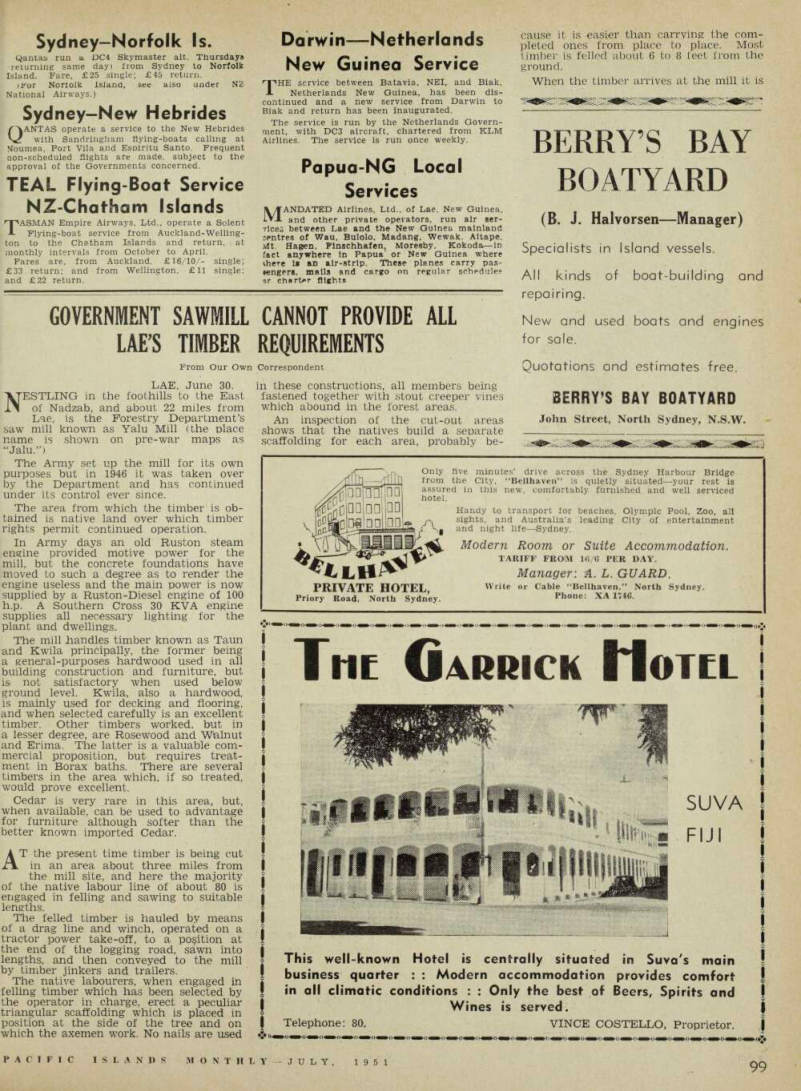
Government Sawmill Cannot Provide All
From Our Own Correspondent
LAE, June 30.
NESTLING in the foothills to the East of Nadzab, and about 22 miles from Lae, is the Forestry Department’s saw mill known as Yalu Mill (the place name is shown on pre-war maps as “Jalu.”) The Army set up the mill for its own purposes but in 1946 it was taken over by the Department and has continued under its control ever since.
The area from which the timber is ob tained is native land over which timber rights permit continued operation.
In Army days an old Ruston steam engine provided motive power for the mill, but the concrete foundations have moved to such a degree as to render the engine useless and the main power is now supplied by a Ruston-Diesel engine of 100 h.p. A Southern Cross 30 KVA engine supplies all necessary lighting for the plant and dwellings.
The mill .handles timber known as Taun and Kwila principally, the former being a general-purposes hardwood used in all building construction and furniture, but is not satisfactory when used below ground level. Kwila, also a hardwood, is mainly used for decking and flooring, and when selected carefully is an excellent timber. Other timbers worked, but in a lesser degree, are Rosewood and Walnut and Erima. The latter is a valuable com mercial proposition, but requires treat ment in Borax baths. There are several timbers in the area which, if so treated, would prove excellent.
Cedar is very rare in this area, but, when available, can be used to advantage for furniture although softer than the better known imported Cedar.
AT the present time timber is being cut in an area about three miles from the mill site, and here the majority of the native labour line of about 80 is engaged in felling and sawing to suitable lengths.
The felled timber is hauled by means of a drag line and winch, operated on a tractor power take-off, to a position at the end of the logging road, sawn into lengths, and then conveyed to the mill by timber jinkers and trailers.
The native labourers, when engaged in felling timber which has been selected by the operator in charge, erect a peculiar triangular scaffolding which is placed in position at the side of the tree and on which the axemen work. No nails are used
in these constructions, all members being fastened together with stout creeper vines which abound in the forest areas.
An inspection of the cut-out areas shows that the natives build a separate scaffolding for each area, probably be
cause it is easier than carrying the com pleted ones from place to place. Most limber is felled about 6 to 8 feet from the ground.
When the timber arrives at the mill it is
winch-hauled up a chute to the breakingdown saws placed one above the other.
In the early days of Department control, great difficulty was experienced in obtaining replacements, but with ample supplies now on hand, and with the services of a skilled Saw-doctor, that difficulty has been removed.
For planing and dressing, such as tongue and grooved flooring, wall boards, cover strips, etc., the timber is carried by a
small rail line to another building and the finished article is carefully stacked for seasoning and drying. rpHE output of the mill over the past six X months was 6,000 super feet per day.
The mill operates for public as well as government requirements but the De partment of Works & Housing could utilise the whole output. As it is. the mill is unable to meet requirements of both the
public and the department, and the ques tion of permitting private enterprise to operate in approved areas under licence, demands attention.
With the exception of Bulolo Gold Dredging Limited and New Guinea Gold fields Limited, there are no private mills near Lae.
If the aim of the present Government in Australia is to encourage private en terprise and not operate in competition against it, a much more valuable contribu tion to the timber industry would result if the Department of Forestry were to exploit the development of timber areas and act in an advisory capacity to private en terprise, which, conducted on a purely commercial basis, and free from the un merciful overhead usually associated with government administration, could result in lower selling prices.
Recently all processed timber prices were increased, although it is understood that the overall profit to the mill over the past year was in the vicinity of 2/- per 100 log super ft.
It is generally agreed that the timber industry in New Guinea has in no wise been fully exploited, and with an un precedented demand for timber for build ing and constructional purposes, not only here, but on the mainland, early atten tion to the question of private enterprise, supported by the Commonwealth Govern ment to the extent of withdrawing from the field as a competitor, must have bene ficial results.
THE European employees at Yalu enjoy pleasant living conditions, but, to date, the Department of Forestry has made no contribution to housing problems other than to supply timber and roofing to enable the staff to build their own homes, in their own time.
Advertisements & other items, pp. 101-102 (1 item)
The Garrick Hotel
BERRY’S BAY
BOATYARD
(B. J. Halvorsen—Manager)
Specialists in Island vessels.
All kinds of boat-building and repairing.
New and used boats and engines for sale.
Quotations and estimates free.
BERRY’S BAY BOATYARD
John Street, North Sydney, N.S.W.
□o an
□n □□
PRIVATE HOTEL,
Priory Road, North Sydney.
Only five minutes’ drive across the Sydney Harbour Bridge from the City, “Bellhaven” is quietly situated—your rest is assured in this new, comfortably furnished and well serviced hotel.
Handy to transport for beaches, Olympic Pool, Zoo, all sights, and Australia’s leading City of entertainment and night life—Sydney.
Modern Room or Suite Accommodation.
TARIFF FROM 16/6 PER DAY.
Manager : A. L. GUARD.
Write or Cable “Bellhaven,” North Sydney.
Phone: XA 1746.
The Garrick Hotel
■f*e*s
T
SUVA
FIJI
k M • SJ? *
This well-known Hotel is centrally situated in Suva's main business quarter : : Modern accommodation provides comfort in all climatic conditions : : Only the best of Beers, Spirits and Wines is served.
Telephone: 80. VINCE COSTELLO, Proprietor.
Rheumatism, Ankles Puffy Backache, Kidneys Strained!
If you’re feeling out o-sorts, have Sleepless nights, or suffer from Dizziness, Nervousness, Backache, Leg Pains, Swollen Ankles, Rheumatism, Excess Acidity, or Loss of Energy and feel old before your time. Kidney Trouble is the true cause.
Wrong foods and drinks, worry, colds or overwork may create an excess of acids and place a heavy strain on your kidneys so that they function poorly and need help to properly refresh your blood and maintain health and energy.
Help Kidneys Doctors’ Way
Many doctors have discovered by scientific clinical tests and in actual practice that a quick and sure way to help the kidneys clean out excess poisons and acids is with a scientifically prepared prescription called Cvstex Hun-
dreds and hundreds of doctors’ records prove this.
No Benefit —No Pay
The very first dose of Cystex goes right to work helping your kidneys remove excess acids.
Quickly, this makes you feel like new again. And so certain are the makers that Cystex will satisfy you completely they ask you to try it under a money back guarantee. You be the judge. If not entirely satisfied just return the empty package and get your money back.
Cystex costs little at chemists and stores and the money back guarantee protects you.
Cystex
The Guaranteed Treatment for
ION E Y S
ladder
RHEUMATISM
STEAMSHIPS TRADING COMPANY LTD.
PORT MORESBY AND SAMARAI PAPUA
Wholesale & Retail Merchants , Planters , Sawmillers, Proprietors , Shipping , Customs and Insurance
Engineers , S/i/)
Agents.
MANAGING AGENTS for:
SAWMILLERS & TRADERS LTD.
CORAL SEA INSURANCE CO. LTD.
ACME BAKERY COMPANY.
MARIBOI RUBBER LTD.
RUBBERLANDS LTD.
KEREMA RUBBER PLANTATIONS LTD.
COCOALANDS LTD.
AGENCIES:
HARVEY TRINDER (N.S.W.) PTY., LTD. (In-
surances effected at Lloyd’s.)
VACUUM OIL CO. PTY., LTD.
DIRECTORATE OP SHIPPING—Papua-New
Guinea Division.
ROYAL INTEROCEAN LINE.
KOKE BAGU PTY., LTD.
TRANS OCEANIC AIRWAYS.
DISTRIBUTORS IN PAPUA for:
ARMSTRONG-HOLLAND PTY., LTD.
Earth Moving and Logging Equipment.
WILLYS-OVERLAND EXPORT CORPORATION.
Jeep cars, etc.
HILLMAN MOTOR CARS.
INTERNATIONAL HARVESTER CO. OF AUST. LTD
International Trucks, McCormlck-Deering Farming Machinery, Defender Refrigerators.
SYDNEY AGENTS: NELSON G ROBERTSON PTY. LTD., 12 SPRING STREET.
News Notes From
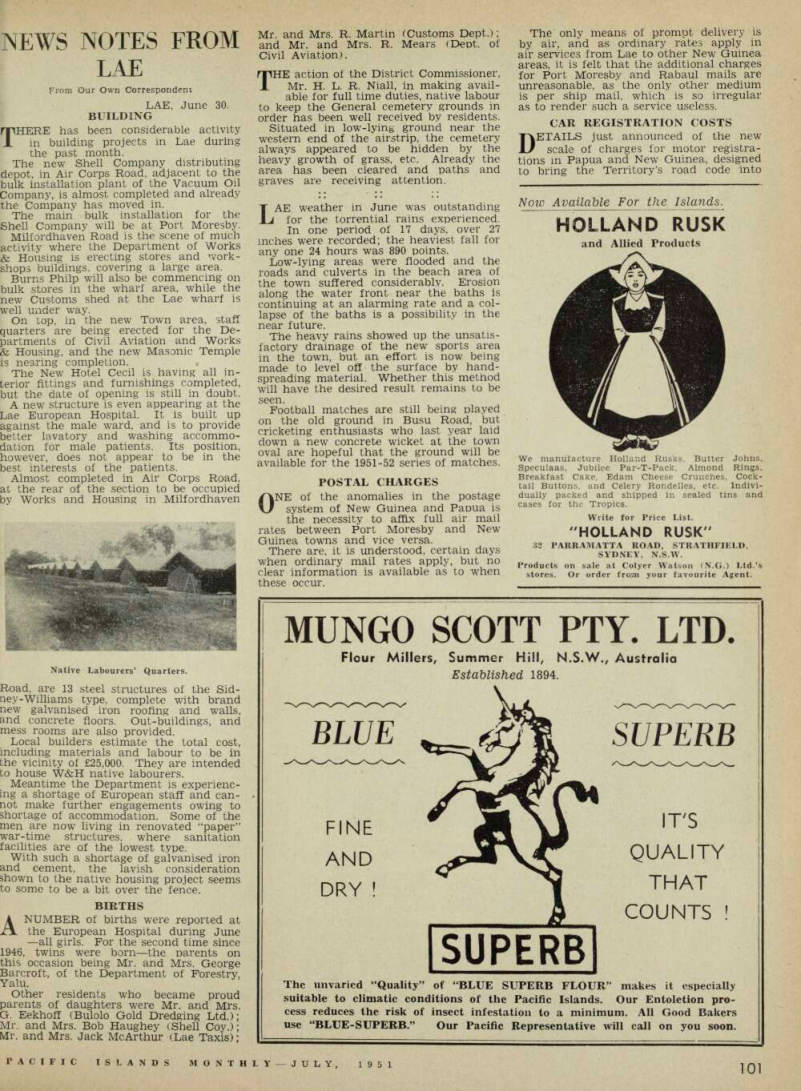
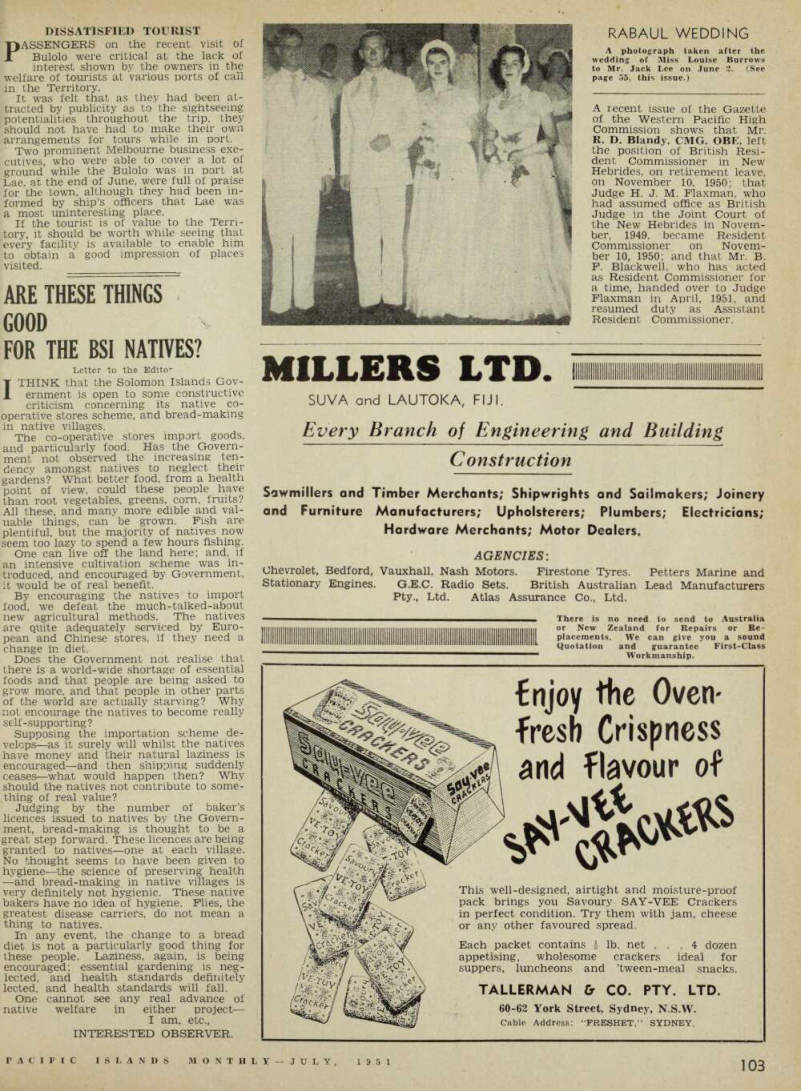
Lae
From Our Own Correspondent LAE, June 30.
Building
THERE has been considerable activity in building projects in Lae during the past month.
The new Shell Company distributing depot, in Air Corps Road, adjacent to the bulk installation plant of the Vacuum Oil Company, is almost completed and already the Company has moved in.
The main bulk installation for the Shell Company will be at Port Moresby.
Milfordhaven Road is the scene of much activity where the Department of Works & Housing is erecting stores and work shops buildings, covering a large area.
Burns Philp will also be commencing on bulk stores in the wharf area, while the new Customs shed at the Lae wharf is well under way.
On top, in the new Town area, staff quarters are being erected for the De partments of Civil Aviation and Works & Housing, and the new Masonic Temple is nearing completion.
The New Hotel Cecil is having all in terior fittings and furnishings completed, but the date of opening is still in doubt.
A new structure is even appearing at the Lae European Hospital. It is built up against the male ward, and is to provide better lavatory and washing accommo dation for male patients. Its position, however, does not appear to be in the best interests of the patients.
Almost completed in Air Corps Road, at the rear of the section to be occupied by Works and Housing in Milfordhaven
Road, are 13 steel structures of the Sid ney-Williams type, complete with brand new galvanised iron roofing and walls, and concrete floors. Out-buildings, and mess rooms are also provided.
Local builders estimate the total cost, including materials and labour to be in the vicinity of £25,000. They are intended to house W&H native labourers.
Meantime the Department is experienc ing a shortage of European staff and can not make further engagements owing to shortage of accommodation. Some of the men are now living in renovated “paper” war-time structures, where sanitation facilities are of the lowest type.
With such a shortage of galvanised iron and cement, the lavish consideration shown to the native housing project seems to some to be a bit over the fence.
Births
A NUMBER of births were reported at the European Hospital during June —all girls. For the second time since 1946, twins were born—the parents on this occasion being Mr. and Mrs. George Barcroft, of the Department of Forestry, Yalu.
Other residents who became proud parents of daughters were Mr. and Mrs.
G. Eekhoff (Bulolo Gold Dredging Ltd,); Mr. and Mrs. Bob Haughey (Shell Coy.); Mr. and Mrs. Jack McArthur (Lae Taxis);
Mr. and Mrs. R. Martin (Customs Dept.); and Mr. and Mrs. R. Mears (Dept, of Civil Aviation).
THE action of the District Commissioner, Mr. H. L. R. Niall, in making avail able for full time duties, native labour to keep the General cemetery grounds in order has been well received by residents.
Situated in low-lying ground near the western end of the airstrip, the cemetery always appeared to be hidden by the heavy growth of grass, etc. Already the area has been cleared and paths and graves are receiving attention.
LAE weather in June was outstanding for the torrential rains experienced.
In one period of 17 days, over 27 inches were recorded; the heaviest fall for any one 24 hours was 890 points.
Low-lying areas were flooded and the roads and culverts in the beach area of the town suffered considerably. Erosion along the water front near the baths is continuing at an alarming rate and a col lapse of the baths is a possibility in the near future.
The heavy rains showed up the unsatis factory drainage of the new sports area in the town, but an effort is now being made to level off the surface by hand spreading material. Whether this method will have the desired result remains to be seen.
Football matches are still being played on the old ground in Busu Road, but cricketing enthusiasts who last year laid down a new concrete wicket at the town oval are hopeful that the ground will be available for the 1951-52 series of matches.
Postal Charges
ONE of the anomalies in the postage system of New Guinea and Papua is the necessity to affix full air mail rates between Port Moresby and New Guinea towns and vice versa.
There are, it is understood, certain days when ordinary mail rates apply, but no clear information is available as to when these occur.
The only means of prompt delivery is by air, and as ordinary rates apply in air services from Lae to other New Guinea areas, it is felt that the additional charges f or p o rt Moresby and Rabaul mails are unreasonable, as the only other medium is per ship mail, which is so irregular as to render such a service useless, pirTCTßirinv
Car Registration Costs
TAETAILS just announced of the new ±J scale of charges for motor registra tions in Papua and New Guinea, designed to bring the Territory’s road code into
Native Labourers’ Quarters.
line with those of Australian States, in dicate an almost 50 per cent, increase on existing rates in New Guinea, where re gistration of motor vehicles has been in force for some years.
The new rates range from £4/4 - to £l5/15/-, and will apply for the first time in Papua, where registration has not been required before.
In an area where army-type vehicles, with left hand drive outnumber conven tional vehicles by 5 to 1, owners are slightly amused at the requirement to have the words “left hand drive” dis played in three inch letters at the rear
of the vehicle, as a warning to the lesser numbered right-hand types.
The regulations are framed as a safety measure, and provision is made for of fences against packed vehicles used in transporting native labour. At the pre sent time, the Administration vehicles are the worst offenders in this respect, and the general public will appreciate the li mitation, as well as the fixing of a speed limit within certain town boun daries.
Native drivers, with absolutely no road sense, form the major section of persons in charge of vehicles, and in an effort to instil some idea of official requirements, the police will issue a pamphlet setting out the new road-safety code, printed in English, Pidgin and Motu.
The Department of Education will be hard pressed to cope with the inevitable demand to teach the greater percentage of native drivers to read before the manuals will be of any benefit.
Personal
ASSISTANT Sub-Inspector Mike Brown, who has been on extended leave has returned to take up duties again in Lae. With his family, he spent most of his leave with relatives in New Zealand.
Mr. Arthur Hyde, well-known business man from Finschhafen, and a frequent visitor to the mainland, has finalised his business affairs in the Territory and has left for South.
Mrs. Bob Beverley, a well-known Lae hostess, who has been spending a lengthy vacation in Sydney, returned on the last Bulolo, as did Messrs. Ike Bitten and Col.
Hodgson, well-known Bulolo Gold Dredg ing identities.
Mr. and Mrs. Les Hawkens (he was in charge of the Bulolo Post Office) left for
furlough on the Bulolo and will be re lieved by Mr. Dave Mills, of the Lae office.
Another business identity who has re linquished his activities in Lae is Mr. A.
E. Hosie, who, for many years, has been a leading building and joinery contractor in Lae. Most of his plant and equipment was shipped on the Bulolo to Hornibrook’s of Port Moresby, and the remainder of the business, including properties, build ings, etc., have been purchased by Bunt ings. Mr. Hosie will take a lengthy vacation South before returning to the Islands.
Mr. John Baker, who has been acting manager for BP’s in Lae for some time, has left for relieving duty at Madang, and later at Rataaul. He will return to Lae some time in the New Year before pro ceeding on leave. • Miss Flora Stewart, daughter of Mrs.
Flo Stewart, well-known owner of the Hotel Cecil, Lae, has returned from an overseas trip which took in quite a large section of India. Formerly with Vacuum Oil Coy’s office staff, Miss Stewart is as sisting her mother in the task of pre paring for the transfer to the new hotel.
Administration Surveyor Brook Webb, still in hospital after an operation to his knee, is. rapidly improving but will be off duty for some time yet.
Contractor Jack Parnell, another old timer, has been ill for some time and finds hospital life extremely irksome after a full and useful period of years in the Territory.
At the end of June Mr. James Hill, Senior Transport Officer of the Vacuum Oil Coy, Lae, was married to Miss Betty Haller, of East Melbourne, Victoria. The ceremony took place in the Lutheran Mission and guests were entertained later at a reception at Voco Mess.
Dissatisfied Tourist
PASSENGERS on the recent visit of Bulolo were critical at the lack of interest shown by the owners in the welfare of tourists at various ports of call in the Territory.
It was felt that as they had been at tracted by publicity as to the sightseeing potentialities throughout the trip, they should not have had to make their own arrangements for tours while in port.
Two prominent Melbourne business exe cutives, who were able to cover a lot of ground while the Bulolo was in port at Lae, at the end of June, were full of praise for the town, although they had been in formed by ship’s officers that Lae was a most uninteresting place.
If the tourist is of value to the Terri tory, it should be worth while seeing that every facility is available to enable him to obtain a good impression of places visited.
Advertisements & other items, pp. 103-104 (1 item)
Superb
Now Available For the Islands.
HOLLAND RUSK
and Allied Products We manufacture Holland Rusks, Butter Johns, Speculaas, Jubilee Par-T-Pack, Almond Rings, Breakfast Cake, Edam Cheese Crunches, Cocktail Buttons, and Celery Rondelles, etc. Individually packed and shipped in sealed tins and cases for the Tropics.
Write for Price List.
"HOLLAND RUSK"
32 PARRAMATTA ROAD, STRATHFIELD,
SYDNEY, N.S.W.
Products on sale at Colyer Watson (N.G.) Ltd.’s stores. Or order froun your favourite Agent.
MUNGO SCOTT PTY. LTD.
Flour Millers, Summer Hill, N.S.W., Australia Established 1894.
BLUE
FINE
AND
DRY !
ft
SUPERB
SUPERB
IT'S
QUALITY
THAT
COUNTS !
The unvaried “Quality” of “BLUE SUPERB FLOUR” makes it especially suitable to climatic conditions of the Pacific Islands. Our Entoletion process reduces the risk of insect infestation to a minimum. All Good Bakers use “BLUE-SUPERB.” Our Pacific Representative will call on you soon.
Weary, Dreary
People
Put Some GO Into Your Life
Too many men, women and girls suffer aching backs, headaches, and feel dreadfully tired — tired, always tired. The cause? Very often, anaemia or bloodlessness.
You see the symptoms in dull eyes, pallid cheeks and lips, breathlessness, vague aches, exhaustion after the slightest exertion. Young children, especially girls, suffer frequently.
If you haven’t blood normal in red corpuscles, you are not receiving ■ sufficient energy-giving oxygen which Is dispersed by the blood throughout your body every second of the day and night. Your nerves, organs and tissues are not properly nourished and you remain weary and dreary.
Get the GO which rich red blood can give you. Take the famous Dr. Williams’ Pink Pills for a few weeks. Dr. Williams’ Pink Pills are specially compounded to provide you with a normal rich blood supply. Always at your chemist or store.
The new BIH ALL WORLD r RECEIVE Of special interest to you that it has: —
6 volt Accumulator Operation
Low Current Consumption
Outstanding Performance and
Reliability
A wealth of practical experience in the design of shortwave receivers for tropical markets has been embodied in the Eddystone “All World Six” Receiver. It is designed to provide the remote “out-station” listener with a specialist built receiver capable of first rate performance and possessing the important feature of low battery consumption. Selectivity, sensitivity, quality of reproduction and performance on all wave bands, including the highest frequencies, will satisfy the most critical. Workmanship and quality of materials used are of the finest to ensure the highest possible degree of reliability.
The wave range of the “All World Six” Receiver is continuous from 30.6 Mc/s to 484 Kc/s (9.8 to 620 metres). The current consumption is only 2.5 amperes from a 6 volt accumulator and no H.T. battery is required. This receiver is eminently suitable for those who, lacking electric supply mains, want performance equivalent to a mains-operated receiver, allied to the utmost economy in current consumption.
Manufactured by Stratton and Co. Ltd., Birmingham, England.
Available for export from Australia ex Bond Store from the factory representatives’.
R. H. CUNNINGHAM PTY. LTD.
62 STANHOPE STREET, MALVERN, VICTORIA
Cables; “CUNNIG,” MELBOURNE.
’Phone: UY6274.
Specialists in all Receiver and Communications Equipment.
Are These Things
Good
For The Bsi Natives?
Letter to the Editor 1 THINK that the Solomon Islands Gov ernment is open to some constructive criticism concerning its native co operative stores scheme, and bread-making in native villages.
The co-operative stores import goods, and particularly food. Has the Govern ment not observed the increasing ten dency amongst natives to neglect their gardens? What better food, from a health point of view, could these people have than root vegetables, greens, corn, fruits?
All these, and many more edible and val uable things, can be grown. Fish are plentiful, but the majority of natives now seem too lazy to spend a few hours fishing.
One can live off the land here; and, if an intensive cultivation scheme was in troduced, and encouraged by Government, it would be of real benefit.
By encouraging the natives to import food, we defeat the much-talked-about new agricultural methods. The natives are quite adequately serviced by Euro pean and Chinese stores, if they need a change in diet.
Does the Government not realise that there is a world-wide shortage of essential foods and that people are being asked to grow more, and that people in other parts of the world are actually starving? Why not encourage the natives to become really
self-supporting?
Supposing the importation scheme de velops—as it surely will whilst the natives have money and their natural laziness is encouraged—and then shipping suddenly ceases—what would happen then? Why should the natives not contribute to some thing of real value?
Judging by the number of baker’s licences issued to natives by the Govern ment, bread-making is thought to be a great step forward. These licences are being granted to natives —one at each village.
No thought seems to have been given to hygiene—the science of preserving health —and bread-making in native villages is very definitely not hygienic. These native bakers have no idea of hygiene. Flies, the greatest disease carriers, do not mean a thing to natives.
In any event, the change to a bread diet is not a particularly good thing for these people. Laziness, again, is being encouraged; essential gardening is neg lected, and health standards definitely lected, and health standards will fall.
One cannot see any real advance of native welfare in either project— I am, etc.,
Interested Observer.
A recent issue of the Gazette of the Western Pacific High Commission shows that Mr.
R. D. Blandy, CMG. QBE, left the position of British Resi dent Commissioner in New Hebrides, on retirement leave, on November 10. 1950; that Judge H. J. M. Flaxman, who had assumed office as British Judge in the Joint Court of the New Hebrides in Novem ber, 1949. became Resident Commissioner on Novem ber 10, 1950; and that Mr. B.
F. Blackwell, who has acted as Resident Commissioner for a time, handed over to Judge Flaxman in April, 1951, and resumed duty as Assistant Resident Commissioner.
Rabaul Wedding
A photograph taken after the wedding of Miss Louise Burrows to Mr. Jack Lee on June 2. (See page 55, this issue.)
Advertisements & other items, pp. 105-106 (1 item)
grtS***
MILLERS LTD. iiiiiiiiiiiiiiiiiiiiiiiiiiiiiiiiiiiiiiiiiiiiiiiiiiiiiiiiiiiiiiiiiiiii
SUVA and LAUTOKA, FIJI.
Every Branch of Engineering and Building
Construction
Sawmillers and Timber Merchants; Shipwrights and Sailmakers; Joinery and Furniture Manufacturers; Upholsterers; Plumbers; Electricians; Hardware Merchants; Motor Dealers.
AGENCIES :
Chevrolet, Bedford, Vauxhall, Nash Motors. Firestone Tyres. Fetters Marine and Stationary Engines. G.E.C. Radio Sets. British Australian Lead Manufacturers Pty., Ltd. Atlas Assurance Co., Ltd. 111 mi There is no need to send to Australia or New Zealand for Repairs or Replacements. We can give you a sound Quotation and guarantee First-Class Workmanship.
7iz $ 16 10 ?<* i K G m*.
■Enjoy the Oven-
fresh Crispness
and flavour of
grtS***
This well-designed, airtight and moisture-proof pack brings you Savoury SAY-VEE Crackers in perfect condition. Try them with jam, cheese or any other favoured spread.
Each packet contains I lb. net ... 4 dozen appetising, wholesome crackers ideal for suppers, luncheons and ’tween-meal snacks.
TALLERMAN & CO. PTY. LTD.
60-62 York Street, Sydney, N.S.W.
Cable Address: “FRESHET,” SYDNEY.
William E. Reed
(Established 1913) Island Trade Broker & Commission Agent 145 a GEORGE ST., CIRCULAR QUAY, SYDNEY.
For more than 36 years the PERSONAL buying services of WILLIAM E. REED, backed by an experienced staff has ensured prompt and reliable service at lowest cost to Missions, Planters and Traders throughout the Pacific. We operate on a WHOLESALE basis only. You receive original invoices at invoiced cost.
Purchase and delivery of Island craft a speciality.
Enquiries invited for all plantation and trading requirements. Island products sold on a commission basis.
Cables: "WILREED," Sydney
TRADING BOATS
We have available a comprehensive range of petrol powered and diesel powered craft from 34 ft. upwards which, with slight alteration, are ideally suited to carrying 7/10 tons cargo.
They include:— 50 ft. x 12 ft. x 3 ft. 6/4 ft. HARD CHINE BOAT, built of double skinned ply, copper sheathed, and powered with twin Chrysler Crown engines. 350 gallons petrol tanks . . £2,750 40 ft. WORK BOAT. 11 ft. 6 in. x 3 ft. 9 in., with 20 h.p. S.C. diesel. Flush decked, wheelhouse aft. Main hatch 10 ft. 6 in. x 1 0 ft. Smaller hatch 4 ft. 6 in. x 5 ft. 6in £1,750' 31 ft. x 1 1 ft. x 4 ft. FISHING BOAT, with 30 h.p. diesel. Deck winch. Hatch could be enlarged to carry about 4 tons. 41 ft. 6 in. x 14 ft. 4 in. DEEP SEA FISHING CRAFT. 40 h.p diesel. Hatch 9 ft. x 7 ft. x 5 ft. deep. . . £4,200. And others.
Telegraph or write for full details and pictures.
ALSO . we have a wide range of ketches, cutters and yawls with auxiliary power from £2,400 upwards.
AND . . . many raised deck, bridge deck and flush deck single and twin-engines cruisers.
WRITE, TELEGRAPH OR CALL.
18 Japs Finally Accept The
End Of The War
AN extraordinary sequel to the Pacifie war was the discovery that 18 Japanese still were holding out on Anatahan (a small mountainous island in the Marianas, about 60 miles north of Saipan).
On June 10, 1944, American planes sank three Jap merchantmen in Anatahan harbour, and 33 Japanese personnel scrambled ashore. They made a camp and lived on the country; and they had a machine-gun and a few rifles.
When, at the end of the war, American warships visited the island, the Japanese refused to surrender and insisted that their country was not beaten. The Yanks left them to it; and they have lived precariously there ever since. Their numbers decreased slowly to 18.
In 1951, when the Americans found that the Japanese remnant was still defiant, they asked the Japanese Government to act. So, recently, a US Navy beach party left in Anatahan, near the Jap camp, a waterproof box containing photographs and documents, including a letter from the Japanese Government telling them that the war was over, and their families wanted them to come home.
The Japanese surrendered to the Ameri cans in June and were sent home to Japan.
If the plan had not worked, the Navy would have sent a party ashore, to take the camp by direct assault.
Of N. Pacific Islands
Japanese Seek Return
IT is reported that Japan has opened a diplomatic offensive for the return of several pre-war Pacific possessions, in cluding the island of Okinawa and the Bonin group.
In private representations to America, the Japanese Government is understood to have sought the return of all former possessions in the northern Pacific, in cluding the Ryukius the Russian-held Kuriles, the Bonin group, Tsu-shima (off the south coast of Korea) and Iwojima.
For the time being at least, the Japanese are resigned to the loss of man dated South Pacific islands (Carolines, Marshalls and Marianas) which they con verted into fortresses in the years between the world wars. The Japanese contention is that the northern Pacific Islands were acquired “peacefully” in the course of Japan’s growth as a Pacific power and that the inhabitants consider themselves Japanese.
Danger Of Short Supplies
To The Islands
THE fact that all kinds of essential goods are now in increasingly short supply in Australia and New Zealand is creating a problem in many Pacific Islands which depend on those countries for supplies.
It was reported in Sydney at the end of June, for example, that the store of meat for the 100 Europeans in Honiara, in the Solomons, had practically disappeared, and that it now was practically impossible there to obtain such things as hardware and building materials.
Behind the scenes, in ports like Sydney and Auckland, there is a constant scramble, growing in intensity, to get a wide range of goods for shipment to the Islands. . , The position in Australia is becoming acute. The combined effect of strikes, Red go-slow-ism, the 40-hour week, and general laziness and inefficiency, is creat ing a grave problem throughout Australia.
And there is no relief in sight.
Head Tax Off In Nauru
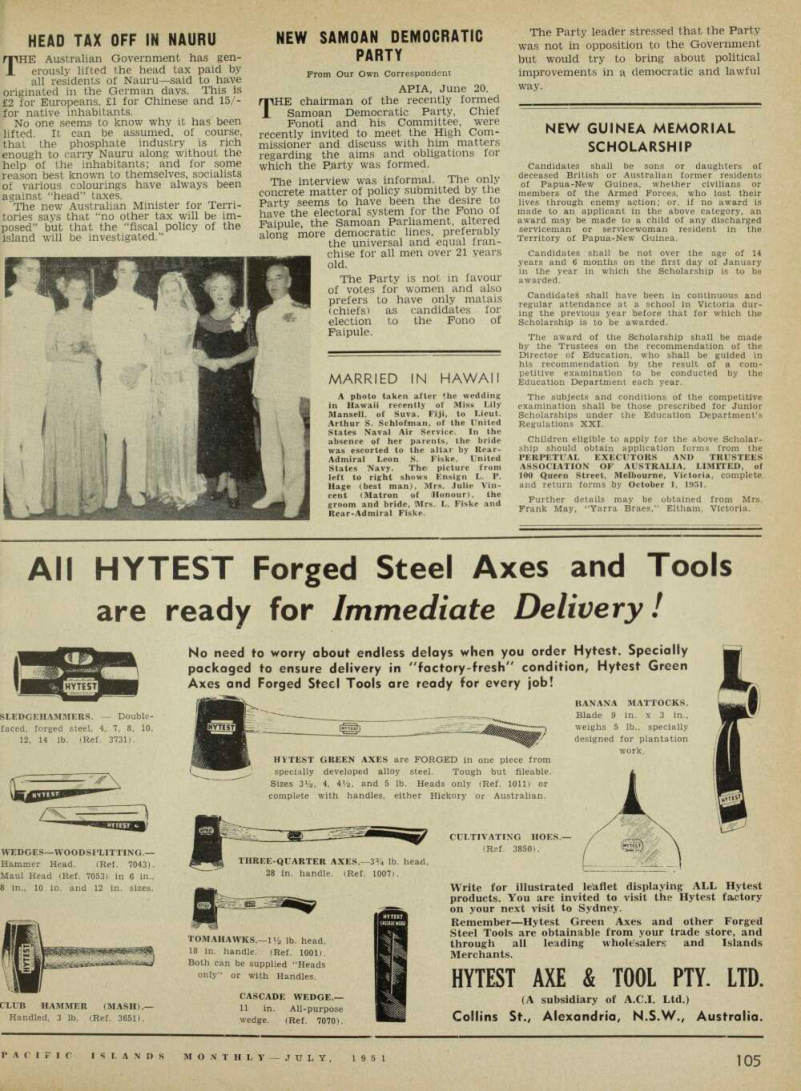
THE Australian Government has gen erously lifted the head tax paid by all residents of Nauru—said to have originated in the German days. This is £2 for Europeans, £1 for Chinese and 15/for native inhabitants.
No one seems to know why it has been lifted. It can be assumed, of course, that the phosphate industry is rich enough to carry Nauru along without the help of the inhabitants; and for some reason best known to themselves, socialists of various colourings have always been against “head” taxes.
The new Australian Minister for Terri tories says that “no other tax will be im posed” but that the “fiscal policy of the island will be investigated.”
Married In Hawaii
A photo taken after the wedding in Hawaii recently of Miss Lily Mansell, of Suva, Fiji, to Lieut.
Arthur S. Schlofman, of the United States Naval Air Service. In the absence of her parents, the bride was escorted to the altar by Rear- Admiral Leon S. Fiske, United States Navy. The picture from left to right shows Ensign L. P.
Hage (best man), Mrs. Julie Vin cent (Matron of Honour), the groom and bride, Mrs. L. Fiske and Rear-Admiral Fiske.
New Samoan Democratic
Party
Prom Our Own Correspondent APIA, June 20.
THE chairman of the recently formed Samoan Democratic Party, Chief Fonoti and his Committee, were recently invited to meet the High Com missioner and discuss with him matters regarding the aims and obligations for which the Party was formed.
The interview was informal. The only concrete matter of policy submitted by the Party seems to have been the desire to have the electoral system for the Fono of Faipule, the Samoan Parliament, altered along more democratic lines, preferably
the universal and equal fran chise for all men over 21 years old.
The Party is not in favour of votes for women and also prefers to have only matais (chiefs) as candidates for election to the Fono of Faipule.
The Party leader stressed that the Party was not in opposition to the Government but would try to bring about political improvements in a democratic and lawful way.
Advertisements & other items, p. 107 (2 items)
105
PACIi IC ISLANDS MONTHLY JULY, 1951
are ready for Immediate Delivery
NEW GUINEA MEMORIAL
SCHOLARSHIP
Candidates shall be sons or daughters of deceased British or Australian former residents of Papua-New Guinea, whether civilians or members of the Armed Forces, who lost their lives through enemy action; or, if no award is made to an applicant in the above category, an award may be made to a child of any discharged serviceman or servicewoman resident in the Territory of Papua-New Guinea.
Candidates shall be not over the age of 14 years and 6 months on the first day of January in the year in which the Scholarship is to be awarded.
Candidates shall have been in continuous and regular attendance at a school in Victoria during the previous year before that for which the Scholarship is to be awarded.
The award of the Scholarship shall be made by the Trustees on the recommendation of the Director of Education, who shall be guided in his recommendation by the result of a competitive examination to be conducted by the Education Department each year.
The subjects and conditions of the competitive examination shall be those prescribed for Junior Scholarships under the Education Department’s Regulations XXI.
Children eligible to apply for the above Scholarship should obtain application forms from the
PERPETUAL EXECUTORS AND TRUSTEES
ASSOCIATION OF AUSTRALIA, LIMITED, of
100 Queen Street, Melbourne, Victoria, complete and return forms by October 1, 1951.
Further details may be obtained from Mrs.
Frank May, “Yarra Braes,” Eltham, Victoria.
All HYTEST Forged Steel Axes and Tools
are ready for Immediate Delivery
HYTEST
SLEDGEHAMMERS. Double-
faced, forged steel, 4,7, 8, 10, 12, 14 lb. (Ref. 3731).
WEDGES—WOODSE'LITTING
Hammer Head. (Ref. 7043).
Maul Head (Ref. 7053) in 6 in.. 8 in., 10 in. and 12 in. sizes.
CLUB HAMMER (MASH).—
Handled, 3 lb. (Ref. 3651).
No need to worry about endless delays when you order Hytest. Specially packaged to ensure delivery in "factory-fresh" condition, Hytest Green Axes and Forged Steel Tools are ready for every job!
HYTEST
H \ TEST GREEN AXES are FORGED in one piece from specially developed alloy steel. Tough but fileable.
Sizes 3V2, 4. 4V2, and 5 lb. Heads only (Ref. 1011) or complete with handles, either Hickory or Australian.
CULTIVATING HOES.-
(Ref. 3850).
BANANA MATTOCKS.
Blade 9 in. x 3 in., weighs 5 lb., specially designed for plantation work.
THREE-QUARTER AXES.—3% lb. head,
28 in. handle. (Ref. 1007).
TOMAHAWKS.—iv 2 lb. head. 18 in. handle. (Ref. 1001).
Both can be supplied “Heads only” or with Handles.
CASCADE WEDGE.—
11 in. All-purpose wedge. (Ref. 7070).
Write for illustrated leaflet displaying ALL Hytest products. You are invited to visit the Hytest factory on your next visit to Sydney.
Remember—Hytest Green Axes and other Forged Steel Tools are obtainable from your trade store, and through all leading wholesalers and Islands Merchants.
HYTEST AXE & TOOL PTY. LTD.
(A subsidiary of A.C.I. Ltd.)
Collins St., Alexandria, N.S.W., Australia.
Active
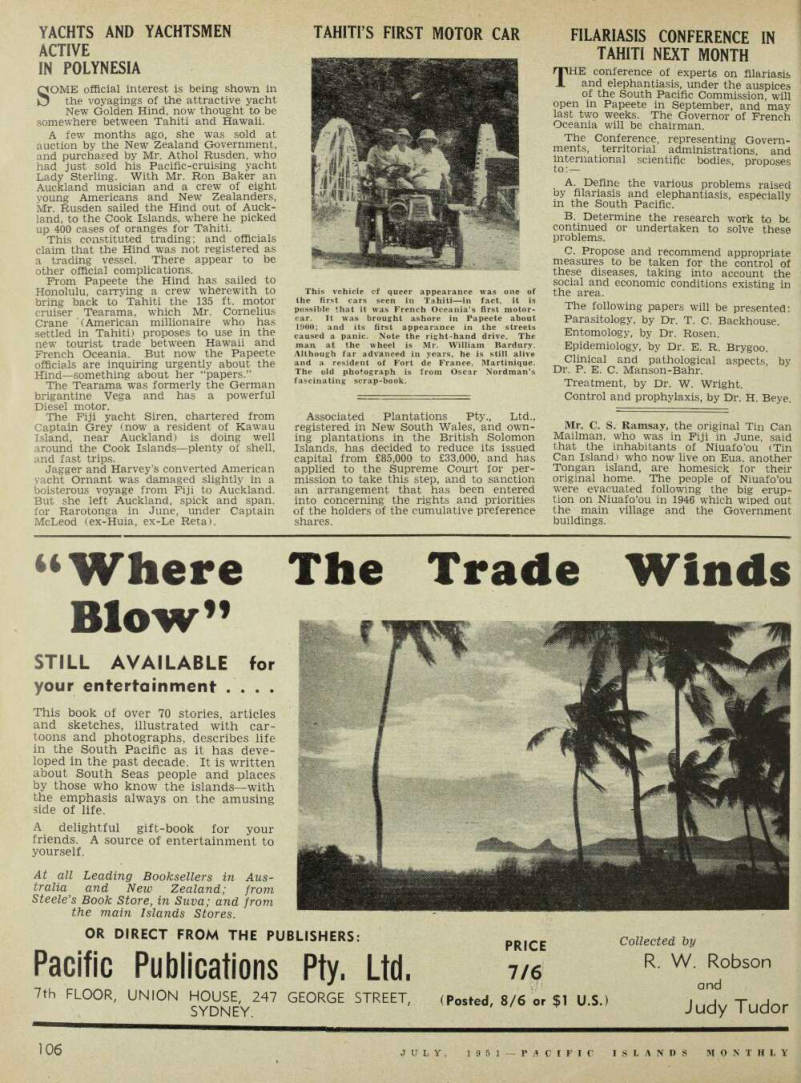
Yachts And Yachtsmen
In Polynesia
SOME official interest is being shown in the voyagings of the attractive yacht New Golden Hind, now thought to be somewhere between Tahiti and Hawaii.
A few months ago, she was sold at auction by the New Zealand Government, and purchased by Mr. Athol Rusden, who had just sold his Pacific-cruising yacht Lady Sterling. With Mr. Ron Baker an Auckland musician and a crew of eight young Americans and New Zealanders, Mr. Rusden sailed the Hind out of Auck land, to the Cook Islands, where he picked up 400 cases of oranges for Tahiti.
This constituted trading; and officials claim that the Hind was not registered as a trading vessel. There appear to be other official complications.
Prom Papeete the Hind has sailed to Honolulu, carrying a crew wherewith to bring back to Tahiti the 135 ft. motor cruiser Tearama, which Mr. Cornelius Crane (American millionaire who has settled in Tahiti) proposes to use in the new tourist trade between Hawaii and French Oceania. But now the Papeete officials are inquiring urgently about the Hind—something about her “papers.”
The Tearama was formerly the German brigantine Vega and has a powerful Diesel motor.
The Fiji yacht Siren, chartered from Captain Grey (now a resident of Kawau Island, near Auckland) is doing well around the Cook Islands —plenty of shell, and fast trips. dagger and Harvey’s converted American yacht Ornant was damaged slightly in a boisterous voyage from Fiji to Auckland.
But she left Auckland, spick and span, for Rarotonga in June, under Captain McLeod (ex-Huia, ex-Le Reta).
Tahiti’S First Motor Car
Associated Plantations Pty., Ltd., registered, in New South Wales, and own ing plantations in the British Solomon Islands, has decided to reduce its issued capital from £85,000 to £33,000, and has applied to the Supreme Court for per mission to take this step, and to sanction an arrangement that has been entered into concerning the rights and priorities of the holders of the cumulative preference shares.
This vehicle of queer appearance was one of the first cars seen in Tahiti—in fact, it is possible that it was French Oceania’s first motor car. It was brought ashore in Papeete about 1900; and its first appearance in the streets caused a panic. Note the right-hand drive. The man, at the wheel is Mr. William Bardury.
Although far advanced in years, he is still alive and a resident of Fort de France, Martinique.
The old photograph is from Oscar Nordman’s fascinating scrap-book.
Filariasis Conference In
Tahiti Next Month
THE conference of experts on filariasis and elephantiasis, under the auspices of the South Pacific Commission, will open in Papeete in September, and may last two weeks. The Governor of French Oceania will be chairman.
The Conference, representing Govern ments, territorial administrations, and international scientific bodies, proposes to:— A. Define the various problems raised by filariasis and elephantiasis, especially in the South Pacific.
B. Determine the research work to be continued or undertaken to solve these problems.
C. Propose and recommend appropriate measures to be taken for the control of these diseases, taking into account the social and economic conditions existing in the area.
The following papers will be presented; Parasitology, by Dr. T. C. Backhouse.
Entomology, by Dr. Rosen.
Epidemiology, by Dr. E. R. Brygoo.
Clinical and pathological aspects, by Dr. P. E. C. Manson-Bahr, Treatment, by Dr. W. Wright.
Control and prophylaxis, by Dr. H. Beye.
Mr. C. S. Ramsay, the original Tin Can Mailman, who was in Fiji in June, said that the inhabitants of Niuafo’ou (Tin Can Island) who now live on Eua. another Tongan island, are homesick for their original home. The people of Niuafo’ou were evacuated following the big erup tion on Niuafo’ou in 1946 which wiped out the main village and the Government buildings.
Advertisements & other items, p. 108 (1 item)
“Where
The
Blow”
STILL AVAILABLE for
your entertainment . . . .
This book of over 70 stories, articles and sketches, illustrated with cartoons and photographs, describes life in the South Pacific as it has developed in the past decade. It is written about South Seas people and places by those who know the islands—with the emphasis always on the amusing side of life.
A delightful gift-book for your friends. A source of entertainment to yourself.
At all Leading Booksellers in Australia and New Zealand; from Steele's Book Store, in Suva; and from the main Islands Stores. r
OR DIRECT FROM THE PUBLISHERS:
Pacific Publications Pty. Ltd.
7th FLOOR, UNION HOUSE, 247 GEORGE STREET,
SYDNEY.
Trade Winds
' Collected by
R. W. Robson
and (Posted, 8/6 or $1 U.S.) J uc jy Tudor
PRICE
7/6
The ‘Pacific Islands Monthly’ And Its


Readers
The Editor Discusses the Events of the Last 21 Years
WITH this issue, the PACIFIC ISLANDS MONTHLY completes 21 years of life It has been published every month since August, 1930. Internationally, as well as in relation to Pacific Islands affairs, these have been the most impor tant and significant years in human his tory.
First, there was the Depression. The Depression was the direct result of the disturbance of the world’s economic balance by World War I. In 1930, when the PIM was born, The Depression was at its worst. It was then that a thousand million people, hurt by forces they could not understand, began to look with sus picion upon the politico-economic sys tem of Western Europe, which controlled world economy.
Communism, at that time, was a joke.
But the Communists all over the world began to quote Karl Marx, who had ar gued that Western Civilisation was based on a fallacy (capitalism, or individualism) which inevitably must collapse. Here, said the Reds, is the first sign of collapse.
As the Depression worsened, Communism made progress.
A gent named Hitler saved the situa tion. He re-armed Germany, and threw the Western Powers into a panic. They began to re-arm; and the enormous de mands of re-armament took up all the unemoloyment slack throughout the world; and The Depression passed.
Seen in the light of history, that was a calamity. If there had been no Hitler, and no re-armament, the world would have been forced by Depression to read just its economic system to realities, and thus would have returned to the normality and comparative peace of the pre-1914 era. As it was, re-armament led in evitably to war; and war, as inevitably, carried our politico-economic systems into further confusion, and chaos.
It was against this background that the young PIM grew to maturity.
FROM September 3, 1939, until the collapse of the enemy at the end of 1945, the PIM each month published its War Diary—a compilation that, to day, is much in demand.
That War Diary contained some very tragic pages. For the first two years, the war was in Europe—remote, and difficult to imagine. Then came Pearl Harbour.
Within a few hours, in December, 1941. the Pacific Islands were more or less in the front line. Within three months, Japs were swarming into the Gilberts, Ocean Island, Nauru, East Indies, New Guinea, the Bismarck Archipelago, and the Solomons. They were not actually in Paoua, the New Hebrides, or the Ellice Islands: but those groups, and New Cale donia, Fiji, Samoa, the Cook Islands and French Oceania were very close to the battlegrounds, and full of the armed per sonnel of America, Australia and New Zealand FOR years, prior to 1939, the PIM had been urgently trying to tell the world of the Japanese menace —of how Jap agents and spies were penetrating every island community and charting every reef.
No one took any notice.
After 1941, the PIM might have crowed “I told you so!” But we were much too busy, in 1942, to have time for any such futile gesture. We were trying to find a large section of subscribers who, literally within days, had simply disappeared. All the thousands of Europeans in New Guinea, Papua and the Solomons had been
evacuated; or, with a rifle and a ground sheet. had gone away into the jungle, on more or less secret service. Most of the journal’s readers in the other Pacific Islands were either moving rapidly, or cut off from mails and transportation.
While war raged in the Pacific Islands, all ordinary trading was finished. No one wanted to advertise goods for sale to the Pacific Islanders.
With few advertisers, and so many readers widely scattered, and out of con tact, the outlook for the PIM was de finitely blue. ‘’Better close her up until the war’s over,” said my friends. “No need for a PIM now.”
Force and disappeared over far horizons.
They took away half our printinghouse crew; and I had to camp there and do factory chores. I was really busy.
Yet, somehow, i couldn’t bear to close the PIM—I felt that it had a war-time j° b to do ; 80 lt; P roved - The widely-scattered people of the Islands, homeless and distracted, wanted a rallying-point where they could get news of their Islands, and tidmgs of their hus bands, brothers and friends, now fighting in the jungle. They really needed a place where they could discuss their uncertain future.
Little by little, in that black year of 1942, we gathered our readers together again. In spite of incredible difficulties, and the silliest and stupidest censorship I have ever heard of, we collected and published news of the war in the Islands, and of the activities and fate of Islands
people. We assisted in the formation of the Pacific Territories Association: and, in season and out, we fought bureaucracy with everything we had for a fair deal for the Islands refugees.
For a little while, I was single-handed.
A score of old friends among our adver tisers refused to remove their advertise ments from the PlM—even although it had no use as a publicity medium —and with their support we kept going. Then, in a Melbourne war factory, chauffeuring a shell-making machine, I found a New Guinea lass who really could write, and who hated shell-making; and so Judy Tudor joined the attenuated staff of the
Pim.
INEVITABLY, as the years passed, and the enemy was driven northwards out of the South Seas, and the restoration of civil government began, we got into conflict with the apostle of Australian Socialism, a politician named Eddie Ward.
The Australian Labour Government made Eddie the Minister in charge of Pauua and New Guinea —probably because he had never seen a native or smelled copra—and,
of course, Eddie began to apply the prin ciples of his political creed to Islands trading and industries.
It was a hectic period and, for Islands folk, an unforgettable experience. They had been chased out by Japs; beggared by war; compensated to some extent by the War Damage Fund (created to cushion the effects of the anticipated in vasion of Australia); and now, because they were engaged in private enterprises, they were treated by one of the King’s Ministers as social sinners and pariahs.
The Empire has heard much of the Edwardian period of British history. But not enough has been told —yet—of the Eddiewardian era in New Guinea.
Eddie Ward is politically dead and buried; but some of his appointees are still marching on, and his Territories effort will remain as one of the quaintest chapters of Pacific history, as recorded month by month in the PIM.
IN 1942, like most of the Pacific Islands people, we of the PIM were confused and aimless: but, long before the end of the Pacific War, we had found a job to
do—namely, we were using the PIM and all the publicity media available to us to assist the Territories people to return home and rehabilitate themselves.
Immediately the War was over, far reaching political, administrative and commercial changes took place. There were alterations in the status and the governmental machinery of nearly all the Islands countries. Shipping lines were restored only in part—air lines spread over all the archipelagoes. Radio brought every Islands resident into direct touch with the world. Trading conditions changed profoundly. The Islands folk were asked to adjust their daily lives to a new and different tempo.
In all these things, the PIM played its part, by providing a regular service of in formation and by offering comment which, whether right or wrong, did at least seek the greatest good of all the Islands resi dents, and did keep their wishes before the political panjandrums.
The Islanders returned to their homes; and, for a time, it looked as if we all were to enjoy a wonderful era—the era of phenomenal prices for coconuts and cocoa. But, almost before we began to spend the new money, new troubles beset us.
TO explain what has happened, we must go back a few decades.
The economic sickness (The Depres sion of 1929-32 was the chief result of it) which followed World War I, was directly the result of the failure of the nations to handle the economic problems created by four years of total war.
One cannot take most of the skilled workers of the world out of their normal productive occupations for a long time, and compel them to either engage in the non-productive work of active service, or the equally useless work of producing war
materials.' and pay for most of it by simply printing and issuing bank-notes, without throwing the world’s whole econo mic system out of adjustment.
If life and living standards were going to be resumed, after 1918, where they stopped in 1914, great wisdom, great sac rifices and great statesmanship were called for. The world got none of those things; and so it just naturally went straight into The Depression, into political confusion, and into World War 11. One might have thought humanity would have learned the lesson, and be haved with sanity after World War 11. Be cause an even larger proportion of the world’s workers were out of non-produc tive work, for a much longer time, and the total destruction was enormously greater, than in World War I; and a far greater amount of unbased paper currency was printed and circulated.
Only great strength and firmness of government—a ruthless insistence, for ex ample, that the only thing to counter the evils inherent in the continued circulation of that flood of useless paper money was a period of very high production at the lowest possible cost—could avert the dis asters that otherwise must attend the far reaching dislocation of the world’s econo mic machinery.
But humanity had learned nothing at all.
Almost before the fighting had ceased, the nations had gone off on the maddest politico-economic spree the world has ever seen. Some, like Poland and Czechoslo vakia, went completely Communist; some, like Britain and France, went Socialist— that is, half way.
Just at a time when, to counter their almost incalculable war losses, the British should have been encouraging the utmost individual production at the lowest rate, and the conservation of all their overseas resources, they started to “nationalise” their principal industries, and to give away large sections of their Empire.
Inevitably, the whole Western world has slipped into almost indescribable ec onomic confusion, which daily grows worse. Hosts of babbling little men—most of them the useless puppets of political pressure groups—run around in circles and get in each other’s way. They achieve nothing. Economic maladjustment now is so great all over the world that infla tion is practically out of control, and we all are faced with an actual food short age. . .
SO the PIM attains its majority under conditions almost exactly similar to those which existed when it was born —namely, an acute political crisis has been caused by mankind’s pitiful inability to handle the economic condi tions created by a world war. The world, 20 years ago, was saved from economic collapse by the threat of World War 11.
Is history going to repeat itself, and is to-day’s world going to escape economic disaster by the threat of World War III?
It looks like it.
WHEN the PIM uttered its first new born squall, 21 years ago, British prestige still was high throughout the East, and the Union Jack was the only flag we folk, south of Capricorn, could see in the Pacific. North, east and west, we recognised the friendly ensigns of United States, France and Holland, respectively; but in all moments of international stress we looked naturally to Whitehall for pro tection and support.
Within that brief span of two decades we have seen some extraordinary events.
British prestige in the East has been de stroyed, the British flag counts for little in the Pacific, and the strong and friendly Dutch people have disappeared from our western boundaries —all because the Little
Sisters of the Reds got possession of Whitehall in 1945. and proceeded to un dermine the Empire which they so hated.
To-day, we of the South Seas look for protection and security to the United States—the mighty Power which over threw Japan in four bloody years, and which now leads the free world against the Muscovite and—what is of supreme importance to us—against Red Asia. Al though comparatively small in popu lation, Australia, Canada and New Zealand, once the strongest section of the British' Empire, now are accepted as America’s closest partners in the task of defending the free peoples of the Pacific.
Of all the changes that have taken place in our 21 years, that seems to us to be the most significant.
IHOPE our readers —and, especially, my many personal friends among those readers—will forgive me for (as my candid assistant editor expresses it) chas ing my tail around among the politico economic problems. But the plain fact is that the history of the PIM is all mixed up with these things.
Ever since I founded the journal, the record has been one of crises—economic, political, administrative and military. In all the 21 there _have not been
26 consecutive months of quietness and peace. I, and people of my generation, almost pray that there presently will come a time when we may cease to fret over prices and political creeds and threats of war, and devote serious thought to con serving human happiness and assisting human well-being—a period something like the second half of last century.
At the moment, there is little of the kind in sight. Nonetheless I make bold to express the wish that presently we all may enjoy some freedom from these alarums of war and politics.
And, looking back over 21 years of good and bad times, in which we at least have tried to give service to Islands people, we (the Editor, and Selwyn Hughes, Manager, and Judy Tudor, Assistant Editor) can say, with complete sincerity, Thank you all very much for 21 years of consistent support, frequent kindness and tolerant understanding. We hope the record of the next 21 years will have in it less gunpowder and more butter (even if it’s mostly margarine!).
R. W. Robson.
Recent arrivals in Fiji include Mr. P.
N. Dalton (Solicitor-General, who has been appointed to act as Attorney-General until the return from England of Mr. B. A.
Doyle): Mr. and Mrs. R. Crompton, re turned from New Zealand; Mr. and Mrs K. H. Marks, from Melbourne; and Mr. and Mrs. R. N. Caldwell, from leave spent in Australia; Dr. Paley, returned after receiving medical attention in Melbourne; Mr. and Mrs. H. E. Canard, from over seas leave; and Dr. and Mrs. P. G. Grif fiths, from leave spent in England.
Mr. Alexander Hamilton Irvine, an esteemed old resident of the Nadroga district of Fiji, died on June 23, aged 69.
He was the eldest son of a former Attorney-General of Fiji.
Advertisements & other items, pp. 109-114 (2 items)
Get Back Vitality!
ETABLISSEMENTS DONALD TAHITI
HEAD OFFICE—QUAI DU COMMERCE—PAPEETE.
Telegraphic Address: “DONALD, PAPEETE.’’
General Merchants (Wholesale Cr Retail) Cr Shipowners
Importers Cr Exporters—Branches Throughout Marquesas Islands
Lloyd's Agents
ASSOCIATE HOUSES; A. B. Donald, Ltd.,
Auckland. New Zealand; A. B. Donald, Ltd., Rarotonga, Cook Islands; Dominion Fruit Co., Suva, Fiji.
Agents and Distributors for : FRANCE: Hennessy Cognacs; Marie Brizard & Roger Liqueurs; Charles Heidsieck Champagnes; Perrier Water; Gruber Beer.
NEW ZEALAND: Vacuum Oil Co.
Pty., Ltd., Petroleum Products.
SWEDEN: Hjorth & Co., Primus Stoves.
U.S.A.: General Steamship Corp.; Radio Corp. of America; Brown & Williamson, Ltd.; Cigarettes: Lucky Strike, Wings, Old Gold; Champion Spark Plug Co.; Rainier Beer.
ENGLAND: Reckitt & Colman (Overseas), Ltd.; Phillips Bicycles; The Bank Line Ltd.
Sydney Agents ;
BURNS, PHILP & CO., LTD.
London Agents :
BURNS, PHILP & CO., LTD.
San Francisco Agents :
BURNS-PHILP CO. OF
SAN FRANCISCO INC.
Agents in France :
HARTH & CIE, PARIS.
A. BICKART, MARSEILLES.
GET BACK VITALITY!
Men and women don’t let glandular starvation destroy your .normal impulses by causing you nervousness, body pains, tiredness, loss of masculinity or feminity, chronic headaches, premature ageing and many other ills. Take Animones the amazing new gland food in tablet form containing natural hormones, and restore surging vitality.
An ex-P.O.W. of Hamilton, Q’ld., writes: “At 35 I felt 50. I was starved and brutally treated by the Japs. I suffered from nerves, loss of energy, weight and vigour. My married life was upset. After treatment with Animones 1 now feel and act like a real man, sleep, eat and work better. Your Animones are really wonderful.
Free Literature Tells How
ANIMONES.
Box 436. G.P.0.. Sydney.
Act immediately
to get back
robust health.
Fill in the coupon for FREE
booklet.
NAME
ADDRESS
Please send me FREE illustrated pamphlet and advice on Animones.
Macquarie Chemical Laboratories Pty., Ltd.
P. 14
THE NEW CHAMBERS’S ENCYCLOPAEDIA.—IS vols.. 4,000 illusts., 14.500,000 words, 2,500 eminent contributors—magnificent set. Just published. £66. Post, 30/-.
JOURNAL OF WILLIAM LOCKERBY. —Sandalwood Trader in the Fijian Islands, 1808-1809 (edit.. Sir Everard Thurn and L. S. Whartoni. maps, illust., pub. by Hakluyt Soc. £2/13/-.
Post, 1/3.
NATIVE PEOPLES OF THE PACIFIC WORLD (F. M. Keesing). Illust. £l/11/6. Post, 9d.
BUTTERFLIES OF AUSTRALIA AND NEW GUINEA (Charles Barrett and Alex. Burns, Entomologist, Melbourne National Museum i. Ready September. £2/15/-. Post, 1/-.
Orders booked.
NOA NOA.—My Voyage to Tahiti (Paul Gauguin). 36 wood cuts (14 in colour). £l/17/-.
Post, 9d.
KON TIKI EXPEDITION.—Raft Across the Sea (Heyerdahl). Illust. £l/1/-. Post, 9d.
Write for free Lists of Australiana and Pacific items, new and second-hand. Thousands of books in stock. Also Microscopes from £2 to £l5O. Surveying [lnstruments, Binoculars, Magnifiers, etc. Lists on Application.
N. H. SEWARD PTY. LTD., 457 Q Bourke St., Melbourne,
Australia.
The Tractor that does a 'BIG job!
THE BRITISH
ffguueea
DIESEL TRACTOR
The most economical tractor yet designed, the NEWMAN is powered with a Coventry Victor motor. Simple to operate, simple to service.
NEWMAN for reliability and low operating costs. 1 m Distributors throughout PAPUA-NEW GUINEA:—
COLYER WATSON LTD
RABAUL • MADANG • KAVIEHG
OBTAIN
YOUR
COPY
NOW!
PACIFIC
ISLANDS
YEAR
BOOK
1950 K . W Rob SO r\ r Have you ordered a copy of the
PACIFIC ISLANDS YEAR BOOK, 1950 Edition,
the South Seas' most valued reference book, for your library?
Available at all leading Booksellers in Australia and New Zealand, the main Pacific Islands stores.
The 1950 (Sixth) Edition contains 500 Pages and numerous Maps. In addition to providing reliable information relating to Administrations, Geography, History, Industries, Commerce and Trade (full statistics), Tariffs, etc., the Year Book has many Special Sections, such as: A History and or direct from the Publishers.
Chronology of the War in the Pacific, 1941-45; Lists of Public Servants in each Territory; Description of the new Air Transport Organisations serving the Pacific Islands; Complete Directory of Pacific Islands Missions; Notable Developments in 1940-50 Period; Detailed Index of Place Names in the South Seas, etc.
Price: 25/- per copy.
Add postage, etc. (Within the British Empire, 1/3; Foreign, 2/6) when ordering direct (In U.S. Currency: $3.50, including postage.)
FROM —
PACIFIC PUBLICATIONS PTY. LTD.
Union House, 247 George Street, SYDNEY.
Box 3408, G.P.0., Sydney, N.S.W., Australia.
A Hard Working Money Saving
MOBILCO PAIR
4 If mjr The Mobilco Post Hole Digger digs a 2' 8" deep hole in 10 seconds in average soil. This well-balanced, oneman machine will pay for itself in no time . . . and see the attachments (below) which can be fitted to a Mobilco Post Hole Digger.
Electric Generator
This 32 volt, 500 watt generator tits firmly on to the frame of the Mobilco Post Hole Digger. It provides a portable source of 32 volt light and power.
3 Centrifugal Pump
Fits on to the frame of the Mobilco Post Hole Digger.
Delivers 300 gallons per minute, at 50' head.
Electric Power Drill Driven from the 32 volt generator on the Mobilco Post Hole Digger this light, smooth running Drill bores up to 1" holes in hardwood and V 2" in metal. m *5 9 M e r* •4- 3 The fast working, one-man Mobilco Tree Felling and Cross-cutting Circular Saw at work at Nukualofa, Tonga. This machine leads the market for fast lowcost clearing.
Electric Hand Saw (Circular) Driven from a 32 volt, 500 watt generator which attaches to the shaft of the Mobilco this 6" circular saw is particularly useful in home or workshop.
Copra-Cutting Saw
This light bench fits on to a Mobilco Tree Felling Saw. Fitted with 28 /# diameter, 14 gauge blade it is most useful for cutting coconuts.
Electric Power Drill Driven from the generator attached to the Mobilco Tree Feller this Power Drill makes quick work of boring holes in wood or metal.
WRITE FOR PARTICULARS TO YOUR AUSTRALIAN
BUYING AGENTS OR DIRECT TO
MOBILE INDUSTRIAL EQUIPMENT PTY. LTD.
252 SWANSTON ST., MELBOURNE, AUSTRALIA - TELEGRAMS; “MOBILCO”, MELBOURNE
Every one a winner!
Any time -Anywhere -Any weather
A Heinz Vegetable Soup
A Heinz Pea Soup with Ham A Heinz Onion Soup
A Heinz Asparagus Soup
A Heinz CelerjrSoup A Heinz Tomato Soup
H. J. HEINZ CO. PTY. LTD.
Hf/Vz °Af/W
SOUP
HBfr %P 5 so rich... So thick... so creamy to the taste 479 Bourke St., Sydney.. . Phone: FA 8181
BURNS PHILP (New Hebrides) LTD.
Registered Office: VILA, NEW HEBRIDES
Branch Office at SANTO
Exporters, Importers and General Merchants,
Commission, Shipping and Customs Agents.
Representatives for BURNS PHILP TRUST CO. LTD., QUEENSLAND INSURANCE CO. LTD., and LLOYD’S OF LONDON. Agents for SOCIETE DES PETROLES SHELL DES ILES FRANCAISES DU PACIFIQUE and numerous overseas manufacturers of all classes of merchandise San Francisco Agents: Sydney Agents; Burns-Philp Co. of San London Agents; Burns. Philp & Co. Ltd., Francisco Inc., Burns, Philp & Co. Ltd., 7 Bridge Street. 215 Market Street. 35 Crutched Friars, E.C.3.
ASTHMA &
CURBED
Today, thanks to Mendaco. there is no reason why any man or woman should not get relief from ASTHMA ATTACKS with the everlasting fight for breath, and the tightness on the chest which makes going to bed at night a positive nightmare.
Mendaco—a famous doctor’s prescription— is guaranteed to ease your breathing, permit you to eat any kind of food without harm, stop your heart thumping against your ribs—or money back. Go to your chemist now, but insist on Mendaco—the medicine that must give you relief or money back.
Mendaco works quickly to relieve your Asthma or Bronchitis yet contains no narcotics or habitrforming drugs. It acts in these 3 ways:— (1) Loosens and relaxes thousands of tiny muscles in throat and bronchial tubes so that you can breathe freely and deeply, and thus get the benefits of health-restoring air and oxygen in your lungs. (2) Removes the mucus or phlegm which poisons the system. (3) Drives out the poisons and irritating factors and helps to refresh and build up the blood, thus increasing energy and so fortifying the system against recurring attacks.
MENDACO HELPS MILLIONS.
Millions of former sufferers from Asthma and Bronchitis are now enjoying sound, invigorating sleep all night and every night, because in Mendaco they found the
BRONCHITIS
QUICKLY
one medicine? which truly gets to the root of their trouble and relieves the terrible suffering. Men and women who had at one time to sit up all night long—unable to work, compelled to choose their food carefully, and could never enjoy life—say that, thanks to Mendaco, their paroxysms have stopped, and that they can now sleep soundly the whole night through, eat any kind of food, and feel younger and stronger than they have for many years.
If you are one of the millions subject to cough after cough and cold after cold, and cannot shake them off, beware Bronchitis and Asthma. Mendaco, because it eases breathing and gets air to your lungs, helps to attack the cause—a stifled respiratory system, and the blood-cleansing medicaments in Mendaco fortify and strengthen you against further trouble.
REAL RELIEF IN 24 HOURS.
Mendaco starts circulating through the blood in 3 minutes, and within an .hour or so you can feel that your stifled tubes are being freed so that you can breathe easily and freely. Most Mendaco users say they sleep soundly first night, and feel like a new person within 24 hours.
Nb dopes, smokes, atomisers, or injections.
Gei Mendaco from your chemist today under the guarantee to give satisfaction or money back.
Mendaco
Stojss Asthma M Bronchitis -K Ha\ Fever
111
1' AC! Fir ISLANDS MONTHLY JULY, 1951
BATTLE OF THE MARKHAM BRIDGE
(Continued from page 11)
More Tales From Old Ng

By Old Timer
The Camel Who Savvied
Too Much
WANDERING through the Wein some years before the War, on a weary quest for recruits, I came to the village of Koitmunun, one Saturday afternoon. I decided to have a clean-up and spello over the week-end.
Sunday morning found me sitting on the tiny verandah of the House-Kiap, watching the villagers assemble for the early Sabbath service. There was no doubt as to who would conduct it.
The native missionary was already parading up and down in his Sunday best, carrying a couple of prayer books under his arm and evidently enjoying a mouthful of betel-nut. Following the usual custom, he was not a native of the village but “another talk” who had been schooled at the Mission headquarters.
The meeting place was just in front of the House-Kiap, and I had a dress circle seat for the performance.
The service commenced with two or three hymns sung in the soft, melodious voices of the villagers. Then the catechist commenced his sermon. His text was one familiar to us, but strange to the assembled kanakas: “It is easier for a camel to go through the eye of a needle, etc.”
He started off by asking the villagers in pidgin if they savvied “dog.” They all savvied.
“Dog ’im e small fellow, ’e no got plenty savvy. Now, you fellow savvy needle? ’
They savvied all right.
“Now, eye belong needle ’e lik-lik (little) too much." The congregation nodded agreement.
“Now you fellow savvy horse?” Some who did explained to the others what a horse was.
“Now, horse he big fellow, that’s all ’e no got plenty savvy, ’im e no can go inside along eye belong needle.” They were prepared to accept that as gospel.
“Now you fellow savvy camel?” That had them all stumped. Nobody savvied what a camel was. He explained; “Camel, e big fellow too much.”
According to the catechist this par ticular camel was at least 40 feet high. ‘ Camel, ’e big fellow more, ’e no small fellow alia same horse, alia same dog, ’e big fellow too much. Now this fellow camel he got plenty savvy, ’im e savvy too much. Him ’e can go inside along eye belong needle!”
Monsters!
OLD George, who built a few miles of the Markham and Edie Creek roads before the war, was fond of telling yarns, but suspected of pulling the long bow.
He was telling a few new arrivals of the time he was riding a push-bike into Lae one night, when he bumped into a large crocodile sprawled across the road.
We had heard the yarn so many times before and the only variation this time was that it occurred just out of Salamaua instead of Lae.
Then George’s mate, Joe, chipped in with his story about the time, near Nadzab, when he was walking along the track and sat down on a thick log for a smoke and a spell.
“I’d just got comfortable when I noticed the peculiar markings on the bark of the log. I’d never seen any timber like that before, so I got out my knife and started to cut a piece out. You can imagine the shock I got when the log started to crawl away. Yes—it was the biggest python ever found. A couple of
months later a fellow shot it and it measured over 118 feet long!”
“Fair go, Joe, ’ says George. “What are you giving us? There’s never been a python that long yet.”
“Look here, George,” said Joe. “If you can stretch a blanky crocodile over 20 miles, from Lae to Salamaua, you re not *oing to object to me stretching a blanky python a lousy 100 feet!”
Joe Sloane’S Turkish Bath
OLD Joe Sloane, who was having a holiday of the wild and woolly variety in Sydney, after making a ‘packet’ on one of the smaller Papuan strikes, was enjoying a couple of re /ivers in Belfield’s one morning when ax: )ld pal walked in.
Joe complained of feeling off colour is a result of bashing the grog a bit toe hard. His friend suggested a Turkish cath.
Joe reckoned he didn’t need a bath; ;hat he’d already had one that morning.
His friend explained the difference, and, m the principle of being ready to try mything once, Joe went along to the iddress given.
It was too early for the habitues and Joe had the various hot rooms to him ;elf. Before long, Joe became hot, uncom ‘ortable, and thirsty, and looked around 'or some attention. In his birthday suit, le went looking for someone to attend o his requirements, but could not locate he attendant. Time went on and Joe be :ame much hotter, more uncomfortable md more thirsty.
Then Joe started to bellow, and an ittendant came at the run. “Yessir, yessir, mything I can do for you?’ he asked; “Yes,” said Joe, “Get me a fork.”
“A fork, sir, ’ asked the astonished
attendant. “What do you want a fork for?”
“I want to prod myself a few times,” said Joe. “I want to know if I’m rooked vet! '
Operation Beer
DURING the early days Of the war, an Australian Naval vessel Tiad been wandering around the Pacific for several weeks keeping an eye open for raiders. The crew were well and truly “browned off” with sailing many thous ands of miles of blue ocean with never a sight of land.
Then on one day a rumour started around the “heads’ that, in a day or two, they would call at an island where the beer was reputed to be the best, the coldest, the cheapest, and the most plentiful of any place in the Pacific.
Sure enough, two days later, they tied up at the end of a jetty, and there, only a few hundred yards up the white coral road, was the pub of their dreams.
But, alas, the orders were “No shore leave.” The duty men could only gaze longingly up the road to the pub, and imagine the delectable pleasures that waited therein.
Then one bold spirit, after a quick glance round to see that' no one was watching, set off along the jetty. The keen eyes of the officer on watch spotted him, however.
“Go after that man,” he ordered a rating standing nearby.
The runaway had a long start, but the second rating had a fair turn of speed.
“He’ll never catch him, ’ said many of the sailors lining the rail. “Yes, he will.
Look at him travel,” said others.
“He’s catching him,” said one after a moment or two; and then, in quick succession, “he’s almost up to him; he’s up to him; he’s past him.”
Never Drink Water
rpHE Papuan and New Guinea goldfields * fook R heavy toll of life both native alld European, through epidemic disease. Many of the miners were careless or ignorant of elementary hygienic pre cautions. „ On the Lakekamu goldfield, in Papua, many deaths occurred through dysentry and the Government sent a medical officer along to check up. He put the “third degree” on Dick Berriman.
“Now, with regard to your drinking water, Mr. Berriman, both for yourself and your boyfe. Would you mind telling me what measures you take to purify it?”
“Yes,” said Dick. “First of all I boil it.” ‘‘Very good, very good indeed,” said the MO. “And then what do you do?”
“Then I clarify it with wood ashes.’
“Good, very good,” said the MO. “And then what?”
“Then I purify it with Epsom salts. ’
“bplendid, splendid, Mr. Berriman.” said, the MO. “And then ”
“Then I throw the damn stuff away and drink beer!’ said Dick, s»TiPFi? i vf atv* fre'"i. ”* . , . . rpHE riches Of the Edie Creek and Bulolo JL River produced the usual crop of mining companies, most of' which were very quickly relegated to limbo when the big crash came in 1929.
A well-known identity of the time was “Hoppy” Clarke, who had floated mining companies all over Papua, and had then turned his attention to New Guinea. He pegged the New Guinea Gold and Osmiridium Company’s leases, which are now incorporated in Golden Ridges. Alas, few, if any, of his other ventures had much success.
While the Montoro was at a goldfields
port unloading cargo, a heavy piece of machinery slipped from the sling and plunged to the bottom of the harbour.
The mate’s language was almost equal to the blast from Mount Lamington.
Then a gentle voice came from the boat deck: “Don’t get excited, don’t panic.
We’ve got Hoppy Clarke on board. Send for him. He’ll float anything!’
The engagement has been announced of Miss Elizabeth Exon, daughter of Mr. and Mrs. Frank Exon, of Suva, Fiji, to Mr. lan Cottee, member of a well-known Brisbane family. The wedding is fixed for next April. Elizabeth, one of Fiji’s prettiest girls of the present generation, went to Melbourne in 1950 to be trained as a nursing sister at the Alfred Hospital; but romance crept in and dislocated the plan in the manner described.
The Australian Department of Terri tories has called applications for (two Anthropologists—one as a lecturer for the Australian School of Pacific Administra tion at Mosman, Sydney; and the other for research work in Papua-New Guinea.
Advertisements & other items, pp. 115-116 (2 items)
113
ACI F I C , ISLANDS MONTHLY JULY, 1951
Lighting Plants...
GENERATE YOUR OWN POWER FOR HOME, FACTORY, CINEMA,
HOSPITAL, ETC.
“Southern Cross” Offers You Complete Range of Plants:
1 K.W. to 20 K.W., D.C.,
and 8 K.V.A. to 25 K.V.A., A C
STURDY CONSTRUCTION
DEAL FOR TROPICAL CONDITIONS *
PLEASE INQUIRE FROM:
SOUTHERN CROSS ENGINE
& WINDMILL CO. PTY. LTD.
22 YOUNG STREET, SYDNEY, N.S.W.
- - ? €&■ «. u 3SM 1 * i 9 Kw., 110 V. or 240 V. Generating Set. £787 F. 0.8. Sydney
#00 THE CENTRAL PHARMACyN^
r 177 Hopetoun Avenue
VAUCLUSE, SYDNEY \
E. Kezelman, M.P.S., Ph.C. (Sydney Uni.), Registered Chemist in Charge.
DISPENSING CHEMISTS
All Ethical and Proprietary Drugs.
Full Range of Cosmetics and
Ladies' Requirements.
Home Wave Sets. Shaving, Brush and Manicure Sets.
Nourishing Creams. Photographic Supplies.
Skin Vitalisers and Shampoos, Etc.
We will be pleased to give PERSONAL ATTENTION and PROMPT
DELIVERY to all MAIL ORDERS.
Cheque or Postal Note with order. Credit Established.
Specify Airmail or Ship. On parle Prancais ici.
DIRECT
En GLA n
Ardath Cigarettes, freshly imported from England, are made from the finest Virginia tobacco. The Puria cork tips ensure perfect flavour and hygiene.
Ardath
CORK TIPPED CIGARETTES
Manufactured in LONDON by ARDATH TOBACCO CO., LTD.
Personal
Mr. Peter Jaokett, of the well-known Islands firm, Ventura Trading Co. Pty., Ltd., of Sydney, will visit Papua-New Guinea in August. He will meet Com pany’s clients to discuss their supply prob lems. Mr. Jackett is not new to the Territory—he was assistant-purser on both Malaita and Macdhui for some time.
He hopes to visit Honiara and Vila on his way back to Sydney.
Mr. Sydney H. Chance, ex-RM of Papua, now living in retirement in Brisbane, is confined to his home for six weeks with a broken right leg, both the tibia and fibia being fractured. All this is the result of a simple fall down concrete steps while he was watering his vegetable garden. Mr. Chance, in a letter to the Editor, says he “must have brittle bones, for this is the fourth fracture I have had in Australia—just as well they did not happen up on the Mobi or up the Chirima or Kunimaipa.”
North Borneo
Conditions in Britain’s New Crown Colony
An American journalist, writing in March, recently provided this des cription of the new British Crown Colony of North Borneo:— RINGED by strife-torn South-East Asian territories, the British Colony of North Borneo is a peaceful, pros perous, placid land, stirred only remotely by the violence that surrounds it.
High-priced rubber, timber and coconut exports have brought into the territory a flood of new money. Nationalism has sa far scarcely been thought of, and among the relatively contented inhabitants com munism has few roots and little appeal.
Under Colonial Office administrators North Borneo is preoccupied mainly with post-war recovery, export production and the manifold problems of educating and adjusting to modem times a population that is largely illiterate and includes some of the most primitive peoples in the world.
At the same time, the colony is trying to live up to expectations that it could be made an alternative outlet for British enterprise and become the capital and flourishing new bastion of the Empire in the East.
Only 350,000 people live in North Borneo, a country of jungle-cloaked mountains, un even and often marshy coastal flats, narrow inland valleys and short, flooding rivers. In area, North Borneo is the size of South Carolina (approximately 30,000 square miles).
Immigrants from China makes up one-seventh of the population. As every where in South-East Asia, they are Industrious, usually well-to do rural small holders and town-dwelling retailers and artisans. Most North Borneo Chinese were born in the colony and their links to the homeland have loosened with the years.
Some 400 Europeans, nearly all British, do the governing and the big business jobs of North Borneo. They still are housed for the most part in temporary palm thatch bungalows on the outskirts of ruined towns devastated by the Japanese’ and the Allies during the war.
They, too, relish the peace and remoteness of Borneo in a troubled world, and flourish in the coolest year-round climate of any tropical territory in South-East Asia.
Predominantly rural, with no fabricat ing industries of any size, North Borneo lives within a pattern of palm-shaded nipa shacks set on poles, of paddyfields wedged between patches of jungle and rubber trees, of sleepy coastal ports served by a single jetty, of trackless rainy forests and sparkling communities clustered about a nucleus of cluttered Chinese stores.
Craggy, 14,000-foot Mount Kinabalu, the loftiest peak southeast of Everest, towers over all. Orchids grow in wild profusion, food is plentiful, and the weather is a perpetual round of warm sun and cool rain.
High prices of consumer goods and manpower shortages have caused some hardship, but no real privation exists.
Serious crime is a rare phenomenon, and the Pax Britannica is kept over the vast territory among the melange of races by a police force of a few hundred men and the consistent justice of British and native magistrates.
When Mr. G. Simmons, of the Solomon Islands Land Survey Service, arrived in Auckland in June, he told the newspapers there that when the rich tourists on the luxury liner Caronia were in the Solomons lately, they paid Guadalcanal natives five dollars (45/- Australian) each for the skulls of Japanese servicemen who lost their lives there during the War.
Ned O’Brien, Well
Known Ng
Planter, Passes On
A WELL-KNOWN New Guinea planter, Mr. Edmund Vincent O’Brien, died very suddenly at his home in Sydney on July 11, aged 56. He had been suffering a dangerous heart complaint for several months (since he left New Guinea at the end of 1950) and his end was not un expected.
“Ned” O'Brien had been in Papua-New Guinea for 35 years, and was held in warm regard in both Territories. He went there first as a radio officer in the Navy, and he was stationed at Bita Paka before he engaged in planting. He subsequently acquired five plantations on the Madang coast, and he had lived on Mililat, about 16 miles from Madang, for many years.
He is survived by his widow, his two sons John and Jim (who, with his brother-in law, Mr. W. R. Cahill, are now running the NG properties), his daughter Margaret (at present in Europe) and his daughters Alexandria and Mary, who are now with their mother in Sydney.
Pacific Islands Society
4 DELUGE of rain “washed out” the June meeting of the Pacific Islands Society, in Sydney; and the proposed exhibition of films was postponed.
The Society’s annual meeting will take place on July 25, when office-bearers for the year will be elected. If time permits, some interesting Islands films will be shown.
Advertisements & other items, pp. 117-118 (2 items)
From
TWO MORE SCHOLARSHIPS
N.G. WOMEN’S ASSOC’N
THE New Guinea Women’s Association of Melbourne, at its annual meeting on July 7, decided that, in addition to the four children now benefiting by the Scholarship Fund, another two children will be awarded scholarships at the end of . this year.
The president, Mrs. Amy Gregory, in her annual review, said that, although membership has decreased, owing to the passage of the years, it had been decided to continue the monthly social meetings, which many old Territorians appreciate.
The Association has presented to the Church of England, Lae, a bookcase and table, with a brass tablet commemorating the men lost in World War 11.
Members conveyed a message of sym pathy to the son and daughter of Mrs.
Youlden, whose sudden death came as a shock. She was an indefatigable worker for the Association.
“Our Xmas Party, as usual, was a great success,” said Mrs. Gregory. “The num ber of men present was particularly noticable, and it was good to see them meeting old friends of bygone days.
During the party a gift of a travelling clock was made to Mrs. Garth Walker, due to leave for England. My grateful thanks go to Mrs. Walker, her sister Miss Rogers, Mrs. Holland. Mrs. Street, Mr. and Mrs. Rov Smith, Mrs. Pratt, Mr. M.
Clarke and many others who helped to make the party a success.
“It was decided during the year to send
food parcels again to Britain, and our thanks go to Mrs. Mjervyn Clarke for arranging this for us. At our last meet ing Mrs. Lingood asked for donations of clothing to send to the ‘Save the Children Fund.’ This Association has sent a nurse to assist native victims of the Mount Lamington disaster.
Athletic Singlets
2- 4
SPECIALISING IN
PACIFIC ISLAND INSURANCES
FIRE—MOTOR VEHICLE
MARINE—HULLS AND CARGO
EMPLOYER’S LIABILITY
BONDS—in accordance with
ADMINISTRATION ORDINANCES.
COPRA INSURED FROM DRIER
TO BUYER.
AND ALL OTHER CLASSES ARRANGED
AT LOWEST CURRENT RATES.
Established Agencies throughout the Territory of Papua and New Guinea.
Managing Agents: New Guinea Company Limited.
Island Representative: G. D. A. Kent, Rabaul Branch.
Southern Pacific Insurance
CO., LTD.
HEAD OFFICE: 60 HUNTER STREET.
SYDNEY.
Athletic Singlets Sports Shirts Jumpers Underpants Men - Women Children c ( Cardigans Pullovers t:* I / Telegrams £r Cables:
"MODERNE"
SYDNEY
For Economy Qualify
362 a CROWN STREET. SYDNEY
MA 2534 Min*' 1 -'-, ‘-Vtl Bankers: RURAL BANK OF N.S.W., MARTIN PLACE. SYDNEY
HIGH-GRADE KNITWEAR
At Lowest Current Prices
DIRECT FROM
MANUFACTURER to CONSUMER
All Orders Gladly Delivered To Your Favourite Sydney Agent
Classified Advertisements
FOR SALE
VEW Bartile (U.S.A.) Concrete Roof Tile Machinery, complete with pallets, hopper, motor, steel forms for trim tiles, etc. Vibration feature produces dense, economical tiles. Write Seaboard Corporation Pty.. Ltd., P.O. Box 3508, G.P.0..
Sydney. Australia.
ISLAND HOME.—Modern three-bedroomed house on Norfolk Island, fully furnished (with linen, crockery, cutlery, new radio, furniture, etc.).
Price, £1.500. Write to; V. Graham, Norfolk Island.
RADIO EQUIPMENT. —We can supply new and reconditioned transmitters and receivers for low powered marine and shore installations at a reasonable price. Crystals supplied to specified frequencies. Inquiries answered promptly.
Write: Liverpool Trading Co., 23 George Street.
Liverpool, N.S.W., Australia.
N.I. PROPERTY.—NorfoIk Island Calling! The Island of Charm, Delightful Climate and Friendly People. I have for sale a Modern Home, fully furnished with quality furniture, big living room, two bedrooms, dining room, kitchen, bath room, electric light, good shed, and a detached cottage (rented for £1 week).
Flat one acre section on good road handy to shops. Family bereavement is the reason for selling. Price. £3.500. You can’t go wrong with this, so air-mail or cable Peter Goddard, Norfolk Island.
BOOKS
BOOK BARGAINS.—Send for list of real bargains from 2/- upwards. State your interests, please. I also find out-of-print English Books.
Mention “PIM.” Nearly 400 customers in the area where “PIM” circulates. —Philip Boulton Bookseller, Westbury, Wilts, England.
PLANTATION FOR SALE
TONGA. —100 acres at Nukualofa, 50 planted in coconuts; also grazing paddocks, 20 head of cattle —can carry 30 head. Ground suitable for bananas, peanuts, etc. New 5-rooms house, bathroom and kitchen. Copra dryer (capable of treating 3Vz tons per month), copra shed, and platform: labour quarters and out-houses.
Leasehold at 4/- an acre. Sea view. Replies to: Owner, 87 Park Street, West Ryde, Sydney, N.S.W., Australia.
POSITION WANTED
EXPERIENCED STEWARD,—SingIe man. 27, with excellent references, seeks position as hotel or club steward in Papua-New Guinea or any other South Seas Territory. Will pay own fare. Has had long experience in tropics (including 3V 2 years in New Guinea); competent to handle all catering, accommodation and supply problems.
Replies (by airmail, if possible) to; “Steward,” c/o Box 3408. G.P.0., Sydney. N.S.W., Australia.
YOUNG EX-SERVICEMAN, desirous of returning to Islands, would like teaching position (Ist class to 6th), or private tutoring with family.
Excellent credentials and character references.
Been employed in similar capacity in Tropics.
Replies to: “Teacher,” c/o Box 3408, G.P.0., Sydney, N.S.W.
WANTED TO BUY
SMALL ISLAND, suitable for middle-aged couple to retire and escape W'orldly worries. Only necessities are fresh water supply and soil suitable for growing normal vegetables. Bungalow not necessary. Anywhere whth warm climate, not in mosquito zone. Details and price to: Field. 52 Cobbler’s Bridge Road, Herne Bay, Kent, England.
ACCOMMODATION
SYDNEY. —Furnished, serviced flats, with private bathroom and kitchenette, morning trays, situated in heart of the city. Double and family fl 3 ts available —reasonable rates for Pacific Islands residents. Wyobe Court, 52-54 Phillip Street. Sydney. Cable address: “Yarap.”
Sydney. Telephone: BU 1376.
ATTRACTIVE ACCOMMODATION for tourists, with children. “Tanglewood,” Clayfield, Brisbane, Queensland. ’Phone M 5656.
STAMPS
WANTED.— Mission mixtures of Pacific Islands, large or small lots, by weight or count, high values Also Australian, N.Z., and Great Britain high values; 20/- Brown wanted in quantities. In clean condition, round postmark. will take 1.000 old envelopes with or without stamps, also anything useful in postmaik errors. Good mint New- Guinea stamps w’anted; used also. For imprint blocks of new Islands stamps will pay 7'b per cent, over face (but cannot deal outside sterling area). For sale: new issues of British Colonies at 10 per cent, over face, sterling. Foster’s, 18 Cullum St., E.C.3, London. England.
TENDERS
ESTATE L. L. GORDON, DECEASED. —Sealed
tender endorsed “Tender Lukon” are invited and will be received by the undersigned until 5 p.m. August 31, 1951, for the purchase of the following:— LUKON PLANTATlON.—Agricultural Lease No. 478, Vol. 7, Folio 74 —area: 401.5 hectares more or less (about 1,002 acres).
Situation.—East coast of New Ireland. Territory of New Guinea.
Plantation area unoccupied since Japanese invasion of Territory.
No buildings on property.
Originally planted during years 1936-41 with coconut palms—totally destroyed during Japanese occupation. Small quantity of cacao planted before the late war.
Titles.—The successful tenderer shall accept such title as the Administrators of the Estate now have and without further investigation.
Terms.—The property will be sold subject to the consent of the Administrator of the Territory of Papua and New Guinea. On acceptance of tender, 10 per cent, of tender price to be deposited and the balance is to be paid upon the execution by the Trustees of a conveyance of the property or such other document or instrument as the successful tenderer may reasonably require to evidence the sale in the absence of a registerable transfer. The highest or any other tender will not necessarily be accepted.
BURNS PHILP TRUST COMPANY LIMITED,
7 Bridge Street, Sydney.
Administrator of the Estate of L. L. Gordon (deceased).
Sydney, June 22, 1951.
MACHINERY
FOR SALE
New Four-Header Planing and Moulding Machines.
Size, Bx 3, fully ball-bearing, complete with totally enclosed gears, operating in oil. Also fully adjustable, ball-bearing counter-shaft. Immediate delivery.
Price: £B5O, Sydney.
Machines fully guaranteed.
Sole Distributing Agent : A. D. WALSH, 10 Centennial Avenue, Lone Cove, Sydney,
N.S.W.
Bankers: Commercial Banking Co. of Sydney, Ltd , Klngsford, Sydney.
Withdrawn
Nz Airways Service
From Tonga
THE withdrawal of the New Zealand National Airways service from Nu kualofa, Tonga, at the end of June, has caused dismay in that part of the Pacific.
Tongan mail communications now are en tirely dependent on the infrequent and irregular ship services.
It is reported that the withdrawal was the result of the failure of the airways company to reach argreement with the Tongan Government, or the landowners, regarding the amount to be paid annually for landing-rights, etc. One statement is that the Tongans wanted £lO,OOO per an num; while the company, arguing that the air transport business of the little kingdom is not worth much anyway, was unwilling to pay more than £5,000 p.a.
The withdrawal of a well-established air service is at any time a retrograde step, and most interests hope that the deadlock soon will be ended.
Cocoa May Be Grown In
Micronesia
WASHINGTON reports that the Ameri can trustee islands may be a new source of chocolate and cocoa.
Robert Burton, Santa Cruz, Calif., re porting on 20 months of work at the agricultural demonstration station on Ponape island, in the Eastern Carolines, said experimental plantings of cacao have done remarkably well. The yield was over 600 pounds of dried beans to the acre.
“The good quality of the beans, the apparent freedom of diseases, the whole sale value of over $9O an acre—as against an average return of $4O for copra seemed to indicate that cacao might well be considered for Ponape, Kusaie and perhaps Truk,” he said.
Morinda In Gale Off
Norfolk Is.
Norfolk Is.. July 5.
THE weather was bad when the Morinda arrived off the island on Saturday, June 30, and only deck cargo and much-needed flour could be landed. On Monday, the island was hit by the tail end of a cyclonic storm, and wind at over 80 mph did minor damage. The Morinda rode out the storm, but the swell was so heavy that she could not begin unloading cargo uptil July 4.
We have been desperately short of food stuffs and building materials; and this cargo, while welcome, will not last long.
Leprosy Survey In New
Hebrides
A LEPROSY survey of the New Hebrides has recently been completed after two years’ work by Dr. Jean Davies of New Zealand. She undertook the work for the Lepers’ Trust Board, whose head quarters are in Christchurch, NZ.
Dr. Davies says that about four per cent, of the native population is affected, with more cases on the island of Tanna than elsewhere.
The Lepers’ Trust Board is considering setting up a leprosy hospital in the Con dominium.
The Remote And Gracious
Fead Islands
By Roberta Rhodes
DOCTOR Jamieson, in charge of tuberculosis investigations in Papua- New Guinea returned to Rabaul from a trip to the Fead Isands in early June. He made the voyage aboard vessel Nuguria, recently purchased by the Fead Islands Estate, from the Catholic Mission.
The Feads lie 120 miles off the East Coast of New Ireland. They consist of 58 coral cays circling two huge lagoons, one of these being a perfect anchorage in the North-West Season, and the other in the South-East.
All the Islands have Polynesian-sound ing names. Homestead Island is Hagani.
To the right and left of the narrow pas sage entering the lagoon lie Pieti and Arenau. Tehenuatenuwaru is, literally, in Nugurian, The Island of the Frigate Birds.
The remotest and largest Island in the group is Nuguria, from which the indigine takes his title. The longest Island in the Northwest Group is Hinaurohi. Teheno atugutugu and Tegauhotategia are two of the smallest.
Not only do the names of their Islands indicate the Polynesian influence or or igin of these people, but their language bears a strong similarity.
Their word for woman, for example, is hine, man is tama, house is hare, road maria, knife neihi.
The physical appearance of the Nu gurian is striking. The most noticeable thing is their straight black hair, and their fine erect carriage. They are an extremely happy and simple people, and it is pitiful to see how their population figures are dwindling.
Their main food is fish, which is ex tremely plentiful. If you are a keen fisherman, visiting the Feads is Paradise.
Apart from small fish, readily caught with spears on the reef, fishing in canoes in the deep water yields an average catch of 80 large fish to the hour.
Gona gona, similar to native taro, is another native food which is plentiful and apparently nourishing. This grows in the swamps of the Islands. The native picks the plant, removes the edible root, and replants it in the water, thus being assured of a never ending supply.
ONE of their most interesting industries is rope making. Coconuts are husked and the husks put into the sea, where they remain for three to four months. They are then taken out and teased into single strands twice the thick ness of human hair, and about eight inches long. This is then spliced into long lengths of rope. The result is almost as durable as nylon.
As a tourist resort, Fead Islands begin where Waikiki leaves off. But due to their remote situation they are seldom visited.
IN 1946, young Graeme Carson, only son of the late Lewis Carson, planter of the Feads, who died at the hands of the Japs in Rabaul, came here direct from school in Melbourne. After complet ing his preparations in Rabaul, he left for the Feads in a small 20-foot craft.
This in itself was an intrepid enough feat for a young lad.
Although only a schoolboy, with only childhood memories of the Islands to guide him, and faced with difficulties which would have disheartened many an older and more experienced man,
where his father had spent so many years, to buoy him up, and a certain natural tenacity of character, stuck to the task.
It was Graeme who took Dr. Jamieson to the Feads, this time as Skipper of his own 80-ft. craft, the Nuguria. You can say that young Graeme has come a long way in the last few years. Any good luck which now attends him has come the hard way.
DUE to the smallness of the Fead Islands native population it is im perative that something be done to increase their numbers, and preserve what remains of this race of really fine natives.
Advertisements & other items, pp. 119-120 (2 items)
For Sale
LARGE STEAM ENGINE Horizontal type with Fly Wheel. Suitable to drive large Sawmill.
WITH
Large quantity of Shafting, Pulleys, Bearings, Belting, etc.
Present owner has no use owing to mill being electrified.
Apply:
HYNE & SON PTY. LTD.,
Samnillersand Timber Merchants,
MARYBOROUGH, QUEENSLAND.
P.1.M.” Is Available At..
44
f
IN AUSTRALIA
SYDNEY:
N.S.W. Bookstall Co. Pty., Ltd., Cr. Market and Castlereagh Streets.
Cordingley’s Bookstall, next G.P.0.. George Street.
Tyrrell’s Book Shop. 281 George Street.
Swain’s Pty. Ltd., 123 Pitt Street.
Dymock’s, Ltd., 424 George Street.
Uneeda Newsagency, 18 Bond Street.
VICTORIA;
McGill’s Newsagency, 183 Elizabeth Street, Melbourne.
Collins Book Depot Pty., Ltd., 93 Elizabeth Street, Melbourne.
Myers Emporium, Ltd., 314 Bourke Street, Melbourne.
QUEENSLAND;
Mac’s Casket Agency, 289 Queen Street, Brisbane.
J, Thomson, 311 Queen Street, Brisbane.
Card’s Bookstall, 102 Flinders Street, Townsville.
NORTHERN TERRITORY
Burnett’s Newsagency Pty., Ltd., Darwin.
C. J. Cashman & Co., Darwin.
IN NEW ZEALAND
Waverley Bookshop, 18 Queen Street, A. G. Sims, Auckland.
W. H. Grove & Sons Ltd., 16 Fanshawe Street, Auckland.
AND AT ALL THE MAIN STORES AND NEWSAGENTS
THROUGHOUT THE SOUTH SEAS.
OR FROM THE OFFICE OF THE PUBLISHERS;
PACIFIC PUBLICATIONS PTY. LTD.
Union House, 247 George St., Sydney.
Purchasers at Full Market Prices on Assay Value of
GOLD
SILVER
PLATINUM
And Platinum Group Metals
SOME OF OUR SERVICES :
ASSAYERS & ANALYSTS—
Assays of Bullion, Ores, etc.
Analyses of Metals, Minerals, Alloys, etc.
SCIENTIFIC & INDUSTRIAL
METALLURGISTS—
Our range of precious metal manufactures covers all industries —Gold and Silversmiths, Electrical Trades, Dental Profession, Glass Silverers, Electro-Platers, etc., etc.
REFINERS—
Purchasers and Refiners of Bullion, Scrap, Mining By-Products, and Trade Residues of every description carrying Precious Metals.
GARRETT, DAVIDSON &
MATTHEY PTY., LTD.
824 George St., Sydney. Works: Surry Hills and Chippendale, N.S.W.
Official Assayers to the Bank of N.S.W.
Gazetted Agents of the Commonwealth Bank of Australia, under the Gold Regulations of the National Security Act.
Consign Your Shell
To
VENTURA TRADING CO. PTY. LTD.
26 BRIDGE STREET, SYDNEY
We can offer highest prices for all types of Shell and Island Produce, and invite your inquiry.
Cables: “VENTURA,” Sydney.
Islands Produce
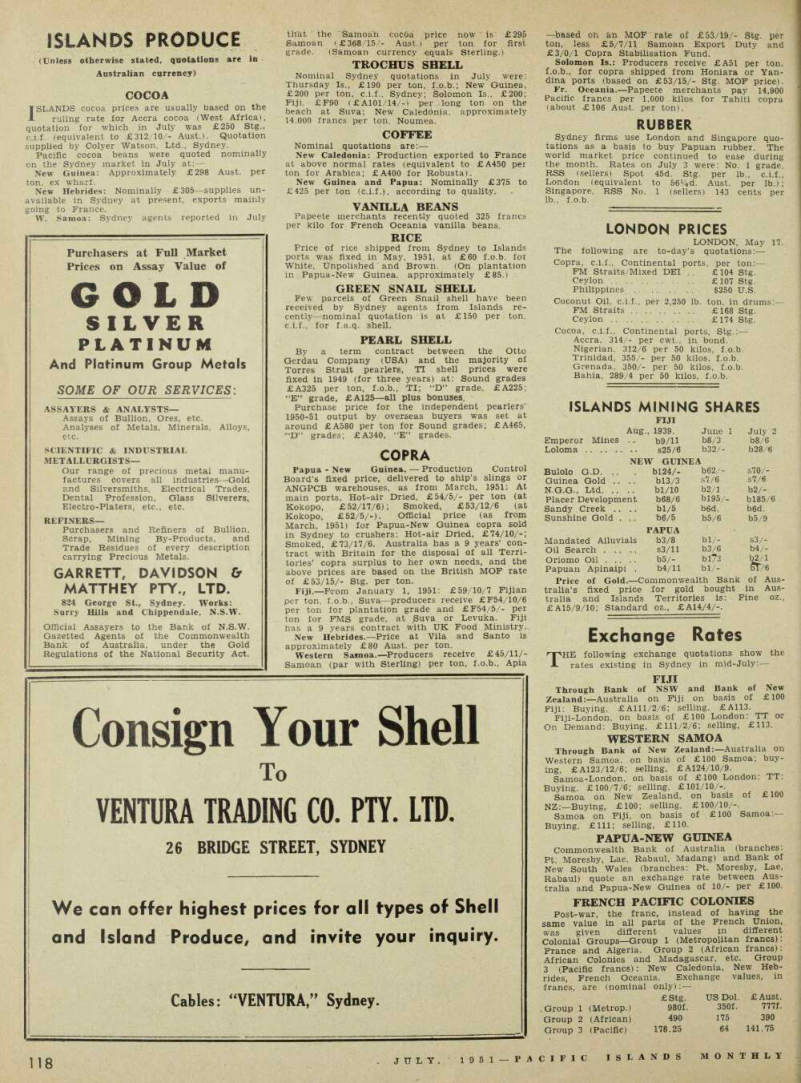
(Unless otherwise stated, quotations are in Australian currency)
Cocoa
ISLANDS cocoa prices are usually based on the ruling rate for Accra cocoa (West Africa), quotation for which in July was £250 Stg., c.i.f. (equivalent to £312/10/- Aust.). Quotation supplied by Colyer Watson, Ltd., Sydney.
Pacific cocoa beans were quoted nominally on the Sydney market in July at; — New Guinea: Approximately £298 Aust. per ton, ex wharf.
New Hebrides: Nominally £ 305—supplies un available in Sydney at present, exports mainly going to France.
W. Samoa: Sydney agents reported in July
that ' the Samoah coeda price now is £295 Samoan < £368/15/- Aust.) per ton for first, grade. (Samoan currency equals Sterling.)
Trochus Shell
Nominal Sydney quotations in July were: Thursday Is., £l9O per ton, f.0.b.; New Guinea, £2OO per ton, c.i.f., Sydney; Solomon Is.. £200; Fiji. £F9O (£AIOI/14/-) per long ton on the beach at Suva; New Caledonia, approximately 14.000 francs per ton, Noumea.
Coffee
Nominal quotations are:— New Caledonia: Production exported to France at above normal rates (equivalent to £A4SO per ton for Arabica; £A4OO for Robusta).
New Guinea and Papua: Nominally £375 to £425 per ton (c.i.f.), according to quality.
Vanilla Beans
Papeete merchants recently quoted 325 francs per kilo for French Oceania vanilla beans.
Rice
Price of rice shipped from Sydney to Islands ports was fixed in May. 1951, at £6O f.o.b. for White. Unpolished and Brown. (On plantation in Papua-New Guinea, approximately £85.)
Green Snail Shell
Few parcels of Green Snail shell have been received by Sydney agents from Islands re cently—nominal quotation is at £l5O per ton. c.i.f., for f.a.q. shell.
Pearl Shell
By a term contract between the Otto Gerdau Company (USA) and the majority of Torres Strait pearlers, TI shell prices were fixed in 1949 (for three years) at: Sound grades £A325 per ton, f.0.b., TI; “D” grade, £A225; “E” grade, £AI25 —all plus bonuses.
Purchase price for the independent pearlers’ 1950-51 output by overseas buyers was set at around £ASBO per ton for Sound grades; £A465, *’D” grades; £A34O, “E” grades.
Copra
Papua - New Guinea. Production Control Board’s fixed price, delivered to ship’s slings or ANGPCB warehouses, as from March, 1951; At main ports, Hot-air Dried, £54/5/- per ton (at Kokopo, £52/17/6); Smoked, £53/12/6 (at Kokopo, £52/5/-). Official price (as from March, 1951) for Papua-New Guinea copra sold in Sydney to crushers: Hot-air Dried, £74/10/-; Smoked, £73/17/6. Australia has a 9 years’ con tract with Britain for the disposal of all Terri tories’ copra surplus to her own needs, and the above prices are based on the British MOF rate of £53/15/- Stg. per ton.
Fiji.—Prom January 1, 1951: £59/10/7 Fijian per ton, f.0.b., Suva—producers receive £FS4/10/6 per ton for plantation grade and £FS4/5/- per ton for FMS grade, at Suva or Levuka. Fiji has a 9 years contract with UK Food Ministry.
New Hebrides.—Price at Vila and Santo is approximately £BO Aust. per ton.
Western Samoa.—Producers receive £45/11/- Samoan (par with Sterling) per ton, f.0.b., Apia
—based on an MOP rate of £53/19/- Stg. per ton, less £5/7/11 Samoan Export Duty and £3/0/1 Copra Stabilisation Fund.
Solomon Is.: Producers receive £ASI per ton, f.0.b., for copra shipped from Honiara or Yan dina ports (based on £53/15/- Stg. MOP price).
Fr. Oceania.—Papeete merchants pay 14,900 Pacific francs per 1,000 kilos for Tahiti copra (about -£ 106 Aust. per ton).
Rubber
Sydney firms use London and Singapore quo tations as a basis to buy Papuan rubber. The world market price continued to ease during the month. Rates on July 3 were: No. 1 grade, RSS (sellers) Spot 45d. Stg. per lb., c.i.f., London (equivalent to 56V4d. Aust. per lb.); Singapore, RSS No. 1 (sellers) 143 cents per lb., f.o.b.
London Prices
London, May 17.
The following are to-day’s quotations:— Copra, c.i.f.. Continental ports, per ton:— FM Straits/Mixed DEI . . £ 104 Stg.
Ceylon £lO7 Stg.
Philippines $250 U.S.
Coconut Oil. c.i.f., per 2,250 lb. ton, in drums:— FM Straits £l6B Stg.
Ceylon £174 Stg.
Cocoa, c.i.f.. Continental ports, Stg.:— Accra. 314/- per cwt., in bond.
Nigerian. 312/6 per 50 kilos, f.o.b.
Trinidad, 355/- per 50 kilos, f.o.b.
Grenada. 350/- per 50 kilos, f.o.b.
Bahia, 289/4 per 50 kilos, f.o.b.
Islands Mining Shares
Fiji
Aug., 1939.
June 1 July 2 Emperor Mines .. b9/ll b8/3 fa8/6 Loloma S25/6 b32/b28/6
New Guinea
Bulolo G.D. . . bl24/b62/s70/- Guinea Gold .. .. bl3/3 s7/6 s7/6 N.G.G., Ltd bl/10 b2/l b2/- Placer Development b68/6 bl95/bl85/6 Sandy Creek .. .. bl/5 b6d. b6d.
Sunshine Gold . .. b6/5 b5/6 b5/9
Papua
Mandated Alluvials b3/8 bl/s3/- Oil Search S3/11 b3/6 b4/- Oriomo Oil b5/bl?3 b2/i Papuan Apinaipi . b4/ll bl/-
ffT/e
Price of Gold. —Commonwealth Bank of Australla’s fixed price for gold bought in Australia and Islands Territories is; Pine oz., £A15/9/10; Standard oz.. £A14/4/-.
Exchange Rates
THE following exchange quotations show the rates existing in Sydney in mid-July:—
Fiji
Through Bank of NSW and Bank of New Zealand:—Australia on Fiji on basis of £lOO Fiji: Buying, £Alll/2/6; selling. £AII3.
Fiji-London, on basis of £lOO London; TT or On Demand: Buying, £lll/2/6; selling, £ll3.
Western Samoa
Through Bank of New Zealand: —Australia on Western Samoa, on basis of £lOO Samoa; buy ing, £ A123/12/6; selling, £AI24/10/9.
Samoa-London. on basis of £lOO London: TT: Buying. £lOO/7/6; selling, £lOl/10/-.
Samoa on New Zealand, on basis of £lOO NZ:—Buying, £100; selling, £lOO/10/-.
Samoa on Fiji, on basis of £lOO Samoa:— Buying, £111; selling, £llO.
Papua-New Guinea
Commonwealth Bank of Australia (branches: Pt. Moresby, Lae, Rabaul, Madang) and Bank of New South Wales (branches: Pt. Moresby, Lae, Rabaul) quote an exchange rate between Aus tralia and Papua-New Guinea of 10/- per £lOO.
French Pacific Colonies
Post-war, the franc, instead of having the same value in all parts of the French Union, was given different values in different Colonial Groups—Group 1 (Metropolitan francs): France and Algeria. Group 2 (African francs): African Colonies and Madagascar, etc. Group 3 (Pacific francs): New Caledonia. New Heb rides, French Oceania. Exchange values, in francs, are (nominal only):
£Stg.
US Dol. £ Aust.
Group 1 (Metrop.) 980f. 350f. 777f.
Group 2 (African) 490 175 390 Group 3 (Pacific) 178.25 64 141.75
Index to Volume XXI .
August, 1950, To July, 1951, Inclusive
[First numeral indicates number of issue, and second numeral gives page.]
A
Airways And Aviation.—Tayior Survey
Flight. 1-9, 7-43, 8-9, 9-9. 10-13, 10-108; QEA, 1-9, 4-10, 4-47, 5-8, 11-9, 11-82, 12-88; Air Fares, 1- TEAL, 1-16, 2-17, 3-8. 10-18, 11-25, 12-21; TOA. 2-6. 4-6, 4-50. 5-7, 7-5, 8-6, 9-11, 10-8, 11- 11-60, 12-13; Charter Aviation Services, 2- Capt. Aubrey Kocn, 2-7; TRAPAS. 2-37; Air Tourists, 2-55; PAA, 2-92, 7-43, 8-8, 8-26, 11-51; NZ National Airways Corp., 2-97; Pacific Ser vices and Tasman Crossing, 3-26; Canadian Pacific Airlines, 4-13; Air France, 5-8; Tahiti- Hawaii Airways. 6-105. 7-43; New Services Planned, 7-43; Capt. H. T. (Bunny) Hammond, 7-93; BCPA. 8-9; Mandated Airlines, 9-10, 11-21; Amphibious Airways, 9-106; 12-90; Gibbes Sepik Airways, 12-6.
Asia And Asiatic Affairs.—General, 1-5;
Indonesia, 1-7; Borneo, 1-11; Ambon, 2-39, 3-9; Philippines. 3-109. 9-105; Cease Fire in Korea, 12- North Borneo, 12-114.
B BOOK REVIEWS.—Ocean of Islands (Barrett), 1-13; Naturalist’s South Pacific Expedition— Fiji (Degenen, 5-99; Oceania, 7-35. 10-39; The Fiji Islands (Derrick), 9-23; Energy for a Greater Australia (Rablingi, 9-24; Plowman’s Wisdom (Carew), 11-108; Return to Paradise (Michener), 12-58. c
Chatham Group —7-56.
COCOA. (See also under various Territories). — 1-94. 3-119, 6-41, 7-15. 7-63, 8-38, 10-102.
COCOS ISLANDS (Indian Ocean) .-4-7, 12-11.
COOK ISLANDS. —Aid for Sick Penrhyn Woman, 1-29; Mangaia, 1-48, 3-46, 3-67, 3-87, 3- LO4, 5-100, 7-85, 7-86, 9-106, 10-73; Effect of NZ Waterside Strike, 2-68; Pua Game, 3-58, 7-64; Oeneral, 3-68, 3-83, 8-42; Visit of Film Unit. 1-73; Flu Epidemic, 6-33, 7-81; Hurricane Pre cautions, 6-37; Alistair Campbell, 6-40; Coffee growing, 7-84; Copra, 10-27; Native Theologian, LO-71; Citrus. 10-75; 50 Years of NZ Adminis ,ration, 12-8.
COOPER, Harold.—3-101.
COPRA. (See also under various Territories). — -34, 1-43, 1-79, 2-7, 2-33, 3-7, 3-15. 3-29, 4-8, t-9. 5-5. 5-6, 5-7, 6-7, 7-6, 8-7, 8-33, 8-35, 9-13. 1-19, 10-8, 10-10, 10-27. 11-51, 11-79, 11-83, 12-8, .2-41.
D DEATHS.—Arthur Brander, 1-8; Cyril Lambert, -16; Frank Price Jepson, 1-27; Harry Bentley, -68; Sir Apirana Ngata, 1-75; P. T. K. Rich nond, 1-79; Mrs. N. Snell, 1-89; Charles Leake, 1-8; L. B. Benjamin, 2-16; J. A. Cattell, 2-16; VI. J. Lynch, 2-17; P. A. Morris, 2-25; A.
Walter. 2-27; Mrs. A. S. Fitch, 2-32; Fr. L.
McCarthy. 2-105; O. B. Hug, 3-19; D. H. Osborne, 125; C. I. H. Campbell, 3-31; Otto Soltwedel, t-33; Mrs. E. A. Fuller, 3-34; Jean Lods, 3-38; Jrs. Faamusami Mataafa Paumuina. 3-89; Mrs.
S. M. Youlden, 3-92; Gustav Johnson, 3-108; V. M. Roxburgh, 3-112; Percy R. Hinds, 4-55; drs. Lilian Bailey, 4-68; K. Knewstubb, 4-72; Jarcel Frogier, 4-115; John Jones, 4-115; Capt.
V. M. McLeod, 4-115; R. W. J. Charlier. 5-10; V. H. Freeman, 5-97; Fr. Bousquet, 5-100; G. ?oles, 5-105; R. A. Parker, 6-26; Fred. Christian, !-29; Mrs. T. P. Nicholson, 6-29; W. T. Gat vard, 8-44; Capt. B. Rutherford. 6-49; Mrs. C. laad, 6-60; Edmund Walker, 6-71; Mrs. Gwen ioline Coster, 6-79; Leopold Blackman, 7-4; Robert Prideaux, 7-4; R. A. Laws, 7-8; Mt. iamington Deaths (C. F. Cowley. Earl Cowley, Dr. and Mrs. Paul Martin and child, Sister iarbara de Bibera, A. J. Williams. F. W. Cook, Jr. and Mrs. J. Haddock, R, Watkins, K.
Voiwood, C. Stewart, Tom Greenwood, T. loolihan. Rev. and Mrs. D. J. Taylor and four hildren, K. Bradford, lan James, Athol Earl, (. Gleeson, Mr. and Mrs. M. Lock and two hildren, W. R. Humphries, A. Myres, T. Maher- Celly. Mrs. Freda Graham, R. Graham), 7-10; V. R. Humphries, 7-13; Mark Pitt, 7-22; Roy JcG. Anderson, 7-30; F. Rostier, 7-34; C. C. ’aimer, 7-85; Jack Donald. 7-90; L. C. Palmer. -93; Andre Lehartel, 7-113; B. Frogier, 7-113; . M. Wilson, 8-107; Mrs. M. Carruthers. 8-107; O, U. Stockwell, 8-9; D. L. Pullen, 9-10, 10-37; -Irs. P, R. Osborne, 9-21; Mrs. S. M. Muddell, -22; Capt. Dick Whitehouse, 9-22; J. R. Clarke. 0-23; Veikune, 19-26; H. de V. Stacpoole, 10-33; r, C. Stephens, 10-71. 10-73; J. J. Betham, 0-76; D. McEvoy, 10-87: Dr. Arthur Wade. 10- 7; H. Clapp, 10-88; Piddy Christian, 10-88:
John Nolan, 10-104; Mrs. R. Warrant, 10-104; L. Phillips, 10-104; Sister Chistina Macaulay, 10-110; John Graham-Taylor, 11-11; Sir Maynard Hedstrom, 11-13; James Morgan, 11-15; P. G.
Rogerson, 11-28; Mrs. Bella Stowers, 11-38; Nils Bowman, 11-50; Fr. Harold Thompson, 11- 51; K. J. Angel. 11-69; J. B. Mawson, 11-87; E.
E. Dunwoodie.. 11-100; Edouard Dupont, 11-113; James Norman Hall, 12-9; Lady Scott, 12-11; Aiden Gooding. 12-15; Ratu George Tonganivalu, 12-22; A K. M. Edwards. 12-34; H. J. Berry man, 12-43; Ukinga Rau, 12-71; Miss E. Hansen. 12-74; C. S. Evennett, 12-75; E. V. O’Brien, 12-115.
F FlJl.—Queen Victoria School, 1-7; Tuna Fish ing Industry. 1-9, 2-8. 3-60. 3-84, 6-103. 9-33; Sir Brian Freeston, 1-9, 7-5, 11-f; Elections, 1-15, 2-7; Strawberry Growing, 1-30; Cost of Living. 1- 1-39, 3-17. 4-15. 5-36; Automatic Tele phones, 1-33; Fiji Hangman. 1-54; Copra, 1-79, 2- 3-29. 5-6, 6-10. 10-8, 10-10, 11-79; Rainfall, 1- 8-68; Legislative Council, 1-86; 2-6. 3-51. 4-9. 4-13; Sir Lala Sukuna, 2-11, 4-46; Mining. 2- 3-89. 5-107; Decorations, 2-40, 12-23; Aus tralian Oranges, 2-51; Pineapple Cup, 2-77; Indians, 2-88. 3-8. 3-45. 3-49, 3-72, 6-6, 6-104. 8-106, 9-9. 9-53, 9-85, 9-103. 11-15, 11-39. 11-73; Harbour Works, 2-105; Sir Hugh Ragg, 3-7; Mills’ Salary Report, 3-7, 4-9, 8-110; Aerial Mapping, 3-26, 4-23, 7-27, 10-23; Mune Golden Wedding, 3-45; Pish Supplies, 3-50; Annual Re port, 3-55; Meat Supply, 3-55; Smithy Memorial, 3- Anti-T-B Fund, 3-84, 4-30, 12-20; Suva Town Council. 3-104; Economy. 3-107; Sugar, 4- 5-9. 6-9, 8-6; London! Wharf. 4-30; Cession Day, 4-31; Tapioca Disease, 4-39; Rent Racket. 4-49; Housing, 4-49; Levuka, 4-51; Rotuma, 4-62; Cheaper Suva Electricity, 4-69; Suva’s New Market, 4-84; Fijian Land, 5-8; New Roads, 5-10; Taveuni Rest-House, 5-13; Whysall Golden Wedding, 5-13; Makogai, 5-35; Develop ment Plan, 5-35; Suva Mayor, 5-75; Knighthood for T. W. Alport Barker, 6-9, 10-116; Nadi Air port. 6-32; Yasawas, 6-57; General, 6-73, 7-29; Flu Epidemic. 6-98; Suva Point Radio Mast. 6-100; Native Enterprise. 7-9; Central Medical School, 7-17; Banana Industry, 7-31; Mother ■Agnes. 7-55; Seaplane Lost. 8-10; Bank of Australasia for Suva, 8-10; Scholarships, 8-11; Australian Trade, 8-14; Fiji Liquor Laws, 8-32; Low Priced Holiday Resorts, 8-64; War on Weeds, 8-102; Boxers in Australia, 8-105; Coconut Planting Campaign, 8-109; Naming Suva’s Streets, 8-109, 11-70; Manufacture of Cooking OH, 8-110; I. E. Lucchinelll, 9-7; Native Develop ment Fund. 9-8, 10-9; Nurse G. Morrison, 9-10; Launch Collision, 9-25; Tourism, 9-45, 9-47, 9-104; Walu Bay Reclamation, 9-57; Customs Duty, 10- Lau Islands, 10-59; Mary Edwards Ex hibition. 11-39; Festival of Britain Visitors, 11- Population, 11-104; Finance, 11-104; Ban on Motor Vehicle Export, 11-104; Oil Crushers' Grievance, 12-7; Internal Air Services, 12-7; Trade Balance. 12-17; Cricketers for UK, 12-49; Medical School, 12-73.
G
Giant Snails.—I-47. 11-18.
Gilbert And Ellice Islands Colony.—
C. G. F. Cartwright, 2-97; Tarawa Memorial, 3- Wholesale Society, 3-10; Drought, 5-13; Hoodoo; on Ships, 7-27; Myths. 9-52; George Murdoch, 12-60.
GOLD. (See also under various Territories).— 1-8. 1-25, 2-37, 2-115, 3-89. 3-92, 3-100, 3-108, 4- 5-107; 6-95, 8-9, 9-17. 9-99, 11-31, 12-20 12-
Groundnut Scheme.—2-24, 7-4, 8-11.
H
Hawaii.—2-53. 2-79, 2-80. 5-31, 6-94.
Health.—Poiio, 1-9. 2-23. 10-111. 11-49. 12-
79; Malaria. 1-39, 9-65; Filaria, 2-7, 4-53. 12-106; Leprosy, 6-85, 9-10; Elephant Mosquito (Megar hinus Brevipalpis), 7-86.
Henderson Is.—4-9. 10-63.
J
Jute And Other Fibres.—I-65, 2-25, 9-43.
L
Lord Howe Is.—B-63.
M
Margarine.— 3-111, 12-6.
Marshall. Mariana And Caroline Is.—
3-25, 9-113, 11-117, 12-104.
MlSSlONS.—Anglican, 1-42. 3-54, 4-105. 8-50, 9-71; Melanesian. 1-68; Bishop Newton Fund. 2-15; Methodist, 2-55, 6-83, 11-70; Seventh Day Adventist. 2-68, 5-67. '5-81, 9-67; Lutheran, 2-76. 2- 5-67; London Missionary Society, 2-76. 5-46; Latter Day Saints, 3-49; Roman Catholic, 3- 5-67. 6-100; Presbyterian, 6-75; Pastor Kata Ragoso (SDAi. 8-31; Rev. James Chalmers, 10-92.
N
Nauru.—3-6. 3-11, 8-13. 12-105.
New Caledonia. —(Labour. 2-49. 3-18. 6-36,
8-37, 11-90: General, 3-16, 10-112. 11-23: Relic of Cook’s Voyage, 4-39. 9-45; New Department Store, 5-45; Capt. Pierre Marriott!. 6-20; Hous ing Shortage. 7-51; Exchange of School Children. 8-88; Mineral Wealth and Mining. 8-93. 11-17; Hurricane, 9-103; Wallis Group, 11-19; Election of Deputy, 12-23.
NIUE. - 1-67, 2-67. 5-47. 5-63. 6-36. 6-76. 8-41. 8-45, 8-68. 12-43, 12-77.
Norfolk Is.—L-84, 2-85, 8-89. 10-15. 10-49.
12-75.
New Hebrides.—Generai. 1-27. 2-11. 3-79, 4-
111, 5-77, 5-105. 6-54, 6-84. 7-63, 8-71. 11-49. 12-51; Tonkinese. 2-6; Earthquakes, 3-50. 6-43. 8- 9-44: Miss Vila Quest. 3-75; R. D. Blandy. 4- Native Labour. 4-73; Blood Transfusion Service, 10-45; New Telephones, 10-50; Liquor to Natives. 10-73; Ambrym Volcano. 10-83.
NEW GUINEA (DUTCH) .—lndonesian Claim, 2-5, 4-8. 6-8; General, 2-36, 3-6; Purchase by Australia, 11-71.
O OIL. (See also various Territories!. —l-6, 2-6. 2-44, 3-26, 3-100, 4-10, 5-111, 6-78, 6-99, 8-9. 9- 9-24. 12-20. 12-50.
Organisations And Associations.—Ng
Planters’ Association, 1-7. 2-10; NG Memorial Scholarship Fund, 1-33. 2-77, 5-43, 6-103, 8-11, 12-115; NG Womens Club. Sydney. 1-37, 3-9, 4-8. 5-15, 6-93, 7-21, 10-40. 11-10. 12-13; Pacific Science Organisation, 1-45; Pacific Islands Society, 1-103. 3-31, 5-97. 11-10, 12-115; Poly nesian Club, 2-110, 12-69; Pan Pacific Women’s Association, 3-80; NG Ex-Servicemen’s Club.
Sydney. 3-100: 9-74; 10-26. 11-101. 12-14; In stitute of Pacific Relations. 3-112; Rabaul Com forts Fund, 3-115; Melb. NG Women’s Associa tion, 4-8. 6-87; NG RSSAILA, 4-9, 10-73; Fiji Society. 5-68; P-NG Public Service Association. 11-37.
P PACIFIC (GENERAL).- Hilder Water Colours, 1- 2-9. 9-15; Pacific Studies. 1-67; Cruising Yachts, 1-72, 2-44. 3-43, 12-106; Stevenson, R. L.. 2- 5-59, 12-63; South Pacific Federation, 2-69; Laubach System of Literacy, 2-81; Barney Bergin. 2- F’ei Bananas, 2-97, 3-8; Cattle Raising, 3- Polynesian Migrations, 3-103, 12-67; Fish ing. 4-60; Report on NZ Island Territories, 5-65; Mutton Birds. 6-48; Forest Preservation. 6-67; Birthday Honours, 6-101; Pacific Pact. 7-3, 10-5. 10- NZ Internal Marketing Division, 7-31; Hot Water from Sun’s Rays, 7-45; Native Equality. 7-82; Repellant for Leeches, 8-75; Coral Sea Cyclone, 8-91; NZ Waterfront Dispute, 9-9. 11- 11-38, 12-49; Race Prejudice, 9-49; Films, 9-78. 10-46. 12-23; US Price Freeze Effect. 9-86; AMP—What Next?, 9-108; Administration Change in SW Pacific Groups, 10-7, 11-9, 11-19, 12-17; Future of French Colonies. 10-9. 10-55; Poly nesians in NZ. 10-17. 12-9, 12-37; Polynesian Outposts. 10-79; Imperial Institute Exhibits, 10- 84; School Fees, 10-89; Coral Sea Battle Anni versary. 10-110; McArthur Dismissal and Pacific Defence, 10-119; Australia’s Leadership in S.
Pacific. 11-5; Pacific Trade. 11-8; Inadequacies of Pensions, 11-28; The “Peanut Scheme’’
Mentality. 11-53; Namatj ; ra, 11-59; Pacific Bibliographies. 11-119; Pacific Islands Monthly 21 Years Old, 12-7, 12-107; US Pacific Terri tories Under New Status, 12-7; Administrator of Northern Territory, 12-17; Japs Seek Return of Islands, 12-104.
Palmyra Is.—6-93.
Papain.—I-50.
Papua-New Guinea—Lae, 1-6. 1-21, 2-7
4- 7-111. 8-79. 8-86. ft-83, 10-105. 11-103 12- Oil. 1-6, 2-62. 2-44, 3-26, 3-89. 3-100 4- 5-111, 6-78. 6-99, 8-9, 9-10, 10-107; Aus tralian Income Tax, 1-7. 1-8. 1-28. 2-8; Gold 1-8, 1-25, 2-115. 3-92. 3-100, 3-108. 4-8, 4-42! 5- 6-94; 7-23, 8-8, 9-13, 9-99, 11-11, 11-31,
11-50; Polio. 1-9, 2-23: Migrant Doctors. 1-9; Port Moresby, 1-10, 2-13, 3-21, 4-89, 5-33. 6-23, 8- 8-69, 9-27. 10-41, 11-39. 12-29: Public Service Salaries. 1-11; Native Labour, 1-11, 2-29, P-119, 3-13. 4-77, 5-108, 6-17, 9-111. 10-47; Timber, 1-13. 4-7, 4-10, 4-107, 6-8, 6-97. 8-19. 9- 12-99; Defence, 1-20. 1-30. 1-63. 2-11. 2-67, 4-88, 8-6, 11-23, 11-49; Artifacts, 1-35, 2-59, 3- 5-18; Talk-Talk, 1-53, 2-57, 3-57, 4-57, 5- 53, 6-51, 7-53, 8-53, 9-55, 10-57, 11-57, 12-62; War Graves, 1-64, 2-73; Madang, 1-69, 2-91, 3-85, 4- 6-35, 7-23, 8-92, 9-102, 10-81, 11-54, 12-45; Tea, 1-85, 2-32, 6-61; Visit of Parliamentarians, 1- Development, 1-99, 2-35, 3-5, 11-29; New Ireland, 1-104; Rabaul, 1-105, 2-107, 3-37, 4-41, 5- 6-15, 7-7, 7-106, 8-29, 8-67, 9-8, 10-11, 10- 11-35, 11-81, 12-53; Copra, 2-7, 2-33, 3-15, 4-9, 5-7, 6-7, 7-9. 7-73. 8-7, 9-19; Sandals for Police Boys, 2-15. 5-73; Indonesian Infiltration, 2- 4-42, 5-9; Yali, 2-45; Prison Farms, 2-48; NG Highlands. 2-48, 4-45, 4-51, 4-55, 8-56, 8-77, 9-66, 10-9, 12-91; Education, 2-112, 7-69, 11-85; Korea Volunteers, 2-119; Mokolkols, 3-8, 6-45. 7- GPA, 3-10; Lae Oil Installations, 3-10; T.
Gough and Family, 3-11; Fr. McEncroe, 3-11; Sugar Cane Expedition. 3-16. 9-35, 11-27; Montevideo Maru Memorial, 3-17; South Pacific Post, 3-18, 7-35; Moresby Brewery, 3-27, 7-7, 9- Karkar Is., 3-34, 12-59: Cost of Living. 3- 9-25, 11-66; Memorial Hospital in Bris bane, 3-73; Administration, 3-113, 5-7, 6-6, 6-7, 8- 9-9, 11-7; War Disposals, 3-117, 6-99; R.
W. Robson’s Notes. 4-11, 4-19, 4-59, 5-11, 5-49, 6- ; Lae Hotel. 4-29, 8-9; Housing, 4-37, 10-102; Wau and Goldfields. 4-47. 5-83, 6-77. 7-109, S -101, 11-116, 12-86; Markham Bridge, 4-67, 12-10; Coastal Shipping, 4-81, 9-15. 11-10; Town Plans. 4- 6-65. 7-113, 8-105; Rubber. 4-115; Daru, 4- Cost to Australia. 5-19; Chinese, £-29; Manus, 5-37. 7-41, 10-19; Miss Rabaul Quest, 5- Old Records. 5-47; Leahy Brothers, 5-56; Native Police Salaries. 5-75; PS Working Hours, 5- Fall of Rabaul Anniversary, 3-9, 7-15; Works and Housing Dept., 6-21, 6-63, 9-39, 10- Passion Fruit Growing. 6-39; Girl Guides, 6- Matupi Natives “Rights,” 6-47; Herr Frings, 6-52, 8-84; Liquor Permits, 6-79; Man grove Bark Industry, 6-103, 7-31, 12-35; Hos pitals, 6-105, 9-37; Mt. Lamington Relief Fund, 7- 8-85, 9-41, 11-50; Livestock Introductions, 7-9; Rice Growing, 7-9; Mt. Lamington Eruption, 7- 7-11. 8-11, 8-35, 8-41. 9-11, 9-35, 10-15, 10-83, 11-27, 12-9; Bougainville. 7-26, 7-37, 9-36; Mr. Spender’s Washington Appointment, 8-5; Coronia Tourists, 8-18; Otto Soltwedel, 8-27; Advisory Councils, 8-38. 9-13; Naturalisation, 8- Richard Humphries Verse, 8-59; Movie Theatres for Natives, 8-72; Capt. and Mrs.
Duncan Golden Wedding, 7-4, 8-106; Retirement of W. H. Halford-Thompson, 8-107; Depart mental Research Section, 8-109; Jap Colonists Proposed for NG, 8-111; Page-Adams Wedding, 9- PCB and Auditor-General’s Report, 9-17; Wharf Replacement, 9-32, 10-76; Arts Council, 9-41; Pioneers of Goldfields, 9-41, 9-75; Kuku kukus, 9-58. 12-83; Sepik River, 9-60; Arbitration Ordinance, 9-69; Industry Penalised, 9-70; Aero dromes, 9-77; No Encouragement for Agriculture, 9- Mr. Hasluck, 10-7. 11-7, 12-7; Air Drop for Purari Patrol, 10-18; Australia’s 7th State, 10- 11-75; Pullen Patrol Incident, 10-37, 12- 27; Hydro-Electricity, 10-45, 12-9; Sheldon Family, 10-53; Matthews Memorial Appeal, 10- 69; Wagawaga Community Development, 10-83; National Parks for P-NG, 10-87; No Pension for Papuan PS Widows 10-107; Soldier Settlement, 11- Lost Land Registers, 11-10; Sir H. Murray Fund, 11-10; Taipan Snakes, 11-11; Livestock Importations, 11-25; Fisheries Report, 11-89; “Spoiling Papuans,” 11-91, 12-70; Half-Castes, 11- Abandoning Ex-Pro. Plantations, 11-115; £B,OOO for Native Landowners,, 12-5; Bulola Wages Agreement, 12-9; Motor Registration. 12- Hanuabadans and Their Finances,. 12-33; Romney Marsh Sheep, 12-46; Fead Islands, 12- 117.
Pearling And Shell Fishing.—S-39, 8-19,
8-75, 9-89, 11-31.
Phosphate. —2-98.
Pitcairn Is.—2-73. 4-25, 11-75, 11-107.
R RICE —2-9, 2-51. 3-39, 6-100, 7-9. 10-102.
RUBBER. (See also under various Terri tories) .-4-115, 7-49, 9-51, 11-6. s
Samoa, Eastern.—I-85, 2-28, 8-43, 8-103,
10-33, 12-27.
SAMOA. WESTERN.—Crime Wave, 1-28, 2-95, 2- 3-77, 3-119, 4-42, 9-35, 12-6, 12-18; Busi ness Credit for Samoans, 1-73; Lawyer Needed, 1-97; Prosperity, 1-111, 2-21, 5-39. 8-23, 11-75; General. 2-84, 3-71, 4-15. 9-79; Hydro Electricity, 3- Malie School, 3-53; Smyth Golden Wed ding. 3-91, 4-21; Cocoa, 3-119. 4-23, 6-41. 7-15: 7-63, 9-73; New Newspaper, 4-9. 7-35; Legislative Assembly, 4-23; Centenarian Dies, 4-31; Police Awards, 4-46; Reparation Estates, 4-86; Catalina Crash, 5-6. 6-28: R. G. Powles, 5-72, 12-7; Aleisa
Settlement, 5-95; Soldiers In Korea. 6-31; Shipping Services. 6-49; Marlst Bros. School. 6-49; L. B. D. Frost, 6-78; Record Xmas Spend ing, 6-84; NZ Medical Research Team, 7-50; Rainfall, 7-51; Vi.lage Water Supplies;. 7-67; Dr. Keesing’s Visit. 7-94; Bananas, 8-73; Mr.
Dulles’ Visit, 8-76; Assembly Election. 8-76. 9-11. 10- 11-67: Baby Stealing Case, 10-68; Apia Racing Club, 10-71; High Salaries Bill, 10-73; Tokelau Memorial. 10-92; New Political Party, 11- 12-105; RNZAF Visitors. 11-79; Thieme Family, 12-10.
SHIPPING AND SHIPS.—Union Steamship Co..
I- WRC Line, 1-34; Tofua. 1-38, 11-8; Small Ships from Aust., 1-87, 3-81, 4-83. 7-110; John Williams VI., 3-43; Mariposa and Monterey, 3- Lautoka, 3-83, 7-5; Maui Pomare, 4-7; Aorangi, 4-13, 5-9, 7-5, 8-9. 9-11, 11-9; Fetu Moana. 5-8. 7-21; Huia, 5-37. 7-5; Margaret. 5- Ivor Jenny, 6-9, 7-7, 7-84; Capt. Russell iMatua) Retires, 6-27; Stella Maris. 6-28; Nareau. 7-21; Nimanoa, 7-27; Dutch Shipping Line. 7-86; Caronia, 8-14; Stella Polaris, 8-14; Admiral Chase, 8-105; Nautical Museum. 9-60; Commandant Chariot, 10-21; Yankee, 10-58, 12- 57; Alexandria, 10-81; New Golden Hind. 10-81; Evaleeta. 10-85; Malekula, 11-11; French Ships In Pacific. 11-27; Matua, 11-34; Gona, 11-35; Qorda. 11-67; Laurabada, 11-67, 12-90; Ornant, II-
Solomon Islands.—Copra, 1-34. 1-43. 1-81.
4- 6-65. 8-35, 9-91, 11-51; Native Labour. 1-35; Marching Rule, 1-41, 1-77, 2-75, 9-90; Savo. 1-57; Major S. G. Masterman Retires, 1-76; Catalina Crash, 2-43; Native Murder, 2-53; Advisory Council, 3-38, 5-95; Vanikoro, 3-79; Bomb* Disposal, 3-80. 12-47; Taro Disease, 4-43; Education. 4-46; Geologists’ Expedition, 4-53; 6- Eruptions,. 4-73; General, 4-75, 7-68; Air mail Services. 4-80; Wharf Problems, 4-80. 8-17; Cattle Export Banned, 4-92; Rainfall. 6-7: Shipping. 6-100, 12-39; Western Solomons, 7-59; Honiara Museum. 7-68; Guadalcanal Club, 7-76. 12-67; Minister of State Interviews BSI Planter. 8-25; Cocoa. 8-38; Introduction of Rabbits, 8-39; Commonwealth Bank, 10-9, 12-35; WPHC Moves HQ. 10-10; Soccer Team for NZ, 10-27; Red
Cross. 11-87; Native Representative Goes to UK. 12-73; Rice Shortage. 12-78.
South Pacific Commission.—I-13. 1-17
2- 2-113, 3-7, 4-17, 4-27, 5-21, 6-19. 7-8, 8-6, 8-9, 8-10, 9-82, 9-109, 10-29, 10-74, 11-7. 11-45, 12-13.
Stamp Collecting And New Issues.—
1-31, 1-47. 4-68, 9-69.
Sugar.—2-94, 3-17, 4-23. 6-9, 9-7, 10-21.
Sulphur.—I-41, 7-42. 10-17, 10-34.
T
Tahiti And French Oceania—General.
I- 1-108, 2-24, 2-85. 4-69, 6-71, 6-96, 7-87. 10- 51, 10-114, 11-113, 12-114; Rapa. 1-56; Decora tions, 2-23; Leeward Is., 2-60; Tourism, 3-41. 4- Sudden Departure of Governor, 4-7; New- Dry Dock, 4-9; Chinese, 6-42; Cement Scandal, 6- New Governor, 6-71; New British Consul. 7- Death for Brander Murderers. 7-7; Deficit and High Taxation, 7-25; Lasalle-Sere, 7-34, Airmail Service, 10-8, 11-9: Old Tahitian Language Books, 10-39; Tax for Visitors, 10-47; Dirty Bank Notes. 10-87; Verniers Farewelled, 10-115; Tupai, 11-62; Gauguin, 11-69; Punaruu Traffic Bridge, 11-101; Von Luckner’s Treasure, 12-50.
TONGA. —Political Reform, 2-41; Royal Tor toise, 2-55; School for Vavau, 3-27; General. 3- 7-64, 8-47; Tungi’s Visit to Australia, 4-7, 5- Fire in Picture Theatre, 4-15; Over population, 5-9; Treaty of Friendship, 7-27, 8-55, II- Fire Brigade of 50 Years Ago, 9-110; Niuafo’ou Copra, 10-88; No Air Service?, 11-7; Tungi for UK, 11-7; Alfred Cowley, 11-58.
Torres Strait Islands.—2-109, 5-67.
Trading, Planting And Business
FIRMS.—C. Sullivan (Pacific Is.), Ltd., 1-8; South Pacific Insurance Co., 2-98; Steamships Trading Co.. 4-10; Morris Hedstrom Ltd.. 4-45, 7-8; Ventrillon & Cie, 5-45; Robert Gillespie, 6- Pacific Biscuit Co., 6-37; Anderson’s Indus tries, 9-77; Burns Philp (SS) Ltd., 10-80; Burns Philp & Co., Ltd., 10-104.
Trusteeship Council (Un).—L-31. 3-93,
5-17, 8-49.
News Notes From N. Hebrides
SANTO, July 6.
SANTO’s roads now are very bad. Pot holes of the more spectacular type are the rule. If you do not care for corrugations, there are several water hazards which try the nerve, tempers and skill of drivers. And, of course . . . the poor old vehicles. The pedestrians (there are no foot-paths) have their full share of the agony.
A farewell cocktail party was recently given to the French Delegate, M. Menager and Mme. Menager, at the Cine Tropical.
They leave on the Morinda for Sydney, via the Solomons. They are en route to France.
M. L, D. Cao’s ship, for local trading, arrived at Santo after a smart voyage from Sydney via Noumea. This is the first of several expected arrivals. It is necessary to introduce an anxious note here. There are indications that Mr. Pat Savage left Brisbane over three weeks ago in a 42 ft. ex-fishing boat, and there has been no word of him. In addition to Mr.
Savage, the ship carried a competent navigator and one extra crew.
Qantas arrived late this week and. owing to a choppy sea and heavy rain, and the fact that the launch had decided to go on strike, the aircraft merely dropped its passengers and mails, and took off for Vila, leaving passengers, air cargo and mails behind. The captain wisely declined to make use of a dinghy instead of the usual launch, because the dinghy could have caused damage to the plane’s hull.
Oil Search In Papua
REPORTING on July 19. the Australa sian Petroleum Co. says that the No. 2 bore at Hohoro, Papua, is now down to 3,295 feet, and that Island Exploration Co’s bore at Omai is down to 5,659, and casing has been cemented to 5,401 feet.
After
Tom Nevitt Retires
40 Years In Papua
/"VNE of Papua’s pioneers and best known XJ residents, Mr. Tom Nevitt, has corn pleted plans for retirement to Queensland, where he and Mrs. Nevitt will take up residence in August.
He has been a clerk, labour recruiter, rubber planter, gold miner, backblocks trader and city merchant; and for the latter part of his 40 years in the Territory he was general manager of British New Guinea Development Co. He retains substantial interests in Papua.
Coastal Shipping Troubles
In New Guinea
THE First Assistant Secretary of the Department of Territories went to Papua-New Guinea this month, to consult with the Administrator, the Chairman of the Production Control Board (Mr. lan M. McDonald) and other high officials concerning measures to be taken to improve the coastal shipping facilities in both the Territories.
The plans for transferring coastal shipping from Government control to private enterprise appears to be making slow progress.
Storm Tragedy At Lord Howe
THE North Tasman Sea, in recent weeks, has been plagued by sudden cyclonic storms; and one such brought tragedy to Lord Howe Island.
Thomas Payten, 45, well-known resident, and Bryant Smith, 31. were out at sea. fishing, on June 17, when a 70-mile-an hour gale came up without warning; and they were never seen again. The Aus tralian Navy, by sea and air, conducted a search for two days.
Advertisements & other items, pp. 122-124 (2 items)
Published by PACIFIC PUBLICATIONS PTY., LTD.. Union House, 247 George Street. Sydney. (Telephone: BW 5037.) set up and printed
in Australia by the Sydney and Melbourne Publishing Co. Pty., Ltd., 29 Alberta Street, Sydney. (Telephone, MA 7 01.)
Port Moresby Sydney Service
Bv Soif*nt * “FOR LUXURY AT THE HIGHEST LEVEL” pi The newly inaugurated "Chieftain" service between Port Moresby and Sydney, calling en route at Brisbane, is now on a regular weekly schedule.
The “Chieftain” service is the last word in luxury air travel. You fly in the most modern flying: boat in the world . . The new, specially-fitted double-deck Solent. Relax in deep-seated comfort with, by day, the ever-changing panorama of the Barrier Reef and Australia’s Northern Coastline spreading before your eyes ... by night, you fly under the canopy of the Pacific stars.
The new luxury starship, “Star of Australia,” has that exclusive club atmosphere, and each passenger is our special guest-of-honour, For your convenience, there is a well-stocked library; hot and cold water and electric razors provided in the gentlemen’s room; whilst for the ladies . . . sheer delight! . . modern kidney dressing tables with fluorescent lighting.
Your meals on the “Chieftain” will be an epicure’s delight . . .
Specially prepared in our electric grillroom aloft, for your particular pleasure.
Two flight stewards and a hostess service, together with a well-stocked cocktail bar, will cater for your needs. % % % % i
BRITAIN’S
MOST
LUXURIOUS
FLYING BOAT.
\ \ % % \ % % % % PO
RT MORESBY
% i *5 % n m % a m - % % % %
BRISBANE
S YD N EY
IP Between-seat tables provide facilities for the congenial relaxation of passengers.
TRANS OCEANIC AIRWAYS
SYDNEY
McArthur Shipping Co.
Pty.. Ltd. 31 Macquarie Place.
•U 2048 BU 2049
Principal Agents
PORT MORESBY
Steamships Trading Co., Ltd.
BRISBANE
World Travel Headquarters, Lennons Hotel.
B 4114 B 4124
MERCHANTS, & SHIP OWNERS
Sfrj’-g'fS
SPI;. :
w^in4M^-'ss
Capital £1,000,000
ESTABLISHED 1914
GENERAL MERCHANTS
AND
PROVIDORES
TRADE THROUGHOUT THE PACIFIC.
THIRTY-FIVE YEARS OF PACIFIC ISLANDS DEVELOPMENT AND SERVICE.
BUYERS AND EXPORTERS OF ALL KINDS
OF ISLAND PRODUCE, COPRA, COCOA,
M.O.P. SHELL, TROCAS SHELL, ETC.
AGENTS FOR AUSTRALIAN, EUROPEAN
AND AMERICAN MANUFACTURERS.
DISTRIBUTORS OF EVERY DESCRIPTION
OF MERCHANDISE.
Through our Sydney office, branches and agents, we distribute a wide and comprehensive range of general merchandise.
W.R. CARPENTER & OC. LTD.
Head Office: 16 O'CONNELL STREET, SYDNEY, N.S.W.
Cable Address: Telephone: Postal Address: “CAMOHE.” BW 4421. G.P.0., BOX 168, Sydney.
In London: W. R. Carpenter & Co. (London), Ltd., Coronation House, 4 Lloyd's Ave., London, EC
ASSOCIATED COMPANIES THROUGHOUT THE PACIFIC:
IN NEW GUINEA:
New Guinea Company, Limited, Rabaul, Lae, Madang, Kavieng.
IN PAPUA:
J. R. Clay & Co., Ltd., Port Moresby.
IN FIJI:
W. R. Carpenter & Co. (Fiji), Ltd., Suva.