Island
Pacific
Monthly
August, 1951
Vol. XXII. No. 1.
dsfs
by post as a nem
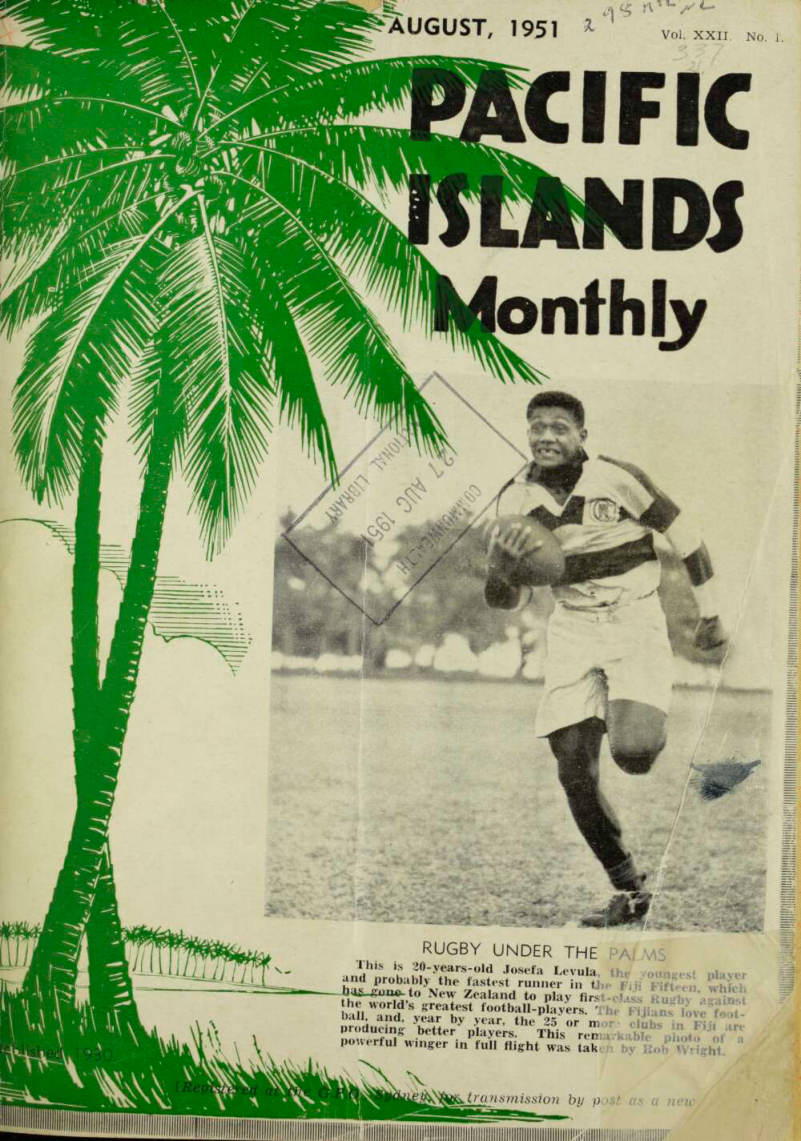
Rugby Under The Palms
This is 20years-old Josefa Levula, the youngest player and probably the fastest runner in the Fiji Fifteen, which has gone to New Zealand to play first-class Rugby against the world's greatest football-players. The Fijians love foot ball, and, year by year, the 25 or more clubs in Fiji are producing better players. This remarkable photo of a powerful winger in full flight was taken by Rob Wright.
Advertisements & other items, pp. 2-4 (3 items)
Lands Monthly August, 19 3 1
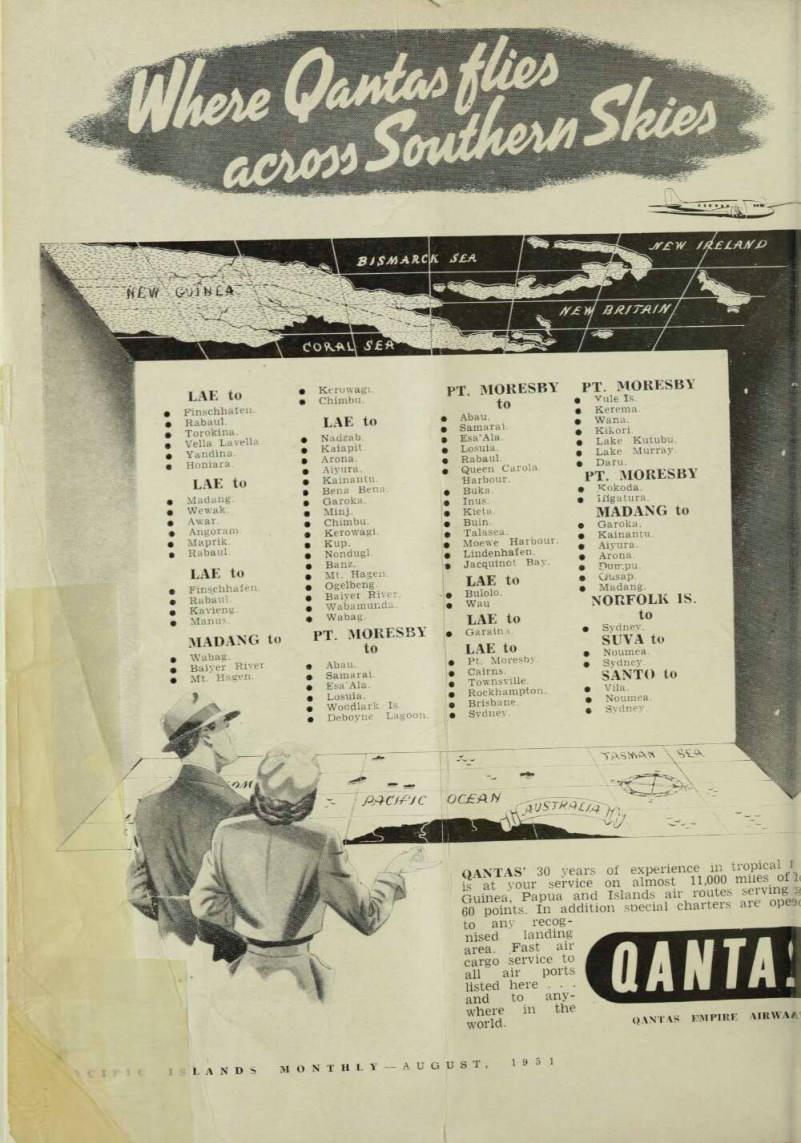
oanta:
/YJEKf BR/TAf// i
LAE to Pinschhafen Rabaul.
Torokina.
Vella Lavella.
Yandina.
Honiara.
LAE to Madang.
Wewak.
Awar.
Angoram.
Maprik.
Rabaul.
LAE to Finschhafen.
Rabaul Kavieng Manus.
madang to
• Wabag. • Baiyer River • Mt. Hagen.
PT. MORESBY
to
PT. MORESBY
to » Abau. \ Samarai.
Esa’Ala.
Losuia.
Rabaul.
Queen Carola Harbour.
Buka.
Inus.
Kieta.
Buin.
Talasea.
Moewe Harbour.
Lindenhafen.
Jacquinot Bay.
LAE to
Bulolo.
Wau LAE to Garaina.
Abau.
Samarai.
Esa'Ala.
Losuia.
Woodlark Is.
Debovne Lagoon.
OC£AN
LAE to pt. Moresby.
Cairns.
Townsville.
Rockhampton.
Brisbane.
Sydney.
PT. MORESBY
vule Is.
Kerema.
Wana.
Kikori.
Lake Kutubu.
Lake Murray. » Daru.
PT. MORESBY
» Kokoda. > lligatura.
MADANG to
• Garoka. » Kainantu. » Aiyura. • Arena. • Dutr.pu. • Ciusap. • Madang.
NORFOLK IS.
to • Sydney.
SUVA to • Noumea. • Sydney.
SANTO to
• Vila. • Noumea. • Sydney.
OANTAS’ 30 years of experience in tropical 1 is at your service on almost 11,000 miles of h Guinea Papua and Islands air routes 60 points. In addition snecial charters are opesc to any recognised landing area. Fast air cargo service to all air ports
listed here . . •
and to anyiv« fhp IVTIS EMPIRE airwaa
oanta:
where in the
Your Native Servant
can Iron Better with a
eman
*mK3P**Sk'\ *■ The big glass-smooth ironing base 16 square inches of surface of the Coleman Self-heating Iron is double pointed and heavily nickel - plated to glide smoothly and easily over any fabric.
The Coleman Self-heating Iron lights instantly, makes and burns its own gas, permitting continuous ironing and the fount holds one pint of fuel, sufficient for hours. The body has a blue vitreous finish which is easy to clean and keep clean. With its rust-proof body and heavily nickeled ironing surface, the Coleman Self-heating Iron will last indefinitely and, because it heats itself, the ironing can be done anywhere, indoors or out-of-doors.
Representatives for the Pacific Islands “•gSJ? 1 " ROBERT GILLESPIE P T JLT?
PEARCE & CO. LTD.
SUVA
FOR FIJI ISLANDS
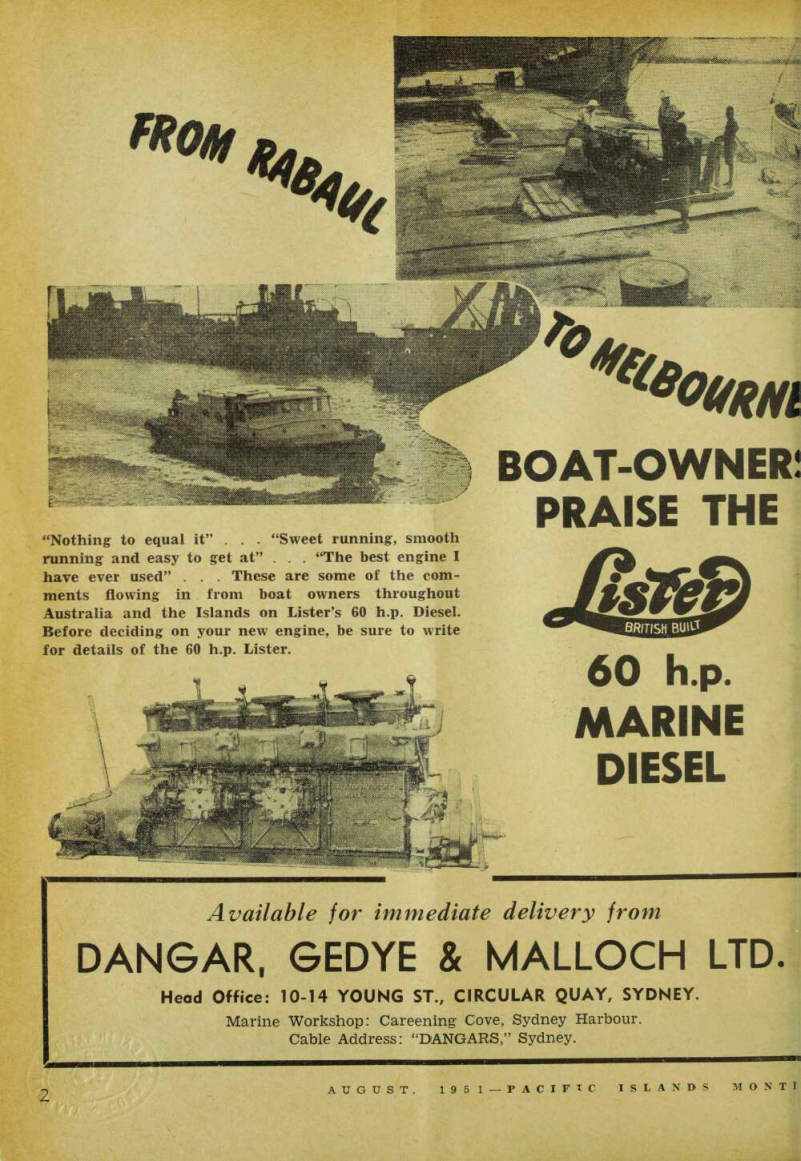
from
- i I .
°URNi
u
boat-owner:
PRAISE THE
“Nothing to equal it” . . . “Sweet running, smooth running and easy to get at” . . . “The best engine I have ever used” . . . These are some of the comments flowing in from boat owners throughout Australia and the Islands on Lister’s 60 h.p. Diesel.
Before deciding on your new engine, be sure to write for details of the 60 h.p. Lister.
PS Lii 60 h.p.
MARINE
DIESEL
Available for immediate delivery from
DANGAR, GEDYE & MALLOCH LTD.
Head Office: 10-14 YOUNG ST., CIRCULAR QUAY, SYDNEY.
Marine Workshop: Careening Cove, Sydney Harbour.
Cable Address: “DANGARS,” Sydney.
2
AUGUST, 1951 PACIFIC ISLANDS MONTI
Index To Advertisers
chun, Gabriel 121 (Vkta-Vite” . . 73 laddin Lamps 76 lois Akun . . 55 luminium Ltd. 32 mplion (A/sia) 79 ngus & Robert son Ltd. ... 28 rdath Tobacco 55 Ispaxadrene” 109 4spro" ... 58 aker, W. Jno. 109 ink of NSW . 82 ;1I & Co. . . 21 Jellhaven” 105 srry’s B. B’y’d. 103 thell Gwyn Co. 47 axland Rae . 33 undell Spence 72 )ats for Sale, l7, 104 ►rthwicks Pty. 113 ►vril Ltd. . . 94 istol-Myers . 91 ■cornfields Ltd. 35 ■unton & Co. 41 inting’s . 51, 90
P. (Ng) ... 69
P (Nh) ... 73
P (Ss) . . 117
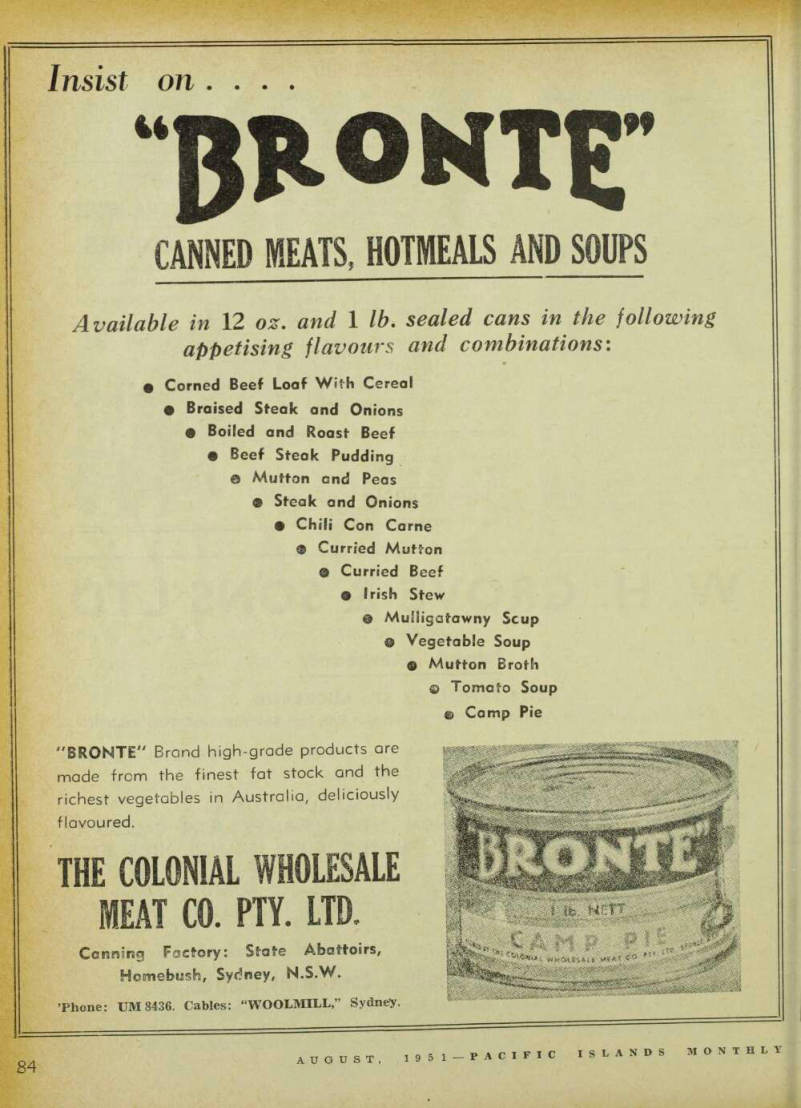
P. Trust . . 40 itterfly Supply 77 idbury’s . . 122 ine’s Studios 34 rpenter Co. 92, iv, rpenter’s (Fiji* ... 34 issified Advts. 126 Iman Mustard 93 lonial Meat . 84 Iyer Watson [NG), 16, 50, 75 mmonwealth
Bank . . 3, 112
ammond ladio ... 36 awford, Tom 58 Hley, R. J. . 101 ystex” ... 94 ngar, g. & A 2, 88 naghy & Sons 87 nald Ltd., 38, 71 uglass, W. c. 85 nlop Rubber 29 erker, A. J. 30 Donald . . 54 rd Sherington 89 Ch. of Com. 50 rrett, D. & m.
J td 128 rrick Hotel . 47 >bey, W. & a. 35 llespie Bros. . 54
lespie, R.,
„ 1. 39, 98 lespie, R.
NGj . . 86, 120 rdon’s Gin . 87 ugh & Co. . 108 P -H. ... 4 egory Ltd. . . 93 “ve & Sons • ... 26, 83 & R. In titute ... 24 ivorsen Sons 42 inz & Co. Ltd. 41 J*o p ty. 15, 71
Hand Rusk . 23
flicks Ltd. . 56 geia Co. . . 42 *nd Industries 81 Electric Co. 107 Service Bur. 121 nnedy, Capt. 105 rr Bros. . 77 fry. M. Pty. 31 •ynos, Inc. . 21 Psen & Co. . 43
Kraft Cheese Co 119 Leondes, A. . . 119 Lillis & Co. . . 44 Macintyre, T. . 124 Mac Robertsons 89 Mcllraths Ltd. . 25 •Mendaco” . . 121 Merrillees, J. C. 53 Millers Ltd. . . 16 Mobile Equip. 110 Morris Hedstrom 14 Morris Hedstrom (Aust.) ... 78 Mungo Scott Ltd. 19
N.I.V.L. ... 27
N. & R. Ltd. . 45 “Nixoderm” . . 90 Nordman, O. G. 101 O’Brien, Geo. . 102 P.A.A is Pabco Products 48 Parer Pty. Ltd. 23 “Pinkettes” . . 127 P.I. Society . . 45 P.I. Trading . 95 P.I. Year Book 20 Proud’s (O’seas) 123 Proud’s Ltd. . . 52 Qantas Airways li.
Qld. Insurance , 19 Quirk’s Light Co 106 Ransomes Mowers . 117 Reakitt’s Blue 83 Reed, W. E. 22, 102 Riverstone Meat 114 Robinson, G. H. 57 Rohu, Sil . . . 49 Savitz, B. ... 98 Scott, J., Ltd. 125 Seward Ltd. . . 26 Shell Co. . .115 Sherwin- Williams . . 59 Simmons, C. & G. . .97 Simpson Bros. . 51 Sims, A. G. . 100 Smith Copeland 118 Spartan Paints 24 Spruso Co. . .28 S.T.C. Ltd. . . 49 Stewart, Lloyd 79 Sthn. Pac. Ins. 74 Sullivan Ltd. . 11l Swift & Horn dale ... 70 S. Co. Ltd. 99 Tallerman & Co. 38 T. 60 Taylor, A. & Co. 57 Thomycroft Ltd 104 Tillejy Lamps 124 Tillock & Co. 120 Tongan Photos . 86 Tooth & Co. . . 46 T.O.A iii.
“Tru-Wite” . . 99 Tyneside Co.
Ltd 74 Undersee Novel ties 15 United Traders 46 Vacuum Oil, 39, 96 Ventura Trad ing .. . 70, 128 Vincent’s
A.P.C. ... 116
Walsh, A. D. . 126 West Pty. Ltd. 105 White, K. E. . 31 Williams’ Pills 113 Wills Ltd. ... 80 Wright & Co. 103 Wunderlich Ltd. 127 Yorkshire Ins.
Co 29
Advertisements & other items, p. 5 (2 items)
3
acific islands monthly-august, 1951
Afew'Bmnch
OT
ihe
low
/M 5
opened \ 23rd
July
ir
Honiara
(British Solomon Islands).
All types of Trading Bank and Savings Bank business are conducted at the above Branch, and the following services are now available to you:— Cheque Accounts, Interest Bearing Deposits, Overdrafts, Loans for Primary Production, Finance for Industrial Undertakings, Letters of Credit, Travellers’ Cheques, Safe Custody, Savings Bank, etc.
The Bank’s services are most comprehensive and you may be sure your every banking need is provided for.
The Manager will always be pleased to assist you in every way possible. His friendly and practical advice on banking or financial matters is readily available to you.
<&niinoiiwcaltl)Jßaiil;
of Australia.
In This Issue
Editorials: 49 Nations to Deal With Japan—And Our Se curity :: Planters, Robbed of £3O per Ton, Are Given 55/- :; Rabaul Declines to Go to Kokopo 5, 6 Rise in New Guinea Freight 7 Death of Sir Albert Eliis ... 7 Filaria Conference in Papeete 7 The Woeful Solomons 8 Tongas Airfield May Grow Peanuts 8 Jap Thieves in NG Waters — Australians Seize Ship in Hermits 9 Search for Bullion Goes on Off Lae 10 Minister of State Visits Fiji, Tonga and BSIP 10 Rabaul Meets the New Min ister 11 Lautoka Storm Over a Wharf 11 The Editors' Mailbag 12 Mr. Tailby May Retire from Cook Is 13 Where “Smithy” Landed in Suva 15 Suva Gets Water After Six Years’ Fight 16 Tributes to the Late James Norman Hall 17 Norfolk Island Gets a Market in New Zealand 20 Nadi Makambo Closed .. .. 23 Planting Possibilities in P-NG —British Expert Looks Them Over 24
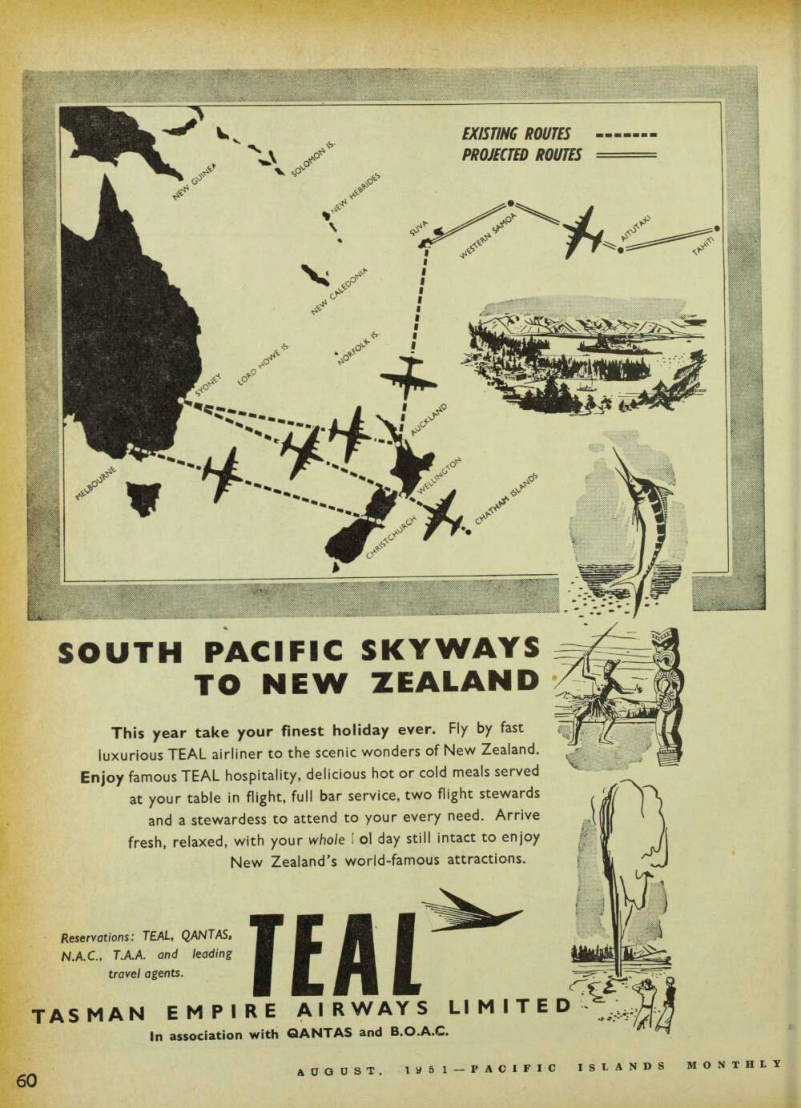
No Soldier Settlement in P-NG —RSSAILA Plan Gets Bogged Down 25 TEAL’s New Service to Tahiti 25 The Month in Papua-New Guinea 26 NG Legislative Council —Strong Feeling in Rabaul 29 Another £3 for P-NG Planters —But Stabilisation Fund Continues 33 Rabaul Citizens Condemn Rapopo Move —Alternative Plans Put to Government 34 In Defence of the Small Ships 43 News Notes from Buka Passage 47 Legislative Council for Papua- New Guinea 49 Tahiti’s Chinese French Awareness of Difficult Prob lem 53 Jet Planes for CPA 53 Commonwealth Bank Opens in Honiara 53 Rabaul Roundabout 55 Three Killed in Samoan Bus Smash 57 Football Fever—Rugby in Fiji 61 Territories Talk-Talk 63 Moturiki Tries Community Development 64 Tropicalities 66 Accommodation in NG High lands 73 Wandering Bill Murnan and His Seven Seas II ... 77 Record Profit by Morris Hed strom Ltd 78
You Drink Only on the Points System, in W. Samoa ..
Italians for Work in Hebrides Japs Cash-in on Rebuilding New Guinea That Anti-Polynesian Law ..
Fate of Territories’ Hospital Plan Plane and Shipping Schedules Ministerial Visitors to the Islands The Myth of NG’s Sulphur Deposits News Notes From Lae Suva’s Electricity Rates Up Again Ken Douglas Says Goodbye to New Guinea Madang’s New Chamber of Commerce Wants Road to Highlands Commercial, Markets, etc. ..
OBITUARY: Sir Albert Ellis, 71 O. C. Wittus. 8; Bishop Apjc hans, Father Bachus,- F/O J.. 1 Spiers, Miss H. J. Connor, M F. Tindale, K. C. Macdonald) W. Palmer, 10; Mrs. May Mulll 21; James Whitford, 41; I James Fisher. 57; Miss 0..< Bayly, 79; R. H. C. Bentley,, Polito Atoa, 97; Mrs. A. M. Su ing, 98; J. Dodd, 111; A. Bill, A. Cinnamond, 123; L. A. Drn 124.
Industries; Copra, 6, 112; Gi
108, 115; Phosphate, 45; Cod 57; Trochus, 72; Oil, 120.
Organisations: Ng Worm
Club, 31; P.I. Society, 109.
Advertisements & other items, p. 6 (1 item)
stay
Deli Shtf, \s\ at
Or ana m ir oni vay. thr * ol *Bh am : m m* gr °unas m utifui m p Q . i~ °^rio o U(
Oeo^o ,
f^- 3% j"- the^<
tr °pics y tf ea ' #*, ignea LG *ti Ve em " .-for y&iters *? e by tra f“ J «Oe, a *. a^icf tr aiziM 7 afii
30A '7aTo u nfe - SS*
o^c f be CW <* the efTe ctea of U *ion Suva. 4^r e , ss .
Ltd to : h or by Z" m Pany
o7 e hoL^e
Pacific Islands Monthly
The Newspaper-Magazine of the South Seas Distributed in AUSTRALIA, NEW ZEALAND and the following PACIFIC ISLANDS:
Australian Territories: Papua. Norfolk Is.
Cocos Is.
Aust. Trustee Territory: New Guinea. Nauru.
British Protectorates: Solomon Is. Tonga.
British Crown Colonies: Fiji. Gilbert & Ellice.
French Territories: New Caledonia. French Oceania.
Dutch Territory: Western New Guinea.
New Zealand Territories: Cook Islands. Niue.
N.Z. Trustee Territory: Western Samoa.
United States Territories: Eastern Samoa. Hawaii.
U.S. Trustee Territory: Micronesia (Caroline, Marshall and Mariana).
Anglo-French Condominium: New Hebrides.
A Product of Pacific Publications Pty. Ltd., Union House, 247 George Street, Sydney.
Contributions;
acles. Stories, and Photographs dealing h Pacific Islands subjects are invited nd will be paid for on publication.
Subscription Rates:
Australia and New Zealand, and Australian. NZ. and British Pacific Islands ... 18 0 Caledonia, Tahiti £1 1 o ;where .. .. 3V2 US Dollars £1 10 0
Telephones: Bw 5037. Bu 6082.
G.P.O. Box 3408.
Registered Address for Telegrams. Radio grams, and Cables; “Pacpub.” Sydney.
Editor and Publisher: R. W. ROBSON Assistant Editor: JUDY TUDOR.
Business Manager: SELWYN HUGHES.
Representative In London:
J. T. Wallis, Coronation House, 4 Lloyd’s Avenue. London. E.C.3, from whom may be obtained copies of Pacific Islands Monthly, Pacific Is. Year Book, advertising schedules, etc.
Agents:
See full list of Agents, arranged by Territories, on another page.
1. Xxii. No. 1.
August, 1951
( 1/9 Per Copy.
Price ] Prepaid, p.a.: 18 - Aust.
C in South Pacific.
49 Nations To Deal With Japan—
And Our Security
HE United States has asked 49 nations to send representatives to a conference in San mcisco in September, to complete ['reaty of Peace with. Japan. Al dy, it has the earmarks of a aing dogfight. n a dogfight, no one takes sides; s just bores in and bites who ror whatever is nearest. In the ice Treaty Conference, each of parties is going to be concerned stly with its own selfish interests, I careless of the over-all picture, ’he Philippines, for instance, says won’t play unless it gets war nage compensation from Japan— spective of the fact that if lippines gets it, so also must io-China, Burma, East Indies, lay a, Borneo, New Guinea, )ua, Solomons and Gilbert and ce.
Britain wants some limitation on anese exports, which otherwise damage Britain’s trade with the Jific countries. Australia fears t Japanese rearmament will m the renewal of the Japanese eat to her security. And so on. ■ussia and her satellites, who are ang the 49 invited nations, will course try to sabotage the Con gee. They will resist a Peace aty made on American specifi ons. merica’s main concern is the re iblishment of a free and strong an, capable of defending her !dom against an aggressor, and ermined to resist the eastward
thrust of Muscovite Communism.
America wants her front line of defence to exist from Japan, through Philippines and New Guinea to Australia. As America now is the chief protector of the security and freedom of all the small nations of the Pacific, we are bound to ally ourselves completely with America, and ignore other interests.
Even before the Red influence spread across China, we here in the South Pacific knew that we had no future unless some Great Power gave us protection against the hundreds of millions of hungry and under-privileged people of Asia.
Then, we had the protection of Britain, France, and the United States. Now, while the Asiatic menace, under Muscovite direction, has increased tenfold, war and Socialism have deprived us of any real guarantee of help from Western Europe. As Britain’s in fluence wanes, the Asiatic nations of Southern Asia, and the “Wog” nations of the Middle East, tend more and more to range themselves against Western Europe; and, more and more, we find ourselves, here in the Pacific, facing a very hostile world, except for the friendly, English-speaking people of North America.
BRITAIN’S influence may be re stored. It is difficult to believe that a Power of such mangifi cent achievements and inspiring
traditions, with the qualities demon strated between 1939 and 1945, can be permanently reduced to feeble ness and insignificance by six years of rule by Socialists, Bloomsbury Planners and Fellow-Travellers.
It is very hard for people of British blood, in the Dominions, to watch the Attlees and Bevans des troying the Empire, and to see the old Union Jack spat upon by Persians and Egyptians and the Mongolian hybrids of South-east Asia. Please God, before this generation passes, we may see a revival of the British spirit, a restoration of the British Empire, and a firm movement by free British citizens to confine the Planners to spheres where their so called humanitarianism will not en danger our security in a merciless and ruthless world.
The Bloomsbury Planners have been instrumental in creating the new nations of Burma, India, Pakis tan, Indonesia, Palestine, Syria, Egypt, and encouraging the nationalist aspirations of several more. In doing this, they have contributed nothing to the world’s economic strength, international security and hope of permanent peace. But they have partially destroyed Britain, in whose freedom and strength lay humanity’s surest guarantee of freedom and progress.
Happily for us, while Britain re mains hamstrung by the queer products of the socialistic school of 1930-51, her responsibility for humanity’s freedom has been ac cepted by the United States; and, in this rather terrifying period of social re-settlement, we look to the
Stars and Stripes with the confidence that formerly we gave to tne union Jack.
Ir> .
GNORING the screeching chorus from the Asiatic countries, the United States is going steadily ahead with her plans for the Japanese Peace Treaty and, in seekmg co-operation in completing that document, she is cmicerned mostly with the small British nations of Canada, Australia and New Zealand.
The Americans appreciate the South Pacific’s fears about a rearmed Japan—they suffered equally with us in meeting this cruel and treacherous foe in the jungles and (seas of the tropical islands—but they say, with complete realism, that it is better to take a chance on the re-establishment of Japan as a democratic barrier against Muscovite Communism, than to hold Japan indefinitely until the Russian can get his jackboot on her neck.
To help Australia and New Zea-
land to accept a Peace Treaty that they naturally dislike and distrust, America offers both a Security Pact: if the security of the little countries of the South Pacific is in danger, the Americans will immediately come to their help. Having that guarantee, we shall, of course, support America in framing the Japanese Peace Treaty; and, under American direction, the Treaty will be completed, despite the arguments and the shoutings of the 49 nations.
The United Nations is more or less a joke. Without the United States, it would collapse immediately, like a house of cards. Are we not now coming steadily, step by step, to the position which we should have occupied in 1945-46, when an armed and victorious Anglo - American Union could have taken complete control of the world’s affairs, and policed the world, until poor battered humanity had had a chance to establish permanent peace, based on individual freedom?
Planters, Robbed of £3O per Ton, are Given 55/- !
rpHE Australian decision to reduce X the Stabilisation Fund deduc tion by 60/- per ton, and give the Papua-New Guinea planters an other 55/- per ton (retaining the other 5/- for costs, or something) is nothing to cheer about.
The concession is very long over due. The Stabilisation Fund became unnecessary from the moment that the MOF 9-years contract was en tered into. But Canberra went stubbornly on with the Fund. The Fund now is conservatively esti mated at some £1,500,000; and not one of the men who have been com pelled to subscribe to it is likely to get any real benefit from it.
The Fund probably is earning over £40,000 per annum in interest. The planters should never cease to urge that this sum, at least, shall be spent each year for the direct bene fit of the planting industry.
In respect of the two more im portant demands of the planters— that the Australian copra-crushers foe made to pay world parity for P NG copra, and that the MOP con tract price be revised in the light of the British Socialists’ trick of devaluing Sterling after the con tract was made —there is nothing at all reassuring in the Minister’s statement.
It is an iniquitous thing that the Australian crushers should be al lowed to buy P-NG copra at little more than world parity. If the crushers are not allowed to export, then they probably get little benefit themselves; but the Australian con
sumers do get substantial benefit.
And why should they, seeing that New Guinea consumers are forced by Australia to pay world-market and not Australian rates for all essential goods imported from Aus tralia?
For at least a year, the P-NG pro ducers have been receiving, from Britain, as the result of a trick, a little more than half world parity.
They have been getting about £5O Australian per ton when, if they had been paid in the currency agreed upon when the contract was made, they would have been getting at least £BO. In the circumstances, the concession to them of another miserable 55/- per ton is not an im pressive gesture.
Some of Canberra’s more ancient bureaucrats seem to think that the P-NG planters are making huge profits on a copra rate of over £5O per ton. No doubt, grandfather did very nicely on anything over £l2 per ton for copra. But everything has changed since then. Most costs have more than quadrupled—in fact, there is no real basis for compari son. An analysis probably would show that it is impossible now to produce copra profitably at rates under £35 per ton.
In view of what may be discerned on the economic horizon. P-NG planters (and Fiji, BSI and Samoa planters) are entitled to at least the price they were promised in 1949 which is 30 per cent, more than the price now quoted in terms of de valued Sterling.
Rabaul Declines to go to Rapopo
THE effect of the Australian Govemment’s economy drive (as a means of curbing inflation) in relation to Papua-New Guinea development is not yet clear, although it has been already
suggested that the Territories’ hos pital plan may become an early casualty, Part of the Menzies’ anti-inflation plan is to cut down State and Corn monwealth public works. Each
State has protested vigorously thas all its public projects are vitall;! necessary. This makes it prett;J certain that some developmemtae work in P-NG will be cut—if fo;c no other reason, then because thu people of P-NG are voteless anc what the Commonwealth says, goes^ One of the Commonwealth’s moss grandiose money-spending plans iki relation to New Guinea —and, as far as the residents of Rabaul arn concerned, the most useless—is th«r decision to abandon Rabaul anc build a new town and a new pori about 20 miles to the southward: near Kokopo.
The feelings of Rabaul citizens — and their more practical alternative, —are set out in the report of th*r Rabaul Advisory Council meeting, elsewhere in this issue.
The decision to “move Rabaull. was first made after the 1937 erupq tion and, at that stage, it probably was a feasible plan. The desire then, was to move the capital oo New Guinea, with its central adb ministration, to a volcano-free areas it was not intended to abandoic the port of Rabaul as an outleo for the produce of the New Britair area.
Rabaul has the best harbour iri the South Pacific. It is the sol*l< reason for the existence of Rabauli The plan of Rabaul’s Advisor;*!
Council to retain this magnificenn natural asset, while removing thui commercial and residential area oo the town from the feet of the volI( canoes to Nonga, a few miles norths ward, and to build good roads t(J give easy access to the harbour, ii sane, sensible and suited to these: times when the building of a dog§ kennel or a fish pond, much less i complete town and a new harboun is beset with every imaginable diffifi culty. Sooner or later the Rabaur. volcanoes will erupt again. But all. available data indicate that Rabam. townsfolk will have ample waminjn and could get away from danger. .
Ten million pounds of Australian, taxpayers’ money won’t make Kokoo: po into a port. God and the voile canoes produced Rabaul harbour for nothing; it would be plans commonsense—a commodity we nn longer expect from Governmenttr and their expert advisers —to g§ on using it instead of building poor substitute at enormous cossc with money and materials thasi could be more usefully employes elsewhere.
It is, perhaps, as well that thri; average Australian taxpayer has: been reduced to the order of dumtti driven cattle. He might otherwise ask why his tax money is to hi used for such projects as the buildbi ing of Rapopo and an adjacems port, which the residents of thlj area do not want and for whic.oi there appear no sound reasons.
The sudden decision to get ouc of Rabaul, announced in panicktfc fashion in April, was brought abourc to a large extent by the erupqr
ion of Mt. Lamington in January, md the death of almost 4,000 >eople. It is by no means clear, lowever, that any move to Rapopo rould mean safety. Rapopo is, ac urding to some vulcanologists, learer the line of volcanic fault han is Rabaul.
New Guinea records suggest that t is the apparently-quiescent vol ;ano that is the greatest menace.
At all events, with the Australian Government toying with anti-infla ion measures, plus the extreme di ficulty of getting building materials, nachines or labour, the building of , town at Rapopo, or a port, appears i physical impossibility.
Governments who put their faith n experts can rarely be persuaded o see things through the eyes of he practical man on the spot. It s unlikely, therefore, that the sug gestions of the Advisory Council vill receive much attention. The >lan to abandon Rabaul and build it Rapopo will be retained —but low far will it go?
Meanwhile, Rabaul will continue is a town of rags and tatters, built )f abandoned war junk—fated to be jermanently “temporary.”
Mr. Norman Nelson, head of Nel son and Robertson, Ltd., Sydney, vho left, with Mrs. Nelson, on a eisurely world tour early this year, expects to return to Sydney, via Sweden, about October. Owing to ;he illness of her mother, Mrs.
Nelson cut short her tour, and re sumed hurriedly to Sydney, several veeks ago.
Commodore R, Dowling, Second Australian Naval Board Member, ivith a party of high ranking naval officers, returned from an inspection tour of the Manus Naval Base at the end of July. He complained that work on the base was being held up through lack of civilian tradesmen and that the Department )f Works and Housing gave a higher priority to the supply of materials to Port Moresby and Rabaul than it did to Manus.
Advertisements & other items, p. 8 (1 item)
6
AUGUST, 1951 PACIFIC ISLANDS MONTHS
Freight Rates
Rise in New Guinea Freight Rates
A S a result of spiralling costs, Messrs. Burns Philp & Co.
Ltd., in July, raised all their reight rates to the oorts of Papua tfew Guinea, New Hebrides and Solomons, by an additional sur harge of 5 per cent., taking effect rom August 1.
The company expressed regret hat this was necessary, but it lointed out that it was helpless in he matter—the cost in Australia if practically every commodity and ervice had risen steeply, and was till rising.
Sir Albert Ellis
Death of Famous Phosphate Finder, Aged 81
THE death occurred in Auckland on July 11 of Sir Albert Fuller Ellis, famous as the discoverer of the enormously rich phosphate deposits on Nauru and Ocean Islands.
Sir Albert was born in Queens land 81 years ago, and was educated in New Zealand. He was 31 years old when, in the employ of the Pacific Islands Co., Ltd., of London, he became interested in the curious rock formations of Ocean Island and Nauru, had an analysis made, and discovered that both islands were simply vast masses of rich fertiliser.
He entered the service of the Phosphate Companies which de veloped the discovery; and in 1920, when the British Phosphate Com mission was reorganised following World War I, he became New Zealand Commissioner on the Board, and he held that position until his death.
Sir Albert was a notable writer, and some of his books are well known especially the one which tells the story of the discovery and exploitation of the phosphate de posits.
He was twice married, and is survived by his second wife. He had one daughter, Mrs. Milne, now a resident of Wellington (NZ).
Filaria Conference
Special Plane for Members
Arrangements were made in August which will allow the Conference on Filariasis, ar ranged by the South Pacific Com mission, to be held in Papeete, Tahiti, between August 20 and September 2.
As reported last month, there was doubt about the exact date of the Conference, owing to difficulties in arranging transport. However, the South Pacific Commission hired a plane from Pan American Airways, and it will leave Nadi (Fiji) on August 19 to carry the delegates and officials from that point direct to the airfield on Bora Bora (French Oceania), whence they will be trans ported the short distance to Tahiti.
The party expects to arrive in Tahiti on August 19, and the plane will return to Nadi on August 20.
It will go back to Bora Bora on September 2, and return to Nadi on the 3rd.
The Governor of French Oceania will preside at the Conference.
While playing Rugby in Rabaul during July, Sub-inspector Jack Fisher had one leg broken in two places.
Anglican Mission
Diamond Jubilee of Anglican Mission
ON August 11, 1891—60 years ago —Rev. Albert Maclaren and Rev. Copland King, landed at Bartle Bay, Dogura, North-east Papua, and established the New Guinea Mission of the Church of England.
The Mission has had more than half a century of growth and highly successful work; and today it has a Bishop (Right Rev. P. N. Strong) in charge of the organisation there, and the beautiful cathedral of St.
Peter and St. Paul was recently built by Papuans. Much was de stroyed in the war, and valuable European and native personnel were lost; but the organisation has all been completely re-established, and the work of education and health goes on.
New Guinea
Small Plane Lost In
Pt. Moresby, Aug. 9.
AN Auster plane, operated by the Lutheran Mission at Madang. disappeared in the notorious Goroka Gap when flying over the coastal mountain range, from Goroka to Madang, on Monday.
After two days’ search by air and ground parties natives have re ported that they have located the wreckage in the densely-wooded mountains, and a ground party is now trying to reach it. The pilot, Edward Hartwig, is dead.
Against the Leg.
Co. Constitution
Pt. Moresby, Aug. 6.
PUBLIC bodies throughout Papua - New Guinea are up in arms against the proposed consti tution of the new Legislative Coun cil.
The Papua Planters’ Association, on August 3, at its annual general meeting, resolved that “the pro vision for representation on the proposed Legislative Council is en tirely unsatisfactory and does not permit of interests outside of Gov ernment having proper represen tation.”
The meeting asked the incoming Committee to give particular atten tion to the need for extending the Native Labour Contract from 18 months to 24 months, and the need for improved coastal shipping ser vices.
Woeful Solomons
Activity Indicates Interesting Events in Honiara
From a Special Correspondent ALTHOUGH an air of excitement filled the Solomon Islands headquarters town of Honiara in early August, and there seemed to be important things afoot, officialdom was firmly Hush-Hush, and outsiders could merely guess at coming events.
It may be reported, however, that two developments are pending:— • Preparations are actively in hand for the transfer from Suva of the headquarters of the High Com mission for the Western Pacific (which has jurisdiction over British Solomon Islands, British section of New Hebrides, and Gilbert and Ellice Colony). • The British Minister for Colonial Affairs, Mr. John Dugdale, who was in and around Fiji from August 1 to mid-August, and who was to be in Sydney from August 15 to 18, was due to arrive in Honiara by Qantas Airways from Rabaul about August 20, and was expected to remain there for two weeks (un til the next fortnightly plane).
It is believed that the Minister will make some public statement about the new Western Pacific Com mission set-up, and the future administration of the Solomons.
VIEWED as a British Colony, the Solomon Islands are a woeful spectacle. With the recent departure of Mr. Corry, there are only a handful of independent European planters remaining in the group. European private enter prise has been driven out by war and Socialism. Retail trading, apart from the Government-owned Trade Scheme, is in the hands of Chinese.
Mr. Eric Lawson has resigned from the Trade Scheme management, to re-enter private enterprise.
The Administration, under the direction of the British Socialists, apparently cares nothing about development. It seems to be con cerned mainly with native welfare, and with the almost impossible task of establishing a town and port at Honiara, where a port should never be.
To-day, in all the Solomons, there is only one wharf at which an overseas ship can berth—and that is in the privately-owned port of Yandina, in the Russell group, head quarters of Levers. Tulagi—an ex cellent port—has been abandoned.
The wharf at Honiara has collapsed.
Nothing further has been heard about the proposal that Australia should take over British adminis tration in the Solomons and New Hebrides, which was seriously dis cussed at high levels last year. The few Britishers representing private enterprise in the Solomons definitely
Hcfwp 1
“to the kind is contemplated.
The equally small remnant of British interests left in New Hebrides, on the other hand hopes l et ' up C ?P“ tmue. The British say that the
pu f? ue %
Viise and comfortable policy of a ? d are weU content with it. In their view, Australian administration would mean interference and irritation.
toe comply
Death Of J. O. C. Wittu
M R WITTUS °w a AF k °r ri ISTIAU ITI WITTUS was killed in T , street accident in Sydney, oo
dmy *
He was vice-consul for Denmanj in Sydney at the time of his deatH: but for many vears he was witn the Colonial Sugar Refining Comr nanv and had scent ii vpars ir
toe comply
Mr. Wittus was 81 at the time of his death.
Tonga’S Airfield May Now Grow Peanuts
Nukualofa, July 12.
THE call at Tonga was cut out of the schedules of New Zealand National Airways early in July, and the Islands kingdom is now without any air-service whatever.
We depend for mails upon the steamer services.
It appears that the airfield at Fuamotu, near Nukualofa, was in charge of the NZ Government’s Ministry of Works, and the latter decided that Tonga should con tribute £lO,OOO per annum towards its upkeep. Tonga replied that it could not afford any such ex penditure—particularly in view of the huge building programme which it had undertaken.
The Tongan people are not greatly concerned. They say the air service was only run for the benefit of the European merchants and Govern ment officials. The seats available in Nukualofa for passengers rarely exceeded three or four, and some times there were none.
There is some talk that Nukualofa may become a port of call for the!
Tasman Empire Airways new service
from Auckland to Tahiti with flying-boats. This may be feasibld as such craft could use our lagooo and no airfield maintenance needed.
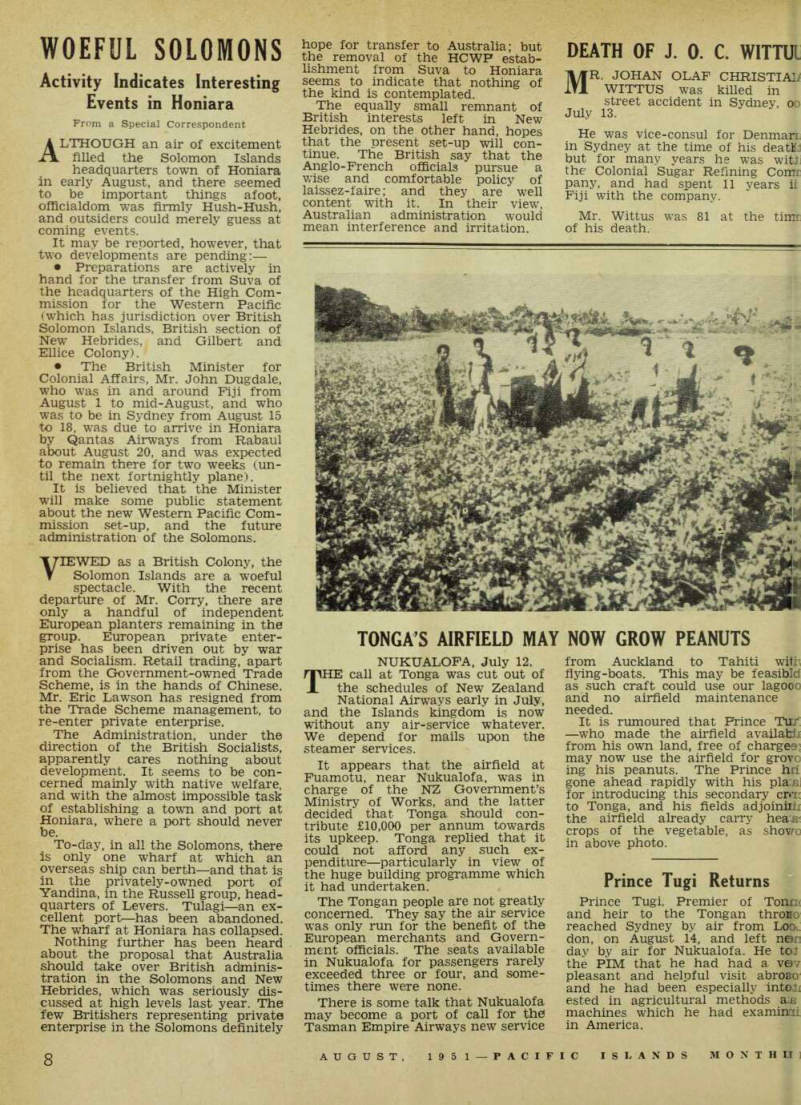
It is rumoured that Prince TujT —who made the airfield availafch from his own land, free of chargee' may now use the airfield for grovo ing his peanuts. The Prince hrl gone ahead rapidly with his pla:sJ for introducing this secondary cm; to Tonga, and his fields adjoiniiir the airfield already carry heajsj crops of the vegetable, as showo in above photo.
Prince Tugi Returns
Prince Tugi, Premier of Tonne and heir to the Tongan throno reached Sydney by air from Loou don, on August 14, and left n©n day by air for Nukualofa. He to 4 the PIM that he had had a vov pleasant and helpful visit abroso and he had been especially intofi ested in agricultural methods a:s machines which he had examinai. in America,
Advertisements & other items, p. 10 (1 item)
8
AUGUST, 1951 PACIFIC ISLANDS MO NTH II
Jap. Thieves In N. Guinea Waters
Australians Seize Little Ship in Hermits
}N August 4 or 5, an Australian naval craft went to the Hermit Islands (north of New Guinea nd west of Manus) and there rrested what has been described as Japanese sampan, 60 feet long nd carrying 44 persons, on a charge f stealing trochus shell and copra rom Islands in Australian territory.
The vessel was taken to Lorengau Manus) for interrogation.
The Jap Captain disappeared the ight before arrival, and was re orted drowned. Mr. Tom Aitchison District Commissioner) alerted the atives, and the Jap was found shore, in hiding, and was returned ) the ship.
The sampan was loaded with lell, and “stank to high heaven.” he had an American authority to sh for trochus, as far south as the 3uator, but she was arrested three egrees south of the equator.
This followed a report that some me in July—apparently about 10th r 12th a vessel manned by apanese called at one of the Ninigo ;lands (westward of the Hermits) hich is occupied by an Australian lanter, Mr. Gus Kuster. The apanese, after accepting Mr. luster’s hospitality, raided his ;ores, siezed copra and trochus aell which he had on hand, and filed away. His radio was out of ction, so he was not able to report ae incident for some two or three eeks.
Thereupon the Australian auth rities directed, from Manus, an nmediate air and sea search of the hole area, with the result that icy picked up the sampan referred ) in the Hermit group, about half ray between Mr. Kuster’s island nd Manus.
Some of the Australian news apers “played up” the theft of Mr. luster’s shell, and the arrest of the sampan” in such a way as to iggest that Australia’s tropical ;rritories are again being invaded y Japan, and that a dangerous and larming situation exists.
Some insisted that the sampan ime from a “mother ship.”
The Australian Government romptly announced that the Aus •alian establishment on Manus is ) be strengthened: and a bomber as sent north, in August, to be rationed there.
The fact of the matter is that rese tropical reefs apparently are 3 be subjected to sporadic thefts y wandering little ships, manned by apanese or Indonesians, or both, i the same way as before the 'acific war. It is difficult to make tiese Asiatics understand that idely scattered, isolated and in ignificant little archipelagoes, like hose lying north-west of New ruinea, are Australian territory and lust be left alone.
There is this difference, however.
Before the war, many of these trochus-poaching Japanese were attached to the Japanese Intelli gence organisation and were com piling data for the Japanese Navy.
To-day, probably, they are only wandering and irresponsible poachers.
The irony of it is that between 1930 and 1940, when the Pacific Islands Monthly repeatedly reported the presence of Japanese poachers among these tropical reefs, and insisted on their significance, no one in Australia would take any notice.
To-day, when the incidents have no significance other than theft, the Australian newspapers are excitedly discovering all sorts of dangerous and sinister things.
Submarine At Emirau?
THERE is no doubt, however, that there is need for close super vision over the activities of strange craft in Australian tropical waters. The Japanese are not dangerous now; but there very definitely is a threat from sub marines based on Russian and Chinese north-west Pacific ports.
If World War 111 comes, the im mediate threat to us in the Pacific will come from the fleet of ocean g6ing submarines which Russia has based on Vladivostock and similar ports, with the object of attacking our commerce in the Pacific.
For example, it is known that in the early part of this year a sub marine appeared off the island of Emirau (north-west of New Ireland) and the party which landed on the island, and remained there for some time, comprised Asiatics and Euro peans—and the latter are presumed to have been Russians. The visit was observed and reported by a European.
During the 1942-44 operations, the Americans constructed two big air strips on Emirau, with runways 7,000 feet by 150 feet, and situated about 3,000 feet apart. They were well made of coral, and are still in good shape. Our Manus base is not very far away from Emirau.
There are other good airstrips on other islands in New Guinea waters which are now rarely visited. At Nissan (Green Islands), which is only 40 miles north of Buka and 100 east of Rabaul, there are two air strips—one 7,300 feet bv 150 feet, and the other 5,000 feet by 150 feet.
They are well made of coral, but have not been used since the war.
These examples could be multi plied. Those islands airstrips could become very interesting if, in the event of World War 111, it was possible for Russian submarines or raiding naval forces to bring into the South Pacific aircraft which could make use of them.
Sydney-Moresby
TOA Plan Twice-Weekly Service
ANOTHER Solent flying-boat for Trans Oceanic Airways arrived in Sydney from Britain on July 15; and it was almost immediately put into the Sydney-Moresby service.
The Solent which was damaged in the Brisbane River several weeks ago has been repaired and, using both flying-boats, TOA, probably on September 5, will commence a Wednesday service to Moresby.
This will mean that, on Sunday and Wednesday evenings, the Solents will fly to Moresby, via Brisbane, and will return the same way on Mondays and Thursdays.
TOA plans to extend its present Sydney-Hobart service soon to four days each week; and, later on, with the arrival of a third Solent, the Sydney-Hobart service will be daily.
TOA’s Hythe flying-boat is used on the Sydney-Lord Howe Is. service. The lagoon, there, is just a little too shallow to make the use of the bigger Solents practicable.
It was announced early in August that TOA were making arrange ments to extend their service from Port Moresby to Rabaul, per medium of Mandated Airlines air craft. In the past, Mandated Air lines have not had a regular con nection to Rabaul. That line, how ever, has introduced two English De Haviland Dove aircraft, and it is proposed to use these to connect with TOA Solent at Moresby and thence fly on a regular schedule to Rabaul.
An Auster plane owned by the Catholic Mission at Wewak, New Guinea, crash-landed on the Map rik aerodrome late in June when the pilot overshot the strip. Father Kelly, who was flying the plane, escaped with minor injuries, but the machine was badly damaged.
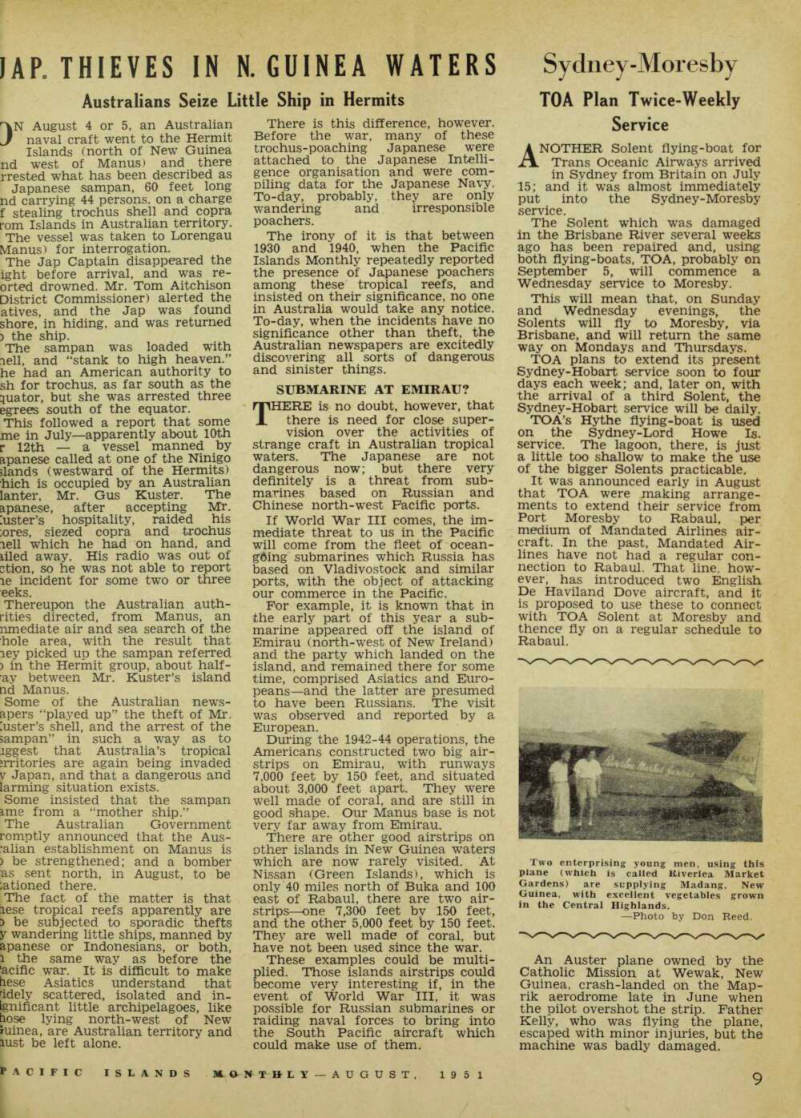
Two enterprising young men, using this plane (which is called Kiverlea Market Gardens) are supplying Madang, New Guinea, with excellent vegetables grown in the Central Highlands. —Photo by Don Reed.
Divers’ Search For Bullion
Off Lae Aftermath of Drover Crash
THERE are mysterious features about the loss of the Qantas Drover plane in the sea off Lae, New Guinea, in July, when the following people lost their lives — The Bishop of Alexishafen, the Rt. Rev. Stephen Appelhans, 46, whose headquarters were at Madang. He was a native of Kansas, USA.
The Rev. Father William Bachus, 42. born in Brooklyn, New York, priest of the Morobe District.
First Officer John William Spiers, 30, pilot of the Drover.
Miss Helen Jean Connor, 27, of New South Wales, a recent arrival in Lae. She was engaged to marry: James Wilson Palmer, 37, a radio technician with Radio Telecom munications, Lae.
Miss Frances Tindale, 30, of NSW, a friend of Miss Connor.
Kenneth Charles Macdonald. 31, building supervisor at Bulolo Gold Dredging Ltd.
The plane was making a routine flight from Bulolo and Wau to Lae.
The weather was not very good and, as he approached Lae, the pilot was asked to lay off for a little while. He swung off over Huon Gulf, southwards, and completely disappeared, without a word.
The control officials at Lae, be coming anxious when, after min utes, they could not locate the Drover, raised the alarm. A search plane soon afterwards located •wreckage on the surface miles south of Lae. Later, the bodies of Bishop Appelhans and Miss Connor were recovered.
In the following days, searching craft located the plane on the sea bottom, 10 miles south of Lae, at a depth of 100 feet.
The Drover had been carrying bullion from the Bulolo goldfields— about £35,000-worth.
The Drover was regarded as a sound and trustworthy plane, and she had plenty of fuel. An inquiry Into the accident is proceeding.
The generally-accepted theory is that, when the plane was banking for a turn over the Gulf, in thick weather, she was nearer the water than the pilot supposed, and a wing-tip struck the surface causing crash Although most of New Guinea passenger transportation has been by air for 20 years, and flying con ditions in New Guinea are far from ideal, the New Guinea air accident rate is phenomenally low.
Salvage Of Plane
FRST attempts by a diver to salvage the remains of the plane and locate the missing
£35,000-worth of gold were aban doned at the end of July. Early in August other divers and equipment were being flown from Australia to try again. This second attempt had been undertaken by the insurance company with which the gold was insured.
The wrecked plane lies not far from the mouth of the Markham where a continuous flow of water pours into the Huon Gulf. This has helped disintegration of the plane.
The first diver found no trace of the five bodies nor of the missing bullion.
The second party of divers re ported that they entered the fusel age of the plane on August 9, but found no trace of passengers, or bullion.
It is now presumed that when the plane hit the sea, the bottom was torn out and passengers and cargo were scattered.
Bishop Appelhans And
Fr. Bachus
THE Rt. Rev. Stephen Appelhans, Vicar Apostolic of Eastern New Guinea, was an American, and was consecrated a Bishop at St.
Mary’s Mission House, Techny; Il linois, USA, on November 30, 1948.
Bishop Appelhans was then 43 — young for a Bishop. But at the same ceremony, a fellow American became the youngest Bishop in the world. He was the Rt. Rev. Leo
Arkfeld, Vicar Apostolic of Central New Guinea, who was then 36.
These two young bishops took the place of Bishop Francis Wolf, of Alexishafen, and Bishop Joseph Loerks, of Central NG, who had been killed when a Japanese prison ship on which they were travelling was strafed by US planes in 1944.
In Australia, in 1944, Bishop Appelhans became director of the Mission of the Society of the Divine Word in New Guinea. He went to the Territory about 1945.
His was the task of rebuilding the fine mission station that had existed at Alexishafen before the war but which had been completely
destroyed during the Jap occupy, tion.
The Roman Catholic missions a New Guinea have followed ft custom of the country and usi; air transport extensively—many y the younger missionaries (inclwl; ing Bishop Arkfeld) pilot their o’o planes.
A number of them have bed killed in air accidents FatHj.
Kirschbaum, a noted anthropoo* gist, before the war, Father Joo Glover a couple of years ago, as now Bishop Appelhans and FatH: Bachus.
Father William Bachus, American, also of the Society of 1 Divine Word, was attached to t Mission of St. Mary at Lae, as was loved by all in the distrhf Catholics and Protestants alike.
He was one of the first peoples! visit the Mt. Lamington area afis the eruption in January.
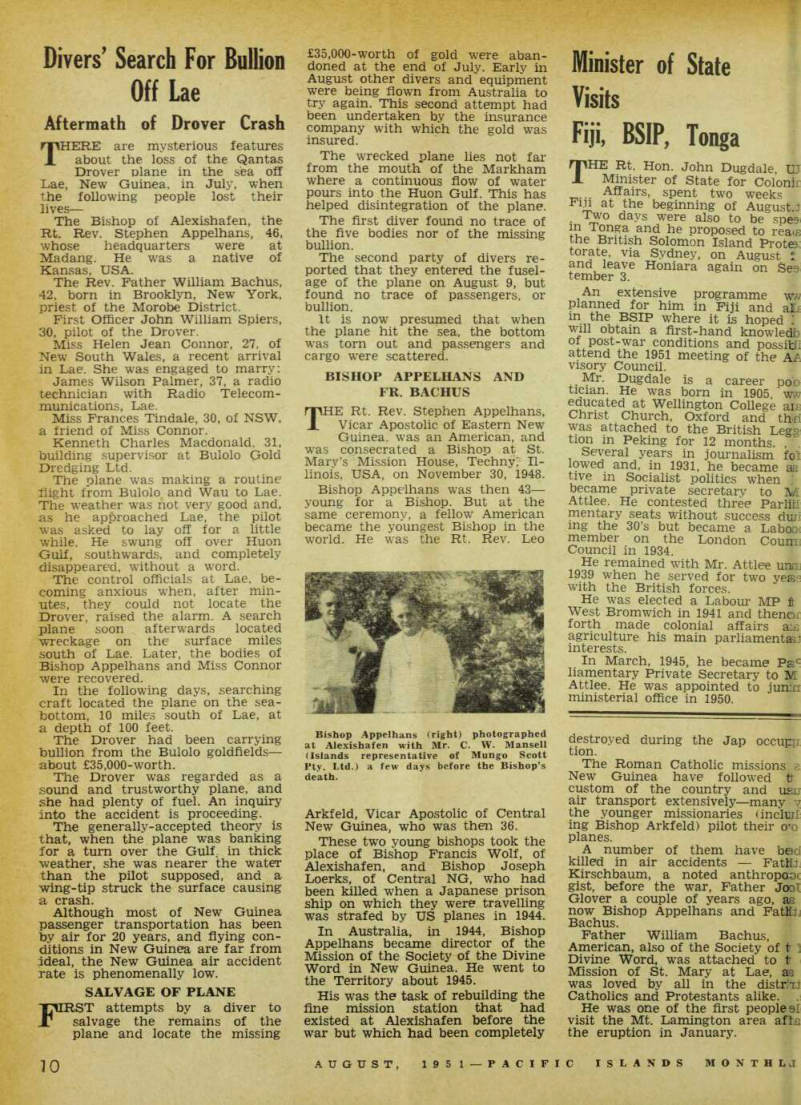
Bishop Appelhans (right) photographed at Alexishafen with Mr. C. W. Mansell (Islands representative of Mungo Scott Pty. Ltd.) a few days before the Bishop’s death.
Fiji, BSIP, Tonga
Minister of State Visits Fiji, BSIP, Tonga
THE Rt. Hon. John Dugdale TU Minister of State for Colonic Affairs, spent two weeks Fin at the beginning of Augusts . Two days were also to be spe9< m Tonga and he proposed to ream the British Solomon Island Protes: torate, via Sydney, on August 2 and leave Honiara again on See tember 3.
An extensive programme ww planned for him in Fiji and ale in the BSIP where it is hoped 3 will obtain a first-hand knowledb of post-war conditions and possifcf: attend the 1951 meeting of the A/ visory Council.
Mr. Dugdale is a career poo tician. He was born in 1905 ww educated at Wellington College am Christ Church, Oxford and thd was attached to the British Legg‘ tion in Peking for 12 months. , Several years in journalism foi lowed and, in 1931, he became as tive in Socialist nolitics when ' became private secretary to M Attlee. He contested three Parliii mentary seats without success dm ing the 30’s but became a Labooc member on the London Coum; Council in 1934.
He remained with Mr. Attlee unm 1939 when he served for two yeas with the British forces.
He was elected a Labour MP ft West Bromwich in 1941 and thenor forth made colonial affairs am agriculture his main parliaments interests.
In March, 1945, he became Ps c liamentary Private Secretary to M Attlee. He was appointed to jun:n ministerial office in 1950.
Advertisements & other items, p. 12 (1 item)
10
AUGUST, 1951 PACIFIC ISLANDS MONTHLJ
Rabaul Meets The
New Minister
Prom Our Own Correspondent
Rabaul, Aug. 1.
THERE was a colourful scene in the tropical garden of “the house on the too of the hill” — the District Commissioner’s resi dence at Namanula—late in July, when a representative section of Rabaul’s population gathered at a party to do honour to Territories Minister Hasluck and Postmaster- General and Civil Aviation Minister Anthony— the latter accompanied by his piquant and charming wife.
The first thing we noticed about our new Minister is his youth, the lines of laughter round his eyes, and that air of frank friendliness which belongs to most West Australians.
After talking to him, one decides that here is a man who will not deliver any ill-considered judg ments, or facile promises. When this Minister’s decision is given it will be wise and fair.
The morning after his arrival, Mr.
Hasluck left for Kokopo, to inspect the new town site, accompanied by Administrator, Colonel Murray, the District Commissioner, and other officials.
When asked by the Advisory Council that he should suggest to the Australian Government that it reconsider its decision to move the town to Rapopo, Mr. Hasluck said that although it was not his wish to alter the decision of his pre decessor, and that plans were al ready in operation for the move, the idea of a different site was not wholly excluded.
A Variety Of Requests
CHINESE Community representa tives gave lengthy reasons to the Minister to support re quests for more privileges and added status for the Chinese com munity-including equal rights with Europeans, equal pay, and the pur chase of land on the same basis.
They emphasised their anti communist feeling.
Members of the Rabaul and Kokopo Sub-Branch of the RSL urged that encouragement be given to plans to foster feelings of loyalty among Asiatics.
The Planters and Traders’ Asso ciation requested that the Minister take steps to review the MOF copra contract (which Britain has broken by devaluing her currency); that monies taken from the planters and held by the Government be returned to planters; and that they be allowed to sell their copra on world markets. They also urged that the new Native Labour Ordinance be discontinued, and the old one re instituted as a basis for working labour.
Mr. Hasluck said that considera
tion would be given to all these re quests. But, in cases, even if granted, there would be great delay in introducing new measures, as this would involve new legislation.
Mr. Anthony, who arrived at Rabaul the day following Mr. Has luck’s arrival, spent the period of his visit inspecting airstrips, and conferring with DCA officials.
One wonders who organises tours of this nature. The time is obviously too short for the Minister to do anything except listen to the carefully-prepared statements of Public bodies —and take quite a lot of ear-bashing on the side from those with axes to grind.
Lautoka Storm
Arguments About a Wharf
Suva, Aug. 1.
THERE has been a certain amount of liveliness on the Lautoka front, centred more or less on the new wharf project.
Lautoka’s wharf is the private property of the CSR Co. and was used originally for the outward loading of sugar and the inward unloading of supplies for the sugar towns of northern and north-west ern Viti Levu.
As other population (not con nected with sugar) grew, there was a call for port facilities not connec ted with the CSR Co. But CSR Co., in accordance with its well-known policy (its famous free-for-all rail way, for example) has allowed almost anyone to use its Lautoka wharf at small charge, or without charge at all.
Long years ago the Lautoka com munity asked the Government to provide a public wharf. Like other public works in Fiji, there was end less argument and delay about the project. It was originally planned to spend £15,000 or £20.000 on a wharf. Then wartime conditions intervened.
After the war, £150,000 of the Development Plan money was ear marked for Lautoka’s wharf.
Early last year, the British Gov ernment spent £2,000 in sending a consulting engineer to Fiji to plan a wharf for Lautoka. This func tionery planned a quay-type wharf, with Customs sheds, at an esti mated cost of £335,000. The Govern ment was literally staggered, and insisted on sending the whole plan back to London with a request for a more modest plan and estimate.
Meanwhile, the impatient citizens of Lautoka, apparently not realising the difficulty that had developed, began to criticise (a) the Govern ment, for failure to do anything, and (b) the CSR Co., because they
suspected that the Co. was trying to sabotage the public wharf plan.
The argument of the Lautoka citizens is that a new public wharf for the town generally would in volve substantial port fees, which the company, like everyone else, would have to pay, but which it now escapes because it owns its own cheaply-built wharf.
Members of the Lautoka Cham ber of Commerce (President, Mr. A.
E. Waddingham; Vice-president, Mr. C. A. Adams; secretary, Mr.
A. J. Carfax-Foster) have been active recently in this matter. They are emphatic that there is likely to be a development boom in the wide fertile area of Viti Levu, which stretches from Nadi right around to Tavua; that already half the population of Fiji is found in these districts; that the excellent port of Lautoka, upon which this develop ment should be based, is now gravely handicapped by lack of a suitable public wharf; and that some suspect that the absence of a wharf is due to unfriendliness on the part of Suva (which, they say, fears the growth of Lautoka) and of the CSR Co. (which, they say, for financial reasons does not want a new wharf).
The parties concerned have an effective answer to both these sus picions, and rather resent the criti cism.
Consequently, when there ap peared in the Fiji Times a some what critical statement, apparently sponsored by the Lautoka Chamber, there was swift reaction. Both the District Commissioner and the manager of the CSR Co. made strong representations to the Chamber of Commerce; and there then became evident some differ ences of opinion between officials of that body. The result was the resignation of the indignant sec retary.
Actually, it is merely a teacupful of storm, and it soon will be for gotten. But it will achieve some thing if it convinces the powers that be that the Lautoka people are very eager to get on with every thing that will assist the advance ment of their big, rich district.
The Ba (Fiji) open golf cham pionship. on July 22, was won by D. Phillip, with E. Allman (Lau toka) and J. H. Johnson (Lautoka> close up.
A commercial summary from London, published on August 3, said: “Wool is down by 60 per cent.
Copra, a significant bellwether of the important fats and vegetable oils group, has fallen 40 per cent.”
Copra was quoted about £135, Stg., European port, some four months ago. It is now around £BO-£lOO.
Advertisements & other items, p. 14 (2 items)
14
AUGUST, 1951 PACIFIC ISLANDS IMONTHL Y T
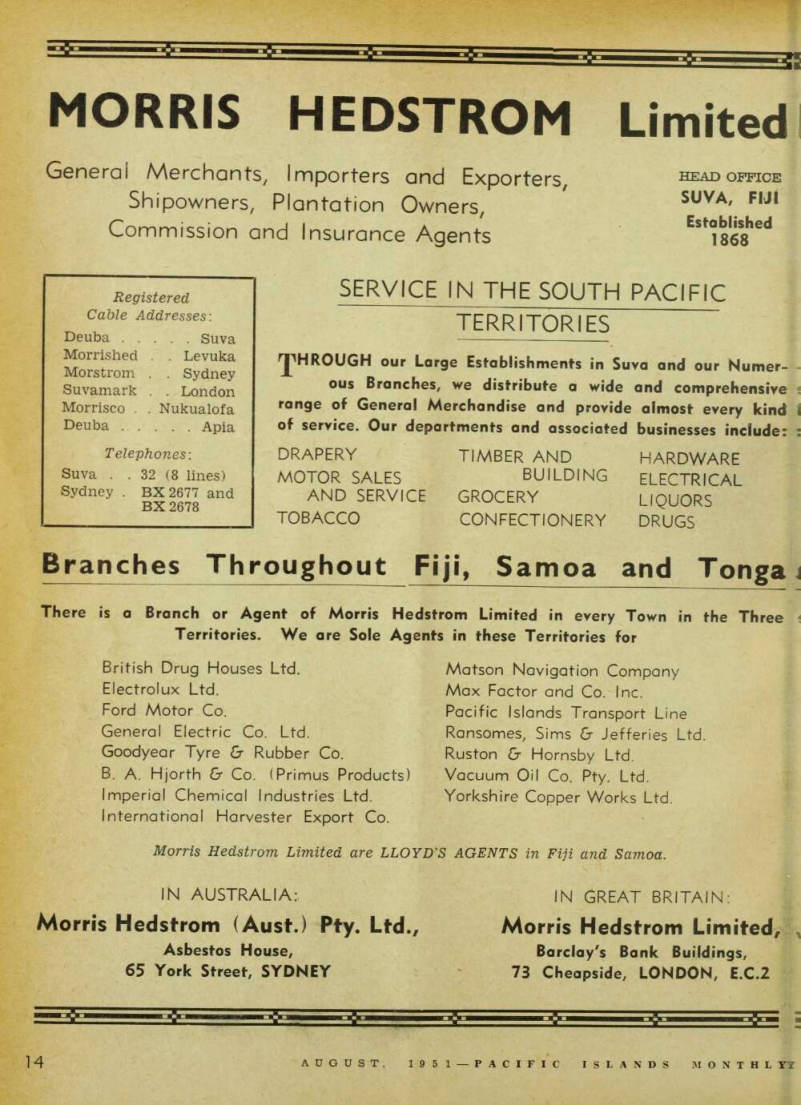
Morris Hedstrom Limited
General Merchants, Importers and Exporters,
Shipowners, Plantation Owners,
Commission and Insurance Agents
HEAD OFFICE
SUVA, FIJI
Established 1868
SERVICE IN THE SOUTH PACIFIC
TERRITORIES
our Large Establishments in Suva and our Numerous Branches, we distribute a wide and comprehensive range of General Merchandise and provide almost every kind of service. Our departments and associated businesses include:
DRAPERY
MOTOR SALES
AND SERVICE
TOBACCO
TIMBER AND
BUILDING
GROCERY
CONFECTIONERY
HARDWARE
ELECTRICAL
LIQUORS
DRUGS
Branches Throughout Fiji, Samoa and Tonga
There is a Branch or Agent of Morris Hedstrom Limited in every Town in the Three Territories. We are Sole Agents in these Territories for British Drug Houses Ltd.
Electrolux Ltd.
Ford Motor Co.
General Electric Co. Ltd.
Goodyear Tyre & Rubber Co.
B. A. Hjorth & Co. (Primus Products) Imperial Chemical Industries Ltd.
International Harvester Export Co.
Matson Navigation Company Max Factor and Co. Inc.
Pacific Islands Transport Line Ransomes, Sims Cr Jefferies Ltd.
Ruston &■ Hornsby Ltd.
Vacuum Oil Co. Pty. Ltd.
Yorkshire Copper Works Ltd.
Morris Hedstrom Limited are LLOYD’S AGENTS in Fiji and Samoa.
IN AUSTRALIA:
Morris Hedstrom (Aust.) Pty. Ltd.,
Asbestos House, 65 York Street, SYDNEY
IN GREAT BRITAIN:
Morris Hedstrom Limited,
Barclay's Bank Buildings, 73 Cheapside, LONDON, E.C.2
Where Smithy’ Landed
'Southern Cross , In Albert Park, Suva
ALMOST exactly 23 years ago— on June 5, 1928—the first overseas aircraft to arrive in Fiji, Sir Charles Kingsford Smith’s Southern Cross, came in low and slow over the lagoon in front of Suva, touched down on the outer edge of Albert Park at 60 m.p.h., and raced for the hillside. The crew (Charles Ulm, co-pilot, Jim Warner and Harry Lyon) held their breath. A crash seemed inevitable.
But the wizard “Smithy” somehow ground-looped the plane at the end of the Park and brought her safely to rest.
They had left Honolulu 3-H hours
will be 30 ft. high. On a base with red marble steps, the memorial in bronze will represent a young Fijian in ceremonial dress springing up to provide landing ground on his land for a silver bird, representing the Southern Cross.
Today, only 23 years after “Smithy’s” great flight, nearly 1,000 aircraft, carrying over 20,000 pas sengers, call at Fiji each year. That is the measure of the amazing growth of commercial aviation in the Pacific.
Second and third class mail may now be sent by air from Australia to French Oceania. The fee is 1/3 for two ounces or part thereof.
This class of mail includes com mercial papers, printed matter samples, newspapers and small packets.
earlier, carrying 1,300 gallons of petrol, and had made the then ex traordinary flight of 3,150 miles through continual tropical storms without accident.
The landing in little Albert Park was a miraculous thing. They nearly “pranged’' the Southern Cross as they landed, however, be cause “Smithy” did not know that the surface of the Park was about 12 feet below the surface of the surrounding land.
They could not take off from Albert Park with a loaded plane.
So after three days’ rest they flew the plane, empty, to Naselai Beach, Ailed up there with petrol from drums that had been lightered to the beach, and made the third hop to Sydney.
It has been decided to erect in Albert Park a memorial to the fact that Charles Kingsford Smith landed there at the end of the second hop in his great pioneer flight from San Francisco to Sydney. The memorial, designed by Australian artist Mary Edwards,
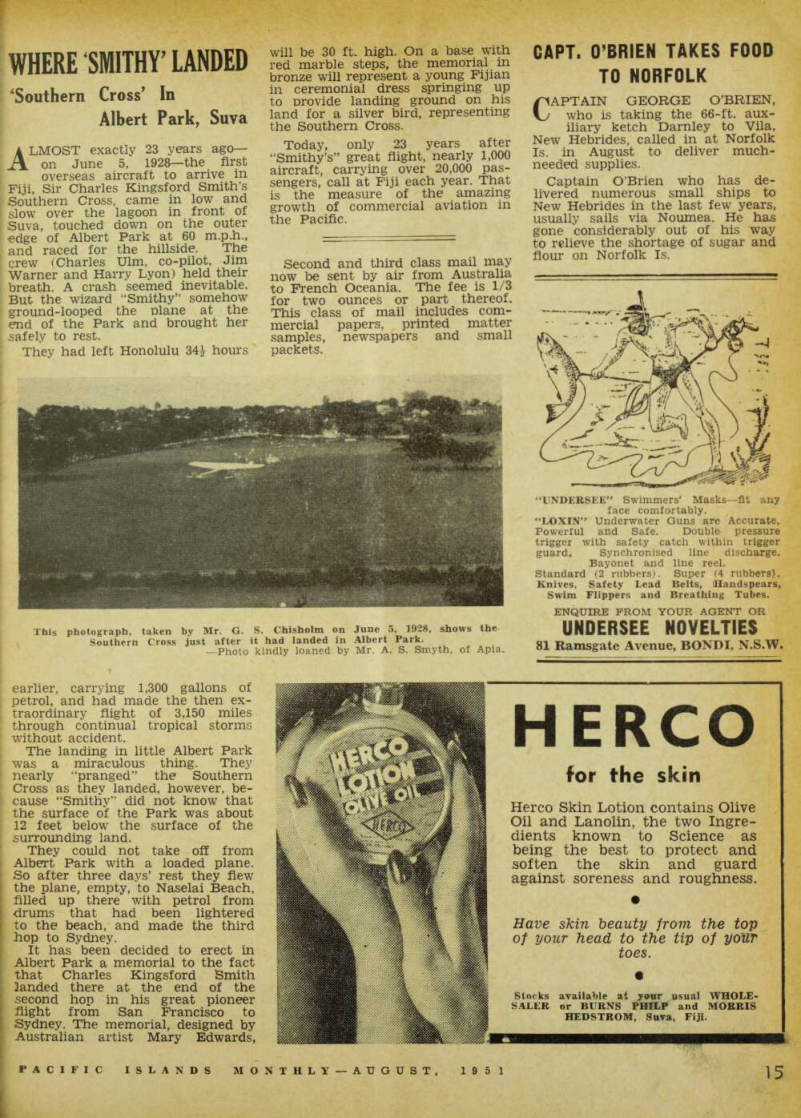
This photograph, taken by Mr. G. S. Chisholm on June 5, 1928, shows the Southern Cross just after it had landed in Albert Park. —Photo kindly loaned by Mr. A. S. Smyth, of Apia.
To Norfolk
Capt. O’Brien Takes Food
/Captain George O’Brien,
who is taking the 66-ft. aux iliary ketch Darnley to Vila, New Hebrides, called in at Norfolk August to deliver much needed supplies.
Captain O’Brien who has de hvered numerous small ships to New Hebrides in the last few years, usually sails via Noumea. He has gone considerably out of his way to relieve the shortage of sugar and Norfolk Is nour on iNoriUIK
Advertisements & other items, p. 15 (1 item)
Herco
\ -Jie- “UNDERSEE” Swimmers’ Masks—fit any face comfortably.
“LOXIN” Underwater Guns are Accurate, Powerful and Safe. Double pressure trigger with safety catch within trigger guard. Synchronised line discharge.
Bayonet and line reel.
Standard (2 rubbers). Super (4 rubbers).
Knives, Safety Lead Belts, iHandspears, Swim Flippers and Breathing Tubes.
ENQUIRE PROM YOUR AGENT OR
UNDERSEE NOVELTIES
81 Ramsgate Avenue, BONDI, N.S.W.
HERCO
for the skin
Herco Skin Lotion contains Olive Oil and Lanolin, the two Ingredients known to Science as being the best to protect and soften the skin and guard against soreness and roughness. • Have skin beauty from the top of your head to the tip of your toes. • Stocks available at your usual WHOLE-
SALER or BURNS PHILP and MORRIS
HEDSTROM, Suva, Fiji.
Fiji Area Gets Water

After 6 Years’ Fight
ON July 30, following 30 years of discussion, argument and frus tration, the Governor of Fiji (Sir Brian Freeston) formally
opened the Rewa Water Supply, by which 6,000 people, living in Nausori, part of the Rewa Delta, and Bau, now get water by reticulation from a hillside above Nausori.
The water is pumped by electric motors from the Rewa River, and is cleared and purified in a series of settling tanks, and then stored in a reservoir of 180,000 gallons.
The plan was formulated about 1920, but no agreement was reached
for 20 years. Then a select com—j mittee recommended something likes the present plan, but without thes. inclusion of Bau—it was thoughts that the old 80,000 gallon tank ath Bau could be repaired and used.* Then the war intervened. After thesj war, a £75,000 plan was approved.
Ever since then, the Public Works: people have fought steadily fora materials and staff. When eventu--j ally the work was completed, it hadb cost £120,000 and taken three timesa' as long as estimated.
It is hoped eventually to increases: this water supply to serve the wholes Rewa Delta, and 17,000 people Power is provided by AC genera tors operating off 60 hp dieselh engines.
When completed the scheme wilHI entail nearly 20 miles of mains„g from 9-inch through 8-inch too 3-mch. A special 3-inch pipe is be ing laid to Bau Island.
The new supply will be of ines timable benefit to the communityy and may have a marked effect one vital statistics, particularly on thes incidence of infant mortality. Al ready there is evident a keen desires to get on to the new supply, by allU those anywhere in the vicinity.
Miss Murial Bishop left Brisbanesj by flying-boat in early August fon< Port Moresby. Prom there she will II go to Kanosia estate where she wilHI marry Mr. Douglas Campbell.
Advertisements & other items, p. 17 (1 item)
Millers Ltd. Ii^M
SUVA and LAUTOKA, FIJI.
Every Branch of Engineering and Building
Construction
Sawmillers and Timber Merchants; Shipwrights and Sailmakers; Joinery and Furniture Manufacturers; Upholsterers; Plumbers; Electricians; Hardware Merchants; Motor Dealers.
Agencies : Chevrolet, Bedford, Vauxhall, Nash Motors. Firestone Tyres. Fetters Marine and Stationary Engines. G.E.C. Radio Sets. British Australian Lead Manufacturers Pty., Ltd. Atlas Assurance Co., Ltd.
There is no need to send to Australia or New Zealand for Repairs or Replacements. We can give you a sound Quotation and guarantee First-Class Workmanship.
0 0 0
THE PERFECT SOAP FOR ALL PURPOSES!
CENTAL is the ideal soap for the whole family—because it will not harm the most sensitive skin. Hands stay smoother—sheets keep whiter, colours stay brighter when the washing is done with PEINTAL. Even the most delicate fabrics retain their loveliness when PENTAE i> used.
Pacific Islands Distributors :— lo* c l
PRO
UHDV
fi HD
TTTi
fOIDI
fOR
COLTER WATSON PTY. LTD.
22 BRIDGE ST.
SYDNEY
Tributes To James Norman Hall

Tahiti Mourns The Passim? or a Lovable Man
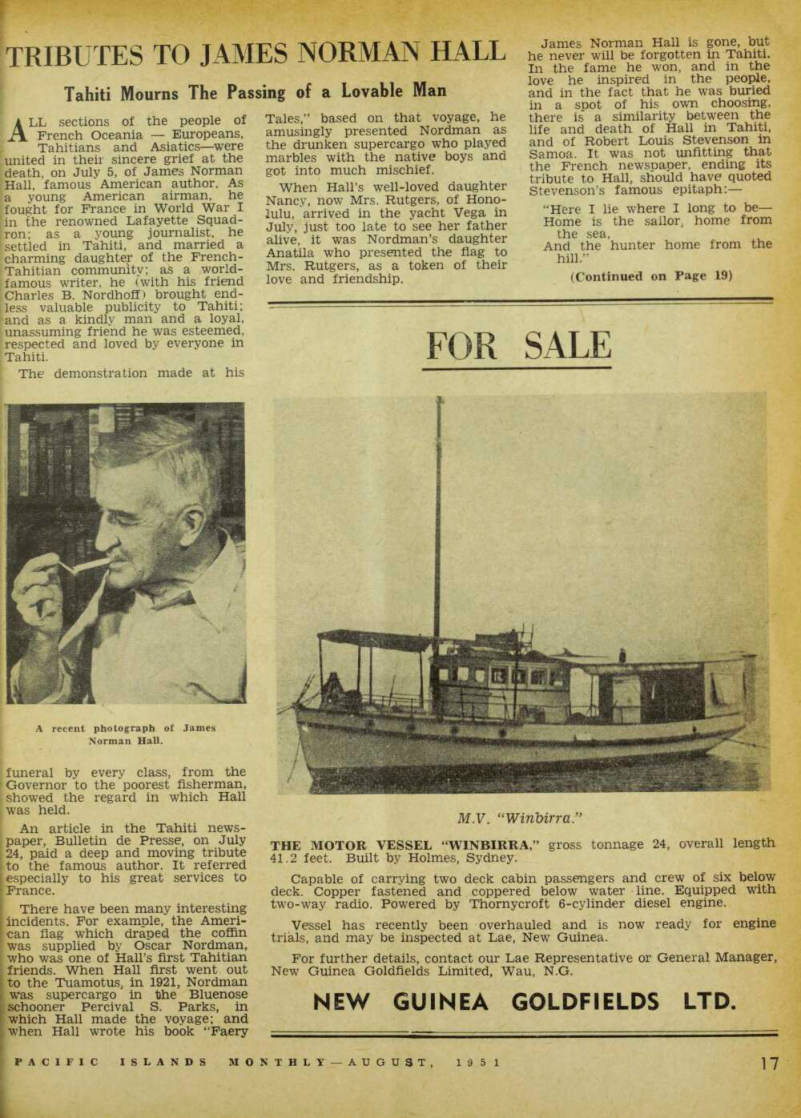
ALL sections of the people of French Oceania Europeans, Tahitians and Asiatics —were united in their sincere grief at the death, on July 5, of James Norman Hall, famous American author. As a young American airman, he fought for France in World War I in the renowned Lafayette Squad ron; as a young journalist, he settled in Tahiti, and married a charming daughter of the French- Tahitian community; as a world famous writer, he (with his friend Charles B. Nordhoff) brought end less valuable publicity to Tahiti; and as a kindly man and a loyal, unassuming friend he was esteemed, respected and loved by everyone in Tahiti.
The demonstration made at his
funeral by every class, from the Governor to the poorest fisherman, showed the regard in which Hall was held.
An article in the Tahiti news paper, Bulletin de Presse, on July 24, paid a deep and moving tribute to the famous author. It referred especially to his great services to France.
There have been many interesting incidents. For example, the Ameri can flag which draped the coffin was supplied by Oscar Nordman, who was one of Hall’s first Tahitian friends. When Hall first went out to the Tuamotus, in 1921, Nordman was supercargo in the Bluenose schooner Percival S. Parks, in which Hall made the voyage; and when Hall wrote his book “Faery
Tales,” based on that voyage, he amusingly presented Nordman as the drunken supercargo who played marbles with the native boys and Q'ot into much mischief got into muen m sc .
When Halls well-loved daughter Nancy, now Mrs. Rutgers, of Honolulu, arrived in the yacht Vega in July, just too late to see her father alive it was Nordman’s daughter Anatila who presented the flag to Mrs. Rutgers, as a token of their love and friendship.
James Norman Hall is gone, but he never will be forgotten in Tahiti.
In the fame he won, and in the love he inspired in the people, and in the fact that he was buried in a snot of his own choosing, there is’ a similarity between the life and death of Hall in Tahiti, and of Robert Louis Stevenson in Samoa. It was not unfitting that the French newsoaper. ending its tribute to Hall, should have quoted Stevenson’s famous epitaph;— “Here I lie where I long to be— Home is the sailor, home from the sea, And the hunter home from the hill.”
(Continued on Page 19)
A recent photograph of James Norman Hall.
By Eric Ramsden, in Wellington “Post"
IT is curious that death should have claimed James Norman Hall and Marshal Henri Petain within a few days of each other.
One, a successful novelist, died in Tahiti, which had been his home for the past 25 years, while the other, disgraced, senile, and almost forgotten outside his island prison, off the French coast, had long out lived his glory.
It was of Hall, then serving in the Escadrille Lafayette, that Petain wrote during the First World War: “Brilliant pursuit-pilot, a model of courage and spirit, who recently brought down an enemy plane, met a glorious death in com bat with four monoplanes, one of which crashed in flames.”
But the Marshal was wrong.
Though Hall’s death was reported on more than one occasion, he lived to join forces with another Ameri can, Charles Nordhoff (also of the Escadrille) and formed the most famous literary partnership the Pacific has known.
Success came with the trilogy of the Bounty,” “Men Against the Sea,” and “Pitcairn’s Island.” But both served a stern apprenticeship over many years. It was not until their books were filmed that wealth came. Apart from his collaboration with Nord hoff, the more industrious Hall wrote at least a dozen books. “The Far Lands,” a Polynesian epic, appeared only a few months ago.
These writers, who had so much in common, provided a marked con trast. Nordhoff once told me that xmless they collaborated money al ways eluded them. Hall was by far the better craftsman. Nordhoff sup plied the romantic flair and drive, and Hall the thorough research that formed the background to their work.
In Kitchener’S Army
Born in Colfax, lowa, and a graduate of Grinnell College in 1910, Hall was in England during the First World War, and served for a period in Kitchener’s Army, later transferring to the French.
Nordhoff was born in Engand of American parents, returned to the States as a child, and graduated from Harvard. Both were born in the same year—lBB7.
In Tahiti they lived at opposite •ends of the island. When they worked on a book they took an ■office in Papeete and observed regu lar hours. But there were long periods when Nordhoff fished, and Hall indulged in his favourite hobby of mountaineering.
Nothing provided a greater con trast than the manner in which they looked after their books. As
wealth came to Nordhoff he added room after room to his home until in time it resembled a series of railway carriages. At the far end of his house was what was called the library. There the tropic pests that riddle books had a completely free hand.
Hall, on the other hand, sprayed his books from time to time, and kept them in perfect order. It was well that he did so, as the im portant Bounty bibliography which the authors accumulated was in his keeping.
From the thatched bungalow in which he worked, Hall once pointed out to me, in Matavai Bay below, the bank on which the Dolphin, the first British ship to visit Tahiti, grounded. The neighbourhood of Arue was redolent of history.
I knew Nordhoff at the pinnacle of his success. He was a most like able man, exceedingly popular in Tahiti, but his own enemy. Failing eyesight—a result of too many fish ing expeditions on the reef—and the shock of a domestic tragedy drove him from the island to die in California in 1947.
Now death has called Hall, his partner and friend. With the recent death of Robert Dean Frisbie, also an American and a protege of Hall and Nordhoff, the Pacific lost an other figure of literary importance.
As Nordhoff’s menage terminated
tragically, neither did sorrow pass by Hall. One of his children caught some strange tropical complaint
that necessitated long residences abroad. . . .
His Last Act
One of Hall’s last acts was to write a series of articles, in which he quoted from Frisbie’s letters, and the proceeds went to a fund for the maintenance of Frisbie’s children.
Hall never indulged in excesses; he lived quietly at Arue, with occasional trips abroad, living, as he said, far more intently in books than he did in real life. Tahiti he
regarded as “a grandstand seat to observe the workings of a mad machine age.”
Hon F. W. Doidge, New Zealand Minister for External Affairs, who has had Ministerial charge of New Zealand’s Islands Territories, has been appointed New Zealand High Commissioner in London. He knows London well; he was a high executive of the Beaverbrook press for 15 years after World War I.
Advertisements & other items, pp. 19-22 (2 items)
For Sale
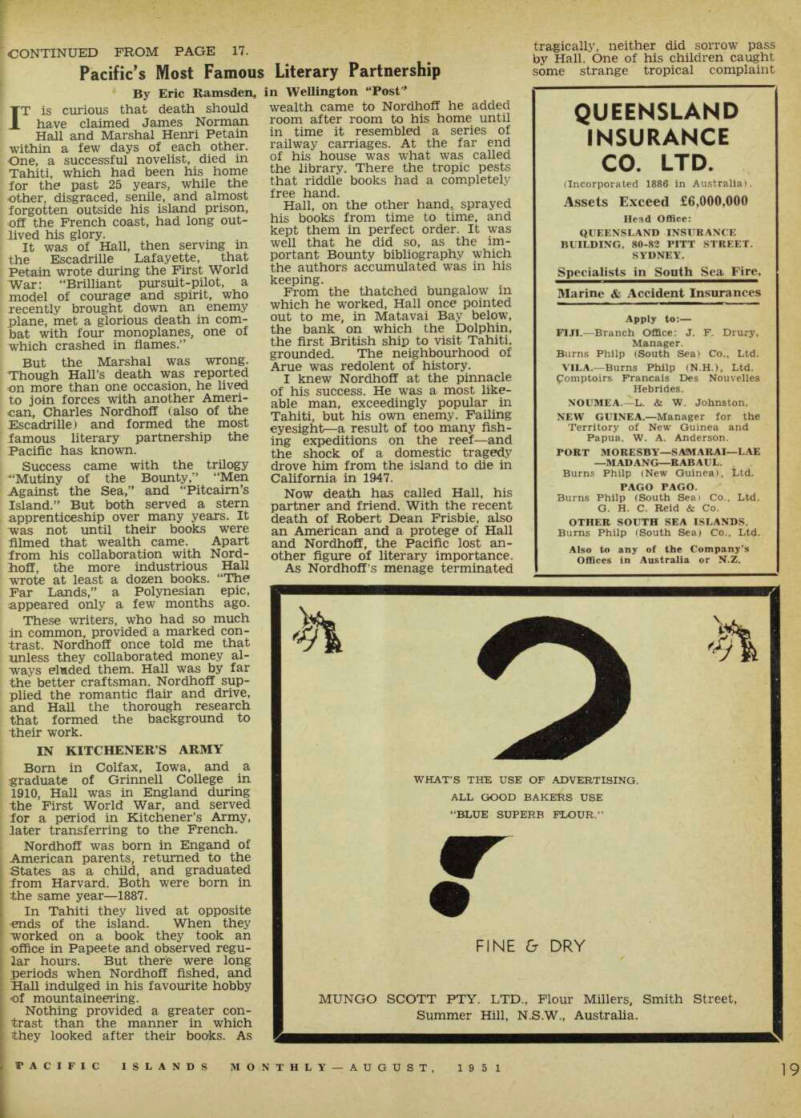
• m M.V. “Winhirra.”
THE MOTOR VESSEL “WINBIRRA,” gross tonnage 24, overall length 41.2 feet. Built by Holmes, Sydney.
Capable of carrying two deck cabin passengers and crew of six below deck. Copper fastened and coppered below water line. Equipped with two-way radio. Powered by Thornycroft 6-cylinder diesel engine.
Vessel has recently been overhauled and is now ready for engine trials, and may be inspected at Lae, New Guinea.
For further details, contact our Lae Representative or General Manager, New Guinea Goldfields Limited, Wau, N.G.
NEW GUINEA GOLDFIELDS LTD.
m
Mr i«
I 5? * r L N X \ , *1
WWW
Club lounge on lower deck where you meet fello passengers, enjoy refreshments Discover how luxurious uir travel con be
to LONDON by “Strato" Clipper*
Pan American's double-decked "Strato"
Clippers now fly direct from Sydney to San Francisco . . . New York to London. No dollars needed! Fare payable in Australian pounds.
Direct transit expenses en route provided by Pan American’s Commonwealth Plan. Pressurized for living-room comfort.
Private sleeping accommodation for everyone. Either a big foam-soft berth — or a wonderful Pan American Sleeperette* that extends to full bed-length. No extra charge between Australia and U.S. No “doubling up”.
Superb meals. You enjoy delicious full course meals, with complimentary wine and champagne.
Book now with Pan American or your Travel Agent
Pm Mmcm World Auuvm
WORLD'S MOST EXPERIENCED AIRLINE
SPEED YOUR PARCEL BY CLIPPER CARGO
Pan American World Airways, Inc., Ltd., Incorporated in U.S.A. *Trade Marks, Pan American World Airways, Inc-
QUEENSLAND
INSURANCE
CO. LTD.
(Incorporated 1886 in Australia).
Assets Exceed £6,000,000
Head Office:
QUEENSLAND INSURANCE
BUILDING. 80-82 PITT STREET.
SYDNEY.
Specialists in South Sea Fire.
Marine & Accident Insurances Apply to:— FIJI. —Branch Office: J. F. Drury, Manager.
Burns Phllp (South Sea) Co., Ltd.
VlLA.—Burns Phllp (N.H.), Ltd.
Qomptoirs Prancais Des Nouvelles Hebrides.
NOUMEA.—L. & W. Johnston.
NEW GUINEA. —Manager for the Territory of New Guinea and Papua, W. A. Anderson.
PORT MORESBY—SAtMARAI—LAE
—MADANG—RABAUL.
Burns Philp (New Guinea), Ltd.
PAGO PAGO.
Burns Philp (South Seal Co., Ltd.
G. H. C. Reid & Co.
OTHER SOUTH SEA ISLANDS.
Burns Philp (South Sea) Co., Ltd.
Also to any of the Company’s Offices in Australia or N.Z.
WHAT’S THE USE OF ADVERTISING.
ALL GOOD BAKERS USE
“BLUE SUPERB FLOUR.”
FINE & DRY
MUNGO SCOTT PTY. LTD., Flour Millers, Smith Street, Summer Hill, N.S.W., Australia.
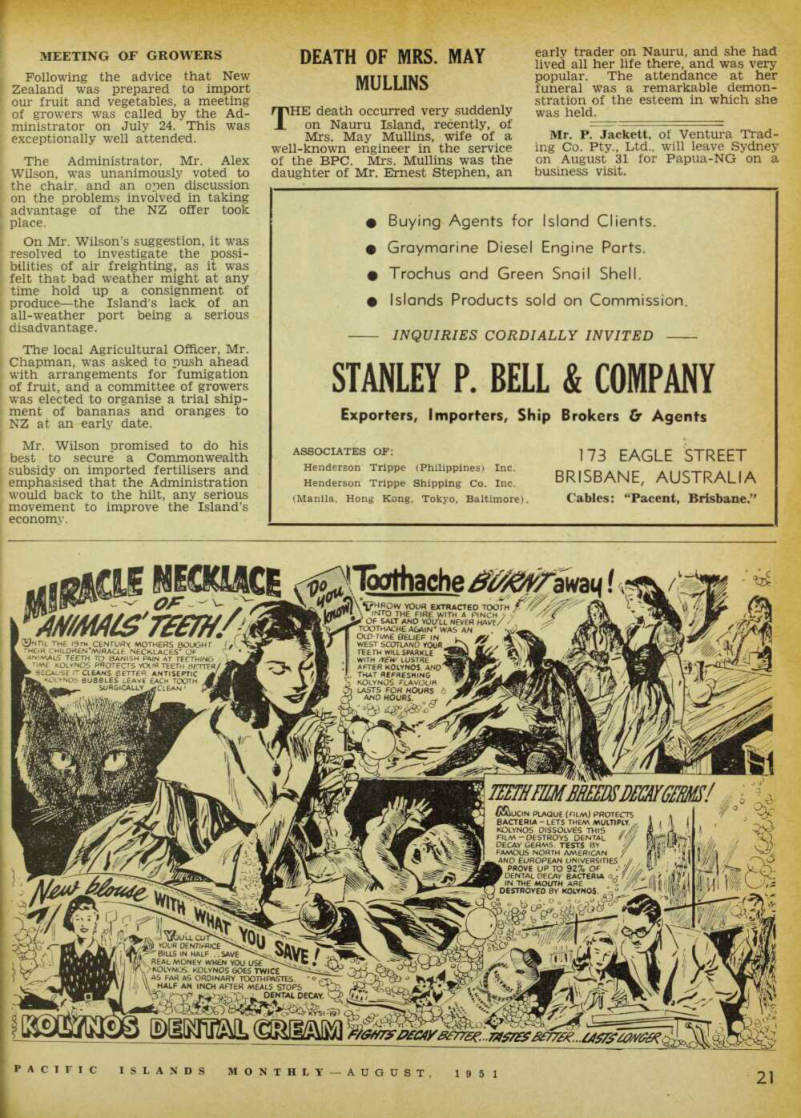
PACIFIC
ISLANDS
YEAR
BOOK
1950 K.W Robsor\
OBTAIN
YOUR
COPY
NOW!
Price; 25/
Add postage, etc. (Within the British Empire, 1/3; Foreign, 2/6) when ordering direct (In U.S. Currency, $3.50, including postage).
PACIFIC ISLANDS YEAR BOOK, 1950,
the South Seas’ most valued reference book, is available at all leading Booksellers in Australia and N.Z., the main Pacific Islands stores, or direct from the Publishers.
The 1950 (Sixth) Edition contains 500 Pages and numerous Maps. In addition to providing reliable information relating to Administrations, Geography, History, Industries, Commerce and Trade (full statistics). Tariffs, etc., the Year Book has many Special Sections, such as; A History and Chronology of the War in the Pacific, 1941-45; Lists of Public Servants in each Territory; Description of the new Air Transport Organisations serving the Pacific Islands: Complete Directory of Pacific Islands Missions; Notable Developments in 1940-50 Period; Detailed Index of Place Names in the South Seas, etc.
PACIFIC PUBLICATIONS PTY. LTD.
Union House, 247 George Street, SYDNEY.
(Box 3408. G.P.0., Sydney, N.S.W., Australia.)
19
CONTINUED FROM PAGE 17.
Pacific's Most Famous Literary Partnership
PACIFIC ISLANDS MONTHLY AUGUST, 1951
Norfolk Is.
Gets NZ Market
Prom Our Own Correspondent
M Norfolk Is., July 30.
ANY years ago Norfolk Island* experienced a banana boom.o but when New Zealand pro hibited their import—for politicals reasons—many hundreds of acresj of cultivated land were allowed toa; go back to bush. (Australia, ofic course, does not want our tropicals and semi-tropical produce which! would compete with mainland) growers).
Now, thanks to the representa—i tions made in the first instance by/,; Mr. J, Howse, MP, on the questiomi of a possible market in NZ beings established for Norfolk-growrrr bananas, citrus fruit, etc., permis-; sion has been given by NZ for ther importation of fruits, plants, seeds and cut flowers fronrn Norfolk Island.
Certain conditions have been im-r posed, chief of them being compul-I sory inspection of citrus orchards!; each year, to determine if they ar©~ clear of Mediterranean, Queensland or oriental fruit fly. There must bee a yearly declaration by the Admin istrator that fruit fly does not exists and finally there will be an in spection of export fruit in regis tered packing sheds.
Captain Holm of the Holm Ship-c ping Line has offered a ship fronrn New Zealand to Auckland every/'j two months but it is felt that as more frequent service will be neces-g sary before growers can take fullh advantage of the New Zealand), market. Between April and Novem-n her, at a time when local New?
Zealand supplies are unobtainable . 9.
Norfolk grows fine beans, etc. A ship only every two monthsri would not warrant large-scaleb planting, however. New Zealand)!; should be able to absorb fruit anor vegetable shipments at fortnightly!; intervals.
Cheap air freight is another pos-a< sibility—and this would be particu-u larly valuable for the cut flowers trade.
Much appreciation is locally for the action of Mr. Howseaa Parliamentary Under-Secretary foro the Department of Territories, whorl took the initiative in beginning/! negotiations with New Zealand.
New Zealand is a natural markets; for the produce of Norfolk Islandm which has for years been virtually/!! denied any means of living fromne the products of its soil —Australian! did not want them and Newva Zealand would not have them. (Continued Next Page)
Meeting Of Growers
Following the advice that New Zealand was prepared to import our fruit and vegetables, a meeting of growers was called by the Ad ministrator on July 24. This was exceptionally well attended.
The Administrator, Mr. Alex Wilson, was unanimously voted to the chair, and an open discussion on the problems involved in taking advantage of the NZ offer took place.
On Mr. Wilson’s suggestion, it was resolved to investigate the possi bilities of air freighting, as it was felt that bad weather might at any time hold up a consignment of produce—the Island’s lack of an all-weather port being a serious disadvantage.
The local Agricultural Officer, Mr.
Chapman, was asked to push ahead with arrangements for fumigation of fruit, and a committee of growers was elected to organise a trial ship ment of bananas and oranges to NZ at an early date.
Mr. Wilson promised to do his best to secure a Commonwealth subsidy on imported fertilisers and emphasised that the Administration would back to the hilt, any serious movement to improve the Island’s economy.
Death Of Mrs. May
Mullins
THE death occurred very suddenly on Nauru Island, recently, of Mrs. May Mullins, wife of a well-known engineer in the service of the BPC. Mrs. Mullins was the daughter of Mr. Ernest Stephen, an
early trader on Nauru, and she had lived all her life there, and was very popular. The attendance at her funeral was a remarkable demon stration of the esteem in which she was held.
Mr. P. Jackett, of Ventura Trad ing Co. Pty., Ltd., will leave Sydney on August 31 for Papua-NG on a business visit.
Advertisements & other items, pp. 23-24 (1 item)
idUAfll
• Buying Agents for Island Clients. • Graymarine Diesel Engine Parts. • Trochus and Green Snail Shell. • Islands Products sold on Commission.
INQUIRIES CORDIALLY INVITED
STANLEY P. BELL & COMPANY
Exporters, Importers, Ship Brokers & Agents Henderson Trlppe (Philippines) Inc.
Henderson Trippe Shipping Co. Inc. (Manila, Hong Kong. Tokyo, Baltimore).
ASSOCIATES OF:
173 EAGLE STREET
BRISBANE, AUSTRALIA
Cables: “Pacent, Brisbane.’*
idUAfll
UK
‘j/'MROW YOUR EXTRACTED TOOTH
awaq:
S irXTO THE FIRE WITH A PINCH V OF SALT AND YOU LL NEVER HAVE/
TOOTHACHE AGAIN* WAS AN
OLD TIME BELIEF IN i
WEST SCOTLAND YOOR -
TEETH WILL SPARKLE
WITH TSfH' LUSTRE
AFTER KOLYNOS AND
THAT REFRESHING
KOLYNOS FLAVOUR
LASTS FOR HOURS 6
AND HOURS.
r \ & >/
TOUR DENTIFRICE
Bills in half .. save rj
save/
KOLYNOS. KOLYNOS GOES TWICE
AS FAR AS ORDINARY TOOTHPASTES. ° oXf/ 0 HALF AN INCH AFTER MEALS STOPS MQ}
msmtssssis
KQWiNOS
TEETH ITEM BREEDS DECATGERMS!
fi&UCIN PLAQUE (FILM) PROTECTS
BACTERIA - LETS THEM MULTIPLY
KOLYNOS DISSOLVES THIS a
FILM - DESTROYS DENTAL f'/
DECAY GERMS. TESTS BY
FAMOUS NORTH AMERICAN
AND EUROPEAN UNIVERSITIES
- PROVE UP TO 92% OF
DENTAL decay BACTERIA O *
IN THE MOUTH ARE „9. //’/
DESTROYED BY KOLYNOS. Tq '
\ T> W ■f
s -cl'
m -s
Announcing Our Appointment as
Pacific Islands Distributors For Famous
ELECTION
WATCHES
For more than 100 years Election Watches have been famed amongst Swiss watches for their precision and elegance. In Berne, Election Watches gained the coveted Grand Prix. They are now available in a range of beautiful models for ladies and gentlemen, through the following agents for William E. Reed:
RABAUL:
DUNCAN & KOEFOD
PORT MORESBY:
PAPUAN AGENCIES
MADANG:
D. L. MECKS
LAE:
N. C. OSBORN
SUVA:
HUNTS AGENCY
EVERY ELECTION WATCH
CARRIES 12 MONTHS'
GUARANTEE
Retailers should contact the wholesale agents listed above
GRAND PRIX
S<TTT*,-7>
% Waterproof, Shockproof.
With Sweep Hand. 17 Jewels All Steel, £2B/10/-
"ELECTION’' WON THE
HIGHEST POSSIBLE DISTINCTION
The diploma of Grand Prix, at the Swiss National Exhibition We specialise in selling on consignment • Islands’ produce. Inquiries, either through local agent or direct, invited.
WILLIAM E. REED
(Established 1913) Island Trade Broker and Commission Agent,
145 a GEORGE STREET, CIRCULAR
QUAY, SYDNEY.
Cables: “WILREED,” Sydney.
Nadi Makambo
Closed
Expense and Discomfort For Airlines' Passengers in Fiji
Suva, Aug. 2.
ACCORDING to reports received in Sydney from Fiji, a lively four-cornered war is being fought there over the facilities —or lack of them —provided at the Nadi International Airport, in North-west Viti Levu.
All the important airlines—and especially those carrying passengers between Australia, New Zealand and North America —use the Nadi air port, for the maintenance of which New Zealand is responsible. It is a good air-strip; but, so far as passenger amenities are concerned, it has been only faq.
Ever since Nadi came into use internationally, passengers have been catered for at the Makambo.
Makambo, originally, was a huge high hall, of more or less native construction. Under the one roof there was a dining room, a lounge, a bar, and extensive store-rooms and kitchens.
Passengers from waiting planes could rest there, comfortably enough.
The majority were not asked to re main overnight.
As time passed, Nadi became an overnight stop on some airlines.
Accommodation had to be found.
This was done by building near the Makambo a number of little wooden hutments, enclosing a bed, a dressing-table, a shower, and the lot screened in. It was not first class, but it sufficed.
Then it was decided to put the international airport at Suva, and no further improvements were made at Nadi. By the time the Suva decision was reversed, and attention re-concentrated on Nadi, the amenities had deteriorated. Trans pacific travellers, in any event, did not think much of Nadi, a feature less spot in the middle of a large, almost barren plain.
THE latest development seems to be the worst yet. Nadi airport is actually under the control of the South Pacific Air Commission, of which both New Zealand and Fiji are members; but New Zealand is the managing member.
The major air companies, quite properly have been criticising the amenities at the airport. New Zealand has retaliated by closing down the Makambo, and thus com pelling all stop-over passengers and air-crews at Nadi to seek refresh ment and accommodation at Nadi (an Indian village, two miles away) or at Lautoka (the sugar town, 16 miles away).
There is a modern hotel at Nadi,
and a good, well-managed hotel at Lautoka, both owned by the Ragg organisation, Northern Hotels, Ltd.
The service is quite acceptable when they get there; but both passengers and airways managers complain strongly of the inconvenience and expense of getting there —especially when only a short stay is scheduled.
The New Zealand Government now is in negotiation with the air ways companies, and trying to arrange for passenger amenities in a modem airport building, for which they shall be jointly responsible.
Other interests are opposing the plan for providing tourist and hotel facilities at the airport, and it is thought this is being done for the sake of Northern Hotels, Ltd.; and it is being resented accordingly.
Meanwhile, considerable activity is being shown at the airport in building residences for staff and air lines personnel. It is intended shortly to delimit the airport by a considerable area which at present is not used and is not required.
The interest which is getting the worst deal in this battle—except, of course, the unfortunate passengers! —is the Government of Fiji. If there is one thing that Fiji wants more than another, it is tourist traffic. One way to attract tourists is to give the through air-travellers
a pleasant glimpse and favourable impression of Fiji, in amenities, service and hospitality at Nadi air port. The Fiji Government has been trying to do this, by stationing an
active tourist official at Nadi, to assist the travellers.
All this has now been defeated by the sour New Zealand management, and the uncooperative arguments between the other interests con cerned, which have culminated in inconvenience and discomfort for the weary airline passengers.
Old two and one franc coins are being withdrawn from circulation in Noumea following the arrival of the new aluminium coins of the same denomination.
Advertisements & other items, pp. 25-26 (1 item)
eica.
Now Available For the Islands
HOLLAND RUSK
and Allied Products We manufacture Holland Rusks, Butter Johns, Speculaas, Jubilee Par-T-Pack.
Almond Rings, Breakfast Cake, Edam Cheese Crunches, Cocktail Buttons, Celery Rondelles, etc. Individually packed and shipped in sealed tins and cases for the Tropics.
Write for Price List.
"HOLLAND RUSK"
32 PARRAMATTA RD.. STRATHFIELD,
SYDNEY, N.S.W.
On sale at Colyer Watson (N.G.) Ltd. stores, or - rder from your favourite Agent.
eica.
« a.
YOUR
LOCAL
LEICA
DEALER
WILL BE PLEASED £
TO GIVE FULL £
INFORMATION ON 5
THE NEW
LEICA lIIF
AND VAST RANGE OF
ACCESSORIES.
Sole Aust. Agents: PARER PTY., LTD., 36 Forbes Street, East Sydney.
N to Z
YOUR FUTURE CAREER . . .
Merchants, Accountants, Secretaries, Bankers and Business Managers ... all hold responsible positions with commensurate salaries. You too can enhance your prospects in this ever-expanding commercial field, which yields abundant returns to those with adequate qualifications, H.R.I. prepare ambitious men and women for all business positions from junior to senior executive. Tuition is practical authoritative—up-to-date time saving . . . and certain in its successful results. The H.R.I. is available always to advise you write or wire for information free and without obligation.
H.R.I. tutorial service is proved by the winning of more honours than all coaches in Australasia combined.
H.R.I. Career Training • ACCOUNTANCY • SECRETARYSHIP • COST ACCOUNTANCY
• PRACTICAL BOOKKEEPING • MARKETING SELLING
ADVERTISING • BANKING • LOCAL GOVERNMENT EXAMS.
H emingwav Robertson Institute
Founded and Owned by Hemingway & Robertson Pty. Ltd.
Consulting Accountants :: :: Professional Tutors
126 BANK HOUSE. BANK PLACE, MELBOURNE
126 CHALFONT CHAMBERS. 142 PHILLIP STRE-ET, SYDNEY 126/815
: k:
sis
FIS
PAI
sm m m Prepared Prevent the havoc caused to home and property by burning, blistering heat, soaking torrential rains and steamy, trying conditions!
PROTECT WITH
SPARTAN
—the prepared Paints that defy the elements Ask for SPARTAN in its wide range of colours. Paint with SPARTAN —and successfully!
Ask your Store for only SPARTAN Paints, Enamels, Lacquers and Varnishes.
MANUFACTURED UNDER IDEAL CONDITIONS FROM SELECTED
PIGMENTS AND OILS.
If your store cannot supply contact direct :
SPARTAN PAINTS PTY. LIMITED
Cnr. Kavanagh and Ireland Streets, South Melbourne, 5.C.4, Victoria, Australia.
British Expert Looks Them
Planting Possibilities
P-Ng
British Expert Looks Them Over
From Our Own Correspondent
P. Moresby, Aug. 1.
THE plantation agency firm of Francis Peek and Company (headquarters in London) is showing an interest in Papua-New
Guinea possibilities, and has had I: Mr. J. Lincoln, its plantation super visor in Indonesia make a pre- liminary survey.
He went to the Central Highlands 8 and visited the Administration’s a high-level experimental agricultural! stations, had a shrewd look around t Madang and the Golgol Valley, then r, Rabaul, and finally rubber plan- tations in Papua.
He agreed that there were good£ possibilities for plantation develop ment in the Territory but that thee Islands generally were not nearly soo rich agriculturally as Indonesia.
There were, he said, very good!: areas which could be developed, buti a lot of the country was too rough r. and inaccessible.
Mr. Lincoln was favourably im pressed by the Central Highlands a but expressed the view that a roadb to the coast was essential before itJ would be economic to estab lish plantations for such crops ass tea, cinchona and coffee.
Since the experts say that it wouldb cost about three-quarters of ajs million pounds to get a road built, itJ. seems that the Highlands will beo reserved for the energies of a futurea generation of Territory residents.
Mr. Lincoln naturally said veryy little about his estimate of thee Territory’s potentialities, his comments for a report to hisaj firm’s London office. But what hea did say about present day conditionsai in Indonesia and the problems fac ing European plantations there,. 9 indicated that their owners might j. well be looking for less fields to which they could transfen their activities.
Guilty on Two Charges
Former Suva Postmasten
IN the Supreme Court, Suva, imi mid-July, John Herbert Wiley,y; ex-Postmaster at Suva, wass sentenced to 18 months’ gaol om each of two charges of falsification of accounts.
He was acquitted of a thircbi charge of larceny by clerk or ser-i vant of His Majesty’s Governments Mr. W, G. Bryce, Fiji Solicitor-t General, who conducted the Crowriv case said that a board of surveys during January disclosed a deficit of £3OO, which Wiley stated musts; have been removed from his safet when it was unlocked. He had paior in £lOO of his own money and madeb a false entry concerning the £2003*.
An entry in the Postmaster’!'i cashbook showed that £2OO haos been sent to the post office as Lakemba. This was a false entry— ! £2OO had never been requested b?;d Lakemba; it was an amount far in: excess of their needs.
No Soldier
Settlement
RSS&AILA Plan Apparently Lost in Departmentalism
THE Administration of Papua-New Guinea has for long been con sidering proposals for opening up areas of vacant land in Papua and New Guinea, for settlement by ex-servicemen of World War 11, but there still is no indication that any practical plan has been put in hand.
A project for the settlement of teervicemen on areas suitable for cocoa-growing has been advanced by the RSS&AILA; sub-committees of the Port Moresby and Lae sub branches have made specific sug gestions to the Australian Minister in Charge of the War Service Land Settlement: there have been “talks” between the servicemen’s organisa tion and the Department of Terri tories; and everything seems to have become bogged down in the Depart mental files.
The Director of War Service Land
Settlement and the Department of Territories, in 1950, sent two repre sentatives to Papua-New Guinea to inquire into the machinery needed to set up a local organisation for War Services Land Settlement. They were Mr. Snelgrove, Deputy Director of the first-named, and Mr. Woods, special research officer of Territories Department. They had an exten sive tour at the public expense and, presumably, they reported to some one; but nothing more has been heard of them, or of the general plan.
Can anything practical in the way of increased European settlement in the Territories be expected while the Administration is dominated by people whose main thought in development is to “prevent the white man from stealing the black man’s land?”
Mr. Douglas Chisholm, son of Mr. and Mrs. Gordon Chisholm of Wes tern Samoa was married at the end of July in Sydney to Miss Maureen Smart, of Aberdeen, Scotland. Miss Gwen Chisholm, sister of the bride groom, went to Sydney from Samoa to be bridesmaid at the wedding.
New Teal Service To
Tahiti
Survey Plane Busy in July
From Our Own Correspondent
Papeete, July 10.
A TASMAN Empire Airways flying-boat, with a survey party in charge of Mr. I. A.
Scott, arrived here on July 3.
Flights have been made to many points around Tahiti; and on July 9 the party, with the British Consul here, left for Raiatea and Bora Bora.
As already announced, TEAL are planning a regular service to Tahiti; and it is hoped that, as a result of the data which has been accumu lated on this survey, the service will begin in November or December.
The TEA plane is scheduled to leave here again, on its return flight, on July 13.
A Naval division of 50 New Guinea natives is being formed for service with the Australian Navy.
Advertisements & other items, p. 27 (1 item)
McllRATHS
202 PITT ST., SYDNEY.
Recommend that Island Customers should send their Christmas orders early to ensure the arrival in plenty of time of goods required for the making of CAKES and PUDDINGS. A choice selection of MUSCATELS,
CONFECTIONERY, DATES, ESSENCES, etc., avail-
able' at lowest rates. All prices F.O.B. Sydney and subject to Stocks and Market Fluctuations.
New Season’s Special Quality 3 CROWN
CURRANTS 1/11V 2 lb.
New Season’s Special Quality 4 CROWN
SULT1ANAS 2/- lb.
Choice Mixed PUDDING FRUITS. 16 oz. ctns 2/6 ctn. 29/9 doz.
“Big Sister’’ Crystallised CHERRIES. (Pitted). 4 oz. ctns ctn.
Choice OUT MIXED PEEL. 8 oz 1/4 Va pkt.
Mcllrath’s DESSERT. 4 oz. pkts 8/6 doz.
A delicious summer dish, available in chocolate or caramel flavours.
“Rosa’’ BLANC MANGE POW’DER. 5 oz. pkts. . 8/6 doz. (Each pkt. will make one pint of delicious Blanc Mange).
“Rosa” FLUMMERY, or SPANISH CREAM ... 9/6 doz. (Ideal summer desserts).
“Rosa” CUSTARD POWDER. 16 oz. ctns. .. 26/9 doz. (Made from best ingredients.—None better).
“Rosa” JELLY CRYSTALS. Pint pkts., asstd. flavours 8/6 doz.
Flavours; Lemon, Raspberry, Strawberry, Pineapple, Orange, Vanilla, Lime, Red Currant, Black Currant, Cherry, Port Wine, Greengage.
Pickled Whole GHERKINS. 10 oz. Jars .. .. 33/- doz.
“Big Sister” SWEET FRUIT CHUTNEY. 15 oz. jars . . 31/6 doz.
“Big Sister” Choice PLUM PUDDINGS. 16 oz. tins 40/- doz.
New Season’s SOFT SHELL ALMONDS . . . . 2/10 1 / 2 lb.
New Season’s MIXED NUTS (in shell) 3/6 lb.
“Big Sister” FRUIT MINCE. 14y 2 oz. tins 28/6 doz.
McHrath’s Special BRANDY SULTANA CAKE. 3 lb. Utility tins 10/6 ea.
“Mynor” or “Kia-Ora” ASSORTED CORDIALS. 26 oz from 39/- doz.
Choice STRAWBERRY CONSERVE. 24 oz. tins. 37/6 doz.
BON-BONS (Christmas Crackers) available at 5/6 to 12/6 per box. (A splendid assortment of attractive varieties.)
Plain Flour, Self-Raising Flour and Sugar is available in new 25 lb. and 35 lb. lever lid tins, for Island Customers.
A full range of Penfold's, Llndeman’s, Seppelt’s and Hardy’s Wines, now available. Also leading brands of Whisky, Rum, Gin, Liqueurs, and Simond’s English light Pale Ale available at competitive under bond prices.
202 Pitt St., Sydney, Australia.
Cable Address: “Rotunda,” Sydney
DETAILED PRICE LISTS AVAILABLE POST FREE ON APPLICATION.
MclLBATH’S PTY. LTD.
The Month in Papua-N. Guinea
From Our Own Correspondent
Port Moresby Aug. 1.
More And Better Elec
Tricity For Moresby
THE prospects for a full power supply in Port Moresby are on the up grade.
There are three new generators in the Konedobu power house, one with all the pieces assembled under the same bit of roof.
This is the Ruston-Hornsby, a slick piece of machinery now being assembled by the agent’s engineer
sent from Sydney.
He expects to have it turning over by mid-September.
The other two engines are Crossleys, already set up and await ing delivery of the alternators which arrived in Sydney for trans shipment early in July.
Satisfactory progress is being made on the new switchboard to carry the high loading rate from the three important engines, and the powerhouse itself has been ex tended and improved.
It looks as though Port Moresby residents should be fairly free from blackout troubles when all this new gear gets into use—even now, we are far better off than friends Down South in Sydney.
And, of course, for the future there is the Rouna Hydro-Electric scheme. Even this seems to be mov ing, with tenders closing for equip ment, and stacks of paper covered in engineers’ drawings.
More Coastal Ships
AT last Canberra has been jolted into doing something about the coastal shipping service, and the jolts have produced two 300ton wooden ships.
One has been coaxed out of the grip of the Army authorities for a seven-month spell in Territory waters; and another of the same type is to be released from Naval reserve for an indefinite period.
The ex-Army job will be on the coastal run some time in August, but it will take a little longer to get the Navy ship into service again.
Meanwhile the Kelanoa is still perched on a couple of coral nigger heads along the New Ireland coast.
The Production Control Board is seeking some salvage firm who might be interested in tackling the refloating job. All hope for this ship has not yet been abandoned.
Another 300-tonner is back in the news. This is the Kelaua which has been waiting in the queue for replacement parts and repairs since somewhere around 1948. It tangled with a reef at Kar Kar Island, was towed on a Cook’s tour around the Islands and finally reached the Steamships slip at Port Moresby in July of this year. By the time this is in print, the Kelaua should again be making itself useful on the coastal runs.
The improvements to the shipping service were announced during a visit to the Territory by the Board’s Chairman, Mr. J. C. Archer, who is also the First Assistant Secretary of the Territories Department.
He did the rounds of Port Moresby and Rabaul waterfronts with the Deputy Chairman, Mr. lan Mc- Donald, on his first trip to the Islands since 1949.
“Retirement” Of Govt.
Printer
Mr. Walter Bock, The Gov
ernment Printer at Port Moresby, officially retired on July 11, as he had reached the com pulsory retiring age.
Next morning he was back in the office shaking hands with himself in the capacity of a Temporary Gov ernment Officer.
He has forgotten more things about Port Moresby than most of its present residents will ever learn, for he first set foot in the town in 1912.
He admits that his first impression of the “capital” was not too favour able, but after 39 years he thinks that it has a lot of advantages over present day Australia.
He is still as spry as a spring morning, and his decision to stay on at the job has been welcomed by his many Moresby friends.
New Flying-Boat
BY Christmas Qantas Empire Airways will be operating a Plymouth flying-boat around the Territory in conjunction with its Catalina service.
This aircraft is one of four pur chased by QEA which were formerly used by the BOAC on the Britain- Singapore-Hong Kong route. The Plymouth is already in Sydney but has to be specially fitted for Island use.
New Traffic Regulations
THE postwar Rafferty’s Rules on traffic went into the discard on August 1 when the new Traffic Ordinance came into effect for the whole of the Territory.
This was a reform long overdue.
Anything mechanically propelled on four wheels has been permitted to rattle its way around imperilling the lives of other road-users. And there was nothing the police could do either to stop natives swarming over trucks like ants on an anthill, or check dangerous driving by Euro peans or natives.
Now there is a heavy list of regu
lations which should get some order into road traffic. nxRFrTOR nr * ■RTf’TTi T’fT'Rir
Director Of Agriculture
waimuu ONE of the latest, key Administration jobs to go into the “Help Wanted” column is that of P-NG Director of Agriculture, Stock and Fisheries.
The successful applicant will get a salary ranging from £1,346 to £1,436, and the closing date has been set at December 31, 1951, in order to allow time for replies from countries beyond Australia.
There are some knowledgeable people who think that the Government needs to look no further than Konedobu for the right man.
And their view has been rein forced by high praise from overseas experts. In fact one outstanding authority invited to the Territory to advise on a key crop, remarked that he had found himself learning rather than advising after meeting a certain well-known official at Port Moresby.
Quakes And Volcanoes
evening of July 16 an earth " tremor was felt simultaneously at Lae, Madang, Wau, Port Moresby, Hishu and Yodda.
It did no more than rattle a few pieces of crockery, and in Port Moresby was not so violent as the tremor which occurred early in March.
There have been a few regional tremors at Popendetta, and Mt.
Lamington has been sending debris avalanches down the side of the crater dome.
The volcano has also been sending up dust clouds, and pumice has once again been drifting over the countryside.
However, there is still no indi cation of renewed large - scale i activity.
Documentary
A Commonwealth Docu- .
mentary film entitled “Aus tralia in New Guinea” is to be screened at all the major centres in j the Territory as soon as a 16 mm j copy is available.
It was given its Territory pre- • view in Port Moresby on July 10 to i what, of course, was a highly critical J audience.
On the whole, most people agreed J that it was a pretty fair effort, al- • though there was a rather heavy l overlay of propaganda in some por- • tions of the feature.
Processing costs, of course, are a j big factor, but the same film in j colour would have ten times the;
publicity value.
Road Smash
LADY Luck was abroad in Port: Moresby in the early hours of 3 July 16 when a jeep and a j three-ton truck tangled on the Koki i Road.
They collided, jumped over thee sea-wall and landed a few yards e from rocky outcrops, but the eight: occupants of the two vehicles shook: themselves out of the wreckage and counted nothing more than a couple c of fractured bones.
Four were admitted to hospital I and the other four were sent homes with a few bruises and abrasions.
Aerial Maps
AN RAAF Mosquito aircrafts arrived at Port Moresby early v in July to carry out a photo graphic survey.
The plane crew were also in- structed to complete the gaps in thee aerial photographic map of the Mt..
Lamington blast area if weather i permitted.
The major portion of the blast J. zone was photographed by a Mosquito from Australia earlierr this year, but certain sections couldb not be completed due to the con — stant drift of the cloud crater oven; these areas.
A mao complete except for theses, small areas, has already been issuedb by the Department of Interior map ping section.
Better Mail Facilities
THERE are now 86 private mailli boxes at Port Moresby, and 600? each at Lae and Rabaul.
These boxes are proving a great), help in reducing the mail queue at)
the Fort Moresby post office, but mary more are still needed. ” jie slowness with which manu fa> ourers can make them available, however, puts the delivery date a good way off.
Promotion
TUCKED away in a long list of Commonwealth Public Service promotions published in a recent Commonwealth Gazette is the name of Mr. E. A. F. Head, the Territory’s Public Service Commis sioner.
This notice announces Mr.
Head’s nrcmotion to Public Service Inspector at Perth.
When seconded to the Adminis tration as Public Service Commis sioner he was Assistant Public Service Inspector at Adelaide.
This little notice caused a lot of speculation among members of the Administration here. At the time it appeared in print, Mr. Head was in Australia selecting additional Territory staff.
One school of thought points out that he was seconded to the Administration in September, 1949. for a four-year neriod, and regards the promotion as a routine jump in status against the day when his term in the Territory is completed.
The other view is that Mr. Head may have decided that Perth is quite a nice place to live and that the thorns in his path are not as
sharp or numerous as in Papua and New Guinea.
DR. N. H. WHITE, the Assistant Public Health Director, has temporarily departed the Terri tory on long leave. He will visit Britain and take a course in Tropical Medicine at London Uni versity. He will not be back at his office desk for about a year.
Advertisements & other items, pp. 28-30 (1 item)
W. H. Grove
THE PHILIPPINES (J. R. Hayden).—A Study in National Development. Charts, ilists. £4/7/6. Post, 2/6.
THE EXPLORATION OF THE PACIFIC (J. C. Beaglehole).—Prom Magellan to Cook. Maps. £l/6/6. Post, 1/3.
THE VOYAGE OF THE “CHALLENGER” (Herbert Swire). —A Personal Narrative of the Historic Circumnavigation of the Globe in the years 1872-1876. Col. plates. Golden Cockerel Press, Ltd., edn. 2 vols. £l3. Post, 3/-.
SCIENCE AND SCIENTISTS IN THE NETHERLANDS INDIES (edited by P. Honig and F. Verdoorn). —Hist. £2. Post, 3/-.
NEW ZEALAND, 1826-1827, from the French of Dumont D’Urville, with essay by Olive Wright.—Charts, portraits. £l/17/6. Post, 1/3.
RUN APIPI—STUDY OF AN AUSTRALIAN ABORIGINAL RELIGIOUS CULT (Berndt).—Hist. £l/19/6. Post, 1/-.
Write for free lists of Australiana and Pacific items, new and second-hand.
Thousands of books in stock.
N. H. SEWARD PTY., LTD., 457 Bourke St., Melbourne, Aust.
■ :» m -i f:V» JW
W. H. GROVE
& SONS LTD.
P.O. BOX 490, AUCKLAND,
NEW ZEALAND.
ISLAND
MERCHANTS
REPRESENTING
ENGLISH
MANUFACTURERS
THROUGHOUT THE
PACIFIC ISLANDS
In Fiji as:
W. H. GROVE & SONS
(FIJI) LTD.
Office and Sample Room: Bank of New South Wales Chambers, Suva, Fiji.
GOOD MEMORY GUARANTEED
IN FIVE HOURS
WITHOUT STUDY OR PRACTICE
TYPICAL
SUBSCRIBERS
THROUGHOUT
THE WORLD
LEVEE BROS.,
LTD.
DALGETY & CO.
NATIONAL CASH
REGISTER CO.
GENERAL
MOTORS LTD.
ASPROS, LTD.
P. & O. SHIP-
PING CO.
NATIONAL BANK
BANK OF SOUTH
AFRICA
“Controlled-visualisation” is the scientifically
correct method of harnessing and controlling the natural faculties which govern your memory.
Any mentally sound person MUST remember if he applies these faculties as directed. The explanation is that you both learn and remember through your mind’s eye by means of visualisation—a natural faculty which you and every other normal person possesses. You are visualising UNCONSCIOUSLY all day long. When you know how to apply this simple mental process CONSCIOUSLY, you can remember virtually at sight, anything you want to —studies, business appointments, facts, figures, things you have to do, details of a speech, the fall of cards, music,
racing data, and, valuable accomplishment,
PEOPLE’S NAMES.
THOS. COOK &
SONS.
GOODYEAR
TYRE CO.
UNION CASTLE
SHIPPING CO.
BARCLAY’S
BANK.
COLONIAL
MUTUAL LIFE
FARMERS’
TRADING CO.
SINGER SEWING
MACHINE CO.
STANDARD
TELEPHONES,
LTD.
LEWIS BERGER
& SONS.
tfUNEO, LTD.
HADFIELDS,
LTD.
ALLEN &
HANBURYS
BANK OP N.Z.
BRITISH
GENERAL
ELECTRIC.
TEXAS OIL CO.
KODAK, LTD.
ARTHUR YATES
& CO. (N.Z.).
HENRY BERRY
& CO., LTD.
SHELL CO.
PRUDENTIAL
INSURANCE.
Young and Old Benefit Alike
In its two-part course on “Controlled visualisation” the National Institute for Visual Learning tells you in simple, everyday language how, irrespective of your education, age, or occupation, you can instantly file mental impressions in your mind, and recall them when wanted —that is—
HOW TO REMEMBER.
Neither Study Nor Practice Required
Part One covers memory generally, and takes about 2Vz hours to read. Neither study nor practice is required.
Simply put the principles into practice and you will find by actual test that you can instantly remember at least eighteen out of twenty totally unrelated things after reading or hearing them once. Part Two also takes about 2Vi hours to read. Then, provided you apply the principles laid down, you are guaranteed that you will be able to recall the names of at least eighteen out of twenty people introduced one after the other.
Obtain Particulars No Obligation
We offer to send you explanatory literature on “Controlled-visualisation” without any obligation to you. Included in it are a few of thousands of letters (with full names and addresses) sent us , by well-known people and firms all over the f world, expressing astonishment at the re- e suits they so easily and quickly obtained. S You need a good memory. “Controlled- S visualisation” one. Write now! USE
TEAR
NATIONAL INSTITUTE FOR
VISUAL LEARNING.
Operating in England, America.
Canada, South Africa, Australia.
7th Floor, Daking House, Sydney,
If coupon been used y address inquiry to; —
Box 280 G.P.0., /
Sydney.
will quickly give you 4
for full particulars,
THIS FORM. / OFF AND
/ POST
w * The National y Institute for
S Visual Learning
/ Box 280, G.P.0..
/ Sydney.
y Without obligation to me, please; * send me by return, full details of ► “Controlled - Visualisation,” under plain cover. I enclose V 2 oz. Air Mail postage. (Local stamps accepted.) Name (clear) Full Address
TWO NEW BOOKS
THE SPANISH GARDENER. By A. J. Cronin. A. J. Cronin’s latest and finest novel, set against the hot, colourful background of a Spanish seaport, Introduces some of his most memorable characters as it tells the tense and tender story of a father’s over-riding love for his son. 12/6 (post 6d.) HANDS ACROSS THE PACIFIC. By Frank Clune. Packed with crisp comment, anecdole and humour, this “random ramble” to the Hawaiian Islands, Canada and Alaska also summarizes with keen discernment events in places as far apart as Honolulu and the Klondike. Illustrated. 17/6 (post 6d.)
ANGUS & ROBERTSON LTD.
Booksellers :: Publishers :: Librarians
89 CASTLEREAGH ST., SYDNEY, AUSTRALIA.
prucG up on
s«>o
Hair
SPRUSO LIQUID, SPRUSO MQUIDSHEEN, and SPRUSO
CRYSTALLISED SHEEN.
SPRUSO is the best selling Hairdressing in Australia TRADERS : write for samples.
SPRUSO COMPANY, Redfern, New South Wales, Australia.
Nc Legislative Council
Strong Feeling in Rabaul
From a Special Correspondent
Rabaul, July 28.
BOTH the Planters Association and the Chamber of Commerce here are planning to make a very strong protest to the Minister for Territories about the proposed Legislative Council, when he arrives here shortly.
We think it is an outrageous thing that our elected representatives should be outnumbered bv the officials and their nominees by about 23 to 3.
It is recognised, of course, that these proportions were fixed years ago, when the Act or Ordinance was adopted by the Chifley Government on the recommendation of Mr.
Ward. But that does not lessen its iniquity, and we shall do all we can to get an amendment.
Unless the Administration is pre pared to give the non-official sections better representation, it is unlikely that any man of standing In the Territories will accept nomination or seek election as one of the three “elected” repre sentatives.
Advertisements & other items, pp. 31-32 (2 items)
Yorkshire
THE
INSURANCE
CO. LTD.
(Incorporated in England)
ALL CLASSES OF
INSURANCE
Including Fire—Accident—Guarantee —Motor—Workers—Marine Island Representatives: PORT MORESBY . . E. A. James RABAUL G. B. Black LAE New Guinea Industries Ltd.
MADANG R. Macgregor MANUS . . Edgell & Whiteley Ltd.
SUVA . Williams & Gosling Ltd.
NOUMEA Y. Mortensen
NORFOLK ISLAND , A. E. Martin
y 1951
AUSTRALIAN SINGLES Jd “fy
TENNIS TITLES* ‘
WON WITH D II N L 0 P
RACKETS
FEATURING EXCLUSIVE
“DURAPLAS” OVERLAYS
MEN'S SINGLES CHAMPIONSHIP
★ JUNIOR BOYS' SINGLE CHAMPIONSHIP
★ JUNIOR GIRLS' SINGLES CHAMPIONSHIP
© NO warping or cracking at the shoulders. • Extra strength for tighter stringing. • More restrings. m
GIVE
YOURSELF A
CHAMPION'S
CHANCE
DURAPLAS' NOW available at your local sport, store. DUNLOP MAXPLY.for 30 year, Wimbledon', most popular rocket.
\ why Kisk the Loss of
Hard-Earned Assets?
Recurrently, you read of the loss by fire in an Islands community of copra ready for shipment, sheds, driers, plantation bungalows and contents, buildings, picture shows—none is immune. How often have the owners stood helplessly by and watched the assets of their life's work become ashes—because of lack of fire-protection equipment.
DON'T PUT IT OFF—TAKE STEPS TODAY TO PROTECT YOUR PROPERTY WITH
A COVENTRY “CLIMAX" TRAILER FIRE ENGINE
Mounted on its own trailer, this British-made unit may be towed anywhere, completely selfcontained. It has built-in fuel and coolingwater tanks and pumps 500 gallons per minute from rivers, lagoons, ponds or wells. Thousands of similar units helped to fight the “Blitz” in wartime England, thousands now are standing guard in peacetime to protect rural homes and properties. Price: Stg. £6OO, f.0.b., Sydney. (Stg. £4Bl, stationary model for fixed installations.) ti With a nozzle output of 220 gallons of water per minute, the Coventry “Climax” model at right can be operated by one man unaided. Its efficient performance and unflagging reliability have won highest praise from users in the South Seas, the Far East, Australia—in fact, the world over. Price: Stg. £402, f.0.b., Sydney, complete with trailer. (Stg. £276, as a trolley unit, minus trailer.) ■ i m Write To-day for Full Particulars and Illustrated Pamphlet.
SHIPS AND SMALLCRAFT FOR SALE
[slands residents know us as one of the largest, oldest and most active shipbroking firms in Australasia. Right now we have for sale a fine range of vessels eminently suited for tropical conditions, such as:— Aux. Ketch, 109 tons d/w. Gardner diesel, 9 knots.
Twin screw motorship, modern, 250 tons d/w.
A. J. ELLERKER
63 PITT ST., SYDNEY, N.S.W.
Cables: “Hipex,” Sydney. ’Phones: BU 1574, 8U5055
30
AUGUST, 1951 PACIFIC ISLANDS MONTHLI
Goes Marching On
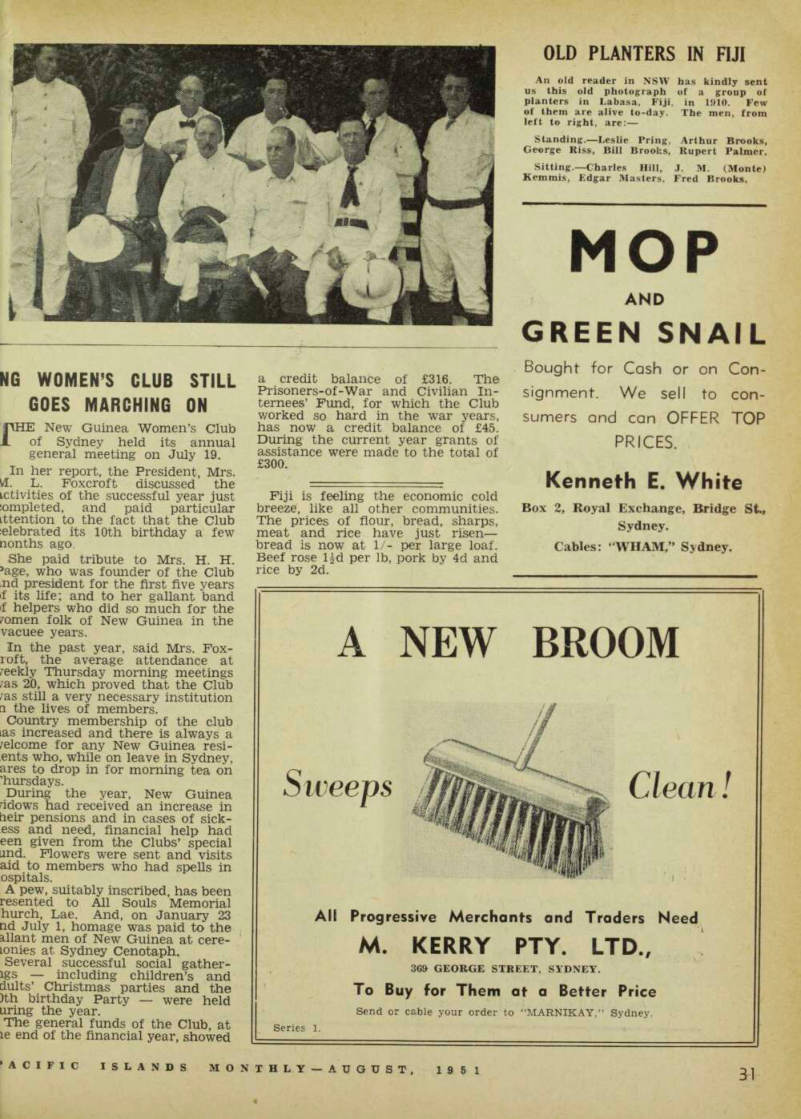
Ng Women’S Club Still
fHE New Guinea Women’s Club of Sydney held its annual general meeting on July 19.
In her report, the President, Mrs.
M L. Foxcroft discussed the Lctivities of the successful year just :ompleted, and paid particular ittention to the fact that the Club celebrated its 10th birthday a few nonths ago.
She paid tribute to Mrs. H. H. ’age, who was founder of the Club nd president for the first five years if its life; and to her gallant band f helpers who did so much for the romen folk of New Guinea in the vacuee years.
In the past year, said Mrs. Fox roft, the average attendance at weekly Thursday morning meetings ms 20, which proved that the Club ms still a very necessary institution a the lives of members.
Country membership of the club ias increased and there is always a mlcome for any New Guinea resi ents who, while on leave in Sydney, ares to drop in for morning tea on ’hursdays.
During the year, New Guinea ddows had received an increase in heir pensions and in cases of sick ess and need, financial help had een given from the Clubs’ special and. Flowers were sent and visits aid to members who had spells in ospitals.
A pew, suitably inscribed, has been resented to All Souls Memorial hurch, Lae, And, on January 23 nd July 1, homage was paid to the allant men of New Guinea at cere tonies at Sydney Cenotaph.
Several successful social gather igs including children’s and dults’ Christmas parties and the )th birthday Party were held uring the year.
The general funds of the Club, at le end of the financial year, showed
a credit balance of £316. The Prisoners-of-War and Civilian In ternees’ Fund, for which the Club worked so hard in the war years, has now a credit balance of £45.
During the current year grants of assistance were made to the total of £3OO.
Fiji is feeling the economic cold breeze, like all other communities.
The prices of flour, bread, sharps, meat and rice have just risen— bread is now at 1/- per large loaf.
Beef rose l£d per lb, pork by 4d and rice by 2d.
Old Planters In Fiji
An old reader in NSW has kindly sent us this old photograph of a group of planters in Labasa, Fiji, in 1910. Few of them are alive to-day. The men, from left to right, are:— Standing.—Leslie Pring, Arthur Brooks, George Kiss, Bill Brooks, Rupert Palmer.
Sitting.—Charles Hill, J. M. (Monte) Kemmis, Edgar Masters, Fred Brooks.
Advertisements & other items, pp. 33-34 (3 items)
31
*ACI F I C ISLANDS MONTHLY AUGUST, 1951
Sweeps
MOP
AND
GREEN SNAIL
Bought for Cash or on Consignment. We sell to consumers and can OFFER TOP
PRICES.
Kenneth E. White
Box 2, Royal Exchange, Bridge St., Sydney.
Cables: “WHAM,” Sydney.
A NEW BROOM
Sweeps
Clean
All Progressive Merchants and Traders Need
M. KERRY PTY. LTD.,
369 GEORGE STREET, SYDNEY.
To Buy for Them at a Better Price Send or cable your order to “MARNIKAY,” Sydney.
Series 1.
the paint pigment with a dififietenca
* Registered Trade Mark While Alpaste aluminium paint is similar to other paint in ease of application *£MbHS«and working properties, it is fundamentally different in the structure of ,ts film.
Instead of fine particles in granular form found in ordinary paints. Alpaste consists of m.nute flat flakes of pure aluminium. . r r The flakes are arranged in the paint film in more or less paralle ayerS to 10 particles deep with a thin cement ofvehicl. between each IWSHE- ayer In t e h fl kes form a brilliant continuous film of metallic aluminium top ayer, e a ® s qua i+ies> This leafing property gives aluminium with protective and durable « . :• u nr i u ea f paint much of its durability and moisture-resisting quaht.es, ,ts power to reflect hqht its resistance to smoke and fumes, and its opaqueness.
The illustrations show port of the Horgreoves Park Housmg Settlement, Mew South Wales. Austro ,o. i 1,, mniractors, Stayseal Products Pty. Ltd. where aluminium paint *os used by the contractors,
iinimra mw uwu
(Incorporated in the Dominion of Canada) indpal British Commonwealth Distributor of Aluminium 'cean House, 34 Martin Place, Sydney,
N.S.W.
An ALUMINIUM LIMITED Company
SALES AGENTS:
Australia: HARRISONS RAMSAY PTY.
LTD., Melbourne. Sydney, Adelaide, Brisbane, Perth. . blew Zealand: RICHARDSON, McCABE CO. LTD.. Wellington, Auckland. Chnst- Fiji, Western Samoa and Tonga: MORRIS
HEDSTROM LIMITED, Suva. Fiji.
Cook Islands: A. B. DONALD LTD..
Raratonga. Cook Islands.
French Oceania: ETABLISSEMENTS DONALD TAHITI. Papeete. Tahiti irc ,, rc New Caledonia and New Hebrides: AOENUt Al ki A K 1 aa i r-v-i rt A hvl D VA/ I. IftHOfl 1 3 .
Altoust.. 195 1 Pacific Islands Monxhl
P-Ng Planters
Another £3 For
But Stabilisation Fund Continues
Papua-new guinea planters are to get £3 per ton more for their copra, from August 1. and the deduction from their returns for the Copra Stabilisation Fund, formerly £5 per ton, will be reduced to £2. The Australian Territories Minister, Mr. Hasluck, announced this in Moresby on July 25. Al though the PNG Stabilisation Fund is now far over £1,000,000, it will continue.
Copra marketing was the subject of a submission the Minister made recently to the Australian Cabinet.
He said he was guided largely by the view that the long-term in terests of the industry and of the Territory would be best served by assurances of stability at a reason able price level. He also had to recognise the fact that Britain had contracted to purchase the whole of the export surplus, subject to the reservation of Australian home con sumption requirements, for nine years from March 1, 1949.
The Government intended to keep the Australian market open for normal supplies of PNG copra dur ing the period of the UK contract.
Irrespective of any downward trend in the open market prices, the Ter ritory copra crop should be guaran teed its market both in the UK and in Australia for the next seven years.
Copra would continue to be sup plied to Australian crushers at the British contract price.
Representations made by planters regarding their claim for an ad justment of the British contract price in view of Sterling devalua tion, would be the subject of further discussion with the authorities concerned.
The new price paid by the Produc tion Control Board from August is £57 per ton (a net increase of £2/15/- per ton on July prices, after allowing for additional export duty and contingencies).
The discount of £l/7/6 per ton for Kokopo copra, transhipped to Rabaul, and 12/6 per ton on smoked grade, continues unchanged.
Mr. Hasluck is seeking the views of the industry regarding long-term marketing and stabilisation plans, and has asked planters’ associations to supply more detailed information regarding their costs of oroduction, to assist him in future discussions.
Madame Mary Jane Lloyd, of Sydney and England, was married on June 14, at the Temple, Noumea, to Captain Charles G. Legras, of Noumea, New Caledonia.
Origin Of Game Of Pua
(A Letter to the Editor) Fan article on the game pua, published in the PIM for October, 1950, I wrote that “the record throw for the island is 1,096 ft. (over half a mile) ...”
Your correspondent, Jack Neale, challenges the above statement and says that 1,096 ft. is under a quarter of a mile. Mr. Neale is right of course.
Mr. Neale also doubts my assertion that the game of pua originated in Aitutaki. Here again I may be wrong. If any of your readers can give information on the place of
origin of the game of pua it would be of interest.
I am, etc.,
John Rolley.
Tahiti,
The great increase in offences committed by traders in country districts, by buying inferior quality copra and cocoa has caused Western Samoa’s Chief Judge to issue a warning from the bench that in future offenders will be punished by cancellation of their buying licenses instead of by money fines as at present. ‘ Some traders are making large profits from the pur chase of inferior cocoa-beans.
Mr. Lex Lannoy, an X-ray tech nician in the Papua-New Guinea Administration, and Mr. Les Hast ings, a member of the P-NG District Services Dept, left Melbourne in July on the Oronsay to attend the Scouts’ World Jamboree in Austria.
Both are leaders of the Scout move ment among Chinese, Malay and native boys in Papua-New Guinea.
Advertisements & other items, pp. 35-36 (1 item)
Ideal for Island Conditions
BLAXLAND-CHAPMAN
MARINE ENGINES • WONDER LAUNCHES
PUMPS AND ENGINEERING PRODUCTS
Ideal for Island Conditions
Engineered for heavy sustained operation with minimum upkeep, these world famous engines are extremely suited to Island service.
There is an engine for every boating application in sizes ranging from 2V 2 h.p. to 20 h.p. 10 H.P.
CHAPMAN
SEADOG.
5/7 H.P. BLAXLAND TWIN
• Multi-cylinder two-cycle design • Balanced crankshaft. • Adjustable thrust race. • Patent “Bounce” Start Magneto.
SPECIAL ISLANDS SERVICE
Islands residents can rely on immediate attention to their inquiries and orders for Blaxland-Chapman Marine Engines, Launches, Pumping Units, and other engineering requirements from Kerr Bros. Pty., Ltd., Sole Pacific Distributors for Blaxland Rae Pty., Ltd. (Successors to Chapman & Sherack).
Inquiries Are Invited. 255 a George St., Sydney. Box 3838, G.P.O. Cables: “CARE,” Sydney.
We specialize in
COPYING FROM OLD PHOTO-
GRAPHS AND COLOURING IN
NATURAL COLOURS.
Mail orders solicited.
CAINE’S STUDIOS, SUVA
P.O. Box 8. (Estab. 1908.) Phone 68.
FIJI COPRA PRODUCERS
You wont correct weights, quick account sales, immediate return of your own sacks, care taken of your sacks when they are opened
Then Send Your Copra to^
W. R. CARPENTER & CO. (Fiji) LTD.
IN SUVA
Buying Agents for FIJI COPRA BOARD Two weighbridges, checked daily and Government-tested, ensure correct weights.
Office organisation ensures quick accounting.
A special opener is used to save damaging your sacks which are emptied as soon as they are weighed, and your own sacks are ready for return to you immediately.
MOTOR VESSELS: “KOMAIWAI” AND “TOVATA” serve
Cakaudrove, Lomaiviti, Lau and Yasawa.
W. R. CARPENTER & CO. (Fiji) LTD.
Renwick Road and Thomson Street —P.O. Box 299
SUVA, FIJI.
Telephone: 114 (6 lines).
Rabaul Citizens Against


Rapopo Move
Australian Government Asked to Stay its Hand
THE articles in recent PlM’s, wherein it was stated that Rabaul’s European citizens were now reconciled to a move to the proposed new town at Rapopo, near Kokopo, appear to have caused much comment in Rabaul. The
majority of residents, it seems, see no point in the move to an area without wharf facilities and also in a volcanic zone, and the last meet ing of the Advisory Council was de voted largely to a discussion along these lines.
A motion was put to the meeting and unanimously carried thajt; “Having regard to the many diffi culties associated with the problem of moving the township of Rabaul to the proposed site of Rapopo, and the unsuitable aspects of the pro posed new town and wharf area, that the Australian Government be asked to reconsider its decision to build a new township and that por tion of the money allotted for the building of same to be made avail able for the re-conditioning of the roads giving egress to the present town, and the draining and pre paring of these roads, having in mind the possibility of heavy falls of rain associated with volcanic dis turbances; and that it is the con sidered opinion of this Council that the area known as Nonga and em bracing the land from the foot of 'Tunnel Hill to Tavui Point (close to outskirts of the present town), would be a suitable place for the re-loca tion of the township of Rabaul and that consideration be given by the Administration to the siting of Government offices, retail business houses and the present population in that area. It should be serviced by suitable all-weather highways, surfaced and drained.”
The resolution was proposed by Mr. J. L. Chipper and seconded by Mr. B. B. Perriman.
It was Mr. Chipper’s contention that the lack of an all-weather port at Rapopo made the proposed site of the new town impossible and that if it were imperative that a move from Rabaul be made, a new locality altogether should be chosen for the main town of New Britain —the coconut plantations which were the greatest economic factor on the Gazelle Peninsula were past their peak of production and if extensive replanting were not done soon pro duction would gradually fall off over the next few years. The Ko kopo district was also in a volcano zone and the slopes of Mt. Varzen, behind the proposed new town, pre sented much the same appearance as Mt. Lamington does to-day.
He said: “We have been visited by experts who, ex officio, have told us that the
building of the port at Kokopo pre sents almost insurmountable ob stacles.
“We find that these visitors do not take any heed of the considered opinion of residents and business men on whom the development of the Territory rests. As we have been told to-day, by representatives of the Production Control Board, not only is no heed taken of our arguments, but they are misrepre sented in discussions in Australia, where the people of Rabaul are rep resented as being quite satisfied with the port facilities to be built at Kokopo.”
HE said that small ships were still the life-blood of the Terri tory and that if these small ships were compelled to use an open roadstead at Kokopo, within two years the beach would be littered with wrecks. “To tell us that (in the event of bad weather) we can up-anchor and seek shelter in Rabaul reflects on the intelligence and capability of assessing the situ ation of the people who tell us so.”
He said that never had there been such a shortage of the necessary materials for building a complete town. Figures supplied by Mr. Per riman suggested that four million cubic yards of soil would be needed in the new Kokopo wharf area alone —and there was an acute world shortage of all heavy earth moving equipment. Delivery delays
were from nine months to two years and some of the well-known Ameri can manufacturers were not taking further orders.
As an alternative to the Aus tralian government’s proposal to build at Rapopo, he suggested that tne harbour facilities should be re tained at Rabaul and that the resi dential, business and commercial
areas be built in the Nonga area a few miles from the present town of Rabaul—it would be almost as close to the wharf area as Lae is from its wharf at Milfordhaven. In this way, New Britain would retain its present fine harbour at Rabaul and the Australian taxpayers would be saved many millions of pounds.
(Continued on page 37)
VARIOUS members of the Coun cil spoke in support of the motion. Mr. Perriman said that the main reason for the move was the question of safety. He himself had found the earth tremors at Kokopo much more severe than at Rabaul.
According to Dr. Fisher’s state ment, Rapopo would be nearer the line of fault than Rabaul. “It is of the utmost importance that we should receive, from the Adminis trator or the Minister, a copy of this report, and also the report of Dr.
Stein. We are entitled to know what these reports contain.”
Mr. Don Williams of Vacuum Oil Company moved that, as it was considered that the move to Rapopo was purely a face-saving device, a plebiscite should be taken of people at Rabaul, after seeing Dr. Fisher’s report.
Mr. Don Barrett said that over seas ships would have to confirm that they are agreeable to using the Port at Rapopo. As yet no such confirmation has been received.
Advertisements & other items, pp. 37-38 (1 item)
Gilbey’
BHOOMFIELDS Ltd.
Suppliers of
BUILDING HARDWARE,
SHIP CHANDLERY, PAINT MATERIALS
y
WRITE DIRECT TO;
BROOMFIELDS LTD., 152 SUSSEX STREET, SYDNEY
'i
the
CA hh
is f° r
GILBEY’
* *• G ILB£
Y LT:
hbl OUr ne.
SYd Hey Bf Address all enquiries to W. & A. GILBEY LTD., 33 Rosslyn Street. West Melbour S
"S 8A Ns
news oEtAe
hnouyhtto you
with a
KING OF THE AIR
f f
CRAMMOND PORTABLE
World news essential to all peoples —world entertainment and last minute news flashes can be brought to you with a
CRAMMOND PORTABLE.
Equipped with light duty dry batteries.
Whether at home or on your travels you can listen to a CRAM- MOND PORTABLE Day and Night.
Clear reception at any hour enables you to listen without interruption.
These Receivers have proved their suitability for Tropical use, by operating continuous under the most adverse conditions.
You can purchase your
CRAMMOND PORTABLE by
Cash or Easy Terms. A
CRAMMOND PORTABLE is
your World—wherever you live.
OTHER REASONS WHY
• Dual or Triple Wave.
CRAMMOND MUST
Tropic-Proofed.
YOUR FIRST CHOICE
Day • Perfect reception for overseas and local stations.
Unlimited range and Night.
Leatherette - covered Cabinet in attractive patterns and colours. • All sets covered by CRAMMOND’S Liberal Service policy.
Available in 5, 6 or 7 Valve Dual or Triple Wave—Also available for use with 6 Volt Battery or A.C. Supply (240 Volts, 50 Cycles).
DIMENSIONS: 15 in. xll in. x 9 in. WEIGHT: 23 lbs. COMPLETE.
CRAMMOND RADIO
TROPICAL DIVISION
NO 8 QUEEN STREET . BR/SBRNE
Higher Export Tax
Sought On
Caledonian Metals
THE New Caledonian General Council, in view of the in creased world prices for nickel and chrome, has rejected a proposal to increase taxation on tobacco and other goods purchased by the local population and will instead increase the export tax on minerals.
Instead of the estimated 70,780,000 francs (42,580,000 from nickel and 28,200,000 from chrome) suggested by the Administration, the Council has adopted a proposal made by M.
Parazols and seconded by M.
Mariotti, recommending a revenue from this source of 78 million francs.
It is argued that with the higher world price of nickel and chrome the industry can well afford to pay this tax.
The price of Caledonian chrome of tenure 48 per cent., for example, has risen to 25 instead of 22.50 dollars per ton.
After debate, the New Caledonian General Council has agreed to recommend that export of nickel to Japan should be allowed on the same free market basis as that for iron and chrome. Before the war, Japan bought these minerals from the French Colony and also operated mines there on her own account.
Following a request for a review of the public service and civil service salaries made by the New Cale donian assembly, France has sent out M. Mazoudier, Inspector of Colonies, who will report back to the French Government.
Satapuala Air Crash
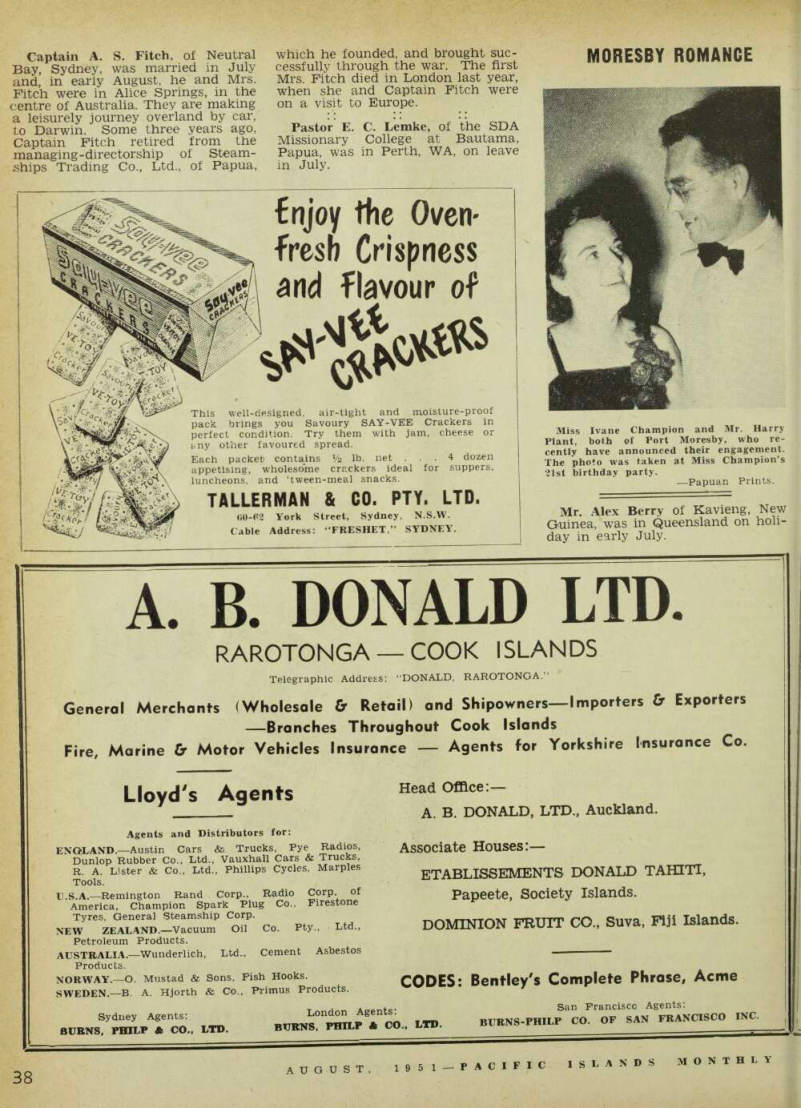
Memorial to Victims of Satapuala Air Crash
From Our Own Correspondent APIA, July 5.
A MEMORIAL to the seven mem xi bers of No. 5 Squadron, Royal New Zealand Air Force, who lost their lives in an air crash at Satapuala air port last December is to be erected shortly at Magiagi Cemetery, Apia.
The memorial is to take the form of a stone pylon bearing a memorial plaque.
The RNZAF Catalina had taken off for an official flight from Samoa to the Tokelau Islands when the disaster occurred. The people of the Tokelau Islands have contributed £35 towards the cost of the
memorial. Employees of the Public Works Department of Western Samoa, the Assistant Engineer of which, Mr. H. Cole, was one of the survivors of the accident, have provided free labour for its erection.
The retiring Governor-General of New Caledonia, M. Coumarie, the president of the General Council, Monsieur Bonneaud, and other prominent citizens of Noumea were recently present at a reception to the newly installed Consul of Indonesia in Noumea, M. Soesetio who arrived in the Colony in May.
He has since been joined by his wife and family of five. He was formerly a member of the Indonesian Ministry of Public Works and visited Noumea in 1950 as a member of the Indonesian labour mission.
Captain A. S. Fitch, of Neutral Bay Sydney, was married in July and in early August, he and Mrs.
Fitch were in Alice Springs, in the centre of Australia. They are making a leisurely journey overland by car, to Darwin. Some three years ago, Captain Fitch retired from the managing-directorship of Steamships Trading Co., Ltd., of Papua,
which he founded, and brought suc cessfully through the war. The first Mrs. Pitch died in London last year, when she and Captain Fitch were on a visit to Europe, :: „ , :: , . A Pastor E. C. Lemke, of the SDA Missionary College at Bautama, Papua, was in Perth, WA, on leave in July.
Advertisements & other items, pp. 39-40 (1 item)
Kill
Mosquitoes
and Flies
QUICKLY WITH
*■ e* y> x vy»° »»* »r c* 9^ o>i sP r A F 51 1 FLIT is the best you can buy
FLIT is stronger than ever!
C-. 9 cT e«
€njoy ttie Oven-
fresn Crispness
and flavour of
This well-designed, air-tight and moisture-proof pack brings you Savoury SAY-VEE Crackers in perfect condition. Try them with jam, cheese or t.ny other favoured spread.
Each packet contains Va lb. net ... 4 dozen appetising, wholesome crackers ideal for suppers, luncheons, and ’tween-meal snacks.
TALLERMAN & CO. PTY. LTD.
<io-(?2 York Street, Sydney, N.S.W.
Cable Address: “FRESHET,” SYDNEY.
A. B. DONALD LTD.
RAROTONGA COOK ISLANDS
Telegraphic Address: “DONALD, RAROTONGA.
General Merchants (Wholesale Cr Retail) and Shipowners—lmporters & Exporters
—Branches Throughout Cook Islands
Fire, Marine & Motor Vehicles Insurance Agents for Yorkshire Insurance Co.
Lloyd's Agents
Agents and Distributors for: ENGLAND. —Austin Cars &, Trucks, Pye Radios, Dunlop Rubber Co., Ltd., Vauxhall Cars & Trucks, R. A. Lister & Co., Ltd., Phillips Cycles. Marples Tools.
U.S.A. —Remington Rand Corp.. Radio Corp. of America, Champion Spark Plug Co., Firestone Tyres. General Steamship Corp.
NEW ZEALAND.—Vacuum Oil Co. Pty., Ltd., Petroleum Products.
AUSTRALIA. —Wunderlich, Ltd., Cement Asbestos Products.
NORWAY. —O. Mustad & Sons, Pish Hooks.
SWEDEN. —B. A. Hjorth & CO., Primus Products.
Head Office:—
A. B. DONALD, LTD.. Auckland.
Associate Houses: —
ETABLISSEMENTS DONALD TAHITI,
Papeete, Society Islands.
DOMINION FRUIT CO., Suva, Fiji Islands.
CODES: Bentley's Complete Phrase, Acme
Sydney Agents:
BURNS, PHILP A CO., LTD.
London Agents:
BURNS. PHILP A CO., LTD.
San Francisco Agents;
BURNS-PHILP CO. OF SAN FRANCISCO INC.
Moresby Romance
Mr. Alex Berry of Kavieng, New Guinea, was in Queensland on holi day in early July.
Miss Ivane Champion and Mr. Harry Plant, both of Port Moresby, who re cently have announced their engagement.
The photo was taken at Miss Champion’s 21st birthday party. —Papuan Prints.
French Oceania
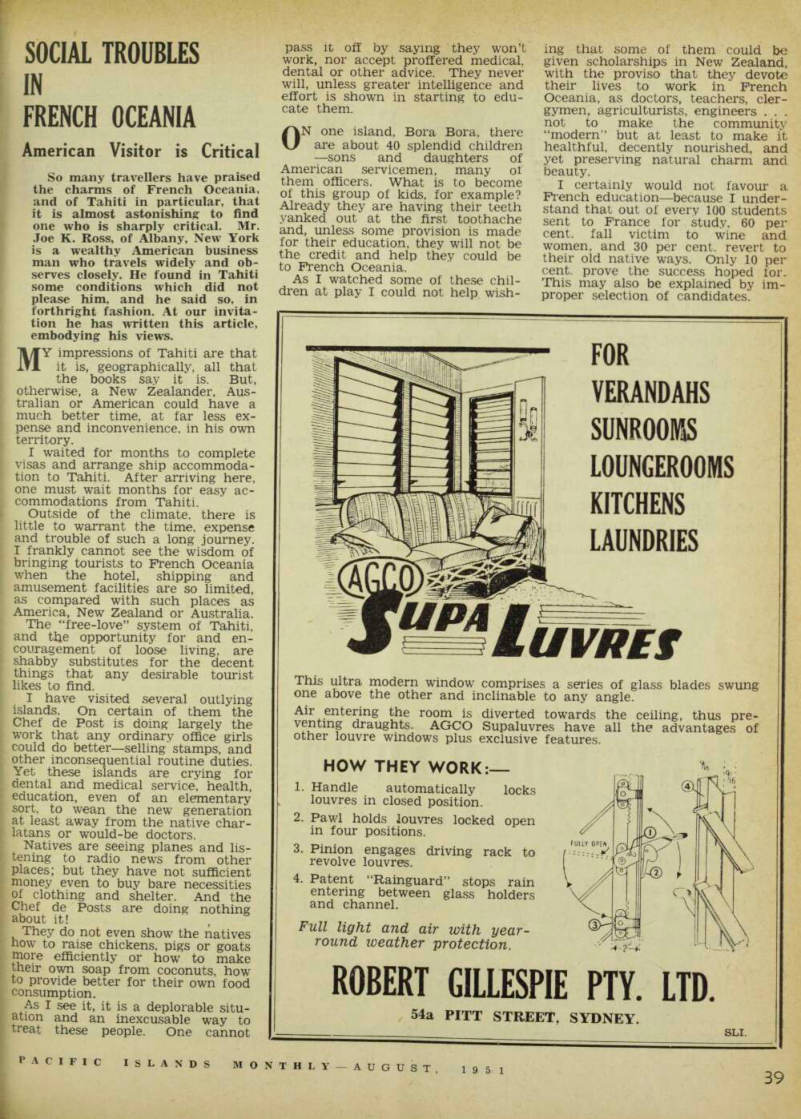
Social Troubles
IN
American Visitor is Critical
So many travellers have praised the charms of French Oceania, and of Tahiti in particular, that it is almost astonishing to find one who is sharply critical. Mr.
Joe K. Ross, of Albany, New York is a wealthy American business man who travels widely and ob serves closely. He found in Tahiti some conditions which did not please him, and he said so, in forthright fashion. At our invita tion he has written this article, embodying his views.
MY impressions of Tahiti are that it is, geographically, all that the books say it is. But, otherwise, a New Zealander, Aus tralian or American could have a much better time, at far less ex pense and inconvenience, in his own territory.
I waited for months to complete visas and arrange ship accommoda tion to Tahiti. After arriving here, one must wait months for easy ac commodations from Tahiti.
Outside of the climate, there is little to warrant the time, expense and trouble of such a long journey.
I frankly cannot see the wisdom of bringing tourists to French Oceania when the hotel, shipping and amusement facilities are so limited, as compared with such places as America, New Zealand or Australia.
The “free-love” system of Tahiti, and tbe opportunity for and en couragement of loose living, are shabby substitutes for the decent things that any desirable tourist likes to find.
I have visited several outlying islands. On certain of them the Chef de Post is doing largely the work that any ordinary office girls could do better—selling stamps, and other inconsequential routine duties.
Yet these islands are crying for dental and medical service, health, education, even of an elementary sort, to wean the new generation at least away from the native char latans or would-be doctors.
Natives are seeing planes and lis tening to radio news from other places; but they have not sufficient money even to buy bare necessities of clothing and shelter. And the Chef de Posts are doing nothing about it!
They do not even show the natives how to raise chickens, pigs or goats more efficiently or how to make their own soap from coconuts, how to provide better for their own food consumption.
As I see it, it is a deplorable situ ation and an inexcusable way to treat these people. One cannot
pass it off by saying they won’t work, nor accept proffered medical, dental or other advice. They never will, unless greater intelligence and effort is shown in starting to edu cate them.
ON one island, Bora Bora, there are about 40 splendid children —sons and daughters of American servicemen, many of them officers. What is to become of this group of kids, for example?
Already they are having their teeth yanked out at the first toothache and, unless some provision is made for their education, they will not be the credit and help they could be to French Oceania.
As I watched some of these chil dren at play I could not help wish
ing that some of them could be given scholarships in New Zealand, with the proviso that they devote their lives to work in French Oceania, as doctors, teachers, cler gymen, agriculturists, engineers . . . not to make the community “modern” but at least to make it healthful, decently nourished, and yet preserving natural charm and beauty.
I certainly would not favour a French education—because I under stand that out of every 100 students sent to France for study, 60 per cent, fall victim to wine and women, and 30 per cent, revert to their old native ways. Only 10 per cent, prove the success hoped for.
This may also be explained by im proper selection of candidates.
Nevertheless, from many years’ work, as well as the hiring of thousands of men and women, I would dare say that there are some fine-calibre youths whose abilities will be dissipated unless something is provided for them in the way of educational or vocational oppor tunities. At present, these 40 “American” kids on Bora Bora and adjacent islands are regarded by the natives only as a good means of “mixing the blood.” Even cattle are segregated so as to get quality.
It seems to me that, instead of a Chef de Post who is a glorified office worker and mail and wireless clerk, there should be an adminis trator who can look to the water, health, and occupational needs of the people in a constructional way. and not hide behind the lame Ex cuse that the natives don’t want it and won’t appreciate it. Anyone who says thisr-and every French man I have spoken to has said it — is either too ignorant, or too dis honest to face the facts and correct bad conditions. 1 suggest scholarships tenable in New Zealand because I have visited New Zealand, and know the kind of training young men and women would get there, as com pared with Prance, which I have also visited. I can visualise some of these “American” girls on Bora Bora as teachers and nurses. No doubt many of their fathers’ people were professors, lawyers, doctors, etc. At the present time, the native women teachers in the elementary schools are certainly sad examples of what a teacher should be morally and otherwise.
In leaving Tahiti and the Islands, I leave friends who have been very kind and hospitable to me. Never have I enjoyed greater friendliness and generosity among any group of people in such a short period. The old Polynesian friendliness and hospitality made these islands world-famous, and those qualities of character are badly needed in our ■ world to-day.
The shortcomings of the Adminis- • tration here are the same as in every other country, although ini different aspects. The difference; here, it seems to me, is that they can be more quickly and easily corrected; and, if the Administra-tion does not do it quickly andt efficiently, there shortly will bes leaders among the natives who wilh cause far greater complications thane at present are warranted.
An instrument for telling time by/ the sun, moon or stars, which onces belonged to Captain James C00k, 2 was recently sold in London to as New Zealand art collector. The in strument is called a clepsydra sum dial or orrery, and is in a case in scribed “Captain Cook, Anno 1750.
Advertisements & other items, pp. 41-42 (1 item)
miuVREf
A 0 4*
FOR
VERANDAHS
SUNROOMS
LOUNGEROOMS
KITCHENS
LAUNDRIES
miuVREf
This ultra modern window comprises a series of glass blades swung one above the other and inclinable to any angle.
Air entering the room is diverted towards the ceiling, thus preventmg draughts. AGCO Supaluvres have all the advantages of other louvre windows plus exclusive features.
HOW THEY WORK:—
1. Handle automatically locks louvres in closed position. 2. Pawl holds louvres locked open in four positions. 3. Pinion engages driving rack to revolve louvres. 4. Patent “Rainguard” stops rain entering between glass holders and channel.
Full light and air with yearround weather protection.
ROBERT GILLESPIE PTY. LTD.
54a PITT STREET, SYDNEY.
h ; t * * /L, . e -
Put Your Family
FIRST
rut Every estate and trust, regardless of size, MUST have efficient administration. Otherwise your family’s interests cannot be fully protected. The first step towards ensuring capable management is a consultation with your solicitor regarding the appointment of Burns Philp Trust Company Limited as executor or trustee of your estate.
To assist you in planning this practical safeguard for your beneficiaries, a most interesting booklet, “Hands That Never Leave The Wheel,” is available. A complimentary copy can be obtained from any branch of Burns Philp (South Sea) Company, Burns Philp (New Guinea) Limited, Burns Philp (New Hebrides) Limited, or direct from the head office of this Company.
DIRECTORS:
James Bums. Joseph Mitchell.
P. T. W. Black. Eric Priestley Lee.
MANAGER: L. S. Parker.
SECRETARY: E. R. Overton, F.F.I.A.
Bums Philp Trust
COMPANY LIMITED
Executor • Trustee • Attorney
Head Office: 7 Bridge Street, Sydney.
Tel.: BU 5901 Box G.P.O.
N.S.W. Agencies at Armidale, Orange and Tamworth.
Also Registered Offices at Melbourne, Brisbane, Port Moresby {Papua), and Vila (New Hebrides).
Nearly £2,000 Just
Disappeared!
From Our Own Correspondent APIA, July 1.
THE cashier of O. F. Nelson & Co., Ltd., of Apia, recently appeared in Apia High Court before Chief Judge C. C. Marsack, charged with failure to account for £1,869/3/4 during the period between October 1949 and September 1950.
The accused, who conducted his own defence, pleaded “not guilty” and said that he could give no ex planation as to how the shortage had come about, but that he had not used the money for himself, and that he and his family were living very poorly—mostly on bananas.
Although he had been aware of the shortage all the time, he had not reported it because he was afraid of losing his job.
He had failed to keep his books up to date and had therefore made it difficult to discover the shortage which was eventually found by the auditor.
The Chief Judge, in pronouncing sentence of one year’s imprisonment, commented that accused had practised deception by hiding the shortage. On the other hand, there had been some slackness by his firm in the checking of their books.
Death Of Mr. James
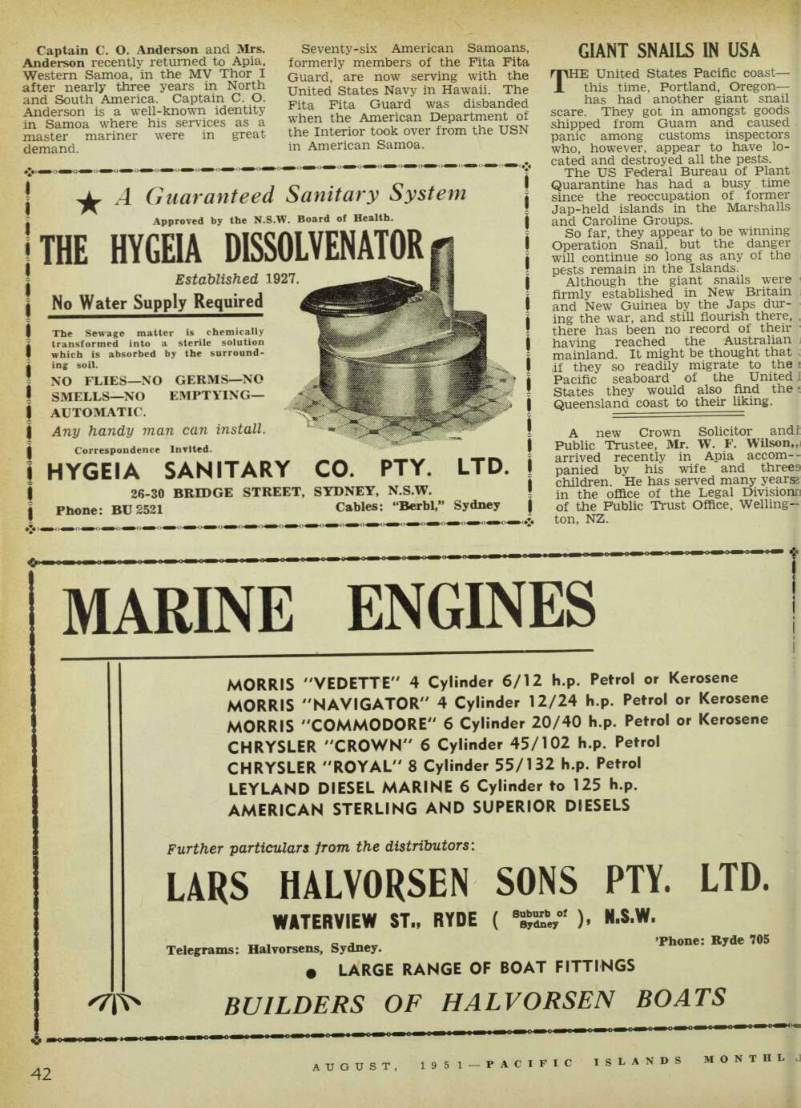
Whitford
Mr. James Whitford Of
South Santo died on July 10.
He had been an inmate of the Hopital Prancais for more than a week when it was thought necessary to transfer him to Vila where there are more facilities.
Qantas made a special flight with Mr. Whitford and the doctor, but as the plane landed at Vila, Mr.
Whitford died.
Aged only 46, he had travelled extensively and was engaged in trading. He left a wife and a young family—the youngest only a few months old.
Thirty guests attended the party given by Mrs, Doris Booth of Bulolo, NG, at her Brisbane flat on July 21. Guests of honour were Miss Isabel Fletcher who is now staying with Colonel and Mrs. J. K.
Murray in Port Moresby, and Mr. and Mrs. A. F. Gollnick and their son.
Captain C. O. Anderson and Mrs.
Anderson recently returned to Apia, Western Samoa, in the MV Thor I after nearly three years in North and South America. Captain C. O.
Anderson is a well-known identity In Samoa where his services as a master mariner were in great demand.
Seventy-six American Samoans, formerly members of the Fita Fita Guard, are now serving with the United States Navy in Hawaii. The Fita Fita Guard was disbanded when the American Department of the Interior took over from the USN in American Samoa.
Advertisements & other items, pp. 43-44 (1 item)
sdfs
Every one a winner!
♦ Any time -Anywhere-Any weather
A Heinz Vegetable Soup
A Heinz Pea Soup with Ham A Heinz Onion Soup
A Heinz Asparagus Soup
A Heinz Celery Soup
A Heinz Tomato Soup
H. J. HEINZ CO. PTY. LTD.
479 Bourke St., Sydney.. . Phone: FA 8181 MB*?; iSOUp/i m S tye soups so rich... so thick... so creamy to the taste
A Guaranteed Sanitary System
Approved by the N.S.W. Board of Health.
THE HYGEIA DISSOLVENATOR f|
Established 1927. Jpl
No Water Supply Required
The Sewage matter is chemically transformed into a sterile solution which is absorbed by the surrounding soil.
NO FLIES—NO GERMS—NO
SMELLS—NO EMPTYING-
AUTOMATIC.
Any handy man can install.
Correspondence Invited.
HYGEIA SANITARY CO. PTY. LTD
26-30 BRIDGE STREET, SYDNEY, N.S.W.
Phone: 8U2521 Cables: “Berbl,” Sydney
MARINE ENGINES
MORRIS "VEDETTE" 4 Cylinder 6/12 h.p. Petrol or Kerosene MORRIS "NAVIGATOR" 4 Cylinder 12/24 h.p. Petrol or Kerosene MORRIS "COMMODORE" 6 Cylinder 20/40 h.p. Petrol or Kerosene CHRYSLER "CROWN" 6 Cylinder 45/102 h.p. Petrol CHRYSLER "ROYAL" 8 Cylinder 55/132 h.p. Petrol LEYLAND DIESEL MARINE 6 Cylinder to 125 h.p.
AMERICAN STERLING AND SUPERIOR DIESELS
Further particulars from the distributors :
LARS HALVORSEN SONS PTY. LTD.
WATERVIEW ST., RYDE ( Sydney ) * N«S«W« Telegrams: Halvorsens, Sydney. Phone. Ryde 705
• LARGE RANGE OF BOAT FITTINGS
'Tit' BUILDERS OF HALVORSEN BOATS
Giant Snails In Usa
THE United States Pacific coast — this time, Portland, Oregon— has had another giant snail scare. They got in amongst goods shipped from Guam and caused panic among customs inspectors who, however, appear to have lo cated and destroyed all the pests.
The US Federal Bureau of Plant Quarantine has had a busy time since the reoccupation of former Jap-held islands in the Marshalls and Caroline Groups.
So far, they appear to be winning Operation Snail, but the danger will continue so long as any of the pests remain in the Islands.
Although the giant snails were firmly established in New Britain and New Guinea by the Japs dur ing the war, and still flourish there, there has been no record of their having reached the Australian mainland. It might be thought that they so readily migrate to the Pacific seaboard of the United States they would also find the Queensland coast to their liking.
A new Crown Solicitor andJ Public Trustee, Mr. W. F. Wilson,, arrived recently in Apia accom panied by his wife and three; children. He has served many years in the office of the Legal Division! of the Public Trust Office, Welling ton, NZ.
Advertisements & other items, p. 44 (1 item)
42
AUGUST, 1951 PACIFIC ISLANDS MONTHL
In Defence Of The
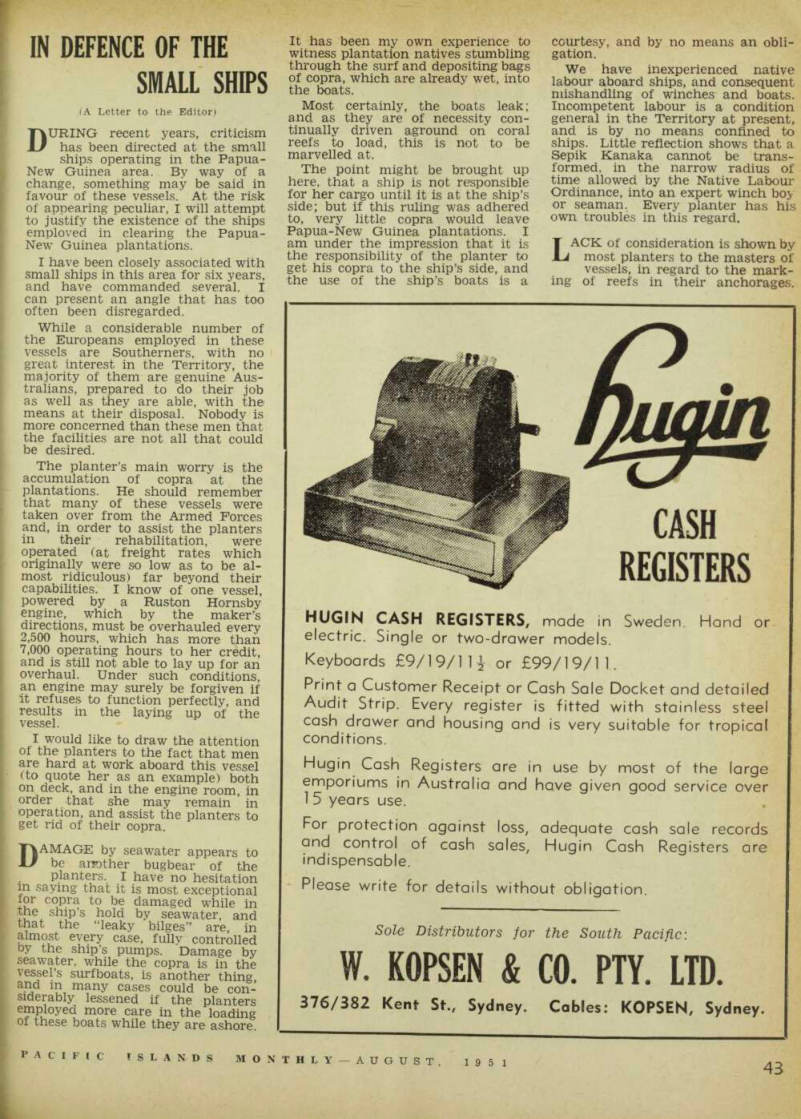

Small Ships
(A Letter to the Editor) DURING recent years, criticism has been directed at the small ships operating in the Papua- New Guinea area. By way of a change, something may be said in favour of these vessels. At the risk of appearing peculiar, I will attempt to justify the existence of the ships emploved in clearing the Papua- New Guinea plantations.
I have been closely associated with small ships in this area for six years, and have commanded several. I can present an angle that has too often been disregarded.
While a considerable number of the Europeans employed in these vessels are Southerners, with no great interest in the Territory, the majority of them are genuine Aus tralians, prepared to do their job as well as they are able, with the means at their disposal. Nobody is more concerned than these men that the facilities are not all that could be desired.
The planter’s main worry is the accumulation of copra at the plantations. He should remember that many of these vessels were taken over from the Armed Forces and, in order to assist the planters in their rehabilitation, were operated (at freight rates which originally were so low as to be al most ridiculous) far beyond their capabilities. I know of one vessel, powered by a Ruston Hornsby engine, which by the maker’s directions, must be overhauled every 2,500 hours, which has more than 7,000 operating hours to her credit, and is still not able to lay up for an overhaul. Under such conditions, an engine may surely be forgiven if it refuses to function perfectly, and results in the laying up of the vessel.
I would like to draw the attention of the planters to the fact that men are hard at work aboard this vessel (to quote her as an example) both on deck, and in the engine room, in order that she may remain in operation, and assist the planters to get rid of their copra.
DAMAGE by seawater appears to be another bugbear of the planters. I have no hesitation in saying that it is most exceptional for copra to be damaged while in si ?}P’ s hold by seawater, and that the “leaky bilges” are, in almost every case, fully controlled by the ship’s pumps. Damage by seawater, while the copra is in the vessel’s surfboats, is another thing a .ud many cases could be con siderably lessened if the planters employed more care in the loading of these boats while they are ashore.
It has been my own experience to witness plantation natives stumbling through the surf and depositing bags of copra which are already wet, into the boats.
Most certainly, the boats leak; and as they are of necessity continually driven aground on coral reefs to load, this is not to be marvelled at.
The point might be brought up here, that a ship is not responsible for her cargo until it is at the ship’s side; but if this ruling was adhered to, very little copra would leave Papua-New Guinea plantations. I am under the impression that it is the responsibility of the planter to get his copra to the ship’s side, and the use of the ship’s boats is a
courtesy, and by no means an obli gation.
W e have inexperienced native labour aboard ships, and consequent mishandling of winches and boats.
Incompetent labour is a condition general in the Territory at present, and is by no means confined to ships. Little reflection shows that a Sepik Kanaka cannot be trans formed, in the narrow radius of time allowed by the Native Labour Ordinance, into an expert winch boy or seaman. Every planter has his own troubles in this regard.
T ACK of consideration is shown by 1j most planters to the masters of vessels, in regard to the mark ing of reefs in their anchorages.
Most plantation anchorages are en cumbered with reefs, and in the majority of cases, planters disregard the efforts of a vessel attempting to enter their anchorage, even though the vessel may obviously be in difficulties. But they are only too ready to complain, should the ship depart for a better-marked or safer anchorage. I have, on more than one occasion, arrived off a plan tation after dark, and have been forced to lie off and on all night in full view of the planter, when canoes with lights aboard could easily have shown me the way in.
This is not true in every case. Some planters mark their passages most carefully, but it is the exception rather than the rule.
I do not wish to argue that the Papua - New Guinea Shipping Service is a model of efficiency. But I am endeavouring to dull the barbs levelled at it by planters who are only too ready to criticise—and not constructively—the efforts of an overworked and poorly equipped arganisation.
Many planters, owing to high prices of island produce, are at a peak of success to which they are not accustomed, and may have ob tained, as a result, a distorted view of Islands events. It would do no harm were they to reflect upon just how much of their prosperity is due to the efforts of the men who bring them their ships, inadequate though
the service may be.
I am, etc.,
Islands Shipmaster
Advertisements & other items, pp. 45-46 (1 item)
Registers
CASH
HUGIN CASH REGISTERS, made in Sweden. Hand or electric. Single or two-drawer models.
Keyboards £9/19/1 1 ± or £99/19/11.
Print a Customer Receipt or Cash Sale Docket and detailed Audit Strip. Every register is fitted with stainless steel cash drawer and housing and is very suitable for tropical conditions.
Hugin Cash Registers are in use by most of the large emporiums in Australia and have given good service over 1 5 years use.
For protection against loss, adequate cash sale records and control of cash sales, Hugin Cash Registers are indispensable.
Please write for details without obligation.
Sole Distributors for the South Pacific :
W. KOPSEN & CO. PTY. LTD.
376/382 Kent St., Sydney. Cables: KOPSEN, Sydney.
THE FINEST FRUIT CAKE
EVER BAKED
fe ■
asW.
m w m *OO ft ft *** Big Sister is so good it improves with keeping; delicious to the last crumb!
Each "Big Sister" cake is individually boxed and an inner wrap of moistureproof cellophane seals in its oven-freshness.
So h i "Big Sister" Rich Fruit Cake is the real home-style Fruit Cake. Mellowed with fine old rum and brandy, studded with sweet red cherries, tenderized lemon and orange peels, and sunrich sultanas, currants and raisins. In 3 lb. and 6 lb. cartons.
Special packing guarantees
that every “Big Sister” product comes to your plate oven-fresh, as luscious in flavour and as moist and rich as the day it was baked.
"Prize Recipe" is a special light fruit cake, for those who prefer it. Super-milled flour, first-grad-D shortening, and tender fruits give it a fine texture, and the most delightful home-made flavour.
Slit&V':
ill
r
PP/ZE I REC/P5 PRODUCES
THE FINEST PLUM PUDDING
EVER MADE! It's vacuum packed for freshness, gloriously rich with goodness, and just as nice cold as hot. In I lb., 2 lb. and big 3 lb, tins.
MADE BY LILLIS & CO. LIMITED, SYDNEY, AUSTRALIA Also ask for Date Pudding. Mincemeat. Date & Nut Roll and Glace Cherries
Record Phosphate

Export
From Ocean, Nauru
Fthe year ending June 30, 1950, the export of phosphate rock from Ocean Island and Nauru reached an all-time high—1,285,990 tons—about 4 ,500 tons higher than the previous highest figure, reached in 1939-40 During 1950, 1,826,234 tons of phosphate was distributed in Aus tralia and New Zealand, the balance made up of supplies from Christ mas Island and Pacific sources. The British Phosphate Commissioners report that all requirements were met and some reserves built up.
This was, of course, before the acute world shortage of sulphuric acid developed. Without sulphuric acid it is impossible to turn tlm phosphatic rock to what is known in agriculture as superphosphate.
It takes about one ton of sulphuric acid to produce three tons of super.
The repercussions of the sulphur shortage on the phosphate industry can therefore be calculated.
The full weight of the sulphur shortage has not yet been felt in Australasia where farmers are still getting reasonable amounts of arti
ficial fertilisers but experiments are already being carried out for ob taining alternative sources of sulphur—formerly it was obtained cheaply from the United States which, in view of defence stock piling, is now limiting exports.
Mr. W. D. Forsyth, who retired from the post of Secretary-General of the South Pacific Commission in June, to resume service with the Australian Department of External Affairs, was residing in Canberra in July. He and his family appeared to be enjoying the Antarctic tem perature, as a contrast to the con ditions experienced in Noumea for two years. It is understood that Mr.
Forsyth is to be posted to an im portant diplomatic position abroad.
Freight charges between Aus tralia and the New Hebrides have been increased by 175 per cent., and Messageries Maritimes has also in creased freights between Noumea and Sydney by 25 per cent. Freight for general merchandise is now 1,150 francs a ton; and for rice, flour, sugar, potatoes, salt and other essential foodstuffs 950 francs.
A large number of Samoan resi dents who have been unable to return to the Territory by the Island vessel Matua owing to the New Zealand wharf strike, should get passage soon, as seamen stewards and cooks have now returned to work. The Union Steamship C°m pany is giving preference to Islands residents on passenger waitmg lists.
Advertisements & other items, pp. 47-48 (1 item)
Nelson & Robertson
The Pacific Islands Society
(Founded 1937). ’Visitors from the Pacific Islands to Sydney, or persons interested in Islands affairs, are invited to communicate with the Honorary Secretary of the above Society which was formed to constitute a social centre for £hose Interested in the Pacific Islands.
Regular meetings and social gatherings with lectures, are held at History House, 8 Young Street. Sydney, on the fourth Wednesday of each month, at 8 p.m.
Address for correspondence:—
THE PACIFIC ISLANDS SOCIETY,
Box 2434, G.P.0., Sydney.
NELSON and ROBERTSON Pty. Ltd.
Established 1895.
SHIPOWNERS - BROKERS AND ISLANDS MERCHANTS
All classes of Merchandise purchased at Best Wholesale Prices. Original Invoices sunnlled to island Clients. Cocoa Beans, Copra, Rubber, Trochus Shell and All Islands Suce Sold on Commission.
Entrust your requirements to the firm with over fifty-five years’ practical experience In the Pacific Islands.
Represented in All Parts of the World.
Overseas Indents Arranged for Clients.
Sole Agents :
SKANDIA DIESEL ENGINES
Inquiries Solicited.
Prompt attention given to al! inquiries Managing Agents :
" Tusculum
PRIVATE HOTEL
Potts Point, Sydney.
NELSON & ROBERTSON
PTY.
LTD.
12
SPR!NG
STREET, SYDNEY, AUSTRALIA
Telegraphic Address: “IVAN,” SYDNEY.
Serving the Needs of the Cook Islands .
UNITED ISLAND TRADERS LTD.
(.Established 1930)
P.O. BOX 42, RAROTONGA, COOK ISLANDS.
Managing Director: W. H. Watson. Secretary: R. J. A. Ingram, A.R.A., N.Z.
IMPORTERS OF:— EXPORTERS OF:—
Cotton & Silk Piece Goods Tomatoes & Cassava Apparel & Drapery Building Materials Musical Instruments Trade Jewellery Tropical Fruits Sea-shells Cr Necklaces Island Handicrafts "Broad-last" Footwear STAMP DEALERS & SUPPLIERS OF ISLAND PHOTOS
INQUIRIES INVITED.
rahlps- Bankers: ■Watson,” Rarotonga. National Bank of New Zealand, Auckland U.K. Agents: Geo. H. Penney & Co., Ltd., 197 Aldersgate St., E.C.L
-Q v\ 1, ps*
yjrsffartirst/
W hirst thon v\ Th .**.*•- '' ls, ’ ar, tJn^"° mena \ firm/a«ouri.e W .-h men
U6ER
tooth
Over A Million Miles
Flown By Nac
OVER 20,000 passengers were carried by the New Zealand National Airways Corporation on its Islands services from the time It took over from the RNZAF in November, 1947 up until July, 1951.
During the recent long New Zea land waterfront dispute, the NAC planes have been the only means of passenger transport between Samoa, Tonga, Cook Islands and New Zea land.
It is expected that by the end of this year, NAC will have clocked-up 11 million miles on its Pacific regional services.
Fall in Price of Cocoa
From Our Own Correspondent APIA, July 15.
THE SS Sonoma of the Matson Line is expected end of July to lift a cargo of 400 tons of cocoabeans from Apia produce sheds for the American market.
The price of Samoan cocoa has recently dropped from £2BO to £3OO per ton f.o.b. Apia to £250 per ton.
A fairly good crop of cocoabeans has just been harvested.
The market for desiccated coco nut has also shown a falling tendency of late; 750 cases of this line were shipped by MV Matua in July.
Advertisements & other items, p. 48 (1 item)
46
AUGUST, 1951-P A C I F I C ISLANDS MONTHLY
Buka Passage
News Notes From Buka Passage
From Our Own Correspondent
Mr. Raleigh Farlow, Who
has been District Commis sioner in Bougainville, NG, left in May on transfer to Kaveing.
There was a gathering in the Sohano Club prior to their depart ure, to say farewell to Mr. and Mrs.
Farlow and to wish them luck in their new sphere. Mr. Farlow has been in charge of the District since September, 1946.
Residents were happy to welcome Mr. Malcolm Wright, who is to be our new District Commissioner. It Is generally felt that we are for tunate in having the services of one of his experience and energy as D.C.
During the recent war. Mr.
Wright did a fine job and well earned his D.S.C.
Mr, Colin Maclean, who has been in charge of the District pending the arrival of Mr. Wright, has earned the gratitude of those with business at Sohano by his pleasant and efficient manner in dealing with affairs.
As District Officer, he now re sumes charge of the Buka Sub- District.
Mr. Don Colley, district manager of Choiseul Plantations Ltd., has gone to Sydney for furlough. He is President of the local R.S.L. Sub branch. Mr. Macgregor is in charge at Soraken during his absence.
Mrs. M. Campbell, of Raua Plan tation, has been up on a visit but has now returned to Melbourne where she intends to reside in future.
The older residents miss the kindly presence of Mr. C. I. H.
Campbell, who was so well known over such a long time, in Bougain ville. His sudden death last Septem ber came as a shock to all.
Mr. Maurice Needham, formerly of Papua, has been managing Raua for the past 20 months.
News comes that Mr. Bernie Parer, formerly of Torokina, has purchased San Remo Plantation in the Talasea district from Mr. Ken Douglas.
Mr. Cyril Gleeson is prospecting in the mountains at back of Kieta and has hopes of striking some thing worth while. Mr. Alick Heatherington, at present in Aus tralia on sick leave, is his partner in crime.
Even if they do not make a pile, the cheery Cyril and dour Alick will get a lot of amusement out of ‘giving it a burl.”
mountain air 15 m ltself worth going after. tation, is Returning 1 trip to Australia, which has been most thoroughly earned. During the trying period of rehabilitation after the war the Ellis couple had much to put up with, but stuck it out.
He is president of the Bougainville Branch of the Planters’ Association of New Guinea.
M T
R. Kerry Leen, Mrs. Leen
and the younger Kerry are now well established at Sohano. The older Kerry is at present on patrol in the Buin Subdistrict, assisting in maintaining
the quarantine placed on that area as a result of a poliomyelitis out break.
An old Territory man now with us is Sub-Inspector Ron Clammer, who is in charge of police activities in the District.
A recent inmate of the European Hospital at Sohano was Mr. A.
Smith, who has been managing Tinputs Plantation for the past few years. He was ill for some time, but has now recovered and has gone to Australia for a change. Being one of a hardy breed it is expected by his friends that he will quickly regain his health, energy and en thusiasm.
Mrs. Elma Good is still managing her Kessa Plantation, in North Buka, with the energy and efficiency that earns the admiration of all who visit that nicely situated place.
It is no light task for a woman to put up with the isolation, lack of 'amenities and run a line of native labourers as Mrs. Good has been doing for the past two years.
There was a considerable gather ing recently at Sohano when meet ings of the R.S.L. Sub-branch and the Bougainville Branch of the Planters’ Association took place.
The meetings were held in the Sohano Club House.
Jack Ellis and Robin McKay were in from Kieta way, Paul Mason from Inus, and Mrs. E, Good and Fred Archer from Buka.
These people, together with the Sohano residents, gave the island a busy appearance.
Mr. Colin Maclean, as Adminis tration Official in charge, assisted greatly by making transport avail able for the outside people. This was much appreciated.
A meeting was also held of mem bers of the Sohano Club, of which Mr. Colin Maclean took charge as president. Ways and means of im proving the Club facilities were dis cussed, and the matter of erecting a new building was considered. It is hoped to make the Club a feature of social life at Sohano and to pro vide two bedrooms for visiting members.
EARLY in June, the copra shed at Kekere Plantation, 25 miles south of Kieta, was completely destroyed by fire.
The copra destroyed amounted to < 900 bags which were awaiting ship ment. The plantation is owned by Mr. J. M. Joyes of Iwi Plantation, , Kieta, but is managed by Mr. Geoff 1 Gaskell.
The cause of the fire is not known i but thought to be owing to the« carelessness of some native employ- ee, either with fire or a lighted 1 cigarette. Once well alight there € was no hope of saving either shedf or copra.
In view of the series of fires mi district conra dryers last year, those s plantations with big accumulationss of copra are feeling rather uneasy,,’ and are keeping as close a watchr as possible on their sheds.
Owing to the shipping shortages many olantations have had to makes use of'temporary buildings for stor age and that increases the risk ofl< fire.
Miss Diana Stanfield was married to Mr. Jim Grose. Thes. ceremony took place at Piera, thesj plantation home of the bride s parents in New Ireland. The bride a sister, Mrs. Peter Murray, waai matron-of-honour.
Advertisements & other items, pp. 49-50 (1 item)
Direct S £*
LONDON - SUVA
V.* K /CV
v PANAMA V
For Sailings and Further Particulars Apply To: — BETHELL, GWYN & CO., BURNS PHILP (SOUTH SEA)
138 LEADENHALL ST. CO., LTD.,
LONDON, E.C.3. SUVA
THE GARRICK HOTEL
SUVA, FIJI
m *l|f |'i| t , 'tmm ... * l k » * % This well-known Hotel is centrally situated in Suva’s main business quarter :: Modern accommodation provides comfort in all climatic conditions :: Only the best of Beers, Spirits and Wines is served.
Telephone: 80. VINCE COSTELLO. Proprietor.
8 i /
Protect
Corrugated
PABCOTE
An attractive waterproof sheath Keep iron and fibro surfaces sound, weatherproof and attractive with Pabco bituminousbase paint. Pabcote will add years to the life of any iron structure. Tile Red colour.
HYDROSEAL
Effective patching of bad rust holes Hydroseal will patch bad rust spots and nail holes quickly and effectively. Save the expense of repairing water-damaged interiors.
TANK-SEALER
Tank sealing system—even for bad Seaks Give a new lease of life to badly corroded tanks (and roofs) with Pabco Tank Sealing Compounds. Even large holes can be effectively stopped up, giving the iron a new lease of life. Treat good iron now with Pabco bituminous - base paint, arresting corrosion and saving considerable future expense.
Available from all leading Island Stores ¥
PABCO
UAi
PABCO PRODUCTS PTY. LIMITED
150 Wigram Rd., Glebe, N.S.W.
Sole makers of famous Malthoid
Legislative Council For Papua-New Guinea
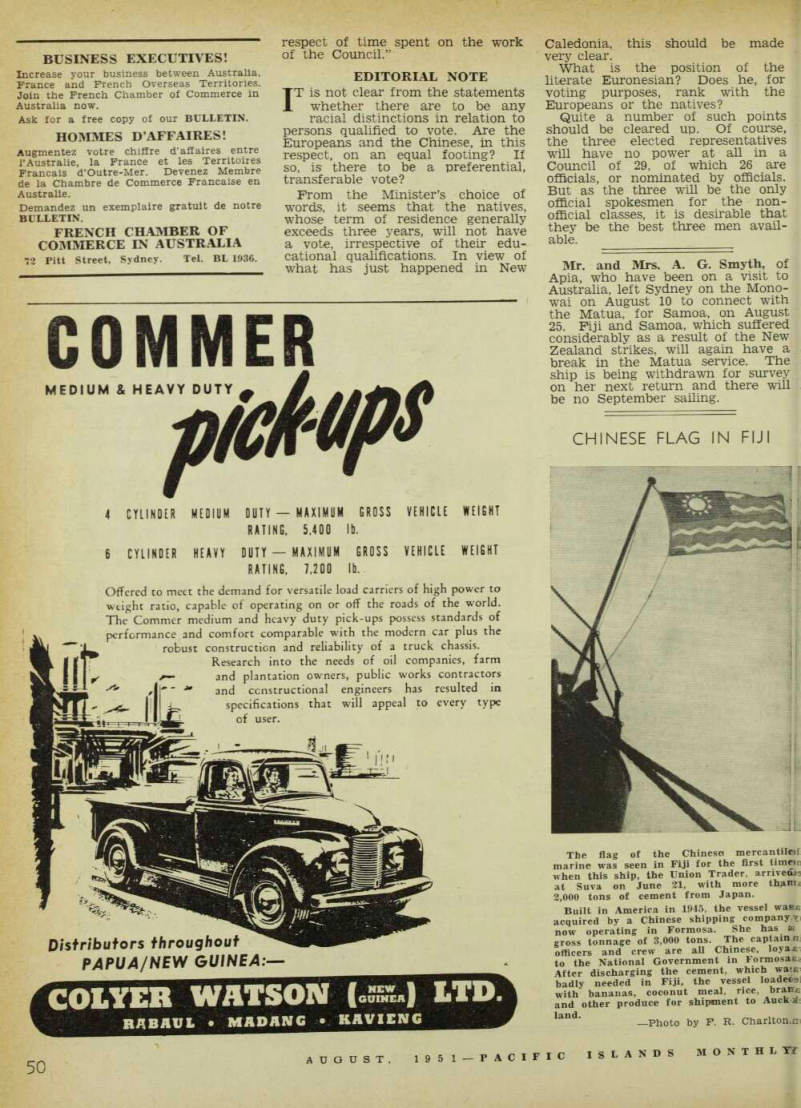
Some Angles of Proposed Election System Still Obscure
THE Papua-New Guinea Legisla tive Council now is being formed, and may hold its first meeting in November. The Aus tralian Minister for Territories (Mr.
Hasluck) made this announcement in Moresby at the end of July.
Provision for the creation of this body was made years ago, in the Papua and New Guinea Act. It is to consist of:— The Administrator 1 Officers of the Territory .. 16 To be elected 3 To be nominated by the Administrator (3 to rep resent the Missions) ... 6 Natives to be nominated by the Administrator ... 3 Total 29 For some years, because the non official civilians were completely without representation of any kind, and without any means of appeal against bureaucratic harshness, there was urgent need of the Coun cil; but there was no Council, and no reason given by Canberra.
In the absence of any other ex planation, it was generally believed that the hold-up was due to the present Administrator insisting on
the appointment of natives to the Council, while other interests were reluctant to take this step. In his statement, Mr. Hasluck said: “One of the preliminary prob lems to be overcome was the nomin ation of the three native members; but I have received the assurance of the Administrator that it will be possible to obtain well-qualified candidates for appointment.
“It will be necessary to hold general elections to choose the three members representative of the general community. A draft Ordin ance has been prepared and discussed with the interested de partments in Australia, and will be further discussed with the Ad ministrator and officers of the Administration during my present visit.
“The principal proposals are that the Territory be divided into three electorates, namely, Papua, New Guinea mainland, and New Guinea islands. Each will return one member.
“Any qualified person who has re sided in the Territory for 12 months immediately preceding the date of election will be entitled to enrolment and the requirement for candidates will be 3 years’ residence in the Territory immediately pre ceding the date of election. Elec tions will be held every three years.
The arrangements in respect to rolls, polling and the scrutiny of the count will follow closely the model of the Commonwealth electoral laws.
“After the ordinance has been promulgated, the Administrator will fix the dates for the closing of nominations.
“The members of the Council will not be paid a salary but allowances and expenses will be authorised in
respect of time spent on the work of the Council.”
Editorial Note
IT is not clear from the statements whether there are to be any racial distinctions in relation to persons qualified to vote. Are the Europeans and the Chinese, in this respect, on an equal footing? If so, is there to be a preferential, transferable vote?
From the Minister’s choice of words, it seems that the natives, whose term of residence generally exceeds three years, will not have a vote, irrespective of their edu cational qualifications. In view of what has just happened in New
Caledonia, this should be made very clear.
What is the position of the literate Euronesian? Does he, for voting purposes, rank with the Europeans or the natives?
Quite a number of such points should be cleared up. Of course, the three elected representatives will have no power at all in a Council of 29, of which 26 are officials, or nominated by officials.
But as the three will be the only official spokesmen for the non official classes, it is desirable that they be the best three men avail able.
Mr. and Mrs. A. G. Smyth, of Apia, who have been on a visit to Australia, left Sydney on the Mono wai on August 10 to connect with the Matua, for Samoa, on August 25. Fiji and Samoa, which suffered considerably as a result of the New Zealand strikes, will again have a break in the Matua service. The ship is being withdrawn for survey on her next return and there will be no September sailing.
Advertisements & other items, pp. 51-52 (1 item)
Steamships Trading Company Ltd
“OUR HANDS MAKE GOOD ARM S.”
For your Fishing and Shooting Wants Consult Us.
Lithgow .22 Cal. Repeating Rifles £l5 i l n i Poet Lithgow .22 Cal. Single Shit ... V. " * £ *S *| J QI I Dr\LJ ,1 " ces Subject to Change Without Notice.) aI L KUHU, 143 ELIZABETH STREET, SYDNEY.
STEAMSHIPS TRADING COMPANY LTD
PORT MORESBY AND SAMARAI PAPUA
Wholesale & Retail Merchants, Planters, Sawmillers, Engineers, Slip
Proprietors, Shipping, Customs and Insurance Agents.
MANAGING AGENTS for:
SAWMILLERS & TRADERS LTD.
CORAL SEA INSURANCE CO. LTD.
ACME BAKERY COMPANY.
MARIBOI RUBBER LTD.
RUBBERLANDS LTD.
KEREMA RUBBER PLANTATIONS LTD
COCOALANDS LTD.
AGENCIES:
HARVEY TRINDER (N.S.W.) PTY., LTD (In-
surances effected at Lloyd’s.) ’
VACUUM OIL CO. PTY., LTD
Dl^Sne° a ß^on OP SHIPPI N G-P apua . New
ROYAL INTEROCEAN LINE.
KOKE BAGU PTY., LTD.
TRANS OCEANIC AIRWAYS.
DISTRIBUTORS
ARMSTRONG -HOLLAND PTY., LTD.
Earth Moving and Logging Equipment.
WILLYS- OVERLAND EXPORT CORPORATION.
Jeep cars, etc.
HILLMAN MOTOR CARS.
IN PAPUA for:
INTERNATIONAL HARVESTER CO. OP AUST LTD
International Trucks, McCormlck-Deering Farming Machinery, Defender Refrigerators.
SYDNEY AGENTS: NELSON & ROBERTSON PTY. LTD., 12 SPRING STREET.
BUSINESS EXECUTIVES!
Increase your business between Australia, France and French Overseas Territories.
Join the French Chamber of Commerce in Australia now.
Ask for a free copy of our BULLETIN.
HOMMES D’AFFAIRES!
Augmentez votre chiffre d’affaires entre rAustralia, la Prance et les Territoires Francais d’Outre-Mer. Devenez Membre de la Chambre de Commerce Francaise en Australia.
Demandez un exemplaire gratuit de notre
BULLETIN.
FRENCH CHAMBER OF
COMMERCE IN AUSTRALIA
72 Pitt Street, Sydney. Tel. BL 1936.
COMMER
MEDIUM & HEAVY DUTY
4 CYLINDER MEDIUM DUTY MAXIMUM GROSS VEHICLE WEIGHT
RATING. 5,400 lb.
6 CYLINDER HEAVY DUTY MAXIMUM GROSS VEHICLE WEIGHT
RATING. 7.200 lb..
Offered to meet the demand for versatile load carriers of high power to weight ratio, capable of operating on or off the roads of the world.
The Commer medium and heavy duty pick-ups possess standards of performance and comfort comparable with the modern car plus the robust construction and reliability of a truck chassis.
Research into the needs of oil companies, farm and plantation owners, public works contractors and constructional engineers has resulted in specifications that will appeal to every type of user.
Distributors throughout
PAPUA/NEW GUINEA:
COLYER WATSON (™) LTD.
RABAUL
Chinese Flag In Fiji
The flag of the Chinese mercantile! marine was seen in Fiji for the first time when this ship, the Union Trader, arrived at Suva on June 21, with more tham 2,000 tons of cement from Japan.
Built in America in 1945, the vessel was acquired by a Chinese shipping company now operating in Formosa. She has a gross tonnage of 3,000 tons. The captain officers and crew are all Chinese, loyal to the National Government in Formosa After discharging the cement, which was badly needed in Fiji, the vessel loade[?]
with bananas, coconut meal, rice, brans
and other produce for shipment to Auck[?] land. -Photo by F. R. Charlton.
New Wharf At Samara!
No Use To Little Ships
AFTER much expenditure and bitter striving, the Works and Housing Department erected a good wharf at Samarai, Eastern Papua, to replace that destroyed by fire in wartime.
But only the men who run the big ships are happy about it. There is outspoken discontent on the part of the people who run the small ships along the coasts and among the islands—and they outnumber the big ships by scores to one.
No provision whatever has been made at the new Samarai wharf for the little ships. Copra is the staple product of Eastern Papua, and the copra is brought into Samarai in little ships. When the little ships lie alongside the new wharf, the top of the wharf, nearly all the time (there are queer, irregular, whirling tides in China Strait) is away above them—too far off to allow the handing up of bags of copra.
Somewhere beside the wharf, there should have been a floating pontoon connected to the wharf by a ramp, onto which the copra could have been unloaded at any state of the tide. There is nothing of the sort.
So the little ships go elsewhere for unloading; their copra is dragged painfully ashore; and the smallboat
owners’ opinion of the wharf planners and builders is expressed mostly in terms of brimstone.
Noumean cyclists, Raymond Sens and Jean Richards will compete in the Goulburn-Sydney road race to be held on September 22.
Australia seems to have suspended the export of butter to New Caledonia, and Noumea housewives have been unable to obtain this article of which French households are big users. Shortages of rice and sugar are also feared.
Advertisements & other items, pp. 53-54 (1 item)
Simpsons
o -O't r«*
The Flour That’s Tested
BEFORE You Buy It!
Yes, the flour in every packet or tin of “Simpson’s" is pre-tested in the Simpson Test Kitchen by our Domestic Science expert! Rising quality, texture and flavour must be perfect before ever the flour is packed.
This constant vigilance of quality is your guarantee of complete baking satisfaction. For sure success in baking always use:—
SIMPSONS
&/)?<? FLOUR
A. H. BUNTING LTD.
SAMARA)
Sole Agents, Papua-New Guinea, for
Webley & Scott Ltd., Birmingham, England
Shotguns, Air Rifles, Revolvers
WEBLEY SENIOR AIR PISTOL
sen The Web ft wm s Weight: 33 oz.
Length Overall : 8£ in.
Length of Barrel in. • 22 Calibre Rifled ?n S test Model d e Luxe. It contains the leading points of the iviarx i Air Pistol, with the following important additions:— [l] Adjustable Backsight (both Lateral and Vertical), which is capable of being regulated. screw W 1 a special sear mec hanism, which ensures a light pull-off and obviates the necessity of a Trigger adjusting °' a pate ”‘ double The 6 ZTIV'n cZZLf a WeWey ReVOl; ' er SUrrUP - thlS BiVI " S an abSOlUte and POSIUVe ,OCk - Webley S No itt 2 ed Oii Vlth special Metal Rm S m place of Leather Washer, giving increased velocity and durability. Use The butt of the Pistol is serrated to ensure a perfect grip. lnstrurtlon? Cardboard box containing Webley Special Pellets, Spare Washer. Cleaning
ALSO PROCURABLE FROM BUNTING’S, LAE.
Bouds
Comer of King and Pitt Streets, Sydney. BL 4021 Av< X t- V
Proud’s introduces the
watcK that winds itself . .
FULLY AUTOMATIC
£44/7/- ‘Seamaster” winds itself with your everyday movements. 0 The 17-jewelled movement is non-magnetic. 0 The stainless steel case is waterproof, dustproof and shockproof.
In the 1951 style . . . it is a rugged watch for all occasions.
“SEAMASTER”
TKis waterproof Swiss model is tKe universally-trusted Omega’s suggestion for a watcK to suit tropical conditions.
TKe advantages of tKe self-winding action are more tKan convenience. Because tKe automatic winding makes tKe mainspring tension more even and constant as against tKe alternate slackening and tigKtening of tKe Kand wound models, it results in a more accurate model. WitK a precision devised mecKanism tKat ignores moisture, and Kermetically sealed in a stainless steel case. “Seamaster is Kuilt to stand Kumidity.
Shop at Proud's by Mail Order. Choose your purchase from Proud's Sift Book (sent tree on application) or simply write to the Mail Order Manager, and your order will be carefully packed and sent by registered post. Proud's Mail Order Manager, Box 1502, G.P.0., Sydney.
Tahiti’S
Chinese
French Awareness of Difficult Problem
Prom Our Own Correspondent
Papeete, July 24.
A PROPOSAL which emanated recently from Paris, that facilities should be provided for the naturalisation of Chinese residents in French Oceania, has caused a stir.
There is strong opposition to the proposal on the part of the French, the Tahitians and the French- Tahitians. They have pointed out that, in Tahiti, the Chinese main tain their own community, and do not mix. As one leading Tahitian businessman says: “They stay with their own race. A Chinaman will always be a Chinaman. Anything that resembles a Chinaman is another Chinaman!”
Deputy Pouvanaa a Oopa has announced that he is strongly opposed to the naturalisation of the Chinese, whose continued pre sence menaces the future of the Territory. He is looking forward to the day when all Chinese will be shipped away from Tahiti—just as, a few years ago, they were shipped away from Samoa. He and M Coulcn, Concillor of the French Union, have made strong represen tations on the subject to the French Government.
Editorial Note
In 1946 there were 48,000 French and Tahitians in French Oceania, and 6,385 Chinese, whose numbers had grown from 3,989 in 1926. While there is considerable intermarriage between French and Polynesians, there are very few Chinese-Tahitian unions. Chinese born in Tahiti have no local status; they are subject to naturalisation laws, just as if they were bom abroad. The Chinese are industrious and thrifty, and a large proportion of the artisan services and retail distribution is in their hands.
When the Germans held Samoa, they had about 4,000 Chinese lab ourers there. When New Zealand took over in 1914, repatriation com menced. By 1931, there were only yib lett. When war came in 1939 and repatriation ceased, 600 re mained. After 1945, repatriation again - Now > there are about 150 in Samoa and most of them, for various reasons, will be t 0 remain - About half of them have married Samoans; and there is a small, but growing and influential community
of Chmese-Samoans.
k T £ hi , tiar Chinese community ciif llke J h . at of New Guinea—it is self-contained, almost segregated,
commercially important, and its re patriation does not now appear to be either economically or politically practicable.
Jet Planes For Cpa
BY next year Canadian Pacific Airlines expect to have the fastest aircraft in the world on the Sydney-Vancouver service.
This was announced in Vancouver in mid-July.
Two of the planes will be De Havilland, jet-powered Comets.
The planes will use the same route as at present—that is, via Honolulu, Canton Island and Fiji. Total fly ing time will be about 20 hours.
Opened in BSI
Commonwealth Bank Opened in BSI
From Our Own Correspondent
Honiara, July 24.
THE Honiara, Branch of the Com monwealth Bank of Australia opened in* Honiara, BSI, on July 23.
There was a short ceremony in the morning at the opening of the Bank in its just-completed new building, a converted Quonset hut. In the evening the manager, Mr. D. Wiley, the Bank staff, and Mrs. Wiley in vited Honiara residents to a cocktail party.
The Bank of New Zealand cele brated the 75th anniversary of its •establishment in Fiji on July 17.
On that day in 1876, a bfanch of the bank was opened at Levuka. A branch was opened in Suva in 1878.
The bank’s newest Fiji branch is at Lautoka—opened at the end of July, 1951. •
Advertisements & other items, pp. 55-56 (2 items)
53
pacific islands monthlt- a u g u s t. 1961
Ice Cream Mix
VANILLA, STRAWBERRY and CHOCOLATE
w £ US; w
fc k'
A A * i % Packed in 16 oz. tins for the Home, 5 lb.
Family Size tins, and 32 lb. tins for Storekeepers, Milk Bars and Cafes.
J. C. MERRILLEES
PTY. LTD.
104 Hunter St., Sydney, N.S.W.
Telegrams: “MERRILLEES,” Sydney.
ETABLISSEMENTS DONALD TAHITI I
HEAD OFFICE—QUAI DU COMMERCE—PAPEETE.
Telegraphic Address: “DONALD, PAPEETE.”
General Merchants (Wholesale & Retail) & Shipowners
Importers & Exporters
Branches Throughout the Marquesas Islands.
Lloyd's Agents
ASSOCIATE HOUSES: A. B. Donald, Ltd., Auckland, New Zealand; A. B. Donald, Ltd v Rarotonga, Cook Islands: Dominion Fruit Co., Suva, Fiji.
Agents and Distributors for :
FRANCE: Hennessy Cognacs; Marie Brizard & Roger Liqueurs; Charles Heidsieck Champagnes; Perrier Water; Gruber Beer.
NEW ZEALAND: Vacuum Oil Co. Pty., Ltd., Petroleum Products.
SWEDEN: Hjorth & Co., Primus Stoves.
U.S.A. • General Steamship Corp.; Radio Corp. of America; Brown & Williamson, Ltd.; Cigarettes: Lucky Strike, Wings, Old Gold; Champion Spark Plug Co.; Rainier Beer.
ENGLAND: Reckitt & Colman (Overseas), Ltd.; Phillips Bicycles; The Bank Line, Ltd. . . -dttotvtq pwtt pHr CO LTD San Francisco Agents: BURNS-
i" S Ssf-Wiiiß sa.ua:
GILLESPIES
GILLESPIE
Gillespie’s Anchor Flour is milled from selected high quality Australian wheats and is enfolded for purity. Its consistent high quality has made it the best-known, most asked-for brand of flour in the Islands. (Entoletion is a special new purifying process which reduces the risk of insect infestation).
NCHOR
FLOUR
BROS. PTY. LTD., ANCHOR FLOUR MILLS, SIDNEY
Fighting American
Governor
Goes To Washington
THE very energetic new Governor of American Samoa, Mr.
Phelps Phelps, who took over from the Navy Department only re
cently, is next month going back to Washington, to protest against the cuts that have been made in his
appropriations.
As soon as the United States com mitted itself to the enormous cost of stem re- armament all finances were revised and the Eastern Samoa budget was cut to 400,000 dollars less than it was under the Navy; and since then it has had a further reduction.
The Governor says the removal of the naval station has removed also an important source of revenue for the Samoans— they worked in various ways for the Navy. Now, the whole 17,000 of them must de pend for their needs upon the ex port of 2,000 tons of copra per annum. Unless there is a sympa thetic revision of the figures, the whole economy of the Territory will be dislocated.
He is especially anxious to pro ceed with programmes of educa tion and health; and he emphasises that the loyalty of the Samoans (demonstrated by the presence of Samoan soldiers in Korea, and re markable Samoan contributions to the American Red Cross) must not be weakened.
The engagement has been an nounced of Miss Margaret Florence Heape, daughter of Mr. and Mrs. B.
Heape of Port Moresby, Papua, to Mr. George R. Whitmarsh.
Rabaul Roundabout
From Our Own Correspondent
Rabaul, July 20.
Sailor’S Outing
A VISITING member of the crew of MV Citos recently had a rather expensive day out in Rabaul.
On the third day that the vessel was m port he appeared before the District Magistrate on three charges.
Namely, driving a motor vehicle without a licence, driving whilst under the influence, and driving a vehicle without the consent of the owner.
He was convicted on the three counts and fined a total of £45.
More Native Art
THERE was an interesting ex hibition of native art in the pleasantly situated Reimber village Council House on the North Coast, on July 12.
The exhibits consisted of paint ings, carvings, mats, and elaborately carved kundus. Prize monev amounted to £4O.
The winning painting was a striking example of native art—two long panels decorated with a pleas ing design in natural native paints These were “death sticks” which stand outside the Haus tamboran mto which no mere female may en ter, on pain of death.
The kundu which was awarded first prize was native art at its best. Made of wood, highly polished, it was decorated with a human hand in bas-relief, and a stylised design of twining lizards.
The , exhibition was a result of the District Commissioner’s wish to encourage native forms of art, which he had feared might have been lost or forgotten.
He spoke to the gathered natives and explained that he was happy to see their interest in the arts of their ancestors, and that he hoped the competition had encouraged them to go further with this worthy pro ject.
Only in the house building com petition, which was primarily an effort to encourage the building of better and more decorative dwell mgs, had he been disappointed.
Special sing-sings were performed by the villagers in honour of Mr. and Mrs. Macarthy and their guests.
In one dance the natives all earned tall carved sticks, decorated with designs and figures represent ing every phase of native life.
One of the most striking of these was a design of two clasped hands, each wrist decorated with a life like wristlet watch! Another rep resented a monkey, sitting on the stick, grinning with very realistic teeth, and entirely covered with real possum fur.
The obvious interest of the natives
who took part in the exhibition, and also the interest of the guests present, would indicate that this side of native life, is one which is well worth while encouraging.
ON June 23, at the Rabaul Hospi tal, a second son, Donald James, was born to Mr. and Mrs. Les Corbett.
Miss Pamela Palfreyman, who went South recently on leave, has announced her engagement to Mr.
John G. Best, eldest son of Mr. and Mrs H. Best, of Sydney. Pamela is the only daughter of Mr. and Mrs.
A.
T. Palfreyman, late of Rabaul, and Mr. Best is taking the place of Mr.
Tony Taylor—P-NG vulcanologist.
On July 11, at Nonga, Mr. J. A Barrett, of the PMG Department, in the course of his duties, came upon a strange looking snake in the grass.
Without hesitation he grabbed a sarif from a native standing nearby, and decapitated the snake.
It turned out to be a deadly tai pan.
Another Ship Lost
NEW Guinea Company’s eighty five ft. trawler, Madang, is the latest small ship to come Jo grief in these waters.
When in mid-July she was five days overdue on her return voyage to Rabaul from Madang, a MAL plane made a search for her and discovered her on a reef off Sand Island, in the Witu Group. Plane crew observed the ships’ personnel apparently living ashore in impro vised shacks.
Blake line vessel, Talasea, under the command of John Livingstone was asked to investigate and assist.
Talasea reports that the Madang will in all probability be a total loss; she is badly holed in one side, and well up on the rocks. All cargo, it is hoped, will be salvaged.
Sailors In Furs And
Feathers
MOST small ships in New Guinea waters carry a ship's cat, either as a mascot, or for purely utilitarian purposes.
Often they are the property of one man in the ship’s company, and one hears strange stories of de votion between Master and pet.
The most devoted of them, I think, was the ex-RN type, and his small white feline friend. The little cat was accustomed to sleeping on her master’s bed. All went smoothly until master began to use a mos quito net. To this the cat took violent exception, and in the course of time the net had been tom to shreds by her angry claws.
“Well,” the owner of the cat told us philosophically, “there was nothing else for it. I just had to get rid of it.
“What, the cat?”
“No, no,” was the astonished re ply, “the net.”
Stranger than any ship’s cat was the rooster I saw strutting possess ively around a small vessel the other day, an admiral-like glint in his eye.
He had been brought on board originally for the Master’s table.
But after two days on board, which Rudolph Rooster spent diligently chasing and devouring cockroaches, it became evident that the roasting dish was not to be his fate. He was appointed Chief Cockroach De stroyer instead.
Sometimes in port he ventured ashore for a limlimbur, but has never been known to miss a sailing.
On two occasions he fell overboard, and the vessel promptly put about and hauled him on board.
The complete absence of cock roaches on the ship testifies to the vigilance of Rudolph.
But recently he was presented to me, because sadly enough, it appears that a rooster cannot be housebroken.
As I carried him off the ship, 1 noticed how unusually bald he appeared aft. Glancing back at the grinning crew lining the ships rails I discovered that Rudolph had served a dual purpose on board.
Each black woolly head was decor ated with more than the usual number of shiny tail feathers.
Advertisements & other items, pp. 57-58 (2 items)
Pacific Islands Monthly— A U G U S T , 1951
Ardath
Telephone 136. Telegrams: “AKUN ” RABAUL.
ALOIS AKUN & COMPANY
RABAUL, TERRITORY OF PAPUA-NEW GUINEA
Also at 180 NATHAN ROAD, KOWLOON, HONG KONG.
Planters ond General Merchants
WE CARRY STOCKS OF:—
(1) Embroidered Si Ik ware, Carved Camphor-wood Boxes.
Eastern Fancy Goods. (2) The Best of Beers, in different Brands—“ San Miguel,”
“Red Horse” and “Three Horse.” (3) Cotton Piece Goods suitable for trade and issues. (4) Trade goods of all descriptions: Wholesale and Retail.
Prompt attention to all orders Sydney Representatives: NELSON & ROBERTSON PTY. LTD., Electra 12 Spring Street, Sydney, N.S.W.
House,
O'RECT
yiSiAN
Ardath Cigarettes, freshly imported from England, are made from the finest Virginia tobacco. The Puria cork tips ensure perfect flavour and hygiene.
Ardath
CORK TIPPED CIGARETTES
Manufactured in LONDON by ARDATH TOBACCO CO. LTD.
never
She'd
heard of
r>- PI Doctors and
Nutrition £7^
) Experts Vjifev
agree T
that although we are blessed with an abundance of food, “Hidden Hunger" is far more common than most people realise. They say also that you can satisfy your hunger by having three meals every day—and still not satisfy your body's needs. When we eat the wrong kind of foods, or not enough of the right kind, then we suffer from "Hidden Hunger"—and our system is hungry tor certain essential food elements in our daily diet. This means that while we may not feel actually ill, we are never really well —and seldom look our best.
Horlicks guards you and your children against "HIDDEN HUNGER" because it induces sound sleep, and gives you
balanced, easily-digested nourishment.
You must have sound sleep to guard against the effects of ‘'Hidden Hunger.
A cup of hot Horlicks before bed soothes your nerves, relaxes your mind and off you go ... to replace lost energy and wake refreshed
BALANCED FOOD
You must have nourishing food, not “medicines” to guard against “Hidden Hunger.” However, with today s rising costs it is not always possible to have the kind of food you want. That is why Horlicks is invaluable in your home. Made from full-cream milk and
HORLICKS
guards against
m. the nutritive extracts of malted barley and wheat Horlicks is a balanced nourishing food. Taken between meals and just before bed at night Horlicks supplies those essential nutritional food elements your body needs every day to guard against “Hidden Hunger”. »
NERVOUS
INDIGESTION
As well as being a balanced food-drink, Horlicks has the added advantage of helping digestion. Taken between meals, it relieves nervous indigestion, and so makes sure that you get the full benefit from your daily food. y
COPYBIGHT
In y-lb. and
Mb. TINS
ST HI-5
Bus Smash
Three Killed in Samoan Bus Smash
Prom Our Own Correspondent APIA, July 27. of the worst road accidents Vf in Western Samoa occurred on the morning of July 26, 12 miles out of Apia, when a bus crashed off the road, killing three of the 22 passengers and injuring the others, some seriously.
The bus, owned by G. Kerslake, and driven by a Samoan, Fu’e Naea, was on its way from the East Coast to Apia when it left the narrow coastal road and crashed 30 ft. down to the beach. It turned over several times.
The driver escaped unhurt. Three passengers—Mrs. Sepelini Oge, daughter of Chief Seumanutafa Lolini, of Apia, and two others— were killed outright. Eight pas sengers suffered major injuries and another 10 were later treated at Apia Hospital for minor injuries, but were discharged after treat ment.
One Samoan woman passenger, Teuila, had jumped off the bus be fore the crash occurred when she noticed that the bus was danger
ously close to the edge of the road.
After the crash she summoned help from members of a road gang of the Public Works Department working nearby.
They gave first-aid to the victims and took them on PWD trucks to the Government Hospital at Apia.
Two of the injured are in a serious condition. The accident is at present being investigated by the Apia police.
James Fisher
Death of the Rev.
rE Rev. James Fisher t who has been vicar of Bracknell, Berks., England but who was formerly with the Anglican Mission in New Guinea, died recently in the United Kingdom.
He is survived by Mrs. Fisher and two daughters.
Samoan Cocoa Beans
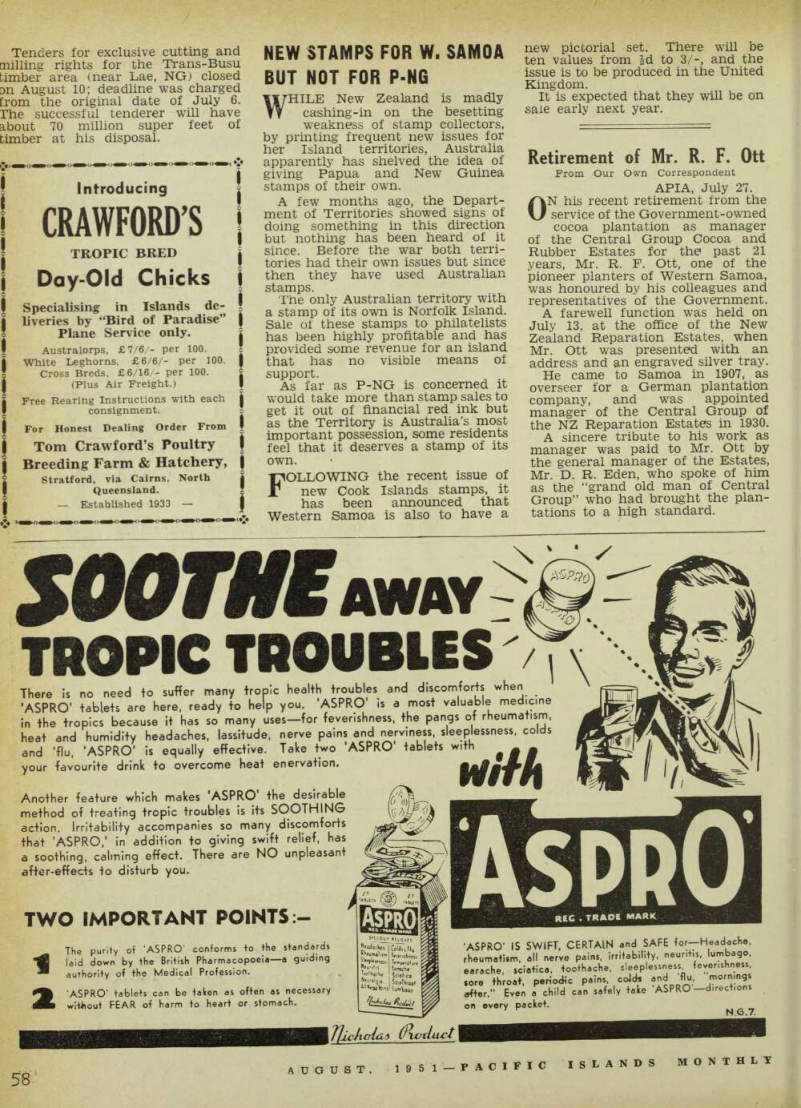
For Usa
Prom Our Own Correspondent APIA, July 27. rR the first time this year a large consignment of Samoan cocoabeans has been shipped to the United States market.
The SS Sonoma called on July 27 to lift 450 tons of cocoa from Apia sheds and left the same day for San Francisco.
The prices offered previously by US buyers had compared unfav ourably with prices offered by English, Australian and New Zea land purchasers. As a result, an acute shortage of dollar funds exists in Samoa at the present time and merchants and importers are unable to import even essential goods like timber and canned fish, from the USA and Canada.
Tenders for exclusive cutting and milling rights for the Trans-Busu timber area (near Lae, NG) closed Dn August 10; deadline was charged from the original date of July 6.
The successful tenderer will have about 70 million super feet of timber at his disposal.
Advertisements & other items, pp. 59-60 (1 item)
Allen Taylor & Co. Ltd.
COMMERCIAL ROAD, ROZELLE, SYDNEY.
Sawmillers and Wholesale Suppliers of Hardwoods for Contructional Purposes GIRDERS ... PILES . . . POLES . . . SLEEPERS, Etc.
Exporting to the Pacific Islands Since 1893.
G. H. ROBINSON EXPORTS & IMPORTS PTY. LTD.
Pacific Island Tradevs and Wlevchants.
S°le Distributors of Bradford Commercial Vehicles, Jowett Javelin Cars and Uniporn Diesel Engines—(Franchises available in certain Pacific Groups.) Sellers on Commission of all kinds of Island produce—Cocoa Beans, Green Snail, Copra, Fungus, M.O.P. Shell, Trochus Shell etc.
Agents in London and Manchester for the Disposal and Supply of Produce and Special Requirements.
EVERY ATTENTION GIVEN TO ORDERS IRRESPECTIVE OF SIZE Make use of our SO years' personal experience and direct your inquiries to: G. H. ROBINSON EXPORTS & IMPORTS PTY. LTD.
Cables;
51 MACQUARIE STREET, SYDNEY. Telephone: 8W4575
‘SUNRISE,” SYDNEY. „ , *
Postal Address: Box 3317, G.P.0., Sydney.
Introducing
CRAWFORD’S
TROPIC BRED
Day-Old Chicks
Specialising in Islands deliveries by “Bird of Paradise”
Plane Service only.
Australorps, £7/6/- per 100.
White Leghorns, £6/6/- per 100.
Cross Breds, £6/16/- per 100. (Plus Air Freight.) Free Rearing Instructions with each consignment.
For Honest Dealing Order From Tom Crawford’s Poultry Breeding Farm & Hatchery* Stratford, via Cairns, North Queensland.
Established 1933
SOOTHE away
TROPIC TROUBLES /,\
There is no need to suffer many tropic health troubles and discomforts when ’ASPRO' tablets are here, ready to help you. 'ASPRO' is a most valuable medicine in the tropics because it has so many uses—for feverishness, the pangs of rheumatism, heat and humidity headaches, lassitude, nerve pains a nd ne r vmess sleeplessness, colds and ’flu, 'ASPRO' is equally effective. Take two 'ASPRO tablets with your favourite drink to overcome heat enervation.
Another feature which makes 'ASPRO the desirable method of treating tropic troubles Is its SOOTHING action. Irritability accompanies so many discomforts that 'ASPRO,' in addition to giving swift relief, has a soothing, calming effect. There are NO unpleasant after-effects to disturb you.
TWO IMPORTANT POINTS
The purity of 'ASPRO' conforms to the standards laid down by the British Pharmacopoeia—a guiding authority of the Medical Profession, 'ASPRO' tablets can be taken as often as necessary without FEAR of harm to heart or stomach. • i NS i " & v». m N
ASPRO
'ASPRO' IS SWIFT. CERTAIN and SAFE for—Headache, rheumatism, all nerve pains, irritability, neuritis, lumbago, earache, sciatica, toothache, sleeplessness feverishness, sore throat, periodc pains, cold* and flu,. mornings after." Even a child can safely take ASPRO—directions on every packet. N 6?
1 Tjickoia* (Furdact\
But Not For P-Ng
New Stamps For W. Samoa
WHILE New Zealand is madly cashing-in on the besetting weakness of stamp collectors, by printing frequent new issues for her Island territories, Australia apparently has shelved the idea of giving Papua and New Guinea stamps of their own.
A few months ago, the Depart ment of Territories showed signs of doing something in this direction but nothing has been heard of it since. Before the war both terri tories had their own issues but since then they have used Australian stamps.
The only Australian territory with a stamp of its own is Norfolk Island.
Sale of these stamps to philatelists has been highly profitable and has provided some revenue for an island that has no visible means of support.
As far as P-NG is concerned it would take more than stamp sales to get it out of financial red ink but as the Territory is Australia’s most important possession, some residents feel that it deserves a stamp of its own.
FOLLOWING the recent issue of new Cook Islands stamps, it has been announced that Western Samoa is also to have a
new pictorial set. There will be ten values from Id to 3/-, and the issue is to be produced in the United Kingdom.
It is expected that they will be on sale early next year.
Retirement of Mr. R. F. Ott
From Our Own Correspondent APIA, July 27.
ON his recent retirement from the service of the Government-owned cocoa plantation as manager of the Central Group Cocoa and Rubber Estates for the past 21 years, Mr. R. F. Ott, one of the pioneer planters of Western Samoa, was honoured by his colleagues and representatives of the Government.
A farewell function was held on July 13, at the office of the New Zealand Reparation Estates, when Mr. Ott was presented with an address and an engraved silver tray.
He came to Samoa in 1907, as overseer for a German plantation company, and was appointed manager of the Central Group of the NZ Reparation Estates in 1930.
A sincere tribute to his wort as manager was paid to Mr. Ott by the general manager of the Estates, Mr. D. R. Eden, who spoke of him as the “grand old man of Central Group” who had brought the plan tations to a high standard.
150 Years of Service
Fr. Boch, the Rev. J. Goldie and Dr. Fox
WHEN the Rev. J. R. Metcalfe gave a broadcast at Honiara, BSI, recently he said that the chief topic of conversation among the people of the Western Solomons was the departure from their midst of two European leaders who had assisted in the great changes of the last 50 years.
He was referring to Rev. Father A. Boch, of Faisi, Shortland Islands and the Rev. John F. Goldie, of Roviana.
Father Boch had just left the Solomon Islands after a long term of saintly service.
He was skilled in medicine and always ready to help both European and native.
He would be long-remembered for his deep devotion to his Church and for his lovable character. His sphere of influence had been limited by the geographical position of the Short land Islands and the imaginary political line drawn between the Territory of New Guinea and the
Bsi,
THE Rev. Mr. Goldie had come to the BSI in 1902, a little earlier than Father Boch.
His sphere of influence ranged over the whole of the Western Solomon Islands. His work and that of his helpers had had repercussions throughout the Protectorate through the young men and women who had been trained in the mission schools.
Soon after Mr, Goldie arrived at Roviana in 1902, a party of head hunters returned to Munda beach with their gruesome trophies from a raid on Choiseul.
And, by way of contrast, it cohld be mentioned that Willie Paeia, the leading Government native clerk from the same tribe as those warriors, had recently completed 25 years of Stirling service and had been given a seat on the Advisory Council.
When Mr. Goldie went to the BSI *t the era °f sailing ships, and their little vessel had drifted to and fro waiting for the wind to give them a haven.
Now residents of BSI could board a t Honiara or Barakoma (Vella Lavella) and be in Sydney next day. J ANOTHER veteran of the missions was the Rev. Dr. C. E. Fox, of the Melanesian Mission (Angli can) who had arrived in the Islands a few months after Mr. Goldie and had played an outstanding part in their development.
Dr. Fox apparently had no inten tion leavin g the Islands, said Mr. Metcalfe, but his name should be mentioned when paying tribute to the veterans of other missions
Death of the Rev. J. H. S.
Hurse
THE Rev. J. H. S. Hurse, a missionary of the Presbyterian Church in the New Hebrides, died in Melbourne, Victoria, on July 18.
Mr. Hurse, who was only 34 had been ill for a long time. He was flown down from the New Hebrides about 12 months ago as a stretcher case.
During the war he served with the Australian Field Ambulance and later as a RAAF wireless-navigator.
Mr. E. Kriewald, of Port Moresby, Papua, was in Brisbane on holiday in early July.
Mr. Christian Rothes who has spent 40 years with the CSR Co.some of them in Fiji—retired from the general-managership recently.
His successor is a New Zealander, Dr. Roy Harman.
Advertisements & other items, pp. 61-62 (2 items)
59
PACIFIC ISLANDS MONTHLY— A U G U S T , 1951
Sherwin-Williams Paint
we hand it to
you
Real economy demands that you buy only good paint the best paint. Sherwin- Williams Paints and Finishes are the result of constant and intensive research by a compact corps of field specialists and qualified paint consultants. The combined fruits of this extensive research and developmental work by the Sherwin-Williams companies throughout the Empire are available to you when you specify Sherwin-Willia Paint for all tough paint assignments . . . espec •ally those under trop 'cal climatic conditions.
Sherwin-Williams Paint
To meet the test of the tropics
COLYER WATSON (NEW GUINEA) LTD.
>■ w
EXISTING ROUTES
PROJECTED ROUTES
■v V s° » V S s, / y i y
*-CSI
SOUTH PACIFIC SKYWAYS
TO NEW ZEALAND
This year take your finest holiday ever. Fly by fast luxurious TEAL airliner to the scenic wonders of New Zealand.
Enjoy famous TEAL hospitality, delicious hot or cold meals served at your table in flight, full bar service, two flight stewards and a stewardess to attend to your every need. Arrive fresh, relaxed, with your whole 1 ol day still intact to enjoy New Zealand’s world-famous attractions.
Reservations: TEAL, QANTAS, N.A.C. , T.A.A. and leading travel agents. mi
TASMAN EMPIRE AIRWAYS LIMITED
In association with QANTAS and 8.0.A.C. 1 A W !
Ifega.
‘fcf
Magazine Section
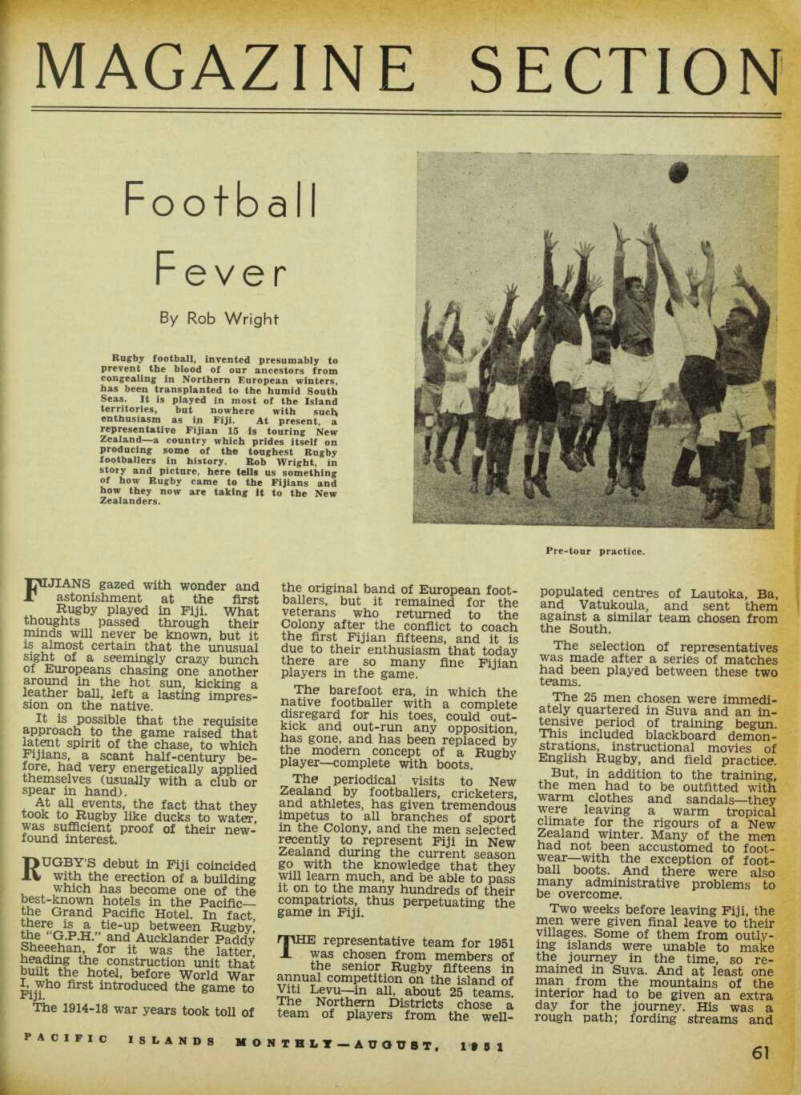
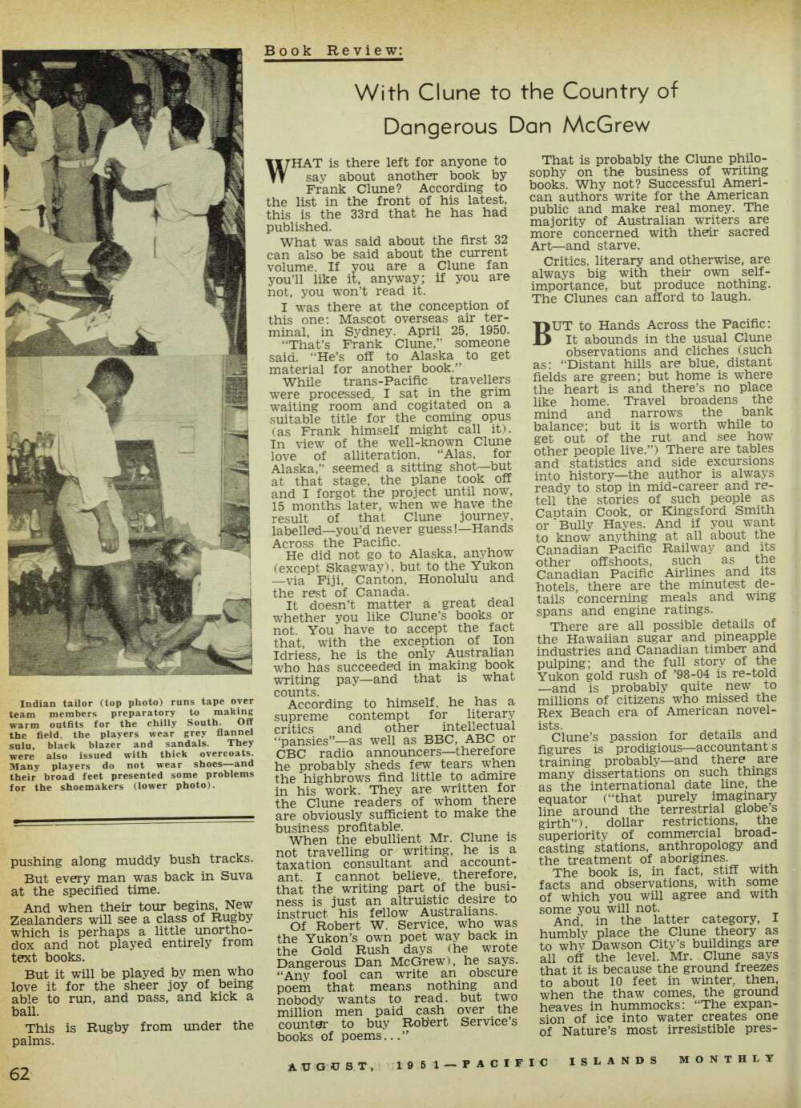
Football Fever
By Rob Wright
rea*S:»?' s
“gfS pSSi SUS ttS
minds will never be known, but it is almost certain that the unusual sight of a seemingly crazy bunch of Europeans chasing one another around m the hot sun, kicking a native. lastinB It is possible that the requisite approach to the game raised that splnt of t . hf L c l . ase ’ t 0 which themselves (usually with a club or spear m hand). * A v , aU J ve ? ts ’ the fact th at they took to Rugby like ducks to water, was sufficient proof of their newfound mterest.
TJUGBY’S debut in Fiji coincided ■K with the erection of a building which has become one of the best-known hotels in the Pacific— th!re G L an a d SKS?
S h heeeha^ H -fo a r nd it AU w^ an th e e r 2g£ T who first introduced the The 1914-18 war years took toll of
£.raT a AsrA'"ss
to“coSS
the first Fijian fifteens, and it is due to their enthusiasm that today there are so many fine Fiiian players in the game r- , , , 5 . nS out run t anv has goiSf and hS hten renFariri hv the modem concern Rnvhv Playe“rSple C tT C^t t h°b f oots RUgby The periodical visits to New Zealand by footballers, cricketers, ?nd athletes, has given tremendous impetus to all branches of sport m the Colony, and the men selected gently -present FIJI ffi New go with the knowledge that they will learn much, and be able to pass 11 on to the many hundreds of their compatriots, thus perpetuating the T^wa^cTosen‘from 6 "" 1 *£ 195 J
iJLSfaW??
Sfm TMS
Brs&as
iSfSm," “ d ”"“ ® s>oum.
The selection of representatives P ade after a series of matches ? ad been Played between these two teams.
atSVulrteMTuvlTnM:
tensive period of training begun This deluded blackboard demo*?strations, instructional movies of English Rugby, and field practice. the U men t’o^e^utfltted 1 wfth warm clothes and S"
wer™ leaving l^warm^t™}^
Sate for the rtoSfrs of a New Zealand winter n
Sd t* fZT
boots* f a?so
many nrSms 'to
be overcome problems to -rw M?
t sSS3bte°S °Se
s
b^lTan^
S
Rugby football, invented presumably to prevent the blood of our ancestors from congealing in Northern European winters, has been transplanted to the humid South Seas. It is played in most of the Island territories, but nowhere with such enthusiasm as in Fiji. At present, a representative Fijian 15 is touring New Zealand—a country which prides itself on producing some of the toughest Rugby footballers in history. Rob Wright, in story and picture, here tells us something of how Rugby came to the Fijians and how they now are taking it to the New Zealanders.
Pre-tour practice.
pushing along muddy bush tracks.
But every man was back in Suva at the specified time.
And when their tour begins, New Zealanders will see a class of Rugby which is perhaps a little unortho dox and not played entirely from text books.
But it will be played by men who love it for the sheer joy of being able to run, and pass, and kick a ball.
This is Rugby from under the palms.
Indian tailor (top photo) runs tape oyer team members preparatory to making warm outfits for the chilly South. Off the field, the players wear grey flannel sulu, black blazer and sandals. They were also issued with thick overcoats.
Many players do not wear shoes—and their broad feet presented some problems for the shoemakers (lower photo).
Advertisements & other items, pp. 63-65 (2 items)
61
PACIFIC islands monthli-auqubt, 116 1
TstrSLfthe
Book Review:
With Clune to the Country of Dangerous Dan McGrew
WHAT is there left for anyone to ohrmt another book bv Frank cSune’ According to the list In the front of hfs latest, tbf* if that he has had Wished P What was said about the first 32 volume 0 if you* are U a vouT like if anyway § you are
S JTwn'treK
not, you wont read it.
I was there at the conception of wU? n( in C nev° V April S 2s ir 1950
Frank^Clune* ’ Someone
sal June’s off to Saskatoget materiaf for book” S WMle traS-Pacific travellers were processed. I sat in the grim waiting room and cogitated on a suitable title for the coming opus (as Frank himself might call it). in tHpw nf the well-known Clune fove of illitlration “Ates for Alaska ” seemed a siting shot—but that S the Xne took off and forgot’the now.
“STS la ffiat Wh c e Sm W e e Tourney 6 S»Sc V ™ !l “ He did not go to Alaska, anyhow (e vfa P PhT g Ca a nton bU Honolulu'“and
r,Z Honolluu
Tt doesn’t matter a great deal whether you like Clune’s booxs or not. You have to accept the fact that, with the exception of lon Idriess, he is the only Australian who has succeeded in making book ™ pay-and that is what According to himself, he has a supreme contempt for literary critics and other intellectual “pansies”—as well as BBC, ABC or CBC radio announcers—therefore he probably sheds few tears when the‘highbrows find little to admire i n he hl cte rk reaTe% SSSSTtbS table ’ 6nt ‘° **“
hffs a
taxation consultant and account-
ant I cannot believe, therefore, that the writing part of the business Is jilt aS g a?truistic desire to instruct his fellow Australians. of ■RnHprt w Service who was the Yukon’s own poet way back in toe Gold bU days (fee wrote nQmrpmiK Dan McGrew) he says. ?Anv fool can write an obscure noem that meansNothing and gflsff ™S‘ s Da f d cash oTer toe g" poemsf. ? 0 * 5 ' ert ServiCe ' S
That is probably the Clune philo sophy on the business of writing books. Why not? Successful Ameri can authors write for the American Public and make real money. The majority of Australian writers are Critics, literary and otherwise, are always big with their own self importance, but produce nothing, Th e clunes can a£ford tQ laugh 'D UT to Hands Across the Pacific: 1> It abounds in the usual Clune observations and cliches (such as: “Distant hills are blue, distant fields are green; but home is where the heart is and there’s no Place like home. Travel broadens the mind and narrows the bank balance; but it is worth while to get out of the rut and see how other people live.”) There are tables and statistics and side excursions into history-the author is always ready to stop in mid-career and re-
CaptlT Co°o™%r° Kmlsfofd^Smith
S SSS «
Canadian Pacific and rts Canadian Pacific Airlines and its hotels, there are the minutest de tails conceruing me.h and wing spans and engine rat^ s - There are all possible details of the Hawaiian sugar and pineapple industries and Canadian timber and pulping; and the fulll story of the
Yukon fVrobaWy ’new^to
millions of citizens who missed the Rex Beach era of American novel ists. , Clune’s passion for details and figures is prodigious accountants training probab^— and there are many dissertations on such things
TstrSLfthe
the treatment of abongmes The book is, m fact, stiff with facts and observations, with some of which you will agree and with s °T5/°m WJ }h? latter category I And, in tne latter categoiy, j humbly place the Clune theory as to why Dawson City* buildings |re all off the level. Mr. oiune says that it is because the ground freezes to about 10 feet in winter, then
heTvVT IxpaT
STsStaJS mWtosistiW^pres!
(Continued from Previous Page)
sures, almost equivalent to the ex pansion of water into steam. Ex pand or bust is water’s law as temperatures rise.”
If this is so, then (to use a Clune ism) I was led up the garden path when I was taught, in my school days, that water expands on freez ing—oneneighth or one-ninth, or thereabouts—and that this is how nature breaks down rocks into soil, etc., etc.
My instructors could be wrong— and in this, I feel that Mr. dune, who has no respect for the ortho dox, would certainly concur.
THE author is aggressively Austra lian, and proud of it but, in comparison with his earlier books, some sort of doubt seems to have crept into this one as to whether the Australian way of life today measures up in terms of enterprise, national pride and individualism with that of the people of the North American continent, who know what they want and are going right after it.
Interpolated throughout the book, after descriptions of what Canadians and Americans are actually achieving, is the advice “Wake up Australia.”
You can say that again, Mr.
Clune.—JUDY TUDOR.
(Published by Angus & Robertson, Sydney. Price, 17/6.)
Territories
By Tolala
ONCE again we read of P-NG administration work being “speeded up” and “stream lined” as another ministerial hand takes over the controls of the Territories and starts out on a tour of those areas under his charge.
These cliches have become so time-worn that there is little wonder residents up there have be come somewhat cynical and view these “hand-outs” with jaundiced eye.
Exactly what Minister Hasluck meant when he said “I hope to see much closer contact between the Territory and Canberra,” must be left to the imagination. It would be hard to have closer contact between these two centres than has existed in the past.
At least ever since Sir Hubert Murray passed on, as regards Papua; and since Tom Griffiths left in New Guinea. For those two ad ministrators were certainly not “yes” men, nor did the Territories then suffer in that respect.
A little more Papua-New Guinea and a little less Canberra would make more people up North happy more of the time.
I SEE that the new Legislative Council is to have its first* sit ting in November and is to con sist of 29 members. There will, of course, be the usual Administration (or Canberra) majority.
It will be interesting to see whether it functions more success fully—as a public mouthpiece— than its predecessors in Papua and New Guinea before the War. Leg islative Councils were never really popular institutions with non official residents, owing to the fre quent practice of railroading Can berra dictates through the Cham ber, willy-nilly.
It makes good reading for the UNO, however, to see that the Territory has its own Legislative Council.
OSMAR WHITE well-known author and Pacific war corre spondent—recently published some rather alarming facts about the general deterioration of former Allied air bases and roads in the Pacific areas.
He refers to the Pacific Defence Pact and Australia’s earmarking of £2OO million for war preparations next year, and then mentions that when the war with Japan ended, Northern Australia was ringed with great naval, military and air bases costing thousands of millions of pounds.
In nearly every instance, he says, they have now gone back to the jungle in New Caledonia, New Hebrides, the Solomons and New Guinea.
More millions down the drain?
A NEWS-FLASH from London recently referred to over £lOO million earmarked for the re lief of Korean refugees.
It has been collected or promised by the UN member countries.
I have never heard of any assist ance being offered by UNO mem bers to New Guinea after its long occupation by the Japs and severe strafing, despite the fact it was a Trustee territory.
Australia had to foot the bill and, from the proposed Peace Terms, it seems that she is not getting much in the way of reparations. There is, of course, the strategic value of the vanquished foe becoming the new ally against Communism. But must individual claimants against the Japs reduce that down to pounds, shillings and pence?
NOTICED in last month’s PIM (page 31) where the Hanuabada natives have instituted a form of village tax for local amenities.
It amounts to over £1,400 a year,
which shows a step towards self support.
But turning to the next page, my eye caught the story about the an thropologist who was worried about the economic position of the Hanuabadans.
I don’t think he need worry too much over Hanuabadan economics.
What about some of our own centres in Australia? They are problems which need ironing out by some expert.
IF the time ever comes when the bonds of red tape that strangle P-NG are cut, and Australia is seeking a man to carry the respon sibilities of Territories’ administra tion with a free hand, it could find no better person than Sir Raphael Cilento, with his vast tropical knowledge, legal qualifications and post-war experience with the various United Nations activities.
He is back home in Brisbane now.
MY old friend Bill was unburden ing his soul to me the other day, as we sat on our stain less steel tubular chairs at the glass-topped tables In a Sydney caravanserai, sipping our drinks.
For six months he had been vainly trying to have an additional room put on his Sydney suburban bungalow, and he spoke of the ramifications of permits, contrac tors, material, labour and he was still exactly where he had started.
No amount of money could solve his problems. (Apparently he did not know the right bloke, who knew a b10ke.)...
The years slipped away and in my mind I saw us both seated on the verandah of his large native material home on his Buka trading station.
“I think I’ll put another room on this place,” Bill had said, and call ing his store-boy, explained his requirements—mangrove piles, adzed bush planks for the floor, river sac sac for the walls and sac-sac “true” for the roof.
I went away and returned some few days later. The additional room was completed. “What did it cost you?’ I asked, as he looked up from daubing pot. perman. on a meat case.
“Three quid for labour and four pounds of tobacco for the material.” he replied. “And everybody happy?”
I queried. “Everybody happy,” he repned ...
“Do you remember—” I began across the glass-topped table. “Yes, I was just thinking of it,” said Bill with a faraway look in his eye. “I remember alright. But this,” he waved his hand to include the modern fixtures of the lounge and the whole of Greater Sydney. “But this is Civilisation and Progress, and the natives are learning, too, don’t make any mistake,” he added bitterly.
Moturiki Tries Community Dew[?]opment
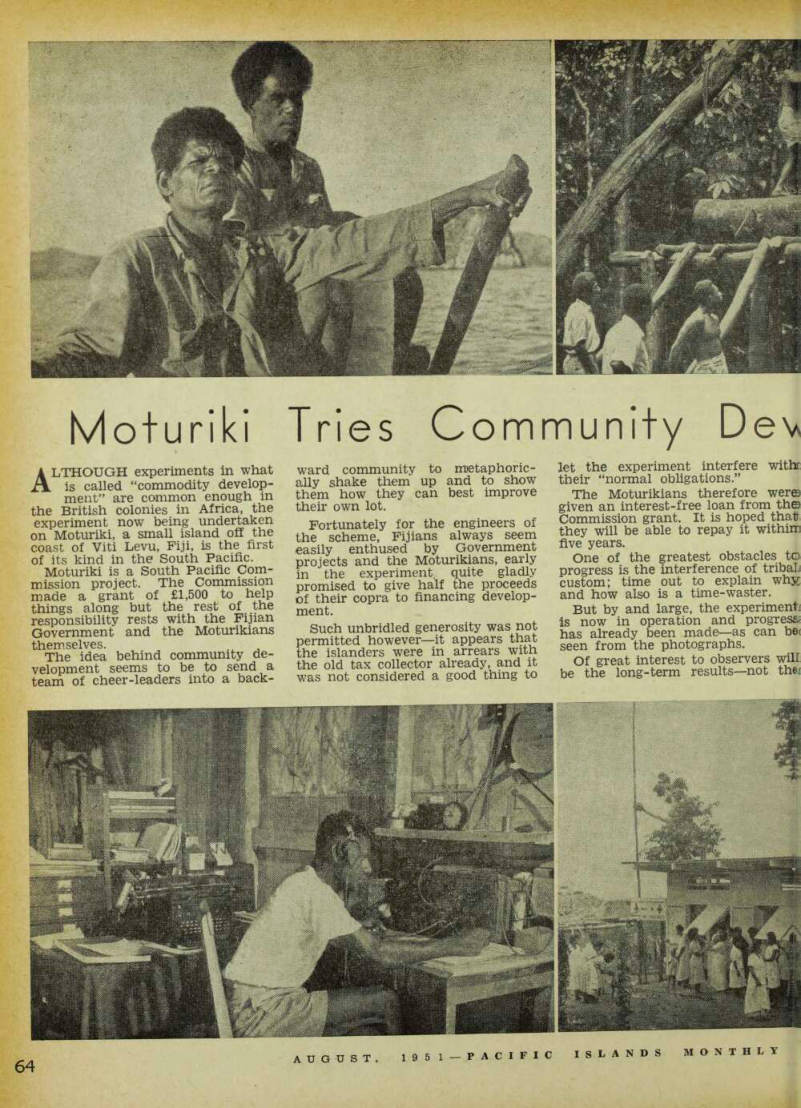
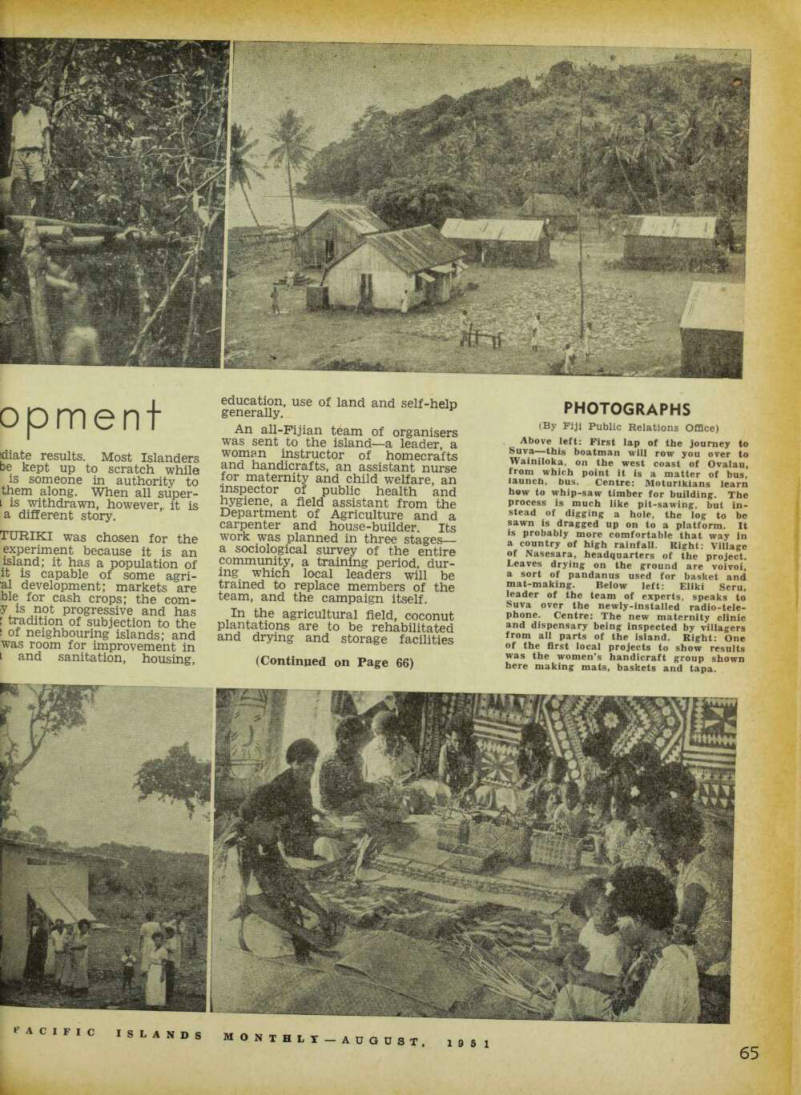
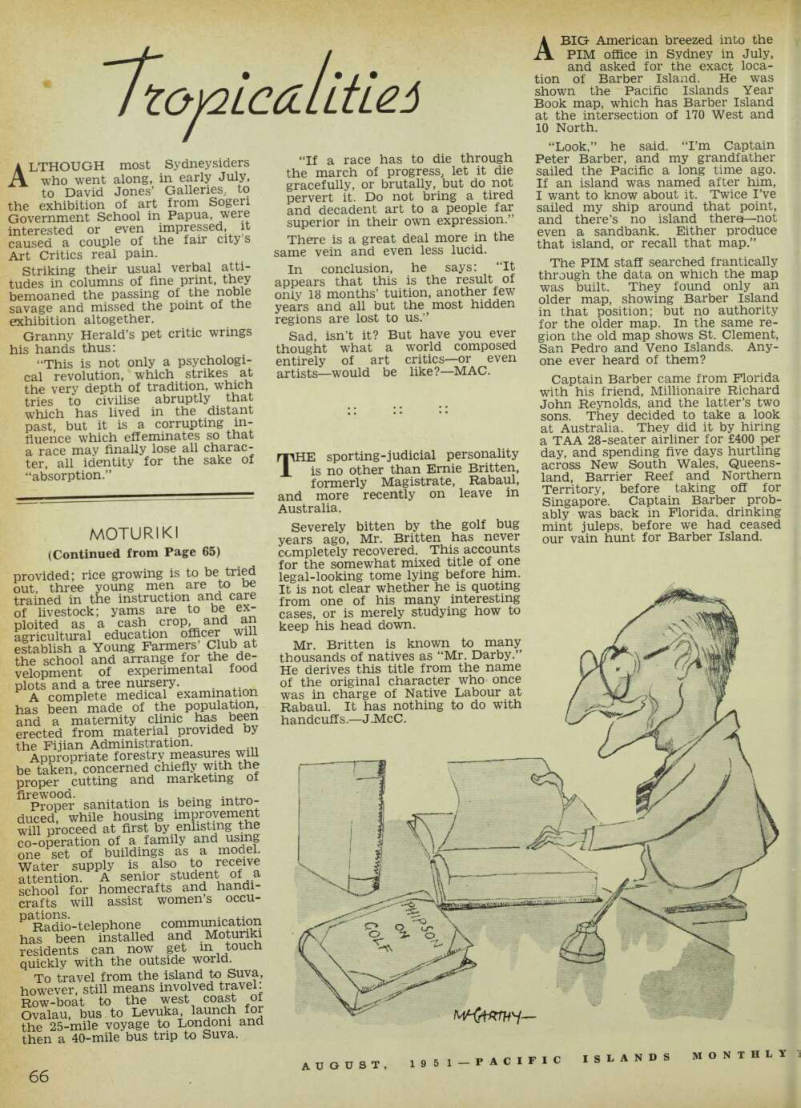
ALTHOUGH experiments in what is called “commodity develop ment” are common enough in the British colonies in Africa, the experiment now being undertaken on Moturiki, a small island off the coast of Viti Levu, Fiji, is the first of its kind in the South Pacific.
Moturiki is a South Pacific Com mission project. The Commission made a grant of £1,500 to help things along but the rest of the responsibility rests with the Fijian Government and the Moturikians themselves. .
The idea behind community de velopment seems to be to send a team of cheer-leaders into a back
ward community to metaphoric ally shake them up and to show them how they can best improve their own lot.
Fortunately for the engineers of the scheme, Fijians always seem easily enthused by Government projects and the Moturikians, early in the experiment, quite gladly promised to give half the proceeds of their copra to financing develop ment.
Such unbridled generosity was not permitted however —it appears that the islanders were in arrears with the old tax collector already, and it was not considered a good thing to
let the experiment interfere withe their “normal obligations.”
The Moturikians therefore were given an interest-free loan from the Commission grant. It is hoped that, they will be able to repay it withim five years.
One of the greatest obstacles to progress is the interference of tribali custom; time out to explain why and how also is a time-waster.
But by and large, the experimenti is now in operation and progress* has already been made —as can be< seen from the photographs.
Of great interest to observers will be the long-term results—not thei
diate results. Most Islanders be kept up to scratch while is someone in authority to them along. When all super . is withdrawn, however,, it is a different story. rURIKI was chosen for the experiment because it is an island; it has a population of it is capable of some agri al development; markets are ble for cash crops; the com y is not progressive and has ; tradition of subjection to the ' of neighbouring islands; and was room for improvement in and sanitation, housing,
education, use of land and self-help g6nerally - An all-Fijian team of organisers was sent to the island—a leader, a instructor of homecrafts handicrafts, an assistant nurse . maternity and child welfare, an inspector of public health and hygiene, a field assistant from the Department of Agriculture and a carpenter and house-builder. Its work was planned in three stages— a sociological survey of the entire community, a training period, duri n £. which local leaders will be trained to replace members of the team, and the campaign itself.
plaStauLf
and drylng and s t° faculties
(Continued on Page 66)
Photographs
(By Fiji Public Relations Office) Above left: First lap of the journey to Suva—this boatman will row you over to Wainiloka, on the west coast of Ovalau, from which point it is a matter of bus, launch, bus. Centre: Moturlkians learn how to whip-saw timber for building. The process is much like pit-sawing, but in stead of digging a hole, the log to be sawn is dragged up on to a platform. It is probably more comfortable that way in a country of high rainfall. Right: Village of Nasesara, headquarters of the project.
Leaves drying on the ground are voivoi, a sort of pandanus used for basket and mat-making. Below left: Eliki Sent, leader of the team of experts, speaks to Suva over the newly-installed radio-tele phone. Centre: The new maternity clinic and dispensary being inspected by villagers from all parts of the island. Right: One of the first local projects to show results was the women’s handicraft group shown here making mats, baskets and tapa.
provided; rice growing is to be tried out, three young men are to be trained in the instruction and care of livestock; yams are to be ex ploited as a cash crop, and an agricultural education officer will establish a Young Farmers Club at the school and arrange for the de velopment of experimental food plots and a tree nursery. .
A complete medical examination has been made of the population, and a maternity clinic has been erected from material provided by the Fijian Administration.
Appropriate forestry measures will be taken, concerned chiefly with the proper cutting and marketing of sanitation is being intro duced, while housing improvement will proceed at first by enlisting the co-operation of a family and using one set of buildings as a model.
Water supply is also to receive attention. A senior student of a school for homecrafts and handi crafts will assist womens occu- Pa ßadfo-telephone communication has been installed and Moturiki residents can now get in touch quickly with the outside world.
To travel from the island to Suva, however, still means involved travel.
Row-boat to the west coast of Ovalau, bus to Levuka launch for the 25-mile voyage to Londoni and then a 40-mile bus trip to Suva.
Advertisements & other items, p. 67 (1 item)
opment
65
pacific islands MONIHLT-AUODST. 196!
Tropicalities
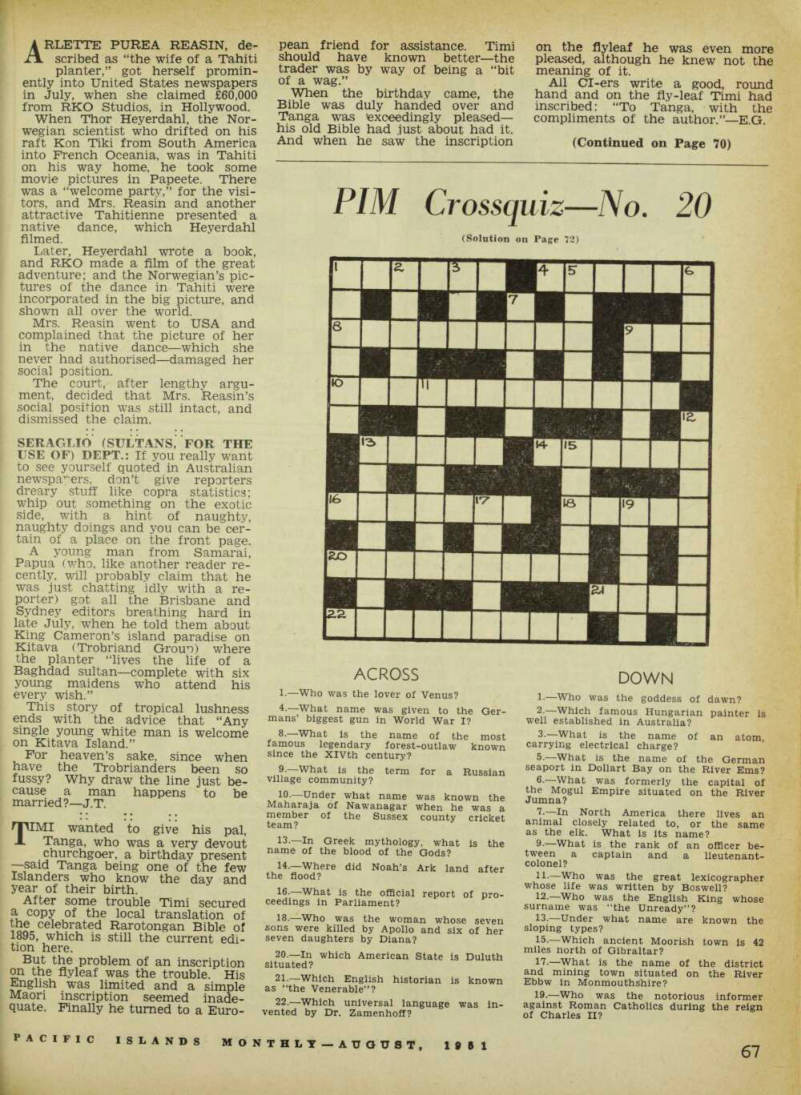
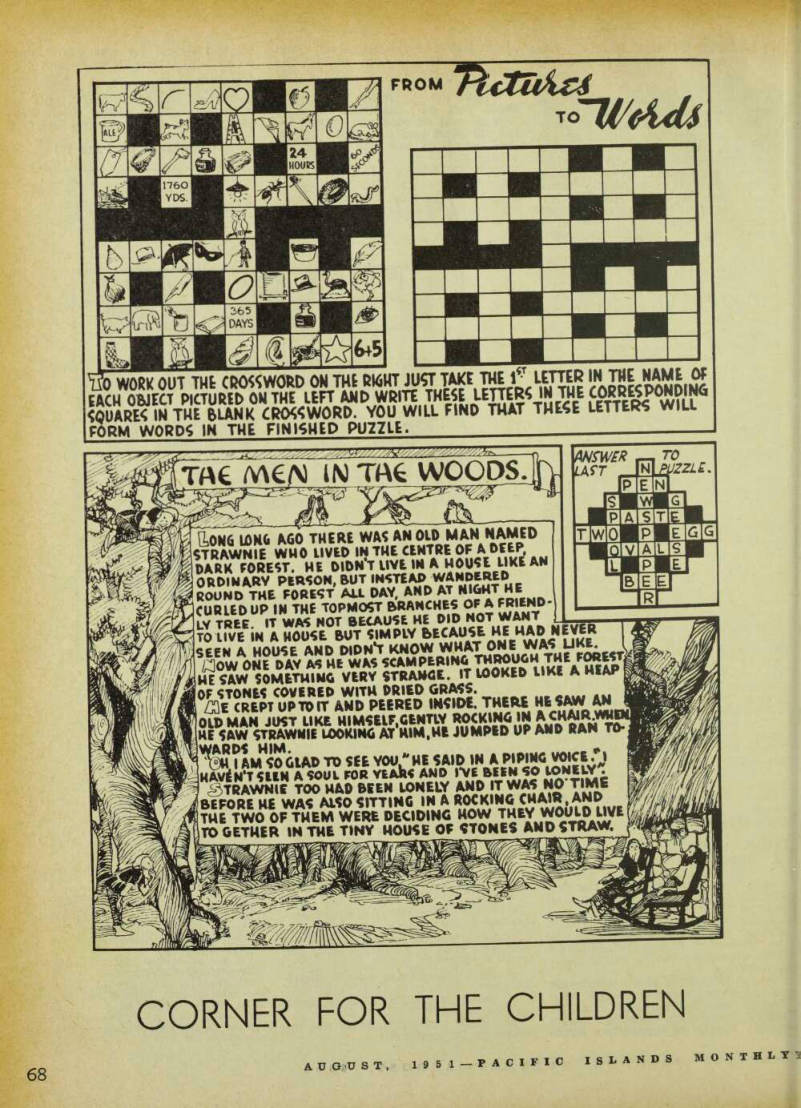
ALTHOUGH most Sydneysiders
who went along, in early July, to David Jones’ Galleries., to the exhibition of art from Sogen Government School in Papua, were interested or even impressed, it caused a couple of the fan" city s Art Critics real pain.
Striking their usual verbal atti tudes in columns of fine print, they bemoaned the passing of the noble savage and missed the point of the exhibition altogether.
Granny Herald’s pet critic wrings his hands thus: “This is not only a psychologi cal revolution, which strikes at the very depth of tradition, which tries to civilise abruptly that which has lived in the distant past, but it is a corrupting in fluence which effeminates so that a race may finally lose all charac ter, all identity for the sake of “absorption.”
“If a race has to die through the march of progress, let it die gracefully, or brutally, taut do not pervert it. Do not taring a tired and decadent art to a people far superior in their own expression.’
There is a great deal more in the same vein and even less lucid.
In conclusion, he says; “It appears that this is the result of only 18 months’ tuition, another few years and all but the most hidden regions are lost to us.”
Sad, isn’t it? But have you ever thought what a world composed entirely of art critics—or even artists —would be like? —MAC.
THE sporting-judicial personality
is no other than Ernie Britten, formerly Magistrate, Rabaul, and more recently on leave in Australia.
Severely bitten by the golf bug years ago, Mr. Britten has never completely recovered. This accounts for the somewhat mixed title of one legal-looking tome lying before him.
It is not clear whether he is quoting from one of his many interesting cases, or is merely studying how to keep his head down.
Mr. Britten is known to many thousands of natives as “Mr. Darby.”
He derives this title from the name of the original character who once was in charge of Native Labour at Rabaul. It has nothing to do with handcuffs. —J.McC.
A BIG American breezed into the PIM office in Sydney in July, and asked for the exact loca tion of Barber Island. He was shown the Pacific Islands Year Book map, which has Barber Island at the intersection of 170 West and 10 North.
“Look,” he said. “I’m Captain Peter Barber, and my grandfather sailed the Pacific a long time ago.
If an island was named after him, I want to know about it. Twice I’ve sailed my ship around that point, and there’s no island therei —not even a sandbank. Either produce that island, or recall that map.”
The PIM staff searched frantically through the data on which the map was built. They found only an older map, showing Barber Island in that position; but no authority for the older map. In the same re gion the old map shows St. Clement, San Pedro and Veno Islands. Any one ever heard of them?
Captain Barber came from Florida with his friend, Millionaire Richard John Reynolds, and the latter’s two sons. They decided to take a look at Australia. They did it by hiring a TAA 28-seater airliner for £4OO per day, and spending five days hurtling across New South Wales, Queens land, Barrier Reef and Northern Territory, before taking off for Singapore. Captain Barber prob ably was back in Florida, drinking mint juleps, before we had ceased our vain hunt for Barber Island.
Arlette Purea Reasin, De
scribed as “the wife of a Tahiti planter,” got herself promin ently into United States newspapers in July, when she claimed £60,000 from RKO Studios, in Hollywood.
When Thor Heyerdahl, the Nor wegian scientist who drifted on his raft Kon Tiki from South America into French Oceania, was in Tahiti on his way home, he took some movie pictures in Papeete. There was a “welcome party,” for the visi tors, and Mrs. Reasin and another attractive Tahitienne presented a native dance, which Heyerdahl filmed.
Later, Heyerdahl wrote a book, and RKO made a film of the great adventure; and the Norwegian’s pic tures of the dance in Tahiti were incorporated in the big picture, and shown all over the world.
Mrs. Reasin went to USA and complained that the picture of her in the native dance—which she never had authorised—damaged her social position.
The court, after lengthy argu ment, decided that Mrs. Reasin’s social position was still intact, and dismissed the claim.
Seraglio (Sultans, For The
USE OF) DEPT.: If you really want to see yourself quoted in Australian newspapers, don’t give reporters dreary stuff like copra statistics; whip out something on the exotic side, with a hint of naughty, naughty doings and you can be cer tain of a place on the front page.
A young man from Samarai, Papua (who, like another reader re cently, will probably claim that he was just chatting idly with a re porter) got all the Brisbane and Sydney editors breathing hard in late July, when he told them about King Cameron’s island paradise on Kitava (Trobriand Groun) where the planter “lives the life of a Baghdad sultan—complete with six young maidens who attend his every wish.”
This story of tropical lushness ends with the advice that “Any single young white man is welcome on Kitava Island.”
For heaven’s sake, since when have the Trobrianders been so fussy? Why draw the line just be cause a man happens to be married?—J.T.
TIMI wanted to give his pal, Tanga, who was a very devout churchgoer, a birthday present —said Tanga being one of the few Islanders who know the day and year of their birth.
After some trouble Timi secured a copy of the local translation of the celebrated Rarotongan Bible of 1895, which is still the current edi tion here.
But the problem of an inscription on the flyleaf was the trouble. His English was limited and a simple Maori inscription seemed inade quate. Finally he turned to a Euro
pean friend for assistance. Timi should have known better—the trader was by way of being a “bit of a wag.”
When the birthday came, the Bible was duly handed over and Tanga was exceedingly pleased— his old Bible had just about had it.
And when he saw the inscription
on the flyleaf he was even more pleased, although he knew not the meaning of it.
All Cl-ers write a good, round hand and on the fly-leaf Timi had inscribed: “To Tanga, with the compliments of the author.”—EG
(Continued on Page 70)
NOT long ago, when I was South (writes a New Guinea planter) I was asked whether I ever had seen any substantial evidence of Communist activities in New Guinea. I said I had not.
A few days since, I was in Wong You’s trade store in Kieta, Bou gainville. There, on a counter, was a large package of big folded pamphlets. I picked up one and examined it. It was red-hot Commo
stuff —Communist propaganda, if I ever saw it.
Naturally, I was interested. I wanted to know where it had come from, and what they were doing with it.
The store manager is Wong You’s brother, and he was away in Aus tralia on a health trip, and the store was in charge of a native. The native said that they bought scrap paper from South whenever they could get it, and the purpose of that package was to “round ’im something” (wrap up purchases).
The pamphlets were suitable for that.
One pamphlet was called “The Great £ Robbery,” and purported to show how the masses were ex ploited by the capitalists. The other was an attack on MacArthur, described as a bloodthirsty tool of the ruthless capitalists. One native in a thousand might be able to read the things; and not one in ten thousand could understand, even if he could read. So I suppose the wrapping-paper explanation is cor rect.
OUR Skippers may have a tough time in these waters wrestling with reef, wind and tide . . . but what of the old days?
The following extract from the New Yorker of September 30th, 1944, interested me; — “Chancellor James Kent, a nine teenth century American authority
on admiralty law, drew up what came to be regarded as the standard legal portrait of the Master of a vessel: ‘He should have,’ says the Chancellor, ‘the talent to command in the midst of danger, and courage, and the presence of mind to meet and surmount extraordinary perils.
He should be able to dissipate fear, and calm disturbed minds, and in spire confidence in the breasts of all who are under his charge, in tempest as well as in battle. The Commander of a ship must give desperate commands; he must re quire instantaneous obedience. He must watch for the health and com fort of the crew as well as for the safety of the ship and cargo. It is necessary that he should maintain perfect order, and preserve the most exact discipline under the guidance of justice, moderation, and good sense.’
“When a mate on the Joseph Crabtree, who had run across the Chancellor’s comments while thumb ing through a volume of sea-law, quoted the passage to Captain J . not long ago, the Master’s reaction was not one of pure pleasure.
“‘That hammer-headed old bas tard/ he remarked, ‘sure expects a lot from a merchant stiff!’.”
Feel that this might tie in with Captain Goya Henry’s comments on NG boat-crews, as published in July
Pim.—Rr.
ACCORDING to calculations made in Tokio, 670,000 Japanese ser vicemen are buried somewhere in the South Pacific islands—4oo,ooo soldiers and 260,000 sailors.
The Japanese Government pro poses, after the Peace Treaty is signed, to send into the south a fleet of “grave registration ships,” whose purpose will be to bring the Jap war dead from the mass graves New Guinea, Tarawa, Saipan, Guadalcanal, and wherever they can be located.
It will be a colossal task. There was a certain orderliness about the burial of American and Australian servicemen. The Allies were ad vancing, so they could collect their dead in small temporary cemeteries, for later removal to central bury ing places. The Aip,erica|i dead have been long since transferred to their homeland, while the Aus tralians remain in very beautiful, well-maintained cemeteries in New Guinea.
But the retreating Japanese could do nothing like that; and the ad vancing Allies simply buried them where they found them—mostly in small unmarked graves in the jungle. Countless thousands of them disappeared in places like Munda, Bougainville, the Bulolo slopes opposite Wau, the jungles around Sattelberg. Scores of thou
sands went down with the trans ports when the Allied airmen caught them in the Coral and Bis mark Seas, The Japanese along the northern New Guinea coast collected their dead in a vast burial-ground at Hollandia.
Ever since the war ended, the Japanese Government has post poned action; but now it is said to be under fire from relations of the missing men.
Another report says that an esti mated 2,000 Japanese servicemen are believed to be living still among the natives of the more secluded islands of the Pacific.
Native Girl Guides from Port Moresby will be present at the GG Jubilee International Camp, to be held near Sydney, in August.
All Australian newspapers are publishing—evidently with some re gret—that, although at home the girls wear only grass skirts, and badges in their hair, in Sydney they will be wearing an overall.
Wili Paia, 25 years an Adminis tration clerk in BSI, flew from Syd ney to London in July as BSI representative to the Festival of Britain.
PIM Crossquiz — No. 20
(Solution on Page 72)
Across
I.—Who was the lover of Venus? 4.—What name was given to the Ger mans’ biggest gun in World War I? 8. What is the name of the most famous legendary forest-outlaw known since the XlVth century? 9. What is the term for a Russian village community? 10- —Under what name was known the Maharaja of Nawanagar when he was a member of the Sussex county cricket team? 13. In Greek mythology, what is the name of the blood of the Gods? 14. Where did Noah’s Ark land after the flood? 16.—What is the official report of pro ceedings in Parliament? 18. —Who was the woman whose seven sons were killed by Apollo and six of her seven daughters by Diana? 20.—1 n which American State is Duluth situated? 21-—Which English historian is known as “the Venerable”? 22.—Which universal language was in vented by Dr. Zamenhoff?
Down
1-—Who was the goddess of dawn? 2.—Which famous Hungarian painter is well established in Australia? 3- What is the name of an atom carrying electrical charge? 5. —What is the name of the German seaport in Dollart Bay on the River Ems? 6. —What was formerly the capital of the Mogul Empire situated on the River Jumna? —ln North America there lives an animal closely related to, or the same as the elk. What is its name? 9.—What is the rank of an officer be tween a captain and a lieutenant colonel? 11. —Who was the great lexicographer whose life was written by Boswell? 12. Who was the English King whose surname was “the Unready”? 13. —Under what name are known the sloping types? 15.—Which ancient Moorish town is 42 miles north of Gibraltar? 17.—What is the name of the district and mining town situated on the River Ebbw in Monmouthshire? 19.—Who was the notorious informer against Roman Catholics during the reign of Charles II?
Advertisements & other items, pp. 70-74 (1 item)
fKtB
TtOUtes
~U(Ui
7
FROM
fKtB
V TO sf 24
HOURS
1760
YDS.
zJf
b 0 c?
S 5 6+5
110 WORKOUT THUDOWWORD ONTWt BIGHTJUSTIaodkDONOIN6
EACH OBJECT PICTURED OM THE LEFT AND WRITE THESE LETTER? HJ THE CMRKPONOIEte SQUARES IN THE BLANK CROSSWORD. YOU WILL FIND THAT THESE LETTERS WILL
FORM WORDS IN
TA£ N\CN IN THC WOODS.
Kom LONG AGO THERE WAS AN OLD MAN NAMED STRAWNIE WHO LIVED IN THE CENTRE OF A DEEP, I DARK FOREST. ME DIDN'T LIVE IN A MOUSE LIKE AN oroinarv person, box wandered e ROUND THE FOREST AU DAY AND AT NIGHT HE CURLED UP IN THE TOPMOST BRANCHES OF A FBJENO i\/ topc IT wM NOT BECAUSE ME DID NOT WANT TO LIVE IN A MOUSE BUT SIMPLY & E £AU 6 tilfA? UKE
SEEN A HOUSE AND DIDN'T^KMOW6HTM FOREST]
/3oW ONE DAY AS ME WAS SCAMPERING THROUGH THE FORES i HE SAW SOMETHING VERY STRANGE. IT LOOKED LIKE A HEAP
OF STONES COVERED WITH PRIED GRASS.
£3E CREPT UPTOIT AND PEERED INSIDE. THERE HEiSAW AN OLD MAN JUST LIKE HIMSELF,CENUY ROCK INGIN HE SAW STRAWNIE LOOKING AT HIM,HE JUMPED UP AND RAN TO-, % R WgIAD TO SEE YOU "HE SAID IN A PIPING VOICE.
HAVEN'T SEEN A SOUL FOR YEAks AND I*VE BEEN SO LONELY .
"TRAWNIE TOO HAD BEEN LONELY ANO IT WAS NO TIME BEFORE HE WAS ALSO SITTING IN A ROCKING CHAIR, AND
THE TWO OF THEM WERE DECIDING
TO GETHER IN THE TINY HOUSE OF STONES AND STRAW.
B B n a a a r,n]\
CORNER FOR THE CHILDREN
BURNS PHILP (NEW GUINEA LIMITED)
General Merchants, Shipping, Customs and
General Agents
Head Office; PORT MORESBY, PAPUA
BRANCHES;
NEW GUINEA: Rabaul (Kavieng, Kokopo), Lae (Wau, Bulolo), Madang.
PAPUA: Port Moresby, Samarai.
AUSTRALIAN AGENTS: BURNS, PHILP Cr CO. LTD.
All States.
LONDON AGENTS: BURNS, PHILP & CO. LTD.
"London House/ 7 35 Crutched Friars, E.C.3.
SAN FRANCISCO AGENTS: BURNS-PHILP CO. OF SAN FRANCISCO INC. 510 Matson Building.
REPRESENTATIVES FOR
Queensland Insurance Co. Ltd. Lloyd's of London. Burns Phllp Trust Co. Ltd. « Distributing Agents in the Territory of Papua-New Guinea for:
SHELL COMPANY OF AUSTRALIA LTD.
Petroleum Products
VAUXHALL MOTORS LIMITED
Vauxhall Cars and Bedford Trucks
THE ROVER COMPANY LIMITED
Landrovers and Rover Cars
A. J. ELLERKER
Blue Streak Power Chain Saws
THE COLONIAL SUGAR REFINING CO.
Caneite, Asbestos Cement Sidings, Asphalt Floor Tiles
GENERAL MOTORS CORPORATION
Cars and Trucks
HARRY FERGUSON LIMITED
Ferguson Tractors and Equipment
CROSSLEY BROS. LIMITED
Crossley Marine & Stationary Engines
IMPERIAL CHEMICAL INDUSTRIES
Pharmaceutical & Agricultural Chemicals, Corrugated Perspex
JOHN FOWLER & CO. (LEEDS) LTD.
Fowler 95 H.P, Diesel Crawler Tractors
TRADE
MARK
BARDINET
n VjSTRM/4,\
RUM
THIS LABEL MEANS
Agents:
SWIFT AND HORNDALE
PTY. LTD,
26 CLARENCE STREET
SYDNEY AUSTRALIA
VENTURA TRADIN G CO. PTY. LTD.
26 BRIDGE STREET, SYDNEY.
ISLAND MERCHANTS
ALL CLASSES OF MERCHANDISE SUPPLIED AT WHOLESALE RATES
SOLE PACIFIC ISLANDS REPRESENTATIVES FOR:—
• Armstrong-Siddeley Diesel Engines • Armstrong-Superior Lighting Plants • "Multo-Presto" and "Konda" Ice Cream Machines • "Koala" Stationery Lines and Stapling Machines • Upson Torches
SUPPLIERS OF
• Goodyear and Dunlop Rubber Tyres and Tubes
CABLES —“VENTURA,” SYDNEY.
A. B. DONALD
LTD.
AUCKLAND, NEW ZEALAND
ISLAND TRADERS AND GENERAL
MERCHANTS
P.O. Box 1509. Cables and Telegrams: “Kingdom,” Auckland.
A famous HERCO product.
OLIVOL
CREAM
for your hands
beauty and protection
• Keeps your hands alluringly silky soft. • Protects against redness, roughness, dryness and windburn.
Stocks available ai your usual WHOLE-
SALERS or BURNS PHILP and MORRIS
HEDSTROM, Suva, Fiji.
,<c?
Made in the Australian Branch Factory
Of BLUNDELL SPENCE & CO., LTD.,
Hull, B. & S. SUPER PREPARED PAINT embodies the knowledge and experience gained from nearly 140 years of Paint manufacture.
Tested and proved for tropical conditions, B. & S. PREPARED PAINT is also available in a special Lead-free series for use in volcanic and other sulphurous regions. (Specify B. & S. Series 2301.) Ask for supplies of these and other BLUNDELL Paints and Enamels from your local Storekeeper, or write for particulars and colour-cards to the Agent for Pacific Islands :
KERR BROS. PTY. LTD.
255 a GEORGE STREET, SYDNEY.
£-/ J
PAINTS
BEST SINCE 1811
Prospects of
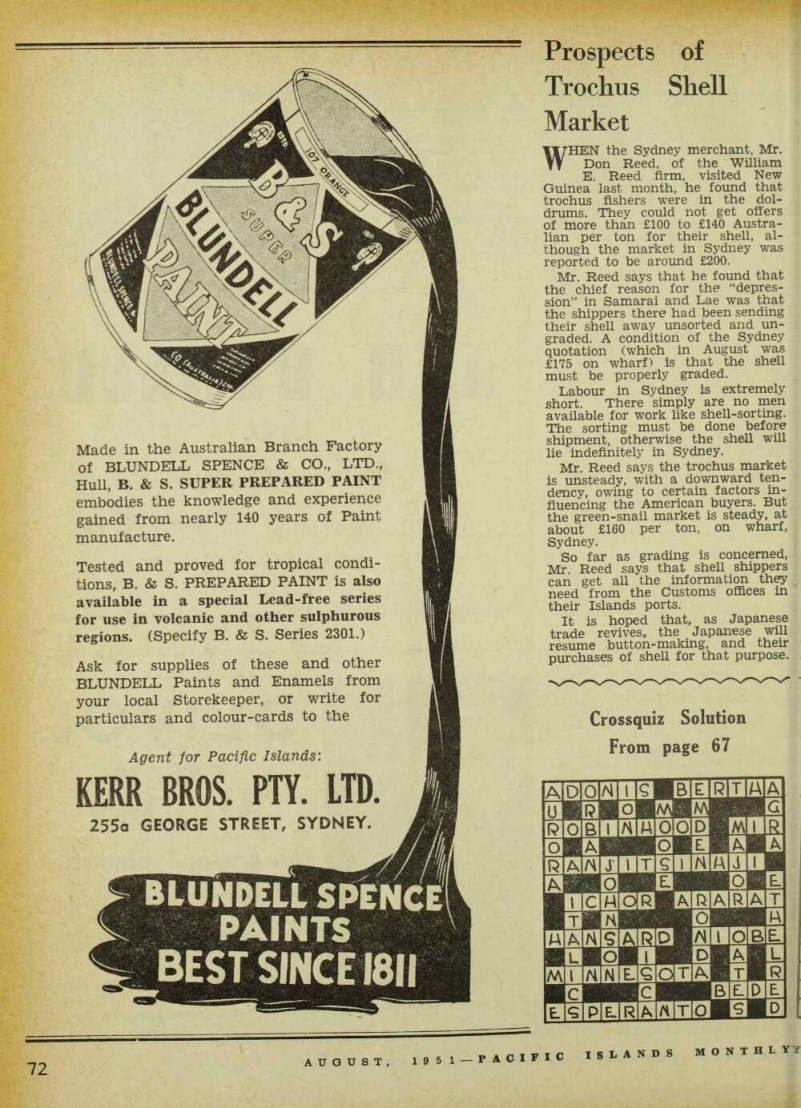
Trochus Shell Market
WHEN the Sydney merchant, Mr.
Don Reed, of the William E. Reed firm, visited New Guinea last month, he found that trochus fishers were in the dol drums. They could not get offers of more than £lOO to £l4O Austra lian per ton for their shell, al though the market in Sydney was reported to be around £2OO.
Mr. Reed says that he found that the chief reason for the “depres sion” in Samarai and Lae was that the shippers there had been sending their shell away unsorted and un graded. A condition of the Sydney quotation (which in August was £175 on wharf) is that the shell must be properly graded.
Labour in Sydney is extremely short. There simply are no men available for work like shell-sorting.
The sorting must be done before shipment, otherwise the shell will lie indefinitely in Sydney.
Mr. Reed says the trochus market is unsteady, with a dipwnward ten dency, owing to certain factors in fluencing the American buyers. But the green-snail market is steady, at about £l6O per ton, on wharf, Sydney.
So far as grading is concerned, Mr. Reed says that shell shippers can get all the information they need from the Customs offices in their Islands ports.
It is hoped that, as Japanese trade revives, the Japanese will resume button-making, and then purchases of shell for that purpose.
Advertisements & other items, p. 74 (2 items)
Crossquiz Solution
From page 67
72
n •nt v t r ISLANDS MONTHLY
AUGUST, 1951 PACIFIC IS
Central Highland, Ng

Accommodation In
Preparations for the building of a new hotel at Madang, New Guinea, by Mrs. Gilmour, are well under way; and, as soon as they are far enough advanced, the admirable boardinghouse which has been conducted by Mrs. Pitt at Madang will be closed, and Mrs.
Pitt will transfer her interests to a new boardinghouse at Goroka, in the Central Highlands.
As the Highlands are opened up, there is a growing call for an ac commodation house at some central place in the area. Goroka is re garded as the most suitable loca tion. Planes from Madang, Lae and Moresby come in to that point; and thence go on to Mount Hagen and further inland.
Mrs. Pitt’s plan to operate an accommodation house to take 16 persons has had official approval, and building operations may soon be commenced.
Residents of Moresby. Lae and Madang will be interested. New Guinea’s air services now can take them, in an hour or two, to cool up lands like Wau and Goroka where, if accommodation is available, a weekend of recuperation is quite feasible.
A Year At School In
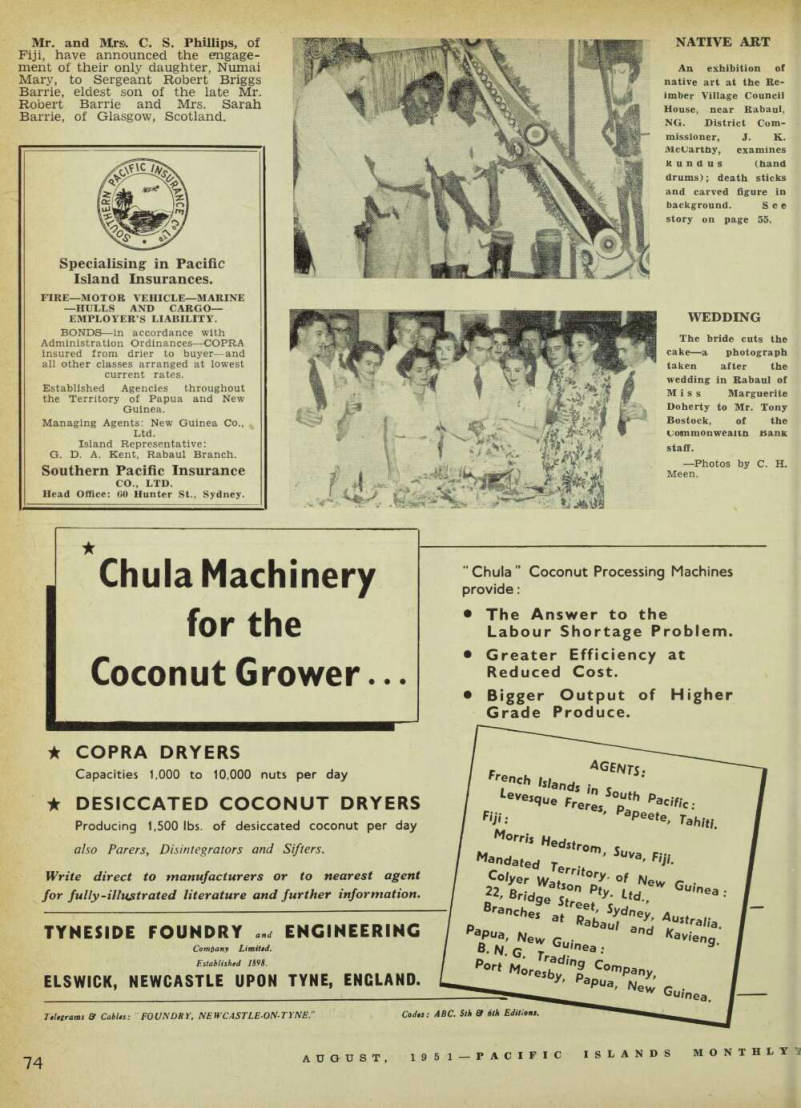
Noumea
NEXT year some Australian school child between 15 and 17 will go to school in Noumea, New Caledonia.
At the same time, two French schoolchildren will be offered similar facilities in Australia. The exchange has been arranged between the
Federal Office of Education and the New Caledonian administration.
The Australian student will be chosen on the result of an examina tion in French composition. The French authorities will pay for the trip and provide for lodging, school books, equipment and medical attention.
After refit in Sydney, the Nether lands corvette Boeroe sailed for Dutch New Guinea on July 31.
Mr. and Mrs. C. S. Phillips, of Fiji, have announced the engage ment of their only daughter, Numai Mary, to Sergeant Robert Briggs Barrie, eldest son of the late Mr.
Robert Barrie and Mrs. Sarah Barrie, of Glasgow, Scotland.
Native Art
An exhibition of native art at the Re imber Village Council House, near Rabaul, NG. District Com missioner, J. K.
McCarthy, examines kundus (hand drums); death sticks and carved figure in background. See story on page 55.
Wedding
The bride cuts the cake—a photograph taken after the wedding in Rabaul of Miss Marguerite Doherty to Mr. Tony Bostock, of the Commonwealth Bank staff. —Photos by C. H.
Meen.
Advertisements & other items, pp. 75-76 (1 item)
Akta-Vite
BURNS PHILP (New Hebrides) LTD.
Registered Office: VILA, NEW HEBRIDES.
Branch Office at SANTO.
Exporters, Importers and General Merchants,
Commission, Shipping and Customs Agents.
Representatives for BURNS PHILP TRUST CO. LTD., QUEENS- LAND INSURANCE CO. LTD., and LLOYD’S OF LONDON Agents for SOCIETE DES PETROLES SHELL DES ILES FRANCAISES DU PACIFIQUE, and numerous overseas manufacturers of all classes of merchandise.
Sydney Agents: BURNS, PHILP & CO., LTD., 7 Bridge St.
San Francisco Agents: BURNS-PHILP CO. OF SAN FRANCISCO, INC., 215 Market St.
London Agents: BURNS, PHILP & CO., LTD., 35 Crutched Friars, E.C.3.
NO ORDINARY FOOD TONIC
'AKTA-VITE' Nutritive Food Tonic is unique because it provides a tasty and easy way of adding four important vitamins—A, 81, C and D—to your diet. These vitamins, together with the nutritive properties of other ingredients in the 'AKTA-VITE' formula, are valuable as a tonic for—
NERVINESS . SLEEPLESSNESS
LASSITUDE . LOSS OF APPETITE
and other similar troublesome conditions so common m hot humid climates.
delicious!
The vitamins are combined in delicious crunchy granules which can be taken with hot or chilled milk to make a pleasant drink, or used as sandwich filling, sprinkled on other foods—desserts, cereals, etc., or taken by itself off a spoon.
To preserve the vitamins, 'AKTA- VITE' should not be cooked with foods it is best added after cooking. •
Ethical Division NICHOLAS PTY. LTD
THE O VITAMINS
ESSENTIAL TO
GOOD NUTRITION
and GLOWING HEALTH
ARE CONTAINED IN
AKTA-VITE
Each two teaspoonfuls of *AKTA-VITE' contain— Vitamin A 2000 International Units Vitamin Bl 300 International Units Vitamin C 300 International Units Vitamin D 1000 international Units plus calcium, phosphorus and carbohydrate.
Melbourne, Sydney, Brisbane. Adelaide and Perth.
AEP4
Specialising in Pacific
Island Insurances.
FIRE—MOTOR VEHICLE—MARINE
—HULLS AND CARGO-
EMPLOYER’S LIABILITY.
BONDS—in accordance with Administration Ordinances—COPßA insured from drier to buyer—and all other classes arranged at lowest current rates.
Established Agencies throughout the Territory of Papua and New Guinea.
Managing Agents; New Guinea Co., Ltd.
Island Representative: G. D. A. Kent, Rabaul Branch.
Southern Pacific Insurance
co., LTD.
Head Office: 60 Hunter St., Sydney.
Chula Machinery
for the
Coconut Grower...
★ COPRA DRYERS
Capacities 1,000 to 10,000 nuts per day
★ DESICCATED COCONUT DRYERS
Producing 1,500 lbs. of desiccated coconut per day also Parers , Disintegrators and Sifters.
Write direct to manufacturers or to nearest agent for fully-illustrated literature and further information.
TYNESIDE FOUNDRY ENGINEERING
Company Limited.
Established 1898.
ELSWICK, NEWCASTLE UPON TYNE, ENGLAND.
Telegrams & Cables; FOUNDRY. NEWCASTLEON-TYNE." Codes: Chula ” Coconut Processing Machines provide: • The Answer to the Labour Shortage Problem. • Greater Efficiency at Reduced Cost. • Bigger Output of Higher Grade Produce. / Fr ench l s i and ACENTS: f teVe «» u ® fr e 'rV°p th ' f ‘U: ' Pa P ee 'e, Morri > Hed slrom , ed Ter .. ' UVa ’ p anches « P ’ Ne * Guinea.
Noumea Engineer
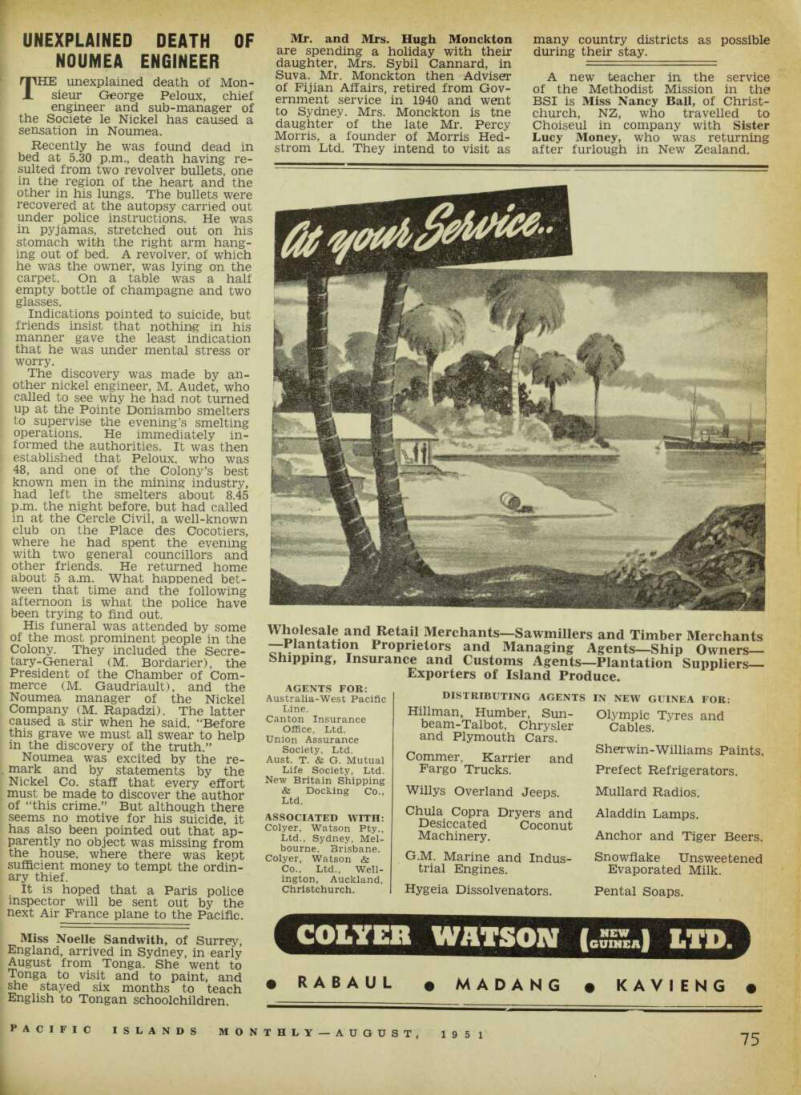
Unexplained Death Of
THE unexplained death of Mon sieur George Peloux, chief engineer and sub-manager of the Societe le Nickel has caused a sensation in Noumea.
Recently he was found dead in bed at 5.30 p.m., death having re sulted from two revolver bullets, one in the region of the heart and the other in his lungs. The bullets were recovered at the autopsy carried out under police instructions. He was in pyjamas, stretched out on his stomach with the right arm hang ing out of bed. A revolver, of which he was the owner, was lying on the carpet. On a table was a half empty bottle of champagne and two glasses.
Indications pointed to suicide, but friends insist that nothing in his manner gave the least indication that he was under mental stress or worry.
The discovery was made by an other nickel engineer, M. Audet, who called to see why he had not turned up at the Pointe Doniambo smelters to supervise the evening’s smelting operations. He immediately in formed the authorities. It was then established that Peloux, who was 48, and one of the Colony’s best known men in the mining industry, had left the smelters about 8.45 p.m. the night before, but had called in at the Cercle Civil, a well-known club on the Place des Cocotiers, where he had spent the evening with two general councillors and other friends. He returned home about 5 a.m. What happened bet ween that time and the following afternoon is what the police have been trying to find out.
His funeral was attended by some of the most prominent people in the Colony. They included the Secre tary-General (M. Bordarier), the President of the Chamber of Com merce (M. Gaudriault), and the Noumea manager of the Nickel Company (M, Rapadzi). The latter caused a stir when he said, “Before this grave we must all swear to help in the discovery of the truth.”
Noumea was excited by the re mark and by statements by the Nickel Co. staff that every effort must be made to discover the author of “this crime.” But although there seems no motive for his suicide, it has also been pointed out that ap parently no object was missing from the house, where there was kept sufficient money to tempt the ordin ary thief.
It is hoped that a Paris police inspector will be sent out by the next Air France plane to the Pacific.
Miss Noelle Sandwith, of Surrey, England, arrived in Sydney, in early August from Tonga. She went to Tonga to visit and to paint, and she stayed six months to teach English to Tongan schoolchildren.
Mr. and Mrs. Hugh Monckton are spending a holiday with their daughter, Mrs. Sybil Cannard, in Suva. Mr. Monckton then Adviser of Fijian Affairs, retired from Gov ernment service in 1940 and went to Sydney. Mrs. Monckton is tne daughter of the late Mr. Percy Morris, a founder of Morris Hed strom Ltd. They intend to visit as
many country districts as possible during their stay.
A new teacher in the service of the Methodist Mission in the BSI is Miss Nancy Ball, of Christ church, NZ, who travelled to Choiseul in company with Sister Lucy Money, who was returning after furlough in New Zealand.
Advertisements & other items, pp. 77-78 (1 item)
Colyer Watson (
p m v
ISmi
WhoicsaJe and Retail Merchants—Sawmillers and Timber Merchants —Plantation Proprietors and Managing Agents—Ship Owners— Shipping, Insurance and Customs Agents—Plantation Suppliers— Exporters of Island Produce.
AGENTS FOR:
Australia-West Pacific Line.
Canton Insurance Office, Ltd.
Union Assurance Society, Ltd.
Aust. T. & G. Mutual Life Society, Ltd.
New Britain Shipping & Docking Co., Ltd.
ASSOCIATED WITH:
Colyer, Watson Pty., Ltd., Sydney, Melbourne, Brisbane.
Colyer, Watson & Co., Ltd., Wellington, Auckland.
Christchurch.
DISTRIBUTING AGENTS
Hillman, Humber, Sunbeam-Talbot, Chrysler and Plymouth Cars.
Commer, Karrier and Fargo Trucks.
Willys Overland Jeeps.
Chula Copra Dryers and Desiccated Coconut Machinery.
G.M. Marine and Industrial Engines.
Hygeia Dissolvenators. Pental Soaps.
IN NEW GUINEA FOR:
Olympic Tyres and Cables.
Sherwin-Williams Paints.
Prefect Refrigerators.
Mullard Radios.
Aladdin Lamps.
Anchor and Tiger Beers.
Snowflake Unsweetened Evaporated Milk.
COLYER WATSON (
RAB A U L
MAD A N G
KAVI E N G
Aladdin lights ike way lo belter living
STORMPROOF
LANTERN
This Pressure Kerosene Stormproof Lantern gives 300 candle power of brilliant light. in any kind weather.
MODEL 1609:
Throws a flood of light on to the work area. Avoids direct light being thrown into the eyes.
THE WORLD’S MOST WONDERFUL LAMP
Aladdin light is the closest of all to natural daylight, and these non-pressure lamps give a steady white light of 75 candle-power. There is no smoke or fumes, no pumping. They light at the touch of a match! Burning 94% air and only 6% kerosene, these modern lamps are extremely economical In use, and safe and easy to use.
Good lighting and convenient
cooking contribute much to com-
fortable living, and Aladdin lamps
and cooking appliances have been
famous for more than a cen-
tury. Burning ordinary lighting
kerosene, Aladdin products
provide the comfort and
convenience of gas or elec-
tricity. They are un-
equalled in efficiency
and ease of operation.
MODEL
1609.
J
MODEL
1620.
MODEL
MODEL
BURNER RANGE
MODEL
1671. 1680. \\\
Z BURNER PORTABLE STOVE
Compact efficient pressure Kerosene stove has adjustable self-pricking burners. Available with metal carrying case for outdoor cooking.
Modern porcelain-finished pressure Kerosene range has all the advantages of gas or electric stoves. Heat is adjustable from “simmer” to “boil” and insulated oven cooks perfectly.
ELEVATED RANGE
Compact, modern pressure range is attractively finished in porcelain.
Has five self-pricking burners adjustable to any heat, and insulated oven cooks perfectly.
KEROSENE APPLIANCES
ALADDIN INDUSTRIES Pit LTD.. • BOURKE ST.. WATERLOO Obtainable through your Australian Buying House or Local Storekeeper.
Manufacturers: ALADDIN INDUSTRIES PTY. LTD.,
61-71 Bourke Street, Waterloo, N.S.W.
Wandering
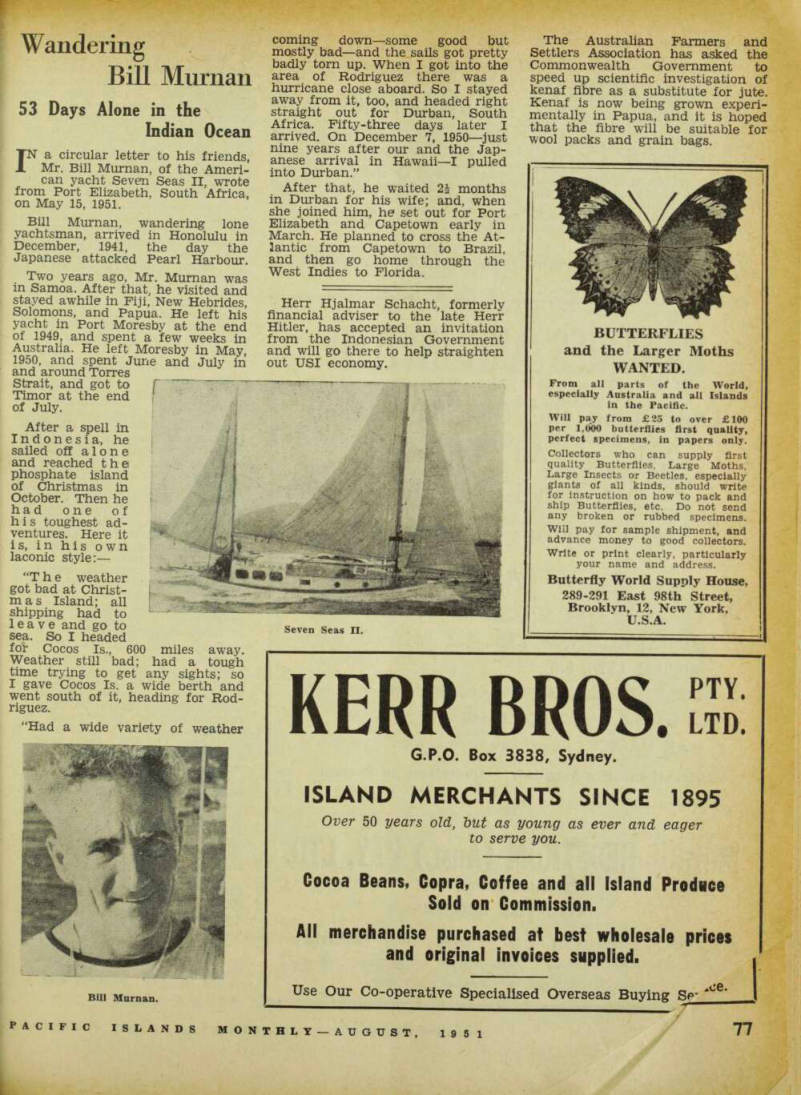
Bill Murnan 53 Days Alone in the Indian Ocean
IN a circular letter to his friends, Mr, Bill Murnan, of the Ameri can yacht Seven Seas 11, wrote from Port Elizabeth, South Africa, on May 15, 1951.
Bill Murnan, wandering lone yachtsman, arrived in Honolulu in December, 1941, the day the Japanese attacked Pearl Harbour.
Two years ago, Mr. Murnan was in Samoa. After that, he visited and stayed awhile in Fiji, New Hebrides, Solomons, and Papua. He left his yacht in Port Moresby at the end of 1949, and spent a few weeks in Australia. He left Moresby in May, 1950, and spent June and July in
and around Torres Strait, and got to Timor at the end of July.
After a spell in Indonesia, he sailed off alone and reached the phosphate island of Christmas in October. Then he had one of his toughest ad ventures. Here it is, in his own laconic style:— “T h e weather got bad at Christ ma s Island; all shipping had to leave and go to sea. So I headed
for Cocos Is., 600 miles away.
Weather still bad; had a tough time trying to get any sights; so I gave Cocos Is. a wide berth and went south of it, heading for Rod riguez.
“Had a wide variety of weather
coming down —some good but mostly bad —and the sails got pretty badly tom up. When I got into the area of Rodriguez there was a hurricane close aboard. So I stayed away from it, too, and headed right straight out for Durban, South Africa. Fifty-three days later I arrived. On December 7, 1950 —just nine years after our and the Jap anese arrival in Hawaii—l pulled into Durban.”
After that, he waited 2 h months in Durban for his wife; and, when she joined him, he set out for Port Elizabeth and Capetown early in March. He planned to cross the At lantic from Capetown to Brazil, and then go home through the West Indies to Florida.
Herr Hjalmar Schacht, formerly financial adviser to the late Herr Hitler, has accepted an invitation from the Indonesian Government and will go there to help straighten out USI economy.
The Australian Farmers and Settlers Association has asked the Commonwealth Government to speed up scientific investigation of kenaf fibre as a substitute for jute.
Kenaf is now being grown experi mentally in Papua, and it is hoped that the fibre will be suitable for wool packs and grain bags.
Seven Seas 11.
Bill Murnan.
Advertisements & other items, p. 79 (1 item)
Kerr Bros. S
BUTTERFLIES
and the Larger Moths
WANTED.
From all parts of the World, especially Australia and all Islands in the Pacific.
Will pay from £25 to over £lOO per 1,000 butterflies first quality, perfect specimens, in papers only.
Collectors who can supply first quality Butterflies, Large Moths, Large Insects or Beetles, especially giants of all kinds, should write for instruction on how to pack and ship Butterflies, etc. Do not send any broken or rubbed specimens.
Will pay for sample shipment, and advance money to good collectors.
Write or print clearly, particularly your name and address.
Butterfly World Supply House,
289-291 East 98th Street,
Brooklyn, 12, New York,
U.S.A.
KERR BROS. S
G.P.O. Box 3838, Sydney.
ISLAND MERCHANTS SINCE 1895
Over 50 years old, "but as young as ever and eager to serve you.
Cocoa Beans, Copra, Coffee and all Island Produce Sold on Commission.
All merchandise purchased at best wholesale prices and original invoices supplied.
Use Our Co-operative Specialised Overseas Buying gp’
No 18-Footer Contest
For Suva
IT is not expected now that the international 18-ft. yacht con test will be held in Suva in 1952 as was suggested some time ago in Sydney.
The Suva Yacht Club asked the Fiji Government for a grant of £l,OOO to help meet the expenses of the event but the Government declined on the ground of “un warranted expenditure.”
The contest will probably now be held in Auckland, A Queensland Rugby football team may tour in Fiji in 1952.
By Morris
Record Profit Made
Hedstrom Ltd.
THE 41st annual meeting of Morris Hedstrom Ltd., held in Suva, at the end of June, was overshadowed by the death of Sir Maynard Hedstrom, head of the big company, which had occurred only three weeks earlier. The act ing chairman, Mr. H. E. Snell, said this:— “Sir Maynard Hedstrom can be regarded as the principal founder of the company and as its prin
cipal executive officer until the last few years of his life. He was a man of many interests, but aiways he put first the claims of the company he had founded. He devoted to tnat company over a very long period the best of his energy—ana he was a very energetic man—and the best of his ability—and he was a very able man. To him is due a very large part indeed of the success the company has had in multiplying perhaps twenty-fold its assets and its revenue over the last 40 years.”
Morris Hedstrom, Ltd., with head quarters in Suva and branches all over Fiji, Samoa and Tonga, and a oranch in Sydney, ana interests throughout the South Seas, now has assets valued at £2 millions Fijian (which is £2i millions Aus tralian). Only half of that huge sum is actually used in the busi ness. No less than £804,000 is in cash and securities —£367,000 is shown as cash in hand or in the banks.
The subscribed capital is £739,613; there is an almost exactly similar sum in reserves; there was £303,000 in the P& L Appropriations Ac count when the balance was taken; and in the year ended March 31, the comoany made a record profit of £100,669. It paid its usual 10 per cent dividend.
The directors appear to be eager to extend the operations of the company, so as to employ their big and efficient organisation and their plentiful capital; but there are limited opportunities in the Terri tories in which they trade, and those are further limited by the fact that the company—like most other big employers today—cannot get all the competent staff it needs.
The acting chairman, in his ad dress, made a significant reference to building operations: “During the year the new stare building at Apia has been com pleted and is now in use. It is an excellent building. The cost today of building is, of course, very heavy, and it seems doubtful whether the revenue-earning powers of new buildings can be proportionate to that cost. On the other hand, in many places the buildings at pre sent operated by the company are very old and incapable of much longer use. Therefore, new building must continue. But under these cir cumstances the directors have thought it wise, in case of proper ties built or acquired since 1939, to allow substantial depreciation in the accounts.”
The directors are: Messrs. H. E.
Snell (managing), R. Crompton, KC, B. H. Marks, R. A. Crompton, J. Dowling, and J. M. Hedstrom.
A son was born to Mr, and Mrs.
Kevin McNamara of New Guinea Goldfields Ltd., Wau, at the local hospital on July 10.
Advertisements & other items, p. 80 (1 item)
Inquiries Are Invited
Concerning the Distribution and
Sale of All Types of
Merchandise in the
Pacific Islands
WE ARE AUSTRALIAN AGENTS FOR—
MORRIS HEDSTROM LTD., Fiji, Tonga and Samoa.
MILLERS LTD., Fiji.
8.5.1. P. GOVERNMENT TRADE SCHEME, Honiara.
G. & E.I.C. WHOLESALE SOCIETY, Tarawa.
MAX HALECK, Pago Pago, American Samoa.
Original Invoices Supplied. Quotations on Request. ★
MORRIS HEDSTROM (Aust.) PTY. LTD.
( Established l922)
MERCANTILE BROKERS
Asbestos House, 65 York St., Sydney.
V> ox No. 2530, G.P.0., Sydney. Cable Address: “MORSTROM,” Sydney. £ V BANKERS: BANK OP NEW ZEALAND. SYDNEY.
Important New Post For
Rev. S. G. Andrews
THE Rev. S. G. Andrews, M. A., Dip Ed, a New Zealander who, for the past 14 years, has rendered missionary service to the Methodist Church in Fiji, has been nominated to the forthcoming Methodist Conference of New Zealand, as General Secretary of Foreign Missions, in succession to the Rev. A. H. Scriven, who is re tiring after long service.
Mr. Andrews, for a number of years, has been principal of Davuilevu College, where Fijian theological students of the Methodist Church, and most of the teachers for the schools throughout Fiji, are trained. He had intended leaving Fiji at the end of this year, for family reasons. The Methodist Foreign Mission of NZ maintains about 20 missionaries in the BSI on New Georgia, Vella Lavella!
Choiseul, and on Bougainville and Buka, in TNG.
Death Of Miss O. N. Bayly
NEWS was received in Suva early in July of the death in Auck land of Miss Nellie Bayly, a sister of Mr. J. P. Bayly of Suva.
In partnership with her sister, Miss Bayly was proprietor of the Universal Theatre, formerly in Pier
Street, Suva, and later part-owner of the Regal Theatre.
She had been a resident of Suva for nearly 70 years and left about a year ago to live in Auckland.
The Rev. Allen H. HaU, a New Zealand Methodist missionary, who has been in charge of the mission
district training institution at Roviana, New Georgia, BSI, spent the early part of this year on furlough in New Zealand. On June 9, Mr. Hall was married to Miss Joyce Rushton, a daughter of Mr.
P. Rushton, of Morrinsville, New Zealand, and the newly-married couple departed for BSI at the end of June by way of Sydney.
Advertisements & other items, pp. 81-82 (1 item)
Amplioh
(HD Stewarts and Lloyds (Australia) pt y . Ltd.
Manufacturers of "S&L" PIPES and FITTINGS for GAS, WATER, STEAM and other purposes.
AIVD Distributors of:
MILD STEEL BARS. PLATES and SECTIONS;
GALVANISED IRON; BOLTS and NUTS; ELECTRODES
and WELDING EQUIPMENT.
Stewarts and Lloyds (Australia) pt y . Ltd.
SYDNEY WAREHOUSE - - Herbert Street, St. Leonards BRISBANE WAREHOUSE - Montague Road, South Brisbane MELBOURNE WAREHOUSE - - City Road. South Melbourne Telegraphic Address: "Tubes" — Sydney, Brisbane or Melbourne
* ' iff 'l
AMPLIOH
ELECTRIC
LIGHTING PLANTS
Bring you brilliant electric light in your home, weekender or plantation. Low operating and initial costs.
Treated for the tropics.
ONE HORSEPOWER
PETROL
ENGINES
Press button starting. 300 watts output. f * 12 and 32 volt 7 models. ** Weight 70 lb.
Special Islands
+ PRICE :
F. 0.8. £77/16/6 The Amplion makes the most of your petrol, runs longer on a tankful, 8 to 10 hours to the gallon.
It’s light in weight, too —40 lb. Obviously the best proposition for driving: Pumps—Compressors—Post hole borers—Lawn mowers —Saws—Shearing Machines—Crutching Machines— Spraying outfits—Concrete Mixers —Concrete Vibrators —Milking Machines.
* 4 CYCLE AIR COOLED DESIGN
* FULL FLOAT CARBURETTOR
* EFFICIENT AIR CLEANER
PRICE :
£4l/8/6 F. 0.8.
DISTRIBUTORS THROUGHOUT
AUSTRALIA AND THE ISLANDS.
AMPUOK
(Australasia) Pty. Ltd.
36-40 Parramatta Road, Camperdown.
Telegrams: Amplion, Sydney.
Telephone: LA 2828 (6 lines).
An ornate example of historical keys, this XVlth Century French key features the sporting motif in its club and animal carvings. It seems to have been the key to a Duke's country lodge.
C*
The key
to smoking plea
r s u e
CAPSTAN
FINE CUTo'
NAVY CUT
TOBACCOS
1657/48.
How World War I
Came
To Isolated Tonga
Memories by J. D. Whitcombe
NO overseas steamer had called at Nukualofa during June, July and August, 1914. Nobody could guess the reason why. We had no communication with other lands: radio had not been linked with Tonga, though Fiji had it.
On August 31, 1914. HMS Philomel arrived, bringing the news that England and her Dominions had declared war on Germany.
Philomel had been one of the ships to escort the main body of New Zealand troops to Samoa.
At the time, I was head teacher in the Government school at Nukua lofa, and I was asked to accompany the captain of the warship to the Palace, to act as interpreter if re quired. King George Tubou II re ceived us in the Throne Room, where the Commodore of the Philo mel informed him of the state of war and said that they were in Tonga to protect his Kingdom.
We then paid a visit to Herr von Treskow, the German Consul, ad vised him of the state of war bet ween our two countries, and instructed him to at once strike the German flag (then flying from his staff). This he promised to do, and the flag was lowered as we left the grounds.
There were one or two amusing incidents.
On the arrival of the cruiser nearly all the Europeans in Nukua lofa rushed to the wharf to find out what news she had brought. One well-known reverend gentleman (the Rev. R. .C, Page, to be correct) said to one of the sailors: “I will give a shilling to the chap who can give us the best news.” One of the men in the captain’s gig replied, “OK. We have taken Samoa.” Im mediately, all the Germans on the wharf left us English, and went and stood at the far end of the wharf, away from us.
There was a little German gentle man who came running down to hear the latest news. He was met by one of his British friends.
“Oh, what is the news?” he asked.
The Britisher replied; “Oh, have you not heard? Your friend the Kaiser put his hand into one of his trouser pockets, and said. ‘Mein Gott, I have lost one New Guinea!’
Then he put his hand into the other pocket and said; ‘Oh, I have lost Samoa (some more)!’” . The German was very annoyed, and went and joined his friends at the other end of the wharf.
We had an old German who acted as our butcher. I, as Inspector of Copra, had reason to condemn some of his copra, which was far from
good. It had been left out in very hot weather, and wals rotten. The old chap called one day and informed my wife that he would not supply us with any more fresh meat.
“I am sorry for you, my dear,” he said. “But your husband would not pass my copra, so you can starve. We Germans have plenty of cattle and noultry, and you British have none.”
However we srot over that nnd he returned in a few weeks and mea t t nued ‘° SUPPIy US With fresh When we were so long without a ship from New Zealand, all the stores were empty. There were no flour, tea, meats, butter—in fact,
we had nothing but a few tins of cabin bread or hard biscuits left, I had a friend on the Philomel and when he knew how we were situated he sent me a sack of fresh bread from the ship. This was most welcome. I handed it around b o a jl friends, especially those with children. My friend also sent me M} e newspaper on the ship— the latest edition of the NZ' Herald, carrying the early announcements This paper went the rounds? thTgfneraf Dubhc nS V^n a T bac/it was a complete rag got 1 A S a young boy, in 1890, I used to go with my brother to a native plantation on Saturdays, to collect ripe coconuts wherewith to
feed our fowls. We used to split the nuts and grate the flesh. It is the only food island fowls are fed on, and they do well on it, and get fat.
We always enjoyed the native Uma, or food cooked in a native oven, buried with hot stones. One day we were enjoying a good feast of yam, taro and what we thought was sucking-pig. After we had eaten one nice little leg, our friend asked us if we would like some more pork.
I replied no, thank you, and our friend then said; “Did you enjoy what you had?” “Yes,” I said. He asked if we knew what we had' been eating. I replied: “It was sucking pig, wasn’t it?” He laughed, and then went into the bush and brought out a big yellow wild-cat’s skin, and said: “You can tell your father and mother that you have had a good feed of cat.”
My brother and I were very sick
at the thought of having eaten cat, but it did not kill us.
Some 20 years later I returned to Tonga with my wife and children and, one day, an Island cart with a very old man, stopped at our gate.
I went out to see what he wanted, and he said: “Well, Jack, I have brought a bunch of ripe bananas for the children.” I thanked him and he said: “Do you remember me?” I said I did not, and he laughed and asked: “Don’t you remember tne cat we ate long ago?” He was my old boyhood friend. We had a chat about the old days—but I firmly declined his invitation to go to the bush next day for a feast in native style.
Advertisements & other items, pp. 83-84 (1 item)
Marjarine
1\ 0)E m // mm
(TOP)
, f Ml
tabxe
MARJARINE
Packaged like this, DELANA TABLE MARGARINE, a Product of Fiji, is now available to
ALL PACIFIC ISLANDS
Wherever and Whenever Suitable Transport Can Be Found.
A SUBSTITUTE
FOR
BUTTER
In i ib. Pats in
Shipping Outers
of 27 lb.
Fresh, wholesome and nutritious, this is a pure Vitamised Vegetable Product made in accordance with the Pure Food Laws of the Colony of Fiji, it contains no animal fat.
You ll enjoy eating DELANA . . . You'll appreciate its
ECONOMY.
Export Prices and Further Information from
ISLAND INDUSTRIES LIMITED
P.O. Box 299, SUVA, FIJI.
Telegraphic Address: “DELANA,” SUVA.
For Local Reasons, the Product is Labelled ‘ Marjarine” in “Margarine” Elsewhere.
I
To promote
TRADE
The Bank of New South Wales offers these services:— • Introductions to importers and exporters in oversea countries. • Credit information about residents of those countries, with whom you may wish to trade. • Facilities for making payments abroad and for receiving payments from overseas. • Arrangements for business visits overseas.
Consult any branch of the
BANK OF
NEW SOUTH WALES
FIRST AND LARGEST COMMERCIAL BANK IN THE SOUTH-WEST PACIFIC.
HEAD OFFICE: SYDNEY, AUSTRALIA.
Islands Branches : FlJl.—Suva, Lautota, Ba (Agencies at Nadi Airport, Vatukoula).
PAPUA. —Port Moresby. NEW GUINEA. —Lae, Rabaul. (Incorporated in New South Wales with limited liability.)
Island
Pukapukans Buy An
PUKAPUKA, the spiritual home of the late Robert Dean Frisbie, and the home island of ap proximately 600 Cook Islanders, has recently purchased the neighbour ing island of Nassau.
Over 100 Pukapukans have already left for Nassau carrying food, taro, puraka shoots for planting, drugs and medicines and will set up their permanent homes there.
Pukapuka is the most remote island of the Northern Cook Group and in recent years has become very overpopulated. It is of little economic importance being of atoll formation. Some copra is sold at present; taro is grown and also a few bananas. The island if off the beaten track of ships and the islanders are left entirely to their own resources.
Nassau is 45 miles away and has been owned by private interests who planted up the 300 acres in coconuts.
There is no safe boat anchorage.
Negotiations for the purchase of Nassau for the Pukapukans have been going on since 1944. The NZ Government bought it for £2,000 and have sold it to the islanders for the same sum. The people have paid 12/- per head towards the purchase price and are financing the rest through sale of their copra.
Presumably because of the bad anchorage, Nassau has not until now been permanently occupied.
The books of Robert Dean Frisbie, a wandering American who found some sort of peace on remote Pukapuka; and later, the book of his daughter Johnny (Miss Ulysses of Pukapuka), have told the world just about all it knows of this far away comer of Polynesia.
The NZ frigate, HMNZS Kaniere, is expected to call at Apia on her island cruise on September 16 and win stay in port until September 19.
The warship is also visiting Raro tonga, Suva, Suwarrow, Tonga and the Gilbert and Ellice Islands.
Territorial In Africa
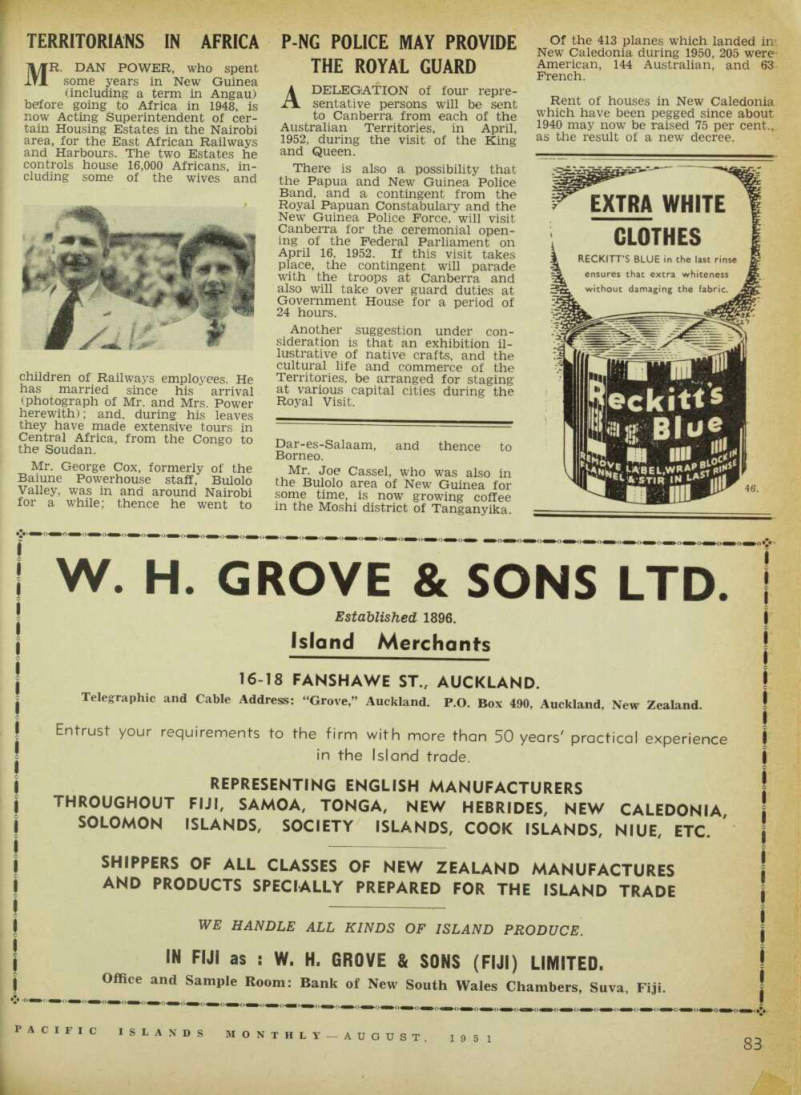
MR. DAN POWER, who spent some years in New Guinea (including a term in Angau) before going to Africa in 1948, is now Acting Superintendent of cer tain Housing Estates in the Nairobi area, for the East African Railways and Harbours. The two Estates he controls house 16,000 Africans, in cluding some of the wives and
children of Railways employees. He has married since his arrival (photograph of Mr. and Mrs. Power herewith); and, during his leaves they have made extensive tours in Central Africa, from the Congo to the Soudan.
Mr. George Cox, formerly of the Baiune Powerhouse staff, Bulolo Valley, was in and around Nairobi for a while; thence he went to
Dar-es-Salaam, and thence to Borneo.
Mr. Joe Cassel, who was also in the Bulolo area of New Guinea for some time, is now growing coffee in the Moshi district of Tanganyika.
P-Ng Police May Provide
The Royal Guard
A DELEGATION of four repre sentative persons will be sent to Canberra from each of the Australian Territories, in April, 1952, during the visit of the King and Queen.
There is also a possibility that the Papua and New Guinea Police Band, and a contingent from the Royal Papuan Constabulary and the New Guinea Police Force, will visit Canberra for the ceremonial open ing of the Federal Parliament on April 16, 1952. If this visit takes place, the contingent will parade with the troops at Canberra and also will take over guard duties at Government House for a period of 24 hours.
Another suggestion under con sideration is that an exhibition il lustrative of native crafts, and the cultural life and commerce of the Territories, be arranged for staging at various capital cities during the Royal Visit.
Of the 413 planes which landed in- New Caledonia during 1950, 205 were American, 144 Australian, and 63 French.
Rent of houses in New Caledonia which have been pegged since about 1940 may now be raised 75 per cent., as the result of a new decree.
Advertisements & other items, pp. 85-86 (1 item)
W. H. Grove & Sons Ltd.
EXTRA WHITE
CLOTHES
RECKITT’S BLUE in the last rinse ensures that extra whiteness without damaging the fabric.
W. H. GROVE & SONS LTD.
Established 1896.
Islond Merchants
16-18 FANSHAWE ST., AUCKLAND.
Telegraphic and Cable Address: “Grove,” Auckland. P.O. Box 490, Auckland, New Zealand.
Entrust your requirements to the firm with more than 50 years' practical experience in the Island trade.
REPRESENTING ENGLISH MANUFACTURERS
THROUGHOUT FIJI, SAMOA, TONGA, NEW HEBRIDES, NEW CALEDONIA SOLOMON ISLANDS, SOCIETY ISLANDS, COOK ISLANDS, NIUE, ETC. ' SHIPPERS OF ALL CLASSES OF NEW ZEALAND MANUFACTURES AND PRODUCTS SPECIALLY PREPARED FOR THE ISLAND TRADE WE HANDLE ALL KINDS OF ISLAND PRODUCE.
IN FIJI as ! W. H. GROVE & SONS (FIJI) LIMITED.
Office and Sample Room: Bank of New South Wales Chambers, Suva, Fiji.
Insist on ... .
ÜB.OHTE”
CANNED MEATS, HOTMEAIS AND SOUPS
Available in 12 oz. and 1 lb. sealed cans in the following
appetising flavours and :
• Corned Beef Loaf With Cereal • Braised Steak and Onions • Boiled and Roast Beef • Beef Steak Pudding O Mutton end Peas ® Steak and Onions • Chili Con Came ® Curried Mutton ® Curried Beef & Irish Stew @ Mulligatawny Scup ® Vegetable Soup O Mutton Broth © Tomato Soup © Camp Pie "BRONTE" Brand high-grade products are made from the finest fat stock and the richest vegetables in Australia, deliciously flavoured.
THE COLONIAL WHOLESALE
MEAT CO. PTY. LTD.
Canning Factory: State Abattoirs/ Homebush/ Sydney, N.S.W.
Thone: UM 8436. Cables: “WOOLMILL,” Sydney. mm. i
NEfP
la ¥ .r-1
You Drink Only On A Points System In W. Samoa
Written for PIM by Sarong
THE average man likes a drink of beer in the evening, after a hot day, and he also likes the thought of refreshment during the week-end, when relaxing after the week’s toil.
The thought of a drink in con genial company after the game of his choice —bowls, or golf, or tennis —sustains him during the after noon, and adds to his enjoyment of the play.
Even the prospect of a few beers, without any byplay, adds pleasure to life in the tropics.
But, here in Western Samoa, no such pleasant thoughts may be in dulged. The liquor-permit laws ef fectively cloud such rosy visions.
Instead, the average man wonders •whether he will ever be able to smell beer again; whether Jock Smith will loan him some beer, or a bottle of Scotch for a little celebration he •would like to hold. He thinks with regret and longing of the old days, where there were no such limits on jhis manner of life.
These liquor laws had their ori gin in the period just after World War I, when this Territory was handed to New Zealand under man date.
It is required that every person who wants liquor must submit his request to the Liquor Board for consideration. The Board then fixes the ration to be authorised, and issues what is called to-day, rather incomprehensibly, a Medical Liquor Permit. This entitles one to so many points of value in liquor a month, the ration being based on a fairly regular standard.
The single man is allowed 36 points; the married couple, up to 60; and so on up the scale progressively for the more important members of the community and people’s repre sentatives.
The exchange value of the points per bottle descend from /L 2, for Scotch whisky and brandy, to 4 for wines and 1 for beer.
The majority of the permit hol ders lie in a 36-48 points bracket, and in this group is well-founded .and universal dissatisfaction.
As they stand, the liquor laws autocratically decide who shall drink, and how much, without con sidering the individual, his needs, or his capacity as a host or a drinker. To the European, this un equal and illogical system seems petty and irritating and wholly un necessary.
Originally, the laws were devised rand applied with the best inten tions. Control over liquor supplies to the natives of Samoa and Fiji is necessary, as the people have not
yet reached a proper balance in' their attitude toward this commodity of our civilisation. But, with the example of the excellent liquor laws of Fiji before us, we Europeans in Samoa insist that our liquor 9ontrol system is out of date and without justification for contmuance m its present form.
Another important factor to be considered is the impression made upon visitors to Samoa. They soon discover that liquor is available, but not to them. That does not assist the valuable tourist industry.
An old and honoured New Caledonian, long resident in Prance, has been paying a visit to the Colony in. which he once played a leading part as councillor general and muni cipal councillor, and as one of the founders and first managers of the canning works at Mueo and Nemeara which set the Colony's cattle industry on its feet. He is Monsieur J. P. Pinelli, who also was once active as founder and director of the leading timber company, the Cie Forestiere Caledonienne, which exploited Kauri forests in the south, also of the Societe de I’Oregon and the Societe G Lietard et Pinelli. It is 26 years since he left New Caledonia.
A company known as the Societe Cooperative Agricole et de Consom mation has been formed at Santo.
Directors are Messrs. R. Coulon, Charles Graziani and J. My.
Sandy Creek Gold Sluicing Ltd., New Guinea, in June, got approxi mately 123 oz 10 dwt from 10,666 cubic yards treated.
Advertisements & other items, pp. 87-88 (1 item)
Fioor
LIGHTER,
FLUFFIER
OTHER
FAMOUS
FOUNTAIN
PRODUCTS
For Wk X 71 frlujL Sty U
"OMATO SAUCE
D Wo* 2
lbs
fIOOR
CO/f C
SELF-RAISING
FOUNTAIN food products are famous throughout the South Pacific for their consistent quality and suitability of packing for tropical conditions.
Yon are assured satisfaction when you specify FOUNTAIN brand.
Trade inquiries are welcome and all orders are promptly despatched.
BRfAAFAsf I
W.c DOUGLASS L"S1I. ED
fOVEAUX ST. SYDNEY AUSTRALIA
s. i i mtx&
[JO I? NTAJ Ml
FOI/.MAIN
yJ'N'fctC Korrit. -frUuk S^/ C (
PUDDIM G
VVhEN packed -
ART POSTCARDS OF TONGA
Per Dozen (Including a Tin-Can Mail Cover), Postage Paid: 6/- (or one US Dollar).
TONGAN PHOTOS BUREAU,
Nukualofa, Tonga
WHO LE SALEHM£ RC HANTS
MANUFACTURERS AGENTS
9 re trtA 0&h & vv s* Jr CE
ROBERT GILLESPIE
NEW GUINEA LTD
HEAD OFFICE LAE
BRANCH OFFICE RABAUL
ROBERT GILLESPIE PTY.LTD.
54a Pitt.
Street
Badly Needed Food Supplies
Reach Apia
From Our Own Correspondent APIA, July 5.
ON July 3 the SS Alameda of the Oceanic SS Co., reached Apia with 2,000 tons of much-needed food supplies, mainly flour and sugar on board.
The MV Matua, which left Auck land for Apia via Suva and Pago Pago on June 25, is also expected this week with food supplies and trans-shipments of English and con tinental goods. As on her last trip, the Matu again carries a substitute crew and no passengers.
Bsi Sulphur Deposits
Valueless
From Our Own Correspondent
Honiara, July 24.
THE BSIP Government Geologist, Mr. J. C. Grover, in company with Messrs. Bill Higgins and Charlie Bird, recently visited the sulphur deposits at Paraso on Vella La Vella.
Mr. Grover said, on his return, that this deposit, which has received some publicity in Australia as a possible source of sulphur, is of no economic importance. The region, however, is interesting in itself, as in over a square mile of country, there are flat areas of barren hot ground, spectacular with boiling and spluttering pools of grey mud, and gently hissing vents of vapours con taining hydrogen sulphide, around which almost pure sulphur crystals are deposited in yellow encrusta tions.
With reduction in the pressure of the vapours, these crusts have in many cases sealed over, and present the anpearance of a solid surface.
As a consequence it was necessary in some places, to test the ground ahead, and for all personnel to proceed in single file. Gases bubbling into the water rendered some of the streams almost un bearably hot, as was most of the ground underneath the atmosphere cooled surface.
Boiling mud pits were scattered through the dense vegetation bordering this area. Some photo graphs were obtained of the phenomenon which is explained as the final stage of post-volcanic activity in this area.
Lying at anchor during the night about I mile offshore, and exposed to a cold gaseous mist smelling strongly of hydrogen sulphide, the ship was covered with a stagnant scum, and white paintwork became blackened by chemical action. It was necessary to scrub down the ship the following day.
Hebrides
Italians For Work In
A FRENCH planter on Santo is reported to have been autho rised, by the French adminis tration, to recruit up to 2,000 Italian workers for the New Hebrides under conditions already settled.
The Question of transport is being studied* and the first contingent of 100 workers, it is said, will leave on a Messageries Maritimes ship.
The French are looking to this labour to strengthen the Con dominium’s economy now suffering from labour shortage due to the withdrawal of Javanese and Indo- Chinese and the difficulty of finding satisfactory native workers.
Commissioner
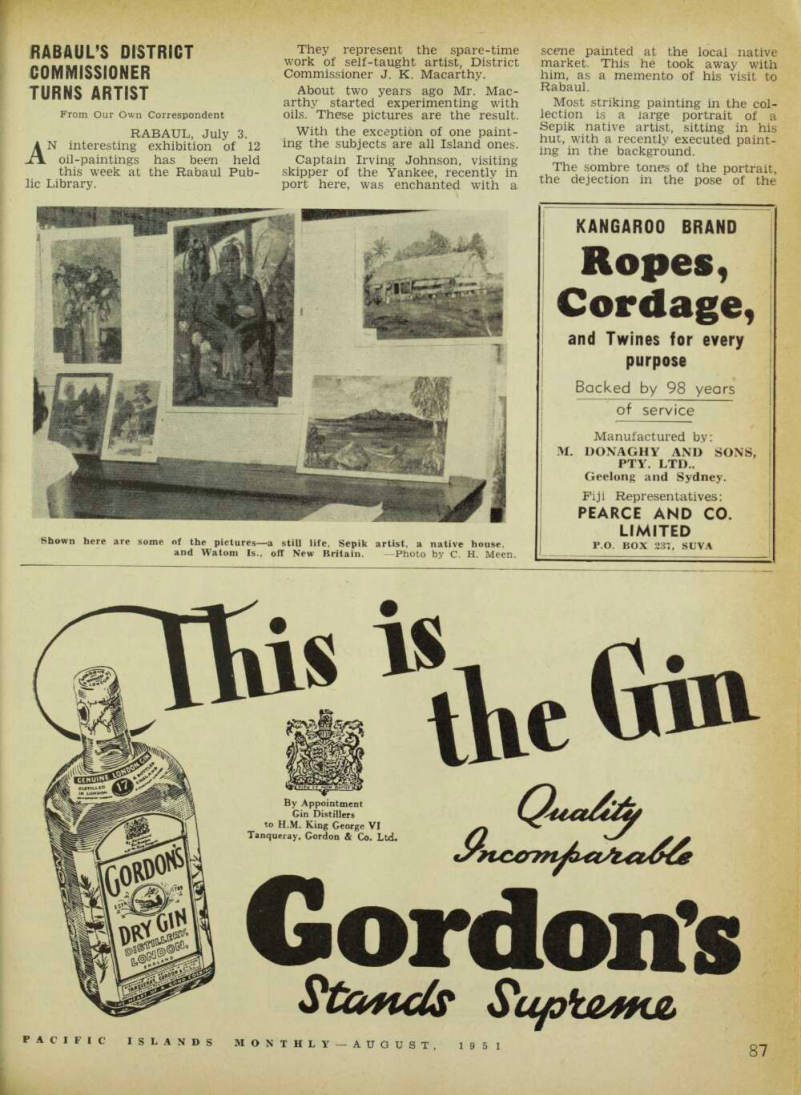
Rabaul’S District
Turns Artist
From Our Own Correspondent
Rabaul, July 3.
AN interesting exhibition of 12 oil-paintings has been held this week at the Rabaul Pub lic Library.
They represent the spare-time work of self-taught artist. District Commissioner J. K. Macarthy.
About two years ago Mr. Mac arthy started experimenting with oils. These pictures are the result.
With the exception of one paint ing the subjects are all Island ones.
Captain Irving Johnson, visiting skipper of the Yankee, recently in port here, was enchanted with a
scene painted at the local native market. This he took away with him, as a memento of his visit to Rabaul.
Most striking painting in the col lection is a large portrait of a Sepik native artist, sitting in his hut, with a recently executed paint ing in the background.
The sombre tones of the portrait, the dejection in the pose of the
Shown here are some of the pictures—a still life. Sepik artist, a native house. and Watom Is., off New Britain. —Photo by C. H. Meen.
model, his weird painting in the background, and the squalid dark ness of the hut’s interior, all com bine to make a forceful picture, ably executed.
This is the least academic of the exhibits. Mr. Macarthy, with the free treatment of this subject has portrayed, in some way, dual per sonality of the Sepik—the wild man who kills or paints with equal facility.
THIS is the first time Mr. Mac arthy has been persuaded to exhibit his pictures. Many have been given away to visitors who admired them at his home on Namanula Hill.
The exhibition was held mainly to get an idea of the public reac tion to the pictures.
This has not been left in doubt.
For the first three days of the ex hibition, Mrs. Macarthy, who is her husband’s severest critic, was inun dated with inquiries from prospec tive purchasers, among local resi dents, who showed their interest and appreciation in no uncertain way.
Advertisements & other items, pp. 89-90 (1 item)
Gordon's
KANGAROO BRAND
Ropes,
Cordage,
and Twines for every purpose Backed by 98 years of service Manufactured by:
M. DONAGHY AND SONS,
PTY. LTD..
Geelong and Sydney.
Fiji Representatives:
PEARCE AND CO.
LIMITED
P.O. BOX 237, SUVA
m By Appointment Gin Distillers «# 0$ \)W ifr? \W n
Qtea/t/y
Sbc4rmjLct/t4*&e
Gordon's
Stands Supfams,
to H.M. King George VI Tanqueray, Cordon & Co. Ltd.
TRUTH TO TELL ...
We Can Supply You With All These! • Batteries Electric Lighting Plants Fence Chargers
Fire Fighters
Hargans Saws Lister Diesel Engines Marine Engines Seagull Outboard Motors Orchard Spray Plants
Refrigeration
Todd Insecticidal Fog Applicator Multi-Tool Sets Pumping Units Tractors Water Pressure Systems Air Compressor Sets Sole Distributors in N.S.W.: Dangar. Gedye & Malloch Ltd.
Malloch House, 10-14 Young Street, Circular Quay, Sydney.
Santo News
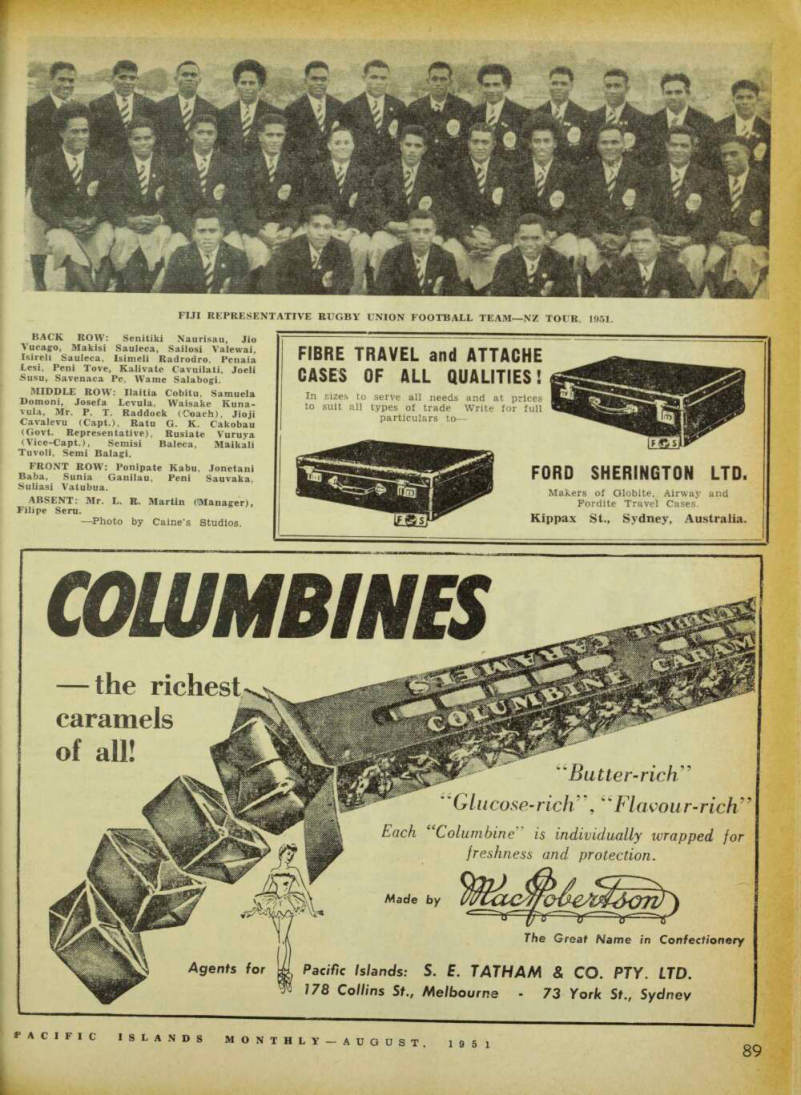
By Vernon Wheatley
Trials and tribulations: It seems that Mr. Pat Savage who, for a while, was thought to be lost at sea is safe —in Queens land.
As Mr. Savage had failed to cor respond with his friend in Santo for nearly a month, it was assumed that he had left Brisbane for Santo and thus was very considerably overdue.
It appears that he had navigator trouble in Brisbane and, when last heard from, Mr. Savage and his vessel were in Maryborough, still without a navigator.
BASTILLE DAY: This French holiday was celebrated under lower ing skies and in heavv rain. The weather was responsible for the curtailment of many activities.
Passing Through: Mrs
Dorothy Sanders, of Norfolk Island travelled on the Morinda to Sydney via the Solomons. She will return to Norfolk on the same ves sel, thus completing the round trio.
Also on board Morinda were Mr. and Mrs. Olliver. Mr. Olliver has relinquished the managership of Hopkins Ltd. on Norfolk Island and is thinking of settling in Queens land.
CONDOMINIUM: The present food shortage in the New Hebrides is not acute, but nevertheless, the Government has authorised the re lease of dollars so that foodstuffs may be imported from America.
FIJI REPRESENTATIVE RUGBY UNION FOOTBALL TEAM—NZ TOUR. 1951.
BACK ROW: Senitiki Naurisau, Jio Vucago, Makisi Sauleca, Sailosi Valewai, Isireli Sauleca, Isimeli Radrodro, Penaia Lesi, Peni Tove, Kalivate Cavuilati, Joeli Susu, Savenaca Pe, Wame Salabogi.
MIDDLE ROW: Ilaitia Cobitu, Samuela Domoni, Josefa Levula. Waisake Kuna vula, Mr. P. T. Raddock (Coach), Jioji Cavalevu (Capt.), Ratu G. K. Cakobau (Govt. Representative), Rusiate Vuruya (Vice-Capt.), Semisi Baleca, Maikali Tuvoli, Semi Balagi.
FRONT ROW: Ponipate Kabu, Jonetani Baba, Sunia Ganilau, Peni Sauvaka, Suliasi Vatubua.
ABSENT: Mr. L. R. Martin (Manager), Filipe Seru. —Photo by Caine’s Studios.
Using a tuning fork as his only instrument, a German scholar, Dr.
Wilhelm Rechnitz, has trained 70 Torres Strait Islanders as choristers.
Within two years, he had the natives singing oratorios and four-part arrangements from Beethoven, Brahms, Schubert and Mendelssohn.
He has been 10 years in Australia, three of them in St. Paul’s Anglican mission in the Torres Islands.
Advertisements & other items, pp. 91-92 (1 item)
Columbines
FIBRE TRAVEL and ATTACHE
GASES OF ALL QUALITIES!
In sizes to serve all needs and at prices to suit all types of trade Write for full particulars to—
FORD SHERINGTON LTD.
Makers of Globite, Airway and Fordite Travel Cases.
Kippax St., Sydney, Australia.
COLUMBINES
the richest
caramels
of all!
mR $ *9 Agents for ‘'Butter-rich” ” Glucose-rich , Flavour-rich”
Each “Columbine is individually wrapped for freshness and protection.
Made by The Great Name in Confectionery Pacific Islands: S. E. TATHAAA & CO. PTY. LTD. 178 Collins St., Melbourne - 73 York St., Sydney
Itch Germs
Cause Killed in 3 Days
Your skin has nearly 50 million tiny seams and pores where germs hide and cause terrible Itching, Cracking, Peeling, Burning, Acne, Ringworm, Psoriasis, Blackheads, Pimples, Foot Itch and other blemishes. Ordinary treatments give only temporary relief because they do not kill the germ cause. The new discovery, Nlxoderm, kills the germs quickly and is guaranteed to give you a soft, clear, attractive, smooth skin, or money back on return of empty package. Get guaranteed Nixoderm from your chemist or store to-day and attack the real cause of many skin troubles.
Nixoderm
For Skin Sores, Pimples and Itch.
A. H. BUNTING LTD.
SAMARAI PAPUA
Branches at; MISIMA, TUFI, ORO BAY, SOPUTA.
SAMARAI AGENTS FOR;—
Vacuum Oil Co. Pty., Ltd.
South British Insurance Co.
National Mutual Life Association
SOLE AGENTS IN PAPUA/NEW GUINEA FOR:
Polarizers (U.K.), Ltd.— Polaroid Sun Glasses.* C.S.A. Industries, Eng.— Dual Freeze Refrigerators.
Webley & Scott, Ltd. —Shot Guns, Air Pistols, etc.
E. K. Cole, Ltd., London. —“Ekco” Radio Receivers.
“Getula.”— Nylon Monofilament Fish Lines.
Davison Paints, Ltd., N.S.W.-Paint for Tropical Conditions. • Trade mark patented in U.S.A., Great Britain, and other countries.
REGULAR SUPPLIES OF EASTERN GOODS
WHOLESALE & RETAIL MERCHANTS IMPORTERS PLANTERS
Deterioration In New Guinea Village Life

Old Planter Criticises Lack of Government and Medical Patrols
SEVERAL correspondents in New Guinea in recent months have commented on a deterioration in native village life, and many blame, for this, the absence of Government and Medical Patrols.
The following communication, from an experienced coconut planter, is typical.
Throughout this District, village life is changing—and it looks as though the 40-hours-week idea has come to them too.
No more is the old “Early to Work” idea practised, and villagers lie abed till the Native Mission Teacher rings a bell and summons the faithful to prayer. By the time the Lotu session is over, and the harassed house-wife has got the family a bit of breakfast, the sun is well up and, at the promise of another hot day, and because of the lateness of the hour, many feel that It really isn’t worth while starting— and they don’t! .
Thus, many villages fail m main taining their houses, keeping then section of roads clean, attending to sanitation and planting the former
amount and variety of native foods that they should for their health’s sake.
As patrols are now so few and far between and done so hurriedly there isn’t much need to worry about the state of the villages. The official rushes through the patrol and hastens back to HQ to fill in the multitude of forms required under the new scheme of things— and which must be rendered “before the end of the month!”
After the official has gone—the villagers probably haven’t seen him before and do not know exactly who or what he represents—the indolent indigenes relapse into a state of happy indifference and chew more betel nut. .
Most villages have a Trade Store” —run by a “Trade Man” who is usually a Native Mission Teacher attempting to augment his stipend, salary or wages, and because of his superior talents!
He buys nuts from the locals for “tabak,” sugar or cash, and he turns them into copra with the help tif his customers and his “school
boys” (who should be learning the three R’s).
This excursion into trading mostly fails, because he has not calculated properly the proper margin of profit. Also, to show his superiority in trading matters, he undersells his rivals with goods. At the end of his venture he sadly remarks: “Me no been win ’im money along this trading—altogether money belong been lose—now War Damages along Bank been finish too.”
He has usually started operations on the War Damages he collected and which had been (mostly) banked for him by a kindly District Officer.
Thus we see that Religion and Commerce can go hand in hand; and, also, the old proverb of “Easy come-Easy go” is illustrated.
By the way, when the United Nations Delegation came to this area last year one of the Mission native teachers complained to Sir Alan Burns that he only got £8 per annum —and “found” himself and family out of that>—after nearly 30 years of bible preaching. He said other less competent but long term Teachers got £5 to £7! Sir A.B, tactfully replied that he should go into that with the Mission.
These men conduct service in the village twice a day (week days) and four times on Sundays. They hammer into the congregation what ever is “the message” from their Missions for that particular month.
You can imagine how their doctrines thus take precedence over the talks of an occasional Government man.
At the village Trade Stores the people buy tin meat, lollies, sweet biscuits, lemonade, and such-like truck, and are becoming a bit con temptuous about kau kau and taro.
Chasing the elusive wild pig or “the possum and the coon” are distinctly ““out” when tins can be had in the store —also, fishing in the rain and the cold is hard work! One can imagine the little Dental Caries laughing gleefully at the prospect of work for them under the new diet.
Those who best know are con cerned at the lack of patrols. The natives say quite openly that the Government is no longer interested in their village life and doings.
Without patrols, the Government official loses touch with the village life; the older generation, who do not go to the Government Stations; and disputes are not settled in the villages as they should be.
Another thing is that the Flag is not hoisted in the villages, and a pep talk not given to the in habitants, unless there are regular patrols.
The Medical patrols should be regular, too, and treatment given in the villages and sanitation properly inspected. No regular hook-worm treatment is now given in the villages. Formerly—“in the bad old days”—hook-worm treatment was given by a Medical Assistant to
every native in the village and to all plantation labourers. This is a most necessary thing. It often makes the difference between a lively and cheery native and a slothful and indifferent native. (Aha! But they are getting co operative movements, religion in large and assorted varieties, and no Returned Soldiers must be allowed to “steal” their land, which is being less and less used.) If there was less of all this humbug
and more attention to TB—which is so rife everywhere—it might be more to the purpose. These Government trained “Native Medical Orderlies” who are allotted a Native Hospital in their own district after returning from training—require much more super vision than they get. They are, increasingly, using their position to gain favours from the younger (and not so young) females.
(Continued on page 93)
Formerly, this was a prerogative of the local “Mission Teacher” but the NMO is now a keen rival in the field!
The infant mortality rate is alarming, and that is basic.
The former regular patrols by the Medical Patrols were (like the old Waverly nib) “a boon and a blessing to men.” Further, they gave the natives a faith and belief in the Government that was worth while.
Now the Mission propaganda is: “The Government doesn’t care two hoots about you but, behold, we are always with you to guide and cheer you.” An ancient—and humorous- Kukurai asked: “What tor Govern ment man no more walk about all same before? What’s the matter ’ere? I tink leg belong all ’e broke?”
Native police are not now supplied for any Medical Patrols. This hampers the Medical man because of difficulty in obtaining carriers, loss of required authority, and loss of prestige. The order is said to have come from Moresby. We also protest against the “pauer war” which glues many officials to their chairs in offices.
Advertisements & other items, pp. 93-94 (1 item)
I Pan A
FOR A DAZZLING
SPARKLING SMILE
TOOTH PASTE
At least twice a day, brush your teeth thoroughly and massage your gums gently—with IPANA. That's he way to a dazzling smile!
IPANA not only cleans and polishes your teeth to sparkling whiteness, it stimulates circulation in the gums . . . keeps them firm and healthy. IPANA guards against decay, because its deep-reaching foam sweeps away germs and food particles.
use
<v to to 9 * * o S o
FOP
pO» p O ft
H£ ALt
You'll like IP refreshingly different!
Sold Everywhere W A product of Bristol-Myers. ®OAfs BM9-51
There is only one
ELECTROLUX
THE MODERN KEROSENE-OPERATED REFRIGERATOR THAT ACHIEVES THE
MIRACLE OF ICE FROM HEAT
Lasting Efficiency, Silent Operation, Streamlined Beauty
■ m ■vm . ■ MB! w ■ 1 I J Economically opera ted by kerosene, with a simple precision-built freezing unit that has no moving parts.
Only obtainable from :
NEW GUINEA COMPANY, LIMITED.
Rabaul, Madang. Lae, Kavieng.
J. R. CLAY & CO.. LTD., Port Moresby.
W. R. CARPENTER & CO. (Sol. Is.). LTD., Tulagi.
THE NORFOLK ISLAND SERVICE DEPOT. Norfolk
Island.
SOCIETE HEBRIDA, Port Vila.
SOCIETE CALEDONIENNE D’IMPORTATION ET
D’EXPORTATION, Noumea.
For Gilbert and Ellice Islands Colony, etc., apply direct to:
GUARANTEED
FOR FIVE (5)
YEARS.
Mode! LKSSI
PRICES ON APPLICATION.
Storage capacity: 5* cub. ft. (approx.); shelf area, 10 sq. ft. Food shelves, six—five removable; 2 self-supporting when half drawn. Icemaking: Four trays—s lb. ice per freezing: 80 cubes. Fuel consumption: 1.8 pints kerosene per day (approx.). Height: 4 ft. 10 in. Depth: 2 ft. 3i in. Weight unpacked, 406 lb. Packed, 574 lb.
W. R. CARPENTER & CO, LTD. Head office: 16 O'Connell Street, Sydney, N.S.W,
Island Residents Get
Away From Nz At Last
Flate July, the Union Steamships Company vessel Matua, carry ing a full union crew, made her first passenger run out of Auckland since February. She called at Suva, Tonga, West Samoa, etc.
With scratch crews Matua has made two trips to the islands recently, but no passengers were carried.
As a consequence of the long hold-up, of Matua and Maui Pomare, which services the Cook Islands, hundreds of Islands residents have been stranded in New Zealand There are long waiting lists for passages on both shins and pre ference is being given to Island resi dents urgently requiring to return home.
After her August run, Matua will be withdrawn for annual survey and will again be off the run for a month or six weeks.
The Public Service Commissioner of Western Samoa reports that the standard of education of local applicants for positions in the Public Service has greatly improved lately, owing to students, educated and trained in New Zealand, now returning to Samoa. Local people have been filling increasingly re sponsible positions for a number of years. Local-born officers are now m charge of the Postal and Customs departments which now have fully local staffs. J
Spoils To The Vanquished
IF, in 1942, a man had said that Japan would eventually be paid for the materials to rebuild New Guinea, he probably would have been labelled a defeatist or worse.
But, in 1951, that is what is hap pening.
By far the greatest proportion of building materials now used in New Guinea comes from Japan, and at exorbitant prices. As one ex ample, iron, which in the normal course of events should come from Australia, is being imported from Japan and is sold at about £290 per ton retail.
The fact is, of course, that if the material were not forthcoming from Japan, New Guinea simply would have to do without it. Aus tralia is incapable of supplying her own domestic wants in any build ing commodity, and is, in fact, im porting also from Japan.
We have reached such a state of national turpitude that few find it strange that, although Japan smashed New Guinea materially, Japanese manufacturers are now reaping huge profits to supply the materials with which to rebuild, it.
Reparations, like many other old fashioned institutions, are now re garded as somewhat wicked. In the case of Japan and the Pacific Islands, however, it should not have been regarded as too reactionary if she had been made to supply the materials and the labour for re storing some of the damage she wantonly caused.
M. Bordarier, General Secretary of the New Caledonian administration, has been appointed Chevalier of the Legion of Honour.
According to reports received in Western Samoa from New Zealand 30 Samoan boys have joined the newly-formed watersiders’ union at Auckland and are pleased to find congenial work at very good rates of pay.
Mr. H. Bonneaud, president of the New Caledonian General Council and managing director of Maison Ballande, has been appointed by the French Minister for Overseas Affairs as one of the French representatives on the South Pacific Commission.
Advertisements & other items, pp. 95-96 (1 item)
Co\tnan s
Mu - a
A. GREGORY PTY. LTD.
IMPORTERS, EXPORTERS AND
MANUFACTURERS
Leather Saddlery and Paint Merchants ALL CLASSES OF LEATHER SUPPLIED FROM STOCK Apply direct to: A. GREGORY PTY. LTD., 107 York St., Sydney
KIDNEY TROUBLE CAUSES
BACKACHE, PUFFY ANKLES
Cystex. Hundreds and hundreds of clinical records prove this.
No Bsnefsl —No Pay
The very first dose of Cystex goes right to work helping your kidneys remove excess acids.
Quicklv. this makes you feel like new again. And so certain are the makers that Cystex will satisfy you completely they ask you to try it under a money back guarantee. You be the judge. If not entirely satisfied just return the empty package and get your money back.
Cystex costs little at chemists and stores and the money back guarantee protects you.
Cystex
The Guaranteed Treatment for
KIDNEYS
BLADDER
RHEUMATISM
If you re feeling out o-sorts, have Interrunted Sleep, or suffer from Dizziness, Nervousness, Backache Leg Pains, Swollen Ankles. Rheumatism, Excess Acidity, or Loss of Energy and feel old before your time, Kidney Trouble is the true cause.
Wrong foods and drinks, worry, colds or overwork may create an excess of acids and place a heavy strain on your kidneys so that they function poorly and need help to properly refresh your blood and maintain health and energy.
Help Kidneys Scientific Way
It has been proven by scientific clinical tests that a quick and sure way to help the kidneys clean out excess acids and poisons is with a scientifically
prepared prescription called
Turned to Good Account
Mt. Lamington Devastation Could Be Turned to Good Account Reader Sees it as 500,000 Acre Grazing Proposition
According to some Rabaui residents, the story that they were anxious to leave the town en masse after they had flown over the devastated area of Mt.
Lamington, is just a figment of Ad ministration wishful-thinking.
Far from being impressed with the devastation, as simple devasta tion, some came back from the ride feeling that it could be turned to good use. One reader has written as follows: “There are half a million acres there of fertilised land just waiting for a crop. The growth is fantas tic and although we were there only a comparatively short time after the eruption, there already was evi dence that the deposit from the volcano is full of plant food.
“All the crops that remained in the ground show remarkable re covery. Bananas were eight and 10 feet high and where couch grass had been planted before the erup tion, the ground was covered with a thick mat of grass nine or 10 inches thick.
“The area is level, although there 1 is, of course, a general slope down to the sea from the volcano. But the blast, or whatever happened, uprooted all the trees, and root holes have since been filled in by erosion. If grass were planted it would probably be necessary for it to be done from a plane.
“But it is potentially a wonderful grazing proposition. I should say that with the rainfall they get there, it would be possible to run about one beast to the acre.
“However, I do not expect that the Administration will do anything with it and in two or three years it will be covered with dense secondary growth which will be costly to clear.”
OUR reader is probably correct on both counts—that is, that if they act quickly something could be done with the area, but that probably nothing will be done.
Government instrumentalities are not given to quick action or the turning of tragedy to some account.
Mt. Lamington and all that goes with it is now regarded as a tambu area. Or a horrible example with which to threaten the recalcitrant residents of Rabaul who seem deter mined to stick to their harbour and their volcanoes.
Advertisements & other items, p. 96 (1 item)
Bovril
Nowadays you
I \
need the strength of
BOVRIL
*->. J ★ Remember BOVRIL makes delicious sandwiches and improves all dishes
Agents: BURNS, PHILP (NEW LTD
The Goldfields
News Notes From
From Our Own Correspondent
A Wau, Ng, July 21.
PATROL to Lake Triste, two days’ walk away from Wau, was recently undertaken by Cadet Patrol-Officer Gordon Smith, who brought back an interesting account of the region plus some
good photographs.
The lake, which is about three miles long and three-quarters of a mile wide, is 7,000 feet above sea level which brings it into the region of the moss forests.
The margin of the lake is lined with reeds, and back from it is a swamp full of decaying timber and trees covered with ropes of hang ing moss.
The whole area is dank and humid.
There is an island an acre in ex tent at the eastern side of the which is said to be the home oi thousands of snakes. Ducks live m or near the lake and. .-judging by the rings on the water, there are plenty of fish. .The lake and adjacent country is the traditional hunting and fishing ground of the Biangai Village people but no one actually lives in the lake area. , ,5 rst ann ual Catholic Ball was held at Wau on July 14. Visi tors from Lae, Mumeng and Bulolo and proceeds, amounting oL went to the newly-opened Church of St. Francis of Assisi.
The late Rev. Father William Bachus, parish priest of Morobe, who lost his life in the crash of the ill-fated Drover on July 16, officially opened the ball.
The district was plunged into gloom when news of the accident reached Wau, and it was learned that Bishop Stephen Appelhans, Fr.
Bachus, Pilot Johnny Spiers and four others had perished.
The Bishop and Father Bachus had been in Wau to consecrate the new church.
The church had been dedicated to the late Father John Glover who was parish priest at Wau before the war and who, during the evacuation of the mainland in 1942, performed miracles in an old plane which he more or less held together with
Faith.
Father Glover was himself killed in an air crash about two years ago.
A games night held in July re sulted in £6O being raised. The money will be used for the paint ing of the War Memorial Hall.
At present visiting Wau is Dr.
W. E. Giblin, affectionately known to goldfields residents as Gibby. He was medical officer here before the war and again for a period shortly after it. More recently he has been at Nondugl.
It is said that he will soon retire and come to live permanently amonast us.
Work on the local golf course is progressing and nine holes will be playable by early September.
Advertisements & other items, pp. 97-98 (2 items)
Pacific Islands Trading Go.
Many Pacific Islands
Traders
Have read oar advertisement In this Magazine, And Then Sent us an Order.
You, too, will profit By placing an order For American-made goods Through our office.
Shipped direct from Mill and Factory to you:
COTTON TOWELS—DRESS MATERIALS—
GROCERIES—HARDWARE—PAINTS—
OILS—FLASHLIGHTS, etc.
PACIFIC ISLANDS TRADING GO.
244 CALIFORNIA STREET, SAN FRANCISCO 11,
CALIFORNIA, U.S.A.
We Want Your Goodwill !
Beat 'em every time
usin’ PLUME
m \ *&h~\ m s 1 pp» -& Whether you are a doctor or not, you will find that there is no better motor spirit than Plume.
from the
PIVME
PUMP
OIL
(VACUUM Vi
COMPANY.\ p m
VACUUM
August. 1951 Pacific Islands Mont H L Ft
American Doctor
Tribute To An American Doctor
WE shall greatly miss Captain Gray (MC)UBN, Navy Senior Medical Officer who, for the past two years was director of Pub lic Health. He and his charming wife were held in high esteem by all those who knew them socially and professionally (writes a resi dent of Eastern Samoa).
Dr. Gray’s forbearance and fair ness in the handling of personal and official problems made him popular and 'were mainly respon sible for the close co-operation of the Public Health employees. He was always ready to lend an ear to any advice for the wellbeing of the people. He established in Manu’a a 15-bed hosoital for the benefit of the 3,000 inhabitants of that iso lated group. These people previously had to travel by boat, when avail able, all the way to Pago Pago for hospital help.
He campaigned actively against TB and X-rayed the whole popu lation —and he had much success!
Several AMP’s, the writer among them, are indebted to Dr. Gray for promotion to the coveted position of District Health Officer formerly held only by Navy Doctors and Chief Corpsmen. His personal in terest in the problems of the AMP’s fostered their highest regard.
Dr. and Mrs. Gray have gone, but they carry with them the Samoan people’s gratitude for a job well done. We bid them “Tofa ma ia Manuia” (Good-bve and good luck).
Death Of Leading
Samoan Chief
ONE of the most respected high chiefs of Western Samoa, Polito Atoa, died on July 20, at the age of 71.
Flags at Apia were flown at half mast on the day of the funeral and a large and representative gathering paid their last respects to one of Samoa’s well-beloved “old-timers.”
As chief and as an employee of the firm of Q. F. Nelson & Co. Ltd., Polito Atoa played an important part in Samoan history during the
first half-century.
He was a friend and confidant of the late O. F. Nelson, and also took a leading part in the affairs of the Methodist Church in Samoa.
He leaves a wife, three sons and five daughters.
Twin sons were recently born to the Rev. and Mrs. Douglas Teller of the Methodist Mission in Fiji
Death Of R. H. C. Bentley
Mr. Richard H. C. Bentley
(generally known as Dick Bentley) died in Suva in July.
He was 65.
He was the eldest son of the late Mr. Robert Henry Crawford Bentley and a brother of Mr. L. C. Bentley, well known businessman of Suva.
He was a champion runner and a keen cricketer and tennis player during his youth, and was held in high regard throughout the Colony for his warm and genial nature.
Mr. Bentley is survived by hia widow, a son and three daughters.
His eldest son, Richard, was killed in the Middle East during the last war.
Islands Girl Guides For
Big Sydney Camp
FIVE hundred Girl Guides, from 32 countries, and representing 3,000,000 Girl Guides, will go into camp at Narrabeen, near Sydney, on August 27, for ten days.
It is part of the Jubilee celebrations, and it is the first international camp of this kind held in Australia.
Among the countries to be repre sented by special delegations are Papua-New Guinea, the Philippines, North Borneo and Indonesia.
Sydney is manifesting the liveliest interest in this unusual gathering.
PIIVL’s Assistant Editor, Mrs. Judy Tudor, will visit Fiji and Samoa in August-September.
Advertisements & other items, pp. 99-100 (1 item)
Pianos
C. J. and G. W. SIMMONS,
Piano Builders and Tuners,
SYDNEY.
To Islands Pianos
in of Repair
Our experts are planning a Pacific Islands business trip to tune and repair pianos in the South Seas Territories please send us details of your requirements by airmail, as soon as possible, so that we may include your centre or port in our itinerary.
We have had over 20 years' experience in repairing, building and supplying pianos to residents in the Islands, Australia and New Zealand.
Our fees are moderate and ail work is first-class.
SATISFACTION IS ASSURED
Reply to:
C. J. and G. W. SIMMONS
e/o Box 3408, G.P.0., Sydney, N.S.W., Australia.
POSTAGE STAMP DEALERS
AND COLLECTORS.
London wholesaler requires AGENTS in
all BRITISH COLONIES in the PACIFIC,
for regular supplies of used postage stamps from MISSIONARIES, BANKS
and SHIPPING OFFICES.
Current London market prices will be paid for all clean usable material.
Remittances by Air for all sendings valued £2 and over.
B. SAVITZ, 8.P.A.,
09 Greenvale Road, Eltham, London, 5.E.9, Eng.
a ri i B S 2
EXPORTE
ISIS
mo; a All classes of merchandise purchased for Islands clients, throughout the South-west Pacific.
Islands produce sold on Australian and overseas markets on a commission basis.
ROBERT GILLESPIE PTY.LTD.
54a PITT ST. SYDNEY
CABLE ADDRESS “ROBERGILL'SYDNEY PHONE 8U2221
Suckling
Death Of Mrs. A. M.
Mrs. allice m. suckling, well-known in Fiji for her work in the Child Welfare scheme, and later matron of the Taveuni hospital, died suddenly in Suva on July 30. Her husband, a Methodist missionary, died in 1918.
One of their sons, Mr. John Suck ling, is an Agricultural Officer in the Solomon Islands.
A school has been built at the new Lutheran mission station at Kura Kura, NG Central Highlands.
That Anti-Polynesian
Law
(A Letter to the Editor) 1 NOTICED in the May issue of the PIM an article about Poly nesians and part-Polynesians being barred from permanent resi dence in New Zealand and Australia.
Some of these laws are ridiculous.
I am part-Polynesian. My father was full European (American) and my mother was half-European, (American father and Tahitian mother). When I first visited Sydney, in July, 1912, I was a member of the Purser's staff of the Oceanic liner Sonoma; and, in the ship’s articles, my birthplace was shown as Tahiti. The immigration officials promptly rated me as a coloured person, and put me on the prohibited list.
I did not get caught in that way again. Next time, I insisted on be ing an American, and when they wanted to cross-examine me about my quarter mixture of Tahitian blood, I pointed out that in America an American is a free man, no matter what his racial make-up may be.
If New Zealand does not want to admit me, because I have a quarter mixture of Polynesian blood, that is OK by me. I am perfectly happy to be classed as a Tahitian. I con sider Tahiti a place much to be preferred to New Zealand; and I like to remember that New Zealand was first discovered and colonised by Tahitians —those fine navigators who travelled there in the famous canoe Tainui, more than 640 years ago.
I am, etc.,
Oscar Nordman
Papeete, 25/7/1951.
Territories
Fate Of The
Hospital Plan
AN Australian political columnist,,; writing on July 31, remarked!: that the Commonwealth Gov- ernment, greatly troubled by thee economic crisis in that country, had£ thrown out of the Cabinet room al- most every proposal involving heavy y public expenditure. He proceeded: “Ministers other than Service', e Ministers had to endure similar re- buffs for their lesser schemes..
Territories Minister Paul Hasluck had a scheme for hospitalisation ino New Guinea and Papua that was a quite imposing. But it had what f.
Cabinet in its present mood con siders to be a major defect —it would b cost money.”
The Rev. M. G. Check of theei LMS, Niue Is., was receiving medi cal treatment in NZ in August.
15 Days' Drift

Polynesian Boatmen Can “Take It”
From Our Own Correspondent
Papeete, July 26.
ON May 15, five adults and a boy of nine, in a flat-bottomed boat 16 feet long, with an out board motor, left Tikehau Island for Mataiva Island, 28 miles away.
Half way across, the motor stopped. They had forgotten to take along their drum of petrol.
They bagan to drift helplessly.
They had exactly 3 cans of corned beef, 1 gallon of fresh water, a loaf of bread and one coconut.
Six days later, when they were very hungry, they caught two fish—which gave them bait for more fish. A welcome shower provided them with fresh water.
Fifteen days later, their boat drifted onto the reef of Belling hausen island. 3770 miles from Tikehau, and they got safely ash«re.
On July 21, the fishingboat Temanuroa, with four men, left Haapiti, in Moorea, for Papeete, with a load of fish. A large wave broke aboard, and put the engine completely out of service. The boat began to drift away from land. Two men, risking the sharks, swam two miles to the Moorea coast. A relief boat went out and found the
Temanuroa. towed her to port, fixed the engine—and the cargo of fish reached Papeete, none the worse.
The Archbishop of Sydney, Dr. H.
W. K. Mowll and Mrs. Mowll were in Papua in early August for the Anglican Mission’s 60th anniversary services.
Mr. R. S. Richards, Administrator of Nauru, with Mrs. Richards., arrived in Adelaide on a short visit in early July. The Administrator later attended to official business in Melbourne and Canberra and sailed for Nauru on July 17. The south ward journey was made in a RAAF plane which flew via Guadalcanal, Port Moresby and Townsville.
Advertisements & other items, pp. 101-102 (1 item)
Tru'wite
No Whiter White in All
Australasia — It’s the Best!
V m High density, economical covering power imparts fresh-from-the-shop Newness. A super finish for Canvas, Kid, Suede, Nubuc and White Lacquered shoes, giving a dazzling whiteness which, when dry polished after thorough drying, WILL NOT
CRACK OR RUB OFF?
TRU'WITE
THE IDEAL WHITE LEATHER CLEANER
Sole Agent R. E. Strachan Ltd. C. P. O. Box 339, Auckland. N.Z.
CANNED MEATS
Supplies are now available for export to all Pacific Islands, in
the following packs:
BEEF WITH CEREAL (16 oz. and 12 oz.); STEWED STEAK (16 oz and 12 oz ) • BRAISED STEAK AND ONIONS (16 oz.); BEEF STEAK PUDDING (16 oz.) ; ROAST BEEF
AND BOILED BEEF (12 oz.).
Address All Inquiries to: —
SYDNEY MEAT PRESERVING CO. (LTD.)
(ESTABLISHED 1870)
Parramatta Rd., Auburn, N.S.W. —P.O. Box 40, Auburn Phone, UX6611. Cable Address: “Meatwalk,” Sydney.
CASH
for
SCRAP METALS
HIGHEST PRICES F.0.W.. NEW GUINEA
Shells Cartridges Copper Brass Radiators Cable Aluminium Lead Muntz Metal Steel Rails Pipe ★ Wilford Street, Newtown, N.S.W.
LA 5111 LA 5111
BRANCHES THROUGHOUT N.S.W., VICTORIA & STH. AUSTRALIA Leader of the Secondary Metal Industry for 30 Years Telegraphic Address. "SCRAPMETAL," Sydney
Shipping Time-Tables
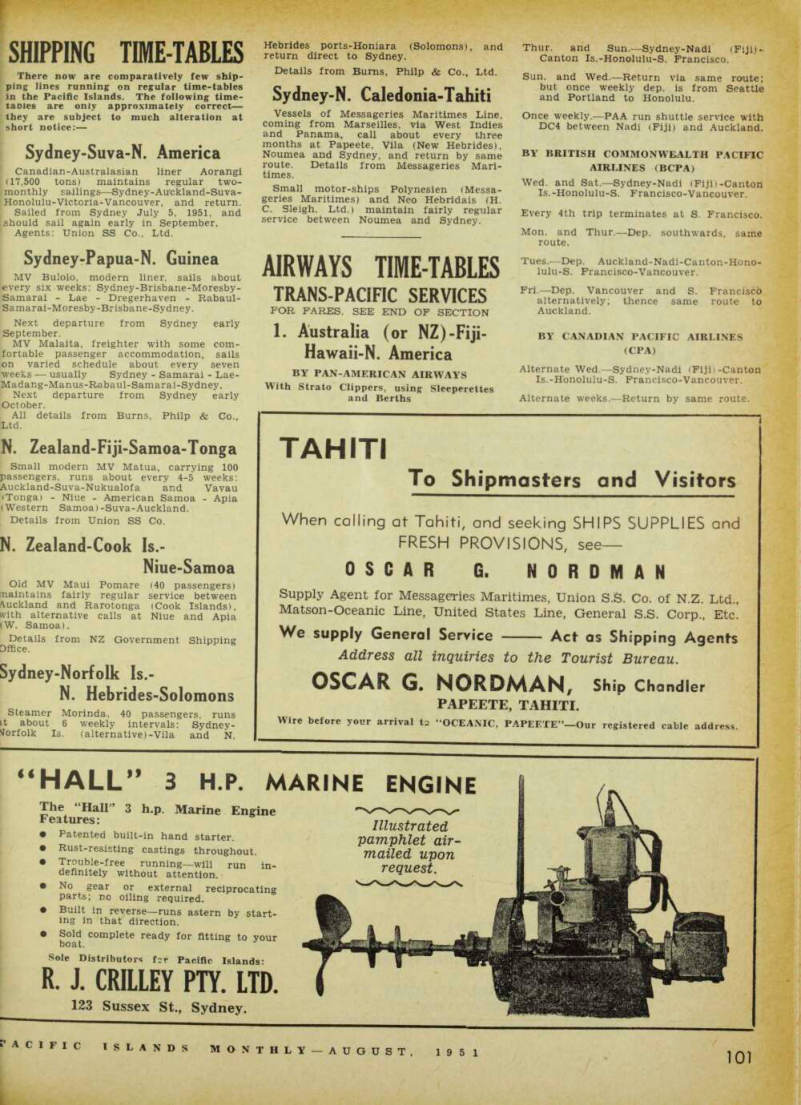
There now are comparatively few ship ping lines running on regular time-tables in the Pacific Islands. The following time taoies are only approximately correct— they are subject to much alteration at short notice:—
Sydney-Suva-N. America
Canadian-Australasian liner Aorangi (17,500 tons) maintains regular two [ monthly sailings—Sydney-Au'ckland-Suva- I Honolulu-Victoria-Vancouver, and return.
Sailed from Sydney July 5. 1951, and I should sail again early in September.
Agents: Union SS Cos.. Ltd.
Sydney-Papua-N. Guinea
j MV Bulolo, modern liner, sails about every six weeks: Sydney-Brisbane-Moresby- Samarai - Lae - Dregerhaven - Rabaul- Samarai-Moresby-Brisbane-Sydney.
Next departure from Sydney early September.
MV Malaita, freighter with some com fortable passenger accommodation, sails on varied schedule about every seven weeks usually Sydney - Samarai - Lae- Madang-Manus-Rabaul-Samarai-Sydney.
Next departure from Sydney early October.
All details from Burns, Philp & Cos., Ltd.
N. Zealand-Fiji-Samoa-Tonga
Small modern MV Matua, carrying 100 passengers, runs about every 4-5 weeks: Auckland-Suva-Nukualofa and Vavau (Tonga) - Niue - American Samoa - Apia (Western Samoa)-Suva-Auckland.
Details from Union SS Cos.
N. Zealand-Cook Is.-
Niue-Samoa
Old MV Maui Pomare (40 passengers) maintains fairly regular service between Auckland and Rarotonga (Cook Islands), svith alternative calls at Niue and Apia (W. Samoa).
Details from NZ Government Shipping Office.
Sydney-Norfolk Is.-
N. Hebrides-Solomons
Steamer Morinda, 40 passengers, runs it about 6 weekly intervals: Sydney- Norfolk Is. (alternative)-Vila and N.
Hebrides ports-Honiara (Solomons), and return direct to Sydney.
Details from Burns, Philp & Co., Ltd.
Sydney-N. Caledonia-Tahiti
Vessels of Messageries Maritlmes Line, coming from Marseilles, via West Indies and Panama, call about every three months at Papeete, Vila (New Hebrides), Noumea and Sydney, and return by same route. Details from Messageries Mari times.
Small motor-ships Polynesien (Messa geries Maritimes) and Neo Hebridais (H.
C. Sleigh. Ltd.) maintain fairly regular service between Noumea and Sydney.
Airways Time-Tables
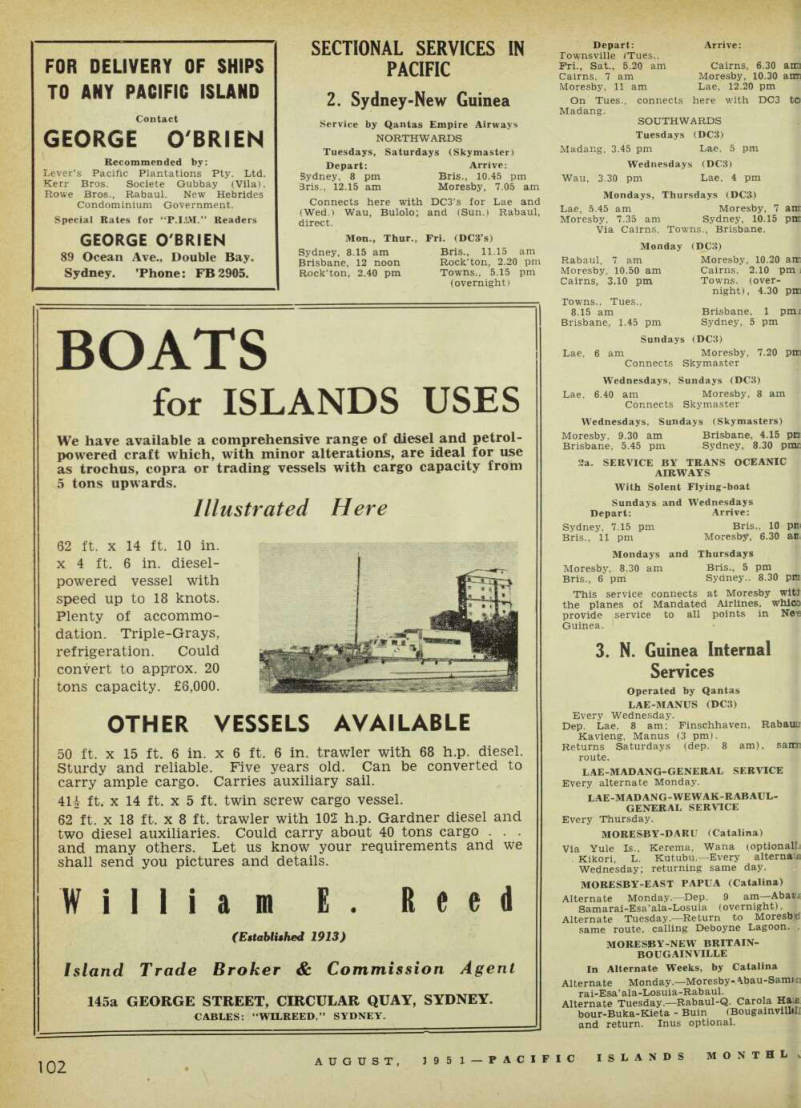
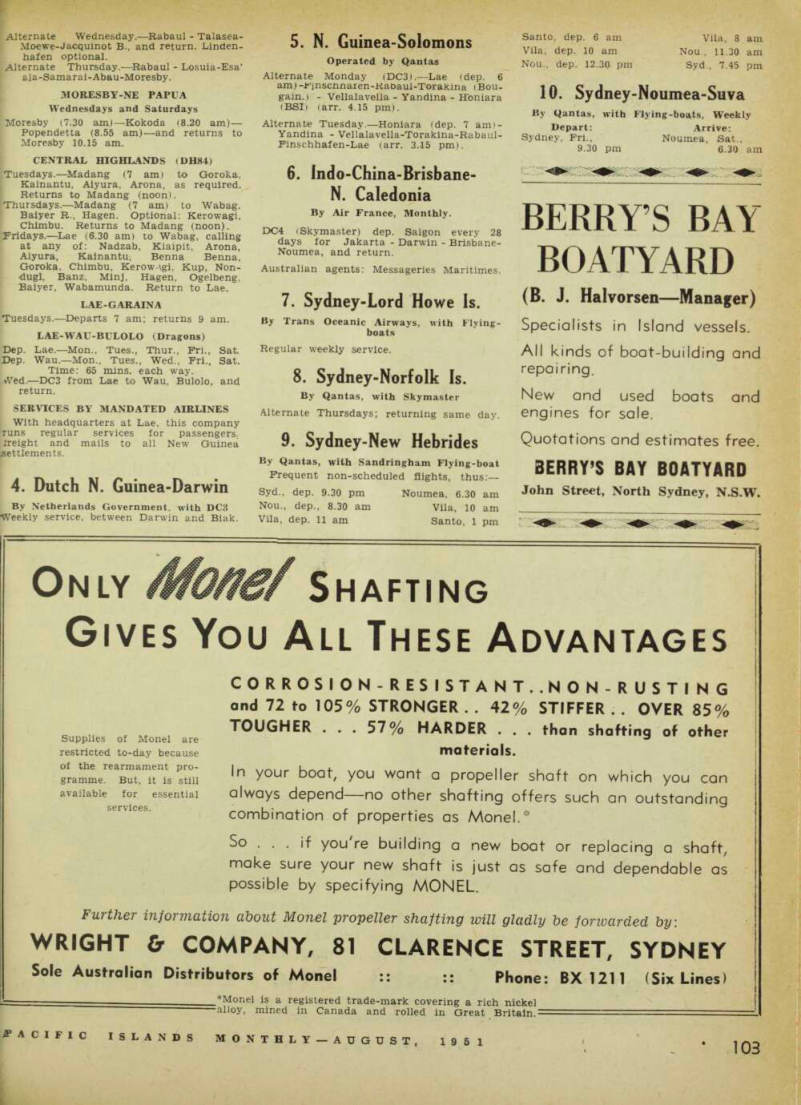
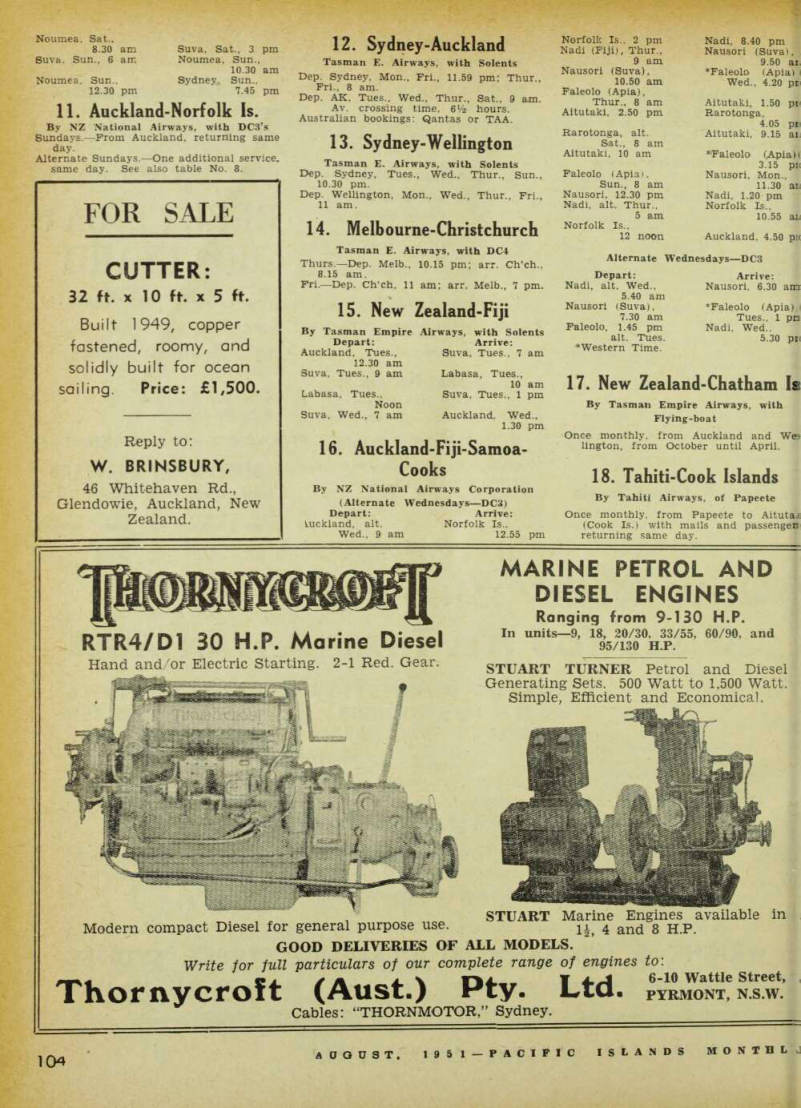
Trans-Pacific Services
For Pares. See End Op Section
1. Australia (or NZ)-Fiji-
Hawaii-N. America
By Pan-American Airways
With Strato Clippers, using Sleeperettes and Berths
Thur. and Sun.—Sydney-Nadi (Fiji)- Canton Is.-Honolulu-S. Francisco.
Sun. and Wed.—Return via same route; but once weekly dep. is from Seattle and Portland to Honolulu.
Once weekly.—PAA run shuttle service with DC4 between Nadi (Fiji) and Auckland.
By British Commonwealth Pacific
Airlines (Bcpa)
Wed. and Sat.—Sydney-Nadi (Fiji)-Canton Is.-Honolulu-S. Francisco-Vancouver.
Every 4th trip terminates at S. Francisco.
Mon. and Thur.—Dep. southwards, same route.
Tues.-—Dep. Auckland-Nadi-Canton-Hono lulu-S. Francisco-Vancouver.
Fri.—Dep. Vancouver and S. Francisco alternatively; thence same route to Auckland.
By Canadian Pacific Airlines
(Cpa)
Alternate Wed.—Sydney-Nadi (Fiji i-Canton Is.-Honolulu-S. Francisco-Vancouver.
Alternate weeks.—Return by same route.
Sectional Services In
Pacific
2. Sydney-New Guinea
Service by Qantas Empire Airways
Northwards
Tuesdays, Saturdays (Skymaster) Depart: Arrive: Sydney, 8 pm Bris., 10.45 pm Bris., 12.15 am Moresby, 7.05 am Connects here with DC3’s for Lae and (Wed.) Wau, Bulolo; and (Sun.) Rabaul, direct.
Mon., Thur., Fri. (DCS’s) Sydney, 8.15 am Bris., 11.15 am Brisbane, 12 noon Rock’ton, 2.20 pm Rock’ton, 2.40 pm Towns., 5.15 pm (overnight)
Depart: Arrive: Townsville (Tues., Fri., Sat., 5.20 am Cairns, 6.30 ann Cairns. 7 am Moresby, 10.30 am Moresby, 11 am Lae, 12.20 pm On Tues., connects here with DCS to Madang.
Southwards
Tuesdays (DCS) Madang, 3.45 pm Lae, 5 pm Wednesdays (DCS) Wau, 3.30 pm Lae, 4 pm Mondays, Thursdays (DCS) Lae, 5.45 am Moresby, 7 am Moresby, 7.35 am Sydney, 10.15 pnr Via Cairns. Towns., Brisbane.
Monday (DCS) Rabaul, 7 am Moresby, 10.20 anr Moresby, 10.50 am Cairns, 2.10 pm j Cairns, 3,10 pm Towns, (over night), 4.30 pm Towns., Tues., 8.15 am Brisbane, 1 pnu Brisbane, 1.45 pm Sydney, 5 pm Sundays (DCS) Lae, 6 am Moresby, 7.20 pm Connects Skymaster Wednesdays, Sundays (DCS) Lae, 6.40 am Moresby, 8 am Connects Skymaster Wednesdays, Sundays (Skymasters) Moresby, 9.30 am Brisbane, 4.15 pn Brisbane, 5.45 pm Sydney, 8.30 pmc
2A. Service By Trans Oceanic
Airways
With Solent Flying-boat Sundays and Wednesdays Depart: Arrive: Sydney, 7.15 pm Bris., 10 pm Bris., 11 pm Moresby, 6.30 an Mondays and Thursdays Moresby, 8.30 am Bris., 5 pm Bris., 6 pm Sydney.. 8.30 pm This service connects at Moresby witi the planes of Mandated Airlines, whico provide service to all points in Ne’e Guinea.
3. N. Guinea Internal
Services
Operated by Qantas
Lae-Manus (Dcs)
Every Wednesday.
Dep. Lae, 8 am; Finschhaven, Rabauu Kavieng, Manus (3 pm).
Returns Saturdays (dep. 8 am), sairn route.
Lae-Madang-General Service
Every alternate Monday.
Lae-Mad Ang-Wewak-Rabaul
General Service
Every Thursday.
MORESBY-DARU (Catalina) Via Yule Is.. Kerema, Wana . Kikori, L. Kutubu. —Every alterna'fi Wednesday: returning same day.
Moresby-East Papua (Catalina)
Alternate Monday.—Dep. 9 am—Abavi
Samarai-Esa’ala-Losuia (overnight).
Alternate Tuesday—Return to Moresby same route, calling Deboyne Lagoon, .
Moresby-New Britain
Bougainville
In Alternate Weeks, by Catalina
Alternate Monday.—Mtoresby-Abau-Sanun
rai-Esa’ala-Losuia-Rabaul.
Alternate Tuesday.—Rabaul-Q. Carola bour-Buka-Kieta - Buin (Bougainvilui. and return. Inus optional.
Alternate Wednesday.—Rabaul - Talasea- Moewe-Jacquinot 8., and return. Linden hafen optional.
Alternate Thursday.—Rabaul - Losuia-Esa’ ala-Samarai-Abau-Moresby.
Moresby-Ne Papua
Wednesdays and Saturdays Moresby (7.30 am) —Kokoda (8.20 am) Popendetta (8.55 am) —and returns to Moresby 10.15 am.
Central Highlands (Dhb4)
[Tuesdays. —Madang (7 am) to Goroka, Kainantu, Alyura, Arena, as required.
Returns to Madang (noon).
Thursdays.—Madang (7 am) to Wabag.
Baiyer R., Hagen. Optional: Kerowagi.
Chimbu. Returns to Madang (noon).
Fridays.—Lae (6.30 am) to Wabag, calling at any of: Nadzab, Kiaipit, Arena, Aiyura, Kainantu, Benna Benna, Goroka. Chimbu, Kerowagi, Kup, Non dugl, Banz, Mlnj, Hagen, Ogelbeng, Baiyer. Wabamunda. Return to Lae.
Lae-Garaina
Tuesdays.—Departs 7 am; returns 9 am.
LAE-WAU-BULOLO (Dragons) Dep. Lae.—Mon., Tues., Thur., Pri., Sat.
Dep. Wau.—Mon., Tues., Wed., Fri., Sat.
Time: 65 mins, each way.
Wed.—DCS from Lae to Wau, Bulolo, and return.
Services By Mandated Airlines
With headquarters at Lae, this company runs regular services for passengers : freight and mails to all New Guinea
4. Dutch N. Guinea-Darwin
By Netherlands Government, with DCS Weekly service, between Darwin and Biak.
5. N. Guinea-Solomons
Operated by Qantas Alternate Monday (DC3). —Lae (dep. 6 am) -finscnnaien-Kabaul-Torakina (Bou gain.)- Vellalavella - Yandina - Honiara (BSI( (arr. 4.15 pm).
Alternate Tuesday.—Honiara (dep. 7 ami- Yandina - Vellalavella-Toraklna-Rabaul- Pinschhafen-Lae (arr. 3.15 pm).
6. Indo-China-Brisbane-
N. Caledonia
By Air France, Monthly.
DC4 (Skymaster) dep. Saigon every 28 days for Jakarta - Darwin - Brisbane- Noumea, and return.
Australian agents; Messageries Maritimes.
7. Sydney-Lord Howe Is.
By Trans Oceanic Airways, with Flying boats Regular weekly service.
8. Sydney-Norfolk Is.
By Qantas, with Skymaster Alternate Thursdays; returning same day.
9. Sydney-New Hebrides
By Qantas, with Sandringham Flying-boat Frequent non-scheduled flights, thus:— Syd., dep. 9.30 pm Noumea, 6.30 am Nou., dep., 8.30 am Vila, 10 am Vila, dep. 11 am Santo, 1 pm
Santo, dep. 6 am Vila, 8 am Vila, dep. 10 am Nou., 11.30 am Nou., dep. 12.30 pm Syd., 7.45 pm
10. Sydney-Noumea-Suva
By Qantas, with Flying-boats, Weekly Depart: Arrive: Sydney, Fri., Noumea, Sat., 9.30 pm 6.30 am
Noumea. Sat.. 8.30 am Suva, Sat., 3 pm Suva. Sun., 6 am Noumea, Sun., 10.30 am Noumea, Sun.. Sydney, Sun., 12.30 pm 7.45 pm
11. Auckland-Norfolk Is.
By NZ National Airways, with DC3’s Sundays.—From Auckland, returning same day.
Alternate Sundays.—One additional service, same day. See also table No. 8.
12. Sydney-Auckland
Tasman E. Airways, with Solents Dep. Sydney. Mon., Fri., 11.59 pm; Thur., Fri., 8 am.
Dep. AK, Tues., Wed., Thur., Sat., 9 am.
Av. crossing time, 6V 2 hours.
Australian bookings: Qantas or TAA.
13. Sydney-Wellington
Tasman E. Airways, with Solents Dep. Sydney, Tues., Wed., Thur., Sun., 10.30 pm.
Dep. Wellington, Mon., Wed., Thur., Fri., 11 am.
14. Melbourne-Christchurch
Tasman E. Airways, with DC4 Thurs. —Dep. Melb., 10.15 pm; arr. Ch’ch., 8.15 am.
Fri.—Dep. Ch’ch, 11 am; arr. Melb., 7 pm.
15. New Zealand-Fiji
By Tasman Empire Airways, with Solents Depart: Arrive: Auckland, Tues., Suva, Tues., 7 am 12.30 am Suva, Tues., 9 am Labasa, Tues., 10 am Labasa, Tues., Suva, Tues., 1 pm Noon Suva, Wed., 7 am Auckland, Wed., 1.30 pm
16. Auckland-Fiji-Samoa-
Cooks
By NZ National Airways Corporation (Alternate Wednesdays—DCS) Depart: Arrive: Auckland, alt. Norfolk Is..
Wed., 9 am 12.55 pm
Norfolk Is.. 2 pm Nadi, 8.40 pm Nadi (Fiji), Thur., Nausori (Suva). , 9 am 9.50 ar.
Nausori (Suva), *Faleolo (Apia) ( 10.50 am Wed., 4.20 pn Faleolo (Apia), Thur., 8 am Aitutaki, 1.50 pz< Aitutaki, 2.50 pm Rarotonga, 4.05 pn Rarotonga, alt. Aitutaki, 9.15 au Sat., 8 am Aitutaki, 10 am ‘Faleolo (Apia)( 3.15 pi< Faleolo (Apia), Nausori, Mon., Sun., 8 am 11.30 au Nausori, 12.30 pm Nadi, 1.20 pm Nadi, alt. Thur., Norfolk Is.. 5 am 10.55 au Norfolk Is.. 12 noon Auckland, 4.50 pic Alternate Wednesdays—DCS Depart: Arrive: Nadi, alt. Wed., Nausori, 6.30 am 5.40 am Nausori (Suva). ‘Faleolo (Apia) i 7.30 am Tues., 1 pn Faleolo, 1.45 pm Nadi, Wed., alt. Tues. 5.30 pn ‘Western Time.
17. New Zealand-Chatham Is
By Tasman Empire Airways, with Flying-boat Once monthly, from Auckland and Wes lington, from October until April.
18. Tahiti-Cook Islands
By Tahiti Airways, of Papeete Once monthly, from Papeete to (Cook Is.) with mails and passengerr returning same day.
Advertisements & other items, pp. 103-106 (3 items)
R. J. Crilley Pty. Ltd.
TAHITI
To Shipmasters and Visitors
When calling at Tahiti, and seeking SHIPS SUPPLIES and
FRESH PROVISIONS, see—
OSCAR G. NORDMAN
Supply Agent for Messageries Maritimes, Union S.S. Co. of N.Z. Ltd., Matson-Oceanic Line, United States Line, General S.S. Corp., Etc.
We supply General Service Act as Shipping Agents Address all inquiries to the Tourist Bureau.
OSCAR G. NORDMAN, Ship Chandler
PAPEETE, TAHITI.
Wire before your arrival “OCEANIC, PAPEETE”—Our registered cable address.
a
HALL” 3 H.P. MARINE ENGINE
3 h.p. Marine Engine The “Hall Features: • Patented built-in hand starter. • Rust-resisting castings throughout. • Trouble-free running—will run indefinitely without attention, • No gear or external reciprocating parts; no oiling required. • Built in reverse—runs astern by starting in that direction. • Sold complete ready for fitting to your boat.
Sole Distributors fcr Pacific Islands;
R. J. CRILLEY PTY. LTD.
123 Sussex St., Sydney.
Illustrated
pamphlet air-
mailed upon request.
FOR DELIVERY OF SHIPS
TO ANY PACIFIC ISLAND
Contact
GEORGE O'BRIEN
Recommended by: Lever’s Pacific Plantations Pty. Ltd.
Kerr Bros. Societe Gubbay (Vila).
Rowe Bros., Rabaul. New Hebrides Condominium Government.
Special Rates for “P.1.LV1.” Readers
GEORGE O'BRIEN
89 Ocean Ave., Double Bay.
Sydney. ’Phone: F 82905.
BOATS
for ISLANDS USES
We have available a comprehensive range of diesel and petrolpowered craft which, with minor alterations, are ideal for use as trochus, copra or trading vessels with cargo capacity from 5 tons upwards.
Illustrated Here
62 ft. x 14 ft. 10 in. x 4 ft. 6 in. dieselpowered vessel with speed up to 18 knots.
Plenty of accommodation. Triple-Grays, refrigeration. Could convert to approx. 20 tons capacity. £B,OOO.
LIT « «
OTHER VESSELS AVAILABLE
50 ft. x 15 ft. 6 in. x 6 ft. 6 in. trawler with 68 h.p. diesel.
Sturdy and reliable. Five years old. Can be converted to carry ample cargo. Carries auxiliary sail. 41i ft. x 14 ft. x 5 ft. twin screw cargo vessel. 62 ft. x 18 ft. x 8 ft. trawler with 102 h.p. Gardner diesel and two diesel auxiliaries. Could carry about 40 tons cargo . . . and many others. Let us know your requirements and we shall send you pictures and details.
William E. Reed
(Established 1913)
Island Trade Broker & Commission Agent
145 a GEORGE STREET, CIRCULAR QUAY, SYDNEY.
CABLES: “WILREED,” SYDNEY.
BERRY’S BAY
BOATYARD
(B. J. Halvorsen—Manager)
Specialists in Island vessels.
All kinds of boat-building and repairing.
New and used boats and engines for sale.
Quotations and estimates free.
BERRY’S BAY BOATYARD
John Street, North Sydney, N.S.W.
Only M Shafting
Gives You All These Advantages
Supplies of Monel are restricted to-day because of the rearmament programme. But, it is still available for essential services.
CORROSION-RESISTANT. .NON-RUSTING
and 72 to 105% STRONGER . . 42% STIFFER . . OVER 85% TOUGHER . . . 57% HARDER . . , than shafting of other materials.
In your boat, you want a propeller shaft on which you can always depend no other shafting offers such an outstanding combination of properties as Monel.* So ... if you're building a new boat or replacing a shaft, make sure your new shaft is just as safe and dependable as
possible by specifying MONEL.
Further information about Monel propeller shafting will gladly be forwarded by.
WRIGHT & COMPANY, 81 CLARENCE STREET, SYDNEY Sole Australian Distributors of Monel :: :: Phone: BXI2II (Six Lines) *Monel is a registered trade-mark covering a rich nickel ■alloy, mined in Canada and rolled in Great Britain. 1
FOR SALE
CUTTER:
32 ft. x 10 ft. x 5 ft.
Built 1949, copper fastened, roomy, and solidly built for ocean sailing. Price: £1,500.
Reply to:
W. BRINSBURY,
46 Whitehaven Rd., Glendowie, Auckland, New Zealand.
RTR4/D1 BO H.P. Marine Diesel
Hand and/or Electric Starting. 2-1 Red. Gear.
MARINE PETROL AND
DIESEL ENGINES
Ranging from 9-130 H.P.
In units—9, 18, 20/30, 33/55, 60/90, and 95/130 H.P. ‘I ills ; a STUART TURNER Petrol and Diesel Generating Sets. 500 Watt to 1,500 Watt.
Simple, Efficient and Economical. , STUART Marine Engines available in Modern compact Diesel for general purpose use. 4 and 8 HP
GOOD DELIVERIES OF ALL MODELS.
Write for full particulars of our complete range of engines to: Thorny croft (Aust.) Pty. Ltd. PYRMONT, N.S.W.
Cables: “THORNMOTOR,” Sydney.
102
AUGUST, 1951 PACIFIC ISLANDS MONTHL
104
AUGUST, 1951 PACIFIC ISLANDS MONTHL
Approximate Airways Fares
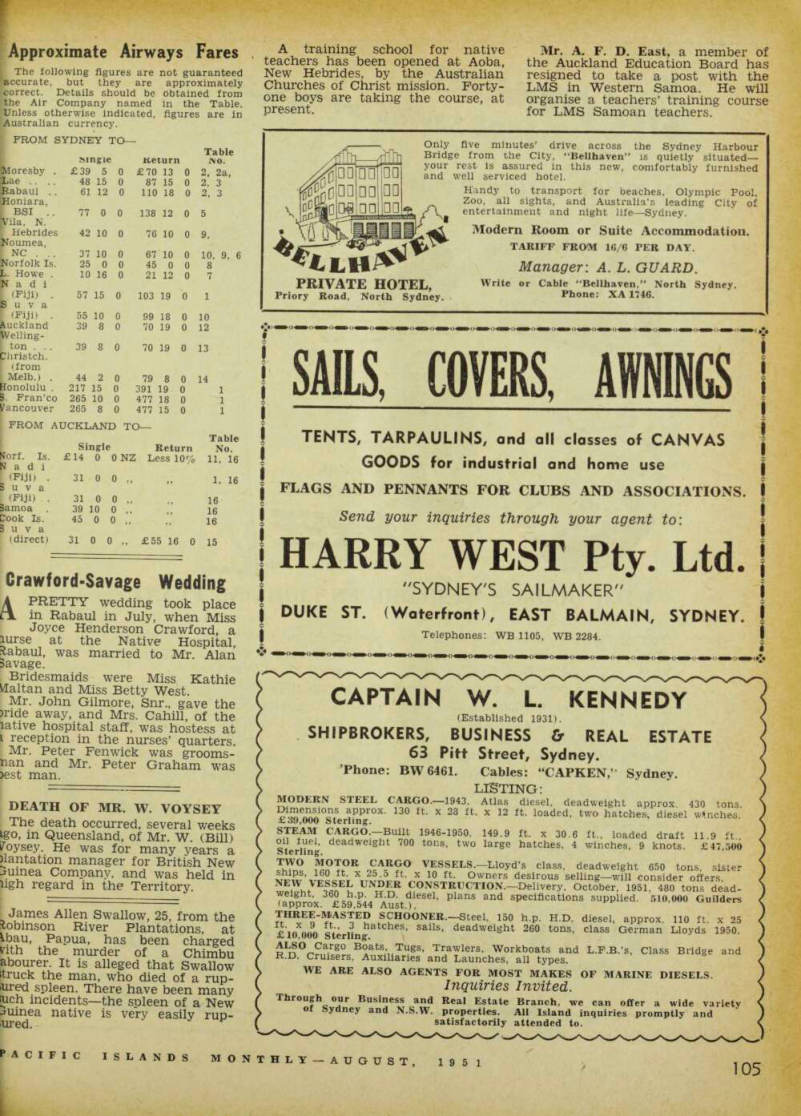
I The following figures are not guaranteed but they are approximately Details should be obtained from [the Air Company named in the Table.
Unless otherwise indicated, figures are in
[Australian currency.
I From Sydney To
single tteturn Table
Xno.
Moresby . £39 5 0 £70 13 0 2, 2a, SLae . . . . 48 15 0 87 15 0 2, 3 SRabaul .. 61 12 0 110 18 0 2, 3 Honiara,
1 Bsi
77 0 0 138 12 0 5
[Vila, N.
[ Hebrides 42 10 0 76 10 0 9,
Noumea,
[ NC . 37 10 0 67 10 0 10, 9, 6 Norfolk Is. 25 0 0 45 0 0 8
t. Howe .
10 16 0 21 12 0 7 Nadi
[ (Fiji) .
57 15 0 103 19 0 1 Suva
[ (Fiji) .
55 10 0 99 18 0 10 Auckland 39 8 0 70 19 0 12 welling-
1 ton . ..
39 8 0 70 19 0 13 bhristch.
I (from
I Melb.) .
44 2 0 79 8 0 14 Honolulu . 217 15 0 391 19 0 1 B. Fran’co 265 10 0 477 18 0 1 Vancouver 265 8 0 477 15 0 1
From Auckland To —
Single Return Korf. Is. £14 0 ONZ Less 10% Table No. 11, 16 Nadi
[ (Fiji) .
31 0 0 , 1, 16 Suva (Fiji) . 31 0 0 , 16 Samoa 39 10 0 , 16 book Is. 45 0 0 ,, 16 Suva ; (direct) 31 0 ( ) £55 16 0 15
Crawford-Savage Wedding
A PRETTY wedding took place in Rabaul in July, when Miss Joyce Henderson Crawford, a lurse at the Native Hospital, itabaul, was married to Mr. Alan savage.
Bridesmaids were Miss Kathie Saltan and Miss Betty West.
Mr. John Gilmore, Snr., gave the )nde away, and Mrs. Cahill, of the lative hospital staff, was hostess at i reception in the nurses’ quarters.
Mr. Peter Fenwick was grooms nan and Mr. Peter Graham was >est man.
Death Of Mr. W. Voysey
The death occurred, several weeks igo, in Queensland, of Mr. W. (Bill) ifoysey. He was for many years a )lantation manager for British New .minea Company, and was held in ligh regard in the Territory.
James Allen Swallow, 25, from the tobmson River Plantations, at U)au, Papua, has been charged nth the murder of a Chimbu abourer. It is alleged that Swallow itruck the man, who died of a rup ■ured spleen. There have been many |uch incidents—the spleen of a New guinea native is very easily rup tured.
A training school for native teachers has been opened at Aoba, New Hebrides, by the Australian Churches of Christ mission. Fortyone boys are taking the course, at present.
Mr. A. F. D. East, a member of the Auckland Education Board has resigned to take a post with the LMS in Western Samoa. He will organise a teachers’ training course for LMS Samoan teachers.
Advertisements & other items, pp. 107-108 (3 items)
105
pacific islands monthly— a u g u s t , 1951
Sails, Covers, Awnings
3D 3D 3D □□ 30 n
PRIVATE HOTEL,
Priory Road, North Sydney.
Only five minutes’ drive across the Sydney Harbour Bridge from the City, “Bellhaven” is quietly situated— your rest is assured in this new, comfortably furnished and well serviced hotel.
Handy to transport for beaches, Olympic Pool, Zoo, all sights, and Australia’s leading City of entertainment and night life—Sydney.
Modern Room or Suite Accommodation.
TARIFF FROM 16/6 PER DAY.
Manager : A. L. GUARD.
Write or Cable “Bellhaven,” North Sydney.
Phone: XA 1746.
SAILS, COVERS, AWNINGS
TENTS, TARPAULINS, and all classes of CANVAS GOODS for industrial and home use FLAGS AND PENNANTS FOR CLUBS AND ASSOCIATIONS.
Send your inquiries through your agent to:
HARRY WEST Pty. Ltd.
"SYDNEY'S SAILMAKER"
DUKE ST. (Waterfront), EAST BALMAIN, SYDNEY.
Telephones: WB 1105, WB 2284.
CAPTAIN
SHIPBROKERS,
KENNEDY
W. L. (Established 1931)
BUSINESS Cr REAL ESTATE
63 Rift Street, Sydney.
Phone: BW 6461. Cables: “CAPKEN,’ Sydney.
LISTING:
MODERN STEEL CARGO.—I 943. Atlas diesel, deadweight approx 430 tons approx ' 130 ft - x 23 ft - x l 2 «. loaded, two hatches, diesel winches.' *- «>y,oOo Sterling.
STEAM CARGO. Built 1946-1950, 149.9 ft. x 30.6 ft., loaded draft 11.9 ft. oil luel, deadweight 700 tons, two large hatches, 4 winches, 9 knots. £4T 500 Sterling. tr? VESSELS.—LIoyd’s class, deadweight 650 tons, sister 10 ft ‘ ° wners desirous selling—will consider offers.
UN S^ R CONSTRUCTION.-Delivery, October, 1951, 480 tons dead- 7approx 3 £59’544 H Austt ieSel ’ &nd specifications su PP J ied. 510,000 Guilders THREE-MASTED SCHOONER.—SteeI, 150 h.p. H.D. diesel, approx. 110 ft. x 25 £10 X OOO Sterling atChBS ’ SailS ’ deadwei^ht 260 tons, class German Lloyds 1950. w L n°/-? argo B ° ats ; T ugs, Trawlers, Workboats and L.F.B.’s, Class Bridge and R.D. Cruisers, Auxiliaries and Launches, all types.
WE ARE ALSO AGENTS FOR MOST MAKES OF MARINE DIESELS.
Inquiries Invited.
Through our Business and Real Estate Branch, we can offer a wide variety of Sydney and N.S.W. properties. All Island inquiries promptly and satisfactorily attended to.
gS-r?
(N yOUR COUNTRy «OM6
S3 with
ELECTRICITY
fKtt
FROM THE WIND
WITH QUIRK’S WIND-DRIVEN LIGHTING PLANT
You don't have to live in the city to enjoy these modern electrical appliances by Quirk's. Now they're available to every country home to give you hours of entertainment and save hours of work. They are operated by electricity FREE from the wind with a Quirk's Wind Driven Lighting Plant.
Operating in winds as low as 5 m.p.h., this plant will provide economical electricity for all your lighting and household appliances.
Supplied as a complete unit with batteries, or as an addition to your
present engine-driven plant, the saving in fuel and upkeep will amply repay the purchase price of Windlite.
Quirk's Windlite plants cost nothing to run —need no attention whatever, apart from a yearly change of oil. Available in either 12,- 32, or 50 volt sizes.
Windlite is a necessity that no country man or woman can afford to overlook.
Quirk's are also suppliers of electrical goods which can be operated by Windlite—fans, radios, cake mixers, vacuum cleaners, dishwashers, and washing machines.
Obtainable from
QUIRK’S VICTORY LIGHT CO.
229 Castlereagh Street, Sydney. Phone M 3114
106
AUGUST. 1951 PACIFIC ISLANDS MONTHL
New Guinea Families United

This photograph was taken after the wedding of Miss Jean Page to Mr. John Adams some months ago (see April PIM), an event which pleased all Old Territorians.
The young couple are now living on their plantation in New Guinea. From left to right: Mr. Meldrum Adams, brother of the groom, groomsman; Mr. William Clifton, cousin of the bride, best man; Miss Pamela Page, sister of the bride, bridesmaid (she since marrie d in NZ); the bridegroom and bride; Miss Marie Adams, sister of the bridegroom, bridesmaid.
Moresby Beer in February
Prom Our Own Correspondent
P. Moresby, Aug. 1.
IF the South Pacific Brewery Com pany at Port Moresby can keep to its construction schedule, residents should be drinking the new “South Pacific” beer some time around next February.
Mr. R. Meier, the General Manager, who is also the brewer for the company, is now in Port Moresby supervising the installation of refrigeration equipment and the general layout for the brewing plant which is due from Europe in October.
He intends to start production on the basis of 150,000 gallons yearly, but the plant will be large enough for an annual output of 400,000.
The firm already has buildings at Badili which were built during the war by the Services as a laundry.
All the laundry equipment has been removed and the buildings cleared for the brewing plant.
At first all beer will be sold in bottles, but later bulk supplies will be marketed in metal containers.
Mr. Meier says that the Territory climate makes it impracticable to use wooden kegs or casks.
Brewing is no new job for Mr.
Meier for he has been at it 30 years, first in a Hungarian brewery, then in Germany, Prance, Belgium, Switzerland and several other countries.
Advertisements & other items, p. 109 (1 item)
Island Electric Co. *-*- -
o H 0 vr 6 \
Let Nature Be Your Power Point
MODERN LAUNDRETTE Unit, operated by electricity from Quirk’s Windlite Plant.
Quirk’s Windlite harnesses the wind—the oldest and cheapest form of power—to bring the benefits of electricity to the most isolated Pacific Islands homes.
The laundrette and the electrical appliances illustrated on the opposite page, together with such time- and labour-saving electrical goods as toasters, kettles, irons, wringers and washing-machines, can be used by free electricity from the wind.
We can supply you with heavy-duty multi-plate batteries in 12V, 32V, 50V or 110 V—every one guaranteed for four years. All Island Electric Co. batteries are supplied fully charged and ready for immediate use. All necessary materials and lamps for electrical installations are on hand, and full wiring information is supplied free of charge.
Quirk’s Lighting Plant Distributors for Fiji , Tonga , Samoa and Gilbert and Ellice Islands :
ISLAND ELECTRIC CO. *-*- -
ineers
SUVA and LAUTOKA, FIJI.
Cables “ISLET/’ Suva or Lautoka. P.O. Box 464, Suva.
Bulolo, Ng
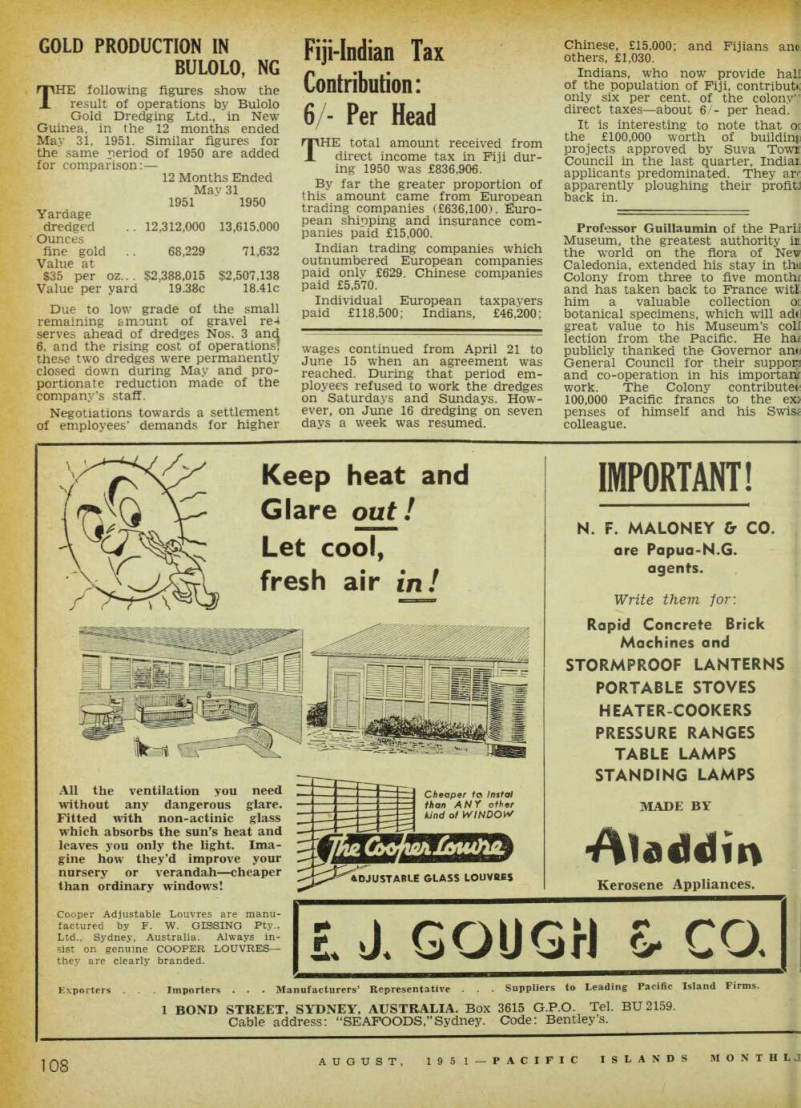
Gold Production In
The following figures show the result of operations by Bulolo Gold Dredging Ltd., in New Guinea, in the 12 months ended May 31, 1951. Similar figures for the same period of 1950 are added for comparison:— Mav S 3i nd6 i nr, b IQ cA Yardaee oZtt 13 ’ 615 ’ 000 fine gold .. 68,229 71,632 Value at $35 per 0z... $2,388,015 $2,507,138 Value per yard 19.38 c 18.41 c , , Due to low grade of the small remaining amount of gravel re-4 serves ahead of dredges Nos. 3 and 6, and the rising cost of operations; these two dredges were permanently closed down during May and pro portionate reduction made of the company’s staff.
Negotiations towards a settlement of employees’ demands for higher
wages continued from April 21 to June 15 when an agreement was reached. During that period em ployees refused to work the dredges on Saturdays and Sundays. How ever, on June 16 dredging on seven days a week was resumed.
Contrbution:
Fiii-Indian Tax Contrbution: 6/- Per Head
THE total amount received from direct income tax in Fiji dur ing 1950 was £836,906.
By far the greater proportion of this amount came from European trading companies (£636,100). Euro pean shipping and insurance com panies paid £15,000.
Indian trading companies which outnumbered European companies paid only £629. Chinese companies paid £5,570.
Individual European taxpayers paid £118,500; Indians, £46,200;
Chinese, £15,000; and Fijians ano. others, £1,030.
Indians, who now provide hall of the population of Fiji, contribute only six per cent, of the colony’' direct taxes—about 6/- per head.
It is interesting to note that oc the £lOO,OOO worth of buildinjj projects approved by Suva Towr Council in the last quarter, Indiar. applicants predominated. They an*: apparently ploughing their profit! back in.
Professor Guillaumin of the Parii Museum, the greatest authority in. the world on the flora of New Caledonia, extended his stay in thu Colony from three to five monthr and has taken back to France witl him a valuable collection oc botanical specimens, which will ad« great value to his Museum’s coll lection from the Pacific. He har publicly thanked the Governor antj General Council for their support and co-operation in his important work. The Colony contributes 100,000 Pacific francs to the ex? penses of himself and his Swise colleague.
Advertisements & other items, p. 110 (1 item)
T J. Gough £ Co.
TiS
\r
Keep heat and
Glare ou
Let cool,
fresh air in!
All the ventilation you need without any dangerous glare.
Fitted with non-actinic glass which absorbs the sun’s heat and leaves you only the light. Imagine how they’d improve your nursery or verandah—cheaper than ordinary windows!
Cheaper to Insfal than ANY other kind of WINDOW
ADJUSTABLE GLASS LOUVMS
IMPORTANT!
N. F. MALONEY & CO.
are Papua-N.G.
agents.
Write them -for : Rapid Concrete Brick Machines and
STORMPROOF LANTERNS
PORTABLE STOVES
HEATER-COOKERS
PRESSURE RANGES
TABLE LAMPS
STANDING LAMPS
MADE BY
"Ataddm
Kerosene Appliances.
Cooper Adjustable Louvres are manufactured by F. W. GI9SING Pty., Ltd., Sydney, Australia. Always insist on genuine COOPER LOUVRES— they are clearly branded.
t J. GOUGH £ CO.
Exporters Importers . . • Manufacturers’ Representative Suppliers to Leading Pacific Island Firms. 1 BOND STREET, SYDNEY, AUSTRALIA. Box 3615 G.P.O. Tel. BU 2159.
Cable address: “SEAFOODS,”Sydney. Code: Bentley’s.
Ministerial Visitors To
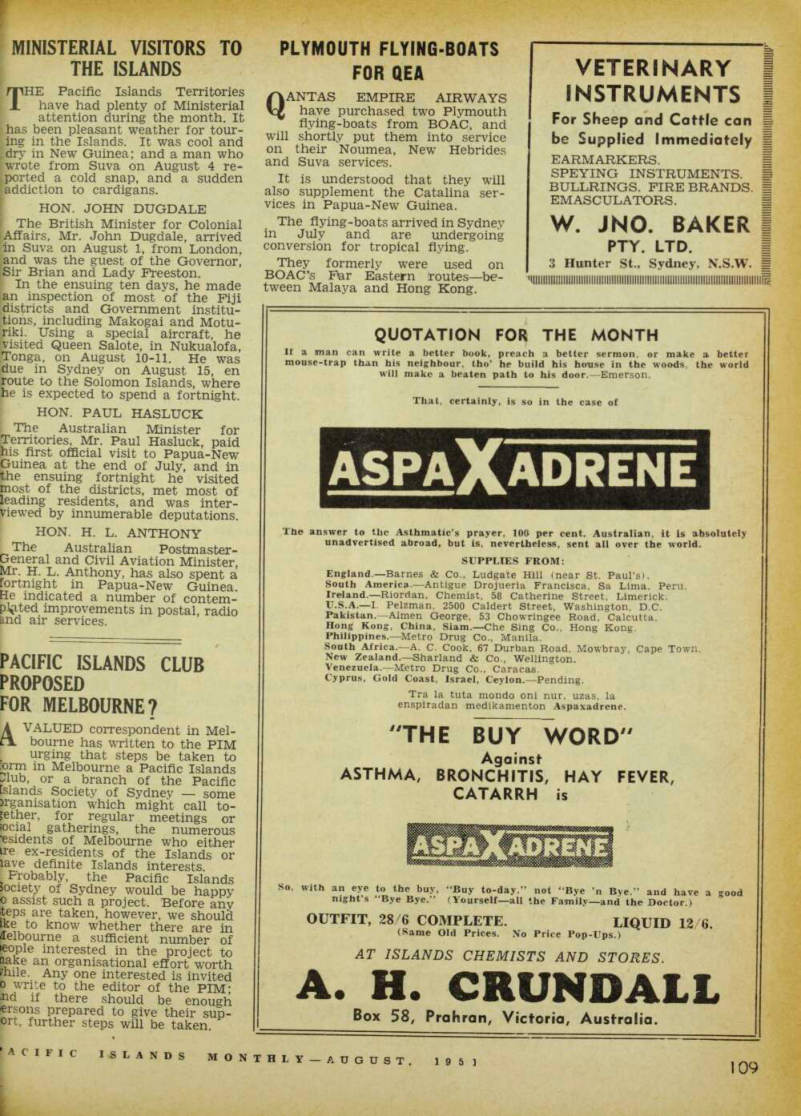
The Islands
THE Pacific Islands Territories have had plenty of Ministerial attention during the month. It has been pleasant weather for tour ing in the Islands. It was cool and >dry in New Guinea; and a man who wrote from Suva on August 4 re ported a cold snap, and a sudden I addiction to cardigans.
Hon. John Dugdale
The British Minister for Colonial Affairs, Mr. John Dugdale, arrived in Suva on August 1, from London, and was the guest of the Governor, [Sir Brian and Lady Preeston, In the ensuing ten days, he made an inspection of most of the Fiji districts and Government institu tions, including Makogai and Motu riki. Using a special aircraft, he (visited Queen Salote, in Nukualofa, Tonga, on August 10-11. He was due in Sydney on August 15, en route to the Solomon Islands, where he is expected to spend a fortnight.
Hon. Paul Hasluck
The Australian Minister for Territories, Mr. Paul Hasluck, paid his first official visit to Papua-New Guinea at the end of July, and in the ensuing fortnight he visited most of the districts, met most of leading residents, and was inter viewed by innumerable deputations.
Hon. H. L. Anthony
The Australian Postmaster- General and Civil Aviation Minister, Mr. H. L. Anthony, has also spent a fortnight in Papua-New Guinea.
He indicated a number of contem plated improvements in postal, radio and air services.
For Melbourne?
Pacific Islands Club
Proposed
A VALUED correspondent in Mel ri. bourne has written to the PIM f urging that steps be taken to ®rm in Melbourne a Pacific Islands or a branch of the Pacific islands Society of Sydney some jrganisation which might call to gether, for regular meetings or pcial gatherings, the numerous •esidents of Melbourne who either ire ex-residents of the Islands or lave definite Islands interests. * Probably, the Pacific Islands society of Sydney would be happy 0 assist such a project. Before any jeeps are taken, however, we should to know whether there are in aelbourne a sufficient number of leople interested in the project to Rake an organisational effort worth mile. Any one interested is invited b write to the editor of the PIM; ■nd if there should be enough ersons prepared to give their sup ort, further steps will be taken
Plymouth Flying-Boats
For Qea
Qantas empire airways have purchased two Plymouth flying-boats from BOAC, and will shortly put them into service on their Noumea, New Hebrides and Suva services.
It is understood that they will also supplement the Catalina ser vices in Papua-New Guinea.
The flying-boats arrived in Sydney in July and are undergoing conversion for tropical flying.
They formerly were used on BOAC’s Far Eastern (routes —between Malaya and Hong Kong.
Advertisements & other items, pp. 111-112 (3 items)
109
'ACI F I C ISLANDS MONTHLY AUGUST. 195]
aspaXaprene
VETERINARY
INSTRUMENTS
For Sheep and Cattle can be Supplied Immediately
EARMARKERS.
SPEYING INSTRUMENTS.
BULLRINGS. FIREBRANDS.
EMASCULATORS.
W. JNO. BAKER
PTY. LTD.
3 Hunter St., Sydney, N.S.W.
QUOTATION FOR THE MONTH
If a man can write a better book, preach a better sermon, or make a better mouse-trap than his neighbour, tho’ he build his house in the woods, the world will make a beaten path to his door. —Emerson.
That, certainly, is so in the case of
aspaXaprene
The answer to the Asthmatic’s prayer, 100 per cent. Australian, it is absolutely unadvertised abroad, but is, nevertheless, sent all over the world.
SUPPLIES FROM:
England.—Barnes & Co., Ludgate Hill (near St. Paul’s).
South America.—Antigue Drojueria Francisca, Sa Lima. Peru.
Ireland.—Riordan. Chemist, 58 Catherine Street. Limerick.
U.S.A.—I. Pelzman, 2500 Caldert Street, Washington, D.C.
Pakistan. —Almen George, 53 Chowringee Road, Calcutta.
Hong Kong, China, Siam.—Che Sing Co., Hong Kong.
Philippines.—Metro Drug Co., Manila.
South Africa. —A. C. Cook, 67 Durban Road, Mowbray, Cape Town.
New Zealand.—Sharland & Co,, Wellington.
Venezuela.—Metro Drug Co., Caracas.
Cyprus, Gold Coast, Israel, Ceylon.—Pending.
Tra la tuta mondo oni nur, uzas. la enspiradan medikamenton Aspaxadrene.
"THE BUY WORD"
Against
ASTHMA, BRONCHITIS, HAY FEVER,
CATARRH is
T Tf So, with an eye to the buy, “Buy to-day.” not “Bye ’n Bye.” and have a good night’s “Bye Bye.” (Yourself—all the Family—and the Doctor.)
OUTFIT, 28/6 COMPLETE. LIQUID 12/6.
(Same Old Prices. No Price Pop-Ups.)
AT ISLANDS CHEMISTS AND STORES .
A. H. CRUNDALL
Box 58, Prahran, Victoria, Australia.
A Hard Working Money Saving
MOBILCO PAIR
fj. % ■m. /' i i » The Mobiico Post Hole Digger digs a T 8" deep hole in 10 seconds in average soil. This well-balanced, oneman machine will pay for itself in no time . . . and see the attachments (below) which can be fitted to a Mobiico Post Hole Digger.
Electric Generator
This 32 volt, 500 watt generator fits firmly on to the frame of the Mobiico Post Hole Digger. It provides a portable source of 32 volt light and power.
3 Centrifugal Pump
Fits on to the frame of the Mobiico Post Hole Digger.
Delivers 300 gallons per minute, at 50' head.
Electric Power Drill Driven from the 32 volt generator on the Mobiico Post Hole Digger this light, smooth running Drill bores up to 1" holes in hardwood and Yi" in metal.
I l *
’Or The fast working, one-man Mobiico Tree Felling and Cross-cutting Circular Saw at work at Nukualofa, Tonga. This machine leads the market for fast lowcost clearing.
Electric Hand Saw (Circular) Driven from a 32 volt, 500 watt generator which attaches to the shaft of the Mobiico this 6" circular saw is particularly useful in home or workshop.
Copra-Cutting Saw
This light bench fits on to a Mobiico Tree Felling Saw. Fitted with 28" diameter, 14 gauge blade it is most useful for cutting coconuts.
Electric Power
Drill
Driven from the generator attached to the Mobiico Tree Feller this Power Drill makes quick work of boring holes in wood or metal.
WRITE FOR PARTICULARS TO YOUR AUSTRALIAN
BUYING AGENTS OR DIRECT TO
I iKiis ■ . & A , WM:
MOBILE INDUSTRIAL EQUIPMENT PTY. LTD.
252 SWANSTON ST., MELBOURNE, AUSTRALIA ■ TELEGRAMS: “MOBILCO". MELBOURNE
110
AUGUST, 1951 PACIFIC ISLANDS MONTH LI
Missionaries
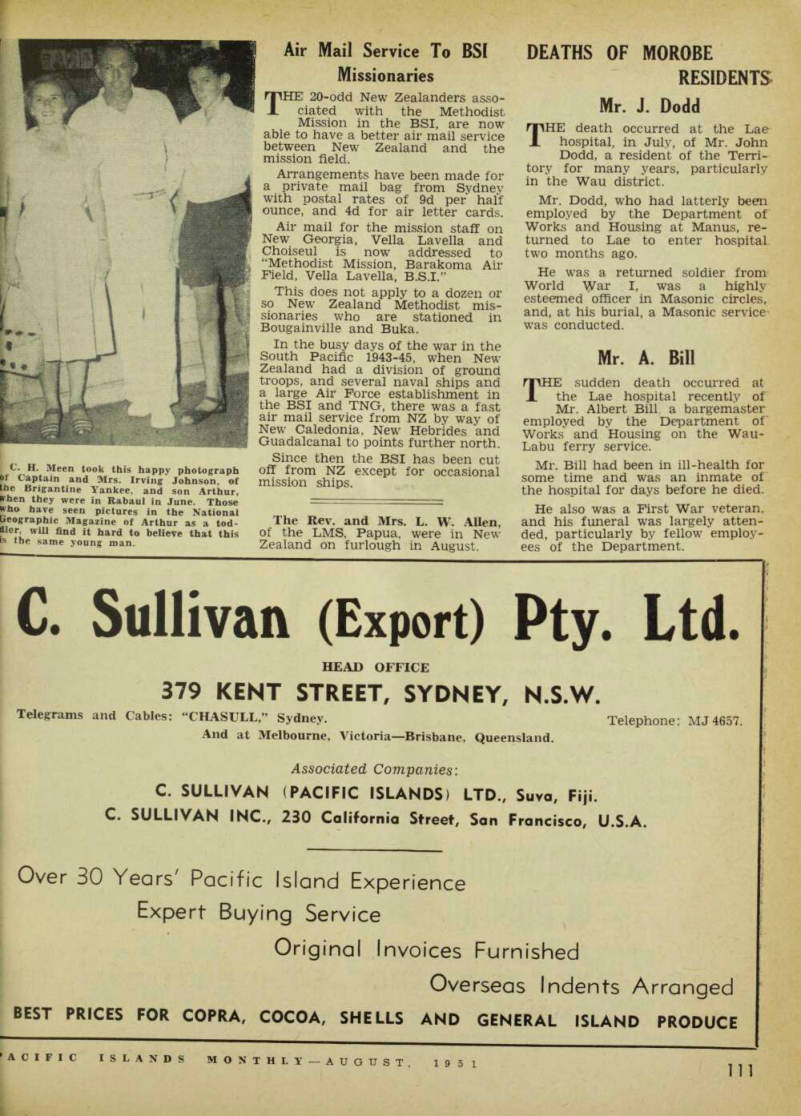
Air Mail Service To BSI Missionaries
THE 20-odd New Zealanders asso ciated with the Methodist Mission in the BSI, are now able to have a better air mail service between New Zealand and the mission field.
Arrangements have been made for a private mail bag from Sydney with postal rates of 9d per half ounce, and 4d for air letter cards.
Air mail for the mission staff on New Georgia, Vella Lavella and Choiseul is now addressed to “Methodist Mission, Barakoma Air Field, Vella Lavella, B.S.L”
This does not apply to a dozen or so New Zealand Methodist mis sionaries who are stationed in Bougainville and Buka.
In the busy days of the war in the South Pacific 1943-45, when New Zealand had a division of ground troops, and several naval ships and a large Air Force establishment in the BSI and TNG, there was a fast air mail service from NZ by way of New Caledonia, New Hebrides and Guadalcanal to points further north.
Since then the BSI has been cut off from NZ except for occasional mission ships.
The Rev. and Mrs. L. W. Allen, of the LMS, Papua, were in New Zealand on furlough in August.
C. H. Meen took this happy photograph of Captain and Mrs, Irving Johnson, of the Brigantine Yankee, and son Arthur, (Then they were in Rabaul in June. Those who have seen pictures in the National Geographic Magazine of Arthur as a tod [?]der, will find It hard to believe that this [?]s the same young roan.
Residents
Deaths Of Morobe
Mr. J. Dodd
THE death occurred at the Lae hospital, in July, of Mr. John Dodd, a resident of the Terri tory for many years, particularly in the Wau district.
Mr. Dodd, who had latterly been employed by the Department of Works and Housing at Manus, re turned to Lae to enter hospital two months ago.
He was a returned soldier from World War I, was a highly esteemed officer in Masonic circles, and, at his burial, a Masonic service was conducted.
Mr. A. Bill
THE sudden death occurred at the Lae hospital recently of Mr. Albert Bill a bargemaster employed by the Department of' Works and Housing on the Wau- Labu ferry service.
Mr. Bill had been in ill-health for some time and was an inmate of the hospital for days before he died.
He also was a First War veteran, and his funeral was largely atten ded, particularly by fellow employ ees of the Department.
Advertisements & other items, p. 113 (2 items)
'Acific Islands Monthly August, 1951
C. Sullivan (Export) Pty. Ltd.
HEAD OFFICE
379 KENT STREET, SYDNEY, N.S.W.
Telegrams and Cables: “CHASULL,” Sydney. Telephone: MJ 4657.
And at Melbourne, Victoria—Brisbane, Queensland.
Associated Companies : C. SULLIVAN (PACIFIC ISLANDS) LTD., Suva, Fiji.
C. SULLIVAN INC., 230 California Street, San Francisco, U.S.A.
Over 30 Years 7 Pacific Island Experience
Expert Buying Service
Original Invoices Furnished
Overseas Indents Arranged
BEST PRICES FOR COPRA, COCOA, SHELLS AND GENERAL ISLAND PRODUCE
Rarotonga
Yacht Mishap In
MESSRS, dagger and Harvey’s ex- American yacht Ornant, after a rough voyage of 30 days from Auckland, was . lying off Avarua, in Rarotonga, undergoing repairs, when a squall came up at noon on July 20, and her stern lines carried away.
She immediately swung around onto the reef, near where the
Tahitienne was wrecked. All hands, aided by a large section of the local population, got a line aboard and managed to heave her clear of the reef; but she bumped heavily there for a couple of hours. She was considerably damaged, but was not leaking.
The Rev. John Wardman has left for Papua with his wife and baby daughter. They will go to the Anglican Mission station at Gona.
Western Samoan Copra
Stabilisation Fund
COMPARED with New Guineas the Stabilisation Fund estab lished by the NZ Governmental authority in Western Samoa, is small; but Western Samoan copras traders feel just as strongly about! it as do their confreres in New Guinea.
Mr. A. G. Smyth, of Apia, who has been holidaying in Sydney, says that!
Western Samoa produces betweem 16,000 and 17,000 tons of copra pen annum; it is taken by the NZS authority and sold to the British!
Ministry of Food and sold under as contract similar to that which! absorbs the Fiji, Solomons and New Guinea copra; and the Government' deducts £3 per ton from the pro-' ceeds, with which it has built up the West Samoa Conra Stabilisation Fund to about £70,000.
There is no more indication ol< what will happen to the Samos Fund than there is in the case ol( the Australian-New Guinea Funo (now between 1£ and 11 millions)( Apart from the production of NS Reparation Estates, most of thej copra grown in Samoa comes from native Samoans.
Success of Fiji Photographer
From Our Own Correspondent SUVA, July 30.
AT the 1951 International Salon of Photography, held lii Christchurch, New Zealand recently, two photographs taken b;c Mr. Rob Wright, the Public Res lations Office photographer, wen accepted for exhibition.
The exhibition was sponsored be the Canterbury Centennial Associae tion, and attracted 842 entries from 31 countries.
There were 29 entries from thd United States, and of the 128 photoo graphs submitted by New Zealanr photographers, only eight weir accepted by the judges.
Well-known photographic jouru nals over the past few years haw featured a number of Mr. Wrightf photographs.
His pictures illlustrating events ii Fiji have frequently appeared ii the London Times, Illustrates London News, Sphere, Liffi National Geographic, Holiday, Piii' Australian Mirror, the New Zealam Herald. the Auckland Weekh News, Freelance, and the Aucklam Star, and numerous others.
More aerodromes, improved aiii port facilities and progressive rain ing of navigational aid standam are proposed for Papua-New Guinea said Civil Aviation Ministd; Anthony while in Moresby on hd recent visit.
Advertisements & other items, p. 114 (2 items)
112
AUGUST, 1951 PACIFIC ISLANDS MONTHL
Commonwealth JSanlt
V find the many Commonwealth Bank services of great assistance if you are engaged in business or trading of any kind. Wide experience of local and overseas trade enables our Island Branches to help you in matters relating to importing and exporting, finance and exchange.
The Commonwealth Bank offers complete Trading Bank facilities. All types of commercial enterprise may be financed. All advances are made at low rates of interest.
With 420 Branches in Australia, Branches in London, and correspondent Banks in all countries, the Commonwealth Bank provides a world-wide service.
Commonwealth JSanlt
of Australia.
ISLAND BRANCHES ARE SITUATED AT;
PAPUA-NEW GUINEA.—PORT MORESBY, RABAUL, LAE AND MADANG BSj, HONIARA. COMPLETE TRADING AND SAVINGS BANK SERVICES ARE AVAILABLE AT ALL THESE BRANCHES. INQUIRIES WELCOMED The Most Complete Trading Bank Service in the Islands.
The Myth of New Guinea's Sulphur Deposits
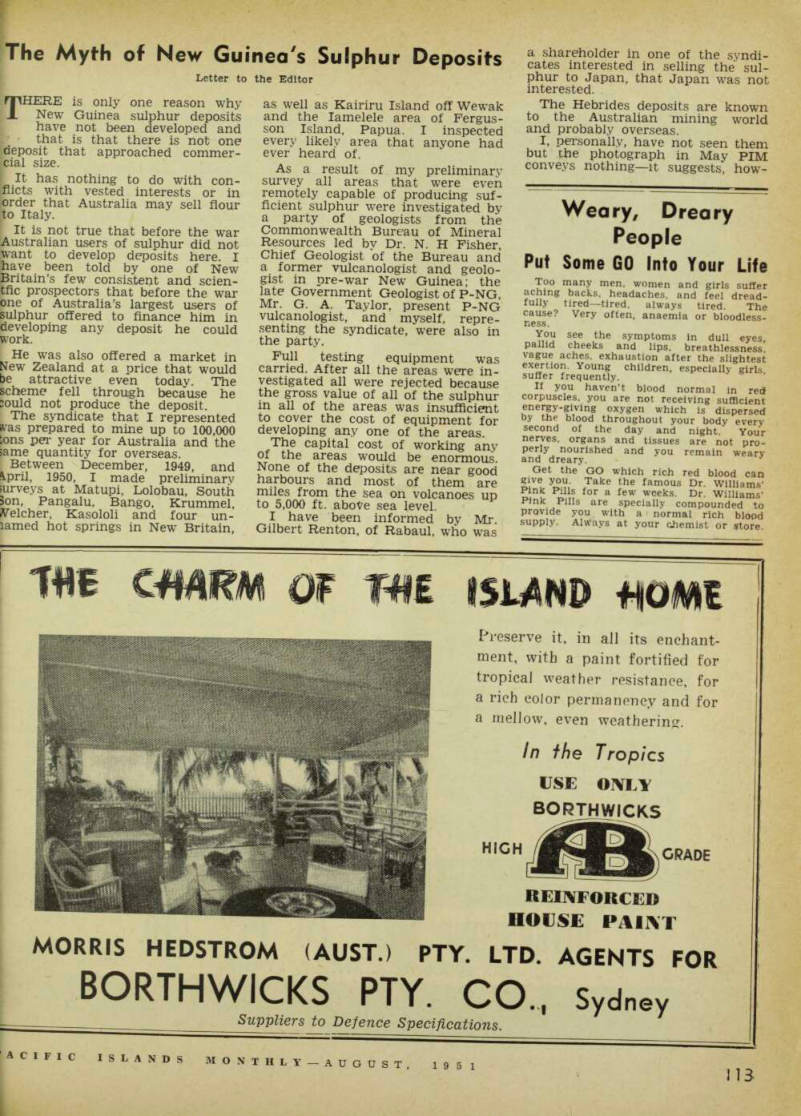
Letter to the Editor
THERE is only one reason why New Guinea sulphur deposits have not been developed and . that is that there is not one deposit that approached commer- ICltl1 C1 t1 S i! ZG ’ it has nothing to do with conpets with vested interests or in order that Australia may sell flour toltal y- It is not true that before the war Australian users of sulphur did not want to develop deposits here. I have been told by one of New Britain’s few consistent and scientfic prospectors that before the war one of Australia’s largest users of sulphur offered to finance him in developing any deposit he could He was also offered a market in New Zealand at a price that would be attractive even today. The ■nmri m nn/ e nrJ! lroU f£‘ S 6031 1? he not P ro^ uc ® the deposit.
The syndicate that I represented prepared to mine up to 100,000 tons per year for Australia and the jame quantity for overseas.
FBetween December, 1949, and nvrvloTr n ? ac J e Preliminary surveys at Matupi, Lolobau, South son, Pangalu, Bango, Krummel, Welcher, Kasololi and four unlamed hot springs in New Britain.
as well as Kairiru Island off Wewak and the lamelele area of Fergus son Island, Papua. I inspected every likely area that anyone had ever heard of.
As a result of my preliminary survey all areas that were even remotely capable of producing suf ficient sulphur were investigated by a party of geologists from the Commonwealth Bureau of Mineral Resources led bv Dr. N. H Fisher, Chief Geologist of the Bureau and a former vulcanologist and geolo gist in pre-war New Guinea; the late Government Geologist of P-NG, Mr. G. A. Taylor, present P-NG vulcanologist, and myself repre renting: the syndicate, were also in Full testing equipment was carried. After all the areas were in vestigated all were rejected because the f, rosa Y alue of ail of the sulphur in all Of the areas was insufficient to cover the cost of equipment for developing any one of the areas The capital cost of working any of the areas would be enormous None of the deposits are near good harbours and most of them are miles from the sea on volcanoes un to 5,000 ft. above sea level I have been informed' hv Mr Gilbert Renton of Sul. who ws
a shareholder in one of the syndi cates interested in selling the sul phur to Japan, that Japan was not interested.
The Hebrides deposits are known to the Australian mining world and probably overseas.
I. personally, have not seen them but the photograph in May PIM conveys nothing—it suggests, how
ever, the type of occurrence we have in New Britain —small, scattered pockets of sulphur surrounding the tops of fumaroles.
I suggest that if the New Hebrides deposits were worth work ing they would have been worked; we must therefore conclude that , they are not large enough.—l am, ! etc.,
Ian Mcdougall.
Matala Plantation, I New Britain, June 26, 1951, [ Editorial Note: The suggestion in the PIM as far as the Hebrides deposits were concerned was that [now that the world is suffering from an unprecedented shortage of [sulphur these deposits should be
[investigated again.
Our information is that they were [worked at one stage but abandoned because the cost of production, in icomparison with the then plentiful (Supplies from other sources, made the project uneconomic.
Mr. McDougall’s letter was sent to Tolala who replied as follows in Tespect of the New Guinea de posits: “It would appear that the writer has made exhaustive exami nations. My remarks were based, chiefly, on reports from the late Evan R. Stanley, both written and verbal; as well as Japanese geolo gists, who were reported to have made surveys during the Japanese occupation of New Britain.
Stanley’s surveys were made in the early twenties, and it is not im possible that the ’37 eruption of Tavurvur may have caused con siderable changes in that volcano’s upper strata. Of course one must remember that a “commercial pro position” of years ago cannot be compared with one of the present iay, with its increased costs and scarcity of shipping.”
Advertisements & other items, pp. 115-116 (3 items)
113
acific islands monthly-august, 1951
Borthwicks Pty. Co.. Sydney
Weary, Dreary
People
Put Some GO Into Your Life
Too many men, women and girls suffer aching backs, headaches, and feel dreadfully tired—tired. always tired. The cause? Very often, anaemia or bloodlessness.
You see the symptoms in dull eyes, pallid cheeks and lips, breathlessness vague aches, exhaustion after the slightest exertion. Young children, especially girls suffer frequently.
If you haven’t blood normal in red corpuscles, you are not receiving sufficient energy-giving oxygen which is dispersed by the blood throughout your body every second of the day and night. Your nerves, organs and tissues are not properly nourished and you remain weary and dreary. J Get the GO which rich red blood can |l v ® y °V; J ake the famous Dr. Williams’
Pink Pills for a few weeks. Dr. Williams’
Pink Pdls; are specially compounded to provide you with a normal rich blood supply. Always at your chemist or store.
i«f c mm of we iswnd
Wmmm Hi mm v -my - Preserve it, in all its enchantment, with a paint fortified for tropical weather resistance, for a rich color permanency and for a mellow, even weathering.
In the Tropics
USE ONLY
BO RTH WICKS
EE S" 5
HIGH
GRADE
REINFORCED
HOUSE PAINT
MORRIS HEDSTROM (AUST.) PTY. LTD. AGENTS FOR
BORTHWICKS PTY. CO.. Sydney
Suppliers to Defence Specifications.
TAKE YOUR CHOICE . .
m . . . from this list of quality canned foods.
Packed by the largest meat-processing company in Australia, the Imperial label brings you the Quality meats, right to your table—tasty hot meals and cold meats ready for any occasion.
Stock up with Imperial, the Flavour Sealed Quality Foods.
“RIVERMEDE” BUTTER.
56-lb. Boxes Bulk Butter. 16-oz. Pats Butter, i.-lb. Pats Butter. 12-oz. Tins Butter. 16-oz. Tins Butter. ★
MILDURA FRUIT JUICES.
16-oz. Grapefruit Juice. 16-oz. Orange Juice. ★
CANNED FRUITS.
16-oz. Prunes. 7-lb. Prunes, 16-oz. Grapes.
Other Canned Fruits as available. ★
CANNED VEGETABLES.
"Gardside” Brand as available in season. ★ 16-oz. Imperial Peeled Tomatoes. ★
CANNED JAMS.
24-oz. Apricot. 24-oz. Blackcurrant. 24-oz. Peach, 24-oz. Plum, 24-oz. Raspberry.
SWEET PUDDINGS.
16-oz. Plum Pudding. 12-oz. Jam Pudding. 12-oz. Chocolate Pudding. 12-oz. Ginger Pudding. ★
SAUSAGES.
16-oz. Beef Sausages. 16-oz. Oxford Sausages. 16-oz. Cambridge Sausages. 16-oz. Pork Sausages, 10-oz. Vienna Sausages.
SOUPS.
8-oz. Tomato Soup. 8-oz. Clear Beef Soup. ★
TONGUES.
12-oz. Sheep Tongues. 12-oz. Lamb Tongues. 12-oz. Calves Tongues. 2-lb Ox Tongues. ★
MARGARINE
56-lb. Boxes Cake Margarine. 56-lb. Boxes Pastry Margarine.
HOT PACKS.
16-oz. Braised Beef Steak Stew. 16-oz. Beef Steak Pudding. 16-oz. Steak & Kidney Pudding. 16-oz. Sausages & Vegetables. 4-oz. Meat and Spaghetti. 16-oz. Steak and Tomato. ★
COLD MEATS.
12-oz. Trim (Pork & Beef). 12-oz. Camp Pie. 12-oz. Meatreat. 12-oz. Corned Beef W/C. 12-oz. Taper Corned Beef. 6-lb. Taper Corned Beef W/C. 6-lb. Taper Corned Beef. 4-oz. Hampe. 4-oz. Beef Snack. ★
DRIPPING AND LARD.
1-lb. tins Lard. 16-oz. tins Dripping. 36-lb. Dripping. ★
CANNED FISH.
8-oz. Flair Fish Cutlets. 12-oz. Flair Fish Cutlets. ★ Norwegian Sardines.
RIVERSTONE MEAT CO. PTY. LTD.
5-7 O'CONNELL STREET, SYDNEY.
114
AUGUST, 1951-PACIFIC ISLANDS MONTH LI
Elusive Fiji Gold.
FN the year ended June 30, 1950, 1 Emperor Mines Limited of Fiji treated 153.847 tons of ore, and ;ot 58,859 oz. of gold—a notable ncrease on the previous year 52,928 oz. from 133,089 tons). The 949-50 profit was £161,752. (In 948-49, £76,202.) Loloma got 23,769 oz. from 17,717 ons, compared with 21,381 oz. from 2 496 tons in 1948-49. Loloma profit or 1949-50 was £142,850.
Figures for the 1950-51 period hould be released in November.
Since these two Melbourne com panies commenced operations on iji’s rich Tavua field, 15 vears ago J 0 e L„ h n a n ve produced gold worth 12,000,000. Their main trouble has een not so much the recovery of old as the recovery of the profits.
Fiji naturally taxes the com a?ii es ’-x Profits; the Australian uthonty ignores all that and, be l com Panies are registered i Melbourne, insists on taxing leir profits again.
For some years, the companies avoided that by holding the official profits in Fiji, and returning their capital to the Australian share holders. But, by now, practically all the capital has been returned.
The profits continue to accumulate in Fiji—and the Australian share holders cannot get them without paying double taxation on a feroc ious scale. A pretty problem in politico-economics!
Islanders In Queensland
IT was stated in our May issue that there were three Islanders in a Queensland Militia camp—
Private J. B. Toganibalu, a Tongan, and Corporals J. Soaki and N. Kulu.
Fijians. In a courteous letter, Mr.
Soakai, who writes from the Queensland Agricultural High School and College at Lawes says that Joseph B. Tonganivalu is Fijian, Corporal Masao Soakai is a Tongan and Private (not Corporal) Sione Kulu is a Tongan.
He adds: “The Australians are teaching us the best and most economical way to cultivate the land and, in return, we feel the least we can do is to join with the young Australians in learning also how to defend Australia.” All three young men are students at the College.
Advertisements & other items, p. 117 (2 items)
‘" Nc Islands Monthit_ A D G C S T, 1951
shell
Get that British spirit
For 46 years more Shell has been bought by more motorists than any other brand of petrol. It’s a good British habit.
In Australia alone, Shell is refining British petrol from British crude at the rate of 72,000,000 gallons a year. The crude is brought to Australia in British tankers from British wells in British Borneo by Shell—a British company.
Get that British spirit—always fill up at the Shell pump.
shell
31 v v h
pump
always fill up
at the SHELL
The Shell Co. of Aust., Ltd (Inc. in Great Britain).
M 55041
Notes From Lae

From Our Own Correspondent LAE, Aug. 3.
Against Legislative Ccl.
AT the meeting of the Lae Sub branch of the Returned Soldiers’ League, on August 3, it was decided to submit to Fed eral Executive, through the Papua
and New Guinea State Branch the following resolution: — “That this Sub-branch protests vigorously against the composition of the Papua and New Guinea Legislative Council and seeks im mediate amendment of the Act to permit of more democratic repre sentation, particularly in regard to Returned Soldiers.”
Administration High
Handedness
INDICATIVE of the autocratio attitude adopted by the Ad ministration in public matters' which have produced unfavourable local reaction, is the case of the new hospital.
The Returned Soldiers’ Leagues and the Lae Town Advisory Coun-, cil, have both opposed the plansj on the basis that native and Euro-( pean wards are in close with common facilities such asj laundries and kitchen.
However strong this opposition, ii apparently can have no effect on the Administration outlook —that ii is essential in some cases, for tha natives to be close to the operating] theatre.
At a recent visit to Lae, th« Director of Public Health, Dm Gunther, indicated that, in effect; the plans had been approved, ana that was what the public would get.
The matter is not finished yeti however, and it is anticipated thae the persistent outcry for segregas tion in the hospital will eventualll be recognised.
Another matter that has causes a lot of heartburning is the attitude of the Administration toward) lessees of land in industrial areas which are still without essentisi utilities, such as electricity arm telephones.
In the blitz that followed thl adoption of the Town Plan, mam business people took up blocks ii these areas, at high rentals, ant:J cipating the supply of services.
The Lae Advisory Council hsi recommended that a retrospectivi reduction of rental values from tM date of granting of the leasts should apply where essential iru stallations are still awaited.
In reply to this request tH.
Minister for Territories, Mr. Haas luck, said that nothing would If done in the matter as the lessee knew what to expect when th*r took over the blocks.
The new phrase “they knew wh:r to exoect.” is now added to thoo two other pieces of overworked officialese: “The matter will be iii vestigated,” and “I will look inn that matter.”
Record Rains
JULY was the third month in sun cession with rainfall oyer inches—May. 2,093 poinn June, 2 916, and July 2,804 poinn The aggregate falls over the san, three-months’ period for 1950, 196 and 1946 were: 2,749, 4,910 and 7.® respectively. The 1951 total of 7,83, points must be something of ; record.
The continuous rain played haw, with all roads in the area.
Cost Of Rice And Nl
“/'IHEAP LABOUR” is always re vy garded as one of the attrac tions of residence in the Islands, but a statistical return based on the average of current [prices in Lae shows that, over a [period of 1,928 i hours worked by native labour, the cost to the em ployer of one unit of labour over a working dav of seven hours was 12/6.16.
This amount includes recruiting fees and supervisory expenses, the latter at 5.44 d per day.
Without recruiting fees the amount figured at 10/5.15 per day of seven hours.
The upward trend of commodities for natives is exemplified in the price of rice.
The last consignment worked out at well over £BO per ton, and it is anticipated that the next lot will cost approximately £lO2.
Many employers of native labour have paid off their boys.
It has been suggested to the authorities that the Export duty of £32 per ton should be lifted to permit of a reasonable price in the Territory.
Births
IN the spate of births of female offspring at the Lae European hospital, as reported in the July issue, the important event of the birth of a son to Mr. and Mrs. Jim Huxley, of Lae, was overlooked.
Mr. Huxley is well known as the Morobe representative of the South Pacific Post, and his caricatures of people are a popular feature this weekly paper. . He is also the AAP representative in this district.
Daughters again took up the running during July, and Mr. and Mrs.
R. Murtagh (of Burns Phllp) and Mr. and Mrs. Kevin Lake (of Works and Housing) are proud parents, ,
Rsl Affairs Flourish
1%/F R. K - Whittaker, State
President of the Papua and New Guinea Branch of the RSS&AILA, who represented the
State Branch at the recent Con gress in Hobart, and more recently was a visitor to an executive meet ing of the Council of the League, in Melbourne, has advised that, at the next Congress, in Adelaide, in October next, the Papua and New Guinea Branch will be given the right to a vote on Congress matters.
No one has fought harder for re cognition of the claims of returned men. particularly in the Territory, than Mr. Whittaker.
This branch is going ahead im mediately with the erection of its own clubrooms on the terrace and members have pledged themselves to the call by the Committee for funds.
The Annual Ball, held in July, was one of the outstanding func tions of the year, and the funds of the League benefited by £lOO.
Advertisements & other items, pp. 118-120 (2 items)
August. 1951-Pacific Islands Month U
W////liim\\^m
$523$ *
\ 3 MEDICINES IN ONE
V ■W
FAKE VINCENT S
A.P.C FOR
FEVER
ACHES
& PASNS
COLDS
& ’FLU
LUMBAGO
NEURITIS
NERVES
MALARIA
Headaches Rheumatism Sleeplessness Irritability Toothache Neuralgia Sore Throat Tonsillitis Laryngitis Dengue Fever
VINCENT’S FAMOUS PINK
POWDERS OR TABLETS
yr FOR FEVER & PAIN! .y
W///liim\\^m
HEADACHE, FEVER
Body Pains Relieved
Genuine VINCENT’S A.P.C. provides a wellbalanced combination of the thre ® medicinal ingredients: Aspirin, Phenwetm and Caffeine. So you see, when you take VINCENT’S Famous Pink Powders or Tablets you are taking three wonderful medicines in each -dose.
ONE DOSE BRINGS RELIEF
Get VINCENT’S A.P.C. now and from the very first dose you will obtain quick, safe relief! VINCENT’S A.P.C. Powders and Tablets produce a rapid change from pain, tired feeling and depression to bright, smiling alertness! , . , You will feel better and brighter! 5.P.8D.2.
I.
There is a Ransomes Mower for every phase of grass cutting. They are built for long-life service and maximum efficiency. Full details gladly supplied by Agents, or on application to Makers.
RANSOMES SIMS &
JEFFERIES LTD.
Ipswich, England.
Agent:
MORRIS HEDSTROM LTD.,
Suva, Lautoka, and Ba.
BEST OF ALL
Kansomes Motor Mower, 16 in. and 20 in.
Kansomes Gazelle,” 18 in. cut.
SB PBILP (SOUTH SEA) CO. LTD.
Registered Office: SUVA, FIJI Code Address: “BURNSOUTH”
ISLAND TRADERS AND SHIPOWNERS
General Merchants (Wholesale ond Retail)
Shipping, Customs and General Agents
Representatives for : QUEENSLAND INSURANCE CO. LTD. BURNS PHILP TRUST CO. LTD.
Distributing Agents for : SHELL COMPANY (P. 1.) LTD. FERGUSON TRACTORS STANDARD MOTOR CAR COMPANY CROSSLEY MARINE ENGINES
BRANCHES:
FlJl.—suva Levuka, Lautoka, Labasa, Ba. Sigatoka, Tavua. Rotuma Island. SAMOA.—Apia, Pago Pago. lONGA.—Nukualofa, Haapai, Vavau. NORFOLK ISLAND. NIUE ISLAND.
AGENTS;
SYDNEY.—BURNS. PHILP & CO.. LTD., 7 Bridge Street SAV in? iMnerfk burns - PHILP & CO.. LTD.. 35 Crutched Friars. E.C.3.
SAN FRANCISCO.—BURNS-PHILP CO. OP SAN FRANCISCO INC., Matson Building, 215 Market Street.
Agencies Throughout the World.
ABERDEEN
CANVAS COOPS
A It xs •i m \
“ABERDEEN” TENTS AND FLYSs
From the large partitioned Auto- Tent to accommodate a whole family, down to the small Tent to accommodate two persons,.
“Aberdeen” Tents and Flys offer outstanding quality. Made of topgrade canvas; waterproof roofs and solid walls; all points of wear strongly reinforced; all double - stitched; mosquitoproof windows; reinforced centre poles. “Aberdeen”' Tents and Flys ARE THE
BEST BUY, ALWAYS.
CAMPING STRETCHERS: The “Aberdeen” Camping Stretcher is easy to set up and stow away. Made from wellseasoned Australian timber and best quality heavy duck.
Ideal in the home for that unexpected over-night visitor.
For perfect sleeping comfort there is no better combination than an “Aberdeen” stretcher and an “Aberdeen” woolflock mattress.
“ABERDEEN”
WATER BAG: Fitted with an unbreakable bakelite nozzle and watertight cork-lined cap. Features a special perforated strainer which prevents any debris from entering. Easy to carry; metal handle fits on the bumper bar of your car; hangs on a wire fence or nail.
“ABERDEEN” TAR-
PAULINS: Give full protection under all conditions. Guaranteed waterproof, mildew resistant and will not crack. Large range of sizes, ranging from 6’ x 8’ to 28’ x 32’ and larger if required. Write’ for FREE samples of materials. r * If you experience difficulty in securing supplies, write to
SMITH COPELAND & CO. PTY. LTD.
33 Regent Street, Sydney.
Makers of Finer Blinds and Canvas Goods for over 57 years.
Death Of Mr. Peter Grant
Mr. Peter Grant, A Well
known Indian resident of Fiji, died on August 6, in his 100th year. He came to Fiji in 1884, and had a successful business career. His son, Mr. John Grant, MBE, owns a chain of cinemas in Fiji.
Are Up Again
Suva’s Electricity Rates Are Up Again
THE Suva Electricity Undertaking which reduced charges for electricity last year has this year increased them again.
The new rates will be in operation from August 1.
In some cases the new rates are those of the 1949 period. In others, they come mid-way between those charged last year and those of 1949.
The Mayor, Sir Alport Barker, in announcing the new rates, said that he had been too optimistic when he reduced them last year. It had been shown that those charges did not leave sufficient margin for depre ciation.
Sir Alport recalled that when the Electricity Undertaking first began to supply light and power in 1920 (it was generated by a “second hand suction gas plant”) light cost 1 - per unit and power 6d., plus a meter rent of 1/- per month.
The rates for domestic lighting from August 1 will be sid. per unit and power 2£d. It can therefore be said that in this instance things
are still somewhat better than in the “good old days.”
Suva’s electricity supply suffers from the world-wide complaint of being unable to cope with demand.
New plant is on order from the United Kingdom but its arrival is uncertain. The Mayor says that it will not be this year.
The famous old radio towers that “reach for the sky” in Pago Pago, American Samoa, for 30 years, are to go. A party of Seabees in July began dismantling the 500ft. steel structures, for removal.
Advertisements & other items, p. 121 (1 item)
Look for KRAFT
Unusual Prescriptions
Dispensed
Foreign Scrips Deciphered.
Rare or seemingly unobtainable drugs or commodities supplied.
All regular pharmaceutical lines dispensed, general health conditions advised upon, and a full range of Chemists’ Sundries available.
Special service for Islands Doctors.
All inquiries personally answered.
Chemist Anton Leondes, Suite 3, King’s Chambers, 112 a King St., Sydney, N.S.W.
Look for KRAFT
and find QUALITY
The unchanging quality of Kraft foods is a byword wherever fine foods find appreciation. In their constant vigilance over quality, Kraft experts have achieved even more than just that, for hand in hand with Kraft quality goes flavour perfection and food value of a very high order. Wherever you see the’ name “Kraft”, buy confidently, and remember, “Red Feather” foods are made by Kraft, too. No finer foods can be found.
Export Division.
Kraft Walker Cheese Co. Pty. Ltd.,
Riverside Ave., South Melbourne,
AUSTRALIA.
SaS*
KRAFT
v //
Three famous Kraft Foods
now available
in full supply everywhere.
VEGEMITE the delicious, healthful yeast extract. One of the richest known sources of the important Vitamin B complex. Strongly recommended in all areas where fresh vegetables are scarce. A little does a power of good.
KRAFT CHEDDAR CHEESE a
creamy-smooth, choice processed cheddar.
Rich in Vitamins A, B and D, calcium, phosphorus, and other nutrients of milk.
Always fresh whether in the attractive blue can or in its hygienic foil wrapping. Not too sharp not too mild just too good for words.
BONOX pre-digested beef in its tastiest and most assimilable form. A valuable food for its high content of niacin (the anti-pellagric factor), and a powerful digestive stimulant. Dissolve in hot water for an appetising drink, or use as a spread or a flavouring for cooked dishes. Eat it and drink it for a lift!
Fast Loading Of Ships

Papeete, July 10.
IT is not generally known that this port probably holds the record for the fast loading and dis charging of vessels.
Captain Malcolm, of the steamer
Sonoma, reported to his Company when he returned to San Francisco recently that when he arrived at Papeete on May 8 there was a strike of stevedores. But the authorities quickly organised a team of militia and marines and these men handled the Sonoma’s cargo in even quicker time than that of the usual workers.
No Oil Permit For
Enterprise Of Ng
THE application made by the Australian gold company.
Enterprise of New Guinea, on February 9, 1950, for a permit to search for oil in the Trust Terri tory of New Guinea, was finally re fused, in July, by the Australian Minister for Territories.
The Australian share market has on occasion reacted sharply to un confirmed reports that associates of the company had knowledge of “sealed bores” in areas in the Sepik country, supposed to have been located by Dutch oil-seekers on the Australian side of the border. It was said the Dutch opened them up, tested the bores, and sealed them up again.
Reasons given for Departmental refusal included: That the area sought was “uncontrolled” territory and that the company did not have the financial or technical resources deemed necessary.
Rev. W. and Mrs. Anderson, Rev.
H. M. and Mrs. Bell, and Rev. C.
W. and Mrs. McLeod have returned to the Presbyterian Mission in the New Hebrides, accompanied by new missionaries Rev. J, and Mrs. Poon, and Rev. R. W. and Mrs. Kirkby.
Advertisements & other items, p. 122 (1 item)
Aunt Mary’S
It’s the “Appetiser With a Difference”
TOMATO SAUCE
FOR ALL MEAT DISHES HOT OR COLO Another Famous Aunt Mary’s Pure Food Product Manufactured by
TILLOCK & CO. PTY. LTD.
' Je Ma.sse
lottery
Buy a Masse battery and enjoy carefree motoring. There’s no better battery made than Masse.
Sturdy, husky plates, supercol separators, hard rubber containers, all made in the Masse factory ensure you the utmost in battery life.
You can recommend Masse with complete confidence.
SERVICE STATION
599
Tig
are Masse Batteries
AGENTS FOR NEW GUINEA AND PAPUA:
iers for Work
ROBERT GILLESPIE (i) LTD.
LAE AND
RABAUL
Ken Douglas Says
Farewell to New Guinea
From a Special Correspondent THERE was a notable gathering at Lagenda Plantation, Talasea, New Britain, on July 22. when Mr. and Mrs. R. Mars land, of Lagenda, and Mr. and Mrs.
L. Searle. of Walinati, combined to give a farewell party to Mr. and Mrs. K. C. Douglas, Mr. Douglas has sold his San Remo Plantation to Mr. Bernie Parer, and he and his wife have gone to Tasmania, their home State.
Mr. Douglas established San Remo over 20 years ago, and made it one of the show nlaces of the Territory. The bungalow has to be seen to be believed; it is made almost entirely from rosewood, beautifully polished and inlaid, cut on the plantation. The massive din ing room table which, after the war was found to be missing and was ultimately recovered adorning the house of a certain Luluai, is a piece of workmanshin in itself that would be the envy of many a southern craftsman. It is in keeping with the rest of the furniture made by Ken Douglas—beds, occasional tables, built-in cupboards, and chairs that are the envy of all who see them.
The San Remo flower and veget able gardens, too, are obviously the work of a master-craftsman, and are justly famous.
It is good to know that a mem ber of such a famous New Guinea family as the Parers has taken over where KCD left off.
One of the people who will more than miss San Remo’s founder is Rod Marsland, manager and part ner with Jack Thurston of Lagenda Plantation. Rod got his start with Ken Douglas on San Remo and says that Ken taught him all he knows.
During the war, Ken Douglas served with the Royal Australian Navy, and was a member of the
famous Coast Watchers organisa tion. His charming wife, Lettie, was a RAN nursing sister.
Among those who gathered to pay tribute and say farewell to this highly esteemed little family were Mr. and Mrs. K. McMullen and daughter Lois; ADO and Mrs.
Skinner; Father Hagen, MSC; Mr, Bernie Parer; Mr. and Mrs. P.
Phillips Veirke; Mr. W. Wells; Patrol Officer and Mrs. Tom Lea beater; Senior Medical Assistant Bill Bell; Medical Assistant G.
Cameron: Mrs. Mackenzie, wife of the captain of MV Stradbroke; and Education Officer Gordon Mc- Meekin. It was a party that will not soon be forgotten.
The Rev. George Nakaora, a Rotuman, was doing Methodist deputation work in Australia in August.
Over 2,000 young Samoans of American Samoa have petitioned the authorities for permission to join the armed services of the United States. A limited number will be accepted.
Advertisements & other items, pp. 123-124 (2 items)
Gabriel Achun
DO YOU WANT
Anything done in Sydney? Shopping?
Clothes perhaps? Or books? Reservations? Bookings? Subscriptions? Information? In short, do you want anything?
Haven’t you often wished for the service of some reliable person in Sydney who could carry out tasks you can’t do yourself?
At last there is someone to help you; someone who makes your problems theirs
—the ISLANDS SERVICE BUREAU (Mrs.
H. G. Laffin), 33 Beach Street. Balgowlah, Sydney, Australia.
SEND YOUR ORDER NOW—cost plus 10 per cent, and freight.
Hay Fever; incessant. Uncontrolled Sneezing Coughing Curbed Quickly
Do you have attacks of the weakening, exhausting Hay Fever; sneezing, coughing spasms so bad that you can’t work, play or enjoy yourself? Do you feel so weak and helpless that you’re unable to work, and have to be careful when you go out, and you can’t enjoy life around this time of the year.
No matter how long you have suffered, or what you have tried, there is new hope for you in a doctor’s prescription called MENDACO, No Dopes. No Smokes. No Injections. No Atomisers.
All you do is take two tasteless tablets at meals, and in three minutes MENDACO starts working through your blood aiding nature to promote free easy breathing and removing the irritating symptoms which cause those terrible sneezing and attendant distressing symptoms. You can go out without fear of attack. You sleep better at night and feel well, strong, and years younger.
NO HAY FEVER SYMPTOMS
IN 2 YEARS
MENDACO not only brings almost immediate comfort, easy breathing and freedom from sneezing attacks but it builds up the system to ward off
future attacks. For Instance, Mrs. S.
Bishop, of Dandenong, Victoria, had lost two stone, suffered severe sneezing attacks for months, was afraid to go cut for any length of time, couldn't sleep. MENDACO stopped Hay Fever symptoms quickly and she hasn’t nad any since in over two year;.
MONEY CACK GUARANTEE
The very first dose of MENDACO goes right to work circulating through your blood and helping nature relieve you of the effects of Hay Fever and incessant Catarrhal Sneezing. Try
MENDACO under OUR IRON-CLAD
MONEY BACK GUARANTEE. You be
the judge. If you don’t feel fully satisfied after taking MENDACO just return the empty package and the full purchase price will be refunded. Get MENDACO from your Chemist today and see how well you will feel tomorrow, and how well you will sleep tonight. The guarantee protects you.
Mendaco
Stops Asthma Bronchitis Hay Fever
GABRIEL ACHUN
Importer and Wholesale Merchant
Malaguna Road
RABAUL
Territory of New Guinea Specialises in:
BEERS.
BICYCLES.
AERATED WATER MANUFACTURING.
COTTON PIECEGOODS FOR NATIVE TRADE.
AGENT FOR “STANDARD” AND “TRIUMPH” CARS.
Proprietor:
RABAUL CORDIAL FACTORY.
Telegraphic Address;
“GABRIEL ACHUN.” RABAUL.
T here’s a glass and a half of rich,
full-cream milk from Tasmania's richest
dairying districts in every half pound of
Cadbury's Dairy Milk Chocolate
j » LK % OS That’s the secret of the smooth, creamy flavour and nourishing goodness of Cadbury’s Dairy Milk Chocolate .Cadbury’s insistence on only the choicest ingredients, consistent high quality, and careful manufacture have won a world-wide reputation for Cadbury products.
Cadbury’s chocolates are wrapped in moisture resisting paper and especially packed for tropical conditions.
An order placed with us nominating your usual agent will receive our prompt attention.
CAD BURY-FRY-PAS CALL PTY. LTD.
212-218 York Street North, Sydney And you should try these other
Dairy Milk
combinations . .. milktoh
MILK FRUIT & NUT
CaAburVs
NUT MILK
BRAiaNvn
MILK CHOC.OV.Mt
BRAZIL NUT MILK
TOASTED ALMOND
For those who hke dark Chocolate CAOjiL CAO B O K SE S CrCHOCO-
LAT6
and sustaining
CM7/FP/*'
122
AUGUST, li>s 1 PACIFIC ISLANDS MONTH L
For Madang
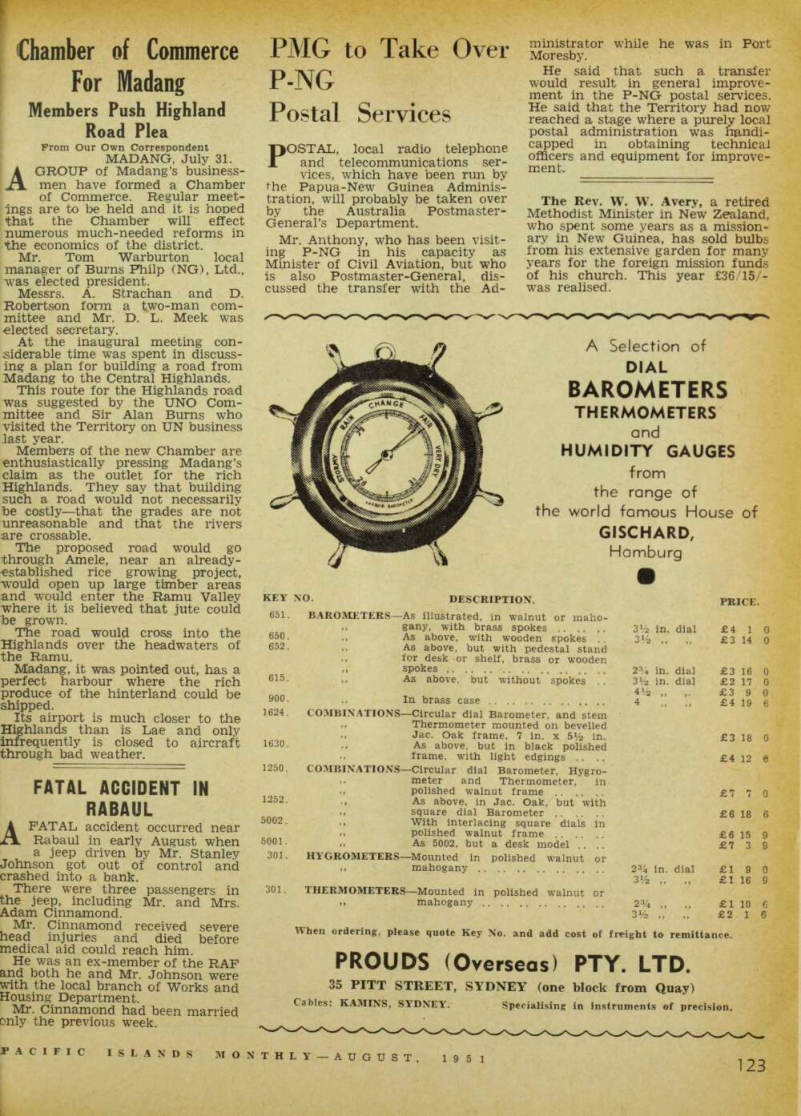
Chamber of Commerce For Madang Members Push Highland Road Plea
Prom Our Own Correspondent
Madang, July 31.
A GROUP of Madang’s business men have formed a Chamber of Commerce. Regular meet ings are to be held and it is hoped that the Chamber will effect numerous much-needed reforms in the economics of the district.
Mr, Tom Warburton local manager of Burns Philp (NG), Ltd., was elected president.
Messrs. A. Strachan and D.
Robertson form a two-man com mittee and Mr. D. L. Meek was •elected secretary.
At the inaugural meeting con siderable time was spent in discuss ing a plan for building a road from Madang to the Central Highlands.
This route for the Highlands road was suggested by the UNO Com mittee and Sir Alan Bums who visited the Territory on UN business last year.
Members of the new Chamber are enthusiastically pressing Madang’s claim as the outlet for the rich Highlands. They say that building such a road would not necessarily be costly—that the grades are not unreasonable and that the rivers are crossable.
The proposed road would go through Amele, near an already established rice growing project, would open up large timber areas and would enter the Ramu Valley where it is believed that jute could be grown.
The road would cross into the Highlands over the headwaters of the Ramu.
Madang, it was pointed out, has a perfect harbour where the rich produce of the hinterland could be shipped.
Its airport is much closer to the Highlands than is Lae and only infrequently is closed to aircraft through bad weather.
Fatal Accident In
Rabaul
A FATAL accident occurred near Rabaul in early August when a jeep driven by Mr. Stanley Johnson got out of control and crashed into a bank.
There were three passengers in the jeep, including Mr. and Mrs.
Adam Cinnamond.
Mr. Cinnamond received severe head injuries and died before medical aid could reach him.
He was an ex-member of the RAF and both he and Mr. Johnson were with the local branch of Works and
Housing Department.
Mr. Cinnamond had been married only the previous week.
PMG to Take Over
P-Ng
Postal Services
POSTAL, local radio telephone and telecommunications ser vices, which have been run by the Papua-New Guinea Adminis tration, will probably be taken over by the Australia Postmaster- General’s Department.
Mr. Anthony, who has been visit ing P-NG in his capacity as Minister of Civil Aviation, but who is also Postmaster-General, dis cussed the transfer with the Ad
ministrator while he was in Port Moresby.
He said that such a transfer would result in general improve ment in the P-NG postal services.
He said that the Territory had now reached a stage where a purely local postal administration was handi capped in obtaining technical officers and equipment for improve ment.
The Rev. W. W. Avery, a retired Methodist Minister in New Zealand, who spent some years as a mission ary in New Guinea, has sold bulbs from his extensive garden for many years for the foreign mission funds of his church. This year £36/15/was realised.
Advertisements & other items, p. 125 (1 item)
PROUDS (Overseas) PTY. LTD.
rHANGf
A Selection of
DIAL
BAROMETERS
THERMOMETERS
and
HUMIDITY GAUGES
from
the range of
the world famous House of
GISCHARD,
Hamburg
KEY
651. 650. 652. 900. 1624. 1630. 1250. 1252. 5002. 5001. 301. 301.
NO.
DESCRIPTION.
BAROMETERS—As illustrated, in walnut or maho- ,, gany, with brass spokes • > As above, with wooden spokes ..
As above, but with pedestal stand • > for desk or shelf, brass or wooden spokes As above, but without spokes In brass case COMBINATIONS —Circular dial Barometer, and stem .. Thermometer mounted on bevelled Jac. Oak frame, 7 in. x 5y 2 in. .. As above, but in black polished frame, with light edgings .. ..
COMBINATIONS—CircuIar dial Barometer, Hygrometer and Thermometer, in .. polished walnut frame As above, in Jac. Oak, but with j, square dial Barometer .. With interlacing square dials in 9 f polished walnut frame >. As 5002, but a desk model .. ..
HI GROMETERS—Mounted in polished walnut or mahogany THERMOMETERS—Mounted in polished walnut or » mahogany When ordering, please quote Key No. and add cost of freight to remittance,
PROUDS (Overseas) PTY. LTD.
35 PITT STREET, SYDNEY (one block from Quay) Cables: KAMINS, SYDNEY. Specialising in instruments of precision.
Night School in Vila
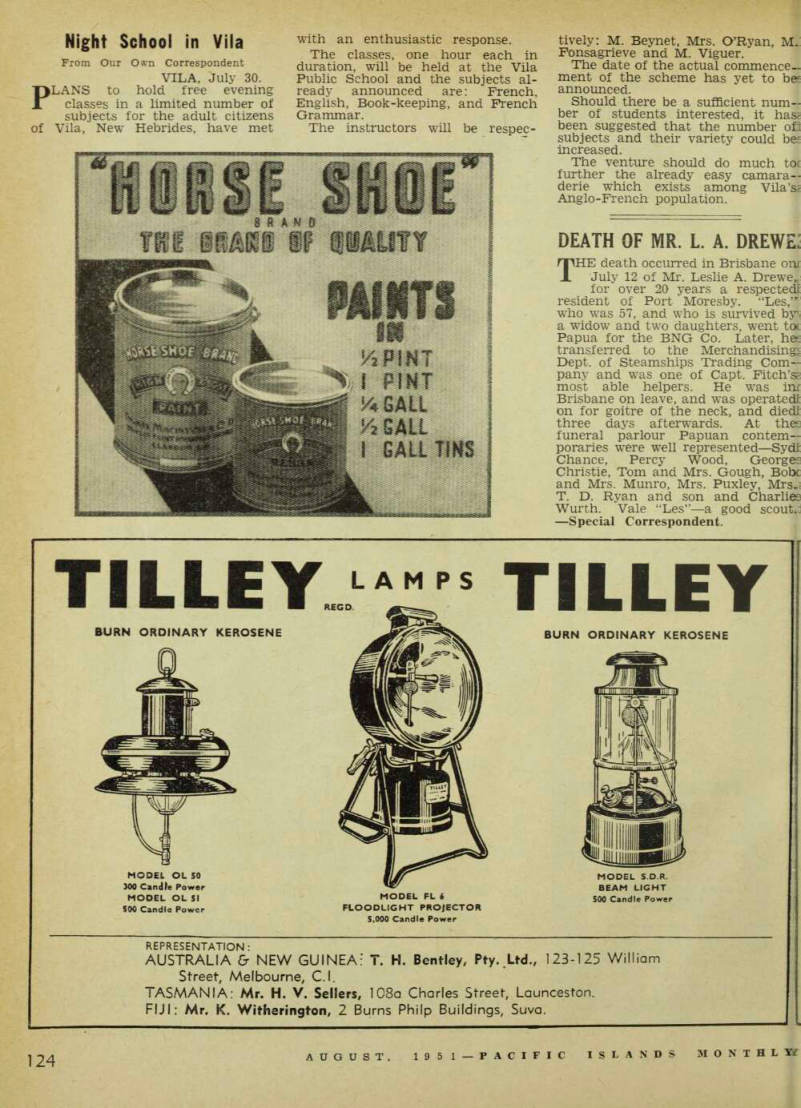
From Our Own Correspondent VILA, July 30.
PLANS to hold free evening classes in a limited number of subjects for the adult citizens of Vila, New Hebrides, have met
with an enthusiastic response.
The classes, one hour each in duration, will be held at the Vila Public School and the subjects al ready announced are: French, English, Book-keeping, and French Grammar.
The instructors will be respec
tively: M. Beynet, Mrs. O’Ryan, M.: Fonsagrieve and M. Viguer.
The date of the actual commence ment of the scheme has yet to bee announced.
Should there be a sufficient num ber of students interested, it hass been suggested that the number off subjects and their variety could bee Increased.
The venture should do much toe further the already easy camara derie which exists among Vila’ss Anglo-French population.
Death Of Mr. L. A. Drewe
THE death occurred in Brisbane one July 12 of Mr. Leslie A. Drewe„: for over 20 years a respected! resident of Port Moresby. “Les,’*' who was 57, and who is survived a widow and two daughters, went toe Papua for the BNG Co. Later, hee transferred to the Dept, of Steamships Trading Com pany and was one of Capt. Fitch’ss most able helpers. He was inr Brisbane on leave, and was operated! on for goitre of the neck, and died! three days afterwards. At thes funeral parlour Papuan contem poraries were well represented—Syd!
Chance, Percy Wood, Georges Christie, Tom and Mrs. Gough, Bobc and Mrs. Munro, Mrs. Puxley, Mrs.; T. D. Ryan and son and Charlies Wurth. Vale “Les”—a good scout.d —Special Correspondent.
Advertisements & other items, p. 126 (1 item)
Tilley
I ft A N d wmmibm
54 PINT
! PINT
54 BALI
H BALL
I BAUTINS
TILLEY
BURN ORDINARY KEROSENE
LAMPS
MODEL OL 50
}OO Candle Power
MODEL OL SI
500 Candle Power
TILLEY
BURN ORDINARY KEROSENE
MODEL FL 6
FLOODLIGHT PROJECTOR
5,000 Candle Power
MODEL S.D.R.
BEAM LIGHT
500 Candle Power
REPRESENTATION:
AUSTRALIA & NEW GUINEA? T. H. Bentley, Pty. Ltd., 123-125 William
Street, Melbourne, C.l.
TASMANIA: Mr. H. V. Sellers, 108 a Charles Street, Launceston.
FIJI: Mr. K. Witherington, 2 Burns Phi Ip Buildings, Suva.
Rabaul
Social Problem in Rabaul Unfortunate incident in RSL Club
From a Special Correspondent MOST unfortunate publicity has been given to a recent incident in the Returned Soldiers’ Club in Rabaul.
A member of the RSL, who has some strain of Island blood, accom panied by a European who is married to a Euronesian, took a number of Euronesian friends into the club-rooms. It is claimed that their behaviour was quiet and decorous.
Their presence was resented by certain Europeans who, with their womenfolk, departed and with ostentation.
The next development was a letter to the Committee, complaining of the presence of “half-castes” in the Club. The Committee, with sad lack of finesse and understanding, presented the letter at a meeting of the Sub-Branch.
That, of course, gave undesirable publicity, not only to a somewhat silly incident, but also to a social problem that is always bobbing up in these Islands Territories.
There are people of mixed blood tvho “go native” and, therefore must take the social status of natives.
But there are others who quite properly claim the living standards md privileges of Europeans, and vho, by their good conduct and ntelligence and education, are en dued to every consideration. It is i wrong and cruel thing that such people whom we generally call Euronesians—should be humiliated
by the kind of treatment which the little party encountered in the Rabaul RSL Club.
If there are Europeans who object to association with Euronesians, they are entitled to say so. But it clearly is the duty of responsible folk like the Committee of the Club —to handle such matters with tact and discretion. A solution should be sought behind closed doors. A social problem that already is a headache is made worse by a public parade. Nothing is gained, and a great deal is lost, by exposing to public opprobrium the helpless people who are in no way re sponsible for their mixed blood.
Another Governor For
New Caledonia
IT is as hard to keep up with the governors of the French Pacific territories as it is to say, off hand, who is the current husband of a Hollywood film star.
Since the war and before it there has been a procession of governors in Tahiti and New Caledonia.
Governor-General Coumarie, of New Caledonia, recently left Noumea for France by the Messageries Mari times vessel Chung King and will not be back.
His successor is Monsieur Louveau, for five years Governor of Soudan, where they apparently keep their Governors a little longer, but New Caledonia learned of his appoint ment only by way of a broadcast from Brazzaville in Central Africa.
Mr. D. T. Tilley, Fire Officer at Lautoka, Fiji, and secretary of the Northern Club, is away on leave with Mrs. Tillev. On his return, he will rejoin Morris Hedstrom as Lautoka shipping manager.
Advertisements & other items, pp. 127-128 (2 items)
Brand Rope,
Agents for Pacific Islands
Monthly
(Holding supplies for Cash Sale and authorised to receive annual Subscriptions.) In Pacific Islands Generally: All Branches of: Burns Philp & Co., Ltd., Burns Philp (SS) Co. Ltd.
W. R. Carpenter & Co.. Ltd.
Morris Hedstrom, Ltd.
W. H. Grove & Sons, Ltd.
Papua-New Guinea; Burns Philp (NGi Ltd.
Steamships Trading Co., Ltd.
Colyer Watson (NG), Ltd.
New Guinea Co.. Ltd.
A. H. Bunting, Ltd.. Samarai.
Mrs. Jean Fraser. Lae.
Wan Jin Wah, Lae.
R. F. Smith. Rabaul.
C. H. Meen. Rabaul.
Kriewaldt’s Stores. Port Moresby.
Fiji: Steele’s Central Store, Suva.
Fiji Times & Herald, Suva.
Adams Pharmacies, Lautoka.
Western Samoa: A. Vercoe, Apia.
Cook Islands; Cook Islands Trading Co., Rarotonga.
New Caledonia: Ed. Pentecost. Noumea.
Societe Gubbay Kerr et Cie, Noumea.
Thursday Island; P. H. Mendis. N. Mendis.
Norfolk Island: Mrs. Moltke’s Store.
Nauru: T. Daingarob.
Tahiti: O. G. Nordman, Papeete.
Rodolphe Klima, Papeete.
New Hebrides: Burns Philp (NH) Ltd., Vila, Santo.
Sydney: N.S.W. Bookstall Co., Market St.
Cordingley’s Bookstall, next G.P.O., George St.
Tyrrell’s Book Shop. 281 George St.
Swain’s Pty., Ltd., 123 Pitt St.
Dymock’s, Ltd., 424 George St.
Uneeda Newsagency, 18 Bond St.
Melbourne: McGill’s Newsagency, 183 Elizabeth St.
Collins Book Depot, 93 Elizabeth St.
Myers Emporium. Ltd., 314 Bourke St.
Queensland: Mac’s Casket Agency, 289 Queen St., Brisbane.
J. Thomson. 311 Queen St., Brisbane.
Vernon E. White. M.Q.I.S., F.R.G.S., Cocrparoo, Brisbane.
Gard’s Bookstall, 102 Flinders St., Townsville.
Darwin: Burnett’s Newsagency Pty.. Ltd.. Darwin.
C. J. Cashman & Co., Darwin.
Auckland, NZ: A. G. Sims, Waverley Bookshop, 18 Queen St.
W. H. Grove & Sons, Ltd., 16 Fanshawe St.
Gordon & Gotch (A/sia), Ltd., 6 Gore St.
Scott’s “ Renown
Cable Address: Ropeyard, Sydney.
Brand Rope,
Cordage and
Binder Twine
of Every
Description
MANUFACTURED AT
MASCOT, N.S.W..
by
J. SCOTT
PTY. LTD.
Head Office and Store
163 CLARENCE STREET,
SYDNEY,
N.S.W.
Classified Advertisements
PUBLIC NOTICE
In the Supreme Court of the Territory -of Papua and New Guinea.—ln the matter of the Companies Ordinance, 1912-1926, and in the matter of Sogeri Rubber Plantations, Limited (and reduced).
NOTICE is hereby given that a Petition has been presented to the Supreme Court of the Territory of Papua and New Guinea for confirming Resolutions of the above Company for reducing its capital Trom Thirty thousand pounds (£30,000) to Fifteen thousand pounds (£15,000).
And further take notice that the said Petition is directed to be heard berore the said Supreme Court at 9.30 o’clock in the forenoon on Friday the Twentyeighth day of September, 1951, or so soon thereafter as counsel can be heard by counsel on behali of the Company. Any creditor or shareholder of the Company desiring to oppose the making of an Order for the reduction of the capital of the said Company under the above Ordinance should appear at the time of hearing by himself or his counsel for that purpose.
And a copy of the Petition will be furnished to any creditor or shareholder of the Company requiring the same by the undersigned on payment of the required charges for the same.
And further Notice is hereby given that any person who claims to have been and •still to be a creditor of the said Company must on or before the Twenty-first day of September, 1951. send his name and also the particulars of his claim and the name and address of his solicitor (if any) to the undersigned at the address mentioned below or in default thereof he will be precluded from objecting to the proposed reduction of capital.
J. IRWIN CROMIE,
Solicitor, Port Moresby.
Dated the Twelfth day of July, 1951.
MACHINERY
FOR SALE
New Four-Header Planing and
Moulding Machines.
Size, Bx 3, fully ball-bearing,
complete with totally enclosed
gears, operating in oil. Also
fully adjustable, ball-bearing
counter-shaft. Immediate de-
livery.
Price: £B5O, Sydney.
Machines fully guaranteed.
Sole Distributing Agent:
A. D. WALSH,
10 Centennial Ave., Lane Cove',
Sydney, N.S.W.
Bankers: Commercial Banking Co. of Sydney, Ltd., Kingsford, Sydney.
PUBLIC NOTICE
In the Supreme Court of New South Wales. Probate Jurisdiction.—ln the Will (and one Codicil) of EDMUND VINCENT O’BRIEN, late of Madang, in the Territory of New Guinea, planter, deceased, application will be made after 14 days from the publication hereof that probate of the last Will and Testament, dated July 18, 1950 (and one Codicil thereto dated May 1, 1951), of the abovenamed deceased may be granted to Nancye Douglas O’Brien and Burns Philp Trust Company Limited, the Executors named in the said Will, and all notices may be served at the undermentioned address. All Creditors in the Estate of the deceased are hereby required to send in particulars of their claims to the undersigned.
RALPH S. B, SILLAR & MADDISON,
11c Castlereagh Street, Sydney.
Dated: August 15, 1951.
BOOKS
BOOK BARGAINS.—Send for list of real bargains from 2/- upwards. State your interests, please. I also find out-of-print English Books. Mention “PIM.” Nearly 400 customers in the area where “PIM” circulates.—Philip Boulton, Bookseller, Westbury, Wilts, England.
FOR SALE
NEW Bartile (U.S.A.) Concrete Roof Tile Machinery, complete with pallets, hopper, motor, steel forms for trim, tiles, etc.
Vibration feature produces dense, economical tiles. Write Seaboard Corporation Pty., Ltd., P.O. Box 3508, G.F.0., Sydney, Australia.
RADIO EQUIPMENT.—We can supply new and reconditioned transmitters and receivers for low powered marine and shore installations at a reasonable price.
Crystals supplied to specified frequencies.
Inquiries answered promptly. Write: Liverpool Trading Co., 23 George Street, Liverpool, N.S.W., Australia.
COCONUT PLANTATION.—In the Solomon Islands, 540 acres freehold property, ideally situated —340 acres planted fully bearing palms. 200 acres virgin country suitable for planting cocoa. Large new well-furnished bungalow, water, sewerage, electric light, with garden and orchard.
Trade store, bulk store, workshop, labourers’ quarters, copra drier, and copra storing shed, with capacity for 100 tons—all newly constructed. Good trading centre. Going concern. For sale, with or without new 10 ton auxiliary ketch, built July, 1950. For further particulars (to principals only), write to “Solomons,” c/o Box 3408, G.P.0., Sydney.
NORFOLK ISLAND.—If you want FREE- DOM from irksome restrictions—come to NORFOLK IS. and live with delightful, friendly people. The climate is ideal (50° to 85°), mainland and tropical flowers and fruit all grow profusely.
There are NO TAXES of any sort. Now available: 17 acres, freehold, very central, near shops and school, beautifully wooded —only £65 an acre. Great potential value. Build four cottages on this property, let them to all-the-year-round visitors and enjoy an easy Income. — Peter Goddard, Norfolk Island.
ACCOMMODATION
SYDNEY.—Furnished, serviced hats, with private bathroom and kitchenette, morninp trays, situated in heart of the Double and family fiats available —reasonc able rates for Pacific Islands residents: Wyobe Court, 52-54 Phillip Street, Sydney; Cable address; “Yarap,” Sydney. Teles phone: BU 1376.
ATTRACTIVE ACCOMMODATION foo
tourists, with children. “Tanglewood,*, Clayfield, Brisbane, Queensland. ’Phone M 5656.
WANTED TO BUY
SMALL ISLAND, suitable for middle-age<£ couple to retire and escape worldl;! worries. Only necessities are fresh wates supply and soil suitable for growing norms vegetables. Bungalow not necessary. Anyv where with warm climate, not in moss quite zone. Details and price to: Field) 52 Cobbler’s Bridge Road, Herne Kent, England.
BRITISHER, healthy, active, 60, lifetime in Asiatic countries, fed up with theis political and economic troubles, desiretransfer tropical land, where law ann order prevails and life secure under com genial conditions amongst friendly people Contemplates purchasing small, successj ful going concern, such as copra plant tation, Island trading, trocas fishing a» other suitable activity. Would conside. interest in larger business, provided mas take useful part in management ann administration. Competent, experiences business executive, skilled accountant strictly temperate. Interested in genuim proposition offering scope for happje mutual co-operation. References ex changed. Confidential. H. Stephen, c/\; Box 3408. G.P.0., Sydney.
POSITIONS WANTED
YOUNG EX-RAF OFFICER, married, seekh interesting position in the Islands with airline operators, commercial organisation: or as plantation assistant. Has had both airlines and commercial experience in tlri: Far East, experienced in handling nativi labour, knowledge of tropical agriculture: Would like the opportunity to prove ability and to use initiative.—Reply tef “Efficient,” c/o Box 3408, G.P.0.. Sydney ACCOUNTANT, aged 26, married, 2 : S years (post-war) experience in handlini native labour, stores, messing, truckh and boats, seeks position in the Pacifti Islands. Also has had 10 years’ eie perience in shipping and office routine Excellent references. Reply, in confldencoj to; R. Morton, Flat 6. 3 Henry Strees: Hawthorn, Melbourne. Victoria.
INTELLIGENT English ex-Serviceman, S married, highest integrity, seeks position on plantation (or will do other worPr in the Pacific Islands. Good education conscientious worker, adaptable, quick ■ learn. Handy with boats; can driwi References. Replies to: Advertiser, 8 Partanna Avenue, Matraville, N.S.W7
Australia. J
ENGLISHMAN. —Single, strong educationm background, ex-Service, travelled, wieh general experience, living conditioio (preferably bachelor) and congeniia society more important than salam Consider anything, anywhere. At present employed (typist) near Lae, New Guineer For further particulars write: “Alistainl c/o Box 3408, G.P.0.. Sydney, N.S.W.
126
AUGUST, 1951 PACIFIC ISLANDS MONTH LYY
Governor and Indonesians in New Caledonia
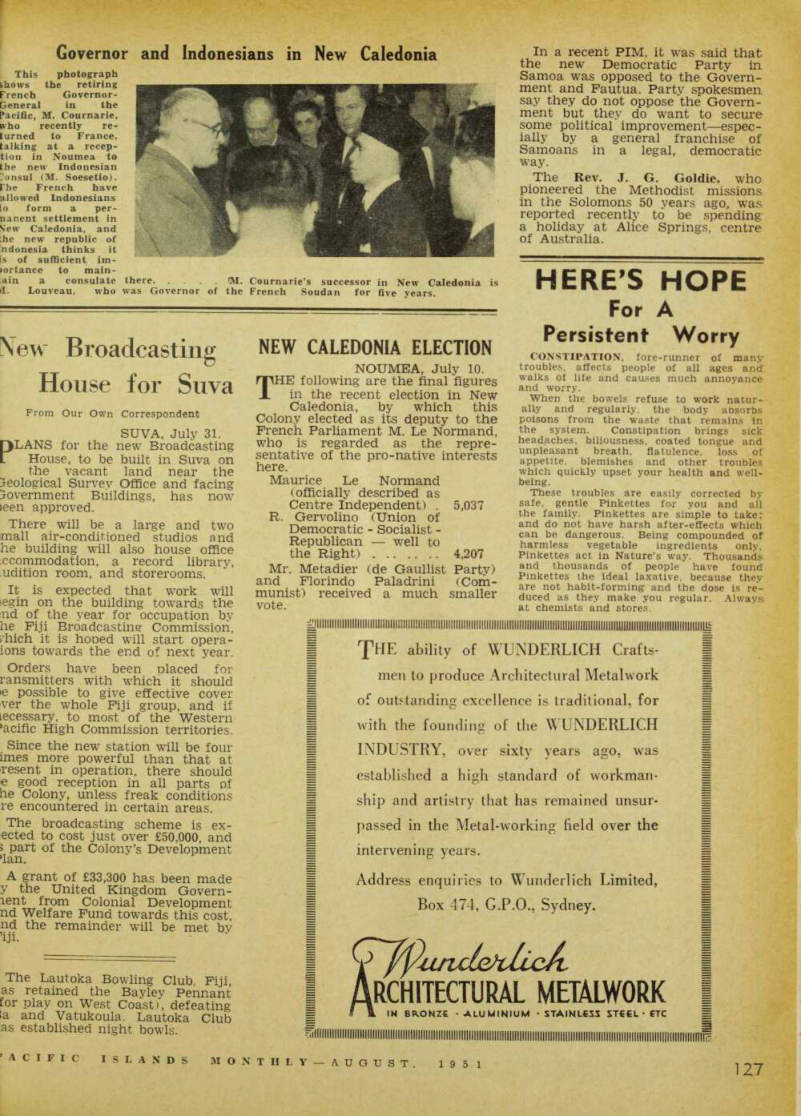
In a recent PIM, it was said that the new Democratic Party in Samoa was opposed to the Govern ment and Fautua. Party spokesmen say they do not oppose the Govern ment but they do want to secure some political improvement—espec ially by a general franchise of Samoans in a legal, democratic way.
The Rev. J. G. Goldie, who pioneered the Methodist missions in the Solomons 50 years ago, was reported recently to be spending a holiday at Alice Springs, centre of Australia.
This photograph shows the retiring French Governor- General in the Pacific, M. Cournarie, who recently re turned to France, talking at a recep tion in Noumea to the new Indonesian Consul (M. Soesetio).
The French have allowed Indonesians to form a per manent settlement in New Caledonia, and the new republic of Indonesia thinks it is of sufficient im [?]ortance to main-
[?]ain a consulate there M. Cournarie’s successor in New Caledonia is [?] Louveau, who was Governor of the French Soudan for five years.
New Broadcasting
House for Suva
From Our Own Correspondent SUVA, July 31.
PLANS for the new Broadcasting House, to be built in Suva on the vacant land near the Geological Survey Office and facing Government Buildings, has now »een approved.
There will be a large and two mall air-conditioned studios and he building will also house office ccommodation, a record library, udition room, and storerooms.
It is expected that work will iegin on the building towards the nd of the year for occupation by he Fiji Broadcasting Commission, rhich it is honed will start opera ions towards the end of next year.
Orders have been nlaced for ransmitters with which it should •e possible to give effective cover ver the whole Fiji group, and if tecessary, to most of the Western 'acific High Commission territories.
Since the new station will be four imes more powerful than that at resent in operation, there should € good reception in all parts of he Colony, unless freak conditions re encountered in certain areas.
The broadcasting scheme is ex ected to cost just over £50,000, and ; part of the Colony’s Development 'lan.
A grant of £33,300 has been made y the United Kingdom CGovern rent from Colonial Development nd Welfare Fund towards this cost, nd the remainder will be met by ’iji.
The Lautoka Bowling Club, Fiji as retained the Baylev Pennant for play on West Coast), defeating la and Vatukoula. Lautoka Club as established night bowls.
New Caledonia Election
Noumea, July 10.
THE following are the final figures in the recent election in New Caledonia, by which this Colony elected as its deputy to the French Parliament M. Le Normand, who is regarded as the repre sentative of the pro-native interests here.
Maurice Le Normand (officially described as Centre Independent) . 5,037 R. Gervolino (Union of Democratic - Socialist - Republican well to the Right) 4,207 Mr. Metadier (de Gaullist Party) and Florindo Paladrini (Com munist) received a much smaller vote.
Persistent' Worry
Here’S Hope
For A Persistent' Worry
CONSTIPATION, fore-runner of many troubles, affects people of all ages and walks of life and causes much annoyance and worry.
When the bowels refuse to work natur ally and regularly, the body absorbs poisons from the waste that remains in the system. Constipation brings sick headaches, biliousness, coated tongue and unpleasant breath, flatulence. loss of appetite, blemishes and other troubles which quickly upset your health and well being.
These troubles are easily corrected by safe, gentle Plnkettes for you and all the family. Pinkettes are simple to take: and do not have harsh after-effects which can be dangerous. Being compounded of harmless vegetable ingredients only, Pinkettes act in Nature’s way. Thousands and thousands of people have found Pinkettes the ideal laxative, because they are not habit-forming and the dose is re duced as they make you regular. Always at chemists and stores.
Advertisements & other items, p. 129 (2 items)
127
’ACIFIC ISLANDS MONTHLY AUGUST, 1951
(J'ftpund&t/icA
THE ability of WUNDERLICH Craftsmen to produce Architectural Metalwork of outstanding excellence is traditional, for with the founding of the UNDERLICH INDUSTRY, over sixty years ago, was established a high standard of workmanship and artistry that has remained unsurpassed in the Metal-working field over the intervening years.
Address enquiries to Wunderlich Limited, Box 474, G.P.0., Sydney.
Architectural metalwork
• ' IN BP.ONZ-E - ALUMINIUM - STAINLESS ST€€L • €TC
Islands Produce
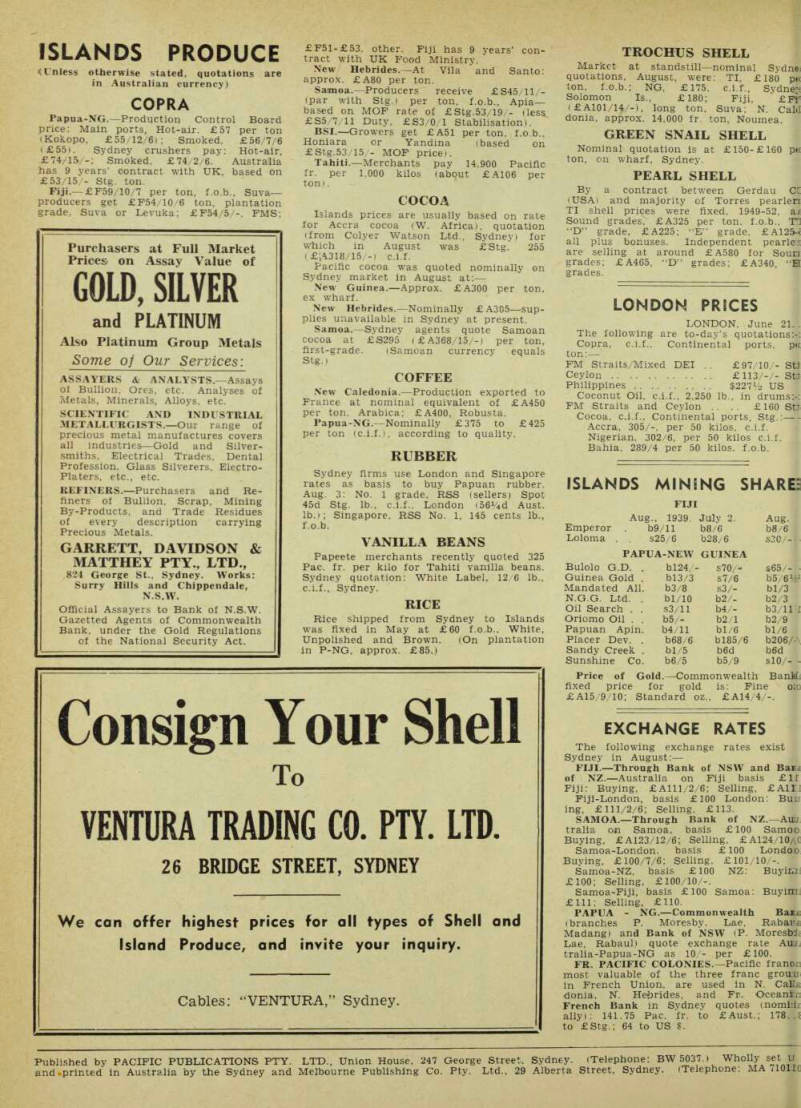
<Unless otherwise stated, quotations are in Australian currency)
Copra
Papua-NG.—Production Control Board price: Main ports, Hot-air. £57 per ton (Kokopo, £55/12/6); Smoked. £56/7/6 (£55). Sydney crushers pay: Hot-air, £74/15/-; Smoked, £74/2/6. Australia has 9 years’ contract with UK, based on £53/15/- Stg. ton.
Fiji.— £FS9/10/7 per ton, f.0.b., Suva — producers get £FS4/10/6 ton, plantation grade. Suva or Levuka; £FS4/5/-, FMS;
£FSI-£53. other. Fiji has 9 years’ con tract wfith UK Food Ministry.
New Hebrides.—At Vila ‘and Santo: approx. £ ABO per ton.
Samoa. —Producers receive £S4S/11/- (par with Stg.i per ton, f.0.b., Apia based on MOF rate of £ Stg.s3/19 - (less £SS/7/ll Duty, £S3/0/l Stabilisation!.
BSI. —Growers get £ASI per ton, f.0.b., Honiara or Yandina (based on £ Stg.s3/15 - MOP price).
Tahiti.—Merchants pay 14,900 Pacific fr. per 1,000 kilos (about £AIO6 per ton).
Cocoa
Islands prices are usually based on rate for Accra cocoa (W. Africa), quotation (from Colyer Watson Ltd., Sydney) for which in August was £Btg. 255 (£IA3IB/15/-) c.i.f.
Pacific cocoa was quoted nominally on Sydney market in August at: — New Guinea.—Approx. £A3OO per ton, ex wharf.
New Hebrides.—Nominally £A3os—sup plies unavailable in Sydney at present.
Samoa. —Sydney agents quote Samoan cocoa at £5295 (£A36B/15/-) per ton, first-grade. (Samoan currency equals Stg.)
Coffee
New Caledonia.—Production exported to France at nominal equivalent of £A4SO per ton, Arabica; £A4OO, Robusta.
Papua-NG.—Nominally £375 to £425 per ton (c.i.f. i. according to quality.
Rubber
Sydney firms use London and Singapore rates as basis to buy Papuan rubber.
Aug. 3: No. 1 grade, RSS (sellers) Spot 45d Stg. lb., c.i.f.. London (56y 4 d Aust. lb.»; Singapore, RSS No. 1, 145 cents lb., f.o.b.
Vanilla Beans
Papeete merchants recently quoted 325 Pac. fr. per kilo for Tahiti vanilla beans.
Sydney quotation: White Label, 12/6 lb., c.i.f., Sydney.
Rice
Rice shipped from Sydney to Islands was fixed in May at £6O f.0.b., White, Unpolished and Brown. (On plantation in P-NG, approx. £85.)
Troches Shell
Market at standstill—nominal Sydne quotations, August, were; TI, £lBO p»i ton, f.0.b.; NG, £175, c.i.f., Sydney Solomon Is., £180; Fiji, £F*' ( £AIOI/14/-), long ton, Suva; N. Cali] donia, approx. 14,000 fr. ton, Noumea.
Green Snail Shell
Nominal quotation is at £l5O-£l6O p« ton, on wharf, Sydney.
Pearl Shell
By a contract between Gerdau CC (USAi and majority of Torres pearlen TI shell prices were fixed, 1949-52, ac Sound grades. £A325 per ton. f.0.b.. T/ “D” grade, £A225; “E” grade. £AI2S-« all plus bonuses. Independent pearler are selling at around £ASBO for Soun grades; £A465, “D” grades; £A34O, 'H grades.
London Prices
London. June 21..
The following are to-day’s quotations:-: Copra, c.i.f.. Continental ports, pic ton:— FM Straits/Mixed DEI .. £97/10/- Stl Ceylon £ll3/-/- Stl Philippines $227 Vz US Coconut Oil. c.i.f.. 2,250 lb., in drums:-: FM Straits and Ceylon .. .. £l6O Sti Cocoa, c.i.f.. Continental ports, Stg.: Accra, 305/-, per 50 kilos, c.i.f.
Nigerian. 302/6, per 50 kilos c.i.f.
Bahia. 289/4 per 50 kilos, f.o.b.
Islands Mining Share:
Fiji
Aug., 1939. July 2. Aug.
Emperor . b9/ll bB/6 bB/6
Loloma . , 525/6 b2B/6 s2O/-l-
Papua-New Guinea
Bulolo G.D. . b 124, - s7O/- 565/- - Guinea Gold . bl3/3 s7/6 b5/6W Mandated All. b3/8 s 3- bl/3 N.G.G. Ltd. . bl/10 b 2- b2/3 Oil Search . . s3/ll b 4- b3/ll : I Oriomo Oil . . b 5- b2/l b2/9 Papuan Apin. b4/ll bl/6 bl/6 Placer Dev. . b6B/6 blBs/6 b206/-\ Sandy Creek. . bl/5 b6d b6d Sunshine Co. b6/5 b5/9 SlO/-J- Price of Gold.—-Commonwealth BanM fixed price for gold is: Fine oio £AIS/9/10; Standard oz., £AI4/4/-.
Exchange Rates
The following exchange rates exist Sydney in August:— FlJl.—Through Bank of NSW and Bar. of NZ.—Australia on Fiji basis £II Fiji: Buying, £Alll/2/6; Selling, £Alli Piji-London, basis £lOO London; Bun ing, £lll/2/6; Selling. £ll3.
SAMOA.—Through Bank of NZ.—Auu tralia on Samoa, basis £lOO Samoo Buying, £AI23/12/6; Selling. £AI24/10aC Samoa-London, basis £ 100 London Buying, £lOO/7/6; Selling. £lOl/10/-.
Samoa-NZ, basis £lOO NZ; Buyiirr £100; Selling, £lOO/10/-.
Samoa-Fiji, basis £lOO Samoa; Buyimi £111: Selling, £llO.
PAPUA - NG.—Commonwealth Baiu. (branches P. Moresby. Lae, Rabaus Madang) and Bank of NSW (P. Moresby Lae, Rabaul) quote exchange rate Autr. tralia-Papua-NG as 10/- per £lOO.
FR. PACIFIC COLONIES.—Pacific franon most valuable of the three franc groinr in French Union, are used in N. Calls donia, N. Hebrides, and Fr. Oceanicn French Bank in Sydney quotes (nomhir ally); 141.75 Pac. fr. to £Aust.; 178..) to £Stg.; 64 to US $.
Advertisements & other items, pp. 130-132 (3 items)
Published by PACIFIC PUBLICATIONS PTY. LTD., Union House, 247 George Street. Sydney. (Telephone: BW 5037.) Wholly set ir
and printed in Australia by the Sydney and Melbourne Publishing Co. Pty. Ltd., 29 Alberta Street, Sydney. (Telephone: MA 71011
Consign Your Shell
Purchasers at Full Market Prices on Assay Value of
GOLD, SILVER
and PLATINUM
Also Platinum Group Metals
Some 0/ Our Services :
ASSAYERS & ANALYSTS. —Assays
of Bullion. Ores, etc. Analyses of Metals, Minerals, Alloys, etc.
SCIENTIFIC AND INDUSTRIAL
METALLURGISTS.—Our range of precious metal manufactures covers all industries —Gold and Silversmiths. Electrical Trades, Dental Profession, Glass Silverers, Electro- Platers, etc., etc.
REFlNERS.—Purchasers and Refiners of Bullion, Scrap, Mining By-Products, and Trade Residues of every description carrying Precious Metals.
GARRETT, DAVIDSON &
MATTHEY PTY., LTD.,
824 George St., Sydney. Works: Surry Hills and Chippendale,
N.S.W.
Official Assayers to Bank of N.S.W.
Gazetted Agents of Commonwealth Bank, under the Gold Regulations of the National Security Act.
Consign Your Shell
To
VENTURA TRADING CO. PTY. LTD.
26 BRIDGE STREET, SYDNEY
We can offer highest prices for all types of Shell and Island Produce, and invite your inquiry.
Cables: “VENTURA,” Sydney.
New Guinea
BY \fc / The “Chieftain” is the most luxurious air travel ever offered to travellers to and from New Guinea. It flies right through, stopping at Brisbane only. No disembarking and re-embarking for overnight stops.
SPECIAL DE LUXE
SERVICE
Passengers ran hoard thr "Chieftain' in a matter of minutes from the com-
fortable Passenger Lounge at the
Flying Boat Bases. m i The "Chieftain" Service includes: • Full Table Meal Service (also Card and Writing Tables). ® Full Bar Service. • Two Flight Stewards and Air Hostess. ® The menu standard is unsurpassed by even the best hotels.
MAKE YOUR NEXT TRIP by the "Chieftain" Service and enjoy the luxury and comfort which only the "Chieftain" Service offers. tor lures. Timetables and Freight information consult your local Travel Agent or
mm OCEANIC AIRWAYS
Principal Agents:
SYDNEY
McArthur Shipping Co, PORT MORESBY Pty. Ltd. Steamships Trading 31 Macquarie Place Co. Ltd.
BU 2048 BU 2049
BRISBANE
World Travel Headquarters Lennons Hotel B 4114 B 4124
GENERAL MERCHANTS
Capital £1,000,000
ESTABLISHED 1914
GENERAL MERCHANTS
and
PROVIDORES
TRADE THROUGHOUT THE PACIFIC
OVER THIRTY-FIVE YEARS OF PACIFIC ISLANDS DEVELOPMENT AND SERVICE BUYERS AND EXPORTERS OF ALL KINDS AGENTS FOR AUSTRALIAN. EUROPEAN
) AND AMERICAN MANUFACTURERS.
OF ISLAND PRODUCE, COPRA. COCOA, \ DISTRIBUTORS OF EVERY DESCRIPTION M.O.P. SHELL, TROCAS SHELL, ETC. ' OF MERCHANDISE.
Through our Sydney office, branches and agents, we distribute a wide and comprehensive range of genera! merchandise.
W. R. CARPENTER & CO. LTD.
Head Office: 16 O'CONNELL STREET, SYDNEY, N.S.W.
Cable Address: Telephone: Postal Address: “CAMOHE." BW 4421. G.P.0., BOX 168. Sydney.
In London : W. R. Carpenter Cr Co. (London) Ltd., 4 Lloyd's Avenue, London, E.C.3.
ASSOCIATED COMPANIES THROUGHOUT THE PACIFIC
IN NEW GUINEA: IN PAPUA: IN HJI: New Guinea Company Limited, J. H. Clay & Co. Ltd., W. R. Carpenter & Co. (Fiji) Rabaul, Lae, Madang, Kavieng.
Port Moresby. ltd