Dampier Passed
p. 61 · Read in the full issue
That Way
The Story of Kar Kar Island Told by Joan Stevens
OUT of a mist of time and a drift of cloud, the massive bulk of Kar Kar Island seems to overshadow Madang on the Northern New Guinea coast.
Kar Kar is 6 000 feet high, and has two * r n a ™ rs /~ one at 4,000 feet, the other at 6,000 feet. I am told that the circum ference of the larger one is the second largest in the world. According to William Dar TP™ r ’ 9 ne the craters was erupting m 1700, when he was around that way , ai l d J^ 16 - German Lutheran missionaries left diaries telling of the hazardous time they spent there in the eruption of 1895 These records seem to prove that the native belief that Kar Kar goes up about every 200 years has some basis in fact.
The natives believe that the volcano, if cross, veils himself in clouds, and. when furious, shows his spite by belching out fire, smoke and ash.
Directly north of Madang, the island ha,s some magnetism that draws the eyes and tickles the interest. At times it is so moody that it disappears altogether. hiL,? th ? r r are occasions, it flaunts its m ., T 8 cl J; ar triangle of blue. At twilight, it is often bathed in gossamer pink and grey clouds reflecting them selves in a rose-coloured bay. At noon, heat OmS * n a baze of steam and R o \f gend J l ?® a native couple, fprncc ? nd far, far back, walked across from Gragad Island, on the then land bridge to Kar Kar, to a Tn 6r }b Tlred ’ they cam P ed there n S 6 ™ rnm g they wakened * hat a Blg , Tlde bad come up and, nerild S i om w tmy islands - had sub- V£ nd con necting them to the ih^ii d 'i. After . making a canoe - they home to find many of their latl lf?’ homeless and hungry from the * lg They persuaded them to re urn to the southern slopes of Kar Kar. pie natives on the northern shores of mts o? n ? seheve5 eheve *bat they are descend- S ° f f a group of natives that made a If?* canoes to set off avoyaging in lialeSs n of al thp a M fi< ;T Skin textures a n d uaiects of the North and South peonle -re completely different. The Southerners •emg more closely knit in language td Jut G livirfff dS n^ a^ giars and Reiwos ut living on Kar Kar through manv entunes, they had built up their customs superstitions and beliefs even a 6 r f i or %> nparby waters were visited by arly European explorers. y
• the first visitors were Spaniards, m their colourful but cumbersome gal leons—Alvaro de Saavedra, in 1527 from Mexico, trying to find two Spanish ex plorers who were lost in an expedition to claim the Moluccas. Saavedra died, but !?i S^ 0U . r u al stains a report of the coast of Northern New Guinea—discovered two years previously by a Portuguese.
The Dutchmen Schouten and Le Maire arrived thereabouts in 1616. Their de scriptions of violent weather, volcanoes and islands closely suggest the Kar Kar area but as they were ignorant of their position one cannot be certain.
In 1642-3 Tasman was in the area. He describes how he traded for hogs, fowls and fruit with natives in outriggers.
MANY Kar Kar residents believe that the Englishman William Dampier landed on the island in 1700. I would like to believe this, too, but I can find no record of it in history books or in Dampier s journals.
Kar Kar s second name is “Dampier” and how it came by it I know not. On numerous occasions in his own story of his voyage from what is now New Britain up the mainland coast of New Guinea Dampier records that they anchored, but o-iniSPS g 0 as b°re. Reefs and other navi gational hazards were sometimes the cause, but more often than not, the reason was the hostile natives—or fear of same.
It is comparatively easy to pin-point n^ G ° f h e y mad e P around S P mn ta S’ a^ d hIS J° Urnal tells Of numerous burning mountains,” but the out d n£ e h°r ls own story seems to rule belief that he landed anywhere in Madang waters.
The German Lutheran Missionaries 2 “to the Kar Kar picture in 1890 established their station at Kulabob—only to disband it again in the mid-nineties after a violent eruption WOVEN into the legend of Kar Kar J sland are stories of treasures hid nlQ , de £ by the Spaniards, chests of gold planted by Dampier and treasured house hold goods buried by Australians during the Second World War.
One plantation owner told me of a treasure hunt that he made to a haunted t0 A supposedly lit by diamonds in the u° p of pn f a f p te ; an arduous trip to the grotto, he entered holding a string that he had
tied to a tree outside, and carrying a torch. The ghosts immediately bashed him on the head.
On recovery he discovered that his assailants were flying-foxes and that the reputed diamonds in the roof were glow worms.
Kar Kar Schmidt now retired from New Guinea it was who planted up many of the beautiful plantations.
It is a grand island, wind tossed, storm swept, where the soil is recognised as among the most fertile in New Guinea layers of volcanic soil and ash. Most of the coconut plantations are around the coast and climbing onto the foothills.
Cocoa trees have been planted under the palms. At the moment there are two missions established on the island—the Roman Catholic and the Lutheran Mis sions. 11HE natives, aided by Europeans, have built up a saw mill and a copra producing business. After a super ficial survey, they are a deceptively easy crowd to handle but deeper acquaintance reveals a kind of restless sophistication that is difficult to define. Full of only half-repressed leanings towards sorcery and black magic, in spite of mission in fluence, they are curiously advanced in their desire to be first to try out such European innovations as schools, baby clinics, injections, immunisations and other modern ideas.
As I look far out to sea from Madang, Kar Kar Island is blanketed in the grey mists of the wet season but there is noth ing to suggest that it will not dazzle us at any moment by flaunting its entire bulk, sport puffs of clouds or clothe itself in a haze of illusion that pretends that it can float a little way above the sea.
Captain Matthews, who has a boat building and pleasure-fishing business in Gladstone, Queensland, has been seen in recent months in the ports of the Solo mons, New Guinea and Papua. He was in Sydney in July, and he said that there is a great demand for small, powered craft in the Islands; and, when he gets the order to supply one, he usually de livers the boat himself. He now is gone to Darwin to deliver another little ship He • told the PIM, with a faraway gleam in his eye, that he thought “Joe Bourke’s new brewery in Papua, designed to supply the Territories with their essential food stuff, is going to make a fortune”!
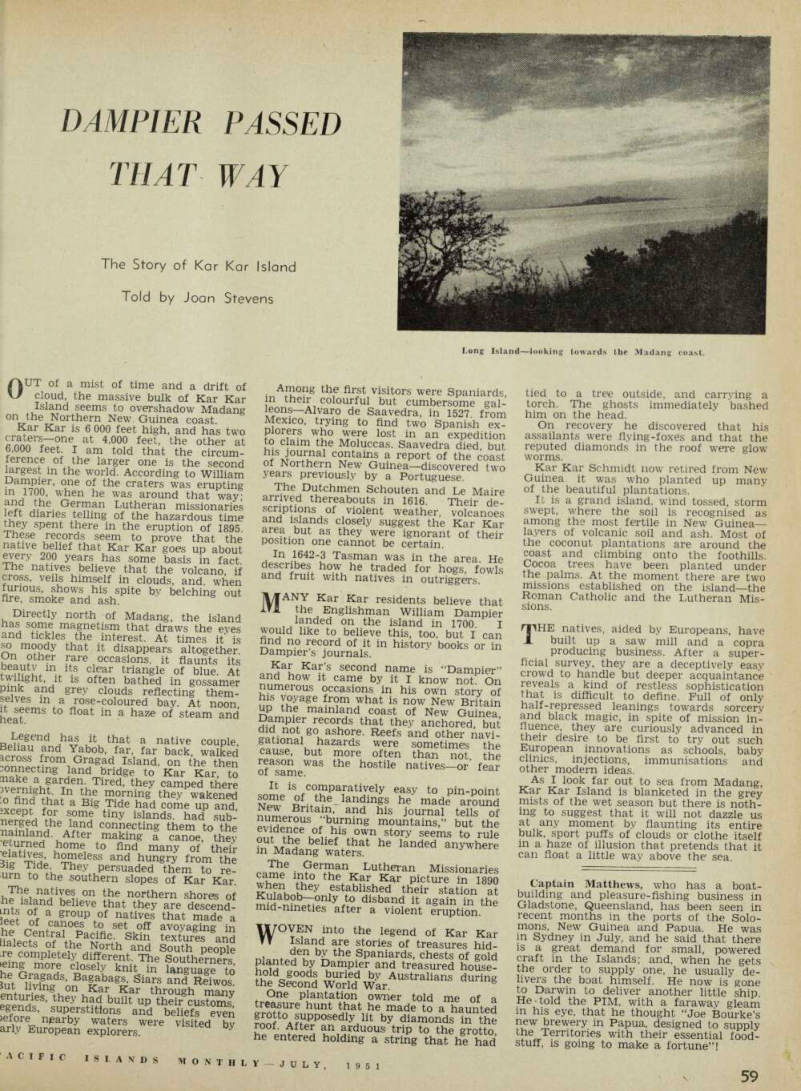
Long Island—looking towards the Madang coast.