This, Too, Is A Pacific Island
pp. 60-61 · Read in the full issue
By Rosaline Redwood
island does not have to grow coconuts and export copra to be a South Pacific Island. This one grows sheep and exports wool—which is just as profitable as copra these days—and is 43 deg. south of the Line; but it is still a Pacific Island.
It is Pitt, one of the Chatham Islands lying about 400 miles due east of Christchurch, NZ.
The Chatham Group was discovered in 1791, when there were still 1,200 of the natives — Morioris — left. Appar ently these mysterious people were Polynesians of some sort, but they had passed into history before the modern anthropologist had time to examine them. In 1830, an invasion of about 800 Maoris from NZ arrived in the islands, and by 1940 only 90 of the original inhabitants were still living to tell the tale. Some were absorbed by the Maoris; but mostly they were exterminated.
The Group is rugged and isolated; in the days of sail mariners plying between New Zealand and Cape Horn took as their motto “Beware the Chathams’’—and with reason.
IN the lonely Chatham Group, east of New Zealand, there is a small island with a wild rugged coastline and rich green hills and valleys which pasture some of the finest sheep in the world.
Named Pitt, in houour of the great English statesman, it is separated from the main Chatham Island bv Pitt Strait, and is roughly eight miles long by 3 1 miles wide. Every vear the cargo ship, Port Waikato, carries from its shores about 3,000 sheen and 400 bales of high grade wool, and to the isolated in habitants who usually number about a dozen persons, boat-days are the only ex citing events. Even the tiny school is closed on these occasions—oartlv because the teacher is needed to help load sheep.
But boat day happens there only three times a year.
I first glimpsed the jagged outline of Pitt Island, darkly silhouetted against the cold grey light of dawn, from the deck of the Port Waikato. 'Surrounded by an endless expanse of great rollers which
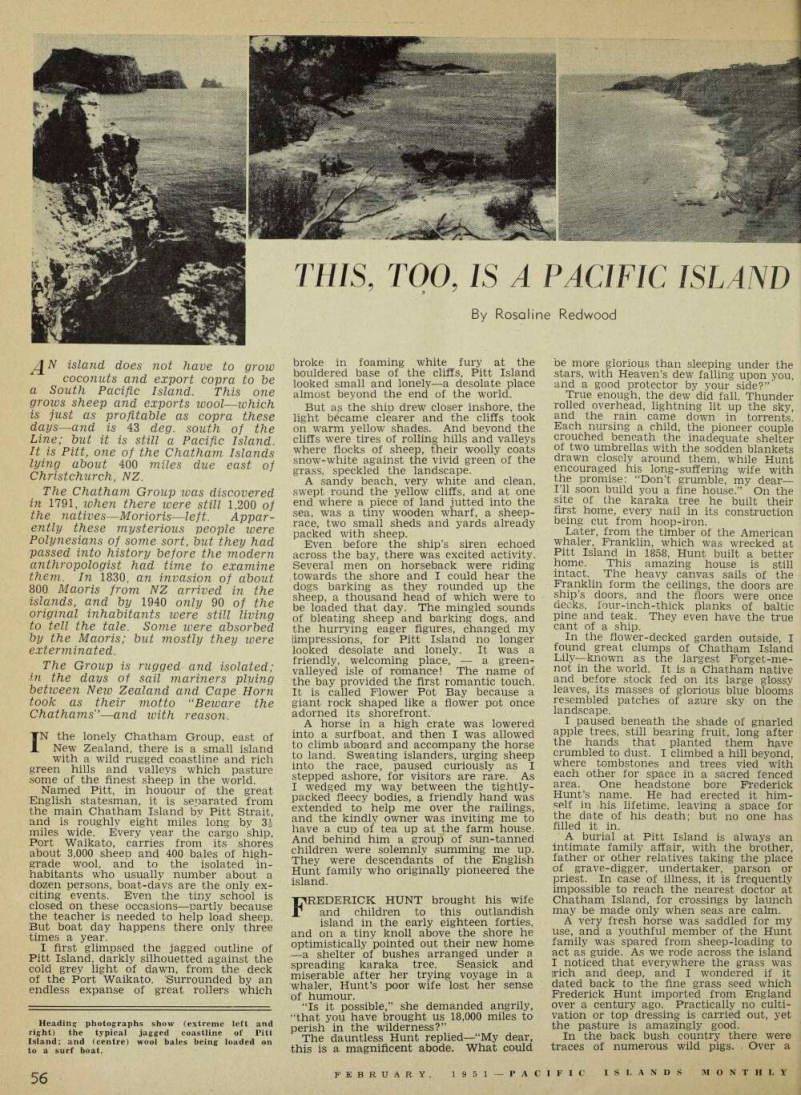
Heading photographs show (extreme left and right) the typical jagged coastline of Pitt Island; and (centre) wool bales being loaded on to a surf boat.
broke in foaming white fury at the bouldered base of the cliffs, Pitt Island looked small and lonely—a desolate place almost beyond the end of the world.
But as the ship drew closer inshore, the light became clearer and the cliffs took on warm yellow shades. And beyond the cliffs were tires of rolling hills and valleys where flocks of sheep, their woolly coats snow-white against the vivid green of the grass, speckled the landscape.
A sandy beach, very white and clean, swept round the yellow cliffs, and at one end where a piece of land jutted into the sea, was a tiny wooden wharf, a sheep race, two small sheds and yards already packed with sheep.
Even before the ship’s siren echoed across the bay, there was excited activity.
Several men on horseback were riding towards the shore and I could hear the dogs barking as they rounded up the sheep, a thousand head of which were to be loaded that day. The mingled sounds of bleating sheep and barking dogs, and the hurrying eager figures, changed my (impressions, for Pitt Island no longer looked desolate and lonely. It was a friendly, welcoming place, a green valley ed isle of romance! The name of the bay provided the first romantic touch.
It is called Flower Pot Bay because a giant rock shaped like a flower pot once adorned its shorefront.
A horse in a high crate was lowered into a surfboat, and then I was allowed to climb aboard and accompany the horse to land. Sweating islanders, urging sheep into the race, paused curiously as I stepped ashore, for visitors are rare. As I wedged my way between the tightly packed fleecy bodies, a friendly hand was extended to help me over the railings, and the kindly owner was inviting me to have a cud of tea up at the farm house.
And behind him a group of sun-tanned children were solemnly summing me up.
They were descendants of the English Hunt family who originally pioneered the island.
Frederick hunt brought his wife and children to this outlandish island in the early eighteen forties, and on a tiny knoll above the shore he optimistically pointed out their new home —a shelter of bushes arranged under a spreading karaka tree. Seasick and miserable after her trying voyage in a whaler, Hunt’s poor wife lost her sense of humour.
“Is it possible,” she demanded angrily, “that you have brought us 18,000 miles to* perish in the wilderness?”
The dauntless Hunt replied—“My dear, this is a magnificent abode. What could
be more glorious than sleeping under the stars, with Heaven’s dew falling upon you, and a good protector by your side?”
True enough, the dew did fall. Thunder rolled overhead, lightning lit up the sky, and the rain came down in torrents.
Each nursing a child, the pioneer couple crouched beneath the inadequate shelter of two umbrellas with the sodden blankets drawn closely around them, while Hunt encouraged his long-suffering wife with the promise: “Don’t grumble, my dear — I’ll soon build you a fine house.” On the site of the karaka tree he built their first home, every nail in its construction being cut from hoop-iron.
Later, from the timber of the American whaler, Franklin, which was wrecked at Pitt Island in 1858, Hunt built a better home. This amazing house is still intact. The heavy canvas sails of the Franklin form the ceilings, the doors are ship’s doors, and the floors were once decks, four-inch-thick planks of baltic pine and teak. They even have the true cant of a ship.
In the flower-decked garden outside. I found great clumps of Chatham Island Lily—known as the largest Forget-me not in the world. It is a Chatham native and before stock fed on its large glossy leaves, its masses of glorious blue blooms resembled patches of azure sky on the landscape.
I paused beneath the shade of gnarled apple trees, still bearing fruit, long after the hands that planted them have crumbled to dust. I climbed a hill beyond, where tombstones and trees vied with each other for space in a sacred fenced area. One headstone bore Frederick Hunt’s name. He had erected it him self in his lifetime, leaving a space for the date of his death; but no one has filled it in.
A burial at Pitt Island is always an intimate family affair, with the brother, father or other relatives taking the place of grave-digger, undertaker, parson or priest. In case of illness, it is frequently impossible to reach the nearest doctor at Chatham Island, for crossings by launch may be made only when seas are calm.
A very fresh horse was saddled for my use, and a youthful member of the Hunt family was spared from sheep-loading to act as guide. As we rode across the island I noticed that everywhere the grass was irich and deep, and I wondered if it dated back to the fine grass seed which Frederick Hunt imported from England over a century ago. Practically no culti vation or top dressing is carried out, yet the pasture'is amazingly good.
In the back bush country there were traces of numerous wild pigs. Over a
century ago Hunt imported pigs and allowed them to run wild in order to root up the land and act as natural cultivators.
To-day their descendants are a menace, eating newly-born lambs. The bush country also shelters hundreds of wild sheep, some with the curly horns traceable to a gift of Merino rams sent by Bishop Selwyn to Pitt in early years, to improve the stock. Not having been shorn for years the wool on the backs of these wild sheep is extremely long.
FROM the grand, rocky coastline of Pitt we could see Mangere Island, a precipitous rock rising up 940 feet It seemed difficult to believe, but on this spectacular rock hundreds of sheep find pasture. The islet has a flat top and is watered by a natural spring. Once a year the owner crosses by launch, the sheep are shorn, and the wool brought back to Pitt.
On Cannon Hill we reined in our lathered horses beside the rusted remains of an old cannon which Frederick Hunt placed there to keep law and order amongst early visiting whalers. Hunt supplied the whale ships with fresh vegetables and pork, and in return received foodstuffs and much-needed clothing. Advertising his produce in American newspapers, he built up a thriving trade, and sometimes as many as four or five American whalers lay at anchor in Flower Pot Bay. Once Hunt killed twenty of his best pigs in readiness to be taken on board a whaler, only to see the ship sail off without them. He had twenty dead porkers, and no salt to cure l them!
I thought of the toil and tears which had gone into the making of this little island farm, as I watched the last ship load of its fleecy wealth hoisted aboard the cargo ship. For the hoisting process, each animal has a rope passed around its middle, then a number of ropes are tied together, and the sheep are lifted in bunches by winch into the hold
The weary boatmen returned ashore, the barking of the dogs quitened, and in the peaceful darkness I could hear only the muffled bleating of the sheep in the hold, and the slapping of the waves against the ship.
From the bridge I heard the mate’s relieved comment, “Just getting away in time there’s an inshore wind coming up.” And I recalled the captain’s stories of how the ship had had to lie off Pitt tsland for days or even weeks before it
was safe to load cargo. Sometimes food supplies have run low ashore, and once a woman passenger on the ship gave birth to a baby with ouly the steward for midwife.
As the Port Waikato moved outwards I realised how much the islanders owed to this sturdy little ship. As I cast a last long look at the island which was now only a blur against the night, I thought Pitt Island looked lonely again small and lonely, and almost beyond the end of the world.
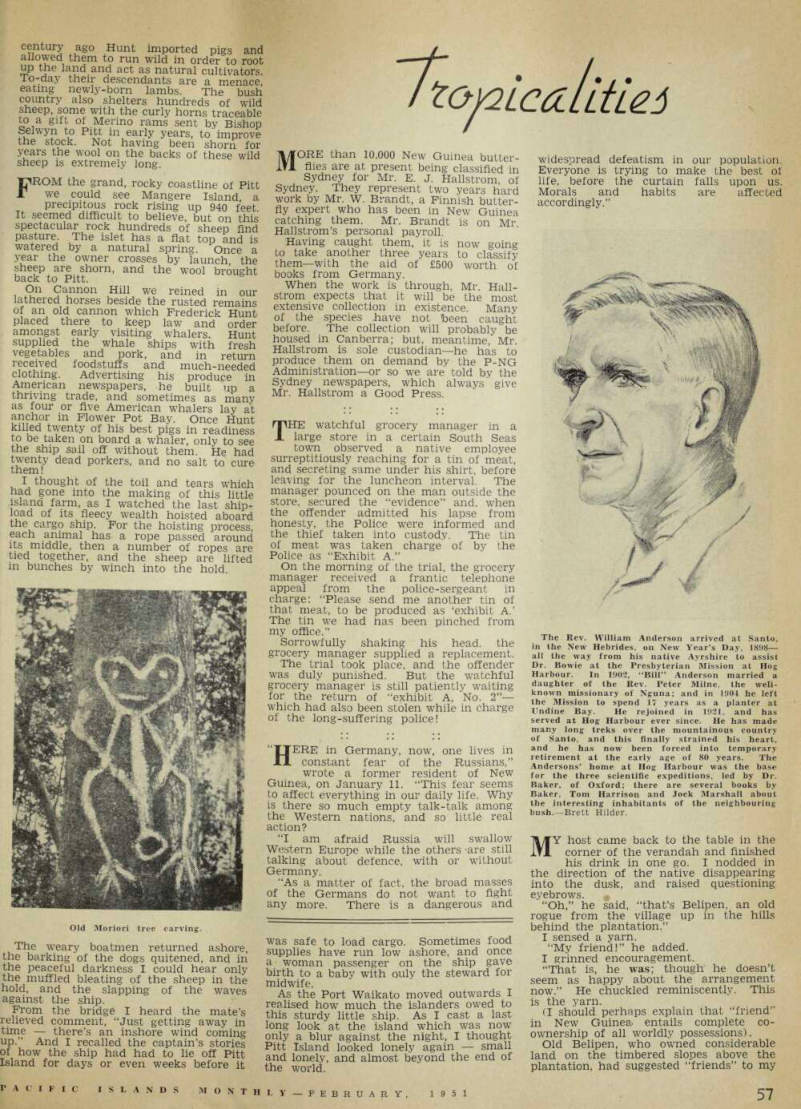
Old Moriori tree carving.