Pacific
Islands
Monthly
February, 1951
Vol. XXI. No. 7.
stablished 1930.
I Registered at the G.P.0., Sydney, for transmission by post as a newspaper ]
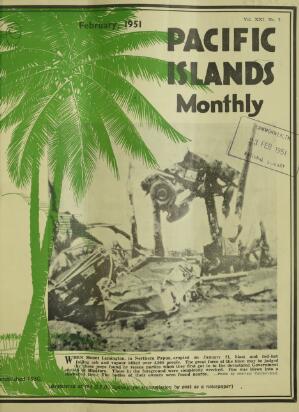
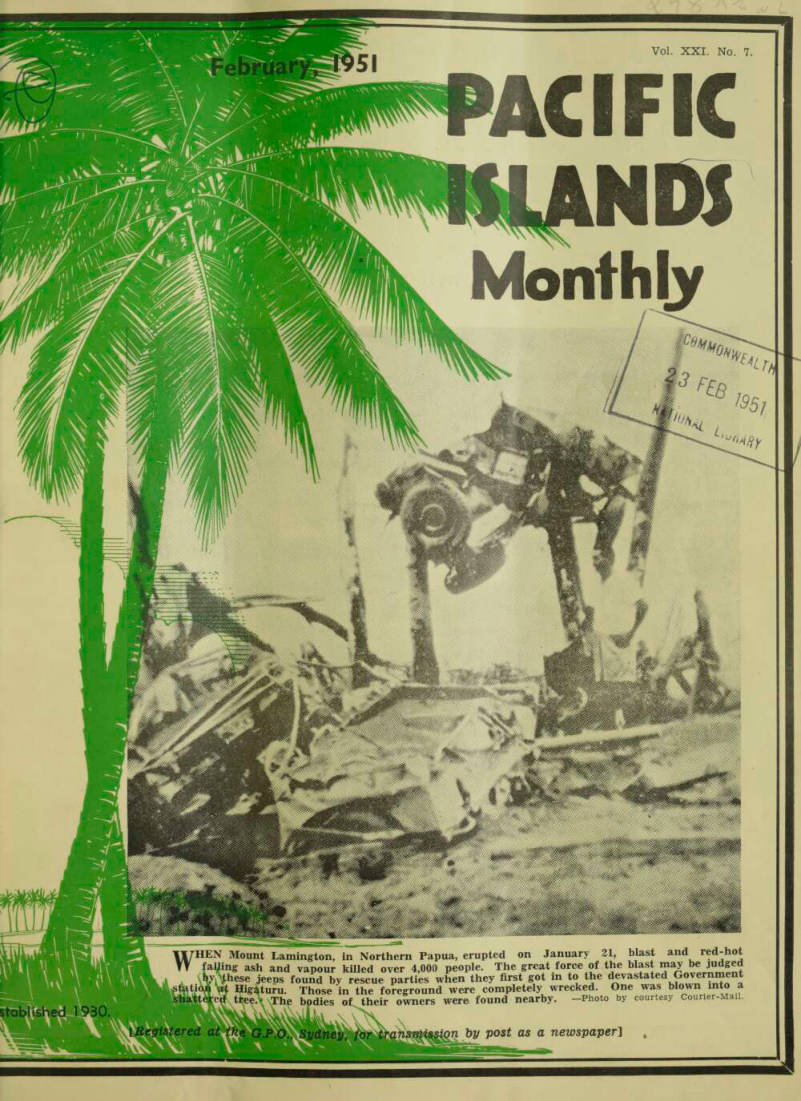
WHEN Mount Lamington, in Northern Papua, erupted on January 21, blast and red-hot facing ash and vapour killed over 4,000 people. The great force of the blast may he Judged by these jeeps found by rescue parties when they first got in to the devastated Government station at Higaturu. Those in the foreground were completely wrecked. One was blown into a shattered tree. The bodies of their owners were found nearby.
Photo by courtesy Courier-Mail.
Advertisements & other items, pp. 2-4 (1 item)
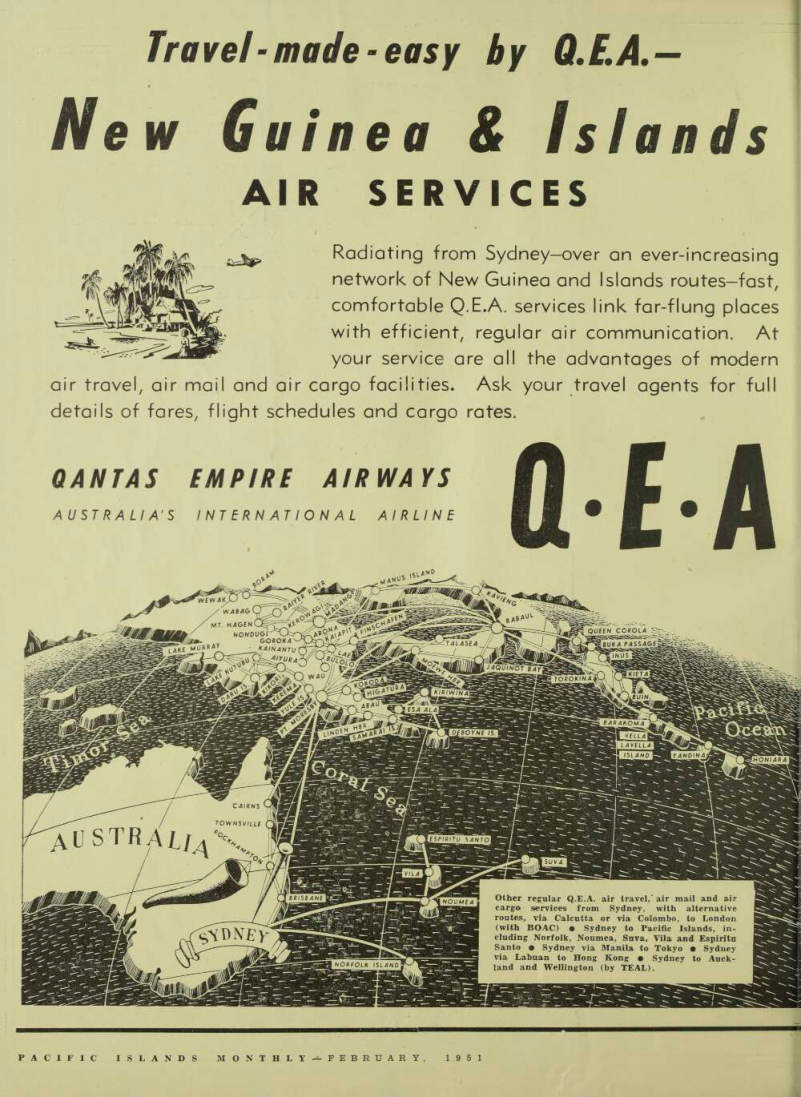
Ne w Guinea &
Travel-made-easy by Q.E.A.—
AIR SERVICES
Radiating from Sydney-over an ever-increasing
network of New Guinea and Islands routes-fast,
comfortable Q.E.A. services link far-flung places
with efficient, regular air communication. At
your service are all the advantages of modern air travel, air mail and air cargo facilities. Ask your travel agents for full details of fares, flight schedules and cargo rates. i
8 ANT AS IMP IRC AIRWAYS
AUSTRALIA'S INTERNATIONAL AIRLINE
Q'£*A
SU*ND
WEW AKXJ w
/ W4B4G
RAB
MT. HAGEN
QUEEN COROL4 >
P A S S AGE
INUsIIsIS
a«R,
NONDUGI
f A'
GOROKA
IALASCA
NAINANTU
LAKE
4IYU Ra
Bu i"o tm
JAQUINOT BAY
tm
KIET4
Mm
WAU
SOROKINA
kok° ujra Ay higa
KIRIWINA
BUI N
abau
ES4 ALA
m barakoma VeZTa
ISLAND
HONIARA
m
CAIRNS
TOWNSVILLE
AI stha/., 4 x
Other regular Q.E.A. air travel,' air mail and air cargo services from Sydney, with alternative routes, via Calcutta or via Colombo, to London (with BOAC) • Sydney to Pacific Islands, including Norfolk, Noumea, Suva, Vila and Espiritu Santo • Sydney via Manila to Tokyo • Sydney via Labuan to Hong Kong • Sydney to Auckland and Wellington (by TEAL).
«^DNEy
ii
Your Native Servant
can Iron Better with a
(pieman Iron*
% The big glass-smooth ironing base 16 square inches of surface of the Coleman Self-heating Iron is double pointed and heavily nickel - plated to glide smoothly and easily over any fabric.
The Coleman Self-heating Iron lights instantly, makes and burns its own gas, permitting continuous ironing, and the fount holds one pint of fuel, sufficient for hours. The body has a blue vitreous finish which is easy to clean and keep clean. With its rust-proof body and heavily nickeled ironing surface, the Coleman Self-heating Iron will last indefinitely and, because it heats itself, the ironing can be done anywhere, indoors or out-of-doors.
Representatives for the Pacific Islands “•I?;» S K EET ROBERT GILLESPIE P T JL T ®
H f >ES
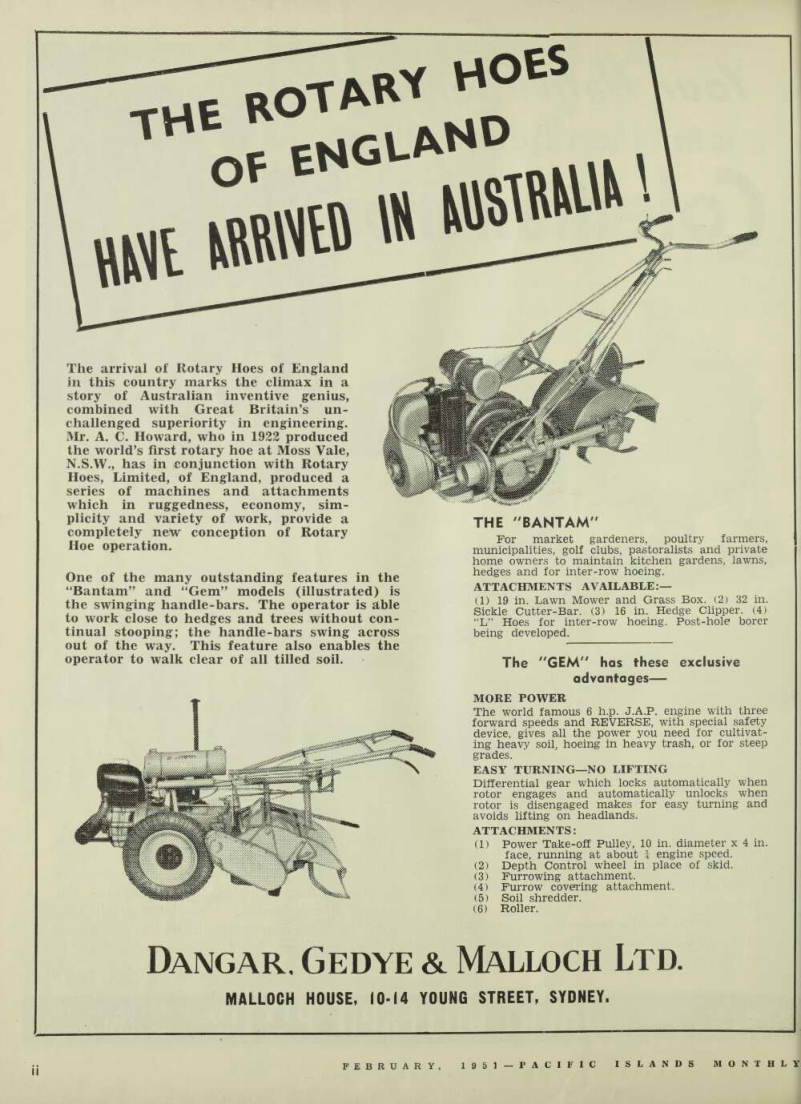
The arrival of Rotary Hoes of England in this country marks the climax in a story of Australian inventive genius, combined with Great Britain’s unchallenged superiority in engineering.
Mr. A. C. Howard, who in 1922 produced the world’s first rotary hoe at Moss Vale, N.S.W., has in conjunction with Rotary Hoes, Limited, of England, produced a series of machines and attachments which in ruggedness, economy, simplicity and variety of work, provide a completely new conception of Rotary Hoe operation.
One of the many outstanding features in the “Bantam” and “Gem” models (illustrated) is the swinging handle-bars. The operator is able to work close to hedges and trees without continual stooping; the handle-bars swing across out of the way. This feature also enables the operator to walk clear of all tilled soil.
THE "BANTAM"
For market gardeners, poultry farmers, municipalities, golf clubs, pastoralists and private home owners to maintain kitchen gardens, lawns, hedges and for inter-row hoeing.
ATTACHMENTS AVAILABLE:—
(1) 19 in. Lawn Mower and Grass Box. (2) 32 in.
Sickle Cutter-Bar. (3) 16 in. Hedge Clipper. (4) “L” Hoes for inter-row hoeing. Post-hole borer being developed.
The GEM" has these exclusive
advantages—
MORE POWER
The world famous 6 h.p. J.A.P. engine with three forward speeds and REVERSE, with special safety device, gives all the power you need for cultivating heavy soil, hoeing in heavy trash, or for steep grades.
EASY TURNING—NO LIFTING
Differential gear which locks automatically when rotor engages and automatically unlocks when rotor is disengaged makes for easy turning and avoids lifting on headlands.
ATTACHMENTS:
(1) Power Take-off Pulley, 10 in. diameter x 4 in. face, running at about I engine speed. (2) Depth Control wheel in place of skid. (3) Furrowing attachment. (4) Furrow covering attachment. (5) Soil shredder. (6) Roller.
Dangar, Gedye & Malloch Ltd.
MALLOGH HOUSE, 10-14 YOUNG STREET, SYDNEY.
Index to Advertisers
Achun, Gabriel . . 107 “Akta-Vite” ... 46 Aladdin Industries . 40 Amplion (A/sia) J Pty 37 Angus & Robertson, Ltd 26 Ardath Tobacco Co., Ltd 19 “Aspaxadrene” . . 109 "Aspro” 84 Baker, W. Jno. . . 43 Balchin, W., Ltd. . 30 Bank of NSW . . 35 Bell, Stanley P., & Co 16. 103 “Bellhaven” Guest House 99 Berry’s Bay Boat yard 106 Bethell. Gwyn Co. 103 Blaxland Rae Pty. 96 Blundell Spence Co. 50 Borthwicks’ Paint . 30 Bovril, Ltd. ... 83 Bray & Holliday Pty., Ltd 70 Bristol-Myers Co. . 69 Broomfields, Ltd. . 80 Brunton & Co. . . 110 Budge, James, Ltd. 42 Bunting, A. H. 51, 90 Burns Philp (NG) . 61 Burns Philp (NH) . 90 Burns Philp (SS) . 41 Burns Philp Trust . 1 Maine’s Studios . . 69 Carpenter, W. R. & Co., Ltd., 82, cov. iv.
Carpenter, W. R. (Fiji), Ltd. ... 43 Carr Shipping & Trading Co., Ltd. 21 Classified Advts. . 112 Colman’s Mustard . 33 Colonial Meat Co. 88 jolyer Watson (NG) Ltd., 26, 49, 63 Commonwealth Bank of Aus tralia 73 Crammond Radio . 74 Crilley, R. J., Ltd. 16 ‘Cystex” 92 Dangar, Gedye & Malloch, Ltd. . . ii.
Davison Paints . . 100 Donaghy & Sons . 83 Donald, A. 8., Ltd. (Auckland) ... 84 Donald, A. 8., Ltd. (Rarotonga) ... 62 Douglass, W. C.
Ltd 27 Dunlop Rubber Co. 22 3cono-Steel Co. . . 78 Slectrolux ... 82 Illerker, A. J. 104-105 Ctablissements Donald Tahiti . . 71 ‘Flit” 106 ? o r d Sherington, Limited . . . .41 French Chamber of Commerce ... 76 larrett, Davidson & Mathey, Ltd. . . 114 ■Jarrick Hotel ... 92 jilbey, W. & A. . 29 Dillespie Bros. . . 62 Dillespie, R., Pty., Ltd. . . i., 76, 113 iillespie, R. (NG) Ltd 47, 89 Jordon’s Gin ... 25 lough & Co., E. J. 81 Jrand Pacific Hotel 2 Jregory, A., Ltd. . 81 Jrove, W. H., & Sons, Ltd. ... 34 [alvorsen Sons, Ltd. 99 [awley’s Pty.. Ltd. 44 [ay, K. H. D. . . 47 [einz & Co.. Ltd. . 68 [emingway & Robertson. Ltd. . 87 Holland Rusk” . 17 [cover, Francis . . 37 [ygeia Sanitary Co. 51 sland Industries . 79 s 1 a n d s Service Bureau ... 113 Kathleen” Shop ping Service . . 27
Kennedy, Captain . 97 Kerr Bros. . . 94, 96 Kiwi Polish Co. . 34 Kolynos, Inc. ... 17 Kopsen, W., & Co. 95 Kraft Walker Cheese Co. ... 33 Lillis & Co., Ltd. . 18 Macintyre, Thomas, & Co., Ltd. ... 80 MacLaurin School 112 McGee, Andrew . . 48 Mcllrath’s, Ltd. , 110 “Mendaco” . . 103 Merrillees, J. C., Pty., Ltd. . 11l Millers Ltd. (Fiji) 16 Mobile Industrial Equipment Pty., Ltd 28 Morris Hedstrom Ltd 12 Morris Hedstrom (Aust.) Pty., Ltd. 86 Mungo Scott, Ltd. . 85 Nathan’s Merchan dise (NSW) Pty. 23 Nelson & Robertson Pty., Ltd 65 “Nixoderm” . . . 112 Nordman. Oscar G. 46 North Sydney Travel Bureau ... 15 O’Brien, Geo. ... 96 Oliver Corporation 20 Pabco Products . .91 Pacific Is. Society 35 “Pacific Islands Year Book” ... 13 Pan American Air ways, Inc., Ltd. . 14 “Pinkettes” ... 67 Pitt-Way Educa tional Courses . 21 “Pixie” Knitwear 112 Premier Refrigera tion Co. Pty., Ltd 32 Proud’s Ltd. ... 24 Qantas, Ltd. . cov. ii.
Qld. Butter Board 94 Qld. Insurance Co. 75 Reckitt’s Blue ... 25 Reed, Wm„ E. . . 102 Riverstone Meat Co. 36 Robinson, G. H. . 38 Rohu, Sil . . • • 39 Scott, J., Pty., Ltd. 38 S.E. Book Co. . • 93 Seward, N. H., Pty., Ltd 19 Shell Co of Aust. 39 Sherwin-Williams Paints 64 Simpson Bros. Pty. 22 Sims, A. G., Ltd. . 42 Southern Pacific Insurance Co. . . 71 Spartan Paints . . 75 Steamships Trading Co., Ltd. (Papua) 67 Stewarts & Lloyds 65 Sullivan, C., Ltd. . 45 Swallow & Ariell . 107 Tallerman & Co. . 68 Tasman Empire Air ways, Ltd. . cov. iii.
Taylor, Allen & Co. 101 Thornycroft, Ltd. . 87 Tilley Lamp Co. 15, 108 Tillock & Co., Ltd. 77 Ton g a n Photos Bureau ... 79 Tooth & Co., Ltd. 72 Tyneside Engineer ing Co., Ltd. . . 77 Undersee Novelties 29 United Island Traders Ltd. . . 72 Vacuum Oil Co. 66, 106 Venture Trading Co. . . 93, 108, 114 Vincent Chem. Co. 31 Walker & Treacy . 98 Ward, H. F. . . . 101 West, Harry, Pty., Ltd 100 Williams’ Pills . . 89 Wills, W. D. & H.
O. (Aust.), Ltd. . 52 Wright & Co. . . .97 Wunderlich, Ltd. . 85 Yorkshire Insur ance Co., Ltd. . 49
Advertisements & other items, p. 5 (2 items)
1
•ACIFIC ISLANDS MONTHIY FEBRUARY, 1951
Bums Philp Trust
the
HOW OLD
IS YOUR WILL?
Placing your signature on your will should not end your concern for this extremely important document. Unless it is kept up to date, neglect can thwart your intentions.
A beneficiary may die, specific property may be sold, increases in your assets may be overlooked. Marriage, too, revokes a will in almost every case. However, you can avoid these hazards quite easily.
Let your solicitor revise your will, then appoint Burns Philp Trust Company Limited as executor or trustee. This commonsense precaution removes another danger that of
faulty administration.
The solid advantages of securing the Company's services are explained in "Hands That Never Leave The Wheel.' A complimentary copy of this 20-page booklet can be obtained from any branch of Burns Philp (South Sea) Company, Burns Philp (New Guinea) Limited, Burns Philp (New Hebrides) Ltd., or direct from the head office of this Company.
DIRECTORS:
James Burns Joseph Mitchell P. T. W. Black Eric Priestley Lee MANAGER: L. S. Parker.
SECRETARY: E. R. Overton, F.F.I.A.
Bums Philp Trust
COMPANY LIMITED
Executor • Trustee • Attorney
Constituted by Special Act of the N.S.W. Parliament.
7 BRIDGE STREET, SYDNEY
relephone: 8U5901 Box 543, G.P.0., Sydney.
In This Issue:
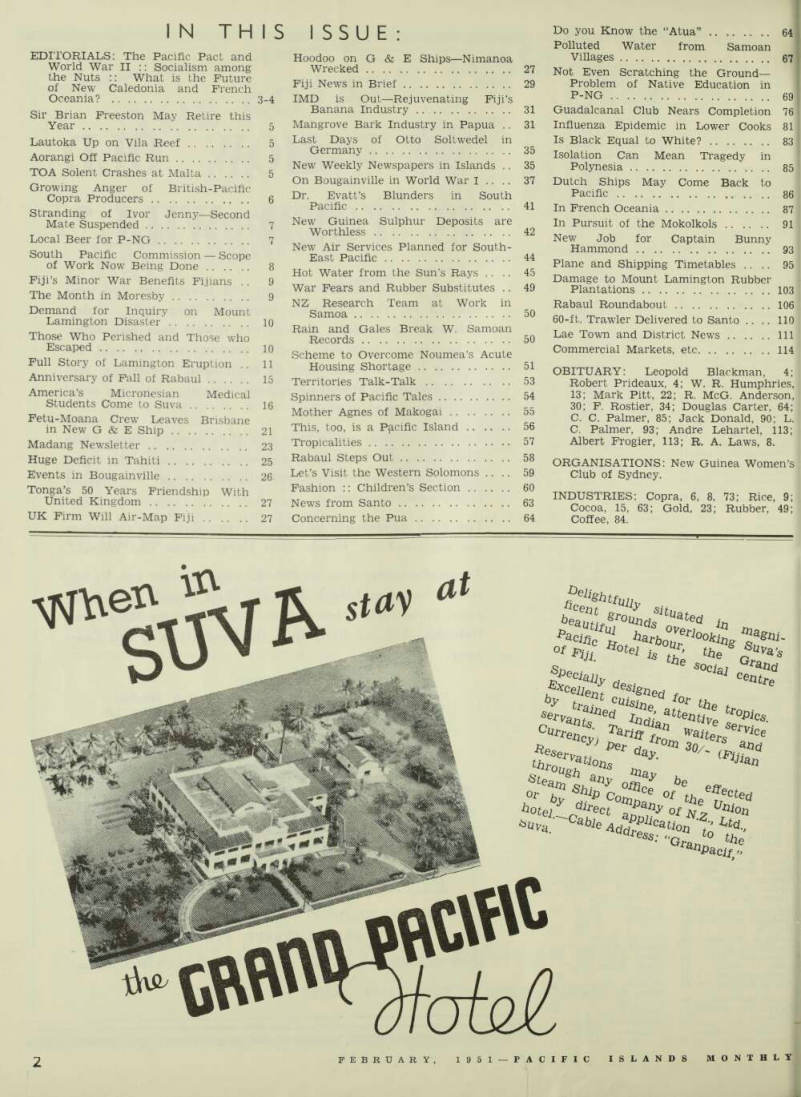
EDITORIALS: The Pacific Pact and World War II :: Socialism among the Nuts :: What is the Future of New Caledonia and French Oceania? 3-4 Sir Brian Freeston May Retire this Year 5 Lautoka Up on Vila Reef 5 Aorangi Off Pacific Run 5 TOA Solent Crashes at Malta 5 Growing Anger of British-Pacific Copra Producers 6 Stranding of Ivor Jenny—Second Mate Suspended 7 Local Beer for P-NG 7 South Pacific Commission Scope of Work Now Being Done 8 Fiji’s Minor War Benefits Fijians .. 9 The Month in Moresby 9 Demand for Inquiry on Mount Lamington Disaster 10 Those Who Perished and Those who Escaped 10 Full Story of Lamington Eruption 11 Anniversary of Pall of Rabaul 15 America’s Micronesian Medical Students Come to Suva 16 Petu-Moana Crew Leaves Brisbane in New G & E Ship 21 Madang Newsletter 23 Huge Deficit in Tahiti 25 Events in Bougainville 26 Tonga’s 50 Years Friendship With United Kingdom 27 UK Firm Will Air-Map Fiji 27
Hoodoo on G & E Ships—Nimanoa Wrecked 27 Fiji News in Brief 29 IMD is Out —Rejuvenating Fiji’s Banana Industry 31 Mangrove Bark Industry in Papua .. 31 Last Days of Otto Soltwedel in Germany 35 New Weekly Newspapers in Islands 35 On Bougainville in World War I .. .. 37 Dr. Evatt’s Blunders in South Pacific 41 New Guinea Sulphur Deposits are Worthless 42 New Air Services Planned for South- East Pacific 44 Hot Water from the Sun’s Rays ... 45 War Fears and Rubber Substitutes .. 49 NZ Research Team at Work in Samoa 50 Rain and Gales Break W. Samoan Records 50 Scheme to Overcome Noumea’s Acute Housing Shortage 51 Territories Talk-Talk 53 Spinners of Pacific Tales 54 Mother Agnes of Makogai 55 This, too, is a Pacific Island 56 Tropicalities 57 Rabaul Steps Out 58 Let’s Visit the Western Solomons ... 59 Fashion Children’s Section 60 News from Santo 63 Concerning the Pua 64
Do you Know the “Atua” 64 Polluted Water from Samoan Villages 67 Not Even Scratching the Ground- Problem of Native Education in
P-Ng 69
Guadalcanal Club Nears Completion 76 Influenza Epidemic in Lower Cooks 81 Is Black Equal to White? 83 Isolation Can Mean Tragedy in Polynesia 85 Dutch Ships May Come Back to Pacific 86 In French Oceania 87 In Pursuit of the Mokolkols 91 New Job for Captain Bunny Hammond 93 Plane and Shipping Timetables ... 95 Damage to Mount Lamington Rubber Plantations 103 Rabaul Roundabout 106 60-ft. Trawler Delivered to Santo .. .. 110 Lae Town and District News 11l Commercial Markets, etc 114 OBITUARY: Leopold Blackman, 4; Robert Prideaux, 4; W. R. Humphries, 13; Mark Pitt, 22; R. McG. Anderson, 30; F. Rostier, 34; Douglas Carter, 64; C. C. Palmer, 85; Jack Donald, 90; L.
C. Palmer, 93; Andre Lehartel, 113; Albert Frogier, 113; R. A. Laws, 8.
ORGANISATIONS; New Guinea Women’s Club of Sydney.
INDUSTRIES: Copra, 6,8, 73; Rice, 9; Cocoa, 15, 63; Gold, 23; Rubber, 49; Coffee, 84.
Advertisements & other items, p. 6 (1 item)
■tfJYvett
\tv at
stay
m > \ * -jm & ‘mm m *** -Sn« * e s °Cia; ra^ Cia % r/p • Ce^r< u*° e Uem f by traSf ° uis^ e J° r *„ Sfir a - 30/ - ? < a «■%, effe «e d hotel tj ll ** 1 * of - v i; ran Pacif f ’>
Pacific Islands Monthly
The Newspaper-Magazine of the South Seas I Registered at the G.P.0., Sydney, for transmission hy post as a newspaper j
Published Once Each Month and Circulated in Australia and New Zealand and in the following Pacific Territories and Islands Groups:
Australian Territory of Papua. rrustee Territory (Australia) of New Guinea.
Australian Territory of Norfolk Island. frustee Territory of Nauru (Aust., NZ and UK). *ew Zealand Territory of Cook Islands. *ew Zealand Territory of Niue Island.
Trustee Territory (NZ) of Western Samoa.
British Crown Colony of Fiji.
British Solomon Islands Protectorate.
British Protectorate of Tongan Islands.
British Crown Colony of Gilbert and Ellice Islands.
British and French Condominium of New Hebrides.
French Colony of New Caledonia.
French Establishment of Oceania (Tahiti, etc.).
American Territory of Eastern Samoa.
American Territory of Hawaiian Islands.
American Trust Territory of Micronesia.
Owned and Produced by Pacific Publications Pty. Ltd., Union House, 247 George Street, Sydney.
Telephones: General Office and Advertising
Bw 5037, Bu 4938.
P.O. Box 3408
leglstered Address for Telegrams, Radiograms, and Cables: "Pacpub,” Sydney.
Contributions.
Articles, Stories, and Photographs dealing with Pacific Islands subjects are invited and will be paid for on publication.
Subscription Rates.
n Australia. New Zealand, Fiji, Papua and New Guinea, Western Samoa, Cook Islands, Niue, Tonga, British Solomon Is., Gilbert and Ellice Colony, Nauru. New Hebrides, and Norfolk Island 18 0 lew Caledonia (Pr.) and French Oceania (Tahiti, etc.) £llO Fnited Kingdom, British Com monwealth, United States of America. US Pacific Territories, and Foreign Countries .. .. $3.50 £1 10 0
Editor and Publisher:
R. W. Robson, F.R.G.S.
Assistant Editor: JUDY TUDOR.
General Office: Union House. 247 George Street, Sydney. Telephones: BW 5037, BU 4938.
Business Manager: SELWYN HUGHES
Representative In London.
J T. Wallis. Coronation House, 4 Lloyd’s Avenue, London, E.C.3, from whom may be obtained copies of Pacific Islands Monthly, Pacific Is. Year Book, advertising schedules, etc
Agents.
The following are authorised to receive sub scriptions for Pacific Islands Monthly:— Burns Philp (NG) Ltd., and Burns Philp (South Sea) Co., Ltd. All branches.
W. R. Carpenter & Co., Ltd. All branches.
Morris, Hedstrom, Ltd. All branches.
Steamships Trading Co., Papua. All branches.
Colyer Watson (NG) Ltd. All branches.
Mrs. Jean Fraser, Lae, New Guinea.
R. P. Smith, Rabaul, New Guinea.
A. H. Bunting. Ltd., Samaral, Papua.
Steele’s Central Store, Suva, Fiji.
Adams Pharmacies Pty., Lautoka, Fiji.
Cook Islands Trading Co., Rarotonga, Cook Is.
United Island Traders, Ltd., Rarotonga, Cook Is.
A. Vercoe, Apia, Western Samoa.
Oscar Nordman, Papeete, Tahiti.
Islands Branches and Representatives of W. H.
Grove & Sons, Ltd., Auckland, New Zealand.
Ed. Pentecost, Noumea, New Caledonia.
Societe Gubbay Kerr et Cie, Noumea, NC.
rol. XXI. No. 7.
February, 1951.
( 1/9 Per Copy.
Pr■ p < Prepaid, p.a.: 18/- Aust. in South Pacific.
America, the Pacific, and World War III
VS this is written, Mr, Spender and Mr. Doidge—Ministers for External Affairs respectively in Australia and few Zealand and also Ministers for acific affairs —are in conference in Aus ralia with the United States Assistant ecretary of State. They are working out etails of a Peace Treaty with Japan; nd a Pacific Pact of mutual protection nd security against Asia is in the back round.
It is not a comfortable discussion. The 'nltcd States, as part of her plan for eeping the Ru^so-Asiatic Communists t home, wants a friendly Treaty with a farmed Japan, because Japan obviously mst be our first line of defence against ,ed Asia. Australia and New Zealand are iger to stand in with the United States gainst Asia; but, with bitter memories f the Pacific War, they do not at all ke the idea of a re-armed Japan.
America is not much interested in a acific Pact. The only other non ommunist nation with a large popu ition, in favour of maintaining the acific peace, is India; and India, being lilitarily negligible and politically un epenable, is not regarded seriously y the Americans. Canada (12 millions) id Australia-New Zealand (9 millions) :e much too small to matter much in acific calculations. In any event, they ill ally themselves with USA —they have 3 future otherwise, America is much tore interested in getting the right sort ’ Treaty with Japan, a hard-fighting ation of over 90 million people.
But America, as a friendly gesture to er British neighbours, and so that she iay have free access to South Pacific ises, probably will enter into a Pacific act—on condition that Australia and ew Zealand will help her with the ipanese Peace Treaty. Australia-New ealand probably will agree, with extreme rtuctance, to the re-arming of Japan;
but they will try to get from America a guarantee against any Japanese aggres sion. That, in any event, would be im plicit in a Pacific Pact.
More than 50 years ago, before the Japanese smashed Russia’s naval power in the Pacific, Australia and New Zealand were as worried about Russian aggressive ness in the Pacific as they are to-day.
Then, they looked to Britain for protection —and did not look in vain. To-day, with Britain hamstrung by Socialism, and more or less pinned to Europe by the develop ing menace behind the Iron Curtain, the British countries in the Pacific no longer depend on the White Ensign for pro tection. Instead, they feel that their future in an uneasy world lies with the United States.
They are lucky that there is a United States. If there were not, or if the Americans insisted on staying at home, there would be no future at all for the European communities of the South Pacific . . .
The Jap, always a cunning bargainer in international affairs, has not changed his spots. He is trying, as the price of Japan’s support of America against Red Asia, to force America to agree to Japanese emigration to the South Seas, especially New Guinea. Australia is shout ing with anger at the very idea. America is being tactful and soothing.
IN the world to-day, the most important factor of international significance is the rapid re-arming of the United States. The vital decisions were taken less than three months ago; but already it is possible to discern a change in international tensions.
It is believed that certain elements in the Communist bloc have been pressing for war in 1951; but there are indicatiims that the top men in Russia now are going into reverse. They do not like the temper and developing military strength of the American nation —by far the greatest Power in the world to-day—nor the echoes of those atomic bombs recently exploded in the Western States.
As hesitation appears in their hitherto confident attitude —perhaps because of it! —there are unmistakeable signs of unrest and rebellion in some of Russia’s satellite countries, and even in Russia itself.
There are echoes of curious changes tak ing place in China.
It is far too soon yet to even hope for the avoidance of World War III: but those wise old British diplomats who al ways have insisted that the Muscovite conspiracy against the world will be destroyed from within may yet see their opinions justified.
There can be no hope for relief from the black clouds of the past two or three years unless United States continues resolutely with her preparations for war, and unless the Western European Powers are loyal to the obligations they accepted in the Atlantic Pact.
What is the Future of New Caledonia and French Oceania?
A REPORT published elsewhere in this issue gives an outline of a politico economic crisis which appears to be developing in Tahiti, chief island of French Oceania. Developments there should not be ignored by the United States and the British Commonwealth, which are vitally interested.
The French are masters of the art of suppressing any public discussion of their administrative difficulties. Despite that, there have been growing indications that all is not well in the relationship between Metropolitan France and the French Pacific colonies of New Caledonia and French Oceania. The report on page 25
is typical of the difficulties which seem to be developing.
These troubles generally stem back to the events of 1940-44, when France was so tragically divided between the Vichy ites, who surrendered to and collaborated with our enemies, and the De Gaulle ists, who remained with their Allies, and shared in our victory. Of all sections of the French Empire, New Caledonia and French Oceania were the very first to rally to De Gaulle.
In 1940 and 1941, New Caledonia and Oceania, completely shut off from France, were in a bad way economically, and were materially helped by Australia and New Zealand. From 1942 onwards, when American forces occupied the South Pacific, the French-De Gaullist countries were economically secure; and there was formed, in those critical war years, a warm comradeship between the Americans and British, on the one side, and the French-Pacific peoples, on the other. The British and French communities in the South Pacific do not forget that they were saved by the Americans from the Jap invasion.
K NATURALLY, and properly, New Caledonia and Oceania were restored in 1945 to the rule of France; but neither seems to have been very happy.
It is difficult to point to any one factor which is the cause of this. The trouble probably is due to the fact that the two French colonies especially French Oceania have maintained a warm and close friendship with the Anglo-American countries, and that a proportion of the officials sent out by France to carry on these Administrations are jealous of that friendship.
A great part of the machinery of the Government of France is in the hands of officials who supported the Vichy
regime of 1940-44; and the older non official citizens of New Caledonia and Tahiti like the Vichy-ites as little as the Vichy-ites like them. It would have been supposed that this war-time bitterness gradually would have disappeared—and it would have disappeared if the French Colonial Service had been wisely con trolled and directed. But there seem to be some very stupid people in Paris.
Again and again, since 1945, they have sent to their Pacific colonies men who were noted for incompetence, or political bias, or both; and these people have given much offence to the colonists, and aroused their antagonism.
Generally, the countries of the South Pacific, including Australia and New Zea land, are growingly pro-American, in that they hate Socialism, the little sister of Communism. That anplies quite definitely to the French Pacific Colonies: therefore, France’s steady swing towards extreme Socialism, and Red domination, is a factor not to be ignored in considering the future of these Islands.
The United States and the British Pacific Dominions have no territorial ambitions whatever in the South Pacific.
They have not in any way interfered with the internal affairs of the French Territories. In fact, they do not take sufficient interest in them. Not long ago, America closed up, in Tahiti, the Con sulate she had maintained there for half a century.
Yet, having noted some marked political and economic trends in recent years, it would not surprise this writer if, within a decade or two, New Caledonia and French Oceania weakened their ties with France, and sought closer relations with their Anglo-American neighbours. The genesis of it all may be found in the events of 1940-45. Any menace to Pacific security from Communist Asia would, of course, hasten the development.
Socialism Among The Nuts
SINCE World War 11, the British Socialist Government has hunted all private enterprise out of the Gilbert and Ellice Islands and, through the High Commission for the Western Pacific, it now runs the G & E Islands for the “benefit” of the natives.
As part of the set-up it imposes an export tax on copra of no less than 25 per cent, of the FOB price. Under the present MOF contract, that represents a deduction of £l3/8/9 Stg. per ton. After that, if the grower shows any profit on his enterprise, the Administration collects income tax. (See article elsewhere.) The British Ministry of Food seems to> have an extraordinary outlook concern
ing vegetable oil from nuts. It was this Socialist set-up which induced the British growers of coconuts to enter into a nine years contract, based on a Sterling price; and then, when the contract was nicely going, it devalued Sterling by 30 per cent., although copra is an international com modity, and holds its value in terms of gold.
It was the same set-up which went crazy concerning the production of pea nuts in East Africa, and which has now written off a loss of £36 millions on its “African Nuttery.”
“Bull in a china shop” has been for ages a synonym for confusion, stupidity and heavy loss. Maybe it should be changed to “A Socialist in a Nuttery.”
Leopold Blackman
Death Of Colonel
Cx)L. Leopold G. Blackman, A Well-
J known resident of Tahiti, died on January 21, at his home in Paea, after a short illness. He had been a resi dent of the Pacific Islands for 50 years— -40 of them in Tahiti. He was born in England about 70 years ago. His relations reside in Honolulu.
Among notable people who arrived in Tahiti by the liner Chungking, from Europe, on January 22, were M, Pouvanaa a Oopa, Deputy for French Oceania, re turning from Paris; Madame Petitbon, wife of the new governor of French Oceania; Madame Maisonnat, wife of the new Governor’s secretary; Madame Calamy, heir to the Rougier Estate which, until recently, included Christmas Island.
Death Of Robert Prideaux
NEW Guinea friends of young Mr.
Robert Prideaux were shocked when they learned on February 5 that he had died in Rabaul Hospital on the previous night. He was only 19.
He died from cerebral malaria.
His younger brother, Brian, is still re siding in Rabaul, but his parents are both in New Zealand.
He had been employed as Junior Engineer with a local firm of engineers, and showed great promise.
Mr. Len Usher, the well-known Public Relations Officer for the Government of Fiji, is booked to visit London in June to attend an important conference at the Colonial Office. He hopes to spend a few days in Sydney in May on his way through to Europe.
Stop Press Items
Papuan Oil Search—Another
Disappointment
THE ARC have abandoned the Wana bore in Papua. Drilling ceased at 9,866 feet, which is 2,000 feet more than was originally contemplated. The announcement says, “Testing of the formations penetrated is in progress.”
Drilling commenced on the Hohoro site on February 8.
The bore at Omati, by the associated company, Island Explorations Ltd., is down 2,149 feet.
The failure at Wana is a great dis appointment. It was said in October that, if the Wana bore failed, the APC might give up the search for oil in Papua. There is no indication at present, however, that APC intend to withdraw.
Copra Price—Minister Has No
Statement
Canberra, Feb. 14.
APPLICATION to the Minister to-day for the new copra price for Papua- New Guinea brought merely the announcement that the MOF price to the Australian Government, from March 1, would be £53/15/- Sterling per ton. There was no indication of what'the Australian deductions would be, or whether there is to be any distribution of Production Control Board or Stabilisation Fund accumulations.
Golden Wedding Of Captain
And Mrs. J. Duncan
Capt. And Mrs. “Jimmy” Duncan,
one of the best-known residents of Rabaul District, New Britain, cele brated 50 years of marriage with a party in Sydney on February 8. Their anni versary is on February 9 —but they started the party of the Bth and let it extend to the 9th.
Forty-five guests, including members of their family and New Guinea friends, were entertained. Their three children— Mrs. Jess Ross, of Lae, New Guinea, Mr.
Norman Duncan, of New Britain, and Group-Captain W. J. Duncan, RAAF, now stationed in NSW —were there.
Captain and Mrs. Duncan were married in Thursday Island, when he was interested in pearling. He met his wife when he was on the UK-Australia run— when a seaman got £2/10/- per month and he, as second mate, got £4/10/-. He went to sea at 15, and served his time in sail.
He knew Papua well before World War I, and in 1916 he went to Rabaul in the naval forces. In 1926 he bought his plan tation at Rapopo, near Kokopo, where he and Mrs. Duncan built up a fine property—until the Japs came in 1941, and the Allied bombers later destroyed their home and most of their coconuts.
During World War 11, although of an age when most men are prepared to sit back and tell others how to run a war, the Captain went back to the merchant navy, and gave distinguished service in several jobs—finally, as Rabaul harbour master.
Captain and Mrs. Duncan are anxious to go for a world wander—“before they are too old to enjoy it” —but they are kept in a state of glorious uncertainty as to whether or not the Commonwealth Gov ernment requires their property at Rapopo for the new administrative centre.
In the meantime, he is working the quarter of his plantation that re mained to him after the war and has built a small house on part of the foundations of the old pre-war one.
Sir Brian Freeston
May Retire This Year
rHE Governor of Fiji and High Com missioner for the Western Pacific, Sir Brian Freeston, probably will •etire from the British Colonial Service at ;he end of this year.
There has been no official announce nent, but he has indicated, more than mce, his personal wish to bring his long md notable Colonial Office career to an *nd about this time.
Sir Brian’s outstanding achievement, ;ince he became Governor of Fiji, has lain n the assistance he has given to the lewly-fledged South Pacific Commission. \.part from the fact that he has been senior Commissioner on this Commission hr the United Kingdom since its es ablishment, he has assisted the new >rganisation in many ways, and in difficult drcumstances. Without the active good vill of Sir Brian, and the organising enius of Secretary-General W. D. Forsyth, he history of the SPC could have been rery different. Those two men, together— Sir Brian, as President, and Mr. Forsyth, is organiser—also brought success to the South Pacific Conference, last year, when nany observers thought it might be a ather dismal failure.
In the difficult and often irritating con litions which surround the Governorship )f Fiji (the Governor has to exercise lutocratic nower over three completely listinct communities) Sir Brian has been 'ery ably helped by his wife. Lady Free iton has taken her full share of the merous duties imposed on Government louse, and is held in very high regard )y the people of Fiji.
TOA Solent Crashes at
Malta Sydney-Port Moresby Service Is Delayed
rRANS OCEANIC AIRWAYS, who have been planning the establishment of a new flying-boat service between >ydney and Port Moresby, had the mis ortune, on January 29, to lose their new Solent flying-boat while it was being erried out to Australia.
The Solent was intended for use in the iew service which was to begin this tionth. (See January PIM.) The flying-boat, piloted by Captain Srian Monkton, crashed just south of lalta, shortly after take-off. It was
arrying 39 passengers—French building
workers who were going to a special onstruction job in Australia. All but ne, who is presumably drowned, were icked up by RAF launch. The crew scaped.
The plane sank in deep water.
Vhether it is salvaged or not is a matter Dr the insurance company concerned The TOA crew have now returned to he United Kingdom, where Short brothers are converting another Solent to 'OA specifications. It is hoped to fly this ircraft out to Australia in March, and d start the Sydney-Port Moresby service hortly afterwards.
TOA had completed arrangements last fovember to start the service with a lythe; but this would have meant re uelling at Townsville which, according to he Civil Aviation authorities, is unsuit ble as a flying-boat base. The Hythe lan was abandoned and arrangements re re made to purchase the Solent, which ould make the Brisbane-Port Moresby light non-stop.
Lautoka On Vila Reef
Lack of Navigation Aids In South Pacific
THE Carpenter Line ship Lautoka went aground on Malapoa Point, when entering Port Vila, New Hebrides about 6.30 a.m. on February 5.
She was there until high tide on the evening of February, 7, when, with the help of a line from the French ship Amplifort, her own engines and the tide she got off. It is understood that there was damage to her hull.
Lautoka had been in the Solomons, and was on her way around the Groups, pick ing up cargo. The reason for her strand ing is not clear. The submerged reef where the Lautoka went up extends from Malapoa Point into the harbour entrance.
The extent of this reef was marked by a buoy until about 18 months ago. Evidently it sank about that time, and has not been
replaced.
The business of getting into Vila appears to be very much a matter of by guess and by God. Captain George O’Brien, of Sydney, who has recently been up that way delivering a small ship to Santo, reports that although the latest charts show the lead-lights into Vila as being quick-flashing white lights, they are, in fact, red, stationary lights. They used to be as the chart says they were—but they have been changed and not reported.
There is no harbour master in Vila at the present time.
That ships occasionally go up on reefs in the South Pacific is not surprising.
That so few go up is a miracle. The whole area bristles with uncharted reefs and islands. Apart from harbour entrance lights, the lights on the thousands of other hazards to navigation in the whole area, Suva to New Guinea, could be counted on the fingers. Some parts of the coast of New Ireland and Bougain ville and certain groups of islands in the area have been wrongly placed on charts for years.
Huia a Total Wreck
ON January 28, about two weeks previous to the stranding of Lautoka in Vila, the Suva-registered schooner Huia, which had been trading in the South Pacific for a year or so, went, up on a reef in Havannah Passage, at the south east corner of New Caledonia, in one of the approaches to Noumea harbour.
The vessel went aground in darkness, in heavy weather about two hours after dropping the harbour pilot. Radio calls were sent out but were not heard during the night.
When radio communication was established with Noumea the next day there were language difficulties, owing to the ship using English and Noumea an swering in French.
A French sloop, a tug-boat and an American minesweeper went to Huia’s aid; but her seams opened up and nothing could be done for her.
Later advice is that she broke her back and became a total wreck.
She was owned by Mr. N. W. Thomas, who acted as chief officer; her Master was Captain S. T. Neale.
Future Unknown
Aorangi Off Run And
THE 17,940-ton liner Aorangi, the last passenger ship on the Sydney-North America service, is now laid up in Sydney, awaiting a buyer.
Shortly after she reached Sydney on her last voyage on January 31, her owners (Canadian-Australian Line, Ltd.) announced that she would be tied up at the pylons at Bradley’s Head, Sydney Harbour, where she will escape port dues, and there she will remain until sold.
Since going back on the Pacific service late in 1948 Aorangi has lost about £600,000 for her owners.
Captain W. Whitefield, Canadian Master of Aorangi will probably go to the Union Company’s Waitemata. He had been with Aorangi since 1944, when she was a mother-ship for tugs during the Normandy invasion. Later, she became a 300-bed hospital for invasion casualties.
Escaped From Air Disaster
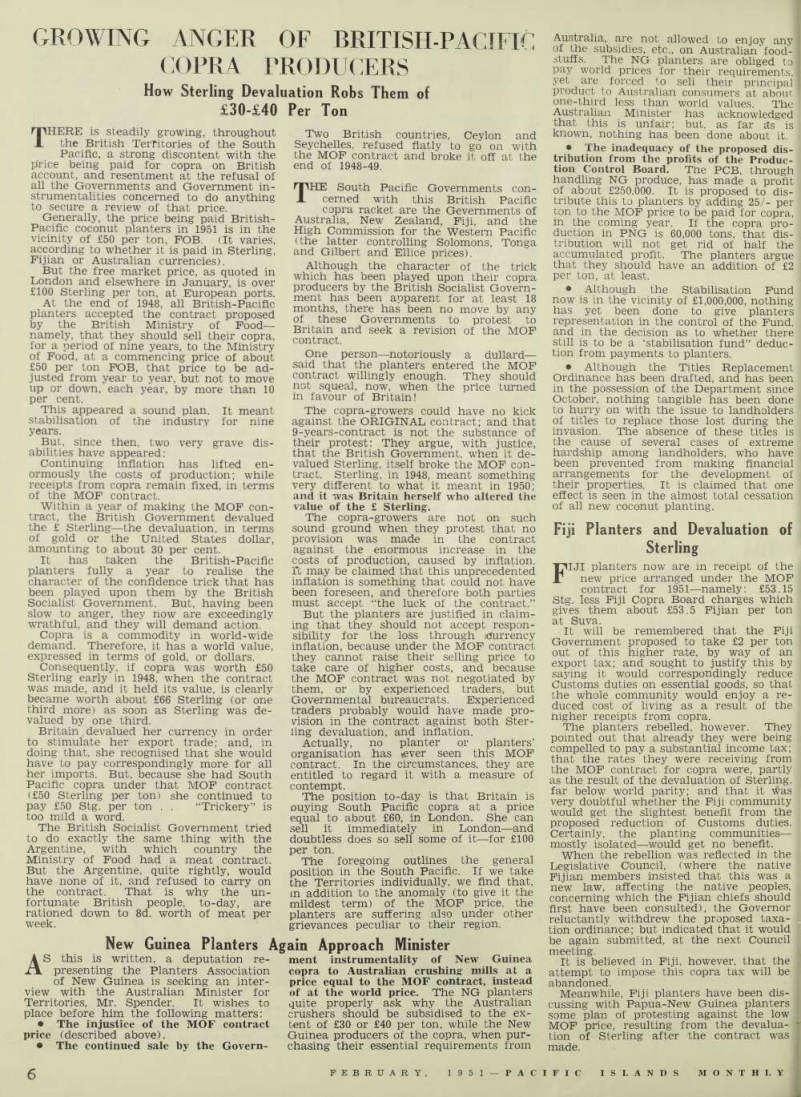
These five men escaped when an RNZAF Catalina crashed after taking off from Western Samoa on December 11. One crew member escaped, seven were killed. Shown here, left to right, are Mr. H. Cole, of W. Samoa, P.W.D.; F. J. Grattan, of Samoan Affairs Department, Professor Marples; Dr. Lopdell, Director of Health in W. Samoa; and Poutoa, a Samoan public servant.
Photo by Superflash.
Advertisements & other items, p. 9 (1 item)
5
•ACIFIC ISLANDS MONTHLY FEBRUARY, 1951
Growing Anger Of British-Pacific
Copra Producers
How Sterling Devaluation Robs Them of £30-£40 Per Ton
THERE is steadily growing, throughout the British Territories of the South Pacific, a strong discontent with the price being paid for copra on British account, and resentment at the refusal of all the Governments and Government in strumentalities concerned to do anything to secure a review of that price.
Generally, the price being paid British- Pacific coconut planters in 1951 is in the vicinity of £5O per ton, FOB. (It varies, according to whether it is paid in Sterling, Fijian or Australian currencies).
But the free market price, as quoted in London and elsewhere in January, is over £lOO Sterling per ton, at European ports.
At the end of 1948, all British-Pacific planters accepted the contract proposed by the British Ministry of Pood— namely, that they should sell their copra, for a period of nine years, to the Ministry of Food, at a commencing price of about £5O per ton FOB, that price to be ad justed from year to year, but not to move up or down, each year, by more than 10 per cent.
This appeared a sound plan, it meant stabilisation of the industry for nine years.
But, since then, two very grave dis abilities have appeared: Continuing inflation has lifted en ormously the costs of production; while receipts from copra remain fixed, in terms of the MOF contract.
Within a year of making the MOF con tract, the British Government devalued the £ Sterling—the devaluation, in terms of gold or the United States dollar, amounting to about 30 per cent.
It has taken the British-Pacific planters fully a year to realise the character of the confidence trick that has been played upon them by the British Socialist Government. But, having been slow to anger, they now are exceedingly wrathful, and they will demand action.
Copra is a commodity in world-wide demand. Therefore, it has a world value, expressed in terms of gold, or dollars.
Consequently, if copra was worth £5O Sterling early in 1948, when the contract was made, and it held its value, is clearly became worth about £66 Sterling (or one third more) as soon as Sterling was de valued by one third.
Britain, devalued her currency in order to stimulate her export trade; and, in doing that, she recognised that she would have to pay correspondingly more for all her imports. But, because she had South Pacific copra under that MOF contract (£5O Sterling per ton) she continued to pay £5O Stg. per ton . . “Trickery” is too mild a word.
The British Socialist Government tried to do exactly the same thing with the Argentine, with which country the Ministry of Food had a meat contract.
But the Argentine, quite rightly, would have none of it, and refused to carry on the contract. That is why the un fortunate British people, to-day, are rationed down to Bd. worth of meat per week.
Two British countries, Ceylon and Seychelles, refused flatly to go on with the MOF contract and broke it off at the end of 1948-49.
THE South Pacific Governments con cerned with this British Pacific copra racket are the Gevernments of Australia, New Zealand, Fiji, and the High Commission for the Western Pacific (the latter controlling Solomons, Tonga and Gilbert and Ellice prices).
Although the character of the trick which has been played upon their copra producers by the British Socialist Govern ment has been apparent for at least 18 months, there has been no move by any of these Governments to protest to Britain and seek a revision of the MOF contract.
One person—notoriously a dullard — said that the planters entered the MOF contract willingly enough. They should not squeal, now, when the price turned in favour of Britain!
The copra-growers could have no kick against the ORIGINAL contract; and that 9-years-contract is not the substance of their protest: They argue, with justice, that the British Government, when it de valued Sterling, itself broke the MOF con tract. Sterling, in 1948, meant something very different to what it meant in 1950; and it was Britain herself who altered the value of the £ Sterling.
The copra-growers are not on such sound ground when they protest that no provision was made in the contract against the enormous increase in the costs of production, caused by inflation.
To may be claimed that this unprecedented inflation is something that could not have been foreseen, and therefore both parties must accept “the luck of the contract.”
But the planters are justified in claim ing that they should not accept respon sibility for the loss through idurrency inflation, because under the MOF contract they cannot raise their selling price to take care of higher costs, and because the MOF contract was not negotiated by them, or by experienced traders, but Governmental bureaucrats. Experienced traders probably would have made pro vision in the contract against both Ster ling devaluation, and inflation.
Actually, no planter or planters’ organisation has never seen this MOF contract. In the circumstances, they are entitled to regard it with a measure of contempt.
The position to-day is that Britain is ouying South Pacific copra at a price equal to about £6O, in London. She can sell it immediately in London—and doubtless does so sell some of it—for £lOO per ton.
The foregoing outlines the general position in the South Pacific. If we take the Territories individually, we find that, in addition to the anomaly (to give it the mildest term) of the MOP price, the planters are suffering also under other grievances peculiar to their region.
New Guinea Planters Again Approach Minister
AS this is written, a deputation re presenting the Planters Association of New Guinea is seeking an inter view with the Australian Minister for Territories, Mr. Spender. It wishes to place before him the following matters: • The injustice of the MOF contract price (described above). • The continued sale by the Govern
ment instrumentality of New Guinea copra to Australian crushing mills at a price equal to the MOF contract, instead of at the world price. The NG planters quite properly ask why the Australian crushers should be subsidised to the ex tent of £3O or £4O per ton, while the New Guinea producers of the copra, when pur chasing their essential requirements from
Australia, are not allowed to enjoy any of the subsidies, etc., on Australian food stuffs. The NG planters are obliged to pay world prices for their requirements, yet are forced to sell their principal product to Australian consumers at about one-third less than world values. The Australian Minister has acknowledged that this is unfair; but, as far ds is known, nothing has been done about it. • The inadequacy of the proposed dis tribution from the profits of the Produc tion Control Board. The PCB, through handling NG produce, has made a profit of about £250,000. It is proposed to dis tribute this to planters by adding 25/- per ton to the MOF price to be paid for copra, in the coming year. If the copra pro duction in PNG is 60,000 tons, that dis tribution will not get rid of half the accumulated profit. The planters argue that they should have an addition of £2 per ton, at least. • Although the Stabilisation Fund now is in the vicinity of £1,000,000, nothing has yet been done to give planters representation in the control of the Fund, and in the decision as to whether there still is to be a ‘stabilisation fund” deduc tion from payments to planters. • Although the Titles Replacement Ordinance has been drafted, and has been in the possession of the Department since October, nothing tangible has been done to hurry on with the issue to landholders of titles to replace those lost during the invasion. The absence of these titles is the cause of several cases of extreme hardship among landholders, who have been prevented from making financial arrangements for the development of their properties. It is claimed that one effect is seen in the almost total cessation of all new coconut planting.
Fiji Planters and Devaluation of
Sterling
FIJI planters now are in receipt of the new price arranged under the MOF contract for 1951 —namely: £53.15 Stg. less Fiji Copra Board charges which gives them about £53.5 Fijian per ton at Suva.
It will be remembered that the Fiji Government proposed to take £2 per ton out of this higher rate, by way of an export tax; and sought to justify this by saying it would correspondingly reduce Customs duties on essential goods, so that the whole community would enjoy a re duced cost of living as a result of the higher receipts from copra.
The planters rebelled, however. They pointed out that already they were being compelled to pay a substantial income tax; that the rates they were receiving from the MOF contract for copra were, partly as the result of the devaluation of Sterling, far below world parity; and that it very doubtful whether the Fiji community would get the slightest benefit from the proposed reduction of Customs duties.
Certainly, the planting communities — mostly isolated —would get no benefit.
When the rebellion was reflected in the Legislative Council, (where the native Fijian members insisted that this was a new law, affecting the native peoples, concerning which the Fijian chiefs should first have been consulted), the Governor reluctantly withdrew the proposed taxa tion ordinance; but indicated that it would be again submitted, at the next Council meeting.
It is believed in Fiji, however, that the attempt to impose this copra tax will be abandoned.
Meanwhile, Fiji planters have been dis cussing with Papua-New Guinea planters some plan of protesting against the low MOF price, resulting from the devalua tion of Sterling after the contract was made.
IF the Papua-New Guinea and the Fiji planters have grievances, what can be said of the situation in the Gilbert and Ellice Islands Colony? There, the Government — • Pays the growers for their copra at the rates set out in the MOP contract (wnich, as explained elsewhere, are from £3O to £4O per ton below world parity). • Imposes a copra export tax of no less than 25 per cent, of the gross FOB value. On the £53/15/- Stg. per ton (which is the MOF contract price as paid in the G & E Colony) the export tax is no less than £l3/8/9 Stg. per ton (about £l6/15/- Australian). • Imposes income taxation on any profits the growers may have left, after that.
The G & E grower should be getting about £lOO Stg, FOB, for his copra. After his Government is finished with him (in other words, after he has been robbed under the Sterling devaluation racket, forced to pay export tax, and then mulcted for income tax), he probably does not get one third of that.
Since World War 11, the British Socialist Government (through the High Commission for the Western Pacific) has d»ne its best to squeeze private enterprise out of the Gilbert and Ellice Islands Colony and the Solomon Islands Pro tectorate, and to run those Territories for the natives on some sort of partriarchal system of its own.
Except in Washington and Panning Islands, there are few —if any—European planters and traders in the G & E Colony.
Burns Philp and Co., and W. R. Car penter and Co., as well as several small private concerns, operated there until 1942. They were very definitely not en couraged to return after the war.
The Administration, instead, assisted the natives to establish native co operative societies (Tangitangs) for the production and marketing of copra and the import and distribution of goods.
The way in which these native peoples are treated, as shown above, provides a good example of what Socialism means.
They would be better off under the pre war system of private enterprise.
The only place where private enter prise survives in the G & E Colony is in the Washington and Panning atolls, far to the east of the main archipelago.
For a very long time, Washington, Fanning and Christmas atolls were un inhabited, and ignored. Then they were planted up with coconuts, and became really valuable after World War I, and became an administrative district of G. & E Colony. They passed through the hands of various owners; but, finally, Washington and Fanning were acquired by Sydney interests and Christmas (one of the gems in the Abbe Rougier con stellation) was taken over after the war from Rougier interests by the Western Pacific Commission itself.
New British Consul In
Tahiti
Papeete, Jan. 25.
AFTER an absence of more than 10 years—he was here in 1939 —Mr. F.
A. E, Devenish took over the office of British consul in Papeete, on January 21. He lost no time in renewing old acquaintances, and said that he was glad to be back in Tahiti.
Mr. Fancis Henry Long, who was a British pensioner of World War I, died in Papra Papara in December.
Stranding of Ivor Jenny
Second Mate Suspended
AMARINE COURT sat in Suva, in January, to inquire into the circum stances of the fire that broke out in a hold of the freighter Ivor Jenny, when that vessel was between Balboa and Suva, on December 4, 1950; and the stranding of the same vessel on Horse shoe Reef, near Wakaya Island, Fiji, on December 26.
As a result of the Court’s inquiries into the stranding, the certificate of Ivor Jeimy’s second mate was suspended for six months. It was agreed that the question of the fire was probably outside the jurisdiction of that Court, but that in the Court’s opinion steps taken to con trol the fire were without fault.
The Court found that the stranding of the vessel was not due to any miscon duct or incompetence on the part of the Master, although he had failed to use or cause to be used large-scale charts in the navigation of the vessel on December 25 and 26.
The second-mate had been on watch at the time of the vessel’s stranding. The Court found that he had not carried out the Master’s instructions to call him once Wakaya light was sighted; and that on sighting the Wakaya light on a point dangerous to the vessel, had failed to take immediate steps to safeguard Ivor Jenny by altering course or going astern or stopping. He had been at fault on several other counts, and in the opinion of the Court this constituted misconduct.
Guillotine For Murderers
Papeete, Jan. 17.
TWO youths, who were convicted of the murder of M. Arthur Brander last July, have been sentenced to exe cution by guillotine. M. Brander, an aged man and head of one of the best known of our pioneer families, was stabbed to death at his home. The mur derers have lodged an appeal against the sentence.
Local Brewed Beer
For P-NG
From Our Own Correspondent WAU, January 17. rpHE plan to brew beer in Port Moresby X to supply the local demand is several steps nearer fulfilment. (Papua-New Guinea (non-native population of about 10,000) consumes each year 350,000 gallons of beer, all of it imported in bottles. Re tail cost is about 4/- per bottle).
Mr. Joe Bourke, of Wau, one of the pro moters of the local brewery scheme, has stated that the new brewery, which will be operated in Port Moresby is to be called the South Pacific Brewery Limited, and that a licence to brew has been granted by the Administration.
The plant has been purchased in Ger many and construction of the plant will commence in March. A brewer has been engaged in Germany and he will super vise construction of the plant in Port Moresby.
Dusty Rabaul
Bitumen Roads For
From a Special Correspondent in Rabaul AT last the Works and Housing Depart ment has struck a blow in a direction of which all approve.
The roads of Rabaul have to be ex perienced to be believed, and the swirls of fine pumice dust that vehicles leave in their wake seeps into everything. Most of the dust roads have been sealed, but pot-holes soon appear again.
Now, at long last —although they have had the machinery for years—the depart ment is using gravel, and a large roller and bitumen. At the end of January Malaguna Road had been done, and also a section of Mango Avenue.
It has stood up to recent heavy rain— as the sealed pumice dust road never did —and we hope that it is an answer to all our prayers.
Educationalist In Fiji
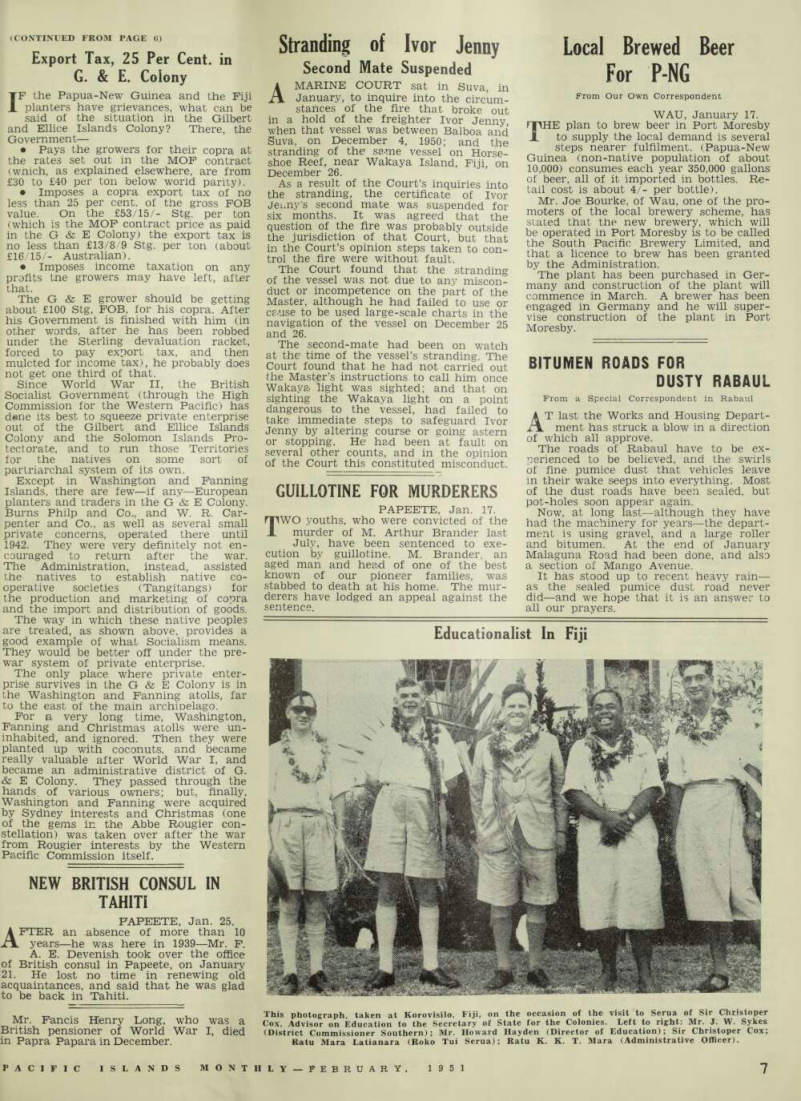
This photograph, taken at Korovisilo, Fiji, on the occasion of the visit to Serua of Sir Christoper Cox, Advisor on Education to the Secretary of State for the Colonies. Left to right: Mr. J. W. Sykes (District Commissioner Southern); Mr. Howard Hayden (Director of Education); Sir Christoper Cox; Ratu Mara Latianara (Roko Tui Serua); Ratu K. K. T. Mara (Administrative Officer).
Advertisements & other items, p. 11 (1 item)
7
PACIFIC ISLANDS MONTHLY FEBRUARY. 1951
(CONTINUED FROM PAGE 6)
Export Tax, 25 Per Cent, in G. & E. Colony
South Pacific
Commission
Scope of Work Now Being Done
Headquarters: Anse Vata, Noumea, New Caledonia
TO mark the fourth anniversary of the South Pacific Commission, there was a “Visitors’ Day,” on February 6, B‘ the Commission’s headquarters at Noumea.
The Agreement establishing the Com mission was signed in Canberra, on Feb ruary 6, 1947, by representatives of Australia, France, the Netherlands, New Zealand, United Kingdom and United States. The First Session was held in Sydney in May, 1948; and, at the Second Session, in October, 1948, also in Sydney, Noumea was chosen as the permanent seat of the Commission. Headquarters were set up there on March 5, 1949.
The Commission has two auxiliary bodies —the Research Council and the South Pacific Conference.
At present, under direction of the Research Council, there are close on 40 major projects in the three main fields of activity being undertaken throughout the South Pacific. In some, activity is just beginning, while in others prelimin ary reports by experts following field in vestigations have been submitted for the Council to consider.
For example, on a coral atoll in the Gilbert and Ellice Group, two scientists are at present studying the problem of how to improve the native economy on such islands. A research team has just completed its work in Tahiti as part of a Pacific-wide study of the best tech niques for determining the incidence of tuberculosis. Elsewhere, other workers are investigating such common diseases as yaws and filariasis.
In Suva last month, a meeting of Re search Council members was held to consider an expert report on facilities for professions.! and technical training of native peoples.
In New Caledonia and Fiji, special In troduction Gardens are discovering what economically-useful plants and trees can be introduced to various parts of the Pacific.
Several dozen other projects are being carried on simultaneously.
Plant And Animal Quarantine
THE Commission last October agreed that a conference of experts to con sider the question of plant and animal quarantine be held in Suva about the end of March, 1951.
Two specialist officers from each of the six member Governments will attend.
They will seek a common quarantine policy for the whole South Pacific region.
Co-Ordination
On January 26, 27 and 29 a co-ordina tion meeting was held at the head quarters of the Commission at Noumea., and attended by the Executive Officers for Health, Economic Development and Social Developments. They dealt with the Agenda for the Seventh Session of the Commission (at Noumea commencing April 28), preparations for the Third Meeting of the Research Council (June), relationships between projects in the different fields, and recruitment of per sonnel.
Investigation Of Tb Incidence
THE tuberculosis research team under the leadership of Dr. J. Guillermin returned to Noumea from Tahiti on February 1, after completing 12 months of field work in New Guinea, New Ireland, New Caledonia, Western Samoa and French Oceania.
The team’s main objective was the study of techniques for ascertaining the incidence of tuberculosis among native people. The results obtained are being re examined. Directions will be drafted for finalising research on the techniques of individual diagnosis.
A new team will carry on the Com mission’s tuberculosis research in 1951 probably commencing in the Cook Islands.
Mr, Claude G. Ross, United States consul in New Caledonia, arrived in Tahiti on January 19, with the first plane sent from Honolulu to inaugurate the new service by the Hawaii-Tahiti Airways. Mr. Ross is making his periodical visit to French Oceania.
Death Of Mr. R. A. Laws
Mr. Richard Arthur Laws, One Of
New Guinea’s best-known mer chants, died in a private hospital in Sydney at midnight on February 14, after 6 weeks’ illness, aged 66.
He was one of the founders of Green wood and Laws, of Rabaul, well-known before the war. After the war, he joined forces with Mr. Robert Gillespie, to be come one of the directors of Robert Gillespie Fty., Ltd., (Sydney) and Robert Gillespie (New Guinea) Ltd. He was the first president of the Pacific Territories Association, which fought for the rights of New Guinea “evacuees” during the war. He was popular, and very widely esteemed. He is survived by his wife, and one son and one daughter.
Mof Increase For
W Samoan
Copra Producers
\ s from January 1, 1951, Western Samoan copra producers will re ceive £NZ4S / 11/- (£56 Aust.) per ton, FOB, Apia. This is based on the MOF contract price of £Stg.s3/19/- per ton, but £5/7/11 will be deducted for export duty and £3/0/1 for the copra stabilisation fund. The MOF price has increased about £5/5/- Stg. per ton on 1950 prices.
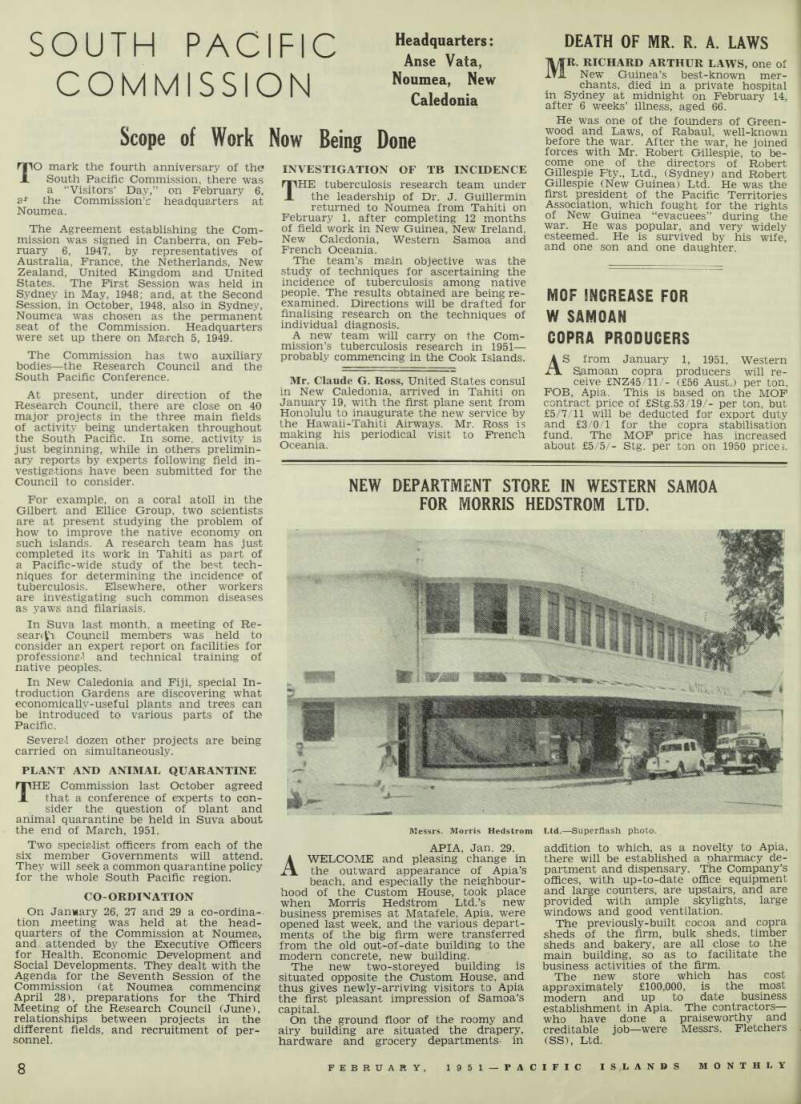
New Department Store In Western Samoa
For Morris Hedstrom Ltd.
Apia, Jan. 29.
A WELCOME and pleasing change in the outward appearance of Apia’s beach, and especially the neighbourhood of the Custom House, took place when Morris Hedstrom Ltd.’s new business premises at Matafele, Apia, were opened last week, and the various departments of the big firm were transferred from the old out-of-date building to the modern concrete, new building.
The new two-storeyed building is situated opposite the Custom House, and thus gives newly-arriving visitors to Apia the first pleasant impression of Samoa’s capital.
On the ground floor of the roomy and airy building are situated the drapery, hardware and grocery departments- in
addition to which, as a novelty to Apia, there will be established a pharmacy de partment and dispensary. The Company’s offices, with up-to-date office equipment and large counters, are upstairs, and are provided with ample skylights, large windows and good ventilation, The previously-built cocoa and copra sheds of the firm, bulk sheds, timber sheds and bakery, are all close to the main building, so as to facilitate the business activities of the firm, The new store which has cost approximately £lOO,OOO, is the most modern and up to date business establishment in Apia. The contractors— who have done a praiseworthy and creditable job—were Messrs. Fletchers (SS), Ltd.
Messrs. Morris Hedstrom Ltd.—Superflash photo.
Advertisements & other items, p. 12 (1 item)
8
FEBRUARY, 1951 PACIFIC IS .LANDS MONTHLY
Fiji’S Minor War
Competition is Good for the Sukuna Plan
From Our Special Correspondent RATHER an interesting little commer cial war is going on here, beneath the surface. The Big Boys are en joying themselves thoroughly in what appears to be an all-in fight; and it looks as if the native Fijians will be the chief beneficiaries.
That outstanding man of commonsense and long vision, Sir Lala Sukuna, has cherished, for a. long time, a plan under which he might use the abundant funds at present available from the sale of native-produced copra, bananas, etc., to build up the economic strength of the average Fijian community.
He wants the Fijians to make, volun tarily, regular deductions from their re ceipts from produce sold, so that they may have funds for trading; and, if this is done, his own Department will sponsor Fiji trading organisations, and give Fiji village storekeepers a chance to get estab lished. At present much of the profits from village trading goes to the big com panies.
Sir Lala is especially anxious to de velop, among the Fijians, a sense of com mercial values, so that they may better hold their place in competition with other races.
This matter appears to have been dis cussed, first, with the heads of Morris Hedstrom, Ltd. , We may presume that MH, like any other big trader, rather shrank from the idea of building up, against itself, competition in the distri bution field by native co-operative move ments; but it finally was agreed that MH should help in relation to goods distri bution, and especially in sea transport.
NATURALLY, this development was watched jealously by the other big companies rivals of Morris Hedstrom litd.
The heads of those concerns were no nore in love with the idea of “native m-operatives” than were Mr. H. E. Snell md his colleagues. But, like the latter, hey recognise that Time Marches On md, for better or worse, all modern gov ernments seem determined to promote ‘co-opera-tion,” especially among native ommunities. Better try to ride with the ide, rather than essay the hopeless task >f stopping it.
So the managing director of Messrs.
Burns Philp (South Seas) Co., Ltd., and V. R. Carpenter & Co. (Fiji), Ltd., came nto the picture; and the advent of Mr.
Tui” Johnson (Carpenters) especially ivened up the proceedings. Discussions entred on the production, sale and trans tort of native copra.
Carpenters now have, here, the big ;est copra-crushing mill in the Pacific slands. For this, they want as much mod copra as they can get at the lowest >racticable price. As it represents an mportant secondary industry, officialdom s friendly to the mill.
Naturally, the other big companies are tot friendly to the Carpenter mill. For •bvious reasons, they would rather see he copra gathered up in the usual way, •nd shipped directly overseeas. than that he old routine and economy should be iroken, so as to divert a lot of the copra o Suva, to be bought there on the spot, md processed.
Mr. Johnson, however, saw his big hance. By co-operating with Sir Lala lukuna in his plan for putting commer cial strength and know-how into the la.tive villages, he could not only help he cause—he might also get in return
the friendly co-operation of the Fijians, in ensuring direct supplies of copra to the Carpenter mill.
SOMEONE challenged the idea that it would pay the Fijians to market their copra in Suva. It was argued that they would get a better price through direct export.
Mr. Johnson came back fighting. He produced figures to show that in selling copra to the mills in Suva, the Copra Board saved certain handling charges, so that the return to the grower was at least as good, if not better, than if the copra went overseas.
The discussions proceed, with an ever sharpening edge to them.
The Big Boys are not friendly to each other, but all are demonstratively friendly to Sir Lala and his plans. Sir Lala, with a gleam in his shrewd old eye, is quite sure that there is much truth in our ancient saying, “Competition is good for trade.”
The Month In
Moresby
Increasing Copra Production
Port Moresby. Feb. 6
(IQPRA output in the Territory showed j a very healthy increase during the latter part of 1950, when production jumped by thirty per cent. This put the total for last year at 68,289 tons, with Production Control Board receivals at Rabaul 31,861, and Kokopo in next place with 10.135.
Madang was third with 9,550; then Samarai 6,259; Port Moresby 5,451; Kavieng 5,790; Lorengau 811; and Lae 432’.
Lamington Relief Fund
The Mount Lamington Disaster Relief Appeal was opened by Mr. Justice Gore over the ABC station at Port Moresby on February 8. This has been organised for the relief of all who suffered through the volcanic eruption. The Relief Fund committee appointed by the Administration comprises the following members: President —Mr. Justice Gore.
A nominee of the Bishop of New Guinea, (Dr. Strong).
Mr. A. J. Bretag (President of the Lae Citizens Association).
Mr. E. A. James (Chairman of the Port Moresby Advisory Council).
Mr. J. A’Hearn (Chairman of the Papua and New Guinea Red Cross Division).
Mr. H. H. Reeve (Administration Treasurer).
Mr. W. C. Groves (Director of Education).
Mr. G. Whittaker (State President of the R.S.L.).
A number of subscriptions to the fund had already been received by Mr. Justice Gore before the appeal was officially launched.
Stevedoring
The Administration is going out of the stevedoring business as soon as private enterprise can take over. This will put wharf activities back on the pre-war level.
Fortunately for private enterprise stevedoring in the Territory is not the headache it is in Australia. Generally native labour does a pretty good job on the wharves.
Good Stock For Breeding
More livestock are to be brought to the Territory by the Department of Agri culture. This time, the consignment is going to Rabaul, with cattle, horses, goats and pigs included in the loading list.
The animals are coming from New South
Wales and Victoria, and will be offered for sale to private buyers. Those not sold will be sent to the Department’s livestock station near Rabaul, for breeding purposes.
Prices arc expected to be rather steep, due to the high transportation costs; but, at least, purchasers will not get tangled in red tape, as all arrangements are in ihe hands of the Department, and sales will be made after the stock are landed.
34 Natives Rescued
Thirty four natives have good reason to be thankful that the oil interests of the world turned their attention to Papua.
They do not hold any shares in the com pany, but they are indebted to the APC for a much-needed nautical hitch-hike from somewhere 10 miles out to sea, off the Vailala River mouth. When the APC vessel Gabuna, with Captain Thompson on the lookout, happened along on the night of January 16, the 34 natives were on a sinking lakatoi, with a vqry rough sea running. The natives were safely landed at the IHU government station, on the Vailala River estuary, next morning.
More Pay For Married Women
Out of the blue, in January, the Works and Housing Department at Port Moresby announced that the Territorial allowance of £l5O a year would be restored to the salaries of married women on its staff.
Eagerly their contemporaries on the Administration staff waited for a similar announcement from the Public Service Commissioner. However, when this was written they were still waiting—and hoping. £l5O p.a. is not big money—but it is a lot when it is suddenly lost out of a pay envelope.
East Papuan Rice
A Factor in the Feeding of Lamington Refugees
A BOUT the only bright spot in the Mount Lamington disaster, in Papua, is the fillip it seems to be giving to rice production.
Apart from the 4,000 natives lost in the eruption, another 4,000 or so have been displaced, and are refugees, so that the Administration has the serious problem of providing food and shelter, Mr. Claude Champion (one of the ex perienced Champion brothers in the Administration, and at present Assistant Government Secretary) reported in February that many of the refugees were being fed with rice grown by the natives in the Kokoda villages, above Wairope.
“We have an official stationed at Wairope just to supervise the hulling of rice” said Mr. Champion.
He also reported that the Administra tion was proceeding vtith plans to start the production of rice on the large plains at Ilimo, some four miles on the Kokoda side of Wairopi.
For some years the Administration has been trying to encourage the production of hill rice (as distinguished from padi rice) in this part of Papua; and it is in teresting to note that this enterprise has proceeded so far as to become a factor of imnortance in the feeding of thousands of refugees.
The events of the war and nost-war periods completely dislocated the rice growing industry of Southeast Asia, so that supplies are not now readily available to the Pacific Islands. Rice landed in Western Pacific ports now costs about £7O per ton, so it would seem to be about time that every effort be made to stimulate rice production in Papua-New Guinea.
Advertisements & other items, p. 13 (1 item)
9
ACIFIC ISLANDS MONTHLY FEBRUARY, 1951
Warning ?
Why No Official
Demand for Inquiry About Lamington Disaster
ALTHOUGH the Minister for Territories (Mr. Spender) has said that he sees no need for a public inquiry, there is in Papua-New Guinea a strong and persistent demand that something should be done about the fact that the Adminis tration did not regard the Mount Laming ton threat seriously.
The P-NG Administration is supposed to be experienced in the ways of volcanoes.
There is a string of volcanoes right along the northern coasts. Since 1937, when the Matupi-Vulcan eruption forced the evacua tion of Rabaul, a vulcanologist has been kept at Rabaul to give warning of dangerous developments there. There were warning noises in Mount Lamington dn December, and definite and increasing eruption signs from January 16 onwards.
Yet the people were allowed to stay there until the volcano exploded on the 21st, and killed 35 Europeans and between 3,000 and 4,000 natives.
The local newspaper, South Pacific Post, has soberly but strongly voiced the people s demand for an inquiry. “What is the use of maintaining a vulcanological service in the Territory if no attempt it to be made to study volcanoes outside of Rabaul.-’ sums up the viewpoint of the ordinary man. That viewpoint is supported by the calendar.
December— The natives were uneasy be cause of rumblings in Mt. Lamington.
Tuesday, January 16 —Very loud noises from Lamington; in the afternoon, the mountain belched smoke.
Thursday, 18th— At 11 a.m., the moun tain erupted from its cone.
Friday, 19th— The cloud of gas, smoke and dust increased; tremors were almost continuous; bush natives fled, but mission natives remained.
Saturday, 20th— Tremors and smoke cloud increased during the night.
Sunday, 21st— The side of the mountain blew out at 10.42 a.m., and practically all people within an 8-mile radius were killed either by the terrific lateral blast or by the following shower of red-hot ashes.
ON February 2, the Minister gave reasons why he would not order a public inquiry.
“I have no objection, in principle, to an open inquiry if any useful purpose can be served,” he said. “The principal question is whether sufficient facts exist which would warrant such an inquiry.”
“When word of the first eruption of Mt.
Lamington was received, Judge Phillips, who was acting as Deputy Administrator in the absence of the Administrator (Colonel Murray) immediately proceeded to Popendetta and consulted the District Commissioner there.
“Even the District Commissioner, the late Mr. Cowley—who so soon after was unfortunately killed by blast in front of his house—was then of the definite opinion that there was no immediate danger. At this stage there had been earth tremors and one small eruption.
“This opinion merely reinforced that of Judge Phillips himself. The question is whether he or anyone else mignt reason ably have expected, at the time he arrived on the scene, any danger which warranted the evacuation of Europeans and natives from the area.
“Although Judge Phillips is not, of course, a vulcanologist, he had had ex perience at Rabaul in the 1937 eruption.
He was Deputy Administrator there when Vulcan Island and Matupi, only five and three miles respectively from Rabaul, erupted violently.
“As he pointed out in his report, ‘The only loss of life they caused was to natives who had come to get stunned fish from the sea at the very place that Vulcan blew up; a European who had climbed Matupi volcano to take photographs while Vulcan was erupting; and a wireless operator who is believed to have fallen from a wharf during the blackout. Yet I myself . . . and a number of volunteers, stayed in Rabaul right through without casualty . . . As Mt. Lamington volcano was 8 miles from Higaturu, I formed the opinion that there was no immediate danger to human life/ “We can all be wise after the event,” said Mr. Spender, “Judge Phillips, when in the Popendetta area at the time of the first official warnings of Mt. Laming ton’s activities, was of necessity guided, no doubt, by his past experience.
“And he said in his report: ‘As for the column that was coming from the volcano, and what Mr. Cowley had described in his signal as heavy smoke billowing from the northern side of the mountain, it was not, during my view of it, moving violently at
all, but was rising so gently and slowly that one had to look at it for an appreciable time to detect movement.
That slow movement or rising of the column was steady, not in spasmodic or violent bursts, when I saw it —as if the initial force of the volcano had spent itself and now had a sufficient outlet.
It reminded me of the appearance of the column from Vulcan Island volcano . . . several days after it had erupted . . .’
“With regard to the alleged failure to send the Government vulcanologist, Mr.
G. A. Taylor, to the area, as soon as the first reports of activity came through: the same considerations must surely apply as those already outlined. Previously, there had been no indications that the Mt. Lamington area was breaking out.
“The whole of the facts and attendant circumstances will, of course, be carefully scrutinised so as to learn from them all lessons that may be learned.
“I do not, however, see any grounds whatever for any public enquiry.
Generally, I think the Administration has done a very good job and personally should like to pay public tribute to the zeal and devotion displayed not only by it but by many others, in dealing with this awful disaster.”
FOR ACCOUNT OF LAMINGTON DISASTER, p. 11-17 . . . MAP, p. 103.
35 Europeans Perished
Mt. Lamington
THE following is a list of the Europeans who disappeared in the holocaust.
The bodies of less than half were found, and not all of those could be identified.
The number of natives lost is estimated at 4,000.
District Commissioner, C. F. Cowley, and his son Earl (15).
Dr. Paul Martin, Mrs Olga Martin, his wife, and their son Pinky.
Sister Barbara de Bibera, of the Anglican Mission, Sangara.
Messrs. A. J. Williams and F. W. Cook, Mr. and Mrs. J. Haddock, Messrs. Ron Watkins, Kevin Woiwood, Claude Stewart, Tom Greenwood and Terry Hoolihan, of the staff of Works and
Housing Department.
Rev. D. J. Taylor, of Sangara Mission, Mrs. Taylor, his wife, and four children.
Messrs. K. Bradford (Melbourne), lan James (Gippsland), Athol Earl (New Zealand), Cadet Patrol Officers.
Mr. J. Gleeson, of Native Labour Depart ment, and Mrs. Gleeson, his wife.
Mr. and Mrs. Maynard Lock, and* their two children.
Mr. W. R. Humphries, Director of Native Labour, Port Moresby. (He was in the district on a weekend visit to his daughter, Mrs. Maynard Lock.) Mr. Arthur Myers (New South Wales), of Public Health Department.
Mr. T. Maher-Kelly, of Department of Agriculture.
Mrs Freda Graham, (Manageress of Works of Housing Mess) and Mr. Ron Graham (her son) of Public Health
Department.
Persons Who Escaped
From Popandetta and Vicinity.
Mr and Mrs. Fred Kleckham and their three children. Mr. Kleckham is based at Popandetta, as Agricultural Officer.
Mr and Mrs. G. Morris, and child. Mr.
Morris is on the staff of the Co-operative Section of the District Services and Native Affairs Department. On the Sunday, Mrs.
Morris and child were at their home in Popandetta. Mr. Morris was at Wasida, between Awala and Wairopi.
Mrs. J. Boyd, sister of Mrs. Morris, on a holiday from Australia.
Mr. Jack Scurrah, Manager of A. H.
Buntings, Ltd. store at Popandetta.
Mr. and Mrs. R. Hart, of the Sangara Anglican Mission, were on their honey moon at Jegarata, a mission out-station about six miles from Popandetta. Mr.
Hart is the engineer at Sangara Mission.
From Sangara and Vicinity.
Mr. and Mrs. T. Henderson. He is General Manager of Sangara Rubber Plantations, Ltd. Their daughter, Mary, was a guest of Mr. and Mrs. C. Searle at Awala Plantation when the volcano
erupted.
Mr. and Mrs. F. W. Stephens, at Sangara. He is on Sangara Plantation staff.
Mr. and Mrs. J. Gwilt, and Mr. Wm.
Schleusener, of Sangara Plantations.
Mrs. C. Cowley and daughter Pamela.
They were week-end guests of the Stephens, at Sangara, when eruption occurred. They are the widow and daughter of District Commissioner C.
Cowley, killed in the eruption.
Miss M. Ray, from Australia. She had been holidaying at Higaturu and was spending the week-end with Mr. and Mrs.
Henderson.
Mr. and Mrs. C. Searle, of Awala Planta tion. Awala is just north of Wairopi.
Mr. D. Martin, employed by Mr. Searle at Awala.
Anglican Father Porter, of the Anglican Isivita Mission, on the fringe of the devastated area, where there were considerable casualties from burns.
Sister Durdin, and Mrs. Lane, also were at Isivita Mission, on the fringe of the devastation.
Papua
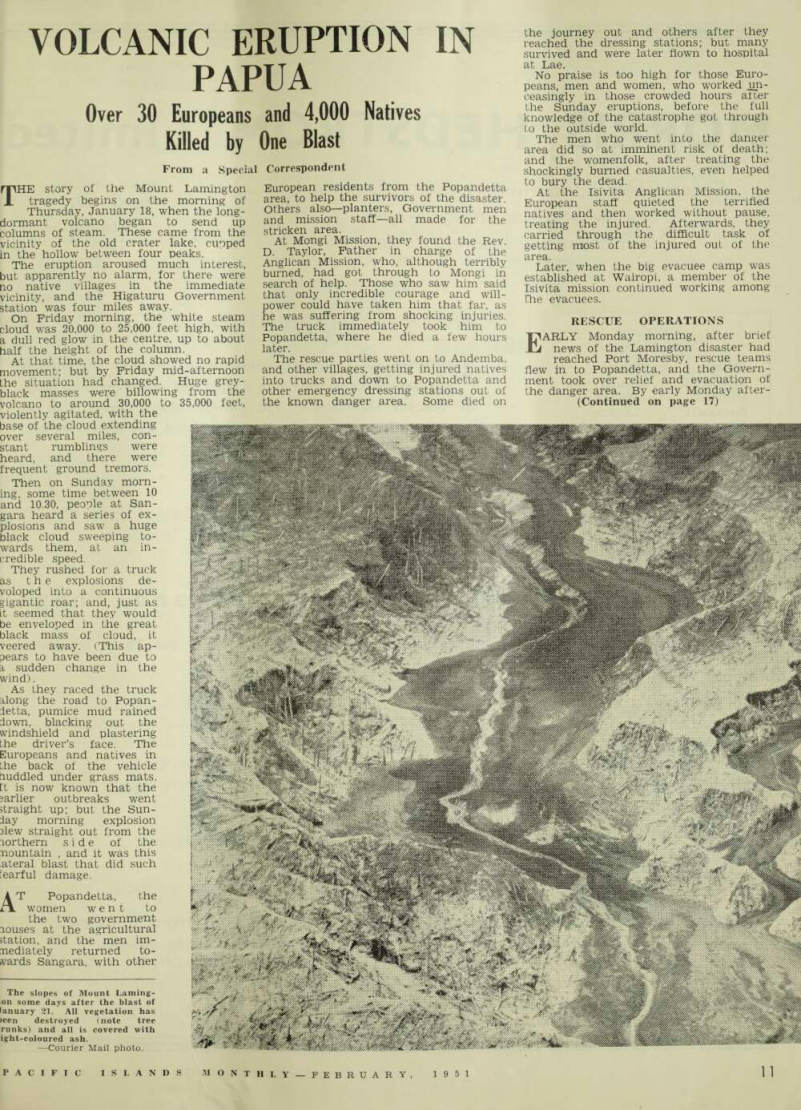
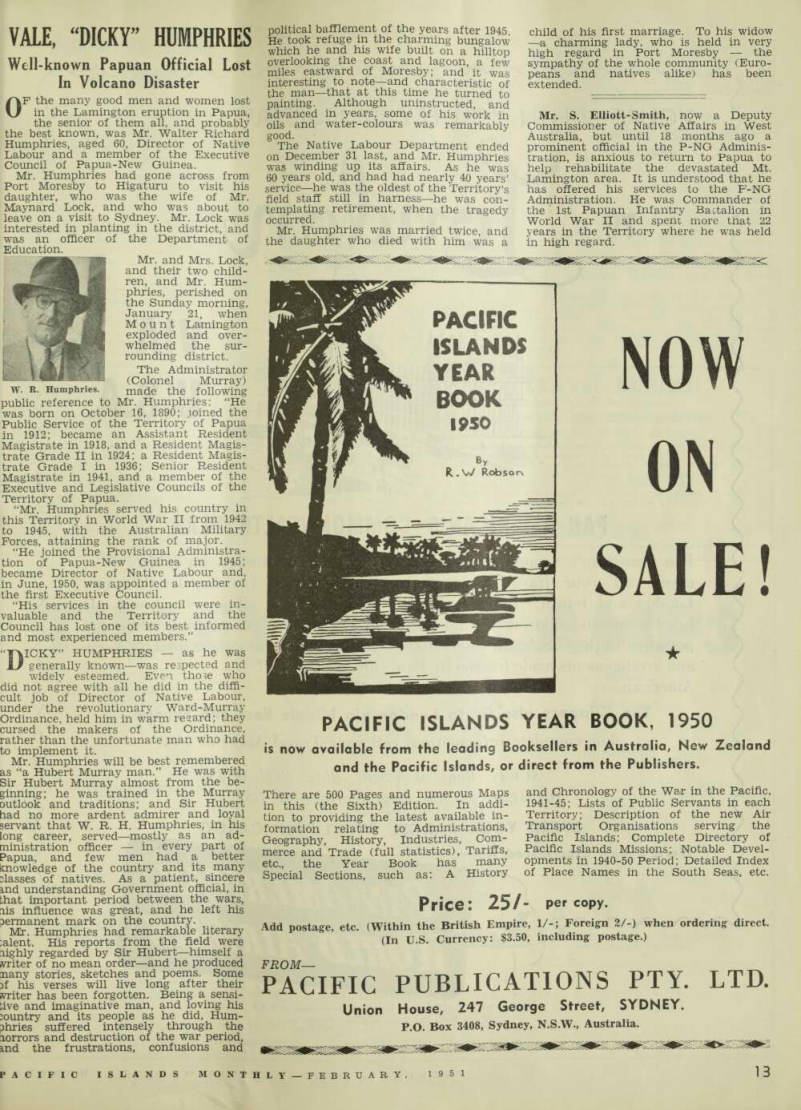
Volcanic Eruption In
Over 30 Europeans and 4,000 Natives Killed by One Blast
From a Special Correspondent
THE story of the Mount Lamington tragedy begins on the morning of Thursday, January 18, when the long dormant volcano began to send up columns of steam. These came from the vicinity of the old crater lake, cupped in the hollow between four peaks.
The eruption aroused much interest, but apparently no alarm, for there were no native villages in the immediate vicinity, and the Higaturu Government station was four miles away.
On Friday morning, the white steam cloud was 20,000 to 25,000 feet high, with a dull red glow in the centre, up to about half the height of the column.
At that time, the cloud showed no rapid movement; but by Friday mid-afternoon the situation had changed. Huge grey black masses were billowing from the volcano to around 30,000 to 35,000 feet,
violently agitated, with the base of the cloud extending over several miles, con stant rumblings were heard, and there were frequent ground tremors.
Then on Sunday morn ing, some time between 10 and 10.30, people at San gara heard a series of ex plosions and saw a huge black cloud sweeping to wards them, at an in credible speed.
They rushed for a truck as the explosions de veloped into a continuous gigantic roar; and, just as it seemed that they would be enveloped in the great black mass of cloud, it veered away. (This ap pears to have been due to a sudden change in the wind).
As they raced the truck along the road to Popan ietta, pumice mud rained down, blacking out the windshield and plastering the driver’s face. The Europeans and natives in the back of the vehicle huddled under grass mats, [t is now known that the earlier outbreaks went straight up; but the Sun day morning explosion Dlew straight out from the lorthern side of the nountain , and it was this ateral blast that did such fearful damage.
AT Popandetta, the women went to the two government louses at the agricultural station, and the men im mediately returned to wards Sangara, with other
European residents from the Popandetta area, to help the survivors of the disaster.
Others also —planters, Government men and mission staff—all made for the stricken area.
At Mongi Mission, they found the Rev.
D. Taylor, Father in charge of the Anglican Mission, who, although terribly burned, had got through to Mongi in search of help. Those who saw him said that only incredible courage and will power could have taken him that far. as he was suffering from shocking injuries.
The truck immediately took him to Popandetta, where he died a few hours later.
The rescue parties went on to Andemba, and other villages, getting injured natives into trucks and down to Popandetta and other emergency dressing stations out of the known danger area. Some died on
the journey out and others after they reached the dressing stations; but many survived and were later flown to hospital at Lae.
No praise is too high for those Euro peans, men and women, who worked un ceasingly in those crowded hours after the Sunday eruptions, before the full knowledge of the catastrophe got through to the outside world.
The men who went into the danger area did so at imminent risk of death; and the womenfolk, after treating the shockingly burned casualties, even helped to bury the dead.
At the Isivita Anglican Mission, the European staff quieted the terrified natives and then worked without pause, treating the injured. Afterwards, they carried through the difficult task of getting most of the injured out of the area.
Later, when the big evacuee camp was established at Wairopi, a member of the Isivita mission continued working among the evacuees.
Rescue Operations
EARLY Monday morning, after brief news of the Lamington disaster had reached Port Moresby, rescue teams flew in to Popandetta, and the Govern ment took over relief and evacuation of the danger area. By early Monday after
(Continued on page 17)
The slopes of Mount Laming on some days after the blast of [?]anuary 21. All vegetation has [?]een destroyed (note tree [?]runks) and all is covered with [?]ight-coloured ash.
Courier Mail photo.
noon more than six planes had arrived at Popendetta airstrip), and the Adminis trator (Colonel Murray), and key Govern ment personnel, had flown over the terribly devastated area.
That night, at emergency headquarters in Popendetta, while casualties were still being treated in the building, a conference was held in another comer of the room, to plan the immediate survey, and the evacuation of the stricken zone.
Early on Tuesday morning patrols moved out to locate any further injured, evacuate the survivors, and try to ascertain the casualties in each area.
It was known from the aerial survey that the blast area extended eight miles deep around the crater, and it was about twenty miles wide. From the air it appeared that nothing had survived the holocaust.
Higaturu itself, previously a garden settlement, and one of the most beautiful in the Territory, had been absolutely flattened to the ground, as though a giant steam roller, spreading a following layer of thick, grey pumice, had passed over the station. The dense tropical foliage around the station grounds had dis appeared entirely—only the stripped grey trunks lay like matchwood under the covering of pumice.
Utter desolation reigned over the vast area of the blast. Rain forests, and the thick tropical growth, villages, bush tracks and the whole once-smiling countryside had completely disappeared, leaving only a wasteland of debris strewn with the bodies of the dead, who lay where the blast had struck them on that smiling Sunday morning.
What The Patrols Found
THE patrol which went into Higaturu first passed through Andemba village, where there were only 12 known survivors out of a population of 400. The victims lay in, under, and around their homes, along the roadsides, in the bush tracks from the adjoining gullies, some huddled into the earth and others sprawling where the blast had struck them.
Moving on along the road to Higaturu, the toll of the dead was equally tragic; and the native co-operative coffee planta tion lay in utter ruin.
But there was even more terrible desolation at Higaturu itself, which was directly in the path of that overwhelming lateral volcanic blast.
Only the District Commissioner’s house remained intact; and this had been lifted off its piles and set down square about twenty yards away. Other homes had collapsed into a pile of wreckage or had been blown right off the ridge into the adjoining gullies.
All that remained of the District Office was the floor of the building, with the two safes toppled over, but still intact.
Steel poles were bent almost level with the ground, and heavy Marsden steel matting was wrapped around the broken stumps of trees like wet brown paper.
The wreckage of the hospital buildings contained the bodies of a number of native patients.
Most of the European victims who were found lay scattered in the pumice at the eastern end of the Station, away from Mt. Lamington. Identification was difficult in most cases, nor was it possible to locate all the European casualties.
Most of the dead throughout the whole area appeared to have died from the effect of blast; and, probably, death was almost instantaneous.
Others, in the gullies and on lower levels, who may have escaped the worst of the initial blast, were caught in the thick, smothering mass of hot, pumice laden air.
(Continued Page 19)
Advertisements & other items, p. 16 (1 item)
Morris Hedstrom Limited
General Merchants, Importers and Exporters,
Shipowners, Plantation Owners,
Commission and Insurance Agents
HEAD OFFICE
SUVA, FIJI
Established 1868
SERVICE IN THE SOUTH PACIFIC TERRITORIES
rjpHROUGH our Large Establishments in Suva and our Numerous Branches, we distribute a wide and comprehensive range of General Merchandise and provide almost every kind of service. Our departments and associated businesses include:
DRAPERY
MOTOR SALES
AND SERVICE
TOBACCO
TIMBER AND
BUILDING
GROCERY
CONFECTIONERY
HARDWARE
ELECTRICAL
LIQUORS
DRUGS
Branches Throughout Fiji, Samoa and Tonga
There is a Branch or Agent of Morris Hedstrom Limited in every Town in the Three Territories.
We are Sole Agents in these Territories for British Drug Houses Ltd.
Electrolux Ltd.
Ford Motor Co.
General Electric Co. Ltd.
Goodyear Tyre Gr Rubber Co.
B. A. Hjorth Gr Co. (Primus Products) Imperial Chemical Industries Ltd.
International Harvester Export Co.
Matson Navigation Company Max Factor and Co. Inc.
Ransomes, Sims Gr Jefferies Ltd.
Ruston Gr Hornsby Ltd.
Vacuum Oil Co. Pty. Ltd.
Yorkshire Copper Works Ltd.
Morris Hedstrom Limited are LLOYD’S AGENTS in Fiji and Samoa.
IN AUSTRALIA: IN GREAT BRITAIN:
Morris Hedstrom (Aust.) Pty. Ltd., Morris Hedstrom Limited, Asbestos House, Barclay's Bonk Building, 65 York Street, SYDNEY 73 Cheopside, LONDON, E.C.2.
Vale, “Dicky” Humphries
Well-known Papuan Official Lost In Volcano Disaster
OF the many good men and women lost in the Lamington eruption in Papua, the senior of them all, and probably the best known, was Mr. Walter Richard Humphries, aged 60, Director of Native Labour and a member of the Executive Council of Papua-New Guinea.
Mr. Humphries had gone across from Port Moresby to Higaturu to visit his daughter, who was the wife of Mr.
Maynard Lock, and who was about to leave on a visit to Sydney. Mr. Lock was interested in planting in the district, and was an officer of the Department of Education.
Mr. and Mrs. Lock, and their two child ren, and Mr. Hum phries, perished on the Sunday morning, January 21, when Mount Lamington exploded and over whelmed the sur rounding district.
The Administrator (Colonel Murray) made the following
public reference to Mr. Humphries: “He was born on October 16, 1890; ,ioined the Public Service of the Territory of Papua in 1912; became an Assistant Resident Magistrate in 1918, and a Resident Magis trate Grade II in 1924; a Resident Magis trate Grade I in 1936; Senior Resident Magistrate in 1941, and a member of the Executive and Legislative Councils of the Territory of Papua.
“Mr. Humphries served his country in this Territory in World War II from 1942 to 1945, with the Australian Military Forces, attaining the rank of major.
“He joined the Provisional Administra tion of Papua-New Guinea in 1945; became Director of Native Labour and, in June, 1950, was appointed a member of the first Executive Council.
“His services in the council were in valuable and the Territory and the Council has lost one of its best informed and most experienced members.”
“TRICKY” HUMPHRIES as he was U generally known—was respected and widely esteemed. Even those who did not agree with all he did in the diffi cult job of Director of Native Labour, under the revolutionary Ward-Murray Ordinance, held him in warm regard; they cursed the makers of the Ordinance, rather than the unfortunate man who had to implement it.
Mr. Humphries will be best remembered as “a Hubert Murray man.” He was with Sir Hubert Murray almost from the be ginning; he was trained in the Murray outlook and traditions; and Sir Hubert had no more ardent admirer and loyal servant that W. R. H. Humphries, in his long career, served—mostly as an ad ministration officer in every part of Papua, and few men had a better Imowledge of the country and its many classes of natives. As a patient, sincere md understanding Government official, in that important period between the wars, lis influence was great, and he left his oermanent mark on the country.
Mr. Humphries had remarkable literary :alent. His reports from the field were lighly regarded by Sir Hubert —himself a vriter of no mean order —and he produced many stories, sketches and poems. Some Df his verses will live long after their ivriter has been forgotten. Being a sensi tive and imaginative man, and loving his country and its people as he did, Hum phries suffered intensely through the lorrors and destruction of the war period, md the frustrations, confusions and
political bafflement of the years after 1945 He took refuge in the charming bungalow which he and his wife built on a hilltop overlooking the coast and lagoon, a few miles eastward of Moresby; and it was interesting to note —and characteristic of the man —that at this time he turned to
painting. Although uninstructed, and
advanced in years, some of his work in oils and water-colours was remarkably good.
The Native Labour Department ended on December 31 last, and Mr. Humphries was winding up its affairs. As he was 60 years old, and had had nearly 40 years’ service—he was the oldest of the Territory’s field staff still in harness—he was con templating retirement, when the tragedy occurred.
Mr. Humphries was married twice, and the daughter who died with him was a
child of his first marriage. To his widow —a charming lady, who is held in very high regard in Port Moresby the sympathy of the whole community (Euro peans and natives alike) has been extended.
Mr. S. Elliott-Smith, now a Deputy Commissioner of Native Affairs in West Australia, but until 18 months ago a prominent official in the P-NG Adminis tration, is anxious to return to Papua to help rehabilitate the devastated Mt.
Lamington area. It is understood that he has offered his services to the F-NG Administration, He was Commander of the ' Ist Papuan Infantry Bactalion in World War II and spent more that 22 years in the Territory where he was held in high regard.
W. R. Humphries.
Advertisements & other items, pp. 17-18 (1 item)
Sale!
PACIFIC
ISLANDS
YEAR
BOOK
1950 By R , W Robson, r
NOW
ON
SALE!
PACIFIC ISLANDS YEAR BOOK, 1950
is now available from the leading Booksellers in Australia, New Zealand and the Pacific Islands, or direct from the Publishers.
There are 500 Pages and numerous Maps in this (the Sixth) Edition. In addition to providing the latest available information relating to Administrations, Geography, History, Industries, Commerce and Trade (full statistics), Tariffs, etc., the Year Book has many Special Sections, such as: A History and Chronology of the War in the Pacific, 1941-45; Lists of Public Servants in each Territory; Description of the new Air Transport Organisations serving the Pacific Islands: Complete Directory of Pacific Islands Missions; Notable Developments in 1940-50 Period; Detailed Index of Place Names in the South Seas, etc.
Price: 25/- per copy.
Add postage, etc. (Within the British Empire, 1/-; Foreign 2/-) when ordering direct. (In U.S. Currency: $3.50, including postage.)
FROM—
PACIFIC PUBLICATIONS PTY. LTD.
Union House, 247 George Street, SYDNEY.
P.O. Box 3408, Sydney, N.S.W., Australia.
VOURS WHEN YOU FLY BY CLIPPER*
TO
(yy\j
utltiili ll!!!
iiiliii'
Ml
PAN AMERICAN’S COMMONWEALTH PLAN
Pan American’s Commonwealth Plan See America en route covers all your travel expenses to San Francisco, Los Angeles, Chicago, London and return. Includes meals, New York are all on your route. If hotel accommodations, incidental trans- you wish you can arrange additional portation in the U.S.A. All reservations stop-over time anywhere in U.S.A. and arrangements made for you by Pan up to one year!
American.
The Clippers also fly to London via Middle East and Europe.
For complete information, call your Travel Agent or . . .
SUVA: Bank of N.S.W. Bldg. (Tel. 664) NOUMEA: Rue Jean Jaures (Tel. 85)
SPEED YOUR PARCEL BY CLIPPER CARGO
World's Most Experienced Airline / Pan American 'World Airways, Inc., Ltd., Incorporated in U.S.A. *Trade Mark, Pan American World Airways, Inc.
Anniversary of Fall
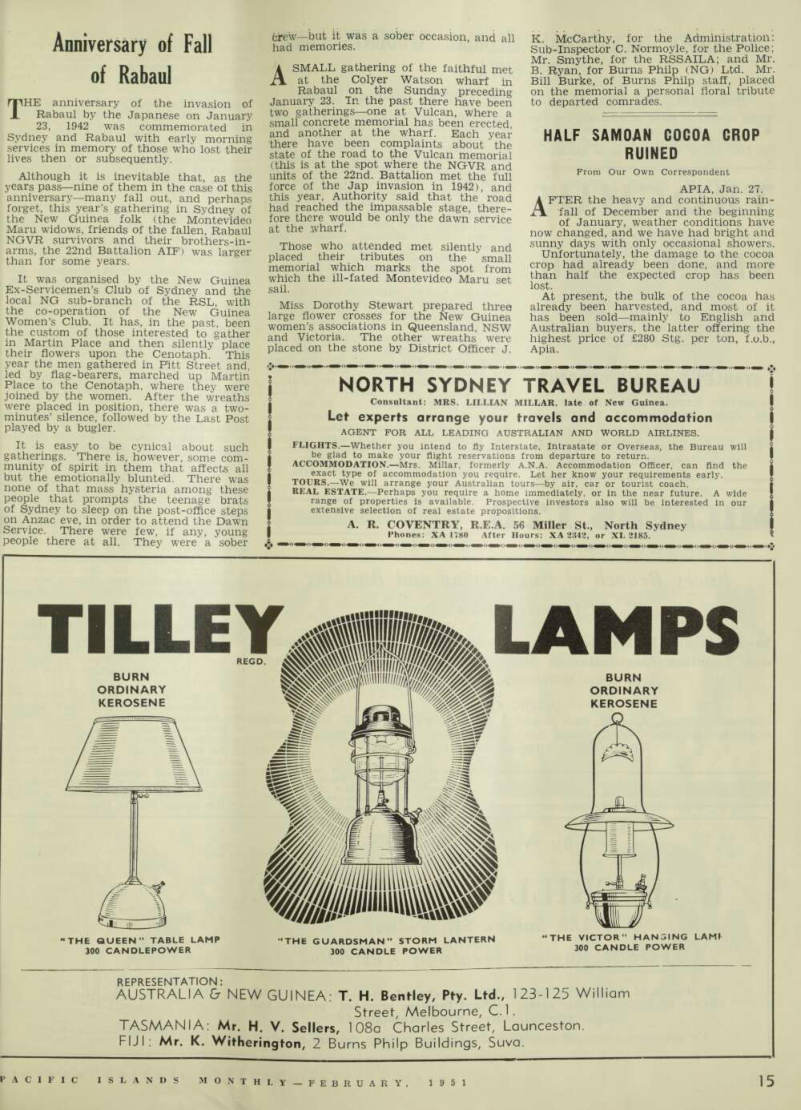
of Rabaul
THE anniversary of the invasion of Rabaul by the Japanese on January 23, 1942 was commemorated in Sydney and Rabaul with early morning services in memory of those who lost their lives then or subsequently.
Although it is inevitable that, as the years pass—nine of them in the case of this anniversary—many fall out, and perhaps forget, this year’s gathering in Sydney of the New Guinea folk (the Montevideo Maru widows, friends of the fallen, Rabaul NGVR survivors and their brothers-in arms, the 22nd Battalion A IF) was larger than for some years.
It was organised by the New Guinea Ex-Servicemen’s Club of Sydney and the local NG sub-branch of the RSL, with the co-operation of the New Guinea Women’s Club. It has, in the past, been the custom of those interested to gather in Martin Place and then silently place their flowers upon the Cenotaph. This year the men gathered in Pitt Street and, led by flag-bearers, marched up Martin Place to the Cenotaph, where they were joined by the women. After the wreaths were placed in position, there was a two minutes’ silence, followed bv the Last Post played by a bugler.
It is easy to be cynical about such gatherings. There is, however, some com munity of spirit in them that affects all but the emotionally blunted. There was none of that mass hysteria among these people that prompts the teenage brats of Sydney to sleep on the post-office steps on Anzac eve, in order to attend the Dawn Service. There were few, if any, young people there at all. They were a sober
fcrew—but it was a sober occasion, and all had memories.
A SMALL gathering of the faithful met at the Colyer Watson wharf in Rabaul on the Sunday preceding January 23. Tn the past there have been two gatherings—one at Vulcan, where a small concrete memorial has been erected, and another at the wharf. Each year there have been complaints about the state of the road to the Vulcan memorial (this is at the spot where the NGVR and units of the 22nd. Battalion met the full force of the Jap invasion in 1942), and this year, Authority said that the road had reached the impassable stage, there fore there would be only the dawn service at the wharf.
Those who attended met silently and placed their tributes on the small memorial which marks the spot from which the ill-fated Montevideo Maru set sail.
Miss Dorothy Stewart prepared three large flower crosses for the New Guinea women’s associations in Queensland, NSW and Victoria. The other wreaths were placed on the stone by District Officer J.
K. McCarthy, for the Administration; Sub-Inspector C. Normoyle, for the Police; Mr. Smythe, for the RSSAILA; and Mr.
B. Ryan, for Burns Philp (NG) Ltd. Mr.
Bill Burke, of Burns Philp staff, placed on the memorial a personal floral tribute to departed comrades.
Half Samoan Cocoa Crop
Ruined
From Our Own Correspondent
Apia, Jan. 27.
AFTER the heavy and continuous rain fall of December and the beginning of January, weather conditions have now changed, and we have had bright and sunny days with only occasional showers.
Unfortunately, the damage to the cocoa crop had already been done, and more than half the expected crop has been lost.
At present, the bulk of the cocoa has already been harvested, and most of it has been sold —mainly to English and Australian buyers, the latter offering the highest price of £2BO Stg, per ton, f.u.b., Apia.
Advertisements & other items, pp. 19-20 (1 item)
Lamps
NORTH SYDNEY TRAVEL BUREAU
Consultant: MRS. LILLIAN MILLAR, late of New Guinea.
Let experts arrange your travels and accommodation AGENT FOR ALL LEADING AUSTRALIAN AND WORLD AIRLINES.
FLlGHTS.—Whether you intend to fly Interstate, Intrastate or Overseas, the Bureau will be glad to make your flight reservations from departure to return.
ACCOMMODATION.—Mrs. Millar, formerly A.N.A. Accommodation Officer, can find the exact type of accommodation you require. Let her know your requirements early.
TOURS.—We will arrange your Australian tours—by air, car or tourist coach.
REAL ESTATE. —Perhaps you require a home immediately, or in the near future. A wide range of properties is available. Prospective investors also will be interested in our extensive selection of real estate propositions.
A. R. COVENTRY, R.E.A. 56 Miller St., North Sydney Phones; XA 1780 After Hours: XA 2342, or XL 2185.
LAMPS
REGD
BURN
ORDINARY
KEROSENE
mm Wm
flpMßr
BURN
ORDINARY
KEROSENE
3
THE QUEEN” TABLE LAMP
300 CANDLEPOWER
THE GUARDSMAN” STORM LANTERN
300 CANDLE POWER
'THE VICTOR” HANGING LAMF
inn r-AKiniF POWER
REPRESENTATION:
AUSTRALIA & NEW GUINEA: T. H. Bentley, Pty. Ltd., 123-125 William
Street, Melbourne, C. 1.
TASMANIA: Mr. H. V. Sellers, 108 a Charles Street, Launceston.
FIJI: Mr. K. Witherington, 2 Burns Philp Buildings, Suva.
TROCHUS
AND
GREEN SNAIL
Bought outright for Cosh, or on Consignment at highest ruling market prices.
STANLEY P. BELL & COMPANY
Importers, Exporters and Brokers for the Sale, Purchase or Charter of Ships.
173 Eagle St., BRISBANE, QLD.
Cables; “PACENT” Brisbane.
MILLERS LTD. u
iiiiii
illlliliillillllllll
SUVA and LAUTOKA, FIJI.
Every Branch of Enginee Building
Construction
Sawmillers and Timber Merchants; Shipwrights and Sailmakers; Joinery and Furniture Manufacturers; Upholsterers; Plumbers; Electricians; Hardware Merchants; Motor Dealers.
AGENCIES:
Chevrolet, Bedford, Vauxhall, Nash Motors. Firestone Tyres. Fetters Marine and Stationary Engines. G.E.C. Radio Sets. British Australian Lead Manufacturers Pty., Ltd. Atlas Assurance Co., Ltd.
There is no need to send to Australia or New Zealand for Repairs or Replacements. We can give you a sound Quotation and guarantee First-Class Workmanship.
Why Not A
R. J. CRILLEY PTY. LTD.
123 Sussex St., Sydney YOUR Buying Agents in Australia?
All classes of Australian merchandise purchased on behalf of Islands clients at best wholesale rates: original Invoices provided: prompt and reliable service assured in all transactions.
We are open to accept reputable new accounts from Islands clients.
M ft i
To Suva
America’S Micronesian Medical Students Come
Important Development For The Central Medical School
THE arrival in Suva of 50 young natives from Micronesia, to enter the Central Medical School, and undergo the four years’ course, so as to qualify as
Native Medical Practitioners was an un heralded but a very welcome development.
It seems to have followed quickly upon the transfer of the American Trust Territory of Micronesia (Caroline, Marshall and Mariana Islands) from Naval to Civil Administration, which be came effective on July 1, 1950.
There was a period, after the war, when the Americans appeared to hesitate be tween sending their picked native students to the Suva Medical School, and establishing their own Medical School.
Finally, they followed the latter course, and the School was established in Guam, and carried on there for a couple of years.
We have had no reports on the merits of the School, but it has been stated that the institution was far more expensive
than anticipated.
It appears that in the latter part of 1950 the Americans, after inquiry in Guam, and in Fiji, decided to close down the Guam establishment, and send the students to Suva; and the majority of them already have arrived by plane.
Another party is on the way by sea.
The Fiji Government apparently had not expected such quick action, because the arrival of so many new students created immediately an acute problem of accommodation. However, no complaints were made. The compliment paid the
Suva School by the Americans, in de ciding that Suva should train their native medical personal for Micronesia, far out weighed any temporary inconvenience in volved in housing and messing the new arrivals.
The Central Medical School of Suva now becomes by far the most important establishment of the kind in the Pacific.
The American decision is a fine tribute to the work of Dr. D. W. Hoodless, who was principal of the School for so many years, and to Dr. Prater, who has carried on the institution since Dr. Hoodless retired.
THE development again directs atten tion to the position of the Melane sian Territories (Papua-New Guinea, Solomon Islands, New Hebrides) in re lation to the Suva Medical School.
Native students from Solomons and New Hebrides have qualified at the School, in past years; but an attempt made in the last three or four years to similarly train lads from Papua and New Guinea has not been successful. The lads are eager enough; but they simply have not been able to get, in the Melanesian islands, the basic education, in English, which is necessary if they are to receive the training which qualifies them as Assistant Medical Practitioners (as they now are called).
It is believed that the Papua-New Guinea Department of Health is in favour of an establishment somewhere in the Southwest Pacific, organised in such a way that it could give a medical training to selected natives of Papua-New Guinea, and perhaus of Solomons and New Hebrides. This would not be as extensive or as useful as the training given at the Suva School; but it would be planned to make some sort of medical assistants (who are badly needed) out of the more primi tive natives of the SW Pacific.
There was some discussion of the idea a year or two ago; but, like the majority of plans affecting New Guinea adminis tration, it appears to have been shelved, or forgotten.
SOME observers think that this decision of the Americans to support the Suva Medical School may be the fore runner of other important co-operative moves in the administration of the Pacific Islands Territories.
It is pointed out that the administra tive problems of the Marshall, Caroline and Mariana Islands are, to the extent of 90 per cent., similar in character to the problems met with in the government of all the Islands groups of the South Pacific, eastwards of the New Guinea-Solomons- New Hebrides chain. A much larger measure of co-operation and co-ordina tion is possible, in the manner envisaged by the South Pacific Commission.
Sangara Mission
AT Sangara Mission, on a ridge of land sloping away from Higaturu and Mount Lamington, the only building intact was the residence of Father Taylor and his family. This had suffered only slight damage, but the bodies of a Euro pean child —indentified as that of one of the four Taylor children—and two native casualties, were found inside.
Literally hundreds of other natives lay dead around the Mission grounds and in the wrecked buildings', while the bush tracks nearby, and the adjoining gullies, revealed similar terrible toll.
As the patrols returned during the next two and three days, from other areas affected by the blast, it became apparent that at least 4,000 persons had died.
Almost without exception, wherever the blast had struck there were no survivors.
This accounts for the fact that, with the high death roll, there were less than one hundred injured admitted to hospital.
The injured came from the fringe of the blast area and were burnt by hot mud. most of them on the back of the body, indicating that they were attempting to escape.
A NATIVE survivor from the area struck by the falling curtain of hot mud described the eruption. He said that first there was a gurgling sound, like that of boiling water, then a “big torch” shot out of the mountain, followed by a hot black cloud. He said the light from the torch blinded him for a few seconds and, when he could see again, the great black cloud was rolling down on the village. In the path of the cloud it became completely dark, and people sheltering in buildings had to use lamps almost throughout the remainder of the day. One European at Sangara packed his house with terrified natives, and they sat in darkness, breathing through wet cloths and coughing incessantly as they inhaled the thick, pumice-laden air.
Help For The Natives
AN immediate air-lift of food and medical and other supplies was organized, with the co-operation of the airline companies, and evacuation camps established at Wairopi about 16 miles S.E. of Mount Lamington, and at Cape Killerton, on the northern side. By the end of the week, there were 4,000 evacuees at the first camp, and around 1,600 at Killerton. These came from the marginal areas beyond the blast zone, and within the sixteen-miles-radius closed zone recommended by the vulcanologist, Mr. G. A. Taylor. This was calculated on the basis of twice the previous blast area, and as being an essential closed zone in the event of a further eruption.
At Wairopi, a big rice-growing project is being planned, with production carried ?n by village co-operative groups. The Crown owns large areas of land in this district and the aim is to re-settle the displaced natives as quickly as possible, and enable them to become self-support ing- The urgency of this move can be gauged from the fact that it takes a minimum of aearly two tons of rice, meat and other foodstuffs daily to feed the Wairopi camp; and all this has to be taken in by air, either to Kokoda, or by air-drop over the ;amp.
Evacuees at Cape Killerton were later noved to Oro Bay, which is much more Juitable, both from a health and land dewpoint, for an evacuee camp.
The re-settlement of evacuees involves nany problems for the Administration, jomplicated by the fact that from a mlcanological viewpoint so little is known ibout the Mount Lamington volcano.
What decision will be made as to the ‘uture use of land in the wide belt beyond
the immediate vicinity of the volcano will doubtless depend on the conclusions drawn by the vulcanologists after exten sive study of the mountain.
Watch By Scientists
WHEN he visited the Higaturu area ten days after the eruption, Dr N H. Fisher, Chief Geologist of the Commonwealth Bureau of Mineral Re sources, said there was a possibility that the volcano would erupt again within a month of the first eruption. However if it did, the eruption would probably not’ be so severe as the first one.
Dr. Fisher explained that the Mount Lamington volcano was of a rare type, known as a “glowing cloud”; and where these had occurred they had usually erupted again within a month. A similar type of disaster to that of Mount Laming ton had occurred in the French West Indies in 1902, when Mount Pelee erupted and wiped out 30,000 people. In the nearby city of St. Pierre not a single person had survived.
From the Monday following the Mount Lamington eruption, the crater has been under constant survey by Mr. Taylor, the vulcanologist, who had hurried over from Rabaul. He made an aerial survey of the volcano early every morning, and had detailed records kept of its activities.
These varied from slight steam columns to occasional bursts of dust and steam, some of them rising to several thousand feet. At intervals there have been rumb lings from the crater, and tremors have been felt at Popendetta. Now a seismo graph has been set up in the Sangara area, staffed by two members of the geophysical section of the Commonwealth Bureau of Mineral Resources.
WHEN a detailed record of this disaster is compiled, tribute should be paid to all who worked unceasingly in the hectic hours and days immediately following the explosion. Magnificent work, irrespective of personal danger and under great strain was done by all the local Europeans, who rushed to the aid of the
survivors. Then when the Administrator (Colonel J. K. Murray) and his Adminis tration officials arrived, they and their staff did a splendid and speedy job in getting relief and reorganisation plans under way.
By Tuesday morning, patrols had fanned out through the devastated areas, and even before that medical staff were working non-stop to get the remaining injured through to hospital. A lot of hard slogging was also done at Port Moresby and Lae to get supplies organised and handle the huge volume of work en tailed in the emergency measures.
The Territory can well be proud of the fine job done in this emergency—first by Europeans, Government, mission and private individuals in and around the Mount Lamington area, and then by the executives and field staff who took over.
Advertisements & other items, pp. 21-24 (2 items)
Volcanic Eruption In Papua
17
Volcanic Eruption In Papua (Continued from Page 11)
PACIFIC ISLANDS MONTHLY FEBRUARY, 1951
T&Tmpaf
Now Available For the Islands.
HOLLAND RUSK
and Allied Products M We manufacture Holland Rusks, Butter Johns, Speculaas, Jubilee Par-T-Pack, Almond Rings, Breakfast Cake, Edam Cheese Crunches, Cocktail Buttons, and Celery Rondelles, etc. Individually packed and shipped In sealed tins and cases for the Tropics.
Write for Price List.
"HOLLAND RUSK"
32 PARRAMATTA ROAD, STRATHFIELD,
SYDNEY, N.S.W.
Island Agent: Francis Hoover. Products on sale at Colyer Watson (N.G.) Ltd.’s, stores.
"A
FINNS USED TO BELIEVE
THAT TO LOSE A TOOTH IS
A SIGN OF RAIN COMING
TODAY, ONLY KOLYNOS FIGHTS
TOOTH DECAY THESE THREE
WAYS.
0 KOLVNOS NEUTRALISES
MOUTH ACIDS. . , -
o KOLVNOS KILLS THE f/rZi
BACTERIA WHICH CAUSE Kt „ '
THESE ACIDS. °^i
0 KOLVNOS LEAVES o *M|
TEETH SURGICALLY - 7(l'
CLEAN.
LIONSTOOTH
prevents MALARIA;
fiHw AFRICAN . If P
TRIBESMEN f,‘ if
WEAR A
L10N55 TOOTH*
AROUND THEIR iM
NECK TO t *
PREVENT; 77'
MALARIA;
o " CP
T&TMPAf
, P/i//P£NPS>
$T IS AN OLD CUSTOM ° e '
IN TURKEY TO BURY AN
• EXTRACTED TOOTH, AS
• THIS LEADS TO MONEY ° j
BEING FOUND. CHANGE
R TO KOLYNOS, AND
« YOU'LL PROFIT BY A
£ LOVELIER SMILE... &)
TEETH THAT ARE 0
N , THOROUGHLY
CLEAN. ,
>2* °<o * o6> &>'
WHEN OTHER
TOOTHPASTES
LOOK LIKE
ITHIS...
XAVIER CUGAT FEATURED
ARTIST OF COLUMBIA
RECORDS, ALWAYS
USES KOLYNOS.
KOIYNOS FRESHENS j
YOUR MOUTH...
SWEETENS
YOUR BREATH..!
AND PEPS UP *
VOUR TASTE
BUDS. TOO.,
f—lasts twice as long!
KOLYNOS
WILL STILL
LOOK LIKE
THIS.
THE FINEST FRUIT CAKE
EVER BAKED
& oi <O5 £T xs£ s> & yJ»
BSS
*w bt "Big Sister" is so good it improves with keeping; delicious to the lost crumb! Each "Big Sister" cake is individually boxed and an inner wrap of moisture-proof cellophane seals in its oven-freshness.
Eh Su Big Sister" Rich Fruit Cake is the real home-style Fruit Cake.
Mellowed with tine old rum and brandy, studded with sweet red cherries, tenderized lemon and orange peels, and sun-rich sultanas, currants and raisins. In 3 lb, and 6 lb. cartons.
Special packing guarantees that every “Big Sister” product comes to your plate oven-fresh, as luscious in flavour and as moist and rich as the day it was baked.
"Prize Recipe" is a special light fruit cake, for those who prefer it. Super-milled flour, first-grade shortening, and tender fruits give it a fine texture, and the most delight- .--<1
PfitZE
ful home-made flavour.
I ri »«• •t r ■k. lo
REC/PE PRODUCTS
THE FINEST PLUM PUDDING
EVER MADE! it's vacuum packed for freshness, gloriously rich with goodness and just as nice cold as hot. In I lb.. 2 lb. and big 3 lb. tins.
MADE BY LILLIS & CO. LIMITED. SYDNEY. AUSTRALIA 'also ASK FOR DATE PUDDING. MINCEMEAT, DATE & NUT ROLL & GLACE CHERRIES
BOOKS ON THE PACIFIC
THE PACIFIC—OCEAN OF ISLANDS. (Edited by Charles Barrett.) Masterly articles by authoritative authors—including Sir Peter Buck, Late Prof. Wm. Dakin, Dr. C. Irving Benson, Miss Evelyn Cheeseman, Lt.-Comm. G. Rawson, Lt.-Comm. G. Ingleton, etc.
Illustrated. Limited edition, £5/5-; de luxe limited edition, full leather, £B/8/-. Post, 2/3 each.
MOA—HUNTER PERIOD OF MAORI CULTURE. (Roger Duff.) Illustrated. £3/3/-. Post, 1/6.
ANATOMY OF PARADISE—HAWAII AND THE ISLANDS OF THE SOUTH SEAS. (J. G. Furnas.) £l/10/-. Post, 1/-.
Write for free lists of Australiana and Pacific items, new and second-hand. Thousands of hooks in stock.
N. H. SEWARD PTY. LTD.
457 Q BOURKE STREET, MELBOURNE, AUSTRALIA.
PURIA
CORK TIPS
FOR PERFECT
HYGIENE
IMPORTED FROM ENGLAND
Manufactured in LONDON
by ARDATH TOBACCO CO. LTD.
ftRDATH
CORK TIPPED CIGARETTES
J[n nMMMMy
H hA N
Ltd
rUINEA COMPANY I
new
guinea
NEW
PAPUA
i W
raj
sc c; n D 0 B
THE OLIVER “HG”
Drawbar h.p. 21.85. Belt h.p. 26.36. 1 HE OLIVER CORPORATION is happy to announce the appointment of New Guinea Company Limited as an Oliver distributor, ready to handle your tractor and equipment inquiries and problems.
OLIVER HG WITH “IMP” DOZER: A compact, efficient, easily air-transported unit that’s ideal for plantation, road and airstrip maintenance. Available either as a ’Dozer (at left) or as a trailbuilder (tilts and angles).
LIVER ROWCROP “77” with mounted cultivator ight). The Oliver line includes wheel tractors am 22.6 d.b. h.p. to 42 d.b. h.p.; Cane cultivators, irrows, plows; cotton, rice and peanut harvesters, itato diggers; mowers for ramie and other grasses; ills, spreaders, balers.
OLIVER “FDE” WITH TRAILBUILDER. There’s a
full range of industrial equipment for road-making, land-clearing, airport construction, logging: powered by famous Oliver crawlers, from the “HG” to the mighty “FDE” (110 drawbar h.p.). For full details, see your Oliver Distributor now!
Distributors of Oliver Products :
OLIVER
AUTHORIZED
NEW GUINEA COMPANY LIMITED
Rabaul, Lae, Madang, Kavieng, Associated Companies : J. R. CLAY & CO., LTD., Port Moresby. W. R. CARPENTER & CO. (Solomon Islands) Pty., Ltd., Tulgai.
Sidelights on the Disaster
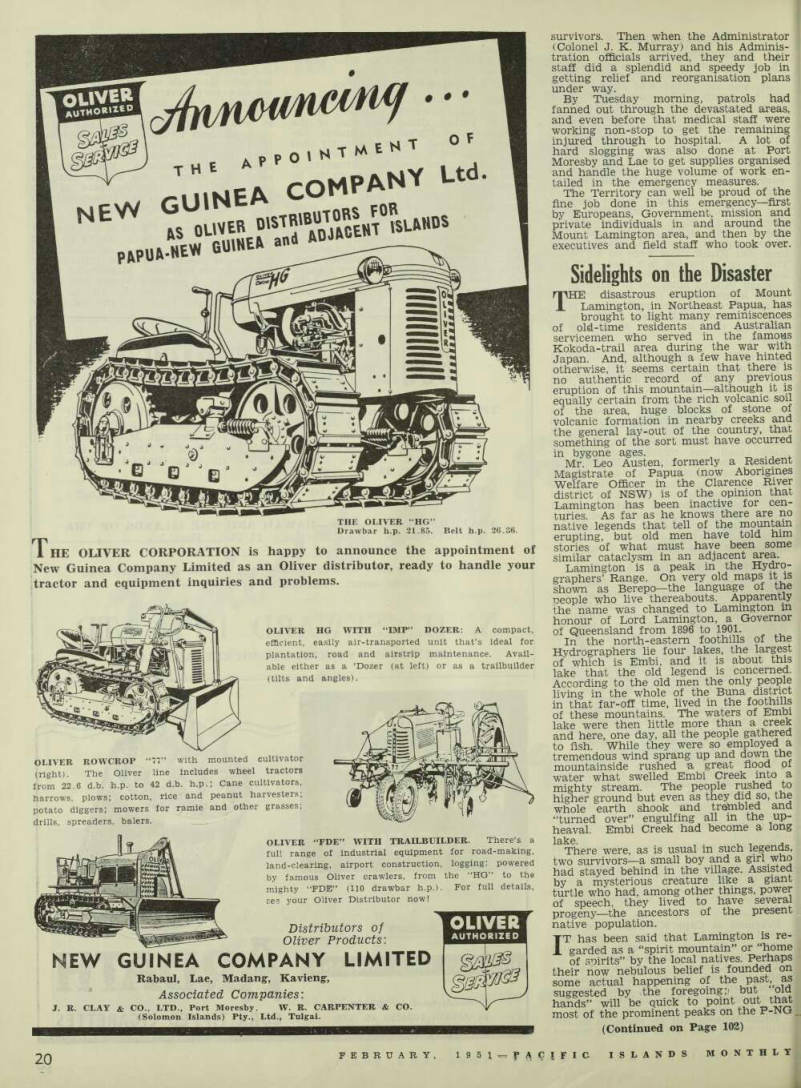
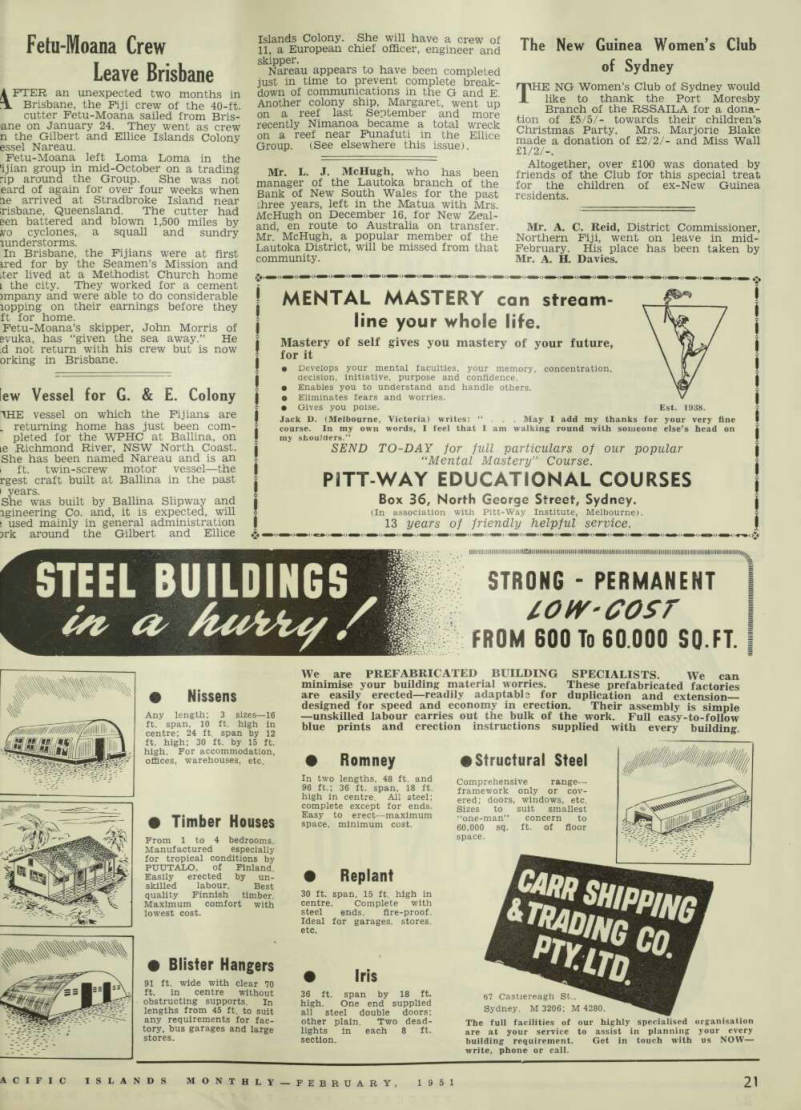
THE disastrous eruption of Mount Lamington, in Northeast Papua, has brought to light many reminiscences of old-time residents and Australian servicemen who served in the famous Kokoda-trail area during the war with Japan. And, although a few have hinted otherwise, it seems certain that there is no authentic record of any previous eruption of this mountain—although it is equally certain from the rich volcanic soil of the area, huge blocks of stone of volcanic formation in nearby creeks and the general lay-out of the country, that something of the sort must have occurred in bygone ages. „ .. .
Mr. Leo Austen, formerly a Resident Magistrate of Papua (now Aborigines Welfare Officer in the Clarence River district of NSW) is of the opinion that Lamington has been inactive for cen turies. As far as he knows there are no native legends that tell of the mountain erupting, but old men have told him stories of what must have been some similar cataclysm in an adjacent area.
Lamington is a peak in the Hydrq graphers’ Range. On very old maps it is shown as Berepo —the language of the people who live thereabouts. Apparently the name was changed to Lamington in honour of Lord Lamington, a Governor of Queensland from 1896 to 1901.
In the north-eastern foothills of the Hydrographers lie four lakes, the largest of which is Embi, and it is about this lake that the old legend is concerned.
According to the old men the only people living in the whole of the Buna district in that far-off time, lived in the foothills of these mountains. The waters of Embi lake were then little more than a creek and here, one day, all the people gathered to fish. While they were so employed a tremendous wind sprang up and down the mountainside rushed a great flood of water what swelled Embi Creek into a mighty stream. The people rushed to higher ground but even as they did so, the whole earth shook and trohibled and “turned over” engulfing all in the up heaval. Embi Creek had become a long l£tko There were, as is usual in such legends, two survivors—a small boy and a girl who had stayed behind in the village. Assisted by a mysterious creature like a giant turtle who had, among other things, power of speech, they lived to have several progeny—the ancestors of the present
native population.
IT has been said that Lamington is re garded as a “spirit mountain” or “home of spirits” by the local natives. Perhaps their now nebulous belief is founded on some actual happening of the pasL as suggested by the foregoing; but old hands” will be quick to point out that most of the prominent peaks on the P-NG
(Continued on Page 102)
landscape are similarly endowed by thes natives who live in their shadow.
It is, however, only in such vagues stories that we have any link with thes unrecorded past. Papua-New Guinea hasa. a short history as far as Europeans area concerned, but there never has been any£ indication that this Lamington area con tained a hidden threat to the thousands?, of natives who lived there, or to the European goldminers, or the rubber andb coffee planters who came later.
Sangara, the Anglican Mission statiom built on the slopes of the mountain was, wiped out by bombs during 1942-43, butt was rebuilt recently without thought ot< this even more terrifying enemy. Afteir the war the administration station was. shifted from the coast at Buna to Higaturu where the scenery was beautifull the soil fertile and the stickiness of the. coast was exchanged for a pleasant] climate with cool to cold nights.
There are endless records of volcanioj activity along the northern coast of New Guinea, right through New Britain to.
Rabaul, and on eastwards, into Bougain-j ville and the Solomons; but this region of northeast Papua has been regarded hitherto as being far south of the volcanic line.
However, servicemen who were in the neighbourhood of Tufi (on the coast, 711 miles eastwards of Lamington, declare that there were earthquakes, and a great deal of smoke, from some volcano-liko hills in that area, during 1943.
These districts of Papua-New Guineie have known much tragedy of anothes kind.
THE Martyrs’ Memorial School, whick was set up as part of the Anglican mission establishment 'at Sangan only in 1948, was there as a tangibl memorial to the 10 European mission: aries who were brutally done to dead during the Jap invasion of the Bunas Kokoda area in 1942. Two of thosi martyrs were young women—Sister M Hayman and Miss Mavis Parkinson whu in 1942, were foully treated by the Jafl before they were bayonetted to deati before graves that had been already pre pared for them.
In the shadow of Mount Lamington th Japs committed some of their moc fiendish atrocities and, apparently, sonr of the local natives were eager to assii them in this work.
A former AIF captain, writing recent! in the Melbourne Herald, recalls how, 1943, a gallows was erected secretly Higaturu from which were hung 21 nativv who had, at Jap instigation, murders six European missionaries at Buna tic year before. The story was not told the time, in order to preserve the fictiii that all New Guinea natives were blaa fuzzy-wuzzy angels; and all Allii personnel were barred from the area.
The native murderers were betrayed friendly villagers when the Allies retoc the area in 1943; and, in the hope thi it would have a salutary effect upon W local gentry, thousands of natives .we herded into the area to witness the ham ings, which took place at half-hour i t6 lt is interesting to note here that Fa til John Benson’s name was among th:j who were reported safe by the Anglico Mission soon after the Lamington u heaval. Father Benson is now station at Gona and continues to lead what sees to be a charmed life. .
In the earlier part of their wandenru in 1942, before they fell into Japan* hands, Father Benson was with Sisa 1 Hayman and Miss Parkinson. During L
icertain war years that followed it was jlieved that he too, had perished at the inds of the Japs; but, apparently, he id the two women had become separated , some stage and, just by the luck of the ime, he fell into slightly less brutal inds. Although many times he pre ired himself for death, he eventually as sent to New Britain and spent the st of the war years with the Catholic issionaries of Vunapope, who too, of iurse, were prisoners of the Japs.
In the 20’s, John Benson, a appily married man with iveral small children, pre ded over an Anglican parish i southern NSW. Driving ith his wife and youngsters i holiday along the coast lad one night, their car unged into the Clyde River ; the unmarked Bateman’s rry. Only he survived.
He entered an Anglican onastery; but as he was isentially a man of action, ie monastic life was not for m. He soon afterwards went i the Papuan mission field, erhaps some would say that ather Benson is a “lucky” an. But tragedy seems to ive been the motif of his life, ither than luck. It takes im courage and faith to see ich tragedies overwhelming ved ones and friends.
LLL in all, New Guinea is a hard mis tress. Perhaps some of her favours are rewarding but, looking back over jr chequered history, one is appalled at e death-dealing blows she has handed it to those who have loved her most.
In the course of a statement about the ,tastrope, the Minister for Territories Jr. Spender) on February 2 had some iing interesting to say about Mount imington: “The Mount Lamington area —although lies, I understand, on an older line of eakness hi which the volcanoes are ainly dormant—was well out of the known le of weakness in the earth’s crust which is shown activity of recent years, as anifest by volcanic signs which run rough Manam and Karkar Islands, and ilasea in New Britain, to Rabaul. Even native legend there is no mention of ilcanic activity in the Mount Lamington ea.
“A peculiarity of the Mount Lamington uption is that it was of the very un ;ual type known to vulcanologists as the dean or ‘glowing cloud’ mode of erup m, in which gravity as well as pressure a major factor in the distribution of )t dust clouds, which caused so great a ss of life. Probably the last previously corded explosion of this type was that Martinique in 1902. This seems to be ie only one comparable to the Mount imington eruption.
“It was very largely the colossal blast, •mparable to that of an atomic bomb, hich caused the fatalities, although, of mrse, many died from burns or a coro nation of burns and blast. Never before ad such an eruption taken place in that :ea, so far as is known —not even accord ig to native legends.
“Yet the Administration is criticised on ie ground that it should have displayed :eater foresight. As I have already aserved. hindsight is much easier than >resight.”
Advertisements & other items, p. 24 (1 item)
20
FEBRUARY, 1951»f A C I F 1 C ISLANDS MONTHLY
Leave Brisbane
Fetu-Moana Crew Leave Brisbane
A FTER an unexpected two months in TV Brisbane, the Fiji crew of the 40-ft. cutter Fetu-Moana sailed from Bris ane on January 24. They went as crew n the Gilbert and Ellice Islands Colony essel Nareau.
Fetu-Moana left Loma Loma in the 'ijian group in mid-October on a trading rip around the Group. She was not card of again for over four weeks when tie arrived at Stradbroke Island near irisbane, Queensland. The cutter had sen battered and blown 1,500 miles by vo cyclones, a squall and sundry mnderstorms.
In Brisbane, the Fijians were at first ired for by the Seamen’s Mission and iter lived at a Methodist Church home l the city. They worked for a cement rnipany and were able to do considerable lopping on their earnings before they ft for home.
Fetu-Moana’s skipper, John Morris of evuka, has “given the sea away.” He d not return with his crew but is now orking in Brisbane.
few Vessel for G. & E. Colony
IHE vessel on which the Fijians are returning home has just been com pleted for the WPHC at Ballina, on ie Richmond River, NSW North Coast.
She has been named Nareau and is an i ft. twin-screw motor vessel—the rgest craft built at Ballina in the past i years.
She was built by Ballina Slipway and igineering Co. and, it is expected, will s used mainly in general administration irk around the Gilbert and Ellice
Islands Colony. She will have a crew of 11, a European chief officer, engineer and skipper.
Nareau appears to have been completed just in time to prevent complete break down of communications in the G and E.
Another colony ship, Margaret, went up on a reef last September and more recently Nimanoa became a total wreck on a reef near Funafuti in the Ellice Group. (See elsewhere this issue).
Mr. L. J. McHugh, who has been manager of the Lautoka branch of the Bank of New South Wales for the past chree years, left in the Matua with Mrs.
McHugh on December 16, for New Zeal and, en route to Australia on transfer.
Mr. McHugh, a popular member of the Lautoka District, will be missed from that community.
of Sydney
The New Guinea Women’s Club of Sydney
THE NG Women’s Club of Sydney would like to thank the Port Moresby Branch of the RSSAILA for a dona tion of £5/5/- towards their children's Christmas Party, Mrs. Marjorie Blake made a donation of £2/2/- and Miss Wall £l/2/-.
Altogether, over £lOO was donated by friends of the Club for this special treat for the children of ex-Ncw Guinea residents.
Mr. A. C. Reid, District Commissioner, Northern Fiji, went on leave in mid- February. His place has been taken by Mr. A. H. Davies.
Advertisements & other items, pp. 25-26 (2 items)
21
ACIFIC ISLANDS MONTHLY FEBRUARY, 1951
in a AuViy /
MENTAL MASTERY con stream-
line your whole life.
Mastery of self gives you mastery of your future, for it • Develops your mental faculties, your memory, concentration, decision, initiative, purpose and confidence. • Enables you to understand and handle others, o Eliminates fears and worries. • Gives you poise.
Est. 1938.
Jack D. (Melbourne, Victoria) writes: “ . , . May I add my thanks for your very fine course. In my own words, I feel that I am walking round with someone else’s head on my shoulders.”
SEND TO-DAY for full particulars of our popular “Mental Mastery” Course.
PiTT-WAY EDUCATIONAL COURSES
Box 36, North George Street, Sydney.
(In association with Pitt-Way Institute, Melbourne).
13 years of friendly helpful service.
STEEL BUILDINGS
in a AuViy /
STRONG - PERMANENT
tOW-COST
FROM 600 To 60.000 SQ.FT.
M H _^L
We are PREFABRICATED BUILDING SPECIALISTS. We can minimise your building material worries. These prefabricated factories are easily erected—readily adaptable for duplication and extension— designed for speed and economy in erection. Their assembly is simple —unskilled labour carries out the bulk of the work. Full easy-to-follow blue prints and erection instructions supplied with every building.
• Nissens
Any length: 3 sizes—l 6 ft. span, 10 ft. high in centre: 24 ft. span by 12 ft. high; 30 ft. by 15 ft. high. For accommodation, offices, warehouses, etc.
• Timber Houses
Prom 1 to 4 bedrooms.
Manufactured especially for tropical conditions by PUUTALO, of Finland.
Easily erected by unskilled labour. Best quality Finnish timber.
Maximum comfort with lowest cost.
• Blister Hangers
91 ft. wide with clear 70 ft. in centre without obstructing supports. In lengths from 45 ft. to suit any requirements for factory. bus garages and large stores.
• Romney
In two lengths, 48 ft. and 96 ft.; 36 ft. span, 18 ft. high in centre. All steel; complete except for ends.
Easy to erect—maximum space, minimum cost.
• Replant
30 ft. span, 15 ft. high in centre. Complete with steel ends. fire-proof.
Ideal for garages, stores, etc.
• Iris
36 ft. span by 18 ft. high. One end supplied all steel double doors; other plain. Two deadlights in each 8 ft. section.
• Structural Steel
Comprehensive range— framework only or covered; doors, windows, etc.
Sizes to suit smallest “one-man” concern to 60,000 sq. ft. of floor space. 67 Castiereagh St.
Sydney. M 3206; M 4280.
The full facilities of our highly specialised organisation are at your service to assist in planning your every building requirement. Get in touch with os NOW — write, phone or call.
Beautiful New Full-Colour
RECIPE BOOK
FREE!
The Simpson Recipe Book featuring 48 pages of nearly one hundred new recipes is widely known throughout Australia. It is usually sold, but to genuine residents of the Pacific Islands a copy will be sent entirely free. Requests should be directed to Simpson Bros. Pty., Ltd., G.P.O. Box 905 M, Brisbane, Queensland, and in order to benefit by this free offer your letter should be headed; “Pacific Islands Free Offer.’’
Offered by the Manufacturers of
SIMPSON’S
Self-Raising FLOUR
m /*-* The New Maxply Tennis Racket.
Popular Choice
Dunlop is the popular choice of the champion as well os the man who plays merely "for the fun of it".
Wherever you rate on the sports ladder, you'll get more enjoyment from your game when you use Dunlop tennis rackets, tennis balls, golf balls and sports shoes.
Dunlop is first by popular choice.
DUNLOP
FOR ALL SPORTING EQUIPMENT
'Badminton'' Sport Shoes.
The New Heavy Duty Tennis Ball.
"65"
Golf Balls.
Dunlop Bowls, DO 9257
Personal Items From W. Samoa
Death Of Mr. Mark Pitt
„ . , From our Own correspondent
Madang Jan 30
A NOTHER well-known Territorial!
J\ passed away in January.
TTp was Mr m t p (Mark) Pitt who completed retirement-leave last November. Prior to his retirement he was A.D.O. at Madang and was previously stationed at Rabaul and Bogia. Although, only 55. Mr. Pitt had been suffering for
some time with an asthmatic heart.
All Madang residents were deeply grieved for Mrs. Pitt who, at the time of her husband’s death, was herself in hospital.
At a representative funeral, conducted hy the Rev. Father G. Bernarding of the Catholic Mission Pitt was bmied with military honours, as befitted a re turned soldier of two wars, Mrs. Pitt intends to carry on her Guest House in Madang for the time being.
Personal Items From W. Samoa
NUMEROUS travellers have recently\ departed from Apia or are 'arrived after vacations spent in New, Zealand and elsewhere. The Secretary of] Samoan Affairs, Mr. F. J. Grattan, left! by air for Suva to attend the session of! the South Pacific Research Council deal ing with technical education in the Pacific, and has since returned. Mr. H.
Gow, manager of Burns, Philp (SS) Co., Ltd., returned from an extended holiday* in the USA. Chief Judge C. C. Marsaclo returned to Apia by the Matua aften several months’ furlough in New Zealand, where he also acted as relieving Judge; Captain Fred Allen, son of the late Cap tain Allen, well-known South Seas cap tain, arrived at Apia to act as temporary Harbour Master and Pilot during the absence of Capt. J. W. Jones, who left) with Mrs. Jones on a holiday trip to New; Zealand.
Popular Government school teacher' George Burton, with family, left Apia tc take ud an appointment in New Zealand!
The departure of the genial and hospit able Burton family is much regretted by their many friends in the Territory.
Other passengers who left by the Matua in January were the Director of Public Works, Mr. W. G. McKay, Mr. M. G, Irwin, of the Education Department, anc Mrs. Irwin and Mr. A. B. Stewart, plan tation manager of the New Zealand Re paration Estates, who is taking up an appointment as plantation manager in Fiji.
A new medical officer, Dr. H. Bor arrived by the Matua to take up an ap pointment on the staff of the Apis Government Hospital. Dr. Bor is accom panied by his wife.
Mr. and Mrs. E. V. O’Brien of Mililaj plantation, Madang, New Guinea passeo through Brisbane recently en route U Sydney.
Advertisements & other items, p. 26 (1 item)
22
FEBRUARY. 1951-PACIFIC ISLANDS MONT II L
Madang Newsletter
From Our Own Correspondent
Madang. Jan. 29
MADANG people were recently given an opportunity of seeing what native boys could do, when given training in Art, by the New Guinea Art Specialist, Mr. J. K. Little.
The paintings showed Territorial characteristics. Prom the Eastern Division, the work displayed dash and brilliance but lacked originality in choice of subject.
Boys from New Guinea displayed a careful attention to detail in everyday life although the colouring was dead.
Some good efforts were noted from the Central Division but the finest efforts — displaying the phantasy of native life— came from Western Papua. Here the pattern legend was depicted with fine perspective and flow of colour. Your correspondent’s selection was paintings from this section. They were “Saidor, Hugu and Kibili,”—figures dancing in illustration of a story where Saidor, the wife flees from husband and father to become a mermaid. The other. “Aida,” a dance-doll, was brilliant with colour and movement.
I understand that it is the intention of the Director of Education, Mr. W. Groves, to forward the Exhibition to Australia for the Jubilee Celebrations.
All the paintings were chosen from the work done by 20 boys at school at Sogeri, Papua.
THE electricity blackouts of two hours every night have called forth numerous groans. However, few townsfolk realise the grand job the elec tricians are carrying out under extremely difficult conditions and with very little co operation from consumers. rHE delegate for the Expro-board from Rabaul, Mr. Hugh Lyons, has been in Madang in consultation with Vladang’s inspector, Mr. Jock Esson.
The Jubilee Oelebrations—a sporting veek-end for Wau and Madang athletes —were cancelled because of the Mount l.amington tragedy.
Mr. Jim Bourke, popular Treasury iccountant, was in Madang for two days luring January on an official visit. He vas the guest of Mr. C. D. Bates.
Although the wharf area looks chaotic, food progress on the small ships’ wharf s being made by the Huxley team. A lumber of steel piles have already been Iriven.
A presentation of the story of The CTL Sleeping Beauty was performed during the month against a back :round of recordings of “The Sleeping ’rincess,” by a group of Madang children.
The children’s costumes were made by heir mothers while Mrs. R. Johnston, Jrs. J. Sherry and Mrs. Hal Evans taught hem their lines ready for the co-ordina ion of words, songs, poems, dances and ecords by the general producer, Mrs. R.
Veidenhofer.
Mrs. Jack Morgan and Mr. Jack Pont ag were responsible for the dancing and ecord production while Mr. R. Weiden lofer took charge of lighting effects, lesdames Nolan and Boehm made the iosies while Mesdames Shields, Banks and irown decorated the stage. Wardrobe distress was Mrs. Jock Esson and Mr.
Jrown did the transporting of heavy tage gear.
Many requests were made to have the how put on in public, but the producer
felt it was preferable to prepare another longer phantasy before presenting the children before a larger audience.
The pantomine was held at the home of Mr. and Mrs. R. T. Weidenhofer with an audience of between 50 and 60 children and adults and pronounced a huge success Among the audience were the. District Commissioner, Mr. C. D. Bates and the Assistant District Commissioner, Mr. A.
Gow.
AT a quiet ceremony, conducted by Pastor Boehm at the S.D.A. Mission, Madang, Miss Edrina Brimson became Mrs. Ken Brodie, on January 23. Mr.
Brodie is well known in the Territory and, prewar, lived with his mother in Rabual. His bride is the sister of Mrs.
Archie Shields of Madang.
Sandy Creek Gold Sluicing, Ltd.
ADVICE has been received that during the month of January, 1951, approxi mately 122 oz, of gold were recovered from 6,895 cubic yards of material treated at the company’s leases in Morobe, New Guinea.
Although freak pineapples are fairly fre quent, one which grew on the property of Fix Plantations, Ltd., Deuba, Fiji, recently was decidedly uncommon. Instead of one head, there are seven in a fan-like for mation. From the bottom stem, usually bare, were 10 suckers. The specimen was handed to the Agricultural Department for experimental purposes.
Advertisements & other items, pp. 27-28 (2 items)
Nathan’S Merchandise
r V: L &
NATHAN’S MERCHANDISE (NSW) PTY. LTD.
General Merchants (Wholesale)
WINES, SPIRITS AND ENGLISH ALES
GROCERIES
CROCKERY
TOYS
HARDWARE
Distributors of "Lushus" MIXED FRUITS and allied lines
INDENT AGENTS
COMMISSION AGENTS
Orders and Enquiries Invited
NATHAN’S MERCHANDISE
(NSW) PTY. LTD.
P.O. Box 2639EE, G.P.0., Sydney, N.S.W., Australia.
Cables: “Senorita,” Sydney.
tab r
Rxmds
Gift Secretary
at your service
Our Gift Secretary has the whole of Proud’s merchandise at her finger tips, knows about deliveries, special shipments, prices can even select and send the gift of your choice to the lucky person for you. So Proud’s suggests you do your gift shopping this easy way without a special trip to town.
►v-i. :,v-v
■I ■:,!
If you can’t think of the tvpe of gift you would like to purchase for either birthday gilts, wedding gilts, special presentations Proud’s Gift Secretary can suggest dozens of ideas . . . our mail order people can send them anywhere in Australia or outside.
Just send her the greeting card.
SO SHOP AT PROUD’S by mail through vour Gift Book —or simply by writing to the Mail Ordei Manager who will send your order back to you by registered (>ost. (Mail Order Manager, Box 1502, G.F.0., Sydney.) :L \ \ V I \ 0 \ i
!=' nfl
5 fisffisr nd
Uh
rfj
Tm —s IF YOU’RE IN TOWN, come in and meet our Gift Secretary on the first floor and she will help you solve any ol your shopping problems.
Proud's. Corner oj Kin& and Pitt Streets Sydney. Box 1502 , G.F.0., Sydney
24
FEBRUARY. 1951-PACIFIC ISLANDS MONTH L.
Huge Deficit In
Tahiti
Assembly Rejects Government’s New Taxation Plans
From a Special Correspondent
Papeete. Jan. 17.
BEHIND the refusal of the Representa tive Assembly to confirm the Govern ment’s plan to impose new and heavy taxation, to provide for a deficit of 19 million francs (about £135,000 Australian), there is a strong local feeling and a bitterness that goes back to the local differences of World War 11.
One of the main causes of the huge deficit is the payment of higher salaries and of back-pay to fonctionnaires (public servants).
The Tahitian citizens especially resent the French Government’s decision to give back-pay to the fonctionnaires who were deprived of their posts in 1940 when, after France surrendered to Germany, the people of Tahiti decided to rally' to De Gaulle and the Western Allies, and fight on.
A certain proportion of fonctionnaires adhered to the Vichy Government; and, as the Vichy Government collaborated with the enemy, these officials were dangerous. Some were sent away to Indo-China, which was generally pro- Vichy; and the remainder were gathered together by Governor Orselli, and placed for safety on the island of Motu-Uta, near Papeete.
To the outspoken disgust of the Tahi tians (that is, the French and Tahitian people who remained loyal to De Gaulle and the Allies) most of these fonction naires not only got their jobs back with out loss of seniority, but they also are getting back-pay as if they had been in
receipt of full salary during their period of incarceration. Officials who rallied to De Gaulle particularly resent the appearance of these gentry as their superiors in rank.
All non-official classes in Tahiti object strongly to the official proposal to impose new and heavy taxation, to take care of a deficit that is caused partly by the muddling of incompetent officials appointed from Paris, and partly by the decision of Prance to give back-pay to the pro-Vichy officials referred to.
Tahitian public opinion was sharply re flected in scenes when the Governor called together the Representative Assembly in an extraordinary meeting, to consider the Government’s proposal to impose new taxes —especially 'in the shape of income tax —to provide for the Treasury deficit of 19 million francs.
The Representatives would not have it.
The rebellion was led by Monsieur Alfred Poroi, Mayor of Papeete and Vice president of the Assembly. He declared publicly, and emphatically, that he and his Councillors of Papeete were opposed to the taxation proposals. The citizens of Tahiti had had no benefit from the expenditure of the 19 million francs; it was a Governmental matter, so let the Government make its own arrangements for dealing with the debt.
M. Poroi is a good speaker, and he put the case against the taxation plans very effectively. He said that Tahiti had two plagues—the influenza plague of 1918, and the post-war Governmental plague of the present time —and he did not know which was the worst.
The Assembly warmly acclaimed M.
Poroi’s speech and rejected the Govern ment’s proposals.
The Treasurer is understood to be now seeking some other way of bridging the financial gap. (The situation in Tahiti is discussed in a special article on page 6).
Dr. Lawrie Ncwnham, of Suva, has re ceived an award of the Anti-Gambia Memorial Medal from the Government of Egypt, for the part he played in the campaign against the Gambia mosquito during the 1939-45 War. The medal is awarded annually for meritorious anti malarial work in Egypt. During the war, Dr. Newnham was appointed malariol ogist to Egypt for the RAF. The Gambia mosquito, a dangerous West African spe cies, began to appear along the Nile and if it had gained a hold in Egypt would have caused havoc among the peasant population. The RAF, in collaboration with the local authorities, waged war on the mosquito and succeeded in eradicating it.
Advertisements & other items, p. 29 (1 item)
Gordon's
EXTRA WHITE
CLOTHES
RECKITT’S BLUE in the last rinse ensures that extra whiteness without damaging the fabric.
m m By Appointment Gin Distiller* to H.M. King George VI Tenqneray, Gordon & Co. Ltd-
Gordon's
Stands Sup’t&mn
Events In Bougainville
Prom Our Own Correspondent
Sohano, Jan. 18.
WORKS Supervisor, John Cox, after completing the installation of big Armco culverts on the North Coast Road, out of Rabaul—at Kabakada—sus tained a bout of pneumonia which kept him in the European Hospital, Rabaul, for six weeks. However, a week after leaving hospital “Father John” was on
his way to Sohana to do a job of road construction at AhilL District Commissioner Farlow returned to Sohana, via workboat from Torakina, on December 29 after a brief visit to Australia.
On December 24 a lively party was staged at the Sohana Club, mainly for the children who had assembled to greet the arrival of Father Christmas (in the person of Police Inspector Ron Clammer) who travelled to the Club by launch, and
completed the final stages of his long journey in a jeep driven by genial A.D.O.
Bob Cole. Much credit to the Sohana ladies, who devoted time and energy to ensuring that the party was a success.
On the evening of December 31 a dance was held at the Club to see out the old and welcome in the New Year. Practically all Administration officials and their wives were present. District Commissioner Farlow made a short speech thanking the Administration staff for their loyal co operation during the closing year.
Shortly after dawn on January 11, both the Sohana and Kieta workboats sailed for Kieta and Buin, bringing D. C. Farlow on an inspection visit to Kieta district, and A.D.O. Cole and Mrs. Cole back to Buin. Police Inspector Ron Clammer went to inspect the R.P.C., at Wakunai and Kieta. Mr. Keith Atkin was “commodore” of the convoy.
Our Storekeeper, Ken O’Brien, spends his free week-ends shooting crocodiles at night, in and about the creeks at Casibello. He has already killed 25 of the brutes, including two of 11 and 13 feet respectively. He camps in a tent near Casibello, uses a canoe in stalking the saurians, and brings the bodies back to Sohana, where they are skinned. Quite recently, one huge brute, after being wounded, seized the canoe’s outrigger and would have overturned the craft were it not for the coolness and courage of Mr.
O’Brien’s native crew, who beat it off with paddles enabling Mr. O’Brien to finish it off with a shot in the head.
On December 28, the Administration held land sports and canoe racing, all events being contested with vigour and enthusiasm. Owing to some misunder standing, only one Singsing—that of the Aitapes—was staged late that afternoon.
Credit is given to Patrol Officer Jackson for skill and energy in organising these competitions for natives.
Advertisements & other items, p. 30 (1 item)
The New Hillman Minx
BOOKS OF AUSTRALIAN VERSE
SELECTED VERSE OF C. J. DENNIS.— Chosen and introduced by A.
H. Chisholm. Here is Australia’s beloved Laureate of the Larrikins at his best. This typically Australian verse, with its robust humour and sentiment, “slanguage” and skilful rhyming, includes highlights from “The Sentimental Bloke” and “Ginger Mick.” 12/6 (post 9dJ.
THE COLLECTED VERSE OF A. B. PATERSON.— “Banjo” Paterson’s bush poems, with their tales of bush life and adventure, their humour and irony, are as fresh to-day in their appeal as when they were first written. This edition includes “The Man From Snowy River” and all his famous bush verses. 12/6 (post Bd.).
ANGUS & ROBERTSON LTD.
Booksellers :: Publishers :: Librarians
89 CASTLEREAGH ST., SYDNEY, AUSTRALIA.
The NEW HILLMAN MINX
now has a plus-power engine developing 37.5 h.p.!
This gives you
• more SPEED
at the getaway
. more POWER
on the hills — ▼et running costs are as low as ever Full particulars available from the distributors throughout the Territory of Neu Guinea r COLYER WfITSOHJ |.gss«| LTD. KflvSSic a
Friendship
Tonga’s 50 Years’
Friendship With United Kingdom Anniversary Celebrations in February
TONGA, as well as Australia, will cele brate a 50th anniversary in 1951.
This year marks the 50th year of Federation in Australia; in Tonga it is the 50th year since the signing of the Lreaty of Friendship between the King dom and Great Britain.
Queen Salote of Tonga, who has been spending the summer in Auckland, NZ, returned to Nukualofa on the January Matua in order to be present at the celebrations which will take place be :ween February 15 and 17. There will 3e a Tongan feast, a procession, a regatta md dances. The Governor of Fiji, Sir Brian Freeston, will be present. (Under the treaty which was signed on February 16, 1901, the then King of Tonga Dlaced himself and his territory under British protection. It was, however, King Fubou f, who became King of Tonga in L 845, who laid the foundation of the present government of the Kingdom. He established his government on the Euro- Dean pattern wherever possible by voluntarily limiting his own powers and establishing a Parliament with a Privy Council and a Cabinet.)
Air-Map Fiji
UK Firm Will Air-Map Fiji
4 N aerial photographic survey of the Li Fiji Group will be undertaken this year—probably commencing in April ir May—and will cost £34,790 Stg. for an istimated 20 weeks’ work.
Tenders were called for the job last 'ear as part of the Colony’s development )lan, and the successful tenderers were lunting Aerosurveys, Ltd., of the United Cingdom. There were two other firms nterested —one in UK, the other in New lealand.
The company will use an Oxford Air peed aircraft and all the work will be arried out from Nadi and Nausori air ields, on the main island of Viti Levu. fiti Levu will be photographed first, ollowed by Vanua Levu, Lomaiviti, 7aveuni and Kadavu.
For the purposes of the survey it is ssential to have all trig stations visible rom the air. The Fijian people have ndertaken to do this as part of their ontribution to the work. Ground 60 feet round all trig stations will be cleared.
After the aerial survey is completed, ihe raps will be prepared in London by the :aff of the Director of Colonial Surveys.
The Fiji Department of Agriculture jcently bought three pedigree male goats *om the NSW Department with a view to nproving the local stock. Goats are Dpular among the Indian population of le colony, and it is told how one rominent European citizen made a small )rtune in the early years of the Colony y selling goats to the Indian plantation orkers.
Mr. C. S. Reay has been appointed a rovisional member of Executive Council f Fiji during the absence from the olony of Mr. R. N. Caldwell.
Hoodoo on G & E Ships
Nimanoa Wrecked
WHILE on her way to Suva for a new tail shaft on January 21, the Gilbert and Ellice Islands Colony ship Nimanoa (291 tons) went aground on a reef off Funafuti and has become a total wreck. Crew and captain were taken to Suva by another WPHC ship, Tungaru, which escorted Nimanoa.
This is the second time in recent months that a G & E government ship has been wrecked. In September, MV Margaret went up on the reef at Nanumea and repeated attempts to get her off failed.
Nimanoa is the second G & E ship of this name. Nimanoa I, a handsome and handy motor-vessel was deliberately cast away in Tarawa lagoon in December,
1941, to keep her out of the hands of the invading Japs. Nimanoa II was formerly the Mootah; she was built in Hobart and sold to the WPHC in 1948. She left for the G & E Islands about March, 1945, after undergoing an elaborate refit in Sydney.
Advertisements & other items, pp. 31-32 (2 items)
27
ACIFIC ISLANDS MONTHLY FEBRUARY, 19&1
Loumtaih
" KATHLEEN "
PACIFIC ISLANDS SHOPPING
SERVICE.
All personal requisites, frocks, lingerie, haberdashery, hats, cosmetics, household requirements, etc., can be purchased in Australia, on your behalf, by “Kathleen,” who has had wide tropical experience.
Write, explaining your needs, to: “KATHLEEN,” c/o 12a Hawkesbury Road, Springwood, N.S.W.
For
LIGHTER,
FLUFFIER
FOUNTAIN food products are famous throughout the South Pacific for their consistent quality and suitability of packing for tropical conditions.
You are assured satisfaction when you specify FOUNTAIN brand.
Trade inquiries are welcome and all orders are promptly despatched.
lOUMTAIH
W.c. DOUGLASS L"liI- ED
FOVEAUX ST. SYDNEY AUSTRALIA
OTHER
FAMOUS
FOUNTAIN
PRODUCTS
m ms
tomato sauce 1
SELFRAISING
2't* *»/•
HOUR
BRIWAsf
£
-.aS-TO
mxto fountain
FOUNTAIN
WMMM
■ft*LatQ*iLLj bLmndrvui
PLUM pudding
' l Nett when packed
I When you need a Drag Saw of entirely new design which one man can easily move about the Mobilco Drag Saw offers many advantages, the greatest of which is its ready interchangeability with a light, fast Circular Saw. Owners of a Mobilco Drag Saw can when they need a Circular Saw or light Bench buy these as separate Attachments to fit their Drag Saw Chassis. This explains the Mobilco Method, which is really the use of three machines on one chassis. You can buy the Drag Saw now and the two Attachments later or you can buy all three machines now, just whichever meets your needs.
I V THREE SAWS BUT ONLY ONE ENGINE AND CHASSIS.
The above diagram illustrates the Mobilco Method. You can remove the Drag Saw Attachment from the Chassis and fit the Circular Saw Shaft in the bush in twenty minutes and it takes only five minutes to fit the Bench Attachment. With this one engine and chassis and all three attachments you are all set to fell and cross-cut every bit of the tree whether it's eight feet in diameter or only eight inches. And you never need more than one man on a Mobilco machine whether you are using it as Drag Saw, Circular Saw or Saw Bench.
Where the going is rough or boggy Mobilco machines are at their best. They are light, fast, rugged and powerful Write now for catalogue. iliii
MOBILE INDUSTRIAL EQUIPMENT "S:
> <SWAMSTOH STREET, MELBOURNE
WF3IJB
QUEENSLAND: Engineering Supply Co. of Australia Ltd., Edward and Charlotte Streets, Brisbane; also at Townsville and Rockhampton. WESTERN AUSTRALIA: Industrial Sales & Service Co. Ltd., Belmont Avenue, Belmont. SOUTH AUSTRALIA: Industrial Sale* & Service (S.A.) Ltd., Daws Road, Cudmore Park.
Fiji News In Brief
From Our Own Correspondent
Suva, Jan. 29.
A FTER months of hard work in one of t\ Suva’s wettest years, the reclamation work in the Walu Bay area of Suva las been completed and roads and sub iivision work is proceeding. Walu Bay vas a low-lying area just north of the own. A road embankment etc., cut it iff from the sea.
The Director of Lands is calling ipplications for 99-year leases in the area or industrial building—a great boon to Suva industry, which in recent years ound expansion or establishment im tossible in overcrowded Suva proper.
DAMANU from Fiji is among the 50 varieties of Commonwealth timber used in the Imperial Fores ry nstitute’s new building at Oxford Iniversity. The damanu was presented y the Nadarivatu Timber Company, The damanu has been made into small ables in the Engineering Lecture Room a such a form that they can be used idividually or combined to make larger nits. They have been finished in their atural colour. The names of the 50 imbers and the donors are exhibited on small plaque in each room.
A N important contribution to the \ literature of Fiji will be made when Mr. R. A. Derrick’s new book, The Iji Islands, is published. It was due •om the Government Printer in February.
In 360 pages Mr. Derrick describes the rroup in detail and gives much general eographical information about the olony. The 200 photographs, maps and iagrams will be a feature of the book, nd special care has been taken to see lat reproduction is of the highest quality.
There will be two editions of The Fiji Islands. A quarter-bound edition will sell at 17/6d.; bound in full Rexine the price will be 25/- a copy. rE Aorangi made her last call at Suva on January 19, and her passengers had 24 hours in which to see Suva.
A large crowd of local people went down to the wharf when the Aorangi nulled out —a crowd with a feeling of regret that this ship would no longer carry people from Fiji.
MR. Robert Steele, of Neuline Film Studios, Auckland, with his chief cameraman, Mr. L. Fraser, will pay another visit to Fiji shortly to make films of the Colony. The films have been commissioned by Tasman Empire Air ways, Ltd., in association with the Fiji Publicity Board and Tourist Bureau.
On his previous visits, Mr. Steele collected a good deal of material and his coming trip will enable three films to be made. One is to be in colour, entitled “Fijian Holiday” and will be shown in Australia and New Zealand with (the object of attracting tourists to the Colony.
A second, in black and white, will be of a more general nature, and is intended for screening as a “short” in theatres overseas.
The third film will be a special 30 minute colour film dealing with the joint atractions of Fiji, New Zealand and Australia. This will be widely distributed overseas, especially in North America. The making of this film is part of the campaign being organised by air and shipping lines, and by Government and unofficial tourist agencies in the South Pacific countries, to attract dollar tourists to Fiji, Australia and New Zealand.
SEVEN senior members of the First Suva Nursing Division of the St. John Ambulance Brigade have been giving
nursing service at the Colonial War Memorial hospital in order to meet the acute shortage of Sisters.
They were Mrs. U. Tyler, Mrs. I. M.
Beattie, Mrs. L. A. C. Mansell, Miss H.
Parham, Miss F. Richards, Miss E, M.
Frisby and Miss B. Weaver.
A NEWSREEL showing the presentation of a tabua to the King’s Royal Rifle Corps by Ratu Sir Lala Sukuna, on behalf of the Fiji Infantry Regiment, was
recently received from the United King dom Central Office of Information by the Public Relations Office and was screened at theatres in all parts of Fiji. Ratu Sir Lala presented the Tabua during his visit to the UK at the end of 1950.
SUVA is once again to see cruise ships.
The Cunard liner Caronia visits Suva on February 3 and the Stella Polaris, which paid several visits to Fiji before the war, is due on February 8.
Mekes and fire-walking have been arranged for the visitors, who will spend one day at Suva.
Although Fiji finds it difficult to cater for all the would-be visitors to its shores, it is indeed encouraging to know that cruises to the Pacific Islands are once again commencing.
THE Suva Radio-Telephone service will now be extended (for emergency use only) over week-ends. Operators
will keep watch from 2 p.m. to 4 p.m. on Saturdays and from 8.30 a.m. to 1 p.m. and 2 p.m. to 4 p.m. on Sundays. During these periods country stations will be able to get in touch with Suva in cases of emergency. Until the country station calls, Suva will not be able to establish communication. A surcharge may be imposed to cover operating costs, but until this rate has been decided the ordinary radio-telephone rates will apply during the week-end.
SIX Tongans who landed in the Colony without permits, appeared before the Magistrate’s Court in Suva recently, but the case was dismissed.
The men said that they were not bound for Fiji, but were blown ashore at an island in Lau when their craft was damaged in a severe storm. Although the boat had an engine, they had run out of benzine. The men were ordered to return to Tonga on the January Matua.
Advertisements & other items, pp. 33-34 (1 item)
Gilbey’S
—I \4'l \ “UNDERSEE” Swimmers’ Masks—fit any face comfortably.
“LOXIN” Underwater Guns are Accurate, Powerful and Safe.
Double pressure trigger with safety catch within trigger guard. Synchronised line discharge. Bayonet and line reel.
Standard (2 rubbers) Super (4 rubbers) Knives, Safety Lead Belts, Handspears, Swim Flippers and Breathing Tubes.
ENQUIRE FROM YOUR AGENT OR
UNDERSEE NOVELTIES
81 Ramsgate Avenue, BONDI, N.S.W.
Of, £ °*c /J Address all enquiries to W. &
the
CA hh
is /° r
GILBEY’S
G/ lbe y L TO.
HELB
O 0
E ' Sy &NEY.
B * ,S M* 6
Rosslyn Street, West Melbourne. 4 //..
WORLD PARITY FOR YOUR PRODUCE!
We are outright buyers of —■
TROOHUS SHELL M.O.P. SHELL
IVORY NUTS GREEN SNAIL SHELL
As direct exporters to World’s consuming centres we can offer
TOP PRICES.
We supply TIMBER, DOORS, JOINERY, MOULDINGS, Etc.
W. BALCHIN PTY. LTD.
(Established 1848).
TIMBER, IMPORT Cr EXPORT MERCHANTS
Head office Also at SYDNEY: 247 George St. LONDON: 78 Gt. Bushey Drive ’Phones: BW 1538-9 Totteridge Cables: “BALCHINCO”
Wf ONMIRiVI OF WE ISLAND fIOME
■Hi \lii •■ : - '• I! 1 i. v. ; <" .;•.. : I! 4r-'L' m
mam
* Preserve it, in all its enchantment, with a paint fortified for tropical weather resistance, for a rich color permanency and for a mellow, even weathering.
In the Tropics
USE OM.Y
BORTHWICKS
HICH jtfjI^ ORADE
REINFORCED
HOUSE PAINT
MORRIS HEDSTROM (AUST.) PTY. LTD. AGENTS FOR
BORTHWICKS PTY. CO.
SYDNEY.
Man Dies After Trip From
Rarotonga
A MAN, who became seriously ill at Rarotonga, Cook Islands, and was taken to New Zealand in the Maui Pomare, died in the Christchurch Hospital on January 29.
He was Mr. Roy McGregor Anderson, aged 42, of Rarotonga. Mr. Anderson, who was employed as a wharfinger at Rarotonga, was brought to Lyttelton by the Maui Pomare, which increased speed and arrived there 24 hours ahead of schedule. He was admitted to hospital, but died some hours later.
Mr. K. H. D. Hay has returned to Honiara, BSIP, after a short holiday in Sydney.
The IMD is OUT
But NZ Wants More Island Fruit
THE Internal Marketing Division—a section of New Zealand’s Marketing Department—is no more, at least as for as Islands producers are concerned.
Its place is taken by Fruit Distributors, Ltd., shareholders of which, it is under stood are the NZ Government and the fruit and vegetable merchants who handled imported fruit for the IMD.
The IMD (some called it the Infernal Marketing Division) was a manifestation Df the Socialist Government (defeated [ate in 1949) and as such was a sitting shot for the barbs and arrows of the :hen Opposition. The IMD, however, ilthough frustrating to the taxpayer and naddening to the consumer, probably was )f some benefit to the grower, who had i more stabilised market.
The things about their fruit supply, naddening to New Zealanders who have Deen short of bananas and oranges— larticularly in the South Island —for the ast 10 years, were not caused wholly by my muddling of the IMD.
Since 1939 there has not been sufficient hipping in the South Pacific to lift the ruit that could have been produced in he Island Groups catering for the New Zealand trade. As a result, both quality md quantity of fruit shipped from Fiji, Samoa, Tonga and the Cook Islands has alien; and, on top of the shipping irotalem, Islanders who usually depended m their fruit for their only cash income ound it more remunerative to work for Ulied forces and, later, to give all their attention to the production of the more irofitable copra and cocoa crops.
Mr. G. Bairstows, representing Fruit )istributers, Ltd., visited Fiji and other ruit producing Groups in January. He aid that it is his company’s aim to rovide adequate bananas and other fruit 3 North and South Islands of New Zea md—and that this will mean a big icrease in exports from the Pacific srritories when the Union Company’s ew ship Tofua comes on the run in early 952.
Fiji, as will be seen from the following, ; anxious to increase her banana pro uction, which is largely in the hands of ative Fijian growers.
Rejuvenating Fiji’s Banana
Industry
Prom Our Own Correspondent
Suva, Jan. 29.
IS a result of a planting campaign organised by the Department of Agriculture and the Fijian Affairs oard, and carried out by the people of aitasiri, Tailevu, Ra, Rewa, Serua and amosi Provinces, it is hoped that Fiji ill be in a position by 1952, to export up i 400,000 cases of bananas annually.
A certain risk has been taken in making te new plantings, as the New Zealand ithorities have refused to give Fiji a ‘finite banana quota—however, for years ie demand for bananas in New Zealand is been greater than the supply.
The people of the areas concerned were ithusiastic about the work and by the id of December 840 acres had been anted. A start has also been made on ie rehabilitation of the older areas, so, ie way or another, there should shortly a marked improvement in the quality Fiji bananas.
Papua
Mangrove Bark
New Company To Operate In Papua
WITH the assistance and approval of the Papua-New Guinea Adminis tration, the New Guinea-Borneo Mangrove Company Limited-formed recently to establish the Cutch industry (the gathering and shipment of mangrove bark) in Papua—is going ahead with its preparations.
Operations are being directed by the managing director of the new Company —Mr. R. C. Dolbey. His address, for the present, is care of the Head Office of the Bank of New Wales, Sydney, As ir l the P ast two years, the Govern ment of India will this year award three scholarships to students of Indian origin living in Fiji’s for study at Indian Universities.
Advertisements & other items, pp. 35-36 (2 items)
31
ACIFIC ISLANDS MONTHLY FEBRUARY, 1951
CoMflO £NCt
TAK£ WNCtNrt A.P-C
MTU
m /// w/> Wk
BANISH
(PINK)
PAIN
ILL
POWDERS
& TABLETS!
Vincent’s original hospital formula is available in either powders or tablets. Two tablets equal one powder in dosage.
Proved Safest & Best For Over 30 Years!
The medical profession and public have had confidence in Vincent’s a.p.c for over 30 years! Vincent’s continued success is founded on Vincent’s prescription! This formula is your safeguard!
Quick Relief From
Headache
Neuritis, Neuralgia
Vincent’s a.p.c is the only prepared to the original hospital prescription! From the very first dose you will get safe, sure, relief from Headache and all nerve and muscular pain! You will feel better and brighter in a few minutes!
SWIFT 3-WAY RELIEF!
1. Relieves the pain! r~~~ fSh, 2. Reduces temperature! 3. Stimulates the nervous , , system!
SAFE! SPEEDY! RELIABLE!
VINCE
AM aiiMCEN IY-
Presenting a complete range of
REFRIGERATION
SUITABLE FOR ISLAND USE
for operation from
ELECTRIC MOTORS of
varying voltages,
petrol or diesel motors
sSr w issssg The Premier ice cream ‘Pinnacle ’ milk and combination for food storage.
The Premier “Regal” for Delicatessen , Grocery, Poultry, etc. aaM Hi Whatever your refrigeration needs, we can supply them —from domestics to the largest types of coolrooms, from normal temperatures to minus 20 deg.
We are manufacturers of a complete series, some of which are shown on this page. Full information, illustrated leaflets, and specifications will be airmailed on request.
The “ Paramount ”
Combination is the newest in a line of fine Premier commercial refrigerators.
We are contractors to the Commonwealth Government and such large organisations as Tooth & Co. mm tsm & The Premier Wall Cabinet type for ice cream, milk and food storage.
PREMIER
REFRIGERATION CO. PTY. LTD.
587 GEORGE ST., SYDNEY. Factory: 14 Underwood St., Paddington, N.S.W or Box 241, P.O. Haymarket 393 GEORGE ST., SYDNEY. •/I
Rabaul Baseball Premiership
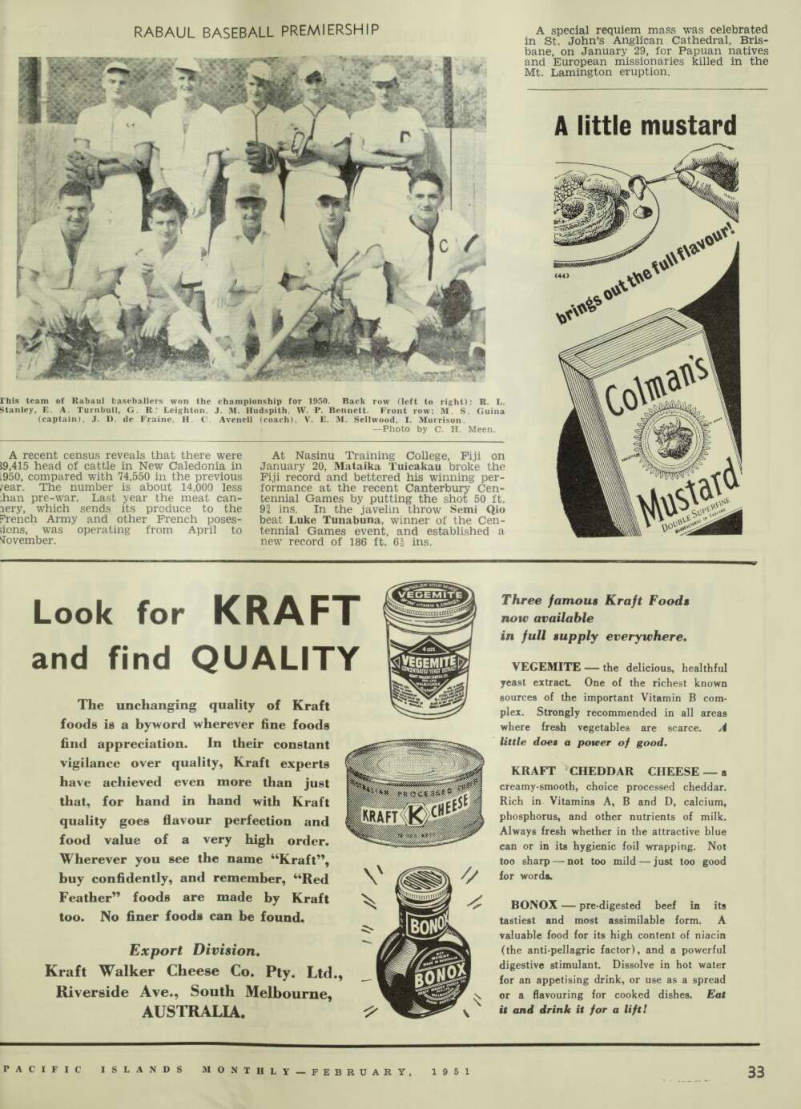
A recent census reveals that there were 19,415 head of cattle in New Caledonia in L 950, compared with 74,550 in the previous The number is about 14,000 less ;han pre-war. Last year the meat caniery, which sends its produce to the French Army and other French posesiions, was operating from April to November.
At Nasinu Training College, Fiji on January 20, Mataika Tuicakau broke the Fiji record and bettered his winning per formance at the recent Canterbury Cen tennial Games by putting the shot 50 ft. 91 ins. In the javelin throw Semi Qio beat Luke Tunabuna, winner of the Cen tennial Games event, and established a new record of 186 ft. 61 ins.
A special requiem mass was celebrated in St. John’s Anglican Cathedral, Bris bane, on January 29, for Papuan natives and European missionaries killed in the Mt. Lamington eruption.
This team of Rabaul baseballers won the championship for 1950. Back row (left to right): R. L.
Stanley, E. A. Turnbull, G. R. Leighton, J. M. Hudspith. W. P. Bennett. Front row: M. S. Guina (captain), J. D. de Fraine, H. C. Avenell (coach), V. E. M. Sellwood, I. Morrison.
Photo by C. H. Meen.
Advertisements & other items, p. 37 (1 item)
Look for KRAFT
A little mustard o & U 4) jjN S&* \>< v
Col
and find QUALITY
The unchanging quality of Kraft foods is a byword wherever fine foods find appreciation. In their constant vigilance over quality, Kraft experts have achieved even more than just that, for hand in hand with Kraft quality goes flavour perfection and food value of a very high order.
Wherever you see the name “Kraft”,
buy confidently, and remember, “Red
Feather” foods are made by Kraft too. No finer foods can be found.
Export Division .
Kraft Walker Cheese Co. Pty. Ltd.,
Riverside Ave., South Melbourne,
AUSTRALIA.
m mB
KRAFT
V //
Three famous Kraft Foods
now available
in full supply everywhere,
VEGEMITE the delicious, healthful yeast extract. One of the richest known sources of the important Vitamin B complex. Strongly recommended in all areas where fresh vegetables are scarce. A little does a power of good.
KRAFT CHEDDAR CHEESE a
creamy-smooth, choice processed cheddar.
Rich in Vitamins A, B and D, calcium, phosphorus, and other nutrients of milk.
Always fresh whether in the attractive blue can or in its hygienic foil wrapping. Not too sharp not too mild just too good for words.
BONOX pre-digested beef in its tastiest and most assimilable form. A valuable food for its high content of niacin (the anti-pellagric factor), and a powerful digestive stimulant. Dissolve in hot water for an appetising drink, or use as a spread or a flavouring for cooked dishes. Eat it and drink it for a lift!
Death Of F. Rostier Of Fiji
THE death occurred at Suva, Fiji on January 12, of Mr. Frank Rostier, who was born in the Colony at Rabi over 70 years ago.
He was employed in his youth by the Colonial Sugar Refining Co. as an engineering apprentice, but he spent the greater part of his working life with the Public Works Department in Suva.
Quarantine For The
Senator
well-known M. Lasalle-Sere, who is . a Senator of France and an influen tial man in the South Pacific, has learned something of the exasperations which the Law can impose upon the ordinary citizen.
When the new Governor arrived the
other day in Tahiti, he learned that a lot of air-mail for French Oceania had accumulated at Aitutaki, in the Cook Group. (French Oceania has no air i service; and air-mail for that Territory ; cannot be taken beyond the Cook Islands by the British lines). So the French sloop Lotus was despatched to Aitutaki for the mail.
Senator Lasalle-Sere had been kicking his heels impatiently in Tahiti since he went there in the Orohena from Suva.
He was due in Paris, but he could not get away from Tahiti. So he took passage in the Lotus to Aitutaki, whence he could get by air to Suva, and thence by air to France.
But Aitutaki’s health officer was adamant. When the Lotus left Papeete, it was under quarantine in respect of some minor plague; and, in any event, Aitutaki was having a bout of influenza, which was quarantinable.
There were wild radio exchanges between Rarotonga, Wellington, Suva and Papeete; it was pleaded that the Senator simply had to get to Paris, and could not this unimportant quarantine be relaxed for once. The Health people were not (Sympathetic: the quarantine laws applied to everyone, whether Senator or slave.
The disgusted M. Lasalle-Sere was returned, unharmed, to Papeete. There, eventually, he got a berth on the Waihemo, which took him to Vancouver, and thence he went by air to France.
The Orient Line may revive its cruises from Australia to Fiji, Papua-New Guinea, Noumea, etc., in 1952 —God and Joseph Stalin willing. Islands cruises by Orient and P & O ships normally on the Australia-UK run were popular before World War 11.
Advertisements & other items, p. 38 (1 item)
W. H. Grove & Sons Ltd.
ft* ye
ell
}V worn
they
ve but 2954 N
KIWI
BLACK . TAN • DARK TAN .
MID TAN . BROWN • MAHOGANY
- thanks to ★ Makes leather soft and supple ★ Gives added resistance to iveather and wear ° x M O R O E D N /DRE U sImG TR4NS ’ Change to KIWI for KEEPS!
W. H. GROVE & SONS LTD.
Established 1896.
Telegraphic and Cable ISLAND MERCHANTS p *°- Box 490 » Address: “Grove,” Auckland. 16-18 Fanshawe St Auckland, New Zealand.
AUCKLAND
Entrust your requirements to the firm with more than fifty years' practical experience in the Island trade,
REPRESENTING ENGLISH MANUFACTURERS
THROUGHOUT THE FIJI, SAMOAN AND TONGAN ISLANDS, NEW HEBRIDES, NEW CALEDONIA, THE SOLOMON ISLANDS, THE SOCIETY ISLANDS, THE COOK ISLANDS,
NIUE, ETC.
SHIPPERS OF ALL CLASSES OF NEW ZEALAND MANUFACTURES AND PRODUCTS SPECIALLY PREPARED FOR THE ISLAND TRADE WE HANDLE ALL KINDS OF ISLAND PRODUCE.
IN FIJI as: W. H. GROVE & SONS (FIJI) LIMITED.
Office and Sample Room: Bank of New South Wales Chambers, Suva, Fiji.
The Last Days Of
Otto Soltwedel
Formerly Of N. Guinea
WE have received from Germany some further details of the death of Mr.
Otto Soltwedel who, after six years’ imprisonment in a internees’ camp in Australia, was deported to Germany by the Australian Socialist Government, despite his appeals to be allowed to return to New Guinea. His nephew, Mr.
Ehrhardt Soltwedel —who was with him in New Guinea for a time—writes as follows from Frankfort-on-Main: “My uncle was not happy, during the short time he had left to him in Germany.
He never got used to the busy, bustling life in the ruined cities. His ideal was the old Germany of 1912, under the old Kaiser Wilhelm —a period of prosperity which no country has experienced since 1914. Solti, until he was sent back here in 1949, had not seen Germany since he left it for New Guinea 37 years before.
He seemed to be completely lost here tic spoke constantly of his desire to return to his beloved New Guinea. I am con vinced he would not have died so soon had they allowed him to return to New Guinea. His last words were about Rabaul. When I used to go to visit him, his eyes would light up—l was someone he could ‘talk place’ with.”
Editorial Note: The PIM tried many times to find out why Soltwedel. was deported, while most of the other older Germans were allowed to go back to New Guinea. Officialdom, however—as is usual in such cases—was remote and un helpful and would give no indication. It was a Star Chamber trial and verdict. We learned lately, however, that officialdom had somehow got hold of a letter which Soltwedel had written in 1939 to someone high in authority in Germany—Dr.
Goebbels, one of our informants said — and in this he had fiercely denounced and criticised certain aspects of the Australian administration in New Guinea.
That would not be surprising. Soltwedel was not a man who would conceal his convictions: and there was plenty to criticise in the Australian administration.
But we do not know how far Soltwedel carried his criticism ... However it does not matter, now. Soltwedel is dead —another decent man (even if of enemy blood) broken on the wheel of war.
New Weekly Newspapers In
Islands
TWO new weekly newspapers began publication almost simultaneously in the Pacific Islands —one in Papua- New Guinea and one in Western Samoa —and it is a coincidence that these are the two Trustee Territories of the South Pacific. In each case, the enterprise was welcomed by the Administration, for a well-conducted local newspaper can be 3f considerable assistance in the work of government.
To assist the Samoan enterprise, the High Commissioner there, Mr. G. R.
Powles, announced that, for at least six months, the Administration would dis tribute copies of the newspapers, free of charge, to all Government officials in the districts and villages. If, at the end of six months, it had proved of real value in the machinery of administration, the distribution would continue.
Aluminium coins, a million of each in values of 2 francs, 1 franc and 50 centimes, are being put into circulation in New Caledonia. Later, coins of 5 francs value will be issued.
“Oceania”
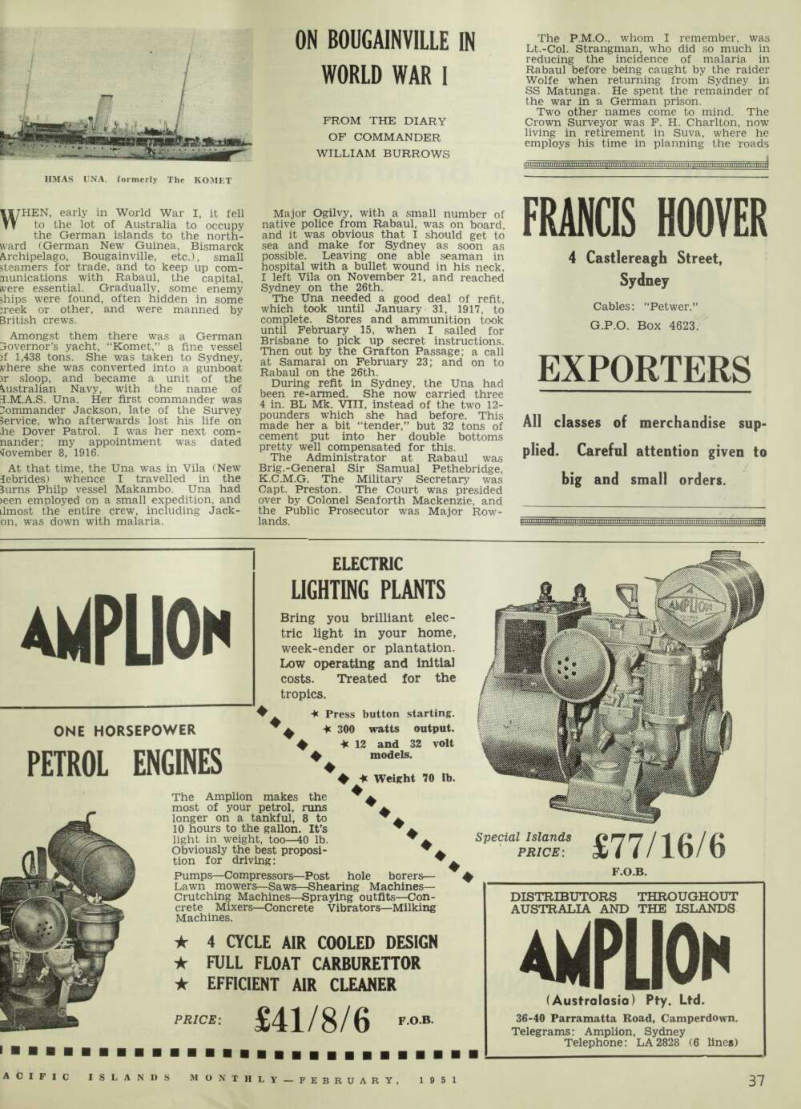
THE September issue of the well-known anthropological quarterly, Oceania (published by the Australian National Research Council, Science House, Gloucester St., Sydney) contains the usual selection of useful articles. T.
Russell writes on the Fataleka bush people of Malaita; there is an article by Lommel on the influence of modern culture on the Australian aborigines; and John Nilles gives the result of several years of observation of the Kuman tribes of the Chimbu area of the New Guinea Highlands.
WHEN, early in World War I, it fell to the lot of Australia to occupy the German islands to the north ward (German New Guinea, Bismarck Archipelago, Bougainville, etc.), small steamers for trade, and to keep up com munications with Rabaul, the capital, were essential. Gradually, some enemy shins were found, often hidden in some ;reek or other, and were manned by British crews.
Amongst them there was a German governor’s yacht, “Komet,” a fine vessel )f 1,438 tons. She was taken to Sydney, where she was converted into a gunboat >r sloop, and became a unit of the \ustralian Navy, with the name of 3.M.A.5. Una. Her first commander was Commander Jackson, late of the Survey Service, who afterwards lost his life on he Dover Patrol. I was her next com nander; my appointment was dated November 8, 1916.
At that time, the Una was in Vila (New lebrides) whence I travelled in the Burns Philp vessel Makambo. Una had >een employed on a small expedition, and ilmost the entire crew, including Jack on, was down with malaria.
HMAS UNA, formerly The KOMET
Advertisements & other items, pp. 39-40 (1 item)
Trade
THE PACIFIC ISLANDS SOCIETY
(Founded 1937) Visitors from the Pacific Islands to Sydney, or persons interested in Islands affairs, are invited to communicate with the Honorary Secretary of the above Society which was formed to constitute a social centre for those interested in the Pacific Islands.
Regular meetings and social gatherings, with lectures, are held at History House, 8 Young Street, Sydney, on the fourth Wednesday of each month, at 8 p.m.
Address for correspondence:—
THE PACIFIC ISLANDS SOCIETY,
Box 2434, G.P.0., Sydney.
To promote
TRADE
The Bank of New South Wales offers these services:— • Introductions to importers and exporters in oversea countries. • Credit information about residents of those countries, with whom you may wish to trade. • Facilities for making payments abroad and for receiving payments from overseas. • Arrangements for business visits overseas.
Consult any branch of the
BANK OF
NEW SOUTH WALES
FIRST AND LARGEST COMMERCIAL BANK IN THE SOUTH-WEST PACIPt
HEAD OFFICE: SYDNEY, AUSTRALIA
ISLANDS BRANCES
FIJI: Suva, Lautoka (Agencies at Ba, Nadi Airport, Vatukoula) PAPUA: Port Moretby. NEW GUINEA: Lae. Robaol. (Incorporated in New South Wales with limited liability)
TAKE YOUR CHOICE ..
From this list of quality canned foods. Packed by the largest meat-processing company in Australia, the Imperial label brings you the Quality meats, I right to your table —tasty hot meals and cold meats ready for any occasion. Stock up with Imperial, the Flavour Sealed Quality Foods.
HOT PACKS. \ SAUSAGES.
iU u \ Cn.mhndsre Saus; V. ding. 16-oz, Irish Stew. „ , 16-oz. Braised Beef Steak Stew. 16-oz. Bacon Rashers. 16-oz. Steak & Tomato. 12-oz. Meat & Beans. 16-oz. Sausages & Vegetables. 12-oz. Savourie. 4-oz. Meat and Spaghetti. \
COLD MEATS.
16-oz. Cambridge Sausages. 16-oz. Pork Sausages. 16-oz. Vienna Sausages. 10-oz. Vienna Sausages. 4-oz. Vienna Sausages.
SOUPS.
8-oz. Tomato Soup. 8-oz. Vegetable Soup. 8-oz. Clear Beef Soup.
TONGUES.
12-oz. Luncheon Pork. 12-oz. Trim (Pork & Beef). 12-oz. Camp Pie. 12-oz. Hampe. 12-oz. Meatreat 12-oz. Corned Beef W/C. 12-oz. Taper Corned Beef. & 6-lb. Slicing Beef. m 6-lb. Taper Corned Beef W/C. 6-lb. Taper Corned Beef.
M 4-oz. Camp Pie. mk 4-oz. Hampe.
Y| 4-oz. Beef Snack..
“ 3i-oz. Pate de Foie. 10-oz. Tomato Sauce. 12-oz. Sheep Tongues. 12-oz. Lamb Tongues. 12-oz. Calves Tongues. 6-lb. Ox Tongues. 2-lb. Ox Tongues. 36 » u ■
■hfei
m -• *
DRIPPING & LARD.
lb. tins Lard. -oz. tins Dripping. -lb. pats Dripping. ]-lb. Dripping.
CANNED FISH.
4-oz. Flair Fish Cutlets 8-oz. Flair Fish CuUets.
V2-oz Flair Fish Cutlets, lli-oz. Flair Squab m Aspic, li-oz. Flair Fish Paste. 8-oz. Flair Scallop Lun cheon.
MARGARINE.
56-lb. Boxes Cake Margarine. , 56-lb. Boxes Pastry Margarine.
“RIVERMEDE” BUTTER.
56-lb. Boxes Bulk Butter. 16-oz. Pats Butter, i-lb. Pats Butter. 12-oz. Tins Butter. 16-oz. Tins Butter.
26 oz. “CAWSEY’S”
CORDIALS.
Double strength Orange Squash.
Single strength Orange Squash.
Double strength Lemon Squash.
Single strength Lemon Squash.
Double strength 100 per cent. (Lemon & Orange).
Single strength 100 per cent. (Lemon & Orange).
Single strength Lime Juice.
PACKET BREAKFAST
FOODS.
8-oz. Purina Crispies. 24-oz. Purina Crispies. 12-oz. Purina Weatali cuits.
SWEET PUDDINGS.
16-oz. Plum Puddings. 12-oz. Jam Pudding. 12-oz. Chocolate Pudding. 12-oz. Ginger Pudding. f 2~ s if m ly % * ■■
MILDURA FRUIT
JUICES.
16-oz. Grapefruit Juice. 16-oz. Orange Juice.
CANNED FRUITS.
16-oz. Prunes (Dry Pack) 30-oz. Cherries. 20-oz. Raspberries. 20-oz. Gooseberries. 20-oz. Loganberries. 20-oz. Plums. h
RIVERSTONE MEAT CO. PTV. LTD.
' '\v;
5-7 O’CONNELL STREET, SYDNEY.
On Bougainville In

World War I
From The Diary
Of Commander
William Burrows
Major Ogilvy, with a small number of native police from Rabaul, was on board, and it was obvious that I should get to sea and make for Sydney as soon as possible. Leaving one able seaman in hospital with a bullet wound in his neck, I left Vila on November 21, and reached Sydney on the 26th.
The Una needed a good deal of refit, which took until January 31, 1917, to complete. Stores and ammunition took until February 15, when I sailed for Brisbane to pick up secret instructions.
Then out by the Grafton Passage: a call at Samarai on February 23; and on to Rabaul on the 26th.
During refit in Sydney, the Una had been re-armed. She now carried three 4 in. BL Mk, VIII, instead of the two 12pounders which she had before. This made her a bit “tender,” but 32 tons of cement put into her double bottoms pretty well compensated for this.
The Administrator at Rabaul was Brig.-General Sir Samual Pethebridge, K.C.M.G. The Military Secretary was Capt. Preston. The Court was presided over by Colonel Seaforth Mackenzie, and the Public Prosecutor was Major Row lands.
The P.M.0., whom I remember, was Lt.-Col. Strangman, who did so much in reducing the incidence of malaria in Rabaul before being caught by the raider Wolfe when returning from Sydney in SS Matunga. He spent the remainder of the war in a German prison.
Two other names come to mind. The Crown Surveyor was F. H. Charlton, now living in retirement in Suva, where he employs his time in planning the roads
of the rapidly growing town. Another— who will appear later as my Chief Engi neer on the Una, is settled in retirement at Levuka, Fiji.
AS Captain of the Una, it was in no way part of my duty to, become in volved in administration difficulties.
To show the flag—yes—and, in doing so, to report to the Administrator anything
of interest which might have occurred.
But something in a different category had come to light concerning the southern portion of Bougainville, which came under Rabaul, and the Shortland Islands, which form part of the Solomon Islands, and are controlled by the Western Pacific High Commission.
Independent investigation on the spot was most desirable and my instruction,
to see what facts could be elucidated, came from the highest authority.
The file on the subject was voluminous, and included reports that, in the Kieta- Buin area, native police boys had shot natives for refusing to act as carriers.
Food gardens had been destroyed for the same reason. One European officer had shot a native carrier.
All this disturbance had created among the natives a wish to escape to the Short lands and obtain work on the plantations there. They went by canoes, and some times in cutters. A native regulation of the Solomons was that no natives from Bougainville were allowed to be recruited for the British Solomons.
I visited the Native Affairs office and obtained much local information. The Chief of Police supplied me with one sergeant and 10 police, all German trained, and none of them from Bougain ville. They would be my body-guard, for I had no intention of landing any sea men. As a companion, I would take my Chief Engineer, Whittle. He was the officer who could best be spared. There was little likelihood of the Una’s engines wanting expert handling after her recent refit.
I informed the Administrator that I intended to sail for Kieta first; then Buin; and, thirdly, Faisi, in the Solomons.
How long I would be away it was then impossible to say—perhaps 10 or 12 days.
AT Kieta, I found a young District Officer who had only been in the country a few months. He was the only white man on the station, and his police were not under control. He com plained that he had not enough of them to do any patrolling and he was virtually a prisoner in his own compound.
Lacking information at Kieta, I de cided to make for the Mission Station at Buin. The DO gave me a letter of intro
duction to the two priests there—Fathers Grisward and Bucelet.
I timed my arrival off Buin for 4 p.m., on April 13, and handed over the com mand to Lt. Heriot, with the following instructions:— “On my landing at Buin you are to proceed to Tonolei Harbour and anchor Una as convenient. Steam is to be re tained at short notice during my absence.
The ship is to be off Buin again at 4 p.m., on Monday, 16th. If I am not on the beach, this procedure is to be repeated and inquiries made at the Mission Sta tion and steps taken to trace me.”
It was a lovely calm afternoon as Una approached anchorage, and the drums could be clearly heard, at first starting near the coast, and then taken up farther inland. What they said, one did not know, but it was pretty certain that it was a warning that a warship was in the bay.
Whittle, myself and the police landed near the Mission Station. As soon as the boats returned the Una put to sea.
Again the drums started up. Perhaps this was reporting that the warship had gone again. It was certainly what I wanted them to say!
We camped in the Mission compound where we were hospitably entertained by the Fathers. A sketch map of the district was produced, and guides were offered to put us on the road leading to at least one of the villages where there had been trouble. The man to look for was one named Kopena, the Luluai (chief) of Mamaromino village. It was true he had shot a policeman, but it was probably in self-defence, said the Father.
BEFORE dawn next morning we were on the track which led, for a while, through a muddy swamp—very hard going on slippery logs. The police, how ever, wanted no telling in the matter of assistance to their masters. For the whole time that we were in the bush they worked to pattern: One on each side of Whittle and myself; one out on each flank; the sergeant a few paces ahead; the guides from the Mission station lead ing the way with two police, and the re mainder following in the rear.
They were armed with a short carbine, which was slung, and carried a hatchet.
Their ammunition fitted into a leather belt, which also partly supported a skirt (or sulu) and a haversack, in which were rations and betel nut, and a woollen jersey, for use at night. In the daytime they wore no clothing above the waist.
Their coat was one of coconut oil.
The tough swamp road ended on a river, fortunately shallow, and the trail then rose steeply through a patch of bush. Here we came across a drum house, and called a much-needed halt.
The drum-house, in a small clearing with a palm-thatched roof, contained five drums of the hollowed log type. Two of these were six feet in length; others were smaller and of different shapes. The house gave a view over the bay.
Whitle and I carried water-bottles, but we used them sparingly. Fresh water might be scarce, and coconuts were the substitute. I had a double-barrelled shot gun with me, for pigeons are plentiful in that country.
From here, the single-file track rose steeply. How the police kept their posi tions in the thick bush on the two flanks was a mystery. Only the sergeant, a few naces ahead of me, could hear them, and he very occasionally stopped for a moment to allow them to get a little bit ahead.
By noon, we were in a second drum house and sergeant Peni assured me that there had been no sign of the party hav ing been detected as yet.
According to the sketch map, Mamaro mino, the village of Kopena, was only eight miles from the coast. We were,
and ecid ? d , to d surround the Vlll age before mgxiwa . in cirm-io „i ALICING in single file along a narrow path in the semi-darkness of a tropical forest is liable to get on one’s nerves, and I know that Whittle and I were more than glad when the path opened up on the outskirts of a native food-plantation.
Two sharp notes on Sergeant Peni’s
whistle, and the police came running to wards us. They were immediately de tailed, four to approach the village from the right-hand side and four from the left. If any villagers started to run away, shots were to be fired in the air not to kill. The rest of the party would walk straight into the village, on the main path.
The other side of the plantation hid a small cluster of native houses, close to
(Continued on page 76)
gether, with a certain amount of open space, and it was hard to believe that this was an important village. There was no sign of anyone outside, but one knew that a hundred or two pairs of eyes might be watching us through the loosely-built walls of the houses.
I told Sergeant Peni to blow a long blast on his whistle, and then translate into Pidgin-English what I called out: “Where are all the people of the village? Why are they hidden away?
Where is Kopena, the Luluai? Pernaps they are frightened? But why, etc.”
Presently, a middle-aged, upstanding man came out from one of the houses and walked straight towards us. I re member thinking that this was a courag eous thing to do. He could not have known whether we were friend or foe.
“I am Kopena, the Luluai of thisa village,” he said. “Why have you comes to visit me?”
I said that we had a lot to talk about,,d but not while standing out in the hotf sun. We would sit in the drumhouse„s which stood out clear of the houses..c After we had had some coconuts to drinks there would be a “talk-talk.”
KOPENA was an interesting man, but!
Whittle and I were too tired to talk)! with him then. I had selected thes drum-house in which to sleep that nightJ It would probably be cleaner than anyy of the houses, and I would feel more com fortable with the police camped along side.
Next morning, I decided to attache!
Kopena to my party, not because he hadb shot a policeman—which he frankly ad mitted—but because his knowledge of this; portion of Bougainville would be wel comed in the Native Affairs office inn Rabaul.
The sketch map showed several villages lying to the northward, which I decidedb to visit, taking Kopena with me.
At each I gleaned a little informational which I have long since forgotten. Thea map shows Birilo, and there I slept thes second night ashore.
Collecting a few “desirables,” the partyy returned to Mamaromino, where the third!: night was spent. On April 16, we mades Buin, where the Una was waiting.
Early the next morning I took Unas to Faisi, in the Shortlands, and there meti Dr. Crichlow, the D.M.O. and D.O. II remember my surprise that no Unions Jack was flying at his headquarters. Butt this was easily explained.
Not long before, his only Jack, ragged!: and patched, had succumbed to a gale off wind. On applying to Tulagi for a new* one, he was informed by the storekeeper! there that (a) he should not have flownn it in a gale of wind, and (b) that theres had not been a gale recorded at Faisii: during the previous year!
I was able to supply him with a spares one from “Una.”
Whittle and I felt fairly certain that! after those nights in the jungle, we wer© booked for a go of Malaria, and we had) a bet on who would be down to it firsts I won, but he was a close second.
Advertisements & other items, pp. 41-44 (3 items)
37
ACIFIC ISLANDS MONTHLY FEBRUARY, 1951
aKPUOh
FRANCIS HOOVER
4 Castlereagh Street, Sydney Cables: “Petwer.”
G.P.O. Box 4623.
EXPORTERS
All classes of merchandise supplied. Careful attention given to big and small orders.
aKPLIOk
ONE HORSEPOWER
PETROL ENGINES
ELECTRIC
LIGHTING PLANTS
Bring you brilliant electric light in your home, week-ender or plantation.
IjOw operating and Initial costs. Treated for the tropics. + Press button starting. * 300 watts output. + * 12 and 32 volt + models.
Weight 70 lb. .’N hole borers— The Amplion makes the most of your petrol, runs longer on a tankful, 8 to 10 hours to the gallon. It's light in weight, too —40 lb.
Obviously the best proposition for driving; Pumps —Compressors—Post Lawn mowers^Saws—Shearing Machines— Crutching Machines—Spraying outfits —Concrete Mixers—Concrete Vibrators—Milking Machines.
★ 4 CYCLE AIR COOLED DESIGN
★ FULL FLOAT CARBURETTOR
★ EFFICIENT AIR CLEANER
Special Islands
PRICE :
£77/16/6 F. 0.8.
PRICE :
£4l/8/6 F. 0.8.
DISTRIBUTORS THROUGHOUT
AUSTRALIA AND THE ISLANDS
aKPUOh
(Australasia) Pty. Ltd. 36-40 Parramatta Road, Camperdown.
Telegrams; Amplion, Sydney Telephone; LA2828 (6 lines)
Scott’s “Renown” Brand Rope,
Cordage and
Binder
Twine
Cable Address Ropeyard.
Sydney. ■wa.
of Every
Description
MANUFACTURED AT
MASCOT, N.S.W.
J. SCOTT
PTY. LTD.
Head Office and Store
163 CLARENCE STREET.
SYDNEY,
N.S.W.
G. H. ROBINSON EXPORTS & IMPORTS PTY. LTD,
Pacific Island Traders and Merchants.
Sole Distributor of Bradford Commercial Sellers on Commission of all kinds of Vehicles, Jowett Javelin Cars and Uniporn Island produce—Cocoa Beans, Green Snail, Diesel Engines—(Franchises available in Copra, Fungus, M.O.P. Shell, Trochus certain Pacific Groups.) Shell, etc.
Agents in London and Manchester for the Disposal and Supply of Produce and Special Requirements.
EVERY ATTENTION GIVEN TO ORDERS IRRESPECTIVE OF SIZE.
Make use of our 30 years’ personal experience and direct your inquiries to: G. H. ROBINSON EXPORTS & IMPORTS PTY. LTD. 51 MACQUARIE STREET, SYDNEY. Telephone: BW 4575.
Cables: “SUNRISE,” SYDNEY. Postal Address: Box 3317, G.P.0., Sydney
OUR HANDS MAKE GOOD ARMS
For your Fishing and Shooting Wants Consult Us.
Lithgow .22 Cal. Repeating Rifles .. £l3 3 0 / Post Lithgow .22 Cal. Single Shot ... £6 12 6 1 Extra.
SI L R OH U 143 ELIZABETH STREET, SYDNEY.
shell
Get that British spirit!
For 46 years, more Shell has been bought by more motorists than any other brand o. petrol. It’s a good British habit.
In Australia alone, Shell is refining British petrol from British crude at the rate of 72,000,000 gallons a year.
The crude is brought to Australia in British tankers from British wells in British Borneo by Shell—a British company.
Get that British spirit—always fill up at the Shell pump.
BUY BRITISH—BUY SHELL
always fill up
atthe SHELL pump
SHELL i
WtoS The Shell Co. of Aust. Ltd. (Inc. in Gt. Britain)
Aladdin lights the way io belter livid Good lighting and convenient cooking contribute much to comfortabl living, and Aladdin lamps and cooking appliances have been famous t more than a century. Burning ordinary lighting kerosene, Aladdin produt provide the comfort and convenience of gas or electricity. They c unequalled in efficiency and ease of operation. /T"''
‘The world’s most wonderful lamp”
Aladdin light is the closest of all to natural daylight, and these non-pressure lamps give a steady white light of 75 candle-power. There is no smoke or fumes, no pumping. They light at the touch of a match! Burning 94% air and only 6% kerosene, these modern lamps are extremely economical in use, and safe and easy to use.
MODEL
1680
MODEL
1620
MODEL
1630 k
STORMPROOF LANTERN
The Aladdin Pressure Kerosene Storm proof Lantern gives 300 candle-power of brilliant light—in any kind of weather. Ruggedly built, it will stand up to many years of hard use. t
TWO-BURNER PORTABLE STOVE
Compact, efficient pressure-kerosene stove has adjustable self-pricking burners. Available with metal carrying case for outdoor cooking.
MODEL
1671
WALL
BRACKET
ELEVATED RANGE
Modern, porce'ain-finished pressurekerosene range has all the advantages of gas or electric stoves. Five selfpricking burners are adjustable to any heat, and insulated oven cooks perfectly. Simple and economical to operate. ca
ENGLISH 81-ALADDIN
Sturdy all-weather pressure-lante made by the English associate-houj of Aladdin. Gives a bright, steai 200 candle-power light. Sturdily mai for outdoor use. 4#* m v
HEATER-COOKER
Cooks and heats! Pressure-kcrose one-burner cooker can be convert into an efficient radiator. Heat adjustable, operation simple. 3
5-BURNER RANGE
Compact, modern range has t adjustable, self-pricking burners i is attractively finished in porcel* Heat is adjustably from "simrm to "boil" and insulated oven coc perfectly. Pressure-kerosene operat is simple and economical.
Obtainable through your Australian Buying House or Local Storekeeper.
Manufacturers: Alladin Industries Pty. Ltd..
Bourke St.. Waterloo, N.S.W.
February. 1951-P A C I F I C Islands Monthly
South Pacific
Dr. Evatt’S Blunders
In The
IN a very outspoken but factual article, on January 20, the Sydney Morning Herald placed upon Dr. H.
V. Evatt (former Minister for External Affairs in Australia) the responsibility for denying to the United States the use of Manus as a base. Evatt thus robbed Australia of the benefit of having, on her northern frontier, a great bastion of America’s defence system against Asia.
When, in 1946, it first appeared that the United States, resentful of Evatt’s in comprehensible attitude, would abandon Manus to Australia, the people of the Pacific Territories were aghast. None fears more than they the ever-growing threat of an awakening Asia. Unless they are given the protection of a friendly North America, the nine millions of Europeans in the Southwest Pacific have not a chance of survival.
The Territorians already had had one dose of Dr. Evatt when he, in conjunction with Mr. Ward, wiped out the native labour organisation, and tried to wipe out private enterprise generally. They did not want another. They knew that Chifley was merely a cipher in inter national affairs —and that the denial of Manus to the United States was entirely the doing of this dangerous and im practical theorist from the High Court.
So directly, and through the PIM, they protested repeatedly against the abandon ment of Manus. But neither Parliament nor Press took any notice of what was happening. It has remained for the Sydney Morning Herald —fearlessly, if somewhat belatedly—to expose the
sheer political idiocy of this Manus affair.
MANUS, under United States occupa tion and control, might have been the most powerful base in the Western Pacific, and a great comfort to Australia in these troubled times. Instead, during the past five years, we of the Territories have seen that magnificent equipment practically given away to the Chinese, and—after the American with drawal—the return of most of the cleared areas to the jungle.
Only the other day, in Rabaul. old hands told the PIM editor of the way in which the Yanks used bulldozers to push enormous quantities of priceless machinery, which had never even been uncased, over the cliffs and into the sea.
It had been offered to Australia at a token price; but Australia haughtily declined.
A hundred million dollars’ worth of Australian defence literally thrown away because one little man did not think it
becoming of the little Australian nation to take second place to the United States in Manus! Some day, we hope, another W. S. Gilbert will arise to tell the priceless story.
The blundering of our Dr. Evatt in matters affecting the interests of the South Pacific Territories has not yet been half told.
It was Dr. Evatt who was primarily responsible for the creation of the South Pacific Commission, the purpose of which is the co-ordination and control of research and of policy in relation to native administration in all the Territories of the South Pacific. It was a sound idea, and might have been pro ductive of much good.
But, for reasons which seem to have been political, or idealistic and im practical, the headquarters of the Commission were established at Noumea, in a French Colony, instead of in Suva, or Sydney, or Auckland. The inevitable result is that, owing to difficulties of language, finance, transport, housing and
(above all) unwillingness of staff to make their permanent homes there, the Commission is making heavy weather of it. It now is feared that, if the head quarters venue is not changed, the Com mission will more or less cease to function in a very few years.
Many believe Dr. Evatt to have been responsible in the first place for the selection of Noumea. If that is so, a typical Evatt blunder will kill an Evatt
achievement. Which, if poetic justice, is grossly unfair to a number of excellent people, who have put into the South Pacific Commission plan the best they had.
It was. to a large extent, the blundering hand of Dr. Evatt, directing United Nations activities, which was responsible for the change-over in the Netherlands Indies. Because of that, Australia and all South Pacific countries lost the Dutch
as their good neighbours, and got in their place the babbling and mercurial Indonesians, who eventually will become an outpost of Red Asia.
Advertisements & other items, pp. 45-46 (1 item)
Burns Philp (South Sea) Go. Ltd.
FIBRE TRAVEL AND ATTACHE
GASES OF ALL QUALITIES!
In sizes to serve all needs and at prices to suit all types of trade. Write for full particulars to — F©
FORD SHERINGTON LTD.
Makers of Globite, Airway and Fordite Travel Cases.
Kippax Street, Sydney, Australia.
BURNS PHILP (SOUTH SEA) Go. Ltd.
Registered Office: SUVA, FIJ
Code Address: "BURNSOOTH"
ISLAND TRADERS AND SHIPOWNERS
General Merchants (Wholesale and Retail)
Shipping, Customs and General Agents
RPUfP/ nQ /nr* QUEENSLAND INSURANCE CO., LTD, BURNS PHILP TRUST CO., LTD
Distributing Agents for :
SHELL COMPANY (P. 1.), LTD. FERGUSON TRACTORS STANDARD MOTOR CAR COMPANY CROSSLEY MARINE ENGINES
BRANCHES:
FIJI—
SUVA.
LEVUKA,
LAUTOKA
LAB AS A.
BA.
SIQATOKA.
ROTUMA ISLAND.
SAMOA—
APIA.
PAGO PAGO
Sydney Agent*:
BURNS. PHILP & CO . LTD..
7 Bridge Street.
TONGA-
nukualofa
HAAPAI.
VAVAU.
London Agents;
BURNS, PHILP & CO., LTD..
35 Crutched Prlars. E C. 3 San Francisco Agents;
BURNS. PHILP CO. OP SAN FRANCISCO
Matson Building, 215 Market Street.
NORFOLK IS.—
NIUE IS.—
A»anf>Ua ThrnmrhAiit thp World
SCRAP IRON SCRAP STEEL SCRAP METALS
PIG IRON PIG LEAD INGOT METALS
IStms/gt
Metal Merchants ★ Metal Refiners
Head Office: WILFORD STREET, NEWTOWN, N.S.W.
Phone: LA 5111 (6 lines).
Cable and Telegraphic Address: “SCRAPMETAL,” Sydney.
Works: 2 CANAL ROAD, MASCOT, N.S.W.
Buyers of Non-Ferrous Scrap, Cable, Shells, Cartridges, Copper, Lead, Muntz Metal, Aluminium LARGEST BUYERS OF SCRAP IRON & METALS IN AUSTRALIA
BUDGE REFRIGERATION and
ICE MAKING EQUIPMENT
COMMERCIAL AND INDUSTRIAL UNITS
(not domestic) Ammonia and Methyl Chloride installations of large or small capacity Enquirers should mention inside dimensions of cold room (or cabinet) and amount of ice (if any) required per day; also if electric motor or internal combustion engine is to be included.
■ajajjj*
a
iiikl
(1) Ammonia Ice Making Plant, 30 cwt. capacity. (2) Methyl Chloride Ice Making Plant, 3 cwt. capacity. (3) Methyl Chloride Engine Driven Unit. (4) Methyl Chloride Electric Unit. (5) Insulated Cold Room Doors.
CONSULT US FOR YOUR REFRIGERATION AND INSULATION REQUIREMENTS.
JAMES BUDGE PTY.
REFRIGERATION ENGINEERS
McEvoy Street, Alexandria, Sydney
LTD.
Telephones: LA 5034-5-6, LA 5395.
Established 1890.
NG Sulphur Deposits
Are Worthless
TERRITORIANS and others who have wondered why New Guinea sulphur has not already been exploited by Australia, instead of the Commonwealth importing it from Italy, were disappointed in January, when the deposits were turned down as a commercial proposition.
Mr. lan McDougall, a Sydney industrial chemist, who has just completed a sur vey for an Australian commercial syndi cate, has rejected them. He says that there just is not sufficient quantities in any of the deposits to be worthwhile.
Residents of Rabaul, who have for years had their silverware turn black, smelled the rotten-egg fumes flung out by Matupi occasionally, and seen the yellow sulphur scum upon the harbour at times, will probably refuse to believe it. But the ex perts have the final word in these things; it seems that New Guinea’s volcanoes are of no use whatsoever.
Mataika Tuicakau and Luke Tunabuna, the two Fijian athletes who completed at the Canterbury Centennial Games in Christchurch, N.Z. returned to Suva from Auckland by the T.E.A.L. flying-boat on January 16. The flying-boat’s departure from Auckland was delayed two hours to enable the two athletes, who were flying from the South Island, to catch it.
Mataika Tuicakau won the shot-put, and Tunabuna won the javelin throw.
For South-East Pacific
New Air Services
Planned
VARIOUS people and companies are taking an interest in the possibilities of providing Polynesia (the south east section of the Pacific Islands) with better air services.
At present, Fiji, Tonga, Western Samoa and the Cook Islands are regularly serviced from New Zealand. But French Oceania and American Samoa have no regular air service—Eastern Samoa because it is the only American possession south of the Equator, and French Oceania that large and important Territory was reserved for French enterprise, and Air Prance have failed so far to carry out their promises to maintain a service between Australia, New Caledonia and Tahiti.
Of the large South Pacific communities, Tahiti is now the only one without regular air communication with Australia and North America.
The big Australian concern, Qantas Empire Airways, which provides many important services in the Western Pacific, has been displaying an interest in Tahiti; but nothing concrete has yet developed.
Pan American Airways
It was announced from New York, early in January, that Pan American Air ways had applied for permission to run a service between the United States and American (Eastern) Samoa.
This may mean a diversion of the regular trans-Pacific PAA service (now running via Honolulu, Canton Island and Fiji to Sydney and Auckland) or it may mean a new service running from Honolulu, via Tahiti, American Samoa, and Fiji to New Zealand or Australia.
Link With South America
Meanwhile, there has been an interest ing development in relation to trans pacific communication with South America. The following British United Press message was published in the Australian newspapers on January 7:—
Santiago, Mon.
A Manutara amphibian aircraft, manned by nine members of the Chilean Air Force, yesterday completed a non-stop flight from Chile to the Lau Group, Fiji Islands.
It covered the 2,047 miles in 18 hours 37 minutes.
President Gonzales of Chile has sent a message to the Australian Prime Minister saying that he is certain that the flight will open up a South Pacific air route.
This took everyone by surpise. It had been reported that a Chilean Air Force flying-boat probably would fly out from Chile to Easter Island (a Chilean possession) to meet the famous Australian air pioneer, Captain P. G. Taylor.
Captain Taylor (who pioneered the air route from Central America through Polynesia to Australia a few years ago) has been making preparations for a survey flight, in an Australian Air Force Catalina, from Sydney direct to Chile, via Fiji, Samoa, French Oceania, and Easter Island.
It was not known why the Chileans had gone to the Lau Group, and whether they planned to go on to New Zealand or Australia. In fact, after that message, there was a complete news black-out concerning the Chileans.
Captain Taylor, however, announced two days later that his fuel supply
arrangements, along a string of islands from Samoa eastwards, would be com pleted by the end of January, and he hoped to set off for Chile in February.
The Australian air authorities announced that they had had no word at all from the Chile Goverment about any Chilean Air Force flight westwards across the Pacific.
Honolulu-Tahiti Service
It was announced from Honolulu and Papeete, early in January, that the first four-engined flying-boat of the Tahiti- Hawaii Airline —established recently to cater for the American tourist traffic with Tahiti—would arrive in Papeete with over 30 passengers on January 17 and would depart on the 19th. The founders of the new enterprise, Messrs. Taran and Pennington, of Honolulu, were to accom pany the craft, and it was hoped that an important trade would thus be inaugurated.
Advertisements & other items, pp. 47-48 (1 item)
Nil Copra Producers
VETERINARY
INSTRUMENTS
For Sheep and Cattle can be
Supplied Immediately
EARMARKERS.
SPEYING INSTRUMENTS.
BULLRINGS.
FIRE BRANDS.
EMASCULATORS.
W. JNO. BAKER
PTY. LTD.
3 Hunter Street, Sydney, N.S.W., Australia
nil COPRA PRODUCERS
YOU WANT CORRECT WEIGHTS, QUICK ACCOUNT SALES, IMMEDIATE RETURN OF YOUR OWN SACKS, CARE TAKEN OF YOUR SACKS WHEN THEY ARE OPENED ...
Then Send Your Copra to
l R. CARPENTER i CO. (Fiji) LTD.
IN SUVA
Buying Agents for FIJI COPRA BOARD Two weighbridges, checked daily and Government-tested, ensure correct weights.
Office organisation ensures quick accounting.
A special opener is used to save damaging your sacks which are emptied as soon as they are weighed, and. your own sacks are ready for return to you immediately.
MOTOR VESSELS: “KOMAIWAF AND “TOVATA” serve Cakaudrove, Lomaiviti, Lau and Yasawa.
I R CARPENTER S CO. (Fiji) ITD.
Renwick Road & Thomson Street P.O. Box 299 SUVA, Fiji.
Telephone: 114 (6 lines).
HERE
at last!
A LOW WEIGHT Q|£SEL
ideal for MAIN Propulsion and Auxiliary Use. 17 v 8
DECOMPRESSOR.
VARIABLE *
GOVERNOR
OIL FILLER. &
01 P ST ICR.
12 y 8 cils.
MADE BY COVENTRY -VICTOR.
The lowest-weight Diesel with the
best power-weight ratio for craft
up to 22 ft. as main propulsion
engine.
5/7 H.P... £258
WEIGHT ONLY 358 LBS.
7/9 H.P... £2Bl
WEIGHT ONLY 378 LBS.
F.O.R. Brisbane, including packing. 12-volt starter and generator, £25 extra.
FITTED ON EITHER. SIDE
OF GEARBOX AS REQ.O
FUEL FILTER-
Victor Cold Starting, totally enclosed Diesel fitted with “0.K.” epicyclic type
FORWARD AND REVERSE GEAR
BOX with 2 to 1 reduction at rear of box and including; • Variable speed governor with control on engine. • Victor gear type water pump fitted and piped up to water circulating system. • Water cooled muffler. • Provision exists for fitting selfstarter and generator. • Order now for immediate delivery, or write for full details.
COLO STARTING
INJECTOR
\ 4- HOLES FOR */&“ OIA. HEX. HD.
BOLTS
DIRECTION OF ROTATION
VIEWED IN DIRECTION OF ARROW X
NORMAL ROTATION AHEAD 18
CLOCRWISE
IZV STARTER &, DYNAMO
OnLt FITTED IF ORDERED
UTO
n
WATER PUMP
% a vo 22 10
44 U APPROX. OVERALL LENGTH
niFSPL MARINE ENGINE WITH •• O.K” (2:1 REDUCTION/REVERSE) GEARBOX IN UNIT CONSTRUCTION Write to us for all advice and information on your Marine Power requirements. Send for full information on Lighting Plants, Pump Sets, etc ,
HAWLEYS
PTY. 52 BOWEN ST. BRISBANE
LTD. Telegraphic; “COVIC” Brisbane.
Diesel Engines marine and Stationary); Lighting Plants; Pumps; Reversing Propellers, etc.
Hot Water From The Sun’S Rays
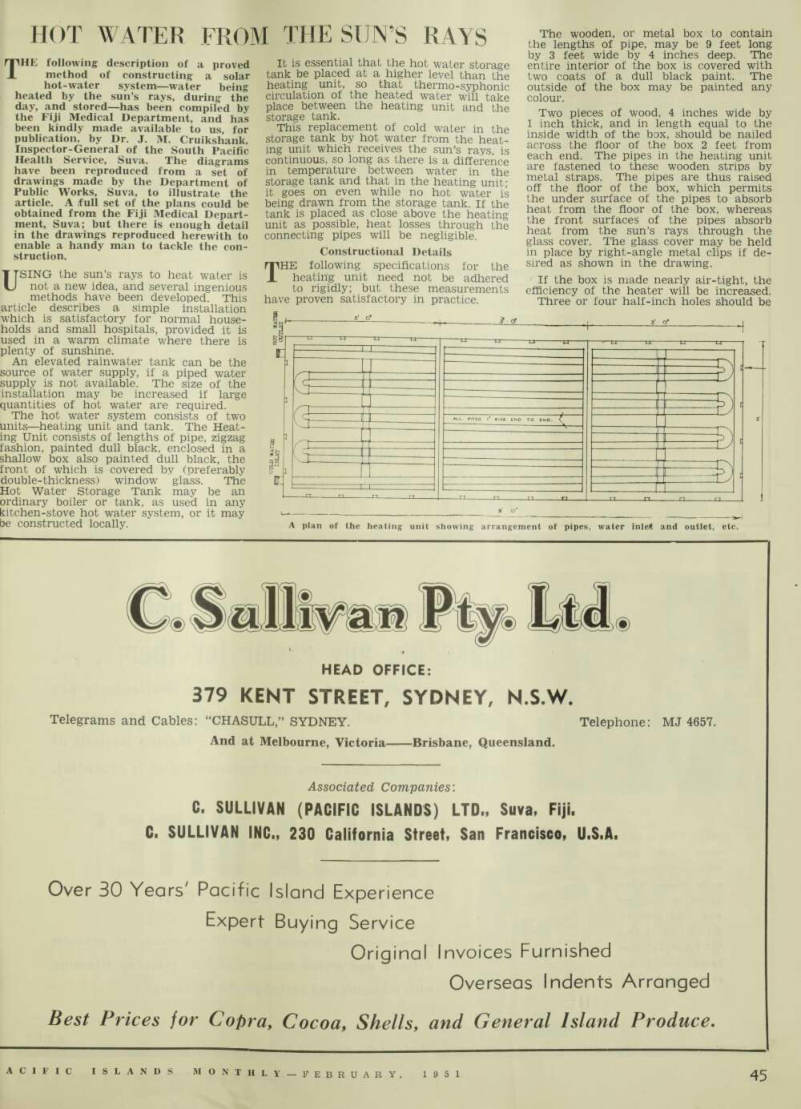
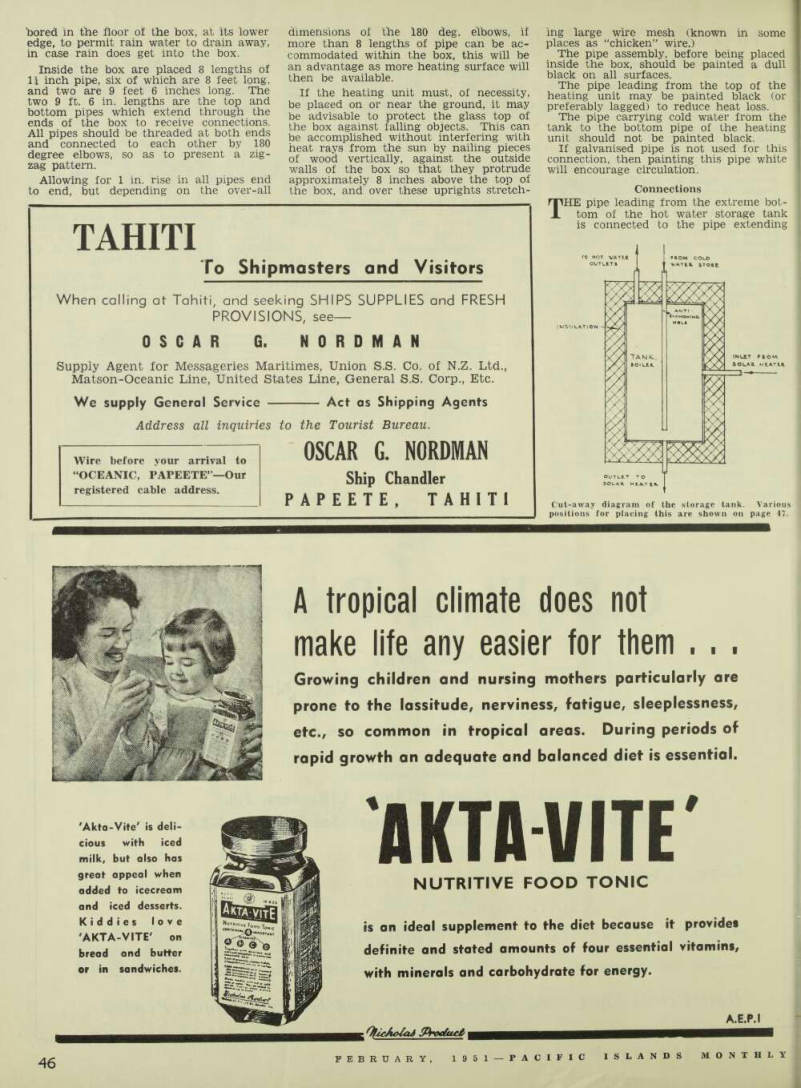
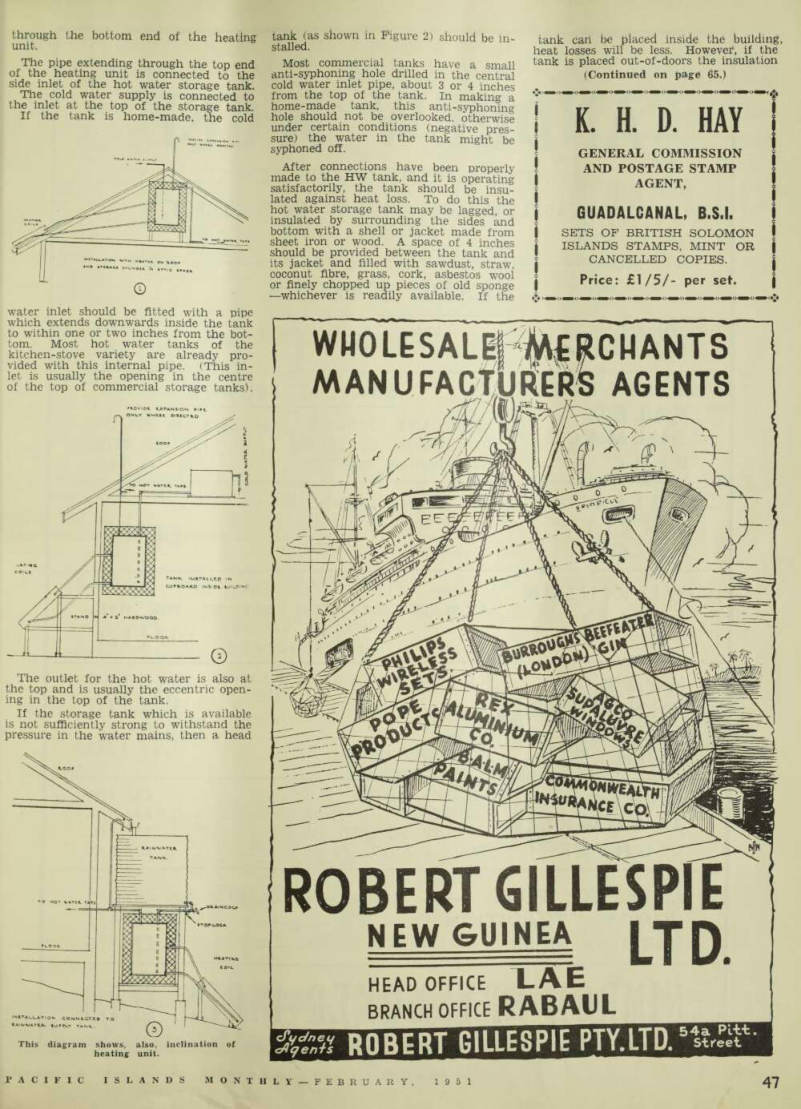
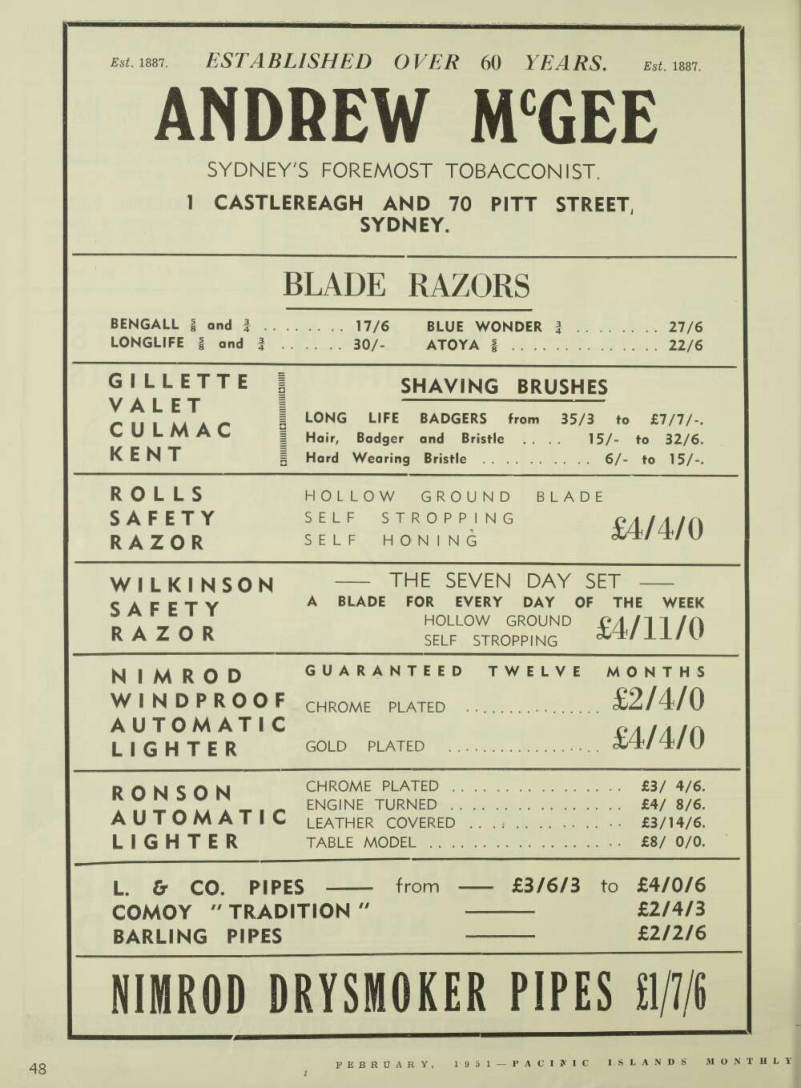
THE following description of a proved method of constructing a solar hot-water system—water being heated by the sun’s rays, during the day, and stored—has been compiled by the Fiji Medical Department, and has been kindly made available to us, for publication, by Dr. J. M. Cruikshank, Inspector-General of the South Pacific Health Service, Suva. The diagrams have been reproduced from a set of drawings made by the Department of Public Works, Suva, to illustrate the article. A full set of the plans could be obtained from the Fiji Medical Depart ment, Suva; but there is enough detail in the drawings reproduced herewith to enable a handy man to tackle the con struction.
USING the sun’s rays to heat water is not a new idea, and several ingenious methods have been developed. This article describes a simple installation which is satisfactory for normal house holds and small hospitals, provided it is used in a warm climate where there is plenty of sunshine.
An elevated rainwater tank can be the source of water supply, if a piped water supply is not available. The size of the installation may be increased if large quantities of hot water are required.
The hot water system consists of two units —heating unit and tank. The Heat ing Unit consists of lengths of pipe, zigzag fashion, painted dull black, enclosed in a shallow box also painted dull black, the front of which is covered by (preferably double-thickness) window glass. The Hot Water Storage Tank may be an ordinary boiler or tank, as used in any kitchen-stove hot water system, or it may be constructed locally.
It is essential that the hot water storage tank be placed at a higher level than the heating unit, so that thermo-syphonic circulation of the heated water will take place between the heating unit and the storage tank.
This replacement of cold water in the storage tank by hot water from the heat ing unit which receives the sun’s rays, is continuous, so long as there is a difference in temperature between water in the storage tank and that in the heating unit; it goes on even while no hot water is being drawn from the storage tank. If the tank is placed as close above the heating unit as possible, heat losses through the connecting pipes will be negligible.
Constructional Details THE following specifications for the heating unit need not be adhered to rigidly; but these measurements have proven satisfactory in practice.
The wooden, or metal box to contain the lengths of pipe, may be 9 feet long by 3 feet wide by 4 inches deep. The entire interior of the box is covered with two coats of a dull black paint. The outside of the box may be painted any colour.
Two pieces of wood, 4 inches wide by 1 inch thick, and in length equal to the inside width of the box, should be nailed across the floor of the box 2 feet from each end. The pipes in the heating unit are fastened to these wooden strips by metal straps. The pipes are thus raised off the floor of the box, which permits the under surface of the pipes to absorb heat from the floor of the box, whereas the front surfaces of the pipes absorb heat from the sun’s rays through the glass cover. The glass cover may be held in place by right-angle metal clips if de sired as shown in the drawing.
If the box is made nearly air-tight, the efficiency of the heater will be increased.
Three or four half-inch holes should be
A plan of the heating unit showing arrangement of pipes, water inlet and outlet, etc.
bored in the floor of the box, at its lower edge, to permit rain water to drain away, in case rain does get into the box.
Inside the box are placed 8 lengths of II inch pipe, six of which are 8 feet long, and two are 9 feet 6 inches long. The two 9 ft. 6 in. lengths are the top and bottom pipes which extend through the ends of the box to receive connections.
All pipes should be threaded at both ends and connected to each other by 180 degree elbows, so as to present a zig zag pattern.
Allowing for 1 in. rise in all pipes end to end, but depending on the over-all
dimensions of the 180 deg. elbows, if more than 8 lengths of pipe can be ac commodated within the box, this will be an advantage as more heating surface will then be available.
If the heating unit must, of necessity, be placed on or near the ground, it may be advisable to protect the glass top of the box against falling objects. This can be accomplished without interfering with heat rays from the sun by nailing pieces of wood vertically, against the outside walls of the box so that they protrude approximately 8 inches above the top of the box, and over these uprights stretch
ing large wire mesh (known in some places as “chicken” wire.) The pipe assembly, before being placed inside the box, should be painted a dull black on all surfaces.
The pipe leading from the top of the heating unit may be painted black (or preferably lagged) to reduce heat loss.
The pipe carrying cold water from the tank to the bottom pipe of the heating unit should not be painted black.
If galvanised pipe is not used for this connection, then painting this pipe white will encourage circulation.
Connections THE pipe leading from the extreme bot tom of the hot water storage tank is connected to the pipe extending
Cut-away diagram of the storage tank. Various positions for placing this are shown on page 47.
through the bottom end of the heating unit.
The pipe extending through the top end of the heating unit is connected to the side inlet of the hot water storage tank.
The cold water supply is connected to the inlet at the top of the storage tank.
If the tank is home-made, the cold
water inlet should be fitted with a pipe which extends downwards inside the tank to within one or two inches from the bot tom. Most hot water tanks of the kitchen-stove variety are already pro vided with this internal pipe. (This in let is usually the opening in the centre of the top of commercial storage tanks).
The outlet for the hot water is also at the top and is usually the eccentric open ing in the top of the tank.
If the storage tank which is available is not sufficiently strong to withstand the pressure in the water mains, then a head
tank (as shown in Figure 2) should be in stalled.
Most commercial tanks have a small anti-syphoning hole drilled in the central cold water inlet pipe, about 3 or 4 inches from the top of the tank, in making a home-made tank, this anti-syphoning hole should not be overlooked, otherwise under certain conditions (negative pres sure) the water in the tank might be
syphoned off.
After connections have been properly made to the HW tank, and it is operating satisfactorily, the tank should be insu lated against heat loss. To do this the hot water storage tank may be lagged, or insulated by surrounding the sides and bottom with a shell or jacket made from sheet iron or wood. A space of 4 inches should be provided between the tank and its jacket and filled with sawdust, straw, coconut fibre, grass, cork, asbestos wool or finely chopped up pieces of old sponge —whichever is readily available. If the
tank carl be placed inside the building heat losses will be less. However 1 , if the tank is placed out-of-doors the insulation
(Continued on page 65.)
This diagram shows, also, inclination of heating unit.
on the top should be protected against rain, and the jacket painted black.
Provided the tank is well insulated, the water will remain hot from 24 to 36 hours, if sunny weather is followed by overcast or cloudy weather, depending of course upon the quantity of water drawn off.
Practical installations are represented in the various sketches, all of which have worked satisfactorily.
The heating unit described is suitable for a tank with a capacity of 40 to 80 gallons, depending on the quantity of hot water required.
Installation THE heating unit should be placed on the sunniest aspect of the building, so as to receive maximum duration of radiation from the sun, and should be inclined from the vertical to enable the heated water to rise to the storage tank and at the same time receive the maxi mum of direct rays from the sun. (See Fig. 3, page 65.) Apart from producing hot water for bathing and laundry purposes, this in stallation can be used to pre-heat water for a steam boiler; or the heating unit can be connected to an existing tank, containing either a manually-controlled or a thermostatically-controlled heating element. If automatically controlled, the thermostat is activated and electric power is used only if the temperature of the water, due to prolonged cloudy weather, falls below the temperature pre sent on the thermostat. It is surprising, even during lightly overcast weather, the amount of infra red rays absorbed by the heating unit.
In the writer’s experience, the highest water temperature is reached about 2 p.m.
The following record of temperatures may be of interest, even though normal quan tities of hot water were drawn off during the day:— 2 p.m.—Cold water temp. 90 deg. Fahr.
Hot water temp. 126 deg.
Air Shade temp. 87 deg. 9 p.m.—Cold water temp. 91 deg. Fahr.
Hot water temp. 118 deg.
Air Shade temp. 82 deg.
8 a.m.—Cold water temp. 82 deg.
Hot water temp. 100 deg.
Air Shade temp. 82 deg.
The essential features are:— 1. —A heating unit consisting of:— (a) a box painted dull black inside, (b) zig-zag lengths of pipe painted dull black, within the box. (c) a transparent glass cover on the box. 2. —A hot water storage tank which
must be raised above the level of the top of the heating unit.
Bill of Materials 2—pieces 10 ft. x 4 ft. x 2 in.—sides of box. 9—pieces 10 ft. x 4 in. x 1 in.—bottom of box. 2—pieces 2 ft. 8 in. x 4 in. x 2 in.—ends of box. 2—pieces 2 ft, 8 in. x 4 in. x 1 in.—strips for floor of box. 4—pieces 2 ft. 8 in. x 2 in. x 1 in.—strips to support glass top of box. 6 II in. iron or copper pipes 8 ft. long. 2—II in. iron or copper pipes 9 ft. 6 in. long. 16—II in. pipe clamps or metal strapping. 7 14 in. 180 deg. elbows. 2—II in. 90 deg. elbows. (Or tees with a plug in one opening. This arrange ment facilitates draining of the heat ing unit and tank, if desired.) 2—II in. union couplings for connecting pipes.
I—4o-80 gallon tank.
Window glass sufficient to cover front of box.
Dull black paint sufficient for two coats.
Sufficient galvanised clips to hold glass cover in place.
Mr. A. H. Davies has arrived in Fiji to take over the managership of the Suva branch of the Bank of New South Wales.
The previous Manager was Mr. W. F.
Hargreaves, who has been transferred to New Zealand.
Although they are gradually declining in number since the war, British residents are still the most numerous of New Caledonia’s foreign element. Out of 378 foreigners in 1950, 166 were British, a recent count reveals.
Advertisements & other items, pp. 49-52 (2 items)
45
ACIFIC ISLANDS MONTHLY FEBRUARY, 1951
Fit*> WiL
f
HEAD OFFICE
379 KENT STREET, SYDNEY, N.S.W.
Telegrams and Cables: “CHASULL,” SYDNEY. Telephone: MJ 4657, And at Melbourne, Victoria Brisbane, Queensland.
Associated Companies: C. SULLIVAN (PACIFIC ISLANDS) LTD., Suva, Fiji.
C. SULLIVAN INC., 230 California Street, San Francisco, U.S.A.
Over 30 Years' Pacific Island Experience Expert Buying Service Original Invoices Furnished Overseas Indents Arranged Best Prices for Copra, Cocoa, Shells, and General Island Produce.
TAHITI
To Shipmasters and Visitors
When calling at Tahiti, and seeking SHIPS SUPPLIES and FRESH
PROVISIONS, see—
OSCAR G. NORDMAN
Supply Agent for Messageries Maritimes, Union S.S. Co. of N.Z, Ltd., Matson-Oceanic Line, United States Line, General S.S. Corp., Etc.
We supply General Service Act as Shipping Agents Address all inquiries to the Tourist Bureau.
OSCAR G. NORDMAN
Ship Chandler
PAPEETE. TAHITI
Wire before your arrival to
“OCEANIC, PAPEETE”—Our
registered cable address.
m
A tropical climate does not
make life any easier for them ~.
Growing children and nursing mothers particularly are prone to the lassitude, nerviness, fatigue, sleeplessness, etc., so common in tropical areas. During periods of rapid growth an adequate and balanced diet is essential.
'Akta-Vite' is delicious with iced milk, but also has great appeal when added to icecream and iced desserts.
Kiddies love
'AKTA-VITE' on
bread and butter or in sandwiches. 0 0 r. w-,/
AKTA-VITE'
NUTRITIVE FOOD TONIC
is an ideal supplement to the diet because it provides definite and stated amounts of four essential vitamins, with minerals and carbohydrate for energy.
A.E.P.I
Ofie/uylaA Product
K. H. D. HAY
GENERAL COMMISSION
AND POSTAGE STAMP
AGENT,
GUADALCANAL 8.5.1.
SETS OF BRITISH SOLOMON
ISLANDS STAMPS, MINT OR
CANCELLED COPIES.
Price: £1 /5/- per set.
WHOLESALEHMERCHANTS
MANUFACTURERS AGENTS
» f m re Et X & l&b VV -e o. c f H I cr
ROBERT GILLESPIE
NEW GUINEA LTD.
HEAD OFFICE LAE
BRANCH OFFICE RABAUL
S@St ROBERT GILLESPIE PTY.LTD.
54a Pitt, Street
Est. 1887. ESTABLISHED OVER 60 YEARS. Es t. mi.
ANDREW M°GEE
SYDNEY'S FOREMOST TOBACCONIST.
1 CASTLEREAGH AND 70 PITT STREET,
SYDNEY.
BLADE RAZORS
NIMROD DRYSMOKER PIPES £l/7/6
War Fears Step Up Search For Plantation Rubber Substitutes
Plantation Rubber Substitutes
Alternatives to plantation rubber, which was bringing less than 12 pence per pound about 18 months ago, but now has spiralled to over 6/ per pound, are already being sought in unorthodox places.
It has been reported from America re cently that a successful process for extracting natural rubber from the goldenrod plant, apparently indigenous to North America, has been developed. Ex periments were first made during World War 11, but more recent efforts by the US Department of Agriculture have im proved on former processes until it is now on the possible list —but for emer gencies only.
It is stated that tests of goldenrod rub ber made in pilot-plant operations revealed that it gave good performance in manufactured articles, such as hot water bottles, rubber heels for shoes, bicycle tyres, and power-transmission belts. Bicycle tyres made of goldenrod rubber gave three times as much mileage as did standard wartime bicycle tyres and nearly twice as much mileage as natural rubber tyres of pre-war make.
Goldenrod rubber also proved satis factory for blending with or substituting for either synthetic or other natural rubbers, including Hevea (plantation) rubber.
The first step in the process developed by the Department of Agriculture is to extract the unwanted resinous material from ground goldenrod leaves with the solvent acetone. The leaves are treated with another solvent, benzol, to dissolve the rubber, which is then precipitated
from the benzol-rubber mixture with acetone.
A simple treatment of the goldenrod leaves before solvent extraction—using an active bacterial culture from sewage sludge—permits more complete extraction of better quality rubber in about one third to one-fourth less time than is re quired for untreated leaves, When the rubber has been obtained it is given a unique pre-curing step—the key to successful goldenrod rubber nro duction. In this step, called “solution compounding,” the rubber is redissolved in benzol, and certain benzol-soluble chemicals are added. The resulting mix ture is heated to boiling point, stirred in a steam-heated mixer until the benzol is completely distilled, then heated again before cooling.
This “pre-curing” step is essential to producing a tough rubber from goldenrod suitable for use in manufactured products If not pre-cured, the rubber is sticky and soft, almost fluid when heated, and is satisfactory only as a blending agent, Although developed specifically for goldenrod, this process is showing possi bilities for use with other rubber-bearing plants grown in the United States, the Department of Agriculture reports. Some of its features have already proved useful in the extraction of guayule rubber.
Washington also reports “slow but significant progress” being made towards profitable production of natural rubber in the United States, and the time is fore seen when rubber will be produced on the dry mesas of south-west United States at a cost below the current market price.
The Department of Agriculture dis closed that new high-yielding strains have been obtained from the rubber plant guayule, a shrub that grows on the dry tablelands of Mexico and Texas. These new strains will produce about 1,200 pounds of rubber per acre in five grow ing seasons. (Continued Next Page.)
The guayule is one of the methods used by the US Government to produce rubber during World War 11. After the war, the project was abandoned because it was too costly, except for emergency use.
Advertisements & other items, pp. 53-54 (1 item)
Insurance
THE
YORKSHIRE
CO. LTD.
(Incorporated in England)
ALL CLASSES OF
INSURANCE
Including Fire Motor Guarantee Accident Workers Marine Island Representatives:
PORT MORESBY: E. A. James
RABAUL: G. B. Black LAE; New Guinea Industries Ltd.
MADANG: R. MacGregor SUVA: Williams & Gosling Ltd.
NOUMEA: Y. Mortensen
NORFOLK ISLAND:
A. E. Martin
PENTAL is kind to the most delicate skins and can be used for washing the
finest of fabrics. A high
quality soap of out
standing value.
Economical
to use.
Pacific Islands Distributors:— 0 s i*' fHi 01 B°l pfri 0* M m ft! to' f o"
A G. W. PENNELL PRODUCT
COIYER WATSON
Ll
PTY. LTD. “ ST '
Made in the Australian Branch Factory of
BLUNDELL SPENCE & CO, LTD, Hull,
B. & S. SUPER PREPARED PAINT embodies the knowledge and experience gained from nearly 140 years of Paint manufacture.
Tested and proved for tropical conditions, B. & S. PREPARED PAINT is also available in a special Lead-free series for use in volcanic and other sulphurous regions. (Specify B. & S.-Series 2301).
Ask for supplies of these and other BLUN- DELL Paints and Enamels from your local Storekeeper, or write for particulars and colour-cards to the Agent for Pacific Islands :
KERR BROTHERS PTY. LTD.
255 a GEORGE STREET, SYDNEY
NZ Research Team
At Work in Samoa
From Our Own Correspondent APIA, January 11.
A MEDICAL team sent to Western Samoa by the Medical Research Council of New Zealand has com pleted seven weeks’ research on yaws and skin diseases on the small island of Manono.
The research team was headed by a woman scientist, Dr. M. J. Marples, senior lecturer at the Department of Bac teriology, University of Otago. Other mem bers of the team were Dr. Jeffrey Sat chell, entomologist; Mr. Roy Harrison, of the Plant Diseases Division, Auckland, NZ, and Mr. Bacon, bacteriologist. Miss S. Holmes, dietician, undertook a separate study of dietetics in collaboration with the team.
Approximately 800 people on Manono were examined and in some cases ex perimental treatment was given. Mem bers of the team appreciated the ready co-operation of the Manono people and the advice and assistance of the Western Samoan medical staff. Valuable material was obtained and the results will be in cluded in a report which will later be made available to the Medical Department of the Samoan Government.
Professor B. J. Marples, of the De partment of Zoology at the University of Otago, the husband of Dr. Marples, ac companied the team to Samoa and made a study of rats and spiders during the stay of the team. Professor Marples was involved in the recent disastrous crash of the RNZAF Catalina at Faleolo airport when seven airmen lost their lives.
Professor Marples escaped unhurt.
Rain And Gales Break
W. Samoan Records
RAINFALL recorded by Apia Obser vatory during December, 1950, amounted to 33.78 inches and con stituted a record for this month since observations first began in 1890.
A deep depression which passed to the east of Samoa on December 31 caused pressure to drop to 997.3 millibars which is the lowest recorded in December since 1925. The normal average rainfall for December is 14.02 inches.
Abnormally heavy rains have continued during the first half of January. The torrential and continuous downpour has caused heavy damage to the cocoa crop on both Upolu and Savaii. The crop had promised to be exceptionally heavy but growers now expect only half of the normal crop.
Easterly winds of gale force (51 miles per hour which is unusual for W. Samoa) on December 31 caused damage to build ings and Samoan houses in the Fa’asale leaga district of Savai’i and in the Aleipata district of Upolu. At Faga, Savai’i, a large Samoan house, used as a picture theatre was demolished and at Tuasivi a garage collapsed and a Samoan policeman was injured by the wreckage.
A French judge recently visited Santo, where he held Court on several civil and criminal cases.
It is reported that approximately 20 Tonkinese were tried on charges of sup plying liquor to natives. Confirmation of penalties has yet to come from Noumea.
Scheme to Overcome
Noumea’s Acute House Shortage
TO overcome the housing shortage in Noumea, Governor-General Cour narie has authorised the formation of a semi-official building society which it is expected, will have the backing of the Colonial Administration, the Munici pality, the Caisse Centrale of Overseas Prance, and the leading banking, indus trial and commercial houses of New Caledonia. The company is expected to operate with a capital of 25 million Pacific francs.
The need for such a move is apparent, rhe Noumean population has grown from 15,000 to 18,000 in the last five years, luring which period fewer than 150 new Iwellings have been built. Even before :he war, most buildings in the port were small and overcrowded and lacking in nodern conveniences. Magnificently situated and possessing one of the most favoured climates in the South Pacific, Noumea has a long way to go before it jan call itself up-to-date.
The new building society expects to fill i dual role. Firstly, it intends to build louses for sale or lease; and, secondly, t will make loans to persons wishing to )uy land and build houses of their own.
It is hoped to build blocks of modern hree or four roomed flats, 24 or 30 to a milding, which will be let at from 1,500 o 3,000 francs a month. A “garden city” or workers and employees whose incomes ire on a more modest scale is also con emplated. In addition, a matter of a mndred detached villas or houses in some if the most attractive suburbs is planned.
Local bodies seem agreed on the desir ability of the scheme, and the approval of the Caisse Centrale of Overseas France (known as CAIFOM) is now awaited.— H.P.
Miss Camilla Wedgwood, well-known anthropologist and lecturer at the Aus tralian School of Pacific Administration Mosman, expects to return to England in March or April to visit her family She says that she does not know what she is
going to do then. Miss Wedgwood, who has the right to use the title Honourable, acquired it in 1941 when her father, a British Labour MP, was made the first Baron Wedgwood of Barlaston.
One of the passengers on Lakemba, which berthed in Sydney on January 24, was Miss Marjorie Heath, of Lae, New Guinea, who has been visiting her brother in Canada,
Advertisements & other items, pp. 55-56 (2 items)
51
ACIFIC ISLANDS MONTHLY— FEBRUARY, 1951
A. H. Bunting Limited
★ A Guaranteed Sanitary System
Approved by the N.S.W. Board of Health.
THE HYGEIA DISSOLVENATOR
Established 1927.
No Water Supply Required
The Sewage matter is chemically transformed into a sterile solution which is absorbed by the surrounding soil.
MO FLIES
NO GERMS
NO SMELLS
NO EMPTYING
AUTOMATIC
Any hondy man con install.
HYGEIA SANITARY COMPANY PTY. LTD.
26-30 BRIDGE STREET, SYDNEY, N.S.W.
Phone: BU 2521 Cables: “Berbl,” Sydney r; >■«* . .
Correspondence Invited.
A. H. BUNTING LIMITED
SAMARAI PAPUA
Branches at: MISIMA, TUFI, ORO BAY, SOPUTA.
SAMARAI AGENTS FOR:
Vacuum Oil Co. Pty., Ltd.
South British Insurance Co.
National Mutual Life Association
SOLE AGENTS IN PAPUA/NEW GUINEA FOR:
Polarizers (U.K.), Ltd.—Polaroid Sun Glasses.* C.S.A. Industries, Eng.—Dual Freeze Refrigerators.
Webley & Scott, Ltd.—Shot Guns, Air Pistols, etc.
E. K. Cole, Ltd., London.—“Ekco” Radio Receivers.
“Getula.”—Nylon Monofilament Fish Lines.
Davison Paints, Ltd., N.S.W.—Paint for Tropical Conditions. * Trade mark patented in U.8.A., Great Britain, and other countries
REGULAR SUPPLIES OF EASTERN GOODS
WHOLESALE & RETAIL MERCHANTS IMPORTERS PLANTERS
The features of this unusual XVlth Century key illustrate its owner’s connection with the trader on the African coast, no doubts the key obviously being that of his sea-chest. mm •■r in 30 mmssm Th
key
e k I to o n 9 e a sure s i
CAPSTAN
FINE CUT
NAVY CUT
TOBACCOS
or
Magazine Section
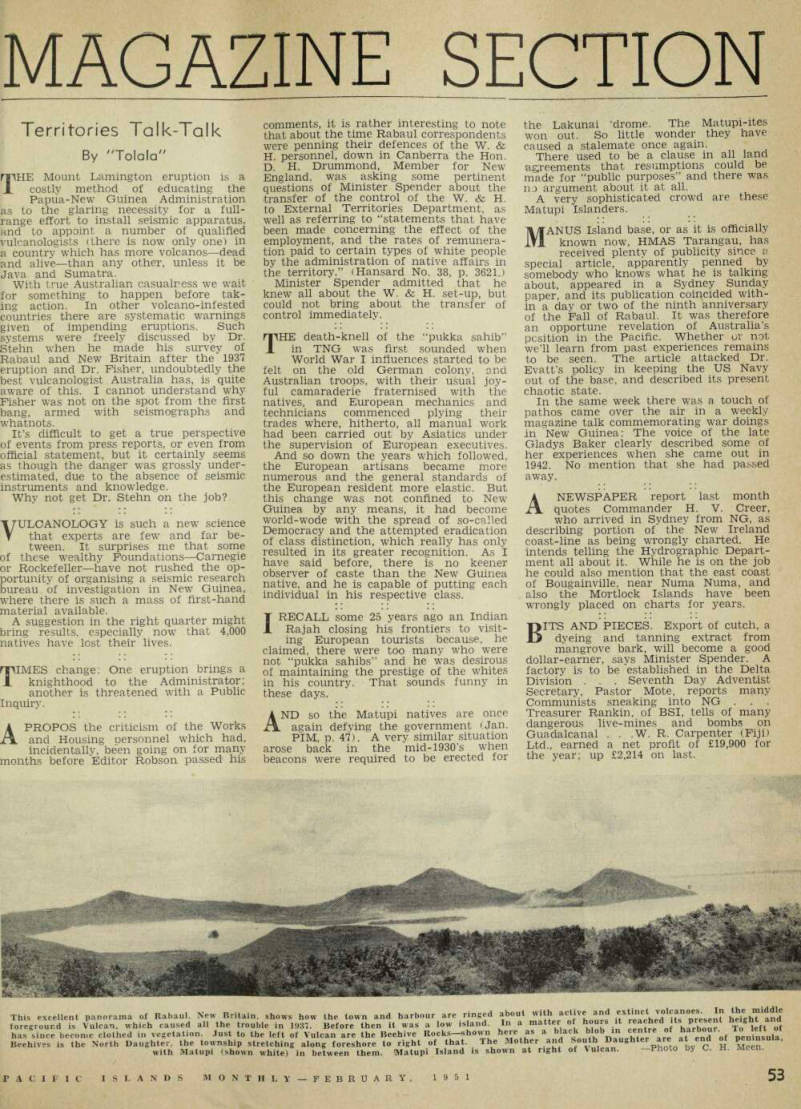
Territories Talk-Talk
By "Tolala"
11HE Mount Lamington eruption is a costly method of educating the Papua-New Guinea Administration as to the glaring necessity for a full range effort to install seismic apparatus, and to appoint a number of qualified vulcanologists (there is now only one) in a country which has more volcanos —dead and alive —than any other, unless it be Java and Sumatra.
With true Australian casualness we w T ait for something to happen before tak ing action. In other volcano-infested countries there are systematic warnings given of impending eruptions. Such systems were freely discussed by Dr.
Stehn when he made his survey of Rabaul and New Britain after the 1937 eruption and Dr. Fisher, undoubtedly the best vulcanologist Australia has, is quite aware of this. I cannot understand why Fisher was not on the spot from the first bang, armed with seismographs and whatnots.
It’s difficult to get a true perspective of events from press reports, or even from official statement, but it certainly seems as though the danger was grossly under estimated, due to the absence of seismic instruments and knowledge.
Why not get Dr. Stehn on the job? yULOANOLOGY is such a new science that experts are few and far be tween. It surprises me that some of these wealthy Foundations —Carnegie or Rockefeller —have not rushed the op portunity of organising a seismic research bureau of investigation in New Guinea, where there is such a mass of first-hand material available.
A suggestion in the right quarter might bring results, especially now that 4,000 natives have lost their lives.
TIMES change: One eruption brings a knighthood to the Administrator: another is threatened with a Public Inquiry.
APROPOS the criticism of the Works and Housing personnel which had, incidentally, been going on for many months before Editor Robson passed his
comments, it is rather interesting to note that about the time Rabaul correspondents were penning their defences of the W. & H. personnel, down in Canberra the Hon.
D. H. Drummond, Member for New England, was asking some pertinent questions of Minister Spender about the transfer of the control of the W. & H. to External Territories Department, as well as referring to “statements that have been made concerning the effect of the employment, and the rates of remunera tion paid to certain types of white people by the administration of native affairs in the territory.” (Hansard No. 38, p. 3621.) Minister Spender admitted that he knew all about the W. & H. set-up, but could not bring about the transfer of control immediately.
THE death-knell of the “pukka sahib” in TNG was first sounded when World War I influences started to be felt on the old German colony, and Australian troops, with their usual joy ful camaraderie fraternised with the natives, and European mechanics and technicians commenced plying their trades where, hitherto, all manual work had been carried out by Asiatics under the supervision of European executives.
And so down the years which followed, the European artisans became more numerous and the general standards of the European resident more elastic. But this change was not confined to New 7 Guinea by any means, it had become world-wode with the spread of so-called Democracy and the attempted eradication of class distinction, which really has only resulted in its greater recognition. As I have said before, there is no keener observer of caste than the New Guinea native, and he is capable of putting each individual in his respective class, I RECALL some 25 years ago an Indian Rajah closing his frontiers to visit ing European tourists because, he claimed, there were too many who were not “pukka sahibs” and he was desirous of maintaining the prestige of the whites in his country. That sounds funny in these days.
AND so the Matupi natives are once again defying the government (Jan.
PIM, p. 47). A very similar situation arose back in the mid-1930’s when beacons were required to be erected for
the Lakunai ‘drome. The Matupi-ites won out. So little wonder they have caused a stalemate once again.
There used to be a clause in all land agreements that resumptions could be made for “public purposes” and there was no argument about it at all.
A very sophisticated crowd are these Matupi Islanders.
MANUS Isiand base, or as it is officially known now, HMAS Tarangau, has received plentv of publicity since a special article, apparently penned by somebody who knows what he is talking about, appeared in a Sydney Sunday paper, and its publication coincided with in a day or two of the ninth anniversary of the Fall of Rabaul. It was therefore an opportune revelation of Australia’s position in the Pacific. Whether or not we’ll learn from past experiences remains to be seen. The article attacked Dr.
Evatt’s nolicy in keeping the US Navy out of the base, and described its present chaotic state.
In the same week there was a touch of pathos came over the air in a weekly magazine talk commemorating war doings in New Guinea: The voice of the late Gladys Baker clearly described some of her exneriences when she came out in 1942. No mention that she had passed away.
A NEWSPAPER report last month Quotes Commander H. V. Creer, who arrived in Sydney from NG, as describing portion of the New Ireland coast-line as being wrongly charted. He intends telling the Hydrographic Depart ment all about it. While he is on the job he could also mention that the east coast of Bougainville, near Numa Numa, and also the Mortlock Islands have been wrongly placed on charts for years.
BITS AND PIECES. Export of cutch, a dyeing and tanning extract from mangrove bark, will become a good dollar-earner, says Minister Spender. A factory is to be established in the Delta Division . . . Seventh Day Adventist Secretary, Pastor Mote, reports many Communists sneaking into NG . . .
Treasurer Rankin, of BSI, tells of many dangerous live-mines and bombs on Guadalcanal . . .W. R. Carpenter (Fiji) Ltd., earned a net profit of £19,900 for the year; up £2,214 on last.
This excellent panorama of Rabaul. New Britain, shows how the town and harbour are ringed about with active and extinct volcanoes. In the middle foreground is Vulcan, which caused all the trouble in 1937. Before then it was a low island. In a matter of hours it reached its Present height and has since become clothed in vegetation. Just to the left of Vulcan are the Beehive Rocks—shown here as a black blob in centre of harbour. To left of Beehives is the North Daughter, the township stretching along foreshore to right of that. The Mother and South Daughter are at end of peninsula, with Matupi (shown white) in between them. Matupi Island is shown at right of Vulcan. Photo by C. H. Meen.
Spinners of Pacific Tales
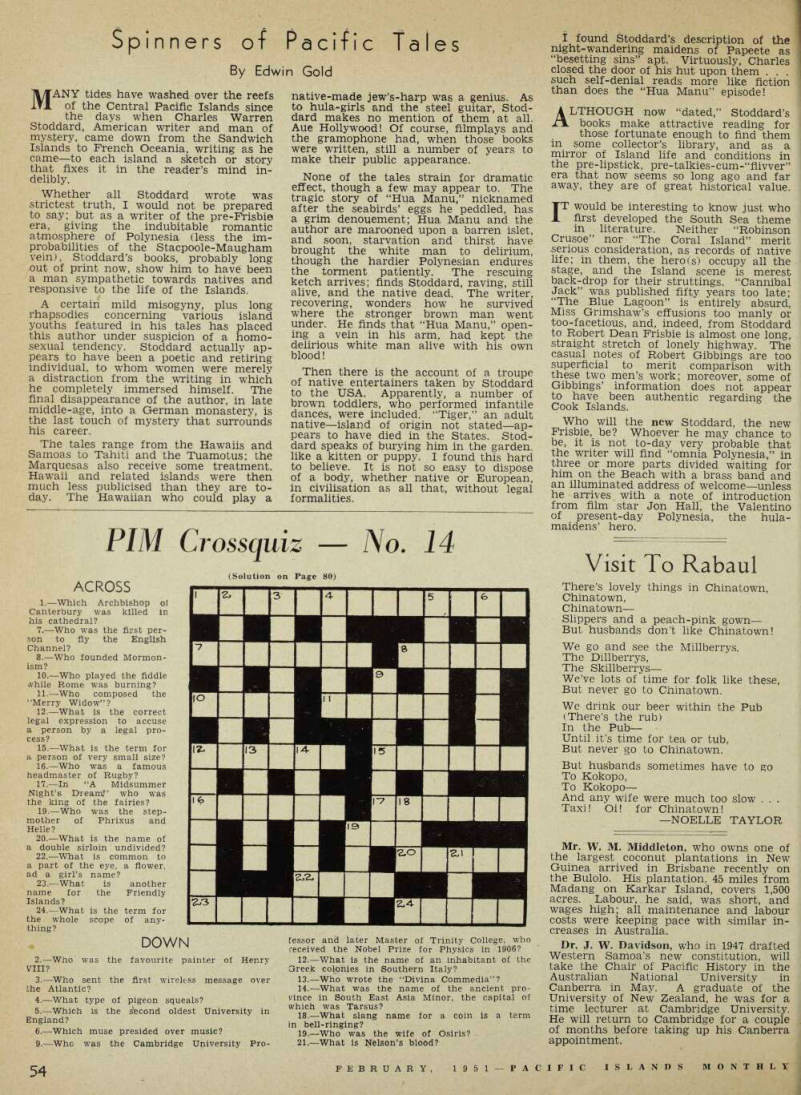
By Edwin Gold
MANY tides have washed over the reefs of the Central Pacific Islands since the days when Charles Warren Stoddard, American writer and man of mystery, came down from the Sandwich Islands to French Oceania, writing as he came—to each island a sketch or story that fixes it in the reader’s mind indelibly. 11 0 . , , ard + £ vrote wa j 1 be pr |P a u od oSa y^^aS fS wl T te J of the pre-Frisbie £ b( L indubitable romantic 0f p *f£ lyn |? la d®ss the im- » th€ L stac P oole jMaugham vein), Stoddard s books, probably long out of print now, show him to have been . s y n JP a J betl 9. towards natives and responsive to the life of the Islands.
A certain mild misogyny, plus long rhapsodies concerning various island youths featured in his tales has placed this author under suspicion of a homosexual tendency. Stoddard actually appears to have been a poetic and retiring whom women, were merely hp dl pnmniSpiv £r^mm t lltoy ri hn? Ju rio completely immersed himself. The middle*a^ P^rsr» n a 0 r prmnn & ' lat^ 6 German monastery, is the last touch of mystery that surrounds nis career.
The tales range from the Hawaiis and Samoas to Tahiti and the Tuamotus; the Marquesas also receive some treatment.
Hawaii and related islands were then much less publicised than they are today. The Hawaiian who could play a
native-made jew’s-harp was a genius. As to hula-girls and the steel guitar, Stod dard makes no mention of them at all.
Aue Hollywood! Of course, filmplays and the gramophone had, when those books were written, still a number of years to make their public appearance, , .
None of the tales stram for dramatic effect, though a few may appear to. The tragic story of “Hua Manu,” nicknamed after the seabirds’ eggs he peddled, has a grim denouement: Hua Manu and the author are marooned upon a barren islet, and soon, starvation and thirst have brought the white man to delirium, though the hardier Polynesian endures the torment patiently. The rescuing ketch arrives; finds Stoddard, raving, still alive, and the native dead. The writer, recovering, wonders how he survived where the stronger brown man went under. He finds that “Hua Manu,” open in 8' a vein in bis arm, had kept the delirious white man alive with his own blood!
Then there is the account of a troupe of native entertainers taken by Stoddard tn the USA ADnareritlv a mimbpr nf brown toddlers, who performed infantile dances, were included. “Tiger,” an adult native—island of origin not stated—ap pears to have died in the States. Stod dard speaks of burying him in the garden. like a kitten or puppy. I found this hard to believe. It is not so easy to dispose of a body, whether native or European, in civilisation as all that, without legal formalities.
I found Stoddard’s description of the night-wandering maidens of Papeete as “besetting sins” apt. Virtuously, Charles closed the door of his hut upon them . . . such self-denial reads more like fiction than does the “Hua Manu” episode!
ALTHOUGH now “dated,” Stoddard’s books make attractive reading for those fortunate enough to find them in some collector’s library, and as a mirror of Island life and conditions in the pre-lipstick, pre-talkies-cum-“flivver” era that now seems so long ago and far away, they are of great historical value.
IT would be interesting to know just who first developed the South Sea theme in literature. Neither “Robinson Crusoe” nor “The Coral Island” merit serious consideration, as records of native life; in them, the hero(s) occupy all the stage, and the Island scene is merest back-drop for their struttings. “Cannibal Jack” was published fifty years too late; “The Blue Lagoon” is entirely absurd, Miss Grimshaw’s effusions too manly or too-facetious, and, indeed, from Stoddard to Robert Dean Frisbie is almost one long, straight stretch of lonely highway. The casual notes of Robert Gibbings are too superficial to merit comparison with these two men’s work; moreover, some of Gibbings’ information does not appear to have been authentic regarding the Cook Islands.
Who will the new Stoddard, the new Frisbie, be? Whoever he may chance to be, it is not to-day very probable that the writer will find “omnia Polynesia,” in three or more parts divided waiting for him on the Beach with a brass band and an illuminated address of welcome—unless he arrives with a note of introduction from film star Jon Hall, the Valentino of present-day Polynesia, the hula maidens’ hero.
PIM Crossquiz No. 14
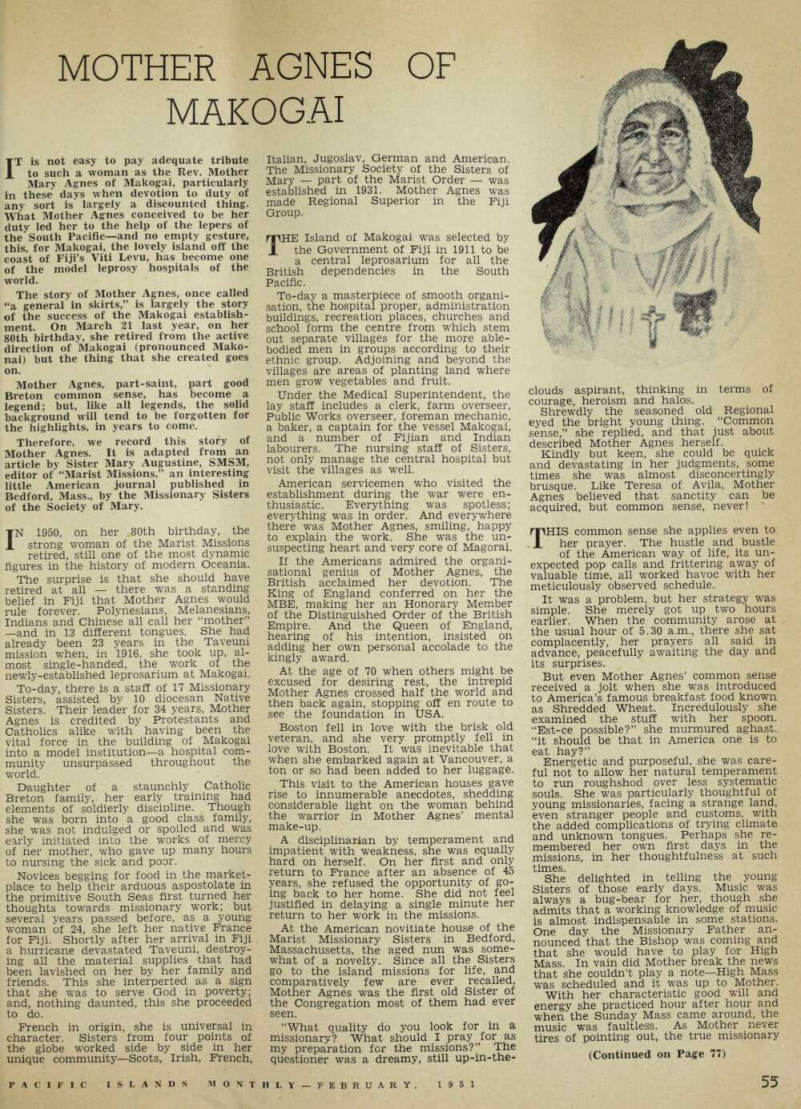
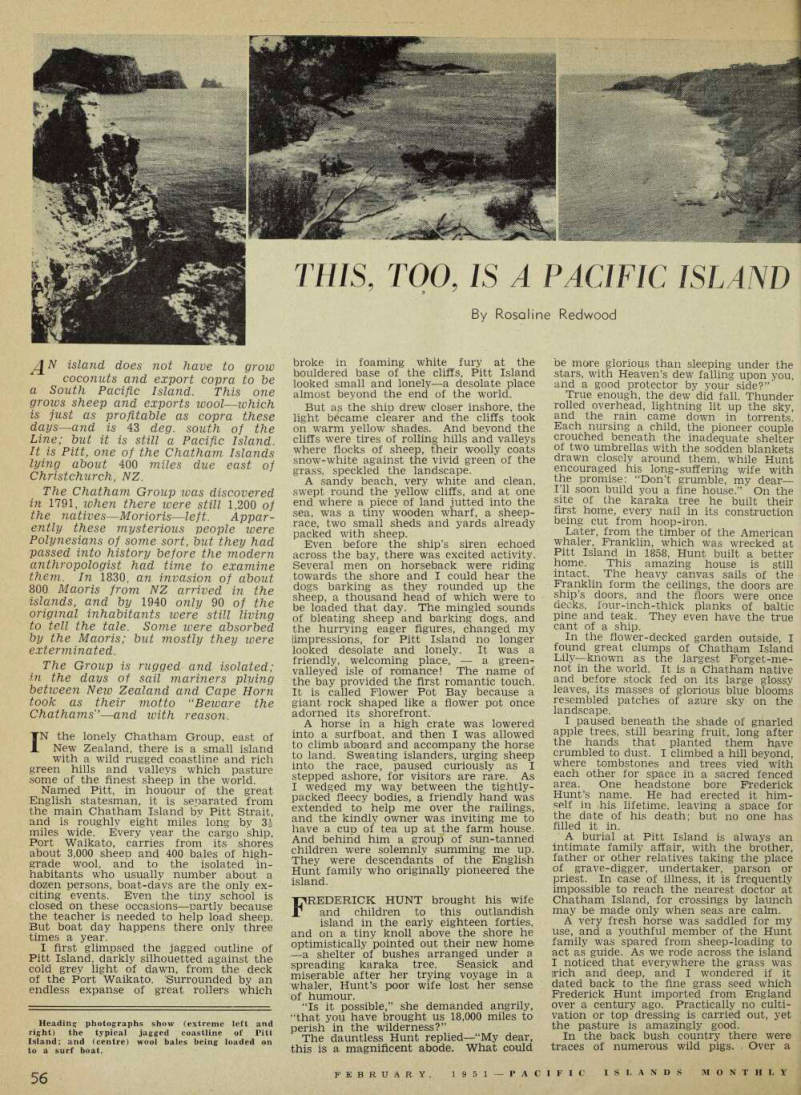
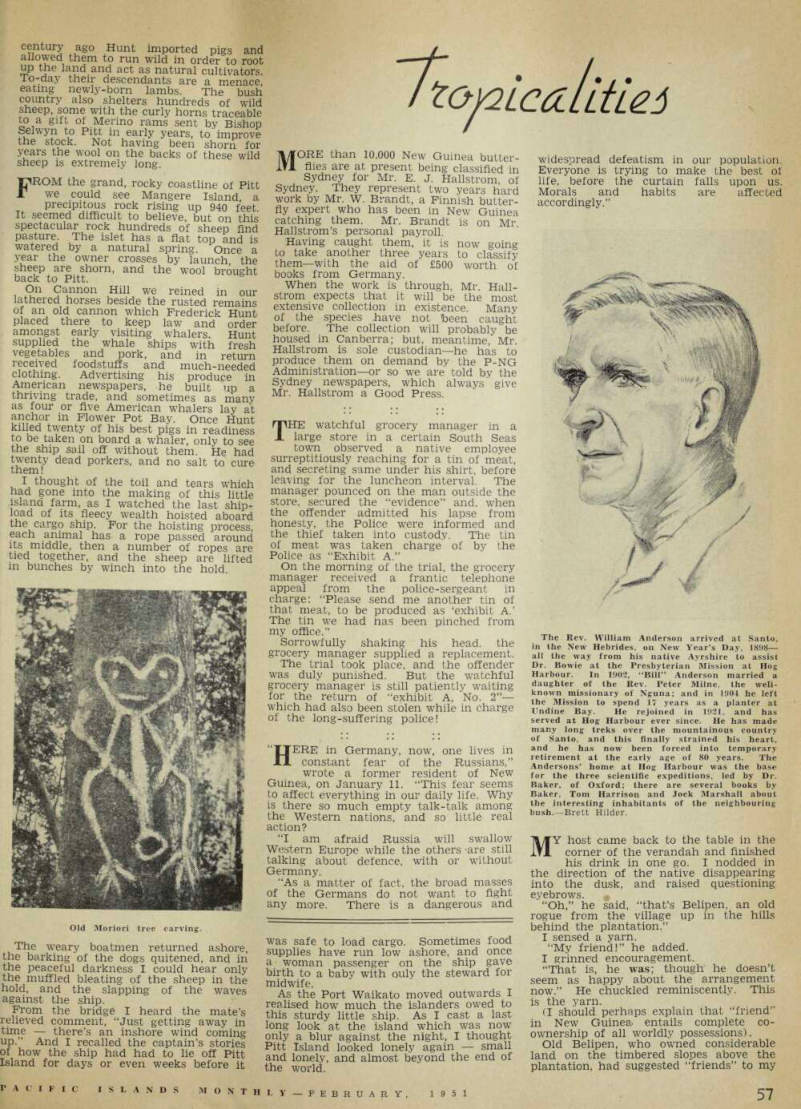
(Solution on Page 80)
Ac Ross
I. —Which Archbishop ol Canterbury was killed in his cathedral? 7. —Who was the first per son to fly the English Channel? 8. —Who founded Mormon ism? 10.—Who played the fiddle while Rome was burning? 11. —Who composed the “Merry Widow”? 12.—What is the correct legal expression to accuse a person by a legal pro cess? 15. —What is the term for a person of very small size? 16. —Who was a famous headmaster of Rugby? 17. —ln “A Midsummer Night’s DreamT who was the king of the fairies? 19. —Who was the step mother of Phrixus and Helle? 20. —What is the name of a double sirloin undivided? 22. —What is common to a part of the eye, a flower, ad a girl’s name? 23. —What is another name for the Friendly Islands? 24. —What is the term for the whole scope of any thing?
Down
2. —Who was the favourite painter of Henry
Viii?
3. —Who sent the first wireless message over the Atlantic? 4. —What type of pigeon squeals? 5. —Which is the Second oldest University in England? 6. —Which muse presided over music? 9.—Who was the Cambridge University Pro-
lessor and later Master of Trinity College, who received the Nobel Prize for Physics in 1906? 12. —What is the name of an inhabitant of the Greek colonies in Southern Italy? 13. —Who wrote the “Divina Commedia”? 14. —What was the name of the ancient pro vince in Sbuth East Asia Minor, the capital of which was Tarsus? 18. —What slang name for a coin is a term in bell-ringing? 19. —Who was the wife of Osiris? 21. —What is Nelson’s blood?
Solution to Crossquiz on page 54.
Visit To Rabaul
There’s lovely things in Chinatown, Chinatown, Chinatown— Slippers and a peach-pink gown— But husbands don’t like Chinatown!
We go and see the Millberrys, The Dillberrys, The Skillberrys— We’ve lots of time for folk like these, But never go to Chinatown.
We drink our beer within the Pub (There’s the rub) In the Pub— Until it’s time for tea or tub, But never go to Chinatown.
But husbands sometimes have to go To Kokopo, To Kokopo— And any wife were much too slow . . .
Taxi! Oi! for Chinatown!
Noelle Taylor
Mr. W. M. Middleton, who owns one of the largest coconut plantations in New Guinea arrived in Brisbane recently on the Bulolo. His plantation. 45 miles from Madang on Karkar Island, covers 1,500 acres. Labour, he said, was short, and wages high; all maintenance and labour costs were keeping pace with .similar in creases in Australia.
Dr. J. W. Davidson, who in 1947 drafted Western Samoa’s new constitution, will take the Chair of Pacific History in the Australian National University in Canberra in May. A graduate of the University of New Zealand, he was for a time lecturer at Cambridge University.
He will return to Cambridge for a couple of months before taking up his Canberra appointment.
Makogai
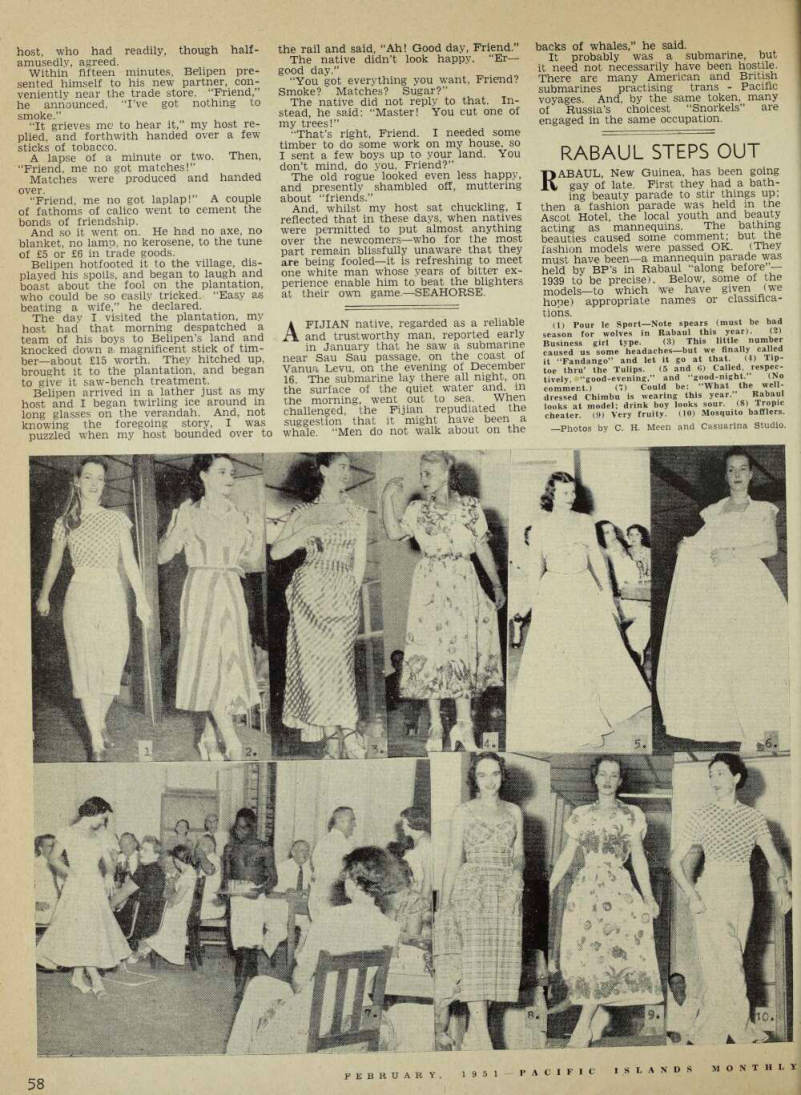
Mother Agnes Of
IT is not easy to pay adequate tribute to such a woman as the Rev. Mother Mary Agnes of Makogai, particularly in these days when devotion to duty of any sort is largely a discounted thing.
What Mother Agnes conceived to be her duty led her to the help of the lepers of the South Pacific—and no empty gesture, this, for Makogai, the lovely island off the coast of Fiji’s Viti Levu, has become one of the model leprosy hospitals of the world.
The story of Mother Agnes, once called “a generalin skirts,” is largely the story of the success of the Makogai establish ment. On March 21 last year, on her 80th birthday, she retired from the active direction of Makogai (pronounced Mako nai) but the thing that she created goes on.
Mother Agnes, part-saint, part good Breton common sense, has become a legend; but, like all legends, the solid background wall tend to be forgotten for the highlights, in years to come.
Therefore, we record this story of Mother Agnes. It is adapted from an article by Sister Mary Augustine, SMSM, editor of “Marist Missions,” an interesting little American journal published in Bedford, Mass., by the Missionary Sisters of the Society of Mary.
IN 1950, on her 80th birthday, the strong woman of the Marist Missions retired, still one of the most dynamic figures in the history of modern Oceania.
The surprise is that she should have retired at all there was a standing belief in Fiji that Mother Agnes would rule forever. Polynesians, Melanesians, Indians and Chinese all call her “mother” —and in 13 different tongues. She had already been 23 years in the Taveuni mission when, in 1916, she took up, al most single-handed, the work of the newly-established leprosarium at Makogai.
To-day, there is a staff of 17 Missionary Sisters, assisted by 10 diocesan Native Sisters. Their leader for 34 years, Mother Agnes is credited by Protestants and Catholics alike with having been the vital force in the building of Makogai into a model institution —a hospital com munity unsurpassed throughout the world.
Daughter of a staunchly Catholic Breton family, her early training had elements of soldierly discipline. Though she was born into a good class family, she was not indulged or spoiled and was early initiated into the works of mercy of her mother, who gave up many hours to nursing the sick and poor.
Novices begging for food in the market place to help their arduous aspostolate in the primitive South Seas first turned her thoughts towards missionary work; but several years passed before, as a young woman of 24, she left her native France for Fiji. Shortly after her arrival in Fiji a hurricane devastated Taveuni, destroy ing all the material supplies that had been lavished on her by her family and friends. This she interperted as a sign that she was to serve God in poverty; and, nothing daunted, this she proceeded to do.
French in origin, she is universal in character. Sisters from four points of the globe worked side by side in her unique community—Scots, Irish, French,
Italian, Jugoslav, German and American.
The Missionary Society of the Sisters of Mary part of the Marist Order was established in 1931. Mother Agnes was made Regional Superior in the Fiji Group.
THE Island of Makogai was selected by the Government of Fiji in 1911 to be a central leprosarium for all the British dependencies in the South Pacific.
To-day a masterpiece of smooth organi sation, the hospital proper, administration buildings, recreation places, churches and school form the centre from which stem out separate villages for the more able bodied men in groups according to their ethnic group. Adjoining and beyond the villages are areas of planting land where men grow vegetables and fruit.
Under the Medical Superintendent, the lay staff includes a clerk, farm overseer, Public Works overseer, foreman mechanic, a baker, a captain for the vessel Makogai, and a number of Fijian and Indian labourers. The nursing staff of Sisters, not only manage the central hospital but visit the villages as well.
American servicemen who visited the establishment during the war were en thusiastic. Everything was spotless; everything was in order. And everywhere there was Mother Agnes, smiling, happy to explain the work. She was the un suspecting heart and very core of Magorai.
If the Americans admired the organi sational genius of Mother Agnes, the British acclaimed her devotion. The King of England conferred on her the MBE, making her an Honorary Member of the Distinguished Order of the British Empire. And the Queen of England, hearing of his intention, insisted on adding her own personal accolade to the kingly award.
At the age of 70 when others might be excused for desiring rest, the intrepid Mother Agnes crossed half the world and then back again, stopping off en route to see the foundation in USA.
Boston fell in love with the brisk old veteran, and she very promptly fell in love with Boston. It was inevitable that when she embarked again at Vancouver, a ton or so had been added to her luggage.
This visit to the American houses gave rise to innumerable anecdotes, shedding considerable light on the woman behind the warrior in Mother Agnes’ mental make-up.
A disciplinarian by temperament and impatient with weakness, she was equally hard on herself. On her first and only return to France after an absence of 45 years, she refused the opportunity of go ing back to her home. She did not feel justified in delaying a single minute her return to her work in the missions.
At the American novitiate house of the Marist Missionary Sisters in Bedford, Massachusetts, the aged nun was some what of a novelty. Since all the Sisters go to the island missions for life, and comparatively few are ever recalled, Mother Agnes was the first old Sister of the Congregation most of them had ever seen.
“What quality do you look for in a missionary? What should I pray for as my preparation for the missions?” The questioner was a dreamy, still up-in-the-
clouds aspirant, thinking in terms of courage, heroism and halos.
Shrewdly the seasoned old Regional eyed the bright young thing. “Common sense,” she replied, and that just about described Mother Agnes herself.
Kindly but keen, she could be quick and devastating in her judgments, some times she was almost disconcertingly brusque. Like Teresa of Avila, Mother Agnes believed that sanctity can be acquired, but common sense, never!
THIS common sense she applies even to her prayer. The hustle and bustle of the American way of life, its un expected pop calls and frittering away of valuable time, all worked havoc with her meticulously observed schedule.
It was a problem, but her strategy was simple. She merely got up two hours earlier. When the community arose at the usual hour of 5.30 a.m., there she sat complacently, her prayers all said in advance, peacefully awaiting the day and its surprises.
But even Mother Agnes’ common sense received a jolt when she was introduced to America’s famous breakfast food known as Shredded Wheat. Incredulously she examined the stuff with her spoon.
“Est-ce possible?” she murmured aghast, “it should be that in America one is to eat hay?”
Energetic and purposeful, she was care ful not to allow her natural temperament to run roughshod over less systematic souls. She was particularly thoughtful of young missionaries, facing a strange land, even stranger people and customs, with the added complications of trying climate and unknown tongues. Perhaps she re membered her own first days in the missions, in her thoughtfulness at such times.
She delighted in telling the young Sisters of those early days. Music was always a bug-bear for her, though she admits that a working knowledge of music is almost indispensable in some stations.
One day the Missionary Father an nounced that the Bishop was coming and that she would have to play for High Mass. In vain did Mother break the news that she couldn’t play a note—High Mass was scheduled and it was up to Mother.
With her characteristic good will and energy she practiced hour after hour and when the Sunday Mass came around, the music was faultless. As Mother never tires of pointing out, the true missionary
(Continued on Page 77)
spirit is just this: if you don’t know how to do a thing, learn; and if there is no one |o teach you, teach yourself!
She could not believe that she would ever be old. Meeting a Sister whom she had not seen for 10 years, her first question was: “Do you notice much change in me? Do you think I’m growing old?” She was 70 then!
Even to-day, 80 years young is the way to describe Mother Agnes. A youthful spirit still puts beauty in her wise old eyes. Her face is creased with the wrinkles of time, her hands hardened by years of manual labour. All the joys and sorrows, all her victories and even her defeats, have mellowed the rugged character into something almost serene.
No longer is there the need for the indomitable will, the iron hand. But that an iron hand once was needed no cne will deny.
The gathering together of some 700 people of varying languages and cultures, from an area covering thousands of square miles, to confine them to one part cf a relatively small island does not lutomatically create an harmonious com nunity.
Add to this the fact that the only thing hey have in common is that they are suffering from an unpleasant and weaken ng disease, and an idea will be had of he difficulties calling for only Mother \gnes.
Many were the storms that swept over Vlakogai, social and moral as well as seasonal and physical. The falling baro neter of fraying nerves, religious ani nosities, and despair that beset the strange community of isolated, afflicted jeings, found Mother Agnes ready for ;very emergency.
With the children, particularly, she was truly a mother. And it was at Christmas time that she was a queen.
Even at 70, she would climb the hill and, with her binoculars, scan the horizon for the ship which she knew would be bringing presents for the patients. And when the cases were finally unloaded, she was in her glory.
She would perch on a case, and supervise the unpacking of every box, assigning each article as it was unwrapped. This work would last for several days, and
the Sisters were kept running from morning to night. Outside, a crop of youngsters waited with wheelbarrows to cart away the debris, and in the midst of it all, directing everything, a thoroughly happy Mother Agnes, This happiness came from her know ledge of the joy awaiting the patients at Christmas. For herself, she kept nothing.
Even on her Golden Jubilee (during the Pacific War) when she was showered with offerings, she personally directed it all to the Sisters who had just been evacuated
from the Solomons. These missionaries, she felt, could make good of her treasures when they returned to reopen their war torn missions.
The fine work of healing and the al most miraculously smooth running of the complex community at Makogai was no iccident. Even the functioning together Df the Church and State has been, in )ther leprosaria, a source of constant friction. Mother Agnes, however had the nind of a general. To her it was a natter of departments and descipline, vith the charity of Christ as the bond between all.
THE perfect harmony and understand ing that exists between Dr. Austin (the Medical Superintendent, and a 3 rotestant) and Mother Agnes and her Sisters is an object lesson to the world )f medicine and science,” a speaker noted, n testimonial to Dr. Austin, then leaving or a trip abroad.
Whereupon Dr. Austin himself dis ;laiming all credit, replied emphatically; ‘All honour for the work at Makogai nust be given to Mother Agnes—the fact hat the work is going so smoothly is the greatest tribute I can pay to the Mission iry Sisters of the Society of Mary.”
This mutual harmony was not obtained ixcept by nrudence and rigid discipline.
Expecting and exacting unflinching >bedience on the part of her Sisters, Mother Agnes was herself the inter nediary between the Church and State it Makogai.
This same Church and State united to lo her honour on the occasion of her ■etirement. The acting Governor of Fiji, ,he Secretary of Fijian Affairs, the director of Medical Services, the head of he Lepers’ Trust Board, representatives if the Fijian people, and the Assistant of he Superior General of the Marist fathers flew from Suva to mark her 80th urthday.
Quoting the remark of one Governor if Fiji, who greatly admired Mother and who had playfully referred to her kindly tyranny,” Dr. Austin declared: This is not to suggest that she ruled us vith a rod of iron, though everyone knows hat her yes is yes and her no, no.” ‘‘When I took over my present position lere 20 years ago,” he continued, “my iredecessor gave me some very good .dvice. Among other things he remarked hat whenever he had gone against the leverend Mother’s advice, he had later egretted it.” pi ENERATIONS of Sisters have come to LX Makogai. “Do as I say,” the self taught old mother warned, “and you fill never have to fear the disease.” As he herself remarked, she had the Faith if a Breton which is like granite, and he never tired of repeating, “We are in he hands of our Master, so confidence.”
Jtrangely enough, with no formal knowl dge of medicine and in years when little /as known of leprosy, Mother Agnes hit m just the right balance between irudence and charity, between caution md self-forgetfulness.
The work as begun by Mother Agnes [oes on. The Sisters give the injections, lo all the general nursing, assist at iperations, do the dressings and dispense he medicines, operate the X-Ray plant tnd the laboratory, control the rations md the main hospital kitchen, teach ichool, run a Co-on store for the patients, md even operate the 35 mm. movie pro ector in a full-sized theatre.
For Mother Agnes, however, life has irranged its own private showings. Liv ng in retirement close to the scene of her brmer work, she has many reminders of -he days now gone.
Scenes and events, some humorous,
some tragic, some crucial in the extreme — all unreel before her as she tries to adapt herself to this new life of rest.
STRENGTH of the weak, comforter of the afflicted, help of the dying this is Mother Agnes of Makogai.
She has witnessed the stark dramas of many years. Now she lives the quieter tragedies of watching old friends slip away.
Like Napoleon on Elba, the “old general” plans her last campaign. Once again, her strategy is classic in its simplicity, she faces eternity with that stolid directness and firmness which has marked her whole life.
Meanwhile, with her characteristic com mon sense and energy, she attacks the problems of the moment. Lightweight woollens are needed when the cool season spells suffering for fever-wasted bodies.
Incessantly and almost militantly, her needles click and glint in the tropical sun, while she knits into the soft white wool her prayers for all her charges.
M. Caillard, who went to Indonesia recently to negotiate for labour for New Caledonian mines and farms, reports that the Indonesian authorities were favourable to the recommencement of recruiting, but under conditions which needed careful consideration. A com mittee appointed by the New Caledonian General Council, and consisting of Messrs. St. Quentin, Cuer, Loucheron and Robert is studying the matter.
This, Too, Is A Pacific Island
By Rosaline Redwood
island does not have to grow coconuts and export copra to be a South Pacific Island. This one grows sheep and exports wool—which is just as profitable as copra these days—and is 43 deg. south of the Line; but it is still a Pacific Island.
It is Pitt, one of the Chatham Islands lying about 400 miles due east of Christchurch, NZ.
The Chatham Group was discovered in 1791, when there were still 1,200 of the natives — Morioris — left. Appar ently these mysterious people were Polynesians of some sort, but they had passed into history before the modern anthropologist had time to examine them. In 1830, an invasion of about 800 Maoris from NZ arrived in the islands, and by 1940 only 90 of the original inhabitants were still living to tell the tale. Some were absorbed by the Maoris; but mostly they were exterminated.
The Group is rugged and isolated; in the days of sail mariners plying between New Zealand and Cape Horn took as their motto “Beware the Chathams’’—and with reason.
IN the lonely Chatham Group, east of New Zealand, there is a small island with a wild rugged coastline and rich green hills and valleys which pasture some of the finest sheep in the world.
Named Pitt, in houour of the great English statesman, it is separated from the main Chatham Island bv Pitt Strait, and is roughly eight miles long by 3 1 miles wide. Every vear the cargo ship, Port Waikato, carries from its shores about 3,000 sheen and 400 bales of high grade wool, and to the isolated in habitants who usually number about a dozen persons, boat-days are the only ex citing events. Even the tiny school is closed on these occasions—oartlv because the teacher is needed to help load sheep.
But boat day happens there only three times a year.
I first glimpsed the jagged outline of Pitt Island, darkly silhouetted against the cold grey light of dawn, from the deck of the Port Waikato. 'Surrounded by an endless expanse of great rollers which
Heading photographs show (extreme left and right) the typical jagged coastline of Pitt Island; and (centre) wool bales being loaded on to a surf boat.
broke in foaming white fury at the bouldered base of the cliffs, Pitt Island looked small and lonely—a desolate place almost beyond the end of the world.
But as the ship drew closer inshore, the light became clearer and the cliffs took on warm yellow shades. And beyond the cliffs were tires of rolling hills and valleys where flocks of sheep, their woolly coats snow-white against the vivid green of the grass, speckled the landscape.
A sandy beach, very white and clean, swept round the yellow cliffs, and at one end where a piece of land jutted into the sea, was a tiny wooden wharf, a sheep race, two small sheds and yards already packed with sheep.
Even before the ship’s siren echoed across the bay, there was excited activity.
Several men on horseback were riding towards the shore and I could hear the dogs barking as they rounded up the sheep, a thousand head of which were to be loaded that day. The mingled sounds of bleating sheep and barking dogs, and the hurrying eager figures, changed my (impressions, for Pitt Island no longer looked desolate and lonely. It was a friendly, welcoming place, a green valley ed isle of romance! The name of the bay provided the first romantic touch.
It is called Flower Pot Bay because a giant rock shaped like a flower pot once adorned its shorefront.
A horse in a high crate was lowered into a surfboat, and then I was allowed to climb aboard and accompany the horse to land. Sweating islanders, urging sheep into the race, paused curiously as I stepped ashore, for visitors are rare. As I wedged my way between the tightly packed fleecy bodies, a friendly hand was extended to help me over the railings, and the kindly owner was inviting me to have a cud of tea up at the farm house.
And behind him a group of sun-tanned children were solemnly summing me up.
They were descendants of the English Hunt family who originally pioneered the island.
Frederick hunt brought his wife and children to this outlandish island in the early eighteen forties, and on a tiny knoll above the shore he optimistically pointed out their new home —a shelter of bushes arranged under a spreading karaka tree. Seasick and miserable after her trying voyage in a whaler, Hunt’s poor wife lost her sense of humour.
“Is it possible,” she demanded angrily, “that you have brought us 18,000 miles to* perish in the wilderness?”
The dauntless Hunt replied—“My dear, this is a magnificent abode. What could
be more glorious than sleeping under the stars, with Heaven’s dew falling upon you, and a good protector by your side?”
True enough, the dew did fall. Thunder rolled overhead, lightning lit up the sky, and the rain came down in torrents.
Each nursing a child, the pioneer couple crouched beneath the inadequate shelter of two umbrellas with the sodden blankets drawn closely around them, while Hunt encouraged his long-suffering wife with the promise: “Don’t grumble, my dear — I’ll soon build you a fine house.” On the site of the karaka tree he built their first home, every nail in its construction being cut from hoop-iron.
Later, from the timber of the American whaler, Franklin, which was wrecked at Pitt Island in 1858, Hunt built a better home. This amazing house is still intact. The heavy canvas sails of the Franklin form the ceilings, the doors are ship’s doors, and the floors were once decks, four-inch-thick planks of baltic pine and teak. They even have the true cant of a ship.
In the flower-decked garden outside. I found great clumps of Chatham Island Lily—known as the largest Forget-me not in the world. It is a Chatham native and before stock fed on its large glossy leaves, its masses of glorious blue blooms resembled patches of azure sky on the landscape.
I paused beneath the shade of gnarled apple trees, still bearing fruit, long after the hands that planted them have crumbled to dust. I climbed a hill beyond, where tombstones and trees vied with each other for space in a sacred fenced area. One headstone bore Frederick Hunt’s name. He had erected it him self in his lifetime, leaving a space for the date of his death; but no one has filled it in.
A burial at Pitt Island is always an intimate family affair, with the brother, father or other relatives taking the place of grave-digger, undertaker, parson or priest. In case of illness, it is frequently impossible to reach the nearest doctor at Chatham Island, for crossings by launch may be made only when seas are calm.
A very fresh horse was saddled for my use, and a youthful member of the Hunt family was spared from sheep-loading to act as guide. As we rode across the island I noticed that everywhere the grass was irich and deep, and I wondered if it dated back to the fine grass seed which Frederick Hunt imported from England over a century ago. Practically no culti vation or top dressing is carried out, yet the pasture'is amazingly good.
In the back bush country there were traces of numerous wild pigs. Over a
century ago Hunt imported pigs and allowed them to run wild in order to root up the land and act as natural cultivators.
To-day their descendants are a menace, eating newly-born lambs. The bush country also shelters hundreds of wild sheep, some with the curly horns traceable to a gift of Merino rams sent by Bishop Selwyn to Pitt in early years, to improve the stock. Not having been shorn for years the wool on the backs of these wild sheep is extremely long.
FROM the grand, rocky coastline of Pitt we could see Mangere Island, a precipitous rock rising up 940 feet It seemed difficult to believe, but on this spectacular rock hundreds of sheep find pasture. The islet has a flat top and is watered by a natural spring. Once a year the owner crosses by launch, the sheep are shorn, and the wool brought back to Pitt.
On Cannon Hill we reined in our lathered horses beside the rusted remains of an old cannon which Frederick Hunt placed there to keep law and order amongst early visiting whalers. Hunt supplied the whale ships with fresh vegetables and pork, and in return received foodstuffs and much-needed clothing. Advertising his produce in American newspapers, he built up a thriving trade, and sometimes as many as four or five American whalers lay at anchor in Flower Pot Bay. Once Hunt killed twenty of his best pigs in readiness to be taken on board a whaler, only to see the ship sail off without them. He had twenty dead porkers, and no salt to cure l them!
I thought of the toil and tears which had gone into the making of this little island farm, as I watched the last ship load of its fleecy wealth hoisted aboard the cargo ship. For the hoisting process, each animal has a rope passed around its middle, then a number of ropes are tied together, and the sheep are lifted in bunches by winch into the hold
The weary boatmen returned ashore, the barking of the dogs quitened, and in the peaceful darkness I could hear only the muffled bleating of the sheep in the hold, and the slapping of the waves against the ship.
From the bridge I heard the mate’s relieved comment, “Just getting away in time there’s an inshore wind coming up.” And I recalled the captain’s stories of how the ship had had to lie off Pitt tsland for days or even weeks before it
was safe to load cargo. Sometimes food supplies have run low ashore, and once a woman passenger on the ship gave birth to a baby with ouly the steward for midwife.
As the Port Waikato moved outwards I realised how much the islanders owed to this sturdy little ship. As I cast a last long look at the island which was now only a blur against the night, I thought Pitt Island looked lonely again small and lonely, and almost beyond the end of the world.
Old Moriori tree carving.
Tropicalities
MORE than 10,000 New Guinea butter flies are at present being classified in Sydney for Mr. E. J. Hallstrom, of Sydney. They represent two years hard work by Mr. W. Brandt, a Finnish butter fly expert who has been in New Guinea catching them. Mr. Brandt is on Mr Hallstrom’s personal payroll.
Having caught them, it is now going to take another three years to classify them—with the aid of £5OO worth of books from Germany.
When the work is through, Mr. Hall strom expects that it will be the most extensive collection in existence. Many of the species have not been caught before. The collection will probably be housed in Canberra; but, meantime, Mr.
Hallstrom is sole custodian—he has to produce them on demand by the P-NG Administration—or so we are! told by the Sydney newspapers, which always' give Mr. Hallstrom a Good Press.
THE watchful grocery manager in a large store in a certain South Seas town observed a native employee surreptitiously reaching for a tin of meat, and secreting same under his shirt, before leaving for the luncheon interval. The manager pounced on the man outside the store, secured the “evidence” and. when the offender admitted his lapse from honesty, the Police were informed and the thief taken into custody. The tin of meat was taken charge of by the Police as “Exhibit A.”
On the morning of the trial, the grocery manager received a frantic telephone appeal from the police-sergeant in charge: “Please send me another tin of that meat, to be produced as ‘exhibit A.’
The tin we had has been pinched from my office.”
Sorrowfully shaking his head, the grocery manager supplied a replacement.
The trial took place, and the offender was duly punished. But the watchful grocery manager is still patiently waiting for the return of “exhibit A, No. 2”— which had also been stolen while in charge of the long-suffering police!
HERE in Germany, now, one lives in constant fear of the Russians,” wrote a former resident of New Guinea, on January 11. “This fear seems to affect everything in our daily life. Why is there so much empty talk-talk among the Western nations, and so little real action?
“I am afraid Russia will swallow Western Europe while the others -are still talking about defence, with or without Germany.
“As a matter of fact, the broad masses of the Germans do not want to fight any more. There is a dangerous and
widespread defeatism in our population.
Everyone is trying to make the best of life, before the curtain falls upon us.
Morals and habits are affected accordingly.”
MY host came back to the table in the corner of the verandah and finished his drink in one go. I nodded in the direction of the native disappearing into the dusk, and raised questioning eyebrows.
“Oh,” he said, “that’s Belipen, an old rogue from the village up in the hills behind the plantation.”
I sensed a yarn.
“My friend!” he added.
I grinned encouragement.
“That is, he was; though he doesn’t seem as hanpy about the arrangement now.” He chuckled reminiscently. This is the yarn. (I should perhaps explain that “friend” in New Guinea, entails complete co ownership of all worldly possessions).
Old Belipen, who owned considerable land on the timbered slopes above the plantation, had suggested “friends” to my
The Rev. William Anderson arrived at Santo, in the New Hebrides, on New Year’s Day, 1898— all the way from his native Ayrshire to assist Dr. Bowie at the Presbyterian Mission at Hog Harbour. In 1902, “Bill” Anderson married a daughter of the Rev. Peter Milne, the well known missionary of Nguna; and in 1904 he left the Mission to spend 17 years as a planter at Undine Bay. He rejoined in 1921, and has served at Hog Harbour ever since. He has made many long treks over the mountainous country of Santo, and this finally strained his heart, and he has now been forced into temporary retirement at the early age of 80 years. The Andersons’ home at Hog Harbour was the base for the three scientific expeditions, led by Dr.
Baker, of Oxford: there are several books by Baker, Tom Harrison and Jock Marshall about the interesting inhabitants of the neighbouring bush. Brett Hilder.
host who had readily, though halfamusedly agreed. within' fiftppn minutes Belinen oresented himself to his new partner, con-
venilntly nlar the tradeTto?e “Friend,”
he announced, “I’ve got nothing to smoke”
“It grieves me to hear it,” my host replied, and forthwith handed over a few St A kS la%e°af CC a minute or two. Then, F Ma?^he^ e \rare S °pr^uced eS and handed over “Friend me no got laplap!” A couple of fathoms of calico went to cement the bonds of friendship.
And so it went on. He had no axe, no blanket, no lamo. no kerosene, to the tune nf £5 or £6 in trade goods Bellpen hotfooted it to the village, disbcSs about P the SS host 6 had y thaib S 1 morning hcfe^pa^ched team and knocked down a magnificent stick of tunber—about £l5 worth. They hitched up, brought it to the plantation, and began SSrfaW'U as my host and I began twirling ice around in long glasses on the verandah. And, not knowing the foregoing story I was puzzled when my host bounded over to
the rail and said, “Ah! Good day, Friend.”
The native didn’t look happy. “Ergood day.”
“You got everything you want, Friend?
Smoke? 8 Matches? Sugar?”
The native did not reply to that. Instead, he said; “Master! You cut one of my trees!”
“That’s right, Friend. I needed some I sent a few boys up to your land. You d °The old even less happy, and presently shambled oft, muttering about “friends.”
And, whilst my host sat chuckling, I reflected that in these days, when natives were permitted to put almost anything over the newcomers—who for the most part remain blissfully unaware that they are being fooled-it is refreshing to meet
M WmtoTSt MfhSs
4 FIJIAN native, regarded as a reliable A and trustworthy man reported early m January that he saw a submarine near Sau Sau passage, on the coast of Vanua Levu, on the evening of December & the “°™i ns i. h * el^ lji 0 a u n t challenged, the .Fijian repuaiatea ime suggestion that it might have been whale. “Men do not walk about on tne
backs of whales,” he said -. o .
It probably was a submarine but it need not necessarily have been hostile, There are many American and British submarines practising trans - Pacific
voyages. . ™lnn?kpls” are
of Russia’s choicest Snorkels are engaged in the same occupation,
Rabaul Steps Out
RABAUL, New Guinea, has been going gay of late. First they had a bath ing beauty parade to stir things up; then a fashion parade was held in the Ascot Hotel, the local youth and beauty acting as mannequins. The bathing beauties caused some comment: but the fashion models were passed OK. (They must have been—a mannequin parade was held by BP’s in Rabaul “along before 1939 to be precise). Below, some of the models—to which 'we have given (we hope) appropriate names or classifica tions. (1) Pour le Sport-Note spears (must be bad season for wolves in Rabaul this year). (2) Business girl type. (3) This little number caused us some headaches —but we finally it “Fandango” and let it go at that. (4) Tip toe thru’ the Tulips. (5 and (5) Called, respec tively, “good-evening,” and “good-night.’ (No comment.) (7) Could be; “What the well dressed Chimbu is wearing this year. Rabaul looks at model: drink boy looks sour. (8) Tropic cheater. (9) Very fruity. (10) Mosquito bafflers. —Photos by C. H. Meen and Casuarina Studio.
Western Solomons
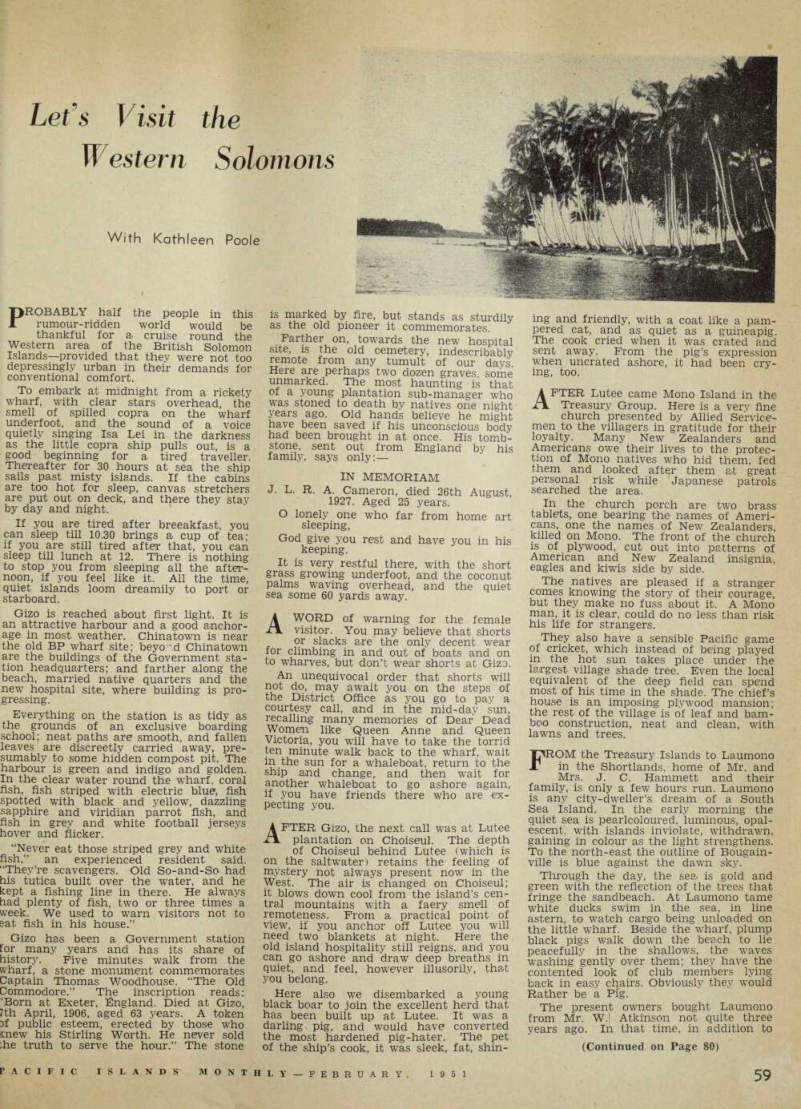
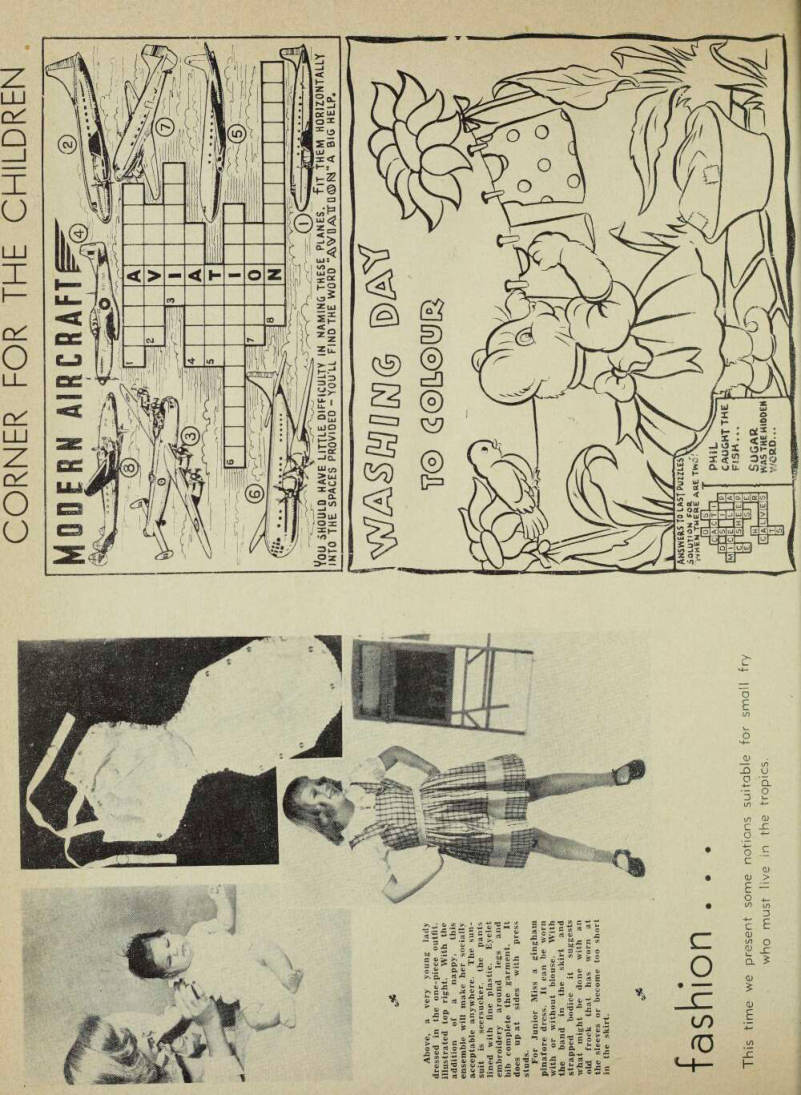
Let's Visit Western Solomons
PROBABLY half the people in this rumour-ridden world would be thankful for a. cruise round the Western area of the British Solomon Islands—provided that they were not too depressingly urban in their demands for conventional comfort.
To embark at midnight from a rickety wharf, with clear stars overhead, the smell of spilled copra on the wharf underfoot, and the sound of a voice quietly singing Isa Lei in the darkness as the little copra ship pulls out, is a good beginning for a tired traveller.
Thereafter for 30 hours at sea the ship sails past misty islands. If the cabins are too hot for sleep, canvas stretchers are put out on deck, and there they stay by day and night.
If you are tired after breeakfast, you can sleep till 10.30 brings a cup of tea; if you are still tired after that, you can sleep till lunch at 12. There is nothing to stop you from sleeping all the after noon, if you feel like it. All the time, quiet islands loom dreamily to port or starboard.
Gizo is reached about first light. It is an attractive harbour and a good anchor age in most weather. Chinatown is near the old BP wharf site; beyo'd Chinatown are the buildings of the Government sta tion headquarters; and farther along the beach, married native quarters and the new hospital site, where building is pro gressing.
Everything on the station is as tidy as the grounds of an exclusive boarding school; neat paths are smooth, and fallen leaves are discreetly carried away, pre sumably to some hidden compost pit. The harbour is green and indigo and golden.
In the clear water round the wharf, coral fish, fish striped with electric blue, fish spotted with black and yellow, dazzling sapphire and viridian parrot fish, and fish in grey and white football jerseys hover and flicker.
“Never eat those striped grey and white fish,” an experienced resident said.
“They’re scavengers. Old So-and-So had his tutica built over the water, and he kept a fishing line in there. He always had plenty of fish, two or three times a week. We used to warn visitors not to eat fish in his house.”
Gizo has been a Government station for many years and has its share of history. Five minutes walk from the wharf, a stone monument commemorates Captain Thomas Woodhouse, “The Old Commodore.” The inscription reads: ‘Born at Exeter, England. Died at Gizo, 7th April, 1906, aged 63 years. A token ef public esteem, erected by those who mew his Stirling Worth. He never sold :he truth to serve the hour.” The stone
is marked by fire, but stands as sturdily as the old pioneer it commemorates.
Farther on, towards the new hospital site, is the old cemetery, indescribably remote from any tumult of our days Here are perhaps two dozen graves, some unmarked. The most haunting is that of a young plantation sub-manager who was stoned to death by natives one night years ago. Old hands believe he might have been saved if his unconscious body had been brought in at once. His tomb stone, sent out from England by his family, says only:—
In Memoriam
J. L. R. A. Cameron, died 26th August, 1927. Aged 25 years.
O lonely one who far from home art sleeping, God give you rest and have you in his keeping.
It is very restful there, with the short grass growing underfoot, and the coconut palms waving overhead, and the quiet sea some 60 yards away.
A WORD of warning for the female visitor. You may believe that shorts or slacks are the only decent wear for climbing in and out of boats and on to wharves, but don’t wear shorts at Gizo.
An unequivocal order that shorts will not do, may await you on the steps of the District Office as you go to pay a courtesy call, and in the mid-day sun, recalling many memories of Dear Dead Women like Queen Anne and Queen Victoria, you will have to take the torrid ten minute walk back to the wharf, wait in the sun for a whaleboat, return to the ship and change, and then wait for another whaleboat to go ashore again, if you have friends there who are ex pecting you.
AFTER Gizo, the next call was at Lutee plantation on Choiseul. The depth of Choiseul behind Lutee (which is on the saltwater) retains the feeling of mystery not always present now in the West. The air is changed on Choiseul; it blows down cool from the island’s cen tral mountains with a faery smell of remoteness. From a practical point of view, if you anchor off Lutee you will need two blankets at night. Here the old island hospitality still reigns, and you can go ashore and draw deep breaths in quiet, and feel, however illusorily, that you belong.
Here also we disembarked a young black boar to join the excellent herd that has been built up at Lutee. It was a darling pig, and would have converted the most hardened pig-hater. The pet of the ship’s cook, it was sleek, fat, shin
mg and friendly, with a coat like a pam pered cat, and as quiet as a guineapig.
The cook cried when it was crated and sent away. From the pig’s expression when uncrated ashore, it had been cry ing, too.
AFTER Lutee came Mono Island in the Treasury Group. Here is a very fine church presented by Allied Service men to the villagers in gratitude for their loyalty. Many New Zealanders and Americans owe their lives to the protec tion of Mono natives who hid them, fed them and looked after them at great personal risk while Japanese patrols searched the area.
In the church porch are two brass tablets, one bearing the names of Ameri cans, one the names of New Zealanders, killed on Mono. The front of the church is of plywood, cut out into patterns of American and New Zealand insignia, eagles and kiwis side by side.
The natives are pleased if a stranger comes knowing the story of their courage, but they make no fuss about it. A Mono man, it is clear, could do no less than risk his life for strangers.
They also have a sensible Pacific game of cricket, which instead of being played in the hot sun takes place under the largest village shade tree. Even the local equivalent of the deep field can spend most of his time in the shade. The chief’s house is an imposing plywood mansion; the rest of the village is of leaf and bam boo construction, neat and clean, with lawns and trees.
FROM the Treasury Islands to Laumono in the Shortlands, home of Mr. and Mrs. J. C. Hammett and their family, is only a few hours run. Laumono is any city-dweller’s dream of a South Sea Island. In the early morning the quiet sea is pearlcoloured, luminous, opal escent. with islands inviolate, withdrawn, gaining in colour as the light strengthens.
To the north-east the outline of Bougain ville is blue against the dawn sky.
Through the day, the sea. is gold and green with the reflection of the trees that fringe the sandbeach. At Laumono tame white ducks swim in the sea, in line astern, to watch cargo being unloaded on the little wharf. Beside the wharf, plump black pigs walk down the bea-ch to lie peacefully in the shallows, the waves washing gently over them; they have the contented look of club members lying back in easy chairs. Obviously they would Rather be a Pig.
The present owners bought Laumono from Mr. W.| Atkinson not quite three years ago. In that time, in addition to
(Continued on Page 80)
With Kathleen Poole
clearing away heavy undergrowth, they have put up a big and beautiful leaf house and built up a small dairy herd, a flourishing collection of pigs, ducks and fowls, and have begun clearing other islands, in spite of the chronic lack of labour in the Shortlands.
The Shortlands villages have names like bells —Gaumai, Aliang, Maliai —their leaf houses resting behind white sand beaches in the clear morning light. At Nila, even the roofs of the little Roman
Catholic mission station, painted in the post-war manure-tint, so common in the islands, make admirable colour among the green leaves and bright hibiscus.
Beyond Nila comes the hardly recognis able sites of the old Government station at Falsi, the beautiful quiet channel be tween Faisi and Fauro, and Parolang plantation where Mrs. Cruickshank, brought up in the Shortlands many years ago when the territory was under Ger man rule and now nearing 80, is gradu ally reclaiming her plantation, after hav ing lost all her possessions in the last war evacuation and later bombing.
No war damage compensation is pay able in the Protectorate. rOM Parolang, the little ship turned homeward. A call was made at Lambu Lambu, New Georgia, where an explosion of high octane petrol drums during the war left a dismal hollow in the middle of the village. The high tide seeps m to make a swamp, the low tide goes out to leave a mudflat; at night, so they say, the crocodiles go wandering under the village houses, but the villagers are calmly rebuilding in the same place. The beautiful sheltered harbour and the reef outside are alive with fish of the most vivid and unlikely colours. If among a catch of reef fish at Lambu Lambu one turned up coloured in an exact replica of the Royal Stewart tartan it wouldnt look overdressed.
Sasamuga, the neat, pleasant Method ist mission station on Choiseul, was also visited on the return journey; it has a charming air of happiness and bubbles over with cheerful little native children.
Near the anchorage is a very large tree with sweet-scented flowers like orange blossom; it is old now, and has fallen forward, looking as if it was lying on one elbow on the beach. The oldest men can remember when it stood upright and tall, and was the recognised starting place from which headhunting parties set out for other islands.
The ship is heading for Honiara, smell ing pleasantly of copra with an occasional less attractive reminder of trochus, the cabin washbasin is full of cuttings being kept in water for planting: on the shelf are two newspaper bundles of damp roots, six fishhooks, a cigarette tin full of seeds and a very fine mat that was a present, and in your head are a hundred memories of beautiful places and good .^^nds— the lucky, kindly people who live in the West.
Advertisements & other items, p. 63 (1 item)
59
ACIFIC ISLANDS MONTHLY— FEBRUARY, 1951
acceptable anywhere. The sun
fashion . . .
This time we present some notions suitable for small fry who must live in the tropics.
Above, a very young lady dressed in the one-piece outfit, illustrated top right. With the addition of a nappy, this ensemble will make her socially
acceptable anywhere. The sun
suit is seersucker, the pants lined with fine plastic. Eyelet
embroidery around legs and
bib complete the garment. It does up at sides with press studs.
For Junior Miss a gingham pinafore dress. It can be worn with or without blouse. With the band in the skirt and
strapped bodice it suggests
what might be done with an old frock that has worn at the sleeves or become too short in the skirt.
Advertisements & other items, pp. 64-66 (2 items)
Corner For The Children
Burns Philp (New Guinea) Limited
General Merchants (Wholesale and Retail)
Shipping, Customs and General Agents
Head Office: PORT MORESBY, PAPUA
BRANCHES:
NEW GUINEA: Rabaul, Kokopo, Lae Cr Madang.
PAPUA: Samarai.
REPRESENTATIVES FOR:
AUSTRALIAN AGENTS:
LONDON AGENTS:
SAN FRANCISCO AGENTS:
QUEENSLAND INSURANCE CO. LTD.
LLOYD S OF LONDON
BURNS PHILP TRUST CO. LTD
BURNS, PHILP & CO. LTD.
All States.
BURNS, PHILP & CO. LTD.
"London House", 35 Crutched Friars, E.C.3.
BURNS, PHILP CO. OF SAN FRANCISCO INC 510 Matson Building.
Distributing Agents, Territory of Papua-New Guinea for:
SHELL COMPANY OF AUSTRALIA LIMITED
Petroleum Products
GENERAL MOTORS CORPORATION
Chevrolet, Buick, Pontiac and Oldsmobile Cars Chevrolet and GMC Trucks Frigidaire Refrigerators
VAUXHALL MOTORS LIMITED
Vauxhall Cars and Bedford Trucks
R. A. LISTER & CO., BRISTOL
Producers of Petrol, Paraffin and Diesel Engines Pumps and Lighting plants
RUSTON HORNSBY LIMITED
Engines
CROSSLEY MARINE ENGINES
A. B. DONALD LIMITED
RAROTONGA COOK ISLANDS
TELEGRAPHIC ADDRESS: “DONALD, RAROTONGA."
General Merchants (Wholesale Cr Retail) and Shipowners Importers & Exporters Branches Throughout Cook Islands Fire, Marine & Motor Vehicles Insurance Agents for Yorkshire
Insurance Co.
Lloyd's Agents.
Agents and Distributors for: ENGLAND. —Austin Cars & Trucks, Pye Radios, Dunlop Rubber Co.. Ltd., Vauxhall Cars & Trucks. R. A. Lister & Co., Ltd., Phillips' Cycles, Marples Tools.
U.S.A.—Remington Rand Corp., Radio Corp. of America, Champion Spark Plug Co.. Firestone Tyres, General Steamship Corp.
NEW ZEALAND.—Vacuum Oil Co. Pty., Ltd, Petroleum Products.
AUSTRALlA.—Wunderlich, Ltd , Cement Asbestos Products.
NORWAY.—O. Mustad & Sons, Fish Hooks.
SWEDEN.—B. A. HJorth & Co., Primus Products.
Sydney Agents:
BURNS, PHILP & CO., LTD.
Head Office:— A. B. DONALD, LTD., Auckland.
Associate Houses:—
ETABLISSEMENTS DONALD TAHITI,
Papeete, Society Islands.
DOMINION FRUIT CO., Suva, Fiji Islands.
CODES: Bentley's Complete Phrase, Acme
London Agents: San Francisco Agents: BURNS, PHILP & CO., LTD. BURNS, PHILP CO. OF SAN FRANCISCO.
FOR
GILLESPIE'S
Gillespie’s Anchor Flour is milled from selected high quality Australian wheats and is entoleted for purity. Its consistent high quality has made it the best-known, most asked-for brand of flour in the Islands. (Entoletion is a special new purifying process which reduces the risk of insect infestation).
ANCHOR
FLOUR
GILLESPIE BROS. PTY. LTD., ANCHOR FLOUR MILLS, SYDNEY G. 1.97
News From Santo
From Our Own Correspondent
Santo, Nh, Jan. 19.
A RECENT fire outbreak at the home of c\ Major Fregard, of Vila, completely destroyed the house and contents, tfajor Fregard came to the group six nonths ago. He was to have proceeded o the Solomons, but was diverted at the ast minute to the New Hebrides Condo ninium Government.
The high price for copra is causing local ilanters and traders to become very ac ive. At £95 (Australian) a ton, the price lets a new record and some of the older lands, while taking full advantage of the narket, do not quite like the “feel” of hings.
It is rumoured that France will be mable to supply shipping to remove the :opra from this Group. Never a strong naritime nation, France has many drains in her inadequate shipping owing to ighting in Indo-China. One pessimistic ilanter foresees the shipping position fold ng up within six months. However, ships :an still be chartered. One of the last lig copra ships to visit this Group—the Jam Hill—was operating under French barter. The hope is that copra will ontinue to be loaded at New Hebridean »orts with the regularity shown in the last.
Mr. Wilson will take over as Santo nanager for Burns Philp (NH) Ltd. in /larch. BP’s propose to erect a new store nd warehouse (this work is under way 10 w) and to construct three staff houses, idth a possibility of more in the future.
CHRISTMAS and New Year celebrations U went over with a bang here. Enter tainment for children is sadly lack ng and Maison Barrau are to be compli nented for their efforts in producing an .uthentic Father Christmas who handed ut presents to the kiddies from a taste ully decorated Christmas tree on Christ uas eve. Afterwards, the adults had heir treat in the shape of a champagne upper. Guests voted it “a wonderful ime.” It was the first time your corres iondent had seen six dozen quarts of hampagne assembled at the one time. n APT AIN SAVOIE recently returned U from NZ with the 285-ton steel ship II Retiro. It had been reported that the laptain and his associates were consider ng the purchase of MV Melva. El Re iro was built in 1901 and has been diesel onverted. It will carry inter-Group argo and make voyages to Sydney. rHE coconut telegraph tells us that the proposed scheme to bring Indonesian labour to the Group is definitely out. f this is correct, it is good news. It is understood that approximately 500 talians will shortly be brought to the jroup to ease the labour situation. r \UITE a few people are puzzled about qj the spurious and elusive “C. Jack son,” recently a correspondent to >IM. But there are a couple of clues -round and a few murky plans are being uade to snare the suspect.
RECENT' arrival was Mr. Frank Hen derson who came to assist his brother Herbert in his engineering msiness. Mr. Herb Henderson was due o take over the business operated by Mr. toy Gubbay, but a disastrous fire can died those plans. Mr. Henderson has >een fortunate enough to secure per nanently the premises he already occu >ied.
There has been an influx of young leople. They are here with their parents or the holidays after attending school in Noumea. Other than a small school for
young children run by the Nuns, Santo sadly lacks educational facilities, especially for older children. Vila, on the other hand, has quite a good school. Santo is more or less a boom town, therefore it will be some time before adequate school ing facilities are available here.
Fiji, like Sydney is having an onion famine. In December only 20 tons of onions were imported instead of a normal 100 tons. Prices ranged from lOd. to over 2/- per pound. NSW has had an onion famine since last June —due to failure of crops because of an abnormally wet season plus the fact that farmers are not interested in growing onions while the price is fixed—usually around sd. per
pound.
W. Samoan Cocoa Price
From Our Own Correspondent APIA, January 11.
AFTER inactivity during the holiday season the overseas cocoa market seems to have revived somewhat and sales have recently been effected at the rate of £260 FOB, Apia, per ton. A fur ther rise is confidently anticipated by growers.
It is difficult, at the present time, to estimate the extent of the damage done to the present crop by the heavy rainfall during December, but a large portion of the ripening pods and the flowers have turned black and prospects are not en couraging for the next half year.
Advertisements & other items, p. 67 (1 item)
Colyer Watson (Asss*) Ltd
mmmm. jpm -
JPSPriw'
*5 Wholesale and Retail Merchants —Sawmillers and Timber Merchants — Plantation Proprietors and Managing Agents—Ship Owners —
Shipping, Insurance and Customs Agents—Plantation Suppliers—
Exporters of Island Produce.
AGENTS FOR:
Australia-West Pacific Line.
Canton Insurance Office, Ltd.
Union Assurance Society, Ltd.
Aust. T. & G. Mutual Life Society, Ltd.
ASSOCIATED WITH;
Colyer, Watson Pty., Ltd., Sydney, Melbourne, Brisbane.
Colyer, Watson & Co., Ltd., Wellington, Auckland, Christchurch.
DISTRIBUTING AGENTS IN NEW GUINEA FOR:
Hillman, Humber, Sunbeam-Talbot, Chrysler and Plymouth Cars.
Commer, Karrier and Fargo Trucks.
Willys Overland Jeeps.
Chula Copra Dryers and Desiccated Coconut Machinery.
G.M. Marine and Industrial Engines.
Olympic Cables.
Tyres and Hygeia Dissolvenators.
Sherwin-Williams Paints.
Prefect Refrigerators.
Mullard Radios.
Aladdin Lamps.
Anchor and Tiger Beers.
Snowflake Unsweetened Evaporated Milk.
Pental Soaps.
COLYER WATSON (aSSS*) LTD
RAB A U L
MAD A N G
KAVI E N G
Concerning The Pua
Letter to the Editor AS I have lived in Aitutaki, I found your article on the game of Pua very interesting. I witnessed a tourna ment between Aitutaki and Atiu in 1947.
However, the statement that Pua origin ated in Aitutaki is open to doubt —I un derstand the game was brought over from Atiu. Your writer’s statement that 1,096 feet is over half a mile is open to challenge: According to my reckoning 1,096 feet equals 365 yards 1 foot which
is under a quarter of a mile—and a more reasonable distance for the Pua to travel.
I am, etc.,
Mangaia, Cl.
Jack Neale.
Mr. A. S. Taylor who has been a teacher with the NSW Department of Education recently joined the Methodist Mission for work in Fiji.
Mr. C. Rundnagel, planter of New Britain, arrived in Australia recently to spend a few months in Sydney and Tasmania.
Do You Know The “Atua”
By F. T. Goedicke-van Asten, ot Haapai, Tonga
IN 1913, while I was storekeeper for the Tongan Government, our Premier, Tuivakano, received a letter from the Governor of Fiji, stating that he had a request from the Curator of the Imperial Institute, in London, asking if he could persuade the Tonga Government to send a collection of Tonga artifacts, as Tonga was the only island of the South Pacific which was not represented in the Imperial Institute.
The Premier asked me if I would under take the task. I did; and I was very successful.
Before starting to pack for shipment, I asked the Premier if he would like to have a look at the collection' and mentioned the different articles collected. When I told him that I had got a stone Atua he laughed and said that the only stone Atua in existence was at his home at Nu kunuku.
I invited him over to my office; and, when he saw the Atua (a large stone with a hole through the centre) he became ex cited and asked who gave it to me. I told him that our Chief Justice had made the donation.
“How did he get hold of it?” he asked, I could only reply: “Ask him.”
Now, Tuivakana must have been mis taken, Rev. A. H. Woods. MA, principal of Tuoi College, Tonga, in his “History and Geography of Tonga,” writes in chap ter 3, Ancient Tongan Religion:— “Stones were worshipped: Examples of these are two stones which are at the Museum at Nafuatu, Tonga. These gods had their priests, to whom sacrifices were made in the shape of human bodies. Later a finger was cut off, instead of taking a person’s life, and the finger was offered as a sacrifice to the god.”
When I arrived in Tonga over 60 years ago, almost every Tongan I saw had lost at least one finger and indeed a few old people in this condition are still alive.
When Sir S. Escott, Governor of Fiji, visited Tonga in 1915, I was introduced to His Excellency, who told me that he had received a letter from the Imperial Insti tute. London, asking him to thank the gentleman who had sent the splendid col lection of Tongan artifacts, and that among the articles was one which he valued very much, an “Atua,” or Tongan god.
I since have received a request from an old pen-friend of mine, the Duke of Newcastle, that I try to find for him an Atua for his private collection. He had seen that ancient Atua which I was in strumental in sending to the Imperial Institute.
Death Of Mr. D. Garter
NOUMEA learnt with regret of the re cent death in Sydney of Mr. Douglas Carter at the age of 72. For many years he was manager of the great Tie baghi chrome mine in New Caledonia, and on his retirement he continued in mining as analyst and chemist in which capacity he rendered the Colony much service. After the recent war he gave up residence in New Caledonia and went to Sydney, but he continued his interest in the French Colony with whose history he was far better acquainted than are most lifelong French residents.
Mrs. Lucy Brodie, of Lae, New Guinea, arrived in Sydney in January, on hoh» day Most of the members of her family are’now settled permanently in Papua- New Guinea.
Advertisements & other items, pp. 68-70 (3 items)
Sherwin-Williams Paint
we hand it to
YOU
Real economy demands that you buy only good paint the best paint. Sherwin- Williams Paints and Finishes are the result of constant and intensive research by a compact corps of field specialists and qualified paint consultants. The combined fruits of this extensive research and developmental work by the Sherwin-Williams companies throughout the Empire are available to you when you specify Sherwin-Williams Paint for all tough paint assignments . . . especially those under tropical climatic conditions.
Sherwin-Williams Paint
To meet the test of the tropics SAVE THE SURFACE AND YOU SAVE A
65
PACIFIC ISLANDS MONTHLY FEBRUARY, 1951
HOT WATER FROM THE
SUN'S RAYS
(Continued from Page 47)
Nelson & Robertson Is
&IL
Stewarts and Lloyds (Australia) Pty. Ltd.
Manufacturers of "S&L" PIPES and FITTINGS for GAS. WATER, STEAM and other purposes.
AND Distributors of:
MILD STEEL BARS, PLATES and SECTIONS;
GALVANISED IRON; BOLTS and NUTS; ELECTRODES
and WELDING EQUIPMENT.
Stewarts and Lloyds (Australia) pt y . Ltd.
SVDNEX WAREHOUSE - - - Herbert Street. St. Leonards BRISBANE WAREHOUSE - Montague Road, South Brisbane MELBOURNE WAREHOUSE - - City Road, South Melbourne Telegraphic Address: "Tubes" Sydney, Brisbane or Melbourne
NELSON and ROBERTSON Pty. Ltd.
Established 1895
Shipowners - Brokers and
Islands Merchants
All classes of Merchandise purchased at Best Wholesale Prices. Original Invoices supplied to Island Clients. Cocoa Beans, Copra, Rubber, Trochus Shell and All Islands Produce Sold on Commission.
Entrust your requirements to the firm with fifty-five years' practical experience in the Pacific Islands.
Prompt attention given to all inquiries
NELSON & ROBERTSON IS
12 SPRING STREET, SYDNEY, AUSTRALIA
Telegraphic Address: IVAN, SYDNEY.
GREAT NEWS FOR MOTORISTS
Mobiloil
3
IN ONE
MODERN OIL QUALITIES
CICAtS
OX/PAT/O#
COSKICArt*
f 1 lr r- ; v
VACUUM
PRODUCT
For better all-round protection against engine wear . , always insist on, and see you get-Triple Action Mobiloil-it Cleans as it Protects and Lubricates.
It Cleans because of its high detergent characteristics preventing formation of deposits.
It Protects because it resists oxidation and foaming.
It Lubricates better because it maintains correct body despite temperature changes.
VACUUM
COMPANY
Polluted Water In Samoan
Villages
IN a letter to the editor, Mr. Robert Lativer, of Apia, Western Samoa, com plains in strong language of the fail ure of the Government to provide the four villages of Fealeasiu, Fasito’o, Leul umoega and Nofoalii (including the hospital at Leulumoega) with a water supply and sanitary conveniences.
Those villages are only 12-16 miles from Apia, on the beach road to the air port.
There seems no excuse for the failure to give such amenities to some 4,000 people —there are hundreds of thousands of pounds in the Samoan treasury, and there are abundant supplies of good water, near at hand, coming down from the in terior ranges.
The natives use some of the beaches near the villages as latrines and dumping grounds for rubbish, and some are ser iously polluted.
“Any day or night,” says the writer, “one may see Samoan women scooping from holes sunk in the beach sand, the fresh water which has seeped down from the high country behind. This is good water, but is now in constant danger of pollution. Some villages have wells, but these are shallow and near old grave yards, and the water is not fit for drink ing. There is one well at Fasito’o village which has never failed to produce typhoid cases every year or two. Chief Medical Officer Monaghan inspected it some years ago, but nothing was done about it.
“We have the funds and we have plenty of water available for a service. Why is nothing done?”
Mr. Ken. McKinnon has returned to New Guinea after spending some months with his parents at Sherwood, Brisbane.
M. Paul Mercier, well known in business and sporting circles in Noumea, New Caledonia, was in Sydney in December.
He markets the Mercier bicycle on which Andre Beyney won the New Caledonia sprint titles a few weeks ago. M. Paul is brother to Emile Mercier, Sydney Sun cartoonist whose screwey drawings, al though French flavoured, have become very popular and, indeed, part of th© Australian way of life.
Messageries Maritimes has increased price of passages from Noumea to Europe by 15 per cent. The new prices, in Pacific francs, are; 33,455 francs first class; 20,000 francs third class; and 12,000 francs (rationnaires) fourth class.
Advertisements & other items, p. 71 (1 item)
Steamships Trading Company Ltd.
Here’s Hope
For A
Persistent Worry
CONSTIPATION, forerunner of many troubles, affects people of all ages and walks of life and causes much annoyance and worry.
When the bowels refuse to work naturally and regularly, the body absorbs poisons from the waste that remains in the system. Constipation brings sick headaches, biliousness, coated tongue and unpleasant breath, flatulence, loss of appetite, blemishes and other troubles which quickly upset your health and well-being.
These troubles are easily corrected by safe, gentle Pinkettes for you and all the family.
Pinkettes are simple to take; and do not have harsh after-effects which can be dangerous.
Being compounded of harmless vegetable ingredients only, Pinkettes act in Nature’s way.
Thousands and thousands of people have found Pinkettes the ideal laxative, because they are not habit-forming and the dose is reduced as they make you regular. Always at chemists and stores.
STEAMSHIPS TRADING COMPANY LTD.
PORT MORESBY AND SAMARA! PAPUA
Wholesale & Retail Merchants, Planters, Sawmillers, Engineers, Slip
Proprietors, Shipping, Customs and Insurance Agents.
MANAGING AGENTS for:
SAWMILLERS & TRADERS LTD.
CORAL SEAS INSURANCE CO. LTD
ACME BAKERY COMPANY.
MARIBOI RUBBER LTD.
RUBBERLANDS LTD.
KEREMA RUBBER PLANTATIONS LTD.
COCOALANDS LTD.
AGENCIES:
BANKERS & TRADERS INSURANCE CO. LTD.
VACUUM OIL CO. PTY., LTD.
DIRECTORATE OP SHIPPING—Papua-New
Guinea Division.
ROYAL INTEROCEAN LINE.
KOKE BAGU PTY., LTD.
TRANS OCEANIC AIRWAYS.
DISTRIBUTORS IN PAPUA for:
ARMSTRONG-HOLLAND PTY., LTD. INTERNATIONAL HARVESTER CO. OF AUST. LTD.
Earth Moving and Logging Equipment. International Trucks,
WILLYS-OVERLAND EXPORT CORPORATION.
Jeep cars, etc.
McCormick-Deering Farming Machinery, Defender Refrigerators.
HILLMAN MOTOR CARS.
SYDNEY AGENTS: NELSON & ROBERTSON PTY. LTD., 12 SPRING STREET.
Honiara Museum

Preserving Native Arts in BSI
From Our Own Correspondent HONIARA, January 7.
AS SOON as possible, the BSIP Govern ment intends to build a Museum at Honiara, and also a Curio Shop, to encourage native craftsmanship in the Protectorate, which, to everybody’s re gret, seems to be in some danger of dy ing out.
It is believed that some Mission schools hold annual exhibitions of carvings, model
canoes and so on, with prizes given for the best workmanship. At one school in the Marovo Lagoon an old man from one of the nearby villages has recently been appointed as a technical assistant to teach the children these traditional arts.
Modern examples of the fine mother-of pearl inlays on wood, in which the old craftsmen excelled, are seldom executed with the old detail and finish, and this is one art which it is hoped to revive.
Many of the best examples of old work manship were sold or given away to the American forces during the war, and comparatively few good pieces now remain in the Protectorate.
Christmas Was Late This
Year In Bsi
Prom Our Own Correspondent
Honiara, Jan. 7.
BSIP residents were disappointed when the Qantas aircraft, which arrived just before Christmas, brought no Christmas mail or freight, and no pasengers, owing to some oversight at the Australian end.
A special Qantas plane arrived in Honiara on December 27, bringing freight and Christmas mail.
Honiara’s Christmas and New Year festivities (in addition to numerous private parties) were held at the Hotel Woodford, run by Mr. K. H. D. Hay and Mrs. E. K. Manning.
The hotel has one small residential wing, occupied by permanents; another resi dential wing is at present being built.
The bar, lounge and dance floor are housed in a temporary leaf building, which was made attractive by brilliant decorations of hibiscus, frangipani and the red, wild ginger flower.
A special Dinner and dance were held on Christmas Day, and another on New Year’s Eve; both were attended by as many people as the hotel could cater for.
Honiara is still small enough for every body to be able to know everybody, and both at private and hotel parties, resi dents must have had one of the friendliest Christmases in the world.
During December earthquakes were felt In the island of Lifou (Loyalty group), situated between the New Caledonian mainland and the New Hebrides.
R. S. Scharberth, a former German Luftwaffe anti-aircraft gunner recently arrived in Rabaul to open an agency for a German firm. The Occupation authorities in Germany recently passed him as having had no Nazi sympathies.
Advertisements & other items, p. 72 (1 item)
Heinz Green Was
Tallennan & Company Pty. Limited
60 YORK STREET, SYDNEY, N.S.W.
Also Brisbane, Melbourne, Adelaide, Perth.
Buying Agents of all Australian Products ..
Sole Exporters for numerous Australian
Manufacturers
Careful and Prompt Attention to all Inquiries Send us your inquiries which will have our careful and prompt attention.
WRITE FOR DETAILED PRICE LIST
Cable Address: “FRESHET,” Sydney.
2/
HEINZ GREEN WAS
picked when perfect
to give you that
just-picked flavour
.. always
H. J. HEINZ CO. PTY. LTD
479 Bourke Street, Sydney. * S* vm M*a ''./m S 7
Problem of Native Education in Papua-


‘Not Even Scratching The Ground’
New Guinea
By R. W. Robson
ASK any knowledgeable man in Papua- New-Guinea, “What is the Adminis tration’s biggest problem here?’’ and he almost certainly will reply, “The edu cation of the natives.”
Australia holds Papua-New Guinea (PNG for short) primarily because the huge 2,000-miles-long island is her main northern barrier against Asia. None theless, the obligation is upon her to help the li million primitive natives in her care to a better standard of life.
Easily said —but think what it im plies. These are Stone Age folk, wrapped in dirt, disease, ignorance and supersti tion. We are asked to make them appre ciate cleanliness, clothes, sanitation, and all mod. cons., including newspapers.
How are we to do it? The uninstructed, of course, will reply that that is simple: just send them to school—catch them young and train them.
Human beings can make no real pro gress until they and their fellow-villagers can read, count and make a written record. In the beginning, someone must instruct them. That someone must know their language. That Is the ABC of it— but it is fundamental.
AMONG the ll million natives of PNG, there are hundreds of different languages I* is quite a simple matter for a Government official, or a devoted missionary, to learn enough of the language of Valley A to give the natives instructions in reading and writ ing. But the Valley A language is of no use in Valley B; and if the devoted missionary acquires a knowledge of the Valley B talk, he can get nowhere with the Valley C community—their tongue again, is completely different.
To introduce even the simplest edu cation on a worth-while scale, we must have method and design, a system of printed records, a syllabus. What lan guage shall we employ? It would be absurd to try to design a system in more than one or two languages. Yet, if there is to be general education, the children of tribes speaking hundreds of langu ages must be instructed. If there is to be native progress, the men of Sepik must be able to talk with the people of the Highlands, or New Britain, or Papua.
In PNG, in October, I became inter ested in this problem, and then fascinated by it. It must be solved—yet there does not seem to be a solution.
I spent hours with the patient William C. Groves, Director of Education. I asked him scores of questions which, to a man of his wide experience of South Pacific native education, must have seemed foolish and piffling. He gave me all the information he could; he even spent a day with me on the Sogeri high lands, behind Moresby, showing me a training-school and how it works.
But although, like Omar, I visited doc tor and sage, and heard great argument, I came out by the same door as in I went. The education system of PNG sincere, scientific and eager for the job; but it is not even scratching the ground which it is supposed to culti vax6.
No one has seen a Papua-New Guinea budget since the war. In the opinion of the Port Moresby-Can oerra panjandrums, that is something inat is not for the common gaze of the Uninstructed. So I do not know what
proportion of the five millions which Australia annually pours into PNG dis appears under the heading of Education.
Whatever it is, it is partly wasted.
There is no discernible education policy.
There can be no general plan governing education until there is complete official agreement concerning the language
which is to be used as the vehicle of education. There seems to be no such agreement.
Mr. Groves’s Department of Education seems to be concerned more with what might be called secondary education—
he careful instruction in organised arracks of small groups of selected oung natives (who are being trained s clerks, medical assistants, village chool-teachers, technicians of various inds) and with the maintenance of a ew technical schools. There are very, ery few village schools maintained by he Administration.
SCATTERED far and wide over the Territory there is a limited number of village schools, maintained by he Christian missions. Practically all he mission stations devote as much of heir activities to teaching village child en as to Christianising the adult natives -which, of course, is as it should be. I id not ascertain the total number of ative children thus under instruction, ut it can be only a very small proportion f all the children.
No one will question the value of the ducational work being done by the mis ions; but I was appalled to learn that lere is no co-ordinating plan or author ,y over this missionary activity. Each lission goes its own way, according to ,s own jealously guarded plan. All, more r less, use the printed word; but some, i this, use a selected regional lan uage; some use Pidgin, adapted in arious ways; and some, simple English.
That is not educating the natives in ae way that should be desired by the dministration.
If there is to be a general improve ient in native standards of life, directed wards the ultimate goal of partial jlf-government, the mass of natives lust be brought to a. stage where they in directly receive and understand any jmmunications the Administration de res to make to them. I could find no fidence that the educational work of the lission bodies is being co-ordinated and laped to this or any other end. It jems to be today, a.s it has been for
half a century, a case of every mission station working for itself, ignoring any over-all plan of native training, and re fusing to think outside its own little district.
THE need for some authority to co ordinate mission activities in the field of native education was recog nised long ago. I remember discussing it with the late Administrator Tom Griffith, about 1934; and he told me that he then was planning a far-reaching con ference with the mission bodies, and that he found the missionaries interested and co-operative. Canberra pinpricks forced him out of office before he achieved any thing in this field, however.
Fifteen years have passed, and the position seems to be unaltered. I was told in Moresby that there is no Native Edu cation Ordinance in existence, which might give the Administration control over mission education activities, but that something may be done soon.
I AM no stranger in the South Pacific Islands: but, no matter where I was in PNG, I found it most difficult to communicate even the simplest idea or wish to these natives. One ordered dishes from the hotel menus by the num bers on the margins; one directed taxi drivers in Pidgin, or not at all. As I cannot speak Pidgin, I found myself con stantly appealing for help.
This is a reproach upon a quarter century of Australian-controlled Adminis tration. But wherein has the Administra tion failed?
I think its failure lies in the inability of the present and past Administrators to grasp the fundamentals of this thing; or if they grasped it in their reluctance to take the ruthless action that is neces sary. The fundamental, of course, is the adoption of a lingua franca —or even two or three common languages—and
then the rigid enforcement through every variety of school of the use of that lan guage. If that had been done when Australia took over New Guinea, over 25 years ago the administrative, indus trial and social conditions in the country would have been vastly different today.
Here, there, everywhere, I asked old Territorians: “If it is necessary to im pose a common language on these natives, what language should it be?’’ Some were for simple English, some for Pidgin, some
for a regional language with wide affilia tions, like Motuan. There were strong arguments for each.
I remembered the late Sir Hubert Murray’s long, consistent advocacy of Motuan, and what he achieved. Even to day there still is no Pidgin in the old Territory of Papua. I recalled, also, that a century ago there wa-s a certain con fusion of tongues in Fiji, and that wise missionaries then practically enforced the
use of the Bau tongue which, today, is the common language of Fiji, I. a wandering layman, am in no way qualified to argue in favour of any lan guage in PNG. I can only assert, with confidence, that there can be no real progress in native education, native wel fare and native government there until this language problem is solved, mHE night before I left Moresby I had 1 the priviledge of sitting on the listening side of a long discussion
and. argument, on this very question*! between two old friends of mine—Major* G. S. Kennedy, and Native Labour Direc tor W. R. Humphries. Kennedy’s West ern Pacific record as a. Solomon Islands? official, and a wartime leader of under cover forces against the Japanese, is well known. Dear old “Dickie” Humphries,B just killed in the Lamington disaster was on the point of retirement after mores than 40 years’ good service in the Papuac and PNG Administrations.
Kennedy believes that the adoption ot( Pidgin, on a reasonably scientific basis, g would solve the language problem. Hum phries was for simple English—although,! as an old Murray man, he still had as strong leaning towards Motuan.
The argument went on for about two hours; and in that time I learned mores about the problem of language, as seem through the eyes of practical and experi enced Administrative officials, than I had) ever known.
Especially did I form a new regard fon< the much-execrated Pidgin. challenged the generally-accepted view/ that one cannot, with Pidgin, express am abstract idea. He insisted that, if ex-; perts would take this Beche-de-Mer stufffi —which is now virtually the linguas. franca of industrial New Guinea, and oh a large section of the PNG Administra-, tion—and build upon it a carefully de- 1 vised vocabulary and extend its grammar and syntax (thus giving it a semblance; of rule and regulation) the language diffi-j culty in PNG would be solved in less; than a decade.
Humphries would not have it that He argued that it would be just as prac-; tical to force simple English upon the; natives, and to give them a good start" in civilisation, as to debauch them cul-J turally by giving them a permanent union with Pidgin. With Pidgin, he said, thei natives’ acquisition of a real education would be greatly retarded.
Kennedy retorted that, whether we like t or not, Pidgin is in PNG to stay. It s gaining new adherents every day. Even he Chimbus (the new labour battalions rom the Highlands) are adopting it. Why lot use it as a short cut to the educa ion of the PNG masses?
He did not urge its recognition as an istablished language—only as- a means to l very desirable end.
I leave the discussion there. It clearly s a matter for the experts. Why does he Administration not bring the experts nto the picture, and decide this question, 0 that the real work of education can iroceed? yro one can fail to be impressed with [M Sogeri—with the coolness and beauty of this educational training-camp in he mountains, the keen enthusiasm of Director “Bill” Groves and School Prin :ipal L. C. Unwin, and the passionate ;agerness to learn which every man of ,he three-score natives displayed.
Here there was a small handful of Euro >ean teachers training a. larger handful >f native students to become teachers of ullage schools. That seems a perfectly nund idea. But there were only two or hree dozen probable native teachers, vhere there should be hundreds under reparation. Groves told me that there ire two other similar training establish nents —one at Keravat, near Rabaul, and me at Dreger, near Lae. The personnel it those places is smaller than at Sogeri. ‘ But —but it’s ridiculous,” I spluttered.
You can’t educate the natives without lative teachers. Why aren’t you turning hem out in hundreds?”
The Director gently reminded me that mu cannot produce native teachers unless mu have European teachers to train the lative teachers. And PNG can get only 1 trickle of trained Europeans. I re nembered, then, the staff-starved con dition of our schools in Australia. Not nuch hope for impressive expansion of he PNG education system while there ire not enough white teachers to go mund down South, in Australia. One muld not blame the Administration for hat.
I wandered off around the station. I bund a lighting system that had broken iown; a water-supply system that, owing ,o lack of parts and know-how, would not ;upply water; a fine lot of carpentry ools, but no timber to use them on; a iemand for timber, wherewith to make he station more comfortable and secure, mt no sawmill within reach.
The PNG Administration should centre he world “Frustration” in its coat-of irms.
Advertisements & other items, pp. 73-76 (1 item)
I Pan A
Send us your orders for developing, printing
ENLARGING AND
COPYING FROM OLD PHOTOS
All Photographic Supplies.
CAINE’S STUDIOS, SUVA
Box 8. (Estb. 1904) ’Phone: 68.
PROTECT THOSE TEETH!
PROTECT THA T SMILEi
with
I PAN A
TOOTH PASTE
Dentists know that you can't have sound teeth unless you have healthy gums. That's why you should always use IPANA.
IPANA not only keeps teeth radiantly clean . . . but it stimulates the gums, keeps them firm and healthy, and guards against decay.
You’ll like IPANA . . . it’s refreshingly different!
A O o T.
A & & -0 7 O' A r to 4 o
fiO/f
9 *e. > o CO Ms Sold Everywhere
A PRODUCT OF T]iy BRISTOL-MYERS
8M33-49
Price at Works (6 ft. Length): m £4O/10/ Extra for 10-inch additional shelf and brackets (if required) : £2 Cost of packing and transport to wharf depends on the number and sizes of counters required. A quotation for packing will be submitted promptly upon request. 4 ft. Length: £27 8 ft. Length: £52
This Modern Display
Counter will Help to
Sell Goods in Your
Store!
(and it’s specially built for Export ) Another view of the “Brahol Export Counter case, showing width of counter space
BRIEF SPECIFICATIONS
Po help you get an accurate picture of the “Brahol Special Export Glass Counter Case, here are the main specifications: Overall size is 6 feet long x 1 ft. 9 in. deep x 3 ft. 3 in. high. Made from first-class, wellseasoned Queensland Maple, hand french polished, wax finished, in natural maple colour. Glass parts As smart as those in leading Australian city stores, and built by a firm that has been making fine store anc office fittings for over a third of a century.
Moreover, it is specially built for export, so that it carr be readily securely packed, and assembled by anyone from simple directions, in an hour, with no tools othe than a screwdriver. Retailers all over the world have learned the selling value of modern display equipment and this "silent salesman" will soon pay for itself ir increased sales. ire inch British plate glass.
Phe inside is lacquered ivory colour, messed base is lacquered burgundy. and the re-
BRAY & HOLLIDAY
PTY. LTD.
rhere is a pair of solid core sliding doors, and one ?lass shelf, 14 inches wide, on adjustable nickel- Dlated brackets.
Storage space below is 11 inches high.
Phe plate glass front is 22 inches high.
Makers of Fine Store and Office
Fittings for over a third of a century Brahol House, 66-74 McLachlan Avenue, Rushcutter Bay, Sydney. Telephone: FA 4121 nr, a o v-\ z-1 TQlofrronViif» AddrPSS! “Brahol.
SPECIALISING IN
PACIFIC ISLAND IMSURANCES
FIRE—MOTOR VEHICLE
MARINE—HULLS AND CARGO
EMPLOYER’S LIABILITY
BONDS —in accordance with
ADMINISTRATION ORDINANCES.
COPRA INSURED FROM DRIER
TO BUYER.
AND ALL OTHER CLASSES ARRANGED
AT LOWEST CURRENT RATES.
Established Agencies throughout the Territory of Papua and New Guinea.
Managing Agents: New Guinea Company Limited.
Island Representative: G. D. A. Kent. Rabaul Brai.'h
Southern Pacific Insurance
CO., LTD.
HEAD OFFICE; 60 HUNTER STREET,
SYDNEY.
ETABLISSEMENTS DONALD TAHITI
HEAD OFFICE—QUAI DU COMMERCE—PAPEETE
TELEGRAPHIC ADDRESS—“DONALD, PAPEETE”
General Merchants (Wholesale & Retail) & Shipowners
Importers & Exporters—Branches Throughout Marquesas Islands
Lloyd’s Agents
ASSOCIATE
HOUSES:
A. B DONALD, LTD.
AUCKLAND, NEW ZEALAND.
A. B DONALD. LTD.
RAROTONGA, COOK ISLANDS,
DOMINION FRUIT CO-
SUVA, FIJI ISLANDS.
Agents and Distributors for :
FRANCE:
HENNESSY COGNACS
MARIE BRIZARD & ROGER
LIQUEURS
CHARLES HEIDSIECK
CHAMPAGNES
PERRIER WATER
GRUBER BEER
U.S.A.:
GENERAL STEAMSHIP CORP.
RADIO CORP. OF AMERICA
BROWN & WILLIAMSON, LTD.
CIGARETTES: LUCKY STRIKE,
WINGS, OLD GOLD
CHAMPION SPARK PLUG CO.
RAINIER BEER
ENGLAND:
RECKITT & COLMAN
LTD.
PHILLIPS BICYCLES
THE BANK LINE LTD.
NEW ZEALAND:
VACUUM OIL CO. PTY., LTD.
PETROLEUM PRODUCTS
SWEDEN:
HJORTH & CO.
PRIMUS STOVES
Sydney Agents : London Agents : San Francisco Agents : Agents in France : BURNS, PHILP ft CO., LTD. BURNS, PHILP ft CO.. LTD. BURNS, PHILP CO. OF BARTH ft CIE, PARIS.
SAN FRANCISCO. A. BICKART, MARSEILLES.
Serving the Needs of the Cook Islands . . .
UNITED ISLAND TRADERS LTD.
(Established 1930)
P.O. BOX 42, RAROTONGA, COOK ISLANDS.
Managing Director: W. H. Watson.
IMPORTERS OF:-
Cotton & Silk Piece Goods Apparel & Drapery Building Materials Musical Instruments Trade Jewellery Secretary: R. J. A. Ingram, A.R.A., N.Z.
EXPORTERS OF:-
Tomatoes & Cassava Tropical Fruits Sea-shells & Necklaces Island Handicrafts "Broad-last" Footwear STAMP DEALERS & SUPPLIERS OF ISLAND PHOTOS
INQUIRIES INVITED.
Cables: Bankers: “Watson,” Rarotonga. Bank of N.Z. Lid., Shortland St., Auckland. lI.K. Agents: Geo. H. Penney & Co. Ltd., 197 Aldersgate St., London, E.C.I.
/ >S' j /&y/ /g/' * W „ trovical thirst than * i. a tropica 1 i I There’s no /iner «-»y «» qnen gR B . Loger UJ^ firm f< ivourite with men
TOOTH'S
LAGER
brewed and
BOTTLED
Y TO
OTH &
CO. limited
Ngreased P-Ng Copra Yield

Last Year
A LTHOUGH still below pre-war figures, total exports of copra from Papua- New Guinea have increased rapidly n the last three years.
Figures released by the Production Control Board recently give exports for he year ending December 31, 1950, as >B,OOO tons, compared with 61,000 tons in L 949, and 48,000 tons in 1948. Stimulated )y high prices, recovery of copra produc tion has been quicker than anticipated.
The maximum exported from the com bined territories before the war was 87,000 tons —the bulk of it coming from the
Mandated Territory.
It is even more interesting to compare the average price of New Guinea copra for the years between the wars with to day’s fixed PCB price of £4B/10/oer ton (it will go up another £5 in March). In the 20’s the price fluctuated between £l5 and £22. By 1933-34 it had dropped to the record low of £4/11/- per ton. From this point it climbed slowly
until it was, in 1939, selling in London at about £l2 sterling. In the early years of the war, Pacific copra generally relapsed into the doldrums owing to lack of shipping to lift it, but again became valuable when the Japs over-ran most ol the copra producing areas of Indonesia, Philippines and South Pacific.
In the post-war years the copra price, with most other primary products prices, has gone spiralling ever-upwards.
Mr. and Mrs. Alan Champion, of Higaturu, Papua, where Mr. Champion is ADO, are two of the few residents of that area who are still alive. Their home is
now buried under about 10 feet of volcanic ash. The couple arrived in Brisbane on three months’ leave on January 24. Before he left Higaturu Mr.
Champion had been ill from pleurisy. He wanted to stay at the station until it was time for them to leave for South, but Mrs. Champion insisted that he have a few days rest in Moresby first. If they had stayed at Higaturu they, too, would probably have become volcano victims.
The marriage took place in Sydney on January 24 of Miss Judith Nichol to Mr.
Bruce McLeod, of Radio Station V2J, Honiara, BSI.
Advertisements & other items, pp. 77-78 (2 items)
Commonwealth Bank
03 find the many Commonwealth Bank services of great assistance if you are engaged in business or trading of any kind. Wide experience of local and overseas trade enables our Island Branches to help you in matters relating to importing and exporting, finance and exchange.
The Commonwealth Bank offers complete Trading Bank facilities. All types of commercial enterprise may be financed. All advances are made at low rates of interest.
With 420 Branches in Australia, Branches in London, and correspondent Banks in all countries, the Commonwealth Bank provides a world-wide service.
Commonwealth Bank
of Australia.
CBOS-S.Bt
ISLAND BRANCHES ARE SITUATED AT:-
RABAUL, PORT MORESBY. LAE AND MADANG. COMPLETE TRADING AND SAVINGS BANK SERVICES ARE AVAILABLE
AT ALL THESE BRANCHES. ENQUIRIES WELCOMED
THE MOST COMPLETE TRADING BANK SERVICE IN THE ISLANDS
World-Wid
TROPICAL
0 e
MOND
Vr V* A * V c TV\^ OF
ion
RECEIVERS
CRAMMOND TROPIC EAGLE
Most famous tropic-proofed and completely sealed receiver in the world to-day. The designers’ claim that range is unlimited and reception perfect anywhere throughout the world has been fully justified by the reports received from hundreds of enthusiastic owners. Three Years’ Guarantee and easy terms are available wherever you live.
CRAMMOND
TROPIC HAWK
This is a 2-unit receiver especially designed for Patrol Officers and others who require absolute portability and dependability. Combined weight of both cabinets —32 lb.
Measurements of each cabinet —15 x 9 x 9. This set covers from 16- 150 metres shortwaves only. Three Years’ Guarantee and easy terms wherever you live.
I Features exclusive to both sets: Completely Tropic Proofed, Built-in Moisture Absorber, and available in Vibrator or All Dry Cell.
Write for particulars to-day!
CRAMMOND RADIO
TROPICRLOII/ISION
H/o 8 QUEEN STREET . BRISBANE
74
FEBRUARY, 1951-PACIFIC ISLANDS MONTHL
Some Girls Of Old Tahiti
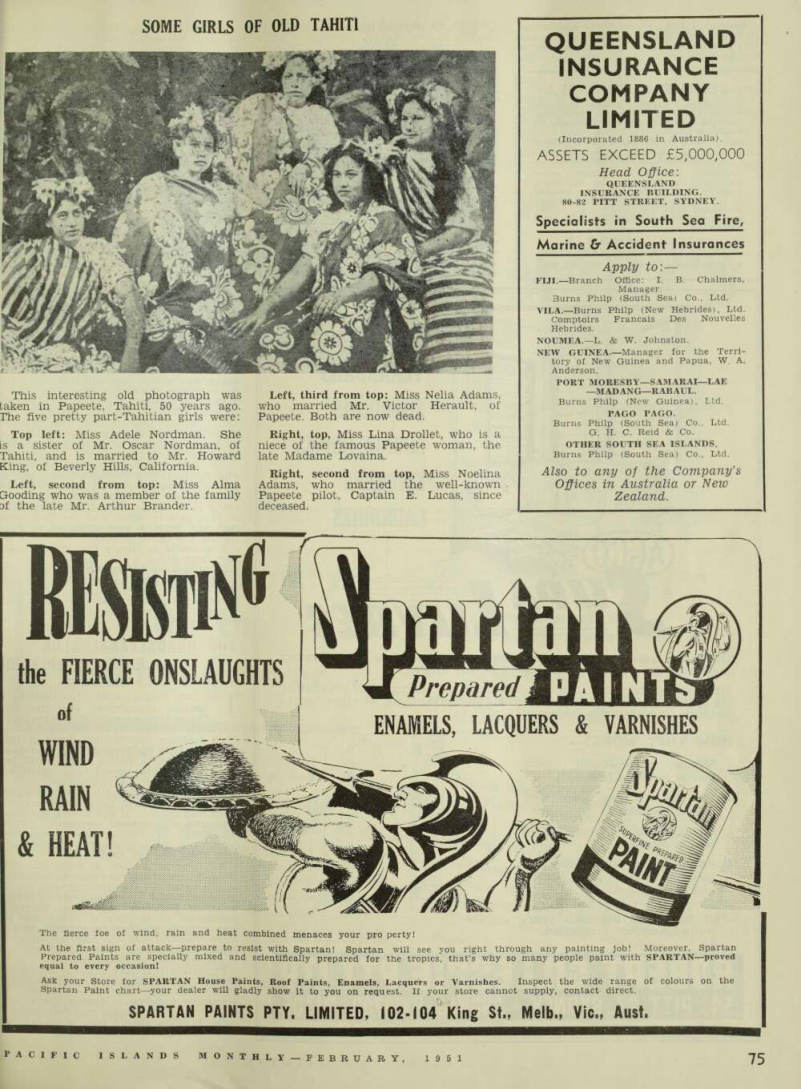
This interesting old photograph was taken in Papeete, Tahiti, 50 years ago.
The five pretty part-Tahitian girls were: Top left: Miss Adele Nordman. She Is a sister of Mr. Oscar Nordman, of Tahiti, and is married to Mr. Howard King, of Beverly Hills, California.
Left, second from top: Miss Alma Gooding who was a member of the family Df the late Mr. Arthur Brander.
Left, third from top: Miss Nelia Adams, who married Mr. Victor Herault, of Papeete. Both are now dead.
Right, top, Miss Lina Drollet, who is a niece of the famous Papeete woman, the late Madame Lovaina.
Right, second from top, Miss Noelina Adams, who married the well-known Papeete pilot, Captain E. Lucas, since deceased.
Bishop Hand (Coadjutor Bishop of New Guinea) was the guest of Mr. and Mrs. Symes of Ascot, during his stay in Brisbane.
Advertisements & other items, pp. 79-80 (1 item)
Prepared j
QUEENSLAND
INSURANCE
COMPANY
LIMITED
(Incorporated 1886 in Australia).
ASSETS EXCEED £5,000,000
Head Office:
QUEENSLAND
INSURANCE BUILDING.
80-82 PITT STREET. SYDNEY.
Specialists in South Seo Fire,
Marine Cr Accident Insurances
Apply to: — FlJl.—Branch Office: I. B. Chalmers, Manager.
Burns Philp (South Sea) Co., Ltd.
VlLA.—Burns Philp (New Hebrides), Ltd.
Comptoirs Francais Des Nouvelles Hebrides.
NOUMEA.—L. & W. Johnston.
NEW GUlNEA—Manager for the Territory of New Guinea and Papua, W. A.
Anderson.
PORT MORESBY—SAMARAI—LAE
—MADANG—RABAUL.
Burns Philp (New Guinea), Ltd.
PAGO PAGO.
Burns Philp (South Sea) Co., Ltd.
G. H. C. Reid & Co.
OTHER SOUTH SEA ISLANDS.
Burns Philp (South Sea) Co., Ltd.
Also to any of the Company’s Offices in Australia or Hew Zealand.
Prepared j
ENAMELS’ LACQUERS & VARNISHES
the FIERCE
of
WIND
RAIN
& HEAT!
The fierce foe of wind, rain and heat combined menaces your pro perty!
At the first sign of attack—prepare to resist with Spartan! Spartan will see you right through any painting job! Moreover, Spartan Prepared Paints are specially mixed and scientifically prepared for the tropics, that’s why so many people paint with SPARTAN—proved equal to every occasion!
Ask your Store for SPARTAN House Paints, Roof Paints, Enamels, Lacquers or Varnishes. Inspect the wide range of colours on the Spartan Paint chart—your dealer will gladly show it to you on request. If your store cannot supply, contact direct.
SPARTAN PAINTS PTY. LIMITED, 102-104 King St., Melb., Vic., Aust.
SC
BUSINESS EXECUTIVES !
Increase your business between Australia, France and French Overseas Territories.
Join the French Chamber of Commerce in Australia now.
Ask for a free copy of our BULLETIN.
HOMMES D'AFFAIRES !
Augmentez votre chiffre d'affaires entre I’Australie, la France et les Territoires Francais d’Outre-Mer. Devenez Membre de la Chambre de Commerce Francalse en Australie.
Demandez un exemplaire gratuit de notre
BULLETIN.
FRENCH CHAMBER OF
COMMERCE IN AUSTRALIA
72 Pitt Street, Sydney. Tel. BL 1936.
FOR
VERANDAHS
SUNROOMS
LOUNGE-ROOMS
KITCHENS
LAUNDRIES
A 0 4^ This ultra modern window comprises a series of glass blades swung one above the other and inclinable to any angle.
Air entering the room is diverted towards the ceiling, thus preventing draughts. AGCO Supaluvres have all the advantages of other louvre windows plus exclusive features.
HOW THEY WORK:—
locks 1. Handle automatically louvres in closed position. 2. Pawl holds louvres locked open in four positions. 3. Pinion engages driving rack to revolve louvres. 4. Patent “Rainguard” stops rain entering between glass holders and channel.
Full light and air with yearround weather protection.
FULLY OPEN
ROBERT GILLESPIE PTY IT?
54* PITT ST.,SYDNEY-PHONES 8W4782- BISOS
Nears Completion
The Guadalcanal Club
Honiara, Jan. 7.
THE new Guadalcanal Club building is! nearing completion, and the ClutJ.
Committee hopes it will be ready fon< use early in 1951. The old Guadalcanal Club building was burned down in 19488 and the first building put up to replace: it, which was a native timber and lealb construction, blew down in a squall lasto year when only half completed.
The present building has been designed) from two Quonset huts, with cement-: filled iron pillars. It will have a hardwood)' floor and wide cement verandahs, provid-J ing plenty of floor space. It has been built near the sea, about a quarter of a) mile from the old Club site.
An offer of a loan to build the Clufcfj from the Secretary of State was declined): by members on the ground that its re-e payment would throw too heavy a burden on Club members (the total European, population of Honiara is still under 20CK and country members would not numbers more than 20). It was also felt that the/ Club should be an independent and note a Government organisation.
Funds are therefore limited, but largely! owing to the energy and initiative of thoi Club’s President (Mr. C. W. Hindle) an. attractive building is taking shape, anoi when the final painting and furnishing isi done, Honiara should have a simple anoi very pleasant clubhouse again.
Advertisements & other items, pp. 80-83 (4 items)
76
FEBRUARY, 1951-PACIFIC ISLANDS MONTHLY
ON BOUGAINVILLE IN WORLD
WAR I
(Continued from Page 37)
77
PACIFIC ISLANDS MONTHLY FEBRUARY, 1951
MOTHER AGNES OF MAKOGAI
Continued from Page 55)
Aunt Mary’S
It’s the “Appetiser With a Difference”
TOMATO SAUCE
FOR ALL MEAT DISHES HOT OR COLD Another Famous Aunt Mary's Pure Food Product Manufactured by
TILLOCK £r CO. PTY. LTD.
Chula Machinery
for the
Coconut Grower...
“Chula" Coconut Processing Machines provide: • The Answer to the Labour Shortage Problem, • Greater Efficiency at Reduced Cost.
• Bigger Output of Higher
Grade Produce.
★ COPRA DRYERS
Capacities 1,000 to 10,000 nuts per day
★ DESICCATED COCONUT DRYERS
Producing 1,500 lbs. of desiccated coconut per day also Parers , Disintegrators and Sifters.
Write direct to manufacturers or to nearest agent for fully-illustrated literature and further information .
TYNESIDE FOUNDRY ENGINEERING
Company Limited.
Established 1898.
ELSWICK, NEWCASTLE UPON TYNE, ENGLAND.
Telegrams & Cables: FOUNDRY. NEWCASTLE-ON-TYNE. vj wue ' apee,e - T ahlu Tij Moi rrh Hed
MandaU
Suv, % ed Te
'rritory
IN.
C°/y er New Wat of Gu/i ■son p *y 22 Brid 'nea Ltd 'ge Str eet Br inches Syd
'ney
jy
Pabaul
at Pa pua Ua and New Kavi r/ en g Gu 6 inea N G Tr. adi n Port CofTli Mo >re sby) ) Pany t Pa 'Pua New
Guinea
Codes: ABC. Sth & 6th Editions.
If you want something under cover
IN A HURRY!
i?
X V w. 11 m » W!
Econo-Steel Stores, 30 ft. span and any length in multiples of 9 ft. hay, are lowest in cost and weight and may he simply erected hy unskilled labour. Wall sheeting is nailed directly to the nailahle steel girts. « FACTORIES, STORES • GARAGES • HOMES • CABINS Whatever your accommodation problem, call on the
Econo-Steel Company for suggestions on their
prefabricated components.
ECONO-STEEL PROJECTS have
Over 2000 structures built to date.
Qualified Engineering and Building Consultants on
our staff will gladly assist you solve your problem.
been completed for the following:
Commonwealth Works and Housing.
Public Works Dept.
Joint Coal Board.
Zinc Corporation.
Qantas Empire Airways.
Shell Company.
Atlantic Union Oil.
Commonwealth Wool and Produce.
Pitt, Son & Badgery.
Department of Lands.
Australian Estates.
Ready Mixed Concrete.
Timbrol, Limited.
Warrlngah Shire Council.
Leichhardt Council.
Royal Agricultural Society.
Orange City Council.
North Broken Hill, Ltd, South Broken Hill, Ltd.
Education Department.
Commonwealth Oil Refinery.
P.M.G. Department.
Robert Gillespie Pty., Ltd.
Department of Civil Aviation.
Pickwick Productions.
Lewis Berger.
Davison’s Paints.
B.A.L.M.
Hollins Mills.
Morris Hedstrom, Ltd.
Kosciusko Park Trust.
Victoria Park Golf Club.
State Housing Commissions- N.S.W., Queensland and Western Australia.
6 REASONS why ECONO - STEEL
has been selected :
1. —Flexibility of Design.
2. —Low Cost and Faster Erection.
3. —Simplicity in Construction.
4. —Early Availability.
5. —Uniform High Quality.
6. —Fewer Field Technicians.
Simply built to your own detail in Econo-Steel —nailable precision steel Available now.
Call and inspect our exhibition homes and demonstration area at Rhodes when you visit Sydney.
Write for further particulars to:
ECONO-STEEL COMPANY
Concord Road, Rhodes, N.S.W.,
(A DIVISION OF TULLOCH, LTD.)
Australia. Telephone: UF 1231.
Cables: "TULLSTEEL," Sydney\
ART POSTCARDS OF
TONGA
Per Dozen (Including a Tin-Can Mail Cover), Postage Paid: 6/- (or one US Dollar).
TONGAN PHOTOS BUREAU
Nukualofa, Tonga
// *) \m<
(TOP)
TABLE
MARJARINE
Packaged like this, DELANA TABLE MARGARINE, a Product of Fiji, is now available to
ALL PACIFIC ISLANDS
Wherever and Whenever Suitable Transport Can Be Found.
A SUBSTITUTE
FOR
BUTTER
In \ lb. Pats
In
Shipping Outers
of 2 7 lb.
Fresh, wholesome and nutritious, this is a pure Vitamised Vegetable Product made in accordance with the Pure Food Laws of the Colony of Fiji. It contains no animal fat.
You'll enjoy eating DELANA . . .
You'll appreciate its ECONOMY Export Prices and Further Information from
ISLAND INDUSTRIES LIMITED
P.O. Box 299, SUVA, FIJI.
Telegraphic Address: “DELANA,” SUVA. •For Local Reasons, the Product is Labelled 1 Marjarine” in Fiji, and “Margarine’* Elsewhere.
78
FEBRUARY, 1951 PACIFIC ISLANDS MONTHL
Paw Paw Recipes
TROPICAL housewives who “do not know what to make for dessert” may like to try these paw-paw recipes:— • A simple sponge mixture poured over boiling-hot paw-paw and orange (or lemon) juice in a pie-dish, then baked, makes a tropical version of the old favourite, Apple Sponge, of cooler climes.
Can be served hot or cold. • Paw-paw baked with sugar until soft makes an unusual foundation for marshmallow meringue. Make marsh mallow in usual way and brown meringue in oven until golden brown.
Advertisements & other items, p. 84 (2 items)
February, 1951 P Acific Islands Monthly
LET'S VISIT THE WESTERN SOLOMONS
(Continued from Page 60)
Broomfields Ltd.
Suppliers of Building Hardware, Ship Chandlery, Paint Materials
WRITE DIRECT TO:
Broomfields Ltd., 152 Sussex Street, Sydney
BRAND
W QUALITY
k
Influenza Epidemic
In Lower Cooks
Prom Our Own Correspondent MANGAIA, Cook Islands.
DURING the last six weeks of 1950, influenza was rife in the Cook Islands —the disease even spreading to Mangaia.
With our District Nurse, Mrs. Isobel Ryan, on furlough in NZ, more respon sibility fell on Rarotongan AMP Numa and the native nursing staff. They did a good job in the last stages of the six weeks battle with an epidemic which fortunately occurred when supplies of antibiotics were available.
Epidemic restrictions upon local talkie show, schools and churches have now been removed, and, with most of the pneumonia patients convalescent or re covered, conditions are normal—unless the return of the tere that went from here to Aitutaki brings us another couple
of quadrillion flu-germs!
A Good Memory Saved This Child
MRS. RYAN made history a short time ago, when a new-born native child was brought to the Medical Depart ment suffering from a very rare condition, previously unknown here. The infant was in an almost-dying state, due to violent internal 'haemorrhage from no visible cause. Its blood was escaping, per rectum, at such speed that the case seemed hopeless.
But Mrs. Ryan recalled that she had read in a medical journal, long before, of a similar case, in Europe; the patient was saved by the injection of its father’s blood, only a small quantity being re quired, not the usual transfusion.
Mrs. Ryan obtained from the child’s
parents permission for the experiment, and took blood from the father’s arm for injection into the child’s veins. As if by magic, the haemorrhage ceased, and in a few days the Polynesian child was pro gressing normally; to-day it is a healthy and happy village pickaninny, thanks to Mrs. Ryan’s keen memory and a chance reading of a medical publication.
A sixpenny Savings Stamps Scheme has been started bv the Government Savings Bank to encourage thrift in Fiji.
Mr. H. W. McCobb, production director of Standard Vacuum Oil Co., New York, visited Papuan drilling sites of Aus tralasian Petroleum Co, Pty., Ltd., and Island Exploration Co. Pty., Ltd., in January. He advised on geological, geophysical and drilling operations. He was manager of his company in the NEI at the time of the Japanese invasion in 1942. - Mr. R. A. Derrick, Supervisor of Techni cal Services in Fiji, is on his way to the United Kingdom on leave.
Advertisements & other items, pp. 85-86 (1 item)
A. Gregory Pty. Ltd.
IMPORTERS, EXPORTERS AND
MANUFACTURERS
Leather Saddlery and Paint Merchants ALL CLASSES OF LEATHER SUPPLIED FROM STOCK Apply direct to: A. GREGORY PTY. LTD., 107 York St., Sydney
Cooper Adjustable Glass Louvres are manufactured by F. W. GISSING PTY., LTD., 197 Wilson Street, Newtown, Sydney, Australia. Always insist on GENUINE
COOPER LOUVRES—
they are clearly branded.
Keep Hot Sun OUT . . .
Let Cool Breezes IN!
Cooper Adjustable Glass Louvres are the ideal way of securing maximum ventilation with minimum interference from glare. Fitted with non-actinic glass, which absorbs the sun’s heat, they are ideal for nurseries and verandahs . . . and, amazing though it may seem, are actually cheaper to install than ordinary windows Cheaper to Instal than ANY other kind of WINDOW
ADJUSTABLE GLASS LOUVDES
Imagine it—units of movable glass louvres (plain or figured) in metal frames, giving unobstructed light and air, yet protection from draughts and rain and all with as simple a motion as flicking on a light switch. The price is so amazingly reasonable and Father can do all the erecting, it’s so easy.
Illustrated: Typical Suburban Home Verandah (Sydney) glassed In with Cooper Louvres.
WRITE FOR PARTICULARS TO PACIFIC ISLANDS REPRESENTATIVE
£. J. GOUGH & CO.
SUPPLIERS OF GENERAL MERCHANDISE TO LEADING FIRMS THROUGHOUT THE PACIFIC ISLANDS.
Exporters . . . Importers . . . Manufacturers’ Representatives 1 BOND STREET, SYDNEY, AUSTRALIA. Box 3615 G.P.O. Tel. BU 2159 Bankers; Bank of N.S.W. Bank of Adelaide. Comptoir National d’Escompte de Paris.
Cable Address; “SEAFOODS.” SYDNEY.
Codes: Bentley’s, 2nd and Comp. Phrase; A.8.C., sth and 6th; Peterson, 2nd and 3rd, Banking; Acme.
There is only one
ELECTROLUX
THE MODERN KEROSENE-OPERATED REFRIGERATOR
THAT ACHIEVES THE MIRACLE OF ICE FROM HEAT
Lasting Efficiency, Silent Operation, Streamlined Beauty
i M - * Economically operated by kerosene, with a simple precision-built freezing unit that has no moving parts and is GUARANTEED FOR
FIVE (5) YEARS.
Only obtainable from :
NEW GUINEA COMPANY, LIMITED,
Rabaul, Madang, Lae, Kavieng.
J. R. CLAY & CO., LTD., Port Moresby.
W. R. CARPENTER & CO. (Sol. Is.), LTD., Tulagi.
THE NORFOLK ISLAND SERVICE DEPOT,
Norfolk Island.
SOCIETE HEBRIDA, Port Vila.
SOCIETE CALEDONIENNE DTMPORTATION ET
D’EXPORTATION, Noumea.
For Gilbert and Ellice Islands Colony, etc., apply
W. R. CARPENTER & CO., LTD.
Model LKSSI
PRICES ON APPLICATION.
Storage capacity: 5i cub. ft. (approx.); shelf area, 10 sq. ft. Food shelves, six—five removable; 2 self-supporting when half drawn. Ice-making: Four trays—s lb. ice per freezing: 80 cubes. Fuel consumption: 1.8 pints kerosene per day (approx.).
Height: 4 ft. 10 in. Depth: 2 ft. 3± in.
Weight, unpacked, 406 lb. Packed, 574 lb. direct to: Head Office: 16 O'Connell St., Sydney, N. S. Wales
Is Black Equal To
White?
The Absurdity of The UNESCO Claim
Contributed by M. M., a Resident of New Guinea.
ONE of the most sweeping statements I ever have read or heard was put out by a body of scientists working through U.N.E.5.C.0.; and. about a year ago. this statement was supported by a well-known South Pacific Administrator in a radio talk. No stir of controversy has followed this statement, so let us now see what we can do about it.
These scientists said, among other things; “There is no proof that the groups of mankind differ in intelligence, temperament or other innate character istics.” I am convinced that many others besides me will reply to that in one word “Poppycock.” Against all the biologists, geneticists, psychologists, sociologists, and anthropologists I will say it.
European man—which means, broadly, the white man, for it includes all of European stock —is so different mentally and temperamentally from some of the other races, as almost to belong to another species. If you want proof of that, look at the whole of human history. Look at the record of the restless, ruthless, roving, pugnacious white peoples.
While the black man was squatting on his haunches beating a tom-tom, and while the red man was screaming in some war-dance round a totem pole, the white man was otherwise engaged. He was thinking, inventing, composing, find ing things out.
Do these scientists seriously tell us that
there is no mental difference between the cultivated Western European and the Stone-Age bushman of Australia, or the native of New Guinea?
Perhaps they do not go so far. But they say: “Given similar degrees of cultural opportunity to realise their potentialities, the average achievement of each ethnic group is about the same.”
Opportunity? What opportunity? Why, living in equable climates, with leisure to think, have some races no literature, or music, or art? Why have they never discovered or worked the vast mineral wealth that lies beneath their feet? Why have they never even discovered the principle of the wheel?
Such peoples and tribes do not lack opportunities. What they lack is the ability to make use of them. They lack the creative faculty which (has given mastery to western man, and which was the glory of his Greek and Roman civilisation.
To claim all thought, all culture, all progress for the Europeans be ridiculous, however. It was a small Semitic people in the Near East who gave us our incomparable religion, and the Arabs who invented our methods of calculation. The Chinese, the Egyptians, the peoples of India, and others, have developed their own unique forms of civilisation. They have contributed vastly to the sum total of enlightenment —yet each shows obvious mental and cemperamental differences from the others.
The men of other races can be taught to drive tanks, fly aeroplanes, or man modern battleships—but whoever heard of them inventing such things! They never even had the imagination to create a body like U.N.E.S.C.O. —and white men have to talk nonsense on their behalf!
Why do they do it?
The reason is not scientific, but political. Because a maniac like Hitler turned racial differences into racial hatreds, we are now called upon to deny these differences in the interest of world brotherhood.
One thing seems certain. If, by some disaster, European civilisation should perish, the rest of the world would, within a generation, relapse into savagery or return to its ancient superstitions.
Advertisements & other items, pp. 87-88 (1 item)
After a tiring day
KANGAROO BRAND
Ropes,
Cordage,
and Twines for every purpose Backed by 98 years of service Manufactured by:
M. DONAGHY AND SONS,
FTY. LTD., Geelong Cr Sydney.
Fiji Representatives:
PEARCE AND CO.
LIMITED
P.O. BOX 237, SUVA.
After a tiring day
BOVRIL
restores
you
/f When the long wearying day is over at last a cup of Bovril is cheering and refreshing—BovriTs beefy, energising goodness banishes exhaustion and lassitude and sets you up wonderfully.
REMEMBER, BOVRIL makes delicious sandwiches, and improves all dishes
Agents: BURNS, PHILP (NEW GUINEA) LTD
a a v; V r v-
A. B. DONALD Ltd.
AUCKLAND, N.Z.
ISLAND TRADERS & GENERAL MERCHANTS
P.O. Box 1509. Cables & Telegrams, "Kingdom," Auckland.
SOOTHEJm
TROPIC TROUBLES
There is no need to suffer many tropic health troubles and discomforts when 'ASPRO' tablets are here, ready to help you. 'ASPRO' is a most valuable medicine in the tropics because it has so many uses —for feverishness, the pangs of rheumatism, heat and humidity headaches, lassitude, nerve pains and nerviness, sleeplessness, colds and ’flu, 'ASPRO' is equally effective. Take two 'ASPRO tablets with your favourite drink to overcome heat enervation.
Another feature which makes 'ASPRO' the desirable method of treating tropic troubles is its SOOTHING action. Irritability accompanies so many discomforts that 'ASPRO,' in addition to giving swift relief, has a soothing, calming effect. There are NO unpleasant after-effects to disturb you.
TWO IMPORTANT POINTS:-
The purity of ’ASPRO' conforms to the standards 4 laid down by the British Pharmacopoeia—a guiding " authority of the Medical Profession. 2 ’ASPRO' tablets can be taken as often as necessary wit-hout FEAR of harm to heart or stomach. \ I Jl / w ms m\ i
AsprO
REC . TRADE MARK
'ASPRO' IS SWIFT, CERTAIN and SAFE for—Headache, rheumatism, all nerve pains, irritability, neuritis, lumbago, earache, sciatica, toothache, sleeplessness feverishness, sore throat, periodic pains, colds and fhj; morning s after." Even a child can safely take ’ASPRO—directions on every packet.
W Samoan Cargo Loss On
Ivor Jenny
From Our Own Correspondent APIA, January 11.
THE freighter Ivor Jenny, now dis charging her damaged cargo in Suva, carried goods for Western Samoa. (Fire broke out in one of the holds of the ship when she was at sea between Balboa and Suva in December. She later
ran aground on Horseshoe Reef, 100 miles from Suva but got off.) A general average has been declared and Lloyd’s agent and insurance asses sors are now working at Suva to establish the extent of the damage suffered by ship and cargo.
Though the actual loss suffered by consignees may be small, most of the goods were purchased at lower rates than those ruling at present and replacements have to be paid for at a much higher rate, particularly in the case of cotton goods from England.
Good Coffee Prospects
In Lower Cooks
From Our Own Correspondent
Mangaia, Dec. 30.
THE remarkable balance of Nature on this island has often attracted scientific interest; and at this year’s end we are again faced with evidence that for Mangaia, loss on one crop is gain with another.
All orange-trees show failure or decline; coffee-plantations, conversely, are burst ing with buds, each of which will, unless a hurricane upsets the schedule, be a saleable berry for next year’s coffee-crop, for which a price of at least 9d. lb. is hoped. Rising in 20 years from two pence or 3d., local coffee, which is of the Arabica type, has become a good money maker. Unfortunately, a spate of coffee buds, in conjunction with diminished orange-crop, often presages a coming cyclone, as if a provision of Nature pre pared the trees for the coming wind lashing by insuring that the phenomenal surplus would leave a reasonable supply even after the fiercest storm.
This sign, noted again at writing, has set local prophets to saying that February, or March (the established “uriia” months) may bring excitement.
Cl hurricanes appear to have a ten or seven-year rhythm; “blows” in ’4O-’4l, and destructive storms in ’43-’44, suggest that another cycle of violent weather may be approaching, and locals are apprehensive. (Arabica is currenlty quoted at £A375.
In 1939 price was between £2O and £3O per ton).
Mr. B. L. Gregg, of Suva, Fiji, who has oeen acting as Registrar-General, has gone on overseas leave. During his ab sence Mr. E. C. Woodward will be acting
Registrar-General.
Tragedy
Isolation Can Mean Tragedy In Lonely Polynesia
From Our Own Correspondent MANGAIA, Cook Islands.
ONE of the less happy features of life in the Lower Cooks is the prevalence among male natives of various forms of hernia caused by the frequent lifting of excessive weights, such as loads of firewood, fishing-canoes, etc. The number of treated and un-treated sufferers, past and present, is fairly numerous here at Mangaia. Those treated generally proceed to Rarotonga Hospital, where operations for hernia relief are a routine practice.
Cured, the patient returns to his home island. In some cases, where the patient does not take care of himself, a relapse occurs.
One such case, an elderly native, recently kept the radio between here and the head island working overtime. The patient had already been operated on in Rarotonga, and was found, after his resumption here of normal pursuits, to need renewed treatment for a strangulated hernia, the most dangerous form of the condition.
Unfortunately, no ships were available to take him over to hospital, so ah emergency operation was performed, under radio-phone direction of Dr. T. R.
A. Davis from Rarotonga, by the local NMP and our District Nurse, Mrs. Ryan.
Carried out under difficult conditions, the operation was successful, and with a younger patient would have been another “routine job” leading to uneventful recovery. In this (case, unfortunately, the patient’s age told against him, and be died some time later.
Whether he could have been saved at Rarotonga is debatable, but the incident provides yet another argument for rapid inter-island transport not dependent upon commercial or climatic conditions. The possibilities of the helicopter have not been investigated yet for emergency cases Df this kind. For islands where there is no airstrip, this type of aircraft appears :he only solution of the problem.
Editorial Note: If we remember aright, certain young New Zealand airmen were, right after the war, anxious to start charter air services in New Zealand Pacific Territories. They were stamped cn with both feet by the then New Zea land Government which was busy nation alising all air-transport. Probably it is :oo late to unscramble the eggs now—all :he enterprising airmen are dug in some where else. It is no accident that even :he remotest parts of Papua-New Guinea are linked by air to-day. Between the wars, aviation was pioneered there by tnen of enterprise who worked on the principle of “You clear a bit of bush and we’ll put a plane down on it.”
Death Of C. C. Palmer,
Tahiti
From Our Own Correspondent
Papeete, Jan. 5.
A VETERAN of Papeete’s waterfront, Mr. Charles C. Palmer, died on December 27, after a long illness. He was born in New Zealand, of British stock, 85 years ago, and he arrived in Papeete, with his father and a brother.
The brother, Fred, was drowned in the Pautana River, while still a boy.
“Pauma Iti,” as Charles was affectionately known, had an adventurous life. When, in 1903, he was at Hikueru, in
the Tuamotus, a great tidal wave swept all these islands, with terrible loss of life. Palmer, survived by fighting his way from tree to tree, when the seas were nearly above the tops of the coconuts, and when one of the trees on which he was resting was uprooted, he would swim to another, until the storm subsided. When he descended he found, among floating wreckage and drowned people, the body of his wife, formerly Miss Ida Brander.
Again in 1906, a cyclone swept the
islands, and again he escaped by doing practically the same thing.
Mr. Palmer is survived by his wife, (a former Miss Hoppenstedt), and a son and grandchildren.
Nauru triplets, Richard, Joseph and John Tracey, aged 12 years 8 months, have been enrolled at Chevalier College, NSW, for 1951. Their father is with the BPC on Nauru.
Advertisements & other items, p. 89 (2 items)
85
ACIFIC ISLANDS monthly FEBRUARY, 1951
Mrundv
The New WUNDERLICH SINK UNIT
is available in Stainless Steel, 4', 4'6", 5' and 6’ long, with a lustrous, rustless, smooth "Wunderbrite" finish that is easy to keep spick and span.
Ask your local Hardware Merchant, 'phone MX 241 I or write to Wunderlich Limited, Box 474, G.P.0., Sydney, for prices and leaflet.
MRUNDV
COMBINATION SINK & DRAINER
MUNGO SCOTT PTY. LTD.
Flour Millers, Summer Hill, N.S.W., Australia Established 1894.
BLUE
FINE
AND
DRY !
ft
SUPERB
SUPERB
ITS
QUALITY
THAT
COUNTS !
The unvaried “Quality” of “BLUE SUPERB FLOUR” makes it especially suitable to climatic conditions of the Pacific Islands. Our Entoletion process reduces the risk of insect infestation to a minimum. All Good Bakers use “BLUE-SUPERB.” Our Pacific Representative will call on you soon.
Mostly Fresh Men
New Makatea “Labour Army”
From Our Own Correspondent MANGAIA, Cook Islands.
THE profitable Makatea (Society Is.) phosphate field, which has been ■worked by Cook Islands native labour for several years now, has again received its Quota of islanders from Mangaia and other parts of the Cooks, anxious to earn the good wages—three times the pay obtainable for “navvying” work in this Group—available there, plus the added attraction of easily-purchased US-made goods of high quality, which the Cook Islands have not seen since 1938.
Our “veterans,” with two, or three, Makatea contracts worked-out, have, to their displeasure, mostly been stood down for younger men, making their first trip to the El Dorado in the Societies. The consternation of the experienced men, when informed by the ganger of the change of programme, was great.
Returned workers find their home island very dull, after the entertainments of Makatea, and complain that Cook Islands’ Liquor Statutes are irksomely restrictive (the free sale of wines and spirits is permitted in the French Islands).
Huts and houses remain gay with im ported glassware, lampware, clothes and bed-gear, and the rays of hundreds of flashlights illumine the dark nights; the workers who brought these back with them still enjoy the status of heros returned from an overseas campaign, until their supplanters return, in 12 months, with a bigger and better array of goods.
Savagely-criticised at first, the Makatea scheme has brought civilisation, in this form, plus a certain prosperity, to our island. On the debit side, discontent with local conditions, (and, it is to be feared, the introduction of VD, prevalent in the Societies) are evidence that contact with the outside world has also its dangers.
In time, the great Outside World must come “over the reef;” its delaying for 50
years is remarkable, and the retention by Mangaia of political independence equal to Tonga’s, is one of the unadvertised wonders of this end of the Pacific.
Dutch Ships May
Come Back to Pacific
ALTHOUGH it has been rumoured before (without anything coming of it) it is now seems likely that the Dutch Royal Inter-Ocean Lines will resume their pre-war shipping service! between the East Indies and Australasia, via Port Moresby.
The general manager of the company has been having conferences in New Zea land with Parliamentary leaders and talks are going on between the Indonesia*! and Dutch governments. If the talks are successful two new ships will be put on the run which will make calls at Java, Noumea, Auckland, Wellington, Sydney, Port Moresby and Singapore.
Before the war two KPM ships, Tasman and • Maetsuycker ran a useful and popular service between ports in NEI to Australia and New Zealand with calls at Singapore, Saigon, Vila (NH), Salamaua, Samarai, Rabaul, Port Moresby, Noumea, Auckland, Wellington and Sydney.
Round-trips on these ships were a, favourite way for New Guinea residents; to take their leave—and by far the: cheapest. A trip of about 10 weeks cost, under £lOO. But those days are gone: forever!
Other Mosquitoes
A Mosquito Which Destroys Other Mosquitoes
THE following appeared in Honolulu!
Star-Bulletin of November 15;— Eighteen mosquito-eating mosquitoes; arrived in Hawaii recently after a ninei day journey from their South Africani home. They were survivors of the 221 larvae which orginally started the jaunt.
Known as the “elephant mosquito” ini Africa, this insect confines its cannibalistic instincts to its larvae stage, feeding oni larvae of other mosquitoes.
Its scientific name is Megarhinus Brevinalpis.
Dr * David D. Bonnet, medical entomologist with the territorial health department, says the first Hawaiian born larvae of the elephant mosquito have just been hatched.
They are to be used as breeding stock in the laboratory. But when production allows it, some are to be released in surroundings here suitable for their survival, according to Dr. Stephen M. K.
Hu, chief of the bureau of mosqultc C °He °adds that he eventually hopes they can be introduced on all the islands.
This particular mosquitos curved proboscis (beak), which is present in the adult stage, makes it impossible for i to bite humans. It feeds on flower nectar and ripe fruits. It feeds on the larvae of other mosquitoes only when it u. itself in the larvae stage . „ The elephant mosquito is strictly * forest insect and is rarely found near houses surv i ve i n natural surroundings here, it will help control the Aedes albopictus (forest day mosquito) which breeds in great numbers inrock and tree holes and water holding plants Health officials say that although extensive control measures have beer pmcUcld. the presence of numerous breeding places that are inaccessible make the control of the forest day mosquito extremely difficult and costly.
It is hoped the elephant mosquito ma., provide the answer to that problem.
Advertisements & other items, p. 90 (2 items)
February, 1951 Pacific Islands Monthl
Morris Hedstrom (Australia) Pty. Ltd.
INQUIRIES ARE INVITED
Concerning the Distribution and Sale of All Types of Merchandise in the Pacific Islands ★
WE ARE AUSTRALIAN AGENTS FOR—
MORRIS HEDSTROM LTD., Fiji, Tonga and Samoa
MILLERS LTD., Fiji
8.5.1. P. GOVERNMENT TRADE SCHEME, Honiara.
G. Cr E.I.C. WHOLESALE SOCIETY, Tarawa
MAX HALECK, Pago Pago, American Samoa.
Original Invoices Supplied Quotations on Request ★
MORRIS HEDSTROM (Australia) PTY. LTD.
(Established 1922)
MERCANTILE BROKERS,
Asbestos House, 65 York Street, Sydney.
Box No. 2530, G.P.0., Sydney. Cable Address: “MORSTROM,” Sydney.
BANKERS: BANK OF NEW ZEALAND, SYDNEY.
N French Oceania
Seamen’s Strike Disclocates Islands Services
From Our Own Correspondent
Papeete Jan. 15.
HROM December 15 until early in I; January the seamen of Tahiti were on strike for more pay. They de landed 5,000 francs (about £35 Austra ian) per month instead of the 3,000 rhich they were getting.
Governor Petitbon made them an offer f a 25 per cent, rise, but they turned bis down.
The Governor pointed out that if the ailors got 2,000 francs per month rise all thers connected with the sea would con equently ask for a similar rise. The igher cost would affect the industry, as be owners of trading schooners would aise freight and passenger rates, and bis would reduce the producers’ incomes.
Traffic with all the islands except loorea was seriously dislocated by the nd of December.
However, early in January the seamen sturned to work unconditionally; and, v the 6th, most of the trading schooners ad left Papeete for the islands.
It is understood that the traders romised that the seamen should get onuses at the end of each voyage.
The strike collapsed when the Gov ernor announced that if the men did not et back to work, he would requisition the :hooners and put Marines in to man lem.
Measles Epidemic
When the Orohena (Captin Louis Carl- Mi) arrived from Suva, on November 18, le doctors aboard were unaware that
she was bringing an epidemic of measles.
A few days later, M. Sachet, a passen ger, and four seamen were sent to quarantine on the island of Motu-Uta.
Then the Papeete hospital began to fill with patients. There were some deaths.
All trading schooners were quarantined, and this affected the provisioning of the islands. The epidemic was got under control and on December 27 quarantine was lifted; but by then the seamen’s strike prevented the ships from leaving the harbour.
Career Of Governor Petitbon
M. Rene Petitbon, who has just assumed the Governorship of French Oceania, was born on August 18, 1902, at Pau (Basses Pyrenees). He is Licencie Es-Lettres. and Diplome d’Etude Superieurs. He was Professeur de Lycee, 1926-1928; successively sub director of the group of the Haut-Rhin at the Alsatian Banking Societe, direc tor-general of Banques Populates, Region North of Paris; Delegate in the Fonctions de Prefet of the Aube.
In August, 1945, M. Petitbon became 'refect of Constantine, and in August, 949, he was made Governor of that lolony. He was appointed to French Oceania in 1950.
M. Petitbon is a Chevalier of the Legion f Honour, and he holds the Croix de luerre of 1939-45, and the Resistance ledal.
Departure Of M. Girault
M. Louis Girault, who for the past three ears has been Colonial Secretary for tench Oceania, left Papette on his re irn to France. When Governor Anziani •as called back in October, M. Girault cted as Governor until the arrival of I. Petitbon. M. Girault was respected ad esteemed in Tahiti.
Costly Fire In Papeete
On December 18 a fire of unknown rigin destroyed M. Anthony Bambridge’s 1m depot, and more than 2 million ■ancs worth of films and property went p in flames.
Fishermens Big Catch
Fishermen report the presence of very ,rge swordfish in the vicinity of the ,te Mr. Zane Grey’s fishing grounds. The ;her day, M. Henri Nimau caught one ’ them weighing 800 kilos, and supposed ) be twice the size of the one caught by ane Grey when he was cruising around lese islands in his three-masted yacht fisherman,” in the early 20’s.
M. Nimau, in his launch Teva, is gomg aily after these giant fish.
Appeal To Shipowners
Tourist interests in Tahiti are urging lat the Union and Matson Lines be ven cargoes to encourage them to send assenger steamers to Tahiti. These two jmpanies, in the past, have rendered aluable service to these islands. They elped to nut Tahiti and other South eas Islands on the tourist map.
Today there are European steamship
companies entering the islands trade and carrying cargoes, but they do not seem to care whether Tahiti prospers or not— all they want is to get the freight money and move on.
The Matson people have said that if Tahiti can help their ships with only 500 tons a trip, it would encourage the Line to send to Tahiti vessels that could carry passengers and tourists. This would not affect the Maritimes, which comes from France. We want the tourist traffic from North America, Australia and New Zealand.
Tourists By Air
Headed by Messrs. Taran and Penning ton, of Hawaii, the large four-motor fly ing-boat of the Tahiti-Hawaii Airline is due in Papeete harbour on January 17, and probably she will leave on January 19.
According to reports, she is bringing 30 passengers. Some will stay off here and some will return by the plane. We hope this is the beginning of an important tourist traffic. The new service will carry air mail.
Yacht’S Long Voyages
The former French fishing ketch Fleur d’Ocean and the British ketch Inspire arrived at Papeete before the holiday season. The former is owned by Mr. R.
Argod and Mme. P. Suzanne, and belongs to the Port of Saint Malo, but sailed from Nice five months ago. They intend to remain in Tahiti.
The Inspire is owned by an Australian, Mr. H. Williams. She sailed from Brix ham, England.
Both vessels are of 56 tons.
All the members of the Inspire’s crew are greenhorns, and Mr. Williams has had a tough time since he left England. He had to change crew at all ports of call.
Like the Fleur d’Ocean, the Inspire called at Madeira, Port-au-Spain, St. Vincent, Panama, Marquesas.
The Inspire will set sail shortly for Sydney, via Norfolk Island.
New Deputy In Paris
When our Deputy, Pouvanaa A Oopa, arrived in Paris in November. Parisians were surprised to see a white man with a kanaka name. They thought that all Tahitians were brown. It was disclosed that Pouvanaa A Oopa is not a pure Tahitian. His grandfather was a Dane, a sailor on an American whaler.
During World War 11, Pouvanaa A Oopa was banished from Tahiti by Governor Orselli for alleged anti-French activities. He was sent to Huahine for safe keeping; but one day he disappeared and, some time later, he entered the harbour of Bora Bora, and made a report about conditions in Tahiti to the American
Advertisements & other items, pp. 91-93 (2 items)
87
ACIFIC ISLANDS MONTHLY FEBRUARY. 1951
Thornycroft (Aust.) Pty., Ltd.
YOUR FUTURE CAREER
Merchants, Accountants, Secretaries, Bankers and Business Managers ... all hold responsible positions with commensurate salaries. You too can enhance your prospects in this ever-expanding commercial field, which yields abundant returns to those with adequate qualifications. H.R.I. prepare ambitious men and women for all business positions from junior to senior executive. Tuition is practical authoritative up-to-date time saving . . . and certain in its successful results. The H.R.I. is available always to advise you— write or wire for information free and without obligation.
H.R.I. tutorial service is proved by the winning of more honours than all coaches in Australasia combined.
H.R.I. Career Training • ACCOUNTANCY • SECRETARYSHIP • COST ACCOUNTANCY
• PRACTICAL BOOKKEEPING • MARKETING SELLING
ADVERTISING • BANKING • LOCAL GOVERNMENT EXAMS.
Hemingway Roberts on Institute
Founded and Owned by Hemingrway & Robertson Pty. Ltd.
Consulting Accountants :: ;: Professional Tutors 12 6 BANK HOUSE. BANK PLACE, MELBOURNE 126 CHALFONT CHAMBERS, 142 PHILLIP STREET, SYDNEY 126/815
RTR6 33/55 H.P. Marine Diesel
Elec. Starting. 2-1 Red. Gear.
MARINE DIESEL AND
PETROL ENGINES
In units—9, 18, 20/30, 33/55, 60/90, and 95/130 H.P.
DB2.
Heavy Duty. * % 9 H.P. Heavy Duty Petrol-Kerosene Engine.
Modern compact Diesel for general purpose use.
GOOD DELIVERIES OF ALL MODELS.
Write for full particulars of our complete range of engines to:
Thornycroft (Aust.) Pty., Ltd.
Representatives for Stuart Turner Engines. Cables: “THORNMOTOR,” Sydney.
Insist on. . .
“BRONTE”
CANNED MEATS, HOTMEALS AND SOUPS
Available in 12 oz. and 1 lb. sealed cans in the following
appetising flavours and combinations:
• Corned Beef Loaf With Cereal • Braised Steak and Onions • Boiled and Roast Beef • Beef Steak Pudding • Mutton and Peas • Steak and Onions • Chili Con Came • Curried Mutton • Curried Beef • Irish Stew • Mulligatawny Scup • Vegetable Soup • Mutton Broth • Tomato Soup • Camp Pie
“ BRONTE 99 Brand high-grade products
are made from the finest fat stock and the richest vegetables in Australia ,
deliciously flavoured .
THE COLONIAL WHOLESALE MEAT CO.
PTY. LTD.
Canning Factory; State Abbatoirs, Homebush, Sydney,
N.S.W.
’PHONE: UM 8436 CABLE ADDRESS: “WOOLMILL,” SYDNEY. * t i-C A H p ' - 9 * ?>r.
*Masse
gallery
Buy a Masse battery and enjoy carefree motoring.
There's no better battery made than Masse. Sturdy, husky plates, supercol separators, hard rubber containers, all made in the Masse factory ensure you the utmost in battery life. You can recommend Masse with complete confidence.
SERVICE STATION
'Masse Batteries are Tigers for Work'
AGENTS FOR NEW GUINEA AND PAPUA:
ROBERT GIL LE S PIE ( JZ* ) LTD. l r a a e baT
Weary, Dreary
People Put Some GO Into Your Life
Too many men. women and girls suffer aching backs, headaches, and feel dreadfully tired — tired, always tired. The cause? Very often, anaemia or bloodlessness.
You see the symptoms in dull eyes, pallid cheeks and lips, breathlessness, vague aches, exhaustion after the slightest exertion. Young children, especially girls, suffer frequently.
If you haven’t blood normal In red corpuscles, you are not receiving sufficient energy-giving oxygen which Is dispersed by the blood through out your body every second of the day and night. Your nerves, organs and tissues are not properly nourished and you remain weary and dreary.
Get the GO which rich red blood can give you. Take the famous Dr. Williams’ Pink Pills for a few weeks. Dr. Williams’ Pink Pills are specially compounded to provide you with a normal rich blood supply. Always at your chemist or store.
authorities. The Americans handed him over to the French, and he was sent back to Tahiti, under guard.
Death Of Mr. Jack Donald
Word has been received from the head office of Messrs. A. B. Donald. Ltd., Auck land. of the death of Mr. Jack Donald, a member of the original firm. Mr. Jack Donald visited Tahiti only in December last, and was responsible for some staff re-organisation here. He left Papeete on December 14, as a passenger on the American steamer “Pioneer Gulf.”
Papeete An All-Nations Port
The Swedish motor ship Barranduna is due soon with the largest lumber cargo
(1,300,000 feet) ever to be landed in Tahiti.
The Italian steamer Taurinia, chartered by the Messageries Maritimes, is due from Noumea on January 17, to load 3,000 tons of copra for Marseilles.
The Norwegian steamer Grey County (also chartered by MM) from Harve, via Barcelona, is due on January 17. and after discharging cargo will go to Sydney. She will return via Port Vila and Santo to load copra for Marseilles.
The Sagittaire is due at Papeete on January 22. from Marseilles, with passengers and cargo. She goes on to Noumea via ports.
The new British steamer Chungking,
onder charter to MM, is due on Januaryv 23 en route to Sydney.
The American steamer Pioneer Reef isa due here on January 17 from New York,,: en route to Sydney.
The Union freighter Wairuna, ,/romn Sydney via Suva, is due on January 23. ( The Waitemata. from Auckland andt Rarotonga, with refrigerator cargo, is dues on January 30.
The Norwegian cruise ship Stellas Polaris, with 140 tourists, is due onn January 28.
Sad Christmas For Paul Graffe3
On Christmas Eve, M. Paul Graffe, as well-known citizen of Papeete, was re turning from Mataiea, where his father in-law had just died, when he ran oven and killed a native named Teuira Teuraj The man was riding a bicycle and was. dragged along some 30 feet. Graffe ancb another man who was riding with hirm picked up the body and the bicycle andb laid them at the side of the street: and] then went off into town without report ing the accident. Graffe now is in prison.! charged with killing and with neglect to bring relief to the victim.
Graffe acted in an extremely foolish! manner. It is now reported that the Tahitian had been in a drunken condition! for a day or two; and, if Graffe had not' run away, it probably would have beern held that the accident was the fault of' the victim.
Now enrolled at Hawkesbury Agri cultural College, NSW, is Tanielae Raumakita, a 20-year-old Fijian who wilU take a 3-year Diploma course.
Mr. W. Gill, formerly of Holy Trinity Church, Surry Hills, Sydney has left for Papua where he will be ordained deacon at the cathedral Church of St. Peter anb St. Paul, at Dogura, on February 19.
Advertisements & other items, pp. 93-94 (3 items)
89
ACIFIC ISLANDS monthly FEBRUARY, 1951
90
FEBRUARY, 1951 PACIFIC ISLANDS MONTHL
A. H. Bunting Ltd.
BURNS PHILP (New Hebrides) LTD.
Registered Office: VILA, NEW HEBRIDES
Branch Office at SANTO
Exporters, importers and General Merchants
(Retail and Wholesale) Commission, Shipping
and Customs Agents
Representatives for BURNS PHILP TRUST COMPANY LIMITED, QUEENS- LAND INSURANCE CO., LTD., and LLOYD’S OF LONDON. Agents for SOCIETE DES PETROLES SHELL DES ILES FRANC AISES DU PACIFIQUE, and numerous overseas manufacturers of all classes of merchandise.
San Francisco Agents: Sydney Agents: Burns, Philp Co. of San London Agents: Barns, Philp & Co., Ltd., Francisco, Burns, Philp A Co., Ltd., 7 Bridge Street. Matson Building, 35 Crutched Friars, E.C.3 215 Market Street.
A. H. BUNTING LTD.
SAMARAI, PAPUA
Select your own musical
programme with an
AUTO-TABLE CONVERTOGRAM
plug in and your radio
becomes a radiogram
"NATIONAL BAND" Auto-Table Convertograms are fitted with latest pattern Garrard Automatic Record Changer, which automatically plays eight mixed 10-inch or 12-inch records of any make and in any combination. High fidelity magnetic pick-up, with rotating head.
Needle cups for new and used needles. Cabinets are of delicately grained and matched walnut, beautifully polished in medium or light colour to choice, measuring Hi in. high, 16i in. deep, 2U- in. wide. The motor board slides forward to receive records immediately the door handle is pulled ... a slight push and the unit returns to its place inside the cabinet.
Model 80 for A.C. Mains 100/250 Volts, 50 Cycles.
Manufactured by National Band Gramophone Co., London.
' F. 0.8., Samarai, £35.
A. H. BUNTING LTD., SAMARAI, PAPUA.
Also procurable from Bunting's, Lae.
Pursuit Of The Mokolkols
Written For Pim By Mark Pitt
AS several inaccuracies in connection with the Mokolkol natives have been published, the PIM might like to have some facts about the Mokolkol as he really is. and perhaps divest him of some of the mythical mystery in which, over the years, he has been shrouded.
Presumably, all patrol reports and records of work done by the field staff of District Services were lost in the war, and statements now made about the Mokolkols are apparently but figments of someone’s imagination.
In the latter half of 1934 I was in structed to take a patrol to the area of the Mokolkol activity in New Britain; to make contact, if possible, with this group of natives: and. if successful, to make investigations into the alleged recent murders by them of several coastal natives.
Coastal natives had bestowed the name “Mokolkols” on this group of hinterland natives—a nomadic tribe roaming in the area of New Britain between, roughly, Open Bay (on the north coast) and Wide Bay (on the south coast). Over the years, these nomads had apparently gained a unique reputation for cunning, ferocity and elusiveness.
Several previous unsuccessful attempts had been made by District Service officers to make contact with the group. These attempts would follow on successive re ports of murders of coastal natives when, it could only be expected, those guilty would be particularly on the alert, expect ing reprisals. This point, undoubtedly, militated against the success of these patrols.
The patrol party, as instructed, pro ceeded to the area and was approximately six months there, making contact in that time with more than 30 Mokolkols —men, women and children. Those contacted were at once sent to headquarters of the New Guinea Administration, which was then at Rabaul, for educational purposes, particularly to learn the lingua franca, Pidgin English.
The late General Griffiths, was, at the outset of the patrol, acting as Adminis trator. He was obviously determined to have this Mokolkol job completed— a job which had been started many times over a number of years but, each time, aban doned without anything concrete being done. Those premature abandonments tended only to make the Mokolkols bolder, and a greater threat to the coastal natives.
A copy of reports on all patrols which had been carried out previously in what had become known as the “Mokolkol area” was made available to me. They showed that all the reported murders by the Mokolkols had been carried out with, apparently, the same motive —viz., to obtain steel implements such as knives and tomahawks. They showed, also, that a similar technique was employed in each case.
The Mokolkols would select a suitable vantage point overlooking coastal natives’ food gardens. When the women were seen to be working in their garden, not closely guarded by their men folk, the Mokolkols would swoop down and grab the steel working implements, at times killing the unfortunate women in the process. They would then flee to their hinterland hide outs with the loot.
UNFORTUNATELY. during our patrol, General Griffiths retired from his position as Administrator. With his retirement, all interest at headquarters in the Mokolkol patrol seemed to vanish.
This seemed strange, as there were one or two officers, then in responsible positions with the Administration at Rabaul, who had previously led patrols in the Mokolkol area.
As success was rapidly crowning our efforts, and small batches of Mokolkol natives were continually being sent on to Rabaul, one would have expected that these officers would have exerted their influence to see that interest was main tained and every effort made to assist the patrol to a successful and logical con clusion. Tne logical conclusion, it was considered, was the contacting and send ing to Rabaul of everyone of these nomad natives. The patrol then being concluded, anthropologists and others could take charge of the evacuees and. at their leisure, direct their education and dis
‘Since writing this article in early January, Mr. Pitt died at his home in Madang. See page 22 this issue.
cover the secrets of their make-up—not missing, of course, whence they originated.
All District Service field officers, to carry out their work efficiently, must, it is claimed, be anthropologists, whether they know it or not. But one must be academically trained to discover whether the Mokolkols are really Timoip or Earn ing natives, as the writer would expect, or whether, on the contrary, they originated from the Laplander. However, on completion of the educational and anthropological work, the evacuees would then be handed over again to District
Service officers for repatriation and re habilitation.
However, the logical conclusion was never reached and, with General Griffiths’ retirement, orders were received that the patrol should be abandoned.
Perhaps it was considered that, when European miners’ and prospectors’ lives in the Morobe and Sepik Districts were in danger, it was incumbent on the Administration to post there the majority of the limited number of District Service field officers available.
BE this the reason or not, the patrol was withdrawn, much to the disappoint-1 ment of native personnel, as well as my- f self, and Cadet Patrol Officer Hamilton, ! who accompanied me. Complete success f was well in sight.
Success had commenced after a period which was required to lull the Mokolkols into a sense of safety and security.
The patrol wandered about the area, simulating a complete lack of interest in everything. There were no beaten tracks or pads in the area—the patrol was com pelled all the time to “break bush,’’ with several natives in the lead with knives and tomahawks hewing a track. An open compass had to be held in the hand con tinuously to maintain direction.
However, the country, for the most part, was fairly sparsely timbered. The natives’ food, as far as was seen, consisted of wild fruits and nuts and, at intervals, we found small plots of sweet potatoes. All these were left scrupulously intact by the patrol, as also were houses encountered.
No food gardens of any appreciable size were found. Nothing was done to lead the natives to believe the patrol was un friendly.
Throwing them thus off their guard, the patrol was able to make contact with some. However, when the first batch of these was caught up with, and sent to Rabaul, the Mokolkols became more suspicious and alert than ever. The patrol’s tactics, therefore, had then necessarily to be altered.
By this time, the native members of the patrol, on whom one must largely rely for success in such a venture, had become well acquainted with the terrain, and with many of the Mokolkols’ habits, weapons, etc. They knew him not as a superman, as he was inclined to think previously, but as he really was—a rather poor type, physically and mentally.
The only weapon seen, apart from a few wornout steel implements—doubtless stolen previously from coastal natives — was a poor type of spear, fashioned from the “limbong” palm and roughly sharpened.
The “limbong” palm also served, apparently, as an article of diet. Short lengths of these were often found anchored in streams. These lengths, when thoroughly decayed, were apparently chewed by the natives. It is thought that this item of diet was used by the Mokolkols only when they were closely pursued and with little respite, as was to happen later in the patrol. rE native constables’ morale was high, when the time came for an altera tion in tactics. We had gained a great deal of knowledge of the country and of the inhabitants.
Now, our patrol’s movements had to be as secret as possible, to enable us to get within a short distance of our quarry • without his realising our presence. No « fires were lit in the daylight hours, all . cooking being done at night.
Then, having got reasonably close to < the native, it was a comparatively simple < job for a well-conditioned native constable i of average intelligence to literally run him j to earth. , .
My estimate of the number of natives ; in this nomadic group was in the vicinity y of 60 only—this included men, women and i children. This estimate was based on a j thorough inspection of their nightly y camping-places, at several of which the j patrol arrived apparently only a few hours ? after they had been vacated by the 6 Mokolkols.
The paucity of signs of inhabitants in i the hundreds of square miles of combed during the patrol showed also that o the number was very limited.
Therefore, having sent to Rabaul mores than 30 of them, it was a wrench to be s taken from the area, leaving the small I
rouo behind to carry on with their efarious work. It was likely, too, that lose who had si far eluded the patrol r ere the more virile and robust of the roup.
It was considered that those remaining mid all have been contacted within a lonth. However, this was not to be. The atrol left the area, leaving once again le coastal natives to the Mokolko l lenace.
It may be mentioned here that there as not a shot fired nor a casualty in icted or received during the entire period I this patrol.
T must be remembered that the patrol of which I have written was carried out nearly 20 years ago, so one must tpect things to have altered somewhat.
For instance, it is interesting to note •om the article in the October PIM that village has been observed in an air jconnaissance flight. Apparently the [okolkols have improved on the lay-out id architecture of their houses. Formerly leir dwellings were inconspicuous affairs, udely erected, and with no attempt made i clear ground or fell trees in the en rons—it is considered that they would it have been visible from the air.
Miss Diana Bowring, with a friend, Miss mine Hunter, both of Sydney, recently burned home after a holiday at Edie reek, New Guinea, with Diana’s grand other, Mrs. Alice Bowring.
Mr. J. C. Hammett, of Laumono Planta on, Shortland Islands, BSI, spent about iree weeks in Sydney recently. He left adly for the north in early February, 7 way of Rabaul, in a Carpenter ship hich also carried a 40 ft. workboat for ie Hammett establishment. The boat as lined up for him in Sydney by Nelson id Robertson Pty., Ltd., well-known land firm, and the boat’s new owner did it stay longer in the metropolis than he >uld help. Mr. and Mrs. Hammett and ieir grown family bought Laumono about iree years ago—formerly it belonged to :r. W. Atkinson. They are happy there, it would be happier if they could re uit labour in Bougainville, which is only ght miles away, but regarded as foreign il by the BSI Administration. There is vere shortage of labour in the Short nds. Mr. Hammett was previously a isident of Papua, where he and his mily spent many years before the epression drove them away.
Advertisements & other items, pp. 95-96 (1 item)
s ~t. rS
.L K ! 4 '< .<s Ji ..*>■ -;^ : Pabco MASTIPAVE is the ideal heavy duty floor rovering where a durable and inexpensive floor is required. Non-slip Mastipave will not chip or crack and is self-healing when cut.
Prevents timber floors splintering, prevents damp and cold penetrating concrete floors.
Vermin-proof. Only available in grey, but may be lacquered red, green, blue or brown with Mastipave Coating.
PABCO
PABCO
n: V Sole Manufacturers of Genuine Malfhoid Roofing.
If your local store does not stock Mastipave, write to us direct.
PRODUCTS PTY.
LIMITED.
150 WIGRAM ROAD.
GLEBE. N.S.W.
p
PABCO
The Qarrick Hotel
n m fi f m w*mm ' 1 CI,
FI J
SUVA
This well-known Hotel is centrally situated in Suva's main business quarter Modern accommodation provides comfort in all climatic conditions Only the best of Beers, Spirits and Wines is served Telephone; 80. VINCE COSTELLO, Proprietor. *%
Kidney Trouble Causes Backache, Puffy Ankles
Cystex. Hundreds and hundreds of clinical records prove this
No Bsnefil —No Pay
The very first dose of Cystex goes right to work helping your kidneys remove excess acids Quickly, this makes you feel like new again. And so certain are the makers that Cystex wil 1 satisfy you completely they ask you to try it under a money back guarantee. You be the judge. If not entirely satisfied just return the empty package and get your money back.
Cystex costs little at chemists and stores and the money back guarantee protects you.
Cystex
The Guaranteed Treatment for
KIDNEYS
BLADDER
RHEUMATISM
If youre feeling out o-sorts, have Interrupted Sleep, or suffer from Dizziness, Nervousness, Backache Leg Peins, Swollen Ankles, Rheumatism. Excess Acidity, or Loss of Energy and feel old before your time, Kidney Trouble is the true cause.
Wrong foods and drinks worry, colds or overwork may create an excess of acids and place a heavy strain on your kidneys so that they function poorly and need help to properly refresh your blood and maintain health and energy.
Help Kidneys Scientific Way
It has been proven by scientific clinical tests that a quick and sure way to help the kidneys clean out excess acids and poisons is with a scientifically prepared prescription called
Death Of L. G. Palmer
Mr. Leslie C. Palmer, Who Had
been a teacher at Malifa Govern ment School, Western Samoa, since 1945, and who left the Territory a few months ago for medical treatment in New Zealand, died recently in Auckland at the age of 27.
He had been teaching at the Teachers’
Training School at Malifa and had been appointed nrincinal assistant of Malifa School. He was an efficient and capable teacher and had gained the esteem and respect of his colleagues and the students.
He is survived by his wife Annie, only daughter of Mr. and Mrs. A. P. King, of Apia.
“Bunny” Hammond
New Appointment For Cart.
IT could scarely be called “back where he started,” but when Henry Talbot Hammond, better known to his New Guinea friends as “Bunny,” recently was appointed general manager of Adastra Airways Pty., Ltd., of Mascot, Sydney, he rejoined a firm he and his partner, Cap tain Follett, founded 20-odd years ago.
To-day Adastra, using Ansons and Hudsons, is the largest aerial survey com pany in Australia. But in the depression it struck a sticky patch. There was not enough in the charter business to keep two, and Hammond left it to Follett and became manager of Holden’s Aerial Transport Service in New Guinea, follow ing the death of Les Holden. HATS was later taken over by Guinea Airways, and Hammond went with it.
A World War I RAF veteran, Ham mond joined RAAF at the beginning of World War II; became a Group Captain; was CO at Richmond (NSW) and Laverton (Vic.); then went to New Guinea and served at nractically every wartime drome there when the RAAF and USAAF were chasing the Japs northwards. He received the OBE for his war services.
In 1946, he was appointed general manager for Guinea Airways in New Guinea and took over the establishment of RAAF 33 Squadron (Transport) at Lae in anticipation of the company's early re turn to the Territory. G’air finally gave New Guinea away, and Hammond re turned to Australia to join Brown & Bureau, Ltd., Sydney agents for the Con vair airliner. He recently visited the UK and the Continent; in 1949 he and his
wife went to New Guinea to see old friends. “Bunny” Hammond is a popular man in New Guinea; his charming wife no less so. Territorians will wish him well.
Mr. Fred Kleckham, of the Department of Agriculture in Papua, who escaped from the Lamington disaster, and was one of the first to go back with the rescue parties, was hurt, later, in a jeep accident.
His native driver lost control on a hill, and Mr. Kleckham tried to jump clear.
He fell heavily and suffered injuries so severe that the had to be taken to hospital in Port Moresby.
Advertisements & other items, pp. 97-98 (2 items)
93
*ACI F I C ISLANDS MONTHLY FEBRUARY, 1951
Building Materials
SUBSCRIBE TO
MAGAZIN ES
AMERICAN.
Saturday Evening Post ... W. £4 19 0 Ladles’ Home Journal M. 2 14 0 National Geographic Magazine M. 2 14 0 Life (International) P. 3 9 0 Time W. 4 16 0 New Yorker W. 4 10 0 Vogue, 20 nos 6 15 0 Woman’s Home Companion .. M. 1116 American Home M. 2 0 6 Yachting M. 2 14 0 Popular Photography M. 1 16 0 Popular Science M. 1 16 0 McCall’s M. 1 11 6 Popular Mechanics M. 2 0 6 House & Garden M. 2 18 6 Screenland M. 15 6 Silver Screen M. 15 6
ENGLISH.
Britannia & Eve M. £1 13 9 Blackwood’s Magazine ... M. 1 17 6 Illustrated London News ... W. 6113 Country Life W. 7 10 Punch W. 2 5 8 Queen F. 3 16 3 Sketch P. 3 2 6 Sphere W. 6 11 3 Woman’s Journal M. 1 10 0 Harper’s Bazaar M. 2 16 3 New Statesman & Nation ... W. 210 Geographical Magazine ... M. 1 14 0 Golfing M. 10 0 Autocar W. 3 0 0
AUSTRALIAN.
Add Postage Outside Aust.
Man 36 M. £l4O Man Junior ... 16 M. 15 0 House & Garden 3 6 M. 14 0 Cavalcade 16 M. 15 0 Reader’s Digest .. M. 18 0 All prices are for 12 months’ Subscription, postage included, and will be delivered direct from the Publisher to you. We hold Publishers’
Accreditation.
Send for our Subscription Lists.
Any magazine from anywhere. All the latest novels.
Write:— S.E. BOOK CO.
83 Pitt Street, SYDNEY, or Box 20, G.P.0., Sydney, AUSTRALIA.
BUILDING MATERIALS
• FIBRO-CEMENT SHEETS
• CANE-ITE
• C.S.R. HARDBOARD
• GYPROCK
• WIRE NAILS
• NUTS and BOLTS
• WIRE NETTING
• BARBED WIRE
• GALVANISED IRON
• ALUMINIUM GUTTERING
• ALUMINIUM DOWNPIPING
• PLUMBING SUPPLIES
• CEMENT
• PAINTS
• COOPER LOUVRES
• WINDOWS and GLASS
• ASBESTOS CEMENT
SIDINGS
Ventura Trading Company Pty. Ltd.
26 BRIDGE STREET, SYDNEY
Cables: “VENTURA,” Sydney.
KERR BROS. S
G.P.O. Box 3838, Sydney.
ISLAND MERCHANTS SINCE 1895
50 years old, lout as young as ever and eager to serve you.
Cocoa Beans, Copra, Coffee and all Island Produce Sold on Commission.
All merchandise purchased at best wholesale prices and original invoices supplied.
Use Our Co-operative Specialised Overseas Buying Service.
IP iX& he* fh n> 1 «« <df So 44xsu to mcc/oz. Into 'Jocbde Sutter- Just odd or.*Mlik
■ ■riTIITMTiITTIHTBIII HIT
A L L
TROPICAL MAT DOM N
Q B B BUTTER CONCENTRATE
You don't have to worry about
/fefriqeration for QBB- /Sutter
Concentrate keeps FRESH-WHOLESOME
and TASTE in a/! climates
s SO economical, too Hook* Because of its density you use only three-quarters of the amount of butter prescribed in an ordinary recipe.
Q. 8.8. Butter Concentrate will not melt in temperatures up to 100 deg.
Fahr.
hull
always
S"J°H
BUTTER CONCENTRATE
C2S
BTtINABLE
ISLAM
TRADERS
STORES
Dr. Keesing's Research Work
In Pacific Islands
From Our Own Correspondent
Apia Jan. 27.
DR. FELIX M. KEESING, professor of anthropology and executive head of the Department of Sociology and Anthropology, Stanford University, Cali
fornia, who has acted as Senior Commis-J sioner for the United States on the South!
Pacific Commission, and who is on sab-( batical leave from the University for th.ol academic year, 1950-51, has recently completed some research work in Samoan assisted by Mrs. Keesing.
Professor and Mrs. Keesing are travel-J ling under a Rockefeller Foundation Grant and visiting the various SoutU Pacific countries to consult with local ex-: perts and study current social ano. economic conditions and problems, espec-c ially from the viewpoint of applied anthro-< pology, Professor Keesing is also con-i suiting with local authorities as a Commissioner of the South Pacific!
Commission.
On his present extended trip, he and hi:i wife have visited or are going to visit Hawaii, New Caledonia (Sixth Session o:c the South Pacific Commission, where hu acted as Chairman for the Session), Fijii Tonga, Western and Eastern Samoa, New Zealand, Australia, Papua, New Guineas then back to New Caledonia for thu Seventh Session of the Commission, them to Fiji for a longer stay.
They spent about six weeks in Westerr Samoa, mainly on the island of Savaiii and five weeks in American Samoa iri December and January.. In America!.
Samoa they visited the island of Manuas Professor Keesing grew up in Nev Zealand, but was not born there, and ii an American citizen. He spent some timn in Western Samoa previous to the pubc lication of his standard work on th« Territory “Modern Samoa.”
Lieutenant-Commander C. R. Woods!
F.R.N.V.R., and Lieutenant V. B. Brown F.M.F., have been appointed by the Governor of Fiji to be honorary aides-dea camp.
Advertisements & other items, p. 98 (1 item)
94
FEBRUARY, 1951 PACIFIC ISLANDS MONTHH
iydney-Papua—
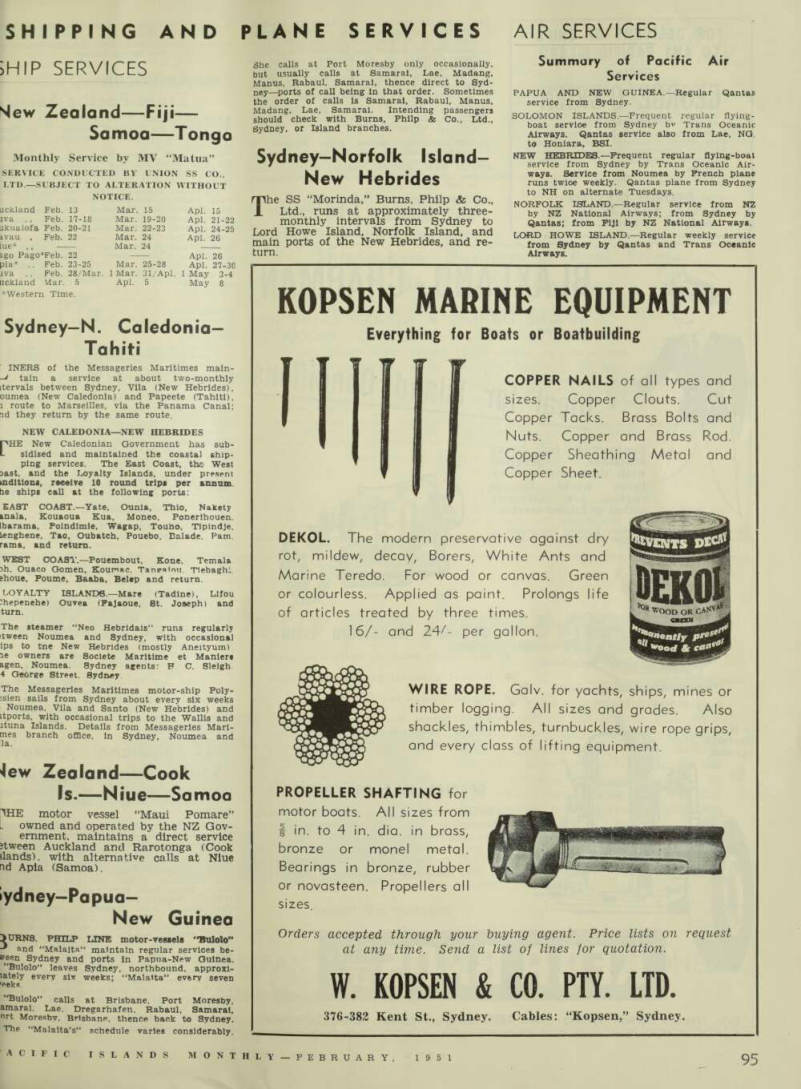
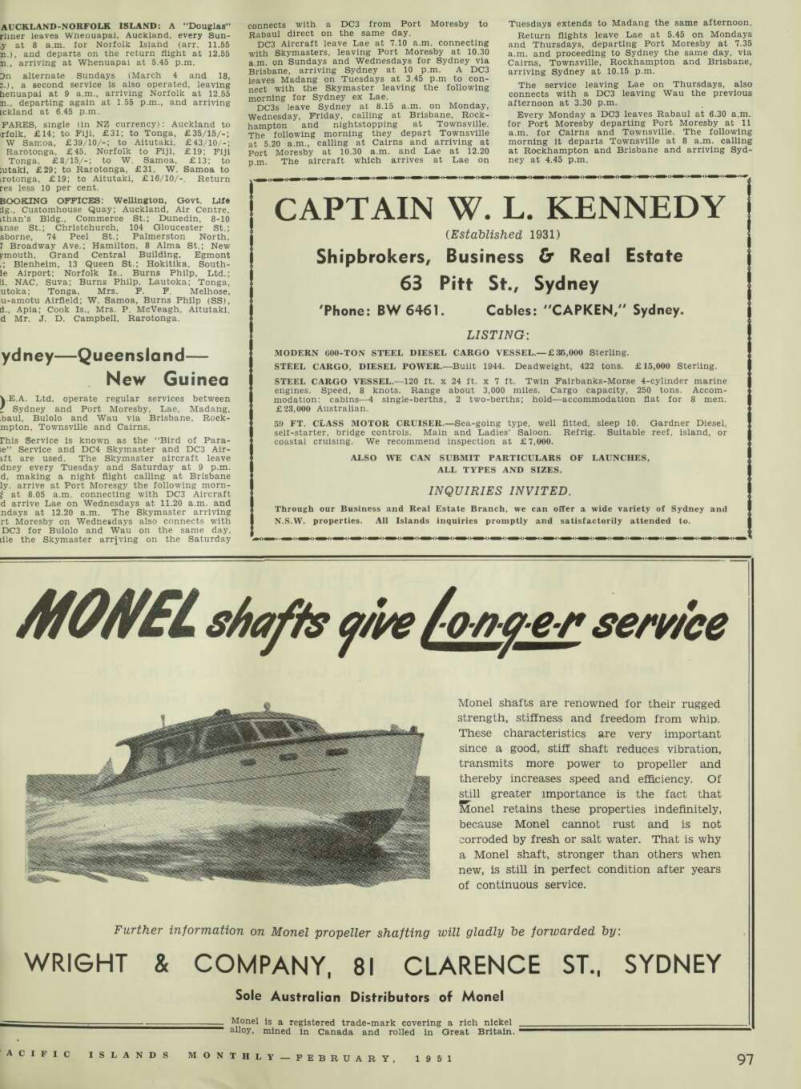
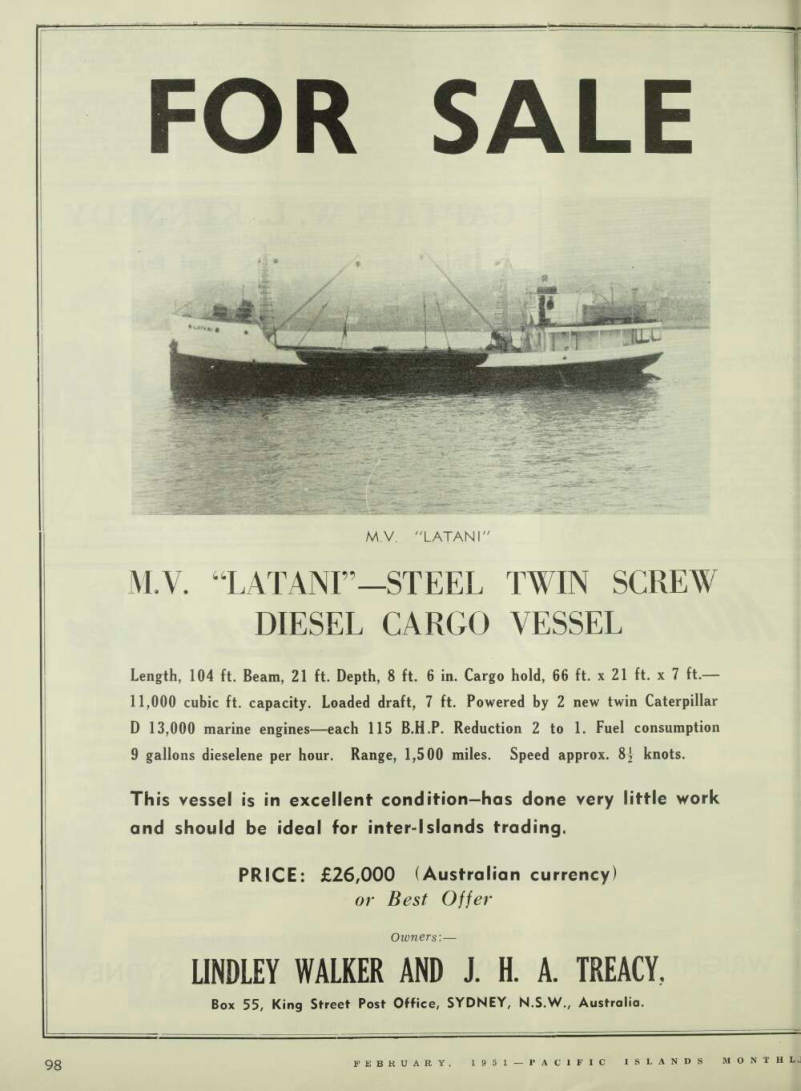
Shipping And Plane Services Air Services
Ship Services
slew Zealand—Fiji—
Samoa—Tonga
Monthly Service by MV “Matua”
Service Conducted By Union Ss Co.,
Ltd.—Subject To Alteration Without
Notice.
uckland Feb. 13 Mar. 15 Apl. 15 iva .. Feb. 17-18 Mar. 19-20 Apl. 21-22 llkualofa Feb. 20-21 Mar. 22-23 Apl. 24-25 ivau . Feb. 22 Mar. 24 Apl. 26 lue* .. Mar. 24 igo Pago*Feb. 22 Apl. 26 pia* . . Feb. 23-25 Mar. 25-28 Apl. 27-30 iva . . Feb. 28/Mar. 1 Mar. 31/Apl. 1 May 3-4 uckland Mar. 5 Apl. 5 May 8 *Western Time.
Sydney-N, Caledonia-
Tahiti
INERS of the Messageries Maritimes main tain a service at about two-monthly itervals between Sydney, Vila (New Hebrides), oumea (New Caledonia) and Papeete (Tahiti), i route to Marseilles, via the Panama Canal; id they return by the same route.
New Caledonia-New Hebrides
rHE New Caledonian Government has sub sidised and maintained the coastal ship ping services. The East Coast, thc- West last, and the Loyalty Islands, under present mdltlons, receive 10 round trips per annum he ships call at the following ports; EAST COAST.—Yate, Ounia, Thio, Nakety snala, Kouaoua Kua, Moneo, Ponerihouen.
Ibarama, Polndlmle, Wagap, Touho, Tlpindje, Lenghene, Tac, Oubatch, Pouebo, Balade, Pam rama, and return.
WEST COAST.—Pouembout, Kone, Temala ih. Ouaco Gomen, Koumac. Tanvaiou, Tiebaghi. shoue, Poume, Baaba, Belep and return.
LOYALTY ISLANDS.—Mare (Tadlne), Llfou Ihepenehe) Ouvea (Pajaoue, St. Joseph) and turn.
The steamer "Neo Hebrldais” runs regularly tween Noumea and Sydney, with occasional ips to tne New Hebrides (mostly Aneityum) ic owners are Societe Maritime et Manlere agen. Noumea. Sydney agents; F C. Sleigh 4 George Street. Sydney The Messageries Maritimes motor-ship Poly :sien sails from Sydney about every six weeks Noumea, Vila and Santo (New Hebrides) and itports, with occasional trips to the Wallis and ituna Islands. Details from Messageries Marl tnes branch office, In Sydney, Noumea and la.
■lew Zealand—Cook
Is.—Niue—Samoa
motor vessel “Maui Pomare” owned and operated by the NZ Gov ernment, maintains a direct service it ween Auckland and Rarotonga (Cook ilands). with alternative calls at Niue
nd Apia (Samoa).
iydney-Papua—
New Guinea
>URNS, PHILP LINE motor-vessels “Bulolo”
J and “Malaita” maintain regular services be ween Sydney and ports In Papua-New Guinea.
“Bulolo” leaves Sydney, northbound, approxl mtely every six weeks; “Malaita” every seven 'eek« “Bulolo” calls at Brisbane. Port Moresby, amaral, Lae. Dregarhafen. Rabaul, Samaral. ort Moresby. Brisbane, thence bark to Sydney.
The “Malalta’s” schedule varies considerably.
She calls at Port Moresby only occasionally, but usually calls at Samaral, Lae, Madang.
Manus, Rabaul. Samaral, thence direct to Syd ney—ports of call being In that order. Sometimes the order of calls is Samaral, Rabaul, Manus, Madang. Lae, Samaral. Intending passengers should check with Burns, Phllp & Co., Ltd., Sydney, or Island branches.
Sydney-Norfolk Island-
New Hebrides
The SS “Morinda,” Burns, Philp & Co., Ltd., runs at approximately three monthly intervals from Sydney to Lord Howe Island, Norfolk Island, and main ports of the New Hebrides, and re turn.
Slimmory of Pacific Alt
Services
PAPUA AND NEW GUlNEA.—Regular Qantas service from Sydney.
Toi
SOLOMON ISLANDS.-Frequent regular flymg boat service from Sydney bv Trans Oceanic Airways. Qantas service also from Lae, NO. to Honiara, BSI.
NEW HEBRlDES.—Frequent regular flying-boat service from Sydney by Trans Oceanic Air ways. Service from Noumea by French plane runs twice weekly. Qantas plane from Sydney to NH on alternate Tuesdays.
Norfolk island.—Regular service from nz by NZ National Airways; from Sydney by Qantas; from FIJI by NZ National Airways. lord howe island.—Regular weekly service from Sydney by Qantas and Trans Oceanic Airways.
FlJl.—Regular services from Australia by Pan American, BCPA and CPA (to Nadi); Auck land by NZ National Airways (to Nadi); from Australia by Qantas (to Laucala Bay, Suva); from Auckland by NZ National Airways (to Laucala Bay, Suva). Irregular calls from Australia to Laucala Bay, Suva, by Trans Oceanic Airways. Regular service from Suva to Labasa by NZ National Airways.
Western Samoa. Cook Islands And
TONGA. —Regular service from Fiji by NZ National Airways. rAHTTl.—Monthly service from Noumea by TRAPAS plane via Fiji, W. Samoa, Cook Is.
DUTCH NEW GUlNEA.—Regular weekly service from Darwin to Biak by KLM under charter to NEI Government.
AUSTRALIA-NEW ZEALAND—ReguIar services Sydney-Auckland and Sydney-Wellington by Tasman Empire Airways.
AUSTRALIA-NORTH AMERICA —Regular Trans-
Pacific services by Pan American Airways.a
Bcpa And Cpa.
Europe - Indo-China -N. Caledonia. —Fort-
nightly service by Air Prance.
Pan-American—
Trans-Pacific Service:
PAN-AMERICAN World Airways clippers now provide the following services in the SoutM Pacific, using DC4 planes, equipped with Sleep-t erettes;— Planes leave Sydney Wednesday and Saturdays for San Francisco, via Tontouta (New Cale-£ donia), Nadi (Fiji), Canton Island and Hono-c lulu.
The return flights are made from San Francisco; every Tuesday, Saturday, via Honolulu, Cantom Island, Nadi and Tontouta; and from Seattle! every Tuesday, via Portland, Honolulu, Cantom Island, Nadi and Tontouta.
Planes leave Auckland every Thursday anoj Sunday, and fly via Nadi, Canton Island anoj Honolulu to San Francisco. They leave San Fran-r cisco for Auckland every Tuesday and Saturday, by the same route. Fares, in Australian cun rency, are:—
(Time-tables ana fares subject to alteration! without notice.) To convert to Fiji currency, reduce each kilogram of excess.
Free baggage allowance is 30 kilos per personn Excess baggange charged at 1 per cent, of single; fare; per kilo up to 10 kilos; Vfe per cent, fon every kilo over 10 kilos.
CPA Sydney-Vancouver
Service
CANADIAN Pacific Airlines, Ltd., run a transa Pacific service between Sydney and Vane couver. For the present there will be onr northbound and one southbound trip per fortt night. Stops are made at Nadi (Fiji), Canton Island, Honolulu and San Francisco. The northn bound flight commences from Sydney every alten nate Wednesday.
Accommodaton is provided at hotels in Nadi anu Honolulu, which is, of course, complimentary.
Fares are (in Australian currency: Sydney?
Vancouver, San Francisco-Los Angeles and Porh land-Seattle, £265/8/- single, £477/15/- returm Fiji-Vancouver, £207/8/- single, £373/7/- re turn; Sydney-Fiji. £57/15/- single. £lO3/19/- r© turn; Sydney-Honolulu, £217/13/- single! £391/16/- return.
Bookings may be made at the Union Stem Ship Company of New Zealand. Limited, Sydney! or Melbourne: Union Steam Ship Co. of NZ. Ltdfc Fiji, Canadian Pacific Airlines, Vancouver!
Canadian Pacific Railway Co., Sydney or Mele bourne.
NZ National Airways
South Pacific Services
'T'HE Pacific services run by the New Zealam 1 National Airways Corporation are e follows: —
Auckland-Norfolk Island-Fiji-Tonga
Western Samoa-Cook Islands: A “Douglas.
airliner leaves Whenuapai, Auckland, on alteu nate Tuesdays at 9 a.m. (March 6 and 2<S etc.) for Norfolk Island (arr. 12.8. p.m.; dep. 2 p.m.). Nadi (arr. 8 40 p.m., dep. 5.4. a.m. Thursday). Nausori (arr. 6.25 a.m.. dep. 7.2. a.m.), Tonga (arr. 10.50 a.m., dep. 11.50 a.m.j •Faleolo. Western Samoa (arr. 4.5 p.m. Wedneis day. dep. 8 a.m. Thursday), Aitutaki, Cooi Islands (arr. 1.50 p.m. Thursday, dep. 2.8. p.m.), Rarotonga. Cook Is. (arr. 4.5 p.m.).
The aircraft departs from Rarotonga on tHJ return journey on alternate Saturday (March 10 and 24, etc.) at 8 a.m. f<l Aitutaki (arr. 9.15 am., dep. 10 a.m.), Faleolh w. Samoa (arr. 3.15 p.m., dep. 8 a.m. Sunday? ‘Tonga (arr. 10.55 am. Monday, dep. 11.!.. a.m.),’ Nausori (arr. 2.40 p.m.. dep. 3.40 p.m,.
Nadi (arr. 4.25 p.m.. dep. 5 a.m. Tuesday?
Norfolk Is. (arr. 10.55 am., dep. 12 noonn Whenuapai, Auckland (arr. 4.50 pm.). •Crosses International Date Line.
£ ŗts.hr h d. £ s. dJ Single.
Ua itui rnr Sydney-Seattle 265 10 0 477 18 • Sydney-’Frisco 265 10 0 477 18 t Sydney-Honolulu .. .. 217 15 0 391 19 e Sydney-Piji 57 15 0 103 19 0 Auckland-Seattle .. 246 5 0 443 5 0 Auckland-Honolulu . .. 199 0 0 358 4 0 Auckland-Fiji 39 0 0 69 15 0 Auckland-’Frisco .. 246 5 0 443 5 0 Sydney-Noumea .. .. 37 10 0 67 10 t
Auckland-Norfolk Island: A “Douglas”
rimer leaves Whenuapai. Auckland, every Sun ,y at 8 a.m. for Norfolk Island (arr. 11.55 n.). and departs on the return flight at 12.55 n., arriving at Whenuapai at 5.45 p.m. >n alternate Sundays (March 4 and 18, u.), a second service is also operated, leaving henuapai at 9 a.m., arriving Norfolk at 12.55 m., departing again at 1.55 p.m., and arriving ickland at 6.45 p.m.
FARES, single (in NZ currency); Auckland to rfolk, £l4; to Fiji, £3l; to Tonga, £35/15/-; W Samoa, £39/10/-; to Aitutaki, £43/10/-; Rarotonga, £45. Norfolk to Fiji, £l9; Fiji Tonga. £B/15/-; to W. Samoa, £l3; to iutaki, £29; to Rarotonga, £3l. W. Samoa to irotonga, £l9; to Aitutaki, £l6/10/-. Return res less 10 per cent.
BOOKING OFFICES: Wellington, Govt. Life dg., Customhouse Quay; Auckland, Air Centre, ithan’s Bldg., Commerce St.; Dunedin, 8-10 inse St.; Christchurch, 104 Gloucester St.; sborne, 74 Peel St.; Palmerston North, 7 Broadway Ave.; Hamilton, 8 Alma St.; New pmouth, Grand Central Building. Egmont .; Blenheim, 13 Queen St.; Hokitika, South ie Airport; Norfolk Is.. Burns Philp, Ltd.; li, NAC, Suva; Burns Philp, Lautoka; Tonga, utoka; Tonga, Mrs. F. F. Melhose, u-amotu Airfield; W. Samoa, Burns Philp (SS), d., Apia; Cook Is., Mrs. P. McVeagh, Aitutaki. d Mr. J. D. Campbell, Rarotonga.
ydney—Queensland—
New Guinea
VE.A. Ltd. operate regular services between I Sydney and Port Moresby, Lae, Madang, ,baul, Bulolo and Wau via Brisbane, Rock mpton, Townsville and Cairns. rhis Service is known as the “Bird of Para ;e” Service and DC4 Skymaster and DC3 Air ift are used. The Skymaster aircraft leave dney every Tuesday and Saturday at 9 p.m. d, making a night flight calling at Brisbane ly. arrive at Port Moresgy the following morn i at 8.05 a.m. connecting with DCS Aircraft d arrive Lae on Wednesdays at 11.20 a.m. and ndays at 12.20 a.m. The Skymaster arriving rt Moresby on Wednesdays also connects with DCS for Bulolo and Wau on the same day, die the Skymaster arriving on the Saturday
connects with a DC3 from Port Moresby to Rabaul direct on the same day.
DCS Aircraft leave Lae at 7.10 a.m. connecting with Skymasters, leaving Port Moresby at 10.30 a.m. on Sundays and Wednesdays for Sydney via Brisbane, arriving Sydney at 10 p.m. A DC3 leaves Madang on Tuesdays at 3.45 p.m to connect with the Skymaster leaving the following morning for Sydney ex Lae.
DC3s leave Sydney at 8.15 a.m. on Monday, Wednesday, Friday, calling at Brisbane, Rockhampton and nightstopping at Townsville.
The following morning they depart Townsville at 5.20 a.m., calling at Cairns and arriving at Port Moresby at 10.30 a.m. and Lae at 12.20 p.m. The aircraft which arrives at Lae on
Tuesdays extends to Madang the same afternoon.
Return flights leave Lae at 5.45 on Mondays and Thursdays, departing Port Moresby at 7.35 a .m. and proceeding to Sydney the same day, via Cairns, Townsville, Rockhampton and Brisbane, arriving Sydney at 10.15 p.m. , T . .
The service leaving Lae on Thursdays, also connects with a DC3 leaving Wau the previous afternoon at 3.30 p.m.
Every Monday a DC3 leaves Rabaul at 6.30 a.m. for Port Moresby departing Port Moresby at 11 a.m. for Cairns and Townsville. The following morning it departs Townsville at 8 a.m. calling at Rockhampton and Brisbane and arriving Syd ney at 4.45 p.m.
Antas Subsidiary Services In
Papua-New Guinea-Solomons
Qantas Empire Airways run the following sub diary services in Papua, New Guinea, and rltish Solomons:— A Douglas DC3 leaves Lae, New Guinea, every turday. and flies to Rabaul, and Kavieng. d returns to Lae; but every alternate Satur ly the plane goes on from Kavieng to Manus, id returns via Kavieng to Rabaul (overnight) d returns to Lae on the Sunday morning.
Every Wednesday a plane flies from Lae to adang and Wewak, and thence, via Madang Rabaul. It returns from Rabaul to Lae on rursday. This service Is primarily for the rriage of native labour to and from Wewak, id Europeans travelling on this service are ways advised of the fact.
Every alternate Monday, a Qantas Catalina es from Port Moresby, westward to Daru, via lie Island. Kerema, Kikori, Lake Kutubu, re rning to Port Moresby, via Kikori and Kerema ? same day. Optional call at Wana between irema and Kikori.
Every alternate Wednesday, a Qantas Catalina ;s from Port Moresby eastward (dep. 9 a.m.) d calls at Abau and Samaral before flying out the Archipelagoes in the afternoon. Calls are ide at Esa’ala and Losuia (where an over ?ht stop is made), and the following day Iternate Thursdays) at Deboyne Lagoon, before mrnlng to Port Moresby, via Samarai and au.
Every alternate Monday, a Qantas Catalina ves Port Moresby for Rabaul, via Abau, marai, Esa’ala and Losuia (New Britain): next Tning (Tuesday) it flies to Queen Carola rbour, Buka. Kieta, Buin (Bougainville) and urns to Rabaul: next morning (Wednesday) flies to Talasea, Moewe Harbour and Jacquinot y. and returns to Rabaul; and next morning bursday) it returns from Rabaul, via Losuia.
I’ala, Samarai. and Abau, to Port Moresby, ptional calls are made at Inus and Linden fen.) Every alternate Monday a Qantas Douglas flies m Lae to Rabaul via Finschhafen and continues to Honiara (British Solomon Islands), via rokina, Vellalavella and Yandina remains over flit at Honiara: and returns to Lae the fol ring day Tuesday), over the same route.
Every Tuesday and Friday a plane leaves Port >resby at 7.30 a.m., reaches Kokoda at 8.35
a.Hi., files Oh to ttigatufa (Popendetta) at 8.55 a.m., and leaves again for Port Moresby at 9.5 a.m., reaching there at 10.15 a.m.
Dragon DHB4 aircraft operate the following internal services in New Guinea: — Every Tuesday depart Madang for Goroka, Kainantu, Aiyura, Arena, returning to Madang at noon the same day. Calls as required for loading are made between Arona and Madang.
Every Thursday departs Madang at 7 a.m. for Wabag, Baiyer River, Mt. Hagen, with optional calls at Kerowagi and Chimbu, and returning to Madang at noon the same day.
Every Friday departs Lae at 6.30 a.m., calling at any or all of the following places as re quired: Asolaka, Aiyura, Arona, Banz, Bena Bena, Chimbu, Goroka, Kaiaipit, Kainantu, Kerowagi. Kup, Mt. Hagen, Nadzab, Nondugl, Ogelbeng, Wabag, Wabumunda, Minj.
Daily, except Wednesdays and Sundays, depart Lae at 3 p.m. for Bulolo and Wau, returning direct from Wau to Lae the same day. arriving at Lae 5.5 p.m.
Trons-Tasman Service
Sydney—Auckland
TASMAN Empire Airways, Ltd., operate a flying-boat service between Rose Bay, Sydney, and Mechanics Bay, Auckland, with a fleet of four new Solent flying-boats each with a capacity for 45 passengers, in seven self contained cabins on two decks. Full fresh-cooked meals are served en route. Average crossing time is 6V2 hours.
Flying-boats depart from Sydney at midnight bn Wednesdays, Fridays, Saturdays and Sundays, and at 8 a.m. on Tuesdays and Fridays. They depart from Auckland at 12 noon daily except Monday.
Fares: £35 (A), £2B (NZ), single; £63 (A), £5O/8/- (NZ), return.
Passenger reservations may be made in Aus tralia at any office or agency of Qantas Empire Airways (General Agents), offices of TAA and all leading travel agents. In New Zealand book through TEAL (Auckland and Wellington) or any leading travel agents.
Trans Tasman Services
Sydney—Wellington
TASMAN Empire Airways, Ltd., operate a regular flying-boat service between Sydney and Wellington with Solent flying-boats.
Services depart Sydney at 10.30 p.m. on Tues day, Wednesday, Friday, Sunday: and depart Wellington at 11 a.m. on Monday, Wednesday, Thursday and Saturday.
The fares are: £A3S. £NZ2B single; £A63, £ NZSO/8/- return.
Sydney—Norfolk Is.
Qantas run a DC4 Skymaster alt. Thursdays (returning same day) from Sydney to Norfolk Island. Fare, £22 single; £39/12/- return. (For Norfolk Island, see also under NZ National Airways.)
Sydney-New Hebrides
QANTAS operate a service to the New Hebrides with Sandringham flying-boats calling at Noumea, Port Vila and Espiritu Santo. Frequent non-scheduled flights are made, subject to the approval of the Governments concerned.
Sydney-Vancouver
BCPA Service
BRITISH Commonwealth Pacific Airlines, Ltd., operate a twice weekly trans-Paciflc service from Sydney to Vancouver, via Fiji, Canton
Island, Honolulu and San Francisco; and a weekly service between Auckland and Vancouver, via the same ports.
Planes leave Sydney every Wednesday and Saturday, and Vancouver on the Southbound trip every Monday and Thursday. Every fourth trip from Sydney terminates at San Francisco Instead of Vancouver.
Planes leave Auckland every Tuesday and arrive in Vancouver the following Wednesday.
The Southbound trip to Auckland commences from Vancouver every alternate Friday. Every other Friday the service commences at San Francisco.
B.C.P.A. services make regular connections at both San Francisco and Vancouver for onward
carriage, via either New York or Montreal toJ the United Kingdom or Europe. The through? fare from Sydney to London is £325 (Aust,).
The fares for the Pacific flight are: Nandi (Fiji), £AS7/15/- single, £AIO3/19/- ree turn. Sydney-San Francisco, Seattle, Portland!) Los Angeles or Vancouver, £A265/8/- single?! £A477/15/- return. Auckland-Nandi (Fiji) (. £NZ3I single, £NZSS/16/- return. Aucklandb San Francisco, Seattle, Portland, Los Angeles oo Vancouver, £NZI97/3/- single, £NZ3S4/18/- re-s turn.
Douglas DC6 aircraft carrying 48 passengen (seated) or 37 passengers (in sleepers) and i crew of nine are used on the service.
France-1 ndo-China—
Aust.-N. Caledonia
THE French national airways, Air Frances runs a monthly service between Parlh and New Caledonia, and return. Stops are made! at Damascus, Karachi, Calcutta, Saigon, Batavias Darwin, Brisbane.
DC4 Skymasters are used in the service beti: ween Saigon and New Caledonia, Lockheee Constellations between Saigon-Paris, and Mess: sageries Maritimes are agents in Australia.
Fare between Brisbane and Tontouta (Noumeas are £3O/12/6 single, £55/2/6 return. Sydney?
Tontouta, £37/10/- single, £63/17/6 return.
Darwin —Netherlands
New Guinea Service
THE service between Batavia, NEI, and BiaM Netherlands New Guinea, has been diss. continued and a new service from Darwin ti Biak and return has been inaugurated.
The service is run by the Netherlands Goverm ment, with DCS aircraft, chartered from KLM, Airlines. The service is run once weekly.
TOA Services
TRANS Oceanic Airways run the followlnn Pacific services:— SYDNEY-LORD HOWE IS.: A regular twice: weekly service with large four-engine flyingg
>ats from Rose Bay. Pare; £lO/16/- single; 21/12/- return. Free baggage allowance 44 lb. scess baggage and freight rate Bd. per lb.
NOTE: Sydney-Moresby service expected to art in January or February.
SYDNEY-HOBART: The company now runs a dee-weekly service direct to Hobart. Tasmania, om Sydney. It will be possible, therefore, ir passengers to book from Moresby to Hobart, aking an overnight stop in Sydney. Pares are: 10/10/- single, £2l return.
Sydney-Noumea-Suva
PHE following is the time-table of the Qantas Sandringham flying-boat:— Sydney dep. 9.30 p.m. alt. Tues.
Noumea arr. 6.30 a.m. alt. Wed.
Noumea dep. 8.20 a.m. alt. Wed.
Suva arr. 2.30 p.m. alt. Wed.
Suva dep. 6 a.m. alt. Fri.
Noumea arr. 10.30 a.m. alt. Fri.
Noumea dep. 12 noon alt Fri Sydney arr. 7.15 p.m. alt. Fri.
Intending passengers may book through antas offices in Australia. Burns Philp (South a) Company, in Suva; and J. Brock, in jumea.
The fares for this service In Aust. currency e:
TEAL Flying Boot
Service
Auckland Fiji
I7TTH new 45 seater Solent flying-boats. ▼ Tasman Empire Airways, Limited, operate weekly Auckland-Suva-Lambasa and return vice.
Aircraft depart Mechanics’ Bay, Auckland, a If hour after midnight, each Tuesday, and erate to the following time-table;— dep. Auckland .. .. 0.30 a.m, Tuesday arr. Suva 7.00 a.m. Tuesday dep. Suva 9.00 a.m. Tuesday arr. Lambasa .. .. 10.00 am. Tuesday dep. Lambasa .. .. noon Tuesday arr. Suva 1.00 p.m. Tuesday dep. Suva 7.00 a.m. Wednesday irr. Auckland .. .. 1.30 p.m. Wednesday (Single): Auckland-Suva. £3l (NZ). 14/9/- (Fijian), £3B/15/- (Aust.); (Return): 5/16/- (NZ). £6l/19/- (Fijian), £69/15/ist.). suva-Lambasa (Single): £4/10/- (NZ). £5 ijian), £5/12/6 (Aust.); (Return): £B/2/- S), £9 (Fijian), £lO/2/6 (Aust.). leservations may be made through TEAL ;w Zealand), Qantas or TAA (Australia), NAG (Suva) or any leading travel agents.
N. Caledonia-Tahiti
'RAPAS (Soclete Francals de Transports Aeriens du Pacific Sud-Noumea) runs a nthly service from New Caledonia to Tahiti stern Samoa (Faleolo), Cook Islands (Altu :1) to Papeete, where it arrives at about 11.40 i. two days later. One evening is spent in dl and one night in Altutakl. The plane re ns by the same route in the following week, re from Noumea to Papeete is 16,000 Pacific ncs single, and 28,800 return. (160 Pacific ncs equal £1 Australian.) While the plane at Papeete it runs one round trip between peete and Bora Bora.
This service was temporarily suspended in ) November.)
Papua-NG Local
Services
JANDATED Airlines. Ltd., of Lae, New Guinea, 4 and other private operators, run air ser k; between Lae and the New Guinea mainland itres of Wau, Bulolo. Madang, Wewak. Altape, • Hagen. Plnschhafen. Moresby. Kokoda—in * anywhere In Papua or New Guinea where * re la an air-strip. These planes carry pas ifers. malls and cargo on regular schedules charter flights The Rev. and Mrs. K. D. Grove, of
Jthodist Mission, Tonga, are on furlough
Australia.
Mr. C. Bailey, a director of W. R. Car penter & Co. (Fiji) Ltd., left by Qantas on December 16, accompanied by Mrs.
Bailey, for a well-earned three months vacation in Sydney.
At the Sacred Heart Cathedral, Suva, on December 16 Miss Tamara Maesepp, daughter of Mr. and Mrs. K. Maesepp of Suva, was married to Mr. V. L.
Tregoweth.
dney-Noumea .. , Single.
Return. £37 10 0 £67 10 0 dney-Suva 55 10 0 99 18 0 lUmea-Suva ... , 20 5 0 36 9 0
Advertisements & other items, pp. 99-106 (9 items)
95
ACIFIC ISLANDS MONTHLY FEBRUARY, 1951
Peko
KOPSEN MARINE EQUIPMENT
Everything for Boats or Boatbuilding i COPPER NAILS of all types and sizes. Copper Clouts. Cut Copper Tacks. Brass Bolts and Nuts. Copper and Brass Rod.
Copper Sheathing Metal and Copper Sheet.
DEKOL. The modern preservative against dry rot, mildew, decay, Borers, White Ants and Marine Teredo. For wood or canvas. Green or colourless. Applied as paint. Prolongs life of articles treated by three times. 16/- and 24/- per gallon.
PEKO
OR CANV-
WIRE ROPE. Galv. for yachts, ships, mines or timber logging. AH sizes and grades. Also shackles, thimbles, turnbuckles, wire rope grips, and every class of lifting equipment.
PROPELLER SHAFTING for
motor boats. All sizes from f in. to 4 in. dia. in brass, bronze or monel metal.
Bearings in bronze, rubber or novasteen. Propellers all sizes.
Orders accepted through your buying agent. Price lists on request at any time. Send a list of lines for quotation.
W. KOPSEN & CO. PTY. LTD.
376-382 Kent St., Sydney. Cables: “Kopsen,” Sydney.
FOR DELIVERY OF SHIPS
TO ANY PACIFIC ISLAND
Contact
GEORGE O’BRIEN
Recommended by: Lever’s Pacific Plantations Pty. Ltd.
Kerr Bros. Societe Gubbay (Port Vila). Rowe Bros., Rabaul. Condominium Government of the New Hebrides.
Special Rates for “P.1.M.” Readers.
GEORGE O'BRIEN
89 Ocean Avenue, Double Bay, Sydney. ’Phone: F 82905.
\ y£r.
BLAXLAND - CHAPMAN
MARINE ENGINES • WONDER LAUNCHES
PUMPS AND ENGINEERING PRODUCTS
a Engineered for heavy sustained operation with minimum upkeep, these world famous engines are extremely suited to Island service.
There is an engine for every boating application in sizes ranging from 2V2 h.p. to 20 h.p.
5/7 H.P. TWIN.
5/7 H.P. BLAXLAND TWIN
• Multi-cylinder design—no vibration or “shudder.” • Balanced crankshaft gives smoother cruising. • Adjustable thrust race to take propeller thrust. • Patent Bounce Start Magneto—easy, positive starting. Enables the craft to be reversed, for running ahead or astern by a mere movement.
PUMPING PLANT.
10 H.P.
CHAPMAN
SEADOG
I =) Inquiries are Invited.
Pit.
LTD.
KERR BROS
SPECIAL ISLANDS SERVICE
Island residents can rely on immediate attention to their inquiries and orders for Blaxland-Chapman Marine Engines, Launches, Pumping Units, and other engineering requirements from Kerr Bros. Pty., Ltd., Sole Pacific Distributors for Blaxland Rae Pty., Ltd. (Successors to Chapman & Sherack).
CAPTAIN W. L. KENNEDY
(Established 1931)
Shipbrokers, Business & Real Estate
63 Pitt St., Sydney
'Phone: 8W6461. Cables: "CAPKEN," Sydney.
LISTING:
MODERN 600-TON STEEL DIESEL CARGO VESSEL.—£3S,OOO Sterling.
STEEL CARGO, DIESEL POWER.—Built 1944. Deadweight, 422 tons. £15,000 Sterling.
STEEL CARGO VESSEL.—I2O ft. x 24 ft. x 7 ft. Twin Fairbanks-Morse 4-cylinder marine engines. Speed, 8 knots. Range about 3,000 miles. Cargo capacity, 250 tons. Accommodation: cabins —4 single-berths, 2 two-berths; hold —accommodation flat for 8 men. £23,000 Australian. 59 FT. CLASS MOTOR CRUISER. —Sea-going type, well fitted, sleep 10. Gardner Diesel, self-starter, bridge controls. Main and Ladies’ Saloon. Refrig. Suitable reef, Island, or coastal cruising. We recommend inspection at £7,000.
ALSO WE CAN SUBMIT PARTICULARS OF LAUNCHES,
ALL TYPES AND SIZES.
INQUIRIES INVITED.
Through our Business and Real Estate Branch, we can offer a wide variety of Sydney and N.S.W. properties. All Islands inquiries promptly and satisfactorily attended to.
MONEL shafts am lon g e r service Monel shafts are renowned for their rugged strength, stiffness and freedom from whip.
These characteristics are very important since a good, stiff shaft reduces vibration, transmits more power to propeller and thereby increases speed and efficiency. Of still greater importance is the fact that Monel retains these properties indefinitely, because Monel cannot rust and is not corroded by fresh or salt water. That is why a Monel shaft, stronger than others when new, is still in perfect condition after years of continuous service.
Further information on Monel propeller shafting will gladly he forwarded by : WRIGHT & COMPANY, 81 CLARENCE ST., SYDNEY
Sole Australian Distributors of Monel
- . Monel Is a registered trade-mark covering a rich nickel alloy, mined in Canada and rolled in Great Britain.
FOR SALE
M.V. "LATANI
M.V. “LATANI”—STEEL TWIN SCREW
DIESEL CARGO VESSEL
Length, 104 ft. Beam, 21 ft. Depth, 8 ft. 6 in. Cargo hold, 66 ft. x 21 ft. x 7 ft.— 11,000 cubic ft. capacity. Loaded draft, 7 ft. Powered by 2 new twin Caterpillar D 13,000 marine engines—each 115 B.H.P. Reduction 2 to 1. Fuel consumption 9 gallons dieselene per hour. Range, 1,500 miles. Speed approx. 87 knots.
This vessel is in excellent condition—has done very little work and should be ideal for inter-islands trading.
PRICE: £26,000 (Australian currency) or Best Offer Owners : LINDLEY WALKER AND J. H. A. TREACY, Box 55, King Street Post Office, SYDNEY, N.S.W., Australia.
□u 3D Only five minutes’ drive across the Sydney Harbour Bridge from the City, “Bellhaven” is quietly situated—your rest is assured in this new, comfortably furnished and well serviced hotel.
Handy to transport for beaches. Olympic Pool. Zoo, a 1 sights, and Australia’s leading City of entertainment and night life—Sydney.
Modern Room or Suite Accommodation.
TARIFF FROM 16/6 PER DAY.
Manager : A. L. GUARD.
PRIVATE HOTEL,
Priory Road, North Sydney, Write or Cable “Bellhaven,” North Sydney.
Phone: XA 1746.
MARINE ENGINES
HALVORSEN’S HAVE FOR IMMEDIATE DELIVERY-.
MORRIS “VEDETTE” 4 Cylinder 6/12 H.P. Petrol or Kerosene MORRIS “NAVIGATOR” 4 Cylinder 12/24 H.P. Petrol or Kerosene MORRIS “COMMODORE” 6 Cylinder 20/40 H.P. Petrol or Kerosene CHRYSLER “CROWN” 6 Cylinder 45/102 H.P. Petrol CHRYSLER “ROYAL” 0 Cylinder 55/132 H.P. Petrol “LEYLAND” DIESEL MARINE 6 Cylinder 85 H.P.
Further particulars from the distributors:
LARS HALVORSEN SONS PTY. LTD.
WATERVIEW ST., RYDE 0 ' ). N.S.W.
Telegrams; Halvorsens. Sydney. ’Phone: Hyde 105
• LARGE RANGE OF BOAT FITTINGS
• FREE EXPERT PROPELLER ADVICE
BUILDERS OF HALVORSEN BOATS
Sills. COVERS, AMIS
TENTS, TARPAULINS, and all classes of CANVAS GOODS for industrial and home use FLAGS AND PENNANTS FOR CLUBS AND ASSOCIATIONS.
Send your inquiries through your agent to:
HARRY WEST Pty. Ltd.
"SYDNEY'S SAILMAKER"
DUKE ST. (WATERFRONT), EAST BALMAIN, SYDNEY, N.S.W.
Phone: WBIIOS. W 82284.
DAWSON PAINTS
Slaved ran the
DAVCO
ONE COAT
METAL PAINI
VEITONE
"UVE! FINIS!
FLAT OIL FINISH
Elsie VaterPaint
IS*-vikylite
\ SUPER FINISH
m velustre
r PAINT
uper gloss lorcelain lard Enamel.
VELVENE
Velvet Finish Water Paint for inside and outside use.
DAVCO
One Coat Metal Faint protects all exposed metal’work.
VELTONE
Flat Oil Washable Wall Paint; interior use.
VELUSTRE
Highest grade Tit. Zinc based House Paint.
Davison Paints have for many
years proved
their resistance to severe
tropical
conditions. The Davison range
of products
includes high quality finishes for all purposes. You can be sure of V Davison. / I
H. BUNTING LIMITED
Samarai, Papua and Lae, New Guinea
ALL DAVISON FINISHES AVAILABLE FROM
IMITED AUSTRALIAN FIBRES LIMITED G. G. SMITH & CO. LIMITED: ua Kokopo Port Moresby New Britain Papua
Allen Taylor & Co. Ltd.
COMMERCIAL ROAD, ROZELLE
SYDNEY
Sawmillers and Wholesale Suppliers of Hardwoods for Constructional Purposes GIRDERS ... PILES .. . POLES . . . SLEEPERS, Etc.
EXPORTING TO PACIFIC ISLANDS SINCE 1893
VESSEL FOR SALE
CONTACT: H. F Ward (Owner), 511 New South Head Road,
Double Bay, Sydney—or any Shipbroker.
Pasadena VI., Steel Trawler.
?n IZ . E,—Length ' 44 ft - ; beam - 13 ft. 6 in.; draft. 4 ft. 6 in.; speed, 6 knots. Weight about *0 tons, 200 fuel, 200 water.
Built by Trussed Concrete Steel Co., Alexandria, Sydney, under Maritime Services Board Survey.
ENGINE. Elec, start. 33 H.P V.R.O. Ruston Hornsby diesel engine fitted with 3.8-1 reauction gear and reverse. 10 H.P. Southern Cross diesel auxiliary.
HULL is of welded steel 3/16th in. on deck and sides and bottom, over 2 in. x »/ 4 in.
“ a “ e with gussets at all corners. The plating is welded continuously on both sides oi the frames below the water line and staggered at other places.
KEEL is made from two pieces of y 2 in. plate welded over 4 in. x 4 in. angle and contairs the stern bearing and tall shaft and intermediate bearings, all of which run in her.vy lubricant. The stuffing box is in the engine room.
ACCOMMODATION.—ForecastIe 2. and galley (could be arranged for more). There is a separate cabin aft for the Master.
ON DECK, Fore Deck.—Anchor gear two 75 lb. Danforth anchors, 1.120 lb. Patent anchor. 30 fathoms % in. gal. chain on crab winch, also 45 fathoms Va in. and As in. gal. chain.
MAIN DECK.—Cargo hatch and trawl winch, plywood deckhouse with entrance to cabin and after peak. After deck is clear. There is a strong mast with galv. iron bar rigging and fitted with boom and goose neck. Two bilge pumps are fitted on deck.
IN ENGINE ROOM. —Elec, start. 33 H.P. V.R.O. Hornsby diesel engine with 3.8-1 reducing and reversing gear; 10 H.P. Southern Cross auxiliary engine arranged to drive bilge and deck pumps and trawl winch. There is also a large 32-volt generator and bank of batteries with suitable switch gear. Day service tank and fuel supply pump, work bench.
GENERAL.—Both the fuel and water capacity car, be Increased, as can the cargo space.
About half the hull has a double bottom, and all internal woodwork, fittings and engines can be taken out of the ship through existing openings. The vessel Is lying at Sydney and can be made ready for a trial at short notice.
At Your Service . . .
William E . Reed
(Established 1913)
Island Trade Broker & Commission Agent
145 a GEORGE ST., CIRCULAR QUAY, SYDNEY.
For more than 36 years the PERSONAL buying services of WILLIAM E. REED, backed by an experienced staff has ensured prompt and reliable service at lowest cost to Missions, Planters and Traders throughout the Pacific. We operate on a WHOLESALE basis only. You
receive original invoices at invoiced cost.
Purchase and delivery of Island craft a speciality.
Enquiries invited for all plantation and trading requirements. Island products sold on a commission basis.
Cables: "WILREED," Sydney
BOAT SALES DIVISION
For Sea Delivery : 40 FT. TRADE BOATS 10 ton cargo capacity.
Diesel powered. Strong and seaworthy.
Two experienced teams always available for sea
delivery anywhere in the Pacific.
ALSO
28 FT. TUCK STERN COACH HOUSE WORK BOAT, almost new Fitted with 8 H.P. Lister diesel, toilet and stove. Five tons cargo capacity. 45 FT. AUXILIARY, powered with 52 H.P. engine. Two sails. Steel derrick.
Can be easily adapted to carry 15 tons cargo. cr FT NAVY-BUILT AUXILIARY, powered with 250 H.P. diesel. Ample accoJmodaUon. BL New jtb main aAd staysail. Equipped with auxiliary and cargo engines. 15 tons cargo capacity. Copper sheathed. «0 FT AUXILIARY GENERAL PURPOSE CRAFT, with Gardiner diesel engine, sails, and auxiliary motor. With slight alteration, this vessel could stow 30 tons cargo. 50 FT x 12 FT. TEN-TON CAPACITY CARGO VESSEL, with 31 HP. diesel and 10 H.P. auxiliary motor. Copper sheathed. Steel tubular mast. 46 FT CARGO VESSEL, powered with 44 H.P. marine diesel. Cargo capacity up to 18 tons. Keel and garboards copper sheathed. 54 FT. CARGO VESSEL, with 42 H.P. diesel. Copper sheathed. Can be adapted for cargo carrying. 70 FT. CARGO VESSEL, with 135 H.P. diesel and 25 H.P. auxiliary. Hold 22 x 19 X 7. 32 FT. STEEL AUXILIARY CARGO VESSEL, with 8 H.P. diesel engine and generator. New ketch-rigged sails. Cargo space, 4 x b x b. 35 FT. AUXILIARY CARGO VESSEL with 40 HP. er E t J" iPPed With main, staysail and mizzen sails. Ample spare gear. Two berths. 55 FT. 6 IN. AUXILIARY KETCH, with 60 H.P. diesel and first-class sails. 15 ft. well for cargo. Beautiful sea boat. 50 FT. DIESEL POWERED VESSEL, and auxiliary engine. 10-12 tons cargo capacity. 66 FT CARGO AND PASSENGER VESSEL, with 225 H.P. diesel. 61 FT. CARGO VESSEL, with 102 H.P. diesel and 20 H.P. auxiliary engine.
Cargo space, 22 ft. 6 in. x 18 ft.
N attxii TARY CARGO VESSEL, with twin diesels. 70 tons cargo
clpa F cTty. *
Marconi-rigged sails. Snlendidly equipped above and below. Ideal for Government or commercial use.
Distributors for :
COVENTRY VICTOR DIESEL MARINE ENGINES
5/7 H.P. and 7/9 H.P. Write for Specifications.
Merchants and Traders—Write or Cable for Literature and Prices.
96
FEBRUARY, 1951 PACIFIC ISLANDS MONTHL
97
ACIFIC ISLANDS MONTHLY_F E B R U A R Y. 1951
98
FEBRUARY, 1951 PACIFIC ISLANDS MONTHLu
99
ACIIIC ISLANDS MONTHLY FEBRUARY, 1951
100
FEBRUARY, 1951 PACIFIC ISLANDS MONTHL
101
acific islands MONT H L y pebrd AR y, 1951
102
Ml. LAMINGTON ERUPTION
(Continued from Page 20)
FEBRUARY, 1951-PACIFIC ISLANDS MONTHL
Damage to Rubber
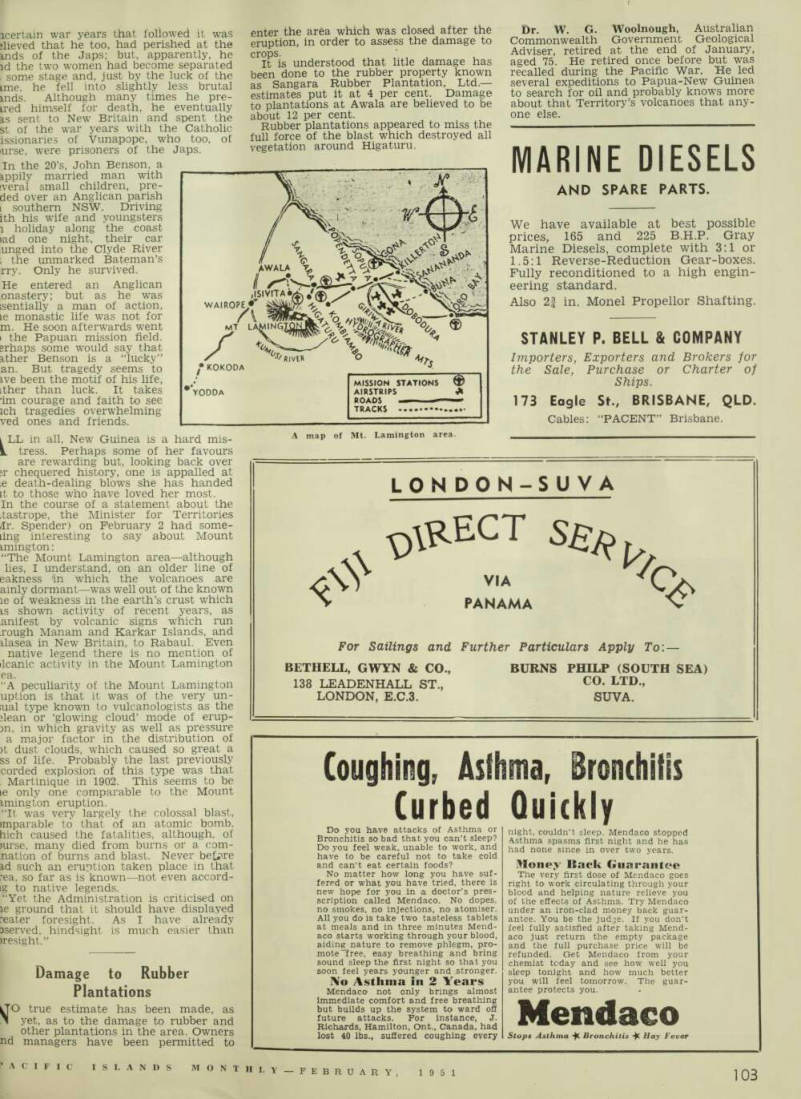
Plantations
yo true estimate has been made, as II yet, as to the damage to rubber and other plantations in the area. Owners nd managers have been permitted to
enter the area which was closed after the eruption, in order to assess the damage to crops.
It is understood that litle damage has been done to the rubber property known as Sangara Rubber Plantation, Ltd.— estimates put it at 4 per cent. Damage to plantations at Awala are believed to be about 12 per cent.
Rubber plantations appeared to miss the full force of the blast which destroyed all vegetation around Higaturu.
Dr. W. G. Woolnough, Australian Commonwealth Government Geological Adviser, retired at the end of January, aged 75. He retired once before but was recalled during the Pacific War. He led several expeditions to Papua-New Guinea to search for oil and probably knows more about that Territory’s volcanoes that any one else.
A map of Mt. Lamington area.
Advertisements & other items, pp. 107-110 (3 items)
103
■ACIFIC ISLANDS MONTHLY - FEBRUARY, 1951
Curbed Quickly
MARINE DIESELS
AND SPARE PARTS.
We have available at best possible prices, 165 and 225 B.H.P. Gray Marine Diesels, complete with 3:1 or 1.5:1 Reverse-Reduction Gear-boxes.
Fully reconditioned to a high engineering standard.
Also 2f in. Monel Propeller Shafting.
STANLEY P. BELL & COMPANY
Importers, Exporters and Brokers for the Sale, Purchase or Charter of Ships.
173 Eagle St., BRISBANE, QLD.
Cables: “PACENT” Brisbane.
LONDON-SUVA
VIA
PANAMA
For Sailings and Further Particulars Apply To: BETHELL, GWYN & CO., BURNS PHILP (SOUTH SEA) 138 LEADENHALL ST., co - LTD »
LONDON, E.C.3. SUVA.
*7, C
Coughing, Asthma, Bronchitis Curbed Quickly
Do you have attacks of Asthma or Bronchitis so bad that you can’t sleep?
Do you feel weak, unable to work, and have to be careful not to take cold and can’t eat certain foods?
No matter how long you have suffered or what you have tried, there is new hope for you in a doctor’s presscription called Mendaco. No dopes, no smokes, no injections, no atomiser.
All you do is take two tasteless tablets at meals and in three minutes Mendaco starts working through your blood, aiding nature to remove phlegm, proeasy breathing and bring sound sleep the first night so that you soon feel years younger and stronger.
IVo Asthma In 2 Years Mendaco not only brings almost immediate comfort and free breathing but builds up the system to ward off future attacks. For instance, J.
Richards, Hamilton, Ont., Canada, had lost 40 lbs., suffered coughing every
night, couldn’t sleep. Mendaco stopped Asthma spasms first night and he has had none since in over two years.
Money Back Guarantee
The very first dose of Mendaco goes right to work circulating through your blood and helping nature relieve you of the effects of Asthma. Try Mendaco under an iron-clad money back guarantee. You be the judge. If you don’t feel fully satisfied after taking Mendaco just return the empty package and the full purchase price will be refunded. Get Mendaco from your chemist today and see how well you sleep tonight and how much better you will feel tomorrow. The guarantee protects you.
Mendaco
Stop* Asthma -ft Bronchitis -jt Hay Fever
SHIPS
AND
SMALLCRAFT
As one of the oldest, largest and most active shipbroking firms in Australasia, we are in a position to offer a wide range of vessels suitable for economic Island operation. Some of these craft are solely in our hands for sale.
At this time of publication, and subject to prior sale, we have the following vessels to offer:— • New diesel engined 300 tonner. • Modern diesel engined 300 tonner. • Modern steel 200 tonner, twin diesels. • Powerful diesel tug. • Twin screw motorship, 450 tons d/w. • Number of 50/60/80/100/150 tons capacity motor - vessels, some with auxiliary sails. ★ TV. *1
TRAILER
FIRE
ENGINES
z/y These units are widely used throughout Australia for rural fire protection by Fire Brigades, Municipal Authorities, Harbour Boards, etc. They are ideal for the protection of Island townships, store depots, properties, etc. Available in 225 GPM and 500 GPM capacities. *
A., J. ELLERKER
63 PITT STREET, SYDNEY, N.S.W.
'Phones: BU 1574, BU 5055. Cable Address: "Hipex, Sydney."
“BLUE STREAK” POWER CHAIN SAWS
m
A nnouncement
nidiiiillilllllllllH QWING to the steadily increasing demand for all types of Blue Streak units by purchasers in many Islands areas, we are anxious to provide our valued Clients with the best in service facilities and parts supplies.
This fact has brought into being the granting of.our exclusive sales/service franchise for all models to:
BURNS PHILP & CO. LTD.
in the following territories :
BURNS PHILP (NEW GUINEA) LTD.,
Port Moresby, Samarai, Lae, Madang, Rabaul, Kavieng.
BURNS PHILP (SOUTH SEA) CO. LTD.,
Fiji, Tonga, Samoa.
BURNS PHILP (NEW HEBRIDES) LTD.,
Vila, Santo.
The Blue Streak Australian-made units are available in a complete range of "one-man," "twoman" petrol engined and "two-man" electric machines and in
* PERFORMANCE * POWER WEIGHT RATIOS
are absolutely outstanding.
A seemingly unlimited range of usages for such units includes:— ' Logging * Sawmilling * Timber Yards * Shipyards * Pit Props
* RELIABILITY
Bridge Building * Contractors 7 Works * Wharf Building * Harbour Authorities * Constructional Works * Case Making * Telegraph Post Work Heavy Pruning * Firewood Cutting.
Soon, all models will be available in each centre for practical, down-to-earth tests for prospective users who, it is suggested, should immediately contact their local Agent as orders will be executed in accordance with date of receipt.
A. J. ELLERKER
Sole Factory representatives for “C.C.” Engineering Industries, Ltd. (Power Chain Saw Division ).
63 Pitt Street, SYDNEY, N.S.W.
Phones: BU 1574, BU 5055 Cable Address: "Hipex, Sydney"
BERRY’S BAY
BOATYARD
(B. J. Halvorsen—Manager)
Specialists in Island vessels.
All kinds of boat-building and repairing.
New and used boats and engines for sale.
Quotations and estimates free.
BERRY’S BAY BOATYARD
John Street, North Sydney, N.S.W.
SUDDEN DEATH
TO INSECT PESTS
FLIT
Kills Moth* Moiquitoet *®*L/x>«ch*» Si| v*rfi»h Bugs Ant* X FLIT kills flies, mosquitoes, silverfish, moths, fleas, bugs, beetles, ants, FLIT is harmless to humans but deadly to insects. . . . will not harm clothes.
Ask for FLIT - refuse substitutes.
VACUUM OIL COMPANY PTY. LTD. (lnc»rporat*d iz THE MOST EFFECTIVE INSECTICIDE YOU CAN BUY
104
FEBRUARY, 1951 PACIFIC ISLANDS MONTHL
Rabaul Roundabout
From Our Own Correspondent
Rabaul, Feb. 1.
AT the general meeting of the Rabaul sub-branch of the R'SL this month office bearers were elected as follows: Mr. W. Smythe, President; Mr. Dudley Jones and Mr. Martin Munro, Vice- Presidents; Mr. Jock Lee, Secretary; Mr.
J. Whipping, Treasurer.
Committee members are Messrs. Don Williams, George Tyrrell, Pat Mac- Kenzie, E. P. Burke, Max Duff and Arthur George.
At this meeting Mr. E. V. Smythe was selected as representative to attend the State Conference of RSL men to be held at Lae.
It was agreed to press for the treat ment of soldier settlement as a matter of the highest priority with the Australian Government and, in Rabaul area, for Keravat, and Worongoi valley to be con sidered as suitable areas for settlement.
A controlled immigration policy was also recommended.
A special committee was appointed to attend to the matter of land settlement.
Is consists of Messrs. John Stokie, S.
Jarvis, Dudley Jones, and (publicity officer) Martin Munro.
Other matters to be brought up at the convention were: the need to increase the present scale of penalties imposed on natives —it was pointed out that the scale now in operation was formulated when the natives were receiving much smaller wages than they do to-day. The institu tion of a Jury System of four for trying European cases. State branch to set up a sub-committee to deal with matters of entitlement and give this the widest publicity. The prosecution of local war criminals known to have committed definite acts of treason against white men, and to have given unsolicited in formation to the Japs.
THE Rabaul Golf Club is making tremendous strides in its work of reforming the old pre-war Club.
While at present there are only four greens completed, an increasing mem bership augurs well for the early addition to this number.
On January 29 a cocktail party was held for members of the Club and their guests, at Pila Pila, the home of Mr. Bill Bailey. This marked the official opening of the Club.
THE Rabaul District Court is to lose its presiding Magistrate, Mr. Ernie Britten, well-known to all Terri torians, who is departing for the South on the Bulolo. Mrs. Britten left on a previous vessel.
After taking his recreation leave, Mr.
Britten will return to Lae where he will take up his post as District Magistrate.
Friends of Mr. Britten gave him a farewell Smoko at the New Guinea Club and presented him with a fine pewter mug.
Mr. Britten’s place on the bench is taken by Mr. lan Downs, also well-known in the Territory.
AN astonishing exhibition of native art from Sogeri Education Centre was held at the Rabaul Public Library this month.
At times, looking at the exhibits one was transported in imagination to the salons of Modem Art in Paris.
Among 180 boys in Sogeri, twenty were chosen to pay special attention to Art, ana the results speak for themselves.
Their sense of line, composition, and particularly their use of colour, is out standing.
MORE astonishing than the exhibition itself was the speed with which it concluded.
The Library had cleared its walls of their usual decorations for the hanging of the 43 samples of native culture, and spectators were in the act of gazing at them in a comfortable browsing mood when a flying figure from the Department of Education entered the Library, un ceremoniously removed the pictures and departed with them—apparently en route to the Wau Hotel where they will be shown next.
They had been hanging exactly six hours.
A CHARMING young visitor to the Territory is Miss Robin Mullaley, who ip staying with her parents Mr. and Mrs. pennis Mullaley, at Natava Plantation. She is clever as well as pretty and has completed two years of Science at the New England University, Armidale, gaining Distinction in
Jeography, credit in Geology, and a pass n Economics. Next year she \yill pecialise in Geology and Geography.
On January 27 her parents gave a larty in her honour at their home. Over 0 guests were present. Miss Mullaley will eturn to take up her studies at the University in March. [RESIDENTS of Rabaul are erupting t\ with laughter over an article in the Sydney Morning Herald by Mr. rhomas Wynyard entitled “The Fiery hadow Over Rabaul.”
Says Mr. Wynyard . . . “To-day most f the scars of war have disappeared, lany hidden for ever by dense tropical rowth, Japanese ships protruding from be harbour waters, a burnt-out wharf nd an intricate stores tunnel honey ombing the hills are, perhaps, the only of an ill-fated bid for empire.”
Come, come, Mr. Wynyard!
In one paragraph he refers to Rabaul s a trading post ... this was in the ear 1942; and in the following speaks f Rabaul endeavouring to regain her :atus as “Queen City of the Islands.”
The rest of the article is full of similar laccuracies, even to the spelling of [atupi as Matape. Says Mr. Wynyard: [n their tax-free island paradise the eople work and relax without care for le red shadow that may be thrown over rem at any moment by old Matape.”
Tch, Tch, Mr. Wynyard—why not come p and see us sometime?
N January Rabaul had an unexpected visit from the Brynje, a Norwegian overseas vessel. When she departs vo Rabaul residents will be on board ; passengers: Mr. Tony Corliss and Mr. oel Barry.
Rabaul Social Doings
Prom Our Own Correspondent
Rabaul, Feb. 6.
i T the opening of the new clubhouse II of the Rabaul Women’s Club, five debutantes were presented to His onour, the Administrator and Mrs. urray.
The five debutantes were Miss Valerie mge, fair and elegant in a gown of gandie and lace; Miss Dorothy William n, glamorous in white organdie draped f one shoulder; Miss Faye Rundagle, in ravishing frock of white net, with a ige trailing sash tied and draped at the ick of the frock in a bustle effect; Miss icqueline Palmer, in a lovely frock of oderie anglaise, also off the shoulder: id finally Miss Diana Coote in a beauti .l gown of organdie, the off-the-shoulder dice edged with hand made flowers of e same material.
The President of the Club, Mrs. Mildred
Costello, presented the debutantes.
Pink and white was the Debutante’s Cake topped with a small doll dressed as a Debutante. The cake was a lovely creation of which it seemed sacrilege to The Debutante Doll was presented to Mrs. Murray as a memento of the occasion.
ON January 30, at the home of Mr. and Mrs. Leo Jamieson, Miss Lorna
Hartely was married to Mr. Harry Phillips. Both were of the Rabaul staff of Burns Philp and Co., and formerly of Port Moresby. The bride and her bridesmaid wore floral, street-length frocks.
Miss Valerie Lange, also of the Burns Philp staff, was bridesmaid; best man was Mr. Bill Reynolds of Keravat.
The couple left by Qantas Airways for a southern honeymoon.
Advertisements & other items, pp. 111-112 (2 items)
107
A( IFIC ISLANDS MONTHLY FEBRUARY. 1951
Gabriel Achun
m * M
AND
tyoU/ jjoV Mon£^
IN
VARIETY-
QUALITY—
FLAVOUR.
There’s SAYBON . . . that slightly salty biscuit to tickle party palates.
THIN CAPTAINS . . . the perfect base or piquant savouries, or lunch-time snacks. UNEEDA . . . the all-round family favourite, for every occasion.
SHREDDED WHEATMEAL ... so
rich in health-giving vitamins, and a delight to eat with cheese ! Yes, these are only four reasons why wise housewives say, “Swallow’s
biscuits, please.”
BAKED BY
SWALLOW & ARIELL
GABRIEL ACHUN
Importer and Wholesale Merchant
Specialises in:
BEERS
BICYCLES
AERATED WATER MANUFACTURING
COTTON PIECEGOODS FOR NATIVE TRADE
AGENT FOR “STANDARD” AND “TRIUMPH” CARS
Malaguna Road
RABAUL
Territory of New Guinea Proprietor:
RABAUL CORDIAL FACTORY.
Telegraphic Address:
“GABRIEL ACHUN,” RABAUL.
fitw Tl
• MADE AT HENDON, ENGLAND
BY THE MANUFACTURERS OF
THE WORLD-FAMOUS TILLEY
LAMPS AND RADIATORS
• WEIGHT 5 LBS. INCLUDING OIL
• NO FLEXES-NO WIRES
• SIMPLE HEAT CONTROL
• SPARKLING MODERN FINISH
IN CHROMIUM & CREAM
• EVEN HEAT DISTRIBUTION
• EXTRA LARGE IRONING PLATE
WITH BEVELLED EDGE
• NOT AFFECTED BY DRAUGHT
• THUMB-RESTS FOR RIGHT OR
LEFT HAND WORKING
• VITREOUS ENAMELLED BODY
LLEY
KEROSENE DOMESTIC IRON
MODEL DN2SO
o BRITISH PAT. No. 524714 AUSTRALIAN PAT. No. 1 14305 , AUSTRALIA & NEW GUINEA: T. H. Bentley, Pty. Ltd., 123-125 William
Send for complete Street, Melbourne, C.l.
TASMANIA: Mr. H. V. Sellers, 108 a Charles Street, Launceston.
FIJI: Mr. K. Witherington, 2 B urns Philp Buildings, Suva.
I Model Illustrated tK
Now .. TOWN MAINS
in your
FACTORY or HOME
wherever you are
All the advantages of A.C. power at city voltage is yours when you instal an Armstrong-Superior Generating Plant. Powered by a robust "ARMSTRONG SIDDELEY" air-cooled Diesel engine, it's fully automatic.
“Armstrong - Superior
» ELECTRIC POWER
PLANT
Models range from 3.75 K.V.A. to 15 K.V.A., either Automatic or Manual Storting.
Further particulars and leaflets from :
VENTURA TRADING CO. PTY. LTD.
26 BRIDGE STREET, SYDNEY, N.S.W.
News Notes From The Goldfields
Prom Our Own Correspondent
IIHE population of Wau is growing in the best possible way. During January, the stork was working over ime and delivered six babies to the Wau lospital.
To Mr, and Mrs. Jim Cavanagh of lulolo on the Bth, a daughter; Mr. and Irs. Gordon Hammond on the 14th, a aughter; and Mr. and Mrs. Mick Leahey f Zenag, on the 15th, a son; to Mr. and Irs. V. W. Bell, of Zenag on the 19th, a □n; to Mr. and Mrs. J. Hawley on the 6th, a son; and to Mr. and Mrs. F. M. »ittle of Bulolo on the 28th, a son.
ENGAGEMENTS announced recently in Li Wau were those of Miss June Eliza beth Rodgie to Mr. Ted Harridge; and liss June Rice to Mr. James Harridge. toth these girls are on the Nursing Staff f the Wau European Hospital, and the rothers are attached to Korang& Gold luicing, Wau. 3URING January Assistant District Officer Seale went on a short patrol through the Otibanda country iking with him nine young schoolboys dio were on school holidays from South; leir ages ranged from 9 to 17 years. After heir five-day patrol, they all arrived ack tanned and full of enthusiasm over atrols in general. lIAU has had some changes in Admin fY istration staff. Mr. W. Bailey, ccompanied by his wife and small aughter, arrived to take up duties as enior Clerk after having been stationed t Goroka. Mr. and Mrs. Bill Kerr, with □ung son Jamie, departed for three lonths leave. Mr. Jerry Corlass and imily arriving meanwhile; he took over ae duties of Native Labour Inspector.
Ir. Vince Idstein has also joined the .dministrative staff after some months i Rabaul and other stations.
Mr. Eric Beattie of Koranga Gold luicing, Wau, departed for three months ‘ave at the end of December. He will larry during his leave, Miss Rae Wind peare, of Tasmania. Mr. Arthur Clarke, f Golden Power, State Creek, paid a nort business visit to Australia, accom anied by Mrs. Clarke. l/|ATRON Thorburn, senior matron, fj. P.H.D., Papua-New Guinea, paid a short visit to Wau on January 30. n the previous day while flying from ae to Wau, the Dragon aircraft in which [atron Thorburn was travelling crashed t Slate Creek —luckily both pilot and assenger were unharmed. The Dragon, le of M.A.L.’s fleet was severely imaged.
Matron Thorburn is lucky in her air ■aft accidents; prewar residents will re ill that she was a passenger in one of arpenter’s D.H. 86 airliners which, en mte to Rabaul, landed more or less ifely, on the coral reef near Sicacui in ew Ireland in 1941.
HHE Wau Golf Club played host to Wau L Township on the afternoon of Febru ary 3 when the Club ran a “Novelty” fternoon to raise funds for the local kindergarten, the Sports Club and the rolf Club. A successful afternoon was ad by all and the nett proceeds amounted ) approximately £5O.
yiR. TOM "YEOMANS-a' * director of
▼1 Bulolo Gold Dredging Ltd. —is visit ing Bulolo with his son Clive. His ife and daughter who also were here ave returned to Sydney.
Mr. Perce Yeomans with his wife and imily also travelled to this area per ulolo and are continuing their journey
South on the same vessel. Both Mr. T. and Mr. P. Yeomans are Directors of the recently formed South Pacific Brewery and their visit was connected with this enterprise.
A RECENT arrival in Wau is Mr. Jack Thompson who, has been appointed resident Geologist for the District.
He is an officer of the Commonwealth Bureau of Mineral Research, and his appointment is welcomed locally. Mr.
Thompson was Field Geologist for A.P.C., in Papua. He is accompanied by his wife and sister-in-law, Miss J. Hinder, who has taken up a position as supervisor in Wau’s pre-school play centre.
Sutherland-de Frame Wedding
ANOTHER pretty wedding took place at the Rabaul Agnes Wisdom Library, on February 4, when Miss Margot Sutherland married Mr. John de Frame.
Mrs. Pamela Boyle of Kokopo, was the Matron of Honour.
The bride wore a street-length frock of white lace, and tiny hat of satin and She was given away by her brother, Mr.
Bob Sutherland, of Rabaul.
The young couple left on the Bulolo for a southern honeymoon.
This season Norfolk Island has supplied 2,500 bushels of certified disease-free bean seed to growers in NSW. Norfolk Island has been growing carrot-seed also, for the NSW market.
Advertisements & other items, p. 113 (2 items)
109
ACIFIC islands monthly-pebruaby, 1951
An Australian Eleven
* V 1 mm.
ANOTHER AUSTRALIAN XI. is—
Asthma, Hay Fever, Catarrh, Bronchitis, Antrum, Sinus, Coughs, Colds, 'Flu, Tonsilitis, and Whooping Cough.
Never run out of Aspaxadrene and get caught with an asthma attack: Best by any test—eleven lettered “touches the spot” and relieves in seconds; 5 little whiffs and in 5 little jiffs—“off she pops.”
It’s the buy-word to-day ... so buy to-day, not “bye’n bye” and have a good night’s “bye-bye”—yourself, all the family and the doctor.
ALL CHEMISTS or
A. H. CRUNDALL
BOX 58, PRAHRAN, VICTORIA, AUSTRALIA.
New Hebrides
60 Ft. Trawler For
(CAPTAIN George O’Brien, of Sydney, on j behalf of Kerr Bros., Island Mer chants. delivered a 60 ft. trawler type vessel, Three Cheers, to Mr. Stan Breusch, a trader of Santo, New Hebrides, in January.
Built by Settrie, well-known South Coast (N.S.W.) boat-builder, and equipped with a 6-cylinder Lister diesel engine, she carried a crew of five —Bill Davis (mate), Jeff Bourke (chief engineer). Bill Drum (assistant engineer). Tom Proctor (son of the popular Islands skipper, Captain Proctor), and Keith Cook.
She called at Noumea, New Caledonia,
en route to the New Hebrides, and half way on the journey struck a cyclone inn which she was successfully hove to on ae sea anchor for 14 hours.
The party returned to Sydney onn February 8 by Qantas aircraft, from Santo.( Captain O’Brien left shortly afterwards for Bundaberg to pick up the Rewenae and take her from Queensland too Yandina, in the British Solomon Islands,; for the Fairymead Sugar Co. Ltd.
Special O’Brien Sea Anchor
CAPTAIN O’Brien does not think muclr of ordinary canvas sea-anchors fon tough work. He uses, instead, the “O’Brien Special,” which consists of any thing up to a dozen old truck tyres chained together and trailed out at the end of a 300-ft. line.
The cyclone he met recently betweerr Sydney and Noumea was a ten-tyre job— but it held Three Cheers without any* trouble at all.
He says he never goes to sea without! making a round of Sydney’s tyre re treaders. Any old truck tyre that is tooc bad for retreading just suits him.
Advertisements & other items, p. 114 (2 items)
Birth
A DAUGHTER was born at the RabauL Hospital on January 21 to Mr. and Mrs. Charles Blake of Nonga.
The little girl is to be christened Berinda Jessica.
McILRATH S PTY. LTD. 202 Pitt St., Sydney
PLAIN AND
SELF RAISING
FLOUR.
Oak ft*. 4#/
ESTABLISHED 1868
Agents for Fiji, Tonga and Samoa: C. SULLIVAN (PACIFIC ISLANDS) LTD., Suva, Fiji.
SPECIAL Grocery Offer to Residents of Pacific Islands from McILRATH S PTY. LTD. 202 Pitt St., Sydney
BEST BRANDY
SULTANA CAKE
3 lb., in utility tin, 8/9 each
“LETONA”
Green Pea Soup
16 oz. tins, 10/6 doz.
CHOICE TUNA FISH PASTE, IVz oz 7V a d. jar CHOICE ANCHOVY PASTE, IV2 oz IVz d. jar “MACONOCHIES” ASSORTED ENGLISH FISH PASTES, 1 oz. tins (Salmon and Anchovy, Salmon and Shrimp, Anchovy. Bloater) “KRAFT” ASSORTED FISH PASTES (Scollops, Bonchovy, Anchovy, Lobster, Bloater), 4 oz. tins “LETONA” PEELED TOMATOES, 16 oz. tins. 18/- doz.; 28 oz. tins, “GLEN ELLEN” GARDEN PEAS. 16 oz. tins, 23/6 doz.; 28 oz “REX” CORNED BEEF LOAF. 12 oz. tins “REX” STEAK AND KIDNEY PUDDING, 16 oz. tins “EDGELL” SPAGHETTI IN TOMATO SAUCE, extra large, 30 oz. tins • BIG SISTER” PRIZE RECIPE RICE PUDDINGS, 12 oz. pkts McILRATH S CARAMEL OR CHOCOLATE DESSERT. 4 oz. pkt PIONEER” FRUIT FLAVORED CORDIAL EXTRACTS (Lemon, Lime, Raspberry, Orange), 4 oz. bot
“FOSTER CLARK’S” TAPIOCA CUSTARD
“FOSTER CLARK’S” GOLDEN PUDDINGS, 8 oz. pkts “BIG SISTER” FRUIT MINCE (for mince pies, etc.), oz. tins .. ..
“HORLICK’S” CHOCOLATE MALTED MILK, 8 oz. tins PAPER PATTY PANS, GREASEPROOF, Fancy White 3/6 GLUCOSE BARLEY SUGAR, 7 oz. waxed cartons 7/- doz. 7/- doz. 4/- doz. 5/6 doz. 29/6 doz. 30/- doz. 18/- doz. 20/6 doz. 22/6 doz. 10/6 doz.
BVzd. ea. 1/11 ea. 3/6 doz. 9/- doz. 21/- doz. 23/- doz. doz. pkts. 15/- doz.
‘BIOMITE’
BROTH CUBES
(pkts. of 6) 4/6 doz. pkts. (each cube, with boiling: water added, will make a delicious cup of beef tea)
LETONA’
CELERY SOUP
16 oz. tins, 10/6 doz.
SUNRICH” CONCENTRATED VEGETABLE SOUP, 12 oz tins .. .. .. . .. . •• ■ ■ ■ • (This soup is so concentrated that a double quantity of hot milk or water may be added) 7/- doz.
SPECIAL
“LETONA”
ORANGE MARMALADE
24 oz. tins
OFFER—CHOICE QUALITY JAMS
“VICTOREE”
QUINCE JAM
CAPITAL”
PLUM JAM
13/6 doz. 24 oz. tins 13/6 doz. 24 oz. tins (These jams are the product of fresh fruit—every tin guaranteed) 16/6 doz.
“LETONA”
CELERY STICKS
16 oz. tins 14/9 doz.
“KIWI” OR “NUGGET” BOOT POLISH (black or stains), IV2 oz. tins. 9/6 doz.
CLOTHES PEGS, wooden, strong, reliable 7/- gross DISH CLOTHS (large size) 7/6 doz.
“GENUINE” O’CEDAR MOPS, No. 10 (with handle) 7/6 ea.
“GENUINE” O’CEDAR OIL 4 oz., 16/6; 8 oz., 27/-; 12 oz., 33/- doz.
“JOHNSON’S” BABY POWDER 4 oz. tins, 1/6 ea.; 10 oz. tins, 3/- ea.
“LETONA”
CAULIFLOWER
16 oz. tins 16/6 doz.
A full ranee of groceries available at lowest prices. Complete list of prices available on application.
WE RECOMMEND EARLY ORDERING BEFORE STOCKS ARE DEPLETED.
ALL PRICES FOB STEAMER, SYDNEY, including Australian permits, cases, packing, etc. All shipments excluding deck cargo are inured fSnst pillage theft and non-delivery. Join the many satisfied Island customers who obtain their grocery requirements from Mcllrath s Export againsi piiiage. Department. 202 Pitt Street. Sydnev. and effect considerable savings.
THE QUALITY OF ALL GOODS POSITIVELY GUARANTEED.
McILRATHS PTY. LTD.
202
EXPORT DEPARTMENT
PITT ST., SYDNEY, AUSTRALIA
Lae Town And District

Prom Our Own Correspondent
LAE, February 3.
A NOTHER war-time myth has been □L exploded. The Tenyo Maru, a Japanese freighter of 7,000 tons is r alueless. She was beached by the Japs >efore the fall of Lae in 1943, and is well mown as a landmark at the sea ap proach to Lae airstrip. She was believed o contain valuable cargo which might ie salvaged. Recently, a syndicate decided o make an inspection. Diver E. Martin, of he United Salvage Co., reported that the hip was entirely empty of goods. With nly her bows above the water-line, the hip will continue to be a landmark.
Two Men Killed In Fire
DEATH by misadventure” —the finding of Coroner A. E. Ewing in his inquiry into the cause of the disastrous fires dhch resulted in the death of two well nown residents of Lae—wrote finis to the Jhristmas tragedy.
The victims —Paul Egel, 43, and Jerry lajor, 40—were trapped in a fire which ngulfed the property with great speed.
Ir. Egel died shortly after admission to ospital, and Mr. Major’s charred remains rere recovered after the fire.
Paul Egel will be well remembered tiroughout New Guinea, more particularly s one of Australia’s leading wrestlers r hen wrestling first came into vogue on ae mainland.
Mr. Major had a splendid war record as high-ranking and decorated Air Force ►fiicer and fighter pilot.
Leturned Soldiers Have Many
Prospects
rHE Returned Soldiers, Lae Sub-branch elected the following office-bearers: President, Mr. J. Hughes; vice residents, Messrs. L. Ashton and J. [cKeam; secretary, Mr. R. Tann; •easurer, Mr. J. V. Knight.
Two of the nominees of the Lae Sub ranch to the newly formed Papua and ew Guinea State Branch were elected ad the Executive Council of this body )mprises: President; Mr. G. K. Whittaker (Lae).
Vice-Presidents: Messrs. C. Beckett L.ae), I. McDonald (Port Moresby) and Cr. W. Smythe (Rabaul).
Mr. N. Osborne (Lae) is Secretary and ’r. E. Pointon (Lae) Treasurer. Lae will ? the Headquarters of the State Branch.
An extensive agenda occupied the Mention of delegates to Congress for 2 lys, and special consideration was given ► such items as the extension of the War srvice Homes Act to the Territory; cpedition of the new European Hospital ; Lae; the establishment of an Advisory ouncil at Lae: Soldiers preference in the & NG Administration: acquisition of md for Soldier settlement: controlled igration to the Territory; Rifle Clubs id the defence of New Guinea. Dele tes attended from Lae, Port Moresby, amarai, Kokopo, Wau, Madang and cewak.
State Sub-branches will be asked to ipport an appeal by the State Branch to Jtablish a Trust Fund for wddows and ependants of Returned men lost in the ft. Lamington eruption.
Gofton-Birrell Wedding
HHE first marriage ceremony to take L place in the new Anglican Church, Lae—All Souls—and one of general iterest was that of Miss Ela L. Gofton, aughter of Mrs. F. S. Stewart, of the [otel Cecil, Lae, to Mr. James A. Birrell, lanager of Morobe Transport Co., Ltd.
Both of these young people have spent lany years in the Territory. Mr. Birrell ad a distinguished war record, and ained the MC.
Mr. Leo Bowman, of the Commonwealth
Bank staff was best man, and the bride’s step-sister, Miss Flora Stewart, was bridesmaid.
The guests were later entertained at a reception by Mrs. Stewart at the Hotel Cecil.
European Hospital
SOME changes in staff at the European Hospital, Lae, have taken place recently. Matron May, 0.8. E., has proceeded South on furlough, and is being relieved by Sister E. Keirwan, who is
Sister-in-Charge at Madang. Dr. T. P.
Morley has resigned as M. 0., and has been succeeded by Dr. H. Bruce, who relieved Dr Carl Gunther, of Bulolo, dur ing his absence abroad.
Defence Of New Guinea
WITH the arrival of the Mangola, the proposed defence plans for New Guinea have been advanced a little.
Many classes of supplies were landed and placed in store. There is still no sign of recruiting for the P.N.G.V.R., although it is well over a year since it was publicly announced that all plans were complete.
The apparent indifference of the authori
ies in Australia to this matter is causing soncern throughout the Territory, and Returned Servicemen’s Organisations are igain pressing for some action. |/|R. PAT BYRNE, Native Labour .▼1 Officer, Lae, with his family, left on the Bulolo for a 7-months’ urlough in Australia . . . Mrs. Bob Jeverley was a passenger on the Bulolo . . On January 16, a daughter—Lae tenet was born to Mr. and Mrs. J.
JcArthur, of Lae Taxis . . . Mr. and Mrs.
Jonel Darby have taken over the manage nent of the Mumeng Hotel from Mr.
Jark Schultz, who is concentrating his .ctivities on water transport. Mr. Darby nil be well remembered as a Customs ifficial at Port Moresby and, more ecently, as Collector of Customs at Lae. lis place has been taken by Mr. Jack load, who arrived from Samarai.
Handicaps On Lae Town Plan
IM’ILFORDHAVEN Road, Lae, has been .▼1 selected, under the Town Plan, as the “light industrial area,” and esidents whose business comes under this :ategory have been given instructions to irrange for the removal by the end of 951. The previous ultimatum expired on December 31.
However, no obvious effort has been nade by the authorities to supply water, ight, and telephone facilities, and those vho have moved have been compelled to nstall private lighting plants and to lepend on tanks for water.
It was ascertained this week that there s no early prospect of telephonic con lections: in fact, it was hinted that 12 nonths might pass before a service could >e provided. Shortage of materials—old tony equipment is still being used—is the inmary cause; but this explanation is iggravated by the fact that, if materials yere available, shortage of staff would ;ontmue the hold-up.
A suggestion that there may be a clash >etween Postal authorities and the Town lanners as to a permanent site for the lew exchange need not be treated lightly, n the interim it is the public that has to )ut up with the inconvenience.
Taxes Kill Enterprise
rHE Minister for External Affairs ex pressed the desire of the Australian Crovernment to encourage private enterprise in the Territory. These in fancies of how these ideas are imple nented are typical.
Some time ago, a local company decided o sme!t down aeroplane bodies, and bits S v P il c ,f s ‘ Tl J e enterprise got well under m gots aluminium were pre >ar®d f u r shipment south. The most ® ce 0 1lt shipment, however, was subjected ° f a pe J c J ® n i: cus toms duty before ntry into Australia. .oifo anot f er case a shipment of truck r lx?- Sl i c k as rear ends, etc.) was shipped hinrnori+■. Australia. Although the hipment arrived in Sydney for trans *s u arly Oc tober, and actually e i v . ed *? y consignee on or about the ast week m December last, the consignor, invoiced at £6OO, was required to ,ay customs duty of £271/14/2. iriu e^nS S f- Mr ; s pcnder, in between times, )lain ir^hwvv e i h . ese . two cases and ex lam why this duty is imposed and how ln Wlth hls ay owed policy of •ncouragmg private enterprise.
Dicks-Ogorman Wedding
December 16 Miss Norma Dicks and Mr. Kevin Ogorman were married at ?nh Q vn a K ier -pn Malaguna Road, ms hrirSJT a - t i ier y hite - Miss Val Lang est man , BiU Flynn W6S Th u e s e , em P lo yces of Burns nd lace Th bride S grown was of satin
Advertisements & other items, pp. 115-116 (3 items)
111
ACIFIC islands MontHlv-f e b r d a r Y, 1951
Mary Baker
ICE CREAM MIX
Is now available to Pacific Islands Traders and Storekeepers in Chocolate and Strawberry Flavours in addition to the popular Vanilla Packed in 16 oz. tins for the Home, 5 lb. Family Size tins and l>2 lb. tins for Storekeepers, Milk Bars and Cafes.
Ask Your Local Store For It Today[ By placing your order with our Agent in your own Territory, you will receive your supplies of Mary Baker Ice Cream Mix
more promptly
AGENTS:
New Caledonia: ETABLISSEMENTS BALLANDE, Noumea.
New Hebrides: COMPTOIRS FRA NCA IS
DES NOUVELLES HEBRIDES,
Vila and Santo.
Tahiti: WALTER GRAND, Papeete.
Fiji: HUNT’S AGENCY, Suva.
W. L. D. HARVIE, Lautoka (North-West Districts).
Sole Distributor ;
J, C. MERRILLEES PTY. LTD.
104 HUNTER STREET, SYDNEY, N.S.W.
Telegrams: “MERRILLEES,” Sydney.
Classified Advertisements
BOOKS
BOOK BARGAINS—Send for list of real bargains from 2/- upwards. State your interests, please. I also find out-of-print English Books.
Mention “PIM.” —Philip Boulton, Bookseller, Westbury. Wilts, England.
Itch Germs
Cause Killed in 3 Days
Your skin has nearly 50 million tiny seams and pores where germs hide and cause terrible Itching, Cracking, Peeling, Burning, Acne, Ringworm, Psoriasis, Blackheads, Pimples, Foot Itch and other blemishes. Ordinary treatments give only temporary relief because they do not kill the germ cause. The new discovery, Nixoderxn, kills the germs quickly and is guaranteed to give you a soft, clear, attractive, smooth skin, or money back on return of empty package. Get guaranteed Nlxoderm from your chemist or store to-day and attack the real cause of many skin troubles.
Nlxoderm
For Skin Sores, Pimples and Itch.
HOLIDAY RESORTS
SOUTHERN HIGHLANDS.—Roomy, self-contained furnished flats, all-electric, sewered, hot water; near rail, shops and bus stops; handy to Sydney and South Coast towns; at 2,200 ft. elevation, all sports available, ideal for children. Terms and particulars from; Proprietor, “Tree Tops,”
Bundanoon, N.S.W.
“MOUNTAIN VIEW” GUEST HOUSE, magni-
ficently situated on the banks of the Wollondilly River, in Burragorang Valley, Australia’s largest sunken valley (69 miles from Sydney), a most modern Guest House, with accommodation for 150 guests. Golf, tennis, riding, billiards, dancing and swimming. Hot water service, electric light and sewerage. Licensed to serve liquor. Tariff: £4/4/- per week, with special rates for children. Write direct to: “MOUNTAIN VIEW,” Burragorang Valley, N.S.W.. or phone Burragorang 3 (or XM 1384). Proprietor: R. I.
Fernandez, late of Papua and New Guinea.
FOR SALE
MOTOR YACHT, 48 ft., 14 ft. beam, 6 ft. draft. 72 h.p. Buda marine diesel, 8 h.p. Lister diesel aux. 24 volt lighting, Aladdin 5-jet stove, Kero, frig., hot shower, 2 toilets, 6 berths. Ideal big game fishing or island cruise, adaptable sail.
Write: “1224,” Box 1627, G.P.0., Sydney, N.S.W.
NORFOLK ISLAND’S Weekly Newspaper and Established Retail Business.—As one or separate units. For full details, apply by air-mail to: The Proprietor, “The Norfolk Island News Edition,”
Mission Road, Norfolk Island.
RADIO EQUIPMENT.—We can supply new and reconditioned transmitters and receivers for low powered marine and shore installations at a reasonable price. Crystals supplied to specified frequencies. Inquiries answered promptly.
Write: Liverpool Trading Co., 23 George Street, Liverpool, N.S.W., Australia.
POSITIONS WANTED
KEEN MAN seeks position in Pacific Islands Varied experience in engineering and othee work; also studied allied and other subjects* such as Tropical Medicine. Married—no childrern Willing to launch into new field wholeheartedly Replies to “Nissan,” c/o Box 3408, G.P.O.< Sydney, N.S.W.
EXPERIENCED MAN, 43, married, desires job as Thursday Island or Port Moresby (Papua), offlcs work, handy-man, etc. Replies to; W. C. Southd 50 Edward Street, Woollahra, Sydney, N.S.W.
ISLANDS SOUVENIR
“WHERE THE TRADE WINDS BLOW." bf
R. W. Robson and Judy Tudor.—A collection of over 70 fascinating tales and sketches co the South Pacific Islands, by PIM writers, K W. Robson and Judy Tudor; well bound am profusely illustrated. 175 pages. Price: 7/6 (8A posted or $l.OO U.S. currency) per copy. Obc tainable from Steele’s Book Store, Suva, Fiji, oo direct from the publishers, Pacific Publication!! pty. Ltd., Union House, 247 George Street; Sydney. N.S.W., Australia.
TENDERS
ESTATE C. P. PARKINSON, DECEASED. -
Sealed Tenders endorsed “Tenders Waldow anr Cape Palliser” are invited and will be receives by the undersigned until 5 p.m. March 31, 195:' for the purchase of the following:— (a) Residential Site —Freehold land known se WALDOW, VUNAGOGO, via Kokopo. (b) Virgin Land— Approximately 100 hectares o virgin land at CAPE PALLISER held on agrr cultural lease for 99 years from approximate! 1926, and situated between Sum Sum Plantatloc and the Aar River.
Title.—The successful tenderer shall accept sues title as the administrators of the Estate no< have and without further investigation.
Terms —The properties will be sold subject If the consent of the Administrator of the Territon of Papua-New Guinea. On acceptance of tende;; 25 per cent, of tender price to be deposited am the balance is to be paid upon the execution bd the Trustees of a conveyance of the property o such other document or instrument as the suo cessful tenderer may reasonably require t evidence the sale in the absence of a registerahi transfer. The highest or any other tender wit not necessarily be accepted.
BURNS PHTLP TRUST COMPANY LIMITED!
7 Bridge Street, Sydney.
Administrator of the Estate of C. P. Parkinsoc (deceased).
Sydney, February 5, 1951.
ESTATE L. L. GORDON, DECEASED—SeaIe
tenders endorsed “Tender Lukon’’ are invite and will be received by the undersigned unit 5 p.m., April 30, 1951, for the purchase of th following:— LUKON PLANTATlON.—Agricultural Lease Nt 478 Vol. 7, Folio 74; area, 101.5 hectares, mon or less (about 254 acres). Situation: East coaj of New Ireland, Territory of New Guinea.
Plantation area unoccupied since Japanese ir vasion of Territory.
No buildings on property.
Originally planted during years 1936-41 wit. coconut palms—totally destroyed during occi: pation. Small quantity of cacao planted befot the late war.
Titles. —The successful tenderer shall acce;: such title as the administrators of the Estai now have and without further investigation.
Terms. —The property will be sold subject to tH consent of the Administrator of the Territory Papua-New Guinea. On acceptance of tende 25 per cent, of tender price to be deposited ac the balance is to be paid upon the executio by the Trustees of a conveyance of the pn perty or such other document or instrument . the successful tenderer may reasonably requir to evidence the sale in the absence of registerable transfer. The highest or any othr tender will not necessarily be accepted.
BURNS PHILP TRUST COMPANY LIMITED:
7 Bridge Street, Sydney, Administrator of the Estate of L. L. Gordd (deceased).
Sydney, February 13, 1951.
THE MACLAURIN SCHOOL
WENTWORTH FALLS, N.S.W.
A Church of England School. Preparatory, Boarding for boys, Vacancies for 1951.
Apply to: The Headmaster, C. H. LLOYD, M.A. (Cantab).
Special care given to Boys from the Islands and Overseas.
HAND HAH
GARMENTS of all descriptions made to your requirements by expert knitters.
BABIES' AND CHILDRENS'
OUR SPECIALITY.
Personal attention given.
“THE PIXIE”
Whiteway House, 50b Belgrave Street, MANLY, N.S.W.
To Order Write jor 'particulars :
112
FEBRUARY, 1951-PACIFIC ISLANDS MONTHL
Tahiti Families’
Bereavements
Papeete, Jan. 25
TWO well-known Tahiti families have suffered bereavements lately.
Young Andre Lehartel died in the Taravao Hospital on January 24 from measles, an epidemic of which has been current. He was a son of Leon Lehartel.
The Lehartels are a respected and well known family, which is settled mostly in the Papara district.
Mrs. W. W. Asmus, wife of the British vice-consul if Papeete, has been informed of the death, presumably from fever, of her brother Bertie Frogier, who was a sergeant in the French military forces in Africa. There are several brothers in the Frogier family, resident in Tahiti.
Advertisements & other items, p. 117 (2 items)
113
ACIFIC ISLANDS MONTHIv
un thly February, 1951
Importers
DO YOU WANT
Anything done in Sydney? Shopping? Clothes perhaps? Or books? Reservations? Bookings?
Subscriptions? Information? In short, do you want anything?
Haven’t you often wished for the service of some reliable person in Sydney who could carry out tasks you can’t do yourself?
At last there is someone to help you; someone who makes your problems theirs—the ISLANDS SERVICE BUREAU (Mrs. H. G. Laffln), 33 Beach Street, Balgowlah, Sydney, Australia.
SEND YOUR ORDER NOW—cost plus 10 per cent, and freight.
IMPORTERS
EXPORTERS
All classes of merchandise purchased for Island clients throughout the South-west Pacific.
Island produce sold on Australian and overseas markets on a commission basis.
54a Pitt Street
--- Fir Cable Address: “ROBERGILL,” Sydney
Sydney
Islands Produce
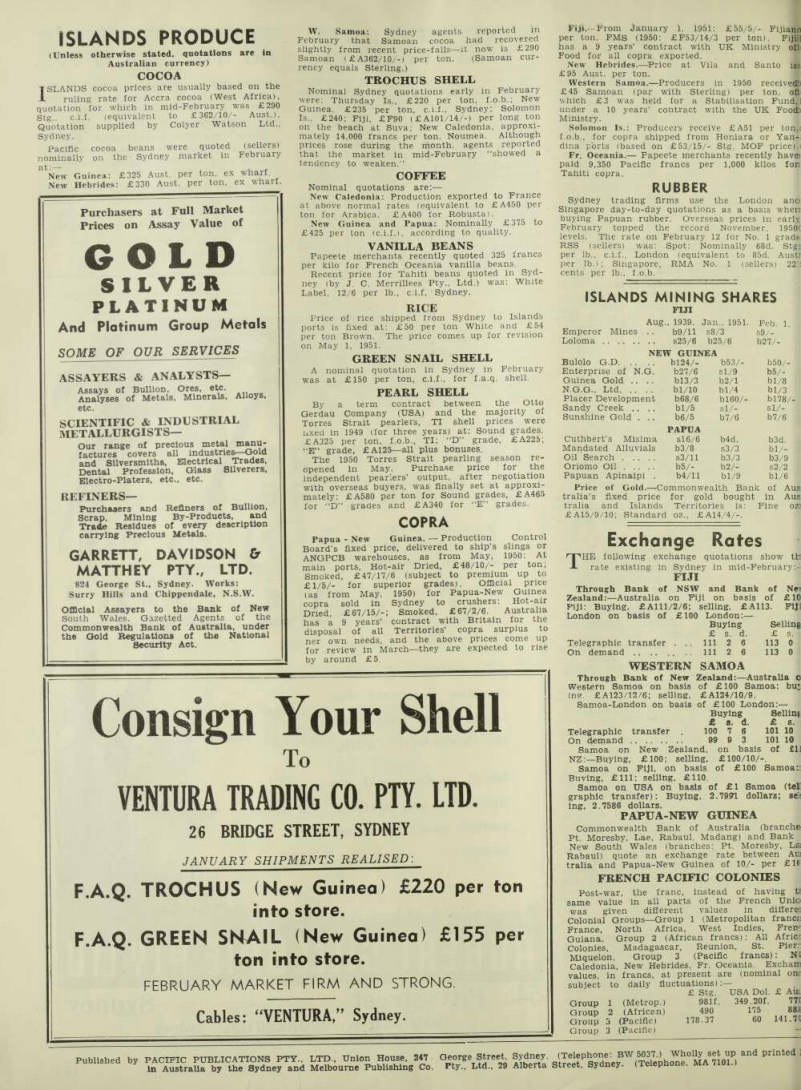
(Unless otherwise stated, quotations are in Australian currency)
Cocoa
ISLANDS cocoa prices are usually based on the ruling rate for Accra cocoa (West Africa), quotation for which in mid-February was £290 Stg., c.i.f. (equivalent to £362/10/- Aust.).
Quotation supplied by Colyer Watson Ltd., Sydney.
Pacific cocoa beans were quoted (sellers) nominally on the Sydney market in February at New Guinea: £325 Aust. per ton, ex wharf.
New Hebrides: £330 Aust. per ton, ex wharf.
W. Samoa: Sydney agents reported in February that Samoan cocoa had recovered slightly from recent price-falls—it now is £290 Samoan (£A362/10/-) per ton. (Samoan cur rency equals Sterling.)
Trochus Shell
Nominal Sydney quotations early in February were: Thursday Is., £220 per ton, f.0.b.; New Guinea. £235 per ton, c.i.f., Sydney; Solomon Is., £240; Fiji, £F9O (£AIOI/14/-) per long ton on the beach at Suva; New Caledonia, approxi mately 14,000 francs per ton, Noumea. Although prices rose during the month, agents reported that the market in mid-February “showed a tendency to weaken.’’
Coffee
Nominal quotations are;— New Caledonia: Production exported to France at above normal rates (equivalent to £A4SO per ton for Arabica. £A4OO for Robustat.
New Guinea and Papua: Nominally £375 to £425 per ton (c.i.f.), according to quality.
Vanilla Beans
Papeete merchants recently quoted 325 francs per kilo for French Oceania vanilla beans.
Recent price lor Tahiti beans quoted in Syd ney (by J. C. Merrillees Pty.. Ltd.) was; White Label, 12/6 per lb., c.i.f, Sydney.
Rice
Price of rice shipped from Sydney to Islands ports is fixed at: £5O per ton White and £54 per ton Brown. The price comes up for revision on May 1, 1951.
Green Snail Shell
A nominal quotation in Sydney in February was at £l5O per ton, c.i.f., for f.a.q. shell.
Pearl Shell
By a term contract between the Otto Gerdau Company (USA) and the majority of Torres Strait pearlers, TI shell prices were nxed in 1949 (for three years) at: Sound grades, £A325 per ton, f.0.b., TI; “D’’ grade. £A225; “E” grade, £Al2s—all plus bonuses.
The 1950 Torres Strait pearling season re opened in May. Purchase price for the independent pearlers’ output, after negotiation with overseas buyers, was finally set at approxi mately: £ A5BO per ton for Sound grades, £A465 for “D’’ grades and £A34O for “E” grades.
Copra
Papua - New Guinea. Production Control Board’s fixed price, delivered to ship’s slings or ANGPCB warehouses, as from May, 1950: At main ports. Hot-air Dried, £4B/10/- per ton; Smoked. £47/17/6 (subject to premium up to £l/5/- for superior grades). Official price (as from May. 1950) for Papua-New Guinea copra sold in Sydney to crushers; Hot-air Dried £67/15/-; Smoked, £67/2/6. Australia has a 9 years’ contract with Britain for the disposal of all Territories’ copra surplus to ner own needs, and the above prices come up for review in March—they are expected to rise by around £5.
Fiji.—From January i, i 951: £55/5/- Fijiann per ton, FMS (1950: £FS3/14/3 per ton). Fijiit has a 9 years’ contract with UK Ministry ofb Food for all copra exported.
New Hebrides.—Price at Vila and Santo Isb £95 Aust. per ton.
Western Samoa.—Producers in 1950 receivedb £45 Samoan (par with Sterling) per ton, ofb which £3 was held for a Stabilisation Fundjl under a 10 years’ contract with the UK Food) Ministry.
Solomon Is.: Producers receive £ASI per ton,x f.0.b., for copra shipped from Honiara or Yan-j dina ports (based on £53/15/- Stg. MOF price) i( Fr. Oceania.— Papeete merchants recently have paid 9,350 Pacific francs per 1,000 kilos fon Tahiti copra.
Rubber
Sydney trading firms use the London and Singapore day-to-day quotations as a basis when buying Papuan rubber. Overseas prices in early February topped the record November, 1950 C levels. The rate on February 12 for No. 1 grade!
RSS (sellers) was: Spot: Nominally 68d. Stgj per lb., c.i.f., London (equivalent to 85d. Austi per lb.); Singapore, RMA No. 1 (sellers) 22‘i cents per lb., f.o.b.
Islands Mining Shares
Price of Gold.—Commonwealth Bank of Aus tralia’s fixed price for gold bought in Aus tralia and Islands Territories is: Fine ozs £AIS/9/10; Standard oz., £AI4/4/-.
Aug,
Fiji
„ 1939.
Jan., 1951.
Feb. 1.
Emperor Mines .. b9/ll s8/3 s9/- Loloma S25/6 b25/6 b27/-
New Guinea
Bulolo G.D bl24/b53/b50/- Enterprise of N.G. b27/6 sl/9 b5/- J Guinea Gold .. .. bl3/3 b2/l bl/8 N.G.G.. Ltd bl/10 bl/4 bl/3 Placer Development b68/6 bl60/bl78/- Sandy Creek .. bl/5 sl/sl/- Sunshine Gold . .. b6/5 b7/6 b7/6 Cuthbert’s Misima
Papua
sie/6 b4d. b3d.
Mandated Alluvials b3/8 s3/3 bl/- 1 Oil Search S3/11 b3/3 b3/9 Oriomo Oil b5/b2/s2/2 Papuan Apinaipi . b4/ll bl/9 bl/6
Exchange Rates
THE following exchange quotations show thl rate existing in Sydney in mid-February :-i
Fiji
Through Bank of NSW and Bank of Ne?
Zealand: —Australia on Fiji on basis of £lO Fiji: Buying. £Alll/2/6: selling. £AII3. FIJI London on basis of £lOO London: —
Western Samoa
Through Bank of New Zealand: —Australia o Western Samoa on basis of £lOO Samoa: buj: insr £AI23/12/6; selling. £AI24/10/9.
Samoa-London on basis of £lOO London;—
Samoa on New Zealand, on basis of £ll NZ:—Buying, £100: selling. £lOO/10/-.
Samoa on Fiji, on basis of £lOO Samoa:: Buving, £111; selling, £llO.
Samoa on USA on basis of £1 Samoa (tel graphic transfer): Buying, 2.7931 dollars; se'.i ing, 2.7586 dollars.
Papua-New Guinea
Commonwealth Bank of Australia (branche Pt. Moresby, Lae, Rabaul, Madang) and Bank New South Wales (branches: Pt. Moresby, Ls Rabaul) quote an exchange rate between Auj tralia and Papua-New Guinea of 10/- per £IP
French Pacific Colonies
Post-war, the franc, instead of having tt same value in all parts of the French Unio was given different values in differea Colonial Groups—Group 1 (Metropolitan francs; France, North Africa, West Indies, Frenc Guiana. Group 2 (African francs): All Afric: Colonies, Madagascar, Reunion, St. Pien Miquelon. Group 3 (Pacific francs): NI Caledonia, New Hebrides, Fr. Oceania. Excham values, in francs, at present are (nominal onr subject to daily fluctuations): — . ,
Buying Selling £ s. d. £ s.
Telegraphic transfer . .. Ill 2 6 113 0 On demand .. Ill 2 6 113 0
Buying Selling £ s. d. £ s.
Telegraphic transfer . 100 7 6 101 10 On demand 99 9 3 101 10
£ Stg. USA Dol. £ Aixcj Group 1 (Metrop.) 981f. 349.20f. 77T Group 2 (African) 490 175 88i£ Group 3 (Pacific) 178.37 60 141.7'i Group 3 (Pacific)
Advertisements & other items, pp. 118-120 (3 items)
Published by PACIFIC PUBLICATIONS PTY.. LTD., Union House, 247 George Street Sydney. 'J'lephone: BW 5037.) and prlnted
in Australia by the Sydney and Melbourne Publishing Co. Pty,, Ltd., 29 Alberta Street, Sydney. ( P
Consign Your Shell
Purchasers at Full Market Prices on Assay Value of
GOLD
SILVER
PLATINUM
And Platinum Group Metals
SOME OF OUR SERVICES
ASSAYERS & ANALYSTS—
Assays of Bullion. Ores, etc.
Analyses of Metals. Minerals. Alloys, etc.
SCIENTIFIC & INDUSTRIAL
METALLURGISTS—
Our range of precious metal manufactures covers all industries—Gold and Silversmiths, Electrical Trades.
Dental Profession, Glass Silverers, Electro-Platers, etc., etc.
REFINERS—
Purchasers and Refiners of Bullion, Scrap, Mining By-Products, and Trade Residues of every description carrying Precious Metals.
GARRETT, DAVIDSON
MATTHEY PTY., LTD.
824 George St., Sydney, Works: Surry Hills and Chippendale, N.S.W.
Official Assayers to the Bank of New South Wales. Gazetted Agents of the Commonwealth Bank of Australia, under the Gold Regulations of the National Security Act.
Consign Your Shell
To
VENTURA TRADING CO. PTY. LTD,
26 BRIDGE STREET, SYDNEY
JANUARY SHIPMENTS REALISED :
F.A.Q. TROCHUS (New Guinea) £220 per ton into store.
F.A.Q. GREEN SNAIL (New Guinea) £155 per ton into store.
FEBRUARY MARKET FIRM AND STRONG.
Cables: “VENTURA,” Sydney.
y OVit
o 4*
ays
SYDNEY - AUCKLAND
or SYDNEY - WELLINGTON
D ' Take your best holiday this year — take the TEAL Solent to New Zealand and enjoy everything on a short vacation.
Save days to see Maori hakas, glaciers, boiling lakes, magnificent scenery.
The wonders of the world are concentrated in New Zealand. £ Plan yonr wonderland summer or winter holiday now. It’s comfortable, easy and thrifty to FLY to New Zealand for yonr holidays. Return fare, £63 —10% concession for parties.
TASMAN EMPIRE AIRWAYS LIMITED
in association with Q.E.A. and 8.0.A.C .
RESERVATIONS; QANTAS, TAA AND LEADING TRAVEL AGENTS
>S c ■
MERCHANTS. & SHIP OWNERS
iBl « l v v.
Capital £500,000
ESTABLISHED 1914
GENERAL MERCHANTS
AND
PROVIDORES
TRADE THROUGHOUT THE PACIFIC.
THIRTY-FIVE YEARS OF PACIFIC ISLANDS DEVELOPMENT AND SERVICE.
BUYERS AND EXPORTERS OF ALL KINDS
OF ISLAND PRODUCE, COPRA, COCOA,
M.O.P. SHELL, TROCAS SHELL, ETC.
AGENTS FOR AUSTRALIAN, EUROPEAN
AND AMERICAN MANUFACTURERS.
DISTRIBUTORS OF EVERY DESCRIPTION
OF MERCHANDISE.
Through our Sydney office, branches and agents, we distribute a wide and comprehensive range of general merchandise.
I R. CARPENTER & CO. LTD.
Head Office: 16 O#CONNELL0 CONNELL STREET, SYDNEY, N.S.W.
Cable Address
“CAMOHE”
Telephone: BW 4421.
Postal Address: G.P.0., BOX 168, Sydney.
In London: W. R. Carpenter & Co. (London), Ltd., Coronation House, 4 Lloyd's Ave., London, EC
ASSOCIATED COMPANIES THROUGHOUT THE PACIFIC’.
IN NEW GUINEA:
New Guinea Company, Limited, Rabaul, Lae, Madang, Kavieng.
IN PAPUA:
J. R. Clay & Co., Ltd., Port Moresby.
IN FIJI
W. R. Carpenter & Co. (Fiji), Ltd., Suva.