Pacific
Islands
Monthly
March, 1951
Vol. XXI. No. 8.
Established 1930.
VRegistered at the G.P.0., Sydney, )or transmission by post as a newspaper ]
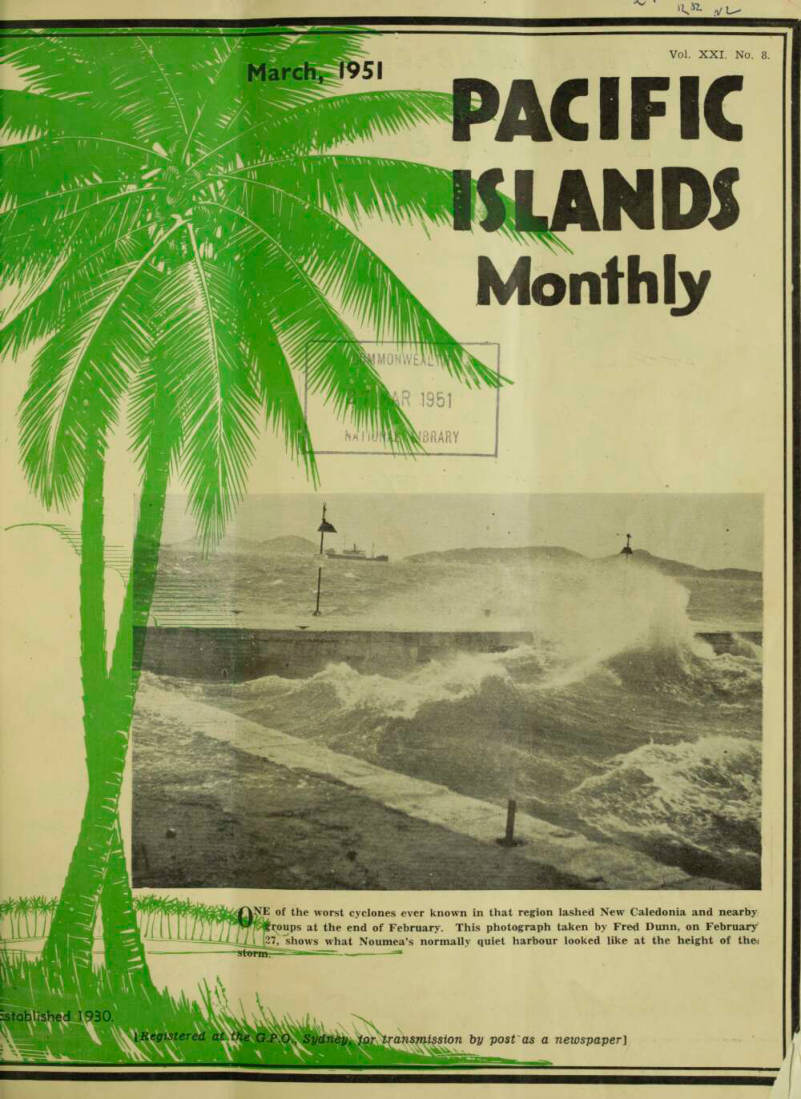
ONE of the worst cyclones ever known in that region lashed New Caledonia and nearby groups at the end of February. This photograph taken by Fred Dunn, on February 27, shows what Noumea’s normally quiet harbour looked like at the height of thei storm.
Advertisements & other items, pp. 2-4 (2 items)
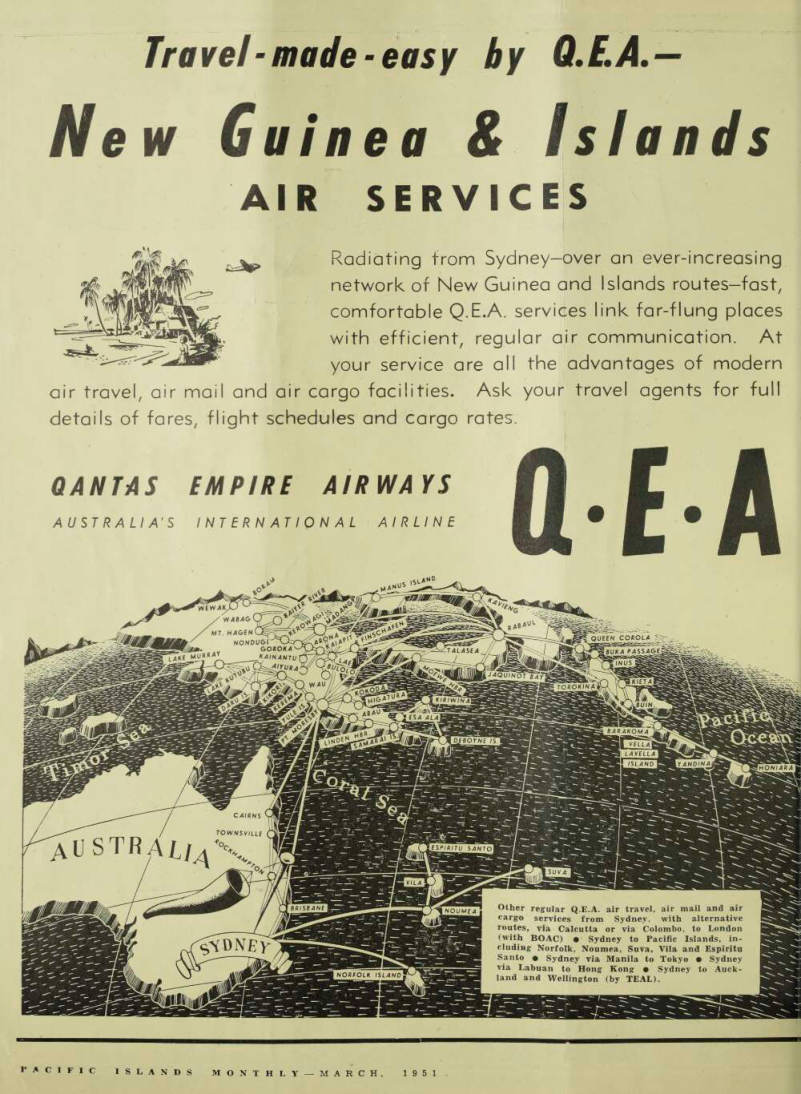
Ne w Guinea & Islands
Travel-made-easy by Q.E.A.—
AIR SERVICES
Radiating from Sydney-over an ever-increasing
network of New Guinea and Islands routes—fast,
comfortable Q.E.A. services link far-flung places
with efficient, regular air communication. At
your service are all the advantages of modern air travel, air mail and air cargo facilities. Ask your travel agents for full details of fares, flight schedules and cargo rates. *
QANTAS EMPIRE AIRWAYS
AUSTRALIA'S INTERNATIONAL AIRLINE
a £ a
SL*Nt>
S w a*,**
- Ac
MT. HAGEN
NONDUGI
a r< ? *a'
&OROKA
J 0
TALASEA
RAY
kainantu lake
■IAQUINOT BAY
\ ) wau
TOROKI NA
Am*
KIRI WIN A
Bum mm
ABAU
ESA ALA
B A R AKOM A
[ 1 DJ BOYNE IS
LA VELLA
ISLAND r ANDINA
HONIARA
CAIRNS
TOWNSVILLE
AUSTRAL
Other regular Q.E.A. air travel, air mail and air cargo services from Sydney, with alternative routes, via Calcutta or via Colombo, to London (with BOAC) • Sydney to Pacific Islands, including Norfolk, Noumea, Suva, Vila and Espiritn Santo • Sydney via Manila to Tokyo • Sydney via Labuan to Hong Kong o Sydney to Auckland and Wellington (by TEAL). /
c^DNEV
NORFOLK ISLAND
ill r mm m m ■ A Coleman Pressure Lantern makes all outdoor night jobs easier, quicker and safer.
It is storm-proof; defies rain or a 105 mile gale to put it out ... it's safe because it cannot be filled while lighted and cannot spill fuel if overturned. Lights instantly and has an automatic tip cleaner which operates at a touch and a turn.
Most important of all . . . it floodlights a one hundred foot area with dependable light, so bright you can read a newspaper fifty feet away and gives forty hours of lighting service per gallon of fuel.
Available for petrol and kerosene in capacities of 200 300 and 500 C.P.
(pieman
... ✓ m
54a PITT STREET
SYDNEY
LANTERNS
Representatives for the Pacific Islands: ROBERT GILLESPIE P T JL T “ jm
PEARCE & CO. LTD.
SUVA
FOR FIJI ISLANDS
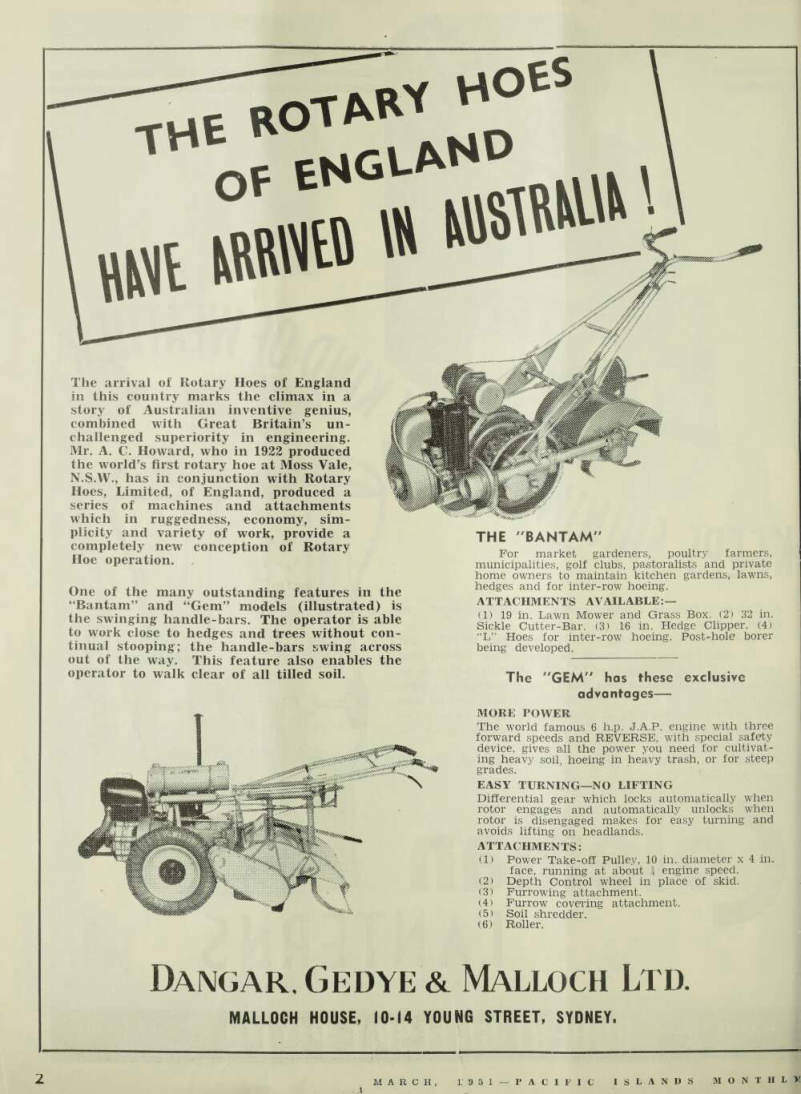
The arrival of Rotary Hoes of England in this country marks the climax in a story of Australian inventive genius, combined with Great Britain’s unchallenged superiority in engineering.
Mr. A. C. Howard, who in 1922 produced the world’s first rotary hoe at Moss Vale, N.S.W., has in conjunction with Rotary Hoes, Limited, of England, produced a series of machines and attachments which in ruggedness, economy, simplicity and variety of work, provide a completely new conception of Rotary Hoe operation.
One of the many outstanding features in the “Bantam” and “Gem” models (illustrated) is the swinging handle-bars. The operator is able to work close to hedges and trees without continual stooping; the handle-bars swing across out of the way. This feature also enables the operator to walk clear of all tilled soil.
THE "BANTAM"
For market gardeners, poultry farmers, municipalities, golf clubs, pastoralists and private home owners to maintain kitchen gardens, lawns, hedges and for inter-row hoeing.
ATTACHMENTS AVAILABLE:—
(1) 19 in. Lawn Mower and Grass Box. (2) 32 in.
Sickle Cutter-Bar. (3) 16 in. Hedge Clipper. (4) “L” Hoes for inter-row hoeing. Post-hole borer being developed.
The "GEM" has these exclusive
advantages—
'A W,
MORE POWER
The world famous 6 h.p. J.A.P, engine with three forward speeds and REVERSE, with special safety device, gives all the power you need for cultivating heavy soil, hoeing in heavy trash, or for steep grades.
EASY TURNING—NO LIFTING
Differential gear which locks automatically when rotor engages and automatically unlocks when rotor is disengaged makes for easy turning and avoids lifting on headlands.
ATTACHMENTS:
(1) Power Take-off Pulley, 10 in., diameter x 4 in. face, running at about I engine speed. (2) Depth Control wheel in place of skid. (3) Furrowing attachment. (4) Furrow covering attachment. <5) Soil shredder. (6) Roller.
Dangar. Gedye & Malloch Ltd
MALLOCH HOUSE, 10-14 YOUNG STREET, SYDNEY.
1
ACIFIC ISLANDS MONTHLY - M A R c H. 195!
Index to Advertisers
Uchun, Gabriel . . 87
rAkta-Vite" .62 Aladdin Industries . 70 [Alois Akun & Co . 72
Smplion (A/sia)
I Pty 65 kneus & Robertson, I Ltd 93 krdath Tobacco Co. 88
fAspaxadrene” . . 103
fAspro” ... 39 Balchin. W., Ltd. . 105 Bank of NSW . . 19 Bell. Stanley P.. & ICo 22. 99 '•Bellhaven” Guest I House ... 100 Berger Paints . . 84 Berlei Ltd. ... 32 Berry’s Bay Boat [ yard 100 lethell, Gwyn Co. 81 Blaxland Rae Pty. 83 Hundell Spence Co. 64 8.0.A.C 25
[orthwicks’ Paint . 72
lovril, Ltd. ... 37 [rasso Polish . . 101
iristol-Myers Co. . 43
[roomfields, Ltd. . 76
[runton & Co. . . 107 [unting, A, H. 27, 61 turns Philp (NG) . 61 turns Philp (NH) . 46 turns Philp (SSi . 82 (urns Philp Trust . 86 'aine’s Studios . . 63 larpenter, W. R. & Co., Ltd., 74, cov. iv arpenter. W. R. (Fiji), Ltd. ... 96 lassified Advts. . 11l olonial Meat Co. 44 oly er Watson (NG) Ltd., 31, 45, 68 rammond Radio . 36 rilley, R. J., Ltd. 14 imningham, R. H.
Pty., Ltd. ... 24 Cystex” 106 angar, Gedye & Malloch, Ltd. . . 2 avison Paints . . 46 Dettol” 29 onaghy & Sons . 79 onald, A. 8., Ltd. [(Auckland) ... 85 onald, A. 8., Ltd. (Rarotonga) ... 42 ouglass, W. C.
Ltd 63 unlop Rubber Co. 23 ectrolux ... 74 ierker, A. J. . . 98 tablissements Donald Tahiti . . 24 tcelsior Supply Co. 87 (stval of Britain . 3 riit” 81 or d Sherington, Limited ... 49 ’ench Chamber of Commerce ... 47 irrett, Davidson & Matthey, Ltd. . . 112 irrick Hotel ... 29 ibey, W. & A. . 88 lllespie Bros. ... 82
Ulespie, Riobt.,
Pty., Ltd. . 1. 50, 73 lllespie. Robt. (NG) Ltd. . . 85, 97 irdon’s Gin ... 76 )ugh & Co., E. J. 79 rand Pacific Hotel 4 regory, A., Ltd. . 39 rove, W. H., & Sons, Ltd. ... 18 laranteed Mail Orders ... 95 Jvorsen Sons, Ltd. 99 iwley’s Pty., Ltd. 78
»Y. K. H. D. 73
iinz & Co., Ltd. . 51 aningway &
Robertson. Ltd. . 27
lolland Rusk” . 14
K)ver, Francis . . 14 rgeia Sanitary Co. 92
land Industries . 77
'lands Service
Bureau ... 77 mnedy, Captain . 97
!rr Bros. . . 83, 106
wi Polish Co. . 34
Kodak (A/asia) Pty., Ltd. ... 40 Kolynos, Inc. ... 13 Kopsen. W., & Co. 47 Lillis & Co.. Ltd. . 90 Maclntyre, Thomas, & Co.. Ltd. ... 38 MacLaurin School 31 Mac Robertson Pty., Ltd 17 McGee, Andrew . . 28 Mcllrath’s, Ltd. . 15 “Mendaco” ... 92 Merrillees, J. C., Pty., Ltd. ... 21 Millers Ltd. (Fiji) 18 Mobile Industrial Equipment Ltd. . 52 Morris Hedstrom Ltd 12 Morris Hedstrom (Aust.) Pty., Ltd. 91 Mungo Scott, Ltd. . 38 Nathan’s Merchan dise (NSW i Pty. 41 Nelson & Robertson Pty., Ltd 34 “Nixoderm” . .51 Nordman, Oscar G. 23 North Sydney Travel Bureau ... 101 O’Brien, Geo. ... 96 Oliver Corporation 110 Pabco Products . . 35 Pacific Is. Society 50 Pacfic Islands Trad ing Co 89 “Pacific Islands Year Book” ... 103 “Pinkettes” . . . .106 Pitt-Way Courses . 17 Qantas, Ltd. . cov. ii.
Qld. Insurance Co. 109 Quirk’s Victory Light Co. ... 20 Ransomes, Sims & Jefferies Ltd. . . 30 Reed, Wm., E. . . 102 Riverstone Meat Co. 66 Robinson, G. H. . 67 Rohu, Sil ... 75 Scott, J., Pty., Ltd. 42 Seward, N. H , Ltd. 89 Shell Co. of Aust. 107 Simpson Bros. Pty. 33 Sims, A. G., Ltd. 65 Southern Cross Eng. & Windmill Co. . 30 Southern Pacific Insurance Co. . . 37 Spartan Paints . . 93 Spruso Co. ... 13 Steamships Trading Co., Ltd. (Papua i 49 Stewarts & Lloyds 80 Sullivan, C., Ltd. . 71 Swallow & Ariell . 22 Swift & Horndale Pty., Ltd. . . . 11l Tallerman & Co. . 101 Tasman Empire Air ways, Ltd. ... 94 Taylor, Allen & Co. 71
Thornycroft, Ltd. . 104
Tilley Lamp Co. 33, 109 Tillock & Co., Ltd. 105 T o n g a n Photos Bureau ... 41 Tooth & Co.. Ltd. 40 Trans Oceanic Air ways 16 Tru-Wite Cleaner . 26 Tyneside Engineer ing Co., Ltd. . . 75 Undersee Novelties 67 United Island Traders Ltd. . . 68 Vacuum Oil Co. 48. 81 “Valiant” Rum . . 80 Ventura Trading Co H 2 Vincent Chem. Co. 69 West, Harry, Pty., Ltd 100 “Where the Trade Winds Blow” . . 26 Williams’ Pills . . 15 Wills, W. D. & H.
O. (Aust.), Ltd cov. iii W. J. Manufactur ing Co. Ltd. . . 95 Yorkshire Insur ance Co., Ltd. . 45 Young, Harry J., Pty., Ltd. ... 108
Advertisements & other items, p. 5 (2 items)
‘ C ‘ Fic Islands Monthlv-March, 1951
or
3 MAY— 3O SEPTEMBER 1951
Jl w \ century AGvj the Great Exhibition of 1851 drew visitors to Britain from all over the world. This year’s Festival, to commemorate that event, will in its turn be remembered a hundred years from now, long after the headlines of today are forgotten.
The coming Festival is the greatest ever planned. The 1851 Exhibition was confined to London, and its keynote was industrial progress; the Festival of Britain 1951 will be spread throughout the United Kingdom and will put the whole nation on show. Exhibitions in London, Glasgow, and Belfast will tell the story of Britain’s contribution to civilisation in Science, Invention, Industry and Architecture. In addition, twenty-three centres throughout England, Scotland, Wales and Northern Ireland will hold Festivals of the Arts.
In support of this official programme there will be something of interest for the visitor to see in cities, towns and villages all over the country—from carnivals, exhibitions, pageants and traditional ceremonies to sporting events of all kinds.
From May to September, for five packed months, wherever he chooses to go the visitor will find
BRITAIN AT HOME TO THE WORLD
Ask your Travel Agent for further details
In This Issue:
Editorials: Mr. Spender Goes to Washington :: The Future of the South Pacific Commission :: Bureaucracy Clings to Stabilisa tion Fund :: Others Besides Planters at War with MOF .. .. 5-6 CO of NGVR Appointed 6 CSR Fiji Chief Retires 6 Iniquitous MOF Copra Price 7 Severe Earthquakes in New Hebrides 7 Further Changes in P-NG Administra tion May Await General Election in Australia 8 Stratocruisers on Trans-Pacific Ser vice 8 New Adventure for Captain Taylor— Australia-South American Air Route Survey 9 Aorangi Returns to Pacific Service .. 9 Resignation of Secretary-General of South Pacific Commission 9 SPC Will Hold Seventh Session in Noumea 10 Third Trading Bank for Suva ... 10 Native Refugees are a Headache for P-NG Administration 11 Nuttery Suggested for Pacific 11 Medals for the Gallant 39 —Disgraceful Episode of Nauru Defence in 1941-42 13 Fiji-Australasian Trade 14 BSI Virtually Without Wharf Facili ties 17 US Tourists Don’t Spend Like the Gl’s 18 No Permits to Cut New Guinea Pine 19 The Month in Moresby 21 Boom Time in Apia—New Buildings Follow High Produce Prices ... 23 The Secretary to the Colonies Meets a BSI Planter 25 Off and On Again—Pan American’s Call at New Caledonia 26 The Deportation of Otto Soltwedel .. 27 Rabaul Roundabout 29
Solomon Islander’s Remarkable Feat of Translation 31 Angry Delegate and Fiji Liquor Law 32 Planters Should Bargain with MOF Direct 33 Operation Volcano 35 Indonesians in New Caledonia Strange Indifference of Australia 37 Lae Now Has Advisory Council — Moresby Council’s Reluctance to Assume Power 38 Proposed Introduction of Rabbits to
Bsi 39
Blood for Volcano Victims 41 Murder Trial on Niue 41 Frustration in Cook Islands 42 A Bachelor for Pago Pago—Samoans Do Not Like Unmarried State ... 43 Its Rich Soil is Niue’s Shrinking Wealth 45 Naturalisation Rush in New Guinea 46 Memories of the Former Kaiser ... 47 UN Tells NG How it Should be Done 49 About Volcanoes 50 Can a Native Refuse to Work 51 Territories’ Talk Talk 53 Island Town’s Cinema 54 Tonga’s 50 Years of Friendship with Britain 55 This is Australia’s New Dominion .. 56 Tropicalities 58 Memories of Edie Creek 59 Fashion :: Children’s Section .. .. 60 Mr. Evatt Gives Democracy to Lord Howe Island 63 Fiji’s Lack of Low-Priced Holiday Re sorts 64 Emergency Dromes in Rabaul’s Vol cano Area 67 All the Praise is for Moresby in Lamington Eruption 67 February News from Port Moresby .. 69 News from Port Vila 71 Movie Theatres for New Britain Natives 72
Leeches Won’t Like this Boot Polish 75 Mr. Dulles’ Surprise Visit to Western Samoa 76 W. Samoan Elections in April ... 76 Pastures in New Guinea Central Highlands 77 Concerning the Fate of Poor Mr.
Prings 84 Lae Critical of Lamington Relief Fund 85 Notes from Lae 86 Norfolk Island News 89 Coral Sea Cyclone 91 Madang Newsletter 92 News Notes from the Goldfields ... 92 Valuable Metal Industries in French Pacific Colonies 93 Plane and Shipping Timetables ... 95 Wau Has a Boarding School 101 Suva Bids Madly for Damaged Goods 101 Are Mt. Lamington Refugees Being Mollycoddled? 102 25 Years in Pago Pago 103 Theatre Lae Has Town-Plan Troubles 10£ Fijian Fighters in Australia 10£ Destination of Admiral Chase 10£ Fiji-Indian Barred from NZ—Official Explanation Should be Given .. .. 10( Coconut Planting Campaign in Fiji ... 10£ Wot—Another Research Section! .. 10£ Island Industries Now Making Cook ing Oil in Fiji IK Fiji Civil Service Salaries Revision .. IK Fiji Bananas Held Up by NZ ; Water siders’ Strike IK Australian Nightmare: Jap Colonists in NG 11] Commercial, Markets, etc 115 OBITUARY: C. A. Bentley, 42; J. M. Wil- Son, 107; Mrs. M. Carruthers, 107.
INDUSTRIES: Copra, 6,7, 33, 35; Gold 8; Oil, 9; Trochus, 19; Cocoa, 38 Bananas, 73; Pearl Shell, 75.
ORGANISATIONS: New Guinea Mem orial Scholarship Fund, 11.
Advertisements & other items, p. 6 (2 items)
4
MARCH, 1951 PACIFIC ISLANDS MONTHL
fv a S fle^4« tte «^e‘e^ S -
m € •fJL )S^ fv a S fle^4« tte «^e‘e^ S -
Z £?» '**. a c
Z SerVa »onT ®W
ot e tbe eS^t ecl botei y Mrect a ,f?, ny °t' Ng ran Pacif t »
Pacific Islands Monthly
The Newspaper-Magazine of the South Seas {.Registered at the G.P.0., Sydney , /or transmission by post as a newspaper I
Published Once Each Month and Circulated in Australia and New Zealand and in the following Pacific Territories and Islands Groups:
Australian Territory of Papua.
Trustee Territory (Australia) of New Guinea.
Australian Territory of Norfolk Island.
Trustee Territory of Nauru (Aust., NZ and UK).
New Zealand Territory of Cook Islands.
New Zealand Territory of Niue Island.
Trustee Territory (NZ) of Western Samoa.
British Crown Colony of Fiji.
British Solomon Islands Protectorate.
British Protectorate of Tongan Islands.
British Crown Colony of Gilbert and Ellice Islands.
British and French Condominium of New Hebrides.
French Colony of New Caledonia.
French Establishment of Oceania (Tahiti, etc.).
American Territory of Eastern Samoa.
American Territory of Hawaiian Islands.
American Trust Territory of Micronesia.
Owned and Produced by Pacific Publications Pty. Ltd., Union House, 247 George Street, Sydney.
Telephones: General Office and Advertising,
Bw 5037, Bu 4938.
P.O. Box 3408
Registered Address for Telegrams, Radiograms, and Cables: “Pacpub,” Sydney.
Contributions.
Articles, stories, and Photographs dealing with Pacific Islands subjects are invited and will be paid for on publication.
Subscription Rates.
In Australia, New Zealand, Fiji, Papua and New Guinea, Western Samoa, Cook Islands, Niue, Tonga, British Solomon Is., Gilbert and Ellice Colony, Nauru, New Hebrides, and Norfolk Island 18 0 New Caledonia (Fr.) and French Oceania (Tahiti, etc.) £llO United Kingdom, British Com monwealth, United States of America, US Pacific Territories, and Foreign Countries .. .. $3.50 £1 10 0
Editor and Pabllsher:
R. W. Robson, F.R.G.S.
Assistant Editor: JUDY TUDOR.
General Office: Union House. 247 George Street, Sydney. Telephones: BW 5037, BU 4938.
Business Manager: SELWYN HUGHES.
Representative In London.
J. T. Wallis, Coronation House, 4 Lloyd’s Avenue, London, E.C.3, from whom may be obtained copies of Pacific Islands Monthly, Pacific Is. Year Book, advertising schedules, etc.
Agents.
The following are authorised to receive sud scrlptlons for Pacific Islands Monthly:— Burns Phllp (NG) Ltd., and Burns Philp (South Sea) Co., Ltd. All branches.
W. R. Carpenter & Co., Ltd. All branches.
Morris, Hedstrom, Ltd. All branches.
Steamships Trading Co., Papua. All branches.
Colyer Watson (NG) Ltd. All branches.
Mrs. Jean Fraser, Lae, New Guinea.
R. F. Smith, Rabaul, New Guinea.
A. H. Bunting, Ltd., Samarai, Papua.
Steele’s Central Store, Suva, FIJI.
Adams Pharmacies Pty., Lautoka, FIJI.
Cook Islands Trading Co., Rarotonga, Cook Is.
United Island Traders, Ltd., Rarotonga, Cook Is.
A. Vercoe, Apia, Western Samoa.
Oscar Nordman, Papeete, Tahiti.
Islands Branches and Representatives of W. H.
Grove <fe Sons, Ltd., Auckland, New Zealand.
Ed. Pentecost, Noumea, New Caledonia.
Societe Gubbay Kerr et Cie, Noumea, NC.
Vol. XXI. No. 8.
March, 1951
Sl/9 Per Copy.
Prepaid, p.a.: 18/- Aust. in South Pacific.
Mr. Spender Goes To Washington
THE appointment by Australia of her Minister for External Affairs and External Territories (Mr. P. C.
Spender) to be Australian Ambassador in Washington is of importance to all the peoples of the Pacifiic Islands. We have no future, here in the South Pacific, unless we are under the protection of the United States. Of all the men in sight, there is no one more able or better qualified than Mr. Spender to promote a sound and friendly relation ship between the South Pacific countries, and the Americans.
Naturally, there has been grumbling in Papua-New Guinea. Those Territories had an unhappy experience under the Socialist Minister Ward and the class conscious Administration he set up; and, when Australia threw out its Pink Gov ernment, and Papua-New Guinea was handed over to the care of Mr. Spender, and Mr. Spender went through those frustrated tropical lands like an in vigorating breeze, promising quick changes and better political health the rerritorians expected far-reaching re forms and sound progress. And, if the statement of policy which Mr. Spender made in June last had any meaning at all, they had every reason to expect the encouragement of private enterprise, de centralisation of administrative authority, a more realistic outlook regarding the use D L native labour, a voice in their own tmtion anC * s *' rong anc * vigorous adminis- As a matter of cold fact, they have had few, if any of those things. A few people have been encouraged to make Plans for the establishment of industries, a few have been given permits to cut coastal timber, District Officers have had cneir titles changed to District Commis sioners; but that is about all. There is one same maddening delay in getting decisions from Port Moresby and Can
berra; the same sense of futility and frustration among senior officials; the same pampering of natives; and a total absence of anything resembling local ad visory boards or legislative council, where local interests might voice their wishes and submit their grievances. Is it any wonder that, in recent weeks, the average resident of Papua-New Guinea speaks with derision of the Spender Policy and is completely cynical *tfien discussing PNG administration affairs!
No one knows whether the failure to implement the Spender policy, and the abandonment of the Territories to the tender mercies of Port Moresby and Can berra bureaucrats, has been due to de liberate sabotage of the Policy by en trenched officialdom, or was the result of Mr. Spender’s deep preoccupation with foreign affairs. Probably, we suffered under a combination of the two. It cer tainly appeared that, after his long ab sence abroad in the latter part of 1950, Mr. Spender lost all active interest in the Territories.
THE decision made by the Australian Prime Minister, early in 1950, that External Affairs and External Terri tories should be in the hands of one man, seemed sound at the time. Inter national relations are in contact with the Pacific Territories at many points.
But experienced Territorians did not like the arrangement; and their fears were justified.
In the present condition of the world, foreign affairs are of paramount im portance; and it proved in practice that they demanded all the thought and energy of Mr. Spender—who probably is the best External Affairs Minister Australia ever had. But that meant that he literally did not have time for Terri tories affairs, and the Territories have suffered accordingly.
Mr. John Howse, MP, Mr. Spender’s Ministerial assistant, did a good job. He impressed everyone as a man of ability, who was quite sincere in his wish to im plement the Spender Policy and bring about worth-while reforms in the Terri tories. But, since he had been given neither Ministerial authority nor a charter for ruthlessness, he could be expected to burst through the rolls of bureaucratic red tape with which he was quickly enwrapped.
Since the departure of Mr. Spender was announced, requests that the Terri tories portfolio be not coupled with any other important portfolio have reached the Prime Minister from many places; and. probably, they will be acceded to.
But the prospect is not good. There are far too few outstanding men avail able for inclusion in the Australian Ministry. Every man of ability and strength is wanted by Mr. Menzies for jobs of greater importance than that of Territories Minister. It looks as if Terri tories will either have to share a first class Minister with some other Depart ment, or must accept as Minister some inconspicuous individual who will have neither the brains nor the strength to stand up to the bureaucrats, and give the Territories what the Territories need.
One suggestion that is sure to receive consideration is that Mr. Menzies him self should hold the portfolio, and dele gate most of the work connected there with to an Assistant Minister. There is nothing at all conspicuous among the older men; but there are some very able Members, of outstanding promise, among those recently elected, and maybe a suit able Assistant Minister can be found there.
The situation is affected, of course, by the probability of an early general elec tion.
WHILE Mr. Menzies has been reluc tant to part with one of his most able Ministers, it is likely that Mr.
Spender, in Washington, will give to
Australia and to the Pacific Territories generally, more distinguished service than he would find possible in any other sphere.
Mr, Spender is completely a realist concerning (a) the threat that a Red Asia soon may spill over into these Pacific countries, and (b) the present weakness of the United Kingdom. He knows the harm that the Socialist Attlee Government has done to the British Empire; last year, in London, he personally saw the ineptitude and muddling of the pitiful little men who are trying to handle the Empire’s affairs. As a staunch Empire man, and one who believes in British character and British
traditions, he is confident that British prestige will be restored in the Pacific, as in the rest of the world. But, in the meantime, our destiny seems to lie with the United States, and our fate is bound up with what the Americans are trying to do to restore peace, sanity and order liness to this tortured world; and it is in that belief that Mr. Spender goes to Washington, The future of mankind lies in the hands of the English-speaking race; and Mr. Spender, as Australia’s representa tive, may do a great deal in forming closer relations between the now powerful United States and what we still hope may be a re-vitalised Britain and British Empire.
Future of the South Pacific Commission
THE South Pacific Commission seems to be at the cross-roads. If its affairs are not handled with skill and vision, in the next few months, it will collapse.
That it has functioned so well In the work‘o? v y |ry S real valufta “lids of research and administration, is due partly to the organisational genius of Secretary- General Forsyth, partly to the devotion. tors of h atoh Sm an°d mruf service rendered by certain non-Australian Commissioners.
Australia was responsible for the ereation of the Commission; Australia’s Territories are by far the biggest in the South Pacific: but—apart from the fact that the Secretary-General is an Australian—Australia’s contribution to the establishment and activities of the Commission has been unimpressive. A recent Australian appointee—a Sydney professor who acts as part-time Commissioner— is said to be rendering distinguished service; but he came into the picture only a few months ago. If the Commission is to be kept in being—and there very definitely is a need for it in the South
Pacific—Australia, through its Ministers and its Departments, will have to con tribute something more in the way of in telligence, vision and inspiration.
Two major posts now have to be filled —those of Secretary-General and Deputy Chairman of the Research Council. In addition, the Commission is due soon to lose one of its most valuable members in Sir Brian Freeston, who is to retire this year from the Governorship of Fiji. To add to the sense of strain, there are some people who ask whether the Commission now should continue with its full pro gramme, in view of the possibility of war.
If war comes, it is unlikely that the South Pacific will be again an operational area. Instead, it is probable that every class, European and native, will be called upon for increased production of food stuffs and materials; and that clearly will create a greater need than ever for the Commission’s services. If, through diffi culties of personnel, and lack of vision, the South Pacific Commission is allowed to become just another Government in strumentality, feebly functioning in a backwater, that will be the end of it. An organisation that now has great possi bilities for good will die, and will not be revived.
Bureaucracy Clings To Stabilisation Fund
THE Papua-New Guinea Copra Stabi lisation Fund has become an absur dity. At this moment, it contains more than £1,200,000 Australian. If the copra market collapsed, there is enough money in the Fund to subsidise all Papua- New Guinea production, for over 20 years, at the rate of £5 per ton.
In 1946, when it was commenced, there may have been justification for this arbitrary deduction of £5 per ton from the planter’s returns; but there is none now. The MOF 9-years’ contract gives the planter all the guarantee he wants; and, apart from that, the fact that the world market now consistently values
copra at £lOO Stg. per ton (more than double the MOF rate) does not suggest any liklihood of a collapse.
The Stabilisation Fund deduction should have been discontinued a year ago. The fact that there is no sign of its being removed is just another illustration of the fact that, once Bureaucracy is allowed to get its talons into the earnings of private enterprise, in this fashion, it takes more than public discontent, and a good case, to prise it loose. It would appear that in this respect that there is no difference between Administrations, whether they call themselves Socialist, Liberal or Calathumpian.
Others, Besides Planters, Are At War With British Ministry of Food
AS they become more angry over the confidence trick (devaluation of Sterling after the MOF contract was made), by which Britain is getting their copra at about half world-value, South Pacific coconut planters may be interested in what is happening in other countries which are supposed to supply foodstuffs to Britain.
Before the Socialists devalued the Eng lish £, Britain was buying meat from Argentinea, bacon, cheese and fruit from Canada, butter and bacon from Den mark, eggs and meat from Ireland, and copra from the Pacific countries at prices regarded as mutually satisfactory. Then the incredible “Bloomsbury Planners” (in other words, the Attlee Socialist Govern ment) reduced the value of Sterling by
30 per cent., in terms of US dollars, or gold—and still wanted to pay the same number of £’s for those foodstuffs.
Naturally, the various nations named objected. Their products (like South Seas copra) have an international or world value, expressed in terms of gold; and if Britain devalues her £ by 30 per cent, in terms of gold or dollars, then obviously she must pay, in Sterling, 30 per cent, more for the foodstuffs referred to.
But (and this is of interest to our now discontented South Pacific copra-growers) the Socialists have stuck their toes in, and refused to pay any more. That is understandable, of course. They have been caught in the cleft stick of their own silly planning. They devalued the £
to stimulate British exports, to keep t British masses employed—which th accomplished: but, if they pay more 1 their imported foodstuffs (as they mi do, eventually) the cost of living v rise, and they will be worse off. Whi they are bound to be under Social government, anyway.
So, at the moment, the British Mlnist of Food is engaged in furious argume with Argentina, Canada, Ireland, De mark and other nations, and refusing pay higher prices—and the British me ration is down to 6d. worth per week, a: the whole food situation is deterioratinj Last month, it was announced that t British Socialist Government had writt off £36,000,000 of losses incurred in fantastic scheme of trying to produ peanuts in East Africa. Now comes wo that the £BOO,OOO poultry-raising schei in Gambia (West Africa), which was provide Britain with 20 million eggs p annum, from mid-1951, is likely to foll< the peanuts scheme into a resoundi crash.
It looks as if the Pacific copra-growe have very little hope of inducing Lond to revise that iniquitous price of £55 so which is being paid for copra—r while the crazy Socialists remain office, at any rate.
But the copra-growers—if only th could be persuaded to act unitedly should at least demand that the burea crats of the Australian. New Zealand a; Fiji Governments explain why, in ente ing into the MOF copra contracts, th made no provision for a revision of pri in the event of currency depreciation appreciation. That failure —an ordina business precaution—threatens to c( the South Pacific copra-growers millio of pounds.
Co Of New Ngvr Appointed
From a Brisbane Correspondent
Lieutenant-colonel n. p. Madde has been appointed to command N< Guinea’s European Militia. He 1< Brisbane for Port Moresby on March : to take over his new post.
Lieutenant-Colonel Maddern’s islai force will be the Papuan and New Guin Volunteer Rifles. His new post is with the Army’s Northern (Queensland) Coi mand. Adelaide-born and a graduate Duntroon, the new Commanding Offic is 31 years of age. Early in the war ! served with the Darwin Mobile Fort Later he became Adjutant of the famo Australian “Sparrow Force,” trapped the Japanese in Timor.
The Japanese captured him in Fe ruary, 1942. They took him to Singapo: He was awarded the MBE for his effoi for other prisoners.
After the war, Lieut.-Colonel Madde spent three years in Washington as member of Australia’s Military Missic
Csr’S Fiji Chief Retires
Appointment of Mr. C. Elliott
MR. E. H. GRIFFITHS, Chief Manag and Attorney in Fiji, of the Coloni Sugar Refining Co., Ltd., has retir and he and Mrs. Griffiths intend to lii in Australia.
Mr. Griffiths first joined the staff the Colonial Sugar Refining Co., Ltd., 1908. His first appointment of m manager in Fiji was in 1926, and sint then he has been manager of every m in the Colony. In 1947 he was appoint; to his present position.
He has taken a keen interest in con munity affairs and he and Mrs. Griffith have made a large number of friends the Colony.
He is to be succeeded by Mr. C. Elliot who has been CSR manager at Ba.
Advertisements & other items, p. 8 (1 item)
6
MARCH, 1951 - PACIFIC ISLANDS MONTHL
Iniquitous Mof Copra Price
Planters’ Direct Appeal to Ministry Officials
TWO high British officials representing the British Ministry of Food (Mr.
Shead Anderson, Under Secretary of I the Ministry, and Mr. C. Wilson, a mem- I ber of the staff) were in Canberra in mid- I March, discussing plans for. a meat supply contract. They later left for I Queensland, for a similar purpose, and [said they would be back in Sydney after
I Easter.
On learning of this, two BSI copra [ growers, Mr. Joe Bryan and Mr. Yarrow (Pairymead Co.), representing the BSI Planters’ Assn., sought an interview with I the officials, with a view to discussing the ! iniquities of the MOF copra contract, from the Pacific planters’ viewpoint. They were advised by the staff of the British Trade [Commission that Mr. Shead Anderson [would see them on his return from Queensland.
It was expected that, when the interview took place, representatives of the New Guinea Planters’ Association, and perhaps of the Fiji planters, as well as the BSI men, would meet the Under Secretary.
Messrs. H. T. Allan, Ted Pulton and Jack Allen, representing the NG Planters’ As sociation, have not yet been able to ar range the interview with the Australian Minister to which we referred in last is sue; but they could have been available for a talk with the MOF officials.
But no sooner had plans for the inter view been completed than a telegram was received saying that the officials would not return to Sydney and suggesting that the planters send a statement of their case direct to London.
In mid-March, we received from an Aus tralian merchant in London a request for several copies of the article on the in iquities of the MOF copra contract, which we published in February PIM. Our cor respondent said that if these facts were brought formally before the British Ministry of Food, he was sure that the contract price would be revised, and he personally intended to approach MOF officials. Copies of the article were sent by air-mail.
So far as we know, officials of the Gov ernments concerned (Australia. New Zea land and Fiji) have taken no step what ever to seek revision of the MOF contract in the light of Sterling devaluation. Now the planters themselves may accomplish something by direct approach.
How Canberra Treats Ng
Planters
FM Straits Copra (mixed DEI) was be ing quoted in London on January 25 at £129 Sterling per ton, c.i.f. Con tinental port.
The Papua-New Guinea price under the MOF contract was announced in Feb ruary (to operate from March 1) at £54/5/0 (for Hot-air Dried) and £53/16/6 (for Smoked) per ton, Australian cur rency, at PNG port.
In other words, after adjusting ex change and allowing for freight and handing charges, etc., the New Guinea planter is getting at least £6O per ton under world parity. Other South Pacific planters affected by the MOF contract are in a similar position.
The Australian Department of External Territories (which arranged the MOF contract and, so far, has stubbornly re lused to seek a revision in the light of oterling devaluation) is now selling New Guinea copra to the Australian crushing nulls at £74/10/- Australian per ton (12/6 less for Smoked)—which is at least £55 Australian less than it could get if it shipped the same copra to a European port.
Why should the New Guinea planters
subsidise the Australian crushers in this fantastic way?
According to the London “Public Led ger” of January 25, the London Copra Association prices at all Western Euro pean ports were:— FMS Ceylon £130; FMS Straits and Estate Plantation £130; West African, FMS £129/10/-; Straits, FM £129 and Philippines, FM. in bulk, $305, per long ton. Plantation Mozambique, No. 1, Esc. 10,200; No. 2, Esc. 10,100 and FM Mozam bique, Esc. 10,050, per 1,000 kilos; all in bags.
Those prices are in Sterling. Add 25 per cent, to get the amount in Australian currency.
Fiji Production: 20,000 Tons Pa
DURING the calendar year 1950, Fiji produced over 20,000 tons of copra. 10,158 tons were shipped overseas, and were valued at £544,101 Fijian; and about 10,000 tons, valued at about £950,000, was processed within the Colony.
The figures, made available in February by the secretary of the Fiji Copra Board (Mr. C. St. Julian) show the great and growing economic importance of the Fiji copra-crushing mills. They now take half the total Fijian production. About half the copra which went overseas was shipped from Levuka, with Savu Savu a close second.
By comparison, it is interesting to note that Papua-New Guinea’s annual produc tion is estimated to be in the vicinity of 65,000 tons (the average production, pre war, was 75,000 tons) and less than one third of that production is processed in Australia.
Government Gives G. & E.
Natives £2O Per Ton
FURTHER information from the Gil bert and Ellice Group (see February PIM) shows that the native pro ducer of copra, after officialdom has done with him, gets about £2O Australian per ton. Yet that same copra can be sold in a European port for £lOO per ton more.
The G. & E. Government takes over all the native-produced copra, and “slugs” the producer with freight, storage, shrink age, insurance, handling, export duty (25 per cent!) and deduction for “Develop ment and Welfare Fund”; and then sells the copra under the MOF contract for about £55, which gives the British buyer an advantage of about £7O per ton. In the Western Pacific it is called “Govern ment racketeering.” That seems a mild term.
Mr. A. D. Playfair, export sales manager for W. D. & H. O. Wills (Australia) Ltd., well known tobacco manufacturers, will leave Sydney by air on March 31 on a business visit to Papua and New Guinea.
After visiting Port Moresby, Samarai, Lae, Madang and Rabaul, he will return to Australia on April 24.
Over £1,000,000
NG Copra Stabilisation Fund
THE Papua-New Guinea Copra Stab ilisation Fund —created by the de duction of from £4 to £6 per ton from payments due to copra producers— is now well over £1,000,000. The following details have been issued by the secretary of the Department of External Terri tories (Mr. J. R. Halligari):— Amount in fund on 1/7/50 .. £830,962 Levy from -1/7/50 to 31/12/50 . . 161 502 Interest on funds held 32,220 Total on 31/12/50 £1,002,220 Most of the amount is held in Com monwealth inscribed stock.
Severe Earthquake In New
Hebrides
From Our Own Correspondent SANTO, March 11 A HEAVY earthquake shock was ex perienced here to-day, and it caused damage to stores and residences. One house was destroyed by fire.
As a result of the damage and con fusion, caused by the earthquake, ordinary business was suspended for two days.
The End Of The Huia
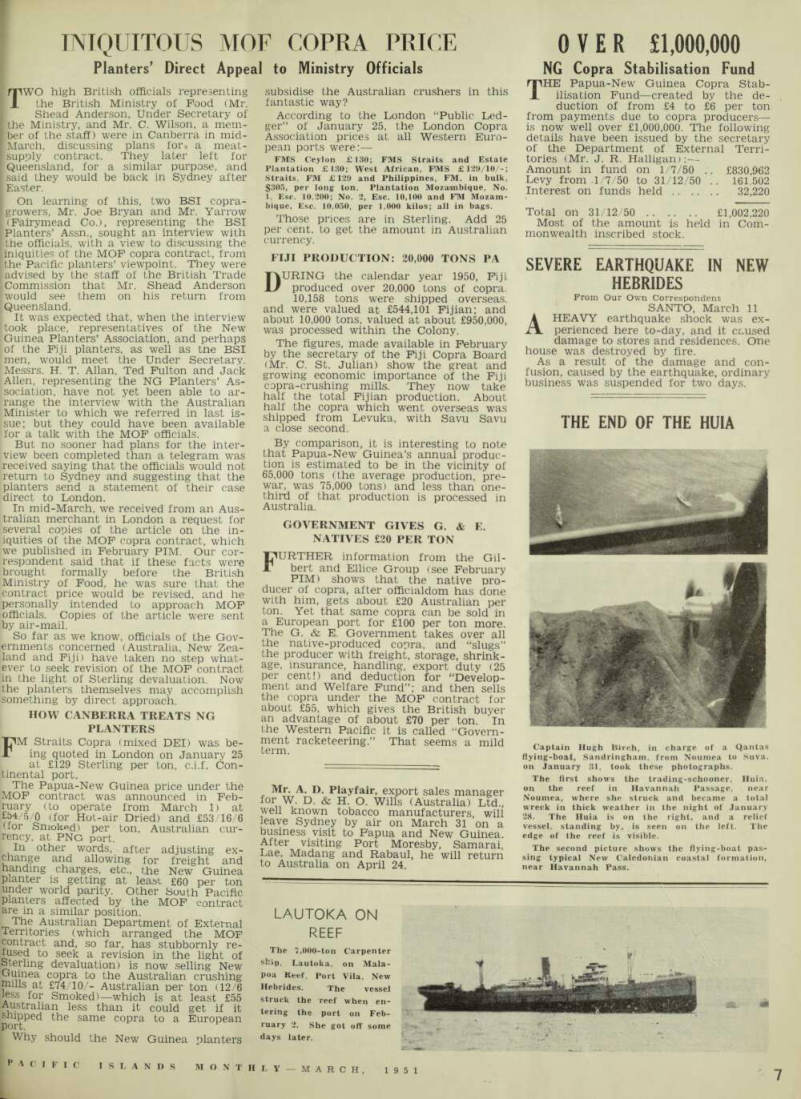
Captain Hugh Birch, in charge of a Qantas flying-boat, Sandringham, from Noumea to Suva, on January 31, took these photographs.
The first shows the trading-schooner, Huia, on the reef in Havannah Passage, near Noumea, where she struck and became a total wreck in thick weather in the night of January 28. The Huia is on the right, and a relief vessel, standing by, is seen on the left. The edge of the reef is visible.
The second picture shows the flying-boat pas sing typical New Caledonian coastal formation, near Havannah Pass.
Lautoka On
Reef
The 7,000-ton Carpenter ship, Lautoka, on Mala poa Reef, Port Vila, New Hebrides. The vessel struck the reef when en tering the port on Feb ruary 2. She got off some days later.
P-Ng Administration
Further Changes May Await the Result of General Election
THE retirement of Mr. Spender from the Australian Parliament and Depart ment of External Territories is discussed in our principal article.
He will remain in office until late in April—maybe until the Australian general election. There is no indication of who his successor will be.
There have been no official announce ments concerning the appointment of deputy-administrators, or the creation of a Legislative Council, or the re-organisa tion of the Production Control Board, or any of the various other matters affecting P-NG administration which have been hanging fire.
Such matters now will probably all await the result of the Australian general election, and the advent of a new Minister.
Toa’S Sydney-Moresby Service
Again Held Up
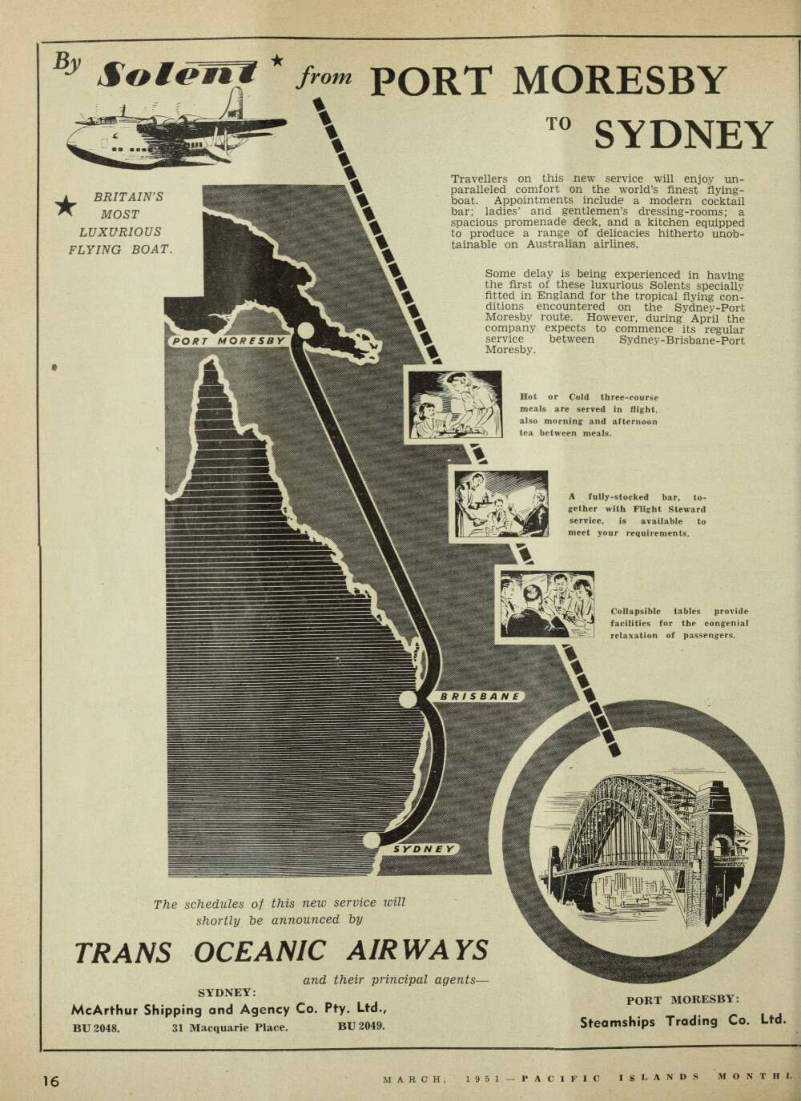
TO A Ltd. has encountered further dif ficulties in its plan to establish a flying-boat service between Sydney and Moresby.
A service was announced, originally, to commence in November. This was can celled because the Australian authorities would not allow the craft to make use of Townsville: and the flying-boats then available could not fly with a load from Brisbane to Moresby.
So TOA bought, in Britain, a Solent capable of flying, with a load, from Bris bane to Moresby. It was to inaugurate the service early in 1951. It crashed, and was lost at Malta, en route to Australia.
TOA immediately bought another Solent in Britain. It was to undergo certain alterations in the factory of Short Brothers, makers of the Solents, and leave for Australia in time to start the service in April. A strike has occurred in this factory, and no date yet can be given for the start of the service.
Indonesians Tightening
Their Belts
And Talking Less
LITTLE has been heard about Indo nesia’s clamorous claim to Dutch New Guinea since the “Republicans,” in August, succeeded in wiping out the Federal set-up (and, with it, the last vestiges of Dutch control) and got the whole archipelago by the throat. Appar ently, all the screaming about Dutch New Guinea was merely propaganda to pre pare the way for the “Republicans’ ” coup d’etat.
The president, Soekarno, on March 2. promised that Dutch New Guinea would be returned to Indonesia before January, 1952. Last year, with much noise and war like gesture, he promised the Indonesian people that New Guinea would be theirs before the sun rose on January 1, 1951.
He denied that there was famine in Indonesia, but said the people must tighten their belts.
Fiji Mla’S At
Festival Of Britain
THREE unofficial members of Fiji’s Legislative Council will probably visit the Festival of Britain as guests of the UK Government between July 9 and 30. Similar invitations have been
issued to members of other Colonial Councils.
It has been suggested in Fiji that each racial group in the Council should select one representative. Whether the repre sentatives would have to pay their own transport costs has not been decided yet.
Pacific Service
Stratocruisers on Trans- Pacific Service
PAN American Airways have introduced giant Boeing Stratocruisers on their Sydney-North American route. They have been using them on their Pacific Coast-Honolulu services for some time.
The first Stratocruiser arrived in Sydney after flying the Pacific in early March. PAA, in line with their usual practice, call their new aircraft Strato Clippers. They have now gone onto the regular Sydney-North American service.
The aircraft will carry 56 passengers.
There are 39 Sleeperettes and 17 berths.
Passengers 'who have berths use con ventional airliner seats during the day.
There is no difference in the fare, which ever type of accommodation the passenger chooses.
The Strato Clippers have two decks. On the lower deck is a club-lounge, bar and observation compartment.
Tontouta is Out for Present
BECAUSE Tontouta airport (New Caledonia) is not up to the standard required for the giant Boeing plane, this call has been cut out by PAA for the present. The company has applied to the Governments concerned for a permit to operate a shuttle service with DC4’s from Australia to New Caledonia and on to Fiji, but although there has been much negotiation (see page 26 this issue) no permission had been granted for the service up to March 15.
New Zealand Link
A SERVICE will be run with DC 4 Clippers between Auckland, NZ and Nadi, Fiji, and return to link up with the Strato Clippers.
Indonesians In N. Caledonia
M. J. STRAUSS, Consul-General for France, in Australia, advises us that, in the years 1948, 1949 and 1950, the French authorities repatriated 4,500 Indonesian workers, and that the total number of Indonesians now remaining in New Caledonia is less than 3,000.
We believe this statement to be per fectly correct. Our complaint (made in September and repeated now) is that the 3,000 or so remaining Indonesians have been allowed to settle down in New Caledonia as a permanent colony.
NG Goldfields, Ltd.’s Prospects
ALTHOUGH New Guinea Goldfields Ltd., —the big New Guinea company which was originally capitalised at Five Millions, and later written down to a Million —made a profit of £4,903 in the year ended September 30, compared with a loss of £33,610 in the previous year, there is nothing for the shareholders.
However* the Co. now is proceeding vigorously with the development of its Golden Ridges mill, it has let out a lot of good ground at tribute, it has estab lished a very busy sawmill and furniture making industry, and the 1951 figures should tell a different story—although worth-while results may not be enjoyed until 1952-3.
The balance-sheet shows that receipts (mostly sales of bullion) are taking care of increasing costs, and that the company has about £lOO,OOO liquid wherewith to carry on.
This company held, and still holds, a lot of very rich country; but it never has returned much to its shareholders, and there has been no dividend at all for many years. The best that can be hoped for, if present plans come to fruitfulness, is a modest to good dividend for a decade or so.
New Colour Film Of Fiji
ANEW 16 mm. colour film entitled Fiji—Crossroads of the South Pacific has been completed and released by British Commonwealth Pacific Airlines in co-operation with White’s Aviation Ltd., of NZ.
The film, which runs for 13 minutes, tells of a typical flight to Fiji and a tour of Viti Levu. It begins with early shots of Pacific reefs, gives a glimpse ol Nadi Airport, then a visit to the Fijian village of Vei Sei Sei. The camera re cords the peaceful beaches of Sawen and Cuvu, the summer house at Koralevn and the lushness of pineapple planta tions. It moves on to Suva (Grand Pacific Albert Park, Victoria Parade, the Tri angle, Suva Gardens); to Raki Rak; (where a 12 lb. Spanish Mackerel is caught, and the camera captures cere monies and dances at the village o; Vitongo); to Ba (Indian market-place and scenes); and the colourful sugar town of Lautoka.
Copies of the film are available on s loan basis on application to the Publicity Manager, at BCPA’s head oflice, 5J Martin Place, Sydney.
The engagement was announced ir Suva, Fiji, recently of Miss Pamela Phyllis Blackie, daughter of Mr. and Mrs W. J. Blackie, of Suva, to Mr. Franl Anthony Carver, a young Englishman wh( is an officer of the Department of Agri culture, Suva.
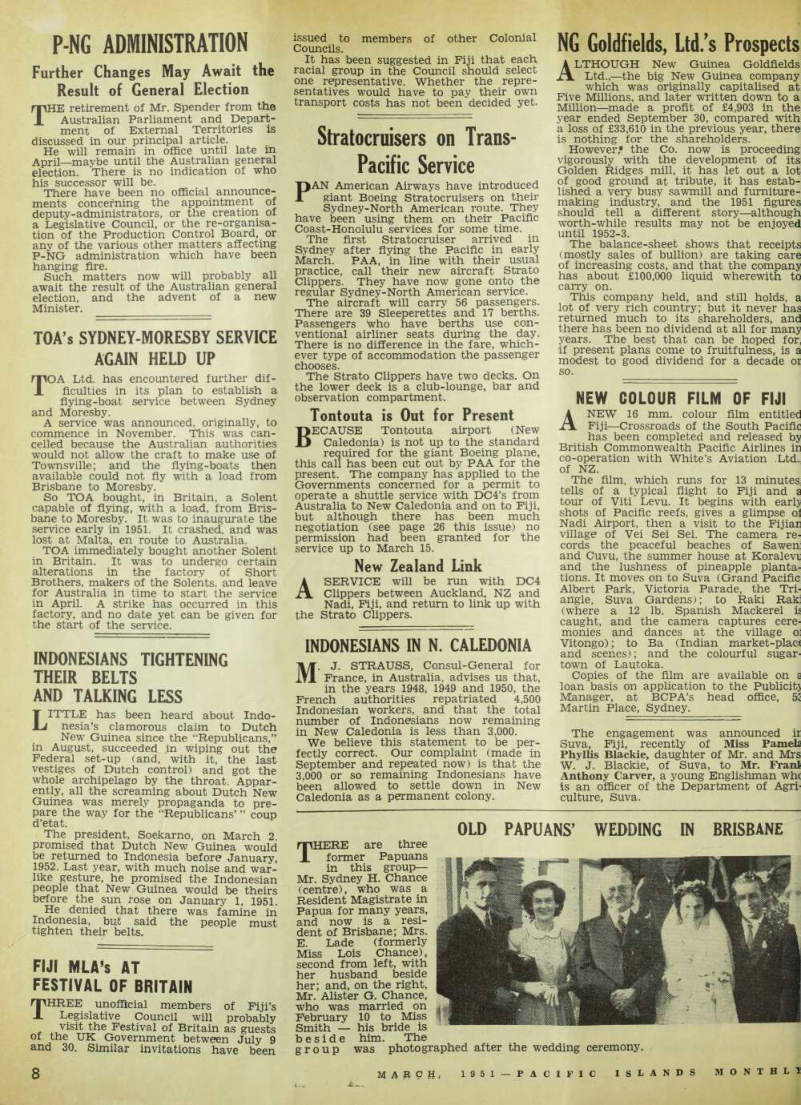
Old Papuans’ Wedding In Brisbane
THERE are three former Papuans in this group— Mr. Sydney H. Chance (centre), who was a Resident Magistrate in Papua for many years, and now is a resi dent of Brisbane; Mrs.
E. Lade (formerly Miss Lois Chance), second from left, with her husband beside her; and, on the right, Mr. Alister G. Chance, who was married on February 10 to Miss Smith his bride is beside him. The
group was photographed after the wedding ceremony.
Advertisements & other items, p. 10 (1 item)
8
MARCH, 19 51- PACIFIC ISLANDS MONTHL3I
Capt. Taylor
New Adventure for Capt. Taylor Australia-South American Air Route Survey
CAPTAIN P. G. TAYLOR, pioneer air man, with his crew of three and a correspondent, left Grafton, NSW, on March 14, on the first leg of a survey flight between Australia and South America.
He is using a special RAAF Catalina loaned by the Commonwealth Govern ment, which is sponsoring the survey.
The Catalina has special equipment in cluding jet-assisted take-off, which will help get the flying-boat off the water twice as fast as normally. This assist ance will probably be needed at Easter Island where take-off will have to be made from the open sea. JATO consists of four rockets, each weighing about 200 pounds.
Captain Taylor’s crew members are: Captain Harry Purvis, who flew with Sir Charles Kingsford Smith, was a Wing Commander during the war, and now manages a flying service taking newspapers to the country. Mr. A. Allison, a radio officer with Trans-Oceanic Air ways, Mr. A. L’Huillier, flight engineer with the same company.
Captain Taylor said Mr. Allison and Mr. L’Huillier had been members of his TOA crew on regular flights to Fiji and the Solomon Islands.
Also on the plane will be Mr. J. Per cival, a business executive who will act as official correspondent for the trip.
The route will be from Grafton (on the northern NSW coast) to Noumea, Suva, Satapuala Bay (Western Samoa), Aitutaki (Cook Islands), Papeete, Man gareva (French Oceania), Pitcairn Island, Easter Island and Valparaiso. The flight is of 8,500 miles and Captain Taylor ex pects to make it in about three weeks.
A token philatelic mail of about 100 lb. will be carried.
Captain Taylor has called the Catalina Frigate Bird II; Frigate Bird I was the Cat in which he made his last big sur vey flight—from Central America to Australia via Clipperton Island in 1944.
Did Not Reach Lau The Chilean Air Force recently made a flight to Easter Island in a flying-boat with amphibious landing gear. It was this plane which last month was reported by Australian newspapers to have gone on to the Lau Islands, Fiji Group.
It appears, however, that the Chileans never got further than Easter, nor had they intended to. The aircraft failed to get off, and was damaged, and reports in dicate that the crew returned to Chile by sea.
The reported arrival of the flying-boat in the Lau Group was evidently a fig ment of some newspaperman’s imagina tion.
There is a small airstrip on Easter Island, but no sheltered flying-boat base.
It appears that the landing and take-off from Easter will be the most hazardous part of Captain Taylor’s adventure.
A reception was given at the British Council Centre in Suva at the end of February by the Fiji representative, Mr.
H. T. Lawrence. The function marked the first anniversary of the opening of the centre. The Governor of Fiji was among the guests.
The Rev. Clifford Williams, of the Methodist Mission is at present in Eastern Australia on leave after 11 years m Western Samoa.
Pacific Service in April
Aorangi Returns to Pacific Service in April
TH E Canadian - Australasian liner Aorangi will resume its service be tween Australasia and North America in early April. The governments of Aus tralia, Canada and New Zealand will subsidise its operations. The vessel was withdrawn from service at the end of January and laid up in Sydney. The owners intended to sell it.
The owners announced last July that their losses since the liner had resumed on the Pacific route in 1948, after war service, were so great that they could no longer maintain the service unless they were heavily subsidised by the Govern ments of Australia, New Zealand and Canada. They gave January 26, 1951 as the deadline.
Months of negotiation followed. New Zealand was willing to pay her share of the subsidy; but Australia and Canada were not. Australia later signified that she was willing but Canada refused until recent war fears changed the situation somewhat.
About four regular passenger ships were on the Sydney-Auckland-North America run before the war, but only the Aorangi came back after the war ended. Between August, 1948, and January, 1951, she lost £600,000 for her owners. Aorangi’s losses can be attributed to airline competition, high working costs and dockside unrest, but mostly to dollar restrictions imposed by the Governments of Australia and New Zealand, which has cut virtually off trade with North America. ris understood that the subsidy will be paid for the year 1951 only and then reviewed. In the light of the present international situation, as well as for reasons of trade and communication, the decision to keep the Aorangi in service has been received with pleasure on both sides of the Pacific and in the Islands.
The Melbourne Herald of January 23 summed up the situation neatly in a leader, part of which said: “It was obviously wise of the Govern ments concerned to agree on this last minute salvaging of the ‘all-red route.’
It would be wiser still for them to study means of restoring the buoyant, two-way flow of commerce that used to exist.”
Pty. Ltd.
Australasian Petroleum Co.
Australasian Petroleum Co. Pty., Ltd., reported as follows on their Papua operations on March 13.
HOHORO: No. 2 Test Well, which was commenced in early February, has reached a depth of 1,958 feet.
WANA: Formation testing has been completed and the hole plugged prior to dismantling of the plant.
The drilling of this hole has confirmed seismic predictions regarding the presence of a thick sedimentary series in the Delta area; however, no free oil was en countered, although slight traces of oil were extracted from some of the cores.
Island Exploration Co. Pty., Ltd., re ports that the Test Well at Omati has been deepened 1,201 feet to 3,350 feet.
The Rev. A. W. Loy, accompanied by Mrs. Loy and their two children has arrived in Fiji to work in the Indian section of the Methodist Church in Fiji.
He was born and educated in Australia and has for the past 41 years been in the United Provinces of India engaged in Mission work.
Pag. Com’N
Problems Of Sth.
Retirement of Secretary-General
IT was announced in Australian and New Zealand newspapers at the end of February that the Secretary- General of the South Pacific Commission, Mr. W. D. Forsyth, had decided to re linquish that position, and had asked the Commissioners to release him so that he might return to the service of the Aus tralian Department of External Territories.
He was given extended leave in 1948, to take up his present position.
It has been known for some time that Mr. Forsyth wished to return to the Australian service. He is outstanding among the able young men who came to the front while Dr. Evatt was Australia’s “Foreign Minister” —he was actually in Paris, in personal attendance on Dr.
Evatt, at some international conference there, when he was appointed to the Evatt-sponsored S. P. Commission. Al though he is only 42, he had had a distinguished career—first as a scholar and teacher, and then in the diplomatic service. In 1948, he was Counsellor at the Australian Embassy in Washington, and Australian Representative on the Trustee ship Council.
As soon as he took over his new job, Mr. Forsyth' displayed a genius for or ganisation and an extraordinary capacity for hard work; and the six nations con cerned can thank him for the speed with which the Commission took shape and character, and began to function.
It soon was apparent, however, that a blunder had been made by the gentlemen who selected Noumea, in New Caledonia, as the headquarters of the Commission.
Neither the Commissioners, the expert personnel nor the Commission’s staff like life in Noumea, where there are many difficulties connected with langu age, transport, communications, accom modation and cost of living. It is not suggested that the Noumea location led to the retirement of Mr. Forsyth; but it can be presumed that it added to his difficulties.
Mr. Forsyth’s decision to return to the Australian Department of External Affairs—where the condition of interna tional relations will provide him with better and wider opportunities—adds one more to the Commission’s headaches.
It means that the Commission’s two principal executive positions (Secretary- General and Deputy Chairman of the Research Council) now have to be filled.
If they are not adequately filled, the Commission cannot function as its founders intended.
New Hotel At Lae
The new hotel (Hotel Cecil) at Lae, New Guinea, is now within measurable distance of completion. It has been built for Mrs. F. S.
Stewart near the waterfront, on the site of her Hotel Cecil, built in the middle 30’s, and completely destroyed in the war.
Photo by J. V. Knight.
South Pacific
Commission
Commission s Seventh Session Opens Next Month At Noumea
Headquarters: Anse Vata, Noumea, New Caledonia
THE Seventh Session of the South Pacific Commission will open at headquarters, in Noumea, on April 28. It is expected to last about 12 days.
Each of the six member Governments will be represented by two Commissioners or alternates, and such advisers as each Government considers necessary.
Prominent in the provisional agenda is the first progress report on the 42 resolutions of the first South Pacific Conference, held in Suva, in April, 1950, when 41 native representatives from 16 Pacific Territories were brought together for the first time in history.
“Grants-in-Aid” for 1951 The work programme of the South Pacific Commission for 1951 includes the continuation of investigations, and some new projects in each of the fields of health, economic development and social development.
The cost of each project, which varies considerably according to the extent of the research work involved and the ex pert personnel needed, is either borne wholly by the Commission or by a Gov ernment or scientific institution, with financial aid from the Commission.
It sometimes happens that member
Governments or their Territorial ad ministrations undertake similar projects pn their own behalf. Where these are of interest to other Territories, the Com mission may offer assistance in the form of expert advice, provision of equipment or funds. Specific sums allocated to such purposes are known as “grants-in-aid.”
The largest single grant-in-aid appear ing in the Commission’s 1951 budget is a contribution of £2,900, made to the Government of Fiji towards the further development of a Central Introduction Garden already established at Suva.
A further grant of £5OO has been made to assist approved projects for improving tropical pasture and stock. A similar amount will be available for assisting member Governments to assemble in formation for the Commission on the result of land utilisation surveys.
In all, eight such grants-in-aid, total ling £7,100, are provided in this year’s budget.
Visitors’ Days at Headquarters There were two “Visitors’ Days” in February at the Commission’s head quarters in Noumea. The first, on the 6th, was for members of the public of Noumea, to celebrate the fourth anniver sary of the founding of the Commission at Canberra in 1947. The second was for passengers of the luxury cruiser Caronia, which called at Noumea on February 19.
On both occasions parties of visitors were escorted over the Pentagon build ing, and briefly told of the Commission’s aims and activities.
Small Seaplane Lost In Lau
Group
Prom Our Own Correspondent SUVA, March 1 A SINGLE-ENGINED Cessna seaplane recently imported from America by Mr. Harold Gatty, for his own use, drifted from its moorings at Katafaga in the Lae Group on February 25 and has not been found.
Mr. Gatty expected to use the plane, which has accommodation for three passengers and a pilot, to fly from Suva to his plantation at Katafaga. It would also have been available for charter flights within the Colony. It was assembled in Suva just a week before it was lost and on February 24 Mr. Gatty and Mr. T. French, who acted as pilot flew to Lau from Suva.
A canoe chased it when it drifted from its moorings but was unable to approach it in the rough sea. A RNZAF Catalina made repeated attempts to locate it in the two days following but the small air craft had apparently disappeared.
Mr. Gatty intends to replace the plane as soon as possible.
Third Trading Bank For Suva
From Our Own Correspondent SUVA, March 1 A BRANCH of the Bank of Australasia will shortly open in Suva. A manager and teller arrived from Melbourne by air on February 28 and premises have been secured in a new block of buildings in Victoria Parade.
There are two trading banks already established in Suva —the Bank of New South Wales and the Bank of New Zealand.
Commander W. Burrows of Suva, Fiji, has been appointed a temporary relieving Magistrate with jurisdiction in Courts in the Southern and Northern Districts.
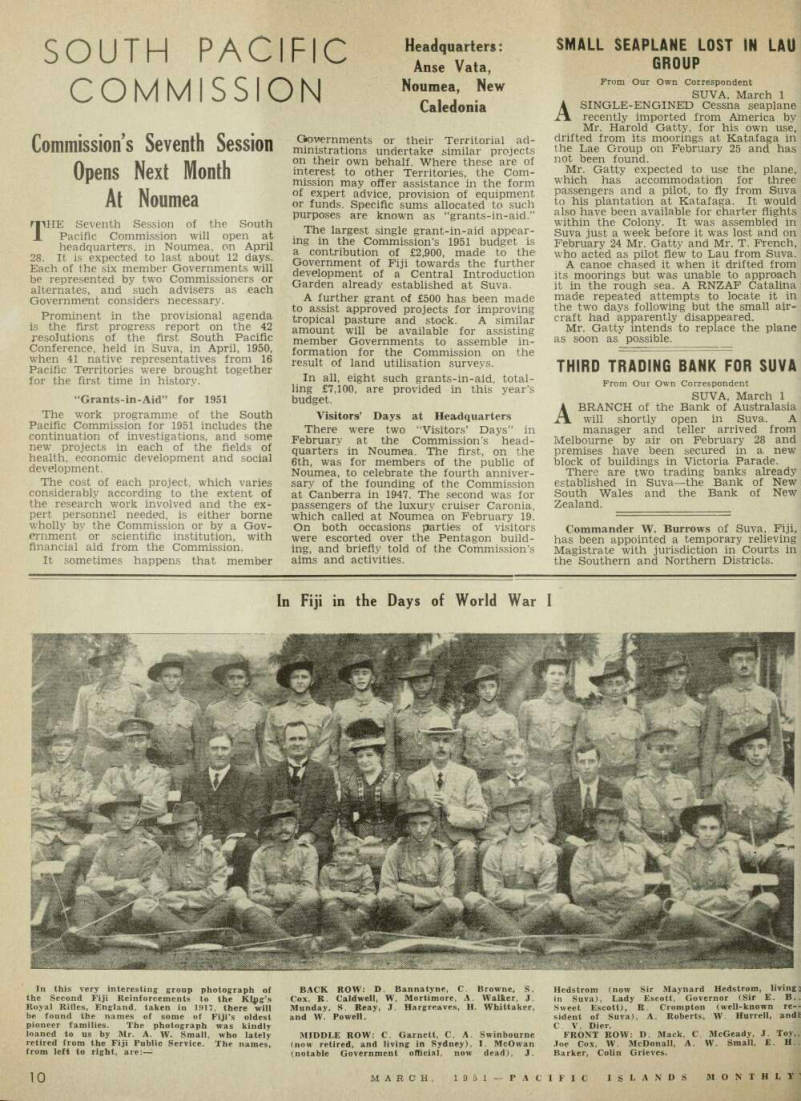
In Fiji in the Days of World War 1
In this very interesting group photograph of the Second Fiji Reinforcements to the King’s Royal Rifles, England, taken in 1917. there will be found the names of some of Fiji’s oldest pioneer families. The photograph was kindly loaned to us by Mr. A. W. Small, who lately retired from the Fiji Public Service. The names, from left to right, are:—
BACK ROW: D. Bannatyne, C. Browne, S.
Cox, R. Caldwell, W. Mortimore, A. Walker. J.
Munday, S. Reay, J. Hargreaves, H. Whittaker, and W. Powell.
MIDDLE ROW: C. Garnett, C. A Swinbourne (now retired, and living in Sydney). I. McOwan (notable Government official, now dead), J.
Hedstrom (now Sir Maynard Hedstrom, living in Suva), Lady Escott, Governor (Sir E. B.
Sweet Escott), R. Crompton (well-known re sident of Suva), A. Roberts, W. Hurrell, and C. V. Dier.
FRONT ROW: D. Mack, C. McGeady, J. Toy,.
Joe Cox, W. McDonall, A. W. Small, E. H.
Barker, Colin Grieves.
Native Refugees Headache For P-NG Administration
Aftermath of Mt. Lamington Eruption
Prom Our Own Correspondent
Port Moresby, March 1
THE aftermath of the Mt. Lamington disaster is adding new problems to those already on the Administration’s
I list.
The volcano is still intermittently active, and its future activities are, of course, a matter of speculation, even for the vul canologists. This means that no definite plans can be made for the area. It has not been possible to complete the burial of the dead throughout the devastated area because of the constant crater activity. Only a few patrols have been permitted to get near Higaturu as the ban I is lifted by the vulcanologist only when he is reasonably satisfied that no im mediate volcanic activity is likely to occur.
During February, however, the patrols which were able to enter Higaturu found and buried five more European victims.
They were Mrs. Maynard Lock and her baby daughter; Mr. T, E. Maher-Kelly; ; and two men whose identity has not yet been established. The European child ; found shortly after the first eruption has [ since been identified as the elder daughter of Mr. and Mrs. Lock.
THE native evacuees from villages bordering the blast zone are still in camps at Ilimo and Oro Bay, and the Administration is still trying to solve the problem of their future. They can ’ not go back to their villages because they are too near the danger zone. They, how ever, in native fashion do not want to i go anywhere else, and if they are forced into new villages will probably not stay there. Later on they may be persuaded to set up new villages in suitable country outside the volcanic area, but until then they are costing' the Australian taxpayer a tidy sum in foodstuffs. It takes a lot of rice to feed 3,100 natives, and a lot of close supervising to keep them healthy under camp conditions.
ON Sunday morning, February 18, an earth tremor was felt at widely scattered points throughout the Territory. It occurred about 7.10 a.m. and reports indicated that it was felt simultaneously at Port Moresby, Kokoda, Wairopi, Yodda, Sogeri, Lae, Wau and Madang. It lasted from forty to sixty seconds and was strong enough to set doors and windows rattling, and cause stacked tinned goods to fall. Since then, however, no further earth tremors have been reported from these districts.
The tremor coincided with renewed volcanic activity at Mt. Lamington and the development of a second red glowing cone in the crater. Billowing clouds of smoke, varying from yellow to black, rose to about 24,000 feet, and rocks being thrown up in the eruption were falling back into the crater.
Mud-flows and floods have developed along all rivers with their source on the Lamington slopes. First this necessitated moving the Wairopi evacuee camp to Ilimo four miles away on higher ground, and then feeding still more villagers whose gardens had been washed away.
And away down almost at the coast, pumice banks piled up near the river estuaries ruining village gardens, and more villages needed rations. In the abandoned villages on the fringe of the blast country around the volcano, natives had been able to make daily trips to xL food f r om the gardens, but gradu aily the pumice caused the crops to rot, and this supply has been cut off. bo far the health authorities by exercis ing careful control and constant super hSSft , hav , e . maintained an excellent neaith level in the evacuee camps and
there have been no epidemics. The Public Health Department secured the co operation of the RAAF in having the Ilimo Camp sprayed with a DDT and diesel oil mixture. And to control the fly menace, spraying was also done over Sangara, adjoining villages, Higaturu and Popendetta.
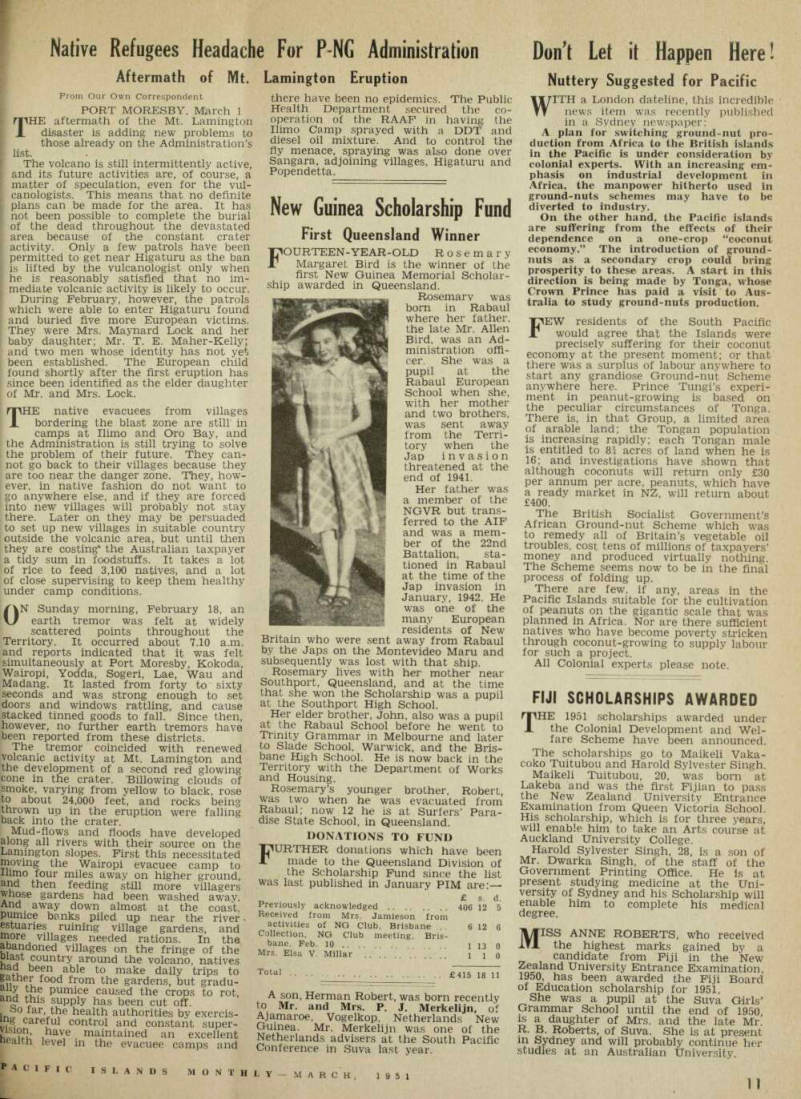
FOURTEEN-YEAR-OLD Rosemary
New Guinea Scholarship Fund First Queensland Winner
Margaret Bird is the winner of the first New Guinea Memorial Scholar ship awarded in Queensland.
Rosemarv was born in Rabaul where her father, the late Mr. Allen Bird, was an Ad ministration offi cer. She was a pupil at the Rabaul European School when she, with her mother and two brothers, was sent away from the Terri tory when the Jap invasion threatened at the end of 1941.
Her father was a member of the NGVR but trans ferred to the AIF and was a mem ber of the 22nd Battalion, sta tioned in Rabaul at the time of the Jap invasion in January, 1942. He was one of the many European residents of New
Britain who were sent away from Rabaul by the Japs on the Montevideo Maru and subsequently was lost with that ship.
Rosemary lives with her mother near Southport, Queensland, and at the time that she won the Scholarship was a pupil at the Southport High School.
Her elder brother, John, also was a pupil at the Rabaul School before he went to Trinity Grammar in Melbourne and later to Slade School, Warwick, and the Bris bane High School. He is now back in the Territory with the Department of Works and Housing.
Rosemary’s younger brother, Robert, was two when he was evacuated from Rabaul; now 12 he is at Surfers’ Para dise State School, in Queensland.
Donations To Fund
FURTHER donations which have been made to the Queensland Division of the Scholarship Fund since the list was last published in January PIM are:—
A son, Herman Robert, was born recently to Mr. and Mrs. P. J. Merkelijn, of Ajamaroe, Vogelkop, Netherlands New Guinea. Mr. Merkelijn was one of the Netherlands advisers at the South Pacific Conference in Suva last year.
£ s. d.
Previously acknowledged 406 12 5 Received from Mrs. Jamieson from activities of NG Club, Brisbane . . 6 12 6 Collection, NG Club meeting. Brisbane, Feb. 10 ... . 1130 Mrs. Elsa V. Millar ... 110 Total £415 18 11
Don’t Let it Happen Here!
Nuttery Suggested for Pacific
WITH a London dateline, this incredible news item was recently published in a Sydney newspaper: A plan for switching ground-nut pro duction from Africa to the British islands in the Pacific is under consideration by colonial experts. With an increasing em phasis on industrial development in Africa, the manpower hitherto used in ground-nuts schemes may have to be diverted to industry.
On the other hand, the Pacific islands are suffering from the effects of their dependence on a one-crop “coconut economy.” The introduction of ground nuts as a secondary crop could bring prosperity to these areas. A start in this direction is being made by Tonga, whose Crown Prince has paid a visit to Aus tralia to study ground-nuts production.
FEW residents of the South Pacific would agree that the Islands were precisely suffering for their coconut economy at the present moment; or that there was a surplus of labour anywhere to start any grandiose Ground-nut Scheme anywhere here. Prince Tungi’s experi ment in peanut-growing is based on the peculiar circumstances of Tonga.
There is, in that Group, a limited area of arable land; the Tongan population is increasing rapidly; each Tongan male is entitled to 81 acres of land when he is 16; and investigations have shown that although coconuts will return only £3O per annum per acre, peanuts, which have a ready market in NZ, will return about £4OO.
The British Socialist Government’s African Ground-nut Scheme which was to remedy all of Britain’s vegetable oil troubles, cost tens of millions of taxpayers’ money and produced virtually nothing.
The Scheme seems now to be in the final process of folding up.
There are few. if any, areas in the Pacific Islands suitable for the cultivation of peanuts on the gigantic scale that was planned in Africa. Nor are there sufficient natives who have become poverty stricken through coconut-growing to supply labour for such a project.
All Colonial experts please note.
Fiji Scholarships Awarded
THE 1951 scholarships awarded under the Colonial Development and Wel fare Scheme have been announced.
The scholarships go to Maikeli Vaka coko Tuitubou and Harold Sylvester Singh.
Maikeli Tuitubou, 20, was born at Lakeba and was the first Fijian to pass the New Zealand University Entrance Examination from Queen Victoria School.
His scholarship, which is for three years, will enable him to take an Arts course at Auckland University College.
Harold Sylvester Singh, 28, is a son of Mr. Dwarka Singh, of the staff of the Government Printing Office. He Is at present studying medicine at the Uni versity of Sydney and his Scholarship will enable him to complete his medical degree.
MISS ANNE ROBERTS, who received the highest marks gained by a candidate from Fiji in the New Zealand University Entrance Examination, 1950, has been awarded the Fiji Board of Education scholarship for 1951.
She was a pupil at the Suva Girls' Grammar School until the end of 1950 is a daughter of Mrs. and the late Mr!
R. B, Roberts, of Suva. She is at present Sydney and will probably continue her studies at an Australian University.
Advertisements & other items, p. 14 (1 item)
Morris Hedstrom Limited
General Merchants, Importers and Exporters,
Shipowners, Plantation Owners,
Commission and Insurance Agents
HEAD OFFICE
SUVA, FIJI
Established 1868
SERVICE IN THE SOUTH PACIFIC TERRITORIES
THROUGH our Large Establishments in Suva and our Numerous Branches, we distribute a wide and comprehensive range of General Merchandise and provide almost every kind of service. Our departments and associated businesses include:
DRAPERY
MOTOR SALES
AND SERVICE
TOBACCO
TIMBER AND
BUILDING
GROCERY
CONFECTIONERY
HARDWARE
ELECTRICAL
LIQUORS
DRUGS
Branches Throughout Fiji, Samoa and Tonga
There is o Brench or Agent of Morris Hedstrom Limited in every Town in the Three Territories.
We are Sole Agents in these Territories for British Drug Houses Ltd.
Electrolux Ltd.
Ford Motor Co.
General Electric Co. Ltd.
Goodyear Tyre 6* Rubber Co.
B. A. Hjorth Gr Co. (Primus Products) Imperial Chemical Industries Ltd.
International Harvester Export Co.
Matson Navigation Company Max Factor and Co. Inc.
Ransomes, Sims Gr Jefferies Ltd, Ruston Gr Hornsby Ltd.
Vacuum Oil Co. Pty. Ltd.
Yorkshire Copper Works Ltd.
Morris Hedstrom Limited are LLOYD'S AGENTS in Fiji and Samoa.
IN AUSTRALIA:
Morris Hedstrom (Aust.) Pty. Ltd.,
Asbestos House, 65 York Street, SYDNEY
IN GREAT BRITAIN:
Morris Hedstrom Limited,
Barclay's Bank Building, 73 Cheapside, LONDON, E.C.2.
Medals For
The Gallant 39?
Disgraceful Episode of Nauru Defence in 1941-42
PERSONS acquainted with the recent history of Nauru are indignant over an official announcement that the Defence Medal will be issued, on appli cation, to those members of the Nauru [ Volunteer Defence Force who rendered [l2 months’ part-time service between mid-1940 and December 7, 1941 (the day Japan entered the war); or one day of ' part-time service between December 8, 1941, and February 23, 1942 (when Nauru
[was evacuated).
Those who know the circumstances in [sist that certain members of the Nauru \ Volunteer Defence Force are not entitled to the medal, or to any kind of military
[decoration.
After the outbreak of World War 11, : a small formation was stationed on [Nauru, and did good work. About 60 I resident Europeans were enrolled as a Volunteer Defence Corps, to assist the AIF men in sentry and guard duties, etc.
The Japanese attacked Pearl Harbour on December 7, 1941, and bombed Nauru on December 8; and, from that date, a considerable section of the Nauru Vol unteer Defence Force was definitely r“windy.” Under the leadership of one or two loquacious gentlemen, they were un willing to undertake military duties, and argued that they would have a better chance of survival against the Japs if they were taken prisoners as unarmed civilians.
Finally, on January 11, 1942, 39 of these “Volunteers” signed a petition and pre sented it to the Administrator, asking that the Force be immediately disbanded, as they did not wish to bear arms.
The feelings of , the Administrator (Lieut.-Col. F. R. Chalmers, CMG, DSO, who later refused to leave Nauru in the official evacuation and was subsequently murdered there by the Japs) can be imagined. He appealed to the heroes to carry on; but it was of no avail, and they turned in their equipment, and refused further duty.
A minority of the Force remained on duty, however; and they were ably sup ported by all the Administration officials, Police-master Tom Cude, the two AWA radio operators (Messrs. Gollan and
Neale), and a number of Nauruan natives. The contempt they felt for the gallant 39 petitioners, skulking in their bungalows between January 11 and the evacuation on February 23, can be better imagined than described. Jap air raids were frequent during this period, and there was plenty of military service needed.
It had been hoped that this discredit able incident of the war’s early days would be forgotten. But the formal announcement by the Nauru Administra tor, Mr. Richards (Nauru Gazette of
January 6 and February 10, 1951), that the medal may be obtained on applica tion in writing to Victoria Barracks, Melbourne, by members of the Volunteer
Defence Force, including the gallant 39, has aroused indignation and anger among those who know of the incident; and a protest has been sent, accordingly, to the Australian military authorities.
Maybe, the gallant 39 now seeking medals thought that their petition was destroyed when Colonel Chalmers was murdered. It was not; it carries the 39 signatures (which ought to be published); and one of the arguments submitted by the petitioners against the idea that they should continue to carry arms reads thus: “Do you think that the small amount of prestige that could pos sibly be lost at Nauru would be im portant after that already lost by the Democracies in places that really matter?”
The Australian military folk would be wise to learn something of the back ground of that episode, and read the text of the petition, before giving to the gal lant 39 the same decoration that has been awarded to so many good men who really did their duty.
Advertisements & other items, pp. 15-16 (1 item)
Spmso
pruce up on
3k 0
out* flaw
SPRUSO LIQUID, SPRUSO LIQUIDSHEEN, and SPRUSO
CRYSTALLISED SHEEN.
SPRUSO is the best seller in AUSTRALIA.
TRADERS : write for samples.
SPRUSO COMPANY, Redfern, New South Wales, Australia.
ARABIANS IN 5m
CENTURY THOUGHT TOOTHACHE
\ COULD BE CURED BY PERSON OF
OPPOSITE SEX SHAKING THE TOOTH
V TODAY, ONLY KOLYNOS FIGHTS TOOTH
DECAY THESE THREE WAYS .
0 KOLYNOS NEUTRALISES MOUTH
C ACIDS.
3 KOLYNOS KILLS THE
BACTERIA WHICH CAUSE
THESE ACIDS
9 KOLYNOS LEAVES TEE
SURGICALLY
CLEAN.
IN INDIA, 2000 YEARS
AGO, WHITE GLASS MIXED
, . TO A FINE POWDER WAS
Sj USED AS A DENTIFRICE i
Ai J TODAY, YOU CAN USE I \bzM A REALLY Refreshing I
-r* DENTAL CREAM - KOLYNOS /
P\ KOLYNOS LEAVES'
/ YOUR MOUTH FRESH *
\ \ • FDR HOURS AND 0
lkA»„ hours.
•plnfl/vSfiotfc KOLYNOS fAN/
i DINAH SHORE. FEATURED ARTIST ON ir [ IE
DINAH SHORE, FEATURED ARTIST ON
COLUMBIA RECORDS, ALWAYS USES
KOLYNOS. KOLYNOS LEAVES EVERY TOOTH
IN YOUR HEAD BEAUTIFULLY CLEAN
SftARKLING WITH NEW LUSTRE.
ff >Jv
tea
H
Witty TOOTH
BRovet/r
<so^<
GREENLAND FISHERMEN
TAKE A TOOTH -
SHAPED CHARM
. CALLED THE
l\ MILK-TOOTH GOO*
TO BRING THEM
LUCK IN FISHING.
i =m= ./
KOLYNOS
DENTAL
CREAM
CUAHS e£7rfx...nfTFS Sfrrff... usrsToA/af#
KOLYNOS goes TWICE os Far!
ONE TUBE 0F KOLYNOS LASTS AS LONG
AS TWO TUBES OF ORDINARY TOOTHPASTE.
KOLYNOS IS HIGHLY CONCENTRATED.
tSL, HALF AN INCH
IS PLENTY.
FRANCIS HOOVER
4 Castlereagh Street, Sydney Cables: “Petwer.”
G.P.O, Box 4623.
EXPORTERS
All classes of merchandise supplied. Careful attention given to big and small orders.
Now Available For the Islands.
HOLLAND RUSK
and Allied Products We manufacture Holland Rusks. Butter Johns, Speculaas, Jubilee Par-T-Pack, Almond Rings, Breakfast Cake, Edam Cheese Crunches, Cocktail Buttons, and Celery Rondelles, etc. Individually packed and shipped in sealed tins and cases for the Tropics.
Write for Price List.
"HOLLAND RUSK"
32 PARRAMATTA ROAD, STRATHFIELD,
SYDNEY, N.S.W.
Island Agent: Francis Hoover. Products on sale at Colyer Watson (N.G.) Ltd.’s, stores.
Caronia Visits Suva
From Our Own Correspondent THE British Cunard liner Caronia, spent a day in Suva in February in the course of a round-the-world luxury dollar-earning cruise.
At least two larger vessels, H.M.S.
Hood and the Empress of Britain have visited Suva, but they both anchored in the harbour. The Caronia is believed to be the largest ship to come alongside the wharf. , , .
During the visitors’ twelve-hour stay in Suva they saw three Fijian mekes and watched an exhibition of fire-walking by people of Beqa. The afternoon was
devoted to shopping or sight seeing in the town and many of the visitors visited the beautiful display of hibiscus in the Parish Hall.
A sudden downpour of rain in the afternoon rather dampened the spirits of the visitors, and many of them returned to the ship soaked to the skin. On discussing the visitors with various shopowners in Suva, it was surprising to learn that the visitors were not very inter ested in purchasing souvenirs, as was the case with pre-war visits of tourist ships.
And in respect of the ques tion as to the few passengers on the tour, in comparison to the number of berths available, it was learned that at first the vessel was booked out but that war fears caused cancellations.
Fiji-Austrauan Trade
Out of Balance by £2,000,000
OF all the anomalies in Pacific Islandsi trade, none is more noticeable than, the relationship between Fiji andl Australia. Look at these figures, taken, from the excellent quarterly publication of the Fiji Public Relations Office: —
Australia buys very little from Fiji, but sells the Colony goods worth £2,000,000 p.a. New Zealand buys from II to 2 mil lion pounds’ worth of Fiji produce each year, but sells Fiji less than half a mil lion pounds’ worth.
The United Kingdom consistently buys £2,000,000 worth of Fiji products p.a., and sells Fiji goods to the same amount, United States sells Fiji a million pounds worth of goods annually, and buys about half a million pounds worth of Fiji’s pro ducts.
For 20 years, Fiji has been threatening that, if Australia will not buy more Fij produce, Fiji will put a special import tas on certain of Australia’s main exports tc the Colony, such as flour. But nothing has hapoened.
The trade dis-equilibrium is taken can of by the fact that the three big trading firms as well as the two banks whict handle most of Fiji’s trade have branches in Australia, New Zealand and Uniteo States, and can set the debit balance ii one place against the credits in another
Caronia at Suva Wharf. Suva’s new bus terminal centro Photo by Stinson’s.
1947 1948 1949 £ £ £ Exports from Fiji to Australia 98,832 109,388 111,6811 Imports into Fiji from Australia 1,914,218 1,855,254 2,135,702 Exports from Fiji to N. Zealand . . 1.769,368 2,042,968 1,469,14S Imports into Fiji from N. Zealand 391,698 436,728 497,292
Advertisements & other items, p. 16 (2 items)
14
MARCH. 1951 PACIFIC ISLANDS MONTH L.
R. J. Crilley Pty. Ltd.
Why Not A
123 Sussex St., Sydney YOUR Buying Agents in Australia?
All classes of Australian merchandise purchased on behalf of Islands clients at best wholesale rates: original Invoices provided: prompt and reliable service assured in all transactions.
We are open to accept reputable new accounts from Islands clients. i ■Jk
Remarkable
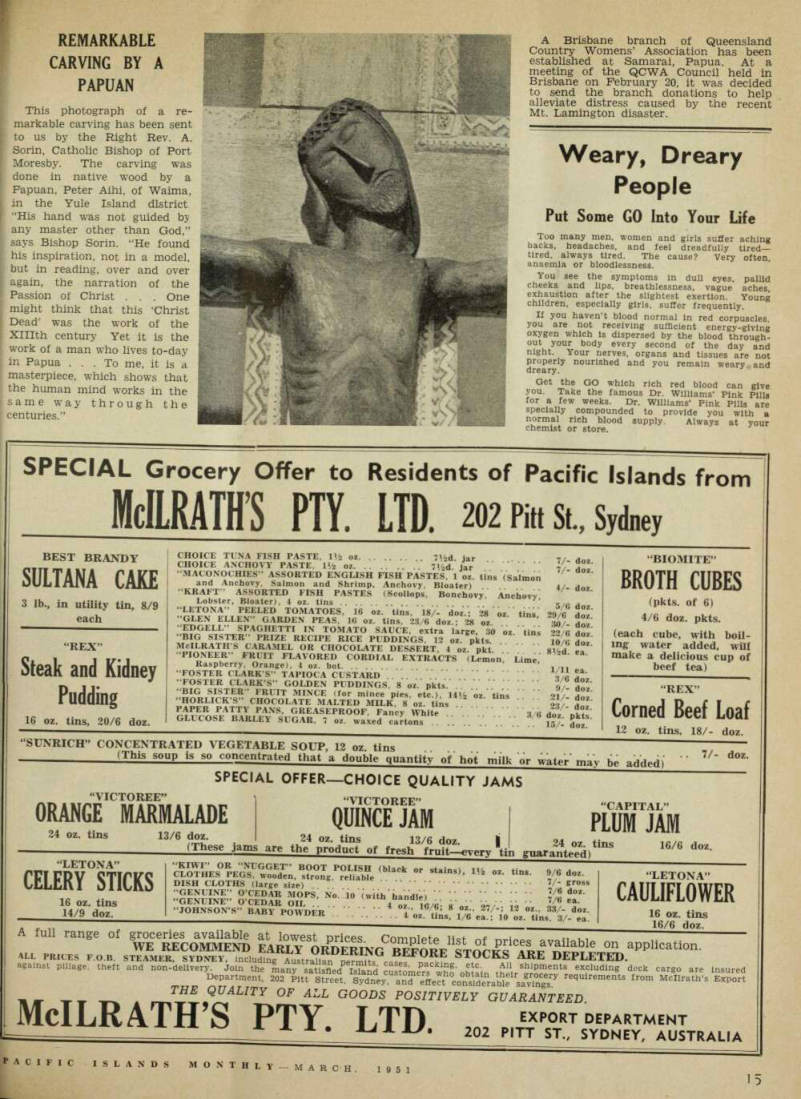
Carving By A
Papuan
This photograph of a re markable carving has been sent to us by the Right Rev. A.
Sorin, Catholic Bishop of Port Moresby. The carving was done in native wood by a Papuan, Peter Aihi, of Waima, in the Yule Island district “His hand was not guided by any master other than God,” says Bishop Sorin. “He found his inspiration, not in a model, but in reading, over and over again, the narration of the Passion of Christ . . . One might think that this ‘Christ Dead’ was the work of the XUlth century Yet it is the work of a man who lives to-day in Papua ... To me, it is a masterpiece, which shows that the human mind works in the same way through the centuries.”
A Brisbane branch of Queensland Country Womens’ Association has been established at Samarai, Papua. At a meeting of the QCWA Council held in Brisbane on February 20, it was decided to send the branch donations to help alleviate distress caused by the recent Mt. Lamington disaster.
Weary, Dreary
People Put Some GO Into Your Life
Too many men, women and girls suffer aching backs, headaches, and feel dreadfully tired tired, always tired. The cause? Very often anaemia or bloodlessness.
You see the symptoms in dull eyes, pallid cheeks and lips, breathlessness, vague aches exhaustion after the slightest exertion. Young children, especially girls, suffer frequently.
If you haven’t blood normal in red corpuscles you are not receiving sufficient energy-giving oxygen which Is dispersed by the blood through out your body every second of the day and night. Your nerves, organs and tissues are not properly nourished and you remain weary and dreary.
Get the GO which rich red blood can give you. Take the famous Dr. Williams’ Pink Pills for a few weeks. Dr. Williams’ Pink Pills are specially compounded to provide you with a normal rich blood supply. Always at your chemist or store.
Advertisements & other items, pp. 17-18 (3 items)
15
pacific islands Monthly - m a r c H. 1951
McILRATH’S PTY. LTD. 202 Pitt St.. Sydney
SPECIAL Grocery Offer to Residents of Pacific Islands from McILRATH’S PTY. LTD. 202 Pitt St.. Sydney
BEST BRANDY
SULTANA CAKE
3 lb., in utility tin, 8/9 each
“REX”
Steak and Kidney
Pudding
16 oz. tins, 20/6 doz.
CHOICE TUNA FISH PASTE, IVz oz 7V 2 d jar CHOICE ANCHOVY PASTE, V><t oz 7>6d lar “MACONOCHIES” ASSORTED ENGLISH FISH PASTES, 1 oz. tins (Salmon and Anchovy, Salmon and Shrimp, Anchovy, Bloater) “KRAFT’ ASSORTED FISH PASTES (Scollops, Bonchovy Anchovv Lobster, Bloater), 4 oz. tins “LETONA’’ PEELED TOMATOES, 16 oz. tins, 18/1 doz.; 28 oz. tins “GLEN ELLEN” GARDEN PEAS, 16 oz. tins, 23/6 doz.; 28 oz .^ GE c L^L« PAGHETTI IN TOMATO SAUCE, extra large, 30 oz. tins BIG SISTER PRIZE RECIPE RICE PUDDINGS. 12 oz. pkts McILRATH’S CARAMEL OR CHOCOLATE DESSERT, 4 oz pkt “PIONEER” FRUIT FLAVORED CORDIAL EXTRACTS (Lemon. Lime.
Raspberry, Orange). 4 oz. bot.
“FOSTER CLARK’S” TAPIOCA CUSTARD
“FOSTER CLARK’S” GOLDEN PUDDINGS, 8 oz. pkts.
“BIG SISTER” FRUIT MINCE (for mince pies, etc.) 1414 oz tins “HORLICK’S” CHOCOLATE MALTED MILK 8 oz tins PAPER PATTY PANS, GREASEPROOF, Fancy White ‘i/a GLUCOSE BARLEY SUGAR, 7 oz. waxed cartons . . 3/6 7/- doz. 7/- doz. 4/- doz. 5/6 doz. 29/6 doz. 30/- doz. 22/6 doz. 10/6 doz. 81rti. ea. 1/11 ea. 3/6 doz. 9/- doz. 21/- doz. 23/- doz. doz. pkts. 15/- doz.
“BIOMITE”
BROTH CUBES
(pkts. of 6) 4/6 doz. pkts. (each cube, with boiling water added, will make a delicious cup of beef tea)
“REX”
Corned Beef Loaf
12 oz. tins, 18/- doz.
SUNRICH” CONCENTRATED VEGETABLE SOUP, 12 oz tins lThis SOU P is 50 concentrated that a double quantity of hot milk or water’ may he added) 7/- doz.
VICTOREE”
ORANGE MARMALADE
SPECIAL OFFER—CHOICE QUALITY JAMS
“VICTOREE”
24 oz. tins 13/6 doz.
QUINCE JAM
24 oz. tins 13/6 doz. 1
"CAPITAL”
PLUM JAM
24 oz. tins (These jams are the product of fresh tin guaranteed) 16/6 doz.
“LETONA”
CELERY STICKS
16 oz. tins 14/9 doz.
CLOTHES O - 9/6 doz.
DISH CLOTHS (large size) V- & ross ”■ “Ops: No. 10 (with handle) V.
O CEDAR OIL 4 oz „ 16/6 . g jj oz „ iv- doz.
GENUINE’
‘GENUINE’
JOHNSON’S’
BABY POWDER 4
oz. tins, 1/6 ea.; 10 oz. tins. 3/- ea.
“LETONA”
CAULIFLOWER
16 oz. tins 16/6 doz.
A full range of groceries available at lowest nricps p n mni 0 f 0 TT~ WE RECOMMEND EARLY ORDERINtf^FORp 1 ° n a PP licati °n.
ALL PRICES F. 0.8. STEAMER, SYDNEY, including Australian STOCKS ARE DEPLETED. against pillage, then and non-delivery. Join the many saSed i?and cSners who oh lm ,£ei r S i;r Pm<intS ex , cludln « d «* cargo are Insured Department. 202 Pitt Street, re<lUlrements Ir 0” Mcllrath's Export
L GOODS POSITIVELY GUARANTEED.
EXPORT DEPARTMENT
202 PITT ST., SYDNEY, AUSTRALIA
McILRATH’S PTY. LTD.
B - v Salem * ..A
from PORT MORESBY
SYDNEY
i BRITAIN’S
' MOST
LUXURIOUS
FLYING BOAT.
Travellers on this new service will enjoy unparalleled comfort on the world’s finest flyingboat. Appointments include a modern cocktail bar; ladies’ and gentlemen’s dressing-rooms; spacious promenade deck, and a kitchen equipped to produce a range of delicacies hitherto unobtainable on Australian airlines.
Some delay is being experienced in having the first of these luxurious Solents specially fitted in England for the tropical flying conditions encountered on the Sydney-Port Moresby route. However, during April the company expects to commence its regular service between Sydney-Brisbane-Port Moresby.
Hot or Cold three-course meals are served in flight, also morning and afternoon tea between meals.
A fully-stocked bar, together with Flight Steward service, is available to meet your requirements. % % TO % % % % % % % \ . ' \ % % % k % % % %
PORT MORESBY
' ' \ k £ ♦ V % S % I % % % t % % YD Collapsible tables provide facilities for the congenial relaxation of passengers.
The schedules of this new service will shortly he announced by
TRANS OCEANIC AIRWAYS
and their principal agents—
SYDNEY:
McArthur Shipping and Agency Co. Pty. Ltd., BU 2048. 31 Macquarie Place. BU 2049.
PORT MORESBY:
Steamships Trading Co. Ltd.
16
MARCH, 1951 PACIFIC ISLANDS MONTH L
BSI Virtually Without Wharf
Facilities Kukum Blows Away in a Gale
From Our Own Correspondent HONIARA, March 5.
KUKUM WHARF, where overseas ship ping discharged cargo for all Pro tectorate areas except the Russell Islands, was completely destroyed by heavy seas in a northwesterly gale on February 24. Kukum is about one mile from Honiara.
The wharf has also been used for load ing all overseas shipping, with the ex ception of some copra loaded at the Fairymead Sugar Company’s wharf at Yandina.
Kukum was the last of the American built wartime wharves to remain opera tive. Originally it consisted of three “legs,” two at right angles to the shore and one parallel, forming three sides of a rectangle. The most easterly section, which had fallen into disrepair, was pulled down some time ago, and its tim bers used to repair the remaining two sections. These had recently been further strengthened and some of the decking renewed.
But it has been evident for a long time that Kukum Wharf was in a dang erous state in spite of these temporary repairs. Much of the timber was rotten and many of the piles had loosened. Both private producers and Government have been watching it with apprehension.
Mr. Kenyon Bell, the Crown Agents’
Slipway Consultant and Engineer, visited the Solomons towards the end of 1950 to advise on the type and situation of new accommodation for overseas ship ping and his final recommendations are
awaited. Gizo wharf and harbour are not yet ready for peacetime use by over seas ships. The wartime wharfs at Tulagi have decayed and what remains of them is unsafe for handling heavy cargo.
Yandina Wharf, while it could be used for loading greater concentrations of copra, is unsuitable as the main Protec torate overseas wharf.
Overseeas cargo now being unloaded at Honiara, shipping anchoring off East Point Cruz, which provides some shelter.
Kukum Wharf blew away on a Satur day and, on the following Wednesday, the Muliama arrived from Sydney and the Lautoka from Vanikoro. Inward and outward cargo was handled with the assistance of local shipping of suitable tonnage to unload at the smallcraft wharf near Point Cruz.
Editorial Note
When the BSI share of Britain’s plague of Post-war Planners got to work in the Solomon Islands, and decided to shift the Group’s heeadquarters from Tulagi (where there is a first-class sheltered port) to Honiara (where there is little more than an open coast-line) it was pointed out by experienced people that a serious error was being made.
Practically all BSI traffic moves on the water, and much of it in small vessels.
It is essential that the main centre shall have, above all things, sheltered berths for big and little ships, in all weathers.
No matter what i& done with Honiara, as a port, it is liable to be put out of action by a stiff north-wester; and in that region there is a regular north-west season.
But the post-war type of unfledged Planner rarely listens to the old hands.
He is quite sure that his combination of academic equipment and Socialist theor ies can cope with all situations. He wanted Honiara, on the unsheltered coast of Guadalcanal, so that he might have plenty of land available for training
natives in agriculture—which, of course, is more important than European com merce. So Tulagi was abandoned; and Honiara was built; and now someone is going to *be asked to provide some enormous sum for the building of port facilities at Honiara.
The shipping hold-up is maddening.
But the old hands have at least the satisfaction of saying “I told you so.”
Mr. Tex Archer, of Kumbug Plantation, north of Madang, NG, was in Sydney on holiday in February and March. He bought his plantation about two years ago and has spent most of the time since clearing it of secondary growth. It is now in working order and he took a holi day to mark the occasion.
Advertisements & other items, p. 19 (1 item)
Columbines
“Face up to Life—and Live”
"The Government of Self"
"The Enigma of Personality"
"When We Are Forty"
"Truths About Marriage"
"Commonsense Child Guidance"
These popular books will help you to get a new slant on life and banish your fears.
Set of 6 only 8/- post free.
Pitt-way’s, Box 36, North George St., Sydney.
I enclose 8/-. Please send me by return mail your set of six “Human Problem” series. (Please use block letters) Name..
Address
COLUMBINES
the richest
caramels
of all!
• W I C Made by Agents for Butter-rich”
Glucose-rich”. "Flavour-rich”
Each “Columbine ” is individually wrapped for freshness and protection.
The Great Name in Confectionery Pacific Islands: 5. E. TATHAM & CO. PTY, LTD . 178 Collins St., Melbourne - 73 York St., Sydney
US Tourists “Don’t Spend Like
Gl’s”
From Our Own Correspondent
Port Moresby, March 1.
BIG money strolled through Port Moresby during February when two world cruising luxury vessels—the Swedish Stella Polaris and the British Caronia —paid brief visits to the ports.
Stella Polaris, resembling a graceful outsize yacht, arrived on February 15
with a capacity booking of world tourists, mostly Americans. For their four-and-a half months jaunt around the globe they are paying from $3,000 to $B,OOO each.
As they trooped ashore at Port Moresby they put on a marvellous display of holiday-style clothes —from Fifth Avenue hats to blue jeans with up-turned cuffs, In the sightseeing buses, which whizzed them around the gay and not-so-gay parts of the town, an elderly and wealthy lady of fashion, who finished off her costume with immaculate white gloves, sat beside a rough diamond from the Texas oilfields in corded work pants and his
shirt open to the waist showing a fine expanse of hairy chest. This same gentle man’s over-enthusiastic but playful tactics with small pickaninnies produced near-panic among the brown youngsters bf one village.
But on the whole the Stella Polaris passengers were a friendly and cheerful crowd who somehow or other still managed to be happy though rich. One thing they did not do was to throw their money around recklessly. Most of their purchases were made after very careful consideration, and souvenir sales were by no means on the lavish wartime G.I. scale, THEN on February 23 the Cunard liner Caronia steamed into Port Moresby harbour and the tourist-run-around started again. This was an even more luxurious outfit. A modest little cabin for the cruise cost $3,500 but at the top of the scale were suites for two persons ticketed at $30,000.
Both visits had their amusing side, for the tourists were busy seeing the sights, and the townsfolk enjoyed seeing the sight-seers. The tourists said that they liked the harbour, the green hills, the flowering trees, and the grass skirts had them fascinated. “They’re not just put ting them things on because we happened along?” one Texan asked, and when assured that the grass models were just everyday apparel, and undoubtedly the sole wardrobe of the dusky girls, the man from Texas commented, “Wal, that’s sure gonna be something to tell the folks back home.”
Native craftsmen worked overtime to reap the tourist harvest, and they didn’t do badly, putting a solid minimum of £1 on every article. Fortunately, with the exchange rates on American dollars, this didn’t look too bad to the visitors, most of whom meticulously worked out the price to the last US cent.
Advertisements & other items, p. 20 (1 item)
W. H. Grove
MILLERS LTD. iiiiiiiiiiiiiiiiii ini
SUVA and LAUTOKA, FIJI.
Every Branch of Engineering and Building
Construction
Sawmillers and Timber Merchants; Shipwrights and Sailmakers; Joinery and Furniture Manufacturers; Upholsterers; Plumbers; Electricians; Hardware Merchants; Motor Dealers.
AGENCIES :
Chevrolet, Bedford, Vauxhall, Nash Motors. Firestone Tyres. Fetters Marine and Stationary Engines. G.E.C. Radio Sets. British Australian Lead Manufacturers Pty., Ltd. Atlas Assurance Co., Ltd.
There is no need to send to Australia or New Zealand for Repairs or Replacements. We can give you a sound Quotation and guarantee First-Class Workmanship. 111111111111111 l
i I 0. 4
OROV
m mm
W. H. GROVE
AND
SONS LIMITED
P.O. BOX 490, AUCKLAND,
NEW ZEALAND.
ISLAND
MERCHANTS
REPRESENTING
ENGLISH
MANUFACTURERS
THROUGHOUT THE
PACIFIC ISLANDS
In Fiji as:
W. H. GROVE & SONS (FIJI)
LTD.
Office and Sample Room: Bank of New South Wales Chambers, Suva, Fiji.
N. Guinea Pine
No Permits To Cut
A Legacy of The Ward Regime
AS an example of the strange New Guinea Administration, we quote the treatment of New Guinea Goldfields, Ltd., in relation to the development of the valuable timber resources of New Guinea.
Bulolo Gold Dredging. Ltd., and NGG, Ltd., placed in the Bulolo Valley gold-re covery establishments worth millions. It was pure coincidence that there are in and around the Bulolo Valley, stands of Hoop and Klinki pine, of almost incalculable value. Each Co., seeing its gold-bearing ground steadily shrin&ing, has sought permission to cut timber, so as to add timber production to its activities.
The Administration granted timber leases to BGD, Ltd., on some profit sharing basis of which the terms have not been disclosed; but, so far, it has given no concessions to NGG, Ltd.
Both companies, in 1950, began produc ing timber in large quantities—BGD from areas made available by the Administra tion, and NGG from a lease which it purchased from Mr. G. A. Anderson in 1946.
The extraordinary thing is that, al though the P-NG Administration has purchased and is purchasing a large pro portion of the pine and cedar timber which NGG is producing, the Administra tion quite stubbornly has refused to make any more timber areas available to NGG.
BGD, on the other hand, has been pro vided with all the country it needs.
This Bulolo Valley timber industry is valuable, not only as a Territories money maker—it also helps materially in solving the goldfields transport problem. Before the war, all goldfields supplies went in by air—the cost of which put a huge burden on the gold industry. During the war, the Army built the Lae-Bulolo road, and trucks have run over it regularly ever since, carrying supplies to the gold fields operators.
At first, the trucks returned empty.
Now,- they bring out timber—lumber, pre fabricated houses, furniture, and so on— as back-loading. Because of this, cargo from the coast to the goldfields (94 miles) goes in at Id. per lb. Both gold com panies maintain fleets of trucks. Both naturally want back-loading.
The discrimination in favour of BGD probably is a source of embarrassment now to the non-Socialist Government in Canberra. The arrangement (to work the Morobe pine on a joint Federal Govern ment-BGD basis) was made by the Socialist Minister Ward, during Labour’s term of office, in order to prevent the exploitation of the Morobe timber re sources by private enterprise—a thought that he (with reason, presumably!) re garded with horror. Since then, various interests have sought permits to cut NG pine; but none has been entertained— probably because of the terms of the contract with BGD, and because there are so many applicants. . It is probable that that is what NGG _up against. How can Canberra give NGG a permit, while withholding same from other competent applicants? . .
Another legacy from the Ward regime! , to 9, r i* er improve existing roads and to build new ones, Fiji has hundreds of thousands of pounds worth of heavy ™tomg equipment ordered from the United Kingdom and the United States, borne of it is already arriving in the Colony and is being allotted to various districts as it arrives.
Trochus At £255A
Per Ton
A PARCEL of 12 tons of Solomon Is lands trochus shell was sold in Sydney at the end of February at £255 per ton, FOB Sydney. This is the highest orice paid in the South Pacific for this' commodity for many years— probably a record.
The source of the demand for trochus shell —which has doubled the price over 12 months —has not been disclosed. It is clear, however, that the continued de
mand and high price are tending to re vive one of the oldest if the least conspicuous industries of the South Seas.
There is a wide variation, however, in the prices for shell taken in the South west Pacific, Fiji, etc.
One thousand babies have been born in Nurse Morrison’s private nursing hos pital in Suva, Fiji, since she opened it 26 years ago. The I,oooth baby was the son of Mr. and Mrs. Geoffrey Edwards — Mr. Edwards is on the staff of the Cus tom’s Department Suva; and the first baby was David, son of Mr. and Mrs.
Victor Mune of Suva.
Advertisements & other items, pp. 21-22 (2 items)
Throughout
the
South-West Pacific
Oz K * / The development of the South-West Pacific Area has been fostered by the Bank of New South Wales since 1817. To-day, comprehensive banking, travel and trade introduction services are provided in Australia, New Zealand, Fiji, Papua and New Guinea by over 800 branches and agencies of the Bank. Residents of, and visitors to the Islands are invited to avail themselves of the “Wales” complete banking service at the following ooints: — FIJI Branches Suva, Lautoka Agencies Ba, Nadi Airport, Vatukoula PAPUA Branch Port Moresby NEW GUINEA Branches Lae, Rahanl Bank of New South Wale* Suva Branch
Consult and use
BANK OF NEW SOUTH WALES
Head Office Sydney, Australia FIRST AND LARGEST COMMERCIAL BANK IN THE SOUTH-WEST PACIFIC (Incorporated in New South Wales wfWi United liability)
PISOOI
IN YOUR COUNTRY HOME
5 with
ELECTRICITY
s
FROM THE WIND
WITH QUIRK’S WIND-DRIVEN LIGHTING PLANT
You don't have to live in the city to enjoy these modern electrical appliances by Quirk's. Now they're available to every country home to give you hours of entertainment and save hours of work. They are operated by electricity FREE from the wind with a Quirk's Wind Driven Lighting Plant.
Operating in winds as low as 5 m.p.h., this plant will provide economical electricity for all your lighting and household appliances.
Supplied as a complete unit with batteries, or as an addition to your present engine-driven plant, the saving in fuel and upkeep will amply repay the purchase price of Windlite.
Quirk's Windlite plants cost nothing to run —need no attention whatever, apart from a yearly change of oil. Available In either 12, 32, or 50 volt sizes.
Windlite is a necessity that no country man or woman can afford to overlook.
Quirk's are also suppliers of electrical goods which can be operated by Windlite—fans, radios, cake mixers, vacuum cleaners, dishwashers, and washing machines.
Obtainable from
QUIRK’S VICTORY LIGHT CO
229 Castlereagh Street, Sydney. Phone M 3114
20
MARCH, 1951 PACIFIC ISLANDS MONTHL
The Month In Moresby
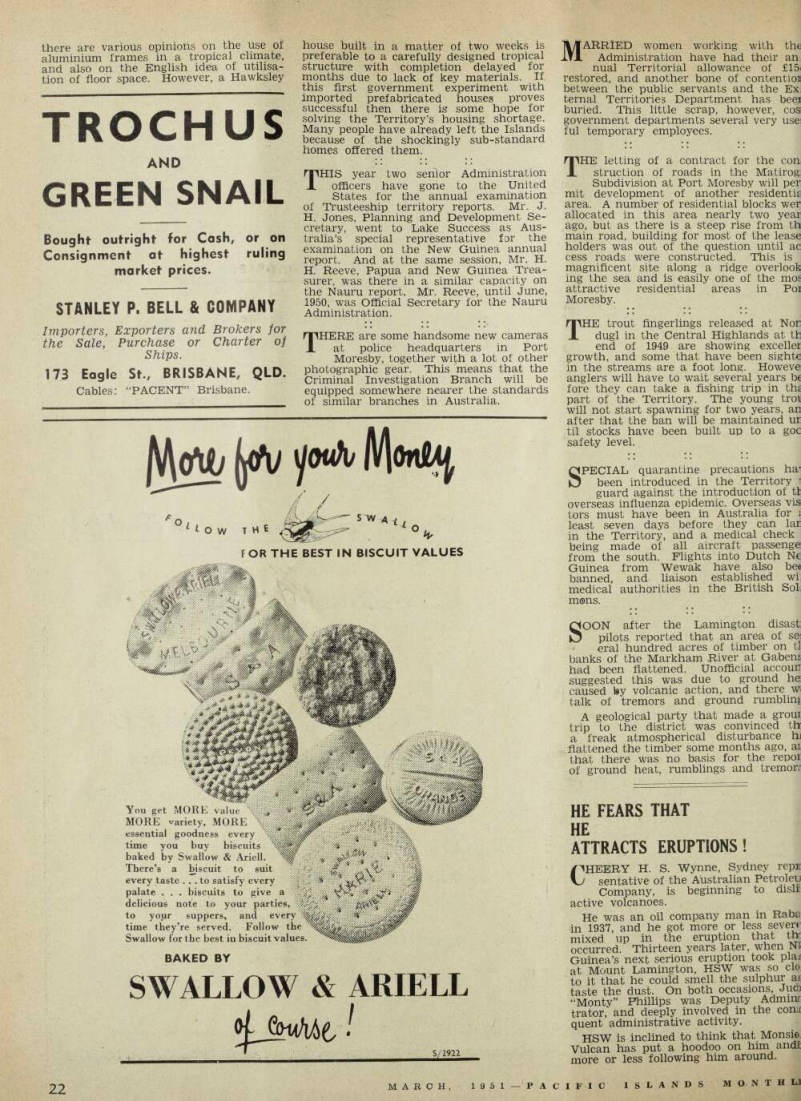
From Our Own Correspondent
Port Moresby, March 1
THE Army authorities have started on the establishment of the Pacific Islands Regiment, a full-time Regu \ lar Army unit of Papuan and New Guinea f natives.
Captain W. R. J. Shields, a veteran of : the New Guinea campaign, arrived in Port Moresby during February to get things moving, and shortly after Captain C. J.
Orme and Lieut. George Smith also [arrived to tackle accommodation and other problems for the P.I.R.
This time the Army must mean business ■for it sent burly Lieut.-Colonel S.
Fletcher, Commander Royal Engineers, to break the accommodation bottleneck which has been partially responsible for slow re-organisation of the Papua and New Guinea Volunteer Rifles. He stirred up a pile of dust in his search for a permanent Army camp site and barracks for the P.I.R.
Already it is no secret that land deal discussions have been going on at a rate much faster than the normal leisurely negotiations which bog down so many Island ventures.
Captain Shields, who will command the first Company of the native Regiment, served in New Guinea with the Second Seventh Independent Company, and later transferred to the Third New Guinea Infantry Battalion. Discussing the future }f the unit he made it clear that all European officers and NCO’s will be men yho have had wartime experience in the Islands.
The first natives to be recruited will be jx-NCO’s from wartime units, who will )e given a refresher course before taking >ver the training of other recruits. As eon as a Second Company is formed a leadquarters staff will come to the Terri ory from Australia. rHE reorganisation of Papua and New Guinea Volunteer Rifles, however, is 'still in the doldrums. After a brief ojourn in Port Moresby the CO, Colonel IcLeod, went back to Australia, and so ar no announcement has been made ither as to his possible return or the ppointment of his successor, Accom lodation is a problem here too, but since ; was also placed on Colonel Fletcher’s houlders, maybe even this will be solved efore potential volunteers are all browned ff by the interminable delays thus far sperienced. )N January 25, a 27 year old Australian, Donald Harborne, arrived in Port Moresby and started work with a >cal firm. A few days later he was rrested on a provisional warrant. Then C. 1.8 detective flew from Australia and arborne was charged with theft of a car i Sydney, and remanded for escort back > Australia. But before transport could - obtained Harborne committed suicide ; Bomana jail by hanging himself with ie ropes of his mosquito net. The oroner returned a verdict of “suicide.”
RUSTING relics of wartime vehicles V 'reposing in Disposals dumps at Lae, , Port Moresby and Rabaul were not ighly regarded by most citizens. How ler. at Port Moresby even the most srnal-looking lots of ancient, battered id weed-grown cab bodies raised a bid - local auctions recently, and the buyers , U P. a fight among themselves for tip uck bodies and truck hoist equipment. . small group of natives, who knew jctly what they wanted, chased the aamg m a determined fashion for some ts- They had the stuff well surveyed, ld usually when they started bidding
they kept at it until the lot was knocked down to them.
Two European buyers got into holts for Ford spare parts and a similar lot of Chevrolet spares, and were not concerned when the auctioneer warned that the “number of individual Darts was more or less correct.”
One prospective buyer who made a preview of the dump suggested a £4O bid for the whole junk pile would be a good
proposition. But when the last grass entangled heap was sold, the Treasury was richer by a total of £530.
A similar sale the following week at Rabaul got strong support from Chinese buyers.
AT the Boroka Extension Area 22 hous ing allotments will be awarded to succesful tenderers, and a spate of private home building will soon be on the way. This new suburb is already taking shape as several Hawksley prefabricated aluminium houses are up, and the foun dations and floors are in place for many others. These are attractive, although
there are various opinions on the use of aluminium frames in a tropical climate, and also on the English idea of utilisa tion of floor space. However, a Hawksley
house built in a matter of two weeks is preferable to a carefully designed tropical structure with completion delayed for months due to lack of key materials. If this first government experiment with Imported prefabricated houses proves successful then there is some hope for solving the Territory’s housing shortage.
Many people have already left the Islands because of the shockingly sub-standard homes offered them.
THIS year two senior Administration officers have gone to the United States for the annual examination of Trusteeship territory reports. Mr. J.
H. Jones, Planning and Development Se cretary, went to Lake Success as Aus tralia’s special representative for the examination on the New Guinea annual report. And at the same session, Mr. H.
H. Reeve, Papua and New Guinea Trea surer, was there in a similar capacity on the Nauru report. Mr. Reeve, until June, 1950, was Official Secretary for the Nauru Administration.
THERE are some handsome new cameras at police headquarters in Port Moresby, together with a lot of other photographic gear. This means that the Criminal Investigation Branch will be equipped somewhere nearer the standards of similar branches in Australia.
MARRIED women working with the Administration have had their an nual Territorial allowance of £ls* restored, and another bone of contention between the public servants and the Ex: ternal Territories Department has been buried. This little scrap, however, cos government departments several very usei ful temporary employees.
THE letting of a contract for the con struction of roads in the Matirog; Subdivision at Port Moresby will per mit development of another residents area. A number of residential blocks wer allocated in this area nearly two year ago, but as there is a steep rise from thi main road, building for most of the lease holders was out of the question until ac cess roads were constructed. This is magnificent site along a ridge overlook ing the sea and is easily one of the mos attractive residential areas in Poi Moresby.
THE trout fingerlings released at Nor dugl in the Central Highlands at tti end of 1949 are showing exceller growth, and some that have been sighte in the streams are a foot long. Howeve anglers will have to wait several years be fore they can take a fishing trip in ths part of the Territory. The young troi will not start spawning for two years, an after that the ban will be maintained ur til stocks have been built up to a goc safety level.
SPECIAL quarantine precautions ha T been introduced in the Territory t guard against the introduction of th overseas influenza epidemic. Overseas vis tors must have been in Australia for : least seven days before they can lar in the Territory, and a medical check being made of all aircraft passenge from the south. Flights into Dutch Ne Guinea from Wewak have also bee banned, and liaison established wi. medical authorities in the British Sol. m©ns.
SOON after the Lamington disast: pilots reported that an area of se; eral hundred acres of timber on tl banks of the Markham River at Gabens had been flattened. Unofficial accoun suggested this was due to ground he caused by volcanic action, and there w\ talk of tremors and ground rumbling A geological party that made a groui trip to the district was convinced th a freak atmospherical disturbance hi flattened the timber some months ago, at. that there was no basis for the repor of ground heat, rumblings and tremor;-
Advertisements & other items, pp. 23-24 (2 items)
21
acific islands monthly-march, 1951
Mary Baker
ICE CREAM MIX
< Is now available to Pacific Islands Traders and Storekeepers in Chocolate and Strawberry Flavours in addition to the popular Vanilla Packed in 16 oz. tins for the Home, 5 lb. Family Size tins and 32 lb. tins for Storekeepers, Milk Bars and Cafes.
Ask Your Local Store For It Today!
Sole Distributor :
J. C. MERRILLEES PTY. LTD.
104 HUNTER STREET, SYDNEY, N.S.W.
Telegrams: “MERRILLEES,” Sydney.
CREAMOTA LIMITED
Oat, Flour and Rice Millers
Have appointed J. C. MERRILLEES PTY. LTD., Sydney, as Sole Export Agent for the South Seas.
It is intended to standardise manufacture of the Company's canned products for export: ® QUIKOTA (quick cooking white oats). • CREAMOTA (superfine oatmeal, baby food, and suitable for growing children). • SUNNY BOY CREAMED WHEAT (superfine pantoasted brown wheatmeal). • SERGEANT DAN PEARL BARLEY (finest quality Australian pearl barley).
• FLOUR and SHARPS
TROCHUS
AND
GREEN SNAIL
Bought outright for Cosh, or on Consignment at highest ruling market prices.
STANLEY P. BELL & COMPANY
Importers, Exporters and Brokers for the Sale, Purchase or Charter of Ships.
173 Eagle St., BRISBANE, QLD.
Cables; “PACENT” Brisbane.
(joV 'jouh
. $ W4i.
I LO VJ THE i
f OR THE BEST IN BISCUIT VALUES * ,* is * * * SS m 4# *■*. *1 You get MORE value V. • MORE variety, MORE ... essential goodness every v-. time you buy biscuits baked by Swallow & Ariell.
There’s a biscuit to suit every taste ... to satisfy every palate . . . biscuits to give a delicious note to your parties, to your suppers, and every time they’re served. Follow the Swallow for the best in biscuit values
BAKED BY
SWALLOW & ARIELL
/ S/2922
Attracts Eruptions!
He Fears That
HE
(CHEERY H. S. Wynne, Sydney repr j sentative of the Australian Petroleu Company, is beginning to dish active volcanoes.
He was an oil company man in Raba in 1937, and he got more or less severe mixed up in the eruption that the occurred. Thirteen years later, when Nt Guinea’s next serious eruption took plai at Mount Lamington, HSW was so do to it that he could smell the sulphur ae taste the dust. On both occasions Jud “Monty” Phillips was Deputy Adminr trator, and deeply involved in the com quent administrative activity.
HSW is inclined to think that Vulcan has put a hoodoo on him andt more or less following him around.
Advertisements & other items, p. 24 (1 item)
22
MARCH, 1951 PACIFIC ISLANDS MONTH LI
Boom Time in Apia
New Buildings Follow High Produce Prices
From Our Own Correspondent
.Apia, Feb 21
VISITORS to Apia, Samoa’s capital, who knew the old town with Its ramshackle wooden buildings, stores [and churches, lately notice a vast im [ provement in the architectural picture on Apia’s main beach. Gradually the old i eyesores are disappearing and are re placed by modern concrete structures, [business premises, churches, Government [offices and workshops and residences in latest architectural style—improvements for which it is not difficult to find the s cause in Samoa’s cocoa-copra prosperity. , It is new impossible to buy a foot of land on Apia Main Beach and new enter prise is forced to move inland from the beach and look for other sites. The Taufusi Road, which was widened and last year, at a fantastic and much-criticised cost, is now the centre of building activity and a large number of new stores are already completed or in course of construction. It appears clear that the Taufusi Road will develop along the lines of All Nations Street in Suva, and that the Chinese shacks and Samoan fales, of which a few remain in this neighbourhood, will have disappeared in a few years’ time.
At the eastern end of Apia, the Vailima Road, which leads to the former home of Robert Louis Stevenson, now the re sidence of the High Commissioner, and the Hospital Road, both connect Apia with the residential suburb of Motootua,
where in recent years many attractive residences have been built by the Govern ment and by business people.
Land prices here have risen very fast and, where a few years ago you could buy building sites for £lOO to £l5O an acre, present prices are in the neighbourhood of £5OO per acre.
Building activity and business ex pansion is not confined to the capital.
Numerous new trading stores have been opened or are projected on the West Coast Road to Mulifanua, and in Savaii, particularly in those districts where cocoa is grown. Most of the new stores seem
to be doing well in spite of strong com petition; some stores belong to the large trading companies of Apia; many others are run by independent traders.
All building at the present time is, however, greatly impeded by the serious shortage of building materials —galvanised nails, roofing iron and cement—which are practically unobtainable in New Zealand and Australia, and lately even from Eng land and the Continent. The high prices ruling are, however, no deterrent, as the present high rates for Samoan produce seem certain to continue for years to come.
Advertisements & other items, pp. 25-26 (2 items)
23
acific islands monthly - m a r c h. 1951
“Duraplas” Overlays
TAHITI
To Shipmasters and Visitors
■" 1 ■ 11 ■ ■ When calling at Tahiti, and seeking SHIPS SUPPLIES and FRESH
PROVISIONS, see—
OSCAR G. NORDMAN
Supply Agent for Messageries Maritimes, Union S.S. Co. of N.Z. Ltd., Matson-Oceanic Line, United States Line, General S.S. Corp., Etc.
We supply General Service Act as Shipping Agents Address all inquiries to the Tourist Bureau.
Wire before your arrival to
“OCEANIC, PAPEETE’—Our
registered cable address.
OSCAR G. NORDMAN
Ship Chandler
PAPEETE. TAHITI
7 1951
AUSTRALIAN SINGLES
TENNIS TITLES*
WON WITH DUNLOP
RACKETS
FEATURING EXCLUSIVE
“DURAPLAS” OVERLAYS
★ MEN'S SINGLES CHAMPIONSHIP
★ JUNIOR BOYS' SINGLE CHAMPIONSHIP
★ JUNIOR GIRLS' SINGLES CHAMPIONSHIP
• NO warping or cracking at the shoulders. • Extra strength for tighter stringing. • More restrings.
fiu
% s *l/1 y* io s ss? %
GIVE
YOURSELF A
CHAMPION’S
CHANCE
DURAPLAS - NOW ovoilob.e a, your local sports store. DUNLOP MAXP L Y, to, 30 years Wimb.edon's most popular racket.
DO-1371
ETABLISSEMENTS DONALD TAHITI
HEAD OFFICE—QUAI DU COMMERCE—PAPEETE
TELEGRAPHIC ADDRESS—“DONALD, PAPEETE”
General Merchants (Wholesale & Retail) & Shipowners
Importers & Exporters—Branches Throughout Marquesas Islands
Lloyd’s Agents
ASSOCIATE
HOUSES:
A. B. DONALD, LTD.
AUCKLAND, NEW ZEALAND.
A. B. DONALD, LTD.
RAROTONGA, COOK ISLANDS.
DOMINION FRUIT CO.,
SUVA, FIJI ISLANDS.
Agents and Distributors for :
FRANCE:
HENNESSY COGNACS
MARIE BRIZARD & ROGER
LIQUEURS
CHARLES HEIDSIECK
CHAMPAGNES
PERRIER WATER
GRUBER BEER
U.S.A.:
GENERAL STEAMSHIP CORP.
RADIO CORP. OF AMERICA
BROWN & WILLIAMSON, LTD.
CIGARETTES: LUCKY STRIKE,
WINGS. OLD GOLD
CHAMPION SPARK PLUG CO.
RAINIER BEER
ENGLAND:
RECKITT & COLMAN
(OVERSEAS), LTD.
PHILLIPS BICYCLES
THE BANK LINE LTD.
NEW ZEALAND:
VACUUM OIL CO. PTY., LTD.,
PETROLEUM PRODUCTS
SWEDEN:
HJORTH & CO.,
PRIMUS STOVES
Sydney Agents:
London Agents : San Francisco Agents : Agents in France : BURNS, PHILP & CO., LTD. BURNS, PHILP * CO., LTD.
BURNS-PHILP CO. OF HARTH & CIE, PARIS.
SAN FRANCISCO. INC. A. BICKART. MARSEILLES.
The new WH “ALL WORLD r RECEIVER Of special interest to you in that it has: —
■ 6 volt Accumulator Operation
■ Low Current Consumption
■ Outstanding Performance and
Reliability
A wealth of practical experience in the design of shortwave receivers for tropical markets has been embodied in the Eddystone “All World Six” Receiver. It is designed to provide the remote “out-station” listener with a specialist built receiver capable of first rate performance and possessing the important feature of low battery consumption. Selectivity, sensitivity, quality of reproduction and performance on all wave bands, including the highest frequencies, will satisfy the most critical. Workmanship and quality of materials used are of the finest to ensure the highest possible degree of reliability.
The wave range of the “All World Six” Receiver is continuous from 30.6 Mc/s to 484 Kc/s (9.8 to 620 metres). The current consumption is only 2.5 amperes from a 6 volt accumulator and no H.T. battery is required. This receiver is eminently suitable for those who, lacking electric supply mains, want performance equivalent to a mains-operated receiver, allied to the utmost economy in current consumption.
Manufactured by Stratton and Co. Ltd., Birmingham, England. ‘ Available for export from Australia ex Bond Store from the factory representatives'.
R. H. CUNNINGHAM PTY. LTD.
62 STANHOPE STREET, MALVERN, VICTORIA
Cables: “CUNNIG,” MELBOURNE. ’Phone: UY6274.
Specialists in all Receiver and Communications Equipment
The Secretary for the Colonies
Meets a BSI Planter
WHILE in London recently, Mr. R.
Symes, planter, of the British Solo mon Islands (he is president of the |BSIP Planters’ Association and a member of the Advisory Council) was able, after much persistence, to more or less blud geon his way in to see the present Secre tary of State for the Colonies, Mr. Grif fiths.
Mr. Griffiths did not want to be seen; but, having once submitted, he was, ac cording to Mr. Symes, quite pleasant and seemed sympathetic to the troubles of BSI planters. Mr. Griffiths expressed amaze ment at the high rate of taxation levelled on the planting industry in the Solomons. It had, he said, not been pointed out to him before, and, it is understood, he will now have some one “look into the matter.”
He suggested that in future the BSI Planters’ Association place their com plaints directly before him instead of sending them through the regular chan nels—that is through the Resident Commissioner, BSIP, to the WPH Com missioner in Suva, and thence to London.
High Taxation for Planters
THERE are about a dozen independent planters in the BSI. It is. therefore, hardly surprising that their combined voices do not reach as far as London.
Lever Brothers, who have extensive planting interests in the Protectorate, are not interested in joining forces with the other planters; now, as before the war, the Lever Combine is interested in cheaper copra—not dearer copra, (A BSI planter in Sydney in November in forms us that Levers in Sydney quoted iiim £l4O per ton as their selling price for crude coconut oil. The source of jopra for this oil is not known, but it aossibly is P-NG copra, which is sold to Australian millers by the Australian gov ernment at the same price that is paid )y the MOP under long-term agreement, We are informed that a ton of copra nakes about I of a ton of coconut oil.) In the Solomons there is a 15 per cent, jxport tax on copra—levelled on the full (ross MOF price, not on the price received >y planters, which is less handling iharges. In addition, all income earned rom copra is subject to heavy income tax.
To take Planter X as a hypothetical iase:— L £ jross annual return on MOF
, P pce 10,000
✓ost of production, including
15 per cent, export tax .. 5,000 profit sio oo »SIP Income Tax 2.000 *ett income of planter £3,000 The gross return is based, of course, on he MOF price, which is about 50 per ent. of the world price. If the BSI Planter, who wanted no part of the MOF -years agreement, was getting the world rice for his copra, his expenses would be greater anc *’ though his income tax export tax would be more, he would irin c Pl ne ou t 9* the deal about twice as off as he is at present. It has been stimated that of the gross amount ■arned by BSI planters, the MOF—that Lou ? ritish Socialist Government— noLu Ut 45 per cent -i the BSIP Govem ab°ut 25 per cent.; and the pro ducer gets what is left.
THE planters of the Protectorate have no voice in their own affairs: they are suffered, not encouraged: the majority of officials sent out by the Colonial Office appear to feel that the Proctectorate would do as well without planters. Not one penny of war damage compensation was paid them. No assis tance, or even transport, was provided for these people to return after the war—the handful who did return made their own way back, carrying with them the bare essentials for starting off afresh.
Now that their plantations are produc ing again, almost three-quarters of the gross proceeds of their labours are skimmed off to help fill the coffers of the British Socialist Government—perhaps to help them finance more nutteries or egg farms in Darkest Africa.
None of the Big Firms have been so foolish as to re-establish themselves in BSI since the war; both W. R. Caroen ter & Co. and Burns Philp & Co., Ltd., have some shipping services in the Group, but neither has trading establishments or copra interests. There has not been one acre of new land planted in coconuts, and many leases of virgin land have been turned in.
This is not surprising when the ground rent for virgin land can be anything up to Q/- per acre per annum. (Continued Next Page.)
One asks, at this stage: what does the British Government intend for the Pro tectorate? And the answer, five years after the end of the war, is obviously, “Nothing.” Whether this is due to sheer inertia or deliberate Socialist policy is a matter of opinion.
It would be hard to convince any in telligent individual that Colonial Service officers approach a term in the Solomons with any enthusiasm. They must of ne cessity look upon their stay there merely as an interlude on the way to better things in Fiji or the West Indies or West Africa. If there is in existence any for ward-looking, constructive and practical plan for the development of the British Solomons, we have not heard of it.
Such rebuilding as there has been in the Protectorate since the end of the war
appears to have been in constructing houses at Honiara for Government offi cials to live in. If there has been any' attempt to lay the foundations of new' industries, native or European, we have: not heard of it.
IT might be asked, why do planters stay there under such adverse con ditions? The answer, of course, is that even with the worst that the British Socialists can do, copra is still profitable.
Looking beyond the immediate scene, however, the fact that there are only a* dozen or so European planters in the whole of that vast fertile area is testi mony to the fog of frustration that! shrouds the Protectorate at the present) time.
No doubt the UK Socialists, if and when they spare a moment’s thought fori this distant speck-in a once mighty Em pire, feel that they are making the Group safe for the Solomon Islanders. The Solo mon Islanders, however, seem even more reluctant than do the Papua-New Guinea natives to get down to hard work on theiß own account.
Presumably, the Whitehall Socialists be lieve that, come another war in the Paci fic, the United States will again be undei some moral obligation to prevent the British Protectorate from becoming ar outpost of Asia.
RETURNING briefly to Mr, Symes anc his interview with the Secretary foi the Colonies: The professional ami ability of the politician can be generally discounted, so it seems unlikely that th« amazement of Mr. Griffiths at the high taxation suffered by BSI planters will b* sustained sufficiently long for him to do anything practical about it.
The only way that the few planters in the Protectorate have of getting any rei dress for their grievances is in making common cause with the stronger planters organisations of the Australian territories and Fiji, who also have grievances—aIJ though in lesser number than their BSi friends.
Advertisements & other items, pp. 27-28 (1 item)
Fly Bom
8.0.A.C. SPEEDBIRD SERVICES
TO ALL SIX CONTINENTS
C 3 1 You can book to almost anywhere in the world hy 8.0.A.C. Service on one ticket all the way. Your 8.0.A.C.
Agent makes no
planning help.
charge
for expert advice and trip Book from Sydney to INDONESIA • FAR EAST • HONG KONG JAPAN • CEYLON • INDIA • PAKISTAN • AFRICA ITALY • GREAT BRITAIN • AND VIA U.K. TO U.S.A.
CANADA • CENTRAL AND SOUTH AMERICA • BERMUDA
8.0.A.C. TAKES GOOD CARE OF YOU
FLY BOM
Information Gf Bookings : Qantas Empire Airways Ltd. {8.0.A.C. General Agents it Australia) at Sydney, Melbourne, Brisbane, Townsville, Cairns, Darwin or from Trave Agents in all cities and towns.
Al7/AL
BRITISH OVERSEAS AIRWAYS CORPORATION WITH QANTAS EMPIRE AIR- WAYS LTD., TASMAN EMPIRE AIRWAYS LTD. & SOUTH AFRICAN AIRWAYS
ISLANDS SOUVENIR
“WHERE THE TRADE WINDS BLOW,” by
R. W. Robson and Judy Tudor.—A collection of over 70 fascinating tales and sketches of the South Pacific Islands, by PIM writers, R.
W. Robson and Judy Tudor; well bound and profusely illustrated. 175 pages. Price: 7/6 (8/posted or $l.OO U.S. currency) per copy. Obtainable from Steele’s Book Store, Suva, Fiji, or direct from the publishers, Pacific Publications Pty. Ltd., Union House, 247 George Street, Sydney, N.S.W., Australia.
U/ z s
concentrated
» mQ i "RATHER! SIR WONT CRACK WONT RUB OFF!"
“I’M SPEAKING OF THE HEAT CARSTAIRS."
“OH I SAY. I AM A FOOL SUH, I THOUGHT
YOU WERE SPEAKING OF TRU-WITE SUH!
ITS THE IDEAL WHITE CLEANER SUH!"
m s High density, economical covering power imparts fresh-from-the-shop Newness. A super finish for Canvas, Kid, Suede, Nubuc and White Lacquered shoes, giving a dazzling whiteness which, when dry polished after thorough drying, WILL NOT
CRACK OR RUB OFF!
TRU-WITE
THE IDEAL WHITE LEATHER CLEARER
Sole Agent R. E. Strachan Ltd. C.P.O. Box 339, Auckland. N.Z,
Off And On Again
Pan-American’s Call At New Caledonia From Our Own Correspondent
NOUMEA, March 10.
FOLLOWING representations by thi New Caledonian authorities, witl; French backing, Pan American Ain ways decided, from March 12, to restore a weekly service by DC4’s betwee:; Sydney, New Caledonia and Fiji.
A brief suspension of the service, owim to the use of Boeing Stratocruisers ot the Pacific route —which now by-passe the French Colony because the TontoutJ airport, about 35 miles from Noumea, i not ready for such heavy traffic—hai aroused dismal fears of isolation.
New Caledonia, in the face of mucc criticism for failure to act —as Fiji ha£ done, by working night and day to hav/ Nadi ready for the Boeings, from Marcc I —tardily realised that immediate step? must be taken if Noumea is to resume iti place as a link on the direct route be tween San Francisco and Sydney. Trul;J New Caledonia is a land of laisser fain In the circumstances it is better ths the local population should throw tli blame for such dilatoriness on the Iocs;; administration. The latter is all too fom of “passing the buck” on to the distal metropolitan government. The colony has more than ample warning of Pas American’s intention to introduce til, Stratocruisers on the major Pacific rui
Advertisements & other items, p. 28 (1 item)
26
MARCH. 19 51 PACIFIC ISLANDS MONTHL
Otto Soltwedel
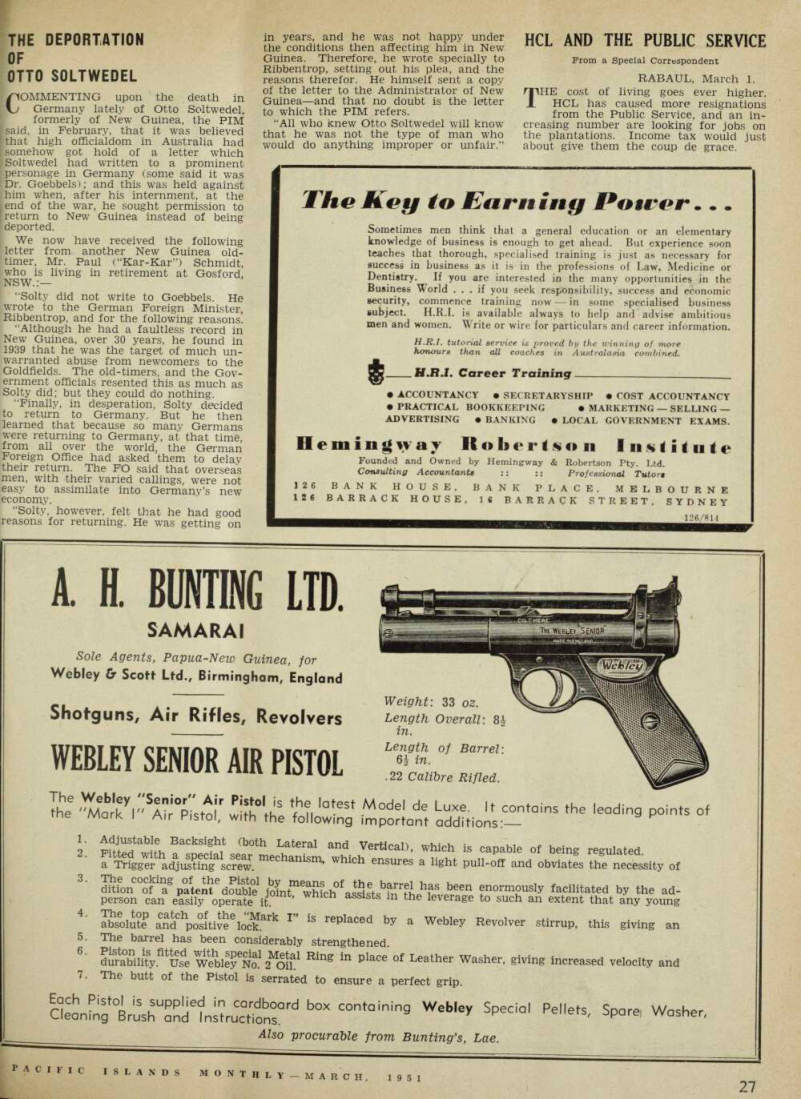
The Deportation
OF
COMMENTING upon the death in Germany lately of Otto Soltwedel, formerly of New Guinea, the PIM [ said, in February, that it was believed [that high officialdom in Australia had [somehow got hold of a letter which I Soltwedel had written to a prominent personage in Germany (some said it was Dr. Goebbels); and this was held against 'him when, after his internment, at the [end of the war, he sought permission to [return to New Guinea instead of being * deported.
We now have received the following letter from another New Guinea old timer, Mr. Paul (“Kar-Kar”) Schmidt, who is living in retirement at Gosford,
Nsw.:—
“Solty did not write to Goebbels. He wrote to the German Foreign Minister, Ribbentrop, and for the following reasons.
“Although he had a faultless record in New Guinea, over 30 years, he found in 1939 that he was the target of much un warranted abuse from newcomers to the Goldfields. The old-timers, and the Gov ernment officials resented this as much as Solty did; but they could do nothing.
“Finally, in desperation, Solty decided to return to Germany. But he then learned that because so many Germans were returning to Germany, at that time, from all over the world, the German Foreign Office had asked them to delay their return. The FO said that overseas men, with their varied callings, were not easy to assimilate into Germany’s new economy.
“Solty, however, felt that he had good reasons for returning. He was getting on
in y ears ’ and he was not ha ppy under the conditions then affecting him in New Guinea. Therefore, he wrote specially to Ribbentrop, setting out his plea, and the reasons therefor. He himself sent a copy of the letter to the Administrator of New Gu inea-and that no doubt is the letter to which the PIM refers.
“All who knew Otto Soltwedel will know that he was not the type of man who W ° Uld d ° anything im P r °P er or unfair.”
Hci And The Puri Service
From a special correspondent RABAUL, March 1. mHE cost of living goes ever higher 1 H CL has caused more resigSns A from the Public Se”v£e and an lS creasing number are looking’ for jobs on the plantations. Income ta g x would just about give them the coup de grace.
Advertisements & other items, pp. 29-30 (1 item)
J. Ft Bunting Ltd.
The Key to Tor nitty ..
Sometimes men think that a general education or an elementary knowledge of business is enough to get ahead. But experience soon teaches that thorough, specialised training is just as necessary for success in business as it is in the professions of Law, Medicine or Dentistry. If you are interested in the many opportunities in the Business World ... if you seek responsibility, success and economic security, commence training now —in some specialised business subject. H.R.I. is available always to help and advise ambitious men and women. Write or wire for particulars and career information.
I H.R.I. tutorial service is proved by the winning of more honours than all coaches in Australasia combined.
H.R.I, Career Training • ACCOUNTANCY • SECRETARYSHIP • COST ACCOUNTANCY
• PRACTICAL BOOKKEEPING • MARKETING SELLING—
ADVERTISING • BANKING • LOCAL GOVERNMENT EXAMS.
linkertso n
Hemingway &
llemin g w a j
Founded and Owned by Consulting Accountants
126 BANK HOUSE. BANK FLAG
126 BARRACK HOUSE. 16 BARRACK
Institute
Robertson Pty. Ltd.
Professional Tutors
E, MELBOURNE
STREET. SYDNEY
J. ft BUNTING LTD.
SAMARAI
Sole Agents, Papua-New Guinea, for
Webley & Scott Ltd., Birmingham, England
Shotguns, Air Rifles, Revolvers
WEBLEY SENIOR AIR PISTOL
m mm Weight : 33 02.
Length Overall : Length of Barrel : in. .22 Calibre Rifled. the "/VW 7 7 S A?r °P isto I r w!th°th S ,Q t est ,^ odel de Lux e. It contains the leading points of me work 1 Air Pistol, with the following important additions:— 2 WMwm Backsight (both Lateral and Vertical), which is capable of being regulated. a Trigger mechanlsm ‘ which ensures a light pull-off and obviates the necessity of 3 ' ditfon^of 1 ‘a 8 patent e doubl°e jX^which^^fn^L^eve l ??, 6 / 1 ® norm ° usl y facilitated by the adperson can easily operate it wnicn assists in the leverage to such an extent that any young absolute an dispositive 6 lock Z ” iS replaced b y a Webley Revolver stirrup, this giving an 5. The barrel has been considerably strengthened. durability 7. The butt of the Pistol is serrated to ensure a perfect grip.
Geaning^Brush'and'fnstructions 01 ”" '** Web,6y Speda ' Pe " etS ' Spare ' Washer ' A lso procurable from Bunting’s, Lae.
1 CASTLEREAGH STREET, SYDNEY
O >■ w DC h I- Z
ANDREW M C GEE
U
NIMROD DRYSNOKER PIPES (English Briar)
(■FITTED WITH THE FAMOUS HYGIENIC FILTER)
941 828 965
CUTAWAY MODEL
Price only 946 276 £ > 7* H > n m It’s not just a matter of chance that so many “hard-to-please” pipe smokers choose “Nimrod” Drysmoker Pipes. The reason is that “Nimrod” has all the features that combine to ensure a Comfortable smoke.
The secret of “Nimrod” success lies in the famous hygienic filter that keeps bowl dry and tobacco burning evenly. (See cutaway illustration.) Order from 28 shapes—straight or bent—from Andrew McGee.
Gold mounted for presentation 40/- -< O Z m -<
“NIMROD” Windproof Lighter
The Lighter with the 12 months' guarantee
Fully automatic
Chrome Plated 44/- Gold Plated^B4/-
ANDREW M C QEE
IMBUD
70 Pitt Street, Sydney. 1 Castlereagh Street, Sydney.
Sydney’s Leading Tobacconist
70 PITT STREET, SYDNEY
Rabaul Roundabout
Prom Our Own Correspondent
RABAUL, March 1 PUT PUT, discovered by Parkinson in 1884, and to-day one of the largest plantations on New Britain, is to change hands.
I In the possession of the well-known [Gilmore family for over twenty years, it Is now to become the propertly of the Catholic Mission. It is valued at about £70,000. i Having sold the plantation, the elder [Gilmores, Flo and John, have presented 'their two vessels, the 85 ft. ketch Lady [Josephine and the smaller Gawa, plus [a substantial cash settlement to their two sons John and Graham. Mr. and Mrs.
Gilmore Snr. will take a well-earned rest in an overseas trip when conditions are suitable.
WE received an interesting letter this week from a frustrated foreigner, living in Rabaul, who finds our ways beyond comprehension. I give it to you as he wrote it . . .
“I am a foreigner in a foreign country, with a very bad foreign habit of liking to build things up, and I find pleasure in do ing so. But take Rabaul—What has been done to improve the remnants of war. Not much! It is so easy to blame the Govern ment but much could have been done by the population. And the only obstacle is lack of co-operation because one is frightened about what his neighbour is ?oing to say.
“I started a soccer association and in cluded Chinese and Malay teams in the 3ody. For over six months I battled along vith three European players as being the mly European team. It was not that ;here were not enough soccer fans, but nerely because a whispering campaign vas held that I was associating with Chinese and Malays. The eye was not ‘ocussed on the sporting side of the whole natter but only on the social side. I hink this is very childish if not poor ittitude towards sport and co-operation n general. Why does someone have to vait and see what his neighbour is going 'O do? I know that there .are befores and )ehinds but both are anxious to see things foing smartly. Well then, why not throw iway that hang on attitude and come .ogether and see what can be done about naking Rabaul a model place with an detraction for outsiders to come here?”
A SILENT poll over the telephone wires in Rabaul during a recent blitz on subscribers, revealed that 95 per cent. )f residents when using the phone ask or names, not numbers.
We have been spoilt by those charming elephone girls who knew all the numbers, x was a comfort when looking for that elusive telephone book. But if you cannot md your book now all you’ll get from the lavages manning the switchboard is that )land, dead-end remark, ‘‘Me no savee.’
A N important meeting of Rabaul citizens tx was held in the District Office on March 2, to form a working com nittee for raising money for the Laming on Disaster Relief Fund.
From the 28 persons present, including epresentatives from the Chinese and Kalay communities, Mr. Frank Riordan the Commonwealth Bank was elected •nairman, with Mr. Roy Galloway, secretary and Mr. Bernie Ryan, BP
Manager, Treasurer.
w P rking committee of eight was then ;?i Cte V consistin g of Mrs. Mildred Cos- Theßevercnd Mr. Lewis, Father Williams J. Chipper, N. Holland, Mollmger, and E. Smythe. ihe concluding date for the all-out
drive was fixed at May 1, and many excellent suggestions were handed in, beginning with a carnival which always brings in big money, a car raffle, sports day, tennis, soccer, swimming and bridge tournaments, and also a mock police day
on which residents would be charged for mock traffic offences.
An interesting point was raised by a Committee member who said that many people of Rabaul wanted assurance before they would contribute any money to the central fund, that it would not be diverted to a certain section of the native com munity of the area, who were of unsavoury reputation, particularly with regard to their war-record. (Continued next page)
In reply Mr. Macarthy, District Com missioner, said that the natives referred to, who had already been heavily punished for their war crimes, were not in any case affected by the eruption of Mt.
Lamington, being out of the area, so could not possibly be included in any benefits from the Central Fund.
With this assurance the Committee agreed on an intensive co-operative effort.
Mr. Sorrell, an accountant from the Department of Works and Housing said
that he had already collected £3O that afternoon with a promise of £45 from another member of the Department, and said that Works and Housing personnel had already arranged to have a Sports day and that the proceeds from this would be devoted entirely to the Lamington Fund.
Mr. Thomset of New Guinea Co., Mr.
Dever of SDA Missions, and Mr. Mac- Mullen of Bank of New South Wales sent their apologies for not being at the meet
ing and assured the Committee of their full co-operation.
THE age when women lived on pedestals and all their secrets of the toilet were inviolate, lives on in one masculine heart in Rabaul.
During stocktaking at a local store, the store manager could not understand whj the new hand was stocktaking up toi underneath, and around, a certain sectior of the shelves. Something odd here, he told himself, and asked the young mar why he was avoiding that particulai portion of the stocktake.
“Sir,” he replied, standing stiffly a' attention, “there are some things we will not stocktake.”
The tambu area was the brassiere anc scantie department.
ONE of the most delightful places yoi 'may visit in Rabaul is the new Clul House of the Rabaul Women’s Club Now members may bring their friend to the Club for morning, afternoon teas and luncheons all at very reasonabl prices.
It is also of particular interest t> Country Members to note that two room are now available for occupation, and ma; be booked by visiting members at th<. small cost of ten shillings per night.
At a general meeting of the Club thi month, office bearers were elected fo the coming year. They are Mrs. Mildre' Costello as President, Miss Audrey Woodl as Treasurer and Miss Loran Carey a Secretary.
It was unanimously agreed to call thi Club in future the Rabaul Women’s CluH not the Ladies Club, as hitherto.
THE Rabaul Soccer Association close; its round of competition matche 'with a victory for the Red Dragon:
After the play finished Mrs. J. K.
Macarthy, wife of the DC presented the cup donated by James Chung to the winners.
Mr.Macarthy then spoke to the gather ing of over 500 people, and congratulated all teams and wished them luck for the Mr. Prank Mollinger who is a promoter and a keen supporter of the Soccer Asso ciation, said that application had gone forward to the Olympic Games Committee to admit the association to the games represented by a combined Papua-New Guinea soccer team. 1 He also said that the Association hoped to form both baseball and football teams as soon as their new fields were ready.
THE engagement has been announced of Miss Helen Louise Burrows to Mr John Cairns Lee.
Lare popular members of the staff of New Guinea Company, Rabaul.
Advertisements & other items, pp. 31-32 (3 items)
29
f aCIFXC ISLANDS MONTHLY-MARCH, 1 95 X
'Dettol'
* • Apply 1 Dettol'
at once on
insect stings
'DETTOL'
THE MODERN ANTISEPTIC
Safe • Non -Poisonous Pleasant Smell-Clean Doesn’t Pain-Doesn’t Stain
The Garrick Notel
tern
hi *« • i IWI Kill'll ... ! SUVA Aj; '*lll ||. ’"%mM
FIJI
This well-known Hotel is centrally situated in Suva's main business quarter : : Modern accommodation provides comfort m all climatic conditions : : Only the best of Beers, Spirits and Wines is served.
Telephone: 80. VI N CE COSTELLO, Proprietor.
Perfect
results
The illustration shows the “Victory,” a popular light all - steel plough, combining maximum strength with minimum weight and draught. in any class of soil can be obtained with one implement or other in the wide selection which we offer Our range covers share and disc ploughs for animal and tractor draught, cultivators, disc harrows, planters, etc.
ansomes
PLOUGHS and
IMPLEMENTS
Ransomes other manufactures include hand, horse and motor lawn mowers, aerodrome equipment, etc. Write for illustrated literature and all information.
MORRIS HEDSTROM LIMITED
Suva, Lautoka, and Ba, Fiji.
Made by: RANSOMES, SIMS & JEFFERIES, LTD., IPSWICH, ENG.
Mark BGC —4O h.p. Engine.
INQUIRIES INVITED.
SOUTHERN CROSS ENGINE & WINDMILL
CO. PTY., LTD.
22 YOUNG STREET, SYDNEY, N.S.W.
SOUTHERN CROSS
HESEL ENGINES
Mark YB-4 h.p.
" BDC-10 h.p.. .
" BEC-20 h.p.. .
" BFC-30 h.p.. .
" BGC-40 h.p.. . .. £144/ 7/6 .. £2Ol/ 1/0 .. £362/17/0 .. £553/10/0 .. £704/19/0 (Price of 20, 30 and 40 h.p. Units includes Radiator Cooling System.)
PROMPT DELIVERY
Marine Engines Also Available NOTE:— The 1950 Southern Cross Catalogue is now available. Please write for a copy indicating the machine in which you are interested.
30
MARCH, 1951 - PACIFIC ISLANDS MONTHL
equivalent of “No-Devil-Strin|s n
Solomon Islander’S
Remarkable
Feat Of Translation
A V^? R t 0 « V t ral of the Australian lrecentl yhas been Pastor Kata ... Hagoso of the SDA Mission at Marovo Lagoon, Western Solomons Kata at ag birth h b S v r^ ail i e ?>. the name given him at birth by his father. His father bad tS®® converted to Christianity; h he therefore called his son the Marovan
equivalent of “No-Devil-Strin|s n
R t gos 9 does n ot look in the least Ji ab( *c. he is a striking-looking man sLrtin? 6 tn h a ight ’ With a hal ° of h * ir Just CSSS t 2 a soft voice and an in traveliin e D- fa bp’ He has done considerable K rL? Was a dele^a te to the SDA S d an C r£ nCe 5 San Francisco in iyjo and has paid several visits tn ink^ r vr an • States —otherwise -one might mk his mscrutability with the niieer
Sivers Christianity ShS
■nnnmg loose m our native state De^le 3 mfrw °L the Western Solomons nilaeers JJf 1 *?- t * le war ’ organised hot 8 dnw? m reseue of 27 US airmen >not down in the area, and 180 New ee a m faae e r a m en H- Kata does s 6 mnrl to I discuss this interlude—he •hp m ?^Qr. ll w^ ested at the P re sent time in -he translations of the Bible which arp al^n ne befo?p Com H let - ion and which have (even’ yearsf 6 smce the war ’ about ion i of t thp fi S?iii’ eyis . ion^ of this transla te*tw h l e mt ° the Marovo lan m fhicT. Iha brou g h t him to Australia )leted in° vfp S /^ n ' Th u work is being com y the Br7tish i^ W - 6re - il will be Panted iativls m ?hp 1xr Fo . reign Bible Society. th Western Solomons, of ected f?«nn ? re ab ° ut 50 ’ 000 - have col- The pa A for tbe Printing.
SiSfsh JU /^ es of translating the archaic ml its fl hi- Blble : Wlth its a Hegories vould annpnr a si l( ivf’ , mto a natlve dialect nsuperaWe nJ £ l ? ym S n to be a lmost SDA hPtwpp? fc +? ata Ra S°so and the nanaged to nSp ther V have somehow K tnd d C0 K me the difficulties and ■ne end of the job is now just in sight.
LM*. Reverend J- M. Aubin, Roman eft for° » of . the South Solomons, hshorf air on Jan uary 23. rtitv f who ls .9 f French nation bp tU- s P.ent more than 40 years with h 4^n°.!U n ,^ he - So ;° m <>ns. His preSt o Australia is for health reasons.
Mr. J. B. McCaig has been selected to take the Colonial Administration Service Course in the United Kingdom, prior to being posted to Fiji as an Administrative Officer. Mr. McCaig is a graduate of Otago University, N.Z. and an old boy of John McGlashan College, Dunedin.
Mr. George Manning, who has been on the staff of the Bank of New South Wales in Suva, Fiji for the past 3J years, has returned to Australia. This completes Mr. Manning’s second tour of duty in Fiji. He was in the Colony from 1939 to 1945.
Advertisements & other items, pp. 33-34 (2 items)
31
PAC,FIC ISLANDS MON T H L Y-MAECH, 1951
The Maclaurin School
WENTWORTH FALLS, N.S.W.
A Church of England School. Preparatory, Boarding for boys.
Vacancies for 1951.
Apply to: The Headmaster, C. H. LLOYD, M.A. (Cantab).
Special care given to Boys from the Islands and Overseas.
Wholesale and Retail Merchants—Sawmillers and Timber Merchants —
Plantation Proprietors and Managing Agents—Ship Owners—
Shipping, Insurance and Customs Agents—Plantation Suppliers—
Exporters of Island Produce.
AGENTS FOE:
Australia-West Pacific Line.
Canton Insurance Office, Ltd.
Union Assurance Society, Ltd.
Aust. T. & G. Mutual Life Society, Ltd.
ASSOCIATED WITH:
Colyer, Watson Pty., Ltd., Sydney, Melbourne, Brisbane.
Colyer, Watson & Co., Ltd., Wellington, Auckland, Christchurch.
DISTRIBUTING AGENTS
Hillman, Humber, Sunbeam-Talbot, Chrysler and Plymouth Cars.
Commer, Karrier and Fargo Trucks.
Willys Overland Jeeps.
Chula Copra Dryers and Desiccated Coconut Machinery, G.M. Marine and Industrial Engines.
IN NEW GUINEA FOR:
Olympic Tyres and Cables.
Hygeia Dissolvenators.
Sherwin-Williams Paints.
Prefect Refrigerators.
Mullard Radios.
Aladdin Lamps.
Anchor and Tiger Beers.
Snowflake Unsweetened
Evaporated Milk.
Pental Soaps.
COLTER WATSON |.S.| LTD
s is a feature of
this inexpensive
luxury foundation
by BERLEI
THE SOFT FEMININE LUXURY OF SATIN . . . the ease of fitting and comfort of wearing are some of the reasons why women are so keen about the side-hook Wrap-ons by Berlei. Whether you re sylph-like or not-so-slim , there’s a satin Wrap-on designed to give you the comfortable support , control and long life you have learned to expect from your Berlei. The Wrap-on illustrated is made to fit three types; so moderate in price , too; well within the means of every woman. Ask the Berlei-trained Corsetiere for a personal fitting.
“Blue Bow” Berlette by Berlei, designed in soft, gleaming satin for three different bust shapes. Trimmed with blue stitching. Sizes 30" to 38".
Prices, 11/11 to 13/9.
Side-hook Wrap-on made by Berlei to fit three different figure types. Waists 24" to 31".
Lightly boned for strong support and all-round control.
Elastic side sections.
Prices, 29/11 to 34/10. (Prices subject to alteration)
YOUR FOUNDATION OF BEAUTY
ESI.IB
Angry Delegate
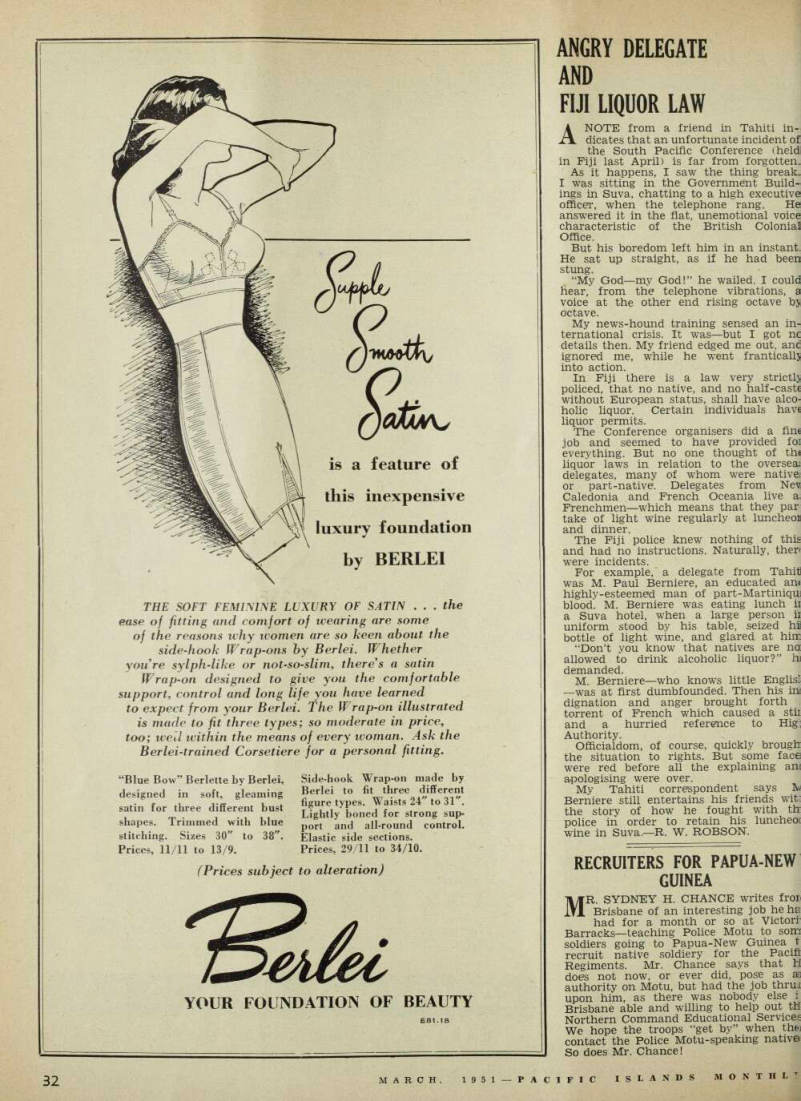
And
Fiji Liquor Law
ANOTE from a friend in Tahiti in dicates that an unfortunate incident of the South Pacific Conference (heldl in Fiji last April) is far from forgotten., As it happens, I saw the thing break., I was sitting in the Government Build ings in Suva, chatting to a high executive officer, when the telephone rang. He answered it in the flat, unemotional voice characteristic of the British Colonial!
Office.
But his boredom left him in an instant.
He sat up straight, as if he had been stung.
“My God—my God!” he wailed. I could hear, from the telephone vibrations, a voice at the other end rising octave by octave.
My news-hound training sensed an in ternational crisis. It was —but I got nc details then. My friend edged me out, anc ignored me, while he went frantically into action.
In Fiji there is a law very strictly policed, that no native, and no half-caste without European status, shall have alco holic liquor. Certain individuals have liquor permits.
The Conference organisers did a fine job and seemed to have provided foi everything. But no one thought of the liquor laws in relation to the overseas delegates, many of whom were native: or part-native. Delegates from Nev Caledonia and French Oceania live a.
Frenchmen —which means that they par take of light wine regularly at luncheon and dinner.
The Fiji police knew nothing of this and had no instructions. Naturally, then were incidents.
For example, a delegate from Tahiti was M. Paul Berniere, an educated am highly-esteemed man of part-Martiniqui blood. M. Berniere was eating lunch ii a Suva hotel, when a large person ii uniform stood by his table, seized hii bottle of light wine, and glared at him ‘•Don’t you know that natives are no allowed to drink alcoholic liquor?” hi demanded.
M. Berniere —who knows little Englisl; —was at first dumbfounded. Then his ini dignation and anger brought forth torrent of French which caused a stir and a hurried reference to Hig; Authority.
Officialdom, of course, quickly brough the situation to rights. But some face were red before all the explaining am apologising were over.
My Tahiti correspondent says M Berniere still entertains his friends witj the story of how he fought with th police in order to retain his luncheoc
wine in Suva.-
R. W. Robson.
Recruiters For Papua-New
Guinea
MR. SYDNEY H. CHANCE writes fron Brisbane of an interesting job he hs had for a month or so at Victorr Barracks —teaching Police Motu to som soldiers going to Papua-New Guinea t recruit native soldiery for the Pacift Regiments. Mr. Chance says that H does not now, or ever did, pose as as authority on Motu, but had the job thru/ upon him, as there was nobody else i Brisbane able and willing to help out th Northern Command Educational Services We hope the troops “get by” when the; contact the Police Motu-speaking native So does Mr. Chance!
Planters Should Bargain

With Uk Mof Direct
Written for PIM by a well-known S-W Pacific Planter
ALTHOUGH it has the power to socialise the Mother Country, does this give the somewhat wobbly Socialist Government of Great Britain any moral right to subject the other members of the British Commonwealth of Nations, or the Crown Colonies, to a compulsory subsidy of their own reckless experiments? [f the member nations got an adequate guid pro quo the case would be different, but, so far, the Home Government has shown a deep reluctance, if not actual hostility, to having the various overseas contracts thrashed out over the con ference table by fully accredited rep ’esentatives of the producers concerned.
The nine-year contract covering the )urchase by the British Ministry of Food )f copra produced in various quarters of he Pacific is a case in point.
When the contract was first advanced, he copra market was in chaotic condi ion. No one at that time seemed to know nth any certainty what world parity >rices were. Accordingly, the British tfOF’s offer of £4B stg. per ton was ac cepted by most of the countries to whom t was offered.
The position clarified very quickly, t soon became apparent that £4B per on was considerably below world parity.
Vhether the authority which offered this trice was aware of this fact at the time f making the offer is beside the point.
When the time arrived for the first an lual revision of the price provided for nder the contract the British Govern
ment had the temerity to offer one or two of the countries concerned a slightly lower price than that ruling for the pre ceding year. The Contract provided for an annual revision upwards or down wards of not more than ten per cent, in any one year. Whether the condition was ever expressly stated or not, copra growers generally were of the opinion that prices in subsequent years would bear some relationship to world parity. In any case, were world parity not to be regarded
as a guide for future adjustment why was any provision for future adjustment in cluded in the Contract?
When the Ceylon growers were offered in 1950 a slight reduction on the 1949 prices they decided to repudiate the con tract entirely and since then Ceylon has been selling on the open market. The Seychelles Islands also repudiated the Contract according to published reports.
An open market for copra exists at Singa pore also. (Continued on next page)
To overcome the feeling that had de veloped amongst planters generally that the British MOF was “taking them for a ride,” a suggestion was made that towards the end of each year of the contract rep resentatives of the British Government (MOF) and accredited representatives of the planters (not Governmental appoin tees), from the various producing areas of the Pacific, should meet in conference and agree upon a price for the ensuing year.
It is obvious that an impartial rep
resentation of the planters cannot be ex pected from Government officials meeting official representatives of the British Ministry of Food and fixing the price. In these negotiations, so far, the planter has had no say whatever.
If the yearly contract price of copra had been fixed in line with world parity prices from the original acceptance of the contract up to the present, the ten per cent, annual revision would have been applied in full each year to boost the price. As the Contract took effect first
in January, 1949, the increase (in Aus tralian currency) for 1950 would have been from £6O to £66, for 1951 from £66 to £72/12/-, or in Sterling from £4B tc £5B.
Even this increase would not have done justice to the copra producer. The original price of £4B Stg. was regarded as a stop-gap price to give a measure ol stability to a market which had been dis organised during the war and early post war years at a time when no open market appeared to exist. Had the con tract been fair and reasonable, it would have contained a proviso that as soon as a stable market had been achieved the price of copra would be revised in line with world parity. It is doubtful whether the Pacific planter at the latter part of 1948 would have been at all eager to enter into the contract had he been informed of the true price of copra on the world’s markets.
IN the latter part of 1949 came the de valuation of sterling. Pacific planters were astounded to learn that it was not proposed to make any variation ir the price paid by the Ministry of Food as a result of this event. Copra, being s commodity in world wide demand, should have been re-valued under the contract with any variation in the pegged level of sterling. Had this been done, and the moral right of the planters to this ad justment cannot be questioned, th« £72/12/- (Aust.) or £5B (Stg.), represent ing the contract price from inception plus annual increments of ten per cent., would now stand at £lOB/18/- Aust. oi £B7 Stg. Even this figure does not at pre sent represent full world parity for copra For any Government spokesman to ex claim that this price is too high woulo amount to sheer hypocrisy. No Govern ment has ever waived taxation on the ground that they were collecting too much During the depression years when th*j planters were taking the greatest bashinj of all time, no Government came to theij rescue with a subsidy.
Is it not the duty of a Government official representing the planters in nego tiations with the British Ministry of Food to regard himself as an agent and spokes man for the planters? If he is not pre pared to regard himself in this light, the planters should be advised beforehand of his intentions, so that they can insist on proper and impartial representations be ing made on their behalf.
What copra producer in the Pacific has ever sighted the MOF contract? None to my knowledge. In the Solomon Islands Protectorate the planters refused to ac cept the contract. Nevertheless, the BSIP Government have commandeered the copra produced and carried on the shipment of copra to the British MOP as if the planters had formally approved and accepted the nine-years agreement. The BSIP Government called the planters to gether on two occasions and offered the contract to them for acceptance. The planters refused to accept same. If they had no choice (and apparently the BSIP Government —as proven by their actions since then —gave them no choice) why the farce of asking for their approval?
The planters must insist upon all the sards being placed on the table and nego tiations carried out between their own sleeted representatives and the represen tatives of the British Ministry of Food, without benefit of official interference by Colonial Governments or by the Aus tralian Federal Government.
Failing this, the planters should take control of the sale of their product out 3f the hands of the Governments con cerned entirely and attend to the sale n the open market of their own pro iuction. Many firms would be pleased to jrovide the marketing machinery on a commission basis or to purchase same mtright.
Advertisements & other items, pp. 35-36 (3 items)
33
ACIFIC islands Monthly m a r c H. 1951
'new TILLEY
Beautiful New Full-Colour
RECIPE BOOK
FREE!
The Simpson Recipe Book featuring 48 pages of nearly one hundred new recipes is widely known throughout Australia. It is usually sold, but to genuine residents of the Pacific Islands a copy will be sent entirely free. Requests should be directed to Simpson Bros. Pty., Ltd., G.P.O. Box 905 M, Brisbane, Queensland, and in order to benefit by this free offer your letter should be headed: “Pacific Islands Free Offer.”
Offered by the Manufacturers of
SIMPSON’S
Self-Raising FLOUR
'new TILLEY
KEROSENE DOMESTIC IRON
MODEL DN2SO
• MADE AT HENDON, ENGLAND
BY THE MANUFACTURERS OF
THE WORLD-FAMOUS TILLEY
LAMPS AND RADIATORS
• WEIGHT 5 LBS. INCLUDING OIL
• NO FLEXES-NO WIRES
• SIMPLE HEAT CONTROL
• SPARKLING MODERN FINISH
IN CHROMIUM & CREAM
• EVEN HEAT DISTRIBUTION
• EXTRA LARGE IRONING PLATE
WITH BEVELLED EDGE
• NOT AFFECTED BY DRAUGHT
• THUMB-RESTS FOR RIGHT OR
LEFT HAND WORKING
• VITREOUS ENAMELLED BODY
O
BRITISH PAT. No. 524714
AUSTRALIAN PAT. No. 114305
Send for complete AUSTRALIA & NEW GUINEA: T. H. Bentley, Pty. Ltd., 123-125 William
details to Street, Melbourne, C.l.
TASMANIA: Mr. H. V. Sellers, 1080 Charles Street, Launceston.
FIJI: Mr. K. Witherington, 2 Burns Philp Buildings, Suva.
m * i 951 N
They’re
well worn ...
but they’ve
worn well .. -thanks to
KIWI
★ Makes leather soft and supple ★ Gives added resistance to weather and wear Change to KIWI for KEEPSI Flack • *an • Dark Tan • Mid Tan • Brown • Mahogany • Bloid • Blue • Transparent
NELSON and ROBERTSON Ply. Ltd.
Established 1895.
Shipowners - Brokers and
Islands Merchants
All classes of Merchandise purchased at Best Wholesale Prices. Original Invoices supplied to Island Clients. Cocoa Beans, Copra, Rubber, Trochus Shell and All Islands Produce Sold on Commission.
Entrust your requirements to the firm with over fifty-five years' practical experience in the Pacific Islands.
Sole Agents :
SKAMDIA DIESEL ENGINES
Inquiries Solicited.
Prompt attention given to all inquiries
NELSON & ROBERTSON Ri
12 SPRING STREET, SYDNEY, AUSTRALIA
Telegraphic Address: "IVAN," SYDNEY.
Represented in All Parts of the World.
Overseas Indents Arranged for Clients.
Managing Agents : " Tusculum "
PRIVATE HOTEL
Potts Point, Sydney.
34
MARCH, 1951 PACIFIC ISLANDS MONTHL
Operation Volcano
rS occupants of two Qantas aircraft flying over the Mt. Lamington area, Papua, about 10.40 a.m. on January 11, were eyewitnesses of the -explosion hat devastated the country and killed ,000 people.
One was a Dragon aircraft flown by first Officers Biddulph and Barlogie and arrying Administration personnel to *opendetta from Lae. Prom Popendetta he passengers expected to go by road o Higaturu. As they were taking photo :raphs of the steam and ash which had icen issuing from Mt. Lamington since he previous week, the whole mountain ide blasted out towards them, and pilots ■nd passengers watched while the town hip of Higaturu was enveloped with olcanic ash and pumice dust.
Therefore (we quote from the Qantas eport) . . . “As his trip was for the iiirpose of carrying the passengers for ligaturu to Popendetta and they had all een it just disappear, the passengers re vested Biddulph to return to Lae.”
At the same time—but obscured from hddulph by a layer of stratus cloud— /aptain Arthur Jacobson, commanding a £23, was flying from Port Moresby via he Gap to Rabaul, at 8,000 ft. A remendous explosion occurred below the loud, and volumes of jet black matter ose into the air only 10 miles away. He ook two pictures of it but, as the cloud ■Pproached at terrific force, he dived the >iane away from it at 215 miles an hour, le said that the apex of the explosion cached about 50,000 feet, and blanketed ■n area about 100 miles wide.
In the following days Qantas aircraft Lae flew 20,600 miles in and round the devastated area, and carried ne million pounds of loading.
Copra
Higher Rate For Better
From Our Own Correspondent
Honiara, Feb. 20.
THE British Solomon Islands Copra Board has accepted an offier from the Ministry of Food, London, to pay a premium of one pound sterling per ton for hot air dried copra or its equivalent, with a discount of ten shillings sterling for FMS or its equivalent.
This offer was accepted on the assumption that the two local BSIP
grades, Plantation and FM are equal to hot air dried and FMS respectively. (Some months ago the MOF complained of the bad quality of conra shipped to the UK from BSI.) Simione Nadakuitavuki, one of Fiji’s oldest Assistant Medical Practitioners, died in Suva in February in his 62nd year. He qualified in 1910, and was posted to Makogai, in 1911. He had served in almost every district in the Colony before he retired in 1942.
Advertisements & other items, pp. 37-38 (3 items)
35
Ueir,C ISLANDS MONTHLY-MARCH, 1951
l oW£R
m A AT
ehouses
and wor
for stores
a
AXf
m * •4 ♦ * 4
< pBRRSS
Se
PABCO
Pabco MASTIPAVE is the ideal heavy duty floor covering where a durable and inexpensive floor is required. Non-slip Mastipave will not chip or crack and is self-healing when cut.
Prevents timber floors splintering, prevents damp and cold penetrating concrete floors.
Vermin-proof. Only available in grey, but may be lacquered red, green, blue or brown with Mastipave Coating.
PABCO
Sole Manufacturers of Genuine Malthoid Roofing. \ \ / If your local store does not stock Mastipave, write to ms direct.
PABCO PRODUCTS PTY.
LIMITED.
150 WIGRAM ROAD,
GLEBE. N.S.W.
■■ FAI-51
World-Wid
TROPICAL
0 e V ± N* /.
'V
0 of th*-
Reception
MON D
RECEIVERS
CRAMMOND TROPIC EAGLE
Most famous tropic-proofed and completely sealed receiver in the world to-day. The designers’ claim that range is unlimited and reception perfect anywhere throughout the world has been fully justified by the reports received from hundreds of enthusiastic owners. Three Years’ Guarantee and easy terms are available wherever you live.
CRAMMOND
TROPIC HAWK
This is a 2-unit receiver especially designed for Patrol Officers and others who require absolute portability and dependability. Combined weight of both cabinets—32 lb.
Measurements of each cabinet—ls x 9 x 9. This set covers from 16- 150 metres shortwaves only. Three Years’ Guarantee and easy terms wherever you live. m m i Features exclusive to both sets: Completely Tropic Proofed, Built-in Moisture Absorber, and available in Vibrator or All Dry Cell.
Write for particulars to-day!
CRAMMOND RADIO
TROPICRL OUT! SI ON
N» 8 QUEEN STREET . BR/SBRNE
/si
36
MARCH, 1951 PACIFIC ISLANDS MONTH LJ
Indonesians In N.
Caledonia
The Strange Indifference of Australia
A FEW months ago, the PIM pointed out that, owing to the breakdown during the war of the repatriation i provisions of their indentured labour con tract, a colony of at least 3,000 Indo nesians had taken root in New Caledonia, only 700 miles east of the Australian coast.
The comment was made that it was strange that Australia did not concern it t self with the new Asiatic invasion of the Southwest Pacific, while making so much ifuss about the possibility of Indonesians settling in Dutch New Guinea, which is [little nearer the Australian coast than is New Caledonia.
As a result, Mr. D. H. Drummond, MP, asked in the Australian Parliament a question concerning this matter, and in vited the Government to give an indica tion of policy in relation to the settlement of Asiatics in the South Pacific. The Government promised to make inquiries.
Mr. Drummond, in due course, received a reply from Acting Prime Minister Fadden. He was informed, at length and in detail, that normally, before the war, New Caledonia and New Hebrides together gave employment to about 10,000 Indo nesian indentured labourers (5,000 Jav anese and 5,000 Tonkinese); that, owing to absence of shipping in 1942-46, most of them were not repatriated, as they should have been; and that some of them have been repatriated since the war ended.
But the Prime Ministerial statement carefully avoids the whole point of our article and of Mr. Drummond’s question— namely, that the non-repatriated Indo nesians, to the number of some thousands,
have been allowed by the French to form a permanent colony in New Caledonia.
The statement says: “The French authorities appear to have been fully satisfied with the conduct of the Indo nesian community in New Caledonia.
There has been, so far as can be ascer tained, little evidence of subversive ac tivity among these Indonesian residents of New Caledonia.’’ All of which was al ready well know,n.
APPARENTLY, the Australian Prime Minister has never heard of the Indians of Fiji. There were only a few thousands of non-repatriated Indian labourers there in the beginning, when they were first allowed to settle—quiet, industrious, law-abiding people. Now they number over 130,000—nearly 10,000 more than the native Fijians, whose lands they covet.
In an economic sense, the Indians are an asset—their industry has made of Fiji a very rich and prosperous British colony.
In a political sense, of course, they are what is popularly termed a pain in the neck.
Taking the long view, we believe that there is no future for the European and the indigenous races here in the South Pacific—in Australia and New Zealand, and the Islands—unless the United States will protect us against Asia. Without American aid, we cannot hold these lands against 1,000,000,000 Asiatics.
Why, then, should we hasten our own destruction by introducing colonies of Asiatics to these pleasant, empty lands?
Already, they are established in Fiji, Tahiti, New Guinea and the Solomons.
Why permit another establishment in New Caledonia?
New Caledonia, of course, is French; and the French, in colonisation, have no racial consciousness. It is not an acci dent that, although the French hold, in area, the world’s second largest colonial
empire, they have not succeeded in es tablishing one worthwhile French com munity, outside of the Mother Country.
Generally, what the French do in New Caledonia is entirely the concern of the French. But if, by blundering and in difference, they are going to establish an Indonesian colony within 700 miles of the Queensland coast—in much the same circumstances as they established a Chinese community in Tahiti—that is very much the concern of Australia.
Advertisements & other items, p. 39 (1 item)
Bovril
SPECIALISING IN
PACIFIC ISLAND INSURANCES
FIRE-MOTOR VEHICLE
MARINE—HULLS AND CARGO
EMPLOYER’S LIABILITY
BONDS—in accordance with
ADMINISTRATION ORDINANCES.
COPRA INSURED FROM DRIER
TO BUYER.
AND ALL OTHER CLASSES ARRANGED
AT LOWEST CURRENT RATES.
Established Agencies throughout the Territory of Papua and New Guinea.
Managing Agents: New Guinea Company Limited.
Island Representative: G. D. A. Kent, Rabaul Branch.
Southern Pacific Insurance
CO., LTD.
HEAD OFFICE: 60 HUNTER STREET,
SYDNEY.
12 TASTY
sandwiches from
ONE TEASPOONFUL
OF BOVRH-
» W VA
m < Wl V » £
BOVRIL
makes a good spread!
I?
Everyone enjoys delicious sandwiches made with Bovril.
They’re tasty, economical and just right for every occasion.
BOVRIL
puts Beef into you Agents: BURNS, PHILP ( NEW GUINEA) LTD
Cocoa Expert In Bsi
From Our Own Correspondent
Honiara, Feb. 20.
Dr. D. H. URQUHART, formerly Director of Agriculture. Gold Coast Colony, arrived in Honiara, by air on February 5 from New Guinea, where he has been investigating cocoa-growing potentialities and problems.
His visit to the Solomons was made at the request of the BSIP Government for the purpose of advising on the most suitable soil areas and varieties of cocoa for initial plantings in the Solomons.
The Right Reverend S. G. Caulion, Bishop of Melanesia, returned to the British Solomon Islands by air on February 5 after a short vacation in Australia and New Zealand.
Advisory Council
Lae Now Has Advisory Council Moresby Council’s Reluctance To Assume Powers
From Our Own Correspondent
Port Moresby, March 1.
LAE now has a Town Advisory Council.
Its formation was announced in the same 'week ias the Port Moresby Council presented its first annual report.
Members of the Lae Council, all ap pointed by the Administrator are;— A. J. Bretag, Chairman; J. A. Baker, Deputj Chairman; G. Whittaker; C. Heavy; C. Beckett R. Morgan; J. A. Birrell; Mrs. F. Stewart; Mrs; J. Pollard; the Assistant District Officer, Lae the Regional Works Officer, Lae; District Medica, Officer, Lae; J. Womersley, Forest Botanist.
In many ways these councils are quaint public bodies since as they, as yet, have no statutory powers, and as there are neither income nor municipal taxes im posed in the Territory, their deliberations are not curbed by any shadow of a finan cial reckoning.
The question of its constitution and the matter of statutory authority was handec over by the Administrator to the Pori Moresby Council last year. But, at a ses sion closed to the Press, it was decidec not to seek statutory powers but to re consider the matter after the body hac been functioning 12 months.
Now the 12 months are up, the Counci is asking the Administrator for his view; on the matter, and if he wants a recom mendation from the Council itself.
When this fox-trot debate finally end: it will then be known whether the bur ghers of Port Moresby are ready to as sume municipal authority. It is possible too, that the question of whether mem bers should continue to be appointed b: the Administrator, or elected by thei. fellow citizens, may be settled, and ; Council constitution adopted.
With no Legislative Assembly and m form of participation in the governmem of the Territory, it seems logical thai municipal councils should be elected am not appointed by the Administrator. How ever, the first Council members with tin. chance to do something about this haw not rushed their opportunity. This thru the fault does not lie with the govern; ment.
It is to be hoped that the delay on thi part of the Port Moresby Council memi bers is due to reasonable caution am not to distaste for definite responsibility In this matter the decision of Pon Moresby Council may set a precedent fa contemporary councils. A limited fram chise is better than none at all, and i Territorians do not take this chance, the; will rightly lose their present privilege c protesting against government without re; presentation.
ON its first year’s record the Pom Moresby Council has a lot to it credit. ‘ It has put in some heft! and at least partially-effective protest on many important matters. Its repre sentations resulted in improved plans fo the new main wharf; it hurried the slow motion Town Plan a little farther alorr its weary road; and it put the spotlight oc the inadequacies of power and water sen vices. It sponsored an Anti-Litter cam paign which got a lot of rubbish movea out of the town, and perhaps even incu j cated a sense of pride in the appearano of the township. In a dozen differen ways the Council did a very good job. I and when it sits as an elected body, witt statutory powers, it can render an eves more useful purpose.
Advertisements & other items, p. 40 (2 items)
38
MARCH, 1951 PACIFIC ISLANDS MONTHL
Superb
MUNGO SCOTT PTY. LTD.
Flour Millers, Summer Hill, N.S.W., Australia Established 1894.
BLUE
FINE
AND
DRY !
£
SUPERB
SUPERB
IT'S
QUALITY
THAT
COUNTS !
The unvaried “Quality” of “BLUE SUPERB FLOUR” makes it especially suitable to climatic conditions of the Pacific Islands. Our Entoletion process reduces the risk of insect infestation to a minimum. All Good Bakers use “BLUE-SUPERB.” Our Pacific Representative will call on you soon.
i
BRAND
31 if DUALITY
HP ml
I PINT
/4GALL
GALL
I GALL TINS
nmt w
Meat or a Menace?
Proposed Introduction of Rabbits to BSI
From Our Own Correspondent
Honiara, Feb. 10.
ONE recent topic of conversation in Honiara is a proposal to import rabbits into the BSIP to provide fresh food and lower the ever-rising cost of living. Honiara residents, English, New Zealanders and Australians, stand by their respective backgrounds of home ex perience.
The English cannot understand how a few rabbits, imported for food and kept in hutches, could ever become a pest; the New Zealanders combine neutrality with a leaning towards the English viewpoint.
Most Australians are with difficulty re strained from tubthumping and arguing (occasionally with more force than good manners) that if as the opposition claims rabbits will not do well in the tropics it would be of little value to import them, whereas if they flourished they might prove a dangerous threat to native food supplies, plantation cover-crops and pos sible future coffee and cocoa ventures.
Some Queenslanders, however, believe that rabbits could safely be introduced and would be kept in check by the tropical climate and conditions.
None have as yet been imported. (Ed. Note. —The introduction of rabbits into Pacific Islands has been discussed, pro and con, many times. The general opinion is that they would not become a menace, but few have been tempted to deliberately try the experiment. A small island off Norfolk Island has been com pletely devastated by rabbits.)
Mr. B. H. Marks, prominent resident of Suva, Fiji, has retired and, with his wife, in future will make his home in Mel bourne, Victoria. He is the son of the late Sir Henry Marks, who went to Suva from Melbourne in 1881. and soon after established the firm of Henry Marks & Co., Ltd., which years later amalgamated with Morris Hedstrom Ltd. Sir Henry (knighted in 1933) and his son both gave long public service to Suva —at one time
they were Mayor and Deputy Mayor re spectively. Mr. Marks was also Danish Consul in Fiji in succession to his father and after his recent resignation the King of Denmark created him a Knight of the Royal Order of Dannebrog.
In Launceston, Tas., on February 22, Miss Rae Marion Winspear was married to Mr. Eric Beattie. They will make their home in Wau, New Guinea.
Advertisements & other items, pp. 41-42 (1 item)
AsprO
A. OEGORY PTY. LTD.
IMPORTERS, EXPORTERS AND
MANUFACTURERS
Leather Saddlery and Paint Merchants ALL CLASSES OF LEATHER SUPPLIED FROM STOCK Apply direct to: A. GREGORY PTV. LID, 107 York St, Sydney
SOOTHE away
TROPIC TROUBLES
There is no need to suffer many tropic health troubles and discomforts when 'ASPRO' tablets are here, ready to help you. 'ASPRO' is a most valuable medicine in the tropics because it has so many uses—for feverishness, the pangs of rheumatism, heat and humidity headaches, lassitude, nerve pains and nerviness, sleeplessness, colds and 'flu, 'ASPRO' is equally effective. Take two 'ASPRO' tablets with your favourite drink to overcome heat enervation.
Another feature which makes 'ASPRO' the desirable method of treating tropic troubles Is its SOOTHING action. Irritability accompanies so many discomforts that 'ASPRO,' in addition to giving swift relief, has a soothing, calming effect. There are NO unpleasant after-effects to disturb you.
TWO IMPORTANT POINTS:-
The purity ot 'ASPRO' conforms to the standards laid down by the British Pharmacopoeia— a guiding authority of the Medical Profession. 2 ASPRO' tablets can be taken as often as necessary without FEAR ot harm to heart or stomach. \ X o * ■ A W
AsprO
ASPRO' IS SWIFT, CERTAIN and SAFE for—Headache, rheumatism, all nerve pains, irritability, neuritis, lumbago, earache, sciatica, toothache, sleeplessness, feverishness, sore throat, periodic pains, colds and ’flu, "mornings after." Even a child can safely take 'ASPRO'—directions on every packet.
N.G.7.
Improve Your Photography ...
with these PICTURE-MAKING ACCESSORIES from KODAK
A PHOTO FRAME from Kodak will enhance the appeal of your favourite enlargement. Available in a wide range of sizes and designs.
KODAK EASYMOUNT PHOTO FIXERS provide a quick and easy means of permanently fixing prints in a Kodak Album. Available in different colours. 100 corners per packet.
KODAK STIRRING PADDLE for crushing chemicals, stirring solutions or shifting prints in processing solutions— just the thing for keeping the fingers and hands free from chemical stain or action. Moulded in yellow plastic.
PHOTO ALBUMS from Kodak provide the surest way to safeguard valuable snapshots. Available in a very complete range of sizes, colours and designs.
KODAK THERMOMETER should be in every darkroom. An essential that has only one result—improved home processing.
PHOTOGRAPHIC BOOKS from Kodak. In our wide range there are titles on practically every aspect of photography—well illustrated, interesting and informative.
What better means to improve your photography than to subscribe to the AUSTRALASIAN PHOTO REVIEW?
CAMERA CARRYING CASE in leather or plastic. A case will protect your camera from dust or hard treatment.
Available in various sizes for box and folding cameras.
AUSTRAL FILTERS. For all camera fans—just the thing to improve general picture-making. In yellow, green, orange and red, in a range of sizes.
KODAK HOME DEVELOPING OUTFIT is useful for any camera owner—he can then develop and print his own pictures. Complete and ready for use.
KODAK FLASHOLDER is an important accessory for an owner of a Brownie Reflex, Brownie “E”, Folding Brownie, Kodak “A” or Duaflex camera—for with it flashlight pictures indoors can be made with push-button ease.
AVAILABLE FROM ALL KODAK DEALERS THROUGHOUT THE ISLANDS KODAK (A'ASIA) PTY. LTD., 379 George St., Sydney.
jT*S 4 r: fkere't . *. « - J^ -•^43^-—“
TOOTH’S
UGE*
rewed and bottled
Y TO
OTH &
CO. limited
Blood For Volcano Victims
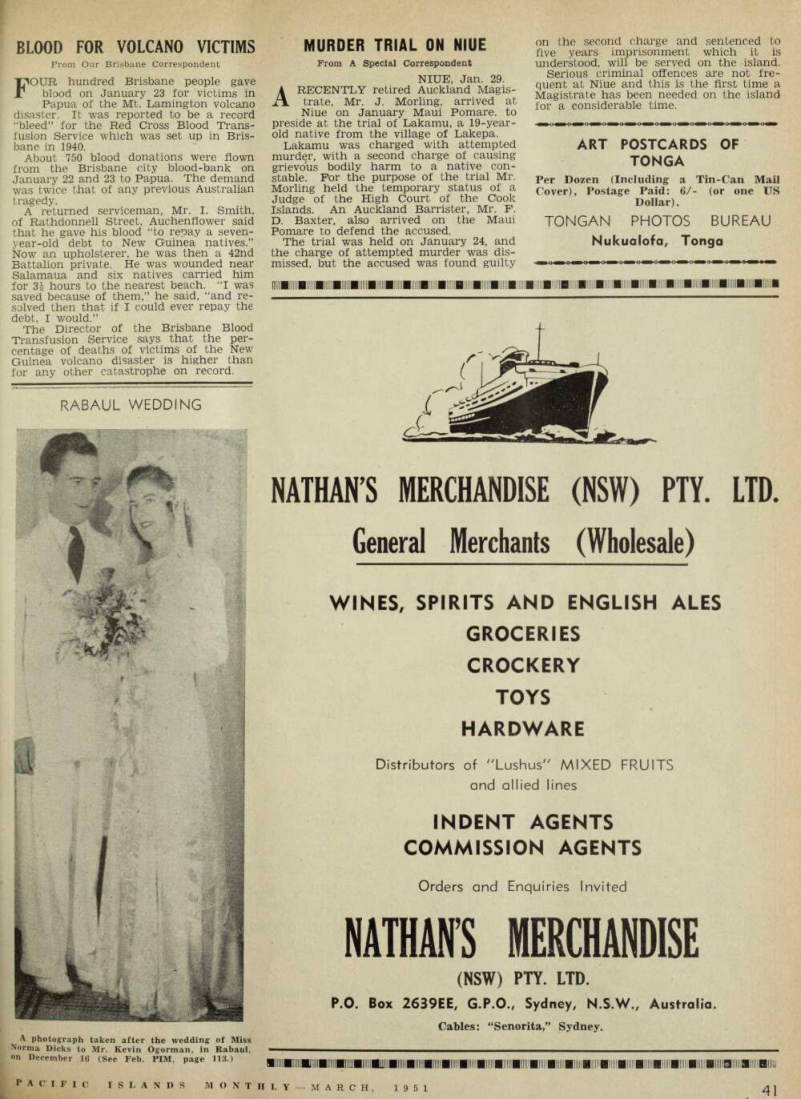
From Our Brisbane Correspondent FOUR hundred Brisbane people gave blood on January 23 for victims in Papua of the Mt. Lamington volcano disaster. It was reported to be a record “bleed” for the Red Cross Blood Trans fusion Service which was set up in Bris bane in 1940.
About 750 blood donations were flown from the Brisbane city blood-bank on January 22 and 23 to Papua. The demand was twice that of any previous Australian tragedy.
A returned serviceman, Mr. I. Smith, of Rathdonnell Street, Auchenflower said that he gave his blood “to repay a seven year-old debt to New Guinea natives.”
Now an upholsterer, he was then a 42nd Battalion private. He was wounded near Salamaua and six natives carried him for 3i hours to the nearest beach. “I was saved because of them,” he said, “and re solved then that if I could ever repay the debt, I would.”
The Director of the Brisbane Blood Transfusion Service says that the per centage of deaths of victims of the New Guinea volcano disaster is higher than for any other catastrophe on record.
Advertisements & other items, p. 43 (1 item)
Rabaul Wedding
A photograph taken after the wedding of Miss Norma Dicks to Mr. Kevin Ogorman, in Rabaul, on December 16 (See Feb. PIM, page 113.)
Murder Trial On Niue
From A Special Correspondent
Niue, Jan. 29.
A RECENTLY retired Auckland Magis trate, Mr. J. Morling, arrived at Niue on January Maui Pomare. to preside at the trial of Lakamu, a 19-year old native from the village of Lakepa.
Lakamu was charged with attempted murder, with a second charge of causing grievous bodily harm to a native con stable. For the purpose of the trial Mr.
Morling held the temporary status of a Judge of the High Court of the Cook Islands. An Auckland Barrister, Mr. F.
D. Baxter, also arrived on the Maui Pomare to defend the accused.
The trial was held on January 24, and the charge of attempted murder was dis missed, but the accused was found guilty
on the second charge and sentenced to five years imprisonment which it is understood, will be served on the island.
Serious criminal offences are not fre quent at Niue and this is the first time a Magistrate has been needed on the island for a considerable time.
Raiu Isireli Tawake, formerly Roko Tui Ra and Roko Tui Tailevu died in Fiji on January 16, aged 62. He joined the Fiji Government Service in 1908 as a clerk in the Native Department and served in various clerical posts until he went to Europe with the Fiji Labour Corps in 1917. In 1924 he was appointed to act as Roko Tui Bua and then became Native
Assistant Commissioner, Lautoka. He was appointed Roko Tui Ra in 1925 and in 1937 was transferred to Bau as Roko Tui Tai JL evu - , He was awarded the Certificate of Honour in 1937 and for some years was one of the Fijian members of Legislative Council. He retired in 1946 and has been living at Bau.
Advertisements & other items, pp. 43-44 (1 item)
Nathan’S Merchandise
ART POSTCARDS OF
TONGA
Per Dozen (Including a Tin-Can Mail Cover), Postage Paid: 6/- (or one US Dollar).
TONGAN PHOTOS BUREAU
Nukualofa, Tonga
NATHAN’S MERCHANDISE (NSW) PTY. LTD.
General Merchants (Wholesale)
WINES, SPIRITS AND ENGLISH ALES
GROCERIES
CROCKERY
TOYS
HARDWARE
Distributors of "Lushus" MIXED FRUITS and allied lines
INDENT AGENTS
COMMISSION AGENTS
Orders and Enquiries Invited
NATHAN’S MERCHANDISE
(NSW) PTY. LTD.
P.O. Box 2639EE, G.P.0., Sydney, N.S.W., Australia.
Cables: “Senorita,” Sydney.
Scott’s “Renown” Brand Rope,
Cordage and
Binder
Cable Address: Ropeyard, Sydney. ft
Twine
of Every
Description
MANUFACTURED AT
MASCOT, N.S.W.
By
J. SCOTT
PTY. LTD.
Head Office and Store
163 CLARENCE STREET,
SYDNEY,
N.S.W.
Islands
Frustration In The Cook
MR. W. B. JACKSON, lecturer in Geography at Auckland University College spent six weeks in Rarotonga at the end of 1950 making a “pilot survey’’ for a Ph.D thesis. On his return to NZ he said that the Cook Islands were a forgotten frontier.
No ship had called at Rarotonga between August and November, he said. Flour and bacon supplies ran out; meat and dairy products were very scarce and eggs were 5/- per dozen.
Although the Cook Islands had formerly produced large quantities of bananas, tomatoes and oranges for export, exports are now very small owing to the fact that native growers in the past have seen too many of their crops rot on the trees through lack of ships to lift them.
The natives, now, Mr. Johnston said, have nothing but a feeling of frustration regarding fruit growing and have turned to wage-earning, either in the Cook Islands, or, if they can get away, at Makatea, the French phosphate island, or in New Zealand.
Death Of Mr. C. A. Bentley
Mr. Charles A. Bentley, Who Was
born at Suva 79 years ago, died at Lautoka in February. He was the last surviving member of the family of Mr. and Mrs. Henry Bentley. His father was a planter in the Rewa district, where he grew cotton during the boom caused by the American Civil War.
He is survived by his wife, one daughter (Mrs. W. Morrison, of Vatukoula) and four sons, including Mr. Viti Bentley, of Wakaya, and Mr. Dick Bentley, formerly Chief Engineer of the Viti, and now in the British Solomon Islands.
Advertisements & other items, p. 44 (1 item)
A. B. Donald Limited
RAROTONGA COOK ISLANDS
TELEGRAPHIC ADDRESS: “DONALD, RAROTONGA.”
General Merchants (Wholesale & Retail) and Shipowners Importers & Exporters Branches Throughout Cook Islands Fire, Marine & Motor Vehicles Insurance Agents for Yorkshire
Insurance Co.
Lloyd's Agents.
Agents and Distributors for : ENGLAND.—Austin Cars & Trucks, Pye Radios, Dunlop Rubber Co., Ltd., Vauxhall Cars & Trucks, R. A. Lister & Co., Ltd., Phillips' Cycles, Marples Tools.
U.S.A.—Remington Rand Corp., Radio Corp. of America, Champion Spark Plug Co.. Firestone Tyres, General Steamship Corp.
NEW ZEALAND.—Vacuum Oil Co. Pty., Ltd, Petroleum Products.
AUSTRALlA.—Wunderlich, Ltd., Cement Asbestos Products.
NORWAY.—O. Mu.stad & Sons, Fish Hooks.
SWEDEN.—B. A. HJorth & Co., Primus Products.
Sydney Agents : London Agents: San Francisco Agents : BURNS, PHILP & CO., LTD. BURNS, PHILP & CO., LTD. BURNS, PHILP CO. OF SAN FRANCISCO.
Head Office:— A. B. DONALD, LTD., Auckland.
Associate Houses:—
ETABLISSEMENTS DONALD TAHITI,
Papeete, Society Islands.
DOMINION FRUIT CO., Suva, Fiji Islands.
CODES: Bentley's Complete Phrase, Acme
A Bachelor For Pago
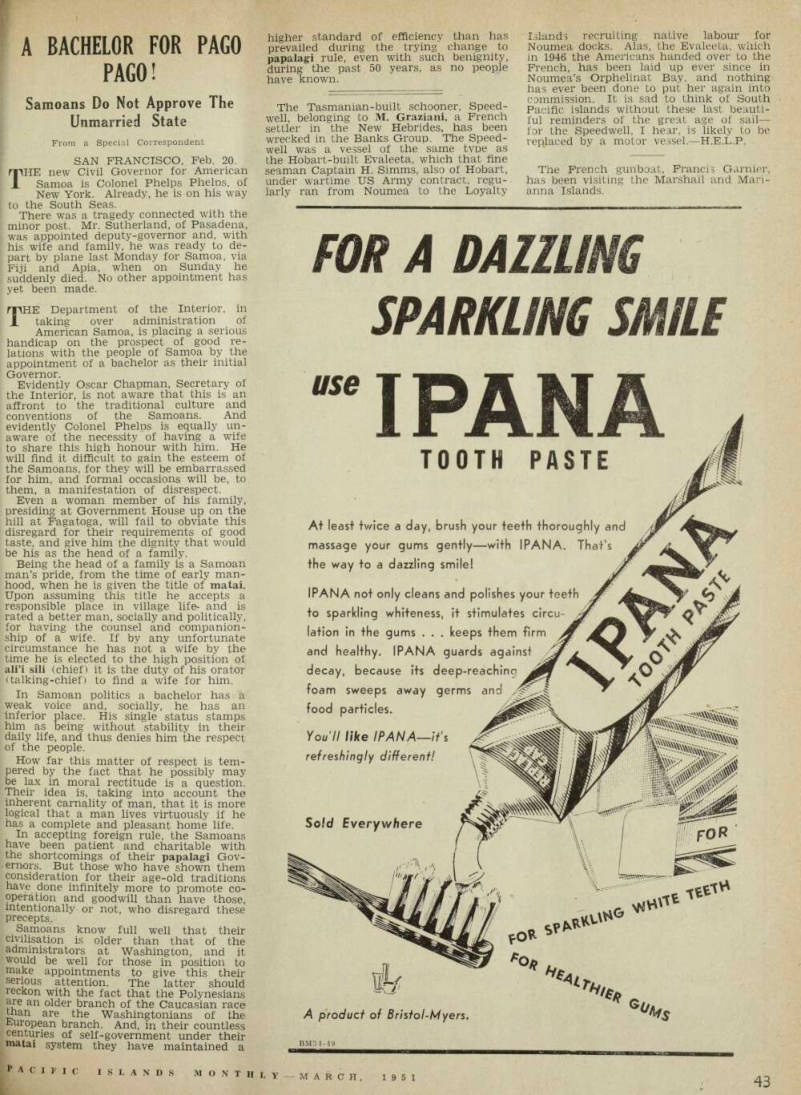
Pago!
Samoans Do Not Approve The Unmarried State
From a Special Correspondent
San Francisco, Feb. 20.
THE new Civil Governor for American Samoa is Colonel Phelps Phelns, of New York. Already, he is on his way to the South Seas.
There was a tragedy connected with the minor nost. Mr. Sutherland, of Pasadena, was appointed deputy-governor and. with his wife and family, he was ready to de part by plane last Monday for Samoa, via Fiji and Apia, when on Sunday he suddenly died. No other appointment has yet been made.
THE Department of the Interior, in taking over administration of American Samoa, is placing a serious handicap on the prospect of good re lations with the people of Samoa by the appointment of a bachelor as their initial Governor.
Evidently Oscar Chapman, Secretary of the Interior, is not aware that this is an affront to the traditional culture and conventions of the Samoans. And evidently Colonel Phelps is equally un aware of the necessity of having a wife to share this high honour with him. He will find it difficult to gain the esteem of the Samoans, for they will be embarrassed for him, and formal occasions will be, to them, a manifestation of disrespect.
Even a woman member of his family, presiding at Government House up on the hill at Fagatoga, will fail to obviate this disregard for their requirements of good taste, and give him the dignity that would be his as the head of a family.
Being the head of a family is a Samoan man’s pride, from the time of early man hood, when he is given the title of matai.
Upon assuming this title he accepts a responsible place in village life- and is rated a better man, socially and politically, for having the counsel and companion ship of a wife. If by any unfortunate circumstance he has not a wife by the time he is elected to the high position of ali’i sili (chief) it is the duty of his orator (talking-chief) to find a wife for him.
In Samoan politics a bachelor has a weak voice and, socially, he has an inferior place. His single status stamps him as being without stability in their daily life, and thus denies him the respect of the people.
How far this matter of respect is tem pered by the fact that he possibly may be lax in moral rectitude is a question.
Their idea is, taking into account the inherent carnality of man, that it is more logical that a man lives virtuously if he has a complete and pleasant home life.
In accepting foreign rule, the Samoans have been patient and charitable with the shortcomings of their papalagi Gov ernors. But those who have shown them consideration for their age-old traditions have done infinitely more to promote co operation and goodwill than have those, intentionally or not, who disregard these precepts.
Samoans know full well that their civilisation is older than that of the administrators at Washington, and it would be well for those in position to make appointments to give this their serious attention. The latter should reckon with the fact that the Polynesians are an older branch of the Caucasian race than are the Washingtonians of the European branch. And, in their countless centuries of self-government under their matai system they have maintained a
higher standard of efficiency than has prevailed during the trying change to papa lag i rule, even with such benignity, during the past 50 years, as no people have known.
The Tasmanian-built schooner, Speed well, belonging to M. Graziani, a French settler in the New Hebrides, has been wrecked in the Banks Group. The Speed well was a vessel of the same tvne as the Hobart-built Evaleeta, which that fine seaman Captain H. Simms, also of Hobart, under wartime US Army contract, regu larly ran from Noumea to the Loyalty
Islands recruiting native labour for Noumea docks. Alas, the Evaleeta, which in 1946 the Americans handed over to the French, has been laid up ever since in Noumea’s Orphelinat Bay, and nothing has ever been done to put her again into commission. It is sad to think of South Pacific islands without these last beauti ful reminders of the great age of sail — for the Speedwell, I hear, is likely to be
replaced by a motor vessel.-
H.E.L.P.
The French gunboat, Francis Gamier, has been visiting the Marshall and Mari anna Islands.
Advertisements & other items, pp. 45-46 (1 item)
I Pan A
FOR A DAZZLIN
SPARKLING SUIII
use
I PAN A
TOOTH PASTE
At least twice a day, brush your teeth thoroughly and massage your gums gently—with IPANA. That's the way to a dazzling smile!
IPANA not only cleans and polishes your teeth to sparkling whiteness, it stimulates circulation in the gums . . . keeps them firm and healthy. IPANA guards against decay, because its deep-reaching foam sweeps away germs and food particles.
You'll like IPANA—it's refreshingly different!
Sold Everywhere ft & <v ft h * * o o
FOR
M<l •••A
SPM 1
A product of Bristol-Myers. 8M34-4
Insist on. . .
“BTtOKTE”
CANNED MEATS, HOTMEALS AND SOUPS
Available in 12 oz. and 1 lb. sealed cans in the following
appetising flavours and combinations:
• Corned Beef Loaf With Cereal • Braised Steak and Onions • Boiled and Roast Beef • Beef Steak Pudding • Mutton and Peas • Steak and Onions • Chili Con Came • Curried Mutton • Curried Beef • Irish Stew • Mulligatawny Soup • Vegetable Soup • Mutton Broth • Tomato Soup • Camp Pie
“BRONTE” Brand high-grade products
are made from the finest fat stock and the richest vegetables in Australia ,
deliciously flavoured .
THE COLONIAL WHOLESALE MEAT CO.
PTY. LTD.
Canning Factory: State Abbatoirs, Homebush, Sydney,
N.S.W.
’PHONE: UM 8436
CABLE ADDRESS: “WOOLMILL,” SYDNEY.
Its Rich Soil Is Nines Shrinking

Wealth
ISOLATED Niue Island, apparently the product of some mighty upheaval of pre-history, situated 300 miles from anywhere in the South Pacific ocean, has recently had a soil survey by the New Zealand Soil Bureau.
Soil is important on Niue —all of its in habitants, most of them directly and some of them indirectly, depend upon what grows there for their sustenance — and there is, in all, mighty little of it.
Most of it is volcanic ash, lying in pockets on the rugged surface of the coral lime stone. It is fertile, but precious.
The formation of Niue speaks mutely of some cataclysm, or cataclysms, that took place there in the dim past. The island is of “makatea” formation —what apparently were once circular, coral reefs have been thrust upwards now to form terraces or plateaus. Niue has two ter races—one about 90 feet above sea level; the other about 220 feet above sea level.
There are 12 villages on the island — seven of them on the lower terrace, which is a natural coconut plantation, five on the upper plateau. The upheavals that lifted this two-tiered, 100-square-miles
island out of the ocean also, presumably, provided the vol canic ash which makes the extremely fertile soil in which Niue grows its crops of taro, bananas, yams, tapioca maize and other vegetables.
ABOUT half of the island’s 65,000 acres are suitable for agriculture; the rest grows scrub and some forest.
The Niueans work their land on the well-known system of shifting cultivation—a five to nine year rotation of crops with a spell of three to five years when the land is allowed to revert to native cover.
Without artificial aids the soil, in this way has main tained its fertility in all but about 8,000 acres which are no longer capable of grow ing crops and have re
verted to permanent scrub land.
This, then, seems a good time for a soil survey and for the practical measures advocated as a result of that survey.
Niue population is growing slowly but very definitely—a wise agricultural policy now will prevent any land poverty in the future, as well as giving these Polynesians a better life now.
The NZ official who undertook the sur vey recommended that an agricultural officer be appointed to the island imme
Alofl, Niue’s port of entry and seat of government.
diately: that instruction in good soil management be instituted in Niue schools; 1 that experiments be made m grassland establishment for the possible introduction of dairy and beef cattle (only poultry and pigs are raised at present), and that nitrogen, phosphorus and potash manures be tried with a view to shorten ing the interval between planting staple food crops without impoverishing the soil.
At present the economic life of the island depends on the export of copia, plaited ware (hats, baskets, etc., from coconut and pandanus leaves) and bananas. There seems, however, no reason
why citrus fruit for the New Zealand market could not be grown as well as some other cash crops. Much depends on sea transport, of course, although in recent years Niue has averaged about one New Zealand ship per month.
THERE are no streams on the island taut rainfall is fairly adequate (average 79 inches) and distributed throughout the year. Rain is stored in concrete tanks and reservoirs. Droughts do sometimes occur and apparently, be fore the days of tanks, the natives got supplies from deep caverns. The Govern
ment was recently investigating the feasi bility of deep wells. Water has. been reached at 175 feet —if it proves suitable for drinking purposes deep wells may be sunk in the vicinity of all villages.
Advertisements & other items, pp. 47-48 (1 item)
Insurance
THE
YORKSHIRE
CO. LTD.
(Incorporated in England)
ALL CLASSES OF
INSURANCE
Including Fire Accident Guarantee Motor Workers Marine Island Representatives:
PORT MORESBY E. A. James
RABAUL G. B. Black LAE .. . . New Guinea Industries Ltd.
MADANG R. Macgregor MANUS Edgell & Whiteley Ltd.
SUVA . . . . Williams & Gosling Ltd.
NOUMEA Y. Mortensen NORFOLK ISLAND . . . A. E. Martin
The New COMMER 8 CWt
Light Delivery Van
■ Vr aiiiiilli ■ ; with independent front suspension and finger-tip gear control Full particulars available from the distributors for Papua/Netv Guinea
GOLYER WATSON |aZ.| LTD. S
BURNS PHILP (New Hebrides) LTD.
Registered Office: VILA, NEW HEBRIDES
Branch Office at SANTO
Exporters, Importers and General Merchants
(Retail and Wholesale) Commission, Shipping
and Customs Agents
PACIFIQUE and numerous overseas manufacturers or an classes oi merchandise.
San Francisco Agents: Representatives for BURNS PHILP TRUST COMPANY LIMITED, QUEENS- LAND INSURANCE CO., LTD., andLLOYD’S OF LONDON. Agents for tvcpc? TDXP r rT3 0T TTQ STTTTT.T. HFS TT/RPI PRANCAISES DU Sydney Agents: Burns, Philp A Co., Ltd., 7 Bridge Street.
Burns, Philp Co. of San Francisco, Matson Building, 215 Market Street.
London Agents; Borns, Philp A Co., Ltd., 35 Crutched Friars, E.C.3
Naturalisation Rush In New
Guinea
IN the Papua-New Guinea Gazette of January 8, 20 aliens gave notice of intention to apply for Australian citizenship. These are all missionaries— Dutch, German and French born—but just a sample of those non-British resi dents of the New Guinea territory whoi have sought citizen rights in the last few years.
Many of these folk have resided be tween 20 and 40 years in the Territory..
While New Guinea was a Mandate, they were unable to qualify for naturalisation..
This prohibition was removed in recent: years.
Most of the missionaries, however, who; left their Continental homelands, for life to work in the mission fields of the Pacific, probably felt they were above nationality. It might be wondered why, after having served say 46 years in New, Guinea without benefit of Australian citizenship, it might be regarded as im portant to acquire it now.
The layman’s case was somewhat different. A number of German residents of New Guinea, either because they did not want to, or could not, become naturalised Britishers, spent not one but two periods of internment in Australia— during both World Wars.
Mrs. E. O. Newton Daly, of Ba, Fiji with her daughter, Angela, was visiting her parents in Sydney in February.
Advertisements & other items, p. 48 (2 items)
46
MARCH, 1951 PACIFIC ISLANDS MONTHL
Idavco
i 0 * A i 0 0 0 0
\ ONE COAt
METAL PAI* I
m
DAVISON
jpa
VEIUSTRt
HItHfSI GRADE WRt
PAINT
VELVENE
VEITONE
EIHISH
Fin oil
-VIKYUTt
\ SUPER FINISH
wsteVaterPaint
VIKYLITE
Super gloss porcelain hard Enamel.
VELVENE
Velvet Finish Water Paint for inside and outside use.
DAVCO
One Coat Metal Paint protects all exposed metal-work.
VELTONE
Flat Oil Washable Wall Paint: interior use.
VELUSTRE
Highest grade Tit. Zinc based House Paint.
Davison Paints have for many
years proved
their resistance to severe ropi c a I conditions. The Davison range
of products
includes high
quality finishes
or a I purposes. You can be sure of Davison.
ALL DAVISON FINISHES AVAILABLE FROM
A H BUNTING LIMITED AUSTRALIAN FIBRES LIMITED G. G. SMITH £r CO. LIMITED!
Samarai, Papua Kakopo Port Moresby and Lae, New Guinea New Britain apua
Memories Of The Former Kaiser
(Until 1914, the Emperor of Germany, Kaiser Wilhelm 11, head of the Hohen zollerns, was one of the three most powerful men in the world. Now, 30 years after his downfall, he is little more than a memory.
But there is, in Tonga, in the South Pacific, one man to whom the late Wil helm II is still the Kaiser, and who still reveres his memory. He is 90-years-old F. J. Goedicke, of Haapai, Tonga. A few years ago, Mr. Goedicke succeeded to an old Dutch title, that of Count van Asten.
He was reared in aristocratic circles in Germany and is believed to be of royal blood. He was in New Britain before 1880; and, after roving the world, he settled down in Tonga over 40 years ago, and married a relation of the Queen of Tonga. He was born on August 15, 1861.)
By F. J. Van Asten-Goedicke
IN October, 1949, I received a very in teresting letter. The postmark is Sigmaringen, and the writer is the former Crown Prince Friederick Wilhelm, of Germany.
The Crown Prince writes that, some time ago, he approached the Dutch G9V ernment to allow him to take possession of the estate of his late father (the former Kaiser) at Doom, Holland. This the Dutch Government refused.
Through the influence of Prince Bern hard (Consort of Queen Juliana), who is related to Crown Princess Cecilie, he re ceived many private articles, and the whole of the Kaisers correspondence, which the Kaiser had kept during his stay in Doom.
This correspondence the Crown Prince had read from A to Z; and, while going through it, he came across some of my letters and he now osked me to let him know how and where I met Mr. Poulteney Bigelow. (Bigelow, Poulteney, born 1855; American journalist and author; edu cated in Germany; a friend of Crown Prince, afterwards Emperor Wilhelm II; has written books on Germany; a cele brated canoe-traveller; has written travel books).
I have informed the Crown Prince that, while living in San Francisco in 1889, I took my meals at a restaurant and, at the same table, there sat a Mr.
P. Bigelow, with whom I became very friendly. One day Bigelow told me that while his father was USA Ambassador to Berlin, he (Poulteney Bigelow) studied at the University at Bonn, where Prince Wilhelm of Germany also studied. These two young men became close friends.
When father and son returned to America, Wilhelm and Bigelow kept up a friendly correspondence. Later, when Wilhelm became Kaiser, Bigelow was al ways invited to join him on his Nordland yachting trips.
In 1930, I received from Germany an illustrated paper, showing the Kaiser and Bigelow, arm in arm, at Doom. Another picture showed them with other Princes, playing cards; and another, where they were all chopping wood. The letterpress said that the Kaiser and Bigelow had been great friends, until America entered in World War I. Then Bigelow wrote against the Kaiser, and it hurt the Kaiser very much that an old friend should turn against him when he needed sympathy.
WHEN the war was over and Bigelow found that on some matters affect ing the Kaiser he had been mis informed, he was man enough to say so.
He went to Doom and apologised to the ex-Kaiser, and they became friends again.
Believing Bigelow to be still at Doom, I wrote to him in 1930, expressing appre
ciation of what he had done. This letter he showed to the ex-Kaiser and I re ceived the following letter. The transla tion does not bring out the really kind expressions.
“Your letter, addressed to Mr. P. Bige low, was laid before His Majesty the Kaiser. His Majesty has, with great pleasure, taken notice of the so-kindly used expressions, and was deeply touched.
His Majesty was more delighted when he was told that the writer was his boy hood friend Fritz Goedicke, with whom he had spent six happy weeks, in 1870, in Ludwigslust. I am commanded by His Majesty to send you his love and good wishes for the future. The picture, under separate cover, has been by His Majesty with pleasure autographed. By Command (signed) Count Conrad van Finkelstein, Hofenasschall.”
The following month I received a letter
from Bigelow acknowledging my letter, and in which he wrote warmly of the Kaiser and praised the Kaiser’s good in tentions for peace. This letter I sent to
(Continued on Page 65-)
Advertisements & other items, pp. 49-50 (1 item)
Kaven Kerosene Lanes
BUSINESS EXECUTIVES !
Increase your business between Australia, fiance and French Overseas Territories.
Join the French Chamber of Commerce in Australia now.
AsK for a free copy of our BULLETIN.
HOMMES D'AFFAIRES !
Augmentez votre chiffre d’affaires entre I’Australie, la Prance et les Territoires Francais d’Outre-Mer. Devenez Membre de la Chambre de Commerce Francaise en Australie.
Demandez un exemplaire gratuit de notre
BULLETIN.
FRENCH CHAMBER OF
COMMERCE IN AUSTRALIA
72 Pitt Street, Sydney. Tel. BL 1936.
KAVEN KEROSENE LANES
The most suitable lamps for the South Pacific Kayen • Lamps are designed for good hard use in all climatic conditions.
They provide a full 300 candlepower of unflickering steady light, even in severe draughts. The mantle is a simple double-tie type which provides a long life. All vibration is taken away from the mantle and burner top and nothing is held rigid which might tend to break the mantle. All Kayen lamps are fully insect proof. Glassware is strong Pyrex glass and the oil container, pump and burner body are made of solid brass and will not corrode. The vaporiser is fitted with an internal automatic cleaning needle with a stainless steel jet. The brass pump is selfcontained and may be completely removed with the fingers only. Kayen Lamps run efficiently, light easily and are easy to manage and adjust.
Kayen Model AP2 All Purpose Lamp is the most useful lamp ever produced. With reflector as illustrated, it is a shadowless hanging lamp suitable for use inside or out. Without reflector, which slips off, it is an efficient storm lantern not affected by wind or rain.
With an extra parchment shade, not illustrated, it is a bright, attractive lamp for the home and may be placed on a table or shelf anywhere. Fitted with 12 in. reflector overall height 19 in.
Kayen Tall Table Lamp, standing 24 in. high, it throws a full 300 candlepower, steady light over the largest room. It is a firstclass lighting unit and a beautiful ornament. For reading, studying or fine work this lamp is indispensable and, although more brilliant than any other class of kerosene lamp, the light is soft and does not offend the eyes. Can be supplied with Pyrex opal anti-glare shade as illustrated, or with a handsome 16 in. parchment shade. May be carried from room to room wherever required.
Kayen All-Purpose Lamp. n Kayen Table Lamp.
We have large stocks of other types of kerosene lamps, including the Famos Wick and Mantle Table Lamp, Veritas Kerosene Pressure Lantern. Blue Boy and Blue Ace Kerosene Stoves, Companion Primus Stoves, Thermil Wick Stoves, etc. Write for catalogue.
Available from stores in all centres or from
W. KOPSEN & CO. KEY. LID.
376/382 Kent St., Sydney. Cables: "Kopsen," Sydney.
GREAT NEWS FOR MOTORISTS
i a *
Mob o
3 IN
QUALITIES
ONE
MODERN
OIL
CifMf*
OXWAT/O*
MS#”
cffsetiATes
M' '■>. fh* m 7>
VACUUM
QUAUTT
PRODUCT
For better all-round protection against engine wear . . always insist on, and see you get-Triple Action Mobiloil-it Cleans as it Protects and Lubricates.
It Cleans because of its high detergent characteristics preventing formation of deposits.
It Protects because it resists oxidation and foaming.
It Lubricates better because it maintains correct body despite temperature changes.
Western Samoa Wedding
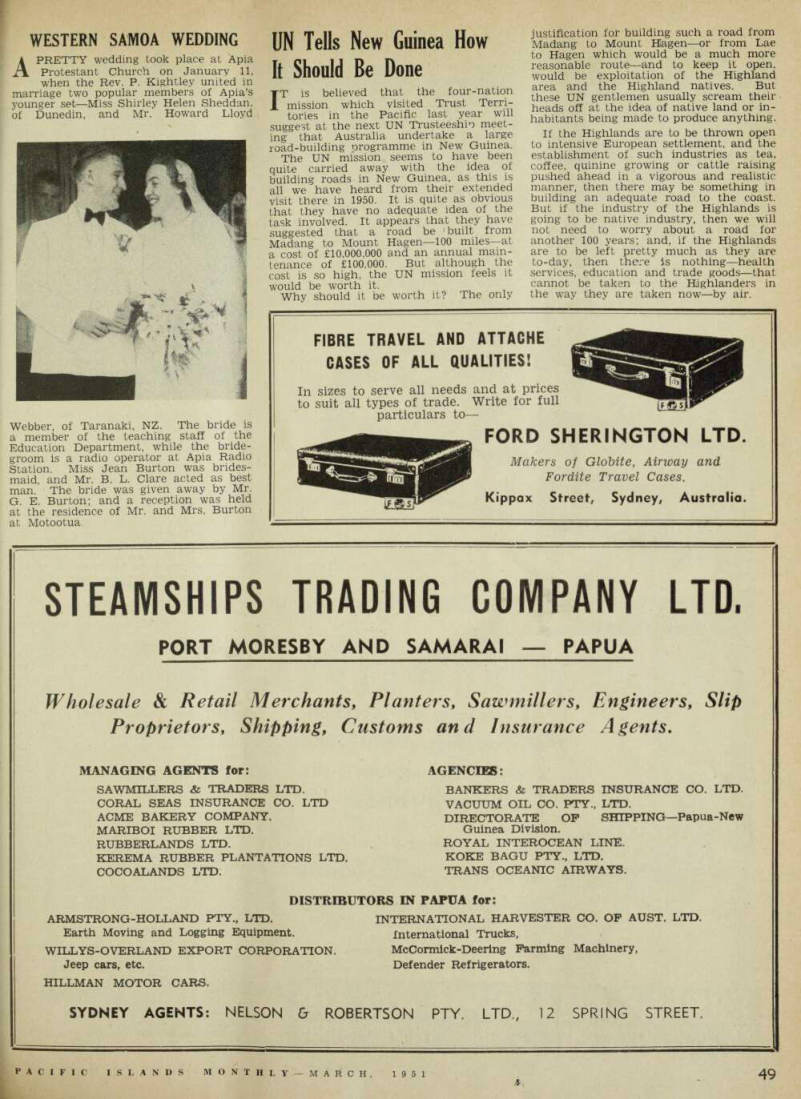
A PRETTY wedding took place at Apia Protestant Church on January 11, when the Rev. P. Kightley united in marriage two popular members of Apia’s younger set—Miss Shirley Helen Sheddan, of Dunedin, and Mr. Howard Lloyd
Webber, of Taranaki, NZ. The bride is a member of the teaching staff of the Education Department, while the bride groom is a radio operator at Apia Radio Station. Miss Jean Burton was brides maid, and Mr. B. L. Clare acted as best man. The bride was given away by Mr.
G. E. Burton; and a reception was held at the residence of Mr. and Mrs. Burton at Motootua.
UN Tells New Guinea How
It Should Be Done
IT is believed that the four-nation mission which visited Trust Terri tories in the Pacific last year will suggest at the next UN Trusteeshm meet ing that Australia undertake a large road-building nrogramme in New Guinea.
The UN mission seems to have been quite carried away with the idea of building roads in New Guinea, as this is all we have heard from their extended visit there in 1950. It is quite as obvious that they have no adequate idea of the task involved. It appears that they have suggested that a road be ■ built from Madang to Mount Hagen—loo miles—at a cost of £10,000,000 and an annual main tenance of £lOO,OOO. But although the cost is so high, the UN mission feels it would be worth it.
Why should it be worth it? The only
justification for building such a road from Madang to Mount Hagen—or from Lae to Hagen which would be a much more reasonable route—and to keep it open, would be exploitation of the Highland area and the Highland natives. But these UN gentlemen usually scream their heads off at the idea of native land or in habitants being made to produce anything.
If the Highlands are to be thrown open to intensive European settlement, and the establishment of such industries as tea, coffee, quinine growing or cattle raising pushed ahead in a vigorous and realistic manner, then there may be something in building an adequate road to the coast.
But if the industry of the Highlands is going to be native industry, then we will not need to worry about a road for another 100 years; and, if the Highlands are to be left pretty much as they are to-day, then there is nothing—health services, education and trade goods—that cannot be taken to the Highlanders in the way they are taken now —by air.
Advertisements & other items, p. 51 (2 items)
49
PACIFIC ISLANDS MONTH I. Y MARCH. 1951
Steamships Trading Company Ltd.
FIBRE TRAVEL AND ATTACHE
GASES OF ALL QUALITIES!
In sizes to serve all needs and at prices to suit all types of trade. Write for full particulars to —
FORD SHERINGTON LTD.
Makers of Globite, Airway and Fordite Travel Cases.
Kippax Street, Sydney, Australia.
STEAMSHIPS TRADING COMPANY LTD.
PORT MORESBY AND SAMARA! PAPUA
Wholesale & Retail Merchants, Planters, Engineers, Slip
Proprietors, Shipping, Customs and Insurance Agents.
MANAGING AGENTS for:
SAWMILLERS & TRADERS LTD.
CORAL SEAS INSURANCE CO. LTD
ACME BAKERY COMPANY.
MARIBOI RUBBER LTD.
RUBBERLANDS LTD.
KEREMA RUBBER PLANTATIONS LTD.
COCOALANDS LTD.
AGENCIES:
BANKERS & TRADERS INSURANCE CO. LTD.
VACUUM OIL CO. PTY., LTD.
DIRECTORATE OP SHIPPING—Papua-New
Guinea Division,
ROYAL INTEROCEAN LINE.
KOKE BAGU PTY., LTD.
TRANS OCEANIC AIRWAYS.
DISTRIBUTORS IN PAPUA for:
ARMSTRONG-HOLLAND PTY., LTD.
Earth Moving and Logging Equipment.
WILLYS-OVERLAND EXPORT CORPORATION.
Jeep cars, etc.
HILLMAN MOTOR CARS.
INTERNATIONAL HARVESTER CO. OP AUST. LTD.
International Trucks, McCormlck-Deerlng Farming Machinery, Defender Refrigerators.
SYDNEY AGENTS: NELSON & ROBERTSON PTY. LTD,, 12 SPRING STREET.
RSL Support for NG Missions
ALL Australian ex-servicemen who served in New Guinea will be asked by the RSSAILA to support an appeal to assist the Anglican Mission whose buildings at Sangara and Isavita were destroyed in the Mt. Lamington eruption in January.
About Volcanoes
LOOKING back on the Mt. Lamington disaster and to other great volcanic upheavals of history, it seems we can almost make this rule: When a known volcano periodically lets off steam you can assume that it is reasonably “safe.” But when an area that has been inactive for centuries, or always, so far as modern man knows, starts growling and rumbling, just go for your life.
Almost invariably where a volcano has caused great loss of life, it has (a) been domant for centuries; and (b) given some warning of the impending eruption.
Mt. Lamington took at least 4,000 lives.
Other volcanoes have killed even more people. A few of the more famous volcanic eruptions are listed hereunder: — VESUVIUS: Before the Christian era it had lain dormant for centuries. It began its rumbling several years before it finally blew its top in 79 AD, burying the
towns of Pompeii and Herculaneum. It became quiet again after that effort, but again erupted in 1631, and killed 18.000 people. Since then it has been almost continually active, in a small way, and has thereby let off some of its energy.
KRAKATOA: A volcanic island be tween Java and Sumatra literally blew up with four terrific explosions in 1883. The noise is said to be the loudest ever heard on earth—it was heard as far away as Central Australia. Krakatoa was an old volcano, and it was uninhabited, but there were 36,000 casualties in Java and Sumatra from the tidal waves which it caused. Krakatoa had started to rumble in May, 1883. On August 27 it blew up.
TARAWERA, in New Zealand’s thermal region erupted in 1886 and destroyed the until then famous Pink and White Terraces. One hundred people were killed.
BANDAI SAN, about 180 miles from Japan, exploded in 1888, after 1,000 years of inaction. It. too, began with pre liminary rumblings and earthquakes—but gave only a day’s warning.
MT. PELEE, in Martinique blew up in 1902, after only 90 years of inaction. It gave warning by rumblings about two days before then a heavy cloud of Incandescent dust rolled down the moun tain side and killed the whole of the 40,000 inhabitants of the town of St. Pierre.
MORE recently, there has been (about 1944) the appearance, in a ploughed field in Mexico, of a 2,000 feet-high volcano—Paracutin —which, because it was more or less American, got more publicity that the 1937 effort of Rabaul’s Vulcan, which previously had been an apparently inoffensive little island (although it, too. had bobbed up out of the harbour about 1888). We are reminded now that when Vulcan started to rumble, etc., in 1937, a number of the leading citizens of Rabaul took row-boats and went out to have a look-see. Only when hot rocks and other odd things began to be flung out of the sea did they row for the shore. Shortly afterwards Vulcan erupted.
There seems no telling when or where the next Papuan-New Guinea eruptions will occur —but scientists are agreed that occur they will. The moral seems to be: when a mountain unexpectedly starts to rumble, or some other part of the scenery be haves oddly, take care! Send for the vulcanologist, and you go away somewhere to a safe area until he tells you to return.
MANY people are intrigued as to how one becomes a vulcanologist. A vulcanologist primarily is a geologist and, to a lesser degree, a physicist and chemist. Geologists have always been interested in volcanoes and the effect they have on the earth’s strata. A vul canologist differs from a geologist in that he gets there before it happens, usually.
A vulcanologist was appointed to Rabaul after the 1937 eruption to keep local volcanoes under constant observation.
The present P-NG vulcanologist, Mr. G.
A. Taylor, is stationed there, but has been at Popendetta since the eruption of Mt.
Lamington. He has flown over the area daily and, when activity has died down, will lead an expedition into the area to examine the results of the explosion at first hand. A troupe of Australian professional vaudeville artists, headed by comedian T. (“Tubby”) McDonald, is planning to make a Pacific tour shortly in a Pairmile launch. “Lester II.” They propose to visit Norfolk Island, New Caledonia, New Hebrides, Fiji, and Papua-New Guinea, putting on complete live artist shows at the various Islands centres and outport settlements.
Advertisements & other items, p. 52 (1 item)
Robert Gillespie Pit It?
THE PACIFIC ISLANDS SOCIETY
(Founded 1937) Visitors from the Pacific Islands to Sydney, or persons interested in Islands affairs, are invited to communicate with the Honorary Secretary of the above Society which was formed to constitute a social centre for those interested in the Pacific Islands.
Regular meetings and social gatherings, with lectures, are held at History House. 8 Young Street. Sydney, on the fourth Wednesday of each month, at 8 p.m.
Address for correspondence:—
THE PACIFIC ISLANDS SOCIETY,
Box 2434, G.P.O., Sydney.
5k /y i * \ x —% u
OOD
tvv N c> o*> All classes of merchandise purchased for Island clients throughout the South-west Pacific.
Island produce sold on Australian and overseas markets on a commission basis.
ROBERT GILLESPIE PIT IT?
54* PITT ST..SYDNEY PHONES 8VM782- BIBOS
Work?

Can A Native Refuse To
Letter to the Editor I BELIEVE the new Papua-New Guinea Native Labour Ordinance is out. I would like to know if, in the main Ordinance or the regulations, a native can be charged with “Refusal to perform work allotted to him.”
When I first went to Papua a regulation existed under which a native could be charged with either Neglect or Refusal to Perform Work. Quite sensible, as there is a difference. Many a sulky Gulf native I have known to flatly refuse to perform his work. However, a later Ordinance omitted the words “or refuses.” Not so sensible. When I pointed this out to the Commissioner for Native Affairs, instead of remedying the omission, he did nothing.
Instead he seemed (to me) to eloat over the fact that a native could not be charged with refusal! Dealing with and disciplin ing the Gulfltes (the type who killed poor old Tom Bowers) an Ordinance needs to be pretty water-tight and should cover everything.
I am, etc.,
Sydney H. Chance,
Brisbane, Ex-R.M. (Papua). 2/2/51.
EDITORIAL NOTE—The Ward-Murray plan of controlling native labour makes no provision for anything like that. Under the new regime, the native is treated like a European. If he enters into an engage ment to work, and then refuses orders, the employer’s only remedy is to take him to a civil court, and the court may tell him that he is a naughty, naughty native, and fine him five shillings, or thereabouts.
The old-timer’s effective measures against a recalcitrant servant —a short spell in calaboose, or a heavy smack across that part of his anatomy provided by nature for the purpose—are frowned upon by the
gangs of Bloomsbury Planners now in charge of the Empire. They say that these things are part of the system they call “Colonialism;” and, even although “Colonialism” produced the United States, Canada, Australia, New Zealand, South Africa and a score of nations in South America, it is condemned by the Planners as very wicked indeed . . . Wake up, Mr.
Chance! This is 1951, and the great era of racial brotherhood, peace on earth and goodwill towards all men! , Fiji Customs revenue for January broke all previous records. Duty collected was over £200,000. With large quantities oi cargo arriving on every overseas vessel, the Customs sheds are proving inadequate.
Advertisements & other items, pp. 53-54 (1 item)
Heinz Green Peas
Pimples and Bad Skin Attacked In 24 Hours
Since the discovery of Nixoderm, the scientific medicine, it is no longer necessary for anyone to suffer from ugly, disgusting and disfiguring skin blemishes such as Pimples, Rash, Ringworm, Psoriasis, Acne, Blackheads, Scabies and Red Blotches. Don't let a bad skin make you feel inferior and cause you to lose your friends. Clear your skin this new scientific way.
A New Discovery
Nixoderm is an ointment, but different from any ointment you have ever seen or felt. It is a new discovery, and is not greasy but feels almost like a powder when you apply it. It penetrates rapidly into the pores and fights the cause of surface skin blemishes.
Nixoderm contains 9 ingredients which fight skin troubles in these 3 ways: 1, It fights and V 11s the microbes or parasites often tjsponsible for skin disorders. 2. It stops itching, burning and smarting in 7 to 10 minutes, and cools and soothes the skin. 3. It helps nature heal the skin clear, soft and velvety smooth.
Works Fast
Because Nixoderm is scientifically compounded to fight skin troubles, it works fast. It stops the itching, burning and smarting in a few minutes, then starts to work immediately, clearing and healing your skin, making it softer, whiter and velvety smooth. In
just a day or two your mirror will tell you that here at last Is the scientific treatment you have been needing to clear your skin—the treatment to make you look more attractive, to help you win friends. Nixoderm has brought clearer, healthier skins to thousands such as Mr. Bob Weedon, Edmund Street, Fremantle, who writes: “I was troubled with pimples ever since I was 13, and have spent pounds and pounds on so-called cures without results. I then tried Nixoderm with astounding effect. The pimples seemed to fade away, and after a week there was not the slightest trace of them.”
Satisfaction Guaranteed
Get Nixoderm from your chemist or store to-day. Look in the mirror In the morning and you will be amazed at the improvement. Then just keep on using Nixoderm for one week and at the end of that time it must have made your skin soft, clear, smooth and magnetically attractive—must give you the kind of skin that will make you admired wherever you go, or you simply return the empty package and your money will be refunded In full. Get Nixoderm from your chemist or store to-day. Tim guarantee protects you.
Nixoderm
For Skin Sores, Pimples and Itch.
2/
HEINZ GREEN PEAS
picked wken perfect
to give you that
just-£icked flavour
.. always
H. J. HEINZ CO. PTY. LTD
479 Bourke Street, Sydney. * f^ fr. 3^ ' f '♦ . c °Prr.i m aSte & 45 57 c °' D nr
3 MACHINES IN ONE
% The Shaft driven Mobilco Circular Saw can be easily moved up to any tree of up to 3 feet in diameter and will quickly fell and cross-cut it into required lengths. This is just one version of the Mobilco 3 in 1 Method. . . . And each Machine a rugged lightweight which can be easily and efficiently handled by one man.
The Mobilco Drag Saw will fell and cross-cut your big timber (up to 8 feet in diameter) and by replacing the Drag Saw attachment with the Circular Saw attachment you have a machine ready to quickly fell and cross-cut timber up to 3 feet in diameter.
The Mobilco Saw Bench attachment allows you to quickly mill the small timber, branches, etc., into
payable firewood.
w J m a J*'!-'' The Mobilco Circular Saw is easily handled by one man even in rough country. It handles so well that it makes quick and easy work of felling and cross-cutting even the toughest Australian hardwood.
For timber of up to 8 feet in diameter the Mobilco Drag Saw stands alone.
Due to its perfect balance and ease of handling it is a proven timesaver in setting up. The ample power reserve of the Mobilco Drag Saw makes quick work of felling and cross-cutting.
I V A.
The above diagram illustrates the Mobilco Method.
You can remove the Drag Saw attachment and replace it with the Circular Saw attachment in twenty minutes. The Saw Bench takes only five minutes to attach.
Fig. 1 illustrates the patented Mobilco pressure arm which constantly bears on the blade during cutting. It is spring activated and controlled by a lever and ratchet. Fig. 2 illustrates the pivoted main arm which can be positioned to cross-cut big logs, at the same time retaining the engine in a horizontal position.
MOBILE INDUSTRIAL
PHONE: CENT. 4799 - AFTER HOURS: WF3IIB
EQUIPMENT PTY. LTD.
252 SWANSTON STREET, MELBOURNE
Magazine Section
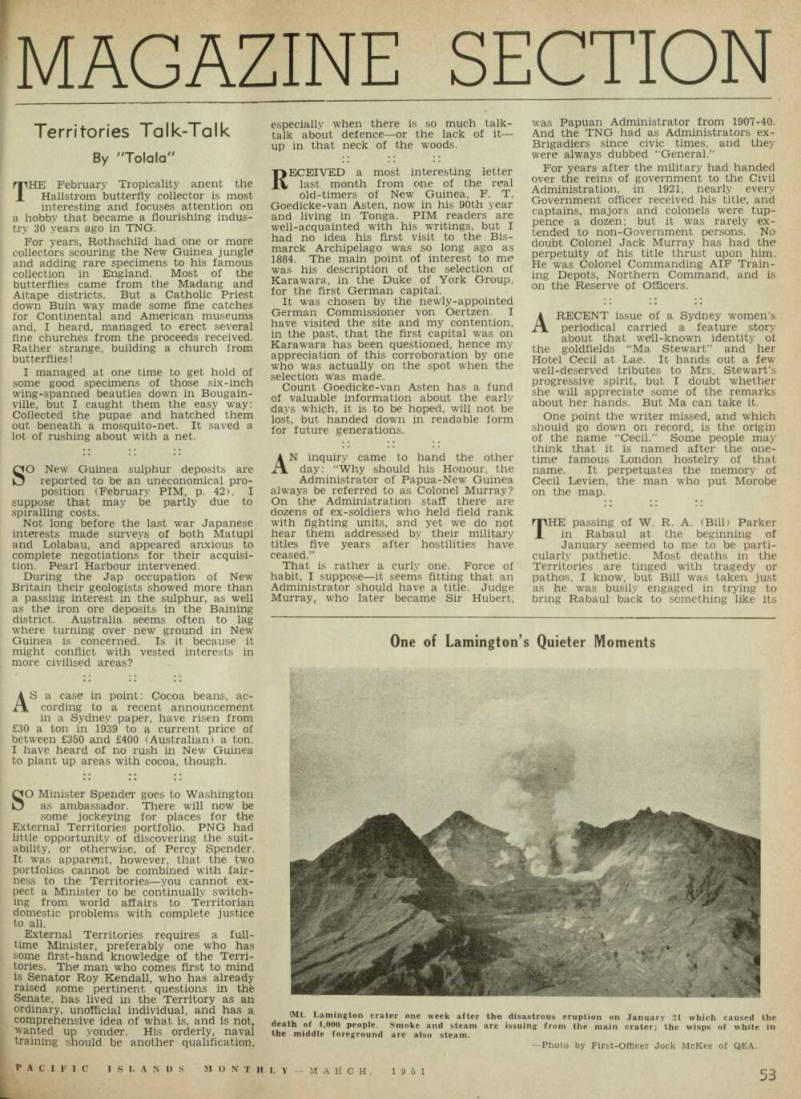
Territories Talk-Talk
By "Tolala"
THE February Tropicality anent the Hallstrom butterfly collector is most interesting and focuses attention on a hobby that became a flourishing indus try 30 years ago in TNG.
For years, Rothschild had one or more collectors scouring the New Guinea jungle and adding rare specimens to his famous collection in England. Most of the butterflies came from the Madang and Aitape districts. But a Catholic Priest down Buin way made some fine catches for Continental and American museums and, I heard, managed to erect several fine churches from the proceeds received.
Rather strange, building a church from butterflies!
I managed at one time to get hold of some good specimens of those six-inch wing-spanned beauties down in Bougain ville, but I caught them the easy way: Collected the pupae and hatched them out beneath a mosquito-net. It saved a lot of rushing about with a net.
SO New Guinea sulphur deposits are reported to be an uneconomical pro position (February PIM, p. 42). I suppose that may be partly due to spiralling costs.
Not long before the last war Japanese interests made surveys of both Matupi and Lolabau, and appeared anxious to complete negotiations for their acquisi tion. Pearl Harbour intervened.
During the Jap occupation of New Britain their geologists showed more than a passing interest in the sulphur, as well as the iron ore deposits in the Baining district. Australia seems often to lag where turning over new ground in New Guinea is concerned. Is it because it might conflict with vested interests in more civilised areas?
AS a case in point: Cocoa beans, ac cording to a recent announcement in a Sydney paper, have risen from £3O a ton in 1939 to a current price of between £350 and £4OO (Australian) a ton.
I have heard of no rush in New Guinea to plant up areas with cocoa, though.
SO Minister Spender goes to Washington as ambassador. There will now be some jockeying for places for the External Territories portfolio. PNG had little opportunity of discovering the suit ability, or otherwise, of Percy Spender.
It was apparent, however, that the two portfolios cannot be combined with fair ness to the Territories —you cannot ex pect a Minister to be continually switch ing from world affairs to Territorian domestic problems with complete justice to all.
External Territories requires a full time Minister, preferably one who has some first-hand knowledge of the Terri tories. The man who comes first to mind is Senator Roy Kendall, who has already raised some pertinent questions in the Senate, has lived in the Territory as an ordinary, unofficial individual, and has a comprehensive idea of what is, and is not, wanted up yonder. His orderly, naval training should be another qualification,
especially when there is so much talk talk about defence —or the lack of it — up in that neck of the woods.
RECEIVED a most interesting letter last month from one of the real old-timers of New Guinea, F, T.
Goedicke-van Asten, now in his 90th year and living in Tonga. PIM readers are well-acquainted with his writings, but I had no idea his first visit to the Bis marck Archipelago was so long ago as 1884. The main point of interest to me was his description of the selection of Karawara, in the Duke of York Group, for the first German capital.
It was chosen by the newly-appointed German Commissioner von Oertzen. I have visited the site and my contention, in the past, that the first capital was on Karawara has been questioned, hence my appreciation of this corroboration by one who was actually on the spot when the selection was made.
Count Goedicke-van Asten has a fund of valuable information about the early days which, it is to be hoped, will not be lost, but handed down in readable form for future generations.
AN inquiry came to hand the other day: “Why should his Honour, the Administrator of Papua-New Guinea always be referred to as Colonel Murray?
On the Administration staff there are dozens of ex-soldiers who held field rank with fighting units, and yet we do not hear them addressed by their military titles five years after hostilities have ceased.”
That is rather a curly one. Force of habit, I suppose—it seems fitting that an Administrator should have a title. Judge Murray, who later became Sir Hubert,
was Papuan Administrator from 1907-40.
And the TNG had as Administrators ex- Brigadiers since civic times, and they were always dubbed “General.”
For years after the military had handed over the reins of government to the Civil Administration, in 1921, nearly every Government officer received his title, and captains, majors and colonels were tup pence a dozen; but it was rarely ex tended to non-Government persons. No doubt Colonel Jack Murray has had the perpetuity of his title thrust upon him.
He was Colonel Commanding AIF Train ing Depots, Northern Command, and is on the Reserve of Officers.
A RECENT issue of a Sydney women’s periodical carried a feature story about that well-known identity of the goldfields “Ma Stewart” and her Hotel Cecil at Lae. It hands out a few well-deserved tributes to Mrs. Stewart’s progressive spirit, but I doubt whether she will appreciate some of the remarks about her hands. But Ma can take it.
One point the writer missed, and which should go down on record, is the origin of the name “Cecil.” Some people may think that it is named after the one time famous London hostelry of that name. It perpetuates the memory of Cecil Levien, the man who put Morobe on the map.
THE passing of W. R. A. (Bill) Parker in Rabaul at the beginning of January seemed to me to be parti cularly pathetic. Most deaths in the Territories are tinged with tragedy or pathos, I know, but Bill was taken just as he was busily engaged in trying to bring Rabaul back to something like its
One of Lamington’s Quieter Moments
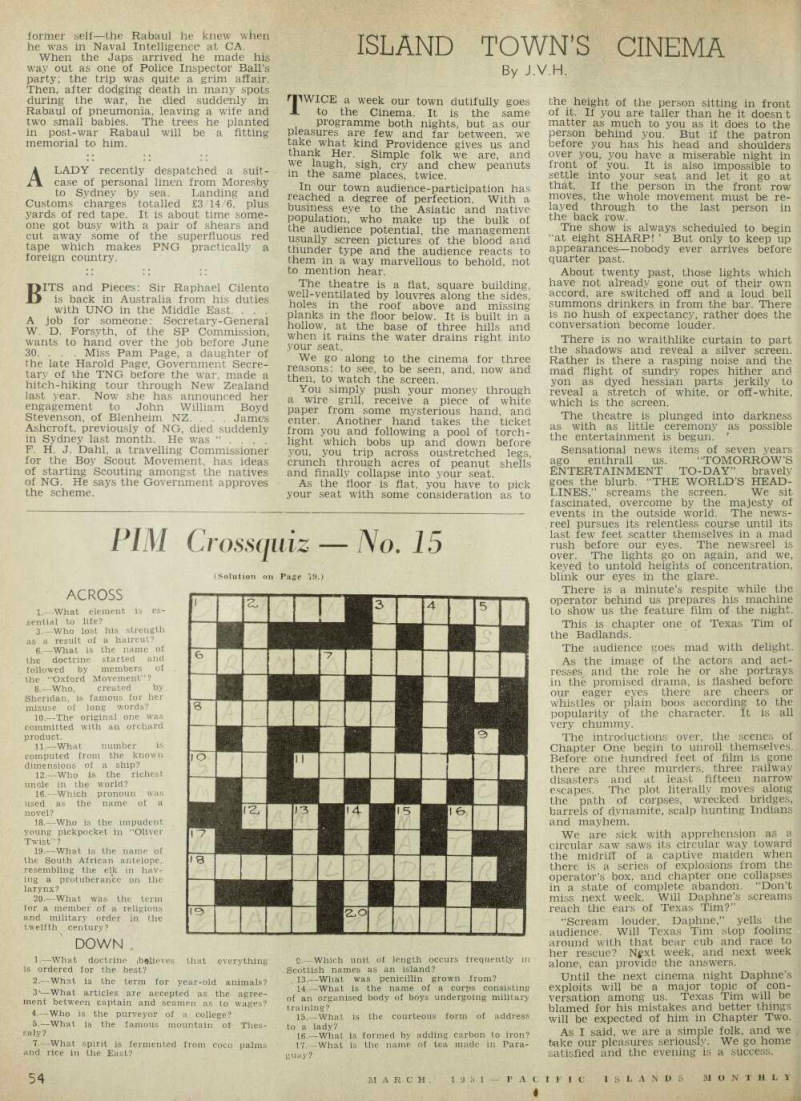
(Mt. Lamington crater one week after the disastrous eruption on January 21 which caused the death of 4,000 people. Smoke and steam are issuing from the main crater; the wisps of white in the middle foreground are also steam.
Photo by First-Officer Jock McKee of QEA.
former self—the Rabaul he knew when he was in Naval Intelligence at CA.
When the Japs arrived he made his way out as one of Police Inspector Ball’s party; the trip was quite a grim affair.
Then, after dodging death in many spots during the war, he died suddenly in Rabaul of pneumonia, leaving a wife and two small babies. The trees he planted in post-war Rabaul will be a fitting memorial to him.
A LADY recently despatched a suit case of personal linen from Moresby to Sydney by sea. Landing and Customs charges totalled £3 14/6, plus yards of red tape. It is about time some one got busy with a pair of shears and cut away some of the superfluous red tape which makes PNG practically a foreign country.
BITS and Pieces: Sir Raphael Cilento is back in Australia from his duties with UNO in the Middle East. . . .
A job for someone: Secretary-General W. D. Forsyth, of the SP Commission, wants to hand over the job before June 30. . . . Miss Pam Page, a daughter of the late Harold Page, Government Secre tary of the TNG before the war. made a hitch-hiking tour through New Zealand last year. Now she has announced her engagement to John William Boyd Stevenson, of Blenheim NZ. . . . James Ashcroft, previously of NG, died suddenly in Sydney last month. He was “ . . . .
F. H. J. Dahl, a travelling Commissioner for the Boy Scout Movement, has ideas of starting Scouting amongst the natives of NG. He says the Government approves the scheme.
PIM Crossquiz - No. 15
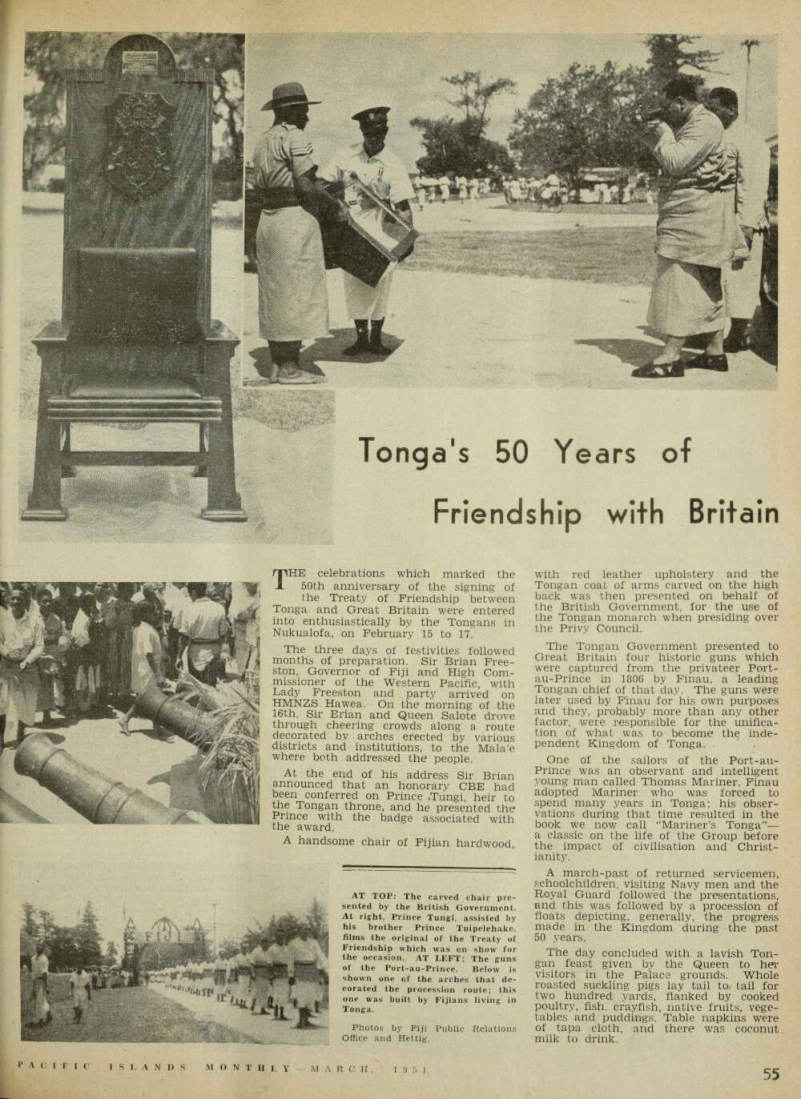
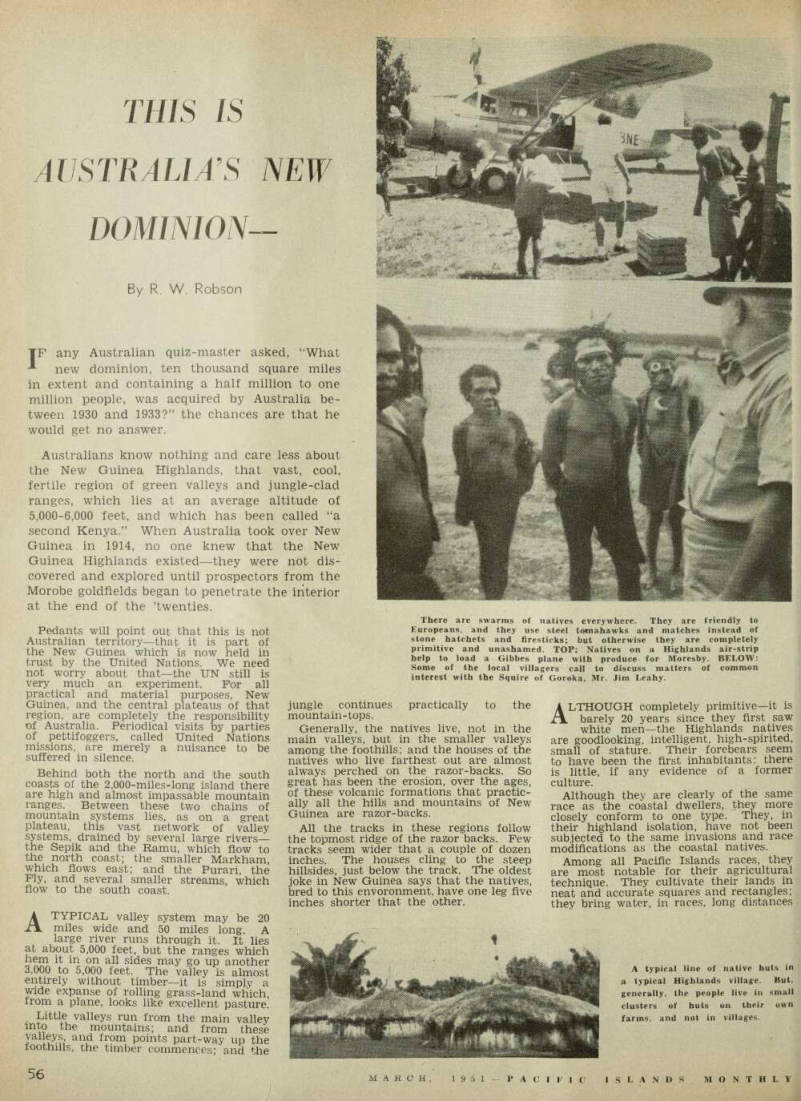
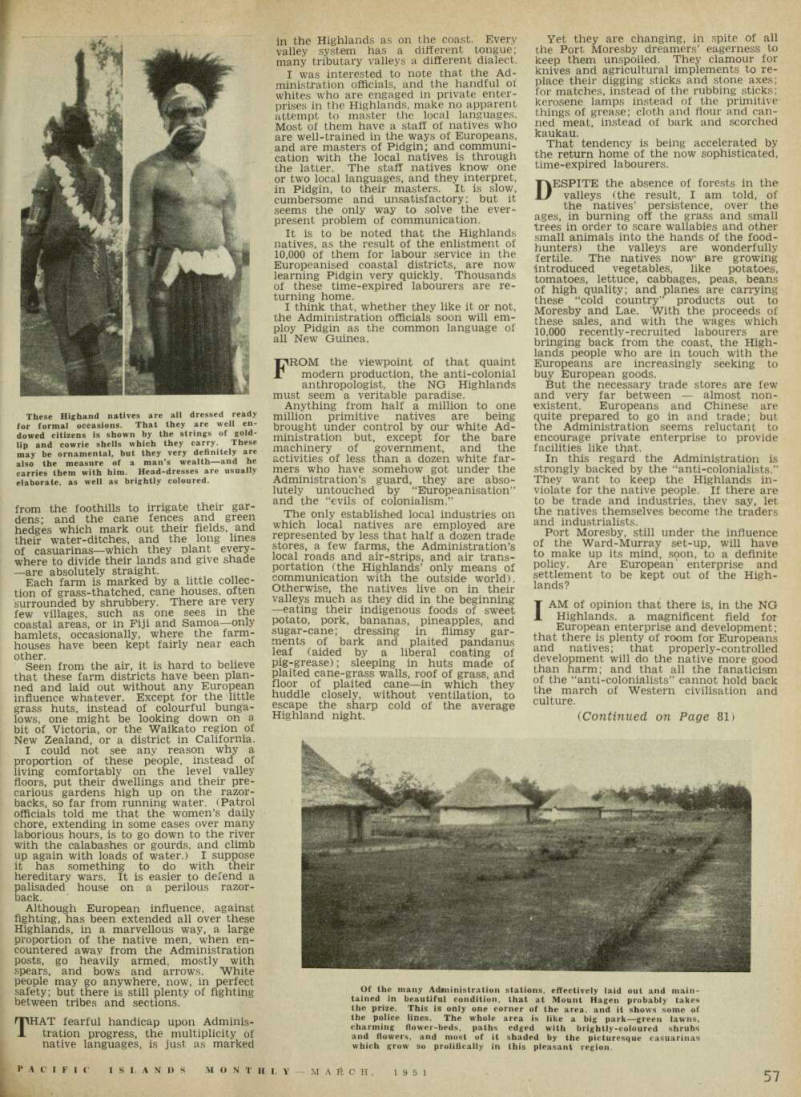
(Solution on Page 79.)
Across
I. What element is es sential to life? 3.—who lost his strength as a result of a haircut? 6.—What is the name of the doctrine started and followed by members of the “Oxford Movement”?
B.—Who, created by Sheridan, is famous for her misuse of long words? 10.—The original one was committed with an orchard product. 11. —What number is computed from the known dimensions of a ship? 12.—Who is the richest uncle in the world? 16. —Which pronoun was used as the name of a novel? 18. —Who is the impudent young pickpocket in “Oliver Twist”? 19. What is the name of the South African antelope, resembling the elk in hav ing a protuberance on the larynx? 20. —What was the term for a member of a religious and military order in the twelfth century?
Down
1-—What doctrihe (believes that everything is ordered for the best? 2.—What is the term for year-old animals? 3'—What articles are accepted as the agree ment between captain and seamen as to wages? 4.—Who is the purveyor of a college? 5-—What is the famous mountain of- Thes saly? 7.—What spirit is fermented from coco palms and rice in the East?
B. — Which unit of length occurs frequently in Scottish names as an island? 13. —What was penicillin grown from? 14. —what is the name of a corps consisting of an organised body of boys undergoing military training? 15. —what is the courteous form of address to a lady? 16. —What is formed by adding carbon to iron? 17. —What is the name of tea made in Para guay?
Crossquiz Solution from Page 54
Island Town's Cinema
By J.V.H.
TWICE a week our town dutifully goes to the Cinema. It is the same programme both nights, but as our pleasures are few and far between, we take what kind Providence gives us and thank Her. Simple folk we are, and we laugh, sigh, cry and chew peanuts in the same places, twice.
In our town audience-participation has reached a degree of perfection. With a business eye to the Asiatic and native population, who make up the bulk of the audience potential, the management usually screen pictures of the blood and thunder type and the audience reacts to them in a way marvellous to behold, not to mention hear.
The theatre is a flat, square building, well-ventilated by louvres along the sides, holes in the roof above and missing planks in the floor below. It is built in a hollow, at the base of three hills and when it rains the water drains right into your seat.
We go along to the cinema for three reasons: to see, to be seen, and, now and then, to watch the screen.
You simply push your money through a wire grill, receive a piece of white paper from some mysterious hand, and enter. Another hand takes the ticket from you and following a pool of torch light which bobs up and down before you, you trip across oustretched legs, crunch through acres of peanut shells and finally collapse into your seat.
As the floor is flat, you have to pick your seat with some consideration as to
the height of the person sitting in front of it. If you are taller than he it doesnt matter as much to you as it does to the person behind you. But if the patron before you has his head and shoulders over you, you have a miserable night in front of you. It is also impossible to settle into your seat and let it go at that. If the person in the front row moves, the whole movement must be re layed through to the last person in the back row.
The show is always scheduled to begin “at eight SHARP! ' But only to keep up appearances—nobody ever arrives before quarter past.
About twenty past, those lights which have not already gone out of their own accord, are switched off and a loud bell summons drinkers in from the bar. There is no hush of expectancy, rather does the conversation become louder.
There is no wraithlike curtain to part the shadows and reveal a silver screen.
Rather is there a rasping noise and the mad flight of sundry ropes hither and yon as dyed hessian parts jerkily to reveal a stretch of white, or off-white, which is the screen.
The theatre is plunged into darkness as with as little ceremony as possible the entertainment is begun. r Sensational news items of seven years ago enthrall us. “TOMORROW’S
Entertainment To-Day” Bravely
goes the blurb. “THE WORLD’S HEAD LINES,” screams the screen. We sit fascinated, overcome by the majesty of events in the outside world. The news reel pursues its relentless course until its last few feet scatter themselves in a mad rush before our eyes. The newsreel is over. The lights go on again, and we, keyed to untold heights of concentration, blink our eyes in the glare.
There is a minute’s respite while the operator behind us prepares his machine to show us the feature film of the night.
This is chapter one of Texas Tim of the Badlands.
The audience goes mad with delight.
As the image of the actors and act resses/ and the role he or she portrays in the promised drama, is flashed before our eager eyes there are cheers or whistles or plain boos according to the popularity of the character. It is all very chummy.
The introductions over, the scenes of Chapter One begin to unroll themselves.
Before one hundred feet of film is gone there are three murders, three railway disasters and at least fifteen narrow escapes. The plot literally moves along the path of corpses, wrecked bridges, barrels of dynamite, scalp hunting Indians and mayhem.
We are sick with apprehension as a circular saw saws its circular way toward the midriff of a captive maiden when there is a series of explosions from the operator’s box, and chapter one collapses in a state of complete abandon. “Don’t miss next week. Will Daphne’s screams reach the ears of Texas Tim?”
“Scream louder. Daphne,” yells the audience. Will Texas Tim stop fooling around with that bear cub and race to her rescue? week, and next week alone, can provide the answers.
Until the next cinema night Daphne’s exploits will be a major topic of con versation among us. Texas Tim will be blamed for his mistakes and better things will be expected of him in Chapter Two.
As I said, we are a simple folk, and we take our pleasures seriously. We go home satisfied and the evening is a success.
Friendship with Britain
Tonga's 50 Years of Friendship with Britain
THE celebrations which marked the 50th anniversary of the signing of the Treaty of Friendship between Tonga and Great Britain were entered into enthusiastically by the Tongans in Nukualofa, on February 15 to 17.
The three days of festivities followed months of preparation. Sir Brian Free ston, Governor of Fiji and High Com missioner of the Western Pacific, with Lady Freeston and party arrived on HMNZS Hawea. On the morning of the 16th. Sir Brian and Queen Salote drove through cheering crowds along a route decorated by arches erected by various districts and institutions, to the Mala’e where both addressed the people.
At the end of his address Sir Brian announced that an honorary CBE had been conferred on Prince .Tungi, heir to the Tongan throne, and he presented the Prince with the badge associated with the award.
A handsome chair of Fijian hardwood,
with red leather upholstery and the Tongan coat of arms carved on the high back was then presented on behalf of the British Government, for the use of the Tongan monarch when presiding over the Privy Council.
The Tongan Government presented to Great Britain four historic guns which were captured from the privateer Port au-Prince in 1806 by Finau, a leading Tongan chief of that day. The guns were later used by Finau for his own purposes and they, probably more than any other factor, were responsible for the unifica tion of what was to become the inde pendent Kingdom of Tonga.
One of the sailors of the Port-au- Prince was an observant and intelligent young man called Thomas Mariner. Finau adopted Mariner who was forced to spend many years in Tonga; his obser vations during that time resulted in the book we now call “Mariner’s Tonga”— a classic on the life of the Group before the impact of civilisation and Christ ianity.
A march-past of returned servicemen, schoolchildren, visiting Navy men and the Royal Guard followed the presentations, and this was followed by a procession of floats depicting, generally, the progress made in the Kingdom during the past 50 years.
The day concluded with a lavish Ton gan feast given by the Queen to her visitors in the Palace grounds. Whole roasted suckling pigs lay tail to tail for two hundred yards, flanked by cooked poultry, fish, crayfish, native fruits, vege tables and puddings. Table napkins were of tapa cloth, and there was coconut milk to drink.
AT TOP: The carved chair pre sented by the British Government.
At right, Prince Tungi, assisted by his brother Prince Tuipelehake, films the original of the Treaty of Friendship which was on show for the occasion. AT LEFT: The guns of the Port-au-Prince. Below is shown one of the arches that de corated the procession route; this one was built by Fijians living in Tonga.
Photos by Fiji Public Relations Office and Hettig.
Australia's New
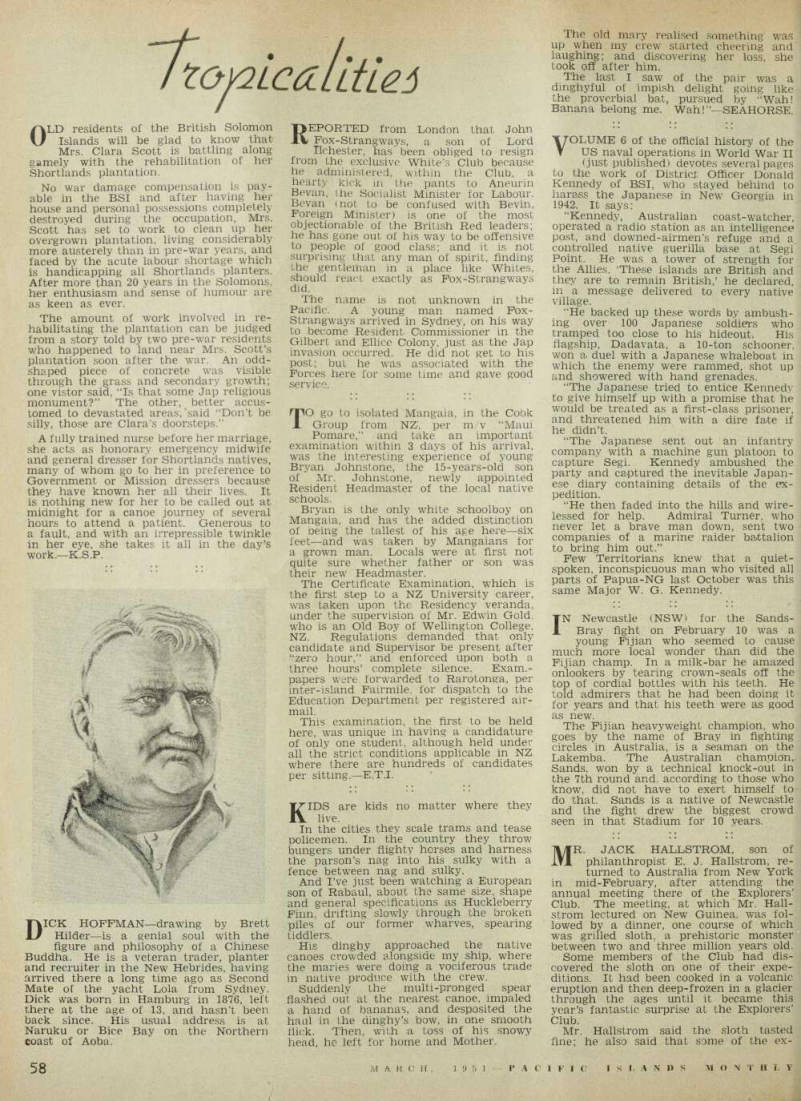
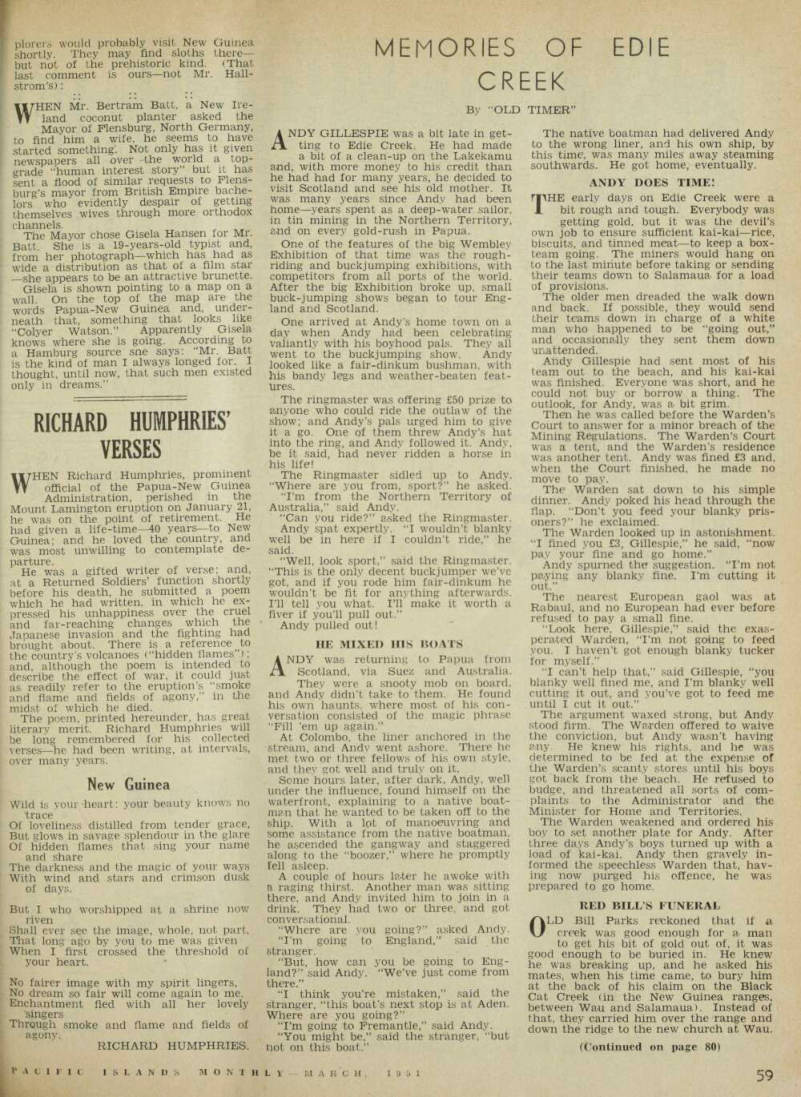
This
Dominion-
By R. W Robson
TF any Australian quiz-master asked, “What new dominion, ten thousand square miles in extent and containing a half million to one million people, was acquired by Australia be tween 1930 and 1933?” the chances are that he would get no answer.
Australians know nothing and care less about the New Guinea Highlands, that vast, cool, fertile region of green valleys and jungle-clad ranges, which lies at an average altitude of 5,000-6,000 feet, and which has been called “a second Kenya.” When Australia took over New Guinea in 1914, no one knew that the New Guinea Highlands existed—they were not dis covered and explored until prospectors from the Morobe goldfields began to penetrate the interior at the end of the ’twenties.
Pedants will point out that this is not Australian territory—that it is part of the New Guinea which is now held in trust by the United Nations. We need not worry about that—the UN still is very much an experiment. For all practical and material purposes, New Guinea, and the central plateaus of that region, are completely the responsibility of Australia. Periodical visits by parties of pettifoggers, called United Nations missions, are merely a nuisance to be suffered in silence.
Behind both the north and the south coasts of the 2,000-miles-long island there are high and almost impassable mountain ranges. Between these two chains of mountain systems lies, as on a great plateau, this vast network of valley systems, drained by several large rivers— the Sepik and the Ramu, which flow to the north coast; the smaller Markham, which flows east; and the Purari, the Fly, and several smaller streams, which flow to the south coast.
ATYPICAL valley system may be 20 miles wide and 50 miles long. A large river runs through it. It lies at about 5,000 feet, but the ranges which hem it in on all sides may go up another 3,000 to 5,000 feet. The valley is almost entirely without timber—it is simply a wide expanse of rolling grass-land which, trom a plane, looks like excellent pasture.
Little valleys run from the main valley into the mountains; and from these valleys and from points part-way up the foothills, the timber commences; and the
jungle continues practically to the mountain-tops.
Generally, the natives live, not in the main valleys, but in the smaller valleys among the foothills; and the houses of the natives who live farthest out are almost always perched on the razor-backs. So great has been the erosion, over the ages, of these volcanic formations that practic ally all the hills and mountains of New Guinea are razor-backs.
All the tracks in these regions follow the topmost ridge of the razor backs. Few tracks seem wider that a couple of dozen inches. The houses cling to the steep hillsides, just below the track. The oldest joke in New Guinea says that the natives, bred to this envoronment, have one leg five inches shorter that the other.
ALTHOUGH completely primitive—it is
barely 20 years since they first saw white men—the Highlands natives are goodlooking, intelligent, high-spirited, small of stature. Their forebears seem to have been the first inhabitants: there is little, if any evidence of a former culture.
Although they are clearly of the same race as the coastal dwellers, they more closely conform to one type. They, in their highland isolation, have not been subjected to the same invasions and race modifications as the coastal natives.
Among all Pacific Islands races, they are most notable for their agricultural technique. They cultivate their lands in neat and accurate squares and rectangles; they bring water, in races, long distances
There are swarms of natives everywhere. They are friendly to Europeans, and they use steel tomahawks and matches instead of stone hatchets and firesticks; but otherwise they are completely primitive and unashamed. TOP: Natives on a Highlands air-strip help to load a Gibbes plane with produce for Moresby. BELOW: Some of the local villagers call to discuss matters of common interest with the Squire of Goroka, Mr. Jim Leahy.
A typical line of native huts in a typical Highlands village. But, generally, the people live in small clusters of huts on their own farms, and not in villages.
from the foothills to irrigate their gar dens; and the cane fences and green hedges which mark out their fields, and their water-ditches, and the long lines of casuarinas—which they plant every where to divide their lands and give shade —are absolutely straight.
Each farm is marked by a little collec tion of grass-thatched, cane houses, often surrounded by shrubbery. There are very few villages, such as one sees in the coastal areas, or in Fiji and Samoa —only hamlets, occasionally, where the farm houses have been kept fairly near each other.
Seen from the air, it is hard to believe that these farm districts have been plan ned and laid out without any European influence whatever. Except for the little grass huts, instead of colourful bunga lows, one might be looking down on a bit of Victoria, or the Waikato region of New Zealand, or a district in California.
I could not see any reason why a proportion of these people, instead of living comfortably on the level valley floors, put their dwellings and their pre carious gardens high up on the razor backs, so far from running water. (Patrol officials told me that the women’s daily chore, extending in some cases over many laborious hours, is to go down to the river with the calabashes or gourds, and climb up again with loads of water.) I suppose it has something to do with their hereditary wars. It is easier to defend a palisaded house on a perilous razor back.
Although European influence, against fighting, has been extended all over these Highlands, in a marvellous way, a large proportion of the native men, when en countered away from the Administration posts, go heavily armed, mostly with spears, and bows and arrows. White people may go anywhere, now, in perfect safety; but there is still plenty of fighting between tribes and sections.
THAT fearful handicap upon Adminis tration progress, the multiplicity of native languages, is just as marked
in the Highlands as on the coast. Every valley system has a different tongue; many tributary valleys a different dialect.
I was interested to note that the Ad ministration officials, and the handful of whites who are engaged in private enter prises in the Highlands, make no apparent attempt to master the local languages.
Most of them have a staff of natives who are well-trained in the ways of Europeans, and are masters of Pidgin; and communi cation with the local natives is through the latter. The staff natives know one or two local languages, and they interpret, in Pidgin, to their masters. It is slow, cumbersome and unsatisfactory: but it seems the only way to solve the ever present problem of communication.
It is to be noted that the Highlands natives, as the result of the enlistment of 10,000 of them for labour service in the Europeanised coastal districts, are now learning Pidgin very quickly. Thousands of these time-expired labourers are re turning home.
I think that, whether they like it or not, the Administration officials soon will em ploy Pidgin as the common language of all New Guinea.
FROM the viewpoint of that quaint modern production, the anti-colonial anthropologist, the NG Highlands must seem a veritable paradise.
Anything from half a million to one million primitive natives are being brought under control by our white Ad ministration but, except for the bare machinery of government, and the activities of less than a dozen white far mers who have somehow got under the Administration’s guard, they are abso lutely untouched by “Europeanisation” and the “evils of colonialism.”
The only established local industries on which local natives are employed are represented by less that half a dozen trade stores, a few farms, the Administration’s local roads and air-strips, and air trans portation (the Highlands’ only means of communication with the outside world).
Otherwise, the natives live on in their valleys much as they did in the beginning —eating their indigenous foods of sweet potato, pork, bananas, pineapples, and sugar-cane; dressing in flimsy gar ments of bark and plaited pandanus leaf (aided by a liberal coating of pig-grease); sleeping in huts made of plaited cane-grass walls, roof of grass, and floor of plaited cane—in which they huddle closely, without ventilation, to escape the sharp cold of the average Highland night.
Yet they are changing, in spite of all the Port Moresby dreamers’ eagerness to keep them unspoiled. They clamour for knives and agricultural implements to re place their digging sticks and stone axes; for matches, instead of the rubbing sticks: kerosene lamps instead of the primitive things of grease; cloth and flour and can ned meat, instead of bark and scorched kßiik^u That tendency is being accelerated by the return home of the now sophisticated, time-expired labourers.
DESPITE the absence of forests in the valleys (the result, I am told, of the natives’ persistence, over the ages, in burning off the grass and small trees in order to scare wallabies and other small animals into the hands of the food hunters) the valleys are wonderfully fertile. The natives now 1 are growing introduced vegetables, like potatoes, tomatoes, lettuce, cabbages, peas, beans of high quality; and planes are carrying these “cold country” products out to Moresby and Lae. With the proceeds of these sales, and with the wages which 10,000 recently-recruited labourers are bringing back from the coast, the High lands people who are in touch with the Europeans are increasingly seeking to buy European goods.
But the necessary trade stores are few and very far between almost non existent. Europeans and Chinese are quite prepared to go in and trade; but the Administration seems reluctant to encourage private enterprise to provide facilities like that.
In this regard the Administration is strongly backed by the “anti-colonialists.”
They want to keep the Highlands in violate for the native people. If there are to be trade and industries, they say, let the natives themselves become the traders and industrialists.
Port Moresby, still under the influence of the Ward-Murray set-up, will have to make up its mind, soon, to a definite policy. Are European' enterprise and settlement to be kept out of the High lands?
IAM of opinion that there is, in the NG Highlands, a magnificent field for European enterprise and development; that there is plenty of room for Europeans and natives; that properly-controlled development will do the native more good than harm; and that all the fanaticism of the “anti-colonialists” cannot hold back the march of Western civilisation and culture.
(Continued on Page 81)
These Highand natives are all dressed ready for formal occasions. That they are well en dowed citizens is shown by the strings of gold lip and cowrie shells which they carry. These may be ornamental, but they very definitely are also the measure of a man’s wealth —and he carries them with him. Head-dresses are usually elaborate, as well as brightly coloured.
Of the many Administration stations, effectively laid out and main tained in beautiful condition, that at Mount Hagen probably takes the prize. This is only one corner of the area, and it shows some of the police lines. The whole area is like a big park—green lawns, charming flower-beds, paths edged with brightly-coloured shrubs and flowers, and most of it shaded by the picturesque casuarinas which grow so prolifically in this pleasant region
I think that the certainty of European settlement should be accepted, and planned for. A survey should be made to ascertain exactly what are the possibilities of agri cultural and pastoral development by private enterprise; what must be done to protect the interests of the natives and give them security; and to see how to deal with the problems of providing local transportation, adeo.uate communication with the coast, hydro-electric power, building materials, and so forth.
IN the past decade, the Administration has done an extraordinarily good job in bringing all this vast area under control.
It has been done by the progressive establishment of air-strips. The first air strips were in the vicinity of Kainantu, close to the mountain barrier between the Markham Valley (which leads up from Lae) and the first of the valley systems, around the headwaters of the Ramu and Purari Rivers. There, an Administration post was placed alongside the best air strip.
Then, step by step (or valley by valley) the Administration pushed its way west ward. Patrols went out, climbed across the mountain barriers into the next valley, established another air-strip; planes came in with personnel and supplies; another Administration post was built up; and so on.
Selected Administration officials, as they went on from valley to valley, exercised the greatest care in making contact with the inhabitants; with the result that, practically without exception, they have gained the trust, goodwill and co operation of the natives.
Wherever I went, I was impressed with the obvious good relations between the whites and the natives. Without ex ception, native headmen came smilingly but most respectfully to Mr. George Greathead, the experienced District Com missioner who is like an uncrowned king, ruling over this vast region; even the lines of native women, toiling along the tracks under incredible loads—they are the Highlands beasts of burden—recognised and greeted him.
Up on his lonely mountain-top farm, beyond Hagen, I saw Mr. Dan Leahy dealing out rough justice to natives who came to his door with their complaints, based mostly on local quarrels. Through his Pidgin-speaking kitchen-boys, who acted as interpreters, Mr. Leahy listened patiently to the stories, and either gave a decision, which was, accepted un questionably, or told them to go and see the Kiap (Assistant District Officer).
The Administration posts now extend far over into the west, beyond Wabag, be tween Hagen and the Dutch border; and into the south, beyond the Papuan border.
There, a new station has just been opened at Mendi, at the junction of the Mendi and Menken Rivers, 18 miles southwest of Mount Giluwe (13,660 feet—the highest mount in New Guinea). . The headquarters of District Commis sioner Greathead are at Goroka, in the broad Goroka Valley, 70 miles west of Lae—but separated from Lae by two or three mountain barriers which seem impassable. Westward of Goroka is the Kirigomin Range; and beyond that a series of mighty valley systems—the Chimbu-Wahgi region—leading on to the Hagen valley systems. Thence one goes northwards into the Baiyer-Sepik system, westward into the Wabag system, south wards into the Mendi-Menken system, which leads on to Lake Kutubu and the Papuan gulf.
THE administration is based on air transport, and the air strips. There are some quite good roads in the valleys; but most of the valleys are ringed in by the impassible mountain chains.
There are half a dozen sub-districts in charge of Assistant District Officers under DC Greathead’s care; and each, in its isolated valley, or series of valleys, operates almost as a self-contained unit.
Each ADO has a jeep or two; but there
is little inter-valley jeep communication, DC Greathead gets around his wide kingdom in a tiny hired plane. A day spent with him, skimming the mountam taps, nosing down into isolated green valleys, chasing around the shoulders of 13,000 ft. peaks looking' for stands of Hoop Pine, is an experience that this writer never will forget, Everything in the Highlands moves by plane. The rocky peaks literally yammer
at one. Fogs hang around at all hours of the day. Like all the works of human hands, plane engines are fallible. Yet one never hears of a plane accident in the Highlands. Touch wood!
The air transport companies—especially Qantas, Mandated Airlines and Bobby Gibbes’ Aitape-based carriers—have done a really wonderful job in assisting the Government to put administrative mach inery into this wide and dangerous territory. But a stage now has been reached when something more than passenger planes is needed.
The Highlands most urgently need trucks, road-making and earth-moving machinery, generators whereswith to har ness the big streams which rush everlast ingly out of the mountains, and heavy equipment generally. Such things cannot come in in little planes.
At Goroka I went for a walk. I found a road-making gang at work. Fifty natives, like a string of ants, were carry ing gravel on bits of tin, cut from the tops of kerosene cans, from a creekbed a quarter-mile to a place where an overseer used his hands to spread the gravel on the jeep -track.
Rather staggered, I asked an official why this primitive system was followed.
Being limited by the planes, they have difficulty in getting even the simplest road-making equipment. The rainy season was due; the jeep must run between the Government station and the air-strip; so, to avoid bogging, they got a trafficable road by using 50 natives and 50 bits of tin.
One day soon, Qantas are going to use Bristol freighters to fly heavy machinery into the Highlands, as well as pedigree bulls and prefabricated houses and motor spirit, and all the things which spell civilisation and progress. Then the life of an administrative official will contain fewer headaches.
But there can be no real settlement and development in the Highlands, on orthodox lines, until a motor-road con nects this beautiful country with the coast—either at Madang or Lae. The problem of the road is discussed in another article. It ties in with the prob lem of the Markham Bridge.
THE only European interests which the Administration, so far, has allowed to enter the Highlands are the missionaries. Otherwise, only a selected half-dozen individuals have been admitted.
Stations representative of most of the denominations are already established: and, to the extent that these organisations assist in the education and medical care of the natives, they deserve encourage ment and assistance.
But, in my tour of the Highlands, I several times encountered wrathful men who declare that certain classes of missionaries are using all their influence with the natives to prevent the natives from selling land rights to European enterprise. This is something that should have official attention.
It is not the function of missionaries to decide matters of policy. While the opinions of some missionaries should carry weight when mundane affairs are under consideration, there are others who are so simple in character, and so com pletely unworldly, that they certainly should not be allowed to interfere in things of such importance as the disposal of land.
In the case of New Guinea, there are two or three considerations which must rate higher than native welfare when the future use of land is being dealt with. Of course, certain highly-placed persons in and around Port Moresby and Lake Success will foam at the mouth over such a proposition; but it is quite seriously advanced.
The future of the New Guinea High
lands, in relation to New Guinea’s development and Australia’s defence, should be carefully considered and a policy decided upon, now, while the Highlands still are virgin territory. In connection with that, the representations of the missionaries should receive every consideration. But for the missionaries, at this stage, to take it upon themselves to try to keep European enterprise out of the Highlands, by opposing land trans actions, is something that will not be tolerated, and must create bad feeling.
It is in the interests of everyone in the Highlands that the Australian Government should decide upon a policy soon— and say whether private enterprise is, or is not, to be permitted in the Highlands.
But that is not to say that the Australian Government will do it.
The only positive policies we have had from Australia in relation to New Guinea came in 1945-6 from the Socialist set-up of the Ward-Murray regime, which produced mostly confusion and frustration; and in 1950 from the forthright Mr. Spender, which has been well and truly sabotaged by high officials who don’t like Mr.
Spender, ..
The NG Highlands, for years to come, probably will remain officially another Shangri-La—isolated, peaceful, cool and beautiful. Perhaps someone could get per mission to build a big accommodation house in one of the more lovely places, like Mount Hagen, so that travel-weary people could go in and have a look at a region that really is unique.
Advertisements & other items, p. 59 (1 item)
57
PACIFIC' ISLANDS MONTHLY - MA&CH, 1951
Tropicalities
OLD residents of the British Solomon Islands will be glad to know that Mrs. Clara Scott is battling along gamely with the rehabilitation of her Shortlands plantation.
No war damage compensation is pay able in the BSI and after having her house and personal possessions completely destroyed during the occupation, Mrs.
Scott has set to work to clean up her overgrown plantation, living considerably more austerely than in pre-war years, and faced by the acute labour shortage which is handicapping all Shortlands planters.
After more than 20 years in the Solomons, her enthusiasm and sense of humour are as keen as ever.
The amount of work involved in re habilitating the plantation can be judged from a story told by two pre-war residents who happened to land near Mrs. Scott’s plantation soon after the war. An odd shaped piece of concrete was visible through the grass and secondary growth; one vistor said, “Is that some Jap religious monument?” The other, better accus tomed to devastated areas,'said “Don’t be silly, those are Clara’s doorsteps.”
A fully trained nurse before her marriage, she acts as honorary emergency midwife and general dresser for Shortlands natives, many of whom go to her in preference to Government or Mission dressers because they have known her all their lives. It is nothing new for her to be called out at midnight for a canoe journey of several hours to attend a patient. Generous to a fault, and with an irrepressible twinkle in her eye, she takes it all in the day’s
work.
K.S.P.
DICK HOFFMAN—drawing by Brett Hilder—is a genial soul with the figure and philosophy of a Chinese Buddha. He is a veteran trader, planter and recruiter in the New Hebrides, having arrived there a long time ago as Second Mate of the yacht Lola from Sydney.
Dick was born in Hamburg in 1876, left there at the age of 13, and hasn’t been back since. His usual address is at Naruku or Bice Bay on the Northern coast of Aoba.
REPORTED from London that John Pox-Strangways, a son of Lord Tlchester, has been obliged to resign from the exclusive White’s Club because he administered, within the Club, a hearty kick in the pants to Aneurin Sevan, the Socialist Minister for Labour.
Bevan (not to be confused with Bevin, Foreign Minister) is one of the most objectionable of the British Red leaders; he has gone out of his way to be offensive to people of good class; and it is not surprising that any man of spirit, finding the gentleman in a place like Whites, should react exactly as Pox-Strangways did.
The name is not unknown in the Pacific. A young man named Pox- Strangways arrived in Sydney, on his way to become Resident Commissioner in the Gilbert and Ellice Colony, just as the Jap invasion occurred. He did not get to his post; but he was associated with the Forces here for some time and gave good service.
TO go to isolated Mangaia, in the Cook Group from NZ‘, per m/v “Maui Pomare,” and take an important examination within 3 days of his arrival, was the interesting experience of young Bryan Johnstone, the 15-years-old son of Mr. Johnstone, newly appointed Resident Headmaster of the local native schools.
Bryan is the only white schoolboy on Mangaia, and has the added distinction of being the tallest of his age here—six feet —and was taken by Mangaians for a grown man. Locals were at first not quite sure whether father or son was their new Headmaster.
The Certificate Examination, which is the first step to a NZ University career, was taken upon the Residency veranda, under the supervision of Mr. Edwin Gold, who is an Old Boy of Wellington College.
NZ. Regulations demanded that only candidate and Supervisor be present after “zero hour,” and enforced upon both a three hours’ complete silence. Exam.papers were forwarded to Rarotonga, per inter-island Fairmile. for dispatch to the Education Department per registered air mail.
This examination, the first to be held here, was unique in having a candidature of only one student, although held under all the strict conditions applicable in NZ where there are hundreds of candidates
per sitting.
E.T.I.
KIDS are kids no matter where they live.
In the cities they scale trams and tease policemen. In the country they throw hungers under flighty horses and harness the parson’s nag into his sulky with a fence between nag and sulky.
And I’ve just been watching a European son of Rabaul, about the same size, shape and general specifications as Huckleberry Finn, drifting slowly through the broken piles of our former wharves, spearing tiddlers.
His dinghy approached the native canoes crowded alongside my ship, where the maries were doing a vociferous trade in native produce with the crew.
Suddenly the multi-pronged spear flashed out at the nearest canoe, impaled a hand of bananas, and desposited the haul in the dinghy’s bow, in one smooth flick. Then, with a toss of his snowy head, he left for home and Mother.
The old mary realised something was up when my crew started cheering and laughing; and discovering her loss, she took off after him.
The last I saw of the pair was a dinghyful of impish delight going like the proverbial bat, pursued by “Wah!
Banana belong me. Wah!”—SEAHORSE.
VOLUME 6 of the official history of the US naval operations in World War II (just published) devotes several pages to the work of District Officer Donald Kennedy of BSI, who stayed behind to harass the Japanese in New Georgia in 1942. It says: ‘‘Kennedy, Australian coast-watcher, operated a radio station as an intelligence post, and downed-airmen’s refuge and a controlled native guerilla base at Segi Point. He was a tower of strength for the Allies. ‘These islands are British and they are to remain British,’ he declared, in a message delivered to every native village. ‘‘He backed up these words by ambush ing over 100 Japanese soldiers who tramped too close to his hideout. His flagship, Dadavata, a 10-ton schooner, won a duel with a Japanese whaleboat in which the enemy were rammed, shot up and showered with hand grenades. ‘‘The Japanese tried to entice Kennedy to give himself up with a promise that he would be treated as a first-class prisoner, and threatened him with a dire fate if he didn’t.
“The Japanese sent out an infantry company with a machine gun platoon to capture Segi. Kennedy ambushed the party and captured the inevitable Japan ese diary containing details of the ex pedition.
“He then faded into the hills and wire lessed for help. Admiral Turner, who never let a brave man down, sent two companies of a marine raider battalion to bring him out.”
Few Territorians knew that a quiet spoken, inconspicuous man who visited all parts of Papua-NG last October was this same Major W. G. Kennedy.
IN Newcastle (NSW> for the Sands- Bray fight on February 10 was a young Fijian who seemed to cause much more local wonder than did the Fijian champ. In a milk-bar he amazed onlookers by tearing crown-seals off the top of cordial bottles with his teeth. He told admirers that he had been doing it for years and that his teeth were as good as new.
The Fijian heavyweight champion, who goes by the name of Bray in fighting circles in Australia, is a seaman on the Lakemba. The Australian champion, Sands, won by a technical knock-out in the 7th round and, according to those who know, did not have to exert himself to do that. Sands is a native of Newcastle and the fight drew the biggest crowd seen in that Stadium for 10 years.
Mr. Jack Hallstrom, Son Of
philanthropist E. J. Hallstrom, re turned to Australia from New York in mid-February, after attending the annual meeting there of the Explorers’
Club. The meeting, at which Mr. Hall strom lectured on New Guinea, was fol lowed by a dinner, one course of which was grilled sloth, a prehistoric monster between two and three million years old.
Some members of the Club had dis covered the sloth on one of their expe ditions. It had been cooked in a volcanic eruption and then deep-frozen in a glacier through the ages until it became this year’s fantastic surprise at the Explorers’
Club.
Mr. Hallstrom said the sloth tasted fine; he also said that some of the ex
plorers would probably visit New Guinea shortlv. They may find sloths there— but not of the prehistoric kind. (That last comment is ours—not Mr. Hall strom’s): WHEN Mr. Bertram Batt, a New Ire land coconut planter asked the Mayor of Flensburg, North Germany, to find him a wife, he seems to have started something'. Not only has it given newspapers all over the world a top grade “human interest story” but it has sent a flood of similar requests to Flens burg’s mayor from British Empire bache lors who evidently despair of getting themselves wives through more orthodox channels.
The Mayor chose Gisela Hansen for Mr.
Batt. She is a 19-years-old typist and, from her photograph—which has had as wide a distribution as that of a film star —she appears to be an attractive brunette.
Gisela is shown pointing to a map on a wall. On the top of the map are the words Papua-New Guinea and, under neath that, something that looks like “Colyer Watson.” Apparently Gisela knows where she is going. According to a Hamburg source sne says: “Mr. Batt is the kind of man I always longed for. I thought, until now, that such men existed only in dreams.”
Advertisements & other items, p. 60 (1 item)
58
MARCH, 1 9 5 1 PACIFIC; ISLANDS MONTHLY
Richard Humphries’
Verses
WHEN Richard Humphries, prominent
official of the Papua-New Guinea Administration, perished in the Mount Lamington eruption on January 21, he was on the point of retirement. He had given a life-time —40 years—to New Guinea; and he loved the country, and was most unwilling to contemplate de parture.
He was a gifted writer of verse; and, at a Returned Soldiers’ function shortly before his death, he submitted a poem which he had written, in which he ex pressed his unhappiness over the cruel and far-reaching changes which the Japanese invasion and the fighting had brought about. There is a reference to the country's volcanoes (“hidden flames”); and, although the poem is intended to describe the effect of war, it could just as readily refer to the eruption's “smoke and flame and fields of agony,” in the midst of which he died.
The poem, printed hereunder, has great literary merit. Richard Humphries will be long remembered for his collected verses—he had been writing, at intervals, over many years.
New Guinea
Wild is your heart: your beauty knows no Of loveliness distilled from tender grace, But glows in savage splendour in the glare Of hidden flames that sing your name and share The darkness and the magic of your ways With wind and stars and crimson dusk of days.
But I who worshipped at a shrine now riven Shall ever see the image, whole, not part, That long ago by you to me was given When I first crossed the threshold of your heart.
No fairer image with my spirit lingers, No dream so fair will come again to me.
Enchantment fled with all her lovely 'singers Through smoke and flame and fields of agony.
Richard Humphries.
Memories Of Edie


Creek
By “Old Timer”
ANDY GILLESPIE was a bit late in get ting to Edie Creek. He had made a bit of a clean-up on the Lakekamu and, with more money to his credit than he had had for many years, he decided to visit Scotland and see his old mother. It was many years since Andy had been home—years spent as a deep-water sailor, in tin mining in the Northern Territory, and on every gold-rush in Papua.
One of the features of the big Wembley Exhibition of that time was the rough riding and buckjumping exhibitions, with competitors from all ports of the world.
After the big Exhibition broke up, small buck-jumping shows began to tour Eng land and Scotland.
One arrived at Andy’s home town on a day when Andy had been celebrating valiantly with his boyhood pals. They all went to the buckjumping show. Andy looked like a fair-dinkum bushman, with his bandy legs and weather-beaten feat ures.
The ringmaster was offering £5O prize to anyone who could ride the outlaw of the show; and Andy’s pals urged him to give it a go. One of them threw Andy’s hat into the ring, and Andy followed it. Andy, be it said, had never ridden a horse in his life!
The Ringmaster sidled up to Andy.
“Where are you from, sport?” he asked.
“I’m from the Northern Territory of Australia,” said Andy.
“Can you ride?” asked the Ringmaster.
Andy spat expertly. “I wouldn’t blanky well be in here if I couldn’t ride,” he said.
“Well, look sport,” said the Ringmaster.
“This is the only decent buckjumper we’ve got, and if you rode him fair-dinkum he wouldn’t be fit for anything afterwards.
I’ll tell you what. I’ll make it worth a fiver if you’ll pull out.”
Andy pulled out!
He Mixed His Boats
ANDY was returning to Papua from Scotland, via Suez and Australia.
They were a snooty mob on board, and Andy didn’t take to them. He found his own haunts, where most of his con versation consisted of the magic phrase “Fill 'em up again.”
At Colombo, the liner anchored in the stream, and Andv went ashore. There he met two or three fellows of his own style, and they got well and truly on it.
Some hours later, after dark, Andy, well under the influence, found himself on the waterfront, explaining to a native boat man that he wanted to be taken off to the ship. With a lot of manoeuvring and some assistance from the native boatman, he ascended the gangway and staggered along to the “boozer,” where he promptly fell asleep.
A couple of hours later he awoke with a raging thirst. Another man was sitting there, and Andy invited him to join in a drink. They had two or three, and got conversational.
“Where are you going?” asked Andy.
“I'm going to England,” said the stranger.
“But, how can you be going to Eng land?” said Andy. “We’ve just come from there.”
“I think you’re mistaken,” said the stranger, “this boat’s next stop is at Aden.
Where are you going?”
“I’m going to Fremantle,” said Andy.
“You might be,” said the stranger, “but not on this boat.”
The native boatman had delivered Andy to the wrong liner, and his own ship, by this time, was many miles away steaming southwards. He got home, eventually.
Andy Does Time!
THE early days on Edie Creek were a bit rough and tough. Everybody was getting gold, but it was the devil’s own job to ensure sufficient kai-kai —rice, biscuits, and tinned meat—to keep a box team going. The miners would hang on to the last minute before taking or sending their teams down to Salamaua for a load of provisions.
The older men dreaded the walk down and back. If possible, they would send their teams down in charge of a white man who happened to be “going out,” and occasionally they sent them down unattended.
Andy Gillespie had sent most of his team out to the beach, and his kai-kai was finished. Everyone was short, and he could not buy or borrow a thing. The outlook, for Andy, was a- bit grim.
Then he was called before the Warden’s Court to answer for a minor breach of the Mining Regulations. The Warden’s Court was a tent, and the Warden’s residence was another tent. Andy was fined £3 and, when the Court finished, he made no move to pay.
The Warden sat down to his simple dinner. Andy poked his head through the flap. “Don’t you feed your blanky pris oners?” he exclaimed.
The Warden looked up in astonishment.
“I fined you £3, Gillespie,” he said, “now pay your fine and go home.”
Andy spurned the suggestion. “I’m not paying any blanky fine. I’m cutting it out.”
The nearest European gaol was at Rabaul, and no European had ever before refused to pay a small fine.
“Look here, Gillespie,” said the exas perated Warden, “I’m not going to feed you. I haven’t got enough blanky tucker for myself.”
“I can’t help that,” said Gillespie, “you blanky well fined me, and I’m blanky well cutting it out, and you’ve got to feed me until I cut it out.”
The argument waxed strong, but Andy stood firm. The Warden offered to waive the conviction, but Andy wasn’t having any. He knew his rights, and he was determined to be fed at the expense of the Warden’s scanty stores until his boys got back from the beach. He refused to budge, and threatened all sorts of com plaints to the Administrator and the Minister for Home and Territories.
The Warden weakened and ordered his boy to set another plate for Andy. After three days Andy’s boys turned up with a load of kai-kaL Andy then gravely in formed the speechless Warden that, hav ing now purged his offence, he was prepared to go home.
Red Bill’S Funeral
OLD Bill Parks reckoned that if a creek was good enough for a man to get his bit of gold out of, it was good enough to be buried in. He knew he was breaking up, and he asked his mates, when his time came, to bury him at the back of his claim on the Black Cat Creek (in the New Guinea ranges, between Wan and Salamaua). Instead of that, they carried him over the range and down the ridge to the new church at Wau.
(Continued on page 80)
It was Easter Monday morning at Wau and the town was en fete. The race meeting was set down for the afternoon.
Poker and two-up had claimed their share of devotees around the pub, and the bar was doing a roaring trade.
The church bell commenced to toll, and Bill’s old mates wended their way down to the church. A coffin had been made for Bill, and it lay there before the altar covered with the Union Jack. The pews started to fill up. There was still no sign of the parson.
Most of the congregation had not been in a church for many long years. Arthur Reynolds opened a prayer-book, got to his feet, and began a burlesque of a sermon, in a high-pitched, nasal voice.
Carried away by his own eloquence, Arthur did not notice the parson enter from the vestry and kneel down to pray.
Arthur just carried on.
The parson glared at Arthur, but Arthur was completely oblivious of his presence.
The tittering grew into laughter.
Then Arthur looked up and saw the. parson kneeling there. “Ah, opposition, eh!” he exclaimed.
The parson got square for the indignity, however. After the church service was finished, he dismissed the police boys who, with their handcart, had been waiting outside to carry the coffin to the cemetery.
T think there are enough of us to carry our dear brother to his last resting place,” he said.
We couldn’t protest. The coffin weighed about a ton, and it was a very hot day.
We had to carry it nearly a mile to the cemetery.
Old Bill would have enjoyed that epi sode thoroughly, although we couldn’t see much humour in it at the time.
Advertisements & other items, pp. 62-64 (3 items)
fashion . . .
J>ALE blue handkerchief linen embroidered in white makes this version of the universal sun-frock. The. jacket
Corner For The Children
Burns Philp (New Guinea) Limited
General Merchants (Wholesale and Retail)
Shipping, Customs and General Agents
Head Office: PORT MORESBY, PAPUA
BRANCHES:
NEW GUINEA: Rabaul, Kokopo, Lae O Madang.
PAPUA: Sama rai.
QUEENSLAND INSURANCE CO. LTD.
LLOYD'S OF LONDON
BURNS PHILP TRUST CO. LTD
BURNS, PHILP Cr CO. LTD.
All States.
BURNS, PHILP Cr CO. LTD.
"London House", 35 Crutched Friars, E.C.3.
BURNS-PHILP CO. OF SAN FRANCISCO INC.
510 Matson Building.
REPRESENTATIVES FOR:
AUSTRALIAN AGENTS
LONDON AGENTS:
SAN FRANCISCO AGENTS:
Distributing Agents, Territory of Papua-New Guinea for:
SHELL COMPANY OF AUSTRALIA LIMITED
Petroleum Products
GENERAL MOTORS CORPORATION
Chevrolet, Buick, Pontiac and Oldsmobile Cars Chevrolet and GMC Trucks Frigidaire Refrigerators
VAUXHALL MOTORS LIMITED
Vauxhall Cars and Bedford Trucks
R. A. LISTER Cr CO., BRISTOL
Producers of Petrol, Paraffin and Diesel Engines Pumps and Lighting plants
RUSTON HORNSBY LIMITED
Engines
CROSSLEY MARINE ENGINES
A. H. BUNTING LIMITED
SAMARAI PAPUA
Branches at: MISIMA, TUFI, ORO BAY, SOPUTA.
SAMARAI AGENTS FOR:
Vacuum Oil Co. Pty., Ltd.
South British Insurance Co.
National Mutual Life Association
SOLE AGENTS IN PAPUA/NEW GUINEA FOR:
Polarizers (U.K.), Ltd.—Polaroid Sun Glasses.* C.S.A. Industries, Eng—Dual Freeze Refrigerators.
Webley & Scott, Ltd. —Shot Guns, Air Pistols, etc.
E. K. Cole, Ltd., London. —“Ekco” Radio Receivers.
“Getula.”—Nylon Monofilament Fish Lines.
Davison Paints, Ltd., N.S.W.—Paint for Tropical Conditions. * Trade mark patented in U.S.A., Great Britain, and other countries.
REGULAR SUPPLIES OF EASTERN GOODS
WHOLESALE & RETAIL MERCHANTS IMPORTERS PLANTERS
A tropical climate does not
make life any easier for them .. .
Growing children and nursing mothers particularly are prone to the lassitude, nerviness, fatigue, sleeplessness, etc., so common in tropical areas. During periods of rapid growth an adequate and balanced diet is essential.
'Akta-Vite' is delicious with iced milk, but also has great appeal when added to icecream and iced desserts.
Kiddies love
'AKTA-VITE' on
bread and butter or in sandwiches.
O d
AKTA-VITE'
NUTRITIVE FOOD TONIC
is an ideal supplement to the diet because it provides definite and stated amounts of four essential vitamins, with minerals and carbohydrate for energy.
OfaJio/aJ &vt/ue6
A.E.P.I
Democracy
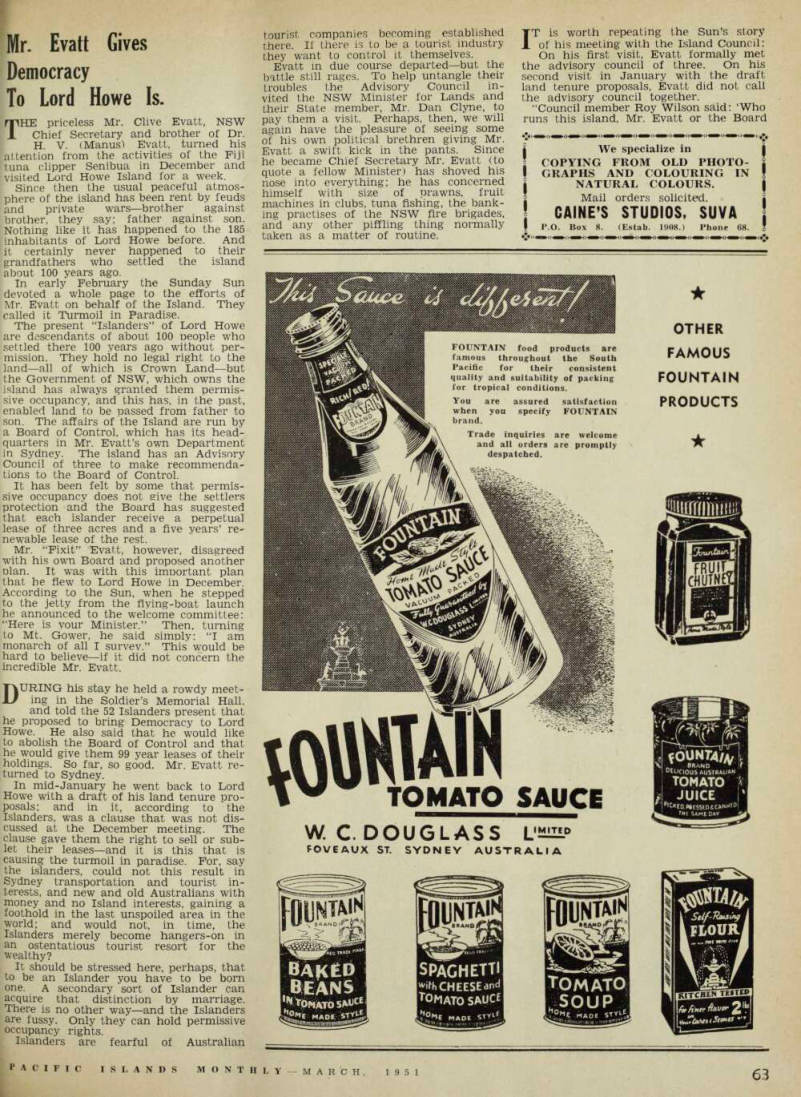
Mr. Evatt Gives Democracy To Lord Howe Is.
THE priceless Mr. Clive Evatt, NSW Chief Secretary and brother of Dr.
H. V. (Manus') Evatt, turned his attention from the activities of the Fiji tuna clipper Senibua in December and visited Lord Howe Island for a week.
Since then the usual peaceful atmos phere of the island has been rent by feuds and private wars—brother against brother, they say; father against son.
Nothing like it has happened to the 185 inhabitants of Lord Howe before. And it certainly never happened to their grandfathers who settled the island about 100 years ago.
In early February the Sunday Sun devoted a whole page to the efforts of Mr. Evatt on behalf of the Island. They called it Turmoil in Paradise.
The present “Islanders” of Lord Howe are descendants of about 100 neople who settled there 100 years ago without per mission. They hold no legal right to the land —all of which is Crown Land —but the Government of NSW, which owns the island has always granted them permis sive occupancy, and this has, in the past, enabled land to be passed from father to son. The affairs of the Island are run by a Board of Control, which has its head quarters in Mr. Evatt’s own Department in Sydney. The island has an Advisory Council of three to make recommenda tions to the Board of Control.
It has been felt by some that permis sive occupancy does not give the settlers protection and the Board has suggested that each islander receive a perpetual lease of three acres and a five years’ re newable lease of the rest.
Mr. “Pixit” Evatt, however, disagreed with his own Board and proposed another nlan. It was with this imnortant plan that he flew to Lord Howe in December.
According to the Sun, when he stepped to the jetty from the flying-boat launch he announced to the welcome committee: “Here is your Minister.” Then, turning to Mt. Gower, he said simply: “I am monarch of all I survev.” This would be hard to believe—if it did not concern the incredible Mr. Evatt, DURING his stay he held a rowdy meet ing in the Soldier’s Memorial Hall, and told the 52 Islanders present that he proposed to bring Democracy to Lord Howe. He also said that he would like to abolish the Board of Control and that he would give them 99 year leases of their holdings. So far, so good. Mr. Evatt re turned to Sydney.
In mid-January he went back to Lord Howe with a draft of his land tenure pro posals; and in it, according to the Islanders, was a clause that was not dis cussed at the December meeting. The clause gave them the right to sell or sub let their leases—and it is this that is causing the turmoil in paradise. For, say the islanders, could not this result in Sydney transportation and tourist in terests, and new and old Australians with money and no Island interests, gaining a foothold in the last unspoiled area in the world; and would not, in time, the Islanders merely become hangers-on in an ostentatious tourist resort for the
wealthy?
It should be stressed here, perhaps, that to be an Islander you have to be born one. A secondary sort of Islander can acquire that distinction by marriage.
There is no other way—and the Islanders are fussy. Only they can hold permissive occupancy rights.
Islanders are fearful of Australian
tourist companies becoming established there. If there is to be a tourist industry they want to control it themselves.
Evatt in due course departed—but the battle still rages. To help untangle their troubles the Advisory Council in vited the NSW Minister for Lands and their State member, Mr. Dan Clyne, to pay them a visit. Perhaps, then, we will again have the pleasure of seeing some of his own political brethren giving Mr.
Evatt a swift kick in the pants. Since he became Chief Secretary Mr. Evatt (to quote a fellow Minister) has shoved his nose into everything; he has concerned himself with size of prawns, fruit machines in clubs, tuna fishing, the bank ing practises of the NSW fire brigades, and any other piffling thing normally taken as a matter of routine.
IT is worth repeating the Sun’s story of his meeting with the Island Council: On his first visit, Evatt formally met the advisory council of three. On his second visit in January with the draft land tenure proposals, Evatt did not call the advisory council together.
“Council member Roy Wilson said; ‘Who runs this island, Mr. Evatt or the Board
of Control? There has been trouble and quarrelling ever since Mr. Evatt set foot on it.’
“ ‘He scarcely seemed to listen when we placed before him our views on land tenure. Mr. Evatt practically turned his back on council chairman Willie Thomp son and, in my opinion, treated him out rageously. Mr. Thompson is nearly 84.
His age alone merits courtesy.
“ ‘I heard later that Mr. Evatt referred to me as a boneheaded adolescent. He told Tom Payton, third member of the council, he could order him off his land at five minutes’ notice.’
“Wilson, a man in his middle twenties, won the George Medal on September 28, 1948, when he dragged two bodies from a blazing Catalina which crashed on the island. Payton, nearly 50, occupies land which his grandfather settled. Chairman Thompson, who was born on the island in 1867, sees merit in both the board’s land tenure plan and Evatt’s, provided Evatt will drop the clause permitting con ditional transfer of leases outside the island.”
Advertisements & other items, pp. 65-66 (1 item)
FflUM'
We specialize in
COPYING FROM OLD PHOTO-
GRAPHS AND COLOURING IN
NATURAL COLOURS.
Mail orders solicited.
CAINE’S STUDIOS, SUVA
P.O. Box 8. (Estab. 1908.) Phone 68.
FOUNTAIN food products are famous throughout the South Pacific for their consistent quality and suitability of packing for tropical conditions.
You are assured satisfaction when you specify FOUNTAIN brand. frade inquiries are welcome and all orders are promptly despatched. % Sr m J/cf* r
SAUCB
W.C. DOUGLASS L'ina 0
FOVEAUX ST. SYDNEY AUSTRALIA
FflUM'
OTHER
FAMOUS
FOUNTAIN
PRODUCTS
RU(I
m N g?Tf Hf.N iMTg
(g> Made in the Australian Branch Factory of
BLUNDELL SPENCE & CO., LTD., Hull,
B. & S. SUPER PREPARED PAINT embodies the knowledge and experience gained from nearly 140 years of Paint manufacture.
Tested and proved for tropical conditions, B. &• S. PREPARED PAINT is also available in a special Lead-free series for use in volcanic and other sulphurous regions. (Specify B. £r S.-Series 2301).
Ask for supplies of these and other BLUN- DELL Paints and Enamels from your local Storekeeper, or write for particulars and colour-cards to the Agent for Pacific Islands :
KERR BROTHERS PTY. LTD.
255 a GEORGE STREET, SYDNEY
Holiday Resorts
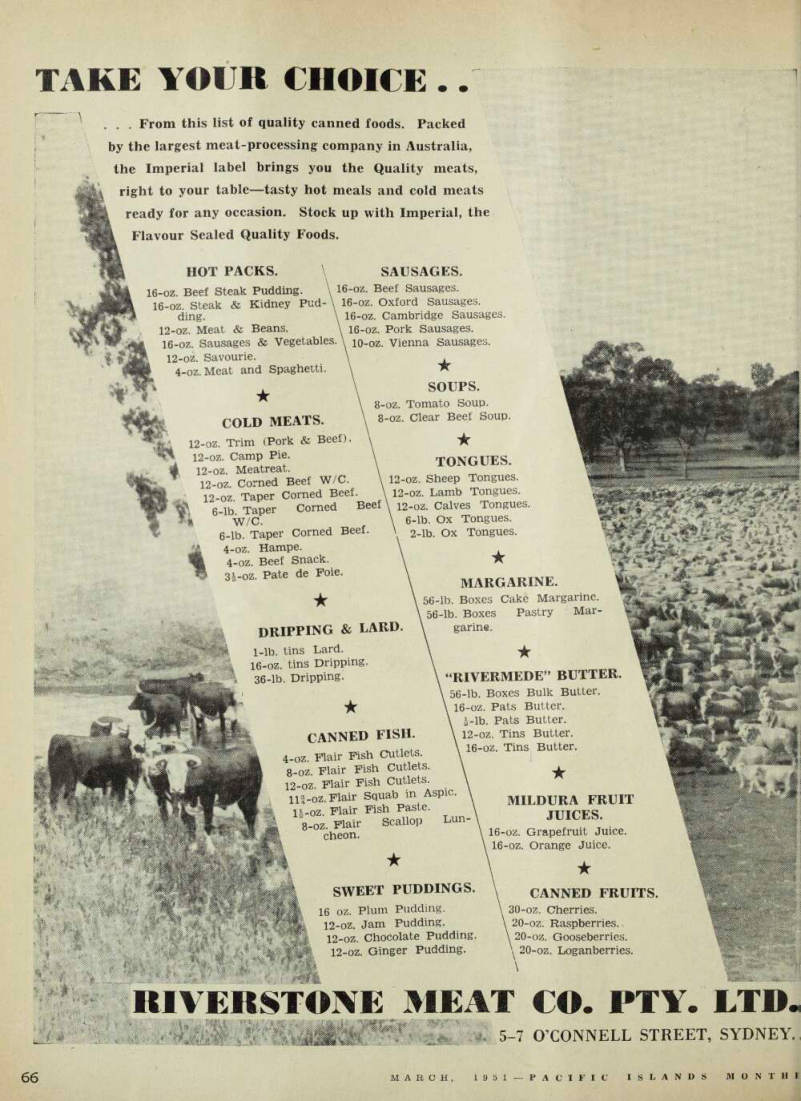
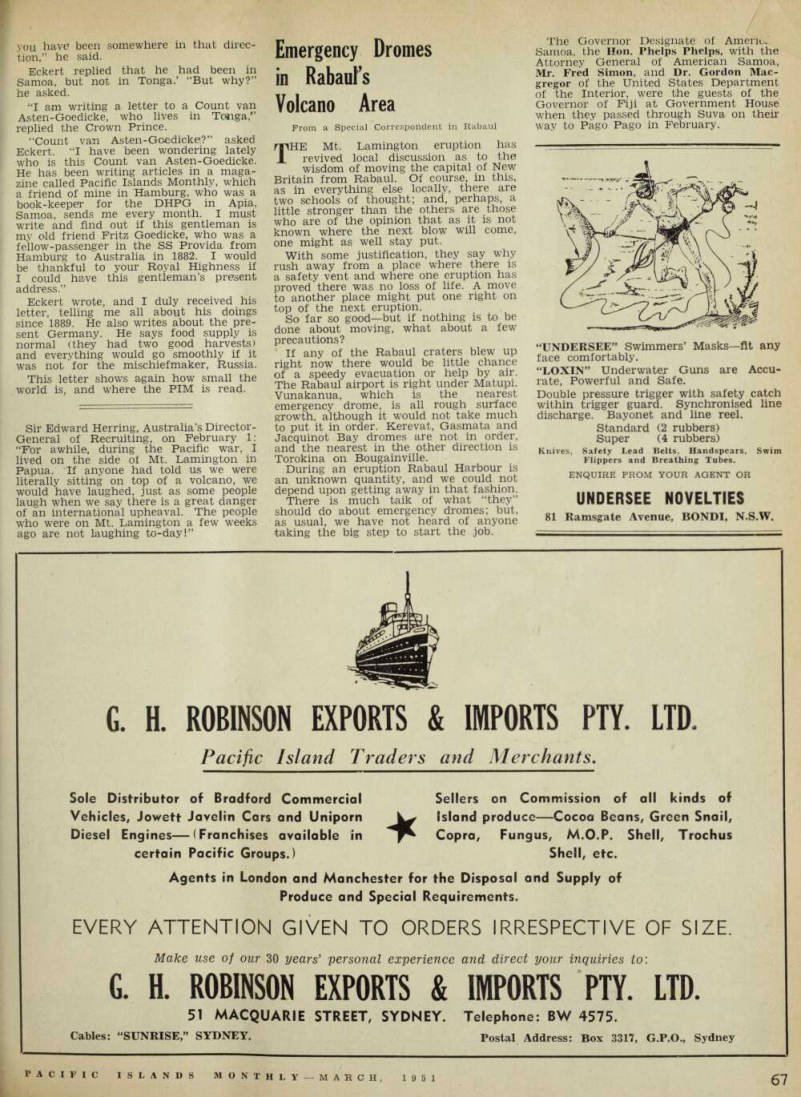
Fiji’s Lack of Low-Price Holiday Resorts
From Our Own Correspondent SUVA, February 2.
THE coral island of Nukulau, Suva’s nearest beach resort, has been popular during the school holidays.
Parents have seized the opportunity of getting their children out of Suva for a week or so during the hot weather; and others, with their own sailing boats and launches, have spent week-ends there.
The Defence Club of Suva had their first picnic on the Island on January 21, and this was attended by members, their wives and children, a total of 250 people: altogether. Refreshments were served for adults and children, and during the after noon races were run for the children.
It is unfortunate that the importance! of Nukulau Island to Suva has been con siderably overlooked. This Island couldi offer an up-to-date tourist resort complete; with tennis courts, nine-hole golf course,, well-furnished cabins, a restaurant and ai dance floor —and a regular launch service: connecting with the mainland.
As it is at present, the buildings are; badly in need of repair and steadily de teriorating. The primitive “conveniences”* built out in the tide, are beginning toe come apart, with planks missing here and! there.
It is understood that at one time plans were made to improve the amenities one this island but these were dropped in favour of more important! development works.
With the high cost of living, overseas holidays for short periods are not within' reach of the average citizen in Fiji. Holi day resorts near to the town are, therefore; essential.
Residents with families cannot afford tc spend their local leave in a hotel at the rate of £1 to £l/5/- a day per person. The hill rest house at Nadarivatu having been closed, this leaves very little in the of holiday resorts to the public, Nukulau Island is used as the Quaran tine Station but with a little organisation! this area could be placed elsewhere, leav ing this little Island free for tourists and) local holiday makers.
The new Conservator of Forests foni Fiji, Mr. J. B. Angus, arrived in the Colony on transfer from Kenya in February.
the Kaiser, and I received the following reply:— “His Majesty the Kaiser has taken great interest in the letter of Mr. Bigelow, of 14.11.30, and sends you his thanks for the nice expression used in your letter of 27.1.34. I am commanded by His Majesty to enclose the photo, which His Majesty has personally autographed.”
In the Crown Prince’s letter there was a picture of Princess Cecilie (the youngest daughter of the Crown Prince) and her betrothed, an officer of the American Occupation Force in Berlin (a very wealthy American from Texas, USA). The wedding was to take place in Sigmarin gen, the home of the Hohenzollerns.
IN November, 1949, I received another surprise—a letter from an old friend of mine. This letter shows how small the world is—and in how many of the world’s places the PIM is read.
Mr. Otto Eckert was a fellow-passenger of mine on board SS Provila, from Ham burg to Australia. We arrived in Port Adelaide on New Year’s Eve, 1882. I stayed in Adelaide while Eckert went to Sydney.
In 1886 I met Eckert in Apia, Samoa, where he was a clerk for the German Consul. In 1889 I met him again in Jaluit, Marshall Islands, where he was secretary to Dr. Hakl, the Governor of the Marshall Islands. Eckert had a six months leave, and was awaiting a chance to get to Germany via USA. He took passage on the “Golden Fleece,” one of A. Crawford & Co.’s San Francisco ves sels, on which I was travelling.
Life on a sailing vessel can be rather monotonous. The library of the Golden Fleece consisted of one book, Alexander Dumas’ “The Count of Monte Cristo.”
Everybody on board read this book and, when we arrived in ’Frisco, in March,
1890, the first thing we saw was a sign on the wharfshed: “Tonight, California Theatre, Alexander Dumas’ Masterpiece, The Count of Monte Cristo.”
Eckert and I spent 10 happy days in ’Frisco. A year later, in 1891, Eckert wrote that he had joined the Colonial Office in Berlin. Forty-five years after wards, in 1936, I learned tha-t he had re signed from the Colonial Office, as he had had enough of Hitler, and that he
was going to live in Sigmaringen with his married brother.
While in Sigmaringen he made the acquaintance of Crown Princess Cecilie (wife of the former Crown Prince Frederick Wilhelm), who came from the same town in Mecklenberg. Eckert be came a frequent visitor to the Castle.
One day, at the Castle, the Crown Prince asked Eckert if he knew a place called Lotofua, Haapai, Tonga. “I believe
you have been somewhere in that direc tion,” he said.
Eckert replied that he had been in Samoa, but not in Tonga.’ “But why?” he asked.
“I am writing a letter to a Count van Asten-Goedicke, who lives in Tonga,*’ replied the Crown Prince.
“Count van Asten-Goedicke?” asked Eckert. “I have been wondering lately who is this Count van Asten-Goedicke.
He has been writing articles in a maga zine called Pacific Islands Monthly, which a friend of mine in Hamburg, who was a book-keeper for the DHPG in Apia, Samoa, sends me every month. I must write and find out if this gentleman is my old friend Fritz Goedicke, who was a fellow-passenger in the SS Provida from Hamburg to Australia in 1882. I would be thankful to your Royal Highness if I could have this gentleman’s present address.”
Eckert wrote, and I duly received his letter, telling me all about his doings since 1889. He also writes about the pre sent Germany. He says food supply is normal (they had two good harvests) and everything would go smoothly if it was not for the mischief maker, Russia.
This letter shows again how small the world is, and where the PIM is read.
Sir Edward Herring, Australia’s Director- General of Recruiting, on February 1: “For awhile, during the Pacific war, I lived on the side of Mt. Lamington in Papua. If anyone had told us we were literally sitting on top of a volcano, we would have laughed, just as some people laugh when we say there is a great danger of an international upheaval. The people who were on Mt. Lamington a few weeks ago are not laughing to-day!”
Advertisements & other items, pp. 66-68 (4 items)
64
MARCH, 1951 PACIFIC ISLANDS MONTH L ir
65
pacific islands Monthly m a r c H, 195 1
Ampuoh
SCRAP IRON SCRAP STEEL SCRAP METALS
PIG IRON PIG LEAD INGOT METALS
Metal Merchants ★ Metal Refiners
Head Office: WILFORD STREET, NEWTOWN, N.S.W.
Phone: LA 5111 (6 lines).
Cable and Telegraphic Address: “SCRAPMETAL,” Sydney.
Works: 2 CANAL ROAD, MASCOT, N.S.W.
Buyers of Non-Ferrous Scrap, Cable, Shells, Cartridges, Copper, Lead, Muntz Metal, Aluminium LARGEST BUYERS OF SCRAP IRON Cr METALS IN AUSTRALIA
AHPUOH
ONE HORSEPOWER
PETROL ENGINES
ELECTRIC
LIGHTING PLANTS
Bring you brilliant electric light in your home, week-ender or plantation.
Low operating and initial costs. Treated for the tropics. * Press button starting. * * 300 watts output. + * 12 and 32 volt models. * Weight 70 lb. hole borers — The Amplion makes the most of your petrol, runs longer on a tankful, 8 to 10 hours to the gallon. It’s light in weight, too—4o lb.
Obviously the best proposition for driving: Pumps—Compressors—Post Lawn mowers—Saws—Shearing Machines— Crutching Machines—Spraying outfits—Concrete Mixers—Concrete Vibrators—Milking Machines.
★ 4 CYCLE AIR COOLED DESIGN
★ FULL FLOAT CARBURETTOR
★ EFFICIENT AIR CLEANER
PRICE:
£4l/8/6 F. 0.8.
Special Islands £77/16/6 F. 0.8.
DISTRIBUTORS THROUGHOUT
AUSTRALIA AND THE ISLANDS
AMPUOH
(Australasia) Pty. Ltd. 36-40 Parramatta Road, Camperdown.
Telegrams; Amplion, Sydney Telephone: LA2828 (6 lines)
TAKE YOUR CHOICE.
, . . From this list of quality canned foods. Packed by the largest meat-processing company in Australia, the Imperial label brings you the Quality meats, right to your table —tasty hot meals and cold meats ready for any occasion. Stock up with Imperial, the Flavour Sealed Quality Foods.
HOT PACKS.
16-oz. Beef Steak Pudding. 16-oz. Steak & Kidney Pudding. 12-oz. Meat & Beans. 16-oz. Sausages & Vegetables. 12-oz. Savourie. 4-oz. Meat and Spaghetti. ★
COLD MEATS.
12-oz. Trim (Pork & Beef). 12-oz. Camp Pie. 12-oz. Meatreat. 12-oz. Corned Beef W/C. 12-oz. Taper Corned Beef 6-lb. Taper Corned Beef W/C. 6-lb. Taper Corned Beef. 4-oz. Hampe. • 4-oz. Beef Snack.
U 31-oz. Pate de Foie.
SAUSAGES.
16-oz. Beef Sausages. 16-oz. Oxford Sausages. 16-oz. Cambridge Sausages. 16-oz. Pork Sausages. 10-oz. Vienna Sausages. ★
SOUPS.
8-oz. Tomato Soup. 8-oz. Clear Beef Soup. ★
TONGUES.
12-oz. Sheep Tongues. 12-oz. Lamb Tongues. 12-oz. Calves Tongues. 6-lb. Ox Tongues. 2-lb. Ox Tongues. m m : “ ' * ' H - ' *5 ,
DRIPPING & LARD.
1-lb. tins Lard. 16-oz. tins Dripping. 36-lb. Dripping. ★
CANNED FISH.
4-oz. Flair Fish Cutlets. 8-oz. Flair Fish Cutlets. 12-oz. Flair Fish Cutlets, lli-oz. Flair Squab in Aspic.
U-oz. Flair Fish Paste. 8-oz. Flair Scallop Luncheon.
SWEET PUDDINGS.
16 oz. Plum Pudding. 12-oz. Jam Pudding. 12-oz. Chocolate Pudding. 12-oz. Ginger Pudding.
MARGARINE.
56-lb. Boxes Cake Margarine. 56-lb. Boxes Pastry Margarine.
RIVERMEDE” BUTTER.
56-lb. Boxes Bulk Butter. 16-oz. Pats Butter. £-lb. Pats Butter. 12-oz. Tins Butter. 16-oz. Tins Butter.
MILDURA FRUIT
JUICES.
16-oz. Grapefruit Juice. 16-oz. Orange Juice.
CANNED FRUITS.
30-oz. Cherries, y 20-oz. Raspberries. \ 20-oz. Gooseberries. \ 20-oz. Loganberries. \
RIVERSTONE MEAT CO. PTY. LTD.
y : : “f - : : ■ ?
(TCONNEI I. STREET. SYDNEY.
66
MARCH, 1951 PACIFIC ISLANDS MONT HI
Emergency Dromes
in Rabaul’s Volcano Area
From a Special Correspondent in Rabaul THE Mt. Lamington eruption has revived local discussion as to the wisdom of moving the capital of New Britain from Rabaul. Of course, in this, as in everything else locally, there are two schools of thought; and, perhaps, a little stronger than the others are those who are of the opinion that as it is not known where the next blow will come, one might as well stay put.
With some justification, they say why rush away from a place where there is a safety vent and where one eruption has proved there was no loss of life. A move to another place might put one right on top of the next eruption.
So far so good—but if nothing is to be done about moving, what about a few
precautions?
If any of the Rabaul craters blew up right now there would be little chance of a speedy evacuation or help by air.
The Rabaul airport is right under Matupi.
Vunakanua, which is the nearest emergency drome, is all rough surface growth, although it would not take much to put it in order. Kerevat, Gasmata and Jacquinot Bay dromes are not in order, and the nearest in the other direction is Torokina on Bougainville.
During an eruption Rabaul Harbour is an unknown quantity, and we could not depend upon getting away in that fashion.
There is much taik of what “they” should do about emergency dromes; but, as usual, we have not heard of anyone taking the big step to start the job.
The Governor Designate of America Samoa, the Hon. Phelps Phelps, with the Attorney General of American Samoa, Mr. Fred Simon, and Dr. Gordon Mac gregor of the United States Department of the Interior, were the guests of the Governor of Fiji at Government House when they passed through Suva on their way to Pago Pago in February.
Advertisements & other items, p. 69 (1 item)
G. H. Robinson Exports & Imports Pty. Ltd
4- \ —^£r;
VVJ
“UNDERSEE” Swimmers’ Masks—fit any face comfortably.
“LOXIN” Underwater Guns are Accurate, Powerful and Safe.
Double pressure trigger with safety catch within trigger guard. Synchronised line discharge. Bayonet and line reel.
Standard (2 rubbers) Super (4 rubbers) Knives, Safety Lead Belts, Handspcars, Swim Flippers and Breathing Tubes.
ENQUIRE FROM YOUR AGENT OR
UNDERSEE NOVELTIES
81 Ramsgate Avenue, BONDI, N.S.W.
G. H. ROBINSON EXPORTS & IMPORTS PTY. LTD
Pacific Island Traders and Merchants.
Sole Distributor of Bradford Commercial Vehicles, Jowett Javelin Cars and Uniporn Diesel Engines—(Franchises available in certain Pacific Groups.) Sellers on Commission of all kinds of Island produce—Cocoa Beans, Green Snail, Copra, Fungus, M.O.P. Shell, Trochus Shell, etc.
Agents in London and Manchester for the Disposal and Supply of Produce and Special Requirements.
EVERY ATTENTION GIVEN TO ORDERS IRRESPECTIVE OF SIZE.
Make use of our 30 years' personal experience and direct your inquiries to: G. H. ROBINSON EXPORTS & IMPORTS PTY. LTD. 51 MACQUARIE STREET, SYDNEY. Telephone: BW 4575.
Postal Address: Box 3317, G.P.0., Sydney
Cables: “SUNRISE,” SYDNEY.
Downpour Damages Houses
At Lautoka
From Our Own Correspondent
Suva. Feb. 2.
THE so-called Garden City of Lautoka was flooded, when torrential rains poured down at midnight on January 23.
Within a short time the sleeping
residents woke to find water entering their dwellings and street gutters and drains flooded. Water poured into buildings, damaging household property and store goods.
The main roads of Naviti Street and Vitogo Parade became rivers, and Nede Street had four feet of water flowing down it; all road metal was washed away.
It is estimated that at least £l,OOO worth of damage was done to streets and buildings.
“Soka” Is Now The
Game In Niue
Prom a Special Correspondent
Niue, Jan. 31.
rnHE London Missionary Society has in- X troduced Soccer to the Island of Niue. The lads of the Boy’s Brigade have taken to the game in a big way, and, although essentially a cool weather sport, the keenness is so great that the boys play even in December and January, when the heat is intense.
One could hardly say that the rules of the game are strictly adhered to.
Despite this fact, the teams after one season are showing considerable ability, and in a year or two will provide strong opposition to teams from visiting war ships. The crowd too, is becoming “Soka”-minded and a neat piece of head ing or a hefty kick downfield brings its applause from the appropriate section of the crowd.
One habit which is dying rather hard, is the tendency of the teams playing to give themselves a hearty clap whenever one of their side scores a goal. They vent their joy on such occasions with a series of “Niuean Yells.”
The Mission hopes that through the agency of this sport, so suitable to Niue’s rocky terrain, will come the means of teaching the youth of the island the elements of sportsmanship.
This winter, organised matches will be played between 10 of the villages for a shield made and presented by two Ministry of Works officials who are taking an interest in the games.
Arrangements are now under way to introduce basketball as a recreation for the girls of the island.
Advertisements & other items, p. 70 (1 item)
United Island Traders Ltd.
Serving the Needs of the Cook Islands , , .
(Established 1930)
P.O. BOX 42, RAROTONGA, COOK ISLANDS.
Managing Director: W. H. Watson.
IMPORTERS OF:-
Cotton & Silk Piece Goods Apparel & Drapery Building Materials Musical Instruments Trade Jewellery Secretary: R. J. A. Ingram. A.R.A., N.Z.
EXPORTERS OF:-
Tomatoes & Cassava Tropical Fruits Sea-shells & Necklaces Island Handicrafts "Broad-last" Footwear STAMP DEALERS & SUPPLIERS OF ISLAND PHOTOS
INQUIRIES INVITED.
Cables: Bankers: “Watson,” Rarotonga. National Bank of New Zealand, Auckland.
U.K. Agents: Geo. H. Penney & Co. Ltd., 197 Aldersgate St., London, E.C.I.
i N— > M 3
SOAP
for that weekly issue!
OZ. CAKES OF PLAIN SOAP
PACKED READY FOR
ISSUE IN CASES
CONTAINING 400 CAKES
A G. W. PENNELL PRODUCT
obtainable from:
COLYER WATSON PTY. LTD.
22 BRIDGE ST.
SYDNEY
Port Moresby

February News From
From Our Own Correspondent
Port Moresby, Feb. 10.
For reasons of space this material was held over from our last issue.
Reconditioned Bailey bridge steel from Britain will be used for the new bridge over the Markham River, above Lae. About 500 tons of this material has reached Sydney, from Britain, for the 1,730 foot bridge, and smaller quantities will be shipped to Lae from Bougainville. Tenders for con struction of the bridge may be called by the middle of this year.
TIMBER from the privately-owned mill at Angoram on the Sepik River, and a new sawmill near Wewak are helping to solve the shortage of building materials in that part of New Guinea.
A number of new houses have been built from local timber at Wewak, and Angoram which had no buildings at all at the end of the war, is now an attractive station with some of the best permanent homes in the Territory.
Across at Goroka, Mr. Jimmy Leahy has started a new sawmill which will be a valuable asset to the district. Up to now, practically all timber has had to be air-freighted from Bulolo and Lae.
That makes even Australian building costs look reasonable.
PORT MORESBY residents no longer walk in darkness for now their evening strolls can be taken under the glow of about 70 street lights. Soon there will be a real glitter over the big town for another 70 are due to go in as soon as the linesmen can get on to the job. Then comes the crowning glory, suspension lights along Ela Beach.
REMEMBER the old days when the hangman’s noose was around the Treasury money bags, and a million men or more waited for a job? Now the Civil Aviation Department has got the okay on a £1,000,000 expenditure in the Territory, and is having a hard job to spend it for lack of men and materials.
This is holding up construction on big new airports and improvements to exist ing aerodromes. There is also high frequency radio equipment, radar and communications gear to be installed, plus erection of D.C.A. houses and airport buildings. The vital importance of air services and facilities was thoroughly demonstrated in the Lamington rescue work. The tragedy would have been even greater without the prompt relief and re organisation made possible by air trans port of nersonnel, medical supplies and food.
BEACONS are being installed along the south coast of Papua by the Com monwealth Lighthouse Services vessel Wallach. The work is being directed by Mr. Douglas, senior Engineer of the Lighthouse Services, who expects to be in the Territory on this job for about 12 weeks.
DURING the recent scholastic year the Sogeri and Kerevat Education Centres had a record number of trainees complete the two-year teachers’ training course; 35 did their course at Kerevat and 20 at Sogeri. They have now taken up duty at Administration schools throughout the Territory. Meanwhile 60 new students have started at Sogeri, and after the holidays another 120 resume course at the Central School or in the teacher training section.
JUST over 100 secondary education grants have been made to Territory parents whose children are attending schools in Australia. The subsidy for each child is £125, with one return air passage to Sydney or ports to the north.
The qualifications were completion of Grade six or an equivalent standard.
Most of the students are from 12 to 17 years.
This secondary education bonus, so far, is for one year only, and was announced by the Administrator, Colonel Murray, some time ago when informing the public
that the proposed Wau High School could not be built on the original plan which set February, 1951 as the opening date, v , OORT MORESBY residents have been I enjoying an uninterrupted supply of electricity for some weeks now, and a big new 720 HP generator from Britain is being installed. This should be in use by the end of March.
Prospects are bright for the future as some time in *he next few months, alter nators are due for another two new generators already at Port Moresby. Then
there is the big hydro-electric scheme which will utilise water from the Laloki River just below Rouna Falls. Tenders will soon be called for the turbine, gene rating equipment and driving and switch gear, and orders have already been placed for the transmission line steel work. The Works and Housina Depart ment’s executive engineer from Melbourne, Mr. C. C. Rosenthal, was in Port Moresby during January discussing the scheme with Territory engineers. This scheme is a £200,000 job and it will probably take two or three years to complete. But with the local power supply backed by three new generators the time factor looms much less important now that when evenings were measured by the number of local blackouts.
This long-range planning will put Port Moresby in a position to handle new industries for the initial output of the hydro-electric scheme will be 3,000 kilo watts, as against the present peak con sumption of 600. And the project is be ing designed for enlargement to a final output of from 4,000 to 5,000 kilowatts.
ANOTHER bright star on the Moresby horizon is the prospect of a local brewery. A Territory syndicate now in process of being formed into a com pany to be known as the South Pacific Brewery Limited, has been granted a brewery licence, and machinery is on the way from Germany, A German brewer will also be brought from Europe, and if he can successfully turn Laloki River water into good beer he’s going to be a boon to local thirsty souls.
Mr. Joe Bourke of Wau, who is one of the big men in the new company, expects that Moresby beer will sell at about half the present retail price of imported beer.
Advertisements & other items, pp. 71-72 (2 items)
Conw
mi WCHrt A.P.C
fe W,TH
I m /ml/
BANISH
:ll
(PINK)
ILL
// t
POWDERS
& TABLETS!
Vincent's original hospital formula is available in either powders or tablets. Two tablets equal one powder in dosage.
Proved Safest & Best For Over 30 Years!
The medical profession and public have had confidence in Vincent's a.p.c for over 30 years! Vincent's continued success is founded on Vincent's prescription! This formula is your safeguard!
Quick Relief From
Headache
Neuritis, Neuralgia
Vincent’s a.p.c is the only a.p.c prepared to the original hospital prescription! From the very first dose you will get safe, sure, relief from Headache and all nerve and muscular pain! You will feel better and brighter in a few minutes!
SWIFT 3-WAY RELIEF!
1. Relieves the pain! 2. Reduces temperature! 3. Stimulates the nervous system!
SAFE! SPEEDY! RELIABLE!
£ C NT
foTJEILIU
m Aladdin lights tie way ti letter I'm Good lighting and convenient cooking contribute much to comforts living, and Aladdin lamps and cooking appliances have been famous more than a century. Burning ordinary lighting kerosene, Aladdin produ provide the comfort and convenience of gas or electricity. They unequalled in efficiency and ease of operation.
The world’s most wonderful lamp”
Aladdin light is the closest of all to natural daylight, and these non-pressure lamps give a steady white light of 75 candle-power. There is no smoke or fumes, no pumping. They light at the touch of a match! Burning 94% air and only 6% kerosene, these modern lamps are extremely economical in use, and safe and easy to use.
MODEL
1680
MODEL
1671
MODEL
1620
MODEL
1630
WALL
BRACKET
k
STORMPROOF LANTERN
The Aladdin Pressure Kerosene Stormproof Lantern gives 300 candle-power of brilliant light—in any kind of weather. Ruggedly built, it will stand up to many years of hard use. * r~
TWO-BURNER PORTABLE STOVE
Compact, efficient pressure-kerosene stove has adjustable self-pricking burners. Available with metal carrying case for outdoor cooking.
ELEVATED RANGE
Modern, porcelain-finished pressurekerosene range has all the advantages gas or electric stoves. Five selfpricking burners are adjustable to any heat, and insulated oven cooks perfectly. Simple and economical to operate.
ENGLISH 81-ALADDIN
Sturdy all-weather pressure-lant made by the English associate-hoc of Aladdin. Gives a bright, ste« 200 candle-power light. Sturdily mi for outdoor use. n
HEATER-COOKER
Cooks and heats! Pressure-keros* one-burner cooker can be conven into an efficient radiator. Heatt adjustable, operation simple.
5-BURNER RANGE
Compact, modern range has 4 adjustable, self-pricking burners * is attractively finished in porceUl Heat is adjustable from "simmn to "boil" and insulated oven coc perfectly. Pressure-kerosene operate is simple and economical.
Obtainable through your Australian Buying House or Local Storekeeper.
Manufacturers: Alladin Industries Pty. Ltd., Bourke St.. Waterloo. N.S.W.
70
MARCH, 1951 PACIFIC ISLANDS MONTT
News From Port Vila
From Our Own Correspondent
Vila, Feb. 20.
THIS month saw the departure for Aus tralia on leave of a number of local residents.
Heading the list was British Resident Commissioner, Mr. H. Flaxman who flew to Sydney and thence to Melbourne to witness the fifth and final test match.
He goes to New Zealand for the remainder of his three months’ leave. During his absence, Mr. B. Blackwell is acting R.C.
Others departing include Mr. L. Bair stow, merchandise manager of Burns Philp’s Vila store, Mr. and Mrs. W. Reid and Mr. W. Buffet, also from B.P.’s. Mr.
Buffet’s trip down was unplanned and for urgent medical treatment.
The month also marked the return to Vila of residents who had been away for varying periods of leave.
Formerly in the Condominium Public Works, Mr. W. Young returns as Collector of Customs. He was accompanied by his wife and two infant daughters. Mr. H.
Richards returned to take over the job of postmaster, a position vacant for some time. Mr. W. Roberts of the South Pacific Air Transport Council stationed in Vila
returned to take over from the relieving officer, Mr. R. Rankin, who has since re turned to Sydney.
Formerly a teacher at the British school, Miss B. Lancon sailed from Vila on the M.V. Lautoka, She plans to study vetinerary science in Melbourne.
The engagement was recently announced of Miss Billie Love of Vila to Mr. Richard Kerr of Tongoa. Miss Love is the daughter of Mr. L. Love, chief radio operator of Vila’s tele-radio station, and of Mrs. Love. To celebrate the occasion, Mr. and Mrs. Love entertained a large number of friends at a cocktail party at their home.
Fire recently completely destroyed the Vila residence of Acting-Commandant of British Police, Mr. D. Freegard and Mrs.
Freegard.
Cause of the fife is uncertain, but it is thought that electrical wiring in the celling may have- shorted and ignited grass and other rubbish stored there by rats.
Mr. and Mrs. Freegard were home at the time. The fire gained such a hold that they had no time to salvage any thing. With their children they watched, from a neighbour’s verandah while all their possessions were consumed.
Advertisements & other items, p. 73 (1 item)
CLSisDlfllil Pty. Ltd.
Allen Taylor & Co. Ltd.
COMMERCIAL ROAD, ROZELLE, SYDNEY
Sawmillers and Wholesale Suppliers of Hardwoods for Contructional Purposes GIRDERS . . . PILES . . . POLES . . . SLEEPERS, Etc.
Exporting to the Pacific Islands Since 1893.
CLSisDlfllil Pty. Ltd.
V.
HEAD OFFICE:
379 KENT STREET, SYDNEY, N.S.W.
Telegrams and Cables: “CHASULL,” SYDNEY. Telephone: MJ 4657.
And at Melbourne, Victoria Brisbane, Queensland.
Associated Companies: C. SULLIVAN (PACIFIC ISLANDS) LTD., Suva, Fiji.
C. SULLIVAN INC., 230 California Street, San Francisco, U.S.A.
Over 30 Years' Pacific Island Experience Expert Buying Service Original Invoices Furnished Overseas Indents Arranged Best Prices for Copra, Cocoa, Shells, and General Island Produce.
Bsi England-Australia Test
Matches
From Our Own Correspondent
Honiara, Feb. 20.
A SERIES of cricket matches between former residents of Australia or England began with a local “Test Match” in January when England won by 132 runs to 100 in a very exciting game, the 232 runs being scored in three hours’ play.
The matches are held on Sunday after noons on the Police ground at Rove, about a mile from the main Honiara settlement.
The English team in the first game was captained by J. R. Wrightson and the Australian team by K. J. Angel of Sydney.
The “Second Test” played early in February, resulted in a win for Australia.
The Rove ground which is green turf with wooded hills in the background, is an attractive setting and the matches are well attended by European residents.
Movie Theatres for New Britain Natives
New Britain Natives
From a Special Correspondent in Raltaul SOMETHING new for the Rabaui! district is the establishment by New, Britain Entertainments of movie theatres for the natives of Matupi, Pilai Pila, and Nunga Nunga. Rabaul natives have always been picture patrons—but! usually by attendance at the local movie house on a special “Boys’ Night,” when films suitable for natives have been screened.
This is the first time that anyone has attempted to take the movies to the natives. The enterprise should do well.
Of course, the enterprise has not escaped without some local talk-talk.
Some of the locals have wondered if it is a “good thing” to bring natives together in such a way—for fear someone gets among them with a bit of Communist propaganda.
The natives already have dozens of ways of getting together, with or without propaganda, and visits to their local picture show are not likely to do much additional harm.
Mr. A. L. B. Drew, an assistant mechanic in the Posts and Telegraphs Department, has gone to the United King dom on study leave. He will take a three months’ course in automatic telephone practice and maintenance with the General Electric Company which is build ing the new automatic telephone exchange for Suva. He will spend the remainder of his leave in the General Post Office: London, where he will study the practice and working of telephone systems.
Advertisements & other items, p. 74 (2 items)
Alois Akun & Company
Telephone 136. Telegrams: “AKUN,” RABAUL.
RABAUL, TERRITORY OF PAPUA-NEW GUINEA
Also at 180 NATHAN ROAD, KOWLOON, HONG KONG.
Planters and General Merchants
(1) Embroidered Silkware.
Camphor-wood Boxes.
Fancy Goods. (2) The Best of Beers, in different Brands “San Miguel,” “Red Horse” and “Three Horse.” (3) Cotton Piece Goods suitable for trade and issues. (4) Trade goods of all descriptions: Wholesale and Retail.
WE CARRY STOCKS OF;—
Carved Eastern Prompt attention to all orders Sydney Representatives: NELSON & ROBERTSON PTY., LTD., Electra House, 12 Spring Street, Sydney, N.S.W.
of rm ifLAf€>
. ■ ‘ , iii * 1 1 i * ■ «**■ n m ■s m am t>mm Preserve it, in all its enchantment, with a paint fortified for tropical weather resistance, for a rich color permanency and for a mellow, even weathering.
In ihe Tropics
USE ONLY
HIGH
BORTHWICKS
DJ
GRADE
REINFORCED
HOUSE PAINT
MORRIS HEDSTROM (AUST.) PTY. ITD. AGENTS FOR
BORTHWICKS PTY. CO.
SYDNEY.
Samoa’S Banana Industry
In Doldrums
From Our Own Correspondent APIA, February 21.
WHEN, in 1928, Western Samoa began to export bananas to New Zealand, it was firmly predicted that the new industry would be the mainstay of Samoa’s economy and would be very considerably expanded. A special banana carrier was purchased to cater for the trade and with ample transport available, well over 200,000 cases per year were for warded to New Zealand.
Revenue from the new industry was of great help to growers, during the long years when cocoa and copra prices were low, and even during the war years re gular banana shipments to New Zealand did not cease. Rigid inspection of the fruit in Samoa assured buyers in New Zealand of a uniform high quality and Samoan bananas had a good reputation on the New Zealand market.
During the post-war years, however, the situation has gradually changed. For a time it seemed as if the development of the new dried-banana (banana figs) in dustry by the New Zealand Reparation Estates and private enterprise would give an impetus to the banana industry, but after several years of flourishing existence, the dried-banana industry gradually faded out, the demand ceased altogether and the money invested in banana driers was lost.
Then the Maui Pomare was withdrawn from the Samoan run and put on the Cook Islands and Niue run and Samoa became entirely dependent on the limited space allocations of the Union Co’s Matua for banana exports. The Government had encouraged growers to extend their plan tations, as the New Zealand market seemed to absorb any quantity of Samoan bananas, but transport difficulties in creased from year to year and growers who could obtain only a portion of the space required for their crop, and saw their labour wasted, grew tired of con tinuous disappointment and turned to cocoa and coconuts, encouraged by the high prices ruling for these products.
Only recently statements were made that New Zealand would be able to take all the bananas Western Samoa could pro duce. Such promises are valueless to the growers if they are not accompanied by a guarantee of fixed monthly allocations of space for a sufficient number of cases.
Failing this guarantee, it can safely be predicted that the banana industry is bound to fade out completely.
The determined efforts of the Fiji Gov ernment to increase banana production to some 400,000 cases per year is bound to increase competition in the New Zealand market. It has been suggested that the private company which has taken over the former Government monopoly for the import of islands fruit into New Zealand, has invested capital in the Fiji banana in dustry and is, therefore, not interested in Samoan bananas. Whether this is true or not, it remains a fact that New Zea land has a greater responsibility to safe guard the interests of her Samoan Trus teeship Territory than to give preference to Fiji bananas. (EDITORIAL NOTE: The growing of Fiji bananas is in the hands of native Fijians. The projected increase in Fiji banana production has been organised and fostered by the Fiji Department of Agri culture without any guarantee from the NZ Government. Matua, which carries Samoan bananas, is also the only vessel regularly carrying bananas from Suva to NZ. it seems unlikely that the new NZ : fruit importing company has any interest, financial or otherwise, in Fiji banana growing other than the natural desire to
supply customers in NZ with bananas which have been extremely scarce for the last 10 years. The Fiji Department of Agri culture’s banana boosting policy has, no doubt, been based on the expectation that the USS Go’s new ship, Tagua, will be on the Islands’ run next year. There seems no reason why Samoan banana growers should not similarly plan ahead.) Mr. O’Rourke, a New Zealand police officer, has taken over as Chief of Police, Niue, from Constable J. Flynn, who re turned to NZ.
According to Mr. William Schleusner, a planter in the Popendetta district, Papua, who arrived in Brisbane on February 2, plantations near Higatura will eventually be worked again. His own plantation had at first appeared ruined, but he thought that it would recover within a few years.
Miss Joan Read, well-known radio personality of Sydney, was married on February 24 to Mr. Don Watson, of Fiji.
Advertisements & other items, pp. 75-76 (1 item)
Robert Gillespie Pit It?
K. H. D. HAY
GENERAL COMMISSION
AND POSTAGE STAMP
AGENT,
GUADALCANAL 8.5.1.
SETS OF BRITISH SOLOMON
ISLANDS STAMPS, MINT OR
CANCELLED COPIES.
Price: £l/5/- per set.
FOR
jf 4* A 0
VERANDAHS
SUNROOMS
LOUNGE-ROOMS
KITCHENS
LAUNDRIES
This ultra modern window comprises a series of glass blades swung one above the other and inclinable to any angle.
Air entering the room is diverted towards the ceiling, thus preventing draughts. AGCO Supaluvres have all the advantages of other louvre windows plus exclusive features.
HOW THEY WORK:—
1. Handle automatically locks louvres in closed position. 2. Pawl holds louvres locked open in four positions. 3. Pinion engages driving rack to revolve louvres. 4. Patent “Rainguard” stops rain entering between glass holders and channel.
Full light and air with yearround weather protection.
ROBERT GILLESPIE PIT IT?
54* PITT ST., SYDNEY - PHONES-8W4782- Bl 305
There is only one
ELECTROLUX
THE MODERN KEROSENE-OPERATED REFRIGERATOR
THAT ACHIEVES THE MIRACLE OF ICE FROM HEAT
Lasting Efficiency, Silent Operation, Streamlined Beauty
■ Economically operated by kerosene, with a simple precision-built freezing unit that has no moving parts and is GUARANTEED FOR
FIVE (5) YEARS.
Only obtainable from :
NEW GUINEA COMPANY, LIMITED,
Rabaul, Madang, Lae, Kavieng.
J. R. CLAY & CO., LTD., Port Moresby.
W. R. CARPENTER & CO. (Sol. Is.), LTD., Tulagi.
THE NORFOLK ISLAND SERVICE DEPOT,
Norfolk Island.
SOCIETE HEBRIDA, Port Vila.
SOCIETE CALEDONIENNE DTMPORTATION ET
D’EXPORTATION, Noumea.
For Gilbert and Ellice Islands Colony, etc., apply Model LKSSI
PRICES ON APPLICATION.
Storage capacity: 5i cub. ft. (approx.); shelf area, 10 sq. ft. Food shelves, six—five removable; 2 self-supporting when half drawn. Ice-making: Four trays—s lb. ice per freezing: 80 cubes. Fuel consumption: 1.8 pints kerosene per day (approx.).
Height: 4 ft. 10 in. Depth: 2 ft. 3i in.
Weight, unpacked, 406 lb. Packed, 574 lb. direct to: W. R. CARPENTER fir CO., LTD. Head Office: 16 O'Connell St., Sydney, N. S. Wales
Leeches Won’t Like
This Boot Polish Repellant for Jungle Pest
LATEST overseas research shows that the leech, minor pest of the tropical bush, can be repelled, just as can the mosquito and the bush moka, and in almost the same way.
These frantic creatures look like bike tyre valves, come out in thousands on jungle tracks, attach themselves to damp footwear, and loop their way around until they find a suitable patch of bare flesh, where they attach themselves by a sucker.
Usually they go unnoticed until they have had their fill and drop off, leaving a tiny, freely-bleeding puncture behind' them. Of themselves, they do little harm, but they are repulsive little beasts, and, in the tropics, the small hole they leave can easily become infected and turn into a serious tropical ulcer.
When they attach themselves they in ject a substance that prevents blood clotting, and it is not unusual to reach the end of a day’s walk through the South-west Pacific Islands bush to find yourself with what seems to be half a boot full of blood. They are happy inside a boot, sometimes achieving their purpose by getting in through an eyelet-hole, but if they cannot find any territory to their liking, between sox and shorts, they will crawl even higher—sometimes with start ling, if not embarrassing, results. If dis covered they can be persuaded to release their grip by sprinkling them with salt or burning them with a lighted match.
Anti-leech research is a branch of the science that gave the Pacific forces in the last war the insect-repellant that helped
them to avoid scrub typhus (carried by tiny bush ticks or “mokas”) and malaria (carried by mosquitoes). The clear mos quito-repellant which clouds plastic or unbreakable watchglasses, but does no harm to human skin is well-known now —most civilians have invested in a few tins. ex-Disposals—and rubbed on exposed skin usually keeps the insect pests at bay for an hour or two. The first repeilant was dimethyl phthalate, later a variant, dibutyl phthalate, was found more effec tive.
More recently a British doctor in Cey lon found that when he made a boot polish of oil and wax with dimethyl phthalate added, he could walk through the leech-infested jungles of Ceylon and not a leech came near him. If it is dimethyl phthalate that does the trick, no doubt many residents of the South-west Pacific have already found it out. Those who have not may like to try it.
Why these compounds repel insects and/or leeches has never been explained.
According to some users the repeilant smells “like squashed mosquitoes.” It certainly has little resemblance to the essences of M. Chanel, although most people prefer it to insect stings and their consequences. In the insect world, how ever, it must be a very big stench indeed.
P-Ng Pearl Shell Expedition
AN attempt to find pearl-shell groundvS in Papua-New Guinea waters, believed to have been fished by the Japanese pre-war will be made soon by Torres Strait pearl-sheller John Nolan.
Nolan expected to take the Crystal Star to P-NG from Townsville late in February.
The vessel, which has just completed two successful seasons working from Thurs day Island, is diesel-powered, 65 ft. long and fitted out with latest diving gear and plant.
It is intended to survev the coast of P-NG from east to west and, although details have been gathered regarding the posible location of shell beds, it is hoped that local people will be able to assist with more accurate information.
The members of the crew are Captain Rae Fisk, Chief Engineer Joseph Schinkel, George Minns as Mate, and Sebasio Wallis and John Anderson. Nolan, the owner, will act as diver.
Some native seamen will be recruited in the Territory and if the survey is successful, natives will be trained as divers and divers’ tenders.
Mr. w. V. Banting, Accountant-General, Fiji, has been appointed Deputy Accoun tant-General, Northern Rhodesia.
Advertisements & other items, p. 77 (1 item)
Chula Machinery
OUR HANDS MAKE GOOD ARMS
For your Fishing and Shooting Wants Consult Us.
Lithgow .22 Cal. Repeating Rifles .. £l3 3 0 ) Post Lithgow .22 Cal. Single Shot .. .. £6 12 6 \ Extra.
SI L R OH U 143 ELIZABETH STREET, SYDNEY.
Chula Machinery
for the
Coconut Grower...
★ COPRA DRYERS
Capacities 1,000 to 10,000 nuts per day
★ DESICCATED COCONUT DRYERS
Producing 1,500 lbs. of desiccated coconut per day also Parers , Disintegrators and Sifters.
Write direct to manufacturers or to nearest agent for fully-illustrated literature and further information.
TYNESIDE FOUNDRY ENGINEERING
Company Limited.
Established 1898.
ELSWICK, NEWCASTLE UPON TYNE, ENGLAND.
Telegrams & Cables; FOUNDRY. NEWCASTLE-ON-TYNE Codes : “Chula Coconut Processing Machines provide: • The Answer to the Labour Shortage Problem. • Greater Efficiency at Reduced Cost. • Bigger Output of Higher Grade Produce.
l nch '^'ands
Pacific:
F'Ji: ’ P *Pee fe , r ah/t , orril H edstrn
Undated Jf’^
Coly er W a f °" y °f <- . 22, B ridqe *° n p ty. Ltd :
Bra^ at T[ a
Papua M abau ' an d t B N f W T Guinea■ * aV,en S- PUa ' Ne -
Mr. Dulles Visits W. Samoa
PRESIDENT Truman's special envoy, Mr. John Foster Dulles, paid a sur prise visit to Western Samoa on February 21. Mr. Dulles was on his way back to Washington after Japanese peace treaty discussions in Japan, Philippines, Australia and New Zealand. He had been invited by NZ Minister for External Affairs, Mr. F. Doidge, to look in on Western Samoa to see how NZ-Samoan co-operation was working, and when
actually in flight in his special Constella tion decided to do so.
'He, with Mrs. Dulles and an official party, arrived at 8 a.m., were met by the Acting Administrator of Western Samoa, Mr. J. B. Wright, (Mr. Fowles is at Lake Success) and representatives of the Samoan people. A Kava ceremony was held in his honour and later the party was entertained by the pupils of local schools and at lunch at the Casino Hotel.
In the afternoon they left for Honolulu.
W. Samoan Assembly
Elegtions In April
From Our Own Correspondent
Apia, Feb. 21.
ELECTION of members for the Legis lative Assembly of Western Samoa will take place end of April 1951 and new electoral lists are now being prepared and will be published beginning of March.
The last electoral roll, in 1948, con tained a total of 1,014 names of Europeans eligible to vote. Every European over 21 years of age, man or woman, who has resided at least one full year in the Territory can vote for five European candidates. Of the 1,000 Europeans entitled to vote in 1948, 600 were men and 400 women; there were 150 full-Europeans on the roll, the rest being local-born Euro peans of mixed descent. It is expected that the new roll will contain nearly 1,500 names, as Chinese residents have, since the last election, been granted full resi dential rights and “European” status.
Of the present five European elected members only two, Mr. E. F. Paul and Mr. J. Helg, are expected to stand for re election. A number of new candidates have been mentioned but their names will be known only after the nominations close. While the 1948 election was fought more or less on party lines, as a contest between the Citizens’ Progressive Party and the Labour Party, the new candidates are standing as individuals; 11 candidates contested the 1948 election.
It is expected that most of the 12 Samoan candidates will be newcomers to the Assembly. The Samoan members of the Assembly are to be chosen by ballot of the Fono of Faipule, the Samoan Parliament of 41 members. Samoan members of the present Assembly were chosen on request of the Fono of Faipule by the Hon. Fautua, Tamasese, Malietoa and Mataafa (since deceased).
Advertisements & other items, p. 78 (2 items)
Broompields Ltd.
Suppliers of
Building Hardware
General Hardware
Ship Chandlery
Paint Materials
WRITE DIRECT TO
Broomfields Ltd.
152 SUSSEX STREET, SYDNEY
Sole Agents for: P. H. MUNTZ & CO.’s 3-CROWN BRAND METAL
SHEATHING.
PEACOCK & BUCHANS’ ENGLISH READY-
MIXED PAINTS.
\V*e (Uu
tSk 10% 09 O'?
OH
&t*ccrnt^i4t/iy€i&le
Gordon's
Stands Supk&tHJL
By Appointment Gin Distillers to H.M. King George VI Tanqneray, Gordon & Co. Lid.
Pastures In N. Guinea’S
Central Highlands
What Are The Value of The Indigenous Grasses?
IN the highlands of Central New Guinea there are thousands of square miles of cool, pleasant, fertile grasslands, which may yet be regarded as suitable for the raising of stock, especially cattle.
Many people now are seeking informa tion about the pastoral possibilities of these great valley systems. A question frequently asked is: “Is it possible to raise cattle on the indigenous grasses of the New Guinea Highlands? Or must these areas be planted with introduced grasses before suitable pastures for stock can be provided?”
There is some answer to these questions in an address given at a conference in India last year by Mr. W. Granger, B.VJSc., chief of the Animal Industry Division of the Papua-New Guinea Department of Agriculture. The following are extracts: — The extensive grasslands of the Terri tory apparently are artificial products of the native method of hunting, which in volves burning whenever there is a dry season.
In lowland areas, and on the lower slopes, the dominant association of these grasslands is a mixture containing Im perata cylindrica (the grass known in Malaya as “Lalang,” in the Philippines as “Cogon,” and in New Guinea as “Kunai” or “Kurra-Kurra”), Coelorrachis rotboel lioides) and Saccharum spontaneum —the dominance of any one of the three vary ing with local environment variations.
Though palatable immediately after cutting and burning, this type of sward is a very fibrous and poor feed. On light sandy soils and well-drained slope areas, Themeda australis dominates, and pro vides open-range type grazing; but such a sward has a low carrying capacity and poor resistance to intensive use.
On level land at 5,000 feet altitude, and above, Themeda gigantea dominates. This is fibrous and of poor value. With judiciously controlled burning and some preliminary weeding, a palatable and nutritious sward of native fine grasses, principally Poa spp., Sorghum nitidum, and Apluda mutica can be induced. These grasses are very sparse in the original sward.
In country with rainfall above 100 inches, and a ooorly marked dry season, clearing gives a sward of soft grasses in which Paspalum spp. (particularly P. conjugatum) predominate. Although this sward gives a fine bulk of palatable green feed, it is nutritionally inadequate without a legume or cereal supplement.
A number of useful legumes which have been introduced as plantation cover crops are available to introduce to this type of sward, notably Pueraria spp., and Centro sema spp. Valuable introduced grasses thrive under these conditions—for ex ample, Para grass (Brachiarya mutica), which is outstanding, Paspalum scrobi culatum, Axonopus compressus, and Digi taria spp. .Among cultivated fodders for these con ditions Pigeon Pea or Dahl (Cajanus indicus) grain and Sweet Sorghums, Sugar Cane, Cowpea (Vigna catjang), and Peanuts (Arachis hypogea) are outstand ing. Maize tends to be subject to excessive insect damage.
Supplementary feeding and foraging root and vine crops such as Sweet Potato (Ipofoea batatas), Tapioca (Manihot esculenta) , pumpkins and melons (Cucur
bitaceae), Mauritius bean (Stizolobium spp.), and Kengu (Ipomoea aquatica) is readily available.
In areas with a marked dry season, Guinea grass (Panicum maximum), Ele phant or Napier grass (Pennisetum pupureum) and Stylosanthes spp., are most useful introduced fodders. Certain potential fodders such as Leucaenia glauca, the rain tree (Pithecolobium saman) and Algoroba (Prosopis juli flora) can be readily grown. There is a need for storable cereals and pulses in such areas; and Maize, Grain Sorghum, Peanuts and Pigeon Pea are of im portance.
At higher altitudes, certain temperate and sub-tropical grasses and pasture legumes can be established. Notable among these are:— Grasses: Perennial Rye (Lolium perenne), Phalaris tuberosa, Paspalum dilatatum and Rhodes 'Grass (Chlorin gayana) ; with Kikuya (Pennisetum clan destinum) giving good grazing cover on hungrier soils.
Legumes: White Dutch (Trifolium re pens), Alsyke (T. hydridum) and Red (T. paratense) clovers; Lotus spp., which seems to be better adapted to the rather generally acid soil conditions; and
Lucerne (Medicago sativa), which is limited rather strictly by soil pH.
An important recent introduction which shows promise under a wide range of ecological conditions is Berseem or Egyptian clover (Trifolium alexandrinum).
Generally, we must develop pasture types and grazing and feeding patterns follow ing more closely those of tropical countries than those of Australia.
That is the end of the extracts from Mr. Granger’s paper. Experiments are under way in different parts of the High lands. The indications are that a good proportion of the indigenous grasses in the Highlands, when specially treated, can be used as pasture; but, generally, its nutritional value is not high, and it should be steadily reinforced by the introduction of specially-selected grasses and legumes.
Advertisements & other items, pp. 79-80 (2 items)
77
PACIFIC ISLANDS MONTHLY - M A R C H. 195 1
Marjarine
DO YOU WANT
Anything done in Sydney? Shopping? Clothes perhaps? Or books? Reservations? Bookings?
Subscriptions? Information? In short, do you want anything?
Haven’t you often wished for the service of some reliable person in Sydney who could carry out tasks you can’t do yourself?
At last there is someone to help you; someone who makes your problems theirs—the ISLANDS SERVICE BUREAU (Mrs. H. G. Laffin), 33 Beach Street, Balgowlah, Sydney, Australia.
SEND YOUR ORDER NOW—cost plus 10 per cent, and freight.
// D)E i m ■«
(TOP)
V
TABLE
0 f
K W "'I/'.
MARJARINE
Packaged like this , DELANA TABLE MARGARINE , a Product of Fiji, is now available to
ALL PACIFIC ISLANDS
Wherever and Whenever Suitable Transport Can Be Found.
A SUBSTITUTE
FOR
BUTTER
In i lb. Pats
In
Shipping Outers
of 2y lb.
Fresh, wholesome and nutritious, this is a pure Vitamised Vegetable Product made in accordance with the Pure Food Laws of the Colony of Fiji. It contains no animal fat.
You'll enjoy eating DELANA . . .
You'll appreciate its ECONOMY Export Prices and Further Information from
ISLAND INDUSTRIES LIMITED
P.O. Box 299, SUVA, FIJI.
Telegraphic Address: “DELANA,” SUVA. • For Local Reasons, the Product Is Labelled “Marjarine” In Fiji, and “Margarine” Elsewhere.
HERE . . at last
A LOW WEIGHT DIESEL
ideal for MAIN Propulsion and Auxiliary Use.
MADE BY COVENTRY-VICTOR.
The lowest-weight Diesel with the
best power-weight ratio for craft
up to 22 ft. as main propulsion
engine.
5/7 H.P... £258
WEIGHT ONLY
LBS.
7/9 H.P... £2Bl
WEIGHT ONLY
LBS.
F.O.R. Brisbane, including packing. 12-volt starter and generator, £25 extra.
Victor Cold Starting, totally enclosed Diesel fitted with “0.K.” epicyclic type
FORWARD AND REVERSE GEAR
BOX with 2 to 1 reduction at rear of box and including: • Variable speed governor with control on engine. • Victor gear type water pump fitted and piped up to water circulating system. • Water cooled muffler. • Provision exists for fitting selfstarter and generator. • Order now for immediate delivery, or write for full details.
FITTED ON EITHER. SIDE
OF GEARBOX AS REQ/O
COLO STARTING
INJECTOR.
17 *8
FUEL FILTER-
DECOMPRESSOR.
12V STARTER £. DYNAMO
ONIN FITTED IF ORDERED
VARIABLE
GOVERNOR
CD O-
OIL FILLER- S-
-01 PSTICK-
-3? s &
WATER PUMP
& V* HOLES FOR 5 /8"oiA. HEX. HO.
BOLTS
12 ,/ 8 crs J 22 l5 7 /8 10^4 44 y 4 approx. OVERALL LENGTH
DIRECTION OF ROTATION
VIEWED IN DIRECTION OF ARROW *A'
NORMAL ROTATION AHEAD 13
CUOCRWISE
niFSEL MARINE ENGINE WITH "0.K.” (2:1 REDUCTION/REVERSE) GEARBOX IN UNIT CONSTRUCTION [ + Write to us for all advice and information on your Marine Power requirements. Send for full information on Lighting Plants, Pump Sets, etc. .v-•.. . . - -
A \A/I CYC PTY *
52 BOWEN ST. BRISBANE
nn ww L.L. i j ltd. Telegraphic: “COVIC” Brisbane.
Diesel Engines (Marine and Stationary ); Lighting Plants; Pumps; Reversing Propellers, etc.
All Praise For Moresby
Lae Is Not Complaining, But— !
Prom Our Own Correspondent LAE, Feb. 3.
REPETITION of the praise given to Administration Officials from Port Moresby for their work in the Mount Lamington disaster is not regarded by Lae residents as in good taste. There has been an almost complete lack of reference to the early and solended work of Adminis tration and Public Health officials from Lae.
The Lae District Commissioner (Mr.
Niall) and a medical staff, were in the devastated area on the day after the eruption.
Without official request, the Qantas organisation at Lae transported to Popen detta the Native Labour Officials from Lae, and jeeps supplied from the Lae Transport Pool, and by private taxi com pany operating in Lae.
Until the Tuesday after the eruption, it was Lae, and Lae only, that took the initiative.
When Port Moresby officials arrived, and some enterprising newspaper scribe discovered that Mount Lamington was in Papua—and not, as earlier described, in New Guinea —the good work of the Port Moresby officials was publicised.
No one wishes to decry what those officials did; but it would have been ap preciated here if the early initiative shown in Lae had beeen referred to in the welter of blah-blah that went on the air. re ferring to this and that official from the Port Moresby regime.
Mr. and Mrs. C. F. Corbett left Suva by air in February for a visit to New Zealand and Australia. Mrs. Corbett then Intends to fly to London to join her daughter, Barbara, who is on holiday in the UK.
Inspector F. C. Moore, of the British Solomon Islands Armed Constabulary, left Honiara by Qantas aircraft on March 6. He served in the BSIP Defence Force during the war and afterwards under took the reorganisation and peacetime training of the Constabulary in the post war period, his enthusiasm and hard work establishing it on a firm footing in spite of supply difficulties and an acute shortage of trained staff. He has been transferred to the Gilbert and Ellice Islands Colony.
Mr. S. Elliott Smith, who, in 1949, left Papua to take on the Deputy Commis sionership of Native Affairs in Western Australia, is now back in Papua as Acting District Commissioner, Higaturu. He re signed from the Western Australian post soon after the Mt. Lamington disaster and sought permission to help in the re habilitation of the area, where two of his friends, District Commissioner C. F.
Cowley and Director of Native Labour W.
R. Humphries, had lost their lives. Mr.
Elliott-Smith was CO of the Ist Papuan Infantry Battalion in World War 11.
Mr. and Mrs. J. Trotter, of Suva, Fiji, and their daughter Barbara were among the official guests at the Treaty of Friend ship celebrations in Nukualofa, Tonga in mid-February. Mr. Trotter is Managing Director of Burns Philp (S.S.) Ltd.
A team of Australian and British Military experts visited Manus Island (NG), in February to inspect areas which might be suitable for testing Centurian tanks under tropical conditions. (The Centurian is a heavily armed tank of about 50 tons.)
Advertisements & other items, pp. 81-85 (4 items)
T J. Gough 6. Co
KANGAROO BRAND
Ropes,
Cordage,
and Twines for every purpose Backed by 98 years of service Manufactured by:
M. DONAGHY AND SONS,
PTY. LTD., Geelong Cr Sydney.
Fiji Representatives:
PEARCE AND CO.
LIMITED
P.O. BOX 287, SUVA.
a r Keep Hot Sun OUT . . .
Let Cool Breezes IN!
Cooper Adjustable Glass Louvres are the ideal way of securing maximum ventilation with minimum interference from glare. Fitted with non-actinic glass, which absorbs the sun’s heat, they are ideal for nurseries and verandahs . . . and, amazing though it may seem, are actually cheaper to install than ordinary windows Cooper Adjustable Glass Louvres are manufactured by F. W. GISSING PTY., LTD,, 197 Wilson Street, Newtown, Sydney, Australia. Always insist on GENUINE
COOPER LOUVRES—
they are clearly branded.
Cheaper to instal than ANY other kind of WINDOW
mssz
r
ADJUSTABLE GLASS LOUVOFS
Imagine it—units of movable glass louvres (plain or figured) in metal frames, giving unobstructed light and air, yet protection from draughts and rain and all with as simple a motion as flicking on a light switch. The price is so amazingly reasonable and Father can do all the erecting, it’s so easy.
Illustrated: Typical Suburban Home Verandah (Sydney) glassed in with Cooper Louvres.
WRITE FOR PARTICULARS TO PACIFIC ISLANDS REPRESENTATIVE
t J. GOUGH 6. CO
SUPPLIERS OF GENERAL MERCHANDISE TO LEADING FIRMS THROUGHOUT THE PACIFIC ISLANDS.
Exporters . . . Importers . . . Manufacturers ’ Representatives 1 BOND STREET, SYDNEY, AUSTRALIA. Box 3615 G.P.O. Tel. BU 2159 Bankers: Bank of N.S.W. Bank of Adelaide. Comptoir National d’Escompte de Paris . J Cable Address: “SEAFOODS.” SYDNEY.
Codes. Bentleys, 2nd and Co.np. Phrase; A.8.C., sth and 6th; Peterson, 2nd and 3rd, Banking; Acme.
&IL Stewarts and Lloyds (Australia) pt y . Ltd.
Manufacturers of "S&L" PIPES and FITTINGS for GAS, WATER, STEAM and other purposes.
AND Distributors of:
MILD STEEL BARS. PLATES and SECTIONS;
GALVANISED IRON; BOLTS and NUTS; ELECTRODES
and WELDING EQUIPMENT.
Stewarts and Lloyds (Australia) pt y . Ltd.
SYDNEY WAREHOUSE - - - Herbert Street, St. Leonards BRISBANE WAREHOUSE - Montague Road, South Brisbane MELBOURNE WAREHOUSE - - City Road. South Melbourne Telegraphic Address: "Tubes ' — Sydney, Brisbane or Melbourne
kv 1 V < r M v re & h n s ss U V \
You can taste the quality in
"VALIANT” RUM
“Valiant” Rum has a smoothness on the tongue, and a richness which comes from the use of the finest ingredients. “Valiant” Rum has a deep, ruby colour and a mellow maturity which is the natural result of long ageing in the cask.
Words cannot fully describe a flavour, so we’ll simply say that here’s a refreshing, bracing flavour that makes a very happy first impression, and improves with acquaintance.
If you haven’t tried “Valiant” Rum as yet, then the best time for you may be your next opportunity.
Valiant
PURE RUM
Fully-matured in the wood
LON DON-SUVA
via
PANAMA
For Sailings and Further Particulars Apply To: BETHELL, GWYN & CO., BURNS PHILP (SOUTH SEA) 138 LEADENHALL ST., co * LTD »
LONDON, E.C.3. SUVA.
c
THE WORLD'S GREATEST
SELLING INSECTICIDE
HncwSPunujek them
FLIT
SPEEDILY KILLS
FLIES, MOSQUITOES
AND OTHER /
Vj INSECT PESTS
In addition to D.D.T., Flit also contains Pyrethrum and Thanite, making it the most effective insecticide available to Australian housewives.
When ordering, ask for FLIT, and look for the Soldier on the package.
VACUUM OIL COMPANY Pty. Ltd.
THE MOST EFFECTIVE INSECTICIDE YOU CAN BUY
BURNS PHILP (SOUTH SEA) Go. ltd.
Registered Office: SUVA, FIJI
Code Address: “BURNSOUTH”
ISLAND TRADERS AND SHIPOWNERS
General Merchants (Wholesale and Retail)
Shipping, Customs and General Agents
7? pnrp<ipnfnfhip<i fnT’
QUEENSLAND INSURANCE CO. LTD. BURNS PHILP TRUST CO. LTD.
Distributing Agents for :
SHELL COMPANY (P. 1.) LTD. FERGUSON TRACTORS STANDARD MOTOR CAR COMPANY CROSSLEY MARINE ENGINES
BRANCHES:
FIJI —•
SUVA.
LEVUKA.
LAUTOKA.
LAB AS A.
BA.
SIG ATOKA.
TAVUA.
ROTUMA ISLAND.
SAMOA—
APIA.
PAGO PAGO.
TONGA—
NUKUALOFA.
HAAPAI.
VAVAU.
Sydney Agents:
BURNS, PHILP & CO. LTD.,
7 Bridge Street.
London Agents:
BURNS. PHILP & CO. LTD.,
35 Crutched Friars, E.C.3.
San Francisco Agents:
BURNS-PHILP CO. OF SAN FRANCISCO INC.
Matson Building, 215 Market Street.
NORFOLK ISLAND. NIUE ISLAND.
Agencies Throughout the World.
GILLESPIES
Gillespie’s Anchor Flour is milled from selected high quality Australian wheats and is entoleted for purity. Its consistent high quality has made it the best-known, most asked-for brand of flour in the Islands. (Entoletion is a special new purifying process which reduces the risk of insect infestation).
NCHOR
FLOUR
GILLESPIE BROS. PTY. LTD., ANCHOR FLOUR MILLS, SYDNEY G. 1.97
BLAXLAND - CHAPMAN
MARINE ENGINES • WONDER LAUNCHES
PUMPS AND ENGINEERING PRODUCTS
R Ideal toLJsland_Condm^
Engineered for heavy
sustained operation
with minimum upkeep, these world famous
engines are extremely
suited to Island service.
There is an engine for every boating application in sizes ranging from 2»/ 2 h.p. to 20 h.p.
PUMPING
PLANT
10 H.P.
CHAPMAN
SEADOG.
fiPIdA!
ISO
5/7 HP. TWIN
5/7 H.P. BLAXLAND TWIN
Multi-cylinder design—no vibration or “shudder.”
Balanced crankshaft gives smoother cruising.
Adjustable thrust race to take propeller thrust.
Patent “Bounce” Start Magneto—easy, positive starting. Enables the craft to be reversed, for running ahead or astern by a mere movement.
SPECIAL ISLANDS SERVICE
Island residents can rely on immediate attention to their inquiries and orders for Blaxland-Chapman Marine Engines, Launches, Pumping Units, and other engineering requirements from Kerr Bros. Pty., Ltd., Sole Pacific Distributors for Blaxland Rae Pty., Ltd. (Successors to Chapman & Sherack).
Inquiries
are Invited.
KERR BROS
♦ \ 255 a George Street, Sydney. Box 3838, G.P.O. Cables: “CARE,” Sydney.
80
EDIE CREEK MEMORIES
(Continued from Page 59)
MARCH, 1951 PACIFIC ISLANDS MONTHLY^
81
PACIFIC ISLANDS MONTHLY - M A R C H, 1951
AUSTRALIA'S NEW DOMINION
(Continued from page 57)
83
PACIFIC ISLANDS MONTHLY - M A R C H, 1951
Concerning The Fate Of “Poor Mr. Frings”
THE article in January PIM, entitled “Poor Mr. Frings,” has aroused considerable interest among old New Guinea residents.
A former District official, Mr. S. H.
Chance, had recalled curious circum stances connected with the reported death of a German planter, Herr Frings in the Northwest Islands in 1921; and it was suggested that Frings did not die of black
water, was not buried at Wuvulu, and that he could have escaped on a schooner which bolted from Kavieng to Hollandia with German civilians about that time.
Mr. Chance said that Frings was very much like Dr. Goebbels, of later un hallowed memory.
An old planter, who wishes to remain anonymous, writes interestingly:
W£Iat Became Of Big Pearl?
THE “Master William” you mention as Brochardt or Burnhardt was indeed 'buried at Matty (Wuvulu), and his name was Wm. P. Leonardt—not the same man as W. A. M. Leonhardt, a Bird-of- Paradise hunter who spelt his name with an H in the middle. As you remark, he was not enough of a Teuton to be liked by his “fellow-Germans.”
Naturally so, for his German was im perfect, his appearance and manner un- Hunnish, and his origin Danish. I think he was from Laesen; his right name was Nielsen Ortoft. Perhaps Mr. Chance could supply the reason for his adoption of the name of Leonardt, and of a remote habitation amongst the enemies of his people, who had by no means forgotten or forgiven being stripped of their fairest province in Schleswig-Holstein.
The surmise that Frings may have sur vived and escaped may have some sub stance, for never after, at Wuvulu or elsewhere, could be found a magnificent pearl known to have been in the posession of Frings. It was said to be the finest ever found in New Guinea waters, and could well have financed both a passage to Hollandia and many subsequent adventures.
Frings, moreover, spelt his name as did Goebbels, “Josef,” though I thing the ‘ph’ spelling is more common amongst them.
I have not heard, however, that he had a club foot, which he would need as a double for Goebbels. If by Chance you could establish this, then what a case you’d have!
As to the “escape,” I had inclined to the theory of Bruno Grigat’s Munitau, or to Schamburg’s cutter—the name escapes me—rather than the Galatea as already too crowded; but it is an open question.
Someone was buried, someone who when sewn up in a blanket was not distinguish able in size from little Frings, and who had died of blackwater fever. If the grave were opened now, the skull at least would remain and if it proved Mongolian I should not be much surprised. All the Chinese employed in the Western Islands and the Ninigos were, I think, named Leong—there were about a dozen bearing this name, and the deceased, if a Chinese, would be one of them.
The site of the grave is not forgotten; it was well maintained by both the Ger mans and their successors, the Australians.
It stands only a couple of hundred yards to the right of the bungalow at Agita, facing the sea, and used to be in a grove of casuarinas. The site is well known to all the natives on Wuvulu —that is, the people of the villages at Maty Agita, Maty Tumuvali, and Maty Watolla.
On this, Mr. Chance has made the following note: “Very interesting—and a lot more about ‘poor Mr. Frings!’ I have heard of that big pearl; and someone, at that time (I have forgotten whom) hinted that the corpse may have been that of a Chinese.
I know that Frings did not have a club foot —I merely said he was very much the style and build of the infamous and de formed Herr Doktor, who, to quote Punch: Had such a puny form He couldn’t fill a uniform.”
The Man Who Buried Him
AND here is a note from Mr. Fred. P.
Archer, of Jame Plantation, Buka,, who once knew the NW Islands well: Your article “Poor Mr. Frings” is; interesting. “Poor Mr. Frings” bones have; mouldered in the grave these many years? at Wuvulu (Maty Isd.), and I know the< grave well —under the Casuarina trees,, with the white sea-swallows darting in j and out among the branches. Not far' off is the grave of “Masta Vill-yam”' (William) who died before him.
The man who buried them both —made;
the coffins and dressed them in whites and shoes, etc., —lies buried here on Jame.
Faithful old Soma—he was an old-time Buka boy—accompanied the Germans out there when they cut the bush, and was one of the bodyguard. He has (to me) told the story of their sickness, death and burial many a time.
His daughter is married to my Boss Boy here, and attended the burial, and took part in the obsequies when “poor Mr.
Frings” was laid away! I asked the lady how Frings died; and her reply not printable, unfortunately does indicate that blackwater was the cause of death.
Mr. Chance seems to see a connection between Frings and Goebbels. But Goebbels had a club foot and was mis shapen, if I mistake not, and also had “Chest measurement of 36 and mouth measurement of 63” (Read in “Insanity Fair”), whereas Frings was not misshapen and was a quiet sort of man, according to the natives.
Advertisements & other items, p. 86 (1 item)
paint
hits the high spots
where HEAT •asm* The ever-changing conditions of tropical climates demand the use of only the best possible paint for adequate protection of property and equipment.
For nearly two hundred years Berger has lead in the field of paints and finishes and gives you the benefits of vast research and experience in the Berger product.
Berg
os*
paint
KEEPS ON KEEPING ON
T . LAE - March 3.
Relief For Lamington
Refugees
Lae is Critical of Fund Policy
Prom a Special Correspondent
T . LAE - March 3.
HERE is a good deal of strong feeling over the Mt. Lamington Relief Appeal, launched in Port Moresby; and, so far, only individuals, here and elsewhere, are contributing. Lae is doing nothing as a community.
There are two reasons for this—the past mismanagement of the war-damage com pensation payments to natives, and re sentment of the Administrator’s insist ence that there should be no appeal for the help of Europeans only, but that natives should share equally with Euro
peans in any public subscription of re* lief.
Many people argue that, if the Gov ernment was able to find so much money, so easily, for payments to natives who suffered little if any damage in the war, it should be able to find funds for the natives who really did suffer in the eruption. This would leave the sub scribed funds (nearly all of which come from Europeans) to be applied for the relief of Europeans.
Mr. S. A. Lee, Telephone Inspector, Fiji, has been nromoted to Engineer (Telephones) Po'sts and Telegraphs Department.
Considerable progress has been made i|i the building of the new Anglican Cathe dral in Suva, Fiji. Total length of the section now being built is 90 feet and the walls now reach to the top of the win dows. When sufficient funds are in hand, a nave and a tower will be added to sec tions now being built.
Advertisements & other items, pp. 87-88 (2 items)
pacific islands Monthly _ m a r c h. 1951
pacific islands Monthly m a r c h. 1951
*Masse
A. B. DONALD Ltd.
AUCKLAND, N.Z.
ISLAND TRADERS & GENERAL MERCHANTS
P.O. Box 1509. Cables & Telegrams, "Kingdom," Auckland.
ENJOY YOUR
*Masse
BATTERY
“ They’re Tigers for ”
There's no better battery made than Masse. Sturdy plates and husky case make tor long life. Supercol Separators ensure a super-activity of acid on every part of the plates, giving a constant output of current far beyond the allotted span. That's why Masse stands up to hard work and the heaviest drains made upon it in starting and lighting.
ROBERT GILLESPIE
LAE and RABAUL
MOTORING
GET A
ST'pr (5
LTD.
YOUR WILL
is the most vita document
you trill ever sign
When you sign your Will you are determining the future and the security of your family. You will be wise, therefore, to ask yourself these questions:— How long is it since the Will was drawn?
Shouldn’t it be brought up to date?
Was it soundly drawn under legal advice?
Will the executor you have appointed have the time, energy and sound judgment required to ensure that your estate is fairly and properly administered?
Wouldn’t it be wise to review the Will and appoint the experienced, dependable Burns Philp Trust Company either as sole executor or conjointly with the friend you have already appointed?
Burns Philp Trust Company Limited will be glad to send you, free of charge, a booklet which gives valuable information. Write or call for a copy of “Hands That Never Leave The Wheel.” A complimentary copy of this extremely useful booklet can be obtained from any branch of Burns Philp (South Seas) Company, Burns Philp (New Guinea) Limited, or direct from the head office of this Company.
DIRECTORS:
James Burns. Joseph Mitchell.
P. T. W. Black. Eric Priestley Lee.
Manager: L. S. Parker.
SECRETARY: E. R. Overton, F.F.I.A.
Bums Philp Trust
COMPANY LIMITED
Executor • Trustee • Attorney
Head Office: 7 Bridge Street, Sydney.
Tel.: BU 5901 Box 543, G.P.O.
N.S.W. Agencies at Albury, Bathurst, GouVourn, Orange and Wagga.
Also Registered Offices at Melbourne, Brisbane, Port Moresby (Papua) , and Vila (New Hebrides ).
Notes From Lae

From Our Own Correspondent LAE, March 3.
SPORTING activities in Lae have ad vanced a step further by the forma tion of a Golf Club. Although the original Town Plan fixed the golf course on the site of the present airstrip and adjacent areas, a fresh site has been chosen and has received the approval of the authorities.
Work on the new course, which will commence with six holes, to be later increased to nine holes, will commence as soon as official permission is to hand.
In the meantime a temporary commit tee has been elected, to supervise the in itial moves in the new venture. They are: President: Mr. H. R. Niall; Vice- Presidents, Messrs. H. Shannon and C.
Beckett; Secretary, Mrs. E. Pollard; Treasurer, Mr. J. Goode; Committee: Messrs. F. Moger, C. Heavey, W, Robert son, L. Ashton, K. Notalett, W. Lamont and Mrs. Moger.
WORK is well under way for the seal ing of the main road from the Buti bum River to Milfordhaven Wharf,, and at present has reached the businessi centre of the town. Considerable grad ing and levelling has been necessary toi obtain a solid foundation, and screenings; will be used as a final layer, after which the whole will be sprayed with bitumen., Unfortunately, lack of screenings sup plies will retard the work, but if the present section can be completed it will greatly benefit the community, and par ticularly the motoring section.
MISS FLORA STEWART, younger daughter of Mrs. F. S. Stewart, of the Hotel Cecil, left Lae at the end of February and will be absent for about three months, during which she will visit the East and Colombo.
A wedding took place recently at the Lutheran Mission Chapel between Mrs, Joan Ellis and Mr. Roy Emmett (Instal lation Officer, Vacuum Oil Coy, Lae). Mrs.
Ellis was attended by Mrs. Prudence Prank and the reception was held at the Voco Staff Mess.
Mr. Fred Rode, of the Forestry De partment, Yalu, with his family, has left on a holiday trip to Colombo. With Mr.
Leo Bowman, of the Commonwealth Bank, who has also gone South, Mr. Rode was the guest of the Lae Cricket Asso ciation at a send-off at the Hotel Cecil.
Both Mr. Rode and Mr. Bowman rep resented Lae in cricket and other sports; and during the evening presentations were made to them by their respective Clubs; They received from Mrs. Stewart, who is a keen supporter of all sports in the Dis trict, suitably inscribed pewter mugs.
At the Lae hospital, on March 2, z son—John Wilson —was born to Mr. and Mrs. Sam Feman.
Mr. Phil Lucas, with his wife and family is spending a holiday in Sydney— the first for many years. He is a part ner of the cartage firm of Lucas & Du crow.
Mrs. Bob Morgan, wife of the manager of Robert Gillespie’s, is also holidaying South. Mr. and Mrs. Tompkins, of Edio Creek, have returned from South.
ACCORDING to Lae’s Town Plan two blocks were set aside for Club sites However, when the local Returneo Servicemen’s League protested to the. authorities that the sites were too small for club rooms, they were allotted an area covering the original site and hal:J the adjoining one, and at the last meet-: ing of the committee, ground plans foi( a club building were submitted, and dis-j cussed.
The site is on the Terrace overlooking f the town, and the plans, which have not yet been finally decided upon, provide for club rooms, bar, accommodation for 12, outside public areas for visitors, Mana ger’s quarters, and a swimming pool. Most of the materials have been secured and a bulk store is in the course of erection on the site.
Members are looking forward to the f completion of their own club rooms, as the League has carried on in Lae under ad verse conditions.
A visit from the Federal President, Mr.
G. W. Holland, and the General Secre tary, Mr. J. C. Neagle in March, primarily in view of the recent amalgamation of the Papua & New Guinea branches into a State Branch, will give an added impetus to the League’s activities in the Terris tory.
IF reports can be believed, the comple tion of the new wharf at Lae, is now only a “matter of time.” Carried out by the Department of Works & Hous ing, the work has extended into a “matter of about two years,” and while shortage of materials has delayed the project, day labour does not appear to be the cheapest method of carrying out large projects such as this.
Tenders have covered, or will cover, the construction of wharves at Madang, Samarai and Port Moresby, and the ex cessive time taken in completing the Lae wharf, apart from the labour costs, ap pears to be an argument in favour of tenders being called. It is now stated, but no official statement can be obtained in confirmation or otherwise, that the Department is to start on prelimin ary work on the Markham Bridge. This seems to be a waste of time and money in view of staff shortages and lack of plant.
It is understood that private contrac tors, with necessary plant, etc., are in terested, but not as sub-contractors to the Department.
FOR many years past, private tipper truck contractors to the Department of Works & Housing have received an hourly rate of 25/-.
Interim Orders —a firm order—issued by the Department, covering the hire, have always specified the rate at 25/-. Re cently, without notice or warning to the contractors, the amount was decreased to 22/6, and payments effected at the new rate. When the matter was brought un der notice of the Officer-in-Charge, Lae, he advised that he was quite unaware of the change until it had been brought un der his notice by contractors.
From inquiries made it appears that the change was made by an official in Port Moresby office of the Department, based on some old formula in existence in
Queensland some years ago. An as surance has been given that the balance will be paid at an early date. However, as the most recent Treasury acknowledg ments are based on 22/6 per hour, the outcome is awaited with interest.
MT LAMINGTON, still in a very active state, has been the cause of severe “shakes” in this area. A recent tremor lasted for just on one minute and
was the most severe one since 1945. In one home a refrigerator was moved six inches, sewerage pipes were broken, and crockery thrown about in an alarming manner. Natives fled in every direction, and the air strip was the gathering place for most of them.
THE final of the Levien Trophy matches for this season will take place at Wau towards the end of March, the old rivals —Lae and Wau—competing. The
final match of the home and home senes between Lae and Bulolo resulted in an uninspiring win for Lae, who secured the greatest number of points for the season.
Wau, as the holders of the trophy, have the right of challenge. Before the year passes it is probable that an inter-island series of matches will be arranged bet ween the Morobe District, Port Moresby and Rabaul.
Mrs. Flo Stewart has donated a shield for this competition, but travelling costs have been against fruition of the scheme to date.
Advertisements & other items, pp. 89-90 (1 item)
Gabriel Achun
The Most Extensive Manufacturers in the British Empire of
RUBBER STAMPS,
INKS, STENCILS,
Marking Devices,
ACME STAMP PADS
OFFICE S STATIONERY SUPPLIES
rj S' We also Manufacture & Supply a Complete Line of
LIMEWASHING AND
SPRAYING MACHINES
for all purposes.
Let us know your requirements and we will quote by return.
WRITE FOR OUR GENERAL CATALOGUE
Limewashing Machine
EXCELSIOR SUPPLY CO. PTY. LTD.
278 Post Office Place,
MELBOURNE, VIC.
HEAD OFFICE :
160 BROADWAY,
Former lu known as George St., West,
SYDNEY, N.S.W.
50 Victoria Street,
WELLINGTON, N.Z.
GABRIEL ACHUN
Importer and Wholesale Merchant
Specialises in:
BEERS
BICYCLES
AERATED WATER MANUFACTURING
COTTON PIECEGOODS FOR NATIVE TRADE
AGENT FOR “STANDARD” AND “TRIUMPH” CARS
Malaguna Road
RABAUL
Territory of New Guinea Proprietor:
RABAUL CORDIAL FACTORY.
Telegraphic Address:
“GABRIEL ACHUN,” RABAUL.
PURIA
CORK TIPS
FOR PERFECT
HYGIENE
IMPORTED FROM ENGLAND
Manufactured In LONDON
by ARDATH TOBACCO CO. LTD.
ftRDATH
CORK TIPPED CIGARETTES
Luxury Tourists In Polynesia
From Our Own Correspondent
Papeete, Jan. 30.
THE Norwegian liner Stella Polaris, carrying 140 luxury tourists, arrived here on January 28 and left on the evening of the 30th; and in the three days they enjoyed a native feast at Tautira, a reception at the Hotel les Tropiques, with native dancing and sing ing, and many other arranged entertain ments; and they put in much time—and
money—in the dancing cabarets—Queen’s, Col Bleu, Lionel’s, Christian’s, Lafayette, Lido, etc.
The liner had an extra, day here, be cause there is measles in Tahiti, which meant that she could not call at Raro tonga and Apia. She is going to Bora Bora, Raiatea (French Oceania) and Pago Pago (American Samoa) before pro ceeding to Suva.
One Day In Suva
Suva, Feb. 8.
The Stella Polaris spent one day in Suva. The passengers were early ashore and, in fine weather, they visited local spots of interest, and saw a meke at Albert Park and a fine display of hibiscus at the Parish Hall.
Australia And N. Caledonia
From Our Own Correspondent NOUMEA, March 1 RECENTLY a party of five girls, aged 17 and 18, from the Melbourne Church of England Girls Grammar School, visited Noumea and stayed with French families. It is expected that next year a similar number of new Caledonian girls will visit Melbourne. This follows last year’s visit to Sydney of a party of 15 Caledonian schoolchildren. It is also re called that a New Caledonian, Roger Benebig, is at present studying at a Mel bourne technical school at the invitation of the Australian Government. In return, the New Caledonian General Council is offering facilities for an Australian student to live and study at the College de la Perouse, Noumea.
Dr. A. S. Frater, Principal of the Central Medical School, has returned to Suva from leave in the United Kingdom.
Advertisements & other items, p. 90 (1 item)
Gilbey’S
o t % rp. o
the
C
j is J° r
GILBEY’S
* A - G/t.
L To.
MCL
B °Ur n £ - sy ON fy 'R/si A /\f£ Address all enquiries to W. & A. GILBEY LTD., 33 Rosslyn Street, West Melbour
Norfolk Island News
PROCEEDS of the sale of liquor on this island amounted to £15,448 during the vear ending June 1950 —against an estimated sale of £8,500. No one will take credit for this great increase—local moderate drinkers blame the Works and Housing staff for being so thirsty (it : seems to be a habit to blame W. & H. for everything hereabouts) but whoever is responsible, for a so-called dry Island (there is no pub, but we acquire it on a permit system) of 1,000 men, women and children, we are not doing so badly.
APROPOS of grog: One of the leading guest-houses here applied for per mission to operate a “house bar” for a couple of hours each evening and, for a while, it seemed that their chance of obtaining it was good. But then the local clergy took a hand, and the Advisory Council now says “No.”
MANY of the residents of this island have been here so long that they have lost touch with mainland cost of-living increases—many have forgotten what salaries look like—consequently the newly-published list of salaries being paid to local administration staff has caused some raising of eyebrows. 'Most public servants have secured increases of from £2O to £5O per annum and the Adminis trator’s salary has gone up from £1,250 to £1,650.
AT the time of writing (February 21) foggy conditions are prevailing and planes from New Zealand are four days overdue. Although there have been lengthy spells when planes could land with safety it is reported that shortage of aircraft in NZ causes trouble if schedules are in any way disrupted.
Some visitors now on the island arei broke as the spending money allowed by the NZ Government (£7) is exhausted and guest-houses are having to give credit for board bills.
Foggy weather was experienced in late December and early January also! and played havoc with our big cash crop, bean seed. About 60 per cent, of the seed was affected by the damp.
THE TB survey of the Island is now completed and the result is pleas ingly satisfactory as all but a few have been found free of the disease.
Bovine tests were also carried out with equally satisfactory results.
WORK on the Anson Bay road is pro ceeding apace and big cuttings and fills have wiped out some of the old hair-pin bends and are bringing the road up to modern standards. Coral sand is being used for surfacing material and the use of chains in wet weather will soon be a thing of the past.
Correction
IN February Mr. W. Hapi Love, who for the past 12 months has been attached to the SPC Anti-TB Team as radio logist, was in Sydney on his way back to his home in New Zealand.
In our December issue we published a photograph of the Anti-TB Team and described Mr. Love as the brother of the late “Captain Hapi Love,” CO of the Maori Battalion in the Middle East during World War 11. Mr. Love’s brother was « 99, of k* l6 Ma ori Battalion until he was killed in action, but his rank was Lieutenant-Colonel and his name was E.
A - Love. We regret the error.
The Loves are a distinguished New Zea rand Maori family. The senior members of the family, Mr. and Mrs. Hapi Love, bnr., have done a great deal of work for
their own Maori people. For this work Mr.
Love was awarded the OBE. Family con nections well known in the Pacific Islands are Sir Peter Buck of the Bishop Museum, Honolulu, and Dr. E. P. Ellison until re cent years chief medical officer of the Cook Islands.
Lieut.-Col. Love’s wife, the late Mrs.
Takau Rio Love, was Makea Nui Ariki, Paramount Chieftainess of Rarotonga.
Mrs* N. M. Eldridge, who arrived in Brisbane from Port Moresby recently, said that a new river had formed near the Mt. Lamington volcano. Flood rains in the district had formed the river.
Advertisements & other items, pp. 91-92 (1 item)
Pacific Islands Trading Co.
PACIFIC AND AUSTRALIAN BOOKS
THE NATIVE RACES OF AUSTRALASIA. —Including Australia, New Zealand, Oceania, New Guinea and Indonesia. (Sir J. G. Frazer.) Charts, £3/3/-. Post, 2/6.
ARGONAUTS OF THE WESTERN PACIFIC. (B. Malinowski. I Account of Native Enterprise and Adventure in the Archipelagoes of Melanesian New Guinea. Illust. £3/7/6.
Post. 2/-.
ARTS OF THE OCEANIC PEOPLES. (M. Leenhardt.) Coloured and B.W. plates. 18/9.
Post, 1/-.
TECHNOLOGY OF A MODERN STONE AGE PEOPLE IN NEW GUINEA. (B. Blackwood.!
Illust. 18/9. Post. Bd.
Write for free Lists of Australiana and Pacific items, new and second-hand.
Thousands of books in stock. Also Microscopes from £2 to £l5O. Surveying Instruments, Binoculars, Magnifiers, etc. Lists on application.
N. H. SEWARD PTY. LTD., 457 Q Bourke St., Melbourne, Australia.
Many Pacific Islands
Traders
Have read our advertisement In this Magazine, And Then Sent us an Order.
You, too, will profit By placing an order For American-made goods Through our office.
Shipped direct from Mill and Factory to you:
COTTON TOWELS—DRESS MATERIALS—
GROCERIES—HARDWARE—PAINTS—
OILS—FLASHLIGHTS, etc.
PACIFIC ISLANDS TRADING CO.
244 CALIFORNIA STREET, SAN FRANCISCO 11,
CALIFORNIA, U.S.A.
We Want Your Goodwill!
TH F!
ESI
CA
EVE
B w m m Qk » ✓ m IH & "Big Sister" Rich Fruit Cake is the real home-style Fruit Cake.
Mellowed with fine old rum and brandy, studded with sweet red cherries, tenderized lemon and orange peels, and sun-rich sultanas, currants and raisins. In 3 lb. and 6 lb. cartons.
"Big Sister" is so good it improves with keeping; delicious to the last crumb! Each "Big Sister" cake is individually boxed and an inner wrap of moisture-proof cellophane seals in its oven-freshness.
Special packing guarantees
that every “Big Sister” product comes to your plate oven-fresh, as luscious in flavour and as moist and rich as the day it was baked. r t.
"Prize Recipe" is a special light fruit cake, for those who prefer it. Super-milled flour, first-grade shortening, and tender fruits give it a fine texture, and the most delightful home-made flavour. bt
REC/PE PRODUCES
“I ZE ■
PR/ZE
j fB#!!
**>**& m *<£• m m Jot**, Zd m
THE FINEST PLUM PUDDING
EVER MADE! It's vacuum packed for freshness, gloriously rich with goodness, and just as nice cold as hot. In I lb., 2 lb. and big 3 lb. tins.
MADE BY LILLIS & CO. LIMITED, SYDNEY. AUSTRALIA ALSO ASK FOR DATE PUDDING, MINCEMEAT, DATE & NUT ROLL & GLACE CHERRIES
Coral Sea Cyclone
Islands and Shipping Lashed
THE cyclone which struck the centre of New Caledonia with force on Feb ruary 26-27 had formed west of the Banks grouo, six days earlier and moved slowly south-west. By February 25, it was in the neighbourhood of Pott Island (in the Belep group, to the north of New Caledonia). It strucck the Colony in full force, between Hieghene and Houai lou, on the following day, and raged ac ross the island to the west coast, between Bouloupari and Tontouta. By midnight on the 27th it had moved across the Coral Sea to within 135 miles off Norfolk Is land.
Considerable damage was done at places in NC. At Noumea, where a downpour of 156 mm. was registered, a few barges and a cutter were sunk, telegraph lines broken, and houses slightly damaged.
A cutter, which went aground at Port Despnintes, belonged to natives of the Isle of Pines.
In the New Hebrides and Loyalty group damage was slight. SS Polynesien, which went aground at Port Sandwich, Mallicolo, later got off without damage. The Chung king did not put into Port Vila, but con tinued direct to Papeete. The Sagittaire, which moved out to sea at the cyclone’s approach, later returned to Santo.
Tontouta airport, New Caledonia, and Santo, NH, were temporarily closed to traffic.
In Santo, one of the more monumental piles of old junk thrown away by the American forces caused a flurry. After being beached for some years and its sectional pontoon holed in many places, this battle-scarred 75-ton floating crane yielded to the high tide and winds and once more put to sea. Fortuhately, it struck some old piles which diverted it to a reef where it stranded hard and fast.
Heavy damage was reported from Male kula Island, Several natives are reported to have lost their lives and several vil lages destroyed. At Aoba Island one launch was wrecked and another owned by Mr.
Stan Breusch, was washed ashore.
THE Canadian-built, 7,000 ton Victory ship, Tantara, arrived in Suva on March 2 after a five-day battle with the cyclone. She had been blown 650 miles off her course and narrowly missed being wrecked off the Loyalty Group.
The vessel is owned by the Johnson Welton Steamship Company of Vancouver and was on her way from Brisbane to Vancouver via Honolulu in ballast after discharging a cargo of timber, newsprint and paper pulp. She ran into the storm when she was north of Santo. She fought the hurricane for the next five days dur ing which no sights could be taken.
When the first sights were taken on Feb ruary 27, the captain found that he was 45 miles south of Mare Island in the Loyalty Group—6so miles off course. Dur ing the storm the ship had gone unharmed through the narrow gap between Uea and Lifa Islands and missed reefs by less than a mile.
When the blow was over she had in sufficient fuel to make Honolulu and had to put into Suva, BURNS PHILP’S Morinda was loading logs at Aneityum, New Hebrides when the cyclone’s “precursory swell” be gan to roll into the usually sheltered harbour from the N-W and made load ing uncomfortable. By the second day the ship was rolling so badly that consider able damage to the ship resulted when the 8-ton logs were. lowered into the holds.
Towards nightfall, when the swaying logs seemed likely to carry away rigging and winches, Morinda’s master, Captain Brett Hilder, ordered loading to cease and he
put to sea. They ran into tremendous seas which continued as far as Norfolk Island where no call was made owing to the rough weather.
The ship was empty, except for the logs which were dislodged by the violent motion, and caused considerable damage to the ship. During the worst of the storm the vessel was hove-to while the crew tried to secure the logs. On reach ing Sydney, Captain Hilder said that at times he feared for the safety of his ship, although possibly the most dangerous period was towards the end of loading at Aneityum.
Morinda went into dock in Sydney to undergo repairs sustained in the cyclone.
One of the directors of the Colonial Development Corporation, Mr. H. N.
Hume, is to pay a short visit to Fiji. He will be accompanied by his wife. They will be in the Colony from March 20 to March 24. While in Suva they will be guests at Government House.
Sir Brian Is Still Governor!
EVEN the most careful editors can make ‘blues.” That well-known compilation, ‘‘Whitaker’s Almanack,” for 1951, on page 777, says that the Gov ernor of Fiji is the esteemed and re spected gentleman whom everyone else regards as the Chief Justice. Sir Brian Freeston expects to retire from the Colonial Office service some time in 1951; but he still is very much Governor of Fiji.
Lord Rennell, 2nd Baron of Rodd, and Lady Rennell, will be in Fiji from March 21 to March 24 and while in Suva will be guests at Government House.
Mr. T. W. Davis, Collector of Customs, Suva, has been promoted to the post of Assistant Comptroller of Customs. He joined the Customs Department 28 years ago. On several occasions recently he has acted as Assistant Comptroller and
Comptroller.
Advertisements & other items, p. 93 (2 items)
91
pacific islands Monthly - m a r c H, 1951
Morris Hedstrom (Australia) Pty. Ltd.
INQUIRIES ARE INVITED
Concerning the Distribution and Sale of All Types of Merchandise in the Pacific Islands ★
WE ARE AUSTRALIAN AGENTS
MORRIS HEDSTROM LTD., Fiji, Tonga and Samoa.
MILLERS LTD., Fiji.
8.5.1. P. GOVERNMENT TRADE SCHEME, Honiara.
G. & E.I.C. WHOLESALE SOCIETY, Tarawa.
MAX HALECK, Pago Pago, American Samoa.
Original Invoices Supplied Quotations on Request ★
MORRIS HEDSTROM (Australia) PTY. LTD.
,(Established 1922)
MERCANTILE BROKERS,
Asbestos House, 65 York Street, Sydney.
Box No. 2530, G.P.0., Sydney. Cable Address: “MORSTROM,” Sydney.
BANKERS: BANK OF NEW ZEALAND, SYDNEY.
Madang Newsletter
From Our Own Correspondent MADANG. March 1.
MR. and Mrs. Tom Warburton have re turned from leave in Sydney, both looking fit after their holiday.
The Government Secretary, Mr. S. A.
Lonergan, accompanied by his wife, visited Madang as part of his Territory-wide tour to discuss policy with the District Commissioners.
Townsfolk wonder just how much high ranking officials see when they are hur ried from place to place by plane and car.
Do they get an opportunity, from the win dow of a car, to view the true state of
the roads, bridges, houses, power plants,
water supplies, townspeople and exist ing conditions?
An ABC news item on Mr. Lonergan’s trip noted that Mr. Lonergan was im pressed by the Madang swimming pool, tennis court and golf course. As yet I have not seen anyone swim in this pool and j after five years rehabilitation, Madang can show only a pre-war, repaired tennis court and an attractive golf course to a Government Secretary, it indicates confusion in policy somewhere.
Mr. Stan White resigned his post as electrician in Works & Housing and re turned to England on the Teviot Bank.
Mr. S. Baker has succeeded him at the Power House.
On the MV Malaita came Mr. Jock Mackay’s niece, Mrs. O’Halloran and her two children from Scotland. They will make their home with him at Bogia.
Some curiosity has been shown in the first European building, post-war, being erected on the Lutheran Mission site on the Eastern end of Gragan Island (Kran ket). It is a workshop. Later, a home will be erected on the site where the late Mr. Radke and his wife lived and worked for so many years.
ABOUT twenty people gathered at a meeting to discuss the raising of funds for the victims of the Mt.
Lamington disaster. Mr. Groves, manager of the Commonwealth Savings Bank, was elected receiver of moneys.
Another reliable clerical man was lost to the Administration when Mr. Lou Meek resigned. He now has a position with Works and Housing Department.
After looking at the Government Salary gazette, one wonders if the Administra tion, in its long-range planning has de cided that one department will administer the outstations. It is hard to see why ac countants, trained clerical men or tech nicians, most of them married men with families, filling jobs as Customs Collec tors, Chief Clerks, Treasury Clerks, Wire less technicians, mechanics or inspectors, should receive less than the salary paid to numerous female teachers, in many cases, junior to them in the service.
DURING a short visit to Madang, the town planners, Messrs. Walker and de Molle, who have at different times, previously visited the township, were interviewed by a deputation of pro minent residents, who submitted their various ideas for modifications of the latest town plan.
It was decided that a meeting of resi dents should draw up amendments to the plan to be submitted to the District Com missioner.
I Many Madangites wonder if the town planners have been close enough to be bitten by the millions of mosquitoes that inhabit the swamp area where they plan to dump the residents of Madang.
News Notes from
the Goldfields
Prom Our Own Correspondent WAU, March 5.
THE Resident Geologist Mr. J. Thomp son visited Gabenses in mid-Febru ary following a report of a phenomenon in the area. Mr. Thompson reports that the disturbance which de nuded the hillside of all growth for about 5 miles square was metereological rather than vulcanological.
Mr. Edwards, accompanied by Mrs. Ed wards and young son Douglas have been visiting Wau in connection with this mat ter also. Mr. Edwards is the geologist from Port Moresby.
The Government Dentist from Lae, Dr.
Alkazar, visited Wau during February.
The Government Secretary, Mr. S. Lon ergan, whose HQ are in Port Moresby and his wife, accompanied by H. L. R. Niall, District Commissioner from Lae, visited Wau briefly early in February, returning to Lae by road.
The Catholic Church is now nearing completion and is being built on the pre war site. Mr. L. Young is the contractor.
Mr. Ron Saggers, international cricketer, has been paying a brief visit to Wau and Bulolo.
The local natives are delighted at the recent innovation of “Boys’ Night” at the local pictures. Pictures are screened in a building adjacent to the European Theatre.
Advertisements & other items, p. 94 (1 item)
Asthma Agony
A. Guaranteed Sanitary System
Approved by the N.S.W. Board of Health.
THE HYGEIA DISSOLVENATOR
Established 1927.
No Water Supply Required
The Sewage matter is chemically transformed into a sterile solution which is absorbed by the surrounding soil.
NO FLIES
NO GERMS
NO SMELLS
NO EMPTYING
AUTOMATIC
Any handy man can install.
HYGEIA SANITARY COMPANY PTY. LTD.
26-30 BRIDGE STREET, SYDNEY, N.S.W.
Phone: 8U2521 Cables; “Berbl,” Sydney Correspondence Invited .
Asthma Agony Sound Sleep and Vigor Restored
Since the discovery of Mendaco by an American physician it is possible to get definite relief from choking, wheezing, gasping Asthma. Mendaco does away with expensive injections and offensive smokes. All you do is to take 2 tasteless tablets after meals and Mendaco starts circulating through the blood in 10 minutes. Soon the excessive and intensive coughing is relieved.
You breathe easily and freely. Your nerves relax, you get good pure fresh air into your lungs, vigour returns.
Sleep Like a Baby
Thousands of former sufferers from Asthma say that the very first dose of Mendaco brought them glorious ease and comfort, and that they slept soundly the very first night. Then their vigour returned and they felt healthier and stronger, and 5 to 10 years younger. The reason for this is that Mendaco acts in natural ways to overcome the effects of Asthma. 1. It dissolves, liquefies and removes the choking and intensive coughing. 2. It relaxes thousands of tiny muscles in your bronchial tubes so that the air can get in and out of your lungs. 3.
It promotes body vigour, and stimulates the building of rich revitalised blood.
1\« Asthma In Two Years Mendaco not only brings almost Immediate results, free breathing and comfort and enables you to sleep, btit also builds up the system to ward off future attacks. For instance, Mr. J. R. writes: “I was almost dead with Asthma. Had lost 40 pound weight, suffered coughing, coughing, coughing every night—couldn’t sleep—expected to die. Mendaco stopped spasms first night and I have had no Asthma since in over 2 years.” Mrs. A. W. writes: “I had Asthma for 25 years. After using Mendaco I can sleep all night and have not had an attack since taking it.”
Money B«c*k Guarantee
The very first dose of Mendaco goes right to work circulating through your blood and helping nature rid you of the effects of Asthma. In no time at all Mendaco may easily make you feel years younger and stronger. Try Mendaco under an iron-clad money back guarantee. You be the judge. If you don’t fee] entirely well, like a new person, and fully satisfied after taking Mendaco just return the empty package and the full purchase price will be refunded. Get Mendaco from your Chemist today. See how well you sleep tonight and how much better you feel tomorrow. The guarantee protects you.
Valuable Metal
Industries In
French Pacific Colony
Prom Our Own Correspondent NOUMEA, March 1.
THE Nickel Company’s smelters at Point Doniambo, Noumea, which now em ploy 758 persons, is expected to pro duce 10,000 tons of nickel-metal per annum by 1952.
Of the present' employees, 421 are Euro peans, 156 Tonkinese, 146 Javanese and 35 are Melanesian.
New equipment is being installed.
Stockpiling for war purposes should keep the smelters at full blast for a long time to come.
A Noumea paper reports that pre liminary tests by Broken Hill of the 10,000 ton sample of New Caledonian iron sent to Newcastle by the Nickel "Co. ship Quebec, have proved satisfactory. The next test will be to establish the “rolling qualities” of the steel obtained, and prove its suitability for industry.
It is recalled that before and after the last war Broken Hill technicians visited the huge deposits of the Flaine des Lacs, which the Japanese had started to exploit prior to 1942.
Broken Hill last year also sent a geologist to report on New Caledonian manganese deposits. This year small stocks are being built up at Nepoui and other places for export to Australia. The intention it to send 5,000 tons within 12 months.
Meanwhile, the Tiebaghi Company, which employs 511 people, is modernising its chrome mine plant; and improvements are also being effected at the nearby, French-owned, Chagrin mine. Other
chrome mines now being worked are of modest order.
At Pouembout on the west coast, the Nickel Co. produced 12,045 tons of gypsum in 1950, for use in its Doniambo smelters.
Mr. W. V. Banting has left Fiji for a short vacation in the United Kingdom prior to taking un his new appointment as Deputy Accountant General, Northern Rhodesia.
Mr. S. G. Holland, the Prime Minister of New Zealand, visited Fiji on his way back to NZ after attending the Common wealth Prime Ministers’ Conference in London, He was accompanied by the New Zealand Secretary for Internal Affairs (Mr. A. D. Mclntosh) and by his Private Secretary (Mr. K. M. Sleight). In Fiji he inspected the RNZAF establishments and consulted with the Fiji authorities on defence questions affecting Fiji in so far as they concerned New Zealand.
Advertisements & other items, pp. 95-96 (2 items)
Withstands test and time!
DON’T MISS THESE NOVELS
HARP IN THE SOUTH.—By Ruth Park. A best-selling novel and £2,000 prize winner in which courage and laughter in Sydney’s slums triumph over the poverty and ugliness of the Darcy family’s life. 12/6 (post 9d.) POOR MAN’S ORANGE.—By Ruth Park. Brilliant sequel to Harp in the South, this story reintroduces us to a world wherein squalor, beauty, laughter and misery mingle to form a rich and vital whole. 12/6 (post 9d.) HIGH VALLEY. By Charmian Clift and George Johnston. An intensely dramatic story—also winner of a £2,000 literary competition—with a. most unusual theme and a fascinating Tibetan setting. 12/6 (post 9d.)
ANGUS & ROBERTSON LTD.
Booksellers Publishers :: Librarians
89 CASTLEREAGH ST., SYDNEY, AUSTRALIA.
Withstands test and time!
m P 5S ft
Prepared j
HOUSE PAINTS, ROOF PAINTS, LACQUERS,
ENAMELS AND VARNISHES ! These fine
renowned Spartan Paint Products protect all surfaces against deterioration and weathering ! Their special toughness and complete surface coverage enables weatherboards, iron, steel and stone to stand protected for years ! Only SPARTAN gives that completely satisfactory paint finish— use it wherever there's a surface to paint.
Ask your local store for Spartan prepared Paints, Enamels, Lacquers, etc.
If your store cannot supply contact direct :
SPARTAN PAINTS PTY. LIMITED
A % m 102-104 King St., Melbourne, Victoria, Australia.
AP7J
■ : ■ . 5 smmmmm m /j ■ m m mm *^r ß \ FL Y to ; i
■ VS L|M' TEO
wa Y 5 *»«*y 2r
**a La
Take the best holiday you’ve ever had. Fly to New Zealand in comfort by T.E.A.L. and save vacation days to see everything. No incidental expenses. No worries about baggage we carry and look after it (free allowance 66 lbs.).
You arrive fresh for an exciting holiday in wonderland. Better fly to New Zealand. Direct services from Sydney to Auckland or Wellington. T.E.A.L. fares are among the lowest in the world for international travel Everyone's off to New Zealand this winter when sightseeing is most interesting. For sportsmen, New Zealand alpine resorts provide finest skiing and climbing with first class accommodation. Plan your winter holiday in New Zealand NOW. 10% concession for parties
IN ASSOCIATION WITH Q.E.A. AND 8.0.A.C.
*7mp \ R e a 1 R
ASM A N
RFSFRVATIONS
94
MARCH, 1951 PACIFIC ISLANDS MONTH LJ
Sydney-Popuo-
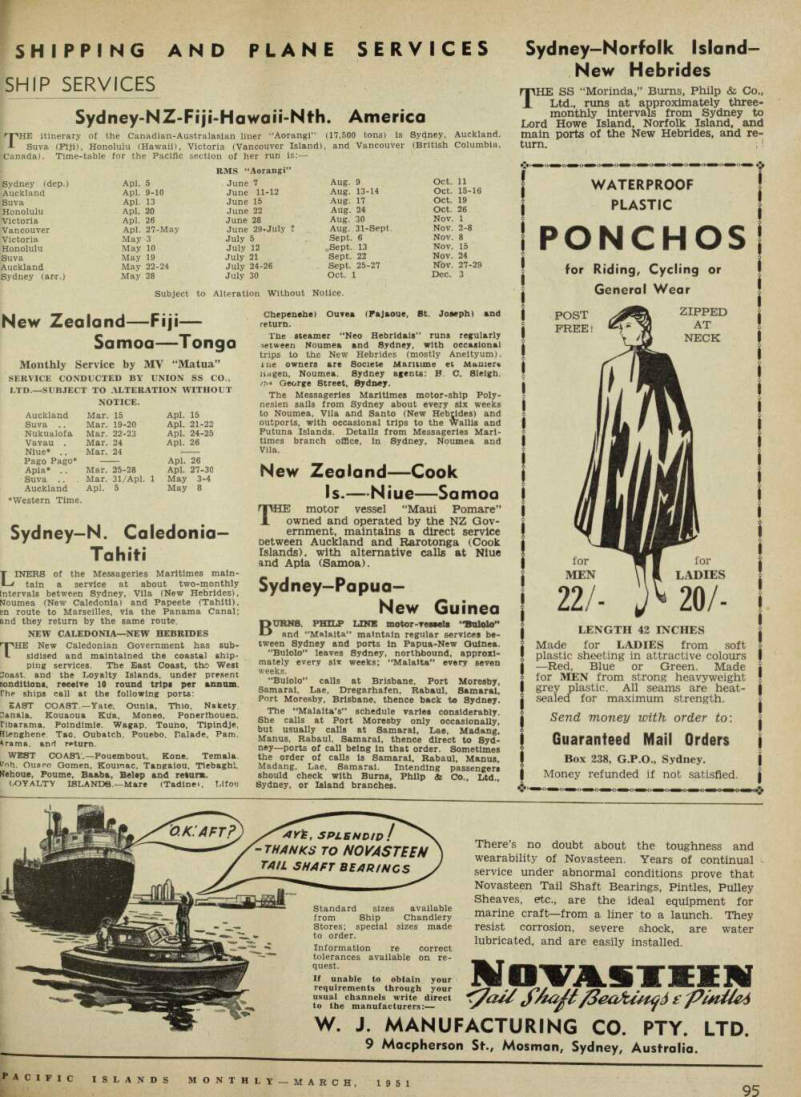
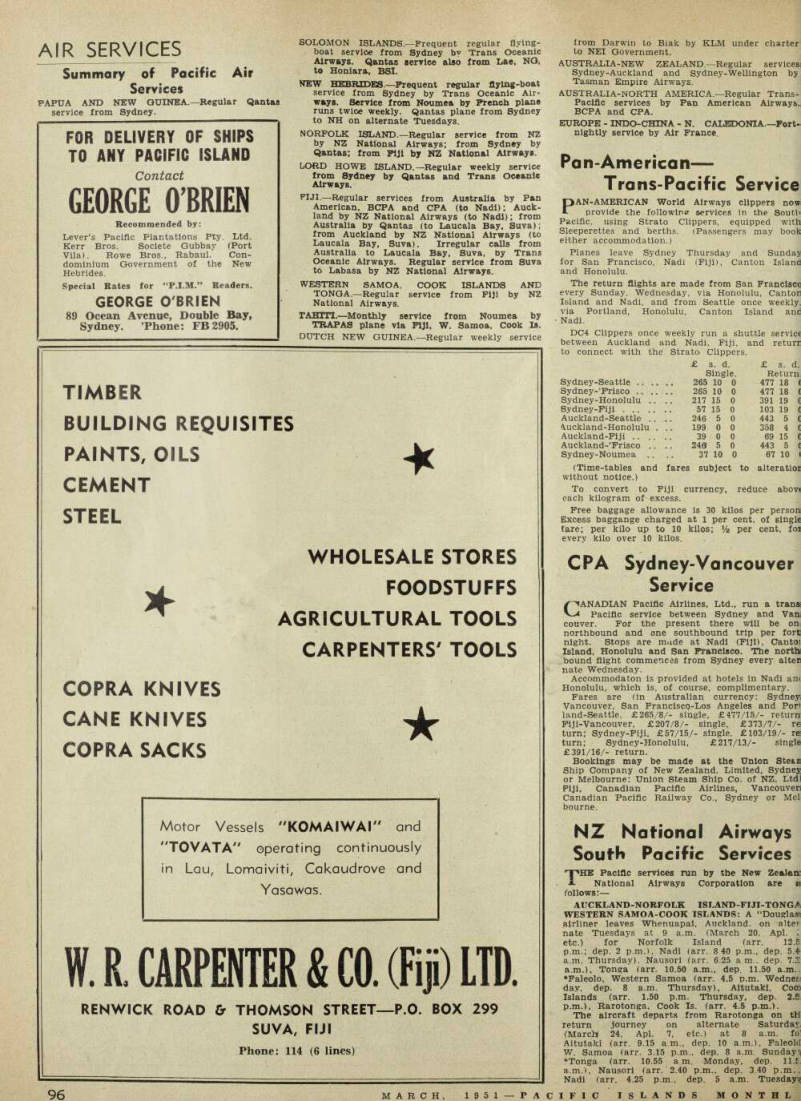
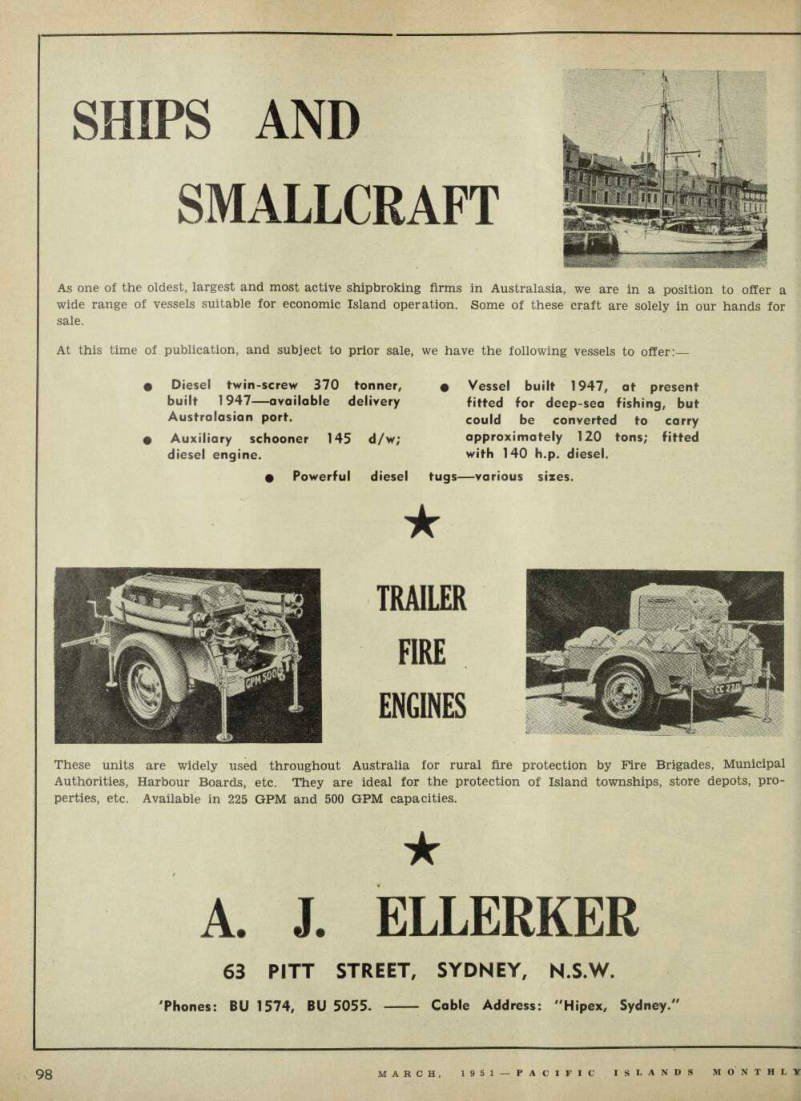
Shipping And Plane Services
Ship Services
Sydney-NZ-Fiji-Howoii-Nth. America
THE itinerary of the Canadian-Australasian liner “Aorangi” (17,500 tons) is Sydney, Auckland, Suva (Fiji), Honolulu (Hawaii), Victoria (Vancouver Island), and Vancouver (British Columbia, Canada). Time-table for the Pacific section of her run is:—
Subject to Alteration Without Notice.
New Zealand —Fiji—
Samoa —Tonga
Monthly Service by MV “Matua”
Service Conducted By Union Ss Co.,
Ltd —Subject To Alteration Without
Sydney-N. Caledonia-
Tahiti
LINERS of the Messageries Maritlmes main tain a service at about two-monthly Intervals between Sydney, Vila (New Hebrides), Noumea (New Caledonia) and Papeete (Tahiti), en route to Marseilles, via the Panama Canal; and they return by the same route.
New Caledonia—New Hebrides
THE New Caledonian Government has sub sidised and maintained the coastal ship ping services. The East Coast, tho West Joast, and the Loyalty Islands, under present eondltlons, receive 10 round trips per annum, rhe ships call at the following ports: EAST COAST—Yate, Ounla, Thio, Nalcety, Danala. Kouaoua Kua. Moneo, Ponerthouen, Fibarama. Polndlmle. Wagap, Touho, Tlpindje, Hienghene Tac. Oubatch, Pouebo. P.alade, Pam, *rama. and return.
WEST COAST.—Pouembout, Kone, Temala.
Poh. Ouaro Gomen, Koumac, Tangalou, Tiebaghi.
Hehoue, Poume, Baaba, Belep and return.
LOYALTY ISLANDS.—Mare (Tadlne», Llfou
Chepenehe) Ouvea (Pajaoue, Bt. Joseph) and return.
The steamer “Neo Hebrldals” runs regularly ictween Noumea and Sydney, with occasional trips to the New Hebrides (mostly Aneltyum), me owners are Societe Maritime et Mamer« liagen, Noumea. Sydney agents: B. C. Sleigh. rr>-* George Street. Sydney.
The Messagerles Maritlmes motor-ship Poly nesian sails from Sydney about every six weeks to Noumea, Vila and Santo (New Hebrides) and outports, with occasional trips to the Wallis and Futuna Islands. Details from Messagerles Marl times branch office, In Sydney, Noumea and Vila.
New Zealand—Cook
Is.—Niue—Samoa
THE motor vessel “Maui Pomare” owned and operated by the NZ Gov ernment, maintains a direct service between Auckland and Rarotonga (Cook
Islands), with alternative calls at Niue
and Apia (Samoa).
Sydney-Popuo-
New Guinea
BURNS, PHILP LINE motor-renels “Bulolo” and “Malaita” maintain regular services be tween Sydney and ports In Papua-New Guinea.
“Bulolo” leaves Sydney, northbound, approxi mately every six weeks; “Malaita” every seven weeks.
“Bulolo” calls at Brisbane. Port Moresby, Samaral, Lae, Dregarhafen, Rabaul, Samaral, Port Moresby, Brisbane, thence back to Sydney.
The “Malalta’s” schedule varies considerably.
She calls at Port Moresby only occasionally, but usually calls at Samaral, Lae. Madang, Manus, Rabaul, Samaral, thence direct to Syd ney—ports of call being In that order. Sometimes the order of calls Is Samaral, Rabaul, Manus, Madang. Lae, Samaral. Intending passengers should check with Burns, Philp & Co., Ltd., Sydney, or Island branches.
Sydney—Norfolk Island-
New Hebrides
THE SS “Morinda,” Burns, Philp & Co., Ltd., runs at approximately three monthly intervals from Sydney to Lord Howe Island, Norfolk Island, and main ports of the New Hebrides, and re turn. i!
RMS “Aorangi” ■Sydney (dep.) Apl. 5 June 7 Aug. 9 Oct. 11 Auckland Apl. 9-10 June 11-12 Aug. 13-14 Oct. 15-16 Suva Apl. 13 June 15 Aug. 17 Oct. 19 Honolulu Apl. 20 June 22 AUg. 24 Oct. 26 Victoria Apl. 26 June 28 Aug. 30 Nov. 1 Vancouver Apl. 27-May June 29-July ? Aug. 31-Sept. Nov. 2-8 Victoria May 3 July 5 Sept. 6 Nov. 8 Honolulu May 10 July 12 ..Sept. 13 Nov. 15 Suva May 19 July 21 Sept. 22 Nov. 24 Auckland May 22-24 July 24-26 Sept. 25-27 Nov. 27-29 Sydney (arr.) May 28 July 30 Oct. 1 Dec. 3
Notice.
Auckland Mar. 15 Apl. 15 Suva .. Mar. 19-20 Apl. 21-22 Nukualofa Mar. 22-23 Apl. 24-25 Vavau . Mar. 24 Apl. 26 Niue* .. Mar. 24 Pago Pago* Apl. 26 Apia* .. Mar, 25-28 Apl. 27-30 Suva .. . Mar. 31/Apl. 1 May 3-4 Auckland Apl. 5 May 8 •Western Time.
Air Services
Summary of Pacific Air Services PAPUA AND NEW GUlNEA—Regular Qantas service from Sydney.
SOLOMON ISLANDS.—Frequent regular flying boat service from Sydney by Trans Oceanic Airways. Qantas service also from Lae, NO, to Honiara, BSI.
NEW HEBRlDES.—Frequent regular flying-boat service from Sydney by Trans Oceanic Air ways. Service from Noumea by French plane runs twice weekly. Qantas plane from Sydney to NH on alternate Tuesdays.
NORFOLK ISLAND.—Regular service from NZ by NZ National Airways; from Sydney by Qantas; from FIJI by NZ National Airways.
LORD HOWE ISLAND.—Regular weekly service from Sydney by Qantas and Trans Oceanic Airways.
FlJl.—Regular services from Australia by Pan American, BCPA and CPA (to Nadi); Auck land by NZ National Airways (to Nadi); from Australia by Qantas (to Laucala Bay, Suva): from Auckland by NZ National Airways (to Laucala Bay, Suva). Irregular calls from Australia to Laucala Bay, Suva, by Trans Oceanic Airways. Regular service from Suva to Labasa by NZ National Airways.
Western Samoa. Cook Islands And
TONGA.—Regular service from Fiji by NZ National Airways.
TAHlTl.—Monthly service from Noumea by TRAPAS plane via FIJI, W. Samoa, Cook Is.
DUTCH NEW GUINEA. —Regular weekly service
from Darwin to Biak by KLM under charter 1 to NEI Government.
AUSTRALIA-NEW ZEALAND—ReguIar services!
Sydney-Auckland and Sydney-Wellington by Tasman Empire Airways.
AUSTRALIA-NORTH AMERICA—Regular Trans-■ Pacific services by Pan American Airways,,
Bcpa And Cpa.
Europe - Indo-China -N. Caledonla—Fort
nightly service by Air France.
Pan-American—
Trans-Pacific Service
PAN-AMERICAN World Airways clippers now; provide the following services in the South' Pacific, using Strato Clippers, equipped with Sleeperettes and berths. (Passengers may boob either accommodation.) Planes leave Sydney Thursday and Sunday for San Francisco, Nadi (Fiji), Canton Island and Honolulu.
The return flights are made from San Francisco every Sunday, Wednesday, via Honolulu, Canton Island and Nadi, and from Seattle once weekly, via Portland, Honolulu, Canton Island and Nadi.
DC4 Clippers once weekly run a shuttle service between Auckland and Nadi, Fiji, and return to connect with the Strato Clippers.
(Time-tables and fares subject to alteratioi without notice.) To convert to Fiji currency, reduce abovt each kilogram of excess.
Free baggage allowance is 30 kilos per person Excess baggange charged at 1 per cent, of single fare; per kilo up to 10 kilos; Vs per cent, foi every kilo over 10 kilos.
CPA Sydney-Vancouver
Service
CANADIAN Pacific Airlines, Ltd., run a transi Pacific service between Sydney and Van; couver. For the present there will be on. northbound and one southbound trip per fort night. Stops are made at Nadi (Fiji), Cantoi Island, Honolulu and San Francisco. The north! bound flight commences from Sydney every alter nate Wednesday.
Accommodaton is provided at hotels in Nadi am Honolulu, which is, of course, complimentary.
Fares are (in Australian currency: Sydney Vancouver, San Prancisco-Los Angeles and Port land-Seattle, £265/8/- single, £477/15/- return Plji-Vancouver, £207/8/- single, £373/7/- re turn; Sydney-Fiji, £57/15/- single. £lO3/19/- re turn; Sydney-Honolulu, £217/13/- single £391/16/- return.
Bookings may be made at the Union Stein Ship Company of New Zealand. Limited, Sydney or Melbourne: Union Steam Ship Co. of NZ. Ltd I Fiji, Canadian Pacific Airlines, Vancouver!
Canadian Pacific Railway Co., Sydney or Mel bourne.
NZ National Airways
South Pacific Services
THE Pacific services run by the New Zealan; National Airways Corporation are a follows:
Auckland-Norfolk Island-Fiji-Tonga
Western Samoa-Cook Islands: A “Douglas?
airliner leaves Whenuapal, Auckland, on alter nate Tuesdays at 9 a.m. (March 20, Apl. ; etc.) for Norfolk Island (arr. 12.5 p.m.; dep. 2 p.m.). Nadi (arr. 8 40 p.m., dep. 5A a.m. Thursday). Nausori (arr. 6.25 a m., dep. 7.3'. a.m.), Tonga (arr. 10.50 a.m., dep. 11.50 a.m.. ♦Faleolo, Western Samoa (arr. 4.5 p.m. WedneM day, dep. 8 a.m. Thursday), Aitutaki, Cood Islands (arr. 1.50 p.m. Thursday, dep. 2.H p.m.), Rarotonga. Cook Is. (arr. 4.5 p.m.).
The aircraft departs from Rarotonga on tM return Journey on alternate Saturday, (March! 24, Apl. 7, etc.) at 8 a.m. fo' Aitutaki (arr. 9.15 a.m., dep. 10 a.m.), Paleold W. Samoa (arr. 3.15 p.m.. dep. 8 a.m. Sundays ♦Tonga (arr. 10.55 am. Monday, dep. 11.8. a.m.), Nausori (arr. 2.40 p.m., dep. 3.40 p.m..
Nadi (arr. 4.25 p.m., dep. 5 a.m. Tuesday^
£ s. d. £ s. d.
Single.
Return Sydney-Seattle 265 10 0 477 18 ( Sydney-’Frisco 265 10 0 477 18 ( Sydney-Honolulu .. 217 15 0 391 19 ( Sydney-Pijl 57 15 0 103 19 ( Auckland-Seattle .. .. 246 5 0 443 5 ( Auckland-Honolulu . .. 199 0 0 358 4 ( Auckland-Plji 39 0 0 69 15 ( Auckland-’Frisco .. 246 5 0 443 5 ( Sydney-Noumea 37 10 0 67 10 (
Norfolk Is. (arr. 10.55 am., dep. 12 noon), Whenuapai, Auckland (arr. 4.50 p.m.). •Crosses International Date Line.
Auckland-Norfolk Island: A “Douglas”
airliner leaves Whenuapai, Auckland, every Sun day at 8 a.m. for Norfolk Island (arr. 11.55 a.m.), and departs on the return flight at 12.55 p.m,, arriving at Whenuapai at 5.45 p.m.
On alternate Sundays (March 18, Apl 1, etc.), a second service is also operated, leaving Whenuapai at 9 a.m., arriving Norfolk at 12.55 p.m., departing again at 1.55 p.m., and arriving Auckland at 6.45 p.m.
FARES, single (in NZ currency): Auckland to Norfolk, £l4; to Fiji, £3l; to Tonga, £35/15/-; to W Samoa, £39/10/-; to Aitutaki, £43/10/-; to Rarotonga, £45. Norfolk to Fiji, £l9; Fiji to Tonga, £B/15/-; to W. Samoa, £l3; to Aitutaki, £29; to Rarotonga, £3l. W. Samoa to Rarotonga, £l9; to Aitutaki, £l6/10/-. Return fares less 10 per cent.
BOOKING OFFICES: Wellington, Govt. Life Bldg., Customhouse Quay; Auckland, Air Centre, Achilles House, Commerce St.; Dunedin, 8-10 Manse St.; Christchurch, 104 Gloucester St.: Gisborne, 74 Peel St.; Palmerston North, 107 Broadway Ave.; Hamilton, 8 Alma St.; New Plymouth, Grand Central Building, Egmont St.; Blenheim, 13 Queen St.; Hokitika, South side Airport; Norfolk Is., Burns Philp, Ltd.; Fiji, NAC, Suva; Burns Philp, Lautoka; Tonga, Lautoka; Tonga, Mrs. F. P. Melhose, Fou-amotu Airfield; W. Samoa, Burns Philp (SS), Ltd., Apia; Cook Is., Mrs. P. McVeagh, Aitutaki, and Mr. J. D. Campbell, Rarotonga.
Sydney—Queensland—
New Guinea
Q.E.A. Ltd. operate regular services between Sydney and Port Moresby, Lae, Madang, Rabaul, Bulolo and Wau via Brisbane, Rock hampton, Townsville and Cairns.
This Service is known as the “Bird of Para dise” Service and DC4 Skymaster and DC3 Air craft are used. The Skymaster aircraft leave
Sydney every Tuesday and Saturday at 9 p.m. and, making a night flight calling at Brisbane only, arrive at Port Moresgy the following morn ing at 8.05 a.m.
The Skymaster arriving on the Wednesday connects with a DCS from Port Moresby to Bulolo and Wau via Lae the same day, while the Skymaster arriving at Port Moresby on Sunday connects with two DC3s from Port
Moresby, one flying direct to Rabaul on the same day and the other flying to Lae.
A DC3 aircraft leaves Madang on Tuesdays at 3.45 p.m., nightstops at Lae and departs Lae at 7.10 a.m. on Wednesday to connect with the Skymaster leaving Port Moresby at 10.30 a.m. for Sydney via Brisbane, arriving Sydney at 10 p.m.
Two DCS aircraft leave Lae at 7.10 a.m. on
Sunday to connect with the Skymaster leaving Port Moresby at 10.30 a.m. for Sydney via Bris bane, arriving Sydney at 10 p.m. the same day.
DC3s leave Sydney at 8.15 a.m. on Monday, Thu»*day, Friday, calling at Brisbane, Rock hampton and nightstopping at Townsville.
The following morning they depart Townsville at 5.20 a.m., calling at Cairns and Cooktown and arriving at Port Moresby at 11.10 a.m. and Lae at 1 p.m. The aircraft which arrives at Lae on Tuesdays extends to Madang the same afternoon.
Return flights leave Lae at 5.45 on Mondays and Thursdays, departing Port Moresby at 7.35 a.m. and proceeding to Sydney the same day, via Calms, Townsville and Brisbane (with an op tional call at Rockhampton), arriving Sydney at 10.15 p.m.
The service leaving Lae on Thursdays, also connects with a DC3 leaving Wau the previous afternoon at 3.30 p.m.
Every Monday a DC3 leaves Rabaul at 7 a.m. for Port Moresby departing Port Moresby at 10.50 a.m. for Cairns and Townsville. The following morning it departs Townsville at 8.15 a.m. calling at Rockhampton and Brisbane and arriving Syd ney at 5 p.m.
Qantas Subsidiary Services In
Papua-New Guinea-Solomons
Qantas Empire Airway* run the following sub sidiary services In Papua, New Guinea, and British Solomons: — A Douglas DC3 leaves Lae, New Guinea, every Saturday, and flies to Rabaul, and Kavieng, and returns to Lae; but every alternate Satur day the plane goes on from Kavieng to Manus, and returns via Kavieng to Rabaul (overnight) and returns to Lae on the Sunday morning.
In addition a DC3 leaves Lae every Friday morning at 6 a.m. and flies direct to Manus Island arriving at 8.20 a.m. This aircraft re turns to Lae the following day departing Manus at 3.40 p.m. and arriving Lae at 6 p.m.
Every Wednesday a plane flies from Lae to Madang, and after arrival at Madang operates where and when required. This service is primarily for the carriage of native labourers and Europeans travelling on this service are always advised of the fact.
Every alternate Monday, a Qantas Catalina flies from Port Moresby, westward to Dam, via Yule Island, Kerema, Wana, Kikori, Lake Kutubu,
returning to Port Moresby, via Kikori and Kerema the same day.
Every alternate Wednesday, a Qantas Catalina flies from Port Moresby eastward (dep. 10 a.m.) and calls at Abau and Samara! before flying out to the Archipelagoes in the afternoon. Calls are made at Esa’ala and Losuia (where an over night stop is made), and the following day (alternate Thursdays) at Deboyne Lagoon, before returning to Port Moresby, via Samaral and Abau.
Every alternate Monday, a Qantas Catalina leaves Port Moresby for Rabaul, via Abau, Samarai, Esa’ala and Losuia (New Britain); next morning (Tuesday) it flies to Queen Carola Harbour, Buka, Kieta, Buln (Bougainville) and returns to Rabaul with an optional stop at Inus, next morning (Wednesday) it flies to Talasea, Moewe Harbour and Jacquinot Bay, and returns to Rabaul (with an optional stop at Lindenhafen) and next morning (Thursday) it returns from Rabaul, via Losuia, Esa’aia, Samarai, and Abau, to Port Moresby.
Every alternate Monday a Qantas Douglas flies from Lae to Rabaul via Flnschhafen and continues on to Honiara (British Solomon Islands), via Torokina, Vellalavella and Yandina remains over night at Honiara; and returns to Lae the fol lowing day Tuesday), over the same route.
Every Tuesday and Friday a plane leaves Port Moresby at 7.30 a.m., reaches Kokoda at 8.35 a.m,. flies on to Hlgatura (Popendetta) at 8.55 a.m., and leaves again for Port Moresby at 9.5 a.m., reaching there at 10.15 a.m.
Dragon DHB4 aircraft operate the following internal services in New Guinea:— Every Tuesday depart Madang for Goroka, Kainantu, Aiyura, Arena, returning to Madang at noon the same day. Calls as required for loading are made between Arena and Madang.
Every Thursday departs Madang at 7 a.m. for Wabag, Baiyer River, Mt. Hagen, with optional calls at Kerowagi and Chimbu, and returning to Madang at noon the same day.
Every Friday departs Lae at 6.30 a.m. calling at any or all of the following places as re quired. Nadzab, Kiaipit, Arona, Aiyura, Kai nantu, Bena Bena, Goroka, Chimbu, Kerowagi, Kup, Nondugl. Banz, Mlnj, Mt. Hagen, Ogel beng, Baiyer River, Wabamunda. Wabag.
Daily, except Wednesdays and Sundays, depart Lae at 3 p.m. for Bulolo and Wau, returning direct from Wau to Lae the same day. arriving at Lae 5.5 p.m.
Trans-Tasman Service
Sydney—Auckland
TASMAN Empire AlrwayjS, Ltd., operate a flying-boat service between Rose Bay, Sydney, and Mechanics Bay, Auckland, with a fleet of four new Solent flying-boats each with a capacity for 45 passengers, in seven self contained cabins on two decks. Pull fresh-cooked meals are served en route. Average crossing time is 6V2 hours. on Tuesdays, Fridays, Saturdays, and at 8 a.m. on Tuesdays and Fridays. They depart from Auckland at 12 noon daily except Tuesday and Sunday.
Fares: £35 (A), £2B (NZ), single; £63 (A). £5O/8/- (NZ), return.
Passenger reservations may be made in Aus tralia at any office or agency of Qantas Empire
Airways (General Agents), offices of TAA and all leading travel agents. In New Zealand book through TEAL (Auckland and Wellington) or any leading travel agents.
Trons Tasman Services
c j \a/ ii- ■
Sydney Wellington
TASMAN Empire Airways, Ltd., operate a regular flying-boat service between Sydney and Wellington with Solent flying-boats.
Services depart Sydney at 10.30 p.m. on Tues-
day, Wednesday, Friday, Sunday; and depart Wellington at 11 a.m. on Monday, Wednesday, Thursday and Saturday.
The fares are: £A3S. £NZ2B single; £A63, GNZSO/8/- return.
Sydney-Norfolk Is.
Qantas run a DC4 Skymaster alt. Thursdays ' returning same day) from Sydney to Norfolk Island. Pare. £25 single; £45 return. (For Norfolk Island, see also under N 2 National Airways.)
Sydney-New Hebrides
QANTAS operate a service to the New Hebrides with Sandringham flying-boats calling at Noumea, Port Vila and Espiritu Santo. Frequent ion-scheduled flights are made, subject to the approval of the Governments concerned.
Sydney-Vancouver
BCPA Service
BRITISH Commonwealth Pacific Airlines, Ltd., operate a twice weekly trans-Pac!flc service from Sydney to Vancouver, via Fiji, Canton Island, Honolulu and San Francisco; and a weekly service between Auckland and Vancouver, via the same ports.
Planes leave Sydney every Wednesday and Saturday, and Vancouver on the Southbound trip every Monday and Thursday. Every fourth trip from Sydney terminates at San Francisco Instead of Vancouver.
Planes Leave Auckland every Tuesday and arrive in Vancouver the following Wednesday.
The Southbound trip to Auckland commences from Vancouver every alternate Friday. Every other Friday the service commences at San Francisco.
B.C.P.A. services make regular connections at both San Francisco and Vancouver for onward carriage, via either New York or Montreal to the United Kingdom or Europe. The through fare from Sydney to London is £325 (Aust.).
The fares for the Pacific flight are: Sydney- Nandi (Fiji), £AS7/15/- single. £AIO3/19/- re turn. Sydney-San Francisco, Seattle, Portland, Los Angeles or Vancouver, £A265/8/- single.
£ A477/15/- return. Auckland-Nandi (Fiji) £ NZ3I single, £NZSS/16/- return. Auckland- San Francisco, Seattle, Portland, Los Angeles or; Vancouver, £NZI97/3/- single, £NZ3S4/18/- re turn.
Douglas DC6 aircraft carrying 48 passengers (seated) or 37 passengers (in sleepers) and a crew of nine are used on the service. (During April additional services will be run, leaving Sydney each Friday at 11 a.m., and San Francisco each Tuesday.)
France-1 ndo-China-
Aust.-N. Caledonia
THE French national airways, Air France, runs a monthly service between Paris; and New Caledonia, and return. Stops are made at Damascus, Karachi, Calcutta, Saigon, Batavia, Darwin, Brisbane.
DC4 Skymasters are used in the service bet ween Saigon and New Caledonia, Lockheed Constellations between Salgon-Paris, and Mes sageries Maritimes are agents in Australia.
Fare between Brisbane and Tontouta (Noumea) are £3O/12/6 single, £55/2/6 return. Sydney- Tontouta, £37/10/- single, £63/17/6 return. (Note: After some disruption this servce isi now back on regular 28-days scchedule.)
Darwin—Netherlands
New Guinea Service
THE service between Batavia, NEI, and Biak, Netherlands New Guinea, has been dis continued and a new service from Darwin to Biak and return has been inaugurated.
The service is run by the Netherlands Govern ment, with DCS aircraft, chartered from KLM Airlines. The service is run once weekly.
TOA Services
TRANS Oceanic Airways run the following Pacific services:— SYDNEY-LORD HOWE IS.: A regular twice weekly service with large four-engine flying boats from Rose Bay. Fare; £lO/16/- single; £2l/12/- return. Free baggage allowance 44 lb.
Excess baggage and freight rate Bd. per lb.
NOTE: Sydney-Moresby service expected toi start in April.
SYDNEY-HOBART: The company now runs ai thrice-weekly service direct to Hobart, Tasmania,, from Sydney. It will be possible, therefore, for passengers to book from Moresby to Hobart,, making an overnight stop in Sydney. Fares are:; £l2 single, £24 return.
Sydney—Noumea—Suva
THE following is the time-table of the Qantasi Sandringham flying-boat;— Sydney dep. 9.30 p.m. alt. Tues.
Noumea arr. 6.30 a.m. alt. Wed.
Noumea dep. 8.20 a.m. alt. Wed.
Suva arr. 2.30 p.m. alt. Wed.
Suva dep. 6 a.m. alt. Fri.
Noumea arr. 10.30 a.m. alt. Fri.
Noumea dep. 12 noon alt. Fri.
Sydney arr. 7.15 p.m. alt. Pri.
Intending passengers may book throughi Qantas offices in Australia. Burns Philp (South: Sea) Company, in Suva; and J. Brock, ini Noumea.
The fares for this service In Aust. currency are: -
TEAL Flying Boat
Service
Auckland Fiji
WITH 45 seater Solent flying-boats,; Tasman Empire Airways, Limited, operate a weekly Auckland-Suva-Lambasa and return service.
Aircraft depart Mechanics’ Bay, Auckland, ss half hour after midnight, each Tuesday, and) operate to the following time-table:—
are: Single. Return.
Sydney-Noumea ... £37 10 0 £67 10 0 Sydney-Suva 55 10 0 99 18 0 Noumea-Suva 20 5 0 36 9 0
dep.
Auckland .. .. 0.30 a.m. Tuesday arr.
Suva .. 7.00 a.m. Tuesday dep.
Suva .. .. 9.00 a.m. Tuesday arr.
Lambasa .. .. 10.00 a.m. Tuesday dep.
Lambasa .. .. noon Tuesday arr.
Suva .. 1.00 p.m. Tuesday dep.
Suva .. -3 b o a.m. Wednesday arr.
Auckland 1.30 p.m. Wednesday
Fares (Single): Auckland-Suva. £3l (NZ). , £ 34/9/* (Fijian), £3B/15/- (Aust.); (Return): £55/16/- (NZ). £6l/19/- (Fijian), £69/15/- (Aust.).
Suva-Lambasa (Single); £4/10/- (NZ), £5 (Fijian), £5/12/6 (Aust.): (Return): £B/2/- (NZ), £9 (Fijian), £lO/2/6 (Aust.).
Reservations may be made through TEAL (New Zealand), Qantas or TAA (Australia), NZNAC (Suva) or any leading travel agents.
N. Caledonia-Tahiti
TRAPAS (Soclete Prancals de Transports Aerlens du Pacific Sud-Noumea) runs a monthly service from New Caledonia to Tahiti Western Samoa (Paleolo), Cook Islands (Altu takl) to Papeete, where It arrives at about 11.40 a.m. two days later. One evening Is spent In Nadi and one night In Altutakl. The plane re turns by the same route In the following week.
Pare from Noumea to Papeete Is 16,000 Pacific francs single, and 28,800 return. (142 Pacific francs equal £1 Australian.) While the plane is at Papeete it runs one round trip between Papeete and Bora Bora. (This service was temporarily suspended in late November—but there is no sign of its re storation.)
Papua-NG Local
Services
MANDATED Airlines, Ltd., of Lae, New Guinea, and other private operators, run air ser vices between Lae and the New Guinea mainland centres of Wau. Bulolo, Madang, Wewak. Altape.
Ift. Hagen, Flnschhafen, Moresby, Kokoda—ln fact anywhere in Papua or New Guinea where there 1* an alr-strlp. These planes carry pas wngers, malls and cargo on regular schedules ar charter flights
Advertisements & other items, pp. 97-104 (4 items)
95
PACIFIC ISLANDS MONTHLY - M A R C H , 1951
Novasiein
WATERPROOF
PLASTIC
PONCHOS
LENGTH 42 INCHES
Made for LADIES from soft plastic sheeting in attractive colours —Red, Blue or Green. Made for MEN from strong heavyweight grey plastic. All seams are heatsealed for maximum strength.
Send money with order to:
Guaranteed Mail Orders
Box 238, G.P.0., Sydney.
Money refunded if not satisfied.
for Riding, Cycling or
General Wear
ZIPPED
AT
NECK
for
MEN
for
LADIES
SPLENDID !
- THANKS TO NOVASTEEN
TAIL SHAFT BEAR INC S
AFT?
OK m Standard sizes available from Ship Chandlery Stores: special sizes made to order.
Information correct There’s no doubt about the toughness and wearability of Novasteen. Years of continual service under abnormal conditions prove that Novasteen Tail Shaft Bearings, Pintles, Pulley Sheaves, etc., are the ideal equipment for marine craft—from a liner to a launch. They resist corrosion, severe shock, are water lubricated, and are easily installed. tolerances available on request.
If unable to obtain your requirements through your usual channels to the manufacturers:'
Novasiein
turers;— FeCt fteOfcUUjA £
W. J. MANUFACTURING CO. PTY. LTD.
9 Macpherson St., Mosman, Sydney, Australia.
FOR DELIVERY OF SHIPS
TO ANY PACIFIC ISLAND
Contact
GEORGE O’BRIEN
Recommended by: Lever’s Pacific Plantations Pty. Ltd.
Kerr Bros. Societe Gubbay (Port Vila). Rowe Bros., Rabaul. Condominium Government of the New Hebrides.
Special Rates for “P.1.M.” Readers.
GEORGE O'BRIEN
89 Ocean Avenue, Double Bay, Sydney. ’Phone: F 82905.
TIMBER
BUILDING REQUISITES
PAINTS, OILS
CEMENT
STEEL
COPRA KNIVES
CANE KNIVES
COPRA SACKS
WHOLESALE STORES
FOODSTUFFS
AGRICULTURAL TOOLS
CARPENTERS' TOOLS
★ Motor Vessels "KOMAIWAI" and "TOVATA" operating continuously in Lau, Lomaiviti, Cakaudrove and Yasawas.
». R CARPENTER CO. (Flj) LTD.
RENWICK ROAD & THOMSON STREET—P.O. BOX 299
SUVA, FIJI
Phone: 114 (6 lines)
CAPTAIN W. L. KENNEDY
(Established 1931)
Shipbrokers, Business & Real Estate
63 Pitt St., Sydney
'Phone: 8W6461. Cables: "CAPKEN," Sydney.
LISTING:
TWIN SCREW STEEL CARGO VESSEL.—I 69 It. x 32 It. 600 H.P. Speed, approximately 12 knots. Electric winches. Two holds. Classification: British Corporation. Deadweight tonnage, 450. Built in 1945; special survey in March, 1950. Water ballast, 146 tons. £25,000 Sterling.
ALSO COMMERCIAL CRAFT OF ALL DESCRIPTIONS
INQUIRIES INVITED.
Through our Business and Real Estate Branch, we can offer a wide variety of Sydney and N.S.W. properties. Ail Islands inquiries promptly and satisfactorily attended to.
ice in r. m *
MERCHANTS
WHOLESALE
\9 S \
GENERAL AGENTS
o o 9~* 9 v>° o o^°r, 9 c* 0 c o co*
Ciw
9.0 y v>^ o* r* 5 9 |A^ \t* p hA O C vV>
FORWARDING. SHIPPING 6 CUSTOMS AGENTS
SHIPS AND
SMALLCRAFT
As one of the oldest, largest and most active shipbroking firms in Australasia, we are in a position to offer a wide range of vessels suitable for economic Island operation. Some of these craft are solely in our hands for sale.
At this time of publication, and subject to prior sale, we have the following vessels to offer:— • Diesel twin-screw 370 tonner, built 1947—available delivery Australasian port. • Auxiliary schooner 145 d/w; diesel engine.
Vessel built 1947, at present fitted for deep-sea fishing, but could be converted to carry approximately 120 tons; fitted with 140 h.p. diesel.
Powerful diesel tugs-—various sizes. $ I m m % ★
TRAILER
FIRE
ENGINES
These units are widely used throughout Australia for rural fire protection by Fire Brigades, Municipal Authorities, Harbour Boards, etc. They are ideal for the protection of Island townships, store depots, properties, etc. Available in 225 GPM and 500 GPM capacities. *
A. J. ELLERKER
63 PITT STREET, SYDNEY, N.S.W.
'Phones: BU 1574, BU 5055. Cable Address: "Hipex, Sydney."
MARINE
DIESELS
AND SPARE PARTS.
We have available at best possible prices, 165 and 225 B.H.P. Gray Marine Diesels, complete with 3:1 or 1.5:1 Reverse-Reduction Gear-boxes.
Fully reconditioned to a high engineering standard.
Also 22 in. Monel Propeller Shafting.
STANLEY P. BELL & COMPANY
Importers, Exporters and Brokers for the Sale, Purchase or Charter of Ships.
173 Eagle St., BRISBANE, QLD.
Cables: “PACENT” Brisbane.
MARINE ENGINES
MORRIS “VEDETTE” 4 Cylinder 6/12 H.P. Petrol or Keroseno * a " B IORRIS “NAVIGATOR” 4 Cylinder 12/24 H.P. Petrol or Kerosene MORRIS “COMMODORE” 6 Cylinder 20/40 H.P. Petrol or Keroseno CHRYSLER “CROWN” 6 Cylinder 45/102 H.P. Petrol CHRYSLER “ROYAL” 8 Cylinder 55/132 H.P. Petrol LEYLAND DIESEL MARINE 6 Cylinder to 125 H.P.
AMERICAN STERLING AND SUPERIOR DIESELS
Further particularsfrom the distributors:
LARS HALVORSEN SONS PTV. LTD.
WATERVIEW ST.. RYDE ( •££," ). R.S.W.
Telegrams; Halvorsens. Sydney. ’Phone: Ryde 705
• LARGE RANGE OF BOAT FITTINGS
• FREE EXPERT PROPELLER ADVICE
BUILDERS OF HALVORSEN BOATS
BERRY’S BAY
BOATYARD
(B. J. Halvorsen—Manager)
Specialists in Island vessels.
All kinds of boat-building and repairing.
New and used boats and engines for sale.
Quotations and estimates free.
BERRY’S BAY BOATYARD
John Street, North Sydney, N.S.W.
□ D 3D Only five minutes’ drive across the Sydney Harbour Bridge from the City, “Bellhaven” is quietly situated —your rest is assured in this new, comfortably furnished and well serviced hotel.
PRIVATE HOTEL,
Priory Road, North Sydney.
Handy to transport for beaches, Olympic Pool, Zoo, all sights, and Australia’s leading City of entertainment and night life —Sydney.
Modern Room or Suite Accommodation.
TARIFF FROM 16/6 PER DAY.
Manager : A. L. GUARD.
Write or Cable “Bellhaven,” North Sydney.
Phone: XA 1746.
SAILS. COVERS, AMHGS
TENTS, TARPAULINS, and all classes of CANVAS GOODS for industrial and home use FLAGS AND PENNANTS FOR CLUBS AND ASSOCIATIONS.
Send your inquiries through your agent to:
HARRY WEST Pty. Ltd.
"SYDNEY'S SAILMAKER"
DUKE ST. (WATERFRONT), EAST BALMAIN, SYDNEY, N.S.W.
Phone: WB 1105, WB 2284.
MRS.
NORTH SYDNEY TRAVEL BUREAU
56 Miller Street, North Sydney.
LILLIAN MILLAR, late of New Guinea. A. R. COVENTRY, R.E.A.
You’d Be Wise To Let Experts ...
Arrange Your Travels and
Accommodation.
• Agent for all leading Australian and Overseas
AIRLINES.
• We can find the exact type of ACCOMMODA- TION Islands people require. Let us know early. • Bookings arranged for PIONEER TOURS, by tourist coach throughout Australia.
Telephone: XA 1780—After Hours;
Handle Your Real
Estate Problems.
0 Perhaps you intend buying a Sydney HOME in the near future—we have a wide range of properties available. • Investors will be interested in our extensive selection of
REAL ESTATE PROPOSI-
TIONS.
XA 2342 or XL 2185
Tallerman & Company Ply. Limited
60 YORK STREET, SYDNEY, N.S.W.
Also Brisbane, Melbourne, Adelaide, Perth.
Buying Agents of all Australian Products ..
Sole Exporters for numerous Australian
Manufacturers
Careful and Prompt Attention to all Inquiries Send us your inquiries which will have our careful and prompt attention.
WRITE FOR DETAILED PRICE LIST
Cable Address: “FRESHET,” Sydney.
how jr shines
At Your Service . . .
William E . Reed
(Eatablished 1913) Island Trade Broker & Commission Agent 145 a GEORGE ST., CIRCULAR QUAY, SYDNEY.
For more than 36 years the PERSONAL buying services of WILLIAM E. REED, backed by an experienced staff has ensured prompt and reliable service at lowest cost to Missions, Planters and Traders throughout the Pacific. We operate on a WHOLESALE basis only. You receive original invoices at invoiced cost.
Purchase and delivery of Island craft a speciality.
Enquiries invited tor all plantation and trading requirements. Island products sold on a commission basis.
Cables: "WILREED," Sydney
BOAT SALES DIVISION
For Sea Delivery : 40 FT. TRADE BOATS 10 ton cargo capacity.
Diesel powered. Strong and seaworthy.
Two experienced teams always available for sea delivery anywhere in the Pacific.
ALSO . . .
Boats suitable for Islands Purposes
CARGO KETCH
Soundly constructed 54 ft., 13 ft. 8 in. beam vessel with 24/28 h.p. semi-diesel engine. All sails new.
Vessel has 6 ft. draught and is ideal for administrative or commercial work.
Send for full details.
Vi m 42 FT. WORKBOAT, 12 ft. beam. Draught 4 ft. 65 h.p. 6-cylinder Perkins, Copper sheathed. 40 FT. WORKBOAT, with 83 h.p. G.M. diesel. Remote control steering.
One suit sails. 71 FT. AUXILIARY CARGO VESSEL. Twin diesels. 70 tons cargo capacity Fore and mid-ship winches. Marconi-rigged sails.
AUXILIARIES from 32 ft. upwards.
WORKBOATS from 28 ft. upwards.
We have available immediately, a splendid range of auxiliary and power craft ideally suited for Islands purposes. Let us know your special requirements so that we can send you photographs and details. Sea deliveries made by experienced crews to any point in the Pacific.
96
MARCH, 1951 PACIFIC ISLANDS MONTHL
99
pacific islands month I, t MARCH, 1951
School
Wau Has A Boarding
Enterprise of Lutheran Mission
From Our Own Correspondent WAU. March 5.
NOTHING more has been heard of the oronosed Wau High School, the building of which was deferred last fear by the Denartment of External Ter •itories. But Wau is to have a boarding school nonetheless.
The Lutheran Mission is spending ap proximately £40,000 on a co-educational establishment built on an elevated posi ;ion on a lease purchased some time ago.
The two large dormitories, separated by self-contained matron’s quarters, are cap ible of accommodating 40 children. Two :eachers have already arrived —one from :he United States, the other from South Australia —and have found well-planned quarters awaiting them. These two young women expect to start their teaching jobs m March 13 when there will be an initial enrolment of 19 children.
The school house is a large airy build ing containing two large classrooms which :an be thrown together by opening fold ing doors, a library and a science room.
Recreation and dining rooms, with all electric kitchen and laundry form a sep arate unit. The establishment has hot and sold water services and a sewerage sys tem. Water comes from a 25.000 gallon underground tank.
Six guest rooms are to be built to ac commodate the parents of the pupils.
Parents are entitled to spend four to six weeks each year with their children in Wau’s healthy climate and it can be imagined that this will be popular with coastal residents. The Mission intends to run its own dairy herd, poultry and vege table gardens.
This ambitious undertaking now nearing completion is a monument to the industry of the Mission’s local representative, Mr.
L. Berendorff.
Mr. Terence F. Fenton, accompanied by his wife and three children, arrived in Fiji recently from New Zealand to take up an appointment as an Assistant Works Engineer (Development). He is the son of Mr. E. P. Fenton of Suva.
The Canadian cruiser HMCS Ontario will visit Suva from March 17-20. She Is a Colony Class Cruiser of 9,000 tons.
After leaving Fiji she will take part in exercises with the Australian and New Zealand fleets off the Australian coast.
Being Mollycoddled?
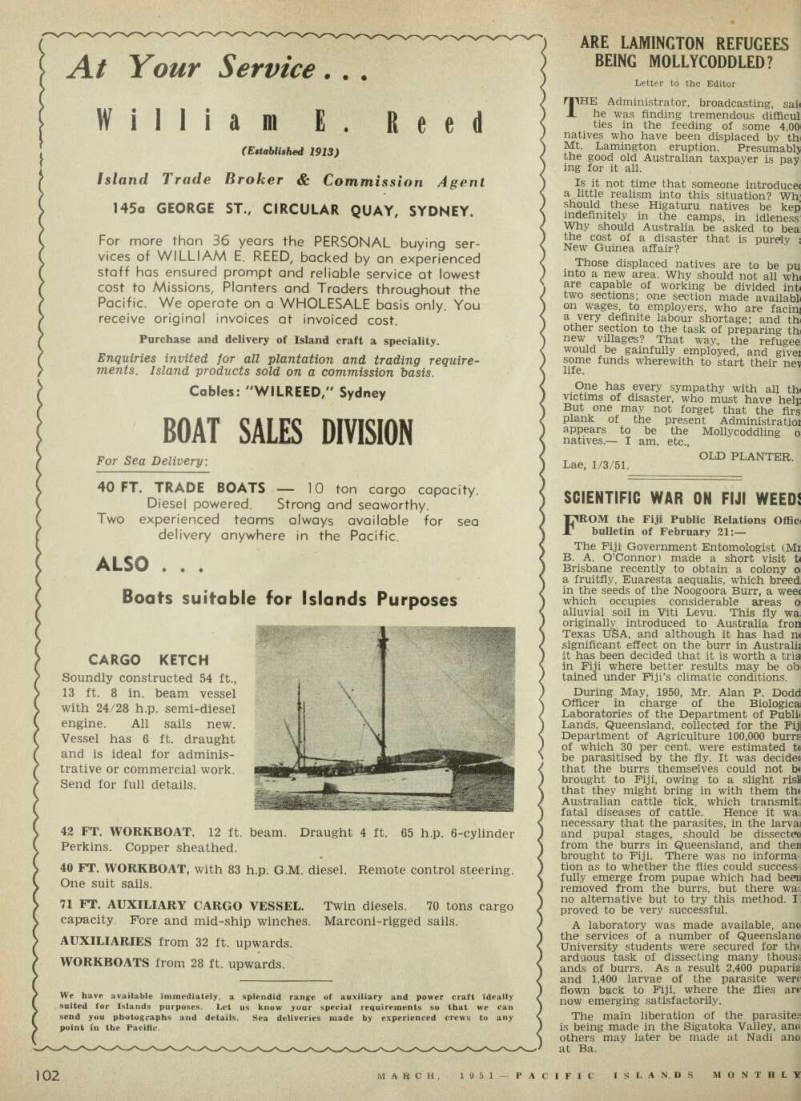
Are Lamington Refugees
Letter to the Editor THE Administrator, broadcasting, sai* he was finding tremendous difficul ties in the feeding of some 4,00' natives who have been displaced by tin Mt. Lamington eruption. Presumably the good old Australian taxpayer is pay ing for it all.
Is it not time that someone introduce® a little realism into this situation? Wlr should these Higaturu natives be kep indefinitely in the camps, in idleness Why should Australia be asked to bea the cost of a disaster that is purely i New Guinea affair?
Those displaced natives are to be pu into a new area. Why should not all win are capable of working be divided inti two sections; one section made availabli on wages, to employers, who are facinj a very definite labour shortage; and th< other section to the task of preparing thi new villages? That way, the refugee: would be gainfully employed, and givei some funds wherewith to start their nev life.
One has every sympathy with all th« victims of disaster, who must have help But one may not forget that the firs: plank of the present Administrate appears to be the Mollycoddling o natives.— I am, etc.,
Old Planter.
Lae, 1/3/51.
Scientific War On Fiji Weeds
FROM the Fiji Public Relations Offici bulletin of February 21:— The Fiji Government Entomologist (Mr B. A. O’Connor) made a short visit h Brisbane recently to obtain a colony o a fruitfly, Euaresta aequalis, which breed, in the seeds of the Noogoora Burr, a weec which occupies considerable areas Oi alluvial soil in Viti Levu. This fly wa. originally introduced to Australia fron Texas USA, and although it has had n® significant effect on the burr in Australis it has been decided that it is worth a tria in Fiji where better results may be oh tained under Fiji’s climatic conditions.
During May, 1950, Mr. Alan P. Dodd Officer in charge of the Biological Laboratories of the Department of Publit Lands, Queensland, collected for the Fiji Department of Agriculture 100,000 burrs of which 30 per cent, were estimated to be parasitised by the fly. It was decide® that the burrs themselves could not b* brought to Fiji, owing to a slight risM that they might bring in with them th» Australian cattle tick, which transmit* fatal diseases of cattle. Hence it wa:. necessary that the parasites, in the larvai and pupal stages, should be dissecteo from the burrs in Queensland, and then brought to Fiji. There was no informa-, tion as to whether the flies could success-: fully emerge from pupae which had been removed from the burrs, but there wa:. no alternative but to try this method. T proved to be very successful.
A laboratory was made available, ano the services of a number of Queenslano University students were secured for thu arduous task of dissecting many thous< ands of burrs. As a result 2,400 puparis and 1,400 larvae of the parasite wen flown to Fiji, where the flies an now emerging satisfactorily.
The main liberation of the parasite:' is being made in the Sigatoka Valley, ano others may later be made at Nadi ano at Ba.
25 Years In Pago Pago
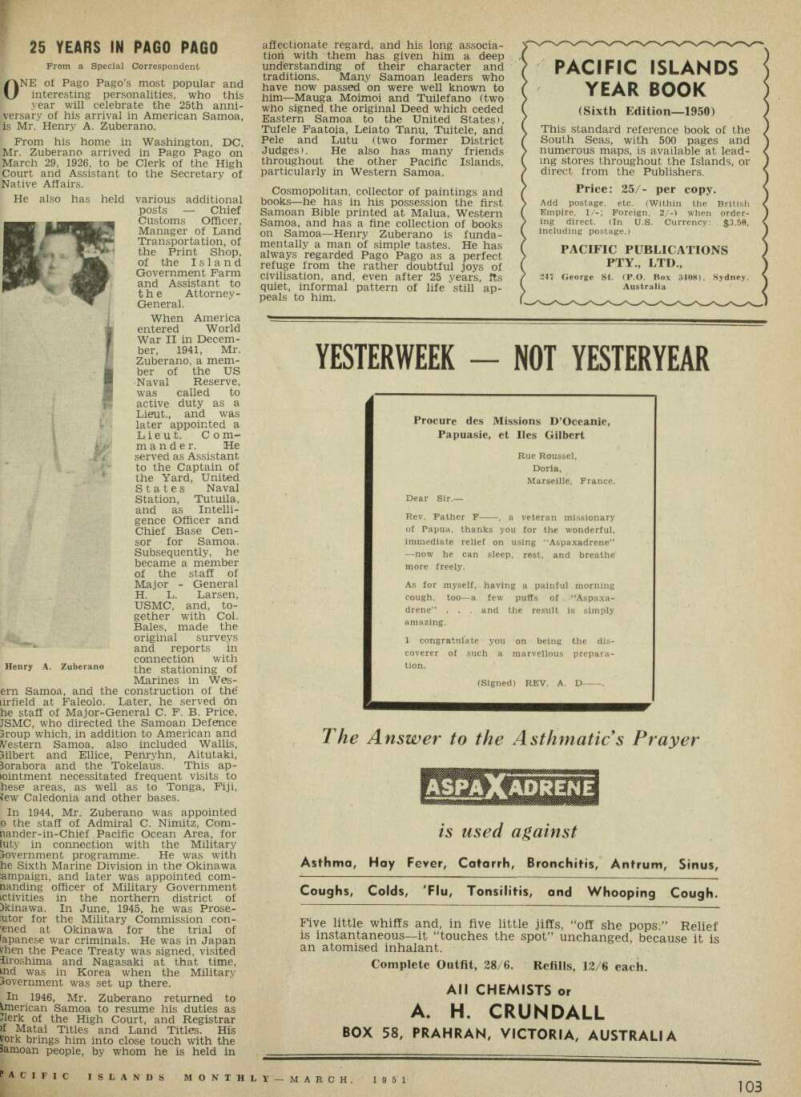
From a Special Correspondent ONE of Pago Pago’s most popular and interesting personalities, who this year will celebrate the 25th anni versary of his arrival in American Samoa, is Mr. Henry A. Zuberano.
From his home in Washington, DC, Mr. Zuberano arrived in Pago Pago on March 29, 1926, to be Clerk of the High Court and Assistant to the Secretary of Native Affairs.
He also has held various additional
posts Chief Customs Officer, Manager of Land Transportation, of the Print Shop, of the Island Government Farm and Assistant to the Attorney- General.
When America entered World War II in Decem ber, 1941, Mr.
Zuberano, a mem ber of the US Naval Reserve, was called to active duty as a Lieut., and was later appointed a Lieut. Com mander. He served as Assistant to the Captain of the Yard, United States Naval Station, Tutuila, and as Intelli gence Officer and Chief Base Cen sor for Samoa.
Subsequently, he became a member of the staff of Major - General H. L. Larsen, USMC, and, to gether with Col.
Bales, made the original surveys and reports in connection with the stationing of Marines in Wes
ern Samoa, and the construction of the' lirfield at Faleolo. Later, he served 6n he staff of Major-General C. F. B. Price, JSMC, who directed the Samoan Defence Group which, in addition to American and Western Samoa, also included Wallis, Gilbert and Ellice, Penryhn, Aitutaki, Gorabora and the Tokelaus. This ap lointment necessitated frequent visits to hese areas, as well as to Tonga, Fiji, Jew Caledonia and other bases.
In 1944, Mr. Zuberano was appointed o the staff of Admiral C. Nimitz, Com nander-in-Chief Pacific Ocean Area, for luty in connection with the Military Government programme. He was with he Sixth Marine Division in the Okinawa campaign, and later was appointed com nanding officer of Military Government activities in the northern district of Gkinawa. In June, 1945, he was Prose cutor for the Military Commission con 'ened at Okinawa for the trial of Japanese war criminals. He was in Japan vhen the Peace Treaty was signed, visited liroshima and Nagasaki at that time, md was in Korea when the Military Government was set up there.
In 1946, Mr. Zuberano returned to American Samoa to resume his duties as >lerk of the High Court, and Registrar )f Matai Titles and Land Titles. His vork brings him into close touch with the >amoan people, by whom he is held in
affectionate regard, and his long associa tion with them has given him a deep understanding of their character and traditions. Many Samoan leaders who have now passed on were well known to him —Mauga Moimoi and Tuilefano (two who signed the original Deed which ceded Eastern Samoa to the United States), Tufele Faatoia, Leiato Tanu, Tuitele, and Pele and Lutu (two former District Judges). He also has many friends throughout the other Pacific Islands, particularly in Western Samoa, Cosmopolitan, collector of paintings and books —he has in his possession the first Samoan Bible printed at Malua, Western Samoa, and has a fine collection of books on Samoa —Henry Zuberano is funda mentally a man of simple tastes. He has always regarded Pago Pago as a perfect refuge from the rather doubtful joys of civilisation, and, even after 25 years, ffs quiet, informal pattern of life still ap peals to him.
Henry A. Zuberano
Advertisements & other items, pp. 105-106 (2 items)
Yesterweek - Not Yesteryear
PACIFIC ISLANDS
YEAR BOOK
(Sixth Edition—l9so) This standard reference book of the South Seas, with 500 pages and numerous maps, is available at leading stores throughout the Islands, or direct from the Publishers.
Price: 25/- per copy.
Add postage, etc. (Within the British Empire. 1/-; Foreign, 2/-) when ordering direct. (In U.S. Currency: $3.50, including postage.)
PACIFIC PUBLICATIONS
PTY., LTD.,
247 George St. (P.O. Box 3408), Sydney, Australia
YESTERWEEK - NOT YESTERYEAR
Procure des Missions D’Oceanie, Papuasie, et lies Gilbert Rue Roussel, Dorla, Marseille, France.
Dear Sir.— Rev. Father F , a veteran missionary of Papua, thanks you for the wonderful, immediate relief on using “Aspaxadrene” —now he can sleep, rest, and breathe more freely.
As for myself, having a painful morning cough, too—a few puffs of “Aspaxadrene” . . . and the result is simply amazing.
I congratulate yon on being the discoverer of such a marvellous preparation. (Signed) REV. A. D .
The Answer to the Asthmatic’s Prayer
aspaXaprene
is used against
Asthma, Hay Fever, Catarrh, Bronchitis, Antrum, Sinus, Coughs, Colds, 'Flu, Tonsilitis, and Whooping Cough.
Five little whiffs and, in five little jiffs, “off she pops.” Relief is instantaneous—it “touches the spot” unchanged, because it is an atomised inhalant.
Complete Outfit, 28/6. Refills, 12/6 each.
All CHEMISTS or
A. H. CRUNDALL
BOX 58, PRAHRAN, VICTORIA, AUSTRALIA
EVERY TIME
FOR PROFITABLE RUNNING
EV,
20 b.h.p.
at 1,200 r.p.m.
Bufll-tn reducing gear gi«s propeller speed of 780 r.p.m Direct Injection, hand waning Electric starter extra if required.
Of trail dimensions.
Length —4S| (n. (1.23| mm 2 Width -2*l In. (622 mm) Height —43} In. 0.108 mm) Weight —1,456 lb, (660 kilos) i
25/30 b.h.p.
■I 1,500/1,750 r.p.m.
Direct drive to propeller or with 2-1 reducing gear. Direct injection. hand starting.
Electric starting extra if required. Also available with electric starling only if preferred.
Overall dimensions Length —52 in. (1.321 mm) Width —27 In. (685 mm) Height -35 in. (889 mm) Weight —l.lOO th (499 kilos) O'
40/65 b.h.p.
at 1,300/2.250 r.p.m.
Direct drive to propeller or with 2 to I reducirtg gear.
Overall dimensions t Length —62 J 0.589 mm) Width -24 j In. (622 mm) f Height —37 In. (940 mm) Weigh) -1.428 lb. 1650 kilos) * m m
(tV-o
x>\
95/145 b.h.p.
al 1,200/1,800 r.p.m.
Direct drive to propeller or with 2-1 or 3-1 reducing gear ' Overall dimensions length -105 in. (2.680 mm) Width —32 in. (816 mm) Height—6oJ in. (1.537 mm) Weight—4,o6olb. (1.841 kilos) t m
60,90 b.h.p.
at 1,200,1,600 r.p.m.
Direct drive to propellet ‘ or with 2-1 or 3-1 reducing gear.
Oil-operated reverse gear Overall dimensions Length —B5 In. (2,160 mm) Width -28 la (712 mm) Height —54 In 1 1.372 mm) Weigh) -2J40 lb. (I.OI6kilo$) i m xm the famous Hartdi billy Petrol Model— 9 b.h.p.
Paraffin Model—7J b.h.p.
Built-in reducing gear gives propeller speed of 700 r.p.m.
Overall dimensions : Length —3B in. (966 mm)' Width —2ll in. (546 mm) Height —3l in. (789 mm) Weight -672 lb, 005 kilos)
GOOD DELIVERIES OF ALL MODELS
Write for full particulars of our complete range of engines to:
Thornycroft (Aust.) Pty. Ltd.
6/10 Wattle Street, PYRMONT, N.S.W.
Cables: “THORNMOTOR,” Sydney.
104
MARCH, 1951 PACIFIC ISLANDS MONTH L
Theatre Lae Has Town-Plan
Troubles
MRS. N. VENNING and Mr. H. Starr, proprietors of the Theatre Lae, Lae, New Guinea, were in Sydney in March sewing-up new film contracts with all leading film distributors.
But although they have the exclusive Lae rights from the 14 leading companies, they have not, as yet, been able to get any satisfaction from Lae’s town planners just as to where and when they may build their permanent theatre.
The current town-plan, it is understood, makes provision for Lae’s picture theatre on a site where the present hospital stands. The hospital is due for a move to new quarters also, but if the building of this goes according to the usual Ter ritory schedule it may be a matter of two years or ten. In the meantime, en terprises—including the theatre —which have been allotted sites covered by the existing hospital evidently must sit meekly and wait.
Starr and Venning built their “tem porary” theatre, on the flat, expecting that it would have to last two years.
That was four years ago. They are ready and eager to build their steel-framed permanent theatre in the new town, as soon as their land becomes available—on the present hospital site or anywhere else that the town-planners graciously permit them to build. But they, like the rest of Lae’s enterprising citizens, have got about as much satisfaction out of the Planners or the authorities as one ex pects from a monument of stone.
Life generally in P-NG has been a maze of frustration in the post-war years and a high percentage of it has been caused by the so-called town-plans—admirable in intention but in fact veritable iron curtains which have prevented the quick and orderly rehabilitation of Territory towns and their commerce.
However, although Theatre Lae has not been permitted to move up “on top,” pat rons will soon be getting MGM films there at the same time as they are released in Australia. That is quite a change from the good old days “before,” when a five years-old picture was considered good enough for Island movie patrons.
Fijian Fighters In Australia
are popular, and the fight crowds give them a good reception.
The leading fighter in the group is the light-heavy and heavyweight champion, Atunais Camaibau —or Henry Bray as he is known in Australia. In eight fights, against top-ranking Australian boxers, he has won five times. One of his recent fights was against Dave Sands, middle weight, light-heavy and heavyweight champion of Australia, also British Empire Middle-weight champion and con tender for the World’s Middleweight Crown. Bray lost on a TKO.
Amongst other Island boys fighting in Australia at the present time are feather weight Arthur Moore, who has had two fights, and two wins, and Jack O’Brien, a middleweight from the Ellice Islands.
Another Fijian lad with the team is Eugene Wakeham, who does the massag ing of the Fiiian boxers and also helps Mr. Bert Anderson, their manager and trainer, as his chief second in their corners.
Mr. R. M. Taylor, Financial Secretary, Fiji, and Mr. and Mrs. J. A. Garnett returned to the Colony in February after overseas leave.
A well-known old resident of the Territories left Sydney on the March Bulolo for a visit to Papua-New Guinea.
She is Mrs. Lillian Millar, better known in the old days as Mrs. Bennett. When her husband, Mr. Toby Millar, went off for service in the Middle East in early 1940, Lillian became a VAD, and nursed in Australian military hospitals for three years. Later, she was an ambulance driver in Queensland for the American Army, and a billeting officer for the Netherlands Air Force. After the war, she was Liaison and Accommodation officer in Sydney for ANA, and in 1949 she joined with ex-serviceman A. R. Coventry in the establishment of a real estate and travel agency in North Sydney. In her inimitable way, she goes to much trouble to find flats or book travel for Territorians arriving in Sydney, and thus has created a valuable business.
Mr. and Mrs. T. Stephens, who have been holidaying in Brisbane, have re turned to their home in Manus Island, NG.
Destination Of The Admiral
Chase
THE well-known Islands freighter Admiral Chase, 3,000 tons, registered in Port Moresby under the ownership of Islands Transport (New Guinea) Co.
Ltd., was held up in Sydney for three days when on the point of sailing for Indonesia, Singapore and the East with Australian produce.
The Australian Customs prevented de parture until officials had investigated a report that the vessel was on the point of being sold to Chinese interests which might have some connection with the Chinese Communist set-up—with which we are actually at war. The ship was then given a clearance.
It was reported, on behalf of the owners, that a British firm was interested in the purchase of the ship. If the sale took place she would continue trading between Pacific Islands.
Advertisements & other items, p. 107 (1 item)
Aunt Marys
WORLD PARITY FOR YOUR PRODUCE!
We are outright buyers of —
TROCHUS SHELL M.O.P. SHELL
IVORY NUTS GREEN SNAIL SHELL
As direct exporters to World’s consuming centres we can offer
TOP PRICES.
We supply TIMBER, DOORS, JOINERY, MOULDINGS, Etc.
W. BALCHIN PTY. LTD.
(Established 1848).
TIMBER, IMPORT & EXPORT MERCHANTS
Head office Also at SYDNEY: 247 George St. LONDON; 78 Gt. Bushey Drive ’Phones: BW 1538-9 Totteridge Cables: “BALCHINCO”
Makes double the quantity in the can it’s delicious
AUNT MARYS
CONCENTRATED
TOMATO SOUP
SMOOTH, CREAMY, FULL OF FLAVOUR
Another famous Aunt Mary’s Pure Food Product.
MANUFACTURED BYs TILLOCK & CO. PTY. LTD.
Here’s Hope
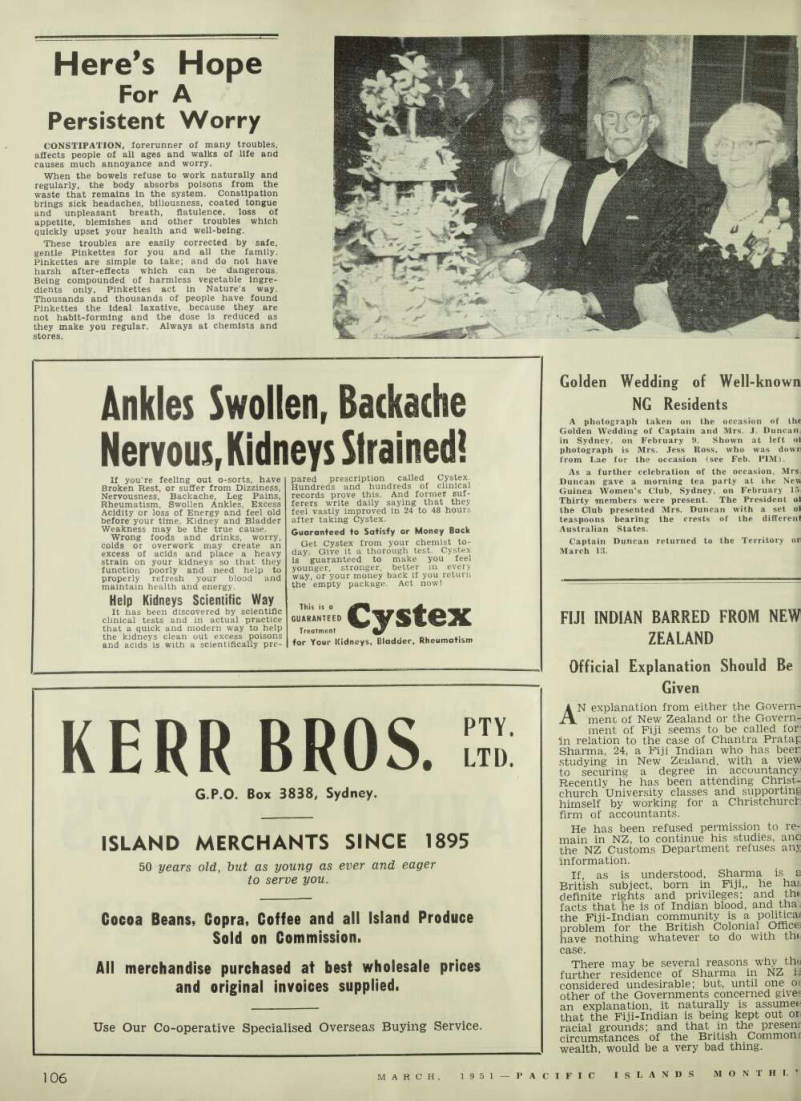
For A Persistent Worry
CONSTIPATION, forerunner of many troubles, affects people of all ages and walks of life and causes much annoyance and worry.
When the bowels refuse to work naturally and regularly, the body absorbs poisons from the waste that remains In the system. Constipation brings sick headaches, biliousness, coated tongue and unpleasant breath, flatulence, loss of appetite, blemishes and other troubles which quickly upset your health and well-being.
These troubles are easily corrected by safe, gentle Pinkettes for you and all the family.
Pinkettes are simple to take; and do not have harsh after-effects which can be dangerous.
Being compounded of harmless vegetable ingre dients only, Pinkettes act in Nature’s way.
Thousands and thousands of people have found Pinkettes the ideal laxative, because they are not habit-forming and the dose is reduced as they make you regular. Always at chemists and stores.
Golden Wedding of Well-known
NG Residents
A photograph taken on the occasion of the Golden Wedding of Captain and Mrs. J. Duncan, in Sydney, on February 9. Shown at left ol photograph is Mrs. Jess Ross, who was down from Lae for the occasion (see Feb. PIM).
As a further celebration of the occasion. Mrs.
Duncan gave a morning tea party at the New Guinea Women’s Club, Sydney, on February 15.
Thirty members were present. The President ol the Club presented Mrs. Duncan with a set ol teaspoons bearing the crests of the different Australian States.
Captain Duncan returned to the Territory or March 13.
Official Explanation Should Be
Fiji Indian Barred From New
Zealand
Official Explanation Should Be Given
AN explanation from either the Govern ment of New Zealand or the Govern ment of Fiji seems to be called for 1 in relation to the case of Chantra Pratap Sharma, 24, a Fiji Indian who has beer studying in New Zealand, with a view to securing a degree in accountancy' Recently he has been attending Christ church University classes and supporting himself by working for a Christchurch firm of accountants.
He has been refused permission to re main in NZ, to continue his studies, ana the NZ Customs Department refuses any information.
If, as is understood, Sharma is s British subject, born in Fiji,, he has, definite rights and privileges; and th* facts that he is of Indian blood, and thaj the Fiji-Indian community is a political problem for the British Colonial Office have nothing whatever to do with thtj case.
There may be several reasons why thu further residence of Sharma in NZ ii considered undesirable; but, until one oc other of the Governments concerned gives an explanation, it naturally is assume*: that the Fiji-Indian is being kept out or. racial grounds; and that in the presenr circumstances of the British Common: wealth, would be a very bad thing.
Advertisements & other items, p. 108 (2 items)
106
MARCH, 1951 PACIFIC ISLANDS MONTH L T
Kerr Bros. S
Ankles Swollen, Backache Nervous, Kidneys Strained!
If you’re feeling out o-sorts, have Broken Rest, or suffer from Dizziness, Nervousness, Backache, Leg Pains, Rheumatism. Swollen Ankles, Excess Acidity or loss of Energy and feel old before your time, Kidney and Bladder Weakness may be the true cause.
Wrong foods and drinks, worry, colds or overwork may create an excess of acids and place a heavy strain on your kidneys so that they function poorly and need help to properly refresh your blood and maintain health and energy.
Help Kidneys Scientific Way
It has been discovered by scientific clinical tests and in actual practice that a quick and modern way to help the kidneys clean out excess poisons and acids is with a scientifically pre-
pared prescription called Cystex.
Hundreds and hundreds of clinical records prove this. And former sufferers write daily saying that they feel vastly improved in 24 to 48 hours after taking Cystex.
Guaranteed to Satisfy or Money Back Get Cystex from your chemist today. Give it a thorough test. Cystex is guaranteed to make you feel younger, stronger, better in every way, or your money back if you return the empty package. Act now!
GUARANTEED CVStCdK
Treatment Qj/ for Your Kidneys, Bladder. Rheumatism
KERR BROS. S
G.P.O. Box 3838, Sydney.
ISLAND MERCHANTS SINCE 1895
50 years old, hut as young as ever and eager to serve you.
Cocoa Beans, Copra, Coffee and all Island Produce Sold on Commission.
All merchandise purchased at best wholesale prices and original invoices supplied.
Use Our Co-operative Specialised Overseas Buying Service.
Papuan Service Loses Mr.
W. H. Halford-Thompson
AFTER 40 years of “correcting” canni bals, evading arrows, and patrolling thousands of miles of Papuan jungle, Mr. W. H. Halford-Thompson says that he is returning home to Devonshire.
He arrived in Brisbane recently in the Bulolo from Port Moresby, on the first leg of his journey home.
In 1911 he went to New Guinea as a young patrol officer fresh from England.
The first three years, he said, were rather an adventure, as his job was catch ing cannibals and “weaning” them from certain items on their menu.
Mr. Halford-Thompson told the Press he was the first white man to enter the then hostile Kikori territory, 200 miles west of Port Moresby.
Four years which he spent away from Papua from 1914-1918 were occupied in fighting Germans in the Cameroons. West Africa. For the last 20 years, which he described as peaceful, he has been an administration officer at Daru and Yule Island, 60 miles west of Port Moresby.
Now finished with New Guinea, Mr. Hal ford Thompson said that his main regret was that he was leaving his boy, Pete, whom he described as being a faithful servant to him for 15 years.
Twice in 40 years Mr. Halford-Thomp son has visited England—once in 1914 to rejoin the Gloucester Regiment, and two years ago to “refresh memories of De vonshire.”
Death Of Mr. J. M. Wilson
WORD was received in Sydney on March 13 of the death that day in Fiji of Mr. J. M. Wilson, who re tired some years ago from the post of Collector of Customs. He spent the whole of his official life in the service of the Fiji Customs Department. After he re tired, he lived for some time in England; but, a couple of years ago, he returned to and took up his permanent residence m the Colony. He was widely esteemed, both as an official and as a citizen, and many frieds will learn with regret of his passing. Two sisters—Mrs. Ria Wishart and Miss Jane Wilson—are residents of Fiji.
Death Of Mrs. M. Carruthers
Mrs. Malia Carruthers. Widow Of
the late Richard Hetherington Carruthers, died in Apia, Western Samoa, on February 19. She was 92.
Her husband, who died 45 years ago, was, at the beginning of the century, one of the pioneers of the cocoa industry in Western Samoa.
Mrs. Carruthers is survived by one son, Mr. I. H. Carruthers founder and senior member of the firm of I. H. Carruthers, Ltd., of Apia who now resides in Auck land and four daughters, Mrs. M. Jessop- Yandall, Mrs. W. H. Cobcroft, Mrs. C. H.
King and Mrs. J. H. Bulcraig of Auckland.
The funeral at Tufuiopa Cemetery was attended by a large and representative gathering. The Rev. P. Kightley officiated at the graveside.
Mr E. Meier, who is an expert brewer, and the new general manager of the local company which is preparing to make beer in Port Moresby for the Papua-New Guinea market, paid the Territories a visit in March. Mr. Meier was born in Hungary, and educated in Germany. He hnf connected with European breweries pWii2 r 12 years, he has been in charge of breweries in Alexandria and Cairo, m Egypt.
Advertisements & other items, pp. 109-110 (2 items)
Acifit Islands Monthly-March. 1951
Shell
PLAIN AND
SELF RAISING
FLOUR,
CUk fob-if/
ESTABLISHED 1868
Agents for Fiji, Tonga and Samoa: C. SULLIVAN (PACIFIC ISLANDS) LTD., Suva, Fiji.
Get that British spirit
For 46 years more Shell has been bought by more motorists than any other brand of petrol. It’s a good British habit.
In Australia alone, Shell is refining British petrol from British crude at the rate of 72,000,000 gallons a year.
The crude is brought to Australia in British tankers from British wells in British Borneo by Shell—a British company.
Get that British spirit—always fill up at the Shell pump
SHELL
VO * f
always fill up
at the SHELL pump
SHELL
he Shell Co. c Aust. Ltd. Inc. in Gt. Britain)
MSSO4J
HARRY J. YOUNG Pty. Ltd.
Sole Distributors for the Pacific Islands for:
INDUSTRIAL AND FANCY CHAINS
BUILDERS’ AND GENERAL HARDWARE
EYELETS AND RINGS
PAPER FASTENERS AND BINDERS
GENERAL METAL STAMPINGS—BRASSWARE
WIRE FORMING—CURTAIN HOLDERS
CURTAIN ROD BRACKETS—CURTAIN RINGS
PICTURE AND MIRROR FITTINGS
PRODUCTS OF HIPKISS, KERSHAW (AUST.) PTY. LTD.
Order Through Your Usual Channels
HARRY J. YOUNG PTY. Ll®.
379 KENT STREET, SYDNEY.
Telephone: MA 8187. Box 3661, G.P.0.. Sydney.
Bankers: Bank of New South Wales. Codes: Bentley’s Complete Phrase: Bentleys 2nd Phrase,
Coconut Planting Campaign
In Fiji
Prom Our Own Correspondent SUVA, March 1 ¥7IOLLO WING on the successful banana X 1 planting campaign by the natives of the Southern District of Fiji, the Colony’s Department of Agriculture has decided to do as much for the coconut growing Fijians.
The aim for this year is 15,000 acres of new coconuts planted; but the plan does not stop there —it is hoped to encourage the Fijians to make regular plantings for each year for the next 10 years and at the same time to improve, by building better driers, the quality of their copra. (Ed. Note: This plan to plant new coconuts is in contrast to the state of affairs in Papua-New Guinea and BSI where virtually no new planting has been undertaken since before the war.)
Naming Suva’S Streets
From Our Own Correspondent SUVA, March 1.
MANY streets in Suva and its suburbs, especially in newly developed areas, are still un-named. Recently a committee met to advise the Director of Lands on the selection of suitable names for streets in sub-divisions of Crown land.
Among the names recommended are those of former Governors and prominent citizens of the Colony. Fijian names have been recommended only when they can be easily pronounced by non-Fijians.
They include the names of birds, fishes, flowers, trees and islands. It is intended to publish a list of the Committee’s recommendations shortly.
Wot—Another Research
Section !
Letter to the Editor IP, with a new Minister for Territories, there is to be a review of Territories Administration, there should be an in vestigation of an extraordinary set-up which recently has appeared in the De partment of External Territories, Can berra.
It is called the Department’s Research Section; and its job seems to be to con duct research into the various matters which presumably have baffled Depart mental Secretary Halligan, Administrator Murray, and the Territories corps of Ex perts headed by the Director of Planning.
The Research Section seems to comprise about half a dozen researchers, who have dug themselves in comfortably, and have the usual little staff of typists and clerks.
It appears to have been in existence over a year, and it is said to have been created when the Australian Public Service Board, on Prime Minister Chifley’s recommen dation, forced Mr. Halligan to organise a research service.
When it is remembered that the South Pacific Commission was formed at Aus tralia’s instigation: that the Commission now maintains a highly expert Research Council which concerns itself with the problems of the Pacific Territories; and that most of the Papua-New Guinea De partments already have research men, the Canberra set-up appears ridiculous.
Why was it created, what does it do, and how much does it cost?
I am, etc.,
Australian Taxpayer
Sydney.
Mr. and Mrs. Mai Creed, of Port Moresby, accompanied by their two children, are holidaying in Warwick, South Queensland.
Advertisements & other items, pp. 111-112 (1 item)
Tilley
QUEENSLAND
INSURANCE
COMPANY
LIMITED
(Incorporated 1886 in Australia).
ASSETS EXCEED £5,000,000
Head Office:
QUEENSLAND
INSURANCE BUILDING,
80-82 PITT STREET. SYDNEY.
Specialists in South Sea Fire,
Marine & Accident Insurances
Apply to: —
FlJl.—Branch Office: I. B. Chalmers, Manager.
Burns Phllp (South Sea) Co., Ltd.
VlLA.—Burns Phllp (New Hebrides), Ltd.
Comptolrs Francals Des Nouvelles Hebrides.
NOUMEA.—L. & W. Johnston.
NEW GUlNEA—Manager for the Territory of New Guinea and Papua, W. A.
Anderson.
PORT MORESBY—SAMARA!—LAE
—MADANG—RABAUL.
Burns Phllp (New Guinea), Ltd.
PAGO PAGO.
Burns Phllp (South Sea) Co., Ltd.
G. H. C. Reid & Co.
OTHER SOUTH SEA ISLANDS.
Burns Phllp (South Sea) Co., Ltd.
Also to any of the Company’s Offices in Australia or New Zealand.
TILLEY
BURN ORDINARY KEROSENE
LAMPS
REGD.
MODEL OL 50
300 Canute Power
MODEL OL 51
500 Candle Power I
TILLEY
BURN ORDINARY KEROSENE
MODEL FL 6
FLOODLIGHT PROJECTOR
5,000 Candle Power pa
MODEL S.D.R.
BEAM LIGHT
500 Candle Power
REPRESENTATION:
AUSTRALIA & NEW GUINEA: T. H. Bentley, Pty. Ltd., 123-125 William
Street, Melbourne, C.l.
TASMANIA: Mr. H. V. Sellers, 108 a Charles Street, Launceston.
FIJI: Mr. K. Witherington, 2 Burns Philp Buildings, Suva.
ANNOUNCES
bbustawp; th£ mm m of
x.J «»»•«
„SJSS - ““
OLIVER “FDE” (110 d.b.hp.) with “Eritstand” Trailbuilder.
BRITISH STANDARD MACHINERY CO. LTD.—Largest
manufacturers of earthmoving equipment in the Southern Hemisphere—join with The Oliver Corporation in welcoming New Guinea Company Ltd. as a member of the OLIVER- BRITSTAND organisation . . . ready to help you at all times in the selection and servicing of Oliver tractors and Britstand earthmoving and logging equipment.
Ask for details of the Oliver tractor range (from 22.85 h.p. to 110 h.p.) and Britstand equipment, including trailbuilders, bulldozers, logging winches, rippers, scoops, power control units, grader ditchers, etc.
DISTRIBUTORS OF OLIVER TRACTORS AND
BRITSTAND EQUIPMENT;
(britstand) new GUINEA
COMPANY LIMITED
Kabaul, Lae, Madang, Kavieng. Associated Companies: J. R. Clay & Co., Ltd., Port Moresby. W. R. Carpenter & Co. (Solomon Islands) Pty., Ltd., Tulagi.
Island Industries Now
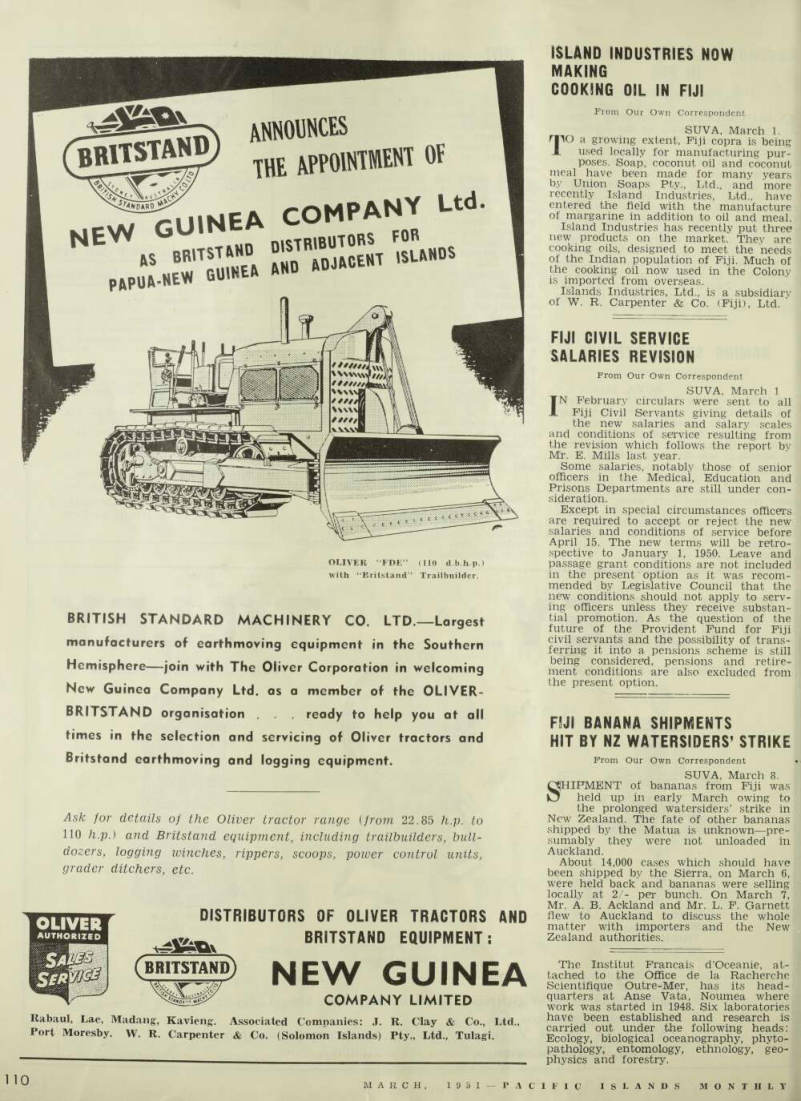
Making
Cooking Oil In Fiji
From Our Own Correspondent SUVA. March 1. fTK) a growing extent, Fiji copra is being 1 used locally for manufacturing pur poses. Soap, coconut oil and coconut meal have been made for many years by Union Soaps Pty., Ltd., and more recently Island Industries, Ltd., have entered the field with the manufacture of margarine in addition to oil and meal.
Island Industries has recently put three new products on the market. They are cooking oils, designed to meet the needs of the Indian population of Fiji. Much of the cooking oil now used in the Colony is imported from overseas.
Islands Industries, Ltd., is a subsidiary of W. R. Carpenter & Co. (Fiji), Ltd.
Fiji Civil Service
Salaries Revision
From Our Own Correspondent SUVA, March 1 IN February circulars were sent to all Fiji Civil Servants giving details of the new salaries and salary scales and conditions of service resulting from the revision which follows the report by Mr. E. Mills last year.
Some salaries, notably those of senior officers in the Medical, Education and Prisons Departments are still under con sideration.
Except in special circumstances officers are required to accept or reject the new salaries and conditions of service before April 15. The new terms will be retro spective to January 1. 1950. Leave and passage grant conditions are not included in the present option as it was recom mended by Legislative Council that the new conditions should not apply to serv ing officers unless they receive substan tial promotion. As the question of the future of the Provident Fund for Fiji civil servants and the possibility of trans ferring it into a pensions scheme is still being considered, pensions and retire ment conditions are also excluded from the present option.
Fiji Banana Shipments
Hit By Nz Watersiders' Strike
From Our Own Correspondent SUVA. March 8.
SHIPMENT of bananas from Fiji was held up in early March owing to the prolonged watersiders’ strike in New Zealand. The fate of other bananas shipped by the Matua is unknown —presumably they were not unloaded in Auckland.
About 14,000 cases which should have been shipped by the Sierra, on March 6, were held back and bananas were selling locally at 2/- per bunch. On March 7, Mr. A. B. Ackland and Mr. L. F. Garnett flew to Auckland to discuss the whole matter with importers and the New Zealand authorities.
The Institut Francais d'Oceanie, at tached to the Office de la Racherche Scientifique Outre-Mer, has its head quarters at Anse Vata, Noumea where work was started in 1948. Six laboratories have been established and research is carried out under the following heads: Ecology, biological oceanography, phyto pathology, entomology, ethnology, geo physics and forestry.
THE Americans,
Australia’s Nightmare Jap Colonists in New Guinea
Residents of the south Pacific Islands, especially those who ex perienced the horrors of the invasion in New Guinea, Solomons and Gilberts, will not like some angles of the Peace Treaty talks now going on between the United States and Japan.
It is felt that the time has come to officially end the war with Japan. The completion of a Peace Treaty has been cunningly prevented for years by Russia, as part of her plan of obstructing and em barrassing the Western Powers. Now, however, the Treaty will be completed, whether Russia likes it or not. America proposes that a re-armed Japan shall be the first line of her Pacific defence against Red Asia.
Naturally, Japan is agreeable; but her politicians are preparing to make the shrewdest possible bargain. In return for co-operation with United States against Red Asia, the Japs want — • The return to them of the small groups of islands immediately south wards of Japan—especially the Ryuku and Bonin archipelagoes—and the Kurile chain, to the northward. • Permission to transfer a large number of Japanese (some reports say 5 millions) from the home islands to New Guinea, for permanent settle ment.
The Americans seem inclined to look with favour upon both demands. The small groups of small islands referred to really belong to Japan, and there will be no objection to their return. But the nations interested in the South Pacific — especially Australia —are unwilling even to consider any plans for Japanese migra tion into Melanesia.
New Guinea, next to Greenland, is the world’s biggest is land. New Guinea is capable of great commercial exploita tion and develop ment. New Guinea could carry ten or twenty times its pre sent population of U million —and it is unlikely that the natives will multiply quickly. Japanese would be the ideal colonists for this huge tropical island —industrious, inge nious, enterprising.
But how can Aus tralia, already fear ful of Asia’s thou sand million hungry people, tolerate the thought of introduc ing millions of Asia’s most aggressive race into the island that, hitherto, has been regarded as Austra lia's natural barrier against Asia? Aus tralia has been very “jittery” lately be cause there is a pos sibility of Javanese settling in Western New Guinea, just ac ross Torres Strait.
Indonesians would be far less a formidable foe than Japanese.
THE Americans,
thinking only of their plan of building up Japan as THEIR barrier against Asia, will try
to persuade the Australians that the Jap anese now are reformed —that they may be accepted in New Guinea as trustworthy neighbours.
No Australian who saw the Japanese, between 1920 and 1940, spying out every island and reef in the South Pacific, or who remembers the horrors inflicted by these sub-human beasts upon our soldiers and civilians in Burma and Ambon, Tol and Tarawa, or who has read the evidence being slowly accumulated at this moment in the war criminal trials at Manus, will ever accept the Japanese as trustworthy allies or desirable neighbours. . . .
This may become a lively and very em barrassing issue. The Japanese archi pelago already is woefully overcrowded, and the people, with typical Asiatic fe cundity. are increasing at the rate of probably 2 millions per annum. Japan’s number-one problem is how to make proper provision for the feeding of her 90 million population. There must either be enormous oversea trading and impor tation of foodstuffs and raw materials (as before World War II); or emigration.
Maybe, if the Muscovite did not threaten to destroy Western civilisation, and Japan were not needed to take a place in our defences, Japan would be left to solve her own problems in her own way. She forfeited all claim to our help and con sideration in ‘‘that moment of infamy” when, in the dawn of December 7, 1941, she struck at Pearl Harbour. Unhappily for all of us, she cannot be left alone, or kept unarmed.
But even the logic of the Cold War cannot induce Australians to look with tolerance upon the proposal that Aus tralia shall have Japanese neighbours in
New Guinea. So, what?-
R.W.R.
Advertisements & other items, p. 113 (1 item)
Bardinet
Classified Advertisements
FOR SALE
LAUNCH HULL. —45 ft. x 14 ft. x 6 ft. 6 in..
U.S.N. Tow-boat; built by United Ship Builders, Auckland, for United States Navy. Solid construction, IVz in. Oregon planking: Kauri posts and dead-woods. Condition as new. Partly completed and ready for launching ideal for conversion into fishing or pleasure craft. Price: £ I.soo—approximately half present day building cost. Further particulars from: Dr. H. G. Rix, 16 Waterloo Road, Lower Hutt, New Zealand.
PLANTATION. —Warenvula Plantation, pre-war, approximately 1.500 acres, unencumbered, freehold. situated in New Britain. Territory of Papua-New Guinea. Apply: Bignell, 12a Hawkesbury Road, Springwood, N.S.W.. Australia.
RADIO EQUIPMENT.—We can supply new and reconditioned transmitters and receivers for low powered marine and shore installations at a reasonable price. Crystals supplied to specified frequencies. Inquiries answered promptly.
Write: Liverpool Trading Co., 23 George Street, Liverpool, N.S.W., Australia.
N.I. PROPERTY FOR SALE. Retiring or retired?
Norfolk Island is becoming more and more popular with residents of Papua-New Guinea.
Solomon Islands and New Hebrides. Equable temperatures (50 degrees to 85 degrees*; Mainland and tropical fruits all grow profusely; friendly people; NO TAXES Furnished Houses for Sale; one at £2,000 has a lovely garden; another at £3,000 is complete with 1948 Prefect, a grand piano and all furniture, china and linen.
Write or cable: Peter Goddard, Property Agent, Norfolk Island.
HOLIDAY RESORTS
“MOUNTAIN VIEW” GUEST HOUSE, magni-
ficently situated on the banks of the Wollondtlly River, in Burragorang Valley, Australia’s largest sunken valley (69 miles from Sydney), a most modern Guest House, with accommodation for 150 guests. Golf, tennis, riding, billiards, dancing and swimming. Hot water service, electric light and sewerage. Licensed to serve liquor. Tariff: £5/11/- per week, children at half rates. Write direct to; “MOUNTAIN VIEW,” Burragorang Valley. N.S.W., or phone Burragorang 3 (or XM 1384). Proprietor: R. I.
Fernandez, late of Papua and New Guinea.
SOUTHERN HIGHLANDS.—Roomy, self-contained furnished flats, all-electric, sewered, hot water; near rail, shops and bus stops; handy to Sydney and South Coast towns; at 2,200 ft. elevation, all sports available, ideal for children. Terms and particulars from: Proprietor, “Tree Tops,’’
Bundanoon, N.S.W.
POSITIONS VACANT
COMMONWEALTH OF AUSTRALIA
DEPARTMENT OF CIVIL AVIATION,
PORT MORESBY, PAPUA.
APPLICATIONS are invited for the following positions in the Stores Branch: Storemen.—Salary scale: £699 to £7ll per annum (married), £674 to £686 per annum (unmarried); or, £669 to £693 per annum (married), £644 to £668 per annum (unmarriedl.
Dependent upon ability and previous experience.
Motor Driver.—Salary scale: £675 to £699 per annum (married), £650 to £674 per annum (unmarried).
Carpenter.— Salary scale: £741 to £765 per annum (married), £716 to £740 per annum (unmarried).
Recreation and sick leave benefits, overtime and penalty rates, etc., as per Commonwealth Public Service Act.
THIS LABEL MEANS
TRADE
MARK
BARDINET
\\3 ST RALi4yy
RUM
Agents:
SWIFT AND HORNDALE PTY. LTD.
26 Clarence Street, Sydney, Australia
Copra
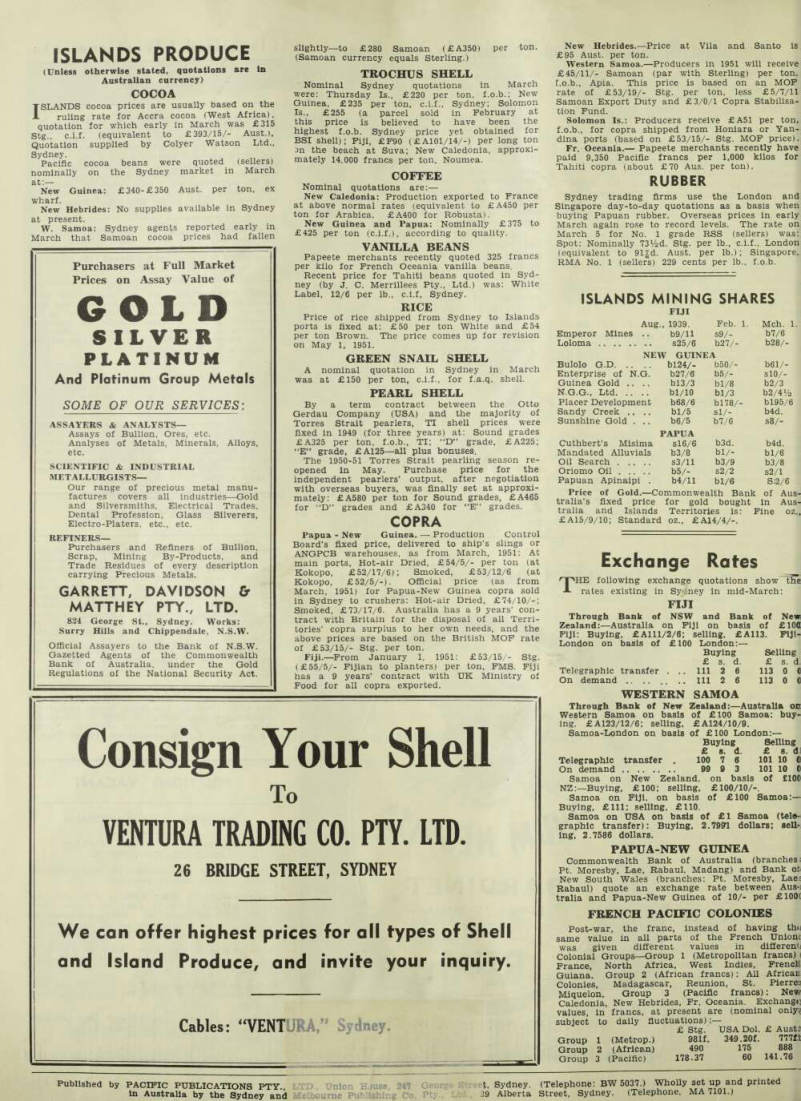
Islands Produve
(Unless otherwise stated, quotations are In Australian currency)
Cocoa
ISLANDS cocoa prices are usually based on the ruling rate for Accra cocoa (West Africa), quotation for which early in March was £315 Stg ci.f. (equivalent to £393/15/- Aust.).
Quotation supplied by Colyer Watson Ltd., Svdney P Pacific cocoa beans were quoted (sellers) nominally on the Sydney market in March at New Guinea: £340-£350 Aust. per ton. ex wharf New Hebrides: No supplies available in Sydney at nresent W. Samoa: Sydney agents reported early in March that Samoan cocoa prices had fallen
slightly—to £2BO Samoan (£A3SO) per ton. (Samoan currency equals Sterling.)
Trochus Shell
Nominal Sydney quotations in March were: Thursday Is., £220 per ton, f.0.b.; New Guinea, £235 per ton, c.i.f., Sydney: Solomon Is., £255 (a parcel sold in February at this price is believed to have been the highest f.o.b. Sydney price yet obtained for BSI shell); Fiji, £F9O (£AIOI/14/-) per long ton an the beach at Suva; New Caledonia, approxi mately 14,000 francs per ton, Noumea.
Coffee
Nominal quotations are:— New Caledonia: Production exported to France at above normal rates (equivalent to £A4SO per ton for Arabica. £A4OO for Robusta).
New Guinea and Papua: Nominally £375 to £425 per ton (c.i.f.), according to quality.
Vanilla Beans
Papeete merchants recently quoted 325 francs per kilo for French Oceania vanilla beans.
Recent price for Tahiti beans quoted in Syd ney (by J. C. Merrillees Pty., Ltd.) was: White Label, 12/6 per lb., c.i.f, Sydney.
Rice
Price of rice shipped from Sydney to Islands ports is fixed at: £5O per ton White and £54 per ton Brown. The price comes up for revision on May 1, 1951.
Green Snail Shell
A nominal quotation in Sydney in March was at £l5O per ton, c.i.f., for f.a.q. shell.
Pearl Shell
By a term contract between the Otto Gerdau Company (USA) and the majority of Torres Strait pearlers, TI shell prices were fixed in 1949 (for three years) at: Sound grades £A325 per ton, f.0.b., TI; “D” grade, £A225; “E” grade, £AI25 —all plus bonuses.
The 1950-51 Torres Strait pearling season re opened in May. Purchase price for the independent pearlers’ output, after negotiation with overseas buyers, was finally set at approxi mately: £ASBO per ton for Sound grades, £A465 for “D” grades and £A34O for “E” grades.
Copra
Papua - New Guinea. Production Control Board’s fixed price, delivered to ship’s slings or ANGPCB warehouses, as from March, 1951: At main ports, Hot-air Dried, £54/5/- per ton (at Kokopo, £52/17/6); Smoked, £53/12/6 (at Kokopo, £52/5/-). Official price (as from March, 1951) for Papua-New Guinea copra sold in Sydney to crushers: Hot-air Dried, £74/10/-; Smoked, £73/17/6. Australia has a 9 years’ con tract with Britain for the disposal of all Terri tories’ copra surplus to her own needs, and the above prices are based on the British MOP rate of £53/15/- Stg. per ton.
Fiji.—From January 1, 1951: £53/15/- Stg. (£55/5/- Fijian to planters) per ton, FMS. Fiji has a 9 years’ contract with UK Ministry of Food for all copra exported.
New Hebrides.—Price at Vila and Santo is £95 Aust. per ton.
Western Samoa.—Producers in 1951 will receive £45/11/- Samoan (par with Sterling) per ton.
E.0.b., Apia. This price is based on an MOP rate of £53/19/- Stg. per ton, less £5/7/11 Samoan Export Duty and £3/0/1 Copra Stabilisa tion Fund.
Solomon Is,: Producers receive £ASI per ton, f.0.b., for copra shipped from Honiara or Yan dina ports (based on £53/15/- Stg. MOP price).
Fr. Oceania. — Papeete merchants recently have paid 9,350 Pacific francs per 1,000 kilos for Tahiti copra (about £7O Aus. per ton).
Rubber
Sydney trading firms use the London and Singapore day-to-day quotations as a basis when buying Papuan rubber. Overseas prices in early March again rose to record levels. The rate on March 5 for No. 1 grade RSS (sellers) was; Spot: Nominally TSVzd. Stg. per lb., c.i.f., London (equivalent to 91gd. Aust. per lb.); Singapore, RMA No. 1 (sellers) 229 cents per lb., f.o.b.
Islands Mining Shares
Price of Gold.—Commonwealth Bank of Aus tralia’s fixed price for gold bought in Aus tralia and Islands Territories is; Pine oz„ £AIS/9/10; Standard oz., £AI4/4/-,
Fiji
Aug., 1939.
Feb. 1.
Mch. 1.
Emperor Mines .. b9/ll s9/b7/6 Loloma s25/6 b27/b28/-
New Guinea
Bulolo G.D bl24/b50/b61/- Enterprise of N.G. b27/6 b5/slO/- Guinea Gold .. .. bl3/3 bl/8 b2/3 N.G.G., Ltd bl/10 bl/3 b2/4V 2 Placer Development b68/6 bl78/bl95/6 Sandy Creek ,. bl/5 sl/b4d.
Sunshine Gold . .. b6/5 b7/6 s8/-
Papua
Cuthbert’s Misima sie/6 b3d. b4d.
Mandated Alluvials b3/8 bl/bl/6 Oil Search S3/11 b3/9 b3/8 Oriomo Oil b5/s2/2 s2/l Papuan Apinaipi . b4/ll bl/6 S12/6
Exchange Rates
THE following exchange quotations showniie rates existing in Sydney in mid-March:
Fiji
Through Bank of NSW and Bank of Newi Zealand:—Australia on Fiji on basis of £lOO Fiji: Buying, £Alll/2/6: selling. £AII3. FIJI - on basis of £lOO London; —
Western Samoa
Through Bank of New Zealand:—Australia on Western Samoa on basis of £lOO Samoa: buy ing. £AI23/12/6: selling, £AI24/10/9.
Samoa-London on basis of £lOO London: —
Samoa on New Zealand, on basis of £lOO NZ:—Buying, £100: selling, £lOO/10/-.
Samoa on FIJI, on basis of £lOO Samoa: — Buying, £111: selling, £llO.
Samoa on USA on basis of £1 Samoa (tele-i graphic transfer): Buying, 2.7991 dollars; sell ing, 2.7586 dollars.
Papua-New Guinea
Commonwealth Bank of Australia (branches!
Pt. Moresby, Lae, Rabaul, Madang) and Bank oil New South Wales (branches: Pt. Moresby, Lae; Rabaul) quote an exchange rate between Aus-i tralia and Papua-New Guinea of 10/- per £100(
French Pacific Colonies
Post-war, the franc, instead of having thu same value in all parts of the French Unionc was given different values in different!
Colonial Groups—Group 1 (Metropolitan francs) ( France, North Africa, West Indies, French Guiana. Group 2 (African francs): All African Colonies, Madagascar, Reunion, St. Pierrea Miquelon. Group 3 (Pacific francs): New Caledonia, New Hebrides, Fr. Oceania. Exchange values, in francs, at present are (nominal onlyq subject to daily fluctuations);—
Buying Selling £ s. d. £ s. dJ Telegraphic transfer ... Ill 2 6 113 0 0 On demand Ill 2 6 113 0 0
Buying Selling £ 8. d. £ s. dl Telegraphic transfer . 100 7 6 101 10 0 On demand 99 9 3 101 10 o
£ Stg. USA Dol. £ AustJ Group 1 (Metrop.) 981£. 349.20f. 777X1 Group 2 (African) 490 175 888 Group 3 (Pacific) 178.37 60 141.76
Advertisements & other items, pp. 114-116 (4 items)
Published by PACIFIC PUBLICATIONS PTY. hilon c 247 C . t, Sydney. (Telephone: BW 5037.) Wholly set up and printed
in Australia by the Sydney and . ourne Pi- 1 > ° ’9 Alberta Street, Sydney. (Telephone, MA 7101.)
Consign Your Shell
Purchasers at Full Market Prices on Assay Value of
GOLD
SILVER
PLATINUM
And Platinum Group Metals
SOME OF OUR SERVICES :
ASSAYERS & ANALYSTS—
Assays of Bullion, Ores, etc.
Analyses of Metals, Minerals, Alloys, etc.
SCIENTIFIC & INDUSTRIAL
METALLURGISTS—
Our range of precious metal manufactures covers all industries—Gold and Silversmiths, Electrical Trades, Dental Profession, Glass Sllverers, Electro-Platers, etc., etc.
REFINERS—
Purchasers and Refiners of Bullion, Scrap, Mining By-Products, and Trade Residues of every description carrying Precious Metals.
GARRETT, DAVIDSON &
MATTHEY PTY., LTD.
824 George St., Sydney. Works: Surry Hills and Chippendale, N.S.W.
Official Assayers to the Bank of N.S.W.
Gazetted Agents of the Commonwealth Bank of Australia, under the Gold Regulations of the National Security Act.
Consign Your Shell
To
VENTURA TRADING CO. PTY. LTD.
26 BRIDGE STREET, SYDNEY
We can offer highest prices for all types of Shell and Island Produce, and invite your inquiry.
Cables: “VENT
C Islands Monthly
The key
The features of this unusual XVlth Century hey illustrate its owner s connection with the trader on the African coast, no doubts the hey obviously being that of his sea-chest.
St
to smoking pleasure
ill - S T i
FINE CUT
NAVY CUT
TOBACCOS
or
MERCHANTS, & SHIP OWNERS
dp Capital £500,000
ESTABLISHED 1914
GENERAL MERCHANTS
AND
PROVIDORES
TRADE THROUGHOUT THE PACIFIC.
THIRTY-FIVE YEARS OF PACIFIC ISLANDS DEVELOPMENT AND SERVICE.
BUYERS AND EXPORTERS OF ALL KINDS
OF ISLAND PRODUCE, COPRA, COCOA,
M.O.P. SHELL, TROCAS SHELL, ETC.
AGENTS FOR AUSTRALIAN, EUROPEAN
AND AMERICAN MANUFACTURERS.
DISTRIBUTORS OF EVERY DESCRIPTION
OF MERCHANDISE.
Through our Sydney office, branches and agents, we distribute a wide and comprehensive range of general merchandise.
*. R. CARPENTER S CO. LTD.
Head Office: 16 O'CONNELL STREET, SYDNEY, N.S.W.
Cable Address: Telephone: Postal Address: “CAMOHE” BW 4421. G.P.0., BOX 168, Sydney. % In London: W. R. Carpenter fir Co. (London), Ltd., Coronation House, 4 Lloyd's Ave., London, EC
ASSOCIATED COMPANIES THROUGHOUT THE PACIFIC :
IN NEW GUINEA; IN PAPUA: IN FIJI: New Guinea Company, Limited, J. R. Clay & Co., Ltd., W. R. Carpenter & Co. (Fiji), Rabaul, Lae, Madang, Kavieng. Port Moresby. Ltd., Suva.