Pacific
Islands
Monthly
April, 1951
Vol. XXI. No. 9.
Established 19B0.
IRegistered at the G.P .0., Sydney , for transmission by post as a newspaper J
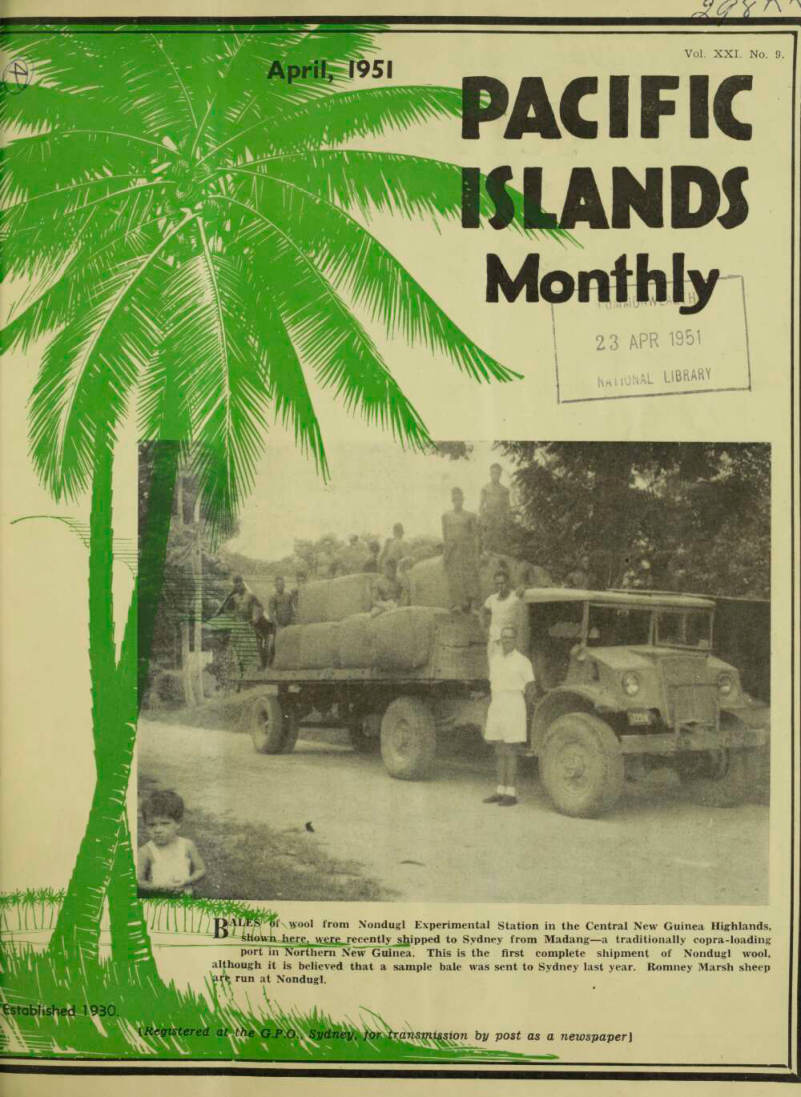
BALES of wool from Nondugl Experimental Station in the Central New Guinea Highlands, shown here, here were recently shipped to Sydney from Madang— a traditionally copra-loading port in Northern New Guinea. This is the first complete shipment of Nondugl wool, although it is believed that a sample bale was sent to Sydney last year. Romney Marsh sheep are, run at Nondugl.
Advertisements & other items, pp. 2-4 (1 item)
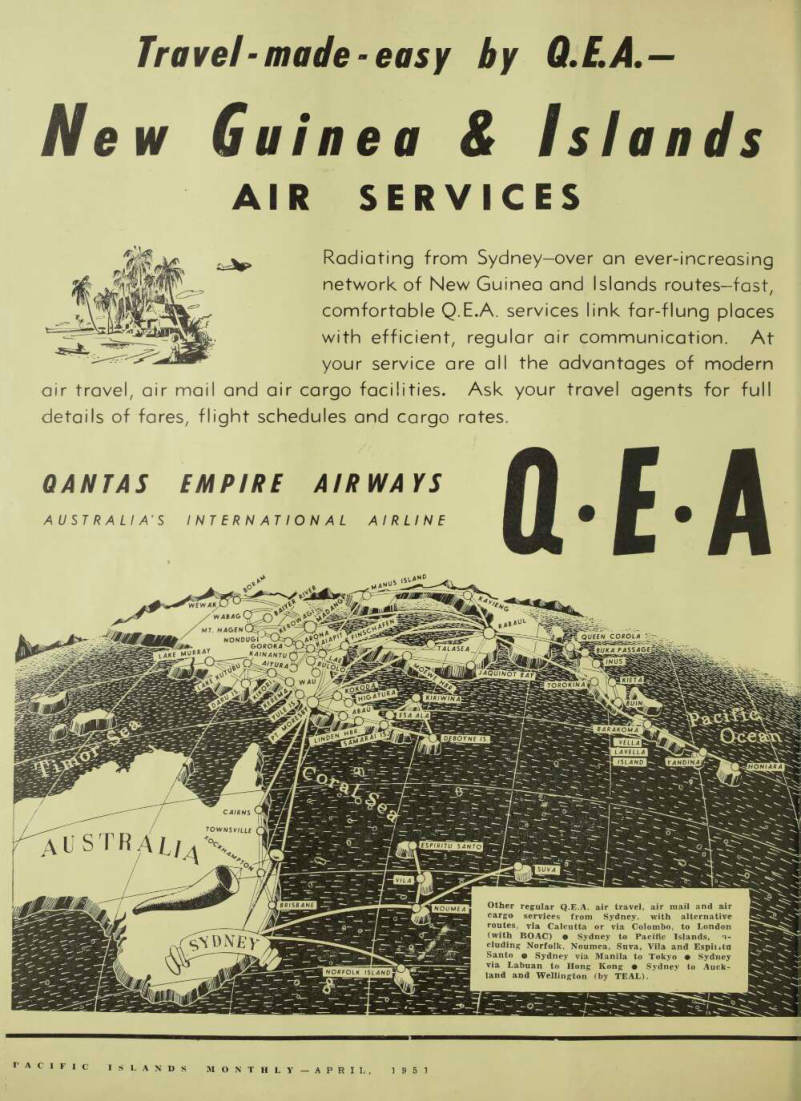
Ne w Guinea & Islands
Travel-made-easy by Q.C.A.—
AIR SERVICES
Radiating from Sydney—over an ever-increasing
network of New Guinea and Islands routes—fast,
comfortable Q.E.A. services link far-flung places
with efficient, regular air communication. At
your service are all the advantages of modern air travel, air mail and air cargo facilities. Ask your travel agents for full details of fares, flight schedules and cargo rates. %
OANJAS EMPIRE AIRWAYS
AUSTRALIA'S INTERNATIONAL AIRLINE
HE A
siA nd ma*** ' ■
y WABAG
AUL
MT. HAGEN
QUEEN JCOROLA >.:-
P4SSAGf^^V
VMM NONDUGI
W//M». GOROKA •'
LAKE M iJR RA L KAINAN7U
TAI.ASEA
' , ft \) vy yirußyi ?Oio 'sm .W
JAQUINOr BAY
KIETA
VVAU
rOROKIN A
KIRIWINA
l UIN
a B - •'
BAR AKOM A
LAVELLA
ISLAND r ANDIN A
HONIARA
CAIRNS
TOWNSVILLE
TR /u/ 4 \
rAU s
Other regular Q.E.A. air travel, air mail and air cargo services from Sydney, with alternative routes, via Calcutta or via Colombo, to London (with BO AC) e Sydney to Pacific Islands, icluding Norfolk. Noumea, Suva, Vila and Espiuta Santo 0 Sydney via Manila to Tokyo • Sydney via Labuan to Hong Kong • Sydney to Auckland and Wellington (by TEAL).
D \ E y
ioy of Every Outing
m * V m A >v r * v « i i * *-' :
POCKET STOVE
Coleman Speedmaster ' Portable Stove.
It s a complete kitchen stove telescoped into a compact case not much bigger than a quart bottle of milk. The holder makes two handy cooking utensils and a cup of petrol burns for two hours. For picnicking, camping, fishermen and motorists, etc. inches high,.inches wide, weight 3 lbs.
Whether you require a stove for the home, the camp, the boat, or even picnicking, there’s a Coleman made especially for that purpose and each is the best of its kind. r Two-burner Portable Stove.
Console Range 5-burner with glass door.
Representatives for the Pacific Islands :
ROBERT GILLESPIE PTY. LTD.
54a PITT STREET, SYDNEY
PEARCE & CO. LTD.
SUVA
FOR FIJI ISLANDS
S SENSATIONAL
Much than more O G M
IT’S 3 SEPARATE
HOME ENTERTAINMENT
UNITS IN ONE!
Only
£36 5 3 Three Separate Entertainment units —each with Triple Throat—each giving you three times the entertainment value of ordinary radio ... all three incorporated in the one magnificent allplastic cabinet . . . streamlined and sealed!
Unit I.—Triple Throat reception of local programmes.
Unit 2.—Triple Throat reception of overseas programmes at full local volume.
Unit 3.—Triple Throat quality reproduction from your favourite records.
HRIESLER
3-in-one' RADIOGRAM
"The Best Set at Any Price!"
MANTEL MODEL RADIO (11/20)
World Range, 4 essential controls, “Phantom- Valve” Circuit, Sound Vibration Bridge, Sealed.
Wonderful buy £ 1 9 /4/ 1 0
AMAZINGLY LOW PRICE—ONLY £36/5/3
Triple Throat, sealed for your protection, and with all Kriesler’s exclusive, proved features plus the exclusive Kriesler performance guarantee of 12,500 miles range, this new “3-in-one” Radiogram is what you’ve always wanted.
WE LL DESPATCH YOUR KRIESLER
BY AIR
IMMEDIATELY ON RECEIPT OF ORDER.
TABLE MODEL RADIO (11/7) world Range, 4 essential controls, “Phantom-Valve” Circuit, Sound Vibration Bridge, Sealed, full size table model. A very . Q /1A Popular Model £25/ 5/ 10 ORDER FROM, OR WRITE FOR FULL DETAILS TO . . .
QLD. MERCHANTS SUPPLIES
143-145 QUEEN STREET, BRISBANE, QLD.
Index to Advertisers
Achun. Gabriel . . 83 f “Akta-Vite” .31 Aladdin Industries . 46 Alois Akun & Co. . 90 Amplion (A/sia) Pty 53 ' Angus & Robertson, Ltd 17 Ardath Tobacco Co. 74 “Aspaxadrene” . . 21 “Aspro” ... 84 Baker, W. Jno. . . 41 Balchin, W., Ltd. . 78 Bank of NSW . . 71 Bell, Stanley P., & Co 43, 96 “Bellhaven” Guest House ... 92 Berry’s Bay Boat yard 97 Bethell, Gwyn Co. 96 Blaxland Rae Pty. 92 Blundell Spence Co. 52 Borthwicks’ Paint . 40 Bovril, Ltd. ... 87 Bray & Holliday, Ltd 42 Bristol-Myers Co. . 75 Broomfields, Ltd. . 96 Brunton & Co. . . 115 Budge, James, Ltd. 90 Bunting, A. H. 51, 104 Burns Philp (NG) . 63 Burns Philp (NH) . 107 Burns Philp (SS) . 74 Burns Philp Trust 108 Caine’s Studios . . 49 Carpenter, W. R. & Co., Ltd. . 72, cov. iv Carpenter, W. R. (Fiji), Ltd. ... 65 Classified Advts. . 114 Colonial Meat Co. 68 Colman’s Mustard 113 C o 1 ye r Watson (NG) Ltd., 32, 45, 89 Commonwealth Bank of Aust. . 99 Crammond Radio . 26 Crilley, R. J., Ltd. 25 “Cystex” ... 11l Dangar, Gedye & Malloch, Ltd. . . 3 Davison Paints . . 64 Donaghy & Sons . 73 Donald, A. 8., Ltd. (Auckland) ... 53 Donald, A. 8., Ltd. (Rarotonga) ... 34 Douglass, W. C.
Ltd 49 Dunlop Rubber Co. 11l Electrolux ... 72 Festival of Britain . 22 Ford Sherington, Limited ... 77 Garrett, Davidson & Matthey. Ltd. . 116 Garrick Hotel . . 115 Gilbey, W. & A. . 84 Gillespie Bros. ... 73 Gillespie. Robt., Pty.. Ltd. . 1. 29, 86 Gillespie, Robt. (NG) Ltd. . . 36, 77 Gordon’s Gin ... 81 Gough & Co., E. J. 39 Grand Pacific Hotel 4 Gregory, A., Ltd. . 36 Grove. W. H., & Sons. Ltd. . 27, 70 Guaranteed Mail Orders ... 15 Halvorsen Sons, Ltd. 93 Hawley’s Pty., Ltd. 80 Hay, K. H. D. . . 65 Heinz & Co.. Ltd. . 69 Hemingway & Robertson, Ltd. . 32 “Holland Rusk” . 19 Hoover. Francis . . 18 Hunts Agency . .115 Hygeia Sanitary Co. 48 Hytest Axe & Tool Pty., Ltd. ... 113 Island Industries . 35 Islands Service Bureau ... 29
Kennedy. Captain . 94
Kerr Bros. . . 40, 92 Kiwi Polish Co. . 104 Kolynos, Inc. ... 23 Kopsen. W., & Co. 109 Kraft Walker Cheese Co. . . . 82 Lillis & Co., Ltd. . 54
Maclntyre, Thomas, & Co.. Ltd. ... 37 MacLaurin School 31 Mac Robertson Pty., Ltd 103 McGee, Andrew . . 76 Mcllrath’s, Ltd. . 24 “Mendaco” . . . 107 Merrillees, J. C., Pty., Ltd. ... 105 Metro-Goldwyn- Mayer Films 112 Millers Ltd. (Fiji) 24 Miller, G. V. & Co., Ltd. ... 114 Mobile Industrial Equipment Ltd. . 38 Moderne Knitwear . 18 Morris Hedstrom Ltd 12 Morris Hedstrom (Aust.) Pty., Ltd. 41 Mungo Scott, Ltd. 101 Nathan’s Merchan dise (NSW) Pty. 66 Nelson & Robertson Pty., Ltd 64 “Nixoderm” ... 91 Nordman, Oscar G. 91 North Sydney Travel Bureau ... 98 O’Brien, Geo. ... 95 Pabco Products . . 106 Pacific Is. Society 66 Pacfic Islands Tradng Co. ... 85 “Pacific Islands Year Book” . . 13 Pan American Air ways, Inc. ... 16 “Pinkettes” ... 114 Pixie Knitwear . . 103 Qld. Butter Board 98 Qantas, Ltd. . . cov. ii Qld. Insurance Co. 81 Qld. Merchants Supplies ... 2 Quirk’s Victory Light Co. . . . 88 Ransomes, Sims & Jefferies, Ltd. 87, 101 Reckitt’s Blue . . 89 Reed, Wm.. E. . . 110 Riverstone Meat Co. 50 Robinson, G. H. . 48 Rohu, Sil ... 69 Scott, J., Pty.. Ltd. 70 Seward, N. H., Ltd. 25 Shell Co. of Aust. 33 Sherwin Williams Paints ... 102 Simpson Bros. Pty. 25 Sims. A. G.. Ltd. 95 Southern Pacific Insurance Co. . . 51 Spartan Paints . . 28 Spruso Co. ... 23 Steamships Trading Co., Ltd. (Papuat 43 Stewarts & Lloyds 82 Sullivan. C.. Ltd. . 47 Swallow & Ariell . 83 Swift & Horndale Pty.. Ltd. ... 15 Tallerman & Co. . 17 Tasman Empire Air ways, Ltd. . cov. iii Taylor, Allen & Co. 47 Thornycroft, Ltd. . 94 Tilley Lamp Co. 34, 78 Tillock & Co.. Ltd. 67 T o n g a n Photos Bureau ... 45 Tooth & Co., Ltd. 67 Trans Oceanic Air ways 20 Tyneside Engineer ing Co.. Ltd. . . 44 Undersee Novelties 93 United Island Traders Ltd. . . 44 Vacuum Oil Co. . 14 Ventura Trading Co 116 Vincent Chem. Co. 79 West. Harry, Pty., Ltd 28 Williams’ Pills . . 27 Wills, W. D. & H.
O. (Aust.). Ltd. 100 Wood’s Great Pep permint Cure . . 91 Wright & Co. ... 97 Wunderlich, Ltd. . 37 Yorkshire Insur ance Co., Ltd.' . 39
Advertisements & other items, p. 5 (1 item)
Don't Delay
Get a 60 h.p. LISTER Diesel
NOW!
You need not be held up for want of an engine for your boat! An order notv will ensure immediate delivery of a Lister 60 h.p. diesel— the marine engine that invites comparison. Price for price, performance for performance, the Lister 60 h.p. diesel is the greatest value on the market to-day! mm* Dear Sirs, Please send me complete details and price of the Lister Marine Diesel Model h.p.
NAME
ADDRESS
Type of Craft Length of Craft
Dangar, Gedye & Malloch ltd.
10-14 YOUNG STREET, CIRCULAR QUAY, SYDNEY
Cable Address: “DANGARS" Telephone: 8U5095 Marine Workshop; Careening Cove, Sydney. Tel.: XAI9II
BRANCHES: MELBOURNE, WAGGA, NEWCASTLE AND LISMORE.
In This Issue:
EDITORIALS: Will There Be a War in 1951? :: Fiji’s Nadi Airport Needs Some Attention :: What Fiji Has to Suffer Because she is a British Colony :; The Sacred Saturday Afternoon in the Islands 5-6 MacArthur Is Sacked .. 6 Commissioner Lucchinelli Retires .. 7 UK Sugar Deal With Cuba 7 Shell Co. Rebuilds in Rabaul 8 New Fund for Fiji Native Develop ment 8 Successful Flight of Frigate Bird II 9 Administration of P-NG —Decisions Which Await Australian Election . 9 NZ Waterside Strike Causes Serious Loss and Inconvenience in Islands 9 New Life for Lepers—what Film Units Have Done .. .. .. .. .. .. 10 MAL Dragon Plane Crashes in NG Highlands 10 W. Samoa Elections in April 11 Aorangi Sails Again 11 TOA’s New Solent Reaches Australia 11 High Cost of Mt. Lamington Eruption 11 PCB Trickery Over the MOF Contract 13 Rabaul Advisory Council Appointed . 13 PCB Takes Over P-NG Shipping Control 15 P-NG PCB Has No “Statutory Authority” 17 Australia’s Copra Stabilisation Goes on Indefinitely 19 Case of the Missing Milk Can ... 21 NZ Wharf Troubles Cause Food Shortage in W. Samoa 22 Book Reviews: The Fiji Islands (Derrick), Energy for Australia (Rabling) 23 The Month in Moresby 27 P-NG Wharf Problems Now Almost Solved 32 Senibua Returns to Fiji from Suva— Future of Marine Products Un known 33
Mt. Lamington Still Erupting—More Victims Identified 35 Sugar Expedition to New Guinea .. 35 Fiji-Indian “Millionaires” Visit Mel bourne 36 Buka Passage News 36 Lae Hospital is a Disgrace to Australia RSSAILA President Condemns It 37 W & H Men in New Guinea —Why There is a Call for Circumspect Behaviour 39 P-NG Arts Council Presents Success ful Play 40 Pioneers of the New Guinea Gold fields 41 Mt. Lamington Fund 41 Memorial to Rev. A. Sadd 41 Kenef Fibre Gets a Start in Fapua- New Guinea —May Be Remedy for Jute Shortage 43 Santo Rocked by Quake 44 Relics of Cook’s Famous Voyage ... 45 New Tourist Enterprise in Yasawas, Fiji 45 Tourist Trade is Neglected in Fiji .. 47 Colour as Index to Social Value ... 49 Socking the Malayan Rubber Planters 1 Sets of PIM for Sale 52 Myths of the Gilbert Is 52 Anglicans Build Their Own Church at Suva Point 53 Territories Talk-Talk 55 The Eye of the Fire 56 PIM Crossquiz 56 Making Room for Fiji Industry ... 57 Kukukuku Patrol With Eric Feldt .. 58 Tropicalities 59 Where the Voice of the Mosquito is Heard O’er the Land 60 Childrens’ Section :: Fashion .. .. 62 Relapsing Malaria —New Dutch Drug 65 Mission in New Guinea Central High lands 66
Arbitration for P-NG Public Service Disputes .. .. 69 New Pitcairn Is. Stamps 69 Stamps for P-NG 69 Port Moresby Brewery 69 New Industry Penalised in F-NG by Waste and Loss 70 The Sisters’ Seaside Holiday 71 Edie Creek Memories 75 Re-organisation of Anderson’s In dustries in P-NG 77 Organisation of Supply of Films to Pacific 78 High Commissioner Reviews Year’s Activities in W. Samoa 79 Control of Pests—lmportant Inter national Conference in Fiji .. .. 82 Lae Notes 83 Effect of US Price Freeze on Pacific Industries 86 Plane and Shipping Tables 93 Timber—Large NG Stand Open for Lease 99 News Notes from the Goldfields . .. 101 Madang Newsletter 102 Hurricane Damage in New Caledonia 103 The Huks of the Philippines ... 105 Another Airway Co. for P-NG .. .. 106 Tea Possibilities in Lower Cooks . .. 106 No Encouragement to Plant Say Planters 107 After “AMP” What Next? 108 Productivity of Coral Atolls—lnterest ing SPC Survey 109 Tongan Fire Brigade of 50 Years Ago 110 Handling the NG Native .11l How the Americans Have Re habilitated Guam 113 Commercial, Markets 116 OBITUARY: T. O. U. Stockwell, 8; D. L.
Pullen, 10; Mrs. P. R. Osborne, 21; Mrs.
S. M. Muddle, 22; Capt. Dick White house, 22; Mrs. Emily Hore, 55.
INDUSTRIES: Copra, 13, 17, 19, 25, 73, 91, 107, 113; Oil, 10; Gold, 13, 99; Sugar, 7; Rubber, 51; Cocoa, 73.
ORGANISATIONS: NG Ex-Servicemen’s Club, Sydney, 74.
Advertisements & other items, p. 6 (1 item)
V
fgl
CBS®®
r* c eUent fo 2? £ . av * «,“*" <»!> o, * ™«l, a ui 0( “on ra npz cit/ .
Pacific Islands monthly
The Newspaper-Magazine of the South Seas L Registered at the Sydney, for transmission by post as a newspaper l
Published Once Each Month and Circulated in Australia and New Zealand and in the following Pacific Territories and Islands Groups:
Australian Territory of Papua.
Trustee Territory (Australia) of New Guinea.
Australian Territory of Norfolk Island.
Trustee Territory of Nauru (Aust , NZ and UK).
New Zealand Territory of Cook Islands, New Zealand Territory of Niue Island.
Trustee Territory (NZ) of Western Samoa.
British Crown Colony of Fiji.
British Solomon Islands Protectorate.
British Protectorate of Tongan Islands.
British Crown Colony of Gilbert and Ellice Islands.
British and Frer.cf Cnuidominlum of New Hebrides.
French Colory of New Caledonia.
French Establishment of Oceania (Tahiti, etc.).
American Territory of Eastern Samoa.
American Territory of Hawaiian Islands.
American Trust Territory of Micronesia.
Owned and Produced by Pacific Publications Pty. Ltd., Union House, 247 George Street, Sydney.
Telephones: General Office and Advertising,
Bw 5037, Bu 4938.
P.O. Box 3408
Registered Address for Telegrams, Radiograms, and Cables: “Pacpub,” Sydney.
Contributions.
Articles, stories, and Photographs dealing with Pacific Islands subjects are Invited and will be paid for on publication.
Subscription Rates.
In Australia, New Zealand, Fiji, Papua and New Guinea. Western Samoa, Cook Islands, Niue, Tonga, British Solomon Is., Gilbert and Ellice Colony, Nauru, New Hebrides, and Norfolk Island 18 0 New Caledonia (Fr.) and French Oceania (Tahiti, etc.) £llO United Kingdom, British Com monwealth, United States of America, US Pacific Territories, and Foreign Countries .. .. $3.50 £1 10 0
Editor and Publisher:
R. W. Robson, P.R.0.8.
Assistant Editor: JUDY TUDOR.
General Office: Union House. 247 George Street, Sydney. Telephones; BW 5037, BU 4938.
Business Manager: SELWYN HUGHES.
Representative In London.
J. T. Wallis, Coronation House. 4 Lloyd’s Avenue, London, E.C.3. from whom may be obtained copies of Pacific Islands Monthly, Pacific Is. Year Book, advertising schedules, etc.
Agents.
The following are authorised to receive sub scriptions for Pacific Islands Monthly;— Burns Phllp (NO) Ltd., and Burns Phllp (South Sea) Co.. Ltd. All branches, W. R. Carpenter & Co., Ltd. All branches.
Morris. Hedstrom. Ltd. All branches.
Steamships Trading Co., Papua. All branches Colyer Watson (NG) Ltd. All branches.
Mrs. Jean Fraser, Lae. New Guinea.
R. F. Smith. Rabaul, New Guinea.
A. H. Bunting. Ltd.. Samaral. Papua.
Steele’s Central Store. Suva. FIJI.
Adams Pharmacies Ptv.. Lautoka. Fiji.
Cook Islands Trading Co.. Rarotonga. Cook Is.
United Island Traders. Ltd.. Rarotonga. Cook Is.
A Vercoe. Apia, Western Samoa.
Oscar Nordman. Papeete. Tahiti.
Islands Branches and Representatives of W. H.
Grove & Sons. Ltd., Auckland. New Zealand.
Ed. Pentecost. Noumea. New Caledonia.
Societe Gubbay Kerr et Cle, Noumea, NC.
Vol. XXI. No. 9.
April, 1951
< 1/9 Per Copy.
Prj(-p ( Prepaid, p.a.: 18/- Aust, / in South Pacific.
Will There Be War In 1951?
WHAT’S the use of planning anything, if there is to be another World War?
Let’s wait and see the outcome, first.’
They are saying that in Suva and Rabaul, just as they are saying it in London, and Canberra and San Francisco. The deadly fear of another war has done much to paralyse normal trading, and put a cruel strain upon the lives of all people in the democratic nations.
Will there really be another World War? Your guess is as good as ours. But here are some facts, which the intelligent reader can interpret for himself. They are taken from a budget sent out from London on April 2 by one of the best informed agencies in the Western World.
The Moscow Communists are actively directing a world-wide conspiracy, the clear purpose of which is to destroy Wes tern civilisation, and impose Communism on the world. Russia and her satellites are more or less ready for war, and will go to war if (a) they believe they can win; or (b) they fear that their conspiracy, now far advanced, will be overthrown by the re-arming of the Democracies. The fol lowing facts have a bearing upon the trend of events in the immediate future: ATOMIC BOMBS—Until now. United States was far better equipped in this re gard than the Reds, and Russia conse quently has proceeded with caution. Now, owing to the treachery of certain scien tists, employed by Britain and USA, in selling information to Russia, Russia is overtaking the American lead in the atomic weapon. An intense race now is proceeding between USA and Russia to get an advantage in the use of the Hy drogen bomb and (newest development of all) the use of cosmic rays in making a much wider range of elements fission able. , SUBMARINES—Russia has been build ing large numbers of deep sea, trans
ocean submarines. Two years ago, it seemed that she could paralyse our ship ping, at an early date. Since then, USA and Britain have had remarkable success in perfecting anti-submarine devices. This, with the further fact that she is ex periencing serious difficulty in finding skilled personnel for her submarines, has discouraged Russia lately in her naval activities.
OIL SUPPLlES—Russia’s own resources of oil are not sufficient to give her essen tial supplies for a long war. She has elaborate plans for seizing the Middle East oilfields as soon as a world war com mences. Especially is she looking to Per sia, where Anglo-American interests have leased enormous oilfields. The recent assassination of the pro-British Persian premier, and the decision of the Persian Parliament to seize and nationalise the oilfi°lds. are the work of Russia (whose agents have honeycombed the country).
This is the most delicate situation in the world to-day. We dare not surrender our oil rights in Persia.
Chinese Communists—Under Rus
sian direction, the Chinese now are attacking us in Korea, Indo-China and Malaya; they are getting ready to pene trate Burma; and they believe they will have India and Indonesia under their in fluence within two years. Except that she can mass millions of men, China is of little military importance; but Russia is using her to cause us all possib l e embarrass ment as in Korea, Indo-China and Malaya.
RIVAL AIR FORCES—Even taking the atomic bomb into consideration, the ulti mate advantages would appear to lie with the nation that has the superior air force.
We believe that the advantage now lies with the Atlantic Powers (United States, Britain, and Western European countries).
But this now is all extremely hush-hush.
and facts are not available. Both sides have made great advances in new anti aircraft technique.
Fifth Column Technique—Com
munist emissaries of Russia are actively at work in the industrial and economic organisation of every non-Communist State, causing strikes, confusion, frustra tion and internal strife. This definitely is part of the plan of weakening the Wes tern countries, ready for the trial of strength. The Reds have had remarkable success in Prance and Italy.
Western Re-Armament—There Is
a lot of confusion and too much talk.
None the less, the Democracies now are actively and strongly re-arming. America, in this respect, has given an inspiring lead. Already, she is strong enough to resist any invader; and, as each day passes, her power to give armed assis tance to Western Europe increases.
BEST-INFORMED opinion is that, un der the present world-wide alignment of nations and forces, a struggle bet ween Communist and Democratic ideo logy is inevitable. But there is very wide divergence of opinion as to whether Russia will attack us in the northern summer of 1951, or will postpone the fight until she can get matters more to her liking in re lation to oil supplies, air-power and the organisation of Asiatic forces.
The outlook is gloomy, indeed. It would seem that our only hope of escaping World War 111 is acceptance of the threat, and for the Anglo-American nations to arm themselves as ranidly as thev can. They have all the facilities for hmdin<? the Muscovite gang in check and ultimately destroying it if only they will act strongly, and in unison. Thev are now doing what is necessary. But have they acted quickly enough? We shall know, soon. If we can get through 1951 without an attack by Russia, we may begin to hope.
traffic subsidisedtheTni rS iri S
Fiji’s Nadi Airport Needs Some Attention
IT is time that the managers of the big Trans-Pacific air-lines joined with the Government of Fiji in a strong and urgent protest to the New Zealand Government against the miserable facili ties provided for airways travellers at Nadi, the international airport on the north-west coast of Viti Levu.
In the days of rehabilitation following Word War 11, and while it was officially agreed that Fiji’s international airport would be built at Suva Point, everyone concerned accepted with tolerance the limited amenities provided by the collec tion of temporary hutments alongside the Nadi strip. The big mess-room, built more or less of native materials, provided meals and drinks: while bunks and shower baths, almost totally lacking in comfort, catered in the surrounding hutments for the needs of overnight travellers. This arangement is dignified bv the name of “Hotel Mocambo.”
This international airport is the re sponsibility of New Zealand; and, since it was decided to abandon Suva Point, and put the airport permanently at Nadi.
New Zealand seems to have done its best to ignore and forget Nadi.
The “Mocambo Hotel” is drab and un painted; the hutments are just hutments, barely furnished; there is a total absence of anything calculated to make trans pacific travellers happy to be in Fiji, and eager to return. The bar, which now is about as inspiring in appearance as that of a small country pub, should be a pleasant place, dispensing a wide variety of cool refreshments. Actually, its wares are limited, and it frequently is closed
just when it is urgently wanted by hot and weary travellers, The place should be brightened un The abundant fruits and° lowers of ‘ the S°e Un a tr c y SX' « artifacts, calculated to stir up tourist interest. The Fiji Tourist Board wisely maintains an officer at the airport—but both he and the airport manager are handicapped to a degree by the indiffer ence and ignorance of the New Zealand authorities There is a B° od hotel at Nadi township, a few miles away; but it usually is filled wit h the flight personnel of the airlines, and unavailable to 'plane passengers. The latter dumned down in thp middip nf a hareplahTthe httle to™ ofTautoka Is over 15 miles away—and confined to the “Mocambo Hotel,” naturally get a poor impression of Fiji, The Fiii Government eno-er for tnnrkt
traffic subsidisedtheTni rS iri S
Tourist Card could the money ifc spends if it gave more attention to Nadi and the stream of over seas people passing through there and it surely should join with other Fiji interests in trying to persuade the NZ Government to either improve the air port’s amenities, or hand over the task to interests with a better understanding of what is needed. A combination represent ing the interests of Fiji, New Zealand Civil Aviation, and the airline operators would be the ideal authority to handle the problem.
America
What Fiji Has To Suffer Because She Is A British Colony
ECONOMISTS are pointing to the Crown Colony of Fiji as a good example of how a non-Socialist country, which has become prosperous because its economy is based on the first prmcipies of private enterprise, can be tied by unscrupulous politicians to the tail °l a Socialist State, to its own great disadvantage.
Partly because of exhaustion suffered in World War 11, but largely because her economic strength has been undermined by the Socialist Government which got into power in 1945, Britain to-day is comparatively poor, and her people are cruefiv short of essential goods. We are sorry to witness their plight, but we cannot forget that they are undergoing these hardships because, of their own free will and just when they appeared to be “on top of the world,” they threw themselves into the arms of a Socialist Government The British Rnpiniisf ■ forcing the British cSofoe™ which generally are anti-Socialist in character to suffer hardships in common with the people at home. That seems grossly un fair. J The Australian ivtp tvtv « n who renudiatid n tv!^ P cHff r M c i R H ssell wn° repudiated the stiff-necked and re-
actionary policies of the Country Party. and is now seeking re-election in his Queensland seat as an Independent, has been quoting the situation in Fiji. Fiji exports her gold and her canned pine apples to North America, and could sell her copra there at double the price ob tained in England, if it were not for the iniquitous MOF contract. In other words.
Fiji is an act^ al ai ? d P° tential dollar ® of considerable importance. Mr.
Russell said tha t. m the 5-years period 1945-49 Fiji sent to North America xthat 1S ’ sold {° r dollars) Soods worth £7,500,000 ™ re ■ than she im P° rted f ™ m North
America
°r> to P ut it Quite bluntly, the British Socialist Government grabbed for itself Fi ji’ s dollar surplus, and also, through the MOF contract and the trickery of Sterling devaluation, forced the Fijian planters to sell their copra to Britain at half the price they could have got for it 11 “ "f 6 so ! d North America, A llttle anal y sis by anyone with a know led-e of national economics will show that, if Britain had had anything other than a Socialist Government in power, the People of Fiji would have been allowed to trade much more freely and would be much better off.
be W *nd ifno longed hhi!
The Sacred Saturday Afternoon in the Islands
— winston churchill A Bureaucrat’s Benediction—May the peace of Btircaueraey, which passeth all understandin ff ’,^ s " ve yo !T body in idleness - y°ur mind
--anonymous"'
anonymous.
EVEN in the good times before the wars, Bureaucracy was a thing held * n . d etestation in the Pacific Islands, wnere individualistic types of Europeans
ar f res P°. nsi ble for most of the real de velopment and progress.
When a man Wishes to get On With an enterprise, there is nothing more exasper ating than interference by unimaginative 0fl ?- CialS ' Wh ?- lnSi ?‘ ° n a " d dlr ‘ ectmg operations in accordance with some regulation or other which rarely fits either the circumstances or the occasion.
Since the end of the two wars—“fought for the priceless freedom of the individ
ual!’’—Bureaucracy generally has become more of an evil.
The ranks of officialdom have been strengthened by the addition of countless planners, who want to anply to almost every form of enterprise rules which us ually are impracticable and regulations which nearly always are restrictive; while officialdom generally has drunk deep of the heady wine of trade-unionism and socialism.
Nowadays there is in high places a type of official who thinks it is more important to keep his Saturday afternoon sacred than to keep a ship moving. We have reported examples of native stevedores being encouraged to cease work at noon on Saturdays in New Guinea ports, leaving to the maddened captain the choice of keeping his ship idle there until Monday morning, or sailing away with unloading or loading uncompleted. Recently, in the Solomons, a junior Government official stopped the loading of a copra ship at noon on Saturday, because he thought his precious weekend should not be inter fered with.
There are officials with sufficient vision and education to see where all this is lead ing; but they increasingly are in the minority.
Little by little, the attack on private enterprise and individualism is making it self felt, in the Islands as elsewhere; and, presently, the day will come when production cannot take care of essential needs, and the plain choice before us then will be either (a) work under a well-balanced system of rewards for labour (which is the basis of the Western system); or (b) enforced labour, under dictatorship (which, of course, is Total itarianism—or, if you prefer the com moner name, Muscovite Communism).
MacArthur Is Sacked!
AS we go to press, there comes the announcement that certain elements of the United Nations have induced President Truman to dismiss General Douglas MacArthur from his post as Eastern Commander-in-Chief and officer in charge of Japan.
The cheers of the Communists can be heard across the world. That was to be expected. Probably, there is no man alive whom Moscow hates more than it hates MacArthur. His methods of dealing with bombastic Red emissaries who tried to interfere with his work in Tokio is classical, and an example for all our so called leaders.
But, almost as loud, are the cheers of our Pink Fellow-Travellers, who are supposed to be directing our defence against Moscow. The Socialist members of the British Commons could not contain their joy, MacArthur, above all men, represented the policy of cold, firm justice, backed by ruthless military strength, which is the only thing the masses of Asia and Africa can understand and respect. MacArthur, above all men, knows how to deal with the mounting problems of the East. But, because he is naturally a dictator—and we are fast reaching the stage when only dictatorship will save us from world-wide Communism—every little Pink planner and babbling politician has been screaming against him.
MacArthur, probably, will disappear.
At 71, he is too old to take the place that awaits him, and to start a new career.
His dismissal marks a grave development in international affairs—perhaps a period of attempted appeasement—a time-wasting period for which Russia has been manoeuvring.
But the peoples of all the South Pacific countries will never forget the brilliant General who halted and smashed the Japanese invasion, and drove the enemy to ingnominious surrender in Tokio Bay.
Commissioner Lucchinelli
Retires After Distinguished Career
MR. I. E. LUCCHINELLI, Commissioner of Police in Fiji, retired at the end of March. He has held that position since 1947 when he succeeded Colonel J. E. Workman. His was regarded as an interesting promotion, as previously the Police Commissioner was appointed from the ranks of the Colonial Police Service.
Mr. Lucchinelli joined the Customs De partment in Fiji in 1915 as a junior clerk.
But after he returned from service in World War I he entered the Police Force as a junior sub-inspector. By sheer hard work he climbed to the top. In 1918 he passed the law examinations necessary to allow him to conduct court cases: in 1920 he was placed in charge of the CIB; in 1925 he was appointed a District In spector and in 1938 became Superin tendent. In 1929 and 1939 during long leave in London he attended special ocotland Yard courses for senior police officers. He was for six years an official member of Suva Town Board.
He was awarded the Colonial Police Medal in 1939 aand the King’s Police Medal in 1946.
Mr. Lucchinelli is now in Australia on pre-retirement leave. Mr. W. G, Holland, Deputy Commissioner, is acting as Com missioner of Police.
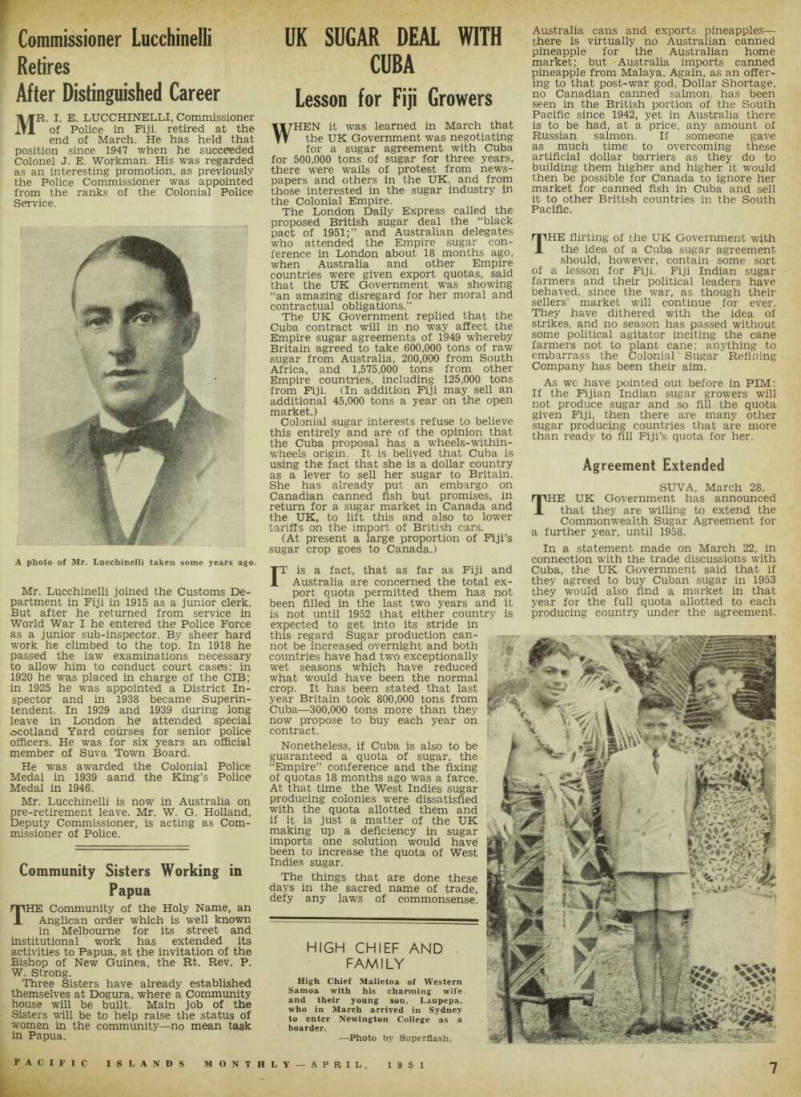
A photo of Mr. Lucchinelli taken some years ago.
Community Sisters Working in Papua
Papua
THE Community of the Holy Name, an Anglican order which is well known in Melbourne for its street and institutional work has extended its activities to Papua, at the invitation of the Bishop of New Guinea, the Rt. Rev. P.
W. Strong.
Three Sisters have already established themselves at Dogura, where a Community house will be built. Main job of the Sisters will be to help raise the status of women in the community—no mean task in Papua.
Uk Sugar Deal With
Cuba
Lesson for Fiji Growers
WHEN it was learned in March that the UK Government was negotiating for a sugar agreement with Cuba for 500,000 tons of sugar for three years, there were wails of protest from news papers and others in the UK, and from those interested in the sugar industry in the Colonial Empire.
The London Daily Express called the proposed British sugar deal the “black pact of 1951;” and Australian delegates who attended the Empire sugar con ference in London about 18 months ago, when Australia and other Empire countries were given export quotas, said that the UK Government was showing “an amazing disregard for her moral and contractual obligations.”
The UK Government replied that the Cuba contract will in no way affect the Empire sugar agreements of 1949 whereby Britain agreed to take 600,000 tons of raw sugar from Australia, 200,000 from South Africa, and 1,575,000 tons from other Empire countries, including 125,000 tons from Fiji. (In addition Fiji may sell an additional 45,000 tons a year on the open market.) Colonial sugar interests refuse to believe this entirely and are of the opinion that the Cuba proposal has a wheels-within wheels origin. It is belived that Cuba is using the fact that she is a dollar country as a lever to sell her sugar to Britain.
She has already put an embargo on Canadian canned fish but promises, in return for a sugar market in Canada and the UK, to lift this and also to lower tariffs on the import of British cars. (At present a large proportion of Fiji’s sugar crop goes to Canada.) IT is a fact, that as far as Fiji and Australia are concerned the total ex port quota permitted them has not been filled in the last two years and it is not until 1952 that either country is
expected to get into its stride in this regard Sugar production can not be increased overnight and both countries have had two exceptionally wet seasons which have reduced what would have been the normal crop. It has been stated that last year Britain took 800,000 tons from Cuba—3oo,ooo tons more than they now pronose to buy each year on contract.
Nonetheless, if Cuba is also to be guaranteed a quota of sugar, the “Empire” conference and the fixing of quotas 18 months ago was a farce.
At that time the West Indies sugar producing colonies were dissatisfied with the quota allotted them and if it is just a matter of the UK making up a deficiency in sugar imports one solution would have been to increase the quota of West Indies sugar.
The things that are done these days in the sacred name of trade, defy any laws of commonsense.
Australia cans and exports pineapples— there is virtually no Australian canned pineapple for the Australian home market; but Australia imports canned pineapple from Malaya. Again, as an offer ing to that post-war god, Dollar Shortage, no Canadian canned salmon, has been seen in the British portion of the South Pacific since 1942, yet in Australia there is to be had, at a price, any amount of Russian salmon. If someone gave as much time to overcoming these artificial dollar barriers as they do to building them higher and higher it would then be possible for Canada to ignore her market for canned fish in Cuba and sell it to other British countries in the South Pacific.
THE flirting of the UK Government with the idea of a Cuba sugar agreement should, however, contain some sort of a lesson for Fiji. Fiji Indian sugar farmers and their political leaders have behaved, since the war, as though their sellers’ market will continue for ever.
They have dithered with the idea of strikes, and no season has passed without some political agitator inciting the cane farmers not to plant cane; anything to embarrass the Colonial Sugar Refining- Company has been their aim.
As we have pointed out before in PIM: If the Fijian Indian sugar growers will not produce sugar and so fill the quota given Fiji, then there are many other sugar producing countries that are more than ready to fill Fiji’s quota for her.
Agreement Extended
SUVA, March 28.
THE UK Government has announced that they are willing to extend the Commonwealth Sugar Agreement for a further year, until 1958.
In a statement made on March 22, in connection with the trade discussions with Cuba, the UK Government said that if they agreed to buy Cuban sugar in 1953 they would also find a market in that year for the full quota allotted to each producing country under the agreement.
High Chief And
Family
High Chief Malietoa of Western Samoa with his charming wife and their young son, Laupepa. who in March arrived in Sydney to enter Newington College as a boarder. —Photo by Superflash.
Shell Co. Rebuilds in Rabaul
Has the Rapopo Move Been Scrapped?
Prom a Special Correspondent rE Shell Company is building per manent staff houses for its Rabaul staff. It is expected that these will be completed within the next three months—at present the staff is quartered at the Ascot Hotel, Rabaul.
After the houses are finished the Company will put in bulk storage tanks at their area down Malaguna Road.
Rabaul’s man-in-the-street thinks that this building activity on the part of the influential Shell Company indicates that they "know something” and that Rabaul is destined to be rebuilt permanently on its present site and not moved down Kokopo way.
It is quite evident, at all events, that if the Australian Government does not do something definite soon in the way of establishing the capital at Rapopo, Rabaul will be found to have just re built itself, permanently, and without benefit of Town Plan.
Mr. K. V. Macguire, who was an Administrative Officer in Fiji from 1933 to 1948, and who later became Deputy Colonial Secretary, Mauritius, has been transferred to Northern Rhodesia as Chief Establishment Officer.
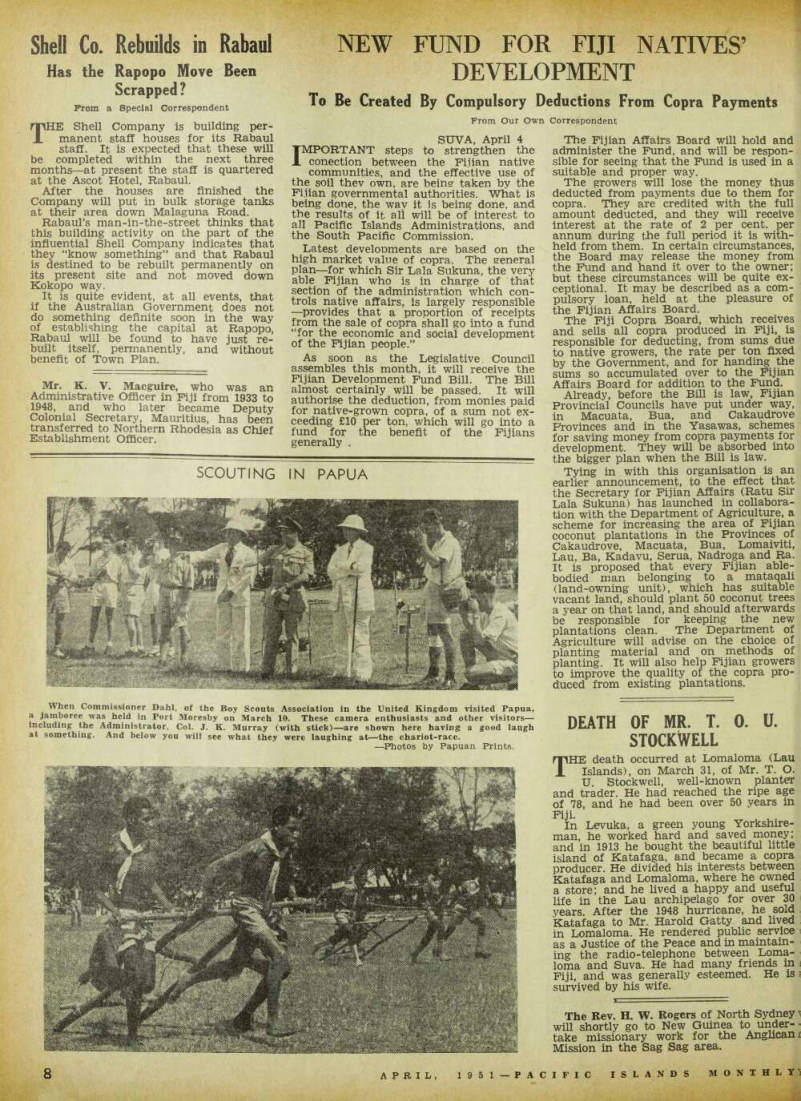
Scouting In Papua
When Commissioner Dahl, of the Boy Scouts Association in the United Kingdom visited Papua, a jamboree was held in Port Moresby on March 10. These camera enthusiasts and other visitors— including the Administrator, Col. J. K. Murray (with stick) —are shown here having! a good laugh at something. And below you will see what they were laughing at—the chariot-race. —Photos by Papuan Prints.
New Fund For Fiji Natives’
Development
To Be Created By Compulsory Deductions From Copra Payments
Prom Our Own Correspondent
SUVA, April 4 IMPORTANT steps to strengthen the conection between the Fijian native communities, and the effective use of the soil thev own, are being taken by the Fijian governmental authorities. What is being done, the way it is being done, and the results of it all will be of interest to all Pacific Islands Administrations, and the South Pacific Commission.
Latest develonments are based on the high market value of copra. The general plan—for which Sir Lala Sukuna, the very able Fijian who is in charge of that section of the administration which con trols native affairs, is largely responsible —provides that a proportion of receipts from the sale of copra shall go into a fund "for the economic and social development of the Fijian people.”
As soon as the Legislative Council assembles this month, it will receive the Fijian Development Fund Bill. The Bill almost certainly will be passed. It will authorise the deduction, from monies paid for native-grown copra, of a sum not ex ceeding £lO per ton, which will go into a fund for the benefit of the Fijians generally .
The Fijian Affairs Board will hold and administer the Fund, and will be respon sible for seeing that the Fund is used in a suitable and proper way.
The growers will lose the money thus deducted from payments due to them for copra. They are credited with the full amount deducted, and they will receive interest at the rate of 2 per cent, per annum during the full period it is with held from them. In certain circumstances, the Board may release the money from the Fund and hand it over to the owner; but these circumstances will be quite ex ceptional. It may be described as a com pulsory loan, held at the pleasure of the Fijian Affairs Board.
The Fiji Copra Board, which receives and sells all copra produced in Fiji, is responsible for deducting, from sums due to native growers, the rate per ton fixed by the Government, and for handing the sums so accumulated over to the Fijian Affairs Board for addition to the Fund.
Already, before the Bill is law, Fijian Provincial Councils have put under way, in Macuata, Bua, and Cakaudrove Provinces and in the Yasawas, schemes for saving money from copra payments for development. They will be absorbed into the bigger plan when the Bill is law.
Tying in with this organisation is an earlier announcement, to the effect that the Secretary for Fijian Affairs (Ratu Sir Lala Sukuna) has launched in collabora tion with the Department of Agriculture, a scheme for increasing the area of Fijian coconut plantations in the Provinces of Cakaudrove, Macuata, Bua, Lomaiviti, Lau, Ba, Kadavu, Serua, Nadroga and Ra.
It is proposed that every Fijian able bodied man belonging to a mataqali (land-owning unit), which has suitable vacant land, should plant 50 coconut trees a year on that land, and should afterwards be responsible for keeping the new plantations clean. The Department of Agriculture will advise on the choice of planting material and on methods of planting. It will also help Fijian growers to improve the quality of the copra pro duced from existing plantations.
Death Of Mr. T. O. U.
Stockwell
THE death occurred at Lomaloma (Lau Islands), on March 31, of Mr. T. O.
U Stockwell, well-known planter and trader. He had reached the ripe age of 78, and he had been over 50 years in Fiji.
In Levuka, a green young Yorkshire man, he worked hard and saved money; and in 1913 he bought the beautiful little island of Katafaga, and became a copra producer. He divided his interests between Katafaga and Lomaloma, where he owned a store; and he lived a happy and useful life in the Lau archipelago for over 30 i years. After the 1948 hurricane, he sold J katafaga to Mr. Harold Gatty and lived J in Lomaloma. He rendered public service < as a Justice of the Peace and in maintain- • ing the radio-telephone between Loma loma and Suva. He had many friends in j Fiji, and was generally esteemed. He is < survived by his wife.
The Rev. H. W. Rogers of North Sydney will shortly go to New Guinea to under- take missionary work for the Anglican!
Mission in the Sag Sag area.
Successful Flight of
Frigate Bird II: Australia —South America Capt. Taylor Makes Adventure Seem Easy
C CAPTAIN P. G. Taylor with his crew J of three and a RAAF-supplied Catalina, Frigate Bird 11, reached Chile from Australia in 13 days in the course of the survey flight that he under took last month.
He left Australia on March 14 and made landings at Noumea, Suva, Satapuala Bay (Samoa), Aitutaki, Papeete, Margareva and Easter Island, before reaching Valparaiso.
The survey flight was sponsored by the Australian government and the RAAF fitted special equipment to the Catalina so that Captain Taylor would have the
advantage of jet-assisted take-off at Easter Island, should he need it.
As was anticipated, JETO was required at Easter where there is no sheltered an chorage but, with the aid of this equip ment, Frigate Bird II was airborne in a matter of seconds.
At Valparaiso, Taylor and his crew were feted by the Chilean Government who conferred a decoration on Taylor.
Frigate Bird II left Valparaiso on its return flight to Australia in early April.
While in Chile Captain Taylor said that although the survey flight had taken 13 days on the eastward flight, the 8,000 mile journey could eventually be accomplished in three days by commercial plane. A great deal of preliminary work would have to be done first, however, on intermediate islands.
Two Missionary Aviation Fellowship pilots, Mr. E. B. Hartwig and Mr. R, Hutchins, left Sydney for Madang, New Guinea in early April flying an Auster Autocar plane. From their headquarters in Madang they will undertake flying jobs for the Lutheran and Baptist Missions in New Guinea.
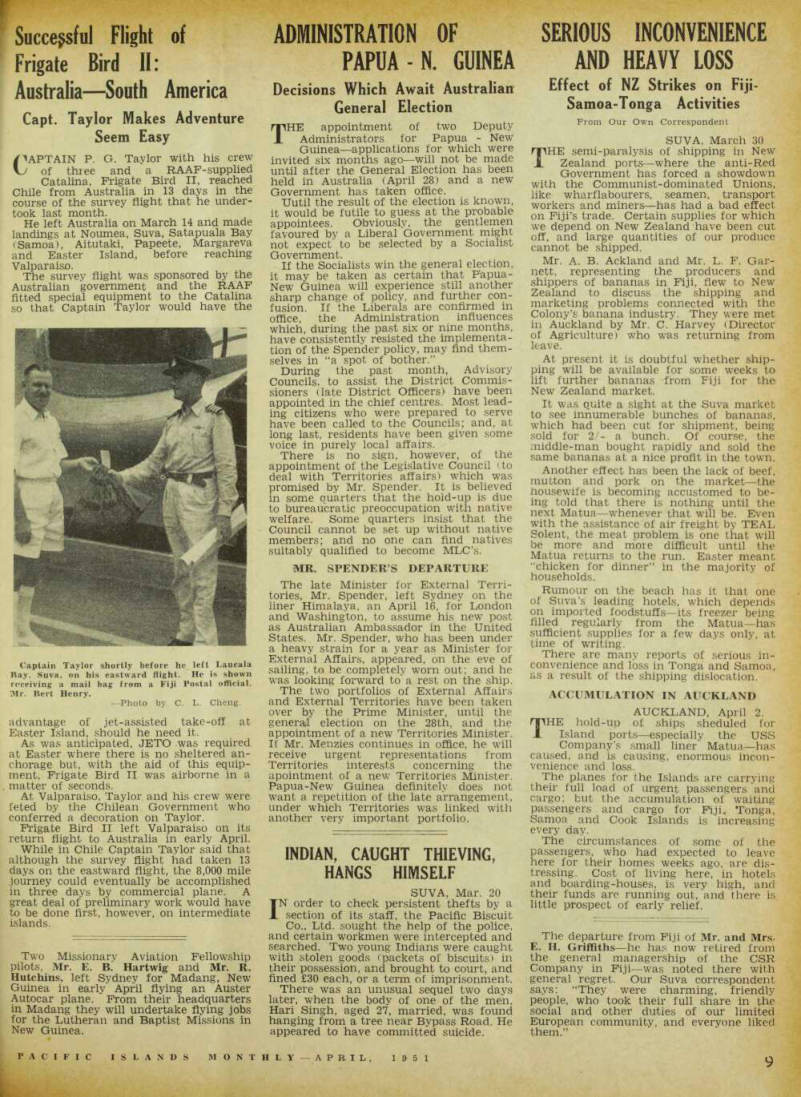
Captain Taylor shortly before he left Laucala Bay. Suva, on his eastward flight. He is shown receiving a mail bag from a Fiji Postal official.
Mr. Bert Henry. —Photo by C. L. Cheng.
Administration Of
Papua-N. Guinea
Decisions Which Await Australian General Election
THE appointment of two Deputy Administrators for Papua - New Guinea —applications for which were invited six months ago—will not be made until after the General Election has been held in Australia (April 28) and a new Government has taken office.
Uutil the result of the election is known, it would be futile to guess at the probable appointees. Obviously, the gentlemen favoured by a Liberal Government might not expect to be selected by a Socialist Government.
If the Socialists win the general election, it may be taken as certain that Papua- New Guinea will experience still another sharp change of policy, and further con fusion. If the Liberals are confirmed in office, the Administration influences which, during the past six or nine months, have consistently resisted the implementa tion of the Spender policy, may find them selves in “a spot of bother.”
During the past month, Advisory Councils, to assist the District Commis sioners (late District Officers) have been appointed in the chief centres. Most lead ing citizens who were prepared to serve have been called to the Councils; and, at long last, residents have been given some voice in purely local affairs.
There is no sign, however, of the appointment of the Legislative Council (to deal with Territories affairs) which was promised by Mr. Spender. It is believed in some Quarters that the hold-up is due to bureaucratic preoccupation with native welfare. Some quarters insist that the Council cannot be set up without native members: and no one can find natives suitably qualified to become MLC’s.
Mr. Spender’S Departure
The late Minister for External Terri tories, Mr. Spender, left Sydney on the liner Himalaya, an April 16, for London and Washington, to assume his new post as Australian Ambassador in the United States. Mr. Spender, who has been under a heavy strain for a year as Minister for External Affairs, appeared, on the eve of sailing, to be completely worn out; and he was looking forward to a rest on the ship.
The two portfolios of External Affairs and External Territories have been taken over by the Prime Minister, until the general election on the 28th, and the appointment of a new Territories Minister.
If Mr. Menzies continues in office, he will receive urgent representations from Territories interests concerning the apointment of a new Territories Minister.
Papua-New Guinea definitely does not want a repetition of the late arrangement, under which Territories was linked with another very important portfolio.
Indian, Caught Thieving,
Hangs Himself
Suva, Mar. 20
IN order to check persistent thefts by a section of its staff, the Pacific Biscuit Co., Ltd. sought the help of the police, and certain workmen were intercepted and searched. Two young Indians were caught with stolen goods (packets of biscuits) in their possession, and brought to court, and fined £3O each, or a term of imprisonment.
There was an unusual sequel two days later, when the body of one of the men, Hari Singh, aged 27, married, was found hanging from a tree near Bypass Road. He appeared to have committed suicide.
Serious Inconvenience
And Heavy Loss
Effect of NZ Strikes on Fiji- Samoa-Tonga Activities
From Our Own Correspondent SUVA, March 30 THE semi-paralysis of shipping in New Zealand ports—where the anti-Red Government has forced a showdown with the Communist-dominated Unions, like wharflabourers, seamen, transport workers and miners—has had a bad effect on Fiji’s trade. Certain supplies for which we depend on New Zealand have been cut off, and large quantities of our produce cannot be shipped.
Mr. A. B. Ackland and Mr. L. F. Gar nett, representing the producers and shippers of bananas in Fiji, flew to New Zealand to discuss the shipping and marketing problems connected with the Colony’s banana industry. They were met in Auckland by Mr. C. Harvey (Director of Agriculture) who was returning from leave.
At present it is doubtful whether ship ping will be available for some weeks to lift further bananas from Fiji for the New Zealand market.
It was quite a sight at the Suva market to see innumerable bunches of bananas, which had been cut for shipment, being sold for 2/- a bunch. Of course, the middle-man bought rapidly and sold the same bananas at a nice profit in the town.
Another effect ha-s been the lack of beef, mutton and pork on the market —the housewife is becoming accustomed to be ing told that there is nothing until the next Matua —whenever that will be. Even with the assistance of air freight by TEAL Solent, the meat problem is one that will be more and more difficult until the Matua returns to the run. Easter meant "chicken for dinner” in the majority of households.
Rumour on the beach has it that one of Suva’s leading hotels, which depends on imported foodstuffs—its freezer being filled regularly from the Matua—has sufficient supplies for a few days only, at time of writing.
There are many reports of serious in convenience and loss in Tonga and Samoa, as a result of the shipping dislocation.
Accumulation In Auckland
AUCKLAND, April 2.
THE hold-up of ships sheduled for Island ports—especially the USS Company’s small liner Matua —has caused, and is causing, enormous incon venience and loss.
The planes for the Islands are carrying their full load of urgent passengers and cargo; but the accumulation of waiting passengers and cargo for Fiji„ Tonga, Samoa and Cook Islands is increasing every day.
The circumstances of some of the passengers, who had expected to leave here for their homes weeks ago, are dis tressing. Cost of living here, in hotels and boarding-houses, is very high, and their funds are running out, and there is little prospect of early relief.
The departure from Fiji of Mr. and Mrs.
E. H. Griffiths —he has now retired from the general managership of the CSR Company in Fiji—was noted there with general regret. Our Suva correspondent says: "They were charming, friendly people, who took their full share in the social and other duties of our limited European community, and everyone liked them.”
Death Of Mr. D. L Pullen
THE death occurred in Derby, W.A., in early March, of Mr. D. L. Pullen, until 1949 a well-known resident of Papua where he had lived for 26 years.
He was 54.
Mr. Pullen was a pre-war member of the Papuan Public Service and returned to the combined P-NG service in Port Moresby after the war. He was president of the Papuan Public Service Association before the present P-NG organisation was formed and in the immediate post-war years did much to have the grievances of the Territory’s public servants brought out into the open.
He retired in 1949 and went to Western Australia where he joined the Native Affairs Department. He was given charge of the whole Kimberley District from the NT border to the 20th parrallel. In paying tribute to him after his death the WA Commissioner of Native Affairs said that he was a man of wide experience in native administration and was fully conversant with the department’s plans for the future. His replacement would present a great problem.
Mr. Pullen suffered a heart attack after playing in a cricket match. He appeared to be recovering but a fortnight later had a relapse and died.
He was a World War I veteran. He leaves a widow and two sons who are at college at New Norcia, WA.
1,000 Babies In 26 Years
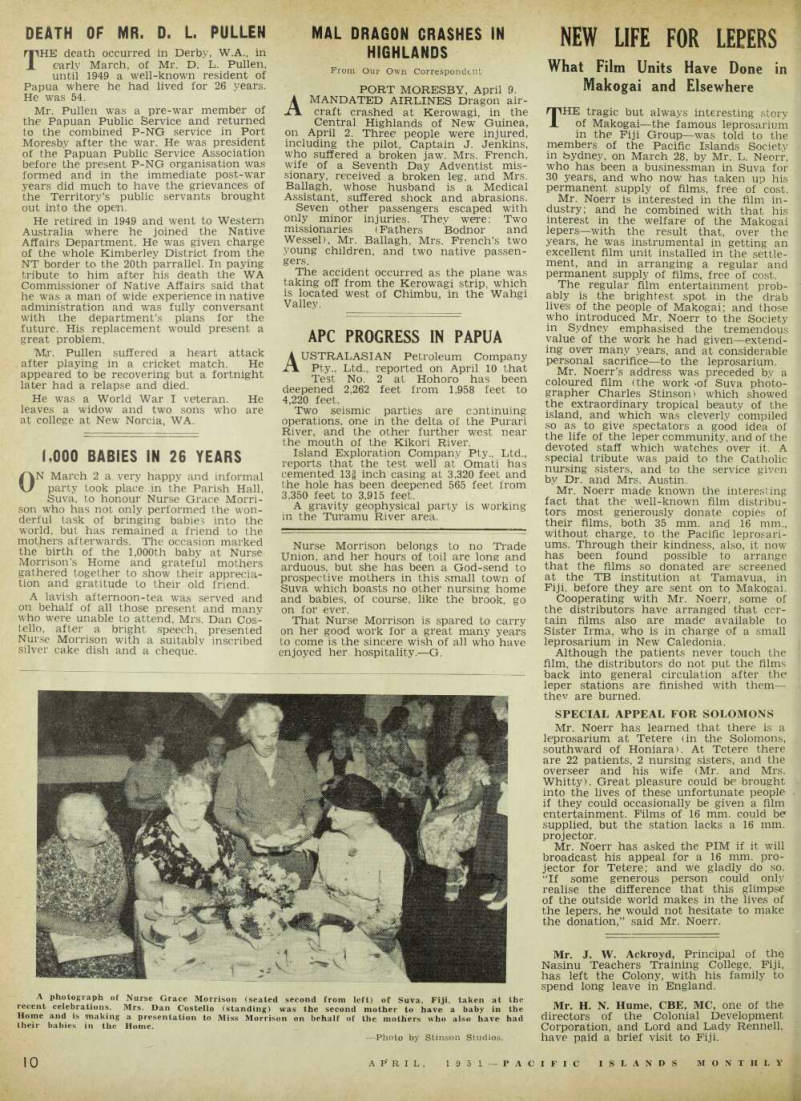
ON March 2 a very happy and informal party took place in the Parish Hall, Suva, to honour Nurse Grace Morri son who has not only performed the won derful task of bringing babies into the world, but has remained a friend to the mothers afterwards. The occasion marked the birth of the I,oooth baby at Nurse Morrison’s Home and grateful mothers gathered together to show their apprecia tion and gratitude to their old friend.
A lavish afternoon-tea was served and on behalf of all those nresent and many who were unable to attend. Mrs. Dan Cos tello, after a bright speech, presented Nurse Morrison with a suitably inscribed silver cake dish and a cheque.
Nurse Morrison belongs to no Trade Union, and her hours of toil are long and arduous, but she has been a God-send to prospective mothers in this small town of Suva which boasts no other nursing home and babies, of course, like the brook, go on for ever.
That Nurse Morrison is spared to carry on her good work for a great many years to come is the sincere wish of all who have enjoyed her hospitality.—G.
A photograph of Nurse Grace Morrison (seated second from left) of Suva, Fiji, taken at the recent celebrations. Mrs. Dan Costello (standing) was the second mother to have a baby in the Home and is making a presentation to Miss Morrison on behalf of the mothers who also have had their babies in the Home. -Photo by Stinson Studios.
Mal Dragon Crashes In
Highlands
From Our Own Correspondent
Port Moresby, April 9.
A MANDATED AIRLINES Dragon air craft crashed at Kerowagi, in the Central Highlands of New Guinea, on April 2. Three people were injured, including the pilot, Captain J. Jenkins, who suffered a broken jaw. Mrs. French, wife of a Seventh Day Adventist mis sionary, received a broken leg, and Mrs.
Ballagh, whose husband is a Medical Assistant, suffered shock and abrasions.
Seven other passengers escaped with only minor injuries. They were: Two missionaries (Fathers Bodnor and Wessel), Mr. Ballagh, Mrs. French’s two young children, and two native passen gers.
The accident occurred as the plane was taking off from the Kerowagi strip, which is located west of Chimbu, in the Wahgi Valley.
Apc Progress In Papua
AUSTRALASIAN Petroleum Company Pty., Ltd., reported on April 10 that Test No. 2 at Hohoro has been deepened 2,262 feet from 1,958 feet to 4,220 feet.
Two seismic parties are continuing operations, one in the delta of the Purari River, and the other further west near the mouth of the Kikori River.
Island Exploration Company Pty., Ltd., reports that the test well at Omati has cemented 13g inch casing at 3,320 feet and the hole has been deepened 565 feet from 3,350 feet to 3,915 feet.
A gravity geophysical party is working in the Turamu River area.
New Life For Lecers
What Film Units Have Done in Makogai and Elsewhere
THE tragic but always interesting story of Makogai—the famous leprosarium in the Fiji Group—was told to the members of the Pacific Islands Society in Sydney, on March 28, by Mr. L. Neorr, who has been a businessman in Suva for 30 years, and who now has taken up his permanent supply of films, free of cost.
Mr. Noerr is interested in the film in dustry; and he combined with that his interest in the welfare of the Makogai lepers—with the result that, over the years, he was instrumental in getting an excellent film unit installed in the settle ment, and in arranging a regular and permanent supply of films, free of cost.
The regular film entertainment prob ably is the brightest spot in the drab lives of the people of Makogai; and those who introduced Mr. Noerr to the Society in Sydney emphasised the tremendous value of the work he had given—extending over many years, and at considerable personal sacrifice —to the leprosarium.
Mr. Noerr’s address was preceded by a coloured film (the work .of Suva photo grapher Charles Stinson) which showed the extraordinary tropical beauty of the island, and which was cleverly compiled so as to give spectators a good idea of the life of the leper community, and of the devoted staff which watches over it. A special tribute was paid to the Catholic nursing sisters, and to the service given by Dr. and Mrs. Austin.
Mr. Noerr made known the interesting fact that the well-known film distribu tors most generously donate copies of their films, both 35 mm. and 16 mm., without charge, to the Pacific leprosari ums. Through their kindness, also, it now has been found possible to arrange that the films so donated are screened at the TB institution at Tamavua, in Fiji, before they are sent on to Makogai.
Cooperating with Mr. Noerr, some of the distributors have arranged that cer tain films also are made available to Sister Irma, who is in charge of a small leprosarium in New Caledonia.
Although the patients never touch the film, the distributors do not put the films back into general circulation after the leper stations are finished with them — thev are burned.
Special Appeal For Solomons
Mr. Noerr has learned that there is a leprosarium at Tetere (in the Solomons, southward of Honiara). At Tetere there are 22 patients, 2 nursing sisters, and the overseer and his wife (Mr. and Mrs.
Whitty). Great pleasure could be- brought into the lives of these unfortunate people if they could occasionally be given a film entertainment. Films of 16 mm. could be supplied, but the station lacks a 16 mm. projector.
Mr. Noerr has asked the PIM if it will broadcast his appeal for a 16 mm. pro jector for Tetere; and we gladly do so.
“If some generous person could only realise the difference that this glimpse of the outside world makes in the lives of the lepers, he would not hesitate to make the donation,” said Mr, Noerr.
Mr. J. W. Ackroyd, Principal of the Nasinu Teachers Training College, Fiji, has left the Colony, with his family to spend long leave in England.
Mr. H. N. Hume, CBE, MC, one of the directors of the Colonial Development Corporation, and Lord and Lady Rennell, have paid a brief visit to Fiji.
W. Samoa Election
From Our Own Correspondent APIA. April 6.
THE election of the five European mem bers of the Western Samoan Legis lative Assembly will be held in the Territory on April 27 —a day before the Australian elections.
The campaigning of the candidates —of whom there are, so far, nine nominated — is just beginning. The election is being fought on non-party lines. Two of the candidates are Mr. A. G. Smyth and Mr.
A. M. Gurau, both well-known men in the Territory.
Aorangi Sails From Sydney
THE liner Aorangi has resumed the Australia-North American passenger service after being laid up in Sydney since the end of January.
Because of huge losses since 1948 the owners withdrew the liner from the service after she got back from Canada in January and put her up for sale. The Governments of Canada, Australia and New Zealand then agreed to pay her owners a subsidy to keep her running for the next 12 months. Previously Australia and Canada had refused to pay their share of the subsidy asked.
Tahiti Waterside Workers
Praised
IT had taken only three days for water side workers at Papeete, Tahiti, to unload more than 1,300,000 super ft. of timber from the Swedish motorship, Barranduna, the Master (Cap. C. P.
Gartz) said at Port Adelaide at the end of March.
The Barranduna, then in Adelaide, SA, had been discharging timber in Australia since January 26, when she reached Syd ney from Los Angeles, he said.
Because of slow turn-around of ships in Australian ports and the current NZ wharfies’ strike, European shipowners are refusing to send their ships to these countries.
Increased Air Services
Cope With
Rabaul Passengers Freight
From a Special Correspondent HUNDREDS of air travellers are still passing through Rabaul and local air services have been increased again to cope with them and with cargo, Qantas service from Lae through Rabaul to the Solomons is now running once a week instead of once every two weeks, as formerly. Mandated Air Lines run passenger services on Mondays and Fridays from the mainland to Rabaul and freight specials are coming in almost every day. This Sunday, as I write, three freight specials have been in.
All this activity is proof enough, if proof is necessary, that business is increasing in this area and not slipping back.
The French National Geographic In stitute, which comes under the Ministry of Public Works and Transport, has sent a party of three to New Caledonia to carry out work preliminary to the preparation of an up-to-date survey map of the Colony, in which work they will be as sisted by surveyors of the local Public Works Department. This preparatory work is expected to take three years, and will include aerial surveys.
High Cost Of Mt. Lamington Toa's New Solent
Eruption
From Our Own Correspondent.
Port Moresby, April 9.
RATIONS and other essential supplies for the feeding of Mt. Lamington evacuees is costing the Administra tion approximately £4,000 a week. There are around 3,500 natives receiving either full or partial rations, including villagers in the Lower Amboga River area, and at Buna, whose gardens were destroyed by the heavy floods which occurred some weeks after the January eruption.
All rivers originating on the Mt. Lam ington slopes are now subject to heavy flooding, as the complete destruction of timber has left nothing to hold the rain, which immediately sweeps down the silt clogged valleys to the lower levels.
Several acres of land have been cleared and ploughed by the Agricultural De partment in the Ilimo area, where new villages are being built for the re-settle ment of the evacuees. Food crops are being planted, and the first sweet potato harvest should be ready in three months’ time.
Oro Bay camp evacuees are being moved by stages to Wasita and Awala district, with temporary villages at Popen detta. Families will move from Oro Bay to Popendetta, and when permanent villages are built around Wasita and Awala, the final stage of the transfer will be completed. This will take the evacuees back to the same general area as the original villages, but outside the closed zone around Mt. Lamington
Relief Fund Mounts
AT the end of March the Mt. Laming ton Relief Fund had reached a total of nearly £13,000. As the Fund does not close until May 31, and many func tions in aid of the appeal are still being held, even the most optimistic estimates of the final total will undoubtedly be exceeded. Individual donations are also still coming in in considerable volume.
The Fund Committee is already working out plans for distribution of the money to Europeans and natives needing finan cial assistance as a result of the eruption.
All sections of the Territory have given very generous support to this appeal, in cluding native and Asiatic communities as well as Europeans.
Disappear
Old Notes Worth £6,000
THE notes in circulation in the Colony of Fiji (which has its own currency) total in face value something over £3,350,000. It looks as if the Treasury, in this connection, is going to get a windfall of about £6,000.
The Colony made a new note issue in 1934, and officially recalled all the old notes then in circulation. Gradually, over the years, most of the old notes have appeared in official channels, and have been replaced with new notes. But at the end of 1949 old notes of the face value of £6,711/15/0 were still unaccounted for, and it was reported that, during the pre vious five years, old-issue notes of the value of only £l4O appeared, it seems prob able that notes of the face value of at last £6,000 have been lost or destroyed.
The Treasury, of course, will benefit.
This is characteristic of all note issues.
A certain proportion invariably dis appears entirely —and the issuing authority gains accordingly.
Reaches Australia
THE Solent flying boat that Trans Oceanic Airways plan to use on their Sydney-Port Moresby service arrived in Sydney from the UK in early April. Rewiring for certain naviga tional aids is now being undertaken in Sydney and the flying-boat should be ready for its first Port Moresby trip early in May, The Solent is a new type for Australia.
Passenger accommodation is built in two decks and there are in all three cabins— one on the upper deck where a large galley and pantry are situated, and two on the lower deck where there are also separate toilet and dressing rooms for men and women, and a promenade cabin complete with cocktail bar. Thirty-eight passengers can be accommodated.
TOA expect that the Solent will be used on their Sydney-Hobart service as well as on the New Guinea run.
Shipping Co. Interest in TOA In April the Clan Shipping Line com pleted negotiations for acquiring a major interest in TOA. and a passenger on the delivery flight of the Solent was the Hon.
Anthony Cayzer, son of Lord Rotherwick Chairman of Directors of the Clan Line.
Mr. Cayzer is himself a director and came to Australia in connection with their new TOA interests.
He said on arrival that the Clan Line recognised, as did all shipping companies, that in the next few years most ship passengers and a large quantity of cargo would be going by air. He said that his company was keen on the idea of getting some of the 50 million people, who now live in Great Britain, shifted to other Empire countries—so million people were too many for the small home islands, particularly in these days of international tension. He stated that TOA would operate air routes “overseas as well as around Australia.’’
Page-Adams Marriage
Ng Families United In
A WEDDING of great interest to New Guinea folk—particularly the Befores —took place in Sydney on April 10 when Jean Page and John Adams were married at St. Augustine’s Church.
Neutral Bay.
The bride is the daughter of Mrs H H Page now of Neutral Bay. and the iate Harold Page who was Government Secretary to the pre-war New Guinea A^ dr ?i nistration: the bridegroom is the son of Mrs. Una Adams and the late Mr H Adams of Patlangat Plantation, New Ire land. The fathers of both bride and groom were Montevideo Maru victims having lost their lives when that vessel, carrying New Guinea civilian internees! was Jxirpedoed while on its way to Japan Miss Pam Page, sister of the bride and Miss Rosemary Adams, sister of the groom were bridesmaids. Guests at the wedding included Lady McNichol, Mr. and Mrs R Melrose and Mrs. H. A. Gregory. After a honeymoon in northern NSW the couple will sail for New Guinea on the Bulolo at the end of April.
Mr. H. W. Simmonds, QBE. formerly Government Entomologist in Fiji was ex pected to arrive in the Colony in late March. Mr. Simmonds intends to make a collection of entomological material in Taveuni for the Natural History section of the British Museum, London.
Advertisements & other items, p. 14 (1 item)
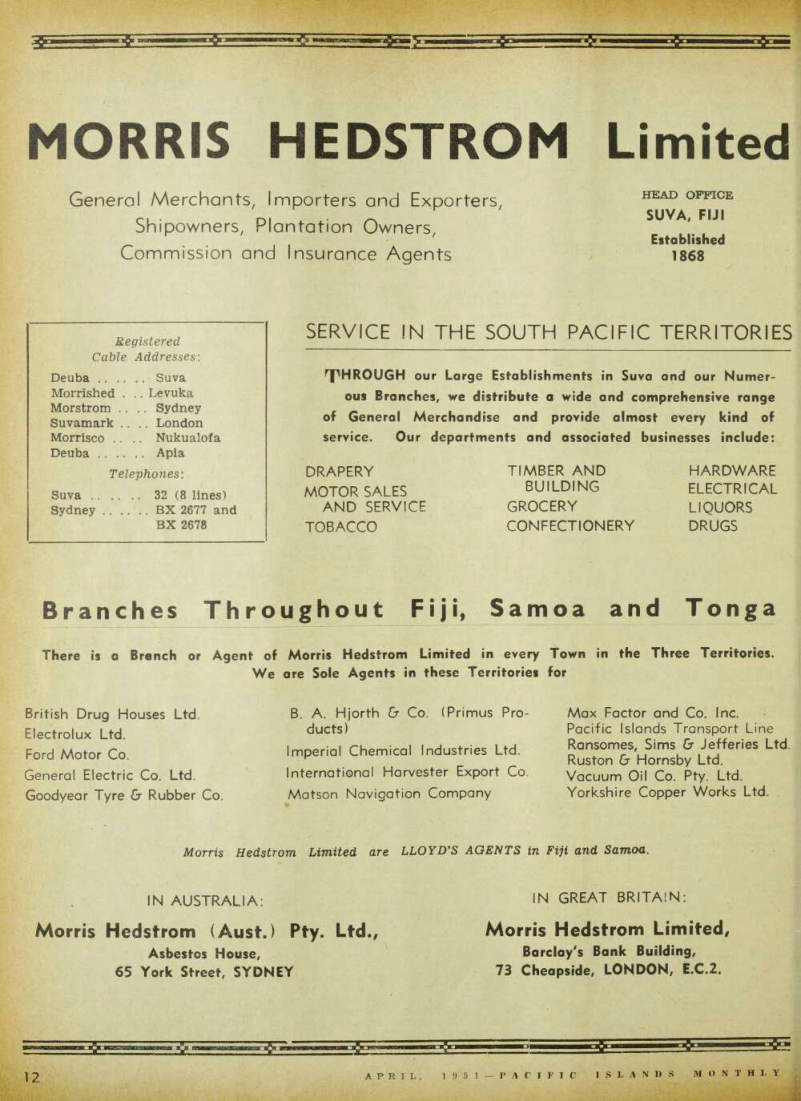
Morris Hedstrom Limited
General Merchants, Importers and Exporters,
Shipowners, Plantation Owners,
Commission and Insurance Agents
HEAD OFFICE
SUVA, FIJI
Established 1868
SERVICE IN THE SOUTH PACIFIC TERRITORIES
HPHROUGH our Large Establishments in Suva and our Numerous Branches, we distribute a wide and comprehensive range of General Merchandise and provide almost every kind of service. Our departments and associated businesses include:
DRAPERY
MOTOR SALES
AND SERVICE
TOBACCO
TIMBER AND
BUILDING
GROCERY
CONFECTIONERY
HARDWARE
ELECTRICAL
LIQUORS
DRUGS
Branches Throughout Fiji, Samoa and Tonga
There is a Branch or Agent of Morris Hedstrom Limited in every Town in the Three Territories.
We are Sole Agents in these Territories for British Drug Houses Ltd.
Electrolux Ltd.
Ford Motor Co.
General Electric Co. Ltd.
Goodyear Tyre Gr Rubber Co.
B. A. Hjorth Gr Co. (Primus Products) Imperial Chemical Industries Ltd.
International Harvester Export Co.
Matson Navigation Company Max Factor and Co. Inc.
Pacific Islands Transport Line Ransomes, Sims Gr Jefferies Ltd.
Ruston Gr Hornsby Ltd.
Vacuum Oil Co. Pty. Ltd.
Yorkshire Copper Works Ltd.
Morris Hedstrom Limited are LLOYD’S AGENTS in Fiji and Samoa.
IN AUSTRALIA
Morris Hedstrom (Aust.) Pty. Ltd.,
Asbestos House, 65 York Street, SYDNEY
IN GREAT BRITAIN:
Morris Hedstrom Limited,
Barclay's Bank Building, 73 Cheanside. LONDON, E.C.2.
Over
British Trickery
The Mof Contract
IN the House of Commons on February 26 Mr. H. Hind (Labour, Accrington) asked the Minister for Food the world price of copra; why the price paid to Fiji is £53/15/- per ton whilst the local buying price is £55/5/-; why a lower price of £4B/10/- per ton is being paid to New Guinea by the Ministry of Food; and to what extent prices below the world price are being paid to other colonies.
The Minister for Food (Mr. M. Webb) replied: “The world price of copra has recently risen sharply, and is now between £l2O and £135 a ton, FOB.
“The prices we are paying to the Colonies and Mandated Territories, from which we buy copra under long-term agreements, are considerably lower than this, because the annual price variations under those agreements is limited to 10 per cent. This provision was designed to avoid short-term price fluctuations and, while we are getting the benefit at present, it gives the producer security against a slump in the market during the nine years for which the agreements run.
“The prices for Fiji and New Guinea are different, because the yearly periods for which they are negotiated do not coincide; but the price will be the same after March 1, “My hon. friend will recognise that these long-term agreements will be value less if they do not insulate both parties from these large fluctuations in the world prices.”
Planters’ Protest Against
British Socialist Trickery
fTIHE foregoing is typical of the com- X mercial morality of the British Socialist Government.
The Minister blandly ignores the chief cause of the huge difference between the world price of copra and the MOF price— namely, the Socialists’ trickery in de valuing the British £ Sterling after the nine-years MOF contract had been made.
When the MOF contract was made late in 1948, the price was fixed in the vicinity of £5O Sterling per ton; and this bore a certain definite relationship to the world (or gold) value of copra and, in the cir cumstances (chiefly, the nine-years’ guarantee) was regarded as fair.
Within a few months of its coming into operation, the British Government de valued the £ Sterling, in relation to gold and the US dollar, by over 30 per cent.
But it could not devalue the copra—copra held its value in terms of gold and dollars.
Nonetheless, the Socialists continued to pay for the copra in £’s Sterling, just as if the £ Sterling had the same value as heretofore.
Early in 1949, the Pacific planter, having sold 20 tons of copra, and received £l,OOO Sterling, could go and buy goods in the world market worth £l,OOO Sterling. But at the end of 1949, the planter, with the same £l,OOO Sterling, could buy in the Wor m market only goods worth (in terms of the £ as it was when the contract was made) £650.
The planters are not protesting against the operation of the MOP contract, in terms of the contract—in regard to that, they were ready to take the bad with the good. But they are, and with reason, protesting against the barefaced political trickery under which the British Govern ment, having bargained with them in £’s Sterling, and got them into a contract, deliberately reduced the international value of the £ Sterling.
Better Returns From BGD
RESULTS from Bulolo Gold Dredging in the three months ending February 28, 1951, were better than for the corresponding period of 1950 but the nine months up to that date were still below figures for last year.
The particulars are set out in the fol lowing tables: —
Three Months Ended February 28
1951 1950 Yardage dredged 3.162,200 3,022,000 Ounces fine gold 20.443 15.387 Value at $35 US per ounce $715,505 $538,545
Nine Months Ended February 28
1951 1950 Yardage dredged 9.513,200 10,757,740 Ounces fine gold . . . 51,119 56.247 falue at $35 US per ounce $1,789,165 $1,968,645
Rabaul Advisory Council
Appointed
RABAUL Advisory Council has been appointed by the P-NG Adminis trator, Colonel J. K. Murray. The following residents will be members for the next 12 months: — Mr. V. Pearson, Chairman, Mr. B. Ryan, Deputy Chairman, Mr. F. J. Riordan, Mr.
B. B. Perriman, Mr. R. Galloway, Mr. F.
G. McMullen. Mr. J. Chipper, Mr. Dudley Jones, Mr. D. Barrett, Mr. W. Smythe, Mr. G. Renton, Mr. D. Williams, Mrs. E.
Greenwood, Mr. Gabriel Achung, Mr.
Bernard Chan, Mr. James Chaung, Mr. H.
Lewerissa, the Assistant District Officer Rabaul, the Regional Works Officer, the District Medical Officer, the District Education Officer.
Advertisements & other items, pp. 15-16 (1 item)
Sale!
PACIFIC
ISLANDS
YEAR
BOOK
1950 By R . W Robsorx r
NOW
ON
SALE!
PACIFIC ISLANDS YEAR BOOK. 1950
is now available from the leading Booksellers in Australia, New Zealand and the Pacific Islands, or direct from the Publishers.
There are 500 Pages and numerous Maps in this (the Sixth) Edition. In addition to providing the latest available information relating to Administrations, Geography, History, Industries, Commerce and Trade (full statistics), Tariffs, etc., the Year Book has many Special Sections, such as: A History and Chronology of the War in the Pacific, 1941-45; Lists of Public Servants in each Territory; Description of the new Air Transport Organisations serving the Pacific Islands; Complete Directory of Pacific Islands Missions; Notable Developments in 1940-50 Period; Detailed Index of Place Names in the South Seas, etc.
Price: 25/- per copy.
Add postage, etc. (Within the British Empire, 1/-; Foreign 2/-) when ordering direct. (In U.S. Currency: $3.50, including postage.)
FROM —
PACIFIC PUBLICATIONS PTY. LTD.
Union House, 247 George Street, SYDNEY.
P.O. Box 3408, Sydney, N.S.W., Australia.
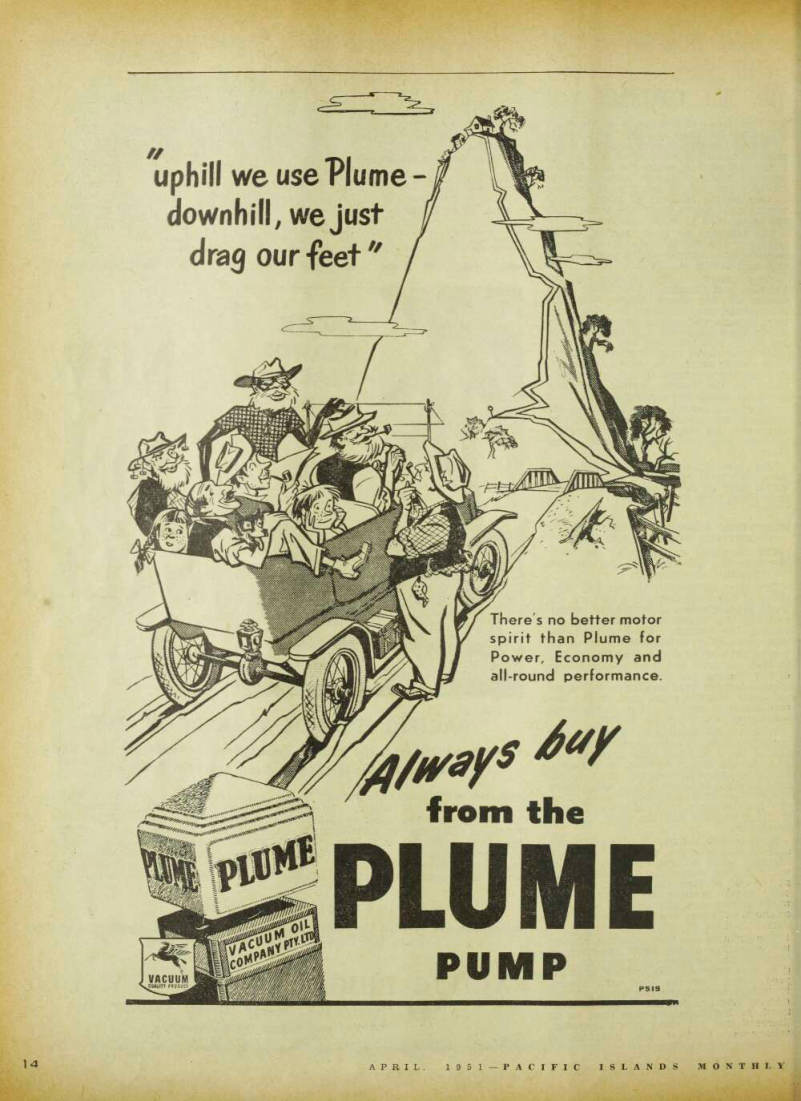
uphill we use Plume-
downhill, we just
drag our feet"
R s:
A/**y s
There's no better motor spirit than Plume for Power, Economy and all-round performance.
from the
o» L rOW
VACUUM
PLUME
PUMP
New Building For Suva
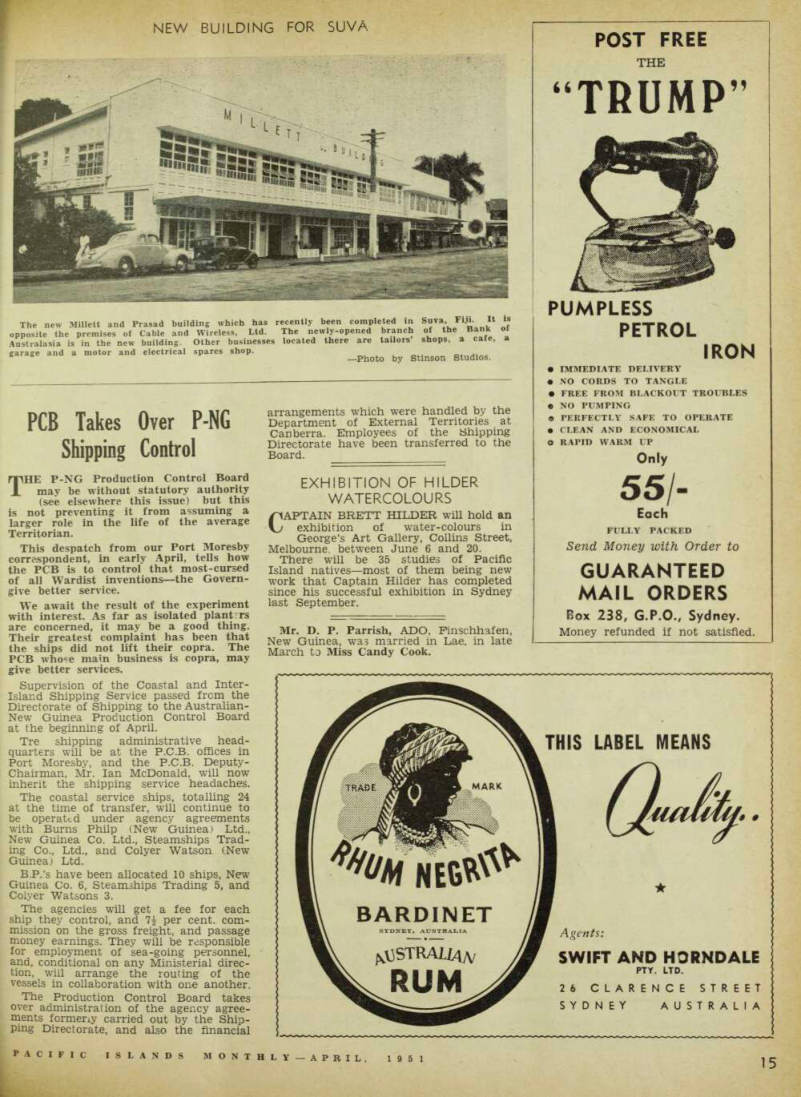
The new Millett and Prasad building which has recently been completed in Suva,Fiji. It is opposite the premises of Cable and Wireless. Ltd. The newly-opened branch of the Bank of Australasia is in the new building. Other businesses located there are tailors shops, a cafe, garage and a motor and electrical spares shop. —Photo by Stinson Studios.
Shipping Control
PCB Takes Over P-NG Shipping Control
THE P-NG Production Control Board may be without statutory authority (see elsewhere this issue) but this is not preventing it from assuming a larger role in the life of the average Territorial This despatch from our Port Moresby correspondent, in early April, tells how the PCB is to control that most-cursed of all Wardist inventions—the Govern give better service.
We await the result of the experiment with interest. As far as isolated plant:rs are concerned, it may be a good thing.
Their greatest complaint has been that the ships did not lift their copra. The PCB main business is copra, may give better services.
Supervision of the Coastal and Inter- Island Shipping Service passed from the Directorate of Shipping to the Australian- New Guinea Production Control Board at the beginning of April.
Tre shipping administrative head quarters will be at the P.C.B. offices in Port Moresby, and the P.C.B. Deputy- Chairman, Mr. lan McDonald, will now inherit the shipping service headaches.
The coastal service ships, totalling 24 at the time of transfer, will continue to be operated under agency agreements with Burns Philp (New Guinea) Ltd., New Guinea Co. Ltd., Steamships Trad ing Co., Ltd., and Colyer Watson (New Guinea) Ltd.
B.P.’s have been allocated 10 ships, New Guinea Co. 6, Steamships Trading 5, and Colyer Watsons 3.
The agencies will get a fee for each ship they control, and 7i per cent, com mission on the gross freight, and passage money earnings. They will be responsible for employment of sea-going personnel, and, conditional on any Ministerial direc tion, will arrange the routing of the vessels in collaboration with one another.
The Production Control Board takes over administration of the agency agree ments formeny carried out by the Ship ping Directorate, and also the financial
arrangements which were handled by the Department of External Territories at Canberra. Employees of the Shipping Directorate have been transferred to the Board.
Exhibition Of Milder
Watercolours
CAPTAIN BRETT HILDER will hold an exhibition of water-colours in George’s Art Gallery, Collins Street, Melbourne, between June 6 and 20.
There will be 35 studies of Pacific Island natives —most of them being new work that Captain Hilder has completed since his successful exhibition in Sydney last September.
Mr. D. P. Parrish, ADO, Pinschhafen, New Guinea, was married in Lae. in late March to Miss Candy Cook.
Advertisements & other items, pp. 17-18 (1 item)
“Trump”
POST FREE
THE
PUMPLESS
PETROL
IRON
• IMMEDIATE DELIVERY
• NO CORDS TO TANGLE
• FREE FROM BLACKOUT TROUBLES
• NO PUMPING
9 PERFECTLY SAFE TO OPERATE
• CLEAN AND ECONOMICAL
O RAPID WARM UP
Only 55/- Each
FULLY PACKED
Send Money with Order to
GUARANTEED
MAIL ORDERS
Rox 238, G.P.0., Sydney.
Money refunded if not satisfied.
TRACE
MARK
m
BARDINET
(VV3STRAU4JV
RUM
THIS LABEL MEANS
$ 0
Agents:
SWIFT AND HORNDALE
PTY. LTD.
26 CLARENCE STREET
SYDNEY AUSTRALIA
£ I rf A Yours when you Fly by
PAN
AMERICAN
“STRATA”
CLIPPERS*
WORLD’S FINEST
AIR TRAVEL
AT
REGULAR
AIR TRAVEL
FARES
m B!
I a / FINEST Pressurised for living-room comfort even at 25,000 feet. Gourmet meals. complimentary champagne and vintage wines served on every trip.
NEWEST These are the first planes with a double-deck. First to provide a club lounge.
LARGEST Spacious and uncrowded.
Equipped with luxurious Sleeperettes* and large, single-occupancy sleeping berths at no extra charge.
BOOK NOW WITH PAN AMERICAN OR YOUR TRAVEL AGENT
WORLD S MOST
EXPERIENCED AIRWAYS
PAN AMERICAN WORLD AIRWAYS. INC. LIMITED, INCORPORATED IN U.S.A. *Trade Marks, Pan American World Airways, Inc.
Production Control Board Has No Statutory
Authority
Auditor-General’s Report Criticises Lax Methods in Papua-New Guinea
A NUMBER of items in the Auditor- General’s Report for 1949-50, which was tabled in the House in Can berra in mid-March, shortly before the double dissolution, are of interest to resi dents of Papua-New Guinea.
The report got little publicity in Australia: it probably escaped the notice of Territorians altogether.
Production Control Board: The report states that the Australian-New Guinea Production Control Board has operated in Papua-New Guinea since December 31, 1949. without statutory authority.
The PCB was established under National Security Regulations in July. 1943; and, some time after the war, by another Act, its powers were extended to December 31, 1949. No extension has been made since that date and the Board, whose main function is the purchase and sale of all copra produced in the Terri tory, apparently has carried on without possessing the necessary authority to do so.
The Auditor-General advises that “early action should be taken to validate the Board’s operations.”
PCB Profit: The Board’s profit on copra trading during the year under review (1949-50) was £110,842, compared with £129,522 for the yeer 1948-49.
Rubber: Due to a price depression in Australia in early 1949, the Common wealth Government, following represen tations by Papuan rubber planters, from August, 1949, purchased through the PCB all Papuan rubber at a rate equivalent to that ruling in Singapore for Straits rubber. This arrangement was carried on for little more than six months, however, as the rubber market in Australia began almost at once to improve. The PCB ceased rubber purchase on March 31, 1950.
Payments to Native Labourers: Since the end of the war the Administration has paid over £97,000 to native labourers whose pre-war periods of indenture were interrupted by the Japanese invasion and subsequent fighting in the Territory.
During the period of chaos in 1942, numerous natives were unable to be paid off in the normal way by their employers; and, although all records were lost, the Administration has nevertheless made payments to the natives where they have given details of their employer, time of contract and circumstances of its being broken, etc.
A considerable part of the £97,000 repre sents wages which were owing to native police and other native employees of the former Administration. The rest is re garded by the Auditor-General as ‘‘re coverable from private employers”—al though at June 1950, very little of it had been recovered.
Payment for services: Payment for Ad ministration services provided to the pub lic on a credit basis has been unsatis factory and the total amount involved has ‘‘assumed unreasonable proportions.” (Presumably, these services include such things as water supply, electricity, health and educational services, etc.). The exact amount owing the Administration for such services could not be ascertained by the Auditor-General, but it is stated in the Report that in one centre (name not mentioned) £25,000 was outstanding.
Power-houses: Running costs and maintenance of power-houses in the main
towns in the Territory were £116,802. Re venue for 1949-50 was £30,837. It was hoped that the position would improve in the following year as more towns began to charge consumers for electricity used.
Lax Accounting Methods: There had been some improvement over previous years in methods of keeping records of bulk stores in the Territory but many “unsatisfactory features” remained in the records kept at other stores and ration
mg centres. Some of the features that the Auditor-General felt were particularly unsatisfactory were arrears in postings, absence of stock ledgers, inaccurate post ings, unacquited issue-vouchers and the adjustment of discrepancies without com petent authority.
Administration Messes: Cost of accom modation to residents of Administration messes remained at 35 - per week during 1949-50. Detailed accounting records on the cost of individual messes were not kept but net expenditure for all messes, after allowing for mess fees paid, was £37,284.
Shipping Agreements: Burns Philp & Cos., W. R. Carpenter & Cos., and Steam ships Trading Cos. agreed in April, 1946, to operate in Papua-New Guinea waters vessels provided by the Commonwealth.
The agreement was for one year and it later was extended to October 14. 1947.
Since then no formal extension has been
made although the companies concerned continued to work the ships.
In 1949-50 running expenses, agency
and commission fees amounted to £196,111. Earnings totalled £135,347 leav ing a deficit of £60,762.
Editorial
Power to Make Stabilisation Fund Deductions Questioned
THE Report of the Auditor-General (which is the only Departmental manifesto which does not try to bamboozle the reader with bureaucratic wool-pulling and officialese but levies criticism where it is due) gives some slight indication of the muddle since the end of the war.
Nor, apparently, does the muddle end in Port Moresby: it extends back to head quarters in the Department of External Territories in Canberra.
The Commonwealth Government can, of course, pass an act to validate the functions of the Production Control Board, which has been without statutory authority since December 31, 1949, but in theory there appears to be nothing to prevent the P-NG copra producers dis posing of their copra where and how they wish; nor any reason why indepen dent copra buyers should not operate.
In practice it may be quite a different story. The position is particularly inter esting at the present time because of the double dissolution of the Federal Par liament. Even after the general erections at the end of April it will probably be two months before the new parliament settles down to business.
The Production Control Board was a Wardist war-time creation which has continued into peace-time, and takes the place of the pre-war Big Firms in buying copra from planters and exporting it. In other words, it compulsorily acquires all export copra produced in Papua-New Guinea and disposes of it to Australian crushers or to the UK Ministry of Food.
Through it, the export tax on copra is collected and handling and insurance charges made; and also through it are the Stabilisation Fund deductions made.
The fact that these Stabilisation monies may or may not eventually be paid over
to some other offshoot of the Depart ment of External Territories does not alter the fact that if, as appears, the PCB has no statutory right to function at all, it has no statutory right to collect the Stabilisation Fund deduction of £5.
NO one seems to know under just what Regulation or Act the Stabilisation Fund came into being: it seems to be another of those top-secret affairs into which planters are not permitted to in quire too deeply.
The MOF Copra Agreement is another case in point. Representatives of the NG copra planters say that they actually have seen the famous agreement—held firmly in the hand of the Secretary of the Department of External Territories.
But they were not permitted to read it.
These things are a fair indication of how far our so-called Democracy has progressed towards the police state. How ever, so far as the Stabilisation Fund is concerned, as the Government is so de termined to maintain it, it is certain that even if the PCB were no longer per mitted to make the deduction, it would be in quick time deducted by some other authority through powers vested in the Minister.
Planters may be divided in their opin ions as to whether a Government-con trolled Copra Board or private enterprise is the best medium through which to market their produce; but they are united in condemning the compulsory “stabili sation” fund which robs them of a large percentage of the MOF price—which in itself is less than half world parity. The planters’ argument all along has been that if they have a nine-years’ guarantee of purchase from the UK Ministry of Food, a stabilisation fund is unnecessary.
AFTER Mr. Spender’s visit to P-NG a year ago, it was announced that the future of the PCB and the method of implementing the copra-purchase agreement as between the UK and the Australian Territories, and the best method of dealing with the Copra Stabilisation Fund, were under c’ose investigation. We do not know whether or not the close investigation was concluded or what those conclusions were; but the fact is that nothing has been done about either the PCB or the Fund since that time.
It is interesting to note, in another portion of the Auditor-General’s Report that the Stabilisation Fund deductions levied by the Australian Dairying Indus- SS ?n a r r el7tto C to
P butted fsTe PCbToIs
hav?noTta^torf?utho P rto~to l °
nave no statutory aurnonty to do so.
It is apparent that the Commonwealth Governmsnt, in the aftermath of the maze of regulations and acts of war years,
is carrying on many of its functions with out any legal right. Unless they are pre pared to give a lifetime of study to these things, few citizens are in a position to know their rights although many of the acts of bureaucracy, if challenged, would obviously be found to be quite invalid, The Auditor-General’s criticism of the P-NG’s accounting systems, etc., does not reveal anything startlingly new, as far as residents of the Territory are con cerned.
Money has been poured into P-NG
iSTSTS^out
with like DrSStealitv atthe Ttoitorv e^d The w hole set-un has L/run on the Drincinle thatthere was nb£tv U mnrP
wlfere' the fait*clmVC Sffi
*w°as £*& "el?
Tlo tnd Papua al nearly® so a's possible and Australian Parliaments felt responsible to Australian taxpayers for anything suggesting extravagances in the Territories.
Advertisements & other items, pp. 19-20 (1 item)
tacturewry...
THREE OUTSTANDING BOOKS
COME IN SPINNER. —By Dymphna Cusack and Florence James. Sydney during the “American Invasion!” A startlingly frank, breathlessly-paced story sizzling with cheerful cynicism, humour and realism. 11/6 (post 9d.) LAND OF MIRAGE.—By George Farwell. The story of “Men, Cattle and Camels on the Birdsville Track.” and of the hot, arid, mysterious country around Lake Eyre in Central Australia. With 30 illustrations. 15/- (post 9d.) FLYING DOCTOR CALLING.—By Ernestine Hill. Flynn of the Inland, the Flying Doctors and their famous service brilliantly presented by an outstanding Australian writer. With 85 illustrations. 15/- (post 9d.)
ANGUS & ROBERTSON LTD.
Booksellers Publishers :: Librarians
89 CASTLEREAGH ST., SYDNEY, AUSTRALIA.
tacturewry...
Cable Address: “FRESHET,” SYDNEY
KRISKAKE!
Baked to perfection packed to preserve flavour and moisture.
Generously filled with choice dried fruits, Kriskake is a fruit cake of delicate texture and delicious flavour. It will reach you in perfect condition.
Available in 3 lb. and 6 lb. sizes.
Write for quotes and full particulars.
TALLERIBAN & CO.
PTY, LTD.
60 York St., Sydney, N.S.W.
FRANCIS HOOVER
4 Castlereagh Street, Sydney Cables: “Petwer.”
G.P.O, Box 4623.
EXPORTERS
All classes of merchandise supplied. Caretul attention given to big and small orders.
tfauk fautMteoA,
Athletic Singlets Sports Shirts Jumpers Underpants Men - Women Children c >5 it Cardigans Pullovers / "For Economy Quality Telegrams Cr Cables:
"MODERNE"
SYDNEY
3620 CROWN STREET, SYDNEY
MA 2534 Bankers: RURAL BANK Of N.S.W., MARTIN PLACE, SYDNEY
HIGH-GRADE KNITWEAR
At Lowest Current Prices
DIRECT FROM
MANUFACTURER to CONSUMER
All Orders Gladly Delivered To Your Favourite Sydney Agent i
Australia’S Copra Stabilisation
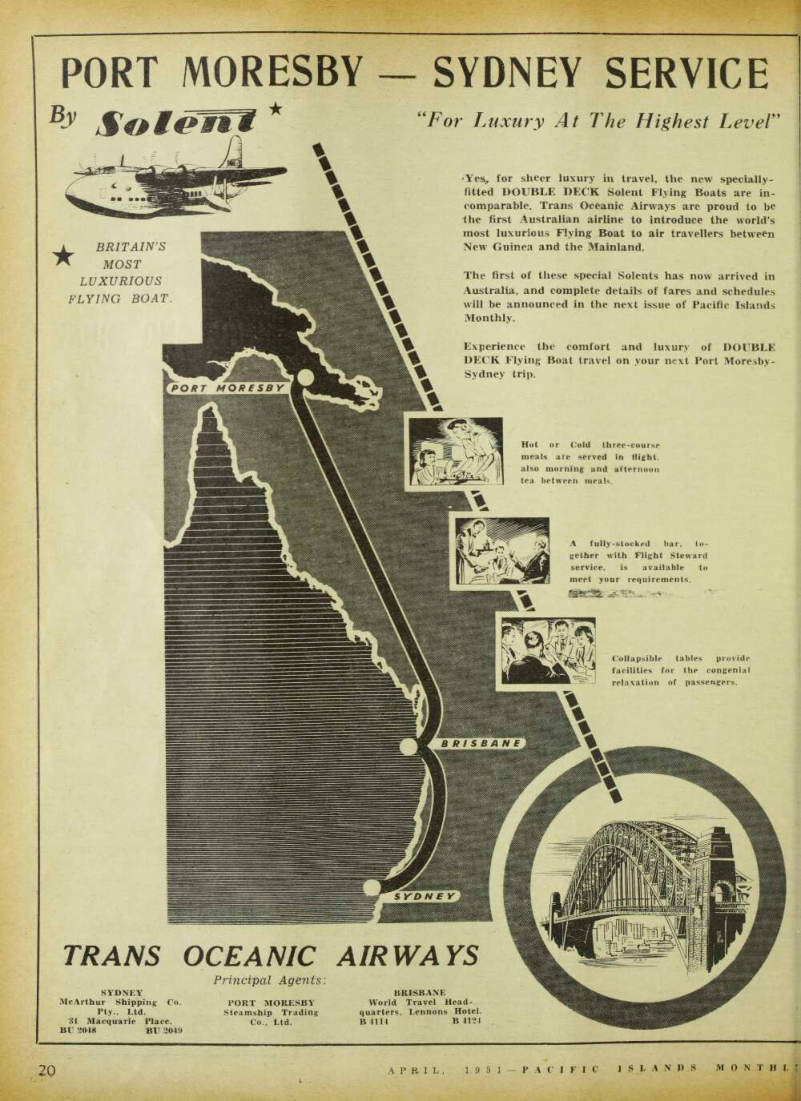
Fund
Minister Says The Deduction Goes On Indefinitely
AN attempt by a former New Guinea planter, Mr. H. G. W. Hanson, to get some indication of whether he is entitled to any of the conra-trade money that the Australian Government has accumulated in (a) Stabilisation Fund and (b) Production Control Board profits, has brought from the retiring Australian Minister for Territories (Mr. Spender) an interesting statement of policy.
Mr. Hanson now is a resident of Gos ford, NSW. He and his partner, Mr.
Alf Priebe, planted up a big plantation (Samo) in Namatanai, New Ireland, which was last year sold to Chinese interests in Rabaul. It was provided in the sale con tract that monies accruing from the plantation’s production prior to the sale —such as deductions taken by the Govern ment for stabilisation fund, and profits made by the PC Board, out of copra handled, be returned to the producers— should belong to Messrs. Hanson and Priebe.
Finding it impossible to ascertain from the New Guinea Administration or from Canberra what is to be administration policy in regard to return of stabilisation fund monies or distribution of FCB profits, Mr. Hanson saw his local member, Mr, R. L. Dean, MP. Mr. Dean approached Mr. Spender. Here is the Minister’s reply:— “In view of the security afforded to the industry by the agreement with the United Kingdom, the view has been ex pressed in some quarters that there is no need for a copra stabilisation fund. How ever, after a review of the matter, this Government felt that the agreement did not in itself provide the full measure of security that is so important to this vital Territory industry, and it therefore de cided that stabilisation must continue.
“Recent copra prices have been favour able for producers, even after allowance for amounts paid to the Stabilisation Fund, it is proposed that this fund should be the nucleus of a scheme to stabilise the Territory copra industry, and details of a comprehensive scheme are under consideration. . . , “Although the draft scheme of stabilisation for the Terrotory will be based upon the needs of the Territory and the copra industry, the principles adopted oy the Government in regard to stabilis ation schemes generally cannot be dis
regarded in the formulation of a scheme for the Territory.
“Under such schemes in relation to Australian primary products generally, contributions are not available to be re funded to producers when they sell their properties or sever their connection with the industry.
“On the question of funds accumulated by the Production Control Board, the practice is to pay producers tentative prices for their copra on delivery to the Board, and declare a final price each year in the light of actual trading results.
This arrangement is based on the prin ciple that, after making a provision for both actual and contingent trading costs and expenses, any balance of proceeds available is distributed in full to the industry.
“A sum of £75,000 has recently been distributed to complete the final copra prices in respect of the year 1949-50.”
Editorial Comment
PLANTERS might feel better about the Stabilisation Fund if they had some idea of how the Canberra bureau crats propose to effect stabilisation, if and when stabilisation is required. So far, there has not been the slightest indication of what the “experts” may have in mind.
Stabilised!, of course, is needed when the market collapses—in other words, when the consumers cannot absorb all the copra that is offered. This is a world industry—almost every nation figures in It, either as producer or consumer. What could a group of Canberra bureaucrats, even if equipped with millions of Aus tralian pounds, do to stabilise the New Guinea copra industry in time of over -si^S d * 1 i Ct o 0n pay a straight-out subsidy? Mr. Spender’s reference to “a committee which is to assist the govern ment in working out details of a stabilis ation scheme.” and “a draft scheme of stabilisation . . based upon the needs of the Territory” may be dismissed as merelv politician’s blah-blah.
Under the British guarantee, another five years at least must elapse before copra producers can feel a really cold breeze in other words, before there can be any call upon the Stabilisation Fund. If the Sf,T t « 1 n e n S n a . verage production is no more that 65,000 tons per annum, and the £5 per ton deduction is maintained, a simple
calculation shows that the Stabilisation Fund by 1956 will hold over £3,000,000.
It has been reported that representatives of the New Guinea Planters’ Association will be admitted to the Committee which is supposed to have charge of this Fund.
It is to be hoped that the planters will insist on that. Even in these days of inflation and depreciated currency, £3,000,000 is too healthy a sum to be left kicking around at the mercy of Canberra politicians and bureaucrats. Every penny of it was (or will be) earned by New Guinea planters, and the planters should guard it jealously.
The Minister’s reflection that “recent copra prices have been favourable,” and producers therefore will not mind the deduction, is typical of Southern ignorance of Territories conditions.
The price which producers are getting is good, but not phenomenal. It would have been phenomenal before World War II; but the costs of production are now so fantastic—and still are rising!—that to day’s MOF contract price is not nearly so favourable as Mr. Spender imagines. It would have been a different story if Britain had held to her original MOF con tract, and paid for the copra in the Sterling that was stipulated when the contract was made (before de-valuation).
As it is, by the de-valuation trickery, the South Pacific copra-producers are being robbed of £3O per ton. But, of course, the Australian Minister wouldn’t know anything about that!
Advertisements & other items, pp. 21-22 (2 items)
19
pacific islands monthl y - a p r il. 1951
“Holland Rusk”
Meet JULE, the “Holland Rusk” Girl *rr*
And Allied Products “Holland Rusk,” made of starch-reduced flour, glucose and eggs, come to you in packages of 8 “Holland Rusk” or the economy-size tin of 30 “Holland Rusk.”
The most versatile snack in the world!
If kept in a tin, they never go stale.
“Butter Johns,” a delicious wafer-like biscuit made with butter and crushed almonds.
“Almond Rings,” an attractive biscuit, also made with pure cream, butter and almonds.
“Speculaas,” mildly-spiced. handmcmlded biscuits, also in gift packets containing two 8-in. size male and female puppet figures.
“Edam Cheese Crunches,” a butter biscuit mixed with delicious Edam cheese— they’ll be favourites at your parties.
“Cocktail Buttons,” a marble-shaped delicacy made of butter, brandy and starch-reduced flour.
“Celery Rondelles,” similar to “Cocktail Buttons” but with pure celery oil added.
They are definitely “the thing” for the perfect host.
“Jubilee Assorted Biscuits,” in 8-oz.
Par-T-Packs filled with a rich assortment.
“Breakfast Cake,” made of the finest Australian rye, honey and grape-sugar, will add a sparkle to your breakfast.
Makes slow eaters eat better! Use it as a sandwich filling, or plain, or buttered.
Keep it unwrapped in your bread-bin at home—it’s more pleasant to eat that way.
Look for JULE on every packet and let her he your choice!
All our products are individually packed and shipped in sealed tins and cases for the tropics.
Write for Price List.
"HOLLAND RUSK"
32 Parramatta Rd., Strathfield,
Sydney, N.S.W.
Island Agents: Robert Gillespie Ltd. and Francis Hoover
PORT MORESBY SYDNEY SERVICE
Solent
% \ \ % % % I %
BRITAIN’S
MOST
LUXURIOUS
FLYING BOAT
PORT MORESBY
\ M v % me m % % % %
R I 5 BAN
% m t %
YD N E Y
41,4
For Luxury At The Highest Level
-Yes, for sheer luxury in travel, the new speciallyfitted DOUBLE DECK Solent Flying Boats are incomparable. Trans Oceanic Airways are proud to be the first Australian airline to introduce the world’ most luxurious Flying Boat to air travellers between New Guinea and the Mainland.
The first of these special Solents has now arrived in Australia, and complete details of fares and schedules will be announced in the next issue of Pacific Islands Monthly.
Experience the comfort and luxury of DOUBLE DECK Flying Boat travel on your next Port Moresby- Sydney trip.
Hot or Cold three-course meals are served in flight, also morning and afternoon tea between meals.
A fully-stocked liar, together with Flight Steward service. is available to meet your requirements.
Collapsible tables provide facilities for the congenial relaxation of passengers.
TRANS OCEANIC AIRWAYS
SYDNEY
McArthur Shipping Co.
Pty.. Ltd. 31 Macquarie Place.
BU 2048 BIT 2040
Principal Agents
PORT MORESBY
Steamship Trading Co., Ltd.
BRISBANE
World Travel Headquarters, Lennons Hotel.
B 4114
The Case of the Missing
Milk Can A Deep Freeze Mystery from Rabaul
From a Special Correspondent COLYER WATSON & CO. have just in stalled, in Rabaul, a Deep Freeze unit. We can now rush along to buy the odd package of pork chops and apple sauce or steak and onions which we carry home, thrust in the oven to thaw out and hot up. and hey, presto, dinner is served.
Amongst other things, they have such items as shrimps, and green peas . . . and they also have milk. Large three gallon cans of milk.
Whether or not all this is going to be the complete answer to the problems of the tired, tropical housewife, and the stimulant to tired, tropical appetites, heaven alone knows. But it certainly is a step in the right direction.
But me, I settled for the milk. The idea is that you buy the three-gallon can, cart it home and stand it in a corner for 24 hours, by which time it has thawed down to iced, fresh milk which you can S^! H 2° your heart’s content. Anyone who has lived on powdered milk, and canned condensed or reduced milk. Will know what I mean.
I had a can of frozen milk delivered.
Unfortunately, there were some air company pilots staying in the place and. when they went off next morning, as well as their sandwiches, etc., they collected njy can of milk from the corner and took that with them, too. the ’drome, they decided that they wiA 0t £ no Y what was - and sent it oack to the taxi company. muc h sleuthing I traced it to “f,„ tax i co ™ pan y which by this time had letuined it to Colyers. w°l? e f rS w^ e closed for stocktaking; out, hot on the trail of my by-this-time
thawed milk, I got in through a back fence and demanded my milk. They hadn’t a clue as to who the original can belonged to—anyway, they had received back only half a can. It had been opened and half-consumed somewhere along the way.
But it just goes to show that one has to be right on one’s toes around here, even to live!
The native population of New Caledonia and the Loyalty group has increased by about 3,000 since 1939. The present figure is approximately 32,500. In 1887 the Melanesian population, terribly decimated as it had been by “reprisal” raids after the big native revolt, was estimated at 42.000.
Death Of Mrs. P. R Osborne
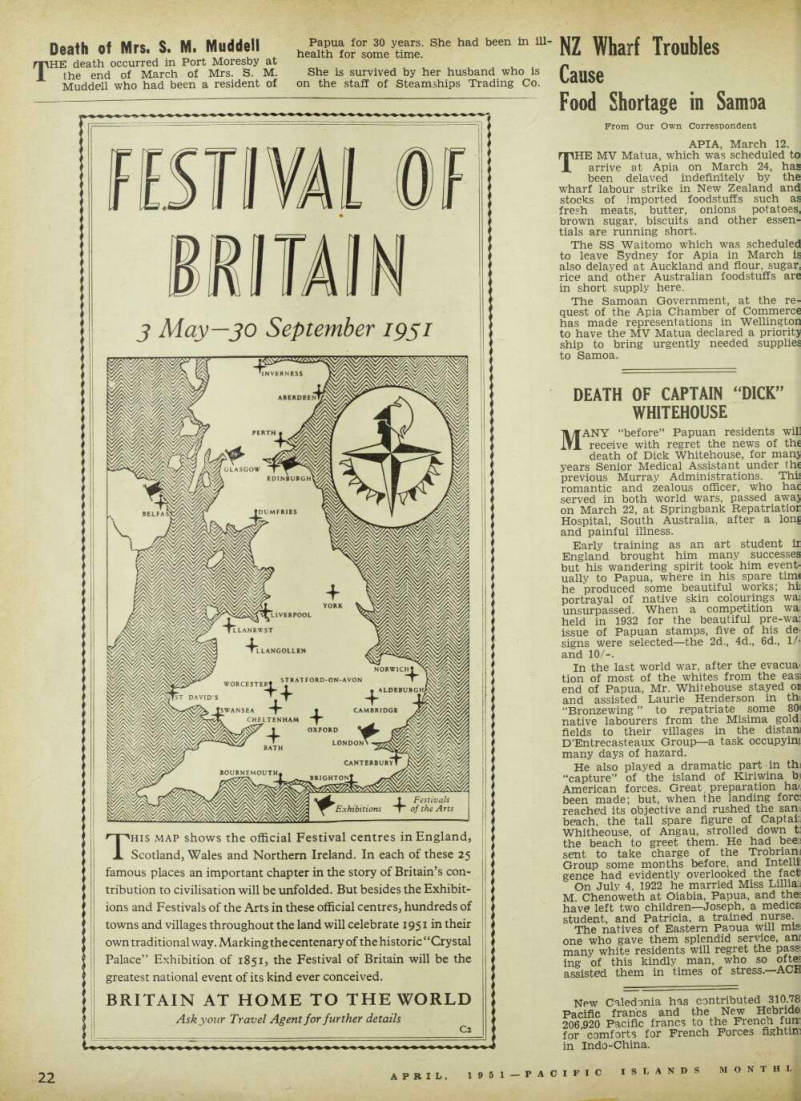
mHE death occurred in Svdnev on Mamh r r occurredin Sydneyon March A of Mrs. Je:ssie Osborne, wife of Mi. P. R. Osborne, formerly of the staff of Cuthberts Goldmine. Misima, Eastern Papua. Mr. Osborne went first to Papua in 1909, and Mrs. Osborne was with him there until 1939. She did not return after the war, but Mr. Osborne was there until the company went into liquidation last year. They had two daughters, one of whom is married and lives in New Zealand, and the other is now with her father at their home in Svdnpv 0 bydney - Mr. Osborne, this month, succeeded Mr N. Draper as official Liquidator of Cuth berts Misima Gold Mines, Ltd,
Death of Mrs. S. M. Muddell
THE death occurred in Port Moresby at the end of March of Mrs. S. M.
Muddell who had been a resident of
Papua for 30 years. She had been in ill health for some time.
She is survived by her husband who is on the staff of Steamships Trading Co.
Advertisements & other items, pp. 23-24 (2 items)
21
P AcI F I C islands MoNTHIY A P R I l , 1B 5 1
A. H. Crundall
ASTHMA, HAY FEVER, BRONCHITIS, SINUS,
ANTRUM, COUGHS, COLDS, 'FLU,
TONSILITIS ond WHOOPING COUGH
are best treated by atomized inhalant
'The Answer to the Asthmatic's Prayer"
Five little whiffs and, in five little jiffs, “off she pops." Relief is instantaneous—it “touches the spot” unchanged, because it is an atomized inhalant.
REV. A. D. —, Procure des Missions D’Oceanie, Papuasie, et lies Gilbert, Rue Roussel, Doria, Marseille, France, writes: Rev. Father F ; a veteran missionary of Papua, thanks you for the wonderful, immediate relief on using Aspaxadrene—now he can sleep, rest, and breathe more freely. As for myself, having a painful morning cough, too—a few puffs of Aspaxadrene . . . and the result is simply amazing. I congratulate you on being the discoverer of such a marvellous preparation.
DR. 32nd St. North West, Washington, U.S.A.: Wonderful you owe it to humanity to make Aspaxadrene easily available in U.S.A.
MR. K. D. L. BROOK, Box 26, Ba, Fiji: New missioner for the Gilbert Islands landed with an asthma attack—Aspaxadrene so relieved him that he is his old self again.
Complete Outfit, 28/6, Refills, 12 6 each.
ALL CHEMISTS or
A. H. CRUNDALL
BOX 58, PRAHRAN, VICTORIA, AUSTRALIA
festival of
3 May—3o September 1931
INVERNESS
ABERDEEN
PERTH
w.
EDINBURGH
DUMFRIES
BELFA
s +
YORK
LIVERPOOL
LLANRWST
4.
LLANGOLLEN
NORWICH \ '
3N T
ALDEBURGH
CAMBRIDGE
STRATFORD-ON-AVON
WORCESTER
SWANSEA J
r CHELTENHAM
OXFORD V
LONDON
BATH
CANTERBURY
BRIGHTON?
BOURNEMOUTH
Arts This map shows the official Festival centres in England, Scotland, Wales and Northern Ireland. In each of these 25 famous places an important chapter in the story of Britain’s contribution to civilisation will be unfolded. But besides the Exhibitions and Festivals of the Arts in these official centres, hundreds of towns and villages throughout the land will celebrate 1951 in their own traditional way. Marking the centenary of the historic “Crystal Palace” Exhibition of 1851, the Festival of Britain will be the greatest national event of its kind ever conceived.
BRITAIN AT HOME TO THE WORLD
Ask your Travel Agent for further details C 2
NZ Wharf Troubles
Cause Food Shortage in Samoa
From Our Own Correspondent APIA, March 12.
THE MV Matua, which was scheduled toi arrive at Apia on March 24, has been delaved indefinitely by the; wharf labour strike in New Zealand and! stocks of imported foodstuffs such as fresh meats, butter, onions potatoes, brown sugar, biscuits and other essen tials are running short.
The SS Waitomo which was scheduled! to leave Sydney for Apia in March is also delayed at Auckland and flour, sugar, rice and other Australian foodstuffs are in short supply here.
The Samoan Government, at the re quest of the Apia Chamber of Commerce has made representations in Wellington to have the MV Matua declared a priority ship to bring urgently needed supplies to Samoa.
Death Of Captain “Dick”
Whitehouse
MANY “before” Papuan residents will receive with regret the news of the death of Dick Whitehouse, for many years Senior Medical Assistant under the previous Murray Administrations. This romantic and zealous officer, who hac served in both world wars, passed away on March 22, at Springbank Repatriation Hospital, South Australia, after a long and painful illness.
Early training as an art student ir England brought him many successes but his wandering spirit took him event ually to Papua, where in his spare time he produced some beautiful works; hit portrayal of native skin colourings wat unsurpassed. When a competition wa;. held in 1932 for the beautiful pre-wai issue of Papuan stamps, five of his de signs were selected —the 2d., 4d., 6d., 1/* and 10/-.
In the last world war, after the evacua-, tion of most of the whites from the eas< end of Papua, Mr. Whitehouse stayed or and assisted Laurie Henderson in thu “Bronzewing ” to repatriate some 80( native labourers from the Misima gold! fields to their villages in the distam D’Entrecasteaux Group—a task occupyinu many days of hazard.
He also played a dramatic part in thi “capture” of the island of Kiriwina b:< American forces. Great preparation ha', been made; but, when the landing fore: reached its objective and rushed the sanj beach, the tall spare figure of Captai:i Whitheouse, of Angau, strolled down tJ the beach to greet them. He had bee;; sent to take charge of the Trobriam Group some months before, and Intent gence had evidently overlooked the facu On July 4, 1922 he married Miss Lillia:j M. Chenoweth at Oiabia, Papua, and thee have left two children—Joseph, a medics student, and Patricia, a trained nurse.
The natives of Eastern Parma will mis one who gave them splendid service, anr many white residents will regret the pass ing of this kindly man, who so oftes assisted them in times of stress. ACH New Caledonia has contributed 31078 Pacific francs and the New Hebride. 206,920 Pacific francs to the French fum for comforts for French Forces fightira in Indo-China.
Advertisements & other items, p. 24 (1 item)
22
APRIL. 1951-PACIFIC ISLANDS MONTHL
Those Things That Make Fiji

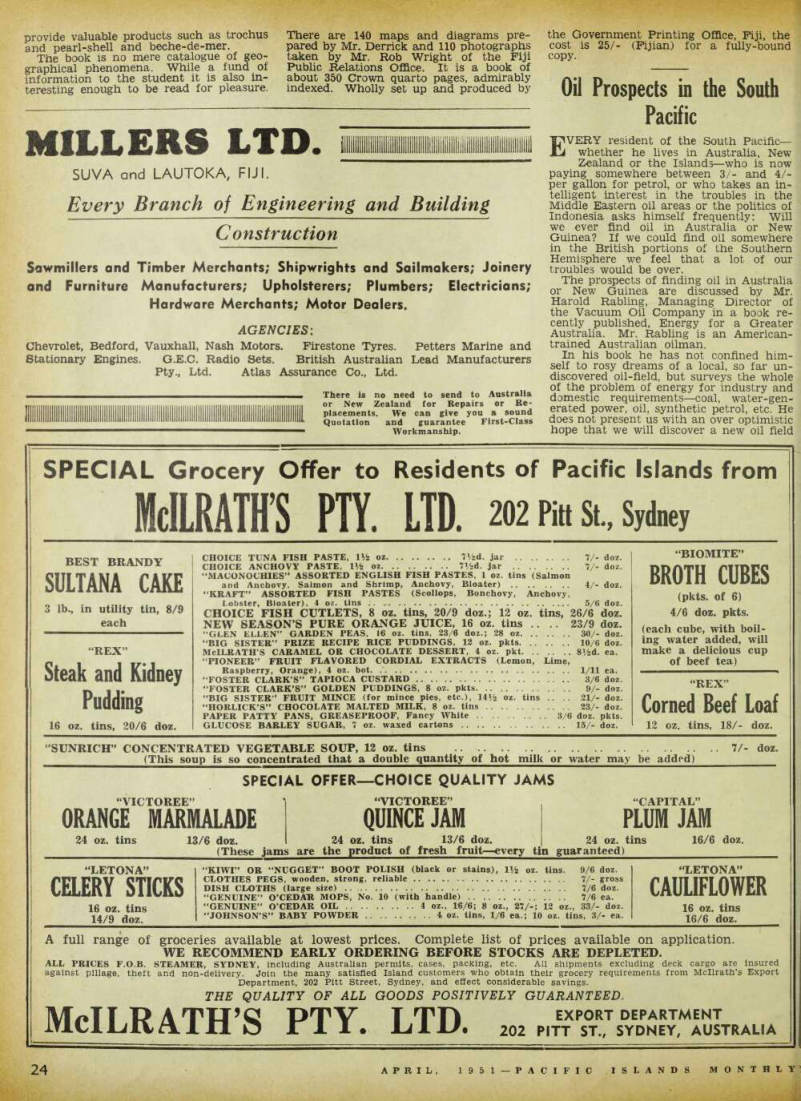
Book Reviews
MR. R. A. DERRICK calls his new book on Fiji (The Fiji Islands) a “hand book and not a text book.” If by that he means that it is more interesting to read than a text-book, he is quite cor rect. But it contains such a wealth of information about the Colony that it can be regarded as a happy combination of the two.
Mr. Derrick, a man of varied minor interests and one major one—the Fijians —has spent 30 years in Fiji; 30 years of observation of the country and its native people and of close association with the Fijians. Most of those years he has been associated with the technical training of Fijians and since 1939 has been in charge of the Technical branch of Fiji’s Edu cation Department. It was Mr. Derrick who recently was chosen by the South Pacific Commission to make a survey of technical training requirements in other South Pacific territories.
It seems a far cry from the instruction of young Fijians in carpentry to the writing of authorative works on the his tory and geography of Fiji. A numoer of years ago, having observed that the Colony lacked school text books on local history and geography, he set out to write some.
These books were printed on a press he had installed at Davuilem for his students and compiled by those students he had trained in book-binding, cover decoration and lino cuts.
Then after much research he gave us his first major book a few years ago—The History of Fiji—which takes the story of Fiji from its remotest beginnings up to the time of Cession in 1874. It is under stood that a companion piece to this book, the history of the Colony from 1874 to the present day, will be added later.
THE present book tends more towards the geography of the Colony, although the story of the Fijians must naturally impinge itself upon any descrip tion of the islands. Every facet of the make-up of the islands we call Fiji—the dry zones, the rain forests, the coral islets, the rivers, the reefs and the characteris tic saw-toothed mountain chains—is dis cussed, bisected and its secrets revealed.
For example, that oddity called Joske’s Thumb which every visitor sees sticking up out of the ranges as he sails into Suva Harbour—how many, even among the residents, know that it is a “volcanic
plug” (as also is the Devil’s Thumb south of Levuka)? The volcanic cones from which these masses once extruded have weathered away, the volcanoes themselves have become extinct but the finger-like, or thumb-like, projections remain. These sharp-toothed mountains are characteris tic of Fiji.
And Mr. Derrick gives us another slant on the coral reefs which stud the seas of Fiji like a maze and are usually cursed by snipping. He says that they form barriers against the sea, that they cause the rivers to drop their silt thus causing large fertile plains to be built up; they
provide valuable products such as trochus and pearl-shell and beche-de-mer.
The book is no mere catalogue of geo graphical phenomena. While a fund of information to the student it is also in teresting enough to be read for pleasure.
There are 140 maps and diagrams pre pared by Mr. Derrick and 110 photographs taken by Mr. Rob Wright of the Fiji Public Relations Office. It is a book of about 350 Crown quarto pages, admirably indexed. Wholly set up and produced by
the Government Printing Office, Fiji, the cost is 25/- (Fijian) for a fully-bound copy.
Advertisements & other items, pp. 25-26 (1 item)
J/oup ffcnp
ruce u on
/7J v JL ,
SPRUSO LIQUID, SPRUSO LIQUIDSHEEN, and SPRUSO
CRYSTALLISED SHEEN.
SPRUSO is the best seller in AUSTRALIA.
TRADERS', write for samples.
SPRUSO COMPANY, Redfern, New South Wales, Australia.
EGYPTIANS
y Archaeologists in egypt s ' HAVE FOUND MUMMIES FITTED / .
WITH ARTIFICIAL TEETH MADE SSSS
FROM SCENTED WOOD' TODAY \
MOST PEOPLE RELY ON
KOLYNOS TO KEEP THEIR \
Y MOUTH FRESH AND SWEET. I
FOR A REFRESHING CHANGE
„ -USE KOLYNOS. \ /
K VtCAj ,WJ>
OERMS '4
lIV Tests by famou; \//V Tests by famous
NORTH AMERICAN
AND EUROPEAN UNIVERSITIES
PROVE UP TO 92% OF DENTAL
DECAY BACTERIA IN THE
MOUTH ARE DESTROYED BY
KOLYNOS THIS EXCLUSIVE >
KOLYNOS ANTI-DECAY X
ACTION LASTS FOR
HOURS X
i
KOLYNOS
DENTAL CREAM
F/&/7S pmrseme
TXSTTSPmtR
lASTfm&f?
YOUR Tcfcin
STRONG AND
WHITE —RWEE
from dental decay AFTER
KOLYNOS /
EACH TOOTH
SPARKLES
WITH NEW
LUSTRE. =-,
too. (***'}
m C'%' sk/. •<& _!£L TWO rt/tes /!>r Me ps/te cf QAtf/, -As ONE TUBE OF KOLYNOS LASTS AS /v. "“A
LONG AS TWO TUBES OF
ORDINARY TOOTHPASTE
BECAUSE US SO HIGHLY
CONCENTRATED. HALF
AN INCH OF KOLYNOS
£3. AFTER MEALS
WILL STOP
DENTAL DECAY.
MILLERS LTD.
SUVA and LAUTOKA, FIJI.
Every Branch of Engineering and Building
Construction
Sawmillers and Timber Merchants; Shipwrights and Sailmakers; Joinery and Furniture Manufacturers; Upholsterers; Plumbers; Electricians; Hardware Merchants; Motor Dealers.
AGENCIES :
Chevrolet, Bedford, Vauxhall, Nash Motors. Firestone Tyres. Fetters Marine and Stationary Engines. G.E.C. Radio Sets. British Australian Lead Manufacturers Pty., Ltd. Atlas Assurance Co., Ltd.
There is no need to send to Australia or New Zealand for Repairs or Replacements. We can give you a sound Quotation and guarantee First-Class Workmanship.
Oil Prospects in the South
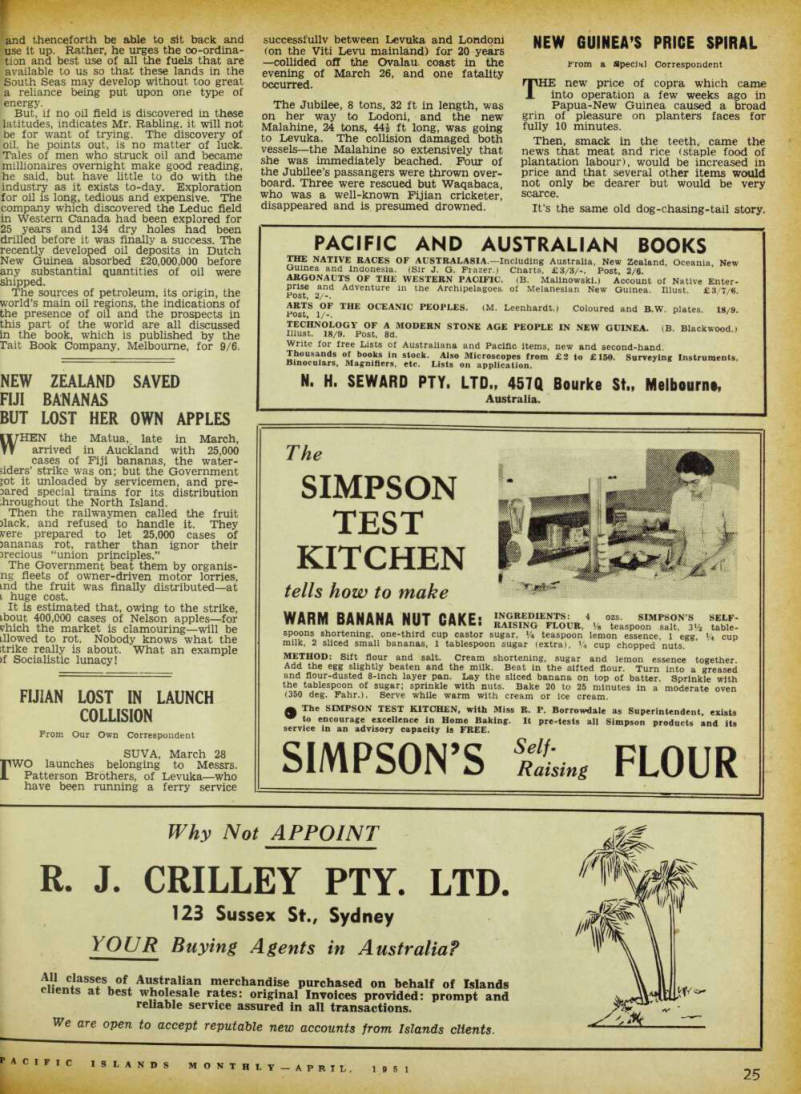
Pacific
EVERY resident of the South Pacific— whether he lives in Australia, New Zealand or the Islands—who is now paying somewhere between 3/- and 4/per gallon for petrol, or who takes an in telligent interest in the troubles in the Middle Eastern oil areas or the politics of Indonesia asks himself frequently: Will we ever find oil in Australia or New Guinea? If we could find oil somewhere in the British portions of the Southern Hemisphere we feel that a lot of our troubles would be over.
The prospects of finding oil in Australia or New Guinea are discussed by Mr.
Harold Rabling, Managing Director of the Vacuum Oil Company in a book re cently published, Energy for a Greater Australia. Mr. Rabling is an American trained Australian oilman.
In his book he has not confined him self to rosy dreams of a local, so far un discovered oil-field, but surveys the whole of the problem of energy for industry and domestic requirements—coal, water-gen erated power, oil, synthetic petrol, etc. He does not present us with an over optimistic hope that we will discover a new oil field
and thenceforth be able to sit back and use it up. Rather, he urges the co-ordina tion and best use of all the fuels that are available to us so that these lands in the South Seas may develop without too great a reliance being put upon one type of energy.
But, if no oil field is discovered in these latitudes, indicates Mr. Rabling. it will not be for want of trying. The discovery of oil. he points out, is no matter of luck.
Tales of men who struck oil and became millionaires overnight make good reading, he said, but have little to do with the industry as it exists to-day. Exploration for oil is long, tedious and expensive. The company which discovered the Leduc field in Western Canada had been explored for 25 years and 134 dry holes had been drilled before it was finally a success. The recently developed oil deposits in Dutch New Guinea absorbed £20,000,000 before any substantial quantities of oil were shipped.
The sources of petroleum, its origin, the world’s main oil regions, the indications of the presence of oil and the prospects in this part of the world are all discussed in the book, which is published by the Tait Book Company, Melbourne, for 9/6.
Advertisements & other items, p. 26 (1 item)
McILRATHS PTY. LTD. 202 Pitt St., Sydney
SPECIAL Grocery Offer to Residents of Pacific Islands from McILRATHS PTY. LTD. 202 Pitt St., Sydney
BEST BRANDY
SULTANA CAKE
3 lb., in utility tin, 8/9 each
“REX”
Steak and Kidney
Pudding
16 oz. tins, 20/6 doz.
CHOICE TUNA FISH PASTE, 1% oz TVzd. jar 7/- doz.
CHOICE ANCHOVY PASTE, Ufe oz 7V2d. jar 7/- doz.
“MACONOCHIES” ASSORTED ENGLISH FISH PASTES. I oz. tins (Salmon and Anchovy. Salmon and Shrimp, Anchovy, Bloater) 4/- doz.
“KRAFT” ASSORTED FISH PASTES (Scollops, Bonchovy, Anchovy, Lobster, Bloater), 4 oz. tins 5/6 doz.
CHOICE FISH CUTLETS, 8 oz. tins, 20/9 doz.; 12 oz. tins, 26/6 doz.
NEW SEASON’S PURE ORANGE JUICE, 16 oz. tins .. .. 23/9 doz.
“GLEN ELLEN” GARDEN PEAS, 16 oz. tins, 23/6 doz.; 28 oz 30/- doz.
“BIG SISTER” PRIZE RECIPE RICE PUDDINGS. 12 oz. pkts 10/6 doz.
McILRATH’S CARAMEL OR CHOCOLATE DESSERT, 4 oz. pkt SVzd. ea.
“PIONEER” FRUIT FLAVORED CORDIAL EXTRACTS (Lemon, Lime, Raspberry, Orange), 4 oz. hot 1/11 ea.
“FOSTER CLARK’S” TAPIOCA CUSTARD 3/6 doz.
“FOSTER CLARK’S” GOLDEN PUDDINGS, 8 oz. pkts 9/- doz.
“BIG SISTER” FRUIT MINCE (for mince pies, etc.), HV 2 oz. tins .. .. 21/- doz.
“HORLICK’S” CHOCOLATE MALTED MILK, 8 oz. tins 23/- doz.
PAPER PATTY PANS, GREASEPROOF, Fancy White 3/6 doz. pkts.
GLUCOSE BARLEY SUGAR, 7 oz. waxed cartons 15/- doz.
“BIOMITE”
BROTH CUBES
(pkts. of 6) 4/6 doz. pkts. (each cube, with boiling water added, will make a delicious cup of beef tea)
“REX”
Corned Beef Loaf
12 oz. tins, 18/- doz.
“SUNRICH” CONCENTRATED VEGETABLE SOUP, 12 oz. tins 7/- doz. (This soup is so concentrated that a double quantity of hot milk or water may be added)
‘VICTOREE”
SPECIAL OFFER—CHOICE QUALITY JAMS
“VICTOREE”
ORANGE MARMALADE
24 oz. tins 13/6 doz.
QUINCE JAM
24 oz. tins 13/6 doz.
“CAPITAL”
PLUM JAM
24 oz. tins 16/6 doz. (These jams are the product of fresh fruit-—every tin guaranteed)
“LETONA”
CEERY STICKS
16 oz. tins l4/9 doz.
“KIWI” OR “NUGGET” BOOT POLISH (black or stains), Ufc oz. tins. 9/6 doz.
CLOTHES PEGS, wooden, strong, reliable 7/- gross DISH CLOTHS (large size) 7/6 doz.
“GENUINE” O’CEDAB MOPS, No. 10 (with handle) 7/6 ea.
“GENUINE” O’CEDAR OIL 4 oz., 16/6; 8 oz., 27/-; 12 oz., 33/- doz.
“JOHNSON’S” BABY POWDER 4 oz. tins, 1/6 ea.; 10 oz. tins, 3/- ea.
“LETONA”
CAULIFLOWER
16 oz. tins l6/6 doz.
A full range of groceries available at lowest prices. Complete list of prices available on application.
WE RECOMMEND EARLY ORDERING BEFORE STOCKS ARE DEPLETED.
ALL PRICES F. 0.8. STEAMER, SYDNEY, including Australian permits, cases, packing, etc. All shipments excluding deck cargo are insured against pillage, theft and non-delivery. Join the many satisfied Island customers who obtain their grocery requirements from Mcllrath’s Export Department, 202 Pitt Street, Sydney, and effect considerable savings.
THE QUALITY OF ALL GOODS POSITIVELY GUARANTEED.
McILRATH’S PTY. LTD.
EXPORT DEPARTMENT
202 PITT ST., SYDNEY, AUSTRALIA
Fiji Bananas
New Zealand Saved
But Lost Her Own Apples
IITHEN the Matua, late in March, ?▼ arrived in Auckland with 25,000 cases of Fiji bananas, the water jiders’ strike was on; but the Government ?ot it unloaded by servicemen, and pre pared special trains for its distribution throughout the North Island.
Then the railwaymen called the fruit )lack, and refused to handle it. They vere prepared to let 25,000 cases of jananas rot, rather than ignor their precious “union principles.”
The Government beat them by organis ng fleets of owner-driven motor lorries, md the fruit was finally distributed—at i huge cost.
It is estimated that, owing to the strike, ibout 400,000 cases of Nelson apples—for vhich the market is clamouring—will be tllowed to rot. Nobody knows what the itrike really is about. What an example >f Socialistic lunacy!
Fijian Lost In Launch
Collision
From Our Own Correspondent SUVA, March 28 rWO launches belonging to Messrs.
Patterson Brothers, of Levuka—who have been running a ferry service
—collided Off the Ovalau coast in the evening of March 26, and one fatality occurred.
The Jubilee, 8 tons, 32 ft in length, was on her way to Lodoni, and the new Malahine, 24 tons, AAI ft long, was going to Levuka. The collision damaged both vessels—the Malahine so extensively that she was immediately beached. Four of the Jubilee’s passangers were thrown overboard. Three were rescued but Waqabaca, who was a well-known Fijian cricketer, disappeared and is presumed drowned.
New Guihea ’ S Price Spibal
from a Special Correspondent rpHE new price of copra which came X into operation a few weeks ago in Papua-New Guinea caused a broad grin of pleasure on planters faces for fully 10 minutes.
Then, smack in the teeth, came the news that meat and rice (staple food of plantation labour), would be increased in price and that several other items would not only be dearer but would be very scarce. it’s the same old dog-chasing-tail story.
Advertisements & other items, pp. 27-28 (2 items)
25
PACIFIC ISLANDS MONTH LY-APRIt, 1951
Simpson’S
PACIFIC AND AUSTRALIAN BOOKS
THE NATIVE RACES OF AUSTRALASIA—IncIuding Australia, New Zealand, Oceania New Guinea and Indonesia. (Sir J. G. Frazer.) Charts, £3/3/-. Post, 2/6.
ARGONAUTS OF THE WESTERN PACIFIC. (B. Malinowski.) Account of Native Enterprise and Adventure in the Archipelagoes of Melanesian New Guinea. Illust. £3/7/6. 2/".
ARTS OF the OCEANIC PEOPLES. (M. Leenhardt.) Coloured and B.W. plates. 18/9.
TECHNOLOGY OF A MODERN STONE AGE PEOPLE IN NEW GUINEA.
Illust. 18/9. Post, Bd. (B. Blackwood.) Write for free Lists of Australians and Pacific Items, new and second-hand.
Thousands of books in stock. Also Microscopes from £3 to £l5O. Surveying Instruments, Binoculars, Magnifiers, etc. Lists on application.
N. H. SEWARD PTY. LTD., 457 ft Bourke St., Melbourne,
The
SIMPSON
TEST
KITCHEN
tells how to make
mm *
WARM BANANA NUT CAKE:
INGREDIENTS: 4 ozs. SIMPSON’S SELF-
RAISING FLOUR, Vn teaspoon salt, SVi tablespoons shortening, one-third cup castor sugar, Va teaspoon lemon essence, 1 egg, y 4 cup milk, 2 sliced small bananas, 1 tablespoon sugar (extra), Va cup chopped nuts.
METHOD: Sift flour and salt. Cream shortening, sugar and lemon essence together.
Add the egg slightly beaten and the milk. Beat in the sifted flour. Turn into a greased and flour-dusted 8-inch layer pan. Lay the sliced banana on top of batter. Sprinkle with the tablespoon of sugar; sprinkle with nuts. Bake 20 to 25 minutes in a moderate oven (350 deg. Pahr.). Serve while warm with cream or ice cream. a The SIMPSON TEST KITCHEN, with Miss R. P. Borrowdale as Superintendent, exists W to encourage excellence in Home Baking. It pre-tests all Simpson products and its service in an advisory capacity is FREE.
SIMPSON’S
Self-
Raising
FLOUR
Why Not APPOINT
R. J. CRILLEY PTY. LTD.
123 Sussex St., Sydney YOUR Buying Agents in Australia?
MiL C *f SS J S u of . Au stralian merchandise purchased on behalf of Islands clients at best wholesale rates: original Invoices provided: prompt and reliable service assured in all transactions.
We are open to accept reputable new accounts from Islands clients. ■Jk
DIRECTTO
X
NEW GUINEA
PAPUA
GULF OF PAPUA \
PORT MORSEBY
A 'c
■utnea
GOVERNMENT
TORRES Sir
CRAMMOND TROPIC RECEIVERS
Over 500 CRAMMOND TROPIC-PROOFED RECEIVERS
have recently been purchased by the New Guinea Government. The power range and lasting qualities are unequalled for Tropical Conditions, hence the selection of the
CRAMMOND TROPIC-PROOFED RECEIVERS by the
New Guinea Government. : 4
TROPIC
CRAMMOND TROPIC EAGLE
Most famous tropic-proofed and completely sealed receiver in the world to-day. Range is unlimited and reception is perfect. It has a built-in moisture absorber, and is available Jn Vibrator or AH Dry Cell. Be assured of a Lifetime of Perfect Reception by writing CRAMMONDS to-day for full particulars.
CRAMMOND RADIO
TDOPICDL DIVISION
8 QUEEN STREET . BR/SBttNE
The Month In Moresby
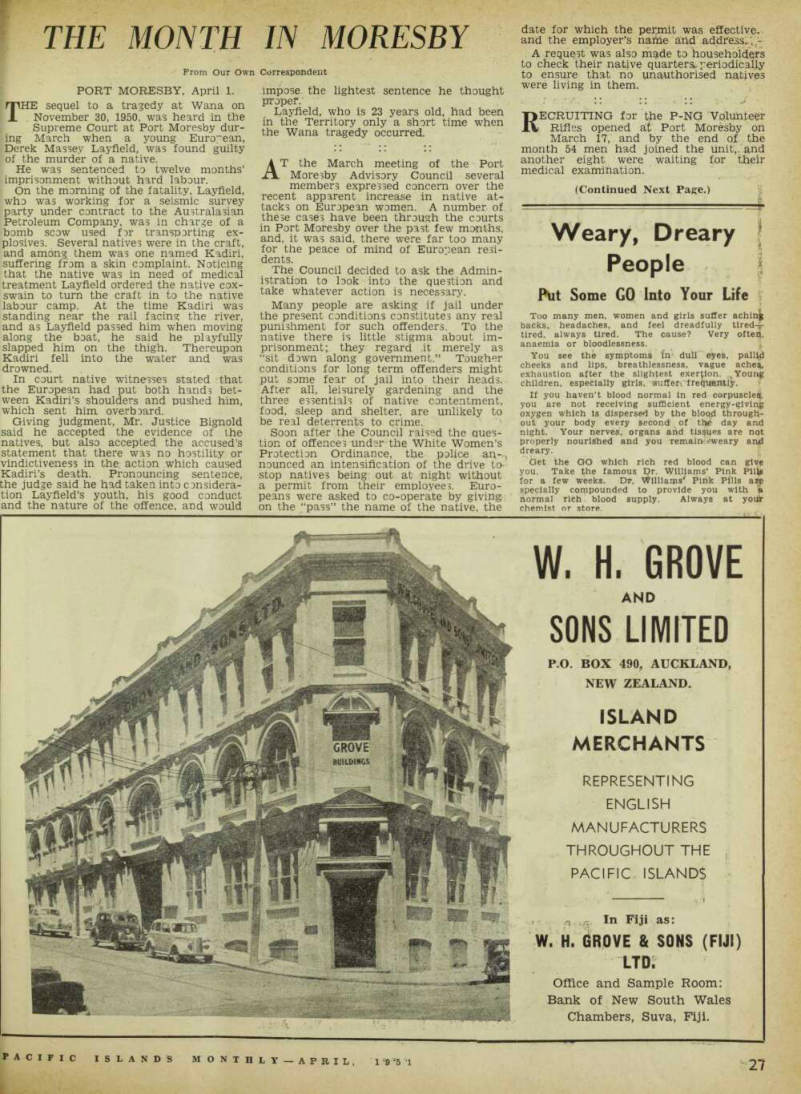
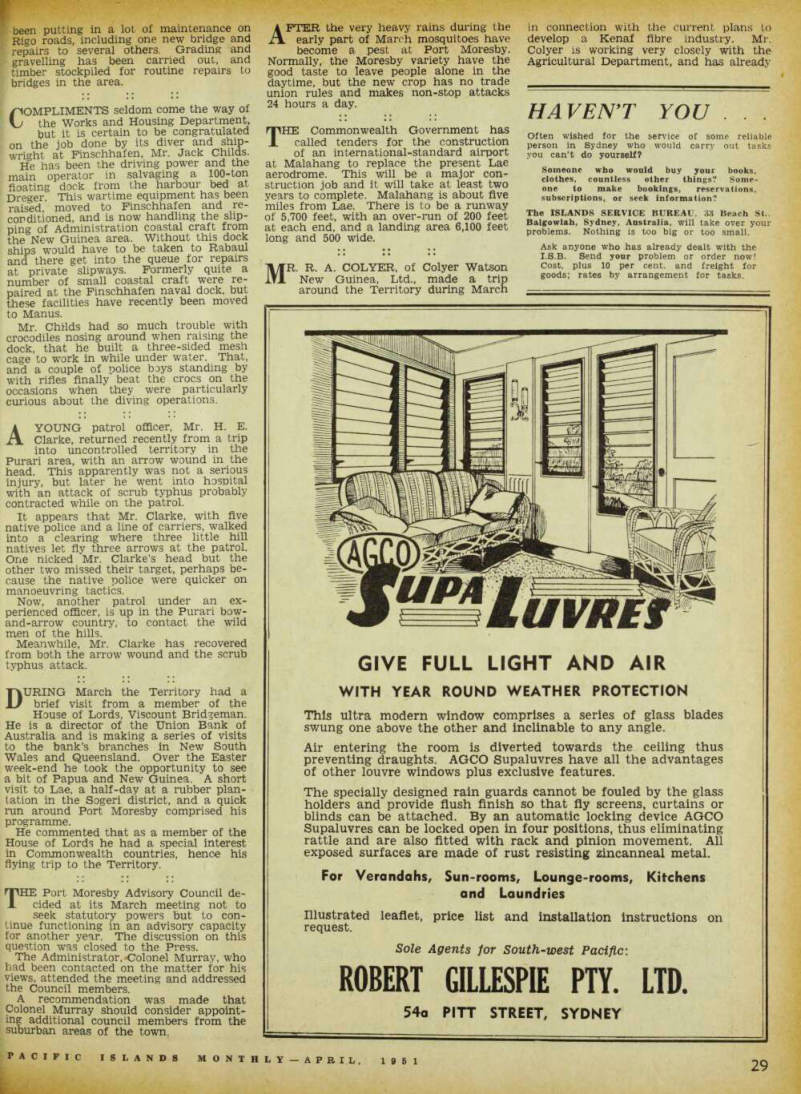
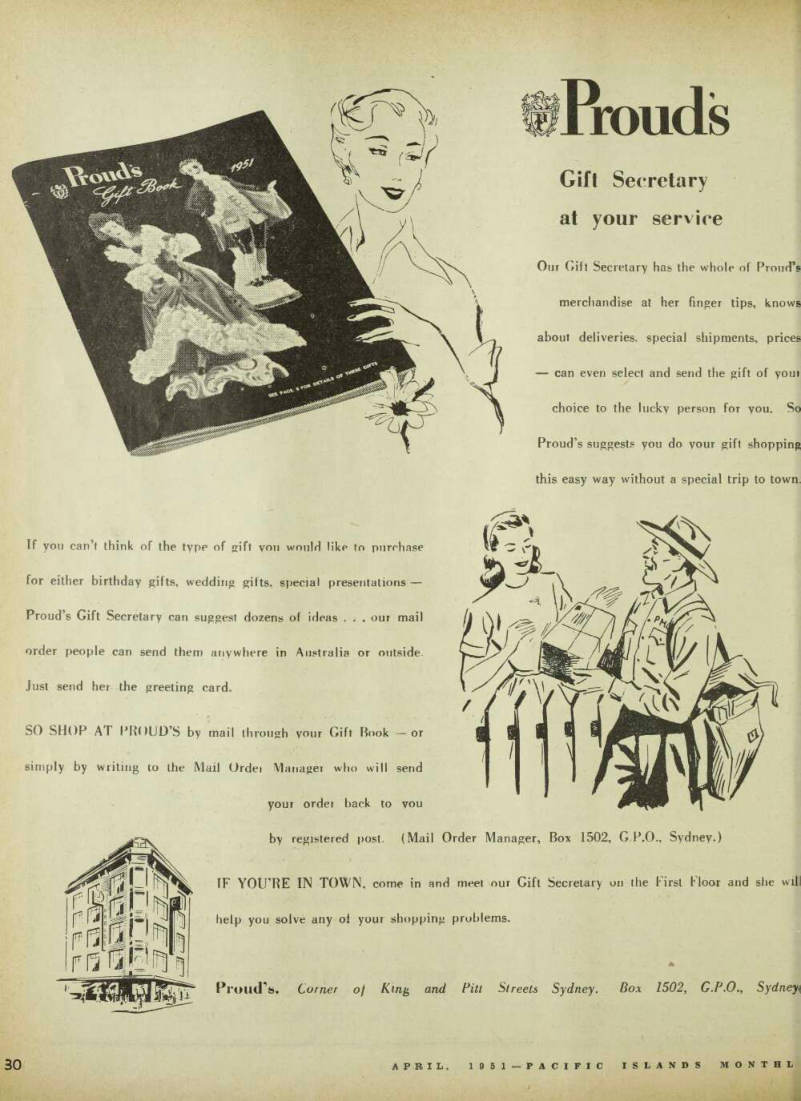
From Our Own Correspondent
Port Moresby. April 1.
THE sequel to a tragedy at Wana on November 30, 1950, was heard in the Supreme Court at Port Moresby during March when a young Euro-ean, Derek Massey Layfield, was found guilty of w? 6 Hg was sentenced to twelve months imprisonment without hard labour.
On the morning of the fatality, Layfield, whi was working* for a seismic survev party under comract to thf A™ traSn Ppfrnipnm Pnmnqnv in nf n boX e sc m ow C Ts?d y f,r wa trimpartii “explosives. Several natives were in the craft, and among them was one named Kadiri, suffering from a skin complaint. Noticing that the native was in need of medical treatment Layfield ordered the native coxswain to turn the craft in to the native labour camp. At the time Kadiri was standing near the rail facing the river, and as Layfield passed him when moving along the boat, he said he playfully slapped him on the thigh. Thereupon Kadiri fell into the water and was drowned.
In court native witnesses stated that the European had put both hands between Kadiri’s shoulders and pushed him, which sent him overboard.
Giving judgment, Mr. Justice Bignold said he accepted the evidence of the natives, but also accepted the accused’s statement that there was no hostility or vindictiveness in the action which caused Kadiri’s death. Pronouncing sentence, the judge said he had taken into consideration Layfield’s youth, his good conduct and the nature of the offence, and would
impose the lightest sentence he thought proper. . , , , Territory I ’on?y when
Jg I WanatrSv occurred
e wana tragedy occurred. :: :: :: A T the March meeting of the Port /\ _ii i
™^^naren? P increase^to Native at
recent apparent increase in native at on women, A number of these cases have been through the courts £ Port Moresby over the past few months, was said , there were far too many the peace of mind of European resi . .. . . . . . . £°h nc] J d . ecided ask the Admin fto l3ok J nto • the qu p stlon and ake whatever action is necessary, Many people are asking if jail under the present conditions constitutes any real punishment for such offenders. To the native there is little stigma about im prisonment; they regard it merely as “sit down along government.” Tougher conditions for long term offenders might put some fear of jail into their heads, After all, leisurely gardening and the three essentials of native contentment, food, sleep and shelter, are unlikely to be real deterrents to crime, Soon after the Council raised the ques tion of offences under the White Women’s Protection Ordinance, the police an--, nounced an intensification of the drive to stop natives being out at night without a permit from their employees. Emo peans were asked to co-operate by giving on the “pass” the name of the native, the
date for which the permit was effective, and the employer’s name arid address..,. - A request was also made to householders to check their native quarters, yeriodically to ensure that no unauthorised natives were living in them.
Recruiting for t)ae p-ng volunteer Rifles opened at Port Moresby oh March 17, and by the end of the month 54 men had joined the unit, and another eight were waiting for their medical examination. (Continued Next Page.)
For weeks after the first Regular Army members of the regiment arrived in the Territory, nothing much happened. But things changed in early March when a new Commanding Officer, Lt.-Colonel N, P. Maddern suddenly arrived from Aus tralia.
Colonel Maddern says he is more than pleased with the quality of his Port Moresby recruits, and claims their edu cational and physical standards are well above the general average of CMP volun teers in Australia. He is particularly pleased that the average age of his Port
Moresby recruits is only 241 and again this is a great improvement on the com parable level among CMF members. He is still chuckling over the disgust ex pressed by three eighteen-year old ap plicants for enlistment who had to wait for their parents’ consent before they could be enlisted.
He is also getting a lot of satisfaction out of the high enlistment from the Com monwealth Bank staff in Port Moresby. Of the 13 men on the staff nine have joined the regiment.
Recruiting started at Lae on April 7, and at Rabaul will begin on May 5.
Every recruit is signed on as a private, and after three months basic training men will be selected for eventual promo tion to non-commissioned and commis sioned rank. rpHE Pacific Islands Regiment which is A to comprise full-time native troops as part of the Australian Regular Army, is also well started. Major Shields is now recruiting native instructors from among ex-NCO’s, and when they have completed a three months’ refresher course, general recruiting will start. The permanent camp is at Taurama near Port Moresby, on a wartime hospital site where there are plenty of very useful concrete foundations for the permanent campi quarters. These will save a lot of time and materials when construction begins on the permanent camp quarters.
ROUNA HOUSE, which had been run as a guest house, is now a fully licensed hotel, with the name of “Hotel Rouna.”
The licencee is Mrs. Dorothy Wood lands, who before going to Rouna was in charge of the Civil Aviation Mess at Port Moresby. Although the police did not op pose the granting of the license some Moresby residents are wondering if the existence of a roadside hotel will have any effect on the accident rate along the highway from Rouna to Port Moresby. It is not an easy road to negotiate in bad weather, and it is a death trap for indis creet drivers.
PLANTATION people and other Euro pean residents in the Rigo district now have a much improved road system- A Works and Housing team has
been putting in a lot of maintenance on Rigo roads, including one new bridge and repairs to several others. Grading and gravelling has been carried out, and timber stockpiled for routine repairs to bridges in the area.
COMPLIMENTS seldom come the way of the Works and Housing Department, but it is certain to be congratulated on the job done by its diver and ship wright at Pinschhafen, Mr. Jack Childs.
He has been the driving power and the main operator in salvaging a 100-ton floating dock from the harbour bed at Dreger This wartime equipment has been raised, moved to Finschhafen and re conditioned, and is now handling the slip ping of Administration coastal craft from the New Guinea area. Without this dock ships would have to be taken to Rabaul and there get into the queue for repairs at private slipways. Formerly quite a number of small coastal craft were re paired at the Finschhafen naval dock, but these facilities have recently been moved to Manus.
Mr. Childs had so much trouble with crocodiles nosing around when raising the dock, that he built a three-sided mesh cage to work in while under water. That, and a couple of police boys standing by with rifles finally beat the crocs on the occasions when they were particularly curious about the diving operations.
A YOUNG patrol officer, Mr. H. E.
Clarke, returned recently from a trip into uncontrolled territory in the Purari area, with an arrow wound in the head. This apparently was not a serious injury, but later he went into hospital with an attack of scrub typhus probably contracted while on the patrol.
It appears that Mr. Clarke, with five native police and a line of carriers, walked into a clearing where three little hill natives let fly three arrows at the patrol.
One nicked Mr. Clarke’s head but the other two missed their target, perhaps be cause the native police were quicker on manoeuvring tactics.
Now, another patrol under an ex perienced officer, is up in the Purari bow and-arrow country, to contact the wild men of the hills.
Meanwhile, Mr. Clarke has recovered from both the arrow wound and the scrub typhus attack.
DURING March the Territory had a brief visit from a member of the House of Lords, Viscount Bridgeman.
He is a director of the Union Bank of Australia and is making a series of visits to the bank’s branches in New South Wales and Queensland. Over the Easter week-end he took the opportunity to see a bit of Papua and New Guinea. A short visit to Lae, a half-day at a rubber plan tation in the Sogeri district, and a quick run around Port Moresby comprised his programme.
He commented that as a member of the House of Lords he had a special interest in Commonwealth countries, hence his flying trip to the Territory.
THE Port Moresby Advisory Council de cided at its March meeting not to seek statutory powers but to con tinue functioning in an advisory capacity for another year. The discussion on this question was closed to the Press.
The Administrator, Murray, who had been contacted on the matter for his views, attended the meeting and addressed the Council members.
A recommendation was made that Colonel Murray should consider appoint ing additional council members from the suburban areas of the town.
AFTER the very heavy rains during the early part of March mosquitoes have become a pest at Port Moresby.
Normally, the Moresby variety have the good taste to leave people alone in the daytime, but the new crop has no trade union rules and makes non-stop attacks 24 hours a day.
THE Commonwealth Government has called tenders for the construction of an international-standard airport at Malahang to replace the present Lae aerodrome. This will be a major con struction job and it will take at least two years to complete. Malahang is about five miles from Lae. There is to be a runway of 5,700 feet, with an over-run of 200 feet at each end, and a landing area 6,100 feet long and 500 wide.
MR. R. A. COLYER, of Colyer Watson New Guinea, Ltd., made a trip around the Territory during March
in connection with the current plans to develop a Kenaf fibre industry, Mr.
Colyer is working very closely with the Agricultural Department, and has already
made several trips to America to get the latest information on Kenaf growing and processing. On his March survey he was accompanied by Mr. W. L. Sanderson of Elder Smith & Co., the Bridge St. ship ping company, who said that he was just “taking a look around the Islands.” (See article re Kenaf elsewhere in this issue.)
Professor F. M. Keesing, Who Is
the Senior United States Commis sioner on the South Pacific Commis sion, visited the Territory during the latter part of March and early April. He is a world authority on Pacific races, and is Professor of Anthropology at Stanford University, California. Now on a year’s leave from his university post, Professor Keesing is looking into current problems affecting Pacific Island races.
MR. S. ELLIOTT-SMITH was sworn in as Acting District Commissioner for the Northern Division on March 12, and is now tackling the problems aris ing out of the big transfer of native com munities from around Mt. Lamington.
Mr. Elliott-Smith resigned as Deputy Commissioner for Native Affairs in Wes tern Australia, to return to the Terri tory. A pre-war Papuan Administration officer, he retired a few years ago and after a spell growing grapes at Mildura took an appointment in Western Australia.
But apparently the pull of the Territory was too strong, and he is back on his old stamping grounds. He has an extensive knowledge of the Northern Division native communities, and his wide experience will be a tremendous asset in dealing with the very difficult problems which face the Administration in that area.
TIOUR Papuans went to Brisbane from J 1 the Territory last month as guests of the Queensland Red Cross Branch, and to express their people’s thanks for the assistance given to natives w ho suffered in the Mt. Lamington disaster. While on this three-weeks’ visit they were in charge of a former Port Moresby resident, Mr. Tom Gough, who retired from the Territory police force a few months ago. Mr. Gough is now working with the Red Cross in Brisbane, and there is probably no one better fitted to handle the job of looking after the four natives, and seeing that their stay is made both enjoyable and instructive.
The Red Cross arranged to teach their four guests something about Blood Transfusion methods, and generally give them a broad picture of what the Red Cross means in the life of the community. The four Papuans are Elliott Elijah, a Trobriand Islander who has had a very good education, and who distinguished himself by his bravery during the disaster. He was the only native who volunteered to accompany the European rescue parties into the devastated area on that fatal
Sunday. And even when told to go back as it was thought another eruption might occur almost immediately, Elliott refused, saying that if the Europeans were staying, he would stay, too. He did a grand job of work and showed exceptional courage and loyalty in the face of unpredictable danger, and amid scenes of terrible tragedy.
Another member of the party, Timius, is also a very fine type of Papuan. He is a Native Medical Assistant whose work is outstandingly good, and who has earned a lot of well deserved praise from Euro pean medical officers.
When the eruption occurred Timius was working at his Medical Aid Post near Gona, and he immediately hurried to Cape Killerton to help treat casualties brought from the Higatura area, The third member of the party is Lahui Aki of the Hanuabada Red Cross Auxiliary, and the fourth, Willie Gavera.
After the eruption they had a plane trip to the Wairopi evacuee camp to distribute household and personal requirements donated by the Hanuabada Red Cross members.
Professor C. Marshall, of the Depart ment of Geology, Sydney University, re turned to Sydney recently after five weeks in BSI. He organised a survey of BSI mineral resources, undertaken by members of the University Geology School. He thinks that strategically im portant minerals may be found in the Solomons.
Advertisements & other items, pp. 29-34 (2 items)
27
PACIFIC ISLANDS M ONT HLY APRIL, 19 v 5 1
W. H. Grove
Weary, Dreary
People
Put Some GO Into Your Life
Too many men, women and girls suffer aching backs, headaches, and feel dreadfully tired, always tired. The cause? Very anaemia or bloodlessness.
You see the symptoms In dull eyes, pallty! cheeks and lips, breathlessness, vague aches, exhaustion after the slightest exertion. 1 Young children, especially girls, suffer-."frequently.
If you haven’t blood normal In red corpuscleaj. you are not receiving sufficient energy-giving oxygen which Is dispersed by the blood throughout your body every second of the day and night. Your nerves, organs and tissues are nqt properly nourished and you and dreary.
Get the GO which rich red blood can give you. Take the famous E?r. Williams’ Pink Pllfc for a few weeks. Dr. Williams' Pink Pills a»p specially compounded to provide you with « normal rich blood supply. Always at you* chemist or store.
! . . */a mm •a *
GROVE
IHJILOWOS
m n * •'*&-
W. H. GROVE
AND
SONS LIMITED
P.O. BOX 490, AUCKLAND,
NEW ZEALAND.
ISLAND
MERCHANTS
REPRESENTING
ENGLISH
MANUFACTURERS
THROUGHOUT THE
PACIFIC ISLANDS
£ In Fiji as:
W. H. GROVE & SONS (FIJI)
LTD.
Office and Sample Room: Bank of New South Wales Chambers, Suva, Fiji.
SAILS, COVERS, ARKS
TENTS, TARPAULINS, and all classes of CANVAS GOODS for industrial and home use FLAGS AND PENNANTS FOR CLUBS AND ASSOCIATIONS.
Send your inquiries through your agent to:
HARRY WEST Pty. Ltd.
"SYDNEY'S SAILMAKER"
DUKE ST. (WATERFRONT), EAST BALMAIN, SYDNEY, N.S.W.
Phone: WBIIOS, W 82284.
SUPERFINE PREP
PAIN
PREPARED PAINTS prevent the havoc caused to home and property by burning, blistering heat, soaking torrential rains and steamy, trying conditions!
PROTECT with SPARTAN—the prepared Paints that defy the elements: Ask for Spartan in its wide range of colours. Paint store for only SPARTAN Paints, Enamels, Lacquers with Spartan —and paint successfully! Ask your and Varnishes.
Manufactured under ideal conditions from selected pigments and oils. 7/ your store cannot supply contact direct:
SPARTAN PAINTS PTY., LIMITED, Melbourne
102-104 King St., Melbourne, Tic., Aust.
HAVEN'T YOU
Often wished for the service of some reliable person in Sydney who would carry out tasks you can’t do yourself?
Someone who would buy your books, clothes, countless other things? Someone to make bookings, reservations, subscriptions, or seek information?
The ISLANDS SERVICE BUREAU. 33 Beach St..
Balgowlah, Sydney, Australia, will take over your problems. Nothing is too big or too small.
Ask anyone who has already dealt with the 1.5.8. Send your problem or order now!
Cost, plus 10 per cent, and freight for goods: rates by arrangement for tasks.
I CT’ ' m U
MjLwWM
m-
GIVE FULL LIGHT AND AIR
WITH YEAR ROUND WEATHER PROTECTION
This ultra modern window comprises a series of glass blades swung one above the other and inclinable to any angle.
Air entering the room is diverted towards the ceiling thus preventing draughts. AGCO Supaluvres have all the advantages of other louvre windows plus exclusive features.
The specially designed rain guards cannot be fouled by the glass holders and provide flush finish so that fly screens, curtains or blinds can be attached. By an automatic locking device AGCO Supaluvres can be locked open in four positions, thus eliminating rattle and are also fitted with rack and pinion movement. All exposed surfaces are made of rust resisting zincanneal metal.
For Verandahs, Sun-rooms, Lounge-rooms, Kitchens and Laundries Illustrated leaflet, price list and installation instructions on request.
Sole Agents for South-west Pacific ;
ROBERT GILLESPIE PTY. LTD.
540 PITT STREET, SYDNEY
v> ■ v*.
Prouds
Gifl Secretary
at your service
Our Gift Secretary has the whole of Proud’s merchandise at her finger tips, knows about deliveries, special shipments, p can even select and send the gift of youi choice to the lucky person for you. So Proud’s suggests you do your gift shopping this easy way without a special trip to town If you can’t think of the type of gift von would like to purchase for either birthday gilts, wedding gifts, special presentations Proud’s Gift Secretary can suggest dozens of Ideas . . . our mail order people can send them anywhere in Australia or outside.
Just send her the greeting card.
SO SHOP AT PROUD’S by mail through your Gift Rook —or ■ » simply by writing to the Mail Ordei Manager who will send your order back to you by registered post. (Mail Order Manager, Box 1502, G P. 0., Sydney.) IF YOU’RE IN TOWN, come in and meet our Gift Secretary on the First Floor and she wil help you solve any ol your shopping problems.
Proud’s. Corner oj King and Pitt Streets Sydney. Box 1502 , G.P.0., Sydney\ * \h \ \ 0 \ h 3
rrj I'Ht'nrß
THE MACLAURIN SCHOOL
WENTWORTH FALLS, N.S.W.
A Church of England School. Preparatory, Boarding for boys.
Vacancies for 1951.
Apply to: The Headmaster, C. H. LLOYD, M.A. (Cantab).
Special care given to Boys from the Islands and Overseas.
Full Stocks now available in The Islands!
This highly nutritive food tonic—‘AKTA—VITE ’ —has proved of great value in tropical countries for—
• NERVINESS • SLEEPLESSNESS
• FATIGUE • LASSITUDE
and other troublesome conditions so frequent in hot humid climates. ‘ATKA-VITE’ provides definite amounts of 4 vitamins (A, 81, C and D) essential for buoyant health, together with minerals and energy-giving carbohydrate.
Delicious with iced milk. A tasty addition to ice-cream, iced desserts, sandwiches or straight from the bottle.
AKTA VITE'
NUTRITIVE FOOD TONIC
Of great value for growing children and nursing mothers. ■
AEP2
YOUR FUTURE CAREER . . .
Merchants, Accountants, Secretaries, Bankers and Business Managers ... all hold responsible positions with commensurate salaries. You too can enhance your prospects in this ever-expanding commercial field, which yields abundant returns to those with adequate qualifications. H.R.I. prepare ambitious men and women for all business positions from junior to senior executive. Tuition is practical authoritative up-to-date time saving . . . and certain in its successful results. The H.R.I. is available always to advise you write or wire for information free and without obligation.
H.R.I. tutorial service is proved by the winning of more honours than aU coaches in Australasia combined.
H.R.I. Career Training • ACCOUNTANCY • SECRETARYSHIP • COST ACCOUNTANCY • PRACTICAL BOOKKEEPING • MARKETING SELLING — ADVERTISING • BANKING • LOCAL GOVERNMENT EXAMS.
Hemingway Robertson Institute
Founded and Owned by Hemingway & Robertson Pty. Ltd.
Consulting Accountants :: :; Professional Tutors
126 BANK HOUSE. BANK PLACE, MELBOURNE
126 CHALFONT CHAMBERS, 142 PHILLIP STREET, SYDNEY 126/815
P-NG Wharf Problems
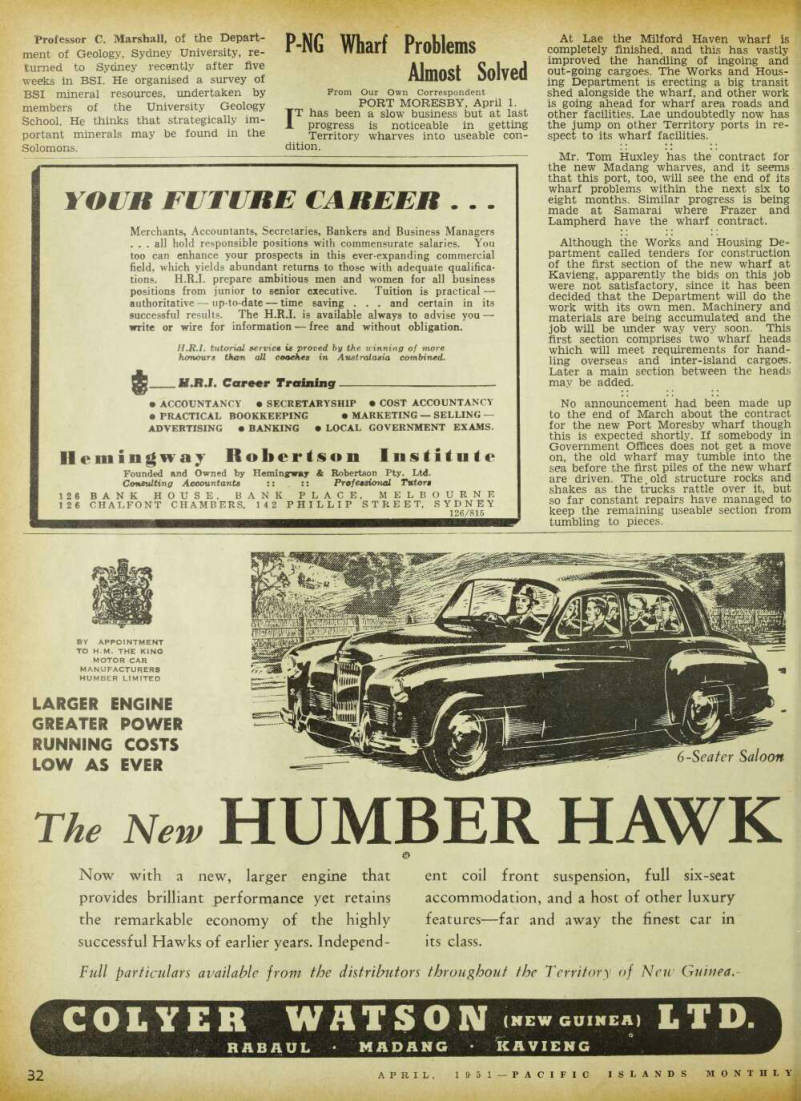
Almost Solved
Prom Our Own Correspondent
Port Moresby, April 1.
IT has been a slow business but at last progress is noticeable in getting Territory wharves into useable con dition.
At Lae the Milford Haven wharf is completely finished, and this has vastly improved the handling of ingoing and out-going cargoes. The Works and Hous ing Department is erecting a big transit shed alongside the wharf, and other work is going ahead for wharf area roads and other facilities. Lae undoubtedly now has the jump on other Territory ports in re spect to its wharf facilities.
Mr. Tom Huxley has the contract for the new Madang wharves, and it seems that this port, too, will see the end of its wharf problems within the next six to eight months. Similar progress is being made at Samarai where Frazer and Lampherd have the wharf contract.
Although the Works and Housing De partment called tenders for construction of the first section of the new wharf at Kavieng, apparently the bids on this job were not satisfactory, since it has been decided that the Department will do the work with its own men. Machinery and materials are being accumulated and the job will be under way very soon. This first section comprises two wharf heads which will meet requirements for hand ling overseas and inter-island cargoes.
Later a main section between the heads may be added.
No announcement had been made up to the end of March about the contract for the new Port Moresby wharf though this is expected shortly. If somebody in Government Offices does not get a move on, the old wharf may tumble into the sea before the first piles of the new wharf are driven. The.old structure rocks and shakes as the trucks rattle over it, but so far constant repairs have managed to keep the remaining useable section from tumbling to pieces.
Advertisements & other items, p. 34 (1 item)
The Nen, Humber Hawk
BY APPOINTMENT
TO H.M. THE KING
MOTOR CAR
MANUFACTURERS
HUMBER LIMITED
LARGER ENGINE
GREATER POWER
RUNNING COSTS
LOW AS EVER
am *3B Mil" 6-Seater Saloon
The Nen, HUMBER HAWK
© Now with a new, larger engine that provides brilliant performance yet retains the remarkable economy of the highly successful Hawks of earlier years. Independ- Full particulars available from the distributors ent coil front suspension, full six-seat accommodation, and a host of other luxury features—far and away the finest car in its class. throughout the Territory of New Guinea,
COLYER WATSON< NEW GUINEA) TDa
. HflßflOL • MADANG • KfIVIEHG
From Sydney
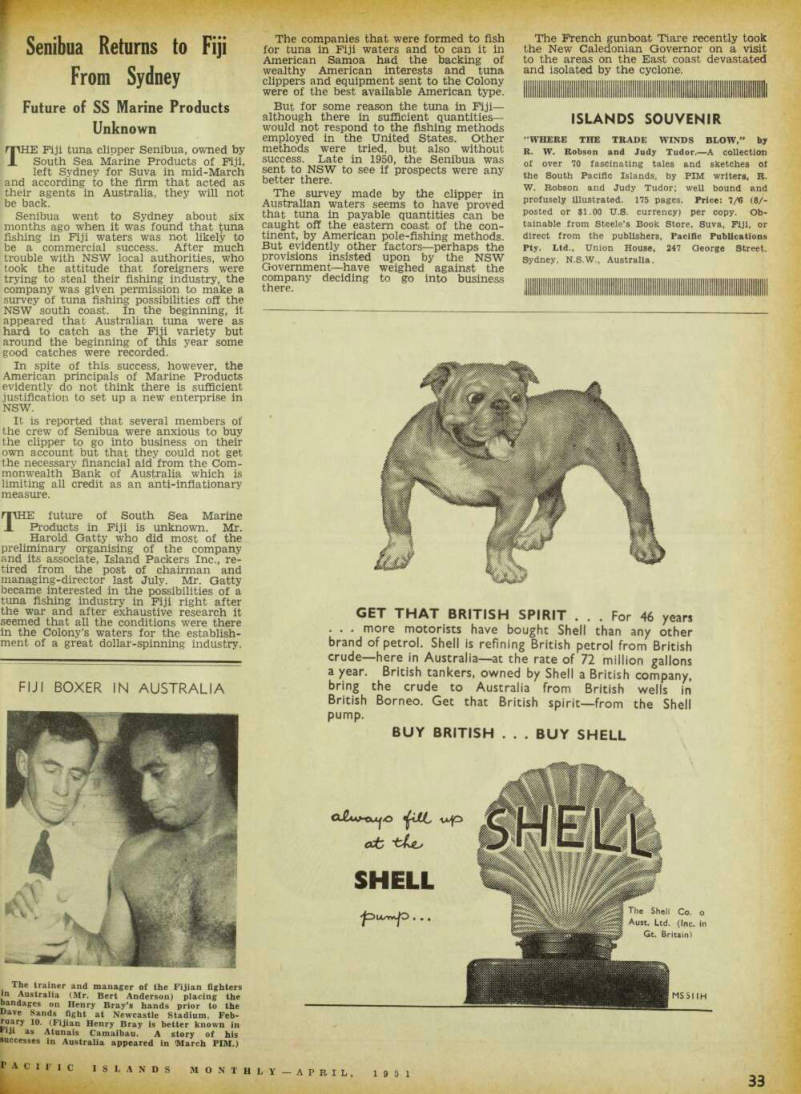
Senibua Returns to Fiji From Sydney Future of SS Marine Products Unknown
THE Fiji tuna clipper Senibua, owned by South Sea Marine Products of Fiji, left Sydney for Suva in mid-March and according to the firm that acted as their agents in Australia, they will not be back.
Senibua went to Sydney about six months ago when it was found that tuna fishing in Fiji waters was not likely to be a commercial success. After much trouble with NSW local authorities, who took the attitude that foreigners were trying to steal their fishing industry, the company was given permission to make a survey of tuna fishing possibilities off the NSW south coast. In the beginning, it appeared that Australian tuna were as hardi to catch as the Fiji variety but around the beginning of this year some good catches were recorded.
In spite of this- success, however, the American principals of Marine Products evidently do not think there is sufficient justification to set up a new enterprise in
Nsw.
It is reported that several members of the crew of Senibua were anxious to buy the clipper to go into business on their own account but that they could not get the necessary financial aid from the Com monwealth Bank of Australia which is limiting all credit as an anti-inflationary measure. rE future of South Sea Marine Products in Fiji is unknown. Mr.
Harold Gatty who did most of the preliminary organising of the company and its associate, Island Packers Inc., re tired from the post of chairman and managing-director last July. Mr. Gatty became interested in the possibilities of a tuna fishing industry in Fiji right after the war and after exhaustive research it seemed that all the conditions were there in the Colony’s waters for the establish ment of a great dollar-spinning industry.
The companies that were formed to fish for tuna in Fiji waters and to can it in American Samoa had the backing of wealthy American interests and tuna clippers and equipment sent to the Colony were of the best available American type.
But for some reason the tuna in Fiji— although there in sufficient quantities— would not respond to the fishing methods employed in the United States. Other methods were tried, but also without success. Late in 1950, the Senibua was sent to NSW to see if prospects were any better there.
The survey made by the clipper in Australian waters seems to have proved that tuna in payable quantities can be caught off the eastern coast of the con tinent, by American pole-fishing methods.
But evidently other factors—perhaps the provisions insisted upon by the NSW Government—have weighed against the company deciding to go into business there.
The French gunboat Tiare recently took the New Caledonian Governor on a visit to the areas on the East coast devastated and isolated by the cyclone.
Fiji Boxer In Australia
The trainer and manager of the Fijian fighters in Australia (Mr. Bert Anderson) placing the bandages on Henry Bray’s hands prior to the Dave Sands fight at Newcastle Stadium, Feb ruary 10. (Fijian Henry Bray is better known in as Atunais Camaibau. A story of his successes in Australia appeared in March PIM.)
Advertisements & other items, pp. 35-36 (2 items)
R Aci F I C Islands Monthly - A P R I L , 1951
Shell
ISLANDS SOUVENIR
“WHERE THE TRADE WINDS BLOW,” by
R. W. Robson and Judy Tudor.—A collection of over 70 fascinating tales and sketches of the South Pacific Islands, by PIM writers, R.
W. Robson and Judy Tudor; well bound and profusely illustrated. 175 pages. Price: 7/6 (8/posted or $l.OO U.S. currency) per copy. Obtainable from Steele’s Book Store, Suva, Fiji, or direct from the publishers, Pacific Publications Pty. Ltd., Union House, 247 George Street, Sydney, N.S.W., Australia.
GET THAT BRITISH SPIRIT ... For 46 years . . . more motorists have bought Shell than any other brand of petrol. Shell is refining British petrol from British crude—here in Australia—at the rate of 72 million gallons a year. British tankers, owned by Shell a British company, bring the crude to Australia from British wells in British Borneo. Get that British spirit—from the Shell pump.
BUY BRITISH . . . BUY SHELL
Cit 'tLds
SHELL
, , , The Shell Co. o Aust. Ltd. (Inc. in Gc. Britain)
MSSIIH
A. B. DONALD LIMITED
RAROTONGA COOK I SIAM DS
TELEGRAPHIC ADDRESS: “DONALD, RAROTONGA.”
General Merchants (Wholesale & Retail) and Shipowners Importers & Exporters Branches Throughout Cook Islands Fire, Marine & Motor Vehicles Insurance Agents for Yorkshire
Insurance Co.
Lloyd's Agents.
Agents and Distributors for: ENGLAND.—Austin Cars <fe Trucks, Pye Radios. Dunlop Rubber Co., Ltd., Vauxhall Cars & Trucks, R. A. Lister & Co., Ltd., Phillips' Cycles, Marples Tools.
U.S.A. —Remington Rand Corp., Radio Corp. of America Champion Spark Plug Co.. Firestone Tyres, General Steamship Corp.
NEW ZEALAND.—Vacuum OH Co. Pty., Ltd* Petroleum Products.
AUSTRALlA.—Wunderlich, Ltd., Cement Asbestos Products.
NORWAY.—O. Mustad & Sons, Pish Hooks.
SWEDEN.—B. A. HJorth & Co , Primus Products.
Head Office: — A, B. DONALD, LTD., Auckland.
Associate Houses:—
ETABLISSEMENTS DONALD TAHITI,
Papeete, Society Islands.
DOMINION FRUIT CO., Suva, Fiji Islands.
CODES: Bentley's Complete Phrase, Acme
Sydney Agents ;
BURNS, PHILP A CO., LTD.
London Agents :
BURNS, PHILP A CO., LTD.
San Francisco Agents :
BURNS, PHILP CO. OF SAN FRANCISCO.
lIUEXB
BURN
ORDINARY
KEROSENE
fa ! m mm mm Id I*
LAMPS
BURN
ORDINARY
KEROSENE
I
THE QUEEN” TABLE LAMP
300 CANDLEPOWER
'THE GUARDSMAN” STORM LANTERN
300 CANDLE POWER
THE VICTOR” HANGING LAMF
300 CANDLE POWER
REPRESENTATION:
AUSTRALIA & NEW GUINEA; T. H. Bentley, Pty. Ltd., 123-125 William
Street, Melbourne, Cl.
TASMANIA: Mr. H. V. Sellers, 108 a Charles Street, Launceston.
FIJI; Mr. K. Witherington, 2 Burns Philp Buildings, Suva.
Ml Lamington Still
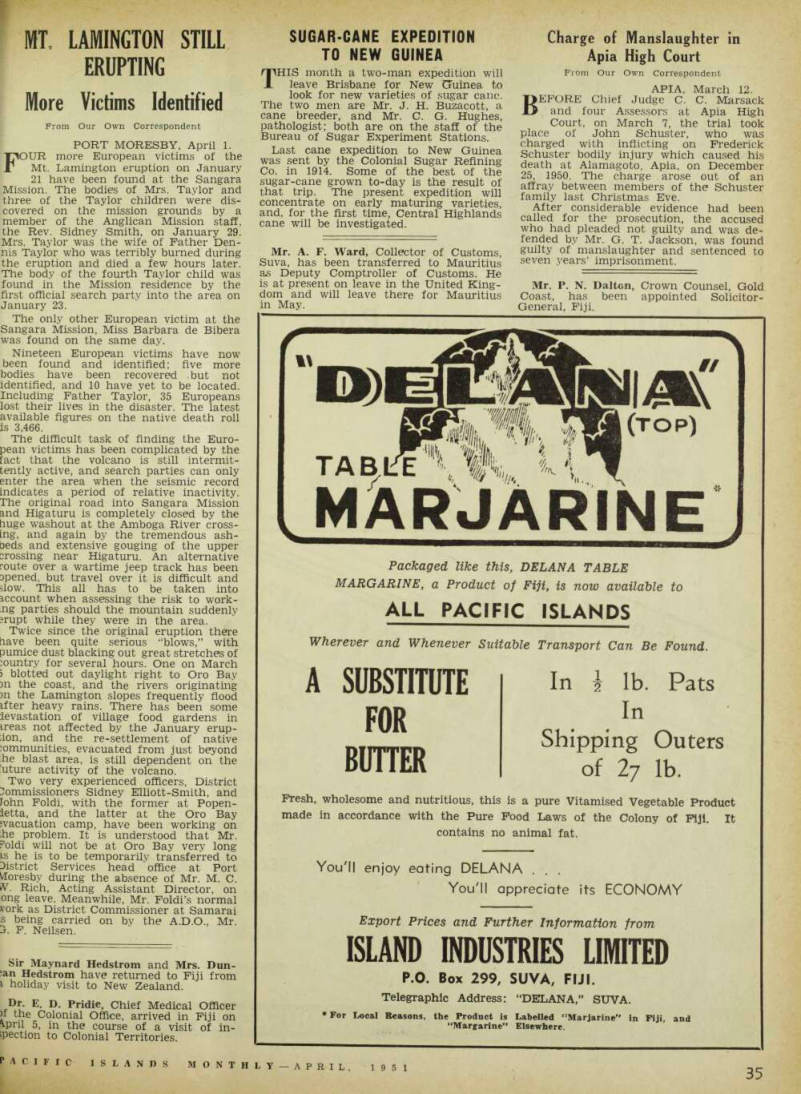
Erupting
More Victims Identified
Prom Our Own Correspondent
Port Moresby, April 1.
FOUR more European victims of the Mt. Lamington eruption on January 21 have been found at the Sangara Mission. The bodies of Mrs. Taylor and three of the Taylor children were dis covered on the mission grounds by a member of the Anglican Mission staff, the Rev. Sidney Smith, on January 29.
Mrs. Taylor was the wife of Father Den nis Taylor who was terribly burned during the eruption and died a few hours later.
The body of the fourth Taylor child was found in the Mission residence by the first official search party into the area on January 23.
The only other European victim at the Sangara Mission, Miss Barbara de Bibera was found on the same day.
Nineteen European victims have now been found and identified; five more bodies have been recovered . but not identified, and 10 have yet to be located.
Including Father Taylor, 35 Europeans lost their lives in the disaster. The latest available figures on the native death roll is 3,466.
The difficult task of finding the Euro pean victims has been complicated by the fact that the volcano is still intermit tently active, and search parties can only enter the area when the seismic record indicates a period of relative inactivity.
The original road into Sangara Mission and Higaturu is completely closed by the huge washout at the Amboga River cross ing, and again by the tremendous ash beds and extensive gouging of the upper crossing near Higaturu. An alternative route over a wartime jeep track has been apened, but travel over it is difficult and slow. This all has to be taken into account when assessing the risk to work lag parties should the mountain suddenly ?rupt while they were in the area.
Twice since the original eruption there have been quite serious “blows,” with pumice dust blacking out great stretches of country for several hours. One on March ) blotted out daylight right to Oro Bay an the coast, and the rivers originating an the Lamington slopes frequently flood after heavy rains. There has been some levastation of village food gardens in areas not affected by the January erup ion, and the re-settlement of native ommunities, evacuated from just beyond he blast area, is still dependent on the ’uture activity of the volcano.
Two very experienced officers, District Commissioners Sidney Elliott-Smith, and John Foldi, with the former at Popen letta, and the latter at the Oro Bay wacuation camp, have been working on he problem. It is understood that Mr. ?oldi will not be at Oro Bay very long as he is to be temporarily transferred to District Services head office at Port Moresby during the absence of Mr. M. C. iV. Rich, Acting Assistant Director, on ong leave. Meanwhile, Mr. Foldi’s normal vork as District Commissioner at Samarai s being carried on by the A.D.0., Mr.
D. F. Neilsen.
Sir Maynard Hedstrom and Mrs. Dun ;an Hedstrom have returned to Fiji from a holiday visit to New Zealand.
Dr. E. D. Pridie, Chief Medical Officer )f the Colonial Office, arrived in Fiji on 5, in the course of a visit of in fection to Colonial Territories.
Sugar-Cane Expedition
To New Guinea
THIS month a two-man expedition will leave Brisbane for New Guinea to look for new varieties of sugar cane.
The two men are Mr. J. H. Buzacott, a cane breeder, and Mr. C. G. Hughes, pathologist; both are on the staff of the Bureau of Sugar Experiment Stations.
Last cane expedition to New Guinea was sent by the Colonial Sugar Refining Co. in 1914. Some of the best of the sugar-cane grown to-day is the result of that trip. The present expedition will concentrate on early maturing varieties, and, for the first time, Central Highlands cane will be investigated.
Mr. A. F. Ward, Collector of Customs, Suva, has been transferred to Mauritius as Deputy Comptroller of Customs. He is at present on leave in the United King dom and will leave there for Mauritius in May.
Apia High Court
Charge of Manslaughter in Apia High Court
From Our Own Correspondent APIA, March 12.
BEFORE Chief Judge C. C. Marsack and four Assessors at Apia High Court, on March 7, the trial took place of John Schuster, who was charged with inflicting on Frederick Schuster bodily injury which caused his death at Alamagoto, Apia, on December 25, 1950. The charge arose out of an affray between members of the Schuster family last Christmas Eve.
After considerable evidence had been called for the prosecution, the accused who had pleaded not guilty and was de fended by Mr. G. T. Jackson, was found guilty of manslaughter and sentenced to seven years’ imprisonment.
Mr. P. N. Dalton, Crown Counsel, Gold Coast, has been appointed Solicitor- General, Fiji.
Advertisements & other items, p. 37 (2 items)
Islands Monthly— April, 1951
Marjarine
// W) "'(TiiiS m
(TOP)
TABLE
MARJARINE
Packaged like this, DELANA TABLE MARGARINE, a Product of Fiji, is now available to
ALL PACIFIC ISLANDS
Wherever and Whenever Suitable Transport Can Be Found.
A SUBSTITUTE
FOR
BUTTER
In i lb. Pats
In
Shipping Outers
of 2 7 lb.
Fresh, wholesome and nutritious, this is a pure Vitamised Vegetable Product made in accordance with the Pure Pood Laws of the Colony of Fiji. It contains no animal fat.
You'll enjoy eating DELANA . . .
You'll appreciate its ECONOMY Export Prices and Further Information from
ISLAND INDUSTRIES LIMITED
P.O. Box 299, SUVA, FIJI.
Telegraphic Address: “DELANA,” SUVA. • For Local Reasons, the Product is Labelled ‘’Marjarine” in Fiji, and “Margarine” Elsewhere.
Fiji-lndian Millionaires Visit
Melbourne
MELBOURNE was recently visited by two Fiji Indians who have sugar plantations in Fiji and nave, in the last 40 years, built up huge sugar fortunes.
Melbourne newspapers said so, and they couldn’t be wrong.
The two millionaires, Mr. Mamji and his
friend Mr. Gulab Khan, did not look like millionaires; but few millionaires do. Nor do they appear to be the type to say they are wealthy if they are not. This interest ing fact about them was probably divined by that extra sense owned by all news paper reporters.
Newsprint is scarce and dear. But one Melbourne morning paper devoted no less than 17 inches to the visitors. Which shows that they must indeed have been VlP’s.
Buka Passage News
From Our Own Correspondent SOHANA, March 1.
BY the Catalina arriving February 13,, came Mr. Les Beard (house-building; supervisor), Mr. Scope (chief! electrician) and Mr. Coleman (linesman of the Department of Works & Housing,, Rabaul) for various work in the district.
Mr. Scope chose a site for the new power house shortly to be erected at Sohana by Chinese contractors.
On the same Catalina Mr. and Mrs., Jackson departed for Buin, where Mr.
Jackson will relieve Mr. Bob Cole while the latter officer goes on long leave.
Mr. Gordon Wilson, in charge of the Agricultural Station at Kubu, Small Buka, has moved into his new home, and Mr.
John Cox promptly occupied the old house, where he will be near tne big road job and able to give it better super vision than was possible while he had to cross the Passage twice daily.
The RSL Club at Sohana is to be con gratulated on its production of The Thinker, the official organ of the organi sation. This little but sprightly magazine, is edited by Mr. H. K. O’Brien (the crocodile hunter) with Mr. R. F. Bartlett as assistant editor.
The RSL Sub Branch at Sohana has elected the following office bearers: presi dent, Mr, D, Colly; senior vice president, Mr. E. A. Wilkinson; second vice presi dent, Mr. A. Long; secretary, Mr. H. K.
O’Brien; treasurer, Mr, N. B. Chester.
Other members on the Committee are Mr. R. R. Cole, Mr. F. Archer, Mr. Frank Jones, Mrs. Best, and Mr. A. K. Jackson Heavy rain and gale force winds have caused much local damage and held up work on the Kubu Road, Small Buka.
A son was born recently to Mr. and Mrs Neville Chester.
Advertisements & other items, p. 38 (3 items)
36
APRIL, 1951 PACIFIC ISLANDS MONTH I. If
I Gregory Pty, Ltd.
IMPORTERS, EXPORTERS AND
MANUFACTURERS
Leather Saddlery and Paint Merchants ALL CLASSES OF LEATHER SUPPLIED FROM STOCK Apply direct to: A. GREGORY PTY. LTD., 107 York St, Sydney
cAeiM guinea
Mil o** \c* I* If* 0* 0^
#& 'ew sumea,
PHILIPS WIRELESS SETS
REMINGTON TYPEWRITERS
c, V \V
BURROUGHS BEEFEATER (LONDON)
GIN
POPE PRODUCTS
\ »VN er - 1 9*
REX ALUMINIUM CO.
“AGCO” SUPALUVRE WINDOWS
B.A.LM. PAINTS
COMMONWEALTH INSURANCE CO.
WHOLESALE MERCHANTS ••-MANUFACTURERS AGENTS
Lae Hospital Is A
Disgrace To Australia
RSSAILA President and Local Residents Condemn It
From Our Own Correspondent LAE, April 3.
HOWEVER strong the statements made by Mr. Geo. Holland, Federal presi dent of the RSSAILA. after his in spection of the European hospital, Lae, his words do not adequately cover the present position.
Prom the time one enters the front of the buildings until departing through the back entrance, the whole place presents a most depressing sight. Admittedly, the X-Ray, Pathological, and operating theatre rooms, not forgetting the Mor tuary, are quite presentable, and moderately new, but the remainder can not be too strongly condemned. The set up of the buildings—relics of war days—is against decent conditions, and the kit chen, where meals are cooked and pre pared for serving to patients, is opposite
After a visit to Lae Hospital. New Guinea, the Federal President of the RSSAILA, who was makng a short tour of Papua-New Guinea, said that he was shocked and revolted that such deplorable conditions should exist in a territory ad ministered by Australia.
It was scandalous that Europeans should be hospitalised in such crude and unsanitary quarters.
He said that at Lae Hosptal they saw open drains and primitive arrangements within a few feet of kitchens in which flies swarmed.
Medical and nursing staff were doing magnificent work under conditions far worse than those in any frontline hospi tal.
Thin paper walls separated the wards giving no privacy. Even the labour ward was in no way sound-proofed.
the men’s lavatories and bathroom, with only a wood-shed between. An inspection of the conveniences mentioned shows that the floor of the bathroom is slimy, with shower roses conspicuous by their ab sence. In the middle of the room stands a bath which is so semi-detached that if it is touched on one side, it immediately upsets. There is a repulsive odour per meating the place.
Separated only by galvanised iron is the nurses’ retiring room, and this fact is a source of embarrassment to patients and nurses alike. The drainage from the shower rooms is not sufficient to keep a continual clearance of water.
The nurses’ quarters, alongside, although tidy, are definitely inadequate for the comfort of those off-duty, and the facili ties provided them for personal washing could be considered a disgrace.
But it is when one enters the wards that the futility of the set-up is apparent.
The male ward caters for both Europeans and Asiatics, and this in itself is em barrassing to all. A separate hospital for natives has been established at Malahang, but Authority says that any person who lived as a European is considered a fit and proper person to be admitted to the European hospital. Cosequently, it is quite open for a native to be admitted be cause he knows how to use a knife and fork.
A very senior Administrative Official in Lae, who was recently a patient at the Lae Hospital, stated publicly that he re sented the necessity for European nurses to be at the beck and call of what he described as “near natives”; the common use by all of eating utensils, and the use of all conveniences in common. He
specially asked that he be permitted to leave hospital, as the whole atmosphere was objectionable to him.
Similar conditions exist in the female wards and maternity wards, and in confinement cases there is only a “paper wall” between the “labour” room and the outside public, who may be attending for treatment or consultation.
Mr. Spender, when in Lae, expressed his feelings after his inspection and promised us a change, but the position, after nearly
12 months, remains unchanged. The so called “priority” for the new Hospital has become the joke of the district, but the matter is so serious that nothing but im mediate action can suffice. The site of the new hospital has been selected and it only remains for tenders to be called and the work to be put in hand, At the same time provision must be made for the segregation of the Asiatic patients, and the provision of trained Asiatic nurses to attend to their needs.
Advertisements & other items, pp. 39-40 (1 item)
Paints
The Perfect Sink Unit
Available to a new streamlined design in Stainless Steel with a lustrous "Wunderbrite" finish.
Sizes 4', 4'6" t 5' and 6' long by I*6" wide.
Ask your local Hardware Merchant, 'phone MX 241 I or write to Wunderlich Limited, Box 474, G.P.0., Sydney, for prices and leaflet.
u/icL'i/ic/t
Smvn
COMBINATION SINK & DRAINER
Til
BRAND
m QUALITY
PAINTS
,C#SVSHOf
HPINT
\l, PINT
K 4 GALL
34 GALL
I GALL TINS
r \ k The new, light and manoeuvrable Mobilco- Electro Motor Generator is especially suited to the man who needs a reliable unit for "on the spot" wood and metal boring. The 20 feet of rubbercovered flex provides a wide area in which to work, which eliminates the necessity of frequently moving the machine. The Mobilco-Sher Power Drill is light in weight, sturdy in construction and works with smooth, vibrationless efficiency. The absence of mechanical transmission ensures long, trouble-free service.
ELECTRIC LIGHT AND POWER ANYWHERE YOU WANT IT With the Mobilco-Electro you can supply permanent or occasional electric light to house, shed, storeroom, or any temporary building. This Mobilco-Electro likewise provides an ideal stand-by in case of the temporary failure of an existing lighting installation. The 32 volt, compound wound generator has an output of 500 watts. It has a 3-point plug outlet and isolating switch. V belt drive between engine and generator. 20 feet of rubber-covered cable is supplied.
Sawmillers, Bridge Builders, and Works Contractors will find the Mobilco-Electro Motor Generator in combination with the Mobile© Circular Saw to be a highly versatile and constantly useful plant. With this machine portable power (for wood boring 1" capacity or metal V 2" capacity) and electric light is combined with a light, fast tree felling and cross-cutting Circular Saw.
The Mobilco-Electro Boring Attachment is available for attachment to the power take-off of any type of tractor. On construction jobs especially this equipment will be most useful as on site wood or metal boring capacity can save a lot of handling between the job and the workshop. 500 watt lighting capacity, too, will prove invaluable on those occasions when it is desirable to work on into the night.
The Mobilco Post Hole Digger (not illustrated) is likewise fitted with a Mobilco-Electro Boring outfit. For fencing and building construction this Post Hole Digger is the fastest one-man machine on the market. Illustrated literature and full description will be posted immediately on application.
Mobilco machinery may be purchased through your usual Trade Supplier or direct ex Melbourne, Australia, from Mobile Industrial Equipment Pty. Ltd. All Mobilco lines carry a 12 months" guarantee and deliveries are prompt.
MOBILE INDUSTRIAL
252 SWANSTON ST., MELBOURNE
EQUIPMENT PTY. LTD.
CEN. 4799; AFTER HOURS WF3IIB
W & H Men In New Guinea
Why There is a Call for Circumspect Behaviour
IN a letter addressed to the Editor of the PIM, a gentleman who signs him self S. Matfin, diesel engineer, and gives his address as Taskul, via Kavieng, New Guinea, protests almost violently against certain criticism of Works and Housing Department personnel, which was published in the PIM in November.
As a rule, we publish such letters, ir respective of the language employed; but Mr. Matfin’s strictures are a little over the odds, so we shall merely paraphrase his charges, and try to reply to them.
Mr. Matfin is of opinion that our de scription of some W & H personnel as uncouth specimens of the low-wage-plug type, who associate with native women, is not justified by facts. He says such a statement is likely to cause trouble bet ween married men in the Territories, and their wives at home, and between single men and their fiancees; and he adds “had I been a married man, I would most cer tainly have given you the thrashing you so richly deserve”!
Mr. Matfin says that they do not object to “good clean criticism” of any depart ment; that it is unfair to blame the W & H staff for something that has been created by “primitive and most difficult working conditions . . . lack of material, poor shipping and inadequate transport”: and he then invites the editor to go and view the work being done and interview the men he so easily condemns. He asks for constructive criticism, and an effort on the part of Territorians to make the men welcome in the Territories, so that ‘they may continue with Works and Housing to develop these, the most back ward islands in the world.”
THE articles to which Mr. Matfin ob jects were written by the Editor personally, after he had seen the W & H organisation at work in several parts of the Territories, and after he had listened for a month to Territorians’ comments on W & H activities. His criticism of the W & H set-up covered a wide field. The references to the poor type of SOME W & H personnel were only incidental thereto.
Before the war, the first rule of Euro pean residence in Papua-New Guinea was to guard the white man’s prestige. Euro peans regulated their behaviour in public —they knew how easily a wrong impres sion could be formed in the simple, primitive minds of these natives. Only a few low-class whites fraternised with natives.
During the war, hundreds of thousands of servicemen, knowing nothing of these rules, and caring less, went through the Territories. The harm they did can be better imagined than described.
It was hoped, after the war, to gradually re-establish the old relationship between white and black. That task was rendered difficult because a new political regime introduced a hotchpotch of sociological theorists, with some official authority, who subscribed to some vague plan of im mediately raising native standards of life, and placing natives on an equality with Europeans.
On top of that, W & H brought in a number of the poorer type of uneducated and irresponsible workmen. They are only a very small proportion of the W & H staff; but they are the kind of people who cannot understand that in a
black man’s country they must regulate their behaviour so as to command the respect of the natives. Instead, they have drunken orgies in public, and fraternise with natives—especially the “flash” natives found around Moresby and Rabaul. They are only a few, but they have done and are doing an incalculable amount of social harm just at a time
when we had hoped to get on with the task of restoring native morale.
WE agree, without reservation, that the great majority of W & H personnel are men of good type, who have had to carry out difficult jobs under conditions of appalling difficulty. They personally are not to blame for the facts that the public works of Papua-New Guinea are being carried out at almost fantastic cost- that there is evidence in many directions of inefficiency and muddling;
and that the system of paying semi skilled men far more than the skilled and experienced officers of the Administration departments has had a bad effect upon Territories services generally.
The Australian wives and sweethearts of W & H staff men in New Guinea can be assured that, in considerably more than 90 per cent, of cases, their men are conducting themselves with complete pro priety, under comfortless conditions. Our chief criticism was directed against the system, not against the men.
Advertisements & other items, pp. 41-42 (1 item)
£. J. Gough S. Co
THE
YORKSHIRE
INSURANCE
CO. LTD.
(Incorporated in England)
ALL CLASSES OF
INSURANCE
Including Fire Accident Guarantee Motor Workers Marine Island Representatives:
PORT MORESBY E. A. James
RABAUL G. B. Black LAE .. .. New Guinea Industries Ltd.
MADANG R. Macgregor MANUS Edgell & Whiteley Ltd.
SUVA .. .. Williams & Gosling Ltd.
NOUMEA Y. Mortensen NORFOLK ISLAND . .. A. E. Martin
c Q T 5. r Cooper Adjustable Glass Louvres are manufactured by F. W. GISSTNG PTY., LTD., 197 Wilson Street, Newtown, Sydney, Australia. Always insist on GENUINE
COOPER LOUVRES—
they are clearly branded.
Keep Hot Sun OUT . . .
Let Cool Breezes IN!
Cooper Adjustable Glass Louvres are the ideal way of securing maximum ventilation with minimum interference from glare. Fitted with non-actinic glass, which absorbs the sun’s heat, they are ideal for nurseries and verandahs . . . and, amazing though it may seem, are actually cheaper to install than ordinary windows Cheaper /© Instal than ANY other kind of WINDOW
ADJUSTABLE GLASS LOUVRES
Imagine it—units of movable glass louvres (plain or figured) in metal frames, giving unobstructed light and air, yet protection from draughts and rain and all with as simple a motion as flicking on a light switch. The price is so amazingly reasonable and Father can do all the erecting, it’s so easy.
Illustrated: Typical Suburban Home Verandah (Sydney) glassed in with Cooper Louvres.
WRITE FOR PARTICULARS TO PACIFIC ISLANDS REPRESENTATIVE
£. J. GOUGH S. CO
SUPPLIERS OF GENERAL MERCHANDISE TO LEADING FIRMS THROUGHOUT THE PACIFIC ISLANDS.
Exporters . . . Importers . . . Manufacturers’ Representatives 1 BOND STREET, SYDNEY, AUSTRALIA. Box 3615 G.P.O. Tel. BU 2159 Bankers: Bank of N.S.W. Bank of Adelaide. Comptoir National d’Escompte de Paris „ . Cable Address: “SEAFOODS,” SYDNEY.
Codes. Bentleys. 2nd and Comp. Phrase; A.8.C.. sth and 6th; Peterson, 2nd and 3rd. Banking: Acme.
KERR BROS. S
GoP.O. Box 3838, Sydney.
ISLAND MERCHANTS SINCE 1895
50 years old, hut as young as ever and eager to serve you.
Cocoa Beans, Copra, Coffee and all Island Produce Sold on Commission.
All merchandise purchased at best wholesale prices and original invoices supplied.
Use Our Co-operative Specialised Overseas Buying Service.
P-NG Arts Council
Presents Successful Play
THE Papua-New Guinea Division of the Arts Council of Australia presented their first full-length play for 1951 in the Papuan Theatre, Port Moresby, in mid- March.
Three other plays are scheduled by the Council for this year, but for their first feature they chose Seigfried Geyer’s comedy, “By Candlelight”—the story of a not quite penni less European nobleman, his assorted affairs of the heart and the embarrassments of the nobleman’s valet in connection with a blind date.
The play was produced by Lester Sims, and local players who took leading parts were Kelvin Wallace, Alison Crawford, Philip Hovel, J. Otto Anders, Anita Jones, Jean Lane, Eric Oakes, George Bardsley, and Raymond Kelly.
The players admirably overcame the diffi culties of performance in a theatre not constructed for a live artist show, and gave appreciative Port Moresby audiences a treat that rarely goes their way. The Council hopes that when the next play is performed their own Arts Theatre, at present being re constructed, will be available.
The P-NG Division of the Arts Council, by fostering music, drama, literature and other of the arts, is making a worthy effort to introduce some of the better things into tropical life in New Guinea, which is tradi tionally somewhat arid in the cultural sense.
The Administrator of the Territory, Colonel J.
K. Murray, is patron of the local branch of the Council; Mr. W. C. Groves is president; Mr. M. Infante, deputy president; Mr. J. B, Keogh, secretary; and Mr, D. I. McAlpin, treasurer.
Advertisements & other items, p. 42 (1 item)
nm cmm of we island fiohe
m ••v-j-r ii : m P % Preserve it, in all its enchant ment, with a paint fortified for tropical weather resistance, for a rich color permanency and for a mellow, even weathering.
In the Tropics
USE ONLY
BORTHWICKS
HIGH
SI D
GRADS
REINFORCED
HOUSE PAINT
MORRIS HEDSTROM (AUST.) PTY. LTD. AGENTS FOR
BORTHWICKS PTY. CO.
SYDNEY.
Pioneers Of The
New Guinea
Goldfields
Letter to the Editor THE New Guinea described in those notes by “Old Timer” was a good place, then. Alas, those days are gone, never to return. One thing I am glad of is that I lived in New Guinea in that wonderful period.
What remarkable men those old Papuans were. No need to sign agree ments with lads like that —their word was their bond. At the moment, I think of Joe Sloane, “Red” Bill Parkes, “Shark eye” Park, George Arnold, “Robbie,” Frank Pryke, Les Joubert, Flo Stewart. What a wonderful bunch! Yes. and old Ned Coakley was another one of the best.
One good story I remember, of Ned.
There was a Royal Commission held, partly in Rabaul and partly at Salamaua.
The question was: Were we (“The Big Six”) holding more ground on Edie Creek than we should. My brother-in-law (F.
S. Boyce, KC, of Sydney) was represent ing us. Ned was the witness. Boyce said: “Now, Mr. Coakley, these people took many risks when pegging those leases— risks of being killed by natives, swimming flooded rivers, starvation, and being maimed climbing those high mountains.
Now, don’t you think they were entitled to those leases.” Old Ned replied; “Columbus went through all those risks, and more, when discovering America, Mr. Boyce—but did they give him America?” That broke up the Court.
Red Bill Parkes A few months after our - discovery of Edie Creek I took a trip South and Red Bill took my lease over to run it. And what a man he was! Later, I was at Bqram when one of BP’s inter-island ships came in for copra, before proceed ing South, via ports, for overhaul. Red Bill was going to Sydney on her. When he and the skipper came ashore at Boram, I said: “The Mohtoro is calling here day after to-morrow, Bill. Why not get off the freighter and catch her?” “No Mon toro for me, Dick,” said Bill. “Among all those passengers a man would have to wear a collar so high he couldn’t spit over it.”
It would be a pity if the memory of men like those is allowed to die. They were the salt of the earth.
I am. etc.,
Dick Glasson.
Charlton St., Nambucca Heads, NSW.
FOOTNOTE: In the article to which Mr. Glasson refers, the writer told of how a valuable nugget, sent by “Ned Oakley” to the Church in Melbourne was delivered to the wrong Archbishop, and of how an unhappy error was rectified. The name should have been “Ned Coakley.” Mr Ned Oakley was another man altogether— a District Officer.—Ed., PIM
Memorial to the Rev. A. Sadd
IN the presence of the local Mayor and Corporation, a service was recently held in the Maldon Church (England) where a memorial tablet was unveiled to the Rev. Alfred Sadd.
While a missionary of the LMS at Tarawa, Gilbert Islands, Mr. Sadd was murdered by the Japanese, with 21 other men, on October 15, 1942.
Mr. S a dd was a member of Maldon church, as members of his family have been for generations past. . The members and congregation have given a deaf-aid service to their church, m his memory.
Mt. Lamington Fund
From Our Own Correspondent
Port Moresby, March 10.
THE Mt. Lamington Disaster Relief Fund is receiving strong support from all sections of the Territory’s population, and it is noted that native communities are contributing generously in many cases.
As well as the steady flow of European contributions, Chinese and Malay resi dents are sending in valuable sums to the Appeal. By March 9 the Fund had reached a total of nearly £B,OOO, and with many social and sporting functions scheduled for the next few weeks to assist the Appeal, the total will be much greater before the Fund finally closes.
When the BP ship Morinda reached Sydney from the New Hebrides in early March, Customs officials found £l,OOO - of goods—cigarettes, tobacco, dress material, household linen, torches and
liquor—hidden in a disused donkey boiler.
They did not find who put it there.
Advertisements & other items, pp. 43-45 (4 items)
41
PACIFIC ISLANDS MONTHLY - a P R I L, 1951
Morris Hedstrom (Australia) Ptv. Ltd.
VETERINARY
INSTRUMENTS
For Sheep and Cattle can be
Supplied Immediately
EARMARKERS.
SPEYING INSTRUMENTS.
BULLRINGS.
FIRE BRANDS.
EMASCULATORS.
W. JNO. BAKER
PTY. LTD.
3 Hunter Street, Sydney, N.S.W., Australia
INQUIRIES ARE INVITED
Concerning the Distribution and
Sale of All Types of
Merchandise in the
Pacific Islands
WE ARE AUSTRALIAN AGENTS FOR—
MORRIS HEDSTROM LTD., Fiji, Tonga and Samoa.
MILLERS LTD., Fiji,
8.5.1. P. GOVERNMENT TRADE SCHEME, Honiara.
G. & E.I.C. WHOLESALE SOCIETY, Tarawa.
MAX HALECK, Pago Pago, American Samoa.
Original Invoices Supplied Quotations on Request ★
MORRIS HEDSTROM (Australia) PTV. LTD.
(Established 1922)
MERCANTILE BROKERS,
Asbestos House, 65 York Street, Sydney.
Box No. 2530, G.P.0., Sydney. Cable Address: “MORSTROM,” Sydney.
BANKERS: BANK OF NEW ZEALAND, SYDNEY.
I £ ■ ■i 1 Price at Works (6 ft. Length): £4O/10/- Extra for 10-inch additional shelf and brackets (if required) : £2 Cost of packing and transport to wharf depends on the number and sizes of counters required. A quotation for packing will be submitted promptly upon request. 4 ft. Length: £27 8 ft. Length: £52 Another view of the “Brahol”
Export Counter case, showing width of counter space.
BRIEF SPECIFICATIONS
This Modern Display
Counter will Help to
Sell Goods in
Store!
{and it’s specially built for Export)
As smart as those in leading Australian city stores, and built by a firm that has been making fine store and office fittings for over a third of a century.
Moreover, it is specially built for export, so that it can be readily securely packed, and assembled by anyone, from simple directions, in an hour, with no tools other than a screwdriver. Retailers all over the world have To help you get an accurate picture of the “Brahol”
Special Export Glass Counter Case, here are the main specifications: Overall size is 6 feet long x 1 ft. 9 in. deep x 3 ft. 3 in. high. Made from first-class, wellseasoned Queensland Maple, hand french polished, wax finished, in natural maple colour. Glass parts are i inch British plate glass.
The inside is lacquered ivory colour, and the recessed base is lacquered burgundy.
There is a pair of solid core sliding doors, and one glass shelf, 14 inches wide, on adjustable nickelplated brackets.
Storage space below Is 11 inches high.
The plate glass front is 22 inches high. learned the selling value of modern display equipment, and this "silent salesman" will soon pay for itself in increased sales.
BRAY & HOLLIDAY
PTY. LTD.
Makers of Fine Store and Office
Fittings for over a third of a century Brahol House, 66-74 McLachlan Avenue, Rushcutter Bay, Sydney. Telephone: FA 4121 Cable and Telegraphic Address: “Brahol.”
in P-NG
Kenaf Fibre Gets a Start in P-NG May Be Solution to Shortage of Indian Jute
From Our Own Correspondent
PORT MORESBY, March 14.
SOME day, if present hopes are realised.
Australian woolgrowers will be ship ping their clips in packs made from New Guinea Kenaf fibre instead of Indian jute. Kenaf is a hibiscus fibre plant which is now in commercial pro duction in the United States, and sacks from this fibre have proved most satis factory. In many ways and for many pur poses they are superior to jute sacking, and Kenaf is also excellent for many cordage purposes.
With the present Australian depend ence on imported Indian jute for wool packs, wheat and copra sacks and the fact that Kenaf grows profitably in Florida and other areas with soils and climate similar to many parts of Papua and New Guinea, experiments with this crop now being made by the P-NG Agricultural Department are being closely watched.
Mr. W. L. Conroy, Senior Agricultural Officer, made a special trip to Florida, Trinidad and other neearby countries to get the latest information on fibre in dustry developments, particularly Kenaf.
Mr. R. A. Colyer, of Colyer Watson Ltd., is also keenly interested in the possible establishment of this new industry. He also has been to America to get first-hand information on the plant and its pro cessing, and bought 90 pounds of Kenaf seed during the latter part of last year for experimental tests in the Territory.
The Commonwealth Government co operated by paying the air freight to Port Moresby, and the seed was immedi ately planted by the Agricultural Depart ment at its Plant Introduction Station on the Laloki River near Port Moresby.
The seed and its yield must remain in plant quarantine for about a year, but none of this time is being wasted. The young plants are already nearly three feet high, and it is expected that they will mature in about 90 days. This is a little less than the American maturity period, due to a more suitable climate here. The yield will probably be around 1,000 pounds of seed, and this will again be planted, and the programme at the station repeated until the quarantine period is over. Then seed consignments will be put out for large-scale commer cial tests.
BOTH the Administration and Mr.
Colyer have purchased decorticators for mechanised stripping of fibre from the plant, and these machines can each handle about 450 lb. of Kenaf fibre a day.
The crop is suitable either for plan tation production or as a village industry, and if the tests go well the Territory should be able to develop another valu able industry. This has much more than Territory significance, for production of wool pack fibre within the Commonwealth would be of major importance in reliev ing, if not finally abolishing, Australian dependence on jute allocations from India.
This is an experiment which will be watched with very keen interest, and it has started under especially favourable circumstances sinc6 it is to some extent a joint Government and private enter prise venture.
Mrs. Phyllis McDonald, who arrived in Sydney from Canada by CPA plane on March 12, is Canadian Pacific Airlines woman sales representative. She*will tour Australia and New Zealand so that she will be able to tell the Canadian woman what Australasia and the Pacific offers them in the way of holiday facilities. She will also report on our clothes, food, habits, sports, beaches, flora and fauna.
Married in Brisbane recently were Mr.
Anthony Corlass, plantation inspector, of Rabaul, New Guinea, and Miss Edith McElnea, formerly a nursing sister on thfc Staff of Rabaul European Hospital.
Steamships Trading Company Ltd.
TROCHUS
AND
GREEN SNAIL
Bought outright for Cosh, or on Consignment at highest ruling market prices.
STANLEY P. BELL & COMPANY
Importers, Exporters and Brokers for the Sale, Purchase or Charter of Ships.
173 Eagle St., BRISBANE, QLD.
Cables: “PACENT” Brisbane.
STEAMSHIPS TRADING COMPANY LTD.
PORT MORESBY AND SAMARAI PAPUA
Wholesale & Retail Merchants , Planters , Sawmillers, Engineers, Slip
Proprietors, Shipping, Customs
MANAGING AGENTS for:
SAWMILLERS & TRADERS LTD.
CORAL SEA INSURANCE CO. LTD.
ACME BAKERY COMPANY.
MARIBOI RUBBER LTD.
RUBBERLANDS LTD.
KEREMA RUBBER PLANTATIONS LTD.
COCOALANDS LTD.
and Insurance Agents.
AGENCIES:
HARVEY TRINDER (N.S.W.) PTY., LTD. (In-
surances effected at Lloyd’s.)
VACUUM OIL CO. PTY., LTD.
DIRECTORATE OP SHIPPING—Papua-New
Guinea Division.
ROYAL INTEROCEAN LINE.
KOKE BAGU PTY., LTD.
TRANS OCEANIC AIRWAYS.
DISTRIBUTORS IN PAPUA for:
ARMSTRONG-HOLLAND PTY., LTD. INTERNATIONAL HARVESTER CO. OP AUST. LTD.
Earth Moving and Logging Equipment. International Trucks, WILLYS-OVERLAND EXPORT CORPORATION. McCormlck-Deering Farming Machinery, Jeep cars, etc. Defender Refrigerators.
HILLMAN MOTOR CARS.
SYDNEY AGENTS: NELSON & ROBERTSON PTY, LTD,, 12 SPRING STREET.
Santo Rocked by Quake
By Vernon Wheatley.
AT 9 a.m. on March 11, Santo, New Hebrides, suffered an earthquake of some severity. Most houses rocked violently and many were shaken off their piles. In some cases, severe damage was done, both to buildings and contents.
Business houses also suffered to the ex tent of damage to stock, fittings and
premises. All business firms closed on the following day, a Monday, and several were not sufficiently re-organised to resume activities on the Tuesday.
Burns Philp, Ltd., had most of their shop fittings torn from the walls, but amid the chaos, surprisingly little permanent damage was discovered.
The firm of Comptoirs Francais Nouvelles Hebrides did not suffer much damage: Maison Barrau and Hebrida, to gether with Mr. Tom Harris, reported
stock damage. Fung Kwan Chee reported structural damage—a water tank crashed to the ground. Lo Po’s store moved on its piles and fissures appeared in the ground near the building.
The house occupied by the Giozzi family was burned to the ground after the building partially collapsed an over turned oil stove started the fire. Mr.
Bert Edwards’ residence was severely damaged when the kitchen section fell about four feet to the ground. The entire building moved a foot to one side. In one small block, four buildings moved from their piles and the other houses moved bodily on their supports and became fixed at distances up to U inches from their original positions.
IN the wharf area the approaches to Piers 3, 4 and 5 dropped two feet. It is difficult to discover what actual damage was done to the piers themselves owing to their decrepit condition, due to neglect and the weather.
At South Santo, the shake was equally severe; fissures appeared in the ground and the bridge across the river has gaps between it and the banks. The bridge spanning the Saracata River, in Santo, developed a buckle in its middle.
Mr. Les Fox who was week-ending at South Santo, returned home in the early hours of Monday morning to find most of the contents of his, home overturned and scattered, including a large kerosene refrigerator. Fortunately, the refrigerator lamp was extinguished during the over turning. Not a building in Santo escaped without some damage.
The last big earthquake occurred here in 1936.
Mr. Roger Hennessy, eldest son of Mr. and Mrs. T. Hennessy of Rabaul, New Guinea, was married to Miss Benson of Drummoyne, Sydney early in March.
Advertisements & other items, p. 46 (1 item)
I Chula Machinery
Serving the Needs of the Cook Islands . . .
UNITED ISLAND TRADERS Ll®.
(Established 1930)
P.O. BOX 42, RAROTONGA, COOK ISLANDS.
Managing Director: W. H. Watson.
IMPORTERS OF:-
Cotton fir Silk Piece Goods Apparel & Drapery Building Materials Musical Instruments Trade Jewellery Secretary: R. J. A. Ingram, A.R.A., N.Z.
EXPORTERS OF:-
Tomatoes & Cassava Tropical Fruits Sea-shells & Necklaces Island Handicrafts "Broad-lost" Footwear STAMP DEALERS & SUPPLIERS OF ISLAND PHOTOS
INQUIRIES INVITED.
Cables: Bankers: “Watson,” Rarotonga. National Bank of New Zealand, Auckland.
U.K. Agents: Geo. H. Penney & Co. Ltd., 197 Aldersgate St., London, E.C.I.
I Chula Machinery
for the
Coconut Grower...
★ COPRA DRYERS
Capacities 1,000 to 10,000 nuts per day
★ DESICCATED COCONUT DRYERS
Producing 1,500 lbs. of desiccated coconut per day also Parers , Disintegrators and Sifters.
Write direct to manufacturers or to nearest agent for fully-illustrated literature and further information.
TYNESIDE FOUNDRY ENGINEERING
Company Limit'd.
Establish'd 1898.
ELSWICK, NEWCASTLE UPON TYNE, ENGLAND.
Ttltgrams 9 CabUs: FOUNDRY. NEWCASTLE-ON-TYNECodts.
" Chula " Coconut Processing Machines provide: The Answer to the Labour Shortage Problem.
Greater Efficiency at Reduced Cost.
Bigger Output of Higher
Grade Produce.
„ agents-
r f nch Blancs in <
err—.,
inches . eet - Sydne. „ a m ** * aba "> Z IT- 3 ' 13 -
fi-N.'c T Guinea ' 9 ’
Port c om pany> Gu fnea .
Voyage
Relics of Cook’s Famous Voyage More Information Sought
Letter to the Editor I WAS interested in the article in the November PIM, which reported that a French planter in New Caledonia, in the Diahot Valley, while digging on the site of an old native dwelling, discovered one of the bronze medals which were carried by Captain James Cook for dis tribution among the natives on his Second Voyage of discovery. (Cook was in the Diahot district of New Caledonia in Sep tember, 1774.) It would be interesting to know just how many of these medals have come to light. About the time the PIM published an article, “Historic Medals,” by A. C. Rowland, in January, 1941, we found one of the medals on the Marae in the Valley of Faa-hara-to, on the north-east coast of Raiatea, (French Oceania).
Another medal, recorded in the PIM of June, 1941, was reported to have been found in Nootka Sound, British Columbia, by the captain of the yacht Lorna D.
So it would appear that these interesting relics of Captain Cook’s famous voyage of nearly 200 years ago have been found as far apart as the two ends and middle of the Pacific Ocean.
Is there any record of how many medals were struck for Captain Cook, prior to the sailing of his expedition in the ships Resolution and Adventure?
I am, etc.
Faa-Hara-To
Raiatea, 2S/1/51.
Editorial Note: We are sending this inquiry to the Royal Historical Society of Australia. It should be worth following up.
New Tourist Enterprise in Fiji
Around The Yasawas
A MOTOR boat service which should make a strong appeal to visitors to Fiji, who have only a limited time in which to see the outlying attractions of the group, has been established recently by Mr. Trevor S. Withers, of Suva.
Mr. Withers is running the large motor cutter Turaga Levu between Lautoka and the Yasawa Islands, on a schedule which allows passengers to spend three days, or a week, in and around this most beautiful archipelago—scene of the filming of many of the scenes in “The Blue Lagoon.”
Persons arriving at the international airport Nadi, could break off, motor 15 miles to Lautoka, catch the motor-cutter spend three or four days in the Yasawas and return and resume the trans-Pacific air journey, at an absurdly small cost in time and money. The interruption in the air shedule would be almost negligible.
TT J A he Turaga Levu was built in Baltimore, USA for wartime purposes. Mr Withers bought her in Fiji after the Americans had finished with her, re-designed and re-engined her, and based her on Lautoka, as part of a tourist enterprise. ls l / as^i > ver y attractive in appearance, and she has goqd accomodation for a complement of five, forward, and for eight passengers, amidships and aft.
The big islands of Fiji are surrounded oy small archipelagoes, of which the two most famed for their unspoiled beauty are the Lau group, and the Yasawas. On ner full schedule, occupying a week, the Turaga Levu travels the full length of me Yasawa chain, calling at many lovely
and interesting little islands. On the 3i days schedule, the distance travelled and the places visited are reduced.
Mr. Withers is himself in charge of the Turaga Levu, and if he carries out his plans for making this run attractive to tourists, he should enjoy a considerable success. His chief problem will be that of making the attraction known to trans pacific air travellers before they complete their bookings.
The BSI Protectorate Government is asking for designs suitable for its new issue of postage stamps. There will be 15 stamps in denominations of id, Id, lid, 2d, 2|d, 3d, 4d, sd, 6d, 1/-, 2/-, 2/6, 5/-. 10/- and £l. Each stamp must include the King’s head with crown, and in addition some of the birds, canoes or scenic views of the Solomons.
Twenty per cent, of the proceeds of the prize money of one week’s “Courier-Mail”
Find-the-Ball competition was donated to the Australian Board of Missions to help repair the Anglican Mission which was destroyed by the Mt. Lamington eruption in New Guinea.
Advertisements & other items, pp. 47-48 (3 items)
45
pacific islands Monthly - a p r I l, 1951
Colyer Watson
ART POSTCARDS OF
TONGA
Per Dozen (Including a Tin-Can Mail Cover), Postage Paid: 6/- (or one US Dollar).
TONGAN PHOTOS BUREAU
Nukualofa, Tonga
'A I*l ’ m <4. ■— ?•- n»j** Wholesale and Retail Merchants —Sawmillers and Timber Merchants—
Plantation Proprietors and Managing Agents—Ship Owners—
Shipping, Insurance and Customs Agents—Plantation Suppliers—
Exporters of Island Produce.
AGENTS FOR:
Australia-West Pacific Line.
Canton Insurance Office, Ltd.
Union Assurance Society, Ltd.
Aust. T. & G. Mutual Life Society, Ltd.
ASSOCIATED WITH:
Colyer, Watson Pty., Ltd., Sydney, Melbourne, Brisbane.
Colyer, Watson & Co., Ltd., Wellington, Auckland, Christchurch.
DISTRIBUTING AGENTS
Hillman, Humber, Sunbeam-Talbot, Chrysler and Plymouth Cars.
Commer, Karrier and Fargo Trucks.
Willys Overland Jeeps.
Chula Copra Dryers and Desiccated Coconut Machinery.
G.M. Marine and Industrial Engines.
IN NEW GUINEA FOR:
Olympic Tyres and Cables.
Hygeia Dissolvenators.
Sherwin-Williams Paints.
Prefect Refrigerators.
Mullard Radios.
Aladdin Lamps.
Anchor and Tiger Beers.
Snowflake Unsweetened Evaporated Milk.
Pental Soaps.
COLYER WATSON
r NEW
GUINEA
LTD.
RAB A U L
MAD A N G
KAVI E N G
m Aladdin lights the way lo better livii Good lighting and convenient cooking contribute much to comfortai living, and Aladdin lamps and cooking appliances have been famous more than a century. Burning ordinary lighting kerosene, Aladdin produ provide the comfort and convenience of gas or electricity. They . unequalled in efficiency and ease of operation. y v*.-***
The world’s most wonderful lamp”
Aladdin light is the closest of all to natural daylight, and these non-pressure lamps give a steady white light of 75 candle-power. There is no smoke or Fumes, no pumping. They light at the touch of a match! Burning 94% air and only 6% Fhese modern lamps are extremely economical in Lise, and safe and easy to use.
kerosene,
MODEL
1680
MODEL
1620
MODEL
1671
MODEL
1630
WALL
BRACKET
STORMPROOF LANTERN
The Aladdin Pressure Kerosene Stormproof Lantern gives 300 candle-power of brilliant light—in any kind of weather. Ruggedly built, it will stand up to many years of hard use.
TWO-BURNER PORTABLE STOVE
Compact, efficient pressure-kerosene stove has adjustable self-pricking burners. Available with metal carrying case for outdoor cooking.
ELEVATED RANGE
Modern, porcelain-finished pressurekerosene range has all the advantages of gas or electric stoves. Five selfpricking burners are adjustable to any heat, and insulated oven cooks perfectly. Simple and economical to operate.
ENGLISH 81-ALADDIN
Sturdy all-weather pressure-lant< made by the English associate-hot of Aladdin. Gives a bright, stea 200 candle-power light. Sturdily ma for outdoor use.
HEATER-COOKER
Cooks and heats! Pressure-kerose one-burner cooker can be convert into an efficient radiator. Heat adjustable, operation simple.
5-BURNER RANGE
Compact, modern range has ft adjustable, self-pricking burners & is attractively finished in porcelas Heat is adjustable from "simme to "boil" and insulated oven co«< perfectly. Pressure-kerosene operatH is simple and economical.
Obtainable through your Australian Buying House or Local Storekeeper.
Manufacturers: Alladin Industries Pty. Ltd., Bourke St., Waterloo, N.S.W.
April, 1951 Pacific Islands Mont
Neglected “Gold-Mine” In Fiji
Plea For Development of The Tourist Trade
FIJI, on the main trans-Pacific airmail route, should be turning over annually hundreds of thousands of American dollars and Australian pounds, left in the Colony by tourists. Actually, Fiji’s revenue from this source is almost negligible.
The fault lies in Suva. Judging by the steps taken officially, and unofficially, to attract tourists to Fiji, few people at the head of affairs in the Colony have any idea of what is needed in the development of a worth-while tourist trade.
What are needed, primarily, are first, a country and institutions which the overseas traveller would wish to see; second, adequate transport facilities: third, modern and pleasing accommoda tion; and, fourth; lively and vigorous publicity.
The first of these is there. Any person wishing to see something of the famous South Seas will find in Fiji all that is desired.
The second also is provided. True, few passenger steamers —for which the average tourist has a great fondness call at Fiji now. But great air-liners from America and Australia and New Zealand pass through Fiji almost daily; and the directors of the several air ser vices usually are very eager to encourage the Islands tourist traffic, so that passen ger traffic can be stimulated.
BUT there is woeful inadequacy in both the third and the fourth. The Gov ernment tries to provide the publicity, while looking hopefully to private enter prise to supply suitable hotels, internal
transportation and tourist attractions generally. But there is no overall plan, and no apparent co-ordination of effort.
The hotels —especially the Grand Pacific, the majority of the other hotels in Suva, and the Ragg chain in the other towns—are of a good class, and eager for travellers; but the accommodation they have, surplus to normal requirements, and available for overseas tourists is not nearly enough to justify an effort to bring in tourists on a scale that will affect the Colony’s economy.
Therefore, the first thing needed is a coordinated effort on the part of the Government and the big trading con cerns to encourage the establishment of more large and modern hotels.
Under present conditions, a Fiji in vestor naturally is very careful about committing himself to a hotel-building project—he so easily could find himself with a fine, expensive building on his hands, and no tourists coming along.
But, if he once had an assurance that there would be highly profitable tourist traffic to fill his hotel most of the time, he would not hesitate over the project.
SUVA, in a sense, has been putting the tourist cart in front of the tourist horse, in these recent years. In other words, the idea seems to have been to beat up a tourist traffic to show that such a thing is possible—leaving to the high gods, for the present, the problem of accommodating and entertaining the tourists —and then to expect the hotel folk to get busy with building projects.
If anything worth-while is to be done with the tourist trade, Suva must take all necessary steps to provide first-class tourist facilities; the rest will follow, al most automatically.
The Fiji Tourist Board—comprised of local gentlemen who give their time and thought to a worthy object without thought of personal reward—has for years appeared to confine its thoughts and energy to the production of publicity material. Some very excellent stuff has been compiled and distributed: but, if it had been 100 per cent, successful in its purpose, it still would have failed, be
cause there is neither adequate accommodation nor entertainment machinery for large numbers of overseas tourists.
One of the most energetic and imaginative members of the Board took the right and logical course recently when he personally interviewed the heads of the Union SS Co. Ltd. in New Zealand, and urged'that the excellent accommodation provided at the company’s Grand Pacific Hotel in Suva be doubled or trebled. That is the line to follow—provide accommo-
dation and entertainment in Fiji worth 40 - or 60 - per day, and then co-operate fully with the airline operators in bring ing dollar tourists to the Colony.
THEc course that should be followed by the authorities (official and non official) in Suva is well indicated by the history of the tourist traffic in Hawaii.
How many of our Fiijian seigneurs know that tourists now leave over 30 million dollars each year in Hawaii? How many
have made themselves acquainted with the system of tourist trade promotion followed in Honolulu?
Not long ago, the Governor of Hawaii informed the Honolulu organisation which is maintained by commercial in terests for the promotion of tourist trade, that, if that organisation would raise 600.000 dollars for publicity, the Govern ment would subsidise it dollar for dollar.
The committee raised over 600,000; and the Governor was so pleased that he made more than another 600,000 avail able.
The committee, with more than 1.500.000 dollars, then tackled the job of tourist trade promotion; and the snow balling effect of it was seen in the in troduction of an enormous amount of new money to Hawaii.
Hawaii has got magnificent hotels, and entertainment facilities, and much manu factured glamour—in all of which Fiji is singularly deficient; but Hawaii has got nothing in the way of Pacific Islands charm and beauty which Fiji has not got, and it does possess much that Hawaii has not got in the way of unspoiled natives and untouched tropical beauty.
THE promotion of Fiji tourist traffic is esentially a job for private enter prise. The directors of Fiji’s biggest trading interests should get together and form their own organisation; should give guarantees to encourage hotel building; should provide their own funds and look hopefully to the Government for a sub sidy; and then they should get the ser vices of the most capable and ex perienced Director of Tourist Trade that money can buy, and give him carte blanche.
The result, in added wealth, probably would stagger the Colony. Probably, also, it would distress many worthy people who
would like to see the Islands preserved in their pristine loveliness and simplicity.
But it would be better than permitting Fiji to stand still, as at present, while a tourist traffic of great and growing potential value is literally carried past her doors.
Advertisements & other items, pp. 49-50 (2 items)
47
PACIFIC ISLANDS MONTHLY - a P R I L, 1951
Allen Taylor & Co. Ltd.
COMMERCIAL ROAD, ROZELLE, SYDNEY
Sawmillers and Wholesale Suppliers of Hardwoods for Contructional Purposes GIRDERS . . . PILES . . . POLES . . . SLEEPERS, Etc.
Exporting to the Pacific Islands Since 1893.
Pit
WIPSm
m W k
HEAD OFFICE:
379 KENT STREET, SYDNEY, N.S.W.
Telegrams and Cables: “CHASULL,” SYDNEY. Telephone; MJ 4657.
And at Melbourne, Victoria Brisbane, Queensland.
Associated Companies : C. SULLIVAN (PACIFIC ISLANDS) LTD., Suva, Fiji.
C. SULLIVAN INC., 230 California Street, San Francisco, U.S.A.
Over 30 Years 7 Pacific Island Experience Expert Buying Service Original Invoices Furnished Overseas Indents Arranged Best Prices for Copra, Cocoa, Shells, and General Island Produce.
A Guaranteed Sanitary System
Approved by the N.S.W. Board of Health.
THE HYGEIA DISSOLVENATOR
Established 1927.
No Water Supply Required
The Sewage matter is chemically transformed into a sterile solution which is absorbed by the surrounding soil.
NO FLIES
NO GERMS
NO SMELLS
NO EMPTYING
AUTOMATIC
Any handy man can install.
Correspondence Invited.
HYGEIA SANITARY COMPANY PTY. LTD.
26-30 BRIDGE STREET, SYDNEY, N.S.W.
Phone: BU 2521 Cables: “Berbl,” Sydney
C=3 G. H. ROBINSON EXPORTS & IMPORTS PTY. LTD.
Pacific Island Traders a
Sellers on Commission of all kinds of Island produce—Cocoa Beans, Green Snail, Copra, Fungus, M.O.P. Shell, Trochus Shell, etc.
Sole Distributor of Bradford Commercial Vehicles, Jowett Javelin Cars and Uniporn Diesel Engines—(Franchises available in certain Pacific Groups.) Agents in London and Manchester for the Disposal and Supply of Produce and Special Requirements.
EVERY ATTENTION GIVEN TO ORDERS IRRESPECTIVE OF SIZE, Make use of our 30 years’ personal experience and direct your inquiries to : G. H. ROBINSON EXPORTS & IMPORTS PTY. LTD. 51 MACQUARIE STREET, SYDNEY. Telephone: BW 4575.
Cables: “SUNRISE,” SYDNEY. Postal Address: Box 3317, G.P.0., Sydney
Colour Of A Man’S Skin As
Index To Social Value
Letter to the Editor FROM the very nature of MM’s letter (February PIM) one can come to no other conclusion than that he re gards himself as being “so different men tally and temperamentally” from his black countrymen “as almost to belong to another species.”
All human beings belong to the same species, in the sense that species is the basic category of biological classification, intended to designate a single kind of beings. Any variations existing among the individuals is regarded as not affect ing the essential sameness which distin guishes them from all other organisms.
In the nature of things, it is impossible for MM “to belong to another species.”
It is interesting that MM should choose the abstract notions of mentality and temperament as the criteria for his arguments. But on these we cannot ex pect any exact correspondence. We can only assume the existence of approxi mations with varying degrees of closeness, within each ethnic group. If “there is no proof that the groups of mankind differ in intelligence, temperament or other in nate characteristics,” it is inconsistent to say that one is superior to the other.
Furthermore, by denying the consistency of the UNESCO statement, MM not only denies the authority of his white friends, but also that which has taken anthropo logists, psychologists and other like capable men hundreds of years to estab lish.
If a man can, within a moment of time and in so few words, say “Poppycock” to an established principle, then that is a clear indication of what his saying is worth.
“White men,” working through UNESCO, do not “talk nonsense” on the black man’s behalf. Neither do they do it for political reasons. If they find that “there is no proof that the groups of man kind differ in intelligence, temperament or other innate characteristics.” they are honest and sincere enough not to state otherwise.
The black man does not lack ability or creative ability. MM himself admits the parts played by the Arabs “in inventing our methods of calculation.” The Chinese, the Egyptians and the peoples of India “contributed vastly to the sum total of enlightenment.”
It is a great pity that individuals ob sessed with the idea that the possession of a white skin carries with it a superiority should “see what they can do” about a statement that is literally true, merely because “no stir of controversy has fol lowed” such statement. To ‘ these in dividuals I will say that the condition of recognising genuine superiority is a con tempt for unfounded pretensions to it.
I am, etc.,
M. 'Uli’uli.
Auckland University College, 28/3/51.
Editorial Note: This letter was not signed, and the typed name may not be he genuine signature of a Pacific Islands student. Therefore, the letter should have been rejected. It is published because it does provide a reply to MM’s article. But we do not guarantee that it was written by a Pacific Islander.
Lottery Tickets And
Horoscopes For Ng Natives
THE Rev. B. Cherioweth, of * the Methodist Mission, who has spent 23 years in New Guinea —latterly in New Ireland—is at present taking a holi day in South Australia with Mrs Cheno weth. He told these stories about the post-war natives of his area:— The natives are steadily learning to read and write and, seeing illustrated advertise ments in papers, are sending to Australia for all kinds of gadgets, with little idea of their real use. Some have bought muscle-developing machines and other devices for buliding up the body. Others have brought books on astrology and fortune-telling. A few have bought lottery tickets and given the local
Methodist Mission as their forwarding address.
Democracy came to New Ireland when the Administration, trying to teach the people self-government, directed that an elected council of four or five replace the native headman.
In some villages the result was that those who talked loudest and longest wore down the opposition and had them selves elected—with self-appointed rules much in their favour.
Advertisements & other items, pp. 51-52 (1 item)
(Oumtaim
We specialize in
COPYING FROM OLD PHOTO-
GRAPHS AND COLOURING IN
NATURAL COLOURS.
Mail orders solicited.
CAINE’S STUDIOS. SUVA
P.O. Box 8. (Estab. 1008.) Phone 08.
For
LIGHTER,
FLUFFIER
OTHER
FAMOUS
FOUNTAIN
PRODUCTS
Wm ★
UmW-H.KIH
as tomato sauce
2Xst
So
SELF-RAISING
2
lbs
fLOUR
,s; cooe s FOUNTAIN food products are famous throughout the South Pacific for their consistent quality and suitability of packing for tropical conditions.
You are assured satisfaction when you specify FOUNTAIN brand.
Trade inquiries are welcome and all orders are promptly despatched.
(OUMTAIM
W.C DOUGLASS L ,M JL ED
FOVEAUX ST. SYDNEY AUSTRALIA
BREAKfAv
£ i^SiT i mndP %
FOUNTAIN
FOUNTAIN
P UJM PUDDIM g
WHEN PACKED
TAKE YOUR CHOICE ..
From this list of quality canned foods. Packed by the largest meat-processing company in Australia, the Imperial label brings you the Quality meats, right to your table —tasty hot meals and cold meats ready for any occasion. Stock up with Imperial, the Flavour Sealed Quality Foods. it
HOT PACKS.
16-oz. Beef Steak Pudding. 16-oz. Steak & Kidney Pudding. 12-oz. Meat & Beans. 16-oz. Sausages & Vegetables. 12-oz. Savourie. 4-oz. Meat and Spaghetti. ★
COLD MEATS.
SAUSAGES.
16-oz. Beef Sausages. 16-oz. Oxford Sausages. 16-oz. Cambridge Sausages. 16-oz. Pork Sausages. 10-oz. Vienna Sausages. 12-oz. Trim (Pork & Beef). 12-oz. Camp Pie. 12-oz. Meatreat. 12-oz. Corned Beef W/C. 12-oz. Taper Corned Beef 6-lb. Taper Corned Beel % W/C. „ 6-lb. Taper Corned Beef.
M 4-oz. Hampe.
Wk 4-OZ. Beef Snack. * 3i-oz. Pate de Foie. ★
SOUPS.
8-oz. Tomato Soup. 8-oz. Clear Beef Soup. ★
TONGUES.
12-oz. Sheep Tongues. 12-oz. Lamb Tongues. 12-oz. Calves Tongues. 6-lb. Ox Tongues. 2-lb. Ox Tongues. m
RIVERSTONE MEAT CO. PTY. LTD.
DRIPPING & LARD
1-lb. tins Lard. 16-oz. tins Dripping. 36-lb. Dripping.
MARGARINE.
56-lb. Boxes Cake Margarine. 56-lb. Boxes Pastry Margarine. ★ ★ ★
CANNED FISH.
4-oz. Flair Fish Cutlets. 8-oz. Flair Fish Cutlets. 12-oz. Flair Fish Cutlets. 112-oz. Flair Squab in Aspic n-oz. Flair Fish Paste. 8-oz. Flair Scallop Luncheon.
SWEET PUDDINGS.
16 oz. Plum Pudding. 12-oz. Jam Pudding. 12-oz. Chocolate Pudding. 12-oz. Ginger Pudding.
“RIVERMEDE” BUTTER
56-lb. Boxes Bulk Butter. 16-oz. Pats Butter. h-Vo. Pats Butter. 12-oz. Tins Butter. 16-oz. Tins Butter.
Tlt zS * m
mMM
tmM
m w ★
MILDURA FRUIT
JUICES.
16-oz. Grapefruit Juice. 16-oz. Orange Juice.
CANNED FRUITS.
30-oz. Cherries. 20-oz. Raspberries. 20-oz. Gooseberries. 20-oz. Loganberries.
V; ZL Hi 5-7 O’CONNELL STREET, SYDNEY,
Socking the Malaya
Rubber Planter
Letter to the Editor producers, of whose troubles we j have heard something recently through PIM, are not the sole vic tims of this universal Government urge to skim the cream from the labours of others.
So far we have heard no complaints from Papuan rubber planters—though if high prices hold they should be pre pared for a grab—but Malayan rubber producers are providing their Govern ment with something like £l2 million stg. per month. It would be a great deal more if a concerted howl from the UK Press and Parliament had not pro duced a change of heart at the begin ning of this year.
Before the war the maximum export levy on Malayan rubber was 21 per cent, ad valorem: immediately after the war it was increased to 5 per cent, although the price rubber was bringing was not substantially more than had been re ceived in 1939. Prom the late twenties onwards the rubber market fell into a period of doldrums—in 1933 rubber was being quoted at between 4d and 5d a pound and in 1939 at between lOd and lid—and it was not until about 15 months ago that it began its present spectacular rise.
It was at this latter stage that the Malayan government (instructed, plan ters believe, by Whitehall), without asking anyone’s permission or consulting pro ducers, decided on a new scale of export levies which at their maximum rose to 39 per cent, of the total value. This caused wrath enough, for there was no apparent reason why this increase in revenue was necessary as the Malayan Government has
no trouble in balancing its budget, but the method of determining the price on which the tax was to be fixed caused even more uproar. Rubber is sold on a free market and there are day to day fluctuations, but Authority decided that the duty was to be fixed for each quarter of the year in accordance with the average price for first grade rubber in the quarter before the previous quarter. Thus, when the price fell sharply the exporter would still have to pay his tax at the rate calculated on the much higher price of several months before.
APPEALS to the Malayan Government by planters were ignored; the Colonial Office merely stated that the whole idea was designed to check “in flationary tendencies” —although up to that time such inflation as Malaya had suffered had been caused by Government expenditure on trying to create a Welfare State —Malaya has a Six-Year Plan for new social services.
The matter might have finished there had not the Rubber Growers’ Association in London not got publicity for the plan ters through the UK Press and the par liament. No defence of the tax was put up by either the Malayan Government or the Colonial Office—sufficient is it to state that they had a change of heart and from January 1, 1951, the tax has been con siderably modified although even now it is severe and. as far as any reasonable individual can see, completely unjustified.
Method of calculating the tax is still complicated and there pours into the coffers of the Malayan Government each month a tremendous sum. The new duty is 5 per cent, on the first 60 cents of price, plus 2 cents from every additional 10 cents of the price. Out of this latter a small per centage will be refunded to the grower for “replanting purposes”—because, as with coconuts in other parts of the Colonial
Empire, there has been virtually no re planting of rubber in Malaya for many years. The duty will be fixed weekly on the average price paid in the previous fortnight.
Apart from Communist terrorism, rub ber duty is the main topic of conversation among all classes in Malaya. The gov ernment is criticised on both scores.
Malaya before the war was not particu larly interested in self-government but it is said to-day that controversy over the
rubber duty has united all shades of pub lic opinion—the European and Asiatic grower, the big companies and the small planter; further, it has done more to stimulate a desire for self government t han all the other acts of the Government or Whitehall for 20 years past.
Besides the evident desire of these Socialist governments to finance their crazy Welfare schemes by socking the planter wherever and whenever they find him, there seems to be something quite vicious and irrational about most of these levies. The Whitehall theorists have history to show them that there is a limit to the amount you can tax a dependency against its will and get away with it. One can assume then, that the plan is simply vicious and that the goal is complete dis memberment of what was once the British Empire.
I am, etc.,
Retired Planter.
Sydney, March 20, 1951.
Advertisements & other items, pp. 53-54 (2 items)
51
PACIFIC IS I. ANUS MONTH!. Y-APBIL. 1951
A. H. Bunting Limited
SPECIALISING IN
PACIFIC ISLAND INSURANCES
FIRE—MOTOR VEHICLE
MARINE—HULLS AND CARGO
EMPLOYER’S LIABILITY
BONDS—in accordance with
ADMINISTRATION ORDINANCES.
COPRA INSURED FROM DRIER
TO BUYER.
AND ALL OTHER CLASSES ARRANGED
AT LOWEST CURRENT RATES.
Established Agencies throughout the Territory of Papua and New Guinea.
Managing Agents: New Guinea Company Limited.
Island Representative: G. D. A. Kent, Rabaul Branch.
Southern Pacific Insurance
CO., LTD,
HEAD OFFICE: 60 HUNTER STREET.
SYDNEY.
A. H. BUNTING LIMITED
SAMARAI PAPUA
Branches at: MISIMA, TUFI, ORO BAY, SOPUTA.
SAMARAI AGENTS FOR:
l Vacuum Oil Co. Pty., Ltd.
South British Insurance Co.
National Mutual Life Association
SOLE AGENTS IN PAPUA/NEW GUINEA FOR;
Polarizers (U.K.), Ltd.— Polaroid Sun Glasses.* C.S.A. Industries, Eng. —Dual Freeze Refrigerators.
Webley & Scott, Ltd.— Shot Guns, Air Pistols, etc.
E. K. Cole, Ltd., London. —“Ekco” Radio Receivers.
“Getula.”— Nylon Monofilament Fish Lines.
Davison Paints, Ltd., N.S.W.—Paint for Tropical Conditions. • Trade mark patented In U.S.A., Great Britain, and other countries.
REGULAR SUPPLIES OF EASTERN GOODS
WHOLESALE & RETAIL MERCHANTS IMPORTERS PLANTERS
5$ M Made in the Australian Branch Factory of
BLUNDELL SPENCE & CO., LTD., Hull,
B. & S. SUPER PREPARED PAINT embodies the knowledge and experience gained from nearly 140 years of Paint manufacture.
Tested and proved for trbpical conditions, B. & S. PREPARED PAINT is also available in a special Lead-free series for use in volcanic and other sulphurous regions. (Specify B. &• S.-Series 2301).
Ask for supplies of these and other BLUN- DELL Paints and Enamels from your local Storekeeper, or write for particulars and colour-cards to the Agent tor Pacific Islands :
KERR BROTHERS PTY. LTD.
255 a GEORGE STREET, SYDNEY
Sets Of Pim For Sale
MR. H. W. KING, of 9 Clement St., Swanbourne, West Australia, advises that he has the following copies of the Pacific Islands Monthly for sale.
Anyone interested should write direct to him:— 1937—March, April, May, June, July, December. 1938—A1l except April, May. 1939. —All except February. 1942.—June, October, November, December. 1943.—A1l except February, June, October, December. 1944.—A1l except February. 1945. —All except October. 1946, 1947 and 1948.—Complete. 1949. —All except April, May. 1950—A1l except June, July, October, November, December.
Myths Of The Gilbert Islands
MR. A. KICKING, who is a native of the Gilbert Islands and who is now attached to an American Civil Administration Unit in the Eastern Carolines, has written to us and asked us if we can assist him in obtaining works on the myths and traditions of the Gil bert Islands —especially a book or books written by Sir Arthur Grimble, who was formerly a Resident Commissioner in the G & E Islands Colony. One of our representatives made a search of the Sydney bookshops but failed to find any thing of the kind sought by Mr, Kicking.
We have asked Mr. Kicking to send his inquiry to the Director of the Bishop Museum in Honolulu,, who probably would be happy to assist him. Meanwhile, if any reader who is interested in this subject knows where the books sought by Mr.
Kicking can be procured, he would be doing good service by writing direct to Mr. A. Kicking, Kusaie Island, Eastern Caroline Islands, via Honolulu.
The Methodist Church in Fiji has recently suffered some severe losses. Miss R. D. Griffiths, Principal of Dudley House School, Mr. and Mrs. Mclntosh, (he is headmaster of Suva Boys’ School), and Mrs. A. Thomas, Dudley House Hostel, are all leaving Fiji. The Rev. N. H. Wright, chairman of the Fijian Indian District, has accepted an appointment with the Government.
Anglicans Build Their Own
Church At Suva Point
THE Rt. Rev. L. S. Kempthorne, the Bishop in Polynesia, laid the foun dation stone "of a new Anglican Church at Suva Point, on February 24.
He was attended by the Rev. H. W.
Figgess, the Rev. Dr. G. R. Hemming, and the Rev. A. C. Maddick. The* Rev, D. N.
McDiarmid represented the Presbyterian congregation.
The new church is being constructed by the parishioners living at Suva Point, with the occasional help of members of the congregation living in Suva. Those concerned give up much of their spare time to the work, and have an energetic organiser and initiator in the Rev. Dr.
G. R. Hemming, whose home is at Suva Point.
The communal spirit which exists at Suva Point is something that is desired by every small community. As a group, the people work during their spare hours in erecting and maintaining recreational facilities for themselves and their families. Three tennis courts were com pleted recently, and matches are arranged for visiting teams from Suva and Nausori.
The engagement has been announced of Mr. John Young-Whitford, of the P-NG District Services Department, to Miss Nancy Mackenzie Stevens, of New South Wales. The marriage is expected to take place about September. Mr.
Young-Whitford has been stationed in Bougainville for the last 18 months and before that was in Rabaul. He joined the P-NG Administration early in 1946. He returned to New Guinea in early April, after leave spent in NSW.
Fiji Supreme Court
Indian Assessors In
IN February, for the first time in Fiji, two Indians served as assessors in the Supreme Court.
The case was one in which an Indian was charged with murder.
Previously in Fiji, Assessors and jury were selected from European residents of
the Colony. But the last lists published included the names of Indians as well as Europeans.
The Hon. Michael Lindsay has been appointed Senior Research Fellow at the School of Pacific Studies of the Canberra National University. At present he is lecturer in Economics at the Hull University.
Advertisements & other items, pp. 55-56 (1 item)
Amplioh
A. B. DONALD Ltd.
AUCKLAND, N.Z.
ISLAND TRADERS & GENERAL MERCHANTS
P.O. Box 1509. Cables & Telegrams, "Kingdom," Auckland.
ONE HORSEPOWER
PETROL ENGINES
ELECTRIC
LIGHTING PLANTS
Bring you brilliant electric light in your home, week-ender or plantation.
Low operating and initial costs. Treated for the tropics. •fc Press button starting. * ■¥■ 300 watts output. * 12 and 32 volt models. * Weight 70 lb. hole borers— The Amplion makes the most of your petrol, runs longer on a tankful, 8 to 10 hours to the gallon. It’s light in weight, too —40 lb.
Obviously the best proposition for driving: Pumps—Compressors—Post Lawn mowers—Saws —Shearing Machines— Crutching Machines—Spraying outfits —Concrete Mixers—Concrete Vibrators—Milking Machines.
★ 4 CYCLE AIR COOLED DESIGN
★ FULL FLOAT CARBURETTOR
★ EFFICIENT AIR CLEANER
m Special Islands
PRICE :
£77/16/6 F. 0.8.
PRICE :
£4l/8/6 F. 0.8.
DISTRIBUTORS THROUGHOUT
AUSTRALIA AND THE ISLANDS
aMPLIOh
(Australasia) Pty. Ltd. 36-40 Parramatta Road, Camperdown.
Telegrams: Amplion. Sydney Telephone; LA 2828 (6 lines)
THE FINEST FRUIT CAKE
S ‘ N EVER BAKED
& . ; £P *95 'Big Sister" Rich Fruit Cake is the real home-style Fruit Cake.
Mellowed with fine old rum and brandy, studded with sweet red cherries, tenderized lemon and orange peels, and sun-rich sultanas, currants and raisins. In 3 lb, and 6 lb. cartons. em & ■ m ss i "Big Sister 1 is so good it improves with keeping; delicious to the last crumb! Each "Big Sister" cake is individually boxed and an inner wrap of moisture-proof cellophane seals in Its oven-freshness.
Special packing guarantees
that every “Big Sister” product comes to your plate oven-fresh, as luscious in flavour and as moist and rich as the day it was baked. it M- 5 m
Si msg
r
juj bwCe^
PP/ZE • RECfPE PRODUCTS
■ I » * I m ri M
J Hum *
v
THE FINEST PLUM PUDDING
EVER MADE! It’s vacuum packed for freshness, gloriously rich with goodness, and just as nice cold as hot. In I lb., 2 lb. and big 3 lb. tins.
MADE BY LILLIS & CO. LIMITED, SYDNEY, AUSTRALIA ALSO ASK FOR DATE PUDDING. MINCEMEAT, DATE & NUT ROLL & GLACE CHERRIES
Magazine Section
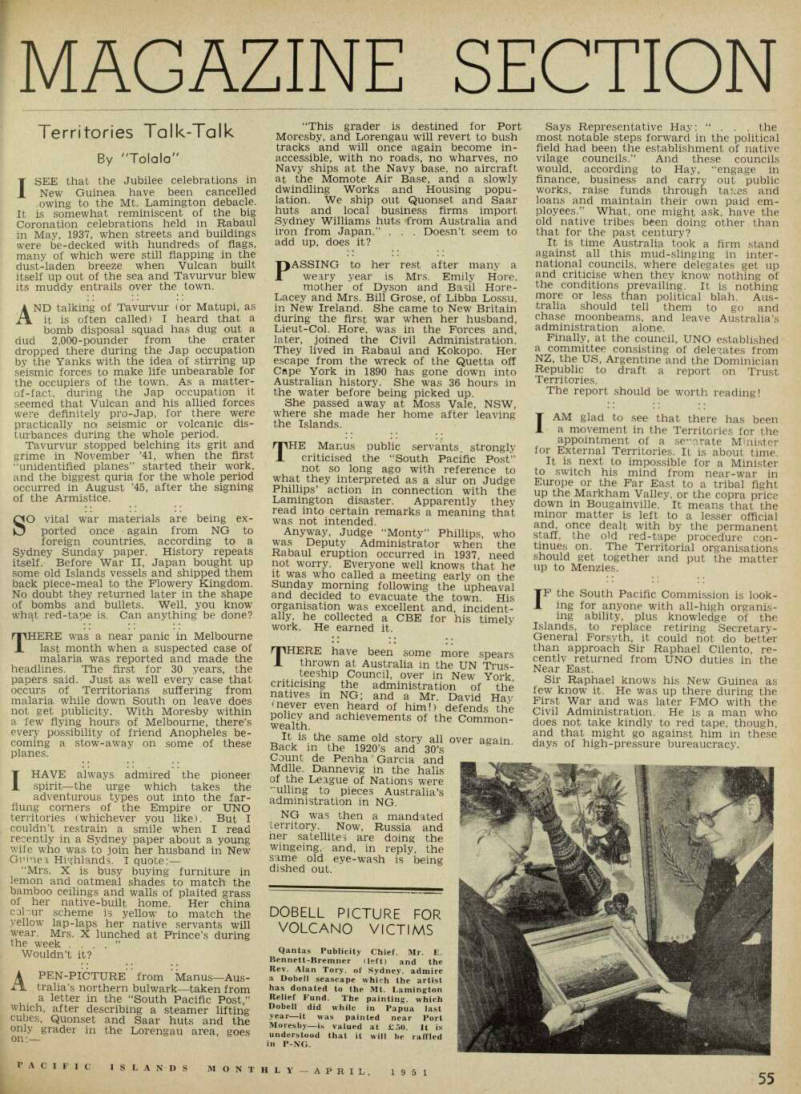
Territories Talk-Talk
By "Tolala"
I SEE that the Jubilee celebrations in New Guinea have been cancelled owing to the Mt. Lamington debacle.
It is somewhat reminiscent of the big Coronation celebrations held in Rabaul in May, 1937, when streets and buildings were be-decked with hundreds of flags, many of which were still flapping in the dust-laden breeze when Vulcan built itself up out of the sea and Tavurvur blew its muddy entrails over the town.
AND talking of Tavurvur (or Matupi, as it is often called) I heard that a bomb disposal squad has dug out a dud 2,000-pounder from the crater dropped there during the Jap occupation by the Yanks with the idea of stirring up seismic forces to make life unbearable for the occupiers of the town. As a matter of-fact, during the Jap occupation it seemed that Vulcan and his allied forces were definitely pro-Jap, for there were practically no seismic or volcanic dis turbances during the whole period.
Tavurvur stopped belching its grit and grime in November ’4l, when the first “unidentified planes” started their work, and the biggest quria for the whole period occurred in August ’45, after the signing of the Armistice.
SO vital war materials are being ex ported once again from NG to foreign countries, according to a Sydney Sunday paper. History repeats itself. Before War 11, Japan bought up some old Islands vessels and shipped them back piece-meal to the Flowery Kingdom.
No doubt they returned later in the shape of bombs and bullets. Well, you know what red-tape is. Can anything be done?
THERE was a near panic in Melbourne last month when a suspected case of malaria was reported and made the headlines. The first for 30 years, the papers said. Just as well every case that occurs of Territorians suffering from malaria while down South on leave does not get publicity. With Moresby within a few flying hours of Melbourne, there’s every possibility of friend Anopheles be coming a stow-away on some of these planes.
I HAVE always admired the pioneer spirit—the urge which takes the adventurous types out into the far flung corners of the Empire or UNO territories (whichever you like). But I couldn’t restrain a smile when I read recently in a Sydney paper about a young wile who was to join her husband in New Guinea Highlands. I quote:— “Mrs. X is busy buying furniture in lemon and oatmeal shades to match the bamboo ceilings and walls of plaited grass of her native-built home. Her china col cur scheme is yellow to match the yellow lap-laps her native servants will wear. Mrs. X lunched at Prince’s during the week . . . , ”
Wouldn’t it?
A PEN-PICTURE from Manus—Aus tralia’s northern bulwark—taken from a letter in the “South Pacific Post,” which, after describing a steamer lifting cubes, Quonset and Saar huts and the only grader in the Lorengau area, goes
“This grader is destined for Port Moresby, and Lorengau will revert to bush tracks and will once again become in accessible, with no roads, no wharves, no Navy ships at the Navy base, no aircraft at the Momote Air Base, and a slowly dwindling Works and Housing popu lation. We ship out Quonset and Saar huts and local business firms import Sydney Williams huts from Australia and iron from Japan.’’ . . . Doesn’t seem to add up, does it?
PASSING to her rest after many a weary year is Mrs. Emily Hore, mother of Dyson and Basil Hore- Lacey and Mrs. Bill Grose, of Libba Lossu, in New Ireland. She came to New Britain during the first war when her husband, Lieut-Col. Hore, was in the Forces and, later, joined the Civil Administration.
They lived in Rabaul and Kokopo. Her escape from the wreck of the Quetta off Cape York in 1890 has gone down into Australian history. She was 36 hours in the water before being picked up.
She passed away at Moss Vale. NSW, where she made her home after leaving the Islands.
THE Manus public servants, strongly criticised the “South Pacific Post’’ not so long ago with reference to what they interpreted as a slur on Judge Phillips’ action in connection with the' Lamington disaster. Apparently they read into certain remarks a meaning that was not intended.
Anyway, Judge “Monty” Phillips, who was Deputy Administrator when the Rabaul eruption occurred in 1937, need not worry. Everyone well knows that he it was who called a meeting early on the Sunday morning following the upheaval and decided to evacuate the town. His organisation was excellent and, incident ally. he collected a CBE for his timely work. He earned it.
THERE have been some more spears thrown at Australia in the UN Trus teeship Council, over in New York criticising the administration of the natives in NG; and a Mr. David Hav (never even heard of him!) defends the policy and achievements of the Common wealth.
It is the same old story all over again
Back in the 1920’s and 30’s Count de Penha Garcia and Mdlle. Dannevig in the halls of the League of Nations were bulling to pieces Australia’s administration in NG.
NG was then a mandated territory. Now, Russia and her satellites are doing the wingeing, and, in reply, the same old eye-wash is being dished out.
Says Representative Hay: “ . . . the most notable steps forward in the political field had been the establishment of native vilage councils.” And these councils would, according to Hay, “engage in finance, business and carry out public works, raise funds through taxes and loans and maintain their own paid em ployees.” What, one might ask, have the old native tribes been doing other than that for the past century?
It is time Australia took a firm stand against all this mud-slinging in inter national councils, where delegates get up and criticise when they know nothing of the conditions prevailing. It is nothing more or less than political blah. Aus tralia should tell them to go and chase moonbeams, and leave Australia’s administration alone.
Finally, at the council, UNO established a committee consisting of delegates from NZ, the US, Argentine and the Dominician Republic to draft a report on Trust Territories.
The report should be worth reading !
I AM glad to see that there has been a movement in the Territories for the appointment of a separate Minister for External Territories. It is about time.
It is next to impossible for a Minister to switch his mind from near-war in Europe or the Far East to a tribal fight up the Markham Valley, or the copra price down in Bougainville. It means that the minor matter is left to a lesser official and, once dealt with by the permanent staff, the old red-tape procedure con tinues on. The Territorial organisations should get together and put the matter up to Menzies.
IF the South Pacific Commission is look ing for anyone with all-high organis ing ability, plus knowledge of the Islands, to replace retiring Secretary- General Forsyth, it could not do better than approach Sir Raphael Cilento, re cently returned from UNO duties in the Near East.
Sir Raphael knows his New Guinea as few know it. He was up there during the First War and was later FMO with the Civil Administration. He is a man who does not take kindly to red tape, though, and that might go against him in these days of high-pressure bureaucracy.
Dobell Picture For
Volcano Victims
Qantas Publicity Chief, Mr. E.
Bennett-Bremner (left) and the Rev. Alan Tory, of Sydney, admire a Dobell seascape which the artist has donated to the Mt. Lamington Relief Fund. The painting, which Dobell did while in Papua last T ear —it was painted near Port Moresby—is valued at £5O. It is understood that it will be raffled in F-NG.
The Eye Of The Fire
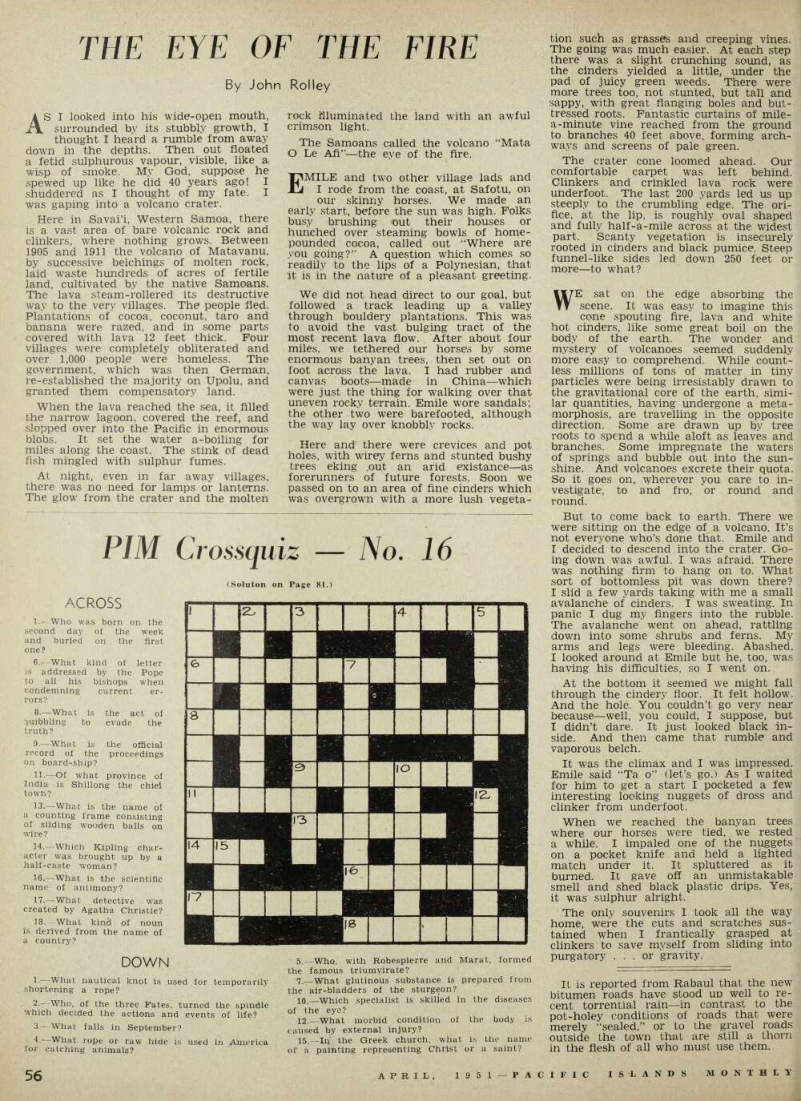
By John Rolley
AS I looked into his wide-open mouth, surrounded by its stubbly growth, I thought I heard a rumble frorn away
s > *ago! 1
shuddered as I thought of my fate. I was gaping into a volcano crater.
Here in Savai’i, Western Samoa, there is a vast area of bare volcanic rock and clinkers, where nothing grows. Between 1905 and 1911 the volcano of Matavanu, by successive belchings of molten rock, laid waste hundreds of acres of fertile land, cultivated by the native Samoans.
The lava steam-rollered its destructive way to the very villages. The people fled.
Plantations of cocoa, coconut, taro and banana were razed, and in some parts covered with lava 12 feet thick. Four villages were completely obliterated and over 1,000 people were homeless. The government, which was then German, re-established the majority on Upolu, and granted them compensatory land.
When the lava reached the sea, it filled the narrow lagoon, covered the reef, and slopped over into the Pacific in enormous nifles along the flsh minglld with fumes d nsn mmgieo witn sulphur lumes.
At night, even in far away villages, there was no need for lamps or lanterns.
The glow from the crater and the molten
rock illuminated the land with an awful crimson light.
The s amoans ca ii e d the volcano “Mata ° Le flre R MI T LE and tw ° other V‘ la f * ad f a " d 1 rode from the coast at Safotu. on °hr skinny horses. We made an early start, before the sun was high. Folks busy brushing out their houses or hunched over steaming bowls of home pounded cocoa, called out “Where are you going?” A question which comes so readily to the lips of a Polynesian, that it is in the nature of a pleasant greeting, We did not head direct to our goal, but followed a track leading up a valley through bouldery plantations. This was to avoid the vast bulging tract of the most recent lava flow. After about four miles, we tethered our horses by some enormous banyan trees, then set out on foot across the lava. I had rubber and canvas boots—made in China—which were just the thing for walking over that uneven rocky terrain Emile wore sandals; J£ e other two were barefooted, although the over knobbly rocks.
Here and there were crevices and P ot holes ’ with wirey ferns and stunted bushy trees eking out an arid existance as forerunners of future forests. Soon we passed on to an area of fine cinders which was overgrown with a more lush vegeta
tion such as grasses and creeping vines.
The going was much easier. At each step there was a slight crunching sound, as the cinders yielded a little, under the pad of juicy green weeds. There were more trees too, not stunted, but tall and sappy, with great flanging boles and but tressed roots. Fantastic curtains of mile a-minute vine reached from the ground to branches 40 feet above, forming arch ways and screens of pale green.
The crater cone loomed ahead. Our comfortable carpet was left behind.
Clinkers and crinkled lava rock were underfoot. The last 200 yards led us up steeply to the crumbling edge. The ori fice, at the lip, is roughly oval shaped and fully half-a-mile across at the widest part. Scanty vegetation is insecurely rooted in cinders and black pumice. Steep funnel-like sides led down 250 feet or more—to what?
WE sat on the edge absorbing the scene. It was easy to imagine this cone spouting fire, lava and white hot cinders, like some great boil on the body of the earth. The wonder and mystery of volcanoes seemed suddenly more easy to comprehend. While count less millions of tons of matter in tiny particles were being irresistably drawn to the gravitational core of the earth, simi lar quantities, having undergone a meta morphosis, are travelling in the opposite direction. Some are drawn up by tree roots to spend a while aloft as leaves and branches. Some impregnate the waters of springs and bubble out into the sun shine. And volcanoes excrete their quota.
So it goes on, wherever you care to in vestigate, to and fro, or round and round.
But to come back to earth. There we were sitting on the edge of a volcano. It’s not everyone who’s done that. Emile and I decided to descend into the crater. Go ing down was awful. I was afraid. There was nothing firm to hang on to. What sort of bottomless pit was down there?
I slid a few yards taking with me a small avalanche of cinders. I was sweating. In panic I dug my fingers into the rubble.
The avalanche went on ahead, rattling down into some shrubs and ferns. My arms and legs were bleeding. Abashed.
I looked around at Emile but he, too, was having his difficulties, so I went on.
At the bottom it seemed we might fall through the cindery floor. It felt hollow.
And the hole. You couldn’t go very near because—well, you could, I suppose, but I didn’t dare. It just looked black in side. And then came that rumble and vaporous belch.
It was the climax and I was impressed.
Emile said “Ta o” (let’s go.) As I waited for him to get a start I pocketed a few interesting looking nuggets of dross and clinker from underfoot.
When we reached the banyan trees where our horses were tied, we rested a while. I impaled one of the nuggets on a pocket knife and held a lighted match under it. It spluttered as it burned. It gave off an unmistakable smell and shed black plastic drips. Yes, it was sulphur alright.
The only souvenirs I took all the way home, were the cuts and scratches sus tained when I frantically grasped at clinkers to save myself from sliding into purgatory ... or gravity.
It is reported from Rabaul that the new bitumen roads have stood up well to re cent torrential rain—in contrast to the pot-holey conditions of roads that were merely “sealed.” or to the gravel roads outside the town that are still a thorn in the flesh of all who must use them.
PIM Crossquiz No. 16
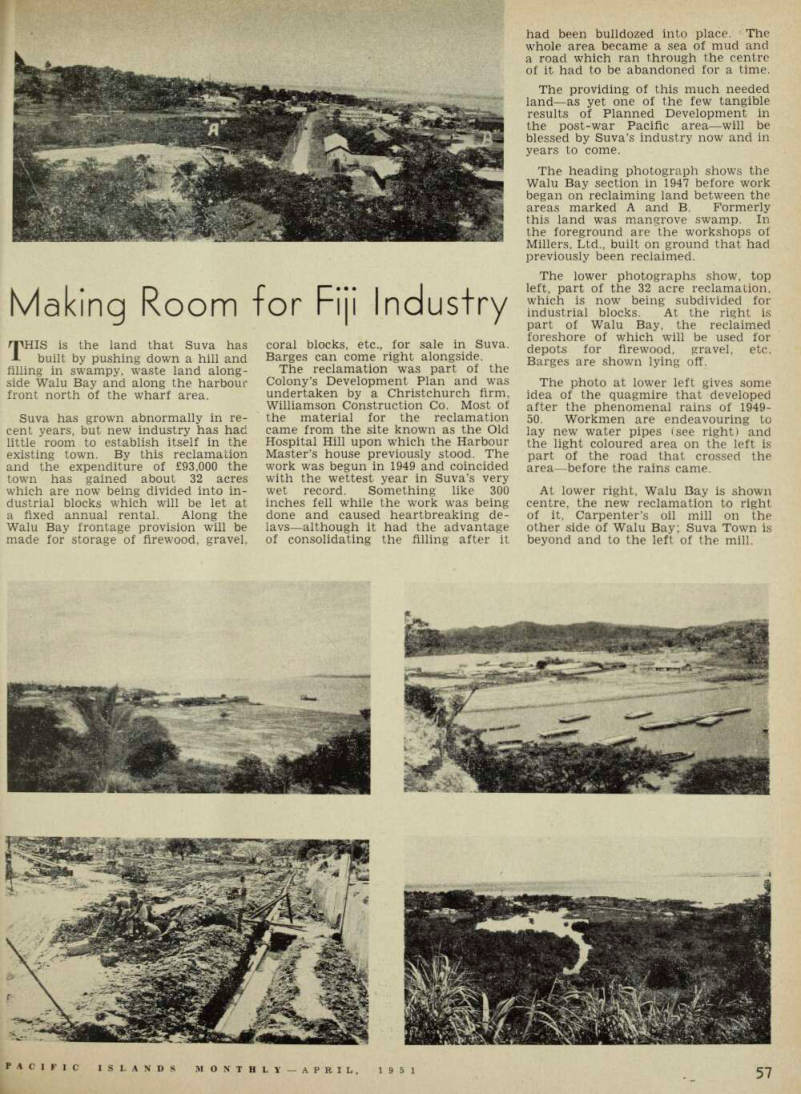
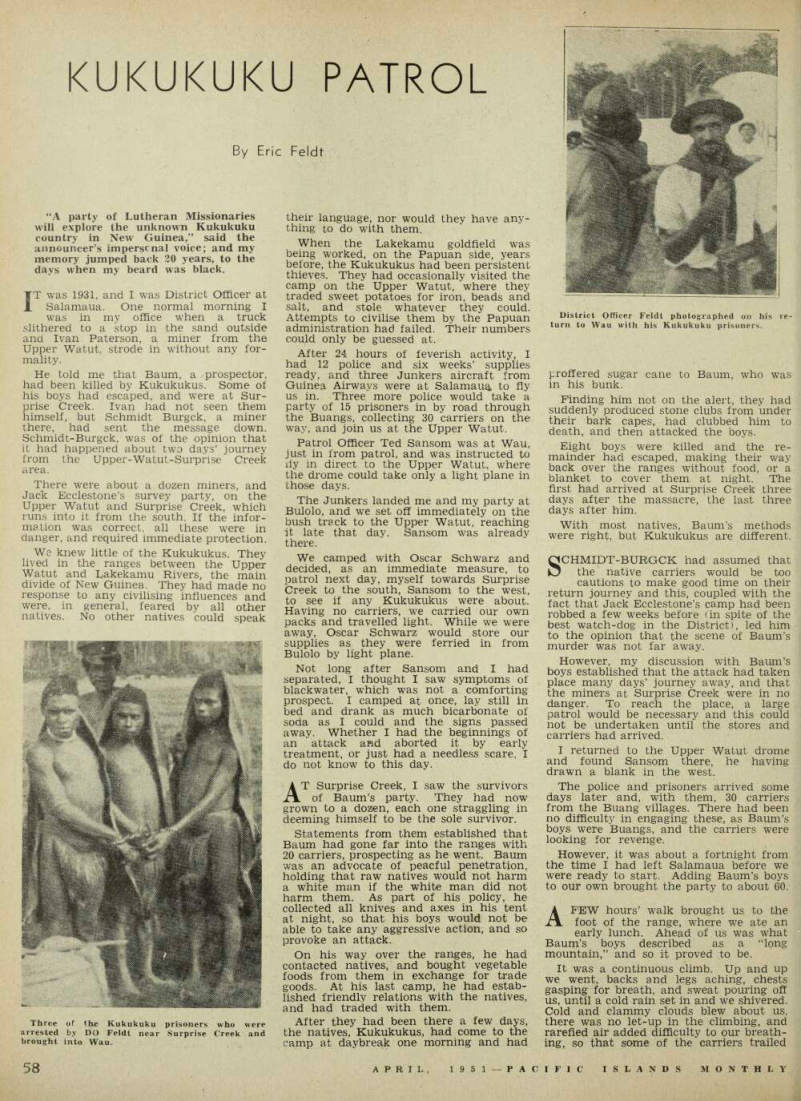
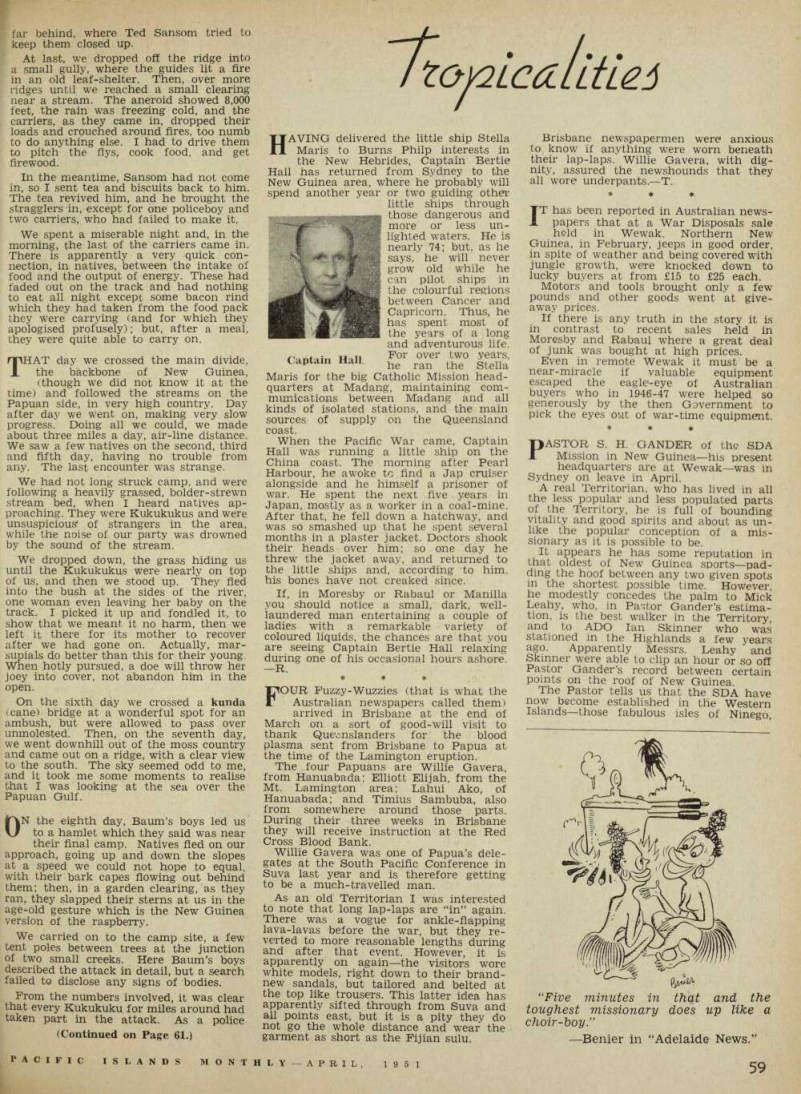
(Soluton on Page 81.)
Across
I. Who was born on the second day of the week and buried on the first one? 6.—What kind of letter is addressed by the Pope to all his bishops when condemning current er rors? 8. —What is the act of quibbling to evade the truth? 9. —What is the official record of the proceedings on board-ship? 11. —Of what province of India is Shillong the chief town? 13. —What is the name of a counting frame consisting of sliding wooden balls on wire ? 14. —Which Kipling char acter was brought up by a half-caste woman? 16. —What is the scientific name of antimony? 17. —What detective was created by Agatha Christie? 18. —What kind of noun is derived from the name of a country?
Down
—What nautical knot is used for temporarily shortening a rope? 2.—Who, of the three Fates, turned the spindle which decided the actions and events of life? 3- What falls in September? 4.- What rope or raw hide is used in America for catching animals?
s,—who, with Robespierre and Marat, formed the famous triumvirate? 7.—What glutinous substance is prepared from the air-bladders of the sturgeon? 10.—Which specialist is skilled in the diseases of the eye? 12.—What morbid condition of the body is caused by external injury? 15.—1 n the Greek church, what is the name of a painting representing Christ or a saint?
Making Room for Fiji Industry
THIS is the land that Suva has built by pushing down a hill and filling in swampy, waste land along side Walu Bay and along the harbour front north of the wharf area.
Suva has grown abnormally in re cent years, but new industry has had little room to establish itself in the existing town. By this reclamation and the expenditure of £93,000 the town has gained about 32 acres which are now being divided into in dustrial blocks which will be let at a fixed annual rental. Along the Walu Bay frontage provision will be made for storage of firewood, gravel,
coral blocks, etc., for sale in Suva.
Barges can come right alongside.
The reclamation was part of the Colony’s Development Plan and was undertaken by a Christchurch firm, Williamson Construction Co. Most of the material for the reclamation came from the site known as the Old Hospital Hill upon which the Harbour Master’s house previously stood. The work was begun in 1949 and coincided with the wettest year in Suva’s very wet record. Something like 300 inches fell while the work was being done and caused heartbreaking de lavs—although it had the advantage of consolidating the filling after it
had been bulldozed into place. The whole area became a sea of mud and a road which ran through the centre of it had to be abandoned for a time.
The providing of this much needed land—as yet one of the few tangible results of Planned Development in the post-war Pacific area—will be blessed by Suva’s industry now and in years to come.
The heading photograph shows the Walu Bay section in 1947 before work began on reclaiming land between the areas marked A and B. Formerly this land was mangrove swamp. In the foreground are the workshops of Millers, Ltd., built on ground that had previously been reclaimed.
The lower photographs show, top left, part of the 32 acre reclamation, which is now being subdivided for industrial blocks. At the right is part of Walu Bay, the reclaimed foreshore of which will be used for depots for firewood, gravel, etc.
Barges are shown lying off.
The photo at lower left gives some idea of the quagmire that developed after the phenomenal rains of 1949- 50. Workmen are endeavouring to lay new water pipes (see right) and the light coloured area on the left is part of the road that crossed the area—before the rains came.
At lower right, Walu Bay is shown centre, the new reclamation to right of it, Carpenter’s oil mill on the other side of Walu Bay; Suva Town is beyond and to the left of the mill.
Kukukuku Patrol
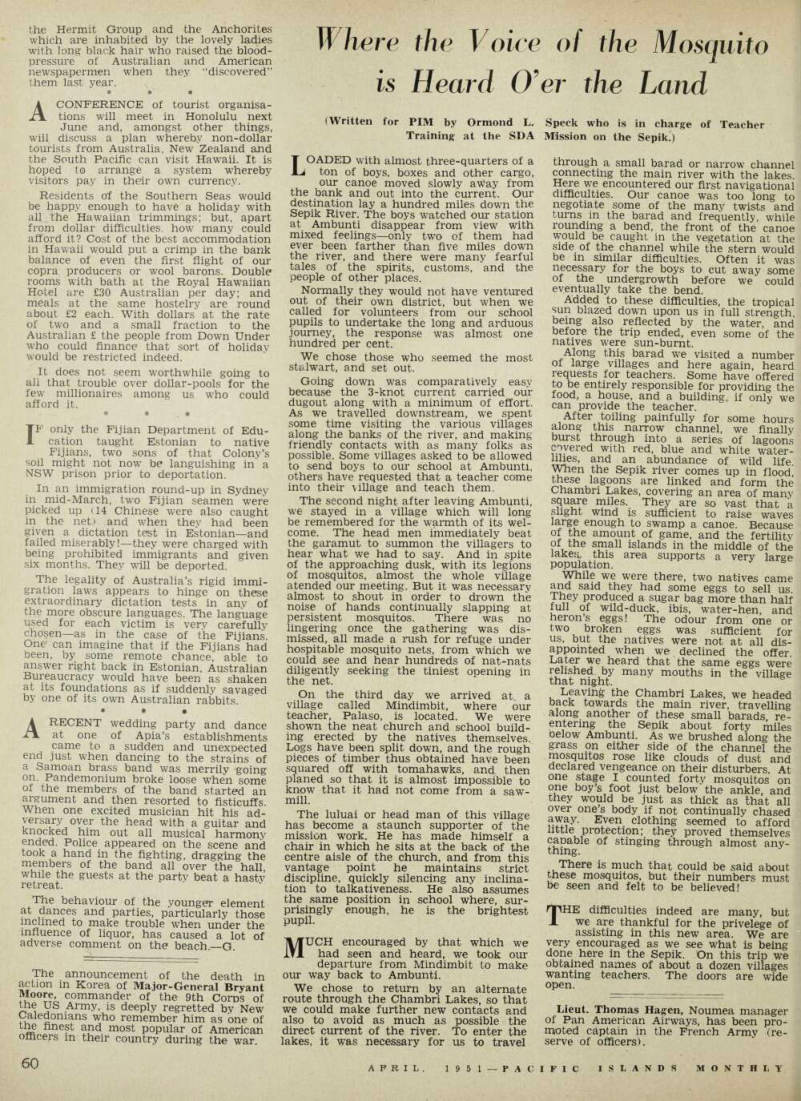
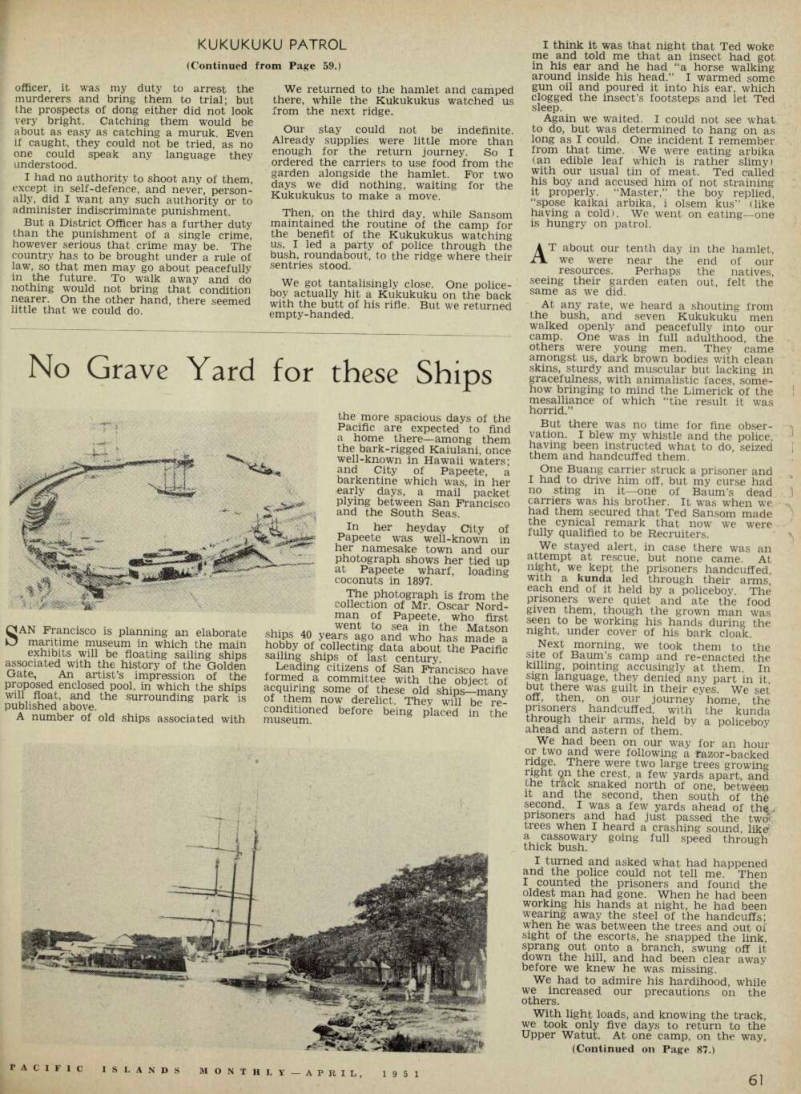
By Eric Feldt
“A party of Lutheran Missionaries will explore the unknown Kukukuku country in New Guinea,” said the announcer’s imperscnal voice; and my memory jumped back 20 years, to the days when my beard was black.
IT was 1931, and I was District Officer at Salamaua. One normal morning I was in my office when a truck slithered to a stop in the sand outside and Ivan Paterson, a miner from the Upper Watut, strode in without any for mality.
He told me that Baum, a prospector, had been killed by Kukukukus. Some of his boys had escaped, and were at Sur prise Creek. Ivan had not seen them himself, but Schmidt Burgck, a miner there, had sent the message down.
Schmidt-Burgck, was of the opinion that it had happened about two days’ journey from the Upper-Watut-Surprise Creek area.
There were about a dozen miners, and Jack Ecclestone’s survey party, on the Upper Watut and Surprise Creek, which runs into it from the south. If the infor mation was correct, all these were in danger, and required immediate protection.
We knew little of the Kukukukus. They lived in the ranges between the Upper Watut and Lakekamu Rivers, the main divide of New Guinea. They had made no response to any civilising influences and were, in general, feared by all other natives. No other natives could speak
their language, nor would they have any thing to do with them.
When the Lakekamu goldfield was being worked, on the Papuan side, years before, the Kukukukus had been persistent thieves. They had occasionally visited the camp on the Upper Watut, where they traded sweet potatoes for iron, beads and salt, and stole whatever they could.
Attempts to civilise them by the Papuan administration had failed. Their numbers could only be guessed at.
After 24 hours of feverish activity, I had 12 police and six weeks’ supplies ready, and three Junkers aircraft from Guinea Airways were at Salamaua to fly us in. Three more police would take a party of 15 prisoners in by road through the Buangs, collecting 30 carriers on the way, and join us at the Upper Watut.
Patrol Officer Ted Sansom was at Wau, just in from patrol, and was instructed to dy in direct to the Upper Watut, where the drome could take only a light plane in those days.
The Junkers landed me and my party at Bulolo, and we set off immediately on the bush track to the Upper Watut, reaching it late that day. Sansom was already there.
We camped with Oscar Schwarz and decided, as an immediate measure, to patrol next day, myself towards Surprise Creek to the south, Sansom to the west, to see if any Kukukukus were about.
Having no carriers, we carried our own packs and travelled light. While we were away, Oscar Schwarz would store our supplies as they were ferried in from Bulolo by light plane.
Not long after Sansom and I had separated, I thought I saw symptoms of blackwater, which was not a comforting prospect. I camped at once, lay still in bed and drank as much bicarbonate of soda as I could and the signs passed away. Whether I had the beginnings of an attack and aborted it by early treatment, or just had a needless scare. I do not know to this day.
AT Surprise Creek, I saw the survivors of Baum’s party. They had now grown to a dozen, each one straggling in deeming himself to be the sole survivor.
Statements from them established that Baum had gone far into the ranges with 20 carriers, prospecting as he went. Baum was an advocate of peacful penetration, holding that raw natives would not harm a white man if the white man did not harm them. As part of his policy, he collected all knives and axes in his tent at night, so that his boys would not be able to take any aggressive action, and so provoke an attack.
On his way over the ranges, he had contacted natives, and bought vegetable foods from them in exchange for trade goods. At his last camp, he had estab lished friendly relations with the natives, and had traded with them.
After they had been there a few days, the natives, Kukukukus, had come to the camp at daybreak one morning and had
proffered sugar cane to Baum, who was in his bunk.
Finding him not on the alert, they had suddenly produced stone clubs from under their bark capes, had clubbed him to death, and then attacked the boys.
Eight boys were killed and the re mainder had escaped, making their way back over the ranges without food, or a blanket to cover them at night. The first had arrived at Surprise Creek three days after the massacre, the last three days after him.
With most natives, Baum’s methods were right, but Kukukukus are different.
SCHMIDT-BURGCK had assumed that the native carriers would be too cautions to make good time on their return journey and this, coupled with the fact that Jack Ecclestone’s camp had been robbed a few weeks before (in spite of the best watch-dog in the District), led him to the opinion that the scene of Baum’s murder was not far away.
However, my discussion with Baum’s boys established that the attack had taken place many days’ journey away, and that the miners at Surprise Creek were in no danger. To reach the place, a large patrol would be necessary and this could not be undertaken until the stores and carriers had arrived.
I returned to the Upper Watut drome and found Sansom there, he having drawn a blank in the west.
The police and prisoners arrived some days later and, with them, 30 carriers from the Buang villages. There had been no difficulty in engaging these, as Baum’s boys were Buangs, and the carriers were looking for revenge.
However, it was about a fortnight from the time I had left Salamaua before we were ready to start. Adding Baum’s boys to our own brought the party to about 60.
A PEW hours’ walk brought us to the foot of the range, where we ate an early lunch. Ahead of us was what Baum’s boys described as a “long mountain,” and so it proved to be.
It was a continuous climb. Up and up we went, backs and legs aching, chests gasping for breath, and sweat pouring off us, until a cold rain set in and we shivered.
Cold and clammy clouds blew about us, there was no let-up in the climbing, and rarefied air added difficulty to our breath ing, so that some of the carriers trailed
Three of the Kukukuku prisoners who were arrested by DO Feldt near Surprise Creek and brought into Wau.
District Officer Feldt photographed on his re turn to Wau with his Kukukuku prisoners.
far behind, where Ted Sansom tried to keep them closed up.
At last, we dropped off the ridge into a small gully, where the guides lit a fire in an old leaf-shelter. Then, over more ridges until we reached a small clearing near a stream. The aneroid showed 8,000 feet, the rain was freezing cold, and the carriers, as they came in, dropped their loads and crouched around fires, too numb to do anything else. I had to drive them to pitch the flys, cook food, and get firewood.
In the meantime, Sansom had not come in, so I sent tea and biscuits back to him.
The tea revived him, and he brought the stragglers in, except for one policeboy and two carriers, who had failed to make it.
We spent a miserable night and, in the morning, the last of the carriers came in.
There is apparently a very quick con nection, in natives, between the intake of food and the output of energy. These had faded out on the track and had nothing to eat all night except some bacon rind which they had taken from the food pack they were carrying (and for which they apologised profusely); but, after a meal, they were quite able to carry on.
THAT day we crossed the main divide, the backbone of New Guinea, (though we did not know it at the time) and followed the streams on the Papuan side, in very high country. Day after day we went on, making very slow progress. Doing all we could, we made about three miles a day, air-line distance.
We saw a few natives on the second, third and fifth day, having no trouble from any. The last encounter was strange.
We had not long struck camp, and were following a heavily grassed, bolder-strewn stream bed, when I heard natives ap proaching. They were Kukukukus and were unsuspicious* of strangers in the area, while the noise of our party was drowned by the sound of the stream.
We dropped down, the grass hiding us until the Kukukukus were nearly on top of us, and then we stood up. They fled into the bush at the sides of the river, one woman even leaving her baby on the track. I picked it up and fondled it, to show that we meant it no harm, then we left it there for its mother to recover after we had gone on. Actually, mar supials do better than this for their young.
When hotly pursued, a doe will throw her joey into cover, not abandon him in the open.
On the sixth day we crossed a kunda (cane) bridge at a wonderful spot for an ambush, but were allowed to pass over unmolested. Then, on the seventh day, we went downhill out of the moss country and came out on a ridge, with a clear view to the south. The sky seemed odd to me, and it took me some moments to realise that I was looking at the sea over the Papuan Gulf.
ON the eighth day, Baum’s boys led us to a hamlet which they said was near their final camp. Natives fled on our approach, going up and down the slopes at a speed we could not hope to equal, with their bark capes flowing out behind them; then, in a garden clearing, as they ran, they slapped their sterns at us in the age-old gesture which is the New Guinea version of the raspberry.
We carried on to the camp site, a few tent poles between trees at the junction of two small creeks. Here Baum’s boys described the attack in detail, but a search failed to disclose any signs of bodies.
From the numbers involved, it was clear that every Kukukuku for miles around had taken part in the attack. As a police
(Continued on Page 61.)
officer, it was my duty to arrest the murderers and bring them to trial; but the prospects of dong either did not look very bright. Catching them would be about as easy as catching a muruk. Even if caught, they could not be tried, as no one could speak any language they understood.
I had no authority to shoot any of them, except in self-defence, and never, person ally, did I want any such authority or to administer indiscriminate punishment.
But a District Officer has a further duty than the punishment of a single crime, however serious that crime may be. The country has to be brought under a rule of law, so that men may go about peacefully In the future. To walk away and do nothing would not bring that condition nearer. On the other hand, there seemed little that we could do.
We returned to the hamlet and camped there, while the Kukukukus watched us from the next ridge.
Our stay could not be indefinite.
Already supplies were little more than enough for the return journey. So I ordered the carriers to use food from the garden alongside the hamlet. For two days we did nothing, waiting for the Kukukukus to make a move.
Then, on the third day, while Sansom maintained the routine of the camp for the benefit of the Kukukukus watching us, I led a party of police through the bush, roundabout, to the ridge where their sentries stood.
We got tantalisingly close. One police boy actually hit a Kukukuku on the back with the butt of his rifle. But we returned empty-handed.
I think it was that night that Ted woke me and told me that an insect had got in his ear and he had “a horse walking around inside his head.” I warmed some gun oil and poured it into his ear, which clogged the insect’s footsteps and let Ted sleep.
Again we waited. I could not see what to do, but was determined to hang on as long as I could. One incident I remember from that time. We were eating arbika (an edible leaf which is rather slimy) with our usual tin of meat. Ted called his boy and accused him of not straining it properly. “Master,” the boy replied, “spose kaikai arbika, i olsem kus” (like having a cold). We went on eating—one is hungry on patrol.
AT about our tenth day in the hamlet, we were near the end of our resources. Perhaps the natives, seeing their garden eaten out, felt the same as we did.
At any rate, we heard a shouting from the bush, and seven Kukukuku men walked openly and peacefully into our camp. One was in full adulthood, the others were young men. They came amongst us, dark brown bodies with clean skins, sturdy and muscular but lacking in gracefulness, with animalistic faces, some how bringing to mind the Limerick of the mesalliance of which “the result it was horrid.”
But there was no time for fine obser vation. I blew my whistle and the police, having been instructed what to do, seized them and handcuffed them.
One Buang carrier struck a prisoner and I had to drive him off, but my curse had no sting in it—one of Baum’s dead carriers was his brother. It was when we had them secured that Ted Sansom made the cynical remark that now we were fully qualified to be Recruiters.
We stayed alert, in case there was an attempt at rescue, but none came. At night, we kept the prisoners handcuffed, with a kunda led through their arms, each end of it held by a policeboy, The prisoners were quiet and ate the food given them, though the grown man was seen to be working his hands during the night, under cover of his bark cloak.
Next morning, we took them to the site of Baum’s camp and re-enacted the killing, pointing accusingly at them. In u lg L n i.l? nguage ’ they denied any part in it, but there was guilt in their eyes. We set off, then, on our journey home, the prisoners handcuffed, with the kunda through their arms, held bv a policeboy ahead and astern of them.
We had been on our way for an hour or two and were following a razor-backed ridge. There were two large trees growing right qn the crest, a few yards apart, and the track snaked north of one, between it and the second, then south of the second. I was a few yards ahead of the . prisoners and had just passed the tws trees when I heard a crashing sound, like a cassowary going full speed through thick bush.
I turned and asked what had happened and the police could not tell me. Then I counted the prisoners and found the oldest man had gone. When he had been working his hands at night, he had been wearing away the steel of the handcuffs; when he was between the trees and out of sight of the escorts, he snapped the link, sprang out onto a branch, swung off it down the hill, and had been clear away before we knew he was missing.
We had to admire his hardihood, while we increased our precautions on the others.
With light loads, and knowing the track, we took only five days to return to the Upper Watut. At one camp, on the way,
(Continued on Page 87.)
we bought a bunch of bananas from a Kukukuku for a small knife. Then we searched the prisoners after he had gone, and found the knife on one of them. It would have been very useful for cutting the kunda and so allowing an escape. In poetic justice, we left the knife sticking n a tree where the owner could come and ?et it.
But the long days of walking, the night patches and the stand-to at dawn, the Igours of the climate and the constant train, were beginning to tell on us. tores were developing on the feet of larriers and police, our own feet were ;iving out from constant wetting, we were .11 thin, and there was little cheerfulness n the camp at night.
A r the Upper Watut, we discharged the ra. carriers and borrowed rice from Oscar Schwarz to get them to their tomes, sending for more to be flown in rom Salamaua to replace it. Jim Smith, he Chief Clerk, sent the rice and with it small parcel of two bottles labelled “gun il.” But they were beer, all right.
Leaving Sansom at the Watut, I took he prisoners with a police escort to iulolo, to be flown out. Ted had had a card when we started and I had let mine row, so that I was not recognised at •ulolo, and posed for a while as a man >oking for a job, until Thos. Harris and ouis Joubert saw through it.
One prisoner signalled that his hand- Liff was too tight, so it was eased off for is comfort. He slipped it that night and 'ied to escape, but an alert policeboy cwled him over, and held him. I flew at with the six prisoners next morning.
I was now in a legal quandary. I had
six prisoners whom I supected of murder, but I could not try them. I did not even know their names. As Tom, Jack, Fred, Joe and Willie, I charged them and re manded them every fortnight. Willie developed a “New Guinea mouth” and, in spite of treatment, died.
The others seemed tractable prisoners but one day, when vigilance was relaxed a little, they escaped. Two got clear away and presumably home, two were captured by Normie Neale’s boys at Wau, and Joe by the Buang natives. They brought Joe in
trussed up like a pig, with small wounds on his back and chest as a payback for brothers who had been killed with Baum.
I did nothing about that—they had shown considerable forbearance, considering all things.
Joe went to hospital for a long stretch, but Penglase took the other two with him on the next patrol to the Baum country.
He released them when he got there, to make contact with their own people and establish friendly relations. They went off and he never saw them again. As the
policeboys said of the Kukukukus, they were “wild pig true.”
Joe remained and learned some Pidgin.
In the process, he learned far too much to implicate himself in the murder of Baum.
Some months later, he was taken back and released and disappeared from view.
Two more prospectors, who went into the area, in defiance of Government orders, were killed, and more patrols visited the area, having encounters with the natives and bringing in more prisoners to learn our ways and be released, so as finally to bring peace.
THEN, one day at Wau, a line of bark capes came out of the bush, there was the sound of the clucking speech, and a crowd of Kukukukus arrived at the District Office, having come in peacefully to trade sweet potatoes for knives and beads and salt. Their leader was Joe, come good at last.
I did not do another patrol to the Kukukuku country, myself. On arrival at Bulolo, the news was waiting that Les Trist was missing in a Junkers, and that Mick and Paddy Leahy had been attacked and wounded at Menyamnya. Did I say my beard was black, then? There were streaks of grey in it before those matters were finished.
There is a lot of Kukukuku country in New Guinea. Perhaps it is not the part of which I have written to which the Lutheran Missionaries are going. Wher ever it is, being missionaries, they will trust in God. And, as it is Kukukuku country, I hope they will keep their powder dry.
Dr. E. D. Pridie, CMG, DSO, OBE, Chief Medical Officer of the Colonial Office, arrived in Fiji this month, in the course of a visit of inspection to colonial territories.
Tropicalities
HAVING delivered the little ship Stella Maris to Burns Philp interests in the New Hebrides, Captain Bertie Hall has returned from Sydney to the New Guinea area, where he probably will spend another year or two guiding other
little ships through those dangerous and more or less un lighted waters. He is nearly 74; but, as he says, he will never grow old while he can pilot ships in the colourful regions between Cancer and Capricorn. Thus, he has spent most of the years of a long and adventurous life.
For over two years, he ran the Stella
Maris for the big Catholic Mission head quarters at Madang, maintaining com munications between Madang and all kinds of isolated stations, and the main sources of supply on the Queensland coast.
When the Pacific War came, Captain Hall was running a little ship on the China coast. The morning after Pearl Harbour, he awoke to find a Jap cruiser alongside and he himself a prisoner of war. He spent the next five years in Japan, mostly as a worker in a coal-mine.
After that, he fell down a hatchway, and was so smashed up that he spent several months in a plaster jacket. Doctors shook their heads over him; so one day he threw the jacket away, and returned to the little ships and, according to him, his bones have not creaked since.
If, in Moresby or Rabaul or Manilla you should notice a small, dark, well laundered man entertaining a couple of ladies with a remarkable variety of coloured liquids, the chances are that you are seeing Captain Bertie Hall relaxing during one of his occasional hours ashore. — R. * * ♦ FOUR Fuzzy-Wuzzies (that is what the Australian newspapers called them) arrived in Brisbane at the end of March on a sort of good-will visit to thank Queenslanders for the blood plasma sent from Brisbane to Papua at the time of the Lamington eruption.
The four Papuans are Willie Gavera, from Hanuabada; Elliott Elijah, from the Mt. Lamington area; Lahui Ako, of Hanuabada; and Timius Sambuba, also from somewhere around those parts.
During their three weeks in Brisbane they will receive instruction at the Red Cross Blood Bank.
Willie Gavera was one of Papua’s dele gates at the South Pacific Conference in Suva last year and is therefore getting to be a much-travelled man.
As an old Territorian I was interested to note that long lap-laps are “in” again.
There was a vogue for ankle-flapping lava-lavas before the war, but they re verted to more reasonable lengths during and after that event. However, it is apparently on again—the visitors wore white models, right down to their brand new sandals, but tailored and belted at the top like trousers. This latter idea has apparently sifted through from Suva and all points east, but it is a pity they do not go the whole distance and wear the garment as short as the Fijian sulu.
Brisbane newspapermen were anxious to know if anything were worn beneath their lap-laps. Willie Gavera, with dig nity, assured the newshounds that they
all wore underpants.-
T.
IT has been reported in Australian news papers that at a War Disposals sale held in Wewak. Northern New Guinea, in February, jeeps in good order, in spite of weather and being covered with jungle growth, were knocked down to lucky buyers at from £l5 to £25 each.
Motors and tools brought only a few pounds and other goods went at give away prices.
If there is any truth in the story it is in contrast to recent sales held in Moresby and Rabaul where a great deal of junk was bought at high prices.
Even in remote Wewak it must be a near-miracle if valuable equipment escaped the eagle-eye of Australian buyers who in 1946-47 were helped so generously by the then Government to pick the eyes out of war-time equipment. * • • PASTOR S. H. GANDER of the SDA Mission in New Guinea—his present headquarters are at Wewak—was in Sydney on leave in April.
A real Territorian, who has lived in all the less popular and less populated parts of the Territory, he is full of bounding vitality and good spirits and about as un like the popular conception of a mis sionary as it is possible to be.
It appears he has some reputation in that oldest of New Guinea sports—pad ding the hoof between any two given spots in the shortest possible time. However, he modestly concedes the palm to Mick Leahy, who, in Pastor Gander’s estima tion, is the best walker in the Territory, and to ADO lan Skinner who was stationed in the Highlands a few years ago. Apparently Messrs. Leahy and Skinner were able to clip an hour or so off Pastor Gander’s record between certain points on the roof of New Guinea.
The Pastor tells us that the SDA have now become established in the Western Islands—those fabulous isles of Ninego,
Captain Hall.
“Five minutes in that and the toughest missionary does up like a choir-hoy.” —Benier in “Adelaide News.”
the Hermit Group and the Anchorites which are inhabited by the lovely ladies with long black hair who raised the blood pressure of Australian and American newspapermen when they “discovered” them last year. * * * A CONFERENCE of tourist organisa tions will meet in Honolulu next June and, amongst other things, will discuss a plan whereby non-dollar tourists from Australia, New Zealand and the South Pacific can visit Hawaii. It is hoped to arrange a system whereby visitors pay in their own currency.
Residents of the Southern Seas would be happy enough to have a holiday with all the Hawaiian trimmings; but, apart from dollar difficulties, how many could afford it? Cost of the best accommodation in Hawaii would put a crimp in the bank balance of even the first flight of our copra producers or wool barons. Double rooms with bath at the Royal Hawaiian Hotel are £3O Australian per day; and meals at the same hostelry are round about £2 each. With dollars at the rate of two and a small fraction to the Australian £ the people from Down Under who could finance that sort of holiday would be restricted indeed.
It does not seem worthwhile going to all that trouble over dollar-pools for the few millionaires among us who could afford it. * * ♦ IF only the Fijian Department of Edu cation taught Estonian to native Fijians, two sons of that Colony’s soil might not now be languishing in' a NSW prison prior to deportation.
In an immigration round-up in Sydney in mid-March, two Fijian seamen were picked up (14 Chinese were also caught in the net) and when they had been given a dictation test in Estonian—and failed miserably!—they were charged with being prohibited immigrants and given six months. They will be deported.
The legality of Australia’s rigid immi gration laws appears to hinge on these extraordinary dictation tests in any of the more obscure languages. The language used for each victim is very carefully chosen—as in the case of the Fijians.
One can imagine that if the Fijians had been, by some remote chance, able to answer right back in Estonian, Australian Bureaucracy would have been as shaken at its foundations as if suddenly savaged by one of its own Australian rabbits. * • • A RECENT wedding party and dance at one of Apia’s establishments came to a sudden and unexpected end just when dancing to the strains of a Samoan brass band was merrily going on. Pandemonium broke loose when some of the members of the band started an argument and then resorted to fisticuffs.
When one excited musician hit his ad versary over the head with a guitar and knocked him out all musical harmony ended. Police appeared on the scene and took a hand in the fighting, dragging the members of the band all over the hall while the guests at the party beat a hasty retreat. 1 J The behaviour of the younger element at dances and parties, particularly those inclined to make trouble when under the influence of liquor, has caused a lot of adverse comment on the beach.—G.
The announcement of the death in action in Korea of Major-General Bryant Moore, commander of the 9th Corps of the US Army, is deeply regretted by New Caledonians who remember him as one of the finest and most popular of American officers in their country during the war.
Where the Voice of the Mosquito
is Heard O'er the Land
(Written for PIM by Ormond L. Speck who is in charge of Teacher Training at the SDA Mission on the Sepik.)
LOADED with almost three-quarters of a ton of boys, boxes and other cargo, our canoe moved slowly away from the bank and out into the current. Our destination lay a hundred miles down the Sepik River. The boys watched our station at Ambunti disappear from view with mixed feelings—only two of them had ever been farther than five miles down the river, and there were many fearful tales of the spirits, customs, and the people of other places.
Normally they would not have ventured out of their own district, but when we called for volunteers from our school pupils to undertake the long and arduous journey, the response was almost one hundred per cent.
We chose those who seemed the most stalwart, and set out.
Going down was comparatively easy because the 3-knot current carried our dugout along with a minimum of effort.
As we travelled downstream, we spent some time visiting the various villages along the banks of the river, and making friendly contacts with as many folks as possible. Some villages asked to be allowed to send boys to our school at Ambunti, others have requested that a teacher come into their village and teach them.
The second night after leaving Ambunti, we stayed in a village which will long be remembered for the warmth of its wel come. The head men immediately beat the garamut to summon the villagers to hear what we had to say. And in spite of the approaching dusk, with its legions of mosquitos, almost the whole village atended our meeting. But it was necessary almost to shout in order to drown the noise of hands continually slapping at persistent mosquitos. There was no lingering once the gathering was dis missed, all made a rush for refuge under hospitable mosquito nets, from which we could see and hear hundreds of nat-nats diligently seeking the tiniest ooening in the net.
On the third day we arrived at a village called Mindimbit, where our teacher, Palaso, is located. We were shown the neat church and school build ing erected by the natives themselves.
Logs have been split down, and the rough pieces of timber thus obtained have been squared off with tomahawks, and then planed so that it is almost impossible to know that it had not come from a saw mill.
The luluai or head man of this village has become a staunch supporter of the mission work. He has made himself a chair in which he sits at the back of the centre aisle of the church, and from this vantage point he maintains strict discipline, quickly silencing any inclina tion to talkativeness. He also assumes the same position in school where, sur prisingly enough, he is the brightest pupil.
MUCH encouraged by that which we had seen and heard, we took our departure from Mindimbit to make our way back to Ambunti.
We chose to return by an alternate route through the Chambri Lakes, so that we could make further new contacts and also to avoid as much as possible the direct current of the river. To enter the lakes, it was necessary for us to travel
through a small barad or narrow channel connecting the main river with the lakes.
Here we encountered our first navigational difficulties. Our canoe was too long to negotiate some of the many twists and turns in the barad and frequently, while rounding a bend, the front of the canoe would be caught in the vegetation at the side of the channel while the stern would be in similar difficulties. Often it was necessary for the boys to cut away some of the undergrowth before we could eventually take the bend.
Added to these difficulties, the tropical sun blazed down upon us in full strength, being also reflected by the water, and before the trip ended, even some of the natives were sun-burnt.
Along this barad we visited a number of large villages and here again, heard requests for teachers. Some have offered to be entirely responsible for providing the food, a house, and a building, if onlv we can provide the teacher.
After toiling painfully for some hours along this narrow channel, we finally burst through into a series of lagoons covered with red, blue and white water lilies, and an abundance of wild life When the Sepik river comes up in flood! these lagoons are linked and form the Chambri Lakes, covering an area of manv square miles. They are so vast that a slight wind is sufficient to raise waves large enough to swamp a canoe. Because of the amount of game, and the fertility of the small islands in the middle of the lakes, this area supports a very large population.
While we were there, two natives came and said they had some eggs to sell us.
They produced a sugar bag more than half full of wild-duck, ibis, water-hen, and herons eggs! The odour from one or two broken eggs was sufficient for us, but the natives were not at all dis appointed when we declined the offer.
Later we heard that the same eggs were relished by many mouths in the village that night.
Leaving the Chambri Lakes, we headed back towards the main river, travelling along another of these small barads, re entering the Sepik about forty miles oelow Ambunti. As we brushed along the grass on either side of the channel the mosquitos rose like clouds of dust and declared vengeance on their disturbers At one stage I counted forty mosquitos on one boy’s foot just below the ankle, and they would be just as thick as that all over one’s body if not continually chased away. Even clothing seemed to afford little protection; they proved themselves capable of stinging through almost any thing. J There is much that could be said about these mosquitos, but their numbers must be seen and felt to be believed!
THE difficulties indeed are many, but we are thankful for the privelege of assisting in this new area. We are very encouraged as we see what is being done here in the Sepik. On this trip we obtained names of about a dozen villages wanting teachers. The doors are wide open.
Lieut. Thomas Hagen, Noumea manager of Pan American Airways, has been pro moted captain in the French Army (re serve of officers).
No Grave Yard for these Ships
SAN Francisco is planning an elaborate maritime museum in which the main exhibits will be floating sailing ships associated with the history of the Golden Gate, An artist’s impression of the proposed enclosed pool, in which the ships will float, and the surrounding park is published above.
A number of old ships associated with
the more spacious days of the Pacific are expected to find a home there—among them the bark-rigged Kaiulani, once well-known in Hawaii waters; and City of Papeete, a barkentine which was, in her early days, a mail packet plying between San Francisco and the South Seas.
In her heyday City of Papeete was well-known in her namesake town and our photograph shows her tied up at Papeete wharf, loading coconuts in 1897.
The photograph is from the collection of Mr. Oscar Nord man of Papeete, who first went to sea in the Matson
ships 40 years ago and who has made a hobby of collecting data about the Pacific sailing ships of last century.
Leading citizens of San Francisco have formed a committee with the object of acquiring some of these old ships—many of them now derelict. They will be re conditioned before being placed in the museum.
Advertisements & other items, p. 63 (1 item)
61
KUKUKUKU PATROL
(Continued from Page 59.)
PACIFIC ISLANDS MONTHLY— APRIL, 1951
Capricorn, this tailored frock would be suitable

fashion . . .
N° w that the worst of the heat is over, north of* Capricorn, this tailored frock would be suitable for the office or even for afternoon visiting. The
Advertisements & other items, pp. 64-66 (3 items)
Corner For The Children
Burns Philp (New Guinea) Limited
General Merchants, Shipping, Customs and
General Agents
Head Office: PORT MORESBY, PAPUA
BRANCHES:
NEW GUINEA: Rabaul, Kokopo, Lae, Wau, Madang and Kavieng.
PAPUA: Samarai.
REPRESENTATIVES FOR:
AUSTRALIAN AGENTS
QUEENSLAND INSURANCE CO. LTD.
LLOYD S OF LONDON
BURNS PHILP TRUST CO. LTD.
BURNS, PHILP Cr CO. LTD.
All States.
LONDON AGENTS:
SAN FRANCISCO AGENTS
BURNS, PHILP b CO. LTD.
"London House/' 35 Crutched Friars, E.C.3.
BURNS-PHILP CO. OF SAN FRANCISCO INC.
510 Matson Building.
Distributing Agents in the Territory of Papua-New Guinea for:
SHELL COMPANY OF AUSTRALIA LIMITED
Petroleum Products
GENERAL MOTORS CORPORATION
Chevrolet, Buick, Pontiac and Oldsmobile Cars Chevrolet and GMC Trucks Frigidaire Refrigerators
VAUXHALL MOTORS LIMIT€D
Vauxhall Cars and Bedford Trucks
R. A. LISTER & CO., BRISTOL
Producers of Petrol, Paraffin and Diesel Engines Pumps and Lighting Plants
RUSTON HORNSBY LIMITED
Engines
CROSSLEY MARINE ENGINES
NELSON and ROBERTSON Pty. Ltd.
Established 1895.
Shipowners - Brokers and
Islands Merchants
All classes of Merchandise purchased at Best Wholesale Prices. Original Invoices supplied to Island Clients. Cocoa Beans, Copra, Rubber, Trochus Shell and All Islands Produce Sold on Commission.
Entrust your requirements to the firm with over fifty-five years 7 practical experience in the Pacific Islands.
Sole Agents'.
SKANDIA DIESEL ENGINES
Inquiries Solicited.
Prompt attention given to all inquiries
NELSON & ROBERTSON Ki
12 SPRING STREET, SYDNEY, AUSTRALIA
Telegraphic Address: "IVAN," SYDNEY.
Managing Agents : " Tusculum "
PRIVATE HOTEL
Potts Point, Sydney.
Represented in All Parts of the World.
Overseas Indents Arranged for Clients.
DAWSON PAINTS
VIKYLITE
Super gloss porcelain Hard Enamel.
ran the tropics
DAVISON
VELVENE
»SIVEI FINIS'
is-VIKYLITE
wsteWaterPaint
VELVENE
Velvet Finish Water Paint for inside and outside use. m oavco
-n ONE COAT
METAL PAINT
OAVCO
One Coat Metal Paint protects all exposed metal-work.
W\ VEITONE
flat oi i finish
VELTONE
Flat Oil Washable Wall Paint: interior use.
veiustre
i-i''"! HliHfSI GMOi full f«O l *l ,fD
PAINT
VELUSTRE
Highest grade Tit. Zinc based House Paint.
Davison Paints have for many
years proved
their resistance to severe
tropical
conditions. The Davison range
of products
includes high
quality finishes
for all purposes. You can be sure of \ Davison. /
ALL DAVISON FINISHES AVAILABLE FROM
A. H. BUNTING LIMITED
Samarai, Papua and Lae, New Guinea
AUSTRALIAN FIBRES LIMITED
Kokopo New Britain
G. G. SMITH & CO. LIMITED
Port Moresby
Papua
64
APRIL, 1951 PACIFIC ISLANDS MONTH L
Relapsing Malaria
Use of a New Drug Advocated By Dutch Company
THE problem of treating malaria—and, especially, guarding against relapses— with quinine, plasmoquine, paludrine, pamaquin, pentaquine, and combinations of the same, has been discussed learnedly by medical experts in recent years. But it is all f very puzzling to the layman—who, after all, ; as the one who suffers the malaria, is the party most interested in the discussions.
A statement in the PIM in May last, that it had been found that malaria developed a 1 resistance to the drug most lately in general use—paludrine—and that quinine was coming back into use, has received a good deal of attention. From the Sydney office of a well known Dutch company, which distributes anti malarial drugs, we have received a circular which says:— “it is a well known fact that vivax-malaria (and quartana malaria, too) frequently relapse after treatment with quinine, proguanil (chlo gfunide) or chloroquine. According to the strain, vivax-malaria relapses in 50-100 per cent, of the cases.
“The prevention of relapses is an old problem. Formerly, attempts were made to prevent them by increasing the dose of the drug and lengthening the period of treat ment.” But this, it seems, introduced other complications.
From this circular, it appears that an early effort to reduce the number of relapses pro duced plasmoquine. which is a combination of quinine and pamaquin. Of cases treated with quinine only, 70 per cent, relapsed; treated with plasmoquine, 5 to 10 per cent, relapsed. But in most combinations of the two drugs, “side-actions” frequently appeared —nausea, vomiting, gastric troubles, head aches, etc.
The Americans sought less toxic members of the same group, and the experiments gradually led to the use of pentaquine, and it was found that treatment with quinine and pentaquine (which is less toxic than pama quin) gave good results; and by 1948 “it was established that the use of pentaquine marked an important step in the progress of anti-relapsing therapy.”
The company referred to is now advocating the scientific use of pentaquine in combination with quinine.
An Advocate Of Garlic
JJ/E have received the following letter from Mr. A. F. Newell, an aged man, who resides at 24 Aldenham Avenue, Radlett, Herts, England :— Recently I received from a friend in Queensland an old copy (May, 1950) of the Pacific Islands Monthly and on page 39 there is an article, “Paludrine Under a Cloud.”
This, I think, is an ICI remedy for malaria, and I know absolutely nothing about it. You say that the Papua-New Guinea Adminis tration is again giving special attention to the cultivation of the cinchona tree, with the object of making quinine.
I was for 35 years resident in India, and I have seen the ill-effects of quinine on the human system—especially in cases of recur ring malaria, or taken in large doses over a long period. Quinine, after all, is an alkaloid poison that has a deleterious effect on the human nervous system and. in time, causes nerve deafness, etc. In my humble opinion, it should be expunged from the British Pharmacoepia. But, so long as Governments have a monopoly in its growth and market ing, I suppose they can force their medical officers to use it.
I used to employ a lot of natives, years ago, and I found that by using a weak solu tion of garlic essence I kept my men immune trom malarial and other zyniotic diseases.
The use of garlic is as old as the hills, but care must be taken to get the right strength.
One drop of real garlic essence (pure) would burn a hole through the tongue. Garlic pills are being sold in this country (Britain) as a “cure all,” and I think the Welfare State Health Scheme now has put “paid” to this.
It is the sulphur in the garlic— itself a heneficient agent, with blood purifying effect— that is advertised by the vendors of garlic pills as a “bull point.” They say that their pills will not contaminate the breath, etc.
They probably do not know that it is the sulphur which causes the strong smell.
Garlic can be grown cheaply, and it is my belief that it will inhibit the growth of most baccili injurious to the human system. 1 would not be a bit surprised if it cured TB, and leprotic diseases which have not reached the tertiary stage.
In this country no one is allowed to adver tise a cure for TB, cancer, and other diseases.
Probably that is right, as fraud is widespread.
I am merely writing this in a helpful spirit for suffering humanity—l have nothing to gain
from it. At least, garlic can do no harm to the human system. There is a good chance lor some young man or firm to take this up and market it cheaply, to be within the reach of all.
Mr. and Mrs. G. W. Toogood and their two children, of New Guinea, are spend ing their leave in South Australia.
Lieut.-Col. A. 11. Stafford, OBE, ED, Chief of Staff, Fiji Military Forces, has retired after 27 years service with the army in Fiji. He joined the then Fiji Defence Force as Adjutant in 1924, with the rank of Captain. He was promoted Major in 1937. He was recalled from leave at the outbreak of war in 1939, and became Staff Officer at Administrative Headquarters of the Force. He held various appointments from 1940 to 1942, when he took command of the 2nd Territorial Battalion of the Fiji Military Forces with the rank of Lieutenant Colonel. He was awarded the OBE in 1946 and also has the Efficiency Decoration.
Mr. F. W. Smith, who was formerly Government Printer, Fiji, and who later made several voyages in the giant Cunarder Queen Elizabeth as printer, has been appointed Government Printer, British Honduras.
Advertisements & other items, pp. 67-68 (1 item)
Suva Motors Limited
K. H. D. HAY
GENERAL COMMISSION
AND POSTAGE STAMP
AGENT,
GUADALCANAL 8.5.1.
SETS OF BRITISH SOLOMON
ISLANDS STAMPS, MINT OR
CANCELLED COPIES.
Price: £1 /5/- per set.
MORRIS CARS
MORRIS COMMERCIAL VEHICLES
Petrol and Diesel
MORRIS MARINE MOTORS
6/12 H.P. and 12/24 H.P.
Direct or Reducing Drive
ALLEN MOTOR SCYTHES
For Plantation Weeding— For Parks and Roads
MOTOR REPAIRS
MICHELIN TYRES
SPARE PARTS AND ACCESSORIES
CHAPMAN PUP MARINE ENGINES
Super 3 H.P Master 4-J- H.P.
KEROSENE REFRIGERATORS
Icemaster—6 cubic feet Airstream—6 cubic feet
ECONOMICAL, BEAUTIFUL AND REASONABLY PRICED
ENQUIRIES INVITED
SUVA MOTORS LIMITED
VICTORIA PARADE, SUVA, FIJI—P.O. BOX 299
Telephone: 236
THE PACIFIC ISLANDS SOCIETY
(Founded 193 T) Visitors from the Pacific Islands to Sydney, or persons interested in Islands affairs, are invited to communicate with the Honorary Secretary of the above Society which was formed to constitute a social centre for those interested in the Pacific Islands.
Regular meetings and social gatherings, with lectures, are held at History House, 8 Young Street, Sydney, on the fourth Wednesday of each month, at 8 p.m.
Address for correspondence:—
THE PACIFIC ISLANDS SOCIETY,
Box 2434, G.P.0., Sydney.
NATHAN’S MERCHANDISE (NSW) PTY. LTD.
General Merchants (Wholesale)
WINES, SPIRITS AND ENGLISH ALES
GROCERIES
CROCKERY
TOYS
HARDWARE
Distributors of "Lushus" MIXED FRUITS and allied lines
INDENT AGENTS
COMMISSION AGENTS
Orders and Enquiries Invited
NATHAN'S MERCHANDISE
(NSW) PTY. LTD.
P.O. Box 2639EE, G.P.0., Sydney, N.S.W., Australia.
Cables: “Senorita,” Sydney.
Frustration Plus
Missionaries
The Position In The Highlands of New Guinea
Letter to the Editor 1 APPROVE vour editorial in a recent PIM regarding the frustration tactics on the development of this Territory.
Men I know have been trying to get Agricultural Leases in the Highlands but all applications were suspended until the Forestry Department took their pick. That was last July. To date there has been no sign of any officers of that Department there, and applications are still Tambu.
All this delay upsets programmes, and leaves one in a vacuum.
Certain of the Mission bodies in the Highlands are also against any develop ment and against private enterprise. At Kerawagi, the Lutheran Mission were ceded about 200 acres on the east side of the strip. The west side is Administration, and includes the Native Hospital. A man I know applied for a one-acre block on the west side where he had built a bulk and trade store, but there is a doubt about him getting this, because the Mission now has applied for all the west side, including the strip itself. That means another 200 acres.
No mission station requires more than 60 acres for its support, and no mission body has yet developed a place economic ally: but by grabbing large tracts they aim to keep others out, including the Adminis tration.
It is time we became realistic about missionaries. Let them establish their stations, on a reasonable area, but areas beyond their requirements should be available for development, without the need to take more land from the natives who are already short of land there, tak ing into consideration their methods of farming.
It boils down to this: Give the Missions all they ask for, and thus freeze out private enterprise; or curb the Missions and let people up there develop the country. There are plenty of Asiatics getting ready to crowd the country, unless we do something about it.
It is the opinion of many of us here that a new Administrator is needed urgently. Colonel Murray is regarded as being against development and private enterprise, and in favour of Missions, and is therefore unfitted to administer a country like this at a time like this.
All these people seem to be afraid of outsiders finding out what they are doing in the Highlands, which always makes me suspicious. Looks as if we up here will have to start a revolution and take the country over in the name of the King.
Especially when one looks over the Mission field. On present showing it looks as if the USA has developed a new export trade —no doubt exchanging missionaries for wool.
I am, etc.,
Baffled Trader
Lae, 10/3/51.
Mr. E. George has been promoted to the post of Manager of the Queen Street office of L. D. Nathan & Co., Ltd., of Auckland. Nathan’s are the Fiji Govern ment Agents in New Zealand. Much of the work of the agency has been handled by Mr. George, who has as a result come into contact with many people from the Colony. He has earned their gratitude by the help he has willingly given in solving travel and accommodation prob lems. During the war, Mr. George did much to ensure that supplies of essential goods continued to reach Fiji from New Zealand.
SDA Mission Holds


Conference in Suva
FIFTY delegates from seven island groups of the South Pacific were present when the Quadrennial Ses sion of the Central Pacific Union Mission of Seventh-day Adventists convened at the Masonic Hall, Suva, February 12-17.
A feature of the conference was the presence of 13 native delegates from New Hebrides, Fiji, Gilbert and Ellice Islands, Tonga, Samoa, and Cook Islands. Owing to transport difficulties, French Oceania was unable to send a native delegation.
Also present were Pastor A. V. Olson, senior vice-president of the General Con ference of SDA, and Pastors N. C. Wilson, W. L. Pascoe, and G. Butler, president, treasurer, and departmental secretary, re spectively, of the Australasian Division.
The session was under the chairmanship of Pastor G. Branster, president of the Central Pacific Union Mission.
Sir Alport Barker, in his capacity as Mayor of Suva, welcomed the conference and paid tribute to the contribution of Seventh-day Adventists to the cause of Christian missions in the Pacific. He recalled his first contact with the Adven tist Mission. He said, “I can still re member 60 years ago when, as a cub re porter, I watched a little vessel sail into Suva Harbour and was asked by my chief to go out and see what the boat was. The vessel turned out to be the Pitcairn —a Seventh-day Adventist Mission ship. It was the first we had ever heard of the Seventh-day Mission.”
In his opening address, Pastor Branster said that since the mission vessel Pitcairn brought the first resident missionaries to the area the work of the Advent Mission had spread from island to island until to day it had representative members in every main group from Pitcairn, in the East, to the New Hebrides, in the west.
From other speakers it was learned that senior church membership now stands at 2,713, while 5,407 adherents meet each week in Sabbath school classes. Seventh day Adventists are conducting 51 schools with an enrolment of 2,257 pupils through out the territory of the Pacific Union Mis sion. The schools range from the primary grades through secondary and district schools to Fulton College, situated at Tail evu, Fiji.
Pastor L. S. Wood, BA, principal of Fulton College, said that the school
opened in i9si with an enrolment ol 314 Fijians, Tongans, Samoans, and Cook Islanders. The secondary section carries work to the level of tke New Zealand School Certificate examination; the Training Department offers courses in theology, teacher-training, business, and building construction. A course in Island Agriculture is envisaged.
One of the native delegates who spoke was Pastor Sam Dick, a convert from the notorious Big Nambus tribe on the West Coast of Malekula, New Hebrides. He
"told how the first convert to Christianity in his village had been shot in the leg because of the tribe’s and though medical aid was given he died because pf the wound, thus giving his life for his new found faith. To-day, as a fitting me morial to him a strong Christian village has been established, complete with teacher, school and church.
PLANS were made at the Conference for an evangelical, educational and medi cal programme for 1951. The operating budget passed for the year amounted to £50,630.
At the conclusion of the conference Mr.
G. R. Miller (Gilbert and Ellice Islands) Mr. R. L. Aveling (Suva) and Manase Niuafe (Tonga) were ordained to the ministry.
Advertisements & other items, pp. 69-70 (1 item)
Ldqerss'fM^
AUNT
MARYS
BAKING POWDER
For the best in delicious baking results A product of TILLOCK AND CO. PTY. LTD. manufacturers of all the famous Aunt Marys Pure Foods
A
Ldqerss'fM^
f , ,~„ n iral thir There s no h a tropical thirst than 1 finer mayto - ng K . B . Lager WU W ith a glass ol spar
firm favourite
with men an d women alike.
TOOTH’S
IMSER
<«. CO . brewed AN
D BOTTLED BY
TOO
TH & CO. limited
Insist on. . .
“Bn ohte h
CANNED MEATS, HOTMEALS AND SOUPS
Available in 12 oz. and 1 lb. sealed cans in the following
appetising flavours and combinations:
% Corned Beef Loaf With Cereal • Braised Steak and Onions • Boiled and Roast Beef • Beef Steak Pudding • Mutton and Peas • Steak and Onions • Chili Con Came • Curried Mutton • Curried Beef • Irish Stew • Mulligatawny Scup • Vegetable Soup • Mutton Broth • Tomato Soup • Camp Pie “ BRONTE” Brand high-grade products are made from the finest fat stock and the richest vegetables in Australia,
deliciously flavoured.
THE COLONIAL WHOLESALE MEAT CO.
PTY. LTD.
Canning Factory: State Abbatoirs, Homebush, Sydney,
N.S.W.
’PHONE: UM 8436 CABLE ADDRESS: “WOOLMILL,” SYDNEY. 0
CAMP
Service Disputes
Arbitration For P-Ng Public
From Our Own Correspondent
Port Moresby, March 10.
A TERRITORY Public Service Arbi tration Ordinance was signed by the Governor-General-in-Council in Can berra on March 1.
This crowns the efforts of the Public Service Association in their fight for arbitration and conciliation in the settle ment of disputes on civil service matters.
When the ordinance comes into opera tion it should remove many of the grievances which have plagued the whole public service set-up over the past few years.
When members of the MCC cricket team which has been touring Australia and NZ passed through Nadi Airport, Fiji, on April 1, a Kava ceremony was arranged in their honour by Ratu Sir Lala Sukuna.
New Pitcairn Stamps
TWO new stamps will be added to the current Pitcairn Island issue.
The Bounty Bible which was recently restored to the Island from the United States where it has been since early last century will be illustrated on a new black and green fourpenny stamp.
The recently completed school will be illustrated on a purple and green Bd.
The King’s head will be on each stamp in addition to the design.
Guinea
Stamps For Papua-New
THE Territories of Papua and New Guinea, which have been using Australian postage stamps since the Pacific war, may soon be giving joy to the world’s philatelists.
The Australian External Territories Department has been making certain in quiries in Sydney concerning stamp de signs.
P-NG is the only Pacific Territory that has no stamps of its own. Even small groups like the Tokelaus, and Pitcairn Island, are cashing-in on the stamp collecting craze.
Before the war both Papua and New
Guinea had issues. Those of the Man dated Territory were uninspiring but the pictorial Papuan stamps were much sought after. Stamps from both these old issues should be valuable now.
Port 'Moresby Brewery
WHEN Mr. C. Yeomans, managing director of the new company that is erecting a brewery in Port Moresby, returned to Australia from the Territory in late March he said that he hoped that the beer would be flowing from the new brewery by Christmas, 1951.
The company plans to send the beer out in 1,200 11 -gallon steel drums that were used during the war as aircraft oxygen containers. The company was able to buy the drums from Disposals at a bargain price.
Later on, the company hopes to estab lish a bottle-making factory to take care of the bottled beer trade. At present, all beer is imported into the Territory in bottles. Presumably, there is some tech nical reason why it is not imported in kegs.
Mr. N. H. Hume, one of the directors of the Colonial Development Corporation, and Lord and Lady Rennell payed a brief visit to the Colony of Fiji in March.
Representatives froih all the Colonial Sugar Refining Company mill centres in Fiji gathered at Nausori on March 10 to bid farewell to Mr. and Mrs. E. H.
Griffiths. Mr. Griffiths retired recently from the post of Chief Manager for the company in Fiji and Mrs. Griffiths and he intend to make their home in Australia.
Advertisements & other items, pp. 71-72 (1 item)
buy more
OUR HANDS MAKE GOOD ARMS'
For your Fishing and Shooting Wants Consult Us.
Lithgow .22 Cal. Repeating Rifles .. £l5 15 0 ) Post Lithgow .22 Cal. Single Shot .. .. £8 2 0 \ Extra. (Prices Subject to Change Without Notice.)
SI L R OH U 143
ELIZABETH STREET, SYDNEY.
Housewives
buy more
S 7 m Yes, Lousewives buy more Heinz Cooked Spaghetti than any other brand* Heinz Cooked Spaghetti is so tasty ... so economical ... so satisfying. The whole family says it’s a winner. The Heinz secret is . . . spaghetti from finest wheat . . . sauce from fresh, red-ripe tomatoes and mellow cheese. It’s a ready prepared meal in its self for breakfast, for luncheon, for tea or for sandwiches. It’s an all time winner ... by Heinz it is ! k This is proved by independent surveys of what Australian housewives actually buy.
H. J. HEINZ CO. PTY. LTD.
479 Bourke St., Sydney.
Scott’s “Renown” Brand Rope,
Cordage and
Binder
Twine
Sable Address Ropeyard Sydney. 2SS ss B
of Every
Description
MANUFACTURED AT
MASCOT. N.S.W.
J. SCOTT
PTY. LTD.
Head Office and Store
183 CLARENCE STREET.
SYDNEY,
N.S.W.
Waste And Loss
How Industry Is Penalised
In P-Ng
Letter to the Editor THERE is a world shortage of rubber and copra; yet the Government of the Territories seems quite uncon
cei'ned, and fails to realise that the future of the Territories must depend on agricul ture. APC and Works and Housing can not go on for ever, as their mainstay at present.
There has been very little increase in planted areas since the days of Sir Hubert Murray, and many areas of rubber and coconuts planted in 1910-1912 have gone out of production.
With agricultural conditions so pre carious, the Government gives Europeans and natives a five-day spell at Easter— that is, work on estates ceased from Thursday afternoon to Wednesday morn ing.
As an instance: Just before Easter the rubber estates in the Sogeri District lost four days owing to heavy rain, and there was no tapping, and the natives sat around in their houses and smoked. Then, on top of this, came the Easter spell of four working days.
In normal times, with a plentiful labour supply, the Sogeri District should pro duce about 3,000,000 pounds of rubber p.a.
At present, it is approximately 2,400,000 lb. p.a.—or 200,000 lb. per month. There were 27 working days in March, so that nearly 60,000 lb. of rubber was lost.
There were similar conditions in various coconut areas, and I suppose the conse quent loss of copra would keep Australia going for a few days in margarine, etc.
Everyone is talking about inflation and high costs. The above is an example of how they start.
I am, etc.
Old Rubber Planter.
Sydney.
A survey of Naval Defeces in Nether lands New Guinea will be made by Rear- Admiral A, De Booy, Deputy Commander in Chief of the Royal Netherlands Navy, who reached Sydney from Holland in mid-March.
Advertisements & other items, p. 72 (1 item)
W. H. Grove & Sons Ltd.
Established 1896.
Telegraphic and Cable ISLAND MERCHANTS r.O. Boa 490, Address; •Grove,” Auckland. |6-18 Fanshowe St. Auckland, New Zealand.
AUCKLAND
Entrust your requirements to the firm with more than fifty years' practical experience in the Island trade.
REPRESENTING ENGLISH MANUFACTURERS
THROUGHOUT THE FIJI, SAMOAN AND TONGAN ISLANDS, NEW HEBRIDES, NEW CALEDONIA, THE SOLOMON ISLANDS, THE SOCIETY ISLANDS, THE COOK ISLANDS,
NIUE, ETC.
SHIPPERS OF ALL CLASSES OF NEW ZEALAND MANUFACTURES AND PRODUCTS SPECIALLY PREPARED FOR THE ISLAND TRADE WE HANDLE ALL KINDS OF ISLAND PRODUCE.
IN FIJI as: W. H. GROVE & SONS (FIJI) LIMITED.
Office and Sample Room: Bank of New South Wales Chambers, Suva, Fiji.
The Sisters’ Seaside

Holiday
Here, from a private letter received in Melbourne, is a description of a holiday interlude in the life of Missionary nurs ing sisters in Papua: A HOLIDAY on a Pacific isle sounds alluring: but count ten before em barking on one, if you have any affection for “mod. cons.”
The Papuan Government has provided holiday homes for its staff when on leave, and these houses, if unoccupied, are placed at the disposal of missionaries. The build ings usually consist of one room, with a 5-foot verandah on three sides and, on the other side, a small bathroom and a kitchen, 12 x 12, opening on to the verandahs.
We two sisters decided to take with us two women teachers and 30 girl students, to give them a holiday, too.
The medical Sister (my companion) told the village women, one day, that she was tired. Her remark was received with peals of laughter. “Don’t tell lies.” they called out. “Dim Dims are never sick.
You’ve got quinine and oil and liniment.”
Maybe, thought Sister, but we haven’t yet got the power of perpetual motion!
This “rest home” is unfurnished; so everything we needed for a fortnight was loaded on the utility truck, with the ex ception of the girls and their beds. The native’s bed and bedding is one grass mat; so each girl, carrying her own, walked the 18 miles, and thought nothing of it.
We modems took stretchers, chairs, a camp oven, a Coolgardie safe, crockery, lamp, tools, kerosene—indeed, everything we might need from a kettle to a comb— and we managed to find a comer for our selves as well on the truck.
Our rendezvous was on the north coast, and on a beach facing the open ocean.
The breeze from the ocean was cool and on two or three occasions we wore cardi gans. The native girls must have spent three-quarters of the time in the water.
They love bathing. A refreshing morning dip contented us.
Sleeping accommodation was simply ar ranged. Our 30 girls spread their mats on the verandah, and slept the sleep of the just—except when rainstorms re minded them, and us, that life isn’t as easy as all that. Then it was a case of pick up your mat and rim to the shel tered side. We persuaded them, at last, to sleep under the house which was built three feet from the ground.
During one heavy downpour the bath room roof leaked. Two native women were in that room, sleeping. They just transferred their mats from underneath them to on top of them. They lost scarcely any sleep.
Cooking was not easy for 34 people under such primitive conditions. The girls can help in cooking, but not many can take responsibility. I have known, for instance, a rice pudding to appear strangely milky and then discovered that the rice had been forgotten. I have told a girl to simmer some fish in white sauce and then found that the sauce had been boiled hard on an open fire and had to be scraped off the saucepan while the fish still lay on the table.
Our ways of cooking are new to them, in £ orn Parision with their centuries-old methods. We arranged that bread should be sent out to us twice a week; and, as |°°d was plentiful in the district, we bought fish and eggs, yams and fruit, and everyone had enough, even with a holiday appetite.
One of our teachers, a young man, had a Station about three miles away; so one day we took 10 girls with us and went to see him. His garden was beautiful: it made me think of public gardens at home —hand-cut grass in the centre looked like lawn, and the winding beds around it were filled with Guinea Golds in pale to deep shades. One corner was filled with red, yellow and green crotons, while in another a beautiful guava tree stood alone. And behind this riot of colour was a background of green trees and palms. The church and houses were beautifully kept.
After showing us round, this clever
young man invited us to dinner. I must say he knew we were coming; taut he had cooked for the 12 of us a fine dinner of soup, roast fowl and yams, and served us with a tin of meat, oranges and tea. Not bad for a bachelor, was it?
On Sundays, we joined in the local ser vices, and the last Sunday evening was, I think, the highlight of our holiday.
About 30 young folk from the district joined our party, and we sat on the beach in the cool of the evening singing hymns.
The rich, full voices of the natives blended wonderfully with their surroundings. The heavy vegetation around us spelled mys tery and wonder, in the soft rays of the
tropical moon, and the unfathomed ocean at our feet beat a rhythmic accompani ment on the white sand. It seemed so fitting that these young and happy brown folk should praise their Father for His world.
Time was up. We went home, and to work. The medical Sister was just having dinner when a call came to an urgent maternity case. The patient was brought in with half-a-dozen relatives as well. A fine baby boy arrived in the evening, but anxious relatives called Sister six times during the night. ‘Thank Heaven there is only one first night,” Sister remarked at breakfast next morning.
Advertisements & other items, pp. 73-74 (2 items)
71
PACIFIC islands Monthly - a p b I l, 1951
Trade
To promote
The Bank of New South Wales offers these services:— • Introductions to importers and exporters in oversea countries. • Credit information about residents of those countries, with whom you may wish to trade. • Facilities for making payments abroad and for receiving payments from overseas. • Arrangements for business visits overseas.
Consult any branch of the
BANK OF
NEW SOUTH WALES
FIRST AND LARGEST COMMERCIAL BANK IN THE SOUTH-WEST PACIFIC
HEAD OFFICE: SYDNEY, AUSTRALIA
ISLANDS BRANCES
FIJI: Suvo, Lautoka (Agencies at Ba, Nadi Airport, Vatukoula) PAPUA: Port Moresby. NEW GUINEA: Lae. Rabaol. (Incorporated in New South Woles with limited liability)
There is only one
ELECTROLUX
THE MODERN KEROSENE-OPERATED REFRIGERATOR
THAT ACHIEVES THE MIRACLE OF ICE FROM HEAT
Lasting Efficiency, Silent Operation, Streamlined Beauty
1 u ft ; ? I ■ s'. T m Economically operated by kerosene, with a simple precision-built freezing unit that has no moving parts and is GUARANTEED FOR
FIVE (5) YEARS.
Only obtainable from :
NEW GUINEA COMPANY, LIMITED,
Rabaul, Madang, Lae, Kavieng.
J. R. CLAY & CO., LTD., Port Moresby.
W. R. CARPENTER & CO. (Sol. Is.), LTD., Tulagi.
THE NORFOLK ISLAND SERVICE DEPOT,
Norfolk Island.
SOCIETE HEBRIDA, Port Vila.
SOCIETE CALEDONIENNE DTMPORTATION ET
D’EXPORTATION, Noumea.
For Gilbert and Ellice Islands Colony, etc., apply
W. R. CARPENTER & CO., LTD.
Model LKSSI
PRICES ON APPLICATION.
Storage capacity: 5i cub. ft. (approx.); shelf area, 10 sq. ft. Food shelves, six—five removable; 2 self-supporting when half drawn. Ice-making: Four trays—s lb. ice per freezing: 80 cubes. Fuel consumption: 1.8 pints kerosene per day (approx.).
Height: 4 ft. 10 in. Depth: 2 ft. 3i in.
Weight, unpacked, 406 lb. Packed, 574 lb. direct to: Head Office; 16 O'Connell St., Sydney, N. S. Wales
Cocoa And Copra Shipments
From Our Own Correspondent
Apia, Feb. 21.
DURING the last few weeks the cocoa market has again been steadily rising and sales have been effected at from £270 to £3OO stg. f.o.b. per ton to England, Australia, New Zealand, Italy and {Holland for Ist grade, sun or hot air dried.
The Meadowbank which arrived in Apia on February 23 is loading 1,400 tons of copra for the British M.O.F. and over 400 tons of cocoa for the English and Continental market. Several small con signments of cocoa will be shipped by the Matua scheduled to leave Apia on February 27. Altogether abut 500 tons of cocoa beans, the bulk of the December/January crop are being shipped by two overseas vessels and there will be only small ship ments going forward during the next few months.
Mr. W. J. S. Brabant has been pro moted to the post of Senior Accountant in the Accountant-General’s Depart ment, Fiji.
Administrative Authority
Letter to the Editor YOUR editorial “The Administrator ship of New Guinea” (January PIM) suggests more newer for the District Commissioners. But how much power, and with what practical appeal from its possible misuse?
The result might be the setting up in any Division of a little Dictator, from whose decisions both natives and Euro peans would have no real redress, if they felt that they were being treated with less than justice.
You also express the opinion that the Administrator of the day, whoever he might happen to be, should have more power, so that minor matters would not be referred to Canberra. In that case, and for the same reason, the Adminis trator could be selected from one field only; the Judiciary.
With odd (very odd) exceptions, Mr.
Justice So-and-so possesses a first-class intellect and a trained sense of strict impartiality, or he would not be on the Bench.
His job has given him a wide knowledge of human nature and its queer ways, and if he has any political leanings he has kept them under his hat since he was raised to the Judiciary.
To such a man any section or individual member of the community, brown or white, Left or Right, could appeal, if it was felt that petty injustice was being suffered. We have had such a man in Papua in the past.
I am, etc.
G. T. Gemmell
Mariboi Estate, Papua, 11/3/51.
Two children, son and daughter of Mr.
Narruhn, engineer of the MV Tovata. aged seven and four respectively, had a lucky escape from drowning when they accidentally slipped into the water at Walu Bay. Suva, on December 16.
Arnold Goulding, a boy of eleven, managed to haul out the little boy who was close by, but the girl was further out. Arnold called for help and Mr. George Patterson of Levuka who was in his launch nearby, jumped in fully clothed and rescued the girl.
Mr. J. B. Leslie, who has been Suva manager of the Vacuum Oil Company for the past two years, returned to Australia at the end of March on trans fer. He will be stationed at Melbourne.
Mr. Rob Wright Fiji Public Relations Office Photographer, returned to Fiji on March 27 by TEAL flying-boat with his wife and family. They have been on leave in New Zealand.
Advertisements & other items, pp. 75-76 (1 item)
Nchor
KANGAROO BRAND
Ropes,
Cordage,
and Twines for every purpose Backed by 98 years of service Manufactured by:
M. DONAGHY AND SONS,
PTY, LTD., Geelong Cr Sydney.
Fiji Representatives:
PEARCE AND CO.
LIMITED
P.O. BOX 237, SUVA.
GILLESPIES
Gillespie’s Anchor Flour is milled from selected high quality Australian wheats and is entoleted for purity. Its consistent high quality has made it the best-known, most asked-for brand of flour in the Islands. (Entolelion is a special new purifying process tvhich reduces the risk of insect infestation).
NCHOR
FLOUR
GILLESPIE BROS. PTY. LTD.. ANCHOR FLOUR MILLS, SYDNEY G. 1.97
PURI A
CORK TIPS
FOR PERFECT
HYGIENE
Manufactured in LONDON
by ARDATH TOBACCO CO. LTD.
ftRDATH
CORK TIPPED CIGARETTES
Meeting Of N. Guinea
Ex-Servicemen’S Sydney Club
AT the first annual general meeting since its inauguration, Mr. J.
Costelloe, retiring president of the New Guinea Ex-Servicemen’s Club, Sydney, reported that although there were nominally 114 members of the club, many lived in New Guinea and elsewhere
and that attendances at monthly meet ings were a disappointment.
He expressed the hope that in 1951 thi members would take a more active inter est in the Club—it was a matter for thi members themselves whether or not it i to continue to function.
The activities of the club included thi Inaugural Ball, held last Setember, whicl was successful and was well attendee However, a further attempt to get mem bers together for Ladies Night prove: unsuccessful. The attendance of mem bers was poor and the function was financial loss. The Committee had hope: that functions of this nature would prov popular and had planned to hold ther at regular intervals.
The Fall of Rabaul ceremony on Janu ary 23, was for the first time organise l by the club committee. The attendanc of members and the general public wa much greater than on previous occasion!
During the year negotiations for permanent meeting-place proved unsuc cessful.
Officers elected for 1951 were: Presi dent, E. J. Cook; vice-presidents, L. Clarl J. Costelloe; secretary and treasurer, / G. Pagett; committee, Messrs. A. Boarc K. S. Sheard, G. Gregory, R. A. Rhode: L. Taylor, D. E. Hulbohm; auditor, £ Costelloe. Dr E. T. Brennan continues a patron.
The financial statement showed that th club finished the year with a credi balance of £26 but out of this a loa; made by members to finance the purchas of badges will have to be refunded.
The April meeting of the club will b held on April 9 at Legion House, 16: Castlereagh Street, Sydney.
The Canadian Navy cruiser Ontario after a 4-day visit to Fiji, left Suva fc Australia on March 20.
Advertisements & other items, p. 76 (2 items)
74
APRIL, 1951 PACIFIC ISLANDS MONTHL
Burns Philp (South Sea) Go. Ltd.
Registered Office: SUVA, FIJI
Code Address: “BURNSOUTH”
ISLAND TRADERS AND SHIPOWNERS
General Merchants (Wholesale and Retail)
Shipping, Customs and General Agents
Representatives for :
QUEENSLAND INSURANCE CO. LTD. BURNS PHILP TRUST CO. LTD.
Distributing Agents for:
SHELL COMPANY (P. 1.) LTD. FERGUSON TRACTORS STANDARD MOTOR CAR COMPANY CROSSLEY MARINE ENGINES
BRANCHES:
FIJI—.
SUVA.
LEVUKA.
LAUTOKA.
LAB AS A.
BA,
SIG ATOKA.
TAVUA.
ROTUMA ISLAND.
NORFOLK ISLAND.
SAMOA—
APIA.
PAGO PAGO.
TONGA—
NUKUALOFA.
HAAPAI.
VAVAU.
NIUE ISLAND.
Sydney Agents:
BURNS, PHILP & CO. LTD.,
7 Bridge Street.
London Agents:
BURNS, PHILP & CO. LTD.,
35 Crutched Friars, E.C.3.
San Francisco Agents:
BURNS-PHILP CO. OF SAN FRANCISCO INC.
Matson Building, 215 Market Street.
Agencies Throughout the World.
Memories
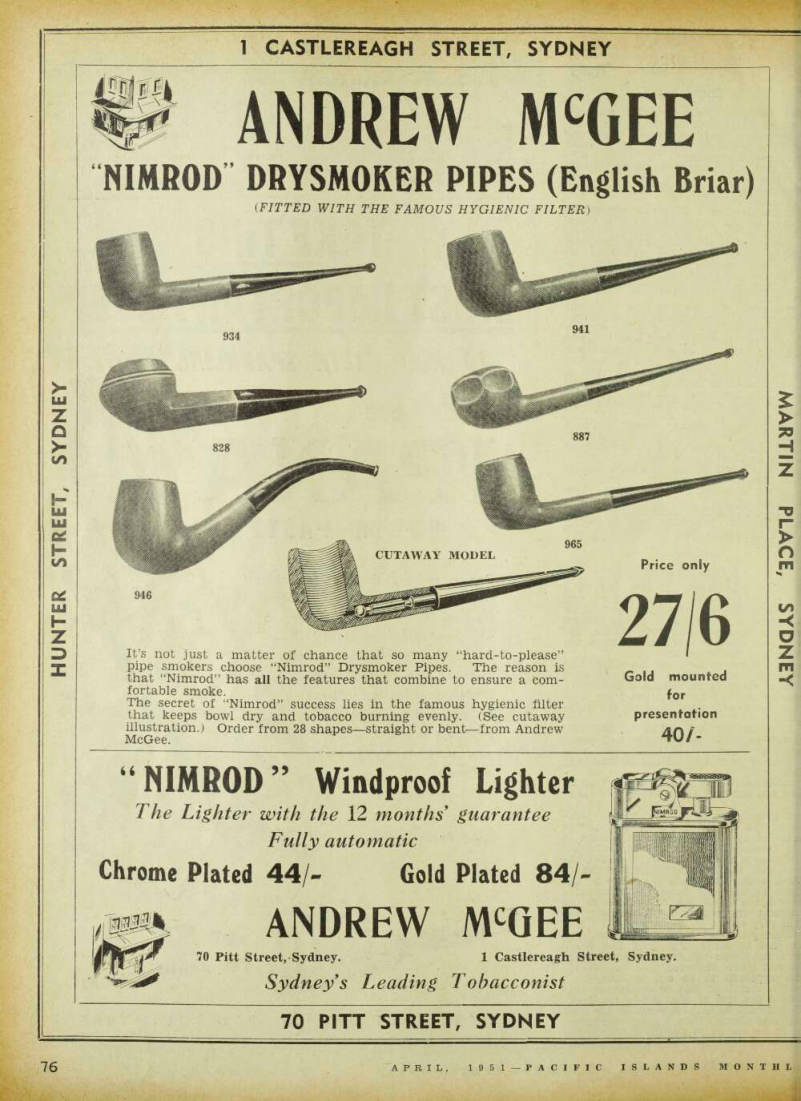
Edie Creek
By Old- Timer
A Lousy Tale!
BY 1930 the cream had been skimmed off Edie Creek, so far as the claim workers were concerned, and one began to hear such terms as “gully raker’’ and “gravel scratcher.”
In 1928 it had been beneath our dignity to work tailings; but by 1930-31 we were prepared to work any damn thing at all with a bit of gold in it.
I was working a tribute in one of the gorges at the lower end of the creek, putting in time, from daylight to dark, making big stones into little ones—not getting much gold, but collecting an occasional specimen to sweeten things up a bit. We’d reached the stage where we were putting down the pennyweights in the tally book.
I started to “clean up the box’’ one evening and placed one boy at the fum ing to control the flow of water while I cleaned up. The riffles had been removed and the little bit of gold brought to a thin stream across the head of the box when, without warning, a heavy gush of water threatened to scour all the gold and everything else from the box.
“juasy along water you brainless so-and so,” I yelled.
Along came another heavy gush of water. “Fasten water, you blanky cow!” [ screamed. “Haven’t you got any blanky crains in your blanky head?”
“Brains,” said the native with a puzzled look. “Me no savvy brain.”
“Brain,” I said, “*e something along lead belong you.”
A look of enlightenment dawned on his iial. “Me savvy,” he said. “Me got plenty, rhat’s all, me no call ’im brain, me call im louse!”
Gratitude!
[WAS just coming to the end of a fairly successful recruiting trip and had a line of assorted natives to show :or about a month’s work in the villages iowards the top of the Wein Valleys. The ;rack led down a long spur between the Vein and the Erap River.
We’d done a fair day’s travelling, and [ decided to camp for the night at a ullage where there seemed a chance of maring another two or three bush kan ikas for a two-years’ spell on the gold ields.
I had hardly got settled in, and dis :arded my mud-soaked socks and pants, vhen a village kanaka came along with i tale of woe. His little picaninny was lick.
“You good fella master, you got medi ;ine you can make him better?” he asked ne.
I went along to investigate. His pica ainny was a little girl, about four or five [.ears of age. My medical knowledge is lot extensive, but she seemed to have a )ad dose of fever. Questioning elicited the 'act that she had been sick for two or ihree weeks. I managed to get her to take >ome aspirin, and before I turned in I ?ave her a small dose of quinine. In the norning she seemed a bit brighter, but still very sick.
During the day I dosed her again, and rot her to eat a little milk and bread :rom my tucker-box. Towards evening she seemed much improved, and next morn ing appeared to be out of danger. I left a couple of tins of condensed milk and a few tins of soup out of my packs, plus medicines and instructions for feed ing and dosing. Then I gave instructions to fasten the packs and get moving. After all, what did a day or so’s delay matter?
The patient’s papa came along to speed us on our way. “You good fella master too much; you give ’em me medicine, give ’em me kai-kai, look-out good along pica ninny alia same doctor. You good fella master too much. Master, you got tobac?”
Rum
WHEN the aeroplanes came and made transport a bit more assured, one’s financial and social standing on Edie Creek was determined by the variety and quantity of grog available to offer visitors. Over 10 oz. a day meant a choice
of Scotch, rum and, occasionally, beer.
Five or six oz. a day qualified for rum and sometimes Scotch. If a man were making reasonable “money” rum would always be available. But a battler could only offer coffee.
It was a bit chilly on the Upper Edie once the sun went down, and an enamel pannikin of rum and coffee went really well, once the day’s work was finished.
Old Dick Berriman and I made a prac tice of having a good stiff rum and coffee together every evening when work was finished.
(Continued on page 77.)
j Old Tom’s hut was only 30 or 40 yards away, but we couldn’t offer him a drink, because we’d put him under the “Dog Act.” Tom had been on a bender for two or three months, and had had several (goes of the horrors.
Tom’s own grog had run out, and he was waiting for his boys to come back from the coast with more. We had had grog all the time, but had told Tom our stuff was finished.
Poor Tom was suffering all the tortures of the damned, with a really classical attack of the “dry horrors.” He came barging up the track to where Dick and I were sitting on the log, each holding a steaming pannikin of hot rum and coffee.
We parked the bottle when we saw him coming.
He sat down between us. Dick offered him a cup of coffee, which he refused. He put his head between his hands and groaned. [T wish to hell I had some rum,” he said. “I know you blokes haven’t got any, but it’s getting on my blanky nerves. I can see it and feel it all the blanky time, I can even smell the blanky stuff now!”
Advertisements & other items, pp. 77-78 (2 items)
I Pan A
TAKE THIS
MOST IMPORTANT STEP
7.
TO KEEP TEETH SPARKLING WHITE
use
I PAN A
TOOTH PASTE
Doctors and dentists all agree that gum troubles are the cause of most tooth extractions. That's one important reason why you should always use IPANA— the tooth paste that keeps both teeth and gums clean and healthy.
IPANA gives lasting radiance to your smile because it protects as well as cleans your teeth to sparkling whiteness.
Sold Everywhere X .1. x * h X s * a: o o fO f
*,OO S»A« IC, - e
T ° you.
A PRODUCT O
f vi
SMILg
BRISTOL-MYERS
1 CASTLEREAGH STREET, SYDNEY
Z a >- \S\ Lt H (/) s' ui I- Z f £
ANDREW M C GEE
NIMROD DRYSMOKER PIPES (English Briar)
(■FITTED WITH THE FAMOUS HYGIENIC FILTER ) 828 965
CUTAWAY MODEL
Price only 946 2716 £ > 73 H It’s not just a matter of chance that so many “hard-to-please” pipe smokers choose “Nimrod” Drysmoker Pipes. The reason is that “Nimrod” has all the features that combine to ensure a comfortable smoke.
The secret of “Nimrod” success lies in the famous hygienic filter that keeps bowl dry and tobacco burning evenly. (See cutaway illustration.) Order from 28 shapes—straight or bent—from Andrew McGee. > o v> -< O z Gold mounted for presentation 40/u
NIMROD Windproof Lighter
The Lighter with the 12 months’ guarantee
Fully automatic
Chrome Plated 44/- Gold Plated 84/-
ANDREW M C QEE
70 Pitt Street, Sydney. 1 Castlereagh Street, Sydney.
Sydneys Leading Tobacconist
N
[fcIMROU
w
70 PITT STREET, SYDNEY
76
APRIL, 1951 PACIFIC ISLANDS MONTHL
Aerodrome Construction In
P-Ng
From Our Own Correspondent
Port Moresby, March 10.
SIGNIFICANT development in building up airfields in the Papua-New Guinea Territory is the calling of tenders for an international-standard airport at Lae. This is to be built at Malahang and will be suitable for in strument landings.
Work is well advanced on the Fishman’s Island airstrip off Port Moresby which is to serve as an alternative landing field to Jackson’s strip. Extensive improvements are also being made to Kavieng’s drome.
Reorganisation Of
Anderson’S Industries
Prom Our Own Correspondent
Port Moresby, March 10.
Anderson’S Island Industries
LIMITED has changed its name to Anderson’s Pacific Trading Company Limited, and the business has been re organised with a capital of half a million pounds.
The firm’s interests include meat freezers at Port Moresby, Lae and Rabaul, a slipway and tug service at Rabaul, and a fleet of fishing boats which is now being organised.
It was a good day for the Territory when the Managing Director, Mr. A. W.
Anderson, decided he liked Island life.
He now is developing a big fishing in dustry with the dual objective of supply ing Island requirements and building up an export trade with Australia. In due time a modern fishing fleet will no doubt be in operation along the Territory Coast line.
Native Grass Fires To Be
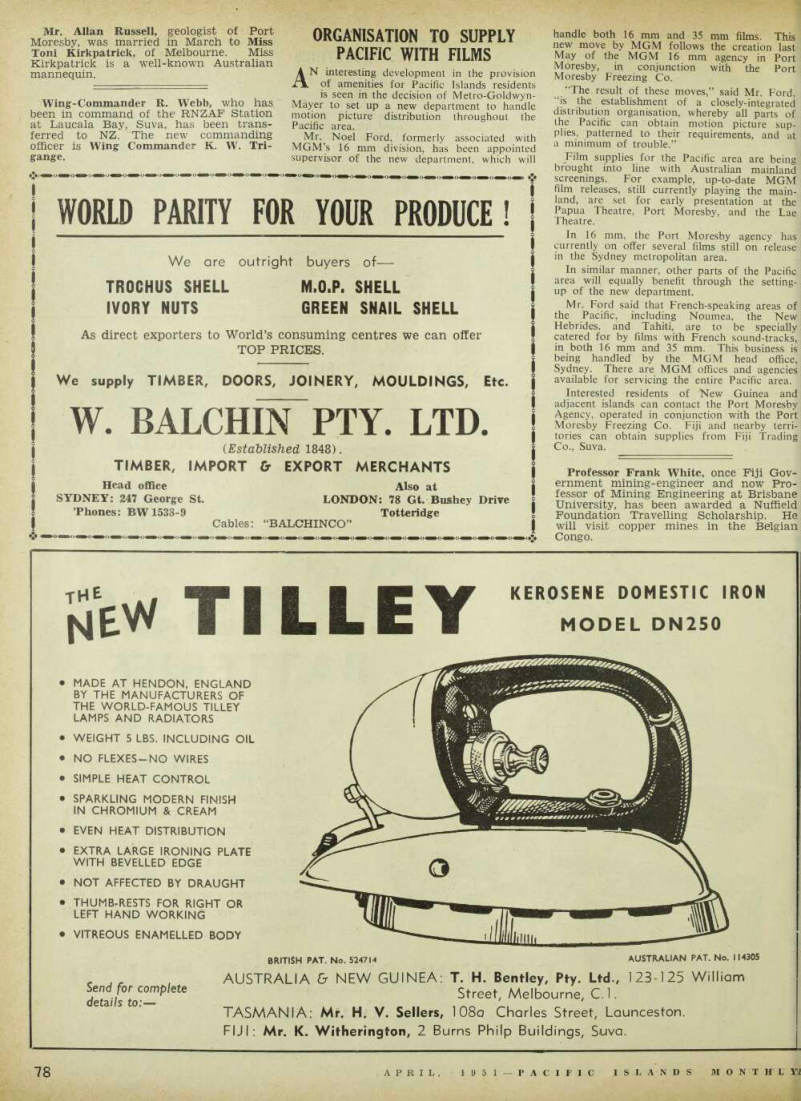
“Controlled”
From Our Own Correspondent
Port Moresby, March 16.
NATIVE regulations have been tightened up to give the P-NG authorities more control over the lighting of grass fires by natives.
The official statement adds that the firing of grasslands for hunting and other purposes is a native custom, and that exercise of full control must be a gradual development.
This shows a nice consideration for native feelings, but how about a little consideration for private property owners whose holdings are menaced by this happy-go-lucky fire-lighting habit?
Action for damages might speed up the “gradual development” process. The natives themselves have shown a very shrewd capacity for claiming “damages,” even those incurred in their own defence.
Isn’t it about time they progressed to the second lesson—paying out claims.
Mr. Allan Russell, geologist of Port Moresby, was married in March to Miss Toni Kirkpatrick, of Melbourne. Miss Kirkpatrick is a well-known Australian mannequin.
Wing-Commander R. Webb, who has been in command of the RNZAF Station at Laucala Bay, Suva, has been trans ferred to NZ. The new commanding officer is Wing Commander K. W. Tri gange.
Advertisements & other items, pp. 79-80 (1 item)
Batteries
FIBRE TRAVEL AND ATTACHE
CASES OF ALL QUALITIES!
In sizes to serve all needs and at prices to suit all types of trade. Write for full particulars to —
FORD SHERINGTON LTD.
Makers of Globite, Airway and Fordite Travel Cases.
Kippcx Street, Sydney, Australia.
♦ i □ r r^i r /
BATTERIES
are tigers for work
99 It is impossible to build a better battery than the Masse. Every part of a Masse Battery is of one hundred per cent, quality . . . every stage of its manufacture is carried out in the Masse factory. When you recommend a Masse Battery to your customer, you can do so, with the utmost confidence that it will give him more starts and longer service.
ROBERT GILLESPIE JS. LTD.
RABAUL AND LAE
WORLD PARITY FOR YOUR PRODUCE!
We are outright buyers of—-
TROCHUS SHELL M.O.P. SHELL
IVORY NUTS GREEN SNAIL SHELL
As direct exporters to World’s consuming centres we can offer
TOP PRICES.
We supply TIMBER, DOORS, JOINERY, MOULDINGS, Etc.
W. BALCHIN PTY. LTD.
(Established 1848).
TIMBER, IMPORT & EXPORT MERCHANTS
Also at LONDON: 78 Gt. Bushey Drive Totteridge Head office SYDNEY: 247 George St ’Phones: BW 1538-9 Cables: “BALCHINCO’
Organisation To Supply
Pacific With Films
AN interesting development in the provision of amenities for Pacific Islands residents is seen in the decision of Metro-Goldwyn- Mayer to set up a new department to handle motion picture distribution throughout the Pacific area.
Mr. Noel Ford, formerly associated with MGM’s 16 mm division, has been appointed supervisor of the new department, which will
handle both 16 mm and 35 mm films. This new move by MGM follows the creation last May of the MGM 16 mm agency in Port Moresby, in conjunction with the Port Moresby Freezing Co, “The result of these moves,” said Mr. Ford, “is the establishment of a closely-integrated distribution organisation, whereby all parts of the Pacific can obtain motion picture sup plies, patterned to their requirements, and at a minimum of trouble.”
Film supplies for the Pacific area are being brought into line with Australian mainland screenings. For example, up-to-date MGM film releases, still currently playing the main land, are set for early presentation at the Papua Theatre, Port Moresby, and the Lae Theatre.
In 16 mm, the Port Moresby agency has currently on offer several films still on release in the Sydney metropolitan area.
In similar manner, other parts of the Pacific area will equally benefit through the setting up of the new department.
Mr. Ford said that French-speaking areas of the Pacific, including Noumea, the New Hebrides, and Tahiti, are to be specially catered for by films with French sound-tracks, in both 16 mm and 35 mm. This business is being handled by the MGM head office, Sydney. There are MGM offices and agencies available for servicing the entire Pacific area.
Interested residents of New Guinea and adjacent islands can contact the Port Moresby Agency, operated in conjunction with the Port Moresby Freezing Co. Fiji and nearby terri tories can obtain supplies from Fiji Trading Co., Suva.
Professor Frank White, once Fiji Gov ernment mining-engineer and now Pro fessor of Mining Engineering at Brisbane University, has been awarded a Nuffield Foundation Travelling Scholarship. He will visit copper mines in the Belgian Congo.
Advertisements & other items, p. 80 (1 item)
Sew Tilley
KEROSENE DOMESTIC IRON
MODEL DN2SO
• MADE AT HENDON, ENGLAND
BY THE MANUFACTURERS OF
THE WORLD-FAMOUS TILLEY
LAMPS AND RADIATORS
• WEIGHT 5 LBS. INCLUDING OIL
• NO FLEXES-NO WIRES
• SIMPLE HEAT CONTROL
• SPARKLING MODERN FINISH
IN CHROMIUM & CREAM
• EVEN HEAT DISTRIBUTION
• EXTRA LARGE IRONING PLATE
WITH BEVELLED EDGE
• NOT AFFECTED BY DRAUGHT
• THUMB-RESTS FOR RIGHT OR
LEFT HAND WORKING
• VITREOUS ENAMELLED BODY
O
BRITISH PAT. No. 5247 H
AUSTRALIAN PAT. No. 114305
. , AUSTRALIA & NEW GUINEA: T. H. Bentley, Pty. Ltd., 123-125 William Send for complete Street, Me bourne C details to TASMANIA; Mr. H. V. Sellers, 108 a Charles Street, Launceston.
FIJI: Mr. K. Witherington, 2 Burns Philp Buildings, Suva.
High Commissioner Reviews Year’S
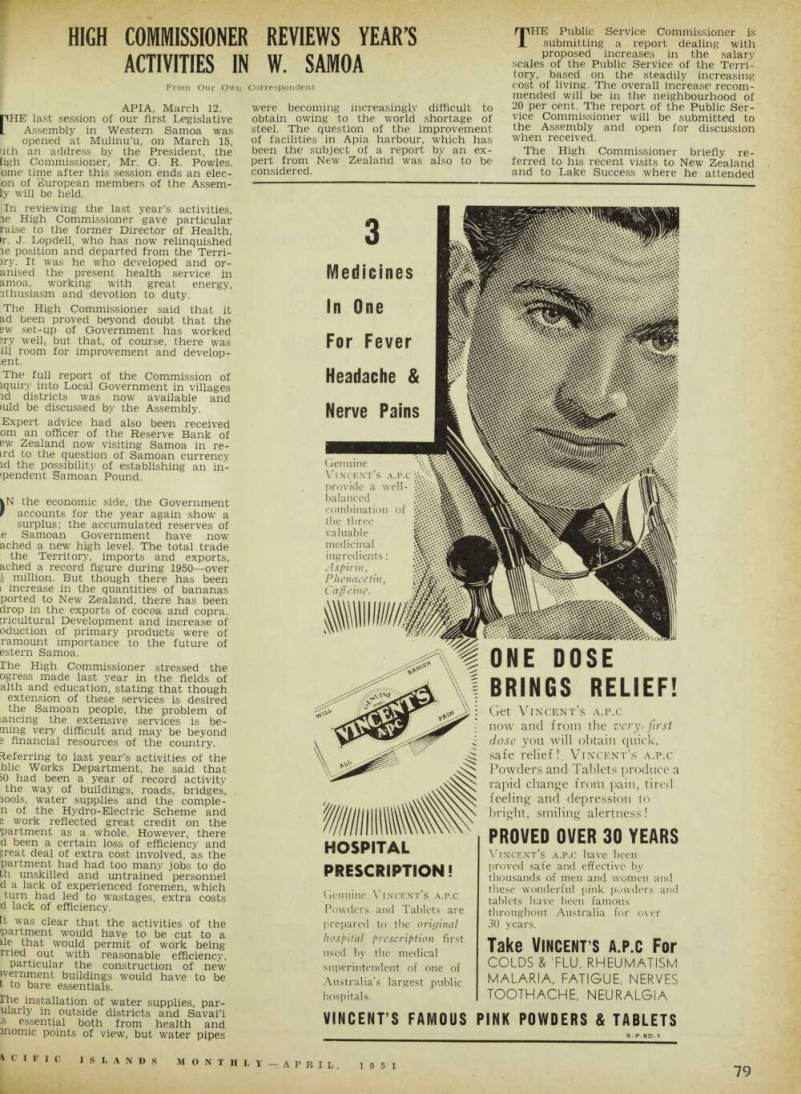
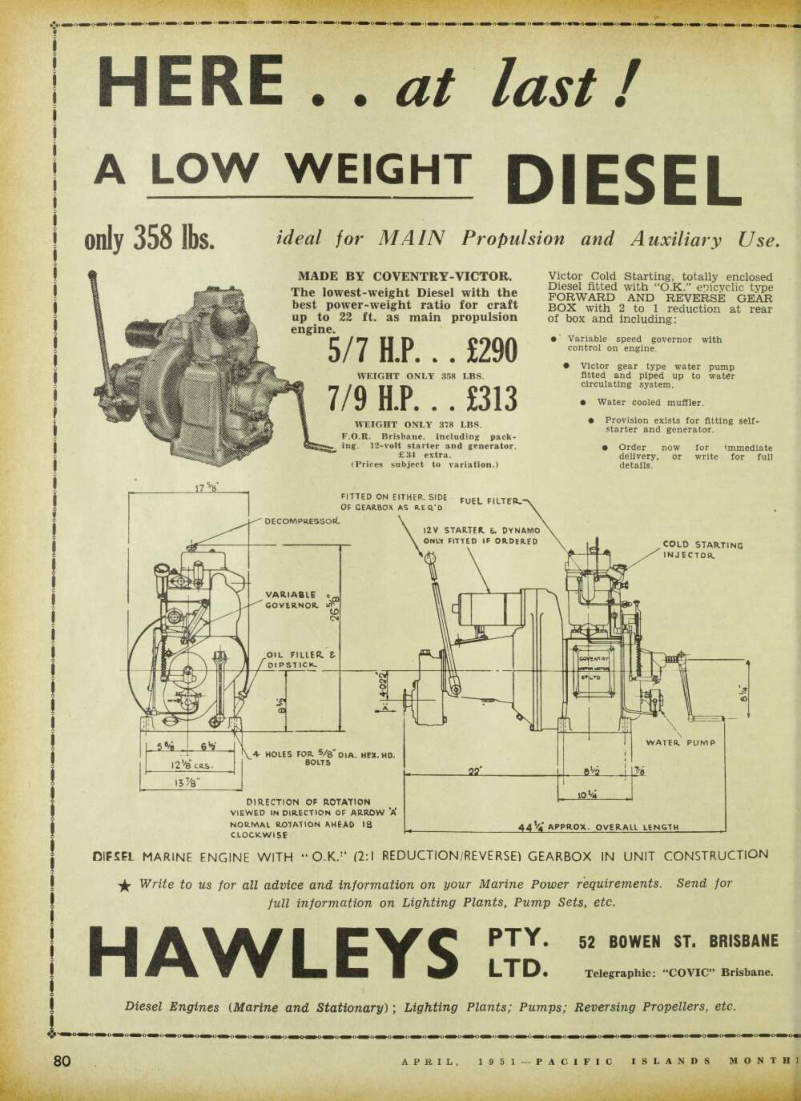
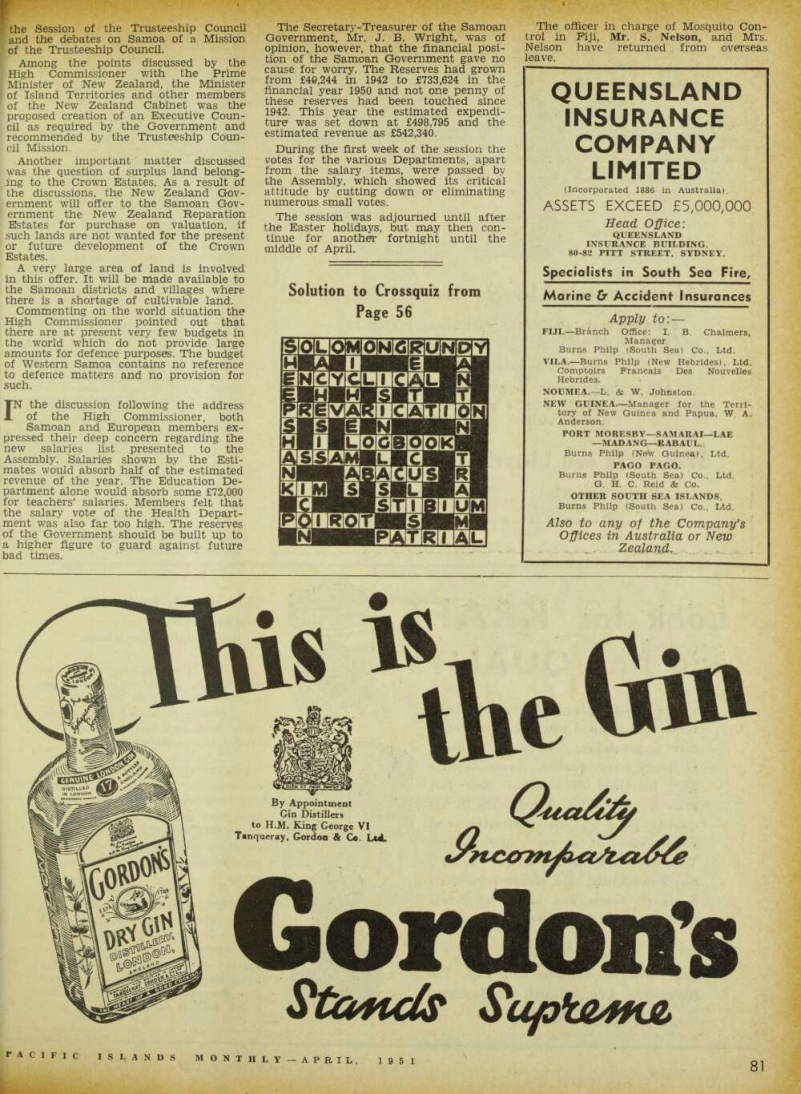
Activities In W. Samoa
From Our Own Correspondent
APIA, March 12.
CHE last session of our first Legislative Assembly in Western Samoa was opened at Mulinu’u, on March 15, dth an address by the President, the ligh Commissioner, Mr. G. R. Powles. ome time after this session ends an elec on of European members of the Assem ly will be held.
In reviewing the last year’s activities, le High Commissioner gave particular raise to the former Director of Health, •r. J. Lopdell, who has now relinquished le position and departed from the Terri fy. It was he who developed and or anised the present health service in amoa, working with great energy, athusiasm and devotion to duty.
The High Commissioner said that it ad been proved beyond doubt that the ew set-up of Government has worked ?ry well, but that, of course, there was ill room for improvement and develop ed.
The full report of the Commission of iquiry into Local Government in villages id districts was now available and »uld be discussed by the Assembly.
Expert advice had also been received om an officer of the Reserve Bank of ew Zealand now visiting Samoa in re ird to the question of Samoan currency id the possibility of establishing an in spendent Samoan Pound. |N the economic side, the Government f accounts for the year again show a surplus: the accumulated reserves of e Samoan Government have now ached a new high level. The total trade the Territory, imports and exports, ached a record figure during 1950 —over h million. But though there has been i increase in the quantities of bananas ported to New Zealand, there has been drop in the exports of cocoa and copra, pdcultural Development and increase of oduction of primary products were of ramount importance to the future of estern Samoa.
The High Commissioner stressed the ogress made last year in the fields of alth and education, stating that though extension of these services is desired the Samoan people, the problem of lancing the extensive services is be tning very difficult and may be beyond 3 financial resources of the country. deferring to last year’s activities of the blic Works Department, he said that >0 had been a year of record activity the way of buildings, roads, bridges, lools, water supplies and the comple n of the Hydro-Electric Scheme and 3 work reflected great credit on the partment as a whole. However, there d been a certain loss of efficiency and jreat deal of extra cost involved, as the partment had had too many jobs to do th unskilled and untrained personnel d a lack of experienced foremen, which turn had led to wastages, extra costs d lack of efficiency. it was clear that the activities of the partment would have to be cut to a lie that would permit of work being rried out with reasonable efficiency. particular the construction of new wernment buildings would have to be t to bare essentials. rhe installation of water supplies, par ularly in outside districts and Savai’i s essential both from health and momic points of view, but water pipes
were becoming increasingly difficult to obtain owing to the world shortage of steel. The question of the improvement of facilities in Apia harbour, which has been the subject of a report by an ex pert from New Zealand was also to be considered.
T submitting a report dealing with sca l es P rre%ublic e Serlice n of t ?h e e TeS tory, based on the steadily increasing cost of living. The overall increase recom mended will be in the neighbourhood of 2 9 P er cent. The report of the Public Ser vice Commissioner will be submitted to the Assembly and open for discussion when received, The High Commissioner briefly re ferred to his recent visits to New Zealand and to Lake Success where he attended
- the Session of the Trusteeship Council and the debates on Samoa of a Mission of the Trusteeship Council.
Among the points discussed by the High Commissioner with the Prime Minister of New Zealand, the Minister of Island Territories and other members of the New Zealand Cabinet was the proposed creation of an Executive Coun cil as required by the Government and recommended by the Trusteeship Coun cil Mission.
Another important matter discussed was the question of surplus land belong ing to the Crown Estates. As a result of the discussions, the New Zealand Gov ernment will offer to the Samoan Gov ernment the New Zealand Reparation Estates for purchase on valuation, if such lands are not wanted for the present or future development of the Crown Estates.
A very large area of land is involved in this offer. It will be made available to the Samoan districts and villages where there is a shortage of cultivable land.
Commenting on the world situation the High Commissioner pointed out that there are at present very few budgets in the world which do not provide large amounts for defence purposes. The budget of Western Samoa contains no reference to defence matters and no provision for such.
IN the discussion following the address of the High Commissioner, both Samoan and European members ex pressed their deep concern regarding the new salaries list presented to the Assembly. Salaries shown by the Esti mates would absorb half of the estimated revenue of the year. The Education De partment alone would absorb some £72,000 for teachers’ salaries. Members felt that the salary vote of the Health Depart ment was also far too high. The reserves of the Government should be built up to a higher figure to guard against future bad times.
The Secretary-Treasurer of the Samoan Government, Mr. J. B. Wright, was of opinion, however, that the financial posi tion of the Samoan Government gave no cause for worry. The Reserves had grown from £40,244 in 1942 to £733,624 in the financial year 1950 and not one penny of these reserves had been touched since 1942. This year the estimated expendi ture was set down at £498,795 and the estimated revenue as £542,340.
During the first week of the session the votes for the various Departments, apart from the salary items, were passed by the Assembly, which showed its critical attitude by cutting down or eliminating numerous small votes.
The session was adjourned until after the Easter holidays, but may then con tinue for another fortnight until the middle of April.
The officer in charge of Mosquito Con trol in Fiji, Mr. S. Nelson, and Mrs.
Nelson have returned from overseas leave.
Advertisements & other items, pp. 81-83 (5 items)
4Ci F I C Islands Monthly April, 1951
One Dose
3
Medicines
In One
For Fever
Headache &
Nerve Pams
Genuine Vincent's a.p.c r./.G provide a well- •££ balanced combination of tbe three valuable medicinal ingredients; Aspirin, Phcnacctin, Caffeine.
HOSPITAL
PRESCRIPTION!
Genuine Vincent's a.p.c Powders and Tablets are prepared to tbe original hospital prescription first used by the medical superintendent of one of Australia’s largest public hospitals.
ONE DOSE
BRINGS RELIEF!
Get Vincent’s a.p.c now and from the very first dose you will obtain quick, safe relief! Vincent’s a.p.c Powders and Tablets produce a rapid change from pain, tired feeling and depression to bright, smiling alertness!
PROVED OVER 30 YEARS
Vincent's a.p.c have been proved safe and effective by thousands of men and women and these wonderful pink powders and tablets have been famous throughout Australia for over 30 years.
Take Vincent s a.p.c For
COLDS & 'FLU, RHEUMATISM
MALARIA, FATIGUE, NERVES
TOOTHACHE, NEURALGIA
VINCENT’S FAMOUS PINK POWDERS & TABLETS
ERE
at last 1
weight DIESEL
only 358 lbs. ideal for MAIN Propulsion and Auxiliary Use. 17
DECOMPRESSOR.
VARIABLE Sq)
governor ID CM m
OIL FILLER. 8-
DIPSTICK-
12'8 CRS.
l5 7 /8"
MADE BY COVENTRY-VICTOR.
The lowest-weight Diesel with the best power-weight ratio for craft up to 22 ft. as main propulsion
engine.
5/7 H.P... £290
WEIGHT ONLY 358 LBS.
7/9 H.P... £313
WEIGHT ONLY 378 LBS.
F.O.R. Brisbane, including packig. 12-volt starter and generator. £34 extra. (Prices subject to variation.) Victor Cold Starting, totally enclosed Diesel fitted with “0.K.” enicyclic type
FORWARD AND REVERSE GEAR
BOX with 2 to 1 reduction at rear of box and including: • Variable speed governor with control on engine. • Victor gear type water pump fitted and piped up to water circulating system. • Water cooled muffler. • Provision exists for fitting selfstarter and generator. • Order now for immediate delivery, or write for full details.
FITTED ON EITHER- SIDE
OF GEAR-BOX AS RE Q.‘D
FUEL FILTER-'
COLD STARTING
INJECTOR.
V-4- HOLES FOR 5 /s" CMA. HEX. HD.
BOLTS
DIRECTION OF ROTATION
VIEWED IN DIRECTION OF ARROW *A'
NORMAL ROTATION AHEAD 18
CLOCRWISE
12V STARTER. £, DYNAMO
ONLT FITTED IF ORDERED
GO 'Ol
WATER PUMP
22 Bra
Ioi4
44*4' APPROX. OVERALL LENGTH
DIFSCL MARINE ENGINE WITH “0.K.” (2:1 REDUCTION/REVERSE) GEARBOX IN UNIT CONSTRUCTION Write to us for all advice and information on your Marine Power requirements. Send for full information on Lighting Plants, Pump Sets, etc.
HAWLEYS
PTY.
LTD.
52 BOWEN ST. BRISBANE
Telegraphic; “COVIC” Brisbane.
Diesel Engines (Marine and Stationary ); Lighting Plants; Pumps; Reversing Propellers, etc.
80
APRIL, 1951 PACIFIC ISLANDS MONTH!
81
PACIFIC ISLANDS MONTHLY— APRIL, 1951
Solution to Crossquiz from Page 56
Gordon's
QUEENSLAND
INSURANCE
COMPANY
LIMITED
(Incorporated 1886 in Australia).
ASSETS EXCEED £5,000,000
Head Office:
QUEENSLAND
INSURANCE BUILDING,
80-82 PITT STREET. SYDNEY.
Specialists in South Seo Fire,
Marine Cr Accident Insurances
Apply to: —
FlJl.—Branch Office; I. B. Chalmers, Manager.
Burns Phllp (South Sea) Co., Ltd.
VlLA.—Burns Phllp (New Hebrides), Ltd.
Comptoirs Prancais Des Nouvelles Hebrides.
NOUMEA.—L. & W. Johnston.
NEW GUlNEA—Manager for the Territory of New Guinea and Papua, W, A.
Anderson.
PORT MORESBY—SAMARAI—LAE
—MADANG—RABAUL.
Burns Phllp (Neto Guinea), Ltd.
PAGO PAGO.
Burns Phllp (South Sea) Co., Ltd.
G. H. C. Reid & Co.
OTHER SOUTH SEA ISLANDS.
Burns Phllp (South Sea) Co., Ltd.
Also to any of the Company's Offices in Australia or New
Zealand.
fs uV 0$ ws By Appointment Gin Distillers to H.M. King George VI Tanqueray, Gordon & Co. L
£nccr?n^€iSt€i&e
Gordon's
Supkatf te
Conttol Of Pests
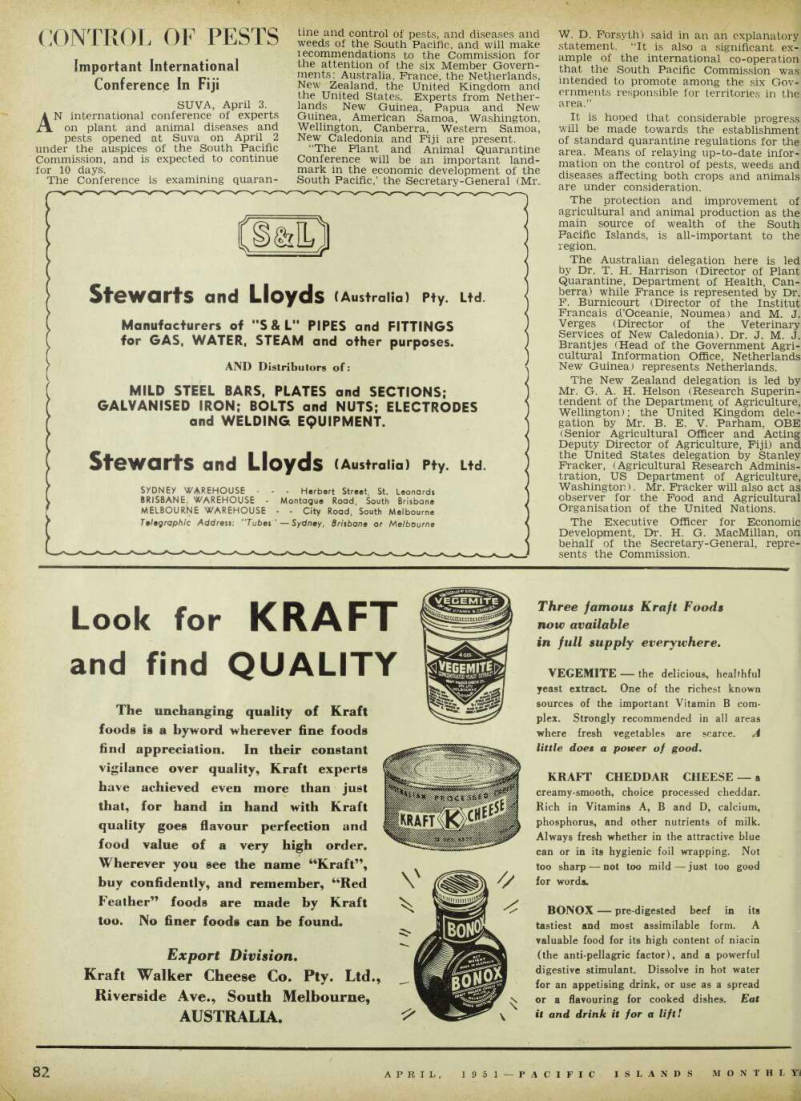
Important International Conference In Fiji
SUVA, April 3.
AN international conference of experts on plant and animal diseases and pests opened at Suva on April 2 under the auspices of the South Pacific Commission, and is expected to continue for 10 days.
The Conference is examining quaran
tine and control of pests, and diseases and weeds of the South Pacific, and will make i ecommendations to the Commission for the attention of the six Member Govern ments: Australia. France, the Netherlands, New Zealand, the United Kingdom and the United States. Experts from Nether lands New Guinea, Papua and New Guinea, American Samoa, Washington, Wellington, Canberra, Western Samoa, New Caledonia and Fiji are present.
“The Plant and Animal Quarantine Conference will be an important land mark in the economic development of the South Pacific,’ the Secretary-General (Mr.
W. D. Forsyth) said in an an explanatory statement. “It is also a significant ex ample of the international co-operation that the South Pacific Commission was intended to promote among the six Gov ernments responsible for territories in the area.”
It is hoped that considerable progress will be made towards the establishment of standard quarantine regulations for the area. Means of relaying up-to-date infor mation on the control of pests, weeds and diseases affecting both crops and animals are under consideration.
The protection and improvement of agricultural and animal production as the main source of wealth of the South Pacific Islands, is all-important to the region.
The Australian delegation here is led by Dr, T. H. Harrison (Director of Plant Quarantine, Department of Health, Can berra) while France is represented by Dr.
F. Burnicourt (Director of the Institut Francais d’Oceanie, Noumea) and M. J.
Verges (Director of the Veterinary Services of New Caledonia). Dr. J. M. J.
Brantjes (Head of the Government Agri cultural Information Office, Netherlands New Guinea) represents Netherlands.
The New Zealand delegation is led by Mr. G. A. H. Helson (Research Superin tendent of the Department of Agriculture,, Wellington); the United Kingdom dele gation by Mr. B. E. V. Parham, OBE (Senior Agricultural Officer and Acting Deputy Director of Agriculture, Fiji) and the United States delegation by Stanley Fracker, (Agricultural Research Adminis tration, US Department of Agriculture,, Washington). Mr. Fracker will also act as observer for the Food and Agricultural Organisation of the United Nations.
The Executive Officer for Economici Development, Dr. H. G. MacMillan, on behalf of the Secretary-General, repre sents the Commission.
Advertisements & other items, p. 84 (2 items)
82
APRIL, 195 1— PACIFIC ISLANDS MONTH L
Look for KRAFT
Jr V Stewarts and Lloyds (Australia) pt y . Ltd.
Manufacturers of "S & L" PIPES and FITTINGS for GAS, WATER, STEAM and other purposes.
AND Distributors of:
MILD STEEL BARS, PLATES and SECTIONS;
GALVANISED IRON; BOLTS and NUTS; ELECTRODES
and WELDING EQUIPMENT.
Stewarts and Lloyds (Australia) pt y . Ltd SYDNEY WAREHOUSE - - Herbert Street, St. Leonards BRISBANE. WAREHOUSE - Montague Road, South Brisbane MELBOURNE WAREHOUSE • - City Road, South Melbourne Telegraphic Address: "Tubes ’ Sydney, Brisbane or Melbourne
Look for KRAFT
and find QUALITY
The unchanging quality of Kraft foods is a byword wherever fine foods find appreciation. In their constant vigilance over quality, Kraft experts have achieved even more than just that, for hand in hand with Kraft quality goes flavour perfection and food value of a very high order.
Wherever you see the name “Kraft”, buy confidently, and remember, “Red Feather” foods are made by Kraft too. No finer foods can be found.
Export Division , Kraft Walker Cheese Co. Pty. Ltd.,
Riverside Ave., South Melbourne,
AUSTRALIA.
KRAFT
v //
Three famous Kraft Foods
now available
in full supply everywhere .
VEGEMITE the delicious, healthful yeast extract One of the richest known sources of the important Vitamin B complex. Strongly recommended in all areas where fresh vegetables are scarce. A little does a power of good.
KRAFT CHEDDAR CHEESE a
creamy-smooth, choice processed cheddar.
Rich in Vitamins A, B and D, calcium, phosphorus, and other nutrients of milk.
Always fresh whether in the attractive blue can or in its hygienic foil wrapping. Not too sharp not too mild —just too good for words.
BONOX pre-digested beef in its tastiest and most assimilable form. A valuable food for its high content of niacin (the anti-pellagric factor), and a powerful digestive stimulant. Dissolve in hot water for an appetising drink, or use as a spread or a flavouring for cooked dishes. Eat it and drink it for a lift!
Notes From Lae
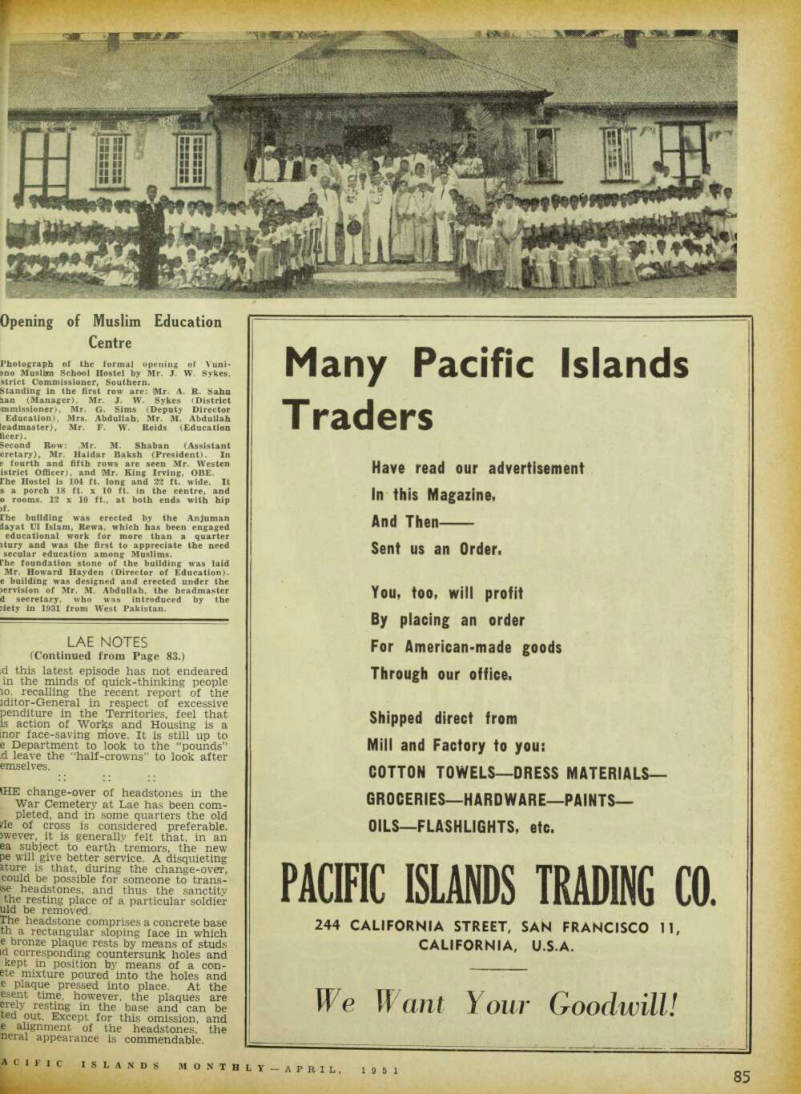
From Our Own Correspondent LAE, April 2.
CONDITIONS at the European School, Lae, are causing concern; and al though the Director of Education, in reply to representations made by the local branch of the Returned Soldiers’
League, gave a maze of statistics that led nowhere, and failed to satisfy the League, an inspection of the existing conditions showed that the complaints were well founded.
The main complaint that there was less space per pupil in the school than that laid down under the Native Labour Ordinance for accommodation of natives cannot be denied. A simple mathematical problem establishes its correctness.
Ventilation is insufficient and though, through the work of the local Parents and Citizens Committee, this has been im proved, this does not remove the onus of responsibility from the Department.
Inadequate lighting is apparent, and no provision has been made for a room for the teacher, who is compelled to do all clerical work in connection with the school requirements, and reports, etc., at a small table in the large classroom. It is only recently that the concrete floor has been relieved by strips of matting under the pupils’ seats and desks.
Drinking water is obtained from a tank, the source of supply being a very limited roofing of an outbuilding. Finally it would appear that further teaching staff is required. Certainly a site has been re served for a new school in the Town Plan but this could easily be the “gag” to further representations being made by worrying parents, and outside interested bodies.
A FEW issues ago comment was made in these notes of shortcomings in the telephone services, and it is fair to state that there has been a very marked improvement during the inter vening period. While it is apparent that uniformity in dealing with public re quirements has been achieved and main tained by the operators, there is another side to the problem.
A leading official of the P.M.G.’s De partment in the Territory stated that the operators have, from his own personal observations, been subjected to abuse from subscribers, and, in a recent case at Rabaul, to assault by an infuriated European.
For general information it is pointed out that, under the Postal Regulations as applicable to New Guinea, should a case of offensive abuse be sheeted home to a subscriber, or to a person using a subscriber’s phone, the phone will im mediately be disconnected.
THE dictatorial attitude assumed by the Department of Works and Housing in breaking firmly established conditions of employment of contract tipper trucks by cutting the hourly hire rates has resulted in owners withdrawing their vehicles from the works on which they were engaged.
The advice, which emanated from the head office of the Department at Port Moresby, fixed the date of the cut as
from March 12, 1951*, but the same head office has withheld from the con tractors the difference of 2/6 per hour from the beginning of January, 1951, although intervening periods were covered by Interim Orders fixing the price at the old rate.
The Department has not earned a singularly high reputation over the years,
(Continued at foot of page 85)
id this latest episode has not endeared in the minds of quick-thinking people io. recalling the recent report of the iditor-General in respect of excessive penditure in the Territories, feel that is action of Works and Housing is a mor face-saving move. It is still up to e Department to look to the “pounds” d leave the “half-crowns” to look after emselves.
IHE change-over of headstones in the War Cemetery at Lae has been com pleted, and in some quarters the old /le of cross is considered preferable, iwever, it is generally felt that, in an ea subject to earth tremors, the new pe will give better service. A disquieting ature is that, during the change-over, could be possible for someone to trans 'se headstones, and thus the sanctity the resting place of a particular soldier uld be removed.
The headstone comprises a concrete base th a rectangular sloping face in which e bronze plaque rests by means of studs id corresponding countersunk holes and kept in position by means of a con ete mixture poured into the holes and e plaque pressed into place. At the esent time, however, the plaques are erely resting in the base and can be ted out. Except for this omission, and e alignment of the headstones, the neral appearance is commendable.
Opening of Muslim Education
Centre
Photograph of the formal opening of Vuni ono Muslim School Hostel by Mr. J. W. Sykes, strict Commissioner, Southern.
Standing in the first row are; Mr. A. R. Sahu [?]han (Manager), Mr. J. W. Sykes (District mmissioner), Mr. G. Sims (Deputy Director Education), Mrs. Abdullah, Mr. M. Abdullah [?]eadmaster), Mr. F. W. Reids (Education ficer).
Second Row: Mr. M. Shaban (Assistant cretary) Mr. Haidar Baksh (President). In [?]e fourth and fifth rows are seen Mr. Westen istrict Officer), and Mr. King Irving, OBE.
The Hostel is 104 ft. long and 22 ft. wide. It [?]s a porch 18 ft. x 10 ft. in the centre, and [?]o rooms. 12 x 10 ft., at both ends with hip of.
The building was erected by the Anjuman layat UI Islam, Rewa, which has been engaged educational work for more than a quarter [?]ntury and was the first to appreciate the need secular education among Muslims.
The foundation stone of the building was laid Mr. Howard Hayden (Director of Education), e building was designed and erected under the Pervision of Mr. M. Abdullah, the headmaster and secretary, who was introduced by the [?] ciety in 1931 from West Pakistan.
l>r. Lestrade, doctor in charge of Noumea’s big Colonial Hospital and a specialist in childhood ailments, recently returned to Paris by Pan American service after three years in New Caledonia.
Advertisements & other items, pp. 85-88 (3 items)
Gabriel Achun
* L O W T H t
A L L
IfaUetif* Qumj&£ fjj&A/wJlr
* v <* i♦<k ' < > * 4* V H , :... >K W hat will you choose from the delightful
Swallow range?
There’s COFFEE,
MILK ARROWROOT
and GINGERNUTS,
high in quality, flavour
and versatility, and priced to suit your purse ! For biscuits with perfect party manners, there’s SAA •
BON, OR AN G I
CREAMS & DEVON
SHORTBREADS,
always tasty and tempting. You are sure of the best in biscuit values . . . when you follow' the Swallow !
wiotL ,
. yj , * .a Y'% * « v * €h ,* * v •: A- -V-)/ ,> *' * 1 -/
BAKED BY
SWALLOW & ARIELL
MAKERS OF THE FAMOUS SWALLOW & ARIELL PLUM PUDDINGS —■ ■■ S 2982
GABRIEL ACHUN
Importer ond Wholesole Merchant
I Specialises in:
BEERS
BICYCLES
AERATED WATER MANUFACTURING
COTTON PIECEGOODS FOR NATIVE TRADE
AGENT FOR “STANDARD” AND “TRIUMPH” CARS
Malaguna Road
RABAUL
Territory of New Guinea Proprietor:
RABAUL CORDIAL FACTORY.
Telegraphic Address:
“GABRIEL ACHUN,” RABAUL.
Of- -3* 4 A
tHc
Ci LL
is f° r
GILBEY’S
g/l e er ltd. *elb e - S ey.
Address all enquiries to W. & A. GILBEY LTD., 33 Rosslyn Street, West Melbour
B R/Sg
A/ve
SOOTHE™*
TROPIC TROUBLES /. N
There is no need to suffer many tropic health troubles and discomforts when ' ;ASPRO- tablets are here, ready to help you. 'ASPRO' is a most valuable medicine in the tropics because it has so many uses—for feverishness, the pangs of rheumatism, heat and humidity headaches, lassitude, nerve pains and nerviness, sleeplessness, colds and 'flu, 'ASPRO' is equally effective. Take two 'ASPRO' tablets with your favourite drink to overcome heat enervation.
Another feature which makes 'ASPRO' the desirable method of treating tropic troubles is its SOOTHING action. Irritability accompanies so many discomforts that 'ASPRO,' in addition to giving swift relief, has a soothing, calming effect. There are NO unpleasant after-effects to disturb you.
TWO IMPORTANT POINTS:-
The purity ot 'ASPRO' conforms to the standards laid down by the British Pharmacopoeia—a guiding authority ot the Medical Profession. 2 'ASPRO' tablets can be taken as often as necessary without FEAR of harm to heart or stomach.
PuJ.lt \ X I A * k I I
I Ulclurlad (Furdact \
REC . TRADE MARK
'ASPRO' IS SWIFT, CERTAIN and SAFE for—Headache, rheumatism, all nerve pains, irritability, neuritis, lumbago, earache, sciatica, toothache, sleeplessness, feverishness, sore throat, periodic pains, colds and 'flu, "mornings after." Even a child can safely take 'ASPRO'—directions on every packet.
N.e.7.
Many Pacific Islands
T raders
Have read our advertisement In this Magazine, And Then Sent us an Order.
You, too, will profit By placing an order For American-made goods Through our office.
Shipped direct from Mill and Factory to you:
COTTON TOWELS—DRESS MATERIALS—
GROCERIES—HARDWARE—PAINTS—
OILS—FLASHLIGHTS, etc.
PACIFIC ISLANDS TRADING CO.
244 CALIFORNIA STREET, SAN FRANCISCO 11,
CALIFORNIA, U.S.A.
We Want Your Goodwill!
BUSINESS EXECUTIVES !
Increase your business between Australia, France and French Overseas Territories, Join the French Chamber of Commerce in Australia now.
Ask for a free copy of our BULLETIN.
HOMMES D'AFFAIRES !
Augmentez votre chiffre d’affaires entre I’Austraiie, la France et les Territoires Francais d’Outre-Mer. Devenez Membre de la Chambre de Commerce Francaise en Australie.
Demandez un exemplaire gratuit de notre
BULLETIN.
FRENCH CHAMBER OF
COMMERCE IN AUSTRALIA
72 Pitt Street, Sydney. Tel. BL 1936.
All classes of merchandise purchased for Islands clients throughout the South-west Pacific.
Islands produce sold on Australian and overseas markets on a commission basis.
ROBERT GILLESPIE PTY.LTD.
s4a PITT ST. SYDNEY
CABLE ADDRESS "ROBERGILL’SYDMEY PHONE 8U2221
84
APRIL, 1951 PACIFIC ISLANDS MONTHL
85
acific islands Monthly - A p r I l. 1951
LAE NOTES
(Continued from Page 83.)
Effect of US Price Freeze on
Pacific Industries
‘‘fTIHE “freezing” of prices by the United X States at the end of January has so far had little, if any, effect on prices for South Pacific products. It is difficult to find out in Australasia just what items have been given a ceiling price in Washington, although it is known that cocoa and rubber come into the category.
The reason for the “freeze” was the constantly rising price of strategic materials, which was accelerated by the defence stock-piling of the Western nations.
In some instances the US “freeze” seems to have misfired completely. In the first of the 1951 series of wool sales in London, American competition was virtually withdrawn, but it soon became apparent that whether US was buying or not, there
still were more buyers in the rest of ti world than there was wool to satisfy the demands.* Cocoa also came under US “freez legislation although the ceiling price fix was slightly ahead of the price ruling the end of February. The ceiling pri has been fixed at about £307 stg. per t< in New York. This is slightly below t price paid for West African cocoa Sydney but slightly above the price beii paid for New Guinea and Western Sam cocoa.
Most of Western Samoa’s cocoa is sc in the United States and the ceiling pri may shortly affect Samoan growe Some Samoan cocoa has been sold Europe recently at £2BO stg., per ton, fc AS far as the trade section of the I Consulate General in Sydney aware, no ceiling price has been p on copra, although it might be imagin that copra is much more of a bas strategic material than is cocoa. T planters of the British South Pacific ca not, at any rate, have more than academic interest in a US ceiling copra while they are bound by the t Ministry of Food copra contract. If t United States fixed the ceiling at to-da; ruling price, it would be at least twice much as the price being received planters in New Guinea, Papua, Gilb( and Ellice Islands, British Solomons, F or any of the other British South Paci groups and territories.
On February 16, according to t Produce Circular issued by the Bank New Zealand, Straits and NEI copra w bringing £135 stg. ner ton cif Europe: ports; Ceylon copra up to £l3B stg. cif, a: Philippines copra the equivalent of 2 dollars.
Straits coconut oil in bulk was selling £l9l stg., per ton, cif, Europe; Ceylon bi at £192 and, in drums, £l9B.
THERE is a rumour current in Sydn at present that the US has put ceiling price on trochus shell, check of trade circles has failed to reve any specific instance of this—possiH because few parcels of trochus have be sold in Sydney in recent months.
We reported in PIM in March that; parcel was sold in Sydney at the end February at £255 (Australian) per to This is believed to be a record price 1 this shell. Destination of the shell is u known. Before the war this type of shi mostly went to small button manufa turers in Japan and Central Europe.
The US Consulate trade section had information about a price ceiling t trochus. But if Japan is interested reviving her pre-war pearl-button tra< it seems feasible that the United Stat may now or later try to keep the price trochus down to reasonable limits.
Noumea gendarmes recently arrested! man named Louis Biondy, convicted treason. He will be sent to France i trial by the Marseilles military court, man with a bad record, he arrived cla= destinely as a passenger on the Sagittal in 1948, and had since been living with native woman at Houailou. He was debt to the local natives for coffee he hr sold on their behalf in Noumea.
*At wool sales in Melbourne and Sydney the first two weeks in April, prices of Wi fell from 15 to 30 per cent, on prices that m ruling in first months of the year. Abse« of American competition was stated to be main cause for decline. Apart from wo growers, most Australians are happy to see fall.
Advertisements & other items, pp. 88-90 (4 items)
86
APRIL, 1951 PACIFIC ISLANDS MONTH!.]
87
ACIFIC ISLANDS MONTHLY - A P R I L . 1951
KUKUKUKU PATROL
(Continued from page 61.)
Bovril
PLOUGHS for EVERY PLANTER
There Is a Ra’isomcs Plough for evei y planter. For nearly 150 years Ransomes have been leaders in plough design, and to-day they offer a range for arimal and tractor draught covering all possible requirements. Whether a light steel plough or a tractor disc plough weighing more than 3 tons is required, there is a Ransomes mod which will give complete satisfaction.
THE
CUB
PLOUGH
Write for Illustrated, catalogues and all information. Ask also for particulars of our lawn mowers, aerodrome equipment, etc
MORRIS, HEDSTROM LTD.
Suva, Lautoka and Ba.
Made by: RANSOMES, SIMS & JEFFERIES LTD., IPSWICH, ENG.
Nowadays you
need the strength of
BOVRIL
★ Remember BOVRIL makes delicious sandwiches and improves all dishes -jT: ;9 !
Agents: BURNS, PHILP (NEW GUINEA) LTD
Sfr-SSS'-rs
IN YOUR COUNTRy HOME
* with
ELECTRICITY
* m
FROM THE WIND
WITH QUIRK’S WIND-DRIVEN LIGHTING PLANT
You don't have to live in the city to enjoy these modern electrical appliances by Quirk's. Now they're available to every country home to give you hours of entertainment and save hours of work. They are operated by electricity FREE from the wind with a Quirk's Wind Driven Lighting Plant.
Operating In winds as low as 5 m.p.h., this plant will provide economical electricity for all your lighting and household appliances.
Supplied as a complete unit with batteries, or as an addition to your present engine-driven plant, the saving in fuel and upkeep will amply repay the purchase price of Windlite.
Quirk's Windlite plants cost nothing to run —need no attention whatever, apart from a yearly change of oil. Available in either 12, 32, or 50 volt sizes.
Windlite is a necessity that no country man or woman can afford to overlook.
Quirk's are also suppliers of electrical goods which can be operated by Windlite—fans, radios, cake mixers, vacuum cleaners, dishwashers, and washing machines.
Obtainable from
QUIRK’S VICTORY LIGHT CO
229 Castlereagh Street, Sydney. Phone M 3114
88
APRIL, 1951 PACIFIC ISLANDS MONTH LI
P-NG Waters

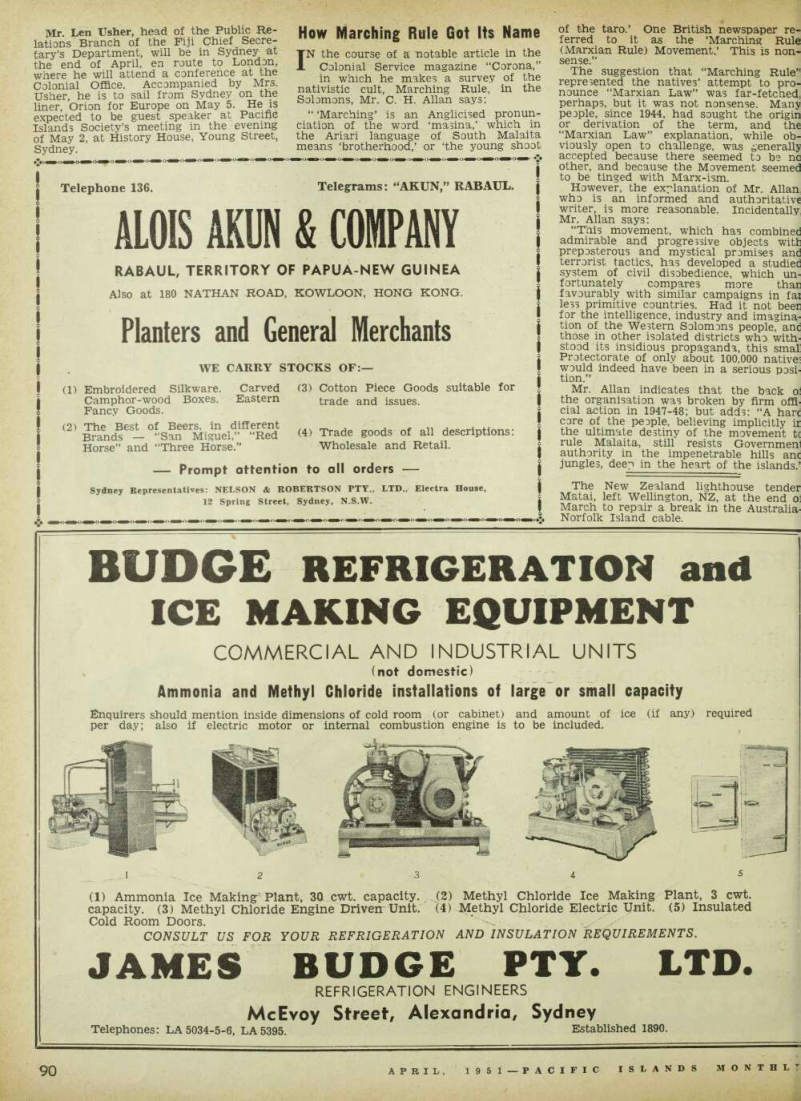
Search for Shell in P-NG Waters
Prom Our Own Correspondent
Port Moresby, April 1.
PRIVATE enterprise is making a bid to build up a pearl shell and trochus fishing industry in Territory waters.
The private operator is Mr. John Nolan who owns a fleet of small ships which have been working in Torres Straits. Two of his vessels, the 70-ft. trawler Crystal Star and the 50-ft. Lochiel arrived at Port Moresby at the end of March and have started a survey along the nearby coast at Samarai.
Mr. Nolan’s intention is to make an extensive survey of potential pearl shell and trochus grounds along the Papuan and New Guinea coasts, and if the result is favourable he will bring other vessels from his Torres Straits fleet to the Territory, He says that good results are being ob tained in the Straits but he feels that there should be excellent possibilities in unworked areas around Papua and New Guinea. If his hopes are realised and the ships can work to full capacity, he is confident that shell exports worth half a million dollars annually can be shipped.
The total output will go to America where he has been guaranteed a fixed price for all consignments during the next 2i years.
This, he says, takes the gambling element out of the enterprise, a factor which with violently fluctuating markets, has periodi cally wrecked the industry.
He is also counting on teaching native communities to develop their local shell grounds, with the idea of their production being sold through village co-operative groups. This output is included in the
estimated half million dollar trade. In addition, he hopes to train natives for work on his ships. There are ten Euro peans and one Thursday Islander manning the two ships already in the Territory, with the proportion varying between each trawler as circumstances demand. One of the divers, Marco Kiniziger, was a member of one of the French Olympic diving teams, and another, W. Tebb, is an ex Royal Navy “frogman.” The latter had many dangerous assignments during the war, including operations in two-man submarines.
Both trawlers are equipped with modern diving gear.
Mr. Len Usher, head of the Public Re lations Branch of the Fiji Chief Secre tary’s Department, will be in Sydney at the end of April, en route to London, where he will attend a conference at the Colonial Office. Accompanied by Mrs.
Usher, he is to sail from Sydney on the liner, Orion for Europe on May 5. He is expected to be guest speaker at Pacific Islands Society’s meeting in the evening of May 2, at History House, Young Street, Sydney.
Advertisements & other items, pp. 91-92 (2 items)
89
pacific islands monthly a p r i l, 195 i
Colyer Watson Pty. Ltd. " “““ Si
EXTRA WHITE
CLOTHES
RECKITTS BLUE in the last rinse ensures that extra whiteness without damaging the fabric.
PENTAL is kind to the most delicate skins and can be used for washing the finest of fabrics. A high quality soap of out
standing value.
I Economical to use.
Pacific Islands Distributors;— THi
ONfS
M fit! to /of>
A G. W. PENNELL PRODUCT
COLYER WATSON PTY. LTD. " “““ SI
Telephone 136. Telegrams: “AKUN,” RABAUL.
ALOIS AKUN & COMPANY
RABAUL, TERRITORY OF PAPUA-NEW GUINEA
Also at 180 NATHAN ROAD. KOWLOON, HONG KONG.
Planters and General Merchants
WE CARRY STOCKS OF:—
(1) Embroidered Silkware. Carved Camphor-wood Boxes. Eastern Fancy Goods. (2) The Best of Beers, in different Brands "San Miguel,” “Red Horse” and “Three Horse.” (3) Cotton Piece Goods suitable for trade and issues. (4) Trade goods of all descriptions: Wholesale and Retail.
Prompt attention to all orders Sydney Representatives; NELSON & ROBERTSON PTY., LTD.. Electra House, 12 Spring Street, Sydney, N.S.W.
How Marching Rule Got Its Name
IN the course of a notable article in the Colonial Service magazine “Corona,” in which he makes a survey of the nativistic cult, Marching Rule, in the Solomons, Mr. C. H. Allan says: “ ‘Marching’ is an Anglicised pronun ciation of the word ‘masina,’ which in the Ariari language of South Malaita means ‘brotherhood,’ or ‘the young shoot
of the taro.’ One British newspaper re ferred to it as the ‘Marching Rule (Marxian Rule) Movement.’ This is non sense.”
The suggestion that “Marching Rule” represented the natives’ attempt to pro nounce “Marxian Law” was far-fetched, perhaps, but it was not nonsense. Many people, since 1944, had sought the origin or derivation of the term, and the “Marxian Law” explanation, while ob viously open to challenge, was generally accepted because there seemed to be nc other, and because the Movement seemed to be tinged with Marx-ism.
However, the explanation of Mr. Allan, who is an informed and authoritative writer, is more reasonable. Incidentally, Mr. Allan says; “This movement, which has combined admirable and progressive objects with preposterous and mystical promises and terrorist tactics, has developed a studied system of civil disobedience, which un fortunately compares more than favourably with similar campaigns in fax less primitive countries. Had it not beer for the intelligence, industry and imagina tion of the Western Solomons people, and those in other isolated districts who with stood its insidious propaganda, this small Protectorate of only about 100,000 native? would indeed have been in a serious posi tion.”
Mr. Allan indicates that the back oi the organisation was broken by firm offi cial action in 1947-48; but adds: “A hare core of the people, believing implicitly ir the ultimate destiny of the movement tc rule Malaita, still resists Governmenl authority in the impenetrable hills anc jungles, deep in the heart of the islands/ The New Zealand lighthouse tender Matai, left Wellington, NZ, at the end o; March to repair a break in the Australia- Norfolk Island cable.
Advertisements & other items, p. 92 (1 item)
Budge Refrigeration And
ICE MAKING EQUIPMENT
COMMERCIAL AND INDUSTRIAL UNITS
(not domestic) Ammonia and Methyl Chloride installations of large or small capacity Enquirers should mention inside dimensions of cold room (or cabinet) and amount of ice (if any) required per day; also if electric motor or internal combustion engine is to be included. a** 8 * I : (1) Ammonia Ice Making Plant, 30 cwt. capacity. (2) Methyl Chloride Ice Making Plant, 3 cwt. capacity. (3) Methyl Chloride Engine DriveirUnit. (4) Methyl Chloride Electric Unit. (5) Insulated Cold Room Doors. .
CONSULT US FOR YOUR REFRIGERATION AND INSULATION REQUIREMENTS.
JAMES BUDGE PTY. LTD.
REFRIGERATION ENGINEERS
McEvoy Street, Alexandria, Sydney
Telephones: LA 5034-5-6, LA 5395. Established 1890.
Copra-Producers’ Plight
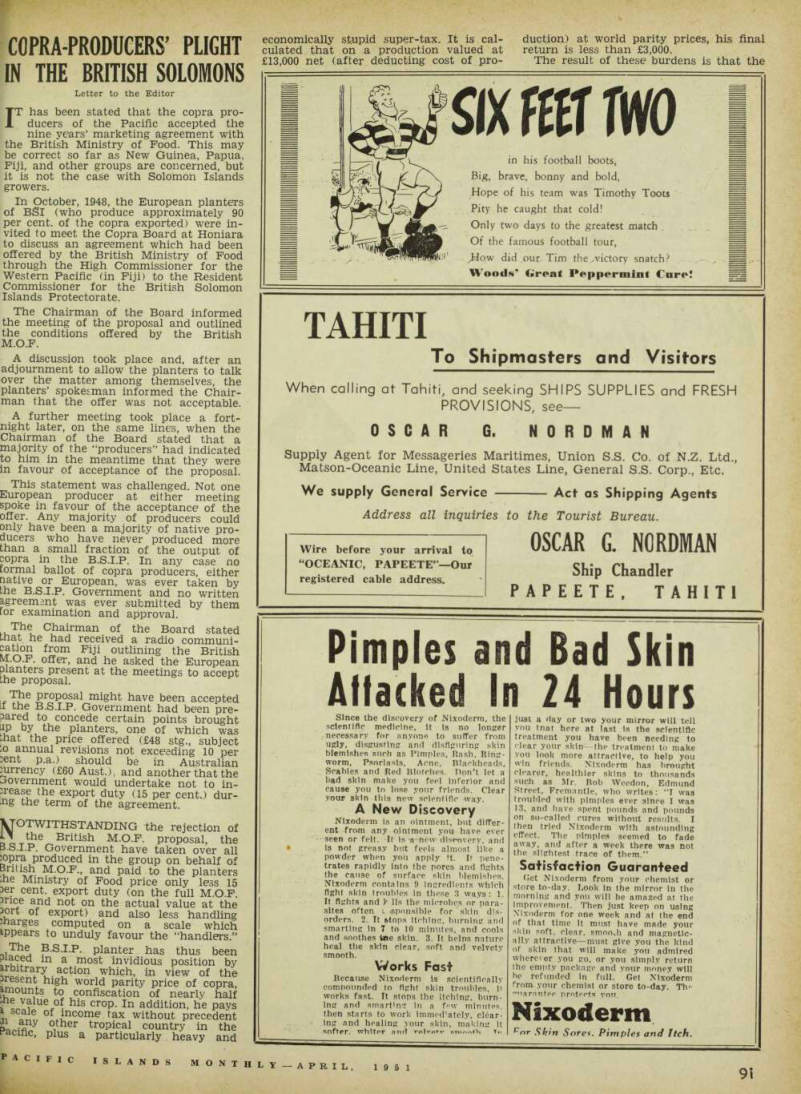
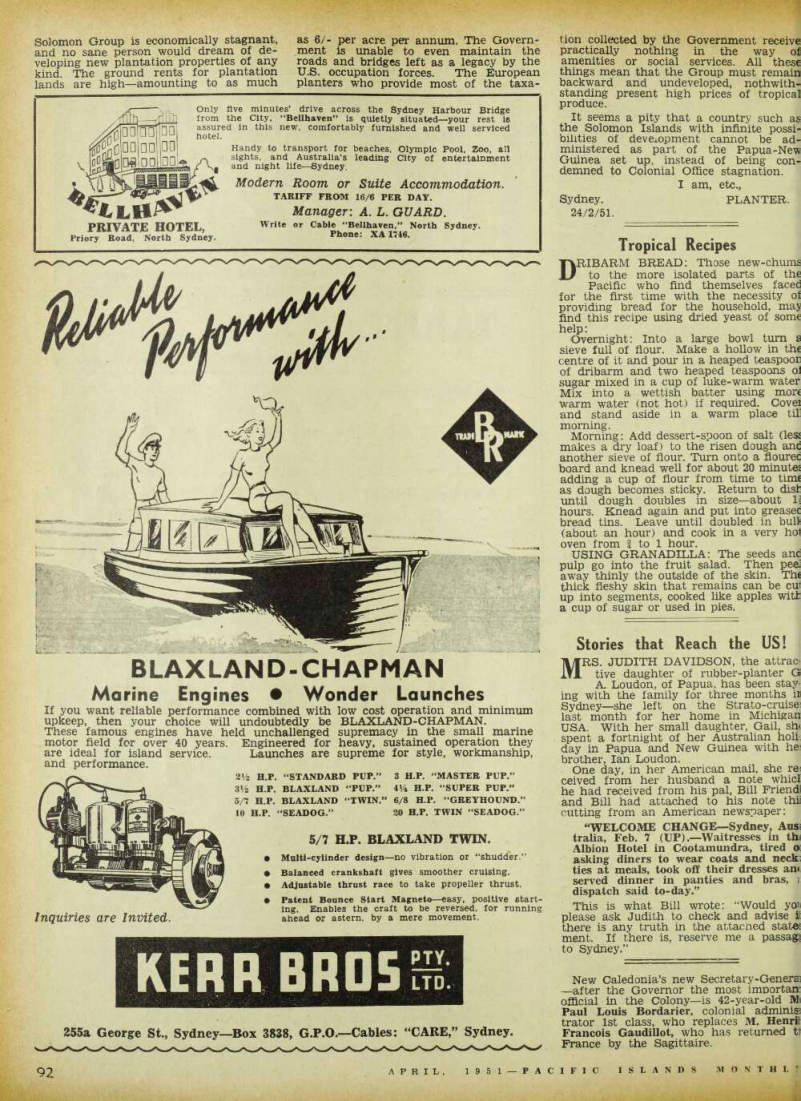
In The British Solomons
Letter to the Editor IT has been stated that the copra pro ducers of the Pacific accepted the nine years’ marketing agreement with the British Ministry of Food. This may be correct so far as New Guinea, Papua, Fiji, and other groups are concerned, but it is not the case with Solomon Islands growers.
In October, 1948, the European planters of BSI (who produce approximately 90 per cent, of the copra exported) were in vited to meet the Copra Board at Honiara to discuss an agreement which had been offered by the British Ministry of Food through the High Commissioner for the Western Pacific (in Fiji) to the Resident Commissioner for the British Solomon Islands Protectorate.
The Chairman of the Board informed the meeting of the proposal and outlined the conditions offered by the British
M.O.F.
A discussion took place and, after an adjournment to allow the planters to talk over the matter among themselves, the planters’ spokesman informed the Chair man that the offer was not acceptable.
A further meeting took place a fort night later, on the same lines, when the Chairman of the Board stated that a majority of the “producers” had indicated to him in the meantime that they were in favour of acceptance of the proposal.
This statement was challenged. Not one European producer at either meeting spoke in favour of the acceptance of the offer. Any majority of producers could only have been a majority of native pro ducers who have never produced more than a small fraction of the output of copra in the 8.5.1. P. In any case no formal ballot of copra producers, either native or European, was ever taken by the 8.5.1. P. Government and no written agreement was ever submitted by them for examination and approval.
Th e Chairman of the Board stated that he had received a radio communi rom Fiji outlining the British Mt.O.F. offer, and he asked the European planters present at the meetings to accept
the proposal.
The proposal might have been accepted if the 8.5.1. P. Government had been pre pared to concede certain points brought |ip by the planters, one of which was "hat the price offered (£4B stg., subject to annual revisions not exceeding 10 per cent p.a.) should be in Australian currency (£6O Aust.). and another that the government would undertake not to in crease the export duty (15 per cent.) dur ng the term of the agreement.
VTOTWITHSTANDING the rejection of 16 British M.O.F. proposal, the 8.5.1. P. Government have taken over all ;opra produced in the group on behalf of British M.0.F., and paid to the planters .he Ministry of Food price only less 15 Der cent, export duty (on the full M.O.F. and not on the actual value at the 3ort of export) and also less handling charges computed on a scale which appears to unduly favour the “handlers.”
BSI - P - planter has thus been placed in a most invidious position by arbitrary aetion which, in view of the present high world parity price of copra, amounts to confiscation of nearly half rL V r Ue f crop. In addition, he pays i scale of income tax without precedent °, ther tropical country in the racmc, plus a particularly heavy and
economically stupid super-tax. It is calculated that on a production valued at £13,000 net (after deducting cost of pro-
duction) at world parity prices, his final return is less than £3,000.
The result of these burdens is that the
Solomon Group is economically stagnant, and no sane person would dream of developing new plantation properties of any kind. The ground rents for plantation lands are high—amounting to as much
as 6/- per acre per annum. The Govern ment is unable to even maintain the roads and bridges left as a legacy by the U.S. occupation forces. The European planters who provide most of the taxa
tion collected by the Government receive practically nothing in the way ofl amenities or social services. All these things mean that the Group must remain backward and undeveloped, notwith standing present high prices of tropical produce.
It seems a pity that a country such as the Solomon Islands with infinite possi bilities of development cannot be ad ministered as part of the Papua-New, Guinea set up, instead of being con demned to Colonial Office stagnation.
I am, etc.,
Planter.
Sydney. 24/2/51.
Advertisements & other items, pp. 93-94 (2 items)
91
PACIFIC ISLANDS MONXU L y - A PRIL, 1961
Six Feet Two
£
in his football boots, Big, brave, bonny and bold, Hope of his team was Timothy Toots Pity he caught that cold!
Only two days to the greatest match .
Of the famous football tour, /How did our Tim the .-victory snatch?
Woods" Groat Poppormint Caro!
TAHITI
To Shipmasters and Visitors
When calling at Tahiti, and seeking SHIPS SUPPLIES and FRESH
PROVISIONS, see—
OSCAR G. NORDMAN
Supply Agent for Messageries Maritimes, Union S.S. Co. of N.Z. Ltd., Matson-Oceanic Line, United States Line, General S.S. Corp., Etc.
We supply General Service Act as Shipping Agents Address all inquiries to the Tourist Bureau.
Wire before your arrival to
“OCEANIC, PAPEETE”—Our
registered cable address.
OSCAR G. NORDMAN
Ship Chandler
PAPEETE. TAHITI
Pimples and Bad Skin Attacked In 24 Hours
Since the discovery of Nixoderm, the scientific medicine, It Is no longer necessary for anyone to suffer from ugly, disgusting and disfiguring skin blemishes such as Pimples, Rash, Ringworm, Psoriasis, Acne, Blackheads, Scabies and Red Blotches. Don't let a bad skin make you feel inferior and cause you to lose your friends. Clear your skin this new scientific way.
A New Discovery
Nixoderm is an ointment, but different from any ointment you have ever seen or felt. It is-a new discovery, and is not greasy but feels almost like a powder when you apply it. It penetrates rapidly into the pores and fights the cause of surface skin blemishes.
Nixoderm contains 9 ingredients which fight skin troubles in these 3 ways: 1.
It fights and k 11s the microbes or parasites often v /sponsible for skin disorders. 2. It stops itching, burning and smarting in 7 to 10 minutes, and cools and soothes tae skin. 3. It helps nature heal the skin clear, soft and velvety smooth.
Works Fast
Because Nixoderm is scientifically compounded to fight skin troubles, it works fast. It stops the itching, burning and smarting in a few minutes, then starts to work immed’ately, clearing and healing your skin, making it softer, whiter and relvptv T n j
just a flay or two your mirror will tell vnu tnat here at last Is the scientific treatment you have been needing to clear your skin—the treatment to make you look more attractive, to help you win friends. Nixoderm has brought clearer, healthier skins to thousands such as Mr. Rob Weedon, Edmund Street, Fremantle, who writes: “I was troubled with pimples ever since I was 13, and have spent pounds and pounds on so-called cures without results. I then tried Nixoderm with astounding effect. The pimples seemed to fade away, and after a week there was not the slightest trace of them.”
Satisfaction Guaranteed
Get Nixoderm from your chemist or store to-day. Look in the mirror in the morning and you will be amazed at the improvement. Then just keep on using Nixoderm for one week and at the end of that time It must have made your skin soft, clear, smooth and magnetically attractive-must give you the kind of skin that will make you admired wherever you go, or you simply return the empty package and your money will he refunded in full. Get Nixoderm from your chemist or store to-day. rr uarantee protects you.
Nixoderm
v or Skin Sores. Pimples and Itch.
in □o 33 □0
PRIVATE HOTEL,
Priory Boad, North Sydney.
Only five minutes’ drive across the Sydney Harbour Bridge from the City, “Bellhaven” is quietly situated—your rest is assured in this new, comfortably furnished and well serviced hotel.
Handy to transport for beaches, Olympic Pool, Zoo, all sights, and Australia’s leading City of entertainment and night life—Sydney.
Modern Room or Suite Accommodation.
TARIFF FROM 16/6 PER DAY.
Manager : A. L. GUARD.
Write or Cable “Bellhaven,” North Sydney.
Phone: XA 1746.
„■ - ' _. . J'Ai'? . .„. ...
' v - «' v*.XC '' 4 Ifv" • rr 'C&s: v;:xg:::xx /xv- . : : H' ■;': /vX'X ■ ,■■ ■ :X»%
BLAXLAND-CHAPMAN
Marine Engines • Wonder Launches
If you want reliable performance combined with low cost operation and minimum upkeep, then your choice will undoubtedly be BLAXLAND-CHAPMAN.
These famous engines have held unchallenged supremacy in the small marine motor field for over 40 years. Engineered for heavy, sustained operation they are ideal for island service. Launches are supreme for style, workmanship,
and performance.
Inquiries are Invited.
Wi H.P. “STANDARD PUP.” 3 H.P. “MASTER PUP.” 3Vz H.P. BLAXLAND “PUP.” 4V 4 H.P. “SUPER PUP.” 5/7 H.P. BLAXLAND “TWIN.” 6/8 H.P. “GREYHOUND.” 10 H.P. “SEADOG.” 20 H.P. TWIN “SEADOG.”
5/7 H.P. BLAXLAND TWIN.
• Multi-cylinder design—no vibration or “shudder.” • Balanced crankshaft gives smoother cruising. • Adjustable thrust race to take propeller thrust. • Patent Bounce Start Magneto—easy, positive starting. Enables the craft to be reversed, for running ahead or astern, by a mere movement.
Pit
KERR BROS
LTD.
255 a George St., Sydney—Box 3838, G.P.O.—Cables: “CARE,” Sydney.
Tropical Recipes
DRIBARM BREAD; Those new-chums to the more isolated parts of the Pacific who find themselves faced for the first time with the necessity ofi providing bread for the household, may find this recipe using dried yeast of some help: Overnight: Into a large bowl turn a sieve full of flour. Make a hollow in the centre of it and pour in a heaped teaspoon of dribarm and two heaped teaspoons ol sugar mixed in a cup of luke-warm water 1 Mix into a wettish batter using more warm water (not hot) if required. Covei and stand aside in a warm place till morning.
Morning: Add dessert-spoon of salt (less makes a dry loaf) to the risen dough and another sieve of flour. Turn onto a floured board and knead well for about 20 minutes adding a cup of flour from time to time as dough becomes sticky. Return to disk until dough doubles in size—about li hours. Knead again and put into greased bread tins. Leave until doubled in bulb (about an hour) and cook in a very hot oven from i to 1 hour.
USING GRANADILLA: The seeds and pulp go into the fruit salad. Then peel away thinly the outside of the skin. The thick fleshy skin that remains can be cut up into segments, cooked like apples with a cup of sugar or used in pies.
Stories that Reach the US!
MRS. JUDITH DAVIDSON, the attrac tive daughter of rubber-planter Gf A. Loudon, of Papua, has been stay ing with the family for three months in Sydney—she left on the Strato-cruise; last month for her home in Michigan USA. With her small daughter, Gail, stu spent a fortnight of her Australian holi. day in Papua and New Guinea with he; brother, lan Loudon.
One day, in her American mail, she re; ceived from her husband a note whicl he had received from his pal, Bill Friendf and Bill had attached to his note thii cutting from an American newspaper: “WELCOME CHANGE—Sydney, Ause tralia, Feb. 7 (UP).—Waitresses in thi Albion Hotel in Cootamundra, tired oc asking diners to wear coats and neck: ties at meals, took off their dresses am served dinner in panties and bras, i dispatch said to-day.”
This is what Bill wrote: “Would you please ask Judith to check and advise ii there is any truth in the attached states ment. If there is, reserve me a passag? to Sydney.”
New Caledonia’s new Secretary-General —after the Governor the most important official in the Colony—is 42-year-old IVb Paul Louis Bordarier, colonial adminis trator Ist class, who replaces M. Henrir Francois Gaudillot, who has returned tt France by the Sagittaire.
Advertisements & other items, p. 94 (1 item)
92
APRIL, 1951 PACIFIC ISLANDS M O N T H L T
Sydney-N. Caledonia-
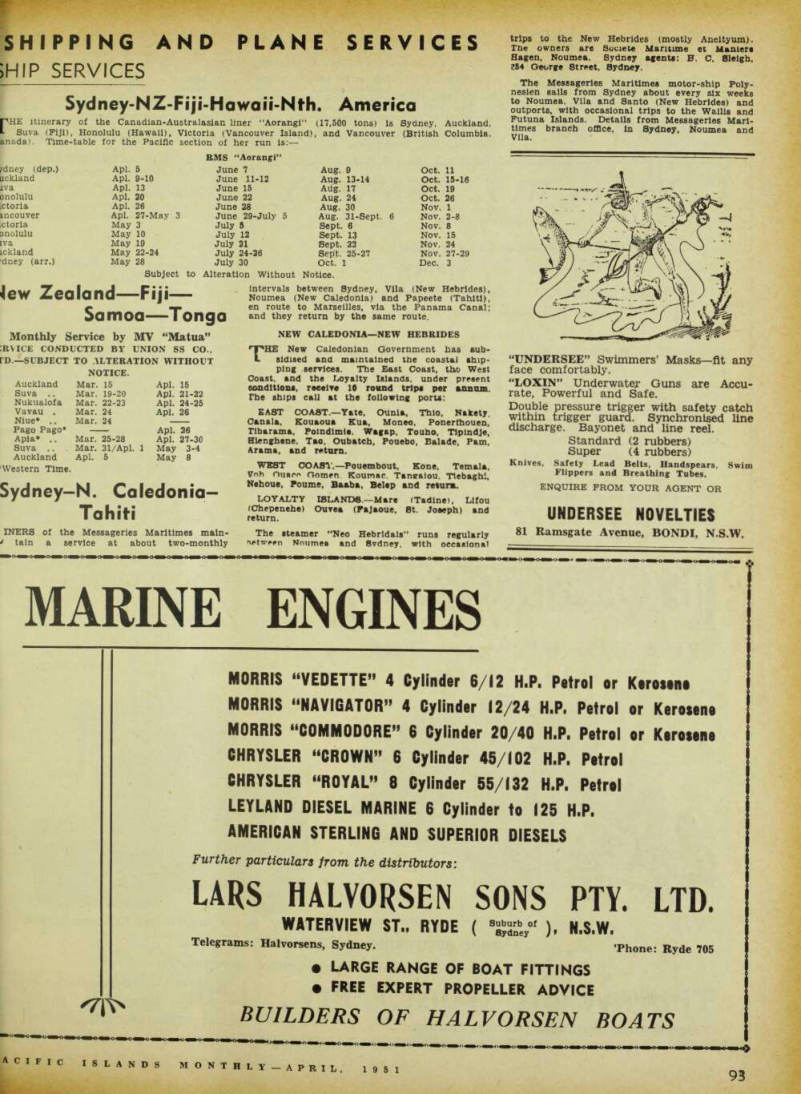
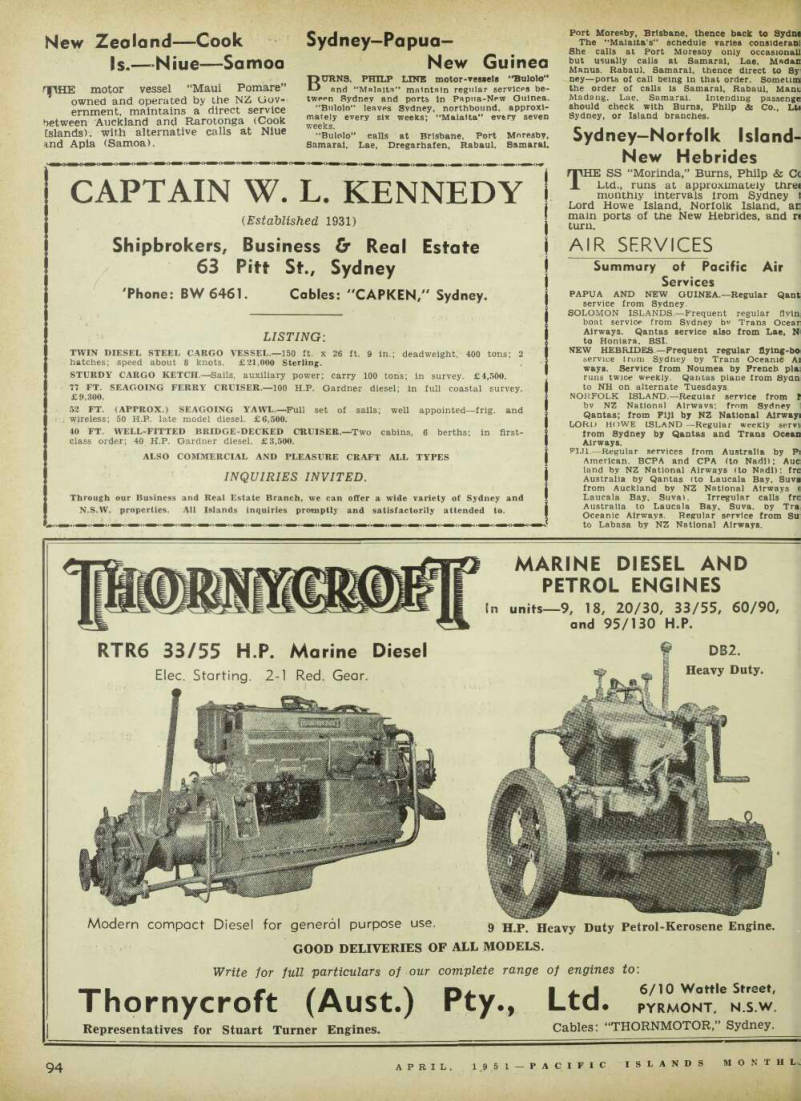
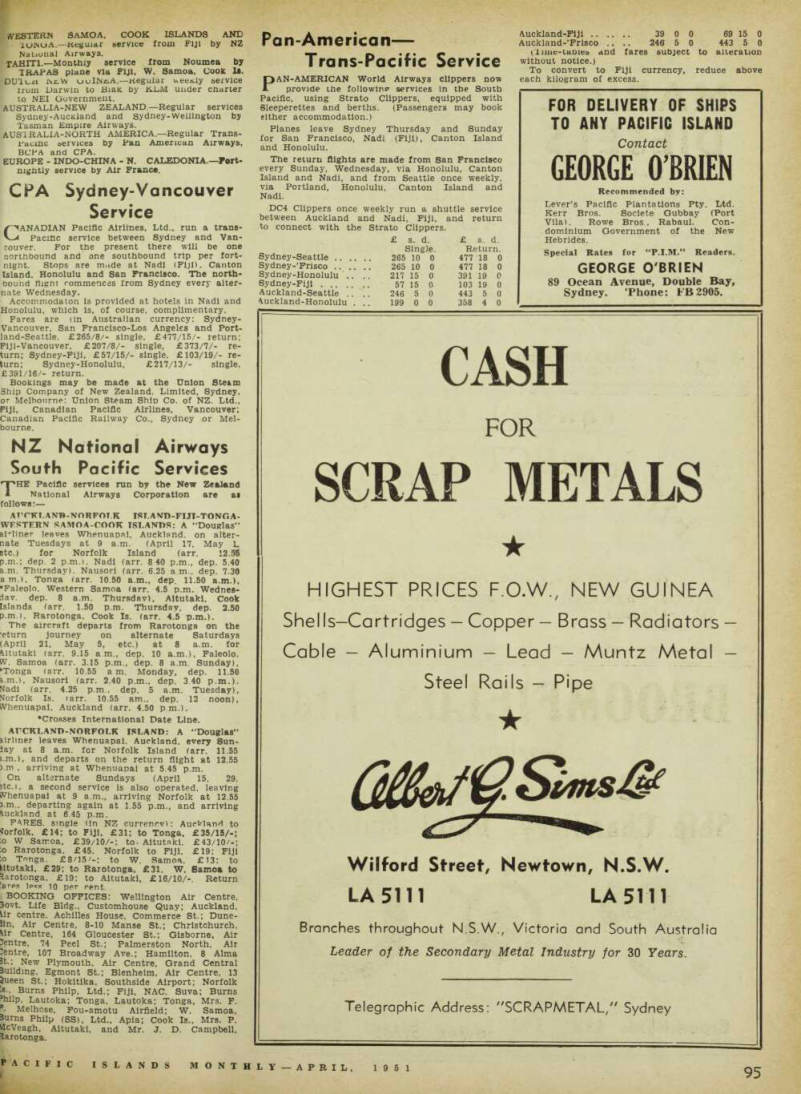
Shipping And Plane Services
Ship Services
Sydney-NZ-Fiji-Hawaii-Nth. America
rHE itinerary of the Canadian-Australasian liner “Aorangl” (17.500 tons) is Sydney, Auckland.
Suva (Fiji), Honolulu (Hawaii), Victoria (Vancouver Island), and Vancouver (British Columbia, anada). Time-table for the Pacific section of her run is:—
Jew Zealand—Fiji—
Samoa—Tonga
Monthly Service by MV “Matua”
:rvice conducted by union ss co. (
Ro.—Subject To Alteration Without
Notice.
Auckland Mar. 15 Apl. 15 Suva .. Mar. 19-20 Apl. 21-22 Nukualofa Mar. 22-23 Apl. 24-25 Vavau . Mar. 24 Apl. 26 Niue* .. Mar. 24 Pago Pago* Apl. 26 Apia* .. Mar. 25-28 Apl. 27-30 Suva .. Mar. 31/Apl. 1 May 3-4 Auckland Apl. 5 May 8 Western Time.
Sydney-N. Caledonia-
Tahiti
INEHS of the Messageries Maritimes maln ' tain a service at about two-monthly
Intervals between Sydney, Vila (New Hebrides), Noumea (New Caledonia) and Papeete (Tahiti), en route to Marseilles, via the Panama Canal; and they return by the same route.
New Caledonia—New Hebrides
r T*HE New Caledonian Government has sub- L sldised and maintained the coastal ship ping services. The East Coast, tho West Coast, and the Loyalty Islands, under present conditions, receive 10 round trips per annum The ships call at the following ports: EAST COAST.—Yate, Ounla, Thlo. Nakety.
Canala, Kouaoua Kua, Moneo, Ponerthouen, Tibarama, Poindimle. Wagap. Touho, Tlplndje, Hlenghene. Tao, Oubatch, Pouebo, Balade, Pam.
Arama, and return.
WEST COAST.—Pouembout, Kone, Temala, Vfth Guam Oomen Koumac, Tanealou. Tlebaghi, Nehoue, Poume. Baaba, Belep and return.
LOYALTY ISLANDS.—Mare (Tadlne), Llfou (Chepenehe) Ouvea (Pajaoue, St. Joseph) and return.
The steamer “Neo Hebrldals” runs regularly between Noumea and Svdney. with occasional
trips to the New Hebrides (mostly Aneityum).
Tne owners are Societe Maritime et Maniere Hagen. Noumea. Sydney agents: F, O. Sleigh, 264 George Street. Sydney.
The Messagerles Marltlmes motor-ship Poly nesian sails from Sydney about every six weeks to Noumea. Vila and Santo (New Hebrides) and outports, with occasional trips to the Wallis and Futuna Islands. Details from Messagerles Marl times branch office, in Sydney, Noumea and Vila.
rdney (dep.) Apl. 5 RMS “Aorangi”
June 7 Aug. 9 Oct. 11 uckland Apl. 9-10 June 11-12 Aug. 13-14 Oct. 15-16 iva Apl. 13 June 15
Aiig. 17
Oct. 19 onolulu Apl. 20 June 22 Aug. 24 Oct. 26 Ictoria Apl. 26 June 28 Aug. 30 Nov. 1 incouver Apl. 27-May 3 June 29-July 5 Aug. 31-Sept. 6 Nov. 2-8 ctorla May 3 July 5 Sept. 6 Nov. 8 onolulu May 10 July 12 Sept. 13 Nov. 15 iva May 19 July 21 Sept. 22 Nov. 24 ickland May 22-24 July 24-26 Sept. 25-27 Nov. 27-29 'dney (arr.) May 28 July 30 Oct. 1 Dec. 3 Subject to Alteration Without Notice.
New Zeoland —Cook
Is.—-Niue —Samoa
r|iHE motor vessel “Maui Pomare” owned and operated by the NZ Gov ernment, maintains a direct service between Auckland and Rarotonga (Cook Cslands). with alternative calls at Niue and Apia (Samoa).
Sydney-Papua-
New Guinea
BURNS. PHILP LINE motor-vesaels **Bulolo” and "Mnlaita” maintain regular services be tween Sydney and ports In Papna-New Guinea.
"Bulolo” leaves Svdney. northbound, approxi mately every six weeks; “Malalta” every seven weeks. ••Bulolo” calls at Brisbane. Port Moresby, Samaral, Lae, Dregarhafen, Rabaul, Samaral,
Port Moresby, Brisbane, thence back to Sydne The "Malalta’s” schedule varies considerable She calls at Port Moresby only occasional! but usually calls at Samaral, Lae. M«dan Manus. Eabaul, Samaral, thence direct to Sy ney—ports of call being In that order. Sometim the order of calls Is Samaral, Rabaul, Manu Madang. Lae, Samaral. Intending passenge should check with Burns, Phllp & Co., Lt« Sydney, or Island branches.
Sydney-Nortolk Island-
New Hebrides
THE SS “Morinda,” Burns, Philp & Cc Ltd., runs at approximately three monthly intervals Irom Sydney t Lord Howe Island, Norfolk Island, an main ports of the New Hebrides, and re turn.
Air Services
Summary of Pacific Air
Services
PAPUA AND NEW GUlNEA.—Regular Qant; service from Sydney.
SOLOMON ISLANDS.—Frequent regular flylnj boat service from Sydney bv Trans Ocearr Airways. Qantas service also from Lae, N to Honiara. BSI.
NEW HEBRIDES —Frequent regular flylng-bd service Irum Sydney by Trans Oceanic Ai ways. Service from Noumea by French plai runs twice weekly. Qantas plane from Sydni to NH on alternate Tuesdays NORFOLK ISLAND. —Regular service from II bv NZ National Alrwavs: from Sydney I Qantas; from Fiji by NZ National Alrwayt LORD HOWE ISLAND —Regular weeKly servii from Sydney by Qantas and Trans Ocean Airways.
FlJl—Regular services from Australia by Pi American. BCPA and CPA (to Nadi); Auc: land by NZ National Airways (to Nadi): frc Australia by Qantas (to Laucala Bay, Suva from Auckland by NZ National Airways <i Laucala Bay, Suva). Irregular calls frc Australia to Laucala Bay, Suva, by Tra; Oceanic Airways. Regular service from Su; to Labasa by NZ National Airways.
western Samoa, cook islands and IUNUA. —Regular service from Fiji by NZ National Airways.
TAHlTl.— Monthly service from Noumea by TRAPAS plane via FIJI, W. Samoa, Cook I*.
DUloxi Nr-Vv (julNhiA.—Regular vveealy service irom Darwin to Biak by KLM under charter to NEI Government.
AUSTRALIA-NEW ZEALAND. —Regular services Sydney-Aucaland and Sydney-Wellington by Tasman Empire Airways.
AUSIRALIA-NORTH AMERICA.—Regular Trans pacific services by Pan American Airways,
Bcpa And Cpa.
Europe - Indo-China -N. Caledonla.—Fort
nightly service by Air Franco.
CPA Sydney-Vancouver
Service
CANADIAN Pacific Airlines, Ltd., run a trans pacific service between Sydney and Van couver. For the present there will be one northbound and one southbound trip per fort night. Stops are mode at Nadi (Fiji), Canton Island. Honolulu and San Francisco. The north bound flight commences from Sydney every alter nate Wednesday.
Accommodaton is provided at hotels in Nadi and Honolulu, which Is, of course, complimentary.
Fares are tin Australian currency: Sydney- Vancouver, San Franclsco-Los Angeles and Port land-Seattle. £265/8/- single, £477/15/- return; Plji-Vancouver, £207/8/- single, £373/7/- re turn; Sydney-Fijl, £57/15/- single, £lO3/19/- re turn; Sydney-Honolulu, £217/13/- single, £391/16/- return.
Bookings may be made at the Union Steim Ship Company of New Zealand. Limited, Sydney, or Melbourne: Union Steam Ship Co. of NZ. Ltd., Fiji, Canadian Pacific Airlines, Vancouver; Canadian Pacific Railway Co., Sydney or Mel bourne.
NZ National Airways
South Pacific Services
THE Pacific services run by the New Zealand National Airways Corporation are ai follows:
Afurlanr-Norfolk Island-Fijt-Tonga
Western Samoa-Cook Islands: A "Douglas”
airliner leaves Whenuapal, Auckland, on alter nate Tuesdays at 9 a.m. (April 17, May L etc.) for Norfolk Island (arr. 12.5 S p.m.; dep. 2 p.m.). Nadi (arr. 8 40 p.m., dep. 5.40 a.m. Thursday). Nausorl (arr. 6.25 a m., dep. 7.30 am.l, Tonga (arr. 10.50 a.m., dep. 11.50 a.m.), •Faleolo. Western Samoa (arr. 4.5 p.m. Wednes day. dep. 8 a.m. Thursday), Altutakl. Cook islands (arr. 1.50 p.m. Thursday, dep. 2.50 p.m ). Rarotonga. Cook Is. (arr. 4.5 p.m.).
The aircraft departs from Rarotonga on the •eturn journey on alternate Saturdays (April 21, May 5, etc.) at 8 a.m. for Mtutaki (arr. 9.15 am., dep. 10 a.m.), Faleolo, W. Samoa (arr. 3.15 p.m., dep. 8 a.m. Sunday). ‘Tonga (arr. 10.55 am. Monday, dep. 11.56 i.m.), Nausorl (arr. 2.40 p.m., dep. 3,40 p.m.).
Nadi (arr. 4.25 p.m,. dep. 5 a.m. Tuesday), Norfolk Is. (arr. 10.55 am., dep. 12 noon), SVhenuapai. Auckland (arr. 4.50 pm.). •Crosses International Date Line.
Auckland-Norfolk Island: A “Douglas”
airliner leaves Whenuapal. Auckland, every Sun lay at 8 a.m. for Norfolk Island (arr. 11.55 i.m.), and departs on the return flight at 12.55 ).m . arriving at Whenuapal at 5.45 p.m.
On alternate Sundays (April 15, 29.
Jtc.i, a second service is also operated, leaving Whenuapal at 9 a.m., arriving Norfolk at 12.55 J.m.. departing again at 1.55 p.m., and arriving Auckland at 6.45 p.m.
FARES, single (In NZ currency): Auckland to Norfolk. £l4; to Fiji, £3l; to Tonga, £35/15/-; •o W Samoa. £39/10/-; to- Altutakl. £43/10/-; ;o Rarotonga. £45. Norfolk to Fiji. £l9: Fiji ;o Tonga. £B/15/-; to W. Samoa. £l3: to ilt'Jtakl. £29; to Rarotonga. £3l. W. Samoa to Sarotonga. £l9; to Altutakl, £l6/10/-, Return fares less 10 per cent.
BOOKING OFFICES: Wellington Air Centre, 3ovt. Life Bldg., Customhouse Quay; Auckland, Ur centre. Achilles House. Commerce St.; Dune lln, Air Centre, 8-10 Manse St.; Christchurch, Ur Centre, 164 Gloucester St.; Gisborne, Air Centre, 74 Peel St.; Palmerston North, Air Centre, 107 Broadway Ave.; Hamilton, 8 Alma 3t.; New Plymouth. Air Centre, Grand Central 3uildmg, Egmont St.; Blenheim, Air Centre, 13 Jueen St.; Hokitika. Southside Airport; Norfolk fs., Burns Philp, Ltd.; Fiji, NAC. Suva; Burns *hllp, Lautoka; Tonga, Lautoka; Tonga, Mrs. F.
Melhose, Fou-amotu Airfield; W. Samoa, Burns Philp (SS), Ltd., Apia; Cook Is., Mrs. P.
HcVeagh. Aitutaki, and Mr. J. D. Campbell.
Rarotonga.
Pan-American—
Trans-Pacific Service
PAN-AMERICAN World Airways clippers now provide the following services In the South Pacific, using Strato Clippers, equipped with Sleeperettes and berths. (Passengers may book either accommodation.) Planes leave Sydney Thursday and Sunday for San Francisco, Nadi (Fiji), Canton Island and Honolulu.
The return flights are made from San Francisco every Sunday, Wednesday, via Honolulu, Canton Island and Nadi, and from Seattle once weekly, via Portland, Honolulu, Canton Island and Nadi.
DC4 Clippers once weekly run a shuttle service between Auckland and Nadi, Fiji, and return to connect with the Strato Clippers.
£ s. d. £ s. d.
Single. Return.
Sydney-Seattle 265 10 0 477 18 0 Sydney-’Prisco 265 10 0 477 18 0 Sydney-Honolulu ... 217 15 0 391 19 0 Sydney-Fljl 57 15 0 103 19 0 Auckland-Seattle ... 246 5 0 443 5 0 Auckland-Honolulu ... 199 0 0 358 4 0
Auckland-Piji 39 0 0 69 15 0 Auckland-’Prisco .. .. 246 5 0 443 5 0 t'liiue-iaDies and fares subject to alteration without notice.) To convert to Fiji currency, reduce above each kilogram of excess.
Free baggage allowance is 30 kilos per person.
Excess baggange charged at 1 per cent, of single fare; per kilo up to 10 kilos; Va per cent, for every kilo over 10 kilos.
Fronce-IndoChina-
Aust.-N. Caledonia
THE French national airways, Air France, runs a monthly service between Paris and New Caledonia, and return. Stops are made at Damascus, Karachi. Calcutta, Saigon, Batavia.
Darwin, Brisbane.
DC4 Skymasters are used in the service bet ween Saigon and New Caledonia, Lockheed Constellations between Saigon-Paris, and Mes sageries Maritimes are agents in Australia.
Fare between Brisbane and Tontouta (Noumea) are £3O/12/6 single, £55/2/6 return, Sydney- Toutouta, £37/10/- single, £67/10/- return. (Note: After some disruption this servee is now back on regular 28-days scchedule.)
TEAL Flying-Boat Service
NZ-Chatham Islands
TASMAN Empire Airways, Ltd., operate a Solent Flying-boat service from Auckland-Welling ton to the- Chatham Islands and return, at monthly intervals.
Flying-boats leave Auckland at 4.15 a.m., arrive Wellington 6 a.m., depart for Waikato Bay. Chat ham Islands, at 7 a.m. and arrive at 10.30 a.m.
The flying-boat leaves the Islands the same after noon at 2.30. arrives Wellington at 6.30 p.m. and Auckland at 0 p.m.
Pares are. from Auckland. £l6/10/- single; £33 return; and from Wellington. £ll single: and £22 return.
Trans Tasman Services
Sydney—Wellington
TASMAN Empire Airways, Ltd., operate regular flying-boat service between Sydne and Wellington with Solent flying-boats.
Services depart Sydney at 10.30 p.m. on Mon day, Wednesday, Thursday. Sunday: and depai Wellington at 11 a.m. on Monday, Wednesda; Thursday and Saturday.
The fares are: £A3S. £NZ2B single; £ A 6: CNZSO/8/- return.
Sydney-Norfolk Is.
Qantas run a DC4 Skymaster alt. Thursday ’•eturniner same day> from Sydney to Norfol Island. Fare, £25 single; £45 return. (For Norfolk Island, see also under N National Airways.)
Sydney—New Hebrides
QANTAS operate a service to the New Hebrlde with Sandringham flying-boats calling a Noumea. Port Vila and Espiritu Santo. Frequer non-scheduled flights are made, subject to th approval of the Governments concerned.
Syd ney-N ou meo—Suvo
I - 'HE following is the time-table of the Qanta Sandringham flying-boat;— Sydney dep. 9.30 p.m. alt. Tues.
Noumea arr. 6.30 a.m. alt. Wed.
Noumea dep. 8.00 a.m. alt. Wed.
Suva arr. 2.30 p.m. alt. Wed.
Suva dep. 6 a.m. alt. Fri.
Noumea arr. 10.30 a.m. alt. Fri.
Noumea dep. 12 noon alt. Fri.
Sydney arr. 7.15 p.m. alt. Fri.
Intending passengers may book throug Qantas offices in Australia. Burns Philp (Sout Sea) Company, in Suva; and J. Brock, 1 Noumea.
The fares for this service in Aust. curreno are:
Trans-Tasman Service
Sydney—Auckland
TASMAN Empire Airways, Ltd., operate flying-boat service between Rose Ba; Sydney, and Mechanics Bay, Auckland, with fleet of four new Solent flying-boats each witl a capacity for 45 passengers, in seven sell contained cabins on two decks. Pull fresh-cooke meals are served en route. Average crossim time is 6(4 hours. Depart Sydney 11.59 p.nr on Tuesdays, Fridays. Saturdays, and at 8 a.n on Tuesdays and Fridays. They depart froi Auckland at 9 p.m. daily except Tuesday ait Sunday and arrive Sydney at 2.15 p.m.
Fares; £35 (A), £2B (NZ), single; £63 (A; £5O/8/- (NZ), return.
Passenger reservations may be made in Am tralia at any office or agency of Qantas Empir Airways (General Agents), offices of TAA and a; leading travel agents. In New Zealand boco through TEAL (Auckland and Wellington) or am leading travel agents.
Sydney—Queensland—
New Guinec
Q.E.A. Ltd. operate regular services betwee?
Sydney and Port Moresby. Lae, Madanp Rabaul, Bulolo and Wau via Brisbane, RocW hampton, Townsville and Cairns.
This Service is known as the “Bird of Panr, disc” Service and DC4 Skymaster and DC3 All. craft are used. The Skymaster aircraft leav Sydney every Tuesday and Saturday at 9 p.m and. making a night flight calling at Brisban only, arrive at Port Moresgy the following morn ing at 8.05 a.m.
The Skymaster arriving on the Wednesday connects with a DC3 from Port Moresby t Bulolo and Wau via Lae the same day, whi!i the Skymaster arriving at Port Moresby ,0 Sunday connects with two DC3s from Po;< Moresby, one flying direct to Rabaul on the sairr day and the other flying to Lae.
A DC3 aircraft leaves Madang on Tuesday at 3.45 p.m., nightstops at Lae and departs Lc,
a Single. Return Sydney-Noumea ... £37 10 0 £67 10 Sydney-Suva 55 10 0 99 18 Noumea-Suva 20 5 0 36 9
'at 7.10 a.m. on Wednesday to connect with the Skymaster leaving Port Moresby at 10.30 a.m. * for Sydney via Brisbane, arriving Sydney at ' io p m.
Two DC3 aircraft, leav* 3 Lae at 7.10 a m on Sunday to connect with the Skymaster leaving Port Moresby at 10.30 a.m. for Sydney via Bris bane, arriving Sydney at 10 p.m. the same day.
Drts leave Sydney at 8.15 a.m. on Monday, Friday, calling at Brisbane, Rock hampton and nightstopping at Townsville.
The following morning they depart Townsville at 5.20 a.m., calling at Cairns and Cooktown and arriving at Port Moresby at 11.10 a.m. and Lae at 1 p.m. The aircraft which arrives at Lae on Tuesdays extends to Madang the same afternoon.
Return flights leave Lae at 5.45 on Mondays and Thursday i, departing Port Moresby at 7.35 a.m. and proceeding to Sydney the same day, via Cairns, Townsville and Brisbane (with an op tional call at Rockhampton), arriving Sydney at 10.15 p.m.
The service leaving Lae on Thursdays, also connects with a DC3 leaving Wau the previous afternoon at 3.30 p.m.
Every Monday a DC3 leaves Rabaul at 7 a.m. for Port Moresby departing Fort Moresby at 10.50 a.m. for Cairns and Townsville. The following morning it departs Townsville at 8.15 a.m. calling at Rockhampton and Brisbane and arriving Syd ney at 5 p.m.
Qantas Subsidiary Services In
Papua-New Guinea-Solomons
Qantas Empire Airways run the following sub sidiary services in Papua, New Guinea, and British Solomons:— A Douglas DC3 leaves Lae. New Guinea, every Saturday, and flies to Rabaul, and Kavieng. and returns to Lae; but every alternate Satur day the plane goes on from Kavieng to Manus, and returns via Kavieng to Rabaul (overnight) and returns to Lae on the Sunday morning.
In addition a DC3 leaves Lae every Friday morning at 6 a.m. and flies direct to Manus Island arriving at 8.20 a.m. This aircraft re turns to Lae the following day departing Manus at 3.40 p.m. and arriving Lae at 6 p.m.
Every Wednesday a plane flies from Lae to Madang. and after arrival at Madang operates
where and when required. This service is primarily for the carriage of native labourers and Europeans travelling on this service are always advised of the fact.
Every alternate Wednesday a Qantas Catalina files from Port Moresby, westward to Daru, via Yule Island, Kerema, Wana. Kikori, Lake Kutubu and Lake Murray, returning to Port Moresby, via Kikori and Kerema the same day.
Every alternate Monday, a Qantas Catalina flies from Port Moresby eastward (dep. 10 a.m.) and calls at Abau and Samarai before flying out to the Archipelagoes in the afternoon. Calls are made at Esa’ala and Losuia (where an over night stop is made), and the following day (alternate Tuesday) at Deboyne Lagoon, before returning to Port Moresby, via Samarai and Abau.
Every alternate Monday, a Qantas Catalina leaves Port Moresby for Rabaul, via Abau, Samarai, Esa’ala and Losuia (New Britain); next morning (Tuesday) it flies to Queen Carola Harbour, Buka. Kieta. Buin (Bougainville) and returns to Rabaul with an optional stop at Inus, next morning (Wednesday) it flies to Talasea, Moewe Harbour and Jacquinot Bay. and returns to Rabaul (with an optional stop at Lindenhafen) and next morning (Thursdayi it returns from Rabaul, via Losuia. Esa’aia, Samarai, and Abau. to Port Moresby.
Every alternate Monday a Qantas Douglas flies from Lae to Rabaul via Flnschhafen and continues on to Honiara (British Solomon Islands), via Torokina. Vella.avella and Yandina remains over night at Honiara; and returns to Lae the 10l lowing day Tuesday), over the same route.
Every Tuesday and Friday a plane leaves Pori Moresby at 7.30 a.m.. reaches Kokoda at 8.20 a.m,. flies on to Higatura (Popendetta) at 8.55 a.m., and leaves again for Port Moresby at 9.5 a.m., reaching there at 10.15 a.m.
Dragon DHB4 aircraft operate the following internal services in New Guinea: — Every Tuesday depart Madang for Goroka.
Kainantu, Alyura, Arona, with optional call at Bena Bena. returning to Madang at noon the same day. Calls as required for loading are made between Arona and Madang.
Every Thursday departs Madang at 7 a.m. for Wabag, Baiyer River, Ml. Hagen, with optional calls at Kerowagi and Chlmbu. and returning to Madang at noon the same day.
Every Friday departs Lae at 6.30 a.in. calling at any or all of the lollowlng places as re quired’ Nadzab, Kialpit, Arona, Alyura, Kai liantu, Bena Bena. Goroka, Chlmbu, Kerowagl, Kup, Nondugl. Banz, Minj, Mt. Hagen, Ogel beng, Baiyer River, Wabamunda, Wabag Daily, except Wednesdays and Sundays, depart Lae at 3 p.m. for Bulolo and Wau, returning direct from Wau to Lae the same day. arriving at Lae 5.5 p.m.
Every Tuesday departs Lae at 7.0 a.m. for Goroka and returns same day at 9.0 a.m.
Sydney-Vancouver
BCPA Service
BRITISH Commonwealth Pacific Airlines. Ltd., operate a twice weekly trans-Pacflc service from Sydney to Vancouver, via Fiji, Canton Island, Honolulu and San Francisco; and a veekly service between Auckland and Vancouver, Tia the same ports.
Planes leave Sydney every Wednesday and Saturday, and Vancouver on the Southbound trip every Monday and Thursday. Every fourth trip from Sydney terminates at San Francisco Instead of Vancouver.
Planes leave Auckland every Tuesday and arrive in Vancouver the following Wednesday.
The Southbound trip to Auckland commences from Vancouver every alternate Friday. Every other Friday the service commences at San Francisco.
B.C.P.A. services make regular connections at both San Francisco and Vancouver for onward carriage, via either New York or Montreal to the United Kingdom or Europe. The through fare from Sydney to London is £325 (Aust.).
The fares for the Pacific flight are: Sydney- Nandi (Fiji). £AS7/15/- single. £AIO3/19/- re turn. Sydney-San Francisco, Seattle, Portland.
Los Angeles or Vancouver, £A265/8/- single, £ A 477/ io/- return. Auckland-Nandi (Fiji), £ NZ3I single, £NZSS/16/- return. Auckland- San Francisco, Seattle, Portland, Los Angeles or Vancouver, £NZI97/3/- single, £NZ3S4/iB/- re turn.
Douglas DC6 aircraft carrying 48 passengers (sealed) or 37 passengers un sleepers) and a of nine are used on the service. (During April additional services will be run, leaving Sydney each Friday at 11 a.m., and San Francisco each Tuesday.)
Darwin—Netherlands
New Guinea Service
THE service between Batavia, NEI, and Biak, Netherlands New Guinea, has been dis continued and a new service from Darwin to Biak and return has been inaugurated.
The service is run by the Netherlands Govern ment. with DCS aircraft, chartered from KLM Airlines. The service is run once weekly.
TOA Services
TRANS Oceanic Airways run the following Pacific services:— SYDNEY-LORD HOWE IS.: A regular twice
weekly service with large four-engine flylng ooctts from Rose Bay. Fare: £lO/16/- single; £2l/12/- return. Free baggage allowance 44 lb.
Excess baggage and freight rate Bd. per lb.
NOTE: Sydney-Moresby service expected to* start in May.
SYDNEY-HOBART: The company now runs a* thrice-weekly service direct to Hobart, Tasmania, from Sydney. It will be possible, therefore, for passengers to book from Moresby to Hobart making an overnight stop in Sydney. Fares are: £l2 single, £24 return.
TEAL Flying Boat
Service
Auckland Fiji
VT7ITH 45 seater Solent flying-boats,, »» Tasman Empire Airways, Limited, opera* ol a weekly Auckland-Suva-Lambasa and return service.
Aircraft depart Mechanics’ Bay, Auckland, ai half hour after midnight, each Tuesday, andl operate to the following time-table:— dep. Auckland .. .. 0.30 a.m. Tuesday arr. Suva 7.00 a.m. Tuesday dep. Suva 9.00 a.m. Tuesday arr. Lambasa .. .. 10.00 am. Tuesday dep. Lambasa .. .. noon Tuesday arr. Suva 1.00 p.m. Tuesday dep. Suva 7.00 a.m. Wednesday arr. Auckland .. .. 1.30 p.m. Wednesday Fares (Single): Auckland-Suva. £3l (NZ), £34/9/- (Fijian), £3B/15/- (Aust.); (Return): £55/16/- (NZ), £6l/19/- (Fijian), £69/15/- Aust.) Suva-Lambasa (Single): £4/10/- (NZ). £5 (Fijian). £5/12/6 (Aust.); (Return): £B/2/fNZ). £9 (Fijian), £lO/2/6 (Aust.).
Reservations may be made through TEAI (New Zealand), Qantas or TAA (Australia), NZNAC (Suva) or any leading travel agents.
N. Caledonia—Tahiti
TRAPAS (Soclete Francafs de Transport!
Aeriens du Pacific Sud-Noumea) runs 8 monthly service from New Caledonia to Tahltil
Western Samoa (faleolo), Cook Islands (Altu taki) to Papeete, wnere it arrives at aooul 11.40 a.m. two days later. One evening is spent m •Nadi and one mgnt in Aitutaki. The plane re turns oy the same route in the following week.
Pare trom Noumea to Papeete is 16.000 Pacific franca single, and 28,800 return. (142 Pacific francs equal £1 Australian.) While the plane :s at Papeete it runs one round trip between Papeete and Bora Bora. (This service was temporarily suspended in late November—but there is no sign of its re iteration.)
Popua-NG Local
Services
MANDATED Airlines, Ltd., of Lae, New Guinea, and other private operators, run air ser vice;; between Lae and the New Guinea mainland centres of Wau. Bulolo. Madang, Wewak. Altape, Mt. Hagen. Flnschhaten. Moresby, Kokoda—ln fact anywhere In Papua or New Guinea where there is an air-strip. These planes carry pas sengers. mails and cargo on regular schedules or charter flights.
Advertisements & other items, pp. 95-100 (5 items)
93
acific islands monthly-april. 1951
Marine Engines
-*1 \ “UNDERSEE” Swimmers’ Masks—fit any face comfortably.
“LOXIN” Underwater Guns are Accurate, Powerful and Safe.
Double pressure trigger with safety catch within trigger guard. Synchronised line discharge. Bayonet and line reel.
Standard (2 rubbers) Super (4 rubbers) Knives, Safety Lead Belts, Handspears, Swim Flippers and Breathing Tubes.
ENQUIRE PROM YOUR AGENT OR
UNDERSEE NOVELTIES
81 Ramsgate Avenue, BONDI, N.S.W.
MARINE ENGINES
*7 MORRIS “VEDETTE” 4 Cylinder 6/12 H.P, Petrol or Korosono MORRIS “NAVIGATOR” 4 Cylinder 12/24 H.P. Petrol or Kerosene MORRIS “COMMODORE” 6 Cylinder 20/40 H.P. Petrol or Korosono CHRYSLER “CROWN” 6 Cylinder 45/102 H.P. Petrol CHRYSLER “ROYAL” 0 Cylinder 55/132 H.P. Petrol LEYLAND DIESEL MARINE 6 Cylinder to 125 H.P.
AMERICAN STERLING AND SUPERIOR DIESELS
Further particulars from the distributors'.
LARS HALVORSEN SONS PTY. LTD.
WATERVIEW ST., RYDE B SXy°' ), N.S.W.
Telegrams: Halvorsens, Sydney. . phone: Ryde , 05
• LARGE RANGE OF BOAT FITTINGS
• FREE EXPERT PROPELLER ADVICE
BUILDERS OF HALVORSEN BOATS
CAPTAIN W. L. KENNEDY
(Established 1931)
Shipbrokers, Business & Real Estate
63 Pitt St., Sydney
'Phone: 8W6461. Cables: "CAPKEN," Sydney.
LISTING:
TWIN DIESEL STEEL CARGO VESSEL. —150 ft. x 26 ft. 9 in.; deadweight, 400 tons; 2 hatches: speed about 8 knots. £21,000 Sterling.
STURDY CARGO KETCH.—SaiIs, auxiliary power; carry 100 tons; in survey. £4,500. 77 FT. SEAGOING FERRY CRUISER.—IOO H.P. Gardner diesel; in full coastal survey. £9,300. 52 FT. (APPROX.) SEAGOING YAWL.—PuII set of sails; well appointed—frig, and wireless; 50 H.P. late model diesel. £6,500. 40 FT. WELL-FITTED BRIDGE-DECKED CRUISER.—Two cabins, 6 berths; in firstclass order; 40 H.P. Gardner diesel. £3,500.
ALSO COMMERCIAL AND PLEASURE CRAFT ALL TYPES
INQUIRIES INVITED.
‘ > *'Vl' I * Through our Business and Real Estate Branch, we can offer a wide variety of Sydney and N.S.W. properties. AH Islands inquiries promptly and satisfactorily attended to.
RTR6 33/55 H.P. Marine Diesel
Elec. Starting. 2-1 Red. Gear.
MARINE DIESEL AND
PETROL ENGINES
(n units—9, 18, 20/30, 33/55, 60/90, and 95/130 H.P.
DB2.
Heavy Duty. f Modern compact Diesel for general purpose use. 9 htT Heavy Duty Petrol-Kerosene Engine.
GOOD DELIVERIES OF ALL MODELS.
Write for full particulars of our complete range of engines to:
Thornycroft (Aust.) Pty., Ltd. p^mon^S'
Representatives for Stuart Turner Engines. Cables: “THORNMOTOR, Sydney.
FOR DELIVERY OF SHIPS
TO ANY PACIFIC ISLAND
Contact
GEORGE O’BRIEN
Recommended by: Lever’s Pacific Plantations Pty. Ltd.
Kerr Bros. Societe Gubbay (Port Vila). Rowe Bros. Rabaul. Condominium Government of the New Hebrides.
Special Rates for “P.1.M.” Readers.
GEORGE O'BRIEN
89 Ocean Avenue, Double Bay, Sydney. ’Phone: F 82905.
CASH
FOR
SCRAP METALS
HIGHEST PRICES F.0.W., NEW GUINEA
Shells-Cartridges - Copper - Brass Radiators Cable Aluminium Lead Muntz Metal Steel Rails Pipe ★ ——««► Wilford Street, Newtown, N.S.W.
LA 5111 LA 5111
Branches throughout N.S.W., Victoria and South Australia Leader of the Secondary Metal Industry for 30 Years.
Telegraphic Address: "SCRAPMETAL," Sydney
MARINE
DIESELS
AND SPARE PARTS.
We have available at best possible prices, 165 and 225 B.H.P. Gray Marine Diesels, complete with 3:1 or 1.5:1 Reverse-Reduction Gear-boxes.
Fully reconditioned to a high engineering standard.
Also 2f in. Monel Propeller Shafting.
STANLEY P. BELL & COMPANY
Importers, Exporters and Brokers for the Sale, Purchase or Charter of Ships.
173 Eagle St., BRISBANE, QLD.
Cables: ‘PACENT” Brisbane.
LONDON-SUVA
S£s
4 \V vu 7 Ck
> PANAMA V
For Sailings and Further Particulars Apply To: BETHELL, GWYN & CO., BURNS PHILP (SOUTH SEA) 138 LEADENHALL ST., Co * LTD »
LONDON, E.C.3. SUVA.
BROOMFIELDS Ltd.
Suppliers of Building Hardware, Ship Chandlery, Paint Materials
WRITE DIRECT TO:
Broomfields Ltd., 152 Sussex Street, Sydney
BERRY’S BAY
BOATYARD
(B. J. Halvorsen—Manager)
Specialists in Island vessels.
All kinds of boatbuilding and repairing.
New and used boats and engines for sale.
Quotations and estimates free.
BERRY’S BAY BOATYARD
John Street, North Sydney, N.S.W.
\S^° W^ e \V*e . w OV" 1 ® .•-- ■ 5 ,-r^' /■# :a Year after year, leading racing drivers the world over agree that MONEL" shafts have the extra stamina needed for gruelling racing service.
No wonder! For in addition to being rust-proof, MONEL is stronger and stiffer than structural steel, harder by far than other non-ferrous alloys.
This combination of qualities means extra safety, extra dependability for your boat . . . whether it be racer, runabout, or cruiser.
Time and again, in all kinds of marine service, MONEL shafts have shown their ability to take terrific punishment . . . bouncing high-speed turns . . . mechanical shock . . . salt-water corrosion . . . sand abrasion.
Isn t this the kind of shafting you want in your boat? Then ask your boatbuilder to quote you to-day for a MONEL propeller shaft ... or communicate with WRIGHT & COMPANY. 81 CLARENCE ST.. SYDNEY
Sole Australian Distributors of Monel
Phone: BX 1211 (Six Lines)
‘•Monel is a registered trade-mark covering a rich nickel auoy, mined in Canada and rolled in Great Britain, '
NORTH SYDNEY TRAVEL BUREAU
56 Miller Street, North Sydney.
MRS. LILLIAN MILLAR, late of New Guinea. A. R. COVENTRY, R.E.A.
You’d Be Wise To Let Experts ...
Arrange Your Travels and
Accommodation.
• Agent for all leading Australian and Overseas
AIRLINES.
o We can find the exact type of ACCOMMODA- TION Islands people require. Let us know early. • Bookings arranged for PIONEER TOURS, by tourist coach throughout Australia.
Handle Your Real
Estate Problems.
Perhaps you intend buying a Sydney HOME in the near future—we have a wide range of properties available.
Investors will be interested in our extensive selection of
REAL ESTATE PROPOSI-
TIONS.
Telephone: XA 1780—After Hours: XA 2342 or XL 2185
/< ' \\W> 0^ i.W <y^ ho ke Qlk ke* th vm jM* tf?'® - J " w>
TROPICAL Hi AT D N
Q B B BUTTER CONCENTRATE
You don't haue to worry about Refrigeration for Q B B- Rutter Concentrate keeps FRESH WHOLESOME and TASTY in all climates
SO ECONOMICAL. TOO
Because of its density yon use only three-quarters of the amount of butter prescribed in an ordinary recipe.
Q. 8.8. Butter Concentrate will not melt in temperatures up to 100 deg.
Fahr.
K 1 OU
uljvmy.
s
gnjog
BUTTER CONCENTRATE
\ts Hook*
.QBB-
B UTTER ) :
V ss®&vTV>or hot c : So easy to mahe into Tabie /Butter' Just add orJMiMc, BTAI NABLE FROM ALL ISLAND TRADERS AN
94
APRIL. 195 1— PACIFIC ISLANDS MONTHL.
96
,C I F I C ISLANDS M O N T H L
APRIL, 195 1— PA
98
APRIL, 1951 PACIFIC ISLANDS MONTH Ll
Timber
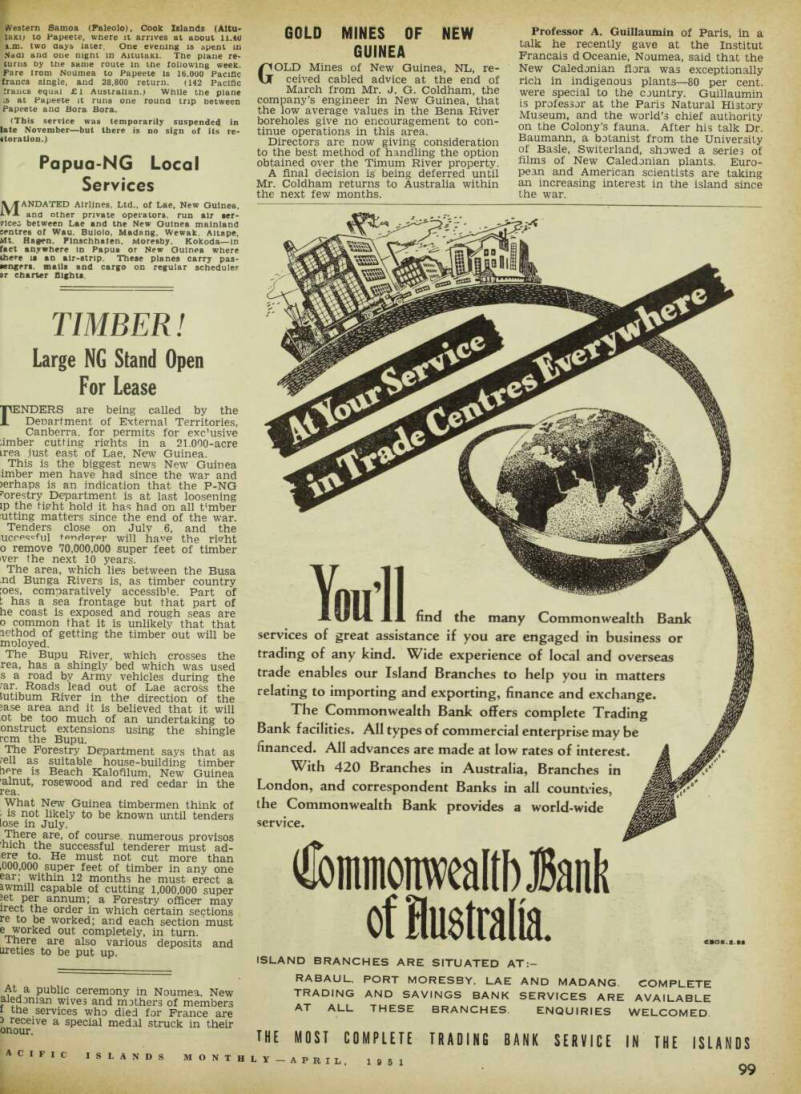
Large NG Stand Open For Lease
rNDERS are being called by the Denartment of External Territories, Canberra, for permits for exc l usive ;imber cutting risrhts in a 21.000-acre irea just east of Lae, New Guinea.
This is the biggest news New Guinea imber men have had since the war and )erhaps is an indication that the P-NG forestry Department is at last loosening ip the tight hold it has had on all frinber lifting matters since the end of the war.
Tenders close on July 6, and the uccpscful fpndprpr will have the rieht o remove 70,000,000 super feet of timber ver the next 10 years.
The area, which lies between the Busa ,nd Bunga Rivers is, as timber country pes, comparatively accessible. Part of t has a sea frontage but that part of he coast is exposed and rough seas are o common that it is unlikely that that lethod of getting the timber out will be mnloyed.
The Bupu River, which crosses the rea, has a shingly bed which was used s a road by Army vehicles during the rar. Roads lead out of Lae across the lutibum River in the direction of the Jase area and it is believed that it will ot be too much of an undertaking to onstruct extensions using the shingle rcm the Bupu.
The Forestry Department says that as fell as suitable house-building timber here is Beach Kalofilum, New Guinea r alnut, rosewood and red cedar in the rea.
What New Guinea timbermen think of ; 15 n °t likely to be known until tenders lose in July.
There are, of course, numerous provisos hich the successful tenderer must ad ere to. He must not cut more than ,000,000 super feet of timber in any one ear; within 12 months he must erect a awmill capable of cutting 1,000,000 super Jet per annum; a Forestry officer may irect the order in which certain sections re to be worked; and each section must e worked out completely, in turn.
There are also various deposits and ureties to be put up.
At a public ceremony in Noumea, New aledonian wives and mothers of members I the services who died for France are 5 receive a special medal struck in their onour.
Gold Mines Of New
Guinea
GOLD Mines of New Guinea, NL, re ceived cabled advice at the end of March from Mr. J. G. Coldham, the company’s engineer in New Guinea, that the low average values in the Bena River boreholes give no encouragement to con tinue operations in this area.
Directors are now giving consideration to the best method of handling the option obtained over the Timum River property.
A final decision is being deferred until Mr. Coldham returns to Australia within the next few months.
Professor A. Guillaumm of Paris, in a talk he recently gave at the Institut Francais d Oceanic, Noumea, said that the New Caledonian flora was exceptionally rich in indigenous plants—Bo per cent, were special to the country. Guillaumin is professor at the Paris Natural History Museum, and the world’s chief authority on the Colony’s fauna. After his talk Dr.
Baumann, a botanist from the University of Basle, Switerland, showed a series of films of New Caledonian plants. Euro pean and American scientists are taking an increasing interest in the island since the war.
Advertisements & other items, pp. 101-102 (2 items)
Acific Islands Monthly _ A P R R L. 1951
ACIFIC ISLANDS MONTHLY A P R r L. 1951
Commonwealth Banh
*2 find the many Commonwealth Bank services of great assistance if you are engaged in business or trading of any kind. Wide experience of local and overseas trade enables our Island Branches to help you in matters relating to importing and exporting, finance and exchange.
The Commonwealth Bank offers complete Trading Bank facilities. All types of commercial enterprise may be financed. All advances are made at low rates of interest.
With 420 Branches in Australia, Branches in London, and correspondent Banks in all countries, the Commonwealth Bank provides a world-wide service.
Commonwealth Banh
of Australia.
eaos.Mi
ISLAND BRANCHES ARE SITUATED AT:-
RABAUL, PORT MORESBY, LAE AND MADANG. COMPLETE TRADING AND SAVINGS BANK SERVICES ARE AVAILABLE
AT ALL THESE BRANCHES. ENQUIRIES WELCOMED
THE MOST COMPLETE TRADING BANK SERVICE IN THE ISLANDS
The features ol this unusual XVlth Century hey illustrate its owner s connection with the sea*—a trader on the African coast, no doubts the key obviously being that of his sea-chest. ■Of MM A
The key
to smoking pleasure
CAPSTAN
FINE CUT
NAVY CUT
TOBACCOS
or
News Notes from the Goldfields
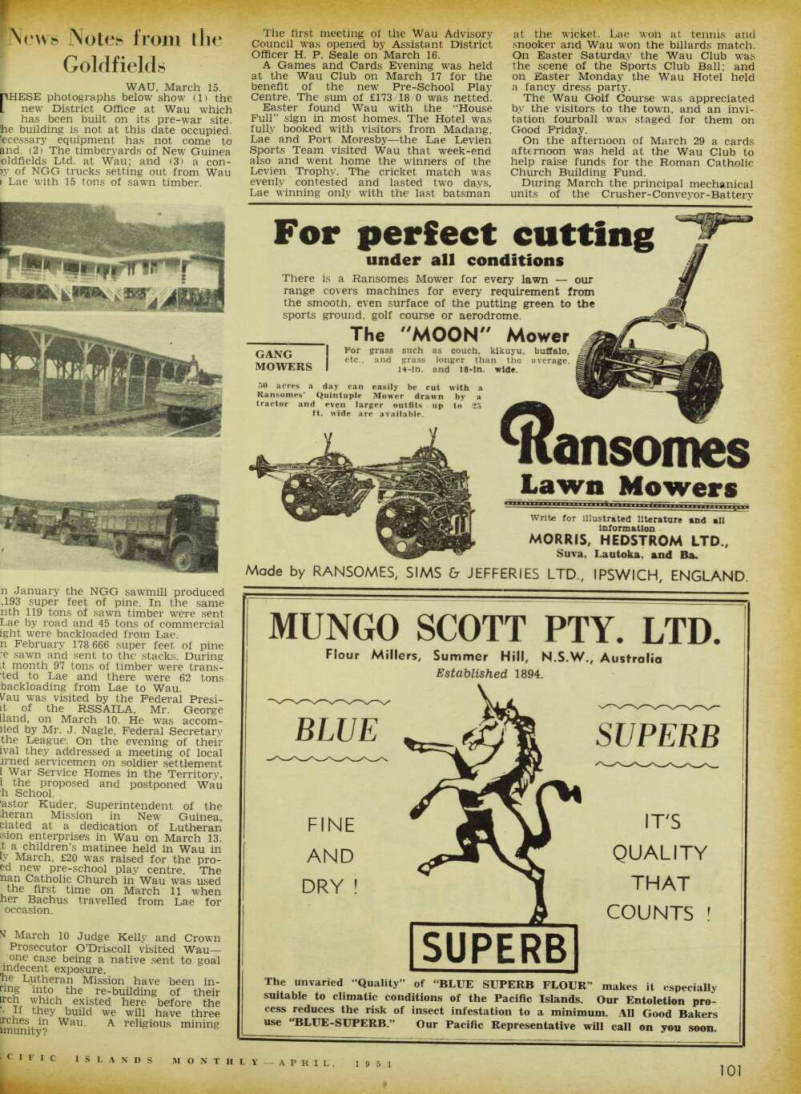
Goldfields
WAU, March 15.
PHESE photographs below show (1) the new District Office at Wau which has been built on its pre-war site, he building is not at this date occupied, fecessary equipment has not come to and. (2 1 The timberyards of New Guinea Oldfields Ltd. at Wau; and (3> a con >y of NGG trucks setting out from Wau > Lae with 15 tons of sawn timber.
n January the NGG sawmill produced ,193 super feet of pine. In the same nth 119 tons of sawn timber were sent Lae by road and 45 tons of commercial ight were backloaded from Lae. n February 178 666 super feet of pine *e sawn and sent to the stacks. During ,t month 97 tons of timber were trans ted to Lae and there were 62 tons backloading from Lae to Wau.
Vau was visited by the Federal Presi lt of the RSSAILA, Mr. George [land, on March 10. He was accom lied by Mr. J. Nagle, Federal Secretary the League. On the evening of their ival they addressed a meeting of local irned servicemen on soldier settlement 1 War Service Homes in the Territory, I the proposed and postponed Wau h School. astor Kuder, Superintendent of the heran Mission in New Guinea, ciated at a dedication of Lutheran ision enterprises in Wau on March 13. •t a children’s matinee held in Wau in ly March, £2O was raised for the pro ed new pre-school play centre. The nan Catholic Church in Wau was used the first time on March 11 when her Bachus travelled from Lae for occasion.
March 10 Judge Kelly and Crown Prosecutor O’Driscoll visited Wau— one case being a native sent to goal indecent exposure. ‘he Lutheran Mission have been hi ring into the re-building of their irch which existed here before the • If they build we will have three irches in Wau. A religious mining nnunity?
The first meeting of the Wau Advisory Council was opened by Assistant District Officer H. P. Seale on March 16.
A Games and Cards Evening was held at the Wau Club on March 17 for the benefit of the new Pre-School Play Centre. The sum of £173 18 0 was netted.
Easter found Wau with the “House Full” sign in most homes. The Hotel was fully booked with visitors from Madang.
Lae and Port Moresby—the Lae Levien Sports Team visited Wau that week-end also and went home the winners of the Levien Trophy. The cricket match was evenly contested and lasted two days, Lae winning only with the last batsman
at the wicket. Lae won at tennis and snooker and Wau won the billards match.
On Easter Saturday the Wau Club was the scene of the Sports Club Ball; and on Easter Monday the Wau Hotel held a fancy dress party.
The Wau Golf Course was appreciated by the visitors to the town, and an invi tation fourball was staged for them on Good Friday.
On the afternoon of March 29 a cards afternoon was held at the Wau Club to help raise funds for the Roman Catholic Church Building Fund.
During March the principal mechanical units of the Crusher-Conveyor-Battery
section of the New Golden Ridges Amal gamation Mill were run in and the pocket bin filled in preparation for starting up during April. Full-scale production of 100 tons per day is not expected until June 1. , . .
During the month a record amount of 146 tons of timber were carried to Lae by diesel lorries and 106 tons of company and commercial freight was back-loaded to Wau.
Also during March 25,000 super feet of selected pine flitches were shipped to Brisbane, for the exclusive use of the Australian battery separator industry, and it is expected that a further 75,000
super feet will be shipped during the next quarter.
Tentative inquiries have been made by the Government Stores for the supply of 2,000 prefabricated Cedar chairs of the “Manus” type. This type of chair has been common to the Islands for many years and is essentially a light comfort able rest chair.
Mr. H. W. Simmonds, OBE, formerly Government Entomologist in Fiji, arrived in the Colony this month, to make a collection of entomological material in Taveuni for the Natural History section of the British Museum, London.
Advertisements & other items, pp. 103-104 (2 items)
101
CIFIC ISLANDS MONTHLY —-APRIL, 1951
ansomes
For perfect cutting
under all conditions
There is a Ransomes Mower for every lawn our range covers machines for every requirement from the smooth, even surface of the putting green to the sports ground, golf course or aerodrome.
//LA AAU//
The "MOON" Mower
GANG
MOWERS
For grass such as couch, kikuyu, buffalo, etc., and grass longer than the average. 14-ln. and 18-ln. wide. 50 acres a day can easily be cut with Ransomes’ Quintuple Mower drawn by even larger outfits up to tractor and ft. wide arc available. i
ansomes
Lawn Mowers
Write for illustrated literature and all information
MORRIS, HEDSTROM LTD.,
Suva, Lautoka. and Ba.
Made by RANSOMES, SIMS & JEFFERIES LTD., IPSWICH, ENGLAND.
MUNGO SCOTT PTY. LTD.
Flour Millers, Summer Hill, N.S.W., Australia Established 1894.
BLUE
FINE
AND
DRY !
ft
SUPERB
SUPERB
IT'S
QUALITY
THAT
COUNTS !
The unvaried “Quality” of “BLUE SUPERB FLOUR” makes it especially suitable to climatic conditions of the Pacific Islands. Our Entoletion process reduces the risk of insect infestation to a minimum. All Good Bakers use “BLUE-SUPERB.” Our Pacific Representative will call on you soon.
we hand it to
you
Real economy demands that you buy only good paint the best paint. Sherwin- Williams Paints and Finishes are the result of constant and intensive research by a compact corps of field specialists and qualified paint consultants. The combined fruits of this extensive research and developmental work by the Sherwin-Williams companies throughout the Empire are available to you when you specify Sherwin-Williams Paint for all tough paint rssignments . . . espec ially those under tropical climatic conditions.
Sherwin-Williams Paint
To meet the test of the tropics
COLYER WATSON (NEW GUINEA) LTD.
Madang Newsletter
From Our Own Correspondent
Madang.
■\TTJMEROUS money-raising schemes foa the Mt. Lamington disaVei fund have been organised by the Madang committee. Included were the Tennis Tournament, won by Mr. Jock Esson and Miss Helen Glvddon, which raised £l6/-/-; and two entertainments bj the management of the local theatre. At a well-organised fete at the Euronear echool, the small groun of children raisec £2O with a concert and outside stalls.
The RSSILA donated £3O out of fund! for the relief of the dependants of re turned servicemen affected by thi disaster in the Lamington area. As wel thev arranged a gala Monte Carlo danc on the night of Easter Monday. This wa, well attended.
EASTER weekend was marked by th arrival of sporting visitors fron Kokopo. Billiards, snooker, athletics cricket, soccer, tennis and tug-of-wa were among the entertainments arrange' for the visitors.
IN Madang, people are still waiting fo 9PA to put over a session for Europea; children. An expensive hour and half is provided for natives but nothin for white children over six years.
MR. & MRS. W. SPENCER of N< Estates are spending leave in Gee long, Vic. To the same estate returned Mr. and Mrs. W. Wright, afte leave in Melbourne; while Mrs. D. Ree with hamily joined her husband u Sarang, where he is relieving Mr, Spencei Mr. and Mrs. Jack Morgan of Coconi Products have gone on leave. On returi he will take a position with NG Estat« in Madang township.^ FOR about five years discussions an inspections have been carried oi for the establishment of an intei national standard aerodrome in Madam It now seems to have been decided to g ahead with it; surveyors have been m tj area now occupied by DC A camp and til SDA transit station. A i Mr. Geoff. Mason has gone to Gorok as senior groundsman in charge of tl strip. Owing to lack of accommodate there, his wife has returned to Sydney..
MRS. R. MACGREGOR flew sou; recently on the first stages of world wide tour. Mr. Macgregor w join her in April in Sydney before gon by Italian steamer to Italy, throug Batavia, Singapore and the Suez Cam through the Continent to England andJ gathering of the clans of Scotland will the following phase. They will return Australia via the Panama Canal.
Mr Bevan Lever went south by plai on March 6 for leave in Brisbane Mr. R. A. Colyer, of Colyer Watson, in Madang on a business trip m conne tion with the possibilities of fibre pn dU Mn and Mrs. Fred James of OTC lea Madang in April for Port Moresby. Tl popular couole who have been here f four years w : ill be missed from social a< sporting circles.
THE forthcoming year sees Mr. All Clarke as president of the lo« RSSILA; Messrs. R. Vicary and Sowerby as vice-presidents; Mr D.Chaj pion-Jones as treasurer, while Mr. Gore: Clarke will be secretary. .
On Anzac Eve, returned servicemen v gather at a dinner party, and part Anzac Day Remembrance will be the u
veiling of a plaque to the late Capt. Bert Rutherford.
ON March 14, a daughter, Bronwen, was born at Madang Hospital, to Mrs K. .Tones, the former Joan Pennefather of Kokopo. Mr. Jones is a son of Mr.
J. H. Jones, P-NG Director of Planning and Development, and is ADO Chimbu.
Mr. C. Svmmonds of the Administration Field Staff, after a term in Bogia, flew south on leave.
A MADANG Advisory Council has been formed. Mr. T. Warburton has been appointed chairman. It is hoped this body will have some influence in the development of the town.
Advertisements & other items, p. 104 (1 item)
102
APRIL, 1951-PACIFIC ISLANDS MONTHI
Hurricane Damage In New
Caledonia
REPORTS from the areas flooded during the' recent New Coledonian cyclone tell of road traffic blocked and routes like the Col d’Amieu road, from west to east coast, rendered permanently un serviceable.
In some places coffee and coconut plantations were for days under water, and houses had to be abandoned. The lower areas of Bourail (west coast) were so flooded that only the roofs of houses showed above the water. The archives at the Bourail town hall, where the water flooded the building to a depth of over four feet, were damaged. There was plenty of damage also at La Foa and Poindimie. A message of sympathy has been received from the French Govern ment The local Red Cross gave useful assist ance to families rendered homeless. In response to a cable from Noumea from the French Pacific High Commissioner, the French Ambassador in Canberra ap proached the Australian Government with a request for supplies.
“Fijian” Wins Sydney House
SHRI RAM, described in Sydney news papers as a Fijian, won first prize in a NSW Art Union on April 2. The prize is a £4,000 house at Ryde, a suburb of Sydney.
Director of the Art Union said that £l,OOO worth of tickets had been sold in Fiji.
Shri Ram will not have any trouble in disposing of his new possession in house hungry Sydney. But maybe he’ll keep it as a transit-depot for all the Piji-Indians
who pass through Sydney on their way to and from Mother India—if Australia’s White Australia policy will permit such a thing.
Wing Commander Webb, DSO, DFC, who has been in command of the RNZAF Station, Laucala Bay, Fiji, since 1948, will relinquish his command on May 1, and return to New Zealand on transfer. The new CO, Wing Commander K. W. Tri gance, DFC, is expected in Fiji shortly.
He has only recently returned from duty at RNZAF Headquarters, London.
Advertisements & other items, p. 105 (1 item)
Columbines
HAND KNITWEAR
To Order GARMENTS of all descriptions made to your requirements by expert knitters.
BABIES' AND CHILDRENS'
OUR SPECIALITY.
Personal attention given.
Write for particulars :
“THE PIXIE”
Whiteway House, 50b Belgrave Street, MANLY, N.S.W.
COLUMBINES
the richest
caramels
of all!
Agents for "Butter-rich”
"CL ucose- rich , 4 4 Fla vo ar- rich 9 9 Each Columbine is individually wrapped for freshness and protection.
Made by The Great Name in Confectionery Pacific Islands; 5. E. TATHAM & CO. PTY. LTD. 178 Collins St., Melbourne - 73 York St., Sydney
More American Tourists
For Fiji
From Our Own Correspondent SUVA, April 2.
A TOUR around the island of Viti Levu shows that all resorts, such as Raki Raki, Cuvu, Sigatoka, Korolevu and Nadarivatu, were fully booked out with holiday-makers during Easter.
With the growing population and the need for holiday resorts there now is regret that such places as Nadarivatu
Rest-House were closed down. Accom modation is certainly limited at these places and bookings have to be made in advance.
Deuba Hotel, only 35 miles from Suva, was popular at one time; but, owing to a constant change of management, has slipped back considerably. Rumour has it that the whole property has been sold to a newcomer to the Islands, and that the new owner intends to clean up the swamps surrounding the hotel, and to rebuild nearer the beach. This would be a boon to Suva residents.
Tourists in Fiji express amazement at the lack of holiday resorts in Fiji, We have beautiful beaches around this island —beaches among the best in the world — but to develop their value, we require some enterprising people with modern ideas, and a public that will give them full support.
Tourists are arriving regularly in the Islands these days. Even though March is not considered the best month of the year, small parties have had four to five days “stopover” on Viti Levu. A party of 12, with a tour manager from the United States, spent three days on the Island.
Native mekes and the yagona ceremony were provided at Korolevu Rest-house for the party, before they left for Suva.
They went on excursions accompanied by guides; and on their way to Lautoka a special Fijian-style luncheon was served at Raki Raki Hotel.
This is the first large party on a world tour that has included Fiji in its itin erary. The travel agents in the United States say they will now always include Fiji, but next time for five days.
Rabaul Church Of England
Prom a Special Correspondent AT long last the Church of England is able to re-establish itself in Rabaul.
The new rectory on the old site in Malaguna Road is taking shape. The roof was expected to go on in early April and the whole thing should be completed sometime in May.
The Rev. Mr. Gibson who was in charge of Anglican affairs here for a period about 20 years ago has offered to come to Rabaul for a year. At present he has a parish in Tasmania. He has applied for a year’s furlough and will spend it getting things on their feet here.
He and his daughter will come up as soon as work on the new rectory is completed.
Advertisements & other items, p. 106 (2 items)
Kiwi 15 In A New>
Just Twist Die milled does the trie* / * 6; 2949 Change to
KIWI
for keeps
AUSTRALIA’S BIGGEST SELLING SHOE POLISH
A. H. Bunting Limited
SAMARAI PAPUA
Optical discovery allows you
to see right through reflected glare
(D Polaroid
DAY GLASSES & SUNSHIELDS
* Regd. Trade Mark Patented in V.S.A., Great Britain and other countries. ★ We are Sole Agents in the Territory of Papua and New Guinea for POLAROID* Day Glasses and Sunshields and enquiries are invited from Merchants and Traders. Prompt attention given to all enquiries. Many models available, in a wide range of colours. ★ Also procurable from Bunting's, Lae.
The Huks Of The Philippines
How Red Penetration In These Archipelagoes Can Endanger Security In The South Pacific
PHE Hukbalahap Movement of the Philippines has become definitely Communist in the last two or three ears. It is strongly entrenched in Central Luzon; it has 10 000 men, pur ling guerilla tactics, under arms; and, [though it is constantly pursued by rovernment troops, which are more umerous and much better equipped, it oes not seem to be deteriorating in irength. It openly plans to secure con ■ol of the Government and establish the ommunist State of the Philippines.
The Philippines, in which there now are ),000,000 people, were in process of re viving their independence and political eedom from the United States when the ipanese invasion occurred, in 1941. A w months later, in 1942, the "People’s nti-Japanese Army” was formed: and ukbalahap is an abbreviation of that ime, as expressed in the Tagalog nguage. Adherents are usually called uks.
During the war, the Huks carried on i effective guerilla war against the Jap :cupation forces, and advocated social id economic reforms.
Such reforms are needed. Although lere are very large areas of virgin land, id great undeveloped resources in the chipelago, there is serious overcrowding places, with extreme poverty and cruel ndlordism.
The country’s social and economic Dubles could easily be wiped out by icient and far-sighted government: but at is what the Filipinos definitely lack, ley were given complete independence ter the war, by the Americans; but the ministration seems to have become the ippy hunting ground of professional liticians and greedy bureaucrats. This turn has encouraged the formation of isident movements.
IHE Huks, in .the beginning, were not Communists. After the war they became a distinctive, separate rty, urging radical reforms. Between 15 and 1949 they seem to have settled finitely in Central Luzon, and been ire or less in negotiation with the Gov iment, which sought their support. But jy would not give up their arms, and sorts of lawless elements fastened on their organisation, and they were iwly penetrated by Communist ele cts. fhey demanded immediate refoims so [•-reaching that the breaca between Jm and constitutional authority grew adily.
Quirino had a big political tory at the end of 1949; whereupon - Huk leader, Luis Taruc, seemed to give nocracy away, and joined openly with • Communist leaders, Mariano Balgos ained in Moscow) and Guillermo Capa ;ia—both of them vice-presidents of the Dngress of Labour Organisations”—who d fled to the hills witth Communist forces, e Huks thenceforth called themselves ■ “People’s Liberation Army” (HMB); i they now were very clearly linked with the Communists in China, Viet- Malaya, etc., under the direction of
'Scow.
Hie Philippines Communist Party was med in 1930; outlawed and under iund in 1932; recognised again in 1938; aerground during the Jap occupation; 1 recognised again in 1945. With the session of the Huks, it became strong l aggressive: and the whole organisa n—still called the Huks—has been re or less fighting the Government
forces in Central Luzon and in the Iloilo section of Panay for the past two years.
A N analysis by a writer recently in "Far Eastern Survey” says that a strong government and an active re forming spirit could stop the Communist movement in the Philippines. Without reform, there is a constant and growing danger that the Huks will get accessions of strength from organised labour, from
certain student groups, and from the Chinese. There are 135,000 registered Chinese aliens in the group, and many more Chinese who are settled there.
The Filipino people are more or less apathetic: the majority are so poor that they are concerned primarily with the problem of living. Clearly, this is suitable ground for the Red propaganda of the Huks.
The situation is not dissimilar in the adjoining archipelagoes of the East Indies, where there is another swarming, hungry population under another native Government—the Indonesians. (Continued next page)
The Philippines, under the Americans, and the East indies, under the Dutch, were peaceful, reasonablv well governed, adequately fed—and were in no sense a danger to the European communities of the South and South-west Pacific. With tVipir own ffnvprnmpnts thGSG dgodlg qtg
likely to be tooSht undlf CoXunTst
nkeiy to be orougm unoer_ uommumst influence, and a Red set-up m the Indies and the Philippines would be a menace to the nations and Territories south of the equator.
Advertisements & other items, p. 107 (2 items)
105
ACIFIC ISLANDS MONTHLY APRIL, 1951
Ice Cream
Mary Baker
MIX
Is now available to Pacific Islands Traders and Storekeepers in Chocolate and Strawberry Flavours in addition to the always
popular Vanilla
Successor to the ice cream making formula introduced to the South Pacific by the U.S. Army in wartime, Mary Baker Ice Cream Mix is now manufactured in Australia for export to all the Islands Groups and Territories. It's delicious in the home for dessert—on its own, flavoured, or with fresh tropical or canned fruit.
Packed in 16 oz. tins for Household Servings, 5 lb. Family size tins, and 32 lb. tins for Traders and Storekeepers.
Ask Your Store for it
ATTENTION CAFES AND MILK BARS!!! We can also supply: Ice Cream Cones (cartons of 800)—26 oz. bottles of Cordial Extract, Flavouring Essences, and Concentrates—Malted Milk Powder—and other requisites for the Islands Soda Fountain and Milk Bar trade.
SOLE DISTRIBUTOR :
J. C BRIDIES PTV. LTD.
104 Hunter Street, Sydney, N.S.W.
Telegrams: “MERRILLEES,” Sydney.
Another Airways Co. for P-NG
Port Moresby, April 9.
ANOTHER airways company has -cl started operating in the Territory. is is Amphibious Airways Ltd.. which recently flew two 9.m- P hi planes from Sydney to Rabaul, sta ging at Daru and Port Moresby on their northbound journey. jt j s understood that the new service will be based at Rabaul for charter in New Britain and New Ireland.
The Telephone
By Kai Viti
“Au sega ni via tara na ka vakateoi oqo” (I do not wish to touch this devilis thing), said Ratu Josua, an old Fijiaf Chief, when he was invited to speak c the public telephone which had bee erected near his bure.
Just then, the telephone bell ram which made the Chief more frightene than ever, and he ran inside his hous; He could not understand how peopi could talk to each other in this way.
One day, Ratu Josua was having quiet afternoon nap on the grass outsic his bure. When he opened his eyes t dusk he was just able to discern the ou. line of a native rummaging in one of h boxes.
In this particular box Ratu Josua kej some valuable articles, such as “tabus (whales’ teeth), etc.
In his excitement he rose, and grabbe the telephone receiver, with the intentic of heaving it at the intruder, when li heard a voice at the other end.
“Who are you?” he said, not expectin for one minute to receive a reply.
“I am Constable Marika,” the othi voice replied.
Ratu Josua gasped in excitemer “Come and help me with this thief," 11 shouted, and made a dash after the cut prit, who had run off into the bush.
In less than a minute Constable MariH arrived, captured the thief and convey* him to the lock-up.
If Ratu Josua is asked now what I thinks of the telephone he says: "Sa dv na ka yaga dina sara, au sa druka vak levu.” (It is a most useful thing—l aj properly beaten.)
Lower Cooks
Tea Possibilities In The
THE rise of Ceylon tea to the unpr cedented price, not even during the hard days of World W' I, of 8/- per lb. has revived the discussu of the potentialities of tea-planting uo* Mangaia and related islands, in the Low Cook Group.
We produce here excellent coffe shipped annually to the great world ou side, after our own needs are satisfie There is no reason to doubt that certai hillside lands of this isle, suitably irn gated, could produce tea as well—liij Ceylon. Mangaia is both mountainous an warm, and usually there is little wind.
To start any project it would be nee© sary, of course, to bring in seedlings an an expert to direct their planting an care. This should not be too difficult. Tl' problem of water is less tractable.
Locals recall, with a sigh, that Indis tea was once obtainable from NZ groc© for 1/6 per half lb. packet, by mail, freight, if ordered in quantity. TW cheapness, however, would not appear prevail now even in India, for a gift pactoJ received from Darjeeling by the write; from a friend, was marked at 5/10 a II which presumably is fairly high in thr region.
If tea could be produced, like cofft> locally, another means of earning wouj be placed in native hands, and an in ports problem solved for the white res;
dents.
Eti.
Mr. J. F. Colquohoun, a Boy Scoo Commissioner from the United Kingdom arrived at Suva on March 13. He hr been visiting Australia and New Zealan and while in Fiji will discuss Boy Scoo matters with Church and civic leaders the Colony.
Advertisements & other items, p. 108 (1 item)
Hydroseal
PABCO
will
the
leaks
stop
PAB
BROS
PABCOTE PAINTS
will preserve the iron
If your iron roofing already leaks, stop it with HYDROSEAL. Bad patches of rust, even with holes yon can put a finger through, will he effectively sealed.
After Hydrosealing, or if your roof is in good condition, paint with PABCOTE bituminous-base paints. PABCOTE rustresisting paints give greatest possible protection against weather attack. Available in Tile Red or Roof Green.
UrA
TIJ
0) I)
HYDROSEAL PABCOTE
Available af all leading Island stores.
PABCO PRODUCTS PTY. LIMITED. 150 Wigram Road, Glebe, N.S.W.
Only manufacturers of genuine tdalthoid roofing.
Agricultural Enterprise
Treatment Of Pioneer
Planters
No Encouragement of Agricultural Enterprise
Letter to the Editor 1 N Australian Liberal MP, after a visit L to New Guinea, said in the House that it was deplorable that Australia id done so little planting there in the uritory since she acquired it.
If the treatment accorded by Australia two ex-Servicemen who became anters is any criterion, the lack of anting is not a surprising thing. These r o purchased virgin jungle in the early venties, planted a large area, and some •w managed to carry on when copra was low as £4 per ton. Although near 60, e of those men served with the Austra n Army in New Guinea in World War : and then he took his discharge there and went back to the overgrown planta in and soon, under incredible difßcul s, began producing copra. For some ree or four years, during the very diffi- It rehabilitation period, the two owners iduced considerable copra from their rd-won plantation—and the Govern :nt’s Production Control Board de cted up to £8 per ton from the proceeds each ton sold as a contribution to the ibilisation Fund. rhen, being close to the retiring age, ; two owners decided to sell out, and ? in more comfortable and healthier iditions, in Australia. When retiring, •y naturally asked the Australian Gov iment whether they were entitled to a urn of the monies that had been taken m them for (a) stabilisation and (b> operations of the Production Control ird (which has accumulated a substan surplus). The so-called Liberal Gov ment informed them that none of the bilisation Fund is being returned to planters who subscribed to it, and t the PCB profits will be distributed ntually—but not to planters who, in meantime, have sold out or ceased produce. So the two pioneers—who, ween them served in two World Wars, e 50 hard years to the Territory, and tributed substantially to both PCB . Stabilisation Funds—get nothing. ; it any wonder that, when pioneering enterprise are made the playthings politicians, the men in New Guinea ise to show any confidence in the ire and incur the expense and heavy »ur of planting up new areas? They take all they can out of the place le the prices guarantee some profit— , after that, the politicians and the >rists can have it. Can you blame n?
I am, etc.,
ney. 4/51.
Old Rabaulite.
Editorial Note
tE case referred to by our correspon dent is well known to the PIM.
Those two men toiled with, but h harder than, their native labourers, t through the depression years, and ehqw kept the planting going, and the alive. One of them took employment listant places, so as to provide some be necessary cash to keep the planta going. The other partner skin-dived ind more or less dangerous reefs, so o encourage his boys in the search for hus and green-snail shell. He made 5 up and down the coast in a crazy )e, and bought and transported coco ’• In an endeavour to keep the young [is tended, he made occasional very :h recruiting trips, to get labour for anc * a * ee) f° r his neighbours, then, when their palms did finally
begin to bear, copra was at the record low of £4 per ton!
The profits accumulated by the PCB have been made out of copra taken from the planters over a definite period. These Government bodies usually maintain large staffs of clerks. Surely it would have been easy to keep a record of the copra supplied by particular planters over par ticular periods, and credit them accord ingly with a proportion of the profits made by the PCB in handling their copra.
It seems most unfair that these two men should be deprived of the proceeds of their copra simply because they have sold out. As our correspondent says, that kind of bureaucratic action does not en courage any new planting in New Guinea.
Mr. Verco Cook a farmer of South Australia will leave shortly for New Guinea where he will undertake farming work for the Anglican mission.
Photo Exhibition in Moresby
From Our Own Correspondent
THE Photographic Society of Papua
held its first public exhibition of prints in Port Moresby during the last week in March. Ninety-two entries were received, with the first award going to Mr. T. F. Warren for a landscape of the Dogura district. The second and third awards were won by Mr. Peter Livingstone for a New Guinea landscape, and an aerial view of Mt. Lamington.
Mr. Harold Gatty’s new Cessna seaplane, which drifted away from its moorings at his island of Katafaga, in the Lau Group, Fiji, in February, was found a few days later, completely smashed, on the coast of Tuvuca, an island ten miles away. Mr.
Gatty imported the plane only recently, for maintaining communications between his home in Suva and the plantation on Katafaga.
Advertisements & other items, pp. 109-110 (2 items)
107
CIF I C ISLANDS MONTHLY-APRIL, 1951
Hay Fever;
BURNS PHILP (New Hebrides) LTD.
Registered Office: VILA, NEW HEBRIDES
Branch Office at SANTO
Exporters, Importers and General Merchants
(Retail and Wholesale) Commission, Shipping
and Customs Agents
Pauipiqu*;, ana numerous overseas manufacturers of all classes of merchandise.
San Francisco Agents: Representatives for BURNS PHILP TRUST COMPANY LIMITED QUEENS- LAND INSURANCE CO.. LTD., andLLOYD’S OP LONDON Agents for
SOCIETE DES PETROLES SHET.T. TOS nn
Sydney Agents: Bums, Phllp & Ce., Ltd., 7 Bridge Street.
Burns-Philp Co. of San Francisco Inc., Matson Building, 215 Market Street.
London Agents: Burns, Phllp A Co., Ltd.. 35 Crutched Friars. EC.3
Hay Fever; Incessant, Uncontrolled Sneezing Coughing Curbed Quickly
Do you have attacks of the weakening. exhausting Hay Fever; sneezing, coughing spasms so bad that you can’t work, play or enjoy yourself? Do you feel so weak and helpless that you’re unable to work, and have to be careful when you go out, and you can t enjoy life around this time of the year.
No matter how long you have suffered, or what you have tried, there is new hope for you in a doctor’s prescription called MENDACO. No' Dopes. No Smokes. No Injections. No Atomisers.
All you do is take two tasteless tablets at meals, and in three minutes MENDACO starts working through your blood aiding nature to promote free easy breathing and removing the irritating symptoms which cause those terrible sneezing and attendant distressing symptoms. You can go out without fear of attack. You sleep better at night and feel well, strong, and years younger.
NO HAY FEVER SYMPTOMS
IN 2 YEARS
MENDACO not only brings almost immediate comfort, easy, breathing and freedom from sneezing attacks but it builds up the system to ward off
future attacks. For instance, Mrs. S Bishop, of Dandenong, Victoria. had lost two stone, suffered severe sneezing attacks for months, was afraid to go cut for any length of time, couldn't sleep MENDACO stopped Hav Fever symptoms quickly and she hasn’t had any since in over two year-'
MONEY CACK GUARANTEE
The very first dose of MENDACO goes right to work circulating through your blood and helping nature relieve you of the effects of Hay Fever and incessant Catarrhal Sneezing. Try
MENDACO under OUR IRON-CLAD
MONEY BACK GUARANTEE You be
the judge. If you don’t feel fully satisfied after taking MENDACO just return the empty package and the full purchase price will be refunded. Get MENDACO from your Chemist today and see how well you will feel tomorrow, and how well you will sleep tonight. The guarantee protects you.
Mendaco
Slops Asthma +C Bronchitis Hay Fever
YOUR WILL
is the most vital document
you will ever sign
When you sign your Will you are determining the future and the security of your family. You will be wise, therefore, to ask yourself these questions:— How long is it since the Will was drawn?
Shouldn’t it be brought up to date?
Was it soundly drawn under legal advice?
Will the executor you have appointed have the time, energy and sound judgment required to ensure that your estate is fairly and properly administered?
Wouldn’t it be wise to review the Will and appoint the experienced, dependable Burns Philp Trust Company either as sole executor or conjointly with the friend you have already appointed?
Burns Philp Trust Company Limited will be glad to send you, free of charge, a booklet which gives valuable information. Write or call for a copy of “Hands That Never Leave The Wheel.” A complimentary copy of this extremely useful booklet can be obtained from any branch of Burns Philp (South Seas) Company, Burns Philp (New Guinea) Limited, or direct from the head office of this Company.
DIRECTORS:
James Burns. Joseph Mitchell.
P. T. W. Black. Eric Priestley Lee.
Manager: L. S. Parker.
SECRETARY; E. R. Overton, F.F.I.A.
Burns Philp Trust
COMPANY
LIMITED
Executor • Trustee • Attorney
Head Office: 7 Bridge Street, Sydney.
Tel.: BU 5901 Box 543 ’ GPO - N.S.W. Agencies at Albury, Bathurst, Goulburn, Orange and Wagga.
Also Registered Offices at Melbourne, Brisbane, Port Moresby {Papua) , and Vila (New Hebrides ).
After “Amp,” What Next
(From PIM Correspondent at Mangai.
Cl) WHEN a medical service staffed 1 youths of ability who had passu exams, at their home Groups w first mooted, in lieu of the highly e; pensive European practitioners former used in the hospitals of small islano some difficulty was experienced in fini ing the right name for the Polynesi: incumbents, who, it need not be adde did not receive remuneration upon j equal scale with the white msdicoes thi replaced.
“Dispenser” was rejected as too sui ordinate-sounding, the native doct being in full charge. “Doctor” could n be used, as the lads had no M.D. degr from a University (for which reason noi of them, still, may practice in NS though it was conceded as a courte title in the CL At last, the name “Native Medical Practitioner,” contract next to NMP, was thought of—and fitted.
As time went on, that word “nathi began to worry the young Polynesi. doctors. It sounded, to their ears, like badge of inferiority, as compared wi “European,” applied to high-salari heads of the ruling race. So the design tion went once more into the melting p whence, after much bubbling, it emerg in triumph, re-moulded, nearer to t heart's desire, as Assistant Medical Prs titioner.
Now, discontent is again felt. W “Assistant,” when the medico is in s< charge on his island station, with European doctor above him?
THIS writer suggests that a new a better classification, to solve t problem for all time, could eas be arrived at, as follows; — “Native” being disliked, and “Assistai being considered trivial-sounding, must fall back on “Medical Officer.”
It is quite simple—let European tors, with University degrees, be rated MO-I. AMP’s, I feel sure, would have objection to being classed MO-2, v Medical Officers of the Second Cls neither “native,” nor “assistant,” i what-have-you, though in salary rat; they may be a little lower.
Having proffered gratis this spleiu idea, present correspondent will now prepared to receive a well-deser knighthood—of the second class, course. p.S.—I am advised, by a visiting scic tist, that the above is no go. MO-1 s MO-2 are the official designations slightly-offensive chemicals, so on seco thoughts we’d better forget it.
Moresby
Pow’S Hold Re-Union In
From Our Own Correspondent
Port Moresby, April :
A RE-UNION dinner was held at Konedobu Mess in Port Moresby, March 31, for former prisoners war.
Twenty-two ex-P.O.W.’s attended function, and each related an experiea from his prison-camp life. These sto: gave glimpses of conditions in mi European and Japanese prison c«; pounds, including the infamous Burnr Railway P.O.W. camps.
Mr. J. B. Leslie, MC, who has been Manager of the Vacuum Oil two years, has returned to Australian transfer. He was held in high regaro* Suva.
Advertisements & other items, p. 110 (1 item)
108
APRIL, 1951 -PACIFIC ISLANDS MONTH
Productivity Of The Coral Atolls
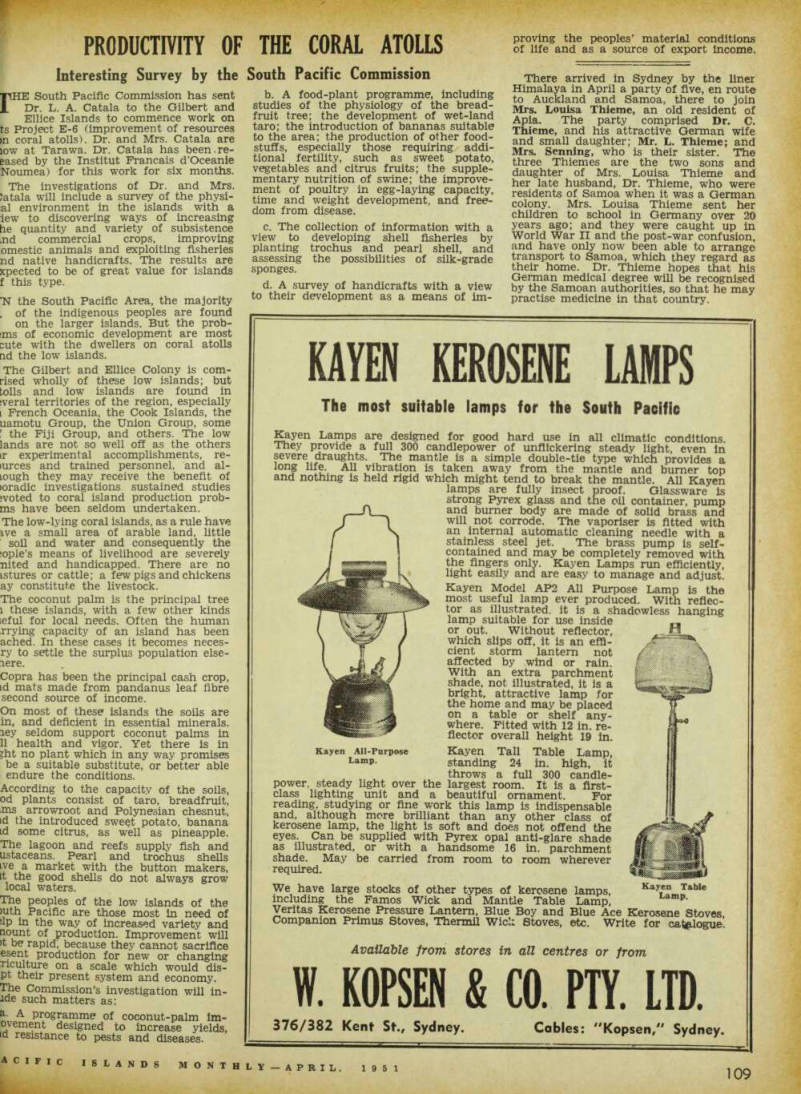
Interesting Survey by the South Pacific Commission
rHE South Pacific Commission has sent Dr. L. A. Catala to the Gilbert and Ellice Islands to commence work on ts Project E-6 (improvement of resources »n coral atolls). Dr. and Mrs. Catala are low at Tarawa. Dr. Catala has been.re- Based by the Institut Francais d’Oceanie Noumea) for this work for six months.
The investigations of Dr. and Mrs.
Jatala will include a survey of the physi al environment in the islands with a iew to discovering ways of increasing he quantity and variety of subsistence ,nd commercial crops, improving omestic animals and exploiting fisheries nd native handicrafts. The results are xpected to be of great value for islands f this type, ■N the South Pacific Area, the majority . of the indigenous peoples are found on the larger islands. But the prob sms of economic development are most cute with the dwellers on coral atolls nd the low islands.
The Gilbert and Ellice Colony is com rised wholly of these low islands; but tolls and low islands are found in iveral territories of the region, especially i French Oceania, the Cook Islands, the uamotu Group, the Union Group, some ' the Fiji Group, and others. The low lands are not so well off as the others ir experimental accomplishments, re lurces and trained personnel, and al tough they may receive the benefit of loradic investigations sustained studies ‘voted to coral island production prob ms have been seldom undertaken.
The low-lying coral islands, as a rule have ive a small area of arable land, little soil and water and consequently the iople’s means of livelihood are severely nited and handicapped. There are no istures or cattle; a few pigs and chickens ay constitute the livestock.
The coconut palm is the principal tree i these islands, with a few other kinds eful for local needs. Often the human Trying capacity of an island has been ached. In these cases it becomes neces ry to settle the surplus population else lere.
Copra has been the principal cash crop, id mats made from pandanus leaf fibre second source of income.
On most of these islands the soils are in, and deficient in essential minerals, ley seldom support coconut palms in 11 health and vigor. Yet there is in ?ht no plant which in any way promises be a suitable substitute, or better able endure the conditions.
According to the capacity of the soils, od plants consist of taro, breadfruit, ms arrowroot and Polynesian chesnut, id the introduced sweet potato, banana id some citrus, as well as pineapple.
The lagoon and reefs supply fish and ustaceans. Pearl and trochus shells Lye a market with the button makers, it the good shells do not always grow local waters.
The peoples of the low islands of the )uth Pacific are those most in need of *lp in the way of increased variety and aount of production. Improvement will >t be rapid, because they cannot sacrifice esent production for new or changing on a scale which would dis pt their present system and economy.
IJie Commission’s investigation will in ide such matters as: a. A programme of coconut-palm Im ovement designed to increase yields, td resistance to pests and diseases.
. . atnritM J f ie T .° f fruit tree, the developmerit of wet-l&nd to the area, the production of other food
fri?Uc^ W f'hP SSSSu?*
Sv 8 n I pf S ’f>!p m
I }J}S3Hi? I ;° F Tsf&Jms
° f , WrttTy megg-laymg capacity, time and weight development, and free dom from disease. c. The collection of information with a view to developing shell fisheries by planting trochus and pearl shell, and assessing the possibilities of silk-grade sponges. ~, , . d. A survey of handicrafts with a view to their development as a means of im
proving the peoples’ material conditions of life and as a source of export Income.
There arrived in Sydney by the liner Himalaya in April a party of five, en route to Auckland and Samoa, there to join Mrs. Louisa Thieme, an old resident of Apia. The party comprised Dr. C.
Thieme, and his attractive German wife and small daughter; Mr. L. Thieme; and Mrs. Sennlng, who is their sister. The three Thiemes are the two sons and daughter of Mrs. Louisa Thieme and her late husband, Dr. Thieme, who were residents of Samoa when it was a German colony. Mrs. Louisa Thieme sent her children to school in Germany over 20 years ago; and they were caught up in World War n and the post-war confusion, and have only now been able to arrange transport to Samoa, which they regard as their home. Dr. Thieme hopes that his German medical degree will be recognised by the Samoan authorities, so that he may practise medicine in that country.
Advertisements & other items, pp. 111-112 (2 items)
109
ACIFIC ISLANDS MONTHLY - A P R I L. 1951
Kaven Kerosene Lamps
The most suitable lamps for the South Pacific Kayen Lamps are designed for good hard use in all climatic conditions.
They provide a full 300 candlepower of unfllckering steady light, even In severe draughts. The mantle is a simple double-tie type which provides a long life. All vibration is taken away from the mantle and burner top and nothing is held rigid which might tend to break the mantle. All Kayen lamps are fully insect proof. Glassware is strong Pyrex glass and the oil container, pump and burner body are made of solid brass and will not corrode. The vaporiser is fitted with an internal automatic cleaning needle with a stainless steel jet. The brass pump is selfcontained and may be completely removed with the fingers only. Kayen Lamps run efficiently, light easily and are easy to manage and adjust.
Kayen Model AP2 All Purpose Lamp is the most useful lamp ever produced. With reflector as illustrated, it is a shadowless hanging lamp suitable for use inside or out. Without reflector, which slips off, it is an efficient storm lantern not affected by wind or rain.
With an extra parchment shade, not illustrated, it is a bright, attractive lamp for the home and may be placed on a table or shelf anywhere, Fitted with 12 in. reflector overall height 19 in.
Kayen Aii-Pnrpose Kayen Tall Table Lamp, Lam P- standing 24 in. high, it throws a full 300 candlepower, steady light over the largest room. It is a firstclass lighting unit and a beautiful ornament. For reading, studying or fine work this lamp is indispensable and, although more brilliant than any other class of kerosene lamp, the light is soft and does not offend the eyes. Can be supplied with Pyrex opal anti-glare shade as illustrated, or with a handsome 16 in. parchment shade. May be carried from room to room wherever required.
We have large stocks of other types of kerosene lamps, Kayen Table including the Fames Wick and Mantle Table Lamp, Lamp - Veritas Kerosene Pressure Lantern, Blue Boy and Blue Ace Kerosene Stoves Companion Primus Stoves, Thennil Wicli Stoves, etc. Write for catalogue Available from stores in all centres or from
W. KOPSEN S CO. PTY. LTD.
376/382 Kent St., Sydney,
Cables: "Kopsen," Sydney.
At Your Service .. .
William E. Reed
(Established 1913) Island Trade Broker & Commission Agent 145 a GEORGE ST., CIRCULAR QUAY, SYDNEY.
For more than 36 years the PERSONAL buying services of WILLIAM E. REED, backed by an experienced staff has ensured prompt and reliable service at lowest cost to Missions, Planters and Traders throughout the Pacific. We operate on a WHOLESALE basis only. You receive original invoices at invoiced cost.
Purchase and delivery of Island craft a speciality.
Enquiries invited for all plantation and trading requirements. Island products sold on a commission basis.
Cables: "WILREED," Sydney
BOAT SALES DIVISION
For Sea Delivery : 40 FT. TRADE BOATS 10 ton cargo capacity.
Diesel powered. Strong and seaworthy.
Two experienced teams always available for sea delivery anywhere in the Pacific.
ALSO . . .
Boats suitable for Islands Purposes
SCOW TYPE CENTREBOARD CARGO
KETCH
58 ft. 6 in. long, 15 ft. 6 in. beam, 4 ft. draught. Equipped with 30 h.p. Ailsa Craig diesel, almost new. 2 mainsails (1 new), 2 staysails (1 new), 1 .iib, 1 mizzen, 4 topsails (2 new). Accommodation for 4. Vessel will carry 16,000 sup. ft. timber. Available with or without engine.
87 FT. AUXILIARY KETCH
21 ft. beam, 7 ft. draught, fitted with 136 h.p. 8 cyl. Gardner.
Auxiliary engine 16 h.p. Lister. Fo’c’stle sleeps 6 men. Galley.
Mess deck. 2 bunks in wheelhouse. Double berth cabin. Vessel can be easily adapted to carry up to 12 tons cargo. Complete suit sails and spares for Marconi ketch rig.
ALSO
61 ft. 5 in. cargo vessel, 18 ft. beam, 8 ft. draught. Gardner 6L3 102 h.p. eng. with 20 h.p. S. Cross and 8 h.p. Lister auxiliaries.
Generous cargo capacity.
Auxiliary 34 ft. x 13 ft. x 4 ft. 6 in. cargo vessel with 30 h.p.
Lister diesel. Only 21 years old.
Comprehensive range of cargo vessels from 27 ft. up to 110 ft.
Cargo range from 5 tons to 250 tons.
We have available immediately, a splendid range of auxiliary and power craft ideally suited for Islands purposes. Let us know your special requirements so that we can send you photographs and details. Sea deliveries made by experienced crews to any point in the Pacific.
Fire And Feast
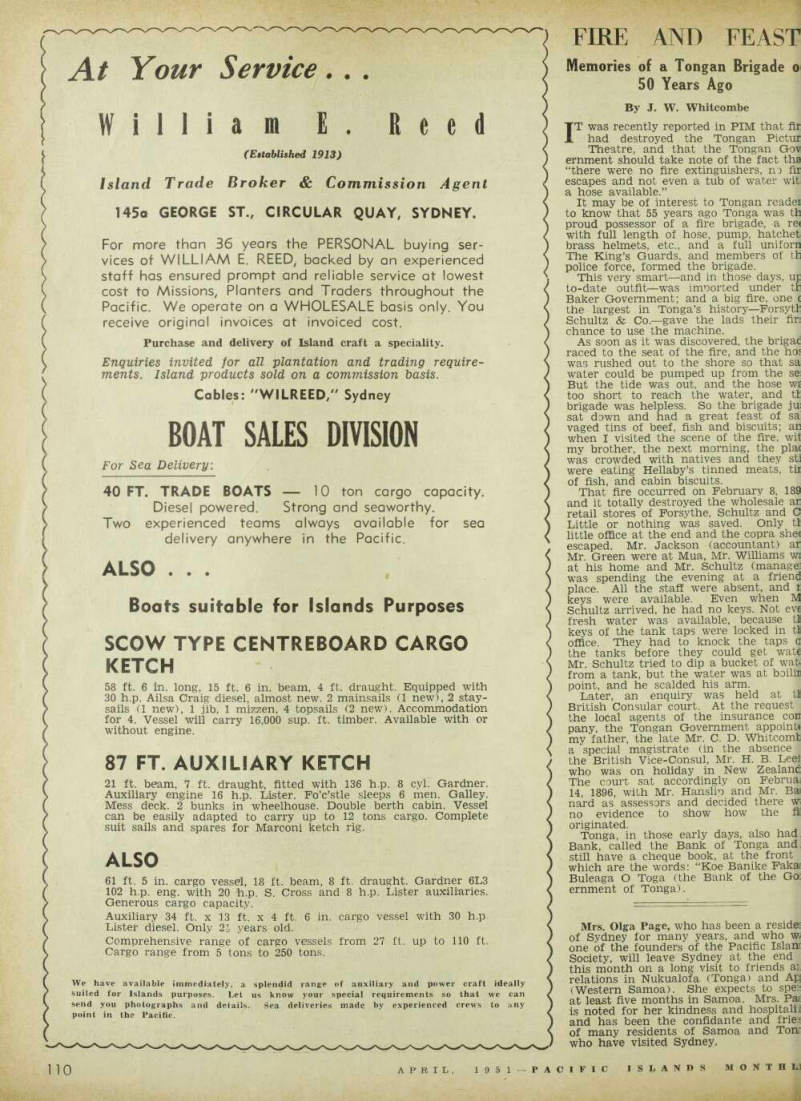
Memories of a Tongan Brigade o[?] 50 Years Ago
By J. W. Whitcombe
IT was recently reported in PIM that fir had destroyed the Tongan Pictur Theatre, and that the Tongan Gov ernment should take note of the fact tha “there were no fire extinguishers, no fir escapes and not even a tub of water wit; a hose available.”
It may be of interest to Tongan reader to know that 55 years ago Tonga was th proud possessor of a fire brigade, a re* with full length of hose, pump, hatchet, brass helmets, etc., and a full uniforn The King’s Guards, and members of th police force, formed the brigade.
This very smart —and in those days, up to-date outfit—was imported under th Baker Government; and a big fire, one c the largest in Tonga’s history—Forsyth Schultz & Co.—gave the lads their firs chance to use the machine.
As soon as it was discovered, the brigac raced to the seat of the fire, and the hos was rushed out to the shore so that sa water could be pumped up from the se; But the tide was out, and the hose ws too short to reach the water, and th brigade was helpless. So the brigade ju; sat down and had a great feast of sa. vaged tins of beef, fish and biscuits; an when I visited the scene of the fire, wit my brother, the next morning, the plao was crowded with natives and they sti were eating Hellaby’s tinned meats, tin of fish, and cabin biscuits.
That fire occurred on February 8, 189 and it totally destroyed the wholesale ar retail stores of Forsythe, Schultz and C Little or nothing was saved. Only tU little office at the end and the copra sheo escaped. Mr. Jackson (accountant) ar Mr. Green were at Mua, Mr. Williams ws at his home and Mr. Schultz (manage! was spending the evening at a friend place. All the staff were absent, and r keys were available. Even when M Schultz arrived, he had no keys. Not eve fresh water was available, because tB keys of the tank taps were locked in tM office. They had to knock the taps a the tanks before they could get wate Mr. Schultz tried to dip a bucket of watx from a tank, but the water was at boilia point, and he scalded his arm.
Later, an enquiry was held at ti British Consular court. At the request the local agents of the insurance con pany, the Tongan Government appoint* my father, the late Mr. C. D. Whitcomb a special magistrate (in the absence the British Vice-Consul, Mr. H. B. Leel who was on holiday in New Zealand The court sat accordingly on Februaj 14, 1896, with Mr. Hanslip and Mr. Bat nard as assessors and decided there w\ no evidence to show how the fir originated.
Tonga, in those early days, also hadj Bank, called the Bank of Tonga andJ still have a cheque book, at the front which are the words: “Koe Banike Fakar Buleaga O Toga (the Bank of the Goc ernment of Tonga).
Mrs. Olga Page, who has been a reside; of Sydney for many years, and who w; one of the founders of the Pacific Islanr Society, will leave Sydney at the end this month on a long visit to friends au relations in Nukualofa (Tonga) and An (Western Samoa). She expects to spe:s at least five months in Samoa. Mrs. Pae is noted for her kindness and hospitalii and has been the confidante and fries of many residents of Samoa and Tonr who have visited Sydney.
Advertisements & other items, p. 112 (1 item)
110
APRIL, 1951 PACIFIC ISLANDS MONTH
Handling The Ng Native
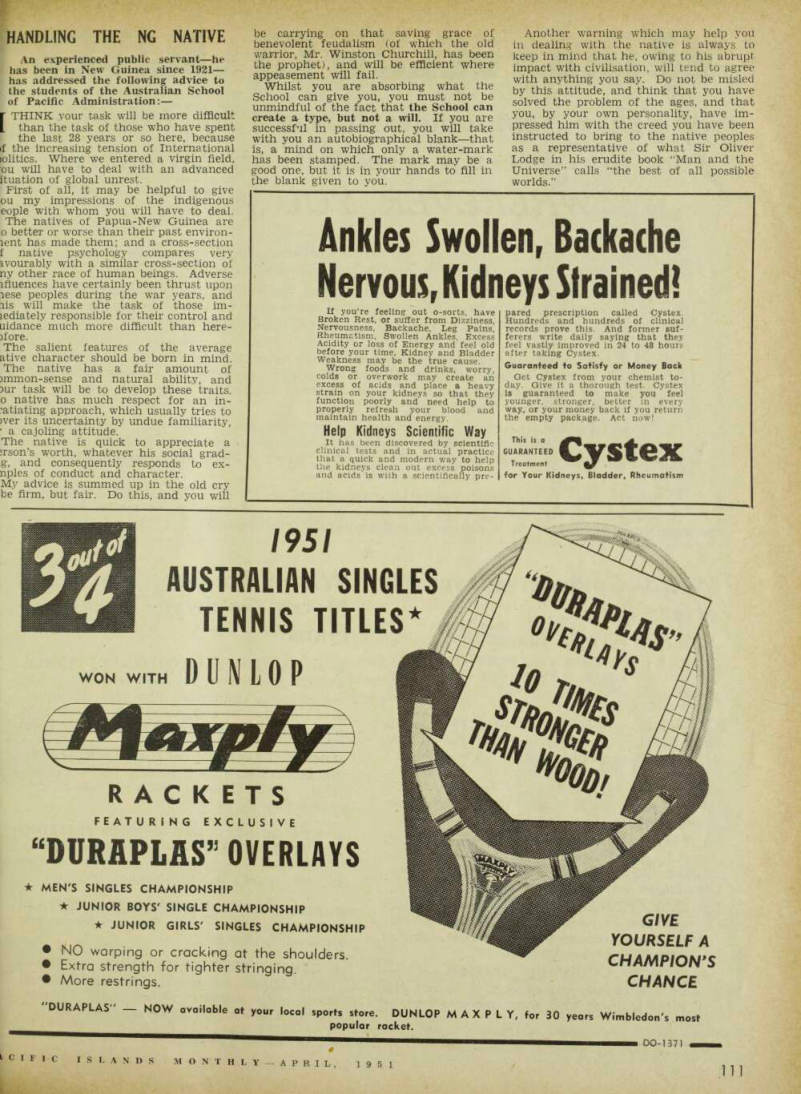
An experienced public servant—he has been in New Guinea since 1921 has addressed the following advice to the students of the Australian School of Pacific Administration: — [THINK your task will be more difficult than the task of those who have spent the last 28 years or so here, because if the increasing tension of International lolitics. Where we entered a virgin field, ou will have to deal with an advanced ituation of global unrest.
First of all, it may be helpful to give ou my impressions of the indigenous eople with whom you will have to deal.
The natives of Papua-New Guinea are o better or worse than their past environ lent has made them; and a cross-section f native psychology compares very ivourably with a similar cross-section of ny other race of human beings. Adverse ifluences have certainly been thrust upon lese peoples during the war years, and lis will make the task of those im lediately responsible for their control and uidance much more difficult than here )fore.
The salient features of the average ative character should be born in mind.
The native has a fair amount of >mmon-sense and natural ability, and >ur task will be to develop these traits, o native has much respect for an in itiating approach, which usually tries to >ver its uncertainty by undue familiarity, • a cajoling attitude.
The native is quick to appreciate a ;rson’s worth, whatever his social grad g, and consequently responds to ex nples of conduct and character.
My advice is summed up in the old cry be firm, but fair. Do this, and you will
be carrying on that saving grace of benevolent feudalism (of which the old warrior, Mr. Winston Churchill, has been the prophet), and will be efficient where appeasement will fail.
Whilst you are absorbing what the School can give you, you must not be unmindful of the fact that the School can create a type, but not a will. If you are successful in passing out, you will take with you an autobiographical blank—that is, a mind on which only a water-mark has been stamped. The mark may be a good one, but it is in your hands to fill in the blank given to you.
Another warning which may help yon in dealing with the native is always to keep in mind that he, owing to his abrupt impact with civilisation, will tend to agree with anything you say. Do not be misled by this attitude, and think that you have solved the problem of the ages, and that you, by your own personality, have im pressed him with the creed you have been instructed to bring to the native peoples as a representative of what Sir Oliver Lodge in his erudite book “Man and the Universe” calls “the best of all possible worlds.”
Advertisements & other items, pp. 113-114 (3 items)
111
IC IFIC ISLANDS MONTHLY-APRIL, 19 51
Nervous, Kidneys Strained!
Ankles Swollen, Backache Nervous, Kidneys Strained!
If you're feeling out o-sorts, have Broken Rest, or suffer from Dizziness, Nervousness, Backache, Leg Pains, Rheumatism, Swollen Ankles, Excess Acidity or loss of Energy and feel old before your time. Kidney and Bladder Weakness may be the true cause.
Wrong foods and drinks, worry, colds or overwork may create an excess of acids and place a heavy strain on your kidneys so that they function poorly and need help to properly refresh your blood and maintain health and energy.
Help Kidneys Scientific Way
It has been discovered by scientific clinical tests and in actual practice that a quick and modern way to help the kidneys clean out excess poisons and acids is with a scientifically pre-
pared prescription called Cystex.
Hundreds and hundreds of clinical records prove this. And former sufferers write daily saying that they feel vastly improved in 24 to 48 hours after taking Cystex.
Guaranteed to Satisfy or Money Back Get Cystex from your chemist today. Give it a thorough test. Cystex is guaranteed to make you feel younger, stronger, better in every way, or your money back if you return the empty package. Act now!
This is a
GUARANTEED
Treatment
Cystex
for Your Kidneys, Bladder, Rheumatism
1951
AUSTRALIAN SINGLES
TENNIS TITLES*
M
WON WITH DUNLOP
RACKETS
FEATURING EXCLUSIVE
“DURAPLAS” OVERLAYS
★ MEN'S SINGLES CHAMPIONSHIP
★ JUNIOR BOYS' SINGLE CHAMPIONSHIP
★ JUNIOR GIRLS' SINGLES CHAMPIONSHIP
• NO warping or cracking at the shoulders. • Extra strength for tighter stringing. • More restrings.
'-V u % s *9 l 4y s JO
f/oo.
s
GIVE
YOURSELF
CHAMPION’S
CHANCE
DURAPLAS" — NOW available at your local sports store. DUNLOP M A X P L Y, for 30 years Wimbledon's most popular racket.
TRO - GOLDWYN - MAYER
banishes remoteness forever by bringing
you the screen’sgreatest ...
WHEREVER YOU ARE
VTOWHERE is too for . . . nowhere too remote! M-G-M's Pacific Islands Department is your key to the finest motion picture entertainment the world can offer!
The thrill of relaxing and enjoying great dramas, gay and glorious musicals, laugha-second comedies, can now be yours—and you can see them in your plantation home, the mission. . .club or commercial theatre . . . almost simultaneously with the world's greatest cities!
M-G-M's Pacific Island Department is proud of its service and proud of the array of feature films, short subjects, newsreels and educational subjects that are available through the Metro-Goldwyn-Mayer offices and agencies located at convenient centres throughout Australia and Oceania.
Three distinct services: Film entertainment for European communities, speciallyselected films for native entertainment, special educational subjects for Europeans and natives. Supplies are available in both 16 mm. and 35 mm. in black and white or technicolor.
Listed hereunder is the range of entertainment offered by Metro-Goldwyn-Mayer. Study it, then contact the appropriate M-G-M office or agency. Remember, no matter now remote a community is, it can enjoy motion picture entertainment!
Metro - Goldwyn - Mayer
offers you ...
* M-G-M FEATURE FlLMS— full range of famed M-G-M attractions, presenting the top stars of the screen in their latest and greatest attractions. Many are filmed in COLOR by
TECHNICOLOR.
* M-G-M SHORT SUBJECTS AND
NEWSREELS —including such popular M-G-M series as Pete Smith comedies, John Nesbitt's "Passing Parade," Fitzpatrick Technicolor traveltalks, and the famed "Tom and Jerry" and M-G-M Color Cartoons. Plus the airspeeded Metro News. * REPUBLIC ACTION FILMS presenting specially selected action films from Republic studios, featuring such top stars as Gene Autry, Roy Rogers and John Wayne. * EDUCATIONAL SUBJECTS— special educational films for class-room instruction for primary and secondary schools. Also subjects suitable for native education.
* FRENCH LANGUAGE VERSION— if re
quired, French language versions of 16 mm. and 35 mm. features and short subjects can be supplied.
Where To Get
Metro-Goldwyn-Mayer
Films:
* M-G-M OFFICE, CHALMERS ST., SYDNEY,
AUST. —-preliminary inquiries from all areas, and all initial approaches from New Caledonia, New Hebrides, Santa Cruz Island, Line Islands and adjacent islands should be addressed here.
* NEW ZEALAND: M-G-M, DIXON ST.,
WELLINGTON —direct service to Rarotonga, Tahiti, Cook Islands, Pitcairn Island and surrounding islands.
* NEW GUINEA: PORT MORESBY FREEZING
CO., PORT MORESBY— servicing New Guinea, Papua, New Britain, New Ireland, the British Solomon Islands and surrounding islands. * FIJI: THE FIJI TRADING CO., SUVA— direct servicing of Fiji, Samoa, Tonga and surrounding islands.
* OTHER TERRITORIES NOT LISTED—
Territories and islands not listed above should make initial contact with Pacific Division, M-G-M, Chalmers St., Sydney, Australia.
112
APRIL, 1951-PACIFIC ISLANDS MONT H LI
The Americans Have
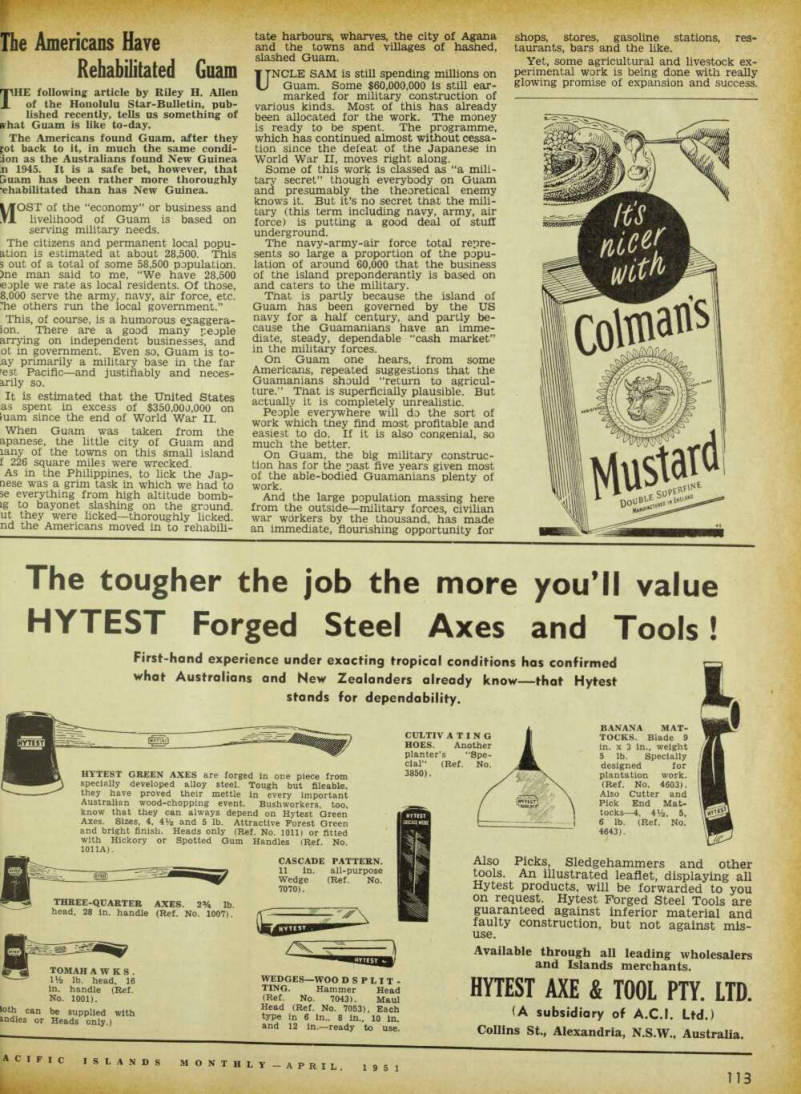
Rehabilitated Guam
THE following article by Riley H. Allen of the Honolulu Star-Bulletin, pub lished recently, tells us something of wdiat Guam is like to-day.
The Americans found Guam, after they fot back to it, in much the same condi ion as the Australians found New Guinea n 1945. It is a safe bet, however, that Suam has been rather more thoroughly •ehabilitated than has New Guinea. 1/fOST of the ‘‘economy” or business and .▼X livelihood of Guam is based on serving military needs.
The citizens and permanent local popu ation is estimated at about 28,500. This s out of a total of some 58,500 population. )ne man said to me, “We have 28,500 eople we rate as local residents. Of those, 8,000 serve the army, navy, air force, etc. ’he others run the local government.”
This, of course, is a humorous exaggera ion. There are a good many people arrying on independent businesses, and ot in government. Even so, Guam is to ay primarily a military base in the far r est Pacific—and justifiably and neces arily so.
It is estimated that the United States as spent in excess of $350,000,000 on ruam since the end of World War IL When Guam was taken from the apanese, the little city of Guam and lany of the towns on this small island f 226 square miles were wrecked.
As in the Philippines, to lick the Jap tiese was a grim task in which we had to se everything from high altitude bomb ig to bayonet slashing on the ground, ut they were licked—thoroughly licked, nd the Americans moved in to rehabili
tate harbours, wharves, the city of Agana and the towns and villages of hashed, slashed Guam.
UNCLE SAM is still spending millions on Guam. Some $60,000,000 is still ear marked for military construction of various kinds. Most of this has already been allocated for the work. The money is ready to be spent. The programme, which has continued almost without cessa tion since the defeat of the Japanese in World War 11, moves right along.
Some of this work is classed as “a mili tary secret” though everybody on Guam and presumably the theoretical enemy knows it. But it’s no secret that the mili tary (this term including navy, army, air force) is putting a good deal of stuff underground.
The navy-army-air force total repre sents so large a proportion of the popu lation of around 60,000 that the business of the island preponderantly is based on and caters to the military.
That is partly because the island of Guam has been governed by the US navy for a half century, and partly be cause the Guamanians have an imme diate, steady, dependable ‘‘cash market” in the military forces.
On Guam one hears, from some Americans, repeated suggestions that the Guamanians should ‘‘return to agricul ture.” That is superficially plausible. But actually it is completely unrealistic.
People everywhere will do the sort of work which they find most profitable and easiest to do. If it is also congenial, so much the better.
On Guam, the big military construc tion has for the past five years given most of the able-bodied Guamanians plenty of work.
And the large population massing here from the outside—military forces, civilian war workers by the thousand, has made an immediate, flourishing opportunity for
shops, stores, gasoline stations, res taurants, bars and the like.
Yet, some agricultural and livestock ex perimental work is being done with really glowing promise of expansion and success.
Advertisements & other items, pp. 115-116 (3 items)
acific islands Montely _ A p bi l. 195!
acific islands Montely A p bi l. 195!
Co\fliafl s
•w. •I*""
Mu > .tt3
The tougher the job the more you’ll value
HYTEST Forged Steel Axes and Tools!
First-hand experience under exacting tropical conditions has confirmed what Australians and New Zealanders already know—that Hytest
stands for dependability.
tip
CULTIV A T I N G
HOES. Another HYTEST GREEN AXES are forged in one piece from specially developed alloy steel. Tough but flleable, they have proved their mettle in every important Australian wood-chopping event. Bush workers, too, know that they can always depend on Hytest Green Axes. Sizes, 4,4 Vi and 5 lb. Attractive Forest Green and bright finish. Heads only (Ref. No. 1011) or fitted with Hickory or Spotted Gum Handles (Ref. No 1011 A). planter’s Special (Ref.
No. 3850).
Kvmr
CASCADE PATTERN.
11 in. all-purpose Wedge (Ref. No. 7070).
THREE-QUARTER AXES. 2% lb.
head. 28 in. handle (Ref. No. 1007).
IT loth can indies or
TOMAH A W K S .
IVz lb. head, 16 in. handle (Ref.
No. 1001). be supplied with Heads only.)
WEDGES—WOO DSPLIT-
TING. Hammer Head (Ref. No. 7043). Maul Head (Ref. No. 7053), Each type in 6 in.. 8 in., 10 in. and 12 in.—ready to use.
BANANA MAT-
TOCKS. Blade 9 in. x 3 in., weight 5 lb. Specially designed for plantation work. (Ref. No. 4603).
Also Cutter and Pick End Mattocks —4, 4 Vi, 5, 6 lb. (Ref. No. 4643).
Also Picks, Sledgehammers and other
tools. An illustrated leaflet, displaying all
Hytest products, will be forwarded to you on request. Hytest Forged Steel Tools are
guaranteed against inferior material and
faulty construction, but not against mis-
use.
Available through all leading wholesalers
and Islands merchants.
HYTEST AXE & TOOL PTY. LTD.
(A subsidiary of A.C.I. Ltd.)
Collins St., Alexandria, N.S.W., Australia.
ATTRACTIVE ACCOMMODATION for tourists, with children. “Tanglewood,” Clayfield, Brisbane, Queensland. ’Phone M 5656.
SOUTHERN HIGHLANDS.—Roomy, self-contained furnished flats, all-electric, sewered, hot water; near rail, shops and bus stops; handy to Sydney and South Coast towns; at 2,200 ft. elevation, all sports available, ideal for children. Terms and particulars from; Proprietor, “Tree Tops,”
Bundanoon, N.S.W.
FOR SALE
BOAT FOR SALE.—49 ft. Carvel, just off slip, new deckhouse, reconditioned LW4 Gardner diesel, 3 to 1 reduction, carry 10 tons; good sea boat; 4 bunks forward, two aft. West & Kennon, Box 250, Darwin, Northern Territory, Australia.
PLANTATION.—WarenvuIa Plantation, pre-war, approximately 1,500 acres, unencumbered, freehold. situated in New Britain, Territory of Papua-New Guinea. Apply: Bignell, 12a Hawkesbury Road, Springwood, N.S.W.. Australia.
N.I. PROPERTY FOR SALE.—Retiring or retired?
Norfolk Island is becoming more and more popular with residents of Papua-New Guinea, Solomon Islands and New Hebrides. Equable temperatures (50 degrees to 85 degrees); Mainland and tropical fruits all grow profusely; friendly people; NO TAXES. Furnished Houses for Sale: one at £2,000 has a lovely garden; another at £3,000 is complete with 1948 Prefect, a grand piano and all furniture, china and linen.
Write or cable: Peter Goddard, Property Agent, Norfolk Island. .
COPRA PLANTATION.—2OO-acre copra plantation, South Coast of Papua, comprising 27 acres, 99-year Lease, balance Freehold. Excellent harbour and anchorage. Plantation produces approximately 60 tons copra annually, and is situated only 18 miles from main port. Harbour is capable of taking coastal vessels of all tonnages. Estate sited in centre of big native population and trade good. Admirably suited to installation of desiccating factory. Buildings in good order. A snap at £6,500. Replies to “Advertiser,” c/o Box 3408, G.P.0., Sydney.
RADIO EQUIPMENT.—We can supply new atu reconditioned transmitters and receivers for lov powered marine and shore installations at i reasonable price. Crystals supplied to specific# frequencies. Inquiries answered promptly Write: Liverpool Trading Co., 23 George Street Liverpool, N.S.W., Australia.
COWRIE SHELLS
WANTED to purchase; Orange or Golden Cowrii Shells for small private shell collection. Repl. to: “Collector,” P.O. Box 3408, Sydney, N.S.W.
Australia.
TENDERS
TENDERS addressed to Burns, Philp & Co- Ltd.. South Sea Department, 7 Bridge Street Sydney, are invited and will be received ui to Noon, Tuesday, July 3, 1951, for the purchaa of the following coconut plantation propertie situated in the British Solomon Islands Protec torate;— Kepiai.—Situated about 2 miles west of Fail on Shortland Island. Comprises 640 acres Free hold, and 325 acres Leasehold—99 years froi 1/1/1913. The pre-war output from the de veloped area of about 540 acres was abor 80 tons per annum.
Kindar.—Situated at Hathorn Sound, at tfc end nearest Diamond Narrows. Comprises 1,6£ acres Freehold, including the small island « Baraki. The pre-war output from the develope area of about 769 acres was about 125 tons pe annum.
Simbilandu. —Situated on the island of Vei; Lavella. Comprises 547 acres Freehold, part: developed. The pre-war output from this pro perty was about 20 tons per annum.
Kiae Point. —Situated on the island of Gonongi Comprises two Crown Leases each 640 acres- -99 years from 1912. One lease partly developethe pre-war output from which was about * tons.
The highest or any tender not necessarily acepted. Terms with suitable guarantee will I considered. Transfers subject to approval < Resident Commissioner.
Further particulars will be made available c applicaton.
TENDERS addressed to the Liquidator, Solomc Islands Development Co., Ltd., (In Liq.), Bt 543, G.P.0., Sydney, are invited and will be r ceived up to Noon, Tuesday, July 3, 1951, fthe purchase of the following coconut plant; tion properties situated in the British Solom# Islands Protectorate: — Berande.—Situated on the north coast Guadalcanal. Area: Approximately 2,000 acre Tenure: Freehold. The pre-war output fra the developed area of about 845 acres was aboi 250 tons per annum, and 122 acres we planted with rubber.
Manning Straits.—Situated on a number islands between Ysabel and Choiseul Islam Area: Approximately 5.000 acres. Tenure: Leas hold, 99 years from 1/6/1904. The pre-war ou put from the developed area of approx mately 1,248 acres was about 180 tons R annum.
The highest or any tender not necessarily a cepted. Terms with suitable guarantee will considered. Transfers subject to approval Resident Commissioner.
Further particulars will be made available application.
TENDERS addressed to the Secretary, Sho:i land Islands Plantations Ltd.. Box 543, G.P.<.
Sydney, are invited and will be received up Noon, Tuesday, July 3, 1951, for the purchs of: — Lofung Coconut Plantation. —Situated in 1 Shortland Islands (British Solomon Islands Area: Approximately 1,753 acres. Tenure: Frc hold. This property sustained some dams during the late war, but the pre-war plantj area of 1.063 acres yielded an average of 4 tons.
Virgin Land —Shortland Islands. —Situated in ' Shortland Islands (British Solomon Island Area: Approximately 12,500 acres. Tenure: Fn hold.
The highest or any tender not necessarily i cepted. Terms with suitable guarantee will considered. Transfers subject to approval Resident Commissioner.
Further particulars will be made available application.
Classified Advertisements
HOLIDAY ACCOMMODATION
“MOUNTAIN VIEW” GUEST HOUSE, magni-
ficently situated on the banks of the Wollondilly River in Burragorang Valley, Australia’s largest sunken valley (69 miles from Sydney), a most modern Guest House, with accommodation for 150 guests. Golf, tennis, riding, billiards, dancing and swimming. Hot water service, electric light and sewerage. Licensed to serve liquor. Tariff: £5/11/- per week, children at half rates. Write direct to: MOUNTAIN VIEW,” Burragorang Valley, N.S.W., or phone Burragorang 3 (or XM 1384). Proprietor: B. I.
Fernandez, late of Papua and New Guinea.
Here’s Hope
For A
Persistent Worry
CONSTIPATION, forerunner of many troubles, affects people of all ages and walks of life and causes much annoyance and worry.
When the bowels refuse to work naturally and regularly, the body absorbs poisons from the waste that remains in the system. Constipation brings sick headaches, biliousness, coated tongue and unpleasant breath, flatulence, loss of appetite, blemishes and other troubles which quickly upset your health and well-being.
These troubles are easily corrected by safe, gentle Pinkettes for you and all the family.
Pinkettes are simple to take; and do not have harsh after-effects which can be dangerous.
Being compounded of harmless vegetable ingredients only, Pinkettes act in Nature’s way.
Thousands and thousands of people have found Pinkettes the ideal laxative, because they are not habit-forming and the dose is reduced as they make you regular. Always at chemists and stores.
VESSEL FOR SALE
"GONA"-62 ft. Ocean-going, Twin G.M. Diesel Motor Vessel
Fully Found and Equipped
Sheathed—Two-way Licensed Radio—Refrigeration Dingy Carley Raft.
Dual Bridge and Wheelhouse Controls —Two Cabins Chartroom—Ga 11 ey—To i 1e t.
Sleep 7 Europeans, 14 natives.
Cargo Hold; 1 6 ft. x 1 3 ft. x 6 ft.—3o tons.
Speed: 10 knots —Fuel; 6 galls, hour—Range; 1,500 miles Copper Tanks.
A 1 Condition —Full Inventory—lnsured at Lloyd's—Halvorsenbuilt in 1945.
INSPECTION—DELIVERY—RABAUL T.N.G., OR BY ARRANGEMENT
Contact
G. V. MILLER & CO. LTD.
TOROKINA OR RABAUL, NEW GUINEA
Agents—Croyden & Viggers, Robaul, T.N.G.
114
APRIL, 1951 PACIFIC ISLANDS MONTH LI
Makalesi and Akaripa
By “Kai Viti”
IT was very dark and still in the Fijian town of . . . The household was asleep as Makalesi crept out of her bed at a late hour and made her way outside. She was unable to sleep in the hot, stuffy atmosphere of the bure and felt sorely in need of some fresh air.
A village dog barked and she made an involuntary exclamation, causing the animal to continue barking and threaten to wake the whole town.
Makalesi quietened the mongrel and valked quickly towards the river nearby, vhere she received another shock. A foung man was following her!
“Ko iko, a cava ko vinakata? A cava to muri au kina? Lako tani. Sa!”
Makalesi said to him.
He replied: “Kua ni rere noqui tau omani, au sega ni nakita edua na ka ca fei iko. Yalvinaka ka rogoca mada na loqu vosa.” (“Do not be frightened, my lear friend. I have no evil intentions to wards you. Please first hear what I have o say.”) Then commenced the strangest wooing ver Fijian maid had. The young man aid his name was Akaripa, and that he rrived three days ago from Lau. He had •aught sight of Makalesi several times, le said, and knew there was no other girl n the world for him. In fact, so capti ated and enthralled was he that he ould not sleep for thinking of her, and ecided that night that he must try and ave speech with her, somehow or other, tis astonishment and delight, therefore, new no bounds when he saw the girl f his heart emerge from her bure.
Makalesi, impressed with the young lan’s earnestness and impetuosity, fell nder his spell.
Akaripa was tall and handsome with lack eyes and dazzling white teeth; a aperb body, strong and lithe, perfectly roportioned. “What a husband he would take me,” thought Makalesi, “and what onderful children we would have.” .And who could adequately describe .akalesi! Akaripa had never seen a .aiden to equal her, and he had had ide experience. The young man was •ell-bound with her beauty and, al lough usually at no loss for words, found difficult to proceed with his proposal.
Co ? ie i<T^ ith me ’ my beloved,” he *gged. I have a boat all ready to sail id we would be miles away before dis •very is made, and then it will be too te to stop us. We will get married when te/” 30 * 1 bome and live happily ever TOW, this was not Makalesi’s first i flutter, by any means, but it was the aJ' 1111 ® s^e bad been deeply oved. After an almost imperceptible LUse ’ sh ® said: “Very well but I must • and gather my belongings. I have some ,ry P r |cious things of my own. Just * f ® w , minutes, and I will be back .am. Reluctantly, Akaripa let her go, ter clasping her tightly for a few conds.
Makalesi stole away, and after what emed an eternity, returned with a small fc c . a i S , e ,,, an J a bundle of mats, etc. ikefn! 7 bo Sh6 * £? S S? d - “ My father is fvSnA might discover my absence S7«J5 mute ! J S Qd c °me looking for me.”
With rapidity the lovers made off to e boat and set sail without delay. The rly morning breeze wafted them down it a ?i d by da yiigbt they were well ri “ a ;. Akaripa was a born sailor, and innlf m order ’ including a sub antial provision of food and water.
Alter six days sailing they arrived at .if and what a voyage they th ? fc ° eac h to sail thl ocean a wonderful new-found lover.
Impressed by the welcome given Aka ripa by the inhabitants of (an island in the Lau Group), Makalesi thought he must be of very high rank and said to him: “Are you the Roko Tui Lau, by any chance?”
“No, darling,” Akaripa said. “Actually, I am not a Lauan, but a Rarotongan. My parents visited when I was an infant, and both died of influenza soon after. A very high Chief adopted me and when he died I was looked upon as his successor, and have lived here ever since.”
Makalesi and Akaripa were married according to law, and the attendance at the wedding was the largest ever seen in Lau. Guests came from far and near, and presented rare and costly gifts. This romance is still often recounted by the people of although it happened long ago. The two children of the union, a boy and girl, are married, and are as handsome as their parents.
Advertisements & other items, p. 117 (2 items)
115
‘'"l' ISLANDS MONTHLY APRIL, 195!
The Garrick Hotel
NOTICE
Hunts Agency, of Suva, Fiji, Wish to Advise all Firms in Australia that they have No Connection whatsoever with any other Firm or Agency (except Hunts Travel Agency) in Fiji or the Pacific Islands generally.
C. Harvey Hunt.
Iris A. Hunt.
SUVA,
April 6, 1951.
PLAIN AND
SELF RAISING
FLOUR,
CMc fc*c
ESTABLISHED 1868
Agents for Fiji, Tonga and Samoa: C. SULLIVAN (PACIFIC ISLANDS) LTD., Suva, Fiji.
The Garrick Hotel
Tty*
Tm ?
II I ilu *** i 1 m % »
SUVA
FIJI
This well-known Hotel is centrolly situated in Suva's main business quarter : : Modern accommodation provides comfort m all climatic conditions : : Only the best of Beers, Spirits and Wines is served.
Telephone: 80. VINCE COSTELLO.
Proprietor.
Islands Produce
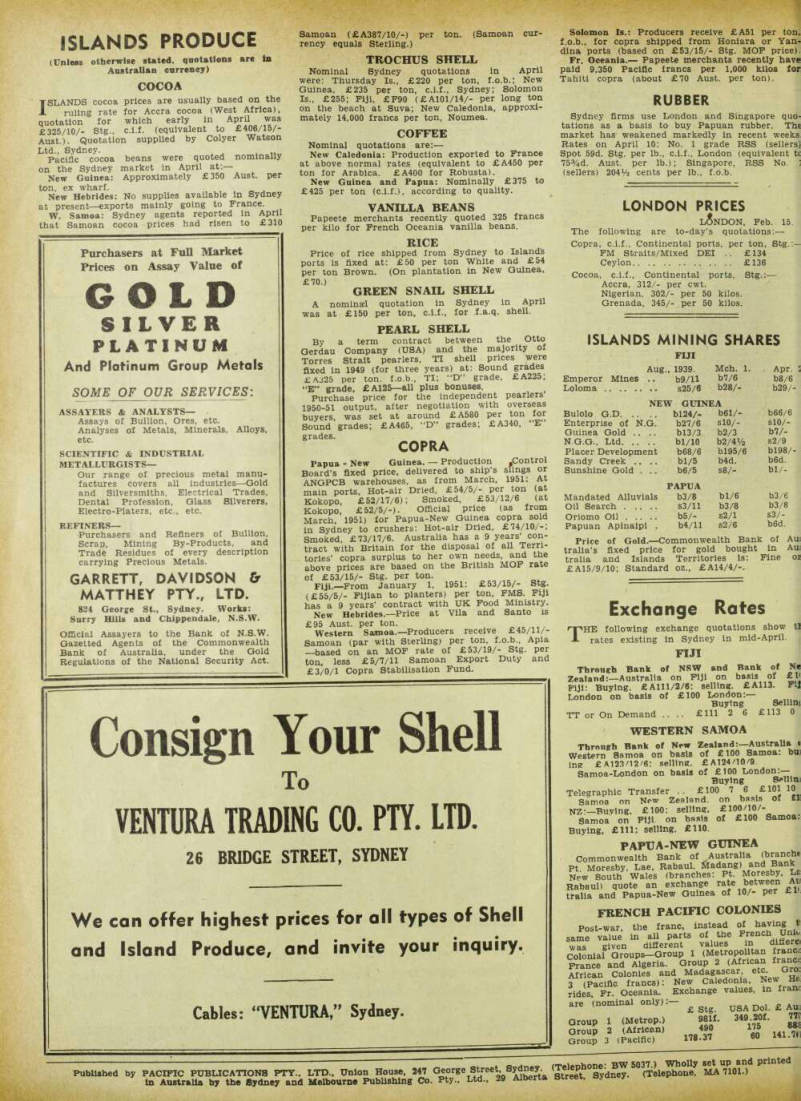
(Unless otherwise stated, quotations are In Australian currency)
Cocoa
ISLANDS cocoa prices are usually based on the ruling rate for Accra cocoa (West Africa), quotation for which early in April was £325/10/- Stg., c.i.f. (equivalent to £406/15/- Aust.). Quotation supplied by Colyer Watson Ltd., Sydney. x Pacific cocoa beans were quoted nominally on the Sydney market in April at; — New Guinea: Approximately £350 Aust. per ton. ex wharf. , , „ , New Hebrides: No supplies available in Sydney at present—exports mainly going to France.
W. Samoa; Sydney agents reported in April that Samoan cocoa prices had risen to £3lO
Samoan (£A3B7/10/-) per ton. (Samoan cur rency equals Sterling.)
Trochus Shell
Nominal Sydney quotations in April were; Thursday Is., £220 per ton, f.0.b.; New Guinea. £235 per ton, c.i.f., Sydney: Solomon Is., £255; Fiji, £F9O (£AIOI/14/- per long ton on the beach at Suva; New Caledonia, approxi mately 14,000 francs per ton, Noumea.
Coffee
Nominal quotations are:— New Caledonia: Production exported to France at above normal rates (equivalent to £A4SO per ton for Arabica. £A4OO for Robusta).
New Guinea and Papua: Nominally £375 to £425 per ton (c.i.f.), according to quality.
Vanilla Beans
Papeete merchants recently quoted 325 francs per kilo for French Oceania vanilla beans.
Rice
Price of rice shipped from Sydney to Islands ports is fixed at: £5O per ton White and £54 per ton Brown. (On plantation in New Guinea. £70.)
Green Snail Shell
A nominal quotation in Sydney in April was at £l5O per ton, c.i.f., for f.a.q. shell.
Pearl Shell
By a term contract between the Otto Gerdau Company (USA) and the majority of Torres Strait pearlers, TI shell prices were fixed in 1949 (for three years) at: Sound grades £A325 per ton. f.0.b., TI; “D” grade, £A225; “E” grade, £Al2s—all plus bonuses.
Purchase price for the independent pearlers 1950-51 output, after negotiation with overseas buyers, was set at around £ASBO per ton for Sound grades; £A465, “D” grades; £A34O, “E grades.
Copra
Papua - New Guinea. Production .Control Board’s fixed price, delivered to ship’s slings or ANGPCB warehouses, as from March, 1951: At main ports. Hot-air Dried, £54/5/- per ton (at Kokopo. £52/17/6): Smoked, £53/12/6 (at Kokopo, £52/5/-). Official price (as from March, 1951) for Papua-New Guinea copra sold in Sydney to crushers: Hot-air Dried, £74/10/-, Smoked, £73/17/6. Australia has a 9 years’ con tract with Britain for the disposal of all Terri tories’ copra surplus to her own needs, and the above prices are based on the British MOP rate of £53/15/- Stg. per ton.
Fiji.—From January 1, 1951: £53/15/- Stg. (£55/5/- Fijian to planters) per ton, PMS. Fiji has a 9 years’ contract with UK Food Ministry.
New Hebrides.—Price at Vila and Santo is £95 Aust. per ton.
Western Samoa.—Producers receive £45/11/- Samoan (par with Sterling) per ton, f.0.b., Apia based on an MOF rate of £53/19/- Stg. per ton, less £5/7/11 Samoan Export Duty and £3/0/1 Copra Stabilisation Fund.
Solomon Is.: Producers receive £ASI per ton, f.0.b., for copra shipped from Honiara or Yan dina ports (based on £53/15/- Stg. MOF price).
Fr. Oceania.— Papeete merchants recently have paid 9,350 Pacific francs per 1,000 kilos for Tahiti copra (about £7O Aust. per ton).
Rubber
Sydney firms use London and Singapore quo tations as a basis to buy Papuan rubber. The market has weakened markedly in recent weeks; Rates on April 10: No. 1 grade RSS (sellers) Spot 59d. Stg. per lb., c.i.f., London (equivalent to 75%d. Aust. per lb.); Singapore, RSS No. 3 (sellers) 204 Va cents per lb., f.o.b.
London Prices
London. Feb. 15.
The following are to-day’s quotations:— Copra, c.i.f., Continental ports, per ton, Stg.;— FM Straits/Mixed DEI .. £134 Ceylon £136 Cocoa, c.i.f., Continental ports, Stg.;— Accra, 312/- per cwt.
Nigerian, 302/- per 50 kilos.
Grenada, 345/- per 50 kilos.
Islands Mining Shares
Fiji
Aug., 1939.
Mch. 1.
Apr. : Emperor Mines .. b9/H b7/6 b8/6 Loloma S25/6 b28/b29/- 5
New Guinea
Bulolo G.D bl24/b61/b66/6 Enterprise of N.G. b27/6 slO/slO/- Guinea Gold .. .. bl3/3 b2/3 b7/- N.G.G., Ltd bl/10 b2/4% s2/9 Placer Development b68/6 bl95/6 bl98/- Sandy Creek .. bl/5 b4d. b6d.
Sunshine Gold . .. b6/5 s8/bl/-
Papua
Mandated Alluvials b3/8 bl/6 b3/6 Oil Search S3/11 b3/8 b3/8 Oriomo Oil b5/s2/l s3/- Papuan Apinaipi . b4/ll s2/6 b6d.
Price of Gold.—Commonwealth Bank of Aui tralia’s fixed price for gold bought in Am tralia and Islands Territories is: Pine oz £A15/9/10; Standard oz., £ A14/4/-,
Exchange Rates
THE following exchange quotations show til rates existing in Sydney in mid-April.
Fiji
Through Bank of NSW and Bank of No Zealand:— Australia on Fiji on basis of £l' Fiji; Buying. £Alll/2/6: selling. £AII3. PII London on basis of £lOO London; — Buying Sellini.
TT or On Demand .. .. £lll 2 6 £ll3 0
Western Samoa
Throngh Bank of New Australia ♦ Western Samoa on basis of £lOO Samoa, bui ine £AI23/12/6; selling. £AI24/10/9.
Samoa-London on basis of £lOO London;— Buying Belllnn Telegraphic Transfer .. £lOO 7 6 £lOl 1 ® Samoa on New Zealand, on basis ol Ell N Z-—Buying. £100: selling. £lOO/10/- Samoa on Fiji, on basis of £lOO Samoa: Buying, £111: selling. £llO.
Papua-New Guinea
Commonwealth Bank of J Australia * Pt. Moresby. Lae. Rabaul. Hadang) and Bank New South Wales (branches: Pt. Moresby, La Rabaul) quote an exchange ra J e between Au tralia and Papua-New Guinea of 10/- per £l'J
French Pacific Colonies
Post-war. the franc, instead of having * same value in all parts of the French Unto was given different values m differ® Colonial Groups—Group 1 (Metropolitan franc,.
Prance and Algeria. Group 2 (African franc..
African Colonies and Madagascar, etc. uroo 3 (Pacific francs): New Caledonia, New He. rides, Fr. Oceania. Exchange values, in fran are (nominal only):
ax* (nomiiuu «uvi. £ gtg USA Dol . £ AUJ Group 1 (Metrop.) 9811. 349.201. ™ Group 2 (Africen) 490 1J5 8WJ Group 3 (Pacific) 178.37 60 141.7*1
Advertisements & other items, pp. 118-120 (3 items)
Published by PACIFIC PUBLICATIONS PTY., LTD., Union House, 247 George Street &UA m ‘ )
in Australia by the Sydney and Melbourne Publishing Co. Pty.. Ltd., 29 Alberta Street, sya y
Consign Your Shell
Purchasers at Full Market Prices on Assay Value of
GOLD
SILVER
PLATINUM
And Platinum Group Metals
SOME OF OUR SERVICES :
ASSAYERS & ANALYSTS—
Assays of Bullion, Ores, etc.
Analyses of Metals, Minerals, Alloys, etc.
SCIENTIFIC & INDUSTRIAL
METALLURGISTS—
Our range of precious metal manufactures covers all industries —Gold and Silversmiths, Electrical Trades, Dental Profession, Glass Sllverers, Electro-Platers, etc., etc.
REFINERS—
Purchasers and Refiners of Bullion, Scrap, Mining By-Products, and Trade Residues of every description carrying Precious Metals.
GARRETT, DAVIDSON &
MATTHEY PTY., LTD.
824 George St., Sydney. Works; Surry Hills and Chippendale, N.S.W.
Official Assayers to the Bank of N.S.W.
Gazetted Agents of the Commonwealth Bank of Australia, under the Gold Regulations of the National Security Act.
Consign Your Shell
To
VENTURA TRADING CO. PTY. LTD.
26 BRIDGE STREET, SYDNEY
We can offer highest prices for all types of Shell and Island Produce, and invite your inquiry.
Cables; “VENTURA,” Sydney.
South Pacific Skyways
* \S
V cP N
TO NEW ZEALAND
FROM SYDNEY-OR SUVA
I ~nT I .O' <c v ...
Fly by fast TEAL airliners to scenic New Zealand. You’ll appreciate the fine service, delicious meals. New Zealand is now so close. This year and enjoy all the scenic wonders on a short vacation. w.
TO NEW ZEALAND
HAN EMPIRE AIRWAYS LIMITED in association with QEA and BOAC Reservations: TEAL, QEA, NAC, TAA, Leading Travel Agents
MERCHANTS. & SHIP OWNERS
Capital £500,000
ESTABLISHED 1914
GENERAL MERCHANTS
AND
PROVIDORES
TRADE THROUGHOUT THE PACIFIC.
THIRTY-FIVE YEARS OF PACIFIC ISLANDS DEVELOPMENT AND SERVICE.
BUYERS AND EXPORTERS OF ALL KINDS ( AGENTS FOR AUSTRALIAN, EUROPEAN
( AND AMERICAN MANUFACTURERS.
OF ISLAND PRODUCE, COPRA, COCOA, > DISTRIBUTORS OF EVERY DESCRIPTION M.O.P. SHELL, TROCAS SHELL, ETC. \ OF MERCHANDISE.
Through our Sydney office, branches and agents, we distribute a wide and comprehensive range of general merchandise.
W. R. CARPENTER & CO. LTD.
Head Office: 16 O'CONNELL STREET, SYDNEY, N.S.W.
Cable Address: Telephone: Postal Address:
“CAMOHE.” 8W4421. G.P.0., BOX 168, Sydney.
In London: W. R. Carpenter & Co. (London), Ltd., Coronation House, 4 Lloyd's Ave., London, EC
ASSOCIATED COMPANIES THROUGHOUT THE PACIFIC :
IN NEW GUINEA:
New Guinea Company, Limited, Rabaul, Lae, Madang, Kavieng.
IN PAPUA;
J. R. Clay & Co., Ltd., Port Moresby.
IN FIJI:
W. R. Carpenter & Co. (Fiji), Ltd., Suva.