Pacific
Islands
Monthly
HBBwsi
Vol. XXI. No. 10.
Established 1930.
t ßegistered at the GJ'.O., Sydney, Jor transmission by post as a newspaper]
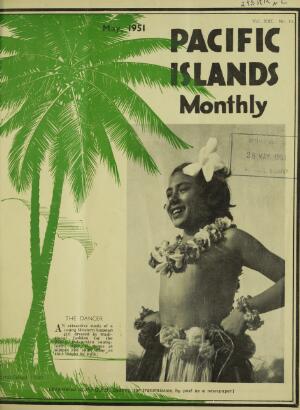
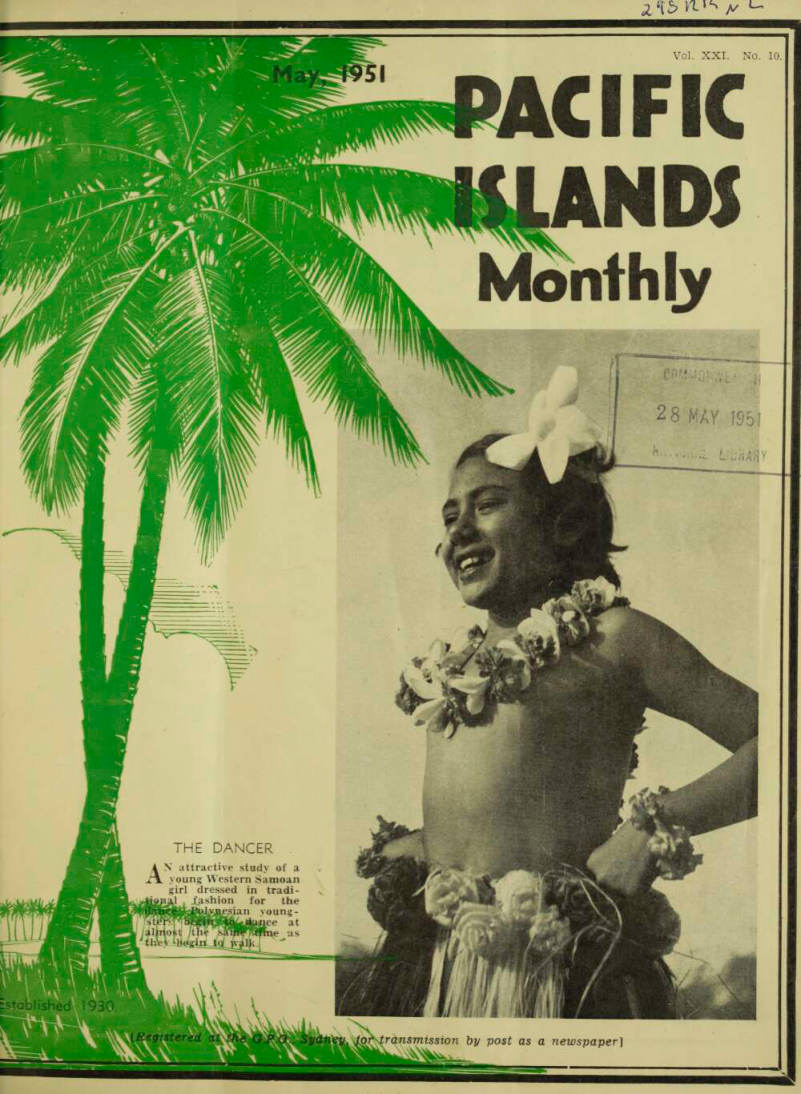
The Dancer
AN attractive study of a young Western Samoan girl dressed in tradi tional fashion for the dance. Polynesian young sters begin to dance at
almost the same time as
they begin to walk.
Advertisements & other items, pp. 2-4 (3 items)
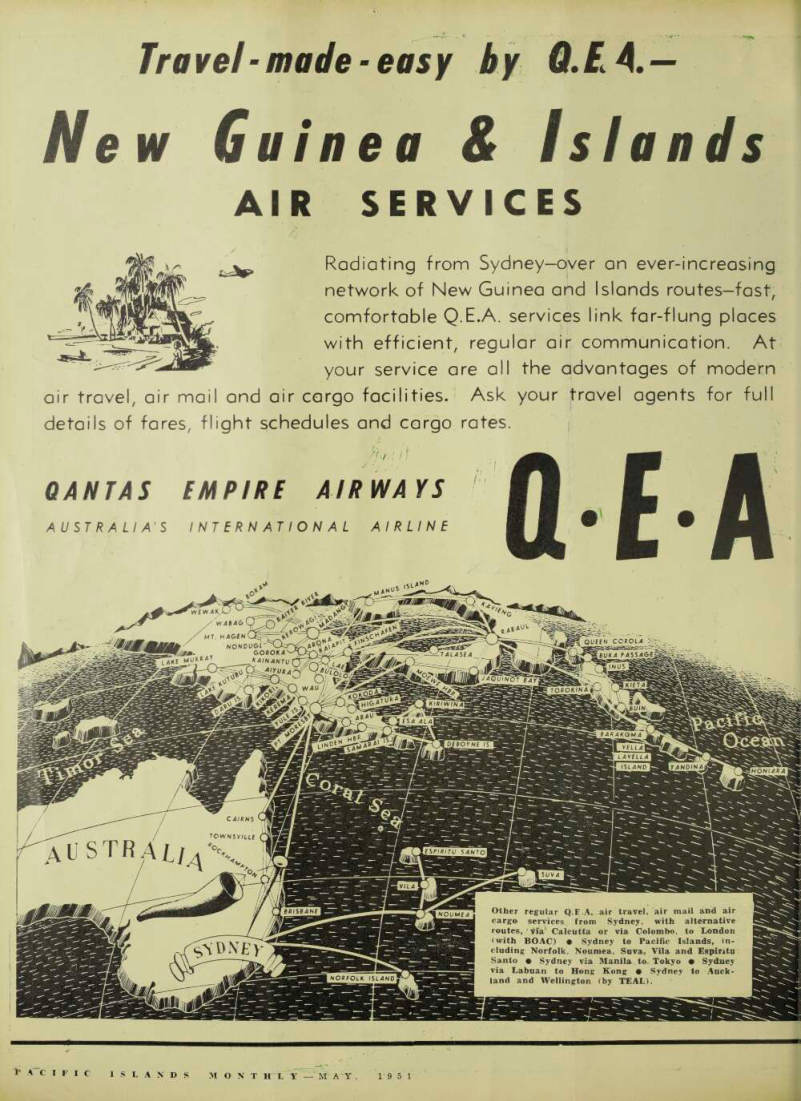
He w Guinea & Islands
Travel-made-easy by Q.EA.—
AIR SERVICES
Radiating from Sydney—over an ever-increasing
network of New Guinea and Islands routes-fast,
comfortable Q.E.A. services link far-flung places
with efficient, regular air communication. At
your service are all the advantages of modern air travel, air mail and air cargo facilities. Ask your travel agents for full details of fares, flight schedules and cargo rates. /hr:if
QANTAS EMPIRE AIRWAYS
AUSTRALIA'S INTERNATIONAL AIRLINE
HE A
iiA» D
WtW A K
/ WABAG
MT. HAGEN
AOEN
r.nunid Ui tv-ifr /
QUEEN COSOL A >
BUK A PASSAGE
i^INL/sMili
a&
GOROK A v
RAINANTU
lake mm
JAQUINOT BAY
KIETA
WAU
rOROKIN A f
KOK
KIRIWINA
m
JIN
ABAU
barakoma M M
DJBOYNE IS
V ELLAtSjf
i A vELLA
ISLAND ANDINA
HONIAR
jf
CAIRNS
AUSTRAL/.
Other regular Q.E.A, air travel, air mail and air cargo services from Sydney, with alternative routes, via' Calcutta or via Colombo, to London < with BOAC) • Sydney to Pacific Islands, including Norfolk. Noumea, Sava, Vila and Espiritu Santo • Sydney via Manila to Tokyo • Sydney via Labuan to Hong Kong • Sydney to Auckland and Wellington (by TEAL).
BRISBANE
NOUMEA
s \v\Ey
NORFOLK ISLAND
m
miEMAN TARIF IAMPt
S't : , 3: m. % m ■ * m m 1 SP// O' ( X X' 3 From o safety point of view, these lamps leave nothing to be desired.
There is no spilling of fuel if tipped over accidentally, even while burning and they cannot be filled while lighted.
The mantles are shock-proof and the fuel fount unbreakable.
Coleman Table Lamps give brilliant light, so like natural daylight that you can match delicate shades by it. They are twenty times as powerful as ordinary kerosene lamps and seven times as powerful as household electric bulbs.
They light instantly, are draught-proof and the fuel capacity is sufficient for 12 hours of abundant eye-saving light. Finished in ivory enamel, with
decorated plastic covered parchment-type shade
and heat resisting globe, the lamp is a furnishing as well as a utility.
Representatives for the Pacific Islands:
54a PITT STREET
SYDNEY
ROBERT GILLESPIE P T JLT?
PEARCE & CO. LTD.
SUVA
FOR FIJI ISLANDS
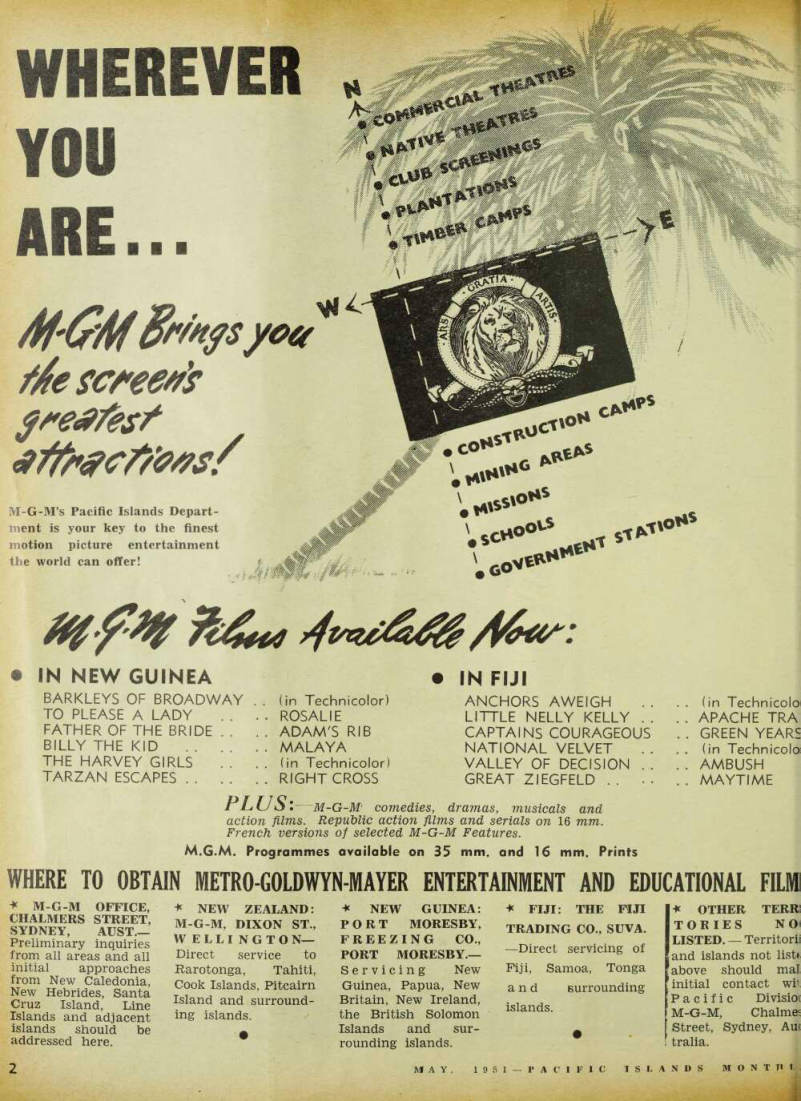
WHEREVER
YOU
ARE...
Me screens
M-G-M’s Pacific Islands Department is your key to the finest motion picture entertainment the world can offer!
Si M H 4 V?
c M* pS
• co, * s o vs ;sc%*° ,vt^
s tM'
o»* s %/ 'if:
IN NEW GUINEA
IN FIJI
BARKLEYS OF BROADWAY
TO PLEASE A LADY
FATHER OF THE BRIDE
BILLY THE KID
THE HARVEY GIRLS
TARZAN ESCAPES . .
(in Technicolor)
ROSALIE
ADAM'S RIB
MALAYA
(in Technicolor)
RIGHT CROSS
ANCHORS AWEIGH
LITTLE NELLY KELLY . .
CAPTAINS COURAGEOUS
NATIONAL VELVET
VALLEY OF DECISION . .
GREAT ZIEGFELD . .
(in Technicolo
APACHE TRA
GREEN YEARS
(in Technicolo
AMBUSH
MAYTIME
PLUS : comedies, dramas, musicals and action films. Republic action films and serials on 16 mm.
French versions of selected M-G-M Features.
M.G.M. Programmes available on 35 mm. and 16 mm. Prints WHERE TO OBTAIN METRO-GOIDWYN-MAVER ENTERTAINMENT AND EDUCATIONAL FI
* M-G-M OFFICE,
CHALMERS STREET,
SYDNEY, AUST.—
Preliminary inquiries from all areas and all initial approaches from New Caledonia, New Hebrides, Santa Cruz Island, Line Islands and adjacent islands should be addressed here.
* NEW ZEALAND:
M-G-M, DIXON ST.,
WELLINGTO N
Direct service to Rarotonga, Tahiti, Cook Islands, Pitcairn Island and surrounding islands.
* NEW GUINEA:
PORT MORESBY,
FREEZING CO.,
PORT MORESBY.—
Servicing New Guinea, Papua, New Britain, New Ireland, the British Solomon Islands and surrounding islands.
* FIJI: THE FIJI
TRADING CO., SUVA.
—Direct servicing of Fiji, Samoa, Tonga and surrounding islands.
TEI
* OTHER
TORIES
LISTED. Territoi and islands not list* above should mal initial contact wii Pacific Divisioc M-G-M, Chalmes Street, Sydney, Am tralia.
1
I ACIFIC ISLANDS MONTHLY MAY, 19 5 1
2
MAY, 19 5 1 PACIFIC ISLANDS MONTH I.
Index to Advertisers
Achun, Gabriel . . 38 “Akta-Vite” ... 42 Aladdin Industries . 56 Alois Akun & Co. . 89 Amplion (A/sia) .66 Angus & Robertson 18 Ardath Tobacco Co. 109 “Aspaxadrene” . . 21 “Aspro” ... 89 Balchin, W., Ltd. . 30 Bank of Australasia . . 118 Bank of NSW . . 81 Bell, Stanley P., & Co 49, 101 “Bellhaven” Guest House ... 99 Berger Paints . .88 Berlei Ltd 40 Berry’s Bay Boat yard 95 Bethell, Gwyn Co. 115 Blaxland Rae Pty. 97 Blundell Spence Co. 74 Borthwick’s Paint . 83 8.0.A.C 104 Bovril, Ltd. ... 45 Brasso Polish ... 80 Bristol-Myers Co. . 54 Broomfield, Ltd. . 96 Brunton & Co. . . 33 Bunting, A. H. 50, 86 Burns Philp (NG) . 65 Burns Philp (NH) . 42 Burns Philp (SS) . 53 Burns Philp Trust . 22 Butterfly World Supply House . 79 Caine’s Studios . . 35 Carpenter, W. R. & Co. Ltd. 78, cov. iv Carpenter. W. R. (Fiji). Ltd. . . 108 Classified Advts. . 118 Colonial Meat Co. 48 Colyer Watson (NG) Ltd., 15, 73, 117 Crammond Radio . 20 Crilley, R. J., Ltd. 101 Cunningham, R. H.
Pty., Ltd. ... 36 “Cystex” ... 105 Dangar, Gedye & Malloch, Ltd. 3, 95 Davison Paints . . 113 “Dettol” 75 Donaghy & Sons . 37 Donald, A. 8., Ltd. (Auckland) ... 46 Donald, A. 8., Ltd. (Rarotonga) ... 76 Douglas, W. C. . 41 Dunlop Rubber Co. 27 Electrolux ... 78 Excelsior Supply 38 Executive Available 116 Festival of Britain . 19 Ford Sherington . 71 French Chamber of Commerce ... 77 Garrett, Davidson & Matthey, Ltd. . 120 Garrick Hotel . . 31 Gilbey, W. & A. . 107 Gillespie Bros. . . 49 Gillespie, Robt., Pty., Ltd. 1, 67. 105 Gillespie, Robt. (NG) Ltd. . . 39, 84 Gordon’s Gin ... 75 Gough & Co., E. J. 114 Grand Pacific Hotel 4 Green, L. H.. Pty. 28 Gregory, A., Ltd. . 50 Grove, W. H., & Sons, Ltd. . 19. 80 Halvorsen Sons, Ltd. 96 Hawley’s Pty., Ltd. 52 Hay, K. H. D. . . 67 Heinz & Co., Ltd. . 25 Hemingway & Robertson, Ltd. . 36 “Holland Rusk’’ . 13 Hoover, Francis . . 16 Hygeia Sanitary Co. 76 Island Industries . 77 Islands Service Bureau ... 41 Jackson, S. Went worth 13 Kennedy, Captain 101 Kerr Bros. . . 92, 97 Kiwi Polish Co. . 17
Kodak Pty., Ltd. . 16 Kolynos, Inc. ... 28 Kopsen, W., & Co. 102 Lillis & Co., Ltd. . 70 Macintyre, Tnomas, & Co., Ltd. ... 55 MacLaurln School . 4o Macquarie Chemi cal Laboratories 117 Mac Robertson Pty. 46 McGee, Andrew . . 44 Mcllrath’s, Ltd. . , 33 “Mendaco” . . . 116 Merrillees, J. C.
Pty., Ltd. ... 47 M-G-M Films . . 2 Millers, Ltd. (Fiji) 103 Miller, G. V.. Ltd. 100 Mobile Industrial Equipment, Ltd. 106 Moderne Knitwear 103 Morris Hedstrom Ltd 12 Morris Hedstrom (Aust.) Pty.. Ltd. 93 Mungo Scott, Ltd. 11l Nathan’s Merchan dise (NSWi Pty. 51 Nelson & Robertson 55 “Nixoderm” ... 87 Nordman, Oscar G. 11l North Sydney Travel Bureau . 102 O’Brien, Geo. ... 97 Oliver Corporation 26 Pabco Products . . 43 Pacific Is. Society 69 Pacific Islands Trading Co. ... 29 Pan American Air ways, Inc. ... 14 Penguin Bookshop 119 “Pinkettes” . . . 107 Premier Refrigera tion Co. Pty., Ltd. 32 Qantas Airways cov. ii.
Qld. Butter Board 30 Qld. Insurance Co. 15 Quirk’s Victory Light Co 34 Ransomes, Sims & Jefferies, Ltd. . . 68 Reed. Wm„ E. 27, 112 Riverstone Meat Co. 82 Robinson, G. H. . . 79 Rohu, Sil . . . . 53 Savitz, B 51 Scott, J., Pty., Ltd. 87 Seward, N. H.. Ltd. 25 Shell Co. of Aust. 69 Simpson Bros. Pty. 31 Sims. A. G.. Ltd. 98 Southern Cross Eng. & Windmill Co. . 99 Southern Pacific Insurance Co. . 119 Spartan Paints . . 37 Spruso Co 23 Steamships Trading Co., Ltd. (Papua) 71 Stewarts & Lloyds 39 Sullivan, C., Ltd. . 68 Swift & Horndale Pty., Ltd. ... 84 Tallerman & Co. . 116 Tasman Empire Air ways, Ltd. ... 94 Taylor, Allen & Co. 108 Thornycroft, Ltd. . 72 Tilley Lamp Co. 86, 110 Tillock & Co., Ltd. 114 T o n g a n Photos Bureau 29 Tooth & Co., Ltd. 109 Trans Oceanic Air ways 24 Tru-Wite Cleaner . 35 Tyneside Engineer ing Co., Ltd. . . 66 Undersee Novelties 113 United Island Traders Ltd. . . 72 Vacuum Oil Co. . . 90 Valiant Rum ... 92 Ventura Trading Co. . . . 23, 91, 120 Vincent Chem. Co. 85 West, Harry, Pty., Ltd 100 Williams’ Pills . . 83 Wills, W. D. & H. 0., Ltd. . . cov. iii.
W. J. Manufactur ing Co., Ltd. . . 17 Wood’s Great Pep permint Cure . no Yorkshire Insur ance Co., Ltd. . . 91
Advertisements & other items, p. 5 (1 item)
“D.G.M.” Pumps
I,ooo's of Gallons
moved per hour
by
“D.G.M.” Pumps
"D.G.M." Pumping Units ore moving hundreds to many thousands of gallons of water per hour for farmers, planters and miners throughout Australia and the Pacific Islands.
Before you install a new pump, send us your problem. Our practical experience can guide you and perhaps save you money-placing you under no obligation.
There is a "D.G.M." Pumping Unit for all plantation or mine requirements—write today for further information.
Dangar, Gedye & Malloch Ltd.
Malloch House, 10-14 Young Street, Circular Quay, Sydney.
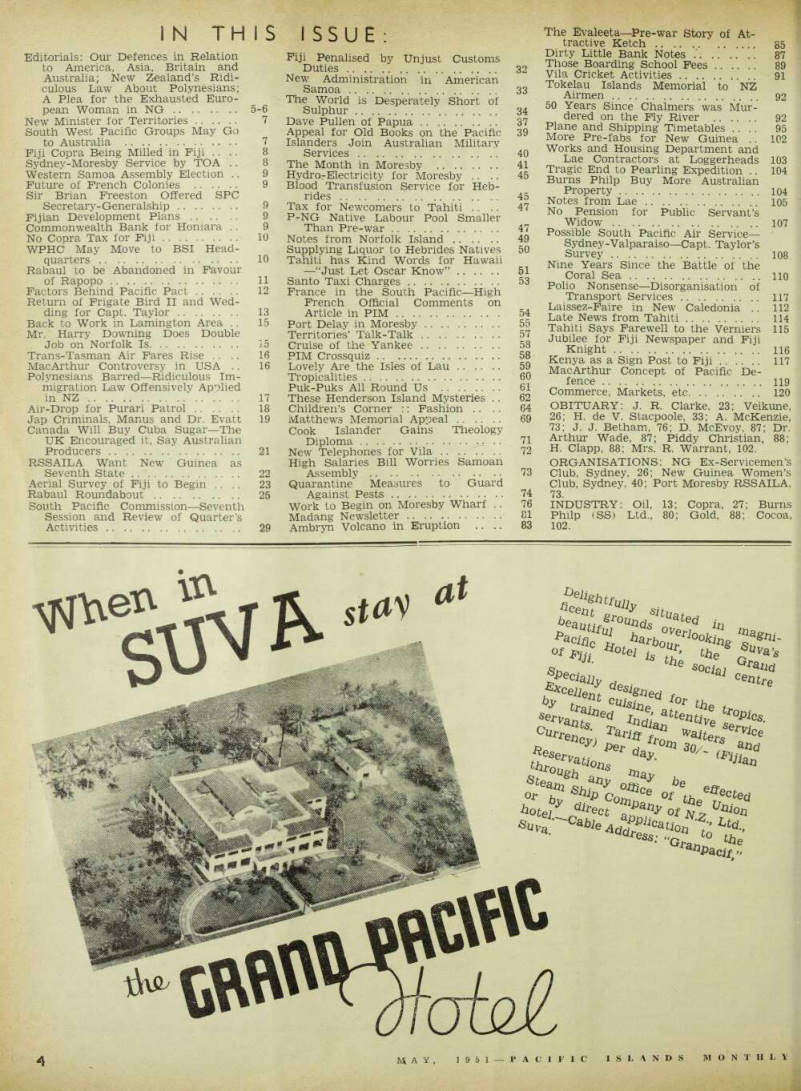
In This Issue:
Editorials: Our Defences in Relation to America, Asia, Britain and Australia; New Zealand’s Ridi culous Law About Polynesians; A Plea for the Exhausted Euro pean Woman in NG 5-6 New Minister for Territories 7 South West Pacific Groups May Go to Australia 7 Fiji Copra Being Milled in Fiji ... 8 Sydney-Moresby Service by TOA .. 8 Western Samoa Assembly Election .. 9 Future of French Colonies 9 Sir Brian Freeston Offered SPC Secretary-Generalship 9 Fijian Development Plans 9 Commonwealth Bank for Honiara .. 9 No Copra Tax for Fiji 10 WPHC May Move to BSI Head quarters 10 Rabaul to be Abandoned in Favour of Rapopo 11 Factors Behind Pacific Pact 12 Return of Frigate Bird II and Wed ding for Capt. Taylor 13 Back to Work in Lamington Area .. 15 Mr. Harry Downing Does Double Job on Norfolk Is 15 Trans-Tasman Air Pares Rise .. .. 16 MacArthur Controversy in USA .. 16 Polynesians Barred —Ridiculous Im migration Law Offensively Applied in NZ 17 Air-Drop for Purari Patrol 18 Jap Criminals, Manus and Dr. Evatt 19 Canada Will Buy Cuba Sugar—The UK Encouraged it, Say Australian Producers 21 RSSAILA Want New Guinea as Seventh State 22 Aerial Survey of Fiji to Begin ... 23 Rabaul Roundabout 25 South Pacific Commission —Seventh Session and Review of Quarter’s Activities 29
Fiji Penalised by Unjust Customs Duties 32 New Administration in American Samoa 33 The World is Desperately Short of Sulphur 34 Dave Pullen of Papua 37 Appeal for Old Books on the Pacific 39 Islanders Join Australian Military Services 40 The Month in Moresby 41
Hydro-Electricity for Moresby .. .. 45
Blood Transfusion Service for Heb rides 45 Tax for Newcomers to Tahiti .. .. 47 P-NG Native Labour Pool Smaller Than Pre-war 47 Notes from Norfolk Island 49 Supplying Liquor to Hebrides Natives 50 Tahiti has Kind Words for Hawaii —“Just Let Oscar Know” 51 Santo Taxi Charges 53 France in the South Pacific—High French Official Comments on Article in PIM 54 Port Delay in Moresby 55 Territories’ Talk-Talk 57 Cruise of the Yankee 58 PIM Crossquiz 58 Lovely Are the Isles of Lau 59 Tropicalities 60 Puk-Puks All Round Us 61 These Henderson Island Mysteries .. 62 Children’s Corner :: Fashion .. .. 64 Matthews Memorial Appeal 69 Cook Islander Gains Theology Diploma 71 New Telephones for Vila 72 High Salaries Bill Worries Samoan Assembly 73 Quarantine Measures to Guard Against Pests 74 Work to Begin on Moresby Wharf .. 76 Madang Newsletter 81 Ambryn Volcano in Eruption ... 83
The Evaleeta—Pre-war Story of At tractive Ketch 85 Dirty Little Bank Notes 87 Those Boarding School Fees 89 Vila Cricket Activities 91 Tokelau Islands Memorial to NZ Airmen 92 50 Years Since Chalmers was Mur dered on the Fly River 92 Plane and Shipping Timetables ... 95 More Pre-fabs for New Guinea .. 102 Works and Housing Department and Lae Contractors at Loggerheads 103 Tragic End to Pearling Expedition .. 104 Burns Philp Buy More Australian Property 104 Notes from Lae 105 No Pension for Public Servant’s Widow 107 Possible South Pacific Air Service —
Sydney-Valparaiso—Capt. Taylor’s
Survey 108 Nine Years Since the Battle of the Coral Sea no Polio Nonsense —Disorganisation of Transport Services 117 Laissez-Faire in New Caledonia .. 112 Late News from Tahiti 114 Tahiti Says Farewell to the Verniers 115 Jubilee for Fiji Newspaper and Fiji Knight 116 Kenya as a Sign Post to Fiji 117 MacArthur Concept of Pacific De fence 119 Commerce, Markets, etc 120 OBITUARY: J. R. Clarke, 23; Veikune, 26; H. de V. Stacpoole, 33; A. McKenzie, 73; J. J. Betham, 76; D. McEvoy, 87; Dr.
Arthur Wade, 87; Piddy Christian, 88; H. Clapp, 88; Mrs. R. Warrant, 102.
ORGANISATIONS: NG Ex-Servicemen’s Club, Sydney, 26; New Guinea Women’s Club, Sydney, 40; Port Moresby RSSAILA, 73.
INDUSTRY: Oil, 13; Copra, 27; Burns Philp (SS) Ltd., 80; Gold, 88; Cocoa, 102.
Advertisements & other items, p. 6 (1 item)
V
lW J? e tigh tfujj gho . i3e Social ra **d t pe °m y da . ai c e22t re Cel lem esi Snea fn s*» at ioxis J an ot ea £**PCoT e *°t e t be eSecte 4 hotel y * fe ct a,f afiy °f iv? Uoio « **£ ra *Pacif t »
Pacific Islands Monthly
The Newspaper-Magazine of the South Seas t ßegistered at the G.P.0., Sydney , for transmission by post as a newspaper l
Published Once Each Month and Circulated in Australia and New Zealand and in the following Pacific Territories and Islands Groups:
Australian Territory of Papua.
Trustee Territory (Australia) of New Guinea.
Australian Territory of Norfolk Island.
Trustee Territory of Nauru (Aust., NZ and UK).
New Zealand Territory of Cook Islands.
New Zealand Territory of Niue Island.
Trustee Territory (NZ) of Western Samoa.
British Crown Colony of Fiji.
British Solomon Islands Protectorate.
British Protectorate of Tongan Islands.
British Crown Colony of Gilbert and Ellice Islands.
British and French Condominium of New Hebrides.
French Co'ony of New Caledonia.
French Establishment of Oceania (Tahiti, etc.).
American Territory of Eastern Samoa.
American Territory of Hawaiian Islands.
American Trust Territory of Micronesia.
Owned and Produced by Pacific Publications Pty. Ltd., Union House, 247 George Street, Sydney.
Telephones; General Office and Advertising,
Bw 5037, Bu 4938.
P.O. Box 3408
Registered Address for Telegrams, Radiograms, and Cables: “Pacpub,” Sydney.
Contributions.
Articles, stories, and Photographs dealing with Pacific Islands subjects are invited and will be paid for on publication.
Subscription Rates.
In Australia, New Zealand, Fiji, Papua and New Guinea, Western Samoa, Cook Islands, Niue, Tonga, British Solomon Is., Gilbert and Ellice Colony, Nauru, New Hebrides, and Norfolk Island 18 0 New Caledonia (Fr.) and French Oceania (Tahiti, etc.) £ 1 1 0 United Kingdom, British Com monwealth, United States of America, US Pacific Territories, and Foreign Countries .. .. $3.50 £1 10 0
Editor and Publisher:
R. W. Robson, F.R.G.S.
Assistant Editor: JUDY TUDOR.
General Office: Union House. 247 George Street, Sydney. Telephones: BW 5037, BU 4938.
Business Manager: SELWYN HUGHES
Representative In London.
J. T. Wallis, Coronation House, 4 Lloyd’s Avenue, London, E.C.3, from whom may be obtained copies of Pacific Islands Monthly, Pacific Is. Year Book, advertising schedules, etc.
Agents.
The following are authorised to receive sub scriptions for Pacific Islands Monthly:— Burns Phllp (NG) Ltd., and Burns Phllp (South Sea) Co., Ltd. All branches.
W. R. Carpenter As Co., Ltd. All branches.
Morris. Hedstrom, Ltd. All branches.
Steamships Trading Co.. Papua. All branches Colyer Watson (NG) Ltd. All branches.
Mrs Jean Fraser, Lae, New Guinea.
R. F. Smith. Rabaul, New Guinea.
A, H. Bunting. Ltd.. Samara!. Panua.
Steele’s Central Store. Suva, FIJI.
Adams Pharmacies Pty., Lautoka. Fill Cook Islands Trading Co., Rarotonga. Cook Is.
United Island Traders, Ltd.. Rarotonga, Cook Is A. Vercoe, Apia, Western Samoa.
Oscar Nordman. Papeete, Tahiti Islands Branches and Representatives of W. H Grove & Sons. Ltd., Auckland. New Zealand Ed. Pentecost, Noumea. New Caledonia.
Societe Gubbay Kerr et Cie, Noumea, NC.
Vol. XXI. No. 10.
May, 1951
( 1/9 Per Copy.
Price ) Prepaid, p.a.: 18/- Aust.
I in South Pacific.
this STSȣ
Top Level Changes In Pacific
THREE developments of major import ance seem likely to affect British- Australian interests generally in the South-west Pacific, and especially the machinery by which Australia discharges her administrative responsibilities in that area. Those developments, in order of importance, are:— • An agreement between the United States, Australia and New Zealand for a Pact, the main purpose of which is to defend Australia and New Zealand, and British Territories generally in the South Pacific, against aggression. • An agreement between Britain, France and Australia under which Australia is expected to take over Britain’s administrative responsibilities in relation to the New Hebrides and, possibly, the Solomons. • The appointment by the Prime Minister of Australia of a new Minister to hold the portfolio of External Terri tories, and an announcement by the Prime Minister that in future the port folio of External Territories will be regarded as a full job for one competent Minister.
THE Pacific Defence Pact between United States and Australasia was forecast here some months ago. USA is anxious to complete a Peace Treaty with Japan, and is determined that Russian obstruction shall no longer hold up the Treaty. To do this, USA needs the co-operation and goodwill of Aus tralia and New Zealand. Australia is agreeable, but greatly fears the danger of a re-armed Japan. To quieten Aus tralia’s fears, USA offers a Defence Pact.
The Pact means that Australia, New Zealand, and all the Island Territories with which they are officially connected, automatically come under American pro tection.
Two complications now manifest them selves. Britain, naturally, does not like to see this close tie-up between her most valuable Dcminions and America; but, since such a development seems inevit able, Britam seeks to make the best of the proposed Pact by suggesting that it should extend to the important British Territories of Malaya and Hong Kong.
At this stage neither USA nor Australia apparently take the British suggestion kindly.
The British Socialist Government has succeeded m cutting Burma, India and F eyl °l3 (which, together with Malaya, forl T ed f a Pretty important combination Asiatic aggression) out of the Bm P ire ’ and *9 destroying British prestige 111 Asia; and we now say, if the Socialists are worried about the security Malaya, the Socialists can make their n arran gements.
The other matter which is troubling Australia is the growing demand of Japan that she shall be given opportunities of getting rid of her surplus population, through emigration to the huge island of , New Guinea - Japan, if she is to avoid a dl f a J er created by her high birth-rate, must find a home somewhere for many nill \ i( l ns of Japanese; and she points most insis tently to the vast, empty, fertile 5? aces in both Dutch and Australian New Gumea - How are the Americans going to answer . tbat one? The Question cannot be Ignored-1 is of vital interest, not only to Australia but to all of our communities m the South Seas rpHE proposal to extend Australian ad -1 S‘“ io . n over Solomons and New
this STSȣ
the change will take place this year,
Whether it does or does not, the change is inevitable.
This development has some interesting angles. It will extend the size and im portance of Australia’s Colonial Service — in other words, the public service now responsible for the administration of Papua, New Guinea, Nauru and Norfolk Island would take in New Hebrides and Solomons. It will correspondingly in crease the importance of the Australian Department of External Territories—and this may have been in the mind of Mr.
Menzies when he said recently that Ex ternal Territories would now be the sole charge of one competent Minister.
If Australia in the future is to be re sponsible for the Government of the six Island Territories named, it is obvious that more attention should be given in Canberra to the character and capabili ties of the men selected for the major administrative positions.
So far, these positions have been, to a deplorable degree, the plaything of class-conscious and ignorant politicians.
At the present time, the chief position in Papua-New Guinea is held by a Uni versity Professor appointed by a notor iously Socialistic Minister; the chief position in Nauru is held by a Labour politician from the South Australian Trades Hall; the chief position in Nor folk Island is held by a former Federal politician, who is regarded as having been in this way rewarded by the last Socialist Government for certain political services.
No more need be said at this stage about those appointments—but they do not form a pretty picture. ff Australia is to have extended re sponsibilities in the Pacific, the Austra lian Government should lay it down as a first principle of its Pacific Administra tion that the highest posts in that or ganisation should be held by men who have qualified themselves for such duties by sound experience and proved achieve
ment in the Islands administrative ser vices.
In recent years, since the Socialists have been in control at Whitehall, one has noted the appearance of nincipmpoops and inexperienced nobodies in high posts of the British Empire; but in the old days of British colonial achievement and glory, no man appeared in a high ad ministrative job in the colonies who was not well qualified for that post by scholarship, intensive training and proved ability. The Socialist practice, very noticeable in Australia under the Labour regime, of appointing political rejects to highly-paid administrative and diplo matic posts abroad, can have only bad results. Among other things, it breaks the hearts of the men who have devoted their lives to such services.
IF Australian administration is to be extended over New Hebrides and Solomons, Canberra will announce it with a flourish that will suggest it is a thing of great moment. In a way it is— it marks the growth of Australia as a Pacific Power.
But, if they can get the plan into true focus, the Australian taxpayers will not cheer —especially if they know anything
New Zealand’s Ridiculous Law About Polynesians
IN another column, we publish facts to show how the Government of New Zealand is classifying Polynesians and part-Polynesians as “coloured” people, and treating them as if they were Africans or Asiatics. Polynesians are compelled, before they can get a permit to enter NZ, to provide evidence to show that they do not propose to become per manent residents.
The immigration policy of any free country is entirely that country’s con cern. If the citizens of Australia and New Zealand wish to prevent the settle ment of Asiatics and Africans in their lands, their right to frame their laws accordingly may not be challenged.
But New Zealand, in relation to the Polynesians, is in a different category.
In many respects, but especially geo graphically, New Zealand is in a situa tion where she should—and must —accept the leadership of that small group of South Pacific countries which, because they are inhabited by the Polynesians, are called Polynesia. Samoa, Tonga, Cook Islands, Ellice Islands, French Oceania and, to a lesser degree, Fiji, look to New Zealand—culturally, administratively and commercially—as their South Pacific headquarters.
NZ is directly responsible for the Cook Islands and Samoan governments. In many respects—defence, health organi sation, aviation, education —New Zealand is closely linked with Fiji. Within her own borders, in the Maoris, NZ has one of the largest and most virile of the Poly nesian races.
How completely ridiculous it is, then, that NZ should treat Polynesians and part-Polynesians as “coloured’’foreigners!
There should be no discrimination whatever against part-Polynesians. In
A Plea For The Exhausted European Woman In N. Guinea
SEVERAL letters, in recent months, from New Guinea mainland women, ask why “they” have not built rest-houses somewhere in the Highlands for “tired ladies from the Coast.” This is not coincidence—the north New Guinea mainland has been having a bout of exceptionally hot, sticky weather—that is, hot and sticky even for those parts.
One woman writes that she is “looking and feeling a frightful wreck,” that she
about the finances of Papua-New Guinea.
If Solomons and New Hebrides are to be taken over by Australia, they should be “developed.” They always have been Cinderella territories, incapable of them selves paying the costs even of the sim plest administration. Development is ex pensive: Papua-New Guinea is costing Australia five or six millions of pounds per annum. That gives a line on what New Hebrides and Solomons may mean to Australia. Only the need for control ling that defensive arc can justify Aus tralia in taking over the archipelagoes.
The present British residents of New Hebrides and Solomons will not like it much. Probably, at present, they think they will be glad to escape from British Colonial Office rule. But, under present conditions, they are left pretty well alone, to order their lives as they please. The tendency in Australian territories is to introduce more and more “controls,” until the unfortunate white resident finds life scarcely worth living. If New Hebrides and Solomons could be handed over for development by private enterprise, under official encouragement and assistance, the prospect would be entirely different.
Those groups definitely have possibilities.
the great majority of cases they are accepted as British citizens in all the countries around the Pacific, and they are entitled by their qualities to that status, and they are seldom, if ever, regarded in any other light. Surely, when they travel to NZ, they should expect to retain that status.
Full Polynesians should be encouraged to regard New Zealand as the friend and protector of all Polynesian countries— as, in fact, she is. Polynesians should be welcomed in New Zealand, and en couraged to treat that country as their own. New Zealand never would lose by it, in a material or a spiritual sense.
There is not the slightest danger of Polynesians settling in, in tight little fecund communities, as Asiatics have done, in some Pacific countries. In that respect, there is no menace in the Poly nesians.
If NZ persists with its present inde fensible law against Polynesians, it will build up against itself a body of ill will, even hatred, that may not be ignored.
Already there are scores —probably hun dreds —of good citizens of many Pacific countries who most bitterly, and pro perly, resent the stigma that has been placed upon them, or their friends, be cause some of their blood is Polynesian.
No intelligent and well-informed person to-day can see any reproach in the Poly nesian relationship: yet this NZ Govern ment apparently cherishes a law that, to say the least, is an insult to the Poly nesian race.
New Zealand is not asked to alter its immigration policy or accept new racial principles. It is asked only to accept its natural position as the chief country of Polynesia, and treat its Polynesian sub jects and friends accordingly.
has nostalgic hankerings for cold winds and snow and, to prarphrase the poet, would like a beakerful of the cold South, If, she says, there was a direct connection with New Zealand she would pack up her children and go.
But in the same letter she bewails the fact that they have not saved a penny since their last leave, even though her husband is no longer in the junior bracket of Administration salaries, and that the
high cost of living in New Guinea makes housekeeping one continuous nightmare.
Well, what have “they” done about the plight of those women who are bringing up young children in the discomfort of the coastal regions, while at the same time they struggle unsuccessfully with the ever widening gap between salaries and the cost of existence? The answer, of course, is nothing.
All visitors sing the praises of the High lands: the coolness, the invigorating air, the complete contrast with the steamy coast. All those things the doctor ordered to counteract Mrs. Administration Official’s attack of nerves, or fever, or whatever is the polite name for that abysmal depression that sets her yearning for South, and looking wistfully at ship ping schedules. Scientists are fond of telling us that the female of the species is made of so much sterner stuff than the male, yet observation shows that the Euro pean woman in the tropics does not stand up to conditions as well as the European man. And, in these days, those legions of dusky slaves who were to relieve her of the menial tasks and the nursemaiding of her children, are only a fiction.
The Central Highlands, say the visitors, would provide an ideal Hill Station —one of those legendary places one reads about in novels of Africa and India, where wives and children went to escape the hot season on coast and plains.
A collection of small bungalows, a club house in charge of a European, a tennis court, perhaps a golf course, ponies for the kids to ride, hikes to be made, picnics to selected spots. A garden where mothers could relax. Maybe a log fire at night.
BUT it is unlikely that such a place will ever develop if left to “they.” The only way one may enjoy the pleasures of the Highlands, at present, is to inflict oneself upon some long-suffering Adminis tration official or missionary who is stationed there; and this is how it will remain, unless the people of New Guinea themselves desire ardently enough that a holiday resort be made there. If a thing is wanted sufficiently, all material obstacles—which are considerable in this case—can be overcome. 'And perhaps in this instance the Behinds, upon whom has been heaped odium, will accomplish some thing that the Befores have not. There springs so readily to mind the many enter prises that were started in old Rabaul to provide something different in entertain ment-only to be rushed for a week or so, and then to be ignored in favour of the traditional hobby of beer-drinking in the local pubs.
New Guinea has a lot of new blood and new talent now: and that the Territory can rise to great heights in money-raising and organisation is evident from the recent successes of the Mt. Lamington Relief Fund. If the younger generation of men in P-NG want to give their families a handy health-resort not orientated to the Great Australian Hobby, they should go to it. We hand the idea gratis to the vigorous RSL branches, the various sport ing clubs, and kindred organisations in the Territory.
The only alternative to doing something themselves seems to be to interest some Sydney philanthropist in doing for the tired ladies of the coast what Mr. Hall strom has already done by providing sanctuary for the embryo sheep industry of New Guinea.
POST SCRIPT: And, by the same token, a similar plea may be made for European women in Solomons, Fiji and Samoa. Fiji has cool and pleasant up lands. The Fiji Government spends many thousands every year in sending public servants and their families away on long recuperative leave. Yet the Government itself abandoned Nadarivatu, the only worth-while Hill Station in Fiji.
Territories
New Minister For
Mr. Paul Hasluck, of West Australia
THE Menzies Government, appealing to the Australian electors in a general election on April 28, following a double dissolution, scored an emphatic victory over the Australian Socialists; and the Cabinet was then re-constituted.
It was announced on May 11 that Mr.
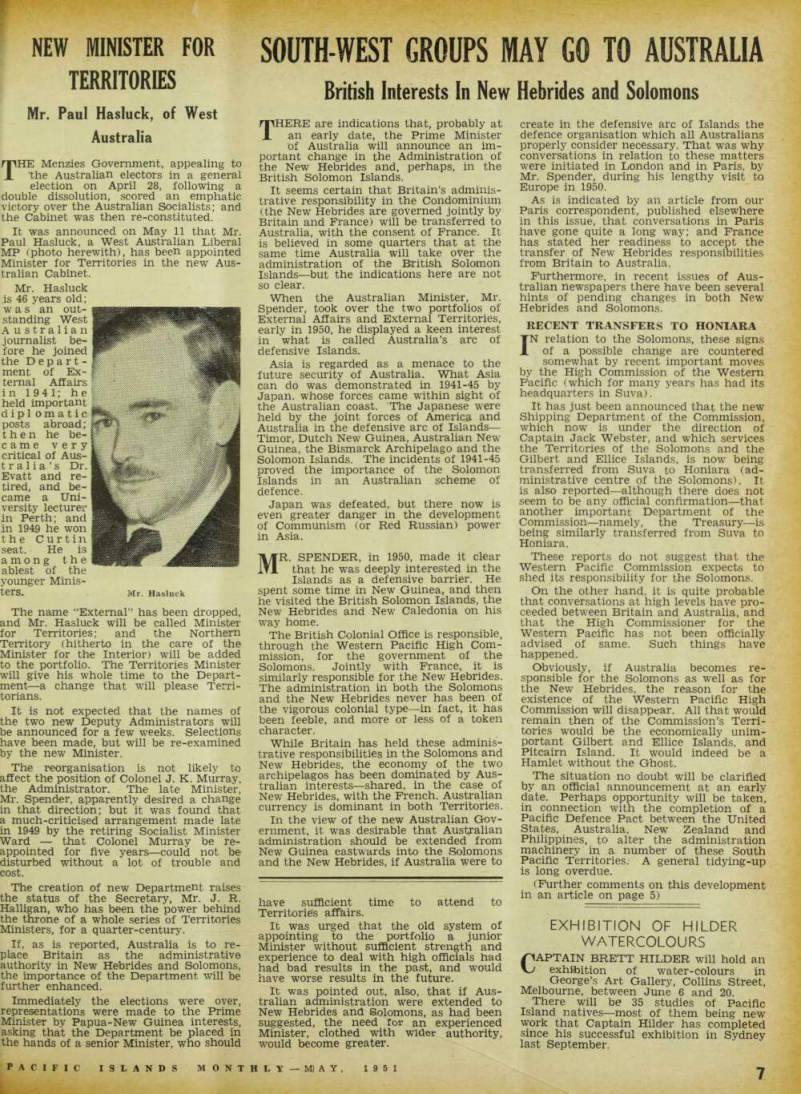
Paul Hasluck, a West Australian Liberal MP (photo herewith), has been appointed Minister for Territories in the new Aus tralian Cabinet.
Mr. Hasluck is 46 years old; was an out standing West Australian journalist be fore he joined the Depart ment of Ex ternal Affairs in 19 41; he held important diplomatic posts abroad; then he be came very critical of Aus tral i a ’ s Dr.
Evatt and re tired, and be came a Uni versity lecturer in Perth; and in 1949 he won the Curtin seat. He is among the ablest of the younger Minis ters.
The name “External” has been dropped, and Mr. Hasluck will be called Minister for Territories: and the Northern Territory (hitherto in the care of the Minister for the Interior) will be added to the portfolio. The Territories Minister will give his whole time to the Depart ment—a change that will please Terri torians.
It is not expected that the names of the two new Deputy Administrators will be announced for a few weeks. Selections have been made, but will be re-examined by the new Minister.
The reorganisation is not likely to affect the position of Colonel J. K. Murray, the Administrator. The late Minister, Mr. Spender, apparently desired a change in that direction; but it was found that a much-criticised arrangement made late in 1949 by the retiring Socialist Minister Ward that Colonel Murray be re appointed for five years—could not be disturbed without a lot of trouble and cost.
The creation of new Department raises the status of the Secretary, Mr. J. R.
Halligan, who has been the power behind the throne of a whole series of Territories Ministers, for a quarter-century.
If, as is reported, Australia is to re place Britain as the administrative authority in New Hebrides and Solomons, the importance of the Department will be further enhanced.
Immediately the elections were over, representations were made to the Prime Minister by Papua-New Guinea interests, asking that the Department be placed in the hands of a senior Minister, who should
have sufficient time to attend to Territories affairs.
It was urged that the old system of appointing to the portfolio a junior Minister without sufficient strength and experience to deal with high officials had had bad results in the past, and would have worse results in the future.
It was pointed out, also, that if Aus tralian administration were extended to New Hebrides and Solomons, as had been suggested, the need lor an experienced Minister, clothed with wider authority, would become greater.
Mr. Hasluck
South-West Groups May Go To Australia
British Interests In New Hebrides and Solomons
THERE are indications that, probably at an early date, the Prime Minister of Australia will announce an im portant change in the Administration of the New Hebrides and, perhaps, in the British Solomon Islands.
It seems certain that Britain’s adminis trative responsibility in the Condominium (the New Hebrides are governed jointly by Britain and France) will be transferred to Australia, with the consent of France. It is believed in some quarters that at the same time Australia will take over the administration of the British Solomon Islands—but the indications here are not so clear.
When the Australian Minister, Mr.
Spender, took over the two portfolios of External Affairs and External Territories, early in 1950, he displayed a keen interest in what is called Australia’s arc of defensive Islands.
Asia is regarded as a menace to the future security of Australia. What Asia can do was demonstrated in 1941-45 by Japan, whose forces came within sight of the Australian coast. The Japanese were held by the joint forces of America and Australia in the defensive arc of Islands— Timor, Dutch New Guinea, Australian New Guinea, the Bismarck Archipelago and the Solomon Islands. The incidents of 1941-45 proved the importance of the Solomon Islands in an Australian scheme of defence.
Japan was defeated, but there now is even greater danger in the development of Communism (or Red Russian) power in Asia.
MR. SPENDER, in 1950, made it clear that he was deeply interested in the Islands as a defensive barrier. He spent some time in New Guinea, and then he visited the British Solomon Islands, the New Hebrides and New Caledonia on his way home.
The British Colonial Office is responsible, through the Western Pacific High Com mission, for the government of the Solomons. Jointly with France, it is similarly responsible for the New Hebrides.
The administration in both the Solomons and the New Hebrides never has been of the vigorous colonial type—in fact, it has been feeble, and more or less of a token character.
While Britain has held these adminis trative responsibilities in the Solomons and New Hebrides, the economy of the two archipelagos has been dominated by Aus tralian interests—shared, in the case of New Hebrides, with the French. Australian currency is dominant in both Territories.
In the view of the new Australian Gov ernment, it was desirable that Australian administration should be extended from New Guinea eastwards into the Solomons and the New Hebrides, if Australia were to
create in the defensive arc of Islands the defence organisation which all Australians properly consider necessary. That was why conversations in relation to these matters were initiated in London and in Paris, by Mr. Spender, during his lengthy visit to Europe in 1950.
As is indicated by an article from our Paris correspondent, published elsewhere in this issue, that conversations in Paris have gone quite a long way; and France has stated her readiness to accept the transfer of New Hebrides responsibilities from Britain to Australia.
Furthermore, in recent issues of Aus tralian newspapers there have been several hints of pending changes in both New Hebrides and Solomons.
Recent Transfers To Honiara
IN relation to the Solomons, these signs of a possible change are countered somewhat by recent important moves by the High Commission of the Western Pacific (which for many years has had its headquarters in Suva).
It has just been announced that the new Shipping Department of the Commission, which now is under the direction of Captain Jack Webster, and which services the Territories of the Solomons and the Gilbert and Ellice Islands, is now being transferred from Suva to Honiara (ad ministrative centre of the Solomons). It is also reported—although there does not seem to be any official confirmation—that another important Department of the Commission—namely, the Treasury—is being similarly transferred from Suva to Honiara.
These reports do not suggest that the Western Pacific Commission expects to shed its responsibility for the Solomons.
On the other hand, it is quite probable that conversations at high levels have pro ceeded between Britain and Australia, and that the High Commissioner for the Western Pacific has not been officially advised of same. Such things have happened.
Obviously, if Australia becomes re sponsible for the Solomons as well as for the New Hebrides, the reason for the existence of the Western Pacific High Commission will disappear. All that would remain then of the Commission’s Terri tories would be the economically unim portant Gilbert and Ellice Islands, and Pitcairn Island. It would indeed be a Hamlet without the Ghost.
The situation no doubt will be clarified by an official announcement at an early date. Perhaps opportunity will be taken, in connection with the completion of a Pacific Defence Pact between the United States, Australia, New Zealand and Philippines, to alter the administration machinery in a number of these South Pacific Territories. A general tidying-up is long overdue. (Further comments on this development in an article on page 5)
Exhibition Of Milder
Watercolours
CAPTAIN BRETT HILDER will hold an exhibition of water-colours in George’s Art Gallery, Collins Street, Melbourne, between June 6 and 20.
There will be 35 studies of Pacific Island natives—most of them being new work that Captain Hilder has completed since his successful exhibition in Sydney last September.
Advertisements & other items, p. 9 (1 item)
7
ACIFIC ISLANDS MONTHLY— M)AY, 1951
Fiji Copra Being Milled
In Fiji
Interesting Angles on an Important Development
A STRIKING development of the Fiji copra industry is the increasing pro portion of the output that is being milled within the Colony. Before the war, practically the whole output was sent overseas; now, nearly two-thirds is dealt with locally.
During 1950, the Fiji Copra Board bought 28,197 tons, worth £1.361,476F. Of this, 10,158 tons were shipped by the Board to the Ministry of Food, London, valued at £544,401, Fijian; and 18,848 tons were sold to local millers for £1,012,843F.
The copra handled was 4,526 tons less than in 1949; shipments to the Ministry of Food were lower by 3,774 tons; and there was a decrease in the sales to local millers of 396 tons.
There is strong discontent among all British copra-producers in the South Pacific —including the Fiji planters—with the price being paid to them under the British Ministry of Food contract. The Fijians, for example, now receive between £5O and £6O Fijian per ton, while the world’s open market price is well over £lOO Sterling per ton.
The planters do not seek to repudiate the contract itself; but they do point out, with growing insistence, that if the British Socialist Government had not tricked them by de-valuing the £ Sterling in 1949, they now would be receiving from £25 to £3O per ton more.
An interesting sidelight on the foregoing concerns the establishment of the crush ing mills in Suva by Carpenter interests*— an industry which now absorbs a large proportion of the Fiji copra. The Suva mills receive copra at approximately the same price as is paid under the MOF con tract—which is at least £5O per ton under world parity. If the products of the Suva mills are being sold on the world markets, the Suva millers obviously are enjoying a big advantage over millers in countries which pay more than £lOO per ton for copra.
However, as the establishment of the mills in Suva has been of great economic benefit to the Colony, and as much of the mills’ products are concerned in the Colony, the founders of the industry are doubtless entitled to encouragement.
The Sydney crushing mills enjoy a similar concession; and the New Guinea copra producers have been vociferous on the subject, in recent months.
But the circumstances, as between Fiji and New Guinea, are Quite different. New Guinea gets no benefit whatever out of the concessions enjoyed bv the Australian copra-millers. If the milling were done in NG, it might be a different story.
Government Inaugurates
Air-Mail
Service For Tahiti
T PAPEETE, April 30.
HE Government at last has ended our communications problem by pur chasing, in Honolulu, a Grumman Mullard plane formerly owned by Henry Ford, Jnr. The plane arrived in Papeete on April 26, and already has commenced a regular mail service between Tahiti and Aitutaki, in the Cook Islands, where it connects with the New Zealand National Airways plane, which is routed via Fiji and Western Samoa.
We have been without a regular airmail for many months.
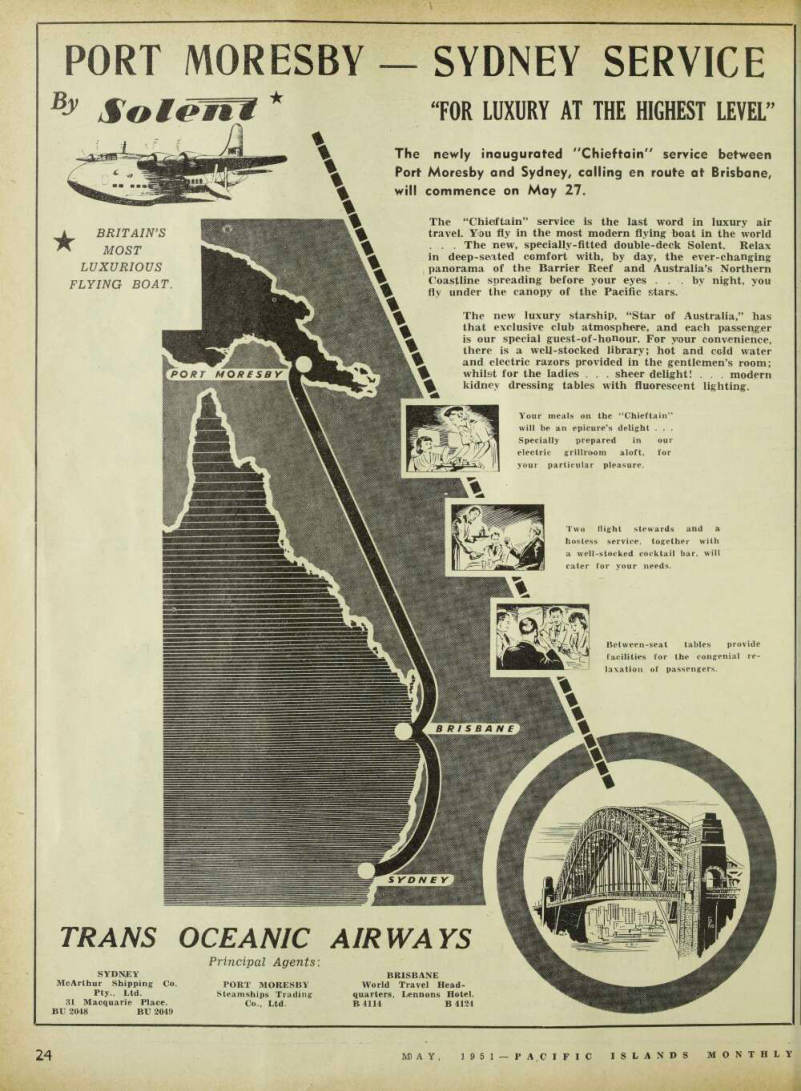
Sydney-Moresby Service
TOA to Start with Weekly Solent on May 27
HAVING successfully surmounted its various problems (i.e., the refusal of the Civil Aviation Department to permit the use of Townsville as an inter mediary stop, and the destruction of a new Solent flying-boat at Malta, when en route to Australia) Trans Oceanic Air ways Pty., Ltd,, on May 4, announced that it would commence its weekly service, Sydney-Port Moresby, on May 27.
The TO A Solent flying-boat (four en gines, all latest amenities for passengers) will depart from Rose Bay, Sydney, every Sunday, at 7.15 p.m.; arrive Brisbane 10 p.m.; depart at 11.30 p.m.; and arrive in Port Moresby at 6.30 a.m. every Monday.
The Solent will commence at Moresby
with a Mandated Airlines DCS Skyliner, which will depart at 8.45 a.m. on Mon days, and arrive at Lae at 10.5 a.m. MAL then provides connections for Bulolo and Wau tdue at 12.25 p.m.) and for Madang and Wewak.
The DCS will leave Lae every Monday at 5.45 a.m., and connect at Moresby with the Solent, which will leave Moresby for Brisbane every Monday at 8.30 a.m., and arrive in Sydney at 7.30 p.m., with a II hours’ stop in Brisbane en route.
The company announces a schedule of fares and baggage rates which are com petitive.
Advertisements & other items, p. 10 (1 item)
Next South Pacific Conference
The South Pacific Commission, at its meeting this month, decided to hold the Second South Pacific Conference in Noumea between January 15 and February 15, 1953.
Birthday For Ng Women's Club
(See article Page 40)
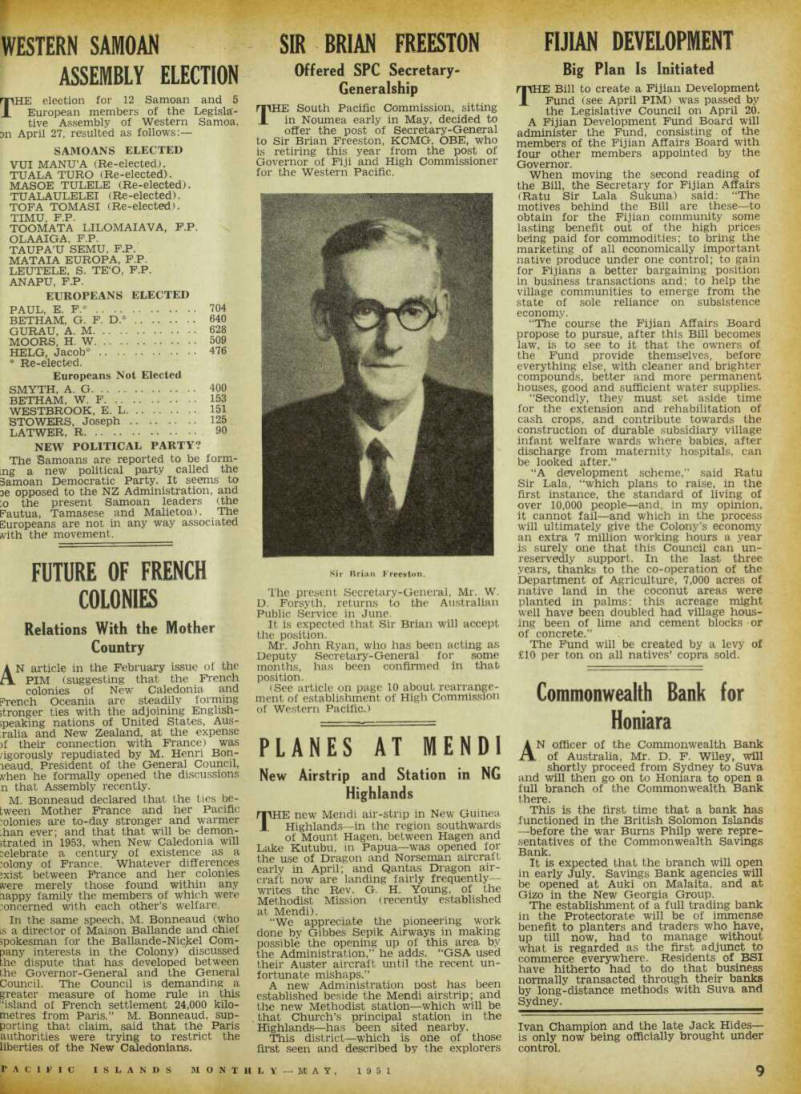
The New Guinea Women’s Club of Sydney was 10 years old in April. Members and their friends celebrated at a party—some of those who attended can be seen in top photograph. Centre photo graph shows Mrs. H. H. Page, patroness of the Club; Mrs. N. Foxcroft, president; and committee members: Mrs. L. Northen, Mrs. P. Forsyth, Mrs. J. Whiteman, Mrs. J. Edwards, Mrs. H. Carr, Mrs.
A. Hornby. (Missing, Mrs. E. Harvey.) Bottom; Mrs. Page; Mr. F. Salisbury, a Sydney business man, who has been a very good friend to the Club; Mr. N. H. Foxcroft and Mrs. Foxcroft.
New Guinea Women’S Club
Is To Years Old
(See photographs elsewhere this issue ) A PARTICULARLY happy gathering of over 80 members and their friends 'met at the Feminist Club, King Street, Sydney, on April 24, to celebrate the 10th anniversary of the formation of the New Guinea Women’s Club of Sydney.
The club was founded bv its present patroness. Mrs. H. H. Page, in the dark days of 1941, perhaps with a premonition that even darker days were to come. She says that it was felt that there would sooner or later be a general evacuation of women from New Guinea and that, even in early 1941, it was difficult for a woman to get permission to return to the Territory once she went South. The object of the club, in those earlv days, was to work to provide comforts for the New Guinea men" who had enlisted in the forces, but within eight or nine months it was assisting the bewildered women and children who, in the face of Jap in vasion, were evacuated from Papua and New Guinea. In the years that followed, the club, under the guidance of Mrs. Page and her loyal and hard-working com mittee, was an oasis of friendliness in a desert of bewilderment and uncertainty.
It was not until the war was over that many of the members, 'including Mrs.
Page and other members of the executive, learned that their husbands had been lost in mid-1942 on a ship that was carrying them from Rabaul to Japan.
After the war the function of the club changed to a certain extent but under the capable leadershin of Mrs. N. Fox croft, who succeeded Mrs. Page as president, it has retained its warm corner in the hearts of New Guinea folk.
Many of the war-time members have now returned to the Territory but the club goes on. At the weekly and monthly gatherings of the club, Territorians down on leave find it the one spot in Sydney where they can be sure of a cheery wel come.
The 10th Birthday Party brought out Sydney Territorians in force. Mr. F.
Salisbury, a Sydney business man who has been a good friend to the club since its earlier years, presented an excellent programme of movies, many of them taken by himself on recent trips to Papua- New Guinea and the United States.
Later, presentations were made to Mrs.
Page and to Mrs. Foxcroft in appreciation of the work they had done in guiding the destinies of the club in its first 10 years of life. Members and their guests after wards were entertained at supper and each received a piece of a very special birthday cake.
Western Samoan
Assembly Election
THE election for 12 Samoan and 5 European members of the Legisla tive Assembly of Western Samoa, pn April 27, resulted as follows: —
Samoans Elected
VUI MANU’A (Re-elected).
TUALA TURO (Re-elected).
MASOE TULELE (Re-elected).
TUALAULELEI (Re-elected).
TOFA TOMASI (Re-elected).
Timu, F.P.
Toomata Lilomaiava, F.P.
Olaaiga, F.P.
Taupa’U Semu, F.P.
Mataia Europa, F.P.
Leutele, S. Te'o, F.P.
Anapu, F.P.
Europeans Elected
Paul, E. F.* 704
Betham, G. F. D.* 640
Gurau, A. M 628
Moors, H. W 509
HELG, Jacob* 476 * Re-elected.
Europeans Not Elected
Smyth, A. G 400
Betham. W. F 153
Westbrook, E. L 151
STOWERS. Joseph 125
Latwer, R 90
New Political Party?
The Samoans are reported to be form ing a new political party called the Samoan Democratic Party. It seems to De opposed to the NZ Administration, and :o the present Samoan leaders (the Pautua, Tamasese and Malietoa). The Europeans are not in any way associated with the movement.
Future Of French
Colonies
Relations With the Mother Country
A N article in the February issue of the /V PIM (suggesting that the French colonies of New Caledonia and French Oceania are steadily forming stronger ties with the adjoining English speaking nations of United States, Aus ;ralia and New Zealand, at the expense )f their connection with France) was vigorously repudiated by M. Henri Bon leaud, President of the General Council, when he formally opened the discussions n that Assembly recently.
M. Bonneaud declared that the ties be tween Mother France and her Pacific colonies are to-day stronger and warmer :han ever; and that that will be demon strated in 1953, when New Caledonia will celebrate a century of existence as a :olony of France. Whatever differences jxist between France and her colonies were merely those found within any lappy family the members of which were :oncerned with each other’s welfare.
In the same speech, M. Bonneaud (who is a director of Maison Ballande and chief spokesman for the Ballande-Nickel Com pany interests in the Colony) discussed the dispute that has developed between the Governor-General and the General Council. The Council is demanding a greater measure of home rule in this ‘island of French settlement 24,000 kilo metres from Paris.” M. Bonneaud, sup porting that claim, said that the Paris authorities were trying to restrict the liberties of the New Caledonians.
Sir Brian Freeston
Offered SPC Secretary- Generalship
THE South Pacific Commission, sitting in Noumea early in May, decided to offer the post of Secretary-General to Sir Brian Freeston, KCMG, OBE, who is retiring this year from the post of Governor of Fiji and High Commissioner for the Western Pacific.
The present Secretary-General. Mr. W.
D. Forsyth, returns to the Australian Public Service in June.
It is expected that Sir Brian will accept the position.
Mr. John Ryan, who has been acting as Deputy Secretary-General for some months, has been confirmed in that position. (See article on page 10 about rearrange ment of establishment of High Commission of Western Pacific.)
Sir Brian Freeston.
Planes At Mendi
New Airstrip and Station in NG Highlands
THE new Mendi air-strip in New Guinea Highlands—in the region southwards of Mount Hagen, between Hagen and Lake Kutubu, in Papua—was opened for the use of Dragon and Norseman aircraft early in April; and Qantas Dragon air craft now are landing fairly frequently— writes the Rev. G. H. Young, of the Methodist Mission (recently established at Mendi).
“We appreciate the pioneering work done by Gibbes Sepik Airways in making possible the opening up of this area by the Administration,’’ he adds. “GSA used their Auster aircraft until the recent un fortunate mishaps.”
A new Administration post has been established beside the Mendi airstrip; and the new Methodist station—which will be that Church’s principal station in the Highlands—has been sited nearby.
This district—which is one of those first seen and described by the explorers
Ivan Champion and the late Jack Hides— is only now being officially brought under control.
Fijian Development
Big Plan Is Initiated
rE Bill to create a Fijian Development Fund (see April PIM) was passed by the Legislative Council on April 20.
A Fijian Development Fund Board will administer the Fund, consisting of the members of the Fijian Affairs Board with four other members appointed by the Governor.
When moving the second reading of the Bill, the Secretary for Fijian Affairs (Ratu Sir Lala Sukuna) said: “The motives behind the Bill are these —to obtain for the Fijian community some lasting benefit out of the high prices being paid for commodities: to bring the marketing of all economically important native produce under one control; to gain for Fijians a better bargaining position in business transactions and: to help the village communities to emerge from the state of sole reliance on subsistence economy.
“The course the Fijian Affairs Board propose to pursue, after this Bill becomes law, is to see to it that the owners of the Fund provide themselves, before everything else, with cleaner and brighter compounds, better and more permanent houses, good and sufficient water supplies.
“Secondly, they must set aside time for the extension and rehabilitation of cash crops, and contribute towards the construction of durable subsidiary village infant welfare wards where babies, after discharge from maternity hospitals, can be looked after.”
“A development scheme,’’ said Ratu Sir Lala, “which plans to raise, in the first instance, the standard of living of over 10,000 people—and, in my opinion, it cannot fail—and which in the process will ultimately give the Colony’s economy an extra 7 million working hours a year is surely one that this Council can un reservedly support. In the last three years, thanks to the co-operation of the Department of Agriculture, 7,000 acres of native land in the coconut areas were planted in palms: this acreage might well have been doubled had village hous ing been of lime and cement blocks or of concrete.’’
The Fund will be created by a levy of £lO per ton on all natives’ copra sold.
Commonwealth Bank for Honiara
Honiara
AN officer of the Commonwealth Bank of Australia, Mr. D. F. Wiley, will shortly proceed from Sydney to Suva and will then go on to Honiara to open a full branch of the Commonwealth Bank there.
This is the first time that a bank has functioned in the British Solomon Islands —before the war Burns Philp were repre sentatives of the Commonwealth Savings Bank.
It is expected that the branch will open in early July. Savings Bank agencies will be opened at Auki on Malaita. and at Gizo in the New Georgia Group.
The establishment of a full trading bank in the Protectorate will be of immense benefit to planters and traders who have, up till now, had to manage without what is regarded as the first adjunct to commerce everywhere. Residents of BSI have hitherto had to do that business normally transacted through their banks by long-distance methods with Suva and Sydney.
No Copra Tax for Fiji
And No Reduction In Cotton Goods Duties
Suva, May 2.
THE Copra Tax Bill, proposing an ex port tax of £2 per ton on copra, has been abandoned. It was carried by the Legislative Council, on April 20 by 18 to 13, after a long debate.
During the debate, the Governor announced that, if the Bill was passed, Government would reduce the import duty on cotton piece goods of all kinds from 25i per cent, preferential rate and 50 per cent, general rate, to 12a per cent, preferential and 27a per cent, general.
He said that, as piece goods were the “raw materials’’ of nearly all clothing made in Fiji, all sections of the com munity would benefit. If the full effects of the reduction in the duty were passed on to the buyers of clothes, the cost of living index in the Suva area would be reduced by 3 to 4 points, and in areas outside Suva, by 5 to 6 points. The reduc tion in the yield from the import duty would be £70,000, which was equal to the revenue expected from copra tax. (On page 32 of this issue, there is an article in which the injustices of the Fiji Government’s heavy import tax on cotton goods is referred to.) "FTHE motion is carried by 18 votes to X 13,” said the Governor, at the end of the debate. “Those 13 were all unofficial Members, who had done their best to interpret the wishes of the people.
In view of that consideration, I shall not proceed with this Bill; but I have two things to say: “If and when the price of copra is substantially increased again, I have little doubt that the Government will once more come forward with proposals for a tax on copra. The fact that it has been dropped now does not mean that the Government view has weakened.
“The second point I wish to make is this: This is Government’s effort, such as it is, to combat the cost of living and in flation. Admittedly, it is a very small contribution, but it is a contribution on the right lines, and on the lines which this Colony will sooner or later be obliged to follow. There is going to be a great deal of public discontent as prices rise.
All the indications are that prices will continue to go up, and every one will feel it. Government has tried its remedy: it has been rejected. The responsibility lies with the Unofficial Members to meet it.”
Arguments for and against the Bill were keen.
Opponents stressed that the copra in dustry had not yet recovered fully from its pre-war and hurricane troubles; that it was unfair to impose another £2 per ton tax on Fijian producers, who already were to be taxed £lO per ton under the* Development Fund Bill (see April PIM); that areas which received no benefit from General Revenue funds would be heavily taxed; that it was unfair to tax one in dustry, while allowing others to go free; that, in any event, the Government had substantial funds from surplus balances over five years.
Supporting the Bill, the Colonial Sec retary said that the gold industry was taxed, the tax on sugar was revivable when conditions permitted—so why should copra escape a tax that, in any event, was very light. If the tax was found to be oppressive it could be varied.
He quoted figures to show that copra producers could well afford to pay the tax; and that, in turn, would allow the Government to tackle the problem of re ducing the cost of living.
British West Pacific Commission
Reported Move to the Solomons
ALTHOUGH no official announcement has been made, it is common know ledge that the Headquarters of the High Commission of the Western Pacific are being transferred from Suva to Honiara (British Solomon Islands); that Mr. C. D. Chamberlain, Secretary of the Commission, is going to Honiara as the new Commissioner; and that, with the retirement shortly of Sir Brian Freeston, the old arrangement, under which the Governor of Fiji has been High Commis sioner for Western Pacific, will come to an end.
For at least 50 years, the British Colonial Office, through the Commission, established in Fiji, has been responsible for— • Administration of Protectorate of British Solomon Islands. • Administration of British Colony of Gilbert and Ellice Islands. • British share of the Administration of Condominium of New Hebrides. • British representation in the King dom of Tonga. • Pitcairn Island (a recent arrange ment) .
It always has been regarded as an awkward, sprawling administration, its difficulties added to by the facts that all the areas referred to are economically un important, and that transport and com munication represent a first-class problem.
Since the war, those difficulties have become more acute. Solomons and Gilberts suffered extensive war damage, but got no compensation; the British Socialist Government would not encourage the big trading firms to re-establish their busi nesses (which partly solved the transport problem); and. finally, the Government itself proceeded to provide trading, trans port and communication facilities—at a heavy cost, which the British taxpayer pays.
For the past three or four years, there has been much criticism of the High Com mission’s activities by the Europeans af fected—especially planters and traders.
Finally, it became known that Australia —acting in relation to defence (see article elsewhere)—had discussed with Britain and France the feasibility of taking over
British responsibilities in Solomons anc New Hebrides.
This so obviously provided a means bj which the British Colonial Office coulc rid itself of one of its worst headache: that it was generally assumed that the change would take place soon. Being ric of Solomons and Hebrides, Britain easilj could dispose of the useless Gilbert anc Ellice Colony, Pitcairn, and the Tongar Consulate —probably by tacking them on to Fiji. Britain then could save a lo* of money by closing up the cumbersome costly and generally inefficient High Com mission for the Western Pacific.
Therefore, the report that WPHC i: being reorganised and transferred to th« little jungle capital of the Solomons wa; received with surprise in Australia, I seems certain that the British section 01 New Hebrides is going to Australia, and logically, Solomons should go, too.
Disabilities At Honiara
The decision to put the WPHC estab lishment at Honiara is even more sur prising. The basis of Solomons and G and E. communications is wholly seai transport—the archipelagoes are far to* poor to afford airways. The Commissior if it is to do its own trading and shipping chores and defy the big firms, must owi and operate a big fleet of little ships. Thi ships want a sheltered port, and plent;. of docking and workshop facilities. The; will not get any of those facilities a Honiara, except at very heavy cost.
Tulagi, 25 miles away, would have beei a different proposition. But officialdom in 1945, insisted on abandoning that ex: cellent port in order that it could develoi an agricultural project, and so that i might have a few miles of road on whid to run the numerous jeeps it inherited from the war. The jeeps now are mostll worn out, the war-time bridges am wharves are mostly collapsed—and Gua dalcanal has as much jungle on it as eve: Australian governmental planners in thi Solomons can be just as stupid and vision less as the British variety. But at leas Australia definitely would have a reason for taking over the Solomons. One cannc see what purpose the British can serv by hanging on to the “Cinderella Terri tory.”
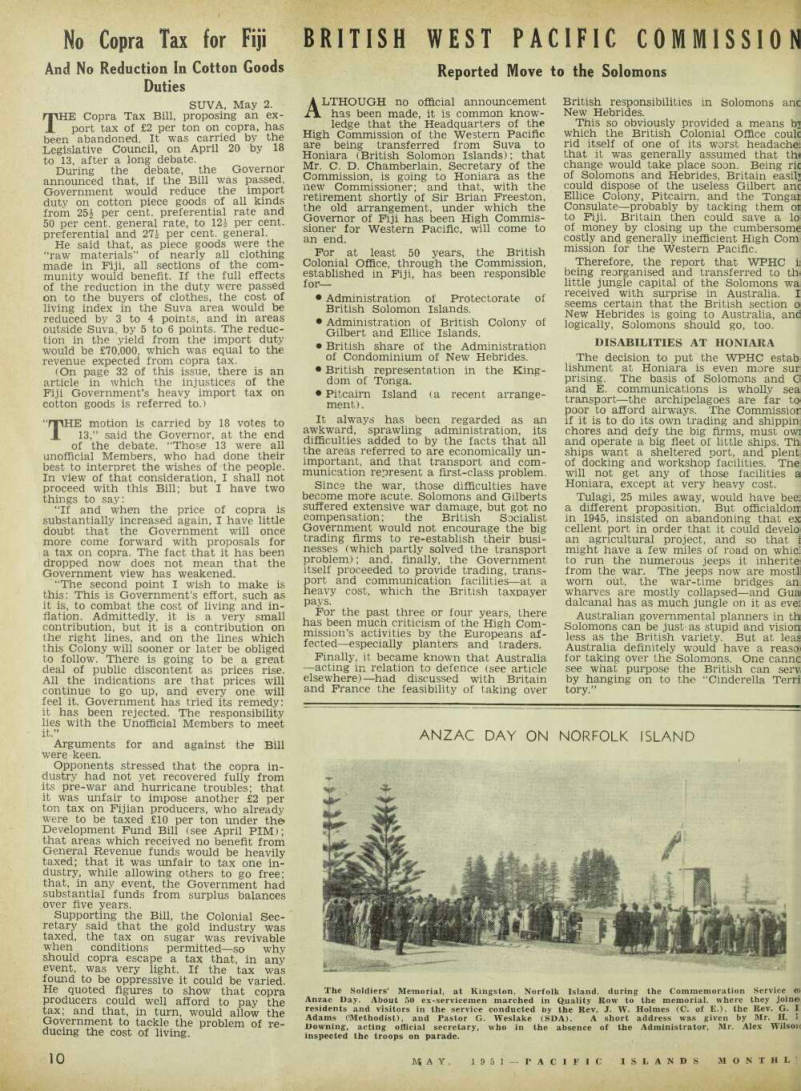
Anzac Day On Norfolk Island
The Soldiers’ Memorial, at Kingston, Norfolk Island, during the Commemoration Service o Anzac Day. About 50 ex-servicemen marched in Quality Row to the memorial, where they jooine residents and visitors in the service conducted by the Rev. J. W. Holmes (C. of E.), the Rev. G. I Adams (Methodist), and Pastor G. Weslake (SDA). A short address was given by Mr. H. I Downing, acting official secretary, who in the absence of the Administrator, Mr. Alex Wilson inspected the troops on parade.
Advertisements & other items, p. 12 (1 item)
10
MjAY, 1951 - PACIFIC ISLANDS MONTHL
Rabaul Is Now To Be Abandoned
Government Decision Follows Lamington Disaster
AS the result of quite unexpected and rapid developments in Administra tion plans in New Guinea it has been decided to remove the New Britain- New Ireland-Bougainville administrative centre from Rabaul to Rapopo (about 20 miles southward, near Kokopo. on the Gazelle Peninsula), at the earliest pos sible moment.
After the 1937 eruption, and before the war, it was decided to move the Admin istration from Rabaul (then the capital) to Lae, and the transfer was actually under way when the Japs invaded.
After the war, when the capital of the combined Papua-New Guinea Territory was established at Moresby, officialdom decided to move the administration post from Rabaul to somewhere near Kokopo.
But the plan lagged—largely because of lack of men and materials: the com mercial interests re-established them selves in the very good shipping port of Rabaul; more and more buildings were erected there; the volcanoes were very quiet; and by the end of 1950 it appeared that Rabaul would be re-established, while nothing whatever had been done to establish a town near Kokopo—where the great disadvantage is the absence of any kind of port.
Then came the volcanic explosion at Mount Lamington, killing 35 Europeans and over 3,000 natives. This was a great shock and a very heavy cost to the Ad ministration, and the plan to transfer the administration centre from Rabaul, amid the volcanoes, to some safer place, was revived.
The matter apparently came before Mr. Spender, before he left Australia, and one of his last official acts was to order an immediate investigation of the proposed sites near Kokopo, with a view to an early shift from Rabaul.
On April 20, a party of “Top Brass” left Port Moresby by air for Rabaul, and the following joined the local officials there: Mr. J. R, Halligan (Secretary of the Department of External Territories); Colonel J. K. Murray (Administrator); Mr. S. A. Lonergan (Government Sec retary); Mr. D. J. Rooney (Director of Works and Housing); Mr. R. G. Redmond (Principal Engineer at Port Moresby); Mr. R. B. Lewis (Director of Engineer ing) ; Mr. O’Mara (Wharf Investigating Engineer)—both the latter from Austra lia.
The party made a personal investiga tion in and around Rabaul and the Gazelle Peninsula; and it was officially announced a few days later that Rapopo would be the site of the new administra tive centre, but that final details would not be arranged until the engineers had agreed upon a site for a wharf which will serve the new town. (There is no sheltered port whatever on this part of the New Britain coast.) Mr. Halligan announced that two sites were under investigation and that, in any event, it was not intended to put in ex tensive wharfage. Instead, the present system of concentrating in Rabaul all the shipping which brought in copra and took out supplies to the adjoining dis tricts of New Ireland, Bougainville and Manus would be abandoned. A port for each of those three districts would be developed and used; and the port which would be provided for Rapopo would be asked to service only the eastern section of New Britain.
When Mr. Halligan made his announce ment on April 24, the engineers, Messrs.
Lewis and O’Mara, assisted by Captain James Duncan (who has an extensive local knowledge) were working out a plan for the construction of a wharf.
Both of the two sites being investigated are within 3i miles of Rapopo. The con struction of a wharf and dock at either site will be very expensive.
“All Possible Speed”
From Our Own Correspondent
Port Moresby, May 2.
rE highest officials have agreed that somehow a wharf can be built near Rapopo. It will necessarily be an open roadstead and both difficult and costly to construct, but two possible sites have been selected, and the engineers will be making another check of these loca tions before final recommendations go to the Commonwealth Government.
Quite definitely, the move to Rapopo is to be made, and Rabaul abandoned
as an administrative site. It is known that Colonel Murray is urging all possible speed in making the transfer on the grounds that continued retention of Rabaul is inviting disaster.
Apparently Rabaul citizens, wiser now than before the Lamington eruption, are also in favour of the move. Indeed, some Rabaul interests have already built houses at Kokopo, in anticipation of the transfer.
The new wharf for Rapopo will be much smaller than the wharf facilities in prewar Rabaul, but the port will serve a much smaller tonnage of shipping, as overseas copra concentrat-on ports are to be built in Bougainville and New Ireland, This will eliminate the heavy volume of trans-shipment tonnage now passing through Rabaul, and it will also end the long-standing problem of in adequate inter-island shipping services to Bougainville and New Ireland. With direct overseas movement of stores and copra an occasional small ship plying to Rapopo will be all that is needed.
At last there does seem to be definite prospect of the Government getting on with the Rapopo project; and this time they can get under way without passive resistance from the Rabaul population.
If there are any residents still uncon vinced on this matter they should take a walk through Higaturu and the adjoin ing villages.
( Oceanic) Pact
Factors Behind the Pacific ( Oceanic) Pact
IN mid-April, it was announced in Sydney by Mr. Spender (surrendering the portfolios of External Affairs and External Territories, and departing, via London, to become Australian Ambassador in Washington) that in Melbourne on April 18 he would make a statement of historic interest to Australia.
But the statement was never made. The news broke first in Washington on April 18—an announcement by the President that it was the intention of the United States to complete, with Australia and New Zealand, a Pact of mutual defence in the Pacific. It was given big space by all newspapers. Mr. Spender, in a few words merelv confirmed it Washington columnists said that the Pact, at that stage, had not and could not be given shape. But the Australian Government had wanted an official announcement before Election Day (April 28).
President Truman obliged.
United States must have an early Peace Treaty with Japan. Russia opposes it savagely, unless Communist > China is admitted to the Treaty discussions. USA will not have Red China at any price.
Therefore, so as to get a Peace Conference and so as to complete a Treaty without the Reds, USA is bringing in the sovereign States of Australia and New Zealand. They will help USA in discussions with Britain and Holland, the only other nations to actually fight with USA against Japan in 1941-45.
The military help which Australia and NZ can give USA under a Pacific Pact is negligible. Then, why did USA bother about a Pact? In the words of a Washington commentator: “This is the price the USA will pay to obtain the Dominions’ consent to a Peace Treaty.”
Some reports mention Philippines as in the Pact; others omit the Philippines. The explanation is that the British Ambassador argued feverishly in Washington while the Pact was being discussed there with Mr.
Spender (Australia) and Mr. Holland (New Zealand. He said: If Philippines are to be in it, so also should Malaya and Hong Kong . . . Finally, they agreed to call it an “Oceanic Pact,” thus bringing in Philippines and leaving out Britain’s Asiatic mainland colonies, The British Socialists remain critical of the Pact; and it is still called a Pacific . . , , Washington was very glad to see the of the Menzies Government on A P nl 28. If the Australian Socialists had won. they would have fought tooth and V l6 re-arming of Japan, *^f£^ ctlve rrc 0 A tbe f °rfcA all • S f picture, as USA sees it. USA insists that Japan must be allowed to re-arm against the Red Asia mena ce.
The Pact ac^uad y was shaped in Can berra by Mr. Dulles (USA), and the Ex ternal Affairs Ministers of Australia and New Zealand—P.C. Spender and F. W.
Doidge.
Strong sections in Japan continue to demand permission for Japanese to emigrate to South Pacific islands, es pecially New Guinea. This embarrasses USA, because Australia is opposed, at all costs, to Asiatic immigration into New Guinea.
Japan’s population increases by 1 h millions each year. Some British com mentators say there is room for millions of Japs in British North Borneo, it was indicated early in May that Indo- China (French) was discussing with British Commissioner-General Malcolm MacDonald the idea of including Indo- China and Malaya in a Pacific Pact; but there was no comment from USA, Aus tralia and NZ.
The Government of Indonesia said on April 27 that it was not in the least interested in the idea of a Pacific Pact, in international affairs, Indonesia is try ing to follow India; and Mr. Nehru, of India, is trying to steer a middle course between USA and Russia.
Advertisements & other items, p. 14 (1 item)
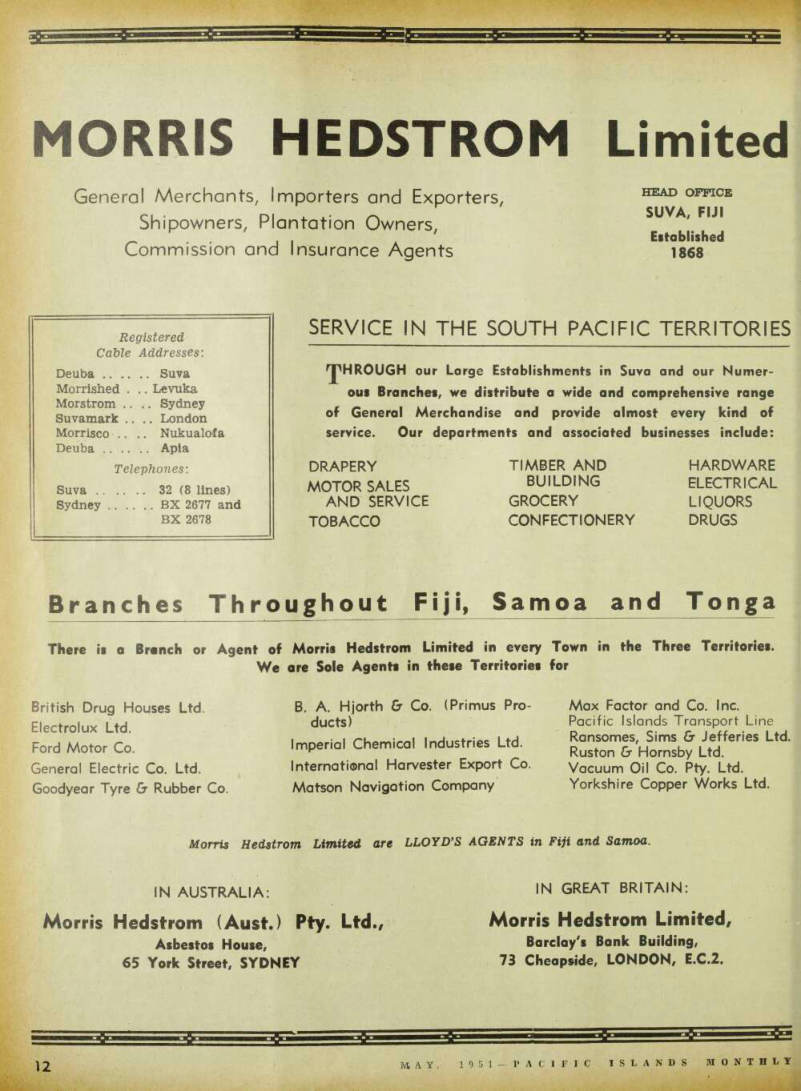
Morris Hedstrom Limited
General Merchants, Importers and Exporters,
Shipowners, Plantation Owners,
Commission and Insurance Agents
HEAD OFFICE
SUVA, FIJI
Established 1868
SERVICE IN THE SOUTH PACIFIC TERRITORIES
our Large Establishments in Suva and our Numerous Branches, we distribute a wide and comprehensive range of General Merchandise and provide almost every kind of service. Our departments and associated businesses include:
DRAPERY
MOTOR SALES
AND SERVICE
TOBACCO
TIMBER AND
BUILDING
GROCERY
CONFECTIONERY
HARDWARE
ELECTRICAL
LIQUORS
DRUGS
Branches Throughout Fiji, Samoa and Tonga
There is a Branch or Agent of Morris Hedstrom Limited in every Town in the Three Territories.
We ore Sole Agents in these Territories for British Drug Houses Ltd.
Electrolux Ltd.
Ford Motor Co.
General Electric Co. Ltd.
Goodyear Tyre Cr Rubber Co.
B, A. Hjorth Cr Co. (Primus Products) Imperial Chemical Industries Ltd.
International Harvester Export Co.
Matson Navigation Company Max Factor and Co. Inc.
Pacific Islands Transport Line Ransomes, Sims Cr Jefferies Ltd.
Ruston Cr Hornsby Ltd.
Vacuum Oil Co. Pty. Ltd.
Yorkshire Copper Works Ltd.
Morris Hedstrom Limited are LLOYD'S AGENTS in Fiji and Samoa.
IN AUSTRALIA:
Morris Hedstrom (Aust.) Pty. Ltd.
Asbestos House, 65 York Street, SYDNEY
IN GREAT BRITAIN:
Morris Hedstrom Limited,
Barclay's Bank Building, 73 Cheapside, LONDON, E.C.2.
Return of Frigate Bird and Wedding
For Captain Taylor
(See article on page 108)
SEVERAL thousand people were at Rose Bay, Sydney, on April 22, when Captain P. G. Taylor and his crew of the Catalina, Frigate Bird 11, arrived back after a survey flight from Sydney to Valparaiso, Chile.
Captain Taylor had landed at Brisbane the previous day.
The return flight was via Easter Island, French Oceania, Cook Islands, Western Samoa and Suva. Between Man gareva and Tahiti surveys were made of the Tuamotus, many of which would make ideal aircraft bases.
From Aitutaki the flight was made by way of Palmerston to examine lagoon and atoll formations to ascertain their suitability for use by flying boats and planes.
As the flying boat circled the lagoon islanders rushed from palm-roofed huts and endeavoured to wave it down into the lagoon, which is remarkably clear of coral heads.
When the flying boat was in flight the High Commissioner of Western Samoa radioed that ‘‘Quarantine business at Apia recently was the result of confusion in Wellington, which has now been cleared up. I can now authorise your flight entry to Western Samoa without quarantine, which I gladly do.”
It had been reported that if Frigate Bird II landed in Western Samoa her crew would be put in quarantine as it was supposed that Tahiti was having a polio epidemic.
The survey party arrived on Fiji on April 16, where the Catalina was over hauled.
Captain Taylor now has so many of these long ocean flights to his credit that he makes the whole thing look easy, so no one was particularly surprised when he arrived back in Australia, as scheduled.
Many were surprised, however, when he arrived back with a fiancee who had joined the crew in Papeete for the home ward flight. She was Miss Joyce Ken nington, who acted as his agent in Tahiti for the organisation of the most impor tant stages of the flight—from Tahiti to Chile via Easter Island. It is necessary to use the past tense when referring to Captain Taylor’s fiancee—the couple were married on May 5 at St. Mark’s Church, Darling Point, Sydney.
Captain Taylor’s first wife died last year.
Gamblers
Police Raid On Indonesian
NOUMEA. April 30 rpONKINESE and Javanese workers in J_ New Caledonia are inveterate gamblers. With their present rates 0 f pay, which some of them by no means justify, their opportunities for gambling are greater than before, The police occasionally raid their gatherings, and then quite a scramble takes place. Recently, at the Ballande compound at St. Louis, a police swoop caught eight Tonkinese flat-footed while others bolted through every available window, leaving behind them a lot of soiled currency, and many bottles of wine and beer.
Advertisements & other items, pp. 15-16 (1 item)
"Holland Rusk”
Meet JULE, the “Holland Rusk ” Girl.
And Allied Products
“Holland Rusk,” made of starch-reduced flour, glucose and eggs, come to you in packages of 8 “Holland Rusk” or the economy-size tin of 30 “Holland Rusk.”
The most versatile snack in the world!
If kept in a tin, they never go stale.
“Butter Johns,” a delicious wafer-like biscuit made with butter and crushed almonds.
“Almond Rings,” an attractive biscuit, also made with pure cream, butter and almonds.
“Speculaas,” mildly-spiced, handmoulded biscuits, also in gift packets containing two 8-in. size male and female puppet figures.
“Edam Cheese Crunches,” a butter biscuit mixed with delicious Edam cheese— they’ll be favourites at your parties.
“Cocktail Buttons,” a marble-shaped delicacy made of butter, brandv and starch-reduced flour.
“Celery Rondelles,” similar to “Cocktail Buttons” but with pure celery oil added.
They are definitely “the thing” for the perfect host.
“Jubilee Assorted Biscuits,” in 8-oz.
Par-T-Packs filled with a rich assortment.
“Breakfast Cake,” made of the finest Australian rye, honey and grape-sugar, will add a sparkle to your breakfast.
Makes slow eaters eat better! Use it as a sandwich filling, or plain, or buttered Keep it unwrapped in your bread-bin at home—it’s more pleasant to eat that way.
Look for JULE on every packet and let her be your choice!
All our products are individually packed and shipped in sealed tins and cases for the tropics.
Write for Price List.
"HOLLAND RUSK"
32 Parramatta Rd„ Strathfield,
Sydney, N.S.W.
Products on sale at Colyer Watson (N.G.) Ltd.’s stores. Or order from your favourite Agent.
Announcing Return Visit . . .
S. WENTWORTH JACKSON
(F. 1.0., SYD.)
Optometrist & Optician
185 ELIZABETH ST., SYDNEY
Consultations:
RABAUL JUNE 17 to JUNE 25
Appointments: Cosmopolitan Hotel.
LAE JUNE 26 and JUNE 27
Appointments: Hotel Cecil.
WAU JUNE 27 to JUNE 30
Appointments: Hotel Wau.
SAMARAI JULY 2 to JULY 5
PT. MORESBY JULY 5 to JULY 11 Papua Hotel. Appointments: Mrs. J. Wyatt.
HAVE YOUR EYES EXAMINED. MAKE AN
APPOINTMENT NOW.
Telegraphic Address: “Sphere,” Sydney.
All this
at regular air
travel fares
NEWEST
First plane with a double deck. First to provide a club lounge.
LARGEST
Spacious and uncrowded. Equipped with luxurious Sleeperettes* and large, single - occupancy sleeping berths at no extra charge.
FINEST
Pressurised for living-room comfort even at 25,000 feet! Gourmet meals. Complimentary Champagne and vintage wines served with dinner on every trip.
Yours when you fly by
PAN AMERICAN "STRATO" CUPPERS
'll * * nn BOOK NOW WITH PAN AMERICAN OR YOUR TRAVEL AGENT
WORLD’S MOST EXPERIENCED AIRLINE
PAN AMERICAN WORLD AIRWAYS, INC. LIMITED, INCORPORATED IN U.S.A. ★ Trade Marks. Pan American World Airways. Inc.
Getting Back to Work
in Lamington Area
[T was reported from Port Moresby, in Aoril, that planters and others with business interests in the Mt. Laming on “closed” area were waiting for the lext eruption of the volcano (scheduled or early May according to the vulcan logist) before they moved back.
The biggest commercial undertakings n the 10-mile radius danger area are he Sangara Rubber Company, the San ara Cocoa Company, the sawmilling and eneral construction comnany of the ■amington Development Co., and the tokoda-Buna Tourist Company, which fas just about to commence building a lotel near Lamington to cater for tour -sts wishing to see the wild country of he Kokoda trail and for American rub er buyers. There is also some coffee rowing in the district and rice was a rejected industry.
The Mt. Lamington area, due no doubt o past eruptions, is exceptionally fertile, nd the products already produced there re today worth real money. Rubber rings something like 7/- per pound and offee and cocoa between £350 and £4OO er ton. The frustration of the Europeans ager to get back to their work can be nagined. There are a lot of mountains i Papua-New Guinea and a great many Id volcanic peaks; it is doubtful if the ruption of any of them could have aused as much disruption as the erup on of Mt. Lamington. Missions, natives, nd commercial enterprise have all iffered.
The plantations in the area were not amaged by blast and are reported to 5 recovering from their showers of vol mic ash—agricultural experts seem to
think that this, in the long view, will be beneficial. But communication and labour will be a big problem. The eruption has wiped out most of the jeep roads and river crossings formerly a few yards wide are now 200 yards across. The Adminis tration is not preventing the return of Europeans but they will not permit natives to live within 10 miles of the mountain. This means that plantation labour would have to be removed from the danger zone each night—a consider able undertaking in view of the condition of roads.
Mr. Harry L. Downing
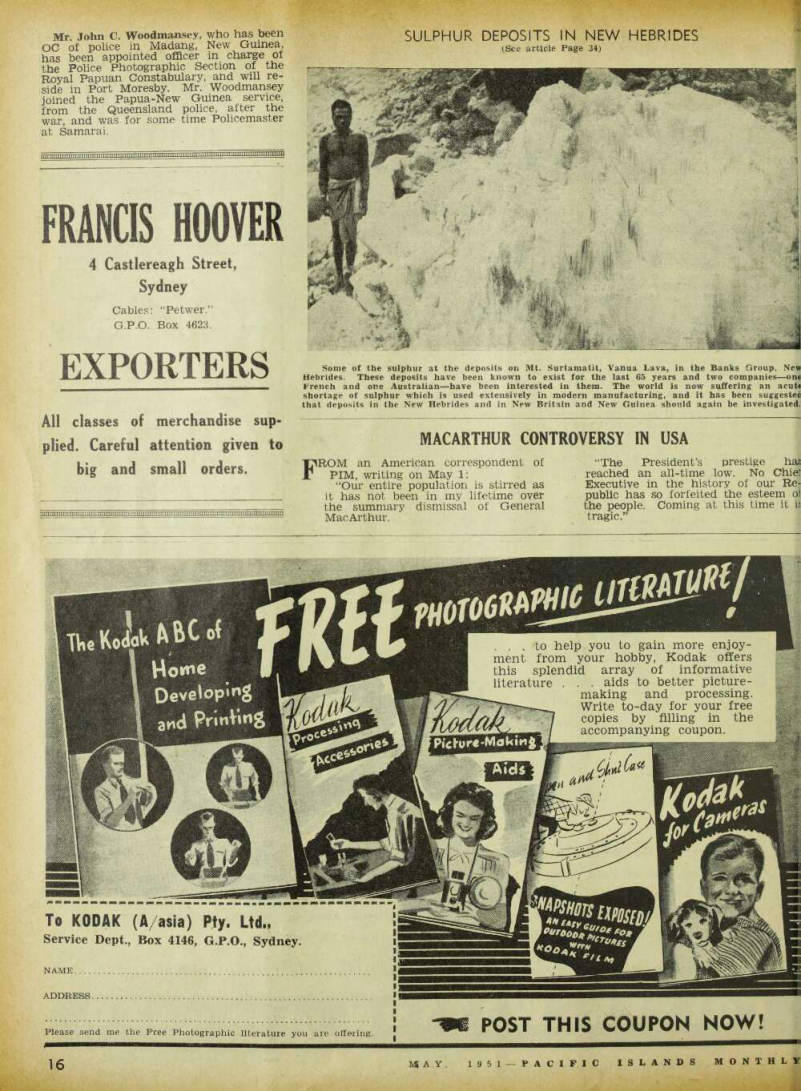
Filling Double Job in Norfolk Island
FOR the past two months, Mr. Harry L.
Downing, one of the best known and highly esteemed of Papua-New Guinea officials, has been filling the dual position of Acting-Government Secretary and Acting-Administrator of Norfolk Island.
Mr. J. McWhinney left Norfolk Island at short notice in February; and Mr.
Downing—who, since his retirement from the New Guinea service, had been doing general work in the Department of Terri tories in Sydney—was asked to go to Nor folk at 24 hours’ notice and take over the job. It was then learned that the Ad ministrator, Mr. Alex Wilson, for private reasons, was very anxious to get away to Australia, and he left early in March on two months’ leave. Mr. Downing has been carrying on ever since.
Mr. Downing is gratefully remembered by Territorians for the work he did in assisting them during and after the evacuation in 1942. He was ADO in various districts of New Guinea before his retirement.
Mr. John C. Woodmansey, who has been OC of police in Madang, New Guinea, has been appointed officer in charge of the Police Photographic Section of the Royal Papuan Constabulary, and will re side in Port Moresby. Mr. Woodmansey joined the Papua-New Guinea service, from the Queensland police, after the war, and was for some time Policemaster at Samarai.
Advertisements & other items, pp. 17-18 (2 items)
15
acific islands monthly MAY, 1051
Hillman Minx
QUEENSLAND
INSURANCE
COMPANY
LIMITED
(Incorporated 1886 in Australia).
ASSETS EXCEED £5,000,000
Head Office :
QUEENSLAND INSURANCE BUILDING,
80-82 PITT STREET. SYDNEY.
Specialists in South Sea Fire,
Marine Cr Accident Insurances
Apply to: —
FlJl.—Branch Office: J. F. Drury.
Manager.
Burns Phllp (South Sea) Co., Ltd.
VILA. —Burns Phllp (New Hebrides), Ltd.
Comptoirs Francais Des Nouvelles Hebrides.
NOUMEA.—L. & W. Johnston.
NEW GUlNEA—Manager for the Territory of New Guinea and Papua. W A.
Anderson.
PORT MORESBY—SAMARAI—LAE
—MADANG—RABAUL,
Burns Phllp (New Guinea). Ltd.
PAGO PAGO,
Burns Phllp (South Sea) Co., Ltd.
G. H. C. Reid & Co.
OTHER SOUTH SEA ISLANDS.
Burns Phllp (South Sea) Co., Ltd.
Also to any of the Company’s Offices in Australia or New Zealand.
HILLMAN MINX
-«■ ***■ J m m ifr?.
Magnificent is the word! In style, finish and value than ever. Independent front springing, performance, the Hillman Minx is acknowledged hydraulic brakes, roomy body and boot, and a host the world over as the undoubted leader in its class, of other big-car features .. . There’s a grand new Now powered by the new plus-power engine develop- experience awaiting you the first time you try ing 37.5 horsepower, the Minx is bigger, better motoring in the new Minx.
Full particulars arailable from the distributors throughout the Territory of New Guinea .
COLYER WATSON (mewcuweai LTD.
RABAUL • MADANG • KAVIENG
FRANCIS HOOVER
4 Castlereagh Street, Sydney Cables: “Petwer.”
G.P.O. Box 4623.
EXPORTERS
All classes of merchandise supplied. Careful attention given to big and small orders.
Sulphur Deposits In New Hebrides
(See article Page 34)
Some of the sulphur at the deposits on Mt. Surtamatit, Vanua Lava, In the Banks Group, New Hebrides. These deposits have been known to exist for the last 65 years and two companies—one French and one Australian —have been interested in them. The world is now suffering an acute shortage of sulphur which is used extensively in modern manufacturing, and it has been suggested that deposits in the New Hebrides and in New Britain and New Guinea should again be investigated.
Macarthur Controversy In Usa
FROM an American correspondent of PIM, writing on May 1: “Our entire population is stirred as it has not been in my lifetime over the summary dismissal of General Mac Arthur.
“The President’s prestige has reached an all-time low. No Chiel Executive in the history of our Re public has so forfeited the esteem ol the people. Coming at this time it h tragic.”
Advertisements & other items, p. 18 (1 item)
Post This Coupon Now!
To KODAK (fl/asia) Pty. Ltd., Service Dept., Box 4146, G.P.0., Sydney.
NAME. . . .
ADDRESS
Please send me the Free Photographic literature you are offering. fii . . . to help you to gam more enjoyment from your hobby, Kodak offers this splendid array of informative literature . . . aids to better picturemaking and processing.
Write to-day for your free (j Y copies by filling in the w / accompanying coupon.
H ", flUi
POST THIS COUPON NOW!
Polynesians Barred!
Ridiculous Immigration Law Being Offensively Applied
By New Zealand
TRAVELLERS of Polynesian or part- Polynesian race are still being dis criminated against by New Zealand, and a protest has been made to the NZ Government against the practice.
We have, for example, the case of a well-known Sydney resident, whom we may call Mrs. A B. Mrs. A B was born in Samoa over 50 years ago, of a German father and a part-Samoan mother: She is one-eighth Samoan. Quite early in life she settled in Australia, and married a European—a Britisher. She is well edu cated, and a woman of culture, well-known for her acts of charity.
Recently, she decided to visit her home country (Samoa), travelling via New Zealand and Tonga. She planned to stay for some time with her sister in New Zealand. She holds a British passport.
To her astonishment, the New Zealand Government Office in Sydney would not give her a Permit to enter New Zealand, and referred her application to Welling ton. When she and her friends demanded an explanation, they were informed that such a permit could not be given to persons of part-European race, unless evidence were given of their intention to leave NZ again within a certain time. In the opinion of the learned clerks of New Zealand, such are “coloured people.”
The case of Mrs. A B is still under con sideration.
ANOTHER recent case affects the three children of a well-known Samoan resident Mrs. C D, widow of a former German professional man. The latter settled in Samoa a long time ago, and married a well-educated young woman who was half-Samoan, half- European. Some time between the wars, :heir three children were sent to Germany tor education. They were highly educated —but they were caught up in World War tl and, owing to political and economic lifficulties, they could not get from Ger nany to Samoa, until recently.
In April they arrived in Sydney, en 'oute to Samoa, via Auckland. There, they were held up on the Permit matter, n the same way as Mrs. A B, until their ipplication had been specially considered n Wellington. They underwent great mxiety in Sydney, because their resources yere getting low; they could not book on rom Auckland to Samoa because of the shipping strike; and they wanted to get o New Zealand, where they had relations ind friends.
Finally, the bureaucrats of Wellington, laving made them intensely conscious of their “colour,” allowed them to proceed. rHESE two cases deal only with persons of part-Polynesian blood. But travellers who are full Polynesians ilso can make a claim for special con sideration.
There now are many Polynesians who, n education, deportment and the ac ceptance of the responsibilities of citizen ship, are fully the equals of Europeans; ttew Zealand is a sort of cultural and commercial centre for the different countries which constitute Polynesia; New Zealand’s own Maoris probably are the most notable race in Polynesia; and it is manifestly absurd that the NZ oureaucrats should place Polynesians, for classification at ports of entry, in the same category as Africans and Asiatics.
In fact, it is difficult to find any argu ment at all to justify the attitude of New Zealand towards the Polynesians.
SOME years ago, when both Australia and New Zealand were under Socialist Governments, the PIM drew attention to the way in which Polynesians are treated by these countries —for the Australian law is similar to that of NZ.
There were discussions in both Welling ton and Canberra —which became pointed and piquant when the Australian bureau crats bluntly applied the no-entry without-permit law to New Zealand Maoris. Wellington literally howled its indignation against Australia. (The fact that the NZ Socialist Government was then being kept in office by four Maori votes, of course, had nothing to do with
the case!) Canberra almost fell over backwards in its haste to remove New Zealand Maoris from the application of the silly law; and the NZ Prime Minister (the late Mr. Peter Fraser), being harried by the FIM for an indication of policy re garding non-Maori Polynesians generally, made a long and involved statement which seemed to promise sympathetic considera tion.
Since then, the matter has been more or less forgotten. The PIM assumed that the new non-Socialist Governments in Australia and New Zealand would interpret their immigration laws in a more reasonable way.
But, as shown above, the bureaucrats are applying the laws with the same in discriminating faithfulness as formerly; and cases of rank injustice are being reported.
The matter now is being brought directly under the notice of both the New Zealand and Australian Governments; and, this time, it will not be shelved.
Advertisements & other items, pp. 19-20 (1 item)
PUtoJi
\f I \MLK g IS IN A NEW.
K 1 W 1 Just Twist, The milled edqe / does the trick /| 6.
Change to
KIWI
2949 for keeps
AUSTRALIAN BIGGEST SELLING SHOE POLISH
7m i Plastacoat 33 gives a protective coating which will resist steam, moisture, salt spray, acid fumes, oil, acid, weak alkalis, fresh and salt water, high temperatures, and the corrosive effects of damp earth.
It offers an effective protection for brick, stone, concrete, metals, wood, canvas, etc., and its protection will continue for a very long time.
Plastacoat 33 is a liquid, in standard white and a wide range of colours, and can be applied by brushing, spraying, or dipping.
Composed of inert
, . . , synthetic materials
and pigments, dissolved in fast drying solvents, it contains no paint, oils or varnish.
For complete surface protection, use:—PLASTACOAT 33 Keying Coat, PLASTACOAT 33 Undercoat, PLASTACOAT 33 Finishing
OO2LL,
EVERY Industry can use Plastacoat 33 for immunity against corrosion. Fullest information sent on request by the Manufacturers:—
CBBRDSIO*
PUtoJi
W. J. MANUFACTURING CO. LTD.
Mosman, Sydney, Australia.
fESTIVAIOF
3 MAY —3 0 SEPTEMBER 1951
PROGRAMME
OPENING CEREMONY
H. M. The King will declare the Festival of Britain open after a State Service in St. Paul’s Cathedral on 3rd May 1951.
EXHIBITIONS
LONDON
May 4 —September 30 South Bank Exhibition May 3 —October 31 Festival Pleasure Gardens, Battersea Park May 3 —September 30 Exhibition of Science, South Kensington Exhibition of Architecture, Lansbury, Poplar Exhibition of Books, Victoria and Albert Museum GLASGOW May 28 —August Exhibition of Industrial Power, Kelvin Hall BELFASTJ««e I—August1 —August 31 Ulster Farm and Factory Exhibition
FESTIVALS OF THE ARTS I
There will be a Special Festival Season of i the Arts in London . May 3 —June 30 I Aberdeen Festival July 30 —August i 3 I Aldeburgh Festival of Music and the Arts ' June 8-17 Bath Assembly . . May 20 —June 2 j Belfast Festival of the Arts May 7 — June 3o 1 Bournemouth and Wessex Festival June 3-13 Brighton Regency Festival July 16 — August 25 Cambridge Festival July 30 — August 18 Canterbury Festival July 18 —August 10 !
Cheltenham Festival of British Contemporary Music . . . July 2-14 Dumfries Festival of the Arts June 24- 30 Edinburgh International Festival of Music and Drama . , Aug. 19 — Sept. 8 Inverness 1951 Highland Festival June 17-30 Liverpool Festival July 22 — August 12 Llangollen (International Musical Eisteddfod) ... July 3-8 Llanrwst (Royal National Eisteddfod of Wales) ... August 6-11 Norwich Festival . . June 18-30 Oxford Festival . . . July 2-16 Perth Arts Festival . May 27 — June 16 St. David’s Festival (Music and Worship) July 10-13 Stratford-upon-Avon (Shakespeare Festival) . . March 24 — October 27 Swansea Festival of Music Sept. 16-29 1 Worcester (Three Choirs Festival) Sept. 2-7 York Festival . . . June 3-17 Included in the programme are special events in :—
SCOTLAND
Edinburgh: Gathering of the Clans August 16-19 Exhibition of 18th Century Books August 3 — September 15 Exhibition of Scottish Architecture and Traditional Crafts . July—September International Documentary Film Festival August 19 —September 8 Glasgow: Exhibition of Contemporary Books . . June i—July 28
WALES
Cardiff; Pageant of Wales July 25 — August 6 Exhibition of Contemporary Painting St. Fagan’s Folk Festival July 16-28 Dolhendre, Merioneth: Welsh Hillside Farm Scheme . . May — September
NORTHERN IRELAND
Belfast: Royal Ulster Agricultural Show May 23-26 Combined Services Tattoo August 29 — September 1
BRITAIN AT HOME TO THE WORLD
Ask your Travel Agent for further details
Air Drop For
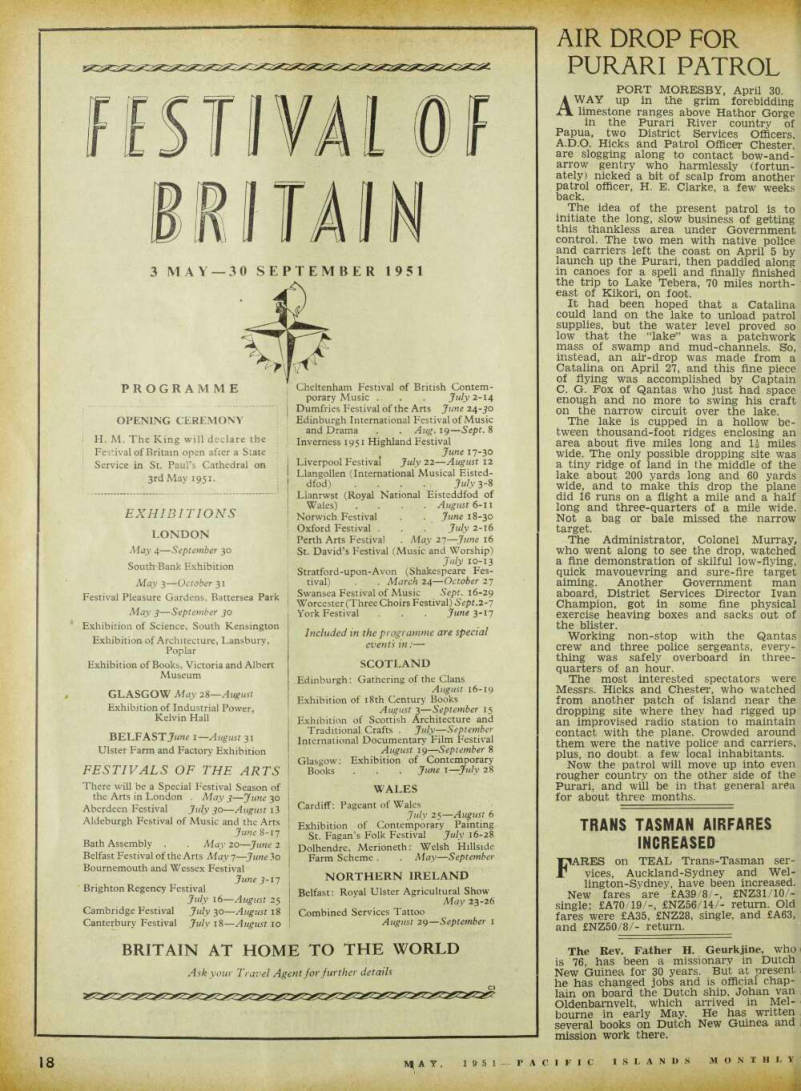
Purari Patrol
Port Moresby, April 30.
AWAY up in the grim forebidding limestone ranges above Hathor Gorge in the Purari River country of Papua, two District Services Officers.
A.D.O. Hicks and Patrol Officer Chester, are slogging along to contact bow-and arrow gentry who harmlessly (fortun ately) nicked a bit of scalp from another patrol officer, H. E. Clarke, a few weeks back.
The idea of the present patrol is to initiate the long, slow business of getting this thankless area under Government control. The two men with native police and carriers left the coast on April 5 by launch up the Purari, then paddled along in canoes for a spell and finally finished the trip to Lake Tebera, 70 miles north east of Kikori, on foot.
It had been hoped that a Catalina, could land on the lake to unload patrol supplies, but the water level proved so low that the “lake” was a patchwork mass of swamp and mud-channels. So, instead, an air-drop was made from a Catalina on April 27, and this fine piece of flying was accomplished by Captain C. G. Fox of Qantas who just had space enough and no more to swing his craft on the narrow circuit over the lake.
The lake is cupped in a hollow be tween thousand-foot ridges enclosing an area about five miles long and li miles wide. The only possible dropping site was a tiny ridge of land in the middle of the lake about 200 yards long and 60 yards wide, and to make this drop the plane did 16 runs on a flight a mile and a half long and three-quarters of a mile wide.
Not a bag or bale missed the narrow target.
The Administrator, Colonel Murray, who went along to see the drop, watched a fine demonstration of skilful low-flying, quick mavouevring and sure-fire target aiming. Another Government man aboard, District Services Director Ivan Champion, got in some fine physical exercise heaving boxes and sacks out of the blister.
Working non-stop with the Qantas crew and three police sergeants, every thing was safely overboard in three quarters of an hour.
The most interested spectators were Messrs. Hicks and Chester, who watched from another patch of island near the dropping site where they had rigged up an improvised radio station to maintain contact with the plane. Crowded around them were the native police and carriers, plus, no doubt, a few local inhabitants.
Now the patrol will move up into even rougher country on the other side of the Purari, and will be in that general area for about three months.
Trans Tasman Airfares
Increased
FARES on TEAL Trans-Tasman ser vices, Auckland-Sydney and Wel lington-Sydney, have been increased.
New fares are £A39/8/-, £NZ3I/10/single; £A7O/19/-, £NZS6/14/- return. Old fares were £A3S, £NZ2B, single, and £A63, and £NZSO/8/- return.
The Rev. Father H. Geurkjine, who is 76, has been a missionary in Dutch New Guinea for 30 years. But at present he has changed jobs and is official chap lain on board the Dutch ship, Johan van Oldenbamvelt, which arrived in Mel bourne in early May. He has written several books on Dutch New Guinea and mission work there.
Jap Criminals,
Manus,
And Dr. Evatt
rE trial, at Manus Island, New Guinea, of 90 Japanese accused of war crimes, which commenced in June, 1950, ended in April. Of the 90, 32 were acquitted, 13 were sentenced to death, and the remainder to imprisonment.
Of the 13 condemned, the sentence of one was commuted. The other 12 were to be hung, in April, in a secluded place in Manus. The other convicted men are being used as labourers on the naval base in Manus.
The old Army camp, which was used for so long by the War Crimes Trial Unit (which has now returned to Australia) has already been taken over by the Works and Housing Department, which plans to accommodate there no less that 200 Euro peans and 400 native labourers. This very large staff is being employed on the main tenance or rebuilding of the naval base.
It will be remembered that the United States (which built here the largest naval and air base in the South Pacific) offered to occupy and maintain the base, at its own expense, if Australia were agreeable.
The offer was haughtily rejected by Aus tralia’s “Foreign Affairs Minister,” Dr.
Evatt, on the ground that Australia would not surrender an inch of her territory. The Americans, without another word, with drew; and now Australia is struggling with the colossal task of trying to maintain the base.
Meanwhile, Dr. Evatt has been clawed very serevely in the Australian general elections of April 28. At the moment of this writing, he is only 200 ahead of his
opponent (a woman) in the Barton seat, where he used to have a 14,000 majority.
That is what Australia thinks of him.
Miss Maureen Costello, of Suva, Fiji, daughter of Mr. and Mrs. Dan Costello, was in Sydney in May en route to the United Kingdom where she will stay with her cousin Mrs. J. Bray, who before her marriage was Peg Costello, daughter of
Mr. and Mrs, Pat Costello, of Suva, The trip to Britain is a 21st birthday present to Miss Maureen from her parents.
Mr. A, Cowley, of Nukualofa, Tonga, was 92 years old on May 5. In an early issue of the PIM we shall publish some thing about the life, and the remarkable literary ability, of this very old and highly esteemed resident of the Tongan Islands.
Advertisements & other items, pp. 21-22 (1 item)
W. H. Grove
BOOKS WE RECOMMEND
BEHIND THE FLYING SAUCERS.—By Frank Scully. Is the flying saucers mystery really solved? Read the amazing disclosures and descriptions of the saucers and their occupants in this controversial book. 13/6 (post 9d.) BIG GAME FISHING.—By A. B. K. Watkins. River, estuary and beach fishing, and epic battles in big game angling in Australian and N.Z. waters.
Numerous illustrations include remarkable action pictures. 20/- (post Bd.) BEHIND THE STUMPS. —By Godfrey Evans. A cricket book which is also a travel book. In it Evans tells of his cricketing life, times and travels to the eve of the 1950-51 Australian tour. 44 illustrations. 16/- (post lOd.)
ANGUS & ROBERTSON LTD.
Booksellers ;; Publishers :: Librarians
89 CASTLEREAGH ST., SYDNEY, AUSTRALIA.
i K *
GROVE
88ILOW6S
P l ' ‘ i<: ! i « 180 f*
W. H. GROVE
AND
SONS LIMITED
P.O. BOX 490, AUCKLAND,
NEW ZEALAND.
ISLAND
MERCHANTS
REPRESENTING
ENGLISH
MANUFACTURERS
THROUGHOUT THE
PACIFIC ISLANDS
In Fiji as:
W. H. GROVE & SONS (FIJI)
LTD.
Office and Sample Room: Bank of New South Wales Chambers, Suva, Fiji.
DIRECTxTO
NEW GUINEA
PAPUA
UA
PORT MORSEBY
A
vote#
GOVERNMENT
TORRES Sir
CRAM MONO TROPIC RECEIVERS
Over 500 CRAMMOND TROPIC-PROOFED RECEIVERS
have recently been purchased by the New Guinea Government. The power, range and lasting qualities are unequalled for Tropical Conditions, hence the selection of the
CRAMMOND TROPIC-PROOFED RECEIVERS by the
New Guinea Government. i trop£ m K K
CRAMMOND TROPIC EAGLE
Most famous tropic-proofed and completely sealed receiver in the world to-day. Range is unlimited and reception is perfect. It has a built-in moisture absorber, and is available in Vibrator or All Dry Cell. Be assured of a Lifetime of Perfect Reception by writing CRAMMONDS to-day for full particulars.
CRAMMOND RADIO
TROP/COL 01
go B QUEEN STREET.
“The UK Encouraged It” Say Australian
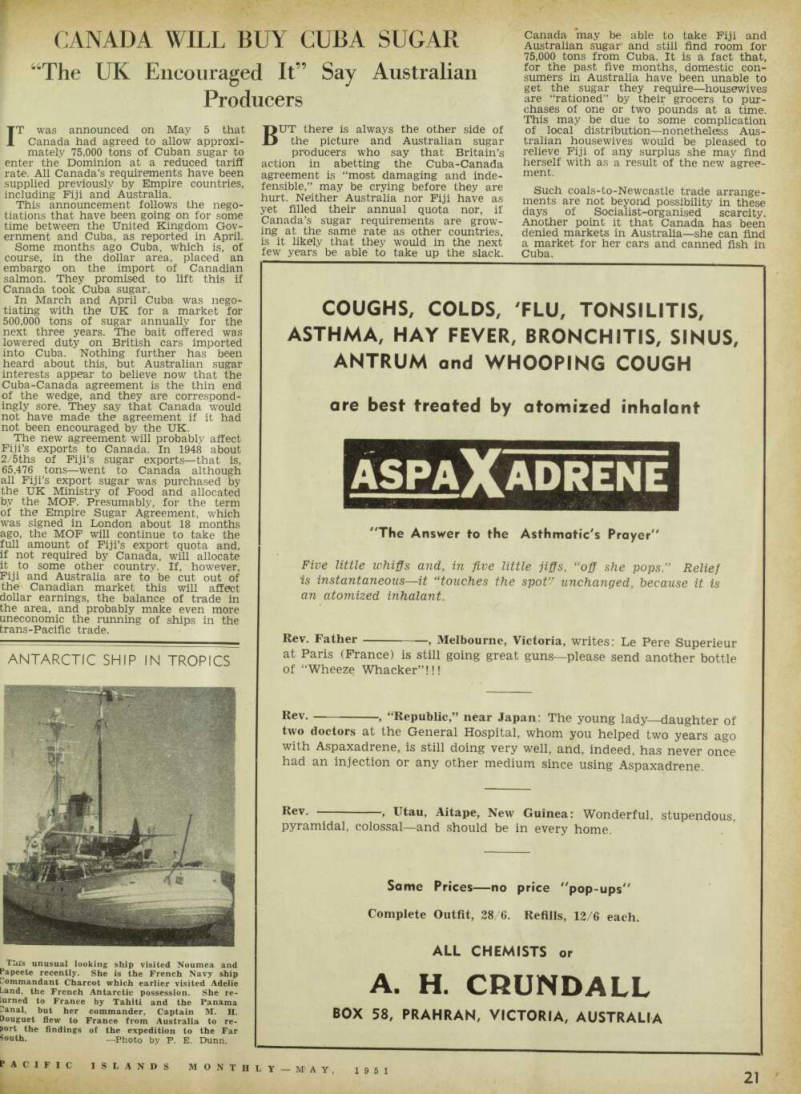
Canada Will Buy Cuba Sugar
“The UK Encouraged It” Say Australian Producers
IT was announced on May 5 that Canada had agreed to allow approxi mately 75,000 tons of Cuban sugar to enter the Dominion at a reduced tariff rate. All Canada’s requirements have been supplied previously by Empire countries, including Fiji and Australia.
This announcement follows the nego tiations that have been going on for some time between the United Kingdom Gov ernment and Cuba, as reported in April.
Some months ago Cuba, which is, of course, in the dollar area, placed an embargo on the import of Canadian salmon. They promised to lift this if Canada took Cuba sugar.
In March and April Cuba was nego tiating with the UK for a market for 500,000 tons of sugar annually for the next three years. The bait offered was lowered duty on British cars imported into Cuba. Nothing further has been heard about this, but Australian sugar interests appear to believe now that the Cuba-Canada agreement is the thin end of the wedge, and they are correspond ingly sore. They say that Canada would not have made the agreement if it had not been encouraged by the UK.
The new agreement will probably affect Fiji’s exports to Canada. In 1948 about 2/sths of Fiji’s sugar exports—that is, 65,476 tons—went to Canada although all Fiji’s export sugar was purchased by the UK Ministry of Food and allocated by the MOF. Presumably, for the term of the Empire Sugar Agreement, which was signed in London about 18 months ago, the MOF will continue to take the full amount of Fiji’s export quota and. if not required by Canada, will allocate it to some other country. If, however, Fiji and Australia are to be cut out of the Canadian market this will affect dollar earnings, the balance of trade in the area, and probably make even more uneconomic the running of ships in the trans-Pacific trade.
BUT there is always the other side of the picture and Australian sugar producers who say that Britain’s action in abetting the Cuba-Canada agreement is “most damaging and inde fensible,” may be crying before they are hurt. Neither Australia nor Fiji have as yet filled their annual quota nor, if Canada’s sugar requirements are grow ing at the same rate as other countries, is it likely that they would in the next few years be able to take up the slack.
Canada may be able to take Fiji and Australian sugar and still find room for 75,000 tons from Cuba. It is a fact that, for the past five mont hs, domestic con sumers in Australia have been unable to get the sugar they require—housewives are “rationed” by their grocers to pur chases of one or two pounds at a time.
This may be due to some complication of local distribution—nonetheless Aus tralian housewives would be pleased to relieve Fiji of any surplus she may find herself with as a result of the new agree rnent.
Such coals-to-Newcastle trade arrange ments are not beyond possibility in these days of Socialist-organised scarcity Another point it that Canada has been denied markets in Australia—she can find a market for her cars and canned fish in Cuba.
Antarctic Ship In Tropics
This unusual looking ship visited Noumea and Papeete recently. She is the French Navy ship Commandant Charcot which earlier visited Adelie Land, the French Antarctic possession. She re turned to France by Tahiti and the Panama Canal, but her commander, Captain M. H.
Douguet flew to France from Australia to re port the findings of the expedition to the Far sou th —Photo by F. E. Dunn.
Advertisements & other items, pp. 23-24 (1 item)
AspaXadrene
COUGHS, COLDS, 'FLU, TONSILITIS,
ASTHMA, HAY FEVER, BRONCHITIS, SINUS,
ANTRUM and WHOOPING COUGH
are best treated by atomized inhalant
AspaXadrene
■ "The Answer to the Asthmatic's Prayer"
Five little whiffs and, in five little jiffs, “off she pops.” Relief is instantaneous—it “touches the spot” unchanged, because it is an atomized inhalant.
Rev. Father , Melbourne, Victoria, writes: Le Pere Superieur at Paris (France) is still going great guns—please send another bottle of “Wheeze Whacker”!!!
Rev. , “Republic,” near Japan: The young lady—daughter of two doctors at the General Hospital, whom you helped two years ago with Aspaxadrene, is still doing very well, and, indeed, has never once had an injection or any other medium since using Aspaxadrene. ev * > Utau, Aitape, New Guinea: Wonderful, stupendous, pyramidal, colossal—and should be in every home.
Same Prices—no price "pop-ups"
Complete Outfit, 28/6. Refills, 12/6 each.
ALL CHEMISTS or
A. H. CRUNDALL
BOX 58, PRAHRAN, VICTORIA, AUSTRALIA
<VHAT
The
YOU NEED NOT BECOME
ANOTHER HARASSED
EXECUTOR
It is easy to say “Yes” to an old friend’s request to become his executor. Your worries do not begin until you are faced with the estate’s complicated problems. Your energy, honesty and goodwill are by no means all that you will need. Administration demands highly specialised knowledge, instant access to sound advice, and long experience in handling other people’s affairs.
However, there is no need to saddle yourself with these extra responsibilities.
It is a simple matter to transfer your unsought obligations to Burns Philp Trust Company Limited. This commonsense arrangement not only frees your hands, but guarantees tireless and efficient management. You will find the Company’s services fully explained in “Hands That Never Leave The Wheel.” Copies of this most interesting booklet can be obtained from any branch of Burns Philp (South Sea) Company, Burns Philp (New Guinea) Limited, Burns Philp (New Hebrides) Limited, or direct from the head office of this Company.
Bums Philp Trust
COMPANY LIMITED
N.S.W. Agencies at Albury, Bathurst, Goulburn, Orange and Wagga.
Also Registered Offices at Melbourne, Brisbane, Port Moresby (Papua), and Vila (New Hebrides).
DIRECTORS:
James Burns.
P. T. W. Black.
Joseph Mitchell.
Eric Priestley Lee.
MANAGER: L. S. Parker.
SECRETARY; E. R. Overton, F.F.I.A.
Executor • Trustee • Attorney
Head Office: 7 Bridge Street, Sydney.
Tel.: BU 5901 Box 543, G.P.O.
Make NG Australia’s Seventh
State Demand By Territory’s RSL President
Prom a Special Correspondent MADANG, April 30.
A DEMAND that New Guinea shall be removed from United Nations Con trol and given completely into the care of Australia, whose soldiers fought and died for the freedom of the great island, was made in Madang, NG, in a public address, on Anzac Day, by Mr.
Georare Whittaker, nresident of the P-NG Branch of the RSSAILA, (A similar demand was made in Australia by the Federal President of the RSSAILA after he returned from a tour of P-NG.) Mr. Whittaker unveiled and dedicated a war memorial to the men and women who served the Empire in World Wars I and 11.
Mr. Whittaker said they remembered in reverence the Australian soldiers who died in New Guinea—“some on this very spot on which we stand today to com memorate this 36th Anzac Day—for this is also the 7th anniversary of the re capture of Madang by the Australians.
“I visualise the ceremonies that at this moment are taking place beside the graves of the fallen, at Bomana, Lae and Bitapaka, and I wonder what the dead m those cemeteries would say to us if they could but speak. I think they would say:— “ ‘We thought we died fighting a war to end all wars so that you who remain would be spared the horrors of war; but we now find that this is not so. There fore be well prepared to repel the enemy who now looms on our horizon once again.
“ ‘We fought for this country on two occasions in your own generation; our blood flowed here, on this very soil. This country is yours—take it and hold it.’
“Let us remember that, on two occasions, our soldiers and some of the natives for whom we are respons ible, fought and died in repelling the enemy on this very soil—even where we now stand. We were then led to believe that the Mandate over this Territory would cease, and that the country would be annexed to our home-land, Australia, and would become part of our country and play its part in the development of the British Commonwealth of Nations.
“We find today that this is not so. We should be letting our fallen comrades die for nothing if we did not take some action to have the Territory for which they died annexed to Australia.
“It is the intention of the members of the RSL in New Guinea and in Australia to press for annexation so that we may be joined with Papua to become a new State of Australia, to be governed by us; in the same manner as any other State., “Without this, this country cannot prosper—not while our Government is at: the beck and call of other nations, some: of which took no part in conquering the: common enemy.”
Before Government
Rsl To Bring P-Ng Needs
From Our Brisbane Correspondent RETURNING to Brisbane recently after a 10-day tour of New Guinea and!
Papua, the Returned League Federal President (Mr. G. W.
Holland) said that New Guinea and!
Papua residents felt that they were “cry ing in the wilderness” in their efforts toe
have their country developed and de fended.
A new State Branch of the League has been set up in the Territory, with head quarters at Lae, and nine sub-branches had been formed throughout New Guinea.
Papua and Bougainville.
Mr. Holland said that the 2,000 mem bers of those branches had been asked to draw up a blue print of what they thought was required to meet develop ment and defence needs so that it could be put before the right authorities.
Other points worrying Europeans in the Territory, said the President, were com plications when trying to buy land; the number of Asiatics, especially Chinese, in the islands; and the possible infiltra tion of Indonesians into New Guinea.
Advertisements & other items, p. 24 (1 item)
22
MAY, 1951 PACIFIC ISLANDS MONTHL
Begin Soon
Aerial Survey of Fiji to Begin Soon
Mr. Duncan Fergusson, Of Edin
burgh, arrived in Fiji at the end of April to undertake an aerial survey of the Colony.
An Oxford aircraft, from which he will work, is being flown direct to Fiji. Mr.
Fergusson expects that the work will take about nine months.
After completing the survey he will re turn to England where the aerial photo graphs will be processed by the Colonial Office’s Survey Department.
Advertisements & other items, pp. 25-26 (2 items)
&L*SSSLT* t 0 0f tW ° ° r
DEATH OF J. R. CLARKE
THE death occurred, suddenly in early April, on his estate on the north coast of New Guinea, of Robert Clarke, an old Territorian.
Mr. Clarke who was a distinguished soldier from two world wars, collapsed and died as a result of a stroke.
He is survived by a widow who lives in the district.
Mr. and Mrs. Baldwin Bambridge, of Papeete, Tahiti, arrived in Sydney early in May. They plan a combined pleasure &L*SSSLT* t 0 0f tW ° ° r Mr. and Mrs. A. G. Smyth, of Apia, Western Samoa, left Apia for New Zealand early in May, and expect to be in Sydney in June. Their daughter, Mrs.
Chisholm, and her daughter, are proceeding from Samoa direct to Sydney; and the whole family will attend the
wedding of young Mr. Chisholm in Sydney on August 4. Mr. and Mrs. Smyth will stay at the Hotel Metropole, Sydney.
Maior E G L GM OBE,
SiSsteatton, underwent a severe
operation in the Mater Hospital, North Sydney, early in May, and is still gravely ill. Major Holland was awarded the very high distinction of the George Medal for outstanding courage shown when the Japanese invaded the Gilberts m 1941-2.
SpsO
pnuce, up on
/7j r jl, ,
J/our
SPRUSO LIQUID, SPRUSO LIQUIDSHEEN, and SPRUSO
CRYSTALLISED SHEEN.
SPRUSO is the best seller in AUSTRALIA.
TRADERS : write for samples.
SPRUSO COMPANY, Redfern, New South Wales, Australia.
The “TRUMP”
PUMPLESS PETROL IRON
With these attractive features:
O Simplicity of Operation • Smart Appearance • Chrome Finish • Rapid Warm-up • Economical—Burns for 2 hours on one fill of "Shellite" • No Cords to Tangle • Spare Parts Readily Available
REPRESENTATIVES
VENTURA TRADING CO. Pty. Ltd.
26 BRIDGE STREET, SYDNEY.
Cables: “Ventura,” Sydney.
—TRADE ENQUIRIES INVITED—
PORT MORESBY SYDNEY SERVICE
SaienW
BRITAIN’S
MOST
LUXURIOUS
FLYING BOAT.
I % I % % % % % \ %
PORT MORESBY
% k *5 % m % V l % % %
BR/S B A N
S YDN
“FOR LUXURY AT THE HIGHEST LEVEL"
The newly inaugurated "Chieftain" service between Port Moresby and Sydney, calling en route at Brisbane, will commence on May 27.
The “Chieftain” service is the last word in luxury air travel. You fly in the most modern flying boat in the world . . . The new, specially-fitted double-deck Solent. Relax in deep-seated comfort with, by day, the ever-changing panorama of the Barrier Reef and Australia’s Northern Coastline spreading before your eyes ... by night, you fly under the canopy of the Pacific stars.
The new luxury starship, “Star of Australia,” has that exclusive club atmosphere, and each passenger is our special guest-of-honour. For your convenience, there is a well-stocked library; hot and cold water and electric razors provided in the gentlemen’s room; whilst for the ladies . . . sheer delight! . . . modern kidney dressing tables with fluorescent lighting.
Your meals on the “Chieftain” will be an epicure’s delight . . .
Specially prepared in our electric grillroom aloft, for your particular pleasure.
Two flight stewards and a hostess service, together with a well-stocked cocktail bar, will cater for your needs.
Between-seat tables provide facilities for the congenial relaxation of passengers.
TRANS OCEANIC AIRWAYS
SYDNEY
McArthur Shipping Co.
Pty., Ltd. 31 Macquarie Place.
BU 2048 BU 2049
Principal Agents
PORT MORESBY
Steamships Trading Co., Ltd.
BRISBANE
World Travel Headquarters, Lennons Hotel.
B 4114 B 4124
Rabaul Roundabout
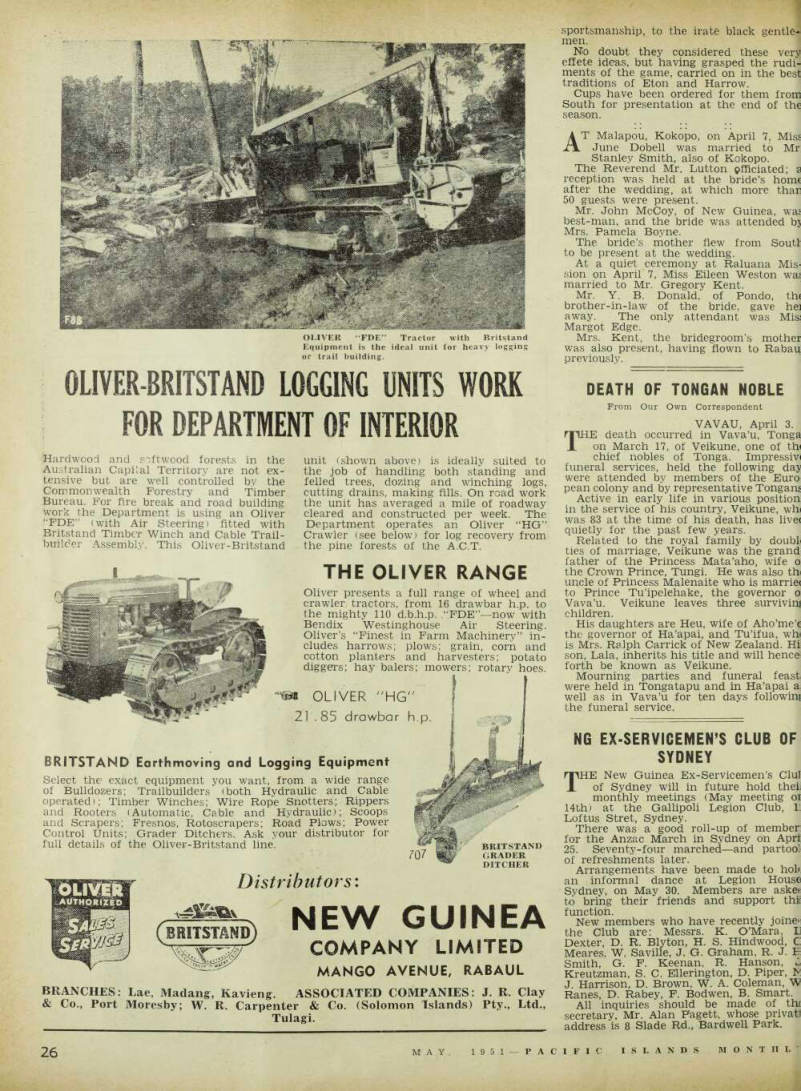
From Our Own Correspondent
RABAUL, April 3.
A FTER initial difficulties with regard to the allocation of funds, Rabaul resi dents have made great response to he appeal from the Lamington Fund Jommittee, Miniature golf nights, card drives, box ig tournaments, swimming carnivals, nd the mock police day, sports day and arnival which is to conclude the drive, ave all been well patronised.
Individual donations from citizens have Iso been most satisfactory.
In a lecture delivered in March at the iabaul Women’s Club, Dr. Jamieson, who ; in charge of the tuberculosis immuni ition programme, said that he had been isappointed in the poor attendance at le Rabaul clinic for tests.
He said that the incidence of the Isease amongst local natives is particu larly high.
Monday, April 2, was a great day in le lives of Rabaul’s youngest citizens.
A kindergarten which had been com- Lenced in Rabaul for three to five year ds, was discontinued after functioning >r one month.
Parents and Citizens’ Association took P the cause, after being pestered by the ttle ones to return to school.
Public support was very ready and merous, both from business firms and :ivate individuals, and thus the kiddies ere enabled to carry on their necessary :e-school training.
An interesting visitor to Rabaul on the ulolo was Mr. Robert Robertson, of The ing’s School, Parramatta, NSW, Austra l’s oldest school.
Having retired from the teaching staff of King’s, after 25 years on the job, Mr.
Robertson has been commissioned to write a history of every Old Boy of the School.
While at Port Moresby he visited the war cemetery to inspect the graves of Old Boys killed on active service in the Islands.
His stay in Rabaul was too short for him to meet old boys resident in the New Britain district and New Ireland, of whom there are several.
Kevin Walker, of the Department of Works and Housing was the surprised victim of a rodent’s whim.
Mr. Walker went to bed on the night of February 20, depositing his wrist watch on the bedroom table.
Next morning the watch had disap peared, and the most vigilant investiga tions on the part of local police failed to discover the thief.
Recently, when Mr. Walker was re
pairing a chair in the bedroom, he dis covered a ratnest studded with the jewel movement timepiece.
RABAUL is to have a new air service.
On April 9, Amphibious Airways Co. landed its first land and sea craft at Rabaul, after making a survey flight from Lae.
The company already operates from Lae, and will work on a similar basis in Rabaul, making flights to outlying stations ferrying natives for labour and urgent cargoes.
One feels that, with so many perfect landing spots in these waters, this is the answer to inter-island transport.
IN the soccer world of Rabaul, games for natives have already been com menced. The opening game was attended by District Commissioner Macarthy and his wife.
This game went off smoothly, but dur ing the second game between local natives and a police-boys’ team, the affair rapidly developed into a pitched battle.
Officials hastily intervened and ex plained the rules, particularly those of
sportsmanship, to the irate black gentle men.
No doubt they considered these verj effete ideas, but having grasped the rudi ments of the game, carried on in the best traditions of Eton and Harrow.
Cups have been ordered for them frorr South for presentation at the end of the season.
AT Malapou, Kokopo, on April 7, Mis: June Dobell was married to Mr Stanley Smith, also of Kokopo.
The Reverend Mr. Lutton officiated; i reception was held at the bride’s honu after the wedding, at which more thar 50 guests were present.
Mr. John McCoy, of New Guinea, wa; best-man, and the bride was attended b: Mrs. Pamela Boyne.
The bride’s mother flew from Soutl to be present at the wedding.
At a quiet ceremony at Raluana Mis sion on April 7, Miss Eileen Weston wa married to Mr. Gregory Kent.
Mr. Y. B. Donald, of Pondo, th brother-in-law of the bride, gave he away. The only attendant was Mis Margot Edge.
Mrs. Kent, the bridegroom’s mothei was also present, having flown to Rabau previously.
Advertisements & other items, pp. 27-28 (2 items)
25
acific islands MONTHLY may, 1951
Heinzt.
PACIFIC AND AUSTRALIAN BOOKS
THE NATIVE RACES OF AUSTRALASIA.—IncIuding Australia, New Zealand, Oceania New Guinea and Indonesia. (Sir J. G. Frazer.) Charts, £3/3/-. Post, 2/6.
ARGONAUT'S OF THE WESTERN PACIFIC. (B. Malinowski.) Account of Native Enterprise and Adventure in the Archipelagoes of Melanesian New Guinea. Ulust. £3/7/6. •Host, 2/*.
ARTS THE OCEANIC PEOPLES. (M. Leenhardt.) Coloured and B.W. plates. 18/9.
TECHNOLOGY OF A MODERN STONE AGE PEOPLE IN NEW GUINEA. (B. Blackwood ) Illust. 18/9. Post, Bd.
Write for free Lists of Australiana and Pacific items, new and second-hand.
Thousands of books in stock. Also Microscopes from £2 to £l5O. Surveying Instruments, Binoculars, Magnifiers, etc. Lists on application.
N. H. SEWARD PTY. LTD., 457 Q Bourke St., Melbourne, Australia.
Works wonders at meal time!
Made from firm, red-ripe “aristocrat” tomatoes, and fragrant spices. Tomato Sauce that’s better than ever . . . made as only Heinz know how. Be sure to put HEINZ Tomato Sauce on your grocery list always.
HEINZt.
& & WH o»‘ r» S 7
oma+o Sauce
H. J. HEINZ CO. PTY., LTD.
479 Bourke Street, Sydney.
HEfHf
tomato
SAUCE
sr
rr * m ■ M ?> OLIVER “FDE” Tractor with Britstand Equipment is the ideal unit for heavy logging or trail building.
OLIVER-BRITSTAND LOGGING UNITS WORK
FOR DEPARTMENT OF INTERIOR
Hardwood and softwood forests in the Australian Capital Territory are not extensive but are well controlled by the Commonwealth Forestry and Timber Bureau. For fire break and road building work the Department is using an Oliver “FDE” (with Air Steering) fitted with Britstand Timber Winch and Cable Trailbuilder Assembly. This Oliver-Britstand unit (shown above) is ideally suited to the job of handling both standing and felled trees, dozing and winching logs, cutting drains, making fills. On road work the unit has averaged a mile of roadway cleared and constructed per week. The Department operates an Oliver “HG”
Crawler (see below* for log recovery from the pine forests of the A.C.T. 1
THE OLIVER RANGE
Oliver presents a full range of wheel and crawler tractors, from 16 drawbar h.p. to the mighty 110 d.b.h.p. “FDE”—now with Bendix Westinghouse Air Steering.
Oliver’s “Finest in Farm Machinery” includes harrows; plows: grain, corn and cotton planters and harvesters; potato diggers; hay balers; mowers; rotary hoes.
OLIVER "HG"
21.85 drawbar h.p
BRITSTAND Earthmoving and Logging Equipment
Select the exact equipment you want, from a wide range of Bulldozers: Trailbuilders (both Hydraulic and Cable operated): Timber Winches: Wire Rope Snotters; Rippers and Rooters (Automatic, Cable and Hydraulic); Scoops and Scrapers; Fresnos, Rotoscrapers: Road Plows; Power Control Units; Grader Ditchers. Ask your distributor for full details of the Oliver-Britstand line.
Distributors:
BRITSTAND
GRADER
DITCHER
(britstand)
s €£r
NEW GUINEA
COMPANY LIMITED
MANGO AVENUE, RABAUL
BRANCHES: Lae, Madang, Kavieng
& Co., Port Moresby
ASSOCIATED COMPANIES: J. R. Clay
W. R. Carpenter & Co. (Solomon Islands) Pty., Ltd., Tulagi.
Death Of Tongan Noble
Prom Our Own Correspondent VAVAU, April 3.
THE death occurred in Vava’u, Tonga on March 17, of Veikune, one of th< chief nobles of Tonga. Impressivi funeral services, held the following day were attended by members of the Euro pean colony and by representative Tongam Active in early life in various position in the service of his country, Veikune, whi was 83 at the time of his death, has live< quietly for the past few years.
Related to the royal family by doubL ties of marriage, Veikune was the grand father of the Princess Mata’aho, wife o the Crown Prince, Tungi. He was also th uncle of Princess Malenaite who is marrie< to Prince Tu’ipelehake, the governor o Vava’u. Veikune leaves three survivinj children.
His daughters are Heu, wife of Aho’me’e the governor of Ha’apai, and Tu’ifua, wh( is Mrs. Ralph Garrick of New Zealand. Hi son, Lala, inherits his title and will hence forth be known as Veikune.
Mourning parties and funeral feast, were held in Tongatapu and in Ha’apai a, well as in Vava’u for ten days following the funeral service.
Ng Ex-Servicemen’S Club Of
Sydney
THE New Guinea Ex-Servicemen’s Clul of Sydney will in future hold thei; monthly meetings (May meeting oi 14th) at the Gallipoli Legion Club, 1: Loftus Stret, Sydney.
There was a good roll-up of member for the Anzac March in Sydney on Apri 25. Seventy-four marched —and partool of refreshments later.
Arrangements have been made to holt an informal dance at Legion House Sydney, on May 30. Members are askec to bring their friends and support thii function.
New members who have recently joinc the Club are: Messrs. K. O’Mara, L Dexter, D. R. Blyton, H. S. Hindwood, C Meares, W. Saville, J. G. Graham, R. J. F Smith, G. F. Keenan, R. Hanson, Kreutzman, S. C. Ellerington, D. Piper, K J. Harrison, D. Brown, W. A. Coleman, W Ranes, D. Rabey, F. Bodwen, B. Smart.
All inouiries should be made of thr secretary* Mr. Alan Pagett, whose privati address is 8 Slade Rd., Bardwell Park.
Advertisements & other items, p. 28 (1 item)
26
MAY, 195 1— PACIFIC ISLANDS MONT II L
Good Copra Year In The
Cooks
From Our Own Correspondent
Mangaia, Cook Is.
THE remarkable recovery of King Copra from his deposed position between the wars has shown no signs of being treated to a further period of exile, though whaling, presumably, is going on as strongly as pre-war. Whale oil caused the dethroning, but we do not hear of it now as a rival of the pure glycerine pro duced from coconuts.
Once more in the Cook Islands the strings of nuts dangle from handy trees, each neatly split for drying (there is no smoke-drying process in use in the Cooks). Upon unpainted iron roofs, frag ments of once-dried copra receive their second dehydrating. Copra here must be re-dried repeatedly, before it is ready to ship. The trader who purchased too soon would be faced with much loss of weight in storing, hence, purchase is subject to rigid scrutiny of the product offered.
The price for 1950 was fivepence a pound. This is good money, a farthing being once the utmost limit of buyers’ generosity. Copra purchases nowadays, of course, go to the British Ministry of Food.
One may not vaunt local copra as Grade A. It is somewhat dirty-looking; never very firm in texture; and hence does not carry over-well to “Peritane.” But it is oily enough to provide one of Europe’s requirements, and for machinery use the oil should be excellent —islanders lubri cate clocks, etc!, with it at all times.
It is a long way from the days of “a farthing a lb” to fivepence, and local driers are praying, with crossed fingers, that the market may not collapse again.
Bsi Soccer Team For Nz ?
A TEAM of Solomon Island_ native Soccer players may visit New Zealand for a two-months tour next year.
It is proposed that the team—they will have a European manager—will travel in the Melanesian Mission ship Southern Cross and members of the team will pay their own fares. The skill of the native footballers has not as yet been put to any real test, but judging by their skill against visiting warships, it is believed
that they will hold their own. They will play in bare feet.
The proposed visit is welcomed in NZ soccer football circles.
The Very Rev. Monsignor A. R. E.
Thomas, Australian director of Catholic Missions, reports that there has been a big drop in contributions to mission funds in the past year. They were the lowest since 1939. This probably re flects the rising cost of living in Aus tralia.
Advertisements & other items, pp. 29-30 (1 item)
“Dufiaplas’ Overlays
William E. Heed
(Established 1913) Island Trade Broker & Commission Agent 145 a GEORGE ST., CIRCULAR QUAY, SYDNEY, For more than 36 years the PERSONAL buying services of WILLIAM E. REED, backed by an experienced staff has ensured prompt and reliable service at lowest cost to Missions, Planters and Traders throughout the Pacific. We operate on a WHOLESALE basis only. You receive original invoices at invoiced cost.
Purchase and delivery of Island craft a speciality.
Enquiries invited for all plantation and trading requirements. Island products sold on a commission basis.
Cables: "WILREED," Sydney
iof
1951
AUSTRALIAN SINGLES
TENNIS TITLES*
WON WITH DUNLOP
RACKETS
FEATURING EXCLUSIVE
“DUfiAPLAS’ OVERLAYS
★ MEN'S SINGLES CHAMPIONSHIP
★ JUNIOR BOYS' SINGLE CHAMPIONSHIP
★ JUNIOR GIRLS' SINGLES CHAMPIONSHIP
• NO warping or cracking at the shoulders. • Extra strength for tighter stringing. • More restrings.
U 'A % a °*e. s >9 rs A I 0 m s
GIVE.
YOURSELF
CHAMPION’S
CHANCE
DURAPLAS" NOW available at your local sports store. DUNLOP MAXP L Y, for 30 years Wimbledon's most popular racket.
" 1 "■ ■■ 1 —■■■' ' DO-1371 m
UNIPORN
ENGINES
“Daimler Built"
is your guarantee of quality
and durability
HlO is designed throughout for very long working life with the absolute minimum of maintenance.
The HlO on generator will provide 6 K.W. (continuous running).
It can be unpacked and run immediately because it has built-in water and fuel tanks. Tools, selection of spare parts, and silencer are included.
Two easily - detachable fly wheels are fitted, mounted on taper and key with bolt fixing.
Engine can be started from either side.
The HlO Uniporn will pump 30,000 gals, per hour against a total head of 30 ft.
This 8/10 brake h.p. Diesel Engine can be direct-coupled to dynamos, alternators, concrete mixers, excavators, water pumps, winches, marine auxiliaries, agricultural machinery, and industrial plant.
Write for full details. y
L H. GREEN PTY. LTD
128 WICKHAM ST., VALLEY,
BRISBANE, QUEENSLAND.
/./'Jpt
mTH FALM TOOTH!
Eskimos have an average chewing power OF 345 LBS/ (AUSTRALIAN AVERAGE (S NEAR 170 LBS.).
KOLYNOS KEEPS YOUR TEETH STRONG AND
HEALTHY. ANTISEPTIC KOLYNOS
A.
BUBBLES LEAVE EACH TOOTH
SURGICALLY CLEAN.
A* 7~/ When a famous film stars
DOG BROKE ITS TOOTH, A CAP
WAS FITTED TO THE TOOTH a
BY A HOLLYWOOD
DENTIST ! YOUR TEETH <{ '
WILL SPARKLE WITH VvW J*
NEW LUSTRE AFTER , JT * ’
KOLYNOS. FOR A /
REFRESHING CHANGE-
TRY KOLYNOS
NOW.
(0,
BILLS
£S) c.pE
IN HALF
WITH KOLYNOS-ANO
ON OTHER
ONE
1
DENTAL CREAM
1-16 * 6^3
lonoast^otu^^te.
0R r f V.NCH^f
i& L : m
&m&pfcAyߣ7T£K.. .mM? p&Tzg .. ami %
Commission
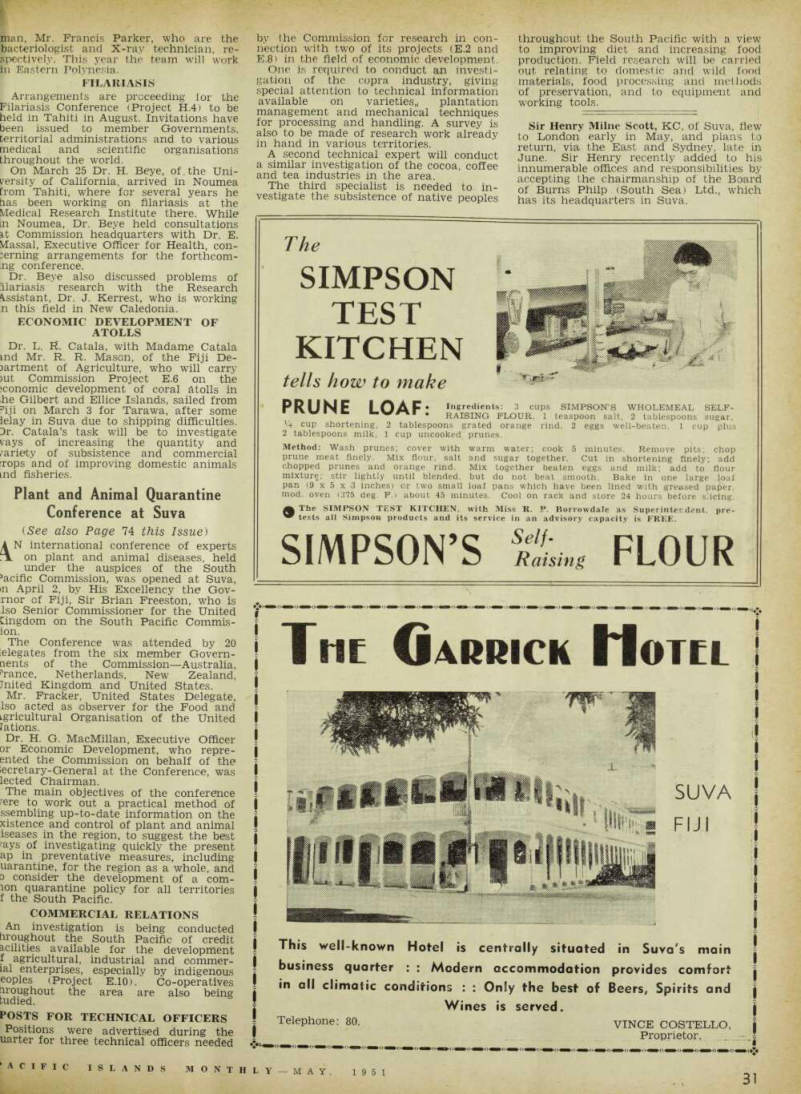
South Pacific
Seventh Session : Chairman Emphasises Work at Critical Point
Headquarters: Anse Vata, Noumea, New Caledonia
THE Seventh Session of the South Pacific Commission was formally opened on April 28 at a public meet ing at Commission headquarters at Noumea. Twenty-two delegates, repre senting the six member Governments, were present.
In the absence of Mr. J. R. Halligan, Senior Commissioner for Australia, (whose arrival in Noumea had been delayed until May 1) the Commissioner for Australia, Professor K. O. Shatwell, took the Chair.
Following a brief address on the Commis sion and its future, he formally declared the Session open.
“It is platitudinous to say of any in stitution that it is at a critical point in its history,” Professor Shatwell said in his opening address. “But we who meet here to-day know that this is particularly true of the South Pacific Commission. With modern advances in communications the world has shrunk. Everyone knows that peace, economic prosperity and social wel fare are indivisible, and that the shock of happenings in Asia is felt immediately in every capital city in the world.
“The foundation of the South Pacific Commission is a proof that at the end of World War II there were to be found, among the leaders of six nations, men of vision and of historic sense—men not forced to make a hurried accommodation by the necessity of events, but who rather sought by wisdom and foresight to accord their actions with the emerging pattern of history, and by common action to achieve the common good. But, as with every other ideal, the only test is the extent to which it becomes realised in the lives of ordinary men.
“Whether the verdict of history will ac claim the founders of the Commission as statesmen,” remarked the Chairman, “or dismiss them as the victims of yet an other of the numberless idle dreams which have deluded man, will depend upon the extent to which the Commission contri butes to the welfare of the Pacific peoples.
“I say that we are at a critical period in the history of the Commission, because cur machinery has been set up, and it is aeginning to work. But whether its work will achieve what its founders hoped de pends upon the continued labours of all who are now associated with it. There ire most encouraging signs—some of them are to be discerned in the matters which will be discussed at this Session—but be yond this we cannot go.
“At this juncture,” Professor Shatwell continued, “it is fitting that I should refer bo the great loss the Commission has sus tained by the resignation of its first Secretary-General, Mr. W. D. Forsyth, by whose devotion and industry the machinery has been so largely created.
It is not my intention to attempt to ap preciate his work here, but he at least is assured that he has done his part in writing an important opening chapter in the history of the Commission.
“I am sure also that I express a senti ment shared by all of you in regretting that we shall no longer profit by the ad vice and experience of Colonel F. W. voelcker, until recently the Commissioner
for New Zealand, who knew so well both the area and the work of the Commis sion.”
A report on the work programme of the Commission in the fields of health, economic development and social develop ment is before this Session. In the field of health, arrangements will be further considered for a conference on filariasis, to be held in Tahiti next August.
High Officials Among important tasks before the Commission is the appointment of a Secretary-General, to take the place of Mr. W. D. Forsyth (returning to Aus tralian Public Service); a Deputy Secre tary-General; and a Deputy-Chairman of the Research Council (position vacant since Dr. Baas Becking retired, last year).
New appointments to the staff include that of Miss Helen Shiels as Assistant to
the Executive Officer for Social Develop ment, and of Mr. A. E. Read, BSc., as Editorial and Publications Officer to the Commission. Mr. Read last year com pleted nine years in the information ser vices of the British Government in the Far East, the United Kingdom and Aus tralia. His last post was as United King dom Information Officer in Sydney.
Next SP Conference Another important item on the agenda is the selection of a date and place for the second South Pacific Conference, in 1953. The first Conference was held in Suva in May, 1950.
It was strongly urged in 1950 that the Second Conference should be held in the Highlands of Central New Guinea.
Quarterly Review of Activities
riiHE activities of the South Pacific 1 Commission during the first quarter of 1951 are reviewed in the quarterly Bulletin for April, issued by the Com mission.
Meetings included a Conference of all principal officers of the Commission, held at headquarters in January for the pur pose of co-ordination of activities, and a special social development meeting in Suva in the same month. This latter was to consider the Derrick Report on voca tional training of island peoples, and the Keesing and Elkin Reports on social anthropology.
The Quarterly Bulletin also reports on progress made in the fields of health, economic development and social develop ment during the quarter.
Nutrition
The 1951 programme for the Alimen tation and Nutrition Project (H. 2 and H. 5) has been finalised. Miss Shiela Malcolm, the Commission’s nutritionist, left Noumea in March for the New Hebrides, where she will spend 12 months investigating infant and adult diets and local foods. She was accompanied by the Research Assistant, Dr. J. Kerrest, who spent a few days in the New Hebrides with Miss Malcolm finalising arrange ments for her year’s work.
Tb Research
New members have been appointed to the tuberculosis research team (Project H. 3). The leader is Dr. George Clerc, Lt.- Colonel of the French Colonial Medical Service, who arrived from Paris in March to take up this post. Two other new appointees are an Australian, Miss Shirley Fenton, B.Sc., and an English
man, Mr. Francis Parker, who are the bacteriologist and X-ray technician, re spectively. This year the team will work in Eastern Polynesia.
Filar! As Is
Arrangements are proceeding lor the Filariasis Conference (Project H. 4) to be held in Tahiti in August. Invitations have been issued to member Governments, territorial administrations and to various medical and scientific organisations throughout the world.
On March 25 Dr. H. Beye, of the Uni versity of California, arrived in Noumea from Tahiti, where for several years he has been working on filariasis at the Medical Research Institute there. While in Noumea, Dr. Beye held consultations it Commission headquarters with Dr. E.
Massal, Executive Officer for Health, con cerning arrangements for the forthcom ng conference.
Dr. Beye also discussed problems of ilariasis research with the Research Assistant, Dr. J. Kerrest, who is working n this field in New Caledonia.
Economic Development Of
Atolls
Dr. L. R. Catala, with Madame Catala md Mr. R. R. Mason, of the Fiji De triment of Agriculture, who will carry >ut Commission Project E. 6 on the iconomic development of coral atolls in he Gilbert and Ellice Islands, sailed from ? iji on March 3 for Tarawa, after some lelay in Suva due to shipping difficulties.
Dr. Catala’s task will be to investigate vays of increasing the quantity and variety of subsistence and commercial :rops and of improving domestic animals md fisheries.
Plant and Animal Quarantine
Conference at Suva
(See also Page 74 this Issue) A N international conference of experts :x on plant and animal diseases, held under the auspices of the South ’acific Commission, was opened at Suva, m April 2, by His Excellency the Gov rnor of Fiji, Sir Brian Freeston, who is Iso Senior Commissioner for the United kingdom on the South Pacific Commis ion.
The Conference was attended by 20 lelegates from the six member Govern oents of the Commission—Australia, France, Netherlands, New Zealand, Jnited Kingdom and United States.
Mr. Fracker, United States Delegate, Iso acted as observer for the Food and Lgricultural Organisation of the United rations.
Dr. H. G. MacMillan, Executive Officer or Economic Development, who repre ented the Commission on behalf of the lecretary-General at the Conference, was lected Chairman.
The main objectives of the conference rere to work out a practical method of ssembling up-to-date information on the xistence and control of plant and animal iseases in the region, to suggest the best 'ays of investigating quickly the present ap in preventative measures, including uarantine, for the region as a whole, and o consider the development of a com lon quarantine policy for all territories f the South Pacific.
Commercial Relations
An investigation is being conducted broughout the South Pacific of credit acilities available for the development f agricultural, industrial and oommer ial enterprises, especially by indigenous copies (Project E. 10). Co-operatives iroughout the area are also being tudied.
Posts For Technical Officers
Positions were advertised during the uarter for three technical officers needed
by the Commission for research in con nection with two of its projects (E. 2 and E.B) in the field of economic development.
One is required to conduct an investi gation of the copra industry, giving special attention to technical information available on varieties,, plantation management and mechanical techniques for processing and handling. A survey is also to be made of research work already in hand in various territories.
A second technical expert will conduct a similar investigation of the cocoa, coffee and tea industries in the area.
The third specialist is needed to in vestigate the subsistence of native peoples
throughout the South Pacific with a view to improving diet and increasing food production. Field research will be carried out relating to domestic and wild food materials, food processing and methods of preservation, and to equipment and working tools.
Sir Henry Milne Scott, KC, of Suva, flew to London early in May, and plans to return, via the East and Sydney, late in June. Sir Henry recently added to his innumerable offices and responsibilities by accepting the chairmanship of the Board of Burns Philp (South Sea) Ltd., which has its headquarters in Suva.
Advertisements & other items, pp. 31-34 (2 items)
Pacific Islands Trading Co
ART POSTCARDS OF
TONGA
Per Dozen (Including a Tin-Can Mail Cover), Postage Paid: 6/- (or one US Dollar).
TONGAN PHOTOS BUREAU
Nukualofa, Tonga
Many Pacific Islands
T raders
Have read our advertisement In this Magazine.
And Then Sent us an Order.
You, too, will profit By placing an order For American-made goods Through our office.
Shipped direct from Mill and Factory to you:
COTTON TOWELS—DRESS MATERIALS—
GROCERIES—HARDWARE—PAINTS—
OILS—FLASHLIGHTS, etc.
PACIFIC ISLANDS TRADING CO
244 CALIFORNIA STREET, SAN FRANCISCO 11,
CALIFORNIA, U.S.A.
We Want Your Goodwill!
WORLD PARITY FOR YOUR PRODUCE!
We are outright buyers of—
TROCHUS SHELL M.O.P. SHELL
IVORY NUTS GREEN SNAIL SHELL
As direct exporters to World’s consuming centres we can offer
TOP PRICES.
We supply TIMBER, DOORS, JOINERY, MOULDINGS, Etc.
W. BALCHIN PTY. LTD.
(Established 1848).
TIMBER, IMPORT b EXPORT MERCHANTS
Head office SYDNEY: 247 George St.
Phones; BW 1533-9 Also at LONDON: 78 Gt. Bushev Drive Totteridge Cables; "BALCHINCO”
ts t* 1 ha** Ql* Ue* ih u>‘ *** St 1
Wll
\\ i
ulivaua
£"Jou
vm fk (/,.
TROPICAL Hi AT VOE 9 NOT EFFECT
QB B BUTTER CONCENTRATE BUTTER CONCENTRATE
you don't have to worry about
defriaeration for QBB- Butter
Concentrate keeps FRESH WHOLESOME
and TASTY in all climates
H«c't
S ECONOMICAL. TOO
e 0°° h Because of its density you use only three-quarters of the amount of butter prescribed in an ordinary recipe.
Q. 8.8. Butter Concentrate will not melt in temperatures up to 100 deg.
Fahr, So -eocstj to mafoe.lnto l/zbie /Sutter- Just add or^Mli/c
M ALL I S LAN
The
SIMPSON
TEST
KITCHEN
tells how to make
PRUNE LOAF:
Ingredients: 3 cups SIMPSON’S WHOLEMEAL SELF- RAISING FLOUR, 1 teaspoon salt, 2 tablespoons sugar, cup shortening. 2 tablespoons grated orange rind. 2 eggs well-beaten. 1 cup plus 2 tablespoons milk, 1 cup uncooked prunes.
Method; Wash prunes; cover with warm water; cook 5 minutes. Remove pits; chop prune meat finely. Mix flour, salt and sugar together. Cut in shortening finely; add chopped prunes and orange rind. Mix together beaten eggs and milk; add to flour mixture; stir lightly until blended, but do not beat smooth. Bake in one large loaf pan (9 x 5 x £ inches) or two small loaf pans which have been lined with greased paper, mod. oven (375 deg. F. i about 45 minutes. Cool on rack and store 24 hours before s’.lclng.
A The SIMPSON TEST KITCHEN, with Miss R. F. Borrowdale as Superintendent, pre- “ tests all Simpson products and its service in an advisory capacity is FREE.
SIMPSON’S Raising FLOUR
The Garrick Hotel
§ #*** m Pi & *
SUVA
FIJI
This well-known Hotel is centrally situated in Suva's main business quarter : : Modern accommodation provides comfort in all climatic conditions : : Only the best of Beers, Spirits and Wines is served.
Telephone: 80. VINCE COSTELLO, Proprietor.
REFRIGERATION
for operation from ELECTRIC MOTORS of varying
voltages—petrol or Diesel motors
IDEAL FOR ISLAND USE
We are manufacturers of a complete series of refrigerators, from Domestics to the largest types of coolrooms. Full information will be airmailed on request. At right: Premier Wall Cabinet type refrigerator for Sea Foods, Poultry, or foods with acid content. This refrigerator will preserve foods at low temperature indefinitely. r □ w.
'I At left : The Premier “Pinnacle” combination for Ice Cream, and food storage. You'll hold extra supplies of refrigerated foodstuffs in this glassfronted “Pinnacle ” combination.
We are contractors to the Commonwealth Government, leading Australian Hotels, and such large organisations as Tooth’s and Toohey’s Brewery.
X. m At left-. The Premier “Regal” for Delicatessen, Grocery, Poultry, etc.
Here is a display unit for the Islands store—a unit that will bring more trade to you—and it is ideally suited for tropical use.
PREMIER
REFRIGERATION CO. PTY. LTD.
587 George Street, Sydney—393 George Street, Sydney.
Factory: 14 Underwood St., Paddington, N.S.W., or Box 241, P. 0., Haymarket.
31
ACIFIC islands monthly - may, 1951
Fiji Penalised
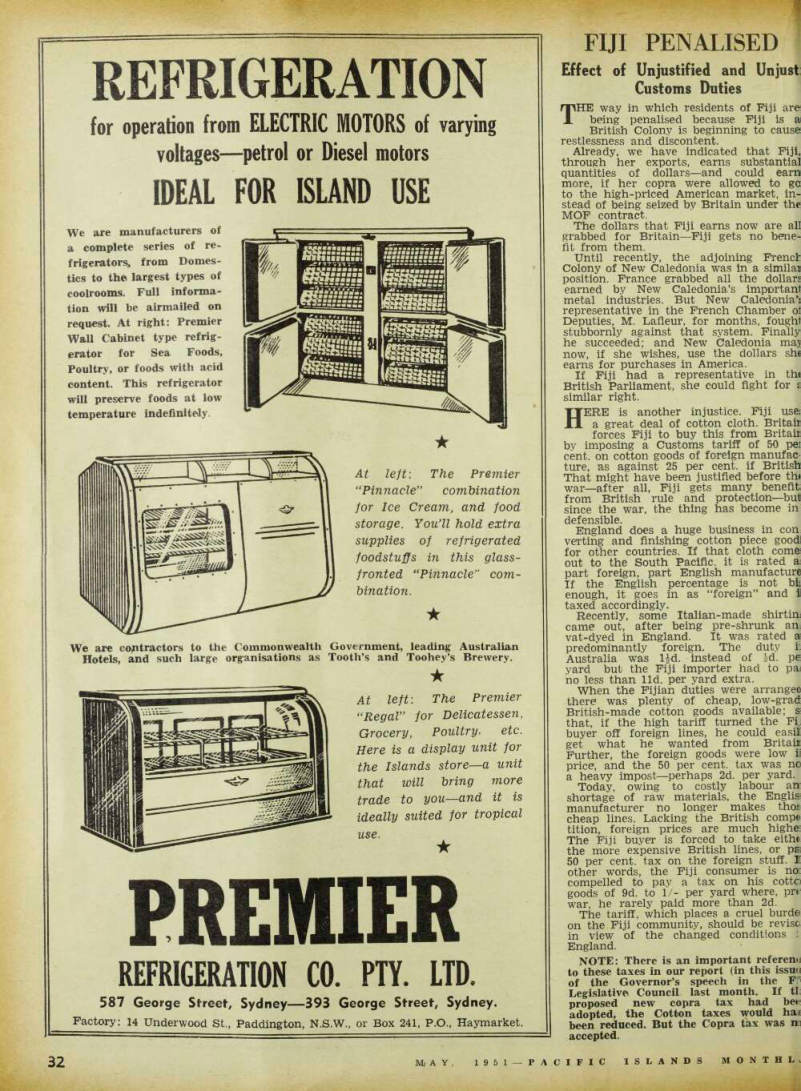
Effect of Unjustified and Unjust: Customs Duties
THE way in which residents of Fiji are; being penalised because Fiji is ai British Colony is beginning to cause; restlessness and discontent.
Already, we have indicated that Fiji, through her exports, earns substantial quantities of dollars —and could earn more, if her copra were allowed to ga to the high-priced American market, in stead of being seized by Britain under the MOF contract.
The dollars that Fiji earns now are all grabbed for Britain—Fiji gets no bene fit from them.
Until recently, the adjoining French Colony of New Caledonia was in a similar position. France grabbed all the dollars earned by New Caledonia’s important metal industries. But New Caledonia’s representative in the French Chamber ol Deputies, M. Lafleur, for months, fought stubbornly against that system. Finally he succeeded; and New Caledonia maj now, if she wishes, use the dollars she earns for purchases in America.
If Fiji had a representative in the British Parliament, she could fight for e similar right.
HERE is another injustice. Fiji usei a great deal of cotton cloth. Britain forces Fiji to buy this from Britain by imposing a Customs tariff of 50 pei cent, on cotton goods of foreign manufac ture, as against 25 per cent, if British That might have been justified before th« war—after all, Fiji gets many benefit from British rule and protection—but since the war, the thing has become in defensible.
England does a huge business in con verting and finishing cotton piece goodl for other countries. If that cloth come: out to the South Pacific, it is rated a; part foreign, part English manufacture If the English percentage is not bij. enough, it goes in as “foreign” and if taxed accordingly.
Recently, some Italian-made shirtinj came out, after being pre-shrunk am vat-dyed in England. It was rated a predominantly foreign. The duty fj Australia was lid. instead of £d. pe yard but the Fiji importer had to paj no less than lid. per yard extra.
When the Fijian duties were arrange© there was plenty of cheap, low-grad British-made cotton goods available; s that, if the high tariff turned the Fii buyer off foreign lines, he could easil get what he wanted from Britain Further, the foreign goods were low ii price, and the 50 per cent, tax was no a heavy impost—perhaps 2d. per yard.
Today, owing to costly labour air shortage of raw materials, the Englis manufacturer no longer makes thos cheap lines. Lacking the British compe tition, foreign prices are much higher The Fiji buyer is forced to take eithfe the more expensive British lines, or pa? 50 per cent, tax on the foreign stuff. 1 other words, the Fiji consumer is no: compelled to pay a tax on his cotto goods of 9d. to 1/- per yard where, pre war, he rarely paid more than 2d.
The tariff, which places a cruel burde on the Fiji community, should be revise; in view of the changed conditions ; England.
NOTE: There is an important refereno to these taxes in our report (in this issuti of the Governor’s speech in the Fi' i Legislative Council last month. If tIJ proposed new copra tax had be«j adopted, the Cotton taxes would hat been reduced. But the Copra tax was m accepted.
Advertisements & other items, p. 34 (1 item)
32
M, AY, 1951 PACIFIC ISLANDS MONTHL.
The New Administration
In American Samoa
lONG and picturesque ceremonies, ex- J tending from the morning of Feb ruary 21 to the afternoon of March 2, marked the end of 51 years of adminis tration of Eastern Samoa by the United States Navy, and the introduction of a government controlled by the United States Department of the Interior.
The Samoans love ritual and oratory; and, with feasts, parades, speeches, music and the drinking of kava, they made the most of the ceremonies. The departing Naval Governor, Captain T. F. Darden, was accorded all possible honour; and the newly-arrived Civil Governor, Mr.
Phelps Phelps, was given a warm welcome.
In one afternoon, Captain and Mrs. Dar den went through a Farewell Taalolo, a formal dinner and a Tofa Party. On three previous days, there had been a “farewell feast” each afternoon, given by the Samoans of different districts.
“Turning its head to the past,” said the official programme, “Samoa is sorrowful to bid farewell to a good and loyal friend, the Navy. At the same time, turning its head to the future, Samoa bids welcome to the new administration under the De partment of the Interior, and offers its loyalty, co-operation and obedience with bright hopes for the future.”
Death Of Blue Lagoon Author
Henry de vere stacpoole, who gave glamour and somewhat Vic tor! on sex to the South Seas novel, died on the Isle of Wight on April 12. He was 88.
His novel, The Blue Lagoon, was the best known of his stories and had a vogue among the World War I generation. A film version was made a few years ago.
Much of it was shot in the Yasawas, Fiji.
Stacpoole lived for a time in Papeete.
Mr. George Hunt, who spent last year in Tahiti, and before that was a resident of Fiji, arrived in Sydney in April. His plans are uncertain; he is intrigued by the big and beckoning opportunities of the metropolis, but more attracted by the happy and peaceful life of the Islands.
Seven colonies of bees and queen-bees have been sent to Lord Howe Island in recent years to help pollinate fruit and vegetable crops and increase production.
Advertisements & other items, pp. 35-36 (2 items)
McILRATHS for Groceries
PLAIN AND
SELF RAISING
FLOUR,
(Uic fo'cit/
ESTABLISHED 1868
Agents for Fiji, Tonga and Samoa:
C. SULLIVAN (PACIFIC ISLANDS) LTD., Suva,
McILRATHS for Groceries
SPECIAL OFFER—CHOICE QUALITY JAMS
“VICTOREE”
ORANGE MARMALADE
24 oz. tins 13/6 doz.
“CAPITAL”
PLUM JAM
24 oz. tins 16/6 doz.
“VICTOREE”
QUINCE JAM
24 oz. tins 13/6 doz.
“HUONCRY” BLACKCURRANT SYRUP. 26 oz. 4/6 bot. “HUONCRY” RASPBERRY SYRUP. 26 oz. 4/6 bot.
Rich in Vitamin C—Specially recommended for children.
“VICTOREE”
TOMATO SAUCE
13 oz. bots. 19/6 doz.
“LETONA”
TOMATO SOUP
16 oz. tins. 15/- doz.
“SUNRICH" VEGALL (Pure Vegetable Extract rich in Vitamins). L oz.
“LETONA” CELERY STICKS, 16 oz. tins . .
“LETONA” PEELED TOMATOES, 15 oz. tins, 19/6. “.*8 oz. tins
NEW SEASON’S 3 CROWN SULTANAS, loose
NEW SEASON'S 3 CROWN CURRANTS, loose
“KIA ORA PURE FRUIT JLTCE CORDIALS (Orange Cup, Fruit C Lemon, etc.). 26 oz. bottles
‘MVNOR” PURE FRUIT JUICE CORDIALS (Top>
Lemon, etc.). 26 oz. bottles jars 6/- doz. 14/0 dov,. 32/6 doz. 1/10 lb. 1/9U lb. 39/- doz.
Fruit Cup. Orange Cup, 39/- doz.
BRANDY SULTANA
CAKES
3 lb. in utility tin, 8/9.
“GLEN ELLEN”
GREEN PEAS
16 oz. tins. 23/9 doz.
PRICES SUBJECT TO STOCKS AND TO MARKET FLUCTUATIONS Revised comprehensive price lists available on application.
F '?w, STEAMER, SYDNEY, including Australian permits, cases, packing, etc. All shipments excluding deck cargo are insured against P.Uage, .net. a„n non-deUver L THE QUALITY OF ALL GOODS POSITIVELY GUARANTEED.
EXPORT DEPARTMENT
202 PITT ST., SYDNEY, AUSTRALIA
McILRATHS PTY. LTD.
c,h co
and
jsss**
pH
IN YOUR COUNTRY HOME
with
ELECTRICITY
FREE
FROM THE WIND
WITH QUIRK’S WIND-DRIVEN LIGHTING PLANT
You don't have to live in the city to enjoy these modern electrical appliances by Quirk's. Now they're available to every country home to give you hours of entertainment and save hours of work. They are operated by electricity FREE from the wind with a Quirk's Wind Driven Lighting Plant.
Operating In winds as low as 5 m.p.h., this plant will provide economical electricity for all your lighting and household appliances.
Supplied as a complete unit with batteries, or as an addition to your present engine-driven plant, the saving in fuel and upkeep will amply repay the purchase price of Windlite.
Quirk's Windlite plants cost nothing to run —need no attention whatever, apart from a yearly change of oil. Available in either 12, 32, or 50 volt sizes.
Windlite is a necessity that no country man or woman can afford to overlook.
Quirk's are also suppliers of electrical goods which can be operated by Windlite—fans, radios, cake mixers, vacuum cleaners, dishwashers, and washing machines.
Obtainable from
QUIRK’S VICTORY LIGHT CO.
229 Castlereagh Street, Sydney. Phone M 3114
34
M? AY , 1951 PACIFIC ISLANDS MONTHL
Reconsidered
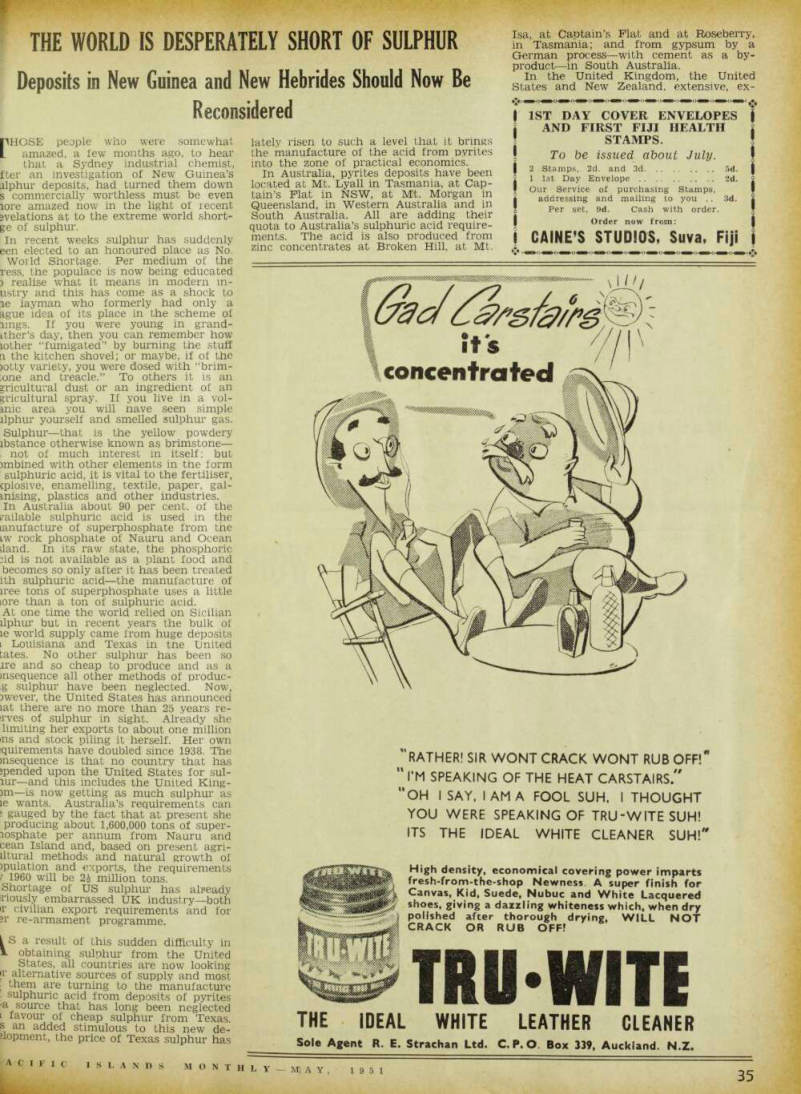
THE WORLD IS DESPERATELY SHORT OF SULPHUR Deposits in New Guinea and New Hebrides Should Now Be Reconsidered
CHOSE people who were somewhat amazed, a few months ago, to hear that a Sydney industrial chemist, fter an investigation of New Guinea’s ilphur deposits, had turned them down s commercially worthless must be even lore amazed now in the light of recent relations at to the extreme world short ge of sulphur.
In recent weeks sulphur has suddenly een elected to an honoured place as No.
World Shortage. Per medium of the ress, the populace is now being educated ) realise what it means in modern m ustry and this has come as a shock to le layman who formerly had only a ague idea of its place in the scheme of nngs. If you were young in grand tther’s day, then you can remember how rother “fumigated” by burning the stuff a the kitchen shovel; or maybe, if of the >otty variety, you were dosed with “brim ;one and treacle.” To others it is an dust or an ingredient of an gricultural spray. If you live in a vol inic area you will nave seen simple ilphur yourself and smelled sulphur gas.
Sulphur—that is the yellow powdery ibstance otherwise known as brimstone— not of much interest in itself: but jmbined with other elements in the form sulphuric acid, it is vital to the fertiliser, tplosive, enamelling, textile, paper, gal mising, plastics and other industries.
In Australia about 90 per cent, of the /ailable sulphuric acid is used in the Lanufacture of superphosphate from the iw rock phosphate of Nauru and Ocean iland. In its raw state, the phosphoric 3id is not available as a plant food and becomes so only after it has been treated ith sulphuric acid—the manufacture of iree tons of superphosphate uses a little tore than a ton of sulphuric acid.
At one time the world relied on Sicilian ilphur but in recent years the bulk of le world supply came from huge deposits l Louisiana and Texas in tne United bates. No other sulphur has been so ire and so cheap to produce and as a insequence all other methods of produc g sulphur have been neglected. Now, Dwever, the United States has announced lat there are no more than 25 years re aves of sulphur in sight. Already she limiting her exports to about one million ins and stock piling it herself. Her own iquirements have doubled since 1938. The insequence is that no country that has jpended upon the United States for sul lur—and this includes the United King )m—is now getting as much sulphur as le wants. Australia’s requirements can 5 gauged by the fact that at present she producing about 1,600,000 tons of super losphate per annum from Nauru and cean Island and, based on present agri iltural methods and natural growth of jpulation and exports, the requirements i 1960 will be 2i million tons.
Shortage of US sulphur has already riously embarrassed UK industry—both ir civilian export requirements and for sr re-armament programme.
LS a result of this sudden difficulty in obtaining sulphur from the United States, all countries are now looking •r alternative sources of supply and most . them are turning to the manufacture sulphuric acid from deposits of pyrites -a source that has long been neglected L favour of cheap sulphur from Texas, s an added stimulous to this new de nopment, the price of Texas sulphur has
lately risen to such a level that it brings the manufacture of the acid from pyrites into the zone of practical economics.
In Australia, pyrites deposits have been located at Mt. Lyall in Tasmania, at Cap tain’s Flat in NSW, at Mt. Morgan in Queensland, in Western Australia and in South Australia. All are adding their quota to Australia’s sulphuric acid require ments. The acid is also produced from zinc concentrates at Broken Hill, at Mt.
Isa, at Captain’s Flat and at Roseberry, in Tasmania; and from gypsum by a German process—with cement as a by product—in South Australia.
In the United Kingdom, the United States and New Zealand, extensive, ex
periments are being made both in the manufacture of superphosphate and in obtaining other sources of supply of sul phuric acid. In the United Kingdom re search workers are experimenting with bacteria brought from the warm lakes of North Africa for the production of sulphur from sulphates and sulphides by a process of oxidization.
They have already produced sulphur by
this method in the laboratory and scien tists now forecast that it should be pos sible, using these bacteria, to produce as much as 250 tons of sulphur a week from a tank as large as a swimming pool.
This all leads us back to where we came in: With all this wild scramble after sup plies of sulphur and all the orthodox and unorthodox means of obtaining it, at any cost—can the natural deposits in New
Britain be simply written off as of ‘*nd commercial value?”
As Tolala said in March issue of PIM, the Japanese were interested in deposits at Matupi and Lolabau just before Pearl Harbour and seemed to consider them an economic phoposition—although Japan is further from Rabaul than is Sydney.
New Hebrides Deposits
DEPOSITS of sulphur are known to exist in the Banks Group which lie north-east of Santo and are included in the New Hebrides Condominium ad ministration. They were first discovered on Vanua Lava, in the Group, over 60 years ago and at the end of last century a French company attempted to work them but the project was abandoned.
An Australian company was formed in the 30’s and a party was sent to the island to prospect the deposits but nothing came of the plan to export sulphur.
A photograph elsewhere shows a section of the sulphur deposits at the summit of Mt. Surtamtit, Vanua Lava.
Both the Australian and French com panies investigated the deposits at a time when sulphur could be more easily ob tained elsewhere. But now that it has got to a stage where it has to be manu factured by wogs in a swimming pool, or recovered from Mt. Morgan flue gasses or produced in small quantities by the tem peramental miners of Captain’s Flat, NSW, one wonders why something could not be done to work the deposits of the south-west Pacific.
A daughter was born on March 29 to Mr. and Mrs. L. A. R. Collins, of Aleisa, W. Samoa. She has been named Lila Eileen Henrietta Mary Agnes Ao-lele.
Advertisements & other items, pp. 37-38 (3 items)
35
AC I r 1 G ISLANDS MONTHLY-M)AY, 1951
Tru-Wite
IST DAY COVER ENVELOPES
AND FIRST FIJI HEALTH
STAMPS.
To be issued about July.
2 Stamps, 2d. and 3d sd. 1 Ist Day Envelope 2d.
Our Service of purchasing Stamps, addressing and mailing to you .. 3d.
Per set, J)d. Cash with order.
Order now from:
CAINE’S STUDIOS. Suva, Fiji
its
concentrated
TT a A V) 0 m. * RATHER! SIR WONT CRACK WONT RUB OFF!"
I’M SPEAKING OF THE HEAT CARSTAIRS."
OH I SAY. I AM A FOOL SUH, I THOUGHT
YOU WERE SPEAKING OF TRU-WITE SUH!
ITS THE IDEAL WHITE CLEANER SUH!"
High density, economical covering power imparts fresh-from-the-shop Newness A super finish for Canvas, Kid, Suede, Nubuc and White Lacquered shoes, giving a dazzling whiteness which, when dry polished after thorough drying, WILL NOT
CRACK OR RUB OFF?
TRU-WITE
THE IDEAL WHITE LEATHER CLEARER
Sole Agent R. E. Strachan Ltd. C.P.O Box 339, Auckland. N.Z.
The Key to Earning
Sometimes men think that a general education or an elementary knowledge of business is enough to get ahead. But experience soon teaches that thorough, specialised training is just as necessary for success in business as it is in the professions of Law, Medicine or Dentistry. If you are interested in the many opportunities in the Business World ... if you seek responsibility, success and economic security, commence training now —in some specialised business subject. H.R.I. is available always to help and advise ambitious men and women. Write or wire for particulars and career information.
H.R.I. tutorial service is proved by the tvinning of more honours than all coaches in Australasia combined.
H.R.I. Career Training • ACCOUNTANCY • SECRETARYSHIP • COST ACCOUNTANCY
• PRACTICAL BOOKKEEPING • MARKETING SELLING—
ADVERTISING • BANKING • LOCAL GOVERNMENT EXAMS.
Hemingway Robertson Institute
Founded and Owned by Hemingway & Robertson Pty. Ltd.
Consulting Accountants ;; Professional Tutors
126 BANK HOUSE. BANK PLACE. MELBOURNE
126 BARRACK HOUSE, 16 BARRACK STREET. SYDNEY 126/814
The new
“ALL WORLD f RECEIVER
Of special interest to you in that it has: —
■ 6 volt Accumulator Operation
■ Low Current Consumption
■ Outstanding Performance and
Reliability
A wealth of practical experience in the design of shortwave receivers for tropical markets has been embodied in the Eddystone “All World Six” Receiver. It is designed to provide the remote “out-station” listener with a specialist built receiver capable of first rate performance and possessing the important feature of low battery consumption. Selectivity, sensitivity, quality of reproduction and performance on all wave bands, including the highest frequencies, will satisfy the most critical. Workmanship and quality of materials used are of the finest to ensure the highest possible degree of reliability. , j. N ‘ The wave range of the “All World Six” Receiver is continuous from 30.6 Mc/s to 484 Kc/s (9.8 to 620 metres). The current consumption is only 2.5 amperes from a 6 volt accumulator and no H.T. battery is required. This receiver is eminently suitable for those who, lacking electric supply mains, want performance equivalent to a mains-operated receiver, allied to the utmost economy in current consumption.
Manufactured by Stratton and Co. Ltd., Birmingham, England.
Available for export from Australia ex Bond Store from the factory representatives :
R. H. CUNNINGHAM PTY. LTD.
62 STANHOPE STREET, MALVERN, VICTORIA
Cables: “CUNNIG,” MELBOURNE.
Specialists in all Receiver and Communications Equipment. ’Phone: UY 6274.
36
MJAY 1951 PACIFIC ISLANDS MONTH L
Dave Pullen
Of Papua
By S. G. Middleton, Commis* sioner of Native Affairs in Western Australia.
THE untimely death, at Derby, on March 3, of Mr. D. L. Pullen, Dis trict Officer of Native Affairs in the Kimberleys District, removed from earthly ken a man who was respected and widely esteemed by all who knew lim, white and black alike.
“Dave” was a man of many parts. I irst met him in 1927, in Port Moresby, vhen he was an Assistant Resident Magistrate in the Papuan Administration, fie was then only a young man, but had ilready experienced active service in France as a signaller with the A.I.F.
Jpon demobilisation he went back to his )re-war job in Sydney. But he was rest ess, and he gladly accepted an oppor unity to go on exchange duty to New juinea in 1924. He was then in the Commonwealth service, but it was not ong before the romantic and adventur es life of the Papuan Patrol Officer ippealed so strongly that he resigned and oined the small but resolute band of men vho were subsequently to be made famous ly Lewis Lett’s book “Knights Errant of J apua.”
Promotion came rapidly. He had re oarkable literary talent and his reports rom the field were highly regarded by ds chief and mentor, Sir Hubert Murray, LC.M.G., then Lt.-Governor of Papua.
Being a sensitive and imaginative man, nd loving the country and its people as ie did, Pullen soon established himself s a Field Officer par excellence, an up ight, conscientious and reliable officer, nd a good friend to all.
This was never more clearly exempli fied than on the occasion when, through no fault of his, tragedy overtook one of his patrols in the Owen Stanley Ranges.
The small party—consisting of Pullen, his second in charge (the late Jack Hides, then a Cadet Patrol Officer), half a dozen police and a couple of dozen mountain native porters—left their camp at Mondo on the next stage of the journey to Ononghe. The mountain track over which they had to travel crossed a lofty moun tain (Mt. Tafa, 7,500 ft.), necessitating a climb from Mondo of some 4,000 ft. to the summit, then a sharp descent to the Ononghe Mission. Normally, although it is quite cool on the sunniest day at that altitude in the mountains, the -trip is one that is lightly regarded by patrol ling officers and itinerating mountain missionaries, and as Dave swung along at the head of his patrol he little sus pected that tragedy was dogging him.
In accordance with established practice, Hides was bringing up the rear, and it was his duty to take care of the police and carriers and keep them from strag ling or “getting into mischief.”
Dave, whose physical fitness had caused him to outstrip tht remainder of the party, arrived at the Tafa Rest House, situated near the summit of the moun tain, and—also in accordance with estab lished practice—he proceeded to make fires so that a comforting billy of tea could be brewed for the two white officers and a satisfying kerosene tinful of rice cooked for the natives.
Then one of those sudden, monsoonal storms, accompanied by a high, pierc ingly cold wind, broke over the mountain, darkening the sky until day turned al most to night and transformed a cosy, cheerful camp into a sodden, wind-swept misery.
Pullen commenced to worry and his worry turned to alarm when, just as he was about to return down the track to pick up the patrol, Hides arrived at the
camp with a couple of police and a mere handful of shivering carriers at his heels.
Pullen immediately set off to look for the remainder of the party, after instructing Hides to follow with tea, Bovril and hot rice.
Gradually, a pitiful sight unfolded itself. Carriers, their loads abandoned, came staggering along in small groups, assisted by the manful Royal Papuan Constabulary police boys. Then he found a carrier lying dead on the road. Pullen
hurried on and came upon another. Eight had succumbed to cold and exposure.
But the mountain people are accustomed to cold; and, when hunting, are often caught in similar tropic storms. What was wrong? It could be understood that they may, under the circumstances of the day, be temporarily discomfited, but that they should die so suddenly was not, and never since has been, completely understood.
Pere Dubuy, of the Ononghe Mission, told me years later that he was sure the
boys were in the early stages of measles; at the time—a disease which, though] practically harmless to whites, represents; sudden death in the vast majority ofl cases to natives.
A very anti-Murray prospector namedl Keogh happened to be in the district; when the tragedy occurred, and he went; out of his way to despatch lengthy radiot reports to the Federal Government and aj Sydney newspaper. Certain sections of] the public, with typical uninformed! vehemence, demanded an immediate in quiry and the punishment of those re sponsible for the “crime.”
Dave Pullen “took the rap”; and in the subsequent inquiry held by the Legis lative Council, he did not by one word! or act make an attempt to implicate Hides—although we, the Patrol Officers of Papua, knew that there was justifica tion for his doing so. No man can lead his troops and bring up the rear at the same time.
Pullen, though not subjected to de motion or other disciplinary action by the Council, told his story and then ten dered his resignation. Years later, he again joined the Papuan Administration as a District Labour Officer, which position he held at the time of his WA appointment; IN the Kimberleys, Dave Pullen found the going tough and rugged, but he stuck manfully to his task and diec in harness. A tribute to what he achievec in such a short time —he was appointee in March, 1949 —is set out in a letter re ceived by Mrs. Pullen from one of the best-known and most prominent pastoral ists in the West Kimberleys who, I fee: sure, will not object to extracts being quoted here. He wrote: “Though it may never be publicly re cognised, you know and I know that tin plans for improving the conditions of thi natives were Dave’s. Against much oppoi sition he put them into effect —sorm. opposition came from me, for I though] many of his ideas were before their tirm —but in only 12 months he has built s monument to himself in Kimberley—not a monument of brick and mortar—but s monument in the lives and happiness ot a people whose lot has been infinitel;. bettered by his own unaided efforts.
“The natives have never been so happy and their future never so bright as it ha» been made by him.
“Much remains to be done for themt mistakes may be made by those whi follow him; but the foundations for theii future well-being were well and trull laid by Dave alone. In his work he lives and he did not live in vain.”
Vale, Dave Pullen. Good soldier, goo< citizen, good mate. I mourn your passim and Western Australia, though she mai not realise it yet, is the poorer for you. loss.
Advertisements & other items, pp. 39-40 (3 items)
37
ACIFIC ISLANDS monthly —Mi AY, 1951
Unequalled
KANGAROO BRAND
Ropes,
Cordage,
and Twines for every purpose Backed by 98 years of service Manufactured by:
M. DONAGHY AND SONS,
PTY. LTD., Geelong Cr Sydney.
Fiji Representatives :
PEARCE AND CO.
LIMITED
P.O. BOX 237, SUVA.
I m I \ * HI
PAINT
UNEQUALLED
for
SURFACE PROTECTION !
THERE is no greater test of a paint's ability to withstand weathering than that which is exposed to fierce tropical elements!
For years SPARTAN Paints, Varnishes and Enamels have protected and preserved thousands of homes and buildings in the Pacific. Make Spartan your paint— and stay protected!
Ask your store for SPARTAN
PAINTS, ENAMELS, LACQUERS Cr
VARNISHES
Carefully refined and manufactured from selected pigments and oils.
Ask your supplier for Spartan or contact direct :
SPARTAN PAINTS PTY. LIMITED
102-104 King St., Melbourne, Vic.
The Most Extensive Manufacturers in the British Empire of
RUBBER STAMPS.
INKS, STENCILS,
Marking Devices,
ACME STAMP PADS
OFFICE S STATIONERY SUPPLIES
5» : s 4?
We also Manufacture & Supply a Complete Line of
LIMEWASHING AND
SPRAYING MACHINES
for all purposes.
Let us know your requirements and we will quote by return.
WRITE FOR OUR GENERAL CATALOGUE
Limewashing Machine
EXCELSIOR SUPPLY CO. PTY. LTD.
278 t-ost Office Place,
MELBOURNE, VIC.
HEAD OFFICE :
160 BROADWAY,
Formerly known as George St., West,
SYDNEY, N.S.W.
50 Victoria Street,
WELLINGTON, N.Z.
GABRIEL ACHUN
Importer and Wholesale Merchant
Specialises in:
BEERS
BICYCLES
AERATED WATER MANUFACTURING
COTTON PIECEGOODS FOR NATIVE TRADE
AGENT FOR “STANDARD” AND “TRIUMPH” CARS
Malaguna Road
RABAUL
Territory of New Guinea Proprietor:
RABAUL CORDIAL FACTORY.
Telegraphic Address:
“GABRIEL ACHUN,” RABAUL.
38
MAY, 1951-PACIFIC ISLANDS MONTHL,
Search For Old Books
Appeal by Dr. Mackaness
Letter to the Editor IN 1814, 1815, and succeeding years, thou sands of copies of Tahitian books were printed in Sydney, and distributed by the missionaries amongst the natives of the Tahitian islands.
The chief items were a Catechism — “Te mata no te parau na te Atua”; a Hymn book; a School Primer and Spell ing Book, “Te abi no Tahiti”; a Book of Scripture Extracts and Hymns, “Parau no Tahiti”; and a second book of scripture extracts, “Parau no Jesu Christ.”
There were also a Catechism, a New Testament History, an Old Testament His tory, and the History of Joseph. Possibly there were others printed in Sydney, but I do not know their titles except “The New Zealand Spelling Book,” entitled “A Karao no New Zealand.”
My reason for writing this is to ask whether you would ask any readers who have copies of any of these items to com municate with me, as I am engaged in preparing a “Bibliography” of these early missionary printings. I shall, of course, be happy to pay any cost involved.
I am. etc.,
J. Mackaness.
39 Collingwood St..
Drummoyne, Sydney.
Pastor Kata Rangaso, Solomon Islands chief and SDA Pastor, recently addressed 1,000 Seventh Day Adventists in a canvas ‘big top” conference hall at Zillmere (Brisbane). He is a native of Marovo, in the Florida Group of the Western Solomons. This is his fourth visit to Aus tralia and he has been engaged on revision of his Bible translations into his own language. He expects to finish the task by mid-May.
Oceania
THE latest issue of Oceania —which is published by the Australian National Research Council and, incidentally, now costs 7/6 per copy—carries its usual quota of articles of interest to those seek ing knowledge of Pacific peoples.
There is a long article on travel and com munication on Tanga, a group of five small islands off the coast of New Ireland —including a table of gong signals which are sent out by the slit-gong peculiar to that region; and an even longer one on the junior marriage systems of the Cape
York Peninsula. This latter article is highly technical and makes no sense at all to the average layman.
Professor A. P. Elkin reviews Lewis Lett’s book on the life of Sir Hubert Mur ray of Papua.
Mesdames L. Page, B. Frouin and W.
Young were joint hostesses to a large gathering at the home of M. and Mme. L, Page in Vila, New Hebrides, during April, in honour of Miss Billie Love of Vila who will marry Mr. R. Kerr, of Tangoa, in.
June.
Advertisements & other items, pp. 41-42 (1 item)
IJattery
&1L Stewarts and Lloyds (Australia) pt y . Ltd.
Manufacturers of "S&L" PIPES and FITTINGS for GAS, WATER, STEAM and other purposes.
AND Distributors of:
MILD STEEL BARS, PLATES and SECTIONS;
GALVANISED IRON; BOLTS and NUTS; ELECTRODES
and WELDING EQUIPMENT.
Stewarts and Lloyds (Australia) pt y . Ltd SYDNEY WAREHOUSE - - - Herbert Street, St. Leonards BRISBANE WAREHOUSE - Montague Road, South Brisbane MELBOURNE WAREHOUSE - • City Road, South Melbourne Telegraphic Address: "Tubes Sydney, Brisbane or Melbourne
*Ma sse
IJattery
Buy a Masse battery and enjoy carefree motoring.
There's no better battery made than Masse. Sturdy, husky plates, supercol separators, hard rubber containers, all made in the Masse factory ensure you the utmost in battery life. You can recommend Masse with complete confidence.
STATION
SERVICE
n.C. k T 7
Masse Batteries are Tigers for Work'
AGENTS FOR NEW GUINEA AND PAPUA:
ROBERT GILLESPIE (JSL) LTD.
LAE AND
RABAUL
1 % WA ff by Berlei created "Contro-Bra” to give you the firm comfortable support and gentle shaping demanded by fashion. All are waist-depth for diaphragm and waist control and are made in long-wearing nude batiste, with upper cups of strongly lined net.
Elastic waist-release gussets, adjustable shoulder straps, and some have smoothing, built -up shoulders. Ask the Berlei-trained Corsetiere at your favourite store for a personal fitting. Sizes 32"-52".
Prices 23 6 to 34 6. (Prices subject to alteration) 883.18
Port Delay In Moresby
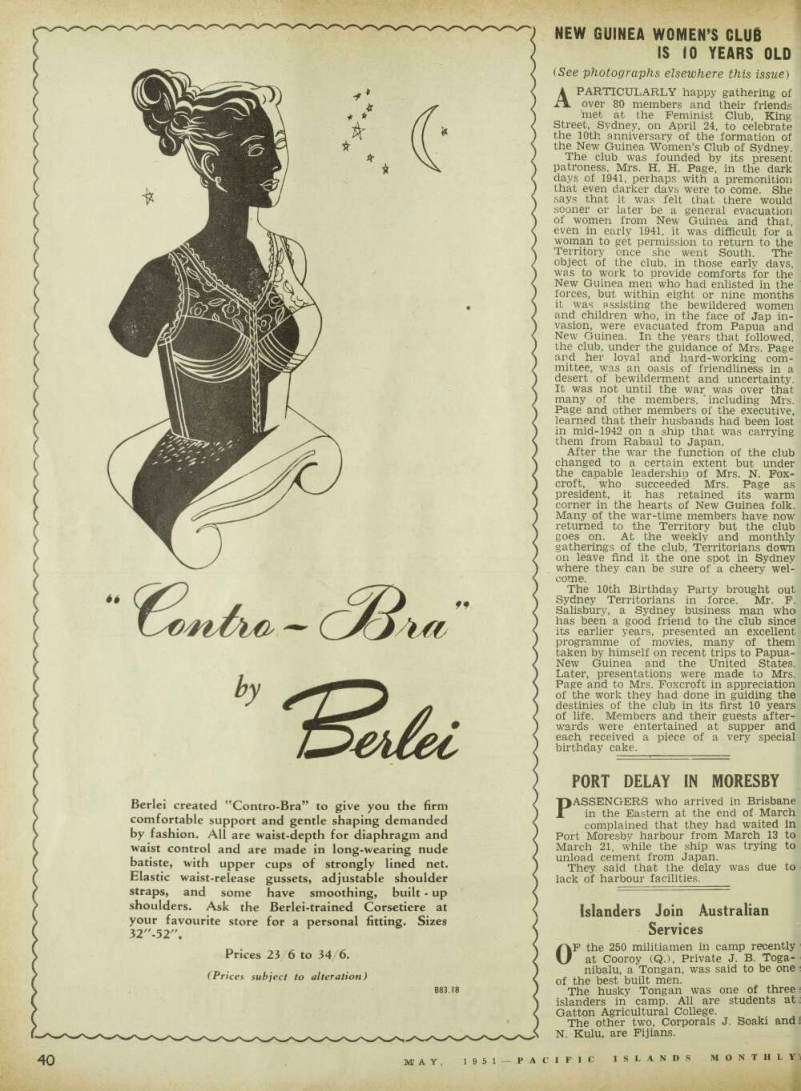
PASSENGERS who arrived in Brisbane in the Eastern at the end of March complained that they had waited in Port Moresby harbour from March 13 to March 21, while the ship was trying to unload cement from Japan.
They said that the delay was due to lack of harbour facilities.
Services
Islanders Join Australian Services
OF the 250 militiamen in camp recently at Cooroy (Q.), Private J. B. Toga- ■ nibalu, a Tongan, was said to be one; of the best built men.
The husky Tongan was one of three £ islanders in camp. All are students atd Gatton Agricultural College.
The other two, Corporals J. Soaki and!
N. Kulu, are Fijians.
Month In Fafua-N. Guinea
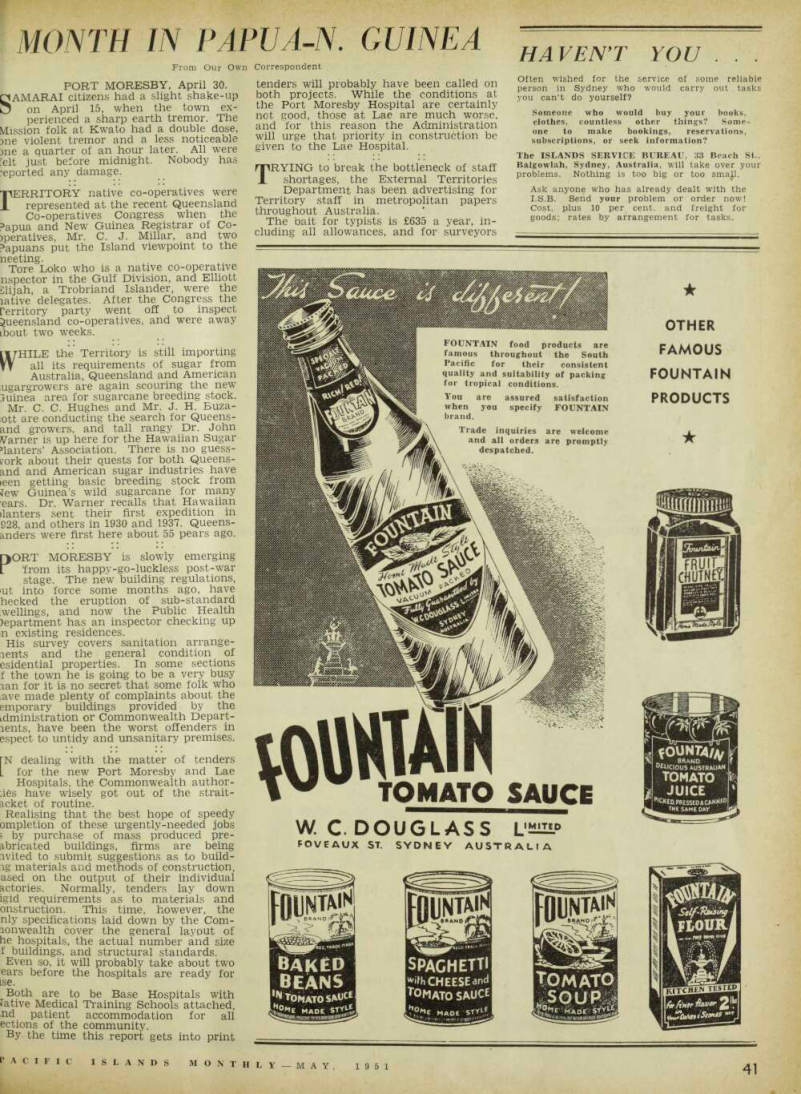
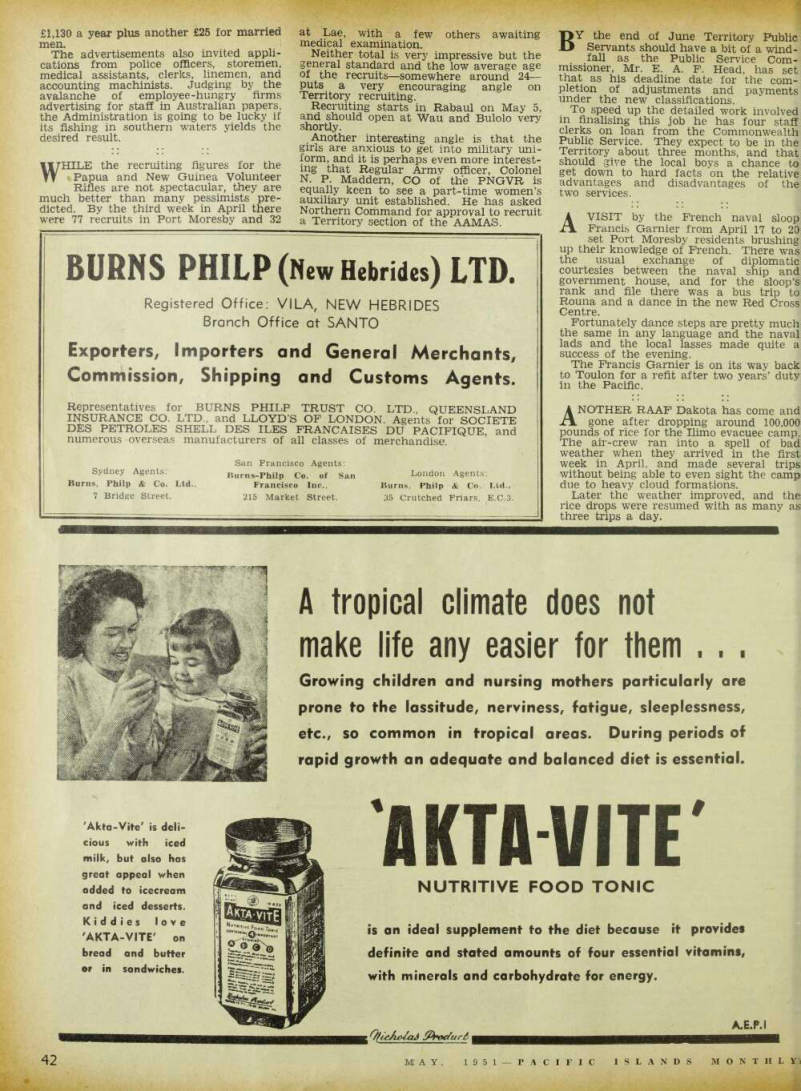
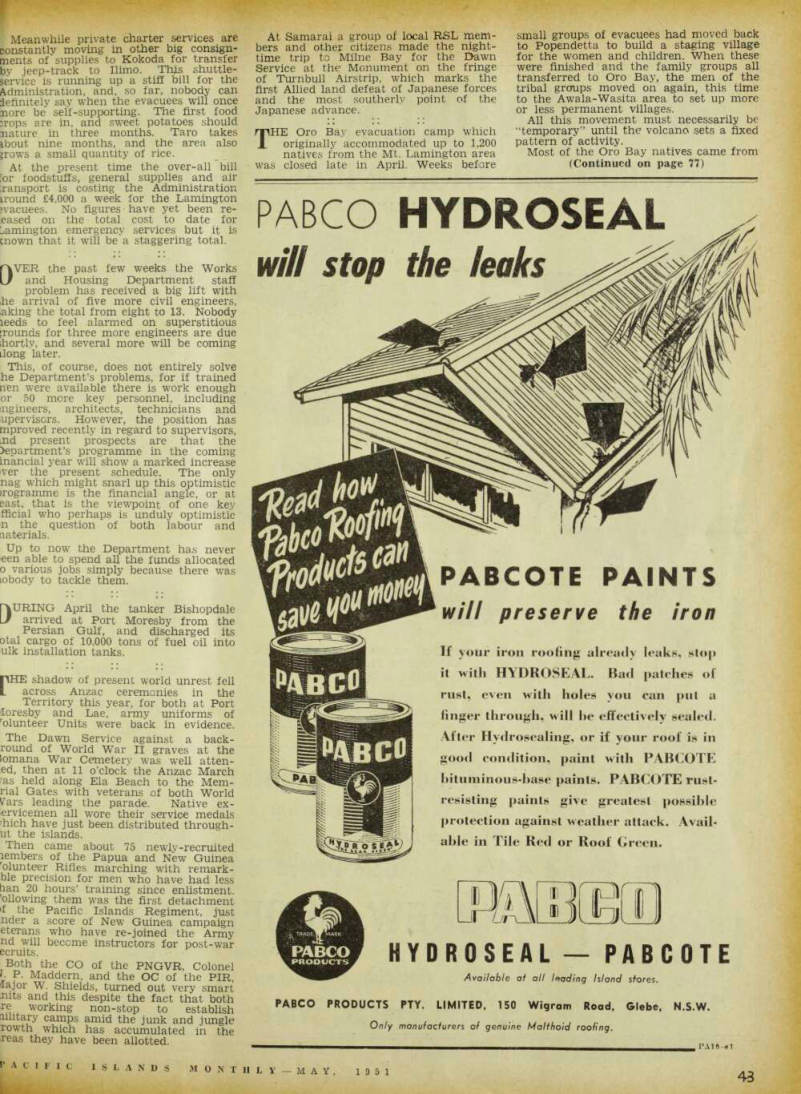
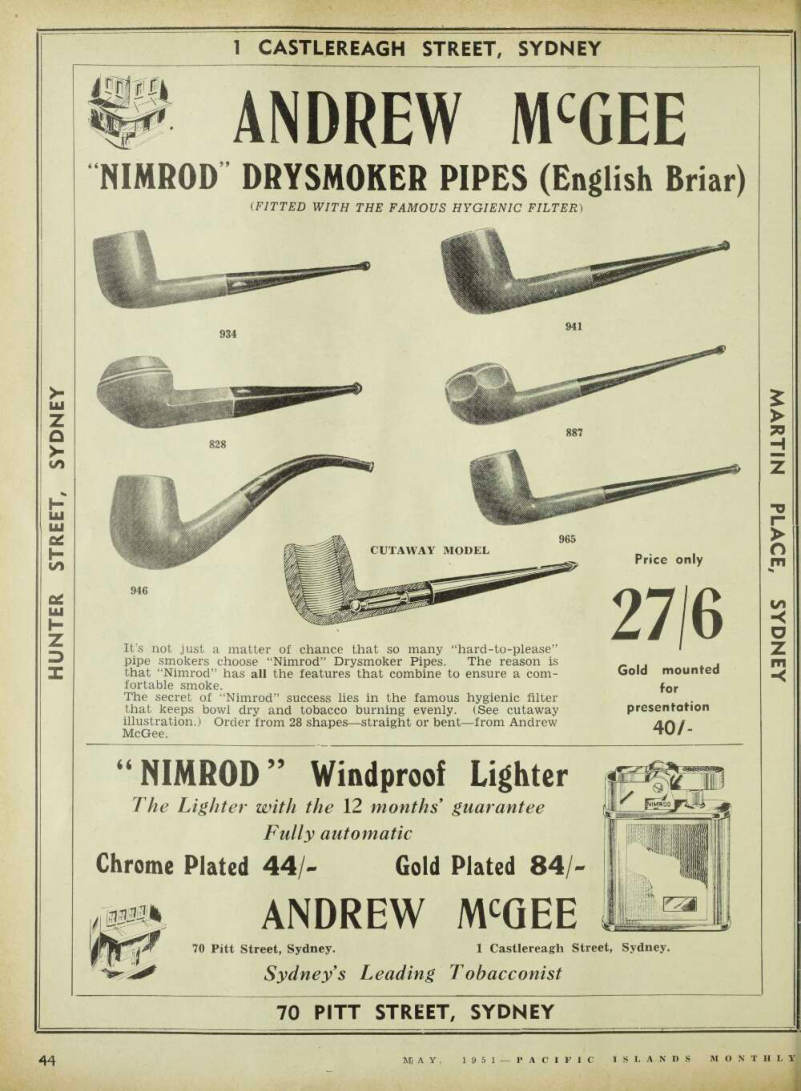
From Our Own Correspondent
Fort Moresby, April 30.
SAMARAI citizens had a slight shake-up on April 15, when the town ex perienced a sharp earth tremor. The Mission folk at Kwato had a double dose, me violent tremor and a less noticeable me a Quarter of an hour later. All were :elt just before midnight. Nobody has •eported any damage. rERRITORY native co-operatives were represented at the recent Queensland Co-operatives Congress when the Papua and New Guinea Registrar of Co iperatives, Mr. C. J. Millar, and two Papuans put the Island viewpoint to the neeting.
Tore Loko who is a native co-operative nspector in the Gulf Division, and Elliott Elijah, a Trobriand Islander, were the lative delegates. After the Congress the rerritory party went off to inspect Queensland co-operatives, and were away ibout two weeks. [f/HILE the Territory is still importing W all its requirements of sugar from Australia, Queensland and American ugargrowers are again scouring the new Guinea area for sugarcane breeding stock.
Mr. C. C. Hughes and Mr. J. H. Buza ott are conducting the search for Queens and growers, and tall rangy Dr. John Varner is up here for the Hawaiian Sugar ’tenters’ Association. There is no guess work about their quests for both Queens and and American sugar industries have teen getting basic breeding stock from tew Guinea’s wild sugarcane for many ears. Dr. Warner recalls that Hawaiian (tenters sent their first expedition in 928, and others in 1930 and 1937. Queens anders were first here about 55 pears ago.
PORT MORESBY is slowly emerging from its happy-go-luckless post-war stage. The new building regulations, <ut into force some months ago, have hecked the eruption of sub-standard wellings, and now the Public Health lepartment has an inspector checking up n existing residences.
His survey covers sanitation arrange aents and the general condition of esidential properties. In some sections f the town he is going to be a very busy aan for it is no secret that some folk who ave made plenty of complaints about the emporary ‘buildings provided by the idministration or Commonwealth Depart lents, have been the worst offenders in espect to untidy and unsanitary premises.
FN dealing with the matter of tenders L for the new Port Moresby and Lae Hospitals, the Commonwealth author tes have wisely got out of the strait acket of routine.
Realising that the best hope of speedy ompletion of these urgently-needed jobs > by purchase of mass produced pre abricated buildings, firms are being ivited to submit suggestions as to build ig materials and methods of construction, ased on the output of their individual actories. Normally, tenders lay down igid requirements as to materials and onstruction. This time, however, the nly specifications laid down by the Com lonwealth cover the general layout of he hospitals, the actual number and size f buildings, and structural standards.
Even so, it will probably take about two ears before the hospitals are ready for ise.
Both are to be Base Hospitals with tetive Medical Training Schools attached, nd patient accommodation for all ections of the community.
By the time this report gets into print
tenders will probably have been called on both projects. While the conditions at the Port Moresby Hospital are certainly not good, those at Lae are much worse, and for this reason the Administration will urge that priority in construction be given to the Lae Hospital.
TRYING to break the bottleneck of staff shortages, the External Territories Department has been advertising for Territory staff in metropolitan papers throughout Australia.
The bait for typists is £635 a year, in cluding all allowances, and for surveyors
£1,130 a year plus another £25 for married men.
The advertisements also invited appli cations from police officers, storemen, medical assistants, clerks, linemen, and accounting machinists. Judging by the avalanche of employee-hungry firms advertising for staff in Australian papers, the Administration is going to be lucky if its fishing in southern waters yields the desired result.
WHILE the recruiting figures for the Papua and New Guinea Volunteer Rifles are not spectacular, they are much better than many pessimists pre dicted. By the third week in April there were 77 recruits in Port Moresby and 32
at Lae, with a few others awaiting medical examination.
Neither total is very impressive but the general standard and the low average age of the recruits—somewhere around 24 puts a very encouraging angle on Territory recruiting.
Recruiting starts in Rabaul on May 5, and should open at Wau and Bulolo very shortly.
Another interesting angle is that the girls are anxious to get into military uni form, and it is perhaps even more interest ing that Regular Armv officer, Colonel N. P. Maddem, CO of the PNGVR is equally keen to see a part-time women’s auxiliary unit established. He has asked Northern Command for approval to recruit a Territory section of the AAMAS.
BY the end of June Territory Public Servants should have a bit of a wind fall as the Public Service Com missioner, Mr. E. A. F. Head, has set that as his deadline date for the com pletion of adjustments and payments under the new classifications.
To speed up the detailed work involved in finalising this job he has four staff clerks on loan from the Commonwealth Public Service. They expect to be in the Territory about three months, and that should give the local boys a chance to get down to hard facts on the relative advantages and disadvantages of the two services.
A VISIT by the French naval sloop Francis Gamier from April 17 to 20 set Port Moresby residents brushing up their knowledge of French. There was the usual exchange of diplomatic courtesies between the naval ship and government house, and for the sloop’s rank and file there was a bus trip to Rouna and a dance in the new Red Cross Centre.
Fortunately dance steps are pretty much the same in any language and the naval lads and the local lasses made quite a success of the evening.
The Francis Gamier is on its way back to Toulon for a refit after two years’ duty in the Pacific.
ANOTHER RAAF Dakota has come and gone after dropping around 100,000 pounds of rice for the Ilimo evacuee camp.
The air-crew ran into a spell of bad weather when they arrived in the first week in April, and made several trips without being able to even sight the camp due to heavy cloud formations.
Later the weather improved, and the rice drops were resumed with as many as three trips a day.
Meanwhile private charter services are constantly moving in other big consign ments of supplies to Kokoda for transfer by jeep-track to Ilimo. This shuttle service is running up a stiff bill for the Administration, and, so far, nobody can definitely say when the evacuees will once more be self-supporting. The first food :rops are in, and sweet potatoes should mature in three months. Taro takes ibout nine months, and the area also jrows a small quantity of rice.
At the present time the over-all bill ;or foodstuffs, general supplies and air transport is costing the Administration iround £4,000 a week for the Lamington wacuees. No figures have yet been re eased on the total cost to date for Lamington emergency services but it is mown that it will be a staggering total.
OVER the past few weeks the Works and Housing Department staff problem has received a big lift with he arrival of five more civil engineers, aking the total from eight to 13. Nobody leeds to feel alarmed on superstitious grounds for three more engineers are due ihortly, and several more will be coming dong later.
This, of course, does not entirely solve he Department’s problems, for if trained nen were available there is work enough or 50 more key personnel, including ngineers, architects, technicians and upervisors. However, the position has mproved recently in regard to supervisors, ,nd present prospects are that the Apartment’s programme in the coming inancial year will show a marked increase ver the present schedule. The only nag which might snarl up this optimistic irogramme is the financial angle, or at east, that is the viewpoint of one key fficial who perhaps is unduly optimistic n the question of both labour and aaterials.
Up to now the Department has never een able to spend all the funds allocated 0 various jobs simply because there was lobody to tackle them.
PVURING April the tanker Bishopdale \J arrived at Port Moresby from the Persian Gulf, and discharged its otal cargo of 10,000 tons of fuel oil into ulk installation tanks. rHE shadow of present world unrest fell across Anzac ceremonies in the Territory this year, for both at Port loresby and Lae, army uniforms of r olunteer Units were back in evidence.
The Dawn Service against a back round of World War II graves at the tomana War Cemetery was well atten ed, then at 11 o’clock the Anzac March 'as held along Ela Beach to the Mem rial Gates with veterans of both World yars leading the parade. Native ex ervicemen all wore their service medals diich have just been distributed through ut the islands.
Then came about 75 newly-recruited lembers of the Papua and New Guinea hlunteer Rifles marching with remark ble precision for men who have had less ban 20 hours’ training since enlistment, 'ollowing them was the first detachment >f the Pacific Islands Regiment, just nder a score of New Guinea campaign eterans who have re-joined the Army nd will become instructors for post-war ecruits.
Both the CO of the PNGVR, Colonel f. P. Maddern, and the OC of the PIR, lajor W. Shields, turned out very smart nits and this despite the fact that both re working non-stop to establish nhtary camps amid the junk and jungle rowth which has accumulated in the reas they have been allotted.
At Samarai a group of local RSL members and other citizens made the nighttime trip to Milne Bay for the Dawn Service at the Monument on the fringe of Turnbull Airstrip, which marks the first Allied land defeat of Japanese forces and the most southerly point of the Japanese advance. :; :: :: THE Oro Bay evacuation camp which originally accommodated up to 1,200 natives from the Mt. Lamington area was closed late in April. Weeks before
small groups of evacuees had moved back to Popendetta to build a staging village for the women and children. When these were finished and the family groups all transferred to Oro Bay, the men of the tribal groups moved on again, this time to the Awala-Wasita area to set up more or less permanent villages.
All this movement must necessarily be “temporary” until the volcano sets a fixed pattern of activity.
Most of the Oro Bay natives came from
(Continued on page 77)
villages scarcely affected by the Mt.
Lamington eruption but they are located just inside the possible danger zone. As yet they are not allowed to go back and settle in their old homes, but land has been obtained for them nearby. Not only are they much more likely to settle down in familiar countryside, but they can make food-gathering and food-growing trips into their old garden areas.
The old folks, women and children will be moving over the Popendetta track to their new homes as soon as the men have the houses and village sites cleared.
There is a similar movement from Ilimo.
The Administration has a private con tractor salvaging the wartime telephone line between Lae and Finschhafen. The salvage materials, copper wire and steel poles, are to be used for re-establishing the Lae-Wau telephone line and also the Rabaul-Kokopo line.
About 50 per cent, salvage is expected from the Finschhafen line which has sur vived deterioration remarkably well, al though quite a lot of line has been pur loined near native villages. And since this was eight-pair line, even a 50 per cent, recovery will give enough for the normal two-pair line on the Wau and Kokopo connections.
The only really tough snag is that neither job can be started until more linesmen and other staff are obtained from Australia. As the Commonwealth appears to be equally short of skilled men, it might be a long wait before tele phones are again ringing in Wau and Kokopo.
AN auctioneer in Lae, Mr. R. W. Tebb, has just received notice of returns on a shipment of wool sent to Aus tralia through Lae last August. This was the first clip from Romney Marsh sheep imported into the Territory by Mr.
Donald McKinley, of Mumeng, in 1949.
The fleeces weighed an average of 11 lb., and this is believed to be the first wool ever sent to Australia from the Territory.
ATUFI native, Imanga Aimbari, was found guilty in the Supreme Court at Port Moresby, in April, of having unlawfully assaulted Jack William Grimmer and caused him bodily harm.
The assault took place at Itikinumu Plantation, near Sogeri, on April 12, where Mr. Grimmer is a member of the staff. The native was sent to jail for 18 months with hard labor.
DURING liis recent visit to the Terri tory, Mr. J. R. Halligan (Secretary of the Territories* Department) ad mitted that Thursday Island pearling interests had asked to be allowed to em ploy Kiwai natives on their boats. They want 140 a year, and Territory employ ers are quite concerned about the matter.
It is pointed out that there is an acute shortage of labour in the Territory, par ticularly among natives suitable for man ning coastal craft. Further, employers want to know what is likely to happen if the Kiwais are allowed to go, and re ceive the minimum monthly wage of El 2 10/- now prevailing at Thursday Island.
Before the war pearling fleets at T.I. were allowed to employ Kiwais. Mr.
Halligan says the matter is under con sideration but as yet no decision has been made.
AT long last the protracted negotiations for the purchase of the Port Moresby golf course from its native owners have been finalised.
The 40 acres were purchased for £1,035, which will be shared out among around 500 natives. This land deal was held up for six years while claimants to owner ship settled their differences.
The property, of course, was purchased by the Administration, and will be leased to the Golf Club.
A PROMINENT member of the native community at Port Moresby, Ahuia- Ove, died on April 23, and with his passing much of the history of his people was irretrievably lost.
He was somewhere in his middle 80’s and had served several of the early Lieutenant-Governors of Papua. He was also a hereditary chief of his tribe and and had all the old Motuan capacity for remembering involved land inheritances and tribal history.
Ahuia was one of the first Papuans to become literate, and joined the Gov eminent service in the latter years of the last century.
Right to the last he was still very active, and despite numerous warnings
because of the possible danger to his health, insisted on going out on fishing trips. He also walked to church every Sunday morning. His brain was keen and alert, and he could remember, with amazing clarity, details of complicated land purchases made half a century ago.
It is a great loss that no written record was ever made of the historical know ledge possessed by this outstanding native leader.
MAY 9 will be celebrated in Port Moresby as Native Day for the Commonwealth Jubilee Celebra tions, and the tentative programme indi cates that the local Papuans will cer tainly enjoy the occasion.
They will turn out a fleet of decorated trucks to open the day’s proceedings, and with the native flair for decoration this should be well worth seeing.
Then there are sports, speeches and finally a native picture show. Even on a routine work day most Papuans manage to get a lot of fun out of life, and what they will do with a special holiday of their own should really hit the highspots.
The Europeans throughout the Terri tory will start their series of Jubilee cele brations on May 24 with a programme drawn up in each community. In Port Moresby there will be an Empire Day parade by members of the PNGVR and the Police Force, and a Girl Guide pro gramme at Government House in the afternoon and early evening.
MR. W. GRANGER, who has been with the Agricultural Department since July, 1947, as Chief of the Animal Industry Division, is resigning and goes back to Australia some time in September.
THE Qantas Drover—the new Aus tralian-designed and manufactured three-engine aircraft—is back in the Territory after an extensive check.
This was made following several months on test flights over commercial routes from Lae. urngineers found that the machine had stood up very well to its test commercial flights in New Guinea.
The Drover is now based at Port Moresby, and a second Qantas Drover is to come up shortly for operations from Lae.
Advertisements & other items, pp. 43-46 (1 item)
!j ipi
HAVEN’T YOU . . .
Often wished for the service of some reliable person in Sydney who would carry out tasks you can’t do yourself?
Someone who would buy your books, clothes, countless other things? Someone to make bookings, reservations, subscriptions, or seek information?
The ISLANDS SERVICE BUREAU, 33 Beach St., Balgowlah, Sydney, Australia, will take over your problems. Nothing is too big or too small.
Ask anyone who has already dealt with the 1.5.8. Send your problem or order now!
Cost, plus 10 per cent, and freight for goods; rates by arrangement for tasks.
FOUNTAIN food products are famous throughout the South Pacific for their consistent quality and suitability of packing for tropical conditions.
You are assured satisfaction when you specify FOUNTAIN brand.
Trade inquiries are welcome and all orders are promptly despatched.
I r M -5- J/of* vs % %k
SAUCE
W.C. DOUGLASS L'HJiiP
FOVEAUX ST. SYDNEY AUSTRALIA
!j ipi
OTHER
FAMOUS
FOUNTAIN
PRODUCTS
FRUIT
cmm
. fOUNT4/yy /
Ai * BRAND W (
Delicious Australian
tomato 'k
t. JUICE '
P| CKED. PRESSED4CANNL°
THE SAME DAY
gTTrHFN TESIEP
BURNS PHILP (New Hebrides) LTD.
Registered Office: VILA, NEW HEBRIDES
Branch Office at SANTO
Exporters, Importers and General Merchants,
Commission, Shipping and Customs Agents.
Representatives for BURNS PHILP TRUST CO. LTD., QUEENSLAND INSURANCE CO. LTD., and LLOYD’S OF LONDON. Agents for SOCIETE DES PETROLES SHELL DES ILES FRANCAISES DU PACIFIQUE, and numerous overseas manufacturers of all classes of merchandise.
San Francisco Agents: Sydney Agents: Burns-Philp Co. of San London Agents; Burns. Philp & Co. Ltd., Francisco Inc.. Burns. Philp & Co. Ltd.. 7 Bridge Street. 215 Market Street. 35 Crutched Friars, E.C.3.
A tropical climate does not
make life any easier for them . . .
Growing children and nursing mothers particularly are prone to the lassitude, nerviness, fatigue, sleeplessness, etc., so common in tropical areas. During periods of rapid growth an adequate and balanced diet is essential.
'Akta-Vite' is delicious with iced milk, but also has great appeal when added to icecream and iced desserts.
Kiddies love
'AKTA-VITE' on
bread and butter or in sandwiches. -":: r A ooDT °- 3SS
AKTA-VITE'
NUTRITIVE FOOD TONIC
is an ideal supplement to the diet because it provides definite and stated amounts of four essential vitamins, with minerals and carbohydrate for energy.
A.E.P.I
PABCO HYDROSEAL
will stop the leaks
ft Qrab"
PABCOTE PAINTS
will preserve the iron
If your iron roofing already leaks, slop it with HYDROSEAL. Bad patches of rust, even with holes you can put a finger through, will he effectively sealed.
After Hydrosealing, or if your roof is in good condition, paint with PABCOTE hituininous-hase paints. PABCOTE rustresisting paints give greatest possible protection against weather attack. Available in Tile Red or Roof Green.
JF
JMD
HYDROSEAL PABCOTE
Available at all leading Island stores.
PABCO PRODUCTS PTY. LIMITED, 150 Wigram Road, Glebe, N.S.W.
Only manufacturers of genuine Malthoid roofing.
1 CASTLEREAGH STREET, SYDNEY
D >to fid h to H Z mm
ANDREW M C GEE
NIMROD DRYSMOKER PIPES (English Briar)
(■FITTED WITH THE FAMOUS HYGIENIC FILTER)
934 887 828 965
CUTAWAY MODEL
Price only 946 276 It’s not just a matter of chance that so many “hard-to-please” pipe smokers choose “Nimrod” Drysmoker Pipes. The reason is that “Nimrod” has all the features that combine to ensure a comfortable smoke.
The secret of “Nimrod” success lies in the famous hygienic filter that keeps bowl dry and tobacco burning evenly. (See cutaway illustration.) Order from 28 shapes—straight or bent —from Andrew McGee.
Gold mounted for presentation 40/- ((
NIMROD Windproof Lighter
The Lighter with the 12 months' guarantee
Fully automatic
Chrome Plated 44/- Gold Plated 84/-
ANDREW M C GEE
Ira
[fcIMRQU
y 70 Pitt Street, Sydney. 1 Castlereagh Street, Sydney.
Sydney's Leading Tobacconist
> H > O m -< D Z m -<
70 PITT STREET, SYDNEY
Moresby
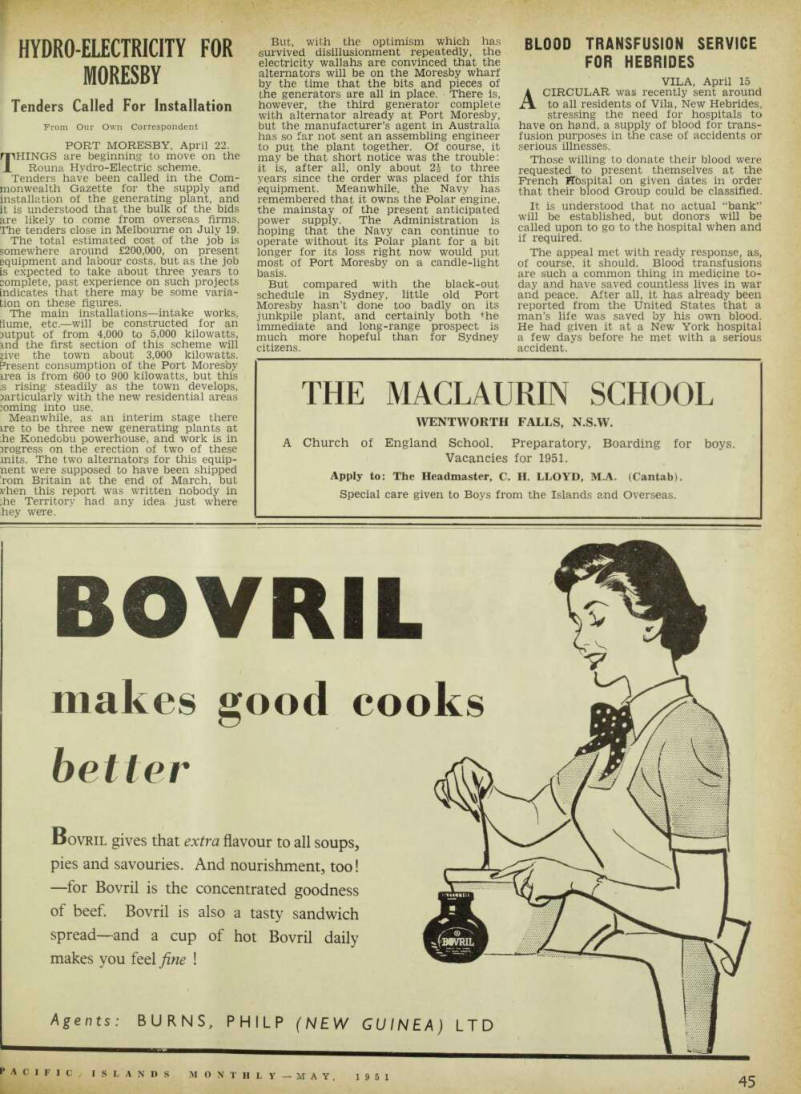
Hydro-Electricity For
Tenders Called For Installation
From Our Own Correspondent
Port Moresby. April 22.
THINGS are beginning to move on the Rouna Hydro-Electric scheme.
Tenders have been called in the Com monwealth Gazette for the supply and installation of the generating plant, and it is understood that the bulk of the bids are likely to come from overseas firms.
The tenders close in Melbourne on July 19.
The total estimated cost of the job is somewhere around £200,000, on present equipment and labour costs, but as the job is expected to take about three years to complete, past experience on such projects indicates that there may be some varia tion on these figures.
The main installations —intake works, flume, etc. —will be constructed for an output of from 4,000 to 5,000 kilowatts, md the first section of this scheme will *ive the town about 3,000 kilowatts.
Present consumption of the Port Moresby irea is from 600 to 900 kilowatts, but this :s rising steadily as the town develops, carticularly with the new residential areas coming into use.
Meanwhile, as an interim stage there ire to be three new generating plants at ;he Konedobu powerhouse, and work is in progress on the erection of two of these mits. The two alternators for this equip nent were supposed to have been shipped :rom Britain at the end of March, but vhen this report was written nobody in :he Territory had any idea just where hey were.
But, with the optimism which has survived disillusionment repeatedly, the electricity wallahs are convinced that the alternators will be on the Moresby wharf by the time that the bits and pieces of the generators are all in place. There is, however, the third generator complete with alternator already at Port Moresby, but the manufacturer’s agent in Australia has so far not sent an assembling engineer to put the plant together. Of course, it may be that short notice was the trouble: it is, after all, only about 21 to three years since the order was placed for this equipment. Meanwhile, the Navy has remembered that it owns the Polar engine, the mainstay of the present anticipated power supply. The Administration is hoping that the Navy can continue to operate without its Polar plant for a bit longer for its loss right now would put most of Port Moresby on a candle-light basis.
But compared with the black-out schedule in Sydney, little old Port Moresby hasn’t done too badly on its junkpile plant, and certainly both +he immediate and long-range prospect is much more hopeful than for Sydney citizens.
For Hebrides
Blood Transfusion Service
VILA, April 15 A CIRCULAR was recently sent around to all residents of Vila, New Hebrides, stressing the need for hospitals to have on hand, a supply of blood for trans fusion purposes in the case of accidents or serious illnesses.
Those willing to donate their blood were requested to present themselves at the French Hbspital on given dates in order that their blood Group could be classified.
It is understood that no actual “bank” will be established, but donors will be called upon to go to the hospital when and if required.
The appeal met with ready response, as, of course* it should. Blood transfusions are such a common thing in medicine to day and have saved countless lives in war and peace. After all, it has already been reported from the United States that a man’s life was saved by his own blood.
He had given it at a New York hospital a few days before he met with a serious accident.
Professor and Mrs. F. Keesing, who have recently spent several weeks in Papua-New Guinea in the course of a Pacific-wide tour, were guest-speakers on April 18, at a combined meeting of the P-NG Branch of the Arts Council of Australia and the P-NG Scientific Society, in Port Moresby. Professor Keesing is a noted anthropologist and head of that Department at Stanford University, Cali fornia. Previously he .was professor of anthropology at the University of Hawaii.
In addition, he is senior Commissioner for USA at the South Pacific Commission.
Five Anglican missionaries left Brisbane for New Guinea by the Malaita on April 14. They were: Archdeacon Romney Gill, of Mambra, who has been in New r Guinea for 40 years; Miss Nancy White, a Vic torian in charge of St. James’ School Sangara; Mr. Alfred Aley, an Englishman; Miss Eugene Robinson and Miss Betty Williams of Sydney.
Mrs. Bill Cahill of Wagol Plantation, New Guinea, arrived in Brisbane during March for a holiday.
Advertisements & other items, pp. 47-48 (1 item)
Bovril
THE MACLAURIN SCHOOL
WENTWORTH FALLS, N.S.W.
A Church of England School. Preparatory, Boarding for boys.
Vacancies for 1951.
Apply to: The Headmaster, C. H. LLOYD, M.A. (Cantab).
Special care given to Boys from the Islands and Overseas.
BOVRIL
makes good cooks
better
Bovril gives that extra flavour to all soups, pies and savouries. And nourishment, too! —for Bovril is the concentrated goodness of beef. Bovril is also a tasty sandwich spread—and a cup of hot Bovril daily makes you feel fine !
Agents: BURNS, PHILP GUINEA) LTD
A. B. DONALD Ltd.
AUCKLAND, N.Z.
ISLAND TRADERS & GENERAL MERCHANTS
P.O, Box 1509. Cables Gr Telegrams, "Kingdom/' Auckland.
COLUMBINES
the richest
caramels
of ail!
A Agents for 1 “ ‘ ‘ Glucose-rich rich Each “Columbine” is individually wrapped for freshness and protection.
Made by The Great Name in Confectionery Pacific Islands: S, E. TATHAAA & CO. PTY. LTD, 178 Collins St,, Melbourne - 73 York St,, Sydney
Island Plea For More Movies
From Our Mangaia Correspondent THE one surviving local talkie-show upon Mangaia, Lower Cook Group, which began with a whoop and a rattle some two years ago, and was there after well patronised, is apparently be coming a victim of the much-discussed dollar gap.
Feature films are not of the quality we once enjoyed; handsome, half-Tahitian Jon Hall no longer does deeds of derring do in Glorious Technicolour. and “repeats” are dishearteningly frequent—it would ap pear that the exchanges in NZ have a smaller supply of films, and these of a lower grade, than in 1949. The dubious advantage of getting in to a fourth repeat for sixpence is our local playgoers’ one compensation for the existing state of affairs.
What we all want to know is, what are British producers doing about the matter?
Have they not, perhaps, realised that at Mangaia Island there is a market for The Red Shoes, Morning Departure, etc., etc?
True, they might take but twenty pounds a night; but it would at least be in Empire currency.
In general, the sound-on-film show has put the clock of native progress— mentally, at least —forward half a cen tury, and, should supplies of films be re duced (or even fail entirely) a valuable educational adjunct would be lost to the islands.
Mr. L. G. Usher, Public Relations Officer to the Government of Fiji, accom panied by Mrs. Usher, arrived in Sydney early in May, having travelled via New Zealand. They left Sydney on May 5 bj the Orion, to sbend several months of long leave in Europe. Next month, Mr. Ushei will attend, at the Colonial Office, a conference of Public Relations Officers from all over the Empire.
Advertisements & other items, p. 48 (1 item)
46
M, AY , 19 31- PACIFIC ISLANDS MONTHL
Tax For Newcomers

Presumably Aimed at Tahiti's Chinese
Prom Our Own Correspondent PAPEETE, April 14. [T was announced here in March that a new tax has been introduced, to be paid by persons who make a long visit o French Oceania, and by immigrants.
Tourists, and persons travelling on busi less, after they have been six months in he Territory, will be taxed 75 francs about 10 - Australian) per month, mmigrants who propose to settle in the ountry will be taxed 150 francs per aonth.
It looks as if this law and its attendant egulations, are directed against the Chinese. There is now a large Chinese ommunity in French Oceania: the Chinese provide most of the artisans and etail distributors; and there is con iderable movement between Tahiti and Jhina. However, the yearly tax of 1,800 rancs (less that £l2 Australian) will not istress the Chinese, who do very well ere.
More World-Wandering
Yachtsmen
CHE French yawl Kurun, after sailing 12,000 miles from France, via the Atlantic coast of Europe, the Antilles, anama. the Galapagos, and the larquesas, arrived in Papeete at the ad of February, Jacques le Tourmelin, a 31-year-old reton, built the 9-tons yawl; and in eptember, 1949, accompanied by Paul arge, of Grenoble, aged 25, he set off sross the world.
They will spend a month or two in rench Oceania; and then they will con nue westwards. They will visit the New ebrides, New Guinea, Torres Straits, and lence on to Reunion, Durban and Cape >wn, and home via the west coast of frica.
So, in a few months’ time, look for the urun, and two jolly young French ichtsmen, in the Southwest Pacific.
P. G. Taylor In Papeete
commander and crew of the Aus l tralian seaplane Frigate Bird II were given a cordial welcome in Papeete, on )th their outward flight and their return om Valaraiso. The significance of iis pioneer flight—the opening up of an iistralian-South American air-route, with ipeete as an important station thereon— as not lost on our citizens.
The British Consul, Mr. Devenish, did r erything possible to make the fliers’ ay memorable, and they were warmly
itertained everywhere.
We were intrigued and pleased to know tat the charming lady who arrived here ffore the flight, to arrange the business ‘tails of the plane’s visit, returned with aptain Taylor, on the seaplane, to fdney, as his affianced wife. We always ive insisted that this island is the soul id centre of South Seas romance.
Double Wedding
I7E had a double wedding here on ▼ March 31, when the two attractive daughters of Madame Veuve Salem ere married, in the same ceremony, to /o French servicemen—Mathild to Mon eur Maurice Texier, and Helene to hnsieur Armand Tuya. A hundred jests, entertained at Rivnac’s Resort, ade the occasion one not to be soon r gotten.
Two young boys, John Ah Kuoi and oy Ah Kuoi, aged 15 and 13, were struck r a truck driven by their uncle near Apia i March 30 and subsequently died in pia hospital.
Smaller Than Pre-War
P-Ng Native Labour Pool
Prom Our Own Correspondent
Port Moresby, April 25.
rpHE latest official figures on native A labour covers the month of February, and give a total of 51,351 in em ployment throughout the Territory. This was nearly 400 above the Januray total.
Details of the February returns are:— In private employment, Papua and New Guinea 35,827 Employed by Administration and Commonwealth, including the Police Force 15,524
For New Guinea: Total employed 35,600 Private employ ment 25,516 For Papua; Total employed . 15,7571 Private employment 10,311 (Before the Pacific war there were about 40,000 indentured native labourers employed in New Guinea and about 20,000 in Papua. These figures did not take non-indentured native labour into account.) John Finau, a Tongan pupil at Newing ton College, Sydney, rowed No. 5 in the College eight in the Head-of-the-River race on April 14.
Advertisements & other items, pp. 49-50 (3 items)
47
ACIFIC ISLANDS MONTHLY HAY, 1951
Ice Cream
Mary Baker
MIX
Is now available to Pacific Islands Traders and Storekeepers in Chocolate and Strawberry Flavours in addition to the always
popular Vanilla
Successor to the ice cream making formula introduced to the South Pacific by the U.S. Army in wartime, Mary Baker Ice Cream Mix is now manufactured in Australia for export to all the Islands Groups and Territories. It's delicious in the home for dessert—on its own, flavoured, or with fresh tropical or canned fruit.
Packed in 16 oz. tins for Household Servings, 5 lb. Family size tins, and 32 lb. tins for Traders and Storekeepers.
Ask Your Store for it To-day!
ATTENTION CAFES AND MILK BARS!!! We can also supply: Ice Cream Cones (cartons of 800) —26 oz. bottles of Cordial Extract, Flavouring Essences, and Concentrates—Malted Milk Powder—and other requisites for the Islands Soda Fountain and Milk Bar trade.
SOLE DISTRIBUTOR :
J. C. MERRILLEES PTY. LTD.
104 Hunter Street, Sydney, N.S.W.
Telegrams: “MERRILLEES,” Sydney.
Insist on. . .
“BRONTE”
CANNED MEATS, HOTMEALS AND SOUPS
Available in 12 oz. and 1 lb. sealed cans in the following
appetising flavours and combinations'.
• Corned Beef Loaf With Cereal • Braised Steak and Onions • Boiled and Roast Beef • Beef Steak Pudding • Mutton and Peas • Steak and Onions • Chili Con Came • Curried Mutton • Curried Beef • Irish Stew • Mulligatawny Soup • Vegetable Soup ~' > • Mutton Broth • Tomato Soup • Camp Pie
“BRONTE” Brand high-grade products
are made from the finest fat stock
and the richest vegetables in Australia,
deliciously flavoured.
THE COLONIAL WHOLESALE MEAT CO.
PTY. LTD.
Canning Factory; State Abbatoirs, Homebush, Sydney,
N.S.W.
Ss,,fAM P
’PHONE: UM 8436
CABLE ADDRESS: “WOOLMILL,” SYDNEY.
48
MAY, 1951 PACIFIC ISLANDS MONTH L
Notes From Norfolk Is.
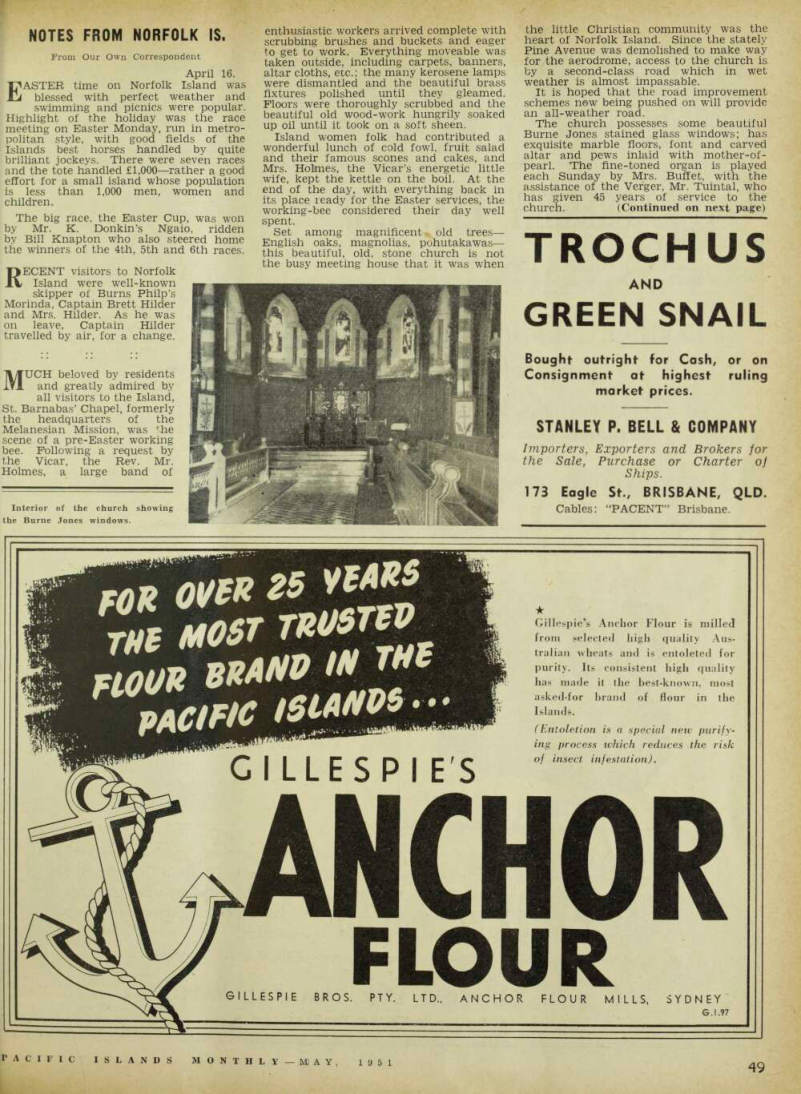
From Our Own Correspondent April 16.
EASTER time on Norfolk Island was blessed with perfect weather and swimming and picnics were popular.
Highlight of the holiday was the race meeting on Easter Monday, run in metro politan style, with good fields of the Islands best horses handled by quite brilliant jockeys. There were seven races and the tote handled £l,OO0 —rather a good effort for a small island whose population is less than 1,000 men, women and children.
The big race, the Easter Cup, was won by Mr. K. Donkin’s Ngaio, ridden by Bill Knapton who also steered home the winners of the 4th, sth and 6th races.
RECENT visitors to Norfolk Island were well-known skipper of Burns Philp’s Morinda, Captain Brett Hilder and Mrs. Hilder. As he was on leave, Captain Hilder travelled by air, for a change.
MUCH beloved by residents and greatly admired by all visitors to the Island, St. Barnabas’ Chapel, formerly the headquarters of the Melanesian Mission, was f he scene of a pre-Easter working bee. Following a request by the Vicar, the Rev. Mr.
Holmes, a large band of
enthusiastic workers arrived complete with scrubbing brushes and buckets and eager to get to work. Everything moveable was taken outside, including carpets, banners, altar cloths, etc.; the many kerosene lamps were dismantled and the beautiful brass fixtures polished until they gleamed.
Floors were thoroughly scrubbed and the beautiful old wood-work hungrily soaked up oil until it took on a soft sheen.
Island women folk had contributed a wonderful lunch of cold fowl, fruit salad and their famous scones and cakes, and Mrs. Holmes, the Vicar’s energetic little wife, kept the kettle on the boil. At the end of the day, with everything back in its place ready for the Easter services, the working-bee considered their day well spent.
Set among magnificent old trees — English oaks, magnolias, pohutakawas— this beautiful, old, stone church is not the busy meeting house that it was when
the little Christian community was the heart of Norfolk Island. Since the stately Pine Avenue was demolished to make way for the aerodrome, access to the church is by a second-class road which in wet weather is almost impassable.
It is hoped that the road improvement schemes now being pushed on will provide an all-weather road.
The church possesses some beautiful Burne Jones stained glass windows; has exquisite marble floors, font and carved altar and pews inlaid with mother-of pearl. The fine-toned organ is played each Sunday by Mrs. Buffet, with the assistance of the Verger, Mr. Tuintal, who has given 45 years of service to the church. (Continued on next page)
Interior of the church showing the Burne Jones windows.
THE Island’s worst road accident, and the only fatal one for 25 years occurred on the night of April 14.
A jeep driven by Mr. Jim Baker, coming down Grassy Road from Mt. Pitt, ap parently swerved to avoid a parked vehicle, and capsized. One of the passangers, Mr.
J. Dee, of Sydney, was fatally injured, and Mr. L. Fitzpatrick, a local school master who had been on the island for two months, died of his injuries about 12 hours later.
Miss Boggs of New Zealand sustained a broken arm, but was able to return to New Zealand the next day. Two sisters Miss Robin and Miss Winsome Steele (Australia) were also injured, one seriously. They were flown to Australia where one sister had to have her leg amputated.
Fortunately it was possible to augment the Island’s small but efficient nursing staff when a visiting matron and two visiting nurses offered their services. In
addition, local women with nursing train ing also helped in the emergency, and other residents helped day and night in the wards and kitchen.
Advertisements & other items, pp. 51-52 (1 item)
Anchor
TROCHUS
AND
GREEN SNAIL
Bought outright for Cosh, or on Consignment at highest ruling market prices.
STANLEY P. BELL & COMPANY
Importers, Exporters and Brokers for the Sale, Purchase or Charter of Ships.
173 Eagle St., BRISBANE, QLD.
Cables: “PACENT” Brisbane.
for oven ***
*THB MOST TKOSTtV
noun nnANO in THt
m Z,f’C IS*™
GILLESPIES
Gillespie’s Anchor Flour is milled from selected high quality Australian wheats and is entoleted for purity. Its consistent high quality has made it the best-known, most asked-for brand of flour in the Islands. (Entoletion is a special new purifying process which reduces the risk of insect infestation).
ANCHOR
FLOUR
GILLESPIE BROS. PTY. LTD., ANCHOR FLOUR MILLS, SYDNEY G. 1.97
A. GREGORY Pit LID.
IMPORTERS, EXPORTERS AND
MANUFACTURERS
Leather Saddlery and Paint Merchants ALL CLASSES OF LEATHER SUPPLIED FROM STOCK Apply direct to: A. GREGORY PTY. LTD., 107 York St., Sydney
A. H. BUNTING LTD.
SAMARAI, PAPUA
ENGLISH EKCO MODEL A 69
ELECTRIC 120/240 VOLT A.C. TROPIC
PROOFED ALL WAVE BANDSPREAD RADIO
RECEIVER
MODEL A 69 is a powerful Export 6-valve A.C.Superheterodyne receiver, specially designed to withstand tropical conditions. It covers the short and medium wave bands in five ranges, and incorporates a special bandspread system to ensure ease of tuning of short-wave stations; in addition, there is a high slope Radio Frequency amplifier. Particular attention has been paid to the design to ensure good reception of distance transmission. 6 Volt Vibrator sets available to the same specification £3B, F. 0.8., Samarai.
A. H. BUNTING LTD., SAMARAI, PAPUA
Also procurable from Bunting's, Lae.
F. 0.8., Samarai, £35
New Telephones For Vila
From Our Own Correspondent VILA, April 18 SINCE the arrival back from leave of Postmaster H. Richards, plans for the overall repair, improvement and extension of Vila’s telephone service have been put into operation.
The present service is conducted from a central exchange and covers only the im mediate area of the township. The majority of phones at the moment are American field service types left behind or given away as gifts when the US forces left the New Hebrides after the war. Much of the wire falls into the same category.
The local landscape is latticed by a bewildering array of telephone wire. Some lines just run to a coconut palm and stop there! Many lines were blown down in the recent hurricane. In fact, since then, few phones in Vila have worked at all.
Lines are strung on trees, palms, odd poles and fences. Services disrupted by the hurricane have not been repaired. This is the fault of no one, however. All broken lines will be replaced with new ones.
The new scheme calls for planned routes, concrete poles, and new phones.
So perhaps, gone forever, are the days when, if your line fell down, you just weren’t in the phone book anymore.
Dr. and Mrs. A. J. May of Port Moresby, were guests at the official At Home held by the Royal Australian College of Physicians Sydney, on April 11. The reception marked the opening of the annual meeting of the college.
Advertisements & other items, p. 52 (1 item)
50
MAY, 19 51— PACIFIC ISLANDS MONTHL
Tahiti Has Kind
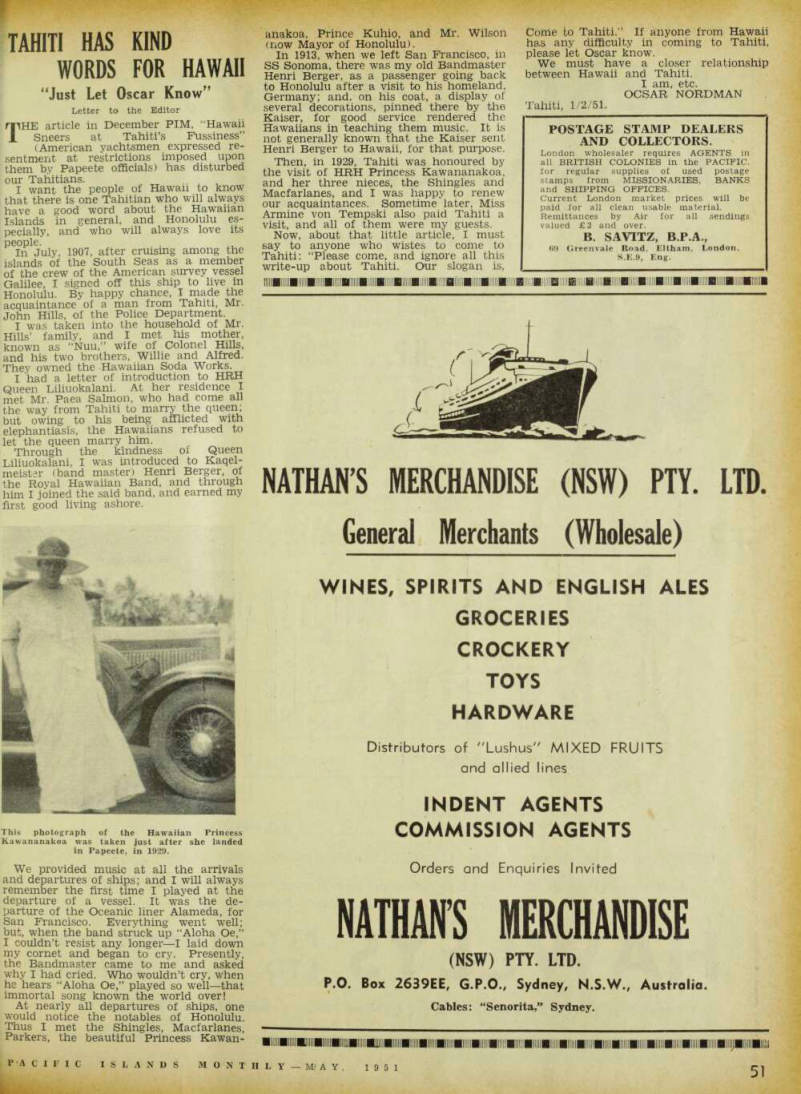
Words For Hawaii
“Just Let Oscar Know”
Letter to the Editor THE article in December PIM, “Hawaii Sneers at Tahiti’s Fussiness” (American yachtsmen expressed re sentment at restrictions imposed upon them by Papeete officials) has disturbed our Tahitians.
I want the people of Hawaii to know that there is one Tahitian who will always have a good word about the Hawaiian Islands in general, and Honolulu es pecially, and who will always love its people. . .
In July, 1907, after cruising among the islands of the South Seas as a member of the crew of the American survey vessel Galilee, I signed off this ship to live in Honolulu. By happy chance, I made the acquaintance of a man from Tahiti, Mr.
John Hills, of the Police Department.
I was taken into the household of Mr.
Hills’ family, and I met his mother, known as “Nuu,” wife of Colonel Hills, and his two brothers. Willie and Alfred.
They owned the Hawaiian Soda Works.
I had a letter of introduction to HRH Queen Liliuokalani. At her residence I met Mr. Paea Salmon, who had come all the way from Tahiti to marry the queen; but owing to his being afflicted with elephantiasis, the Hawaiians refused to let the queen marry him.
Through the kindness of Queen Liliuokalani, I was introduced to Kaqel meister (band master) Henri Berger, of the Royal Hawaiian Band, and through him I joined the said band, and earned my first good living ashore.
We provided music at all the arrivals and departures of ships; and I will always remember the first time I played at the departure of a vessel. It was the de parture of the Oceanic liner Alameda, for San Francisco. Everything went well; but, when the band struck up “Aloha Oe,”
I couldn’t resist any longer—l laid down my cornet and began to cry. Presently, the Bandmaster came to me and asked why I had cried. Who wouldn’t cry, when he hears “Aloha Oe,” played so well—that immortal song known the world over!
At nearly all departures of ships, one would notice the notables of Honolulu.
Thus I met the Shingles, Macfarlanes, Parkers, the beautiful Princess Kawan
anakoa, Prince Kuhio, and Mr. Wilson (now Mayor of Honolulu).
In 1913, when we left San Francisco, in SS Sonoma, there was my old Bandmaster Henri Berger, as a passenger going back to Honolulu after a visit to his homeland, Germany; and, on his coat, a display of several decorations, pinned there by the Kaiser, for good service rendered the Hawaiians in teaching them music. It is not generally known that the Kaiser sent Henri Berger to Hawaii, for that purpose.
Then, in 1929, Tahiti was honoured by the visit of HRH Princess Kawananakoa, and her three nieces, the Shingles and Macfarlanes, and I was happy to renew our acquaintances. Sometime later, Miss Armine von Tempski also paid Tahiti a visit, and all of them were my guests.
Now, about that little article, I must say to anyone who wistes to come to Tahiti: “Please come, and ignore all this write-up about Tahiti. Our slogan is,
Come to Tahiti.’ 1 If anyone from Hawaii has any difficulty in coming to Tahiti, please let Oscar know.
We must have a closer relationship between Hawaii and Tahiti.
I am, etc.
Ocsar Nordman
Tahiti, 1/2/51.
This photograph of the Hawaiian Princess Kawananakoa was taken just after she landed in Papeete, in 1929.
Advertisements & other items, pp. 53-54 (1 item)
Nathans Merchandise
POSTAGE STAMP DEALERS
AND COLLECTORS.
London wholesaler requires AGENTS in
all BRITISH COLONIES in the PACIFIC,
for regular supplies of used postage stamps from MISSIONARIES, BANKS
and SHIPPING OFFICES.
Current London market prices will be paid for all clean usable material.
Remittances by Air for all sendings valued £2 and over.
B. SAVITZ, 8.P.A.,
(it) Greenvale Road, Eltham, London, 5.E.9, Eng.
a
NATHAN’S MERCHANDISE (NSW) PTY. LTD.
General Merchants (Wholesale)
WINES, SPIRITS AND ENGLISH ALES
GROCERIES
CROCKERY
TOYS
HARDWARE
Distributors of "Lushas" MIXED FRUITS and allied lines
INDENT AGENTS
COMMISSION AGENTS
Orders and Enquiries Invited
NATHANS MERCHANDISE
(NSW) PTY. LTD.
P.O. Box 2639EE, G.P.0., Sydney, N.S.W., Australia.
Cables: “Senorita,” Sydney.
HERE . . at last!
A LOW WEIGHT DIESEL.
only 358 lbs.
ideal for MAIN Propulsion and Auxiliary Use. 17 % ‘s
DECOMPRESSOR.
VARIABLE
governor CD CM 4
OIL FILLER. &
01 PSTICK-
* 6/ s 63
12'/Bcrs
15/Q
MADE BY COVENTRY-VICTOR.
The lowest-weight Diesel with the best power-weight ratio for craft up to 22 ft. as main propulsion
engine.
5/7 H.P... £290
WEIGHT ONLY 358 LBS.
7/9 H.P... £313
WEIGHT ONLY 378 LBS.
F.O.R. Brisbane, including packing. 13-volt starter and generator, £34 extra. (Prices subject to variation.) Victor Cold Starting, totally enclosed Diesel fitted with “0.K.” epicyclic type
FORWARD AND REVERSE GEAR
BOX with 2 to 1 reduction at rear of box and including: • Variable speed governor with control on engine. • Victor gear type water pump fitted and piped up to water circulating system. • Water cooled muffler. • Provision exists for fitting selfstarter and generator. • Order now for immediate delivery, or write for full details.
FITTED ON EITHER. SIDE
OF GEAR-BOX AS REQ.D
FUEL FILTER.
COLO STARTING
INJ ECTOR
\_A- HOLES FOR Vfc'oiA. HEX HO.
BOLTS
DIRECTION OF ROTATION
VIEWED IN DIRECTION OF ARROW *A'
NORMAL ROTATION AHEAD 13
CLOCRWISE
12V STARTER &. DYNAMO
ONLT FITTED IF ORDERED
N
WATER PUMP
a % 22
lO^i
44 y* APPROX. OVERALL LENGTH
HIPSEL MARINE ENGINE WITH " 0.K." (2:1 REDUCTION/REVERSE) GEARBOX IN UNIT CONSTRUCTION Write to us for all advice and information on your Marine Power requirements. Send for full information on Lighting Plants, Pump Sets, etc.
HAWLEYS
52 BOWEN ST. BRISBANE
Telegraphic: “COVIC” Brisbane.
Diesel Engines (Marine and Stationary) ; Lighting Plants; Pumps; Reversing Propellers, etc.
PTY.
LTD.
The Sheldon Spirit
Still Is Marching On
By Meta Maclean
DURING the recent Mt. Lamington eruption in Papua, Mrs. Fred Kleckham played an heroic part both during the eruption and in the subsequent nursing of the injured. Before her marriage she was Marjorie Sheldon, daughter of the late Geoffrey Sheldon, 3ne of New Guinea’s first pioneering surveyors, and Mrs. S. Sheldon of North Queensland. (It was Mr. Sheldon who surveyed the first projected road to Wau 'rom the New Guinea coast —the story of vhich was told some years ago in PIM jy Mrs. A, A. Innes.) The Fred Kleckhams, with their three small children, have been living at Popendetta, Papua, for the last few years vhere he is Superintendent of the Northern Division Agricultural settlement.
During his war service, Mrs. Kleckham, i trained nurse, assisted the Flying Doctor services in Western Queensland. The eturn of her husband, the birth of three ;hildren and the busy life in Papua, spent without comforts before their new house /as built, did not free this daughter of a )ioneering family from her nursing, for he was good neighbour to every isolated /oman within call of her professional skill.
This explains why, when she, her msband and the children left on furlough ast year to visit Mrs. Sheldon at Seaforth, iear Mackay, Queensland, the local women ntimated that they would not be on peaking terms with the Stork until Mrs.
Heckham’s return.
But shortly after that return to Popen etta came the Mt. Lamington disaster,
killing both the doctor and the expectant mother for whom the former had re quested Mrs. Kleckham’s aid. Her share In the rescue work was told in Australian newspapers.
MRS. SHELDON herself is a gifted songwriter. Two of her songs, written in collaboration with an other songwriter, were awarded first prize by the BBC, London, in 1939 and broad cast over the British National and Empire stations. Sarah Louise Sheldon’s song work covers every variety, from anthems and serious ballads to humour.
Death Of Potiki Akatapuria
Of Penhryn Island
THE recent death of Potiki Akatapuria, son of the Cook Island’s Legislative Council’s Penhryn Island represen tative (a prominent chief of that atoll), has removed from Rarotonga a very re markable character. Potiki, who was only 21, possessed qualities of intelligence and enterprise that should have been applied in a larger sphere.
Educated only to local standards, he spoke very fluent English, but the limited scope of his northern atoll home offered the lad no outlet, though the US Army
forces stationed there during the war found him, like his father, a very useful friend.
The writer met Potiki when both were in hospital at Rarotonga. The Penhryn youth was able to get about and was of great service to this correspondent, then seriously ill and helpless; but his habit of relieving hospital ennui with various pranks did not meet the approval of Dr.
Irwin, then CMO, and Potiki was fre quently “on the mat” for breaches of Hospital discipline.
But boyish pranks may well be forgiven, for the sake of a personality always kindly and generous, typical of the good qualities
of Cl Maori-dom.
E.G.
Santo Taxi Charges
From Vernon Wheatley FOR some time past, the Tonkinese taxi proprietors of Santo. New Hebrides, have made hay whether the sun shone or not. Operating superannuated ex-US Forces jeeps in shocking condition, they make exorbitant charges (up to five or six shillings a mile).
It is understood that officialdom is in troducing a fixed charge of ten francs per person a mile. This represents a good return on the capital involved.
Advertisements & other items, p. 55 (2 items)
53
ACIFIC ISLANDS MONTHLY MAY, 1951
Burns Philp (South Sea) Go. Ltd.
"OUR HANDS MAKE GOOD ARMS"
For your Fishing and Shooting Wants Consult Us.
Lithgow .22 Cal. Repeating Rifles .. £l5 15 0 ) Post Lithgow .22 Cal. Single Shot ... £8 2 0 ( Extra. (Prices Subject to Change Without Notice.) SI L R OH U 143 ELIZABETH STREET, SYDNEY
BURNS PHILP (SOUTH SEA) Go. Ltd.
ISLAND TRADERS AND SHIPOWNERS
General Merchants (Wholesale and Retail)
Shipping, Customs and General Agents
Representatives for :
QUEENSLAND INSURANCE CO. LTD. BURNS PHILP TRUST CO. LTD.
Distributing Agents for :
SHELL COMPANY (P. 1.) LTD. FERGUSON TRACTORS STANDARD MOTOR CAR COMPANY CROSSLEY MARINE ENGINES
Registered Office: SUVA, FIJI
Code Address: “BURNSOUTH”
BRANCHES
Sydney Agents:
BURNS, PHILP & CO. LTD.,
7 Bridge Street.
FIJI
SAMOA—
APIA.
PAGO PAGO.
SUVA.
LEVUKA.
LAUTOKA.
LABASA.
BA.
SIG ATOKA.
TAVUA.
ROTUMA ISLAND.
TONGA—
NUKUALOFA.
HAAPAI.
VAVAU.
San Francisco Agents:
BURNS-PHILP CO. OP SAN FRANCISCO INC.
Matson Building, 215 Market Street.
London Agents:
BURNS. PHILP & CO. LTD.,
35 Crutched Friars, E.C.3.
NORFOLK ISLAND. NIUE ISLAND.
Agencies Throughout the World.
Suva Has Blackouts, Too !
SUVA, like Sydney, began to have daily electricity blackouts in March (and they continued into April) due to an unusual run of mishaps.
The trouble started when lightning struck the Suva Powerhouse and burned a hole in the armature windings in one of the main generators. Then, when the job was almost completed by Lectric, Ltd., a fire broke out in their workshops and the generator was again badly damaged.
Mrs. Colin Sefton, of Koitaki, Papua was holidaying in Sydney in April,
France In The South Pacific
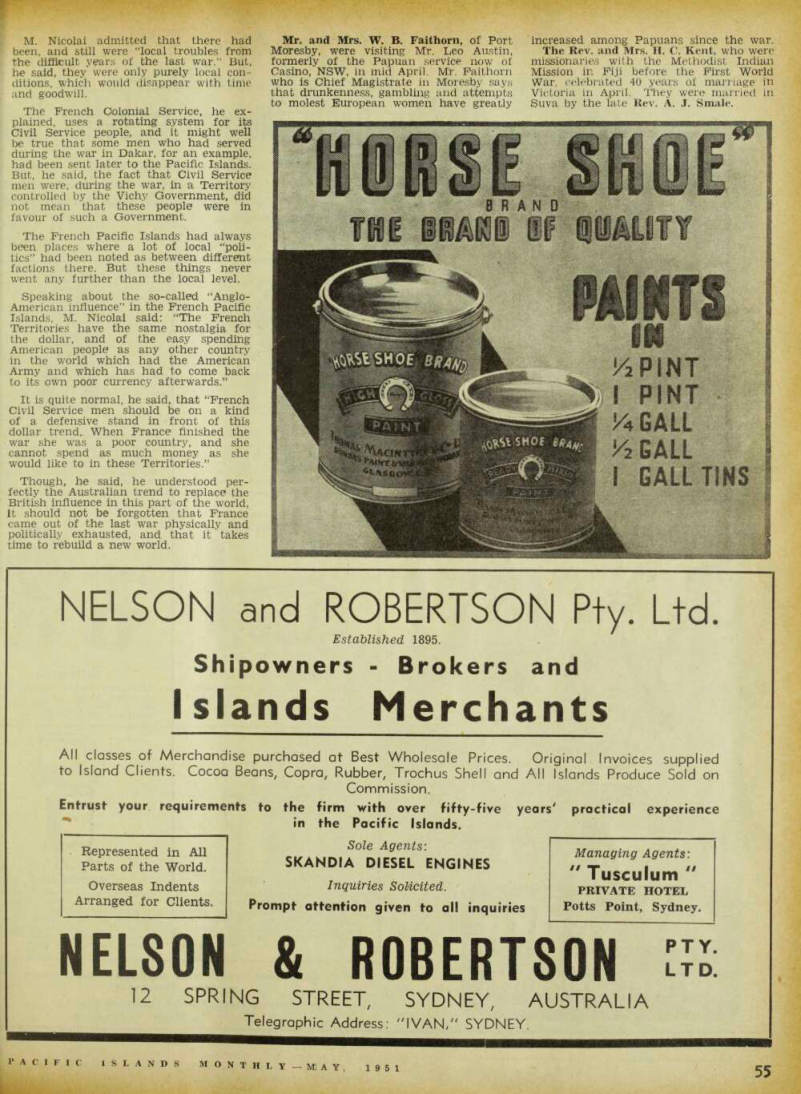
High French Official Comments on Article in PIM
PARIS, April 9.
IN an interview with this correspondent, M. Nicolai, Chief of the Cabinet of the Ministry of Colonies and Associa ted States, said Australia was now and especially since the last war, de veloping a tendency to expansion in the
Pacific which led it to criticise its neigh bours. He was answering an editorial in Pacific Islands Monthly of February.
M. Nicolai explained that this expan sionist movement was quite “normal” in a country which had given to the world all the proofs of statesmanship and courage which Australia had given. But this tendency gave the Australian people the habit of criticising their neighbours, because they believed unconsciously they could do better.
Commenting on the editorial point by point, M. Nicolai said “I can give you an example of what I mean when I say the Australians are taking an increasing interest in their neighbours, “Unofficial talks have already taken place, with the full acceptance of Great Britain, with a view to having Australia replace Britain in the Franco-English condominium of the New Hebrides.
“Of course,” he said, “Britain could not give to Australia more than Britain has-herself. She could only ask France if we would agree to administer the New Hebrides with Australia instead of with Britain.”
M. Nicolai said that although this showed clearly the general tendency of Australian politics, and explained the criticism in the editorial about the French Territories, he thought there were
The editorial in the February PIM pointed out that New Caledonia and French Oceania were inclined to drift into closer association with the British Do minions of the South Pacific, and with the United States, and correspondingly farther away from France, because of the following influences: (a) Close personal and commercial ties were formed between the Anglo- American nations and the French Pacific Colonies in 1940-45, while the Colonies were completely* isolated from France, and were making common cause with the Anglo-Americans in the war against Japan. (b) The New Caledonian and French Oceania people are not happy concerning the class of officials whom the Govern ment of France send out to take charge of their administration—too large a pro portion of them were Vichy-ites. who more or less collaborated with their enemies after 1940. (c) The French Pacific Colonies are not happy about the apparent drift of Prance towards the Left. The French Government seems to be dominated by Socialists, and an alarming number of the French people adhere to the Communist Party.
“no real problems for France there.” “If France had no more difficult problems to solve in its foreign territories than those the PIM writer mentions, we should be very happy indeed,” he added.
M. Nicolai explained, with a smile, that . the so-called French Socialism —“The i little sister of Communism” —had had J some pretty strong brothers in both j Australia and New Zealand, where j Labour Governments had gone much j farther to the Left than the French Gov- ■ ernment had ever been. “After all,” he< said, “England is a full-fledged Socialist c country, and I don’t suppose anybody will J believe England is in favour of Commun- ■ ism.”
M. Nicolai admitted that there had been, and still were “local troubles from the difficult years of the last war.’’ But, he said, they were only purely local com ditions, which would disappear with time and goodwill.
The French Colonial Service, he ex plained, uses a rotating system for its Civil Service people, and it might well be true that some men who had served during the war in Dakar, for an example, had been sent later to the Pacific Islands.
But, he said, the fact that Civil Service men were, during the war, in a Territory controlled by the Vichy Government, did not mean that these people were in favour of such a Government.
The French Pacific Islands had always been places where a lot of local “poli tics” had been noted as between different factions there. But these things never went any further than the local level.
Speaking about the so-called “Anglo- American influence” in the French Pacific Islands, M. Nicolai said: “The French Territories have the same nostalgia for the dollar, and of the easy spending American people as any other country in the world which had the American Army and which has had to come back to its own poor currency afterwards.”
It is quite normal, he said, that “French Civil Service men should be on a kind of a defensive stand in front of this dollar trend. When France finished the war she was a poor country, and she cannot spend as much money as she would like to in these Territories.”
Though, he said, he understood per fectly the Australian trend to replace the British influence in this part of the world, it should not be forgotten that France came out of the last war physically and politically exhausted, and that it takes time to rebuild a new world.
Mr. and Mrs. W. B. Faithorn, of Port Moresby, were visiting Mr. Leo Austin, formerly of the Papuan service now of Casino, NSW, in mid April. Mr. Faithorn who is Chief Magistrate in Moresby says that drunkenness, gambling and attempts to molest European women have greatly
increased among Papuans since the war.
The Rev. and Mrs. H. C. Kent, who were missionaries with the Methodist Indian Mission in Fiji before the First World War, celebrated 40 years of marriage in Victoria in April. They were married in Suva by the late Rev. A. J. Smale.
Advertisements & other items, pp. 56-58 (2 items)
I Pan A
PROTECT THOSE TEETH!
PROTECT THA T SMILE!
with
I PAN A
TOOTH PASTE
m A O O T A * & -0 O' A T 6 Vs tS *o* * S
A Lr,
s * o n > Dentists know that you can’t have sound teeth unless you have healthy gums. That’s why you should always use IPANA.
IPANA not only keeps teeth radiantly clean . . . but it stimulates the gums, keeps them firm and healthy, and guards against decay.
You’ll like IPANA . . . It’s refreshingly different!
A PRODUCT OF
Sold Everywhere
BRISTOL-MYERS
THE IMM if QUALITY
MIKTS
k *IW:
/a PINT
J 4 GALL
K 2 GALL
I GALL TINS
NELSON and ROBERTSON Pty. Ltd.
Established 1895.
Shipowners - Brokers and
Islands Merchants
All classes of Merchandise purchased at Best Wholesale Prices. Original Invoices supplied to Island Clients. Cocoa Beans, Copra, Rubber, Trochus Shell and All Islands Produce Sold on Commission.
Entrust- your requirements to the firm with over fifty-five years / practical experience in the Pacific Islands.
Sole Agents :
SKANDIA DIESEL ENGINES
Inquiries Solicited.
Prompt attention given to all inquiries
NELSON & ROBERTSON St
12 SPRING STREET, SYDNEY, AUSTRALIA
Telegraphic Address: "IVAN," SYDNEY.
Managing Agents: " Tusculum "
PRIVATE HOTEL
Potts Point, Sydney.
Represented in All Parts of the World.
Overseas Indents Arranged for Clients.
f' m v Aladdin lights tie way to better livi Good lighting and convenient cooking contribute much to comfor+c living, and Aladdin lamps and cooking appliances have been famous more than a century. Burning ordinary lighting kerosene, Aladdin prodi provide the comfort and convenience of gas or electricity. They unequalled in efficiency and ease of operation.
“The world’s most wonderful lamp”
Aladdin light is the closest of all to natural daylight, and these non-pressure lamps give a steady white light of 75 candle-power. There is no smoke or fumes, no pumping. They light at the touch of a match! Burning 94% air and only 6% kerosene, these modern lamps are extremely economical in use, and safe and easy to use. m
MODEL
1680
MODEL
1620
MODEL
1671
MODEL
1630
WALL
BRACKET
i
STORMPROOF LANTERN
The Aladdin Pressure Kerosene Stormproof Lantern gives 300 candle-power of brilliant light—in any kind of weather. Ruggedly built, it will stand up to many years of hard use.
TWO-BURNER PORTABLE STOVE
Compact, efficient pressure-kerosene stove has adjustable self-pricking burners. Available with metal carrying case for outdoor cooking.
ELEVATED RANGE
Modern, porcelain-finished pressurekerosene range has all the advantages ele of gas or electric stoves. Five selfpricking burners are adjustable to any heat, and insulated oven cooks perfectly. Simple and economical to operate.
ENGLISH 81-ALADDIN
Sturdy all-weather pressure-lant made by the English associate-ha of Aladdin. Gives a bright, ste, 200 candle-power light. Sturdily m« for outdoor use.
HEATER-COOKER
Cooks and heats! Pressure-keros« one-burner cooker can be conven into an efficient radiator. Heat' adjustable, operation simple.
5-BURNER RANGE
Compact, modern range has t adjustable, self-pricking burners « is attractively finished in porcelcl Heat is adjustable from "simrm to "boil" and insulated oven coc perfectly. Pressure-kerosene operate is simple and economical.
Obtainable through your Australian Buying House or Local Storekeeper.
Manufacturers: Alladin Industries Pty. Ltd., Bourke St.. Waterloo. N.S.W.
56
MAY, 1951 PACIFIC ISLANDS MONT
Magazine Section
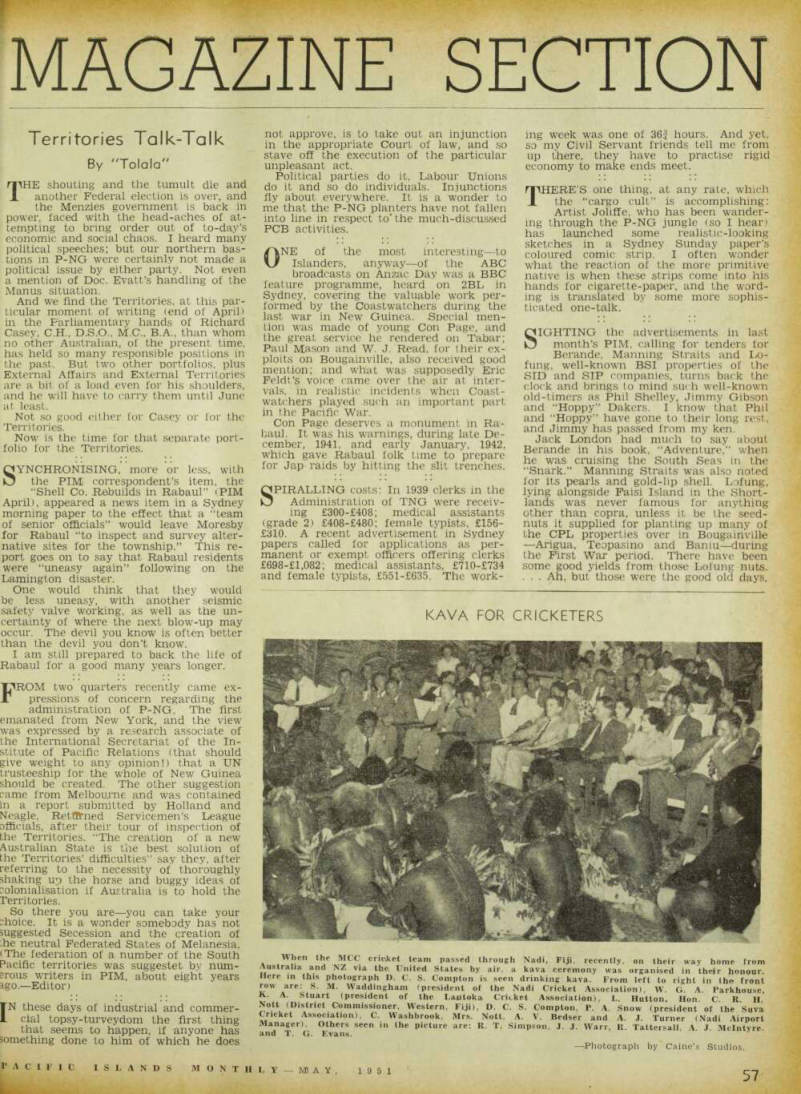
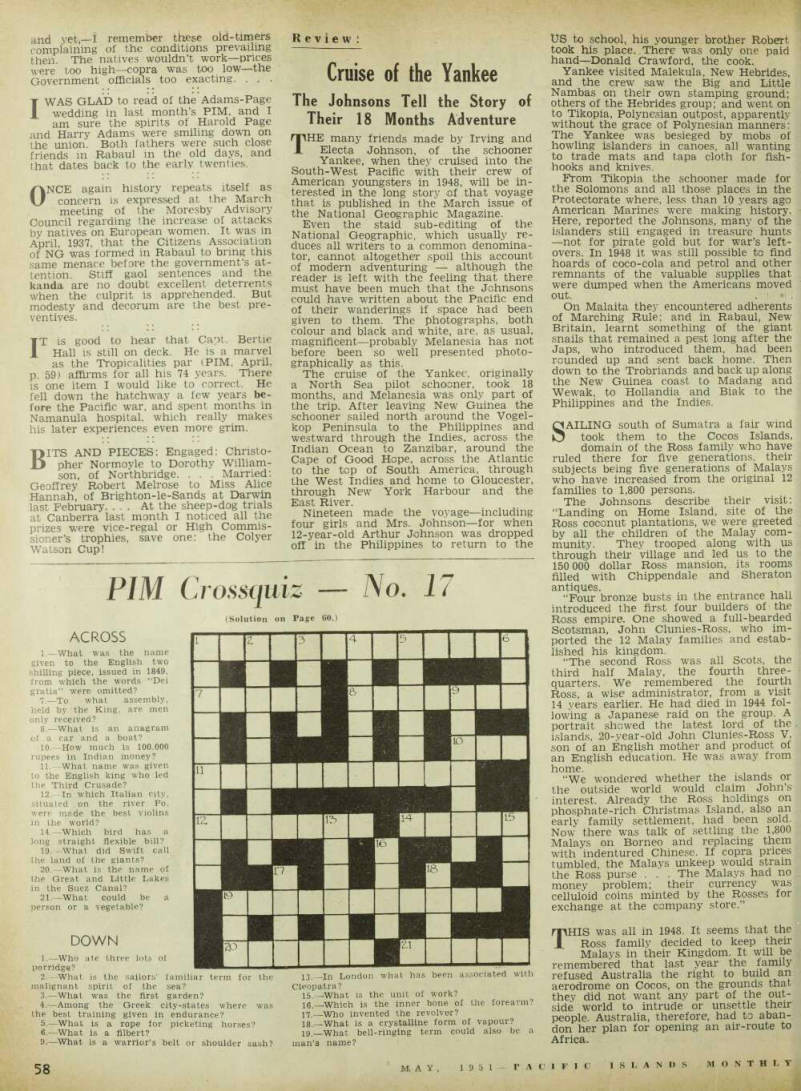
Territories Talk-Talk
By "Tolala"
mHE shouting and the tumult die and X another Federal election is over, and the Menzies government is back in power, faced with the head-aches of at tempting to bring order out of to-day’s economic and social chaos. I heard many political speeches; but our northern bas tions in P-NG were certainly not made a political issue by either party. Not even a mention of Doc. Evatt’s handling of the Manus situation.
And we find the Territories, at this par ticular moment of writing (end of April) in the Parliamentary hands of Richard Casey, C.H., D. 5.0., M.C., 8.A., than whom no other Australian, of the present time, has held so many responsible positions in the past. But two other portfolios, plus External Affairs and External Territories are a bit of a load even for his shoulders, and he will have to carry them until June at least.
Not so good either for Casey or for the Territories.
Now is the time for that separate port folio for the Territories.
Synchronising,” more or less, with the PIM correspondent’s item, the “Shell Co. Rebuilds in Rabaul” (PIM April), appeared a news item in a Sydney morning paper to the effect that a “team of senior officials” would leave Moresby for Rabaul “to inspect and survey alter native sites for the township.” This re port goes on to say that Rabaul residents were “uneasy again” following on the Lamington disaster.
One would think that they would be less uneasy, with another seismic safety valve working, as well as the un certainty of where the next blow-up may occur. The devil you know is often better than the devil you don’t know.
I am still prepared to back the life of Rabaul for a good many years longer.
FROM two quarters recently came ex pressions of concern regarding the administration of P-NG. The first emanated from New York, and the view was expressed by a research associate of the International Secretariat of the In stitute of Pacific Relations (that should give weight to any opinion!) that a UN trusteeship for the whole of New Guinea should be created. The other suggestion came from Melbourne and was contained in a report submitted by Holland and Neagle, Retffrned Servicemen’s League officials, after their tour of inspection of the Territories. “The creation of a new Australian State is the best solution of the Territories’ difficulties” say they, after referring to the necessity of thoroughly shaking up the horse and buggy ideas of colonialisation if Australia is to hold the Territories.
So there you are —you can take your choice. It is a wonder somebody has not suggested Secession and the creation of :he neutral Federated States of Melanesia. (The federation of a number of the South Pacific territories was suggestet by num erous writers in PIM, about eight years ago.—Editor) IN these days of industrial and commer cial topsy-turveydom the first thing that seems to happen, if anyone has something done to him of which he does
not approve, is to take out an injunction in the appropriate Court of law, and so stave off the execution of the particular unpleasant act.
Political parties do it, Labour Unions do it and so do individuals. Injunctions fly v, eV D xS 161 ! 6- iT u a wo *?^, er t 0 me that the P-NG planteis have not fallen mto line m respect to the much-discussed PCB activities. 0— y_, , .
NE of the most interesting—to Islanders, anyway—of the ABC broadcasts on Anzac Day was a BBC feature programme, heard on 2BL in Sydney, covering the valuable work performed by the Coastwatchers during the last war in New Guinea. Special men
the" great
Paul Mason and W. J. Read, for their exploits on Bougainville, also received good mention; and what was supposedly Eric Ppldt’s vnirp ramp nvpr thp air at inter-
vats" tn relhstT inGdenls when cS&-
an important part Con Page deserves a monument In Rabaul. It was his warnings, during late December, 1941, and early January, 1942, which gave Rabaul folk time to prepare for Jap raids by hitting the slit trenches.
SPIRALLING costs: In 1939 clerks in the kJ Administration of TNG were receiving £3OO-£408; medical assistants (grade 2) £4OB-£480; female typists, £156- £3lO. A recent advertisement in Sydney papers called for applications as permanent or exempt officers offering clerks £698-£1,082; medical assistants, £7lO-£734 and female typists, £551-£635. The work-
ing week was one of 36? hours. And yet, so my Civil Servant friends tell me from up there, they have to practise rigid economy to make ends meet. :: :: :; mHERE'S one thing, at any rate, which 1 the “cargo cult’’ is accomplishing: Artist Joliffe, who has been wander ing through t he P-NG jungle (so I hear) has launched some realistic-looking sketches in a Sydney Sunday paper’s coloured comic strip. I often wonder what the reaction of the more primitive native is when these strips come into his hands for cigarette-paper, and the word ing is translated by some more sophis ticated one-talk, GKJHTINO the advertisements In last /T , n?” turns Lck the ana companies, turns duck me
and DaL?s ! y knowTha° Ph!l
*nd ■•Hoppr have gones toi their long rest, jack London P had Inuc™ about Berande in his book ™ Adventur? 5 ” when he was cmisine the South sSs’ in the D Snark ... Manning Strahs was tlso noted for its pearls and gold-lip shell. Lofung, lying alongside Faisi Island in the Short lands was never famous for anything other than copra, unless it be the seed nuts it supplied for planting up many of the CPL properties over in Bougainville —Arigua, Teopasino and Baniu—during the First War period. There have been some good yields from those Lofung nuts, . . . Ah, but those were the good old days,
and yet,—l remember these old-timers complaining of the conditions prevailing then. The natives wouldn’t work—prices were too high—copra was too low—the Government officials too exacting. . . .
IWAS GLAD to read of the Adams-Page wedding in last month’s PIM, and I am sure the spirits of Harold Page and Harry Adams were smiling down on the union. Both fathers were such close friends in Rabaul in the old days, and that dates back to the early twenties.
ONCE again history repeats itself as concern is expressed at the March meeting of the Moresby Advisory Council regarding the increase of attacks by natives on European women. It was in April. 1937, that the Citizens Association of NG was formed in Rabaul to bring this same menace before the government’s at tention. Stiff gaol sentences and the kanda are no doubt excellent deterrents when the culprit is apprehended. But modesty and decorum are the best pre ventives.
IT is good to hear that Capt. Bertie Hall is still on deck. He is a marvel as the Tropicalities par (PIM, April, p. 59) affirms for all his 74 years. There is one item I would like to correct. He fell down the hatchway a few years be fore the Pacific war, and spent months in Namanula hospital, which really makes his later experiences even more grim.
BITS AND PIECES; Engaged: Christo pher Normoyle to Dorothy William son, of Northbridge. . . . Married: Geoffrey Robert Melrose to Miss Alice Hannah, of Brighton-le-Sands at Darwin last February. ... At the sheep-dog trials at Canberra last month I noticed all the prizes were vice-regal or High Commis sioner’s trophies, save one: the Colyer Watson Cup!
Kava For Cricketers
When the MCC cricket team passed through Nadi, Fiji, recently, on their way home from Australia and NZ via the United States by air, a kava ceremony was organised in their honour.
Here in this photograph D. C. S. Compton is seen drinking kava. From left to right in the front row are: S. M. Waddingham (president of the Nadi Cricket Association), W. G. A. Parkhouse, K. A. Stuart (president of the Lautoka Cricket Association), L. Hutton, Hon CRH Nott (District Commissioner, Western, Fiji). D. C. S. Compton, P. A. Snow (president of the Suva Cricket Association), C. Washbrook, Mrs. Nott, A. V. Bedser and A. J. Turner (Nadi Airport Manager). Others seen in the picture arc: R. T. Simpson, J. J. Warr, R. Tattersall. A J. Mclntyre, and T. G. Evans.
—Photograph by Caine’s Studios.
Advertisements & other items, p. 59 (1 item)
acific islands monthly may, 1951
Cruise of the Yankee
Review :
The Johnsons Tell the Story of Their 18 Months Adventure
THE many friends made by Irving and Electa Johnson, of the schooner Yankee, when they cruised into the South-West Pacific with their crew of American youngsters in 1948, will be in terested in the long story of that voyage that is published in the March issue of the National Geographic Magazine.
Even the staid sub-editing of the National Geographic, which usually re duces all writers to a common denomina tor, cannot altogether spoil this account of modern adventuring although the reader is left with the feeling that there must have been much that the Johnsons could have written about the Pacific end of their wanderings if space had been given to them. The photographs, both colour and black and white, are, as usual, magnificent—probably Melanesia has not before been so well presented photo graphically as this.
The cruise of the Yankee, originally a North Sea pilot schooner, took 18 months, and Melanesia was only part of the trip. After leaving New Guinea the schooner sailed north around the Vogel kop Peninsula to the Philippines and westward through the Indies, across the Indian Ocean to Zanzibar, around the Cape of Good Hope, across the Atlantic to the top of South America, through the West Indies and home to Gloucester, through New York Harbour and the East River.
Nineteen made the voyage—including four girls and Mrs. Johnson—for when 12-year-old Arthur Johnson was dropped off in the Philippines to return to the
US to school, his younger brother Robert took his place. There was only one paid hand—Donald Crawford, the cook.
Yankee visited Malekula, New Hebrides, and the crew saw the Big and Little Nambas on their own stamping ground; others of the Hebrides group; and went on to Tikopia, Polynesian outpost, apparently without the grace of Polynesian manners: The Yankee was besieged by mobs of howling islanders in canoes, all wanting to trade mats and tapa cloth for fish hooks and knives.
From Tikopia the schooner made for the Solomons and all those places in the Protectorate where, less than 10 years ago American Marines were making history.
Here, reported the Johnsons, many of the islanders still engaged in treasure hunts —not for pirate gold but for war’s left overs. In 1948 it was still possible to find hoards of coco-cola and petrol and other remnants of the valuable supplies that were dumped when the Americans moved out. . 1 *i i On Malaita they encountered adherents of Marching Rule; and in Rabaul, New Britain, learnt something of the giant snails that remained a pest long after the Japs, who introduced them, had been rounded up and sent back home. Then down to the Trobriands and back up along the New Guinea coast to Madang and Wewak, to Hollandia and Biak to the Philippines and the Indies.
SAILING south of Sumatra a fair wind took them to the Cocos Islands, domain of the Ross family who have ruled there for five generations, their subjects being five generations of Malays who have increased from the original 12 families to 1,800 persons.
The Johnsons describe their visit: “Landing on Home Island, site of the Ross coconut plantations, we were greeted by all the children of the Malay com munity. They trooped along with us through their village and led us to the 150 000 dollar Ross mansion, its rooms filled with Chippendale and Sheraton antiques. , , “Four bronze busts in the entrance hall introduced the first four builders of the Ross empire. One showed a full-bearded Scotsman, John Clunies-Ross, who im ported the 12 Malay families and estab lished his kingdom.
“The second Ross was all Scots, the third half Malay, the fourth three quarters. We remembered the fourth Ross, a wise administrator, from a visit 14 years earlier. He had died in 1944 fol lowing a Japanese raid on the group. A portrait showed the latest lord of the islands, 20-year-old John Clunies-Ross V, son of an English mother and product of an English education. He was away from home.
“We wondered whether the islands or the outside world would claim John’s interest. Already the Ross holdings on phosphate-rich Christmas Island, also an early family settlement, had been sold.
Now there was talk of settling the 1,800 Malays on Borneo and replacing them with indentured Chinese. If copra prices tumbled, the Malays unkeep would strain the Ross purse . . . The Malays had no money problem; their currency was celluloid coins minted by the Rosses for exchange at the company store.”
THIS was all in 1948. It seems that the Ross family decided to keep their Malays in their Kingdom. It will be remembered that last year the family refused Australia the right to build an aerodrome on Cocos, on the grounds that they did not want any part of the out side world to intrude or unsettle their people. Australia, therefore, had to aban don her plan for opening an air-route to Africa.
FIM Crossquiz -No. 17
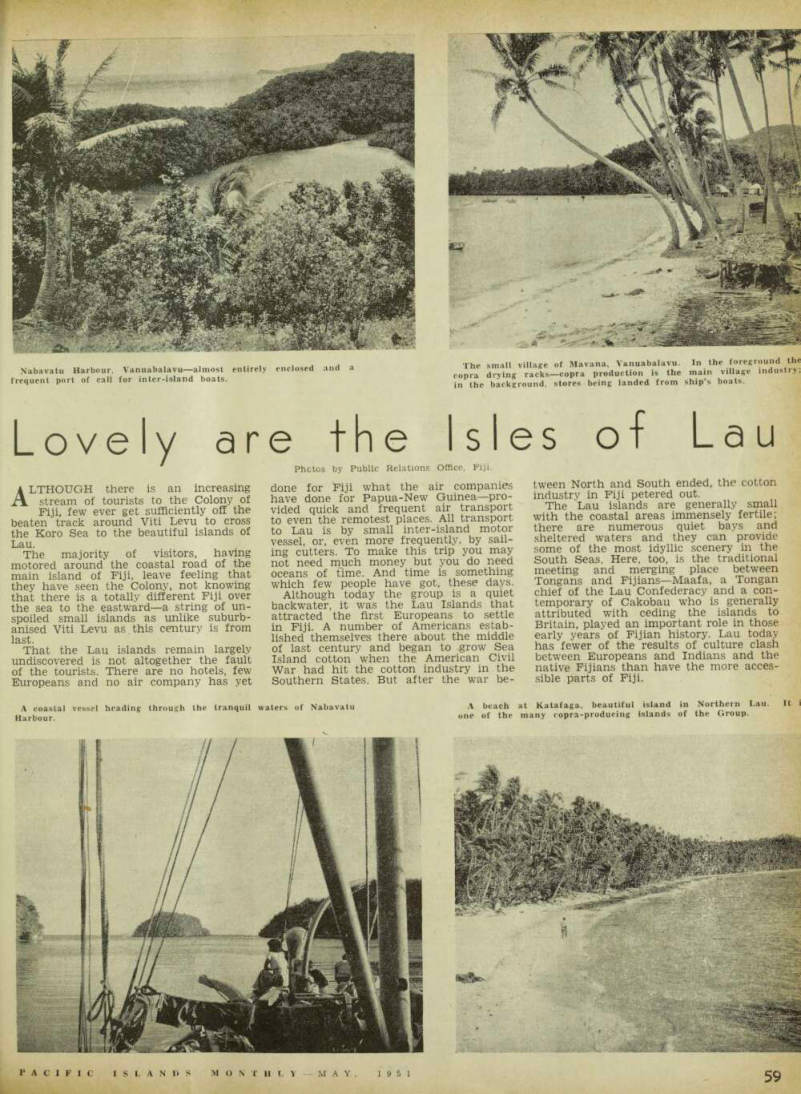
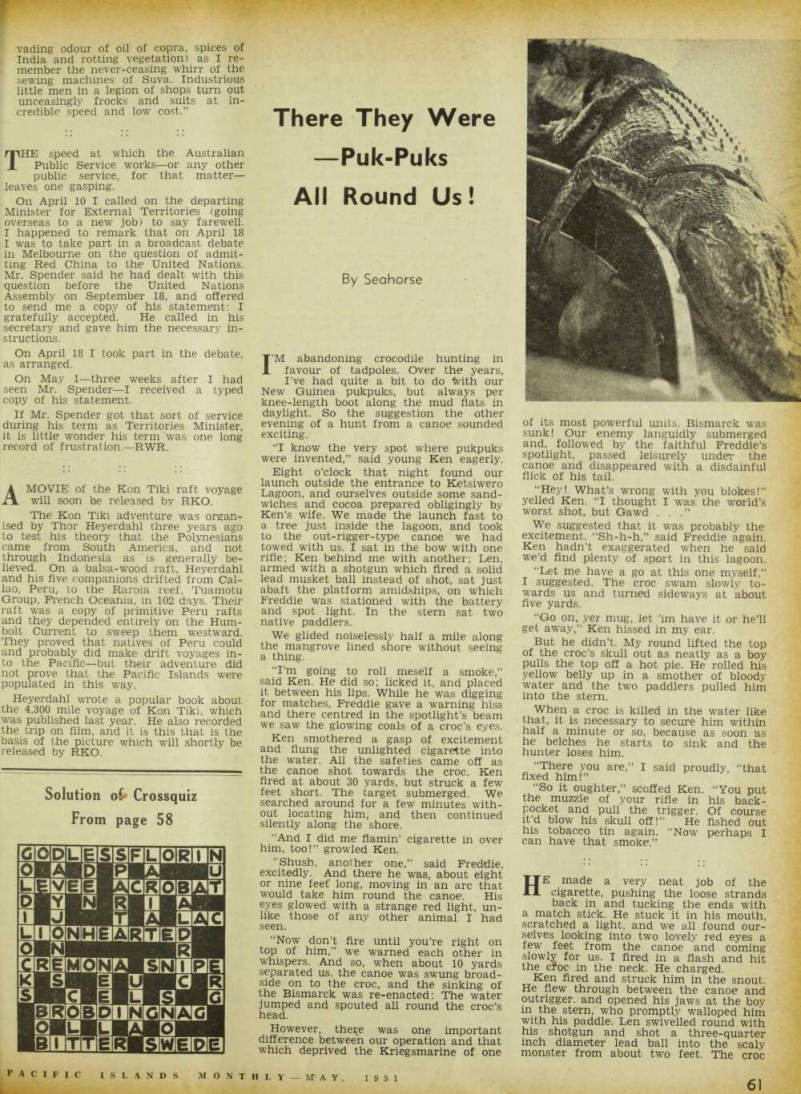
(Solution on Page 60.)
Across
I. What was the name given to the English two shilling piece, issued in 1849, from which the words “Dei gratia” were omitted? 7. To what assembly, held by the King, are men only received? 8. —What is an anagram of a car and a boat? 10.—How much is 100,000 rupees in Indian money? 11. What name was given to the English king who led the Third Crusade? 12.- In which Italian city, situated on the river Po. were made the best violins in the world? 14. -Which bird has a long straight flexible bill? 19. -What did Swift call the land of the giants? 20. —What is the name of the Great and Little Lakes in the Suez Canal? 21. —What could be a person or a vegetable?
Down
I.—Who ate three lots of porridge?
2. - What is the sailors’ familiar term for the malignant spirit of the sea? 3. —What was the first garden? 4. —Among the Greek city-states where was the best training given in endurance? 5. —What is a rope for picketing horses? 6. —What is a filbert? 9.—What is a warrior’s belt or shoulder sash?
13. in London what has been associated with Cleopatra? 15. —What is the unit of work? 16. .Which is the inner bone of the forearm? 17. —who invented the revolver? 18. What is a crystalline form of vapour? 19. —what bell-ringing term could also be a man’s name?
Lovely are the Isles of Lau
Phctos by Public Relations Office, Fiji.
ALTHOUGH there is an increasing stream of tourists to the Colony of Fiii few ever get sufficiently off the beaten track around Viti Levu to cross the Knro Sea to the beautiful islands of Lau The majority of visitors, having motored around the coastal road of the main island of Fiii leave feeling that they have seen the J Colony, not knowing that there is a totally different Fiji over the sea to the eastward—a string of unspoiled small islands as unlike B suburb- Inised VfS LvuTs this cSitury is from l as t That the Lau islands remain largely undiscovered is not altogether the fault of the tourists. There are no hotels, few Europeans and no air company has yet
done for Fiji what the air companies have done for Papua-New Guinea—pro vided quick and frequent air transport to even the remotest places. All transport to Lau is by small inter-island motor vessel, or, even more frequently, by sail ing cutters. To make this trip you may not need much money but you do need oceans of time. And time is something which few people have got, these days Although today the group is a quiet backwater, it was the Lau Islands that attracted the first Europeans to settle in Fiji. A number of Americans estab lished themselves there about the middle of last century and began to grow Sea Island cotton when the American Civil War had hit the cotton industry in the Southern States. But after the war be
tween North and South ended, the cotton mdustry in Fiji Peered °ut^ The Lau islandsare generally smau with the coastal areas immensely fe , there are numerous quiet bays and sheltered waters and they can provide some of the most idyllic scenery m the South Seas. Here, too, is the traditional meeting and merging place between a £ s the Conffitoacv ’ and^on chief of the Lau Confederacy a con temporary of Cakobau who is generally attributed with ceding the islands to Britain, played an important role to those early years of Fijian history. Lau today has fewer oftheresults H cl ash between Europeans and Indians and the native Fijians than have the more acces sible parts of Fiji.
Nabavatu Harbour, Vanuabalavu —almost entirely enclosed and a frequent port of call for inter-island boats.
The small village of Mavana, Vanuabalavu. In the foreground the copra drying racks—copra production is the main village industry; in the background, stores being landed from ship’s boats.
A coastal vessel heading through the tranquil waters of Nabavatu Harbour.
A beach at Katafaga, beautiful island in Northern Lau. It i one of the many copra-producing islands of the Group.
tropicalities
THE phone rang, and the PIM editor wearily said “Hullo?”
A resonant bass voice, with a rich American accent, said: “John R. Cross an, of Cleveland, Ohio, speaking.
Thought I’d just like to express my ap preciation of this journal of yours. It sure gives me a lot of what I want about the South Pacific.”
“Nice of you to say so,” said the editor. “Staying long in Australia?”
“Goldarn it, I’m not in Australia,” he replied. “I’m speaking from my home in Cleveland. I was reading this Pacific Islands Monthly here tonight, and I thought I’d give you a call on the radio phone.”
And so it was. The transmission was so clear and steady that it might have been coming from next door, instead of across 9,000 miles. At four dollars a minute, it was the most expensive bouquet ever handed the PIM editor.
Mr. Crossan, a well-known lawyer in Ohio, commanded a battalion of Ameri can troops in the Solomons fighting in 1942-43, and saw many other Pacific islands. He discussed many interesting angles of his experiences, and he es pecially asked after the Rev. J. F. Goldie, veteran of the Methodist Missionary Society, whom he met at Roviana, BSi.
He warmly advocated American-Aus tralian friendship, and spoke feelingly of his admiration for Douglas MacArthur, whose dismissal had been announced that day.
THE three-cell electric torch, with its powerful beam, is a must in the Island territories, where, when moon goes on holiday, the tropical nights are dark indeed. As the advertisement says, if you can see, you’re safe.
Regrettably, the life of sells in continu ous use is not as long as one could wish the three-cell flashlight at length will produce only a reddish glow, and then the battery (though it will last quite a time after this stage is reached) is “junked” to the loss of three shillings.
This may be averted, by the following method. Although a 3-cell battery, almost exhausted, will give merely a dull glow with its own 3.8 volt bulb, the globe of a two-cell torch (2.5 v.) will give a bril liant light. The trick is to carry in your torch a 2.5 v. globe as a spare, and, when the battery weakens, insert it in place of the higher voltage one. In this way, a me of several months service may be had from the battery, which is only thrown away when completely dead.
The revival of dead batteries by heating them is so ineffective that it is not worth the waste of time involved.—E.G.
ONCE more the magnificent local Cook Island mixture of nescience and ob stinacy has flaunted defiance to con vention—this time, in the direction of the nz Post Office.
Certain young Villagers of Mangaia Island noticing in the NZ “School iRwl a - \ T 1 r| rtter from a schoolboy at Blenheim, NZ, decided to write to the young gentleman with a view to pen fnend acquaintance (a common pastime lsland y° uth > though some of the order? 8 hardly of the Chesterfield
There was the address, in print, as as any pikestaff. But Blenheim, both the famous battlefield and its NZ namesake, is an unfamiliar name to Mangaians. After due deliberation, the seekers of pen-friendships with white children decided that there was no such place, and they addressed their screeds to Bethlehem!
Needless to say, all the misdirected letters were returned by the NZ “dead letter” office as “insufficiently addressed” —the knowledgeable NZ authorities, per haps knowing the little ways of Cl-ers, didn’t even bother to send them on to the Palestine Post Office. Thousands are spent each year by the NZ taxpayer on Cook Is. education—the results of which are as shown above.—ETl.
PRESS FANTASY DEPT. According to Sydney Truth, a Melbourne artist, Russel Foreman, is shortly off to the Gilbert & Ellice Islands to paint. But, they say, there is no postal communication so “ . . . he’s taking two crates of empty Vitamin C bottles.
“There’s some sense in it—he’s studied the currents, found that if he tosses the bottles in the seas with messages for his friends, they’ll finish up somewhere in Australia or New Zealand.”
SOMEBODY in Papua-New Guinea will be the proud possessor of a Dobell painting before the end of May.
This has been donated by the well-known artist for the Mt. Lamington Fund and it is being raffled by the RSL.
The six other prizes, too, will be well worth having: two winning entries from the recent photographic print exhibition by members of the Papua Photographic Society, two examples of Native Art, and two drawings by art students at the Sogeri Education Centre.
The raffle is to be drawn on May 19. —PM.
WELL, with copra worth over £lOO per ton, it was bound to happen. The following is from a recent issue of North Borneo News:— According to police reports, on Friday, January 26, 1951, three boats bringing copra from Celebes were stopped and robbed of their cargo, amounting to 20 tons, between Pulau Tiga and Pulau Si Amil. Five kumpits, the crews of which were armed, are said to have been in volved in the crime; one had a black hull with red lines and “SOLU No. 500” painted on the bow. A patrol put out from Tawau, but returned without re sult.
On February 2, another case of robbery on the high seas was reported. Searches are being carried out in the vicinity of Pulau Bohayan and Pulau Mataking, where the robbers are believed to hide.
Crocodile-shooter g. m. Rio came down to Lae, New Guinea, from the back blocks of the Sepik Country, and decided to take a look at the Morobe district. He did not like the modern trends: and, least of all, he dis liked the practice of modern women of staining their hair, “The first time I saw one of them,” he writes, amusingly, “I got a shock. She was
blue. ‘Poor old thing,’ I said to myself, she must be off her nut.’ ”
Then another matron comes along— not so old. but she was green. ‘Hell!’ I said. “Must be a lunatic asylum around here, and the inmates are having a day ‘‘Now I know it’s the fashion for our ladies to tint their locks. Natural enough when you come to think of it. Our Marys (and men, too) have been staining their hair for ages. Sooner or later, I suppose, our ladies will take to pul-puls, or wear rings in their noses. Why not reduce the costume to a G-string and a few beads! f ‘T v l had civilisation. I can’t get back to Indo-Chma, so I’m going bush, all by myseU.lm going into Western Papua, where the rivers are full of lovely croco diles, and there are great mud-banks and masses of inviting mangroves, and the jungie is teeming with insects and long thick snakes . . . You can have the in flation, and the more or less vivacious ladies with blue hair.”
Ratu Jon Attonio Rabici Dovi
is the younger brother of Ratu Sir Lala Sukuna, but has not lived much of his life in Fiji. He finished his edu-. cation in New Zealand, where he graduated M. 8., Ch.B., before going to England for post-graduate work.
At present he is serving a term as Medical Officer based on Malaita in the Solomons. As a hereditary chief he is treated with reverence by Fijians, and is well-liked and respected by Europeans for his ability and friendlv modesty. He sub mitted graciously to being sketched. He prefers to be called simply Dr. “Tom”
Dovi.—Brett Hilder.
KATHLEEN NEWICK, an English woman who has gone from New Zealand to live in Western Samoa, has coined a phrase that will live. Writ ing (in a New Zealand journal) about her impressions of Fiji, and remarking on the obviously chilly relationship between Fijians and Indians, she says: “It is difficult to see how the problem can be resolved. This cold war between the sari and the sulu—even in this lovely land peace bides uneasily.”
Another of Miss Newick’s impressions of Suva: “I shall remember it (the all-per
vading odour of oil of copra, spices of India and rotting vegetation) as I re member the never-ceasing whirr of the sewing machines of Suva. Industrious little men in a legion of shops turn out unceasingly frocks and suits at in credible speed and low cost.”
THE speed at which the Australian Public Service works —or any other public service, for that matter — leaves one gasping.
On April 10 I called on the departing Minister for External Territories (going overseas to a new job) to say farewell.
I happened to remark that on April 18 I was to take part in a broadcast debate in Melbourne on the question of admit ting Red China to the United Nations.
Mr. Spender said he had dealt with this question before the United Nations Assembly on September 18, and offered to send me a copy of his statement: I gratefully accepted. He called in his secretary and gave him the necessary in structions.
On April 18 I took part in the debate, as arranged.
On May I—three weeks after I had seen Mr. Spender—l received a typed copy of his statement.
If Mr. Spender got that sort of service during his term as Territories Minister, it is little wonder his term was one long
record of frustration.-
Rwr.
A MOVIE of the Kon Tiki raft voyage will soon be released by RKO.
The Kon Tiki adventure was organ ised by Thor Heyerdahl three years ago to test his theory that the Polynesians came from South America, and not through Indonesia as is generally be lieved. On a balsa-wood raft. Heyerdahl and his five companions drifted from Cal lao, Peru, to the Raroia reef. Tuamotu Group, French Oceania, in 102 days. Their raft was a copy of primitive Peru rafts and they depended entirely on the Hum bolt Current to sweep them westward.
They proved that natives of Peru could and probably did make drift voyages in to the Pacific—but their adventure did not prove that the Pacific Islands were populated in this way.
Heyerdahl wrote a popular book about the 4,300 mile voyage of Kon Tiki, which was published last year. He also recorded the trip on film, and it is this that is the basis of the picture which will shortly be released by RKO.
—Puk-Puks
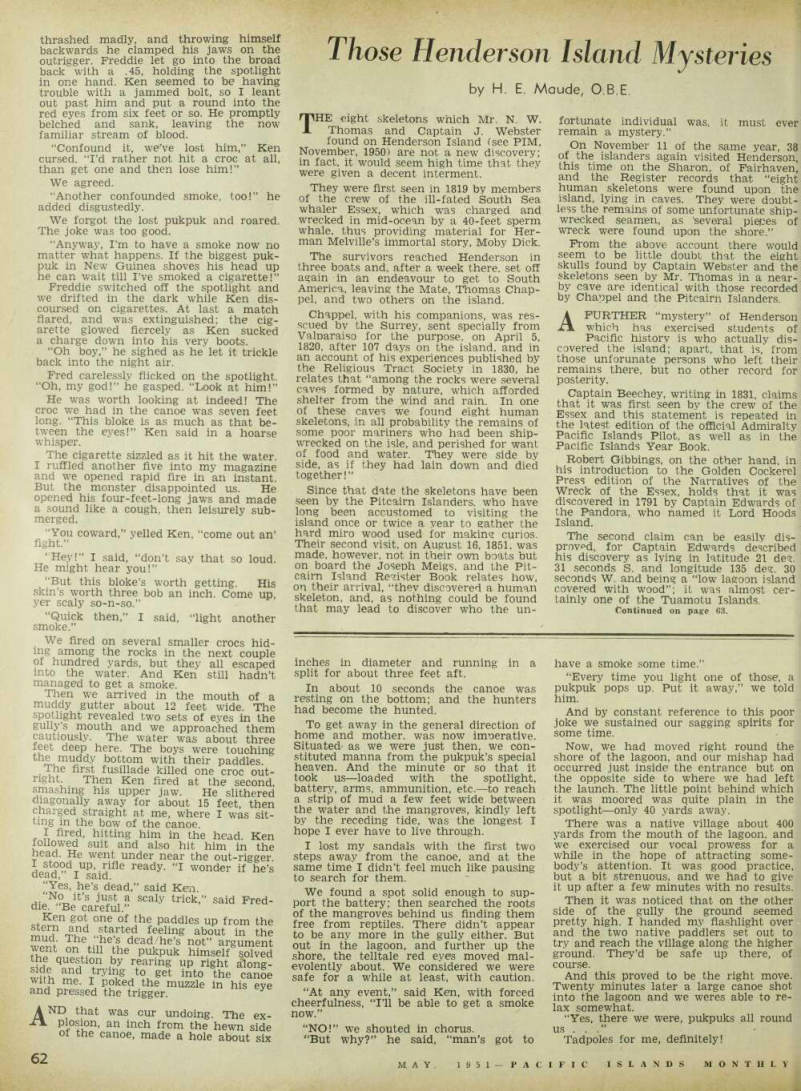
There They Were —Puk-Puks All Round Us!
By Seahorse
I’M abandoning crocodile hunting in favour of tadpoles. Over the years, I’ve had quite a bit to do tvith our New Guinea pukpuks, but always per knee-length boot along the mud flats in daylight. So the suggestion the other evening of a hunt from a canoe sounded exciting, “I know the very spot where pukpuks were invented,” said young Ken eagerly.
Eight o’clock that night found our launch outside the entrance to Ketsiwero Lagoon, and ourselves outside some sand wiches and cocoa prepared obligingly by Ken’s wife. We made the launch fast to a tree just inside the lagoon, and took to the out-rigger-type canoe we had towed with us. I sat in the bow with one rifle; Ken behind me with another; Len, armed with a shotgun which fired a solid lead musket ball instead of shot, sat just abaft the platform amidships, on which Freddie was stationed with the battery and spot light. In the stern sat two native paddlers.
We glided noiselessly half a mile along the mangrove lined shore without seeing a thing.
“I’m going to roll meself a smoke,” said Ken. He did so; licked it, and placed it between his lips. While he was digging for matches, Freddie gave a warning hiss and there centred in the spotlight’s beam we saw the glowing coals of a croc’s eyes.
Ken smothered a gasp of excitement and flung the unlighted cigarette into the water. All the safeties came off as the canoe shot towards the croc, Ken fired at about 30 yards, but struck a few feet short. The target submerged. We searched around for a few minutes with out locating him, and then continued silently along the shore.
“And I did me flamin’ cigarette in over him, too!” growled Ken. ‘Shush, another one,” said Freddie, excitedly. And there he was, about eight or nine feet long, moving in an arc that would take him round the canoe. His eyes glowed with a strange red light, un like those of any other animal I had seen.
“Now don’t fire until you’re right on top of him,” we warned each other in whispers. And so, when about 10 yards separated us. the canoe was swung broad side on to the croc, and the sinking of the Bismarck was re-enacted; The water jumped and spouted all round the croc’s head.
However, theire was one important difference between our operation and that which deprived the Kriegsmarine of one
of its most powerful units. Bismarck was sunk! Our enemy languidly submerged and, followed by the faithful Freddie’s spotlight, passed leisurely under the canoe and disappeared with a disdainful flick of his tail.
“Hey! What’s wrong with you blokes!” yelled Ken. “I thought I was the world’s worst shot, but Gawd ...”
We suggested that it was probably the excitement. “Sh-h-h,” said Freddie again.
Ken hadn’t exaggerated when he said we’d find plenty of sport in this lagoon.
“Let me have a go at this one myself,”
I suggested. The croc swam slowly to wards us and turned sideways at about five yards.
“Go on, yer mug, let ’im have it or he’ll get away,’’ Ken hissed in my ear.
But he didn’t. My round lifted the top of the croc’s skull out as neatly as a boy pulls the top off a hot pie. He rolled his yellow belly up in a smother of bloody water and the two paddlers pulled him into the stern.
When a croc is killed in the water like that, it is necessary to secure him within half a minute or so, because as soon as he belches he starts to sink and the hunter loses him.
“There you are,” I said proudly, “that fixed him!”
“So it oughter,” scoffed Ken. “You put the muzzle of your rifle in his back pocket and pull the trigger. Of course it’d blow his skull off!” He fished out his tobacco tin again. “Now perhaps I can have that smoke.”
HE made a very neat job of the cigarette, pushing the loose strands back in and tucking the ends with a match stick. He stuck it in his mouth, scratched a light, and we all found our selves looking into two lovely red eyes a few feet from the canoe and coming slowly for us. I fired in a flash and hit the croc in the neck. He charged.
Ken fired and struck him in the snout.
He flew through between the canoe and outrigger, and opened his jaws at the boy in the stern, who promptly walloped him with his paddle. Len swivelled round with his shotgun and shot a three-quarter inch diameter lead ball into the scaly monster from about two feet. The croc
thrashed madly, and throwing himself backwards he clamped his jaws on the outrigger. Freddie let go into the broad back with a .45, holding the spotlight in one hand. Ken seemed to be having trouble with a jammed bolt, so I leant out past him and put a round into the red eyes from six feet or so. He promptly belched and sank, leaving the now familiar stream of blood.
“Confound it, we’ve lost him,” Ken cursed. “I’d rather not hit a croc at all, than get one and then lose him!”
We agreed.
“Another confounded smoke, too!” he added disgustedly.
We forgot the lost pukpuk and roared.
The joke was too good.
“Anyway, I’m to have a smoke now no matter what happens. If the biggest puk puk in New Guinea shoves his head up he can wait till I’ve smoked a cigarette!”
Freddie switched off the spotlight and we drifted in the dark while Ken dis coursed on cigarettes. At last a match flared, and was extinguished; the cig arette glowed fiercely as Ken sucked a charge down into his very boots.
“Oh boy,” he sighed as he let it trickle back into the night air.
Fred carelessly flicked on the spotlight.
“Oh, my god!” he gasped. “Look at him!”
He was worth looking at indeed! The croc we had in the canoe was seven feet long. “This bloke is as much as that be tween the eyes!” Ken said in a hoarse whisper.
The cigarette sizzled as it hit the water.
I ruffled another five into my magazine and we opened rapid fire in an instant.
But the monster disappointed us. He opened his four-feet-long jaws and made a sound like a cough, then leisurely sub merged.
“You coward,” yelled Ken, “come out an’ fight.”
“Hey!” I said, “don’t say that so loud.
He might hear you!”
“But this bloke’s worth getting. His skin’s worth three bob an inch. Come up, yer scaly so-n-so.”
“Quick then,” I said, “light another smoke.”
We fired on several smaller crocs hid ing among the rocks in the next couple 9 f hundred yards, but they all escaped into the water. And Ken still hadn’t managed to get a smoke.
Then we arrived in the mouth of a muddy gutter about 12 feet wide. The spotlight revealed two sets of eyes in the gully’s mouth and we approached them cautiously. The water was about three feet deep here. The boys were touching the muddy bottom with their paddles.
The first fusillade killed one croc out right. Then Ken fired at the second, smashing his upper jaw. He slithered diagonally away for about 15 feet, then charged straight at me, where I was sit ting in the bow of the canoe.
I fired, hitting him in the head. Ken followed suit and also hit him in the head. He went under near the out-rigger.
L s “?° d x up ’ • r l ifle ready - “I wonder if he’s dead,” I said.
“Yes, he’s dead,” said Ken. N ° lt?s Jl i st ; a scaly trick,” said Fred die. “Be careful.”
Ken got one of the paddles up from the S^6I J I started feeling about in the mud. The “he’s dead/he’s not” argument went on till the pukpuk himself the question by rearing up right along ™ trying to get lnto the canoe With me. I poked the muzzle in his eve and pressed the trigger.
AND that was cur undoing. The ex plosion, an inch from the hewn side of the canoe, made a hole about six
inches in diameter and running in a split for about three feet aft.
In about 10 seconds the canoe was resting on the bottom; and the hunters had become the hunted.
To get away in the general direction of home and mother, was now imoerative.
Situated as we were just then, we constituted manna from the pukpuk’s special heaven. And the minute or so that it took us—loaded with the spotlight, battery, arms, ammunition, etc.—to reach a strip of mud a few feet wide between the water and the mangroves, kindly left by the receding tide, was the longest I hope I ever have to live through.
I lost my sandals with the first two steps away from the canoe, and at the same time I didn’t feel much like pausing to search for them.
We found a spot solid enough to support the battery; then searched the roots of the mangroves behind us finding them free from reptiles. There didn’t appear to be any more in the gully either. But out in the lagoon, and further up the shore, the telltale red eyes moved malevolently about. We considered we were safe for a while at least, with caution. «Af _y__ ... -
cheerfulness,bfablf get a sSoke
now ‘ “NO!” we shouted in chorus.
“But why?” he said, “man’s got to
have a smoke some time.”
“Every time you light one of those, a pukpuk pops up. Put it away,” we told him.
And by constant reference to this poor joke we sustained our sagging spirits for some time.
Now, we had moved right round the shore of the lagoon, and our mishap had occurred just inside the entrance but on the opposite side to where we had left the launch. The little point behind which it was moored was quite plain in the spotlight—only 40 yards away.
There was a native village about 400 yards from the mouth of the lagoon, and we exercised our vocal prowess for a while in the hope of attracting some body’s attention. It was good practice, but a bit strenuous, and we had to give it up after a few minutes with no results.
Then it was noticed that on the other side of the gully the ground seemed pretty high. I handed my flashlight over and the two native paddlers set out to try and reach the village along the higher ground. They’d be safe up there, of course.
And this proved to be the right move.
Twenty minutes later a large canoe shot into the lagoon and we weres able to re lax somewhat.
“Yes, there we were, pukpuks all round us . . .”
Tadpoles for me, definitely!
Advertisements & other items, p. 63 (1 item)
61
pacific islands monthly MAY, 1951
Solution o& Crossquiz From page 58
Those Henderson Island Mysteries
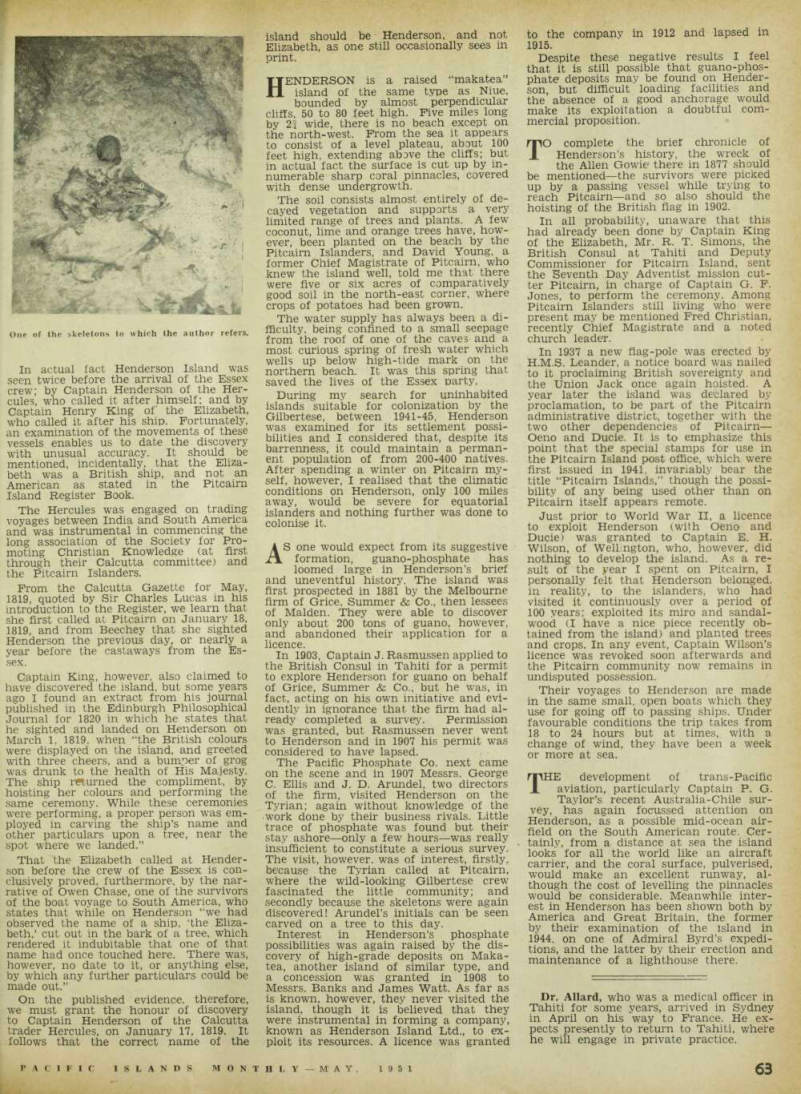
by H. E. Maude, O.B. E.
THE eight skeletons which Mr. N. W.
Thomas and Captain J. Webster found on Henderson Island (see PIM, November, 1950) are not a new discovery; in fact, it would seem high time that they were given a decent interment.
They were first seen in 1819 by members of the crew of the ill-fated South Sea whaler Essex, which was charged and wrecked in mid-ocean by a 40-feet sperm whale, thus providing material for Her man Melville’s immortal story, Moby Dick.
The survivors reached Henderson in three boats and, after a week there, set off again in an endeavour to get to South America, leaving the Mate, Thomas Chap pel, and two others on the island.
Chappel, with his companions, was res scued by the Surrey, sent specially from Valparaiso for the purpose, on April 5, 1820, after 107 days on the island, and in an account of his experiences published by the Religious Tract Society in 1830, he relates that “among the rocks were several caves formed by nature, which afforded shelter from the wind and rain. In one of these caves we found eight human skeletons, in all probability the remains of some poor mariners who had been ship wrecked on the isle, and perished for want of food and water. They were side by side, as if they had lain down and died together!”
Since that date the skeletons have been seen by the Pitcairn Islanders, who have long been accustomed to visiting the island once or twice a year to gather the hard miro wood used for making curios.
Their second visit, on August 16, 1851. was made, however, not in their own boats but on board the Joseph Meigs, and the Pit cairn Island Register Book relates how, on their arrival, “they discovered a human skeleton, and, as nothing could be found that may lead to discover who the un
fortunate individual was, it must ever remain a mystery.”
On November 11 of the same year, 38 of the islanders again visited Henderson, this time on the Sharon, of Fairhaven, and the Register records that “eight human skeletons were found upon the island, lying in caves. They were doubt less the remains of some unfortunate ship wrecked seamen, as 'several pieces of wreck were found upon the shore.”
Prom the above account there would seem to be little doubt that the eight skulls found by Captain Webster and the skeletons seen by Mr. Thomas in a near by cave are identical with those recorded by Chappel and the Pitcairn Islanders.
A FURTHER “mystery” of Henderson which has exercised students of Pacific history is who actually dis covered the island; apart, that is, from those unforunate persons who left their remains there, but no other record for posterity.
Captain Beechey, writing in 1831, claims that it was first seen by the crew of the Essex and this statement is repeated in the latest edition of the official Admiralty Pacific Islands Pilot, as well as in the Pacific Islands Year Book, Robert Gibbings, on the other hand, in his introduction to the Golden Cockerel Press edition of the Narratives of the Wreck of the Essex, holds that it was discovered in 1791 by Captain Edwards of the Pandora, who named it Lord Hoods Island.
The second claim can be easily dis proved, for Captain Edwards described his discovery as lying in latitude 21 deg. 31 seconds S. and longitude 135 deg. 30 seconds W. and being a “low lagoon island covered with wood”; it was almost cer tainly one of the Tuamotu Islands.
Continued on page 63.
In actual fact Henderson Island was seen twice before the arrival of the Essex crew; by Captain Henderson of the Her cules, who called it after himself: and by Captain Henry King of the Elizabeth, who called it after his ship. Fortunately, an examination of the movements of these vessels enables us to date the discovery with unusual accuracy. It should be mentioned, incidentally, that the Eliza beth was a British ship, and not an American as stated in the Pitcairn Island Register Book.
The Hercules was engaged on trading voyages between India and South America and was instrumental in commencing the long association of the Society for Pro moting Christian Knowledge (at first through their Calcutta committee) and the Pitcairn Islanders.
From the Calcutta Gazette for May, 1819, quoted by Sir Charles Lucas in his introduction to the Register, we learn that she first called at Pitcairn on January 18, 1819, and from Beechey that she sighted Henderson the previous day, or nearly a year before the castaways from the Es sex, Captain King, however, also claimed to have discovered the island, but some years ago I found an extract from his journal published in the Edinburgh Philosophical Journal for 1820 in which he states that he sighted and landed on Henderson on March 1, 1819. when “the British colours were displayed on the island, and greeted with three cheers, and a bumper of grog was drunk to the health of His Majesty.
The ship returned the compliment, by hoisting her colours and performing the same ceremony. While these ceremonies were performing, a proper person was em ployed in carving the ship’s name and other particulars upon a tree, near the spot where we landed.”
That the Elizabeth called at Hender son before the crew of the Essex is con clusively proved, furthermore, by the nar rative of Owen Chase, one of the survivors of the boat voyage to South America, who states that while on Henderson “we had observed the name of a ship, ‘the Eliza beth,’ cut out in the bark of a tree, which rendered it indubitable that one of that name had once touched here. There was, however, no date to it, or anything else, by which any further particulars could be made out.”
On the published evidence, therefore, we must grant the honour of discovery to Captain Henderson of the Calcutta trader Hercules, on January 17, 1819. It follows that the correct name of the
island should be Henderson, and not Elizabeth, as one still occasionally sees in print.
HENDERSON is a raised “makatea” island of the same type as Niue, bounded by almost perpendicular cliffs, 50 to 80 feet high. Five miles long by 22 wide, there is no beach except on the north-west. Prom the sea it appears to consist of a level plateau, about 100 feet high, extending above the cliffs; but in actual fact the surface is cut up by in numerable sharp coral pinnacles, covered with dense undergrowth.
The soil consists almost entirely of de cayed vegetation and supports a very limited range of trees and plants. A few coconut, lime and orange trees have, how ever, been planted on the beach by the Pitcairn Islanders, and David Young, a former Chief Magistrate of Pitcairn, who knew the island well, told me that there were five or six acres of comparatively good soil in the north-east corner, where crops of potatoes had been grown.
The water supply has always been a di fficulty, being confined to a small seepage from the roof of one of the caves and a most curious spring of fresh water which wells up below high-tide mark on the northern beach. It was this spring that saved the lives of the Essex party.
During my search for uninhabited islands suitable for colonization by the Gilbertese, between 1941-45, Henderson was examined for its settlement possi bilities and I considered that, despite its barrenness, it could maintain a perman ent population of from 200-400 natives.
After spending a winter on Pitcairn my self, however, I realised that the climatic conditions on Henderson, only 100 miles away, would be severe for equatorial islanders and nothing further was done to colonise it.
AS one would expect from its suggestive formation, guano-phosphate has loomed large in Henderson’s brief and uneventful history. The island was first prospected in 1881 by the Melbourne firm of Grice, Summer & Co., then lessees of Malden. They were able to discover only about 200 tons of guano, however, and abandoned their application for a licence.
In 1903, Captain J. Rasmussen applied to the British Consul in Tahiti for a permit to explore Henderson for guano on behalf of Grice, Summer & Co., but he was, in fact, acting on his own initiative and evi dently in ignorance that the firm had al ready completed a survey. Permission was granted, but Rasmussen never went to Henderson and in 1907 his permit was considered to have lapsed.
The Pacific Phosphate Co. next came on the scene and in 1907 Messrs. George C. Ellis and J. D. Arundel, two directors of the firm, visited Henderson on the Tyrian; again without knowledge of the work done by their business rivals. Little trace of phosphate was found but their stay ashore —only a few hours —was really insufficient to constitute a serious survey.
The visit, however, was of interest, firstly, because the Tyrian called at Pitcairn, where the wild-looking Gilbertese crew fascinated the little community; and secondly because the skeletons were again discovered! Arundel’s initials can be seen carved on a tree to this day.
Interest in Henderson’s phosphate possibilities was again raised by the dis covery of high-grade deposits on Maka tea, another island of similar type, and a concession was granted in 1908 to Messrs. Banks and James Watt. As far as is known, however, they never visited the island, though it is believed that they were instrumental in forming a company, known as Henderson Island Ltd., to ex ploit its resources. A licence was granted
to the company in 1912 and lapsed in 1915.
Despite these negative results I feel that it is still possible that guano-phos phate deposits may be found on Hender son, but difficult loading facilities and the absence of a good anchorage would make its exploitation a doubtful com mercial proposition.
TO complete the brief chronicle of Henderson’s history, the wreck of the Allen Gowie there in 1877 should be mentioned —the survivors were picked up by a passing vessel while trying to reach Pitcairn —and so also should the hoisting of the British flag in 1902.
In all probability, unaware that this had already been done by Captain King of the Elizabeth, Mr. R. T. Simons, the British Consul at Tahiti and Deputy Commissioner for Pitcairn Island, sent the Seventh Day Adventist mission cut ter Pitcairn, in charge of Captain G. F.
Jones, to perform the ceremony. Among Pitcairn Islanders still living who were present may be mentioned Fred Christian, recently Chief Magistrate and a noted church leader.
In 1937 a new flag-pole was erected by H.M.S. Leander, a notice board was nailed to it proclaiming British sovereignty and the Union Jack once again hoisted. A year later the island was declared by proclamation, to be part of the Pitcairn administrative district, together with the two other dependencies of Pitcairn — Oeno and Ducie. It is to emphasize this point that the special stamps for use in the Pitcairn Island post office, which were first issued in 1941. invariably bear the title “Pitcairn Islands,” though the possi bility of any being used other than on Pitcairn itself appears remote.
Just prior to World War 11, a licence to exploit Henderson (with Oeno and Ducie) was granted to Captain E. H.
Wilson, of Wellington, who, however, did nothing to develop the island. As a re sult of the year I spent on Pitcairn, I personally felt that Henderson belonged, in reality, to the islanders, who had visited it continuously over a period of 100 years; exploited its miro and sandal wood (I have a nice piece recently ob tained from the island) and planted trees and crops. In any event, Captain Wilson’s licence was revoked soon afterwards and the Pitcairn community now remains in undisputed possession.
Their voyages to Henderson are made in the same small, open boats which they use for going off to passing ships. Under favourable conditions the trip takes from 18 to 24 hours but at times, with a change of wind, they have been a week or more at sea.
THE development of trans-Pacific aviation, particularly Captain P. G.
Taylor’s recent Australia-Chile sur vey, has again focussed attention on Henderson, as a possible mid-ocean air field on the South American route. Cer tainly, from a distance at sea the island looks for all the world like an aircraft carrier, and the coral surface, pulverised, would make an excellent runway, al though the cost of levelling the pinnacles would be considerable. Meanwhile inter est in Henderson has been shown both by America and Great Britain, the former by their examination of the island in 1944, on one of Admiral Byrd’s expedi tions, and the latter by their erection and maintenance of a lighthouse there.
Dr. Allard, who was a medical officer in Tahiti for some years, arrived in Sydney in April on his way to France. He ex pects presently to return to Tahiti, where he will engage in private practice.
One of the skeletons to which the author refers.
Advertisements & other items, pp. 66-68 (3 items)
Corner For The Children
fashion . . .
£JOCKTAIL party sandals that are cool, elegant and from Paris.
Those at the top are in silver calf and black suede.
Below bronze calf trims beige nylon mesh.
Burns Philp (New Guinea) Limited
General Merchants, Shipping, Customs and
General Agents
Head Office: PORT MORESBY, PAPUA
BRANCHES:
NEW GUINEA: Rabaul (Kavieng, Kokopo), Lae (Wau, Bulolo), Madang.
PAPUA: Port Moresby, Samarai.
AUSTRALIAN AGENTS:
LONDON AGENTS;
SAN FRANCISCO AGENTS;
BURNS, PHILP & CO. LTD.
All States.
BURNS, PHILP & CO. LTD.
"London House," 35 Crutched Friars, E.C.3.
BURNS-PHILP CO. OF SAN FRANCISCO INC.
510 Matson Building.
REPRESENTATIVES FOR
Queensland Insutance Co. Ltd. Lloyd's of London, Burns Philp Trust Co. Ltd.
Distributing Agents in the Territory of Papua-New Guinea tor:
SHELL COMPANY OF AUSTRALIA LTD.
Petroleum Products
VAUXHALL MOTORS LIMITED
Vauxhall Cars and Bedford Trucks
THE ROVER COMPANY LIMITED
Landrovers and Rover Cars
A. J. ELLERKER
Blue Streak Power Chain Saws
THE COLONIAL SUGAR REFINING CO.
Caneite, Asbestos Cement Sidings, Asphalt Floor Tiles
GENERAL MOTORS CORPORATION
Cars and Trucks
HARRY FERGUSON LIMITED
Ferguson Tractors and Equipment
CROSSLEY BROS. LIMITED
Crossley Marine Cr Stationary Engines
IMPERIAL CHEMICAL INDUSTRIES
Pharmaceutical & Agricultural Chemicals, Corrugated Perspex
JOHN FOWLER & CO. (LEEDS) LTD.
Fowler 95 H.P. Diesel Crawler Tractors
Chula Machinery
for the
Coconut Grower...
★ COPRA DRYERS
Capacities 1.000 to 10,000 nuts per day
★ DESICCATED COCONUT DRYERS
Producing 1,500 lbs. of desiccated coconut per day also Parers , Disintegrators and Sifters.
Write direct to manufacturers or to nearest agent for fully-illustrated literature and further information .
TYNESIDE FOUNDRY ENGINEERING
Company Limit id.
Establishid 1898.
ELSWICK, NEWCASTLE UPON TYNE, ENGLAND.
Tilegrams & Cablss; FOUNDRY, NEWCASTLE ON-TYNh "Chula" Coconut Processing Machines provide: • The Answer to the Labour Shortage Problem. • Greater Efficiency at Reduced Cost.
• Bigger Output of Higher
Grade Produce.
agents
Fr ench hi ands Lev South es 9 u e p ac ifi Fr ores Pa F U Peete •ahiti Morris Hed stp orr> S uv
Mandat
ed Te rritor Golyer of W New atso n Gui 22 Pty
Bridge
nea Ltd Sir Bra eet Sydn iches ey at
Australi
Pabau/
Pa pua and N e Kav G u long •nea Tr a din Port Com Mo resby Pany p ap Ua New Gui nea ABC. Sth & 6th Editions.
vmPLIOh
ONE HORSEPOWER
PETROL ENGINES
ELECTRIC
UGHTING PLANTS
Bring you brilliant electric light in your home, week-ender or plantation.
Low operating and initial costs. Treated for the tropics. * Press button starting. * 300 watts output. + * 12 and 32 volt models. * Weight 70 lb. \ The Amplion makes the most of your petrol, runs longer on a tankful, 8 to 10 hours to the gallon. It’s light in weight, too—4o lb.
Obviously the best proposition for driving: Pumps—Compressors —Post hole borers— Lawn mowers—Saws— Shearing Machines— Crutching Machines—Spraying outfits—Concrete Mixers—Concrete Vibrators—Milking Machines.
★ 4 CYCLE AIR COOLED DESIGN
★ FULL FLOAT CARBURETTOR
★ EFFICIENT AIR CLEANER
rw Special Islands
PRICE:
£77/16/6 F. 0.8.
PRICE :
£4l/8/6 F. 0.8.
DISTRIBUTORS THROUGHOUT
AUSTRALIA AND THE ISLANDS
aMPLIOh
(Australasia) Pty. Ltd. 36-40 Parramatta Road, Camperdown.
Telegrams: Amplion, Sydney Telephone: LA 2828 (6 lines)
Moors-Paul Wedding
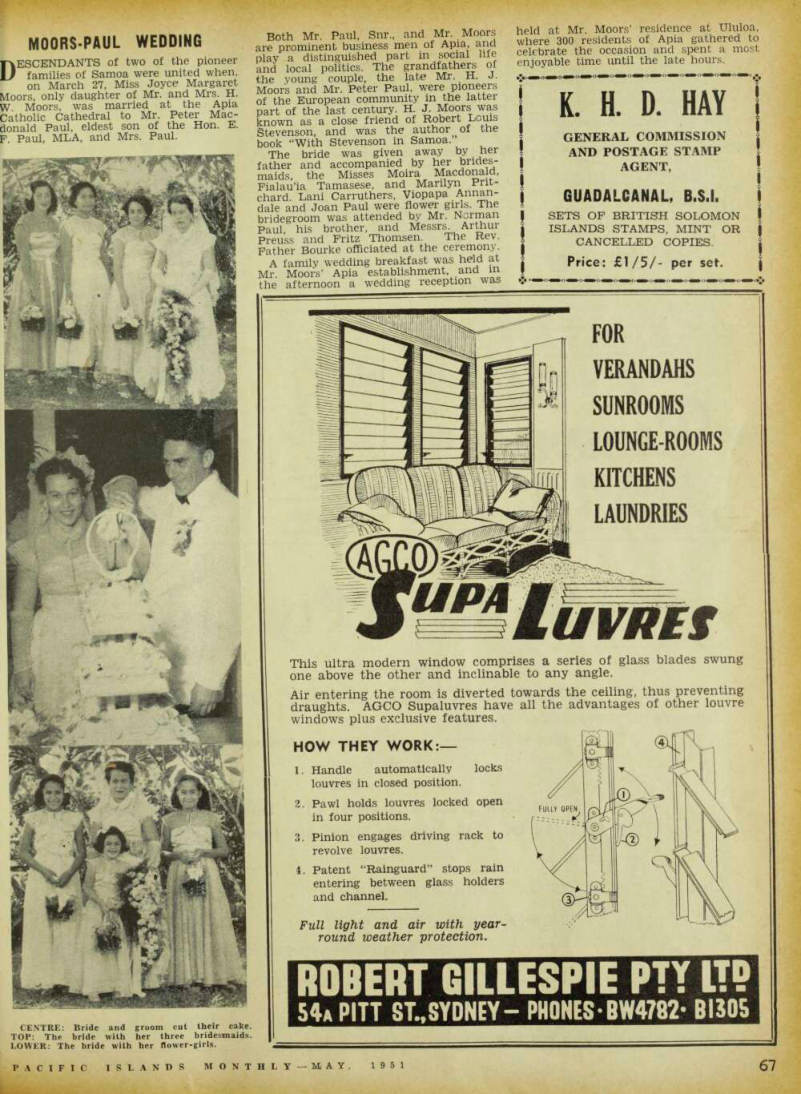
Descendants of two of the pioneer families of Samoa were united when, on March 27, Miss Joyce Margaret Moors, only daughter of Mr. and Mrs. H.
W Moors, was married at the Apia Catholic Cathedral to Mr. Peter Mac donald Paul, eldest son of the Hon. E.
F Paul, MLA, and Mrs. Paul.
Both Mr. Paul, Snr., and Mr. Moors are prominent business men of Apia, ana play a distinguished part in social life and local politics. The grandfathers of the young couple, the late Mr. H. J.
Moors and Mr. Peter Paul, were pioneers of the European community in the latter part of the last century. H. J. Moors was known as a close friend of Robert Louis Stevenson, and was the author of the book “With Stevenson in Samoa.
The bride was given away by her father and accompanied by her brides maids, the Misses Moira Macdonald, Fialau’ia Tamasese, and Marilyn Prit chard. Lani Carruthers, Viopapa Annan dale and Joan Paul were flower girls. The bridegroom was attended by Mr. Norman Paul, his brother, and Messrs. Arthur Preuss and Fritz Thomsen. The Rev.
Father Bourke officiated at the ceremony.
A family wedding breakfast was held at Mr. Moors’ Apia establishment, and in the afternoon a wedding reception was
held at Mr. Moors’ residence at Ululoa, where 300 residents of Apia gathered to celebrate the occasion and spent a most enjoyable time until the late hours.
CENTRE: Bride and groom cut their cake.
TOP: The bride with her three bridesmaids.
LOWER: The bride with her flower-girls.
Advertisements & other items, p. 69 (1 item)
SmiWees
K. H. D. HAY
GENERAL COMMISSION
AND POSTAGE STAMP
AGENT,
GUADALCANAL 8.5.1.
SETS OF BRITISH SOLOMON
ISLANDS STAMPS, MINT OR
CANCELLED COPIES.
Price: £l/5/- per set.
(f S'.
VERANDAHS
SUNROOMS
LOUNGE-ROOMS
KITCHENS
LAUNDRIES
SmiWees
This ultra modern window comprises a series of glass blades swung one above the other and inclinable to any angle.
Air entering the room is diverted towards the ceiling, thus preventing draughts. AGCO Supaluvres have all the advantages of other louvre windows plus exclusive features.
HOW THEY WORK:—
1. Handle automatically locks louvres in closed position. 2. Pawl holds louvres locked open in four positions. 3. Pinion engages driving rack to revolve louvres. 4. Patent “Rainguard” stops rain entering between glass holders and channel.
Full light and air with yearround weather 'protection. ®iV
FUU.Y OPEN
rr : - -*1 -<D i
ROBERT GILLESPIE PTT IT?
S 4» PITT ST..SYDNEY - PHONES-8W4782- 81305
Nz Notes Useless In Uk
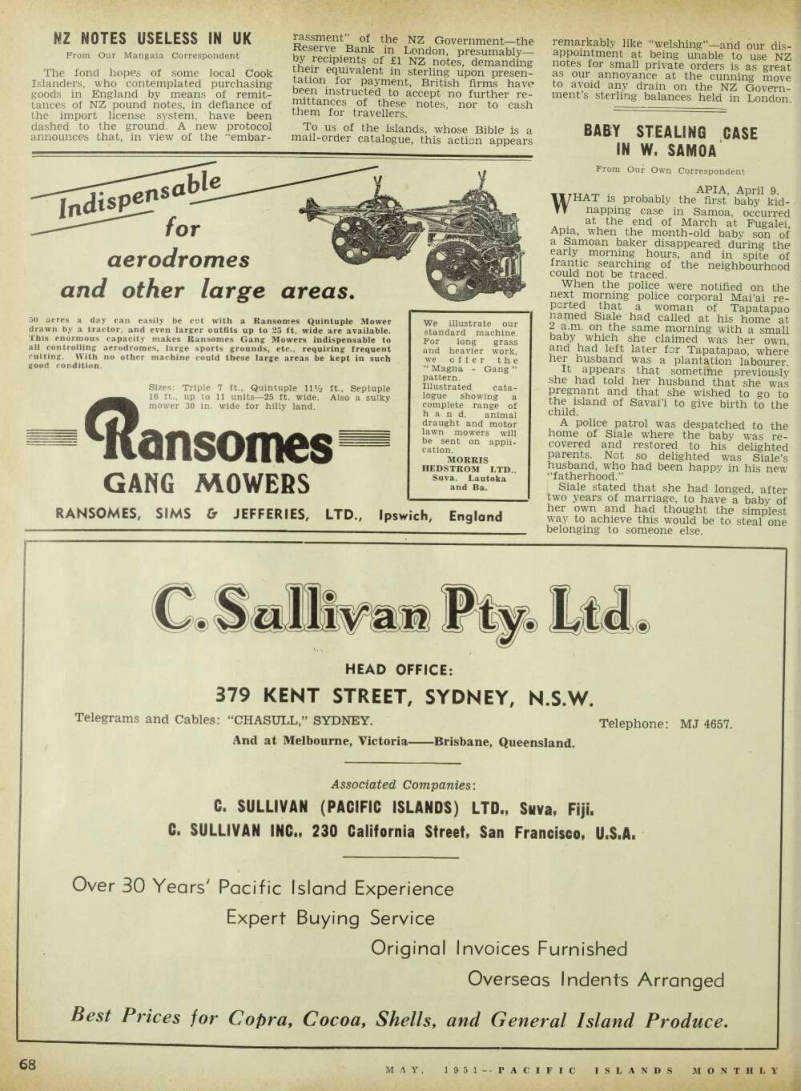
From Our Mangaia Correspondent The fond hopes of some local Cook Islanders, who contemplated purchasing goods in England by means of remit tances of NZ pound notes, in defiance of the import license system, have been dashed to the ground. A new protocol announces that, in view of the “embar
rassment of the NZ Government—the Keserve Bank in London, presumably— by recipients of £1 NZ notes, demanding their equivalent in sterling upon presen tation for payment, British firms have been instructed to accept no further re mittances of these notes, nor to cash them for travellers.
To us of the islands, whose Bible is a mail-order catalogue, this action appears
remarkably like “welshing”—and our dis appointment at being unable to use NZ notes for small private orders is as great as our annoyance at the cunning move to avoid any drain on the NZ Govern ment’s sterling balances held in London.
Baby Stealing Case
In W. Samoa
Prom Our Own Correspondent Wtt a m • APIA, April 9.
HAT is probably the first baby kid napping case in Samoa, occurred at the end of March at Fugalei, Apia, when the month-old baby son of a Samoan baker disappeared during the early morning hours, and in spite of frantic searching of the neighbourhood could not be traced.
When the police were notified on the next morning police corporal Mai’ai re ported that a woman of Tapatapao named Siale had called at his home at z a.m. on the same morning with a small baby which she claimed was her own and had left later for Tapatapao, where her husband was a plantation labourer.
It appears that sometime previously she had told her husband that she was pregnant and that she wished to go to the island of Savai’i to give birth to the child.
A police patrol was despatched to the home of Siale where the baby was re covered and restored to his delighted parents. Not so delighted was Stale’s husband, who had been happy in his new “fatherhood.”
Siale stated that she had longed, after two years of marriage, to have a baby of her own and had thought the simplest way to achieve this would be to steal one belonging to someone else.
Advertisements & other items, p. 70 (2 items)
68
MAY, 1951--FACIFIC ISLANDS MONTHLY
ansomes
for
aerodromes
and other large areas.
50 acres a day can easily be cut with a Ransomes Quintuple Mower drawn by a tractor, and even larger outfits up to 25 ft. wide are available.
This enormous capacity makes Ransomes Gang Mowers indispensable to all controlling aerodromes, large sports grounds, etc., requiring frequent cutting. With no other machine could these large areas be kept in such good condition.
Sizes: Triple 7 ft.. Quintuple liy 2 ft., Septuple 16 ft., up to 11 units —25 ft. wide. Also a sulky mower 30 in. wide for hilly land.
ansomes
GANG MOWERS
We illustrate our standard machine.
For long grass and heavier work, we offer the “ Magna - Gang ” pattern.
Illustrated catalogue showing a complete range of hand, animal draught and motor lawn mowers will be sent on application.
MORRIS
HEDSTROM LTD.,
Suva. Lautoka and Ba.
RANSOMES, SIMS & JEFFERIES, LTD., Ipswich, England
W
HEAD OFFICE:
379 KENT STREET, SYDNEY, N.S.W.
Telegrams and Cables: “CHASULL,” SYDNEY. Telephone: MJ 4657.
And at Melbourne, Victoria Brisbane, Queensland.
Associated Companies: C. SULLIVAN (PACIFIC ISLANDS) LTD., Suva, Fiji.
C. SULLIVAN INC., 230 California Street, San Francisco, U.S.A.
Over 30 Years' Pacific Island Experience Expert Buying Service Original Invoices Furnished Overseas Indents Arranged Best Prices for Copra, Cocoa, Shells, and General Island Produce.
Matthews Memorial Appeal
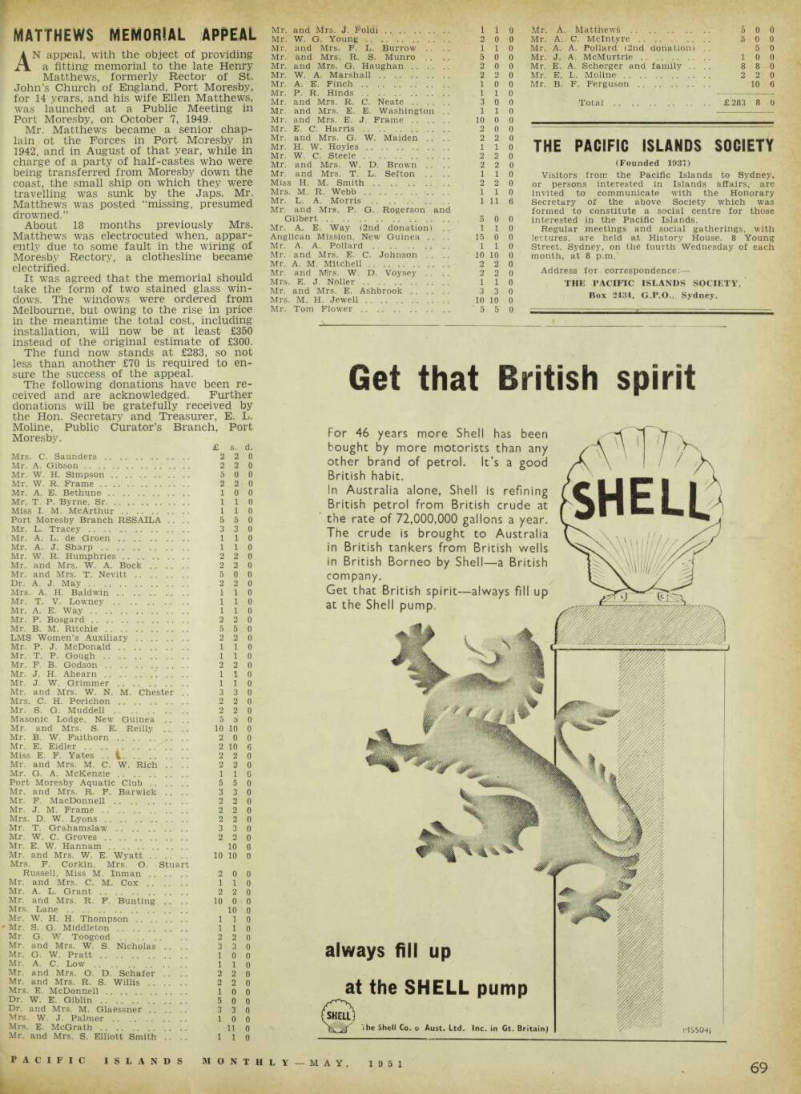
AN appeal, with the object of providing a fitting memorial to the late Henry Matthews, formerly Rector of St.
John’s Church of England, Port Moresby, for 14 years, and his wife Ellen Matthews, was launched at a Public Meeting in Port Moresby, on October 7, 1949.
Mr. Matthews became a senior chap lain ot the Forces in Port Moresby in 1942, and in August of that year, while in charge of a party of half-castes who were being transferred from Moresby down the coast, the small ship on which they were travelling was sunk by the Japs. Mr.
Matthews was posted “missing, presumed drowned.”
About 18 months previously Mrs.
Matthews was electrocuted when, appar ently due to some fault in the wiring of Moresby Rectory, a clothesline became electrified.
It was agreed that the memorial should take the form of two stained glass win dows. The windows were ordered from Melbourne, but owing to the rise in price in the meantime the total cost, including installation, will now be at least £350 instead of the original estimate of £3OO.
The fund now stands at £283, so not less than another £7O is required to en sure the success of the appeal.
The following donations have been re ceived and are acknowledged. Further donations will be gratefully received by the Hon. Secretary and Treasurer, E. L.
Moline, Public Curator’s Branch, Port Moresby.
Lmlkl
£ s. d.
Mrs. C. Saunders 2 2 0 Mr. A. Gibson 2 2 0 Mr. W. H. Simpson 5 0 0 Mr. W. R, Frame 2 2 0 Mr. A. E. Bethune 1 0 0 Mr. T. P. Byrne, Sr 1 1 0 Miss I. M. McArthur 1 1 0 Port Moresby Branch RSSAILA . , . . 5 5 0 Mr. L. Tracev 3 3 0 Mr. A. L. de Groen 1 1 0 Mr. A. J. Sharp 1 1 0 Mr. W. R. Humphries 2 2 0 Mr. and Mrs. W. A. Bock 2 2 0 Mr. and Mrs. T. Nevitt 5 0 0 Dr. A. J. May 2 2 0 Mrs. A. H. Baldwin 1 1 0 Mr. T. V. Lowney 1 1 0 Mr. A. E. Way 1 1 0 Mr. P. Bosgard 2 2 0 Mr. B. M. Ritchie 5 5 0 LMS Women’s Auxiliary 2 2 0 Mr. P. J. McDonald 1 1 0 Mr. T. P. Gough 1 1 0 Mr. F. B. Godson 2 2 0 Mr. J. H. Ahearn 1 1 0 Mr. J. W. Grimmer 1 1 0 Mr. and Mrs. W. N. M. Chester .. 3 3 0 Mrs. C. H. Perichon 2 2 0 Mr. S. G. Muddell 2 2 0 Masonic Lodge. New Guinea . 5 & 0 Mr. and Mrs. S. E. Reilly .. . . 10 10 0 Mr. B. W. Faithorn 2 0 0 Mr. E. Eidler 2 10 6 Miss E. F. Yates .. i 2 2 0 Mr. and Mrs. M. C. W. Rich .. 2 2 0 Mr. G. A. McKenzie 1 1 0 Port Moresby Aquatic Club 5 5 0 Mr. and Mrs. R. F. Barwick .. 3 3 0 Mr. F. MacDonnell 2 2 0 Mr. J. M. Frame 2 2 0 Mrs. D. W. Lyons 2 2 0 Mr. T. Grahamslaw 3 3 0 Mr. W. C. Groves 2 2 0 Mr. E. W. Hannam 10 6 Mr. and Mrs. W. E. Wyatt , . .
Mrs. F. Corkin, Mrs. O. Stuart 10 10 0 Russell, Miss M. Inman 2 0 0 Mr. and Mrs. C. M„ Cox 1 1 0 Mr. A. L. Grant 2 2 0 Mr. and Mrs. R. F. Bunting .. 10 0 0 Mrs. Lane 10 0 Mr. W. H. H. Thompson 1 1 0 Mr. S. G. Middleton 1 1 0 Mr. G. W. Toogood 2 2 0 Mr. and Mrs. W. S. Nicholas .. 3 3 0 Mr. G. W. Pratt 1 0 0 Mr. A. C. Low 1 1 0 Mr. and Mrs. O. D. Schafer . . 2 2 0 Mr. and Mrs. R. S. Willis .. 2 2 0 Mrs. E. McDonnell 1 0 0 Dr. W. E. Giblin 5 0 0 Dr. and Mrs. M. Glaessner 3 3 0 Mrs. W. J. Palmer 1 0 0 Mrs. E. McGrath 11 0 Mr. and Mrs. S. Elliott Smith .. .. 1 1 0
Mr. and Mrs. J. Foldi i i 0 Mr.
W. G. Young 2 0 0 Mr. and Mrs. F. L. Burrow . . .. 1 1 0 Mr. and Mrs. R. S. Munro . . .. 5 0 0 Mr. and Mrs. G. Haughan 2 0 0 Mr.
W. A. Marshall 2 2 0 Mr.
A. E. Finch 1 0 0 Mr.
P. R. Hinds 1 1 0 Mr. and Mrs. R. C. Neate 3 0 0 Mr. and Mrs. E. E. Washington . . 1 1 0 Mr. and Mrs. E. J. Frame 10 0 0 Mr.
E. C. Harris 2 0 0 Mr. and Mrs. G. W. Maiden . . . . 2 2 0 Mr.
H. W. Hoyles 1 1 0 Mr.
W. C. Steele 2 2 0 Mr. and Mrs. W. D. Brown .. 2 2 0 Mr. and Mrs. T. L. Sefton 1 1 0 Miss H. M. Smith 2 2 0 Mrs.
M. R. Webb 1 1 0 Mr.
L. A. Morris 1 11 6 Mr. and Mrs. P. G. Rogerson and Gilbert 5 0 0 Mr.
A. E. Way (2nd donation) .. 1 1 0 Anglican Mission. New Guinea .. .. 15 0 0 Mr.
A. A. Pollard 1 1 0 Mr. and Mrs. E. C. Johnson . . 10 10 0 Mr.
A. M. Mitchell 2 2 0 Mr. and Mrs. W. D. Voysey .. 2 2 0 Mrs.
E. J. Roller 1 1 0 Mr. and Mrs. E. Ashbrook 3 3 0 Mrs.
M. H. Jewell 10 10 0 Mr.
Tom Flower 5 5 0
Mr. A. Matthews 300 Mr. A. C. McIntyre 500 Mr. A. A. Pollard (2nd donation) . . 5 0 Mr. J. A. McMurtrie 10 0 Mr. E. A. Scherger and family ... 880 Mr. E. L. Moline 220 Mr. B. F. Ferguson 10 6 Total £283 8 0
Advertisements & other items, pp. 71-72 (1 item)
shell
THE PACIFIC ISLANDS SOCIETY
(Founded 1937) Visitors from the Pacific Islands to Sydney, or persons interested in Islands affairs, are invited to communicate with the Honorary Secretary of the above Society which was formed to constitute a social centre for those interested in the Pacific Islands.
Regular meetings and social gatherings, with lectures, are held at History House. 8 Young Street. Sydney, on the fourth Wednesday of each month, at 8 p.m.
Address for correspondence:—
THE PACIFIC ISLANDS SOCIETY,
Box 2434, G.P.0., Sydney.
Get that British spirit
For 46 years more Shell has been bought by more motorists than any other brand of petrol. It’s a good British habit.
In Australia alone, Shell is refining British petrol from British crude at the rate of 72,000,000 gallons a year.
The crude is brought to Australia in British tankers from British wells in British Borneo by Shell—a British company.
Get that British spirit—always fill up at the Shell pump V
shell
:% v. 4%%. f
always fill up
at the SHELL pump
SHELL
Ihe Shell Co. o Aust. Ltd. Inc. in Gt. Britain) M 55041
THE FINEST FRUIT CAKE
N,. EVER BAKED
B Vi J#: rK &> <ai 5^
iRf
m 'Big Sister" Rich Fruit Cake is the real home-style Fruit Cake.
Mellowed with fine old rum and brandy, studded with sweet red cherries, tenderized lemon and orange peels, and sun-rich sultanas, currants and raisins. In 3 lb. and 6 lb. cartons.
"Big Sister" is so good it proves with keeping; delicious to the last crumb! Each "Big Sister" cake is individually boxed and an inner wrap of moisture-proof cellophane seals in its oven-freshness.
Special packing guarantees every “Big Sister” product comes to your plate oven-fresh, as luscious in flavour and as moist and rich as the day it was baked.
V A *** I *, **Z »J
vits/r
m r- Ta CA" m to
RECfP£ PRODUCTS
THE FINEST PLUM PUDDING
EVER MADE! It's vacuum packed for freshness, gloriously rich with goodness, and just as nice cold as hot. In I lb., 2 lb. and big 3 lb. tins.
MADE BY LILLIS & CO. LIMITED. SYDNEY, AUSTRALIA ALSO ASK FOR DATE PUDDING. MINCEMEAT, DATE & NUT ROLL & GLACE CHERRIES
Cook Islander Gains Diploma
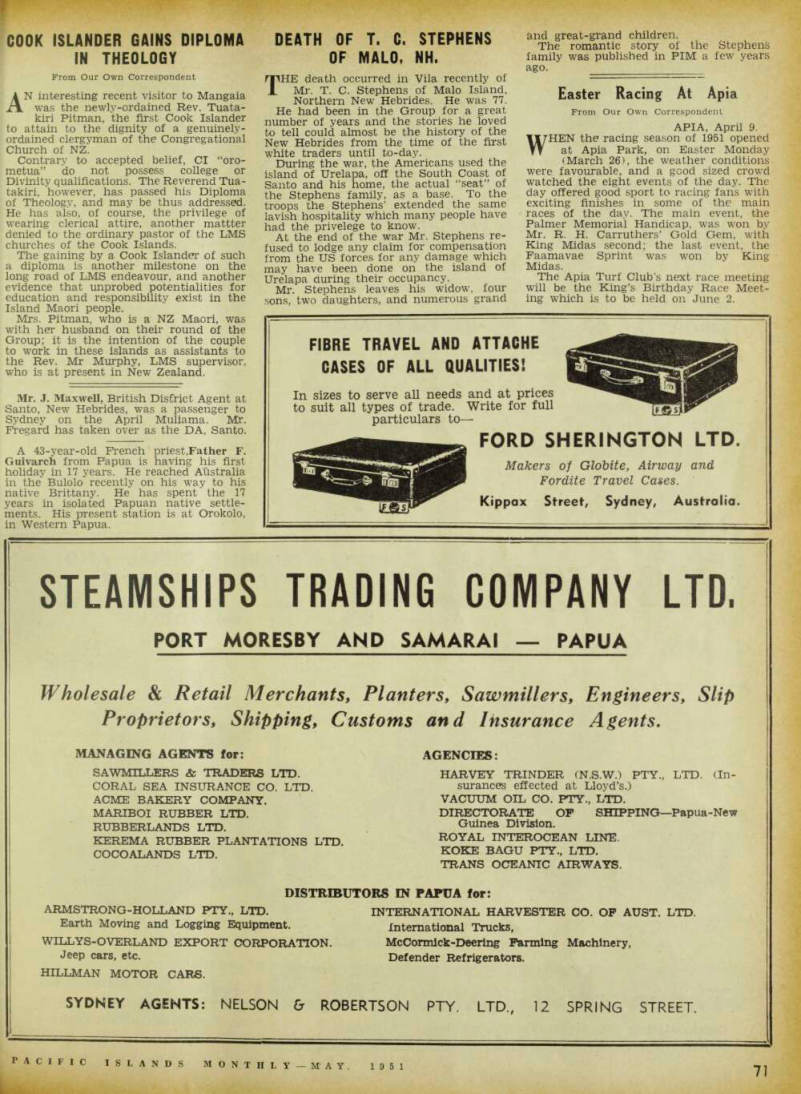
In Theology
From Our Own Correspondent AN interesting recent visitor to Mangaia was the newly-ordained Rev. Tuata kiri Pitman, the first Cook Islander to attain to the dignity of a genuinely ordained clergyman of the Congregational Church of NZ.
Contrary to accepted belief, Cl “oro metua” do not possess college or Divinity qualifications. The Reverend Tua takiri, however, has passed his Diploma of Theology, and may be thus addressed.
He has also, of course, the privilege of wearing clerical attire, another mattter denied to the ordinary pastor of the LMS churches of the Cook Islands.
The gaining by a Cook Islander of such a diploma is another milestone on the long road of LMS endeavour, and another evidence that unprobed potentialities for education and responsibility exist in the Island Maori people.
Mrs. Pitman, who is a NZ Maori, was with her husband on their round of the Group; it is the intention of the couple to work in these islands as assistants to the Rev. Mr Murphy, LMS supervisor, who is at present in New Zealand.
Mr. J. Maxwell, British District Agent at Santo, New Hebrides, was a passenger to Sydney on the April Muliama. Mr.
Fregard has taken over as the DA, Santo, A 43-year-old French priest,Father F.
Guivarch from Papua is having his first holiday in 17 years. He reached Australia in the Bulolo recently on his way to his native Brittany. He has spent the 17 years in isolated Papuan native settle ments. His present station is at Orokolo, in Western Papua.
Death Of T. C. Stephens
Of Malo, Nh.
THE death occurred in Vila recently of Mr. T. C. Stephens of Malo Island, Northern New Hebrides. He was 77.
He had been in the Group for a great number of years and the stories he loved to tell could almost be the history of the New Hebrides from the time of the first white traders until to-day.
During the war, the Americans used the island of Urelapa, off the South Coast of Santo and his home, the actual “seat” of the Stephens family, as a base. To the troops the Stephens’ extended the same lavish hospitality which many people have had the privelege to know.
At the end of the war Mr. Stephens re fused to lodge any claim for compensation from the US forces for any damage which may have been done on the island of Urelapa during their occupancy.
Mr. Stephens leaves his widow, four sons, two daughters, and numerous grand
and great-grand children.
The romantic story of the Stephens family was published in PIM a few years ago.
Easter Racing At Apia
From Our Own Correspondent APIA, April 9.
WHEN the racing season of 1951 opened at Apia Park, on Easter Monday (March 26), the weather conditions were favourable, and a good sized crowd watched the eight events of the day. The day offered good sport to racing fans with exciting finishes in some of the main races of the day. The main event, the Palmer Memorial Handicap, was won by Mr. R. H. Carruthers’ Gold Gem, with King Midas second; the last event, the Faamavae Sprint was won by King Midas.
The Apia Turf Club’s next race meeting will be the King’s Birthday Race Meet ing which is to be held on June 2.
Advertisements & other items, p. 73 (1 item)
Steamships Trading Company Ltd.
FIBRE TRAVEL AND ATTACHE
GASES OF ALL QUALITIES!
In sizes to serve all needs and at prices to suit all types of trade. Write for full particulars to —
FORD SHERINGTON LTD.
Makers of Glohite, Airway and Fordite Travel Cases.
Kippax Street, Sydney, Australia.
STEAMSHIPS TRADING COMPANY LTD.
PORT MORESBY AND SAMARAI PAPUA
Wholesale & Retail Merchants , Planters , Sawmillers, Engineers, Slip
Proprietors, Shipping, Customs and Insurance Agents.
MANAGING AGENTS for:
SAWMILLERS & TRADERS LTD.
CORAL SEA INSURANCE CO. LTD.
ACME BAKERY COMPANY.
MARIBOI RUBBER LTD.
RUBBERLANDS LTD.
KEREMA RUBBER PLANTATIONS LTD.
COCOALANDS LTD.
AGENCIES:
HARVEY TRINDER (N.S.W.) PTY., LTD. (In-
surances effected at Lloyd’s.)
VACUUM OIL CO. PTY., LTD.
DIRECTORATE OP SHIPPING—Papua-New
Guinea Division.
ROYAL INTEROCEAN LINE.
KOKE BAGU PTY., LTD.
TRANS OCEANIC AIRWAYS.
DISTRIBUTORS IN PAPUA for:
ARMSTRONG-HOLLAND PTY., LTD.
Earth Moving and Logging Equipment.
WILLYS-OVERLAND EXPORT CORPORATION.
Jeep cars, etc.
HILLMAN MOTOR CARS.
INTERNATIONAL HARVESTER CO. OF AUST. LTD.
International Trucks, McCormick-Dee ring Farming Machinery, Defender Refrigerators.
SYDNEY AGENTS: NELSON & ROBERTSON PTY. LTD., 12 SPRING STREET.
To Hebrides Natives
S upplying Liquor To Hebrides Natives
From Our Own correspondent . ... VILA, Apnl 18. riIHE New Hebrides Condominium Gov- X ernment recently introduced measures to control the flow of liquor which is reaching the natives of the Group. The
Government, like everyone else, is fully aware that no small amount of spirits purchased from retail stores throughout the Group is resold to natives who are willing to pay the price demanded. wa ? Proposed that either Trading Companies implement their own forms of rationing or that the war-time liquor permit system be re-introduced. Undei this latter scheme no one at all could purchase liquor without a permit and thus the unscrupulous would be prevented from
accumulating undue quantities which, obviously, would have to go on to the black market.
Commercial houses have agreed to put into immediate effect the Government’s alternative proposal. We will be interested to see how it all works out under this form of voluntary rationing. Tonkinese, for example, can only purchase two bottles of spirits at the one time. They could get two bottles 10 times a day from various sources, of course, but at least they are prevented from buying a case or two on the spot.
In other cases, the onus is on the individual to show, should he be ques tioned by authority, that any liquor purchase which would seem to be in excess, was not intended for illegal use or resale, Tonkinese are bv no means the sole operators of the grog-running racket.
Article 59, Paragraph 1 of the Protocol signed at London on August 6, 1914, and concerning the New Hebrides states, in part: “No person shall, in the New Hebrides . . . sell or supply alcoholic liquors ... (to natives) in any manner or on any pretext what-so-ever.” This prohibition covers beer, spirits, wines and generally all fermented and intoxicating liquors except for medicinal purposes.
There are, doubtless, many people who would prefer to abide by the law, but a point which still remains to be solved is that the natives soon learnt to go where the liquor was, and it became a case of no liquor, no labour.
The New Hebrides is reputed to be the largest per capita liquor-consuming country in the world.
A part-European named Harold Gibson was found dead recently in Rotuma (north of Fiji) and his wife has been charged with murder. Fiji police are handling the case.
Advertisements & other items, p. 74 (1 item)
United Islani Traders Ltd.
Serving the Needs of the Cook Islands . . .
(Established 1930)
P.O. BOX 42, RAROTONGA, COOK ISLANDS.
Managing Director: W. H. Watson.
IMPORTERS OF:-
Cotton & Silk Piece Goods Apparel & Drapery Building Materials Musical Instruments Trade Jewellery Secretary; R. J. A. Ingram, A.R.A., N.Z.
EXPORTERS OF:-
Tomatoes & Cassava Tropical Fruits Sea-shells & Necklaces Island Handicrafts "Broad-last" Footwear STAMP DEALERS & SUPPLIERS OF ISLAND PHOTOS
INQUIRIES INVITED.
Cables: Bankers: “Watson,” Rarotonga. National Bank of New Zealand, Auckland.
U.K. Agents: Geo. H. Penney & Co. Ltd., 197 Aldersgate St., London, E.C.I.
RTR6 33/55 H.P. Marine Diesel
Elec. Starting. 2-1 Red. Gear.
MARINE DIESEL AND
PETROL ENGINES
In units—9, 18, 20/80, 33/55, 60/90, and 95/130 H.P. DB2.
Heavy Duty. ■f Modern compact Diesel for general purpose use. 9 h.p. Heavy Duty Petrol-Kerosene Engine.
GOOD DELIVERIES OF ALL MODELS.
Write for full particulars of our complete range of engines to:
Thornycroft (Aust.) Pty., Ltd.
Representatives for Stuart Turner Engines.
Cables: “THORNMOTOR,” Sydney.
Samoan Assembly
High Salaries Bill Worries Samoan Assembly
From Our Own Correspondent APIA, April 9.
THE Estimates of revenue and expen diture for Western Samoa Govern ment for the calendar year 1951 were reviewed by the last session of the First Legislative Assembly, the term of office of which ended the end of April, when an election of new members of the Assembly took place.
The figures as submitted show esti mated receipts, mainly derived from im port and export duties, for the year 1951 at £542,340. In addition the amount of £208,624 is to be brought in from the Capital Development Reserve Fund and £6,000 from the Vaisigano Bridge Reserve Fund, making a total of £756 964. Esti mated receipts for the financial year 1950, for only 9 months, was £370,550, but actual revenue collected was £471,087 thus showing a surplus of £100,537.
There is an estimated expenditure for 1951 of £730,463, mainly on Public Works, Education and Health. Of the total, £242,198 is for capital development and £488,265 for recurrent charges, of which approximately half are for salaries. For the first nine months of 1950 an expen diture of £518,185 had been voted and only £444,202 expended, but the saving thus shown is all on capital development projects which the Public Works Depart ment was unable to complete.
During the Budget Debates consider able criticism was voiced by European and Samoan members who expressed concern that the present expenditure on Education, Health and Public Works strains the financial resources of the country to the utmost. They fear that it will result in financial difficulties. The Assembly favoured considerable cuts in expenditure and recommended the greatest possible economy in Government spending.
Glue On The Stamps
Cheaper Radios And More
Post Office Reorganisation In Cook Islands
From Our Mangaia Correspondent THE unpleasant discovery of the pre sent NZ Government, when it took over from the Labour rulers, that the Post Office was seriously “in the red,” resulted in changes in the Cl post-offices, a new charge-schedule being put into operation.
Parcels are dearer than they were, as are packet-mail rates; but on the other hand, inter-island radios may now be sent at 3d. a word, and CI-NZ messages at 6d —a great reduction on the former scale of charges. In the main, things are about as they were before; the reduction on radio messages offsets the increase on parcels, etc.
Here at Mangaia, the local Post Office has been renovated, and the internal ar rangements reverted to the set-up of 1935; the result is less room for the customers, but ample space for the sorters, formerly working under rather cramped conditions.
Supplies of stamps have been received, backed with gum of such good quality that they will stick to an envelope. It is stated that this is the first time since Annexa tion such a happening has occurred!
Port Moresby Rsl Sub-Branch
AT the Annual General Meeting of the Port Moresby RSL Sub-Branch held recently, the following officers were elected: — President: A. H. Baldwin; vice presidents: F. G. Edwards, W. J. Buck ridge; secretary; S. G. Pauli; treasurer: W. Penney; committee members: R, Morris, L. Elliott, G. Smith, C. L.
Anthony, R. Smith, M. Roth, Major W.
Shields, Captain R. Orme (both of the Pacific Islands Regiment now stationed in Port Moresby).
A new move by the Sub-Branch is the decision to form an RSL Women’s Auxiliary. Provisional officers pending the first regular meeting on May 1, are; President: Mrs. F. G. Edwards; vice president: Mrs. J. Grimshaw; secretary: Mrs. F. Warren.
Death Of Mr. A. Mckenzie
Mr. Alexander Mckenzie, Who
for 11 years until 1947 was Director of Education in Western Samoa, died on March 28, at Takapuna, Auck land, New Zealand, at the age of 65.
He had seen service in New Zealand, Niue Island and the Cook Islands before coming, in 1936, to Western Samoa, where he was a popular and greatly respected Government Official who did splendid work in the development of education in Samoa.
Mr. Henry Burton, of Bulolo, NG, is at present in Greenslopes Military Hos pital. Brisbane, for treatment. He is a British ex-serviceman and was a prisoner of the Japanese for nearly four years—two of them on the Burma Railway. Later, he was shifted to Siam and Japan.
Advertisements & other items, pp. 75-76 (1 item)
Colyer Watson (Guinea) Ltd
Wholesale and Retail Merchants —Sawmillers and Timber Merchants-
Plantation Proprietors and Managing Agents—Ship Owners
Shipping, Insurance and Customs Agents—Plantation Suppliers
Exporters of Island Produce.
AGENTS FOR:
Australia-West Pacific Line.
Canton Insurance Office, Ltd.
Union Assurance Society, Ltd.
Aust. T. & G. Mutual Life Society, Ltd.
ASSOCIATED WITH:
Colyer, Watson Pty., Ltd., Sydney, Melbourne, Brisbane.
Colyer. Watson & Co.. Ltd., Wellington, Auckland, Christchurch.
DISTRIBUTING AGENTS
Hillman, Humber, Sunbeam-Talbot, Chrysler and Plymouth Cars.
Commer, Karrier and Fargo Trucks.
Willys Overland Jeeps.
Chula Copra Dryers and Desiccated Coconut Machinery.
G.M. Marine and Industrial Engines.
IN NEW GUINEA FOR:
Olympic Tyres and Cables.
Hygeia Dissolvenators.
Sherwin-Williams Paints.
Prefect Refrigerators.
Mullard Radios.
Aladdin Lamps.
Anchor and Tiger Beers.
Snowflake Unsweetened
Evaporated Milk.
Pental Soaps.
COLYER WATSON (guinea) LTD
£ m Made in the Australian Branch Factory of
BLUNDELL SPENCE Gr CO., LTD., Hull,
B. Cr s. SUPER PREPARED PAINT embodies the knowledge and experience gained from nearly 140 years of Paint manufacture.
Tested and proved for tropical conditions, B. Gr S. PREPARED PAINT is also available in a special Lead-free series for use in volcanic and other sulphurous regions. (Specify B. Gr S.-Series 2301).
Ask for supplies of these and other BLUN- DELL Paints and Enamels from your local Storekeeper, or write for particulars and colour-cards to the Agent for Pacific Islands :
KERR BROTHERS PTY. LTD.
255 a GEORGE STREET, SYDNEY
Against

To Guard Against Various Pests
STRICTER, more uniform plant and animal quarantine measures at air ports throughout the South Pacific were strongly urged at the Plant and Animal Quarantine Conference held at Suva from April 2 to 11.
This was one of many recommendations made by the 20 experts nominated by the six Governments with territorial respon sibilities in the South Pacific—Australia.
France, the Netherlands, New Zealand, United Kingdom and United States.
The Conference, which was convened by the South Pacific Commission, was formally opened by the Governor of Fiji (Sir Brian Freeston) who is United King dom Senior Commissioner on the Com mission. Dr. H. G. MacMillan, Executive Officer for Economic Development, was Chairman.
The Conference sought to bring greater unity into the quarantine procedures in the various territories; to emphasise the necessity for the protection of agriculture and flocks and herds in these areas from transmissible diseases and pests; and to identify the many diseases and pests which constitutes a risk within and beyond their borders. The job of the Conference was to make definite recommendations on control and quarantine to the Commission so that it may advise the Governments.
Co-operation with other territories when framing or amending legislation for quarantine measures has been recom mended, and careful lists have been com piled, both by the veterinarian and pathological divisions of the Conference, which show the representative diseases of animals and plants that each territorial administration should guard against.
Rinderpest, glanders, and foot-and-mouth diseases in animals, and fruit fly, rhinoceros beetle, and the swollen shoot disease of cocoa plants, are examples of the many diseases dealt with, and against which measures of quarantine and pro hibition have been strongly advocated.
THE experts were seriously concerned With problems arising from the im portation of fodder, and straw pack ing materials for a wide range of imported goods. Very serious risks of introducing weeds, insect pests, and plant and animal diseases will occur unless such materials are introduced under the strictest quaran tine supervision. Rice straw, chaff and and leaves are particularly dangerous items among disease-carriers.
The Commission is being requested to provide a complete list of diseases, para sites and pests of major importance in animals and plants in individual terri tories, and to keep the list up to date by arranging for monthly reports (and in urgent cases by cable) from each Island group.
Ornamental plants may act as alternate hosts for some serious insect pests and diseases of economic plants, and flower ing plants may even become weeds in new surroundings. Various quarantine measures to deal with these risks have been recommended.
The incidence of disease and pests within the region of the South Pacific is not uniform. Because of the relative isolation of some areas, the spread from territory to territory can be indefinitely postponed or entirely prevented by adequate quarantine action by the various administrative bodies in all territories.
In respect of air communications, de tailed suggestions have been made regard
ing both military and civil aircraft and airfields, controlled plantings on or in the vicinity of airfields, the establishment of adequate fumigation and incineration facilities and the proper insecticidal treatment of aircraft at airports of entry.
The experts felt that the Canference filled a long-felt need for area-wide con sultation and successfully gave opportunity for them to define the concrete action the Governments should take to protect the main wealth of the South Pacific peoples—their agriculture and stock. By its nature, the problem is one for concerted action and continuous co-operation, such as the founders of the Commission envisaged.
Argue
To Gas Or Not To Gas?
Mangaia Orange Growers Still Argue
From Our Own Correspondent THE long-delayed issue of treating the local Mangaia (Cook Is.) orange harvest with ethylene gas, which has hung fire for nearly a decade, appears to be approaching a show-down.
This outpost is the only island of the Cook Group that has no gassing-shed, and exports its fruit untreated. No attempt has ever been made by authority to en force the treatment, and all Mangaia oranges go to NZ as they came off the plantation. As a result, the fruit could not be kept long enough in AI condition to be railed or re-shipped to NZ ; southern cities where there is a demand for it.
From appearances, islanders lose noth ing by gassing their fruit. Extra money is paid for the additional toil, and gangs of women are hired to de-button the oranges (this ensures complete permea tion by the preserving fumes), Mangaians would, of course, benefit by the extra amounts paid for this work. It would appear, however, that islanders here are
still suspicious that any concession to Administration innovations would inevi tably be followed finally by the enforce ment of a survey of lands; and hence, they continue to refuse to use the gassing process at all. The eradication of this long-held suspicion is a major headache for every RA, and future events are watched with interest.
Mr. Justice Gore and Mrs. Gore recently flew from Papua to join in the reunion of friends and relatives in the Goondiwindi district (south-west Queensland).
A daughter, Carenza, was recently bom to Mr. and Mrs. R. Warren of Vila, New Hebrides. The baby was born at the Puton Memorial Hospital, on Iririki Island.
Advertisements & other items, p. 77 (1 item)
Gordon's
Apply ‘Dettol’
at once on
insect stings
DETTOL
THE MODERN ANTISEPTIC
Safe-Non-Poisonous Pleasant Smell’Clean Doesn’t Pain-Doesn’t Stain Pm Ik S' 1
« & By Appointment Gin Distiller 0$ NS to H.M. King George VI Tanqueray, Gordon & Co. Ltd.
Qtta/irfy
Sbco?n^a/i4i&e
Gordon's
Stands S e
Death Of Mr. J. J. Betham
Mr. John Joseph Betham, De
scendant of one of the old estab lished pioneer families of Western Samoa, died after a long illness on April 7, at the home of his brother, Mr. August Betham.
He was buried at Magiagi Cemetery, the Rev. Father Bourke officiating. The funeral was attended by a large gather ing of Apia residents.
Work to Begin Soon
on Moresby Wharf
Prom Our Own Correspondent
Port Moresby, April 22.
AT last the contract for the new Port Moresby wharf has been let, the successful tenderer being Hornibrook Constructions Limited.
This firm’s first major job for the Government after setting up in Port Moresby, was the Fisherman’s Island It has taken a few smaller contracts, including roads and drainage for the Matirogo Estate, but since it has the capacity for much bigger assignments and a machinery pool in the South on which to draw, it could obviously be more use fully employed on bigger undertakings.
It is a pretty safe bet that, by the time the wharf is finished (the contract specifies 18 months) other major projects will have emerged from the planning rooms of the Government Departments.
We credit the Moresby Advisory Council for the fact that the wharf will be large, enough to berth two overseas ships of the size which normally call at Port Moresby.
Arguments and counter-arguments went back and forth over this thorny question, for apparently the Commonwealth Gov ernment was quite content to build a single-berth wharf. The Advisory Council, however, fought the issue tooth and nail, mustered its own experts, produced its own scale-drawn plan, and stubbornly refused to accept the bland assurances of the departmental engineers and spokes man.
So Port Moresby will have a two-berth wharf, and the demurrage for the port will drop accordingly.
The new structure is to be 700 feet with dolphins at either end which will give an over-all length of 780. It will be sixty feet wide, and although the new plan provides for only one approach, later improvements may include a second.
Meanwhile, the present approach will not be dismantled and it is intended to keep it in use.
Hornibrook’s tender for construction of the wharf is £159,765, with the Works and Housing Department supplying all structural steel and timbers. It’s likely that the final cost will be about £300,000.
Advertisements & other items, pp. 78-80 (2 items)
A. B. Donald Limited
A Guaranteed Sanitary System
Approved by the N.S.W. Board of Health.
THE HYGEIA DISSOLVENATOR
Established 1927.
No Water Supply Required
The Sewage matter is chemically transformed into a sterile solution which is absorbed by the surrounding soil.
NO FLIES
NO GERMS
NO SMELLS
NO EMPTYING
AUTOMATIC
Any handy man can install.
HYGEIA SANITARY COMPANY PTY. LTD.
26-30 BRIDGE STREET, SYDNEY, N.S.W.
Phone; BU 2521 Cables: “Berbl,” Sydney Correspondence Invited ,
A. B. DONALD LIMITED
TELEGRAPHIC ADDRESS: “DONALD, RAROTONGA.”
General Merchants (Wholesale Cr Retail) and Shipowners Importers & Exporters Branches Throughout Cook Islands Fire, Marine & Motor Vehicles Insurance Agents for Yorkshire
Insurance Co.
RAROTONGA COOK ISLANDS
Head Office:— A. B. DONALD, LTD., Auckland.
Agents and Distributors for : Associate Houses:— ENGLAND.—Austin Cars & Trucks, Pye Radios, Dunlop Rubber Co.. Ltd., Vauxhall Cars & Trucks. R. A. Lister & Co .
Ltd.. Phillips' Cycles, Marples Tools.
ETABLISSEMENTS DONALD TAHITI,
Papeete, Society Islands.
DOMINION FRUIT CO., Suva, Fiji Islands.
U.S.A.—Remington Rand Corp., Radio Corp. of America Campion Spark Plug Co.. Firestone Tyres, General Steamship Products.
NEW ZEALAND.—Vacuum Oil Co. Pty., Ltd, Petroleum Petroleum AUSTRALlA.—Wunderlich, Ltd., Cement Asbestos Products.
NORWAY.—O. Mustad & Sons, Fish Hooks.
CODES: Bentley's Complete Phrase, Acme
SWEDEN.—B. A. HJorth & Co., Primus Products.
Sydney Agents :
BURNS, PHILP & CO., LTD.
London Agents :
BURNS, PHILP & CO., LTD.
San Francisco Agents :
BURNS-PHILP CO. OF SAN FRANCISCO INC.
BUSINESS EXECUTIVES !
Increase your business between Australia, Prance and French Overseas Territories.
Join the French Chamber of Commerce in Australia now.
Ask for a free copy of our BULLETIN.
HOMMES D'AFFAIRES !
Augmentez votre chiffre d’affaires entre I’Australie, la Prance et les Territoires Francais d’Outre-Mer. Devenez Membre de la Chambre de Commerce Francaise en Australia.
Demandez un exemplaire gratuit de notre
BULLETIN.
FRENCH CHAMBER OF
COMMERCE IN AUSTRALIA
72 Pitt Street, Sydney. Tel. BL 1936.
11 w> a' ■V Si / ■"//-. #/
(TOP)
TAB LIE
MARJARINE
Packaged like this , TABLE MARGARINE, a Product of Fiji, is now available to
ALL PACIFIC ISLANDS
Wherever and Whenever Suitable Transport Can Be Found.
A SUBSTITUTE
FOR
BUTTER
In 5 lb. Pats In Shipping Outers of 2 7 lb.
Fresh, wholesome and nutritious, this is a pure Vitamised Vegetable Product made in accordance with the Pure Food Laws of the Colony of Fiji. It contains no animal fat.
You'll enjoy eating DELANA . . .
You'll appreciate its ECONOMY Export Prices and Further Information from
ISLAND INDUSTRIES LIMITED
P.O. Box 299, SUVA, FIJI.
Telegraphic Address: “DELANA,” SUVA. • For Local Reasons, the Product is Labelled ' Marjarine” in Fiji, and “Margarine” Elsewhere.
There is only one
ELECTROLUX
THE MODERN KEROSENE-OPERATED REFRIGERATOR
THAT ACHIEVES THE MIRACLE OF ICE FROM HEAT
Lasting Efficiency, Silent Operation, Streamlined Beauty
t Economically operated by kerosene, with a simple precision-built freezing unit that has no moving parts and is GUARANTEED FOR
FIVE (5) YEARS.
Only obtainable from :
NEW GUINEA COMPANY, LIMITED,
Rabaul, Madang, Lae, Kavieng.
J. R. CLAY & CO., LTD., Port Moresby.
W. R. CARPENTER & CO. (Sol. Is.), LTD., Tulagi.
THE NORFOLK ISLAND SERVICE DEPOT,
Norfolk Island.
SOCIETE HEBRIDA, Port Vila.
SOCIETE CALEDONIENNE DTMPORTATTON ET
D’EXPORTATION, Noumea.
For Gilbert and Ellice Islands Colony, etc., apply Model LKSSI
PRICES ON APPLICATION.
Storage capacity: 5i cub. ft. (approx.); shelf area, 10 sq. ft. Food shelves, six—five removable; 2 self-supporting when half drawn. Ice-making: Four trays—s lb. ice per freezing: 80 cubes. Fuel consumption: 1.8 pints kerosene per day (approx.).
Height: 4 ft. 10 in. Depth: 2 ft. 3i in.
Weight, unpacked, 406 lb. Packed, 574 lb. direct to: W. R. CARPENTER & CO., LTD. Head Office: 16 O'Connell St., Sydney, N. S. Woles
77
PACIFIC ISLANDS MONTHLY MAY, 1951
THE MONTH IN MORESBY
(Continued from page 43)
Polynesian Outpost In
New Caledonia
THE most recent issue of the Journal of the Polynesian Society contains an interesting article by H. E. L. Friday wherein he tells of a Polynesian migration as late as 1765.
The migration took place from the island of Wallis, known to its Polynesian inhabitants as Uvea, and their quest for a new homeland ended at a small island off the coast of New Caledonia, 1,200 miles away. The newcomers, who were fleeing from the wrath of their king, called the island after their homeland and settled in among the original Melanesian inhabitants. The two communities did not merge, however, and even to-day it is pos sible to distinguish the Uvean, who derives from that 18th century migration, from his Melanesian neighbours. And. in the matter of language, the Polynesians im posed their language on the north and south but in the centre of the atoll the speech still remains Melanesian.
Mr. and Mrs. John Foster Burley, who were married on April 10, in the SDA church. East Prahran. Melbourne, by Pastor N. Perris, will live on Lilihina Is.,
Marovo Lagoon, BSI, where Mr. Burley is a plantation manager.
Advertisements & other items, p. 81 (1 item)
G. H. Robinson Exports & Imports Pty. Ltd.
BUTTERFLIES
and the Larger Moths
WANTED
From all parts of the World especially Australia and all Islands in the Pacific.
Will pay from £25 to over £lOO per 1,000 butterflies first quality, perfect specimens, in papers only.
Collectors who can supply first quality Butterflies, Large Moths, Large Insects or Beetles, especially giants of all kinds, should write for instruction on how to pack and ship Butterflies, etc. Do not send any broken or rubbed specimens.
Will pay for sample shipment, and advance money to good collectors.
Write or print clearly, particularly your name and address.
Butterfly World Supply House,
289-291 East 98th Street,
Brooklyn, 12, New York,
U.S.A.
G. H. ROBINSON EXPORTS & IMPORTS PTY. LTD.
Pacific Island Traders and Merchants.
Sellers on Commission of all kinds ol Island produce—Cocoa Beans, Green Snail, Copra, Fungus, M.O.P. Shell, Trochus Shell, etc.
Sole Distributor of Bradford Commercial Vehicles, Jowett Javelin Cars and Uniporn Diesel Engines—(Franchises available in certain Pacific Groups.) Agents in London and Manchester for the Disposal and Supply of Produce and Special Requirements.
EVERY ATTENTION GIVEN TO ORDERS IRRESPECTIVE OF SIZE.
Make use of our 30 years’ personal experience and direct your inquiries to: €. H. ROBINSON EXPORTS & IMPORTS PTY. LTD. 51 MACQUARIE STREET, SYDNEY. Telephone: BW 4575.
Cables: “SUNRISE,” SYDNEY. Postal Address; Box 3317, G.P.0., Sydnej
New Little Ships For
Polynesia
Twtt motor rrnispr Alexandria 300 tons was pui chased i ecently in AucKiana, New Zealand, at a very low price, by three young men, Messrs. Barnett, Graham and Harrison. They have re conditioned her, and propose to use her to carry cargo and passengers in or bet ween Fiji, Samoa and the Cook Islands.
Mr. Gordon Light, of Endean Buildings, Auckland, is looking for bookings.
The Bermuda-rigged ketch, New Golden Hind, powered with two 66 hp engines, has been bought in New Zealand by Messrs. Athol Rusden and Ronald Baker, and they intend to run her for hire in the cook Islands and French Oceania. She was formerly used by the Public Works Department of New Zealand. She has taken on a crew of Americans and New Zealanders and plans an extended tour in Eastern Polynesia.
Bp (South Sea) Ltd. Maintain
Solid Profit Rate
IN the year ended January 31, Burns Philp (South Sea) Co., Ltd., (with headquarters in Suva, and trading in Fiji, Tonga and Samoa) made a profit of £99,572. It disposes of this profit by pay ing 10 per cent, on its subscribed capital of £750,000, and adding £25,000 to its re serves.
This means that it will now have £325,000 in its General Reserve, £547,694 in its Equalisation and Rehabilitation Re serve, and about £lOO,OOO in its P L ac count. In other words, its accumulated funds are now substantially more than its subscribed capital. It has over £lOO,OOO of this money in investments outside the company, and over £300,000 invested in subsidiaries.
Say the directors: “Market prices of all islands’ produce showed further increases during the year, which greatly assisted in maintaining a satisfactory turnover in merchandise. However, expenses involved in conducting the company’s varied opera tions have risen sharply at all centres.”
The Board now consists of Sir Henry Milne Scott (chairman), Messrs. James Burns, Joseph Mitchell and P. T. W. Black, of the parent company, Mr. John Trotter, who is managing director in Suva, and Mr. R. C. Kerkham, who is deputy to Mr.
Trotter in Suva, and Mr. M. H. Helsen, of Suva, who has joined the Board in suc cession to Mr. F. E. Loxton, retired.
Fifty-six Torres Strait islanders were in Brisbane at the end of April to take part in the aboriginal Jubilee week. They were living at the Brisbane Exhibition Grounds under the care of Mr. Robert Miles, an Australian school teacher stationed at Sai bai Island.
Advertisements & other items, p. 82 (1 item)
W. H. Grove & Sons Ltd.
s« e V\o* t shines
BRASSO i
The quality Metal Polish ' Ilf
W. H. GROVE & SONS LTD.
Established 1896.
Telegraphic and Cable ISLAND MERCHANTS P.O. Box 490, Address: “Grove,” Auckland. 16-18 Fanshawe St Auckland, New Zealand.
AUCKLAND
Entrust your requirements to the firm with more than fifty years' practical experience in the Island trade.
REPRESENTING ENGLISH MANUFACTURERS
THROUGHOUT THE FIJI, SAMOAN AND TONGAN ISLANDS, NEW HEBRIDES, NEW CALEDONIA, THE SOLOMON ISLANDS, THE SOCIETY ISLANDS, THE COOK ISLANDS,
NIUE, ETC.
SHIPPERS OF ALL CLASSES OF NEW ZEALAND MANUFACTURES AND PRODUCTS SPECIALLY PREPARED FOR THE ISLAND TRADE WE HANDLE ALL KINDS OF ISLAND PRODUCE.
IN FIJI as: W. H. GROVE & SONS (FIJI) LIMITED.
Office and Sample Room: Bank of New South Wales Chambers, Suva, Fiji.
Madang
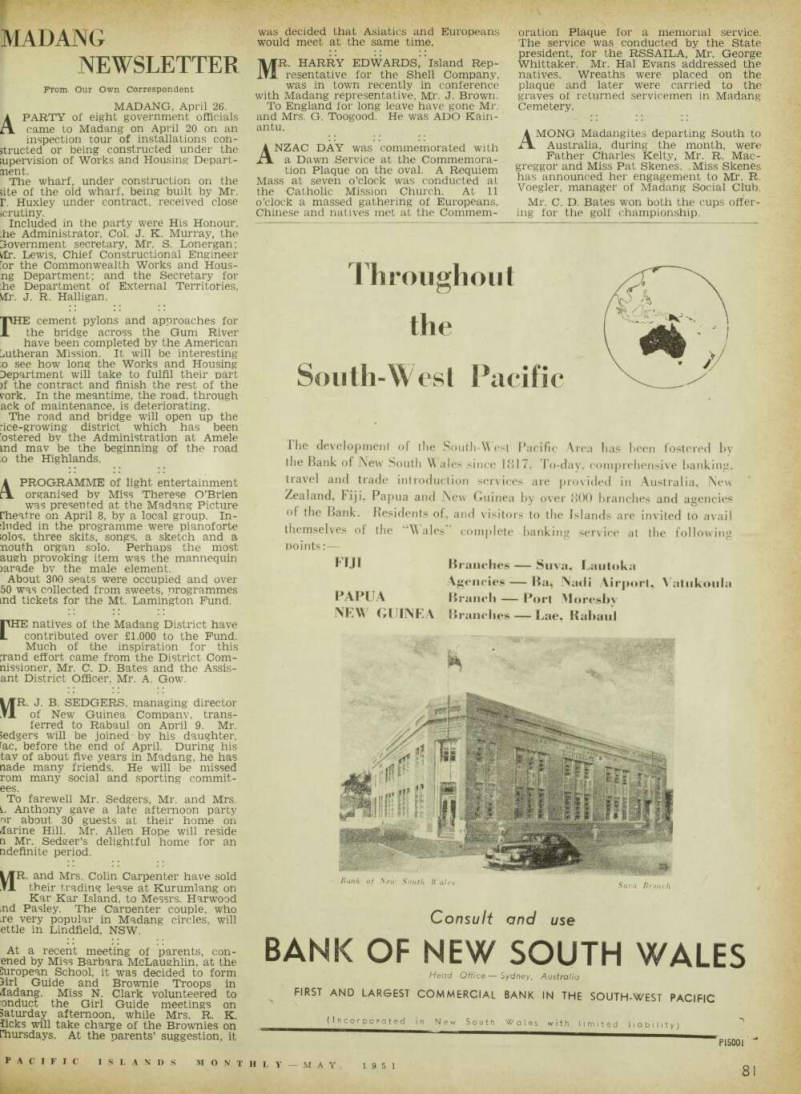
Newsletter
Prom Our Own Correspondent MADANG, April 26.
A PARTY of eight government officials came to Madang on April 20 on an inspection tour of installations con structed or being constructed under the supervision of Works and Housing Depart ment.
The wharf, under construction on the site of the old wharf, being built by Mr. r. Huxley under contract, received close scrutiny.
Included in the party were His Honour. ;he Administrator, Col. J. K. Murray, the jovernment secretary, Mr. S. Lonergan; ilr. Lewis, Chief Constructional Engineer :or the Commonwealth Works and Hous ng Department; and the Secretary for she Department of External Territories, Vlr. J. R. Halligan. rHE cement pylons and approaches for the bridge across the Gum River have been completed by the American Lutheran Mission. It will be interesting ,o see how long the Works and Housing- Department will take to fulfil their part )f the contract and finish the rest of the vork. In the meantime, the road, through ack of maintenance, is deteriorating.
The road and bridge will open up the :ice-growing district which has been pstered bv the Administration at Amele ind mav be the beginning of the road ,o the Highlands.
A PROGRAMME of light entertainment organised by Miss Therese O’Brien was presented at the Madang Picture rheatre on April 8, by a local group. In :lnded in the programme were pianoforte lolos. three skits, songs, a sketch and a mouth organ solo. Perhaps the most augh provoking item was the mannequin )arade bv the male element.
About 300 seats were occupied and over 50 was collected from sweets, programmes md tickets for the Mt. Lamington Fund. rHE natives of the Madang District have contributed over £l.OOO to the Fund.
Much of the inspiration for this ;rand effort came from the District Com nissioner, Mr. C. D. Bates and the Assis ant District Officer, Mr. A. Gow.
IJ’R. J. B. SEDGERS, managing director .▼1 of New Guinea Company, trans ferred to Rabaul on April 9. Mr. ledgers will be joined by his daughter, fac, before the end of April. During his tay of about five years in Madang, he has nade many friends. He will be missed rom many social and sporting commit ees.
To farewell Mr. Sedgers, Mr. and Mrs.
L Anthony gave a late afternoon party or about 30 guests at their home on Marine Hill. Mr. Allen Hope will reside n Mr. Sedger’s delightful home for an ndefinite period.
M’R. and Mrs. Colin Carpenter have sold .*1 their trading lease at Kurumlang on Kar Kar Island, to Messrs. Harwood md Pasley. The Carpenter couple, who ,re very popular in Madang circles, will ettle in Lindfield, NSW.
At a recent meeting of parents, con ened by Miss Barbara McLaughlin, at the European School, it was decided to form Mrl Guide and Brownie Troops in Madang. Miss N. Clark volunteered to onduct the Girl Guide meetings on Saturday afternoon, while Mrs. R. K. licks will take charge of the Brownies on rhursdays. At the parents’ suggestion, it
was decided that Asiatics and Europeans would meet at the same time. :: :: :: MR. HARRY EDWARDS, Island Representative for the Shell Company, was in town recently in conference with Madang representative, Mr. J. Brown.
To England for long leave have gone Mr. and Mrs. G. Toogood. He was ADO Kainantu ' ..
ANZAC DAY was’ commemorated with a Dawn Service at the Commemoration Plaque on the oval. A Requiem Mass at seven o’clock was conducted at the Catholic Mission Church. At 11 o’clock a massed gathering of Europeans, Chinese and natives met at the Commem-
oration Plaque for a memorial service, The service was conducted by the State president, for the RSSAILA, Mr. George Whittaker. Mr. Hal Evans addressed the natives. Wreaths were placed on the plaque and later were carried to the graves of returned servicemen in Madang Cemetery, ;; ;: ;: A MONG Madangites departing South to Australia darin S the month, were ther Cha lde s Kelty, Mr. R. Mac greggor and Miss Pat Skenes. Miss Skenes as announced her engagement tp Mr. R.
Voegler, manager of Madang Social Club, Mr. C. D. Bates won both the cups offer ing for the golf championship.
Advertisements & other items, pp. 83-84 (1 item)
Throughout
the
South-West Pacific
K Ftie development of the South-West Pacific Area has been fostered bv the Bank of New South Wales since 1817. To-day, comprehensive banking, travel and trade introduction services are provided in Australia, New Zealand, Fiji, Papua and New Guinea by over 800 branches and agencies of the Bank. Residents of, and visitors to the Islands are invited to avail themselves of the ‘’Wales" complete banking service at the following points:— FIJI Branches Suva, Lautoka Agencies Ha, Nadi Airport, Vatukoula PAPUA Branch Port Moresby NEW GUINEA Branches Lae, Bahaul Bank of New South Wales Suin Brunch
Consult and use
BANK OF NEW SOUTH WALES
Head Office Sydney. Australia FIRST AND LARGEST COMMERCIAL BANK IN THE SOUTH-WEST PACIFIC Pl5OOl
TAKE YOUR CHOICE ..
. From this list of quality canned foods. Packed by the largest meat-processing company in Australia, the Imperial label brings you the Quality meats, i \ right to your table —tasty hot meals and cold meats ready for any occasion. Stock up with Imperial, the Flavour Sealed Quality Foods. if m?. m i
HOT PACKS.
SAUSAGES.
16-oz. Beef Steak Pudding. \ 16-oz. Beef Sausages, 16-oz. Steak & Kidney Pud-\ 16-oz. Oxford Sausages, ding. \ 16-oz. Cambridge Sausages 12-oz. Meat & Beans. \ 16-oz. Pork Sausages. 16-oz. Sausages & Vegetables. \ io-oz. Vienna Sausages 12-oz. Savourie 4-oz. Meat and Spaghetti. ★
COLD MEATS.
12-oz. Trim (Pork & Beef). 12-oz. Camp Pie. 12-oz. Meatreat. 12-oz. Corned Beef W/C. 12-oz. Taper Corned Beef. 6-lb. Taper Corned Beef % W/C. 6-lb. Taper Corned Beef.
JL 4-oz. Hampe. % 4-oz. Beef Snack. % 3i-oz. Pate de Foie. ★
SOUPS.
8-oz. Tomato Soup. 8-oz. Clear Beef Soup. ★
TONGUES.
12-oz. Sheep Tongues. 12-oz. Lamb Tongues. 12-oz. Calves Tongues. 6-lb. Ox Tongues. 2-lb. Ox Tongues. % Moz 12 07.
'f < ' . .
DRIPPING & LARD.
-lb. tins Lard. tins Dripping. 3. Dripping.
MARGARINE.
56-lb. Boxes Cake Margarine. 56-lb. Boxes Pastry garine.
Mar-
CANNED FISH.
Flair Fish Cutlets.
Flair Fish Cutlets.
Flair Fish Cutlets. -oz. Flair Squab in Aspic oz. Flair Fish Paste. -oz. Flair Scallop cheon.
RIVERMEDE” BUTTER.
56-lb. Boxes Bulk Butter. 16-oz. Pats Butter.
J-lb. Pats Butter. 12-oz. Tins Butter. 16-oz. Tins Butter.
Lun-
MILDURA FRUIT
JUICES.
16-oz. Grapefruit Juice. 16-oz. Orange Juice.
SWEET PUDDINGS.
16 oz. Plum Pudding. 12-oz. Jam Pudding. 12-oz. Chocolate Pudding. 12-oz. Ginger Pudding. ★
CANNED FRUITS.
30-oz. Cherries. 20-oz. Raspberries. 20-oz. Gooseberries. 20-oz. Loganberries. \ ":• * >. . : .W ; - >X ’.v
RIVERSTONE MEAT CO. PTY.
LTD.
;■»: 5-7 O'CONNELL STREET, SYDNEY
Ambrym Volcano In Eruption
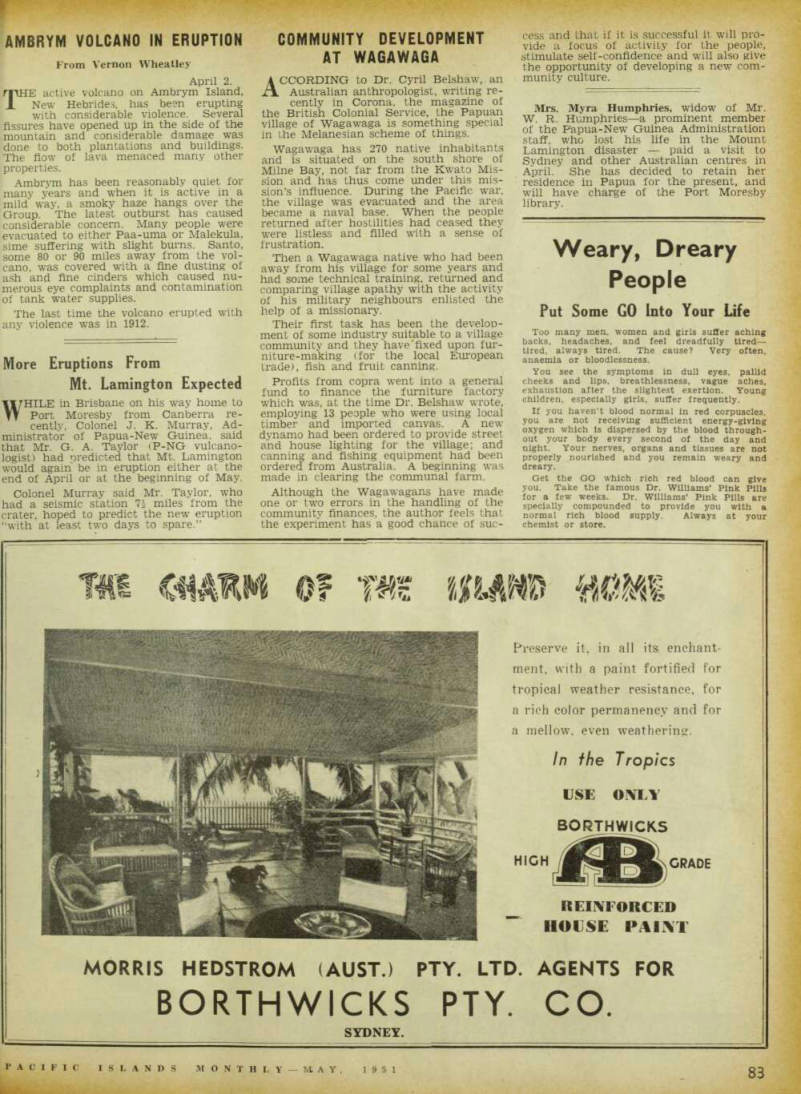
From Vernon Wheatley April 2.
THE active volcano on Ambrym Island, New Hebrides, has been erupting with considerable violence. Several fissures have opened up in the side of the mountain and considerable damage was done to both plantations and buildings.
The flow of lava menaced many other properties.
Ambrym has been reasonably quiet for many years and when it is active in a mild way, a smoky haze hangs over the Group. The latest outburst has caused considerable concern. Many people were evacuated to either Paa-uma or Malekula, sime suffering with slight burns. Santo, some 80 or 90 miles away from the vol cano, was covered with a fine dusting of ash and fine cinders which caused nu merous eye complaints and contamination of tank water supplies.
The last time the volcano erupted with any violence was in 1912.
Mt. Lamington Expected
More Eruptions From Mt. Lamington Expected
WHILE in Brisbane on his way home to Port Moresby from Canberra re cently, Colonel J. K. Murray, Ad ministrator of Papua-New Guinea, said that Mr. G. A. Taylor (P-NG volcano logist) had predicted that Mt. Lamington would again be in eruption either at the end of April or at the beginning of May.
Colonel Murray said Mr. Taylor, who had a seismic station 71 miles from the crater, hoped to predict the new eruption “with at least two days to spare.”
Community Development
At Wagawaga
ACCORDING to Dr. Cyril Belshaw, an Australian anthropologist, writing re cently in Corona, the magazine of the British Colonial Service, the Papuan village of Wagawaga is something special in the Melanesian scheme of things.
Wagawaga has 270 native inhabitants and is situated on the south shore of Milne Bay, not far from the Kwato Mis sion and has thus come under this mis sion’s influence. During the Pacific war, the village was evacuated and the area became a naval base. When the people returned after hostilities had ceased they were listless and filled with a sense of frustration.
Then a Wagawaga native who had been away from his village for some years and had some technical training, returned and comparing village apathy with the activity of his military neighbours enlisted the help of a missionary.
Their first task has been the develop ment of some industry suitable to a village community and they have*fixed upon fur niture-making (for the local European trade), fish and fruit canning.
Profits from copra went into a general fund to finance the furniture factory which was, at the time Dr. Belshaw wrote, employing 13 people who were using local timber and imported canvas. A new dynamo had been ordered to provide street and house lighting for the village; and canning and fishing equipment had been ordered from Australia. A beginning was made in clearing the communal farm.
Although the Wagawagans have made one or two errors in the handling of the community finances, the author feels that the experiment has a good chance of suc
cess and that if it is successful it will pro vide a focus of activity for the people, stimulate self-confidence and will also give the opportunity of developing a new com munity culture.
Mrs. Myra Humphries, widow of Mr.
W. R. Humphries—a prominent member of the Papua-New Guinea Administration staff, who lost his life in the Mount Lamington disaster paid a visit to Sydney and other Australian centres in April. She has decided to retain her residence in Papua for the present, and will have charge of the Port Moresby library.
Advertisements & other items, p. 85 (1 item)
vmm mi
Weary, Dreary
People
Put Some GO Into Your Life
Too many men, women and girls suffer aching backs, headaches, and feel dreadfully tired — tired, always tired. The cause? Very often, anaemia or bloodlessness.
You see the symptoms in dull eyes, pallid cheeks and lips, breathlessness, vague aches, exhaustion after the slightest exertion. Young children, especially girls, suffer frequently.
If you haven’t blood normal in red corpuscles, you are not receiving sufficient energy-giving oxygen which Is dispersed by the blood throughout your body every second of the day and night. Your nerves, organs and tissues are not properly nourished and you remain weary and dreary.
Get the GO which rich red blood can give you. Take the famous Dr. Williams’ Pink Pills for a few weeks. Dr. Williams’ Pink Pills are specially compounded to provide you with a normal rich blood supply. Always at your chemist or store.
•ms l
vmm mi
■ n Preserve it, in all its enchantment, with a paint fortified for tropical weather resistance, for a rich color permanency and for a mellow, even weathering.
In the Tropics
USE OMY
HIGH
BORTHWjCKS
GRADE
REINFORCED
HOUSE PAINT
MORRIS HEDSTROM (AUST.) PTY, LTD. AGENTS FOR
BORTHWICKS PTY. CO.
SYDNEY.
Imperial Institute
New Colony Exhibits At
THE four galleries of the Imperial In stitute in London, which contain ex hibits from all countries within the Colonial Empire, have been completely re organised and refurbished for the opening of the Festival of Britain in May.
The Fiji Court has been completely re novated and Mr. G. K. Roth of the Fiji Administration and Mrs. Roth, have given much valuable time in planning and ob taining exhibits for the new displays. Un der the guidance of Mrs. Roth, the Fijian house has been cleaned and renovated and furnished with scale models including the figures of a Fijian family, seated at a
meal. A large additional showcase has been devoted to agricultural products of Fiji and a small wall case holds a special display of historic documents and other small exhibits. The Fiji Public Relations office has supplied recent photographs of scenery and life in Fiji.
In comparison with the scale on which things are being done to present Fiji to the thousands of visitors who are expected to visit the Institute in the coming Euro pean summer, the Institute annual report states that “a small collection of weapons, formed by the late Mr. W. H. Ray, in New Guinea, has been received for display in the Court.” Surely Papua-New Guinea could have done better than that.
Madame Maillot, a 94-year-old widow, was a victim of the recent cyclone floods in New Caledonia, almost the day after her relatives had crowded round to cele brate her birthday. The Tontouta River at her door rose so rapidly that the waters invaded her dwelling and carried her off on a mattress. She caught hold of a gaiac bush while her son and another re lative, Madame de Casabianca. in almost as great difficulties as herself, attempted in vain to save her. Her body was after wards recovered.
Captain Georges Cabanier, who was one of the members of d’Argenlieu’s much-hated wartime staff in New Cale donia, has been promoted Rear-Admiral.
He was one of the French officers whom the Caledonian crowd “arrested” at Noumea radio station during the distur bances aroused by d’Argenlieu’s arrest of several of Noumea’s leading citizens, whom he sent as hostages to Walpole Island. Cabanier was then a submarine officer with a good war record.
Advertisements & other items, p. 86 (1 item)
Merchants
TRADE
MARK
BARDINET
N \3STRAII4/v
RUM
THIS LABEL MEANS
Agents:
SWIFT AND HORNDALE
PTY. LTD.
26 CLARENCE STREET
SYDNEY AUSTRALIA
V.
I
Mmw
— S’. uttieoy
WHOLESALE
MERCHANTS
\9S 9 \\\
GENERAL AGENTS
o o 9 C o 0 o^°r, 9 c* C° CO* ►*! *9
te*s
or 6 r* 9 iA^ p I* o c tVV VV> A
• FORWARDING. SHIPPING fi CUSTOMS AGENTS
The Evaleeta
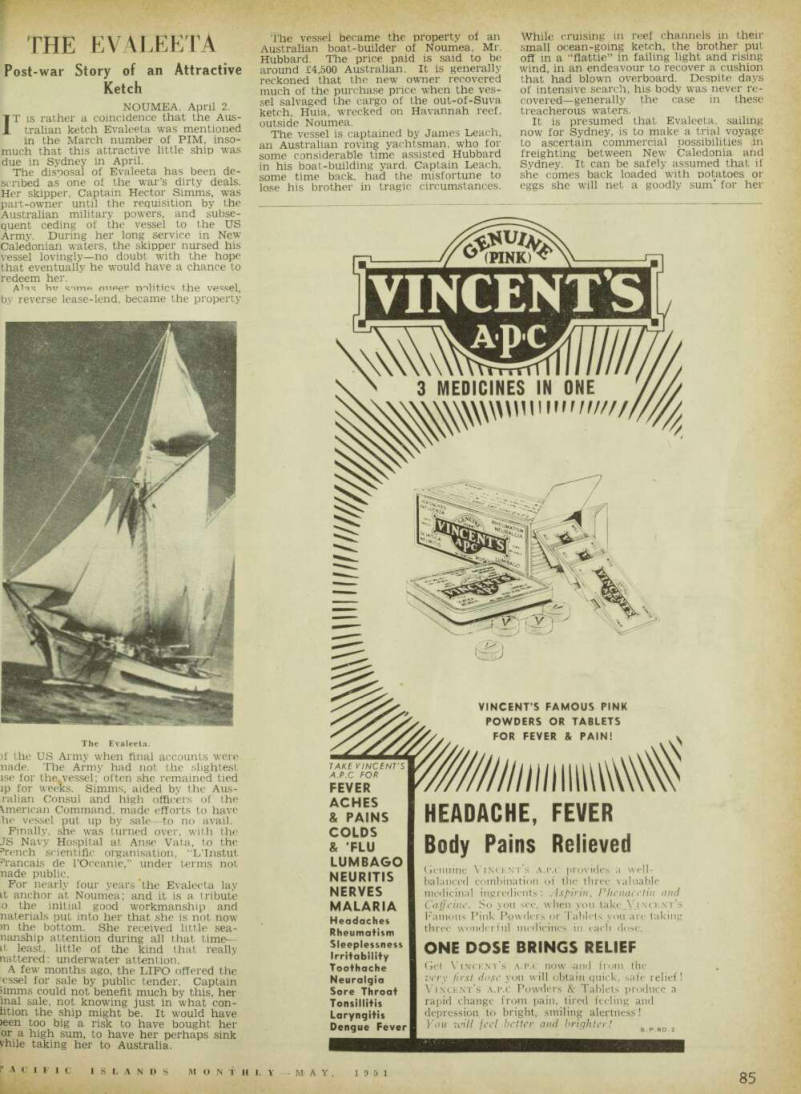
Post-war Story of an Attractive Ketch
NOUMEA, April 2.
IT is rather a coincidence that the Aus tralian ketch Evaleeta was mentioned in the March number of PIM, inso much that this attractive little ship was due in Sydney in April.
The disposal of Evaleeta has been de scribed as one of the war’s dirty deals.
Her skipper. Captain Hector Simms, was part-owner until the requisition by the Australian military powers, and subse quent ceding of the vessel to the US Army. During her long service in New Caledonian waters, the skipper nursed his vessel lovingly—no doubt with the hope that eventually he would have a chance to redeem her. bv nnpe*’ mlitics the vessel, by reverse lease-lend, became the property
)f the US Army when final accounts were nade. The Army had not the slightest ise for the* vessel; often she remained tied ip for wee Ks. Simms, aided by the Aus ralian Consul and high officers of the American Command, made efforts to have he vessel put up by sale—to no avail.
Finally, she was turned over, with the JS Navy Hospital at Anse Vata, to the French scientific organisation, “LTnstut ?rancais de I’Oceanie,” under terms not nade public.
For nearly four years 'the Evaleeta lay it anchor at Noumea; and it is a tribute o the initial good workmanship and naterials put into her that she is not now m the bottom. She received little sea nanship attention during all t hat time— it least, little of the kind (hat really nattered: underwater attention.
A few months ago, the LIFO offered the essel for sale by public tender. Captain >imms could not benefit much by this, her inal sale, not knowing just in what con lition the ship might be. It would have >een too big a risk to have bought her or a high sum, to have her perhaps sink vhile taking her to Australia.
The vessel became the property of an Australian boat-builder of Noumea, Mr.
Hubbard. The price paid is said to be around £4,500 Australian. It is generally reckoned that the new owner recovered much of the purchase price when the vessel salvaged the cargo of the out-of-Suva ketch, Huia, wrecked on Havannah reef, outside Noumea.
The vessel is captained by James Leach, an Australian roving yachtsman, who for some considerable time assisted Hubbard in his boat-building yard. Captain Leach, some time back, had the misfortune to lose his brother in tragic circumstances.
While cruising in reef channels in their small ocean-going ketch, the brother put off in a “flattie” in failing light and rising wind, in an endeavour to recover a cushion that had blown overboard. Despite days of intensive search, his body was never re covered—generally the case in these treacherous waters.
It is presumed that Evaleeta, sailing now for Sydney, is to make a trial voyage to ascertain commercial possibilities in freighting between New Caledonia and Sydney. It can be safely assumed that if she comes back loaded with potatoes or eggs she will net a goodly sum for her
The Evaleeta.
owners, as these two items ai*e extremely rare at present. Eggs sell for 110 francs per dozen, with the Australian pound at 140. (Editorial Note: If the Evaleeta could carry potatoes and eggs to Sydney she would do better than in carrying them away. Potatoes are as rare as are teeth in the hens that produce the rare eggs!
Advertisements & other items, pp. 87-88 (2 items)
85
ACI F I C ISLANDS MONTHLY MAY, 1951
Iiiiil
' 3 MEDICINES IN ONE
XWWWWWW \ 111111I I 111///
mm w
% m a ??&o
VINCENT S FAMOUS PINK
POWDERS OR TABLETS
TAKE VINCENT'S
A.P.C FOR
FEVER
ACHES
& PAINS
COLDS
& FLU
LUMBAGO
NEURITIS
NERVES
MALARIA
Headaches Rheumatism Sleeplessness Irritability Toothache Neuralgia Sore Throat Tonsillitis Laryngitis Dengue Fever
tFOR FEVER & PAIN! v
HEADACHE, FEVER
Body Pains Relieved
Genuine V intent's a.p.c provides a wellbalanced combination of the three valuable medicinal ingredients: Aspirin, Phcuacctin and Caffeine. So you see, when you take JVincent’s Famous Pink Powders or Tablets you are taking three wonderful medicines in each dose.
ONE DOSE BRINGS RELIEF
Get Vincent’s a.p.c now and from the very frsl dose you will obtain quick, safe relief!
Vincent’s a.p.c Powders & Tablets produce a rapid change from pain, tired feeling and depression to bright, smiling alertness !
You will feel better and brighter!
A. H. BUNTING LIMITED
SAMARAI PAPUA
Branches at: MISIMA, TUFI, ORO BAY, SOPUTA.
SAMARAI AGENTS FOR:
Vacuum Oil Co. Pty., Ltd.
South British Insurance Co.
National Mutual Life Association
SOLE AGENTS IN PAPUA/NEW GUINEA FOR:
Polarizers (U.K.), Ltd.—Polaroid Sun Glasses.* C.S.A. Industries, Eng.—Dual Freeze Refrigerators.
Webley & Scott, Ltd.—Shot Guns, Air Pistols, etc.
E. K. Cole, Ltd., London.—“Ekco” Radio Receivers.
“Getula.”—Nylon Monofilament Fish Lines.
Davison Paints, Ltd., N.S.W.—Paint for Tropical Conditions. • Trade mark patented in U.S.A., Great Britain, and other countries
REGULAR SUPPLIES OF EASTERN GOODS
WHOLESALE & RETAIL MERCHANTS IMPORTERS PLANTERS
W*i
ORDINARY
KEROSENE
ORDINARY
KEROSENE
A mi
fPWP
He
THE QUEEN” TABLE LAMP
300 CANOLEPOWER
‘‘THE GUARDSMAN” STORM LANTERN
300 CANDLE POWER
“THE VICTOR” HANGING LAMP"
300 CANDLE POWER
REPRESENTATION: . ..
AUSTRALIA £r NEW GUINEA: T. H. Bentley, Pty. Ltd., 123-125 William
Street, Melbourne, C.l.
TASMANIA: Mr. H. V. Sellers, 108 a Charles Street, Launceston.
FIJI: Mr. K. Witherington, 2 Burns Philp Buildings, Suva.
Dirty Little Bank Notes
Strong Protest From French Oceania
a RESIDENT of French Oceania sends A us a packet of extremely bat tered and bedraggled bank-notes; ind, in terms of great anger and indigna iion, asks why the people of the French erritories should be forced to handle ‘this filthy and disease-laden stuff” by ‘that soulless monopoly, the Banque de indochine.”
Our correspondent sends us two 2-franc ind one 20-franc notes; and we must ad nit that they are in the last stages of lirt and disintegration.
“We daily have seen the butcher carv ng a joint; and then, to give change, lauling off two or three notes for us. We lave seen the baker doing the same thing. !n the one case, one boils the meat and he dirt, and renders it harmless; but in he case of the bread, one eats the germs •aw!”
He adds that in October they had a vide epidemic of grippe; in January an mtbreak of measles; and now they were acing a suspected epidemic of polio.
“We are officially advised to do all kinds >f things to preserve cleanliness,” he says. ‘But there is not one word about the nenace of disease being carried by these mtrid banknotes. . . . This condition of iff airs should be brought under the notice >f the health section of the South Paci ic Commission.”
The Banque de Indochine cannot be )lamed for the condition of the bank lotes; but it might be worth while inquir ng as to who is responsible for the issue if banknotes of sucn absurdly small de lominations A Pacific franc is worth less han 2d. Australian; and no properly con rolled currency should have paper tokens if a lesser face value than 5/-. Amounts if less than 5/- move very rapidly in a rading population, and even the best iaper (and the paper of the French bank’s lotes is not very good) will not stand up o the wear and tear. Nearly all countries lave coins of cheap metal as tokens of mall value, and—even if the coins collect ome dirt in the same way as paper—they ;ertainly do not appear dirty, and they lo not become dilapidated.
Death Of Mr. D. Mcevoy
rvN April 21 the tragic death occurred in LF Madang, New Guinea, of Mr. Dave McEvoy. Mr. and Mrs. McEvoy and heir two chiltren arrived in Madang from about three months ago when Mr.
McEvoy joined the Huxley Construction oam on the new wharf.
Requiem Mass was said at the Roman Catholic Mission before the cortege pro ;eeded to the cemetery where he was juried with military honours before a arge representative gathering.
Mrs. McEvoy was Miss Pat Gilmore be ore her marriage. Her parents, Mr. and tfrs. J. Gilmore, flew from Rabaul by ipecial plane to be with her.
Many tributes and cables were sent from riends all over the Territory.
Mr. McEyoy was born in the Territory, lad a brilliant war record before he be came a prisoner-of-war.
Geologist Dies
DR. ARTHUR WADE. 72, who died in the surf at Mermaid Beach (South Coast Queensland) recently, did ex ploratory work in Papua for oil in 1913- 1914 on behalf of the Commonwealth Government.
Sites which he then indicated as suit able for oil drilling in Papua, were re cognised last year as the best sites for drilling in that area.
In 1933 he did similar work in West Australia for a private company.
A former chairman of the Common wealth Oil Advisory Committee, Dr.
Wade had a life-long interest in the search for oil all over the world. He had lived in Brisbane since 1940 and was con sultant geologist for Shell (Q.) Develop ment Pty. Ltd., until his death.
National Parks For Papua-
N. Guinea
a t the April meeting of the Queensland J\ Na tional Parks’ Association held in Brisbane, the president (Mr. Leahy) said that the Association would like to see certain areas set aside in New Guinea as National Parks Reserves, That territory, the speaker pointed out, possessed large areas of natural beauty, and afforded a life-long study for botanists, geologists and other scientists. no further time, the president said, should be lost in making the necessary re presentations to the Federal Government.
The suggestion, the president an nounced, would probably be discussed in Brisbane during May by the Australian and New Zealand Association for the ad vancement of science.
Advertisements & other items, p. 89 (1 item)
Pimples and Bad Skin
Scott’s “Renown” Brand Rope,
Cordage and
Binder
Twine
Cable Address: Ropeyard Sydney. -IsSs SS 8 *
of Every
Description
MANUFACTURED AT
MASCOT, N.S.W.
By
J. SCOTT
PTY. LTD.
Head Office and Store
163 CLARENCE STREET,
SYDNEY,
N.S.W.
Pimples and Bad Skin Attacked In 24 Hours
Since the discovery of Nixoderm, the scientific medicine, it is no longer necessary for anyone to suffer from ugly, disgusting and disfiguring skin blemishes such as Pimples, Rash, Ringworm, Psoriasis, Acne, Blackheads, Scabies and Red Blotches. Don't let a bad skin make you feel inferior and cause you to lose your friends. Clear your skin this new scientific way.
A New Discovery
Nixoderm is an ointment, but different from any ointment you have ever seen or felt. It is a new discovery, and is not greasy but feels almost like a powder when you apply it. It penetrates rapidly into the pores and fights the cause of surface skin blemishes.
Nixoderm contains 9 ingredients which fight skin troubles in these 3 ways ; 1.
It fights and k 11s the microbes or parasites often w./sponsible for skin disorders. 2. It stops itching, burning and smarting in 7 to 10 minutes, and cools and soothes the skin. 3. It helps nature heal the skin clear, soft and velvety smooth.
Works Fast
Because Nixoderm is scientifically compounded to fight skin troubles, it works fast. It stops the itching, burning and smarting in a few minutes, then starts to work immediately, clearing and healing your skin, making it softer, whiter and velvety smooth. In
just a day or two your mirror will tell you that here at last is the scientific treatment you have been needing to clear your skin the treatment to make you look more attractive, to help you win friends. Nixoderm has brought clearer, healthier skins to thousands such as Mr. Bob Weedon, Edmund Street, Fremantle, who writes: “I was troubled with pimples ever since I was 13, and have spent pounds' and pounds on so-called cures without results. I then tried Nixoderm with astounding effect. The pimples seemed to fade away, and after a week there was not the slightest trace of them.”
Satisfaction Guaranteed
Get Nixoderm from your chemist or store to-day. Look in the mirror in the morning and you will be amazed at the improvement. Then just keep on using Nixoderm for one week and at the end of that time It must have made your skin soft, clear, smoo,h and magnetically attractive —must give you the kind of skin that will make you admired wherever you go, or you simply return the empty package and your money will be refunded in full. Get Nixoderm from your chemist or store to-day. The guarantee protects you.
Nixoderm
For Skin Sores, Pimples and Itch.
Valuable Copra
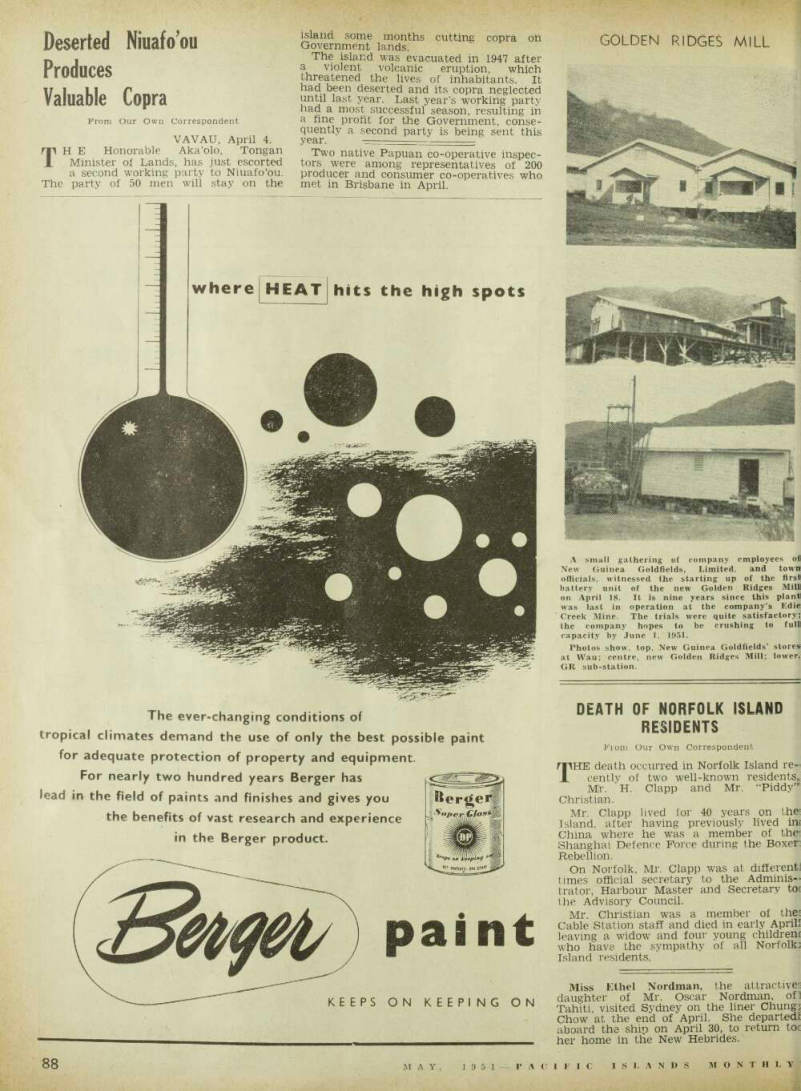
Deserted Niuafo’ou Produces Valuable Copra
From Our Own Correspondent VAVAU, April 4.
H E Honorable Aka’olo, Tongan Minister of Lands, has just escorted a second working party to Niuafo’ou.
The party of 50 men will stay on the
island some months cutting copra oh Government lands.
The island was evacuated in 1947 after a violent volcanic eruption, which threatened the lives of inhabitants. It had been deserted and its copra neglected until last year. Last year’s working party had a most successful season, resulting in a fine profit for the Government, conse quently a second party is being sent this year.
Two native Papuan co-operative inspec tors were among representatives of 200 producer and consumer co-operatives who met in Brisbane in April.
Golden Ridges Mill
A small gathering of company employees of New Guinea Goldfields, Limited, and town officials, witnessed the starting up of the first battery unit of the new Golden Ridges Milll on April 18. It is nine years since this plant was last in operation at the company’s Edie Creek Mine. The trials were quite satisfactory; the company hopes to be crushing to full capacity by June 1, 1951.
Photos show, top, New Guinea Goldfields’ stores at Wau; centre, new Golden Ridges Mill; lower, GR sub-station.
Death Of Norfolk Island
Residents
From Our Own Correspondent THE death occurred in Norfolk Island re cently of two well-known residents,, Mr. H. Clapp and Mr. “Piddy”' Christian.
Mr. Clapp lived for 40 years on thee Island, after having previously lived inr China where he was a member of thee Shanghai Defence Force during the Boxen Rebellion.
On Norfolk, Mr. Clapp was at different! times official secretary to the Adminis trator, Harbour Master and Secretary toe the Advisory Council.
Mr. Christian was a member of the£ Cable Station staff and died in early April! leaving a widow and four young children! who have the sympathy of all Island residents.
Miss Ethel Nordman, the attractives daughter of Mr. Oscar Nordman. ofl Tahiti, visited Sydney on the liner Chungs Chow at the end of April. She departed* aboard the ship on April 30, to return toe her home in the New Hebrides.
Advertisements & other items, p. 90 (1 item)
paint
where
HEAT
hits the high spots
"5^ The ever-changing conditions of tropical climates demand the use of only the best possible paint for adequate protection of property and equipment For nearly two hundred years Berger has lead in the field of paints and finishes and gives you the benefits of vast research and experience in the Berger product.
Hergei
O-l* up m
paint
PS ON KEEPING ON
School, Mrs. Worthington!
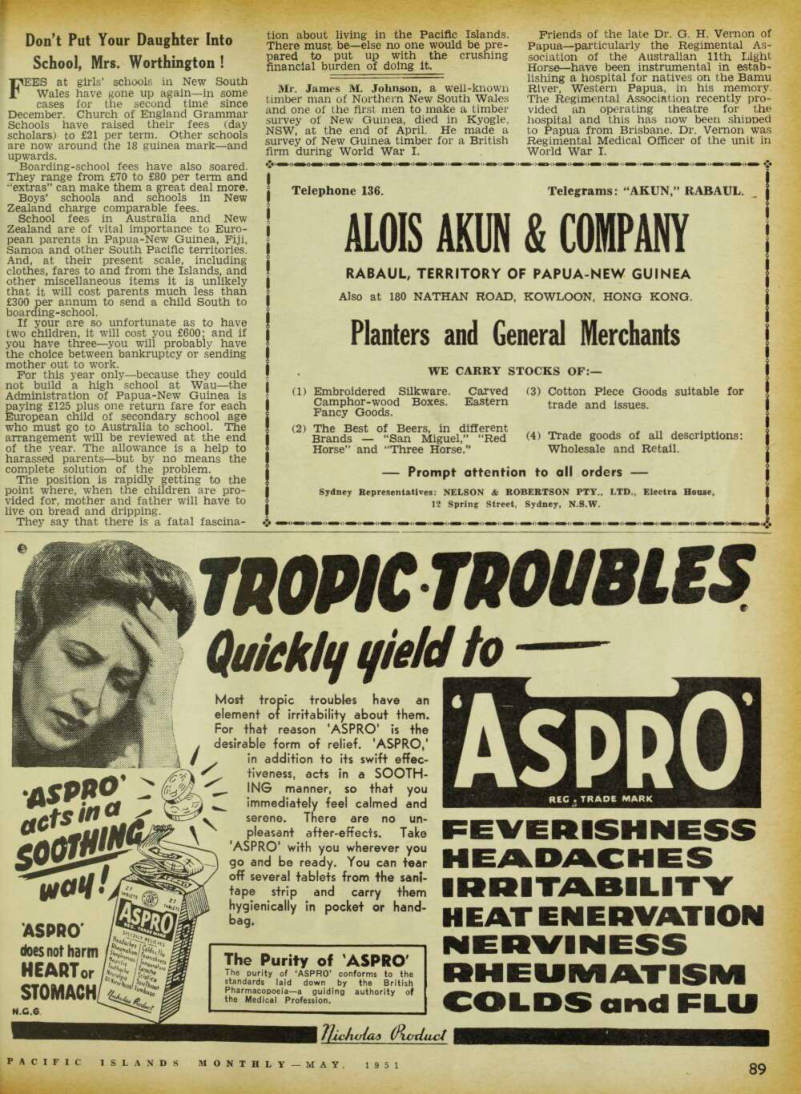
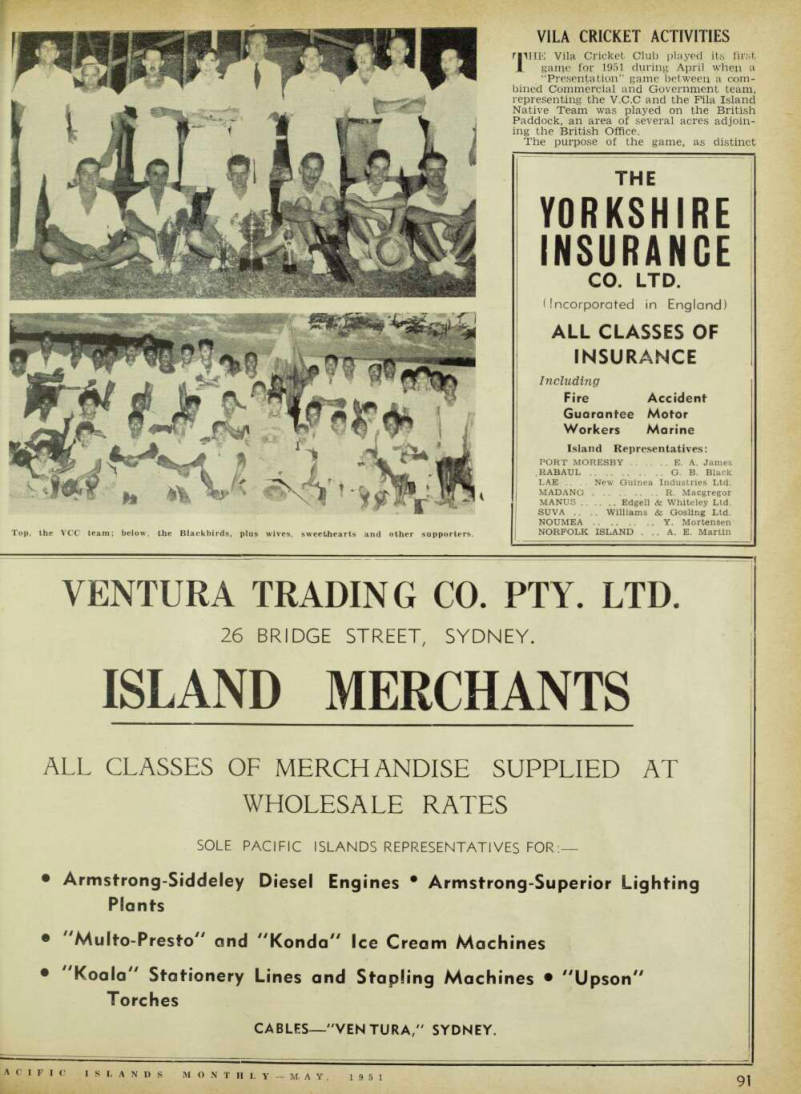
Don't Put Your Daughter Into School, Mrs. Worthington!
FEES at girls’ schools in New South Wales have gone up again—in some cases for the second time since December. Church of England Grammar Schools have raised their fees (day scholars) to £2l per term. Other schools are now around the 18 guinea mark—and upwards.
Boarding-school fees have also soared.
They range from £7O to £BO per term and “extras” can make them a great deal more.
Boys’ schools and schools in New Zealand charge comparable fees.
School fees in Australia and New Zealand are of vital importance to Euro pean parents in Papua-New Guinea, Fiji, Samoa and other South Pacific territories.
And, at their present scale, including clothes, fares to and from the Islands, and other miscellaneous items it is unlikely that it will cost parents much less than £3OO per annum to send a child South to boarding-school.
If your are so unfortunate as to have two children, it will cost you £6OO- and if you have three—you will probably have the choice between bankruptcy or sending mother out to work.
For this year only—because they could not build a high school at Wau —the Administration of Papua-New Guinea is paying £125 plus one return fare for each European child of secondary school age who must go to Australia to school. The arrangement will be reviewed at the end of the year. The allowance is a help to harassed parents—but by no means the complete solution of the problem.
The position is rapidly getting to the point where, when the children are pro vided for, mother and father will have to live on bread and dripping.
They say that there is a fatal fascina
tion about living in the Pacific Islands.
There must be —else no one would be pre pared to put up with the crushing financial burden of doing It.
Mr. James M. Johnson, a well-known timber man of Northern New South Wales and one of the first men to make a timber survey of New Guinea, died in Kyogle, NSW, at the end of April. He made a survey of New Guinea timber for a British firm during World War I.
Friends of the late Dr. G. H. Vernon of Papua—particularly the Regimental As sociation of the Australian 11th Light Horse —have been instrumental in estab lishing a hospital for natives on the Bamu River, Western Papua, in his memory.
The Regimental Association recently pro vided an operating theatre for the hospital and this has now been shipped to Papua from Brisbane. Dr. Vernon was Regimental Medical Officer of the unit in World War I.
Top, the VCC team; below, the Blackbirds, plus wives, sweethearts and other supporters.
Advertisements & other items, pp. 91-92 (1 item)
AsprO
Telephone 136. Telegrams: “AKUN” RABAUL.
ALOIS AKUN S COMPANY
RABAUL, TERRITORY OF PAPUA-NEW GUINEA
Also at 180 NATHAN ROAD, KOWLOON, HONG KONG.
Planters and General Merchants
(1) Embroidered Silkware.
Camphor-wood Boxes.
Fancy Goods. (2) The Best of Beers, in different Brands “San Miguel,” “Red Horse” and “Three Horse.” (3) Cotton Piece Goods suitable for trade and issues. (4) Trade goods of all descriptions: Wholesale and Retail.
WE CARRY STOCKS OF:—
Carved Eastern Prompt attention to all orders Sydney Representatives: NELSON & ROBERTSON PTY., LTD,, Electra House, 12 Spring Street, Sydney, N.S.W.
aspb°
tsi» a
eQ($O
V
i aw
ASPRO
does not harm
HEARTor
STOMACH
Jh »0 Is*#, N.C.6
TMPICTPOUBLCS
Quick! if ifield to
have an Most tropic troubles element or irritability about them For that reason 'ASPRO' is the desirable form of relief. 'ASPRO,' in addition to its swift effectiveness, acts in a SOOTH- ING manner, so that you immediately feel calmed and serene. There are no unpleasant after-effects. Take 'ASPRO' with you wherever you go and be ready. You can tear off several tablets from the sanltape strip and carry them hygienically in pocket or handbag.
The Purity of ASPRO' The purity of ‘ASPRO’ conforms to the standards laid down by the British Pharmacopoeia—a guiding authority of the Medical Profession.
AsprO
REG . TRADE MARK
HEADACHES
IRRITABILITY
HEAT ENERVATION
RHEUMATISM
COLDS and FLU
TJicfuAa a (fxvxlucX
Since the bridge went I've changed to Plume i \ V
VACUUM
PRODUCT
oil 5pS m
fi/ufaf
from the
PLUME
PUMP
Vila Cricket Activities
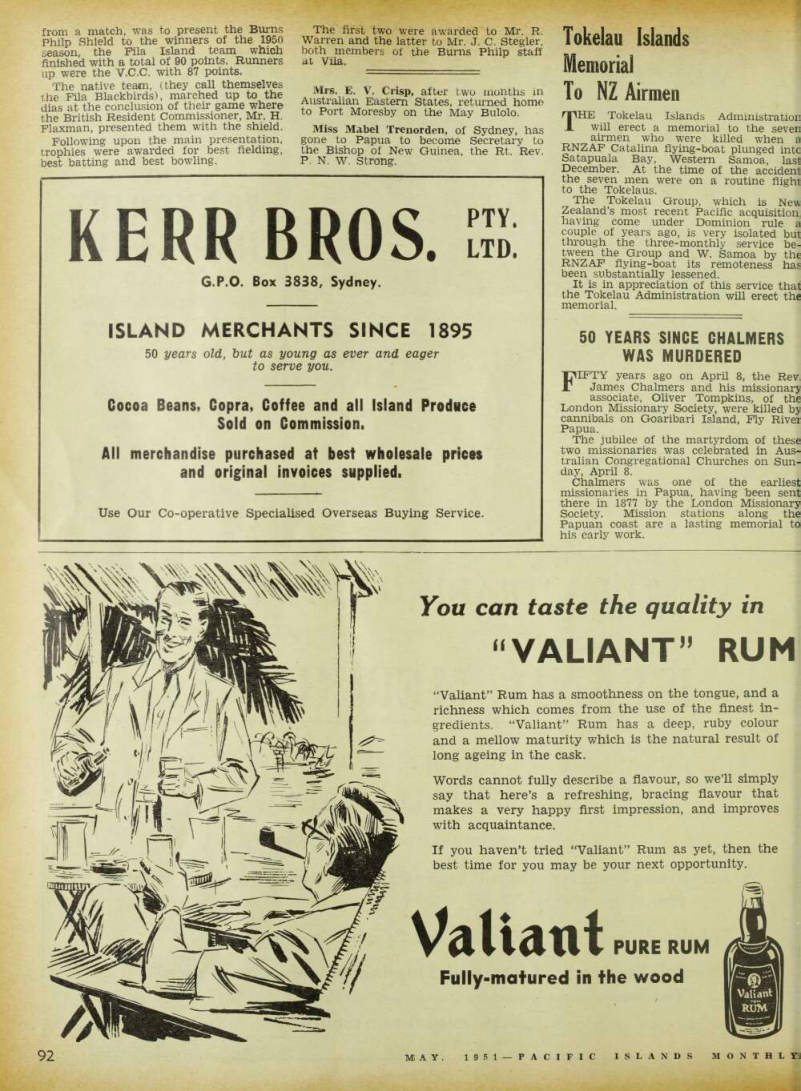
rill IE Vila Cricket Club played its first 1 game for 1951 during April when a “Presentation” game between a com bined Commercial and Government team, representing the V.C.C and the Fila Island Native Team was played on the British Paddock, an area of several acres adjoin ing the British Office.
The purpose of the game, as distinct
from a match, was to present the Burns Philp Shield to the winners of the 1950 season, the Fila Island team which finished with a total of 90 points. Runners up were the V.C.C. with 87 points.
The native team, (they call themselves the Fila Blackbirds), marched up to the dias at the conclusion of their game where the British Resident Commissioner, Mr. H.
Flaxman, presented them with the shield.
Following upon the main presentation, trophies were awarded for best fielding, best batting and best bowling.
The first two were awarded to Mr. R.
Warren and the latter to Mr. J. C. Stegler, both members of the Bums Philp staff at Vila.
Mrs, E. V. Crisp, after two months in Australian Eastern States, returned home to Port Moresby on the May Bulolo.
Miss Mabel Trenorden, of Sydney, has gone to Papua to become Secretary to the Bishop of New Guinea, the Rt. Rev.
P. N. W. Strong.
Advertisements & other items, pp. 93-94 (2 items)
91
acific islands monthly - may, 1951
Island Merchants
THE
YORKSHIRE
INSURANCE
CO. LTD.
(Incorporated in England)
ALL CLASSES OF
INSURANCE
Including Fire Accident- Guarantee Motor Workers Marine Island Representatives;
PORT MORESBY E. A. James
.RABAUL G. B. Black LAE . . . New Guinea Industries Ltd.
MADANG R. Macgregor MANUS Edgell & Whiteley Ltd.
SUVA .. .. Williams & Gosling Ltd.
NOUMEA Y. Mortensen NORFOLK ISLAND . . . A. E. Martin
VENTURA TRADING CO. PTY. LTD.
26 BRIDGE STREET, SYDNEY.
ISLAND MERCHANTS
ALL CLASSES OF MERCHANDISE SUPPLIED AT
WHOLESALE RATES
SOLE PACIFIC ISLANDS REPRESENTATIVES FOR:—
• Armstrong-Siddeley Diesel Engines • Armstrong-Superior Lighting Plants • Multo-Presto" and "Konda" Ice Cream Machines • "Koala" Stationery Lines and Stapling Machines • "Upson"
Torches
CABLES—"VENTURA," SYDNEY.
KERR BROS. S
G.P.O. Box 3838, Sydney.
ISLAND MERCHANTS SINCE 1895
50 years old, hut as young as ever and eager to serve you.
Cocoa Beans, Copra, Coffee and all Island ProdHce Sold on Commission.
All merchandise purchased at best wholesale prices and original invoices supplied.
Use Our Co-operative Specialised Overseas Buying Service.
1 5 ' (<M f 'Os
fWP
; n l . r \ \
Kou can taste the quality in
"VALIANT” RUM
“Valiant” Rum has a smoothness on the tongue, and a richness which comes from the use of the finest ingredients. “Valiant” Rum has a deep, ruby colour and a mellow maturity which is the natural result of long ageing in the cask.
Words cannot fully describe a flavour, so well simply say that here’s a refreshing, bracing flavour that makes a very happy first impression, and improves with acquaintance.
If you haven’t tried “Valiant” Rum as yet, then the best time for you may be your next opportunity.
Valiant
PURE RUM
Fully-matured in the wood
Memorial
Tokelau Islands Memorial To NZ Airmen
THE Tokelau Islands Administratior will erect a memorial to the sever airmen who were killed when a RNZAF Catalina flying-boat plunged intc Satapuala Bay, Western Samoa, lasi December. At the time of the accident the seven men were on a routine flight to the Tokelaus.
The Tokelau Group, which is New Zealand’s most recent Pacific acquisition having come under Dominion rule a couple of years ago, is very isolated but through the three-monthly service be tween the Group and W. Samoa by the RNZAF flying-boat its remoteness has been substantially lessened.
It is in appreciation of this service that the Tokelau Administration will erect the memorial.
Was Murdered
50 Years Singe Chalmers
FIFTY years ago on April 8, the Rev, James Chalmers and his missionary associate, Oliver Tompkins, of the London Missionary Society, were killed by cannibals on Goaribari Island, Fly River Papua.
The jubilee of the martyrdom of these two missionaries was celebrated in Aus tralian Congregational Churches on Sun day, April 8.
Chalmers was one of the earliest missionaries in Papua, having been sent there in 1877 by the London Missionary Society. Mission stations along the Papuan coast are a lasting memorial to his early work.
Advertisements & other items, p. 94 (1 item)
92
Ml A Y . 19 5 1— PACIFIC ISLANDS MONTHLY?
Do Not Trust Them!
Papuan Natives and the Last War
By D. H. Osborne
Mr. D. H. Osborne, of Rossel Island, Eastern Papua, died last October. He was a veteran of Papua, with a sound judgment based on long experience and shrewd observation. He wrote fre quently for the PIM, and, if ever the history of Papua in the first 50 years of this century is compiled, his articles, based on a long memory, will have con siderable value. The following article is the last he ever wrote for us. In it the Old-Timer gives his frank opinion of the natives. f WAS very interested in the article L published in March, 1950, issue— “ Pidgin as it is written.” I receive tiany of those letters myself. It suggests hat the mentality of the natives here nd Buka are much the same.
The native hospitals in charge of tatives are useful for odd cases of rounds, where stitches are needed therwise they are a loafers’ retreat for oung men. Most of the natives grow in dent when not under white supervision, fatives who are really ill do not go to he hospitals—they would rather get in ome dark corner of a house and not be isturbed.
The population of Rossel Island in June, 949, was 1,030. From June, 1949, to June, 950, there were 30 births and 26 deaths. 7hen my brother Frank settled here on Vessel, one woman neighbour had nine hildren. Seven or eight in a family was ommon. Today, few women have more tian three—many have none.
One of the New Australian medical len will be stationed on Misima. The cheme is worth a trial; but I am not ptimistic of the result. Natives are not een on doctors. The trouble will be to nd the patients. The need is an in reased birth rate.
I am afraid Mr. Spender is a political ud. All he can think of is spending tax ayers' money: red tape is increasing, istead of decreasing. This Territory is ecoming overloaded with a Civil Service -no move to stop it. It would be in vesting to know how many natives are ving at the Mission and Government tations, learning to become cadgers and ve on others, instead of fending for lemselves. Not like the old-time natives, ho were of an independent nature.
Last time a Patrol Officer was on .ossel his corporal of police was carry ig his own shot-gun. I have been in >rmed that Misima natives own 34 shot uns. Recently, a Rossel native asked for passage to Misima, when the launch as going there, as he would like to buy shot-gun from the Government. To How natives to have firearms is very >olish. There have been murders in these lands.
Gurio Ready was a young Filipino at le time of Sudest goldrush. He was cook i the schooner Griffen, owned by Harry hristensen (a Dane known as “German arry”). Harry was always agreeable to lowing members of his crew to leave, they forfeited their wages. Gurio be ime a resident of Sudest. He worked )ld, and was fairly lucky. Later, he owned boat and fished for trepang and trochus. is luck was good. He treated the natives Dnestly and was always popular—he /ed to more than 60. After his first wife’s ?ath he married a second time. He was urdered by the natives, near Subara, hen the Japs arrived.
George Burfitt was a half-caste (Aus alian father). George was born near
Sudest. He spent his life about the Cal vadors Chain, and he was murdered at Mutorema.
Another half-caste was murdered on Doini.
The Missionaries at Buna all warned us to be careful as to who we deal with. The civilisation we have taught our natives is only a veneer. If some Asiatic offers them loot and bloodshed, they will come quickly to him.
The Indonesians have given us a warn ing. We should take heed, and keep our powder dry.
Miss Rene Crespin, an Australian palae ontologist, is playing an important part in the search for oil in Papua. In April she flew to the United States where she will do three months research on micro scopic fossils. She has already studied fossils in oil-bearing fields in Java and Sumatra for the purpose of comparison with fossilised rocks in Papua.
Mr. R, R. Sanderson has been appointed legal manager of Loloma (Fiji) Gold Mines N.L. in succession to the late Mr.
H. A. Smith.
Advertisements & other items, pp. 95-96 (2 items)
93
ACIFIC ISLANDS MONTHLY - MAY, 1951
Morris Hedstrom (Australia) Pty. Ltd.
ISLANDS SOUVENIR
“WHERE THE TRADE WINDS BLOW,” by
R. W. Robson and Judy Tudor. —A collection of over 70 fascinating tales and sketches of the South Pacific Islands, by PIM writers, R.
W. Robson and Judy Tudor; well bound and profusely illustrated. 175 pages. Price: 7/6 (8/3 posted or $l.OO U.S. currency) per copy. Obtainable from Steele's Book Store, Suva, Fiji, or direct from the publishers, Pacific Publications Pty. Ltd., Union House, 247 George Street, Sydney, N.S.W., Australia.
INQUIRIES ARE INVITED
Concerning the Distribution and
Sale of All Types of
Merchandise in the
Pacific Islands
WE ARE AUSTRALIAN AGENTS FOR—
MORRIS HEDSTROM LTD., Fiji, Tonga and Samoa.
MILLERS LTD., Fiji.
8.5.1. P. GOVERNMENT TRADE SCHEME, Honiara
G. & E.I.C. WHOLESALE SOCIETY, Tarawa
MAX HALECK, Pago Pago, American Samoa.
Original Invoices Supplied Quotations on Request ★
MORRIS HEDSTROM (Australia) PTY. LTD.
(.Established 1922)
MERCANTILE BROKERS
Asbestos House, 65 York Street, Sydney.
Box No, 2530, G.P.0., Sydney. Cable Address: “MORSTROM,” Sydney.
BANKERS: BANK OF NEW ZEALAND. SYDNEY.
$ V s° v ■v \S &
SOUTH PACIFIC SKYWAYS
' * * a
EW ZEALAND
<<T
FROM SYDNEY- OR SUVA
<T IN \v . J A I 111 1 -• ■ ■a a t ■ i ■ "
IS a va a-'' .'''•' Fly by fast TEAL airliners to scenic New Zealand. You’ll appreciate the fine service, delicious meals. New Zealand is now so close. This year take the best holiday you’ve ever had—fly by TEAL to New Zealand and enjoy all the scenic wonders on a short vacation.
TO NEW ZEALAND
TASMAN EMPIRE AIRWAYS LIMITED in association with QE A and BOAC Reservations: TEAL. QEA, MAC. TAA, Leading Travel Agents
Sydney-N. Coledonio-
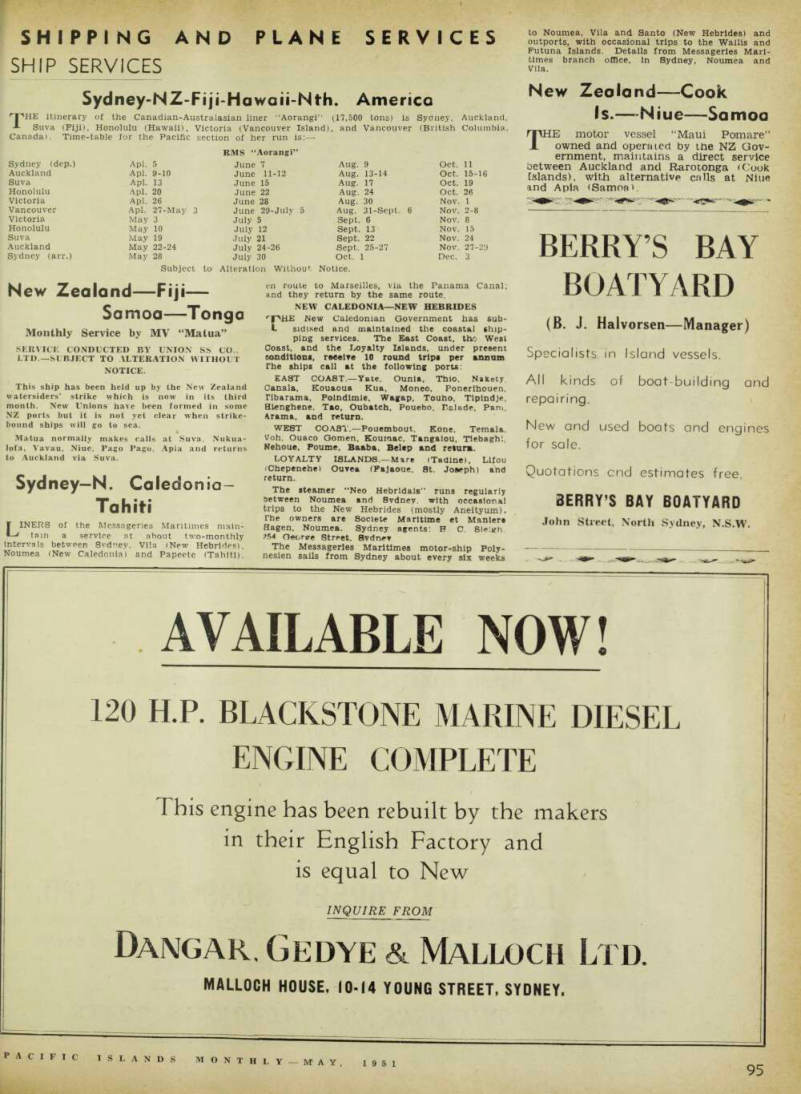
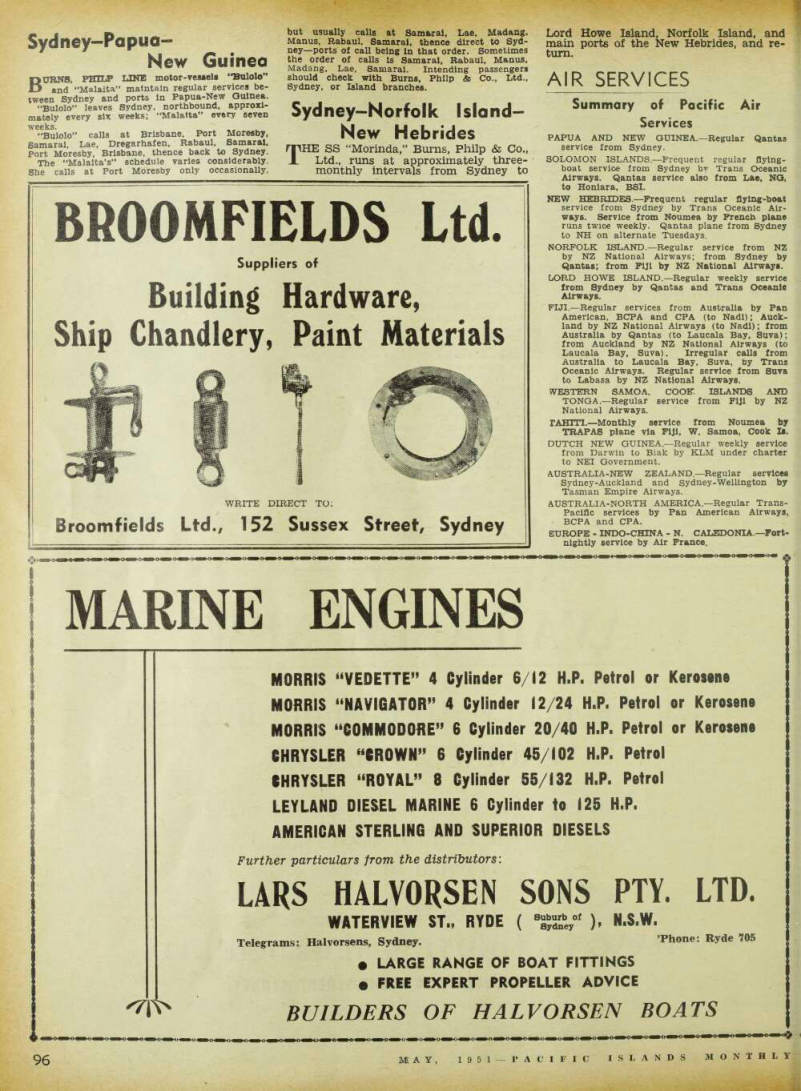
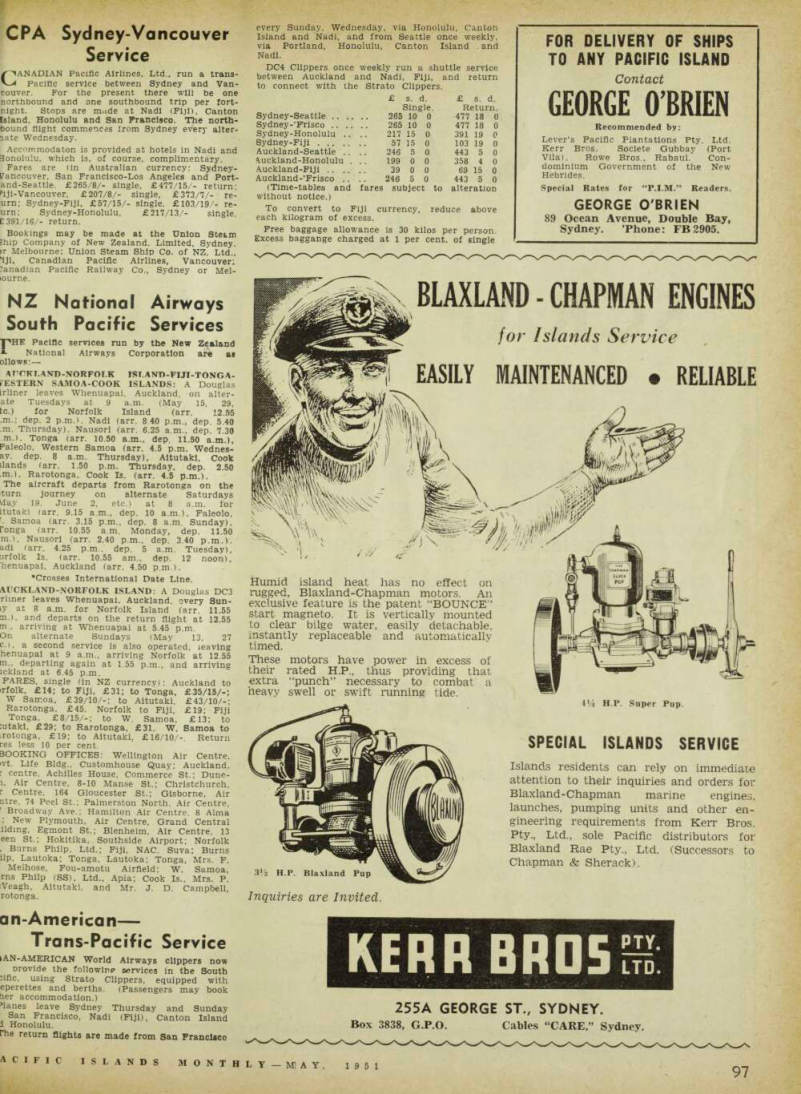
Shipping And Plane Services
Ship Services
Sydney-N Z-Fiji-Hawaii-Nth. America
TPHE itinerary of the Canadian-Australaslan liner “Aorangi” (17,500 tons) is Sydney, Auckland, Suva (Fiji), Honolulu (Hawaii), Victoria (Vancouver Island), and Vancouver (British Columbia, Canada). Time-table for the Pacific section of her run is:—
New Zealand—Fiji—
Samoa—Tonga
Monthly Service by MY “Matua”
Service Conducted By Union Ss Co..
Ltd.—Subject To Alteration Without
Notice.
This ship has been held up by the New Zealand watersiders’ strike which is now in its third month. New Unions have been formed in some NZ ports but it is not yet clear when strike bound ships will go to sea.
Matua normally makes calls at Suva, Nukua lofa. Vavau, Niue, Pago Pago, Apia and returns to Auckland via Suva.
Sydney-N. Coledonio-
Tahiti
LINERS of the Mcssageries Maritimes main tain a service at about two-monthly Intervals between Svdney. Vila (New Hebrides).
Noumea (New Caledonia) and Papeete (Tahiti).
en route to Marseilles, via the Panama Canal; and they return by the same route.
New Caledonia—New Hebrides
'X'HE New Caledonian Government has sub- L sidised and maintained the coastal ship ping services. The East Coast, thio West Coast, and the Loyalty Islands, under present conditions, receive 10 round trips per annum The ships call at the following ports: EAST COAST.—Yate, Ounla, Thio. Nakety Canala, Kouaoua Kua, Moneo, Ponerlhouen. ribarama, Polndlmle, Wagap, Touho, Tlplndje, Hlenghene. Tao, Oubatch, Pouebo. Palade, Pam.
Arama, and return.
WEST COAST.—Pouembout. Kone, Temala, Voh. Ouaco Gomen, Koumac, Tangaiou, Tlebaghi, Nehoue, Poume, Ba&ba. Belep and return.
LOYALTY ISLANDS.—Mare (Tadlne), Llfou iChepenehe) Ouvea (Pajaoue. St. Joseph) and return.
The steamer "Neo Hebrldals” runs regularly between Noumea and Sydney, with occasional trips to the New Hebrides (mostly Aneityum).
The owners are Soclete Maritime et Manlere Hagen, Noumea. Sydney agents: F C. Sle:*h ?54 Georee Street. Sydney The Messagerles Maritlmes motor-ship Poly nesian sails from Sydney about every six weeks
to Noumea. Vila and Santo (New Hebrides) and outports, with occasional trips to the Wallis and Futuna Islands. Details from Messagerles Mari times branch office, In Sydney, Noumea and Vila.
New Zeolond—Cook
Is.—Niue—Samoa
THE motor vessel “Maui Pomare” owned and operated by ibe NZ Gov ernment, maintains a direct service between Auckland and Rarotonga (Cook Islands), with alternative calls at Niue and Apia (Samoa >.
Sydney (dep.) Apl. 5 RMS “Aorangi”
June 7 Aug. 9 Oct. 11 Auckland Apl. 9-10 June 11-12 Aug. 13-14 Oct. 15-16 Suva Apl. 13 June 15 Aug. 17 Oct. 19 Honolulu Apl. 20 June 22 Aug. 24 Oct. 26 Victoria Apl. 26 June 28 Aug. 30 Nov. 1 Vancouver Apl. 27-May 3 June 29-July 5 Aug. 31-Sept. 6 Nov. 2-8 Victoria May 3 July 5 Sept. 6 Nov. 8 Honolulu May 10 July 12 Sept. 13 Nov. 15 Suva May 19 July 21 Sept. 22 Nov. 24 Auckland May 22-24 July 24-26 Sept. 25-27 Nov. 27-20 Sydney (arr.) May 28 July 30 Oct. 1 Dec. 3 Subject to Alteration Without Notice.
Sydney-Papua-
New Guinea
Burns, PHILP LINE motor-vessels "Bulolo" and “Malaita” maintain regular services be tween Sydney and ports in Papua-New Guinea.
'‘Bulolo” leaves Sydney, northbound, approxi mately every six weeks; “Malaita” every seven weeks. i “Bulolo” calls at Brisbane. Port Moresby, Samaral. Lae. Dregarhafen, Rabaul, Samaral.
Port Moresby, Brisbane, thence back to Sydney.
The “Malaita’s” schedule varies considerably.
She calls at Port Moresby only occasionally,
but usually calls at Samaral, Lae, Madang.
Manus, Rabaul, Samaral, thence direct to Syd ney—ports of call being in that order. Sometimes the order of calls is Samaral, Rabaul, Manus.
Madang, Lae, Samaral. Intending passengers should check with Burns, Phllp & Co., Ltd., Sydney, or Island branches.
Sydney-Norfolk Island-
New Hebrides
THE SS “Morinda,” Burns, Phllp & Co., Ltd., runs at approximately three monthly intervals from Sydney to
Lord Howe Island, Norfolk Island, and
main ports of the New Hebrides, and re turn.
Air Services
Summary of Pacific Air
Services
PAPUA AND NEW GUlNEA.—Regular Qantas service from Sydney.
SOLOMON ISLANDS. —Frequent regular flying boat service from Sydney by Trans Oceanic Airways. Qantas service also from Lae, NO, to Honiara, BSI.
NEW HEBRIDES. —Frequent regular flying-boat service from Sydney by Trans Oceanic Air ways. Service from Noumea by French plane runs twice weekly. Qantas plane from Sydney to NH on alternate Tuesdays.
NORFOLK ISLAND. —Regular service from NZ by NZ National Airways; from Sydney by Qantas: from FIJI by NZ National Airways.
LORD HOWE ISLAND.—Regular weekly service from Sydney by Qantas and Trans Oceanic Airways.
FIJI. —Regular services from Australia by Pan American, BCPA and CPA (to Nadi); Auck land by NZ National Airways (to Nadi); from Australia by Qantas (to Laucala Bay, Suva); from Auckland by NZ National Airways (to Laucala Bay, Suva). Irregular calls from Australia to Laucala Bay. Suva, by Trans Oceanic Airways. Regular service from Suva to Labasa by NZ National Airways.
Western Samoa, Cook Islands And
TONGA. —Regular service from FIJI by NZ National Airways. rAHTTl.—Monthly service from Noumea by TRAPAS plane via FIJI, W. Samoa, Cook Is.
DUTCH NEW GUINEA. —Regular weekly service from Darwin to Biak by KLM under charter to NEI Government.
AUSTRALIA-NEW ZEALAND—ReguIar services Sydney-Auckland and sydney-Wellington by Tasman Empire Airways.
AUSTRALIA-NORTH AMERICA—Regular Trans pacific services by Pan American Airways,
Bcpa And Cpa.
Europe - Indo-China -N. Caledonla.—Fort
nightly service by Air Prance.
CPA Sydney-Voncouver
Service
C CANADIAN Pacific Airlines, Ltd., run a trans * Pacific service between Sydney and Van couver. For the present there will be one northbound and one southbound trip per fort night. Stops are mude at Nadi (Fiji), Canton Island, Honolulu and San Francisco. The north bound flight commences from Sydney ev/ery alter nate Wednesday.
Accommodaton is provided at hotels in Nadi and Bonolulu, which is. of course, complimentary.
Fares are (in Australian currency; Sydney- Pancouver, San Franclsco-Los Angeles and Port and-Seattle. £265/8/- single, £477/15/- return; £2o7/8- single, £373/7/- re urn; Sydney-Fiji, £57/15/- single. £lO3/19/- re urn; Sydney-Honolulu, £217/13/- single, E391/16/- return.
Bookings may be made at the Union Steam Ship Company of New Zealand. Limited, Sydney. »r Melbourne: Union Steam Ship Co. of NZ. Ltd., 'IJi, Canadian Pacific Airlines, Vancouver; Canadian Pacific Railway Co., Sydney or Mel lourne.
NZ Notional Airways
South Pacific Services
rHE Pacific services run by the New Zealand National Airways Corporation are as ollows;
Auckland-Norfolk Island-Fiji-Tong A
Pestern Samoa-Cook Islands: A Douglas
irliner leaves Whenuapai. Auckland, on alter ate Tuesdays at 9 a.m. (May 15, 29. tc.) for Norfolk Island (arr. 12.55 .m.; dep. 2 p.m.l. Nadi (arr. 8 40 p.m., dep. 5.40 .m. Thursday). Nausorl (arr. 6.25 a m., dep. 7.30 m.). Tonga (arr. 10.50 a.m., dep. 11.50 a.m.), Paleolo, Western Samoa (arr. 4.5 p.m. Wednes ay. dep. 8 a.m. Thursday), Aitutakl, Cook ilands (arr. 1.50 p.m. Thursday, dep. 2.50 m.). Rarotonga. Cook Is. (arr. 4.5 p.m.).
The aircraft departs from Rarotonga on the turn journey on alternate Saturdays Hay 19. June 2, etc.) at 8 a.m. for itutaki (arr. 9.15 a.m., dep. 10 a.m.), Faleolo. r . Samoa (arr. 3.15 p.m., dep. 8 a.m. Sunday).
Eonga (arr. 10.55 am. Monday, dep. 11.50 m.), Nausorl (arr. 2.40 p.m., dep. 3.40 p.m.). adl (arr. 4.25 p.m. dep. 5 a.m. Tuesday), orfolk Is. (arr. 10.55 am., dep. 12 noon), henuapal, Auckland (arr. 4.50 p.m ). •Crosses International Date Line.
Auckland-Norfolk Island: A Douglas Dc3
rimer leaves Whenuapai. Auckland, every Sun- W at 8 a.m. for Norfolk Island (arr. 11.55 tn.). and departs on the return flight at 12.55 m . arriving at Whenuapai at 5.45 p.m.
On alternate Sundays (May 13. 27 c.). a second service is also operated, leaving henuapal at 9 a.m., arriving Norfolk at 12.55 m.. departing again at 1.55 p.m., and arriving ickland at 6.45 p.m.
PARES, single (in NZ currency): Auckland to irfolk, £l4; to Fiji, £3l; to Tonga, £35/15/-; W Samoa, £39/10/-; to Aitutaki, £43/10/-; Rarotonga. £45. Norfolk to Fiji, £l9; Fiji Tonga. £B/15/-; to W. Samoa, £l3; to ;utakl. £29; to Rarotonga, £3l. W. Samoa to .rotonga, £l9; to Aitutaki, £l6/10/-. Return res less 10 per cent.
BOOKING OFFICES: Wellington Air Centre, wt. Life Bldg., Customhouse Quay; Auckland. ’ centre. Achilles House, Commerce St.; Dune 1, Air Centre. 8-10 Manse St.; Christchurch, r Centre. 164 Gloucester St.; Gisborne, Air ntre, 74 Peel St.; Palmerston North. Air Centre, ’ Broadway Ave.; Hamilton Air Centre. 8 Alma : New Plymouth, Air Centre, Grand Central tiding, Egmont St.; Blenheim, Air Centre, 13 een St.; Hokitika, Southside Airport; Norfolk , Burns Philp. Ltd.; Fiji, NAC, Suva; Burns Up, Lautoka; Tonga, Lautoka; Tonga, Mrs. F.
Melhose, Fou-amotu Airfield; W. Samoa, ms Philp (SS), Ltd., Apia; Cook Is., Mrs. P.
Veagh, Aitutaki, and Mr. J. D. Campbell, rotonga.
an-American—
Trans-Pacific Service
(AN-AMERICAN World Airways clippers now provide the following services in the South lific, using Strato Clippers, equipped with eperettes and berths. (Passengers may book
tier accommodation.)
*lanes leave Sydney Thursday and Sunday San Francisco, Nadi (Fiji), Canton Island i Honolulu.
Phe return flights are made from San Francisco
every Sunday, Wednesday, via Honolulu, Canton Island and Nadi, and from Seattle once weekly, via Portland, Honolulu, Canton Island . and Nadi.
DC4 Clippers once weekly run a shuttle service between Auckland and Nadi, Fiji, and return to connect with the Strato Clippers.
To convert to Fiji currency, reduce above each kilogram of excess.
Free baggage allowance is 30 kilos per person.
Excess baggange charged at 1 per cent, of single
£ s. d. £ s. d.
Single.
Return.
Sydney-Seattle .. .. 265 10 0 477 18 0 Sydney-’Frisco .. .. 477 18 0 Sydney-Honolulu .. 217 15 0 391 19 0 Sydney-Fiji 57 15 0 103 19 0 Auckland-Seattle .. 246 5 0 443 5 0 Auckland-Honolulu . 199 0 0 358 4 0 Auckland-Fiji .. .. 69 15 0 Auckland-’Frisco .. 246 5 0 443 5 0 (Time-tables and without notice.) fares subject to alteration
fare; per kilo up to 10 kilos; Vfe per cent, for every kilo over 10 kilos.
France-1 ndo-China—
Aust.-N. Caledonia
THE French national airways, Air Prance, runs a 28 days service between Paris and New Caledonia, and return. Stops are made at Damascus, Karachi, Calcutta, Saigon, Batavia, Darwin, Brisbane.
DC4 Skymasters are used In the service bet ween Saigon and New Caledonia, Lockheed Constellations between Salgon-Paris, and Mes sageries Marltimes are agents in Australia.
Fare between Brisbane and Tontouta (Noumea) are £3O/12/6 single, £55/2/6 return. Sydney- Tontouta, £37/10 - single, £67/10/- return.
TEAL Flying-Boat Service
NZ-Chatham Islands
TASMAN Empire Airways, Ltd., operate a Solent Flying-boat service from Auckland-Welling ton to the Chatham Islands and return, at monthly Intervals.
Flying-boats leave Auckland at 4.15 a.m.. arrive Wellington 6 a.m., depart for Waikato Bay. Chat lam Islands, at 7 a.m. and arrive at 10.30 a.m. fhe flying-boat leaves the Islands the same after loon at 2.30, arrives Wellington at 6.30 p.m. and Auckland at 9 p.m.
Pares are, from Auckland. £l6/10/- single; £33 return; and from Wellington, £ll single; md £22 return.
Trons Tosman Services
Sydney—Wellington
rASMAN Empire Airways, Ltd., operate a regular flying-boat service between Sydney md Wellington with Solent flving-boats.
Services denart Svdney at 10.30 p.m. on Mon lav. Wednesday, Thursday. Sunday: and depart Wellington at 11 a.m. on Monday, Tuesday, rhursday and Friday.
The fares are £A39/8/-, £NZ3I/10/- single; EA7O/19/-, £NZS6/14/- return.
Sydney-Norfolk Is.
Qantas run a DC4 Skymaster alt. Thursdays returning same day) from Sydney to Norfolk Island. Fare, £25 single; £45 return. (For Norfolk Island, see also under N 2 National Airways.)
Sydney-New Hebrides
QANTAS operate a service to the New Hebrides with Sandringham flying-boats calling at Noumea. Port Vila and Espiritu Santo. Frequent aon-scheduled flights are made, subject to the approval of the Governments concerned.
Trans-Tasman Service
Sydney—Auckland
TASMAN • Empire Airways, Ltd., operate a flying-boat service between Rose Bay, Sydney, and Mechanics Bay, Auckland, with a fleet of four new Solent flying-boats each with a capacity for 45 passengers, in seven self contained cabins on two decks. Pull fresh-cooked meals are served en route. Average crossing time is 6Va hours. Depart Sydney 11.59 p.m. on Tuesdays. Fridays, Saturdays, and at 8 a.m. on Tuesdays and Fridays. They depart from Auckland at 9 a.m. daily except Tuesday and Sunday and arrive Sydney at 2.15 p.m.
Fares; £A39/8/-. £NZ3I/10/-, single; £A7O/19/-, £NZS6/14/- return.
Passenger reservations may be made in Aus
tralia at any office or agency of Qantas Empire Airways (General Agents), offices of TAA and all leading travel agents. In New Zealand book through TEAL (Auckland and Wellington) or any leading travel agents.
Sydney-Noumea-Suva
THE following is the time-table of the Qantas Sandringham flying-boat;— Sydney dep. 9.30 p.m. Mondays.
Noumea arr. 6.30 a.m. Tuesdays.
Noumea dep 8.30 a.m. Tuesdays.
Suva arr. 3 p.m. Tuesdays.
Suva dep. 6 a.m. Thursdays.
Noumea .. arr. 10.30 a.m. Thursdays.
Noumea .. .. dep. 12.30 p.m. Thursdays.
Sydney arr. 7.45 p.m. Thursdays.
Intending passengers may book through Qantas offices in Australia. Burns Phllp (South Sea) Company, in Suva; and J. Brock, in Noumea.
The fares for this service In Aust. currency are:
Sydney—Queensland— New Guinea Q.E.A. Ltd. operate regular services between Sydney and Port Moresby, Lae. Madang,
Single.
Return.
Sydney-Noumea .. . £37 10 0 £67 10 0 Sydney-Suva 55 10 0 99 18 0 Noumea-Suva ... , 20 5 0 36 9 0
Rabaul, Bulol® and Wau via Brisbane, Rock hampton, Townsville and Cairns.
This Service is known as the “Bird of Para dise” Service and DC4 Skymaster and DCS Air craft are used. The Skymaster aircraft leave Sydney every Tuesday and Saturday at 8 a.m. and, making a night flight calling at Brisbane only, arrive at Port Moresgy the following morn ing at 7.05 a.m.
The Skymaster arriving on the Wednesday connects with a DC3 from Port Moresby to Bulolo and Wau via Lae the same day, while the Skymaster arriving at Port Moresby on Sunday connects with two DC3s from Port
Moresby, one flying direct to Rabaul on the same day and the other flying to Lae.
A DC3 aircraft leaves Madang on Tuesdays at 3.45 p.m., nightstops at Lae and departs Lae at 7.10 a.m. on Wednesday to connect with the Skymaster leaving Port Moresby at 9.30 a.m for Sydney via Brisbane, arriving Sydney at 9 p.m.
Two DCS aircraft leave Lae at 7.10 a.m. on Sunday to connect with the Skymaster leaving Port Moresby at 9.30 a.m. for Sydney via Bris bane, arriving Sydney at 9 p.m. the same day.
DC3s leave Sydney at 8.15 a.m. on Monday, Thu.„day, Friday, calling at Brisbane, Rock
hampton and nightstopping at Townsville.
The following morning they depart Townsville at 5.20 a.m., calling at Cairns and Cooktownt and arriving at Port Moresby at 10.30 a.m. and Lae at 12.20 p.m. The aircraft which arrives? at Lae on Tuesdays extends to Madang the same afternoon.
Return flights leave Lae at 5.45 on Mondays, and Thursdays, departing Port Moresby at 7.35 i a.m. and proceeding to Sydney the same day, via; Cairns, Townsville and Brisbane (with an op tional call at Rockhampton), arriving Sydney at 10.15 p.m.
The service leaving Lae on Thursdays, also; connects with a DCS leaving Wau the previous; afternoon at 3.30 p.m.
Every Monday a DCS leaves Rabaul at 7 a.m.. for Port Moresby departing Fort Moresby at 10.501 a.m. for Cairns and Townsville. The following' morning it departs Townsville at 8.15 a.m. calling! at Rockhampton and Brisbane and arriving Syd ney at 5 p.m. (Rockhampton call optional.) !
Qantas Subsidiary Services In
Papua-New Guinea-Solomons
Qantas Empire Airways run the following sub sidiary services in Papua, New Guinea, and British Solomons:— A DCS leaves Lae every Wednesday at 8 a.m.,, calls at Finschafen, Rabaul, Kavieng and ar rives at Manus at 3 p.m. It returns every Saturday, leaving Manus at 8 a.m., calls at Kavieng. Rabaul and Finschhafen (optional) and arrives at Lae at 2.45 p.m.
Every Mon. and Thur. a plane flies from Lae to Madang, and after arrival at Madang operates; where and when required. This service is primarily for the carriage of native labourers andi Europeans travelling on this service are always advised of the fact.
Every alternate Wednesday a Qantas Catalina; flies from Port Moresby, westward to Daru. via; Yule Island, Kerema, Wana (optional) Kikori,, Lake Kutubu, returing to Port Moresby,, via Kikori and Kerema the same day.
Every alternate Monday, a Qantas Catalina; flies from Port Moresby eastward (dep. 10 a.m.) and calls at Abau and Samaral before flying out; to the Archipelagoes in the afternoon. Calls are: made at Esa’ala and Losuia (where an over night stop is made), and the following day (alternate Tuesday) at Deboyne Lagoon, before: returning to Port Moresby, via Samarai andl Abau.
Every alternate Monday, a Qantas Catalina* leaves Port Moresby for Rabaul, via Abau,, Samarai, Esa’ala and Losuia (New Britain); next: morning (Tuesday) it flies to Queen Carola.
Harbour, Buka, Kieta, Buin (Bougainville) andl returns to Rabaul with an optional stop at: Inus, next morning (Wednesday) it flies toi Talasea, Moewe Harbour and Jacquinot Bay,, and returns to Rabaul (with an optional stop; at Lindenhafen) and next morning (Thursday) it returns from Rabaul, via Losuia, Esa’aia,, Samarai, and Abau, to Port Moresby.
Every alternate Monday a Qantas Douglas flies? from Lae to Rabaul via Finschhafen and continues; on to Honiara (British Solomon Islands), via; Torokina, Vellalavella and Yandina remains over night at Honiara: and returns to Lae the fol lowing day Tuesday), over the same route.
Every Wednesday and Sunday a plane leaves?
Port Moresby at 7.30 a.m., reaches Kokoda at 8.20( a.m., flies on to Higatura (Popendetta) at 8.55 i a.m., and leaves again for Port Moresby at; 9.5 a.m., reaching there at 10.15 a.m.
Dragon DHB4 aircraft operate the following; internal services in New Guinea:— Every Tuesday depart Madang for Goroka,.
Kainantu, Aiyura, Arena, with optionall call at Bena Bena, returning to Madang; at noon the sahie day. Calls as required fori loading are made between Arena and Madang.
Every Thursday departs Madang at 7 a.m. fon Wabag, Baiyer River, Mt. Hagen, with optional! calls at Kerowagi and Chimbu, and returning; to Madang at noon the same day.
Every Friday departs Lae at 6.30 a.m. calling; at any or all of the following places as re quired. Nadzab, Kialpit, Arena, Aiyura, Kai— nantu, Bena Bena, Goroka, Chimbu, Kerowagi,, Kup, Nondugl, Banz, Mlnj, Mt. Hagen, Ogel— beng, Baiyer River, Wabamunda. Wabag.
Daily, except Wednesdays and Sundays, depart!
Lae at 3 p.m. for Bulolo and Wau, returning; direct from Wau to Lae the same day. arriving; at Lae 5.5 p.m.
Every Tuesday departs Lae at 7.0 a.m. fon Goroka and returns same day at 9.0 a.m.
Sydney-Vancouver
BCPA Service:
BRITISH Commonwealth Pacific Airlines, Ltd.,,, operate a twice weekly trans-Paciflc services from Sydney to Vancouver, via FIJI, Cantona
Island, Honolulu and San Francisco; and a weekly service between Auckland and Vancouver, via the same ports.
' Planes leave Sydney every Wednesday and Saturday, and Vancouver on the Southbound trip every Monday and Thursday. Every fourth trip from Sydney terminates at San Francisco instead of Vancouver, Planes leave Auckland every Tuesday and arrive in Vancouver the following Wednesday.
The Southbound trip to Auckland commences from Vancouver every alternate Friday. Every other Friday the service commences at San Francisco.
B.C.P.A. services make regular connections at both San Francisco and Vancouver for onward carriage, via either New York or Montreal to the United Kingdom or Europe. The through fare from Sydney to London is £325 (Aust.).
The fares for the Pacific flight are: Sydney- Kandi (Fiji), £AS7/15/- single, £AIO3/19/- re ;urn. Sydney-San Francisco, Seattle, Portland, lios Angeles or Vancouver, £A265/8/- single, £ A477/15/- return. Auckland-Nandi (Fiji). £NZ3I single, £NZSS/16/- return. Auckland >an Francisco, Seattle, Portland, Los Angeles or Vancouver, £NZI97/3/- single, £NZ3S4/18/- re urn.
Douglas DC6 aircraft carrying 48 passengers [seated) or 37 passengers (in sleepers) and a :rew of nine are used on the service. (During April additional services will be run, caving Sydney each Friday at 11 a.m., and San 'rancisco each Tuesday.)
Darwin—Netherlands
New Guinea Service
rHE service between Batavia, NEI, and Biak, Netherlands New Guinea, has been dis ontinued and a new service from Darwin to liak and return has been inaugurated.
The service is run by the Netherlands Govern lent, with DCS aircraft, chartered from KLM •irlines. The service is run once weekly.
Papua-NG Local
Services
L/lANDATED Airlines, Ltd., of Lae, New Guinea, ’'A and other private operators, run air ser ies between Lae and the New Guinea mainland sntres of Wau, Bulolo, Madang, Wewak. Altape, It. Hagen. Plnschhafen, Moresby, Kokoda—in ict anywhere in Papua or New Guinea where cere la an air-strip. These planes carry pas mgers, malls and cargo on regular schedules r charter flights,
TOA Services
PHANS Oceanic Airways run the following L Pacific services:—
Sydney-Lord Howe Is.: A Regular
eekly service with large four-engine flying )ats from Rose Bay. Fare; £lO/16/- single; 21/12/- return. Free baggage allowance 44 lb. iccess baggage and freight rate Bd. per lb.
SYDNEY-PORT MORESBY: Four-engined flent flying-boats leave Sydney each Sunday ' 7.15 p.m.. make a call at Brisbane and :ach Port Moresby early the following morn s’ They leave Port Moresby on the return ght each Monday at 8.30 a.m. The service mnects with Mandated Airlines services in ipua-New Guinea.
SYDNEY-HOBART; The company now runs a
thrice-weekly service direct to Hebart, Tasmania, from Sydney. It will be possible, therefore, for passengers to book from Moresby to Hobart, making an overnight stop in Sydney. Fares are: £l2 single, £24 return.
TEAL Flying Boat
Service
Auckland Fiji
WITH 45 seater Solent flying-boats, Tasman Empire Airways, Limited, operate a weekly Auckland-Suva-Lambasa and return service.
Aircraft depart Mechanics’ Bay. Auckland, a half hour after midnight, each Tuesday, and operate to the following time-table:— dep. Auckland .. .. 0.30 a.m. Tuesday arr. Suva 7.00 a.m. Tuesday dep. Suva 9.00 a.m. Tuesday arr. Lambasa 10.00 a.m. Tuesday dep. Lambasa .. noon Tuesday arr. Suva 1.00 p.m. Tuesday dep. Suva 7.00 a.m. Wednesday arr. Auckland .. .. 1.30 p.m. Wednesday Fares (Single): Auckland-Suva. £3l (NZ). £34/9/- (Fijian). £3B/15/- (Aust.); (Return); £55/16/- (NZ). £6l/19/- (Fijian), £69/15/- Aust.).
Suva-Lambasa (Single): £4/10/- (NZ). £5 'Fijian), £5/12/6 (Aust.); (Return): £B/2/- (NZ), £9 (Fijian), £lO/2/6 (Aust.).
Reservations may be made through TEAL (New Zealand), Qantas or TAA (Australia), NZNAC (Suva) or any leading travel agents.
IVLr. J. A. Moore, who held high rank in the Fiii Police Force of which he hns o been a member since 1934 has resigned in order to go into business in Fiji.
Advertisements & other items, pp. 97-103 (4 items)
Available Now!
BERRY’S BAY
BOATYARD
(B. J. Haivorsen—Manager) Specialists in Island vessels.
All kinds of boat-building and repairing.
New and used boats and engines for sale.
Quotations end estimates free.
BERRY’S BAY BOATYARD
John Street, North Sydney, N.S.W.
AVAILABLE NOW!
120 H.P. BLACKSTONE MARINE DIESEL
ENGINE COMPLETE
This engine has been rebuilt by the makers in their English Factory and is equal to New
INQUIRE
Dangar, Gedye & Malloch Ltd.
MALLOCH HOUSE, 10-14 YOUNG STREET, SYDNEY.
BROOMFIELDS Ltd.
Suppliers of
Building Hardware,
Ship Chandlery, Paint Materials
s
WRITE DIRECT TO;
Broomfields Ltd., 152 Sussex Street, Sydney
MARINE ENGINES
MORRIS “VEDETTE” 4 Cylinder 6/12 H.P. Petrol or Kerosene MORRIS “NAVIGATOR” 4 Cylinder 12/24 H.P. Petrol or Kerosene MORRIS “COMMODORE” 6 Cylinder 20/40 H.P. Petrol or Kerosene CHRYSLER “CROWN” 6 Cylinder 45/102 H.P. Petrol CHRYSLER “ROYAL” 8 Cylinder 55/132 H.P. Petrol LEYLAND DIESEL MARINE 6 Cylinder to 125 H.P.
AMERICAN STERLING AND SUPERIOR DIESELS
Further particulars from the distributors :
LARS HALVORSEN SONS PTY. LTD.
WATERVIEW ST.. RYDE (
Sydney 1 N.S.W.
Telegrams: Halvorsens, Sydney. 'Phone: Ryde 705
• LARGE RANGE OF BOAT FITTINGS
• FREE EXPERT PROPELLER ADVICE
BUILDERS OF HALVORSEN BOATS
FOR DELIVERY OF SHIPS
TO ANY PACIFIC ISLAND
Contact
GEORGE O’BRIEN
Recommended by: Lever’s Pacific Plantations Pty. Ltd.
Kerr Bros. Societe Gubbay (Port Vila). Rowe Bros., Rabaul.* Condominium Government of the New Hebrides.
Special Rates for “P.1.M.” Readers.
GEORGE O'BRIEN
89 Ocean Avenue, Double Bay, Sydney. ’Phone: FB 2905.
BIAXLAND - CHAPMAN ENGINES
for Islands Service
EASILY MAINTENANCED • RELIABLE
Humid island heat has no effect on rugged, Blaxland-Chapman motors. An exclusive feature is the patent “BOUNCE” start magneto. It is vertically mounted to clear bilge water, easily detachable, instantly replaceable and automatically timed.
These motors have power in excess of their rated H.P., thus providing that extra “punch” necessary to combat a heavy swell or swift running tide. 4V4 H.P. Super Pup.
SPECIAL ISLANDS SERVICE
3Vz H.P. Blaxland Pup Inquiries are Invited.
Islands residents can rely on immediate attention to their inquiries and orders for Blaxland-Chapman marine engines, launches, pumping units and other engineering requirements from Kerr Bros.
Pty,, Ltd., sole Pacific distributors for Blaxland Rae Pty., Ltd. (Successors to Chapman & Sherack).
KERR BROS
PTY.
LTD.
255 A GEORGE ST., SYDNEY.
Box 3838, G.P.O. Cables “CARE.” Sydney.
CASH
for
SCRAP METALS
HIGHEST PRICES F.0.W., NEW GUINEA
Shells Cartridges Copper Brass Radiators Cable Aluminium Lead Muntz Metal Steel Rails Pipe ★
lSvnts&
Wilford Street, Newtown, N.S.W.
LA 5111 LA 5111
BRANCHES THROUGHOUT N.S.W., VICTORIA & STH. AUSTRALIA Leader of the Secondary Metal Industry for 30 Years Telegraphic Address: "SCRAPMETAL," Sydney
□n nn □□ 11 in W tL
PRIVATE HOTEL,
Priory Road, North Sydney.
Only five minutes’ drive across the Sydney Harbour Bridge Irom the City, “Bellhaven” is quietly situated—your rest is assured in this new. comfortably furnished and well serviced hotel.
Handy to transport for beaches. Olympic Pool, Zoo all sights, and Australia’s leading City of entertainment and night life—Sydney.
Modern Room or Suite Accommodation.
TARIFF FROM 16/6 PER DAY.
Manager : A. L. GUARD.
Write or Cable ’‘Bellhaven.” North Sydney.
Phone: XA 1746.
I B * & r* iWarA: BGC— 4O h.p. Engine.
INQUIRIES INVITED.
SOUTHERN CROSS ENGINE & WINDMILL
CO. PTY., LTD.
22 YOUNG STREET, SYDNEY, N.S.W.
SOUTHERN CROSS
DIESEL ENGINES
Mark YB-4 h.p £144/ 7/6 " BDC-10 h.p £2Ol/ 1/0 " BEC-20 h.p £362/17/0 " BFC-30 h.p £553/10/0 BGC-40 h.p £704/19/0 (Price of 20, 30 and 40 h.p. Units includes Radiator Cooling System.)
PROMPT DELIVERY
Marine Engines Also Available NOTE:—The 1950 Southern Cross Catalogue is now available. Please write for a copy indicating the machine in which you are interested.
SAILS, COVERS, AWNINGS
TENTS, TARPAULINS, and all classes of CANVAS GOODS for industrial and home use FLAGS AND PENNANTS FOR CLUBS AND ASSOCIATIONS.
Send your inquiries through your agent to:
HARRY WEST Pty. Ltd.
"SYDNEY'S SAILMAKER"
DUKE ST. (WATERFRONT), EAST BALMAIN, SYDNEY, N.S.W.
Phone: WB1105, WB2284.
VESSEL FOR SALE
ft. Ocean-going, Twin G.M. Diesel Motor Vessel
Fully Found and Equipped
Sheathed—Two-way Licensed Radio—Refrigeration—Dingy— Carley Raft.
Dual Bridge and Wheelhouse Controls—Two Cabins—Chartroom—Ga 11ey—To i I et.
Sleep 7 Europeans, 14 natives.
Cargo Hold: 1 6 ft. x 1 3 ft. x 6 ft.—3o tons.
Speed; 10 knots—Fuel; 6 galls, hour—Range: 1,500 miles— Copper Tanks.
A 1 Condition —Full Inventory—lnsured at Lloyd's—Halvorsenbuilt in 1945.
INSPECTION— DELIVERY—RABAUL T.N.G., OR BY ARRANGEMENT
Contact
G. V. MILLER & CO. LTD.
TOROKINA, BOUGAINVILLE, NEW GUINEA
Or Rabaul Agents—Croyden & Viggers, Rabaul, T.N.G.
TROCHUS
AND
GREEN SNAIL
Bought outright for Cosh, or on Consignment at highest ruling market prices.
STANLEY P. BELL & COMPANY
Importers, Exporters and Brokers for the Sale, Purchase or Charter of Ships.
173 Eagle St., BRISBANE, QLD.
Cables: “PACENT” Brisbane.
CAPTAIN W. L. KENNEDY
(Established 1931)
SHIPBROKERS, BUSINESS & REAL ESTATE
63 Pin- St., Sydney
'Phone: BW 6461. Cables: "CAPKEN," Sydney.
LISTING ;
dSfl L C , A n ß , G 9°'us Uilt 1947 in Scotland - 133 ft - x 27 ft., twin diesels; two Lister £3o!oo« SteNing 1012 HP " ° eW 19491 deadwei ® ht * 370 tons ’ in Australian waters. ® RAX 0 D NEW AUXILIARY KET CH.— 6I ft. x 14 ft. 6 ins., 30 HP., crude oil diesel, sails, etc.
STLRDY TRAWLER. 51 ft. x 15 ft.. Atlas diesel, suitable conversion to cargo, £6,300.
SEVERAL other strong working jobs from £4,500. rraf? of ?n V< L a g ?°f Selec “°" of Pleasure Craft. Auxiliaries and Cruisers, and Commercial craft of aL descriptions. Delivery arranged t» any port in the Pacific.
WE ARE ALSO AGENTS FOR MOST MAKES OF MARINE DIESELS.
INQUIRIES INVITED.
Through our Business and Real Estate Branch, we can offer a wide variety of Sydney and N.S.W. properties. All Islands inquiries promptly and satisfactorily attended to.
HALL” 3 H.P. MARINE ENGINE
The Hall 3 H.P. Marine Engine Features: • Patented built-in hand starter • Rust-resisting castings throughout • Trouble-free running—will run indefinitely without attention. • or extern al reciprocating parts; no oiling • direction reVerS6 rUnS astern by start ing in that • Sold complete ready for fitting to your boat Sole Distributors for Pacific Islands’
R. J. CRILLEY PTY. LTD.
123 Sussex St., Sydney.
Illustrated pamphlet airmailed upon request.
97
ACIFIC ISLANDS MONTHLY-MAY, 1951
99
ACIFIC ISLANDS MONTHLY MAY, 1951
101
acific islands monthly - may. 1951
Rice Up!
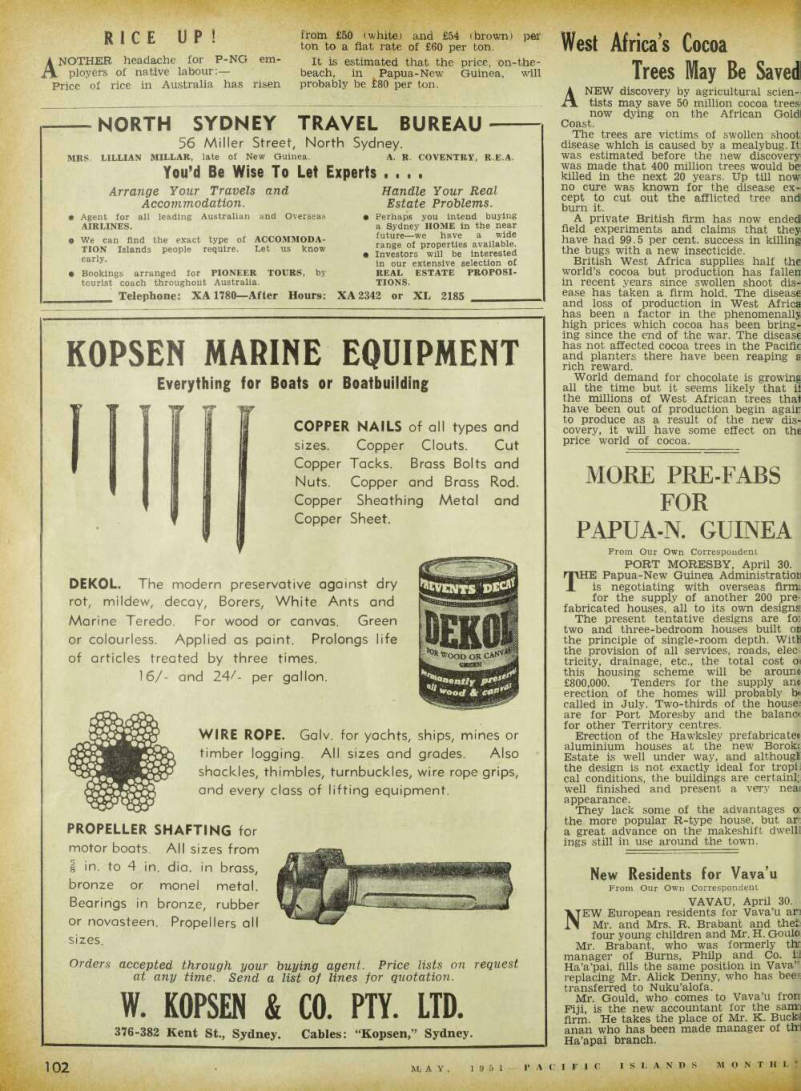
ANOTHER headache for P-NG em ployers of native labour: — Price of rice in Australia has risen
from £5O (white; and £54 (brown; per ton to a flat rate of £6O per ton.
It is estimated that the price, on-the beach, in Papua-New Guinea, will probably be £BO per ton.
West Africa’s Cocoa
Trees May Be Saved
ANEW discovery by agricultural scien tists may save 50 million cocoa trees; now dying on the African Goldl Coast.
The trees are victims of swollen shoot; disease which is caused by a mealybug. It; was estimated before the new discovery was made that 400 million trees would be [ killed in the next 20 years. Up till now no cure was known for the disease ex cept to cut out the afflicted tree and! burn it.
A private British firm has now ended! field experiments and claims that they have had 99.5 per cent, success in killing the bugs with a new insecticide.
British West Africa supplies half the world’s cocoa but production has fallen in recent years since swollen shoot dis ease has taken a firm hold. The disease and loss of production in West Africa has been a factor in the phenomenally high prices which cocoa has been bring ing since the end of the war. The disease has not affected cocoa trees in the Pacific and planters there have been reaping a rich reward.
World demand for chocolate is growing all the time but it seems likely that if the millions of West African trees that have been out of production begin again to produce as a result of the new dis covery, it will have some effect on the price world of cocoa.
More Pre-Fabs
For
Papua-N. Guinea
From Our Own Correspondent
Port Moresby, April 30.
THE Papua-New Guinea Administration is negotiating with overseas firmu for the supply of another 200 pre fabricated houses, all to its own designs The present tentative designs are foi' two and three-bedroom houses built on the principle of single-room depth. WitM the provision of all services, roads, elecv tricity, drainage, etc., the total cost o< this housing scheme will be arouno £800,000. Tenders for the supply ano erection of the homes will probably tw called in July. Two-thirds of the house* are for Port Moresby and the balance for other Territory centres.
Erection of the Hawksley prefabricated aluminium houses at the new Boroki: Estate is well under way, and althougK the design is not exactly ideal for tropii cal conditions, the buildings are certainl;J well finished and present a very neai appearance.
They lack some of the advantages oc the more popular R-type house, but an a great advance on the makeshift dwelll ings still in use around the town.
New Residents for Vava’u
From Our Own Correspondent VAVAU, April 30.
NEW European residents for Vava’u an Mr. and Mrs. R. Brabant and theii; four young children and Mr. H. Goulo Mr. Brabant, who was formerly thr manager of Burns, Philp and Co. 1:1 Ha’a’pai, fills the same position in VaVa" replacing Mr. Alick Denny, who has transferred to Nukualofa.
Mr. Gould, who comes to Vava'u fron Fiji, is the new accountant for the samn firm. He takes the place of Mr. K. Buck! anan who has been made manager of thi Ha’apai branch.
Advertisements & other items, p. 104 (2 items)
102
M, AY , 19 5 1 PACIFIC ISLANDS MONTH L
Kopsen Marine Equipment
NORTH SYDNEY TRAVEL BUREAU
MRS.
56 Miller Street, North Sydney.
LILLIAN MILLAR, late of New Guinea. A. R. COVENTRY, R.E.A.
You’d Be Wise To Let Experts ...
Arrange Your Travels and
Accommodation.
• Agent for all leading Australian and Overseas
AIRLINES.
o We can find the exact type of ACCOMMODA- TION Islands people require. Let us know early, • Bookings arranged for PIONEER TOURS, by tourist coach throughout Australia. Telephone: XA 1780—After Hours:
Handle Your Real
Estate Problems.
• Perhaps you intend buying a Sydney HOME in the near future —we have a wide range of properties available. • Investors will be interested in our extensive selection of
REAL ESTATE PROPOSI-
TIONS.
XA 2342 or XL 2185
KOPSEN MARINE EQUIPMENT
Everything for Boats or Boatbuilding 1 COPPER NAILS of all types and sizes. Copper Clouts. Cut Copper Tacks. Brass Bolts and Nuts. Copper and Brass Rod.
Copper Sheathing Metal and Copper Sheet.
DEKOL. The modern preservative against dry rot, mildew, decay, Borers, White Ants and Marine Teredo. For wood or canvas. Green or colourless. Applied as paint. Prolongs life of articles treated by three times. 16/- and 24/- per gallon.
PEE
WOOD OK c
WIRE ROPE. Galv. for yachts, ships, mines or timber logging. All sizes and grades. Also shackles, thimbles, turnbuckles, wire rope grips, and every class of lifting equipment.
PROPELLER SHAFTING for
motor boats. All sizes from I in. to 4 in. dia. in brass, bronze or monel metal.
Bearings in bronze, rubber or novasteen. Propellers all sizes.
Orders accepted through your buying agent. Price lists on request at any time. Send a list of lines for quotation.
W. KOPSEN & CO. PTY. LTD.
376-382 Kent St., Sydney. Cables: “Kopsen,” Sydney.
W & H Department And Lae Contractors
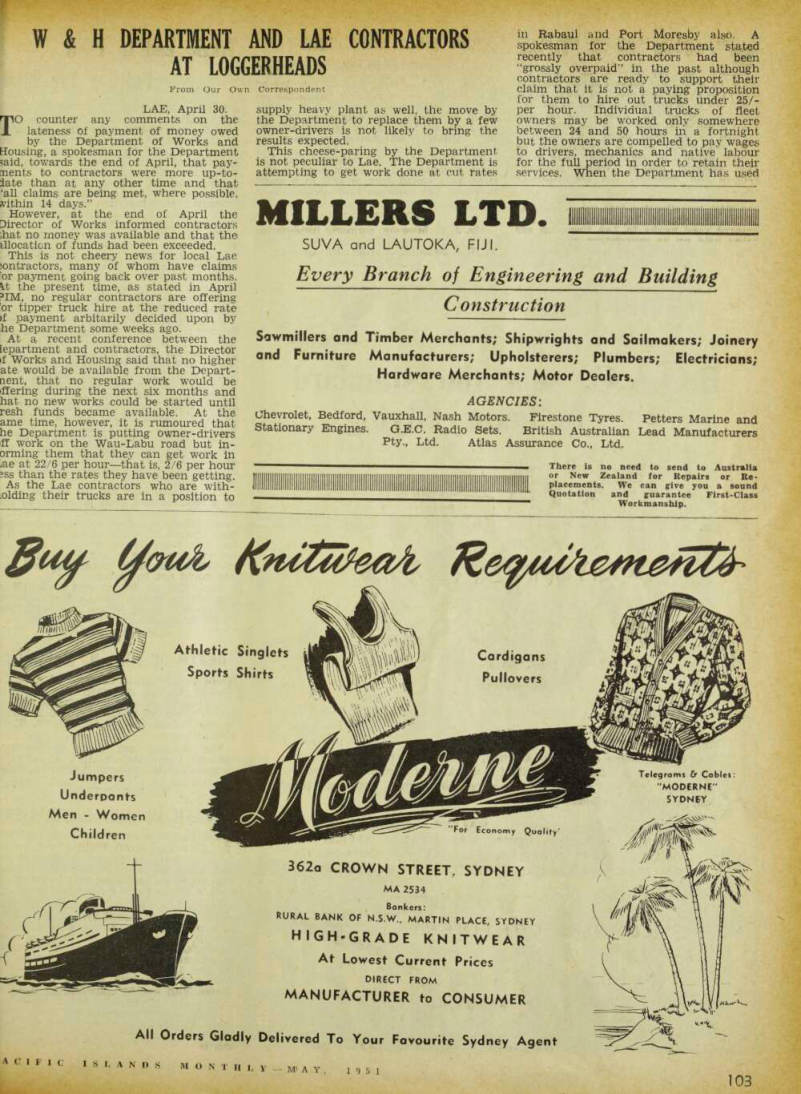
At Loggerheads
From Our Own Correspondent
LAE, April 30.
TO counter any comments on the lateness of payment of money owed by the Department of Works and Housing, a spokesman for the Department said, towards the end of April, that pay ments to contractors were more up-to iate than at any other time and that ‘all claims are being met, where possible, vithin 14 days.”
However, at the end of April the Director of Works informed contractors ;hat no money was available and that the illocation of funds had been exceeded.
This is not cheery news for local Lae xmtractors, many of whom have claims or payment going back over past months. \t the present time, as stated in April 3 IM, no regular contractors are offering or tipper truck hire at the reduced rate >f payment arbitarily decided upon by he Department some weeks ago.
At a recent conference between the lepartment and contractors, the Director >f Works and Housing said that no higher ate would be available from the Depart tient, that no regular work would be iffering during the next six months and hat no new works could be started until resh funds became available. At the ame time, however, it is rumoured that he Department is putting owner-drivers ff work on the Wau-Labu road but in orming them that they can get work in <ae at 22/6 per hour—that is, 2/6 per hour sss than the rates they have been getting.
As the Lae contractors who are with olding their trucks are in a position to
supply heavy plant as well, the move by the Department to replace them by a few owner-drivers is not likely to bring the results expected.
This cheese-paring by the Department is not peculiar to Lae. The Department is attempting to get work done at cut rates
in Rabaul and Port Moresby also. A spokesman for the Department stated recently that contractors had been “grossly overpaid’' in the past although contractors are ready to support their claim that it is not a paying proposition for them to hire out trucks under 25/per hour. Individual trucks of fleet owners may be worked only somewhere between 24 and 50 hours in a fortnight but the owners are compelled to pay wages to drivers, mechanics and native labour for the full period in order to retain their services. When the Department has used
its own trucks it has not been able to run them at anything approaching the rates offered.
Tenders are supposed to be called for all work under the control of the Depart ment but in the past much of the contract work has been farmed out without tenders being called at all. This habit reached such a pitch recently that the local sub branch of the RSL asked Port Moresby that the policy of the Department be clearly defined in the matter. The stock Port Moresby phrase “Where possible” formed the basis of the Department’s reply.
The time seems to be overdue for a complete investigation into the operations of the Department. In the meantime, im portant road works in Lae township are being held up as contractors with heavy equipment are planning to withdraw it.
Advertisements & other items, pp. 105-106 (2 items)
103
acific islands monthly may, 1951
Millers Ltd.
SUVA and LAUTOKA, FIJI.
Every Branch of Engineering and Building
Construction
Sawmillers and Timber Merchants; Shipwrights and Sailmakers; Joinery and Furniture Manufacturers; Upholsterers; Plumbers; Electricians; Hardware Merchants; Motor Dealers.
AGENCIES:
Chevrolet, Bedford, Vauxhall, Nash Motors. Firestone Tyres. Fetters Marine and Stationary Engines. G.E.C. Radio Sets. British Australian Lead Manufacturers Pty., Ltd. Atlas Assurance Co., Ltd. 111111111111111111111111111111111111111 There is no need to send to Australia or New Zealand for Repairs or Replacements. We can give you a sound Quotation and guarantee First-Class Workmanship.
i Jumpers Underponts Men - Women Children Athletic Singlets Sports Shirts Cardigans Pullovers V / / I For Economy Quality' (
362 a CROWN STREET, SYDNEY
MA 2534 Bankers: RURAL BANK OF N.S.W., MARTIN PLACE, SYDNEY high-grade knitwear At Lowest Current Prices direct from
MANUFACTURER to CONSUMER
All Orders Gladly Delivered To Your Favourite Sydney Agent
GET THERE SOONER
STAY THERE LONGER
8.0.A.C. sets the standard
in luxury flying ...
Your personal comfort is 8.0.A.C.’s first concern on Speedbird routes to any of 51 countries. Now on the new “Monarch” service from London to New York you enjoy all that is best in 8.0.A.C. service. At no extra cost passengers enjoy a seven course dinner with cocktails, champagne or wine—and liqueurs.
Breakfast in bed, if desired. Speedbird beauty kits for women, and attractive cabin bags. Attentive steward and stewardess cabin service. And courtesy is always a 8.0.A.C. tradition.
AUSTRALIA • INDONESIA • MALAYA • HONG KONG JAPAN . CEYLON • INDIA • PAKISTAN AFRICA
ITALY GREAT BRITAIN USA • CANADA
CENTRAL AND SOUTH AMERICA BERMUDA
Information & Bookings : Qantas Empire Airways Ltd. and leading Travel Agents.
BRITISH OVERSEAS- AIRWAYS CORPORATION WITH Q.E.A., T.E.A.L. AND S.A.A
TO ALL SIX CONTINEN
Burns Philp Buys More
Australian Property
CONTINUING their post-war policy of buying merchandising businesses on the Australian mainland, Burns Philp & Co. in April completed the ac quisition of the old-established Single ton (NSW) warehouse business of Grainger & Falkiner Pty. Ltd.
The founder of the business was Mr.
John Grainger who commenced opera tions as a storekeeper in 1876 in a small building. The business now occupies new and palatial premises on the original site.
Mr. J. B. Mawson, formerly headmaster of the Suva Boys’ Grammar School, died in New Zealand, on April 20, aged 60.
Pearling Expedition
Tragic End to P-NG Pearling Expedition
DISASTER struck the Torres Strait pearling expedition to Papua-New Guinea waters when the originator of the enterprise and owner of the two ships engaged, Mr. John Nolan, died suddenly on April 23 after a seizure while diving near Samarai, Papua.
Nolan owned a fleet of Torres Strait pearling luggers and during the off season organised an expedition to Papuan and New Guinea waters with two of them, the Crystal Star and Lochiel.
The two ships arrived in Port Moresby at the end of March. There were 10 Europeans and one Torres islander man ning them, and it was hoped to recruit additional native labour locally. Nolan’s intention was to survey potential MOP and trochus beds along the coasts of Papua and New Guinea.
News of Nolan’s death did not reach Sydney for a week. An urgent appeal was then made to the Probate Court to have an administrator of the estate appointed.
Nolan, it was said, had left no cash assets and unless the crew of his pearling ships were paid they would walk off and the luggers would be looted and sunk. The assets of the Torres Strait Pearling Com pany, of which Nolan was sole owner, were said to be worth £45,000.
The business was later transferred to the Equity Court where the Chief Judge appointed Mr. A. E. Campbell, an officer of the court, as receiver and manager of the estate.
Two applications for the appointment of a receiver had been presented to the court. One was on behalf of Dorothy Joan Hawkins, who said that she had been living with Nolan as his wife for the last five years. Nolan, she said had told her he had made a will appointing her executrix and main beneficiary but the will could not be found.
The other application was on behalf of Mrs. Peggy Nolan, who had obtained a decree nisi from Nolan last year. The decree had not been made absolute.
Death Of Mrs. R. Warrant
THE sudden death occurred of April 21, at the Lae European Hospital, New Guinea, of Mrs. R. Warrant, wife of Mr. S. Warrant, of Garoka, and formerly of the Department of Agriculture, Stock and Fisheries.
The funeral took place to the Lae General Cemetery, on April 22, after a service at St. Mary’s Roman Catholic Church.
Death Of Mr. L. Phillips
THE death occurred on April 9 of Mr.' Llewellyn (Lou) Phillips, well-known merchant of Papeete, Tahiti, at the age of 51. He was suffering from a brain tumour, and had been on the point ofi sailing for Sydney, for medical help. .
His father, Mr. John Augustus Phillips (who settled in Tahiti over 60 years ago); and married a Tahitian woman, Hanas Amaru, was a member of the titled Ash brook family—the first Viscount Ashbrookl was created in 1751. Llewellyn, who was, born in Moorea in 1900, was educated ai Auckland University and in the United States, and gained considerable fame asj an athlete. He married Mdlle. Madeleine Vienot, and is survived by her and by three children. His two sisters are Mrs?
Marjorie Gilmour and Mrs. Jean Wal-J worth.
Notes From Lae
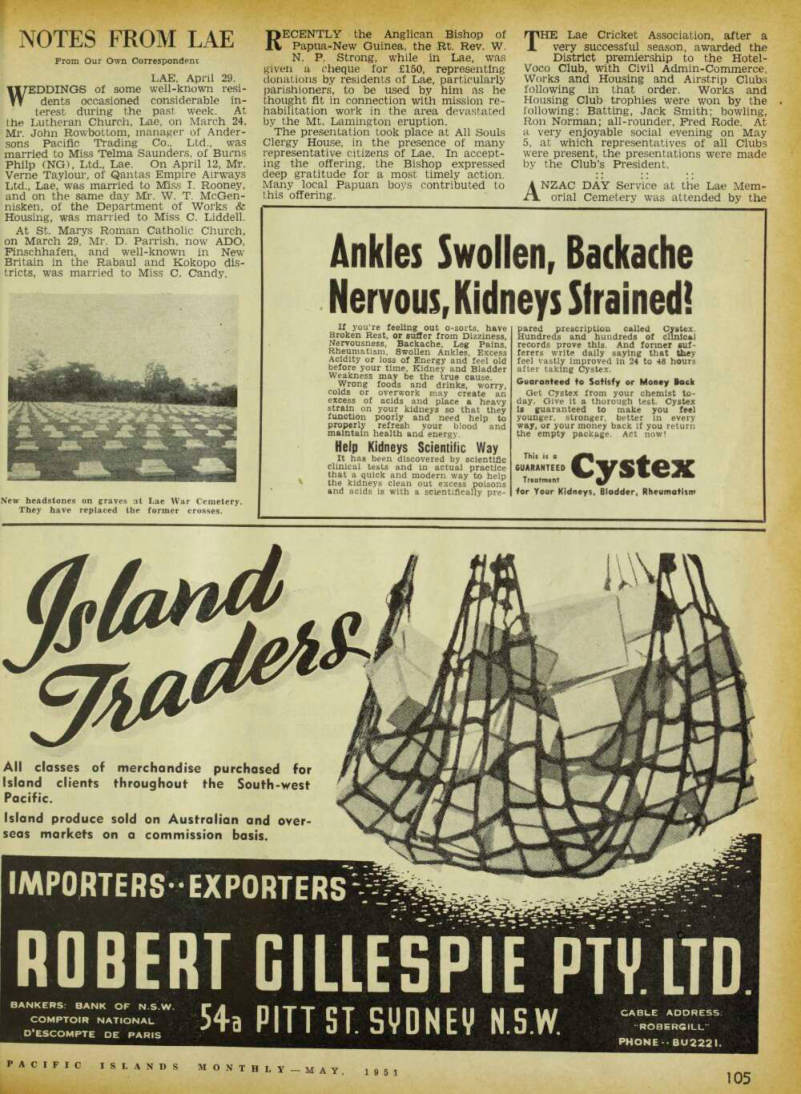

From Our Own Correspondent LAE, April 29. 11TEDDINGS of some well-known resi ff dents occasioned considerable in terest during the past week. At the Lutheran Church, Lae, on March 24, Mr. John Rowbottom, manager of Ander sons Pacific Trading Co., Ltd., was married to Miss Telma Saunders, of Burns Philp (NG), Ltd., Lae. On April 12, Mr.
Verne Taylour, of Qantas Empire Airways Ltd., Lae, was married to Miss I. Rooney, and on the same day Mr. W. T. McGen nisken, of the Department of Works & Housing, was married to Miss C. Liddell.
At St. Marys Roman Catholic Church, on March 29, Mr. D. Parrish, now ADO, Pinschhafen, and well-known in New Britain in the Rabaul and Kokopo dis tricts, was married to Miss C. Candy.
IJECENTLY the Anglican Bishop of X\, Papua-New Guinea, the Rt. Rev. W.
N. P. Strong, while in Lae, was given a cheque for £l5O, representing donations by residents of Lae, particularly parishioners, to be used by him as he thought fit in connection with mission rehabilitation work in the area devastated by the Mt. Lamington eruption.
The presentation took place at All Souls Clergy House, in the presence of many representative citizens of Lae. In accepting the offering, the Bishop expressed deep gratitude for a most timely action.
Many local Papuan boys contributed to this offering.
rpHE Lae Cricket Association, after a X very successful season, awarded the District premiership to the Hotel- Voco Club, with Civil Admin-Commerce.
Works and Housing and Airstrip Clubs following in that order. Works and Housing Club trophies were won by the following: Batting, Jack Smith; bowling, Ron Norman; all-rounder, Fred Rode. At a very enjoyable social evening on May 5, at which representatives of all Clubs were present, the presentations were made by the Club’s President. :: ;: ;: A NZAC DAY Service at the Lae Mem -orial Cemetery was attended by the
New headstones on graves at Lae War Cemetery.
They have replaced the former crosses.
irgest gathering since the conclusion of le war.
Over 100 returned men marched, to other with contingents from the newly irmed PNGVR and the New Guinea cliceboys. Speakers from the various [issions followed the president, Mr. L. shton, who read a special message from le Federal President, Mr. G. Holland, [any wreaths from representative bodies id private citizens were placed at the ise of the flag-pole.
Prior to the service planes from antas Empire Airways and Mandated irlines flew in formation over the ce etery grounds. Returned servicemen .tended a luncheon in the Lae Theatre, »ecially made available by the pro ■ietors for the occasion. The League is ►ecially indebted to Mrs. W. Simpson ho generously gave up her time to indie the whole of the catering arrange ents.
Matron Kiernan of the European Hos tal, Lae, was the guest of honour at e Luncheon, and a profitable sideline, lually associated with such Digger itherings, netted over £5O for the ;ague’s Building Fund. Local business •ms later reported a most unusual de and for ties. . MOST unsatisfactory position, in re- L gard to the burial of Europeans has been revealed in the case of a recent ath, and as it would appear to be a atter of general interest, the following formation has been gleaned: The Administration accepts respon lilty for preparing the grave, and pplying graveside accessories and trans it of the casket to the cemetery. It es not, however, accept any responsi- Lity for the preparations, following the ath, usually carried out by an under ker, except in the case of paupers, and
persons without friends or relatives in the district.
As the European Hospital here has no male staff to perform the necessary duties of preparing the body for burial, it is in cumbent on relatives or friends to under take this task, otherwise nothing would be done.
Undertakers do not exist in the Terri tory, and it would be of some consolation to bereaved residents if the Administra tion would give some consideration to this matter.
Advertisements & other items, pp. 107-108 (1 item)
Robert Gillespie Ptv.Ltd
Ankles Swollen, Backache Nervous, Kidneys Strained!
IX you’re feeling out o-sorts, have Broken Rest, or suffer from Dizziness.
Nervousness, Backache. Leg Pains, Rheumatism, Swollen Ankles, Excess Acidity or loss of Energy and feel old before your time, Kidney and Bladder Weakness may be the true cause.
Wrong foods and drinks, worry, colds or overwork may create an excess of acids and place a heavy strain on your kidneys so that they function poorly and need help to properly refresh your blood and maintain health and energy.
Help Kidneys Scientific Way
It has been discovered by scientific clinical tests and in actual practice that a quick and modern way to help the kidneys clean out excess poisons and acids is with a scientifically pre-
pared prescription called Cystex.
Hundreds and hundreds of clinical records prove this. And former sufferers write daily saying that they feel vastly Improved in 24 to 48 hours after taking Cystex.
Guaranteed to Satisfy or Money Bach Get Cystex from your chemist today. Give it a thorough test. Cystex Is guaranteed to make you feel younger, stronger, better in every way, or your money back if you return the empty package. Act now!
Cystex
This is a
GUARANTEED
Treatment for Your Kidneys, Bladder, Rheumatism
V All classes of merchandise purchased for Island clients throughout the South-west Pacific.
Island produce sold on Australian and overseas markets on a commission basis.
IMPORTERS-EXPORTERS
ROBERT GILLESPIE PTV.LTD
BANKERS BANK OF NSW.
COMPTOIR NATIONAL
D'ESCOMPTE DE PARIS
54a PITT ST. SVONEV N S W.
CABLE ADDRESS
■ ROBERGILL"
PHONE -- BU2221.
All Mobilco Machines do more than just one job HP % 5 ■/ NT Electric Boring Attachment fitted to Mobilco Circular Saw.
Boring Attachment fitted to Mobilco Post Hole Digger.
The Mobilco felling and crosscutting Drag Saw.
MANY MACHINES, BUT
ONE STANDARD ENGINE
You can fit a 3" centrifuge pump onto the Mobilco Post Hole Digger which will deliver 300 gallons per minute at a 50 ft. head.
Mobilco Machines are Multi-purpose Machines
All Mobilco Machines are powered by one engine a B.S.A. 7 b.h.p. four stroke. This means that if you buy a Mobilco Circular Saw, for instance, and later purchase a Post Hole Digger, you do not have to buy another engine. Furthermore, each Mobilco Machine will perform a variety of tasks. For example, an electric generator, wood or metal boring drill, saw bench and drag saw attachment are all available for quick and easy fitting to the Mobilco Circular Saw. Likewise an electric generator, lighting plant, power drill or pump can be fitted to the Mobilco Post Hole Digger. You can see then that when you buy Mobilco you buy one good machine for many useful purposes.
Mobilco machinery may be purchased through your usual Trade supplier or direct ex Melbourne, Australia, from Mobile Industrial Equipment Pty. Ltd.
All Mobilco lines carry a twelve months guarantee and deliveries are prompt.
Light and power for any purpose from Generator.
The Generator comes as a separate unit or as an attachment to the Post Hole Digger or Circular Saw.
MOBILE INDUSTRIAL m EQUIPMENT PTY. LTD.
252 SWANSTON ST., MELBOURNE CEN. 4799; AFTER HOURS WF 3118
No Pension For Public
Servant’S Widow
* FEW months ago, a high official of A the Administration in Papua lost his life j n an acc ident. He had had about 40 years’ service; and, if he had retired, he would have received an allow ance of £6OO per annum for the rest of his life. if his service had been in New Guinea, his widow would have received half that pension. Because his service was in Papua, she gets nothing, except the re fund to her Of whatever sum he had paid into the superannuation machinery. There was some suggestion that she might be given a compassionate allowance of £75 nr fine npr annum fihp has remained gT the Te?rito?v Tnd taken a fob The m tne 1 emiory, ana LdK.en a jup, ■ llie ° nl ? alte ™ atlv f ™ as to return to Aus tralia and apnly for the pension that is allowed t 0 wldows without re sources-50/per week, or something like that.
This is not a pretty picture for an age ing Papuan public servant to contemplate.
There should be some provision under which the widow of a man who dies in harness after a certain period of service, should receive a pension. As the regula tions now stand, they present an anomaly,
The Search For Oil
In Papua
THE Australasian Petroleum Co., on May 8, reporting on its search for oil in Papua, said that test bore No. 2 at Hohoro had been deepened from 4,220 to 4,520 feet; that seismic parties were con tinuing surveys in the Purari River delta and near the mouth of the Kikori; that the Island Exploration Co.’s test well at Omati had reached a depth of 4,853 feet; and that a gravity geophysical party was continuing its survey in the Turama River area.
Miss Priscilla Duff-Fyfe, of Sydney, was married in April to Mr. Thomas Howes, of Lae, New Guinea. Mr. Howes returned to NG a week later; his bride will follow when he finds a house.
The three members of the Fiji Legisla tive Council, who will visit Britain as official guests during the Festival of Britain are Mr. H. Maurice Scott, DFC; Ratu G. C. Tuisawau, QBE; and Mr. Tuisi Ram Sharma. The period of the visit will be from July 9 to July 30. and it is ex pected that about 90 representatives from the Colonies will attend.
Advertisements & other items, pp. 109-110 (2 items)
107
ACIFIC ISLANDS MONTHLY MAY, 1951
Gilbey’S
Here’s Hope
For A
Persistent Worry
CONSTIPATION, forerunner of many troubles, affects people of all ages and walks of life and causes much annoyance and worry.
When the bowels refuse to work naturally and regularly, the body absorbs poisons from the waste that remains In the system. Constipation brings sick headaches, biliousness, coated tongue and unpleasant breath, flatulence, loss of appetite, blemishes and other troubles which quickly upset your health and well-being.
These troubles are easily corrected by safe, gentle Plnkettes for you and all the family.
Pinkettes are simple to take; and do not have harsh after-effects which can be dangerous.
Being compounded of harmless vegetable ingredients only, Plnkettes act in Nature’s way.
Thousands and thousands of people have found Plnkettes the Ideal laxative, because they are not hablt-formlng and the dose is reduced as they make you regular. Always at chemists and stores.
ff. * A.
the
C A hh
is f
GILBEY’S
hbl S Our Ne.
Sy Dh ßy hi
SB A N 6
088 5 3 Address all enquiries to W. & A. GILBEY LTD., 33 Rosslyn Street, West Melbourne.
Allen Taylor & Co. Ltd.
COMMERCIAL ROAD, ROZELLE, SYDNEY
Sawmillers and Wholesale Suppliers of Hardwoods for Contructional Purposes GIRDERS . . . PILES . . . POLES . . . SLEEPERS, Etc.
Exporting to the Pacific Islands Since 1893,
FIJI COPRA PRODUCERS
YOU WANT CORRECT WEIGHTS, QUICK ACCOUNT SALES, IMMEDIATE RETURN OF YOUR OWN SACKS. CARE TAKEN OF YOUR SACKS WHEN THEY ARE OPENED ...
Then Send Your Copra to
W. R. CARPENTER S CO. (Fiji) LTD.
IN SUVA
Buying Agents for FIJI COPRA BOARD Two weighbridges, checked daily and Government-tested, ensure correct weights.
Office organisation ensures quick accounting.
A special opener is used to save damaging your sacks which are emptied as soon as they are weighed, and your own sacks are ready for return to you immediately.
MOTOR VESSELS: “KOMAIWAF AND “TOVATA” serve Cakaudrove, Lomaiviti, Lau and Yasawa.
W. R. CARPENTER 4 CO. (Fiji) LTD.
Renwick Road Cr Thomson Street P.O. Box 299 SUVA, Fiji.
Telephone: 114 (6 lines).
To Valparaiso

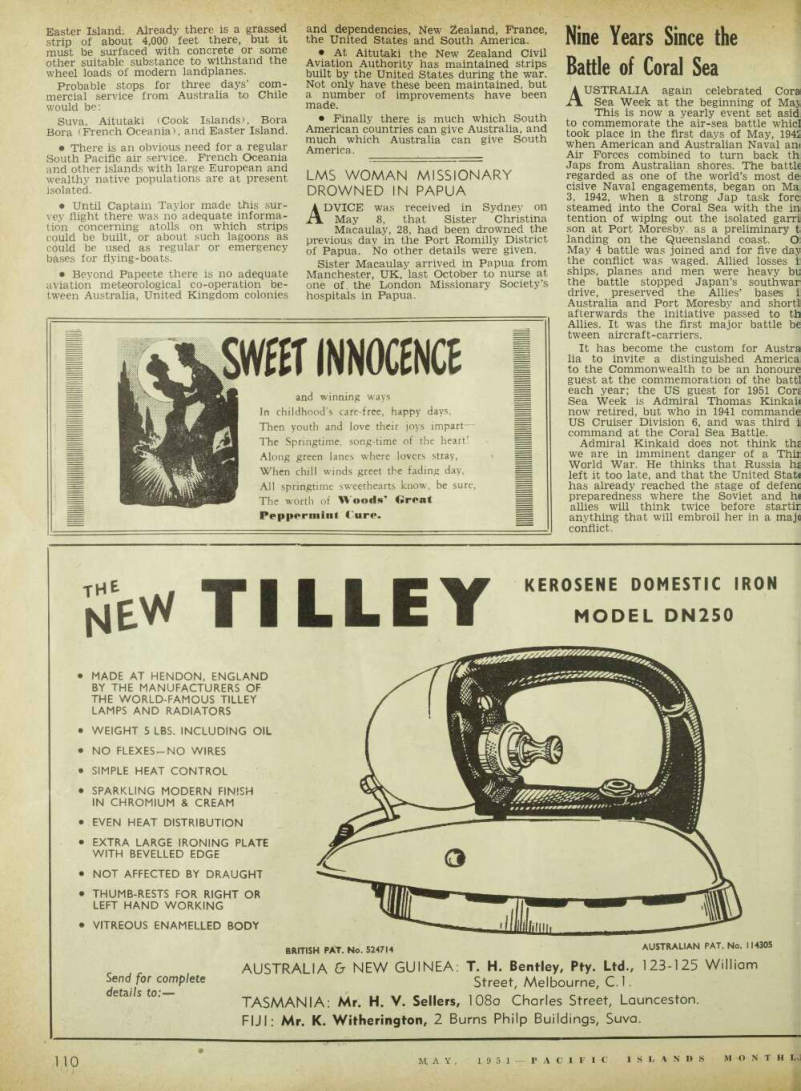
Possible South Pacific Air Service—Sydney
Summary of Results of Captain Taylor's Survey
WHEN the Catalina flying-boat Frigate Bird II arrived in Rose Bay, Sydney, on April 22, Captain P. G. Taylor had completed a survey flight of 20,000 miles for the Australian Government, in order to test the feasibility of a com
mercial air-line across the South Pacific; between Australia and Chili (South America).
One member of Captain Taylor’s crew was the well-known Australian journalist: Jack Percival; and the following article by him, which was published in the Sydney Morning Herald of April 28, provides ar admirable summary of the flight, and ol what the famous airman discovered.
THE flying-boat made her most valuable 'flights hundreds, and, in some casei thousands of miles away from air craft bases —where there were no installa tions for servicing or repairs.
Except at Suva, Aitutaki (Cook Islands)!
Satapuala Bay (Western Samoa) and a the Chilian Air Force Base, at Quinteros Valparaiso, fuelling was completed unde; almost unbelievable conditions. In on instance, a delay in fuelling at Eastei Island nearly caused the loss of the flying' boat. Here the fuel had to be brough out into the ocean in boats which hai to shoot the breakers through a gap ii the cliffs.
Polynesian seamen stood by the flying; boat all night in a vicious sea. Order from the crew to these Polynesian seamei were interpreted by Jack Lord, an Aus tralian in charge of a large sheep static; on the island.
Fuel at Mangareva (Gambier Islands was cached under coconut trees on one c the islands of the group. On Captai; Taylor’s instructions this fuel was coverei with fronds to prevent sun deterioration The crew, led by Captain Taylor, had t swim ashore to locate the cache. Th drums were then floated beneath the air craft’s wing on native outrigger canoes.
There was a pleasant servicing surpris at Aitutaki, where we found a forme American Army colonel in charge of th fuel. At the end of the war he had re turned to Aitutaki, where he married, st up a modern American drug store an built a home. The boat in which h brought fuel to the flying-boat wa equipped with all modern servicing equip ment, much of which he had improvise himself.
Later, this former colonel, John Hai rington, renewed our stores with almoa everything required including the b et Australian asparagus, paper plates an serviettes, and plastic cups and saucers..
THE highlights of the flight were tH open ocean “landings” and take-ofl at Easter Island, where there is it sheltered water. The whole coastline the island comprises steep cliffs againt which a heavy surf continually breaks.
Easter Island looks like a gigantic ir dined saucer resting on the sea, II surface is dotted with 15 extinct volcano© and gigantic stone figures each weighir up to 100 tons. Fences on the sher station, which runs about 35,000 sheei three to the acre, are made of stom collected from the defunct volcanoes. tween the craters of the volcanoes thK are wide plains of flat land on which aen dromes of almost unlimited length coin be built at low cost.
There is only one jeep on the islan the usual form of transport being stun Chilean ponies on which the huasos, peons, ride two at a time.
After a 500-foot climb up a cliff face had to ride on one of these ponies to ti opposite side of the island to give instruj
3ns for the delivery of fuel, and to hand r er mail sent by Australian philatelists the post offiice.
It seemed that I was at the head of a vision of cavalry. I was followed by al ost the entire population, all riding ►nies and carrying fish spears.
When I got back I found that the wind id changed. Captain Taylor was worried out the safety of his craft. So we spent I night on the “ship” to find in the arning that she was riding high seas.
Captain Taylor decided to send Captain irvls and the Radio Officer, Mr. A. lison, ashore to try and get a heavy ichor. They were no sooner ashore after hting through the surf when the air aft’s anchors carried away.
Paced with the possibility of losing her .ptain Taylor ordered L’Huillier, the ight Engineer, to start up the engines d then edged the ship to sea.
By alternate use of the port and star ard engines, and with using lowered erons and elevator to catch the wind, sailed the Frigate Bird II six miles to >re sheltered waters. kURING this operation Purvis and ' Allison returned to the cliffs. Purvis said later: “We would see you, then i would go down into the troughs of the is, and it would be some time before saw you again. Time after time we night you would founder.” )n our long flight we saw many islands i atolls seldom visited by ships and rer before by aircraft. Inhabitants were first scared when the flying-boat roared ;r their lagoons as we examined the al formations of certain atolls with the ect of spotting likely sites for landing ips.
They ran inside their grass huts or o banana and coconut plantations, ere they remained for some time be e recovering their wits. Then they k off their cotton or grass skirts and
tried to wave us down into their lagoons.
Most beautiful of the islands we visited were Western Samoa and the Tuamotu or Low Archipelago, the latter in French Oceania. Almost every atoll in the Low Archipelago can be used as either a permanent or emergency base for flying-boats T.™i a J? y thoro is sufficient land for the building of long s ™P S - , , . . . TJ 10 lagoons and islands we flew over by day were fascinating, but many of them were even more attractive bn moonlit
nights. Some ot them stood out on the sea in the moonlight like great necklaces of opals. at t v • . , .. . L,Y flight pin-pointed the louowmg facts: • A commercial air route between Aus tralia and South America is feasible, Almost immediately it could be flown in three days in modern landplanes such as the DC6 and Lockheed Constellation.
This, of course, is contingent upon the construction of an adequate strip on
Easter Island. Already there is a grassed strip of about 4,000 feet there, but it must be surfaced with concrete or some other suitable substance to withstand the wheel loads of modern landplanes.
Probable stops for three days’ com mercial service from Australia to Chile would be: Suva, Aitutaki (Cook Islands), Bora Bora (French Oceania), and Easter Island. • There is an obvious need for a regular South Pacific air service. French Oceania and other islands with large European and wealthy native populations are at present isolated. • Until Captain Taylor made this sur vey flight there was no adequate informa tion concerning atolls on which strips could be built, or about such lagoons as could be used as regular or emergency bases for flying-boats. • Beyond Papeete there is no adequate aviation meteorological co-operation be tween Australia, United Kingdom colonies
and dependencies, New Zealand, France, the United States and South America. • At Aitutaki the New Zealand Civil Aviation Authority has maintained strips built by the United States during the war.
Not only have these been maintained, but a number of improvements have been made. • Finally there is much which South American countries can give Australia, and much which Australia can give South America.
Advertisements & other items, pp. 110-112 (3 items)
108
MAY, 1951-PACIFIC ISLANDS MONTH
109
CIFIC ISLANDS MONTHLY— MAY, 1951
Ftrdath
PURIA
CORK TIPS
FOR PERFECT
HYGIENE
i
IMPORTED FROM ENGLAND
Manufactured in LONDON
by ARDATH TOBACCO CO. LTD.
ftRDATH
CORK TIPPED CIGARETTES
££ V'l
fit®'
fkir There’s no finer way to qnencha R B Loge r “ gtoS S '' flr vithmen and women alike.
firm favourite
TOOTH’S
LAGER
BR
EWED AND
bottled
Y TOOTH
& CO. limited
SWEET INNOCENCE
and winning ways In childhood’s care-free, happy days, Then youth and love their joys impart — The Springtime, song-time of the heart' Along green lanes where lovers stray, When chill winds greet the fading day, All springtime sweethearts know, be sure, The worth of Woods' Groat Peppermint Cure.
NE W Tl
• MADE AT HENDON. ENGLAND
BY THE MANUFACTURERS OF
THE WORLD-FAMOUS TILLEY
LAMPS AND RADIATORS
• WEIGHT 5 LBS. INCLUDING OIL
• NO FLEXES-NO WIRES
• SIMPLE HEAT CONTROL
• SPARKLING MODERN FINISH
IN CHROMIUM & CREAM
• EVEN HEAT DISTRIBUTION
• EXTRA LARGE IRONING PLATE
WITH BEVELLED EDGE
• NOT AFFECTED BY DRAUGHT
• THUMB-RESTS FOR RIGHT OR
LEFT HAND WORKING
• VITREOUS ENAMELLED BODY
KEROSENE DOMESTIC IRON
MODEL DN2SO
LLEY
G
BRITISH PAT. No. 524714
AUSTRALIAN PAT. No. 114305
AUSTRALIA & NEW GUINEA: T. H. Bentley. Pty. Ltd., 123-125 William Send for complete Street, Melbourne, C. 1.
TASMANIA: Mr. H. V. Sellers, 108 a Charles Street, Launceston.
FIJI: Mr. K. Witherington, 2 Burns Philp Buildings, Suva.
Lms Woman Missionary
Drowned In Papua
ADVICE was received in Sydney on May 8, that Sister Christina Macaulay, 28, had been drowned the previous day in the Port Romilly District of Papua. No other details were given.
Sister Macaulay arrived in Papua from Manchester, UK, last October to nurse at one of. the London Missionary Society’s hospitals in Papua.
Nine Years Since the Battle
Battle of Coral Sea
AUSTRALIA again celebrated Coraf Sea Week at the beginning of May This is now a yearly event set asidi to commemorate the air-sea battle whicl took place in the first days of May, 1942 when American and Australian Naval am Air Forces combined to turn back thj Japs from Australian shores. The battle regarded as one of the world’s most de: cisive Naval engagements, began on Ma; 3, 1942, when a strong Jap task fore: steamed into the Coral Sea with the ini tention of wiping out the isolated garrii son at Port Moresby, as a preliminary t: landing on the Queensland coast. O: May 4 battle was joined and for five day the conflict was waged. Allied losses i; ships, planes and men were heavy bu the battle stopped Japan’s southwar drive, preserved the Allies’ bases t Australia and Port Moresby and short! afterwards the initiative passed to th Allies. It was the first major battle be tween aircraft-carriers.
It has become the custom for Austral lia to invite a distinguished America to the Commonwealth to be an honours guest at the commemoration of the battl each year; the US guest for 1951 Cors Sea Week is Admiral Thomas Kinkaio now retired, but who in 1941 commande US Cruiser Division 6, and was third ii command at the Coral Sea Battle.
Admiral Kinkaid does not think the we are in imminent danger of a Thin World War. He thinks that Russia ha left it too late, and that the United State has already reached the stage of defenc preparedness where the Soviet and he allies will think twice before startir anything that will embroil her in a majo conflict.
Advertisements & other items, p. 112 (1 item)
110
M, AY , 1951 PACIFIC ISLANDS MONTHL
Polio Nonsense
Disorganisation of Transport Services
THE Health Department of the South Pacific Commission would achieve some really useful service to the South Pacific Islands if it could persuade the various medical organisations to adopt some general rule, and display some practical commonsense, in imposing quarantine relating to Poliomyelitis.
Polio is not a new disease. Probably, it always has been with us. All that has happened in recent years is that medical science now can identify it more readily— formerly, it was confused with various other somewhat similar diseases caused by a virus.
The method of carrying the infection, however, is as great a mystery to-day as ever it was. This month, in New South Wales, the experts are arguing that domestic fowls are the usual conveyors.
There have been countless instances, in Australia, the Pacific Islands, and else where, of the disease appearing, without rhyme or reason, at widely scattered points between which there has been no apparent connection, and which had not been in contact with any known possible carrier.
But, in the Pacific Islands, the very mention of Polio seems to create a sort of panic, and the medical czars immediately clamp on the sort of quarantine that they successfully employ against fatal plagues and poxes. With Polio, this does not appear to accomplish anything. There have been cases of Polio reported; but it has not been shown that the incidence of the disease in the tropical Islands has ever been controlled by quarantine regu lations.
TO-DAY, at the first suggestion that a ship has come from a port where there is Polio, the Islands officials impose a ruthless quarantine, with the result that both shipping and merchants ire caused much inconvenience and ex pense. Officials, when riding high on -heir particular species of authority, generally have little regard for the feelings if private nersons or the convenience of irivate enterprise; but at least some effort should be made to show how useless such 'estrictions are.
Last month, the liner Chang Chow, carrying on the Messageries Maritimes service between Marseilles and Sydney, via Panama, called at Papeete. There have )een some Polio cases in Tahiti.
So. immediately the ship left Papeete, he health officials in Noumea became janicky, and announced that, if the Chang mow came to Noumea—for which port he had many passengers and much cargo -she would have to go into quarantine or three weeks. So the Chang Chow :ut out Noumea and went directly to Sydney, spent a week there, and then went lirect to Noumea, as her first port of call m her return trip. She thus filled in the luarantine period demanded by Noumea.
Noumea’s medical honour was satisfied, .nd the ship proceeded as per schedule.
But the shipping line had to bear the ost of carrying the Noumea passengers nd cargo right across to Sydney, and ack to Noumea. And Polio cases are be rig reported every day or two in Sydney ity and the adjoining countryside. Could nything be more absurd?
Similar cases occur regularly in relation 3 other South Pacific ports. Western iamoa seems to have periodic fits of ex itement over Polio. Someone there pro osed to keep Captain P. G. Taylor’s trail reakmg Frigate Bird II out of Apia, ecause he had called at Papeete; but aat plan was cancelled on curt instruc ions from Wellington.
The two biggest Territories—Fiji and Papua-New Guinea—on the other hand, have interfered very little with overseas transport, on Polio grounds, although they handle a much heavier volume of traffic.
And, except for a brief outbreak in Eastern Fapua, they have had no Polio. Their Governments have shown more common sense.
Medical officers probably have no more difficult job than that of applying quaran tine. If they let commonsense rule their decisions, they are as likely as not to be made a scapegoat by some political panjandrum at headquarters. One cannot blame them for sticking to the letter of the regulations.
Here, in the application of quarantine in relation to Polio, is a job right at hand for the South Pacific Commission. A little commonsense, and a lot of co ordination, are called for.
Urgent Case In Honiara
A special chartered plane left Sydney on May 12, with iron-lung equipment for Guadalcanal, BSI, where a senior official was reported dangerously ill, with Polio.
The New Golden Hind has been over hauled and refitted in Auckland and left that port for a year’s cruise among the Pacific Islands in April. The new owners, of the ketch are Mr. Athol Rusden and Mr. R. Baker. There are eight men in the crew, two of them Americans.
The 300-ton motor-vessel Kelanoa went up on a reef off New Ireland on May 6.
She was still there hard and fast several days later.
Advertisements & other items, pp. 113-114 (2 items)
111
ACIFIC islands MONTHLY-MAY, 1951
Superb
TAHITI
To Shipmasters and Visitors
When calling at Tahiti, and seeking SHIPS SUPPLIES and FRESH
PROVISIONS, see—
OSCAR G. NORDMAN
Supply Agent for Messageries Maritimes, Union S.S. Co. of N.Z Ltd Matson-Oceanic Line, United States Line, General S.S. Corp., Etc.
We supply General Service Act as Shipping Agents Address all inquiries to the Tourist Bureau.
OSCAR G. NORDMAN
Ship Chandler
PAPEETE, TAHITI
Wire before your arrival to
“OCEANIC, PAPEETE”—Our
registered cable address.
MUNGO SCOTT PTY. LTD.
Flour Millers, Summer Hill, N.S.W., Australia Established 1894.
BLUE
FINE
AND
DRY !
£
SUPERB
SUPERB
IT'S
QUALITY
THAT
COUNTS !
The unvaried “Quality” of “BLUE SUPERB FLOUR” makes it especially suitable to climatic conditions of the Pacific Islands. Our Entoletion process reduces the risk of insect infestation to a minimum. All Good Bakers use “BLUE-SUPERB." Our Pacific Representative will call on you soon.
m * --C ’ - *?V - !*w
y&t zzz *' fSKTr- :
lIL* .. ? «*f#>* '- «., ■
THIS SPLENDID UTILITY VESSEL
FOR SALE
IDEALLY EQUIPPED FOR ISLANDS PURPOSES, this McFarlanebuilt auxiliary Ketch— ONLY FOUR YEARS OLD fulfils the requirements of an administrative or commercial vessel.
LENGTH, 87 FT.; BEAM, 21 FT.; DRAUGHT, 7 FT.
Soundly built and Marconi-rigged for easy sail handling with a minimum crew, she is adequately powered with an 8-cylinder 136 h.p.
Gardner diesel engine, nearly new. Auxiliary engine is a 16 h.p.
Lister.
Fore cabin accommodates six, there are two bunks in wheelhouse, and a two-berth cabin. Complete suit of sails plus spares.
CARGO CAPACITY APPROXIMATELY 100 TONS.
ALSO . . .
WE HAVE a fine range of power and auxiliary craft—from 27 ft. upwards—that are economical to run and invaluable for hard-working use in Islands trading.
Write or telegraph for details, pictures and prices.
William E. Reed
(Established 1913) Island Trade Broker & Commission Agent 145 a GEORGE ST., CIRCULAR QUAY, SYDNEY.
Cables: “WILREED”, Sydney.
Their Wasted
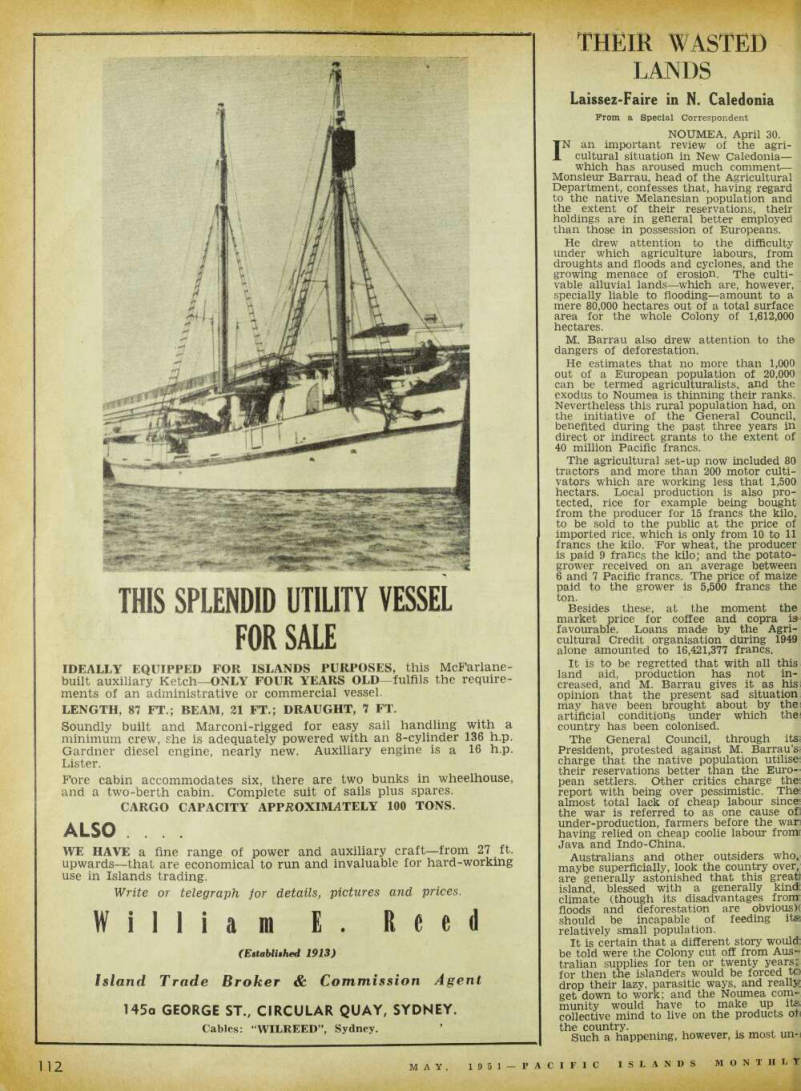
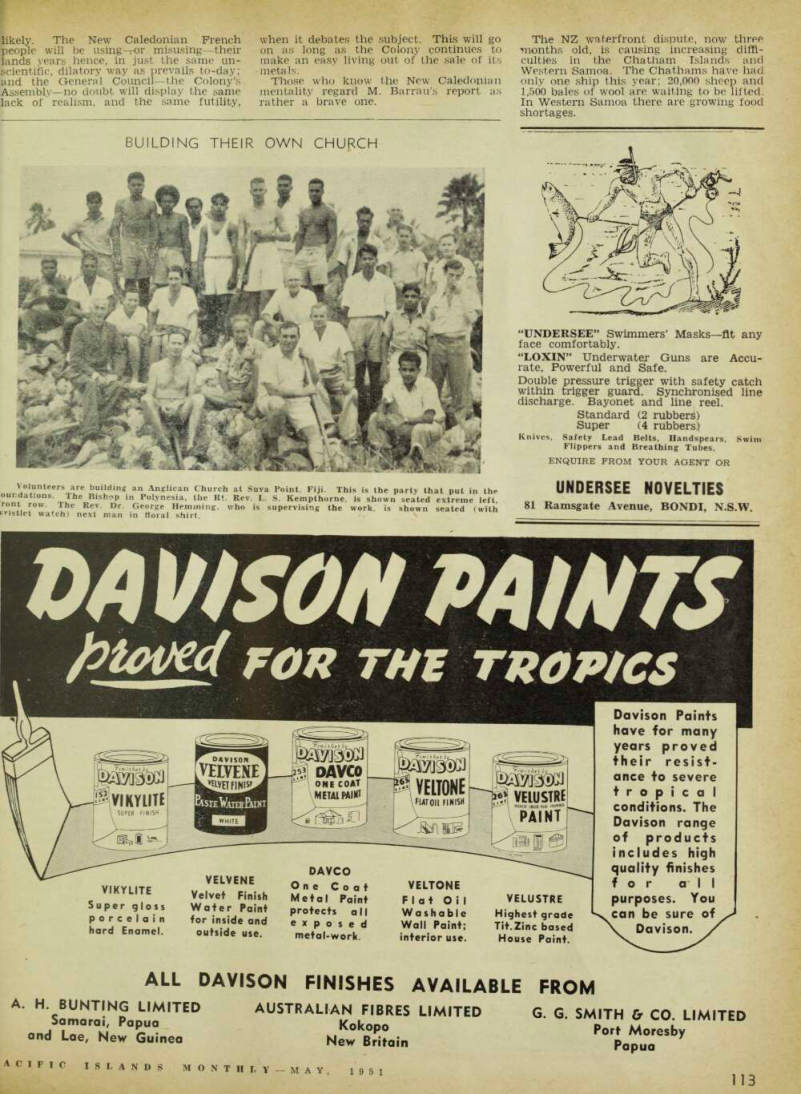
Lands
Laissez-Faire in N. Caledonia
Prom a Special Correspondent NOUMEA, April 30.
IN an important review of the agri cultural situation in New Caledonia— which has aroused much comment— Monsieur Barrau, head of the Agricultural Department, confesses that, having regard to the native Melanesian population and the extent of their reservations, their holdings are in general better employed than those in possession of Europeans.
He drew attention to the difficulty under which agriculture labours, from droughts and floods and cyclones, and the growing menace of erosion. The culti vable alluvial lands—which are, however, specially liable to flooding—amount to a mere 80,000 hectares out of a total surface area for the whole Colony of 1,612,000 hectares.
M. Barrau also drew attention to the dangers of deforestation.
He estimates that no more than 1,000 out of a European population of 20,000 can be termed agriculturalists, and the exodus to Noumea is thinning their ranks.
Nevertheless this rural population had, on the initiative of the General Council, benefited during the past three years in direct or indirect grants to the extent of 40 million Pacific francs.
The agricultural set-up now included 80 tractors and more than 200 motor culti vators which are working less that 1,500 hectars. Local production is also pro tected, rice for example being bought from the producer for 15 francs the kilo, to be sold to the public at the price of imported rice, which is only from 10 to 11 francs the kilo. For wheat, the producer is paid 9 francs the kilo; and the potato grower received on an average between 6 and 7 Pacific francs. The price of maize paid to the grower is 5,500 francs the ton.
Besides these, at the moment the market price for coffee and copra i» favourable. Loans made by the Agri cultural Credit organisation during 1949 alone amounted to 16,421,377 francs.
It is to be regretted that with all this land aid, production has not in creased, and M. Barrau gives it as his opinion that the present sad situation may have been brought about by the: artificial conditions under which the: country has been colonised.
The General Council, through its; President, protested against M. Barrau’si charge that the native population utilise; their reservations better than the Euro pean settlers. Other critics charge the; report with being over pessimistic. The; almost total lack of cheap labour since; the war is referred to as one cause ofi under-production, farmers before the war having relied on cheap coolie labour frorm Java and Indo-China.
Australians and other outsiders who, maybe superficially, look the country over, are generally astonished that this great) island, blessed with a generally kind; climate (though its disadvantages fromr floods and deforestation are obviousX should be incapable of feeding its? relatively small population.
It is certain that a different story would: be told were the Colony cut off from Aus tralian supplies for ten or twenty years; for then the islanders would be forced to drop their lazy, parasitic ways, and really get down to work; and the Noumea com munity would have to make up its collective mind to live on the products ob the country.
Such a happening, however, is most un-j
likely. The New Caledonian French people will be using—or misusing—their lands years hence, in just the same un scientific, dilatory way as prevails to-day: and the General Council—the Colony’s Assembly—no doubt will display the same lack of realism, and the same futility,
when it debates the subject. This will go on as long as the Colony continues to make an easy living out of the sale of its metals.
Those who know the New Caledonian mentality regard M. Barrau’s report as rather a brave one.
The NZ waterfront dispute, now three months old, is causing increasing diffi culties in the Chatham Islands and Western Samoa. The Chathams have had only one ship this year; 20,000 sheep and 1,500 bales of wool are waiting to be lifted.
In Western Samoa there are growing food shortages.
Advertisements & other items, p. 114 (1 item)
112
MAY, 1951 PACIFIC ISLANDS MONT II L
Building Their Own Church
Volunteers are building an Anglican Church at Suva Point, Fiji. This is the party that put in the our ations. The Bishop in Polynesia, the Rt. Rev. L. S. Kempthorne, is shown seated extreme left. ron t r ow The Rev . Dr. George Hemming, who is supervising the work, is shown seated (with vristlet watch) next man in floral shirt.
Advertisements & other items, pp. 115-116 (2 items)
113
ACIFIC ISLANDS MONTHLY - may. J9si
ran thi tropics
\ “UNDERSEE” Swimmers’ Masks—flt any face comfortably.
“LOXIN” Underwater Guns are Accurate, Powerful and Safe.
Double pressure trigger with safety catch within trigger guard. Synchronised line discharge. Bayonet and line reel.
Standard (2 rubbers) Super (4 rubbers) Knives, Safety Lead Belts, Handspears, Swim Flippers and Breathing Tubes.
ENQUIRE FROM YOUR AGENT OR
UNDERSEE NOVELTIES
81 Ramsgate Avenue, BONDI, N.S.W.
ran thi tropics
VIKYLITE
Super gloss porcelain hard Enamel. r davison
VEIVENE
LlWETflhl^
msm
IS!
vikyiiti
VELVENE
Velvet Finish Water Paint for inside and outside use.
§. OAVCO
°WE COAT
METAI PAINT
OAVCO
One Coat Metal Paint protects all exposed metal-work.
H
“ 6 - VEITONE
FIAT Oil FINISH
VELTONE
Flat Oil Washable Wall Paint; interior use. i&J
velustre
miHfa bum mt ’•u* u>
PAINT
VflE|^
VELUSTRE
Highest grade Tit. Zinc based House Paint.
Davison Paints have for many years proved their resistance to severe
tropical
conditions. The Davison range of products includes high
quality finishes
for all purposes. You can be sure of Davison.
ALL DAVISON FINISHES AVAILABLE FROM
A. H. BUNTING LIMITED
Samarai, Papua
and Lae, New Guinea
AUSTRALIAN FIBRES LIMITED
Kokopo
New Britain
G. G. SMITH & CO. LIMITED
Port Moresby
Papua
■ merchants, a ship owners - - ' I'
ipsiiia -a
Capital £500,000
ESTABLISHED 1914
k H:
GENERAL MERCHANTS
AND
PROVIDORES
TRADE THROUGHOUT THE PACIFIC.
THIRTY-FIVE YEARS OF PACIFIC ISLANDS DEVELOPMENT AND SERVICE
BUYERS AND EXPORTERS OF ALL KINDS
OF ISLAND PRODUCE, COPRA, COCOA,
M O P. SHELL, TROCAS SHELL, ETC.
i AGENTS FOR AUSTRALIAN, EUROPEAN
f AND AMERICAN MANUFACTURERS.
( DISTRIBUTORS OF EVERY DESCRIPTION
( OF MERCHANDISE.
Through our Sydney office, branches and agents, we distribute a wide and comprehensive range of general merchandise.
t R. CARPENTER & CO. LTD.
Head Office: 16 O'CONNELL STREET, SYDNEY, N.S.W.
Cable Address: Telephone: Postal Address: “CAMOHE ’ BW 4421. G.P.0., BOX 168, Sydney.
In London: W. R. Carpenter & Co. (London), Ltd., Coronation House, 4 Lloyd's Ave., London, EC
ASSOCIATED COMPANIES THROUGHOUT THE PACIFIC :
IN NEW GUINEA:
New Guinea Company, Limited.
Rabaul, Lae, Madang, Kavteng.
IN PAPUA:
J. R. Clay & Co., Ltd..
Port Moresby.
IN FIJI:
W. R. Carpenter * Co. (Fiji), Ltd., Suva.