Islands
Pacific
Monthly
January, 1951
Vol. XXI. No. 6.
Established 1930.
I Registered at Sydney, by post as a newspaper ]
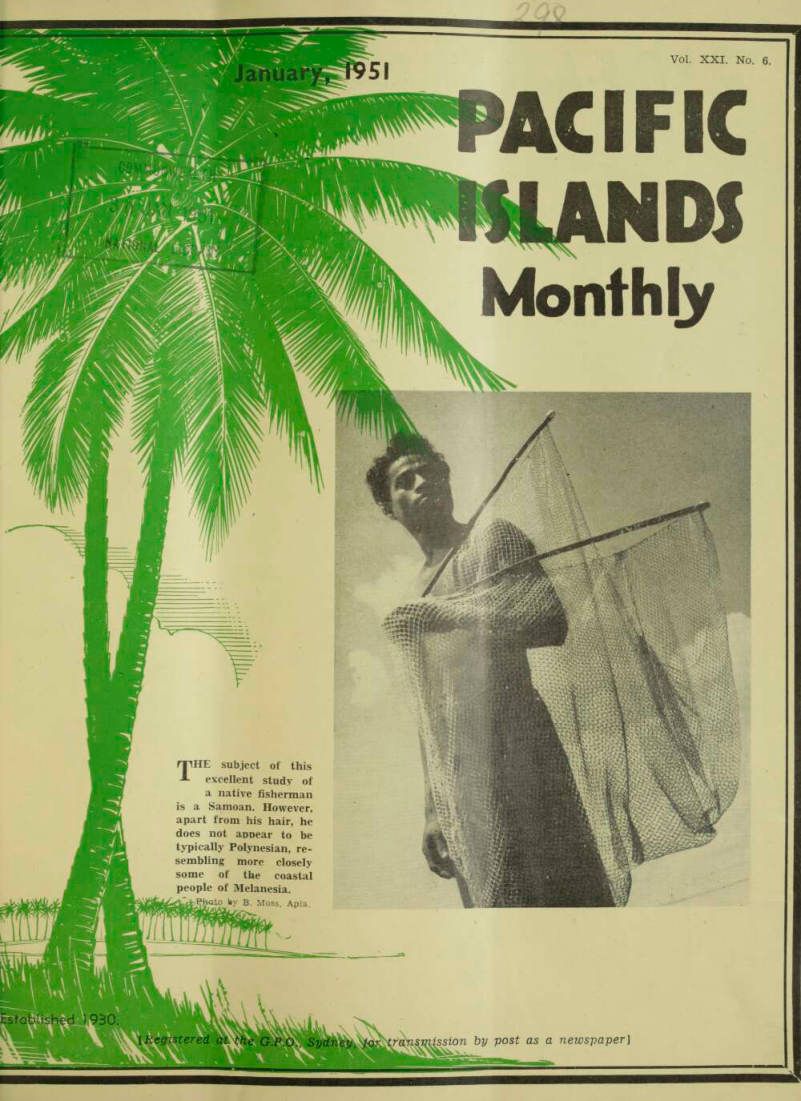
The subject of this excellent study of a native fisherman is a Samoan. However, apart from his hair, he does not appear to be typically Polynesian, re sembling more closely some of the coastal people of Melanesia. >y B. Moss, Apia.
Advertisements & other items, pp. 2-4 (2 items)
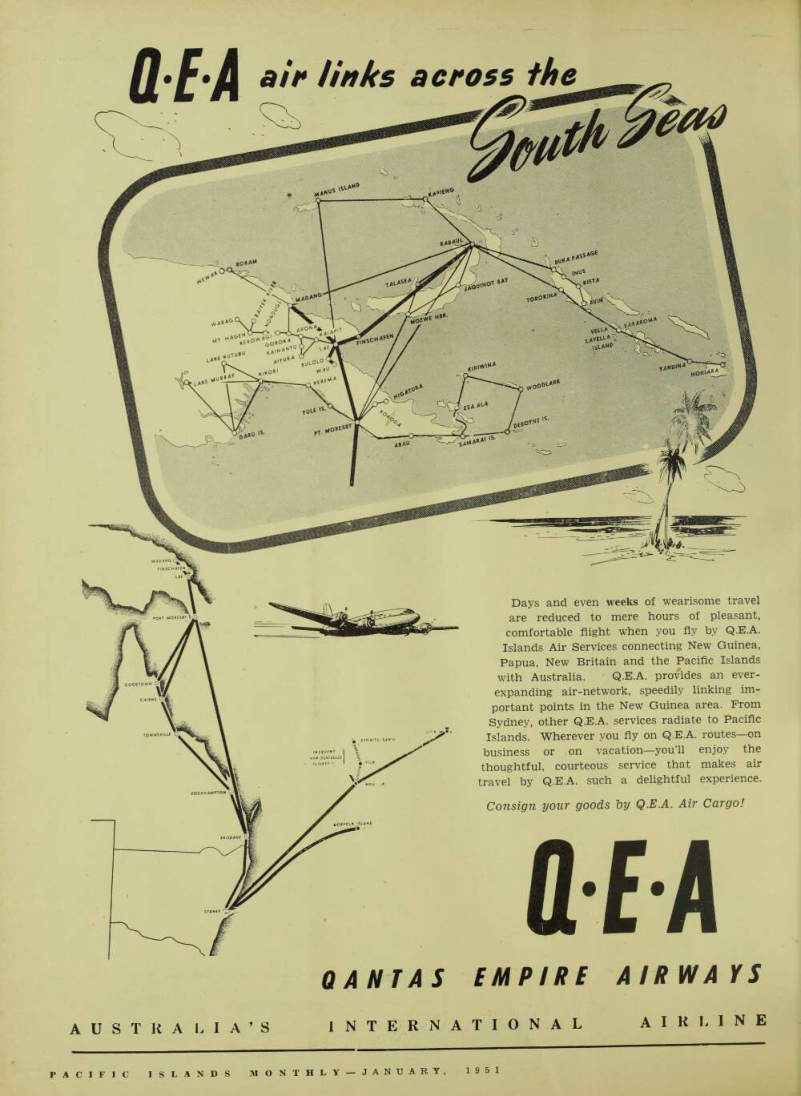
air links across fhe
etw
xltN&
Nt*« US
S 4&t
PAS
BU* a gC»* M
, N US
TA«-A* A
BA* )«£TA T oßO* lK * wot* 6 . 6 a&
RON A*.
a>a 1 hafe« rO* rO* ■
WINA
All"
SKI
At-A rut* ysE £ ntBO tsw MO* a ru
MARA'
A»A" \
fILU O
Days and even weeks of wearisome travel are reduced to mere hours of pleasant, comfortable flight when you fly by Q.E.A.
Islands Air Services connecting New Guinea, Papua, New Britain and the Pacific Islands with Australia. Q.E.A. provides an ever-
expanding air-network, speedily linking im-
portant points in the New Guinea area. From Sydney, other Q.E.A. services radiate to Pacific Islands. Wherever you fly on Q.E.A. routes—on business or on vacation—you’ll enjoy the thoughtful, courteous service that makes air travel by Q.E.A. such a delightful experience.
Consign your goods by Q.E.A. Air Cargo!
OANTAS EMPIRE AIRWAYS
AUSTKA I. I A ’ S
INTERNATIONAL
AIK L I N
rniEMAN
IAMPt
'Sm ■ sAri- ■' m MM ■ m 5 2 -• SP/{ O' mm I £*r k: U <* &
?^£RT\s
From a safety point of view, these lamps leave nothing to be desired.
There is no spilling of fuel if tipped over accidentally, even while burning and they cannot be filled while lighted.
The mantles are shock-proof and the fuel fount unbreakable.
Coleman Table Lamps give brilliant light, so like natural daylight that you can match delicate shades by it. They are twenty times as powerful as ordinary kerosene lamps and seven times as powerful as
household electric bulbs.
They light instantly, are draught-proof and the fuel capacity is sufficient for 12 hours of abundant eye-saving light. Finished in ivory enamel, with
decorated plastic covered parchment-type shade
and heat resisting globe, the lamp is a as well as a utility.
Representatives for the Pacific Islands:
54a PITT STREET
SYDNEY
ROBERT GILLESPIE PUL™
PEARCE & CO. LTD.
SUVA
FOR FIJI ISLANDS
If you want something under cover
IN A HURRY!
$ m .. -.K m
SSI
f\j M Jl mm]
!H wa
£ m s i mm MS n • i sass» L ■ ■ ' -vi i; .?
Econo-Steel Stores, 30 ft. span and any length in multiples of 9 ft. hay, are lowest in cost and weight and may he simply erected by unskilled labour. Wall sheeting is nailed directly to the nailable steel girts. « FACTORIES, STORES • GARAGES • HOMES • CABINS Whatever your accommodation problem, call on the Econo-Steel Company for suggestions on their
prefabricated components.
ECONO-STEEL PROJECTS have
Over 2000 structures built to date.
Qualified Engineering and Building Consultants on
our staff will gladly assist you solve your problem. been completed for the following: Commonwealth Works and Housing.
Public Works Dept.
Joint Coal Board.
Zinc Corporation.
Qantas Empire Airways.
Shell Company.
Atlantic Union Oil.
Commonwealth Wool and Produce.
Pitt, Son & Badgery.
Department of Lands.
Australian Estates.
Ready Mixed Concrete.
Timbrol, Limited.
Warringah Shire Council.
Leichhardt Council.
Royal Agricultural Society.
Orange City Council.
North Broken Hill, Ltd.
South Broken Hill, Ltd.
Education Department.
Commonwealth Oil Refinery.
P.M.G. Department.
Robert Gillespie Pty., Ltd.
Department of Civil Aviation.
Pickwick Productions.
Lewis Berger.
Davison’s Paints.
B.A.L.M.
Hollins Mills.
Morris Hedstrom, Ltd.
Kosciusko Park Trust.
Victoria Park Golf Club.
State Housing Commissions- N.S.W., Queensland and Western Australia.
6 REASONS why ECONO - STEEL
has been selected :
1 .—Flexibility of Design.
2. —Low Cost and Faster Erection. 3. Simplicity in Construction.
4. Early Availability.
5. —Uniform High Quality.
6. —Fewer Field Technicians.
IV UPP'*°
iimply built to your own detail in Econo-Steel —nailable precision steel. Available now. la 11 and inspect our exhibition homes and demonstration area at Rhodes when you visit Sydney.
Write for further particulars to;
ECONO-STEEL COMPANY
Concord Road, Rhodes, N.S.W.
(A DIVISION OF TULLOCH, LTD.)
Australia. Telephone: UF 1231 Cables: /# TULLSTEEL, /# Sydney.
1
'ACIFIC ISLANDS MONTHLY JANUARY, 1951
Index to Advertisers
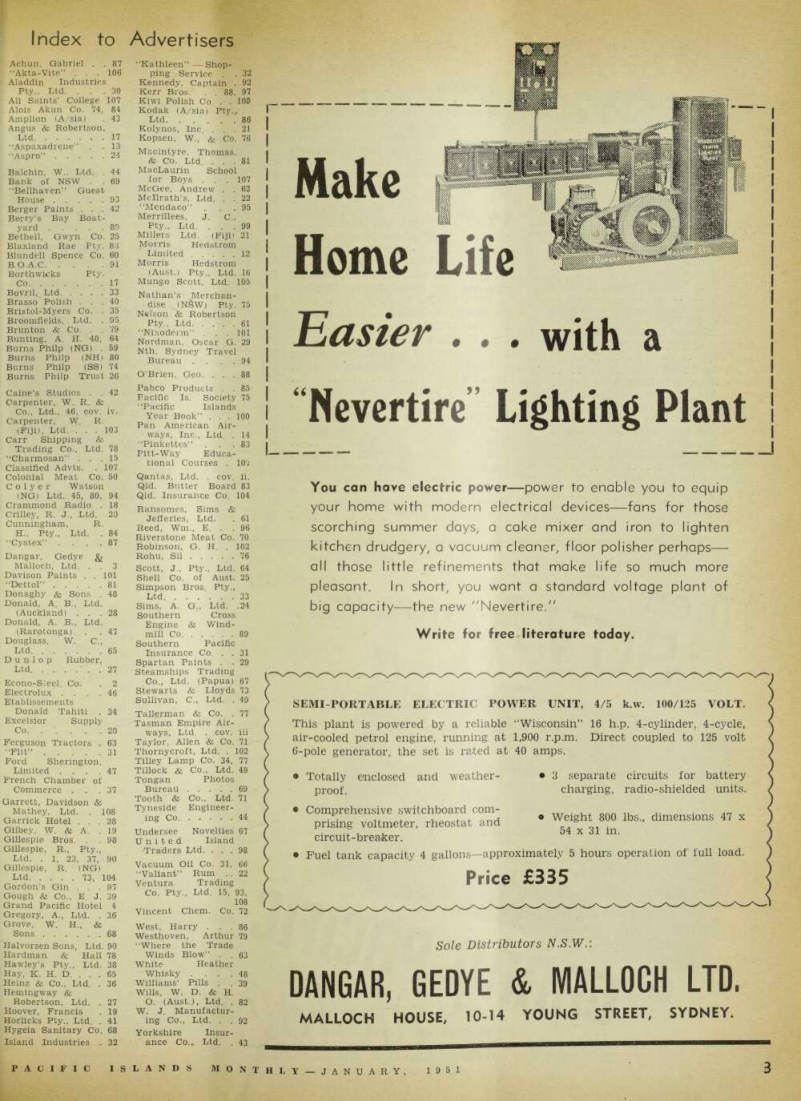
Achun, Gabriel . . 87 “Akta-Vite” ... 106 Aladdin Industries Pty.. Ltd. ... 30 All Saints’ College 107 Alois Akun Co. 74, 84 Amplion (A/sia) . 43 Angus & Robertson, Ltd 17 “Aspaxadrene” . . 13 “Aspro” 24 Balchin, W.. Ltd. . 44 Bank of NSW . . 69 “Bellhaven” Guest House 93 Berger Paints ... 42 Berry’s Bay Boat yard 89 Bethell, Gwyn Co. 25 Blaxland Rae Pty. 83 Blundell Spence Co. 60 8.0.A.C 91 Borthwicks Pty.
Co 17 Bovril, Ltd 33 Brasso Polish ... 40 Bristol-Myers Co. . 35 Broomfields, Ltd. . 95 Brunton & Co. . . 79 Bunting, A. H. 40, 64 Burns Philp (NG) . 59 Burns Philp (NH) 80 Burns Philp (SS) 74 Burns Philp Trust 26 Caine’s Studios . . 42 Carpenter, W. R. & Co., Ltd., 46, cov. iv.
Carpenter, W, R. (Fiji), Ltd. . . . 103 Carr Shipping & Trading Co., Ltd. 78 “Charmosan” ... 15 Classified Advts. . 107 Colonial Meat Co. 50 C o 1 y e r Watson (NG) Ltd. 45, 80, 94 Crammond Radio . 18 Crilley, R. J,, Ltd. 20 Cunningham, R.
H.. Pty., Ltd. . 84 “Cystex” ... 87 Dangar, Gedye & Malloch, Ltd. . . 3 Davison Paints . . 101 “Dettol” 81 Donaghy & Sons . 48 Donald, A. 8., Ltd. (Auckland) ... 28 Donald, A. 8., Ltd. (Rarotonga) . . 47 Douglass, W. C., Ltd 65 Dunlop Rubber, Ltd .27 Econo-Steel Co. . 2 Electrolux ... 46 Etablissements Donald Tahiti . 34 Excelsior Supply Co 20 Ferguson Tractors . 63 “Flit” 31 Ford Sherington, Limited ... 47 French Chamber of Commerce ... 37 Garrett, Davidson & Mathey, Ltd. . 108 Garrick Hotel ... 28 Gilbey, W. & A. . 19 Gillespie Bros, . . 98 Gillespie, R., Pty., Ltd. . 1, 23, 37, 90 Gillespie, R. (NGi Ltd 73, 104 Gordon’s Gin ... 97 Gough & Co., E, J. 39 Grand Pacific Hotel 4 Gregory, A., Ltd. . 36 Grove, W. H„ & Sons 68 Halvorsen Sons, Ltd. 90 Hardman & Hall 78 Hawley’s Pty., Ltd. 38 Hay, K. H. D. . . . 65 Heinz & Co., Ltd. . 36 Hemingway & Robertson. Ltd. . 27 Hoover, Francis . 19 Horlicks Pty., Ltd. . 41 Hygeia Sanitary Co. 68 Island Industries . 32
“Kathleen” Shop ping Service . . 32 Kennedy, Captain . 92 Kerr Bros. . . 88, 97 Kiwi Polish Co. . . 105 Kodak (A/sia) Pty.„ Ltd 86 Kolynos, Inc. ... 21 Kopsen, W., & Co. 76 Macintyre, Thomas, & Co. Ltd. ... 81 MacLaurin School for Boys ... 107 McGee, Andrew . . 62 Mcllrath’s, Ltd. . . 22 “Mendaco” . . 95 Merrillees, j. c., Pty., Ltd. ... 99 Millers Ltd. (Fiji» 21 Morris Hedstrom Limited 12 Morris Hedstrom (Aust.» Pty., Ltd. 16 Mungo Scott, Ltd. 105 Nathan’s Merchan dise (N§W) Pty. 75 Nelson & Robertson Pty., Ltd 61 “Nixoderm” ... 101 Nordman, Oscar G. 29 Nth. Sydney Travel Bureau ... 94 O'Brien, Geo. ... 88 Pabco Products . .85 Pacific Is. Society 75 “Pacific Islands Year Book” ... 100 Pan American Air ways, Inc., Ltd. . 14 “Pinkettes” ... 83 Pitt-Way Educa tional Courses . 107 Qantas, Ltd. . cov. ii.
Qld. Butter Board 83 Qld. Insurance Co. 104 Ransomes, Sims & Jefferies, Ltd. . 61 Reed, Wm„ E. . .96 Riverstone Meat Co. 70 Robinson, G. H. . 102 Rohu, Sil 76 Scott, J., Pty., Ltd. 64 Shell Co. of Aust. 25 Simpson Bros. Pty., Ltd 33 Sims, A. G., Ltd. .24 Southern Cross Engine & Wind mill Co 89 Southern Pacific Insurance Co. . . 31 Spartan Paints . . 29 Steamships Trading Co., Ltd. (Papua) 67 Stewarts & Lloyds 73 Sullivan, C„ Ltd. . 49 Tallerman & Co. . 77 Tasman Empire Air ways, Ltd. . cov. iii Taylor, Allen & Co. 71 Thornycroft, Ltd. . 102 Tilley Lamp Co. 34. 77 Tillock & Co., Ltd. 49 Tongan Photos Bureau 69 Tooth & Co., Ltd. 71 Tyneside Engineer ing Co 44 Undersee Novelties 67 United Island Traders Ltd. ... 98 Vacuum Oil Co. 31, 66 “Valiant” Rum .. 22 Ventura Trading Co. Pty., Ltd. 15, 93, 108 Vincent Chem. Co. 72 West, Harry ... 86 Westhoven, Arthur 79 “Where the Trade Winds Blow” . . 63 White Heather Whisky ... 48 Williams’ Pills . . 39 Wills, W. D. & H.
O. (Aust.), Ltd. . 82 W. J. Manufactur ing Co., Ltd. . . 92 Yorkshire Insur ance Co., Ltd. . 43
Advertisements & other items, p. 5 (1 item)
Home Life
Make
Easter . . . with a
“Ncvcrtire Lighting Plant
I You can have electric power —power to enable you to equip your home with modern electrical devices—fans for those scorching summer days, a cake mixer and iron to lighten kitchen drudgery, a vacuum cleaner, floor polisher perhaps— all those little refinements that make life so much more pleasant. In short, you want a standard voltage plant of big capacity —the new "Nevertire."
Write for free literature today.
SEMI-PORTABLE ELECTRIC POWER UNIT, 4/5 k.w. 100/125 VOLT.
This plant is powered by a reliable “Wisconsin’ air-cooled petrol engine, running at 1,900 r.p.m. 6-pole generator, the set is rated at 40 amps. 16 h.p. 4-cylinder, 4-cycle, Direct coupled to 125 volt Totally enclosed and weather- • 3 separate circuits for battery proof. charging, radio-shielded units.
Comprehensive switchboard comprising voltmeter, rheostat and circuit-breaker.
Fuel tank capacity 4 gallons—approximately 5 hours operation of full load
Price £335
Weight 800 lbs., dimensions 47 x 54 x 31 in.
Sole Distributors N.S.W.:
DANGAR, GEDYE & MALLOCH LTD,
MALLOCH HOUSE, 10-14 YOUNG STREET, SYDNEY.
In This Issue;
EDITORIAL: Western Disunity Brings War Nearer :; The Ad ministration of New Guinea :: Fiji’s Major Industry and Indian Political Crackpots.
New Sydney-Moresby Air Service by
Toa 7
No Appointment Yet of P-NG Deputy Administrators 7 No War Over Dutch New Guinea .. 8 January 23—Anniversary of Fall of Rabaul 9 Ivor Jenny Reaches Suva —Survives Reef and Fire 9 Knighthood for T. W. Alport Barker 9 Robt. Gillespie Extends to Fiji .. .. 9 Fiji Government and the Copra Tax 10 Life on a Junk Heap 11 Rabaul Roundabout 15 New Native Labour Laws in New Guinea 17 South Pacific Commission Special Meeting on Social Development .. 19 A Naval Memory of the Pacific War 20 In Defence of P-NG Works and Hous ing Dept 21, 63 The Month in Moresby 23 Matua’s Skipper Retires from Sea .. 27 Samoan Air Disaster Cause Un known 28 Stella Maris for New Hebrides ... 28 Nadi will be Fiji’s International Air port 32 Flu Epidemic in Cook Islands .. .. 33 Madang Newsletter 35 Indonesians in New Caledonia ... 36 The Centenary of Paulo 36 New Buildings for Pacific Biscuit Company 37
Samoan Soldiers in Korea 37 Passion Fruit Industry in the New Guinea Highlands 39 Rarotonga Gives NZ a Poet 40 Girl Guide Movement in P-NG ... 41 Chinese Power in Tahiti French Civilian Outspoken 42 Cement Scandal in Tahiti—Official dom Involved 43 Earth Tremors in New Hebrides ... 43 Meet the Mokolkols, The Ned Kellys 'of New Britain 45 Hold Everything Matupi Natives Stick Up P-NG Officialdom ... 47 Do You Know About Mutton Birds? 48 Turoua Will Return to Mangaia if NZ Officialdom Permits 48 W. Samoa Complains About Shipping 48 Opening of New Marist Brothers High School in Apia 49 Territories Talk-Talk 51 Poor Mr. Frings 52 PIM Crossquiz 52 New Guinea was a Good Place Then! 53 Condominium or Conundrum? .. .. 54 Tropicalities 55 A Trader’s Tale 56 Yasawa Saga 57 Fashion :: Children’s Section .. .. 58 New Guinea’s Plea for .303 Rifle . 60 New Guinea Tea Prospects 61 Bad BSI Copra—Planters’ Defence . 65 Preserving Own South Pacific Forests —Fire and Plough Cause More Havoc than the Miller 67 Events in French Oceania 71 Fiji News in Brief 72
The Pioneering Patons of the New Hebrides 75 Golf Club for Niue Is 76 News Notes from NG Goldfields ... 77 The Liquor Permit Farce in P-NG .. 79 Methodists Select New Station Near Mendi, in Highlands 83 What Sulphetrone is Achieving in Treatment of Leprosy 85 Plane and Shipping Services 87 New Hotel for Honolulu 94 Tahiti Law Suit Goes to Paris ... 95 Official Action on New Guinea’s 'Timber in Three Phases 97 War Surplus Goods in Rabaul Area . 99 Pacific Recipients of Birthday Honours 101 Senibua Finds Tuna off NSW Coast 103 Aluminium Houses for Papua-New Guinea 103 A New Industry in Papuan Mangrove Bark 103 Farewell to Fiji-Muslim School Teacher 104 Honolulu-Tahiti Airservice Announced 105 Hospital-Building Plan for P-NG .. 105 Commercial, Markets etc 108 OBITUARY: I. B. Taylor, 25; W. R. A.
Parker, 26; Frederick Christian, 29; Mrs. T. P. Nicholson, 29; W. T. Gats ward, 44; Capt. B. Rutherford, 49; Mrs.
C. Kaad, 60; Edmond Walker, 71; Mrs.
G. Coster, 79.
INDUSTRIES: Copra, 7, 10; Sugar, 6,9; Timber, 8, 97; Oil, 26, 99; Cocoa, 41; Gold, 94; Rice, 100.
ORGANISATIONS: New Guinea Women’s Assn. Melb., 86; New Guinea Women’s Club, Sydney, 93; New Guinea Scholar ship Fund, 103.
Advertisements & other items, p. 6 (2 items)
4
JANUARY, 1951 FACIFIC ISLANDS MONTHLY
-fifi
fi J V'l ■» . sm.
GS^ eli Sbtt ulh su agaj o ffs . Hote listh tlie r UVa ’ s •«• the s Gr atia fils, »•««»« , 0 ”“ to
sfifi K/ - '”S
fi°ush fif may ,
Si ijp Cn Wfice o/ e th effected
fimct ot UaJoa
<'~o>w. "1:«». rai2 Pa.cif f ”
Pacific Islands Monthly
The Newspaper-Magazine of the South Seas ißegistered at the G.P.0., Sydney, for transmission by post as a newspaper]
Published Once Each Month and Circulated in Australia and New Zealand and in the following Pacific Territories and Islands Groups:
Australian Territory of Papua.
Trustee Territory (Australia) of New Guinea.
Australian Territory of Norfolk Island.
Trustee Territory of Nauru (Aust., NZ and UK) New Zealand Territory of Cook Islands.
New Zealand Territory of Niue Island.
Trustee Territory (NZ) of Western Samoa.
British Crown Colony of Fiji. - British Solomon Islands Protectorate.
British Protectorate of Tongan Islands.
British Crown Colony of Gilbert and Ellice Islands.
British and French Condominium of New Hebrides.
French Colony of New Caledonia.
French Establishment of Oceania (Tahiti, etc.).
American Territory of Eastern Samoa.
American Territory of Hawaiian Islands.
American Trust Territory of Micronesia.
Owned and Produced by Pacific Publications Pty. Ltd., Union House, 247 George Street, Sydney.
Telephones: General Office and Advertising
Bw 5037, Bu 4938.
P.O. Box 3408
Registered Address for Telegrams, Radiograms, and Cables; “Pacpub,” Sydney.
Contributions.
Articles, Stories, and Photographs dealing with Pacific Islands subjects are invited and will be paid for on publication.
Subscription Rates.
In Australia, New Zealand, Fiji, Papua and New Guinea, Western Samoa, Cook Islands, Niue, Tonga, British Solomon Is., Gilbert and Ellice Colony, Nauru, New Hebrides, and Norfolk Island 18 0 New Caledonia (Fr.) and French Oceania (Tahiti, etc.) £llO United Kingdom, British Com monwealth, United States of America, US Pacific Territories, and Foreign Countries .. .. $3.50 £1 10 0
Editor and Publisher:
R. W. Robson, P.R.G.B.
Assistant Editor: JUDY TUDOR.
General Office: Union House. 247 George Street, Sydney. Telephones: BW 5037, BU 4938.
Business Manager: SELWYN HUGHES.
Representative In London.
J. T. Wallis, Coronation House. 4 Lloyd’s Avenue, London, E.C.3, from whom may be obtained copies of Pacific Islands Monthly, Pacific Is. Year Book, advertising schedules, etc.
Agents.
The following are authorised to receive sub scriptions for Pacific Islands Monthly:— Burns Philp (NG) Ltd., and Burns Philp (South Sea) Co., Ltd. All branches, W. R. Carpenter & Co., Ltd. All branches.
Morris, Hedstrom, Ltd. All branches.
Steamships Trading Co.. Papua. All branches.
Colyer Watson (NG) Ltd. All branches.
Mrs. Jean Fraser, Lae, New Guinea.
R. P. Smith, Rabaul, New Guinea.
A. H. Bunting, Ltd., Samaral, Papua.
Steele’s Central Store, Suva, FIJI.
Adams Pharmacies Pty., Lautoka, FIJI.
Cook Islands Trading Co., Rarotonga, Cook Is.
United Island Traders, Ltd., Rarotonga, Cook Is.
A. Vercoe, Apia, Western Samoa.
Oscar Nordman, Papeete, Tahiti.
Islands Branches and Representatives of W. H.
Grove & Sons, Ltd., Auckland, New Zealand.
Ed. Pentecost, Noumea, New Caledonia.
Societe Gubbay Kerr et Cie, Noumea, NC.
Vol. XXI. No. 6.
January, 1951
1/9 Per Copy.
Price Prepaid, p.a.: 18/- Aust. in South Pacific.
Truman^may o6^ 8 ! vefy advanced
Western Disunity Brings War
Nearer
INTERNATIONAL events move on to the inevitable climax. In the opinion of Sir Keith Murdoch, Australia’s shrewdest newspaper man, just back from Europe and America, the only thing that can stop the outbreak of World War 111 would be the heavy re- “f, ° f iw orf W s A e , r il at i on fr especially United States and the , the of their economy to a war basis. is T ta e k?J S t^ 6 Sign ° f that Ame ri Ca cisions; but BritafnTnd France wifi not face up to the stark facts of the Communist plot to get control of the world. France is non-co-operative; and Britain, under the disastrous regime introduced by the Socialists’ political victory in 1945, is now in a condition similar to that of France in 1940, when she collapsed like a house of cards under the German assault.
There is every justification for the forthright demand of the American Republican leader, Senator Taft, that United States armies shall not be sent to defend Europe unless and until Britain and France give a lead to the Western European nations in buildmg up powerful forces to resist the Russian bloc. Since 1945, those two Powers have been frittering away their resources m ill-conceived and very ill-timed Socialistic experiments, while accepting incalculable amounts contributed in money and in service by the all-too-generous Americans.
It is beyond question that Britain, France and Italy—and especially the two latter—are honeycombed with underground Communist intrigue, planned in the hope that they will succumb to the Fifth Column when Russia strikes. If they cannot rally !,° r , th S™ n defence, why should the United States carry lavish aid to them change-over across the Atlantic? . I Attfee-San talks in Wash-
Truman^may o6^ 8 ! vefy advanced
Democrat at least he Ttandl foursauare for the Western wav of life- Xte Attlee if merely the untaaginative 'andunTnsbWng mouth- Zr n fßritkh which
consciously* unconscioSiv—is the
mf le ° nf There £ere between them few noints of real aUout effort, and the ruthless employ- 2^?A^ f Q ou F strength.
S °c iali st Government, on the other hand, will continue oth national and Imperial interests, lf can hang on to office and continue with its attack on indmdualism and private enterprise.
The same irreconcilable factors are discernible already in the London meeting of British Prime Ministers.
Attlee representing the Mother Countrv stands stnbbornlv for Socialism Australia Canada Y and New Zealand are anti-Socialist and pro-
American; India and Pakistan are trying to find a balance between their fear of Communism and their hatred of Europeans. They all are suspicious of the Socialists’ policy. But if Britain had a strong, and anti-Socialist Prime Minister, the whole Empire would line up with the United States and the smaller Western Democracies for uncompromising defence, and the hideous threat of World War 111 would immediately be reduced.
It is the domination of the Euro pean situation by the British Socialists that makes the general outlook so blue. That is preventing cohesion and co-operation within the Empire, and is poisoning the relations between the British and Americans.
And—the irony of it—the British Socialists hold power because they have a majority of less than a dozen in a House of over 600!
IT is difficult to make even an intel ligent guess at what we are doing —or trying to do —in Korea. Having cleaned up the North Koreans very thoroughly, and occupied North Korea, we have ourselves been forced by countless masses of fanatical Chinese Reds to retreat precipitately into the tip of South Korea. All the United Nations now are savagely fighting against Communist China; yet we have not declared war upon China, and we have refused to use our planes and ships against the Chinese supply lines and bases.
The only thing that is clear about this fantastic and obscure situation is that it is the result of lack of unity between the Atlantic Pact nations.
America probably wants a state of war with Red China, but without the entanglements of an invasion, while she swiftly re-arms for the greater struggle against the arch-enemy, Russia. Equally probably, Britain wants to break off the war in Korea and admit Red China to the United Nations, in the hope that thereby she can negotiate with the Chinese and detach them from Russia.
Meanwhile, the Moscow-inspired attack proceeds, not only in Korea, but also in Indo-China, Malaya and Tibet; and there are indications of liveliness near the Russian borders of Persia, the Caspian area, the Balkans, and Central Europe.
The Americans, sensitive in relation to Formosa and Japan, see the Far East as a major danger spot. The
French and the Indians are con cerned about South-East Asia. Britain and the Western European nations insist that the peril is greatest in Western Europe. But, if it is the Russians’ plan to partially paralyse all the Democratic nations with one blow, the thrust will come first in the Middle East, with a view to the seiz ure of the Suez Canal and the great oil wells of that region.
It is inconceivable that this tension can continue much longer. We may have four or five months in which to avoid World War 111, by negotiation— but, at the moment, there is not one hopeful sign. Most northern hemis phere wars commence between June and September, when summer is come, and the land has dried out.
The Administratorship Of New Guinea
WHEN a delegation of Papua-New Guinea public servants waited upon the Minister for External Territories in Canberra in December, and badgered him about their working conditions, Mr.
Spender stated bluntly—and with justi fiable irritation—that this was typical of many matters that were being referred to him in Australia and which should be dealt with on the spot, in the Territories.
Later, in Port Moresby, a meeting of public servants, having heard the dele gation’s report, passed “a vote of no confidence” in the Department of Ex ternal Territories.
About the same time, by official edict, the title of “District Officer” was changed to that of “District Commissioner,” in accordance with the promise given by the Minister nine months ago. But it was an empty gesture. There was no sign of the transfer, from Port Moresby to the District Commissioner in the field, of that large measure of local executive authority without which the District Commissioner is hamstrung.
The vicious system under which every decision out of the office-boy class must be made by the administrator in Port Moresby—and, very often, referred by him to the omnipotent Mr. Reg Halligan, in Canberra —apparently is to continue.
The whole set-up tends to make the Minister appear ridiculous; and it is little
wonder that Mr. Spender appears irritated and critical. It is quite well known that both Mr. Spender and his Parliamentary Under-Secretary, Mr. Howse, are looking on, in apparent helplessness, while Mr.
Spender’s much-lauded Territories Policy of last May is rendered more or less nugatory by the fumbling, inexperienced hands of the Ward-appointed Adminis trator, Colonel J. K. Murray.
The question naturally arises: Why, if Colonel Murray cannot implement the policy of the new Australian Government, Is Colonel Murray retained in office? The answer is that the appointment of Colonel Murray was renewed for five years, in 1949, by that arch-politician, Mr. Eddie Ward. Further, Colonel Murray is a courteous and completely sincere gentle man, who is manifestly doing his best, and Mr. Spender presumably shrinks from harsh measures.
But Colonel Murray is so clearly a mis fit in the Administratorship that it is most unfair that the Territories, and the Minister’s own record, should be made to suffer by that final act of unadulterated Ward-ism. A most unsuitable political appointment—that of ex-Socialist Minister Frost to the post of Commissioner in Ceylon—was terminated by the new Aus tralian Government by simply sacking Mr. Frost and paying him compensation; and something of the same line may have to be followed in relation to New Guinea.
Fiji's Major Industry and Indian Political Crackpots
AGAINST a back-ground of war and threat of war, the year ended in Fiji with the Colonial Sugar Refining Company still trying to reach some sort of finality with Indian sugar-cane growers for a 10-years buying contract which was designed to come into force as on June 1, 1950.
Six months have been wasted in beating around such piffling questions-as whether the cane farmers should be allowed to plant the variety of cane they fancy; and whether or not they may be present when their cane is weighed. (Clause 9 of the contract says clearly that they may, but some Indian leaders have persuaded the Illiterate farmers that it is not so.) What goes on behind Fiji’s sugar-cane curtain?
When the five growers’ Unions failed to reach agreement with the Company over the contract, the Company began to negotiate with growers direct. By the
beginning of December half the growers had signed; and this must have suddenly appeared to the Indian politicians as too much of a good thing. What were they getting out of it? Nothing. Let them then whip up some feeling. Call some meetings—and down with the grasping capitalists!
In the last weeks of the year there was a spate of meetings, where Fiji was again treated to the spectacle of Indian nolitician fighting Indian politician, while the common cane-grower, whom we are told is really a very nice, solid citizen at heart, presumably sat silent and goggle eyed and let the storm of hot air blow him this way and that.
Vishnu Deo emerges as being opposed to anything A. D. Patel supports; and Patel’s party is opposed to Vishnu Deo’s pro posals. N. S. Chalmers (European boss of the Kisan Sangh) and Ajodhya Prasad are, as usual, trying to make
trouble for the Company and gain notoriety for themselves. Patel advises his followers to sign the contract; Vishnu Deo urges his outfit not to sign. K. B.
Singh, trying to make a political come back, enters the arena and holds a public meeting at Nausori to try to beat the pants off Vishnu Deo.
APPARENTLY, the Company’s drive for signatures was going well when Chalmers and Ajodhya Prasad started their campaign urging farmers to revoke. Armed with revocation forms and some means of persuasion they collected a number of signatures. Then some of the farmers went to the Company, and said they had been intimidated and that they wanted to revoke the revocations.
At latest advice, Mr, Chalmers has gone to New Zealand. He said that he was on his way to the Philippines and West Indies to see how cane was grown there, and (to paraphrase a wartime ditty about the GI, an apple-tree and his girl friend) he told the farmers before he left; “Don’t sit under the sugar cane, with anyone .else but me, till I come marching home.”
In other words, they were to refrain from negotiating with the Company until he returned from his travels.
Last time Mr. Chalmers went abroad, a visit to India and England was scheduled.
For a good part of the time he was away he played bowls at the Empire Games in Auckland. He did visit the UK and, pre sumably, India, but evidently just for the ride. What lasting benefits accrued to the Indian cane farmers from this trip have never been apparent.
However, it is to be hoped that Mr.
Chalmers does manage this time to carry out his threat. In the West Indies he may learn that the Fiji cane-grower’s lot is not such an unhappy one and that West Indies would be pleased to take over Fiji’s 170,000-ton yearly export quota which was fixed at the Empire Sugar Conference last year. It will be remem bered that West Indies, at that time, ex pressed disappointment at the quota permitted them.
Indian cane growers got a record price for their cane last year; the price this year will be even better. With the long term MOF contract and the parallel CSR contract, the sugar industry on which the economy of Fiji is based, seems set for a period of stability and prosperity—if meanwhile it were not kept in a state of turmoil by the personal squabbles of a few men who use it as a pawn in their own political games.
In a less namby-pamby age, the vapouring of these agitators would not be tolerated. But what goes on in the Fiji sugar industry today is symptomatic of industry the world over. This sudden rush of so-called freedom to the head of the common man has left the door wide open to the opportunist and the political crack-pot, who is permitted to whistle the tune to which we all must dance in one way or another.
Delivery in Papua-N. Guinea
Pacific Islands Monthly—Air Delivery in Papua-N. Guinea
RESIDENTS of Papua-New Guinea now can obtain copies of PIM within a couple of days of publication, bj taking advantage of air-transport facili ties.
This may be arranged with any PIM agent in Papua-New Guinea, or by direct communication with the publishers.
Details of the procedure to be followed were given on page 6 of the December issue.
The additional cost of air delivery in the case of direct subscribers in Papua?
New Guinea, is 18/- per annum, making 36/- per annum in all.
New Sydney-Moresby
Service In February TOA Introduces A New Solent Flying-Boat
Trans oceanic airways ltd., of Sydney, proposes to commence its new Sydney-Port Moresby flying boat service in February, with a Solent.
TOA had completed arrangements to start this service in November, with a Hythe, when officialdom announced that Townsville could not be used as an inter mediate port. It was found that no other North Queensland port was suitable or adaptable: and the Hythe could not carry, from Brisbane, enough fuel for the flight to Moresby, plus a payload. The Hythe plan therefore was abandoned.
Captain Brian Monkton, managing director of TOA, thereupon flew to England, and there bought, new, one of the Short Brothers Solents, which is the world’s most modern flying-boat. It will make the Brisbane-Moresby hop without difficulty. Mr. Monkton proposes to leave London with the Solent on January 26, and the machine should leave Sydney for Port Moresby, on the inaugural flight, on Feb. 18. The proposed weekly schedule is: Sunday, 7.15 p.m.—Depart Rose Bay, Sydney. 10 p.m.—Arrive Brisbane. 11.30 p.m.—Depart Brisbane.
Monday, 6.30 a.m,—Arrive Moresby. 8.30 a.m. —Depart Moresby. 3.30 p.m.—Arrive Brisbane. 4.45 p.m.—Depart Brisbane. 7.30 p.m.—Arrive Sydney.
This type of Solent carries a crew of seven, and has accommodation for 39 passengers—five less that the number carried by the Solents in the Tasman Empire Airways Sydney-New Zealand run.
Passengers are carried in five cabins, and passenger amenities are lavish.
To provide for bookings beyond Moresby, TOA have entered into an arrangement with Mandated Airlines Ltd, of Lae, New Ouinea (which runs inter-Territory services within Papua-New Guinea) under which TOA passengers can be picked up n Moresby and taken on to other parts )f the Territories.
The development appears to indicate :hat Qantas Empire Airways—which have iroyided Papua-New Guinea with its najor services for some years—will now lave active competition. There is no suggestion of rate-cutting, however irobably Canberra will not permit that.
New Hebrides And L. Howe
Services
[I7TTH a small fleet of flying-boats, TOA ft began running services between Sydney and the Pacific Islands some bur years ago; and it finally settled down vith a regular service up through the New lebrides to the Solomons; and another egular service to Lord Howe Island.
It then pioneered a NSW coastal service )etween Sydney and Grafton; and, in 950, it started a weekly Sydney-Hobart ervice, via the NSW south coast. Both he latter services have prospered—and he Hobart service has been doubled.
TOA clashed with Qantas in the Lord lowe and the Hebrides-Solomons run. rhere were some adjustments late in 1950, inder which TOA abandoned the Heb ides-Solomons run to Qantas, and Jantas withdrew from Lord Howe.
The situation now is that TOA will arry on the Sydney-Lord Howe, Sydney lobart and Sydney-Grafton services with out competition, and the Sydney-Moresby un in competition with Qantas. The new Jolent will be used on the Moresby run Sundays and Mondays) and on the lobart run (two return flights each week -one on Wednesday and one on Friday).
Copra Price Awaited
Future of “Stabilisation”
AN announcement will be made shortly by the Australian-New Guinea Production Control Board regarding the price to be paid to Papua-New Guinea planters for copra in the new contract year, which commences on March 1.
The British Ministry of Food contract price has been raised by 10 per cent., with the result that Fiji, Solomon Islands, and Gilbert Islands growers have been getting, since January 1 (when their contract year commenced) the equivalent of £53/15/- Sterling per ton, f.0.b., less local deductions.
The Australian (Papua-New Guinea) price also will be raised by 10 per cent, from March 1; and, if the three planters’ representatives on the committee which has been sitting in Port Moresby to deal with copra matters have had any success, the “stabilisation” deduction of £5 per ton will be wiped out. This would mean a probable rise to the producer of £lO per ton—£s representing the 10 per cent, rise, and £5 which formerly went to the Stabilisation Fund.
There has been a remarkable decline in the amount of Papua-New Guinea copra which is consumed by the Aus tralian crushing mills. Until 1950, this was about 26,000 tons per annum. It is now about 15,000 tons per annum. This is presumed to be the result of the de rationing of butter in Australia. For merly, both food-processors and house wives used a lot of margarine, in place of butter. Now, butter is being used.
Many shipments which formerly went to Australia from Territories ports are now going direct from the Islands to British ports, where the copra is taken under the MOF contract.
London Prices
London. Dec. 9.
THE bank of NZ circular to-day reports copra selling as follows: Straits—£lo6/10/- Stg. per ton, C.I.F. Europe. Supplies limited.
Philippines—Between 240 and 260 US dollars per ton, C.I.F. European ports.
£5L Aus. In The Solomons
Honiara. Jan. 7.
THE British Solomon Islands Protec torate Copra Board has announced that the 1951 price for copra at the main shipping ports of Honiara and Yandina will be £5l (Australian currency) per ton. This is based on the Ministry of Food price of £53/15/- sterling per ton f.o.b.
Negotiations are still in progress to ob tain a premium for better quality copra, and the Copra Board has emphasised that the price of £5l at main ports may be varied later in the year, when the question of different prices for different grades of copra has been considered.
Most 8.5.1. P. copra is still smoke-dried and, in the post-war effort to get back to maximum production, some poor quality copra has been shipped. Extra attention is now being paid to grading and to the general quality of shipments.
The former Burns Philp liner Marella (now called Liguria) with 930 Displaced Persons aboard drifted helplessly in the Indian Ocean 420 miles N-W of Perth for two days before being taken in tow on January 14, by the 7,000-ton freighter, Chandpara. The ship was sold to Pana manian interests a couple of years ago.
Marella was originally a German ship, acquired by BPs after World War I.
N. Guinea Administration
Delay In Announcing The Two Deputies
THE delay in announcing the appoint ment of two Deputy Administrators for Papua-New Guinea—applications were invited in October—probably is con nected with the new Australian Govern ment’s dissatisfaction with the Socialist appointed Administrator of the Territory (Colonel J. K. Murray).
The opinion is held in some influential circles that there is little use appointing the two best available men to be Deputy Administrators unless Canberra is happy with the chief Administrator, and satis fied that he will work in harmony with his Deputies. Others hold the view that Papua-New Guinea will not be assisted by the appointment of Deputy Adminis trators—that to find the cause of the Territories’ present troubles Canberra must look higher and dig deeper. (An indication of what this journal believes to be the cause of the difficulties in Papua-New Guinea is given in the article on page 6.) It is known that over 100 applications for the two Deputy positions were re ceived in October-November. They have been under official scrutiny, and now are in the hands of a panel of qualified men, appointed by the Minister, which is care fully examining certain applications and, in some cases, interviewing the appli cants.
It is not known when an announcement will be made. It was thought, in Can berra, early in December, that there would be an announcement before the holidays.
It is thought now that, pending some clarification of the Administrator’s powers and authority, the appointments may be delayed.
Exonerated
Gilbert Is. Mishap - Captain
Suva, Jan. 3.
CAPTAIN D. M. R. MAXWELL, of the G. & E. Colony’s motor vessel, Margaret, which was lost on a reef in the Gilbert Islands, has been exonerated from all blame by the Fiji Marine Board, after an inquiry. The Margaret, in stormy weather, was trying to get into Nanumea lagoon, through a narrow passage blasted by the Americans in the coral during the war, when she was thrown upon the coral reef. (See photograph on page 38 of December PIM.) All machinery and equipment were salvaged. (Last month we referred to the Master of the Mar garet as Captain Mullins. This was an error—Captain Maxwell is skipper of the vessel.)
Honiara Counts Its
Sunshine and Showers
From Our Own Correspondent
Honiara, Jan. 7.
FIRST full year’s rainfall and tem perature figures were recorded at Honiara during 1950, when a total (of 99.6 inches of rain fell. March was the wettest month with 1,732 points, and June was the driest,, only 103 points of ram being recorded.
The average temperature for the year was 79.3 degrees with a mean maximum of 72.0 degrees. The warmest month was June, with a mean maximum of 87.8 degrees, and the coolest was August, with a mean minimum of 70.9 degrees.
Advertisements & other items, p. 9 (1 item)
7
*ACI F I C ISLANDS MONTHL Y - J A N U A R Y . 195}
No War Over Dutch N. Guinea!
Indonesians Have Now Destroyed The Original Federal Constitution
EVEN the experts seem to be puzzled by the kaleidoscopic changes in Indonesia. For the ordinary man, the picture is completely baffling.
The status of Dutch New Guinea (Irian) had to be settled by December 31, 1950. The Republic of Indonesia said that if it were not, there would be trouble.
The world was left to infer that Indo nesians would march and fight.
December 31 is past. There was no Dutch-Indonesian settlement. Yet all is peace in Irian —and in Jakarta.
What does it mean? It means that the situation is governed by other than the interests which have been publicised. It is necessary to recount recent history.
IN 1945, when war ended, Holland’s vast colonial Empire, the Netherlands Indies (which she had held for 350 years, and developed with genius) was completely occupied by Japs. Holland naturally expected Allied aid in re occupying her archipelagoes.
Britain’s new Socialist Government — already making war upon “colonialism” and giving away British Burma, British India, Ceylon and Malaya—encouraged a fiercely anti-European organisation of Javanese to resist the return of the Dutch and to set up the republic of Indonesia.
America, then intoxicated with the United Nations idea, would not interfere.
Again and again, the war-weakened Dutch tried themselves to regain pos session, and stamp out the Jap-inspired Javanese insurrection. Again and again, they were forced to cease their police actions, and to enter negotiations with the Indonesians—forced by their former Allies who now, as the United Nations, wanted to hand all Asia over to the Asiatics Finally, the Dutch were beaten. At The Hague Conference, November, 1949, the Dutch surrendered sovereignty over the Netherlands Indies (except Dutch NG) to the Republic of the United States of Indonesia (RUSI). This was a federal structure of 16 States, one of which was the insurgent Republic of Indonesia (holding most of Java). There was to be a Union between RUSI and The Nether lands. RUSI formally took over at the beginning of 1950, and all the official Dutch, including the army, proceeded to leave.
Although many—probably the majority —of the States were pro-Dutch, the Javanese promptly took command of the government, developed a strong anti- Dutch and anti-European policy, and screamed frequently for possession of Dutch NG.
WITHIN nine months, the Javanese sabotaged the RUSI set-up. On August 15, 1950, RUSI was replaced by a new non-federal Unitarian govern ment of 10 provinces, at the head of which is the Javanese structure, the Republic of Indonesia, which was originally formed by the Japanese, and which had fought the Dutch consistently.
Seokarno remained President, but the Premier, Hatta, was replaced by a 42years-old Sumatran, Mohammad Natsir, and he has been actively directing affairs in Jakarta ever since. Every trace of pro- Dutch influence has been eliminated from the government. Natsir is a strong Moslem, and Moslems do not like Communism.
Natsir’s government has not been nearly as vociferous as that of Hatta concerning Dutch NG. Natsir has too many troubles in the shape of an empty treasury, falling production, growing public service in efficiency, and so forth, to seek anything more than a war of words on Irian.
rE conference at The Hague in November-December, 1950, over Dutch NG, broke down hopelessly.
Some Indonesian groups are demanding extreme measures, such as denunciation of the Netherlands-Indonesian Union, and revision of the Hague Agreement of November, 1949. That is mostly eye-wash.
The spirit of the Union and the Agree ment has already been wiped out in the destruction, on August 15, 1950, of RUSI.
When Dutch sovereignty was legally surrendered, at the end of 1949, there were 250,000 people of Dutch and part-Dutch blood in the Indies, and an enormous amount of Dutch money invested there.
The former rulers know that the Indo nesian campaign against everything Dutch will never cease—and they are fighting for time in which to remove both their nationals and their money.
That is why they are using Dutch NG as a bargaining piece. One of their latest suggestions is that they should surrender sovereignty over the Territory to Indo nesia, but that Indonesia should grant Netherlands a 50-years trusteeship. Indo nesia has officially scorned the suggestion; but something like that probably will be the solution. That way, Dutch money and irreconcilable Dutch nationals can get out of Indonesia.
QUITE understandably, the Dutch— whose losses are almost beyond cal culation —are now not much con cerned over Australia’s horror at the thought of finding Indonesians as her neighbours in New Guinea. Australia was one of the Allies which let the Dutch down in 1945-49, when they were trying td regain their colonial Empire. It was Australia, too, who allowed her Com munist-led wharf labourers to hold up Dutch ships in 1946-49, so as to help the Indonesians. Naturally, in the Dutch view, Australia deserves all she gets!
Furthermore, the Australian Govern ment (now anti-Socialist and pro-Dutch) Is getting little support in its Dutch New Guinea stand from the British Socialist Government. The British do not care twopence about Australia and the Indo nesians. All they can say to Australia
is, “For God’s sake, don’t start any more arguments in South-east Asia!”
The Indonesians have not a shadow of a claim —ethnologic, historic or economic —to the Territory; but they probably will get it in the end, if Dutch indifference and British ignorance are any indication.
Australia will oppose; but Australian politicians almost certainly will leave it to the United Nations. And we all know what that means.
No Timber Grants To
Ngg Ltd.
Why The Differentiation?
From a Special Correspondent WAU, Jan. 5.
THE new crushing-mill at Golden Ridges, planned for a capacity of 100 tons per day, should get going early in this New Year, and this should add considerably to the revenues of New Guinea Goldfields Ltd.
NGG Ltd. is still active in the timber industry, and it has been asked by the Government to quote for the pre-fabri cation of two and three-bedroomed houses, for Port Moresby.
Wau people had hoped that NGG Ltd. would in some way have been admitted, with Bulolo Gold Dredging Ltd. to the new organisation, which is going to ex ploit the vast timber resources of this area in the next 50 years; but there is no word of it in the Minister’s statement (See page 97).
NGG have a good timber-cutting plant and good management, and are eager tc engage in the timber business. Why should BGD be chosen, and NGG ex cluded? It seems curiously unfair.
The Morris Hedstrom University Scholarship for 1951 has been awarded tc William F. Wildin of Lautoka, Fiji. He is an ex-pupil of St. Felix School and Marisi Brothers High School in Suva; in 1939-5( he was at Gatton Agricultural College ir Queensland and now intends to do Agri cultural Science at Queensland University
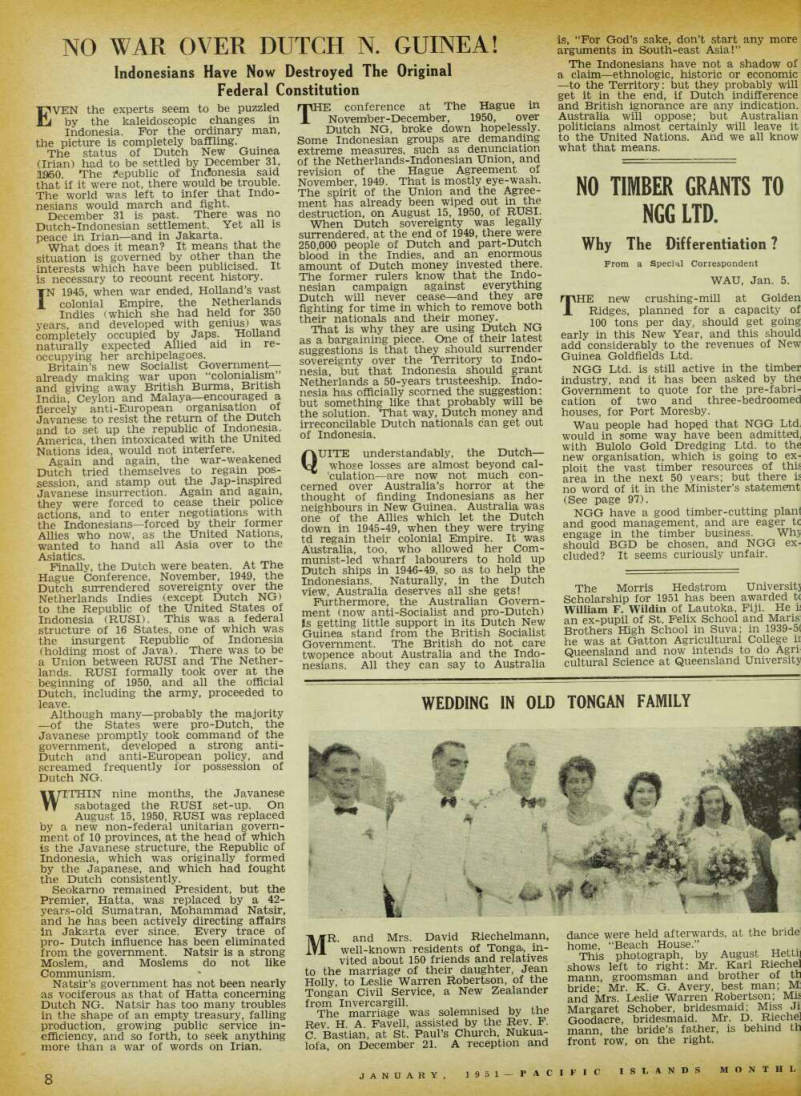
Wedding In Old Tongan Family
MR. and Mrs. David Riechelmann, well-known residents of Tonga, in vited about 150 friends and relatives to the marriage of their daughter, Jean Holly, to Leslie Warren Robertson, of the Tongan Civil Service, a New Zealander from Invercargill.
The marriage was solemnised by the Rev. H. A. Favell, assisted by the Rev. F.
C. Bastian, at St. Paul’s Church, Nukua lofa, on December 21. A reception and
dance were held afterwards, at the bride home, “Beach House.”
This photograph, by August Hettii shows left to right: Mr. Karl Rieche] mann, groomsman and brother of tb bride; Mr. K. G. Avery, best man; M; and Mrs. Leslie Warren Robertson; Mis Margaret Schober, bridesmaid; Miss Ji Goodacre, bridesmaid. Mr. D. Rieche] mann, the bride’s father, is behind th front row, on the right.
Advertisements & other items, p. 10 (1 item)
8
JANUARY. 195! P ACIFIC ISLANDS MONTHL
Anniversary of
January 23 is Ninth Anniversary of Fall of Rabaul to Japs Memorial Gatherings in Rabaul And Sydney
THE war and the post -war years of something near to social chaos and now, renewed war fears, have created a sort of vacuum in the minds of most people. The events of pre-1939 seem somehow clearer than those of the years that came after. It is almost incredible, therefore, to realise that almost a decade has passed since the fall of Rabaul to the Japanese.
January 23, this year, will mark the ninth anniversary of that event of early 1942, and it will be observed, as usual, by gatherings of New Guinea folk to pay tri bute to the men who, on that day or later, became prisoners of the Japs and subsequently lost their lives.
On this January 23, as has been usual, special services will be held in Rabaul, and in Sydney the New Guinea Sub- Branch of the RSSAILA, in conjunction with the New Guinea Ex-Servicemen’s Club and the New Guinea Women’s Club of Sydney, with past or present Terri torians, will meet at the Cenotaph, in Martin Place, at 8 a.m., and, with flowers and wreaths, remember those who died as a result of war in the SW Pacific.
Surviving Fire And Reef,
Freighter Reaches Suva
SUVA, December 30 AFTER surviving a fire which broke out in her forward cargo holds in mid- Pacific on December 16, and after spending 21 days on Horseshoe Reef (Cakau Momo atoll), 20 miles due east }f Levuka, the Canadian freighter Ivor Jenny, 7,500 tons, crept slowly into Suva larbour early on December 29.
Several craft from Suva hurried to her rid when she ran into the reef at 2.30 i.m. on December 26, but she got off under ler own power at 6.30 p.m. on December 28. She got rid of a good deal of cargo into the attendant vessels, and some ;argo (steel, nails, etc.) by dumping it nto the shallow sea alongside, where it ;an be recovered.
There still was a fire in the forward lolds when she reached Suva, and this lad to be put out. Then the minor iamage to the hull was assessed. Then ;he commenced to unload the 3,300 tons )f cargo she had aboard from Europe for ?iji. The balance of the cargo is for NZ
Suva, Jan. 10.
With fire out and cargo discharged, the wor Jenny lies here at anchor. Small loles in her hull must be repaired before ;he leaves for NZ. A diver is coming by tir from Brisbane.
Robert Gillespie’S Now In Fiji
rHE Australian exporting firm of Robert Gillespie Pty., Limited, of Sydney, have opened a branch office md showrooms in Suva—in Millett’s Building, a large, modem concrete con duction on the main street. Mr.
Anthony Pym, who has had many years’ ixperience in Islands trading, particularly n New Guinea and Papua, will be located n Suva as Manager.
The company announces that the new irganisation will allow it to give closer ittention to the requirements of Fiji and
Polynesia generally.
Sir Alport Barker, K.B.,
C.B.E.
Knighthood Marks Long Period Of Public Service
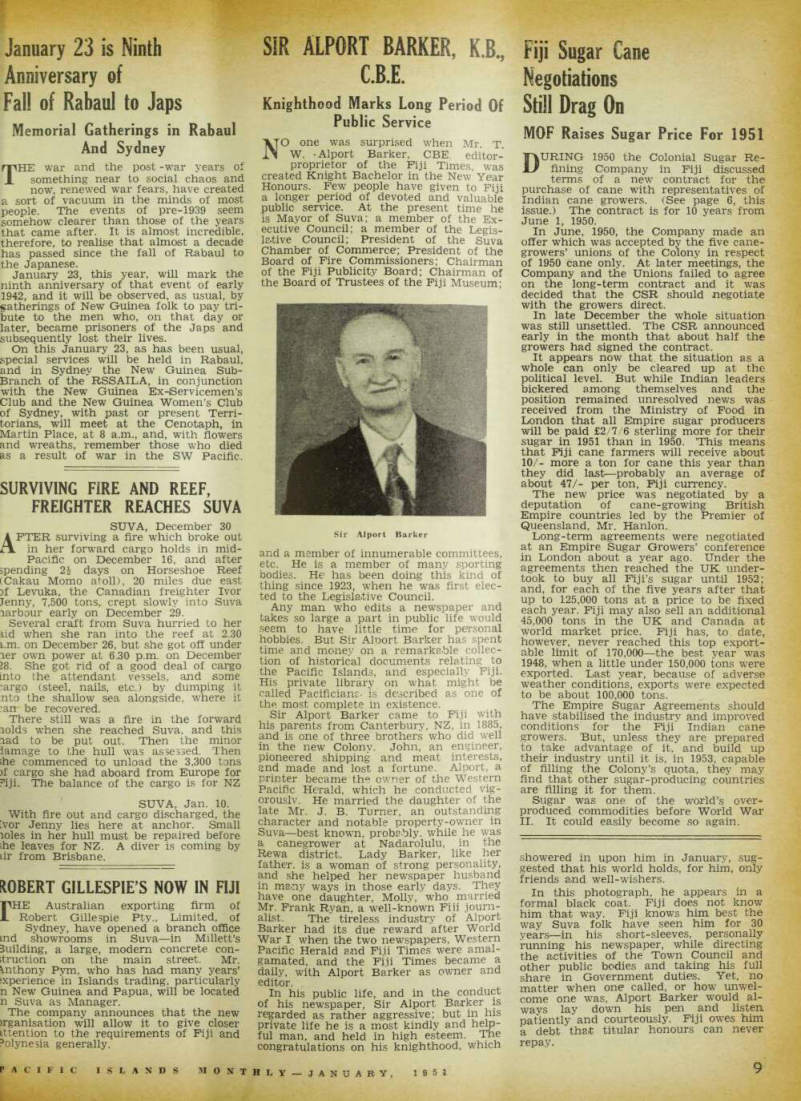
NO one was surprised when Mr. T.
W. -Alport Barker, CBE editor proprietor of the Fiji Times, was created Knight Bachelor in the New Year Honours. Few people have given to Fiji a longer period of devoted and valuable public service. At the present time he is Mayor of Suva; a member of the Ex ecutive Council; a member of the Legis lative Council: President of the Suva Chamber of Commerce; President of the Board of Fire Commissioners; Chairman of the Fiji Publicity Board; Chairman of the Board of Trustees of the Fiji Museum;
and a member of innumerable committees, etc. He is a member of many sporting bodies. He has been doing this kind of thing since 1923, when he was first elec ted to the Legislative Council.
Any man who edits a newspaper and takes so large a part in public life would seem to have little time for personal hobbies. But Sir Alport Barker has spent time and money on a remarkable collec tion of historical documents relating to the Pacific Islands, and especially Fiji.
His private library on what might be called Pacificiana is described as one of the most complete in existence.
Sir Alport Barker came to Fiji with his parents from Canterbury, NZ, in 1885, and is one of three brothers who did well in the new Colony. John, an engineer, pioneered shipping and meat interests, and made and lost a fortune. Alport, a printer became the owner of the Western Pacific Herald, which he conducted vig orously. He married the daughter of the late Mr. J. B. Turner, an outstanding character and notable property-owner in Suva—best known, probably, while he was a canegrower at Nadarolulu, in the Rewa district. Lady Barker, like her father, is a woman of strong personality, and she helped her newspaper husband in many ways in those early days. They have one daughter, Molly, who married Mr. Frank Ryan, a well-known Fiji journ alist. The tireless industry of Alport Barker had its due reward after World War I when the two newspapers, Western Pacific Herald and Fiji Times were amal gamated, and the Fiji Times became a daily, with Alport Barker as owner and editor.
In his public life, and in the conduct of his newspaper, Sir Alport Barker is regarded as rather aggressive; but in his private life he is a most kindly and help ful man, and held in high esteem. The congratulations on his knighthood, which
showered in upon him in January, sug gested that his world holds, for him, only friends and well-wishers.
In this photograph, he appears in a formal black coat. Fiji does not know him that way. Fiji knows him best the way Suva folk have seen him for 30 years—in his short-sleeves, personally running his newspaper, while directing the activities of the Town Council and other public bodies and taking his full share in Government duties. Yet, no matter when one called, or how unwel come one was, Alport Barker would al ways lay down his pen and listen patiently and courteously. Fiji owes him a debt that titular honours can never repay.
Sir Alport Barker
Fiji Sugar Cane
Negotiations Still Drag On MOF Raises Sugar Price For 1951
DURING 1950 the Colonial Sugar Re fining Company in Fiji discussed terms of a new contract for the purchase of cane with representatives of Indian cane growers. (See page 6, this issue.) The contract is for 10 years from June 1, 1950.
In June, 1950, the Company made an offer which was accepted by the five cane growers’ unions of the Colony in respect of 1950 cane only. At later meetings, the Company and the Unions failed to agree on the long-term contract and it was decided that the CSR should negotiate with the growers direct.
In late December the whole situation was still unsettled. The CSR announced early in the month that about half the growers had signed the contract.
It appears now that the situation as a whole can only be cleared up at the political level. But while Indian leaders bickered among themselves and the position remained unresolved news was received from the Ministry of Food in London that all Empire sugar producers will be paid £2/7/6 sterling more for their sugar in 1951 than in 1950. This means that Fiji cane farmers will receive about 10/- more a ton for cane this year than they did last—probably an average of about 47/- per ton, Fiji currency.
The new price was negotiated by a deputation of cane-growing British Empire countries led by the Premier of Queensland, Mr. Hanlon.
Long-term agreements were negotiated at an Empire Sugar Growers’ conference in London about a year ago. Under the agreements then reached the UK under took to buy all Fiji’s sugar until 1952; and, for each of the five years after that up to 125,000 tons at a price to be fixed each year. Fiji may also sell an additional 45,000 tons in the UK and Canada at world market price. Fiji has, to date, however, never reached this top export able limit of 170,000 —the best year was 1948, when a little under 150,000 tons were exported. Last year, because of adverse weather conditions, exports were expected to be about 100,000 tons.
The Empire Sugar Agreements should have stabilised the industry and improved conditions for the Fiji Indian can© growers. But, unless they are prepared to take advantage of it, and build up their industry until it is, in 1953, capable of filling the Colony’s quota, they may find that other sugar-producing countries are filling it for them.
Sugar was one of the world’s over produced commodities before World War 11. It could easily become so again.
Fiji Government And The Copra Tax
Next Move Is Awaited With Interest
From A Special Correspondent
SUVA, January 2.
THERE was a very unexpected development in the Legislative Council on December 7, when the Governor (Sir Brian Freeston) with obvious unwillingness, postponed the Bill authorising the new £2 per ton coora tax to the next meeting of the Council The measure had been formally introduced earlier that day, with an expression of the Government’s determination that it should be passed at that session despite all the protests which had come from copra and other interests.
The check came from the Fijian members of the Council who pointed out that it was mandatory under the Fijian Affairs Ordinance that any matters which affect the interests of the Fijian people generally be referred to the Fijian Affairs Board.
This Bill had not been referred to the Board, although Fijians produce 60 per cent, of Fiji’s copra.
Actually, this course is not mandatory.
The Ordinance says that such matters go to the Board only “when in the opinion of the Governor” they affect the interests of the Fijians. His Excellency had decided that reference to the Board was unnecessary: and he took it very seriously amiss when he found his ' judgment challenged in this way by the Fijian members He said! — “All I can say on that account is that I cannot conceal my regret that my Fijian friends have been so ill-advised
as to challenge publicly in Council my exercise of the judgment which has been vested in me by this Council under statute. I will leave it at that.”
His Excellency made it clear that he accepted the situation with reluctance; but the postponement was agreed to.
The next steps are awaited with some interest. It is assumed that the copra producers’ protests against the tax have gone forward to be considered at high official levels in London, Government circles have no doubt that, behind this move, they discern the in fluential and skilful hand of Sir Henry Milne Scott, who has a close connection with the Fijian Affairs Board.
Sir Henry was away in New Zealand and did not return until shortly before the Council meeting. Otherwise, the post ponement of the measure might have been decided upon sooner, and the Governor saved from acute embarrassment.
The Governor is believed to be adamant on the subject of the copra tax, and will not take kindly to any interference with his plan. .. , , .
But even his friends admit that ms argument, that the imposition of the tax will permit the Government to corres pondingly reduce import duties on essen tial foodstuffs, is weak. Even if the full copra tax (calculated on last years production) is passed on to the people, it will represent only about 3/- per head per annum.
amfordy
The Forthright Views of A Fijian Planter
Letter to the Editor
AS you are aware Civil Servants in
mpidTy rLng cllt oTuving. The cos!
of this increase will amount to approximately £70,000 per annum.
By a remarkable coincidence, the Governor-in-Council has now seen fit, in the face bf an overwhelming opposition from toouirrs n pecial to Copra tSx orTevy Sy"i n SHi SUm 0f £7 ° °°° aPPrOX - I need P ha?dly describe the feelings of ftence’ ji C r£e Fhf‘planter 1 ifreceMng roughly, hlff of the P worW parity value for his produce, and is contributing heavily through already existing direct and indirect taxation to the upkeep of the inefficient and overstaffed Fiji Gov- “urally, the spiralling prices and general inflation hit the nlanter more than the civil servant, who enjoys many concessions and perquisites.
In view of to-dav’s general inflation, the sum the Fiji planter receives for his copra is far from magnificent; and, because of this, it is deliberately dishonest and misleading for Sir Brian Freeston or any other Government spokesman, to talk of handsome copra prices, and to make a comoarison with pre-war copra prices, wVipH tVip of pvprvthino’ plsp wB.s in 1 1 everytnm ° eise was m Keeping.
THE native Fijian also is feeling this inflatory trend, and is—as recent articles in your magazine have quite rightly shown— having a tough struggle to make ends meet, with the soaring price of all native foodstuffs. and h now 3 he n ’wm n be heavily towards the perquisites, high salaries and numerous luxury trips overseas
enjoyed by our swollen army of civil Fiji already Pay existing income tax-inrei urn or which they only too often receive p ClS f„ there is no elec- , Ir ? the c°PJ; a ti^ 6 laid on or tricity, water °L„ s t p^ lta nl ori v,ic own ex- P l° v i d Matter? Anv roads that exYsfaff generally in a deplorable
amfordy
°f hu o^ s o ? f e^f° C , tor t 0 C ° Ver “ ”** AU of Fiji's amenities are centred in main no d o u bt for the benefit: of! who'contribute little but take much irom * D 153 e< rPCe ntlv held bv the Fiji ™u the preamble to in'- “mg ‘bis copra tgx wf Provided to an address by the Colonial A ter w fifal Si« mnttpr had not been J£g Affairs Board thev refer]red to the Fijian debate’
Co^l? iq ta nmrSete?v flummoxed the chair This c^P le 4dw a rd U p and moved ,^ h Q e^ n^ a^ p^ w n a f r< until the p ® JmSSnsfo? Legislative Council a n fd?ournment of half an hour A^ r thp p m]nr ii re consider this mcittGr, tnc oou assembled and, in a venomous way, the Fijians were publicly reprimanded from the chair. , , However, in view of pressure brought toliear H f TrJdi the Council Pean Mid of the Cou c th t r^ at a dloummenf was Iccepted F J — the adjournment was accepted.
T CONSIDER this was a deplorable and x uncalled-for attack by the Goyern ment on the Fijian members of ooun
cii, and a reflection on an extremely loyal and likeable folk who have always given more than willingly to everything the Government has recommended to them and whose efforts and contributions during the war should not be forgotten.
The Fijians produce 60 per cent, of Fiji’s copra, and they have shown ex cellent good sense in trying to resist this impudent and brazen grab by the Socialist powers in office. With so much unrest and disaffection among our colonial people, it would pay Sir Brian Freeston and his advisers to consider well before antagonizing the decent and loyal Fijians by an unjust imposition.
The Fijians—unlike the Europeans and Indians, who have a franchise of sorts — are denied much voice in the control of their affairs and are consequently mulcted of much. Why drive them too far?
During the pre-war depression, the Fiji sugar industry was subsidised; but not a penny of relief was granted to the copra industry. Now, when extra revenue is required for our top heavy administration, discretion is playing the better part of Sir Brian Freeston’s valour, and he has chosen the more gullible and less vocif erous European and Fijian copra produ cers for his “grab,” rather than the more politically-minded Indian sugar produ cers.
Every Governor of Fiji ha-s the duty of protecting and respecting the wishes of the Fijian neople, and every Governor has found them to be most reasonable in their wishes.
Sir Brian Freeston is seemingly una ware of some of his major obligations, Here, in our Governor, we want the correct well-balanced views of the British Colonial Service, rather than actions which savour of arrogance and socialism A better appreciation of his people’s wel fare. and less use of his dictatorial power, would be appreciated.
Gathavula Estate, I am, eto.,
Taveuni. 20/12/1950.
C. J. T. Krone
While fishing recently in deep water ofl Faelolo airport, a Samoan fisherman, lele of Apolima island, was attacked in the water and severely mauled by a shark just as he climbed into his canoe. He was taken to Apia Hospital where it was found necessary to amputate his injured leg After a blood transfusion he is now out of danger.
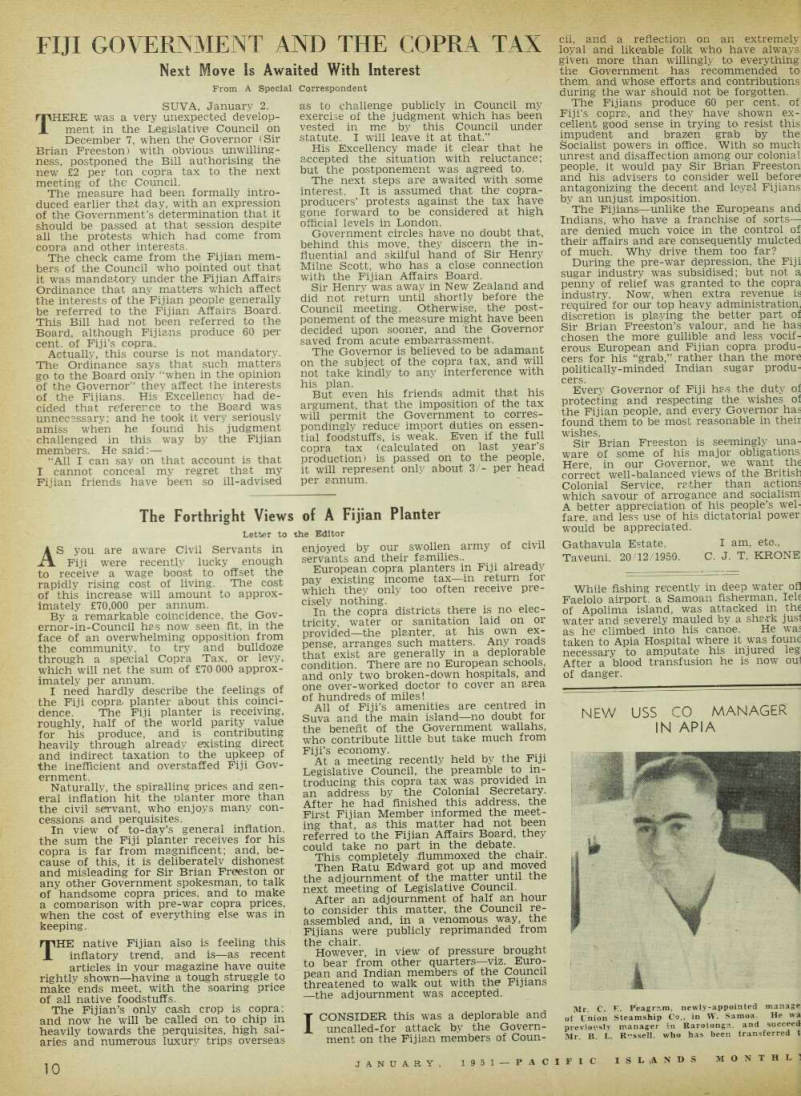
New Uss Co Manager
In Apia
Mr. C. E. Peagram, newly-appointed manage[?] of Union Steamship Co., in W. Samoa. He wa[?] previously manager in Rarotonga, and succeed[?] Mr. B. L. Russell, who has been transferred t[?]
Advertisements & other items, p. 12 (1 item)
10
JANUARY, 1951-PACIFIC ISLANDS MONTHLI
Si. siif.
Life On A Junk-Heap
In Rabaul
By R. W. Robson
The Town That Si. siif.
Rabaul, Oct. 20
THIS place, like Port Moresby and Lae is lousy with money; but, as in Moresby and Lae, I cannot see any sound economic basis for so much liveli ness and prodigality.
The chief product of New Britain, New Ireland and Bougainville—for which Rabaul is the trading centre—is copra* and, even admitting that production costs have increased fantastically, and that the planter, getting £4B Aub. per ton, is being deliberately robbed by Socialist Governments of a large proportion of the world price—there is a pretty profit in copra. But that does not explain the volume of money circulating in Rabaul.
It comes as well from the millions which Australia is frittering away on an unsystematised Administration; from the practically uncontrolled distribution of “war damage compensation” to natives* and from refugee money from Communist China, which has fled here to the safe keeping of the Chinese community.
However, why worry about the source of these welcome funds? The money is circulating, and every section of the com munity—except the unfortunate officials of the Administration—is having a very good time.
It is bothersome, however, to have a great deal of money, and not much to do with it. It is difficult to put up worth while buildings here, because the Admin istration has set its face generally against the re-building of Rabaul—it says that the town must be built 30 miles south ward, out of the range of the volcanoes.
One cannot engage in new enterprises, calculated to produce new wealth, because the Administration is reluctant to give land titles, or timber leases or anything else that is in any degree likely to in terfere with native rights.
Mr. Spender, a year ago, thought he had supplanted the Ward-Murray Socialist policy with an individualistic plan for the encouragement of private enterprise. Well, up to date, all his promises have been set aside or smothered by the Ward-Murray administrative set up, which does not appear to have changed much.
Quite a number of little, one-man businesses based on personal service or on distribution, have been established by Europeans and Chinese, and are flourish ing. But they are merely a growth on this phenomenal circulation of money.
They add nothing to the permanent pro ductive economy of the country. When
the country, sooner or later, is asked to live on its own resources, most of them will fold up.
SO the baffled traders—for it is in their hands that so much money is accu mulating—are generally living well, takmg plenty of expensive holidays South, and purchasing luxury goods.
You will see no finer cars anywhere than those owned by the Rabaul Chinese, and some Europeans. These calr-owners are literally all dressed up, with nowhere to go.
Their shining vehicles, beautifully sprung, have only two miles of bitumen road (Malaguna and Mango Avenues) on which to run; the other pot-holed roads, over which they roll like a yacht in a heavy sea, are few, and lead nowhere.
Enormous sums have been spent on roads and bridges by the Administration and by Works and Housing in this area since 1945, but the work does not seem to have been in line with any overall plan, and the result is dust and/or mud, un limited; while the mileage of really trafficable roads is very limited indeed.
TO those who knew the pre-war Rabaul, with its solid white buildings and shaded avenues, it must be explained that, between 1941 and 1945. the town was completely obliterated. The Japs put the better part of 200,000 men there, and made it their main advanced base for the attack on the Australia-Fiji-New Zealand line; and it therefore became the painful duty of our airmen to wipe it out.
In 1945, when Japan surrendered, there was nothing left of old Rabaul above the ground except some of the walls of Burns Philp’s new store, ditto the New Guinea Club, and a few blasted tree trunks where the avenues once were. The site of the once pretty town was so thoroughly pul verised that surveying was necessary to re-locate the streets and the boundaries of allotments.
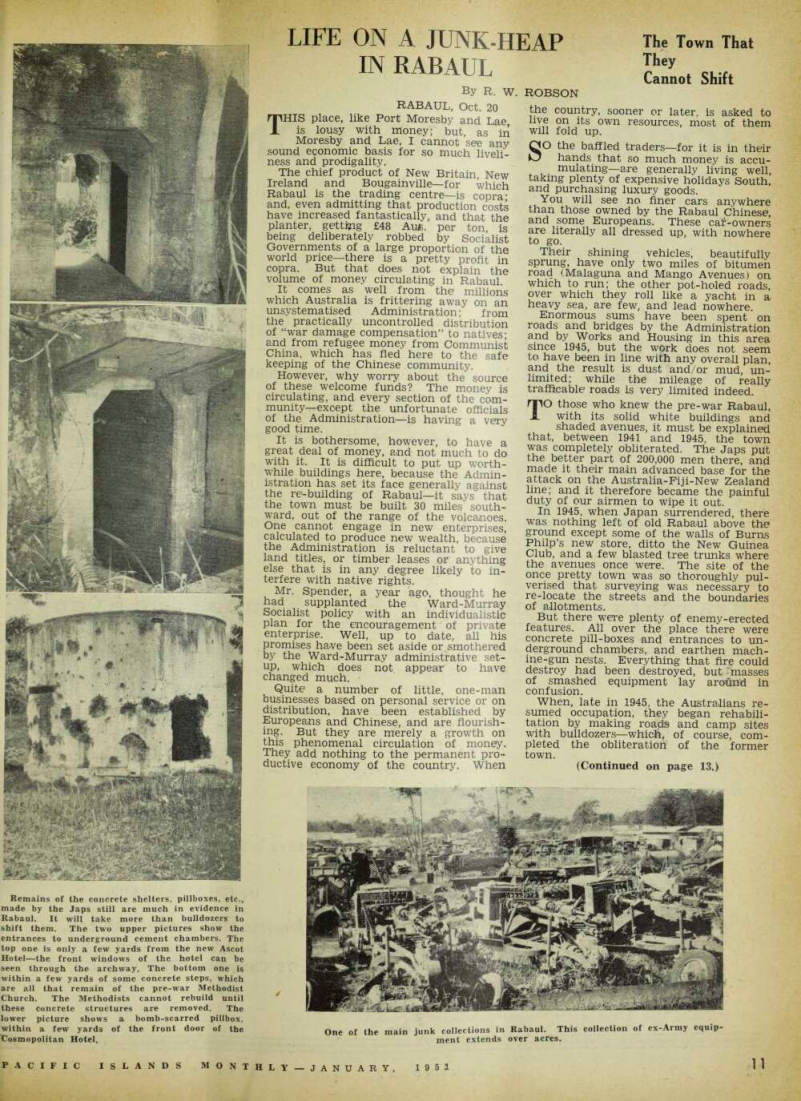
But there were plenty of enemy-erected features. All over the place there were concrete pill-boxes and entrances to un derground chambers, and earthen mach ine-gun nests. Everything that fire could destroy had been destroyed, but masses of smashed equipment lay around in confusion.
When, late in 1945. the Australians re sumed occupation, they began rehabili tation by making roads and camp sites with bulldozers—which, of course, com pleted the obliteration of the former town.
(Continued on page 13.)
Remains of the concrete shelters, pillboxes, etc., made by the Japs still are much in evidence in Rabaul. It will take more than bulldozers to shift them. The two upper pictures show the entrances to underground cement chambers. The top one is only a few yards from the new Ascot Hotel—the front windows of the hotel can be seen through the archway. The bottom one is within a few yards of some concrete steps, which are all that remain of the pre-war Methodist Church. The Methodists cannot rebuild until these concrete structures are removed. The lower picture shows a bomb-scarred pillbox, within a few yards of the front door of the Cosmopolitan Hotel.
One of the main junk collections in Rabaul. This collection of ex-Army equip ment extends over acres.
Then, with a speed which can be be lieved only by those who know the tropics, nature took a hand. Within months, the devastation was being clothed with a lusty growth of coarse grasses and young trees.
All the avenue trees which had not been destroyed sprouted new foliage. Today, when first glimpsed from a high plane, Rabaul looks much as it did in 1939.
It is when you enter the town, and see what is under or behind the vegetation that you get a shock. The Rabaul of 1950, strung out along the old street lines, is little more than a ramshackle village built on a heap of junk. Most of the trading houses have done their best, with the limited materials and help available; but, generally, there are few buildings constructed with a thought to either beauty or permanence.
HROM 1945 onwards, the non-official l population, led by the Chinese, literally fought its way back to this own site, in the teeth of official opposi ion.
When the invasion came, in 1942, the apital of New Guinea (Rabaul) was in •rocess of being abandoned to the ever estless volcanoes, and a new capital /as being officially built at Lae. At the nd of the war, officialdom said: “This is ur opportunity. We don’t need another apital—Port Moresby is it.” But Rabaul 3 wiped out. Let us build the new cabaul at Rapopo (near Kokopo, over 0 miles south).” It was a reasonable Tgument.
But Rabaul has the finest harbour in he South Pacific. There is no harbour t all at Rapopo, only a sheltered coast me. Deep water is far out from the hallow beach. Naturally, the European nd Chinese traders, hurrying like furies o get the benefit of the hungry post-war emand for copra, settled themselves tubbornly at the good port.
Undoubtedly, that trading community /ould have gone—however unwillingly—
traHon^hac/^ad°*Bu ffir ie nf viS« Ad^nis '
diately tT'sefcct
ft X nnTnd h i to shape T*,iV P Hwv.^i y fisi S A **?• bemg used -
Government ft So £ lalis !
Government had fastened the weak and Upon New Gumea, and that Administration was so pre-occupied with native welfare that it did nothing about Rabaul, except babble an whU?°M^ e Fd g dip j 0 .
While Mr. Eddie Ward and Colonel Murray were wasting precious months and years on reviewing the native labour regulations, and hamstringing private enter prise, and distributing “war damage compensation” to the natives, and trying to escape from the implications of the timber lease scandal, the Rabaul civilians— wearying of waiting on bumbling official-
clom—proceeded to re-establish Rabaul on SSo2? ** *" the Shad ° W ° £ the VOl ‘ Because of its lack of a port, Rapopo was not held in favour by the traders.
Experienced people say that there is at least one excellent port—and probably more—around Gazelle Peninsula P to the northwards: and that prompt official action in that direction woffid have rneant the abandonment of Rabaul. But official dom argues that a move north would be a move into the volcano line; while a move southwards would be a move away from it CJO, frowned upon by officialdom, Rabaul, O like Topsy, simply grew, more or less as it liked. From 1946 to 1949, people erected buildings—houses and stores—with
(Continued on page 95)
Years after the war, the Rabaul waterfront, from [?] burned wharf half-way to Toboi, is littered [?]ar wreckage. Practically everything in sight in photograph is junk.
One side of the main street of Chinatown, on the south of Rabaul. It is a dreadful array [?]f old iron, scraps and bits, and dilapidation.
/hatever they could lay hands upon, lerely to keep out the wea-ther. Official om growled and was not co-operative, ut did not seriously interfere.
By the end of 1949, Mr. Eddie Ward had scaped from the timber lease scandal, 11 pure and unsullied —but panting very luch from the effort, which had extended ver a year.
By now, he had “had” New Guinea, lanifestly, he lost interest in most of is plans for making Papua-New Guinea native Socialist paradise in the South leas. Private enterprise began to receive ome little encouragement.
So, during 1949, officialdom began to ive some practical help in the rehabil ;ation of Rabaul, and rebuilding began 0 ta-ke some formal shape. Streets were uilt and sealed, both Chinese and Euro eans were encouraged to put up fairly ood buildings, public services were im roved. This tendency was more marked rhen the new regime was introduced, in 950. Port Moresby, at intervals, still alks grandly about the construction of be new town at Rapopo. The road from t-abaul to Kokopo is so bad that I would ot face the journey, and have not seen be site at Rapopo; but I am assured that Tactically nothing has been done.
J7TTH new warehouses built by the big ff firms, a new hotel, neat new Chinese stores in and around the old China- Dwn, Rabaul is improved on what it was 1 1949; but it still is a caricature of the Id Rabaul. I have seen it at the end of ne of the worst droughts on record, rhen it is smothered in pumice-dust from he unsealed roads —dust which, as soon s the North-west season arrives, will turn o endless mud.
I am assured that a great amount of rar damage has been removed. But a ommunal effort of prodigious proportions ; needed still, if the town is to regain a ormal appearance. Everywhere one sees be concrete foundations of old buildings r the remains of concrete fortifications, r high mounds which were once earth ortifications. They mostly are covered nth vegetation, but you cannot walk wenty yards without seeing some evidence f war. These must be removed.
The harbour-front is incredible, even fter five years. Right from the old urned wharf, round to Malaguna, the oreshore still carries a litter of smashed stties, sunken barges, bombed ships.
Post-war Chinatown was built, out of very kind of ugly junk, along both sides f half a mile of bare road, on the outhern or Matupi side of the former own. It is a place of dreadful appear nce—not even a tree to hide it. The etter-class Chinese are now constructing reditable buildings on or near the site f old Chinatown; and this Hideous Half lile should presently disappear.
Between the Hideous Half-mile and latupi, where the airfield now is, and long the foreshore, one may see dozens f plane wrecks, peeping out of the unai and undergrowth.
Between the native markets and the lace where were the once-famous Botanic hardens —now entirely disappeared—there .re the “parks” where War Disposals chicles and equipment were once dis mayed in orderly rows. Here, again, is n incredible sight. Hundreds and hun reds of bulldozers and lorries, cranes and un-carriers and all sorts of powerful tiobile machines have been lying here ince 1946, slowly surrendering to the trop :al sun, rain and jungle. They say huge uantities have been sold and taken away, o make fortunes for innumerable shrewd nd deserving gentlemen; yet the sight f the stuff that remains is enough to
make any self-respecting economist sick on the stomach.
Just beyond the junk parks are the sides of the hills which lead over to Wunawa tung. They are honeycombed with the tunnels and storehouses made by the busy little Japs in their 3 1 years’ occupation; and they still are one of the wonders of this post-war area.
In this area-, as in most of the islands on which they settled in their southwards thrust, the Japs proceeded on the theory that, if they were to be driven out, their
enemies must come and dig them out, by frontal assault. They not only filled Rabaul and the surrounding hillsides with concrete chambers; they also had lines of fortifications in the forests of New Britain, extending far westward of Rabaul.
But all this colossal concrete work was useless. Douglas MacArthur’s forces w |nt leap-frogging away north, fom the Solomons and Australia; and the busy Japs of Rabaul and of scores of sma places, without air or sea help, were left to starve m their elaborate tunnels and concrete chambers, More than any other community in the South Pacific, the people of Rabaul should be Asia-conscious. In all this
junk, they see the evidence of Asiatk aggression. They see their neighbours in Chinatown reacting daily to the flood o< refugee money from Red China. Theii. back door is threatened by the Indone sians who want Dutch New Guinea; and the echoes of the conflict in Korea- reach them first. They are surrounded by mem ories of the hundreds of their townsfolk: who were sacrificed on the Montevideo Maru.
Yet they keep their chins up, and prac tise their well-known hospitality, and put their faith in the future of copra and timber. They suppose that some day the Administration will forcibly remove them, or they will be blown out of Simp sonhaven by some of Mount Mother’s satellites, or cha-sed away again by Asia tics. But, meanwhile, life goes on, and trade is booming, and one has now ac quired a taste for San Miguel beer —sc what the hell!
They are making life on their junk heap as comfortable as the deplorable conditions allow. The Administration at last has agreed that there must be a ‘ temporary” town in Rabaul, and is co operating accordingly in the matter ol providing roads and services. If Asia does not spill out across the world, the next five years in Rabaul should be much better than the last.
Advertisements & other items, pp. 14-16 (3 items)
Morris Hedstrom Limited
General Merchants, Importers and Exporters,
Shipowners, Plantation Owners,
Commission and Insurance Agents
HEAD OFFICE
SUVA, FIJI
Established 1868
SERVICE IN THE SOUTH PACIFIC TERRITORIES
'jpHROUGH our Large Establishments in Suva and our Numerous Branches, we distribute a wide and comprehensive range of General Merchandise and provide almost every kind of service. Our departments and associated businesses include:
DRAPERY
MOTOR SALES
AND SERVICE
TOBACCO
TIMBER AND
BUILDING
GROCERY
CONFECTIONERY
HARDWARE
ELECTRICAL
LIQUORS
DRUGS
Branches Throughout Fiji, Samoa and Tonga
There is a Branch or Agent of Morris Hedstrom Limited in every Town in the Three Territories.
We are Sole Agents in these Territories for British Drug Houses Ltd.
Electrolux Ltd.
Ford Motor Co.
General Electric Co. Ltd.
Goodyear Tyre & Rubber Co.
B. A. Hjorth & Co. (Primus Products) Imperial Chemical Industries Ltd.
International Harvester Export Co.
Matson Navigation Company Max Factor and Co. Inc.
Ransomes, Sims & Jefferies Ltd.
Ruston Gr Hornsby Ltd.
Vacuum Oil Co. Pty. Ltd.
Yorkshire Copper Works Ltd.
Morris Hedstrom Limited are LLOYD'S AGENTS in Fiji and Samoa.
IN AUSTRALIA:
IN GREAT BRITAIN:
Morris Hedstrom (Aust.) Pty. Ltd.,
Asbestos House, 65 York Street, SYDNEY
Morris Hedstrom Limited,
Barclay's Bank Building, 73 Cheapside, LONDON, E.C.2.
AN AUSTRALIAN ELEVEN
/ : H ' 13 M
ANOTHER AUSTRALIAN XI. is—
Asthma, Hay Fever, Catarrh, Bronchitis, Antrum, Sinus, Coughs, Colds, Tlu, Tonsilitis, and Whooping Cough.
Never run out of Aspaxadrene and get caught with an asthma attack: Best by any test—eleven lettered 1 M* “touches the spot” and relieves in seconds; 5 little whiffs and in 5 little jiffs—“off she pops.”
It’s the buy-word to-day . . . so buy to-day, not “bye’n bye” and have a good night’s “bye-bye”— yourself, all the family and the doctor.
ALL CHEMISTS or
A. H. CRUNDALL
BOX 58, PRAHRAN, VICTORIA, AUSTRALIA.
SPECIAL OFFER. —100 brightly coloured 1951 calendars, with a picture similar to above, are available free to “PIM” readers —write for your copy right away.
YOURS WHEN YOU FLY BY
CLIPPER* TO
LONDON
% 'A nf
VIA U.S.A.
Sleeperette Comfort*
Across the Pacific to Hawaii you enjoy Pan Pan American s Commonwealth Plan American’s exclusive Sleeperette Service. Pan American’s Commonwealth Plan covers Your softly cushioned Sleeperette reclines all your travel expenses to London and ’way back so you can stretch out full-length return. Includes meals, hotel accommodaeven has curtains for privacy! All tions, incidental transportation in the day long you relax in blissful comfort. U.S.A. All reservations and arrangements At night you sleep like a top. made for you by Pan American.
The Clippers also fly to London via Middle East and Europe For complete information, call your Travel Agent or . .
SUVA: Bank of N.S.W.Bldg. (Tel. 664)
NOUMEA:
World's Most Experienced Airline
SPEED YOUR PARCEL BY CLIPPER CARGO
r, r 1 /'T* 7 OC ) * Trade Marks, Pan American f\U6 J6(111 JCHJLTCS ( 1 CL, OO / World Airways, Inc.
Pan Am nr [can
World Airways
Pan American World Airwayr Inc., Ltd. Incorporated in IKS.A
13
• '‘• F I C ISLANDS MONT„ L Y - J ANUARY, 195 1
14
JANUARY, 1951-PACIFIC ISLANDS MONIHL
Rabaul Roundabout
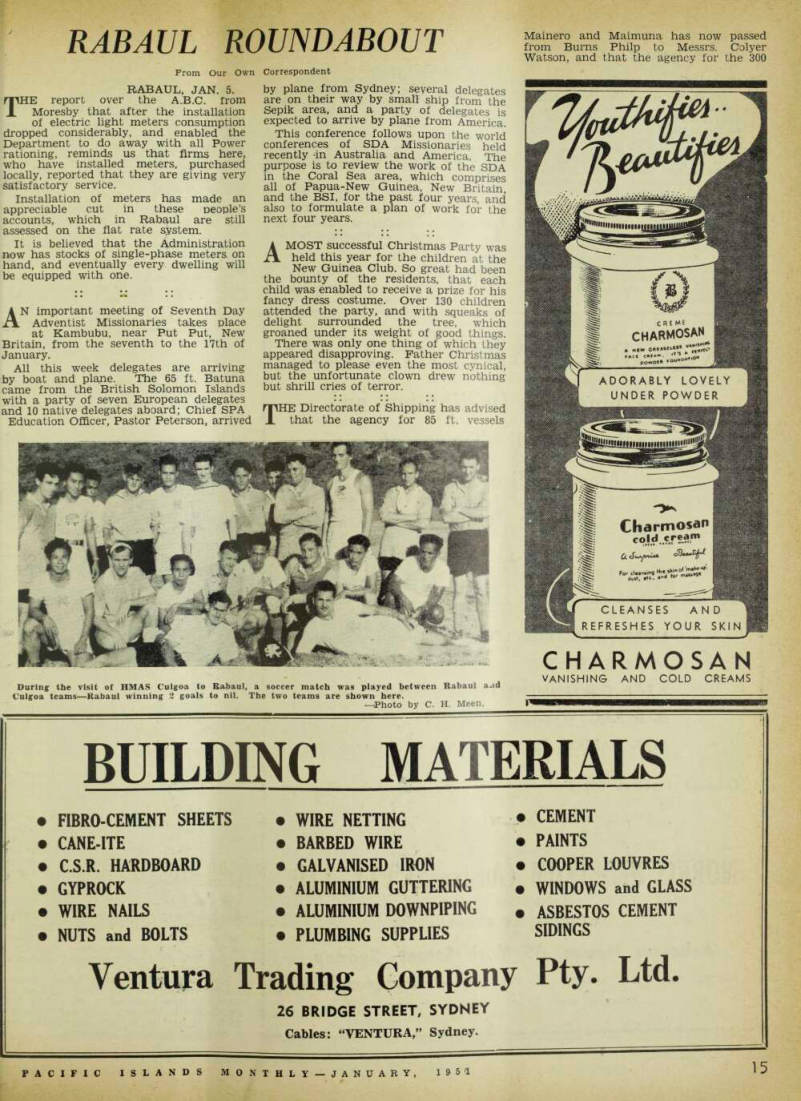
From Our Own Correspondent
Rabaul, Jan. 5.
THE report over the A.B.C. from Moresby that after the installation of electric light meters consumption dropped considerably, and enabled the Department to do away with all Power rationing, reminds us that firms here, who have installed meters, purchased locally, reported that they are giving very satisfactory service.
Installation of meters has made an appreciable cut in these neople’s accounts, which in Rabaul are still assessed on the flat rate system.
It is believed that the Administration now has stocks of single-phase meters on hand, and eventually every dwelling will be equipped with one. .. .. ..
AN important meeting of Seventh Day Adventist Missionaries takes place at Kambubu, near Put Put, New Britain, from the seventh to the 17th of January.
All this week delegates are arriving by boat and plane. The 65 ft. Batuna came from the British Solomon Islands with a party of seven European delegates and 10 native delegates aboard; Chief SPA Education Officer, Pastor Peterson, arrived
by plane from Sydney; several delegates are on their way by small ship from the Sepik area, and a party of delegates is expected to arrive by plane from America, This conference follows upon the world conferences of SDA Missionaries held recently -in Australia and America. The purpose is to review the work of the SDA in the Coral Sea area, which comprises all of Papua-New Guinea. New Britain, and the BSI, for the past four years, and also to formulate a plan of work for the next four years, :: :: :: a MOST successful Christmas Party was held this year for the children at the New Gu inea Club. So great had been the bounty of the residents, that each child was enabled to receive a prize for his fancy dress costume. Over 130 children attended the party, and with squeaks of delight surrounded the tree, which groaned under its weight of good things.
There was only one thing of which they appeared disapproving. Father Christmas managed to please even the most cynical, but the unfortunate clown drew nothing but shrill cries of terror. , :: . ” rpHE Directorate of Shipping has advised X that the agency for 85 ft. vessels
Mainero and Maimuna has now passed from Burns Philp to Messrs. Colyer Watson, and that the agency for the 300
During the visit of HMAS Culgoa to Rabaul, a soccer match was played between Rabaul and Culgoa teams—Rabaul winning 2 goals to nil. The two teams are shown here. —Photo by C. H. Meen.
ton vessel MV Kelaua, upon completion of repairs to that vessel, will pass from New Guinea Company to Colyer Watson.
WHEN Lieut.-Col. MacLeod addressed a meeting of the RSL Club last month, in an endeavour to reform the New Guinea Volunteer Rifles, a strange anomaly was disclosed. Of the entire complement of returned servicemen in Rabaul, there would not be sufficient non-commissioned men to form the Rifles, In order to join the Company, all com missioned officers would first have to re sign their commissions. The president of the RSL and Lieut.-Col. MacLeod are still trying to work out a solution.
SIR ANGUS GILLAN visited Rabaul during December, and gave a public address at the RSL Clubrooms. He spoke of the post-war development of closer cultural relationship between the 'United Kingdom and other countries, and also explained fully the function of the British Council.
A REGRETTABLE incident took place outside the Palms Theatre, during the December visit of the overseas vessel Suva to Rabaul.
Sub-Inspector Palmer, called to the theatre to quell a group of coloured sea men who were creating a disturbance out side, was attacked by them. They struck him over the head with a bottle, threw him to the ground and kicked him.
Theatre employees rang the police for reinforcements, taut several members of Works and Housing Department emerged from the theatre, and rushed to the policeman’s assistance.
They soon overpowered the coloured sea men, and led them away to the Bastille.
THE New Britain Club would like to pro test against criticism which has been unjustly levelled at them over their “Bathing Beauty” Ball, held in November.
This was a most decorously-conducted affair, and, during the parade of the beauties there were no natives within coo ee of the Clul>—environs of which were
heavily policed for possible lurking savages.
MR. FRANK RIORDAN has returned to Rabaul after Southern leave, to take up his post once more as Manager of the Commonwealth Bank.
During his absence Mr. Charles Andrew carried on in his place.
Before leaving the territory, Mr. Andrew was farewelled by fellow members of the New Guinea Club, who made him a pre sentation of a pewter mug, in token of their regard, and appreciation of the good work he had done on the Club’s behalf during his stay.
COMMANDER E.” CREER has left Rabaul on the Bulolo for Sydney, and thence home to England for an in definite period. He was one of the best liked skippers in these waters. We see him go with regret.
The Commander was a notoriously poor sleeper. One night, to his horror, he ob served one of his * boats’ crew coming aboard the Stradbroke, his last command, carrying a fiendish-looking toy trumpet.
The Commander inquired how much it had cost the savage.
“One shilling,” was the reply.
“Well, my lad,” said Bertie, “here’s ten shillings for it.”
The gratified native pocketed the money, but still cannot understand why the “Mastah” promptly threw his pur chase over the side of the vessel.
AN interesting engagement has been announced in Rabaul, and a mar riage will take place early in 1951 between Pamela., only daughter of Mr. and Mrs. T. W. Palfreyman, late of Rabaul, and Mr. Alan Willis, second son of Mr. and Mrs. E. G. Willis, of Randwick, Syd ney. Pam is well known to us all as “the Voice” of RTC, A SECOND parade of feminine beauty was held at the Ascot Hotel during late December. This time, however, all the femmes were fully clothed, thus defeating any possible critics.
The show was organised by Mrs. Margot Briggs, of the Chic Salon. Sports frocks morning, afternoon, and evening wear were displayed by the pretty mannequins to a lounge packed to capacity.
Background music was provided by the tinkling of ice in long, cool drinks, anc excited yelps from female members of the audience.
T INFISH, father of Salmon and Sardine venerable black retainer and cook boy for the last 20 years in the House of Creswell at the Bainings, is the only local native I have seen wearing a. full set of false -teeth.
The other day Tinfish flashed them at me outside the Hails Meat, in a beaming youthful smile. He assured me at once that they cost £6O.
As he walked into the butchers- to buy steak on which to test his new teeth, thought: “Ah, what a thoughtful and fitting reward to the faithful servitor who has worn out his own fangs in an honesl endeavour to eat his kind Masted out of house and home.”
IF you said that C. H. Meen, clever Chinese photographer and ice-cream dispenser at the Picture Theatre in Rabaul, was the most popular Chinese here with both his own race, and Euro peans, I don’t think you would meet with any opposition at all.
Now the indefatigable Meen, besides his ice-cream and soft drink stall at the Theatre, has installed a very fine Soft Drink Bar in his own store in Chinatown with tall bar stools, tall cool drinks, and a delicious blend of ice-cream.
Advertisements & other items, pp. 17-18 (1 item)
Building Materials
fi
CRtME
CHARMOSAN
» "I* OMA*' 1 * 1 * M »rtC
~C. CM.-. ■ ' TIQ .
rou«»‘
ADORABLY LOVELY
UNDER POWDER
MMIIIIIIIMIMIMII'i 11 "
Charnnosan
coMcream For Cl«"«nfl tfust. »tC . •"<*
CLEANSES AND
REFRESHES YOUR SKIN
CHARMOSAN
VANISHING and cold creams
BUILDING MATERIALS
• FIBRO-CEMENT SHEETS
• CANE-ITE
• C.S.R. HARDBOARD
• GYPROCK
• WIRE NAILS
• NUTS and BOLTS
Ventura
• WIRE NETTING
• BARBED WIRE
• GALVANISED IRON
• ALUMINIUM GUTTERING
• ALUMINIUM DOWNPIPING
• PLUMBING SUPPLIES
• CEMENT
• PAINTS
• COOPER LOUVRES
• WINDOWS and GLASS
• ASBESTOS CEMENT
SIDINGS
Trading Company Pty. Ltd.
26 BRIDGE STREET, SYDNEY
Cables: “VENTURA,” Sydney.
INQUIRIES ARE INVITED
Concerning the Distribution and
Sale of All Types of
Merchandise in the
Pacific Islands
WE ARE AUSTRALIAN AGENTS FOR—
MORRIS HEDSTROM LTD., Fiji, Tonga and Samoa.
MILLERS LTD,, Fiji.
8.5.1. P. GOVERNMENT TRADE SCHEME, Honiara.
G. & E.I.C. WHOLESALE SOCIETY, Ta rawa.
MAX HALECK, Pago Pago, American Samoa.
Original Invoices Supplied Quotations on Request ★
MORRIS HEDSTROM (Australia) PTY. LTD.
(.Established 1922)
MERCANTILE BROKERS,
Asbestos House, 65 York Street, Sydney.
Box No. 2530, G.P.0., Sydney. Cable Address: “MORSTROM,” Sydney.
BANKERS: BANK OP NEW ZEALAND, SYDNEY.
New Native Labour Laws
Now In Operation In Papua-New Guinea
From Our Own Correspondent
Pt. Moresby, Jan. 8.
THE new Native Labour Ordinance, which came into effect on January 1, shows a gain for employers in that the term of native employment under agreement has been extended from 12 to 18 months. There is a further optional period of six months which can be ter minated by either employer or employee at a month’s notice.
In addition to employment under agreement, and the previous system of “casual” labour, the Ordinance also pro vides for a new group—the daily casual worker. His rate of pay is a flat 6/- a day, and he gets no accommodation, rations, clothing, or any other issue from his employer.
There are also a number of other changes; but insofar as wages for “agree ment” employees and the original class of casual worker, these remain at the former rate of 15/- a month, plus accommodation, rations, clothing and equipment.
Recruiters expect that it will take a while for natives to get used to the new system, since most of them dislike any sort of change. However, they believe that once the mental adjustment to a longer term has been made., it will be welcomed by prospective recruits, as many have repeatedly asked to sign on for longer terms since Mr. Ward wiped out the 3-years’ contract and substituted 12 months.
The first native reaction to the new system is being tested by a- number of
recruiters who arrived in the Sepik Dis trict early this month to engage contract labour for New Britain.
So far there has been little reaction from employers who—if they have been able to obtain a copy—are still wadins: through the lengthy Ordinance which first became public only during the last days of December. At the end of the first week in January, printed copies were still not available, the only copies beine roneoed .ones run off in haste in port
Moresby. The general principles have been explained in a 9PA Broadcast by Mr. W. R. Humphries who was Native Labour Director until his Department ceased to exist on December 31 as a separate Administration unit.
Mr. and Mrs. R. V. Cole and daughter, Jocelyn, arrived in Brisbane from Suva recently. They will leave for England in February. Miss Jocelyn has just finished school in New Zealand.
Advertisements & other items, pp. 19-20 (1 item)
Borthwicks Pty. Co.
JUBILEE
Commemorative
Official Volume
Commemorating the Golden Jubilee of the Commonwealth, this is one of the most impressive publications yet produced in Australia. Printed on art paper, in two colours, it features nearly 500 magnificent illustrations, and covers many phases of Australian life and history. 26/- (post 1/6).
ANGUS & ROBERTSON LTD.
Booksellers :: Publishers :: Librarians
89 CASTLEREAGH ST„ SYDNEY, AUSTRALIA.
nn\ 4 h. is m m k;-‘* Preserve it, in all its enchantment, with a paint fortified for tropical weather resistance, for a rich color permanency and for a mellow, even weathering.
In fhe Tropics
USE ONLY
BORTHWICKS
high m i i mu
REINFORCED
HOUSE PAINT \
\ MORRIS HEDSTROM (AUST.) PTY. LTD. AGENTS FOR
BORTHWICKS PTY. CO.
SYDNEY.
CRAMMOND
“King of the Air"
TROPICAL RECEIVERS
Features Exclusive to Both Sets: Completely tropicproofed.
Built-in moisture absorber.
Available in vibrator or all dry cefl. ★ i m
TROPIC EAGLE.
Most famous tropic-proofed and completely sealed receiver in the world to-day. Range is unlimited and reception perfect. Three years’ guarantee and easy terms wherever you live. You will enjoy and appreciate the service
a CRAMMOND TROPIC EAGLE
will give.
TROPIC HAWK,
This is a 2-unit receiver especially designed for Patrol Officers and all who require absolute portability and dependability. Each cabinet measures 15 x 9 x 9. This set covers from 16-150 metres shortwaves only. Three years’ guarantee and easy terms wherever you
live. A CRAMMOND TROPIC
HAWK is the answer to your problems.
TO ALL OUR FRIENDS BOTH OLD AND NEW we wish you all
A BRIGHT AND PROSPEROUS NEW YEAR
CRAMMOND RADIO
TROPICRLDIVISION
No B QUEEN STREET . BR/SBRNE
Commission
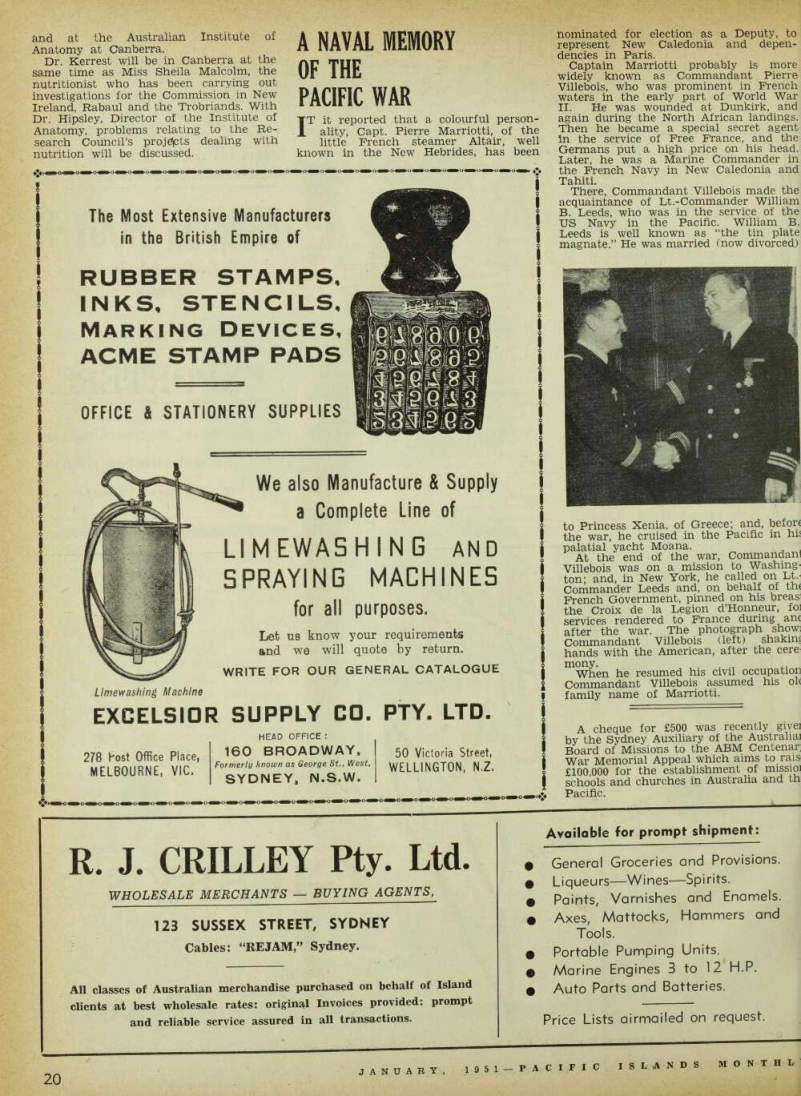
South Pacific
Headquarters: Anse Vata Noumea, New Caledonia
Special Social Development
Meeting in Fiji
ON January 16, a special meeting of the members of the Research Council in the field of social development will be held in Suva to consider reports on three projects in the fields of vocational training and social anthropology, carried out during 1950.
The meeting will be attended by Mr. H.
E. Maude (Executive Officer for Social Development) M. M. Grangie (Director of Education, New Caledonia), Dr. van Baal (of the Netherlands New Guinea Adminis tration), Mr. W. C. Groves (Director of Education, Papua-New Guinea). Mr. F.
J. H. Grattan (Secretary of Samoan Affairs, Apia), and Mr. Howard Hayden (Director of Education, Fiji).
Dr. H. G. MacMillan, Executive Officer for Economic Development, and Dr. Emil Massal, Executive Officer for Health, will also attend. Miss H. Shiels will act as Secretary.
Vocational Training The first report for consideration com prises a survey of the facilities for pro fessional and technical training in the South Pacific, and recommendations for further development of centralised train ing institutions for Islands peoples.
This project was carried out last year by Mr. R. A. Derrick, M.8.E., A.M.1.5.E., Supervisor of Technical Services, Fiji,
whose services were made available bv the Government of Fiji. J
- Social Anthropology
Two further reports deal with different sections of the Commission’s Project S 5 which comprises—“a review of research on social anthropology, with emphasis on what still needs to be done.” (a) Polynesian/Micronesian Section This survey was prepared by Dr F M. Keesing Senior Commissioner for the United States and well known authority on Polynesia (b) Papuan/Melanesian iSection * The report on this section was com pleted in November by Dr a P Elkin, Professor of Anthropology at the University of Sydney.
In addition to reviewing the extensive but previously unrelated documentation of research in the area, Dr. Elkin re visited Papua and New Guinea, including the little-known Central Highlands area to consult with Government Officers’ missionaries and others concerning present problems and research needs.
New Programmes to be Planned All three reports will be discussed fully at the Suva meeting. In the field of social anthropology, detailed proposals for a further research programme will be drafted on the basis of the recommenda tions contained by the two relevant reports.
These proposals, together with the re commendation for further development of centralised training institutions for
Islands peoples (contained in the Derrick Report on vocational training) will be considered at the Seventh Session of the Commission, to be held at Noumea on April 28.
Dr. Kerrest to visit Australia This month Dr. J. Kerrest, Research Assistant to Dr. Emil Massal, Executive Officer for Health, is visiting Australia for consultations at the School for Public Health and Tropical Medicine at Sydney
and at the Australian Institute of Anatomy at Canberra.
Dr. Kerrest will be in Canberra at the same time as Miss Sheila Malcolm, the nutritionist who has been carrying out investigations for the Commission in New Ireland, Rabaul and the Trobriands. With Dr. Hipsley, Director of the Institute of Anatomy, problems relating to the Research Council’s projdpts dealing with nutrition will be discussed.
Advertisements & other items, pp. 21-22 (2 items)
19
■ac.fic islands MONTHLY-JANDABY. 1951
Gilbey’S
FRANCIS HOOVER
4 Castlereagh Street, Sydney Cables: “Petwer.”
G.P.O. Box 4623.
EXPORTERS
All classes of merchandise supplied. Careful attention given to big and small orders.
Of. //; °*C /j & gil
the
C A hh
Is f
GILBEY’S
Bey ltd. me l our me. sy d ney *‘sb a me 088 5 3 Address all enquiries to W. & A. GILBEY LTD., 33 Rosslyn Street, West Melbourne.
The Most Extensive Manufacturers in the British Empire of
RUBBER STAMPS,
INKS, STENCILS,
Marking Devices,
ACME STAMP PADS
OFFICE & STATIONERY SUPPLIES
'■ IS .
We also Manufacture & Supply a Complete Line of
LIMEWASHING AND
SPRAYING MACHINES
for all purposes.
Let us know your requirements and we will quote by return.
WRITE FOR OUR GENERAL CATALOGUE
Li me washing Machine
EXCELSIOR SUPPLY CO. PTY. LTD.
278 Host Office Place,
MELBOURNE, VIC.
HEAD OFFICE :
160 BROADWAY,
Formerly known as George St., West,
SYDNEY, N.S.W.
50 Victoria Street,
WELLINGTON, N.Z.
A Naval Memory
Of The
Pacific War
jt it reported that a colourful person ality, Capt. Pierre Marriotti, of the little French steamer Altair, well known in the New Hebrides, has been
nominated for election as a Deputy, to represent New Caledonia and depen dencies in Paris.
Captain Marriotti probably is more widely known as Commandant Pierre Villebois, who was prominent in French waters in the early part of World War 11. He was wounded at Dunkirk, and again during the North African landings.
Then he became a special secret agent In the service of Free France, and the Germans put a high price on his head.
Later, he was a Marine Commander in the French Navy in New Caledonia and Tahiti.
There, Commandant Villebois made the acquaintance of Lt.-Commander William B. Leeds, who was in the service of the US Navy in the Pacific. William B.
Leeds is well known as “the tin plate magnate.” He was married (now divorced)
to Princess Xenia, of Greece; and, before the war, he cruised in the Pacific in hu palatial yacht Moana.
At the end of the war, Commandanl Villebois was on a mission to Washing ton; and, in New York, he called on Lt.- Commander Leeds and, on behalf of the French Government, pinned on his breasl the Croix de la Legion d’Honneur. for services rendered to France during anc after the war. The photograph show; Commandant Villebois (left) shaking hands with the American, after the cere mony. .
When he resumed his civil occupation Commandant Villebois assumed his ole family name of Marriotti.
A cheque for £5OO was recently giver by the Sydney Auxiliary of the Australia!
Board of Missions to the ABM Centenar; War Memorial Appeal which aims to rais< £lOO,OOO for the establishment of missior schools and churches in Australia and th Pacific.
Advertisements & other items, p. 22 (2 items)
20
JANUARY, J 951-PACIFIC ISLANDS MONTHL
R. J. Crilley Pty. Ltd.
Available for prompt shipment: • General Groceries and Provisions. • Liqueurs —Wines —Spirits. • Paints, Varnishes and Enamels. • Axes, Mattocks, Hammers and Tools. • Portable Pumping Units. 4 Marine Engines 3to 12 H.P. • Auto Parts and Batteries.
Price Lists airmailed on request.
WHOLESALE MERCHANTS BUYING AGENTS,
123 SUSSEX STREET, SYDNEY
Cables: “REJAM,” Sydney.
All classes of Australian merchandise purchased on behalf of Island clients at best wholesale rates; original Invoices provided: prompt and reliable service assured in all transactions.
“The No-Hopers Are In The Minority”
Old Territorial! Defends Works and Housing Employees
Letter to the Editor
YOUR criticism of Works and Housing Dept, personnel in November PIM caused much comment in Rabaul (see letters page 65, this issue), although the W & H men generally have taken It in good part, referring to each other now as Frankenstein Monsters. Most of the bitterness has come from the few who, while accepting the benefits conferred by W & H, such as high wages and short hours, feel that they are socially super ior to the rank and file of this depart ment’s 1,000 workers.
I know that some of the W & H men are uncouth; that some have married native or half-caste women, or associate with them (so do other European men of the Behind brigade) and I admit that when I first met some of the types I was not impressed. But, as with other groups of people, one finds that on closer acquain tance, the decent men outnumber the hooligans.
As an example: During December there was an overseas ship in Rabaul with a coloured crew. Some of these seamen on one occasion, were throwing crackers outside the local picture show. A European policeman told them to quit and to move on, whereupon they knocked him down and proceeded to kick him. A group of W & H lads went to his rescue and were’ also instrumental in getting the seamen to the local lock-up where the Law dealt with them. During the fighting, one of the W & H lads was hit on the head with a. bottle, without very serious effects, but one remembers the [ate John Scott of Lae who, a year or so ago, helped quiet some rioting Fili pinos—with fatal results.
Possibly, one of the reasons why W & H people got such a bad name in the be
ginning was that a great many came to the territory straight from the Army Many of them had not worked in a civil ian capacity before and they seemed to imagine that they had to show us how to live up here. Another thing was that they brought their Australian habits with them—for example, the six o’clock beer swill. It was then common to see them go straight from their toil, in soiled clothes, to the hotel.
Well, the hotels do not close up here at six o’clock and it has been borne in
on most of them that there is no par ticular virtue in behaving like a hog. The consequence is that although the majority of men in Rabaul’s hotel lounges are still W & H personnel, they now are in spotless whites and behave like humans.
There are, of course, a percentage of no-hopers amongst them as there are in the Directorate of Shipping or any of the other public or private institutions.
The sooner these people go South the better for the Territory. But the major ity, although they have some rather strange ideas, would, if they stick around long enough, make FAQ Territorians.
Rabaul, NG.
December 27. I am. etc.,
One Of The Befores.
Advertisements & other items, pp. 23-24 (3 items)
21
PACIFIC ISLANDS MONT„LY- J A N U A R Y . H5l
ww’aasas/
MILLERS LTD. ■■■
SUVA and LAUTOKA, FIJI.
Every Branch of Engineering and Building
C onstruction
Sawmillers and Timber Merchants; Shipwrights and Sailmakers; Joinery
and Furniture Manufacturers; Upholsterers; Plumbers; Electricians;
Hardware Merchants; Motor Dealers.
AGENCIES:
Chevrolet, Bedford, Vauxhall, Nash Motors. Firestone Tyres. Fetters Marine and Stationary Engines. G.E.C. Radio Sets. British Australian Lead Manufacturers Pty., Ltd. Atlas Assurance Co., Ltd.
There is no need to send to Australia or New Zealand for Repairs or Replacements. We can give you a sound Quotation and guarantee First-Class Workmanship.
Ki
ota
ill* NEVER TRUST PEOPLE '
WITH POINTED TEETH,
ww’aasas/
/«T *3'
IN THE EIGHTEENTH CENTURY $
POOR ENGLISH PEOPLE SOLD
SOUND TEETH FOR TWO GUINEAS
TO BE MADE INTO ARTIFICIAL SETS.
TODAY ONLY KOLYNOS FIGHTS
DENTAL DECAY THESE THREE
WAYS ;
o KOLYNOS NEUTRALISES
w MOUTH ACIDS.
KOLYNOS KILLS THE
BACTERIA THAT CAUSE
THESE ACIDS.
KOLYNOS LEAVES TEETH
SURGICALLY CLEAN.
i m TorhMyyju
v&VoL*,-
&a4kiOTUl6& ENGLISH
WOMEN ONCE WORE
A TOOTHPICK
BROACH IN
9 THEIR HAT
TO SHOW THEIR
GOOD BREEDING.
YOU CAN GIVE
YOUR TEETH
GLEAMING NEW]
LUSTRE BY
BRUSHING THEM
WITH
. KOLYNOS.
9, n>
TOMMY DORSEY FAMOUS
ORCHESTRA LEADER, ALWAYS
USES KOLYNOS. KOLYNOS HAS
A WONDERFULLY COOL, AUNTY
FLAVOUR WHICH KEEPS YOUR-
MOUTH REFRESHED FOR HOURS.
m % w M &
KOIyNOS NOT ONLY
GUARDS AGAINST DENTAL
DECAY - IT SAVES VOU
MONEY TOO. HALF AN <
INCH OF KOLYNOS
ON A DRY
BRUSH IS
PLENTY
CLEANS BETTER* TASTES BETTER -LASTS LONGER
1 5 r ! \ x cm* I.
'wv-'fk. n 5
n e'v r v X \ You can taste the quality in
"VALIANT” RUM
“Valiant” Rum has a smoothness on the tongue, and a richness which comes from the use of the finest ingredients. “Valiant” Rum has a deep, ruby colour and a mellow maturity which is the natural result of long ageing in the cask.
Words cannot fully describe a flavour, so we’ll simply say that here’s a refreshing, bracing flavour that makes a very happy first impression, and improves with acquaintance.
If you haven’t tried “Valiant” Rum as yet, then the best time for you may be your next opportunity.
Valiant
PURE RUM
Fully-matured in the wood
McILRATH’S
of 202 Pitt St., Sydney
Offer a Full Range of Tropical
Foodstuffs to All Clients
ALL PRICES F. 0.8. SYDNEY.
SEND AN ORDER TODAY
“EDGELL’S”
Tomato Juice
16 oz. tins, 14/9 doz.
“EDGELL’S”
GREEN PEAS
16 oz. tins, 21/6 doz.
“EDGELL’S”
Mixed Vegetables
‘McILRATH’S” FRUIT SALINE,
7 oz. bottles 19/6 doz. 16 oz. bottles 33/- doz.
“ROSA” JELLY CRYSTALS, 4 oz. packets -J/SSS’
“DAVIS” GELATINE, 4 oz. packets doz.
PRESERVED APRICOTS, 30 oz tins 22/« doz.
Best PORK SAUSAGES, 16 oz. tins .. 26/6 doz.
“ROSA” CUSTARD POWDER, 16 oz. cartons 18/-doz.
“LETONA” CELERY STICKS, 16 oz. tins il/o'doz “LETONA” CAULIFLOWER, 16 oz. tins dnr Best Table MARGARINE, 2 lb tins, |3/- «oz.
Pure ORANGE JUICE, 16 oz. tins 22/6 doz.
Pure PINEAPPLE JUICE, 20 oz. tins • • • 14/y aoz ' “ROSA” PURE CREAM OF TARTAR BAKING POWDER 16 oz. tins VEGEMITE, 4 oz. jars po/oSoz “CEREBOS” SALT, 11 lb. tins . . .. 65/-eaSh SPARKLET SODA SYPHONS. quart size . 05/ eacn SPARKLET SODA SYPHON BULBS, “C” size 35/6 doz NESCAFE, 4 oz. tins 29/6 doz’
MILO, 8 oz. tins,.. • 13/3 do* “DANDY” STARCH, 14 oz. packets n/9doz “ROSA” SOAP, large bars, 11/3 Plus Export levy
MILNE’S WHISKY,
MILNE’S GlN^easeJots^.either -Id.z. 26 oz! betties.
2/9 doz.
“McILRATH’S”
DESSERT
Chocolate & Caramel- Fruit Flummery— Spanish Cream.
Specially recommended.
Packets, 8/6 doz.
“C & B”
Bloater Paste
jars, 13/6 doz.
“KRAFT”
Ice Cream Mix
4 oz. tins, 14/9 doz.
Plain Flour, Self-Raising lid tins for Island c J s Jo® c *f- , sp DDe lt’s and Hardy’s Wines now available from 3/6 per 26 oz.
tss. '= <«->»*>«■
202 PITT ST.
Cable Address:
McILRATH’S PTY. LTD.
Detailed price lists available post free on application .
SYDNEY,
“ROTUNDA,’
SYDNEY
January, 1951 Pacific Islands Monihl
The Month In Moresby
From Our Own Correspondent
£70,000 Fire; Loss Of Rubber
Pt. Moresby, Jan. 8
TWO spectacular fires occurred in Port Moresby during December.
On the 21st, about 10,000 super feet of timber went up in smoke at Hanua bada; and a week later 2,200 bales of rubber were burnt in a waterfront storage shed blaze. The loss, exclusive of damage to the building, was over £70,000.
The first fire occurred when a Works and Housing crew were cutting a length of iron pipe from the disused oil pipeline at the eastern end of the Hanuabada village. Seepage oil ignited, and flames and smoke immediately engulfed the area.
The blaze raced through 10,000 super feet of stacked timber —most of it bearers and joists for the new Hanuabada village —and licked towards eight recently com pleted houses. The Fire Brigade pumped its tank of water on to the fire and then returned to town for a fresh supply, since it has no pump for getting water from the sea. Meanwhile, an emergency call went out for the Civil Aviation fire truck, from the airstrip, and everything was set for a village-destroying fire, when a lucky squall of rain pelted down and saved the situation.
Amazingly not even the walls of the adjoining buildings were scorched, though a canoe nearby was heavily charred.
Suggestions went round the town that a special pump and hose should be added to the fire fighting equipment, to get water from the sea, and this was still cropping up in conversation when the next fire started.
This broke out in the early evening on December 28, in a storage shed piled with baled rubber, new copra sacks and some other merchandise. Good work by the Fire Brigade kept the blaze from spread ing: but luck again played a big part for, normally, a strong north-west breeze is blowing around that time during the pres ent season. That night, however, there was no north-west wind. Not far away were large stocks of petroleum products, and a shed piled up with paint and other highly inflammable goods.
The remains of blackened and partially melted rubber, and charred bales of copra sacks were being checked when this re port was written, and it appeared that there would be some salvage.
The building itself is a steel frame building with sheet iron walls and roof.
Only odd portions of the steel frame of the walls are buckled by the intense heat of the fire, and can be repaired. The roof, however, sagged like candles set on a hot stove, and some of the centre girders looped to within a few feet of the ground before they cooled and the iron hardened again.
There was both good luck and bad about this fire. The 2 200 bales of rub ber were to have been shipped to Aus tralia in a few days, but it was a marvel lous piece of luck for the town that the north-west wind was not blowing. If it had been, the whole western portion of the waterfront might have been burnt out and the Moresby Hotel across the road at the back of the shed would have
been endangered.
In the Hanuabada fire, also, the weather was a. saving factor, for only a few feet away there was a stack of 50,000 super feet of timber just delivered from Wau.
Not a stick of this was even smoke stained, thanks to the absence of wind and the presence of rain.
AN overseas authority on cocoa produc tion is making a survey of potential cocoa areas for the Administration.
He is Mr. D. H. Urquhart, a former Agri cultural Director for the Gold Coast in Africa.
He has already visited the Gazelle Pen insula and the Talasea area in New Brit ain, where he says the soil and climatic conditions are excellent for cocoa pro duction. He is now visiting Bougainville and will later go on to New Ireland.
After inspecting experimental cocoa plots at the Government Agricultural Station at Kerevat, he expressed the view that the cocoa was of a very high quality, and its growth and yield was equal to or better than anything being produced in other parts of the world. This included
cocoa crops in West Africa, Ceylon, Trini dad and Malaya.
However, Mr. Uquhart gave a word of warning about the number and variety of insect pests which are attacking new growth and pods in the Gazelle Penin sula.
The Search For Timber
TIMBER was , one of the factors which took Mr. C. R. Paterson to the Ter ritory in December aboard the con verted Fairmile craft, the Northern Star, of which he is part owner. Mr. Paterson has business interests in Northern Queensland and, while in the Territory, he hopes to arrange for timber shipments to that State, and also he is interested in the possibility of obtaining a timber lease on one of the emergency permits.
Others on the Northern Star were Brig adier R. Kindell, Commanding Officer of the Eleventh Infantry Brigade at Towns ville, and Group Captain Carr, AOC,
RAAF North-eastern area. Accompanied by Mrs. Kindall and Mrs. Carr, they were on a holiday cruise with special in terest in deep-sea fishing.
Holiday cruises are just business routine for this luxury craft which operates in the Barrier Reef tourist trade. Arriving at Port Moresby just before Christmas, the vessel went on to Samarai and'Lae, and expected to complete the cruise with in a month.
To Grow Rice At Mekeo
Mr. W. Cottrell-Dormer, At His
own request, ha-s been transferred from the position of Director of Agriculture so that he can devote his full time to the development of the Mekeo area. He is now an Agricultural Officer, Grade Three, with headquarters at the Bereina Experimental Station in the Mekeo.
Mr. R. E. P. Dwyer is Acting Agricul tural Director until the vacancy is filled, and rumour has it that he is well in the running for permanent appointment to this position. He was previously Assistant Director.
Mr. Cottrell-Dormer also took another important step during December when his marriage with Miss Kathleen Healy took place on December 19 at Port Moresby.
Mrs. Cottrell-Dormer belongs to a well known Port Moresby family and has spent most of her life in the Territory. They will live at the Bereina Station, where a new house for their use is now nearing completion.
Mr. Cottrell-Dormer’s keen interest in the Mekeo people and in rice-growing will now be unhindered by the demands of other departmental duties; and if he can turn the rich agricultural lands of the Mekeo into the rice bowl of the Territory he will have a No. 1 achievement to his name.
Medical Official Is Praised
IT is seldom that compliments come the way of Administration staff members; but Mr. L. R. Healey, European Med ical Assistant at Lumi, in the Sepik Dis trict, has collected a lot of praise from Health Director, Dr. J. T. Gunther.
The doctor says that Mr. Healey’s work has brought about a big improvement in the health of the Lumi natives, who are still very primitive. He has some tribes now taking anti-malarial drugs on a regular schedule in their own villages, without supervision, and native women are attending his pre-natal clinics. Village Aid Posts have been set up right to the edge of uncontrolled territory, and his next scheme is the establishment of a small farm colony for lepers.
Mr. Healey is just the type the Territory needs—a young man full of energy and initiative, a good mixer with his European
contemporaries, with a. first rate capacity for winning the confidence of the natives.
He likes his job, and he likes outposts, and he is fortunate in having a wife who Is prepared to share his enthusiasm for remote stations, and who, even with a family of three young children, is pre pared to accept the isolation of an out post job.
This month Mr. and Mrs. Healey, who had a brief Christmas holiday in Wewak, will be returning to Lumi, south of Aitape.
Mrs. Healey’s “holiday” included a spell in hospital where her third child was born, a tiny, but healthy, premature baby. The two older youngsters are fine, sturdy chil dren, who spent a good part of their young life at Angorum, on the Sepik River, which undeservedly has not a very high reputation among Administration members as a residential spot.
Fatal Accident
A FATAL sawmilling accident occurred at the Works and Housing sawmill in Port Moresby on December 5, when a departmental employee, Mr. I. B. Taylor, was struck by a piece of timber. He suffered internal injuries and died two days later in the General Hospital at Port Moresby. He was a single man, from Queensland.
Minister And Public Service
Are Irritated
THE tenacious stand by the Public Service Association over the increase in working hours has scored a vital point for public servants. During the protracted discussions on the question the Minister for External Territories announ ced that a Public Service arbitration sys tem was to be established, and an Ordinance for this purpose would be passed within three months.
Mr. Spender made this statement to a delegation of public servants who waited on him in Canberra recently to discuss a number of matters at issue between the Department and the Association.
Mr. John Irvine, Secretary of the Asso ciation, who was one of the delegates, reported that Mr. Spender stated bluntly that many matters referred to him should be dealt with in the Territory, He did not consider they should be referred to a Minister of the Crown as, logically, they should be settled on the spot. The dele gation was told that more authority would be established in the Territory to deal with such questions.
This was certainly good news for the PSA, which has seen far too many ques tions side-tracked by repeated reference to Canberra.
On the matter of working hours, the Ministesr refused to change his decision on the increase, but said he would accept an arbitration on the ruling. This, for the PSA, was the whole crux of the matter, for their protests were mainly based on the unfairness of a decision in which they had no voice.
After Mr. Irvine had reported the out come of the delegation’s discussions in Canberra, the general meeting, called to hear his report, voted a motion of “No Confidence” in the External Territories Department. It is quite probable that a lot of Territory residents outside the Ad ministration staff feel the same way about the Department.
“District Commissioners”
DISTRICT Officers now have a new title—that of District Commission ers—a change foreshadowed last June in Mr. Spender’s policy speech on the Territory in the House of Representatives.
ADO’s, however, are still Assistant District Officers.. The new title of District Com missioner came into effect on December 23. (Continued next page)
Death Of W. R. A. Parker
AN Administration Officer, Mr. W. R A. Parker, died in the Rabaul Hos pital, on January 5, after a short ill ness. He was only 39. He was an Assist ant Agricultural Officer in the Rabau area, working mainly on the promotior of native copra production. He joined the Administration staff at the end of 194( and was stationed first at the Agri cultural centre at Aitape and Sogeri Previously, he had been employed by the Production Control Board at Samarai, am was with the RAN as an intelligence officer at Rabaul before the war. He escaped after the Japanese landing, and three months later, reached safety witl other service personnel and civilians.
Mr. Parker is survived by his widow, i stepdaughter and two other children.
Attempted Suicide
IN Port Moresby, on January 5, an em ployee of the Native Labour Depart ment, John Perrin, 23, was arrestee and charged with attempted suicide. Perrii was found in the Administration SingL Officers’ quarters at Port Moresby, lyinj unconscious beside a revolver. He ha< a superficial bullet wound in the face, th( shot having apparently struck a nervi along the cheek which rendered him un conscious. He made a quick recovery ii hospital, and on discharge was arreste< and charged. He was remanded for eigh days in custody.
Visits By Vlp’S
ANOTHER top-flight oil executive ha visited the Papuan oil-drilling sites He is Mr. Harry W. McCobb, a Vice President of the Standard Vacuum Oi Company of New York, who arrived a Port Moresby on January 5 for a five days visit to the drilling areas. He thei flew in a special plane to Dutch Ne\ Guinea.
Two other industrial magnates, Mi Boex, Managing Director of the Britisl Aluminium Company, and Mr. Watsor Chairman of the New Guinea Resource Prospecting Company, visited the Terri tory this month. They inspected potentia sources of hydro-electric power, coverini some of the ground travelled by Mr. C. ] Viccars in November. Mr. Viccars, repre senting a firm of British Consultini engineers, was acting as technical adviso to Mr. Watson’s Company.
Letter Boxes At Last
THE installation of private-letter boxe at the Port Moresby Office will elim inate a lot of waste time and mud inconvenience to the general public. Un til the boxes were put in, mail deliver; time always saw a. crowd of people stand ing around waiting until the mail wa sorted. The lost working time to indi viduals and private firms was considerable and could not be avoided under the pre vious outdated system of mail distribution Fifty-one boxes are going in on tin first lot, and others should arrive fron Australia within the next few weeks However, lack of space at the Post Offio will make it impossible to meet the tota demand for private boxes, and a lot o people will still have to idle about tin post office whenever the air mails conn in.
The present post office building is en tirely inadequate for the needs of a com munity of 4,000 Europeans; but with tin priority needs of housing and other con struction jobs, there seems to be littli chance of the post office getting into i new building for some years yet.
Rabaul and Lae, in due course, will als< get a quota of private boxes, but th( delivery date depends entirely on th. vagaries of supplies from Australia.
Advertisements & other items, pp. 25-28 (3 items)
23
PACIFIC ISLANDS MONTHLY- J A N U A R Y. 1951
Robert Gillespie Pty. Ltd.
£ as/. n & 85 A 0 em is
GIVE FULL LIGHT AND AIR
WITH YEAR ROUND WEATHER PROTECTION
This ultra modern window comprises a series of glass blades swung one above the other and inclinable to any angle.
Air entering the room is diverted towards the ceiling thus preventing draughts. AGCO Supaluvres have all the advantages of other louvre windows plus exclusive features.
The sneciallv designed rain guards cannot be fouled by the glass holders and provide flush finish so that fly screens, curtains or blinds can be attached. By an automatic locking device AGCO Supaluvres can be locked open in four positions, thus eliminating rattle and are also fitted with rack and pmupn movement All exposed surfaces are made of rust resisting zincanneal metal.
For Verandahs, Sun-rooms, Lounge-rooms, Kitchens and Laundries Illustrated leaflet, price list and installation instructions on request.
Sole Agents for South-west Pacific :
ROBERT GILLESPIE PTY. LTD.
54a PITT STREET, SYDNEY
SCRAP IRON SCRAP STEEL SCRAP METALS
PIG IRON PIG LEAD INGOT METALS
Metal Merchants ★ Metal Refiners
Head Office: WILFORD STREET, NEWTOWN, N.S.W.
Phone: LA 5111 (6 lines).
Cable and Telegraphic Address: “SCRAPMETAL,” Sydney.
Works: 2 CANAL ROAD, MASCOT, N.S.W.
Buyers of Non-Ferrous Scrap, Cable, Shells, Cartridges, Copper, Lead, Muntz Metal, Aluminium LARGEST BUYERS OF SCRAP IRON & METALS IN AUSTRALIA
TROPIC TROUBLES
Quit kto yield to
tropic troubles have an >f irritability about them.
Sags
N.C.6
ASPRO
does not harm
HEARTor
STOMACH
Most element ol For that reason 'ASPRO' is the desirable form of relief. 'ASPRO,' in addition to its swift effectiveness, acts in a SOOTH- ING manner, so that you immediately feel calmed and serene. There are no unpleasant after-effects. Take 'ASPRO' with you wherever you go and be ready. You can tear off several tablets from the sanitape strip and carry them hygienrcally in pocket or handbag. i
REC . TRADE MARK
IRRITABILITY
HEAT ENERVATION
The Purity of 'ASPRO' The purity of ‘ASPRO’ conforms to the standards laid down by the British Pharmacopoeia—a guiding authority of the Medical Profession.
EUMATISM
and FLU
TUchvla* (ftictUicl
london-suva
\V VIA K /(
c
PANAMA
❖ For Sailings and Further Particulars Apply To:— BETHELL, GWYN & CO., BURNS PHILP (SOUTH SEA)
138 LEADENHALL ST., CO. LTD.,
LONDON, E.C.3. SUVA.
Get that British spirit
For 46 years more Shell has been bought by more motorists than any other brand of petrol. It’s a good British habit.
In Australia alone, Shell is refining British petrol from British crude at the rate of 72,000,000 gallons a year.
The crude is brought to Australia in British tankers from British wells in British Borneo by Shell—a British company.
Get that British spirit —always fill up at the Shell pump.
SHELL
SHELL
V % f
always fill up
at the SHELL pump
he Shell Co. o. Aust. Ltd. Inc. in Gt. Britain) M 55041
IS
HOW OLD
YOUR WILL?
Placing your signature on your will should not end your concern for this extremely important document. Unless it is kept up to date, neglect can thwart your intentions.
A beneficiary may die, specific property may be sold, increases in your assets may be overlooked. Marriage, too, revokes a will in almost every case. However, you can avoid these hazards quite easily.
Let your solicitor revise your will, then appoint Burns Philp Trust Company Limited as executor or trustee. This commonsense precaution removes another danger that of faulty administration.
The solid advantages of securing the Company's services are explained in "Hands That Never Leave The Wheel."
A complimentary copy of this 20-page booklet can be obtained from any branch of Burns Philp (South Sea) Company, Burns Philp (New Guinea) Limited, Burns Philp (New Hebrides) Ltd., or direct from the head office of this Company.
DIRECTORS:
James Burns Joseph Mitchell P. T. W. Black Eric Priestley Lee MANAGER: L. S. Parker.
SECRETARY: E. R. Overton, F.F.I.A.
Burns Philp Trust
COMPANY LIMITED
Executor • Trustee • Attorney
Constituted by Special Act of the N.S.W. Parliament.
7 BRIDGE STREET, SYDNEY
Telephone: 8U5901 Box 543, G.P.0., Sydney.
26
JANUARY. 1951 PACIFIC ISLANDS MONTHL
Matua’s Skipper Leaves
The Sea
CAPTAIN A. R. RUSSELL who has been master of MV Matua since 1944 and in the service of the Union Steam ship Company since 1913, has retired from the sea. We wish him well—growing roses or raising chickens or doing any of those other landlubber things retired sea cap tains are traditionally supposed to yearn to do.
The eight years in which he was skipper of Matua could not have been easy years.
During most of them, the small 4,000-ton ship has been the only direct cargo-pas senger sea link between New Zealand and Fiji, Western Samoa and Tonga. Until the post-war development of commercial air transport relieved the pressure, Matua was the only means of travelling between these Islands and Auckland and beyond.
Matua is a comparatively modern ship, well-appointed to carry about 40 passen gers in one and two-berth cabins. During the war and post-war years she carried over 100 between Auckland and Fiji.
Those were the days when the letters MOF did not mean Ministry of Food or Master of Foxhounds to the people of this part of the Pacific but, ominously, Mattress on Floor —of the Matua. Each cabin had its complement of MOF’s—there were also others in a hold, and what had once been the lounge was turned into a dormitory.
Weather between Auckland and Suva is more likely to be bad than good, Matua is built on destroyer lines which can play havoc with even a sea-hardened stomach, and the consequent discomfort to pas sengers in those MOF days was consider able. However, residents of those islands served by her, love her for her services during these uncomfortable years rather
than for her service in more spacious times.
Matua maintained her service through out the dangerous years, and slipping un heralded in and out of port because of the security blackout, became something like a talisman to the folk of the South Pacific. She missed only one call—Apia —on an occasion when it was reported that a Jap warship was waiting for her She carried a four-inch gun, a 12-pounder' an assortment of other armament and a
khaki-clad team of NZ servicemen to man them. But apart from practice they were never used. Matua’s luck held, although other ships were sunk.
Captain Russell reached New Zealand from England in 1913 as 4th officer in RMS Niagara (Niagara carrying a valu able shipment of gold to the United States hit a mine north of Auckland in 1940 and was lost). Captain Russell will be suc ceeded in the Matua by Captain N. Pear son formerly on a NZ coaster.
Advertisements & other items, p. 29 (1 item)
Dll M Lo P
The hey to Earning Eotrer. ..
Sometimes men think that a general education or an elementary knowledge of business is enough to get ahead. But experience soon teaches that thorough, specialised training is just as necessary for success in business as it is in the professions of Law, Medicine or Dentistry. If you are interested in the many opportunities in the Business World ... if you seek responsibility, success and economic security, commence training now —in some specialised business subject. H.R.I. is available always to help and advise ambitious men and women. Write or wire for particulars and career information.
H.R.I. tutorial service is proved by the winning of more honours than all coaches in Australasia combined.
H.R.I. Career Training • ACCOUNTANCY • SECRETARYSHIP • COST ACCOUNTANCY
• PRACTICAL BOOKKEEPING • MARKETING SELLING
ADVERTISING • BANKING • LOCAL GOVERNMENT EXAMS.
HriniiignaT Robertson Institute
Founded and Owned by Hemingway & Robertson Pty. Ltd.
Consulting Accountants ;; ;; Professional Tutors
126 BANK HOUSE, BANK PLACE. MELBOURNE
126 BARRACK HOUSE. 16 BARRACK STREET, SYDNEY 126/814
The New Maxply Tennis Racket.
The New Heavy Duty Tennis Ball.
Popular Choice
Dunlop is the popular choice of the champion as well os the man who plays merely "for the fun of it".
Wherever you rate on the sports ladder, you'll get more enjoyment from your game when you use Dunlop tennis rackets, tennis balls, golf balls and sports shoes.
Dunlop is first by popular choice.
Dll M LO P
FOR ALL SPORTING EQUIPMENT
'Badminton" Sport Shoes.
Dunlop Bowls. ■ 65 Golf Balls DO 9257
Samoan Air Disaster
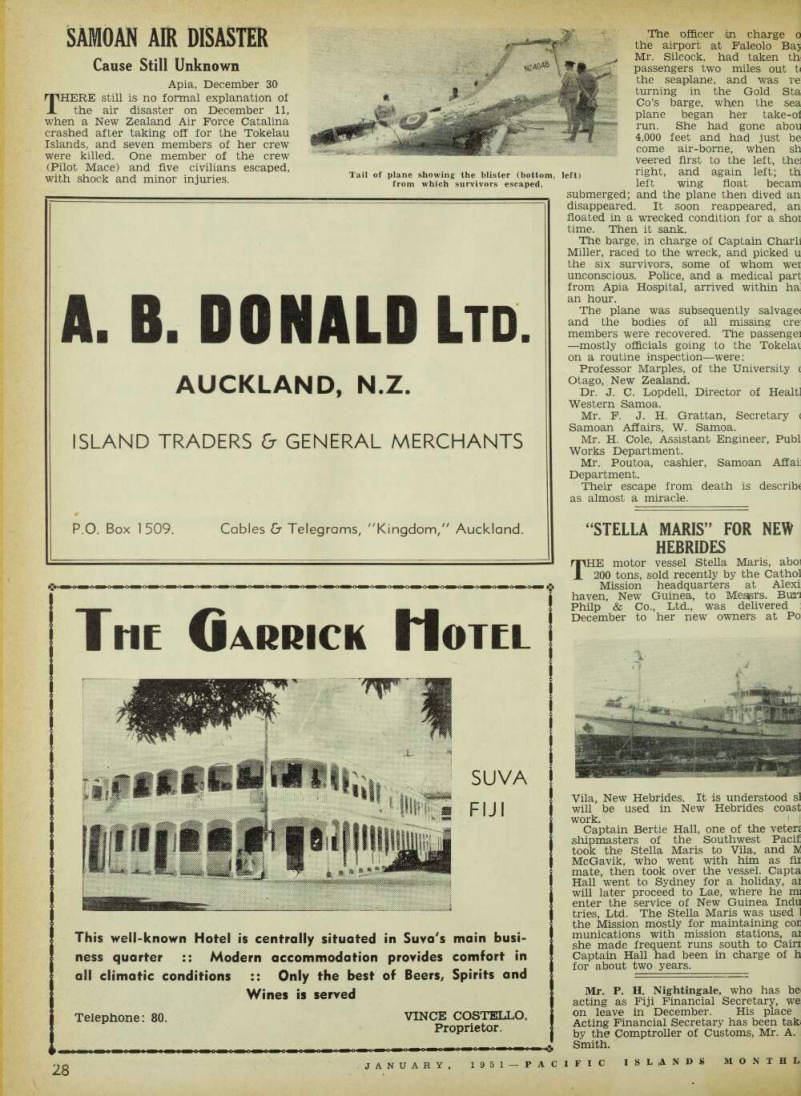
Cause Still Unknown
Apia, December 30 THERE still is no formal explanation of the air disaster on December 11, when a New Zealand Air Force Catalina crashed after taking off for the Tokelau Islands, and seven members of her crew were killed. One member of the crew (Pilot Mace) and five civilians escaped, with shock and minor injuries.
The officer am charge o the airport at Faleolo Baj Mr. Silcock, had taken th( passengers two miles out t< the seaplane, and was re turning in the Gold Sta Go’s barge, when the sea plane began her take-oi run. She had gone abou 4,000 feet and had just be come air-borne, when sh veered first to the left, thei right, and again left; th left wing float becam
submerged; and the plane then dived an disappeared. It soon reappeared, an floated in a wrecked condition for a shoi time. Then it sank.
The barge, in charge of Captain Charli Miller, raced to the wreck, and picked u the six survivors, some of whom wer unconscious. Police, and a medical part from Apia Hospital, arrived within ha] an hour.
The plane was subsequently salvage( and the bodies of all missing ere' members were recovered. The passengei —mostly officials going to the Tokelai on a routine inspection—were: Professor Marples, of the University c Otago, New Zealand.
Dr. J, C. Lopdell, Director of Healt] Western Samoa.
Mr. F. J. H. Grattan, Secretary ( Samoan Affairs, W. Samoa.
Mr. H. Cole, Assistant Engineer, Publ Works Department.
Mr, Poutoa, cashier, Samoan Afifai]
Department.
Their escape from death is describt as almost a miracle.
Tail of plane showing the blister (bottom, left) from which survivors escaped.
“Stella Maris” For New
Hebrides
THE motor vessel Stella Maris, aboi 200 tons, sold recently by the Cathol Mission headquarters at Alexi haven, New Guinea, to Messrs. Bun Philp & Co., Ltd., was delivered : December to her new owners at Po
Vila, New Hebrides. It is understood si will be used in New Hebrides coast work.
Captain Bertie Hall, one of the veten shipmasters of the Southwest Pacif took the Stella Maris to Vila, and M McGavik, who went with him as fir mate, then took over the vessel. Capta Hall went to Sydney for a holiday, ar will later proceed to Lae, where he mi enter the service of New Guinea Indu tries, Ltd. The Stella Maris was used 1 the Mission mostly for maintaining cor munications with mission stations, ai she made frequent runs south to Cain Captain Hall had been in charge of h for about two years.
Mr. P. H. Nightingale, who has bei acting as Fiji Financial Secretary, we on leave in December. His place Acting Financial Secretary has been tak by the Comptroller of Customs, Mr. A.
Smith.
Advertisements & other items, p. 30 (2 items)
28
JANUARY, 1951 PACIFIC ISLANDS MONTHL
A. B. Donald Ltd.
AUCKLAND, N.Z.
ISLAND TRADERS & GENERAL MERCHANTS
P.O. Box 1509. Cables & Telegrams, "Kingdom," Auckland.
The Garrick Hotel
i Jf
bßi
» ill- . l lilitm m
SUVA
FIJI
This well-known Hotel is centrally situated in Suva's main business quarter :: Modern accommodation provides comfort in all climatic conditions :: Only the best of Beers, Spirits and Wines is served Telephone: 80. VINCE COSTELLO, Proprietor.
Phosphate Was His Business
Death of Mr. Fred Christian
MR. Fred Christian who died at Christ mas Island (Indian Ocean), at the end of the year, was one of the best known staff, members of the British Phosphate Commission on Ocean Island and Nauru and had probably done more to keep the farmers of Australia and New Zealand supplied with superphosphate than any man living.
He was 60 when he died, and had given his entire adult life to phosphate. At the outbreak of World War I he was assistant-engineer of the Pacific Phos phate Co. on Ocean Island. He joined the 7th Field Company, AIF and won the MC and bar. When that war was over he returned to his phosphate and "became part of the BPC when it took over the working of Ocean Island and Nauru.
In 1930 he erected the giant storage bin and cantilever at Nauru, whereby a ship could load 10,000 tons of phosphatic rock in one day. A German raider did its best to wreck the cantilever in December, 1940, but burning oil from huge oil tanks which flowed around the 12,000ton bin melting its columns and causing it to topple, did more damage than direct hits. In 1942 Nauru was occupied by the Japs who dismantled much of the equip ment on the Island for building defences.
During the Pacific war years Christian was organising alternative supplies for Australia—mostly from Makatea and the Indian Ocean. At the same time, supplies of equipment for blitzed Nauru were built up in Australia and as soon as the Japs surrendered, Christian and his men moved in to rebuild the installations there.
Since the Australian and New Zealand governments purchased Christmas Island Indian Ocean phosphate island a couple of years ago, he has been organis ing that end of the operations. He was on his way back there from a labour recruit ing flight to Singapore when he had a
cebrebral haemorrhage.
About 130 school children left Svdnev by Qantas and BCPA planes last month to spend Christmas at their homes in Calcutta, Singapore, Hong Kong, Borneo and New Guinea.
Death Of Mrs. T. P. Nicholson


MRS. T. P. Nicholson, an old and res pected resident of Suva, Fiji, died on December 4, aged 86. She went to Fiji about 60 years ago to teach in the former Suva Public School. She married Mr. T. P. Nicholson, the well-known Suva boatbuilder and designer, who died two years ago.
She is survived by two sons and three daughters. Mrs. Nicholson was the sister of Sir Alport Barker, Mayor of Suva.
TEAL flying-boat passengers who arrived in Suva at end of November, included (top, left to right): Miss Susan Holmes who is a trained dietician and has gone to Suva under the South Pacific Health Scheme. She will be stationed in Fiji for two years. Mr. Hale Veti, of Nukualofa, Tonga, passing through Suva on his return to Nukualofa from a business trip to Auckland. Mr. R.
V. Thomas of the staff at Suva Motors, who is shown here greeting the elder of his two small daughters. He has been spending a vacation in New Zealand with his parents at Waiheke.
LOWER: Mr. A. E. Beddows, returned from a long vacation in the United Kingdom. Mrs Beddows and their small son have remained at Auckland and will return to Suva after the hot season.
Mr. and Mrs. Astley of Waiuku, New Zealand. Mr. Astley went to Suva to join the staff of the Bank of New Zealand. They are shown here being greeted by Mr. Barford, the Manager of the Bank. Master Robert Lester, who is a student at the Boys’ High School, New Plymouth, returned to Suva to send the Christmas vacation with his parents.
Papeete Wedding
A photograph taken after the wedding in Papeete, Tahiti, of Mr. Robert Warren Brown, son of Mr. and Mrs. Charles Brown, Jnr., of Raiatea, to Miss Polly Bambridge, daughter of Mr. and Mrs. Thomas Bambridge of Papeete. (See November, PIM).
Mr. and Mrs. J. F. Naylor were host and hostess to a party held in the CDA Rooms, Brisbane recently in honour of the engagement of their daughter, Miss Pat Naylor to Mr. Ken. Cahill, only son of Mr. and Mrs. W. R. Cahill, Wagol Plantation, Madang (NG). Amongst the numerous guests present was Mr. Reg.
Bertick, who is attached to the Administration, Madang.
Advertisements & other items, pp. 31-34 (2 items)
29
•ACIFIC ISLANDS MONTHLY- J A N U A R Y . 1951
Withstands test and time!
TAHITI
To Shipmasters and Visitors
When calling at Tahiti, and seeking SHIPS SUPPLIES and FRESH
PROVISIONS, see—
OSCAR G. NORDMAN
Su ?i Di 7 fo f Messageries Maritimes, Union S.S. Co. of N.Z. Ltd.
Matson-Oceanic Line, United States Line, General S.S. Corp., Etc.
We supply General Service Act as Shipping Agents Address all inquiries to the Tourist Bureau.
OSCAR G. NORDMAN
Ship Chandler
PAPEETE. TAHITI
Wire before your arrival to
“OCEANIC, PAPEETE’—Our
registered cable address.
Withstands test and time!
A m
Prepared
HOUSE PAINTS, ROOF PAINTS, LACQUERS,
ENAMELS AND VARNISHES ! These fine
renowned Spartan Paint Products protect all surfaces against deterioration and weathering ! Their special toughness and complete surface coverage enables weatherboards, iron, steel and stone to stand protected for years ! Only SPARTAN gives that completely satisfactory paint finish— use it wherever there's a surface to paint.
Ask your local store for Spartan prepared Paints, Enamels, Lacquers, etc. // your store cannot supply contact direct :
SPARTAN PAINTS PTY. LIMITED
102-104 King St., Melbourne, Victoria, Australia.
555 X Vi Aladdin lights the way lo better I'm Good lighting and convenient cooking contribute much to comfort< living, and Aladdin lamps and cooking appliances have been famous more than a century. Burning ordinary lighting kerosene, Aladdin prodi provide the comfort and convenience of gas or electricity. They unequalled in efficiency and ease of operation.
The world’s most wonderful lamp”
Aladdin light is the closest of all to natural daylight, and these non-pressure lamps give a steady white light of 75 candle-power. There is no smoke or fumes, no pumping. They light at the touch of a match! Burning 94% air and only 6% kerosene, these modern lamps are extremely economical in use, and safe and easy to use. i
MODEL
1680
MODEL
1620
. MODEL
I 1630 i w-
MODEL
1671
WALL
BRACKET
STORMPROOF LANTERN
The Aladdin Pressure Kerosene Stormproof Lantern gives 300 candle-power of brilliant light—in any kind of weather. Ruggedly built, it will stand up to many years of hard use.
TWO-BURNER PORTABLE STOVE
Compact, efficient pressure-kerosene stove has adjustable self-pricking burners. Available with metal carrying case for outdoor cooking.
ELEVATED RANGE
Modern, porcelain-finished pressurekerosene range has all the advantages of gas or electric stoves. Five selfpricking burners are adjustable to any heat, and insulated cooks perfectly. Simple and economical to operate.
ENGLISH 81-ALADDIN
Sturdy all-weather pressure-lar made by the English associate-h of Aladdin. Gives a bright, st« 200 candle-power light. Sturdily n for outdoor use. m i
HEATER-COOKER
Cooks and heats! Pressure-kerc one-burner cooker can be convt into an efficient radiator. Hea adjustable, operation simple.
5-BURNER RANGE
Compact, modern range has adjustable, self-pricking burners is attractively finished in porce Heat is adjustable from "simi to "boil” and insulated oven < perfectly. Pressure-kerosene open is simple and economical.
Obtainable through your Australian Buying House or Local Storekeeper.
Manufacturers: Alladin Industries Pty. Ltd.
KK W
DammLa ca
mjst.
c- =?
SPECIALISING
PACIFIC ISLAND INSURANCES
FIRE—MOTOR VEHICLE
MARINE—HULLS AND CARGO
EMPLOYER’S LIABILITY
BONDS—in accordance with
ADMINISTRATION ORDINANCES.
COPRA INSURED FROM DRIER
TO BUYER.
AND ALL OTHER CLASSES ARRANGED
AT LOWEST CURRENT RATES.
Established Agencies throughout the Territory of Papua anu New Guinea.
Managing Agents: New Guinea Company, Limited.
Island Representative: G. D. A. Kent, Rabaul Branch.
Southern Pacific Insurance
CO., LTD.
HEAD OFFICE: 60 HUNTER STREET
SYDNEY.
FLIT MEANS DEATH TO
MOSQjMWES
Kills ,r '»» Moth* -•oiquuoe* ~<trx)ach** »ilv»rfi»h Bugs Ant* U f,i ' m.M FLIT is again available everywhere to help you wage war against insect pests.
FLIT contains D.D.T., in addition to Pyrethrum and Thanite, making it the most effective insecticide available.
VACUUM OIL COMPANY PTY. LTD.
ThFmOST EFFECTIVE INSECTICIDE YOU CAN BUY
" KATHLEEN "
PACIFIC ISLANDS SHOPPING
SERVICE.
All personal requisites, frocks, lingerie, haberdashery, hats, cosmetics, household requirements, etc., can be purchased in Australia, on your behalf, by “Kathleen,” who has had wide tropical experience.
Write, explaining your needs, to; “KATHLEEN,” c/o 12a Hawkesbury Road, Springwood, N.S.W.
m\m<
(TOP)
%\ T~m // iM m f
MARJARINE
Packaged like this, DELANA TABLE MARGARINE, a Product of Fiji, is now available to
ALL PACIFIC ISLANDS
Wherever and Whenever Suitable Transport Can Be Found.
A SUBSTITUTE
FOR
BUTTER
In 5 lb. Pats
In
Shipping Outers
of 2 7 lb.
Fresh, wholesome and nutritious, this is a pure Vitamised Vegetable Product made in accordance with the Pure Food Laws of the Colony of Fiji. It contains no animal fat.
You'll enjoy eating DELANA . . .
You'll appreciate its ECONOMY Export Prices and Further Information from
ISLAND INDUSTRIES LIMITED
P.O. Box 299, SUVA, FIJI.
Telegraphic Address: “DELANA,” SUVA. •For Local Reasons, the Product is Labelled “Marjarine” In Fiji, and “Margarine” Elsewhere.
Airport (Official)
Nadi Will Be Fiji’s International Airport (Official)
THE Governments of UK, Australia and New Zealand have accepted the recommendation of the South Pacific Air Transport Council, made last year, that Nadi be Fiji’s international airport. Previously it was intended to build a new airport at Suva Point and resume land for that purpose. However, the cost of building the new airport— although it would be close to Fiji's capital instead of about 150 miles away at Nadi— was so great that the three countries concerned have reconsidered their original idea.
Airfields capable of taking the largest aircraft were constructed in Fiji during the war at Nadi, in the dry zone, and at
Nausori about 17 miles from Suva along side the Rewa river, and in the wet zone.
At first, it was assumed that either of these airfields would be brought up to international civil aviation standard and Fiji residents developed very conflicting ideas on the subject, depending, mostly, upon whether they lived on the Suva side of Viti Levu or on the Lautoka side.
About three years ago it was decided however, by the three overseas govern ments who would have to pay for it, that a brand new aerodrome at Suva Point would suit every one concerned, and the Nadi-Nausori controversy died a natural death. Last year, the cost of aerodrome construction having risen to several times that of original estimates, the UK- Australasian governments seemed to develop cold feet and it was suggested that they might then consider leaving the international airport at Nadi as re commended by the SPAT Council. This they have now agreed to do.
The cost of providing a third runway at Nadi is being investigated and a start has been made on plans for the necessary airport offices and staff quarters. The area within a three mile radius of Nadi has been declared a town planning area.
The three operating air transport com panies British Commonwealth Pacific Airlines, Pan American Airways and Canadian Pacific Airlines have always used Nadi. They never have been particularly interested in the Nadi- Nausori-Suva controversy. To them Nadi is a refuelling stop on their Australia (or New Zealand)-North American flights. If the airport had been near Suva it may have made some contribution to tourism in Fiji, but not to any great extent.
Questions in UK Parliament
AT the end of November the Secretary of State for the Colonies was asked in the House of Commons whether he was aware of the poor accommodation provided for airline passengers at Nadi airport. The reply was that New Zealand administered the airport on behalf of member governments of the South Pacific Air Transport Council. Buildings were ex-army constructions and “not ideal.”
However, providing accommodation was normally , the responsibility of the airline operators and it has been recommended that they now try to make their own arrangements whereupon the present buildings will be withdrawn from service. (Neither BCPA nor PAA make an over night stop at Nadi. But the Makambo Rest House, as the Nadi aerodrome accommodation unit is called, is used by CPA and the passengers of the New Zea land National Airways Corporation. The whole question of Fiji’s international air port has been so long unsettled every thing connected with it has assumed a permanent-temporary quality. Now that Nadi has been officially chosen we can hope to see some improvements along orthodox lines.
Captain Leslie Davis of Mandated Air lines, New Guinea, was married in Sydney, in early December, to Miss Joan Bickle.
Advertisements & other items, p. 34 (1 item)
The Days of 1951
N attractive 1951 calendar showing "An Australian Eleven” —an aborigine surrounded by native birds and animals in their full natural colours—is available to "PIM” readers free of charge from A. H. Crundall, Ph.C., M.P.S.A., Box 58, Prahran, Victoria. The illustration is that used, in black and white, in Mr. Crundall’s advertisement in December "PIM.” As the offer is limited to 100 copies for the Islands, an early request is advisable. Mr. Crundall is the discoverer and marketer of "Aspaxadrene.” which is used with success against asthma, ’flu, etc., by many South Seas residents.***
The Cook Islands

Flu’ Epidemic In
33 Deaths Reported
Prom Our Own Correspondent
Rarotonga, Dec. 29.
THE influenza epidemic which affected Fiji and many of the Islands in the Pacific in November has been particularly serious in the Cooks. To date over 3,500 cases have been reported, this figure representing approximately 25% of the total population of the group.
Throughout December restrictions were placed on all public gatherings, including church services, cinemas, dances, etc., but these will be lifted in the New Year, there being indications that the infection has abated.
Deaths from pneumonic complications have been 33 in all. There would have been more deaths if it had not been for prompt recognition of the symptoms and good education of the native population.
Rarotonga, the main island of the group, was most seriously affected, and the Festive season lacked its customary verve this year.
Filaria
Gala To Aid Fight Against
A SUCCESSFUL gala evening enter tainment was given in Papeete, Tahiti, on December 8, by the Anti- Filaria Association, to raise funds to aid the fight against this disease.
The Association was formed in May, 1949. In 1950 it guaranteed 400,000 francs towards financing the Medical Research
Institute to combat elephantiasis and associated complaints. A few week* hi fore the end of the year, however, it had supplied only a little over half of this amount. Money raised by the gala went towards closing this gap. s went Hawaiian and Tahitian dancing, orches tral numbers songs by groups? soloists and choirs made up an entertaining nro gramme. 6 p u
Officials of the Association are Mr.
William Robinson, president; Mi’. Ber trand Jaunez, vice-president; Maitre Hoppenstedt, secretary and treasurer.
In December, Sandy Creek Sluicing Ltd., New Guinea, recovered approxi mately 120 ozs. of gold from 4,760 cubic yards of material treated.
Advertisements & other items, pp. 35-36 (2 items)
33
PACIFIC ISLANDS MONTHLy_ J A N „ A R Y , 195 1
Bovril
Beautiful New Full-Colour
RECIPE BOOK
FREE!
hi l ?«,iroH npSOn R ® cipe . Book featuring 48 pages of nearly one is usSallv sold re hi?f eS f 1S wide . ly kn °wn throughout Australia. It a to genuine residents of the Pacific Islands Simnson Rrnvf Pfv l Vi ***l? I r J?’ Re< l uests should be directed to and l ?? nSw Box 905M > Brisbane » Queensland, hefdSEMaSdsttoffl?.” 0 ®" y#Ur ' eMer ShoUld be Offered by the Manufacturers of
SIMPSON’S
Self-Raising FLOUR
BOVRIL
makes good cooks
better
Bovril gives that extra flavour to all soups, pies and savouries. And nourishment, too! —for Bovril is the concentrated goodness of beef. Bovril is also a tasty sandwich spread—and a cup of hot Bovril daily makes you feel fine !
Agents: BURNS. PHILP GUINEA) LTD
ETAELISSEMENTS DONALD TAHITI
HEAD OFFICE—QUAI DU COMMERCE—PAPEETE
TELEGRAPHIC ADDRESS—“DONALD, PAPEETE”
General Merchant’s (Wholesale & Retail) & Shipowners
Importers & Exporters—Branches Throughout Marquesas Islands
Lloyd’s Agents
ASSOCIATE
HOUSES:
A. B. DONALD, LTD.
AUCKLAND. NEW ZEALAND.
A. B. DONALD, LTD.
RAROTONGA, COOK ISLANDS.
DOMINION FRUIT CO.,
SUVA, FIJI ISLANDS.
Agents and Distributors for:
FRANCE:
HENNESSY COGNACS
MARIE BRIZARD & ROGER
LIQUEURS
CHARLES HEIDSIECK
CHAMPAGNES
PERRIER WATER
GRUBER BEER
U.S.A.:
GENERAL STEAMSHIP CORP.
RADIO CORP. OF AMERICA
BROWN & WILLIAMSON, LTD.
CIGARETTES: LUCKY STRIKE,
WINGS, OLD GOLD
CHAMPION SPARK PLUG CO.
RAINIER BEER
ENGLAND;
RECKITT & COLMAN
(OVERSEAS), LTD.
PHILLIPS BICYCLES
THE BANK LINE LTD.
NEW ZEALAND:
VACUUM OIL CO. PTY., LTD.
PETROLEUM PRODUCTS
SWEDEN;
HJORTH & CO.
PRIMUS STOVES
Sydney Agents :
London Agents : San Francisco Agents : Agents in France : BURNS, PHILP & CO., LTD. BURNS, PHILP & CO., LTD.
BURNS, PHILP CO. OF HARTH & CIE, PARIS.
SAN FRANCISCO. A. BICKART. MARSEILLES.
NEW TI
• MADE AT HENDON, ENGLAND
BY THE MANUFACTURERS OF
THE WORLD-FAMOUS TILLEY
LAMPS AND RADIATORS
• WEIGHT 5 LBS. INCLUDING OIL
• NO FLEXES-NO WIRES
• SIMPLE HEAT CONTROL
• SPARKLING MODERN FINISH
IN CHROMIUM & CREAM
• EVEN HEAT DISTRIBUTION
• EXTRA LARGE IRONING PLATE
WITH BEVELLED EDGE
• NOT AFFECTED BY DRAUGHT
• THUMB-RESTS FOR RIGHT OR
LEFT HAND WORKING
• VITREOUS ENAMELLED BODY
LLEY
KEROSENE DOMESTIC IRON
MODEL DN2SO
G
liiiii
BRITISH PAT. No. 524714
AUSTRALIAN PAT. No. 114305
Send for complete MELBOURNE: T. H. Bentley, Pty. Ltd., 123-125 William Street. Melbourne. C.l. details to:— TASMANIA: Mr. H. V. Sellers, 108 a Charles Street, Launceston.
FIJI: Mr. K. Witherington, 2 Burns Philp Buildings, Suva.
Madang Newsletter
From Our Own Correspondent
( Madang, Dec. 29.
CHRISTMAS week in Madang proved J a bright affair with plenty of enter tainment offering and a community spirit prevailing.
On December 23, the Social Club had a Christmas Ball with the usual trappings and merriment of the festive season.
Attractive decorations added to the gaiety for the large crowd that attended To entertain the 100-odd children in the district, a party was arranged at the Social Club on December 22. Mrs R.
Chugg acted as hostess while Mr. Allan Clarke was organiser. After afternoon tea, provided by the ladies, Father Christ mas arrived. Each child was presented with a huge stocking and other presents.
About 200 adults were present to see the children.
The Asiatic School, under Mrs. Radke’s skilled guidance presented a religious play; at the European School, plays were performed, prizes presented and a special picture programme shown. For parents and helpers, the Kindergarten children gave an Observation Hour with the key note “The Spirit of Christmas.” The Lutheran Mission produced a fine open air pageant at Baitabag on the night of December 21; and at Tusbab, the Native Education Department Centre, the natives enjoyed a break-up and prize giving day.
DECEMBER was an unlucky month for the inspector of the Ex-Pro. Board, Mr. Jock Esson. In the open sea, off Finschhafen, his ship, the Mangana, was adrift for over 24 hours due to engine trouble. Planes were sent out and later two boats from Lae and Finschhafen went to his aid. After being towed to Fins chaffen and repaired, Mangana set out °n a second December trip, was blown off its course in rough seas between Wewak and Madang. For over 24 hours, the boat was missing and planes again were sent out to search. But the men aboard arrived back in Madang in time to see their sons receive their presents from Santa at the Club party on the 22nd.
IN accordance with traditional custom, \*hen announcing betrothal, twb , well-known Chinese families of Madang sent cakes to their friends on Christmas Eve. The engaged couple, Miss Margaret Wong and Mr. Louis Chegg, will marry some time in June.
SIR ANGUS GILLAN, of the British Council, was in Madang, accom panied by Mr. Charles Julius, of the Education Department, during the month. A lecture on the nature of the British Council had to be abandoned due to delay in arrival of Sir Angus through bad weather.
MISS ELOISE MILLAR has left Baita bag to teach at the Lutheran Mission School at Wau. With her will go the children of missionaries in the District. Miss Joyce Wedd was trans ferred from the European School to Rabaul. Mrs. Parle will take her place.
Mr. Alec Ashton, manager of the Com monwealth Bank is on leave. He is missed not only in the Bank but in com munal entertainment and organisation in which he was so active.
MOSQUITOES have been on the war path. Many people consider the area is so bad now that Govern ment officials and private employees of firms should be supplied with special labour or an allowance to cope with the malaria precautions needed in Madang.
M R \i A ? K panting, of r.t.c., leaves Madang for Queensland late in January One of the most retiring people m the township he, none-the-less has been responsible for many kind deeds and voluntary assistance in sunnlv mg music and mechanical aid in com munity efforts since he arrived in Madang, late in 1946.
WITH the arrival of the contracting team to carry out the wharf con struction, the waterfront begins to look like a camp No signs of any actual work have yet been noticed but rumour
has it that the small ships wharf is to be built first.
MOTOR CYCLING has become a favourite means of transport around Madang and quite a number of machines can be heard roaring along the roads, while the modern sedan cars are no longer a novelty. Pehaps Madang is passing out of the jeep era with the New Year.
NEWLY arrived families to take up residence in Madang include Mr and Mrs. T. E. Huxley and family;’
Mrs. McGilvery (wife of Madang’s Directorate of Shipping manager) and family; Mr. Max Denehey and his wife, returned to Madang from leave; Mr. and Mrs. Robertson and young child of Burns Philp; and Mr. and Mrs. Peter Cook from Samarai for the R.T.C.
Sir Henry Scott and Dr. C. J. Austin returned to Suva from New Zealand in December where they attended a meeting of the Lepers’ Trust Board at Christ church. At the meeting Dr. Austin showed films of the Fiji Leprosy Hospital, Makogai, and described the work being done there with the new drug.
Advertisements & other items, pp. 37-38 (1 item)
I Pan A
TAKE THIS
MOST IMPORTANT STEP
TO KEEP TEETH SPARKLING WHITE
use
I PAN A
TOOTH PASTE
Doctors and dentists all agree that gum troubles are the cause of most tooth extractions. That's one important reason why you should always use IPANA— the tooth paste that keeps both teeth and gums clean and healthy.
IPANA gives lasting radiance to your smile because it protects as well as cleans your teeth to sparkling whiteness.
Sold Everywhere S' * <o .V * o o f of W
A DD SPAR^ lE
T ° Your s mils
A PRODUCT OF
BRISTOL-MYERS
8M32-49
A. GREGORY PTY. LTD.
IMPORTERS, EXPORTERS AND
MANUFACTURERS
Leather Saddlery and Paint Merchants ALL CLASSES OF LEATHER SUPPLIED FROM STOCK Apply direct to: A. GREGORY PTY. LTD., 107 York Si, Sydney
Caledonia
Indonesians In New
Another 1,000 To Be Introduced
IT was pointed out in the PIM, months ago, that a community of some thou sands of Indonesians has been estab lished by the French in New Caledonia, only 700 miles east of Queensland. Yet Australia—which has displayed so much concern over the possible appearance of Indonesians in Dutch New Guinea —has
taken no notice whatever of the new Asiatic settlement in the South-west Pacific.
Meanwhile, New Caledonia has arranged for the introduction of another 1,000 in dentured Javanese labourers. Senator Lafleur and the New Hebrides planter, Monsieur Caillard, who carried out the negotiations with the Indonesian Gov ernment, passed through Sydney in November, on their way home.
It is presumed that the French authori ties, on this occasion, will be a little more careful in relation to the repatriation pro vision in these labour contracts. They should take a look at the Chinese com munity in Tahiti (see article elsewhere in this issue).
The Centenary of Paulo
From Our Own Correspondent
Niue Is., Dec. 22.
THE London Missionary Society’s vessel, John Williams VI, has just made a special visit to Niue for the celebra tion of the Centenary of Paulo, the Samoan missionary who brought the Gos pel to this Island.
Some 50 visitors from Samoa made the trip, including the Rev. Percy Kightley, the Chairman of the Samoan District Committee, and representatives from all the Western Samoan Districts.
One of the visitors was a grandson of Paulo and he brought to the Niue Church, on behalf of his family, a gift of £5O to honour the memory of his ancestor.
The Samoan LMS Church was repre sented by Tupe, the chairman of the Pono Tele, and by several pastors. The Samoan Church sent a gift of £lOO to the Church at Niue.
Three days were needed to complete the celebrations which took the form of ser vices of commemoration, feasting, dancing and sports.
Advertisements & other items, p. 38 (1 item)
Heinz
\ v i / #• a
Make him happy
with his food!
The clever wife plays on man’s weakness for tasty food. She has a little secret that works wonders with any meal . it’s a bottle of Heinz Sauce.” She uses it in her cooking . . . and she puts a bottle on the table, too. “57 Sauce” adds that tangy, “eager to eat” flavour.
Get Heinz “57 Sauce” to-day . . . watch the smiles to-morrow!
'57 SAUCE
H. J. HEINZ CO. PTY., LTD.,
479 Bourke St., SYDNEY. ’Phone: FA 8181. r9op & 57
h IZa?
m 57
New Buildings For Suva Biscuit Company
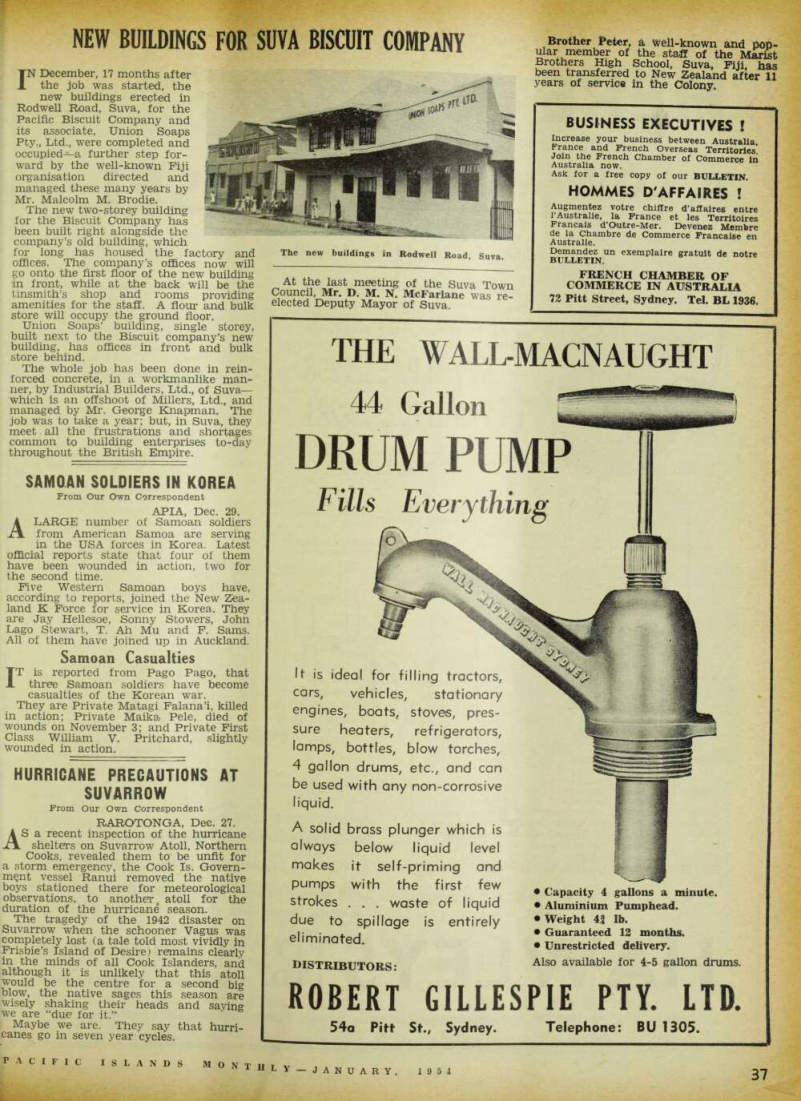
IN December, 17 months after the job was started, the new buildings erected in Rodwell Road, Suva, for the Pacific Biscuit Company and its associate, Union Soaps Pty., Ltd., were completed and occupied—a further step for ward by the well-known Fiji organisation directed and managed these many years by Mr. Malcolm M. Brodie.
The new two-storey building for the Biscuit Company has been built right alongside the company’s old building, which
for long has housed the factory and offices. The company’s offices now will go onto the first floor of the new building in front, while at the back will be the tinsmith’s shop and rooms providing amenities for the staff. A flour and bulk store will occupy the ground floor.
Union Soaps’ building, single storey, built next to the Biscuit company’s new building, has offices in front and bulk store behind.
The whole job has been done in rein forced concrete, in a workmanlike man ner, by Industrial Builders, Ltd., of Suva — which is an offshoot of Millers, Ltd., and managed by Mr. George Knapman. The job was to take a year; but, in Suva, they meet all the frustrations and shortages common to building enterprises to-day throughout the British Empire.
The new buildings in Rodwell Road, Suva.
Samoan Soldiers In Korea
Prom Our Own Correspondent
Apia, Dec. 29.
A LARGE number of Samoan soldiers from American Samoa are serving in the USA forces in Korea. Latest official reports state that four of them have been wounded in action, two for the second time.
Five Western Samoan boys have, according to reports, joined the New Zea land K Force for service in Korea. They are Jay Hellesoe, Sonny Stowers, John Lago Stewart, T. Ah Mu and F. Sams.
All of them have joined up in Auckland.
Samoan Casualties
IT is reported from Pago Pago, that three Samoan soldiers have become casualties of the Korean war.
They are Private Matagi Falana’i, killed in action; Private Maika. Pele, died of wounds on November 3; and Private First Class William V. Pritchard, slightly wounded in action.
Hurricane Precautions At
Suvarrow
From Our Own Correspondent
Rarotonga, Dec. 27.
AS a recent inspection of the hurricane shelters on Suvarrow Atoll, Northern Cooks, revealed them to be unfit for a storm emergency, the Cook Is. Govern ment vessel Ranui removed the native boys stationed there for meteorological observations, to another, atoll for the duration of the hurricane season.
The tragedy of the 1942 disaster on Suvarrow when the schooner Vagus was completely lost (a tale told most vividly in Frisbie’s Island of Desire) remains clearly in the minds of all Cook Islanders, and although it is unlikely that this atoll would be the centre for a second big blow, the native sages this season are wisely shaking their heads and saying we are “due for it.”
Maybe we are. They say that hurri canes go in seven year cycles.
At the last meeting of the Suva Town Council, Mr. D. M. N. McFarlane was re elected Deputy Mayor of Suva
Brother Feter, a well-known and pop ular member of the staff of the Marist Brothers High School, Suva. Fiji, has been transferred to New Zealand after 11 years of service in the Colony.
Advertisements & other items, pp. 39-40 (2 items)
37
pac.f.c islands monthlv_ januaey , 1951
Drum Pump
BUSINESS EXECUTIVES !
Increase your business between Australia Prance and French Overseas Territories’
Join the French Chamber of Commerce In Australia now.
Ask for a free copy of our BULLETIN.
HOMMES D'AFFAIRES !
Augmentez votre chiffre d’affaires entre i’Australie, la Prance et les Territoires Francais d’Outre-Mer. Devenez Membre de la Chambre de Commerce Prancaise en Australle.
Demandez un exemplaire gratult dc notre
BULLETIN.
FRENCH CHAMBER OF
COMMERCE IN AUSTRALIA
72 Pitt Street, Sydney. Tel. 8L1936.
THE WALL-MAGNAUGHT
44 Gallon
DRUM PUMP
Fills Everything
o p % vV It is idea! for filling tractors, cars, vehicles, stationary engines, boats, stoves, pressure heaters, refrigerators, lamps, bottles, blow torches, 4 gallon drums, etc., and can be used with any non-corrosive liquid.
A solid brass plunger which is always below liquid level makes it self-priming and pumps with the first few strokes . . . waste of liquid due to spillage is entirely eliminated.
DISTRIBUTORS:
• Capacity 4 gallons a minute. • Aluminium Pumphead. • Weight 4| lb. • Guaranteed 12 months. • Unrestricted delivery.
Also available for 4-5 gallon drums.
ROBERT GILLESPIE PTY. LTD.
54a Pitt St., Sydney.
Telephone: BU 1305.
HERE . . at last
A LOW WEIGHT Q|ESEL
ideal for MAIN Propulsion and Auxiliary Use. 17 8
DECOMPRESSOR-
VARIABLE S(3)
GOVERNOR
CD CM
OIL FILLER* S-
Dl PSTICK-
6®/a 6 S'
12 V 8 CRS
!5 7 /8"
MADE BY COVENTRY-VICTOR.
The lowest-weight Diesel with the best power-weight ratio for craft up to 22 ft. as main propulsion
engine.
5/7 H.P... £258
7/9 H.P... £2Bl
F.O.R. Brisbane, including packing. 12-volt starter and generator, £25 extra.
FITTED ON EITHER. SIDE
OF GEARBOX AS REQ/D
FUEL FILTER.
Victor Cold Starting, totally enclosed Diesel fitted with “0.K.” epicyclic type
FORWARD AND REVERSE GEAR
BOX with 2 to 1 reduction at rear of box and including: e Variable speed governor with control on engine. 9 Victor gear type water pump fitted and piped up to water circulating system. • Water cooled muffler. • Provision exists for fitting selfstarter and generator. • Order now for immediate delivery, or write for full details.
COLO STARTING
INJECTOR*
A- HOLES FOR 5 /Q" DIA. HEX. HO.
BOLTS
DIRECTION OF ROTATION
VIEWED IN DIRECTION OF ARROW ’a'
NORMAL ROTATION AHEAD »8
CLOCRWISE
12V STARTER* £, DYNAMO
ONIX FITTED IF ORDERED
5 n
WATER PUMP
a l /-; 10
44 X/ l APPROX. OVERALL LENGTH
niFSCL
★ MARINE ENGINE WITH •• O.K. !> (2:1 REDUCTION/REVERSE) GEARBOX IN UNIT CONSTRUCTION Write to us for all advice and information on your Marine Power requirements. Send for full information on Lighting Plants, Pump Sets, etc<
HAWLEYS
PTY. 52 BOWEN ST. BRISBANE
LTD. Telegraphic: “COVIC” Brisbane
Diesel Engines (Marine and Stationary)’, Lighting Plants; Pumps; Reversing Piopellers, etc.
Passion Fruit
Suggested As Industry For New Guinea Highlands
A NUMBER of people on the higher country in New Guinea are experi menting with passion fruit, and are anxious to know if there is a market any where for the pulp.
There is a market—Cottees Passiona Ltd., Marion Street, Leichhardt, Sydney, are seeking large supplies. The difficulty is to get it from the grower to the market. It has to be carried under re frigeration.
Before World War 11, the growing and export of passion fruit was an important industry on Norfolk Island, and Cottees were closely associated with it. The vines grew prolifically on Norfolk; the fruit yielded abundant pulp, of good flavour, and the containers in which it was col lected were frozen and put into cold store on Norfolk, and carried from Norfolk to Cottees factories in Sydney as refriger ated cargo on the ships.
When the war came, the New Zealand Air Force seized the freezer on Norfolk Island, and the industry just passed out.
No attempt was made to revive it after the war. The passion fruit vines had deteriorated, and the Islanders did not seem interested in restoring the planta tions. For the past five years, Messrs.
Cottee have been looking elsewhere for supplies, and the firm seems to be eager to see an industry developed in New Guinea.
As far as the NG Highlands are con cerned, transport costs are the main prob lem. Would it be possible to gather and freeze the pulp in the Highlands, and fly it out to refrigerated shipping space,
for transport to Sydney, and make it pav?
If the pulp could be canned close to the source of supply, and shipped around the world, the possibilities of the indus try would be widened. Unfortunately although research and experiments have been going on for years—especially in South Africa—no way of canning passion fruit, without loss of flavour and quality has yet been found. The South Africans believe they are close to success, however
N. Guinea Highlands
Passion Fruit Culture On
Pt. Moresby, Dec. 8
IT is reported from, the Highlands that Captain Bobby Gibbes (of Gibbes Air ways) on his property near Mt Hagen, is employing quite a large line of natives in planting out and trellising his passion fruit vines. Captain Gibbes’ plan envisages a passion fruit area of about 500 acres. He emphasises, how ever, that so far the venture is entirely experimental.
A Sydney firm, acting on behalf of an American Company, is making plans to import a quick-freeze apparatus; and there is a possibility that this unit can be used to “snap-freeze” the passion fruit pulp in a place like the New Guinea High lands, whence it could be flown frozen to Madang, for shipment to Australia and possibly to the United States as re frigerated cargo.
Mrs. Paul Mason, of Inus Plantation, Bougainville, New Guinea, gave birth to a son in Sydney, on January 5; but, al though both mother and child seemed in perfect health, the child was still-born.
Mrs. Mason plans to return home in February.
Rabaul Native Hospital
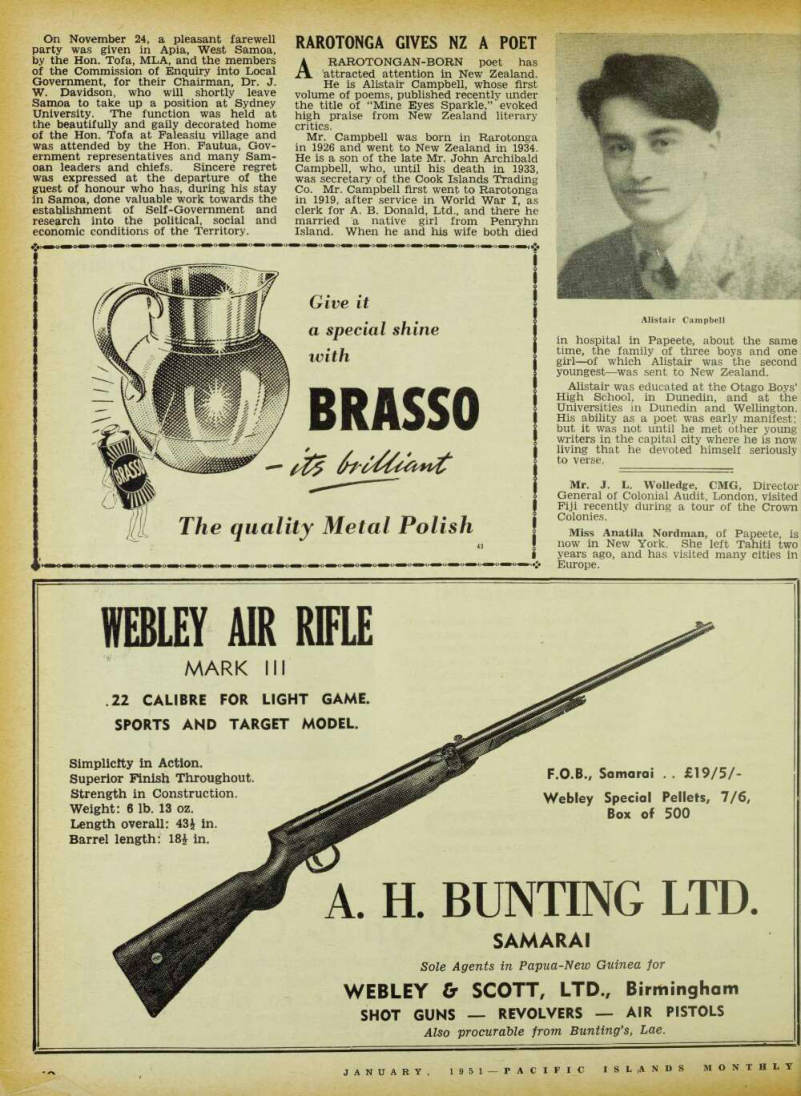
HAVING completed two years’ service as a Medical Assistant in the Rabaul Native Hospital, Mrs. Norrie Cahill; formerly of Port Moresby and Samarai, went on leave in November. Before she left, she was given the unusual distinc tion of a “sing-sing” one evening by some hundreds of native women patients who, to show their appreciation of her services on many occasions, heaped presents upon her, to an embarrassing degree. mv It is claimed that the Rabaul instituH tion is the only native hospital in the two Territories to which the native women go voluntarily for their confinements.
On November 24, a pleasant farewell party was given in Apia, West Samoa, by the Hon. Tofa, ML A, and the members of the Commission of Enquiry into Local Government, for their Chairman, Dr. J, W. Davidson, who will shortly leave Samoa to take up a position at Sydney University. The function was held at the beautifully and gaily decorated home of the Hon. Tofa at Faleasiu village and was attended by the Hon. Fautua, Gov ernment representatives and many Sam oan leaders and chiefs. Sincere regret was expressed at the departure of the guest of honour who has, during his stay in Samoa, done valuable work towards the establishment of Self-Government and research into the political, social and economic conditions of the Territory.
Advertisements & other items, pp. 41-42 (2 items)
39
PACIFIC ISLANDS MONTHLY_ J A N 0 A R Y , 1951
£. J. Gougri & Co. -
Weary, Dreary
People '
Put Some GO Into Your Life j Too many men, women and girls suffer aching? backs, headaches, and feel dreadfully tiredtired, always tired. The cause? Very often,; anaemia or bloodlessness.
You see the symptoms in dull eyes, pallid cheeks and lips, breathlessness, vague aches ; exhaustion after the slightest exertion. Young children, especially girls, suffer frequently.
If you haven’t blood normal in red corpuscles, you are not receiving sufficient energy-giving oxygen which Is dispersed by the blood throughout your body every second of the day and night. Your nerves, organs and tissues are not properly nourished and you remain weary and dreary.
Get the GO which rich red blood can give you. Take the famous Dr. Williams’ Pink Pills for a few weeks. Dr. Williams’ Pink Pills are specially compounded to provide you with $ normal rich blood supply. Always at your chemist or store.
V r Cooper Adjustable Glass Louvres are manufactured by F. W. GISSING PTY., LTD., 197 Wilson Street, Newtown, Sydney, Australia. Always insist on GENUINE
COOPER LOUVRES—
they are clearly branded.
Keep Hot Sun OUT . . .
Let Cool Breezes IN!
Cooper Adjustable Glass Louvres are the ideal way of securing maximum ventilation with minimum interference from glare. Fitted with non-actinic glass, which absorbs the sun’s heat, they are ideal for nurseries and verandahs . . . and, amazing though it may seem, are actually cheaper to install than ordinary windows Cheaper to Instal than ANY other kind of WINDOW
ADJUSTABLE GLASS LOUVBES
Imagine it —units of movable glass louvres (plain or figured) in metal frames, giving unobstructed light and air, yet protection from draughts and rain and all with as simple a motion as flicking on a light switch. The price is so amazingly reasonable and Father can do all the erecting, it’s so easy.
Illustrated: Typical Suburban Home Verandah (Sydney) glassed in with Cooper Louvres.
WRITE FOR PARTICULARS TO PACIFIC ISLANDS REPRESENTATIVE
£. J. GOUGrI & CO. -
SUPPLIERS OF GENERAL MERCHANDISE TO LEADING FIRMS THROUGHOUT THE PACIFIC ISLANDS.
Exporters . . . Importers . . . Manufacturers' Represen t at i v e s 1 BOND STREET, SYDNEY, AUSTRALIA. Box 3615 G.P.O. Tel. BU 2159 Codes: Bentley Bankers: Bank of N.S.W. Bank of Adelaide. Comptoir National d’Escompte de Paris. „ Cable Address: “SEAFOODS,” SYDNEY. and Comp. Phrase; A.8.C., sth and 6th; Peterson, 2nd and 3rd, Banking; Acme.
m rz A Give it a special shine with
BRASSO
m The quality Metal Polish
Rarotonga Gives Nz A Poet
ARAROTONGAN-BORN poet has 'attracted attention in New Zealand.
He is Alistair Campbell, whose first volume of poems, published recently under the title of “Mine Eyes Sparkle,” evoked high praise from New Zealand literary critics.
Mr. Campbell was born in Rarotonga in 1926 and went to New Zealand in 1934.
He is a son of the late Mr. John Archibald Campbell, who, until his death in 1933, was secretary of the Cook Islands Trading Co. Mr. Campbell first went to Rarotonga in 1919, after service in World War I, as clerk for A. B. Donald, Ltd., and there he married a native girl from Penryhn Island. When he and his wife both died
in hospital in Papeete, about the same time, the family of three boys and one girl—of which Alistair was the second youngest—was sent to New Zealand.
Alistair was educated at the Otago Boys’
High School, in Dunedin, and at the Universities in Dunedin and Wellington.
His ability as a poet was early manifest; but it was not until he met other young writers in the capital city where he is now living that he devoted himself seriously to verse.
Mr. J. L. Wolledge, CMG, Director General of Colonial Audit, London, visited Fiji recently during a tour of the Crown Colonies.
Miss Anatila Nordman, of Papeete, is now in New York. She left Tahiti two years ago, and has visited many cities in Europe.
Alistair Campbell
Advertisements & other items, p. 42 (1 item)
Webiey Air Rifle
MARK 111
.22 CALIBRE FOR LIGHT GAME.
SPORTS AND TARGET MODEL.
Simplicity in Action.
Superior Finish Throughout.
Strength in Construction.
Weight: 6 lb. 13 oz.
Length overall: 43£ in.
Barrel length: 18£ in.
F. 0.8., Samaroi . . £l9/5/- Webley Special Pellets, 7/6, Box of 500
A. H. BUNTING LTD.
SAMARAI
Sole Agents in Papua-New Guinea for
WEBLEY & SCOTT, LTD., Birmingham
SHOT GUNS REVOLVERS AIR PISTOLS
Also nmcurahle from Bunting's , Lae.
Cocoa Prices Inclined To Fall
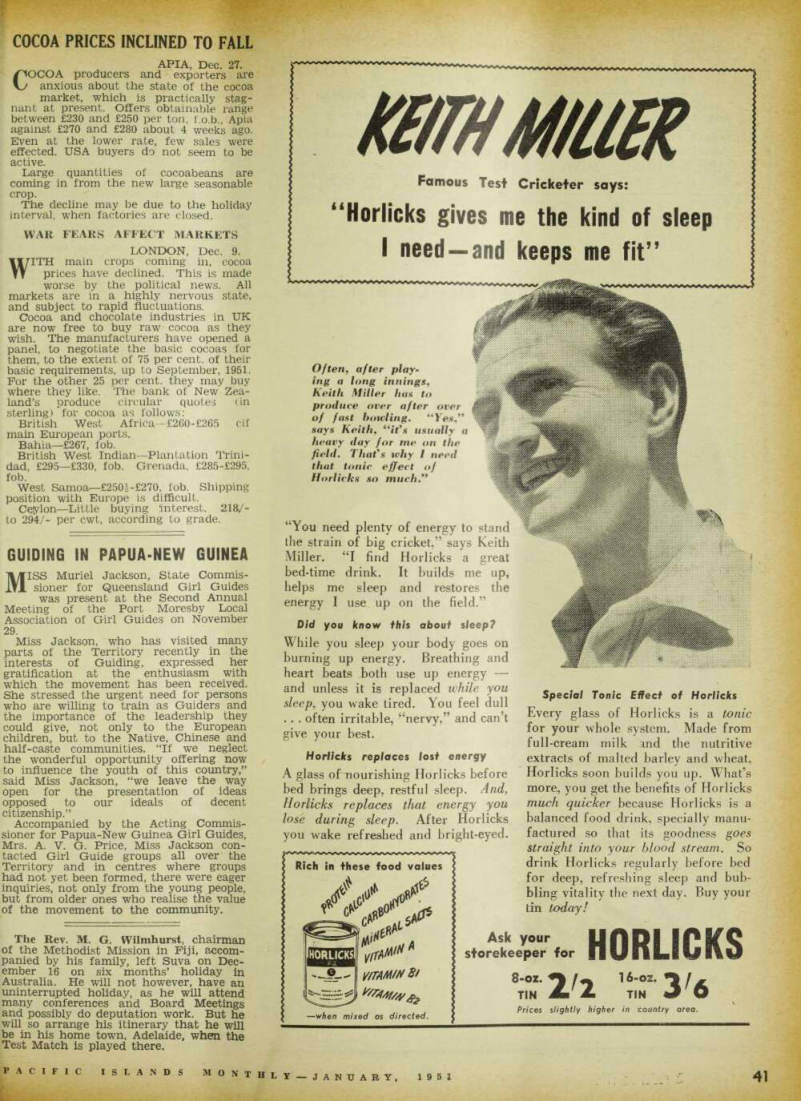
Apia, Dec. 27.
COCOA producers and exporters are anxious about the state of the cocoa market, which is practically stag nant at present. Offers obtainable range between £230 and £250 per ton, 1.0. b,, Apia against £270 and £2BO about 4 weeks ago.
Even at the lower rate, few sales were effected. USA buyers do not seem to be active.
Large quantities of cocoabeans are coming in from the new large seasonable crop.
The decline may be due to the holiday interval, when factories are closed.
War Fears Affect Markets
London. Dec. 9.
WITH main crops coming in, cocoa prices have declined. This is made worse by the political news. All markets are in a highly nervous state, and subject to rapid fluctuations.
Cocoa and chocolate industries in UK are now free to buy raw cocoa as they wish. The manufacturers have opened a panel, to negotiate the basic cocoas for them, to the extent of 75 per cent, of their basic requirements, up to September, 1951.
For the other 25 per cent, they may buy where they like. The bank of New Zea land’s produce circular quotes (in sterling)'for cocoa as follows: British West Africa £260-£265 cif main European ports.
Bahia —£267, fob.
British West Indian—Plantation Trini dad, £295—£330, fob. Grenada, £285-£295, fob.
West Samoa—£2soi-£270, fob. Shipping position with Europe is difficult.
Ceylon—Little buying interest. 218/to 294/- per cwt, according to grade.
Guiding In Papua-New Guinea
MISS Muriel Jackson, State Commis sioner for Queensland Girl Guides was present at the Second Annual Meeting of the Port Moresby Local Association of Girl Guides on November 29 Miss Jackson, who has visited many parts of the Territory recently in the interests of Guiding, expressed her gratification at the enthusiasm with which the movement has been received.
She stressed the urgent need for persons who are willing to train as Guiders and the importance of the leadership they could give, not only to the European children, but to the Native, Chinese and half-caste communities. “If we neglect the wonderful opportunity offering now to influence the youth of this country,” said Miss Jackson, “we leave the way open for the presentation of ideas opposed to our ideals of decent citizenship.”
Accompanied by the Acting Commis sioner for Papua-New Guinea Girl Guides, Mrs. A. V. G. Price, Miss Jackson con tacted Girl Guide groups all over the Territory and in centres where groups had not yet been formed, there were eager inquiries, not only from the young people, but from older ones who realise the value of the movement to the community.
The Rev. M. G. Wilmhurst, chairman of the Methodist Mission in Fiji, accom panied by his family, left Suva on Dec ember 16 on six months’ holiday in Australia. He will not however, have an uninterrupted holiday, as he will attend many conferences and Board Meetings and possibly do deputation work. But he will so arrange his itinerary that he will be in his home town, Adelaide, when the Test Match is played there.
Mr. and Mrs. L. C. Bentley returned to Suva in December after a world air tour.
Mr. Bentley is a partner in the firm of Pearce & Co. and was on a business visit to the United Kingdom and Australia.
Advertisements & other items, pp. 43-44 (1 item)
am mm
i i
Famous Test Cricketer says: Horlicks gives me the kind of sleep
I need—and keeps me fit”
Often , after play ing a long innings , Keith Miller has tit produce over after over of fast howling. “yes,” says Keith , “it’s usually a heavy day for me on the field. That's why I need that tonic effect of Horlicks so much** “You need plenty of energy to stand the strain of big cricket,” says Keith Miller. “I find Horlicks a great bed-time drink. It builds me helps me sleep and restores energy I use up on the field.”
Did you know this about sleep?
While you sleep your body goes burning up energy. Breathing and heart beats both use up energy and unless it is replaced while you sleep , you wake tired. You feel dull .. . often irritable, “nervy,” and can’t give your best.
Horlicks replaces lost energy A glass of nourishing Horlicks before bed brings deep, restful sleep. And, Horlicks replaces that energy you lose during sleep. After Horlicks you wake refreshed and bright-eyed. up the on Rich in these food values /VX V/TAM/ff St —when mixed as directed.
Special Tonic Effect of Horlicks Every glass of Horlicks is a tonic for your whole system. Made from full-cream milk and the nutritive extracts of malted barley and wheat, Horlicks soon builds you up. What’s more, you get the benefits of Horlicks much quicker because Horlicks is a balanced food drink, specially manufactured so that its goodness goes straight into your blood stream. So drink Horlicks regularly before bed for deep, refreshing sleep and bubbling vitality the next day. Buy your tin today!
Ask your
storekeeper for
8-oz.
TIN
HORLICKS
Ux 'try*
Prices slightly higher in country area.
Send us your orders for
DEVELOPING, PRINTING
Enlarging and
COPYING FROM OLD PHOTOS
All Photographic Supplies.
CAINE’S STUDIOS, SUVA
Box 8. (Estb. 1904) ’Phone: 68.
where
HEAT
hits the high spots
The ever-changing conditions of tropical climates demand the use of only the best possible paint for adequate protection of property and equipment.
For nearly two hundred years Berger has lead in the field of paints and finishes and gives you the benefits of vast research and experience in the Berger product.
Berge
OS* "P m
paint
KEEPS ON KEEPING ON
Chinese Power
In Tahiti
Leading French Civilian Is Outspoken
From a Special Representative REFERENCES to the ominous events in Asia, and the danger of the “Yellow Peril” were made in a notable speech, at the opening of the Representative
Assembly on November 3, by the President of the Assembly, M. Jean Millaud.
As is well known, French Oceania has a large and influential Chinese commu nity. It was established many years ago.
Some of the Chinese brought their wives from China, and others married Tahit ians. Although most of these people are local-born, and a great deal of Tahiti’s trade and industry are in their hands, their connections with China remain con stant and active.
Before World War 11, the French Gov ernment of Oceania did not seem to be troubled by the growth in the number and power of the Chinese. But, during and since the war, the influence of Metro politan France in these Pacific colonies has declined, and the sturdier type of French non-official residents have been turning more and more towards American and British associations. This, in turn, has directed attention to the way in which the Chinese have displaced the European traders and artisans.
For these reasons, the remarks of M.
Millaud are more than usually interesting.
M. Millaud declared that the Chinese were taking trade and industry away from Europeans, as well as from the natives.
M. Millaud asked that the naturalisa tion of immigrant Chinese should be stopped forthwith. “You can never make a loyal citizen of Tahiti out of a Chinese national,” declared M. Millaud. “He is here to draw your blood.”
M. Millaud pointed out that, during World Wars I and 11, while Frenchmen and Tahitians enrolled as volunteers to fight abroad in the common cause, not one Chinese joined the forces provided by Tahiti. On the contrary, the Chinese stayed at home, and engaged most profit ably in trade, and carefully banked the money, and so they were able to compel the little establishments run by Euro peans and Tahitians to close up.
“Take a look at the shipping with which the trade of these islands is carried on,” he said. “It is practically all owned by the Chinese. In many cases, it is reg istered in the names of Frenchmen, but the latter are merely dummies for the Chinese.”
M. Millaud urged that no more trading licences should be given to Asiatics.
M. Millaud then spoke with equal frank ness of the conduct of French officials connected with the “Cement Scandal” (reported elsewhere in this issue).
Distribution Of Oil, Etc.
Increased Facilities
For
A CONSTRUCTION programme, to enable it more effectively in Aus tralia and the South Pacific Islands to distribute its products, has been under taken by the Vacuum Oil Company, at an estimated cost of £4,000,000. An official statement by the Co. early in January said: “Our construction programme embraces the building of new terminals at Lae and Port Moresby, (New Guinea); Noumea, (New Caledonia); Darwin (Northern Territory); Colmslie and Gladstone, (Queensland); Rosehill and Port Kembla, (New South Wales); and Bell Bay, (Tas mania) . A number have already been placed in service.
“In addition, extensions to storage, handling or manufacturing facilities have been carried out or are in hand at Suva, (Fiii) * Rabaul (New Britain); Madang and Samarai, (New Guinea); Cairns, Townsville and Bulimba (Queensland), and in most of the other States.”
“Cement Scandal” In
Tahiti
Officialdom Involved
From Our Own Correspondent
Papeete, Nov. 20.
THE “Cement Scandal” already is the talk of Eastern Polynesia. Attempts to hush it up are being made, but that now seems impossible—too much already has been disclosed.
When the Representative Assembly was opened in Papeete on November 13, the President, M. Jean Millaud, was most out spoken on the subject. He lashed the people who are regarded as responsible for the scandal, and he said that at present— while there is a grave shortage of cement in other places in the South Pacific — Tahiti has a supply equal to five years’ demand, and the material must deterior ate a great deal before it can be used.
Some months ago, the Government in vited tenders for the supply of a com paratively small amount of cement, and several bids were submitted. But it was discovered that, before the tenders were opened, some 3,000 tons of cement already had been shipped—and the names of some prominent Papeete merchants are asso ciated with what is described as a “shady deal.”
M. Girault, who was then Secretary- General and is now Acting Governor, re fused to sign the papers connected with the transaction; but, in the meantime, the cement arrived. Another high official is said to have been persuaded by certain influential civilians to pass the documents.
The scandal was reported about the time of the hurried departure of the Governor, M. Anziani; but, although
there has been much beach talk, it has not been shown that the two events are connected.
M. Millaud did not hesitate to say that there had been graft in connection with this importation of 3,000 tons of cement and he also indicated that there was something wrong with the importation, at the same time, of a large quantity’ of water-pipes.
M. Millaud said that many people were involved, and that payment for these improper'importations had placed a great strain upon the Colony’s finances.
Tremors In New Hebrides
Vila, Dec. 15,
APART from incidental and domestic mishaps, there have been, to date of 'writing, no reports of any substantial damage as a result of December’s spate of earth tremors in the New Hebrides.
In a news broadcast, Radio Australia reported that there had been recorded 22 earth tremors in the New Hebrides during the 24 hours between Sunday and Mon day, December 3 and 4.
The severest tremor, and the first of the series, occurred at approximately 7 a.m., on December 3. It was felt even on ships at anchor in Mele Bay. Minor tidal waves, precipitated by the tremor, at first threatened the village of Erakor, on Erakor Island, a quarter mile off the mainland of Efate and several miles from Vila.
Successive days brought subsequent shakes, downpours of rain and sudden violent thunder-storms.
Miss D. Rowlands, headmistress of the Queen Salote College for girls, in Tonga, arrived in Sydney by BCPA airliner on December 6.
It is noted in a recent issue of the Papua-New Guinea Gazette that, on application by Mr. A. T. Ireland, Mr. A.
C. Eldred has been appointed to hold the licence of the Wau hotel and will repre sent Mr. Ireland as manager.
The Rev. Satya Joseph, with his wife and 15-years old son, left Australia in December for a year’s leave in India after spending almost four years as an LMS missionary in Papua. Mr. Joseph comes from an Indian family which has been associated with Christianity for 100 years, but he is the first Indian to minister to another race. He was ordained in 1930
and for 15 years worked among the out casts and poor in Madras Province. Since early 1947 he and his wife have been stationed at Gavuone, 100 miles east of Port Moresby. They are enthusiastic about the work and hope to return there. The Papuans, Mr. Joseph says, are quick to grasp the Christian doctrine —which can not be said of his own people in India.
Advertisements & other items, pp. 45-46 (1 item)
aMPUOh
THE
YORKSHIRE
INSURANCE
CO. LTD.
(Incorporated in England)
ALL CLASSES OF
INSURANCE
Including Fire Motor Guarantee Accident Workers Marine Island Representatives:
PORT MORESBY; E. A. James
RABAUL: G. B. Black LAE; New Guinea Industries Ltd.
MADANG: R, MacGregor SUVA; Williams & Gosling Ltd.
NOUMEA: Y. Mortensen
NORFOLK ISLAND:
A. E. Martin
aMPUOh
ONE HORSEPOWER
PETROL ENGINES
ELECTRIC
LIGHTING PLANTS
Bring you brilliant electric light in your home, week-ender or plantation.
Low operating and Initial costs. Treated for the tropics. * Press button starting. * 300 watts output. * 12 and 32 volt & models. ♦ ♦ * Weight 70 lb. \ hole borers— < The Amplion makes the most of your petrol, runs longer on a tankful, 8 to 10 hours to the gallon. It’s light in weight too— 4o lb.
Obviously the best proposition for driving: Pumps—Compressors—Post Lawn mowers—Saws —Shearing Machines— Crutching Machines—Spraying outfits—Concrete Mixers—Concrete Vibrators—Milking Machines.
★ 4 CYCLE AIR COOLED DESIGN
★ FULL FLOAT CARBURETTOR
★ EFFICIENT AIR CLEANER
a Special Islands
PRICE:
£67/13/6 F. 0.8.
PRICE :
£36/0/6 F. 0.8.
DISTRIBUTORS THROUGHOUT
AUSTRALIA AND THE ISLANDS
AIdPLIOH
(Australasia) Pty. Ltd. 36-40 Parramatta Road, Camperdown.
Telegrams: Amplion, Sydney Telephone: LA2828 (6 lines)
WORLD PARITY FOR YOUR PRODUCE!
We are outright buyers of—
TROCHUS SHELL M.O.P. SHELL
IVORY NUTS GREEN SNAIL SHELL
As direct exporters to World’s consuming centres we can offer
TOP PRICES.
We supply TIMBER, DOORS, JOINERY, MOULDINGS, Etc.
W. BALCHIN PTY. LTD.
(Established 1848).
TIMBER, IMPORT & EXPORT MERCHANTS
Head office SYDNEY: 247 George St. ’Phones: BW 1538-9 Cables: Also at LONDON: 78 Gt. Bushey Drive Totteridge
“BALCHINCO”
Death Of Fiji Pioneer
Mr. W. T. Gatward
THE death occurred in Fiji at the end of November, of Mr. W. T. Gatward, who was born in Levuka 64 years ago, His parents went to Fiji from England before Cession in 1874.
As a young man he lived for a time in Victoria, where he married, but in 1913 returned to Fiji to settle at Tailevu.
Mr. Gatward began to grow and to trade in bananas there and his banana launches were made available without charge to carry most of the machinery from Suva for the butter factory which was established in connection with the returned soldiers’ dairy settlement scheme at Tailevu after the 1914-1918 War. He pioneered a passenger and goods service by launch before the road to Tailevu was built in the 30’s.
With the collapse of the Australian banana market, Mr. Gatward left the business and began dairying. In the early 30’s he converted his home into a hotel, and in recent years had begun to build a new hotel at Korovou Junction, a mile away.
Mr. Gatward was a skilful amateur conjurer and in his younger days appeared at many performances to raise money for public charities. He was a genial host and had a great many friends throughout Fiji.
His wife died in 1937 and Mr. Gatward is survived by three sons, William, Douglas and lan, all of whom are farming at Tailevu; and two daughters, Mrs. Dean of Christchurch, New Zealand, and Mrs.
Hunt of Vatukoula.
Advertisements & other items, p. 46 (1 item)
Chula Machinery
for the
Coconut Grower...
★ COPRA DRYERS
Capacities 1,000 to 10,000 nuts per day
★ DESICCATED COCONUT DRYERS
Producing 1,500 lbs. of desiccated coconut per day also Parers , Disintegrators and Sifters.
Write direct to manufacturers or to nearest agent for fully-illustrated literature and further information.
TYNESIDE FOUNDRY ... ENGINEERING
Company Limited.
Established 1898.
ELSWICK, NEWCASTLE UPON TYNE, ENGLAND.
Telegrams & Cables: "FOUNDRY, NEWCASTLE-ON-TYNE." Co es : “ Chula ” Coconut Processing Machines provide: • The Answer to the Labour Shortage Problem. • Greater Efficiency at Reduced Cost.
• Bigger Output of Higher
Grade Produce. fren is
Islands
ch South in Lev ( p aci7/ c re *qu e Fr ores P, >a Peet e F U
Tahiti,
Morris
Hed *tr om Suva Ma n dated F, J Te
}rr itory
P/n rs.
New of Gui n *y.
Ltd ea p ' Cr,d 9a
Branches
Str eet Sydn
Australia
Kav'iey Pafa at •aui Pa and 'pu a Ne len 9 Gui w 'nea N G Tr, adi n Port Gorn M
'oresby,
>pany j p apu, N e Gui n w ea 6th Edit S:h & ons
Meet The Mokolkols
The Ned Kellys of New Britain
From a Special Correspondent MEETING the Mokolkols has been quite a job for the Administration of Papua-New Guinea, for this brown skinned, Ned Kelly tribe has been success fully dodging Governmental authority for about 30 years.
In that time, they have raided and murdered far and wide in the country near the base of the Gazelle Peninsula, in New Britain until the mere name “Mokolkol” tends to cause panic among neighbouring tribes. In fact, they have few neighbours, for the latter tend to clear out and leave these New Britain hill billies in undisputed control of about 500 square miles of countryside.
Patrols went out intermittently over the years to round up these anti-social Mokolkols, but never succeeded in really getting to grips with them. Sometimes there was a bit of a skirmish, but on most occasions, the natives just skipped into the jungle and faded out, like a conjurer’s rabbit.
But in November of this year a patrol led by Assistant District Officer D. M.
Feinberg, of Rabaul, with Cadet Patrol Officer C. Normoyle and 12 native police, finally tracked down the Ned Kelly hide out. A Forestry officer, Mr. W [Bill]. Heather, also accompanied the patrol.
They got within a few feet of the first house before first a pig and then a woman gave the alarm.
The patrol immediately closed in, and two bearded warriors tried to bolt from their huts. But a shot into the ground at the door of one of the buildings dissuaded one black gentleman, who was then dis armed, and the other retreated indoors.
The first had obviously meant business, for he had a long-handled axe in each hand, and plenty of ability to swing both at once. The patrol picked up the second man, and a Mokolkol woman and four children before the villagers got away into the jungle.
These Mokolkols are now in Rabaul, learning Pidgin, as a preliminary to being taught to live in peace with their neigh bours and the world in general.
A WORD about the history of these people. It seems that some 30 years ago they came from the general direction of the Bainings area; and, perhaps because of a quarrel or for some other reason, they took to the mountains between Wide Bay and Open Bay. There they have lived as nomads, making temporary gardens and raiding, with berserk ferocity, isolated natives working in the gardens of adjoining settlements.
Their ferocity, and the superb bushcraft which enabled them to appear and disappear at bewildering speed, added to the ill-repute gained by their wholesale slaughter, made them dreaded, for miles round. Not a native would wander know ingly within their area.
It appears that they raided mainly for axes, which apparently are not only their chief weapons but an important part of their culture. A search of the village showed that these are all of the tomahawk type, of Australian or American manufacture, and fitted with native-wood handles four or five feet long. They swing these with deadly effect, and they also use them on less murderous jobs for which other natives normally use knives. The axes are sharpened on whet stones to a razor edge; and this process is never allowed to be watched by the women of be tribe.
The two Molkolkol men taken by the patrol are both comparatively tall and well built, and both are bearded, one 33
years and the other 38. The woman is of the Baining type, with rounded head and a plump body. She is described as being extremely voluble and quite intelligent It was found that the Mokolkol language was somewhat similar to another dialect of Baining origin, and it was pos sible to get a halting and stumbling inter pretation through the language of this second group.
THE patrol, working on preliminary in formation from the Mokolkols taken to Rabaul, and subject to later check ascertained that the entire Mokolkol group now numbers about 30, including women and children, and that the numerical strength of the tribe has been declining for some years. It is regarded as astounding that this small group should have built up such a reputation and spread such fear through so large
on area. Even natives in quite distant areas regard the mere name of Mokolkol with dread.
The little group at Rabaul expects to be able to make contact with the rest of the tribe when they return home. They will be sent back after a short time, accom panied by a patrol to ensure their safe acceptance by the tribe, and it is hoped that they will be the means of establish ing permanent contact with the Adminis tration. If so, the solution of this tough little spot of trouble will be only a matter of time.
Meanwhile, it would be interesting to know what these wild folk of the hills think of civilisation and the strange new world to which thev are being introduced.
Perhaps, with increasing knowledge of Pidgin, they will be able to express their views before they go home.
Advertisements & other items, pp. 47-48 (3 items)
45
PACIFIC ISLANDS MONT h L Y - ANDA R Y, 1951
Colyer Watson (Guinea) Ltd
Wholesale and Retail Merchants—Sawmillers and Timber Merchants
Plantation Proprietors and Managing Agents—Ship Owners—
Shipping, Insurance and Customs Agents—Plantation Suppliers—
Exporters of Island Produce.
AGENTS FOR:
Australia-West Pacific Line.
Canton Insurance Ltd.
Office, Union Assurance Society, Ltd.
Aust. T. & G. Mutual Life Society, Ltd.
ASSOCIATED WITH:
Colyer, Watson Pty., Ltd., Sydney, Melbourne, Brisbane.
Colyer, Watson & Co., Ltd., Wellington, Auckland, Christchurch.
DISTRIBUTING AGENTS IN NEW GUINEA FOR:
Hillman, Humber, Sunbeam-Talbot, Chrysler and Plymouth Cars.
Commer, Karrier and Fargo Trucks.
Willys Overland Jeeps.
Chula Copra Dryers and Desiccated Coconut Machinery.
Olympic Tyres Cables. and G.M. Marine and dustrial Engines.
In- Hygeia Dissolvenators.
Sherwin-Williams Paints.
Prefect Refrigerators.
Mullard Radios.
Aladdin Lamps.
Anchor and Tiger Beers.
Snowflake Unsweetened Evaporated Milk.
Pental Soaps.
COLYER WATSON (guinea) LTD
RAB A U L
MAD A N G
KAVIENG
There is only one
ELECTROLUX
THE MODERN KEROSENE-OPERATED REFRIGERATOR
THAT ACHIEVES THE MIRACLE OF ICE FROM HEAT
Lasting Efficiency, Silent Operation, Streamlined Beauty
I t. : :: l= a II m 3 : in aw Economically operated by kerosene, with a simple precision-built freezing unit that has no moving parts and is GUARANTEED FOR
FIVE (5) YEARS.
Only obtainable from :
NEW GUINEA COMPANY, LIMITED,
Rabaul, Madang, Lae, Kavieng.
J. R. CLAY & CO., LTD., Port Moresby.
W. R. CARPENTER & CO. (Sol. Is.), LTD., Tulagi.
THE NORFOLK ISLAND SERVICE DEPOT,
Norfolk Island.
SOCIETE HEBRIDA, Port Vila.
SOCIETE CALEDONIENNE DTMPORTATION ET
D’EXPORTATION, Noumea.
For Gilbert and Ellice Islands Colony, etc., apply Model LKSSI
PRICES ON APPLICATION.
Storage capacity: 5i cub. ft. (approx.); shelf area, 10 sq. ft. Food shelves, six—five removable; 2 self-supporting when half drawn. Ice-making: Four trays —5 lb. ice per freezing: 80 cubes. Fuel consumption: 1.8 pints kerosene per day (approx.).
Height: 4 ft. 10 in. Depth: 2 ft. in.
Weight, unpacked, 406 lb. Packed, 574 lb.
W. R. CARPENTER & CO., LTD.
direct to: Head Office: 16 O'Connell St., Sydney, N. S. Wales
46
JANUARY. 1951 - PACIFIC ISLANDS MONTHLI
Everything!
Hold
Matupi Natives Stick Up PNG Officialdom
TN October, two European technicians from Port Moresby, with a couple of native assistants, and considerable gear, arrived in Rabaul, to extend and improve the radio installation at Matupi, which maintains communications and guides planes in and out of the big air field.
They had to erect three big new wire less towers, out beyond the present in stallation. They had no sooner got started than loquacious natives from Matupi Village appeared. The technicians were informed, with noise and emphasis, that that was native land—they could not do that there ’ere!
The matter went to OTC and DCA (which are the initials of the authorities controlling civil aviation and radio com munications) and on to District Office.
Technicians were told to hold everything, and stand by. District Office shunted the argument on to Port Moresby—and there it stuck, for weeks and weeks.
The technicians, for two or three days, thought it was a fine arrangement—all salaries and first-class expenses paid, and nothing to do. One bright lad became the snooker champion of the Cosmopolitan Hotel. At the end of a fortnight, how ever, they were crying aloud with bore dom.
About the middle of November, a number of VlP’s from Moresby made their leisurely way to Rabaul, to inquire into the matter. They reported—what everyone in Rabaul knew a month before! —that the land on which the airfield and radio installation are located was taken
from the Matupi natives during World War ll—there was no other location avail able. There were no apologies to the natives—why should there be?—but there was an undertaking that they should be paid ground rent.
The inquiries showed that the rent had not been paid; so (the natives said) no more ground can be used. (The only new ground wanted was represented by three plots of 15 square feet—the concrete bases of the three aerial towers).
This 'incident provides a first-class ex ample of the way in which the Papua- New Guinea Administration works or does not work. In an efficiently consti tuted Administration, that matter would have been dealt with, at District Office level, within 24 hours. The Matupi natives would have been paid the rentals due to them —and then told what to do; and the job would have proceeded.
As it is, Port Moresby has been dealing ponderously with this Inost delicate matter of native rights, and probably re ferring questions of principle and policy to Canberra; the working party, at great
expense, has been doing nothing in Rabaul; parties of officials, at further heavy expense, have been travelling around inquiring into the matter; and the merry burghers of Rabaul have been made merrier still by this priceless ex ample of official ineptitude.—R.W.R.
Extraordinary Development
The foregoing was written in November.
Since then (we are unofficially informed) there have been most extraordinary developments. Moresby failed to get any agreement with the natives. The natives began to throw their weight about in relation to the ownership of the airfield land. The completely fed-up air com panies then announced that, unless this thing could be settled forthwith, they would withdraw their services from Rabaul. It is reported that the issue went to UNO—and finally was adjusted, late in December. Officialdom is keeping the whole thing hush-hush; and —as usual —the version given the man in the street makes the Administration look ridiculous.
Advertisements & other items, pp. 49-50 (1 item)
A. B. Donald Limited
FIBRE TRAVEL AND ATTACHE
CASES OF ALL QUALITIES!
In sizes to serve all needs and at prices to suit all types of trade. Write for full particulars to —
FORD SHERINGTON LTD.
Makers of Glohite, Airway and Fordite Travel Cases.
Kippax Street Sydney, Australia.
A. B. DONALD LIMITED
RAROTONGA COOK ISLANDS
TELEGRAPHIC ADDRESS: “DONALD, RAROTONGA.”
General Merchants (Wholesale & Retail) and Shipowners Importers & Exporters Branches Throughout Cook Islands Fire, Marine & Motor Vehicles Insurance Agents for Yorkshire
Insurance Co.
Lloyd's Agents.
Head Office: — A. B. DONALD, LTD., Auckland.
Agents and Distributors for: ENGLAND.—Austin Cars & Trucks, Pye Radios Dunlop Rubber Co.. Ltd., Vauxhall Cars & Trucks, R. A. Lister & Co Ltd., Phillips' Cycles, Marples Tools.
U.S.A.—Remington Rand Corp., Radio Corp. of America Champion Spark Plug Co.. Firestone Tyres, General Steamship NEW ZEALAND.—Vacuum Oil Co. Pty., Ltd, Petroleum roducts.
AUSTRALlA.—Wunderlich, Ltd., Cement Asbestos Products.
NORWAY.—O. Mustad & Sons, Fish Hooks.
SWEDEN.—B. A. HJorth & Co., Primus Products. % Associate Houses: —
ETABLISSEMENTS DONALD TAHITI,
Papeete, Society Islands.
DOMINION FRUIT CO., Suva, Fiji Islands.
CODES: Bentley's Complete Phrase, Acme
Sydney Agents :
BURNS, PHILP A CO., LTD.
London Agents : San Francisco Agents : BURNS, PHILP A CO., LTD. BURNS, PHILP CO. OF SAN FRANCISCO.
KANGAROO BRAND
Ropes,
Cordage,
and Twines for every purpose Backed by 98 years of service Manufactured by:
M. DONAGHY AND SONS,
PTY. LTD., Geelong & Sydney.
Fiji Representatives:
PEARCE AND CO.
LIMITED
P.O. BOX 237, SUVA.
Do You Know
About
Young Mutton Birds?
DOES any reader know anything about the customs observed in pre-Euro pean Polynesia in relation to the young of the mutton bird?
Mr. John Paterson, of Paterson Labor atories, c/o C. J, S. Purdy, 1 Bond Street, Sydney, who has developed important in dustries based on mutton bird oil, is seeking the information. Mr. Paterson says that the ancient Polynesians had so high a regard for the young of the mutton bird that when the young birds were found in the mountains of Tahiti by the wild-pig hunters, the birds were, on pain of death, reserved for the tables of the kings. Mr. Paterson said he read this in an old book in the US Consulate in Papeete in recent years; but the US Con sulate is now closed, and its books gone, and he cannot remember the name of the book.
Mr. Paterson says he has been told that the Polynesians in their long, open boat voyages protected their skins against the sun by rubbing in mutton bird oil. Does anyone know anything about these things?
If so, write to Mr. Paterson, please.
“Turoua” Will Return
If N. Zealand Officialdom Permits
From Our Correspondent in Mangaia, Cook Is.
NEARLY 70 years ago, when this island of Mangaia had no Resident Agent and Mr. C. F. Procter, an old-time trader, officiated as Postmaster, the Rev.
C. Harris was stationed here as local minister for the LMS —the change to all native pastors had not then been made by the London Missionary Society.
The Rev. Mr. Harris did yeoman service in civilising and educating the islanders in that far-off day; one of his children, born upon the island, was given the name of “Turoua,” after the Governor of Tava enga district, by whom the white child was adopted, under native custom, as an “in goa” or name-child. This confers upon the adoptee Polynesian rights.
“Toroua-iti,” or Mr. F. W. Harris of the Bank of England to-day, is about to re tire and desires to revisit, and possibly settle on, the island where he was born.
Connections with the Royal and other chiefly native families continue, although the persons-who knew the white “name child” and his missionary father have all passed on.
But Mr. Harris has not found it possible to obtain from NZ officialdom accurate information re passage from England to the Cl, let alone permission to reside there. The subject of the Pacific Islands appears to be taboo-ed by NZ House.
Although Mr. Harris is independent, and had intended to purchase a yacht and sail on his own initiative to the South Seas, with members of his grown-up family, officialdom declines even to dis cuss the possibilities.
An interesting point of right is raised by the fact that Mr. Harris has a seventy years-old “stake” in Mangaia Island, where his arrival would be greeted with enthusiasm by the native aristocracy with whom he is connected, and who receive gifts from him from time to time.
The adoption of white children by Man gaian families is taken quite seriously, and Mr. Harris would certainly be permitted to hold land if he settled here —it is. in fact, next to marriage with a Mangaian the only way in which a non-islander can do so.
With fourteen thousand miles of ocean, plus an intransigent officialdom, between “Turoua” and his island, it would appear that Mr. Harris’s only recourse is to buy his yacht and set sail; for if he awaits the smoothing of his path by depart mental clerks in London he is likely to be kept waiting a very long time.
Western Samoa
Complains
About Shipping
From Our Own Correspondent
Apia, Nov. 25.
WESTERN SAMOA criticism of the shipping service being provided by Union SS Co. is being vigorously publicised by our new newspaper. The company has a complete monopoly of regular shipping between this Territory and Australia and New Zealand.
It is stated here that a consignment of English and Continental trans-shipment goods urgently 'needed for Christmas trade, which arrived at Suva in October, were left behind by the November “Matua” without apparent reason.
Government is being urged to purchase a suitable vessel to provide an alternative service between Apia and Suva.
Advertisements & other items, p. 50 (1 item)
Scotland’S Premier Whisky
2* * mm „5H H f nimhi I ■ -•'■>iff df > . -
AVAILABLE FROM YOUR LOCAL STOREKEEPER
Opening Of New Marist
Brothers School In Apia
From Our Own Correspondent APIA, December 1.
SUNSHINE favoured the opening cere mony of the Marist Brothers’ St.
Joseph’s High School on November 25 at Mulivai, Apia. Many people had travelled from the outlying districts of Upolu and Savaii and a large contingent of visitors had arrived the same morning from Pago Pago, American Samoa.
Amongst the guests who attended were His Lordship, the Bishop, the Most Rev.
Dr. Darnand, who officially opened the school; the Secretary to the Samoan Government, Mr. J. B. Wright, acting as Deputy High Commissioner in the ab sence in New Zealand of the High Com missioner Mr. G. R. Powles; the Direc tor of Education, Mr. K. R. Lambic; the Hon. E. F. Paul, MLA; the Hon. Malietoa; Hon. Jacob Helg, President of the Marist Brothers Old Boys’ Association; the Rev.
Father McKay from Tutuila, and the Rev. Brother X. Jerome, Principal of the Marist Brothers’ School.
Friends in Samoa, Australia and New Zealand had contributed liberally to the school building fund of £9,000.
At the opening of the school Brother Jerome referred to the fact that private and Mission schools received no Govern ment assistance towards their upkeep and that parents of pupils had to pay school fees, though in addition through taxation they also contributed to the upkeep of Government schools. The Marist Brothers’
School since its foundation in 1888 has always been one of the most important educational establishments of the country.
Mrs. lan Uroe left Sydney on December 6 to join her husband on a rubber plant ation near Port Moresby.
Death Of Captain Rutherford
ONE of New Guinea’s most popular shipmasters, Captain Bart Ruther ford, died in Brisbane Hospital, on November 19, at the early age of 47, from cancer. His most recent charge was the Kulu, which was maintaining coastal communications, out of Madang. He is survived by his wife and two children.
A Fourcroya tree in Launceston, Tas mania, which came from Fiji 25 years ago as a seedling in a pot, is now 30 feet high—in a late run it has added 16 of the feet in the last three months. It belongs to Mr. R. H. Charlton; it was sent to him by his brother who lives in Fiji. The tree flowered recently for the first time, and, apparently, for the last.
This tree is believed to flower only once.
Advertisements & other items, pp. 51-52 (1 item)
Marys
AUNT
BAKING POWDER
For the best in delicious baking results A product of TILLOCK AND CO. PTY. LTD. manufacturers of all the famous Aunt Marys Pure Foods
s) Ltd . pt m C.S
mmm
W
HEAD OFFICE:
379 KENT STREET, SYDNEY, N.S.W.
Telegrams and Cables: “CHASULL,” SYDNEY. Telephone: MJ 4657.
And at Melbourne, Victoria Brisbane, Queensland.
Associated Companies : G. SULLIVAN (PACIFIC ISLANDS) LTD., Suva, Fiji.
G. SULLIVAN INC., 230 California Street, San Francisco, U.S.A.
Over 30 Years' Pacific Island Experience Expert Buying Service Original Invoices Furnished Overseas Indents Arranged Best Prices for Copra, Cocoa, Shells, and General Island Produce.
Insist on. . .
RItOKTg
CANNED MEATS, HOTMEALS AND SOUPS
Available in 12 oz. and 1 lb. sealed cans in the following
appetising flavours and combinations:
• Corned Beef Loaf With Cereal • Braised Steak and Onions • Boiled and Roast Beef • Beef Steak Pudding • Mutton and Peas • Steak and Onions • Chili Con Came Curried Mutton • Curried Beef • Irish Stew • Mulligatawny Scup • Vegetable Soup • Mutton Broth • Tomato Soup • Camp Pie
“ BRONTE” Brand high-grade products
are made from the finest fat stock
and the richest vegetables in Australia,
deliciously flavoured.
THE COLONIAL WHOLESALE MEAT CO.
PTY. LTD.
Canning Factory: State Abbatoirs, Homebush, Sydney,
N.S.W.
’PHONE: UM 8436
CABLE ADDRESS: “WOOLMILL,” SYDNEY.
Magazine Section
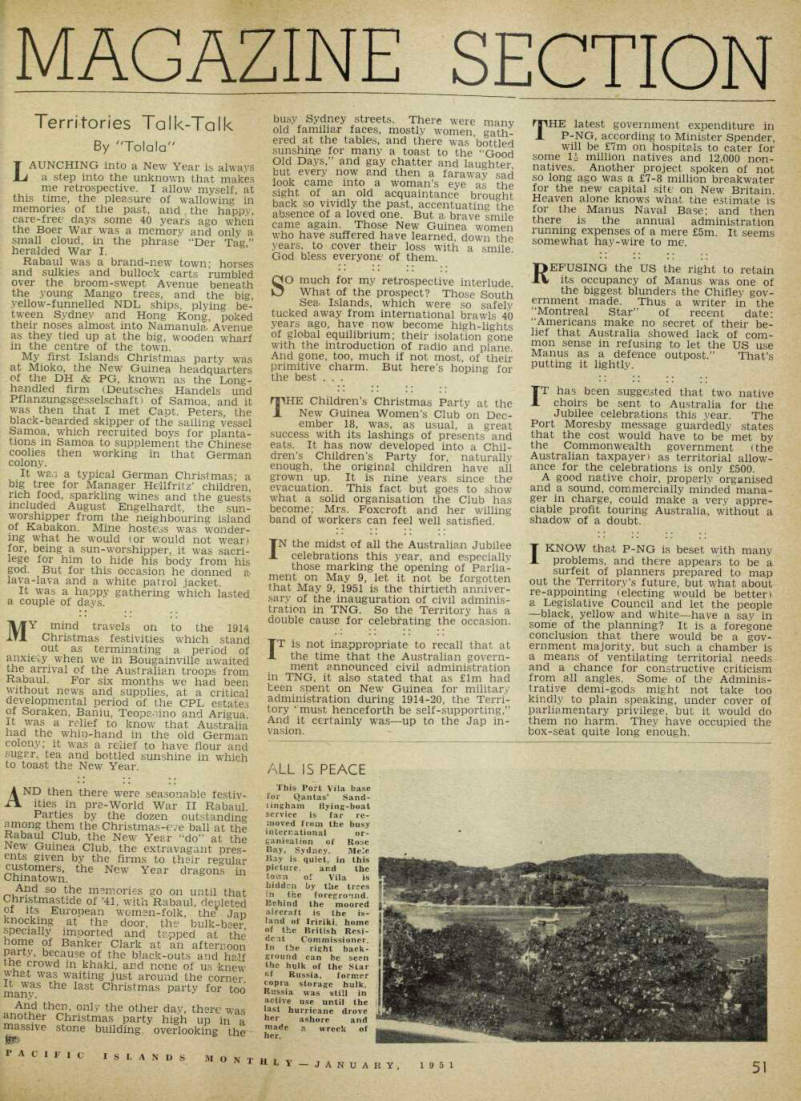
Territories Talk-Talk
By "Tolala"
LAUNCHING into a New Year is always a step into the unknown that makes me retrospective. I allow myself, at this time, the pleasure of wallowing in memories of the past, and the happy, care-free days some 40 years ago when the Boer War was a memory and only a small cloud, in the phrase “Der Tag ” heralded War I.
Rabaul was a brand-new town; horses and sulkies and bullock carts rumbled over the broom-swept Avenue beneath the young Mango trees, and the big, yellow-funnelled NDL ships, plying be tween Sydney and Hong Kong, poked their noses almost into Namanula- Avenue as they tied up at the big, wooden wharf in the centre of the town.
My first Islands Christmas party was at Mioko, the New Guinea headquarters of the DH & PG, known as the Long handled firm (Deutsches Handels und Pflanzungsgesselschaft) of Samoa, and it was then that I met Caot. Peters, the black-bearded skipper of the sailing vessel Samoa, which recruited boys for planta tions in Samoa to supplement the Chinese coolies then working in that German colony.
It wa-3 a typical German Christmas; a big tree for Manager Hellfritz’ children, rich food, sparkling wines and the guests included August Engelhardt, the sun worshipper from the neighbouring island pf Kabakon. Mine hostess was wonder ing what he would (or would not wear) for, being a sun-worshipper, it was sacri lege for him to hide his body from his god. But for this occasion he donned a lava-lava and a white patrol jacket.
It was a happy gathering which lasted a couple of days.
MY mind travels on to the 1914 Christmas festivities which stand out as terminating a period of anxiety when we in Bougainville awaited the arrival of the Australian troops from Rabaul. For six months we had been without news and supplies, at a critical developmental period of the CPL estates of Soraken, Baniu, Teopa-sino and Arigua It was a relief to know that Australia had the whip-hand in the old German colony; it was a relief to have flour and sugar, tea and bottled sunshine in which to toast the New Year.
AND then there were seasonable festiv ities in pre-World War II Rabaul.
Parties by the dozen outstanding among them the Christmas-e/e ball at the Rabaul Club, the New Year “do” at the New Guinea Club, the extravagant pres ents given by the firms to their regular customers, the New Year dragons in Chinatown.
And so the memories go on until that Chnstmastide of ’4l, with Rabaul, depleted of its European women-folk, the Jap knocking at the door, the bulk-beer specially imported and tapped at the home of Banker Clark at an afternoon party, because of the black-outs and half the crowd in khaki, and none of us knew wha-t was waiting just around the corner It was the last Christmas party for too many.
And then, only the other day, there was another Christmas party high up in a massive stone building, overlooking the fay
busy Sydney streets. There were many old familiar faces, mostly women gath ered at the tables, and there was ’bottled sunshine for many a toast to the “Good Old Days,” and gay chatter and laughter but every now and then a faraway sad look came into a woman’s eye as the sight of an old acquaintance brought back so vividly the past, accentuating the absence of a loved one. But a. brave smile came again. Those New Guinea women who have suffered have learned, down the years, to cover their loss with a smile God bless everyone of them.
SO much for my retrospective interlude.
What of the prospect? Those South Sea. Islands, which were so safely tucked away from international brawls 40 years ago, have now become high-lights of global equilibrium; their isolation gone with the introduction of radio and plane.
And gone, too, much if not most, of their primitive charm. But here’s hoping for the best . . .
THE Children’s Christmas Party at the New Guinea Women’s Club on Dec ember 18, was, as usual, a great success with its lashings of presents and eats. It has now developed into a Chil dren’s Children’s Party for, naturally enough, the original children have all grown up. It is nine years since the evacuation. This fact but goes to show what a solid organisation the Club has become; Mrs. Foxcroft and her willing band of workers can feel well satisfied.
IN the midst of all the Australian Jubilee celebrations this year, and especially those marking the opening of Parlia ment on May 9, let it not be forgotten that May 9, 1951 is the thirtieth anniver sary of the inauguration of civil adminis tration in TNG. So the Territory has a double cause for celebrating the occasion.
IT is not inappropriate to recall that at the time that the Australian govern ment announced civil administration in TNG, it also stated that as £lm had been spent on New Guinea for military administration during 1914-20, the Terri tory ‘ must henceforth be self-supporting,”
And it certainly was—up to the Jap in vasion.
rpHE latest government expenditure in L P-NG, according to Minister Spender, will be £7m on hospitals to cater for some U million natives and 12.000 non natives. Another project spoken of not so long ago was a £7-8 million breakwater for the new capital site on New Britain.
Heaven alone knows what the estimate is for the Manus Naval Base; and then there is the annual administration running expenses of a mere £sm. It seems somewhat hay-wire to me.
REFUSING the US the right to retain its occupancy of Manus was one of the biggest blunders the Chifley gov ernment made. Thus a writer in the “Montreal Star” of recent date: “Americans make no secret of their be lief that Australia showed lack of com mon sense in refusing to let the US use Manus as a defence outpost.” That’s putting it lightly.
IT has been suggested that two native choirs be sent to Australia for the Jubilee celebrations this year. The Port Moresby message guardedly states that the cost would have to be met by the Commonwealth government (the Australian taxpayer) as territorial allow ance for the celebrations is only £5OO.
A good native choir, properly organised and a sound, commercially minded mana ger in charge, could make a very appre ciable profit touring Australia, without a shadow of a doubt.
IKNOW tha-t P-NG is beset with many problems, and there appears to be a surfeit of planners prepared to map out the Territory’s future, but what about re-appointing (electing would be better) a Legislative Council and let the people —black, yellow and white—have a say in some of the planning? It is a foregone conclusion that there would be a gov ernment majority, but such a chamber is a means of ventilating territorial needs and a chance for constructive criticism from all angles. Some of the Adminis trative demi-gods might not take too kindly to plain speaking, under cover of parliamentary privilege, but it would do them no harm. They have occupied the box-seat quite long enough.
All Is Peace
This Port Vila base for Qantas’ Sand
ringham flying-boat
service is far re moved from the busy international or ganisation of Rose Bay, Sydney. Mele Bay is quiet, in this picture, and the town of Vila is bidden by the trees in the foreground.
Behind the moored aircraft is the is land of Iririki, home of the British Resi dent Commissioner.
In the right back ground can be seen the hulk of the Star of Russia, former copra storage hulk.
Russia was still in active use until the last hurricane drove her ashore and made a wreck of her.
Advertisements & other items, p. 53 (1 item)
51
pacific islands mont hiv
I IILY JANUARY, 1951
Poor Mr. Frings
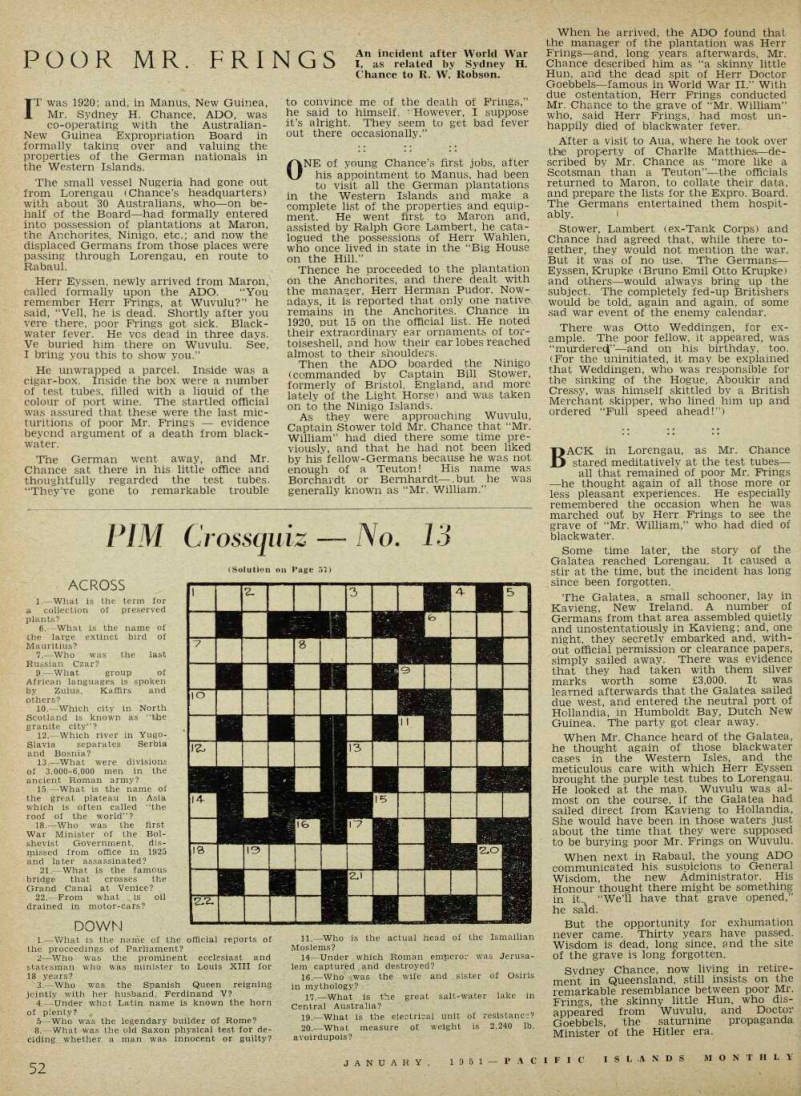
An incident after World War I, as related by Sydney H.
Chance to R. W. Robson.
IT was 1920; and, in Manus, New Guinea, Mr. Sydney H. Chance, ADO, was co-operating with the Australian- New Guinea Expropriation Board in formally taking over and valuing the properties of the German nationals in the Western Islands.
The small vessel Nugeria had gone out from Lorengau (Chance’s headquarters) with about 30 Australians, who —on be half of the Board —had formally entered into possession of plantations at Maron, the Anchorites, Ninigo, etc.; and now the displaced Germans from those places were passing through Lorengau, en route to Rabaul.
Herr Eyssen, newly arrived from Maron, Called formally upon the ADO. “You remember Herr Frings, at Wuvulu?” he said, “Veil, he is dead. Shortly after you vere there, poor Frings got sick. Black water fever. He vos dead in three days.
Ve buried him there on Wuvulu. See, I bring you this to show you.”
He unwrapped a parcel. Inside was a cigar-box. Inside the box were a number of test tubes, filled with a liquid of the colour of port wine. The startled official was assured that these were the last mic turitions of poor Mr. Frings evidence beyond argument of a death from black water.
The German went away, and Mr.
Chance sat there in his little office and thoughtfully regarded the test tubes.
“They’ve gone to remarkable trouble
to convince me of the death of Frings,” he said to himself. “However, I suppose it’s alright. They seem to get bad fever out there occasionally.”
ONE of young Chance’s first jobs, after his appointment to Manus, had been to visit all the German plantations in the Western Islands and make a complete list of the properties and equip ment. He went first to Maron and, assisted by Ralph Gore Lambert, he cata logued the possessions of Herr Wahlen, who once lived in state in the “Big House on the Hill.”
Thence he proceeded to the plantation on the Anchorites, and there dealt with the manager, Herr Herman Pudor. Now adays, it is reported that only one native remains in the Anchorites. Chance in 1920, out 15 on the official list. He noted their extraordinary ear ornaments of tor toiseshell, and how their ear lobes reached almost to their shoulders.
Then the ADO boarded the Ninigo (commanded by Captain Bill Stower, formerly of Bristol, England, and more lately of the Light Horse) and was taken on to the Ninigo Islands.
As they were approaching Wuvulu, Captain Stower told Mr. Chance that “Mr.
William” had died there some time pre viously, and that he had not been liked by his fellow-Germans because he was not enough of a Teuton! His name was Borchardt or Bernhardt—. but he was generally known as “Mr. William.”
PIM Crossquiz -No. 13
(Solution on Page 57)
Across
1. —What is the term for a collection of preserved plants? 6. —What is the name of the large extinct bird of Mauritius? 7. —Who was the last Russian Czar? 9. —What group of African languages is spoken by Zulus, Kaffirs and others? 10. —Which city in North Scotland is known as “the granite city”? 12.—Which river in Yugo slavia separates Serbia and Bosnia? 13—What were divisions of 3.000-6,000 men in the ancient Roman army? 15. —What is the name of the great plateau in Asia which is often called “the roof of the world”? 18.—Who was the first War Minister of the Bol shevist Government, dis missed from office in 1925 and later assassinated? 21. —What is the famous bridge that crosses the Grand Canal at Venice? 22.—From what is oil drained in motor-cars?
Down
I.—What is the name of the official reports of the proceedings of Parliament? 2—Who was the prominent ecclesiast and statesman who was minister to Louis XIII for 18 years? 3. —Who was the Spanish Queen reigning jointly with her husband, Ferdinand V? 4. —Under what Latin name is known the horn of plenty? s—Who was the legendary builder of Rome? 8. —What was the old Saxon physical test for de ciding whether a man was innocent or guilty?
11-—-Who is the actual head of the Ismailian Moslems? 14—Under which Roman emperor was Jerusa lem captured, and destroyed? 16.—Who s; was the wife and .sister of Osiris j n mythology? 17—What is the great salt-water lake in central Australia? 19-What Is the electrical unit of resistance? 20.—What measure of weight is 2,240 lb. avoirdupois?
When he arrived, the ADO found that the manager of the plantation was Herr Frings—and, long years afterwards, Mr.
Chance described him as “a skinny little Hun, and the dead spit of Herr Doctor Goebbels —famous in World War II.” With due ostentation, Herr Frings conducted Mr. Chance to the grave of “Mr. William” who, said Herr Frings, had most un happily died of blackwater fever.
After a visit to Aua, where he took over the property of Charlie Matthies.—de scribed by Mr. Chance as “more like a Scotsman than a Teuton” —the officials returned to Maron, to collate their data, and prepare the lists for the Expro. Board.
The Germans entertained them hospit ably.
Stower, Lambert (ex-Tank Corps) and Chance had agreed that, while there to gether, they would not mention the war.
But it was' of no use. The Germans — Eyssen, Krupke (Bruno Emil Otto Krupke) and others —would always bring up the subject. The completely fed-up Britishers would be told, again and again, of some sad war event of the enemy calendar.
There was Otto Weddingen, for ex ample. The poor fellow, it appeared, was “murderedT —and on his birthday, too. (For the uninitiated, it may be explained that Weddingen, who was responsible for the sinking of the Hogue, Aboukir and Cressy, was himself skittled by a British Merchant skipper, who lined him up and ordered “Full speed ahead!”) BACK in Lorengau, as Mr. Chance stared meditatively at the test tubes— all that remained of poor Mr. Frings —he thought again of all those more or less pleasant experiences. He especially remembered the occasion when he was marched out by Herr Frings to see the grave of “Mr. William,” who had died of blackwater.
Some time later, the story of the Galatea reached Lorengau. It caused a stir at the time, but the incident has long since been forgotten.
The Galatea, a small schooner, lay in Kavieng, New Ireland. A number of Germans from that area assembled quietly and unostentatiously in Kavieng; and, one night, they secretly embarked and, with out official permission or clearance papers, simply sailed away. There was evidence that they had taken with them silver marks worth some £3,000. It was learned afterwards that the Galatea sailed due west, and entered the neutral port of Hollandia, in Humboldt Bay, Dutch New Guinea. The party got clear away.
When Mr. Chance heard of the Galatea, he thought again of those blackwater cases in the Western Isles, and the meticulous care with which Herr Eyssen brought the nurple test tubes to Lorengau.
He looked at the map. Wuvulu was al most on the course, if the Galatea had sailed direct from Kavieng to Hollandia, She would have been in those waters just about the time that they were supposed to be burying poor Mr. Frings on Wuvulu.
When next in Rabaul, the young ADO communicated his suspicions to General Wisdom, the new Administrator. His Honour thought there might be something in it. k “Well have that grave opened,” he said.
But the opportunity for exhumation never came. Thirty years have passed.
Wisdom is dead, long since, and the site of the grave is long forgotten.
Sydney Chance, now living in retire ment in Queensland, still insists on the remarkable resemblance between poor Mr.
Flings, the skinnv little Hun, who dis appeared from Wuvulu, and Doctor Goebbels, the saturnine propaganda Minister of the Hitler era.
New Guinea Was a Good Place Then!
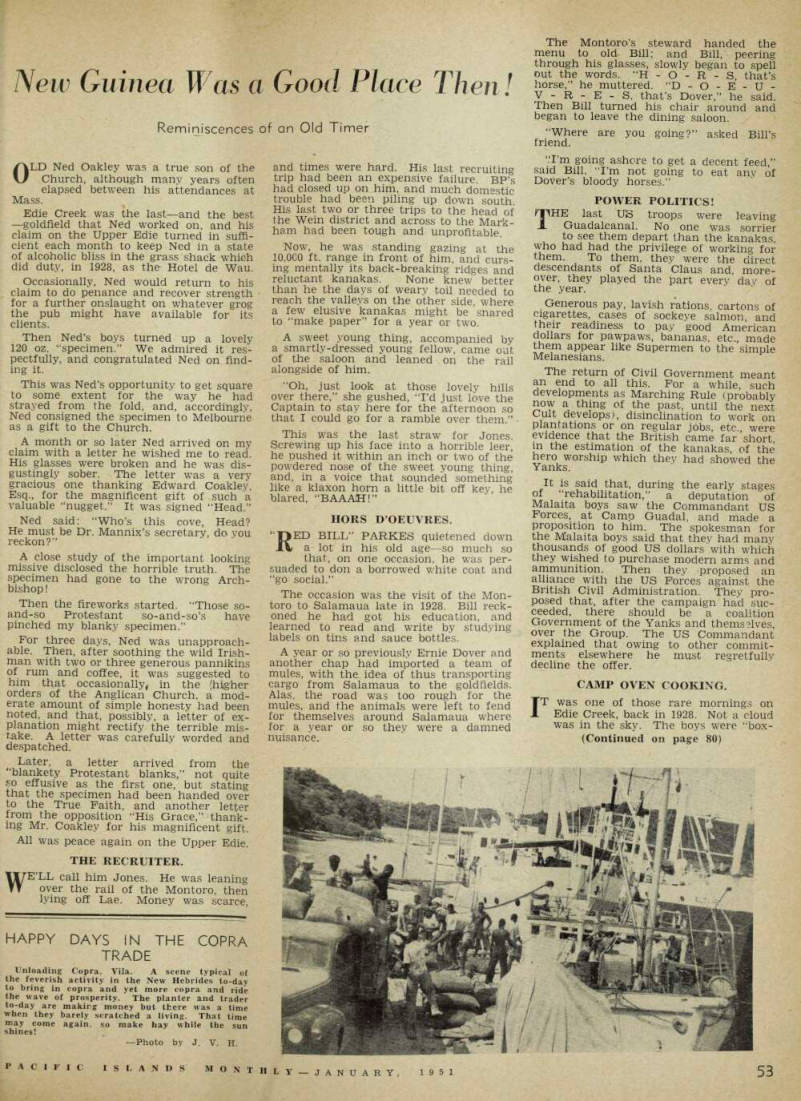
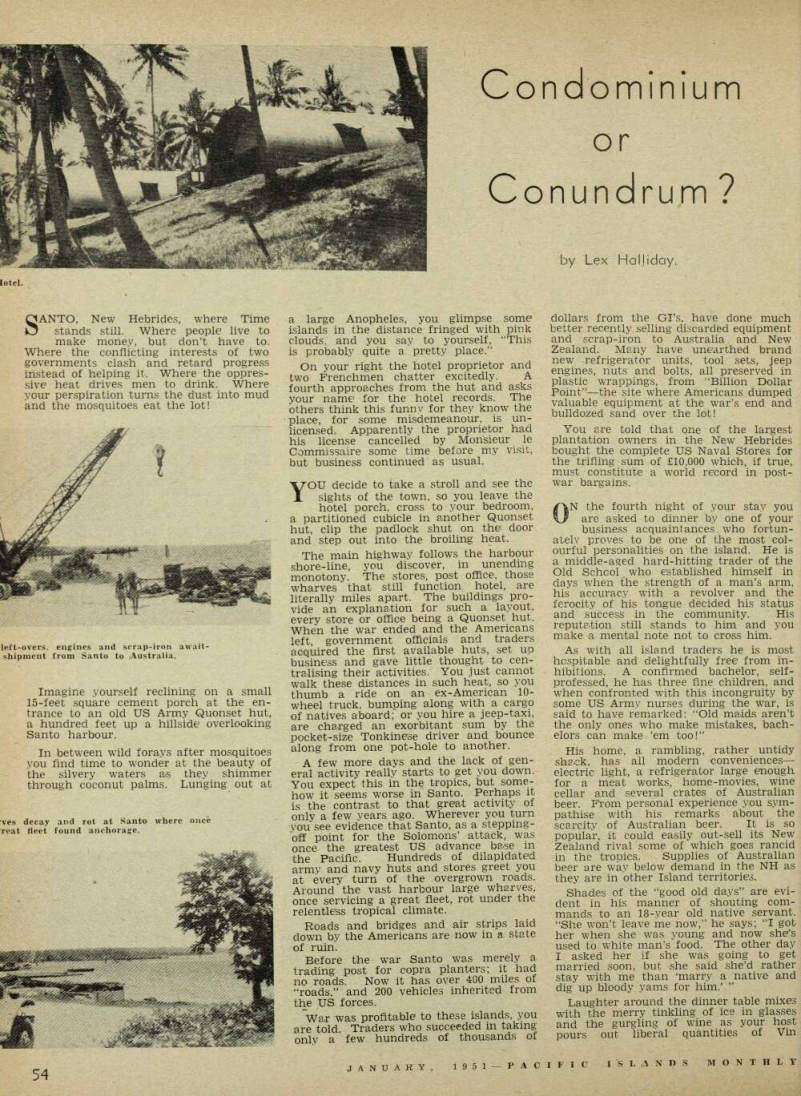
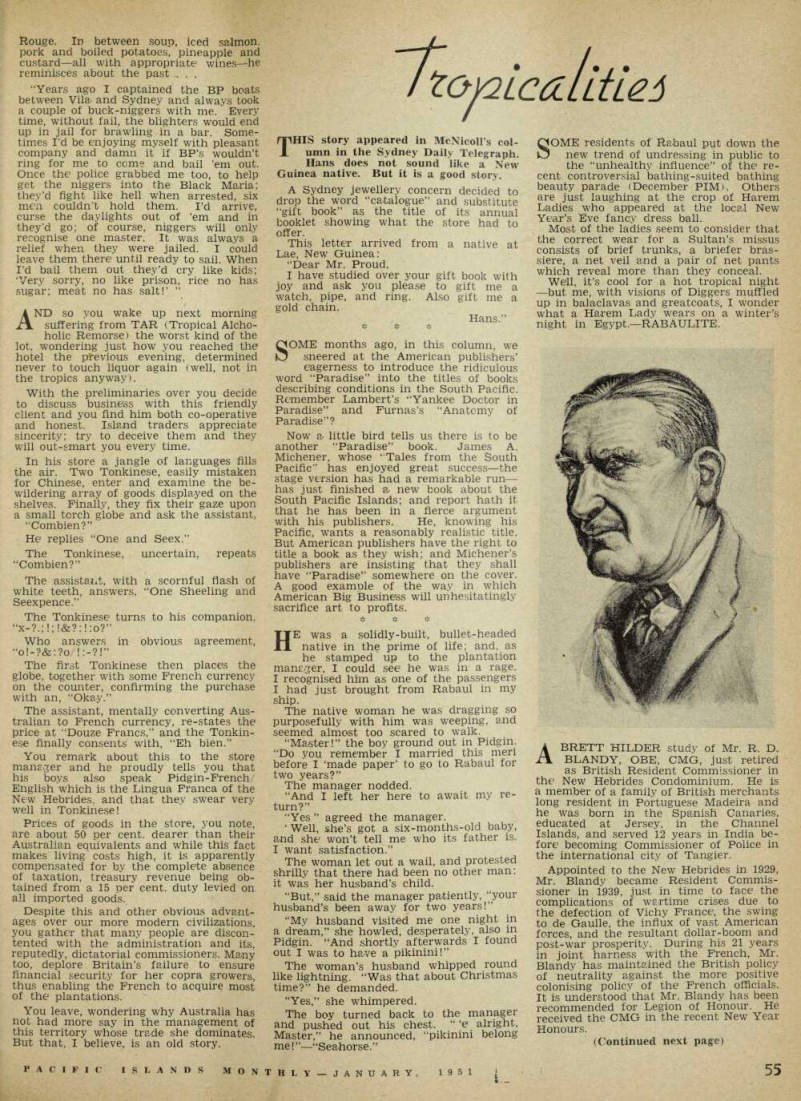
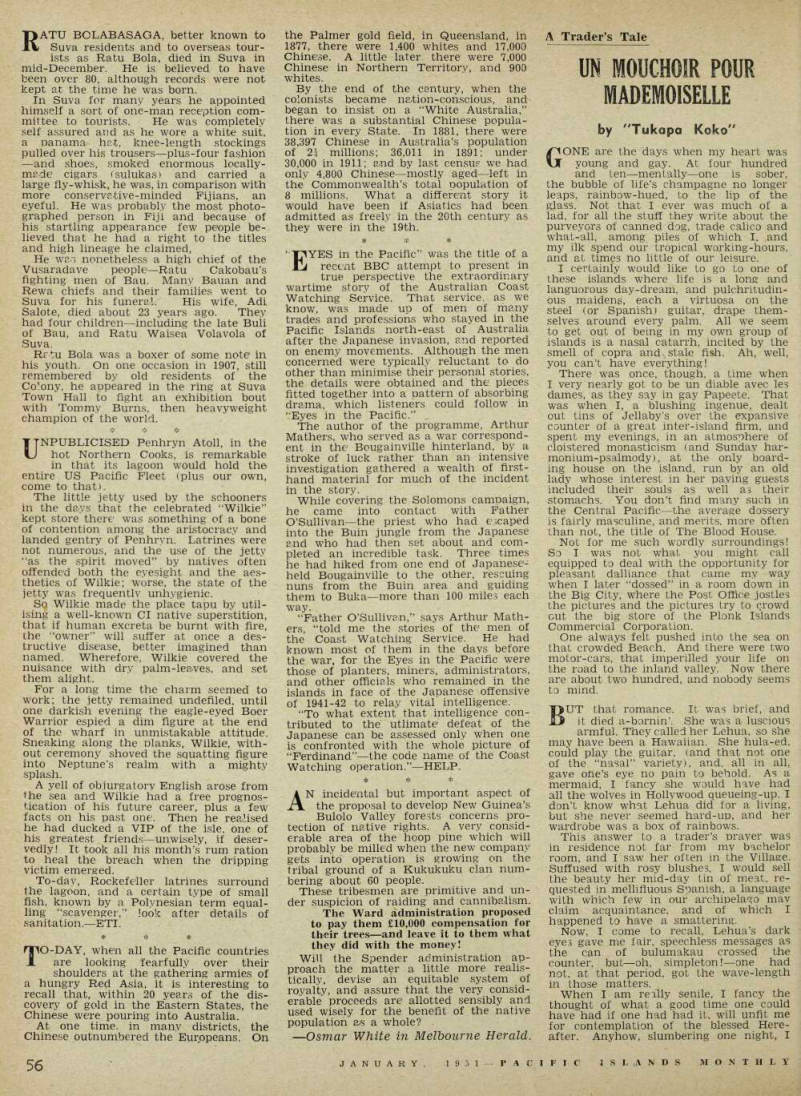
Reminiscences of an Old Timer
OLD Ned Oakley was a true son of the Church, although many years often elapsed between his attendances at Mass.
Edie Creek was the last—and the best —goldfield that Ned worked on, and his claim on the Upper Edie turned in suffi cient each month to keep Ned in a state of alcoholic bliss in the grass shack which did duty, in 1928, as the Hotel de Wau.
Occasionally, Ned would return to his claim to do penance and recover strength for a further onslaught on whatever grog the pub might have available for its clients.
Then Ned’s boys turned up a lovely 120 oz. “specimen.” We admired it res pectfully, and congratulated Ned on find ing it.
This was Ned’s opportunity to get square to some extent for the way he had strayed from the fold, and, accordingly, Ned consigned the specimen to Melbourne as a gift to the Church.
A month or so later Ned arrived on my claim with a letter he wished me to read.
His glasses were broken and he was dis gustingly sober. The letter was a very gracious one thanking Edward Coakley, Esq., for the magnificent gift of such a valuable “nugget.” It was signed “Head.”
Ned said: “Who’s this cove, Head?
He must be Dr. Mannix’s secretary, do you reckon?”
A close study of the important looking missive disclosed the horrible truth. The specimen had gone to the wrong Arch bishop !
Then the fireworks started. “Those so and-so Protestant so-and-so’s have pinched my blanky specimen.”
For three days, Ned was unapproach able. Then, after soothing the wild Irish man with two or three generous pannikins of rum and coffee, it was suggested to him th at occasion ally* in the 'higher orders of the Anglican Church, a mod erate amount of simple honesty had been noted, and that, possibly, a letter of ex planation might rectify the terrible mis take. A letter was carefully worded and despatched.
Later, a letter arrived from the “blankety Protestant blanks,” not quite so effusive as the first one, but stating that the specimen had been handed over to the True Faith, and another letter from the opposition “His Grace,” thank ing Mr. Coakley for his magnificent gift.
All was peace again on the Upper Edie.
The Recruiter.
WE’LL call him Jones. He was leaning over the rail of the Montoro, then lying off Lae. Money was scarce,
and times were hard. His last recruiting trip had been an expensive failure. BP’s had closed up on him, and much domestic trouble had been piling up down south.
His last two or three trips to the head of the Wein district and across to the Mark ham had been tough and unprofitable.
Now, he was standing gazing at the 10,000 ft. range in front of him, and curs ing mentally its back-breaking ridges and reluctant kanakas. None knew better than he the days of weary toil needed to reach the valleys on the other side, where a few elusive kanakas might be snared to “make paper” for a year or two.
A sweet young thing, accompanied by a smartly-dressed young fellow, came out of the saloon and leaned on the rail alongside of him.
“Oh, just look at those lovely hills over there,” she gushed, “I’d just love the Captain to stay here for the afternoon so that I could go for a ramble over them.”
This was the last straw for Jones.
Screwing up his face into a horrible leer, he pushed it within an inch or two of the powdered nose of the sweet young thing, and, in a voice that sounded something like a klaxon horn a little bit off kev, he blared, “BAAAH!”
Hors D’Oeuvres.
“T>ED BILL” PARKES quietened down XV a lot in his old age—so much so that, on one occasion, he was per suaded to don a borrowed white coat and “go social.”
The occasion was the visit of the Mon toro to Salamaua late in 1928. Bill reck oned he had got his education, and learned to read and write by studying labels on tins and sauce bottles.
A year or so previously Ernie Dover and another chap had imported a team of mules, with the idea of thus transporting cargo from Salamaua to the goldfields.
Alas, the road was too rough for the mules, and the animals were left to fend for themselves around Salamaua where for a year or so they were a damned nuisance.
The Montoro’s steward handed the menu to old Bill; and Bill, peering through his glasses, slowly began to spell out the words. “H - O - R - S, that’s horse,” he muttered. “D - O - E - U - V - R - E - S, that’s Dover,” he said.
Then Bill turned his chair around and began to leave the dining saloon.
“Where are you going?” asked Bill’s friend.
“I’m going ashore to get a decent feed,” said Bill, “I’m not going to eat any of Dover’s bloody horses.”
Power Politics!
THE last UB troops were leaving Guadalcanal. No one was sorrier to see them depart than the kanakas, who had had the privilege of working for them. To them, they were the direct descendants of Santa Claus and more over, they played the part every day of the year.
Generous pay, lavish rations, cartons of cigarettes, cases of sockeye salmon and their readiness to pay good American dollars for pawpaws, bananas, etc., made them appear like Supermen to the simple Melanesians.
The return of Civil Government meant an end to all this. For a while, such developments as Marching Rule (probably now a thing of the past, until the next Cult develops), disinclination to work on plantations or on regular jobs, etc., were evidence that the British came far short in the estimation of the kanakas, of the hero worship which they had showed the Yanks.
It is said that, during the early stages of “rehabilitation,” a deputation of Malaita boys saw the Commandant US Forces, at Camp Guadal, and made a proposition to him. The spokesman for the Malaita boys said that they had many thousands of good US dollars with which they wished to purchase modern arms and ammunition. Then they proposed an alliance with the US Forces against the British Civil Administration. They pro posed that, after the campaign had suc ceeded, there should be a coalition Government of the Yanks and themselves, over the Group. The US Commandant explained that owing to other commit ments elsewhere he must regretfully decline the offer.
Camp Oven Cooking.
IT was one of those rare mornings on Edie Creek, back in 1928. Not a cloud was in the sky. The boys were “box
(Continued on page 80)
Happy Days In The Copra
Trade
Unloading Copra, Vila. A scene typical of the feverish activity in the New Hebrides to-day to bring in copra and yet more copra and ride the wave of prosperity. The planter and trader to-day are making money but there was a time when they barely scratched a living. That time may come again, so make hay while the sun shines! —Photo by J. V. H.
ing” the rich, virgin ground, making it necessary every hour or so to turn the water off to clean up the gold choking up the top riffles.
Within a hundred yards, half a dozen teams were working on their masters’ claims.
Suddenly bedlam broke loose. Picks and shovels were dropped, sluice boxes abandoned, and every boy in sight joined in a mad scramble through the scrub around the edge of the Little Upper Edie Creek.
I had heard of mass insanity amongst the natives, but had never believed it could strike as suddenly as this. Would it be best to make a break for the hut and get my revolver (the one with the big bulge in the barrel) or go bush and hide?
It didn’t last long, however. What had happened was that an unsuspecting scrub turkey had wandered down into the middle of the claims before being spotted.
My cook-boy was the victor in the chase with the result that I copped the turkey.
After an unvaried diet of tinned meat
for many months, this was an event; an occasion for a celebration. Fortunately] I had a bottle of OP, and a small pump kin, growing alongside the hut.
To go with the Roast Turkey, however, a second course seemed to be indicated. I decided to make jam tarts (according to the book) in the second camp oven.
Previously, when I had made jam tarts, I had burnt the bottoms of them by laying them down on the floor of the camp oven. I would not make this mis take again. This time I cut small sticks to put on the floor of the oven and rested the pastry on top of them.
Old Bill Parkes was the first guest to arrive. We sat down, and yarned over pannikins of rum and coffee, while the turkey sizzled in its oven and the jam tarts made headway in theirs.
Suddenly, Bill noticed a smell of burn ing. Anxiously, I lifted the lid of the turkey oven. Everything was all right.
Then the lid of the pastry oven. As I did so, a cloud of smoke gushed out and the interior burst into flame. The sticks had caught fire!
Old Bill was astonished. “Well,” he said, “I’ve seen camp oven cooking for over sixty years. I’ve seen ’em put the fire under the oven, round the side of the oven, and on top of the oven; but this is the first blanky time I’ve ever seen the blanky fire put inside the oven!”
Guilty, Y’Honor, But—!
THIS happened in the real bad old days, in New Guinea. At that time there was a fair-dinkum nark in the Gov ernment at Madang; and, during the absence of the NO. 1, he acted as boss cocky.
He had a down on traders, planters, Expro-Boardites, miners, and recruiters — particularly on recruiters.
The nark had been trying to catch Bluey for a long time, Bluey lobbed in
ne day with a string of boys, en route o Salamaua to sign them on.
In Salamaua, the ADO’s weren’t so 3ugh or inquisitive in signing on boys.
Bluey put his boys in smoke until the oat came in, but a few wandered in to 3wn. The nark grabbed them, and put he third degree on them, to find out diat Bluey had been up to during his ecruiting trip. He didn’t collect much but he did discover that Huey had shot a Goura pigeon.
This was enough. Bluey was called to he bar. The witnesses were examined nd Bluey could see that the going was bit up-hill. Then Bluey’s turn came.
“Did you shoot the Goura pigeon, as hese boys say you did?” was the ques ion.
“Yes, I did, but—” replied Bluey.
“And who gave you permission to shoot loura pigeon?” says the Nark.
“Well,” Bluey says, “it was like this, ’he bloody bird attacked me, and I had y fire in self-defence.”
Love’S Labour Lost.
JOMEWHERE around 1928, boys for the 5 goldfields were bringing thirty quid a nob. So, the roll being a bit light, ly mate and I, in a misguided moment, ecided to go recruiting in that pleasant ttle corner of the world just south of le lower Ramu River, about four days’ r alk behind Awar Plantation.
The least said about the trip the better, 'he kanakas just about did everything ) us except recruit us.
I wore a rather stylish bush outfit, Dpped off with an ex-AIF sombrero. A ery bright, oversized brass badge decor ted the hat. I think the badge originally elonged to the Mongogorie Girl Guides r the Bulgarian Fusiliers or something.
It was surprising the number of kan kas who thought I was “Guberman.” At aat time, the quaint bush kanakas had tie old-fashioned idea that Government ras something to rely on in time of rouble, and several complaints were rought to me which I promised to look ito personally at some time in the dis ant future, or refer to the proper de artmental head.
Then I stumbled on to a real tragedy.
It appears that up on the mountains, ot so very far away, a certain tribe of nterprising kanakas had been doing big usiness in supplying wives to the coastal lutocrats. The supply of wives was al lost inexhaustible, as they were obtained y raiding even more primitive villages urther back in the mountains. It isn’t ecorded whether any of the original wners ever raised any objections.
The cove who came to see me, with his omplaint, had been saving up for a long ime to buy a wife. On the previous ccasion, when the mountain boys brought own their wares for sale, he had missed ut, although he had had the where ithal to make his purchase. On the next ccasion the supply had not been equal d the demand.
But, following ordinary commercial sage, he had placed an order, to be ex cuted at the time of next delivery. He ad, however, made a fatal mistake. He’d aid the mountain kanakas in advance.
Ie brought to me his books of account d certify his payments.
These consisted of many small bundles f sticks. The number of sticks in each ttle bundle corresponded with the par icular number of certain articles he had 'aid. So many rings (curtain) belong rtiite man, so many plaited rings belong anaka, so many beads, gaum shells, owrie shells, etc., etc. Truly, a goodly •rice for a fair damosel.
But, alas, those cunning mountain anakas had put a swifty over him. In tead of the plump, young mary that he iad been dreaming about, and that he tad paid for, they had sold him a pup ti the shape of a toothless, wrinkled, and
grillie-skinned old crone.
He’d brought her along with him to nn° a ble m %as W this simple notice* And JL loShprmS? 1 oShprmS? v n l i A? d ’ please, Mr Guberman, what are you gom f/r to u2ovf a^ wlS inr fv. P o . My heart bled for the stricken Romeo, ? ut th .Hnn ivonreri Of transaction savoured 01 very sharp practice, I could not see that the Sale of Goods Act (with amendments thereto) had been contravened. My judicial
opinion was that the principle of Caveat Emptor must apply.
Atter m '' Judgment had been explained to him P er interpreter, I dismissed him from presence. He went away mut tering something which may have been a jaifdatory declamation of the blessings ot civilization, but probably was not.
Thpn T rp<;t.prl for an hour nr twn from
mv Lm
my iaDOUrs
(Continued on page 83)
Jeeves, my cookboy and valet, shattered ny tranquility.
“Masta, what are you going to do with his mary,” he asked. “What mary?” I eplied. “The one the kanaka left with r ou this morning,” he answered.
The kanaka had parked his problem on ne and gone off to his village!
During the afternoon several kanakas Irifted along. I suggested to them that hey might like to possess themselves, ree of charge, of a real good and useful nary. The idea appealed to them: but one ook at my charge cured any romantic deas that may have struck them, and the ffer was, not too politely, declined.
Things looked bad. Even when I offered , dowry with the damosel there was noth ng doing.
Towards dusk, along came a skinny, flzened lapun (old native). He had a mall taro, which he wished to trade for , razor blade or a kelly axe, or something.
The proposition concerning the mary ras put to him. It took him a long time o cotton on. The mary was brought up nd paraded: the dowry (a bush knife and length of calico, plus a 6d. taro knife) ras displayed.
The old fellow must have bought many orses in his time! He felt her ribs, xamined her teeth, inspected for string alt, spavins, and ingrowing toe-nails, 'inally he was satisfied. With his dowry nder one arm, holding his blushing ride’s wrist and with many facial ex ressions he departed to face a rosy uture.
Mrs. Rachael Amy Carr, widow of the ite Mr. Robert Palgrave Carr, who owned r otua Levu sugar plantation at Ba, Fiji, ied in Sydney on January 3.
Condominium
or Conundrum?
by Lex Holliday.
SANTO, New Hebrides, where Time stands still. Where people live to make money, but don’t have to.
Where the conflicting interests of two governments clash and retard progress instead of helping it. Where the oppres sive heat drives men to drink. Where your perspiration turns the dust into mud and the mosquitoes eat the lot!
Imagine yourself reclining on a small 15-feet square cement porch at the en trance to an old US Army Quonset hut, a hundred feet up a hillside overlooking Santo harbour.
In between wild forays after mosquitoes you find time to wonder at the beauty of the silvery waters as they shimmer through coconut palms. Lunging out at
a large Anopheles, you glimpse some islands in the distance fringed with pink clouds, and you say to yourself, “This is probably quite a pretty place.”
On your right the hotel proprietor and two Frenchmen chatter excitedly. A fourth approaches from the hut and asks your name for the hotel records. The others think this funny for they know the place, for some misdemeanour, is un licensed. Apparently the proprietor had his license cancelled by Monsieur le Commissaire some time before my visit, but business continued as usual.
YOU decide to take a stroll and see the sights of the town, so you leave the hotel porch, cross to your bedroom, a partitioned cubicle in another Quonset hut, clip the padlock shut on the door and step out into the broiling heat.
The main highway follows the harbour shore-line, you discover, in unending monotony. The stores, post office, those wharves that still function hotel, are literally miles apart. The buildings pro vide an explanation for such a layout, every store or office being a Quonset hut.
When the war ended and the Americans left, government officials and traders acquired the first available huts, set up business and gave little thought to cen tralising their activities. You just cannot walk these distances in such heat, so you thumb a ride on an ex-American 10wheel truck, bumning along with a cargo of natives aboard; or you hire a jeep-taxi, are charged an exorbitant sum by the pocket-size Tonkinese driver and bounce along from one pot-hole to another.
A few more days and the lack of gen eral activity really starts to get you down.
You expect this in the tropics, but some how it seems worse in Santo. Perhaps it is the contrast to that great activity of only a few years ago. Wherever you turn you see evidence that Santo, as a stepping off point for the Solomons’ attack, was once the greatest US advance ba.se in the Pacific. Hundreds of dilapidated army and navy huts and stores greet you at every turn of the overgrown roads.
Around the vast harbour large wharves, once servicing a great fleet, rot under the relentless tropical climate.
Roads and bridges and air strips laid down by the Americans are now in a state of ruin.
Before the war Santo was merely a trading post for copra planters; it had no roads. Now it has over 400 miles of “roads,” and 200 vehicles inherited from the US forces.
War was profitable to these islands, you are told. Traders who succeeded in taking only a few hundreds of thousands of
dollars from the Gl’s, have done much better recently selling discarded equipment and scrap-iron to Australia and New Zealand. Many have unearthed brand new refrigerator units, tool sets, jeep engines, nuts and bolts, all preserved in plastic wrappings, from “Billion Dollar Point” —the site where Americans dumped valuable equipment at the war’s end and bulldozed sand over the lot!
You are told that one of the largest plantation owners in the New Hebrides bought the complete US Naval Stores for the trifling sum of £lO,OOO which, if true, must constitute a world record in post war bargains.
ON the fourth night of your stay you are asked to dinner by one of your business acquaintances who fortun ately proves to be one of the most col ourful personalities on the island. He is a middle-aged hard-hitting trader of the Old School who established himself in days when the strength of a man’s arm, his accuracy with a revolver and the ferocity of his tongue decided his status and success in the community. His reputation still stands to him and you make a mental note not to cross him.
As with all island traders he is most hospitable and delightfully free from in hibitions. A confirmed bachelor, self professed, he has three fine children, and when confronted with this incongruity by some US Army nurses during the war, is said to have remarked: “Old maids aren’t the only ones who make mistakes, bach elors can make ’em too!”
His home, a rambling, rather untidy shaek, has all modern conveniences— electric light, a refrigerator large enough for a meat works, home-movies, wine cellar and several crates of Australian beer. From personal experience you sym pathise with his remarks about the scarcity of Australian beer. It is so popular, it could easily out-sell its New Zealand rival some of which goes rancid in the tronics. Supplies of Australian beer are way below demand in the NH as they are in other Island territories.
Shades of the “good old days” are evi dent in his manner of shouting com mands to an 18-year old native servant.
“She won’t leave me now,” he says; “I got her when she was young and now she’s used to white man’s food. The other day I asked her if she was going to get married soon, but she said she’d rather stay with me than ‘marry a native and dig up bloody yams for him.’ ”
Laughter around the dinner table mixes with the merry tinkling of ice in glasses and the gurgling of wine as your host pours out liberal quantities of Vin
[?]left-overs, engines and scrap-iron await [?]shipment from Santo to Australia.
[?]es decay and rot at Santo where once [?]reat fleet found anchorage.
Hotel.
Rouge. In between soup, iced salmon, pork and boiled potatoes, pineapple and custard—all with appropriate wines—he reminisces about the past . . .
“Years ago I captained the BP boats between Vila, and Sydney and always took a couple of buck-niggers with me. Every time, without fail, the blighters would end up in jail for brawling in a bar. Some times I’d be enjoying myself with pleasant company and damn it if BP’s wouldn’t ring for me to come and bail ’em out.
Once the police grabbed me too, to help get the niggers into the Black Maria; they’d fight like hell when arrested, six men couldn’t hold them. I’d arrive, curse the daylights out of ’em and in they’d go; of course, niggers will only recognise one master. It was always a relief when they were jailed. I could leave them there until ready to sail. When I'd bail them out they’d cry like kids; ‘Very sorry, no like prison, rice no has sugar; meat no has salt!’ ”
AND so you wake up next morning suffering from TAR (Tropical Alcho holic Remorse) the worst kind of the lot, wondering just how you reached the hotel the previous evening, determined never to touch liquor again (well, not in the tropics anyway).
With the preliminaries over you decide to discuss business with this friendly client and you find him both co-operative and honest. Island traders appreciate sincerity; try to deceive them and they will out-smart you every time.
In his store a jangle of languages fills the air. Two Tonkinese, easily mistaken for Chinese, enter and examine the be wildering array of goods displayed on the shelves. Finally, they fix their gaze upon a small torch globe and ask the assistant, “Combien?”
He replies “One and Seex.”
The Tonkinese, uncertain, repeats “Combien?”
The assistant, with a scornful flash of white teeth, answers, “One Sheeling and Seexpence.”
The Tonkinese turns to his companion, “x-?.;!; !&?:! :o?”
Who answers in obvious agreement, “o!-?&:?o/!:-?!”
The first Tonkinese then places the globe, together with some French currency on the counter, confirming the purchase with an, “Okay.”
The assistant, mentally converting Aus tralian to French currency, re-states the price at “Douze Francs,” and the Tonkin ese finally consents with, “Eh bien.”
You remark about this to the store manager and he proudly tells you that his boys also speak Pidgin-French/ English which is the Lingua Franca of the New Hebrides, and that they swear very well in Tonkinese!
Prices of goods in the store, you note, are about 50 per cent, dearer than their Australian equivalents and while this fact makes living' costs high, it is apparently compensated for by the complete absence of taxation, treasury revenue being ob tained from a 15 per cent, duty levied on all imported goods.
Despite this and other obvious advant ages over our more modern civilizations, you gather that many people are discon tented with the administration and its, reputedly, dictatorial commissioners. Many too, deplore Britain’s failure to ensure financial security for her copra growers, thus enabling the French to acquire most of the plantations.
You leave, wondering why Australia has not had more say in the management of this territory whose trade she dominates.
But that, I believe, is an old story.
Tropicalities
THIS story appeared in McNicoll’s col umn in the Sydney Daily Telegraph.
Hans does not sound like a New Guinea native. But it is a good story.
A Sydney jewellery concern decided to drop the word “catalogue” and substitute “gift book” as the title of its annual booklet showing what the store had to offer.
This letter arrived from a native at Lae, New Guinea: “Dear Mr. Proud.
I have studied over your gift book with joy and ask you please to gift me a watch, pipe, and ring. Also gift me a gold chain.
Hans.” :J: SOME months ago, in this column, we sneered at the American publishers’ eagerness to introduce the ridiculous word “Paradise” into the titles of books describing conditions in the South Pacific.
Remember Lambert’s “Yankee Doctor in Paradise” and Furnas’s “Anatomy of Paradise”?
Now a- little bird tells us there is to be another “Paradise” book. James A.
Michener, whose “Tales from the South Pacific” has enjoyed great success—the stage version has had a remarkable run — has just finished a. new book about the South Pacific Islands; and report hath it that he has been in a fierce argument with his publishers. He, knowing his Pacific, wants a reasonably realistic title.
But American publishers have the right to title a book as they wish; and Michener’s publishers are insisting that they shall have “Paradise” somewhere on the cover.
A good example of the way in which American Big Business will unhesitatingly sacrifice art to profits. ;I: $ HE was a solidly-built, bullet-headed native in the prime of life; and, as he stamped up to the plantation manager, I could see he was in a rage.
I recognised him as one of the passengers I had just brought from Rabaul in my ship.
The native woman he was dragging so purposefully with him was weeping, and seemed almost too scared to walk.
“Master!” the boy ground out in Pidgin.
“Do you remember I married this meri before I ‘made paper’ to go to Rabaul for two years?”
The manager nodded.
“And I left her here to await my re turn?”
“Yes ” agreed the manager. ‘ Well, she’s got a six-months-old baby, and she won’t tell me who its father is.
I want satisfaction.”
The woman let out a wail, and protested shrilly that there had been no other man: it was her husband’s child.
“But,” said the manager patiently, “your husband’s been away for two years!”
“My husband visited me one night in a dream,” she howled, desperately, also in Pidgin. “And shortly afterwards I found out I was to have a pikinini!”
The woman’s husband whipped round like lightning. “Was that about Christmas time?” he demanded.
“Yes,” she whimpered.
The boy turned back to the manager and pushed out his chest. “‘e alright, Master,” he announced, “pikinini belong me!’’—“Seahorse.”
SOME residents of Rabaul put down the new trend of undressing in public to the “unhealthy influence” of the re cent controversial bathing-suited bathing beauty parade (December PIM). Others are just laughing at the crop of Harem Ladies who appeared at the local New Year’s Eve fancy dress ball.
Most of the ladies seem to consider that the correct wear for a Sultan’s missus consists of brief trunks, a briefer bras siere, a net veil and a pair of net pants which reveal more than they conceal.
Well, it’s cool for a hot tropical night —but me, with visions of Diggers muffled up in balaclavas and greatcoats, I wonder what a Harem Lady wears on a winter’s night in Egypt.—RABAULITE.
A BRETT HILDER study of Mr. R. D.
BLANDY, OBE, CMG, just retired as British Resident Commissioner in the New Hebrides Condominium. He is a member of a family of British merchants long resident in Portuguese Madeira and he was born in the Spanish Canaries, educated at Jersey, in the Channel Islands, and served 12 years in India be fore becoming Commissioner of Police in the international city of Tangier.
Appointed to the New Hebrides in 1929, Mr. Blandy became Resident Commis sioner in 1939, just in time to face the complications of wartime crises due to the defection of Vichy France, the swing to de Gaulle, the influx of vast American forces, and the resultant dollar-boom and post-war prosperity. During his 21 years in joint harness with the French, Mr.
Blandy has maintained the British policy of neutrality against the more positive colonising policy of the French officials.
It is understood that Mr. Blandy has been recommended for Legion of Honour. He received the CMG in the recent New Year Honours. (Continued next page)
RATU BCLABASAGA. better known to Suva residents and to overseas tour ists as Ratu Bola, died in Suva in mid-December. He is believed to have been over 80, although records were not kept at the time he was born.
In Suva for many years he appointed himself a sort of one-man reception com mittee to tourists. He was completely self assured and as he wore a white suit, a panama hat, knee-length stockings pulled over his trousers—plus-four fashion —and shoes, smoked enormous locally made cigars (sulukas) and carried a large fly-whisk, he was, in comparison with more conservative-minded Fijians, an eyeful. He was probably the most photo graphed person in Fiji and because of his startling appearance few people be lieved that he had a right to the titles and high lineage he claimed, He wa-s nonetheless a high chief of the Vusaradave people—Ratu Cakobau’s fighting men of Bau. Many Bauan and Rewa chiefs and their families went to Suva for his funeral. His wife, Adi Salote, died about 23 years ago. They had four children —including the late Buii of Bau, and Ratu Waisea Volavola of Suva.
Ratu Bola was a boxer of some note in his youth. On one occasion in 1907, still remembered by old residents of the Colony, he appeared in the ring at Suva Town Hall to fight an exhibition bout with Tommy Burns, then heavyweight champion of the world.
Unpublicised Penhryn Atoll, in the hot Northern Cooks, is remarkable in that its lagoon would hold the entire US Pacific Fleet (plus our own, come to that).
The little jetty used by the schooners in the days that the celebrated “Wilkie” kept store there was something of a bone of contention among the aristocracy and landed gentry of Penhryn. Latrines were not numerous, and the use of the jetty “as the spirit moved” by natives often offended both the eyesight and the aes thetics of Wilkie; worse, the state of the jetty was frequently unhygienic.
So Wilkie made the place tapu by util ising a well-known Cl native superstition, that if human excreta be burnt with fire, the “owner” will suffer at once a des tructive disease, better imagined than named. Wherefore, Wilkie covered the nuisance with dry palm-leaves, and set them alight.
For a long time the charm seemed to work: the jetty remained undefiled, until one darkish evening the eagle-eyed Boer Warrior espied a dim figure at the end of the wharf in unmistakable attitude.
Sneaking along the planks, Wilkie, with out ceremony shoved the squatting figure into Neptune’s realm with a mighty splash.
A yell of objurgatory English arose from the sea and Wilkie had a free prognos tication of his future career, plus a few facts on his past one. Then he realised he had ducked a VIP of the isle, one of his greatest friends—unwisely, if deser vedly! It took all his month’s rum ration to heal the breach when the dripping victim emerged.
To-day, Rockefeller latrines surround the lagoon, and a certain type of small fish, known by a Polynesian term equal ling “scavenger,” look after details of
sanitation.
Eti.
TO-DAY, when all the Pacific countries are looking fearfully over their shoulders at the gathering armies of a hungry Red Asia, it is interesting to recall that, within 20 years of the dis covery of gold in the Eastern States, the Chinese were pouring into Australia.
At one time, in many districts, the Chinese outnumbered the Europeans. On
the Palmer gold field, in Queensland, in 1877, there were 1,400 whites and 17,000 Chinese. A little later, there were 7,000 Chinese in Northern Territory, and 900 whites.
By the end of the century, when the colonists became nation-conscious, and began to insist on a “White Australia,” there was a substantial Chinese popula tion in every State. In 1881, there were 38,397 Chinese in Australia’s population of millions; 36,011 in 1891; under 30,000 in 1911; and by last census we had only 4,800 Chinese —mostly aged—left in the Commonwealth’s total population of 8 millions. What a different story it would have been if Asiatics had been admitted as freely in the 20th century as they were in the 19th. * * * EYES in the Pacific” was the title of a recent BBC attempt to present in true perspective the extraordinary wartime story of the Australian Coast Watching Service. That service, as we know, was made up of men of many trades and professions who stayed in the Pacific Islands north-east of Australia after the Japanese invasion, and reported on enemy movements. Although the men concerned were typically reluctant to do other than minimise their personal stories, the details were obtained and the pieces fitted together into a pattern of absorbing drama, which listeners could follow in “Eyes in the Pacific.”
The author of the programme, Arthur Mathers, who served as a war correspond ent in the Bougainville hinterland, by a stroke of luck rather than an intensive investigation gathered a wealth of first hand material for much of the incident in the story.
While covering the Solomons campaign, he came into contact with Father O’Sullivan —the priest who had escaped into the Buin jungle from the Japanese and who had then set about and com pleted an incredible task. Three times he had hiked from one end of Japanese held Bougainville to the other, rescuing nuns from the Buin area and guiding them to Buka —more than 100 miles each way.
“Father O’Sullivan,” says Arthur Math ers, “told me the stories of the men of the Coast Watching Service. He had known most of them in the days before the war, for the Eyes in the Pacific were those of planters, miners, administrators, and other officials who remained in the islands in face of the Japanese offensive of 1941-42 to relay vital intelligence.
“To what extent that intelligence con tributed to the utlimate defeat of the Japanese can be assessed only when one is confronted with the whole picture of “Ferdinand” —the code name of the Coast
Watching operation.”-
Help.
AN incidental but important aspect of the proposal to develop New Guinea’s Bulolo Valley forests concerns pro tection of native rights. A very consid erable area of the hoop pine which will probably be milled when the new company gets into operation is growing on the tribal ground of a Kukukuku clan num bering about 60 people.
These tribesmen are primitive and un der suspicion of raiding and cannibalism.
The Ward administration proposed to pay them £lO,OOO compensation for their trees —and leave it to them what they did with the money!
Will the Spender administration ap proach the matter a little more realis tically, devise ah equitable system of royalty, and assure that the very consid erable proceeds are allotted sensibly and used wisely for the benefit of the native population a.s a whole? —Osmar White in Melbourne Herald.
Un Mouchoir Pour
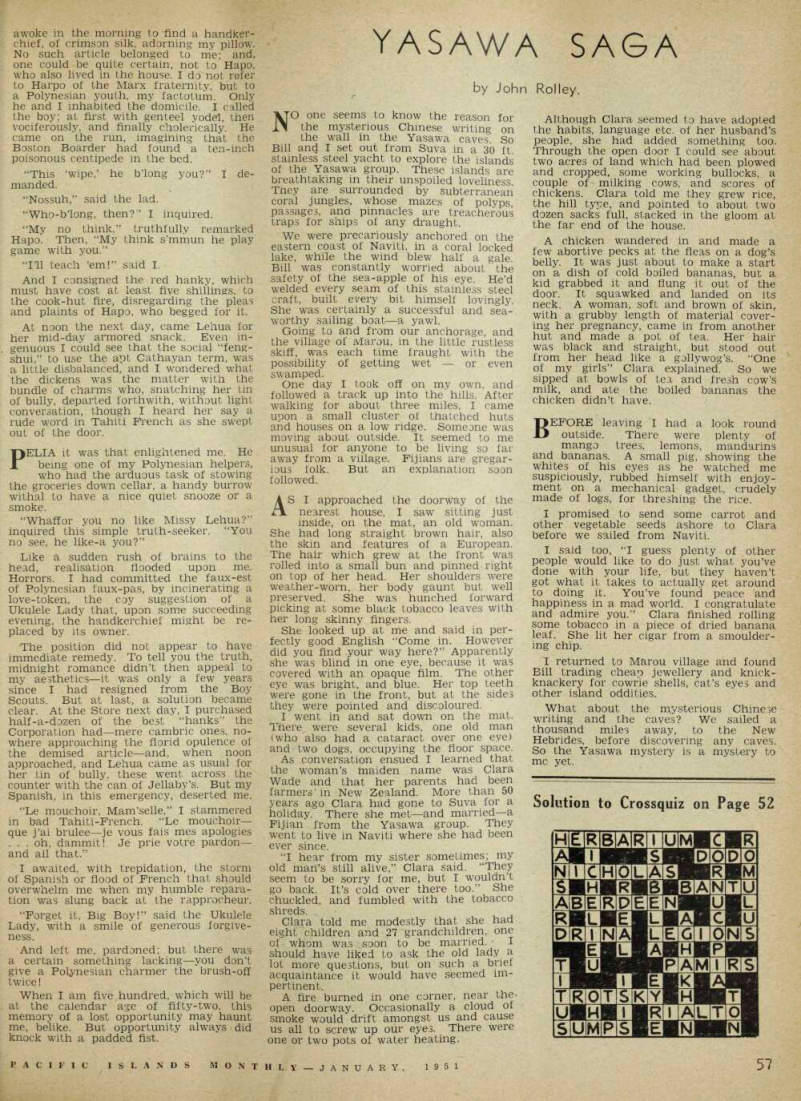
A Trader’s Tale
Mademoiselle
by "Tukapa Koko"
GONE are the days when my heart was young and gay. At four hundred and ten—mentally—one is sober, the bubble of life’s champagne no longer leaps, rainbow-hued, to the lip of the glass. Not that I ever was much of a lad, for all the stuff they write about the purveyors of canned dog, trade calico and what-all, among piles of which I. and my ilk spend our tropical working-hours, and at times no little of our leisure.
I certainly would like to go to one of these islands where life is a long and languorous day-dream, and pulchritudin ous maidens, each a virtuosa on the steel (or Spanish) guitar, drape them selves around every palm. All we seem to get out of being in my own group of islands is a nasal catarrh, incited by the smell of copra and stale fish. Ah, well, you can’t have everything!
There was once, though, a time when I very nearly got to be un diable avec les dames, as they say in gay Papeete. That was when I, a blushing ingenue, dealt out tins of Jellaby’s over the expansive counter of a great inter-island firm, and spent my evenings, in an atmosphere of cloistered monasticism (and Sunday har monium-psalmody), at the only board ing house on the island, run by an old lady whose interest in her paying guests included their souls as well as their stomachs. You don’t find many such in the Central Pacific —the average dossery is fairly masculine, and merits, more often than not, the title of The Blood House.
Not for me such wordly surroundings!
So I was not what you might call equipped to deal with the opportunity for pleasant dalliance that came my way when I later “dossed” in a room down in the Big City, where the Post Office jostles the pictures and the pictures try to crowd cut the big store of the Plonk Islands Commercial Corporation.
One always felt pushed into the sea on that crowded Beach. And there were two motor-cars, that imperilled your life on the road to the inland valley. Now there are about two hundred, and nobody seems to mind.
BUT that romance. It was brief, and it died a-bornin’. She was a luscious armful. They called her Lehua, so she may have been a Hawaiian. She hula-ed, could play the guitar, (and that not one of the “nasal” variety), and, all in all, gave one’s eye no pain to behold. As a mermaid, I fancy she would have had all the wolves in Hollvwood queueing-up. I don’t know what Lehua did for a living, but she never seemed hard-up. and her wardrobe was a box of rainbows.
This answer to a trader’s prayer was in residence not far from my bachelor room, and I saw her often in the Village.
Suffused with rosy blushes, I would sell the beauty her mid-day tin of meat, re quested in mellifluous Spanish, a language with which few in our archipelago mav claim acquaintance, and of which I happened to have a smattering.
Now, I come to recall, Lehua’s dark eyes gave me fair, speechless messages as the can of bulumakau crossed the counter, but —oh, simpleton!—one had not, at that period, got the wave-length in those matters.
When I am really senile, I fancy the thought of what a good time one could have had if one had had it, will unfit me for contemplation of the blessed Here after. Anyhow, slumbering one night, I
awoke in the morning to find a handker chief, of crimson silk, adorning my pillow.
No such article belonged to me; and, one could be quite certain, not to Hapo, who also lived in the house. I do not refer to Harpo of the Marx fraternity, but to a Polynesian youth, my factotum. Only he and I inhabited the domicile. I called the boy; at first with genteel yodel, then vociferously, and finally cholerically. He came on the run, imagining that the Boston Boarder had found a ten-inch poisonous centipede in the bed.
“This ‘wipe,’ he blong you?” I de manded.
“Nossuh,” said the lad.
“Who-b’long, then?” I inquired.
“My no think,” truthfully remarked Hapo. Then, “My think s’mmun he play game with you.”
“11l teach ’em!” said I.
And I consigned the red hanky, which must have cost at least five shillings, to the cook-hut fire, disregarding the pleas and plaints of Hapo, who begged for it.
At noon the next day, came Lehua for her mid-day armored snack. Even in genuous I could see that the social “feng shui,” to use the apt Cathayan term, was a little disbalanced, and I wondered what the dickens was the matter with the bundle of charms who, snatching her tin of bully, departed forthwith, without light conversation, though I heard her say a rude word in Tahiti French as she swept out of the door.
PELIA it was that enlightened me. He being one of my Polynesian helpers, who had the arduous task of stowing the groceries down cellar, a handy burrow withal to have a nice quiet snooze or a smoke.
“Whaffor you no like Missy Lehua?” inquired this simple truth-seeker. “You no see, he like-a you?”
Like a sudden rush of brains to the head, realisation flooded upon me.
Horrors. I had committed the faux-est of Polynesian faux-pas, by incinerating a love-token, the coy suggestion of a Ukulele Lady that, upon some succeeding evening, the handkerchief might be re placed by its owner.
The position did not appear to have immediate remedy. To tell you the truth, midnight romance didn’t then appeal to my aesthetics—it was only a few years since I had resigned from the Boy Scouts. But at last, a solution became clear. At the Store next day, I purchased half-a-dozen of the best “hanks” the Corporation had —mere cambric ones, no where approaching the florid opulence of the demised article—and, when noon approached, and Lehua came as usual for her tin of bully, these went across the counter with the can of Jellaby’s. But my Spanish, in this emergency, deserted me.
“Le mouchoir, Mam’selle,” I stammered in bad Tahiti-French. “Le mouchoir— que j’ai brulee—je vous fais mes apologies . . . oh, dammit! Je prie votre pardon— and ail that.”
I awaited, with trepidation, the storm of Spanish or flood of French that should overwhelm me when my humble repara tion was slung back at the rapprocheur.
“Forget it, Big Boy!” said the Ukulele Lady, with a smile of generous forgive ness.
And left me, pardoned: but there was a certain something lacking—you don’t give a Polynesian charmer the brush-off twice!
When I am five hundred, which will be at the calendar age of fifty-two, this memory of a lost opportunity may haunt me, belike. But opportunity always did knock with a padded fist.
Advertisements & other items, p. 58 (1 item)
56
JANUARY, 1951 PACIFI C ISLANDS MONTHLY
Yasawa Saga
by John Rolley.
NO one seems to know the reason for the mysterious Chinese writing on the wall in the Yasawa caves. So Bill and I set out from Suva in a 30 ft stainless steel yacht to explore the islands of the Yasawa group. These islands are breathtaking in their unspoiled loveliness.
They are surrounded by subterranean coral jungles, whose mazes of polyps passages, and pinnacles are treacherous traps for ships of any draught.
We were precariously anchored on the eastern coast of Naviti, in a coral locked lake, while the wind blew half a gale.
Bill was constantly worried about the safety of the sea-apple of his eye. He’d welded every seam of this stainless steel craft, built every bit himself lovingly.
She was certainly a successful and sea worthy sailing boat—a yawl.
Going to and from our anchorage, and the village of Marou, in the little rustless skiff, was each time fraught with the possibility of getting wet or even swamped.
One day I took off on my own, and followed a track up into the hills. After walking for about three miles. I came upon a small cluster of thatched huts and houses on a low ridge. Someone was moving about outside. It seemed to me unusual for anyone to be living so far away from a village. Fijians are gregar ious folk. But an explanation soon followed.
AS I approached the doorway of the nearest house, I saw sitting just inside, on the mat, an old woman.
She had long straight brown hair, also the skin and features of a European.
The hair which grew at the front was rolled into a small bun and pinned right on top of her head. Her shoulders were weather-worn, her body gaunt but well preserved. She was hunched forward picking at some black tobacco leaves with her long skinny fingers.
She looked up at me and said in per fectly good English “Come in. However did you find your way here?” Apparently she was blind in one eye, because it was covered with an opaque film. The other eye was bright, and blue. Her top teeth were gone in the front, but at the sides they were pointed and discoloured.
I went in and sat down on the mat.
There, were several kids, one old man (who also had a cataract over one eye) and two dogs, occupying the floor space.
As conversation ensued I learned that the woman’s maiden name was Clara Wade and that her parents had been farmers in New Zealand. More than 50 years ago Clara had gone to Suva for a holiday. There she met—and married —a Fijian from the Yasawa group. They went to live in Naviti where she had been ever since.
“I hear from my sister sometimes; my old man’s still alive,” Clara said. “They seem to be sorry for me, but I wouldn’t go back. It’s cold over there too.” She chuckled, and fumbled with the tobacco shreds.
Clara told me modestly that she had eight children and 27 grandchildren, one of whom was soon to be married. I should have liked to ask the old lady a lot more questions, but on such a brief acquaintance it would have seemed im pertinent.
A fire burned in one corner, near the open doorway. Occasionally a cloud of smoke would drift amongst us and cause us all to screw up our eyes. There were one or two pots of water heating.
Although Clara seemed to have adopted the habits, language etc. of her husband’s people, she had added something too.
Through the open door I could see about two acres of land which had been plowed and cropped, some working bullocks, a couple of milking cows, and scores of chickens. Clara told me they grew rice, the hill type, and pointed to about two dozen sacks full, stacked in the gloom at the far end of the house.
A chicken wandered in and made a few abortive pecks at the fleas on a dog’s belly. It was just about to make a start on a dish of cold boiled bananas, but a kid grabbed it and flung it out of the door. It squawked and landed on its neck. A woman, soft and brown of skin, with a grubby length of material cover ing her pregnancy, came in from another hut and made a pot of tea. Her hair was black and straight, but stood out from her head like a gollywog’s. “One of my girls” Clara explained. So we sipped at bowls of tea and fresh cow’s milk, and ate the boiled bananas the chicken didn’t have.
BEFORE leaving I had a look round outside. There were plenty of mango trees, lemons, mandarins and bananas. A small pig, showing the whites of his eyes as he watched me suspiciously, rubbed himself with enjoy ment on a mechanical gadget, crudely made of logs, for threshing the rice.
I promised to send some carrot and other vegetable seeds ashore to Clara before we sailed from Naviti.
I said too, “I guess plenty of other people would like to do just what you’ve done with your life, but they haven’t got what it takes to actually get around to doing it. You’ve found peace and happiness in a mad world. I congratulate and admire you.” Clara finished rolling some tobacco in a piece of dried banana leaf. She lit her cigar from a smoulder ing chip.
I returned to Marou village and found Bill trading cheap jewellery and knick knackery for cowrie shells, cat’s eyes and other island oddities.
What about the mysterious Chinese writing and the caves? We sailed a thousand miles away, to the New Hebrides, before discovering any caves.
So the Yasawa mystery is a mystery to me yet.
Advertisements & other items, p. 59 (1 item)
Solution to Crossquiz on Page 52
fashion...

gAME idea, with variations. Summer frocks in plain cottons. Both have buttoned-all-the-way-down fly-fronts and large pockets. The frock on the left has a set-in sleeve; the other, the popular extended
Advertisements & other items, pp. 60-62 (2 items)
Corner For The Children
Burns Pnilp (New Guinea) Limited
General Merchants (Wholesale and Retail)
Shipping, Customs and General Agents
Head Office: PORT MORESBY, PAPUA
BRANCHES:
NEW GUINEA: Rabaul, Kokopo, Lae Gr Madang.
PAPUA: Samarai.
REPRESENTATIVES FOR:
AUSTRALIAN AGENTS
LONDON AGENTS:
SAN FRANCISCO AGENTS:
QUEENSLAND INSURANCE CO. LTD.
LLOYD S OF LONDON
BURNS PHILP TRUST CO. LTD,
BURNS, PHILP Cr CO. LTD.
All States.
BURNS, PHILP Cr CO. LTD.
"London House", 35 Crutched Friars, E.C.3.
BURNS, PHILP CO. OF SAN FRANCISCO INC 510 Matson Building.
Distributing Agents, Territory of Papua-New Guinea for:
SHELL COMPANY OF AUSTRALIA LIMITED
Petroleum Products
GENERAL MOTORS CORPORATION
Chevrolet, Buick, Pontiac and Oldsmobile Cars Chevrolet and GMC Trucks Frigidaire Refrigerators
VAUXHALL MOTORS LIMITED
Vauxholl Cars and Bedford Trucks
R. A. LISTER Cr CO., BRISTOL
Producers of Petrol, Paraffin and Diesel Engines Pumps and Lighting plants
RUSTON HORNSBY LIMITED
Engines
CROSSLEY MARINE ENGINES
Made in the Australian Branch Factory of
BLUNDELL SPENCE & CO., LTD., Hull,
B. Cr S. SUPER PREPARED PAINT embodies the knowledge and experience gained from nearly 140 years of Paint manufacture.
Tested and proved for tropical conditions, B. & S. PREPARED PAINT is also available in a special Lead-free series for use in volcanic and other sulphurous regions. (Specify B. & S.-Series 2301).
Ask for supplies of these and other BLUN- DELL Paints and Enamels from your local Storekeeper, or write for particulars and colour-cards to the Agent for Pacific Islands :
KERR BROTHERS PTY. LTD
255 a GEORGE STREET, SYDNEY
Death Of Mrs. Kaad
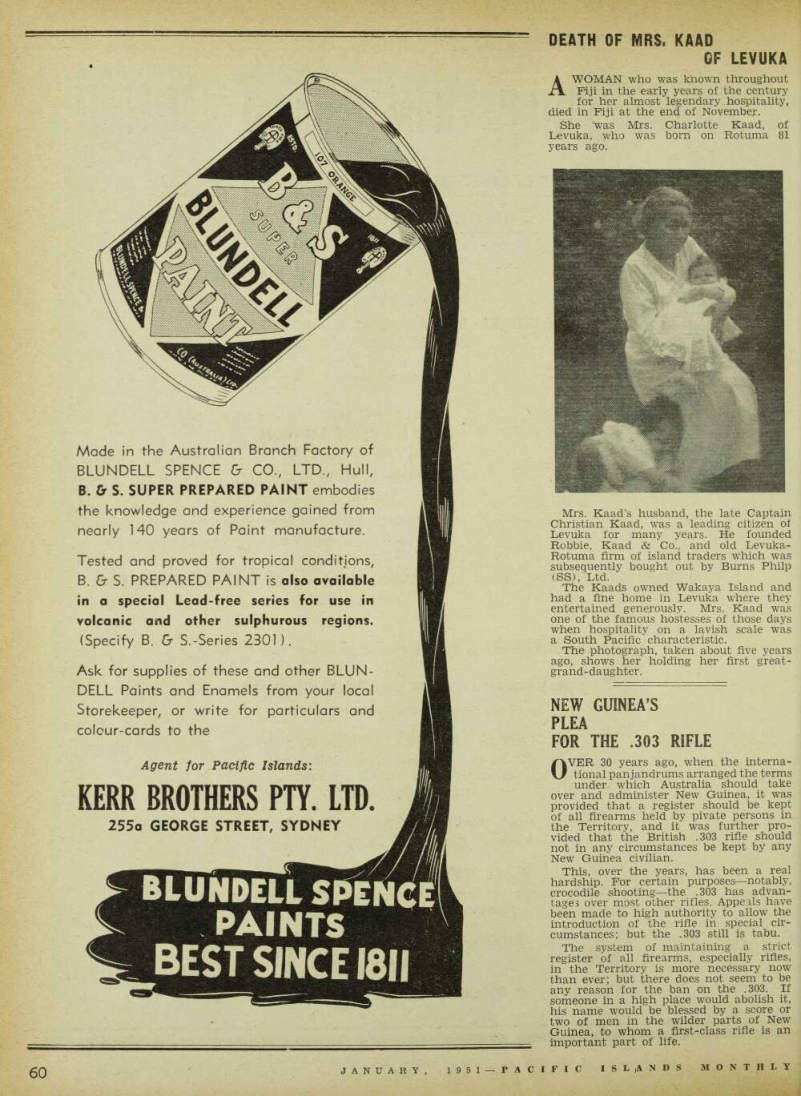
Of Levuka
A WOMAN who was known throughout Fiji in the early years of the century for her almost legendary hospitality, died in Fiji at the end of November.
She 'was Mrs. Charlotte Kaad, of Levuka, who was born on Rotuma 81 years ago.
Mrs. Kaad’s husband, the late Captain Christian Kaad, was a leading citizen of Levuka for many years. He founded Robbie, Kaad & Co., and old Levuka- Rotuma firm of island traders which was subsequently bought out by Burns Philp (SS), Ltd.
The Kaads owned Wakaya Island and had a fine home in Levuka where they entertained generously. Mrs. Kaad was one of the famous hostesses of those days when hospitality on a lavish scale was a South Pacific characteristic.
The photograph, taken about five years ago, shows her holding her first great grand-daughter.
New Guinea’S
Plea
For The .303 Rifle
OVER 30 years ago, when the interna tional panjandrums arranged the terms under which Australia should take over and administer New Guinea, it was provided that a register should be kept of all firearms held by pivate persons in the Territory, and it was further pro vided that the British .303 rifle should not in any circumstances be kept by any New Guinea civilian.
This, over the years, has been a real hardship. For certain purposes —notably, crocodile shooting—the .303 has advan tages over most other rifles. Appeals have been made to high authority to allow the introduction of the rifle in special cir cumstances; but the .303 still is tabu.
The system of maintaining a strict register of all firearms, especially rifles, in the Territory is more necessary now than ever; but there does not seem to be any reason for the ban on the .303. If someone in a high place would abolish it, his name would be blessed by a score or two of men in the wilder parts of New Guinea, to whom a first-class rifle is an important part of life.
Ng Tea Prospects
THE following was issued recently by the Australian Tea Bureau; The latest reports from New Guinea are that the bushes are doing well and producing what should be good tea.
Aiyura, where the experiments are being tried, is 6,000 feet above sea level. The soil is friable and suitable and the alti tude should produce the best, but tea is an exacting crop, requiring a high degree of skill, knowledge and mechanisation.
A staff of two per acre is the accepted number employed in Ceylon, and to grow tea commercially and make a profit, 400 acres is required. Labour conditions will be a difficulty in NG if tea-growing passes beyond the experimental stage, but while there should be no obstacle in growing the leaf successfully, the manufacture calls for highly complex rolling machines, firing and sorting plant which, besides being very difficult to obtain, are ex tremely costly.
At present, NG leaf is either rolled by hand, a very unsatisfactory method, or rolled in a small-scale hand-operated rolling machine. Fermentation presents few difficulties, but without a firing machine, the leaf has to be left for four to five hours in bright sunlight to dry.
With tropical showers always likely, a good deal of leaf is spoilt.
Tea growing in New Guinea is in its infancy, with no prospects at present.
Mr. Edward Hunkin USN veteran and son of the late Chief of Police of American Samoa, Chief Ma’ilo (Jack Hunkin), has been appointed Postmaster for American Samoa by President Truman. Mr. Hunkin is the first Federal official in the area to be locally born and of Samoan ancestry.
When Mr. Daly, an Australian Labour Member, on December 5, severely criticised the condition of native hospitals in Papua-New Guinea, the Territories Minister (Mr. Spender) said that Australia proposed to spend £7,000,000 in the next five years on overcoming the “desperate” hospital shortage in the Territories.
Mrs. Alex D. Fauth, of Central High lands, New Guinea, has been ill in Sydney, but has now recovered. She and her husband volunteered over three years ago to go as lay workers to the Society of the Divine Word Mission in NG. Mrs.
Fauth has been teaching the native girls and Mir. Fauth has been supervising building work.
Advertisements & other items, pp. 63-64 (1 item)
Nelson & Robertson Ki
-—' for
aerodromes
and other large areas.
50 acres a day can easily be cut with a Ransomes Quintuple Mower drawn by a tractor, and even larger outfits up to 25 ft. wide are available.
This enormous capacity makes Ransomes Gang Mowers indispensable to all controlling aerodromes, large sports grounds, etc., requiring frequent cutting. With no other machine could these large areas be kept in such good condition.
Sizes: Triple 7 ft., Quintuple liy 2 ft., Septuple 16 ft., up to 11 units—2s ft. wide. Also a sulky mower 30 in. wide for hilly land.
ansomes
GANG MOWERS
We illustrate our standard machine.
For long grass and heavier work, we offer the “ Magna - Gang ” pattern.
Illustrated catalogue showing a complete range of hand, animal draught and motor lawn mowers will be sent on application.
MORRIS
HEDSTROM LTD.,
Suva, Lautoka and Ba.
RANSOMES, SIMS & JEFFERIES, LTD., Ipswich, England
NELSON and ROBERTSON Pty. Ltd.
Established 1895
Shipowners - Brokers and
islands Merchants
All classes of Merchandise purchased at Best Wholesale Prices. Original Invoices supplied to Island Clients. Cocoa Beans, Copra, Rubber, Trochus Shell and All Islands Produce Sold on Commission.
Entrust your requirements to the firm with fifty-five years' practical experience in the Pacific Islands.
Prompt attention given to all inquiries
NELSON & ROBERTSON Ki
12 SPRING STREET, SYDNEY, AUSTRALIA
Telegraphic Address: IVAN, SYDNEY.
Est. 1887. ESTABLISHED OVER 60 YEARS.
ANDREW M C GEE
SYDNEY'S FOREMOST TOBACCONIST.
1 CASTLEREAGH AND 70 PITT STREET,
SYDNEY.
NIMROD DRYSMOKER PIPES £l/7/6
And Housing
In Defence of Works
Letter to the Editor WITH regard to Mr. Robson’s article in the November PIM re the Department of Works and Housing and its personnel, the following facts are supplied:— In the first instance, the state in which Lae and Rabaul were left in 1946 was a disgrace to any military organisation.
The W. and H. Department essayed the job of rehabilitation with very little equipment. It was necessary to scrounge in scrub, kunai and caves to garner equip ment to carry on. W. and H. personnel carried on with very little complaint until equipment gradually came through.
It is evident that Mr. Robson obtained his information by hearsay and has not given any personal observations to works being carried out. Anyone who states that the Department of Works and Hous ing has fallen down on its job evidently walks around with his eyes shut.
With regard to the winges and moans of the “Before” gentlemen of New Guinea: These men had the opportunity to obtain materials cheaply through “Disposals,” but were too lethargic to take advantage of it.
It is a very one-eyed view to brand the Department of Works and Housing per sonnel as hooligans because one or two have engaged in fisticuffs after enjoying a few drinks. There have been instances, pre-war and post-war, where the “Before” gentlemen have not conducted themselves with the decorum expected of them whilst under the influence of alcohol. Personally,
I could not wish for a more willing staff than that supplied by the Department In short, Mr. Robson does not know what he is talking about.
I am, etc.,
H. W. Scope,
Electrical Engineer, Rabaul.
Prig”
Writer Called “A Stiff-Collared Prig”
Letter to the Editor I HAVE read with interest your article “Still in the grip of the Planners,” which I am sure most people in the Territory will agree with. There is one thing though, where you are off the beaten track and that is in regard to your caustic criticism of Works and Housing workmen.
I have been a resident of Rabaul for the past three years and think I have seen more and know more of these Works and Housing hooligans you refer to than you do. For a man in your position, one would not expect to find such an outlook; and to say you are a. stiff collared prig is, in my opinion, little enough to call you.
I personally do not know you, but as one of these Works and Housing hooli gans you refer to I take umbrage at this statement of yours.
You are judging all by the actions of a few. You call these men uncouth hooli gans of the low wage-plug type. May I remind you, Sir, that it’s no disgrace for a man to be on a low wage. Many of these men in Works and Housing are good citizens, and I can say without fear of contradiction an asset to any community.
I am one of these low wage earners, being employed in Works and Housing in the humble capacity of a storeman, and that is why I take this stand against you.
I have mixed with these men both
during working hours and socially, and take this opportunity of saying from my own personal observations these men, generally speaking, conduct themselves in a manly fashion. They are law-abiding, courteous to the womenfolk, and conduct themselves as well as the next one in the clubs and places where beer is served.
It appears to me that you, Mr. Robson, look down on the fellow who dares to
soil his hands with honest toil, and place him on the lower strata of society. I would advise you to go amongst them, your outlook will be broadened. Remem ber, tough work breeds tough men, and these men building your roads and bridges are doing a darned good job in spite of blundering officialdom.
In my opinion, Sir, you are one of those snobbish “Befores” who frown on the
newcomer to the Territory and brand him a no-hoper and ne’er-do-well before he has a chance to prove himself. You may rant and rave, but you cannot retard progress; and, where a population moves in that has the greater percentage of males, you must expect things to be a little boisterous at times.
Therefore I say be fair, Mr. Robson, and do not judge the majority by the
few. Remember, in the pot of gold one always finds a pennyworth of dross.
I am, etc.,
P. A. Mackenzie, 8.E.M., J.P., F.R.E.S.
Rabaul, 7/12/50.
EDITORIAL NOTE—To which the writer of the articles replies: W & H workers were not criticised because they are manual toilers or receive low wages, but because a section of them (and by no means the majority) are “low-wage plug hooligans,” a type so debased in the social order that they lower the white man’s prestige in this tropical country by behaving and dressing in a slovenly manner and mixing on terms of equality with natives and half-castes who live as natives. The writer himself spent many of his youthful years as a manual worker.
He would be about the last man to look down on the honest toiler. The sugges tion that we sneer at W & H men in New Guinea on low wages is funny. Even the unskilled there are getting from £35 to £4O per fortnight, and are being messed for 16/6 per week. That is the burden of one of our bitterest complaints.
The majority of the W & H staff prob ably are all that Mr. MacKenzie claims them to be.
New additions to LMS staff in Papua are: Miss Margaret Woodland from Birmingham, UK; Miss Joan Phillips (Swansea.); and Miss Christina Macaulay (Glasgow).
Mr. Norman Nelson, head of the old established Sydney-Islands firm of Nelson and Robertson, Ltd., accompanied by Mrs. Nelson, left on the liner Himalaya this month on a leisurely visit to Britain and all Western European countries, in cluding Scandinavia. They plan to return, about October, on one of the Swedish freighters which carry a few passengers.
Advertisements & other items, pp. 65-66 (1 item)
Saves Man-Hours
An Ideal Gift. .
WHERE THE TRADE
WINDS BLOW’
COLLECTION of fascinating tales and sketches of the South Pacific Islands by R. W. ROBSON
and JUDY TUDOR.
Well Bound and Profusely illustrated.
Price: 7/6, or 8/- post free.
From any large book store, or from Steele’s Book Store, Suva, or from —
Pacific Publications Pty. Ltd.
Union House. 247 George St., SYDNEY.
“ONE MAN AND A FERGUSON”
SAVES MAN-HOURS
With an implement for every farm task, the world famous Ferguson tractor is built for the tougher jobs.
The Ferguson is a complete mechanised system—tractor and implement working together as a single integral unit by means of a 3-point linkage and automatic hydraulic control. It is ideally adaptable to industrial requirements with a power take-off shaft easily convertible to drive a machine. In both small and large scale farming, the Ferguson System will save YOU time, work and money.
irm
y $ Included in the wide range of implements available, is the all-purpose hydraulic trailer.
With a capacity of 3 tons, the trailer eliminates need for secondary transport. Hydraulic operation raises and lowers the tray in a matter of seconds.
Distributors for Papua and New Guinea:
BURNS PHILP (NEW GUINEA) LIMITED
Send your inquiries to the nearest branch at PORT MORESBY • SAMARAI • MADANG • LAE <
RABAUL
Scott’s “Renown” Brand Rope,
Cordage and
Binder
Cable Address; Ropeyard, Sydney.
V'
Twine
of Every
Description
MANUFACTURED AT
MASCOT, N.S.W.
By
J. SCOTT
PTY. LTD.
Head Office and Store
163 CLARENCE STREET,
SYDNEY,
N.S.W.
A. H. BUNTING LIMITED
SAMARAI PAPUA
Branches at: MISIMA, TUFI, ORO BAY, SOPUTA.
SOLE AGENTS IN PAPUA/NEW GUINEA FOR
SAMARAI AGENTS FOR:
Vacuum Oil Co. Pty., Ltd.
South British Insurance Co.
National Mutual Life Association Polarizers (U.K.), Ltd.—Polaroid Sun Glasses.* C.S.A. Industries, Eng.—Dual Freeze Refrigerators.
Webley & Scott, Ltd.—Shot Guns, Air Pistols, etc.
E. K. Cole, Ltd., London.—“Ekco” Radio Receivers.
“Getula.”—Nylon Monofilament Fish Lines.
Davison Paints, Ltd., N.S.W.—Paint for Tropical Conditions. • Trade mark patented in U.8.A., Great Britain, and other countries.
REGULAR SUPPLIES OF EASTERN GOODS
WHOLESALE & RETAIL MERCHANTS IMPORTERS PLANTERS
Bad Bsi Copra: Planters’
Defence
(A Letter to the Editor)
THE Solomon Islands planter finds the going very tough these days, and envies his brother planters in more favoured parts of the Pacific.
Our latest “smack in the eye” is a sudden blitz by the local Department of Agriculture at Honiara on the quality of copra being sent in. Some planters have had many hundreds of bags “knocked back” in one go.
The 8.5.1. P. Government employs native “inspectors,” There was room for much improvement in the quality of 8.5.1. P. copra and no one knew that more than the planters. However, Government policy in recent years appeared to put a premium on slip-shod methods. Native produced copra was lumped in and shipped side by side with plantation-pro duced copra. No attempt at grading was made, and branding of bags by planters was considered to be just a fad.
Nevertheless, to give a native “inspec tor” the right arbitrarily to reject thousands of pounds’ worth of copra, against a planter who was making good quality copra probably before the said native was born, is “going too far too fast!”
However, if the nlanters consider them selves unjustly treated in the matter they have the remedy in their own hands.
There is more than one firm in Sydney prepared to accept copra of all grades and process same on a cost per ton basis. As the 8.5.1. P. planters, unlike other planters elsewhere, did not approve and did not accept the nine-years’ British Ministry of Food agreement, it does not appear that there could be any valid 8.5.1. P. Govern ment objection to this being done. In addition, there are overseas markets ready and willing to purchase 8.5.1. P. copra at much better overall prices than the local Trade Scheme (8.5.1. P. Government agency) has ever offered.
One 'of the main factors operating against the production of high-gyade copra is the “don’t give a damn whether we work or not” attitude of casual labour.
I am, etc.,
Mug Planter.
Why No Ng Land For
New Enterprise?
Letter to the Editor WHY has the Government allowed the larger centres of Papua and New Guinea to fall into the hands of so called Town Planners? Who are such individuals that they should be allowed to hold up the go-ahead ideas of business people who would like to set up various types of business in the larger centres?
I could name a dozen or more people who would like to establish types of busi ness different from the existing houses.
They would not be competitors of firms now operating, but would be an added asset to the centre. I will state my own case.
I have been trying to get land at all the big centres, but have come up against the same old story: You cannot obtain land, as the town is in the hands of the Town Planners!
I have been working in New Guinea for 3 2 years, and I would like to obtain land for the erection of a bakery, at a place where no such business exists. But I am knocked back by the same old cry of Town Planners.
I have worked for 3J years in Bulolo, and I have not been pleased with the so-called bread. I feel I could turn out a product that could be honestly called bread; but I cannot even scratch a piece
of land to call my own, so as to erect the bakery and give good bread to the public.
In these centres plenty of building sites are lying idle, but all seem to be owned by some big company or other which does not wish to sell. Could the Govern ment bring in an Act to enforce the use of this land by taxing it solidly on un improved value?
I am, etc.,
George P. Smith.
Rabaul, 6/12/50.
Mr. Hugh Hickling, who was Resident Agent of the NZ Government in the Cook Islands over many years has now joined the administrative staff of the large Island of Niue.
Advertisements & other items, pp. 67-68 (1 item)
K. H. D. Hay
GENERAL COMMISSION
AND POSTAGE STAMP
AGENT,
GUADALCANAL, 8.5.1.
SETS OF BRITISH SOLOMON
ISLANDS STAMPS, MINT OR
CANCELLED COPIES.
Price: £l/5/- per seh
★ FOUNTAIN food products are famous throughout the South Pacific for their consistent quality and suitability of packing for tropical conditions.
You are assured satisfaction when you specify FOUNTAIN brand.
Trade inquiries are welcome and all orders are promptly despatched. m I
TOMATO SAUCE
W. C. DOUGLASS L'^"
FOVEAUX ST. SYDNEY AUSTRALIA
OTHER
FAMOUS
FOUNTAIN
PRODUCTS
FRUIT
CHUM?
iiiiilii
PLUME
pump
wm.
You'll get more for your money with Plume . . . Always insist on PLUME ® for maximum mileage and outstanding performance.
P5l 1
Preserving Our South Pacific Forests
Fire and the Plough Cause More Havoc Than the Miller
TIMBER, once regarded as a cheap building material, can no longer be regarded as such. So valuable has it become that eyes are now turning to the once inaccessible (and therefore un economic) areas of the Pacific. Timber was exported from New Caledonia, certain islands of the New Hebrides group, Vani koro, and from New Guinea before the war—but most of it was for cabinet mak ing or some other specific purpose. Now the demand is for good, plain building timber for local use as well as for export.
The greatest potential supplier of build ing timber is New Guinea, but here authority appears to have Adopted a woodman-spare-that-tree attitude that has done nothing, as yet, to alleviate the timber-hunger of the Territory itself or of Australia.
With the man-made deserts of other countries for example, this official reluct ance to give timber-millers a free hand is not surprising. But there is little evidence to support the view that milling, of itself, causes the deserts —even without any assistance from man, seedling trees spring up where the parent trees have been felled.
It is the agriculturist and grazier with their passion for rooting out the timber, for burning off, so that they may plough or graze their stock, that has reduced one half of the earth to useless, barren wastes.
The problems of forestry in the islands of the South Pa-cific are basically similar yet there appears to be wide practical differences in the approach made by the
various territories towards their timber areas.
In Papua-New Guinea, where there are valuable forests and many sawmillers avid to work them, we have a Director of Forests of whom it is said that he loves each tree individually and would rather have a tooth drawn than have one felled In Fiji, however, the Conservator of Forests goes on record to urge local con sumers to overcome their prejudice in favour of North American softwoods and Australian hardwoods and induce saw milllers to exploit the natural timbers of Fiji.
Although little has been done to utilise the timber resources of Fiji, that Colony appears to have a reafforestation and erosion problem much greater than that of N. Guinea—mainly through introduced factors impinging on the native Fijian methods of agriculture.
In a paper read to the Seventh Pacific Science Congress in Auckland last year Fiji Conservator of Forests, Mr. J. C k’
Marshall, makes a survey of forestry problems in the South Pacific area and deals with Fiji in particular. The full paper was printed in a recent issue of the Fiji Agricultural Gazette, but in view of the present shortage of timber— especially in the southern hemisphere— the points Mr. Marshall makes are worth repeating here.
Man, the Land’s Enemy
IT would not be exaggerating, he says, to state that 50 per cent, of the world’s land productivity has been
destroyed by man with his astonishing ability to overcrop, ovegraze and denude of all tree life. Nor has this destruction ceased, although most governments are aware of the consequences; more and more land is being destroyed each day by faulty management. The only factor that seems to stand between this total destruction of forest lands appears to be foresters who, Mr. Marshall says, “have been trained to take a detached altruistic
view of our forest estate. We plant so that someone, of what race or nation we know not, may reap in 100 years and may have a better life.”
In the south Pacific, land was shielded from the dangers of the Euro-Asiatic way of life that had turned Mesopotamia, Egypt, vast areas of India and China, and even America into deserts or dust bowls, until about the beginning of the 19th century. But in the 150 years since, damage has been considerable.
First came the sandalwood gatherers,
who ruthlessly tore out this valuable timber until to-day virtually no specimen remains in the lands of the S-W Pacific.
The cream of the coastal Kauri forests probably went also at this time.
Then came the cash economy in place of primitive village agriculture, which concentrated people around the large centres. Mr. Marshall here quotes Suva, with its steep sided hills where the orig inal two or three feet of soil was laid down on mudstone —locally called soap stone. It was cropped by market garden
ers until the topsoil was eroded—but the market gardeners dismissed the tragedy as “the soapstone coming to the surface” and as the area became more unproduc tive, they cut back the forest still further to grow their crops on other virgin land.
In the case of Fiji, the problem of denuding the land was increased with the introduction of Indians, for in the settling of these folk in Fiji lies the root of most of the misuse of Fiji land today.
They came from a land which had been over-cropped for centuries in order to provide a bare existence for the teeming millions and their scraggy sacred cattle.
They saw nothing strange or wrong in erosion and proceeded to treat the fertile, virgin land of Fiji as countless numbers of their ancestors had treated the land of Mother India.
Another new factor was introduced in herds of grazing cattle, to provide grass for which both Fijians and Indians cleared and burnt areas of forest. To the Hindu and other Indians, the cow is sacred and they may not kill one. Having intro duced their cattle they let them multiply without hindrance and as the Indians may have only an acre or two they are compelled to seek free range which they obtain by burning old, abandoned Fijian gardens.
Cut the Bush and “Improve”
The Land
SETTLERS in new lands, says Mr.
Marshall caustically, usually regard the timber as an enemy. They talk about “improving the land” by clear ing the bush—and when they have “im proved” it to the utmost, they have a desert. With the disappearance of trees the climate changes—approaching rain clouds are possibly dissipated by reflec tion of heat from bare hills and sandy
beaches and this results in droughts where formerly there was adequate rainfall.
Then civilized man in his dseire for commerce, interferes with nature. Hard upon the introduction of specialized crops to former forest areas, come specialized pests to prey upon them.
In Fiji rats were introduced accident ally and wrought havoc in the cane fields.
The Indian mongoose was introduced to deal with the rats, which it did, but it also cleaned out the natural ground nesting birds—birds which, presumably, had much to do with the propagation of certain forest seeds.
The interference of man with nature has far-reaching consequences; so, also, has the march of what we are pleased to call civilization. The Malayan village which formerly left a strip of forest along the river banks to hide it and its gardens from river pirates, began cultivating to the stream’s edge when British government brought fear of pirates to an end. De prived of the protection of the tree roots, the banks caved in and the rivers silted up, until today virtually all of the streams in the country are useless for transportation. Laws have been passed to prevent the clearing of river banks— but the penalties are light and do not deter as in the old days the penalty of an unpleasant death at the hands of pirates deterred.
Milling Need Not Be a National
Tragedy
AGAINST this background of what has been done to despoil the forest areas, Mr. Marshall tells us how we should use our forest assets, and how it is pos sible to tackle the job of reafforestation in a native community. Mr. Marshall puts aside the popular idea that a forest reserve is an area in which no one may fell trees, and that a Conservator of Forests is the official who sees that it is kept inviolate. He feels that it is not wrong to bring the virgin forests into production, for, in its virgin state, a forest is producing nothing towards world economy. If a forest is not ruthlessly exploited, but is tended properly, the volume of timber available per acre on :he maturity of the second crop, will be nuch more than that of the first natural forest.
He thinks that an organised timber ndustry in Fiji would not sound the leath knell of the forest lands, but, on the contrary, that this would be the solution :o reafforestation in the Colony which las already been denuded of a great deal )f its timber lands, not by a timber in iustry, but by the wastefulness and gnorance of those who have used the and —taking all, giving nothing.
He thinks that only when Fiji has a prosperous timber industry, able to con iribute to government revenue, will the country be able to afford the cost of re forestation of the now barren acres, rhe idea that a tree should be planted jefore the parent tree is felled does not ;eem to be borne-out in practice, at least is regards Pacific Kauri where seedlings ;eem to be killed off by competition from he parent tree.
The replanting of Fiji’s bare hillsides vhich should have been kept under forest, vould take a 100 years if the impossible ■arget of 300 acres per day were replanted n each day of the wet season. If the ;arget were reduced to 30 acres a day in ;he wet season, the scheme would take years and still cost more per annum ;han any Fiji government is likely to contemplate.
Instead of this impractical scheme, Mr.
Marshall suggests that a modified Bur nese Taung-Ya scheme be adopted,
wherein the native cultivators fell and burn the scrub for their gardens in the traditional way but are provided with seedling trees in bamboos which they plant at 6 ft. x 6 ft. or 10 ft. x 10 ft. intervals with their food crops. When the time comes for the garden to be abandoned for a new site, the Forestry Officer inspects and if a good proportion of the seedling trees have survived, the cultivators are paid at the rate of say, £2 per acre. By this means the typical South West Pacific method of native agri culture, called shifting cultivation, may become the standard method of reaffor estation.
Sir Maynard Hedstrom, of Fiji, is spend ing the summer months in New Zealand.
Advertisements & other items, pp. 69-72 (4 items)
67
•ACIFIC ISLANDS MONXHLY-JANUARY. 1951
Steamships Trading Company Ltd.
-4 \ “UNDERSEE” Swimmers’ Masks—fit any face comfortably.
“LOXIN” Underwater Guns are Accurate, Powerful and Safe.
Double pressure trigger with safety catch within trigger guard. Synchronised line discharge. Bayonet and line reel.
Standard (2 rubbers) Super (4 rubbers) Knives, Safety Lead Belts, Handspears, Swim Flippers and Breathing Tubes.
ENQUIRE FROM YOUR AGENT OR
UNDERSEE NOVELTIES
81 Ramsgate Avenue, BONDI, N.S.W.
STEAMSHIPS TRADING COMPANY LTD.
PORT MORESBY AND SAMARAI PAPUA
Wholesale & Retail Merchants, Planters, Sawmillers, Engineers, Slip
Proprietors, Shipping, Customs and Insurance Agents.
MANAGING AGENTS for:
SAWMILLERS & TRADERS LTD.
CORAL SEAS INSURANCE CO. LTD
ACME BAKERY COMPANY.
MARIBOI RUBBER LTD.
RUBBERLANDS LTD.
KEREMA RUBBER PLANTATIONS LTD
COCOALANDS LTD.
AGENCIES:
BANKERS & TRADERS INSURANCE CO. LTD.
VACUUM OIL CO. PTY., LTD.
DIRECTORATE OP SHIPPING—Papua-New
Guinea Division.
ROYAL INTEROCEAN LINE.
KOKE BAGU PTY., LTD.
TRANS OCEANIC AIRWAYS.
DISTRIBUTORS IN PAPUA for:
ARMSTRONG-HOLLAND PTY., LTD.
Earth Moving and Logging Equipment.
WILLYS-OVERLAND EXPORT CORPORATION.
Jeep cars, etc.
HILLMAN MOTOR CARS.
INTERNATIONAL HARVESTER CO. OP AUST. LTD.
International Trucks, McCormlck-Deering Farming Machinery, Defender Refrigerators.
SYDNEY AGENTS: NELSON & ROBERTSON PTY. LTD., 12 SPRING STREET
A Guaranteed Sanitary System
Approved by the N.S.W. Board of Health.
THE HYGEIA DISSOLVENATOR
Established 1927.
No Water Supply Required
The Sewage matter is chemically transformed into a sterile solution which is absorbed by the surrounding soil.
NO FLIES
NO GERMS
NO SMELLS
NO EMPTYING
AUTOMATIC
Any handy man can install. ■ '' ■■■ Correspondence Invited.
HYGEIA SANITARY COMPANY PTY. LTD.
26-30 BRIDGE STREET, SYDNEY, N.S.W.
Phone: BU 2521 Cables; “Berbl,” Sydney
W. H. GROVE & SONS LTD.
Established 1896.
Telegraphic and Cable ISLAND MERCHANTS PO - Box 49# > Address: “Grove,” Auckland. 16-18 Fonshowc St Auckland, New Zealand.
AUCKLAND
Entrust your requirements to the firm with more than fifty years' practical experience in the Island trade.
REPRESENTING ENGLISH MANUFACTURERS
THROUGHOUT THE FIJI, SAMOAN AND TONGAN ISLANDS, NEW HEBRIDES, NEW CALEDONIA, THE SOLOMON ISLANDS, THE SOCIETY ISLANDS, THE COOK ISLANDS,
NIUE, ETC.
SHIPPERS OF ALL CLASSES OF NEW ZEALAND MANUFACTURES AND PRODUCTS SPECIALLY PREPARED FOR THE ISLAND TRADE WE HANDLE ALL KINDS OF ISLAND PRODUCE.
IN FIJI as: W. H. GROVE & SONS (FIJI) LIMITED.
Office and Sample Room; Bank of New South Wales Chambers, Suva, Fiji.
ART POSTCARDS OF
TONGA
Per Dozen (Including a Tin-Can Mail Cover), Postage Paid: 6/- (or one US Dollar).
TONGAN PHOTOS BUREAU
Nukualofa, Tonga
Throughout
the
South-West Pacific
Os I The development of the South-West Pacific Area has been fostered by the Bank of New South Wales since 1817. To-day, comprehensive hanking, travel and trade introduction services are provided in Australia, New Zealand, Fiji, Papua and New Guinea by over 800 branches and agencies of the Bank. Residents of, and visitors to the Islands are invited to avail themselves of the “Wales” complete banking service at the following points:— FIJI Branches Suva, Lautoka Agencies Ba, Nadi Airport, Vatukoula PAPUA Branch Port Moresby NEW GUINEA Branches Lae, Rabaul ' - - Wu 4 Bank of New South [Tales Suva Branch
Consult and use
BANK OF NEW SOUTH WALES
Head Office Sydney. Australia FIRST AND LARGEST COMMERCIAL BANK IN THE SOUTH-WEST PACIFIC (Incorporated in New South Wales w»U limited liability)
JMSOOT
TAKE YOUR CHOICE ..
. . . From this list of quality canned foods. Packed by the largest meat-processing company in Australia, the Imperial label brings you the Quality meats, \ right to your table —tasty hot meals and cold meats ready for any occasion. Stock up with Imperial, the Flavour Sealed Quality Foods.
It ♦
HOT PACKS. \ SAUSAGES.
ding. 16-oz. Irish Stew. , 16-oz. Braised Beef Steak Stew. 16-oz. Bacon Rashers. 16-oz. Steak & Tomato. 12-oz. Meat & Beans. 16-oz. Sausages & Vegetables, x g oz Tomato Soup . !2-oz. Savoune. . ... \ 8-oz. Vegetable Soup. 4-oz. Meat and Spaghetti. \ 8-oz. Clear Beef Soup. v/Aiui u uauoagco, 16-oz. Cambridge Sausages. 16-oz. Pork Sausages. 16-oz. Vienna Sausages. 10-oz. Vienna Sausages. 4-oz. Vienna Sausages.
SOUPS.
COLD MEATS.
12-oz. Luncheon Pork. 12-oz. Trim (Pork & Beef). 12-oz. Camp Pie. 12-oz. Hampe. 12-oz. Meatreat 12-oz. Corned Beef W/C. 12-oz. Taper Corned Beef 6-lb. Slicing Beef. 6-lb. Taper Corned 6_ib[ Taper Corned Beef m 4-oz. Camp Pie. lH 4-OZ. Hampe. ll 4-oz. Beef Snack.. 3l-oz. Pate de Foie. 10-oz. Tomato Sauce. ■■ 3f A m* m : / J 1 1 Beef Bis
DRIPPING & LARD.
1-lb. tins Lard. 16-oz. tins Dripping. 1-lb. pats Dripping. 36-lb. Dripping.
CANNED FISH.
4-oz. Flair Fish Cutlets. 8-oz. Flair Fish Cutlets. 12-oz Flair Fish Cutlets. lli°-oz. Flair Squab in Aspic 11-oz. Flair Fish Paste. 8-oz. Flair Scallop Luncheon.
TONGUES.
12-oz. Sheep Tongues. 12-oz. Lamb Tongues. 12-oz. Calves Tongues. 6-lb. Ox Tongues. 2-lb. Ox Tongues.
MARGARINE.
56-lb. Boxes Cake Margarine. 56-lb. Boxes Pastry Margarine.
RIVERMEDE” BUTTER.
56-lb. Boxes Bulk Butter. 16-oz. Pats Butter.
I-lb. Pats Butter. 12-oz. Tins Butter. 16-oz. Tins Butter.
Orange Orange
26 oz. “CAWSEY’S
CORDIALS.
Double strength Squash.
Single strength Squash.
Double strength Squash.
Single strength Squash. . 1 Double strength 100 per cent. * (Lemon & Orange).
Single strength 100 per cent. (Lemon & Orange).
Single strength Lime Juice.
PACKET BREAKFAST
FOODS.
8-oz. Purina Crispies. 24-oz. Purina Crispies 12-oz. Purina Weatall cuits.
SWEET PUDDINGS.
16-oz. Plum Puddings. 12-oz. Jam Pudding. 12-oz. Chocolate Pudding. 12-oz. Ginger Pudding. ■ ■■ v -, /mm
RIVERSTONE MEAT CO. PTY
-mamm ma* mm* i i £ ' • * -V" %
‘SSsu
I J mg mm
LTD.
SYDNEY
Lemon Lemon
MILDURA FRUIT
JUICES.
16-oz. Grapefruit Juice. 16-oz. Orange Juice.
CANNED FRUITS.
16-oz. Prunes (Dry Pack) 30-oz. Cherries. 20-oz. Raspberries. 20-oz. Gooseberries. 20-oz. Loganberries. 20-oz. Plums.
5-7 O’CONNELL STREET,
69
PACIFIC ISLANDS MONTHLY - J A N U A BY. 19S1
January, 1951-Pacific Islands Monthl
Events In French Oceania
Prom Our Own Correspondent
New Governor Arrives
Papeete, Dec. 8.
The Papeete waterfront was thronged on the morning of December 7, when the new Governor, M. Petitbon, arrived on the motorship Thor I. He was given a warm welcome. Madame Petitbon and their two children will arrive soon. Although he is only 35, M. Petitbon has a reputation, gained in Africa, as a strict disciplinarian.
Old hands say, however, that if he is to use any sort of authority outside of his own, he will find that he will be recalled, like most of his predecessors. “Go easy in Tahiti if you want to win,” is a time worn axiom here.
Two New Ships For Pacific
The headquarters of Messageries Mari times, in Paris, have announced that the keels of two new vessels, each of 10,500 tons have been laid at Brest and Dunkirk, respectively. The new ships will be named the Tahitien and the Caledonien. Each will have accommodation for 100 first class, 100 second-class and 200 steerage passengers. When completed, they will be put on the run Marseilles—Guade loupe—Martinique— Panama Tahiti New Hebrides—Noumea—Sydney, and will return the same way.
Tahiti’S New Aero Club
The Tahiti Aero Club was inaugurated in Papeete on November 5, when the Club’s two planes were christened—a Grumman being named Manurewa by Madame Yves Martin, and the smaller Aeronca plane Vini, by Madame Andrea de Balmann. A large and interested crowd packed the Esplanade, facing the Naval Station; and the occasion was marked, that evening by a grand ball, held on the recently completed Bir Hackeim quay.
As Tahiti is still without regular air
communication with the outside world, these planes may prove of great value.
For example, the Grumman flew recently to Aitutaki, in the Cook Islands, and brought back to Tahiti a lot of air mail that had accumulated there.
Survey Ship For Tahiti In 1951
Word has been received that the Danish survey ship Galathea will call at Papeete in 1951 on her world cruise. She is in command of Captain Dr. Anton Bruun who, in 1929, commanded the Danish sur vey ship Dana. This will be the second survey ship to call at Papeete recently— the Swedish four-masted schooner Albatross was here in 1946.
Assembly In Session
On November 13, the last session of the Representative Assembly was opened by the Acting Governor, M. Louis Girault.
He was accompanied by the Consuls of Great Britain, Norway, Belgium and China, and by Naval and military officials, and City Councillors (headed by the Mayor, M. Poroi).
M. Girault thanked the Assembly repre sentatives for the way they had handled the affairs of the year; but, from right to left, he spoke very critically of the fonctionnaires.
Senator Lassalle-Sere In Tahiti
When MS Orohena returned from Suva on November 18, it brought Senator Lassalle-Sere, Dr. Massal (head of the Medical Department of the South Pacific Research Council), M. d’Astier De La Vigerie (of the Service d’lnformations), M. Rene Pailloux (Papeete merchant), and M. Sachet (a cyclist, of Tahiti, who went to Noumea to race). From Apia, she brought Dr. Guillemin, Mr. H. Love (radi ologist) and Miss Barf our (bacteriologist), of the South Pacific Commission staff.
Death Of Edmond Walker
Mr. Edmond Walker, a prominent mem ber of Papeete’s British community and son of an English pioneer family, died on November 15, after a long illness. He is a brother of Mr. Isaac Walker, who runs a shipbuilding yard at Fareute, and was at one time British Vice-Consul ht Papeete. The late Mr. Walker was a member of a family of 10 children and is survived by three sisters and two brothers. (Continued Next Page.)
Weddings
On December 7, Lieut, de Vaisseau, M.
Francois Vallaux, was married to Miss Iris Carlson, daughter of the well-known port pilot, M. Louis Carlson, of Papeete.
After the ceremonies at the Catholic Cathedral, a cocktail party was held at Les Tropiques. Among numerous guests were the Acting Governor and officials of the Navy, Army and Administration.
On September 30, M. Jules Rey, of Papeete, gave away his daughter Norine, to be married to Mr, Homer Morgan, an American, and son of Dr. Homer K.
Morgan. The wedding was celebrated at ™ any § u^ s and the reception at the home of Mr. Rey.
New British Consul
117 E have been advised officially that a f f new British Consul has been appointed to take the place of Mr.
Charles Henderson, who resigned a few months ago owing to ill-health, and went to New Zealand. The new Consul is to leave England for Tahiti on December 23. Mr. Walter Asmus, Vice-Consul, is in charge of this office at present.
Advertisements & other items, pp. 73-74 (1 item)
first fa fatsfft
Allen Taylor & Co. Ltd.
COMMERCIAL ROAD, ROZELLE
SYDNEY
Sawmillers and Wholesale Suppliers of Hardwoods for Constructional Purposes GIRDERS . . . PILES . . . POLES . . . SLEEPERS, Etc.
EXPORTING TO PACIFIC ISLANDS SINCE 1893
V
first fa fatsfft
’ * j fjiffst them „„•. - #- «- o. - r
TOOTH’S
BREWED and
UGER
OTTLED
BY
TOO
th & CO. limited
TAK£ WNCCHrt A.P.C
CONfO* NCe
m \\ X wm WM.
BANISH
tu.
(PINK)
LLL
POWDERS
& TABLETS!
Vincent's original hospital formula is available in either powders or tablets. Two tablets equal one powder in dosage.
Proved Safest & Best For Over 30 Years!
The medical profession and public have had confidence in Vincent's a.p.c for over 30 years! Vincent's continued success is founded on Vincent's prescription! This formula is your safeguard!
Quick Relief From
Headache
Neuritis, Neuralgia
Vincent’s a.p.c is the only a.p.c prepared to the original hospital prescription! From the very first dose you will get safe, sure, relief from Headache and all nerve and muscular pain! You will feel better and brighter in a few minutes!
SWIFT 3-WAY RELIEF!
1. Relieves the pain! 2. Reduces temperature! 3. Stimulates the nervous system!
SAFE! SPEEDY! RELIABLEI
VINCE
Fiji News In Brief
From Our Own Correspondent
Suva, Dec. 29.
rE executive of the New Zealand Rugby Union is to arrange for a representative Fiji team to play 10 matches in New Zealand next season.
The Fijians, who performed well on their last visit in 1939, are expected to prove an attraction to NZ Rugby fans.
The New Zealand Rugby Union will meet all the expenses of the tour, includ ing transport both ways, but will not allow Fiji to share in the gates.
THE charm and variety of Fiji’s tropical scenery was admirably portrayed and 'recaptured by Messrs. Russell Fore man and Alfred Stone, whose exhibition of oil paintings was on view in the Grand Pacific Hotel early in December. More than 150 persons attended the official opening.
THE Roman Catholic Congregation of the Sisters of Compassion, which was founded in New Zealand last cent ury by the late Mother Aubert to care for destitutes and incurables, is to extend its activities to Fiji. The Order has ac quired the home and property of Sir Hugh and Lady Ragg at Tamavua for its head quarters.
DR. and MRS. CATALA arrived at Suva on December 6, from Noumea, for consultations with officers of the Western Pacific High Commission and Fiji Department of Agriculture before going on to Tarawa, later in the month, Dr. Catala, who is chief of the Labora tory of Ecology at the French Oceanic Institute, Noumea, has been selected by the South Pacific Commission to carry out a pilot investigation involving a “study of atoll and low island economy designed to improve cash and subsistence crops and handicrafts, to widen commer cial opportunity and provide greatei security for island people.”
Mrs. Catala is also a scientific worker The project will occupy between six and nine months and, it is hoped, will provide basic information of great value to all administrations concerned with the economic and practical problems of lo"w islands.
THREE members of the Indian delega tion to the Commonwealth Parlia mentary Conference which was held recently in New Zealand, arrived at Suva from Auckland on December 5, for a three-day visit on their way back to India. They were Seth Govind Das, Shr: R. Venkataraman and Shri D. K. Borooah Receptions and entertainments wen arranged for them by Indian organisa tions on Viti Levu.
RATU SIR* LALa’sUKUNA, who left
Fiji last September to attend the General Assembly of the Unitec Nations in New York as a member of the United Kingdom delegation, returned tc Fiji on December 16. He came back via the UK and Australia.
Ratu Sir Lala Sukuna was granted a private audience with the King, in London, on December 7, and earlier, m his capacity of Honorary Colonel of the Fiji Military Forces, presented a tabua tc the King’s Royal Rifles to which volun teers from Fiji were attached in the 1914- 18 war, and which recently entered intc an alliance with the Fiji Military Forces Interviewed in Sydney, on his way back to Fiji, Ratu Sir Lala said that small powers at the United Nations spent a lot of time criticising conditions in territories administered by the big powers, but deeply resented unfavourable comparisions be
tween conditions in non-self-governing territories and their own lands.
Peru, for instance, criticised native con ditions in some places strongly, while it neglected its own large Indian population.
BECAUSE of the interruption of ship ping caused by Australian water siders’ strike at the end of last year, stocks of flour in Fiji were low in Decem ber. Many bakeries in Suva and Lautoka baked reduced quantities of bread to con serve stocks until fresh supplies arrived at the end of December.
TO help with the large quantity of par cels that are coming into Fiji, par ticularly over the Christmas season, a new building of a temporary nature has been erected behind the Suva Post Office.
This will be a help to the staff of the Parcels Office, who have had to work overtime night after night in an endeav our to clear the parcels before the next ship arrived.
RADIO receiving and public address equipment has been installed at Tamavua tuberculosis hospital by the radio section of the Posts and Tele graph Department. Loud speakers have been provided in all the wards and pro vision has been made for the use of a microphone to make announcements to patients, and to call members of the staff.
Programmes are received on a central re ceiver and relayed to the patients.
The cost of the equipment was met partly from Medical Department funds and partly from the War Memorial Anti- Tuberculosis Fund. 11 11/ ;i SIR CHRISTOPHER COX, educational adviser to the Secretary of State for the Colonies, is visiting Fiji.
During his stay he will discuss educa tional matters and visit a number of schools and other educational institutions.
LAUTOKA police have received a report that a party of five Europeans— three men and two women—were assaulted by a number of Indians at Saweni Beach in the early hours of December 27. The party of five had been
swimming and on returning to their car noticed six or eight Indians talking at the rear of the vehicle. Without warning, several of the Indians hit the European men with sticks, and while trying to enter the car one of the women also received a blow, The Indians then chased the party along the road for several hundred yards.
Police are investigating.
Advertisements & other items, pp. 75-76 (1 item)
Batteries
&E 1 Stewarts and Lloyds (Australia) Pty. Ltd.
Manufacturers of "S&L" PIPES and FITTINGS for GAS, WATER, STEAM and other purposes.
AND Distributors of:
MILD STEEL BARS, PLATES and SECTIONS:
GALVANISED IRON; BOLTS and NUTS; ELECTRODES
and WELDING EQUIPMENT.
Stewarts and Lloyds (Australia) Pty. Ltd.
SYDNEY WAREHOUSE - - Herbert Street, St. Leonards BRISBANE WAREHOUSE - Montague Road. South Brisbane MELBOURNE WAREHOUSE - - City Road, South Melbourne Telegraphic Address: "Tubes ' — Sydney, Brisbane or Melbourne
(V 3)) 'V /J □ ra
BATTERIES
are tigers for work
99 It is impossible to build a better battery than the Masse. Every part of a Masse Battery is of one hundred per cent, quality . . . every stage of its manufacture is carried out in the Masse factory. When you recommend a Masse Battery to your customer, you can do so, with the utmost confidence that it will give him more starts and longer service.
ROBERT GILLESPIE LTD
RABAUL AND LAE
BURNS PHILP (SOUTH SEA) Go. Ltd.
Registered Office: SUVA, FIJI
Code Address: “BURNSOUTH”
ISLAND TRADERS AND SHIPOWNERS
General Merchants (Wholesale and Retail)
Shipping, Customs and General Agents
Representatives for:
QUEENSLAND INSURANCE CO., LTD. BURNS PHILP TRUST CO., LTD.
Distributing Agents for :
SHELL COMPANY (P. 1.), LTD. FERGUSON TRACTORS STANDARD MOTOR CAR COMPANY CROSSLEY MARINE ENGINES
BRANCHES:
FIJI—
SUVA.
LEVUKA.
LAUTOKA.
LAB AS A.
BA.
SIGATOKA.
ROTUMA ISLAND.
NORFOLK IS.—
SAMOA—
APIA.
PAGO PAGO.
TONGA-
NUKUALOFA.
HAAPAI,
VAVAU.
NIUE IS.—
Sydney Agents:
BURNS, PHILP & CO.. LTD.,
7 Bridge Street.
London Agents:
BURNS. PHILP & CO . LTD.,
35 Crutched Prlars, E.C.3.
San Francisco Agents:
BURNS. PHILP CO. OP SAN FRANCISCO.
Matson Building, 315 Market Street.
Agencies ut the World.
Call for a The Favourite Beer, Matured but freshly bottled Brewed tr Bottled by
§>an illiftuel Mtemvp
Hongkong, lUi».
Obtainable from: e«M f
ALOIS AKUN & COMPANY
RARAIIL
The Pioneering Patons
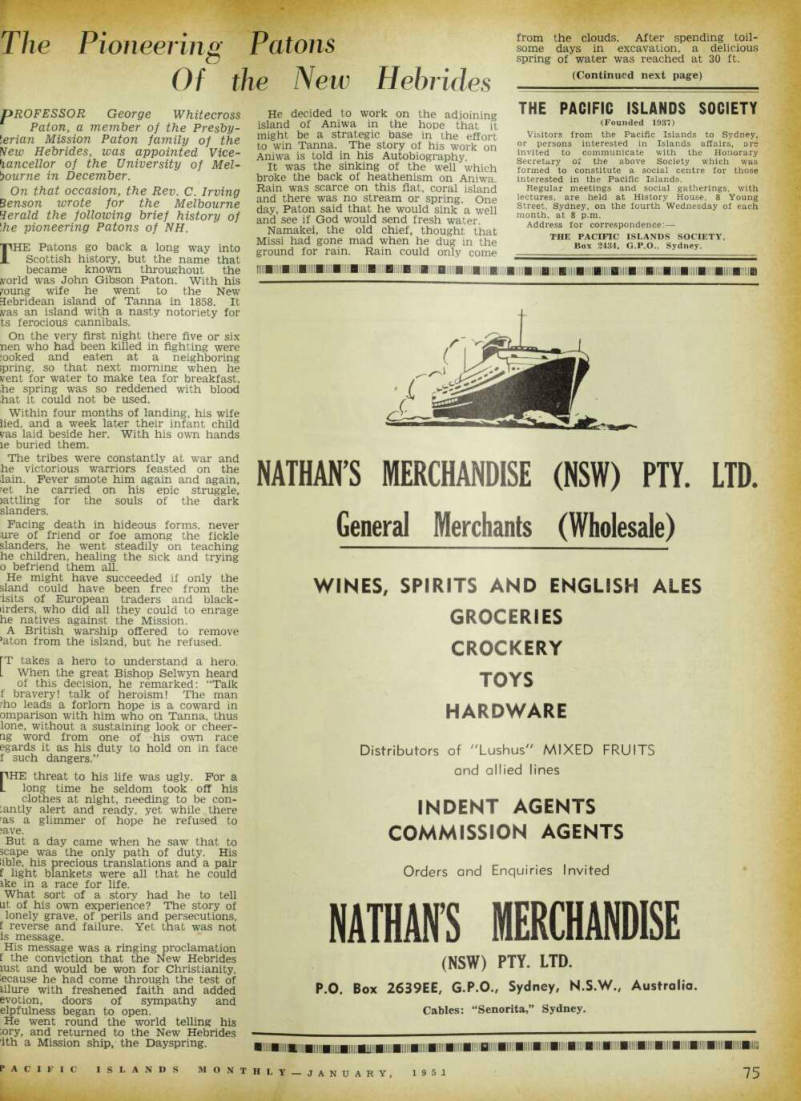
Of the New Hebrides
pROFESSOR George Whitecross
Paton, a member of the Presby
terian Mission Paton family of the
New Hebrides, was appointed Vice
hancellor of the University of Mel
bourne in December.
On that occasion, the Rev. C. Irving Benson wrote for the Melbourne
Herald the following brief history of
the pioneering Patons of NH. rHE Patons go back a long way into Scottish history, but the name that became known throughout the vorld was John Gibson Paton. With his foung wife he went to the New Hebridean island of Tanna in 1858. It vas an island with a nasty notoriety for ts ferocious cannibals.
On the very first night there five or six nen who had been killed in fighting were looked and eaten at a neighboring spring, so that next morning when he vent for water to make tea for breakfast, he spring was so reddened with blood hat it could not be used.
Within four months of landing, his wife lied, and a week later their infant child vas laid beside her. With his own hands le buried them.
The tribes were constantly at war and he victorious warriors feasted on the lain. Fever smote him again and again, ret he carried on his epic struggle, jattling for the souls of the dark slanders.
Facing death in hideous forms, never ure of friend or foe among the fickle slanders, he went steadily on teaching he children, healing the sick and trying o befriend them all.
He might have succeeded if only the sland could have been free from the isits of European traders and black lirders, who did all they could to enrage he natives against the Mission.
A British, warship offered to remove >aton from the island, but he refused. [T takes a hero to understand a hero.
L When the great Bishop Selwyn heard of this decision, he remarked: “Talk f bravery! talk of heroism! The man rho leads a forlorn hope is a coward in omparison with him who on Tanna, thus lone, without a sustaining look or cheer ag word from one of his own race egards it as his duty to hold on in face f such dangers.”
CHE threat to his life was ugly. For a long time he seldom took off his clothes at night, needing to be con- Dantly alert and ready, yet while there r as a glimmer of hope he refused to ;ave.
But a day came when he saw that to scape was the only path of duty. His lible, his precious translations and a pair f light blankets were all that he could ike in a race for life.
What sort of a story had he to tell at of his own experience? The story of lonely grave, of perils and persecutions, f reverse and failure. Yet that was not is message.
His message was a ringing proclamation f the conviction that the New Hebrides mst and would be won for Christianity, because he had come through the test of lilure with freshened faith and added evotion, doors of sympathy and elpfulness began to open.
He went round the world telling his xiry, and returned to the New Hebrides ith a Mission ship, the Dayspring.
He decided to work on the adjoining island of Aniwa in the hope that it might be a strategic base in the effort to win Tanna. The story of his work on Aniwa is told in his Autobiography.
It was the sinking of the well which broke the back of heathenism on Aniwa.
Rain was scarce on this flat, coral island and there was no stream or spring. One day, Paton said that he would sink a well and see if God would send fresh water.
Namakei, the old chief, thought that Missi had gone mad when he dug in the ground for rain. Rain could only come
from the clouds. After spending toil some days in excavation, a delicious spring of water was reached at 30 ft. (Continued next page)
AT first people refused to taste it. When they had been persuaded they shouted, “It is rain. It is indeed rain!” Paton invited them, to look over the edge of the well and see the water springing up. They could not be induced to do this till they had taken firm hold of each other by the hand and placed thpmsplves in a Inns linp tnemseives in a long line.
The foremost man leant cautiously over
and peered down, then passed behind an d took his place at the rear, and so on till all had seen “Jehovah’s rain.”
The peace and prosperity of Aniwa was told on Tanna and Paton saw that the Aniwans were likely to evangelise Tanna.
Thus his prayers and struggles for Tanna ° e sa n .to be answered through Ins work on Aniwa, and he lived to see his son, Prank, and a gallant company of young missionaries established there.
rpHE sons of Dr. John Paton carried JL on his work. The Rev. Fred J. Paton : gave half a century of service to the New Hebrides. The Rev. Frank Paton (father of the new Vice-Chancellor) took up the work on Tanna and was later Director of Oversea Missions of the Presbyterian Church in Victoria.
The daughter, Minnie Paton, married the Rev. John Gillan and they labored together for more than 20 years in the Islands. Another son, John Whitecross Paton, worked in the aboriginal mission at Kunmunya in the Kimberlies.
Of the grandchildren, the Rev. W. F.
Paton did valiant work in the New Hebrides; Mr. Frank Paton, now a master at Scotch College, was an assistant missionary there, and the Rev. J, W. P.
Gillan gave 15 years to the work.
Two sisters of Professor Paton married missionaries—Clara is the wife of the Rev. Hedley Bunton, of China, and Elizabeth (Betty) is the wife of Dr. Frank Ashton, of the LMS Hospital in Hong kong.
There are few families in missionary annals who have given more to the cause of Christianity. The new Vice- Chancellor is a master in his chosen field, a man of character and grace, who will serve in this realm of learning as his fathers did in their high calling.
Advertisements & other items, pp. 77-78 (1 item)
Nathan’S Merchandise
THE PACIFIC ISLANDS SOCIETY
(Founded 1937) Visitors from the Pacific Islands to Sydney, or persons interested in Islands affairs, are invited to communicate with the Honorary Secretary of the above Society which was formed to constitute a social centre for those interested in the Pacific Islands.
Regular meetings and social gatherings, with lectures, are held at History House, 8 Young Street, Sydney, on the fourth Wednesday of each month, at 8 p.m.
Address for correspondence:—
THE PACIFIC ISLANDS SOCIETY,
Box 2434, G.P.0., Sydney.
x
NATHAN’S MERCHANDISE (NSW) PTY. LTD.
General Merchants (Wholesale)
WINES, SPIRITS AND ENGLISH ALES
GROCERIES
CROCKERY
TOYS
HARDWARE
Distributors of "Lushus" MIXED FRUITS and allied lines
INDENT AGENTS
COMMISSION AGENTS
Orders and Enquiries Invited
NATHAN’S MERCHANDISE
(NSW) PTY. LTD.
P.O. Box 2639EE, G.P.0., Sydney, N.S.W., Australia.
Cables: “Senorita,” Sydney.
OUR HANDS MAKE GOOD ARMS
For your Fishing and Shooting Wants Consult Us.
Lithgow .22 Cal. Repeating Rifles .. £l3 3 0 Post Lithgow .22 Cal. Single Shot ... £6 12 6 Extra.
SI L R OH U 143 ELIZABETH STREET, SYDNEY.
CASH
REGISTERS
Electric Model.
HUGIN Cash Registers are built in Sweden with the precision and finish for which Sweden is world famous. They are built in one of the largest register factories in the world and are completely modern in design. HUGIN Cash Registers have been tested and proved over the years and several large emporiums in Australia have had numbers in use since 1938. During the past four years hundreds have been installed in stores all over Australia and New Zealand.
HUGIN machines are most suitable for use in the Islands. The base and cash drawer are made of polished stainless steel not affected by humidity or tropical conditions and all parts that are touched by hand are made of stainless steel or highly chrome-plated special alloy steel. HUGIN design and mechanical efficiency win praises wherever they are used and they provide printed office records for a complete cash sale system.
HUGIN Cash Registers can be provided with a keyboard capacity of £9/19/111 or £99/19/11. Issue a printed receipt for the customer or print on a duplicate cash sale docket. Also provide detailed audit strip, total counter, customer counter and several other attractive and useful features.
Can be supplied with one or two itemising device.
Please send iis details of your business, without obligation, and we will be glad to supply full details of suitable machines. Orders will be accepted through any accredited Sydney export house.
W. KOPSEN i CO. m. LTD,
376-382 KENT STREET, SYDNEY
Cables: KOPSEN, Sydney.
Hand Model. drawers, or totals, and, shortly, with
New Golf Club For
Niue Is.
From a Special Correspondent RESIDENTS of Niue Is., have become golf enthusiasts. A nine-hole course was laid out at what is com monly referred to as the “Prison Farm,” and after much hard work removing hazards in the shape of coral rock, a club was formed. A visiting expert from New Zealand has pronounced the course satisfactory, though he found the “coral rough” rather difficult. This amenity is a useful addition to the rather sparse recreational facilities available.
The Club President is Mr. R. C. Duane, while Mr. Barry T. Good acts as Sec retary-Treasurer. Mr. Ray Palliser is Club Captain.
Two Useful Booklets
have recently been produced by the Government Printer,, Suva. One is a Department of Agri culture Bulletin dealing with copra drying; and copra dryers; the other is a brochure on sustained yield management of the; mangrove salt-water forests of Fiji. (The copra-drving bulletin is by Mr.
W. J. Blackie, Deputy Director of Agri culture. It is illustrated by eight photo graphs from Public Relations Office files,, and after discussing the general problem j of the drying of copra, deals in detail with j sundrying and with types of kiln which j are suitable for use in Fiji. The bulletin] (price 1/-) is on sale at the Department: of Agriculture, Suva.
The brochure on mangrove cultivation! is by Mr. Colin Marshall, until recently' Conservator of Forests in Fiji. It de scribes the various types of mangrove e trees growing in Fiji, and the uses toe which the trees have been, and can be,, put. He then shows how, by controlled! cutting and planting, the yield of the* mangrove forests can be maintained atd a maximum.
The brochure, 2/-, is on sale at thee Government Printing Office, Suva.
The Rev. M. G. Wilmshurst, Chairmanr of the Methodist Mission in Fiji, left Suva* in December on six months’
During his absence the Rev. S. G. Andrewsa will act as Chairman.
News Notes From The Ng
Goldfields
Prom Our Own Correspondent WAU, January 3. rHE first shipment of Klinkii and Hoop Pine shipped by New Guinea Gold fields to the Battery Separators Manufacturers in Sydney has been eceived and is reported to be in good ondition, and ideally suited to the pecial requirements of the trade. 187,000 uper feet of timber was milled by New Juinea Goldfields in the month of November, of which over 100,000 super eet was transported to Lae by road.
Sir Angus Gillan visited Wau early in he month, during his tour of the erritory, and spoke at a gathering of leople at the Wau Club, on the Functions if British Council.
On December 14 and 15, the Wau Memorial Hall was used by the Kinder arten School and the Primary School or their respective break-up party and oncert. Pupils of both schools were a ;redit to their teachers. Prizes were iresented to the Primary School children iy the Assistant District Officer, Mr. H. P. ieale.
District Officer, Mr. H. L, R. Niall of iae, left Wau at the end of December ifter spending several weeks here re uperating from his recent illness. He /as accompanied by his wife and aughter.
Reconstruction of the Golden Ridges fill, owned by New Guinea Goldfields of Vau, is approximately half completed, ’he installation of the main ore bin and tamp battery is completed, and the con ractor (Mr. Tom Huxley) has now moved
his staff and equipment to Madang where they are building the new main wharf.
The remainder of the work will be carried out by the company and it is hoped that the mill will be operating earlv in the New Year.
Dr. Carl Gunther, well-known medical man of Bulolo, returned recently from the United Kingdom, Europe and USA.
While in the UK he did a 12-months course in modern tropical medicine.
Dr. R. Bruce, who was relieving Dr.
Gunther at Bulolo has now joined the
Administration Medical Service and is to be stationed at Lae as Senior MO. , *' * , Th ® local school children who are on holidays from South, plus the school children of Wau are enjoying their game of g° lf which 15 bem £ taught them by the Wau club champion, Mr. Alex Couper. :: :: :: Father Christmas visited Wau on December 24, when the Wau Club gave the 120 children of Wau and district their
Annual Fancy Dress Party. Santa de livered beautiful presents to the children from the decorated Christmas Tree.
On the afternoon of Christmas Day, the Wau cricket oval was thronged with 2,000 natives attending their annual sing sing and kai-kai. Some of the dancers had beautiful bird of paradise plumes in their headdresses—to the envy of the European women spectators.
Advertisements & other items, pp. 79-80 (2 items)
77
ACIFIC ISLANDS MONTHLY-JANUARY, 1951
Tille La Mrs
Tallerman & Company Pty. Limited
60 YORK STREET, SYDNEY, N.S.W.
Also Brisbane, Melbourne, Adelaide, Perth.
Buying Agents of all Australian Products ..
Sole Exporters for numerous Australian
Manufacturers
Careful and Prompt Attention to all Inquiries Send us your inquiries which will have our careful and prompt attention.
WRITE FOR DETAILED PRICE LIST
Cable Address: “FRESHET,” Sydney.
TILLE LA MRS
BURN
ORDINARY
KEROSENE
mmf
SOB
m sw ■PV
BURN
ORDINARY
KEROSENE
3
THE QUEEN” TABLE LAMP
300 CANDLEPOWER
‘THE GUARDSMAN” STORM LANTERN
300 CANDLE POWER
‘THE VICTOR” HANGING LAMP
300 CANDLE POWER
REPRESENTATION:
MELBOURNE: T. H. Bentley, Pty. Ltd., 123-125 William Street, Melbourne, Cl.
TASMANIA: Mr. H. V. Sellers, 108 a Charles Street, Launceston.
FIJI: Mr. K. Witherington, 2 Burns Philp Buildings, Suva.
MANUFACTURERS OF PUMPS, GENERATING SETS,
AIR COMPRESSORS AND SAW BENCHES
Here is the ideal DIESEL ENGINE for you!
COVENTRY CD! DIESEL
Complete with Radiator, Fan, Fuel Tank and Governor.
51 B.H.P. at 1,500 R.P.M.
WEIGHT: 452 lbs.
DIMENSIONS: 201 in. x 22| in. x 31£ in.
The GDI is the ideal engine for mechanical equipment requiring a mobile power unit. Trade and manufacturers’ equipment discounts available on request.
Delivery ex stock. PRICE: £2OO (plus tax)
A COVENTRY CLIMAX PRODUCT
HARDMAN & HALL
44 MISSENDEN ROAD. NEWTOWN, SYDNEY, N.S.W., AUSTRALIA.
Departure Of Popular Apia
Medical Officer
From Our Own Correspondent APIA, December 29 BEFORE the departure by the December Matua of Mr. L. B. D. Frost, who had served for the past 3 years as medical officer and surgeon at Apia Government Hospital, European residents of Apia presented him with an address containing about 100 signatures, and
travelling rugs as a token of appreciation for the valuable services rendered by hin to the community during his stay ii Western Samoa.
He served as a Major in the Indian Army Medical Service before coming tJ Samoa. He and his wife intend to visi New Zealand and England before return: ing to the Southern Hemisphere.
Another Drill Started In
Papua
ISLAND Exploration Co. announced a: the end of November that drilling has commenced at Omati—the firs site to be drilled by the company in itl permit areas in Papua. lEC is owned by Anglo Iranium OL Vacuum Oil, and Oil Search, and is undeE the same management as Australasiai Petroleum Co. Pty., Ltd., which has aU ready drilled at five sites in Papua. lEC’s new site is in pinnacle limestonj country near the Omati River, abou 280 miles north-west of Moresby and 2i miles from the coast. The camp and rig area is 150 feet above the river, and i special road had to be built for one mill along the edge of a limestone escarpmenr to reach it.
Geologists and engineers consider th( area the most rugged ever tested in thi Islands, Clearing of jungle, erection of i power house, workshops, stores, service buildings and staff accommodation hav\ been going on for nearly a year. Th: rainfall there exceeds 300 inches per yeai The drilling rig installed is rated td reach 5,000 feet —although the same type of rig, used by APC at Wana, is no T drilling below 9,000 feet.
Advertisements & other items, p. 80 (2 items)
78
JANUARY, 1951 PACIFIC ISLANDS MONTHL
Steel Buildings
STRONG - PERMANENT
lOW-COST
FROM 600 To 60.000 SQ.FT.
■mMmm if
© Nissens
Any length: 3 sizes—l 6 ft. span, 10 ft. high in centre: 24 ft. span by 12 ft. high: 30 ft. by 15 ft. high. For accommodation, offices, warehouses, etc. i i
9 Timber Houses
From 1 to 4 bedrooms.
Manufactured especially for tropical conditions by PUUTALO, of Finland.
Easily erected by unskilled labour. Best quality Finnish timber.
Maximum comfort with lowest cost.
SMI
• Blister Hangers
91 ft. wide with clear 70 ft. in centre without obstructing supports. In lengths from 45 ft. to suit any requirements for factory, bus garages and large stores.
We are PREFABRICATED BUILDING SPECIALISTS. We can minimise your building material worries. These prefabricated factories are easily erected—readily adaptable for duplication and extensiondesigned for speed and economy in erection. Their assembly is simple —unskilled labour carries out the bulk of the work. Full easy-to-follow blue prints and erection instructions supplied with every building.
• Romney
In two lengths, 48 ft. and 96 ft.; 36 ft. span, 18 ft. high in centre. All steel; complete except for ends.
Easy to erect —maximum space, minimum cost.
• Replant
30 ft. span, 15 ft. high in centre. Complete with steel ends, fire-proof.
Ideal for garages, stores, etc.
• Iris
36 ft. span by 18 ft. high. One end supplied all steel double doors; other plain. Two deadlights in each 8 ft. section.
Structural Steel
Comprehensive range— framework only or covered: doors, windows, etc.
Sizes to suit smallest “one-man” concern to 60,000 sq. ft. of floor space. 67 Castlereagh St., Sydney. M 3206; M 4280.
The full facilities of our highly specialised organisation are at your service to assist in planning your everjri building requirement. Get in touch with us NOW — write, phone or call.
The Liquor Permit
Farce
[?] New Guinea
MIE heavy weight of bureaucratic machinery—or, in popular parlance, form-signing—which has contributed ore than any other single factor to the faculties of the local administration in ew Guinea, is well illustrated in the erritones’ Gazette of December 28.
There, set out in formal notifications, [tending over 11 pages of small type, •e all the applications made by the cretaries of clubs, sporting bodies, etc., ir permits to consume liquor on their •emises after 11 p.m. on Christmas Eve id New Year’s Eve.
Uuder bureaucracy’s idiotic, time-wast g system, each of these applications has be lodged with the local police; trans ited to Port Moresby with a report; ilemnly adjudicated upon by a Licensing ourt convened in Port Moresby; permits ilemnly granted; the permits sent back i the town concerned: and an announce lent carefully compiled and published i the Gazette.
These applications come along with the ’eatest regularity and, in 99 per cent, of ises, the granting of the permit is auto ,atic and immediate.
Why cannot the local police comman mt, who knows all the circumstances, ‘ given authority to grant such permits, ith a stipulation that anything out of le ordinary be referred to the local DO id, if he says so, sent on to the Licens g Court? It would save endless time id expense.
The present system is a farce—but pical of the machinery of centralisation id endless form-signing that has been •ought into operation in the Territories.
Liquor Licenses In New
Guinea
IHE New Guinea Licensing Court has refused an application by Tsang Sang, of Kavieng, for a publican’s :ense for premises at Kavieng, “and nich it is intended to keep as a public mse, to be called the Hotel Kavieng.”
The Court also refused to grant Tong au Ming, of Namatanai, New Ireland, storekeeper’s license to sell liquor.
The publican’s license held by Mr. A. . S. Brown, for the Hotel Ascot, abaul, has been transferred to Hotel scot, Ltd.; and it will be held in the ime of Miss Ann Dorothy Stewart, as anageress.
The Court has extended, until April 8, e conditional publican’s license granted Mrs. F. S. Stewart in respect of the ;w hotel which she is building on the aterfront at Lae. Although the builders ive been delayed by most of the Lortages and frustrations known to the hiding industry, the new hotel is aking steady progress towards com etion.
Death of Mrs. Coster
y|RS. Gwendoline Coster, who for some J. years was Librarian for the Carnegie Library, Suva, died in elbourne on November 30. She left iva in 1949.
She was a daughter of the late Captain ster Land, who was lost in the Koro Sea any years ago. Her family came to Fiji om Canada in 1902.
Mrs. Coster married the late Mr. T. . Coster in 1921 and they had a family four—Mrs. Olga Teubert, of Melbourne, r. Peter Coster, of Melbourne, Mrs. anette Dawe, of Union Co., at Lautoka, id an unmarried daughter, Phoebe, now . Melbourne.
Mr. and Mrs. C. P. Slaven of Niue Is. left by the December Maui Pomare for leave in New Zealand. Mr. Slaven is Treasurer at Niue. Mr. Don Reid, well known in Rarotonga where he was Secre tary for some years, is relieving Treasurer during Mr. Slaven’s absence.
Mr. Hugh Hickling has been appointed Education Officer, Niue Island, and arrived to take up his post on the December Maui Pomare. He has had wide and varied experience in educational posts in Poly nesia and Fiji. His last position was that of specialist in Maori in the Cook Group.
Advertisements & other items, pp. 81-84 (5 items)
79
ACIFIC ISLANDS MONTHLY JANUARY, 1951
Wanted!!
PLAIN AND
SELF RAISING
FLOUR,
CUk fv*c
ESTABLISHED 1868
Agents for Fiji, Tonga and Samoa: C. SULLIVAN (PACIFIC ISLANDS) LTD., Suva, Fiji.
WANTED!!
AEROPLANE MATTING
In good order, with clips. State quantity available and if bundled for shipment. Quote FOB Price your port for shipment to Sydney or Melbourne.
BOMB SHELTER CORRUGATED IRON
Bomb Shelter iron used as ammunition shelters—wanted to purchase any quantity, complete with the bolts used with these shelters
LEAD - COVERED CABLE SHELL CASES
Highest prices offered for any quantity, large or small.
PROMPT CASH PAYMENT TO YOUR BANK
FOR ALL GOODS.
Correspondence to:
ARTHUR WESTHOVEN
35 HOWITT RD., CAULFIELD, MELBOURNE, VICTORIA,
AUSTRALIA.
Bankers’ references to: Commercial Banking Coy. of Sydney, Collins St., Melbourne, Victoria.
Cables or radiograms; “WESTHOME,” Melbourne.
BURNS PHILP (New Hebrides) LTD.
Registered Office: VILA, NEW HEBRIDES
Branch Office at SANTO
Exporters, Importers and General Merchants
(Retail and Wholesale) Commission, Shipping
and Customs Agents
Representatives for BURNS PHILP TRUST COMPANY LIMITED, QUEENS- LAND INSURANCE CO., LTD., and LLOYD’S OP LONDON. Agents for SOCIETE DES PETROLES SHELL DES ILES FRANC AISES DU PACIFIQUE, and numerous overseas manufacturers of all classes of merchandise.
San Francisco Agents: Sydney Agents: Burns, Philp Co. of San London Agents: Burns, Philp A Co., Ltd., Francisco. Borns, Philp A Co., Ltd., 7 Bridge Street. Matson Building, 35 Crutched Friars, E.C.3. 215 Market Street.
s FS u -ex Distributors throughout the Territory of New Guinea for
ROOTES GROUP PRODUCTS
HUMBER, HILLMAN
and SUNBEAM-TALBOT CARS
COMMER and KARRIER TRUCKS
Write for full details of prices and deliveries COLYER WATSON (guinea) LTD. ka VI eng
-L Learn from
the hospital.
Whenever infection threatens in your home, use
'DETTOL'
THE MODERN ANTISEPTIC
Non-Poisonous Doesn’t Pain Doesn’t Stain 96
a I
BRAND
RAINTS
SHOE
/2PINT
I PINT
‘A GALL
K 2 GALL
I GALL TINS
e t*
The features of this unusual XVlth Century hey illustrate its owner s connection with the sea'—a trader on the African coast, no doubts the hey obviously being that of his sea-chest. 438* & : .
A
The key
eking pleasure
to s
CAPSTAN
FINE CUT
NAVY CUT
TOBACCOS
or P2O 114®
80
JANUARY, 1961 PACIFIC ISLANDS MONTHLY
NEW GUINEA WAS A GOOD PLACE THEN (Continued from page 53)
81
•ACIFIC ISLANDS MONTHLY JANUARY, 195 1
82
JANUARY, 1951 PACIFIC ISLANDS MONT H L If
Ng Highlands Missions
Methodists Select New Station At Mendi, South of Hagen
AFTER sending a survey party to in spect the Highlands of New Guinea, the Methodist Church of Australasia has decided to place its first New Guinea Highlands Mission close to the new air strip and Administration station that have just been established in the almost unmapped region between Mount Hagen and Lake Kutubu (in Papua).
The new air-strip was made in October last by Administration personnel from Mount Hagen and Lake Kutubu. It is at the junction of the Mendi and Menken Rivers, 18 miles south-west of the peak of Mount Giluwe, and it lies at a height of 5,000 feet.
It is estimated that there are 100,000 natives in the valleys thereabouts. They are of a virile type and are as yet prac tically uncontrolled. There appears to be no other mission station nearer than Hagen. The Methodist enterprise has re ceived the goodwill and active co-opera tion of the Administration.
Mendi (as the new station is called) is actually in Papua. The New Guinea plateaus (or river-valley systems) sweep away southward from the Hagen region; and Mendi is in the middle of the valley systems discovered and described by the Papuan explorer, the later Mr. " Jack Hides, and by Mr. Ivan Champion, and which lie between the limestone barrier in Papua, and Mount Hagen. The charts show that Mendi is almost exactly at the spot where the route followed by Mr.
Champion crossed that followed by Mr.
Hides.
The natives generally are of the same type as those in the Wahgi, Chimbu and Hagen valleys of the Highlands. They are aggressive, and attacked both the parties of Mr. Hides and Mr. Champion.
The Catholic, Lutheran and Seventh Day Adventist missionaries have been in the Highlands for some time. The Bap tists went in last year and settled in the Baiyer Valley, northwards of Mount Hagen. Each organisation, very wisely, is trying to keep out of the other’s sphere of influence.
Advertisements & other items, p. 85 (2 items)
83
C!F IC ISLANDS MONTHLI_ j A „ D A R y 195 ,
always
Here’s Hope
For A
Persistent Worry
CONSTIPATION, forerunner of many troubles, affects people of all ages and walks of life and causes much annoyance and worry.
When the bowels refuse to work naturally and regularly, the body absorbs poisons from the waste that remains in the system. Constipation brings sick headaches, biliousness, coated tongue and unpleasant breath, flatulence, loss of appetite, blemishes and other troubles which quickly upset your health and well-being.
These troubles are easily corrected by safe, gentle Pinkettes for you and all the family.
Pinkeyes are simple to take; and do not have harsh after-effects which can be dangerous.
Being compounded of harmless vegetable ingredients only, Pinkettes act in Nature’s way.
Thousands and thousands of people have found Pinkettes the ideal laxative, because they are not habit-forming and the dose is reduced as they make you regular. Always at chemists and stores.
m r A A pP^ i ; ' ' S' k** < V
TROPICAL NEAT DOES NOT EFFECT
Q B B BUTTER CONCENTRATE
You don't haue to worry about Refrigeration for Q B B* Rutter Concentrate keeps FRESH-WHOLESOME and TASTY in all climates K t ou
always
£njou
BUTTER CONCENTRATE
U/ un th fc'f
Vt’s so ECONOMICAL. TOO
I$ook» Because of its density you use only three-quarters of the amount of butter prescribed in an ordinary recipe.
Q. 8.8. Butter Concentrate will not melt in temperatures up to 100 deg.
Fahr. tsm ..oQ. melt in temperatures up to 100 deg. £ff* Fahr.
So easy to make, into Tdb£e Mutter- Just add or MM,
ALL I S LAN
E R S
Record Christmas Spending In W
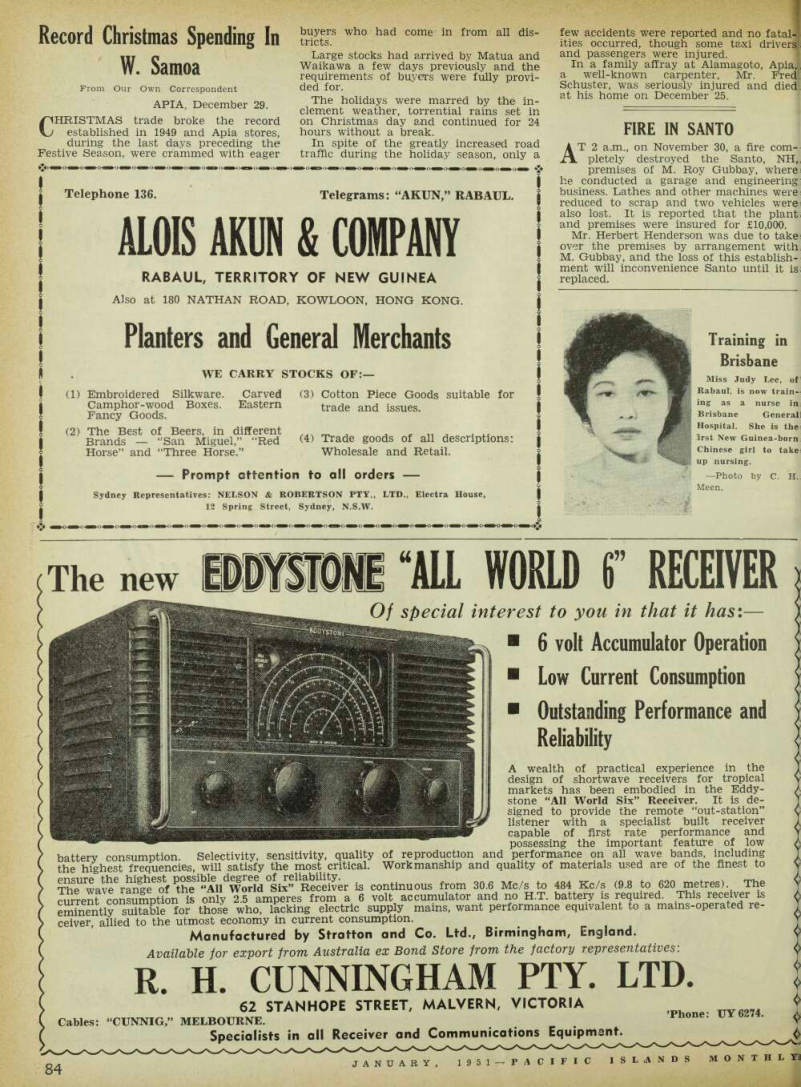
W. Samoa
From Our Own Correspondent APIA, December 29.
CHRISTMAS trade broke the record established in 1949 and Apia stores, during the last days preceding the Festive Season, were crammed with eager
buyers who had come in from all dis tricts.
Large stocks had arrived by Matua and Waikawa a few days previously and the requirements of buyers were fully provi ded for.
The holidays were marred by the in clement weather, torrential rains set in on Christmas day and continued for 24 hours without a break.
In spite of the greatly increased road traffic during the holiday season, only a
few accidents were reported and no fatal-l ities occurred, though some taxi drivers;, and passengers were injured.
In a family affray at Alamagoto, Apia, : , a well-known carpenter, Mr, Fred J Schuster, was seriously injured and diedJ at his home on December 25.
Training in
Fire In Santo
AT 2 a.m., on November 30, a fire com pletely destroyed the Santo, NH,, premises of M. Roy Gubbay, where; he conducted a garage and engineering; business. Lathes and other machines were; reduced to scrap and two vehicles were; also lost. It is reported that the plant; and premises were insured for £lO,OOO.
Mr. Herbert Henderson was due to take; over the premises by arrangement with; M. Gubbay, and the loss of this establish-' ment will inconvenience Santo until it is. replaced.
Training in
Brisbane
Miss Judy Lee, of Rabaul, is now train ing as a nurse in Brisbane General Hospital. She is the arst New Guinea-born Chinese girl to take up nursing. —Photo by C. H., Meen.
Advertisements & other items, p. 86 (2 items)
Alois Ml & Company
Telephone 136.
Telegrams: “AKUN,” RABAUL.
RABAUL, TERRITORY OF NEW GUINEA
Also at 180 NATHAN HOAD, KOWLOON, HONG KONG.
Planters and General Merchants
WE CARRY STOCKS OF:—
(1) Embroidered Silkware. Carved Camphor-wood Boxes. Eastern Fancy Goods. (2) The Best of Beers, in different Brands “San Miguel,” “Red Horse” and “Three Horse.” (3) Cotton Piece Goods suitable for trade and issues. (4) Trade goods of all descriptions: Wholesale and Retail.
Prompt attention to all orders Sydney Representatives: NELSON & ROBERTSON PTY., LTD., Electra House, 12 Spring Street, Sydney, N.S.W.
Gnum “All World 6” Receiver
The new
Of special interest to you in that it has: —
■ 6 volt Accumulator Operation
■ Low Current Consumption
■ Outstanding Performance and
Reliability
A wealth of practical experience in the design of shortwave receivers for tropical markets has been embodied in the Eddystone “All World Six” Receiver. It is designed to provide the remote “out-station” listener with a specialist built receiver capable of first rate performance and possessing the important feature of low battery consumption. Selectivity, sensitivity, quality of reproduction and performance on all wave bands, including the highest frequencies, will satisfy the most critical. Workmanship and quality of materials used are of the finest to Th^wav^ran^e 6^ of °Six” Receiver is continuous from 30.6 Mc/s to 484 Kc/s (9.8 to 620 metres). The currenrcontumption il only 2.5 amperes from a 6 volt accumulator and no H.T. battery is required. This receiver is eminently 0 suable *or those who, lacking electric supply mains, want performance equivalent to a mams-operated receiver, allied to the utmost economy in current consumption.
Manufactured by Stratton and Co. Ltd., Birmingham, England.
Available for export from Australia ex Bond Store from the factory representatives:
R. H. CUNNINGHAM PTY. LTD.
™^ STANHOPE STREET - MALVERN - VICTOR,A Specialists in all Receiver and Communications Equipment.
Sulphetrone
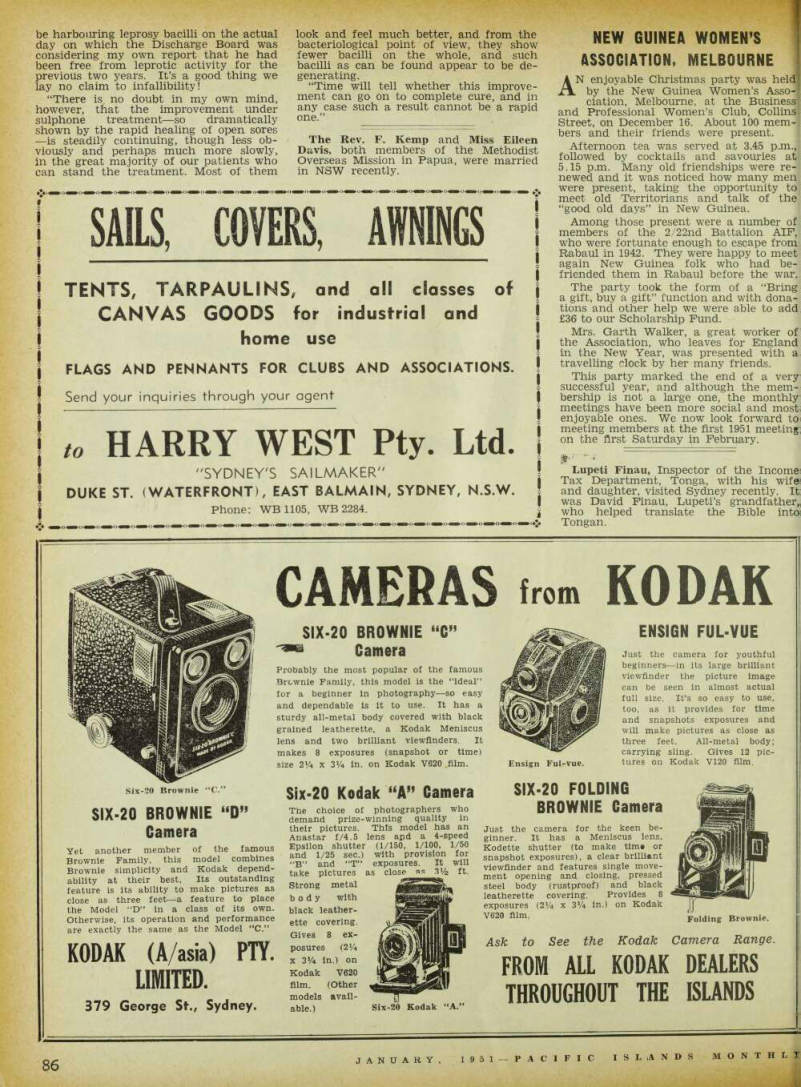
What It Is Achieving In Treatment Of Leprosy
INTERESTING things about leprosy— one of the oldest diseases known to mankind —were told in a broadcast .ddress in New Zealand, on November 26, y Dr. C. J. Austin, medical superintend nt of the Makogai Leprosarium, Fiji.
The disease was rampant in Europe in be Middle Ages; there was little, if any, reatment of individual cases; yet it be ame extinct there. The doctor said this lay have been due to the ruthless isola- Lon of lepers, and to the fact that so irge a part of the population (including lost of the sick and neglected lepers) died i the Black Plague of the fourteenth sntury.
Chaulmoogra oil had been used against iprosy in India and SE Asia for Gent ries, but it came into use by Europeans nly in recent times. It has rather violent ;action in some people and it is of little se against advanced cases. However, it as effective in a large proportion of irly cases.
There is a very strong resemblance be veen leprosy and tuberculosis; but one ifference is that, while some animals can mtract TB (and thus be used for re larch against the disease) no animal will mtract leprosy. This fact led to the scovery of the new drug—sulphetrone— dw being used against leprosy. Here is r. Austin’s story:— “In 1942 certain drugs known as sul mes were found effective in the tuber ilosis of guinea pigs, as well as in sterl ing cultures of the tubercule bacillus, hey proved much less useful, however, in jman tuberculosis, as well as being ghly toxic, producing severe anaemia id other changes.
“In an attempt to reduce this toxicity, number of similar drugs were produced ithin a short while, and as early as 1943 vourable results in leprosy were re tried. The drugs were, however, in very iort supply owing to more urgent needs the time, and the post-war dollar situa m still further delayed our chances of ying them out. It was just over two ars ago that we obtained our first sup y of sulnhetrone—a sulphone derivative epared in England.
“In my Annual Report for 1948 —only r o months after starting sulphetrone satment —l was able to refer to its out mding and rapid effect in clearing long mding ulceration in leprosy. But I had couple this tribute with a warning re rding the drug’s marked toxicity, cessitating frequent blood examinations d the utmost care in assessing the in
fidual dosage.
‘At the time we had only sufficient sul etrone for about 60 patients, so I had cided to give it to the most severe of r cases, on the ground that it might ill represent their only chance of im- Dvement. It was not, therefore, a fair al for a drug already known to be fie, and it is not surprising that more an half of the patients had to be taken the treatment during the first month. ‘Only 14 of these 60 advanced cases re able to maintain the moderate dose 3.0 grams daily for the two months the first trial. A number of those who d been unable to stand the drug at first re able, after a short rest and a course iron and liver treatment, to resume it smaller doses. ‘ln spite, however, of this evidence of irked toxicity, and in spite of the con sent broken treatment and small dos e, 27 of these 60 patients became com itely free of ulceration within the two mths, and 20 more were recorded as ich improved from that point of view. ‘When it is realised that these were
ulcerations of long standing which had successfully resisted all previous forms of
treatment—including Chaulmoogra oil .
hitherto the only recognised treatment for ieprosy—as well as Penicillin and the Sulpha drugs, it is evident that the introduction of the sulphones represents the arpafpst advance in lenrosv trpatmpnt Ss yet been'made. lePr ° Sy treatment tha t • .
The difficulty in assessing progress up to date is that the clearing of these sores has deprived us of one of our best indications of improvement. We no longer have any ulcerations of this type, which
by their rapid healing can give such striking evidence of improvement.
< Itt „
Unfortunately the healing of these ® ore ? nc s m^ an that . le^ os ? £ al f mg them has been cured. No patient ™V et . beco ™ e ell S lb Jf discharge from IMakogai as the result of sulphone treat ment, for we have a probationary period of two years after a patient has been found free from leprotic activity before he can be discharged.
“That this policy is fully justified is shown by a recent case in which I my self found a candidate for discharge to
be harbouring leprosy bacilli on the actual day on which the Discharge Board was considering my own report that he had been free from leprotic activity for the previous two years. It’s a good thing we lay no claim to infallibility!
“There is no doubt in my own mind, however, that the improvement under sulphone treatment—so dramatically shown by the rapid healing of open sores —is steadily continuing, though less ob viously and perhaps much more slowly, in the great majority of our patients who can stand the treatment. Most of them
look and feel much better, and from the bacteriological point of view, they show fewer bacilli on the whole, and such bacilli as can be found appear to be de generating.
“Time will tell whether this improve ment can go on to complete cure, and in any case such a result cannot be a rapid one.”
The Rev. F. Kemp and Miss Eileen Davis, both members of the Methodist Overseas Mission in Papua, were married in NSW recently.
Advertisements & other items, pp. 87-88 (1 item)
Pabco
11%
mml,'.
:'•• '. I Pabco MASTIPAVE is the ideal heavy duty floor covering where a durable and inexpensive floor is required. Non-slip Mastipave will not chip or crack and is self-healing when cut.
Prevents timber floors splintering, prevents damp and cold penetrating concrete floors.
Vermin-proof. Only available in grey, but may be lacquered red, green, blue or brown with Mastipave Coating.
PABCO
\ Sole Manufacturers of Genuine Malthoid Roofing.
If your local store does not stock Mastipave, write to us direct.
PABCO PRODUCTS PTY.
LIMITED,
150 WIGRAM ROAD,
GLEBE. N.S.W.
" u
SAILS, COK, MINS
TENTS, TARPAULINS, and all classes of CANVAS GOODS for industrial and home use FLAGS AND PENNANTS FOR CLUBS AND ASSOCIATIONS.
Send your inquiries through your agent
to HARRY WEST Pty. Ltd.
"SYDNEY'S SAILMAKER"
DUKE ST. (WATERFRONT), EAST BALMAIN, SYDNEY, N.S.W.
Phone: WBIIOS, W 82284.
Association, Melbourne
New Guinea Women’S
AN enjoyable Christmas party was heldl by the New Guinea Women’s Asso-1 elation, Melbourne, at the Business] and Professional Women’s Club, Collins] Street, on December 16. About 100 mem-i bers and their friends were present.
Afternoon tea was served at 3.45 p.m., followed by cocktails and savouries at 5.15 p.m. Many old friendships were re newed and it was noticed how many men were present, taking the opportunity to meet old Territorians and talk of the “good old days” in New Guinea.
Among those present were a number of members of the 2/22nd Battalion AIF, who were fortunate enough to escape from Rabaul in 1942. They were happy to meet again New Guinea folk who had be friended them in Rabaul before the war.- The party took the form of a “Bring a gift, buy a gift” function and with dona tions and other help we were able to add £36 to our Scholarship Fund.
Mrs. Garth Walker, a great worker of the Association, who leaves for England in the New Year, was presented with a, travelling clock by her many friends.
This party marked the end of a very' successful year, and although the mem-' bership is not a large one, the monthly meetings have been more social and most; enjoyable ones. We now look forward toi meeting members at the first 1951 meeting; on the first Saturday in February.
IK Lupeti Finau, Inspector of the Income; Tax Department, Tonga, with his wife; and daughter, visited Sydney recently. It: was David Finau, Lupeti’s grandfather,, who helped translate the Bible into; Tongan.
Advertisements & other items, p. 88 (1 item)
Cameras From Kodak
□ Brownie Six
SIX-20 BROWNIE “D”
Camera
Yet another member of the famous Brownie Family, this model combines Brownie simplicity and Kodak dependability at their best. Its outstanding feature is its ability to make pictures as close as three feet—a feature to place the Model “D” in a class of its own.
Otherwise, its operation and performance are exactly the same as the Model “C.”
KODAK (A/asia) PTY.
LIMITED.
379 George St., Sydney.
CAMERAS from KODAK
SIX-20 BROWNIE “C”
'*•* Camera
Probably the most popular of the famous Brownie Family, this model is the “ideal” for a beginner in photography—so easy and dependable is it to use. It has a sturdy all-metal body covered with black grained leatherette, a Kodak Meniscus lens and two brilliant viewfinders. It makes 8 exposures (snapshot or time) size 214 x 3y 4 in. on Kodak V 620 film.
Ensign Ful-vue.
ENSIGN FUL-VUE
Just the camera for youthful beginners—in its large brilliant viewfinder the picture image can be seen in almost actual full size. It’s so easy to use, too, as it provides for time and snapshots exposures and will make pictures as close as three feet. All-metal body; carrying sling. Gives 12 pictures on Kodak Vl2O film.
Six-20 Kodak “A” Camera
The choice of photographers who demand prize-winning quality in their pictures. This model has an Anastar f/4.5 lens apd a 4-speed Epsilon shutter (1/150, 1/100, 1/50 and 1/25 sec.) with provision for “B” and “T” exposures. It will take pictures as close as 3V 2 ft.
Strong metal body with black leatherette covering.
Gives 8 exposures (214 x 3V4 in.) on Kodak V 620 film. (Other models available.) B Six-20 Kodak
SIX-20 FOLDING
BROWNIE Camera
Just the camera for the keen beginner. It has a Meniscus lens, Kodette shutter (to make time or snapshot exposures), a clear brilliant viewfinder and features single movement opening and closing, pressed steel body (rustproof) and black leatherette covering. Provides 8 exposures (214 x 314 in.) on Kodak V 620 film. m Folding Brownie.
Ask to See the Kodak Camera Range.
FROM ALL KODAK DEALERS
THROUGHOUT THE ISLANDS
Sydney-N. Caledonia-
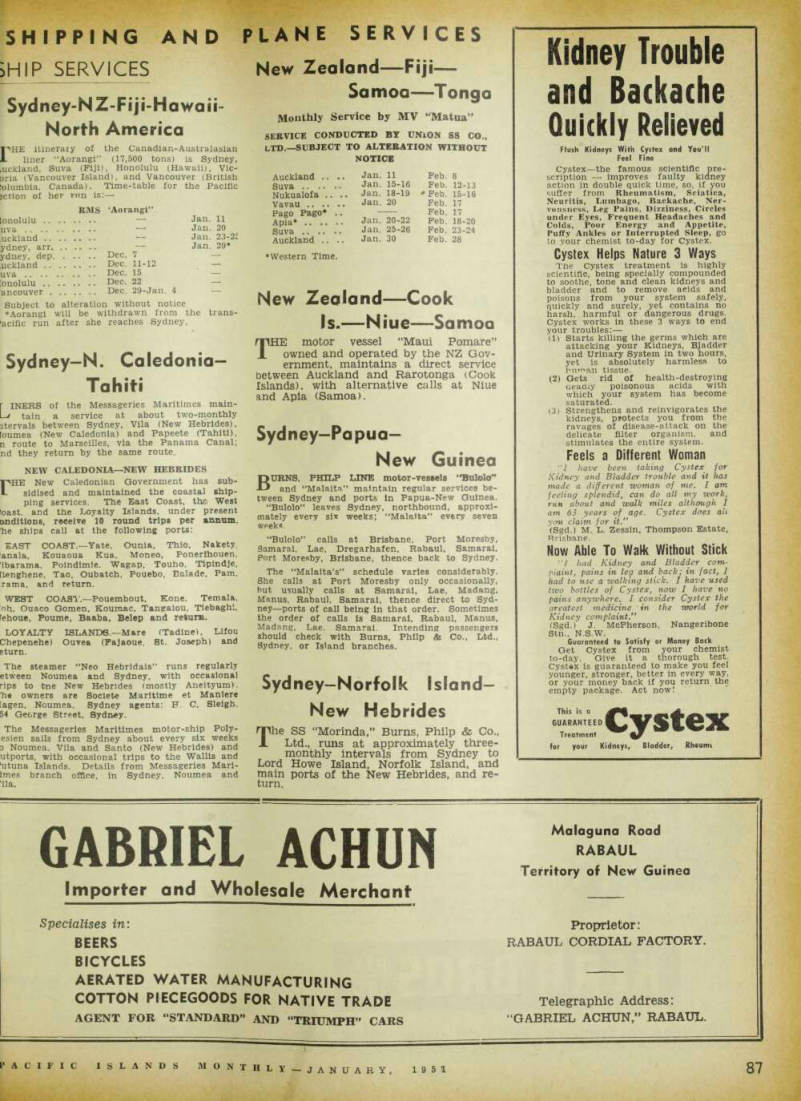
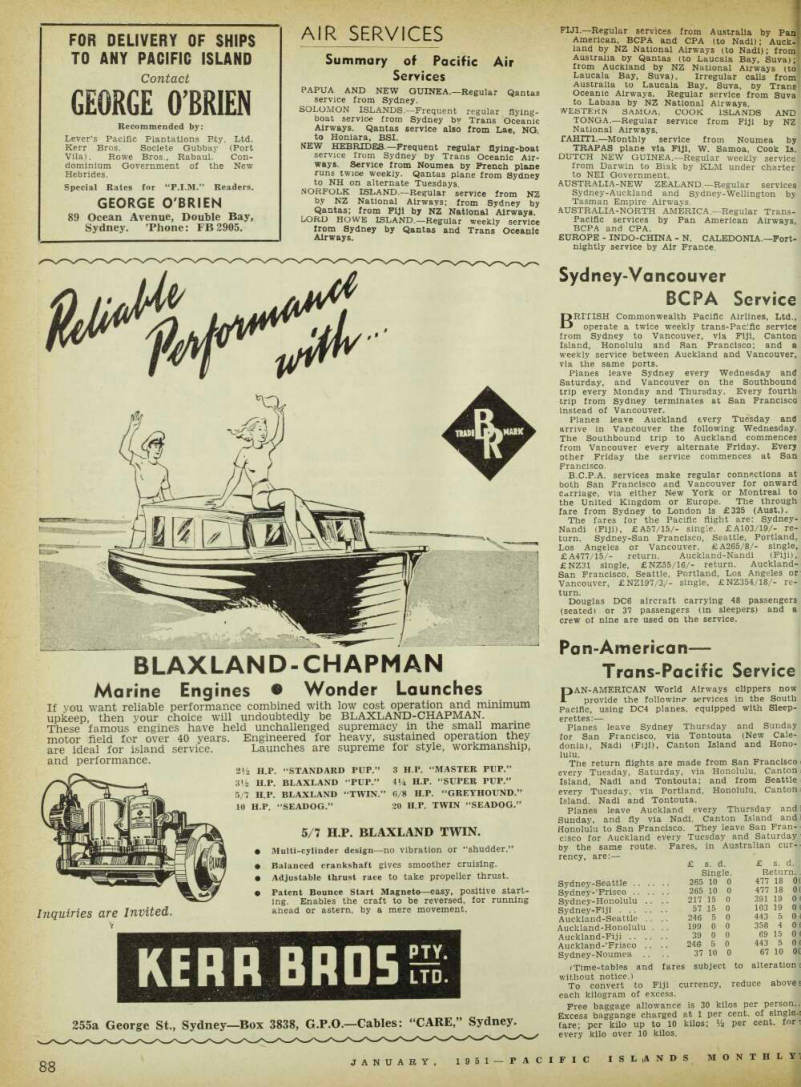
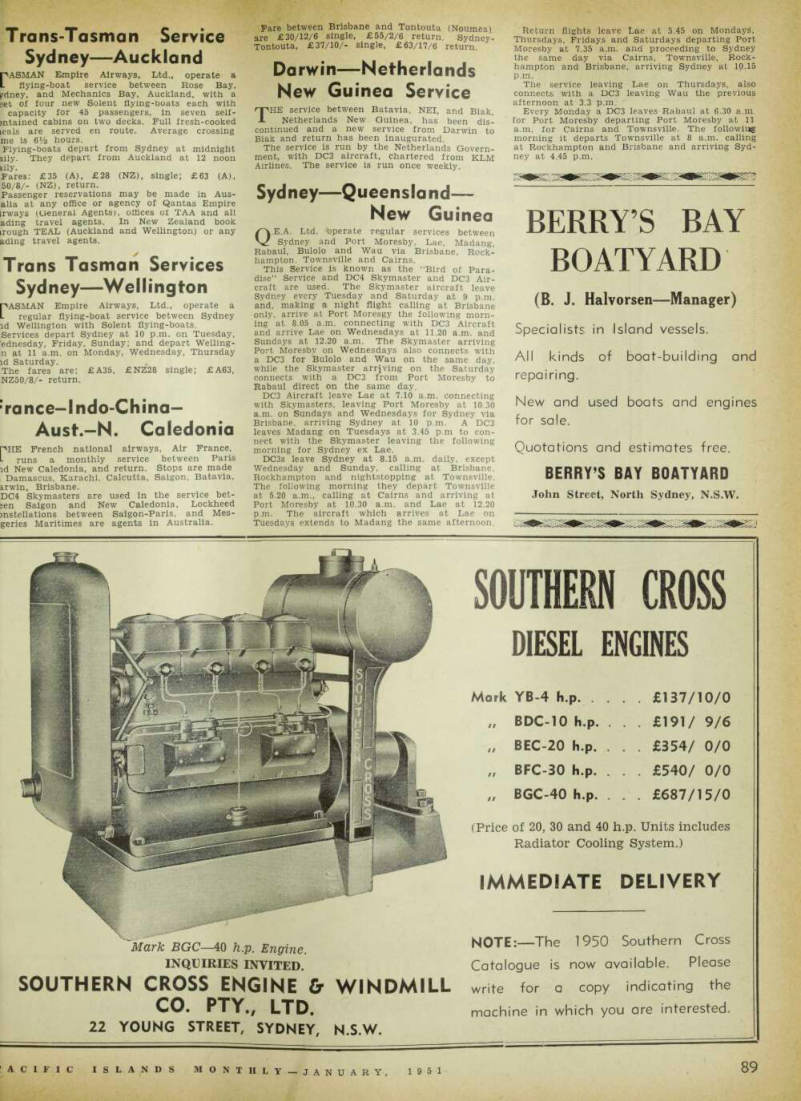
Shipping And Plane Services
Ship Services
Sydney-NZ-Fiji-Hawaii-
North America
rHE itinerary of the Canadian-Australasian liner “Aorangi” (17,500 tons) is Sydney, .uckland, Suva (Fiji), Honolulu (Hawaii), Vic oria (Vancouver Island), and Vancouver (British lolumbia, Canada). Time-table for the Pacific jction of her run is:—
Subject to alteration without notice ♦Aorangi will be withdrawn from the trans 'acific run after she reaches Sydney.
Sydney-N. Caledonia-
Tahiti
r INERS of the Messageries Maritimes main- L/ tain a service at about two-monthly itervals between Sydney, Vila (New Hebrides), loumea (New Caledonia) and Papeete (Tahiti), n route to Marseilles, via the Panama Canal; nd they return by the same route.
New Caledonia—New Hebrides
rHE New Caledonian Government has sub sidised and maintained the coastal ship ping services. The East Coast, tha West bast, and the Loyalty Islands, under present ondltions, receive 10 round trips per annum, he ships call at the following ports: EAST COAST.—Yate. Ounla, Thio. Naltety, anala, Kouaoua Kua, Moneo, Ponerthouen, ibarama. Polndlmle. Wagap, Touho. Tipindje, tienghene. Tac, Oubatch, Pouebo, Balade, Pam, rama, and return.
WEST COAST.—Pouembout, Kone. Temala. bh, Ouaco Gomen, Koumac, Tangaiou. Tlebaghi, fehoue, Poume, Baaba, Belep and return.
LOYALTY ISLANDS.—Mare (Tadlne). Llfou Chepenehe) Ouvea (Pajaoue, St. Joseph) and eturn.
The steamer “Neo Hebrldals” runs regularly etween Noumea and Sydney, with occasional rips to tne New Hebrides (mostly Aneltyum). he owners are Soclete Maritime et Manlere [agen, Noumea. Sydney agents; F. C. Sleigh. 54 George Street, Sydney.
The Messageries Maritimes motor-ship Poly esien sails from Sydney about every six weeks a Noumea. Vila and Santo (New Hebrides) and utports, with occasional trips to the Wallis and 'utuna Islands. Details from Messageries Mari imes branch office, in Sydney. Noumea and ila.
New Zealand —Fiji— Samoa—Tonga
Monthly Service by MV ,r Matua”
Service Conducted By Union Ss Co.,
Ltd.—Subject To Alteration Without
Notice
•Western Time.
New Zealand—Cook
Is.—Niue—Samoa
THE motor vessel “Maui Pomare” owned and operated by the NZ Gov ernment, maintains a direct service between Auckland and Rarotonga (Cook Islands), with alternative calls at Niue and Apia (Samoa).
Sydney-Papua-
New Guinea
BURNS, PHILP LINE motor-vessels "Bulolo” and "Malaita” maintain regular services be tween Sydney and ports In Papua-New Guinea.
“Bulolo” leaves Sydney, northbound, approxi mately every six weeks; “Malaita” every seven weeks.
"Bulolo” calls at Brisbane. Port Moresby, Samaral, Lae, Dregarhafen, Rabaul, Samaral, Port Moresby, Brisbane, thence back to Sydney.
The "Malalta’s” schedule varies considerably.
She calls at Port Moresby only occasionally, but usually calls at Samaral, Lae, Madang.
Manus, Rabaul, Samaral, thence direct to Syd ney—ports of call being In that order. Sometimes the order of calls Is Samaral, Rabaul, Manus, Madang. Lae. Samaral. Intending passengers should check with Burns, Phllp & Cos., Ltd., Sydney, or Island branches.
Sydney-Norfolk Island-
New Hebrides
The SS “Morinda,” Burns, Philp & Cos., Ltd., runs at approximately three monthly intervals from Sydney to Lord Howe Island, Norfolk Island, and main ports of the New Hebrides, and re turn.
RMS ‘Aorangi” [onolulu “ Jan. 11 uva —■ Jan. 20 uckland — Jan. 23-2£ ydney, arr — Jan. 29* ydney, dep Dec. 7 — uckland Dec. 11-12 — uva Dec. 15 — Honolulu Dec. 22 — ancouver Dec. 29-Jan. 4 —
Auckland .. .. Jan. 11 Feb. 8 Suva Jan. 15-16 Feb. 12-13 Nukualofa .. .. Jan. 18-19 'Feb. 15-16 Vavau J &n - 20 Feb. 17 Pago Pago* .. Feb. 17 Apia* Jan. 20-22 Feb. 18-20 Suva Jan. 25-26 Feb. 23-24 Auckland .. .. Jan. 30 Feb. 28
Air Services
Summary of Pacific Air
Services
PAPUA AND NEW GUlNEA.—Regular Qantas service from Sydney.
SOLOMON ISLANDS.—Frequent regular flying boat service from Sydney by Trans Oceanic Airways. Qantas service also from Lae, NG, to Honiara, BSI.
NEW HEBRlDES.—Frequent regular flying-boat service from Sydney by Trans Oceanic Air ways. Service from Noumea by French plane runs twice weekly. Qantas plane from Sydney to NH on alternate Tuesdays.
NORFOLK ISLAND.—Regular service from NZ by NZ National Airways; from Sydney by Qantas; from Fiji by NZ National Airways.
LORD HOWE ISLAND.—Regular weekly service from Sydney by Qantas and Trans Oceanic Airways.
FlJl.—Regular services from Australia by Pan American, BCPA and CPA (to Nadi); Auck-I land by NZ National Airways (to Nadi); from Australia by Qantas (to Laucala Bay, Suva);’ from Auckland by NZ National Airways (to i Laucala Bay, Suva). Irregular calls from Australia to Laucala Bay, Suva, by Trans Oceanic Airways. Regular service from Suva to Labasa by NZ National Airways.
Western Samoa, Cook Islands And
TONGA. —Regular service from Fiji by NZ National Airways, TAHlTl.—Monthly service from Noumea by TRAPAS plane via Fiji, W. Samoa, Cook Is.
DUTCH NEW GUlNEA.—Regular weekly service from Darwin to Biak by KLM under charter to NEI Government.
AUSTRALIA-NEW ZEALAND.—ReguIar services Sydney-Auckland and Sydney-Wellington by Tasman Empire Airways.
AUSTRALIA-NORTH AMERICA—Regular Trans pacific services by Pan American Airways,
Bcpa And Cpa.
Europe - Indo-China -N. Caledonla.—Fort
nightly service by Air France.
Sydney-Vancouver
BCPA Service
BRITISH Commonwealth Pacific Airlines, Ltd., operate a twice weekly trans-Pac:flc service from Sydney to Vancouver, via Fiji, Canton Island, Honolulu and San Francisco; and a weekly service between Auckland and Vancouver, via the same ports.
Planes leave Sydney every Wednesday and Saturday, and Vancouver on the Southbound trip every Monday and Thursday. Every fourth trip from Sydney terminates at San Francisco Instead of Vancouver.
Planes Leave Auckland every Tuesday and arrive in Vancouver the following Wednesday.
The Southbound trip to Auckland commences from Vancouver every alternate Friday. Every other Friday the service commences at San Francisco.
B.C.P.A. services make regular connections at both San Francisco and Vancouver for onward carriage, via either New York or Montreal to the United Kingdom or Europe. The through fare from Sydney to London is £325 (Aust.).
The fares for the Pacific flight are: Sydney- Nandi (Fiji), £AS7/15/- single. £AIO3/19/- re turn. Sydney-San Francisco, Seattle, Portland, Los Angeles or Vancouver, £A265/8/- single, £ A477/15/- return. Auckland-Nandi (Fiji),; £NZ3I single, £NZSS/16/- return. Auckland- San Francisco. Seattle, Portland, Los Angeles or 1 Vancouver, £NZI97/3/- single, £NZ3S4/18/- re turn.
Douglas DC6 aircraft carrying 48 passengers (seated) or 37 passengers (in sleepers) and a crew of nine are used on the service.
Pan-American —
Trans-Pacific Service
PAN-AMERICAN World Airways clippers now provide the following services in the South Pacific, using DC4 planes, equipped with Sleep -6l*ett6S * Planes leave Sydney Thursday and Sunday for San Francisco, via Tontouta (New Cale donia), Nadi (Fiji), Canton Island and Hono lulu.
The return flights are made from San Francisco i every Tuesday, Saturday, via Honolulu, Canton j Island, Nadi and Tontouta; and from Seattle every Tuesday, via Portland, Honolulu, Canton i Island, Nadi and Tontouta.
Planes leave Auckland every Thursday and!
Sunday, and fly via Nadi, Canton Island andJ Honolulu to San Francisco. They leave San Fran- ■ cisco for Auckland every Tuesday and Saturday; by the same route. Fares, in Australian cur# rency, are:—
(Time-tables and fares subject to alteration t without notice.) To convert to Fiji currency, reduce above £ each kilogram of excess.
Free baggage allowance is 30 kilos per person..
Excess baggange charged at 1 per cent, of single-: fare; per kilo up to 10 kilos; Vz per cent, fon every kilo over 10 kilos.
£ s. d £ s. d.
Single.
Return;
Sydney-Seattle
265 10 0 477 18 0
Sydney-’Frisco
265 10 0 477 18 0
Sydney-Honolulu .. ..
217 15 0 391 19 0
Sydney-Fiji
57 15 0 103 19 0 Auckland-Seattle .. 246 5 0 443 5 0 Auckland-Honolulu . .. 199 0 0 358 4 0 Auckland-Fiji 39 0 0 69 15 0 Auckland-’Frisco .. 246 5 0 443 5 0
Sydney-Noumea .. ..
37 10 0 67 10 0
Trans-Tasman Service
Sydney—Auckland
PASMAN Empire Airways, Ltd., operate a flying-boat service between Rose Bay, (rdney, and Mechanics Bay, Auckland, with a ;et of four new Solent flying-boats each with capacity for 45 passengers, in seven self mtained cabins on two decks. Full fresh-cooked teals are served en route. Average crossing me is 6Vi hours.
Flying-boats depart from Sydney at midnight lily. They depart from Auckland at 12 noon lily.
Fares: £35 (A), £2B (NZ), single; £63 (A), 50/8/- (NZ), return.
Passenger reservations may be made in Aus alia at any office or agency of Qantas Empire Irways (General Agents), offices of TAA and all ading travel agents. In New Zealand book trough TEAL (Auckland and Wellington) or any ading travel agents.
Trans Tasman Services
Sydney—Wellington
PASMAN Empire Airways, Ltd., operate a regular flying-boat service between Sydney id Wellington with Solent flying-boats.
Services depart Sydney at 10 p.m. on Tuesday, ednesday, Friday, Sunday; and depart Welling n at 11 a.m. on Monday, Wednesday, Thursday id Saturday.
The fares are: £A3S. £NZ2B single; £A63, NZSO/8/- return.
: rance-lndo-China-
Aust.-N. Caledonia
nHE French national airways, Air France.
L runs a monthly service between Paris id New Caledonia, and return. Stops are made Damascus, Karachi, Calcutta, Saigon, Batavia, irwin, Brisbane.
DC4 Skymasters are used in the service bet ;en Saigon and New Caledonia, Lockheed mstellations between Saigon-Paris, and Mes geries Maritimes are agents in Australia.
Pare between Brisbane and Tontouta (Noumea) are £3O/12/6 single, £55/2/6 return. Sydney- Tontouta, £37/10/- single, £63/17/6 return.
Darwin —Netherlands
New Guinea Service
THE service between Batavia, NET, and Biak, Netherlands New Guinea, has been dis continued and a new service from Darwin to Biak and return has been inaugurated.
The service is run by the Netherlands Govern ment, with DCS aircraft, chartered from KLM Airlines. The service is run once weekly.
Sydney—Queensland—
New Guinea
Q.E.A. Ltd. Operate regular services between Sydney and Port Moresby, Lae, Madang, Rabaul, Bulolo and Wau via Brisbane, Rock hampton. Townsville and Cairns.
This Service is known as the “Bird of Para dise” Service and DC4 Skymaster and DCS Air craft are used. The Skymaster aircraft leave Sydney every Tuesday and Saturday at 9 p.m. and, making a night flight calling at Brisbane only, arrive at Port Moresgy the following morn ing at 8.05 a.m. connecting with DCS Aircraft and arrive Lae on Wednesdays at 11,20 a.m. and Sundays at 12.20 a.m. The Skymaster arriving Port Moresby on Wednesdays also connects with a DC3 for Bulolo and Wau on the same day, while the Skymaster arriving on the Saturday connects with a DC3 from Port Moresby to Rabaul direct on the same day.
DCS Aircraft leave Lae at 7.10 a.m. connecting with Skymasters, leaving Port Moresby at 10.30 a.m. on Sundays and Wednesdays for Sydney via Brisbane, arriving Sydney at 10 p.m. A DCS leaves Madang on Tuesdays at 3.45 p.m to con nect with the Skymaster leaving the following morning for Sydney ex Lae.
DC3s leave Sydney at 8.15 a.m. daily, except Wednesday and Sunday, calling at Brisbane, Rockhampton and nightstopping at Townsville.
The following morning they depart Townsville at 5.20 a.m., calling at Cairns and arriving at Port Moresby at 10.30 a.m. and Lae at 12.20 p.m. The aircraft which arrives at Lae on Tuesdays extends to Madang the same afternoon.
Return flights leave Lae at 5.45 on Mondays, Thursdays, Fridays and Saturdays departing Port Moresby at 7.35 a.m. and proceeding to Sydney the same day via Cairns, Townsville, Rock hampton and Brisbane, arriving Sydney at 10.15 p.m.
The service leaving Lae on Thursdays, also connects with a DC3 leaving Wau the previous afternoon at 3.3 p.m.
Every Monday a DC3 leaves Rabaul at 6.30 a.m, for Port Moresby departing Port Moresby at 11 a.m. for Cairns and Townsville. The following morning it departs Townsville at 8 a.m. calling at Rockhampton and Brisbane and arriving Syd ney at 4.45 p.m.
Antas Subsidiary Services In
Papua-New Guinea-Solomons
Qantas Empire Airways run the following sub- Jlary services In Papua, New Guinea, and Itlsh Solomons: — A Douglas DC3 leaves Lae, New Guinea, every lursday, and flies to Rabaul, and Kavleng, id returns to Lae; but every alternate Thurs ly the plane goes on from Kavieng to Manus, id returns via Kavieng to Rabaul (overnight) id returns to Lae on the Friday morning.
Every Wednesday a plane flies from Lae to adang and Wewak, and thence, via Madang Rabaul. It returns from Rabaul to Lae on lursday. This service is primarily for the rriage of native labour to and from Wewak, id Europeans travelling on this service are ways advised of the fact.
Every alternate Monday, a Qantas Catalina es from Port Moresby, westward to Daru, via lie Island, Kerema, Kikorl, Lake Kutubu and ike Murray, remaining overnight at Kikorl id returning to PM next morning. This aircraft 11s at Lake Kutubu one service and Lake Mur y the next. Optional call at Wana between ir«ma and Kikorl.
Every alternate Wednesday, a Qantas Catalina es from Port Moresby eastward (dep. 9 a.m.) id calls at Abau and Samaral before flying out the Archipelagoes in the afternoon. Calls are ade at Esa’ala and Losuia (where an over ght stop is made), and the following day Iternate Thursdays) at Deboyne Lagoon, before turning to Port Moresby, via Samaral and lau.
Every alternate Monday, a Qantas Catalina lives Port Moresby for Rabaul. via Moewe Har ur. and Talasea (New Britain); next morning lesday) it flies to Buka, Kieta, Buin lougainvllle) and returns to Rabaul; next Drnlng (Wednesday) It flies to Talasea, Moewp irbour and Jacqulnot Bay. and returns to ibaul; and next morning (Thursday) It re rns from Rabaul direct to Port Moresby. >ptional calls are made at Inus and Linden ifen.) Every alternate Monday a Qantas Douglas flies •m Lae to Rabaul via Finschhafen and continues to Honiara (British Solomon Islands), via rokina, Vellalavella and Yandina remains over ght at Honiara; and returns to Lae the fol wing day Tuesday), over the same route.
Every Tuesday and Friday a plane leaves Port oresby at 7.30 a.m., reaches Kokoda at 8.35 n.. flies on to Higatura (Popendetta) at 8.55 n., and leaves again for Port Moresby at i a.m., reaching there at 10.15 a.m.
Dragon DHB4 aircraft operate the following ternal services in New Guinea:— Every Tuesday depart Madang for Goroka, linantu, Aiyura, Arona, returning to Madang noon the same day. Calls as required for iding are made between Arona and Madang.
Every Thursday departs Madang at 7 a.m. for abag, Baiyer River, Mt. Hagen, with optional 11s at Kerowagi and Chimbu, and returning Madang at noon the same day.
Every Friday departs Lae at 6.30 a.m., calling any or all of the following places as re ired: Asolaka, Aiyura, Arona, Banz, Bena na, Chimbu, Goroka, Kalaipit, Kainantu, irowagi. Kup, Mt. Hagen, Nadzab, Nondugl, :elbeng, Wabag, Wabumunda, Minj.
Daily, except Wednesdays and Sundays, depart e at 3 p.m. for Bulolo and Wau, returning rect from Wau to Lae the same day. arriving Lae 5.5 p.m.
ydney-Norfolk Is.
Santas run a DC4 Skymaster alt. Thursdays burning same day) from Sydney to Norfolk and. Pare, £22 single; £39/12/- return. (For Norfolk Island, see also under N 2
itional Airways.
Sydney-New Hebrides
\ ANT AS operate a service to the New Hebrides ' with Sandringham flying-boats calling at mmea, Port Vila and Espiritu Santo. Frequent n.-scheduled flights are made, subject to the iproval of the Governments concerned.
NZ National Airways
South Pacific Services
''HE Pacific services run by the New Zealand National Airways Corporation are as Hows:—
Auckland-Norfolk Island-Fiji-Tonga
Estern Samoa-Cook Islands: A “Douglas”
rliner leaves Whenuapal, Auckland, on alter
nate Tuesdays at 9 a.m. (February 6 and 20, etc.) for Norfolk Island (arr. 12.55 p.m.; dep. 2 p m.), Nadi (arr. 8.40 p.m., dep. 5.40 am Thursday), Nauson (arr. 6.25 a.m., dep. 730 am.). Tonga (arr. 10.50 a.m., dep. 11.50 a.m )
Sndf V. “iSo
p.m.), Rarotonga. Cook Is. (arr. 4.5 p.m.). , . „ The aircraft departs from Rarotonga on the return journey on alternate Saturdays (February 10 and 24, etc.) at 8 a.m. for Aitutaki (arr. 9.15 a.m., dep. 10 a.m.), Faleolo, W. Samoa (arr. 3.15 p.m., dep. 8 a.m. Sunday), I T m n i ga Naus r o r ri (arr 2Mo S’ 425 Dm deD 5 am ' SnSnik Is iarr To’ss am & den' il noon ’
Whenuapai, n °° nK •Crosses International Date Dine.
Auckland-Norfolk Island: A “Douglas”
airliner leaves Whenuapai, Auckland, every Sun-
day at 8 a.m. for Norfolk Island (arr. 11.55 a.m.), and departs on the return flight at 12.55 p.m., arriving at Whenuapai at 5.45 p.m. „. „ . alternate Sundays (February 4 and 18, whei„“pSTt^T. v m c %«vto B ** ‘ 55 pJn - and Auckland at 6.45 p.m.
Bookings may be made at the Union Steam Ship Company of New Zealand. Limited, Sydney, or Melbourne: Union Steam Ship Co. of NZ. Ltd., Fiji, Canadian Pacific Airlines, Vancouver; Canadian Pacific Railway Co., Sydney or Mel bourne.
' FARES * sin e le < in NZ currency): Auckland to Norfolk, £l4; to Fiji, £3l; to Tonga, £35/15/-; to W SaiKOa - £39/10/-; to Aitutaki. £43/10/-; * Rarotonga £45 Norfolk to FIJI. £l9; Fiji
MtnSSf £29*“to sfmoa to
Rarotonga, £l9; to Aitutaki, £l6/10/-. Return fares less 10 per cent.
BOOKING OFFICES: Wellington, Govt. Life Bldg., Customhouse Quay; Auckland, Air Centre, Nathan’s Bldg., Commerce St.; Dunedin, 8-10 Manse St.; Christchurch, 104 Gloucester St.: Gisborne, 74 Peel St.; Palmerston North, 107 Broadway Ave.; Hamilton, 8 Alma St.; New Plymouth, Grand Central Building, Egmont St.; Blenheim, 13 Queen St.; Hokitika, South side Airport; Norfolk Is., Burns Philp, Ltd.; Fiji, NAC at Nadi and Suva; Burns Philp, Lautoka; Tonga, Mrs. F. P. Melhose, Fou-amotu Airfield: W. Samoa, Burns Philp (SS), Ltd., Apia; Cook Is., Mrs. P. McVeagh, Aitutaki, and Mr. J. D. Campbell, Rarotonga.
TOA Services
TRANS Oceanic Airways run the following Pacific services:— SYDNEY-LORD HOWE IS.: A regular twice weekly service with large four-engine flying boats from Rose Bay. Fare: £lO/16/- single; £2l/12/- return. Free baggage allowance 44 lb.
Excess baggage and freight rate Bd. per lb.
NOTE: Sydncy-Moresby service expected to start in January or February.
SYDNEY-HOBART: The company now runs a twice-weekly service direct to Hobart, Tasmania,
from Sydney. It will be possible, therefore, for passengers to book from Moresby to Hobart, making an overnight stop in Sydney. Pares are; £lO/10/- single, £2l return.
Sydney— Noumea-Suva
THE following is the time-table of the Qantas Sandringham flying-boat;— Sydney dep. 9.30 p.m. alt. Tues.
Noumea arr. 6.30 a.m. alt. Wed.
Noumea dep. 8.20 a.m. alt. Wed.
Suva arr. 2.30 p.m. alt. Wed.
Suva dep. 6 a.m. alt. Pri.
Noumea arr. 10.30 a.m. alt. Fri.
Noumea dep. 12 noon alt. Fri.
Sydney arr. 7.15 p.m. alt. Pri.
Intending passengers may book through Qantas offices in Australia. Burns Philp (South Sea) Company, in Suva; and J. Brock, in Noumea.
The fares for this service in Aust. currency are:
CPA Sydney-Vcmcouver
Service
CANADIAN Pacific Airlines, Ltd., run a trans pacific service between Sydney and Van couver. For the present there will be one; northbound and one southbound trip per fort night. Stops are made at Nadi (Fiji), Canton; Island, Honolulu and San Francisco. The north bound flight commences from Sydney every alter nate Wednesday.
Accommodaton is provided at hotels in Nadi and) Honolulu, which is, of course, complimentary.
Fares are (in Australian currency: Sydney- Vancouver, San Prancisco-Los Angeles and Port land-Seattle, £265/8/- single, £477/15/- return;; Fiji-Vancouver, £207/8/- single, £373/7/- re turn; Sydney-Piji, £57/15/- single, £lO3/19/- re turn; Sydney-Honolulu, £217/13/- single,, £391/16/- return.
TEAL Flying Boat
Service
Auckland Fiji
WITH new 45 seater Solent flying-boats, Tasman Empire Airways, Limited, operate a weekly Auckland-Suva-Lambasa and return service.
Aircraft depart Mechanics’ Bay, Auckland, a half hour after midnight, each Tuesday, and operate to the following time-table:— dep. Auckland .. .. 0.30 a.m. Tuesday arr. Suva 7.00 a.m. Tuesday dep. Suva 9.00 a.m. Tuesday arr. Lambasa .. .. 10.00 a.m. Tuesday dep. Lambasa .. .. noon Tuesday arr. Suva 1.00 p.m. Tuesday dep. Suva 7.00 a.m. Wednesday arr. Auckland .. .. 1.30 p.m. Wednesday Fares (Single): Auckland-Suva, £3l (NZ)i £34/9/- (Fijian), £3B/15/- (Aust.); (Return) £55/16/- (NZ), £6l/19/- (Fijian), £69/15/-' (Aust.).
Suva-Lambasa (Single): £4/10/- (NZ), £ (Fijian), £5/12/6 (Aust.); (Return): £B/2/-' (NZ), £9 (Fijian), £lO/2/6 (Aust.).
Reservations may be made through TEAI (New Zealand), Qantas or TAA (Australia)) NZNAC (Suva) or any leading travel agents.
N. Coledonia-Tohiti
TRAPAS (Societe Prancais de Transport!
Aeriens du Pacific Sud-Noumea) runs i monthly service from New Caledonia to Tahiti Western Samoa (Paleolo), Cook Islands (Alta taki) to Papeete, where it arrives at about 11.41 a.m. two days later. One evening is spent u Nadi and one night in Altutaki. The plane re turns by the same route in the following week Fare from Noumea to Papeete is 16,000 Pacifif francs single, and 28,800 return. (160 Pacifif francs equal £1 Australian.) While the plan is at Papeete it runs one round trip between Papeete and Bora Bora. (This service was temporarily suspended u late November.)
Papua-NG Local
Services
MANDATED Airlines, Ltd., of Lae, New Guines and other private operators, run air ser vices between Lae and the New Guinea malnlanr centres of Wau, Bulolo, Madang, Wewak, Aitapn Mt. Hagen. Flnschhafen, Moresby. Kokoda—ii fact anywhere in Papua or New Guinea when there is an air-strip. These planes carry pas sengers, malls and cargo on regular schedule or charter flights.
Sydney-Noumea .. .
Single. £37 10 0 Return. £67 10 0 Sydney-Suva 55 10 0 99 18 0 Noumea-Suva ... , 20 5 0 36 9 0
Advertisements & other items, pp. 89-94 (2 items)
Gabriel Achun
Kidney Trouble
and Backache
Quickly Relieved
Flush Kidneys With Cystex and You'll Feel Fine Cystex—the famous scientific prescription improves faulty kidney action in double quick time, so, if you suffer from Rheumatism, Sciatica, Neuritis, Lumbago, Backache, Nervousness, Leg Pains, Dizziness, Circles under Eyes, Frequent Headaches and Colds, Poor Energy and Appetite, Puffy Ankles or Interrupted Sleep, go to your chemist to-day for Cystex.
Cystex Helps Nature 3 Ways
The Cystex treatment is highly scientific, being specially compounded to soothe, tone and clean kidneys and bladder and to remove acids and poisons from your system safely, quickly and surely, yet contains no harsh, harmful or dangerous drugs.
Cystex works in these 3 ways to end your troubles: — (1) Starts killing the germs which are attacking your Kidneys, Bjadder and Urinary System in two hours, yet is absolutely harmless to human tissue. (2) Gets rid of health-destroying deadly poisonous acids with which your system has become saturated. (3) Strengthens and reinvigorates the kidneys, protects you from the ravages of disease-attack on the delicate filter organism, and stimulates the entire system.
Feels a Different Woman
"l have been taking Cystex for Kidney and Bladder trouble and it has made a different woman of me. I am feeling splendid, can do all my work, run about and walk miles although I am 63 years of age. Cystex does ah vou claim for it." (Sgd.) M. L. Zessin, Thompson Estate,
Now Able To Walk Without Stick
"I had Kidney and Bladder complaint. pains in leg and back; in fact, 1 had to use a walking stick. I have used two bottles of Cystex, now I have no pains anywhere. I consider Cystex the greatest medicine in the world for
Kidney complaint."
(Sgd.) J. McPherson, Nangeribone Stn., N.S.W.
Guaranteed to Satisfy or Money Back Get Cystex from your chemist to-day. Give it a thorough test.
Cystex is guaranteed to make you feel younger, stronger, better in every way, or your money back if you return the empty package. Act now!
GUARANTEED
Treatment for your Kidneys, Bladder, Rheumt
GABRIEL ACHUN
Importer and Wholesale Merchant
Specialises in:
BEERS
BICYCLES
AERATED WATER MANUFACTURING
COTTON PIECEGOODS FOR NATIVE TRADE
AGENT FOR “STANDARD” AND “TRIUMPH” CARS
Malaguna Road
RABAUL
Territory of New Guinea Proprietor:
RABAUL CORDIAL FACTORY.
Telegraphic Address:
“GABRIEL ACHUN," RABAUL.
FOR DELIVERY OF SHIPS
TO ANY PACIFIC ISLAND
Contact
GEORGE O’BRIEN
Recommended by: Lever’s Pacific Plantations Pty. Ltd.
Kerr Bros. Societe Gubbay (Port Vila). Rowe Bros., Rabaul. Condominium Government of the New Hebrides.
Special Rates for “P.1.M.” Readers.
GEORGE O'BRIEN
89 Ocean Avenue, Double Bay, Sydney. ’Phone: FB 2905.
i 7 / : ■> - *- , •' - L' J.- ■ ■■ «.'
BLAXLAND-CHAPMAN
Marine Engines ® Wonder Launches
If you want reliable performance combined with low cost operation and minimum upkeep, then your choice will undoubtedly be BLAXLAND-CHAPMAN.
These famous engines have held unchallenged supremacy in the small marine motor field for over 40 years. Engineered for heavy, sustained operation they are ideal for island service, and performance.
Inquiries are Invited.
v Launches are supreme for style, workmanship, 2Vz H.P. “STANDARD PUP.” 3 H.P, “MASTER PUP.” 3V2 H.P. BLAXLAND “PUP.” 414 H.P. “SUPER PUP.” 5/7 H.P. BLAXLAND “TWIN.” 6/8 H.P. “GREYHOUND.” 10 H.P. “SEADOG.” 20 H.P. TWIN “SEADOG.”
5/7 H.P. BLAXLAND TWIN.
• Multi-cylinder design—no vibration or “shudder.” • Balanced crankshaft gives smoother cruising. • Adjustable thrust race to take propeller thrust. e Patent Bounce Start Magneto—easy, positive starting. Enables the craft to be reversed, for running ahead or astern, by a mere movement.
KERR BROS
255 a George St., Sydney—Box 3838, G.P.O.—Cables: “CARE,” Sydney.
BERRY’S BAY
BOATYARD
(B. J. Halvorsen —Manager)
Specialists in Island vessels.
All kinds of boat-building and repairing.
New and used boats and engines for sale.
Quotations and estimates free.
BERRY’S BAY BOATYARD
John Street, North Sydney, N.S.W.
'Mark BGC— 4O h.p. Engine.
INQUIRIES INVITED.
SOUTHERN CROSS ENGINE & WINDMILL
CO. PTY., LTD.
22 YOUNG STREET, SYDNEY, N.S.W.
SOUTHERN CROSS
DIESEL ENGINES
Mork YB-4 h.p. . . . . £137/10/0 „ BDC-10 h.p. . . . £l9l/ 9/6 „ BEC-20 h.p. . . . £354/ 0/0 „ BFC-30 h.p. . . . £540/ 0/0 „ BGC-40 h.p. . . . £687/15/0 (Price of 20, 30 and 40 h.p. Units includes Radiator Cooling System.)
IMMEDIATE DELIVERY
NOTE: —The 1950 Southern Cross Catalogue is now available. Please write for a copy indicating the machine in which you are interested.
MARINE ENGINES
HALVORSEN’S HAVE FOR IMMEDIATE DELIVERY:
MORRIS “VEDETTE” 4 Cylinder 6/12 H.P. Petrol or Kerosene MORRIS “NAVIGATOR” 4 Cylinder 12/24 H.P. Petrol or Kerosene MORRIS “COMMODORE” 6 Cylinder 20/40 H.P. Petrol or Kerosene CHRYSLER “CROWN” 6 Cylinder 45/102 H.P. Petrol CHRYSLER “ROYAL” 8 Cylinder 55/132 H.P. Petrel “LEYLAND” DIESEL MARINE 6 Cylinder 85 H.P.
Further particulars from the distributors :
LARS HALVORSEN SONS PTY. LTD.
WATERVIEW ST., RYDE ( ), N.S.W.
Telegrams: Halvorsens, Sydney. Thone: Hyde 705
• LARGE RANGE OF BOAT FITTINGS
• FREE EXPERT PROPELLER ADVICE
BUILDERS OF HALVORSEN BOATS
f*s. msu« m i AH classes of merchandise purchased for island clients throughout the South-west Pacific.
Island produce sold on Australian and overseas markets on o commission basis.
ROBERT GILLESPIE PIT IT?
54« PITT ST..SYBNEY- PHONES-8VM782- BUOS
Cable Address m
8.0.A.C. SPEEDBIRD SERVICES
TO ALL SIX CONTINENTS
i y You can book to almost anywhere in the world by 8.0.A.C. Service on one ticket all the way. Your 8.0.A.C.
Agent makes no charge for expert advice and trip
planning help.
Book from Sydney to INDONESIA
JAPAN • CEYLON • INDIA
ITALY • GREAT BRITAIN •
FAR EAST • HONG KONG
• PAKISTAN • AFRICA
AND VIA U.K. TO U.S.A.
CANADA
CENTRAL AND SOUTH AMERICA • BERMUDA
8.0.A.C. TAKES GOOD CARE OF
YOU
FLY BO AC
Information & Bookings : Qantas Empire Airways Ltd. ( 8.0.A.C. General Agents in Australia) at Sydney , Melbourne, Brisbane, Townsville , Cairns, Darwin or from Travel Agents in all cities and towns. Al7/AU BRITISH OVERSEAS AIRWAYS CORPORATION WITH QANTAS EMPIRE AI WAYS LTD., TASMAN EMPIRE AIRWAYS LTD. & SOUTH AFRICAN AIRWAYS
CAPTAIN W. L. KENNEDY
(Established 1931)
Shipbrokers, Business & Real Estate
63 Pitt St., Sydney
'Phone: 8W6461. Cables: "CAPKEN," Sydney.
LISTING:
MODERN 606-TON STEEL CARGO VESSEL.—£BS,OOO Sterling.
MODERN STEEL CARGO VESSEL.—33O H.P. H.D. diesel placed aft, deadweight over 400 tons, diesel winches, 2 hatches, built 1945, in full survey British Corp., £17,500 Sterling.
STEEL LIGHTER.—DoubIe-end, new condition, carry 25 tons under hatches, £420.
OCE.AN GOING LAUNCH. —Suitable conversion to cargo, 40 ft. x 126 ft., 30 H.P. Lister diesel placed aft. 3 years’ old, could carry approx. 10 tons. £2,750. 30 FT. R.D. OCEAN FISHING BO]AT—Suitable for general purpose work, diesel engine, auxiliary sail, £1,138. 60 FT. STEEL LANDING BARGE HULL. —New condition. £550.
BUSINESS :
We can offer one of Sydney’s finest waterfront businesses, including 55 hire skiffs, 14 drive-yourself launches, 25 ft. diesel work-launch, and several small launches. About 115 registered moorings, engineer’s shop, boat builder’s section, 3 sets slipways, dwelling with 3 bedrooms, lounge, bathroom and kitchen. V.P. Two offices and enormous inventory of fittings, timber and equipment, etc. Substantial income assured. Walk-in-walkout basis at £21,000.
Enquiries Invited.
ISLAND ENQUIRIES PROMPTLY ATTENDED TO
grous In tensile strength, wearing qualities, resistance to impacts, adaptability and machine properties, Novasteen Nonmetallic Gears and Bearings more than hold their own with old-time materials.
Novasteen is also available in sheets, rods and tubes. They can be sawh, drilled, turned, screwed, and machined for fine tolerances. Novasteen is used for a wide variety of applications, such as piston rings, vanes, valves, cams, rollers, truck wheels, couplings, pulleys, etc.
HOUfISTEEK
GEARS & BEARINGS
W. J. MANUFACTURING Co. Ltd.
MOSMAN, SYDNEY, AUSTRALIA.
The fullest information and samples will be gladly supplied by the manufacturers: —
89
ACIFIC ISLANDS MONTHLY JANUARY, 1951
NG Vessel Escapes in Sydney
Harbour Fire
A STATION BOAT, owned by the Ad: ministration of Papua and Ne* Guinea, narrowly escaped destructioc early on November 17. when a disastroui fire swept through Berry’s Bay Boatyaro managed by Mr. B. J. Halvorsen, on th North Sydney waterfront.
Damage to boats and equipment was estimated at £75,000.
The vessel, a converted Army trawle which was being fitted with a new 100 HI 5-cylinder Vivian marine engine, was saved with only her paint blistered. Shi will be ready for sea again in time fr be delivered to Port Moresby at the enc of January.
Advertisements & other items, p. 94 (1 item)
92
JANUARY, 1951 PACIFIC ISLANDS MONTH!/
Ng Women’S Club, Sydney
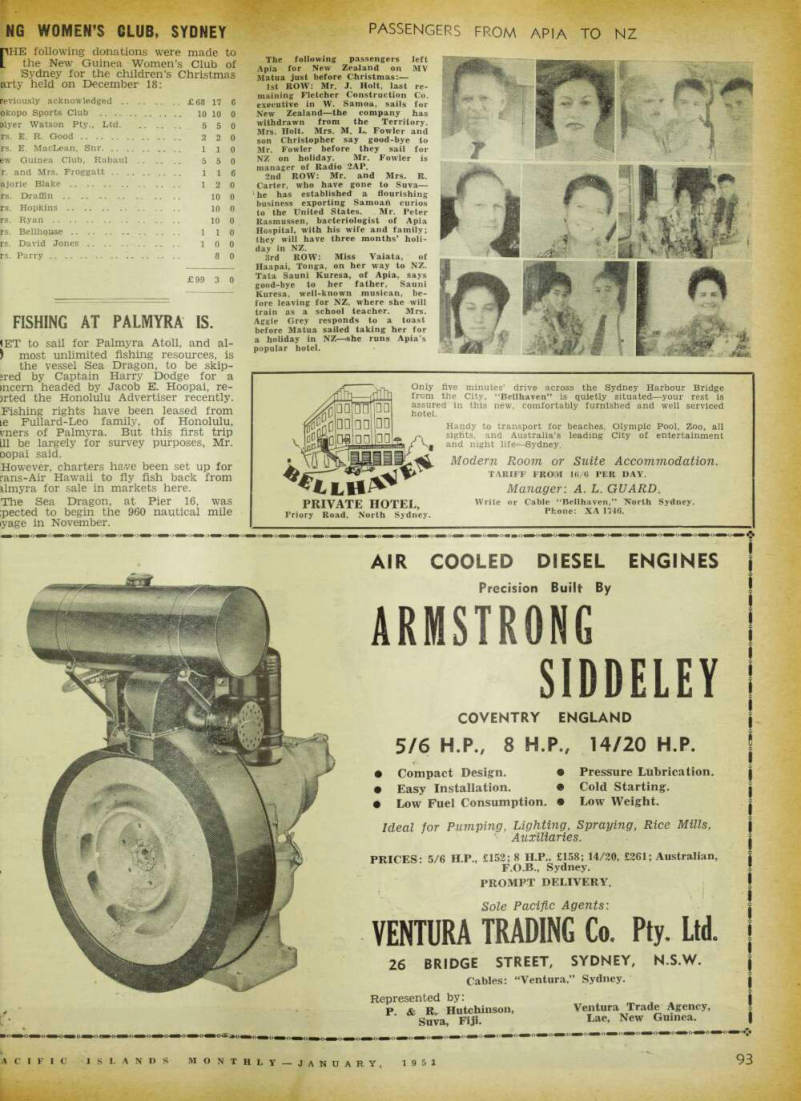
rHE following donations were made to the New Guinea Women’s Club of Sydney for the children’s Christmas arty held on December 18; reviously acknowledged £6B 17 6 okopo Sports Club 10 10 0 Dlyer Watson Pty., Ltd 5 5 0 rs. E. R. Good 220 *s. E. Mac Lean, Snr 1 i o ew Guinea Club, Rabaul 5 5 0 r. and Mrs. Proggatt 116 ajorie Blake 1 2 0 rs. Draffin 10 0 rs. Hopkins 10 0 rs. Ryan 10 0 rs. Bellhouse 1 1 o rs. David Jones 1 o 0 rs. Parry 8 0 £99 3 0
Fishing At Palmyra Is.
IET to sail for Palmyra Atoll, and al ) most unlimited fishing resources, is the vessel Sea Dragon, to be skip ped by Captain Harry Dodge for a mcern headed by Jacob E. Hoopai, re nted the Honolulu Advertiser recently.
Fishing rights have been leased from te Fullard-Leo family, of Honolulu, vners of Palmyra. But this first trip ill be largely for survey purposes, Mr. oopai said.
However, charters have been set up for rans-Air Hawaii to fly fish back from ilmyra for sale in markets here.
The Sea Dragon, at Pier 16, was :pected to begin the 960 nautical mile iyage in November.
Passengers From Apia To Nz
The following passengers left Apia for New Zealand on MV Matua just before Christmas:— 1st ROW: Mr. J. Holt, last re maining Fletcher Construction Co. executive in W. Samoa, sails for New Zealand —the company has withdrawn from the Territory.
Mrs. Holt, Mrs. M. L. Fowler and son Christopher say good-bye to Mr. Fowler before they sail for NZ on holiday. Mr. Fowler is manager of Radio 2AP. 2nd ROW: Mr. and Mrs, R.
Carter, who have gone to Suva— he has established a flourishing business exporting Samoan curios to the United States. Mr. Peter Rasmussen, bacteriologist of Apia Hospital, with his wife and family; they will have three months’ holi day in NZ. 3rd ROW: Miss Vaiata, of Haapai, Tonga, on her way to NZ.
Tata Sauni Kuresa, of Apia, says good-bye to her father, Sauni Kuresa, well-known musican, be fore leaving for NZ, where she will train as a school teacher. Mrs.
Aggie Grey responds to a toast before Matua sailed taking her for a holiday in NZ —she runs Apia’s popular hotel.
Advertisements & other items, p. 95 (2 items)
93
ACI F I C ISLANDS MONTHLY JANUARY, 1951
Siddelev
:a an an a i n
PRIVATE HOTEL,
Priory Road, North Sydney, Only five minutes’ drive across the Sydney Harbour Bridge from the City, “Bellhaven” is quietly situated —your rest is assured in this new, comfortably furnished and well serviced hotel.
Handy to transport for beaches, Olympic Pool, Zoo, all sights, and Australia’s leading City of entertainment and night life—Sydney.
Modern Room or Suite Accommodation.
TARIFF FROM 16/6 PER DAY.
Manager ; A. L. GUARD.
Write or Cable “Bellhaven,” North Sydney.
Phone: XA 1746.
' \ I f t /T *
AIR COOLED DIESEL ENGINES
Precision Built By
ARMSTRONG
SIDDELEV
COVENTRY ENGLAND
5/6 H.P., 8 H.P., 14/20 H.P.
• Compact Design. • Pressure Lubrication. • Easy Installation. • Cold Starting. • Low Fuel Consumption. • Low Weight.
Ideal for Pumping, Lighting, Spraying, Rice Mills, Auxiliaries.
PRICES: 5/6 H.P., £152; 8 H.P.. £158; 14/20, £261; Australian, F. 0.8., Sydney.
PROMPT DELIVERY.
Sole Pacific Agents :
VENTURA TRADING C«. Ply. Ltd.
26 BRIDGE STREET, SYDNEY, N.S.W.
Cables: “Ventura,” Sydney.
Represented by: P. & R. Hutchinson, Suva, Fiji.
Ventura Trade Agency, Lae, New Guinea.
Bulolo Gold Production
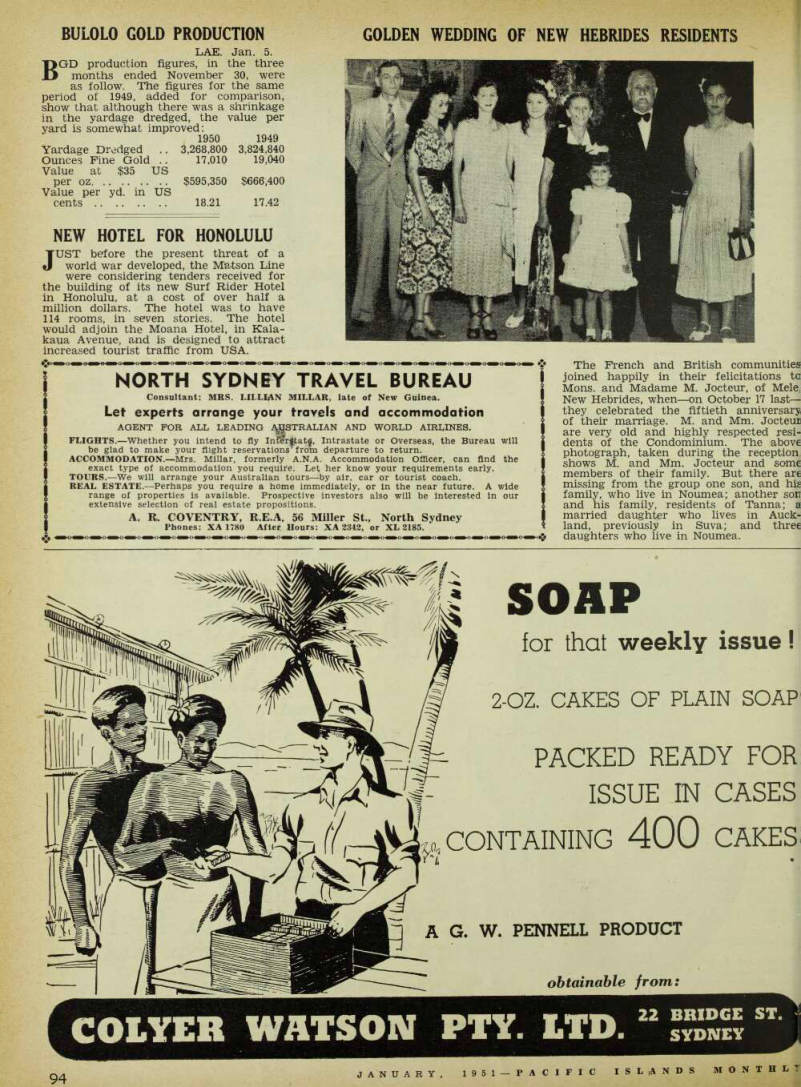
LAE. Jan. 5.
BGD production figures, in the three months ended November 30, were as follow. The figures for the same period of 1949, added for comparison, show that although there was a shrinkage in the yardage dredged, the value per yard is somewhat improved: 1950 1949 Yardage Dredged .. 3,268,800 3,824,840 Ounces Fine Gold .. 17,010 19,040 Value at $35 US per oz $595,350 $666,400 Value per yd. in US cents 18.21 17.42
New Hotel For Honolulu
JUST before the present threat of a world war developed, the Matson Line were considering tenders received for the building of its new Surf Rider Hotel in Honolulu, at a cost of over half a million dollars. The hotel was to have 114 rooms, in seven stories. The hotel would adjoin the Moana Hotel, in Kala kaua Avenue, and is designed to attract increased tourist traffic from USA.
Golden Wedding Of New Hebrides Residents
The French and British communities joined happily in their felicitations ta Mons. and Madame M. Jocteur, of Mele, New Hebrides, when —on October 17 last — they celebrated the fiftieth anniversary of their marriage. M. and Mm. Jocteur are very old and highly respected resi dents of the Condominium. The above photograph, taken during the reception, shows M. and Mm. Jocteur and some members of their family. But there are missing from the group one son, and his family, who live in Noumea; another son and his family, residents of Tanna; a married daughter who lives in Auck land, previously in Suva; and three daughters who live in Noumea.
Advertisements & other items, pp. 96-98 (4 items)
94
JANUARY, 1951 PACIFIC ISLANDS MONTHL.
North Sydney Travel Bureau
Consultant: MRS. LILLIAN MILLAR, late of New Guinea.
Let experts arrange your travels and accommodation AGENT FOR ALL LEADING AUSTRALIAN AND WORLD AIRLINES.
FLlGHTS.—Whether you intend to fly lntrastate or Overseas, the Bureau will be glad to make your flight reservationsirom departure to return.
ACCOMMODATION.—Mrs. Millar, formerly A.N.A. Accommodation Officer, can find the exact type of accommodation you require. Let her know your requirements early.
TOURS. —We will arrange your Australian tours—by air, car or tourist coach.
REAL ESTATE. —Perhaps you require a home immediately, or in the near future. A wide range of properties is available. Prospective investors also will be Interested in our extensive selection of real estate propositions.
A. R. COVENTRY, R.E.A. 56 Miller St., North Sydney Phones: XA 1780 After Hours: XA 2342. or XL 2185.
Soap
Ag i X 71 B A
for that weekly issue!
2-OZ. CAKES OF PLAIN SOAP
PACKED READY FOR
ISSUE IN CASES
% CONTAINING 400 CAKES
A G. W. PENNELL PRODUCT
obtainable from: COLYER WATSON PTY. LTD. 22 s “ 51
BROOMFIELDS Ltd.
Suppliers of Building Hardware, Ship Chandlery, Paint Materials
WRITE DIRECT TO:
Broomfields Ltd., 152 Sussex Street, Sydney
ASTHMA & BRONCHITIS
CURBED QUICKLY
Today, thanks to Mendaco, there Is no reason why any man or woman should not get relief from ASTHMA ATTACKS with the everlasting fight for breath, and the tightness on the chest which makes going to bed at night a positive nightmare.
Mendaco—a famous doctor’s prescription— is guaranteed to ease your breathing, permit you to eat any kind of food without harm, stop your heart thumping against your ribs—or money back. Go to your chemist now, but insist on Mendaco—the medicine that must give you relief or money back.
Mendaco works quickly to relieve your Asthma or Bronchitis yet contains no narcotics or habit-forming drugs. It acts in these 3 ways:— (1) Loosens and relaxes thousands of tiny muscles in throat and bronchial tubes so that you can breathe freely and deeply, and thus get the benefits of health-restoring air and oxygen in your lungs. (2) Removes the mucus or phlegm which poisons the system. (3) Drives out the poisons and irritating factors and helps to refresh and build up the blood, thus increasing energy and so fortifying the system against recurring attacks.
MENDACO HELPS MILLIONS.
Millions of former sufferers from Asthma and Bronchitis are now enjoying sound, invigorating sleep all night and every night, because in Mendaco they have found the
one medicine which truly gets to the root of their trouble and relieves the terrible suffering. Men and women who had at one time to sit up all night long—unable to work, compelled to choose their food carefully, and could never enjoy life —say that, thanks to Mendaco, their paroxysms have stopped, and that they can now sleep soundly the whole night through, eat any kind of food, and feel younger and stronger than they have for many years.
If you are one of the millions subject to cough after cough and cold after cold, and cannot shake them off, beware Bronchitis and Asthma. Mendaco, because it eases breathing and gets air to your lungs, helps to attack the cause —a stifled respiratory system, and the blood-cleansing medicaments in Mendaco fortify and strengthen you against further trouble.
REAL RELIEF IN 24 HOURS.
Mendaco starts circulating through the blood in 3 minutes, and within an hour or so you can feel that your stifled tubes are being freed so that you can breathe easily and freely. Most Mendaco users say they sleep soundly first night, and feel like a new person within 24 hours.
No dopes, smokes, atomisers, or injections.
Ge: Mendaco from your chemist today und?r the guarantee to give satisfaction or money back.
Mendaco
Stops Asthma 4C Bronchitis ■jt Hay Fever
At Your Service , . .
William E. Reed
(Established 1913) Island Trade Broker & Commission Agent 145 a GEORGE ST., CIRCULAR QUAY, SYDNEY.
For more than 36. years the PERSONAL buying services of WILLIAM E. REED, backed by an experienced staff has ensured prompt and reliable service at lowest cost to Missions, Planters and Traders throughout the Pacific. We operate on a WHOLESALE basis only. You receive original invoices at invoiced cost.
Purchase and delivery of Island craft a speciality.
Enquiries invited tor all plantation and trading requirements. Island products sold on a commission basis.
Cables: "WILREED," Sydney
BOAT SALES DIVISION
For Sea Delivery : 40 FT. TRADE BOATS 10 ton cargo capacity.
Diesel powered. Strong and seaworthy.
Two experienced teams always available for sea delivery anywhere in the Pacific.
ALSO . . .
Continuously available is a wide range of power and auxiliary power craft ideally suited to various Island purposes. Specials immediately available include:— FT. AUXILIARY CUTTER.—AII sails new. 60 H.P. Gardner Diesel Equipped with dog house. 70 FT. CARGO VESSEL.—I3S H.P. Caterpillar Diesel. Hold capacity, 3,000 cubic feet. 50- FT. SEINE TRAWLER.—HauIing equipment in first-class condition.
Large fish-room for cargo space. 47 FT. AUXILIARY CARGO VESSEL.—SaiIs in good condition. 30 H.P.
Lister Diesel. 35 FT. AUXILIARY CARGO VESSEL.—FuII suit sails. 40 H.P. Diesel. All in perfect condition. 60 FT. AUXILIARY GENERAL PURPOSE CRAFT.—76 HP. Diesel. Ideal for Administration or Mission work. 66 FT. GENERAL PURPOSE CRAFT.—2SO H.P. Hercules Diesel. Copper sheathed. 45 FT. CARGO VESSEL, 135 H.P. Thomycroft Diesel. Can be fitted with sails. Beautifully constructed by boat-builder for own use. 55 FT, DOUBLE-ENDED WELDED STEEL COPRA BARGE.—Timber sparred frames. Hold capacity, approx. 4,725 cubic feet. Vessel unused. 106 FT. ARMY D CLASS STEEL LIGHTER. Cargo capacity, 400/600 tons.
Other vessels from 28 ft. upwards are available.
Distributors /or:
COVENTRY VICTOR DIESEL MARINE ENGINES
5/7 H.P. and 7/9 H.P. Write for Specifications.
PEERLESS LOCKWCVEN SQUARE MESH FENCING
For pig fences, sheep fences, cattle fences, general farm fences.
SPANISH SHOTGUNS
Complete range available. Inquiries invited.
Merchants and Traders—Write or Cable for Literature and Prices.
95
LIFE ON A JUNK HEAP
(Continued from page 13)
PACIFIC ISLANDS MONTHLY JANUARY, 1951
Madame’s Tenants
Tahiti Case Goes To Paris
From Our Own Correspondent
Papeete, Dec. 15
THE prosecution of Madame Pierson foi ejecting tenants from her house is likely to become a cause celebre. The case has been sent to Paris, for attention.
Mdme. Pierson is held in high respect; She is the daughter of a former French naval officer, Mons. Simon, at one time Port Captain here, and she is the wife of a well-known citizen. She owned a two storey apartment house, occupied by Tahitian and Chinese tenants. The Health Department claimed that the building was unsafe. For two years Mdme. asked the authorities for per mission to eject tenants not on the ground of non-payment of rents (al though that could have been a ground): but because she wanted to repair and re model the building. When the Health officials inspected, they found that some of the tenants were keeping pigs and fowls in the building.
The tenants would not move; so finally Madame, with the approval of the Health Department, put the tenants and their chattels out into the street (Rue du Marche). The tenants went right or residing in the street, which was blocked for two weeks, until the Mayor found places for them elsewhere.
Then the authorities prosecuted Madame for ejecting tenants without s Tribunal order; and it is claimed that, the prosecution addressed insulting lan guage to her, in court.
When Senator Lasalle-Sere was here the other day he heard some details of this case, and now the matter has gone on to Paris, with a complaint against the prosecuting attorney.
Mr. C. O. S. Dawe was recently trans-i ferred from the Melbourne branch of the; Union Steamship Co., to Lautoka, Fijii Mrs. Dawe was formerly Miss Annette; Coster, member of a family well-knowh in Fiji-
Timber Is Three Phases
Official Action On New Guinea Timber Is Three Phases
From Our Own Correspondent
Pt. Moresby, Jan. 8.
LT long last, the Commonwealth Gov ernment has taken action in relation to New Guinea timber and made a ove on the Bulolo valley timber stands.
On December 21, the Minister for sternal Territories (Mr. Spender) inounced that a survey of the ulolo timber area was to be made by :perts on timber-milling and the man facture of plywoods. He said that if the port was favourable a company, com •ising Bulolo Gold Dredging Ltd., and le Commonwealth Government, would ; formed. The Commonwealth would ive the majority of shares, but on the Dard of Management the Government id BGD would have equal representa m. The logging and milling facilities ready installed by Bulolo Gold Dredging [)uld be used for the new company’s >erations.
The Minister said the proposed comp ly would be given exclusive rights over 0 million super feet of pine in the ulolo area, and smaller quantities of her timbers. Its cutting rate would be ound 10 million super feet yearly, and e cleared areas would be replanted.
This particular area represents about ilf the Bulolo timber stand, and was ;quired from the native owners by the before the war. Now, an her native group has agreed to sell the maining half of the Bulolo timber area approx. 24,000 acres —for £lO,OOO. Some ,000 of this money will be used to build model village for the natives concerned; tey will also get a cash payment of £500; id the balance will go into a trust fund
for their future benefit. There is also the opportunity for steady employment in their own area on timber cutting and milling, so that, all in all, this particular group of natives are benefitting mater ially by the deal.
The over-all plan for the Bulolo Valley calls for the logging and milling of 10 million super feet a year, so that the total stand of about 500 million super feet will keep the industry going for half a century. And, as re-forestation will be on a continuous basis —it is already started on postwar logged areas—the first of the new plantings will be ready for cutting by the time the original stand is exhausted, and the programme will then be set for further cycles of fifty years each.
There has been much criticism of the Bulolo timber plans, but it seems that the
present plan is a sound one, and —provided things actually do get started —that seems to be one Territory problem satisfactorily settled. There is no doubt about the energy and efficiency of Bulolo Gold Dredging, or its ability to get things mov ing; and, with the profits shared between the Commonwealth and private enter prise, this seems to be a fair deal for all parties.
Tenders For 3 Special Areas
ANOTHER move in regard to timber is the announcement that tenders are
to be called early this year for cutting in the Trans-Busu (Lae), Brown River (Port Moresby) and the Sangara (Buna) timber areas. The Ministerial statement estimates a total annual cut from these three leases of from 15 to 20 million super feet.
Emergency Permits
AND, further, action is being taken On twenty applications for emergency permits (various coastal areas) au thorising the cutting of up to five million super feet on each permit over a ten
years period. Some permits have already been granted.
With Bulolo turning out plywood, the£ three supplementary leases providing both plywood and general building timl ber, and the emergency permits producing timber over a wide area of the Territory! it looks as though these particular re 4 sources are going to benefit the economy of the Islands in no small way.
It might even be possible to build a : house without waiting months for all th£ bits and pieces of timber that are now on the short supply list.
Advertisements & other items, pp. 99-100 (2 items)
97
ACIFIC ISLANDS MONTHLY JANUARY, 195 1
Gordon’s
KERR BROS. S
G.P.O. Box 3838, Sydney.
ISLAND MERCHANTS SINCE 1895
50 years old, but as young as ever and eager to serve you.
Cocoa Beans, Copra, Coffee and all Island Produce Sold on Commission.
All merchandise purchased at best wholesale prices and original invoices supplied.
Use Our Co-operative Specialised Overseas Buying Service.
m &
iii
•fcji By Appointment Gin Distillers to H.M. King George VI Tanquoray, Gordon & Co. Ltd-
Gordon’s
Stands Supk&wJL
Serving the Needs of the Cook Islands . . .
UNITED ISLAND TRADERS ITT).
(Established 1930)
P.O. BOX 42, RAROTONGA, COOK ISLANDS.
Managing Director: W. H. Watson. Secretary: R. J. A. Ingram, A.R.A., N.Z.
IMPORTERS OF:-
Cotton Cr Silk Piece Goods
EXPORTERS OF:-
Tomatoes Cr Cassava Apparel Cr Drapery Building Materials Musical Instruments Trade Jewellery STAMP DEALERS & SUPPLIERS OF ISLAND PHOTOS Tropical Fruits Sea-shells Cr Necklaces Island Handicrafts "Brood-last" Footwear
INQUIRIES INVITED.
Cables: Bankers: “Watson,” Rarotonga. Bank of N.Z. Ltd., Shortland St., Auckland.
U.K. Agents: Geo. H. Penney & Co. Ltd., 197 Aldersgate St., London, E.C.I.
Flu’ Epidemic Hits Fiji
Commerce, Public Utilities
From Our Own Correspondent SUVA, November, 30.
FIJI is emerging from an influenza epidenmic which, during the month created mild chaos in public services and private industry. Although the attacks were relatively mild and usually over in three or four days, there were also a considerable number of serious cases.
In Suva, at the beginning of the epi demic, the staff of the Colonial Wai Memorial Hospital was much reduced. At one period, 20 nurses and one sister, three doctors and 36 of the students of the Central Medical School were among those affected. Most of these have now re turned to duty.
It was necessary, in the early stages to suspend the general postal delivery ir Suva, and eight operators in the Suvs Telephone Exchange were among the victims.
Reports received by the South Pacific Health service show that influenza of s severe type is widespread in the CooH Islands, and in some of the G & E Is
Advertisements & other items, p. 100 (2 items)
98
JANUARY, 1951 PACIFIC ISLANDS MONTHL
Anchor
Gillespie’s Anchor Flour is milled from selected high quality Australian wheats and is entoleted for purity. Its consistent high quality has made it the best-known, most asked-for brand of flour in the Islands. (Entoletion is a special new purifying process which reduces the risk of insect infestation).
FOR
GILLESPIE’S
ANCHOR
FLOUR
GILLESPIE BROS. PTY. LTD., ANCHOR FLOUR MILLS, SYDNEY G. 1.97
Rahaul-Kokopo Area
War Surplus Goods In Rahaul-Kokopo Area
From Our Own Correspondent
Port Moresby, Jan. 5.
A MELBOURNE man, Mr. Arthur West r\ hoven, was the successful tenderer for the right to salvage all unsold rar surplus goods in the Rabaul-Kokopo ,rea.
This tender has been let on a new sys em, that of a royalty payment for all oods salvaged, whether retained by Mr.
Vesthoven himself or sold by him. further, the Administration retains a nice in the fixing of values for salvaged oods, so it seems unlikely that the fan astic bargain rates which applied to lany deals in the early post-war years fill be repeated.
If this system had been adopted from he commencement of sales of War Dis iosal goods, the Commonwealth would e richer by a few million pounds and he glaring scandal of the whole Dis osals business would have been avoided, literally, millions of pounds worth of Imost irreplacable goods were given way at bargain prices, in the incredible ales of war goods immediately after ostilities ended.
Almost equally iniquitous was the whole ale export of valuable equipment ur ently needed in the Territory to get the slands back on an economic basis. The ehabilitation and development of the slands was set back by at least a. decade y this monstrous piece of government lismanagement. If the matter had been lade the subject of a Royal Commission f Enquiry, as it should have been, “mis lanagement” would probably have been ermed criminal negligence of the nation’s iterests.
However, Mr. Westhoven, working under he new system, will be doing the country service if he can unearth anything of alue in the junk heaps and hidden hide uts around Rabaul and Kokopo. Un oubtedly, there is still much of value to e found, but it certainly won’t be easy, ’he caves are in a dangerous condition y this time, and to locate the rest of he stuff will take the qualities of a herlock Holmes. He has a year in finch to tackle the job, and it will be iteresting to see what he salvages over hat period.
Oil Search In Papua
A USTRALASIAN Petroleum Co. Pty., \ Ltd., reports as follows on oil drilling operations in Papua up to the end f December: — Wana: The hole has been deepened 09 feet, from 9,657 feet to 9,866 feet.
Hohoro: Rig erection at No. 2 site is i progress, and drilling is expected to ommence in February.
Island Exploration Company Pty., Ltd.
Island Exploration Co. Pty., Ltd., re orts that the test well at Omati has een deepened 244 feet from 206 feet to 50 feet.
His Lordship the Bishop in Polynesia eturned to Suva in December after a trenuous tour of Australia and New Zealand. While visiting the town of Juswellbrook, about 100 miles from New astle NSW, at an evening function the lishop in Polynesia was greeted in Fijian ly a. Minister of the Church. He was the lev. Mr. Arnold of the local Presbyterian church, who about 40 years ago was on he mechanical staff of the Fiji Times md Herald.
Sydney Geologist Visits Bsi
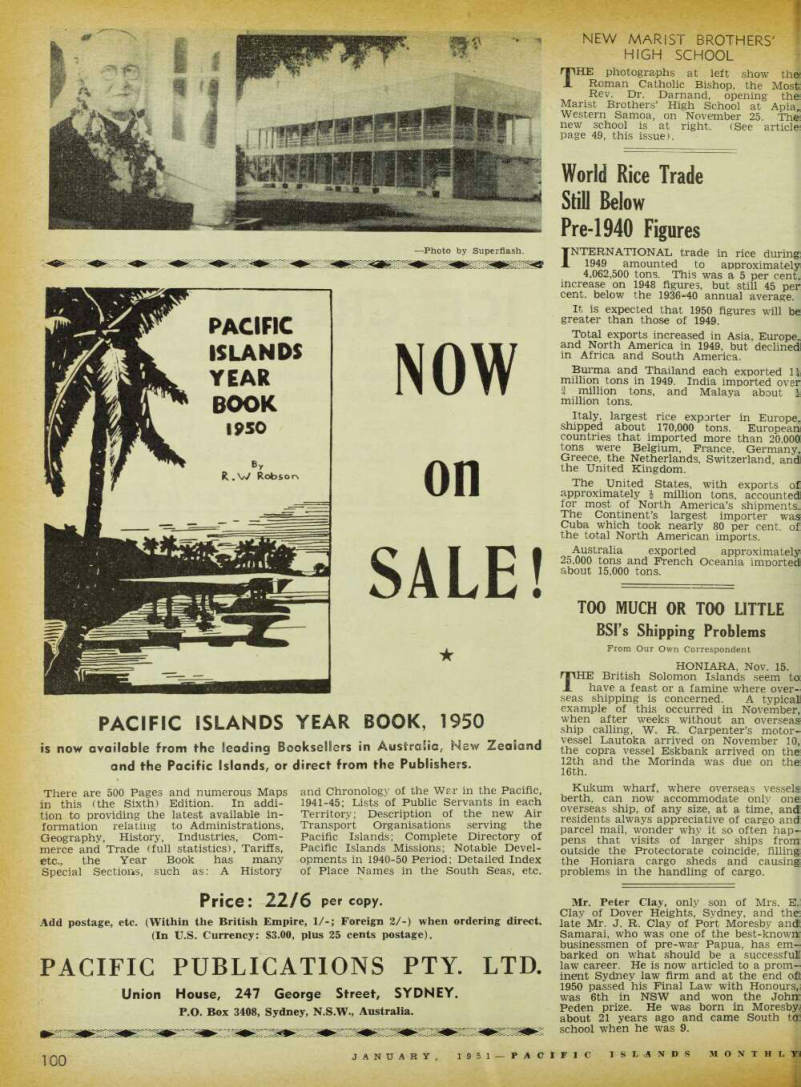
From Our Own Correspondent
Honiara, Nov. 20.
PROFESSOR C. E. Marshall, Edgeworth David Professor of Geology at the Sydney University, who is making arrangements to bring a team of geologists to the British Solomon Islands next year arrived in Honiara by Qantas plane on November 13.
He plans to spend about a month in the British Solomons, making a prelim inary study of likely areas in the Protec torate with the Government Geologist
(Mr. J. C. Grover). Professor Marshall will then return to Sydney and will do some introductory research with the team of scientists who are to accompany him to BSI next year, so that, on their arrival, they can get down to work with the least possible delay.
Mr. Charles Wade of Madang, NG, was in Sydney on sick leave in January.
Mr. Douglas Brown of the Department of Agriculture, Fiji, with his wife and small daughter, was holidaying in Armi dale, NSW, in January.
—Photo by Superflash.
Advertisements & other items, pp. 101-102 (1 item)
Mary Baker
ICE CREAM MIX
Is now available to Pacific Islands Traders and Storekeepers in Chocolate and Strawberry Flavours in addition to the popular Vanilla Packed in 16 oz. tins for the Home, 5 lb. Family Size tins and 32 lb. tins for Storekeepers, Milk Bars and Cafes.
Assk Your Loccd Storji For h By placing your order with our Agent in your own Territory, you will receive your supplies of Mary Baker Ice Cream Mix
more promptly
AGENTS:
New Caledonia: ET BALLANDE, Noumea.
New Hebrides: COMPTOIRS FRANCAIS
DES NOW ELLER HEBRIDES,
Vila and Santo.
Tahiti: WALTER GRAND, Papeete.
Fiji: HUNT’S AGENCY, Suva.
W. L. D. HARVIE, Lautoka (North-West Districts).
Sole Distributor :
J. C. MERRILLEES PTY. LTD.
104 HUNTER STREET, SYDNEY, N.SW
Telegrams; “MERRILLEES,” Sydney.
PACIFIC
ISLANDS
YEAR
BOOK
1950 K.W Robso
NOW
on
SALE!
PACIFIC ISLANDS YEAR BOOK, 1950
is now available from the leading Booksellers in Australia. New Zealand and the Pacific Islands, or direct from the Publishers.
There are 500 Pages and numerous Maps in this (the Sixth) Edition, In addition to providing the latest available information relating to Administrations, Geography, History, Industries, Commerce and Trade (full statistics), Tariffs, etc., the Year Book has many Special Sections, such as: A History and Chronology of the War in the Pacific, 1941-45; Lists of Public Servants in each Territory; Description of the new Air Transport Organisations serving the Pacific Islands; Complete Directory of Pacific Islands Missions; Notable Developments in 1940-50 Period; Detailed Index of Place Names in the South Seas, etc.
Price: 22/6 per copy.
Add postage, etc. (Within the British Empire, 1/-; Foreign 2/-) when ordering direct. (In U.S. Currency: $3.00, plus 25 cents postage).
PACIFIC PUBLICATIONS PTY. LTD.
Union House, 247 George Street, SYDNEY.
P.O. Box 3408, Sydney, N.S.W., Australia.
New Marist Brothers'
High School
THE photographs at left show the?
Roman Catholic Bishop, the Most Rev. Dr. Darnand, opening the?
Marist Brothers’ High School at Apia„ Western Samoa, on November 25. The' new school is at right. (See article? page 49, this issue).
Pre-1940 Figures
World Rice Trade Still Below Pre-1940 Figures
INTERNATIONAL trade in rice during; 1949 amounted to approximately 4,062,500 tons. This was a 5 per cent, increase on 1948 figures, but still 45 per cent, below the 1936-40 annual average.
It is expected that 1950 figures will be greater than those of 1949.
Total exports increased in Asia, Europe,, and North America in 1949, but declinedl in Africa and South America.
Burma and Thailand each exported lh million tons in 1949. India imported over S million tons, and Malaya about h million tons.
Italy, largest rice exporter in Europe,, shipped about 170,000 tons. European; countries that imported more than 20,000 tons were Belgium, France, Germany, Greece, the Netherlands, Switzerland, andl the United Kingdom.
The United States, with exports of approximately i million tons, accounted! for most of North America’s shipments..
The Continent’s largest importer was; Cuba which took nearly 80 per cent, of the total North American imports.
Australia exported approximately 25,000 tons and French Oceania imported about 15,000 tons.
Too Much Or Too Little
BSI’s Shipping Problems
From Our Own Correspondent
Honiara, Nov. 15.
THE British Solomon Islands seem toe have a feast or a famine where over seas shipping is concerned. A typicall example of this occurred in November, when after weeks without an overseas ship calling, W. R. Carpenter’s motor vessel Lautoka arrived on November 10, the copra vessel Eskbank arrived on the? 12th and the Morinda was due on the 16th.
Kukum wharf, where overseas vessels berth, can now accommodate only one overseas ship, of any size, at a time, and: residents always appreciative of cargo and parcel mail, wonder why it so often hap pens that visits of larger ships from outside the Protectorate coincide, filling the Honiara cargo sheds and causing problems in the handling of cargo.
Mr. Peter Clay, only son of Mrs. E.l Clay of Dover Heights, Sydney, and thK late Mr. J, R. Clay of Port Moresby and Samarai, who was one of the best-knownr businessmen of pre-war Papua, has em barked on what should be a successful! law career. He is now articled to a prom inent Sydney law firm and at the end oft 1950 passed his Final Law with Honours,; was 6th in NSW and won the John: Peden prize. He was born in Moresby) about 21 years ago and came South tffi school when he was 9.
Pacific Recipients Of
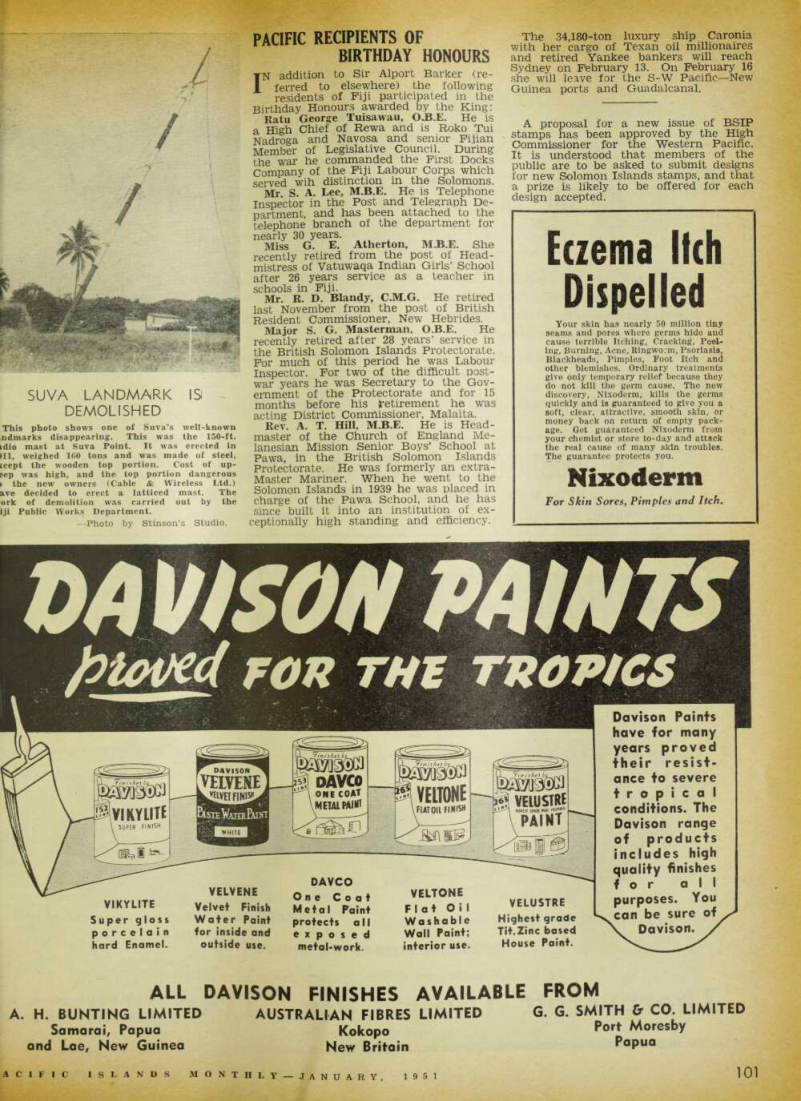
Birthday Honours
IN addition to Sir Alport Barker (re ferred to elsewhere) the following residents of Fiji participated in the Birthday Honours awarded by the King: Ratu George Tuisawau, 0.8. E. He is a High Chief of Rewa and is Roko Tui Nadroga and Navosa and senior Fijian Member of Legislative Council. During the war he commanded the First Docks Company of the Fiji Labour Corps which served wih distinction in the Solomons, Mr. S. A. Lee, M.B.E. He is Telephone Inspector in the Post and Telegraph De partment, and has been attached to the telephone branch of the department for nearly 30 years.
Miss G. E. Atherton, M.B.E. She recently retired from the post of Head mistress of Vatuwaqa Indian Girls’ School after 26 years service as a teacher in schools in Fiji.
Mr. R. D. Blandy, C.M.G. He retired last November from the post of British Resident Commissioner, New Hebrides.
Major S. G. Masterman, 0.8. E. He recently retired after 28 years’ service in the British Solomon Islands Protectorate.
For much of this period he was Labour Inspector. For two of the difficult post war years he was Secretary to the Gov ernment of the Protectorate and for 15 months before his Retirement he was acting District Commissioner. Malaita.
Rev. A. T. Hill, M.B.E. He is Head master of the Church of England Me lanesian Mission Senior Boys’ School at Pawa, in the British Solomon Islands Protectorate. He was formerly an extra- Master Mariner. When he went to the Solomon Islands in 1939 he was placed in charge of the Pawa School, and he has since built it into an institution of ex ceptionally high standing and efficiency.
The 34,180-ton luxury ship Caronia with her cargo of Texan oil millionaires and retired Yankee bankers will reach Sydney on February 13. On February 16 she will leave for the S-W Pacific —New Guinea ports and Guadalcanal.
A proposal for a new issue of BSIP stamps has been approved by the High Commissioner for the Western Pacific.
It is understood that members of the public are to be asked to submit designs for new Solomon Islands stamps, and that a prize is likely to be offered for each design accepted.
Suva Landmark Is
Demolished
This photo shows one of Suva’s well-known [?]ndmarks disappearing. This was the 150-ft. [?]idio mast at Suva Point. It was erected in [?]11, weighed 160 tons and was made of steel, except the wooden top portion. Cost of up [?]ep was high, and the top portion dangerous [?] the new owners (Cable & Wireless Ltd.) [?]ave decided to erect a latticed mast. The [?]ork of demolition was carried out by the Fiji Public Works Department. —Photo by Stinson’s Studio.
Advertisements & other items, pp. 103-104 (2 items)
101
ACIFIC ISLANDS MONTHLY JANUARY, 1951
Dispelled
Eczema Itch
Your skin has nearly 50 million tiny seams and pores where germs hide and cause terrible Itching, Cracking, Peeling, Burning, Acne, Ringworm, Psoriasis, Blackheads, Pimples, Foot Itch and other blemishes. Ordinary treatments give only temporary relief because they do not kill the germ cause. The new discovery, Nlxoderm, kills the germs quickly and is guaranteed to give you a soft, clear, attractive, smooth skin, or money back on return of empty package. Get guaranteed Nlxoderm from your chemist or store to-day and attack the real cause of many skin troubles.
The guarantee protects you.
Nixoderm
For Skin Sores, Pimples and Itch.
/ / i A / / / /
DAVCO
ONE COAT
METALPAINI
rtnonfj uu
SVQ3OG3
VEITONE
DAVISON
VELVENE
LSWtlflNlsu finish
PVIKYIITI
\ SUPER FINISH
fiat on n
WHITE
bs
VIKYLITE
Super gloss porcelain hard Enamel.
VELVENE
Velvet Finish Water Paint for inside and outside use.
DAVCO
One Coat Metal Paint protects all exposed metal-work.
VELTONE
Flat Oil Washable Wail Paint; interior use.
YELUSTRE
Highest grade Tit. Zinc based House Paint.
Davison Paints have for many
years proved
their resistance to severe
tropical
conditions. The Davison range
of products
includes high
quality finishes
for all purposes. You can be sure of Davison.
ALL DAVISON FINISHES AVAILABLE FROM
H. BUNTING LIMITED AUSTRALIAN FIBRES LIMITED G. G. SMITH & CO. LIMITED
Samarai, Papua Kokopo Moresby
Lae, New Guinea New Britain Papua and
£=> G. H. ROBINSON EXPORTS & IMPORTS PTY. LTD
Pacific Island Traders and Merchants.
Sole Distributor of Bradford Commercial Vehicles, Jowett Javelin Cars and Uniporn Diesel Engines—(Franchises available in certain Pacific Groups.) Sellers on Commission of all kinds of Island produce—Cocoa Beans, Green Snail, Copra, Fungus, M.O.P. Shell, Trochus Shell, etc.
Agents in London and Manchester for the Disposal and Supply of Produce and Special Requirements.
EVERY ATTENTION GIVEN TO ORDERS IRRESPECTIVE OF SIZE.
Make use of our 30 years’ personal experience and direct your inquiries to: G. H. ROBINSON EXPORTS & IMPORTS PTY. LTD. 51 MACQUARIE STREET, SYDNEY. Telephone: BW 4575.
Cables: “SUNRISE,” SYDNEY. Postal Address: Box 3317, G.P.0., Sydney
RTR4 30 H.P. Marine Diesel
Elec. Starting. 2-1 Red. Gear.
Ak J: Modern compact Diesel for general purpose use.
MARINE PETROL AND
DIESEL ENGINES
Ranging from 9-130 H.P.
In units—9, 18, 20/30, 33/55, 60/90, and 95/130 H.P.
STUART TURNER Diesel Generating Sets. 500 Watt to 1,500 Watt. Simple, Efficient and Economical.
STUART Marine Engines available in li, 4 and 8 H.P.
GOOD DELIVERIES OF ALL MODELS.
Write for full particulars of our complete range of engines to:
Thornycroft (Aust.) Pty., Ltd.
6/10 Wattle Street,
PYRMONT, N.S.W.
Cables: “THORNMOTOR,” Sydney.
Senibua Finds Tuna
off Southern NSW
i LTHOUGH this season, in comparison L with last when NSW fishermen caught about 1,000 tons by old Lshioned trolling methods, has been a an one for tuna, the Fiji clipper Senibua as proved that they can be caught in astern Australian waters in payable lantities —if they can be found.
There is a lot of ocean off the south ist corner of Australia, however, and to ■uise about there just looking is too ex msive. Senibua men say that there will ave to be an effective system of spotting le schools before it is an economical reposition. When the Senibua arrived i Australia from Fiji some months ago, le brought with her a Piper Cub spotting ane, but, tuna do not always stay close lough to the surface to be spotted in lis way and this method has been aban med and the plane sold. What seems i be needed is a fleet of clippers, linked j radio. When a school is found, there enough fish for all —competition in tiding a school does not enter into the icture.
After last year’s bumper crop, results lis year have been disappointing—appar itly tuna are temperamental creatures— id it is reported that the Fiji company as “ready to give the game away.” How /er, about January 2, a small fishing ;ssel off Eden put Senibua on to a school f tuna and in about five hours they had mght 30 tons, using their live bait pole
shing method.
Then the bait ran out.
Senibua returned to base for more bait ad after much searching relocated the ;hool and caught another 15 tons. Ex mination showed that the fish were impletely empty and very hungry. They ished the live bait.
As a result of this quick haul, Senibua rew have changed their minds somewhat bout the formerly recalcitrant Aussi ma—they say it is there in worthwhile aantities, if you can find it.
Mr. Evatt, NSW Chief Secretary, who at rst refused the Fiji boat permission to sh in NSW, has not* made any pro ouncement, but the Commonwealth Dir ;tor of Fisheries is pleased with Senibua’s jsults. He thinks that the clipper has roved that a worthwhile tuna fishing in astry can be built up on the Australian ist coast using the American pole fishing lethod.
New Industry For Papua
A Use For Mangrove Swamps
i BORNEO company has received ap \. proval from the Commonwealth Government to start a “eutch reducing factory at Kikori, in the Delta ivision of Papua.
Cutch is extracted from the bark of [angrove trees in which the area sounds; it is used in dyeing and tanning ad is in demand in USA.
It is expected that the factory will reduce about 3,000 tons of cutch annually ad that 2,000 local natives will engage m le industry.
Executives of the Borneo company made survey of the Kikori area in October bvember and were impressed with the ossibilities of developing the industry.
Mr. and Mrs. C. J. Pocock with their vo daughters are spending a short holi ay in Fiji to visit Mrs. Pocock’s mother [rs. McKenzie of Nagasau Estate, aveuni.
Aluminium Houses
102 For Papua-New Guinea
From Our Own Correspondent
Pt. Moresby, Jan. 8.
WHEN the overseas ship Rembrandt drops anchor in Port Moresby harbour in February, the first pre fabricated aluminium homes ever to arrive in the Territory will be taken from its holds.
The cargo comprises 33 Hawkesley Aluminium houses made in Britain, and when these are erected and occupied it will settle the present discussion on whether aluminium houses can be made suitable for tropical areas. The manu facturers claim that the special insula tion built into the structures makes them ideal for a tropical country. The sceptics want somebody else to live in them before they take on a tenancy.
Another 69 of these homes leave Britain
for the Territory at the end of this month, in the Baluchistan; so that, when the testing time is over, 102 Papua and New Guinea families will be able to give an opinion on the desirability of aluminium houses.
These two-bedroom houses, with a sleep out, will cost from £3,600 to £4,000 (Aus.) each when erected, and fitted with elec trical equipment. This is roughly about the same as Australian hardwood homes now being built in the Territory.
Fund (QId. Division)
New Guinea Memorial Scholarship Fund (QId. Division)
Acknowledged to November 30 .. £349 8 2 Proceeds raffle for Painting con ducted by Brisbane New Guinea Women’s Club 51 2 0 Monies collected by New Guinea Women’s Club, Brisbane, and for sales of oddments 623 Total to December 31 £406 12 5
Advertisements & other items, pp. 105-106 (2 items)
103
ACIFIC ISLANDS MONTHLY JANUARY, 1951
I. R. Carpenter & Co. (Fiji) Ltd.
Agents for — LIVERPOOL & LONDON & GLOBE INSURANCE CO. LTD.
Fire Marine Accident
PENINSULAR & ORIENTAL STEAM NAVIGATION CO.
Passages to and from the United Kingdom and India, via Australia.
Air and Ship Connections Arranged.
BRITISH PETROLEUM COMPANY OF NEW ZEALAND
(South West Pacific) LIMITED.
Honorary Agents for —
NEW ZEALAND GOVERNMENT
Details and arrangement tor travel in N.Z.
New Zealand City and Trade Directories available for reference.
QUEENSLAND
INSURANCE
COMPANY
LIMITED
(Incorporated 1886 in Australia).
ASSETS EXCEED £5,000,000
Head Office:
QUEENSLAND
INSURANCE BUILDING.
80-82 PITT STREET. SYDNEY.
Specialists in South Sea Fire,
Marine & Accident Insurances
Apply to: —
FIJI. —Branch Office: I. B. Chalmers, Manager.
Burns Philp (South Sea) Co., Ltd.
VILA. —Burns Philp (New Hebrides), Ltd.
Comptoirs Francais Des Nouvelles Hebrides.
NOUMEA. —L. & W. Johnston.
NEW GUlNEA—Manager for the Territory of New Guinea and Papua, W. A.
Anderson.
PORT MORESBY—SAMARAI—LAE
—MADANG—RABAUL.
Burns Philp (New Guinea), Ltd.
PAGO PAGO.
Burns Philp (South Sea) Co., Ltd.
G. H. C. Reid & Co.
OTHER SOUTH SEA ISLANDS.
Burns Philp (South Sea) Co., Ltd.
Also to any of the Company’s Offices in Australia or New Zealand.
Farewell To Fiji-Muslim School Teacher
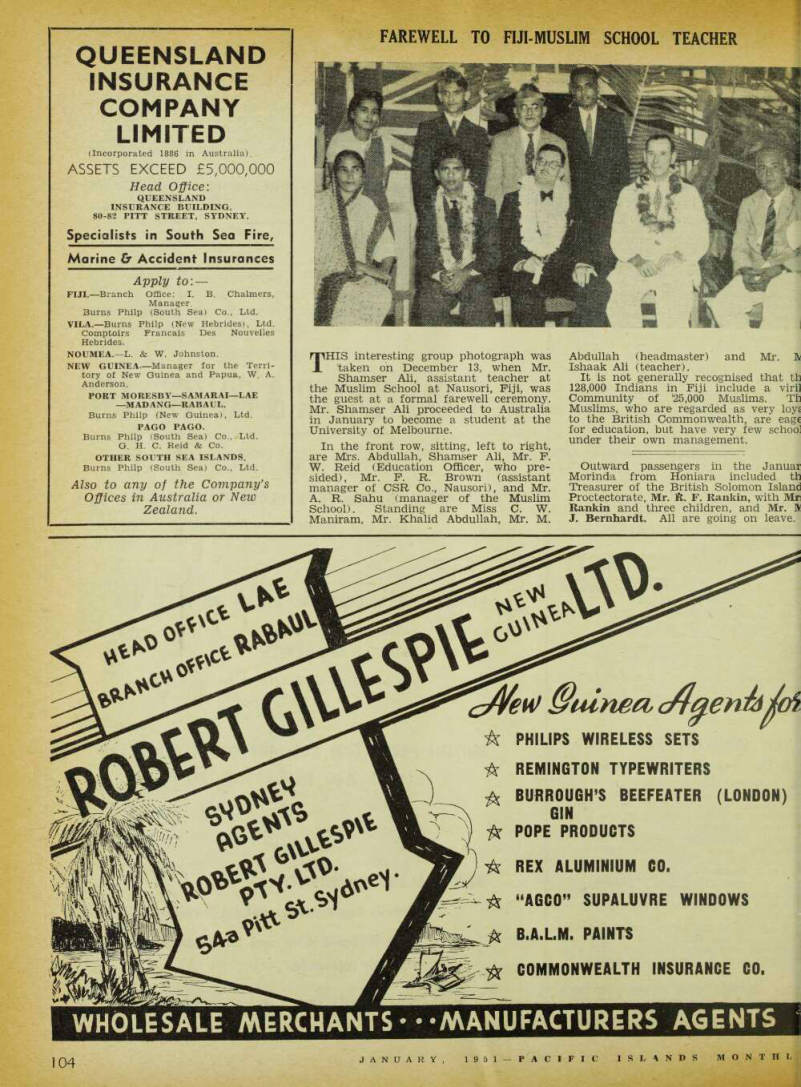
THIS interesting group photograph was taken on December 13, when Mr.
Shamser Ali, assistant teacher at the Muslim School at Nausori, Fiji, was the guest at a formal farewell ceremony.
Mr. Shamser Ali proceeded to Australia in January to become a student at the University of Melbourne.
In the front row, sitting, left to right, are Mrs. Abdullah, Shamser Ali, Mr. F.
W. Reid (Education Officer, who pre sided) , Mr. F. R, Brown (assistant manager of CSR Co., Nausori), and Mr.
A. R. Sahu (manager of the Muslim School). Standing are Miss C. W.
Maniram, Mr. Khalid Abdullah, Mr. M.
Abdullah (headmaster) and Mr. IV, Ishaak All (teacher).
It is not generally recognised that th 128,000 Indians in Fiji include a viril Community of '25,000 Muslims. Th Muslims, who are regarded as very loys to the British Commonwealth, are eage for education, but have very few school under their own management.
Outward passengers in the Januar Morinda from Honiara included th Treasurer of the British Solomon Island Proctectorate, Mr. R. F. Rankin, with Mr Rankin and three children, and Mr. IV' J. Bernhardt. All are going on leave.
Advertisements & other items, p. 106 (2 items)
104
JANUARY, 1951 PACIFIC ISLANDS MONTHL
c/Vert guinea c/lcfenhj/j&r
o* v \C* 0^ o'*' *& %? & w Hvl &' vV « V'
*ew guinea
PHILIPS WIRELESS SETS
REMINGTON TYPEWRITERS
a
BURROUGHS BEEFEATER (LONDON)
GIN
POPE PRODUCTS
REX ALUMINIUM CO.
“AGCO” SUPALUVRE WINDOWS
A B.A.L.M. PAINTS
COMMONWEALTH INSURANCE CO.
Honolulu To Tahiti
Non-Schedule Air Service Announced
BECAUSE of the failure of the French > air services to continue with their trans-Pacific plans, French Oceania now about the most isolated of the tore important Territories of the South The only regular mails are those carried j r the Quarterly liners of Messageries Caritimes. Irregular mails are taken by jcasional freighters. Now and again, hen specially charted planes visit ahiti, airmails are carried.
It now seems likely that a plane will ) irregularly, about once a month, from onolulu to Tahiti, and return, and it ay carry mails. The following appeared i November 4 in the Honolulu Adver ser: Tahiti Hawaii Airways, with offices at .46 Kalakau Avenue, Honolulu, has ;en formed to meet an increasing de and for transportation between Tahiti id Hawaii. It is the first air line to be rmed for this specific purpose.
Principals in the new company are r illiam E. Pennington and Alexander aran. Pennington, a Honolulu business an, has been closely associated with the awaiian hotel and tourist industry, and aran, a former Honolulan, has been .ring and doing business in Tahiti during ie past 16 years, and is familiar with the irrent demand for Tahiti-Hawaii trans lation in the South Pacific.
Tahiti Hawaii Airways plans non heduled flights at intervals of about 30 lys, the first of which is scheduled for ecember. The latest type 42-passenger fing boat which assures comfort and ,fety will be used in the flights, making possible to land in the Papeete lagoon, i Tahiti.
Pennington and Taran said necessary amissions were obtained through the -operation of both French and Ameri n officials.
There has been a demand by Americans r transportation between Hawaii and ihiti since the end of World War 11, id the occasional surface transportation tween San Francisco and Tahiti has >w been booked up at least a year in 1 vance, * With the recent completion of accom odation in Tahiti, Papeete is now nipped to handle tourist groups. The nerican dollar will go far in French :eania, and Tahiti Hawaii Airways plan tes that will be within reach of every ie with the urge to visit this South icific paradise. ♦ ♦ ♦ It is a surprising thing that, consider g the amount of business done with istralia and New Zealand by French ;eania, there has been no extension of e Fiji-Cook Islands plane service to ihiti. There should be enough traffic make the enterprise worth while. The esent situation is a severe handicap on e French colony.
Geological Surveys In Bsi
From Our Own Correspondent
Honiara, Jan. 7.
IHE Sydney University Geological Ex pedition at present working- in the British Solomon Islands had three embers in the field by December. Two ore are due towards the end of January, id further members are expected early May.
Two surveys in course of development in muary involved St. George Island and mthern Ysabel, and western Guadal nal. Mr. Bruce Levett and Mr. Richard anton are undertaking research in the sabel area, and Mr. Pat Coleman is irking on the Guadalcanal survey.
Hospital Plans For Papua-
New Guinea
T HE Minister tor Externa, Territories X announced on 20 that the Commonwealth Government had ap proved a programme for hospital con struction in the Territory of Papua and about about £7miiiion spent over a period of nve years.
The Minister stated that there had been a long and pressing need for Hos pitals in the Territory and that the programme that has been approved is based upon the results of investigations that were made by a Committee appointed
by the Minister last June. The Committee consisted of experts in tropical medicine and hospitalisation.
Training School, 15 regional hospitals, 52 sub regional hospitals, eight leper hos pitals, eight tuberculosis and three bulk medical stores—a total of 88 buildings.
All Hos P itals alon S with other buildings were destroyed during the war, and since then hospital provision has been greatly short of requirements and had been pro vided largely on temporary and improvised basis. The programme will be corn menced as soon as possible and with a view to its completion within the time set.
Advertisements & other items, p. 107 (2 items)
105
ACIFIC ISLANDS MONTHLY JANUARY, 1951
Kiwi
Th ey re
*»ell
worn
wel\
worn
ve
they
hut
- thanks to 2953 N BLACK . TAN . DARK TAN •
MID TAN . BROWN . MAHOGANY
. OX BLOOD . BLUE . TRANS-
PARENT DRESSING
KIWI
★ Makes leather soft and supple ★ Gives added resistance to weather and wear Change to KIWI for KEEPS!
MUNGO SCOTT PTY. LTD.
Flour Millers, Summer Hill, N.S.W., Australia Established 1894.
BLUE
FINE
AND
DRY !
£
SUPERB
IT'S
QUALITY
THAT
COUNTS !
SUPERB
The unvaried “Quality” of “BLUE SUPERB FLOUR” makes it especially suitable to climatic conditions of the Pacific Islands. Our Entoletion process reduces the risk of insect infestation to a minimum. All Good Bakers use “BLUE-SUPERB.” Our Pacific Representative will call on you soon.
Wedding of BS1 Interest
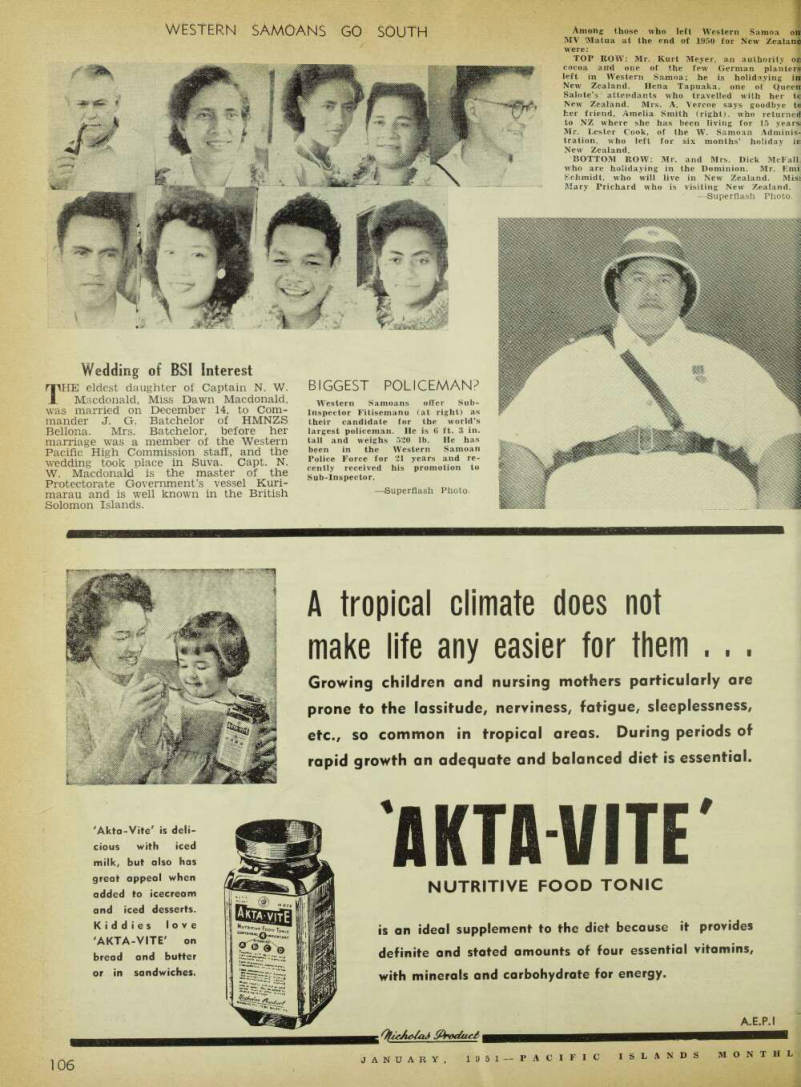
Western Samoans Go South
11HE eldest daughter of Captain N. W.
Macdonald, Miss Dawn Macdonald, was married on December 14, to Com mander J. G. Batchelor of HMNZS Bellona. Mrs. Batchelor, before her marriage was a member of the Western Pacific High Commission staff, and the wedding took place in Suva. Capt. N.
W. Macdonald is the master of the Protectorate Government’s vessel Kuri marau and is well known in the British Solomon Islands.
Biggest Policeman?
Western Samoans offer Sub- Inspector Fitisemanu (at right) as their candidate for the world’s largest policeman. He is 6 ft. 3 in. tall and weighs 520 lb. He has been in the Western Samoan Police Force for 21 years and re cently received his promotion to Sub-Inspector. —Superflash Photo.
Among those who left Western Samoa on MV Matua at the end of 1950 for New Zealand were: TOP ROW: Mr. Kurt Meyer, an authority on cocoa and one of the few German planters left in Western Samoa; he is holidaying in New Zealand. Hena Tapuaka, one of Queen Salote’s attendants who travelled with her to New Zealand. Mrs. A. Vercoe says goodbye to her friend, Amelia Smith (right), who returned to NZ where she has been living for 15 years Mr. Lester Cook, of the W. Samoan Adminis tration, who left for six months’ holiday in New Zealand.
BOTTOM ROW: Mr. and Mrs. Dick McFall, who are holidaying in the Dominion. Mr. Emi[?] Schmidt, who will live in New Zealand. Miss Mary Prichard who is visiting New Zealand. —Superflash Photo.
Advertisements & other items, pp. 108-109 (3 items)
106
JANUARY, 1951 PACIFIC ISLANDS MONTHL
Akta-Vite'
•1 ■
A tropical climate does not
make life any easier for them . . .
Growing children and nursing mothers particularly are prone to the lassitude, nerviness, fatigue, sleeplessness, etc., so common in tropical areas. During periods of rapid growth an adequate and balanced diet is essential.
'Akta-Vite' is delicious with iced milk, but also has great appeal when added to icecream and iced desserts.
Kiddies love
'AKTA-VITE' on
bread and butter or in sandwiches.
AKTA-VITE'
NUTRITIVE FOOD TONIC
is an ideal supplement to the diet because it provides definite and stated amounts of four essential vitamins, with minerals and carbohydrate for energy. e IPhocUtcl'
lassified Advertisements
HOLIDAY RESORTS
iOUNTAIN VIEW” GUEST HOUSE, magni-
;ently situated on the banks of the Wollondilly ver, In Burragorang Valley, Australia’s largest nfcen valley (69 miles from Sydney), a most pdern Guest House, with accommodation for 0 guests. Golf, tennis, riding, billiards, .ncing and swimming. Hot water service, ;ctric light and sewerage. Licensed to serve luor. Tariff: £4/4/- per week, with special tes for children. Write direct to: ‘‘MOUNTAIN EW,” Burragorang Valley, N.S.W., or phone irragorang 3 (or XM 1384). Proprietor: R. I. irnandez, late of Papua and New Guinea. ►UTHERN HIGHLANDS.—Roomy, self-contained rnished flats, all-electric, sewered, hot water; ar rail, shops and bus stops; handy to Sydney id South Coast towns; at 2,200 ft elevation, I sports available, ideal for children. Terms d particulars from: Proprietor, ‘ Tree Tops,” indanoon, N.S.W.
FOR SALE
SW Bartile (U.S.A.) Concrete Roof Tile ichinery, complete with pallets, hopper, motor, ;el forms for trim tiles, etc. Vibration feature oduces dense, economical tiles. Write Seaboard rporation Pty., Ltd., P.O. Box 3508, G.P.0., dney, Australia.
VO BOATS.—‘‘Senorita” and ‘‘Sara’band,” th equipped as pearling luggers, powered with uthern Cross diesel marine engines. At present gaged in pearling in Torres Strait. Apply to e owners: Grayson & Lindley, Thursday Island. (DIO EQUIPMENT.—3BZ Radiotelephone transtter and receiver with connecting cable, key, crophone, speaker. Thoroughly reconditioned, ystais supplied to specified frequencies. £125 D.B. Sydney. Other equipment, such as portle and fixed stations, available. Write for rticulars to: Liverpool Trading Co., 23 George reet, Liverpool, N.S.W.
BIRTH NOTICE
E.—To Erna (nee Lyons—daughter of Mr. d Mrs. A. P. Lyons, formerly of Papua) d Gray, of 12 Rialto St., Coorparoo, Brisbane, leensland, on January 1, 1951 —a daughter enore Winnifred).
DEATH NOTICE
iRGILL. —On December 11, 1950. Andrew A. H. ite N.G.V.R.), at his home, loved brother of in (Mrs. C. McMurtrie), 15 Spencer Street, rthcote, Victoria.
POSITION WANTED
•UCATED ENGLISHWOMAN requires position, y Pacific Island, as Correspondence Governess • small or backward children, Housekeeper, or rse-Companion (partly trained). Experienced, eerful and capable. Good references. State particulars: “X.Y.Z.”, c/o Box 3408, G.P.0., dney, N.S.W., Australia.
POSITION VACANT
ANTED.—Young man, 18 to 20 years, as ire Assistant and outside duties, preferably le to drive a motor vehicle —previous exigence not necessary; for Edgell and Whiteley d., planters and merchants, Manus, New linea. Apply by letter to: Box 4235, G.P.0., dney, N.S.W.
WANTED TO PURCHASE
iD “piM” COPIES. —To complete my reference ss of the ‘‘Pacific Islands Monthly” from Vol.
No. 1 to the present, I require three early pies—December. 1930, and March 1931 (Vol.
Nos. 5 and 8) and September, 1931 (Vol. 2, .2). I am prepared to pay a good premium r these particular issues, so if you have them ‘ sale please write to “Bibliophile,” c/o Box )8, G.P.0., Sydney, Australia.
AGENCIES WANTED
AGENCIES WANTED for the products of New Guinea and other Pacific Islands by a wellestablished firm of Indent and Export agents.
Write to: Badham. Littlejohn. 84 Hunter Street (P.O Box 2047), Sydney, N.S.W., Australia.
BOOKS
BOOK BARGAINS—Send for list of real bargains from 2/- upwards. State your interests, please. I also find out-of-print English Books.
Mention “PIM.” —Philip Boulton, Bookseller, Westbury. Wilts, England.
STAMPS
PRIVATE COLLECTOR of stamps wishes to exchange New Zealand stamps for Pacific Islands, Australian, and other British countries.
Fine used preferred, but mint acceptable where possible in sets. Airmail correspondence, if possible:—J. H. Sadler, 362 Broadway, Rongotai, Wellington, New Zealand.
BRITISH EMPIRE CANCER CAMPAIGN appeals
to well-wishers for used overseas stamps. Regular parcels from all Crown Colonies, etc., are particularly valuable. Please help Cancer Research, wherever you are, by sending stamps, many or few, to Sir Charles Lidbury, Hon.
Treasurer (Dept P. 1.), 11 Grosvenor Crescent, London, S.W.I, England.
THE MACLAURIN SCHOOL
WENTWORTH FALLS, N.S.W.
A Church of England School. Preparatory, Boarding for boys.
Vacancies for 1951. Next term begins February 8, 1951.
Apply to: The Headmaster, C. H. LLOYD, M.A. (Cantab).
Special care given to Boys from the Islands and Overseas.
YOUR CHILD'S FUTURE is in
YOUR hands ! \L* /
• From the day of its birth, you are moulding it \ / as a potter moulds his clay. Errors on your \ part surely lead to frustration, character faults \ jj/ and the child’s eventual failure in life. \ Jk/ • DR. IRMA SCHNIERER’S famous course, W “CRADLE TO YOUTH,” guides you step by step through all your difficulties. ‘ • RECOMMENDED by Mrs. a’Beckett, C.8.E., M.Sc., President Australian Association of Pre-School Child Development. • This course of 12 fascinating lessons costs only 30/—or in instalments, if necessary.
Literature on this and other courses FREE on request.
SOLE DISTRIBUTORS:
PITT-WAY EDUCATIONAL COURSES
Box 36, North George St. Sydney, N.S.W. 13 Years of Friendly, Personal Service.
Bankers: Commercial Bank of Australia.
ALL SAINTS’ COLLEGE
BATHURST, N.S.W.
• Established 1874. One of the oldest boarding schools in N.S.W. • A Church of England Boarding School for Boys. • An “approved” school. Registered under the Bursary Endowment Act, 1912. • The School offers a wide variety of courses from Lower Primary Standard to Leaving Certificate and Matriculation Honours.
Agriculture, woolclassing, farm mechanics, woodwork, technical drawing, business principles are taught, in addition to the usual extra subjects. Pupils are accepted from the age of seven. The School, situated in a delightful climate, 2,000 feet above sea level, has extensive grounds and playing fields, and up-to-date accommodation for boarders (with recent large additions). The most modern educational equipment is installed. • Recent additions have made a limited number of vacancies available for 1951. Immediate application is advised for 1951 and subsequent years. For illustrated prospectus, apply to the Headmaster.
Headmaster: E. C. F. EVANS, 8.A., A.Ed., L.A.S.A.
107
ACIFIC ISLANDS MONTHLY JANUARY, 1951
Islands Produce
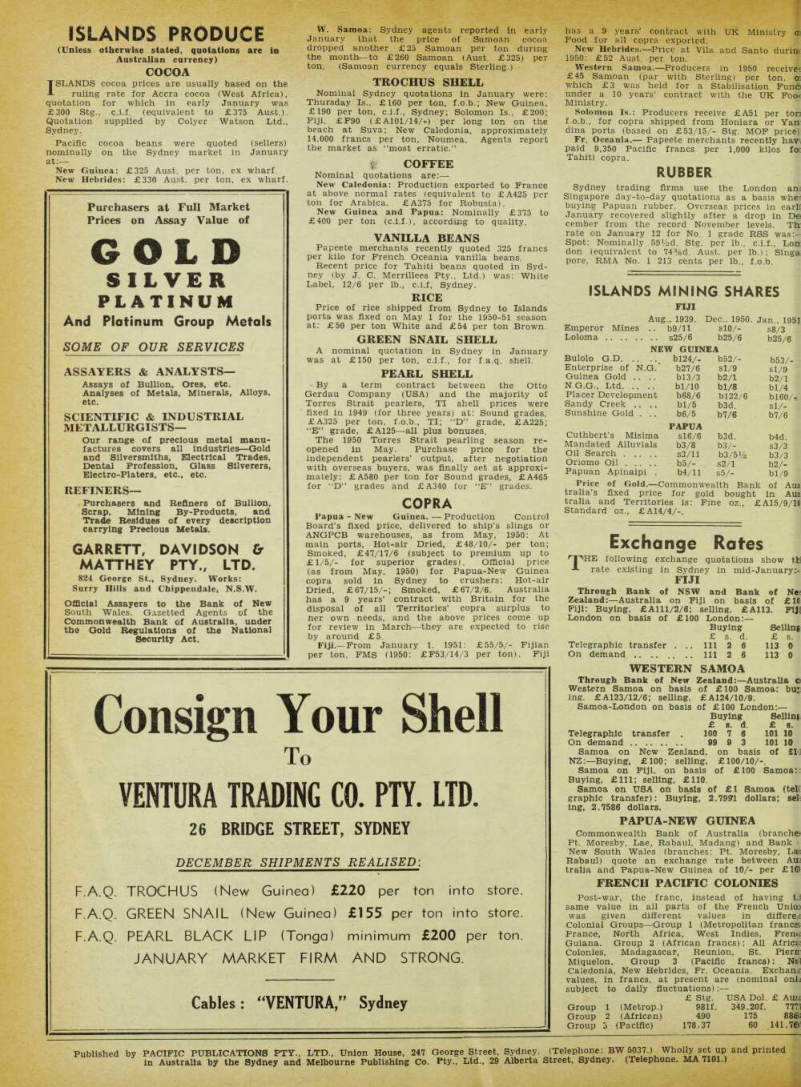
(Unless otherwise stated, quotations are in Australian currency)
Cocoa
ISLANDS cocoa prices are usually based on the ruling rate for Accra cocoa (West Africa), quotation for which in early January was £3OO Stg., c.i.f. (equivalent to £375 Aust.).
Quotation supplied by Colyer Watson Ltd., Sydney.
Pacific cocoa beans were quoted (sellers) nominally on the Sydney market in January at:— New Guinea: £325 Aust. per ton, ex wharf New Hebrides: £330 Aust. per ton, ex wharf.
W. Samoa: Sydney agents reported in early January that the price of Samoan cocoa dropped another £25 Samoan per ton during the month—to £260 Samoan (Aust. £325) per ton. (Samoan currency equals Sterling.)
Trochus Shell
Nominal Sydney quotations in January were: Thursday Is., £l6O per ton, f.0.b.; New Guinea, £l9O per ton, c.i.f., Sydney; Solomon Is., £200; Fiji, £F9O (£AIOI/14/-) per long ton on the beach at Suva; New Caledonia, approximately 14,000 francs per ton, Noumea. Agents report the market as “most erratic.”
T Coffee
Nominal quotations are:— New Caledonia: Production exported to France at above normal rates (equivalent to £A425 per ton far Arabica. £A375 for Robusta).
New Guinea and Papua: Nominally £375 to £4OO per ton (c.i.f.), according to quality.
Vanilla Beans
Papeete merchants recently quoted 325 francs per kilo for French Oceania vanilla beans.
Recent price for Tahiti beans quoted in Syd ney (by J. C. Merrillees Pty., Ltd.) was: White Label, 12/6 per lb., c.i.f, Sydney.
Rice
Price of rice shipped from Sydney to Islands ports was fixed on May 1 for the 1950-51 season at: £5O per ton White and £54 per ton Brown.
Green Snail Shell
A nominal quotation in Sydney in January was at £l5O per ton, c.i.f., for f.a.q. shell.
Pearl Shell
By a term contract between the Otto Gerdau Company (USA) and the majority of Torres Strait pearlers, TI shell prices were fixed in 1949 (for three years) at: Sound grades, £A325 per ton, f.0.b., TI; “D” grade, £A225; “E” grade, £AI25 —all plus bonuses.
The 1950 Torres Strait pearling season re opened in May. Purchase price for the independent pearlers’ output, after negotiation with overseas buyers, was finally set at approxi mately: £ASBO per ton for Sound grades, £A465 for “D” grades and £A34O for “E” grades.
Copra
Papua - New Guinea. Production Control Board’s fixed price, delivered to ship’s slings or ANGPCB warehouses, as from May, 1950; At main ports, Hot-air Dried, £4B/10/- per ton; Smoked, £47/17/6 (subject to premium up to £l/5/- for superior grades). Official price (as from May, 1950) for Papua-New Guinea copra sold in Sydney to crushers: Hot-air Dried, £67/15/-; Smoked, £67/2/6. Australia has a 9 years’ contract with Britain for the disposal of all Territories’ copra surplus to her own needs, and the above prices come up for review in March —they are expected to rise by around £5.
Fiji.—From January 1. 1951: £55/5/- Fijian per ton, FMS (1950: £FS3/14/3 per ton). Fiji
has a 9 years’ contract with UK Ministry oo Food for all copra exported.
New Hebrides.—Price at Vila and Santo durim 1950; £52 Aust. per ton.
Western Samoa.—Producers in 1950 receivef £45 Samoan (par with Sterling) per ton, o: which £3 was held for a Stabilisation Fund) under a 10 years’ contract with the UK Foo< Ministry.
Solomon Is.: Producers receive £ASI per ton f.0.b., for copra shipped from Honiara or Yam dina ports (based on £53/15/- Stg. MOP price) Fr. Oceania.— Papeete merchants recently haw paid 9,350 Pacific francs per 1,000 kilos foe Tahiti copra.
Rubber
Sydney trading firms use the London am Singapore day-to-day quotations as a basis whe:; buying Papuan rubber. Overseas prices in earll January recovered slightly after a drop in De cember from the record November levels. Thr rate on January 12 for No. 1 grade RSS was:— Spot: Nominally 59V2d. Stg. per lb., c.i.f., Lon; don (equivalent to 74%d. Aust. per lb.); SingaE pore, RMA No. 1 213 cents per lb., f.o.b.
Islands Mining Shares
Price of Gold.—Commonwealth Bank of Aus tralia’s fixed price for gold bought in Aus tralia and Territories is: Fine oz., £AIS/9/l( Standard oz., £AI4/4/-.
Fiji
Aug., 1939.
Dec., 1950.
Jan., 1951 Emperor Mines .. b9/ll slO/s8/3 Loloma S25/6 b25/6 b25/6
New Guinea
Bulolo G.D bl24/b52/b53/- Enterprise of N.G. b27/6 sl/9 sl/9 Guinea Gold .. .. b!3/3 b2/l b2/l N.G.G., Ltd bl/10 bl/8 bl/4 Placer Development b68/6 bl22/6 bl60/- Sandy Creek .. bl/5 b3d. sl/- .
Sunshine Gold . .. b6/5 b7/6 b7/6 Cuthbert’s Mlsima
Papua
S16/6 b3d. b4d.
Mandated Alluvials b3/8 b3/s3/3 Oil Search S3/11 b3/5*/ 2 b3/3 Oriomo Oil b5/s2/l b2/- Papuan Apinaipi . b4/ll s5/bl/9
Exchange Rates
npHB following exchange quotations show th A rate existing in Sydney in mid-January:-
Fiji
Through Bank of NSW and Bank of Ne: Zealand:—Australia on Fiji on basis of £lO Fiji: Buying, £Alll/2/6; selling. £AII3. Fiji London on basis of £lOO London;—
Western Samoa
Through Bank of New Zealand:—Australia o Western Samoa on basis of £lOO Samoa: bu: ing. £AI23/12/6; selling. £AI24/10/9.
Samoa-London on basis of £lOO London:—
Samoa on New Zealand, on basis of £1 NZ:—Buying, £100; selling, £lOO/10/-.
Samoa on Fiji, on basis of £lOO Samoa:: Buying, £111; selling, £llO.
Samoa on USA on basis of £1 Samoa (tel. graphic transfer): Buying, 2.7991 dollars; sel ing, 2.7586 dollars.
Papua-New Guinea
Commonwealth Bank of Australia (branche Pt. Moresby, Lae, Rabaul, Madang) and Bank • New South Wales (branches: Pt. Moresby, Las Rabaul) quote an exchange rate between Auu tralia and Papua-New Guinea of 10/- per £lO
French Pacific Colonies
Post-war, the franc, instead of having td same value in all parts of the French Unioa was given different values in differed Colonial Groups—Group 1 (Metropolitan franca; France, North Africa, West Indies, Frenu Guiana. Group 2 (African francs): All Africa; Colonies, Madagascar, Reunion, St. Pierre Miquelon. Group 3 (Pacific francs): Nol Caledonia, New Hebrides, Fr. Oceania. Exchanjr values, in francs, at present are (nominal onli subject to daily fluctuations): —
Buying Selling £ s. d. £ s.
Telegraphic transfer , .. Ill 2 6 113 0 On demand 113 0
Buying Selling £ s. d. £ 8.
Telegraphic transfer . 100 7 6 101 10 On demand 99 9 3 101 10
£ Stg. USA Dol. £ Aujx Group 1 (Metrop.) 981f. 349.20f. 777i Group 2 (African) 490 175 88&1 Group 3 (Pacific) 178.37 60 141.76*1
Advertisements & other items, pp. 110-112 (4 items)
Published by PACIFIC PUBLICATIONS PTY., LTD., Union House, 247 George Street, Sydney. (Telephone; BW 5037.) Wholly set up and printed
in Australia by the Sydney and Melbourne Publishing Co. Pty., Ltd., 29 Alberta Street, Sydney. (Telephone. MA 7101.)
Consign Your Shell
Purchasers at Full Market Prices on Assay Value of
GOLD
SILVER
PLATINUM
And Platinum Group Metals
SOME OF OUR SERVICES
ASSAYERS & ANALYSTS—
Assays of Bullion, Ores, etc.
Analyses of Metals, Minerals, Alloys, etc.
SCIENTIFIC & INDUSTRIAL
METALLURGISTS—
Our range of precious metal manufactures covers all industries—Gold and Silversmiths, Electrical Trades, Dental Profession, Glass Sllverers, Electro-Platers, etc., etc.
REFINERS—
Purchasers and Refiners of Bullion, Scrap, Mining By-Products, and Trade Residues of every description carrying Precious Metals.
GARRETT, DAVIDSON Cr
MATTHEY PTY., LTD.
824 George St., Sydney. Works: Surry Hills and Chippendale, N.S.W.
Official Assayers to the Bank of New South Wales. Gazetted Agents of the Commonwealth Bank of Australia, under the Gold Regulations of the National Security Act.
Consign Your Shell
To
VENTURA TRADING CO. PTY. LTD.
26 BRIDGE STREET, SYDNEY
DECEMBER SHIPMENTS REALISED :
F.A.Q. TROCHUS (New Guinea) £220 per ton into store.
F.A.Q. GREEN SNAIL (New Guinea) £155 per ton into store.
F.A.Q. PEARL BLACK LIP (Tonga) minimum £2OO per ton.
JANUARY MARKET FIRM AND STRONG.
Cables: “VENTURA,” Sydney
For Your Holidays
w
Take the best holiday you’ve ever had—fly to New Zealand by TEAL and enjoy all the scenic wonders on a short vacation.
Six and a half hours on a fast, luxurious aircraft and you’re in New Zealand with all your vacation time intact to see boiling geysers, glaciers, glow-worm grottoes, Maori hakas. Fly to New Zealand for your holidays. Direct services from Sydney to Auckland and Wellington.
Fishing ? Of course there is. New Zealand big game and trout fishing is about the best in the world. Fly and try it !
TO NEW ZEALAND
TASMAN EMPIRE AIRWAYS LIMITED
in association with Qantas Empire Airways Limited and British Overseas Airways Corporation Reservations: Qantas, T.A.A. and leading travel agents
APSO
MERCHANTS, & SHIP OWNERS
ft Capital £500,000
ESTABLISHED 1914
GENERAL MERCHANTS
AND
PROVIDORES
TRADE THROUGHOUT THE PACIFIC.
THIRTY-FIVE YEARS OF PACIFIC ISLANDS DEVELOPMENT AND SERVICE.
BUYERS AND EXPORTERS OF ALL KINDS
OF ISLAND PRODUCE, COPRA, COCOA,
M.O.P. SHELL, TROCAS SHELL, ETC.
AGENTS FOR AUSTRALIAN, EUROPEAN
AND AMERICAN MANUFACTURERS.
DISTRIBUTORS OF EVERY DESCRIPTION
OF MERCHANDISE.
Through our Sydney office, branches and agents, we distribute a wide and comprehensive range of general merchandise.
f R. CARPENTER t CO. LTD.
Head Office: 16 O'CONNELL STREET, SYDNEY, N.S.W.
Cable Address: Telephone: Postal Address; “CAMOHE.” BW 4421. G.P.0., BOX 168, Sydney.
In London: W. R. Carpenter & Co. (London), Ltd., Coronation House, 4 Lloyd's Ave., London, EC
ASSOCIATED COMPANIES THROUGHOUT THE PACIFIC :
IN NEW GUINEA: IN PAPUA: IN FIJI: New Guinea Company, Limited, J. R. Clay & Co., Ltd., W. R. Carpenter & Co. (Fiji), Rabaul, Lae. Madang, Kavieng. Port Moresby. Ltd., Suva.