Pacific
Islands
Monthly
December, 1950
Vol. XXI. No. 5.
Established 1930.
I Registered at the a* n - fIUfW, igr transmission by post as a newspaper ]
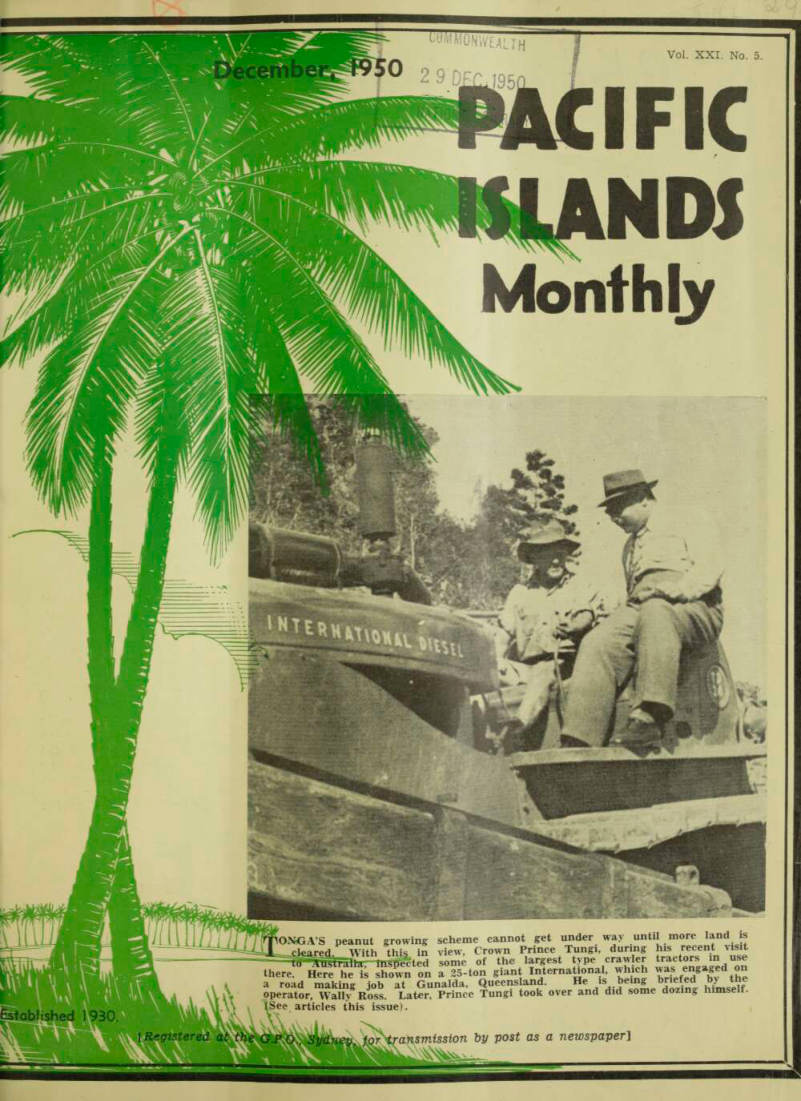
TONGA'S peanut growing scheme cannot get under way until more land is cleared. With this in view, Crown Prince Tungi, during his recent visit to Austraila, inspected some of the largest type crawler tractors in use there. Here he is shown on a 25-ton giant International, which was engaged on a road making job at Gunalda. Queensland. He is being briefed by the operator, Wally Ross. Later. Prince Tungi took over and did some dozing himself.
See articles this issue).
Advertisements & other items, pp. 2-4 (3 items)
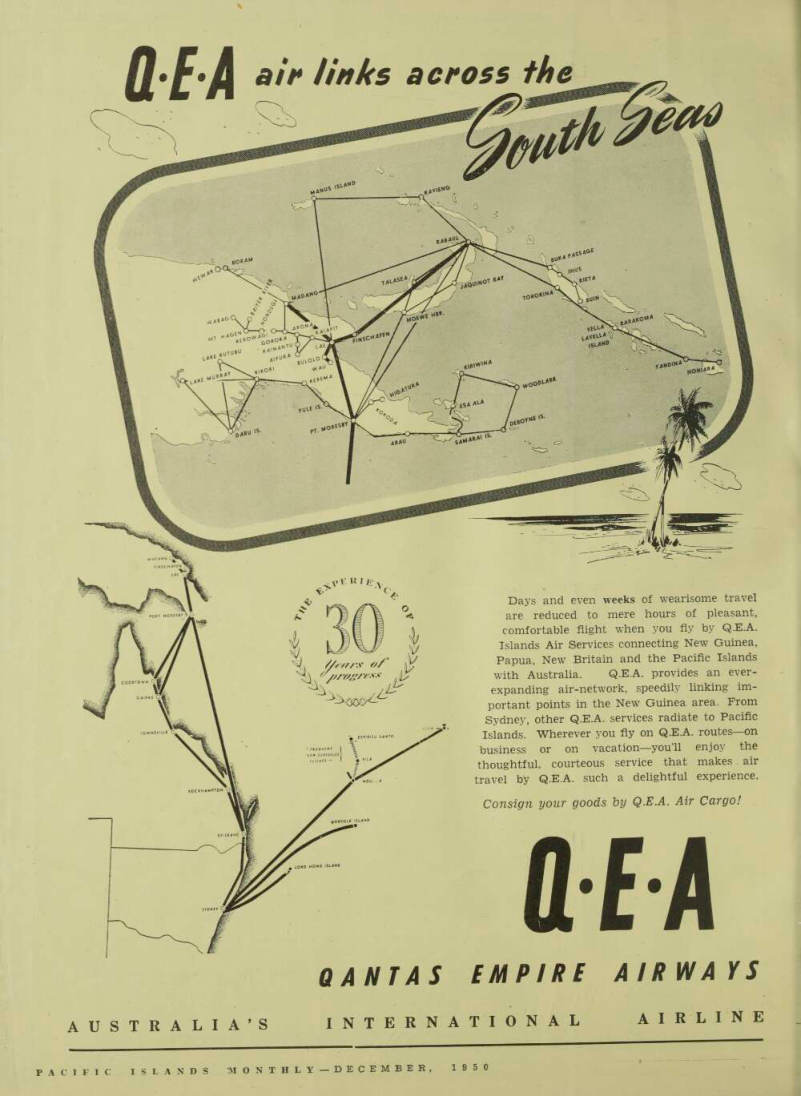
QEA air links across the
vltN& ma« uS
RABA«t
PASS
B u*a
C*AM
ihUS lassa KttfA mao aO» he* M ot« E oma^.
VtLLA
hafe«
FI*SC
■Bgap
,«IMA
ra ' hohia uAea w qOO aua
YuLE
y«e D€Bo
ESBF
M°a 4 su amaaa*
iBAU
V E«I^V
\ \J\J I
X\ ///y/r.v o/ A'
"///v/gres*
fSPItITU S4HTO
Days and even weeks of wearisome travel are reduced to mere hours of pleasant, comfortable flight when you fly by Q.E.A.
Islands Air Services connecting New Guinea, Papua, New Britain and the Pacific Islands with Australia. Q.E.A. provides an everexpanding air-network, speedily linking important points in the New Guinea area. From Sydney, other Q.E.A. services radiate to Pacific Islands. Wherever you fly on Q.E.A. routes—on business or on vacation—you’ll enjoy the thoughtful, courteous service that makes air travel by Q.E.A. such a delightful experience.
Consign your goods "by Q.E.A. Air Cargo! dU
QANTAS EMPIRE AIRWAYS
AUSTRALIA’S
INTERNATIONAL
airline
POCKET STOVE
Coleman Speedmaster Portable Stove.
It s a complete kitchen stove telescoped into a compact case not much bigger than a quart bottle of milk. The holder makes two handy cooking utensils and a cup of petrol burns for two hours. For picnicking, camping, fishermen and motorists, etc. inches high, inches wide, weight 3 lbs. s Two-burner Portable Stove.
Whether you require a stove for the home, the camp, the boat, or even picnicking, there's a Coleman made especially for that purpose and each is the best of its kind. r Console Range 5-burner with glass door.
Representatives for the Pacific Islands: ROBERT GILLESPIE PTY. LTD. pearce su s va co ltd 54a PITT STREET, SYDNEY FOR FIJI ISLANDS
Suburban Salons*. 166 Parramatta Road, at Johnston
St. LA 3089,
706 Darling St., Kozelle. WB 2915. 421 New Canterbury Rd., Dulwich Hill. LM 6304. 215 Liverpool Road, Ashfield.
UA 5940.
In the Bondi Junction Arcade, 3 doors from Grace Bros. FW 4806.
The Wend
Ist Floor, Rigney’s Bldg., 147 a King St., Sydne
This seersucker
jacketed sun-dress
one from a
fahulous
City Addresses:
Pl2a Her Majesty’s Arcade, Pitt 191 Pitt St., opp. Henderson’s Si 338 Pitt St., at Snow’s Tram Si 20 Imperial Arcade, Castlereagh T & G Building, Elizabeth St. 99 Oxford Street. MA1789. 169 King Street. MA 1796.
SSW to XOS
Wonderful! Washable! Low priced! These jacketed sundresses will keep you cool and attractive while the temperature soars! They’re made from seersucker (that needs no ironing).
Gay flowery designs in blue, rose, green, aqua, or autumn tonings.
X
FREIGHT CHART
ORDER BY MAI
When ordering by mail, pi quote: bust, waist and measurements. And we send you the nearest s size. eight 1/2 to all Pacific Islands cept those listed below: — est Samoa, 1/6. East Samoa, S.A, 1/6. New Caledonia, 3/2. iwaii, U.S.A., 1/6. f *■% SI - U K ( N k Q K hd <3> m ■; <**) Vi, J
SEERSUCKER
I W O D / <1 -aK ».
O'
ORDER BY MA
L J When ordering by mail, please is bust, waist and hip measurements, we will send you the nearest stoctel
1
ACIPIC ISLANDS MONTHLY-D E C E M B E R , 1950
2
DECEMBER, 1950 PACIFIC ISLANDS QMONTHL
Index to Advertisers
Achun, Gabriel . 100 “Akta-Vite” ... 108 Aladdin Industries Pty., Ltd. ... 24 All Saints’ College 111 Alois Akun Co. 82, 97 Aluminium Union cov. iii.
Amplion (A/sia) . 67 Angus & Robertson, Ltd 15 “Aspaxadrene” . . 20 “Aspro” 29 Baker, W. Juno . . 65 Balchin, W., Ltd. . 27 Bank of NSW . . 35 “Bellhaven” Guest House 95 Berry’s Bay Boat yard 91 Bethell, Gwyn Co. 98 Blaxland Rae Pty. 92 Blundell Spence Co. 50 Borthwicks Pty.
Co 106 Bovril, Ltd, ... 85 Brasso Polish ... 64 Bray & Holliday Pty., Ltd. ... 70 Bristol-Myers Co. . 81 Broomfields, Ltd. . 72 Brunton & Co. . . 63 Budge, James, Ltd. 30 Bunting. A. H. 71, 103 Burns Philp (NG) . 61 Burns Philp (NH) 108 Burns Philp (SS) 42. 44 Burns Philp Trust 36 Caine’s Studios . . 69 Carpenter, W. R. & Co., Ltd., 78, cov. iv.
Carpenter, W. R. (Fiji). Ltd. ... 90 Carr Shipping & Trading Co., Ltd. 38 “Charmosan” ... 15 Classified Advts. . 110 Colman’s Mustard 71 Colonial Meat Co. 86 C o 1 y e r Watson (NG) Ltd. 74, 88, 93 Commonwealth Bank of Australia 69 Crammond Radio . 16 Crilley, R. J., Ltd. 31 “Cystex” ... 107 Dangar, Gedye & Malloch, Ltd. . . 3 Davison Paints . . 44 Degener, Otto ... 29 “Dettol” 83 Donaghy & Sons . 79 Donald, A. 8.. Ltd. (Auckland) ... 85 Donald. A. 8., Ltd. (Rarotonga) . 64 Douglass, W. C..
Ltd 47 Dunlop Rubber.
Ltd 27 Econo-Steel Co. . 102 Electrolux ... 78 Etablissements Donald Tahiti 51 Ferguson Tractors . 43 “Flit” 31 Ford Sherington, Limited ... 41 French Chamber of Commerce ... 42 Garrett, Davidson & Matthey, Ltd. . 112 Garrick Hotel ... 23 Gilbey, W. & A. . 74 Gillespie Bros. . . 97 Gillespie, R.. Pty..
Ltd. . . 1, 49, 87. 109 Gillespie, R. (NG) Ltd 80. 101 Gordon’s Gin ... 21 Gough & Co., E. J. 106 Grand Pacific Hotel 4 Gregory, A., Ltd. . 30 Grove, W. H., & Sons 34 3alvorsen Sons. Ltd. 89 Hardman & Hall 3B. 100 Hawley’s Pty., Ltd. 52 Hay, K. H. D. . . . 47 Heinz & Co., Ltd. . 63
Hemingway &
Robertson, Ltd. . 76
Hoover, Francis . 101 Hygeia Sanitary Co. 51 Island Industries . 99 “Kathleen” Shop ping Service . . 109 Kennedy, Captain . 93 Kerr Bros. ... 92, 107 Kiwi Polish Co. . . 21 Kolynos, Inc. ... 77 Kopsen, W., & Co, 75 Kraft Walker Cheese Co. Pty., Ltd .79 Macintyre, Thomas, & Co. Ltd. ... 39 McGee, Andrew . . 48 Mcllrath’s, Ltd. . . 22 “Mendaco” . . . 100 Merrillees, J. c., Pty., Ltd. ... 17 Millers Ltd. (Fiji) 2T Morris Hedstrom Limited 12 Morris Hedstrom (Aust.) Pty., Ltd. 33 Mungo Scott, Ltd. 25 Nathan’s Merchan dise (NSW) Pty. 45 Nelson & Robertson Pty., Ltd 46 “Nixoderm” ... 96 Nordman, Oscar G. 104 Nth. Sydney Travel Bureau ... 90 O’Brien, Geo. .92 Pabco Products . . 84 Pacific Is. Society 75 Pacific Islands Year Book ... 110 Pan American Air ways, Inc., Ltd. . 14 “Pinkettes” ... 73 Qantas, Ltd. . cov. ii.
Qld. Butter Board 13 Qld. Insurance Co. 67 Reckitt’s Blue . . 103 Reed, Wm„ E. . .94 Riverstone Meat Co. 32 Robinson, G. H. . 72 Rohu, Sil 33 Scott, J., Pty., Ltd. 46 Shell Co. of Aust. 65 Sherwin - Williams Paints 26 Simpson Bros. Pty., Ltd 23 Sims, A. G 80 Southern Pacific Insurance Co. . . 18 Spartan Paints . . 18 Steamships Trading Co., Ltd. (Papua) 41 Stewarts & Lloyds 37 St. Peter’s Lutheran College ... 11l Sullivan, C., Pty., Ltd 76, 105 Swallow & Ariell 19 Tallerman & Co. . 68 Tasman Empire Air ways, Ltd. ... 28 Taylor, Allen & Co. 88 Thornycroft, Ltd. . 105 Tilley Lamp Co. . . 66 Tillock & Co., Ltd. 43 Tongan Photos Bureau 45 Tooth & Co., Ltd. 68 Tyneside Engineer ing Co 98 Undersee Novelties 89 United Island Traders, Ltd. . . 82 Vacuum Oil Co. 31, 40 Ventura Trading Co l9, 95. 112 Vincent Chem. Co. 37 Watson. Victor, Ltd 25 Wendel Frocks . . 2 West. Harry ... 96 Westhoven, Arthur 104 White Heather Whisky ... 73 Williams’ Pills . . 11l "WiUreed Agencies . 94 Wills, W. D. & H.
O. (Aust.), Ltd. 62 Wright & Co. . . 91 Wunderlich, Ltd. . 39 Yorkshire Insur ance Co., Ltd. . . 49
Advertisements & other items, p. 5 (1 item)
Pumps
If you have the Water
We have the
■ There’s a “D.G.M.” Pumping Outfit to handle water wherever it is accessible, whether from well, bore, dam, creek or river; and to suit every need, from the smallest model for household purposes, to the big powerful pumps for irrigation projects.
The “D.G.M.” range includes both Bulldozer and Centrifugal Pumps, ranging from 100 to 300,000 gallons per hour. For forcing water over long distances, and to considerable heights, the best pumping outfit is a “D.G.M.” Bulldozer, whilst the Centrifugal is ideal for handling small quantities of water.
The model illustrated is a “Monoglide” Single Stage Horizontal Pump. It is reliable and efficient for every duty involving the movement of fluids at low heads.
Let “D.G.M.” experts advise you on the simplest and surest way of solving the water moving problems of your particular type of country or conditions. Their advice is yours for the asking.
Sole Distributors N.S.W.:
DANGAR, GEDYE & MALLOGH LTD.
MALLOCH HOUSE, 10-14 YOUNG STREET, SYDNEY.
BRANCHES; MELBOURNE, WAGGA, NEWCASTLE AND LISMORE.
In This Issue;
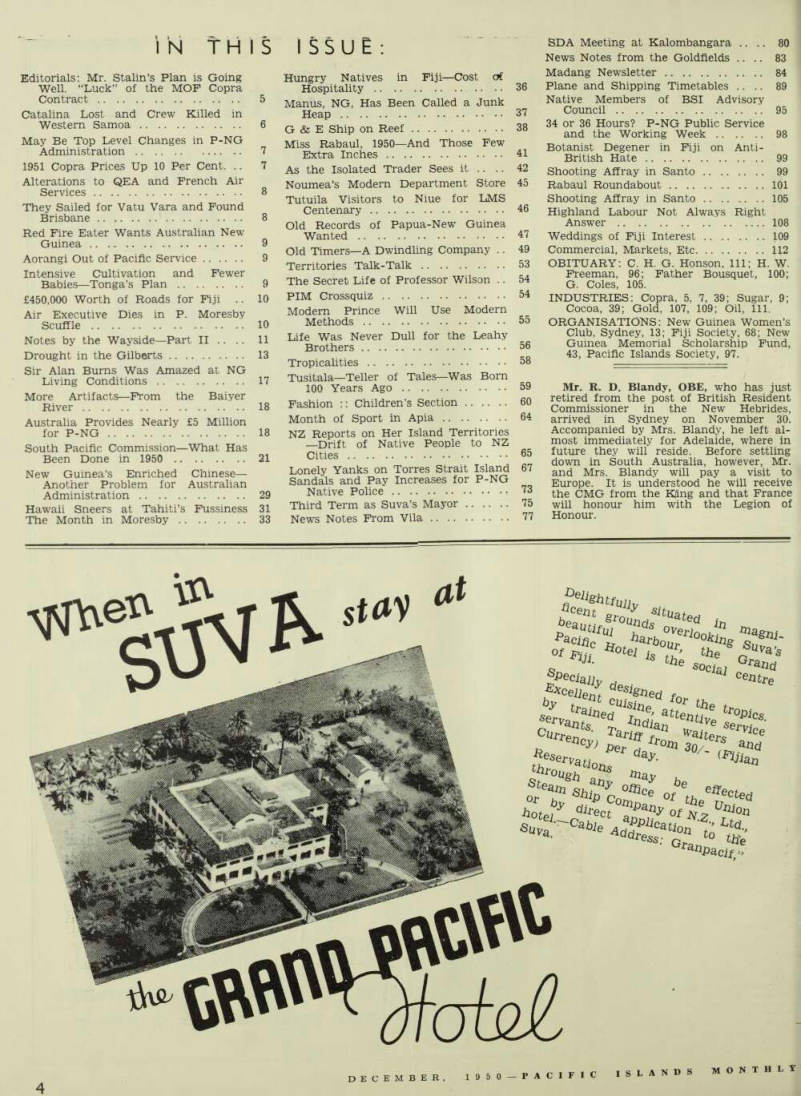
Editorials: Mr. Stalin’s Plan is Going Well. “Luck” of the MOF Copra Contract 5 Catalina Lost and Crew Killed in Western Samoa 6 May Be Top Level Changes in P-NG Administration 7 1951 Copra Prices Up 10 Per Cent. .. 7 Alterations to QEA and French Air Services 8 They Sailed for Vatu Vara and Found Brisbane 8 Red Fire Eater Wants Australian New Guinea 9 Aorangi Out of Pacific Service 9 Intensive Cultivation and Fewer Babies —Tonga’s Plan 9 £450,000 Worth of Roads for Fiji .. 10 Air Executive Dies in P. Moresby Scuffle 10 Notes by the Wayside—Part II ... 11 Drought in the Gilberts 13 Sir Alan Burns Was Amazed at NG Living Conditions 17 More Artifacts—From the Baiyer River 18 Australia Provides Nearly £5 Million for P-NG 18 South Pacific Commission —What Has Been Done in 1950 21 New Guinea’s Enriched Chinese — Another Problem for Australian Administration 29 Hawaii Sneers at Tahiti’s Fussiness 31 The Month in Moresby 33
Hungry Natives in Fiji—Cost of Hospitality 36 Manus, NG, Has Been Called a Junk Heap 37 G & E Ship on Reef 38 Miss Rabaul, 1950—And Those Few Extra Inches 41 As the Isolated Trader Sees it ... 42 Noumea’s Modern Department Store 45 Tutuila Visitors to Niue for LMS Centenary 46 Old Records of Papua-New Guinea Wanted 47 Old Timers—A Dwindling Company .. 49 Territories Talk-Talk 53 The Secret Life of Professor Wilson .. 54 PIM Crossquiz 54 Modem Prince Will Use Modern Methods 55 Life Was Never Dull for the Leahy Brothers 56 Tropicalities 58 Tusitala—Teller of Tales—Was Born 100 Years Ago 59 Fashion :: Children’s Section 60 Month of Sport in Apia 64 NZ Reports on Her Island Territories —Drift of Native People to NZ Cities 65 Lonely Yanks on Torres Strait Island 67 Sandals and Pay Increases for P-NG Native Police 73 Third Term as Suva’s Mayor 75 News Notes From Vila 77
SDA Meeting at Kalombangara ... 80 News Notes from the Goldfields ... 83 Madang Newsletter 84 Plane and Shipping Timetables ... 89 Native Members of BSI Advisory Council 95 34 or 36 Hours? P-NG Public Service and the Working Week 98 Botanist Degener in Fiji on Anti- British Hate 99 Shooting Affray in Santo 99 Rabaul Roundabout 101 Shooting Affray in Santo 105 Highland Labour Not Always Right Answer 108 Weddings of Fiji Interest 109 Commercial, Markets, Etc 112 OBITUARY: C. H. G. Honson. Ill; H. W.
Freeman, 96; Father Bousquet, 100; G. Coles, 105.
INDUSTRIES: Copra, 5,7, 39; Sugar, 9; Cocoa, 39; Gold, 107, 109; Oil, 111.
ORGANISATIONS: New Guinea Women’s Club, Sydney, 13; Fiji Society, 68; New Guinea Memorial Scholarship Fund, 43, Pacific Islands Society, 97.
Mr. R. D. Blandy, OBE, who has just retired from the post of British Resident Commissioner in the New Hebrides, arrived in Sydney on November 30.
Accompanied by Mrs. Blandy, he left al most immediately for Adelaide, where in future they will reside. Before settling down in South Australia, however, Mr. and Mrs. Blandy will pay a visit to Europe. It is understood he will receive the CMG from the King and that France will honour him with the Legion of Honour.
Advertisements & other items, p. 6 (2 items)
December, 19 5 0 -Pacific Islands Monthli
V"
fell
* elieh ttuilv Js tbe SOCJ . Gr a , J(J *ss »•%«„ /0 U g h a ns rn av . ® of eff e C£eci C?J>ect an?* of W £ ? ioi3 ra npacit t »
Pacific Islands monthly
The Newspaper-Magazine of the South Seas
[Registered at the G.P.0., Sydney, for transmission by post as a newspaper l Published Once Each Month and Circulated in Australia and New Zealand and in the following Pacific Territories and Islands Groups:
Australian Territory of Papua.
Trustee Territory (Australia) of New Guinea.
Australian Territory of Norfolk Island.
Trustee Territory of Nauru (Aust., NZ and UK) New Zealand Territory of Cook Islands.
New Zealand Territory of Niue Island.
Trustee Territory (NZ) of Western Samoa.
British Crown Colony of Fiji.
British Solomon Islands Protectorate.
British Protectorate of Tongan Islands.
British Crown Colony of Gilbert and Ellice Islands.
British and French Condominium of New Hebrides.
French Colony of New Caledonia.
French Establishment of Oceania (Tahiti, etc.).
American Territory of Eastern Samoa.
American Territory of Hawaiian Islands.
American Trust Territory of Micronesia.
Owned and Produced by Pacific Publications Pty. Ltd., Union House, 247 George Street, Sydney.
Telephones: General Office and Advertising,
Bw 5037, Bu 4938.
P.O. Box 3408
Registered Address for Telegrams, Radiograms, and Cables: "Pacpub,” Sydney.
Contributions.
Articles, Stories, and Photographs dealing with Pacific Islands subjects are invited and will be paid for on publication.
Subscription Rates.
In Australia, New Zealand, Fiji, Papua and New Guinea, Western Samoa, Cook Islands, Niue, Tonga, British Solomon Is., Gilbert and Ellice Colopy, Nauru, New Hebrides, and Norfolk Island 18 0 New Caledonia (Fr.) and French Oceania (Tahiti, etc.) £llO United Kingdom, British Com monwealth, United States of America, US Pacific Territories, and Foreign Countries .. .. $3.50 £1 10 0
Editor and Publisher:
R. W. Robson, P.R.G.S.
Assistant Editor: JUDY TUDOR.
General Office: Union House. 247 George Street, Sydney. Telephones: BW 5037, BU 4938.
Business Manager: SELWYN HUGHES.
Representative In London.
J. T. Wallis, Coronation House, 4 Lloyd’s Avenue, London, E.C.3, from whom may be obtained copies of Pacific Islands Monthly, Pacific Is. Year Book, advertising schedules, etc.
Agents.
The following are authorised to receive sub scriptions for Pacific Islands Monthly:— Burns Philp (NG) Ltd., and Burns Philp (South Sea) Co., Ltd. All branches.
W. R. Carpenter & Co., Ltd. All branches.
Morris, Hedstrom, Ltd. All branches.
Steamships Trading Co., Papua. All branches.
Colyer Watson (NG) Ltd. All branches.
Mrs. Jean Fraser, Lae, New Guinea.
R. P. Smith, Rabaul, New Guinea.
A. H. Bunting, Ltd., Samaral, Papua.
Steele’s Central Store, Suva, FIJI.
Adams Pharmacies Pty., Lautoka, FIJI.
Cook Islands Trading Co., Rarotonga, Cook Is.
United Island Traders, Ltd., Rarotonga, Cook Is.
A. Vercoe, Apia, Western Samoa.
Oscar Nordman, Papeete, Tahiti.
Islands Branches and Representatives of W. H.
Grove & Sons, Ltd., Auckland, New Zealand.
Ed. Pentecost, Noumea, New Caledonia.
Societe Gubbay Kerr et Cie, Noumea, NC.
Vol. XXI. No. 5.
December, 1950
1/9 Per Copy.
Pries Prepaid, p.a.: 18/- Aust. in South Pacific.
Mr.Stalin's Plan Is Going Well!
THE Red Muscovite conspiracy against Western civilisation is going very well—for the Muscovite. From our view point, the situation has deteriorated markedly—and still is deteriorating.
Russia’s plan is that the Western nations shall become deeply embroiled with the satellite Communist countries, with which she has surrounded herself.
Our strength is to be dissipated, with demoralising “loss of face,” while Russia’s military power and prestige remain un touched.
Accordingly, we are at war with China, and in full retreat before countless hordes of fanatical Chinese Reds. As a spectacle for the delectation of a thousand million Asiatics, our United Nations set-up has been made to look completely ridiculous.
All around the fringe of the USSR, satellite Red countries are either attack ing us, or getting ready to attack—in Indo-China, Tibet, Persia and the Balkans (a thrust, it seems, is to be directed against Yugoslavia); while in Hungary, Poland, Czechoslovakia and East Germany millions of men are armed and ready. Behind this screen is the military power of Russia.
Competent observers, during at least the past year, have seen and described the international plan by which Russia hopes to impose Communism upon the world; but the frantic little men of the threatened democracies have done little except babble, and hold confer ences, and exhort each other to stand fiirm. Their performance, when China ripped aside the curtain at the end of
November, and sprang on to the Korean stage, was quite in character.
Little Mr. Attlee went yelling across the Atlantic to consult with little Mr.
Tlruiman, while the French i Parliament milled around and debated another vote of confidence in its Government. The United Nations drafted a stern resolution ordering China out of Korea. And Little Audrey Stalin, in the Kremlin, laughed and laughed and laughed when he heard that little Franco was demanding of Britain the return of Gibraltar to Spain, and that a yapping Moslem mob in Singa pore was defying and spitting upon the British police.
IIIHAT a spectacle! Is it possible that fr only five years ago the United States and the British Empire, victorious and supreme in every field of war, were in complete control of the world; and that the world then accepted their prestige, and awaited their leadership and direc tion.
We have been reduced to this by the political ineptitude of the United States, and the criminal weakness and buffoonery of the British Socialists. The British morale has been reduced beyond measure, and the British Empire weakened almost beyond recovery.
The danger with which we are faced calls for the inspiration of a great leader, for almost fanatical resolution through out the English-speaking world in de fending ourselves and our hard-won free doms, and for dictatorial ruthlessness in lining us all up for the struggle. Instead
of that, we have the trans-Atlantic scutt iin«s ° f Mr “f-s? is a J b °" t as spiring as a dead rabbit—and the goat like trumpetings of the United Nations.
Tl je spectacle of a half-dozen multi coloured brigades fighting beside the American divisions in Korea is sympto matic of what we can expect from the United Nations in this supreme crisis of human history.
Now, momentarily sheltered by the adtom bomb, we have a short breathing space. But have we time in which to build up our civil as well as our military defences, before we have to meet the Kremlin’s equivalent of “Der Tag”? Only the events of the next few months will supply an answer, we can sure: T^e future the free world depends upon what is done immediately by the Ehglish-speaking countries. The United Nations is a pitiful and expensive farce. Unless there is a y ast change in the spirit and outlook of Pf°Pj e of he United States and the British Empire—especially the latter we ™ 1 £~ 6 hnm and conception of the human relationship and new standards of life.
Luck of the MOF Copra
Contract
ALL British planters in the South A Q f° or the* Sp£ Sy get not £ n f y cash> but also a no table guarantee 0 f stability in the copra market, The British Ministry of Food contract, made at the end of 1948, gave a guaran
teed price of £4B Sterling per ton for 1949, and undertook that, over a period of nine years (expiring December, 1957) the price should not rise or fall more than 10 per cent. It rose only 10/- in 1950, but will rise the full limit of 10 per cent, in 1951.
At the time, it seemed a good contract, because growers generally feared a fall ing market. As it turned out, it was of great benefit to Britain, and not to the growers. Britain bought our copra at £4B Stg. per ton; and, ever since, the world market has been well in advance of that figure. Last September, for example, while Britain was paying £4B Stg. for New Guinea copra, Straits copra was seling at £llO Stg. (£l4O Aus.) cif European port.
Since then, prices have been between £9O and £lOO Stg. Early in September, Phil ippines copra was selling at 275 US dollars (£l2O Aust.) per ton, although it fell to 235 dollars in October. Even if Britain lifts her price, under the contract, by £5 per ton for 1951, she is still doing extreme ly well—in fact, she is enjoying a profit of at least £4O Stg. per ton. Had that been a true reflection of world markets, we should have called it the luck of the nine years’ contract which the planters solemnly accepted; and the South Pacific, while reflecting ruefully, that it is a very high price to pay for “stabilisation,” would not have squealed against the turn of fortune’s wheel.
This has not come about through the luck of the contract, however. It is mostly the result of the sterling deval uation trick played upon Copra producers by the British Socialist Government: and it has left a foul taste in the mouths of Pacific producers.
When they made that MOF contract at the end of 1948, there was no suggestion that Britain—that ancient bulwark of in ternational finance —would repudiate her currency. But within a year, under the baneful influence of the Socialist muddlers in control, Britain de-valued her £ Ster ling bv about 30 per cent., in terms of the US dollar (or of gold). Although copra, like wool and wheat, has a definite value on the world’s market, irrespective of what individual nations may do with their currencies, there was no suggestion by the British Government that the MOF contract should be revised.
Consequently, ever since, Britain has been buying copra at around £4B Stg. per ton, although in the world’s free market it has been selling at from £75 to £l2O Stg. per ton. That is barefaced commer cial trickery: and the South Pacific planters should never rest in their de mand that the MOF contract should be revised, in the light of the devalued Ster ling. It is a reflection upon the Austra lian Government that it has made no attempt whatever to prevent the New Guinea producers from being robbed in this way. Many planters have made protests, but all seem to have been ignored.
PAPUA-NEW GUINEA copra-producers will now be justified in insisting that Canberra discontinue that “stabili sation” deduction of £5 per ton. The Fund, already, is over £800,000; and now there is little likelihood that it will be needed. The effect of the new rise of 10 per cent., under the MOF 9-years con tract, is that, even if the market hence forth falls continuously, the price cannot be reduced beyond £3O before 1957.
That £5 per ton now could quite prop erly go to the planters, as some slight compensation for the bare-faced robbery of them during 1950 by Britain under a contract made by Canberra, and which no New Guinea planter has ever seen. The £BOO,OOO now accumulated in the “Stab ilisation Fund” should be distributed among the men whose industry created it; but such an act of simple justice is
most unlikely. It probably will be grabbed by the politicians for some fanciful scheme, like providing woollen petticoats for the nursing mothers of the Chimbu.
THE Fiji planters have escaped “stab ilisation”; but they, naturally, and very properly, are protesting angrily against the action of the Fiji Government in grabbing £2 per ton of the new copra money as an export tax, and defending itself by saying that it thus can abolish certain customs duties and so reduce the general cost of living.
The Fiji planters ask why they should be specially taxed for the general benefit of the community—especially as the plant ers, as a section, derive less benefit from public utilities than any other class.
The planters, have taken occasion to attack Fiji’s form of government. They declare it is far too expensive for a Colony of Fiji’s circumstances. They further ask why they should be taxed, while the ex port tax on the Colony’s other chief product, sugar, has been removed.
The plain fact of the matter is that these Governments —all more or less Socialistic in character—simply cannot keep their fingers out of the coffers of any industry which appears to be highly profitable. They are forced continuously to make concessions to the greedy, but highly organised, trade unions; and they try to balance the national economy by heavier impositions upon the less tightly organised primary producers.
Fiji has got its copra tax; and it hasn’t a chance of escaping from same while the Socialists rule the Departments in London. It will be a surprising thing if Australia, trying to escape the worst effects of its maddening inflation, does not similarly set its tax-gatherer after the NG copra producers, either to collect an increased export tax, or an income tax.
Distribution By Air Of The Pacific Islands Monthly
Pacific Islands Monthly
WITH the co-operation and assistance of Qantas Empire Airways Ltd., it has become possible to arrange for the transportation by air of the Pacific Islands Monthly to those subscribers in the Islands who desire such an arrange ment.
Immediately on publication, parcels of the PIM are sent as air freight to our Agents in the various centres of Papua and New Guinea where they are imme diately placed on sale at the usual price, plus the cost of air freighting. In the case of Port Moresby, this makes a total of 2/9 per copy; it is a little more at Lae and Madang, and slightly more again at Rabaul. By this arrangement, the mag azine is in the hands of PNG readers within a few hours of publication.
Distribution is now actually quicker in Papua-New Guinea than in Australia.
Readers who cannot personally pick up their copies from the agents in the various Papua-New Guinea centres, can still get the benefit of air-freight. They can order the paper in advance from any agent in Port Moresby, Lae, Madang and Rabaul. The latter, immediately on re ceipt of their air-freighted parcels, will wrap and address individual copies to subscribers in their districts, and post such copies in the local post office, and they are delivered then by the first avail able mail. These subscribers pay the or dinary subscription, plus the air-freight charge.
There are many readers in Papua-New Guinea who pay their subscriptions direct to the office of Pacific Publications Ltd., in Sydney, and who now receive their papers by surface mail. Any of these
subscribers who would prefer quicker des patch by air transport may arrange for same by adding 18/- (l/6d. per copy) to the annual subscription of 18/- making a total of 36/- per annum. In these cases, the papers are wrapped and addressed in the ordinary way, a postage stamp repre senting local postage is attached to the wrapper, and the papers so addressed and stamped, are then sent as air-freight to either Port Moresby, Lae or Rabaul, and are there posted in the ordinarfy way, for delivery by the first available mail.
Direct subscribers who are satisfied to receive their papers by surface mail, as at present, may do so. The new arrange ment is only for those who wish to re ceive the journal in the shortest possible time.
Fiji Distribution
Arrangements are now being made for the extension of the air-freighting system to New Hebrides and Fiji. Details will be published as soon as the arrangement is completed.
Higher Charge for PIM Outside
Of South Pacific
ALL costs of newspaper production have increased in a fantastic fashion dur ing the past year, and publishers generally have been compelled to increase their subscription and advertisement rates.
The publishers of this journal are not making any further increase in rates — although they may be compelled to do so soon—but they are obliged, owing to in creased postal charges in this and other countries, to raise the rates to subscribers in all places outside the South Pacific.
These new rates, which will operate from January 1, 1951, are— United Kingdom, British Common wealth, United States of America, and Foreign Countries —£1/10/0 Australian per annum (or $3.50 in USA currency).
In all South Pacific countries, which include all the Islands, and Australia and New Zealand, the subscription is un changed—namely 18/- Aust. p.a. In New Caledonia and French Oceania (where postal charges are higher), the rate is unchanged at 21/- Aust. p.a.
Catalina Lost
7 Killed in Crash in W. Samoa
Apia, Dec. 12.
WESTERN SAMOA had its worst air accident on the morning of Decem ber 11, when a New Zealand Air Force Catalina, immediately after taking off from Faleolo airport, crashed into the lagoon two miles away. Seven of the crew of eight were killed. One crew member and the five passengers (Samoan Ad ministration officials going on a routine visit to the nearby Tokelau Islands) es caped with minor injuries and shock. The flying-boat was a total loss.
The lost airmen were accorded a military funeral on the 12th, when all business houses in Apia were closed. NZ Air Force personnel are well and favourably known in Fiji, Samoa, Tonga and Cook Islands.
Advertisements & other items, p. 8 (2 items)
6
DECEMBER, 1950 PACIFIC ISLANDS (MONTHLY
Late News
Owing to a technicality, the introduction of the new Fiji Copra Tax (see pages 5,6, 7) has been postponed until next session of Leg. Council— probably four months.
May Be Early Changes
Administration Of
Papua-N. Guinea
May Be Early Changes At Top Level
IT is believed that preparations are afoot for an almost complete reorganisation of the administrative machinery of Papua-New Guinea, at top levels.
If there is no sharp worsening in the international situation, an announcement may be made by the Minister for External Territories (Mr. Spender) before the end of the year.
Applications for the two positions of Deputy Administrator —invited in October —have been under careful scrutiny. It is safe to assume that this has involved consideration of the suitability of Colonel J. K. Murray for the chief position which ne holds—that of Administrator.
Obviously, it is little use appointing the Dest available men to be Deputy Admin istrators unless they can work in harmony with the Chief Administrator, In the circumstances of Colonel Murray’s ap pointment, there is doubt about the har mony.
Observers of the External Territories set-up hope that the statement by the Minister, if it is made this month, will— * Clear up the situation in regard to the future occupant of the position of Admin istrator. • Give the names of the two Deputy Administrators. • Give some indication of what is to be 3one about filling the chief Departmental oositions. (At present, the Government Secretary, Director of District Services, md other occupants of high positions, are ‘Acting”). • More clearly define the future status md authority of District Officers.
ALTHOUGH Colonel Murray (in civil life a professor of agriculture in the University of Queensland) had had 10 previous experience of tropical admin istration, and apparently had ofily a superficial knowledge of Territories con litions, he was selected by the Socialist Minister, E. J. Ward, to put into opera ion Mr. Ward’s revolutionary policy of 3 -NG administration.
It was difficult to see, in his first four or ive years of office, where Canberra con rol ceased and Colonel Murray’s functions jommenced. He was not popular; but, jecause he is a cultured gentleman, ad lering honestly to principles in which he jelieves, he was respected, and not criti cised much.
But, during 1950, there has been a nounting volume of criticism directed igainst Colonel Murray. It gradually has Decome known that Minister Ward, in f 949, when it was clear that the Chifley Government would probably be wiped out n the December election, extended the ippointment of Colonel Murray for an )ther five years.
This was an iniquitous thing. Every )ne —except Ward’s own friends and cronies—was dissatisfied about conditions n New Guinea. It was plain that one the first acts of a new non-Socialist Government would be to review the Lerritories set-up; and the new broom necessarily would extend to the Socialist Minister’s chief executive officer.
But the new Minister, when he arrived, found Colonel Murray securely enthroned at Konedobu, and obviously unprepared to leave without some kind of an official earthquake or explosion.
The new Minister, apparently, decided
that he would introduce a new regime without unseating the chief executive of the old regime; and proceeded accordingly.
But it did not work. It has been appar ent, for months, that there is something seriously wrong with the administrative machinery of Papua-New Guinea.
The P-NG Administration service will not function properly under a chief who has been placed in a false position by political patronage, and who apparently cannot appreciate the fact that he has become the main obstacle in the way of far-reaching administrative reforms.
New Guinea wants something more than a mere office-holder, or rubber stamp.
New Guinea, as a matter of fact, demands a man who can combine knowledge of tropical conditions with clear-cut purpose and a ruthlessness that will t(plerate neither inefficiency and nepotism in the Services, nor bureaucratic interference by Canberra. The more of a dictator he is, the more successful he will be.
1951 Copra Price Rises 10 Per Cent.
Growers Being Fleeced Over ‘Stabilisation,’ Taxation And Sterling Devaluation
THE British Ministry of Food and the Government of Fiji have agreed that the price to be paid by the former for Fiji copra of Pair Merchantable Sundried grade, under the Nine-Years Contract, in the year commencing January 1, 1951, shall be £53/15/- Sterling per ton, f.0.b., Fiji—an increase of £5/5/- Stg. per ton on 1950.
There is 12i per cent, difference in ex change between Britain and Fiji. After taking various adjustments into considera tion, the Fiji Copra Board announced on November 29 that the price to be paid in Fiji to producers, for one year from January 1, 1951, will be £55/5/- Fijian (about £6l/15/- Aus.) per ton —which is an increase of £6/15/- Fijian per ton over the price received in 1950.
The Fiji planter will not get the full increase, however. The Fiji Government has introduced a new copra tax of £2 Fijian per ton, payable as from January 1; and the money will be deducted by the Board, before the proceeds of copra sales reach the planter.
Therefore, for all practical purposes, the Fiji local buying price will be £53/5/- Fijian per ton—an increase over 1950 of £4/15/- per ton.
The Fiji Copra Producers Incorporated have protested very strongly and vigorously against what the planters re gard as a sectional or discriminatory tax.
But the Fiji Government has not been de flected from its purpose. It long had planned this new source of revenue.
The Government says that, in view of this new levy on planters, the Customs duties on various items of general con sumption will be reduced, so as to “keep down the cost of living in the Colony.”
The growers retort, acidly, that they do not see why they, alone, should be sub jected to a new tax, so that the whole community may benefit from cheaper sup plies. (See article on page 5).
New P-Ng Price In March
OWING to some provision in the mysterious contract between the British Ministry of Food and the Australian Department of External Ter ritories (a contract which no Australian or New Guinea copra interest has ever sighted) there will be no revision in the price paid to New Guinea producers until after the end of February when, accord ing to officialdom, “the United Kingdom Agreement will be reviewed.”
Until then, the Papua-New Guinea
growers will continue to receive the 1950 price of £4B/10/- Aust. per ton—although the Fiji growers will be receiving from January 1, after tax is paid, the equiva lent of £59/18/- Aust. per ton—or £ll/8/per ton more.
It may be taken as certain that— • There will be an upwards revision of the price, as provided for in the MOF con tract of 1949. • The price will be increased to the limit permitted by the agreement— namely, 10 per cent. • The new price will become operative from March 1, 1951—which is held by Canberra to be the date of the operation of the annual revision of the Contract, although in other countries (Fiji, Solo mons, Gilberts) it operates from January 1 of each year.
The current MOP contract price affect ing New Guinea copra, which has been effective since March 1, 1950, is £4B/10/per ton, at NG port. It is made up as follows: —
The MOF contract price should rise by 10 per cent., from March I—making it probably £53/15/- Stg. (the same as Fiji), equal to about £66/14/- Australian. If the PCB follows its present system, there will be a deduction of about £l2/10/- per ton, which should give the grower over £54 at point of delivery—an increase of £5/10/- over present rates.
At this stage, however, the NG pro ducers should make a strong attempt to get the stabilisation deduction of £5 per ton wiped out. (See article on page 5).
Britain acknowledges, through the new Fiji price, that copra is worth £53/15/- Stg. per ton, which is £5/5/- per ton more than she is going to pay Australia for NG copra in January and February.
If P-NG’s production is 5,000 tons per month, Britain, on her own acknowledge ment, will be paying us over £50,000 less than our copra is worth, according to the Fiji contract, and close to £500,000 less than it is worth, according to the world market.
Australian Millers Still Pay
£67/15/- ALTHOUGH Canberra has been dither ing around with the problem f9r months, there still is no change in the price being charged the Australian copra-crushers by the Production Control Board —the Government concern which takes over and sells all New Guinea copra.
The PCB takes over all NG Copra at £4B/10/- Aus. per ton. It supplies Aus tralian crushers with the copra they need, and charges them £67/15/- per ton, and sells the balance to Britain, under the MOP 1950 contract, at £4B Sterling per ton. All PCB profits presumably will go eventually to the planters.
For over a year, the planters have been protesting against that charge to Aus
(Continued next Page.)
Australian Currency Received from MOF contract £60 10 0 Deducted by Production Control Board 12 0 0 Paid to Grower £48 10 0 The deductions are— Storage, handling, selling commission, insurance, shrinkage, etc 6 3 8 Account stabilisation 5 0 0 Account Customs Duty .. .. 3 11 6
tralian millers of £67/15/-, and pointing out that the value of the copra, accord ing to the free world market (see. for example, the Bank of New Zealand’s London produce circular of October 6) is between £9O and £lOO Sterling per ton.
Why should the NG producers thus be forced to subsidise the Australian coco nut consumers, millers and exporters? But Canberra has done nothing.
The Australian copra-millers now are howling because the removal of ration ing from Australian butter has brought about a sharp decline in the sales in Australia of margarine. Hitherto, Aus tralia—in justice to the NG growers— would not allow the millers to export to the world’s free market, much of the oil and margarine got from the cheap NG copra. But now the millers say they can not sell their products in Australia—they want the ban lifted.
The Australian Government should lift it —but, in fairness to the NG producers, it should make the millers pay world parity for their copra.
Poor Copra In Bsi
Honiara, Dec. 4.
THE Secretary to the Solomon Islands Government has announced that complaints have been received from the Minister of Food, in London, regard ing the quality of two recent shipments to the UK. These shipments were car ried in different holds from copra des patched by other Territories and compared most unfavourably with the latter copra.
The Solomons copra is unequivocally de scribed as bad. The main faults are dust, sand and dirt mixed in with the copra, and bad cooking, which has resulted in burning.
Strict inspection and grading at the main ports of shipment, Honiara and Yandina, followed this criticism, and a considerable amount of copra has been rejected by the Copra Board’s agents.
It is realised that, during the immediate post-war period, any copra was better than none; but growers have now been asked to make every effort to improve quality, otherwise a new price for a lower grade may be introduced.
Sydney-NG Service
Alterations to QEA Sydney-NG Service
AFTER our plane and shipping sched ules were printed (page 89) Qantas Empire Airways announced altera tions to their New Guinea-Sydney ser vices because of sudden demand for Sky master aircraft on their Japan service due to the Korean war.
Commencing on December 12, Sky master services from Sydney to P-NG will be reduced to two each week, and these will terminate at Port Moresby instead of Lae.
Douglas DC3 services will be increased to five per week, and these will operate between Sydney and Lae with the usual extensions to Madang, Finschhafen, Rabaul, Bulolo and Wau.
Inconvenience should be offset to some extent by the fact that the service will now be a daily one.
French Air Services
AIR FRANCE has announced that their service from Paris to New Caledonia via Indo-China and Australia will in future be on a monthly basis instead of fortnightly.
At the same time the service from New Caledonia to Tahiti has been suspended— which means that Tahiti is again without airmail facilities.
They Sailed For
Vatu Vara
Rut Found Brisbane
1,500 Miles of Nightmare
THOSE people who hold theories about the chance voyages of the early Poly nesians will be encouraged by the recent blow-away voyage of Mr. Jack Morris, of Levuka, Fiji, his part-Fijian mate, his crew of five Fijians and one passenger, Mr. Peter Jackson, in the 37foot cutter Fetu Moana.
Fetu Moana left Levuka on October 12 for Lomaloma where she was beached for cleaning. She left there for Vatu Vara, completely disappeared and .was not heard of again until four weeks later when she arrived at Stradbroke Island near Bris bane. Queensland.
After the 1 500-mile voyage, the storm battered cutter berthed in Brisbane on Sunday November 19. Her skipper said that she was blown there by two cyclones, one squall and two thunderstorms.
The craft showed signs of the terrific battering she had taken. All unsecured deck fittings had been swept overboard, the gunwale and bulkheads were smashed in, and the mainsail was tat tered. John Morris said the cutter struck her first cyclone, a 60 mph blow — while on a trading run from Levuka, to Vatu Vara, a small island, 110 miles to the east. The wheelhouse was washed overboard and waves crashed right in side the boat. Their charts, instruments, and all spare gear were lost. The crew had cut holes in copra sacks and got in side them to protect themselves from the cold.
Skipper Morris related how they lost sight of land. After the gale dropped he guessed where the south-west was and headed that way. He hoped to reach New Caledonia but they missed that island. They kept on for weeks. Their drinking water ran out, and if it hadn’t been for a dozen bottles of beer in their
cargo they would have been in a bad way.
Then they struck a second cyclone which blew them near the coast of north ern NSW at the Tweed River. They did not know where they were but steered north and reached the Brisbane River.
Skipper, passenger and crew were taker care of in Brisbane by the Mission for Seamen. Shortly after he landed Skipper Morris said that he had had the sea and would probably look for a job ashore in Brisbane. But this seems hardly pos sible in view of his past record.
He is a former pupil of the Levuka Public School, where he was an outstand ing student with a special interest ir mathematics, which he later applied tc problems of navigation.
After leaving school he began ship building, At Vagadaci, near Levuka where many fine craft have been con structed, be built the 7-ton Torokina ir which, nearly two years ago, he sailed tc Vavua, Tonga, with Mr. A. Storer. He also built the Tui Nakarawa, a 5-ton cut ter, for the Fijians of Batiki, and the Adi Teresa for the Fijians of Koro. The yacht Ebb Tide was also built by Mr Morris for Mr. Boris Maesepp of Suva
Echo of Cakobau’s Despotism
Land For Landless Fijians
SOMEWHERE around about 1870 a land owning group of Fijians on Ovalai took part in a rebellion against th( so-called King of Fiji, Ratu Cakobau For their temerity, their lands were taker from them and sold, and ever since the? and their descendants have lived at Taw iya village, Ovalau, and have beer dependent on a small land-owning groui of about 30 whose lands are scarcel; sufficient to maintain them.
Until recently there were 280 of thesi landless Fijians living in Taviya village but now they are landless no longer The circumstances were brought to tin notice of the Secretary of Fijian Affair some time ago and the Government sub sequently bought for these folk two ad joining estates on Ovalau —Rukuruku an< Natusara. Thus, after paying for th sins of their fathers for 80 years they a last have somewhere of their own t« settle.
Fifteen bales of wool have arrived ii Sydney from the Hallstrom Experimenta Station at Nondugl, Central Highlands New Guinea.
Fetu Moana and her crew as they reached Bris bane.
Courier Mail.
Advertisements & other items, p. 10 (1 item)
8
DECEMBER, 1950 PACIFIC ISLANDS MONTHL
Wants
Red Fire-Eater
Australian N. Guinea
Future of Dutch NG Still in Doubt
DELEGATIONS representing Dutch and Indonesian interests have been meet ing at The Hague, in a last attempt to fix the status of Dutch New Guinea before the end of 1950.
The Dutch have refused to surrender the Territory to the Indonesians. The Indonesians demand possession, and have refused to consider any compromise.
An interesting trend was reported by Reuter from Djakarta on December 6: Australian New Guinea should be “lib erated” from colonialism, the Indonesian Parliamentary representative of Sobsi (Communist central organisation of the Indonesian trade-union movement) Werd ojo, said to-day.
In an interview with the Dutch-owned Aneta News Agency, Werdojo said that negotiations should be started with Aus tralia to liberate Eastern New Guinea.
He said the Government should also lead an anti-Dutch boycott in Indonesia if the Netherlands did not give up West ern (Dutch) New Guinea.
Fiji’S Sugar Troubles
FIJI sugar mills are expected to pro duce only about 100,000 tons of sugar this season —26,000 tons less than last season and much below the maximum exportable limit (170,000 tons) agreed upon at the Commonwealth Sugar Confer ence held in London about a year ago.
Fiji’s best sugar year was 1948 when 149,494 tons were exported.
Although this year’s production is some what below average, much smaller outputs were recorded in 1940, 1941, 1943, 1944 and 1945 (a record low of 30,305 tons). Most of these bad years however, were the result of the Indian cane field troubles when growers refused to plant cane. This year’s below-average output is blamed on the unfavourable weather during the growing period—and this same factor has delayed planting of cane for the 1951 harvest.
May Not Sign Contract.
AT a public meeting convened by the Kisan Sangh (farmers’ union) at Nadi Market on November 11, Mr.
M. S. Chalmers, who virtually runs the anion, spoke of the welfare of the 9,000 in Fiji and urged members )f the Kisan Sangh not to sign the CSR Company’s new contract until his re turn from the sugar-producing countries )f Trinidad, the Philippines and Cuba. \ branch of the Kisan Sangh has also ieen formed at Labasa.
That was on November 11, before the icute stage developed in the international situation. The perambulating Mr.
Uhalmers may have had a change of heart since then. Or, perhaps, looking into his crystal ball and interpreting the future le may be making long-term arrange ments to sell his sugar to General Wu’s or Joe Stalin’s Russia.
The world seems to have sufficient troubles apart from these that Mr. Chal mers imagines his cane-field Indians possess. In the event of another world war and a resurgence of the ridiculous strikes, the Fiji Government should be prepared to deport all Indian trouble-makers to Mother India without mss of time.
Aorangi Out
Post-War Conditions Kill Last Trans-Pacific Surface Line
WHEN the motor-ship Aorangi, 17,490 tons, sailed out of Sydney on Decem ber 7, her owners (Union SS Co.
Ltd.) announced that, when she returns to Sydney on January 29, she will be put out of commission and advertised for sale, and her crew paid off.
As a result, there will be left not one regular trans-Pacific steamship service, connecting North America with Australia and New Zealand. Before World War II there were four large regular liners—the Aorangi, the Niagara, the Monterey and the Mariposa. The Niagara was sunk dur ing the war; and, after the war, the Mat son Line refused o continue running the Monterey and Mariposa without a sub stantial subsidy; and those two luxury liners are also in the discard, somewhere.
Before World War I, there were three or four regular trans-Pacific lines. Some ran via Fiji, some via Tahiti.
This extraordinary deterioration of trans-Pacific shipping services is due to two factors —the substitution of air for sea transportation for passengers, and the imposition of intolerably expensive conditions on shipping services by the Socialist authorities which have come into being in recent years.
The Aorangi, for example, cost originally over £1,000,000 in 1924. Early in the war, she was converted for use as a troopship.
Her re-conversion to a liner commenced in 1946 and—subjected to all the dock yard laziness and go-slow-ism which have characterised dockyard operations since the war—the operation cost £2,000,000, which was considerably more than her original cost. She re-entered the Pacific service in 1948 with a substantial financial handicap.
During 1949 and 1950 she could not get nearly enough cargo to fill her holds— the direct result of the dollar restrictions.
Trans-Pacific passengers literally clam oured for berths on her; but, when she was re-converted, her owners were obliged to reduce the original 900 berths to 485 berths, so as to provide more and better quarters for the crew. In addition, the company has suffered grievously owing to the slow turn-around of ships in the ports, and the enormous cost of port operations generally.
Six months ago the company said it could not run the Aorangi unless it had a subsidy of at least £156,000 per annum— New Zealand £13,000, Australia £39,000, and Canada £104,000. NZ and Australia were willing; but Canada flatly refused— it did not consider that Canadian -South Pacific trade was worth anything like that. The Union Co.—which by now has lost no less than £600,000 on the Aorangi —therefore decided that there was nothing to do other than put the vessel out of commission.
Intensive Cultivation
And Fewer Babies
Tonga’s Solution to Overpopulation
THE Tongan Group has a population of about 50,000, a birth rate of about 41 per 1,000, a very low infant mortality rate, a density of population of 200 per square mile (Australia has 2.5, China 106, India 232) and a law that says that every male Tongan at 16 is entitled to a grant of 81 acres in the country and a town allotment. Put all these facts to gether and you have a first-grade problem in over-population.
Far-seeing Crown Prince Tungi, to whom the welfare of his people is every thing, can see the problem, as it is begin ning to exist now, and as it will become in another generation or so. With charac teristic realism, he has not wasted time on words, but is tackling the trouble in practical fashion. His approach is two fold. First, he is trying to devise a means of increasing the exportable foodstuffs of his Kingdom and with this in view he re recently visited the peanut growing areas of Queensland and inspected all kinds of mechanised farm implements. He esti mated that while a pure coconut economy in Tonga returns only £3O per annum to the acre, peanuts grown in Tonga’s amazingly fertile soil will return £4OO (Australian) to the acre when the peanuts are exported to New Zealand.
The second method of tackling Tonga’s overpopulation is the limiting of popula tion —what we call birth-control. And, it is evident at once, that the first method of dealing with Tonga’s troubles will be far easier to put into operation than the second. The Tongans are a natural people, with the traditional Polynesian love of children; the deliberate limitation of families is an idea that is quite foreign to them.
However, there has been no feeble wav ing of hands and waste of words but something has already been done to place the problem squarely before the people, telling them of the solution, and its alter native. This is in contrast to Fiji, where nothing appears to have been done since the Governor, a considerable time ago, bluntly told the Indians that limitation of families was the only solution to their problem and that of the Colony.
Birth-control was discussed in the last session of the Tongan Legislative As sembly and by way of introducing it to the people and instructing them, public discussion by way of debates was adopted.
The first debate took place recently in the Government College Hall before a packed house of both sexes, Prince Tungi and his brother Prince Tu’ipelehake, and preachers and clergy of the local churches.
Judges of the debate were: The Hon. Tu’iha’ateiho (Min ister of Works); S. F. Kaho (Police Magistrate) and M.
E. Tonga (Private Secretary to the Queen and Privy Council).
THE photograph shows the
team who supported birth control in the re cent debate. They are (from left): Hon. V. L. Vaha’akolo, MP; Sgt.-Major H. Mohetau (Police Department); T. T.
Tonga (Police Magistrate) and S. Tu’akoi (a local Tongan lawyer).
Advertisements & other items, p. 11 (1 item)
9
*acif,c islands monthly - December, hh •, £ y
For Fiji Group
£450,000 Worth of Roads For Fiji Group
A SPECIAL committee set up in Fiji J\ some time ago to study the road re quirements of the Colony, have sub mitted their report. They recommend that 21 new roads, with a total length of 230 miles be constructed.
Although the roads are still in the blue print stage when they are constructed they wifi open up new Y land give
tosettlementsbrin| spS
communication services to thousands of vi™nnn he Col ° n y’ s Development Plan, £570,000 was allotted for new road con struction. Of this £120,000 has already been set aside for work already done or in progress and for the purchase of road making machinery, leaving £450,000 for the 230 miles of new roads and 151 addi tional preliminary surveys now recom mended by the Committee. If the whole fund is used the 230 miles of road will cost something like £2 000 per mile, which certainly appears adequate.
The Committee was of the opinion that the greatest need for roads was in the Northern District, particularly Vanua Levu, therefore 137 of the 230 miles will be allotted to this district. The Western District will get 46 miles (30 of them in
the sigatoka Valley) and the Southern District miles The committee recommended that alignments, grading and drainage of all new roads should be of a good standard.
They agreed that to begin with it might necessary to save money by reducing the width, lowering the standard of sur facing, and providing river crossings in stead of bridges on roads on which the density of traffic was not high. They in sistod that the basic location must, how ever, allow for future widening and im provements when required.
The Committee considered that new alignments should, wherever possible, avoid or by-pass Fijian villages in order to avoid the dust nuisance.
Air Executive
Dies In
Pt. Moresby Scuffle
From Our Own Correspondent
P T Moresby, Dec. 5.
117 HAT might have been no more than a *T minor scuffle became tragedy at the Civil Aviation Department mess in Port Moresby on the night of November 10. When the incident ended, Reginald William John Charlier, aged 31, was dead, and shortly afterwards two Port Moresby residents were arrested and charged with unlawful killing. They were Robert Yin cent Clancy and Victor Hiram Carter.
Charlier was the managing director of
the newly-formed Charter Air Services; and, with his two brothers and business associates, he was in Port Moresby en route to his company’s headquarters at Lae. Their departure for Lae in the firm’s Avro Ansons was fixed, and then bad weather made a postponement necessary.
The Charlier party sought and obtained accommodation at the DC A mess; and. after dinner, they wandered in and out the recreation room.
It appears that later, Reginald Charlier and others became involved in a minor argument; a few blows were struck and Charlier died before reaching hospital. From medical evidence, which was extremely detailed, it appeared that the blood vessels of Charlier’s head were not normal. Hence blows which ordinarily would have produced no more than black eyes and a few aches, proved fatal.
At both the Lower and Supreme Court hearings the witnesses alleged that Carter was the first to hit Charlier, and then, as the latter was getting to his feet, Clancy struck the second blow. Charlier fell to the floor again and was dead be fore his friends could get him to hospital.
The Crown’s case was conducted by Mr. Sydney Johnstone (Crown Law Office). Mr. Norman White of Port Moresby appeared for Carter, and Mr.
Dudley Jones, of Rabaul, for Clancy. The trial concluded on December 12. The two accused were found guilty of assault and causing bodily harm, each was fined £2OO, or a year’s gaol.
Fiji Legislative Council, 1950
FRONT ROW.—Vishnu Deo (Indian Member for Southern Division); H. M. Scott, D.F.C. (European Member for N-W Division); P H. Nightingale (Acting Financial Secretary); A. F. R. Stoddart (Colonial Secretary); the Governor (Sir Brian Freeston, K CMG, OBE) B Doyle (Attorney General); R. N. Caldwell (Acting Secretary for Fijian Affairs); Ratu G. C. Tuisawau (First Native Member) SECOND ROW-H.B. Gbson (European Member for Eastern Division); S. N. Mahraj (Indian Nominated Member); T. W. A. Barker (European Member for Southern Division), J. Madhavan (Indian Member for Eastern Division); H. Gatty (European Nominated Member); B. M. Jannif (Indian Nominated Member);C.Elliot,JP (Euroopean Nominated Member); T. R. Sharma (Indian Member for N-W Division). THIRD ROW.—A. R. Smith (Comptroller of Customs) H.Hayden (Director of Education): D. Major (ADC); Dr. J. M. Cruikshank (Director Medical Services); W. J. G. Holland (Acting Commissioner of Police) C. R. H.
Nott (District Commissioner. Western); W. V. Banting (Accountant-General). FOURTH ROW.—Ratu G. B. Toganvalu (Second Native Member), W. J. Blackie (Acting Director of Agriculture); C. S. Reay ( Commissioner of Labour) ; J. P. Bruen (Director of Public works);L.C.P.M.Grant (Acting Postmaster-General); R. B. Ackland (Commissioner of Inland Revenue); R V. Cole (Acting Director of Lands) BACK ROW K. R. Bain (Clerk); Ratu G. K. Cakobau (Fifth Native Member); Ratu E. T. T. Cakobau. MC (Third Native Member); Member).
Some Notes hy the Wayside—ll
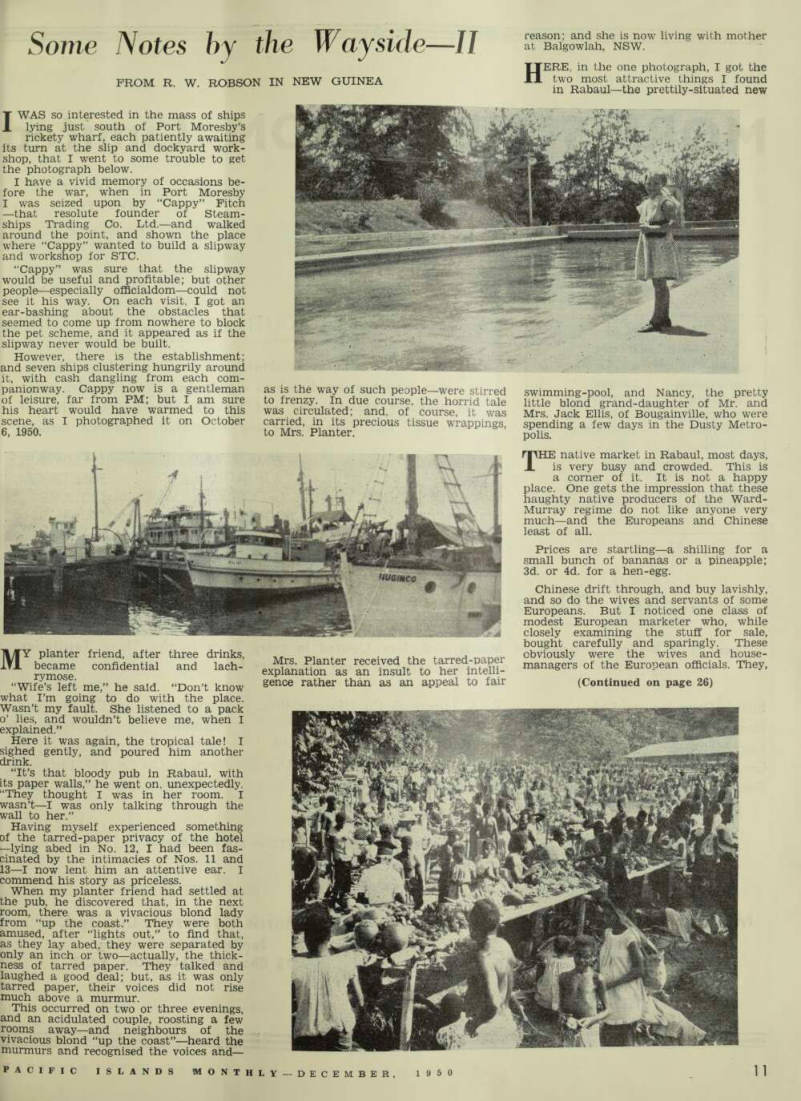
FROM R. W. ROBSON IN NEW GUINEA
I WAS so interested in the mass of ships lying just south of Port Moresby’s rickety wharf, each patiently awaiting its turn at the slip and dockyard work shop, that I went to some trouble to get the photograph below.
I have a vivid memory of occasions be fore the war, when in Port Moresby I was seized upon by “Gappy” Fitch —that resolute founder of Steam ships Trading Co. Ltd.—and walked around the point, and shown the place where “Gappy” wanted to build a slipway and workshop for STC.
“Gappy” was sure that the slipway would be useful and profitable; but other people—especially officialdom—could not see it his way. On each visit, I got an ear-bashing about the obstacles that seemed to come up from nowhere to block the pet scheme, and it appeared as if the slipway never would be built.
However, there is the establishment; and seven ships clustering hungrily around it, with cash dangling from each com panionway. Gappy now is a gentleman of leisure, far from PM; but I am sure his heart would have warmed to this scene, as I photographed it on October 6, 1950.
MY planter friend, after three drinks, became confidential and lach rymose.
“Wife’s left me,” he said. “Don’t know what I’m going to do with the place.
Wasn’t my fault. She listened to a pack o’ lies, and wouldn’t believe me, when I explained.”
Here it was again, the tropical tale! I sighed gently, and poured him another drink.
“It’s that bloody pub in Rabaul, with its paper walls,” he went on, unexpectedly.
“They thought I was in her room. I wasn’t —l was only talking through the wall to her.”
Having myself experienced something of the tarred-paper privacy of the hotel —lying abed in No. 12, I had been fas cinated by the intimacies of Nos. 11 and 13 —I now lent him an attentive ear. I commend his story as priceless.
When my planter friend had settled at the pub, he discovered that, in the next room, there was a vivacious blond lady from “up the coast.” They were both amused, after “lights out,” to find that, as they lay abed, they were separated by only an inch or two —actually, the thick ness of tarred paper. They talked and laughed a good deal; but, as it was only tarred paper, their voices did not rise much above a murmur.
This occurred on two or three evenings, and an acidulated couple, roosting a few rporns away—and neighbours of the vivacious blond “up the coast” —heard the murmurs and recognised the voices and—
as is the way of such people—were stirred to frenzy. In due course, the horrid tale was circulated; and, of course, it was carried, in its precious tissue wrappings, to Mrs. Planter.
Mrs. Planter received the tarred-paper explanation as an insult to her intelli gence rather than as an appeal to fair
reason; and she is now living with mother at Balgowlah, NSW.
HERE, in the one photograph, I got the two most attractive things I found in Rabaul —the prettily-situated new
swimming-pool, and Nancy, the pretty little blond grand-daughter of Mr. and Mrs. Jack Ellis, of Bougainville, who were spending a few days in the Dusty Metro polis.
THE native market in Rabaul, most days, is very busy and crowded. This is a corner of it. It is not a happy place. One gets the impression that these haughty native producers of the Ward- Murray regime do not like anyone very much—and the Europeans and Chinese least of all.
Prices are startling—a shilling for a small bunch of bananas or a pineapple; 3d. or 4d. for a hen-egg.
Chinese drift through, and buy lavishly, and so do the wives and servants of some Europeans. But I noticed one class of modest European marketer who, while closely examining the stuff for sale, bought carefully and sparingly. These obviously were the wives and house managers of the European officials. They,
(Continued on page 26)
amid this orgy of loose money and high spending, have to conform to a fixed income that is* always one long hop behind the cost-of-living figure. I thought they generally looked tired and harassed; but, of course, I cheered myself up with the spectacle of all those prosperous native co-operatives, concerning whom such glowing reports go out to the Trusteeship Council.
My mind somehow kept returning to memories of the old, pre-war native market, to which one carried a bunch of trade tobacco and, for the equivalent of a few pence, bought excellent fruit and vegetables from smiling natives who seemed glad to see one. The more I see of the Ward-Evatt-Murray plan for “freeing the natives from exploitation,” the less I like it.
UPON this well-weathered board, sel up at a road intersection just soutl of the re-built town of Wau, are in scribed these words; — Wau —Around this Airfield, and t< the South and East, in the Wau Valley Australian soldiers fought a desperati defensive battle against a Japanesi Force which advanced from Salamaus through Wandumi.
It was on January 27, 1943, that Cap tain W. Sherlock, in charge of a Kangi force watching the Black Cat and Crysta Creek tracks (on the eastern side of th Bulolo Valley, facing Wau) found them
selves in contact with numerous Ja patrols, who had appeared suddenly an mysteriously. Only later was it leame that some thousands of Japs had gc through on the old Wandumi track, bel ween the Black Cat and the Crysh Creek tracks, which had been cut by tb Germans, and long since forgotten an overgrown.
Sherlock sacrificed his men —and h own life—in a successful effort to hold tt Japs long enough to allow the Kangas 1 organise their defences in the Bulol Valley, in front of Wau. On the 29tl American transport planes brought Auj tralian troops from Moresby in onto Wa airfield, and they reinforced our bendir line.
But the Japs were thrusting strong: across the valley on the morning ( January 30, and our position was vei critical, when big planes from Papua b( gan to unload Australian artilleryme with 25-pounders. They went straigl into action, at the edge of the airfield, ar in a few hours the Japs were smashed ar retreating—one of the most dramatic n cidents of the Pacific War.
Now, the only sign of it is this plai board, and the wrecks of a few plan< peeping out of the kunai, here and ther ADO Seale, in charge of this district, trying to induce someone to replace tl hoarding with a worth-while and pe: manent memorial.
THIS impressive structure, in the Lalo Valley near the airstrip, north-ea of Moresby, is all that remains no to remind the casual traveller that, on a few short years ago, the better 200,000 troons were spread all across tn arid region, getting ready to deal wii the Jap menace on the other side of tl Owen Stanley ranges.
This wartime shelter-shed now hous Mr. Tom Flower’s main sawmill. I brings the logs in, in big lorries, some or 12 miles, from rapidly dwindling lease and the saws are kept busy. There are i stacks of timber at the mill. Moresby hunger for building material of any ki| is so great that the green timber literal is sold before it is off the saw-bench, di
livered before it is dry, and nailed into position before it gets a chance to curl.
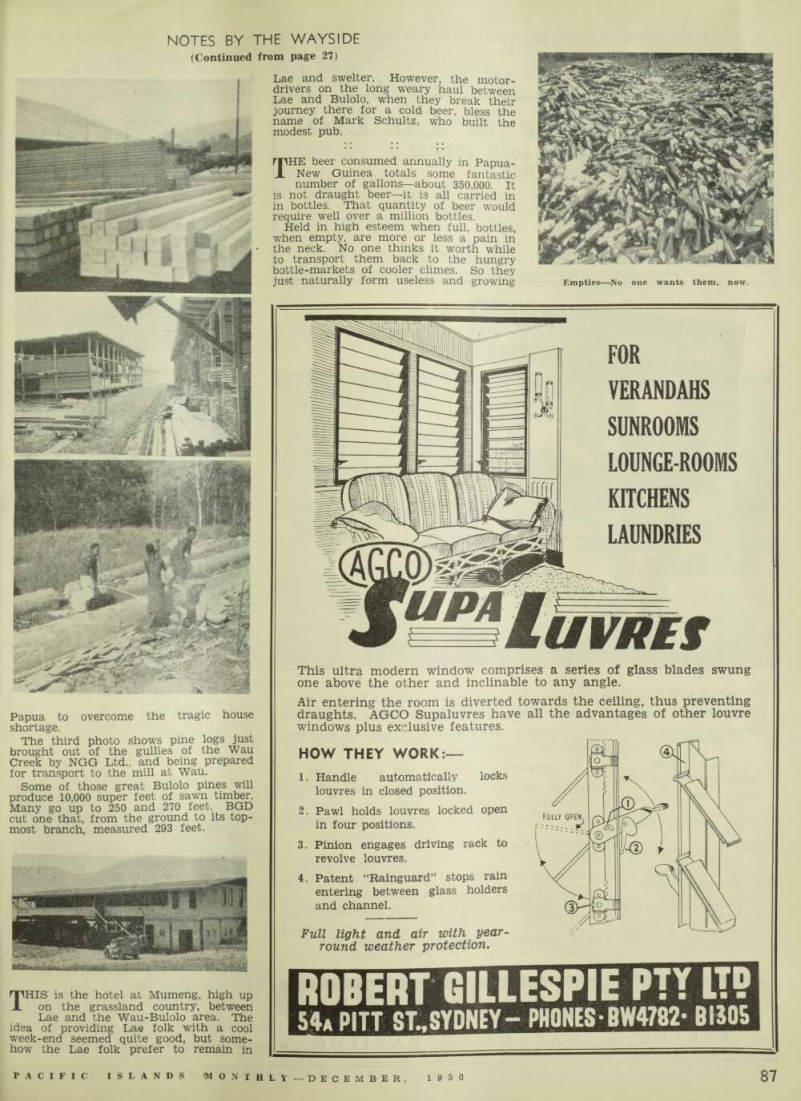
THE three pictures (p. 87) give some idea of what is happening to the goldmin ing industry of the Bulolo Valley. Both Bulolo Gold Dredging, Ltd., and New Guinea Goldfields, Ltd., have put in large log-hauling and sawmilling installations, with the idea that the increasing business of producing pine and cedar timber shall compensate them for the dwindling pro duction from their gold leases, now being worked out.
In the top picture is some of the pine, cut ready for shipment by BGD, in fulfil ment of a huge order for cell separators placed in New Guinea by Australian manufacturers of storage batteries. In Australia, these beams are cut down into thin separators.
The second picture shows some of the sawn timber, at one of the mills, ready for use in pre-fabricated houses, now being supplied to various towns in New Guinea
(Continued on page 87)
_.? atu . J ir La J a S H k “ na ’ Secretary of Pn P rn^p bri tf y T *2 H £ nolulu in September, en route to Lake Success where he was advisor to the UK delegation. In Honolulu, he was described in a the^^onies* 8 in S thp tB R?r ° f ? C 1 es m the Fijian Government.
Miss Lily Mansell, daughter of Mr and H - L Mansell of Suva. Fiji! who has been in the employ of the British Em bassy in Washington, DC, USA, for the past 15 months has returned to her home f ° r a f6W months holiday, before return mg to Honolulu where she is to marry Ens. Arthur S. Schlofman Jr. USN.
Papua to overcome the tragic house shortage.
The third photo shows pine logs just brought out of the gullies of the Wau Creek by NGG Ltd., and being prepared for transport to the mill at Wau.
Some of those great Bulolo pines will produce 10,000 super feet of sawn timber.
Many go up to 250 and 270 feet. BGD cut one that, from the ground to its top most branch, measured 293 feet.
THIS is the hotel at Mumeng, high up on the grassland country, between Lae and the Wau-Bulolo area. The idea of providing Lae folk with a cool week-end seemed quite good, but some how the Lae folk prefer to remain in
Lae and swelter. However, the motor drivers on the long weary haul between Lae and Bulolo, when they break their journey there for a cold beer, bless the name of Mark Schultz, who built the modest pub.
THE beer consumed annually in Papua- New Guinea totals some fantastic number of gallons—about 350,000. It is not draught beer —it is all carried in in bottles. That quantity of beer would require well over a million bottles.
Held in high esteem when full, bottles, when empty, are more or less a pain in the neck. No one thinks it worth while to transport them back to the hungry bottle-markets of cooler climes. So they just naturally form useless and growing
Empties—No one wants them, now.
mountains around the back premises of the tropical hotels.
Photo shows one section of the pile that may be seen at the edge of the jungle near the Hotel Cecil in Lae, New Guinea.
TJOUSEWIVES of Moresby, if they had their way, might add another medal to the several decorations acquired by Captain Bobby Gibbes in the 1939-45 un pleasantness. One of the planes of Gibbes
Sepik Airways now flies regularly to Garoka, loads up with the very fine pota toes and cabbages produced in the High lands, and drops down over the central mountains into Moresby, where the fresh food is very welcome.
The plan seems to be economic; but, whether the profits are there or not, Bobby Gibbes probably will continue the service, because of his love for the High lands, and his eagerness to do something towards the development of the new country. He has joined the small but notable band of farmers in the Highlands and, at his place near Hagen, he is ex perimenting, to see whether he can pro duce passion-fruit on a payable basis. It is largely a matter of transport and pre servation. There is a huge market for the pulp in Australia, if it can be got there in satisfactory condition.
The plane in this picture had just been loaded with cabbages by these primitive “Chimbus.” Their costume consisted of a woven fringe in front, and a tail-piece of fresh green leaves.
IP one wanted to be fanciful, one might call New Guinea the Land of the Dy ing Jeep. The jeep is one of the few good things that Papua-New Guinea got out of the war. There are hundreds— thousands —of them, all over the Terri tory; and they seem to have been made for just the kind of rough transport most in demand here.
This is the Wau golfers’ modest club house on a Saturday afternoon; and, of the 10 vehicles patiently waiting there for
the end of 19th hole ceremonies, no less than nine were Jeeps.
Incidentally, while this is the smallest, it probably is the prettiest golf-course in the Islands. They have just acquired land alongside, which they have named the Eric Feldt Reserve (in honour of a former notable official who still is held in
(Continued on page 0(5.)
high regard) and, when they get it licked into shape, they will have a 9-holes course.
The jeeps are becoming aged, battered and decrepit, and there seems to be no adequate provision for their maintenance, renewal and replacement. The jeep, one of the most useful tools these Territories ever had, seems destined to become a war time memory. I presume jeeps are still being built; but the Nabobs of our time say we may not sell our gold and copra for dollars, and so we cannot have any more jeeps.
THIS little picture, taken in Madang in mid-October, illustrates what the critics mean when they say the coastal shipping service in New Guinea is falling down on the job. The main trouble is not so much the little ships themselves, as the fact that the wharves are not numerous or big enough to accommodate the little ships, when they come in loaded with cargo, eager to discharge and get away.
On this occasion, in Madang, the stores behind this wharf were bulging with copra—evidently, some vessel from over seas was overdue. Meanwhile, half a dozen small ships were lying in the pic turesque little port, awaiting their turn at the discharge wharf and, as shown here, piling up three deep.
THE WD Millionaires, they call them m New Guinea —and there are quite a lot of them. WD stands for War Disposals.
When the Army departed, the two Ter ritories were simply littered with wealth.
Gold and coconuts have made many men rich; but—if they could but have seen it —these riches were as nothing to what has been gathered up by the bright lads who got in early on the War Disposals goods.
Papua-New Guinea is absorbing any thing from three to seven millions a year of Australian taxpayers’ funds. Much of that call on Australia could have been avoided if only those Disposals goods had been sold to the Administration at the same prices as they were sold to speculators, and the Administration had re-sold piece meal. As it was, they were more or less given away, and shrewd gentlemen from everywhere made fortunes. Some of the fortunes stayed in New Guinea, but most of them emigrated.
Here, picked up in passing, is an example. I noticed, at Tom Flower’s saw mill, a small mountain of galvanised wire rope. Mr. Flower bought some discarded naval apparatus—huge nets, or something like that—for a few pounds; for another few pounds he had the connections un screwed: and the resulting rolls of wire rope—very handy in all kinds of industry is worth a great deal of money.
Advertisements & other items, pp. 13-14 (3 items)
11
ACIFIC ISLANDS MONTHLY DECEMBER, 1950
12
DECEMBER, 1950 PACIFIC ISLANDS (MONTHLY
Morris Hedstrom Limited
General Merchants, Importers and Exporters,
Shipowners, Plantation Owners,
Commission and Insurance Agents
HEAD OFFICE
SUVA, FIJI
Established 1868 Registered Cable Addresses : Deuba Suva Monished . .. Levuka Morstrom .. .. Sydney Suvamark ... London Morrisco .. .. Nukualofa Deuba Apia Telephones : Suva 32 (8 lines) Sydney BX 2677 and BX 2678
SERVICE IN THE SOUTH PACIFIC TERRITORIES
rpHROUGH our Large Establishments in Suva and our Numerous Branches, we distribute a wide and comprehensive range of General Merchandise and provide almost every kind of service. Our departments and associated businesses include:
DRAPERY
MOTOR SALES
AND SERVICE
TOBACCO
TIMBER AND
BUILDING
GROCERY
CONFECTIONERY
HARDWARE
ELECTRICAL
LIQUORS
DRUGS
Branches Throughout Fiji, Samoa and Tonga
There is a Branch or Agent of Morris Hedstrom Limited in every Town in the Three Territories.
We are Sole Agents in these Territories for British Drug Houses Ltd.
Electrolux Ltd.
Ford Motor Co.
General Electric Co. Ltd.
Goodyear Tyre & Rubber Co.
B. A. Hjorth Gr Co. (Primus Products) Imperial Chemical Industries Ltd.
International Harvester Export Co.
Matson Navigation Company Max Factor and Co. Inc.
Ransomes, Sims Gr Jefferies Ltd.
Ruston & Hornsby Ltd.
Vacuum Oil Co. Pty. Ltd.
Yorkshire Copper Works Ltd.
Morris Hedstrom Limited are LLOYD*S AGENTS in Fiji and Samoa.
IN AUSTRALIA:
Morris Hedstrom (Aust.) Pty. Ltd
Asbestos House, 65 York Street, SYDNEY •#
IN GREAT BRITAIN:
Morris Hedstrom Limited,
Barclay's Bank Building, 73 Cheapside, LONDON, E.C.2.
Home From Home On
Fiji’S Garden Island
THE following information about a new rest house at Taveuni (the Garden of Fiji) was issued by the Fiji Public Relations Office recently: “The Rest House, which is at Waiyevo, has two bedrooms, each containing two single beds. The rates charged for each visitor are 5/- a day, 30/- a week, or £5 a month. Services provided include those of the caretaker for the cooking of meals.
Visitors must provide their own food, fire wood, ice, petrol and kerosene. All can if required, be bought locally.
“The Rest House contains all the furni ture normally required by visitors, and household linen, cutlery, crockery, towels, mosquito nets, kitchen utensils and petrol pressure lamps are provided.”
By way of extra inducement they say “Taveuni is one of the. most fertile of the islands of Fiji. Coconut plantations stretch almost without a break along the northern, western and southern coasts.”
Taveuni’s rest house sounds like the
ideal way of taking an off-the-beaten track holiday. Many of Australia’s home less thousands would rush it with their ears back —a two-bedroom furnished house (even if it is of native material) with the services of a cook thrown in would sound like heaven to them.
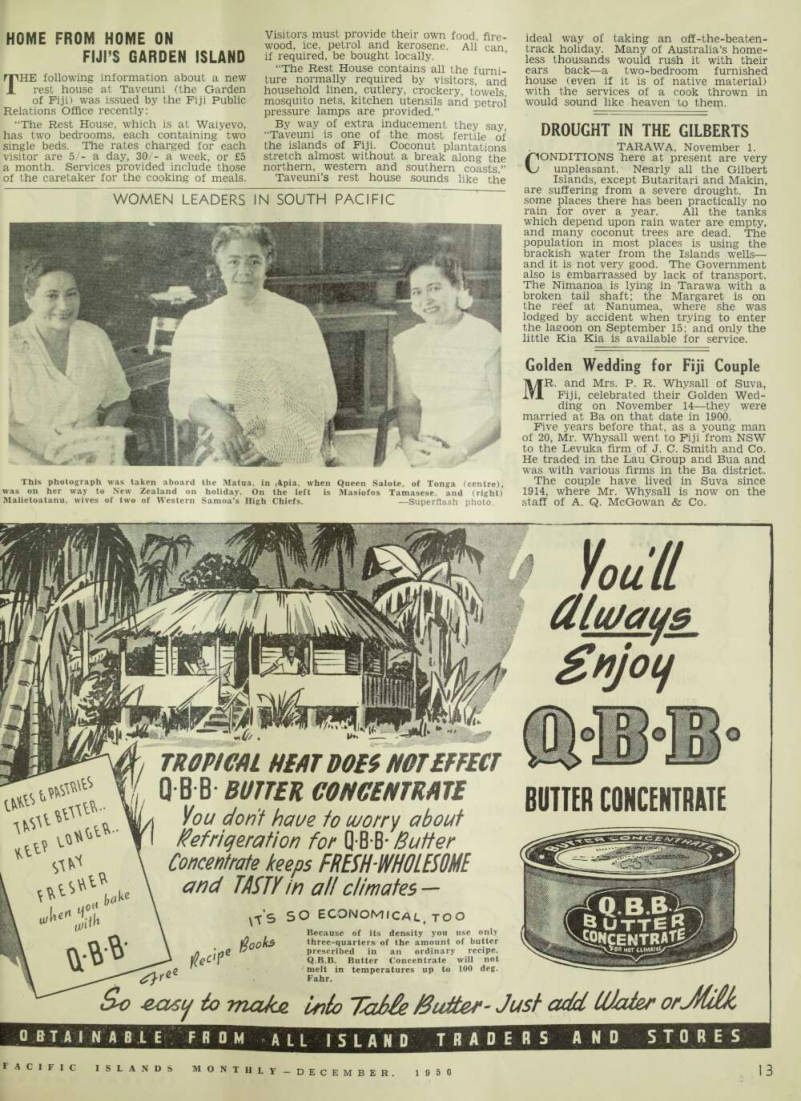
Women Leaders In South Pacific
This photograph was taken aboard the Matua, in Apia, when Queen Salote, of Tonga (centre), was on her way to New Zealand on holiday. On the left is Masiofos Tamasese. and (right) Malietoatanu, wives of two of Western Samoa’s High Chiefs.
Superflash photo
Drought In The Gilberts
TARAWA, November 1.
CONDITIONS here at present are very unpleasant. Nearly all the Gilbert Islands, except Butaritari and Makin, are suffering from a severe drought. In some places there has been practically no rain for over a year. All the tanks which depend upon rain water are empty, and many coconut trees are dead. The population in most places is using the brackish water from the Islands wells— and it is not very good. The Government also is embarrassed by lack of transport.
The Nimanoa is lying in Tarawa with a broken tail shaft; the Margaret is on the reef at Nanumea, where she was lodged by accident when trying to enter the lagoon on September 15; and only the little Kia Kia is available for service.
Golden Wedding for Fiji Couple
MR. and Mrs. P. R. Whysall of Suva, Fiji, celebrated their Golden Wed ding on November 14—they were married at Ba on that date in 1900.
Five years before that, as a young man of 20, Mr. Whysall went to Fiji from NSW to the Levuka firm of J. C. Smith and Co.
He traded in the Lau Group and Bua and was with various firms in the Ba district.
The couple have lived in Suva since 1914, where Mr. Whysall is now on the staff of A. Q. McGowan & Co.
Advertisements & other items, pp. 15-16 (3 items)
13
PACIFIC ISLANDS MONTHLY- D E C E M B E R . 1950
ulujaif.
*** ' ■ ■ i #jnp <st S 1/ K //
s
£njou
i
TXOP/m HIAT DOH NOTEffECT
QBB CONCENTRATE BUTTER CONCENTRATE
You aonf haue to u/orry about Refrigeration for Q B-B- Rutter
Concentrate keeps FRESH-WHOLESOME
and TASTE in all climates a/ he* 1 oi* 10 ih \tS sQok& SO economical too Because of its density you use only three-quarters of the amount of butter prescribed in an ordinary recipe.
Q. 8.8. Butter Concentrate will not melt in temperatures up to 100 deg.
Fahr. fdf So easy to make. into Tabic Mutter- Just add Ulater orJtfM am
BTAI NAB IE
ALL IS LA N
e ns
YOURS WHEN YOU FLY BY CLIPPER
* TO
LONDON
4 IRW4VS
4M 5M PA
VIA U.S.A.
PAN AMERICAN’S DOUBLE-DECKED CUPPERS
You fly in the world’s largest, most luxu- Pan American’s Commonwealth Plan rious airliners from Hawaii to the U.S.A. covers all your travel expenses to London New York to London. Pan American’s and return. Includes meals, hotel accomnew double-decked Clippers are equipped modations, incidental transportation in with scores of new comforts, including the U.S.A. All reservations and arrangespacious club lounge on the lower deck, ments made for you by Pan American.
The Clippers also fly to London via Middle East and Europe.
For complete information, call your Travel Agent or . . .
SUVA: Bank of N.S.fV. Bldg. (Tel. 664) NOUMEA: Rue Jean Jaures (Tel. 85)
SPEED YOUR PARCEL BY CLIPPER CARSO
*Trade Mark, Pan American World Airways, Inc, World’s Most Experienced Airline / Pan American World Airways, Inc., Ltd., Incorporated in U.S.A.
14
DECEMBER, 1950 PACIFIC INLANDS (MONTH L.
New Hebrides Cricket
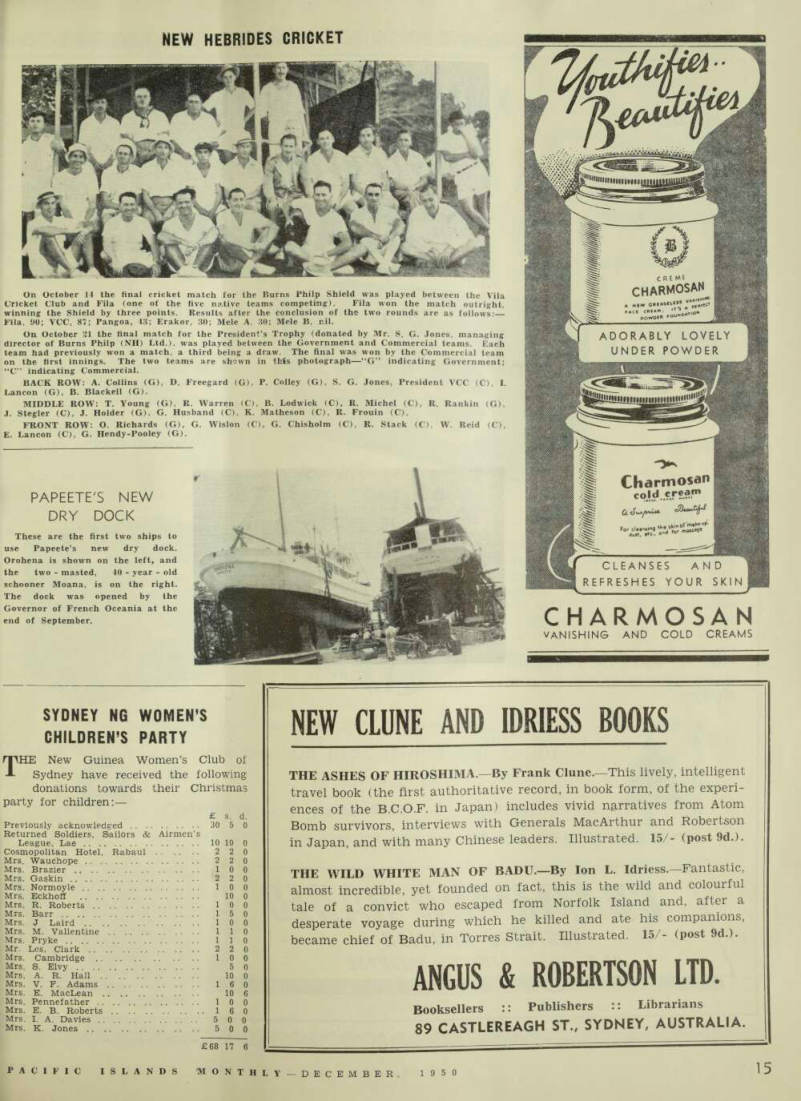
On October 14 the final cricket match for the Burns Philp Shield was played between the Vila Cricket Club and Fila (one of the five native teams competing). Fila won the match outright, winning the Shield by three points. Results after the conclusion of the two rounds are as follows: Fila. 90; VCC, 87; Pangoa, 43; Erakor. 30; Mele A, 30; Mele B, nil.
On October 21 the final match for the President’s Trophy (donated by Mr. S. G. Jones, managing director of Burns Philp (NH) Ltd.), was played between the Government and Commercial teams. Each team had previously won a match, a third being a draw. The final was won by the Commercial team on the first innings. The two teams are shown in this photograph—“G" indicating Government; “C” indicating Commercial.
BACK ROW: A. Collins (G), D. Freegard (G), P. Colley (G), S. G. Jones, President VCC (C). I.
Lancon (G), B. Blackell (G).
MIDDLE ROW: T. Young (G). R. Warren (C), B. Lodwick (C), R. Michel (C), R. Rankin (G), J. Stegler (C), J. Holder (G), G. Husband (C). K. Matheson (C), R. Frouin (C).
FRONT ROW: O. Richards (G), G. Wislon (C), G. Chisholm (C), R. Stack (C). W. Reid (C), E. Lancon (C). G. Hendy-Pooley (G).
Papeete's New
Dry Dock
These are the first two ships to use Papeete’s new dry dock.
Orohena is shown on the left, and the two - masted, 40 - year-old schooner Moana, is on the right.
The dock was opened by the Governor of French Oceania at the end of September.
Children’S Party
Sydney Ng Women’S
THE New Guinea Women’s Club of Sydney have received the following donations towards their Christmas party for children: —
£ s. d.
Previously acknowledged .. . .
Returned Soldiers, Sailors & 30 Airmen's 5 0 League, Lae 10 10 0 Cosmopolitan Hotel. Rabaul 2 2 0 Mrs. Wauchope 2 2 0 Mrs. Brazier 1 0 0 Mrs. Gaskin 2 2 0 Mrs. Normoyle 1 0 0 Mrs. Eckhoff 10 0 Mrs. R. Roberts 1 0 0 Mrs. Barr 1 5 0 Mrs. J Laird 1 0 0 Mrs. M. Vallentine 1 1 0 Mrs. Pryke 1 1 0 Mr. Les. Clark 2 2 0 Mrs. Cambridge 1 0 0 Mrs. S. Elvy 5 0 Mrs. A. R. Hall 10 0 Mrs. V. F. Adams 1 6 0 Mrs. E. MacLean 10 6 Mrs. Pennefather 1 0 0 Mrs. E. B. Roberts 1 6 0 Mrs. I. A. Davies 5 0 0 Mrs. K. Jones 5 0 0 £68 17 6
Advertisements & other items, pp. 17-18 (2 items)
Angus & Robertson Ltd.
"IMllmmiii $
CREME
CHARMOSAN
» N|W OK•»«'■“* * A £l"Cr
ADORABLY LOVELY
UNDER POWDER
miiiiii' 1 !
IUUUIUIIIIIIIIIHI
sg
Charmosan
co|dcr?am
cl«»"»i"fl
CLEANSES AND
REFRESHES YOUR SKIN
CHARMOSAN
VANISHING and cold creams
NEW CLUNE AND IDRIESS BOOKS
THE ASHES OF HIROSHIMA —By Frank Clime.— I This lively, intelligent travel book (the first authoritative record, in book form, of the experiences of the 8.C.0.F. in Japan) includes vivid narratives from Atom Bomb survivors, interviews with Generals MacArthur and Robertson in Japan, and with many Chinese leaders. Illustrated. 15/- (post 9d.).
THE WILD WHITE MAN OF BADU. —By lon L. Idriess. —Fantastic, almost incredible, yet founded on fact, this is the wild and colourful tale of a convict who escaped from Norfolk Island and, after a desperate voyage during which he killed and ate his companions, became chief of Badu, in Torres Strait. Illustrated. 15/- (post 9d.).
ANGUS & ROBERTSON LTD.
Booksellers :: Publishers :: Librarians
89 CASTLEREAGH ST. ( SYDNEY, AUSTRALIA.
XMAS AND NEW YEAR
Greetings
GRAMMONDS
From
u *
If f
I ★ ★
TROPIC EAGLE.
Most famous tropic-proofed and completely sealed receiver in the world to-day. Range is unlimited and reception perfect. Three years’ guarantee and easy terms wherever you live. You will enjoy and appreciate the service
a CRAMMOND TROPIC EAGLE
will give.
TROPIC HAWK.
This is a 2-unit receiver especially designed for Patrol Officers and all who require absolute portability and dependability. Each cabinet measures 15 x 9 x 9. This set covers from 16-150 metres shortwaves only. Three years’ guarantee and easy terms wherever you
live. A CRAMMOND TROPIC
HAWK is the answer to your problems.
I TO ALL OUR FRIENDS BOTH OLD AND NEW <T J we wish you all m
GOOD HEALTH
HAPPINESS
PROSPERITY
CRAMMOND RADIO
TfWPICOL DIVISION
NO 8 QUEEN STREET ,
16
DECEMBER, 19 50 PACIFIC ISLANDS MONTHL
NG Living Conditions
Sir Alan Burns Was Amazed at NG Living Conditions
CIR ALAN BURNS, who was a member of the UN Trusteeship
Council delegation which inspected
the Pacific Trusteeship territories
earlier this year, was interviewed by New Commonwealth (which incor porates Crown Colonist ) on his return to London. Sir Alan, a former
Governor of the Gold Coast, evidently
did not think much of New Guinea.
The following, published in October
Issue of New Commonwealth, tells
vhy.
A SKED to describe unusual features in c\ the systems of administration. Sir Alan, speaking from long experience n British Colonial territories, said he found nothing new or strange in the Dolicies that were being pursued in the rrust Territories by the Administering Uithorities. “It was in the methods by vhich the various Administering Authori ses carried out the accepted policies that : found the greatest differences.
“In the American Trust Territory, for example, although a form of ‘indirect •ule’ had been established this had re ulted in no economy of staff or reduction n the costs of administration. On the ;ontrary, remembering the chronic short ige of staff in most of the British Colonial erritories in which I have served, the lumber of American officials (mostly laval officials) in the American islands ippeared to me to be extravagant.
“While admiring what the US Govem nent is doing, and the officers carrying ut the work, I was left with the uncom ortable feeling that perhaps it is doing do much for the people, and is not in isting that the people themselves should 0 more towards their own development.
“New Guinea, under Australian trustee hip, is probably less developed than any ther comparable territory in the world, lany of the tribes are extremely back ward, and some are not yet under control.
“For its size, New Guinea is well pro ided with airfields, and air services along tie coast and the interior of the ter itory are regular and frequent. The otential wealth of New Guinea must be Dnsiderable but it can never be developed ithout roads, which are practically non xistent. A country can be opened up by ir communications, as has indeed been roved in New Guinea, but it can never b effectively developed without road (or lil) transport, and I should be inclined ) make road construction the first priority 1 New Guinea.”
It was surprising to learn that the liv ig conditions of Australian officials in ew Guinea are very bad. Some improve lent in their salary scales has recently sen approved (“not a moment too soon good men are to be retained in the ervice”), but Sir Alan thinks it will robably be a long time before they can be Bcently housed. “Making all allowances )r the destruction caused by the war, n insufficient effort seems to have been lade by Government to build proper aarters for its officers. I can imagine ie consternation (if nothing worse) of n official from Nigeria or the Gold Coast he were asked to inhabit one of the puses occupied by Australian officials in ew Guinea. Having myself stayed in ime of these houses, I speak from ex erience.”
VESTERN SAMOA, under New Zealand trusteeship, he said, presents a dif ferent picture. The country has an
intelligent, friendly and hospitable people who, on the one hand, are asking for self-government (or, at any rate, for a greater control over their own affairs), and, on the other, are determined to main tain their traditional customs and an aristocratic form of local government which, as Sir Alan put it, “would strike
the believer in the sanctity of the ballot box as the antithesis of democracy.”
Much of the time that the leaders de vote to long-drawn-out ceremonies and oratory could, he thought, “be more ad vantageously spent.” But the people are happy—far happier than those in some more highly developed democracies.
Mrs. Rachael Carr, wife of the late Mr, Robert Carr, formerly a well-known planter of Ba, Fiji, has been ill recently in Sydney. She is staying with Mrs. C.
G. H. Simpson, Crescent Street, Hunters Hill.
Advertisements & other items, p. 19 (1 item)
Mary Baker
ICE CREAM MIX
Is now available to Pacific Islands Traders and Storekeepers in Chocolate and Strawberry Flavours in addition to the popular Vanilla Packed in 16 oz. tins for the Home, 5 lb. Family Size tins and 32 lb, tins for Storekeepers, Milk Bars and Cafes.
Ask Your Loccd Store For It Today[ By placing your order with our Agent in your own T erritory, you will receive your supplies of Mary Baker Ice Cream Mix
more promptly
AGENTS:
New Caledonia: ETA BALLANDE, Noumea.
New Hebrides: COMPTOIRS
DES NOW E LEES HEBRIDES,
Vila and Santo.
Tahiti: WALTER GRAND, Papeete.
Fiji: HUNT’S AGENCY, Suva.
W. L. D. HARVIE, Lautoka ( North-West Districts).
Sole Distributor :
J. C. MERRILLEES PTY. LTD.
104 HUNTER STREET, SYDNEY, N.S.W.
Telegrams: “MERRILLEES,” Sydney.
A Merry Xmas to All Our Clients
More Artifacts
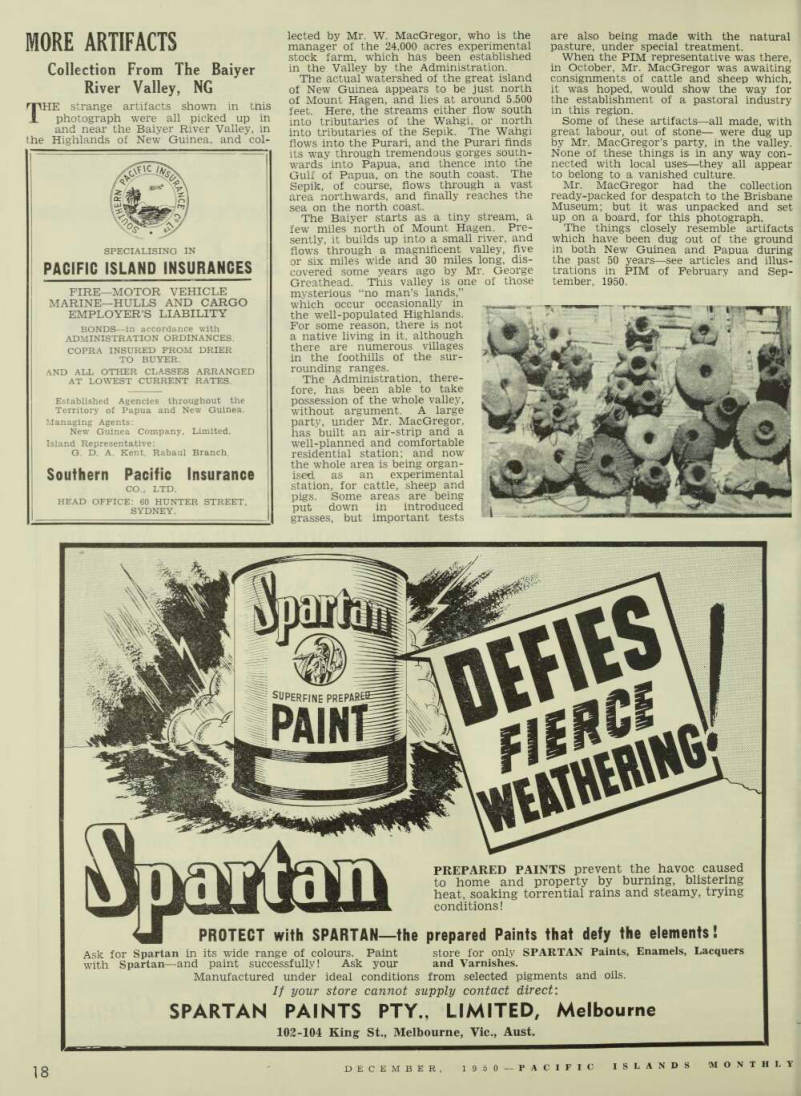
Collection From The Baiyer River Valley, NG
THE strange artifacts shown in this photograph were all picked up in and near the Baiyer River Valley, in the Highlands of New Guinea, and col
lected by Mr. W. MacGregor, who is the manager of the 24,000 acres experimental stock farm, which has been established in the Valley by the Administration.
The actual watershed of the great island of New Guinea appears to be just north of Mount Hagen, and lies at around 5.500 feet. Here, the streams either flow south into tributaries of the Wahgi, or north into tributaries of the Sepik. The Wahgi flows into the Purari, and the Purari finds its way through tremendous gorges south wards into Papua, and thence into the Gulf of Papua, on the south coast. The Sepik, of course, flows through a vast area northwards, and finally reaches the sea on the north coast.
The Baiyer starts as a tiny stream, a few miles north of Mount Hagen. Pre sently, it builds up into a small river, and flows through a magnificent valley, five or six miles wide and 30 miles long, dis covered some years ago by Mr. George Greathead. This valley is one of those
mysterious “no man’s lands,” which occur occasionally in the well-populated Highlands.
For some reason, there is not a native living in it, although there are numerous villages in the foothills of the sur rounding ranges.
The Administration, there fore, has been able to take possession of the whole valley, without argument. A large party, under Mr. MacGregor, has built an air-strip and a well-planned and comfortable residential station; and now the whole area is being organ ised, as an experimental station, for cattle, sheep and pigs. Some areas are being put down in introduced grasses, but important tests
are also being made with the natural pasture, under special treatment.
When the PIM representative was there, in October, Mr, MacGregor was awaiting consignments of cattle and sheep which, it was hoped, would show the way for the establishment of a pastoral industry in this region.
Some of these artifacts —all made, with great labour, out of stone— were dug up by Mr. MacGregor’s party, in the valley.
None of these things is in any way con nected with local uses—they all appear to belong to a vanished culture.
Mr. MacGregor had the collection ready-packed for despatch to the Brisbane Museum; but it was unpacked and set up on a board, for this photograph.
The things closely resemble artifacts which have been dug out of the ground in both New Guinea and Papua during the past 50 years—see articles and illus trations in PIM of February and Sep tember, 1950.
Advertisements & other items, p. 20 (1 item)
Pain
SPECIALISING IN
PACIFIC ISLAND INSURANCES
FIRE—MOTOR VEHICLE
MARINE—HULLS AND CARGO
EMPLOYER’S LIABILITY
BONDS —In accordance with
ADMINISTRATION ORDINANCES.
COPRA INSURED FROM DRIER
TO BUYER.
AND ALL OTHER CLASSES ARRANGED
AT LOWEST CURRENT RATES.
Established Agencies throughout the Territory of Papua and New Guinea.
Managing Agents: New Guinea Company, Limited.
Island Representative: G. D. A. Kent. Rabaul Branch.
Southern Pacific Insurance
CO., LTD.
HEAD OFFICE: 60 HUNTER STREET.
SYDNEY.
SUPERFINE PREP
PAIN
#0 PREPARED PAINTS prevent the havoc caused to home and property by burning, blistering heat, soaking torrential rains and steamy, trying conditions!
PROTECT with SPARTAN—the prepared Paints that defy the elements!
Ask for Spartan in its wide range of colours. Paint store for only SPARTAN Paints, Enamels, Lacquers with Spartan —and paint successfully! Ask your and Varnishes.
Manufactured under ideal conditions from selected pigments and oils.
If your store cannot supply contact direct :
SPARTAN PAINTS PTY., LIMITED, Melbourne
102-104 King St., Melbourne, Vic., Aust.
£5 Millions For Papua-N. Guinea
Australia Provides Nearly
What a Budget Analysis Disclosed
AN analysis of the Australian Budget figures for 1950-51 —especially the estimates of receipts and expenditure —show that Papua-New Guinea are benefitting hugely at the expense of the Australian taxpayer.
Before the war the administration of these Territories cost Australia very little:
they were virtually self-supporting.
Today, they are costing nearly B 5 000,000 that we know about, and a ?ood deal that is not disclosed.
Here are the 1950-51 estimates of ex penditure. with the 1949-50 expenditure ilso shown:
That gives a total of £4,500,000 for 3 apua-New Guinea in 1949-50, which is ncreased to £4,900,000 in 1950-51.
It is impossible to assess the cost of Vorks and Housing in Papua-New >uinea. The total cost of administering he Department in 1949-50 was £1,058,035, md this year £706,000 is provided for administrative.” Of this, Papua-New Guinea will cost £20.571 made up thus:
But there is nothing to show what Vorks and Housing are actually spending »n works and housing in Papua-New >uinea. It is cleverly hidden away— •ut it must run far into seven figures.
In 1949-50, Australia set aside £157,000 for “joint acquisition with NZ Govern ment from Christmas Island Phosphate Co. (Indian Ocean) of assets and lease-
S6.Tt2? , A , Sl3A
, h He i r qVS some interesting Items from the 1949-50 records of expenditure: bum South Pacific Commission, 1949-50 45,387 (£53,500 in 1950-51) New Guinea civilian war pensions and education benefits 25,965 (£27,900 in 1950-51)
1949 1950 Dept, of Ex. Terr.— £ £ Salaries 77,224 85,000 Gen. Exes 11,228 12,000 Papua—Int. on Loans 4,479 4,580 STG —Int. on Loans .. 1 817 1,850 3rant to P-NG Ad’m’n 4,183.121 4,578,000 Printing P-NG Laws . 1,250 6,000 Report on Ad’m’n .. . — 4,000 School of Pac. Ad’m’n 17,753 22,500 Shipping Services .. . 85,146 60,000 Payments on behalf of former Ad’m’n .. . 19,014 22 500 Restoration of plantations, lands & roads 31,242 35,000 Library service .. 1,000 1,000 lighthouses & Beacons 1,855 11,000 Vudit staff of 8, P-NG 6,407 7,148 Buildings and works for coastal and inter-island shipping 30 000 Purchase of new vessels 3,511 lighthouse services, new vessel 23,663 10,000 -.ighthouse services, buildings and works 1,125 3 000
£ Director 1,571 Assistant Director 1,230 Engineers, etc 12,190 Clerks, etc 3,773 Accountants 1,807
Advertisements & other items, pp. 21-22 (2 items)
19
ACIFIC ISLANDS MONTHLY DECEMBER, 1950
Plum Pudding
5» S P‘Ce , /
fl ever n
Swallow & Ariell’s
(the Original <!>lde (Eucilyshc Recipe
PLUM PUDDING
FAMOUS THE WORLD OVER FOR 80 YEARS
OPENgR
HN net • % J Serve some tonightbuy two tins and be ready for third helpings S/2989
TO OUR PACIFIC ISLANDS FRIENDS :
Extend Season’s Greetings
VENTURA TRADING COMPANY PTY. LTD.
26 BRIDGE STREET,
SYDNEY.
AN AUSTRALIAN ELEVEN
mrW> £ t ** m m IT i W ■■■:. mg ANOTHER AUSTRALIAN Xl—is Asthma, Hay Fever, Catarrh, Bronchitis, Antrum, Sinus, Coughs, Colds, ’Flu, Tonsilitis, Whooping Cough; these are akin, in so far as they are associated with inflamed capillaries of the mucous membrane; however, all are “knocked RIGHT OUT of the ground” by
aspaXaprene
Five little whiffs and in five little jiffs, “off she pops”—relief is instantaneous, because it ‘ touches the spot” unchanged. It’s the supremely excellent Xmas gift for an Asthmatic.
Complete Outfit 28/6 (Bakelite Presentation Box, 5/- extra). Refills 12/6 each.
ALL CHEMSSTS or
A. H. CRUNDALL, Box 58, Prohron, Victoria.
South Pacific

Commission
Survey Of What Has Been Done In 1950
Headquarters: Anse Vata Noumea, New Caledonia
THE outstanding features of South Pacific Commission activity in 1950 were the progress made in the execu tion of the Work Programme and the holding of the First South Pacific Con ference. 1950 was the Commission’s first full year of operation. Half the previous year was taken up with formalities.
By the beginning of 1950 several pro jects were under way—for example, S/2 Visual Education, S/3 Mass Literacy, S/5 Social Anthropology, S/6 Linguistic Re search, S/9 Community Development (the Moturiki pilot project conducted by the Fiji Government), H/l Epidemiological Information (conducted by the South Pacific Health Service, Suva), H/4 liaison in Filariasis Research, E/l Introduction )f Economic Plants, E/2 Cash Crops (coco nut, cocoa, rice), E/6 Development of Atolls.
During the year others were started, including S/l Technical Training, S 7 Co operatives, H/3 Tuberculosis, H/2 and H/5 Nutrition, E/3 Tropical Pastures, E/4 trading of Agricultural Produce, E/7 Fisheries.
Investigations under several projects 'cached the stage of interim or final re port, including S/l Technical Training, 3/2 Visual Aids, S/5 Social Anthropology, 3/6 Linguistic Research, S/9 Community Development, H/3 Tuberculosis, H/2 and EI/5 Nutrition and E/2 Cash Crops, Projects E/ll and E/12 (concerned with support by the Commission for certain
research under other authorities) were regarded as completed.
By the Sixth Session (October-Novem ber, 1950) the Commission had received reports on Projects S/2, S/5, S/6 and S/9
These were still under consideration in December, and it was expected that action would be taken on them at the Seventh Session (April, 1951) when the Commis sion would consider whether the reports should be published, what further studies were indicated and whether recommenda tions to Governments should be made on the basis of these reports.
Technical Training
THE report to the Commission on the important Project S/l (Vocational Training) was completed in Novem ber by Mr. Derrick, of the Fiji Education Department, the expert entrusted with this project.
(Continued next page.)
A meeting of the Commission’s experts, including educational members of the Research Council, is being planned to take place at Suva in the latter part of January, 1951, to discuss the Derrick Report and offer draft proposals to the Commission on means for improving technical and professional training in the South Pacific territories. This meeting will be attended
by the Executive Officers of the Commis sion, Mr. H. E. Maude (Social Develop ment), Dr. E. Massal (Health) and Dr.
H. G. MacMillan (Economic Development), and probably by the following direc tors of education: Mr. F. J. H. Gratton (Western Samoa), Mr. W. C. Groves (Papua-N. Guinea), Mr. H. Hayden (Fiji) and M. M. Grangie (New Caledonia).
Thus, by the Seventh Session (April, 1951) the Commission will have before it considered views and data on which its recommendations for measures by the Governments to improve and extend tech nical courses and schools may be based.
Filariasis Conference
IN connection with Project H/4, the Commission approved a recommenda tion of the South Pacific Conference for the holding of a conference of specialists in filariasis in Tahiti next year.
Dr. Emile Massal, the Executive Officer for Health, visited Tahiti in November to make preliminary arrangements.
The conference will be attended by re presentatives of administrations and scientific institutions and by individual scientists interested in this field of re search.
There are a number of specialists at present engaged on research into these diseases in American Samoa, Fiji, Tahiti and New Caledonia. In New Caledonia, the work is being carried out by Dr. J.
Kerrest, Research Assistant to Dr. Massal.
Tb Research
THE Commission’s Tuberculosis Re search Team (Project H/3) is also in Tahiti at the present time, pur suing the investigations which have taken them already this year to Papua and New Guinea, New Caledonia, Fiji and Western Samoa.
Tneir journey from Apia to Tahiti was made by schooner, Dr. Massal also having joined the ship at Suva. They hope to return to Noumea about the end of Janu ary to complete their reports.
A similar team will continue the work in other territories, and the whole en quiry into techniques for individual diag
dosis of tuberculosis should be completed oy June, 1951.
The research team will then undertake i study of epidemiological techniques and ihis phase of the work is expected to oc cupy a further eighteen months.
Nutrition
PROJECTS H/2 and H/5: Miss Sheila Malcolm has now completed her mtrition work in New Guinea and is due o return to Australia shortly. Her visit o the Trobriands was delayed by the out >reak of poliomyelitis there and during he quarantine of the islands she carried iut investigations in villages near Rabaul.
After consultation with Dr. E. H. Hips ey, Director of the Institute of Anatomy it Canberra and with Dr. Massal in loumea, Miss Malcolm will probably go text to the Solomons and the New lebrides.
Development Of Atolls
rHE Commission is about to commence an enquiry under its own auspices into the economic development of oral atolls (Project E/6). The investi ations are to be carried out in the filbert and Ellice Islands by Dr. R. L. latala, of LTnstitut Francais d’Oceanie.
Dr. and Mrs. Catala will leave Noumea y air for Suva on December 6 and, after nal preparations there, will go on to 'arawa later in the month on board the [areau.
Dr. Catala’s task will be to study the hysical environment in the islands with view to discovering ways of increasing le quantity and variety of subsistence nd commercial crops, and of improving omestic animals and fisheries.
Xtensions Of Work Programme
rHE Research Council at its Second Meeting in Sydney in August recom mended, and the Commission at its ixth Session at Noumea in October for le most part approved, modifications of ie programme of projects in the light : a year’s experience. The more impor int extensions of work, to be carried out : begun in 1951', were as follows: — Health: In addition to continued work i tuberculosis, nutrition and filariasis: rejects in opthalmology, leprosy, malaria id venereal diseases.
Economic Development: In addition to ie continuation of work on plant intro iction, pastures, grading of agricultural reduce and agricultural credits: con derably extended provision for work on te development of the resources of coral oils (E/6), improvement of subsistence ops (E/8), and the study of measures control pests and diseases of plants id animals (E/9).
A conference of Governmental experts i plant and animal quarantine in the gion, to be held early in 1951, is being ■ranged. A three year programme of ork on fisheries (E/7) was also ap oved, subject to funds being found.
Social Development: In addition to con lued work on visual education, mass oracy, linguistics, and co-operatives: the tablishment of a South Pacific Litera re Bureau at Sydney (S/ll), further immunity development projects (S/9), i experimental community centre in an hanised community in the area (prob ity Rarotonga) (S/12), and further an ropological work (S/5).
South Pacific Conference
IHE holding of the First South Pacific Conference at Suva in April-May completed a full cycle of meetings of e Commission and its auxiliary bodies, ie Conference was reported in the May id June issues of the Pacific Islands onthly.
were referred by the Commission to the Research Council and its advice was considered by the Commission at the Sixth Session (October) Some of the suggestions of the Conference were incorporated by the Research Council in new projects or extensions of current projects. Investigations arising out of others are being made by the Secretary- General and the Executive Officers bv direction of the Commission. y „ , .
The Second Conference will be held in mint *of °the r work e oTO I Rramm^ r anrf Ve nH^ > mem oi me work programme and ade-
quate preparations for the conference in the meantime, rrOTP4I Utuinukal, l? OUR major meetings were held during -T the year: the Fifth and Sixth Ses sions of the Commission at Suva and Noumea respectively, the First South Conference at Suva, and the S f C o Meeting of the Research Council addition, one meeting of the Working Committee was held at Syd ney.
Considerable progress was made in the recruitment of permanent staff. By De
:ember, 1950, total staff numbered 36, of vhom 12 were permanent appointees. The lational composition of the staff was as bllows; Australia 15, Prance 11, Nether ands 2, New Zealand 6, United Kingdom United States 1.
The buildings and equipment of the leadquarters at Anse Vata (the “Penta gon” building) were virtually completed >y the beginning of December. Six per nanent houses on Mt. Coffyn, under con itruction by the French authorities for he housing of Commission staff, are ex acted to be ready early in the new year.
Brigadier F. L. Hunt retired from the ervice of the South Pacific Commission »n November 18 at the conclusion of his 8 months’ appointment as Deputy Secre ary-General. Mr. J. Ryan, of the Com nission staff, has been appointed Acting )eputy Secretary-General. A graduate in aw of Sydney University, he has been a nember of the Secretariat since its pro isional inauguration at Mosman in May, 948, and was formerly on the staff of 3COF in Japan.
During the year informal contacts were naintained with the Specialised Agencies if the United Nations, notably WHO, JNESCO and PAO (including the Indo »acific Fisheries Council) and with a arge number of institutions such as the ’acific Science Association, the Australian National University, various Missionary pdies, LTnstitut Prancais d’Oceanie, the Commonwealth Scientific and Industrial lesearch Organisation, the New Zealand lepartment of Scientific and Industrial lesearch, the Institut Pasteur at Saigon, he Department of Overseas Scientific Re earch of the Ministry of Overseas France, he Laboratory of Tropical Diseases Bethesda Md. USA), the Bishop -Museum Honolulu) and the Department of mthropology (University of Sydney).
The Executive Officers made visits to everal of the territories—Dr. MacMillan Economic Development) to Fiji, Dr. Mas ai (Health) to New Guinea, Samoa, ’ahiti and Fiji, Mr. H. E. Maude (Social tevelopment) to Fiji and the Secretary leneral (Mr. W. D. Forsyth) visited Suva, autoka, Vatoukoula (Fiji), Nukualofa Tonga), Apia (Western Samoa), Pago 'ago (American Samoa), Aitutaki and arotonga (Cook Islands).
Advertisements & other items, pp. 23-30 (4 items)
21
ACIFIC ISLANDS MONTHLY-D E C E M B E R, 19 5 0
Gordon's
MILLERS LTD.
SUVA and LAUTOKA, FIJI.
Every Branch o[ Engineering and Building
C onstruction
Sawmillers and Timber Merchants; Shipwrights and Sailmakers; Joinery and Furniture Manufacturers; Upholsterers; Plumbers; Electricians; Hardware Merchants; Motor Dealers.
AGENCIES :
Chevrolet, Bedford, Vauxhall, Nash Motors. Firestone Tyres. Fetters Marine and Stationary Engines. G.E.C. Radio Sets. British Australian Lead Manufacturers Pty., Ltd. Atlas Assurance Co., Ltd.
There is no need to send to Australia or New Zealand for Repairs or Replacements. We can give you a sound Quotation and guarantee First-Class Workmanship.
4h 9. % G°
iSw&Ssf
t'VdSHi lW
isnc4r*n^La/i4i&e
Gordon's
Stands Sup’amaL
By Appointment Gin Distillers to H.M. King George VI Tanqueray, Gordon & Co. L
Vc tvell
• They
i veil!
, . but they’ve t - thanks to 2952 N
KIWI
★ Makes leather soft and supple ★ Gives added resistance to weather and wear Change to KIWI for KEEPS. 1 black • Tan • Dark Tan • Mid Tan • Brown • Mahogany • Ox Blood • Blue Transparent Dressing
Plain Flour, Self-Raising Flour and Sugar is available in specially packed new 25 lb. and 35 lb. lever lid tins for Island customers.
A full range of Penfold’s, Lindeman’s, Seppelt’s and Hardy’s Wines now available from 3/6 per 26 oz. bottle. Also leading brands of Whisky, Rum, Gin, Liqueurs (ex-bond) at competitive prices.
II -If H ATU’C HTV I 202 P,TT ST., SYDNEY, AUSTRALIA mCILKiI I n 3 rill JL 1 !/• Cable Address: “ROTUNDA,” SYDNEY Detailed price lists available post free on application.
Beautiful New Full-Colour
RECIPE BOOK
FREE!
The Simpson Recipe Book featuring 48 pages of nearly one hundred new recipes is widely known throughout Australia. It is usually sold, but to genuine residents of the Pacific Islands a copy wul be sent entirely free. Requests should be directed to Simpson Bros. Pty., Ltd., G.P.O. Box 905 M, Brisbane, Queensland, nd J U i °f der to benefit b y this free offer your letter should be headed: “Pacific Islands Free Offer.”
Offered by the Manufacturers of
SIMPSON’S
Self-Raising FLOUR
The Garrick Hotel
acfff.
fit mm
SUVA
* B '"SSWM
x -m rn FIJI
This well-known Hotel is centrally situated in Suva's main business quarter :: Modern accommodation provides comfort in all climatic conditions :: Only the best of Beers, Spirits and Wines is served Telephone 80 VINCE COSTELLO.
Proprietor.
%*Ss m f/k Aladdin liybts the way to better liv Good lighting and convenient cooking contribute much to comfort living, and Aladdin lamps and cooking appliances have been famou more than a century. Burning ordinary lighting kerosene, Aladdin proc provide the comfort and convenience of gas or electricity. They unequalled in efficiency and ease of operation.
“The world’s most wonderful lamp”
Aladdin light is the closest of all to natural daylight, and these non-pressure lamps give a steady white light of 75 candle-power. There is no smoke or fumes, no pumping. They light at the touch of a match! Burning 94% air and only 6% kerosene, these modern lamps are extremely economical in use, and safe and easy to use.
STORMPROOF LANTERN
The Aladdin Pressure Kerosene Stormproof Lantern gives 300 candle-power of brilliant light—in any kind of weather. Ruggedly built, it will stand up to many years of hard use.
MODEL
1680
MODEL
1671
MODEL
1620
MODEL
1630
WALL
BRACKET
t
TWO-BURNER PORTABLE STOVE
Compact, efficient pressure-kerosene stove has adjustable self-pricking burners. Available with metal carrying case for outdoor cooking.
ELEVATED RANGE
Modern, porcelain-finished pressurekerosene range has all the advantages of gas or electric stoves. Five selfpricking burners are adjustable to any heat, and insulated oven_ cooks perfectly. Simple and economical to operate. f
ENGLISH 81-ALADDIN
Sturdy all-weather pressure-U made by the English associateof Aladdin. Gives a bright, s 200 candle-power light. Sturdily for outdoor use.
A
Ssafi?
HEATER-COOKER
Cooks and heats! Pressure-ker one-burner cooker can be com into an efficient radiator. He adjustable, operation simple.
5-BURNER RANGE
Compact, modern range has adjustable, self-pricking burners is attractively finished in pore Heat is adjustable from "sirr to "boil" and insulated oven perfectly. Pressure-kerosene ope is simple and economical.
Obtainable through your Australian Buying House or Local Storekeeper.
Manufacturers: Alladin Industries Pty. Ltd., Bourke St., Waterloo, N.S.W.
HIGH FIDELITY heart recordings
with Pushbutton Cardiography
The G. E. Cardioscribe is a new development in the direct-writing field.
Simple to use, easy to carry, it produces high fidelity tracing and yet requires no new approach to the in-
PUSH BUTTON CONTROL
Standardises and selects any one of seven leads, without regard to numerical sequence. All present-day techniques, including Goldberger or Wilson, are possible. terpretation of results. Cardioscribe electrocardiograms are immediately available wherever they are needed; at the hospital, in the surgery, or at the patient’s bedside.
EASY TO CARRY
The unit is small, compact, and entirely selfcontained in the beautiful natural blonde mahogany cabinet. Provision is made for all supplies and accessories in the compartmented cover. Total weight: only 38 pounds.
Write, Call or Telephone for \fes Dl\ V ICT O R
UMITED
Further Particulars : Branches at all Principal Cities throughout
AUSI 'IALIA NEW ZEALAND
MUNGO SCOTT PTY. LTD.
Flour Millers, Summer Hill, N.S.W., Australia Established 1894.
BLUE
FINE
AND
DRY !
£
SUPERB
SUPERB
IT'S
QUALITY
THAT
COUNTS !
The unvaried “Quality” of “BLUE SUPERB FLOUR” makes it especially suitable to climatic conditions of the Pacific Islands. Our Entoletion process reduces the risk of insect infestation to a minimum. All Good Bakers use “BLUE-SUPERB.” Our Pacific Representative will call on you soon.
m ■
Tropical formulae
Throughout the years the Paints and Finishes of the Sherwin-Williams Organisation have earned for themselves an enviable reputation for
their consistently high standards,
and special suitability to all climates and conditions. 5 '■ i . lili 1 i s V- 1 ■ i < • . . * ffeV . ■ • k-' <4* s O*' «. K*.
Sherwin-Williams
Globe-Tested
Finishes
*, k - Distributors throughout New Guinea
COLTER WATSON (NEW GUINEA) LTD.
WORLD PARITY FOR YOUR PRODUCE!
We are outright buyers of—
TROCHUS SHELL M.O.P. SHELL
IVORY HUTS GREEN SNAIL SHELL
As direct exporters to World’s consuming centres we can offer
TOP PRICES.
We supply TIMBER, DOORS, JOINERY, MOULDINGS, Etc.
W. BALCHIN PIT. LTD.
(Established 1848).
TIMBER, IMPORT & EXPORT MERCHANTS
Head office SYDNEY: 247 George St. ’Phones: BW 1538-9 Cables: Also at LONDON; 78 Gt. Bushey Drive Totteridge
“BALCHINCO”
m The New Maxply Tennis Racket.
The New Heavy Duty Tennis Ball.
Popular Choice
Dunlop Is the popular choice of the champion as well os the man who plays merely "for the fun of it".
Wherever you rate on the sports ladder, you'll get more enjoyment from your game when you use Dunlop tennis rackets, tennis balls, golf balls and sports shoes.
Dunlop is first by popular choice.
DUNLOP
FOR ALL SPORTING EQUIPMENT
'Badminton" Sport Shoes. ousCop "65"
Golf Balls.
Dunlop Bowls.
DO 9257
* »n ill
AP6O
ill 38 J I I J mm MA. zCI ■ te;;-
J>s v,■
HP' 'O. V&*' :
SYDNEY-AUCKLAND-SYDNEY,
SYDNEY-WELLINGTON-SYDNEY,
SUVA-AUCKLAND-SUVA.
, if til .-V. - rff'V! |||; y-; .••• x, - ■■. iili Fly in the comfort of a first-class hotel by I.E.A.L. Solents —the largest, fastest, most luxurious flying boats in service.
Fresh-cooked meals served at your own table laid with crisp linen and gleaming silver. Spacious passenger lounges for resting, reading, writing. Two flight stewards and a flight stewardess on every flight to dispense fine service.
Special service for babies , unaccompanied children and invalids. ■■■ . lipll
TEA L
Reservations: T.E.A.L Q.E.A., N.A.C. and leading travel agents.
TASMAN EMPIRE AIRWAYS LIMITE
-irmri-itiAn with O.E.A. and 8.0.A.C.
23
ACIFIC ISLANDS MONTHLY DECEMBER, 1950
24
DECEMBER, 1950 PACIFIC ISLANDS MONTHL
W. Samoa Champion
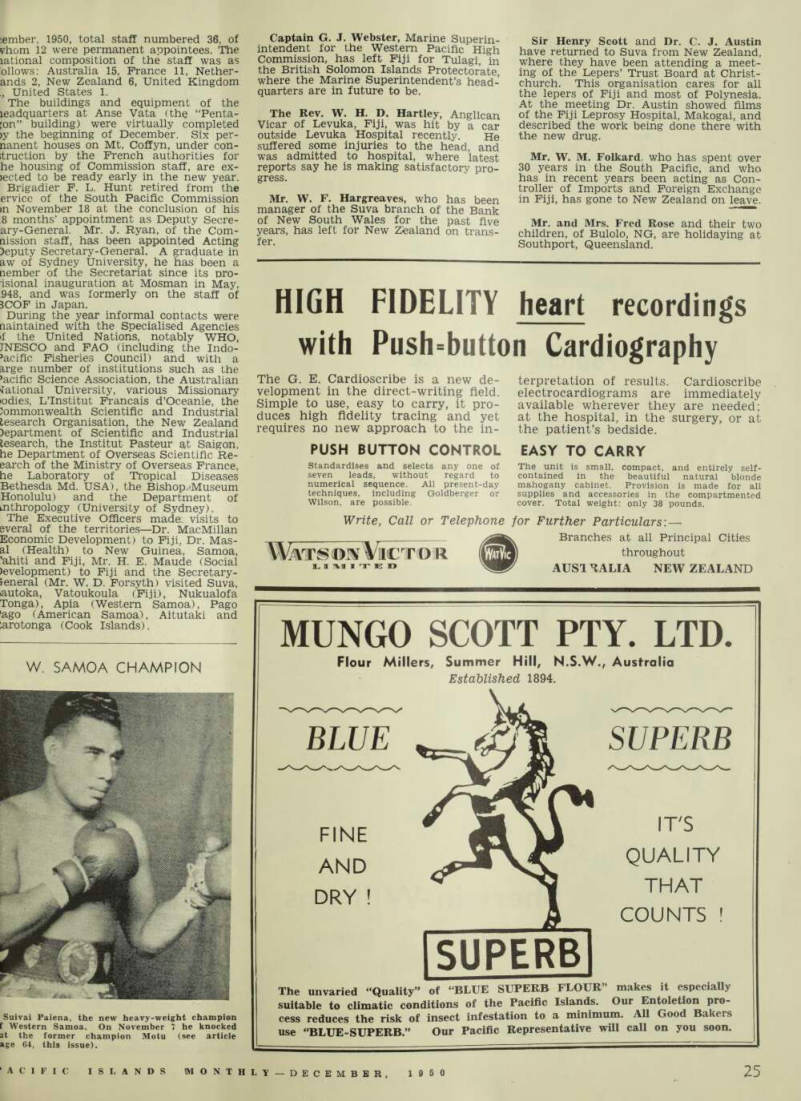
Captain G. J. Webster, Marine Superin intendent for the Western Pacific High Commission, has left Fiji for Tulagi, in the British Solomon Islands Protectorate where the Marine Superintendent’s head quarters are in future to be.
The Rev. W. H. D. Hartley, Anglican Vicar of Levuka, Fiji, was hit by a car outside Levuka Hospital recently. He suffered some injuries to the head, and was admitted to hospital, where latest reports say he is making satisfactory pro gress.
Mr. W. F. Hargreaves, who has been manager of the Suva branch of the Bank of New South Wales for the past five years, has left for New Zealand on trans fer.
Sir Henry Scott and Dr. C. J. Austin have returned to Suva from New Zealand, where they have been attending a meet ing of the Lepers’ Trust Board at Christ church. This organisation cares for all the lepers of Fiji and most of Polynesia.
At the meeting Dr. Austin showed films of the Fiji Leprosy Hospital, Makogai, and described the work being done there with the new drug, Mr. W. M. Folkard, who has spent over 30 years in the South Pacific, and who has in recent years been acting as Con troller of Imports and Foreign Exchange in Fiji, has gone to New Zealand on leave, ‘ Mr. and Mrs. Fred Rose and their two children, of Bulolo, NG, are holidaying at Southport, Queensland.
Suivai Paiena, the new heavy-weight champion Western Samoa. On November 7 he knocked it the former champion Motu (see article age 64, this issue).
Advertisements & other items, pp. 27-30 (4 items)
25
ACIFIC ISLANDS MONTHLY DECEMBER, 1950
December, 19 6 0 -Pacific Islands Monthl
27
ACIFIC ISLANDS MONTHLY DECEMBER, 1950
December, 1950-Pacific Islands Month!.
New Guinea’S Enriched Chinese
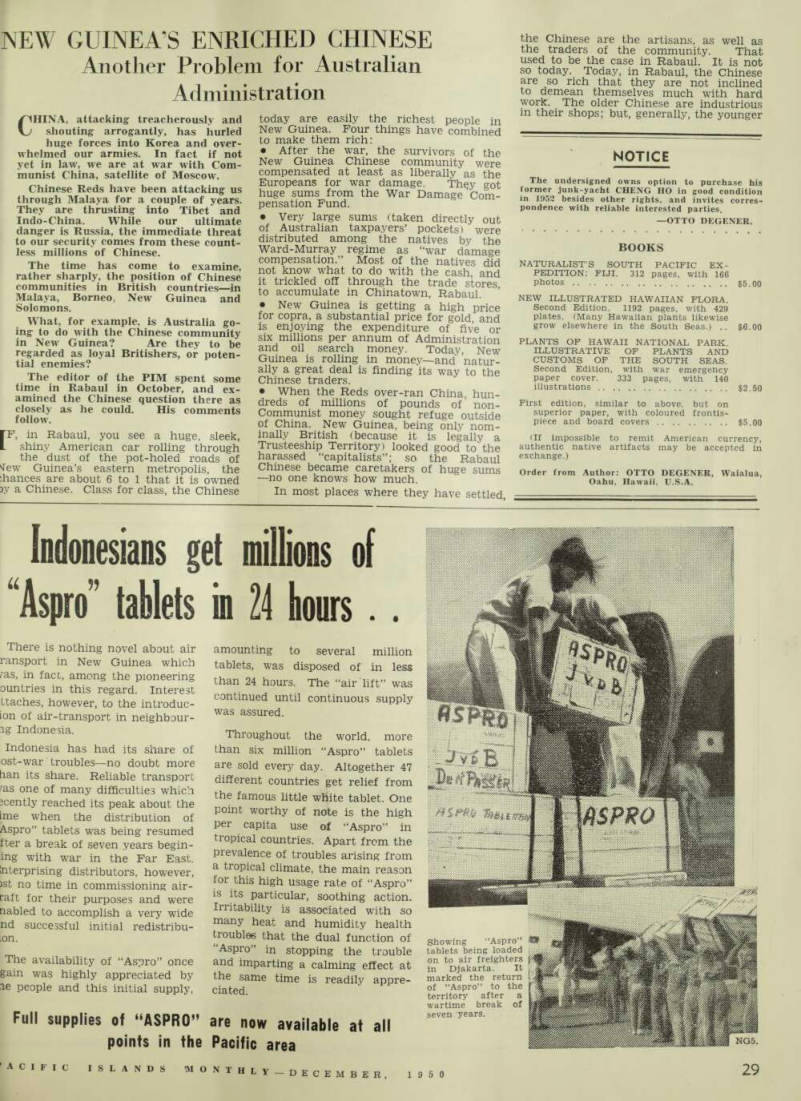
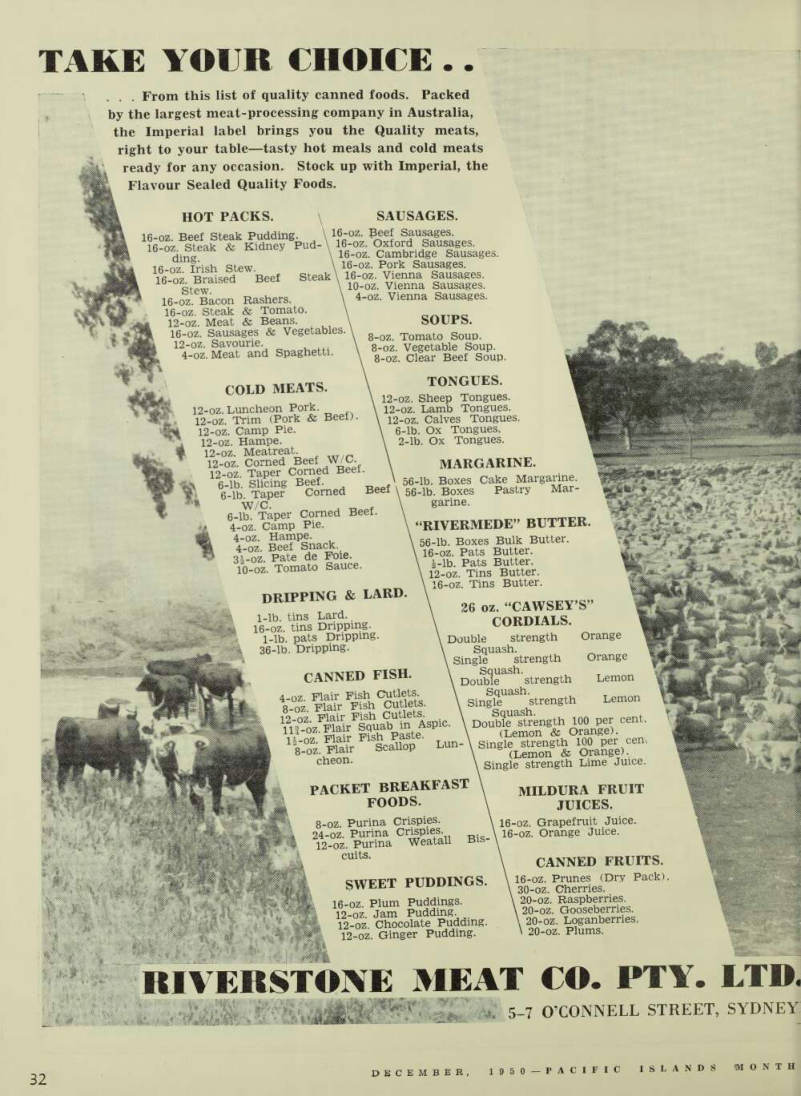
Another Problem for Australian Administration
CHINA, attacking treacherously and shouting arrogantly, has hurled huge forces into Korea and over whelmed our armies. In fact if not yet in law, we are at war with Com munist China, satellite of Moscow.
Chinese Reds have been attacking us through Malaya for a couple of years.
They are thrusting into Tibet and Indo-China. While our ultimate danger is Russia, the immediate threat to our security comes from these count less millions of Chinese.
The time has come to examine, rather sharply, the position of Chinese communities in British countries—in Malaya, Borneo, New Guinea and Solomons.
What, for example, is Australia go ing to do with the Chinese community in New Guinea? Are they to be regarded as loyal Britishers, or poten tial enemies?
The editor of the PIM spent some time in Rabaul in October, and ex amined the Chinese question there as closely as he could. His comments follow'. [F, in Rabaul, you see a huge, sleek, shiny American car rolling through the dust of the pot-holed roads of 'Jew Guinea’s eastern metropolis, the ;hances are about 6 to 1 that it is owned )y a Chinese. Class for class, the Chinese
today are easily the richest people in New Guinea. Four things have combined to make them rich: • After the war, the survivors of the New Guinea Chinese community were compensated at least as liberally as the Europeans for war damage. They got huge sums from the War Damage Com pensation Fund. • Very large sums (taken directly out of Australian taxpayers’ pockets) were distributed among the natives by the Ward-Murray regime as “war damage compensation.” Most of the natives did not know what to do with the cash and it trickled off through the trade stores to accumulate in Chinatown, Rabaul. • New Guinea is getting a high price for copra, a substantial price for gold and is enjoying the expenditure of five or six millions per annum of Administration and oil search money. Today, New Guinea is rolling in money—and natur ally a great deal is finding its way to the Chinese traders. • When the Reds over-ran China, hun dreds of millions of pounds of non- Communist money sought refuge outside of China. New Guinea, being only nom inally British (because it is legally a Trusteeship Territory) looked good to the harassed “capitalists”: so the Rabaul Chinese became caretakers of huge sums —no one knows how much.
In most places where they have settled,
the Chinese are the artisans, as well as the traders of the community. That used to be the case in Rabaul. It is not so today. Today, in Rabaul, the Chinese are so rich that they are not inclined to demean themselves much with hard work. The older Chinese are industrious in their shops; but, generally, the younger
brigade are as idle and as ornamental as butterflies.
AS Communists are unpleasant, thiev ing people, who do not recognise the law of meum and teum, and as most of the Rabaul Chinese seem to be definitely capitalists, it would appear to be silly to look for Reds in Rabaul.
Further, Chinese are by character in
dividualistic and opportunist. It should profit them greatly to be non-Commun ist in New Guinea.
I saw no single sign of Red or sub versive activities in or around Rabaul’s Chinatown. But the door between New Guinea and China is very wide open, and the path well travelled; and I should be surprised to learn that there
are no Red gentlemen of the Fifth Col umn in Rabaul. Rabaul’s c&re-free company of young and very ornamental Chinese should be watched, now that we are at war with China.
There were 1,400 Chinese there when we took over from Germany in 1914.
They had increased to 2,000 when the Japs invaded in 1942. About 1,700 Chinese and 200 part-Chinese, were re-established after the war. Today, there are prob ably 2,000, mostly in Rabaul, with communities in Kavieng, Lae and Madang.
There are none in Papua.
Before the war, Rabaul’s Chinatown was made up mostly of modest traders and artisans—good, quiet citizens who minded their own business. Today, as far as one can see, they are still good, quiet citi zens—but there is a big difference. Today, most definitely, they are rich, and they are reaching out eagerly after property and power, as is the way of the rich people the world over.
They are buying and leasing planta tions, wherever they can find them. I have no complete list, but here are some items from my note-book. Wong You, of Rabaul and Buka, has leased Mabiro plantation from the Catholic Missioh, and Madehas Island plantation from Mr, W. Knox. August Chan has bought one of Rondahl’s plantations on the New Ireland coast: Akun is renting one of Bertie Heron’s places near Rabaul: Mary Chee has bought part of Wairiki planta tion, near Kokopo; Chinese have bought some of Miles Thompson’s land, for use as building blocks. Samo Plantation, in New Ireland, was bought by the Chinese some time ago at a high figure.
Many European owners have been approached and asked to sell their planta
(Continued on page 81)
tions. One man said, jokingly, “Well, I might consider £60,000“ (a figure which he thought represented double the value of his property).
“You shall have the money tomorrow,” replied the Chinese merchant to whom he was talking.
Here is a list of the coastal vessels owned by Chinese in New Guinea; Vessel: Owner: Anna Wong You.
Calias Martin Chan.
Himau Bernard Chan & Chin Him.
Hap King Shipbuild ing Company.
Malvin E. Achok & J. Seeto Chee.
Niree August Chan Olobo Gabriel Chow Sing Yip and Bros Sarvil Cheong Fat & Seeto Yook Ling Ulagio Braun Chan All are registered in Rabaul, except Anna (Buka) and Sarvil and Ulagio (Kavieng).
WHILE in Rabaul, I was invited by a Chinese friend to a party, to meet some of the principal Chinese business men of Rabaul. I was hospitably entertained in a very friendly atmosphere.
We sat around, and talked frankly. I, myself, introduced the problem of race discrimination. The Europeians were planning a tennis tournament in Rabaul —for Europeans only. There are some pretty good Chinese players in Rabaul, and they did not at all relish the fact that they had not been invited to enter the tournament.
“It has nothing to do with tennis,” I said, trying to explain the thing as I saw it. “It is not racial discrimination.
Under the Trusteeship, you have the same rights here as the Europeans.
“It is more a matter of your loyalties.
To whom do you give your allegiance—to the British flag, which flies over this country, and whose hospitality and pro tection you enjoy, or to your mother country, now becoming so actively nationalistic? Until they are sure of where you are going, the Europeans nat urally preserve the community boundar ies.”
The older Chinese indicated that their sympathies and interests lay wholly with in New Guinea. The younger Chinese, smiling and courteous and speaking excellent English, left one to infer what one liked.
Those younger men talked eagerly of their plans for education. Many of their class already are undergoing education in Australia —others are going soon. They plan to become the professional men of New Guinea—doctors, dentists, lawyers and so on.
I suggested gently that New Guinea really needed good artisans, first-class technicians, useful boatmen. But at this the gleam went out of their eyes.
MUCH of the worth-while building in Rabaul has been done by the Chinese.
When they returned after the war, they established themselves on both sides of a long street in the southern area, out to wards Matupi. They built there the most unwholesome-looking double row of cor rugated iron shanties I have ever seen, and they have carried on there ever since
as „ tr nnvfff ’ lodgmghouses, South, and an unpleasant sight it is. nf g ?^ r firms
{JJJ® °l tho 9 n i;:
thems^lves^rdain bml i
b fih™ g °o?H okmg a t nd solid buildings of fibre and cement— mostly m use as well-stocked stores.
They partly fill two or three short, wide streets. The rest of Chinatown probably will follow them, to this more desirable location. Somehow, I cannot see these shrewd traders leaving the trading area around the port, and following the Ad-
ministration across Blanche Bay to the carefully planned town of Rapopo—which, so f ar> is still entirely a plan.
There are onl y a couple of thousand Chinese in this huge area, the home of over a million natives. But, because the natives are so very backward, the Chinese are a community of considerable import ance, in the peculiar circumstances of New Guinea. And they are here to stay, A wise and experienced Administrator probably could influence them a good deal, and make some real use of their qualities. But will New Guinea ever get a wise and experienced Administrator?
Advertisements & other items, pp. 31-32 (3 items)
29
acific islands monthly_ DEC embee. 1950
Indonesians get millions of
NOTICE
The undersigned owns option to purchase his former junk-yacht CHENG HO in good condition in 1952 besides other rights, and invites correspondence with reliable interested parties.
—OTTO DEGENER.
BOOKS
NATURALIST’S SOUTH PACIFIC EX-
PEDITION; FIJI. 312 pages, with 166 Photos $5.00
NEW ILLUSTRATED HAWAIIAN FLORA.
Second Edition. 1192 pages, with 429 plates. (Many Hawaiian plants likewise grow elsewhere in the South Seas.) .. $6.00
PLANTS OF HAWAII NATIONAL PARK.
ILLUSTRATIVE OP PLANTS AND
CUSTOMS OF THE SOUTH SEAS.
Second Edition, with war emergency paper cover. 333 pages, with 140 illustrations $2.50 First edition, similar to above, but on superior paper, with coloured frontispiece and board covers $5.00 (If impossible to remit American currency, authentic native artifacts may be accepted in exchange.) Order from Author: OTTO DEGENER, Waialua, Oahu, Hawaii, U.S.A.
Indonesians get millions of “Aspro” tablets in U hours.
--- h »
flm
tm s
mpm
NGS
Showing “Aspro” tablets being loaded .. on to air freighters in Djakarta. It marked the return of “Aspro” to the territory after a wartime break of seven years.
There is nothing novel about air ransport in New Guinea which fas, in fact, among the pioneering ountries in this regard. Interest ttaches, however, to the introducion of air-transport in neighbourig Indonesia.
Indonesia has had its share of ost-war troubles—no doubt more ban its share. Reliable transport ras one of many difficulties which scently reached its peak about the ime when the distribution of A.spro” tablets was being resumed fter a break of seven years begining with war in the Far East.
Interprising distributors, however, )st no time in commissioning airraft for their purposes and were nabled to accomplish a very wide nd successful initial redistribuion.
The availability of “Aspro” once gain was highly appreciated by ie people and this initial supply,
amounting to several million tablets, was disposed of in less than 24 hours. The “air lift” was continued until continuous supply was assured.
Throughout the world, more than six million “Aspro” tablets are sold every day. Altogether 47 different countries get relief from the famous little white tablet. One point worthy of note is the high per capita use of “Aspro” in tropical countries. Apart from the prevalence of troubles arising from a tropical climate, the main reason for this high usage rate of “Aspro” is its particular, soothing action.
Irritability is associated with so many heat and humidity health troubles that the dual function of “Aspro” in stopping the trouble and imparting a calming effect at the same time is readily appreciated.
Full supplies of “ASPRO” are now available at all points in the Pacific area
i. GREGORY PTV, 11®.
IMPORTERS, EXPORTERS AND
MANUFACTURERS
Leather Saddlery and Paint Merchants ALL CLASSES OF LEATHER SUPPLIED FROM STOCK Apply direct to: A. GREGORY PTY., LTD., 107 York St., Sydney
BUDGE REFRIGERATION and
ICE MAKING EQUIPMENT
COMMERCIAL AND INDUSTRIAL UNITS
(not domestic) Ammonia and Methyl Chloride installations ot large or small capacity Enquirers should mention inside dimensions of cold room (or cabinet);and amount o £ ice (if any) required per day; also if electric motor or internal combustion engine is to be inducted. ! Lt"| «►
capadTTsT (4) MethyfcXwe^EleSrlfUnft («“insulated
Cold Room FQJ? Y OUR REFRIGERATION AND INSULATION REQUIREMENTS.
JAMES
BUDGE PTY.
REFRIGERATION ENGINEERS
McEvoy Street, Alexandria, Sydney Telephones: LA 5034-5-6, LA 5395.
LTD.
Established 1890.
30
„ io*ft PACIFIC ISLANDS MONTHL
DECEMBER, 1950 P A C i * i
Hawaii Sneers at Fussiness
TAHITI officialdom has been trying to discourage the beachcomber type of tourist. French Oceania attracts all sorts of people from all over the world—and a larger proportion than most of “ratbags” and plain loafers, who take advantage of the hospitable natives.
Nowadays, few people can get into Tahiti unless they put up “caution” money—that is, prove that they have sufficient means to maintain themselves while there, and pay their fares home again.
Mr. L. G. Blackman described this situation in a Honolulu newspaper.
Judging by the following article, pub lished in the Hawaii Yacht Club Bulletin, of April last, he annoyed the Hawaii yachtsmen. f\N March 20, 1950, in the “Honolulu U Star-Bulletin,” there appeared an article by L. G. Blackman, of Tahiti, lescribing what the Tahiti Government errns as “undesirable” yachtsmen who dsit Tahiti. The article is too lengthy to •eprint here, but a copy is kept in our files or anyone to read.
It appears that Tahiti objects to being usited by “small yachts” operated by inexperienced navigators” with a crew who work their way” to get to the glaforous South Sea Islands. They arrive “without unds” and live among the native in labitants and make a nuisance of them elves to the authorities. They smuggle ypewriters, cameras, firearms, etc., and >eddle them off ashore so that they can ;ke out a hole-and-corner existance until hey ship out on another tramp yacht.
Mention is also made of the recent arrival of a young woman, who was a rew member of a small yacht. She was mable to pay “caution” money required iy the government of all new comers. She igned on as stewardess aboard an out oing steamer. Legitimate visitors are welcomed by the authorities who abide by iort regulations and pass over the caution money” required.
We resent the remark made about our wn Kathy Peterson, who was the “woman rew member” of a small yacht, operated y Harry Lattchen, an “experienced avigator.” Kathy well represents the nnest ideals of American womanhood, and he made the trip purely as a tourist who ranted to see the “Isles of Enchantment.”
'he left the yacht upon arrival in Tahiti nd signed on as stewardess on a Panama ound vessel because of an undesirable ituation aboard the yacht.
What makes people visit Tahiti? Does ; have anything more beautiful than our wn Hawaiin scenery? No, the attraction
, ... definitely is the primitive mode of life there. It is expensive for a yacht to make this trip just to see this extravaganza of life, and when they get there the govern ment has other ideas for their reception.
In Hawaii we extend our arms to visitors, in genuine welcome. In Tahiti,
they also extend their arms, palms up, for the “caution” money, with a determined look on their faces, and if you do not abide by port “regulations,” out you go.
Yes, you simply “deposit” $200.00 upon arrival there, behave yourself, patronise their shops well, don’t go near the natives, and you become a desirable tourist there.
Note; From the “Hawaii Yacht Club Bulletin,” of April 17, 1950, Vol. X, No. 4.
Advertisements & other items, pp. 33-34 (3 items)
31
acific islands monthly-december, 1950
Mosquitoes
FLIT MfAHiS QfarH TO
FLIT is again available everywhere to help you wage war against insect pests.
FLIT contains D.D.T., in addition to Pyrethrum and Thanite, making it the most effective insecticide available.
VACUUM OIL COMPANY PTY. LTD.
THE MOST EFFECTIVE INSECTICIDE YOU CAN BUY r, n '»» Moth! *o*qui(oe» Lt *kroache» *'lverfiih Bugs Ant* U
Available for prompt shipment: General Groceries and Provisions.
Liqueurs—Wines—Spirits.
Paints, Varnishes and Enamels.
Axes, Mattocks, Hammers and Tools.
Portable Pumping Units.
Marine Engines 3to 12 H.P.
Auto Parts and Batteries.
Price Lists airmailed on request.
R. J. GRILLEY Pty. Ltd.
WHOLESALE MERCHANTS BUYING AGENTS
123 SUSSEX STREET, SYDNEY
Cables: “REJAM,” Sydney.
All classes of Australian merchandise purchased on behalf of Island clients at best wholesale rates: original Invoices provided; prompt and reliable service assured in all transactions.
TAKE YOUR CHOICE ..
From this list of quality canned foods. Packed by the largest meat-processing company in Australia, the Imperial label brings you the Quality meats, right to your table —tasty hot meals and cold meats ready for any occasion. Stock up with Imperial, the Flavour Sealed Quality Foods.
HOT PACKS.
16-oz. Beef Steak Pudding. 16-oz. Steak & Kidney Pudding. 16-oz. Irish Stew. . 16-oz. Braised Beef Steak Stew. 16-oz. Bacon Rashers. 16-oz. Steak & Tomato. 12-oz. Meat & Beans. 16-oz. Sausages & Vegetables 12-oz. Savourie. 4-oz. Meat and Spaghetti.
It
COLD MEATS.
f i jm 4 i \ I
SAUSAGES.
16-oz. Beef Sausages. 16-oz. Oxford Sausages. 16-oz. Cambridge Sausages. 16-oz. Pork Sausages. 16-oz. Vienna Sausages. 10-oz. Vienna Sausages, 4-oz. Vienna Sausages.
SOUPS.
8-oz. Tomato Soup. 8-oz. Vegetable Soup. 8-oz. Clear Beef Soup.
TONGUES.
12-oz. Luncheon Pork. 12-oz. Trim (Pork & Beef). 12-oz. Camp Pie. 12-oz. Hampe. 12-oz. Meatreat. 12-oz. Corned Beef W/C. 12-oz. Taper Corned Beef 6-lb. Slicing Beef. 6-lb. Taper Corned 6 Taper Corned Beef 4-oz. Camp Pie. 4-oz. Hampe. 4-oz. Beef Snack. 31 -oz. Pate de Foie. 10-oz. Tomato Sauce. 12-oz. Sheep Tongues. 12-oz. Lamb Tongues. 12-oz. Calves Tongues. 6-lb. Ox Tongues. 2-lb. Ox Tongues.
MARGARINE.
56-lb. Boxes Cake Margarine. 56-lb. Boxes Pastry Margarine.
DRIPPING & LARD.
“RIVERMEDE” BUTTER.
56-lb. Boxes Bulk Butter. 16-oz. Pats Butter.
I-lb. Pats Butter. 12-oz. Tins Butter. 16-oz. Tins Butter. 1-lb. tins Lard. 16-oz. tins Dripping- 1-lb. pats Dripping. 36-lb. Dripping.
CANNED FISH.
4-oz. Flair Fish Cutlets 8-oz. Flair Fish Cutlets. 12-oz Flair Fish Cutlets, lli-oz. Flair Squab in Aspic.
U-oz, Flair Fish Paste. 8-oz, Flair Scallop Lun cheon.
26 oz. “CAWSEY’S”
CORDIALS.
Double strength Orange Squash.
Single strength Orange Squash.
Double strength Lemon Squash.
Single strength Lemon Squash. .
Double strength 100 per cent. (Lemon & Orange).
Single strength 100 per cem (Lemon & Orange).
Single strength Lime Juice.
PACKET BREAKFAST
FOODS.
I 8-oz. Purina Crispins.
m 1 24-oz. Purina Crispies.
PWI 12-oz. Purina Weatall Bis I cuits. 16-oz. Grapefruit Juice 16-oz. Orange Juice.
SWEET PUDDINGS.
16-oz. Plum Puddings. 12-oz. Jam Pudding. 12-oz. Chocolate Pudding. 12-oz. Ginger Pudding. m
him'.
4 *
MILDURA FRUIT
JUICES.
CANNED FRUITS
16-oz. Prunes (Dry Pack) 30-oz. Cherries. 20-oz. Raspberries. 20-oz. Gooseberries. . 20-oz. Loganberries. \ 20-oz. Plums.
RIVERSTONE MEAT CO. PTY
. = • • . . .-x . ' • • ...
a. 5-7 O'CONNELL STREET,
LT IK
SYDNEY
December, 1950 Pacific Islands (Month
The Month In Moresby
From Our Own Correspondent
Port Moresby, Nov. 30
IN Port Moresby there is a gentleman who goes by the name of Gunga Din.
He drives a Works and Housing jeep, and part of his present mission in life is to conserve the town’s inadequate water supply by shutting off the flow each evening.
Regularly at dusk, as he makes his rounds, shutting off the watercocks along the main pipeline, the rattle of his ap proaching jeep sends many a householder diving for the kitchen to fill buckets and jars. And, come the dawn, early risers must wend their way to the shower with a sparse bucket of water for the morning’s ablutions.
Somewhere amid the mass of plans and specifications at the Works and Housing offices in Port Moresby is a master scheme for solving the town’s water problem. In tnaybe one year, two years, three years your guess is a good as mine that plan will materialise but judging by past performances, conjecture is the mam Ingredient of officialdom’s forecast.
Criticism, of course, comes easily enough to residents who carry none of the re sponsibility for such matters. But, the attendant dangers of unwashed houseboys in unavoidable close contact with break fast foodstuffs and utensils, and un scheduled daytime failure of the water supply tend to a somewhat biased view ooint.
Mother Nature, with her seasonal rains, nay push the problem into the back ground for a few months. Let us hope that this relief will not mean that the future water supply plans also go into the background at Works and Housing leadquarters.
A RECENT crop of week-end traffic CX accidents in Port Moresby again emphasises the need for the long >verdue traffic ordinance. Until this legal nachinery comes into being the police are jowerless, in Port Moresby, to deal effec tively with cases of drunken driving. ‘Driving under the influence” is a major jffence in most countries and stiff penal ties are a sharp check on the practice.
Here, the slowness at which the urgently leeded legislation is going through the ed-tape channels at Canberra is ham itringing all efforts to get sanity and ;afety into traffic conditions in the town.
Only the traditional luck of the nebriate has saved a good round number )f recent week-end drivers from a final rip to the cemetery.
PE recent Territory tour of Miss Muriel Jackson, Queensland Com missioner for Girl Guides training, nd the Territory Divisional Commissioner, Jrs. A. V. G, Price, augurs well for the sstablishment of a sound Girl Guide trganisation in Papua and New Guinea.
As with the Scout movement, it will provide a healthy and instructive outlet or the energies of adolescent natives Towing up under difficult circumstances.
With the disintegration of native com nunity life and still lacking full adjust ment to European ways, these youngsters ire badly in need of leadership. In the Scout and Guide movement as with European youth—they can learn citizen hip and sense of social responsibility in in environment which makes learning ittractive and thoroughly enjoyable.
One of the heartening sights in Port Moresby is the occasional truckload of yell-turned-out native Scouts seTting off ►n their week-end camping trips. Under European leadership the otherwise aim essness of their leisure is being turned to r aluable account, both at the week-ends md in the evenings during the week.
Any European who takes a hand in this work is doing a service to children them selves, and to Australia. Neither the bad old ways nor the present official craze of give-all and expect-nothing from the natives, can help adjust them to 20th century conditions and responsibility. But the Scout and Guide system of inculcating
self-respect, loyalty, and pride in service and achievement, is one of the roads which can lead to a happy partnership of European and native peoples in Papua and New Guinea.
Administration financial methods appear to be in need of over haul. Although government ac counts are never in danger of becoming bad debts, delays in putting through pay ments are creating a bad aroma, and nave put some individuals and firms in financial
strait-jackets. In some cases these pay ments have amounted to only a few pounds; others have been large enough to seriously embarrass small firms, while one recent account, running into thousands, set an important concern back a tidy sum in lost bank interest.
As a collector of funds the government has a formidable list of penalties for citizens operating on a delayed action routine. Obviously, there are problems in government accounting worked on a
remote control system from Canberra, but living on a cash basis is as good a motto for governments as for individuals.
A SOLDIER Settlement Committee has been appointed in Port Moresby to draw up proposals for land settle ment of returned servicemen in Papua and New Guinea. The Committee com prises RSL members and representatives of various Administrative Departments,
Details of a pilot scheme for soldier settlement in the Sangara area are being considered, with possibly cocoa as the main crop, and tobacco and peanuts as cash crops.
In theory this project is good and is certainly worth trying. But if it succeeds in getting good agricultural land out of tne Lands Department it will warrant the striking of a special medal for the com mittee members.
At the moment the only applicant sure of getting the land he wants is the chap asking for the standard six feet in a cemetery.
WHEN all the wheels have stopped spinning Territory residents hope that Canberra will loosen up on further information regarding the recent visit here of Mr. C. I. Viccars.
Representing a British firm of consult ing engineers, Mr. Viccars made an aerial survey of potential sources of cheap hydro-electric power in the Territory.
This, plus the fact that he is a technical advisor to the New Guinea Resources Prospecting Company, was the limit of the publicity given his visit. It would also be interesting to hear more about this Company and the results of Mr. Viccars’ survey.
Cheap hydro-electric power and ex tensive mechanisation of new industries seem to be the answer to the labour problem in any large-scale development of the Territory.
It cannot be done with native labour working on the present system.
DURING the next few weeks plans will be made for Jubilee celebrations in Papua and New Guinea in line with the Commonwealth programme.
Responsibility for lining up suitable celebrations in the Territory falls on the
broad shoulders of Mr. Claude Champion, Assistant Government Secretary, who has been appointed Territory Director.
His henchmen, on this assignment, will be the District Officers who have the job of rounding up public-minded local resi dents for district committees.
One thing about Mr. Champion’s job is that he can never complain of monotony.
In the past eighteen months he has safely shepherded a Governor-General round the Territory, then an External Territories Minister, plus assorted minor celebrities with diverse objectives. With all this experience a little matter of a Jubilee should be comparatively simple.
EARNEST champions of primitive races should note that Port Moresby natives have now achieved equality in the matter of taxi privileges. Two special taxis catering exclusively for native clients are now busy bowling our brown brethren about their business in modern style.
This latest addition to Port Moresby’s business enterprises seems to be sufficient answer to the over-publicised claim that all natives are underpaid. When any European reaches the stage of whistling for a taxi instead of hopping a bus or padding it out on shoe leather, it can be assumed that he is not on the breadline.
Of course, under the existing system of native wages plus accommodation, plus rations, plus free medical and hospital services, and plus a few other odds and ends, wages in the native community are what the economists call “real wages.” and the take-home pay appears, for some at least, to be sufficient for them to be taken home in taxis.
Naturally there are still plenty of in digenous citizens of Port Moresby not yet used to the rigours of taxi-travel, but the fact that the natives asked for and got their own taxi services, is a clue to the general trend in native wages.
Advertisements & other items, pp. 35-36 (2 items)
33
ACIFIC ISLANDS MONTHLY DECEMBER, 1950
Morris Hedstrom (Austria) Pty. Ltd.
OUR HANDS MAKE GOOD ARMS
For your Fishing and Shooting Wants Consult Us.
Lithgow .22 Cal. Repeating Rifles .. £l3 3 0 ) Post Lithgow .22 Cal. Single Shot ... £6 12 6( Extra.
SI L R OH U 143 ELIZABETH STREET, SYDNEY.
INQUIRIES ARE INVITED
Concerning the Distribution and
Sale of All Types of
Merchandise in the
Pacific Islands
WE ARE AUSTRALIAN AGENTS FOR—
MORRIS HEDSTROM LTD., Fiji, Tonga and Samoa.
MILLERS LTD., Fiji.
8.5.1. P. GOVERNMENT TRADE SCHEME, Honiara.
G. Cr E.I.C. WHOLESALE SOCIETY, Ta rawa.
MAX HALECK, Pago, Pago, American Samoa.
Original Invoices Supplied Quotations on Request ★
MORRIS HEDSTROM (Austria) PTY. LTD.
( Established, l922)
MERCANTILE BROKERS,
Asbestos House, 65 York Street, Sydney.
Box No. 2530, G.P.0., Sydney. Cable Address: “MORSTROM,” Sydney.
BANKERS: BANK OP NEW ZEALAND, SYDNEY.
f Stewarts and Lloyds (Australia) pt y . Ltd.
Manufacturers of "S & L" PIPES and FITTINGS for GAS, WATER, STEAM and other purposes.
AND Distributors of:
MILD STEEL BARS. PLATES and SECTIONS;
GALVANISED IRON; BOLTS and NUTS; ELECTRODES
and WELDING EQUIPMENT.
Stewarts and Lloyds (Australia) pt y . Ltd.
SYDNEY WAREHOUSE - - - Herbert Street, St. Leonards BRISBANE WAREHOUSE - Montague Road, South Brisbane MELBOURNE WAREHOUSE - - City Road, South Melbourne Telegraphic Address: "Tubes ' — Sydney, Brisbane or Melbourne &IL
W. H. GROVE £ SONS LTD.
Established 1896.
Telegraphic and Cable ISLAND MERCHANTS PO Box 49 °- Address: “Grove,” Auckland. 16-18 Fonshawe St Auckland, New Zealand.
AUCKLAND
Entrust your requirements to the firm with more than fifty years' practical experience in the Island trade.
REPRESENTING ENGLISH MANUFACTURERS
THROUGHOUT THE FIJI, SAMOAN AND TONGAN ISLANDS, NEW HEBRIDES, NEW CALEDONIA, THE SOLOMON ISLANDS, THE SOCIETY ISLANDS, THE COOK ISLANDS,
NIUE, ETC.
SHIPPERS OF ALL CLASSES OF NEW ZEALAND MANUFACTURES AND PRODUCTS SPECIALLY PREPARED FOR THE ISLAND TRADE WE HANDLE ALL KINDS OF ISLAND PRODUCE.
IN FIJI as: W. H. GROVE & SONS (FIJI) LIMITED.
Office and Sample Room: Bank of New South Wales Chambers, Suva, Fiji.
New Film Of Makogai
A RECENT visit was made to Makogai by Mr. Len Noerr and Mr. Charles Stinson, to make a colour photo graphic record of life on the famous leper island.
Mr. Noerr, recently retired from the management of the Suva Regal Theatre, hopes to travel extensively in New Zealand and Australia and intends to use the film to arouse interest in and raise funds for the leprosarium.
The cost of the film is being borne by Mr. Noerr—who has evinced an unflagging interest in the welfare of all at Makogai— and Mr. Charles Stinson gave his time and knowledge to the production.
Messrs. Noerr and Stinson were accorded a warm welcome by Dr. and Mrs. Austin and the good Sisters of Makogai.
Engineers for Fiji’s Development
Plan
From Our Own Correspondent
Suva, Nov. 25.
THREE engineers, Mr. E. E. Penby, Mr. R. F. Widboume and Mr. P. C.
Kilmister have been engaged in the United Kingdom for work in projects in Fiji’s Development Plan.
They are expected to arrive in Fiji early in 1951.
Fiji Public Works chief has been trying to recruit technical personnel in Aus tralia and New Zealand also.
An inquiry has been opened in New Caledonia into the deeds of a tribal medicine man named Manager Ouakoupa, of Neaoua, Houailou, who has for some time been jmder suspicion of practising sorcery. Several natives of all ages have gone SnTpntiv ll! 1 SOme cases they have subsequently died.
Arthur Jamieson, one of two brothers from Brisbane who have been engaged in large-scale building operations in New Caledonia, was fined heavily and sentenced to six months’ imprisonment, in Noumea, because he ran over and killed a Javanese who was riding a bicycle. His
sentence was severe because he drove away without stopping, and later denied any knowledge of the accident. Another brother, before this, made the Noumea headlines when a case belonging to him, containing a very large sum in US dollars, was found shortly before the departure of a p i ane; f or Australia, on Tontouta air field. The police investigated, taut no further action was taken.
The Rev. and Mrs. David Hoey, of the Melanesian Mission, BSI, will leave the Protectorate in November and live in New Zealand. Mrs. Hoey has been ordered to a cooler climate.
Advertisements & other items, pp. 37-38 (1 item)
Trade
To promote
The Bank of New South Wales offers these services:— • Introductions to importers and exporters in oversea countries. • Credit information about residents of those countries, with whom you may wish to trade. • Facilities for making payments abroad and for receiving payments from overseas. • Arrangements for business visits overseas.
Consult any branch of the
BANK OF
NEW SOUTH WALES
FIRST AND LARGEST COMMERCIAL BANK IN THE SOUTH-WEST PACIFIC
HEAD OFFICE: SYDNEY. AUSTRALIA
ISLANDS BRANCES
FIJI: Suva. Lautoka (Agencies at Ba, Nadi Airport. Vatukoula) PAPUA: Port Moresby. NEW GUINEA: Lae. Rabaul. (Incorporated in New South Wales with limited liability)
"TH AT
the IS
HOW OLD
YOUR WILL?
Placing your signature on your will should not end your concern for this extremely important document. Unless it is kept up to date, neglect can thwart your intentions.
A beneficiary may die, specific property may be sold, increases in your assets may be overlooked. Marriage, too, revokes a will in almost every case. However, you can avoid these hazards quite easily.
Let your solicitor revise your will, then appoint Burns Philp Trust Company Limited as executor or trustee. This commonsense precaution removes another danger that of faulty administration.
The solid advantages of securing the Company's services are explained in "Hands That Never Leave The Wheel."
A complimentary copy of this 20-page booklet can be obtained from any branch of Burns Philp (South Sea) Company, Burns Philp (New Guinea) Limited, Burns Philp (New Hebrides) Ltd., or direct from the head office of this Company.
DIRECTORS:
James Burns Joseph Mitchell P. T. W. Black Eric Priestley Lee MANAGER: L. S. Parker.
SECRETARY: E. R. Overton, F.F.I.A.
Bums Philp Trust
COMPANY
LIMITED
Executor • Trustee • Attorney
Constituted by Special Act of the N.S.W. Parliament.
7 BRIDGE STREET, SYDNEY
Telephone: 8U5901 Box 543, G.P.0., Sydney.
Hungry Natives In Fiji
The Cost of Hospitality
Letter to the Editor IT will come as a surprise to many who imagine that the Fijian natives in the copra districts, as a result of the price of copra, are rolling in wealth and living in the lap of luxury, that this is far from the case. Here is a true pic ture of conditions in the copra district of Yasawa, North-Western Fiji.
Following on three hurricanes early this year there came an exceptionally dry season and what the hurricanes did not destroy the dry season killed off. The drought destroyed food crops and made it impossible to plant new crops for many months. For the last few months the natives have been living on imported food and Fiji-grown rice.
During the best copra months, they have got by but with the reduced copra output of the latter months, their plight can only be termed piteous.
Some months back, assistance was sought from the local representative of the Native Affairs Department, and al though it was agreed to at the time, noth ing has yet been done and nothing will be done, although the money to be used for the relief was from a fund built up by deductions from the natives’ own copra money.
With the lack of means to purchase imported food, the natives now are sub sisting almost entirely on wild yams, which are a very precarious source of food supply, at the best.
To further their distress, the official copra restrictions are making it very dif ficult to sell the little copra that is avail able.
Only those who have had any associa tion with native affairs in Fiji at the present time can know what a farce the District Councils represent. With the in creased power of the district headmen, these Councils are called with monotonous frequency, with their oceans of words and subsequent lack of results. Unfortunately, these farces are just another menace to the food problem. Wherever, through the efforts of the villagers, a little food is be ginning to grow, the district headman directs the Council to be held there, and there are empty stomachs for the vil lagers.
The Governor paid a visit to the Yasa wa Group on his way to Rotuma. Little did he know what it cost the natives to prepare a reception—but then again it is not his job to know. From the District Commissioner to the District Nurse, all expect to be treated right royally in the villages, and few know, or care what sacrifices are made at the present period to keep up the tradition.
With TB in every village, one wonders just how much malnutrition will accel erate the extermination of this race.
I am, etc.,
Voice In Wilderness.
Lautoka, 14/10/50.
Mr. A. W. Small a well-known mem ber of the public service of Fiji—he was stationed last in Vanua Levu —retired a few months ago, and is now a resident of St. Heliers Bay, one of the most charming of Auckland’s waterside suburbs.
Mr. Bob Young, one of the most useful executive officials of the Medical Depart ment of New Guinea, arrived in Sydney in November on long leave. He and his. wife are residing, at present, at Windsor,
Nsw.
Called A
Manus, N. Guinea
Chaotic Junk Heap
OF all the New Guinea departments which attract criticism, none collects more than this curious monstrosity called Works and Housing.
It was brought into the Territory to carry out public works —one of Adminis trator Murray’s bright ideas, presumably —and now it seems to do what it likes.
It has a European personnel of over 1,000 in the Territories; it more or less influ ences a number of other departments; and it acknowledges no authority except its own Minister (Mr. Lemon) in Canberra.
The story of its activities in Manus is typical of what is said about it in other places.
On October 20, in Rabaul, PlM’s editor was told by an oflicial that W & H, at that date, had 268 European personnel in Manus, including women. No one could say what most of them were doing. At that date, there were 54 men waiting at Lorengau, literally doing nothing. No one knew why they were there. At Lombrum, there were about 100 men, sup posed to be constructing a naval base; but only the Jap. prisoners under their con trol were working. It took them eight months to build a bridge between Lom brum and Lorengau; and two months later they put up a notice to say the bridge was not safe.
Two days later, the following statement was made to us by a Manus resident,
Jsm:
DURING the two years W & H has been operating on Manus, many heads have fallen. But it would ap pear that a few useless ones still remain.
One was astounded to read in a recent publication that advertisements are still appearing for tradesmen for Manus.
Ihere have been more capable tradesmen m this island than any other part of the lerritory. But these men have left in iisgust because of the innumerable pin pricks and the bungling methods of the nen in charge of jobs..
At present there are qualified tradesmen )ccupied in extracting nails from timber -a job quite within the powers of any m-trained native. The natives, too, are eaving—they also are “fed-up” with the erratic changes of policy, bosses and jobs.
The fact that Pidgin is unknown to nost personnel of W & H is a serious landicap in their handling of natives.
At one stage, W & H had two ex cellent native Supervisors—thoroughly ex )erienced men—but since their hasty de )arture, their successors, men who have >een only here a short time, are just not n the race. RAN have an excellent sys em whereby personnel in charge of latives attend a school of Native Admin stration. W& H would be showing sense f they adopted a similar policy.
There is pressing need here for quali ied men possessing drive, initiative and he qualities of leadership—men who will id the place of its present atmosphere ‘f pettiness and backbiting, which is not onducive to good workmanship or good ellowship. One can only regret that the mooth running, well-equipped Manus of he American Occupation has reverted nto the chaotic junk-heap it is today.
Mr. Arthur (“Scotty”) Marett, who ame down to Sydney from Samarai, Eastern Papua, early in October to seek nedical attention, is at present a patient n Ward 14 at the Randwick Military lospital, Sydney. Prior to doing recruit ng work for Steamships Trading Comp ly for six months on the Eastern Coast 'f Papua, he was for some years in charge •f STC plantations in the Conflict Group, bout 70 miles eastwards from Samarai.
Island Schooner on Fire
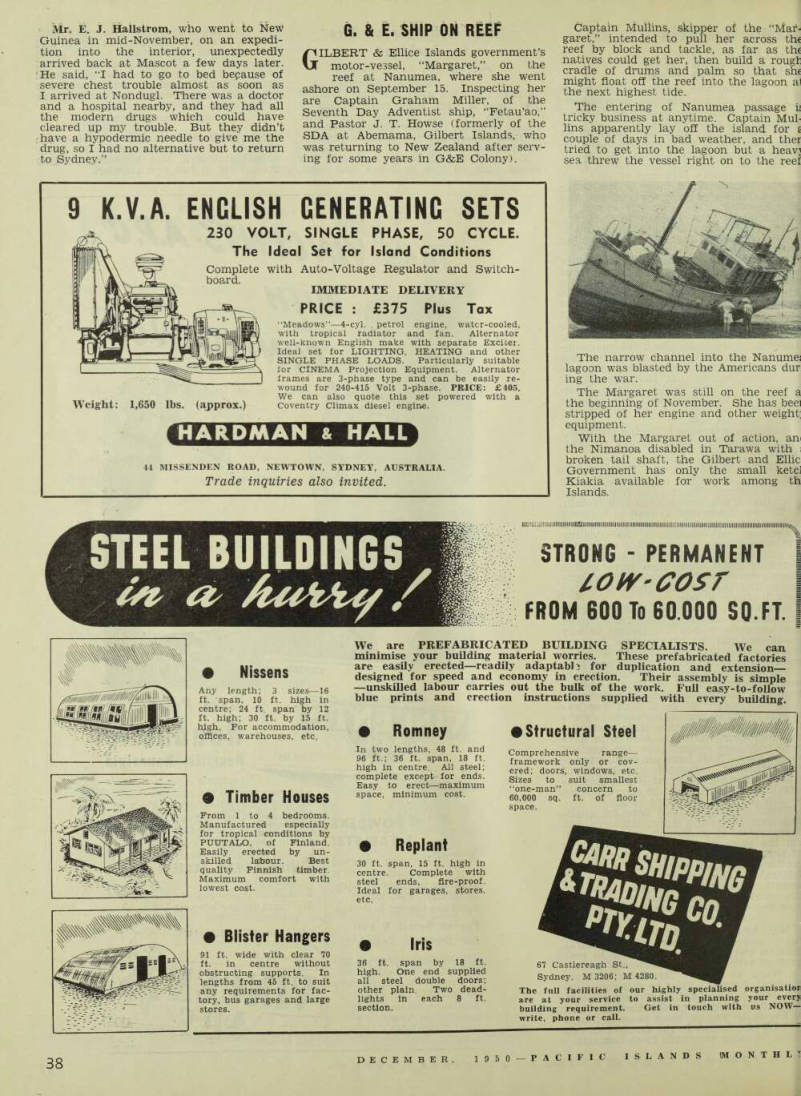
in Auckland
Prom Our Own Correspondent SUVA, November 15 ABOUT a week after she had returned from a 6,000 mile trading trip to Fiji, Pitcairn, Tahiti and other Pacific Islands, the New Zealand schoon er Huia caught fire in Auckland harbour on November 13.
She had a full cargo, including six motor cars, 60 tons of copra and mail,
but this apparently was not damaged.
Passenger accommodation was gutted and it is expected that repairs to the vessel will keep her in Auckland for several months. It was expected that she would make several Tasman crossings until the Island hurricane season is over and she could return to Pacific trading.
Miss Nell Fagan, of the Melanesian Mission, has taken charge of the Girls’
School at Torgil, New Hebrides, pending the arrival of two new teachers.
Mr. E. J. Hallstrom, who went to New Guinea in mid-November, on an expedi tion into the interior, unexpectedly arrived back at Mascot a few days later.
He said, “I had to go to bed because of severe chest trouble almost as soon as I arrived at Nondugl. There was a doctor and a hospital nearby, and they had all the modern drugs which could have cleared up my trouble. But they didn’t have a hypodermic needle to give me the drug, so I had no alternative but to return to Sydney.”
Advertisements & other items, pp. 39-40 (2 items)
37
ACIFIC ISLANDS MONTHLY - DECEMBER, 1950
%coNW* Nee
tam mcturt arc
with
mm&m
m mm U Wm mm. banish LL
I PINK)
PAIN
LLL
POWDERS
& TABLETS!
Vincent's original hospital formula is available in either powders or tablets. Two tablets equal one powder in dosage.
Proved Safest & Best For Over 30 Years!
The medical profession and public have had confidence in Vincent's a.p.c for over 30 years! Vincent’s continued success is founded on Vincent's prescription! This formula is your safeguard!
Quick Relief From
Headache
Neuritis, Neuralgia
Vincent’s a.p.c is the only a.p.c prepared to the original hospital prescription! From the very first dose you will get safe, sure, relief from Headache and all nerve and muscular pain! You will feel better and brighter in a few minutes!
SWIFT 3-WAY RELIEF!
1. Relieves the pain! 2. Reduces temperature! 3. Stimulates the nervous system!
SAFE! SPEEDY! RELIABLE!
VINCE
lafetTL
-VINCI
9 K.V.A. ENGLISH GENERATING SETS
230 VOLT, SINGLE PHASE, 50 CYCLE.
The Ideal Set for Island Conditions
Complete with Auto-Voltage Regulator and Switchboard.
IMMEDIATE DELIVERY
PRICE ; £375 Plus Tax
“Meadows” —4-cyl. , petrol engine, water-cooled, with tropical radiator and fan. Alternator well-known English make with separate Exciter.
Ideal set for LIGHTING, HEATING and other SINGLE PHASE LOADS. Particularly suitable for CINEMA Projection Equipment. Alternator frames are 3-phase type and can be easily rewound for 240-415 Volt 3-phase. PRICE: £405.
We can also quote this set powered with a Weight: 1,650 lbs. (approx.) Coventry Climax diesel engine.
Sfllli
HARDMAN & HALL
44 MISSENDEN ROAD, NEWTOWN, SYDNEY, AUSTRALIA.
Trade inquiries also invited.
G. & E. Ship On Reef
GILBERT & Ellice Islands government’s motor-vessel, “Margaret,” on the reef at Nanumea, where she went ashore on September 15. Inspecting her are Captain Graham Miller, of the Seventh Day Adventist ship, “Fetau’ao,” and Pastor J. T. Howse (formerly of the SDA at Abemama, Gilbert Islands, who was returning to New Zealand after serv ing for some years in G&E Colony).
Captain Mullins, skipper of the “Mar garet,” intended to pull her across the reef by block and tackle, as far as the natives could get her, then build a rough cradle of drums and palm so that she might float off the reef into the lagoon al the next highest tide.
The entering of Nanumea passage is tricky business at anytime. Captain Mul lins apparently lay off the island for s couple of days in bad weather, and ther tried to get into the lagoon but a heavj sea threw the vessel right on to the reef
The narrow channel into the Nanumei lagoon was blasted by the Americans dur ing the war.
The Margaret was still on the reef a the beginning of November. She has beei stripped of her engine and other weight; equipment.
With the Margaret out of action, an the Nimanoa disabled in Tarawa with broken tail shaft, the Gilbert and Ellic Government has only the small ketd Kiakia available for work among th Islands.
Advertisements & other items, p. 40 (2 items)
38
DECEMBER, 1950 PACIFIC ISLANDS MONTHL
Steel Buildings
STRONG - PERMANENT
lOW'COST
FROM 600 To 60.000 SQ.FT.
mm
'jgsmmiS
• Nissens
Any length: 3 sizes—l 6 ft. span, 10 ft. high in centre: 24 ft. span by 12 ft. high; 30 ft. by 15 ft. high. For accommodation, offices, warehouses, etc. n ; %>
• Timber Houses
Prom 1 to 4 bedrooms.
Manufactured especially for tropical conditions by PUUTALO, of Finland.
Easily erected by unskilled labour. Best quality Finnish timber.
Maximum comfort with lowest cost.
• Blister Hangers
91 ft. wide with clear 70 ft. in centre without obstructing supports. In lengths from 45 ft. to suit any requirements for factory, bus garages and large stores.
We are PREFABRICATED BUILDING SPECIALISTS. We can, minimise your building material worries. These prefabricated factories are easily erected—readily adaptable for duplication and extensiondesigned for speed and economy in erection. Their assembly is simple —unskilled labour carries out the bulk of the work. Full easy-to-follow blue prints and erection instructions supplied with every building.
• Romney
In two lengths, 48 ft. and 96 ft.; 36 ft. span, 18 ft. high in centre. All steel; complete except for ends.
Easy to erect —maximum space, minimum cost.
• Replant
30 ft. span, 15 ft. high in centre. Complete with steel ends, fire-proof.
Ideal for garages, stores, etc.
• Iris
36 ft. span by 18 ft. high. One end supplied all steel double doors; other plain. Two deadlights in each 8 ft. section.
Structural Steel
Comprehensive range— framework only or covered; doors, windows, etc.
Sizes to suit smallest “one-man” concern to 60,000 sq. ft. of floor space. 67 Castlereagh St., Sydney. M 3206; M 4280 The full facilities of our highly specialised organisatioi are at your service to assist in planning your every building requirement. Get in touch with us NOW write, phone or call.
Copra-Cocoa Prosperity
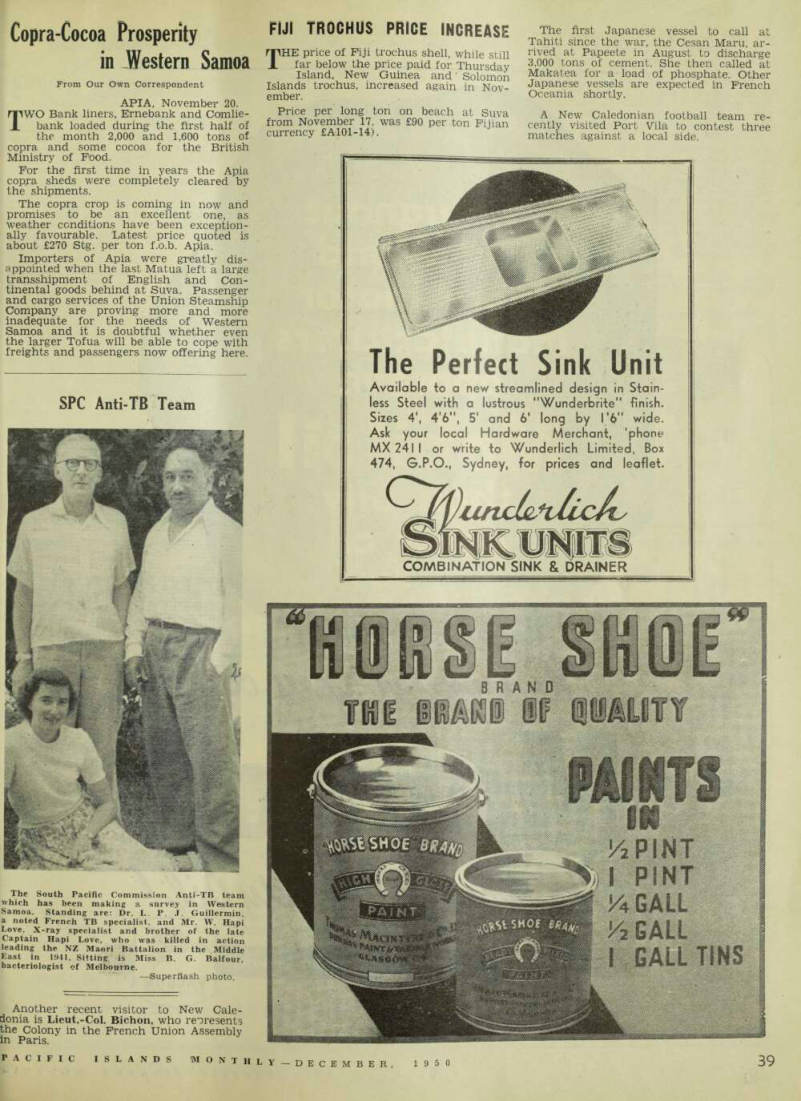
in Western Samoa
From Our Own Correspondent APIA, November 20.
TWO Bank liners, Ernebank and Comlie bank loaded during the first half of the month 2,000 and 1,600 tons of copra and some cocoa for the British Ministry of Food.
For the first time in years the Apia copra sheds were completely cleared by the shipments.
The copra crop is coming in now and promises to be an excellent one, as weather conditions have been exception ally favourable. Latest price quoted is about £270 Stg. per ton f.o.b. Apia.
Importers of Apia were greatly dis appointed when the last Matua left a large transshipment of English and Con tinental goods behind at Suva. Passenger and cargo services of the Union Steamship Company are proving more and more Inadequate for the needs of Western Samoa and it is doubtful whether even the larger Tofua will be able to cope with freights and passengers now offering here.
SPC Anti-TB Team
Another recent visitor to New Cale donia is Lieut.-Col. Bichon, who represents the Colony in the French Union Assembly in Paris.
The South Pacific Commission Anti-TB team which has been making a survey in Western Samoa. Standing are: Dr. L. P, J. Guillermin, a noted French TB specialist, and Mr. W. Hapi Love, X-ray specialist and brother of the late Captain Hapi Love, who was killed in action leading the NZ Maori Battalion in the Middle East in 1941. Sitting is Miss B. G. Balfour, bacteriologist of Melbourne.
Superflash photo.
Fiji Troghus Price Increase
THE price of Fiji trochus shell, while still far below the price paid for Thursday Island, New Guinea and' Solomon Islands trochus, increased again in Nov ember.
Price per long ton on beach at Suva from November 17, was £9O per ton Fijian currency £AIOI-14).
The first Japanese vessel to call at Tahiti since the war, the Cesan Maru, ar rived at Papeete in August to discharge 3,000 tons of cement. She then called at Makatea for a load of phosphate. Other Japanese vessels are expected in French Oceania shortly.
A New Caledonian football team re cently visited Port Vila to contest three matches against a local side.
Advertisements & other items, pp. 41-42 (2 items)
The Perfect Sink Unit
SSSi
Available to a new streamlined design in Stainless Steel with a lustrous "Wunderbrite" finish.
Sizes 4', 4'6", 5' and 6' long by I'6" wide.
Ask your local Hardware Merchant, 'phone MX 241 I or write to Wunderlich Limited, Box 474, G.P.0., Sydney, for prices and leaflet.
COMBINATION SINK & DRAINER
8 R k D
psmoe sraM
f/P 4V , I
■ O I mmm 'J? ' S : - '
Wm Throughout
iihe;Worli'
More Motor MahWolurir lilipptiyili than any lotheßoli*!
'no mnd&t they coil
Mobiloil
yJie. t<J(rt£ds Qua&tij oi6/
MSO 3
VACUUM OIL COMPANY PTY. LTD. (Inc. in Aust.)
VACUUM
QUALITY PRODUCT
40
DECEMBER, 19 5 0 -PACIFIC ISLANDS MONTBL
Miss Rabaul, 1950
By R. M. Rhodes
FOR the first time in its history, Rabaul, NG, on November 25, chose a “Miss Rabaul” for 1950.
The slickest chick was chosen from among 12 aspirants for the title. The scene was the New Britain Club, where the con testants paraded before a panel of five judges, consisting of three women, and two men.
Against a background of leafy palms, moon-drenched water, and the fierce light from the eyes of our starving wolves, the girls walked daintily along an improvised platform. They all wore the latest in swimsuits, specially imported from South for the occasion, Marks were awarded for face, figure, and deportment and the judges were un animous in their choice of the winner.
Miss Norma Sullivan, who Is employed by Colyer Watson (NG) Ltd. Second was Miss Louise Burrows of New Guinea Com pany, and third, Miss Margot Sutherland, of the Agnes Wisdom Memorial Library.
Like Helen of Troy, Miss Sullivan also received tokens for her ability to go in and out in the right places. A wide blue silken sash, with “Miss Rabaul, 1950,” in letters of gold was placed about the victorious waist, and she was also presented with a dainty silver chalice similarly engraved.
The proceeds of this function are to be devoted to the Children’s Christmas Tree.
Following upon the parade of Bathing Beauties, came a parade of masculine dit to. The winner of this was an exceedingly exotic figure from the Power House, whose strangely undulating bosom flashed al ternately with red and green lights (from a battery one presumes).
The success of the Ball was so outstand ing that the Committee hope to hold a similar event each year and enable the banner of feminine pulchritude to be passed on to the lissome lasses of the future.
And, indeed, why not, for as Oscar Wilde has said, and he should know. . . .
“Beauty is the highest form of Art, for it needs no Explanation.”
Our Ladies’ Clothes—And the Unclothed Native’s Mind
Unclothed Native’s Mind
WE have had several letters from Rabaul residents about the Miss Rabaul competition—and whether it is a good or a bad thing in a predomin antly native community. There seems to be two schools of thought about this, as there are about most things in the Terri tory to-day where society is roughly divided into those who arrived during the
Eddie Ward era (Behinds) and those who knew it before 1942 (the Befores).
One section feels that in a whole world orientated towards Glamour and the Body-beautiful and Legs (especially Legs), it is just as right to have a beauty compe tition in Rabaul as in Sydney—for, frankly, if the young woman' of to-day does not appeal to the senses what the heck is there left for her to appeal to?
Others feel that in a place like Rabaul, where the natives have always been so phisticated, it is not wise. The natives cannot be expected, they say, to know that exposure of the female form is a legitimate means of raising money for charity in the more civilised parts of the Western world—all they can see are white girls parading around in a minimum of cloth ing and even going up on to a platform so that the onlookers can get a better view.
Middle-of-the-roaders think it would “not have been so bad” if the parade had
been held in a hall. But the cement dance floor of the New Britain Club is in the open air and there seems to have been n.i way of keeping native onlookers away.
In New Guinea there has always been a certain pre-occupation with the amount of clothing a European woman might wear in order to uphold her share of the white man’s burden. A newcomer was usually briefed by a kindly fellow passenger in the ship that bore her northwards to the Promised Land and she was usually told the sad story of some female who was stood on the mat by the local District Officer and sternly ordered to add a few inches to her tennis shorts. If such trivia were part of a DO’s duties, one is forced to the conclusion that his job would be a staggering one in these days of plung ing necklines, bare-top looks and what not.
Much depends upon the woman inside the clothes; some are capable of looking wanton in a neck-to-knee Mother Hub bard. The old idea in keeping European women in adequate clothing was that lack of same unhinged the native. We have, however, never heard a native make any pronouncement about this. There has
never been any evidence, to sho\y that, while they apparently remain proper little gentlemen back in their villages where their women very often wear nothing, they are thrown all into a tizzy at sight of a piece of European female leg.
To repeat, it is not just a matter of dres sing or undressing, but more a matter of behaviour, particularly the behaviour of men and women when together. There were numerous cases of native men as saulting European women before the war in Rabaul; there probably have been some cases since. Reasons behind each of these incidents arer more than mere scantiness of clothing.
That is in general. The convivial at mosphere of a ball, a parade of attractive girls in scanty clothing, frankly got up to appeal to the senses and nothing else, is probably something else again. Now, having stated the two sides of the ques tion we leave it for Rabaul to decide.
Advertisements & other items, pp. 43-44 (1 item)
Steamships Trading Company Ltd.
FIBRE TRAVEL AND ATTACHE
CASES OF ALL QUALITIES!
In sizes to serve all needs and at prices to suit all types of trade. Write for full particulars to — iLS_5i
FORD SHERINGTON LTD.
Makers of Glohite, Airway and Fordite Travel Cases.
Kippax Street, Sydney, Australia.
STEAMSHIPS TRADING COMPANY LTD.
PORT MORESBY AND SAMARAI PAPUA
Wholesale & Retail Merchants, Planters, Sawmillers, Engineers, Slip
Proprietors, Shipping, Customs and Insurance Agents.
MANAGING AGENTS for:
SAWMILLERS & TRADERS LTD.
CORAL SEAS INSURANCE CO. LTD
ACME BAKERY COMPANY.
MARIBOI RUBBER LTD.
RUBBERLANDS LTD.
KEREMA RUBBER PLANTATIONS LTD.
COCOALANDS LTD.
AGENCIES:
BANKERS & TRADERS INSURANCE CO. LTD.
VACUUM OIL CO. PTY., LTD.
DIRECTORATE OP SHIPPING—Papua-New
Guinea Division.
ROYAL INTEROCEAN LINE.
KOKE BAGU PTY., LTD.
TRANS OCEANIC AIRWAYS.
DISTRIBUTORS IN PAPUA for:
ARMSTRONG-HOLLAND PTY., LTD.
Earth Moving and Logging Equipment.
WILLYS-OVERLAND EXPORT CORPORATION.
Jeep cars, etc.
HILLMAN MOTOR CARS.
INTERNATIONAL HARVESTER CO. OP AUST. LTD.
International Trucks, McCormlck-Deerlng Farming Machinery, Defender Refrigerators.
SYDNEY AGENTS: NELSON & ROBERTSON PTY, LTD., 12 SPRING STREET
BUSINESS EXECUTIVES !
Increase your business between Australia, Prance and French Overseas Territories.
Join the French Chamber of Commerce in Australia -now.
Ask for a free copy of our BULLETIN.
HOMMES D'AFFAIRES !
Augmentez votre chiffre d’affaires entre I’Australie, la France et les Territoires Francais d’Outre-Mer. Devenez Membre de la Chambre de Commerce Francaise en Australie.
Demandez un exemplaire gratuit de notre
BULLETIN.
FRENCH CHAMBER OF
COMMERCE IN AUSTRALIA
72 Pitt Street, Sydney. Tel. BL 1936.
HIE FERGUSON TRACTOR
Is the most popular tractor of its kind in the world to-day because its revolutionary AUTOMATIC Hydraulic control makes it possible to do any type of farm cultivation and to work better, faster and more economically.
The Ferguson System was introduced to Fiji some six months ago and already it is breaking all previous tractor sales records as it is doing all over the world.
This patented system has given to the farmer complete mechanisation with simplicity hitherto unheard of. It has made other methods of farming obsolete.
Its hydraulic control is not just a means of raising and lowering implements from and to work but, MOST IMPORTANT OF ALL,
AUTOMATICALLY CONTROLS THE IMPLEMENTS WHEN THEY
ARE WORKING AND AT THE SAME TIME TRANSFERS IMPLEMENT WORKING PRESSURES TO TRACTION. This is a combination that was only a dream to farmers until Harry Ferguson conceived and introduced it only a few years ago. IT IS A FERGUSON PATENT AND INCORPORATED ONLY IN THE FERGUSON TRACTOR.
Farming can now be interesting and a joy to everybody. A combination of implements can be purchased to do any type of farming everywhere, whether it be cane, rice, peanuts, potatoes, maize or anything else.
Apart from cultivation implements, other attachments such as the 9 and 12 inch Post Hole Digger, 3-Ton Hydraulic Tipping Trailer, 30-Cwt. Utility Trailer, Earth Scoop, Grader and Terracer, Transport Box, Wood Saw, Hammer Mill, Manure Spreader and Loader, Mower, etc., can be obtained.
Our Lautoka Branch, in Fiji, has comprehensive stocks on hand, and will assist in making equipment and information available to places not yet carrying stocks.
BURNS PHILP (S.S.) CO LTD.
Sole Agents for Pacific Islands.
As The Isolated Trader
Sees It
(Old Trader Edwin Gold writes—not foi publication—a note from little Mangaia in the Cook Islands.) YOUR editorial note in July just aboul describes the state of cities to-day thousands of electrical appliances and no current, thousands of state pen sioners and no funds, thousands of peact treaties and no peace.
I was surprised at the optimistic tone oJ your remark that the Reds may be defi cient in sea power. Me no tinkfi I am afraid that we are due for som( infernally unpleasant annoyances here ir the isolated parts of the Pacific. Th< Muscovite may be better equipped thar is thought—there has been a Five Yean Plan since the war ended.
To me, the outlook is scaly in the ex treme. The preposterous situation of ai “allied” (what an anti-climax, if it even tuates!) Germany and Japan being in corporated in the UN, plus press praisi of “our gallant German forces” and ou “invincible Japanese resisters of the Re< tvranny,” will contrast very weirdly witl the writings of 1941-46.
I’ve no patience with this weathercocl inconsistency of history. We said in 1815 about Napoleon, all that was said late about Hitler; yet Bonaparte now figure as a noble hero in history. Doubtles Hirohito and Co., and the survivini members of the Nazi hierarchy, will be th Splendid Fellows of the coming struggle Well, I do not imagine blunt PIM wil drift with the stream in that mattei knowing what the foul little yellow mei did in Melanesia when they had th upper hand. The Russkies are eaua savages in war, and we may expect i full share of new horrors. It is witl cvnical amusement that I see cartoonis Minhinnick (“New Zealand Herald”) ge an OBE for clowning, while the man wh warned against Japan in the thirties, ani Russia in the forties, gets nothing whe: the honours list comes out. It’s a ma world, my masters. Things are rather tight just now. Th orange season is a failure, but two steam ers are coming this year. No mon’. n fun! If war comes they will be tighte still. .
With glum resolution we prepare agai; to be meatless, saltless, sugarless (in tw senses), in the dark regarding the Wa News and generally fed up to the gill with international folly.
Peace means so much to the sma islands, with their little bit of civilisation so valued and cherished upon shoe-strin funds. Allah said that reason prevails but it is almost too much to hope for.
Advertisements & other items, p. 44 (1 item)
42
DECEMBER, 19 5 0 -PACIFIC ISLANDS MON T H L
Fund (Old. Div.)
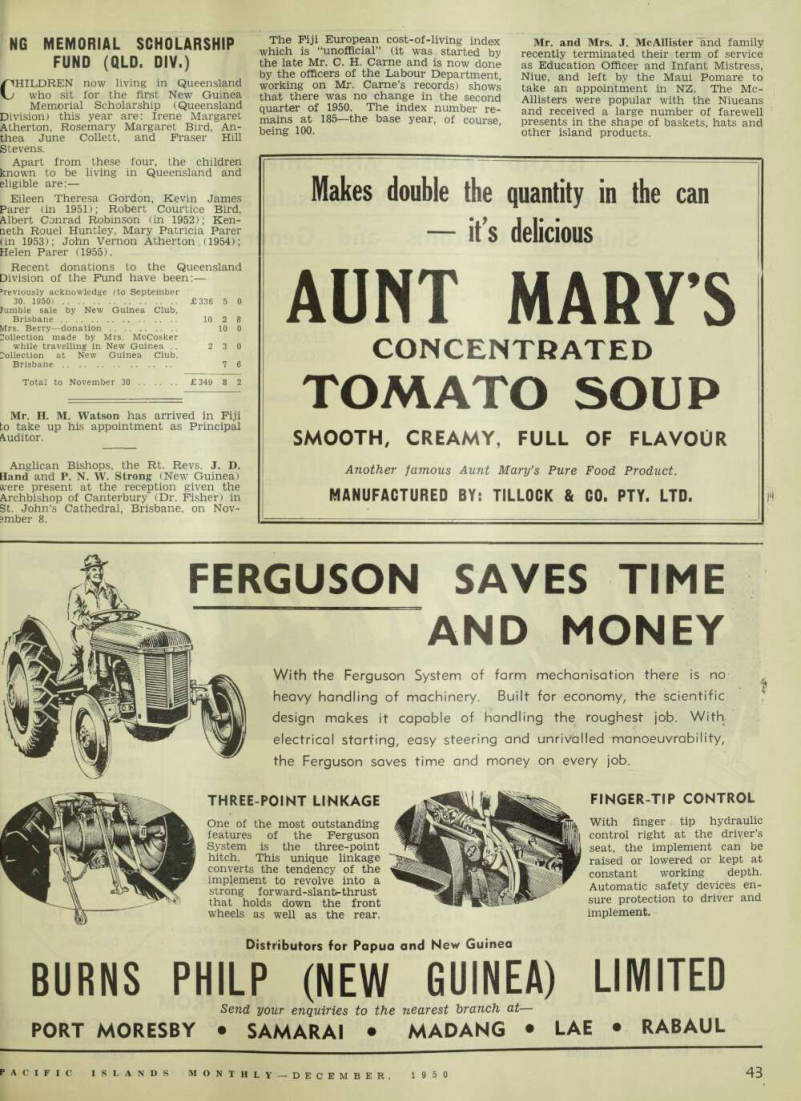
Ng Memorial Scholarship
CHILDREN now living in Queensland who sit for the first New Guinea Memorial Scholarship (Queensland Division) this year are: Irene Margaret Atherton, Rosemary Margaret Bird, An thea June Collett, and Fraser Hill Stevens.
Apart from these four, the children known to be living in Queensland and eligible are:— Eileen Theresa Gordon, Kevin James Parer (in 1951); Robert Courtice Bird, Albert Conrad Robinson (in 1952); Ken neth Rouel Huntley, Mary Patricia Parer (in 1953); John Vernon Atherton (1954); Helen Parer (1955).
Recent donations to the Queensland Division of the Fund have been:— »reviously acknowledge (to September 30. 1950) £336 5 0 Tumble sale by New Guinea Club, Brisbane 10 2 8 Mrs. Berry—donation 10 0 Collection made by Mrs. McCosker while travelling in New Guinea . . 2 3 0 Collection at New Guinea Club, Brisbane 7 6 Total to November 30 £349 8 2 Mr. H. M. Watson has arrived in Fiji to take up his appointment as Principal Auditor.
Anglican Bishops, the Rt. Revs. J. D, Hand and P. N. W. Strong (New Guinea) were present at the reception given the Archbishop of Canterbury” (Dr. Fisher) in St. John’s Cathedral, Brisbane, on Nov ember 8.
The Fiji European cost-of-living index which is “unofficial” (it was started by the late Mr. C. H. Came and is now done by the officers of the Labour Department, working on Mr. Game’s records) shows that there was no change in the second quarter of 1950. The index number re mains at 185—the base year, of course, being 100.
Mr. and Mrs. J. McAllister and family recently terminated their term of service as Education Officer and Infant Mistress, Niue, and left by the Maui Pomare to take an appointment in NZ. The Mc- Allisters were popular with the Niueans and received a large number of farewell presents in the shape of baskets, hats and other island products.
Advertisements & other items, pp. 45-46 (1 item)
Aunt Marys
Makes double the quantity in the can it’s delicious
CONCENTRATED
TOMATO SOUP
SMOOTH, CREAMY, FULL OF FLAVOUR
Another famous Aunt Mary's Pure Food Product.
MANUFACTURED BY; TILLOCK & CO. PTY. LTD.
sa >
FERGUSON SAVES TIME
AND MONEY
With the Ferguson System of form mechanisation there is no heavy handling of machinery. Built for economy, the scientific design makes it capable of handling the roughest job. With electrical starting, easy steering and unrivalled manoeuvrability, the Ferguson saves time and money on every job.
THREE-POINT LINKAGE
One of the most outstanding features of the Ferguson System is the three-point hitch. This unique linkage converts the tendency of the implement to revolve into a strong forward-slanti-thrust that holds down the front wheels as well as the rear.
FINGER-TIP CONTROL
With finger tip hydraulic control right at the driver’s seat, the implement can be raised or lowered or kept at constant working depth.
Automatic safety devices ensure protection to driver and implement.
Distributors for Papua and New Guinea
BURNS PHILP (NEW GUINEA) LIMITED
Send your enquiries to the nearest branch at — PORT MORESBY • SAMARAI • MADANG • LAE • RABAUL
BURNS PHILP (SOUTH SEA) Go. Ltd
Registered Office: SUVA, FIJI
Code Address; “BURNSOUTH”
ISLAND TRADERS AND SHIPOWNERS
General Merchants (Wholesale and Retail)
Shipping, Customs and General Agents
Representatives for :
QUEENSLAND INSURANCE CO., LTD. BURNS PHILP TRUST CO., LTD.
Distributing Agents for :
SHELL COMPANY (P. 1.), LTD. FERGUSON TRACTORS STANDARD MOTOR CAR COMPANY CROSSLEY MARINE ENGINES
BRANCHES:
FIJI—
SUVA.
LEVUKA.
LAUTOKA.
LAB AS A.
BA.
SIGATOKA.
ROTUMA ISLAND.
NORFOLK IS.—
SAMOA—
APIA.
PAGO PAGO.
TONGA—
NUKUALOFA.
HAAPAI.
VAVAU.
NIUE IS.—
Sydney A rente:
BURNS, PHILP & CO., LTD.,
7 Bridge Street.
London Agents:
BURNS, PHILP & CO.. LTD.,
35 Crutched Friars, K. 0.3.
San Francisco Agents:
BURNS, PHILP CO. OP SAN FRANCISCO,
Matson Building, 215 Market Street.
Agencies Throughout the World.
DAWSON PAINTS
ptoved ran the tropics
PHvikyliti
VIKYLITE
Super gloss porcelain hard Enamel.
.VELYENE
L)?IVET FINISH
VELVENE
Velvet Finish Water Paint for inside and outside use.
M OAVCO
- \ ONE COAT
METAi PAINT
DAVCO
One Coat Metal Paint protects all exposed metal-work.
VEITONE
FIATOII FINISH
VELTONE
Flat Oil Washable Wall Paint; interior use.
■SB! e
II NT
. ift -
VELUSTRE
Highest grade Tit. Zinc based House Paint.
Davison Paints have for many
years proved
their resistance to severe
tropical
conditions. The Davison range
of products
includes high
quality finishes
for all purposes. You can be sure of V Davison. /
ALL DAVISON FINISHES AVAILABLE FROM
H. BUNTING LIMITED AUSTRALIAN FIBRES LIMITED G. G. SMITH & CO. LIMITED
Samarai, Papua Kokopo Port Moresby
and Lae, New Guinea New Britain Papua
Port Moresby
Papua
Department Store
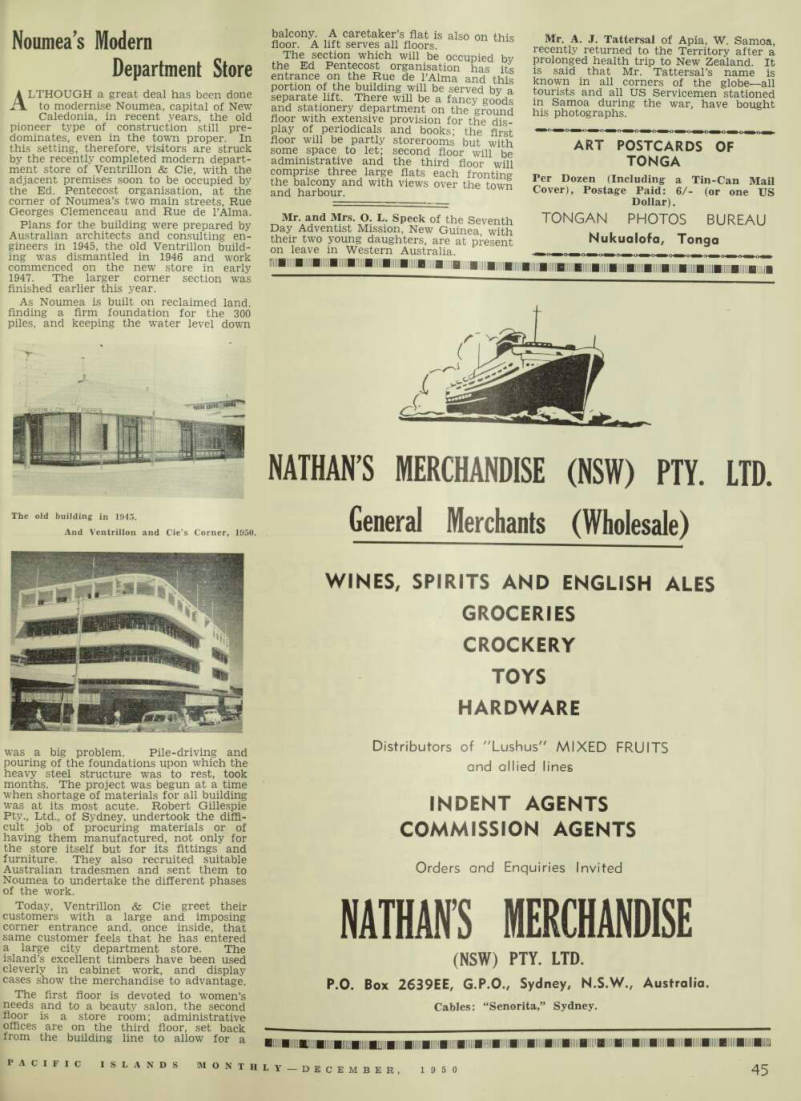
Noumea’s Modern Department Store
A LTHOUGH a great deal has been done to modernise Noumea, capital of New Caledonia, in recent years, the old pioneer type of construction still pre dominates, even in the town proper. In this setting, therefore, visitors are struck by the recently completed modern depart ment store of Ventrillon & Cie, with the adjacent premises soon to be occupied by the Ed. Pentecost organisation, at the comer of Noumea’s two main streets, Rue Georges Clemenceau and Rue de I’Alma.
Plans for the building were prepared by Australian architects and consulting en gineers in 1945, the old Ventrillon build ing was dismantled in 1946 and work commenced on the new store in early 1947. The larger corner section was finished earlier this year.
As Noumea is built on reclaimed land, finding a firm foundation for the 300 piles, and keeping the water level down
was a big problem. Pile-driving and pouring of the foundations upon which the heavy steel structure was to rest, took months. The project was begun at a time when shortage of materials for all building was at its most acute. Robert Gillespie Pty., Ltd., of Sydney, undertook the diffi cult job of procuring materials or of having them manufactured, not only for the store itself but for its fittings and furniture. They also recruited suitable Australian tradesmen and sent them to Noumea to undertake the different phases of the work.
Today, Ventrillon & Cie greet their customers with a large and imposing corner entrance and, once inside, that same customer feels that he has entered a large city department store. The island’s excellent timbers have been used cleverly in cabinet work, and display cases show the merchandise to advantage.
The first floor is devoted to women’s needs and to a beauty salon, the second floor is a store room; administrative offices are on the third floor, set back from the building line to allow for a
balcony. A caretaker’s flat is also on this floor. A lift serves all floors.
The section which will be occupied bv the Ed Pentecost organisation has its entrance on the Rue de I’Alma and this portion of the building will be served bv a separate lift. There will be a fancy goods and stationery department on the ground floor with extensive provision for the dis play of periodicals and books; the first floor will be partly storerooms but with some space to let; second floor will be administrative and the third floor will comprise three large flats each fronting the balcony and with views over the town and harbour.
Mr. and Mrs. O. L. Speck of the Seventh Day Adventist Mission, New Guinea with their two young daughters, are at present on leave in Western Australia.
Mr. A. J. Tattersal of Apia, W. Samoa, recently returned to the Territory after a prolonged health trip to New Zealand. It is said that Mr. Tattersal’s name is known in all corners of the globe—all tourists and all US Servicemen stationed in Samoa during the war, have bought his photographs.
The old building in 1945.
And Ventrillon and Cie’s Corner, 1950.
A daughter (Annette), was born to Mr. and Mrs. Peter Wichman, in South Dunedin, N.Z., on October 22. The Wichmans are now living at 265 King Edward Street, in that city, but formerly they were residents of Rarotonga, Cook Islands. Mrs. Wichman was Miss Dorothy Price.
Messrs. L. and A. E. Noerr, who have run the Regal Theatre, Suva, Fiji, for the past 20 years retired from business at the end of October. Management has been taken over by Mr James Crawford and Mr. T. P. Mulelly, who in recent years have interested themselves in stage pro ductions in Suva.
Advertisements & other items, pp. 47-48 (1 item)
Nathan’S Merchandise
ART POSTCARDS OF
TONGA
Per Dozen (Including a Tin-Can Mail Cover), Postage Paid: 6/- (or one US Dollar).
TONGAN PHOTOS BUREAU
Nukualofa, Tonga
v- L
NATHAN S MERCHANDISE (NSW) PTY. LTD.
General Merchants (Wholesale)
WINES, SPIRITS AND ENGLISH ALES
GROCERIES
CROCKERY
TOYS
HARDWARE
Distributors of "Lushus" MIXED FRUITS and allied lines
INDENT AGENTS
COMMISSION AGENTS
Orders and Enquiries Invited
NATHAN’S MERCHANDISE
(NSW) PTY. LTD.
P.O. Box 2639EE, G.P.0., Sydney, N.S.W., Australia.
Cables: “Senorita,” Sydney.
Scott’s “Renown” Brand Rope,
Cordage and
Binder
Twine
of Every
Description
Cable Address: Ropeyard, Sydney.
MANUFACTURED AT
MASCOT, N.S.W.
By
J. SCOTT
PTY. LTD.
Head Office and Store
163 CLARENCE STREET.
SYDNEY,
N.S.W.
Tutuila Visitors to Niue
Niue For LMS Centenary
Prom a Special Correspondent IN connection with the Centenary of the London Missionary Society, which is being held to commemorate the arri val of the Samoan Missionary Paulo, the Niueans resident at Tutuila, American Samoa, chartered the Manua-a-tele to pay a visit to their island.
About 80 people spent four days on Niue visiting relations and suitably paying homage to the memory of Paulo.
Amongst those who made the trip were Colonel and Mrs. Rollo V. Ladd, of San Diego, California, at present visiting Tutuila, and Mrs. Max Hallack and Mrs.
Mele Pritchard.
All pronounced the venture a great suc cess and an approach has been made to the American authorities to allow the ship to be chartered for a similar trip next year.
The main celebrations will take place on the arrival of the London Missionary Society’s vessel the “John William VI,” with some 40 representatives of the Samoan Church. This party will be led by the Rev. P. Knightley and will include most of the leading LMS churchmen from Upolo and Savaii besides some descendants of Paulo.
The celebrations will continue for four days and will be characterized by meet ings which will include the entire popu lation of the island, for the whole community are adherents of the LMS.
Advertisements & other items, p. 48 (1 item)
Nelson & Robertson
NELSON and ROBERTSON Pty. Ltd.
Established 1895
Shipowners - Brokers and
Islands Merchants
All classes of Merchandise purchased at Best Wholesale Prices. Original Invoices supplied to Island Clients. Cocoa Beans, Copra, Rubber, Trochus Shell and All Islands Produce Sold on Commission.
Entrust your requirements to the firm with fifty-five years' practical experience in the Pacific Islands.
Represented in All Parts of the World.
Overseas Indents Arranged for Clients, Sole Agents :
SKANDIA DIESEL ENGINES
Agents in Papua-New Guinea and the Solomon Islands for:
BRECKWOLDT & CO.
Inquiries Solicited.
Managing Agents : " Tusculum "
PRIVATE HOTEL
Potts Point, Sydney.
Prompt attention given to all inquiries
NELSON & ROBERTSON
12 SPRING STREET, SYDNEY, AUSTRALIA
Telegraphic Address: IVAN, SYDNEY.
Plea for Manuscripts
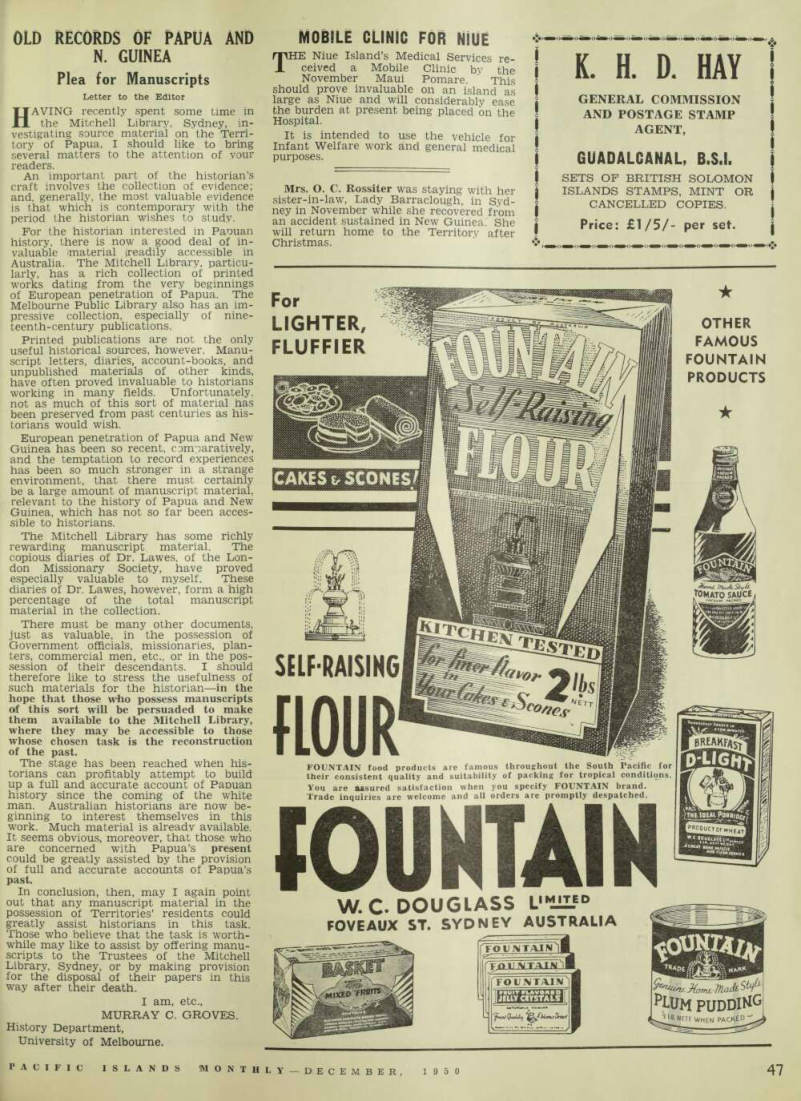
Old Records Of Papua And
N. Guinea
Letter to the Editor HAVING recently spent some time in the Mitchell Library, Sydney, in vestigating source material on the Terri tory of Papua, I should like to bring several matters to the attention of your readers.
An important part of the historian’s craft involves the collection of evidence; and. generally, the most valuable evidence is that which is contemporary with the period the historian wishes to study.
For the historian interested in Paouan history, there is now a good deal of in valuable material ireadily accessible in Australia. The Mitchell Library, particu larly, has a rich collection of printed works dating from the very beginnings of European penetration of Papua. The Melbourne Public Library also has an im pressive collection, especially of nine teenth-century publications.
Printed publications are not the only useful historical sources, however. Manu script letters, diaries, account-books, and unpublished materials of other kinds, have often proved invaluable to historians working in many fields. Unfortunately, not as much of this sort of material has been preserved from past centuries as his torians would wish.
European penetration of Papua and New Guinea has been so recent, comparatively, and the temptation to record experiences has been so much stronger in a strange environment, that there must certainly be a large amount of manuscript material, relevant to the history of Papua and New Guinea, which has not so far been acces sible to historians.
The Mitchell Library has some richly rewarding manuscript material. The copious diaries of Dr. Lawes, of the Lon don Missionary Society, have proved especially valuable to myself. These diaries of Dr. Lawes, however, form a high percentage of the total manuscript material in the collection.
There must be many other documents, just as valuable, in the possession of Government officials, missionaries, plan ters, commercial men, etc., or in the pos session of their descendants. I should therefore like to stress the usefulness of such materials for the historian —in the hope that those who possess manuscripts of this sort will be persuaded to make them available to the Mitchell Library, where they may be accessible to those whose chosen task is the reconstruction of the past.
The stage has been reached when his torians can profitably attempt to build up a full and accurate account of Papuan history since the coming of the white man. Australian historians are now be ginning to interest themselves in this work. Much material is already available.
It seems obvious, moreover, that those who are concerned with Papua’s present could be greatly assisted by the provision of full and accurate accounts of Papua’s past.
In conclusion, then, may I again point out that any manuscript material in the possession of Territories’ residents could greatly assist historians in this task.
Those who believe that the task is worth while may like to assist by offering manu scripts to the Trustees of the Mitchell Library, Sydney, or by making provision for the disposal of their papers in this way after their death.
I am, etc.,
Murray C. Groves.
History Department, University of Melbourne.
Mobile Clinic For Niue
THE Niue Island’s Medical Services re ceived a Mobile Clinic by the November Maui Pomare. " This should prove invaluable on an island as large as Niue and will considerably ease the burden at present being placed on the Hospital.
It is intended to use the vehicle for Infant Welfare work and general medical purposes.
Mrs. O. C. Rossiter was staying with her sister-in-law, Lady Barraclough, in Syd ney in November while she recovered from an accident sustained in New Guinea. She will return home to the Territory after Christmas.
Advertisements & other items, pp. 49-50 (1 item)
Flour
K. H. D. HAY
GENERAL COMMISSION
AND POSTAGE STAMP
AGENT,
GUADALCANAL 8.5.1.
SETS OF BRITISH SOLOMON
ISLANDS STAMPS, MINT OR
CANCELLED COPIES.
Price: £l/5/- per set.
For
LIGHTER,
FLUFFIER
OTHER
FAMOUS
FOUNTAIN
PRODUCTS
a?
SB ★ 55 m I <X&mC 7riuJU.Sl^U. tomato sauce T> ev
msrT:
D 2
lbs
s,
fLOUR
*°*es
SELF-RAISING
FOUNTAIN food products are famous throughout the South Pacific for their consistent quality and suitability of packing for tropical conditions.
You are assured satisfaction when you specify FOUNTAIN brand.
Trade inquiries are welcome and all orders are promptly despatched.
BREAKFAST
W.c. DOUGLASS L"liL ED
FOVEAUX ST. SYDNEY AUSTRALIA
FOUNTAIN^
MIXED
FOU NITAJIM
fma/QuaLLy j&J bLam,iJevui p lum puddim g 118I 18 - KOI WHEN PACKED )
Est. 1887. ESTABLISHED OVER 60 YEARS. eh.
ANDREW M C 6EE
SYDNEY'S FOREMOST TOBACCONIST.
1 CASTLEREAGH AND 70 PITT STREET,
SYDNEY.
BLADE RAZORS
BENGALI. and 17/6 BLUE WONDER 27/6 LONGLIFE and 30/- ATOYA f 22/6
GILLETTE
VALET
C U LM AC
KENT
SHAVING BRUSHES
1 LONG LIFE BADGERS from 35/3 to £7/7/-. Hair, Badger and Bristle ... 15/- to 32/6. Hard Wearing Bristle 6/- to 15/-.
ROLLS
SAFETY
RAZOR
HOLLOW GROUND
SELF STROPPING
SELF HONING
BLADE
£4/4/0
WILKINSON
SAFETY
RAZOR
THE SEVEN DAY SET
A BLADE
FOR EVERY DAY
HOLLOW GROUND
SELF STROPPING
OF THE WEEK
£4/11/0
NIMROD
W I N DPROOF
AUTOMATIC
LIGHTER
GUARANTEED TWELVE
CHROME PLATED . .
GOLD PLATED
MONTHS
£2/4/0 £4/4/0
RONSON
AUTOMATIC
LIGHTER
CHROME PLATED . .
ENGINE TURNED . .
LEATHER COVERED .
TABLE MODEL ...
£3/ 4/6. £4/ 8/6. £3/14/6. £B/ 0/0.
L. & CO. PIPES from £3/6/3 to £4/0/6
COMOY "TRADITION" £2/4/3
BARLING PIPES £2/2/6
NIMROD DRYSMOKER PIPES B/M
Old Timers
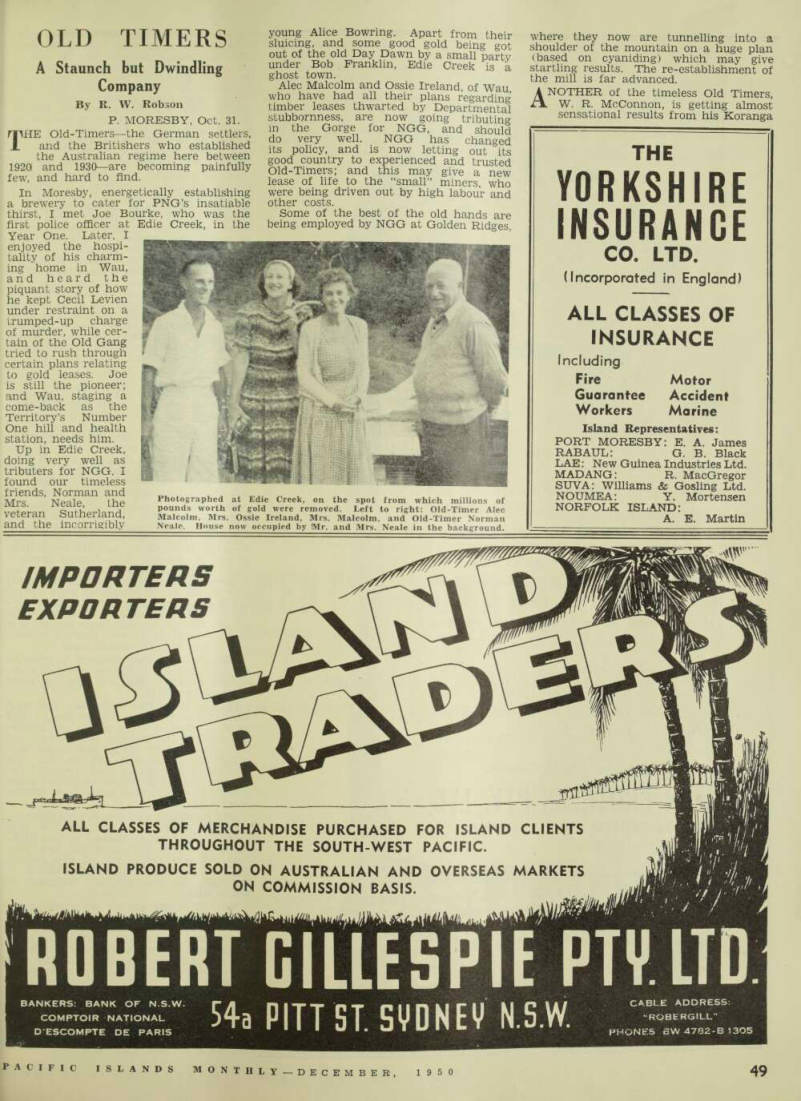
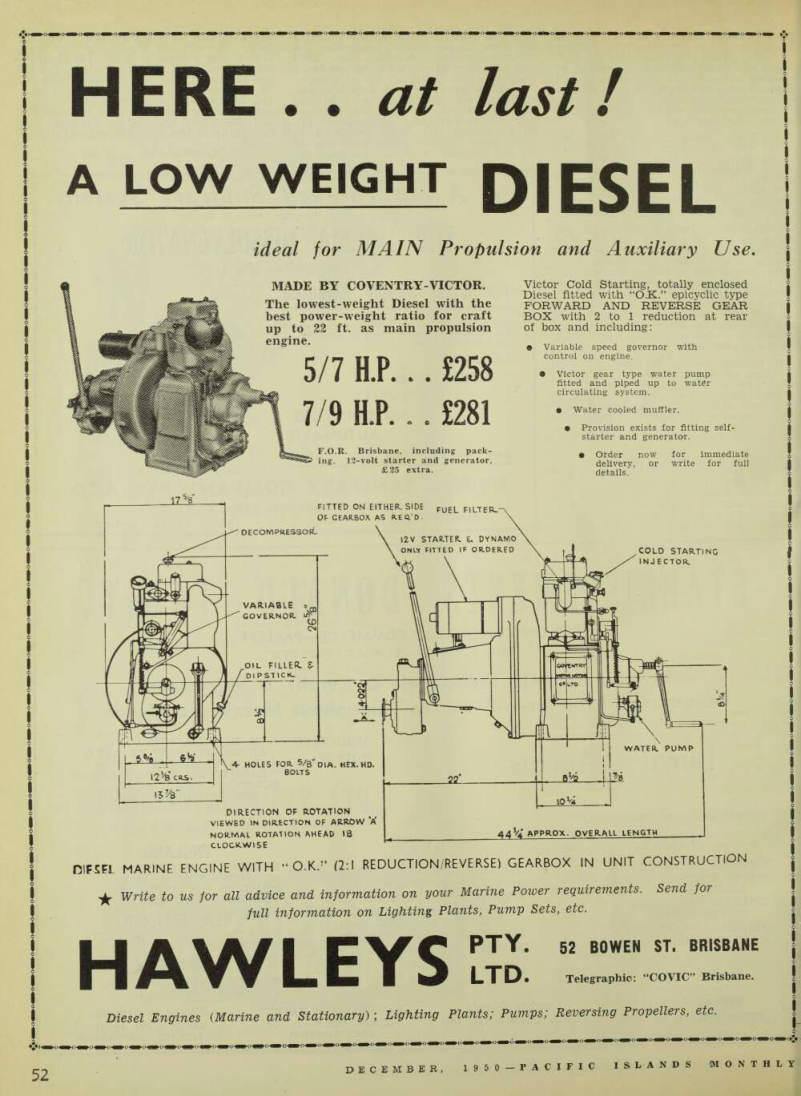
A Staunch but Dwindling Company
By R. W. Robson
P. Moresby, Oct. 31.
THE Old-Timers —the German settlers, and the Britishers who established the Australian regime here between 1920 and 1930 —are becoming painfully few, and hard to find.
In Moresby, energetically establishing a brewery to cater for PNG’s insatiable thirst, I met Joe Bourke, who was the first police officer at Edie Creek, in the
Year One. Later, I enjoyed the hospi tality of his charm ing home in Wau, and heard the piquant story of how he kept Cecil Levien under restraint on a trumped-up charge of murder, while cer tain of the Old Gang tried to rush through certain plans relating to gold leases. Joe is still the pioneer; and Wau, staging a come-back as the Territory’s Number One hill and health station, needs him.
Up in Edie Creek, doing very well as tributers for NGG, I found our timeless friends, Norman and Mrs. Neale, the veteran Sutherland, and the incorrigibly
young Alice Bowring. Apart from their sluicing, and some good gold being got out of the old Day Dawn by a small party under Bob Franklin, Edie Creek is a ghost town.
Alec Malcolm and Ossie Ireland, of Wau who have had all their plans regarding timber leases thwarted by Departmental stubbornness, are now going tributing in the Gorge for NGG, and should do very well. NGG has changed its policy, and is now letting out its good country to experienced and trusted Old-Timers; and this may give a new lease of life to the “small” miners who were being driven out by high labour and other costs.
Some of the best of the old hands are being employed by NGG at Golden Ridges
where they now are tunnelling into a shoulder of the mountain on a huge plan (based on cyaniding) which may give startling results. The re-establishment of the mill is far advanced.
ANOTHER of the timeless Old Timers, W. R. McConnon, is getting almost sensational results from his Koranga
Photographed at Edie Creek, on the spot from which millions of pounds worth of gold were removed. Left to right; Old-Timer Alec Malcolm. Mrs. Ossie Ireland, Mrs. Malcolm, and Old-Timer Norman Neale. House now occupied by (Mr. and Mrs. Neale in the background.
Sluicing, tributing for NGG. Apart from BGD, Koranga has been one of the most consistent money-makers in the Terri tory, always under McConnon’s direction.
He now presides, like a gum-booted patriarch, over a very well-equipped town ship of contented workers —Wau’s main suburb. Already, his enormous nozzles have despatched a couple of mountains down the Bulolo to Lae, and two more mountains, reckoned to be full of gold, are soon to melt away and follow.
As I strolled with Mac around his do main, he casually picked up an enamel basin from under a house. It seemed to be filled with black sand. It was a clean up from some race “down the creek,” brought in by some trusted boys, and there were 30 or 40 ounces there, worth about £lO per ounce. No one up here worries about a little thing like that. I thought of Sydney’s heroes, Dugan and Mears murdering bank managers for a roll of bank notes.
Down in The Gorge, I found Norman Wilde, still getting gold out of the turgid stream for the Cliff side outfit; while a couple of hundred yards away his fellow Old Timer, Bob Day, with a hundred natives, was blasting and straightening the ever-perilous road, now a busy freight ing highway.
Just around the corner, in the mouth of Edie Creek, old Tex Thomas’s courageous widow is working his gold lease, with satisfactory results.
SURVEYING the vast BGD establish ment in the Bulolo Valley, it was hard to believe that this had all been wiped out in 1942-3, and entirely restored since 1945 —an achievement worthy of this model American-Australian company.
The main concerns of the much respected manager, Mr. Lars Bergstrand, were the establishment of a new timber industry, right alongside his huge gold dredging organisation, and the restoration of one of the big. deep-digging dredges, sunk many months ago in a curious accident. A large slice of bank collapsed into the water; the resulting wave turned the floating dredge right over. After solv ing some very complex engineering diffi culties, the dredge has been turned over and set back on its own floating bottom, and is now being re-conditioned.
This Bulolo timber industry is going to develop as a big thing for the gold com panies, and for Wau. It was described in November PIM.
Driving down the Wau-Labu road with Alec Malcolm in his tireless jeep, I had word of some of a few old hands fossick ing around the Baiune and Watut, but they are pitifully few. They came back hopefully enough in 1945-46. but the Ward-Murray attack on private en terprise created for them conditions which were intolerable, and many have drifted away.
Ned Rowlands and the Wilson Brothers are still hanging on in that new gold area at the back of Wabag, in the High lands —the area in which the new Ade laide concern, Goldmines of New Guinea Ltd., is showing an interest. Mr. J. C.
Coldham, for the company, has been in there lately.
Near Mumeng—up in the high grass lands, between Bulolo and Labu —I met Mick Leahy energetically farming 600 acres; and I learned that, with equal energy and optimism, Jim Leahy is farm ing near Garoka, and Danny Leahy near Hagen—surely the Pacific’s outstanding example of a family of brothers, after pioneering a gold industry, turning to and are pioneering a pastoral industry.
I have taken it upon myself to compile the history of these almost legendary Leahy Brothers, and it is published in the - Magazine Section, this issue.
IN a house at the back of Lae, quite by accident, I came upon Bill Money (one of Edie Creek’s original Big Six) and S. A. Webb, who was an official at Lae over 20 years ago. Although a shrewd business man, Bill Money remains socially unpredictable. He told me stories which, if hosed for a week, would not be admitted to the vicar’s tea-table.
Jim Taylor (who, as a DO, was asso ciated with the Leahys in the discovery of the Highlands) is now a private farmer in the Highlands, out Chimbu way. No one likes him any more—rightly or wrongly they blame him for the Native Labour Ordinance, which Socialist Eddie Ward used to flay the New Guinea “capitalists.”
“Yorkie” Booth, with a white beard and a dog the size of a house, was living in Mrs. Stewart’s hotel in Lae. After three decades in and around the Morobe field, Yorkie has retired to a more leisurely life.
His most treasured possession is a file of official correspondence, showing that 20 years ago he was seeking permission to cut, and raft down the rivers, the Bulolo pine and cedar for which everyone is now scrambling. Unfortunately, prescience doesn’t pay dividends.
At Garoka, in the Highlands, I met J. Wilton, another Old Timer of the Gold fields. He is doing a good job as boss of road construction works. He took a little time off to give me, in simple Gold fields language, his views on Highlands labour; and he sent kind regards to the old fossickers everywhere.
OUT on the Rai Coast, and in Rabaul and Bougainville, I was back among the Old Timers of the coconuts. As I listened to their chorus on subjects re lated bitterly to labour and costs and prices, there seemed to be a great many of them; but that was only because they
have lost none of their ancient capacity for giving tongue against oppression and misunderstanding. Actually, one missed that area affected by the Montevideo Maru tragedy, which destroyed 300 civilians I was delighted to meet Jock Maclean of Rangarere plantation—in from the Bainings to welcome home his son and new daughter-in-lav/. Jock—whose up right carriage still bears testimony to many once familiar faces—especially in the old goldfields days, and fossicked far
afield before he adopted the coconut palm. He was cut off by the Jap in vasion; but, eventually, after great hard ships, he escaped via New Ireland, Buna and the Owen Stanleys. In New Ireland, he was associated with young Con Page and others (who were murdered by the Japs) and he says the lives of himself and others were saved by the heroism and hospitality of Mrs. Schultze and her sister
(Continued on page 63)
—both of whom later died on their plan tations during the Jap occupation.
I found a very interesting Old Timer in the housekeeper at the Rabaul hotel —Mrs. Frost, who came to New Guinea as long ago as 1924, with her late husband, a steamer-captain. Their son now is an aviation engineer with Qantas. Mrs.
Frost has held various Territories jobs, before and since the war, and is esteemed by both young and old Territorians. She is headed for Wau soon, to reside in cold air with her old friend Mrs. Bowring, at Edie Creek.
I SUPPOSE I must include among the Old Timers men like Ned O’Brien, Middleton, Bliss, Schilling, E. J.
Wauchope, of Madang, Chipper and Stokie, of Rabaul, and Fred Archer, Jimmy Joyce, and Jack Ellis, of Bougainville; but they are so energetic and tireless to-day in bringing the lowly coconut to market that they seem part of the modern bustle.
You haven’t seen a human dynamo in action until you have met John Stokie coming along a Rabaul avenue in full war-paint (khaki overalls and digger hat); and the spectacle of Jack Chipper, simultaneously directing sawmilling, lightering, engineering, motor vehicle re habilitation, building, and what-not, while tearing from place to place in a shining car, suggests nothing of age or decrepi tude.
Still, they all belonged to the Time Be fore; and every one of them, I think, did yeoman service in the jungles during the black years, with the best of the main land’s Old Timers.
Perhaps because I am myself now a grave and reverend seigneur, and because I cannot find much preoccupation with New Guinea’s future in the lighthearted messes where most of the Time Behinds
mmt‘u'atfon“ulf’mu S t h look tee Old Timers for practical help in getting these Territories back onto the road to real progress and economic equilibrium.
POSTSCRIPT — In Moresby on mv home Iteamed that ■two more nf?h. S “'ra SUS on D H m the Eastern who wrote copiously in the PIM about the old JfK-Lnnn Anff P o e J, cy on i?« i j? er 27) who came t° the Papuan goldfields 30 years ago ’ ana was one 01 Captain Pitch’s first staff merL J „ Mr. and Mrs. R. C. Duane left Niue by the Maui p o ma f e recently and will spend several months m Zealand.
Advertisements & other items, pp. 51-54 (1 item)
Robert Gillespie Ptv.Ltd
THE
YORKSHIRE
INSURANCE
CO. LTD.
(Incorporated in England)
ALL CLASSES OF
INSURANCE
Including Fire Motor Guarantee Accident Workers Marine Island Representatives:
PORT MORESBY: E. A. James
RABAUL: G. B. Black LAE; New Guinea Industries Ltd.
MADANG: R, MacGregor SUVA: Williams & Gosling Ltd.
NOUMEA: Y. Mortensen
NORFOLK ISLAND:
A. E. Martin
IMPORTERS
EXPORTERS
t. 'ill
ALL CLASSES OF MERCHANDISE PURCHASED FOR ISLAND CLIENTS
THROUGHOUT THE SOUTH-WEST PACIFIC.
ISLAND PRODUCE SOLD ON AUSTRALIAN AND OVERSEAS MARKETS
ON COMMISSION BASIS.
IW-1
ROBERT GILLESPIE PTV.LTD
BANKERS: BANK OF N.S.W.
COMPTOIR NATIONAL
DESCOMPTE DE PARIS
54a PITT ST. SVDNEV N.S.W.
CABLE ADDRESS:
“ROB ERG ILL"
PHONES SW 4782-B 1305
Made in the Australian Branch Factory of
BLUNDELL SPENCE & CO., LTD., Hull,
B. Cr S. SUPER PREPARED PAINT embodies the knowledge and experience gained from nearly 140 years of Paint manufacture.
Tested and proved for tropical conditions, B. Gr S. PREPARED PAINT is also available in a special Lead-free series for use in volcanic and other sulphurous regions. (Specify B. & S.-Series 2301).
Ask for supplies of these and other BLUN- DELL Paints and Enamels from your local Storekeeper, or write for particulars and colour-cards to the Agent lor Pacific Islands :
KERR BROTHERS PTY. LTD.
255 a GEORGE STREET, SYDNEY
★ A Guaranteed Sanitary System
Approved by the N.S.W. Board of Health.
THE HYGEIA DISSOLVENATOR
Established 1927.
No Water Supply Required
The Sewage matter is chemically transformed into a sterile solution which is absorbed by the surrounding soil,
NO FLIES
NO GERMS
NO SMELLS
NO EMPTYING
AUTOMATIC
Any hondy man can install.
HYGEIA SANITARY COMPANY PTY. LTD.
26-30 BRIDGE STREET, SYDNEY, N.S.W.
Phone: BU 2521 Cables: “Berbl,” Sydney Correspondence Invited.
ETABLISSEMENTS DONALD TAHITI
HEAD OFFICE—QUAI DU COMMERCE—PAPEETE
TELEGRAPHIC ADDRESS—“DONALD, PAPEETE”
General Merchants (Wholesale & Retail) & Shipowners
Importers & Exporters—Branches Throughout Marquesas Islands
Lloyd’s Agents
ASSOCIATE
HOUSES:
A. B. DONALD, LTD.
AUCKLAND, NEW ZEALAND.
A. B. DONALD, LTD.
RAROTONGA, COOK ISLANDS.
DOMINION FRUIT CO.,
SUVA, FIJI ISLANDS.
Agents and Distributors for :
FRANCE:
HENNESSY COGNACS
MARIE BRIZARD & ROGER
LIQUEURS
CHARLES HEIDSIECK
CHAMPAGNES
PERRIER WATER
GRUBER BEER
Sydney Agents :
U.S.A.:
GENERAL STEAMSHIP CORP.
RADIO CORP. OF AMERICA
BROWN & WILLIAMSON, LTD.
CIGARETTES: LUCKY STRIKE,
WINGS, OLD GOLD
CHAMPION SPARK PLUG CO.
RAINIER BEER
ENGLAND:
RECKITT & COLMAN
(OVERSEAS), LTD.
PHILLIPS BICYCLES
THE BANK LINE LTD.
NEW ZEALAND:
VACUUM OIL CO. PTY., LTD.
PETROLEUM PRODUCTS
SWEDEN:
HJORTH & CO.
PRIMUS STOVES
BURNS, PHILP & CO., LTD.
London Agents :
BURNS, PHILP & CO., LTD.
San Francisco Agents'.
BURNS, PHILP CO. OF
SAN FRANCISCO.
Agents in France :
HARTH & CIE, PARIS.
A. BICKART. MARSEILLES.
HERE . . at last
A LOW WEIGHT Q|ESEL
ideal for MAIN Propulsion and Auxiliary Use.
MADE BY COVENTRY-VICTOR.
The lowest-weight Diesel with the
best power-weight ratio for craft
up to 22 ft. as main propulsion
engine.
5/7 H.P... £258
7/9 H.P... £2Bl
F.O.R. Brisbane, including packing. 12-volt starter and generator, £25 extra.
Victor Cold Starting, totally enclosed Diesel fitted with “0.K.” epicyclic type
FORWARD AND REVERSE GEAR
BOX with 2 to 1 reduction at rear of box and including: e Variable speed governor with control on engine.
Victor gear type water pump fitted and piped up to water circulating system. • Water cooled muffler. • Provision exists for fitting selfstarter and generator.
Order now delivery, or details. for immediate write for full
FITTED ON EITHER. SIDE
OF GEAR-BOX AS REft'D-
FUEL FILTER.
DECOMPRESSOR.
12V STARTER. £, DYNAMO
ONI* FITTED IF ORDERED
VARIABLE Sqj
GOVERNOR
t£> CM * 9 *
OIL FILLER. £
D 1 P STICK-
-09 T CM & n
WATER PUMP
\ 4- HOLES FOR 5 /B"diA. HEX. HD.
BOLTS
\2' y S CRS.
BJ'28 J '2
!5 7 /8 10 Vi
44 l /i APPROX. OVERALL LENGTH
COLD STARTING
INJECTOR
DIRECTION OF ROTATION
VIEWED IN DIRECTION OF ARROW 'a'
NORMAL ROTATION AHEAD IS
CLOCVCWISE
DIFSEL MARINE ENGINE WITH " O.K. v (2:1 REDUCTION/REVERSE) GEARBOX IN UNIT CONSTRUCTION + Write to us for all advice and information on your Marine Power requirements. Send for full information on Lighting Plants, Pump Sets, etc.
PTY. 52 BOWEN ST. BRISBANE
LTD. Telegraphic: “COVIC” Brisbane.
HAWLEYS
Diesel Engines (Marine and Stationary) ; Lighting Plants; Pumps; Reversing Propellers, etc.
Magazine Section
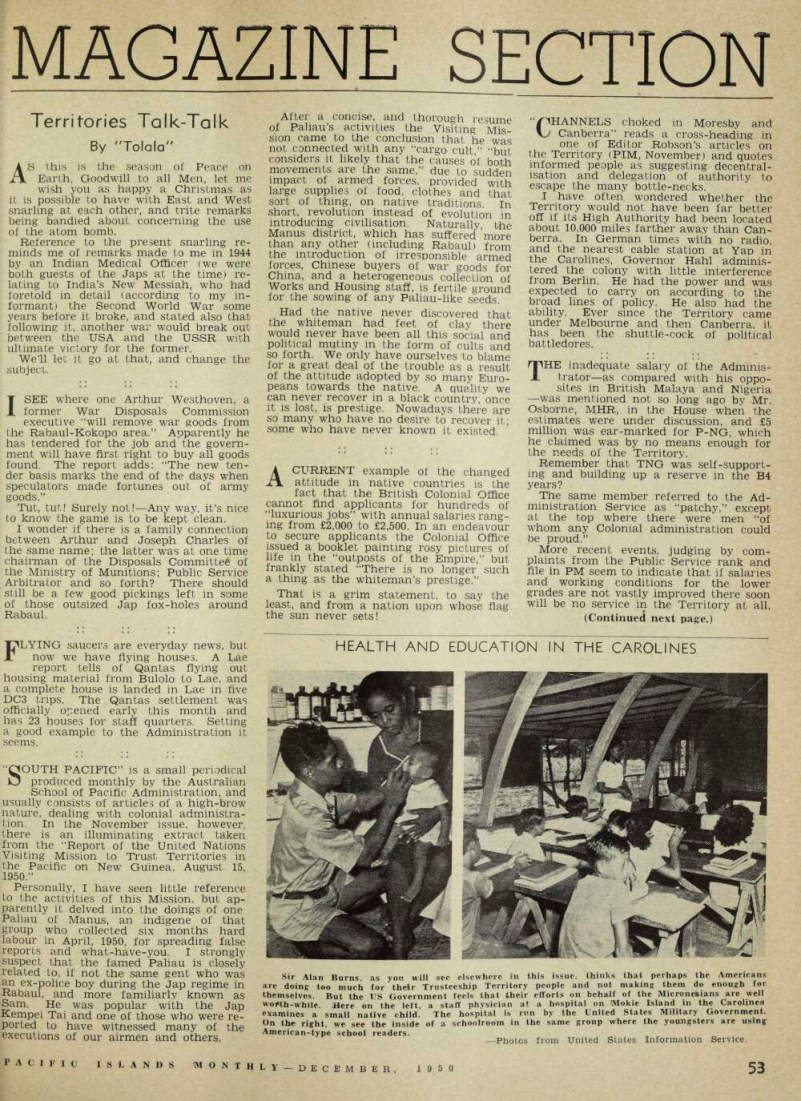
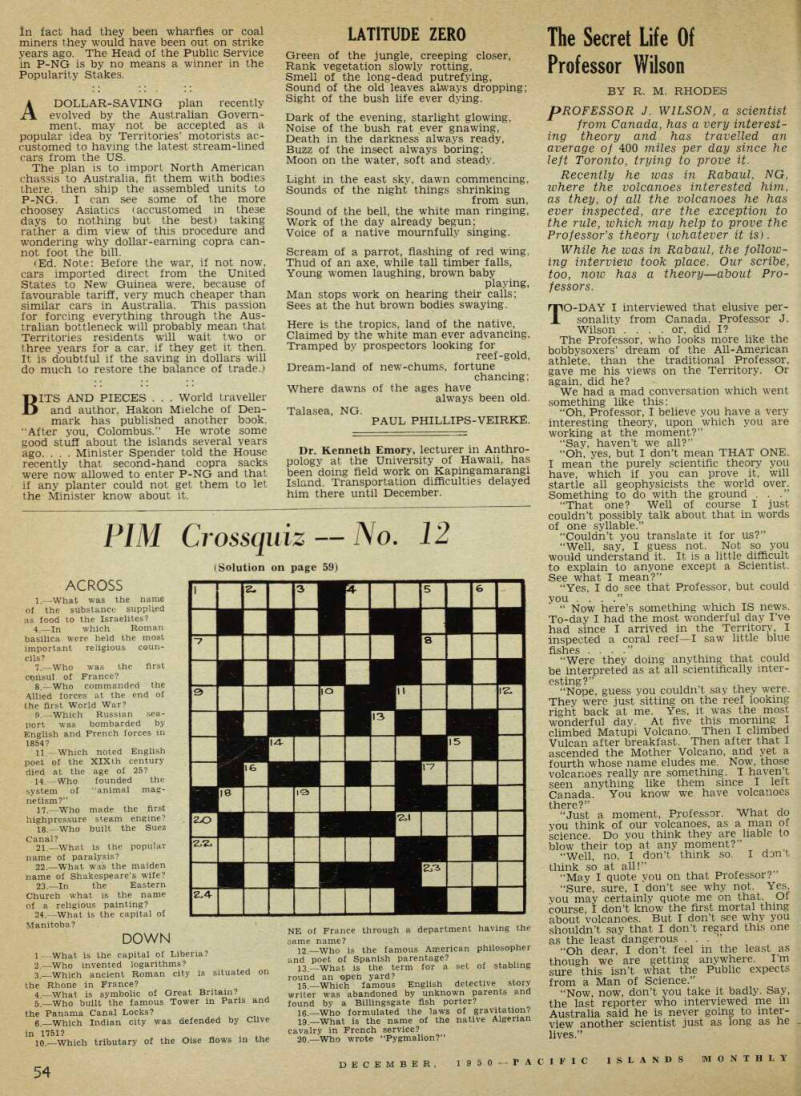
Territories Talk-Talk
By "Tolala"
AS this is the season of Peace on Earth, Goodwill to all Men, let me wish you as happy a Christmas as it is possible to have with East and West snarling at each other, and trite remarks being bandied about concerning the use of the atom bomb.
Reference to the present snarling re minds me of remarks made to me in 1944 by an Indian Medical Officer (we were both guests of the Japs at the time) re lating to India’s New Messiah, who had foretold in detail (according to my in formant) the Second World War some years before it broke, and stated also that following it, another war would break out between the USA and the USSR with ultimate victory for the former.
We’ll let it go at that, and change the subject.
I SEE where one Arthur Westhoven, a former War Disposals Commission executive “will remove war goods from the Rabaul-Kokopo area.” Apparently he has tendered for the job and the govern ment will have first right to buy all goods found. The report adds; “The new ten der basis marks the end of the days when speculators made fortunes out of army goods.”
Tut, tut! Surely not! —Any way, it’s nice to know the game is to be kept clean.
I wonder if there is a family connection between Arthur and Joseph Charles of the same name; the latter was at one time chairman of the Disposals Committefe of the Ministry of Munitions; Public Service Arbitrator and so forth? There should still be a few good pickings left in some of those outsized Jap fox-holes around Rabaul.
FLYING saucers are everyday news, but now we have flying houses. A Lae report tells of Qantas flying out housing material from Bulolo to Lae, and a complete house is landed in Lae in five DC3 trips. The Qantas settlement was officially opened early this month and has 23 houses for staff quarters. Setting a good example to the Administration it seems.
SOUTH PACIFIC” is a small periodical produced monthly by the Australian School of Pacific Administration, and usually consists of articles of a high-brow nature, dealing with colonial administra tion. In the November issue, however, there is an illuminating extract taken from the “Report of the United Nations Visiting Mission to Trust Territories in the Pacific on New Guinea, August 15, 1950.”
Personally, I have seen little reference to the activities of this Mission, but ap parently it delved into the doings of one Paliau of Manus, an indigene of that group who collected six months hard labour in April, 1950, for spreading false reports and what-have-you. I strongly suspect that the famed Paliau is closely related to, if not the same gent who was an ex-police boy during the Jap regime in Rabaul, and more familiarly known as Sam. He was popular with the Jap Kempei Tai and one of those who were re ported to have witnessed many of the executions of our airmen and others.
of A i^iiau\s CO activi’tie? d the“v^fung 6 MQs-
noTconnected T?
movements dueTo tdT
short ° revolution "instead 6 0 “lS„ In
civfiisStion L?SSni 0 V n
MaSS hB
S lnv other Mnrlndin? f ore
inwoductfon of i?r?smnS
P w^r lb ir srm5 rm , ed “ i for the sowing Had the native never discovered that the whiteman had feet of clay there would never have been all this social and political mutiny in the form of cults and so forth. We only have ourselves to blame for a great deal of the trouble as a result of the attitude adopted by so many Europeans towards the native. A quality we can never recover in a black country, once it is lost, is prestige. Nowadays there are so many who have no desire to recover it; some who have never known it existed.
A , er RRENT example of the changed attitude in native countries is the fact that the British Colonial Office cannot find applicants for hundreds of luxurious jobs with annual salaries rangmg from £2,000 to £2,500. In an endeavour to secure applicants the Colonial Office issued a booklet painting rosy pictures of hfe m the outposts of the Empire,” but frankly stated “There is no longer such a thing as the Whiteman’s prestige.”
That is a grim statement, to say the least, and from a nation upon whose flag the sun never sets!
(CHANNELS choked in Moresby and J Canberra” reads a cross-heading in one of Editor Robson’s articles on the Territory (PIM, November) and quotes informed people as suggesting decentral isation and delegation of authority to escape the many bottle-necks.
I have often wondered whether the Territory would not have been far better off if its High Authority had been located about 10,000 miles farther away than Can berra. In German times with no radio, and the nearest cable station at Yap in the Carolines, Governor Hahl adminis tered the colony with little interference from Berlin. He had the power and was expected to carry on according to the broad lines of policy. He also had the ability. Ever since the Territory came under Melbourne and then Canberra, it has been the shuttle-cock of political battledores.
THE inadequate salary of the Adminis trator —as compared with his oppo sites in British Malaya and Nigeria —was mentioned not so long ago by Mr.
Osborne, MHR, in the House when the estimates were under discussion, and £5 million was ear-marked for P-NG, which he claimed was by no means enough for the needs of the Territory.
Remember that TNG was self-support ing and building up a reserve in the B 4 years?
The same member referred to the Ad ministration Service as “patchy,” except at the top where there were men “of whom any Colonial administration could be proud.”
More recent events, judging by com plaints from the Public Service rank and file in PM seem to indicate that if salaries and working conditions for the lower grades are not vastly improved there soon will be no service in the Territory at all. (Continued next page.)
!n fact had they been wharfles or coal miners they would have been out on strike years ago. The Head of the Public Service in P-NG is by no means a winner in the Popularity Stakes.
A DOLLAR-SAVING plan recently evolved by the Australian Govern ment. may not be accepted as a popular idea by Territories’ motorists ac customed to having the latest stream-lined cars from the US.
The plan is to import North American chassis to Australia, fit them with bodies there, then ship the assembled units to P-NG. I can see some of the more choosey Asiatics (accustomed in these days to nothing but the best) taking rather a dim view of this procedure and wondering why dollar-earning copra can not foot the bill. (Ed. Note: Before the war, if not now, cars imported direct from the United States to New Guinea were, because of favourable tariff, very much cheaper than similar cars in Australia. This passion for forcing everything through the Aus tralian bottleneck will probably mean that Territories residents will wait two or three years for a car, if they get it then.
It is doubtful if the saving in dollars will do much to restore the balance of trade.) BITS AND PIECES . . . World traveller and author, Hakon Mielche of Den mark has published another book, "After you, Colombus.” He wrote some good stuff about the islands several years ago. . . . Minister Spender told the House recently that second-hand copra sacks were now allowed to enter P-NG and that if any planter could not get them to let the Minister know about it.
Health And Education In The Carolines
Sir Alan Burns, as yon will sec elsewhere in this issue, thinks that perhaps the Americans are doing too much for their Trusteeship Territory people and not making them do enough for themselves. But the US Government feels that their efforts on behalf of the Micronesians are well worth-while. Here on the left, a staff physician at a hospital on Mokie Island in the Carolines examines a small native child. The hospital is run by the United States Military Government.
On the right, we see the inside of a schoolroom in the same group where the youngsters are using American-type school readers.
Photos from United States Information Service.
Latitude Zero
Green of the jungle, creeping closer, Rank vegetation slowly rotting, Smell of the long-dead putrefying, Sound of the old leaves always dropping; Sight of the bush life ever dying.
Dark of the evening, starlight glowing, Noise of the bush rat ever gnawing, Death in the darkness always ready, Buzz of the insect always boring; Moon on the water, soft and steady.
Light in the east sky, dawn commencing, Sounds of the night things shrinking from sun, Sound of the bell, the white man ringing, Work of the day already begun; Voice of a native mournfully singing.
Scream of a parrot, flashing of red wing, Thud of an axe, while tall timber falls, Young women laughing, brown baby playing, Man stops work on hearing their calls; Sees at the hut brown bodies swaying.
Here is the tropics, land of the native, Claimed by the white man ever advancing, Tramped by prospectors looking for reef-gold, Dream-land of new-chums, fortune chancing; Where dawns of the ages have always been old.
Talasea, NG.
Paul Phillips-Veirke.
Dr. Kenneth Emory, lecturer in Anthro pology at the University of Hawaii, has been doing field work on Kapingamarangi Island. Transportation difficulties delayed him there until December.
PIM Crossquiz No. 12
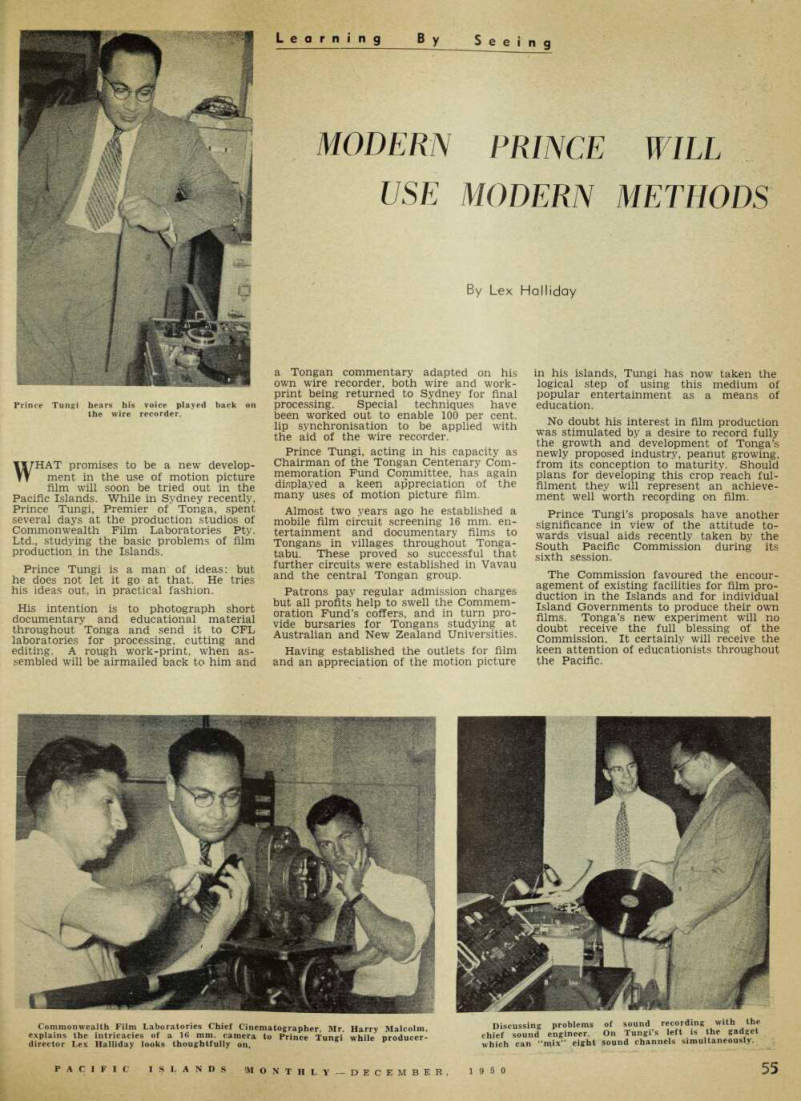
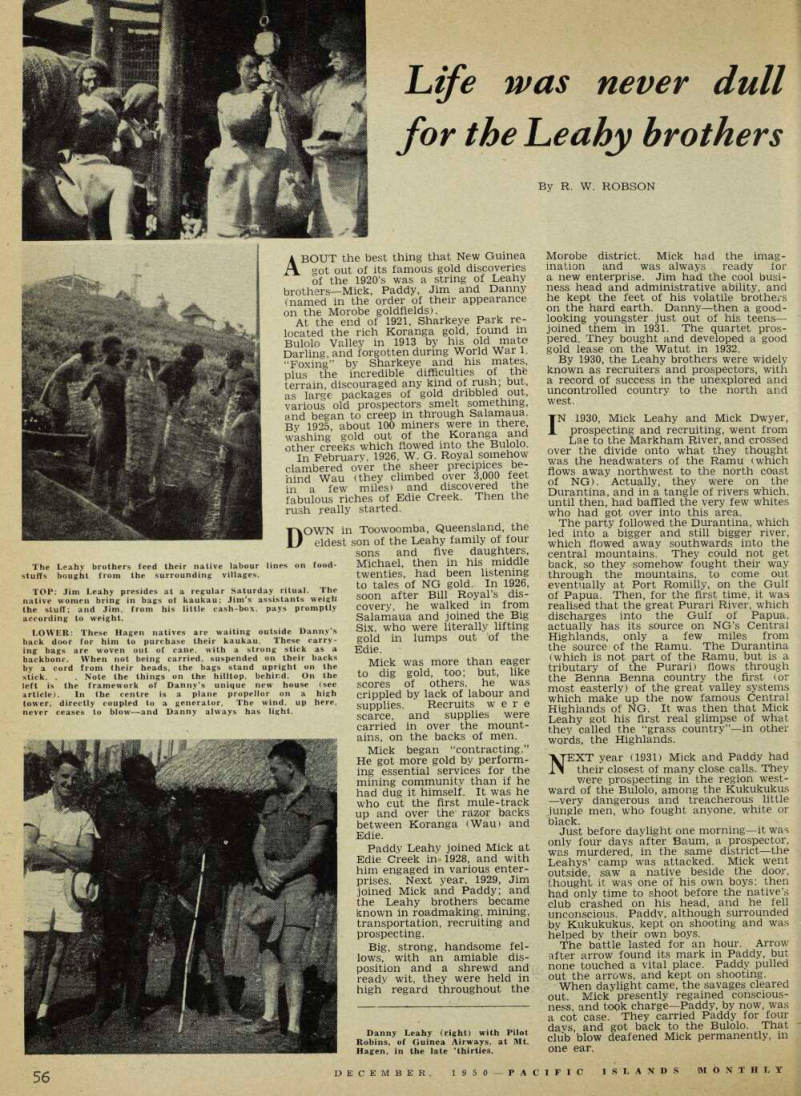
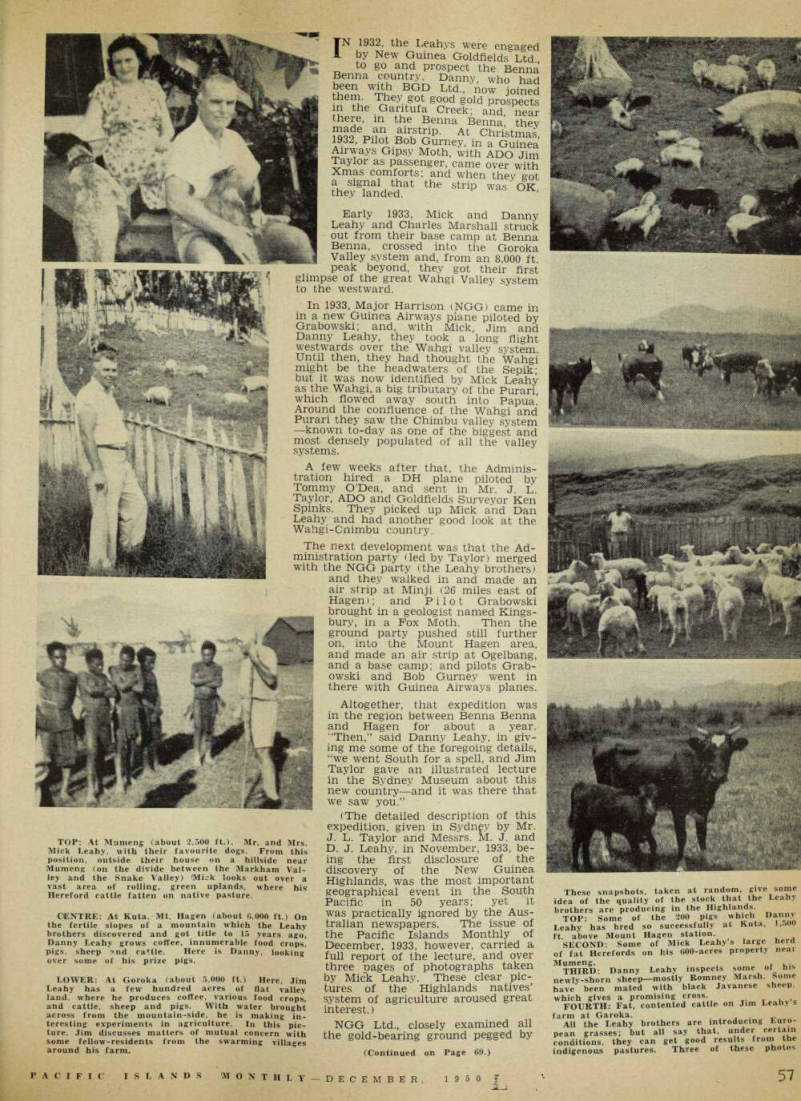
(Solution on page 59)
Across
I— What was the name of the substance supplied as food to the Israelites? 4._ln which Roman basilica were held the most important religious coun cils? 7_Who was the first consul of France? 8. —Who commanded the Allied forces at the end of the first World War? 9—Which Russian sea port was bombarded by English and French forces in 1854? ll Which noted English poet of the XlXth century died at the age of 25? 14—who founded the system of "animal mag netism?” 17. —Who made the first highpressure steam engine? 18. —Who built the Suez Canal? 21—What is the popular name of paralysis? 22. —What was the maiden name of Shakespeare’s wife? 23. In the Eastern Church what is the name of a religious painting? 24. What is the capital of Manitoba?
Down
1 _What is the capital of Liberia? 2, Who invented logarithms? 3. —which ancient Roman city is situated on the Rhone in France? 4 —what is symbolic of Great Britain? 5 built the famous Tower in Paris and the Panama Canal Locks? 6 which Indian city was defended by Clive in 1751? „ . .. 10. —Which tributary of the Oise flows in the
NE of France through a department having the same name? 12 —who is the famous American philosopher and poet of Spanish parentage? 13.—What is the term for a set of stabling round an open yard? 15—which famous English detective story writer was abandoned by unknown parents and found by a Billingsgate fish porter? 16._who formulated the laws of gravitation? 19. —what is the name of the natiVe Algerian cavalry in French service? 20—Who wrote “Pygmalion?”
The Secret Life Of Professor Wilson
Professor Wilson
By R. M. Rhodes
pROFESSOR J. WILSON, a scientist from Canada, has a very interest ing theory and has travelled an average of 400 miles per day since he left Toronto, trying to prove it.
Recently he was in Rahaul, NG, where the volcanoes interested him, as they, of all the volcanoes he has ever inspected, are the exception to the rule, which may help to prove the
Professor’s theory (whatever it is).
While he was in Rahaul, the follow ing interview took place. Our scribe, too, now has a theory—about Pro
fessors.
TO-DAY I interviewed that elusive per sonality from Canada. Professor J.
Wilson . . . . or, did I?
The Professor, who looks more like the bobbysoxers’ dream of the All-American athlete, than the traditional Professor, gave me his views on the Territory. Or again, did he?
We had a mad conversation which went something like this: “Oh, Professor, I believe you have a very interesting theory, upon which you are working at the moment?”
“Say, haven’t we all?”
“Oh, yes, but I don’t mean THAT ONE.
I mean the purely scientific theory you have, which if you can prove it, will startle all geophysicists the world over.
Something to do with the ground . . .”
“That one? Well of course I just couldn’t possibly talk about that in words of one syllable.”
“Couldn’t you translate it for us?”
“Well, say, I guess not. Not so you would understand it. It is a little difficult to explain to anyone except a Scientist.
See what I mean?”
“Yes, I do see that Professor, but could you . . . .”
“ Now here’s something which IS news.
To-day I had the most wonderful day I’ve had since I arrived in the Territory, I inspected a coral reef —I saw little blue fishes . . . .”
“Were they doing anything that could be interpreted as at all scientifically inter esting?”
“Nope, guess vou couldn’t say they were.
They were just sitting on the reef looking right back at me. Yes, it was the most wonderful day. At five this morning I climbed Matupi Volcano. Then I climbed Vulcan after breakfast. Then after that I ascended the Mother Volcano, and yet a fourth whose name eludes me. Now, those volcanoes really are something. 1 haven’t seen anything like them since I left Canada. You know we have volcanoes there?” „ .
"Just a moment, P.rofessor. What do you think of our volcanoes, as a man of science. Do vou think they are liable to blow their top at any moment?”
“Well, no, I don’t think so. I don t think so at all!”
“May I quote you on that Professor?
“Sure, sure, I don’t see why not. Yes, you may certainly quote me on that. Of course, I don’t know the first mortal thing about volcanoes. But I don’t see why you shouldn’t say that I don’t regard this one as the least dangerous ...”
"Oh dear. I don’t feel in the least as though we are getting anywhere. I’m sure this isn’t what the Public expects from a Man of Science.”
“Now, now, don’t vou take it badly. Say, the last reporter who interviewed me in Australia said he is never going to inter view another scientist just as long as he lives.”
Modern Prince Will
Learning By Seeing
Use Modern Methods
By Lex Holliday
WHAT promises to be a new develop ment in the use of motion picture film will soon be tried out in the Pacific Islands. While in Sydney recently, Prince Tungi, Premier of Tonga, spent several days at the production studios of Commonwealth Film Laboratories Pty.
Ltd., studying the basic problems of film production in the Islands.
Prince Tungi is a man of ideas: but he does not let it go at that. He tries his ideas out, in practical fashion.
His intention is to photograph short documentary and educational material throughout Tonga and send it to CFL laboratories for processing, cutting and editing. A rough work-print, when as sembled will be airmailed back to him and
a Tongan commentary adapted on his own wire recorder, both wire and work print being returned to Sydney for final processing. Special techniques have been worked out to enable 100 per cent, lip synchronisation to be applied with the aid of the wire recorder.
Prince Tungi, acting in his capacity as Chairman of the Tongan Centenary Com memoration Fund Committee, has again displayed a keen appreciation of the many uses of motion picture film.
Almost two years ago he established a mobile film circuit screening 16 mm. en tertainment and documentary films to Tongans in villages throughout Tonga tabu. These proved so successful that further circuits were established in Vavau and the central Tongan group.
Patrons pay regular admission charges but all profits help to swell the Commem oration Fund’s coffers, and in turn pro vide bursaries for Tongans studying at Australian and New Zealand Universities.
Having established the outlets for film and an appreciation of the motion picture
in his islands, Tungi has now taken the logical step of using this medium of popular entertainment as a means of education.
No doubt his interest in film production was stimulated by a desire to record fully the growth and development of Tonga’s newly proposed industry, peanut growing, from its conception to maturity. Should plans for developing this crop reach ful filment they will represent an achieve ment well worth recording on film.
Prince Tungi’s proposals have another significance in view of the attitude to wards visual aids recently taken by the South Pacific Commission during its sixth session.
The Commission favoured the encour agement of existing facilities for film pro duction in the Islands and for individual Island Governments to produce their own films. Tonga’s new experiment will no doubt receive the full blessing of the Commission. It certainly will receive the keen attention of educationists throughout the Pacific.
Prince Tungi hears his voice played back on the wire recorder.
Commonwealth Film Laboratories Chief Cinematographer. Mr. Harry Malcolm, explains the intricacies of a 16 mm. camera to Prince Tungi while producer director Lex Halliday looks thoughtfully on.
Discussing problems of sound recording with the chief sound engineer. On Tungi’s left is the gadget which can “mix” eight sound channels simultaneously.
for the Leahy brothers
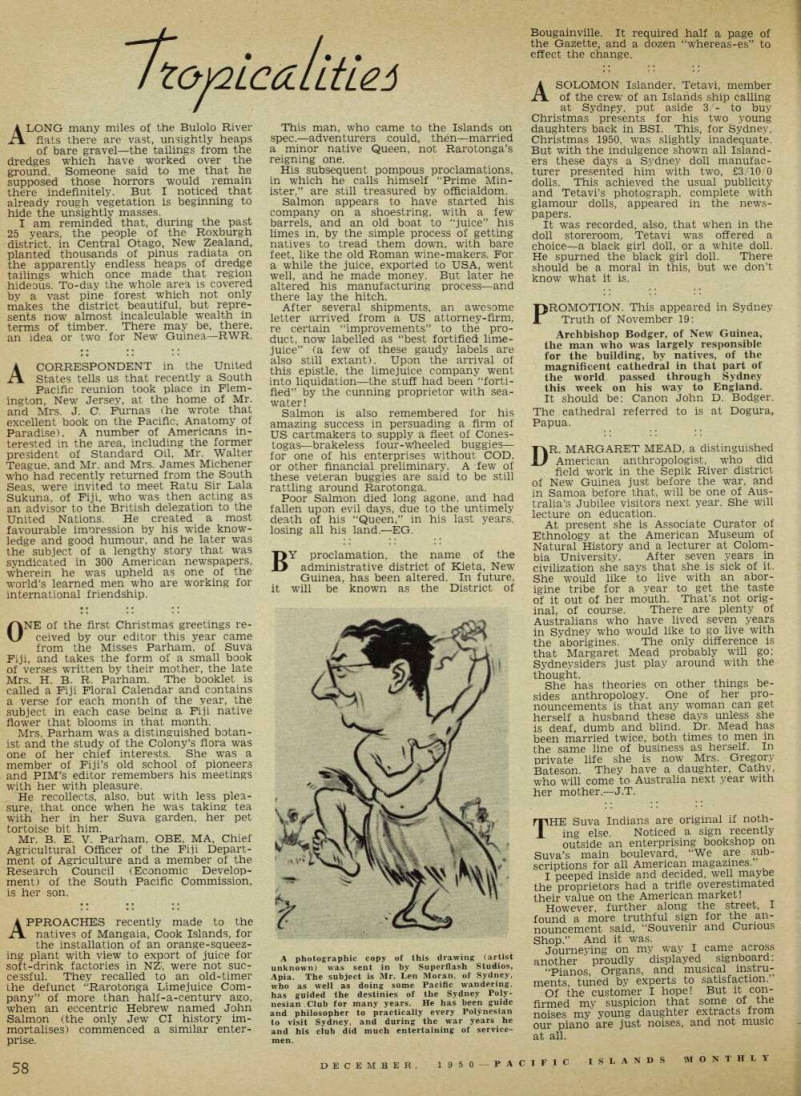
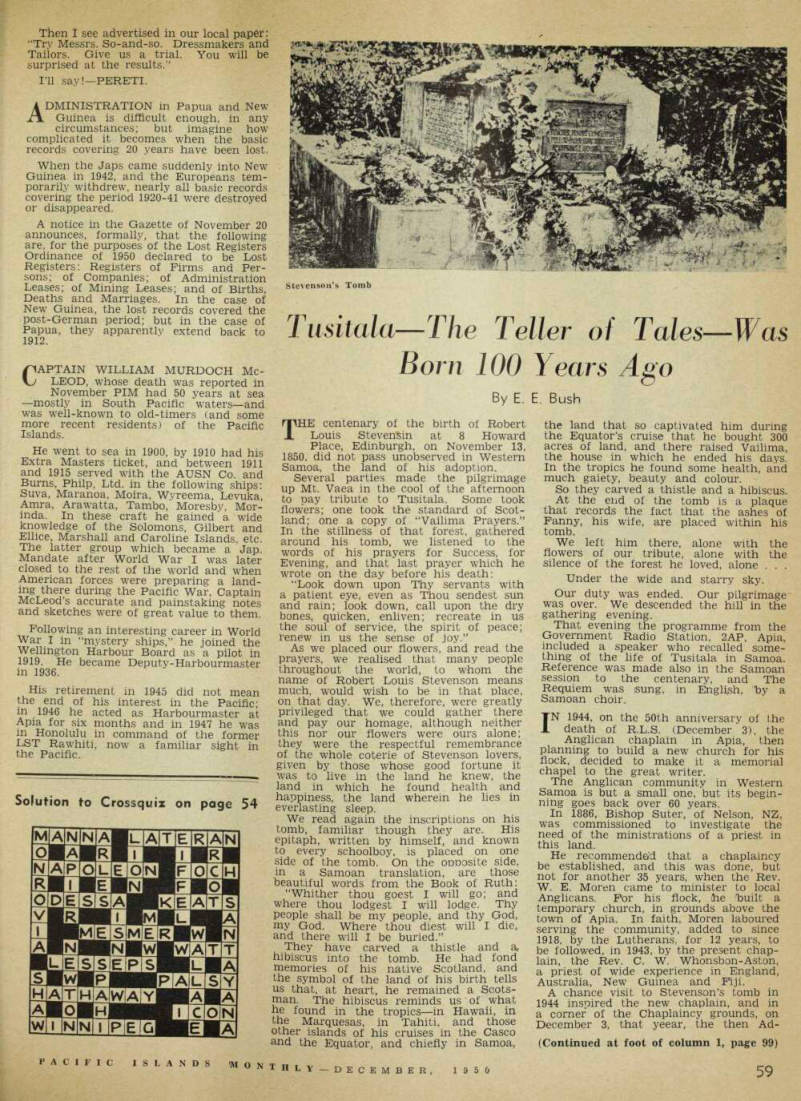
Life was never dull for the Leahy brothers
By R. W. Robson
ABOUT the best thing that New Guinea o-ot out of its famous gold discoveries of the 1920’s was a string of Leahy brothers—Mick, Paddy. Jim and Danny (named in the order of their appearance on the Morobe goldfields).
At the end of 1921, Sharkeye Park re located the rich Koranga gold, found in Bulolo Valley in 1913 by his old mate Darling, and forgotten during World War 1.
“Foxing” by Sharkeye and his mates, plus the incredible difficulties of the terrain, discouraged any kind of rush; but, as large packages of gold dribbled out, various old prospectors smelt something, and began to creep in through Salamaua.
By 1925, about 100 miners were in there, washing gold out of the Koranga and other creeks which flowed into the Bulolo.
In February, 1926, W. G. Royal somehow clambered over the sheer precipices be hind Wau (they climbed over 3,000 feet in a few miles) and discovered the fabulous riches of Edie Creek. Then the rush really started.
DOWN in Toowoomba, Queensland, the eldest son of the Leahy family of four
sons and five daughters, Michael, then in his middle twenties, had been listening to tales of NG gold. In 1926, soon after Bill Royal’s dis covery, he walked in from Salamaua and joined the Big Six, who were literally lifting gold in lumps out of the Edie.
Mick was more than eager to dig gold, too; but, like scores of others, he was crippled by lack of labour and supplies. Recruits were scarce, and supplies were carried in over the mount ains, on the backs of men.
Mick began “contracting.”
He got more gold by perform ing essential services for the mining community than if he had dug it himself. It was he who cut the first mule-track up and over the razor backs between Koranga (Wau) and Edie.
Paddy Leahy joined Mick at Edie Creek in 1928, and with him engaged in various enter prises. Next year, 1929, Jim joined Mick and Paddy; and the Leahy brothers became known in roadmaking, mining, transportation, recruiting and prospecting.
Big, strong, handsome fel lows, with an amiable dis position and a shrewd and ready wit, they were held in high regard throughout the
Morobe district. Mick had the imag ination and was always ready for a new enterprise. Jim had the cool busi ness head and administrative ability, and he kept the feet of his volatile brothers on the hard earth. Danny—then a good looking youngster just out of his teens— joined them in 1931. The quartet pros pered. They bought and developed a good gold lease on the Watut in 1932.
By 1930, the Leahy brothers were widely known as recruiters and prospectors, with a record of success in the unexplored and uncontrolled country to the north and west.
IN 1930, Mick Leahy and Mick Dwyer, prospecting and recruiting, went from Lae to the Markham River, and crossed over the divide onto what they thought was the headwaters of the Ramu (which flows away northwest to the north coast of NG). Actually, they were on the Durantina, and in a tangle of rivers which, until then, had baffled the very few whites who had got over into this area.
The party followed the Durantina, which led into a bigger and still bigger river, which flowed away southwards into the central mountains. They could not get back, so they somehow fought their way through the mountains, to come out eventually at Port Romilly, on the Gulf of Papua. Then, for the first time, it was realised that the great Purari River, which discharges into the Gulf of Papua, actually has its source on NG’s Central Highlands, only a few miles from the source of the Ramu. The Durantina (which is not part of the Ramu, but is a tributary of the Purari) flows through the Benna Benna country the first (or most easterly) of the great valley systems which make up the now famous Central Highlands of NG. It was then that Mick Leahy got his first real glimpse of what they called the “grass country”—in other words, the Highlands.
NEXT year (1931) Mick and Paddy had their closest of many close calls. They v/ere prospecting in the region west ward of the Bulolo, among the Kukukukus —very dangerous and treacherous little jungle men, who fought anyone, white or Just before daylight one morning—it was only four days after Baum, a prospector, was murdered, in the same district —the Leahys’ camp was attacked. Mick went outside, saw a native beside the doo.r, thought it was one of his own boys: then had only time to shoot before the native’s club crashed on his head, and he fell unconscious. Paddy, although surrounded by Kukukukus, kept on shooting and was helped bv their own boys.
The battle lasted for an hour. Arrow after arrow found its mark in Paddy, but none touched a vital place. Paddy pulled out the arrows, and kept on shooting.
When daylight came, the savages cleared out. Mick presently regained conscious ness, and took charge—Paddy, by now, was a cot case. They carried Paddy for four davs, and got back to the Bulolo. That club blow deafened Mick permanently, in one ear.
The Leahy brothers feed their native labour lines on food stuffs bought from the surrounding villages.
TOP: Jim Leahy presides at a regular Saturday ritual. The native women bring in bags of kaukau; Jim’s assistants weigh the stuff; and Jim, from his little cash-box. pays promptly according to weight.
LOWER: These Hagen natives are waiting outside Danny’s back door for him to purchase their kaukau. These carry ing bags are woven out of cane, with a strong stick as a backbone. When not being carried, suspended on their backs by a cord from their heads, the bags stand upright on the stick. . . Note the things on the hilltop, behind. On the left is the framework of Danny’s unique new house (see article). In the centre is a plane propeller on a high tower, directly coupled to a generator. The wind, up here, never ceases to blow—and Danny always has light.
Danny Leahy (right) with Pilot Robins, of Guinea Airways, at Mt.
Hagen, in the late ’thirties.
IN 1932, the Leahys were engaged by New Guinea Goldfields Ltd to go and prospect the Benna Benna country. Danny, who had been with BGD Ltd., now joined ™ ey S O / Sood gold prospects m the Gantufa Creek; and, near there, in the Benna Benna, they
At Christmas,
1932, Pilot Bob Gurney, in a Guinea An ways Gipsy Moth, with ADO Jim Taylor as passenger, came over with Xmas comforts; and when they aot a signal that the strip was OK they landed.
Early 1933, Mick and Danny Leahy and Charles Marshall struck out from their base camp at Benna Benna, crossed into the Goroka Valley system and, from an 8,000 ft. peak beyond, they got their first
glimpse of the great Wahgi Valley system to the westward.
In 1933, Major Harrison (NGG) came in in a new Guinea Airways plane piloted by Grabowski; and, with Mick, Jim and Danny Leahy, they took a long flight westwards over the Wahgi valley system Until then, they had thought the Wahgi might be the headwaters of the Sepik; but it was now identified by Mick Leahy as the Wahgi, a big tributary of the Purari, which flowed away south into Papua.
Around the confluence of the Wahgi and Purari they saw the Chimbu valley system —known to-day as one of the biggest and most densely populated of all the valley systems.
A few weeks after that, the Adminis tration hired a DH plane piloted by Tommy O’Dea, and sent in Mr. J. L.
Taylor, ADO and Goldfields Surveyor Ken Spinks. They picked up Mick and Dan Leahy and had another good look at the Wahgi-Cnimbu country.
The next development was that the Ad ministration party (led by Taylor) merged with the NGG party (the Leahy brothers)
and they walked in and made an air strip at Minji (26 miles east of Hagen); and Pilot Grabowski brought in a geologist named Kings bury, in a Fox Moth. Then the ground party pushed still further on, into the Mount Hagen area, and made an air strip at Ogelbang, and a base camp; and pilots Grab owski and Bob Gurney went in there with Guinea Airways planes.
Altogether, that expedition was in the region between Benna Benna and Hagen for about a year.
“Then,” said Danny Leahy, in giv ing me some of the foregoing details, “we went South for a spell, and Jim Taylor gave an illustrated lecture in the Sydney Museum about this new country—and it was there that we saw you.” (The detailed description of this expedition, given in Sydney by Mr.
J. L. Taylor and Messrs. M. J. and D. J. Leahy, in November, 1933, be ing the first disclosure of the discovery of the New Guinea Highlands, was the most important geographical event in the South Pacific in 50 years; yet it was practically ignored by the Aus tralian newspapers. The issue of the Pacific Islands Monthly of December, 1933, however, carried a full report of the lecture, and over three nages of photographs taken by Mick Leahy. These clear pic tures of the Highlands natives’ system of agriculture aroused great interest.) NGG Ltd., closely examined all the gold-bearing ground pegged by
(Continued on Page 69.)
TOP; At Mumeng (about 2,500 ft.). Mr. and Mrs.
Mick Leahy, with their favourite dogs. From this position, outside their house on a hillside near Mumeng (on the divide between the Markham Val ley and the Snake Valley) Mick looks out over a vast area of rolling, green uplands, where his Hereford cattle fatten on native pasture.
CENTRE: At Kuta. Mt. Hagen (about 6,000 ft.) On the fertile slopes of a mountain which the Leahy brothers discovered and got title to 15 years ago, Danny Leahy grows coffee, innumerable food crops, pigs, sheep and cattle. Here is Danny, looking over some of his prize pigs.
LOWER: At Goroka (about 5,000 ft.) Here, Jim Leahy has a few hundred acres of flat valley land, where he produces coffee, various food crops, and cattle, sheep and pigs. With water brought across from the mountain-side, he is making in teresting experiments in agriculture. In this pic ture, Jim discusses matters of mutual concern with some fellow-residents from the swarming villages around his farm.
These snapshots, taken at random, give some idea of the quality of the stock that the Leahy brothers are producing in the Highlands.
TOP: Some of the 200 pigs which Danny Leahy has bred so successfully at Kuta. 1,500 ft. above Mount Hagen station.
SECOND; Some of Mick Leahy’s herd of fal Herefords on his 600-acres property near Mumeng.
THIRD: Danny Leahy inspects some of his newly-shorn sheep—mostly Romney Marsh. Some have been mated with black Javanese sheep,
which gives a promising cross.
FOURTH: Fat, contented cattle on Jim Leahy’s farm at Garoka.
All the Leahy brothers are introducing Euro pean grasses; but all say that, under certain conditions, they can get good results from the indigenous pastures. Three of these photos
the Leahy brothers; but none of it was valuable enough to be worth develop ment.
IN those expeditions the Leahys con ceived a strong love for the Central Highlands, and they determined that some day they should link their future with the development of this rich and beautiful region. It was after that first visit to Mount Hagen— after NGG had turned down the gold possibilities—that the brothers got land rights over the low mountain called Kuka, where Danny Leahy has his home to-day.
Between 1933 and the outbreak of war, the Leahys were goldmining, contracting, prospecting, recruiting, and generally do ing very well for themselves.
With their knowledge of the country and their skill in handling natives, the Leahys were of great service to both Aus tralian and American forces during the Pacific War (1941-1945); and all of them, as commissioned officers, carried out special jobs. The war held tragedy for Danny, however.
Danny just naturally became involved in hush-hush jungle work. He directed rescue operations, led lost parties out to safety, located and built jungle roads, harassed the Japs, and did a good deal of useful spying. His eating was on a catch-as-catch-can basis—often out of tins. Towards the end, he noticed his sight curiously out of focus; and, finally, they rushed him away for expert attention.
He ended as a notable patient in the famous Mayo Clinic, in America.
It is explained that Danny probably was born with some weakness of the optic nerve system; that his failure to get necessary vitamins during those severe years in the jungle developed the weak ness; and, by the time it was recognised, much of Danny’s sight had gone, per manently. He can see well enough, look ing straight ahead; but he has no vision on either side. The experts say that, while he remains healthy, he will hold his sight; and Danny, out on his Highlands farm, is literally wallowing in vitamins, and is one of the cheeriest and healthiest men I ever have seen. He is not yet 40.
AFTER the war, the brothers went their several ways. But, in three directions, they still remain as one: They love New Guinea, and will live nowhere else; he who injures one Leahy, injures the lot, and had better don armour; and they are fiercely enthusiastic about experimental farming.
All are well endowed; and all are putting their money back into New Guinea.
Mick is believed to have made many thousands out of War Disposals trans actions; Jim owns a large wheat-ranch in Queensland, and wheat is better to-day than gold; Danny has washed thousands of ounces of gold out of the two mountain streams which border his large holding near Hagen.
Mick, with one of the prettiest wives and quite the prettiest youngster in NG, farms 600 acres on the Mumeng-Nadzab range, 4,500 ft. up. Jim farms a couple of hundred acres of rich valley floor, five miles out of Goroka, and 5,000 ft. up.
Danny has apparently about a thousand acres at Kuka, over 6,000 ft. up, five miles south of Hagen. Paddy, the most senti mental of the quartette, has not settled anywhere. He spends most of his time in the more civilised centres of NG, nurs ing an inside that NG has more or less ruined.
The farming operations of the three Leahys, although quite independent, have a remarkable similarity. And all are of considerable importance to NG.
WHEN you fly over these vast NG High lands, you see beneath you countless green grass-clad valleys and wooded hills, where the temperature ranges kindlv from 55 to 75 degrees, and clear streams flow always out of the surrounding moun tains. You never saw a more promising pastoral country land but it is all promise—there isn’t a beast in it, except the countless domestic pigs of the natives
Therein lies the value of the work that is being done by these restless and virile Leahys. They are showing how a sound
pastoral industry can be introduced and established.
Mick has Hereford cattle (a very big herd), sheep and pigs, as well as a wide selection of ducks, geese, turkeys and Australorp hens. Jim has 16 Shorthorns, a dozen Romney Marsh sheep and a score of pigs, with which he is experimenting, Danny has a very large heard of very good pigs, a selection of cattle, and Rom ney Marsh and Javanese sheep, in the crossing of which he is making an in teresting experiment.
Jim and Danny have planted consider able areas with Blue Mountain coffee; all three are growing every kind of food crop they can think of; and all are enthusi astically making experiments with in troduced grasses.
Seen from high up, those valleys seem to be an endless series of lush meadows.
The grass however, is mostly kunai, or similarly coarse and apparently useless stuff. But certain of these indigenous grasses are quite acceptable to European animals. That herd of Mick Leahy’s Herefords (see photograph) has grown fat on a natural- grass, which Mick had cut and top-dressed.
Danny gave me interesting data. He said that Philaris Tuberosa grass grew magnificently in clumps, but did not stop erosion, which was heavy in the Hagen district. He praised Kikuyu which covered the ground like a carpet. He found red clover fair, and white clover very good.
The best of the lot, in that it stopped erosion and gave excellent pasture, was a mixture of Kikuyu and White Clover, especially in shaded places.
ALL the brothers said that they had had much valuable help from Adminis tration officials —especially the De partment of Agriculture. An expert will come a hundred miles to study a sick animal or the strange behaviour of a
crop. Officials went to endless trouble to select for them the most suitable strains of coffee, I heard indirectly, however, that Mick had had a raw deal from some of the stuffier kinds of bureaucrats.
It costs a small fortune to transport a single beast from Australia to the Highlands. Naturally, Mick wanted to select his own animals. But officialdom wouldn’t have it. A Government agent down South—for whose judgment Mick has no respect whatever chooses the animals for shipment; but Mick has to pay for them and try to establish a flock or herd with them. The typical Canberra touch.
The Administration spends thousands on foodstuffs (mostly imported) for its labour lines. Mick wanted to grow kaukau, rice, etc., on his place at Mumeng, quite handy to Lae. In this direction, official dom gave him neither help nor encourage ment.
THESE Leahys are as practical as they are ingenious. To light his attractive 'modern, 2-storey house, Jim dug a 5-mile water-race. Water turns a Felton, geared to a generator. Another race, with a bigger Felton, drives a saw-mill.
I called unexpectedly on Jim, as he was sitting down to luncheon, and shared his lunch. No special preparations. But lunch consisted of pork chops, green peas, tomatoes and potatoes, followed by straw berries with passionfruit and cream—every item grown on the premises. That’s how Farmer Jim Leahy lives!
At Danny’s place, a propeller on his everlastingly windswept mountain-top turned a generator, and Danny has light and refrigeration. Nearby was the frame work of a new 2-story house, being made of pit-sawn timber. Bearded natives, who still carry spears on their normal
peregrinations, were busily hand-planing some soft timber for the interior, Danny is teaching the local natives' to shear sheep, spin wool, cure hides, milk and
tend cattle grow coffee, build houses. He never rests. Out at daylight, from his mountain-top he sees all the surrounding peaks made golden by the rising sun—a most glorious view. We looked south into Papua, westward over the continuing valley systems towards Dutch New Guinea, northwards over the headwaters of the
Sepik. I was shivering—yet we were only 5 degrees from the equator. , T7^T twd , vw T WONDER why New Guinea has not X done more to honour the Leahy brothers, most faithful and piost en terprising of her pioneers. Somewhere along the line of valley systems, I believe,
there is a Mount Michael and a Mount Leahy. That does not seem adequate.
Maybe, when all this post-war muddle and confusion are past, and Australia begins to realise the value of the newly discovered Central Highlands, they will place a special memorial at Goroka or somewhere there, in honour of the brothers.
Or—better still—why not change the spelling of Lae to Leahy? The pronun ciation is the same, and Lae (Leahy) is destined to be the busy sea-port of the Highlands.
Advertisements & other items, p. 58 (1 item)
56
DECEMBER, 1950 PACIFIC ISLANDS (MONTHLY
Tropicalities
ALONG many miles of the Bulolo River flats there are vast, unsightly heaps of bare gravel—the tailings from the dredges which have worked over the ground. Someone said to me that he supposed those horrors would remain there indefinitely. But I noticed that already rough vegetation is beginning to hide the unsightly masses.
I am reminded that, during the past 25 years, the people of the Roxburgh district, in Central Otago, New Zealand, planted thousands of pinus radiata on the apparently endless heaps of dredge tailings which once made that region hideous. To-day the whole area is covered by a vast pine forest which not only makes the district beautiful, but repre sents now almost incalculable wealth in terms of timber. There may be. there, an idea or two for New Guinea —RWR.
A CORRESPONDENT in the United States tells us that recently a South Pacific reunion took place in Flem ington, New Jersey, at the home of Mr. and Mrs. J. C. Furnas (he wrote that excellent book on the Pacific, Anatomy of Paradise). A number of Americans in terested in the area, including the former president of Standard Oil, Mr. Walter Teague, and Mr. and Mrs. James Michener who had recently returned from the South Seas, were invited to meet Ratu Sir Lala Sukuna, of Fiji, who was then acting as an advisor to the British delegation to the United Nations. He created a most favourable imnression by his wide know ledge and good humour, and he later was the subject of a lengthy story that was syndicated in 300 American newspapers, wherein he was upheld as one of the world’s learned men who are working for international friendship.
ONE of the first Christmas greetings re ceived by our editor this year came from the Misses Parham, of Suva Fiji, and takes the form of a small book of verses written by their mother, the late Mrs. H. B. R. Parham. The booklet is called a Fiji Floral Calendar and contains a verse for each month of the year, the subject in each case being a Fiji native flower that blooms in that month.
Mrs. Parham was a distinguished botan ist and the study of the Colony’s flora was one of her chief interests. She was a member of Fiji’s old school of pioneers and PlM’s editor remembers his meetings with her with pleasure.
He recollects, also, but with less plea sure, that once when he was taking tea with her in her Suva garden, her pet tortoise bit him.
Mr. B. E. V. Parham, QBE. MA, Chief Agricultural Officer of the Fiji Depart ment of Agriculture and a member of the Research Council (Economic Develop ment) of the South Pacific Commission, is her son.
APPROACHES recently made to the natives of Mangaia, Cook Islands, for the installation of an orange-squeez ing plant with view to export of juice for soft-drink factories in NZ, were not suc cessful. They recalled to an old-timer the defunct “Rarotonga Limejuice Com pany” of more than half-a-century ago, when an eccentric Hebrew named John Salmon (the only Jew Cl history im mortalises) commenced a similar enter prise.
This man, who came to the Islands on spec.—adventurers could, then —married a minor native Queen, not Rarotonga’s reigning one.
His subsequent pompous proclamations, in which he calls himself "Prime Min ister.” are still treasured by officialdom.
Salmon appears to have started his company on a shoestring, with a few barrels, and an old boat to “juice” his limes in, by the simple process of getting natives to tread them down, with bare feet, like the old Roman wine-makers. For a while the juice, exported to USA, went well, and he made money. But later he altered his manufacturing process—and there lay the hitch.
After several shipments, an awesome letter arrived from a US attorney-firm, re certain “improvements” to the pro duct, now labelled as “best fortified lime juice” (a few of these gaudy labels are also still extant). Upon the arrival of this epistle, the limejuice company went into liquidation—the stuff had been “forti fied” by the cunning proprietor with sea water !
Salmon is also remembered for his amazing success in persuading a firm of US cartmakers to supply a fleet of Cones togas—brakeless four-wfiieeled buggies— for one of his enterprises without COD. or other financial preliminary. A few of these veteran buggies are said to be still rattling around Rarotonga.
Poor Salmon died long agone, and had fallen upon evil days, due to the untimely death of his "Queen,” in his last years, losing all his land. —EG.
BY proclamation, the name of the administrative district of Kieta, New Guinea, has been altered. In future, it will be known as the District of
Bougainville. It required half a page of the Gazette, and a dozen “whereas-es” to effect the change.
A SOLOMON Islander, Tetavi, member of the crew of an Islands ship calling at Sydnpy, put aside 3 - to buy Christmas presents for his two young daughters back in BSI. This, for Sydney, Christmas 1950, was slightly inadequate.
But with the indulgence shown all Island ers these days a Sydney doll manufac turer presented him with two, £3/10/0 dolls. This achieved the usual publicity and Tetavi’s photograph, complete with glamour dolls, appeared in the news papers.
It was recorded, also, that when in the doll storeroom, Tetavi was offered a choice —a black girl doll, or a white doll.
He spurned the black girl doll. There should be a moral in this, but we don’t know what it is.
PROMOTION. This appeared in Sydney Truth of November 19: Archbishop Bodger, of New Guinea, the man who was largely responsible for the building, by natives, of the magnificent cathedral in that part of the world passed through Sydney this week on his way to England.
It should be: Canon John D. Bodger.
The cathedral referred to is at Dogura, Papua.
DR. MARGARET MEAD, a distinguished American anthropologist, who did field work in the Sepik River district of New Guinea just before the war, and in Samoa before that, will be one of Aus tralia’s Jubilee visitors next year. She will lecture on education.
At present she is Associate Curator of Ethnology at the American Museum of Natural History and a lecturer at Colom bia University. After seven years in civilization she says that she is sick of it.
She would like to live with an abor igine tribe for a year to get the taste of it out of her mouth. That’s not orig inal, of course. There are plenty of Australians who have lived seven years in Sydney who would like to go live with the aborigines. The only difference is that Margaret Mead probably will go; Sydneysiders just play around with the thought.
She has theories on other things be sides anthropology. One of her pro nouncements is that any woman can get herself a husband these days unless she is deaf, dumb and blind. Dr. Mead has been married twice, both times to men in the same line of business as herself. In private life she is now Mrs. Gregory Bateson. They have a daughter, Cathy, who will come to Australia next year with her mother—J.T.
THE Suva Indians are original if noth ing else. Noticed a sign recently outside an enterprising bookshop on Suva’s main boulevard, “We are sub scriptions for all American magazines.
I peeped inside and decided, well maybe the proprietors had a trifle overestimated their value on the American market!
However, further along the street, I found a more truthful sign for the an nouncement said, “Souvenir and Curious Shop.” And it was.
Journeying on my way I came across another proudly displayed signboard: “Pianos, Organs, and musical instru ments, tuned by experts to satisfaction.
Of the customer I hope! But it con firmed my suspicion that some of the noises my young daughter extracts from our piano are just noises, and not music at all.
A photographic copy of this drawing (artist unknown) was sent in by Superflash Studios, Apia. The subject is Mr. Len Moran, of Sydney, who as well as doing some Pacific wandering, has guided the destinies of the Sydney Poly nesian Club for many years. He has been guide and philosopher to practically every Polynesian to visit Sydney, and during the war years he and his ciub did much entertaining of service men.
Then 1 see advertised in our local paper; “Try Messrs. So-and-so. Dressmakers and Tailors. Give us a trial. You will be surprised at the results.”
I’ll say!
Pereti.
Administration in Papua and New Guinea is difficult enough, in any circumstances; but imagine how complicated it becomes when the basic records covering 20 years have been lost.
When the Japs came suddenly into New Guinea in 1942, and the Europeans tem porarily withdrew, nearly all basic records covering the period 1920-41 were destroyed or disappeared.
A notice in the Gazette of November 20 announces, formally, that the following are, for the purposes of the Lost Registers Ordinance of 1950 declared to be Lost- Registers: Registers of Firms and Per sons; of Companies; of Administration Leases; of Mining Leases; and of Births, Deaths and Marriages. In the case of New Guinea, the lost records covered the post-German period; but in the case of Papua, they apparently extend back to 1912.
Captain William Murdoch Mc-
LEOD, whose death was reported in November PIM had 50 years at sea —mostly in South Pacific waters—and was well-known to old-timers (and some more recent residents) of the Pacific Islands.
He went to sea in 1900, by 1910 had his Extra Masters ticket, and between 1911 and 1915 served with the AUSN Co. and Burns, Philp, Ltd. in the following ships: Suva, Maranoa, Moira, Wyreema, Levuka, Amra, Arawatta, Tambo, Moresby, Mor inda. In these craft he gained a wide knowledge of the Solomons, Gilbert and Ellice, Marshall and Caroline Islands, etc.
The latter group which became a Jap.
Mandate after World War I was later closed to the rest of the world and when American forces were preparing a land ing there during the Pacific War, Captain McLeod’s accurate and painstaking notes and sketches were of great value to them.
Following an interesting career in World War I in “mystery ships,” he joined the Wellington Harbour Board as a pilot in 1919. He became Deputy-Harbourmaster in 1936.
His retirement in 1945 did not mean the end of his interest in the Pacific; m 1946 he acted as Harbourmaster at Apia for six months and in 1947 he was in Honolulu in command of the former LST Rawhiti, now a familiar sight in the Pacific.
Tusitala The Teller of Tales—Was

Born 100 Years Ago
By E. E. Bush
THE centenary of the birth of Robert Louis Stevensin at 8 Howard Place, Edinburgh, on November 13, 1850, did not pass unobserved in Western Samoa, the land of his adoption.
Several parties made the pilgrimage up Mt. Vaea in the cool of the afternoon to pay tribute to Tusitala. Some took flowers; one took the standard of Scot land; one a copy of “Vailima Prayers.”
In the stillness of that forest, gathered around his tomb, we listened to the words of his prayers for Success, for Evening, and that last prayer which he wrote on the day before his death: “Look down upon Thy servants with a patient eye, even as Thou sendest sun and rain; look down, call upon the dry bones, quicken, enliven; recreate in us the soul of service, the spirit of peace; renew in us the sense of joy.”
As we placed our flowers, and read the prayers, we realised that many people throughout the world, to whom the name of Robert Louis Stevenson means much, would wish to be in that place, on that day. We, therefore, were greatly privileged that we could gather there and pay our homage, although neither this nor our flowers were ours alone; they were the respectful remembrance of the whole coterie of Stevenson lovers, given by those whose good fortune it was to live in the land he knew, the land in which he found health and happiness, the land wherein he lies in everlasting sleep.
We read again the inscriptions on his tomb, familiar though they are. His epitaph, written by himself, and known to every schoolboy, is placed on one side of the tomb. On the opposite side, in a Samoan translation, are those beautiful words from the Book of Ruth: “Whither thou goest I will go; and where thou lodgest I will lodge. Thy people shall be my people, and thy God, my God. Where thou diest will I die, and there will I be buried.”
They have carved a thistle and a, hibiscus into the tomb. He had fond memories of his native Scotland, and the symbol of the land of his birth tells us that, at heart, he remained a Scots man. The hibiscus reminds us of what ne found in the tropics—in Hawaii, in the Marquesas, in Tahiti, and those other islands of his cruises in the Casco and the Equator, and chiefly in Samoa,
the land that so captivated him during the Equator’s cruise that he bought 300 acres of land, and there raised Vailima, the house in which he ended his days.
In the tropics he found some health, and much gaiety, beauty and colour.
So they carved a thistle and a hibiscus.
At the end of the tomb is a plaque that records the fact that the ashes of Fanny, his wife, are placed within his tomb.
We left him there, alone with the flowers of our tribute, alone with the silence of the forest he loved, alone . . .
Under the wide and starry sky.
Our duty was ended. Our pilgrimage was over. We descended the hill in the
gathering evening.
That evening the programme from the Government Radio Station, 2AP. Apia, included a speaker who recalled some thing of the life of Tusitala in Samoa.
Reference was made also in the Samoan session to the centenary, and The Requiem was sung, in English, hy a Samoan choir.
IN 1944, on the 50th anniversary of the death of R.L.S. (December 3), the Anglican chaplain in Apia, then planning to build a new church for his flock, decided to make it a memorial chapel to the great writer.
The Anglican community in Western Samoa is but a small one, but its begin ning goes back over 60 years.
In 1886, Bishop Suter, of Nelson, NZ, was commissioned to investigate the need of the ministrations of a priest in this land.
He recommend&'d that a chaplaincy be established, and this was done, but not for another 35 years, when the Rev.
W. E. Moren came to minister to local Anglicans. For his flock, lie huilt a temporary church, in grounds above the town of Apia. In faith, Moren laboured serving the community, added to since 1918, by the Lutherans, for 12 years, to be followed, in 1943, by the present chap lain, the Rev. C. W. Whonsbon-Aston, a priest of wide experience in England, Australia, New Guinea and Fiji.
A chance visit to Stevenson’s tomb in 1944 inspired the new chaplain, and in a corner of the Chaplaincy grounds, on December 3, that yeear, the then Ad
(Continued at foot of column 1, page 99)
Stevenson’s Tomb
ministrator of the Territory, the Hon.
A. C. Turnbull, laid a stone that com memorated the death of Tusitala, and would, in due season, become the chief cornerstone of a new church.
And now, in 1950, fulfilment. The stone was moved to the place where the Church would rise, and on All Soul’s Day this year, in the presence of the Lord Bishop in Polynesia, the chaplain and the congregation, was re-set by the High Commissioner of Western Samoa, the Hon. G. R. Powles.
In the course of his address. Mr.
Powles spoke of the visit of Bishop Sutor in 1886 and the long years to the insti tution of the chaplaincy in 1931. This did not mean, however, that the Church of England in this place was neglected, for some workers for the L.M.S. were Anglican priests. Mr. Powles spoke in high praise of the work of the honorary architect, Mr. A. Schaafhausen, who de signed the building, and referred to the happy coincidence that the contractor for the foundations, Mr. A. Betham, had been baptised by Bishop Sutor during his visit in 1886.
Advertisements & other items, pp. 61-64 (6 items)
59
PACIFIC ISLANDS MONThix,
muiNTHLY— DECEMBER, 1950
Solution to Crossquiz on page 54
c
m q LT) nj H-
4- r\. j* <d .j* _• >> cu c _c to o qj ,. Q) r- ou q c q' ±: •»- 3 a i '■ "S a ' ? 1 / -+- J- .> cu r- n (- _r > -5 “ £ 2 !d«i C Si C l 0) f O CL r - 3 O -Q u C > 7;
(DbQ-E T3 v_ g h: E
t: O O 9 3 £
> — O TJ c/) (-5 O oo-c r 0 o h O £ C/) d _C U •— ■*■* C_Q
Corner For The Children
61
PACIFIC ISLANDS SVI ONTHLY-DE C fc M B E R . 1950
Burns Philp (New Guinea) Limited
General Merchants (Wholesale and Retail)
Shipping, Customs and General Agents
Head Office: PORT MORESBY, PAPUA
BRANCHES:
NEW GUINEA: Rabaul, Kokopo, Lae Cr Madang.
PAPUA: Samarai.
REPRESENTATIVES FOR:
AUSTRALIAN AGENTS:
LONDON AGENTS:
SAN FRANCISCO AGENTS:
QUEENSLAND INSURANCE CO. LTD.
LLOYD S OF LONDON
BURNS PHILP TRUST CO. LTD
BURNS, PHILP & CO. LTD.
All States.
BURNS, PHILP & CO. LTD.
"London House", 35 Crutched Friars, E.C.3.
BURNS, PHILP CO. OF SAN FRANCISCO INC 510 Matson Building.
Distributing Agents, Territory of Papua-New Guinea for:
SHELL COMPANY OF AUSTRALIA LIMITED
Petroleum Products
GENERAL MOTORS CORPORATION
Chevrolet, Buick, Pontiac and Oldsmobile Cars Chevrolet and GMC Trucks Frigidaire Refrigerators
VAUXHALL MOTORS LIMITED
Vauxhall Cars and Bedford Trucks
R. A. LISTER Cr CO., BRISTOL
Producers of Petrol, Paraffin and Diesel Engines Pumps and Lighting plants
RUSTON HORNSBY LIMITED
Engines
CROSSLEY MARINE ENGINES
The features of this unusual XVlth Century key illustrate its owner s connection with the sea—a trader on the African coast, no doubt— the key obviously being that of his sea-chest. am c A R
The key
to smoking pleasure
CAPSTAN
FINE CUT
NAVY CUT
TOBACCOS
or 820 1 1 -o'*
December, 1950 Pacific Islands Monthli
The Boy’S Brigade At Niue
riIHE Resident Commissioner of Niue 1 Mr. C. H. W. Larsen, who is Patron of the Boys’ Brigade, recently inspec ted all the Companies, about 450 boys, and assisted the Chaplain, the Rev, M. G. borne ol Checl S A ’ L f in '“f dedication and Potation of the Battalion Colours.
Th e Colours are a gift from the Ist Leigh-on-Sea Company, Essex, England, The Brigades are proving a most satis factory organization in the welfare of Island youth (both boys and girls), and this fact is recognized by the Administra tion which at all times gives assistance to the work.
Mr. J. H. (Lofty) Bower and his wife and family left Apia, W. Samoa, in Nov ember to seek new pastures in New Zealand. For many years Mr. Bower has been Gaoler at Tafaigata Prison.
Miss Sheila Wesley-Smith was married to Mr. Norman Draper in Melbourne at the end of November. Both are members of the Baptist Mission in New Guinea and will return to work there next year.
Advertisements & other items, pp. 65-66 (2 items)
ir plan- these Territories back
real progress and eco
L POSTSCRIPT—In Mo:
. 0Le . home. I learned that t\
Heinzt
SELF
PLAIN AND
RAISING
FLOUR,
ESTABLISHED 1868
Agents for Fiji, Tonga and Samoa: C. SULLIVAN (PACIFIC ISLANDS) LTD., Suva, Fiji.
Works wonders at meal time!
Made from firm, red-ripe “aristocrat” tomatoes, and fragrant spices. Tomato Sauce that’s better than ever . . . made as only Heinz know how. Be sure to put HEINZ Tomato Sauce on your grocery list always.
HEINZt
5 H* 0F Tff ST
oma+o Sauce
H. J. HEINZ CO. PTY., LTD.
479 Bourke Street, Sydney. ■ Hmml mi
tomato
SAUCE
c,e® V\o* t shines i-M m
BRASSO
The quality Metal Polish Jfl
A. B. DONALD LIMITED
RAROTONGA COOK ISLANDS
TELEGRAPHIC ADDRESS; “DONALD, RAROTONGA.”
General Merchants (Wholesale & Retail) and Shipowners importers & Exporters Branches Throughout Cook Islands Fire, Marine & Motor Vehicles Insurance Agents for Yorkshire
Insurance Co.
Lloyd’s Agents.
Agents and Distributors for : ENGLAND.— Austin Cars & Trucks, Pye Radios, Dunlop Rubber Co., Ltd., Vauxhall Cars & Trucks, R. A. Lister & Co., Ltd., Phillips' Cycles, Marples Tools.
U.S.A.—Remington Rand Corp., Radio Corp. of America, Champion Spark Plug Co.. Firestone Tyres, General Steamship Corp.
NEW ZEALAND.—Vacuum Oil Co. Pty., Ltd, Petroleum Products.
AUSTRALlA.—Wunderlich, Ltd., Cement Asbestos Products.
NORWAY. —O. Mustad & Sons, Fish Hooks.
SWEDEN.—B. A. HJorth & Co., Primus Products.
Head Office: — A. B. DONALD, LTD., Auckland.
Associate Houses: —
ETABLISSEMENTS DONALD TAHITI,
Papeete, Society Islands.
DOMINION FRUIT CO., Suva, Fiji Islands.
CODES: Bentley's Complete Phrase, Acme Sydney Agents :
BURNS, PHILP & CO., LTD.
London Agents :
BURNS, PHILP & CO., LTD.
San Francisco Agents :
BURNS, PHILP CO. OF SAN FRANCISCO.
Month Of Sport In Apia
Prom Our Own Correspondent
Apia, Nov. 20.
SPORT events of a great variety have attracted public interest throughout Samoa during November. On Nov ember 7, a packed house at the Tivoli Theatre witnessed the boxing match for the heavyweight championship of West ern Samoa between the title holder, Motu, of Apia (36 years, 224 pounds) and
the aspirant, Suivai, of Saleimoa, (26 years, 210 pounds). The fight was dis appointing, as it soon became apparent that the champion was no match for his younger and fitter opponent, who possses sed skill, aggressiveness and speed. The seventh round brought the end, when Motu was caught with a right to the head and went down for the count, Mr. G. S. Chisholm, donor of the championship belt presented the trophy to the new heavy-weight champion of Western Samoa, Suivai.
The Armistice Day Race Meeting, held on Saturday, November 11, was unfortun ately marred by heavy showers which turned the course at Apia into a quagmire and made the going difficult.
In spite of all difficulties an enthusiastic crowd watched the eight events of the day contested by good fields and the tote paid some good dividends.
The Apia Rifle Club opened the new season on November 17 at the Vaivase Range with a pleasing little function which at the same time, celebrated the 25th anniversary of the Club which was formed by a group of riflemen in 1925.
About 60 members and guests, including the High Commissioner, Mr. G. R. Powles, spent an enjoyable afternoon in excellent weather and beautiful surroundings.
The Club has enrolled a full member ship and a successful season is antici pated. The Club will have to establish a new range next season, as the present site is required for the new Government Boarding School, the construction of which is to begin soon.
Dr. and Mrs. John Akerman, who with their three children, have been living in Wewak, New Guinea, will shortly be leaving Australia for Assam where they will live in future.
Nz Reports On Her Island Territories

Drift of Native People to Dominion Cities
THE New Zealand Department of Island Territories recently issued annual reports in handy booklet form for Western Samoa, Cook Islands, Niue and the Tokelau Group.
An extra book was issued for the Cook Islands. It is printed in two colours and has numerous drawings and photographs and although its exact purpose is not clear, it is easier reading for the layman in search of information about the Cooks, than the official report.
Whence Came The Oranges?
From this coloured booklet we learn the possible source of the now famous Cook Islands oranges, the Group’s main ex port crop. According to a native legend, the first men to see Rarotonga were the Bounty Mutineers who lay off the island shortly after the mutiny of 1789. The story goes that “There came a large white ship but the people did not land. One of the Chiefs went aboard and reported that they had taro swamps and young breadfruit trees (on board). It was thence we obtained the first oranges ...”
Discovery of the Group is credited to Captain Cook who on his second voyage (1773) found Manuae. On his third voy age he again visited the Group, Mangaia being his first landfall after leaving Queen Charlotte Sound, NZ. But although he cruised around among the islands he had difficulty in finding suitable anchorages and most of his contact with the Island ers was with those who ventured out in canoes to his ship. The Group did not become well known until the pioneer missionary John Williams, of the LMS, visited there in 1823. For the next 60 years it was rigidly ruled by the missions who introduced their famous Blue Laws, some of which survive until today.
Cook Islands became a British Protec torate in 1888 and came under the con trol of New Zealand in 1901.
Although the Cook Islands are New Zealand’s chief source of oranges and other tropical fruits, this Group, like the rest of the Dominion’s Island territories, can be classed as a responsibility rather than as an economic asset. Straight-out grants to the Cooks have fluctuated from year to year and range from £ll,OOO in 1938 to £lOO,OOO in 1949.
The Tokelaus Pay Their Way.
The Tokelau Islands which came into NZ’s territorial boundaries as recently as 1949 (although they became a British Protectorate in 1877) are shown to be just about self-supporting—revenue last year, copra, handicrafts and postage stamps, being £4,550 and expenditure £4,471 —of which the amazing sum of £52 was spent on education.
Population is about 1,400 and at the last count there were 43 more females than males.
Drawn To The Bright Lights.
ONE of the most interesting things con tained in the reports is that section dealing with the welfare of Islanders now living temporarily or permanently in New Zealand—2,ooo of them, which shows the strength of the drift of these people to what they evidently consider to be some sort of Mecca. The drift would likely become a flood if more sea and air trans port were available.
These Islanders always have been attracted to the Dominion, but the num bers going there up until the war were small in comparison with the influx that has taken place since 1945. It all stems from post-war prosperity in the Islands and m the Dominion, plus the fact that
jobs are now easy to get in New Zealand Most of these folk are clustered together In Auckland city. Natives of Niue and Cook Islands, being New Zealand citizens are admitted freely. Samoans have slightly more trouble in being accepted as permanent residents.
The NZ Department of Islands Terri tories set up a branch office in Auckland in 1945. The officer appointed to control the office has had long experience in Cook Islands and Samoa, is familiar with their languages and has been able to iron out many of their problems. The Gov ernment has also given financial support to the London Missionary Society which has appointed a full-time officer with missionary experience in the Islands, to
do welfare work among these people now living in the Dominion. He is assisted by a Cook Islands native pastor.
THESE reports show conclusively that although possibly unimaginative, New Zealand’s administration of her Island Territories has for many years been undertaken in a spirit of duty and not for material gain—if that ever was the purpose.
The casual reader of the reports is left wondering why New Zealand should bother, except for that intangible, now discounted thing called prestige. It is hard to see that the Dominion would be one whit worse off if divorced from her Island territories tomorrow. Can the same be said of the Island Territories?
Advertisements & other items, pp. 67-68 (3 items)
65
pacific islands moNT H I v y-,
w«xH L Y DECEMBER, 1950
Shell
VETERINARY
INSTRUMENTS
For Sheep and Cattle can be
Supplied Immediately
EARMARKERS.
SPEYING INSTRUMENTS.
BULLRINGS.
FIRE BRANDS.
EMASCULATORS.
W. JNO. BAKER
PTY. LTD.
3 Hunter Street, Sydney, N.S.W., Australia
SHELL
Get that British spirit!
For 46 years, more Shell has been bought by more motorists than any other brand of petrol. It’s a good British habit.
In Australia alone, Shell is refining British petrol from British crude at the rate of 72,000,000 gallons a year.
The crude is brought to Australia in British tankers from British wells in British Borneo by Shell—a British company.
Get that British spirit—always fill up at the Shell pump.
BUY BRITISH—BUY SHELL
always fill up
at the SHELL pump
The Shell Co. of Aust. Ltd. (Inc. in Gt. Britain)
SHELL
TILLEY. LAMPS
BURN ORDINARY KEROSENE
Wm
“THE QUEEN” MODEL TLIO6
HEIGHT 2\t". 300 CANDLE POWER
ALSO AVAILABLE ‘‘THE PRINCESS”
HEIGHT I6£". 300 CANDLE POWER
\V A, / A* & V S H oo^ o^ I p°'NE'^ B 'j^oSEN E / 300 piHTS of ** \ V 5* V L v
“THE VICTOR” MODEL KLBO
300 CANDLE POWER
BURNS 12 HOURS ON
I £ PINTS OF KEROSENE
REPRESENTATION ;
MELBOURNE: T. H. Bentley, Pty. Ltd., 123-125 William Street, Melbourne, Cl.
TASMANIA : Mr. H. V. Sellers, 108 a Charles Street, Launceston.
FIJI : Mr. K. Witherington, 2 Burns Philp Buildings, Suva.
66
DECEMBER, 1950 PACIFIC ISLANDS (MONTHLY
Missions’ Applications For
Ng Land
A TOTAL of 41 applications will be dealt with at the meeting of the New Guinea Land Board on December 4.
Of these, 32 have been lodged by Mission bodies for leases of land —14 by Luther ans, 12 by the Catholics, and 6 by the Seventh Day Adventists. Nearly all the applicants—including a handful of private people—are seeking land in the Highlands district.
The marriage of Miss Joan Kelly, only child of Mr. and Mrs. F. L. Kelly, of Yass, to Mr. Oliver Wood, youngest son of Com mander W. E. Wood, RN (retd.) and Mrs.
Wood, of Nadi, Fiji, will take place at St. Stephen’s Church, Macquarie Street, Sydney, on January 11. Commander and Mrs. Wood are expected to arrive in Aus tralia for the wedding.
Strait Island
Lonely ‘Yanks’ On A Torres
Letter to the Editor AS I come from Thursday Island, I was interested to read in October PIM an article in reference to Deliverance Island. I know it well. Deliverance is somewhat like Green Island, off Cairns only much larger; and if my memory serves rightly, it is about 75 miles north west of TI.
There used to live there, some years ago, two half-bred Yanks whose staple diet consisted of fowls and turtles The fowls were the progeny of some fowls left there by a pearler who had made his base there.
The Yanks had a lugger there, but they let it rot, as they were quite content to live an “idyllic” life, not being interested in any angle of civilisation or its ameni ties.
Deliverance is not far from Dutch New Guinea, where there are natives of a ferocious character, who would like the chance of looting the Torres Strait Islands. If war came between us and the Indonesians, they might have the chance they want.
There is no land visible from De liverance, which stands alone in a wide sea. I do not know whether anyone is there now. The last time I was on TI, in 1949, no one knew. We often used to call there, years ago.
I am. etc.,
A. V. Minshull.
Cairns.
Mr. L. M. Cook, Assistant Treasurer in Western Samoa, with Mrs. Cook, left from Apia in November for leave in New Zeal and.
Of the 4,200 students who took the Queensland University examinations this month, 400 students were overseas or in other Australian States. There were two students in New Guinea, one in New Britain, one in Fiji, one in Singapore and several in the United Kingdom, Papers were flown to overseas centres well in advance of the Queensland exam time table, and, under supervision, were done at the same time as the Queensland exam.
In the opinion of the Anglican Bishop of New Guinea, the Rt. Rev. P. N. W.
Strong, who visited Brisbane recently, the Commonwealth Government is trying hard to develop New Guinea, He said that co-operatives had been started in the native villages, for plantations, rice growing, copra making and sawmilling.
He could see no solid grounds for the Indonesian Republic’s claims to Dutch New Guinea, because the Papuans were not akin to the Indonesians.
Advertisements & other items, pp. 69-74 (2 items)
67
pacific ISLANDS MONTHLI-DECEMBER, 1950
Ampuoh
QUEENSLAND
INSURANCE
COMPANY
LIMITED
(Incorporated 1886 in Australia).
ASSETS EXCEED £5,000,000
Head Office :
QUEENSLAND
INSURANCE BUILDING.
80-82 PITT STREET. SYDNEY.
Specialists in South Sea Fire,
Marine & Accident Insurances
Apply to: —
FIJI. —Branch Office: I. B. Chalmers, Manager, Burns Philp (South Sea) Co., Ltd.
VlLA.—Burns Philp (New Hebrides), Ltd.
Comptoirs Francais Des Nouvelles Hebrides.
NOUMEA.—L. & W. Johnston.
NEW GUlNEA—Manager for the Territory of New Guinea and Papua, W. A.
Anderson.
PORT MORESBY—SAMARAI—LAE
—MADANG—RABAUL.
Burns Philp (New Guinea), Ltd.
PAGO PAGO.
Burns Philp (South Sea) Co., Ltd.
G. H. C. Reid & Co.
OTHER SOUTH SEA ISLANDS.
Burns Philp (South Sea) Co., Ltd.
Also to any of the Company’s
Offices in Australia or New
Zealand.
ONE HORSEPOWER
PETROL ENGINES
The Amplion makes the most of your petrol, runs longer on a tankful, 8 to 10 hours to the gallon. It’s light in weight too—4o lb.
Obviously the best proposition for driving:
ELECTRIC
LIGHTING PLANTS
Bring you brilliant electric light in your home, week-ender or plantation.
Low operating and initial costs. Treated for the tropics. * Press button starting. -K 300 watts output. -K 12 and 32 volt models. * Weight 70 lb. \ hole borers— m Special Islands
PRICE :
£67/13/6 Pumps—Compressors—Post Lawn mowers—Saws—Shearing Machines— Clutching Machines—Spraying outfits—Concrete Mixers—Concrete Vibrators —Milking Machines.
★ 4 CYCLE AIR COOLED DESIGN
★ FULL FLOAT CARBURETTOR
★ EFFICIENT AIR CLEANER
F. 0.8.
PRICE ;
£36/0/6 F. 0.8.
DISTRIBUTORS THROUGHOUT
AUSTRALIA AND THE ISLANDS
AMPUOH
(Australasia) Pty. Ltd. 36-40 Parramatta Road, Camperdown.
Telegrams: Amplion, Sydney Telephone; LA2828 (6 lines)
Tallerman & Company Pty. Limited
60 YORK STREET, SYDNEY, N.S.W.
Also Brisbane, Melbourne, Adelaide, Perth.
Buying Agents of all Australian Products ..
Sole Exporters for numerous Australian
Manufacturers
Careful and Prompt Attention to all Inquiries Send us your inquiries which will have our careful and prompt attention.
WRITE FOR DETAILED PRICE LIST
Cable Address: “FRESHET,” Sydney.
A 'Si 3* A
first fa thiwf
▼ f f ... , lrul)l cal than * £ There’s no finer way to
quench a W[Jr
skiing, refreshing K*- * « alike .
TOOTH’S
LRGER
BREWED
and bottled
by TOOTH
& CO.
LIMITED
Send us your orders for
DEVELOPING, PRINTING
Enlarging and
COPYING FROM OLD PHOTOS
All Photographic Supplies.
CAINE’S STUDIOS, SUVA
Box 8. (Estb. 1904) ’Phone: 68.
DO all
You’ll
m find the many Commonwealth Bank services of great assistance if you are engaged in business or trading of any kind. Wide experience of local and overseas trade enables our Island Branches to help you in matters relating to importing and exporting, finance and exchange.
The Commonwealth Bank offers complete Trading Bank facilities. All types of commercial enterprise may be financed. AH advances are made at low rates of interest.
With 420 Branches in Australia, Branches in London, and correspondent Banks in all countries, the Commonwealth Bank provides a world-wide service.
fcmonweaManfc
of Australia.
ISLAND BRANCHES ARE SITUATED AT:-
RABAUL, PORT MORESBY, LAE AND MADANG. COMPLETE TRADING AND SAVINGS BANK SERVICES ARE AVAILABLE
AT ALL THESE BRANCHES. ENQUIRIES WELCOMED.
THE MOST COMPLETE TRADING BANK SERVICE IN THE ISLANDS
V Price at Works (6 ft. Length): £4O/10/- Extra for 10-inch additional shelf and brackets (if required) : £2 Packing and Transport to Wharf : £lO/10/- (For cases shipped in quantities, packing is at greatly reduced rates).
The display case is securely packed in two substantial crates occupying shipping space of 32 cubic feet. Total weight, when packed, 5 cwt. 4 ft. Length: £27 8 ft. Length: £52 Another view of the “Brahol”
Export Counter case, showing width of counter space.
BRIEF SPECIFICATIONS
ro help you get an accurate picture of the “Brahol”
Special Export Glass Counter Case, here are the main ipecificatdons: Overall size is 6 feet long x 1 ft. 9 in. leep x 3 ft. 3 in. high. Made from first-class, wellicasoned Queensland Maple, hand french polished, vax finished, in natural maple colour. Glass parts ire i inch British plate glass. rhe inside is lacquered ivory colour, and the recessed base is lacquered burgundy. rhere is a pair of solid core sliding doors, and one riass shelf, 14 inches wide, on adjustable nickelplated brackets.
Storage space below is 11 inches high.
The plate glass front is 22 inches high.
This Modern Display
Counter will Help to
Sell Goods in Your
Store!
{and it’s specially built for Export ) As smart as those in leading Australian city stores, and built by a firm that has been making fine store and office fittings for over a third of a century.
Moreover, it is specially built for export, so that it can be readily securely packed, and assembled by anyone, from simple directions, in an hour, with no tools other than a screwdriver. Retailers all over the world have learned the selling value of modern display equipment, and this "silent salesman" will soon pay for itself in increased sales.
BRAY & HOLLIDAY
PTY. LTD.
Makers of Fine Store and Office
Fittings for over a third of a century Brahol House, 66-74 MeLoehlan Avenue, Rushcutter Bay, Sydney. Telephone: FA 4121 nv-,,4 'Toioorra'n'hip Address: “Brahol.”
CoVfl^ 5
MU M .iR
A. H. BUNTING LIMITED
SAMARAI PAPUA
Branches at: MISIMA, TUFI, ORO BAY, SOPUTA.
SOLE AGENTS IN PAFUA/NEW GUINEA FOR
SAMARAI AGENTS FOR:
Vacuum Oil Co. Pty., Ltd.
South British Insurance Co.
National Mutual Life Association Polarizers (U.K.), Ltd.—Polaroid Sun Glasses.* C.S.A. Industries Eng.— Dual Freeze Refrigerators.
Webley & Scott, Ltd. —Shot Guns, Air Pistols, etc.
E. K. Cole, Ltd., London. —“Ekco” Radio Receivers.
“Getula.”—Nylon Monofilament Fish Lines.
Davison Paints, Ltd., N.S.W.—Paint for Tropical Conditions. • Trade mark patented In U.S.A., Great Britain, and other countries.
REGULAR SUPPLIES OF EASTERN GOODS
WHOLESALE & RETAIL MERCHANTS IMPORTERS PLANTERS
BROOMFIELDS Ltd.
Suppliers of Building Hardware General Hardware Ship Chandlery Paint Materials
WRITE DIRECT TO
Broomfields Ltd.
152 SUSSEX STREET, SYDNEY
Sole Agents for : P. H. MUNTZ & CO.’S 3-CROWN BRAND METAL
SHEATHING.
PEACOCK & BUCHANS’ ENGLISH READY-
MIXED PAINTS.
G. H. ROBINSON EXPORTS & IMPORTS PTY. LTD.
Pacific Island Merchants.
Sole Distributor of Bradford Commercial Sellers on Commission of all kinds of Vehicles, Jowett Javelin Cars and Uniporn Island produce—Cocoa Beans, Green Snail, Diesel Engines—(Franchises available in Copra, Fungus, M.O.P. Shell, Trochus certain Pacific Groups.) Shell, etc.
Agents in London and Manchester for the Disposal and Supply of Produce and Special Requirements.
EVERY ATTENTION GIVEN TO ORDERS IRRESPECTIVE OF SIZE.
Make use of our 30 years’ personal experience and direct your inquiries to: G. H. ROBINSON EXPORTS & IMPORTS PTY. LTD. 51 MACQUARIE STREET, SYDNEY. Telephone: BW 4575.
Cables: “SUNRISE,” SYDNEY. Postal Address: Box 3317, G.P.0., Sydney
Annual Meeting Of Fiji
Society
MEMBERS who attended the annual general meeting of the Fiji Society in Suva in November, decided to re organise the Anthropology and Ethnology section.
Dr. I. Verrier' is this year’s chairman of the section. The active interest of everyone with information relating to the life and customs of the Fijian people will be enlisted.
A new section of the Society was estab lished under the chairmanship of Mr.
P. A. Snow, for the study of the history and literature of Fiji, to compile a biblio graphy of published works on Fijian culture, history and ethnology, and to in vestigate historical records and documents.
It is also intended to prepare a topo graphical index of the Colony. Much in formation is already available, but the Society hopes that Colony residents will make available, for study and record, any information they possess.
The new Council of the Society elected for the ensuing year were: president, Hon. Harold Gatty; members, Messrs. J.
M. Hedstrom, J. F. A. Taylor, B. E. V.
Parham, H. M. McMillan (hon. secretary), P. A. Snow, J. Falvey, W. J. Blackie, Dr.
A. S. Frater and Bro. Peter (hon. treasurer).
Neary 200 delegates attended the Seventh Day Adventist quadrennial con ference in NSW between November 19 and 25. They came from Australian States, New Zealand, Solomons, Tonga, New Hebrides, Fiji, Papua-New Guinea, one delegate was Kata Ragoso from BSI who, during the Pacific war, organised rescue parties which saved the lives of many Allied servicemen.
Advertisements & other items, pp. 71-73 (2 items)
69
PACIFIC ISLANDS 'MONTHLY —DJ g p M B_E_R_, JM 0
LIFE WAS NEVER DULL FOR THE LEAHY BROTHERS (Continued from page 57)
71
PACIFIC ISLANDS (MONTHLY DECEMBER, 1950
Trusteeship Council
Mr. Powles To Attend
From Our Own Correspondent
Apia, Nov. 22.
THE High Commissioner of Western Samoa, Mr. G. R. Powles, left Apia, with Mrs. Powles, on November 20 by plane for Wellington, New Zealand.
Mr. Powles will later proceed to Lake Success to attend the meeting of the UN Trusteeship Council during the debate on Western Samoa.
A Mr. Edser, of London, who arrived in Brisbane recently by the Bulolo, said that timber was so plentiful in New Guinea, walnut logs were being used for house rafters. Tremendous quantities of other good timber were standing untapped in New Guinea jungles. For the past 15 months Mr. Edser had been building houses in New Guinea and New Britain.
He intends to set up a business in Sydney as a housing contractor.
Native Constabulary
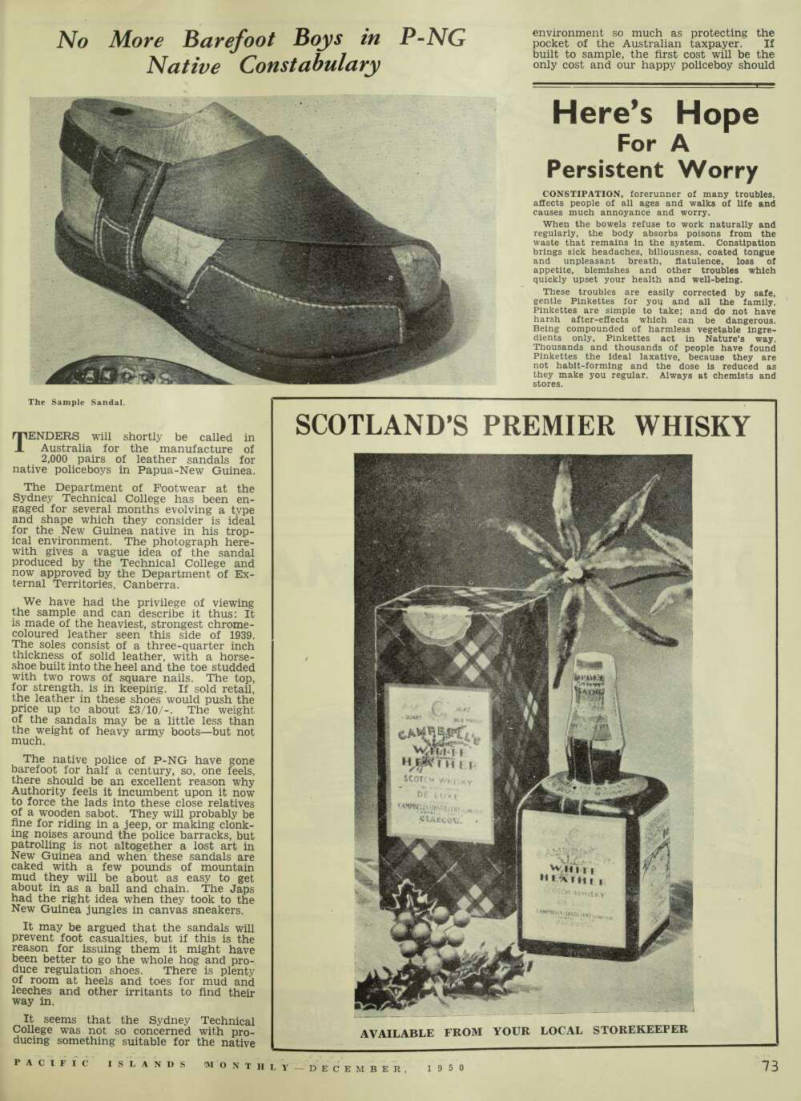
No More Barefoot Boys in P-NG Native Constabulary
TENDERS will shortly be called in Australia for the manufacture of 2,000 pairs of leather sandals for native policeboys in Papua-New Guinea.
The Department of Footwear at the Sydney Technical College has been en gaged for several months evolving a type and shape which they consider is ideal for the New Guinea native in his trop ical environment. The photograph here with gives a vague idea of the sandal produced by the Technical College and now approved by the Department of Ex ternal Territories, Canberra.
We have had the privilege of viewing the sample and can describe it thus: It is made of the heaviest, strongest chrome coloured leather seen this side of 1939.
The soles consist of a three-quarter inch thickness of solid leather, with a horse shoe built into the heel and the toe studded with two rows of square nails. The top, for strength, is in keeping. If sold retail, the leather in these shoes would push the price up to about £3/10/-. The weight of the sandals may be a little less than the weight of heavy army boots —but not much.
The native police of P-NG have gone barefoot for half a century, so, one feels, there should be an excellent reason why Authority feels it incumbent upon it now to force the lads into these close relatives of a wooden sabot. They will probably be fine for riding in a jeep, or making clonk ing noises around the police barracks, but patrolling is not altogether a lost art in New Guinea and when these sandals are caked with a few pounds of mountain mud they will be about as easy to get about in as a ball and chain. The Japs had the right idea when they took to the New Guinea jungles in canvas sneakers.
It may be argued that the sandals will prevent foot casualties, but if this is the reason for issuing them it might have been better to go the whole hog and pro duce regulation shoes. There is plenty of room at heels and toes for mud and leeches and other irritants to find their way in.
It seems that the Sydney Technical College was not so concerned with pro ducing something suitable for the native
environment so much as protecting the pocket of the Australian taxpayer. If built to sample, the first cost will be the only cost and our happy policeboy should
The Sample Sandal.
not only get a life-time of service from them but at the end of his allotted span will be able to hand them down to his children.
Advertisements & other items, pp. 75-76 (3 items)
73
PACIFIC ISLANDS MON T H L V— ? D R C *EM B E R , 1950
Here’s Hope
For A
Persistent Worry
CONSTIPATION, forerunner of many troubles, affects people of all ages and walks of life and causes much annoyance and worry.
When the bowels refuse to work naturally and regularly, the body absorbs poisons from the waste that remains in the system. Constipation brings sick headaches, biliousness, coated tongue and unpleasant breath, flatulence, loss of appetite, blemishes and other troubles which quickly upset your health and well-being.
These troubles are easily corrected by safe, gentle Pinkettes for you and all the family.
Pinkettes are simple to take; and do not have harsh after-effects which can be dangerous.
Being compounded of harmless vegetable ingredients only, Pinkettes act in Nature’s way.
Thousands and thousands of people have found Pinkettes the ideal laxative, because they are not habit-forming and the dose is reduced as they make you regular. Always at chemists and stores.
SCOTLAND’S PREMIER WHISKY
L%
MjWTft 11
H I l|
AVAILABLE FROM YOUR LOCAL STOREKEEPER
Of- > °*Z /j & A. tU« C
Is J or
GILBEY’S
G /L B
Ey ltd • ME u ou
R N E
SYds, by. ’ B *ls B AN£ C 58853 Address all enquiries to W. & A. GILBEY LTD., 33 Rosslyn Street, West Melbourne.
The NEW HILLMAN MINX
h I 5) now has a plus-power engine developing 37.5 h.p.!
This gives you • more SPEED at the getaway • more POWER on the hills — yet running costs are as low as ever Full particulars available from the distributors throughout the Territory of Hew Guinea
COLYER
NEW '
GUINEA,
RABAUI
KAVIENC
74
DECEMBER, 1950 PACIFIC ISLANDS (MONTHLY
Big Increase in Salaries
Salaries for P-NG Native Police
From Our Own Correspondent
Port Moresby Nov. 30.
A NATIVE policeman’s lot in the Terri tory is likely to be a happier one (if money has anything to do with happiness), for pay rates are taking a big jump. And since the increases are retrospective to January 1, 1950, the native police are in for a tidy windfall.
The plain fact is that police wages have been so low, compared with the big money being paid by private enterprise and government departments for semi-skilled labour, that it has been difficult to get and retain police boys.
Under the new rates a third year con stable who has previously been getting 30/- a month, will now get 45/-. A cor porals wages (on promotion) increase from £2/5/- to £6/10/- a month; Sergeant- Major tecond Class jump from £5/5/- to £l2/10/- on promotion, and another £2 after two years. A Sergeant-Major Ist Class gets £l7/10/- per month—an increase of £7/10/-.
This is worth a moment’s calculation: £l4/10/- a month, plus uniform, plus rations for self, wife and children, plus free quarters, light, water and transport, medical treatment, and, in some cases, marginal payments for certain skills. The policeman’s lot ought to be a happy one.
A European employee in the Territory, with £l4/10/- a month left in cash after supporting a family and paying sundry other costs, would count himself lucky.
Ersatz Coconut Gandy
Jj/HAT to do with surplus sweet potatoes—the Australasian Con fectioner gives us this idea :— AMERICA’S wartime “ersatz” candy made from sweet potatoes is coming back into the news. For some un explained reason the US Bureau of Agri cultural Economics recently decided to have some coconut brittle made up from sweet potatoes and try it out on a cross section of the public. To the surprise of most of those involved in this seeming waste of energy, over 40 per cent, of the people on whom it was tried declared that they liked it better than regular coconut brittle. Moreover, the investi gators discovered, it “stood up” better to handling and storage.
Now they’re looking for some candy making firm to turn the stuff out on a commercial scale. One optimistic group assures the potential manufacturer that he’ll make a small fortune with it. That group, however, might be slightly pre judiced in its favour —they’re the sweet potato farmers of Alabama.
Mr. G. B. Milner, of the School of Oriental and African Studies, University of London, was recently in Tonga to make recordings of the language for academic purposes. But he has brought back a fascinating selection of discs covering Tongan poetry, paddle songs, dance songs, and, of course, love songs. Some of these songs were heard in Australia on the ABC National Programme on December 10.
Third Term As Suva Mayor
Mr. T. W. Alport Barker
AT the annual meeting of the Suva Town Council on November 15 Mr T. W. Alport Barker was elected Mayor for a third term.
In August 26 he was elected to the Leg islative Council as the European member for the Southern District. Mr. Barker has given something like 30 years to the public life of the Colony. He was an elected member of the Council for 22 years before he lost to Mr. A. A Ragg in 1944. In 1947 he lost to Mr. Ragg again but in 1950 he came out on top.
A son was born to Mr. and Mrs. Leo Murphy of Lae, New Guinea, recently.
Among delegates at a conference of police chiefs in Sydney in November were Deputy Commissioner W. J. G. HoUard, of Fiji, and Commissioner J. S. Grimshaw, of Papua, New Guinea.
Carols sung by the choir of St.
Matthews Church School, Wamira, Papua, were heard in an ABC radio pro gramme in Australia on the afternoon of December 10.
'There are 89 Australians working in New Guinea, Melanesia, Polynesia, Malaya, and among the Australian aborigines, who have been sent through the Australian Board of Missions. There are 83 mis sionary candidates in various stages of training at the present time.
History was made in Rabaul, New Guinea, in early October. The first native ever to purchase a refrigerator has obtained one from a local store, and threatens to go into business with it, making and selling ice-cream to his brown brothers.
Advertisements & other items, pp. 77-78 (1 item)
Kaven Kerosene Lamps
THE PACIFIC ISLANDS SOCIETY
(Founded 1937) Visitors from the Pacific Islands to Sydney, or persons Interested In Islands affairs, are Invited to communicate with the Honorary Secretary of the above Society which was formed to constitute a social centre for those interested in the Pacific Islands.
Regular meetings and social gatherings, with lectures, are held at History House, 8 Young Street, Sydney, on the fourth Wednesday of each month, at 8 p.m.
Address for correspondence:—
THE PACIFIC ISLANDS SOCIETY
Box 2434, G.P.0., Sydney.
KAVEN KEROSENE LAMPS
The most suitable lamps for the South Pacific Kayen Lamps are designed for good hard use in all climatic conditions.
They provide a full 300 candlepower of unflickering steady light, even in severe draughts. The mantle is a simple double-tie type which provides a long life. All vibration is taken away from the mantle and burner top and nothing is held rigid which might tend to break the mantle. All Kayen lamps are fully insect proof. Glassware is strong Pyrex glass and the oil container, pump and burner body are made of solid brass and will not corrode. The vaporiser is fitted with an internal automatic cleaning needle with a stainless steel jet. The brass pump is selfcontained and may be completely removed with the fingers only. Kayen Lamps run efficiently, light easily and are easy to manage and adjust.
Kayen Model AP2 All Purpose Lamp is the most useful lamp ever produced. With reflector as illustrated, it is a shadowless hanging lamp suitable for use inside or out. Without reflector, which slips off, it is an efficient storm lantern not affected by wind or rain.
With an extra parchment shade, not illustrated, it is a bright, attractive lamp for the home and may be placed on a table or shelf anywhere. Fitted with 12 in. reflector overall height 19 in.
Kayen All-Purpose Kayen Tall Table Lamp, Lamp. standing 24 in. high, it throws a full 300 candlepower, steady light over the largest room. It is a firstclass lighting unit and a beautiful ornament. For reading, studying or fine work this lamp is indispensable and, although more brilliant than any other class of kerosene lamp, the light is soft and does not offend the eyes. Can be supplied with Pyrex opal anti-glare shade as illustrated, or with a handsome 16 in. parchment shade. May be carried from room to room wherever required.
We have large stocks of other types of kerosene lamps, including the Famos Wick and Mantle Table Lamp, Veritas Kerosene Pressure Lantern, Blue Boy and Blue Ace Kerosene Stoves, Companion Primus Stoves, Thermil Wick Stoves, etc. Write for catalogue.
Available from stores in all centres or from
W. KOPSEN & CO. PTY. LTD.
n Kayen Table Lamp.
376/382 Kent St., Sydney.
Cables: "Kopsen," Sydney.
the Key to Earning Power
Sometimes men think that a general education or an elementary knowledge of business is enough to get ahead. But experience soon teaches that thorough, specialised training is just as necessary for success in business as it is in the professions of Law, Medicine or Dentistry. If you are interested in the many opportunities in the Business World ... if you seek responsibility, success and economic security, commence training now —in some specialised business subject. H.R.I. is available always to help and advise ambitious men and women. Write or wire for particulars and career information.
H.R.I. tutorial service is proved by the winning of more honours than all coaches in Australasia combined.
H.R.I. Career Training • ACCOUNTANCY • SECRETARYSHIP • COST ACCOUNTANCY
• PRACTICAL BOOKKEEPING • MARKETING SELLING
ADVERTISING • BANKING • LOCAL GOVERNMENT EXAMS.
H emingwaT Robertson Institute
Founded and Owned by Hemingway & Robertson Pty. Ltd.
Consulting Accountants :: :: Professional Tutors
126 BANK HOUSE, BANK PLACE. MELBOURNE
126 BARRACK HOUSE. 16 BARRACK STREET. SYDNEY 126/814
A Famous Frenchman is Buried
Here
Near the sea on Bora Bora, French Oceania, lie the last remains of Alain Gerbault, yachts man, writer and tennis champion. He died in Portuguese Timor during the war, but a French gunboat a year or so ago removed his remains to French Oceania, which he loved so well.
Advertisements & other items, p. 78 (1 item)
»ILt tl ®
HEAD OFFICE:
379 KENT STREET, SYDNEY, N.S.W.
Telegrams and Cables: “CHASULL,” SYDNEY. Telephone: MJ 4657, And at Melbourne, Victoria Brisbane, Queensland.
Ft f
»ILt tl ®
Associated Companies : C. SULLIVAN (PACIFIC ISLANDS) LTD., Suva, Fiji.
C. SULLIVAN INC., 230 California Street, San Francisco, U.S.A.
Over 30 Years' Pacific Island Experience Expert Buying Service Original Invoices Furnished Overseas Indents Arranged Best Prices for Copra, Cocoa, Shells, and General Island Produce,
News Notes From Port Vila
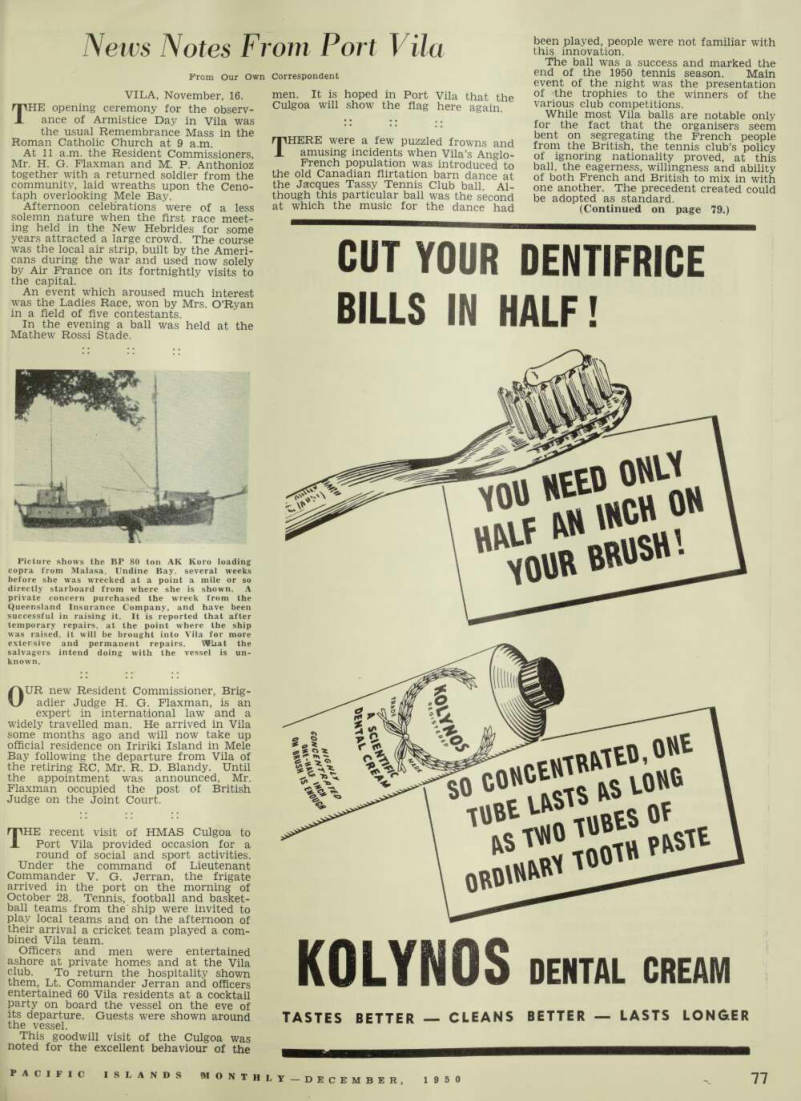

From Our Own Correspondent
VILA, November, 16.
THE opening ceremony for the observ ance of Armistice Day in Vila was the usual Remembrance Mass in the Roman Catholic Church at 9 a.m.
At 11 a.m. the Resident Commissioners, Mr. H. G. Flaxman and M. P. Anthonioz together with a returned soldier from the community, laid wreaths upon the Ceno taph overlooking Mele Bay.
Afternoon celebrations were of a less solemn nature when the first race meet ing held in the New Hebrides for some years attracted a large crowd. The course was the local air strip, built by the Ameri cans during the war and used now solely by Air France on its fortnightly visits to the capital.
An event which aroused much interest was the Ladies Race, won by Mrs. O’Ryan in a field of five contestants.
In the evening a ball was held at the Mathew Rossi Stade.
OUR new Resident Commissioner, Brig adier Judge H. G. Flaxman, is an expert in international law and a widely travelled man. He arrived in Vila some months ago and will now take up official residence on Iririki Island in Mele Bay following the departure from Vila of the retiring RC, Mr. R. D. Blandy. Until the appointment was announced, Mr.
Flaxman occupied the post of British Judge on the Joint Court.
THE recent visit of HMAS Culgoa to Port Vila provided occasion for a round of social and sport activities.
Under the command of Lieutenant Commander V. G. Jerran, the frigate arrived in the port on the morning of October 28. Tennis, football and basket ball teams from the ship were invited to play local teams and on the afternoon of their arrival a cricket team played a com bined Vila team.
Officers and men were entertained ashore at private homes and at the Vila club. To return the hospitality shown them, Lt. Commander Jerran and officers entertained 60 Vila residents at a cocktail party on board the vessel on the eve of its departure. Guests were shown around the vessel.
This goodwill visit of the Culgoa was noted for the excellent behaviour of the
men. It is hoped in Port Vila that the Culgoa will show the flag here aeain Thfrf wprp a fpw rm 7-71 ph , were a lew puzzled frowns and amusing incidents when Vila’s Anglo .. M r6 n Ctl P 9 was introduced to the old Canadian flirtation barn dance at the Jacques Tassy Tennis Club ball. Al though this particular ball was the second at which the music for the dance had
been Played, people were not familiar with this innovation.
The ball was a success and marked the end of the 1950 tennis season. Main event of the night was the presentation of the tr °P hies to the winners of the various club competitions.
While most Vila balls are notable only for the fact that the organisers seem bent on segregating the French people from the British the tennis rlnh’s nniirv of ignoring Nationality^ moved at thZ ball, the eagerness, willingness and ability of both French and British to mix in with one another. The precedent created could be adopted as standard,
(Continued on page 79.)
Picture shows the BP 80 ton AK Koro loading copra from Malasa, Undine Bay, several weeks before she was wrecked at a point a mile or so directly starboard from where she is shown. A private concern purchased the wreck from the Queensland Insurance Company, and have been successful in raising it. It is reported that after temporary repairs, at the point where the ship was raised, it will be brought into Vila for more extensive and permanent repairs. What the salvagers intend doing with the vessel is un known.
It had become the accepted practice to place all French guests at a ball at tables along one side of the hall, and all the British at tables the other side. No one seemed to know why—it is just the cus tom.
Anglo-French relations in Port Vila are extremely cordial, especially among the older residents, and any opportunity to further them should be seized upon.
Maybe this can be done by the barn dance, which belated as it may be, is in Vila to stay!
The Condominium water carrying ser vice of Vila has been hard pressed of late to keep pace with the urgent demand of residents for water to fill their tanks. With no rain for over a month, Vila’s household tanks have long been dry.
Optimistic housewives who thought October an ideal month (because of the advent of the change of seasons) to plant their gardens, have seen their seedlings sprout then wither —or not sprout at all.
There is no permanent water supply in the town, only rain water; and a regular supply of that is necessary to keep the tanks full. The once much talked-about water reticulation scheme is not so much talked about now-a-days. However, at the time of writing the appearance of the sky is promising and those who can read the signs predict rain within 24 hours.
Rain clouds which accumulated during the “drought” were always quickly disper sed or blown northward.
Rain will also be welcome to cool the atmosphere which for the past week has been as oppressive as the hot season which promises to be long and severe this year.
One commercial company recently re ported that its labour line had taken a rest for a day or so because it was “too hot to work!”
INDICATIONS of the manner in which the cost of living in the New Hebrides continues to soar is found in the recent circular sent around to members of the New Hebrides Club announcing an “extraordinary meeting” of members to discuss, among other things, an increase in monthly fees.
The very high cost of living in this Group is due mostly to the high cost of freight from Australia, the sole provider of the bare necessities of living in these islands.
The following is given as an indication to prevailing prices (in Australian cur rency) : Tinned fruit, 3/- tin; freezer cargo eggs 7/6 doz; freezer cargo butter, 5/9 lb.; tea! 8/6 to 8/9 lb.; last onions received, 1/- lb.; potatoes, 6d. lb.; flour, 7d. lb.; rice, 9d. lb’.
These are but a few items which are indispensable to the housewife and the prices listed are the lowest in town.
A recent noticeable increase was that in the price of English cigarettes. In a week they jumped from 3/6 to 4 7 3 a tin of 50.
Only about 20 members of the bride and bridegroom’s families were able to be accommodated in the tiny Bong Bong Church (NSW), for the marriage of Miss Jill Throsby to Mr. Peter Chauncy on October 6. The bride is the eldest daughter of Mr. and Mrs. Frank Throsby, of Throsby Park, Moss Vale, and the bride groom is the only son of the late Mr. A.
A. Chauncy, of Rabaul, and of Mrs. J.
Goldhill, of Point Piper. Miss Pamela Chauncy was one of the bridesmaids.
Two Councillors of the French Union, Madame Paule Malroux and Monsieur Charles Dumas, have arrived in New Cale donia, by Air France.
Mr. and Mrs. J, Pound who have spent the last four years in Rabaul, NG. arrived in Brisbane in November. Mr. Pound has been instructing natives in motor mech anics and Mrs. Pound opened RabauTs hrst and only post-war frock shop.
Mr. and Mrs. Robert Charon and Miss Roberte Charton, were in Sydney in October en route to Tahiti where Mr.
Charon is Consul for Norway. They have spent the last year travelling in America, Europe, Scandinavia and North Africa. ~ll J
Sister lima C. Townson, of the Anglican Mission, Papua, was the speaker at a Medical Mission service held at the Bris bane Congregational Church on Novem ber 19.
The Nickel Company ship Quebec has been loading a shipment of 3,000 tons of Iron ore from the Carenage Bay in New
Caledonia; and is also to load giobertite at Voh, for Australia. The island authorities faced with an adverse balance of trade, are anxious that the Common wealth should take iron ore exports from the vast limonite deposits on the Plaine des Lacs, formerly exploited to a limited extent only by the Japanese from the little port of Goro.
Advertisements & other items, pp. 79-82 (2 items)
77
PACIFIC ISLANDS HONTHLV-D E C E M B E R , 1950
Kolynos
CUT YOUR DENTIFRICE
BILLS IN HALF!
OHU
HttO
YOO
OH ihoh Ml
ROUSH!
'IOOH
2 O r
S*S;* V*.
V? %&C + out o tuxfviaw
CO^O
\.OUO
so
IVS
toot Of -wots *sw> pSXSft «o\u^ x 0
KOLYNOS
DENTAL CREAM
TASTES BETTER CLEANS BETTER LASTS LONGER
There is only one
ELECTROLUX
THE MODERN KEROSENE-OPERATED REFRIGERATOR
THAT ACHIEVES THE MIRACLE OF ICE FROM HEAT
Lasting Efficiency, Silent Operation, Streamlined Beauty
• - ■- : ; .ft* '■ ; - - - ■ 1 ft* : -■ i Mils ■ ■ ■ Economically operated by kerosene, with a simple precision-built freezing unit that has no moving parts and is GUARANTEED FOR
FIVE (5) YEARS.
Only obtainable from:
NEW GUINEA COMPANY, LIMITED,
Rabaul, Madang, Lae, Kavieng.
J. R. CLAY & CO., LTD., Port Moresby.
W. R. CARPENTER & CO. (Sol. Is.), LTD., Tulagi.
THE NORFOLK ISLAND SERVICE DEPOT,
Norfolk Island.
SOCIETE HEBRIDA, Port Vila.
SOCIETE CALEDONIENNE DTMPORTATTON ET
D’EXPORTATION, Noumea.
For Gilbert and Ellice Islands Colony, etc., apply
W. R. CARPENTER & CO., LTD.
Model LKSSI
PRICES ON APPLICATION.
Storage capacity: 5i cub. ft. (approx.); shelf area, 10 sq. ft. food shelves, six—five removable; 2 self-supporting when half drawn. Ice-making: Four trays —5 lb. ice per freezing: 80 cubes. Fuel consumption: 1.8 pints kerosene per day (approx.).
Height: 4 ft. 10 in. Depth: 2 ft. 3i in.
Weight, unpacked, 406 lb. Packed, 574 lb. direct to: Head Office: 16 O'Connell St., Sydney, N. S. Wales
KANGAROO BRAND
Ropes,
Cordage,
ond Twines for every purpose
Backed by
98 years of service Manufactured by:
M. DONAGHY AND SONS,
PTY. LTD., Geelong & Sydney.
Fiji Representatives:
PEARCE AND CO.
LIMITED
P.O. BOX 237, SUVA
Look for KRAFT
and find QUALITY
The unchanging quality of Kraft foods is a byword wherever fine foods find appreciation. In their constant vigilance over quality, Kraft experts have achieved even more than just that, for hand in hand with Kraft quality goes flavour perfection and food value of a very high order.
Wherever you see the name “Kraft”, buy confidently, and remember, “Red Feather” foods are made by Kraft too. No finer foods can be found.
Export Division .
Kraft Walker Cheese Co. Pty. Ltd.,
Riverside Ave., South Melbourne,
AUSTRALIA.
3O6EMITIO
Mi m
KRAFT
V // Three famous Kraft Foods now available in full supply everywhere .
VEGEMITE the delicious, healthful yeast extract One of the richest known sources of the important Vitamin B complex. Strongly recommended in all areas where fresh vegetables are scarce, A little does a power of good.
KRAFT CHEDDAR CHEESE a
creamy-smooth, choice processed cheddar.
Rich in Vitamins A, B and D, calcium, phosphorus, and other nutrients of milk.
Always fresh whether in the attractive blue can or in its hygienic foil wrapping. Not too sharp not too mild just too good for words.
BONOX pre-digested beef in its tastiest and most assimilable form. A valuable food for its high content of niacin (the anti-pellagric factor), and a powerful digestive stimulant. Dissolve in hot water for an appetising drink, or use as a spread or a flavouring for cooked dishes. Eat it and drink it for a lift I
SCRAP IRON SCRAP STEEL SCRAP METALS
PIG IRON PIG LEAD INGOT METALS
?Swts
Metal Merchants ★ Metal Refiners
Head Office: WILFORD STREET, NEWTOWN, N.S.W.
Phone; LA 5111 (6 lines).
Cable and Telegraphic Address; “SCRAPMETAL,” Sydney.
Works: 2 CANAL ROAD, MASCOT, N.S.W.
Buyers of Non-Ferrous Scrap, Cable, Shells, Cartridges, Copper, Lead, Muntz Metal, Aluminium LARGEST BUYERS OF SCRAP IRON Cr METALS IN AUSTRALIA
V. *> mgr —-j£ A#
'ciuteos.
£±r.
C> \P S
WHOLESALE MERCHANTS
GENERAL AGENTS
\ uj VJJ c ii nwtni^ —
FORWARDING, SHIPPING fi CUSTOMS AGENTS •
Sda Camp Meeting At
Kolombargara
Prom Our Own Correspondent
Honiara, Nov. 1
THE Western Solomons Mission of Seventh Day Adventists held a Camp Meeting and Conference Session at Kukudu, Kolombangara, from October 12-20. The Camp Meeting was attended by more than 3,000 native people from all over the Western Solomons.
Houses were specially built to accom modate those who assembled for meetings in a huge pavilion with seating accommo dation for nearly 3,000. All European staff of the SDA Western Section, and most of the Eastern Section staff, were present.
The Coral Sea SDA Mission and the Australasian Inter-Union SDA Conference were represented. Native delegates took their full share in the business of the conference. School and village choirs sang, a brass band was in attendance, and a massed Mission Choir sang the Halle lujah Chorus. The Meeting is the second large Camp Meeting held this season by the SDA Mission. The other was held in August at Bena Bena in the New Guinea Highlands.
Mrs. Alex D. Fauth, New Guinea, has been ill in Sydney, but has now recovered, She and her husband volunteered over years ago to go as lay workers to the Society of the Divine Word Mission in NG. Mrs. Fauth has been teaching the native girls and Mr. Fauth has been super vising building work.
Advertisements & other items, pp. 83-84 (2 items)
81
-DECEMBER, 1950
PACIFIC ISLANDS MONTH
NG's ENRICHED CHINESE
(Continued from Page 30)
M I Pana
FOR A DAIIUNG
SPARKLING SMIII
TOOTH PASTE
At least twice a day, brush your teeth thoroughly and massage your gums gently—with IPANA. That's the way to a dazzling smile!
IPANA not only cleans and polishes your teeth to sparkling whiteness, it stimulates circulation in the gums . . . keeps them firm and healthy. IPANA guards against decay, because kts deep-reachi foam sweeps away germs and food particles.
You'll like IPANA—it's refreshingly different!
Sold Everywhere «3 9 * o S o mo for f A product of Bristol-Myers.
To N.Z.,Australian and British Manufacturers . . .
Are You Getting Your Share of the Cook Islands Trade?
If you wish to market profitably your products in the Cook Islands, among over 300 Europeans and 1 5,000 Islanders in the Group, then contact . . .
UNITED ISLAND TRADERS LTD.
We have the organisation to make the best display and distribution of your article. Send us your quotation—direct service means lower selling cost, increased sales and quicker turnover. Tell us about your products and we will fully investigate and report upon the available market for them in our area.
United Island Traders Ltd.
(Established 1930)
P.O. BOX 42, RAROTONGA, COOK ISLANDS.
Managing Director: W. H. Watson. Secretary: R. J. A. Ingram, A.R.A., N.Z.
Cables: “Watson,” Rarotonga. Bankers: Bank of New Zealand Ltd., Shortland St., Auckland, N.Z.
London Agents: Geo. H. Penney & Co. Ltd., 197 Aldersgate Street, London, E.C.1., England.
IMPORTERS OF: Trade Jewellery, Building Materials. Cotton & Silk Piece Goods, Apparel & Drapery, Musical Instruments, etc.
EXPORTERS OF: Sea Shells, Tomatoes. Cassava, Island Handicrafts, etc.
MANUFACTURERS OF: "Broad-last” Shoes and Sandals for men, women and children —specially made for the South Seas trade. Wholesale inquiries invited.
LICENSED STAMP DEALERS
Call for a The Favourite Beer, Matured but freshly bottled Brewed tr Bottled by
§> an jWtftuel Mxmetp
Honfiibon.S.'Etb
ST*2
MiSSS
f Obtainable from:
ALOIS AKUN & COMPANY
RABAUL
News Notes From The Goldfields
From Our Own Correspondent
WAU, NG, November 30.
A FETE and exhibition held at Bulolo on October 21 to raise funds for the Hobby Centre and Sunday School in that District, made £392. The exhibition hall was extremely good and the judges, Mesdames R. Franklin, A. Bowring (both of Edie Creek) and J. Given of Wau, had a difficult job in making awards.
ON October 29, the bachelors of Wau entertained the residents of Wau and surrounding districts at their Annual Ball. The night began with savouries and cocktails at 7 p.m. and con tinued until breakfast at 6 a.m. the fol lowing morning. The band played, favours were distributed and decorations, which had been brought from South, were greatly admired. This first post-war Bachelors’ Ball outshone anything we have previously seen in this district.
A LARGE patrol left Slate Creek on October 30, for Menyama, 10 days’ walk aw r ay. Assistant District Officer Lloyd Hurrel is in charge of the party consisting of 14 Native Policeboys and 100 carriers—Cadet Patrol Officer Keenan is accompanying Mr. Hurrel. The party intends to establish a post at Menyama, in the centre of Kukukuku country. There was a post there before the war.
This was the patrol that Assistant Dis trict Officer Doug. Parrish was to under take but owing to an accident he had to withdraw.
MRS. PRICE of Port Moresby Girl Guide Headquarters and Miss M.
Jackson of Brisbane Girl Guide Headquarters visited Wau, November 1-3, to ascertain whether a Girl Guide Move ment would be possible in the Wau- Bulolo districts. They decided that there were insufficient girls of Girl Guide age here and therefore Brownie packs will be formed.
Anglican Coadjutor Bishop, the Rt. Rev.
G. D. Hand, visited Wau on November 5-6, his first visit since he was consecrated earlier this year. He also visited Bulolo and Lae.
New guinea goldfields, ltd., at Wau, are now supplying pre-cut houses to Port Moresby at the rate of 20 per month—in addition to 50,000 super feet of timber per month to the Department of Works and Housing. Lae.
This company’s saw-mill cut a total of 225,293 super feet of timber in October; 117 tons of timber were freighted to Lae by road, in return for 115 tons of inward freight.
THE New Guinea Citizens’ Association (Wau Branch), held its Annual Show on Sunday, November 12. The exhibits were of good standard although there were not as many as last year. Mrs.
R. Franklin of Edie Creek won the cup for the aggregate score of points; and Mr.
Norman White, of Wau won the cup for most points scored for vegetables ex hibited.
THE citrus orchards in the Bulolo Valley are proving a great success but to keep the trees healthy they are sprayed monthly.
Mr. Austin Ireland’s 600 citrus trees show great promise; 100 mandarin trees are in full bloom and the lemon and grape-fruit are just beginning to flower.
The orange trees are bearing. Mr. Ire land hopes that next year he will be marketing his fruit in the district. The
trees were 3i years old when planted and have now been in for 21 years.
Bulolo Gold Dredging, Ltd., have also planted a small orchard of citrus trees which arrived on the last Mangola. They are expected to be bearing in 1952. There are 125 oranges, 50 mandarins and 25
grapefruit.
SEVERAL small shops have opened at Wau recently and are proving a great boon to the residents. The new picture theatre was officially opened by the Assistant District Officer, Mr. H. P.
Seale, in October.
The new District Office is being speedily
erected by the local contractor, Mr. L.
Young, and appears to be an impressive establishment.
SUPREME Court sittings were held at Wau this month when Chief Judge F. B. Phillips visited here for a week.
The Crown Prosecutor, Mr. O’Driscoll, ac companied him and on the 21st they left for Lae to hold sittings there.
ON November 18 Ivor Novello’s Three- Act Play, “Full House,” was put on at the War Memorial Hall by the Wau Dramatic Society. The producer, Mrs. I. Connell, was congratulated on the fine performance. Worthy of special mention were Mrs. Kath Owers and Miss Jo Keating who played their large parts exceedingly well.
(Continued Next Page.)
THE Naughty Nineties Buffet held here at Wau Club on November 25 was a huge success and proceeds (£200) went to St. Augustine’s Church, Wau.
Mr. Len Young, local contractor and builder, has been given a contract to build the Mining Warden’s Office which will adjoin the new District Office. Work is expected to commence at an early date.
On November 27, two babies were born at the Wau Hospital—a daughter (Ann) to Mr. and Mrs. A. Stevens of Wau; and
a son (Peter Allen) to Mr. and Mrs. W.
C. Peters of Golden Ridges, Wau.
Visiting Wau at present in connection with New Guinea Goldfields Ltd., are Messrs. A. J. Cotter, E. D. Cameron and J. H. Kitto. They are members of the well-known Sydney firm of Priestly & Morris, Public Accountants.
Mr. E. J. Wauchope of Hansa Bay, near Madang, New Guinea, arrived in Sydney recently. He does not intend to return permanently to New Guinea.
Advertisements & other items, pp. 85-86 (2 items)
83
PACIFIC ISLANDS MONTHLY-D E C E M B E R . 1950
Dettol
Kt?
I ■ii » m m V m raft Si
Tell me
doctor
Can an antiseptic help in healing ? ”
Wounds heal of their own accord when they are kept free from the germs that cause septic infection. To keep wounds in the healthy condition for healing, surgeons have for years relied upon ‘Dettol’. This ruthless destroyer of germs is non-poisonous, gentle and safe on human tissues. While it disinfects the wound, ‘Dettol’ leaves the living tissues undamaged to continue the natural processes of safe and rapid repair.
DETTOL
THE MODERN ANTISEPTIC
Rain leaking through a rusted roof can cause extensive damage. Insure against this now with Pabco Hydroseal. A specially formulated waterproofing mastic, Hydroseal will completely seal rusted patches and help prevent further corrosion. Inexpensive, easy to apply, Hydroseal is immediately effective and will last for years. Apply at least i" thick.
HYDROSEAL
THE LEAK FIXER
ESSSSSy Available in sizes 4 +o 10 lbs. from all leading Island Stores. If your store does not stock Hydroseal, write to us direct.
PABCO PRODUCTS PTY. LIMITED. 150 Wigram Road. Glebe. N.S.W.
Sole Manufacturers of Genuine wp y i P*
PABCO
Madang Newsletter
From Our Own Correspondent
Madang, Dec. 1.
ABOUT 23 years ago a young girl, Miss Roma Bryant, went to Rabaul. Now, as Mrs. Charles Bates, wife of Madang’s District Commissioner, she leaves the Territory with the good wishes of friends throughout the Territory of Papua-New Guinea.
In Manly, NSW, Mrs. Bates will make a home for her eldest daughter, Patricia, who recently left school, Hilary and in fant son, David. Later in 1951, the family will be joined by Mr. Bates when he will take long service leave.
Prior to her marriage, Mrs. Bates was on the staff of Burns Philp, Rabaul; she was an active member of the Rabaul Dramatic Arts Society and among other talents, she numbered dressmaking, cook ing and floral arrangement.
She returned to Rabaul with Mr. Bates after the war. They were transferred to Madang about 18 months ago. On De cember 1 an afternoon party was ar ranged by the ladies of Madang, when an air-travel bag was presented to her.
AT a meeting of the local branch of the Public Service Association, it was de cided not to protest against recently increased hours of work. But members seemed unanimous in their decision that where the extra time had been worked by many as a free will gesture, making it compulsory savoured of a loss of freedom.
Comparisons with other Colonial Ser vices point to the fact that the New Guinea service rates low as regards hous ing, salaries and free servants, therefore it seems a peculiar policy to lower standards still further.
Senior men are staying here just long enough to qualify for their pensions; the junior men are looking out for more suit able employment; while it is unlikely that newcomers will join a deteriorating ser vice.
ON Guy Fawkes’ eve, the Club ran a well-attended ball. During the even ing a competition was held to de cide who was the most appealing wife and who the most desirable choice for a husband. Mrs. Tom Cunnington and Mr.
A. Robson came in as winners.
ANEW type plane, the Drover, suc ceeds the old Dragon in local Qantas service. With a higher ceiling and more speed the new aircraft is expected to be better for the unexpected hazards of the New Guinea Highlands.
THE Treasurer of Papua-New Guinea, Mr. H. A. Reeves, and the Chief Auditor, Mr. Gordon Farmer spent some time in Madang recently reviewing staff and general conditions.
FIRST week in November saw the un beaten Administration cricket team suffer its first defeat. Only District Commissioner Bates kept up the bowling standard of the Admin, team with 3 for 56.
Brian Krickenbeek scored 67 with some dashing batting in partnership with John Frazer with a score of 46. Apart from Jim Kernan (34) and Geoff Kennedy (35), the Admin, batting was weak. For Com merce, the best bowling average was Jim O’Brian’s with 4 wickets for 35. Final score gave the win to Commerce with a total of 157 against Admin’s 147.
Golf also is in favour in Madang. At a meeting, early in November, a commit tee of five, Messrs. C. Bates, R. John stone, W. Burdus, F. James and J. Es son were elected. Mr. Reg. Johnstone won the Handicap on opening day.
MR. DAVE REES, back from leave in Brisbane, says “I’ve come back for a rest.” While on leave his wife and son were admitted to hospital and he had to take the two younger children everywhere he went. The day after he landed he was on his way to Dylup where he will work on one of the plantations for NG Estates. Mrs. Rees and the children will join him in the New Year.
Mr. and Mrs. Hector Longmore, with infant daughter, Janice, go South on leave on December 18. He is local manager for Vacuum Oil. On their return they will move into a new Bulolo type house on Kalibobo, adjacent to the lighthouse.
TWO new roads are nearing completion on Kalibobo. They are an improve ment on the unfortunate scheme on the older road where so many homes front on to the backyards, garages, fowl pens and boys’ houses of the coastal homes.
Madang people still wonder why the beautiful waterfront cannot be utilised for residential areas.
The European Hospital still holds up, despite its wartime service and the fact that Dr. Mervyn Deland condemned it early in 1946. We wonder how soon the dream hospital, modernly equipped, with sound-proof privacy for the patients, modern conveniences for the nursing staff and better facilities for the medical officer, can be expected. Sister Kiernan has done a grand job in improving the appearance with gay curtains and paint but it is not big enough or convenient enough to suit the requirements of a district of 495 Euro peans. It is understood that plans for a new hospital are in the blueprint stage.
Nothing has yet been done on the new wharf but staff quarters for the contrac tors are nearly completed.
OVER the past few months there has been an increase in small boats.
Canoes, dinghys, sail boats and out boards star the harbour and the passage to Sek during the weekend and after working hours. Another increase has been noted in dogs and pups, who add atmos phere to the domestic scene with an oc
casional fight. Bicycles, too, are becom ing an additional means of transport in the area.
SITTINGS of Supreme Court in Circuit commenced at Madang on Novem ber 30. Chief Justice F. B. Phillips presided. A long list of cases—all native —were listed for hearing.
Advertisements & other items, pp. 86-90 (5 items)
84
DECEMBER, 1950-PACIFIC ISLANDS (MONTHLY
85
PACIFIC ISLANDS MONTHLY_D E C E M B E R , 1950
Bovril
A. B. DONALD Ltd.
AUCKLAND, N.Z.
ISLAND TRADERS & GENERAL MERCHANTS
P.O. Box 1509. Cables & Telegrams, "Kingdom," Auckland.
Nowadays you
need the strength of
BOVRIL
★ Remember BOVRIL makes delicious sandwiches and improves all dishes
Agents: BURNS, PHILP GUINEA) LTD
Insist on. . .
“Bit o KTI?”
CANNED MEATS, HOTMEALS AND SOUPS
Available in 12 oz. and 1 lb. sealed cans in the following
appetising flavours and combinations:
• Corned Beef Loaf With Cereal • Braised Steak and Onions 6 Boiled and Roast Beef 9 Beef Steak Pudding • Mutton and Peas • Steak and Onions • Chili Con Came • Curried Mutton • Curried Beef • Irish Stew • Mulligatawny Scup • Vegetable Soup • Mutton Broth • Tomato Soup • Camp Pie
“BRONTE" Brand high-grade products
are made from the finest fat stock
and the richest vegetables in Australia,
deliciously flavoured.
THE COLONIAL WHOLESALE MEAT CO.
PTY. LTD.
Canning Factory: State Abbatoirs, Homebush, Sydney,
N.S.W.
’PHONE: UM 8436 CABLE ADDRESS: “WOOLMILL,” SYDNEY.
A 0
FOR
VERANDAHS
SUNROOMS
LOUNGE-ROOMS
KITCHENS
LAUNDRIES
This ultra modern window comprises a series of glass blades swung one above the other and inclinable to any angle.
Air entering the room is diverted towards the ceiling, thus preventing draughts. AGCO Supaluvres have all the advantages of other louvre windows plus exclusive features.
HOW THEY WORK:—
1. Handle automatically locks A louvres in closed position. 2. Pawl holds louvres locked open fully open in four positions. f: :r:;; _k 3. Pinion engages driving rack to revolve louvres. 4. Patent “Rainguard” stops rain entering between glass holders and channel.
Full light and air with yearround weather protection.
ROBERT GILLESPIE PTY IT?
S4a PITT ST..SYDNEY- PHONES-8W4782* BISOS
Allen Taylor & Co. Ltd.
COMMERCIAL ROAD, ROZELLE
SYDNEY
Sowmillers and Wholesale Suppliers of Hardwoods for Constructional Purposes GIRDERS . , , PILES . . . POLES . . . SLEEPERS, Etc.
EXPORTING TO PACIFIC ISLANDS SINCE 1893
- < mm 0333 i»« * * ■- Wholesale and Retail Merchants —Sawmillers and Timber Merchants-
Plantation Proprietors and Managing Agents—Ship Owners-
Shipping, Insurance and Customs Agents—Plantation Suppliers
Exporters of Island Produce.
AGENTS FOR:
Australia-West Pacific Line.
Canton Insurance Office, Ltd.
Union Assurance Society, Ltd.
Aust. T. & G. Mutual Life Society, Ltd.
ASSOCIATED WITH:
Colyer. Watson Pty., Ltd., Sydney, Melbourne, Brisbane.
Colyer, Watson & Co., Ltd., Wellington, Auckland, Christchurch.
DISTRIBUTING AGENTS
Hillman, Humber, Sunbeam-Talbot, Chrysler and Plymouth Cars.
Commer, Karrier and Fargo Trucks.
Willys Overland Jeeps.
Chula Copra Dryers and Desiccated Coconut Machinery.
G.M. Marine and Industrial Engines.
IN NEW GUINEA FOR:
Olympic Tyres and Cables.
Hygeia Dissolvenators.
Sherwin-Williams Paints.
Prefect Refrigerators.
Mullard Radios.
Aladdin Lamps.
Anchor and Tiger Beers.
Snowflake Unsweetened Evaporated Milk.
Pental Soaps.
COLYER WATSON (.=.) LTD
• RABAUL MADANG • KAVIENG •
December, 1950 Pacific Islands (Monthly
87
NOTES BY THE WAYSIDE
(Continued from page 27)
PACIFIC ISLANDS MONTHLY DECEMBER, 1950
Samoa—Tonga
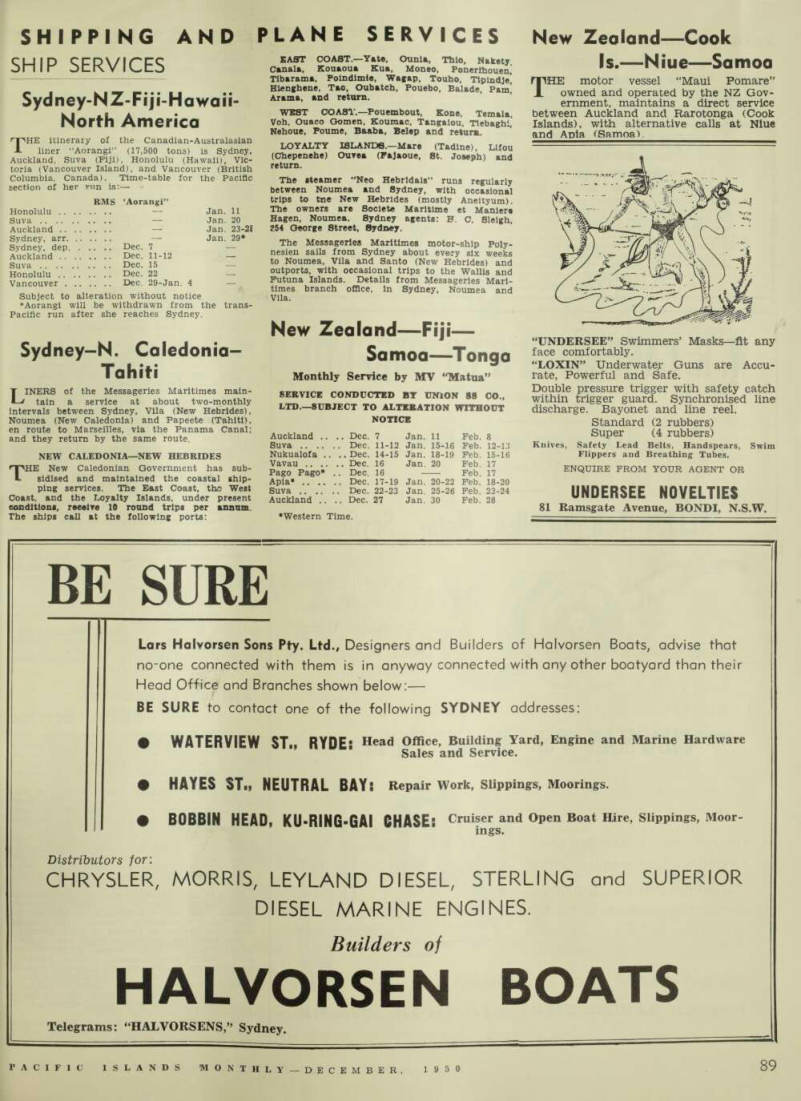
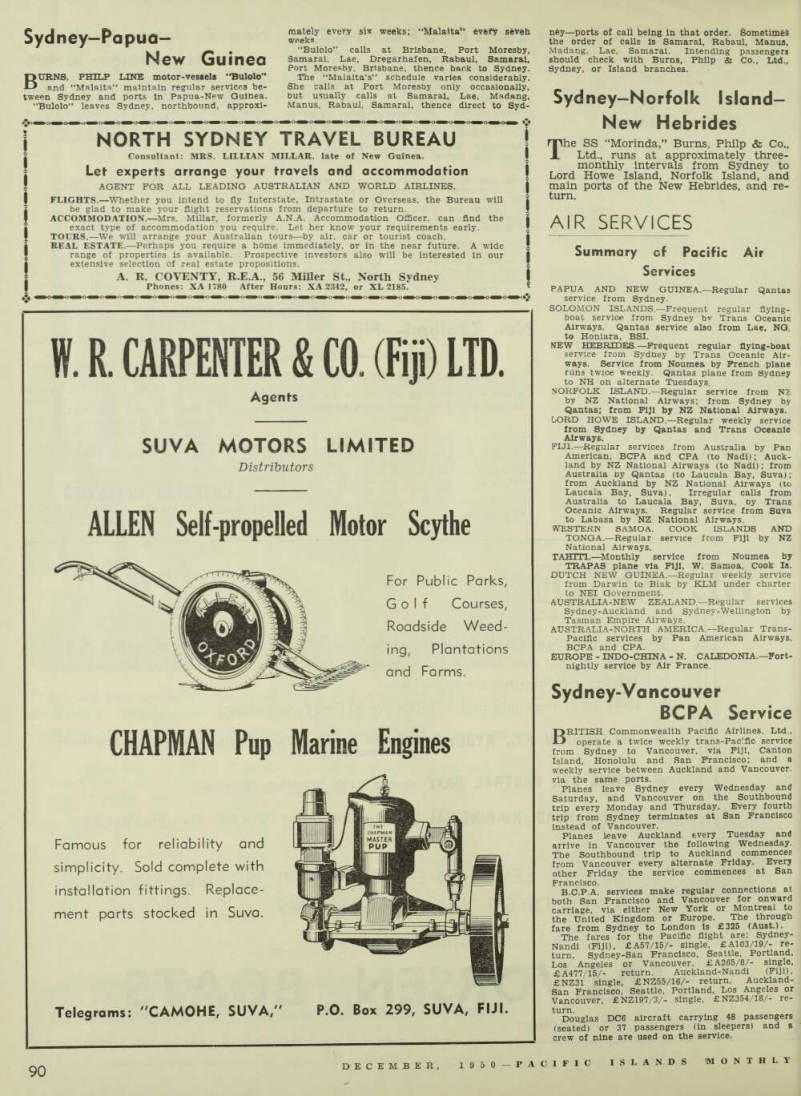
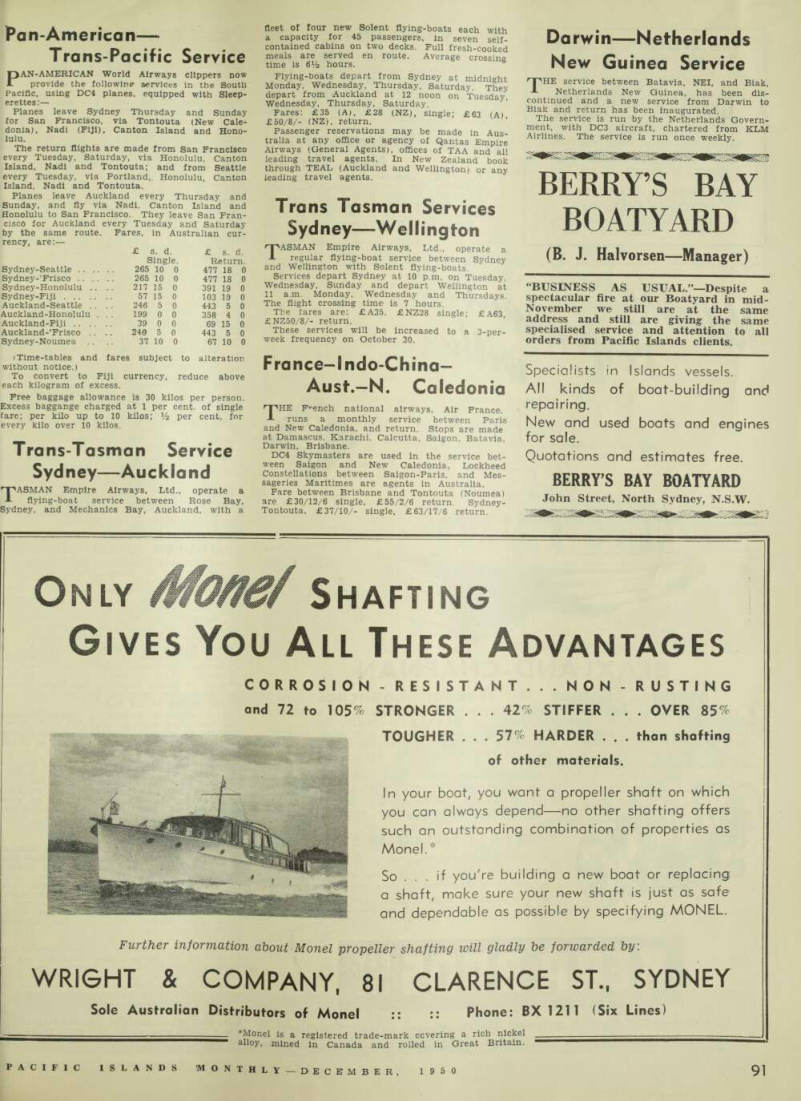
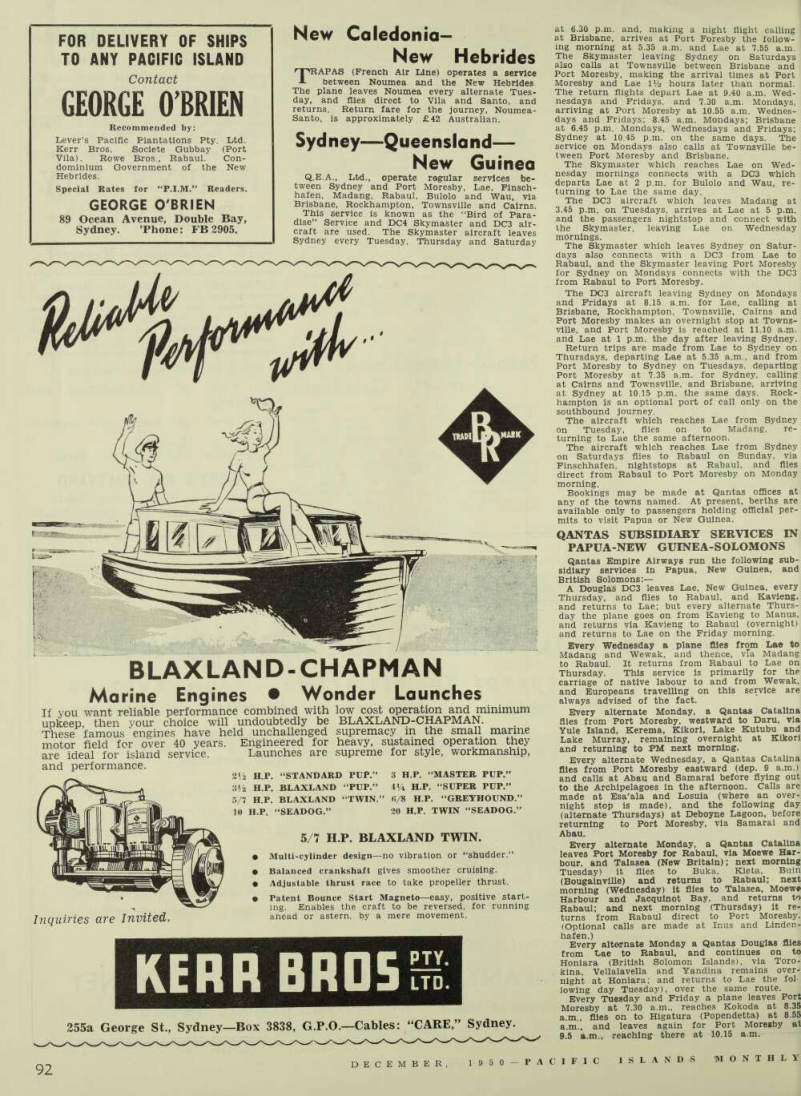
Shipping And Plane Services
Ship Services
Sydney-NZ-Fiji-Hawaii-
North America
THE itinerary of the Canadian-Australasian liner “Aorangi” (17,500 tons) is Sydney, Auckland, Suva (Fiji), Honolulu (Hawaii), Vic toria (Vancouver Island), and Vancouver (British Columbia, Canada). Time-table for the Pacific section of her run is;—
Sydney-N. Coledonia-
Tahiti
LINERS of the Messagerles Marltimes main tain a service at about two-monthly intervals between Sydney, Vila (New Hebrides), Noumea (New Caledonia) and Papeete (Tahiti), en route to Marseilles, via the Panama Canal; and they return by the same route.
New Caledonia—New Hebrides
THE New Caledonian Government has sub sidised and maintained the coastal ship ping services. The East Coast, ths West Coast, and the Loyalty Islands, under present conditions, receive 10 round trip* per annum.
The ships call at the following ports:
EAST COAST.—Yate, Ounla, Thio, Nakcty Canala, Kouaoua Kua, Moneo, Ponerlhouen, Tibarama, Poindlmle, Wagap, Touho, Tlpindje, Hienghene, Tac, Oubatch, Pouebo. Balade, Pam’
Arama, and return.
WEST COAST.—Pouembout, Kone, Temala, Voh, Ouaco Gomen, Kouraac, Tangalou, Tlebaghi, Nehoue, Poume, Baaba, Belep and return.
LOYALTY ISLANDS.—Mare (Tadlne), Llfou (Chepenehe) Ouvea (Pajaoue, St. Joseph) and return.
The ateamer '*Neo Hebrldals” runs regularly between Noumea and Sydney, with occasional trips to tne New Hebrides (mostly Aneltyum).
The owners are Soclete Maritime et Manlere Hagen, Noumea. Sydney agents: F. C. Sleigh, 254 George Street, Sydney.
The Messagerles Maritlmes motor-ship Poly nesian sails from Sydney about every six weeks to Noumea, Vila and Santo (New Hebrides) and outports, with occasional trips to the Wallis and Futuna Islands. Details from Messagerles Mari times branch office, In Sydney, Noumea and Vila.
New Zealand—Fiji—
Samoa—Tonga
Monthly Service by MV “Matua”
Service Conducted By Union Sb Co.,
Ltd.—Subject To Alteration Without
Notice
Auckland .. .. Dec. 7 Jan. 11 Feb. 8 Suva Dec. 11-12 Jan. 15-16 Feb. 12-13 Nukualofa .. ..Dec. 14-15 Jan. 18-19 Feb. 15-16 Vavau Dec. 16 Jan. 20 Feb. 17 Pago Pago* .. Dec. 16 Feb. 17 Apia* Dec. 17-19 Jan. 20-22 Feb. 18-20 Suva Dec. 22-23 Jan. 25-26 Feb. 23-24 Auckland .. .. Dec. 27 Jan. 30 Feb. 28 •Western Time.
New Zeoland—Cook
Is.—Niue—Samoa
THE motor vessel “Maui Pomare” owned and operated by the NZ Gov ernment, maintains a direct service between Auckland and Rarotonga (Cook Islands), with alternative calls at Niue and Apia (Samoa).
Honolulu ..
RMS ‘Aorangi” — Jan. 11 Suva .. ..
Auckland .. — Jan. 23-2S Sydney, arr. — Jan. 29* Sydney, dep.
Dec. 7 — Auckland ..
Dec. 11-12 — Suva .. ..
Honolulu ..
Dec. 22 — Vancouver .
Dec. 29-Jan. 4 — Subject to alteration without notice ♦Aorangi will be withdrawn from the trans- Pacific run after she reaches Sydney.
Sydney-Papua-
New Guinea
BURNS, PHILP LINE motor-vessels "Bulolo” and "Malaita” maintain regular services be tween Sydney and ports in Papua-New Guinea.
"Bulolo” leaves Sydney, northbound, approxl
mately every six weeks; “Malaita** every sevefa weeks, “Bulolo” calls at Brisbane. Port Moresby, Samarai, Lae, Dregarhafen, Rabaul, Samarai, Port Moresby. Brisbane, thence back to Sydney.
The “Malalta’s” schedule varies considerably.
She calls at Port Moresby only occasionally, but usually calls at Samarai, Lae, Madang, Manus, Rabaul, Samarai, thence direct to Syd
ney—ports of call being In that order. Sometimes the order of calls is Samaral, Rabaul, Manus, Madang. Lae, Samarai. Intending passengers should check with Burns, Phllp & Co., Ltd., Sydney, or Island branches.
Sydney-Norfolk Island-
New Hebrides
The SS “Morinda,” Burns, Philp & Co., Ltd., runs at approximately three monthly intervals from Sydney to Lord Howe Island, Norfolk Island, and main ports of the New Hebrides, and re turn.
Air Services
Summary of Pacific Air
Services
PAPUA AND NEW GUlNEA.—Regular Qantas service from Sydney.
SOLOMON ISLANDS.—Frequent regular flying boat service from Sydney bv Trans Oceanic Airways. Qantas service also from Lae, NG, to Honiara, BSI.
NEW HEBRIDES. —Frequent regular flying-boat service from Sydney by Trans Oceanic Air ways. Service from Noumea by French plane runs twice weekly. Qantas plane from Sydney to NH on alternate Tuesdays.
NORFOLK ISLAND.—Regular service from NZ by NZ National Airways; from Sydney by Qantas; from Fiji by NZ National Airways.
LORD HOWE ISLAND.—Regular weekly service from Sydney by Qantas and Trans Oceanic Airways.
FIJI. —Regular services from Australia by Pan American, BCPA and CPA (to Nadi); Auck land by NZ National Airways (to Nadi); from Australia by Qantas (to Laucala Bay, Suva); from Auckland by NZ National Airways (to Laucala Bay, Suva). Irregular calls from Australia to Laucala Bay, Suva, by Trans Oceanic Airways. Regular service from Suva to Labasa by NZ National Airways.
Western Samoa. Cook Islands And
TONGA.—Regular service from Fiji by NZ National Airways.
TAHlTl.—Monthly service from Noumea by TRAPAS plane via Fiji, W. Samoa, Cook Is.
DUTCH NEW GUlNEA.—Regular weekly service from Darwin to Biak by KLM under charter to NEI Government.
AUSTRALIA-NEW ZEALAND—ReguIar services Sydney-Auckland and sydney-Wellington by Tasman Empire Airways.
AUSTRALIA-NORTH AMERICA—Regular Trans pacific services by Pan American Airways.
Bcpa And Cpa.
Europe - Indo-China -N, Caledonla.—Port
nightly service by Air France.
Sydney-Vancouver
BCPA Service
BRITISH Commonwealth Pacific Airlines. Ltd., operate a twice weekly trans-Pacffic service from Sydney to Vancouver, via Fiji, Canton Island, Honolulu and San Francisco; and a weekly service between Auckland and Vancouver, via the same ports.
Planes leave Sydney every Wednesday and Saturday, and Vancouver on the Southbound trip every Monday and Thursday. Every fourth trip from Sydney terminates at San Francisco Instead of Vancouver.
Planes leave Auckland every Tuesday and arrive in Vancouver the following Wednesday.
The Southbound trip to Auckland commences from Vancouver every alternate Friday. Every other Friday the service commences at San Francisco.
B.C.P.A. services make regular connections at both San Francisco and Vancouver for onward carriage, via either New York or Montreal to the United Kingdom or Europe. The through fare from Sydney to London is £325 (Aust.).
The fares for the Pacific flight are: Sydney- Nandi (Fiji), £AS7/15/- single, £AIO3/19/- re turn. Sydney-San Francisco, Seattle, Portland, Los Angeles or Vancouver, £A265/8/- single, £ A477/15/- return. Auckland-Nandi (Fiji), £ NZ3I single, £NZSS/16/- return. Auckland- San Francisco. Seattle. Portland, Los Angeles or Vancouver, £NZI97/3/- single, £NZ3S4/18/- re turn.
Douglas DC6 aircraft carrying 48 passengers (seated) or 37 passengers (in sleepers) and a crew of nine are used on the service.
Pan-American—
Trans-Pacific Service
PAN-AMERICAN World Airways clippers now provide the following services in the South Pacific, using DC4 planes, equipped with Sleep erettes:— Planes leave Sydney Thursday and Sunday for San Francisco, via Tontouta (New Cale donia), Nadi (FIJI), Canton Island and Hono lulu.
The return flights are made from San Francisco every Tuesday, Saturday, via Honolulu, Canton Island, Nadi and Tontouta; and from Seattle every Tuesday, via Portland, Honolulu, Canton Island, Nadi and Tontouta.
Planes leave Auckland every Thursday and Sunday, and fly via Nadi, Canton Island and Honolulu to San Francisco. They leave San Fran cisco for Auckland every Tuesday and Saturday by the same route. Fares, in Australian cur rency, are:—
(Time-tables and fares subject to alteration without notice.) To convert to Fiji currency, reduce above each kilogram of excess.
Free baggage allowance is 30 kilos per person.
Excess baggange charged at 1 per cent, of single fare; per kilo up to 10 kilos; V 2 per cent, for every kilo over 10 kilos.
Trans-Tasman Service
Sydney—Auckland
TASMAN Empire Airways, Ltd., operate a flying-boat service between Rose Bay, Sydney, and Mechanics Bay, Auckland, with a
fleet of four new Solent flying-boats each with a capacity for 45 passengers, in seven self contained cabins on two decks. Full fresh-cooked meals are served en route. Average crossing time is 6V2 hours.
Flying-boats depart from Sydney at midnight Monday, Wednesday, Thursday, Saturday. They depart from Auckland at 12 noon on Tuesday Wednesday, Thursday, Saturday.
Fares: £35 (A), £2B (NZ), single; £63 (A) £5O/8/- (NZ), return.
Passenger reservations may be made in Aus tralia at any office or agency of Qantas Empire Airways (General Agents), offices of TAA and all leading travel agents. In New Zealand book through TEAL (Auckland and Wellington) or any leading travel agents.
Trans Tasman Services
Sydney—Wellington
TASMAN Empire Airways, Ltd., operate a regular flying-boat service between Sydney and Wellington with Solent flying-boats.
Services depart Sydney at 10 p.m. on Tuesday, Wednesday, Sunday and depart Wellington at 11 a.m. Monday, Wednesday and Thursdays.
The flight crossing time is 7 hours.
Tbe fares are: £A3S. £NZ2B single; £A63 £NZSO/8/- return.
These services will be increased to a 3-per week frequency on October 30.
France-indo-China-
Aust.—N. Caledonia
THE French national airways, Air Prance, runs a monthly service between Paris and New Caledonia, and return. Stops are made at Damascus, Karachi, Calcutta, Saigon, Batavia, Darwin, Brisbane.
DC4 Skymasters are used In the service bet ween Saigon and New Caledonia, Lockheed Constellations between Salgon-Paris. and Mes sageries Maritimes are agents in Australia.
Fare between Brisbane and Tontouta (Noumea) are £3O/12/6 single, £55/2/6 return. Sydney- Tontouta. £37/10/- single, £63/17/6 return.
Darwin—Netherlands
New Guinea Service
THE service between Batavia, NEI, and Biak, Netherlands New Guinea, has been dis continued and a new service from Darwin to Biak and return has been inaugurated.
The service is run by the Netherlands Govern ment, with DC3 aircraft, chartered from KLM Airlines. The service is run once weekly.
£ s. d. £ s. d.
Single.
Return.
Sydney-Seattle 265 10 0 477 18 0 Sydney-’Frisco 265 10 0 477 18 0 Sydney-Honolulu .. 217 15 0 391 19 0 Sydney-Fiji 57 15 0 103 19 0 Auckland-Seattle .. 246 5 0 443 5 0 Auckland-Honolulu . , . 199 0 0 358 4 0 Auckland-Piji 39 0 0 69 15 0 Auckland-’Prisco .. 246 5 0 443 5 0 Sydney-Noumea 37 10 0 67 10 0
New Caledonia-
New Hebrides
'T'RAPAS (French Air Line) operates a service A between Noumea and the New Hebrides The Plane leaves Noumea every alternate Tues day. and hies direct to Vila and Santo, and returns. Return fare for the journey, Noumea- Santo, is approximately £42 Australian.
Svd IlfiV———
k|..
I V3Ulll6Q Q.E.A., Ltd., operate regular services be tween Sydney and Port Moresby, Lae, Finsch hafen, Madang, Rabaul, Bulolo and Wau, via Brisbane, Rockhampton, Townsville and Cairns, J . T^ lis service is known as the “Bird of Para dlse Service and DC4 Skymaster and DC3 alr craft are used. The Skymaster aircraft leaves Sydney every Tuesday, Thursday and Saturday
at 6.30 p.m. and, making a night flight calling at Brisbane, arrives at Port Foresby the follow ing morning at 5.35 a.m. and Lae at 7.55 a.m.
The Skymaster leaving Sydney on Saturdays also calls at Townsville between Brisbane and Port Moresby, making the arrival times at Port Moresby and Lae iy 2 hours later than normal.
The return flights depart Lae at 9.40 a.m. Wed nesdays and Fridays, and 7.30 a.m. Mondays, arriving at Port Moresby at 10.55 a.m. Wednes days and Ftidays; 8.45 a.m. Mondays; Brisbane at 6.45 p.m. Mondays, Wednesdays and Fridays; Sydney at 10.45 p.m. on the same days. The service on Mondays also calls at Townsville be tween Port Moresby and Brisbane.
The Skymaster which reaches Lae on Wed nesday mornings connects with a DC3 which departs Lae at 2 p.m. for Bulolo and Wau, re turning to Lae the same day.
The DCS aircraft which leaves Madang at 3.45 p.m, on Tuesdays, arrives at Lae at 5 p.m. and the passengers nightstop and connect with the Skymaster, leaving Lae on Wednesday mornings.
The Skymaster which leaves Sydney on Satur days also connects with a DCS from Lae to Rabaul, and the Skymaster leaving Port Moresby for Sydney on Mondays connects with the DCS from Rabaul to Port Moresby.
The DCS aircraft leaving Sydney on Mondays and Fridays at 8.15 a.m. for Lae, calling at Brisbane, Rockhampton, Townsville, Cairns and Port Moresby makes an overnight stop at Towns ville, and Port Moresby is reached at 11.10 a.m. and Lae at 1 p.m. the day after leaving Sydney.
Return trips are made from Lae to Sydney on Thursdays, departing Lae at 5.35 a.m., and from Port Moresby to Sydney on Tuesdays, departing Port Moresby at 7.35 a.m. for Sydney, calling at Cairns and Townsville, and Brisbane, arriving at Sydney at 10.15 p.m. the same days. Rock hampton is an optional port of call only on the southbound journey.
The aircraft which reaches Lae from Sydney on Tuesday, flies on to Madang, re turning to Lae the same afternoon.
The aircraft which reaches Lae from Sydney on Saturdays flies to Rabaul on Sunday, via Finschhafen, nlghtstops at Rabaul, and flies direct from Rabaul to Port Moresby on Monday morning.
Bookings may be made at Qantas offices at any of the towns named. At present, berths are available only to passengers holding official per mits to visit Papua or New Guinea.
Qantas Subsidiary Services In
Papua-New Guinea-Solomons
Qantas Empire Airways run the following sub sidiary services in Papua, New Guinea, and British Solomons:— A Douglas DCS leaves Lae, New Guinea, every Thursday, and flies to Rabaul, and Kavieng, and returns to Lae; but every alternate Thurs day the plane goes on from Kavieng to Manus, and returns via Kavieng to Rabaul (overnight) and returns to Lae on the Friday morning.
Every Wednesday a plane flies from Lae to Madang and Wewak, and thence, via Madang to Rabaul. It returns from Rabaul to Lae on Thursday. This service is primarily for the carriage of native labour to and from Wewak, and Europeans travelling on this service are always advised of the fact.
Every alternate Monday, a Qantas Catalina files from Port Moresby, westward to Dam, via Yule Island, Kerema, Kikori, Lake Kutubu and Lake Murray, remaining overnight at Kikori and returning to PM next morning.
Every alternate Wednesday, a Qantas Catalina flies from Port Moresby eastward (dep. 9 a.m.) and calls at Abau and Samara! before flying out to the Archipelagoes in the afternoon. Calls are made at Esa’ala and Losuia (where an over night stop is made), and the following day (alternate Thursdays) at Deboyne Lagoon, before returning to Port Moresby, via Samarai and Abau.
Every alternate Monday, a Qantas Catalina leaves Port Moresby for Rabaul, via Moewe Har bour, and Talasea (New Britain); next morning Tuesday) it flies to Buka, Kieta, Buin (Bougainville) and returns to Rabaul; next morning (Wednesday) it flies to Talasea, Moewe Harbour and Jacquinot Bay. and returns to Rabaul: and next morning (Thursday) it re turns from Rabaul direct to Port Moresby. (Optional calls are made at Inus and Linden hafen.) Every alternate Monday a Qantas Douglas flies from Lae to Rabaul, and continues on to Honiara (British Solomon Islands), via Toro kina, Vellalavella and Yandina remains over night at Honiara: and returns to Lae the fol lowing day Tuesday), over the same route.
Every Tuesday and Friday a plane leaves Port Moresby at 7.30 a.m., reaches Kokoda at 8.35 a.m., flies on to Higatura (Popendetta) at 8.55 a.m., and leaves again for Port Moresby at 9.5 a.m., reaching there at 10.15 a.m.
Dragon DHB4 aircraft operate the following internal services in New Guinea:— Every Tuesday depart Madang for Goroka, Kainantu, Aiyura, Arona, returning to Madang at noon the same day. Calls as required for loading are made between Arona and Madang.
Every Thursday departs Madang at 7 a.m. for Wabag, Baiyer River, Mt. Hagen, with optional calls at Kerowagi and Chimbu, and returning to Madang at noon the same day.
Every Friday departs Lae at 6.30 a.m., calling at any or all of the following places as re quired: Asolaka, Aiyura, Arona, Banz, Bena Bena, Chimbu, Goroka. Kaiaipit, Kainantu, Kerowagi. Kup, Mt. Hagen, Nadzab, Nondugl, Ogelbeng, Wabag, Wabumunda, Minj.
Daily, except Wednesdays and Sundays, depart Lae at 3 p.m. for Bulolo and Wau, returning direct from Wau to Lae the same day. arriving at Lae 5.5 p.m.
Sydney-Norfolk Is.
Qantas run a DC4 Skymaster alt. Thursdays freturnine same day) from Sydney to Norfolk Island. Fare, £22 single; £39/12/- return. (For Norfolk Island, see also under N 2 National Airways.
Sydney-New Hebrides
QANTAS operate a service to the New Hebrides with Sandringham flying-boats calling at Noumea, Port Vila and Espiritu Santo. Frequent non-scheduled flights are made, subject to the approval of the Governments concerned.
NZ National Airways
South Pacific Services
THE Pacific services run by the New Zealand National Airways Corporation are ai follows:
Auckland-Norfolk Island-Fiji-Tonga
Western Samoa-Cook Islands: A “Douglas”
airliner leaves Whenuapai, Auckland, on alter nate Tuesdays at 9 a.m. (January 9 and 23, etc.) for Norfolk Island (arr. 12.55 p.m.; dep. 2 p.m.), Nadi (arr. 8 40 p.m., dep. 5.40 a.m. Thursday), Nausori (arr. 6.25 a m., dep. 7.30
a.m.), Tonga (arr. 10.50 a.m., dep 11.50 am) ♦Faleolo, Western Samoa (arr. 4.5 p.m Wednes day, dep. 8 a.m. Thursday), Aitutakl, Cook Islands (arr. 1,50 p.m, Thursday, dep 250 p.m.), Rarotonga, Cook Is. (arr. 4.5 p.m.).
The aircraft departs from Rarotonga on the return journey on alternate Saturdays (January 13 and 27, etc.) at 8 a.m. for Aitutaki (arr. 9.15 a.m., dep. 10 a.m.), Faleolo W. Samoa (arr. 3.15 p.m., dep. 8 a.m Sunday)’ ♦Tonga (arr. 10.55 a.m. Monday, dep n 56 a.m.), Nausori (arr. 2.40 p.m., dep. 340 p m ) Nadi (arr. 4.25 p.m., dep. 5 a.m. Tuesday)"
Norfolk Is. (arr. 10.55 am., dep. 12 noon), Whenuapai, Auckland (arr. 4.50 p.m.). ♦Crosses International Date Line.
Auckland-Norfolk Island: A “Douglas”
airliner leaves Whenuapai, Auckland, every Sun day at 8 a.m. for Norfolk Island (arr. 11.55 a.m.), and departs on the return flight at 12.55 p.m., arriving at Whenuapai at 5.45 p.m.
On alternate Sundays (January 7 and 21, etc.), a second service is also operated, leaving Whenuapai at 9 a.m., arriving Norfolk at 12.55 p.m., departing again at 1.55 p.m., and arriving Auckland at 6.45 p.m.
. FARES, single (in NZ currency): Auckland to Norfolk, £l4; to Fiji, £3l; to Tonga, £35/15/-; to W Samoa, £39/10/-; to Aitutaki, £43/10/-; to Rarotonga, £45. Norfolk to Fiji, £l9; Fiji to Tonga, £B/15/-; to W. Samoa, £l3; to Aitutaki, £29; to Rarotonga, £3l. W. Samoa to Rarotonga, £l9; to Aitutaki, £l6/10/-. Return fares less 10 per cent.
BOOKING OFFICES: Wellington. Govt. Life Bldg., Customhouse Quay; Auckland. Air Centre, Nathan’s Bldg., Commerce St.; Dunedin, 8-10 Manse St.; Christchurch, 104 Gloucester St.: Gisborne, 74 Peel St.; Palmerston North, 107 Broadway Ave.; Hamilton, 8 Alma St.; New Plymouth, Grand Central Building, Egmont St.; Blenheim, 13 Queen St.; Hokitika, South side Airport: Norfolk Is., Burns Philp, Ltd.; Fiji, NAC at Nadi and Suva; Burns Philp, Lautoka; Tonga, Mrs. F. F. Melhose, Fou-amotu Airfield: W. Samoa, Burns Philp (SS), Ltd., Apia; Cook Is., Mrs. P. McVeagh, Aitutaki, and Mr. J. D. Campbell, Rarotonga.
TOA Services
TRANS Oceanic Airways run the following Pacific services;— SYDNEY-LORD HOWE IS.: A regular twice weekly service with large four-engine flying boats from Rose Bay. Pare: £lO/16/- single; £2l/12/- return. Free baggage allowance 44 lb.
Excess baggage and freight rate Bd. per lb.
NOTE: Sydney-Moresby service expected to start in January or February.
SYDNEY-HOBART: The company now runs a twice-weekly service direct to Hobart. Tasmania, from Sydney. It will be possible, therefore, for passengers to book from Moresby to Hobart, making an overnight stop in Sydney. Fares are: £lO/10/- single, £2l return.
N. Caledonia-Tahiti
TRAPAS (Soclete Francals de Transports Aeriens du Pacific Sud-Noumea) runs a monthly service from New Caledonia to Tahiti Western Samoa (Faleolo), Cook Islands (Aitu taki) to Papeete, where it arrives at about 11.4 U a.m. two days later. One evening is spent in Nadi and one night in Aitutaki. The plane re turns by the same route in the following week.
Fare from Noumea to Papeete is 16,000 Pacific francs single, and 28,800 return. (160 Pacific francs equal £1 Australian.) While the plane is at Papeete it runs one round trip between Papeete and Bora Bora. (This service was temporarily suspended in late November.)
Sydney-Noumea—Suva
THE following is the time-table of the Qantas Sandringham flying-boat;— Sydney dep. 9.30 p.m. alt. Tues.
Noumea arr. 6.30 a.m. alt. Wed.
Noumea dep. 8.20 a.m. alt. Wed.
Suva arr. 2.30 p.m. alt. Wed.
Suva dep. 6 a.m. alt. Fri.
Noumea arr. 10.30 a.m. alt. Fri.
Noumea dep. 12 noon alt. Fri.
Sydney arr. 7.15 p.m. alt. Fri.
Intending passengers may book through Qantas offices in Australia. Burns Philp (South Sea) Company, in Suva; and J. Brock, in Noumea.
The fares for this service in Aust. currencj are:
CPA Sydney-Vancouver
Service
CANADIAN Pacific Airlines, Ltd., run a trans pacific service between Sydney and Van couver. For the present there will be one northbound and one southbound trip per fort night. Stops are made at Nadi (Fiji). Cantor Island, Honolulu and San Francisco. The north bound flight commences from Sydney every alter nate Tuesday.
Pour-engined, pressurised “Canadalr' alrcran are used: 36 passengers can be carried ant a crew of 7. Overnight accommodation is pro vided at hotels in Nadi and Honolulu, which Is of course, complimentary.
Fares are (in Australian currency: Sydney Vancouver, San Prancisco-Los Angeles and Port land-Seattle, £265/8/- single, £477/15/- return Fiji-Vancouver, £207/8/- single, £373/7/- re turn; Sydney-Fiji. £57/15/- single. £lO3/19/- re turn; Sydney-Honolulu, £217/13/- single £391/16/- return.
Single. Return.
Sydney-Noumea ... £37 10 0 £67 10 ( Sydney-Suva 55 10 0 99 18 ( Noumea-Suva 20 5 0 36 9 (
Bookings may be made at the Union Stesm Ship Company of New Zealand, Limited, Sydney, or Melbourne; Union Steam Ship Co. of NZ. Ltd..
Fiji, Canadian Pacific Airlines, Vancouver; Canadian Pacific Railway Co., Sydney or Mel bourne.
TEAL Flying Boat
Service
Auckland Fiji
WITH new 45 seater Solent flying-boats, Tasman Empire Airways, Limited, operate i weekly Auckland-Suva-Lambasa and return service.
Aircraft depart Mechanics’ Bay. Auckland, a half hour after midnight, each Tuesday, and operate to the following time-table:— dep. Auckland .. .. 0.30 a.m. Tuesday arr. Suva 7.00 a.m. Tuesday dep. Suva 9.00 a.m. Tuesday arr. Lambasa .. .. 10.00 am. Tuesday dep. Lambasa .. .. noon Tuesday arr. Suva 1.00 p.m. Tuesday dep. Suva 7.00 a.m. Wednesday arr. Auckland .. .. 1.30 p.m. Wednesday Fares (Single): Auckland-Suva, £3l (NZ), £34/9/- (Fijian), £3B/15/- (Aust.); (Return): £55/16/- (NZ). £6l/19/- (Fijian), £69/15/- (Aust.).
Suva-Lambasa (Single): £4/10/- (NZ), £5 (Fijian), £5/12/6 (Aust.); (Return): £B/2/- (NZ), £9 (Fijian), £lO/2/6 (Aust.).
Reservations may be made through TEAL 'New Zealand), Qantas or TAA (Australia), tfZNAC (Suva) or any leading travel agents.
Papua-NG Local
Services
MANDATED Airlines, Ltd., of Lae, New Guinea, and other private operators, run air ser vices between Lae and the New Guinea mainland sentres of Wau, Bulolo, Madang, Wewak, Altape, vlt. Hagen. Plnschhafen, Moresby. Kokoda—in ;act anywhere in Papua or New Guinea where ihere is an air-strip. These planes carry pas (engers, malls and cargo on regular schedules >r charter flights
Advertisements & other items, pp. 91-96 (3 items)
Be Sure
“UNDERSEE” Swimmers’ Masks—fit any face comfortably.
“LOXIN” Underwater Guns are Accurate, Powerful and Safe.
Double pressure trigger with safety catch within trigger guard. Synchronised line discharge. Bayonet and line reel.
Standard (2 rubbers) Super (4 rubbers) Knives, Safety Lead Belts, Handspears, Swim Flippers and Breathing Tubes.
ENQUIRE FROM YOUR AGENT OR
UNDERSEE NOVELTIES
81 Ramsgate Avenue, BONDI, N.S.W.
BE SURE
Lars Halvorsen Sons Pty. Ltd., Designers and Builders of Halvorsen Boats, advise that no-one connected with them is in anyway connected with any other boatyard than their Head Office and Branches shown below: — BE SURE to contact one of the following SYDNEY addresses: • WATERYIEW ST., RYDE: Head Office, Building Yard, Engine and Marine Hardware Sales and Service. • HAYES ST., NEUTRAL BAY: Repair Work, Slippings, Moorings. • BOBBIN HEAD, KU-BING-GAI CHASE. Cruiser and Open Boat Hire, Slippings, Moorings.
Distributors for: CHRYSLER, MORRIS, LEYLAND DIESEL, STERLING and SUPERIOR
DIESEL MARINE ENGINES.
Builders of
HALVORSEN
BOATS
Telegrams: “HALVORSENS,” Sydney.
NORTH SYDNEY TRAVEL BUREAU
Consultant: MRS. LILLIAN MILLAR, late of New Guinea.
Let experts arrange your travels and accommodation AGENT FOR ALL LEADING AUSTRALIAN AND WORLD AIRLINES.
FLlGHTS.—Whether you intend to fly Interstate, Intrastate or Overseas, the Bureau will be glad to make your flight reservations from departure to return.
ACCOMMODATION.—Mrs. Millar, formerly A.N.A. Accommodation Officer, can find the exact type of accommodation you require. Let her know your requirements early.
TOURS. —We will arrange your Australian tours—by air. car or tourist coach.
REAL ESTATE. —Perhaps you require a home immediately, or in the near future. A wide range of properties is available. Prospective investors also will be interested in our extensive selection of real estate propositions.
A. R. COVENTY, R.E.A., 56 Miller St„ North Sydney Phones: XA 1780 After Hours: XA 2342, or XL 2185.
W. R CARPENTER i CO. (Fiji) ITD.
Agents
SUVA MOTORS LIMITED
Distributors
ALLEN Self-propelled Motor Scythe
For Public Parks, Golf Courses, Roadside Weeding, Plantations and Farms.
CHAPMAN Pup Marine Engines
Famous for reliability and simplicity. Sold complete with installation fittings. Replacement parts stocked in Suva.
MASTER
PUP
Telegrams: "CAMOHE, SUVA,"
P.O. Box 299, SUVA, FIJI.
BERRY’S BAY
BOATYARD
(B. J. Halvorsen—Manager)
“BUSINESS AS USUAL.”—Despite a spectacular fire at our Boatyard in mid- November we still are at the same address and still are giving the same specialised service and attention to all orders from Pacific Islands clients.
Specialists in Islands vessels.
All kinds of boat-building and repairing.
New and used boats and engines for sale.
Quotations and estimates free.
BERRY'S BAY BOATYARD
John Street, North Sydney, N.S.W.
Only MOflg/ Shafting
Gives You All These Advantages
CORROSION - RESISTANT . . . NON - RUSTING and 72 to 105% STRONGER . . . 42% STIFFER . . . OVER 85% * f TOUGHER . . . 57% HARDER . . . than shafting of other materials.
In your boat, you want a propeller shaft on which you can always depend—no other shafting offers such an outstanding combination of properties as Monel. * So ... if you're building a new boat or replacing a shaft, make sure your new shaft is just as safe and dependable as possible by specifying MONEL.
Further information about Monel propeller shafting will gladly be forwarded by: WRIGHT & COMPANY, 81 CLARENCE ST., SYDNEY Sole Australian Distributors of Monel :: :: Phone: BX 1211 (Six Lines) *Monel is a registered trade-mark covering a rich nickel alloy, mined in Canada and rolled in Great Britain. ——— ———
FOR DELIVERY OF SHIPS
TO ANY PACIFIC ISLAND
Contact
GEORGE O’BRIEN
Recommended by: Lever’s Pacific Plantations Pty. Ltd.
Kerr Bros. Societe Gubbay (Port Vila). Rowe Bros., Rabaul. Condominium Government of the New Hebrides.
Special Rates for “P.1.M.” Readers.
GEORGE O'BRIEN
89 Ocean Avenue, Double Bay, Sydney. ’Phone: FB 2905.
l Vc
' “ • vji. '*l *; > * ;*? - * / : : ■ r? »<
BLAXLAND-CHAPMAN
Marine Engines • Wonder Launches
If you want reliable performance combined with low cost operation and minimum upkeep, then your choice will undoubtedly be BLAXLAND-CHAPMAN.
These famous engines have held unchallenged supremacy in the small marine motor field for over 40 years are ideal for island service and performance.
Inquiries are Invited.
Engineered for heavy, sustained operation they Launches are supreme for style, workmanship, 2V2 H.P. “STANDARD PUP.” 3 H.P. “MASTER PUP.” 3Vz H.P. BLAXLAND “PUP.” 41/4 H.P. “SUPER PUP.” 5/7 H.P. BLAXLAND “TWIN.” 6/8 H.P. “GREYHOUND.” 10 H.P. “SEADOG.” 20 H.P. TWIN “SEADOG.”
5/7 H.P. BLAXLAND TWIN.
• Multi-cylinder design—no vibration or “shudder.” • Balanced crankshaft gives smoother cruising. • Adjustable thrust race to take propeller thrust. • Patent Bounce Start Magneto—easy, positive starting. Enables the craft to be reversed, for running ahead or astern, by a mere movement.
KERR BRDSra:
255 a George St., Sydney—Box 3838, G.P.O.—Cables: “CARE,” Sydney.
CAPTAIN W. L. KENNEDY
(Established 1931)
Shipbrokers, Business & Real Estate
63 Pitt St., Sydney
'Phone: BW 6461. Cables: "CAPKEN," Sydney.
LISTING:
MODERN (100-TON STEEL CARGO VESSEL.-Dlesel, built 1942. £35,000 Sterling. 40?? m^ N fifp^ E win^h RG ? VESSEL.—33O H.P. H.D. Diesel, placed aft, deadweight around 400 tons, diesel winches, two hatches, built in 1945. £17,500 Sterling.
Umber 0 £2^ S (H)0 L ‘ — T%in diesels ’ steel> in surve y. carry 380 tons or 110,000 super ft.
TUSA TUG.—In survey, Ist-class order, 270 H.P. H.D. diesel, £8,500.
HARBOUR TUG.—ISO H.P. diesel, £O,OOO.
JWO 50 £ FT o ®“ NE £6 VRAWLERS.—Working, good-type boats, diesel, suit conversion 00 FT. STEEL LANDING BARGE HULL. —Good order, carry 20 tons, £550. 40 FT. ARMY WORKBOAT-TYPE.—I6O H.P. Gray diesel, L.P.8., £2,400.
BRAND NEW 500 H.P. MARINE DIESELS, £5,000 each.
Enquiries Invited.
Our Business & Real Estate Section has for sale a wide variety of Sydney properties. Islands inquiries promptly attended to.
PENTAL is kind to the most delicate skins and can be used for washing the
finest of fabrics. A high
quality soap of out
standing value.
Economical
to use.
Pacific Islands Distributors:— 0 s W fo m m tHI o**l POl pr 0* M rr*l 10 <o*
A G. W. PENNELL PRODUCT
’COLYER WATSON
PTY. LTD. 22 s“ ST
At Your Service . . .
WILLIAM E. REED
ENTERPRISES
145 a GEORGE ST., CIRCULAR QUAY, SYDNEY.
William E. Reed
(Established 1913) Island Trade Broker & Commission Agent For more than 36 years the PERSONAL buying services of WILLIAM E. REED, backed by an experienced staff has ensured prompt and reliable service at lowest cost to Missions, Planters and Traders throughout the Pacific. We operate on a WHOLESALE basis only. You receive original invoices at invoiced cost.
Purchase and delivery of Island craft a speciality.
Enquiries invited for all plantation and trading require ments. Island products sold on a commission basis.
Cables: "WILREED," Sydney
BOAT SALES DIVISION
For Sea Delivery : 40 FT. TRADE BOATS 10 ton cargo capacity.
Diesel powered. Strong and seaworthy.
Two experienced teams always available for sea delivery anywhere in the Pacific.
For Assembly :
20 FT. HEAVY DUTY TRADE BOATS
Super Craft with a thousand and one uses.
ALSO . . .
Continuously available is a wide range of power and auxiliary power craft ideally suited to various Island purposes. Those immediately available include:— GENERAL PURPOSE CRAFT, 66 ft. x 17 ft., 250 H.P. diesel powered, complete navigation equipment and auxiliary sails.
Lloyd’s specifications. ARMY CLASS STEEL LIGHTER ideal for copra carrying; 106 ft. x 30 ft., capacity 400/600 tons. Ready for engine installation. TWIN SCREW DIESEL CARGO SHIP, 104 ft. x 21 ft., 11,000 cubic feet cargo capacity, ready for sea. (Sea delivery arranged.)
WILLREED AGENCIES PTY. LTD.
Distributors for :
COVENTRY VICTOR DIESEL
MARINE ENGINES
5/7 H.P. and 7/9 H.P.
Write for Specifications.
PEERLESS LOCKWOVEN
SQUARE MESH FENCING
INVINCIBLE SINGLETS
First grade, economically priced,
SPANISH SHOTGUNS
Complete range available.
Inquiries invited.
MINIATURE SEWING
MACHINES
Suitable for Native Trade. or cable for our Price List. ” Sydney.
For pig fences, sheep fences, cattle fences, general farm fences.
Merchants and Traders—Write Cable Address: “REEDAGE,
90
DECEMBER, 1950 PACIFIC ISLANDS (MONTHLY
93
ACIFIC ISLANDS *!VIO NTHLY DECEMBER, 1950
Aleisa Settlement
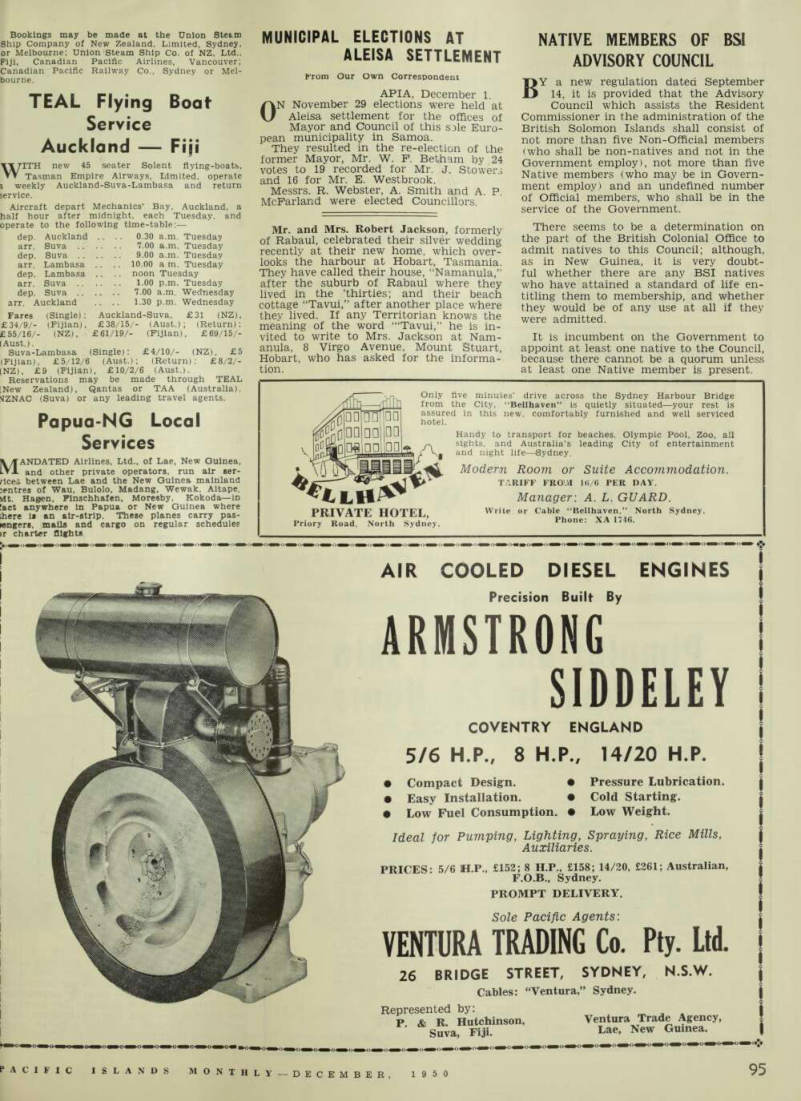
Municipal Elections At
From Our Own Correspondent APIA, December 1.
ON November 29 elections were held at Aleisa settlement for the offices of Mayor and Council of this sole Euro pean municipality in Samoa.
They resulted in the re-election of the former Mayor, Mr. W. F. Betham by 24 votes to 19 recorded for Mr. J. Stowers and 16 for Mr. E. Westbrook.
Messrs, R. Webster, A. Smith and A. P.
McFarland were elected Councillors.
Mr. and Mrs. Robert Jackson, formerly of Rabaul, celebrated their silver wedding recently at their new home, which over looks the harbour at Hobart, Tasmania.
They have called their house, “Namanula,” after the suburb of Rabaul where they lived in the ’thirties; and their beach cottage “Tavui,” after another place where they lived. If any Territorian knows the meaning of the word ‘“Tavui,” he is in vited to write to Mrs. Jackson at Nam anula, 8 Virgo Avenue, Mount Stuart, Hobart, who has asked for the informa tion.
Native Members Of Bsi
Advisory Council
BY a new regulation dated September 14, it is provided that the Advisory Council which assists the Resident Commissioner in the administration of the British Solomon Islands shall consist of not more than five Non-Official members (who shall be non-natives and not in the Government employ), not more than five Native members (who may be in Govern ment employ) and an undefined number of Official members, who shall be in the service of the Government.
There seems to be a determination on the part of the British Colonial Office to admit natives to this Council; although, as in New Guinea, it is very doubt ful whether there are any BSI natives who have attained a standard of life en titling them to membership, and whether they would be of any use at all if they were admitted.
It is incumbent on the Government to appoint at least one native to the Council, because there cannot be a quorum unless at least one Native member is present.
Advertisements & other items, p. 97 (2 items)
95
ACIFIC ISLANDS MONTHLY DECEMBER, 1950
Siddeley
□0 □0 ■n
PRIVATE HOTEL,
Priory Road. North Sydney.
Only five minutes’ drive across the Sydney Harbour Bridge from the City, “Bellbaven” is quietly situated—your rest is assured in this new, comfortably furnished and well serviced hotel.
Handy to transport for beaches, Olympic Pool, Zoo, all sights, and Australia’s leading City of entertainment and night life-—Sydney.
Modern Room or Suite Accommodation.
TARIFF FRO'.VI I«/6 PER DAY.
Manager : A. L. GUARD.
Write or Cable “Bellhaven,” North Sydney.
Phone: XA 1746.
I J
AIR COOLED DIESEL ENGINES
Precision Built By
ARMSTRONG
SIDDELEY
COVENTRY ENGLAND
5/6 H.P., 8 H.P., 14/20 H.P.
• Compact Design. • Pressure Lubrication. • Easy Installation. • Cold Starting. • Low Fuel Consumption. • Low Weight.
Ideal for Pumping, Lighting, Spraying, Rice Mills, Auxiliaries.
PRICES: 5/6 HP., £152; 8 H.P., £158; 14/20, £261; Australian, F. 0.8., Sydney.
PROMPT DELIVERY.
Sole Pacific Agents :
VENTURA TRADING Co. Pty. ltd.
26 BRIDGE STREET, SYDNEY, N.S.W.
Cables: “Ventura,” Sydney.
Represented by: P. & R. Hutchinson, Suva, Fiji.
Ventura Trade Agency, Lae, New Guinea.
Death Of H. W. Freeman
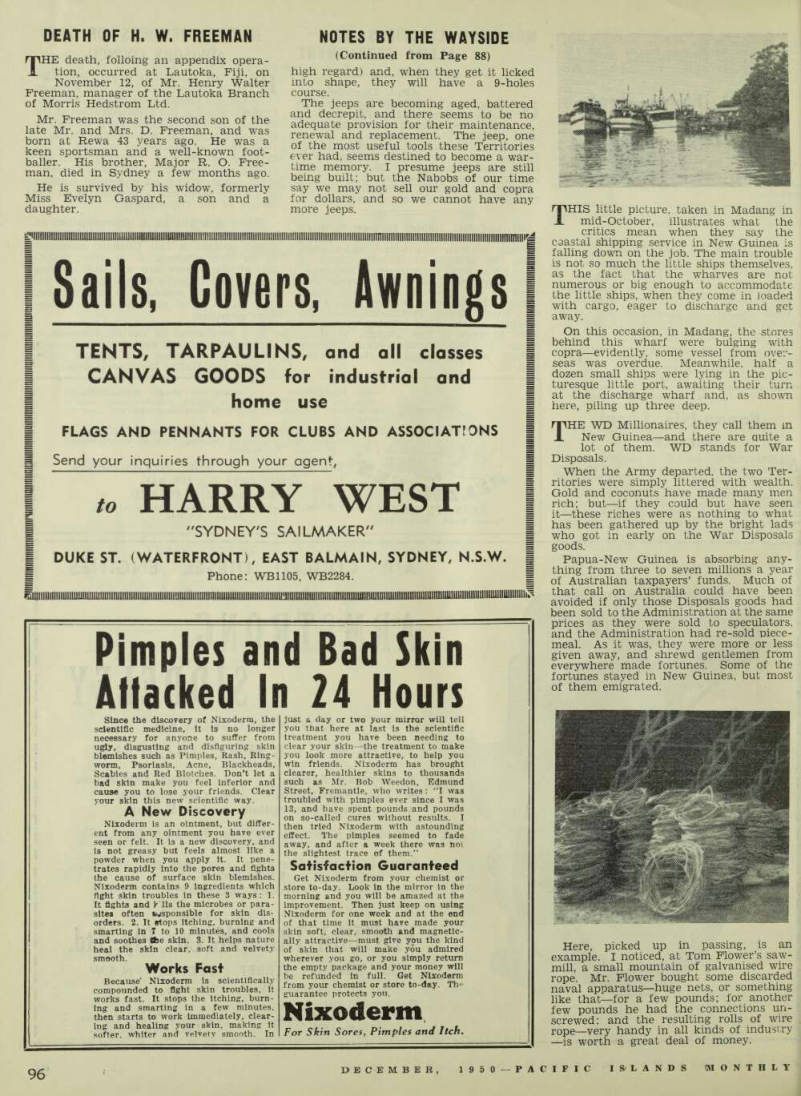
THE death, folloing an appendix opera tion, occurred at Lautoka, Fiji, on November 12, of Mr. Henry Walter Freeman, manager of the Lautoka Branch of Morris Hedstrom Ltd.
Mr. Freeman was the second son of the late Mr. and Mrs. D. Freeman, and was born at Rewa 43 years ago. He was a keen sportsman and a well-known foot baller. His brother, Major R. O. Free man, died in Sydney a few months ago.
He is survived by his widow, formerly Miss Evelyn Gaspard, a son and a daughter.
Advertisements & other items, p. 98 (2 items)
96
DECEMBER, 1950 PACIFIC ISLANDS (MONTHLY
NOTES BY THE WAYSIDE
(Continued from Page 88)
areh
Pimples and Bad Skin Attacked In 24 Hours
Since the discovery of Nixoderm, the scientific medicine, it is no longer necessary for anyone to suffer from ugly, disgusting and disfiguring skin blemishes such as Pimples, Rash, Ringworm, Psoriasis, Acne, Blackheads, Scabies and Red Blotches. Don't let a bad skin make you feel inferior and cause you to lose your friends. Clear your skin this new scientific way.
A New Discovery
Nixoderm is an ointment, but different from any ointment you have ever seen or felt. It is a new discovery, and is not greasy but feels almost like a powder when you apply it. It penetrates rapidly into the pores and fights the cause of surface skin blemishes.
Nixoderm contains 9 ingredients which fight skin troubles in these 3 ways : 1.
It fights and k Ils the microbes or parasites often wsponslble for skin disorders. 2. It stops itching, burning and smarting in 7 to 10 minutes, and cools and soothes Use skin. 3. It helps nature heal the skin clear, soft and velvety smooth.
Works Fast
Because' Nixoderm is scientifically compounded to fight skin troubles, it works fast. It stops the itching, burning and smarting in a few minutes, then starts to work immediately, clearing and healing your skin, making it softer, whiter and velvety smooth. In
just a day or two your mirror will tell you that here at last is the scientific treatment you have been needing to clear your skin—the treatment to make you look more attractive, to help you win friends. Nixoderm has brought clearer, healthier skins to thousands such as Mr. Bob Weedon, Edmund Street, Fremantle, who writes : “I was troubled with pimples ever since I was 13, and have spent pounds and pounds on so-called cures without results. I then tried Nixoderm with astounding effect. The pimples seemed to fade away, and after a week there was noi the slightest trace of them.”
Satisfaction Guaranteed
Get Nixoderm from your chemist or store to-day. Look in the mirror in the morning and you will be amazed at the improvement. Then just keep on using Nixoderm for one week and at the end of that time It must have made your skin soft, clear, smooth and magnetically attractive —must give you the kind of skin that will make you admired wherever you go, or you simply return the empty package and your money will be refunded in full. Get Nixoderm from your chemist or store to-day. Tim guarantee protects you.
Nixoderm
For Skin Sores, Pimples and Itch.
Better Port Facilities For
New Guinea
HAVING been asked questions in the Australian Parliament about the shortage of shipping facilities in New Guinea —which, according to Mr. McColm, MP, was interferring with the shipment of copra to Europe—the Minister for Ex ternal Territories (Mr. Spender) said that measures were being taken to improve the position. Tenders had been called for wharf repairs at Port Moresby and for new wharves at Madang and Kavieng.
Certain additions had been made at Rabaul, and a new wharf was now in use at Lae.
NG Highlands Described to PI Society Members
PI Society Members
THE Pacific Islands Society, at its meet ing in Sydney on November 22, heard an address from the President, Mr, R. W. Robson, about the Highlands of New Guinea. Mr. Robson had just returned from a month’s visit to the Territory, and had spent some days in the Highlands.
The speaker pointed out that when Australia took over New Guinea in 1920, the country had only a coconut economy.
By 1940, it was a coconut and gold economy, and the Territory was self supporting, Between 1942 and 1945, the country was subjected wholly to a military economy. Between 1945 and 1950, it had experienced a Socialist economy, in which it was absorbing each year many millions of pounds more than it was earning.
Now, as the result of the discovery of the New Guinea Highlands (a vast, rich region which, until 1933, Australia did not know she had) the country was threatened
with another kind of economy. Was it any wonder that one found frustration and confusion all over Papua and New Guinea!
In December the members, instead of listening to an address, met on the 19th at their annual Christmas cocktail party, when many guests were entertained.
New members: Mr. and Mrs. K. S. Haw kins; Dr. L. G. M. Baas Becking; Mr. and Mrs. W. Nicholson; Miss Helen Sheiis.
Mrs. T. P. Nicholson, an old and res pected resident of Suva, died on December 4, aged 86. Mrs. Nicholson went to Fiji about 60 years ago, as a teacher, and there married Mr. T. P. Nicholson, the well known Suva boatbuilder and designer, who died two years ago. She is survived by two sons and three daughters. Mrs, Nicholson was the sister of the Hon. T.
W. Alport Barker, Mayor of Suva.
Advertisements & other items, p. 99 (1 item)
Flour
Telephone 136. Telegrams: “AKUN,” RABAUL.
ALOIS Am S COMPANY
RABAUL, TERRITORY OF NEW GUINEA
Also at 180 NATHAN ROAD, KOWLOON, HONG KONG.
Planters and General Merchants
(1) Embroidered Silkware.
Camphor-wood Boxes.
Fancy Goods. (2) The Best of Beers, in different Brands "San Miguel,” “Red Horse” and “Three Horse.” (3) Cotton Piece Goods suitable for trade and issues. (4) Trade goods of all descriptions: Wholesale and Retail.
WE CARRY STOCKS OF:—
Carved Eastern Prompt attention to all orders Sydney Representatives: NELSON & ROBERTSON PTY., LTD., Electra House, 12 Spring Street, Sydney, N.S.W.
GILLESPIES
Gillespie’s Anchor Flour is milled from selected high quality Australian wheats and is entoleted for purity. Its consistent high quality has made it the best-known, most asked-for brand of flour in the Islands. (Entoletion is a special new purify ■ ing process which reduces the risk of insect infestation).
FLOUR
GILLESPIE BROS. PTY. LTD., ANCHOR FLOUR MILLS, SYDNEY G. 1.97
34 Or 36 Hours?
PNG Public Servants and The Working Week
From Our Own Correspondent
Pt. Moresby, Dec. 5.
THE public servants of Papua and New Guinea are still meeting and protest ing about the recent increase in Administration working hours from 34 to 364 weekly. But even in a “civil service” war, words are poor weapons against authority, and so far only an optimistic gambler would put money on the civil servants’ chances of getting back to 34 hours.
On his return from abroad, the Minister for External Territories, Mr. Spender got a lot of questions fired at him from the floor of the House about the increased hours, and a good tally of protests had also stacked up on his much over-loaded desk. Mr. Spender said some of the pro tests from the Public Service Association had reached him before he went overseas, and he had told the protest delegations that “in view of the difficulties involved” the increase should not be considered ex cessive. He promised to further consider the matter, but did not see any prospect of restoring the old hours.
The PSA went back into action then and mustered up another deputation from among its members on leave in Australia, including the Association Secretary, John Irvine. From brief cable reports Mr.
Irvine apparently saw several people in Canberra, Including Mr. Spender. An other in the long series of anti-increased hours meetings, scheduled originally for early December, has been postponed until the 15th. This will give the PSA a chance to hear, first-hand, what happened when Mr. Irvine got to Canberra.
Meanwhile, although the PSA and its increasing number of branches through out the Territory, continue to oppose the move, the Public Service Commissioner, Mr. Head, continues to stand pat and watch the by-play now taking place be tween the Association and Canberra.
The civil servants are hammering the point that any change in hours should have been the subject of negotiation be tween the External Territories Depart ment, the Administration (or whoever pulls the’ strings on the puppets), and the Public Service Association. There is something in this argument, but it is difficult to demand reclassification and other improvements (?) in the service without being prepared to throw some thing into the kitty as well. Anyway, negotiation would have been more diplo matic, even if diplomacy moved inex orably towards a predetermined decision.
That phase of the business at least would have had plenty of precedent in much higher circles.
Perhaps John Irvine’s report will ring down the curtain on the episode; per haps Mr. Spender will have the last word on the subject in the House before the session ends.
But, so far, the only definite thing about the whole business is that the new siren installed at Konedobu screams out its “down tools” signal at 4.03 in stead of 3.30 PM.
Advertisements & other items, p. 100 (2 items)
98
DECEMBER, 1950 PACIFIC ISLANDS (MONTHLY
Chula Machinery
LONDON-SUVA
ECT
«\v v* / c> >
> PANAMA V
For Sailings and Further Particulars Apply To: BETHELL, GWYN & CO., BURNS PHILP (SOUTH SEA) 138 LEADENHALL ST., co - LTD *>
LONDON, E.C.3. SUVA.
Chula Machinery
for the
Coconut Grower...
★ COPRA DRYERS
Capacities 1,000 to 10,000 nuts per day
★ DESICCATED COCONUT DRYERS
Producing 1,500 lbs. of desiccated coconut per day also Parers , Disintegrators and Sifters.
Write direct to manufacturers or to nearest agent for fully-illustrated literature and further information.
TYNESIDE FOUNDRY ... ENGINEERING
Company Limited.
Established 1898.
ELSWICK, NEWCASTLE UPON TYNE, ENGLAND. 1
Telegrams 8 Cables: FOUNDRY . NEWCASTLE-ON-TYNE. Co es: A “ Chula ” Coconut Processing Machines provice: • The Answer to the Labour Shortage Problem. • Greater Efficiency at Reduced Cost.
• Bigger Output of Higher
Grade Produce.
French Elands Lev es que Pa es F ‘J Tab iti Morris M a n dated Fi J Ter
itory
-'-•in
Watson
of New Gui p ty. nea Ltd 9e Str «ridg
Benches
eet s Ydn a Ka * ey at Rab aul
Pap
and ua New We ”g Gui nea 6 N G Trad Port ing Gom Mo Pany resby t Pa Pu a New Gui nea Sth & 6th Edit ons
Botanist Degener
In Fiji On An Anti-British Hate
WE have received from Mr. Otto De gener, of Hawaii —that indefatigible producer of books with a botanic flavour —one of his latest contributions to Pacific bookshelves —namely “Naturalist’s South Pacific Expedition—Fiji.”
Mr. Degener spent 8 months in the South Seas, before World War 11, as a member of the scientific expedition organised by Mrs. Anne Archbold, and which travelled in the famous ocean-going junk, Cheng Ho. This colourful account of their voyage on the Cheng Ho, and of his search in Fiji for botanical specimens, is of interest to the general reader as well as to the botanist. Mr. Degener has a racy style and can tell an excellent story.
The book was published in 1949. and one Honolulu reviewer described it as “an account of botanising. of social studies, of cannibalism, of fire-walking, religion, native treatment for leprosy, Fiji drums, tatooing and pet doodlebugs. . . . Degener . . . discourses on the copra industry, witchcraft, native chewing-gum and jungle intoxicants.”
In this book, Mr. Degener rather strongly criticises British Colonial rule as he saw it in Fiji, and he contrasts the condition of the Fijians unfavourably with what he is pleased to describe as the emancipated Hawaiians. However, as no one is likely to accept Mr. Degener as an authority on the merits or otherwise of Colonial rule, it is not necessary to accept seriously his references to Colonial ism. His books on botany are interesting and valuable; but, as a writer on political affairs he goes into that class of Ameri cans who, in the past 50 years, by their persistent and ill-informed pre-occupa tion with Colonial affairs in South-east Asia, laid the foundations for the present unholy mess there.
There was no trouble in our North west Pacific frontier while Brown Brother was kept in his proper place under the system of Colonialism, and helped gradu ally to assume the responsibilities of self government; but, since the New Planners
have given us an independent Burma, and India, and Indonesia, and Philippines, our troubles have mounted high and are still mounting. ... If Mr. Degener’s idea of a well-governed Pacific Territory is seen in that rather mongrel array in Hawaii, then most people probably will vote for Fiji'as it is under British “Colonialism.”
Amvomt.' -cv j NYONE who knows the real Pij,, and *** light of that knowledge reads Mr. Degeners book, will question the honesty of Mr Degener s conclusions, in relation to British rule there.
It looks very much as if Mr. Degener is an Anglophobe who used his opportunities in Fiji to feed his anti-British hates There is proof of this in his persistent, unsupported accusation that the British! for their own selfish purposes, keep the Fijians m a state of peonage, and that the Fijians are miserably poor, ill-treated and dispirited. He refers on page 277 to Fiji as a colony whose white population with
very, very few exceptions considers the kai Viti sub-human”; and he quotes and heartily endorses the statement of a hate ridden negro: “The British Empire is one of the greatest enslavers of human beings ”
It is indicated that Mr. Degener tried to bounce one or two British officials, and was put back into his place with a thump.
H e formed a friendship with a Fijian youth, who called him “father”; but when he wanted to take the Fijian back with him to Hawaii, to be a sort of “son” and personal servant, the Fiji authorities very S sel £ refused Permission Whereupon r : Degener m capital letters, says the Fl i iar s are S uly lsland ? r ' so f ner i’ f and ?? ts loo .f.. wl t h a P aean of hatred of all tnin g s Hriusn.
Perhaps we had better leave it at that.
Mr. Degener publishes the book himself (see advertisement in this issue) and its price is ss—which, in our debased British currency, is over £2.
Advertisements & other items, p. 101 (2 items)
99
PACIFIC ISLANDS MONTHLY DECEMBER, 1950
Tusitala (Continued from page 59.)
Jsiian
*) m %
TABLE
7. //
jSIIAN
(TOP)
MARJARINE
Packaged like this , DFLAiVA TABLE MARGARINE, a Product of Fiji, is now available to
ALL PACIFIC ISLANDS
Wherever and Whenever Suitable Transport Can Be Found.
A SUBSTITUTE
FOR
BUTTER
In 5 lb. Pats In
Shipping Outers
of 2 7 lb.
Presh, wholesome and nutritious, this is a pure Vitamised Vegetable Product made in accordance with the Pure Food Laws of the Colony of Fiji. It contains no animal fat.
You'll enjoy eating DELANA . . .
You'll appreciate its ECONOMY Export Prices and Further Information from
ISLAND INDUSTRIES LIMITED
• For Local
P.O. Box 299, SUVA, FIJI.
Telegraphic Address; “DELANA, SUVA.
Reasons the Product is Labelled * Marjarine” in Fiji, and Beasons ’ “Margarine” Elsewhere.
Death Of Father Bousquet
THE Rev. Father Henry Bousquet, SM, died on November 8 at Naililili, Fiji.
He was born in France 87 years ago.
Father Bousquet arrived in the Colony in 1892, and served at Ra, Savu Savu, Solevu and Lomary. He was highly respected and well-known throughout Fiji.
Around The World For A
Lamp-Wick
From Our Own Correspondent MANGAIA, Cook Is.
THE style-cramping shortage of parts, glasses, wicks and burners for the oil-lamps still in use in the outer Cook Is., referred to in July PIM, has been
slightly relieved by the arrival of a supply of British chimneys.
The type of Welsbach-Miller-Aladdin, etc., lamp that takes a tubular wick, with or without mantle, is, however, a different proposition. Replacements have been short for years. The writer, who uses a Miller lamp well over half-a-century old, with the almost-legendary crystal “lustres” of Victorian days still around its frame, had, even pre-war, great difficulty in procuring wicks for it. Desperate, I recently applied to a well-known English magazine for the address of a firm able to supply this type. The magazine con tacted a company specialising in oil lights; they wrote to their agents in Fiji.
In due course, a tubular wick was for warded from Suva.
The lighting situation with us of lower Cl is, however, only slightly improved.
We want fishtail burners, both “No. 1” and “No. 2” sizes; and we want them of brass—the inferior substitutes of gilded tin, offered during the war, had a bad habit of “flashing down,” when blown-out, into the front of the lamp, with risk of a fire. In a thatched hut, this is no small danger.
Petrol or kerosene gas-lamps, are not greatly favoured by the native buyer here at Mangaia. Insufficiently-simple in operation, and too many gadgets, they have not supplanted the simple item, that never goes wrong, standard here for 70 years.
Advertisements & other items, p. 102 (2 items)
With
A RADIO MAST
A HISTORY
AFTER 39 years’ service, the 180 ft. radio mast at Laucala Bay, Suva — one of the landmarks of Fiji—was demolished in November.
In its long and useful life the mast served the Allies and controlled shipping in two major wars. It appeared on Admiralty Charts of the area and was a trig station used by all local surveyors.
From its aerials in 1914 went out the famous signal that was probably respon sible for saving Suva from a naval bom bardment. The German Pacific Fleet was known to be near Fiji, and the Governor sent out a signal in plain language, in viting the Captain and Senior Ward Room Officers of H.M.A.S. “Australia” to a function at Government House.
The Germans picked up the signal, congratulated themselves on their narrow escape, and sheered of at top speed.
H.M.A.S. “Australia” happened to be far away in New Guinea waters at the time; but the Germans were not to know that, and the bluff succeeded.
Gabriel Achun
MANUFACTURERS OF PUMPS, GENERATING SETS,
AIR COMPRESSORS AND SAW BENCHES
Here is the ideal DIESEL ENGINE for you!
COVENTRY CDI DIESEL
Complete with Radiator, Fan, Fuel Tank and Governor.
51 B.H.P. at 1,500 R.P.M.
WEIGHT: 452 lbs.
DIMENSIONS: 20i in. x 22i in. x 31£ in.
The GDI is the ideal engine for mechanical equipment requiring a mobile power unit. Trade and manufacturers’ equipment discounts available on request.
Delivery ex stock. PRICE: £2OO (plus tax)
A COVENTRY CLIMAX PRODUCT
44 MISSENDEN ROAD, NEWTOWN. SYDNEY. N.S.W., AUSTRALIA.
J
Coughing, Asthma, Bronchitis Curbed Quickly
Do you have attacks of Asthma or Bronchitis so bad that you can’t sleep?
Do you feel weak, unable to work, and have to be careful not to take cold and can’t eat certain foods?
No matter how long you have suffered or what you have tried, there is new hope for you in a doctor’s presscrlption called Mendaco. No dopes, no smokes, no injections, no atomiser.
All you do is take two tasteless tablets at meals and in three minutes Mendaco starts working through your blood, aiding nature to remove phlegm, promote easy breathing and bring sound sleep the first night so that you soon feel years younger and stronger.
No Asthma in 2 Years
Mendaco not only brings almost immediate comfort and free breathing but builds up the system to ward off future attacks. For instance, J.
Richards, Hamilton, Ont„ Canada, had lost 40 lbs., suffered coughing every
night, couldn’t sleep. Mendaco stopped Asthma spasms first night and he has had none since in over two years.
Money Back Guarantee
The very first dose of Mendaco goes right to work circulating through your blood and helping nature relieve you of the effects of Asthma. Try Mendaco under an iron-clad money back guarantee. You be the judge. If you don’t feel fully satisfied after taking Mendaco just return the empty package and the full purchase price will be refunded. Get Mendaco from your chemist today and see how well you sleep tonight and how much better you will feel tomorrow. The guarantee protects you.
Mendaco
Stops Asthma Bronchitis Hay Fever
GABRIEL ACHUN
Importer and Wholesale Merchant
Specialises in:
BEERS "
BICYCLES
AERATED WATER MANUFACTURING
COTTON PIECEGOODS FOR NATIVE TRADE
AGENT FOR “STANDARD” AND “TRIUMPH” CARS
Malaguna Road
RABAUL
Territory of New Guinea Proprietor:
RABAUL CORDIAL FACTORY.
Telegraphic Address:
“GABRIEL ACHUN,” RABAUL.
Rabaul Roundabout

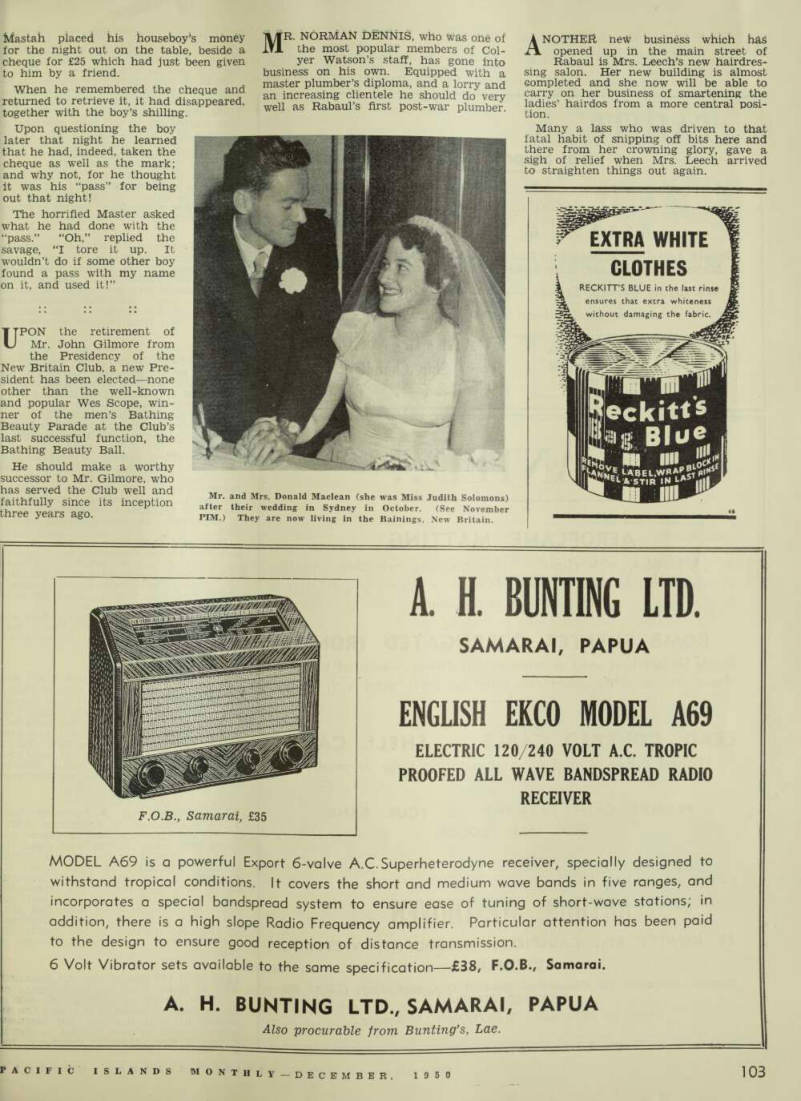
Prom Our Own Correspondent
Rabaul, Dec. 5.
RSL officials and committee are pleased with the decision of the Supreme Court regarding the distribution of the Anzac House Fund, which totals £3,000. (A pre-war fund of which Mr. A.
J. Gaskin was sole surviving trustee. He applied to the Court for a direction in October).
The direction of the Court, which ful fils the wishes of the RSL regarding the use of these monies, is as follows: The Trustees of the Fund shall be the Trustees of the Rabaul Sub-Branch of the RSL. Said Fund shall be used at the discretion of the Trustees, as regards both capital and income as follows: • For the education of the children of men resident in the Territory, who died on active service during the last World War. And for the education of the child ren of Territory residents who died during the Japanese invasion of said Territory. • For the relief of distressed returned servicemen in the Rabaul area or their dependents, including Ex-servicemen and their dependents who are resident in said area.
RABAUL enjoyed two “gurias” of noticeable strength this month. The first occurred on Saturday night, De cember 2 at 3.29 a.m. and was short but very rough. The second came on Monday night at 2.25 a.m. and, although not as violent as the first, was of much longer duration. Lights sprang up all over Rabaul which indicated residents evacuat ing their beds. Some confessed they even packed that little bag, which according
to the wording of official instructions should contain a variety of items, includ ing small children.
Who can deny that there is something particularly demoralising about “gurias” at this hour, when one feels oneself at the mercy of the unseen and unknown One can easily conjure up a vision of the macabre, such as an agitated parent stuf fing his smallest children into a little bag.
This is possibly the atmosphere of panic the official had in mind when he wrote that strangely worded evacuation instruc tion.
A MEETING was held during the month by RSL members to discuss plans made earlier this year for the re formation of the New Guinea Volunteer Rifles. All members are very keen and during the visits of General Nimmo and Lieutenant-Col. McLeod to Rabaul, the RSL Club offered the use of their rooms for the purpose.
The RSL communicated with Lt-Col.
McLeod and a date has been arranged for him to revisit Rabaul on December 4, when it is hoped to finalise plans for the
Ngvr.
ON November 29 a meeting of all Public Service Officers was convened to form a sub-branch of the Public Service Association, and to discuss the new regulations which are to be intro duced.
There were 55 officers present, and from among these office bearers were selected.
They were: Mr. G. Lang, chairman; Mr. Martin Munro, secretary; committee members, Miss Jean Parle, Messrs. J.
Palmer, W. Kyte, C. Showman, and I.
Clarke.
CAME Wednesday—boys’ night at the local picture show: One good kind
Mastah placed his money for the night out on the table, beside a cheque for £25 which had just been given to him by a friend. , .. n , When he remembered the cheque and together
Upon questioning the boy later that night he learned that he had, indeed, taken the cheque as well as the mark; and why not, for he thought it was his “pass” for being out that night!
The horrified Master asked what he had done with the “pass.” “Oh,” replied the savage, “I tore it up. It wouldn’t do if some other boy found a pass with my name on it, and used it!”
UPON the retirement of Mr. John Gilmore from the Presidency of the New Britain Club, a new Pre sident has been elected—none other than the well-known and popular Wes Scope, win ner of the men’s Bathing Beauty Parade at the Club’s last successful function, the Bathing Beauty Ball.
He should make a worthy successor to Mr. Gilmore, who has served the Club well and faithfully since its inception three years ago.
1VT R - NORMAN DENNIS, who was one of ITJ. the most popular members of Colyer Watson’s staff, has gone into business on his own. Equipped with a master plumber’s diploma, and a lorry and an increasing clientele he should do very well as Rabaul ’ s first Post-war plumbed
ANOTHER new business which has opened up in the main street of Rabaul is Mrs. Leech’s new hairdres sing salon. Her new building is almost completed and she now will be able to carry on her business of smartening the ladies’ hairdos from a more central posi tion.
Many a lass who was driven to that fatal habit of snipping off bits here and there from her crowning glory, gave a sigh of relief when Mrs. Leech arrived to straighten things out again.
Mr. and Mrs. Donald Maclean (she was Miss Judith Solomons) after their wedding in Sydney in October. ( See November PIM.) They are now living in the Bainings, New Britain.
ON December 4, the ABC announced the death of Norman Winning at Jakarta. He died at the hands of Indonesian rebels.
This news is of particular interest to
Territorians, inasmuch as Lieut.-Col.
Winning, DSO, was Commander of the 2/sth Australian Independent Company, that attacked the Japs at Salamaua in 1942. On this occasion he led his gal
lant Company in what was the first ground victory gained by the Allied Forces in the South-West Pacific. It was for this that he was awarded the DSO.
News of his death held particular in terest and regret for two men in Rabaul to-day. They are Randall Mac Lean and D. M. O’Farrell. Together with Winning, they started off in the same company as troopers at the outbreak of war in the Pacific. They became friends, and all later gained their commissions.
Before the war Norman Winning was a rubber planter in Java, Randall Mac- Lean was in Sourabaya, and D. M. O’Far rell was in Salamaua. Mr. Winning was the only one of the three friends to return to his former place of residence.
EARLY this month one of the much maligned Works and Housing em ployees put on a really good show.
With a wild yippee and a demonstration of the swallow dive, he entered the Rabaul swimming pool. But, unfortunately, the pool happened to be empty at the time.
He emerged from hospital several days later.
A SUCCESSFUL patrol has been carried out in the Mokolkol country, in the region of Open Bay hinterland, on the island of New Britain. Seven Mokol kols were persuaded to return to Rabaul with the patrol, which was led by acting ADO Pienberg, accompanied by Cadet PO Normoyle (Junior), and Forestry Officer Heather.
The “captives” consisted of two men, one woman, and four children. The men are about 33, and 38 years of age and therein lies the tremendous success of this patrol. Previously only aged men, women, or children have been picked up by expeditions into the Mokolkol strong hold.
They said that there is only this one Mokolkol village, containing twelve males, one youth, eight adult females, and about ten children. It seems incredible that this tiny band of hill-people should dominate and terrorise, as they do, about 500 miles of country.
The natives will be taught Pidgin and in a few months time it is hoped to send them back to their village as proselytes of civilisation.
OUR three clubs —the RSL, the New Britain, and the New Guinea Club have all combined this year to raise funds for the Children’s Christmas Tree and Party. Previously this has been held at the New Britain Club, but this year it will take place at the New Guinea Club. So far monies collected total over £4OO, and since the guest list of children is 130 they are assured of a magnificent tree, and party.
FOLLOWING upon a deputation from the Chamber of Commerce, which called upon the District Officer and asked that something be done about the state of the roads in Rabaul, particularly Malaguna, which is a main artery for shipping at the main wharf, improve ments have been carried out extensively.
Heavy loads of coranus have been put down, and now that we have had rain, the roads have been vastly improved.
Driving along them is no longer the shattering experience that it was for so long.
WE WOULD like a clear-cut statement of policy from the Government on this matter of shifting the site of the capital. Apparently, it is still the in tention to shift the site, but businesss interests seem to have decided to stay in Rabaul. New Guinea Company has
erected a new manager’s residence, in Yar ra Avenue, which certainly looks per manent, and we hear that the Shell Company has bought land from Burns Philp along the waterfront for the pur pose of installing large fuel tanks. The man in the street, confronted with such conflicting evidence can only scratch his head and wonder.
AN astonishing pine-apple was brought into town recently by Mr. Norman Duncan, of Talalili Plantation. The fruit consisted of fifteen pineapples, each complete with top knot, growing from the one stem, but flattened into bas-relief in the shape of a fan. Mr. Duncan has challenged other growers to produce some thing as good.
AFTER a prolonged and uncDmfortable dry spell, Rabaul has finally enjoyed some rain. The dry has lasted several months and has reminded old residents of a six month drought which they had in 1930, when it was so dry the birds pecked the coconuts in an endeavour to get a drink.
Over the last few weeks several hun dred points of rain have fallen, and in dications are that the North-west wet season is about to commence. When this begins residents will, of course, begin to speak nostalgically of the dry.
Advertisements & other items, pp. 103-106 (2 items)
Masse
FRANCIS HOOVER
4 Castlereagh Street, Sydney Cables: “Petwer.”
G.P.O. Box 4623.
EXPORTERS
All classes of merchandise supplied. Careful attention given to big and small orders.
ENJOY YOUR
MOTORING
GET A
Masse
BATTERY
“They’re Tigers for Work” raM f (5 There's no better battery made than Masse. Sturdy plates and husky case make for long life. Supercol Separators ensure a super-activity of acid on every part of the plates, giving a constant output of current far beyond the allotted span. That's why Masse stands up to hard work and the heaviest drains made upon it in starting and lighting.
ROBERT GILLESPIE <SL
LAE and RABAUL
LTD.
WHEN SPEED IS THE NEED!
• m m m A TYPICAL ECONO-STEEL BUILDING. Econo-Steel houses, factories, stores, etc., can be erected quickly by unskilled labour—as an example, numerous Lutheran Mission buildings (each 80 ft. by 24 ft.) have been built in New Guinea by native labour, under supervision.
Econo-Steel has been used successfully in the Pacific Islands, in every Australian State, and in South Africa.
Missions, manager’s bungalows and tropical homes may be designed to suit almost any requirements.
Hollow box-sections of protected nailable steel can be more economcially consigned to remote points than any other material.
Over 2,000 Econo-Steel structures built to date for State and Commonwealth Works Departments, Public Works Department, and private interests, testify to the universal acceptance of Econo-Steel —an Australian patented product.
Available now —erected faster and at less cost.
Write for further particulars to:
ECONO-STEEL COMPANY
(A DIVISION OF TULLOCH, LTD.)
Concord Rood, Rhodes, N.S.W., Australia. Telephone: UF 1231.
Cables: “TULLSTEEL,” Sydney.
EXTRA WHITE
CLOTHES
RECKITT’S BLUE in the last rinse ensures that extra whiteness without damaging the fabric. ©ckitf * «g Blue
tSJStSK
A. H BUNTING LID.
SAMARAI, PAPUA
ENGLISH EKCO MODEL A 69
ELECTRIC 120/240 VOLT A.C. TROPIC
PROOFED ALL WAVE BANDSPREAD RADIO
RECEIVER
MODEL A 69 is a powerful Export 6-valve A.C.Superheterodyne receiver, specially designed to withstand tropical conditions. It covers the short and medium wave bands in five ranges, and incorporates a special bandspread system to ensure ease of tuning of short-wave stations; in addition, there is a high slope Radio Frequency amplifier. Particular attention has been paid to the design to ensure good reception of distance transmission, 6 Volt Vibrator sets available to the same specification —£38, F. 0.8., Samarai.
A. H. BUNTING LTD., SAMARAI, PAPUA
Also 'procurable from Bunting’s, Lae.
F. 0.8., Samarai, £35
TAHITI
To Shipmasters and Visitors
When calling at Tahiti, and seeking SHIPS SUPPLIES and FRESH
PROVISIONS, see—
OSCAR G. NORDMAN
Supply Agent for Messageries Maritimes, Union S.S. Co. of N.Z., Ltd., Matson-Oceanic Line, United States Line, General S.S. Corp., Etc.
We supply General Service Act as Shipping Agents Address all inquiries to the Tourist Bureau.
Wire before your arrival to
“OCEANIC, PAPEETE” —Our
registered cable address.
OSCAR G. NORDMAN
Ship Chandler
PAPEETE. TAHITI
WANTED!!
AEROPLANE MATTING
In good order, with clips. State quantity available and if bundled for shipment. Quote FOB Price your port for shipment to Sydney or Melbourne.
BOMB SHELTER CORRUGATED IRON
Bomb Shelter iron used as ammunition shelters—wanted to purchase any quantity, complete with the bolts used with these shelters
LEAD ■ COVERED CABLE SHELL CASES
Highest prices offered for any quantity, large or small.
PROMPT CASH PAYMENT TO YOUR BANK
FOR ALL GOODS.
Correspondence to:
ARTHUR WESTHOVEN
35 HOWITT RD., CAULFIELD, MELBOURNE, VICTORIA,
AUSTRALIA.
Bankers’ references to: Commercial Banking Coy. of Sydney, Collins St., Melbourne, Victoria.
Cables or radiograms: “WESTHOME,” Melbourne.
104
DECEMBER, 1950 - PACIFIC ISLANDS (MONTHLY
Death Of Mr. G. Coles
THE suddent death on November 23, of Mr. Gilbert Coles, while on holiday at Korolevu, Fiji, was a shock to local residents.
Mr. Coles, who was 65, was born in Australia and prior to his retirement was a traveller for the soft goods company of Hylands Ltd. which has traded in the Island groups for many years.
Shooting Affray In Santo
M. STOEBNER, partner in the firm of Stoebner and Pierron. general mechanics, Santo, New Hebrides, was the victim of an assault on November 18.
He was shot in the stomach, rushed to hospital, but died before morning, it is understood that M. Stoebner’s son also suffered from gun-shot wounds of a minor nature.
M. Pierron has been arrested and charged and it is reported that he has been escorted to Noumea.
Mr. Harold Manning, of Ocean Island, is a cricket enthusiast. He travelled 4,000 miles to Brisbane to see the first Australia —MCC test of the present series, and will follow the MCC team from State to State for the rest of the tests.
Advertisements & other items, pp. 107-108 (1 item)
R English Tobacco
HILL’S SUN RIPE and ARCHERS GOLD
FLAKE CIGARETTES
in Sealed Tins of 50 34/- per Thousand.
HILL’S SUN RIPE READY RUBBED
CIGARETTE TOBACCO
2 oz,Sealed Tins 9/- per lb.
MADE BY R. & J. HILL LTD., London. Established 1775.
Order through your Agent or direct from
C. SULLIVAN PTY. LTD.
379 KENT STREET, SYDNEY, N.S.W.
Agents for R. & J. Hill Ltd.—
RTR4 30 H.P. Marine Diesel
Elec. Starting. 2-1 Red. Gear. o
MARINE DIESEL AND
PETROL ENGINES
In units—9, 18, 20/30, 33/55, 60/90, and 95/130 H.P.
DB2.
Heavy Duty.
Modern compact Diesel for general purpose use. 9 H.P. Heavy Duty Petrol-Kerosene Engine.
GOOD DELIVERIES OF ALL MODELS.
Write for full particulars of our complete range of engines to: 6/10 Wattle Street,
PYRMONT, N.S.W.
Cables: “THORNMOTOR.” Sydney. wiue jut juu particulars of our complete range oj engine.
Thornycroft (Aust.) Pty., Ltd.
INf OF THE ISLAND W(WI
mi mm Preserve it, in all its enchantment, with a paint fortified for tropical weather resistance, for a rich color permanency and for a mellow, even weathering.
In the Tropics
USE BORTHWICKS ONLY
HICH [^fI^fe CRADE
REINFORCED
HOUSE PAINT
MORRIS HEDSTROM (AUST.) PTY. LTD. AGENTS FOR
BORTHWICKS PTY. CO.
SYDNEY.
£ Cooper Adjustable Glass Louvres are manufactured by F. W. GISSING PTY., LTD., 197 Wilson Street, Newtown, Sydney, Australia. Always insist on GENUINE
COOPEE LOUVRES—
they are clearly branded.
Keep Hot Sun OUT . . .
Let Cool Breezes IN!
Cooper Adjustable Glass Louvres are the ideal way of securing maximum ventilation with minimum interference from glare. Fitted with non-actinic glass, which absorbs the sun’s heat, they are ideal for nurseries and verandahs . . . and, amazing though it may seem, are actually cheaper to install than ordinary windows Cheaper to instal than ANY other kind of WINDOW L ♦ . *
ADJUSTABLE GLASS LOUVttES
Imagine it—units of movable glass louvres (plain or figured) in metal frames, giving unobstructed light and air, yet protection from draughts and rain and all with as simple a motion as flicking on a light switch. The price is so amazingly reasonable and Father can do all the erecting, it’s so easy.
Illustrated: Tynical Suburban Home Verandah (Sydney) glassed in with Cooper Louvres.
WRITE FOR PARTICULARS TO PACIFIC ISLANDS REPRESENTATIVE
£. J. GOUGH & CO.
SUPPLIERS OF GENERAL MERCHANDISE TO LEADING FIRMS THROUGHOUT THE PACIFIC ISLANDS.
Exporters . . . Importers . . . Manufacturers’ Representatives 1 BOND STREET, SYDNEY, AUSTRALIA. Box 3615 G.P.O. Tel. BU 2159 Bankers- Bank of N.S.W. Bank of Adelaide. Comptoir National d’Escompte de Paris.
Cable Address; “SEAFOODS.” SYDNEY. „ J Codes: Bentley’s, 2nd and Comp. Phrase; A.8.C., sth and 6th; Peterson, 2nd and 3rd. Banking. Acme.
Fighting Oppressive Taxation

How Fiji Cold Companies Are
A WAR of words between the Govern ment of Fiji and the companies which own the rich goldmining in dustry there, directs attention to the ex traordinary change that has taken place in the relationship between governments ind goldmining concerns since the govern ments became more or less dominated by Socialist theories.
In the old days, by giving them sub stantial concessions in taxation, and in Dther ways, governments encouraged min ing enterprises to invest their funds in :he search for gold. Enormous sums were iost in such enterprises—but the gold mining investors were always encouraged x) try again because they were free from taxation and enjoyed other privileges. It vas sound thinking on the part of the governments, because gold has a fixed in ,ernational value; and the government of my country with a rich gold industry was ;eldom troubled with financial problems.
The Melbourne financial group headed )y Theodore, Wren, Cody and others was ;hus encouraged by the British Colonial Dffice to develop and exploit the Tavua Goldfields, in the northern part of Viti Leva, Fiji. As a result the Emperor and joloma companies were successfully jstablished, and the Colony of Fiji has jenefited enormously from the millions of )ounds worth of gold they recovered. [T seemed a happy arrangement for everyone. But Socialism was taking command in Australia (where Em- Deror and Loloma are owned) and in Britain (whicn is responsible for the government of Fiji).
The first trouble came when the two :ompanies were met with an inflexible de nand for double taxation. The Govem nent of Fiji imposed a heavy tax upon )oth the gold produced and the profit of he companies; and the Government of Australia, with total disregard of the ithics of the situation, insisted upon im losing income taxation upon the dividends if the shareholders when they arrived in Australia for distribution.
Because of this manifest injustice— here was no indication of such taxation lemands when the companies launched heir enterprise—the late Mr. Theodore ought both Governments until the day f his death.
For example, the Fiji gold companies tad set aside a certain sum to be used a investigating and developing the gold ield that is known to exist in the Beran'de -rea of Guadalcanal, in the British Solo non Islands. A subsidiary had been ormed, an organisation created and men /ere already in the Solomons, when the British Socialist Government let it be ;nown that it would demand a very large hare of any gold discoveries made in the lolomons.
Mr. Theodore immediately cancelled all ilans relating to the Solomons and with drew his prospecting party. As a result, here is no gold coming out of the Solo ions—and there is not likely to be. The Oldfield there is not a “small man’s how’’ —it can be worked profitably only y a big company, with big resources.
Mr. Theodore’s answer to the Australian jovernment’s attempt at double taxation ms to withhold dividends from the Aus ralian shareholders. Instead, he put into peration the rather unusual plan of :eeping what officially are the profits in (where they are used as working apital) while he returned the subscribed apital to the shareholders in a series of •ayments extending over years, and which ook the place of dividends. Officially, the hareholders’ capital has been returned
to them—and this is free of taxation, of course; but they still own in Fiji, in re spect of each share, a large sum of money which officially represents the accumu lated profits of the companies—but which they can-only get, free of Australian taxa tion, if they go and live in Fiji, MR. THEODORE is dead but in this respect his soul goes marching on.
The Emperor and Loloma companies held their annual meeting in Melbourne on December 1, and the chairmen of the respective meetings (Mr. P. p. Cody, for Loloma, and Mr. Wallace H. Smith, for Emperor) each directed attention to the punishing taxation that was being now imposed upon the companies in Fiji. They said that the Fiji royalty charge was now equal to 71 per cent, of the value of the gold won as against 5 per cent, previously.
Mr. Cody said this action by the Fiji
Government was extremely harsh, and offered no inducement to the mining com panies to explore and develop other areas.
The annual accounts showed that Em peror, in the year ended June 30, made a profit of £161,752 Australian, compared with £76,202 in 1949 and £56,637 in 1948.
Loloma made £142,850 Australian, com pared with £128,083 and £88,939 in the pre vious years.
These increased profits are due in part to the action of the British Government in depreciating Sterling. Australian and Fijian currencies were similarly devalued; but the product of the mine (gold) he*ld its value, of course, in the world’s market.
Both companies also are receiving a large and increasing revenue from their heavy investments in other companies.
The Fiji Government got over £lOO,OOO in direct taxation in one year from the two companies.
In preparation for the introduction of jet aircraft on commercial routes, 15 special meteorological radar stations will be built in Australia and New Guinea.
The proprietors of a copra estate in Taveuni, Fiji, remember with gratitude the generosity of the Fijian owners of a lease which forms part of the estate. In the years 1941 and 1942 when copra prices were low, the Fijians agreed to a sub stantial reduction in the rent. Now that the price of copra is high, the proprietors of the estate have sent to the Native Land Trust Board a cheque for the amount surrendered in those two years, with a request that it be paid to the Fijian owners of the land and that they be thanked for their helpful attitude in diffi cult times.
Advertisements & other items, p. 109 (2 items)
107
PACIFIC ISLANDS MONTHLI_D E C E M B E R, 1950
Kerr Bros. S
Ankles Swollen, Backache Nervous, Kidneys Strained!
If you’re feeling out o-sorts, have Broken Rest, or suffer from Dizziness, Nervousness, Backache, Leg Pains, Rheumatism, Swollen Ankles, Excess Acidity or loss of Energy and feel old before your time, Kidney and Bladder Weakness may be the true cause.
Wrong foods and drinks, worry, colds or overwork may create an excess of acids and place a heavy strain on your kidneys so that they function poorly and need help to properly refresh your blood and maintain health and energy.
Help Kidneys Scientific Way
It has been discovered by scientific clinical tests and in actual practice that a quick and modern way to help the kidneys clean out excess poisons and acids is with a scientifically pre-
pared prescription called Cystex.
Hundreds and hundreds of clinical records prove this. And former sufferers write daily saying that they feel vastly improved in 24 to 48 hours after taking Cystex.
Guaranteed to Satisfy or Money Back Get Cystex from your chemist today. Give it a thorough test. Cystex is guaranteed to make you feel younger, stronger, better in every way, or your money back if you return the empty package. Act now! for Your Kidneys, Bladder, Rheumatism This is a
GUARANTEED
Treatment
Cystex
KERR BROS. S
G.P.O. Box 3838, Sydney.
ISLAND MERCHANTS SINCE 1895
50 years old, hut as young as ever and eager to serve you.
Cocoa Beans, Copra, Coffee and all Island Produce Sold on Commission.
All merchandise purchased at best wholesale prices and original invoices supplied.
Use Our Co-operative Specialised Overseas Buying Service.
Highland Labour
Not Always The Right Answer
Prom a Special Correspondent
Rabaul. Nov. 30.
THERE is growing dissatisfaction with the Chimbus (Central Highlands natives) among employers of native labour in New Guinea. Most of these people have persevered with these boys—it is about a year now since the
first of them came down from the High lands—but many, including those with a reputation as “good native labour men” have apparently decided that they are not worth while, are signing them off and returning them to the Highlands.
Coconut Products at Madang recently returned 150 of them, and Mr. Geoff Bliss, of Dylup Plantation, in the Madang dis trict, is also reported to be returning the same number. There are various other rumours of dissatisfaction.
The main trouble seems to be that these boys need much more time to get used to the idea of working for a living than do other labour —Aitapes, Sepiks, etc. Most Chimbus (and I speak from experience) are very slow in movement and if they possibly can will sit down to work. For example, it is not unusual to see a Chimbu sit down to sweep a floor or chop wood. The just cannot get used to the idea that some show of speed is desirable.
This labour is expensive in the first place and as they come only for 12 months, plantation people naturally ex pect them to adapt themselves fairly smartly and gain enough efficiency to cut their quota of copra each day. When many months pass and they show no signs of this or of even earning their keen, naturally the master gets a little im patient.
There are only isolated cases yet, of boys being sent back before their time is up ; but there seems to be more coming.
It is reported from New Ireland that one plantation that has Highland labour has had five copra-drier fires in three months. They are asking for an inquiry.
If they have done nothing else, of course, the Chimbus can be said to have relieved the pressure on low-land native labour to some extent. These more civilised natives may now be offering more freely for work.
Advertisements & other items, p. 110 (1 item)
Akta-Vite'
BURNS PHILP (New Hebrides) LTD.
Registered Office: VILA, NEW HEBRIDES
Branch Office at SANTO
Exporters, Importers and General Merchants
(Retail and Wholesale) Commission, Shipping
and Customs Agents
Representatives for BURNS PHILP TRUST COMPANY LIMITED, QUEENS- LAND INSURANCE CO.. LTD., and LLOYD’S OP LONDON. Agents for SOCIETE DES PETROLES SHELL DES ILES FRAN C AISES DU PACIFIQUE, and numerous overseas manufacturers of all classes of merchandise.
San Francisco Agents: Sydney Agents: Burns. Phllp Co. of San London Agents: Burns, Phllp A Co., Ltd., Francisco, Burns, Phllp A Co., Ltd., 7 Bridge Street. Matson Building, 35 Crutched Friars, E.C.3. 215 Market Street.
A tropical climate does not
make life any easier for them ...
Growing children and nursing mothers particularly are prone to the lassitude, nerviness, fatigue, sleeplessness, etc., so common in tropical areas. During periods of rapid growth an adequate and balanced diet is essential.
'Akto-Vite' is delicious with iced milk, but also has great appeal when added to icecream and iced desserts.
Kiddies love
'AKTA-VITE' on
bread and butter or in sandwiches.
■'O»TMr
O 0 r
AKTA-VITE'
NUTRITIVE FOOD TONIC
is an ideal supplement to the diet because it provides definite and stated amounts of four essential vitamins, with minerals and carbohydrate for energy.
A.E.P.I
Monckton—Boswell
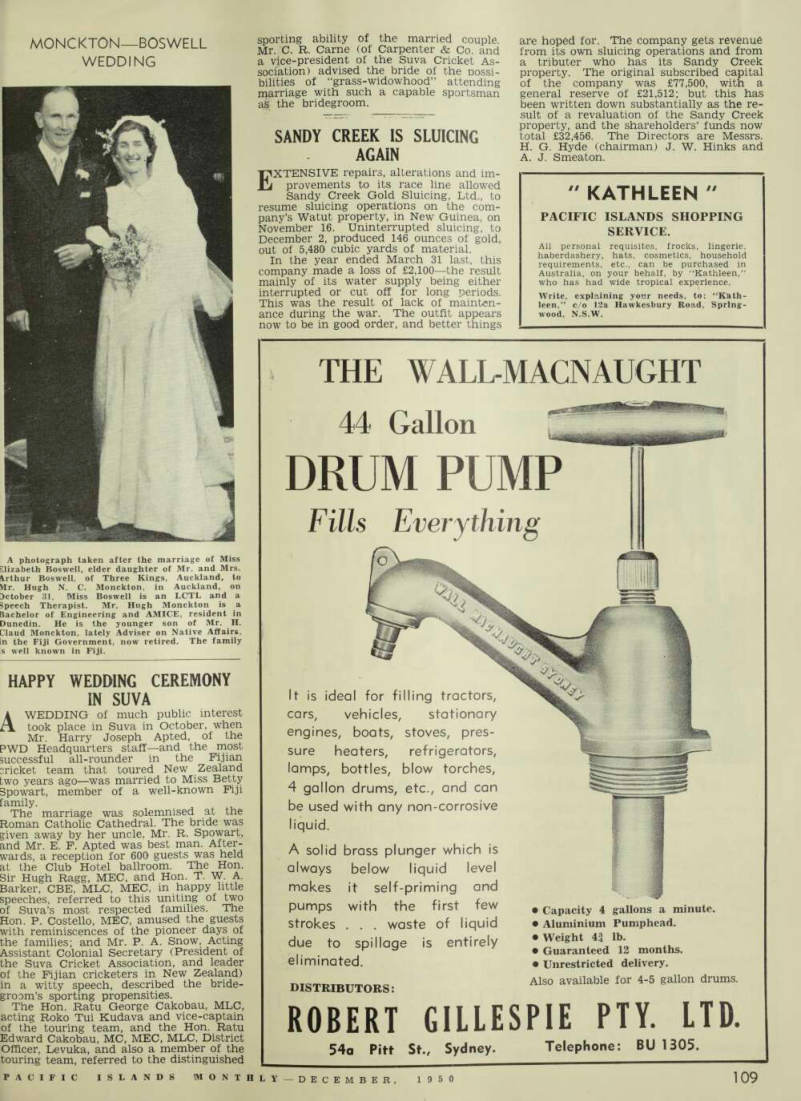
Wedding
A photograph taken after the marriage of Miss Elizabeth Boswell, elder daughter of Mr. and Mrs.
Arthur Boswell, of Three Kings, Auckland, to Mr, Hugh N. C. Monckton, in Auckland, on October 31. Miss Boswell is an LCTL and a speech Therapist. Mr. Hugh Monckton is a Bachelor of Engineering and AMICE, resident in Dunedin. He is the younger son of Mr. H.
Claud Monckton, lately Adviser on Native Affairs, in the Fiji Government, now retired. The family s well known in Fiji.
Happy Wedding Ceremony
In Suva
A WEDDING of much public interest took place in Suva in October, when Mr. Harry Joseph Apted, of the PWD Headquarters staff —and the most successful all-rounder in the Fijian cricket team that toured New Zealand bwo years ago—was married to Miss Betty Spowart, member of a well-known Fiji
family. , . , .
The marriage was solemnised at the Roman Catholic Cathedral. The bride was given away by her uncle, Mr. R. Spowart, and Mr. E. F. Apted was best man. After wards, a reception for 600 guests was held at the Club Hotel ballroom. The Hon.
Sir Hugh Ragg, MEC, and Hon. T. W. A.
Barker, CBE, MLC, MEC, in happy little speeches, referred to this uniting of two of Suva’s most respected families. The Hon. P. Costello, MEC, amused the guests with reminiscences of the pioneer days of the families; and Mr. P. A. Snow, Acting Assistant Colonial Secretary (President of the Suva Cricket Association, and leader of the Fijian cricketers in New Zealand) in a witty speech, described the bride groom’s sporting propensities.
The Hon. Ratu George Cakobau, MLC, acting Roko Tui Kudava and vice-captain of the touring team, and the Hon. Ratu Edward Cakobau, MC, MEC, MLC, District Officer, Levuka, and also a member of the touring team, referred to the distinguished
sporting ability of the married couple.
Mr. C. R. Came (of Carpenter & Co. and a vice-president of the Suva Cricket As sociation) advised the bride of the nossi bilities of “grass-widowhood” attending marriage with such a capable sportsman as the bridegroom.
Sandy Creek Is Sluicing
Again
EXTENSIVE repairs, alterations and im provements to its race line allowed Sandy Creek Gold Sluicing, Ltd., to resume sluicing operations on the com pany’s Watut property, in New Guinea, on November 16. Uninterrupted sluicing, to December 2, produced 146 ounces of gold, out of 5,480 cubic yards of material.
In the year ended March 31 last, this company made a loss of £2,100 —the result mainly of its water supply being either interrupted or cut off for long periods.
This was the result of lack of mainten ance during the war. The outfit appears now to be in good order, and better things
are hoped for. The company gets revenue from its own sluicing operations and from a tributer who has its Sandy Creek property. The original subscribed capital of the company was £77,500, with a general reserve of £21,512; but this has been written down substantially as the re sult of a revaluation of the Sandy Creek property, and the shareholders’ funds now total £32,456. The Directors are Messrs.
H. G. Hyde (chairman) J. W. Hinks and A. J. Smeaton.
Advertisements & other items, pp. 111-112 (1 item)
Drum Pump
" KATHLEEN "
PACIFIC ISLANDS SHOPPING
SERVICE.
All personal requisites, frocks, lingerie, haberdashery, hats, cosmetics, household requirements, etc., can be purchased in Australia, on your behalf, by “Kathleen,” who has had wide tropical experience.
Write, explaining your needs, to: “Kathleen,” c/o 12a Hawkesbury Road, Springwood, N.S.W.
THE WALL-MACNAUGHT
44 Gallon
DRUM PUMP
Fills Everything
</ ■s' It is ideal for filling tractors, cars, vehicles, stationary engines, boats, stoves, pressure heaters, refrigerators, lamps, bottles, blow torches, 4 gallon drums, etc., and can be used with any non-corrosive liquid.
A solid brass plunger which is always below liquid level makes it self-priming and pumps with the first few strokes . . . waste of liquid due to spillage is entirely eliminated.
DISTRIBUTORS:
• Capacity 4 gallons a minute. • Aluminium Pumphead. • Weight 42 lb. • Guaranteed 12 months. • Unrestricted delivery.
Also available for 4-5 gallon drums.
ROBERT GILLESPIE PTY. LTD.
54a Pitt St., Sydney.
Telephone: BU 1305.
Classified Advertisements
BOOKS
BOOK BARGAINS—Send for list of real bargains from 2/- upwards. State your interests, please. I also find out-of-print English Books.
Mention “PlM.’’—Philip Boulton, Bookseller, Westbury, Wilts, England.
AGENCIES WANTED
AGENCIES WANTED for the products of New Guinea and other Pacific Islands by a wellestablished firm of Indent and Export agents.
Write to: Badham, Littlejohn. 84 Hunter Street (P.O. Box 2047). Sydney, N.S.W., Australia.
POSITION WANTED
EXPERIENCED YOUNG WOMAN, aged 30, with
practical knowledge of Territories conditions, seeks position in Papua, N.G., or other Group, as store assistant, manageress of mess, hotel manageress, or similar job. First-class references as to character and ability. Write in first instance to “Manageress,” P.O. Box 3408.
G.P.0., Sydney, NS W.
TENDERS
MAMIRUM AND PATIAWAI PLANTATIONS.
Tenders are invited and will be received by the undersigned up to January 7, 1951, for the purchase of the following plantations and land:— MAMIRUM (Freehold): Situated on Mamirum Harbour, north-west New Hanover, Territory of New Guinea. Area; 1.606 hectares (approximately 4,000 acres), of which approximately 50 hectares are planted with coconut palms and the balance virgin timber. Mamirum Harbour is deep-water, sheltered, and ideal for timber loading.
The property has been surveyed and survey fees paid. It was purchased under contract sale from the Custodian of Expropriated Properties, who will give title when the enabling ordinance is completed.
PATIAWAI (Freehold): Approximately 120 hectares (approximately 300 acres), originally planted with 12.000 coconut palms, of which 1.100 were blitzed by enemy action in World War n. This property adjoins Mamirum.
Any buildings on the above two properties belong to the lessee and may be removed by him.
Both Mamirum and Patiawai properties are near the Tsalui Group plantations.
On acceptance of tender. 25 per cent, of tender
price to be deposited: and the balance is to be paid upon the execution of a conveyance of the property or such other document or instrument as the successful tenderer may reasonably require to evidence the sale in the absence of a registerable transfer. The successful tenderer shall accept such title as the owner now has, and shall pay cost of transfer and expenses of issue of title.
The highest or any other tender will not necessarily be accepted.
The above properties sold subject to the consent of the Administrator of the Territory of Papua and New Guinea.
K. T. ALLAN. “Stirling,” Rob Roy, via Inverell, New South Wales.
COCOA PLANTATION.—The Directors of Pacific Cocoa Plantation, Ltd., Sydney, invite offers for the purchase of the 99-years’ lease (approximately 90 years to run) of their plantation at Pullerbom Harbour, on the south coast of New Britain (near Lindenhaven), Territory of Papua and New Guinea. Improvements include wharf (with deep water), manager’s residence and native houses. Good labour available. There are approximately 1,800 two-years-old cacao trees, approximately 3,000 one-year-old trees, and a number of younger trees. About 200 acres have been felled. Offers and all correspondence should be addressed to; Ludowici & Caldwell, 57 York Street, Sydney, N.S.W., Australia.
HOLIDAY RESORTS
SOUTHERN HIGHLANDS—Roomy, sell-contained furnished flats, all-electric, sewered, hot water; near rail, shops and bus stops; handy to Sydney and South Coast towns; at 2,200 ft. elevation, all sports available, ideal for children. Terms and particulars from: Proprietor, “Tree Tops,”
Bundanoon, N.S.W.
NORFOLK ISLAND for delightful holidays, with riding, golf, and tennis. Very comfortable Guest House, beautifully situated, reasonable tariff.
Write: “Torrie Glen,” Norfolk Island.
MOUNTAIN VIEW” GUEST HOUSE, magni-
ficently situated on the banks of the Wollondilly River, in Burragorang Valley, Australia’s largest sunken valley (69 miles from Sydney), a most modern Guest House, with accommodation for 150 guests. Golf, tennis, riding, billiards, dancing and swimming. Hot water service, electric light and sewerage. Licensed to serve liquor. Tariff; £4/4/- per week, with special rates for children. Write direct to: “MOUNTAIN VIEW,” Burragorang Valley, N.S.W., or phone Burragorang 3 (or XM 1384). Proprietor: R. I.
Fernandez, late of Papua and New Guinea.
FOR SALE
RADIO EQUIPMENT.—3BZ Radiotelephone transmitter and receiver with connecting cable, key, microphone, speaker. Thoroughly reconditioned.
Crystals supplied to specified frequencies. £125 F. 0.8. Sydney. Other equipment, such as portable and fixed stations, available. Write for particulars to: Liverpool Trading Co., 23 George Street, Liverpool, N.S.W.
STAMPS, ETC.
BRITISH EMPIRE CANCER CAMPAIGN appeals
to well-wishers for used overseas stamps. Regular parcels from all Crown Colonies, etc., are particularly valuable. Please help Cancer Research, wherever you are, by sending stamps, many or few, to Sir Charles Lidbury, Hon.
Treasurer (Dept. P. 1.), 11 Grosvenor Crescent, London, S.W.I, England.
THE YANKEE TRADER wishes to announce that he is anxious to trade with persons in the South Sea Islands. I will trade fountain pens and pencils, cameras, spectacles (for sun wear), wrist-watches, costume jewellery, books and magazines, dresses for tropical wear, skirts and blouses for women and young girls, and baseball caps—for pearls, pearl shell, or stamps in used and excellent condition, off paper. If you wish to trade with me, write by sea or air-mail, asking for my agreement. Please state what items you wish me to send to you from the United States: also state what you have to offer, in exchange, of the items I am seeking—l can take only pearls, pearl shell or stamps. Send all letters to this address: Yankee Trader/George H. Haupt, P.O. Box 475, Times Square Station, New York, 18, N.Y., U.S.A.
PACIFIC
ISLANDS
YEAR
BOOK
1950 R.. W Robso
NOW
on
SALE!
PACIFIC ISLANDS YEAR BOOK, 1950
is now available from the leading Booksellers in Australia, New Zealand and the Pacific Islands, or direct from the Publishers.
There are 500 Pages and numerous Maps in this (the Sixth) Edition. In addition to providing the latest available information relating to Administrations, Trade (full Statistics), Tariffs, etc., all revised up to the end of 1949, the Year Book has many Special Sections, such as: A History and Chronology of the War in the Pacific, 1941-45: Lists of Public Servants in each Territory; Description of the new Air Transport Organisations serving the Pacific Islands; Complete Directory of Pacific Islands Missions; Notable Developments in 1940-50 Period; Detailed Index of Place Names in the Pacific, etc.
Price: 22/6 per copy.
Add postage, etc. (Within the British Empire, 1/-; Foreign 2/-) when ordering direct. (In U.S. Currency: $3.00, plus 25 cents postage).
PACIFIC PUBLICATIONS PTY. LTD.
Union House, 247 George Street, SYDNEY.
P.O. Box 3408, Sydney, N.S.W., Australia.
Popular Doctor
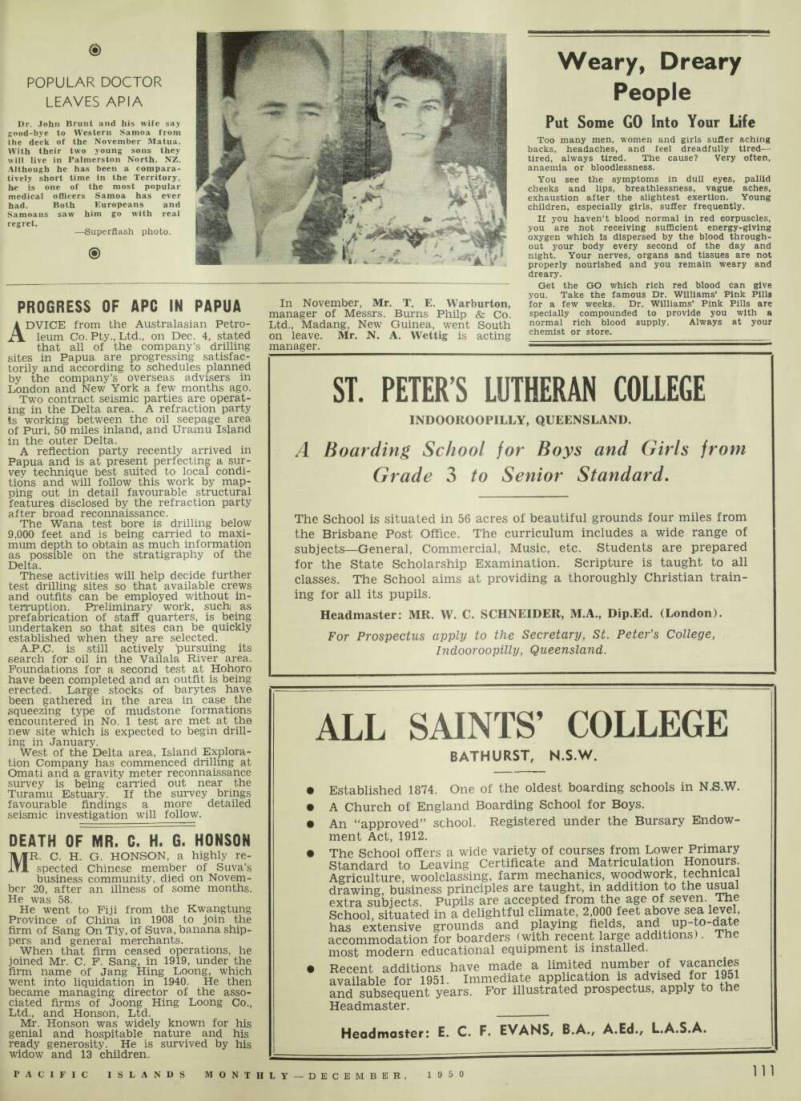
Leaves Apia
Dr. John Brunt and his wife say good-bye to Western Samoa from the deck of the November Matua.
With their two young sons they will live in Palmerston North, NZ.
Although he has been a compara tively short time in the Territory, be is one of the most popular medical officers Samoa has ever had. Both Europeans and Samoans saw him go with real
regret.
Superflash photo.
Progress Of Apc In Papua
ADVICE from the Australasian Petro leum Co. Pty., Ltd., on Dec. 4, stated that all of the company’s drilling sites in Papua are progressing satisfac torily and according to schedules planned by the company’s overseas advisers in London and New York a few months ago.
Two contract seismic parties are operat ing in the Delta area. A refraction party !s working between the oil seepage area of Puri, 50 miles inland, and Uramu Island in the outer Delta.
A reflection party recently arrived in Papua and is at present perfecting a sur vey technique best suited to local condi tions and will follow this work by map ping out in detail favourable structural features disclosed by the refraction party after broad reconnaissance.
The Wana test bore is drilling below 9,000 feet and is being carried to maxi mum depth to obtain as much information as possible on the stratigraphy of the Delta.
These activities will help decide further test drilling sites so that available crews and outfits can be employed without in teriruption. Preliminary work, such as prefabrication of staff quarters, is being undertaken so that sites can be quickly established when thev are selected.
A.P.C. is still actively pursuing its search for oil in the Vailala River area.
Foundations for a second test at Hohoro have been completed and an outfit is being erected. Large stocks of barytes have been gathered in the area in case the squeezing type of mudstone formations encountered in No. 1 test are met at the new site which is expected to begin drill ing in January.
West of the Delta area, Island Explora tion Company has commenced drilling at Omati and a gravity meter reconnaissance survey is being carried out near the Turamu Estuary. If the survey brings favourable findings a more detailed seismic investigation will follow.
Death Of Mr. C. H. G. Honson
Mr. C. H. G. HONSON, a highly re spected Chinese member of Suva’s business community, died on Novem ber 20, after an illness of some months.
He was 58.
He went to Fiji from the Kwangtung Province of China in 1908 to join the firm of Sang On Tiy, of Suva, banana ship pers and general merchants.
When that firm ceased operations, he joined Mr. C. F. Sang, in 1919, under the firm name of Jang King Loong, which went into liquidation in 1940. He then became managing director of the asso ciated firms of Joong King Loong Co., Ltd., and Honson, Ltd.
Mr. Honson was widely known for his genial and hospitable nature and his ready generosity. He is survived by his widow and 13 children.
In November, Mr. T. E. Warburton, manager of Messrs. Burns Philp & Co.
Ltd., Madang, New Guinea, went South on leave. Mr. N. A. Wettig is acting manager.
Advertisements & other items, p. 113 (1 item)
All Saints’ College
Weary, Dreary
People
Put Some GO Into Your Life
Too many men, women and girls suffer aching backs, headaches, and feel dreadfully tired — tired, always tired. The cause? Very often, anaemia or bloodlessness.
You see the symptoms in dull eyes, pallid cheeks and lips, breathlessness, vague aches, exhaustion after the slightest exertion. Young children, especially girls, suffer frequently.
If you haven’t blood normal in red corpuscles, you are not receiving sufficient energy-giving oxygen which is dispersed by the blood throughout your body every second of the day and night. Your nerves, organs and tissues are not properly nourished and you remain weary and dreary.
Get the GO which rich red blood can give you. Take the famous Dr. Williams’ Pink Pills for a few weeks. Dr. Williams’ Pink Pills are specially compounded to provide you with a normal rich blood supply. Always at your chemist or store.
ST. PETER’S LUTHERAN COLLEGE
INDOOROOPILLY, QUEENSLAND.
A Boarding School for Boys and Girls from
Grade 3 to Senior Standard.
The School is situated in 56 acres of beautiful grounds four miles from the Brisbane Post Office. The curriculum includes a wide range of subjects—General, Commercial, Music, etc. Students are prepared for the State Scholarship Examination. Scripture is taught to all classes. The School aims at providing a thoroughly Christian training for all its pupils.
Headmaster: MR. W. C. SCHNEIDER, M.A., Dip. Ed. (London).
For Prospectus apply to the Secretary, St. Peter’s College, Indooroopilly, Queensland.
ALL SAINTS’ COLLEGE
BATHURST, N.S.W.
Established 1874. One of the oldest boarding schools in N.S.W.
A Church of England Boarding School for Boys.
An “approved” school. Registered under the Bursary Endowment Act, 1912.
The School offers a wide variety of courses from Lower Primary Standard to Leaving Certificate and Matriculation Honours.
Agriculture, woolclassing. farm mechanics, woodwork, technical drawing business principles are taught, in addition to the usual extra subjects. Pupils are accepted from the age of seven. The School, situated in a delightful climate, 2,000 feet above sea level, has extensive grounds and playing fields, and up-to-date accommodation for boarders (with recent large additions). The most modern educational equipment is installed.
Recent additions have made a limited number of vacancies available for 1951. Immediate application is advised for 1951 and subsequent years. For illustrated prospectus, apply to the Headmaster.
Headmaster: E. C. F. EVANS, 8.A., A.Ed., L.A.S.A.
Islands Produce
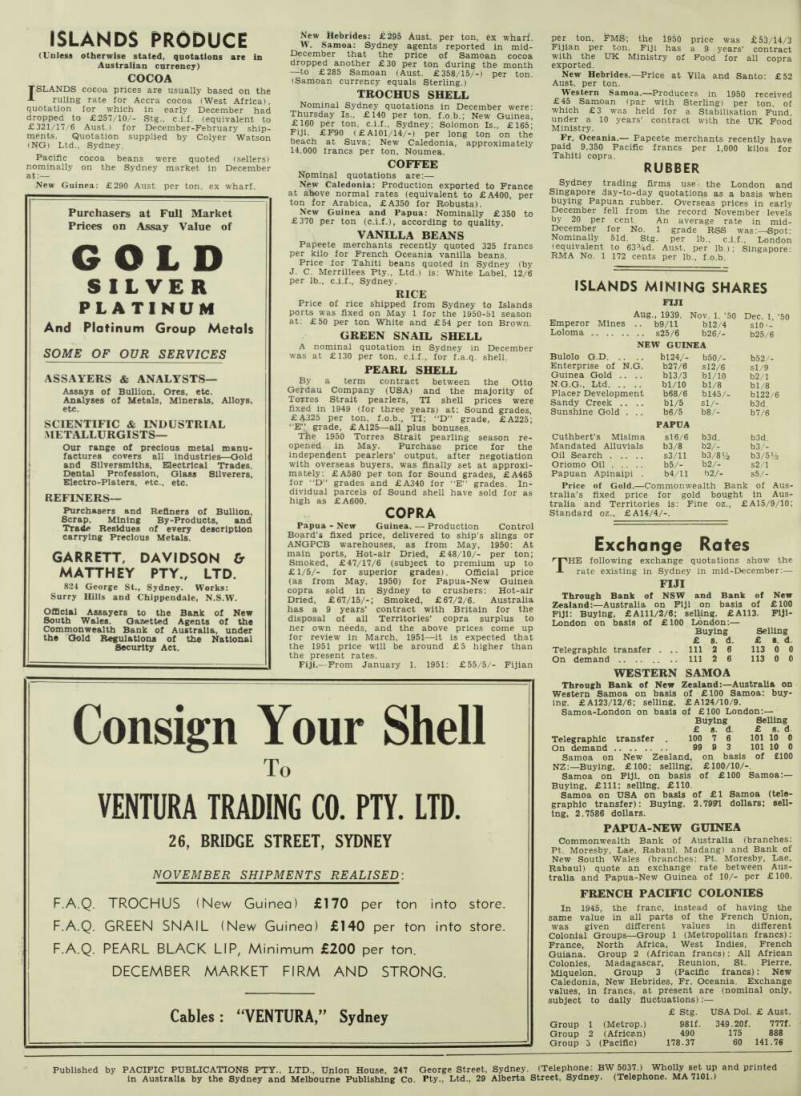
(Unless otherwise stated, quotations are in Australian currency)
Cocoa
TSLANDS cocoa prices are usually based on the -I ruling rate for Accra cocoa (West Africa), quotation for which in early December had dropped to £257/10/- Stg., c.i.f. (equivalent to £321/17/6 Aust. i for December-February ship ments. Quotation supplied by Colyer Watson (NG) Ltd., Sydney.
Pacific cocoa beans were quoted (sellers) nominally on the Sydney market in December at:— New Guinea: £290 Aust per ton. ex wharf.
New Hebrides: £295 Aust. per ton, ex wharf.
W. Samoa: Sydney agents reported in mid- December that the price of Samoan cocoa dropped another £3O per ton during the month —to £285 Samoan (Aust. £358/15/-) per ton. (Samoan currency equals Sterling.)
Trochus Shell
Nominal Sydney quotations in December were: Thursday Is., £l4O per ton, f.0.b.; New Guinea, £l6O per ton, c.i.f., Sydney; Solomon Is., £165; Fiji, £F9O (£AIOI/14/-) per long ton on the beach at Suva; New Caledonia, approximately 14.000 francs per ton, Noumea.
Coffee
Nominal quotations are:— New Caledonia: Production exported to France at above normal rates (equivalent to £A4OO, per ton for Arabica, £A3SO for Robusta).
New Guinea and Papua: Nominally £350 to £370 per ton (c.i.f.), according to quality.
Vanilla Beans
Papeete merchants recently quoted 325 francs per kilo for French Oceania vanilla beans.
Price for Tahiti beans quoted in Sydney (by J. C. Merrillees Pty., Ltd.) is; White Label, 12/6 per lb., c.i.f., Sydney.
Rice
Price of rice shipped from Sydney to Islands ports was fixed on May 1 for the 1950-51 season at: £5O per ton White and £54 per ton Brown.
Green Snail Shell
A nominal quotation in Sydney in December was at £l3O per ton, c.i.f., for f.a.q. shell.
Pearl Shell
By a term contract between the Otto Gerdau Company (USA) and the majority of Torres Strait pearlers, TT shell prices were fixed in 1949 (for three years) at: Sound grades, £A325 per ton, f.0.b., TI; “D” grade, £A225; “E” grade, £Al2s—all plus bonuses.
The 1950 Torres Strait pearling season re opened in May. Purchase price for the independent pearlers’ output, after negotiation with overseas buyers, was finally set at approxi mately: £ A5BO per ton for Sound grades, £A465 for “D” grades and £A34O for “E” grades. In dividual parcels of Sound shell have sold for as high as £ A6OO.
Copra
Papua - New Guinea. Production Control Board’s fixed price, delivered to ship’s slings or ANGPCB warehouses, as from May, 1950: At main ports, Hot-air Dried, £4B/10/- per ton; Smoked, £47/17/6 (subject to premium up to £l/5/- for superior grades). Official price (as from May, 1950) for Papua-New Guinea copra sold in Sydney to crushers: Hot-air Dried, £67/15/-; Smoked, £67/2/6. Australia has a 9 years’ contract with Britain for the disposal of all Territories’ copra surplus to her own needs, and the above prices come up for review in March, 1951 —it is expected that the 1951 price will be around £5 higher than the present rates.
Fiji.—From January 1, 1951: £55/5/- Fijian
P6f ton, FMS; the 1950 price was £Sil/i4/3 Fijian per ton. Fiji has a 9 years’ contract with the UK Ministry of Food for all copra exported.
New Hebrides.—Price at Vila and Santo: £52 Aust. per ton.
Western Samoa.—Producers in 1950 received £45 Samoan (par with Sterling) per ton, of which £3 was held for a Stabilisation Fund, under a 10 years’ contract with the UK Food Ministry.
Fr, Oceania.— Papeete merchants recently have paid 9,350 Pacific francs per 1,000 kilos for Tahiti copra.
Rubber
Sydney trading firms use the London and Singapore day-to-day quotations as a basis when buying Papuan rubber. Overseas prices in early December fell from the record November levels by 20 per cent. An average rate in mid- December for No. 1 grade RSS was:—Spot: Nominally 51d. Stg. per lb., c.i.f., London (equivalent to 63 3 / 4 d. Aust. per lb.); Singapore: RMA No. 1 172 cents per lb., f.o.b.
Islands Mining Shares
Price of Gold.—Commonwealth Bank of Aus tralia’s fixed price for gold bought in Aus tralia and Territories is: Fine oz., £AIS/9/10; Standard oz., £AI4/4/-.
Fiji
Aug., 1939.
Nov. 1. ’50 Dec. 1, ’50 Emperor Mines .. b9/ll bl2/4 slO Loloma S25/6 b26/b25/6
New Guinea
Bulolo G.D bl24/b50/b52/- Enterprise of N.G. b27/6 S12/6 sl/9 Guinea Gold .. .. bl3/3 bl/10 b2/l N.G.G., Ltd bl/10 bl/8 bl/8 Placer Development b68/6 bl45/bl22/6 Sandy Creek .. bl/5 Sl/b3d.
Sunshine Gold . .. b6/5 b8/b7/6 Cuthbert’s Misima
Papua
sie/6 b3d. b3d.
Mandated Alluvials b3/8 b2/b3/- Oil Search S3/11 b3/8V 2 b3/5V 2 Oriomo Oil b5/b2/s2/l Papuan Apinaipi . b4/ll b2/s5/-
Exchange Rates
THE following exchange quotations show the rate existing in Sydney in mid-December; —
Fiji
Through Bank of NSW and Bank of New Zealand: —Australia on Fiji on basis of £lOO Fiji: Buying, £Alll/2/6; selling. £AII3. PIJI - on basis of £lOO London: —
Western Samoa
Through Bank of New Zealand: —Australia on Western Samoa on basis of £lOO Samoa: buy ing. £AI23/12/6: selling. £AI24/10/9.
Samoa-London on basis of £lOO London: —
Buying. £111: selling, £llO.
Samoa on USA on basis of £1 Samoa (tele graphic transfer): Buying, 2.7991 dollars; sell ing, 2.7586 dollars.
Papua-New Guinea
Commonwealth Bank of Australia (branches: Pt. Moresby, Lae, Rabaul. Madang) and Bank of New South Wales (branches: Pt. Moresby, Lae, Rabaul) quote an exchange rate between Aus tralia and Papua-New Guinea of 10/- per £lOO.
French Pacific Colonies
In 1945, the franc, instead of having the same value in all parts of the French Union, was given different values in different Colonial Groups—Group 1 (Metropolitan francs): Prance, North Africa, West Indies, French Guiana. Group 2 (African francs): All African Colonies, Madagascar, Reunion, St. Pierre, Miquelon. Group 3 (Pacific francs): New Caledonia, New Hebrides, Fr. Oceania. Exchange values, in francs, at present are (nominal only, subject to daily fluctuations): —
Buying Selling £ s. d. £ s. d.
Telegraphic transfer . .. Ill 2 6 113 0 0 On demand .. .. .. . . Ill 2 6 113 0 0
Buying Selling £ a. d. £ s. d Telegraphic transfer 100 7 6 101 10 0 On demand 99 9 3 101 10 0 Samoa on New Zealand, on basis of £100 NZ: —Buying, £100; selling, £100/10/-.
Samoa on Fiji, on basis of £100 Samoa: —
£ Stg.
USA Dol. £ Aust.
Group 1 (Metrop.) 981 f. 349.20f. 777f.
Group 2 (African) 490 175 888 Group 3 (Pacific) 178.37 60 141.76
Advertisements & other items, pp. 114-116 (3 items)
Published by PACIFIC PUBLICATIONS PTY., LTD., Union House, 247 George Street, Sydney. (Telephone: BW 5037.) Wholly set up and printed
in Australia by the Sydney and Melbourne Publishing Co. Pty., Ltd., 29 Alberta Street, Sydney. (Telephone. MA 7101.)
Consign Your Shell
Purchasers at Full Market Prices on Assay Value of
GOLD
SILVER
PLATINUM
And Platinum Group Metals
SOME OF OUR SERVICES
ASSAYERS & ANALYSTS—
Assays of Bullion, Ores, etc.
Analyses of Metals, Minerals, Alloys, etc.
SCIENTIFIC & INDUSTRIAL
METALLURGISTS—
Our range of precious metal manufactures covers all industries—Gold and Silversmiths, Electrical Trades, Dental Profession. Glass Sllverers, Electro-Platers, etc., etc.
REFINERS—
Purchasers and Refiners of Bullion, Scrap, Mining By-Products, and Trade Residues of every description carrying Precious Metals.
GARRETT, DAVIDSON &
MATTHEY PTY., LTD.
824 George St., Sydney. Works: Surry mils and Chippendale, N.S.W.
Official Assayers to the Bank of New South Wales. Gazetted Agents of the Commonwealth Bank of Australia, under the Gold Regulations of the National Security Act.
Consign Your Shell
To
VENTURA TRADING CO. PTY. LTD.
26, BRIDGE STREET, SYDNEY
NOVEMBER SHIPMENTS REALISED :
F.A.Q. TROCHUS (New Guinea) £l7O per ton into store.
F.A.Q. GREEN SNAIL (New Guinea) £l4O per ton into store.
F.A.Q. PEARL BLACK LIP, Minimum £2OO per ton.
DECEMBER MARKET FIRM AND STRONG.
Cables: “VENTURA,” Sydney
Building Sheets
Corrugated Aluminium
■ ■■ m
For speed of erection
Corrugated Aluminium Building Sheets have many advantages over other roofing and siding materials. The lightness of the metal enables easier handling, with a considerable saving in transportation and erection costs.
It is highly resistant to corrosion, and reflects a high percentage of all radiant heat.
Painting is not necessary, and no special maintenance is required.
SALES AGENTS:
Corrugated Aluminium Building Sheets are available as listed below.
Widths: 26 in. with eight 3 in. corrugations. 32 in. with ten 3 in. corrugations. 26 in. with nine 2\ in. corrugations. 31 in. with eleven 2J in. corrugations.
Lengths: 6,7, 8,9, 10, 11 and 12 ft.
Thicknesses: 20, 22, 23, 24 and 26 Imperial Standard Wire Gauge.
ALUMINIUM UNION LIMITED
(Incorporated in the Dominion of Canada) Principal British Commonwealth Distributor of Aluminium Ocean House, 34 Martin Place, Sydney, N.S.W.
An ALUMINIUM LIMITED Company
Fiji, Western Samoa and Tonga : Morris, Hedstrom, Limited, Suva, Fiji.
Cook Islands: A. B. Donald Limited, Rarotonga, Cook Islands.
French Oceania: Etablissements Donald Tahiti, Papeete, Tahiti.
New Caledonia and New Hebrides: Agence Alma, 39 Rue de I’Alma, Noumea, New Caledonia.
LONDON
MONTREAL
CALCUTTA
SYDNEY
SHANGHAI
KARACHI
TOKYO
MERCHANTS, & SHIP OWNERS
Capital £500,000
ESTABLISHED 1914
GENERAL MERCHANTS
AND
PROVIDORES
TRADE THROUGHOUT THE PACIFIC.
THIRTY-FIVE YEARS OF PACIFIC ISLANDS DEVELOPMENT AND SERVICE.
BUYERS AND EXPORTERS OF ALL KINDS
OF ISLAND PRODUCE, COPRA, COCOA,
M.O.P. SHELL, TROCAS SHELL, ETC.
AGENTS FOR AUSTRALIAN, EUROPEAN
AND AMERICAN MANUFACTURERS.
DISTRIBUTORS OF EVERY DESCRIPTION
OF MERCHANDISE.
Through our Sydney office, branches and agents, we distribute a wide and comprehensive range of general merchandise.
t R. CARPENTER & CO. LID.
Head Office: 16 O'CONNELL STREET, SYDNEY, N.S.W.
Cable Address:
“CAMOHE”
Telephone: BW 4421.
Postal Address: G.P.O., BOX 168, Sydney.
In London; W. R. Carpenter Cr Co. (London), Ltd., Coronation House, 4 Lloyd's Ave., London, EC
ASSOCIATED COMPANIES THROUGHOUT THE PACIFIC :
IN NEW GUINEA:
New Guinea Company, Limited, Rabaul, Lae, Madang, Kavieng.
IN PAPUA:
J. R. Clay & Co., Ltd.
Port Moresby.
IN FIJI:
W. R. Carpenter & Co. (Fiji), Ltd., Suva.