Islands
Pacific
Monthly
November, !950
*fol. XXI. No. 4.
Established 1930,
[Registered at the Jok transmission by post as a newspaper ]
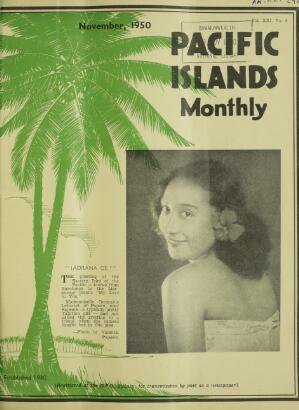
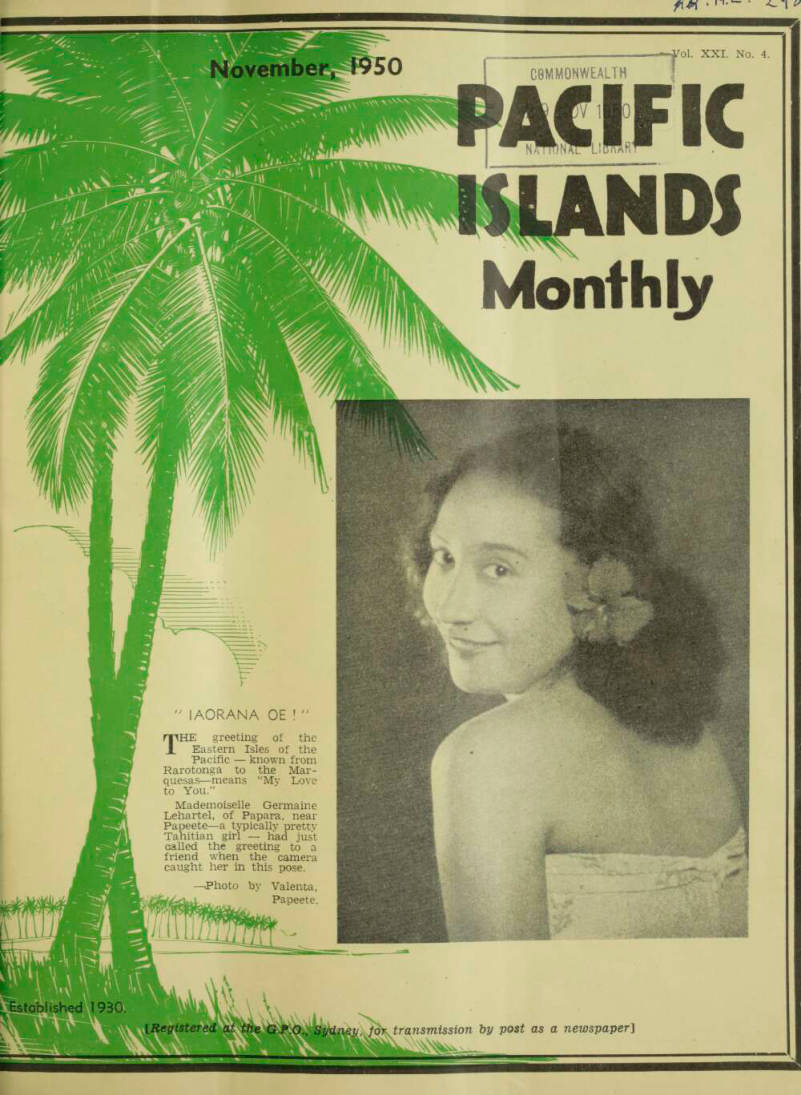
"Iaorana Oe!"
THE greeting of the Eastern Isles of the Pacific known from Rarotonga to the Mar quesas—means “My Love to You.”
Mademoiselle Germaine Lehartel, of papara, near Papeete—a typically pretty
Tahitian girl - had just
called the greeting to a friend when the camera caught her in this pose.
Photo by Valenta, Papeete.
Advertisements & other items, pp. 2-4 (3 items)
links across the
air
7 MO 1 iJW HlN*
S U>N
A** *0K A HE« *A* a SO** 1 £ LA «Stt* Af* 1 *
St-AHO
t: • ya«O'HA
10TU» U
hoh» a "_ *>* A AH° «*» I>W 00° M U» f** DtfiO EiP M 2" *a* a! »*»»
aSAU
O>V 0 >V .M/, v
V < i V
W /// S//S o/ $
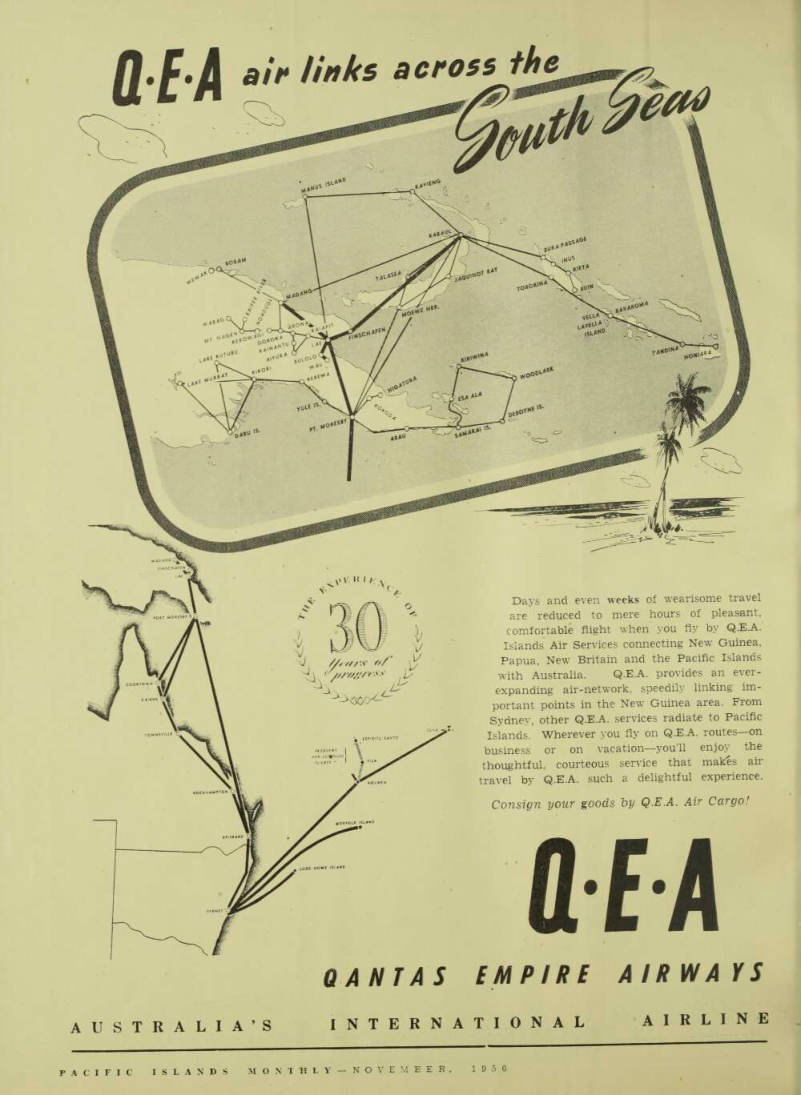
Z- Days and even weeks of wearisome travel are reduced to mere hours of pleasant, comfortable flight when you fly by Q.E.A.
Islands Air Services connecting New Guinea.
Papua, New Britain and the Pacific Islands with Australia. Q.E.A. provides an ever-
expanding air-network, speedily linking im-
portant points in the New Guinea area. From Sydney, other Q.E.A. services radiate to Pacific Islands. Wherever you fly on Q.E.A. routes—on business or on vacation—you'll enjoy the thoughtful, courteous service that makes air travel by Q.E.A. such a delightful experience.
Consign your goods by Q.E.A. Air Cargo! toir HOWf ISL4MD
Q ANT AS EMPIRE AIRWAYS
AUSTRALIA’S
INTERNATIONAL
AIRLINE
r H fl s
KEEPS S#
A Coleman Pressure Lantern makes ail outdoor night jobs easier, quicker and safer.
It is storm-proof; defies rain or a 105 mile gale to put it out ... it's safe because it cannot be tilled while lighted and cannot spill fuel if overturned. Lights instantly and has an automatic tip cleaner which operates at a touch and a turn.
Most important of all . . . it floodlights a one hundred foot area with dependable light, so bright you can read a newspaper fifty feet away and gives forty hours of lighting service per gallorv of fuel.
Available for petrol and ke/osene in capacities of 200, 300 and 500 C.P.
(pieman
L * ✓ S. m
LANTERNS
Representatives for the Pacific Islands.
54a PITT STREET
SYDNEY
ROBERT GILLESPIE PIT I™
PEARCE & CO. LTD.
SUVA
FOR FIJI ISLANDS
Suburban Salons: City Addresses: 166 Parramatta Road at Johnston
St. LA 3089.
706 Darling St., Rozelle. WB 2915. 421 New Canterbury Rd., Dulwich Hill. LM 6304. 215 Liverpool Road, Ashfield.
UA 5940.
In the Bondi Junction Arcade, 3 doors from Grace Bros. FW 4806.
TAe WendeJ
Ist Floor, Rigney’s Bldg., 147 a King St., Sydney.
Pl2a Her Majesty’s Arcade, Pitt g 191 Pitt St., opp. Henderson’s Sill 338 Pitt St., at Snow’s Tram Stc 20 Imperial Arcade, Castlereagh \ T & G Building, Elizabeth St. 99 Oxford Street. MA 1789. 169 King Street. MA 1796.
MA 5794.
ORDER
V -'Ti.
JM r u £ a ♦ r A 6 59 W m £ 0* Id 23/6 I m 32 /iN!
Es ' m i \m m K N m m ML m i x m % § m h * 0 h % m X S $ 53 * m i A * z Jacketed sun-dress in British cotton.
Guaranteed. Blue, gold, wine, rose, aqua or green. SWW, SW, W, £l/3/6; SOS, OS,
£l/4/11; XOS, £l/5/11; XXOS, XXXOS,
£l/7/11.
FREIGHT CHART
A floral dress in the famous Courtauld’s crepe . . . shirtmaker neckline on finely pin-tucked bodice.
Blue, lilac, aqua, rose, corngold or Autumn. WX, SOS, OS, XOS.
Freight 1/2 to all Pacific Islands except those listed below: — West Samoa, 1/6. East Samoa, U.S.A., 1/6.
The Wendel price, 59/6.
New Caledonia, 3/2. Hawaii, U.S.A., 1/6.
Shirtmaker style in seersucker (requires* ironing). Blue, red, mauve, rose, gold! green colourings. Sizes: SSW, SW, W,~
vrrvQ YYOR TTJTJrnS YXYXOS. 32/-.
1
ACIFIC ISLANDS MONTHLY NOVEMBER. 1950
2
NOVEMBER, 1950 PACIFIC ISLANDS MONTH
Index to Advertisers
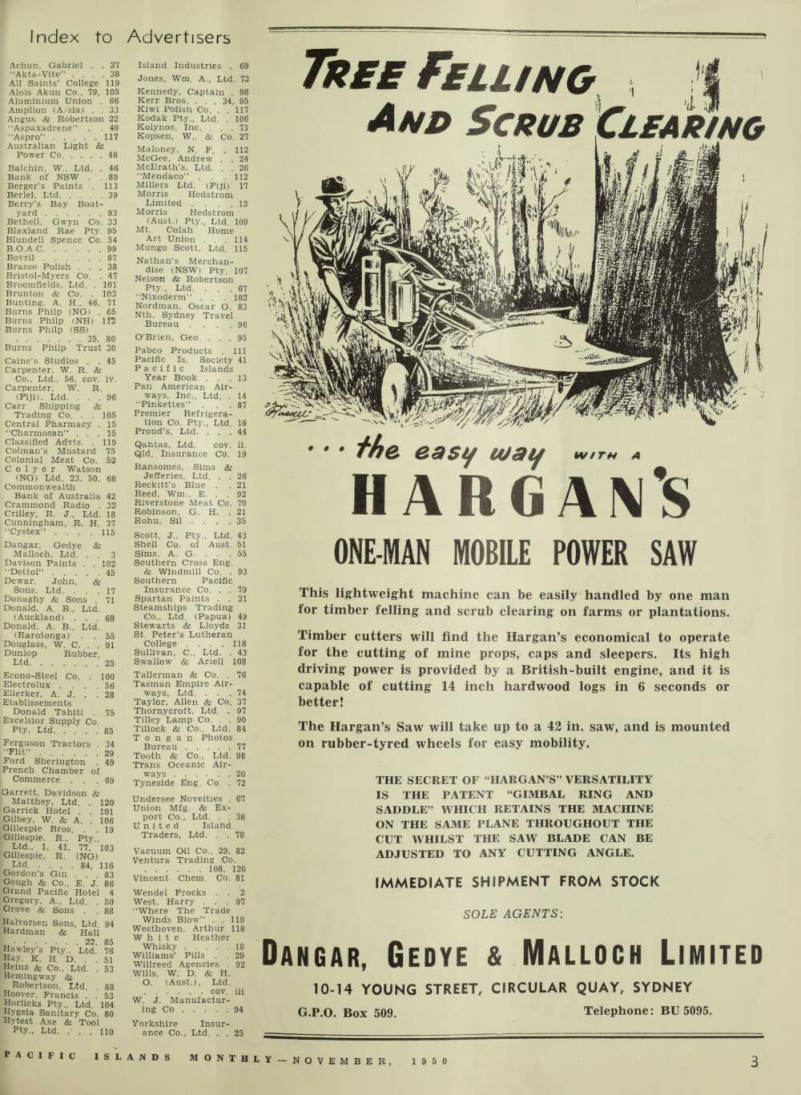
Achun, Gabriel . . 27 “Akta-Vite” ... 38 All Saints’ College 119 Alois Akun Co., 79, 105 Aluminium Union . 66 Amplion (A/sia) . . 33 Angus & Robertson 22 “Aspaxadrene” . . 40 “Aspro” 117 Australian Light & Power Co 48 Balchin, W.. Ltd. . 46 Bank of NSW . . 89 Berger’s Paints . 113 Berlei, Ltd 39 Berry’s Bay Boat yard 93 Bethell, Gwyn Co. 33 Blaxland Rae Pty. 95 Blundell Spence Co. 54 8.0.A.C 99 Bovril 87 Brasso Polish ... 38 Bristol-Myers Co. . 47 Broomfields, Ltd. . 101 Brunton & Co. . 103 Bunting. A. H,, 46, 71 Bums Philp (NG) . 65 Burns Philp (NHi 112 Burns Philp (SS) 35. 80 Burns Philp Trust 30 Caine’s Studios . . 45 Carpenter, W. R. & Co., Ltd., 56, cov. iv.
Carpenter, W. R. (Fiji). Ltd. ... 96 Carr Shipping & Trading Co, . . 105 Central Pharmacy . 15 “Charmosan” ... 15 Classified Advts. . 119 Colman’s Mustard 75 Colonial Meat Co. 52 Col y e r Watson (NG) Ltd. 23, 50, 68 Commonwealth Bank of Australia 42 Crammond Radio . 32 Crilley, R. J., Ltd. 18 Cunningham, R. H. 37 “Cystex” ... 115 Dangar, Gedye & Malloch, Ltd. . . 3 Davison Paints . . 102 “Dettol” 45 Dewar, John, & Sons, Ltd. ... 17 Donaghy & Sons . 71 Donald, A. 8., Ltd. (Auckland) ... 68 Donald. A. 8., Ltd. (Rarotonga) . . 55 Douglass, W. C. . . 91 Dunlop Rubber, Ltd 25 Econo-Steel Co. . 100 Electrolux ... 56 Ellerker, A. J. . . 28 Etablissements Donald Tahiti . 75 Excelsior Supply Co Pty, Ltd 85 Ferguson Tractors . 34 “Flit” 29 Ford Sherington . 49 French Chamber of Commerce ... 69 Garrett, Davidson & Matthey, Ltd. . 120 Garrick Hotel . . 101 Gilbey, W. & A. . 106 Gillespie Bros. . . 19 Gillespie. R.. Pty., Ltd., 1, 41, 77, 103 Gillespie, R. (NG) Ltd 84, 116 Gordon’s Gin ... 83 Gough & Co., E. J. 86 Grand Pacific Hotel 4 Gregory, A., Ltd. . 50 Grove & Sons . . 88 Halvorsen Sons, Ltd 94 Hardman & Hall T 22, 85 Hawley’s Pty., Ltd. 76 Hay, K. H. D. . . 51 Heinz & Co., Ltd. . 53
Hemingway &
Robertson, Ltd. . 88 Hoover, Francis . . 53 Horlicks Pty., Ltd. 104 Hygeia Sanitary Co. 80 Hytest Axe & Tool Pty., Ltd. ... 110
Island Industries . 69 Jones, Wm. A., Ltd. 72 Kennedy, Captain . 98 Kerr Bros. ... 34, 95 Kiwi Polish Co. . . 117 Kodak Pty., Ltd. . 106 Kolynos, Inc, ... 73 Kopsen, W., & Co. 27 Maloney, N. F. . 112 McGee, Andrew . . 24 Mcllrath’s, Ltd. . . 26 “Mendaco” . . . 112 Millers Ltd. (Fiji) 17 Morris Hedstrom Limited . . . . 12 Morris Hedstrom (Aust.) Pty., Ltd. 109 Mt. Colah Home Art Union ... 114 Mungo Scott, Ltd. 115 Nathan’s Merchan dise (NSW i Pty. 107 Nelson & Robertson Pty., Ltd. ... 67 “Nixoderm” . . . 102 Nordman, Oscar G. 83 Nth. Sydney Travel Bureau ... 96 O’Brien, Geo. ... 95 Pabco Products , 111 Pacific Is. Society 41 Pacific Islands Year Book ... 13 Pan American Air ways, Inc., Ltd. . 14 “Pinkettes” ... 87 Premier Refrigera tion Co. Pty., Ltd. 16 Proud’s, Ltd. ... 44 Qantas, Ltd. cov. ii.
Qld. Insurance Co. 19 Ransomes, Sims & Jefferies, Ltd. . . 26 Reckitt’s Blue . . 21 Reed, Wm , E. . .92 Riverstone Meat Co. 70 Robinson, G. H. . 21 Rohu, Sil . . . .35 Scott, J.. Pty., Ltd. 43 Shell Co. of Aust. 51 Sims, A. G. . . .55 Southern Cross Eng. & Windmill Co. . 93 Southern Pacific Insurance Co. . . 79 Spartan Paints . . 31 Steamships Trading Co., Ltd, (Papua) 49 Stewarts & Lloyds 31 St. Peter’s Lutheran College . . . .118 Sullivan, C., Ltd. . 43 Swallow & Ariell 108 Tallerman & Co. . 76 Tasman Empire Air ways, Ltd. ... 74 Taylor, Allen & Co. 37 Thornycroft, Ltd. . 97 Tilley Lamp Co. . . 90 Tillock & Co.. Ltd. 84 T o n g a n Photos Bureau 77 Tooth & Co., Ltd. 98 Trans Oceanic Air ways 20 Tyneside Eng. Co. . 72 Undersee Novelties . 67 Union Mfg. & Ex port Co., Ltd. . . 36 United Island Traders, Ltd. . . 78 Vacuum Oil Co.. 29, 82 Ventura Trading Co. lOB, 120 Vincent Chem. Co. 81 Wendel Frocks . . 2 West, Harry ... 97 “Where The Trade Winds Blow’’ . . 119 Westhoven, Arthur 118 White Heather Whisky 18 Williams’ Pills . . 29 Willreed Agencies . 92 Wills, W. D. & H.
O. (Aust.), Ltd. cov. iii W. J. Manufactur ing Co 94 Yorkshire Insur ance Co., Ltd. . . 25
Advertisements & other items, p. 5 (1 item)
Hargan’S
Tree Felling ,
And Scrub Clearing
% A .'■W N x>. £ •V' /M • fh easy WITH A
HARGAN’S
ONE-MAN MOHE POKER SAK
This lightweight machine can be easily handled by one man for timber felling and scrub clearing on farms or plantations.
Timber cutters will find the Hargan’s economical to operate for the cutting of mine props, caps and sleepers. Its high driving power is provided by a British-built engine, and it is capable of cutting 14 inch hardwood logs in 6 seconds or better!
The Hargan’s Saw will take up to a 42 in. saw, and is mounted on rubber-tyred wheels for easy mobility.
THE SECRET OF “HARGAN’S” VERSATILITY
IS THE PATENT “GIMBAL RING AND
SADDLE” WHICH RETAINS THE MACHINE
ON THE SAME PLANE THROUGHOUT THE
CUT WHILST THE SAW BLADE CAN BE
ADJUSTED TO ANY CUTTING ANGLE.
IMMEDIATE SHIPMENT FROM STOCK
SOLE AGENTS:
Dangar, Gedye & Malloch Limited
10-14 YOUNG STREET, CIRCULAR QUAY, SYDNEY
G.P.O. Box 509. Telephone: BU 5095.
In This Issue:
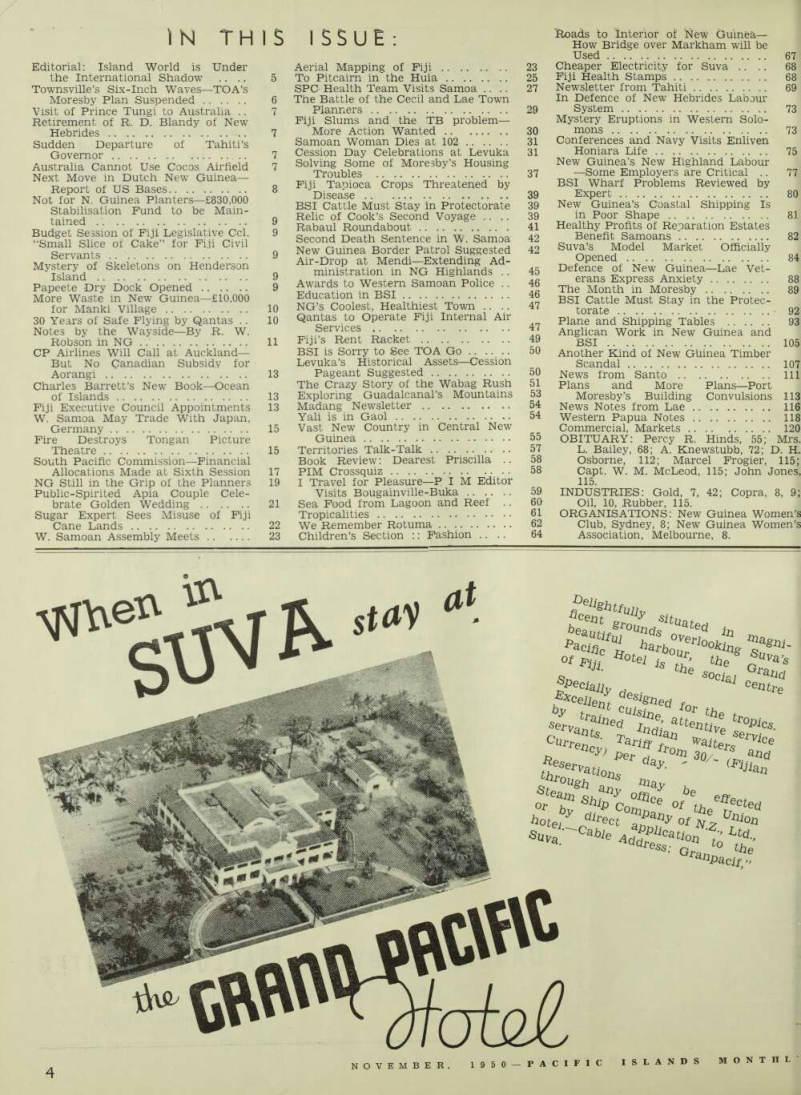
Editorial: Island World is Under the International Shadow ... 5 Townsville’s Six-Inch Waves —TOA’s Moresby Plan Suspended 6 Visit of Prince Tungi to Australia .. 7 Retirement of R. D. Blandy of New Hebrides 7 Sudden Departure of Tahiti’s Governor 7 Australia Cannot Use Cocos Airfield 7 Next Move in Dutch New Guinea — Report of US Bases 8 Not for N. Guinea Planters —£830,000 Stabilisation Fund to be Main tained 9 Budget Session of Fiji Legislative Cel. 9 “Small Slice of Cake” for Fiji Civil Servants 9 Mystery of Skeletons on Henderson Island 9 Papeete Dry Dock Opened 9 More Waste in New Guinea —£10,000 for Manki Village 10 30 Years of Safe Flying by Qantas .. 10 Notes by the Wayside—By R. W.
Robson in NG 11 CP Airlines Will Call at Auckland— But No Canadian Subsidy for Aorangi 13 Charles Barrett’s New 800k —Ocean of Islands 13 Fiji Executive Council Appointments 13 W. Samoa May Trade With Japan, Germany 15 Fire Destroys Tongan Picture Theatre 15 South Pacific Commission —Financial Allocations Made at Sixth Session 17 NG Still in the Grip of the Planners 19 Public-Spirited Apia Couple Cele brate Golden Wedding 21 Sugar Expert Sees Misuse of Fiji Cane Lands 22 W. Samoan Assembly Meets 23
Aerial Mapping of Fiji 23 To Pitcairn in the Huia 25 SPC- Health Team Visits Samoa ... 27 The Battle of the Cecil and Lae Town Planners 29 Fiji Slums and the TB problem— More Action Wanted 30 Samoan Woman Dies at 102 31 Cession Day Celebrations at Levuka 31 Solving Some of Moresby’s Housing Troubles 37 Fiji Tapioca Crops Threatened by Disease 39 BSI Cattle Must Stay in Protectorate 39 Relic of Cook’s Second Voyage ... 39 Rabaul Roundabout 41 Second Death Sentence in W. Samoa 42 New Guinea Border Patrol Suggested 42 Air-Drop at Mendi—Extending Ad ministration in NG Highlands .. 45 Awards to Western Samoan Police .. 46 Education in BSI 46 NG’s Coolest, Healthiest Town ... 47 Qantas to Operate Fiji Internal Air Services 47 Fiji’s Rent Racket 49 BSI is Sorry to See TOA Go 50 Levuka’s Historical Assets—Cession Pageant Suggested 50 The Crazy Story of the Wabag Rush 51 Exploring Guadalcanal’s Mountains 53 Madang Newsletter 54 Yali is in Gaol 54 Vast New Country in Central New Guinea 55 Territories Talk-Talk 57 Book Review: Dearest Priscilla .. 58 PIM Crossquiz 58 I Travel for Pleasure —P I M Editor Visits Bougainville-Buka 59 Sea Food from Lagoon and Reef .. 60
Tropicalities 61
We Remember Rotuma 62 Children’s Section :: Fashion ... 64
Roads to Interior of New Guinea- How Bridge over Markham will be Used 67 Cheaper Electricity for Suva .. 68 Fiji Health Stamps 68 Newsletter from Tahiti 69 In Defence of New Hebrides Labour System 73 Mystery Eruptions in Western Solo mons 73 Conferences and Navy Visits Enliven Honiara Life 75 New Guinea’s New Highland Labour —Some Employers are Critical .. 77 BSI Wharf Problems Reviewed by Expert 80 New Guinea’s Coastal Shipping Is in Poor Shape 81 Healthy Profits of Reparation Estates Benefit Samoans 82 Suva’s Model Market Officially Opened 84 Defence of New Guinea—Lae Vet erans Express Anxiety 88 The Month in Moresby 89 BSI Cattle Must Stay in the Protec torate 92 Plane and Shipping Tables 93 Anglican Work in New Guinea and
Bsi 105
Another Kind of New Guinea Timber Scandal 107 News from Santo 11l Plans and More Plans—Port Moresby’s Building Convulsions 113 News Notes from Lae 116 Western Papua Notes 118 Commercial, Markets 120 OBITUARY: Percy R. Hinds, 55; Mrs.
L. Bailey, 68; A. Knewstubb, 72; D. H.
Osborne, 112; Marcel Frogier, 115; Capt. W. M. McLeod, 115; John Jones, 115.
INDUSTRIES; Gold, 7, 42; Copra, 8,9; Oil, 10, Rubber, 115.
ORGANISATIONS: New Guinea Women’s Club, Sydney, 8; New Guinea Women’s Association, Melbourne, 8.
Advertisements & other items, p. 6 (2 items)
4
NOVEMBER. 1950-PACIFIC ISLANDS MONTHL
/ f 4^ e^S a « t£e Ss*
V w.* *** m* fl eU Shttu Uv £C* a *^ Client aesi Bned f „ / f 4^ e^S a « t£e Ss* Curt 'en r „ , Wa iters VJ ° e R cy) Per d J r °°i * a nd %*** tion, ** ' «Vg*« ran Pacif ”
Pacific Islands Monthly
The Newspaper-Magazine of the South Seas
[Registered at the G.P.0., Sydney, for transmission by post as a newspaper 1 Published Once Each Month and Circulated in Australia and New Zealand and in the following Pacific Territories and Islands Groups:
Australian Territory of Papua.
Trustee Territory (Australia) of New Guinea.
Australian Territory of Norfolk Island.
New Zealand Territory of Cook .Islands.
Trustee Territory (NZ) of Western Samoa British Colony of Fiji.
British Solomon Islands Protectorate.
British Protectorate of Tongan Islands British Crown Colony of Gilbert and Ellice Islands.
Trustee Territory of Nauru.
British and French Condominium of New Hebrides.
French Colony of New Caledonia.
French Colony of Oceania (Tahiti, etc.).
American Territory of Eastern Samoa.
American Territory of Hawaiian Islands.
American Trust Territory of Micronesia.
Owned and Produced by Pacific Publications Pty., Ltd., Union House, 247 George Street, Sydney.
Telephones: General Office and Advertising
Bw 5037, Bu 4938.
P.O. Box 3408
Registered Address for Telegrams, Radiograms, and Cables: "Pacpub,” Sydney.
Contributions.
Articles, Stories, and Photographs dealing with Pacific Islands subjects are invited and will be paid for on publication.
Subscription Rates.
Per Annum, Pre-paid, Including Postage.
In Australia, New Zealand, Fiji, New Guinea, Papua, Western Samoa, Cook Islands, Tonga, British Solo mons, Gilbert and Ellice Colony.
Nauru, New Hebrides, and United Kingdom 18 0 Elsewhere $2.50 £1 1 o Single Copies 19
Editor and Publisher:
R. W. Robson, F.R.G.S.
Assistant Editor: JUDY TUDOR.
General Office: Union House. 247 George Street, Sydney. Telephones; BW 5037, BU 4938.
Business Manager: SELWYN HUGHES
Representative In London.
J. T. Wallis. Coronation House, 4 Lloyd’s Avenue, London, E.C.3, from whom may be obtained copies of Pacific Islands Monthly, Pacific Is. Year Book, advertising schedules, etc.
Agents.
The following are authorised to receive sub scriptions for Pacific Islands Monthly:— Burns Philp NG, Ltd., and Burns Philp (South Sea) Co., Ltd. All branches.
W. R. Carpenter & Co., Ltd. All branches.
Morris. Hedstrom, Ltd. All branches.
Steamships Trading Co.. Papua. All branches.
Colyer Watson (NG), Ltd. All branches.
Mrs Jean Fraser, Lae. New Guinea.
R. F. Smith, Rabaul, New Guinea.
A H. Bunting. Ltd.. Samarai. Papua.
Steele’s Central Store. Suva. Fiji.
Adams Pharmacies Ptv.. Lautoka. FIJI.
Cook Islands Trading Co., Rarotonga. Cook Is.
United Island Traders. Ltd.. Rarotonga, Cook Is.
A, Vercoe, Apia, Western Samoa.
Oscar Nordman, Papeete, Tahiti.
Islands Branches and Representatives of W. H.
Grove & Sons, Ltd., Auckland, New Zealand.
Ed. Pentecost, Noumea. New Caledonia.
Societe Gubbay Kerr et Cie, Noumea, NC.
Vol. XXI. No. 4.
November, 1950
r 1/9 Per Copy.
Price i Prepaid, p.a.; 18/- Aust. ( In USA, p.a.: $2.50.
International
Island World is Under the International
THE outlook, as 1950 comes to an end, is very bleak. The domestic held is so convulsed by politicoeconomic struggle that civil strife is clearly a possibility. The condition of international affairs is such that we are faced with the ever-growing danger of World War 111.
The chief cause of all this is— beyond any doubt or argument—the determination of the Muscovite Reds to impose their form of Communism upon the whole world. We of the Western nations are to blame, of course, for allowing the Reds to burrow deeply into our politicoeconomic structure, where they are now so busily and successfully at work. Immediately World War II was won, all the Western peoples, except North America, committed themselves to the fumbling hands of Socialist Governments and, in the resulting fog of frustration and confusion, the Fifth Columns of the Soviet Unions have invaded us, and dug in so securely that we cannot get rid of them without convulsions— Red activities of the-kind that, at this moment, are hamstringing the Austrahan Parliaments and crippling the Australian economy.
Because of its tragic lack of leadership and inspiration, the Western world presents a pitiful spectacle, Large sections of the people in every
country, driven half-crazy by condi tions which they simply cannot under stand, are expending, in screaming at each other, energies that could use fully be employed in social and political reforms. In all these coun tries—Britain, France, United States, British Commonwealth only one leader (Menzies, of Australia) stands out conspicuously. In other circum stances, Menzies would be acclaimed as a minor Churchill; but in Australia he is hidden behind a battalion of political nonentities, and ignored by a people who have surrendered them selves completely to their worship of the sheep, the horse, the dog—and the political goat! Britain is ruled by a harmless little professional poli tician, United States by an incon spicuous linen-draper, France by God-knows-who; and the clamour of the politico-economic confusion which is the natural result of such condi tions increases day by day.
TF the Western nations were left * alone, these things would right themselves—as, hitherto, they always have done. Having been completely sickened by their ill-judged dose of the Left, the democratic peoples naturally would swing off to the Right, and some sort of balance, with more peaceful conditions, would be restored.
But they are being given neither time nor opportunity to put their domestic set-up into order. While Moscow’s cunningly - placed Fifth Columns are stirring up internal strife in all Western countries, Moscow itself is distracting the Western Powers by creating ceaseless international trouble. It was clear, back in June, that the Korea incident was designed by Russia to embroil the Western nations in Asia, and especially in China. Anyone can see that a fight between the United Nations and China would be like ask ing a trained boxer to use his strength and skill against a feather bed. But, steadily, by steps which apparently we could not avoid, we are on the point of war with China.
Russia has 3,000,000 men in her armies, trained and well equipped.
She cannot do much against us with armies, unless she has dominance in sea and air; and it is now known that she has built up an enormous air force, and is building a very powerful navy, with emphasis on long-range submarines. It is calculated that, by 1952, she will be ready to strike at the Western nations, to implement her plan of placing the whole world under Red Totalitarianism, as de signed and shaped by a gang of semi criminal conspirators in Moscow. We are to be kept in a state of social disorder, entangled with Asiatics, Communists and any other satellites who can be induced to fight, until Moscow is ready to put the halter around our distracted necks.
The clash seems inevitable. The longer we, in our weakness and
stupidity, allow it to be postponed, the more likely are we to see, in our time, the complete destruction of Western civilisation, and the end of an era.
If we act now, unitedly and firmly, we can defeat the Moscow conspiracy, and retain our freedom, and the decencies of life.
It is most likely that immediate action will mean the use of the atomic bomb, and wartime horrors almost beyond imagination. But, better now, with a chance of survival and free dom, than later, with the certainty of another Dark Age.
The decision is very close upon us.
We may have to make it in 1951.
DOES this seem an unduly pessi mistic forecast? None prays more sincerely than the writer that his summary of international affairs is wrong. But we cannot escape facts.
Russia is ruled by an utterly un scrupulous gang of fanatics. Russia has created an enormous military power, and a subversive organisation that is operating in every country. If this is not all part of a plan for world domination, what is it? How can we escape enslavement by the Reds, if we allow Russia to choose her own battleground and her own time?
If we, in the madness which fol lowed our 1945 victory, had not allowed the creation of this Com munist Frankenstein which now threatens our existence—we would have had before us a world in which we might have planned for a great and very rapid improvement in the living standards of all peoples, and in human happiness generally. No where were there greater oppor tunities, of this sort, than in our little world of the Pacific Islands.
The possibilities of achievement and progress are still there—but completely overshadowed by inter national dangers. The threat of attacks by Asiatic Communists now actually touches the western fringe of the Pacific Islands. There is increas ing trouble in Indo-China, in India, in Indonesia—there may be fighting in West New Guinea within months.
We have urgent problems for solu tion in Papua-New Guinea; in the Solomons, where the present set-up should not be allowed to continue much longer; in Fiji, where failure to deal with the Indian situa tion makes a solution ever more difficult to find; and in the archi pelagoes generally, where it is urgent that we agree upon some principles for general application in relation to education and medical care of natives.
But how can any real progress be made, while the Red Muscovites keep the whole world in a state of jitters?
Forthcoming Articles
In PIM by R. W. Robson
IN this issue, there are a number of articles on Papua-New Guinea sub jects by Mr. R. W. Robson, editor of PIM, who has just spent a month there.
Other articles to appear in December and January, include;
Our Startling New Dominion—
A description of the very large, fertile, cool country which Australia took over, as part of “unexplored New Guinea,” in 1920 and did not know she had until the early 30’s.
LIFE ON A JUNK-HEAP—Something about the extraordinary conditions under which Europeans live in Rabaul.
They Are Putting It Back Into
NEW GUINEA —The remarkable story of the Leahy brothers who. after pioneering the New Guinea mainland, and making fortunes out of gold and allied industries, are now staking their all on the develop ment of a pastoral industry in the still primitive Highlands.
New Guinea’S Newest Headache
—The Chinese community are increasing in wealth even more rapidly than they are increasing in numbers. What is to be their share in the future of the Territory?
High Authority Fiddles With
Pacific’S Greatest Problem—It Is
argued that the failure of Australia to appreciate the fundamental importance of education makes her elaborate plans and lavish expenditure on “native welfare” look silly. And —what should be done about Pidgin?
Mr. R. R. Wright, Fiji Public Relations Office Photographer, is in New Zealand with his wife and family on leave.
Townsville’S Six-Inch
Waves
TOA’s Moresby Plan is Suspended
BECAUSE of a curious and unexpected development, the inauguration of the Sydney-Port Moresby service by Trans Oceanic Airways has not been pro ceeded with. The Australian Department of Civil Aviation placed such restrictions upon the use of Townsville port as a place of call for flyingboats that TOA had to temporarily suspend its plans.
TOA made a survey flight, Sydney- Brisbane-Townsville-Moresby, and return, at the end of October. DCA gave the company, on this occasion, permission to use Townsville. Everything ran quite satisfactorily, and the regular service was to commence immediately.
Then TOA were officially advised that they could not land at Townsville if the waters at Townsville carried waves more than six inches high. Such ripples are common in Townsville —so Townsville was out.
TOA considered Bowen and Cairns: but marine and radio facilities, necessary if a port is to be used regularly by flying boats, are not installed in those places.
The planes could not carry enough petrol to fly from Brisbane to Moresby, and carry also an economic pay-load.
Argument about the use of Townsville by flying-boats is proceeding—with vigour. Meanwhile, TOA’s Moresby plan
is suspended.
Mrs. H. Searle, of Port Moresby was a visitor to Melbourne for the spring racing season.
Pacific Travellers
ABOVE: Recent air travellers between Auckland and Suva included (left to right):— Mrs. D. McCutcheon, who has returned to Fiji after visiting her parents in New Zealand. Mr Lachlan Grant (Acting Postmaster-General), Suva, has returned from an official visit to Wellington!
New Zealand. Mr. C. W. G. Johnson, son of Mr. W. G. Johnson, managing director of W. R.
Carpenter & Co., Fiji, who has arrived to spend Christmas holidays with his parents and who will return to University in New Zealand next year. Mr, R. A. Ricketts, of Koro Island, Lomaiviti, wh[?] has been holidaying in New Zealand. Mr. R. Stinson, returning to Suva from Perth. WA, via New Zealand. He married while in Perth.
Photos by Stinsons’, Suva.
BELOW: Recent Matua passengers from Apia, W. Samoa, to Auckland, included (left to right) Judge C. C. Marsack. who was on his way to Wellington for a conference on Samoa's recent crim wave. Commander Smith, USN. and family, of Pago Pago, on their way to the United States vi NZ. Mr. and Mrs. W. J. Taylor, returning to NZ—he has been Postmaster, Apia, for the last years. Miss Taylor, who returned to NZ with her parents. Miss Parker returning to NZ. Mrs Jackson returning to Fiji after a holiday in Samoa. Superflash photos.
Advertisements & other items, p. 8 (1 item)
6
NOVEMBER, 1950-PACIFIC ISLANDS MONTHL
Prince
Tonga’S Crown
Useful Visit to Australia
CROWN Prince Tugi, of Tonga, after a busy month in Australia, left Sydney for Suva on November 15, accom panied by his wife, the Princess Mata’aho.
Tugi probably is the most enlightened and progressive Polynesian in the Pacific to-day. He takes his responsibilities, as the hereditary future ruler of Tonga, very seriously; but his activities actually flow from his interest in government and his enthusiastic eagerness to apply his prac tical knowledge for the advancement of bis people. He studied and graduated at Sydney University some years ago, and he since has made a special study of agricul :ure.
Like other Pacific administrators, Prince Tugi dislikes the idea of a coconut economy, solely—he wants, for Tonga, an alternative major crop; and, after in vestigation, he has settled upon peanuts tor ground-nuts).
He has just spent some time in Queens land where he investigated every phase af peanut culture, economics and market ing. He is satisfied that the average rongan farmer can grow peanuts; that :his form of production will be suitable for Tongan life; and that there is a pro stable market in New Zealand for all die peanuts that Tonga can produce. Ex pensive experiments will be started very soon, in which the economic use of machines will be tested.
Prince Tugi’s other chief interest is edu cation. He is eager to find every possible medium for the better instruction of his Deople.
While in Sydney, he got Mr. Lex Halli iay to show him everything possible about fie taking, production and display of 16 nm. documentary films. The Prince is convinced that films of this class can be ised effectively in the instruction of the rongans; and he has taken some equip nent back to Nukualofa with him.
Prince Tugi believes also in the jrinted word. The Tongans are in creasingly literate, but there is no Tongan lewspaper. The Prince has evolved a )lan under which a fortnightly newspaper vill be produced in Auckland, in the rongan language, for distribution in Donga. A Tongan native is being trained o operate a linotype; and the supply of copy” to Auckland, and the carriage of he newspapers to Tonga, can be done asily by the planes, which run regularly.
Reception In Sydney
3N the evening of November 13, at the invitation of the officers of the Board of Methodist Overseas Mis ions, about 30 representative citizens of Sydney gathered at Wesley College, Uni ersity of Sydney, to formally meet Prince Dugi and Princess Mata’aho. It was a ery happy function. The guests enjoyed heir informal conversations with the *rince, and were impressed by the harm and good looks of the Princess, ‘rincess Mata’aho was educated in New Zealand, but was making her first visit to Australia.
Members of the Tongan Royal Family lave suffered a good deal from vulgar ■nd offensive publicity given them by a ection of Australian and American news papers, and both Prince Tugi and his wife fere obviously dodging the limelight.
Vherever they went, however, they made lew friends and found new admirers. ?his attractive couple are likely to fill an important place in the South Pacific in he future.
Mr. R. D. Blandy, Obe
Retires From New Hebrides After Long Service
THE British Resident Commissioner in New Hebrides, Mr. R. D. Blandy, OBE, has gone on long leave, prior to retirement. Mr. and Mrs. Blandy are on the Morinda, due in Sydney at the end of November.
Brigadier H. J. Flaxman, who has been British Judge in the Condominium for the past year, wall take over the duties of British Resident Commissioner.
Mr. Blandy is 59, and he has been in the British Colonial Service since 1911.
He was in the Indian Police Force for 13 years, and he was chief of the Inter national Police in Tangier in 1928-29. He became Assistant Resident Commissioner in New Hebrides in 1929, and was ap pointed to the senior position when Mr.
A. G. Joy left in 1940. Mr. Blandy had a very harassing and difficult job there, close to the Solomons battlefields, during the war, and he gained a reputation as a courteous and competent officer. Both Mr. and Mrs. Blandy were held in high esteem by the European community in Vila.
Australia Cannot
Use Cocos Airfield
THE Clunies-Ross family, which owns Cocos Islands (Indian Ocean) has refused the Australian government the use of the air strip there.
Cocos is the only suitable landing place between Darwin and Capetown. The Australian Department of Air therefore has to abandon its proposed Australia- South Africa air service.
Reasons given for refusal by the family were that they wanted to keep the island isolated from the outside world and they did not want the peace disturbed by air liners roaring overhead or by air line mechanics and other officials living on Cocos. (They permitted the construction of the airfield as an emergency measure during the war. Cocos or Cocos-Keeling, is a group of about 20 atolls but only two of the islands are of any importance. The Clunies-Ross family has been established there for about 125 years.)
Another Ship Floats in Red Ink Losses
Red Ink Losses of Maui Pomare
Prom Our Own Correspondent APIA, November 4.
A LOSS of £29,340 on the operations of the Government Island vessel Maui Pomare was recorded in the year ended March 31, 1950, compared with £52,764 loss for 1949, and £38,795 for 1948.
The Department of Island Territories says in its annual report that Maui Pom are s operations are uneconomic because of her comparatively small cargo capa city (720 tons) and the long distances she covers. The vessel runs between Welling ton, Niue and the Cook Islands with an occasional call at Apia. She is to be withdrawn when the Union Company’s new Tofua takes up the Fiji-Tonga-Samoa run next year and the MV Matua takes over the Niue-Cook Islands run.
Governor
Sudden Departure Of
Speculation in Tahiti
Noumea. Nov. 1.
ASTIR was caused in French Oceania, and in French Pacific circles gener ally, in October, when it became known that the Governor of French Oceania, M. Anziani, had been recalled to France in circumstances which sug gested that he was, officially, out of favour.
Soon afterwards, it was announced that M. Petitbon, recently Prefect of Constan tine (Algeria) had been appointed Governor in succession to M. Anziani, and would soon arrive in Papeete, The Acting Governor, M. Louis Girault, announced on October 20 that the French Minister for the Colonies would make an early visit to French Oceania.
The cablegram recalling M. Anziani ar rived about September 25. The Governor and Madame Anziani departed from Papeete on a French copra ship, Owendo, on Friday, the 13th. Although he had been well liked in Tahiti, there was no quay-side demonstration of farewell.
Rumour worked overtime. Some said Anziani had given offence by seeking popularity, so that he might become the new Senator for those parts, thus en dangering the re-election of M. Lasalle- Sere. Others said that he was seen too much and too often in the company of Deputy M. Pouvanaa a Oopa who, to put it frankly, is regarded as very Leftist.
Others say that the Governor was blamed for the extraordinary amount of cement which has arrived recently in Papeete—in fact, it is suggested that there are elements of a “scandal” here.
One Papeete commentator referred to “La Valse Des Governeurs.” Anziani was the 57th Governor Tahiti has had in 80 years!
Life Of Bulolo
Timber May Have Some Effect
THE chairman of Bulolo Gold Dredging Ltd., Mr. C. A. Banks, at the recent annual meeting in Vancouver, was frank about the probable life of the BGD enterprise in New Guinea.
He said the company may close down Dredges 3 and 6 earlier than expected, un less digging conditions improve.
The estimated life of dredges Nos. 2, 3,4, 6 and 8 was between two and three years from May 31, 1950.
The deep-digging dredges Nos. 5 and 7 had a life of about 13 years and 11 years respectively.
Editorial Note.— The only thing new about this is that the life of the goldfield is being shortened somewhat by the ever-increasing costs of operation, while the value of gold remains fixed. This means that tested country, previously classified as payable, now has no profit margin.
BGD, however, expects to play a large part in the exploitation of the great pine forests of the Bulolo area, which probably will provide enough timber for opera tions extending over 10 or 20 years, A joint enterprise, in which both BGD and the Australian Government will be in terested, is being put into shape.
Suva’s telephone exchange has become so overloaded that, except in cases of ex treme urgency, no further connections will be made until the new automatic telephone exchange is opened in two years, at the earliest.
Advertisements & other items, p. 9 (1 item)
7
ACIFIC ISLANDS MONTHLY NOVEMBER, 1950
N. Guinea?
Next Move In Dutch
Delegates for the Hague
Representatives of The Nether lands and of Indonesia will meet at The Hague in formal conference in the latter part of November in a final at tempt to settle the future status of Dutch New Guinea.
When a Parliamentary mission of 10 In donesians was leaving Djakarta (Batavia) on October 29 for Europe, the leader de clared that they would “convince the world that Arian (Western New Guinea) is by right a part of Indonesia.” Over 100,000 children paraded with banners reading “No peace without Arian” and “With or without negotiations, Arian must be returned to us.”
It was part of The Hague agreement of November, 1949, under which the Dutch surrendered the Netherlands Indies to the Indonesians as from January 1, 1950, that the future status of Western New Guinea should be settled by December 31, 1950.
Neither side has shown any intention of abandoning its claim to Western New Guinea. Leading Indonesians have re peatedly declared that, if the Dutch will not surrender the territory, they will take it.
The Australian Socialist Government, in 1945-49, supported Indonesia in most things; but the new anti-Socialist Govern ment has made it clear that it supports the Dutch on the grounds that Indonesia has no racial, geographical or political claim to the Territory and that Australia, anyway, does not want on the other side of its New Guinea frontier an Asiatic country that is more or less honeycombed by Communist and anti-European in fluences.
Meanwhile, only a few hundred miles north-west of Australian New Guinea, a bitter little war has been going on bet ween Indonesian troops and the people of “East Indonesia” (Celebes, Moluccas and Ambon), who demand some freedom, and have appealed to the United Nations for help. The Indonesians have already, in 1950, destroyed and absorbed the semi independent States of Pasundan (West Java) and Borneo and are trying in the same way to destroy East Indonesia.
Report About American Bases
ONE Sydney newspaper, on November 12. published a report that an agreement had been entered into between the United States and The Netherlands, under which USA would establish military bases in Dutch New Guinea.
Both Washington and Canberra, in the following 24 hours, said that they had no knowledge of any such development.
Such a thing would be most unlikely— and, diplomatically, impossible—in view of the fact that the future status of Dutch New Guinea, under The Hague agreement between Holland and Indonesia, cannot be fixed before December 31.
But anything can happen after Decem ber 31, when Holland will seek to hold on to the Territory, and the Indonesians— according to the Indonesians! —will dem onstrate their determination to acquire possession.
America, naturally, will be deeply con cerned with any move likely to affect security in the western Pacific; but her moves will be made through the United Nations, and not direct.
Such a development would emphasise, more than ever, the unwisdom of the decision taken bv Messrs. Chifley and Evatt when, on behalf of Australia, they
caused the United States to abandon the magnificent naval and air base that had been established in Manus.
Manus, as the Americans had it, would be very useful, if the Dutch and Indone sians start squabbling over Dutch New Guinea.
Mof Copra Price To Be Challenged
Move by Solomons Planters
A SMALL group of Solomon Islands copra producers have decided to challenge the powers of the BSI Gov ernment in relation to the British Ministry of Food contract. They will ship certain copra away, in free ships, to the free market, and will accept the open market price.
They say they entered into no contract, and they challenge the right of the BSI Government to bind them to the MOF price. They point out that as they got no war damage compensation, are forced to pay a 15 per cent, export tax as well as income tax, and are charged 6/- per acre for their land, they are entitled in all fairness to the best available price for their copra.
The outcome will be awaited with in terest by New Guinea planters and Fiji producers.
There is a strong movement afoot among NG planters to challenge the MOF contract. No one outside Canberra has seen the contract, or been able to get any details of it.
The planters want to know who ar ranged the contract, who signed it, and under what authority the Australian Government takes all their copra and sells it to Britain in return for Britain’s now
depreciated currency.
The Fiji and, now, the BSI planters support this demand for more informa- The MOF contract was made in 1948, for a period of nine years. Under it, the price may not fluctuate, in one year, more than 10 per cent.
NG Planters Await Reply from
Canberra
THERE have been no further develop ments in the discussions which have been taking place between the New Guinea Planters’ Association and the Australian Government, relating to the price being paid for NG Copra.
The NG planters—like all copra pro ducers within the Empire who are subject to the MOF copra contract—are dissatis fied with the price they are receiving Copra has a definite value in the world market; but this was not taken into con sideration by Britain, when, after de valuation of the £ Sterling, she continued to implement the MOF contract for the purchase of Empire Copra.
In other words, Britain has continued to pay for the copra with the same number of £’s Sterling per ton, although in re lation to world values the £ lost a sub stantial proportion of its former value.
Planters within the Empire have been protesting against this contract which some of them describe as a “double cross —and are seeking a revision. S 9 far, the Australian ministers and officials con cerned have not been in favour of the planter’s arguments; but the discussions are not yet finished.
The NG planters have a particular grievance in the fact that Australian crushers who take about half the NG production have been getting the copra at MOP prices. As the Australian mills get world prices for anything they export, and as there is no reason why Australian crushers should get benefits at the expense of the NG planters, the NG planters are
demanding that the Australian crushers should pay world prices instead of MOP prices for their Copra.
The crushers have presented to the Australian Government a series of argu ments to show why they should receive preferential treatment.
These issues—presented in October by the delegates of me NG planters’ associa tion —are now apparently awaiting decision by the Australian Minister for External Territories, Mr. Spender, who has been abroad. He returned to Australia in mid- November but there has been no an nouncement.
Drought Stops Ng Sluicing
THE extraordinary dry spell in New Guinea —declared by old hands to be the worst since “German times” —has adversely affected some mainland mining concerns which depend on water pressure.
Sandy Creek Gold Sluicing Ltd., report ing on October 20, said there had been insufficient water for sluicing since the beginning of June, except for a few days at the end of September. In 190 hours 1 sluicing, they recovered 46 ounces of gold from 4,750 cubic yards.
Sydney Ng Women’S Club
Xmas Parties
THE New Guinea Women’s Club ol Sydney have received the followinj donations towards their children’; Christmas party:
THE children’s party will be held th: year on December 18, commencing £ 2 p.m. i A Christmas cocktail party will also t held- This will be at 6.30 on Decembe 22. All former or present Territorial who are in Sydney will be welcome. Bot functions at the Feminist Club, 77 Kir Street.
£ s. d Mrs. Stewart 4 10 ( Mrs. Goss 11 ( Mr. and Mrs. H. Downing 1 0 1 Pacific Islands Monthly 2 2 i Mrs. Bruff 5 ( Mrs. A. A. Innes 17 S Mrs. U. Adams 2 2 i Mrs. Perriman 2 0 Lady McNicoll 2 2 Mrs. Sturgeon 10 G. Edgell & Co., Ltd 1 1 W. R. Carpenter & Co., Ltd. . . 3 3 Burns Philp & Co.. Ltd 3 3 Robert Gillespie Pty., Ltd 5 5 Mrs. Northam . .. 1 1 Mrs. Harvey 10 Mrs. Haughton 2 £30 5
Melbourne Ng Women’S Ass[?]
Xmas Party
THE New Guinea Womens’ Associatic of Melbourne will hold a Christnu Party at the Business and Profe; sional Women’s Club, Melbourne, at 3. p.m. on December 16.
All past and present residents of Ne Guinea who are in Melbourne on thi date will be welcome.
Mrs. J. B. Hicks and Miss Patricia Hie: were passengers from Honiara, BSI, Sydney in the October Monnda. Mr.
B Hicks, who has had 20 years’ servir with the BSIP Government, will them in December, and with his lama will sail soon after for the UK on leave <
Advertisements & other items, p. 10 (1 item)
November. 1950 Pacific Islands Month L.
Planters
Not For N. Guinea
Stabilisation Fund, £830,000, To be Maintained
ALL Papua-New Guinea planting in terests examined, with lively com ments, the announcement in the Papua-New Guinea Gazette of October 26, which showed that, on June 30, 1950, the Copra Stabiliation Fund of Papua- New Guinea amounted to £830,961.
The fund was established in its present form in 1946-47, when it received £35,240 from the Production Control Board, and by June 30, 1947, it was £38,274. After that, it grew in this way:
Many people had thought that this fund might now be distributed among the planters whose earnings created it.
The Canberra authorities have no such intention. The fund will be kept intact, —although the amount of the levy may be reduced.
A committee on which planters will have representation will be set up to supervise the fund. It is hoped that Canberra will give some indication of when and how the fund will be used for market stabilisation.
The fund, held in Commonwealth In scribed Stock, is now earning over £20,000 per annum in interest.
There may be a windfall, however, for planters in the accumulated profits of the Production Control Board, now reported to be over a quarter-million. Canberra says it intends to distribute these to pro ducers, in some way. Some day, perhaps, Canberra will explain how and when it will make the distribution.
Levy Interest Total £ £ £ June 30, 1948 .. 98,375 923 99.298 June 30, 1949 . . 375,091 5,090 380,182 June 30, 1950 .. 297,359 15,846 313,206 Totals 773,860 21,860 830,961
Rsl’S Realistic Approach
To N. Guinea Problems
SOME important motions from the New Guinea branch of the Returned Soldiers’ League were taken to the organisation’s annual meeting in Hobart at the beginning of November by Mr.
George Whittaker, representing the NG Branch.
The NG Branch urged that care be taken in setting up a military organisa tion in New Guinea. The revived NGVR should be a training-ground for units of the native military force, and the greatest care should be taken in the set-up of the native units.
The Branch urged the early constitution of the Legislative Council; expedition in settling ex-servicemen in the Territories, and facilities for financing their enter prise; a more realistic policy in building a new European hospital at Lae; some early effort in restoring land titles lost in the war. It supported the Australian Government in opposing the transfer of Western New Guinea to Indonesia.
Legislative Council
Budget Session Of Fiji
THE Budget session of Fiji Legislative Council will be opened by the Gov ernor, Sir Brian Freeston, on November 19.
Main business of the session will be to consider the Government’s financial pro posals for 1951, and the reports of four select committees, appointed last session, may also receive attention.
Small Slice of Cake
Cake for Fiji Civil Servants Compromise on Salaries Revision
Prom Our Own Correspondent
Suva, Oct. 16.
FIJI’S Legislative Council rose on October 13 after having spent much of the time since October 3 on the question of Civil Service salaries revision.
Although no official statement has been made, it is common knowledge that the Civil Service objected to the report of the Salaries Commissioner (Mr. E. Mills) and to the Government’s proposed amend ments to the recommendations made in the report.
Unofficial members of the Council, after a detailed study in committee, reluctantly accepted the Government’s motion for the adoption of the amended report, but urged that the proposed increase in ex penditure (about £75,000 per annum) should be cut to avoid further taxation.
Leave conditions, the unofficials stated in a memorandum, were too generous in certain cases, and they recommended the appointment of “a person with extensive practical commercial experience (not a civil servant) to look into and report upon the establishment and staffing of the Fiji Civil Service in general.’
The memorandum added that “much dead wood could be pruned and un necessary staff dispensed with.” It ex pressed the view that the Civil Service is overstaffed, and suggested that if reductions were made higher salaries could be paid where they are deserved.
The memorandum was accepted by the Government, and at the end -of the ses sion the Governor (Sir Brian Freeston) said: “I am satisfied that we have reached a compromise, but, like all compromises, it is unsatisfactory.”
The civil servants, the Governor said, had not been given a very large slice of cake, but they had not been sent empty away. He promised that the Government would do its utmost to avoid extra taxa tion to meet the bill, but declined to give an undertaking on this point, adding; “We do not know how this year is going to turn out.”
European Civil Servants’ Association.
AT the annual meeting of the European Civil Servants’ Association on Octo ber 16, the salaries revision propo sals were discussed at considerable length and it was decided to submit to the Secretary of State for the Colonies, through the Governor, the views of the Association on the proposals.
Papeete Dry Dock Opened
Prom Our Own Correspondent
Papeete, Oct. 15.
PAPEETE’S new dry dock (see Tahiti Notes, elsewhere this issue) was officially opened by Governor Anziani on September 28, and on October 5 the first two ships were docked.
The first was the two-masted schooner Moana (built 40 years ago for the oia German “long-handled” firm usually known as the DH & PG). As soon as Moana had been hauled out of the water and rolled over to one side of the new dock, Orohena was also docked.
The Commonwealth Bank of Australia has given £3,500 for research in rice breeding in New Guinea.
Weekly Paper For W. Samoa
FIRST issue of Western Samoa’s new bi-lingual weekly paper made its appearance in Apia on November 3.
This date was also the 50th birthday of its proprietor, Western Samoa’s most energetic businessman, Mr. Eugen Paul.
Western Samoa’s last newspaper, the Western Samoa Mail, edited and published by J. W. Liston, went out of existence early in the Second World War years and there has keen no local news-sheet since.
Mr. Paul’s new paper is called Samoan Times —Tusitala Samoa, and is printed in English and Samoan.
Mr. Paul is of mixed parentage. His father was German, his motnejr an American Samoan. In World War I he served in the American National Guard and when he returned to Samoa in 1925 started the now prosperous Gold Star bus and taxi transport service. In 1935 he founded Samoa Theatres Ltd., and in 1945 he bought Mr. Liston’s printery from which the new weekly will be issued.
Unlike previous Apia papers (there was one in the German days, too) Samoan Times will be sold by newsboys in the streets.
Henderson Island
Mystery Of Skeletons At
Suva, Nov. 6
Henderson island, no miles from Pitcairn, was twice visited by the Suva-based New Zealand schooner Huia during a 6,000-mile trading cruise.
After returning to Suva, the Huia left for Auckland on November 2 and will make several trans Tasman trips before returning to the tropics at the end of the hurricane season.
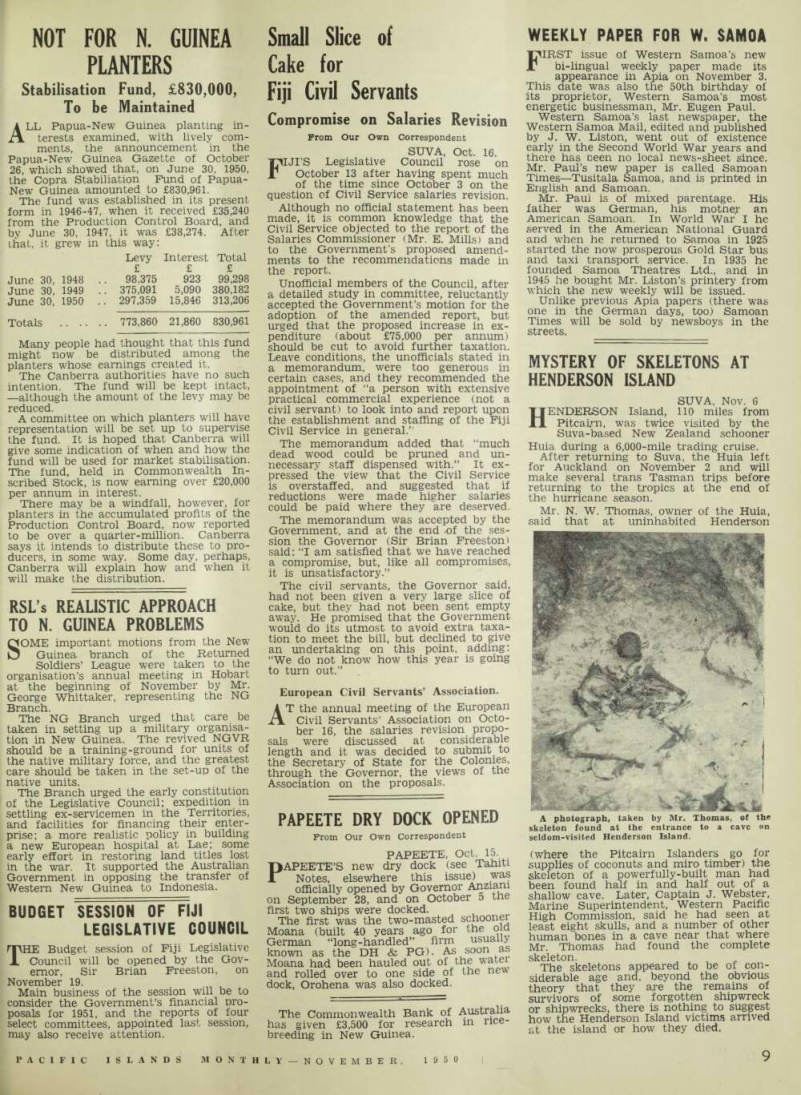
Mr. N. W. Thomas, owner of the Huia, said that at uninhabited Henderson
(where the Pitcairn Islanders go for supplies of coconuts and miro timber) the skeleton of a powerfully-built man had been found half in and half out of a shallow cave. Later, Captain J. Webster, Marine Superintendent, Western Pacific High Commission, said he had seen at least eight skulls, and a number of other human bones in a cave near that where Mr. Thomas had found the complete skeleton.
The skeletons appeared to be of con siderable age and, beyond the obvious theory that they are the remains of survivors of some forgotten shipwreck or shipwrecks, there is nothing to suggest how the Henderson Island victims arrived at the island or how they died.
A photograph, taken by Mr. Thomas, of the skeleton found at the entrance to a cave on seldom-visited Henderson Island.
£10,000 for Manki Village
More Waste In New
Guinea
IT was announced in Port Moresby on November 11 that the Administration had agreed to pay the natives of Manki village the sum of £lO,OOO for the “rights” to timber on 24,000 acres in the Bulolo Valley, New Guinea. The natives are to get £5OO in cash, a “model village” costing £3,000, and £6,500 is to be held in trust for them.
This is typical of the kind of lunacy which has distinguished the Ward- Murray administration of Papua-New Guinea since 1945. It is hard to believe that the present Australian Government has approved of the payment.
In European times, there has been little if any indigenous native population in the Bulolo Valley, where are large and valuable stands of pine and cedar. The Bulolo Valley apparently had been, for a long time, a no-man’s-land between the very warlike Kukukukus of the remote and mountainous interior, and the more peaceable tribes of the grasslands country.
After the goldfields were established, and thousands of native labourers were brought in, there was a little native settle ment in and around the valley; but those natives had no more right to the timber than the Europeans.
We do not know the history of Manki Village; but even if it was there in pre- European days, the Manki folk have no real interest in the timber, any more than they have an interest in the gold.
The point is that these natives made no more use of the big timber on the hill sides than of the minerals in the earth.
Neither timber nor gold had the slightest value in the native economy—those things only became valuable after the Europeans arrived, and because of the settlement of Europeans in the country.
This ridiculous payment of £lO,OOO to the Bulolo natives for timber rights is in line with the Administration’s fumbling with the whole matter of timber (see article elsewhere in this issue).
It is also quite consistent with the Ward-Murray policy of giving away Aus tralian taxpayers’ funds, with both hands, to primitive bush kanakas. One result of lavish payments of Wardist “war damage compensation” to natives is seen in the vast enrichment of the Chinese traders.
In Rabaul, to-day, every other Chinese merchant rides in a huge new glittering American car, imported through Hong Kong—and many of these were bought with “Wardist Compo” which poured through the natives’ hands into the trade stores.
Samoa For The Samoans!
Letter to the Editor THE decision of the New Zealand authority to appoint Mr. Charles Rivers, a Samoan of the Apia dis trict, to the position of Postmaster at Apia—succeeding Mr. Taylor, who has returned to New Zealand—has given great pleasure to all those who believe that most of the principal administrative posi tions in Western Samoa can be filled by native-born.
It is only a matter of (1) Deciding upon this course as a matter of policy; (2) Pro viding the young Samoans with all reasonable education facilities and en couragement; (3) Insisting on vacancies being filled by Samoans, instead of young men and women from New Zealand, if there are suitable Samoans available.
This is the wish of our two influential Fautua, Hon. Tamasese and Hon. Malie toa; and it is the wish of the people here that in this they be supported both by their own people, and by the New Zealand Government.
I am, et.,
Leaga Tonu Samoa.
Apia, 30/10/50.
Qantas Empire Airways
30 Years of Safe Flying With Qantas Empire Airways
IN 1919, while they were making an airroute survey in Northern Australia for the Commonwealth— they used an incredibly ancient Model T Ford or Fords—Messrs. Hudson Fysh and P. J.
McGinnis conceived the idea of opening up this vast country with air services.
Both young men had been members of the Australian Flying Corps.
Backed by local station owners and businessmen they registered, in November, 1920, the Queensland and Northern Territory Aerial Services, Ltd.
That was the beginning of Qantas second to none.
QEA as now Australian Governmentowned but Mr. Hudson Fysh, a vigorous 55-year old Australian, is still with them as chairman and managing director. He is one of the fortunate few whose youthful visions not only came true, but suipassed anything he could n h^ e STlt is*a t £r S cr/ f rom° the Unsuitable”, World War I type of aircraft, all wires and wings, with which Qantas started their company, and the vast fleet of modern airliners and flying-boats which they use to span the oceans and the continents to-day.
A S well as the Kangaroo route to the United Kingdom, Qantas run services to Hong Kong, Japan, Papua-New Guinea, Fiji, the Solomon Islands, New Caledonia and New Hebrides. In Papua-New Guinea their local services have done something to ameliorate the chaos and frustration of the post-war period. It is likely that they will soon be running in temal services in the Colony of Pi] n it has been reported that Captain Hugn Birch is leaving shortly to make another survey flight for Qantas between Fiji and
abandonees running a Regular
Ilf between NeW Caledonia and The original service between Charle ville and Cloncurry and other inland services are now no longer run by Qantas, b t Australians, the overwhelming ma jority of whom have never seen these la £ es hope t 0) know them well only because the young men of Qantas put them on the map away back in the early 20’s when commercial aviation was QEA held an exhibition in during November to mark their 30th hirth day. Whites Aviation, published in Auck land, NZ, devoted the whole of their November issue to telling the story of Qantas, as it was and as it now is.
Papuan Trading
Co. Makes
Bigger Profits
THE boom being enjoyed by Papuan rubber-planters now, plus the enormous expenditure by Govern ment on administration, and by oil companies on oil search, is reflected in the report of Steamships Trading Co. Ltd., of Papua. In the year ended July 31, it made a record net profit of £61,193, and is paying 10 per cent, on its issued capital of £286,473. In addition, the Co. has over £300,000 in reserves, and uses some £BO,OOO of bank money. It has over £200,000 in land and buildings, £56,000 in investments, and some £400,000 in mer chcUidisc It was decided, at the annual meeting in Moresby in November, to issue another 134,283 ordinary £1 shares, at a price not yet disclosed. In the previous year, 66,666 shares were issued, at a premium of 10/-.
Apropos of this company’s big profits, it It worth noting that it was stated, at the annual meeting of the Dunlop Rubber Co. in Sydney recently, that that company was now paying 37Jd. Stg. per lb. for rubber, as compared with 9Jd. per lb. a year ago.
Maclean-Solomons Wedding
ST. STEPHEN’S, Macquarie Street, was the scene of a pretty wedding on October 18 when Miss Judith Nancy Solomons was married to Mr. Donald Maclean,. The bride is the daughter of Dr. and Mrs. Noel Solomons, of Mitta gong, and the bridegroom only son of Mr. and Mrs. John Maclean, of Rang arere in the Baining District of New Britain.
The ceremony was performed by Rev.
Donald Munro, of Bcwral, and the recep tion, where over fifty guests gathered, was held at the Amory, Ashfield, and the usual toasts were honoured and many good wishes extended to the happy couple.
New Guinea guests at the reception included Lady McNicoll and Mr. and Mrs, Gordon Thomas.
Apc Progress Report
AUSTRALASIAN Petroleum Companj Proprietary Limited reported, in earlj November, as follows: WAN A: The hole has been deepene( 903 feet from 8,035 feet to 8,938 feet.
HOHORO: Rig foundations have beer poured at No. 2 Test site and the derncl has been transferred from No. 1 site ir preparation for erecting.
Island Exploration Company Pro' prietary Limited reports that rig erectior at Omati is nearing completion and tha the test is expected to spud-in durmi the coming month.
New Tahiti Hotel Opens
From Our Own Correspondent PAPEETE, October 15.
THE re-organised Les Tropiques Hote about a mile out of Papeete, is nm open for business.
The hotel is now owned by Messrs. Wii liam Robinson, Bertrand Jaunez and Lewi Hirshon. It is built beside the lagoo. with a fine view of Papeete Harbour. A present it has 20 individual cottages ar ranged in a tropical garden setting an more are to be built.
Mr Al Bougerie, former office manage of the Moana Hotel in Honolulu, has bee installed as manager.
Advertisements & other items, p. 12 (1 item)
10
NOVEMBER, 1950 PACIFIC ISLANDS MONTHL
Some Notes by the Wayside
FROM R. W. ROBSON IN NEW GUINEA
MY first impression, on reaching Port Moresby, was that I had entered a roaring, wide-open mining town out of the American movies.
Natives swarmed everywhere—not the quiet, slow-moving people of before the war, but screeching lorry-loads of labourers hurrying hither and yon; im pudent-looking boys loitering on the foot paths; groups of natives sitting under the shade trees, drinking out of up-ended bottles of “creaming soda.”
All about the little town empty bottles lay in the gutters. Down south, such bottles are worth 3d.; but, to these happy children of the Ward-Murray regime, 3d. is not worth worrying about.
Everywhere, there is an air of commer cial liveliness and prosperity—the result of spending millions of the Australian taxpayers’ money, another million of oil search money, and another few scores of thousands (God knows how much!) on “native war damage compensation.”
Much of this money naturally finds its way through ordinary commercial chan nels, to commerce’s great content; but a very large proportion circulates first among the natives. As natives, in money matters, are like children, all this loose currency simply trickles off along the line of least resistance —which, of course, is the trade store and the lollipop shop.
Those shrewdheads who have gone out to specially cater for native tastes have reaped and are reaping fortunes.
LAE, risen Phoenix-like from the ashes of 1942-44, was all new to me. At Qantas’ most excellent new mess, in the new town on the terrace, I got a taxi with a native driver, and said “Bums Philp.”
Driver; “No savvy.”
Me (loudly); “Burns Philp.”
Driver (looking sour): “No savvy.”
Me; “Dammit, Burns Philp—down there”—waving generally towards the beach area.
Driver went down the hill, along past the new hotel, and away in the direction of Finschhaven.
I sensed something wrong, stopped the taxi beside a couple of Europeans and said: “I’m a stranger here. I want Burns Philp’s store. This idiot doesn’t seem ever to have heard of them. Can you direct him for me?”
They grinned. “Beepees,” they said. The driver, with a wooden face, went back to the beach area and the assembly of tem
porary buildings which house BP's stores He saw nothing funny in the incident.
THIS morning (October 20) there came into Rabaul port, from back of be yond somewhere, a small Govern ment boat, with a small complement of European passengers, and a small and irate Welsh skipper, who had lost his den tal plate, and who lisps, anyway.
“I belong to Perthy Thpender’th con thituenthy,” he declaimed, thumping the binnacle, “and I’m writing to Perthy right away about how we are treated on thethe boath.”
It appears that he cannot get a cook, even for himself, let alone his passengers.
He cannot get the little ship’s linen washed, because wash-boys, as a species, have disappeared under the Ward-Murray regime. And the quality of the food with which his ship had been supplied was something he could not describe ade quately without his teeth. He particularly resented the fact that he was compelled by regulations to charge his passengers 45/- each.
“Look what I’ve had to give the poor bathtardth,” he cried, pointing dramatic ally to his cookhouse, and his weary looking passengers. “They call this a thervith! I’m telling Perthy all about it.”
So if the Hon. P. C. Spender, Minister
for External Territories, is met on his re turn from the world’s councils by a letter from a constituent in Rabaul, full of Welsh expletives, and critical of Shipping- Control, he will know how it originated.
When I left, the skipper was apolo gising, on behalf of the Shipping Board, to the “poor bathtardth.”
I AM still gasping over my laundry bill at the hotel in Rabaul. The little lot comprised exactly 16 articles, including handkerchiefs and other small things. The charge was 10/6, and the articles were only half washed and ironed.
I thought longingly of Fiji, where Indian laundrymen do the job so quickly and competently, at a third of the price.
Ten minutes after paying that bill, I walked through Rabaul’s native market.
The stuff generally was of poor quality, but the prices were extraordinary—l/- for a small bunch of bananas, or a pineapple, for instance.
I got a new respect for the harassed women trying to keep house within the budget, in this dusty junk-heap of a town.
POSTSCRIPT: Later, in Port Moresby, a native wash-boy demanded 12/- for washing and ironing three shirts, two shorts, two pairs stockings, one long pants, and a couple of small things. I give up!
PPS: Am I wrong in supposing there is a fortune waiting for the enterprising person who takes a washing machine, or machines, to Moresby, Lae, Rabaul, etc., and really tackles a most urgent problem by providing a good and dependable “laundrette” service?
Socially, The
Europeans are divided sharply.
Those who lived here before World War II have little in common with the large numbers of younger folk who have come crowding in under the Ward- Murray regime. The two classes are usually called the Befores and the Be hinds.
The Befores, of course, can see noth ing good in the post-war set-up of uncontrolled and in efficient labour, spoiled and cheeky natives, incredibly
(Continued on page 33.)
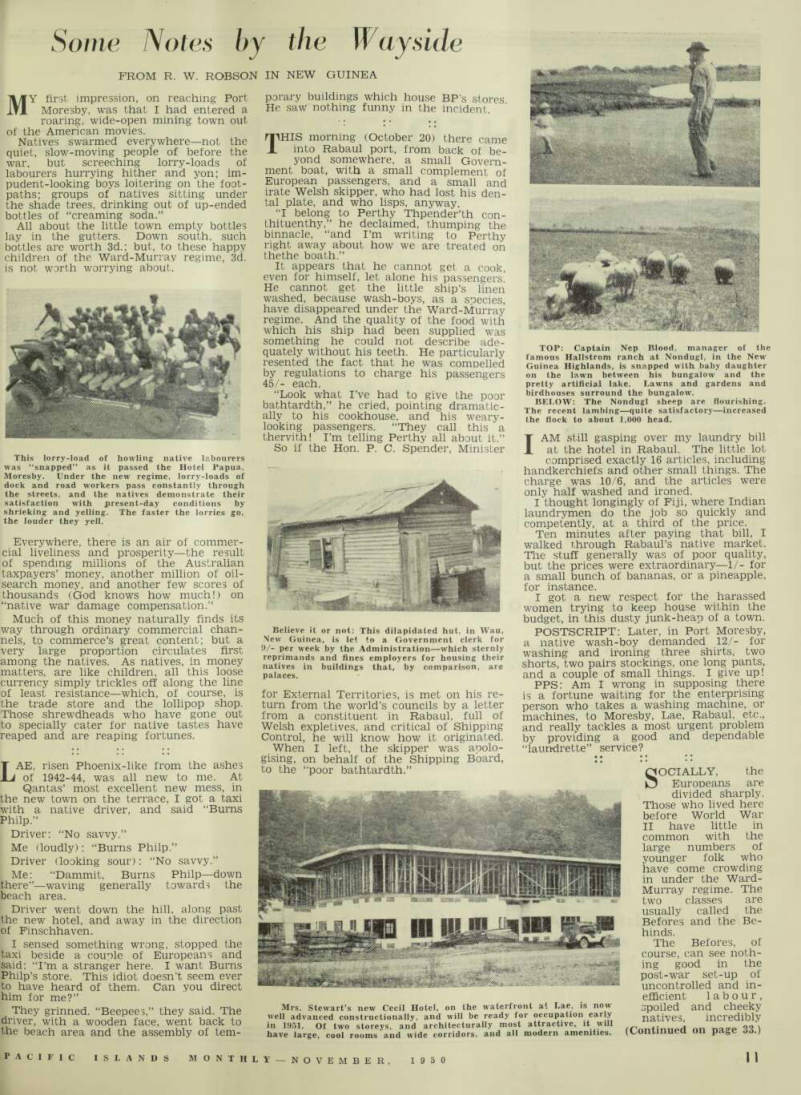
This lorry-load of howling native labourers was “snapped” as it passed the Hotel Papua, Moresby. Under the new regime, lorry-loads of dock and road workers pass constantly through the streets, and the natives demonstrate their satisfaction with present-day conditions by shrieking and yelling. The faster the lorries go. the louder they yell.
Believe it or not: This dilapidated hut, in Wau, New Guinea, is let to a Government clerk for 9/- per week by the Administration—which sternly reprimands and fines employers for housing their natives in buildings that, by comparison, are palaces.
Mrs. Stewart’s new Cecil Hotel, on the waterfront at Lae, is now well advanced constructionally, and will be ready for occuparion early in 1951. Of two storeys, and architecturally most attractive, will have large, cool rooms and wide corridors, and all modern amenities.
TOP: Captain Nep Blood, manager of the famous Hallstrom ranch at Nondugl, in the New Guinea Highlands, is snapped with baby daughter on the lawn between his bungalow and the pretty artificial lake. Lawns and gardens and birdhouses surround the bungalow.
BELOW: The Nondugl sheep are flourishing.
The recent lambing—quite satisfactory—increased the flock to about 1,000 head.
expensive works and transport, and official indifference to private enterprise.
The Behinds, knowing nothing of the times before 1940, have little sympathy with the belly-aching of the Befores.
They cannot appreciate the fact that these Territories are riding on an economic pie-crust of extreme fragility, which may collapse at any time; and they care less. Hundreds and hundreds of young men and women, brought up here by the Administration and the big com panies, live in messes, enjoy the life reasonably well, and count the days until they can get away South on leave. They are not in the least concerned with the future of this huge country. They have no pioneering spirit.
My sympathies naturally are with the Befores, who regard New Guinea as their own country, and passionately desire to see its development and growth. But the Befores are ageing; and if there is to be a future for Europeans here, we must look to the Behinds.
ABOUT the most depressing thing I saw in the Territories was in the native hospital in Rabaul, in front of the nine wards labelled respectively with the names of Administrators: Wisdom, McNicoll, Griffiths and Murray; Hubert Murray, MacGregor, Scratchley, and so on.
There, dumped down on the roadway, were a score of 44-gallon drums, filled with water from a peripatetic water-cart.
Out from the wards which house the sick and the maimed and the confined, came a steady trickle of natives with cups, enamel basins, and beer-bottles, which they filled from the drums.
Believe it or not, that is the big hospi tal’s water supply. One tank runs a supply through a pipe to the operating theatre. All the rest of the hospital in mates scramble through the dust, with hand receptacles, for all the water wanted for washing and drinking.
Having witnessed countless thousands being wasted on Ward-Murray “welfare” projects, I am tempted to comment bitterly on the Rabaul native hospital’s water supply. But the facts speak for themselves —in fact, they scream.
The incredible “Works and Housing” come into this picture. Seven months ago, when the former Jap prisoners’ camp was taken over as a native hospital, the officer in charge informed W & H that
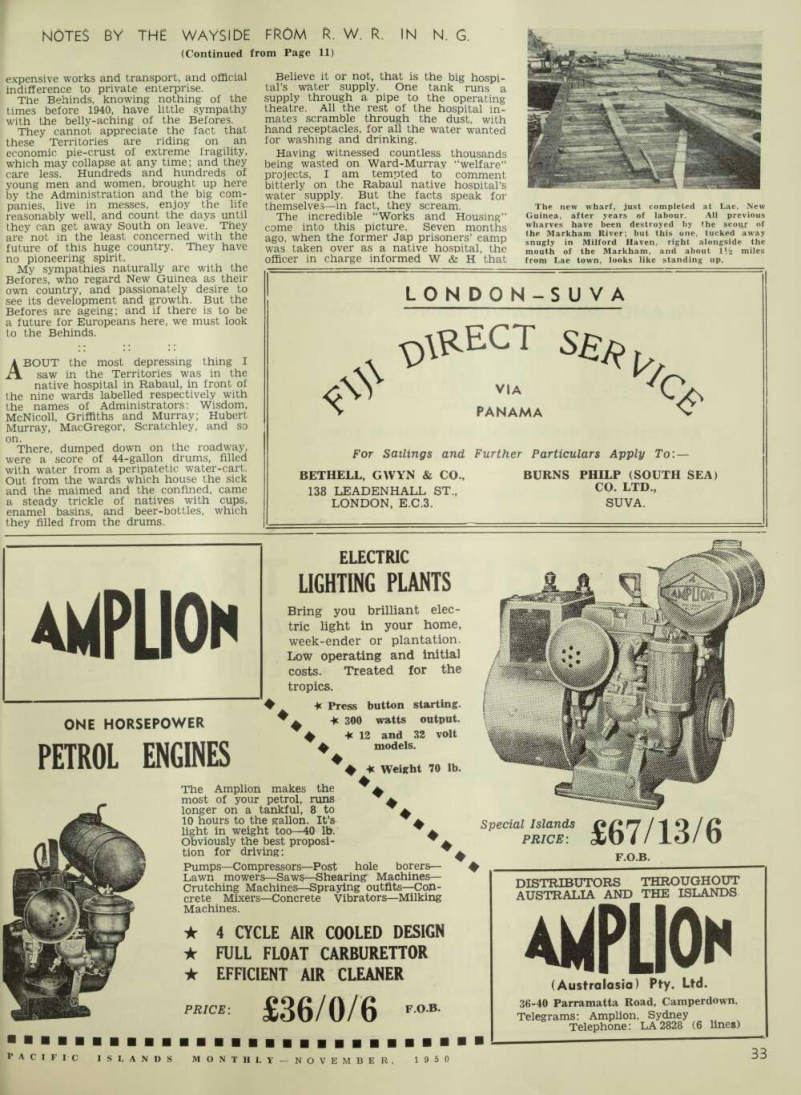
The new wharf, just completed at Lae, New Guinea, after years of labour. All previous wharves have been destroyed by the of the Markham River; but this one, tucked away snugly in Milford Haven, right alongside the mouth of the Markham, and about 1½ miles from Lae town, looks like standing up.
he had a good water supply. An electric pump lifted water from a well to the surface; a Diesel lifted it higher and put it under pressure.
“Good,” said W & H, happily. “We’ll check it over.”
They took the Diesel away for an over haul; and it never came back. They sent men down the well to fix the electric pump; and it has not functioned since.
For six months, in the worst drought
Rabaul lias known in 50 years, the hospi tal has been carrying its water in panni kins.
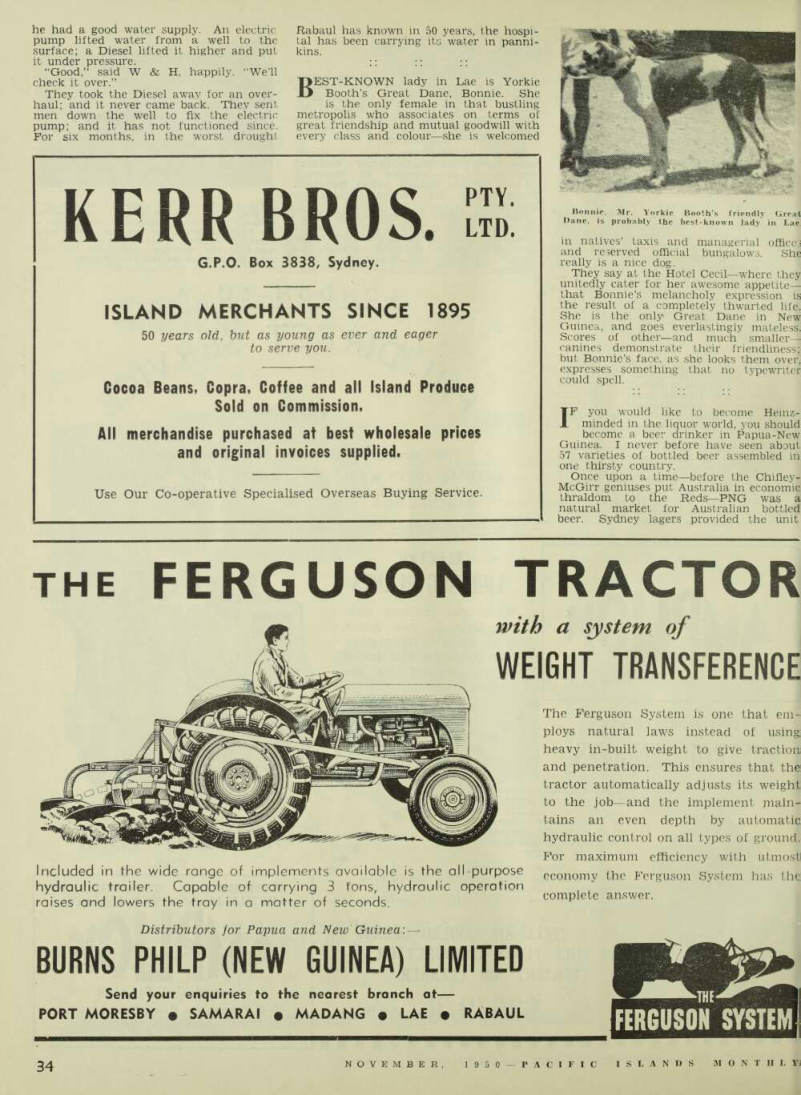
BEST-KNOWN lady in Lae is Yorkie Booth’s Great Dane, Bonnie. She is the only female in that bustling metropolis who associates on terms of great friendship and mutual goodwill with every class and colour—she is welcomed
in natives’ taxis and managerial offices and reserved official bungalows. She really is a nice dog.
They say at the Hotel Cecil—where they unitedly cater for her awesome appetite— that Bonnie’s melancholy expression is the result of a completely thwarted life.
She is the only Great Dane in New Guinea, and goes everlastingly mateless.
Scores of other—and much smaller— canines demonstrate their friendliness; but Bonnie’s face, as she looks them over, expresses something that no typewriter could spell.
IF you would like to become Heinz minded in the liquor world, you should become a beer drinker in Papua-New Guinea. I never before have seen about 57 varieties of bottled beer assembled in one thirsty country.
Once upon a time—before the Chifley- McGirr geniuses put Australia in economic thraldom to the Reds—PNG was a natural market for Australian bottled beer. Sydney lagers provided the unit
Bonnie, Mr. Yorkie Booth’s friendly Great Dane, Is probably the best-known lady in Lac
water towns; while the goldfield centres literally floated on a sea of Victorian Bitter.
To-day, believe or not, it is practically impossible to get Australian beer. So, as the place is lousy with money, and the demand for beer puts even the Sydney six o’clock rush into shadow, the alert traders have done their buying abroad.
There are bottled beers here from prac tically every country in the Sterling area.
Except in Moresby (where the shrewd BP management doles it out at 1/4 per middy) the drinkers buy the beer at from 3 6 per bottle, and help themselves; and the total consumption is enormous.
In Moresby, they take it as it comes. In Wau and Lae, they favour Becks, a lager from Germany. In Rabaul. at, the moment, everyone is drinking San Miguel, a palat able light beer from Hongkong. But their fancies change with the moon—next month, the Dutch, or the English, or the Danish, or the Roumanian will be getting a turn.
IjV J. WAUCHOPE, of Madang, wants J some information to explain the ex traordinary behaviour of some young coconuts on his plantation.
The plantation was severely shot about during war operations on the north coast.
Mr. Wauchope’s tidy mind was offended by the spectacle of bare stumps of bomb blasted palms, so he tried to fill the gaps by planting young palms close beside the old stumps. To his surprise, these young palms grew nearly as fast again as palms planted normally, and threaten to begin bearing in rather more than half the time of normal palms. ‘‘Why do they do that?” asks Mr. Wau chope. “They’ve knocked some of our theories kite-high.”
SOME young folks in these Territories express their divine discontent with the tropical life by growing beards.
People of the Time Before don’t like beards, much.
Motor-driver Frank Staunton brought a beautiful specimen, long and fair and silky, into the bar of the Hotel Cecil in Lae. while I was there. He was talking over his shoulder to someone when Mrs.
Stewart came in, and examined the “grass” disdainfully.
Then—she was lighting a lamp—she applied a match. The beard flared, and the lad lost half his hirsute beauty. It did not matter—the hair of his head falls
in golden ringlets to his shoulders. Thev call him “Christ.”
In the course of the ensuing good fellowship. I heard the lad make use of the word “lorana,” which is the greeting in the Cook Islands. Thus I identified one of the engineers who last year brought that new ship down from Singapore for A. B. Donalds —they travelled via Sydney.
Auckland and Rarotonga. Staunton, a member of a well-known Victorian family, has a marine engineer’s ticket, and
has been wandering all over the world. I do not know why he should be in New Guinea, growing hair and driving trucks: but it is typical of post-war restless youth.
IN 1942-44. at colossal cost, the Aus tralian Army built a road through the backbone of New Guinea—from Bull dog, on the Lakekamu, near the Gulf of Papua, over the mountain gorges, to a
(Continued on page 85)
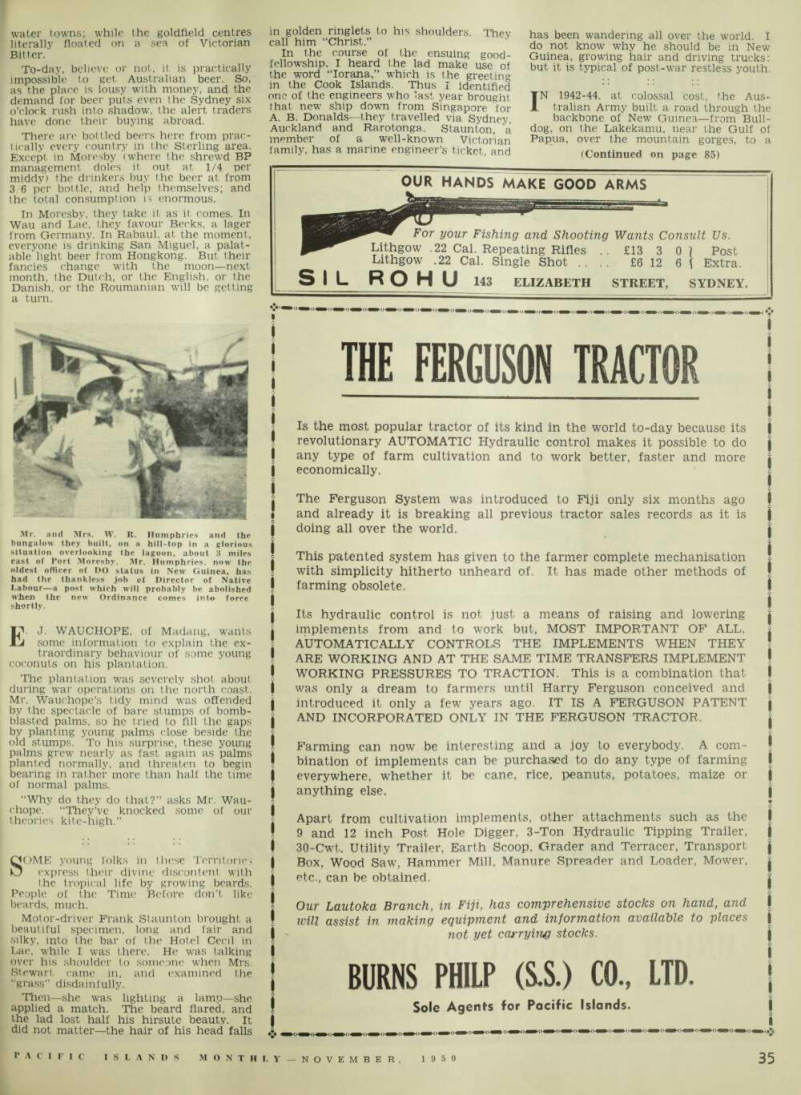
Mr. and Mrs. W. R. Humphries and the bungalow they built, on a hill-top in a glorious situation overlooking the lagoon, about 3 miles east of Port Moresby. Mr. Humphries, now the oldest officer of DO status in New Guinea, has had the thankless job of Director of Native Labour —a post which will probably be abolished when the new Ordinance comes into force shortly.
point in the valley behind Edie Creek— that is, the next valley system westward of the Bulolo.
It was built, presumably, as an in surance against a Jap occupation of the Bulolo area. If he had established him self there, a road through from Bulldog would have bothered him. When the Jap failed, and departed, the Lakekamu road fell into disuse.
Recently a party from Wau —including Old Timer Joe Bourke, ADO Seale and Surveyor Owers—walked over the road, from Edie Creek, to within 18 miles of Bulldog. They report that it has been rapidly overgrown, and is blocked in places by landslides —in one place, there is a slide 500 yards long. Their unanimous report: “A hopeless maintenance job.”
IHAD a pleasant, mellow evening with the staff of a big native hospital; and they were induced to tell me some thing of their errors.
One man—a skilled surgeon—went on duty in the operating theatre. They brought to him a young woman, suitably prepared for an appendix operation. He studied the carded record —a clear case of appendicitis. So, as he expressed it, “I whipped out the appendix—a neat job.”
But when the lady’s husband visited her, he seemed discontented. He could not quite see how an ulcerated leg could be helped by “cut im belly belong im.”
The horrified staff found that the case cards had got mixed—that particular patient was in for special leg treatment.
No harm done —it was a good appendix job.
The other incident was really funny.
A 12-years-old boy was found to have venereal disease. One official takes a serious view of this kind of thing among native youngsters, and tries to eradicate infectious agencies. So, when he heard Df this case, he had the boy sent to his Dffice, and gave him a lecture, and then ne demanded the name of his girl friend, rhe youngster was reluctant—even stub born —in giving away the lady’s name; out, under severe pressure, he finally yielded up the required information.
Medical orderlies brought the lass into Dhe hospital, and she resented the sub sequent proceedings, and was vociferous md indignant. Moreover, she appeared :o be perfectly healthy.
The puzzled officer sent again for the ooy—and another boy appeared. He was :he real culprit. There had been an jrror—the conscientious official had third iegree’d the wrong boy! lITHEN walking off the Bulolo at Bris ▼ T bane some time ago, Mrs. Alice Bowring, Edie Creek goldminer, saw i queue. Having wartime habits, and as suming it was part of the disembarkation Jeremony, she joined the queue. She was near the head when she learned it was a lueue to buy tickets in an Interstate Lot tery; so she decided to go on in and buy i ticket.
She was next to the window when a rough and tough lorry-driver forced his svay in in front of her. She only laughed. ‘Probably he’s in a real hurry—we’re not,” she told her friend.
When the Bulolo got to Moresby, an excited radio officer told her that her ticket had won the first prize—£ls,ooo.
There were fun and games that evening in Moresby.
Mrs. Bowring says the whole £15,000 has been invested in her mining property at Edie Creek.
RESPONSIBLE people are concerned about the increase in drinking and gambling among the natives in the Rabaul district —evils inseparable from the distribution of too much money among
primitive and uncultured folk.
The Missions, who have been appealed to for help, say the growing drunkenness is due to three things—the sale of case lots of liquor to natives by certain Euro
peans; the direct sale of liquor to natives by Chinese trade stores; the distillation of spirits from bananas and similar things by the natives themselves—an art taught to them by the Japanese.
“Difficult thing to deal with—especially when we do not get the co-operation of all classes,” said one missionary director.
“We could get more help from the Chinese traders to whom licences have been given to sell liquor. To whom do the Chinese traders sell liquor, if not to natives?”
PROSPECTIVE travellers are always asking the PIM: “What is the hotel accommodation like in New Guinea?”
Here is the answer: PORT MORESBY. —Two modern hotels - -both good. The Papua Hotel has all the
amenities and is very Well managed, and at present is the best in the Territories.
LAE—The Hotel Cecil is a large estab lishment arranged in temporary ex-Army buildings, about two miles out in the jungle. Lacks amenities. Mrs. Flo Stewart is now building her large and very modern Hotel Cecil on the waterfront and, if plans are fully carried out, it will be the biggest and most attractive hotel in the SW Pacific. Should be ready early in 1951. Qantas travellers can now be ac commodated in very comfortable bunga lows, with all mod. cons., at Qantas mess in Lae.
WAU.—Rooms badly designed and lack amenities: but otherwise the Wan Hotel is well conducted by Mr. and Mrs. Ireland.
MADANG.—Boardinghouse, made of native materials, conducted by Mrs. Pitt,
who achieves won ders in the way of cooking and comfort in the face of in credible difficulties.
RABAUL.—Cosmo politan Hotel, con ducted by Bert Gaskin, has provided accommodation, and a social rallying place, in the face of great natural handi caps, for three years.
It is a huge shed like building, divided into rooms by pa?er walls, and it echoes every sound; but, be ing right on the waterfront, it is the coolest place in the town area. Ascot, Hotel, goodlooking, with all mod. cons.,
accommodating 40. just been built by Arthur Browne and is being managed by Dorothy Stewart. It will rank, pending completion of Lae Hotel, close to the Papua Hotel in Moresby. As soon as Ascot Hotel was opened (November) the Cos mopolitan Hotel was partially closed for internal reconstruction.
MUMENG. —Built at a height of 3,000 feet, half-way on the Lae-Wau road, by Mark Schultz, in the belief that coastal residents would run up there for a cool weekend. Quite a good hotel, but de pends almost entirely on the road traffic, which is not heavy.
It is catch-as-catch-can in the other Territories centres—which means that you generally plant yourself on the long-suff ering District Officers. (Continued Next Page)
Front view of the newly-opened Ascot Hotel, Rabaul, New Guinea, which has accommodation for about 35 people, with all modern conveniences. It is one of the very few modern buildings in Rabaul, where the Government, trying to induce a general shift to Rapopo. has discouraged new construction.
AS 1 travelled over the Wau-Lae road (I have written about the road and the Markham bridge problem in another article) I recalled the fierce controversy of the ’thirties.
The Wau-Bulolo goldmining community, sick of paying high air-freights, demanded a road, either direct over the mountains to Salamaua, or via the Buangs to Lae or Salamaua. The airways people, supported by many engineers, contended that it could not be done economically—that the
cost of building and maintenance would be so heavy that road freighting could not compete against the then prevailing air freight of 3d. per pound.
Finally, the Administration doubled the royalty on gold, and announced that the additional revenue thus raised would be used for the building of a road. Time passed, nothing was done, and the exas perated miners were preparing to put in the road themselves, with their own boys and shovels, when the war came.
The Army built the road via Snake River (generally north of the Buangs) and it is now in constant use.
But what has become of the road building fund created in the late thirties by a special tax on the gold-producers?
The bureaucrats should not be allowed to get away with that.
Advertisements & other items, p. 14 (2 items)
November. 1080-Pacffio Islands Monthl
Morris Hedstrom Limited
General Merchants, Importers and Exporters,
Shipowners, Plantation Owners,
Commission and Insurance Agents
HEAD OFFICE
SUVA, FIJI
Established 1868
SERVICE IN THE SOUTH PACIFIC TERRITORIES
'J'HROUGH our Large Establishments in Suva and our Numerous Branches, we distribute a wide and comprehensive range of General Merchandise and provide almost every kind of service. Our departments and associated businesses include:
DRAPERY
MOTOR SALES
AND SERVICE
TOBACCO
TIMBER AND
BUILDING
GROCERY
CONFECTIONERY
HARDWARE
ELECTRICAL
LIQUORS
DRUGS
Branches Throughout Fiji, Samoa and Tonga
There is a Branch or Agent of Morris Hedstrom Limited in every Town in the Three Territories.
We are Sole Agents in these Territories for British Drug Houses Ltd.
Electrolux Ltd.
Ford Motor Co.
General Electric Co. Ltd.
Goodyear Tyre £r Rubber Co.
B. A. Hjorth & Co. (Primus Products) Imperial Chemical Industries Ltd.
International Harvester Export Co.
Matson Navigation Company Max Factor and Co. Inc.
Ransomes, Sims & Jefferies Ltd Ruston £r Hornsby Ltd.
Vacuum Oil Co. Pty. Ltd.
Yorkshire Copper Works Ltd.
Morris Hedstrom Limited are LLOYD’S AGENTS in Fiji and Samoa.
IN AUSTRALIA:
Morris Hedstrom (Aust.) Pty. Ltd.,
Asbestos House, 65 York Street, SYDNEY
IN GREAT BRITAIN:
Morris Hedstrom Limited,
Barclay's Bank Building, 73 Cheapside, LONDON, E.C.2.
CPA Will Call at Auckland
Ban on Tasman Crossing Lifted
FROM next February 12, Canadian Pacific Airlines aircraft will call at Auckland, New Zealand, on their Sydney-Vancouver service. Australian and New Zealand Governments have agreed to let them fly the Tasman although they will not be able to enter that trade which is the monopoly of Tasman Empire Airways.
At present CPA planes do not run a service between Auckland and North America as do the other *two trans-Pacific operators, Pan American World Airways and British Commonwealth Pacific Air lines. Neither PAA nor BCPA have made an announcement as to how the lifting of the ban on the trans-Tasman crossing for CPA will affect them.
Aorangi
No Canadian Subsidy for Aorangi
IT seems unlikely that anything will come from the renewed negotiations with Canada for a subsidy for the liner Aorangi. A Canadian Government spokesman said, on November 8, that they could not see their way clear to pay this as it was considered that Canadian Pacific Airlines catered adequately for Canadians wishing to travel between Canada and Australasia. In addition, Aorangi was registered outside Canada and had a non-Canadian crew.
It rests now with the Governments of Australia and NZ (and their willingness to pay the whole subsidy) whether Aorangi remains on the run. (It was announced in July by the Canadian-Australasian Line, which owns Aorangi, that the vessel would be with drawn from the Pacific service when she reached Sydney on January 29, 1951, if the Governments of Australia, Canada and New Zealand would not agree to pay a subsidy. New Zealand was willing to pay her share but Australia and Canada were not.)
Ocean Of Islands’
Sewards Produce a Notable Book About the Pacific
AVERY notable compilation, “The Pacific, Ocean of Islands,” edited by famous naturalist, Charles Barrett, has just been produced by N. H. Seward Pty., Ltd., of Melbourne.
It is a well-bound, beautifully printed book of 200 crown-quarto pages, and each of the 16 sections, covering almost every phase of Pacific history and description, has been written by aii authority on the particular subject.
History is covered in three sections— Cartography of the South-West Pacific: French Navigators of the Pacific; and The Voyage of the Swallow, 1766-69. There is a section on Pacific Whaling; another on The Art of the Pacific; and a particu larly interesting one on The Literature of The Bounty, in which the scores of books based on the famous mutiny, and on what came later in Pitcairn Island, are reviewed.
There are sections on the Missionaries, on the Plants of the Pacific, on the Megaliths, on the Birds of Paradise and one—covering a very wide field, indeed— on The Novelists of the Pacific. Sir Peter Buck, in one section tells the story of the Bishop Museum.
There are about 60 illustrations, dealing with innumerable subjects. Many are rare. They have been carefully chosen and are most skilfully reproduced—some must have a unique value.
This is not a closely integrated des cription of the Pacific Islands; but, within the several sections and the numerous illustrations all of which have been cleverly edited and arranged—there may be found countless authoritative references to, and descriptions of, every facet of life in the Pacific, and of its picturesque history.
The book has been produced in a limited edition, and is being sold for Five Guineas.
Mr. and Mrs. Reginald Stewart left Sydney in early October on their way to the Gilbert and Ellice Islands where Mr.
Stewart has a Colonial Office appoint ment. They were formerly in Tan ganyika.
Appointments
Fiji Executive Council
IT was announced in Fiji in mid-October that Mr. Alport Barker and Mr.
Sadanand Mahraj have been ap pointed to the Executive Council of the Colony, and that Sir Hugh Ragg and Ratu Edward Cakoban have been re appointed.
The names of Mr. Barker, Mr, Mahraj and Ratu Edward were submitted to the Governor by the Unofficial Members of Legislative Council.
The appointments and re-appointments which will take effect from October 15, are for three years or until the dissolution of the present Legislative Council.
Advertisements & other items, pp. 15-16 (2 items)
Sale!
PACIFIC
ISLANDS
YEAR
BOOK
1950 K..W Robson,
NOW
on
SALE!
After 15 months' delay, caused by industrial dislocations and other circumstances beyond our control, we advise that the
PACIFIC ISLANDS YEAR BOOK, 1950
is now available. Copies may be obtained from most of the leading Booksellers in Australia, New Zealand and the Pacific Islands, and from the Publishers.
There are 500 Pages and numerous Maps in this (the Sixth) Edition. In addition to providing the latest available information relating to Administrations, Trade (full Statistics), Tariffs, etc., all revised up to the end of 1949, the Year Book has many Special Sections, such as: A History and Chronology of the War In the Pacific, 1941-45; Lists of Public Servants in each Territory; Description of the new Air Transport Organisations serving the Pacific Islands; Complete Directory of Pacific Islands Missions; Notable Developments in 1940-50 Period; Detailed Index of Place Names in the Pacific, etc.
Retail Price: 22/6
AdA postage (within ° rderinS direCt '
PACIFIC PUBLICATIONS PTY. LTD.
Union House, 247 George Street, SYDNEY. p.o. Box 3408, SYDNEY.
Yours when you fly
by Clipper* to
via U.S.A.
YOU PAY IN POUNDS
You don’t need dollars when yon fly Pan American to England! \ou pay your fare in Australian currency.
Your fare includes the finest in air transportation to London and return. Whilst crossing the U.S.A. Pan Air takes care of all arrangements, including the provision of fifteen dollars to cover over-night hotel expenses in Honolulu and San Francisco or Los Angeles and the few minor expenses which might be incurred ... all arrange- The Clippers also fly to London For complete information , call your Trai SUVA; Bank of N.S.W NOUMEA: Rue Jean World's Most Experienced Airline & 85) (Tel. ments and reservations made for you under Pan American’s Commonwealth Plan. No dollars needed —fare payable in Australian Currency.
All-Around Comfort. Your Sleeperette* is softly cushioned, extends to full bed-length at the push of a button. By day you’re as blissfully comfortable as you are at night. via Middle East and Europe. el Agent or . . . . Bldg. (Tel. 664.) Jaures. p an American W'orld Airways, Inc. Ltd., Incorporated in U.S.A.
14
NOVEMBER, 1950 PACIFIC ISLANDS MONTHL
Japan, Germany
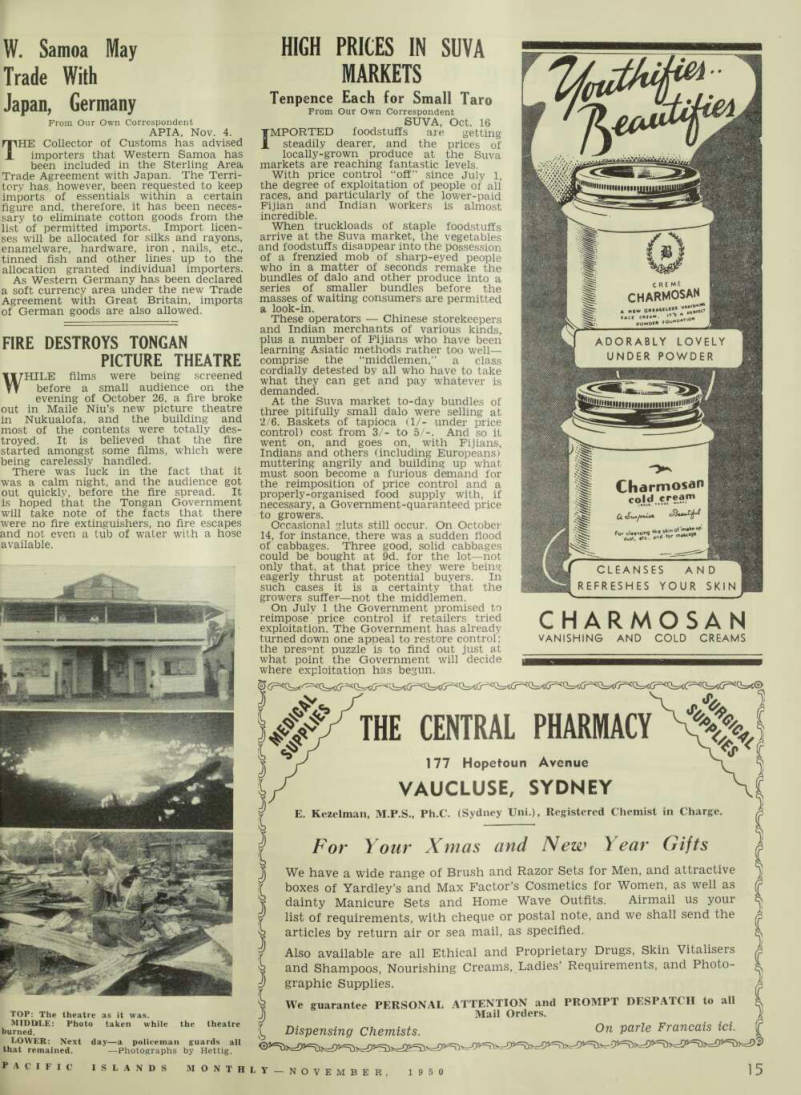
W. Samoa May Trade With Japan, Germany
From Our Own Correspondent
Apia, Nov. 4.
THE Collector of Customs has advised importers that Western Samoa has been included in the Sterling Area Trade Agreement with Japan. The Terri tory has. however, been requested to keep imports of essentials within a certain figure and, therefore, it has been neces sary to eliminate cotton goods from the list of permitted imports. Import licen ses will be allocated for silks and rayons, enamelware, hardware, iron, nails, etc., tinned fish and other lines up to the allocation granted individual importers.
As Western Germany has been declared a soft currency area under the new Trade Agreement with Great Britain, imports of German goods are also allowed.
Fire Destroys Tongan
Picture Theatre
WHILE films were being screened before a small audience on the evening of October 26, a fire broke out in Maile Niu’s new picture theatre in Nukualofa, and the building and most of the contents were totally des troyed. It is believed that the fire started amongst some films, which were being carelessly handled.
There was luck in the fact that it was a calm night, and the audience got out quickly, before the fire spread. It is hoped that the Tongan Government will take note of the facts that there were no fire extinguishers, no fire escapes and not even a tub of water with a hose available.
TOP: The theatre as it was.
MIDDLE: Photo taken while the theatre burned.
LOWER: Next day—a policeman guards all that remained. Photographs by Hettig.
High Prices In Suva
Markets
Tenpence Each for Small Taro
From Our Own Correspondent
Suva, Oct. 16
IMPORTED foodstuffs are getting steadily dearer, and the prices of locally-grown produce at the Suva markets are reaching fantastic levels.
With price control “off” since July 1, the degree of exploitation of people of all races, and particularly of the lower-paid Fijian and Indian workers is almost incredible.
When truckloads of staple foodstuffs arrive at the Suva market, the vegetables and foodstuffs disappear into the possession of a frenzied mob of sharp-eyed people who in a matter of seconds remake the bundles of dalo and other produce into a series of smaller bundles before the masses of waiting consumers are permitted a look-in.
These operators Chinese storekeepers and Indian merchants of various kinds, plus a number of Fijians who have been learning Asiatic methods rather too well— comprise the “middlemen,” a class cordially detested by all who have to take what they can get and pay whatever is demanded.
At the Suva market to-day bundles of three pitifully small dalo were selling at 2/6. Baskets of tapioca (1/- under price control) cost from 3/- to 5/-. And so it went on, and goes on, with Fijians, Indians and others (including Europeans) muttering angrily and building up what must soon become a furious demand for the reimposition of price control and a properly-organised food supply with, if necessary, a Government-quaranteed price to growers.
Occasional gluts still occur. On October 14, for instance, there was a sudden flood of cabbages. Three good, solid cabbages could be bought at 9d. for the lot —not only that, at that price they were being eagerly thrust at potential buyers. In such cases it is a certainty that the growers suffer—not the middlemen.
On July 1 the Government promised to reimpose price control if retailers tried exploitation. The Government has already turned down one appeal to restore control; the present puzzle is to find out just at what point the Government will decide where exploitation has begun.
Advertisements & other items, pp. 17-18 (2 items)
The Central Pharmacy
m--"l'fflr ■ *
CHARMOSAN
NIW rrzz
LOV
DO
RAB
LY LY ER
ROW
iiii<
Lay i ii iiniiiiiiimiKj
% Charmosan
coid^sa," 1
a c^W
CLEANSES AND
REFRESHES YOUR SKIN
CHARMOSAN
vanishing and cold creams
THE CENTRAL PHARMACY
177 Hopetoun Avenue
VAUCLUSE, SYDNEY
E. Kezelman, M.P.S., Ph.C. (Sydney Uni.), Registered Chemist in Charge. 6 <A if For Your Xmas and New Year Gifts We have a wide range of Brush and Razor Sets for Men, and attractive boxes of Yardley’s and Max Factor’s Cosmetics for Women, as well as dainty Manicure Sets and Home Wave Outfits. Airmail us your list of requirements, with cheque or postal note, and we shall send the articles by return air or sea mail, as specified.
Also available are all Ethical and Proprietary Drugs, Skin Vitalisers and Shampoos, Nourishing Creams, Ladies’ Requirements, and Photographic Supplies.
We guarantee PERSONAL ATTENTION and PROMPT DESPATCH to all Mail Orders.
Dispensing Chemists.
On parle Francais ici.
Presenting a complete range of
REFRIGERATION
SUITABLE FOR ISLAND USE
for operation from
ELECTRIC MOTORS of
varying voltages,
petrol or diesel motors
BJSS^
The Premier “Pinnacle” combination for ice cream, milk and food storage.
The Premier “Regal” for Delicatessen , Grocery, Poultry, etc. y v.v Whatever your refrigeration needs, we The “Paramount can supply them —from domestics to the largest types of coolrooms, from normal temperatures to minus 20 deg.
We are manufacturers of a complete series, some of which are shown on this page. Full information, illustrated leaflets, and specifications will be airmailed on request.
We are contractors to the Commonwealth Government and such large organisations as Tooth & Co.
Combination is the newest in a line of fine Premier commercial refrigerators. mn The Premier Wall Cabinet type for ice cream, milk and food storage.
PREMIER
REFRIGERATION CO. PTY. LTD.
587 GEORGE ST., SYDNEY. Factory: 14 Underwood St., Paddington, N.S.W., or Box 241, P.O. Haymarket 393 GEORGE ST., SYDNEY.
16
NOVEMBER, 1950-PACIFIC ISLANDS MONTHL
South Pacific
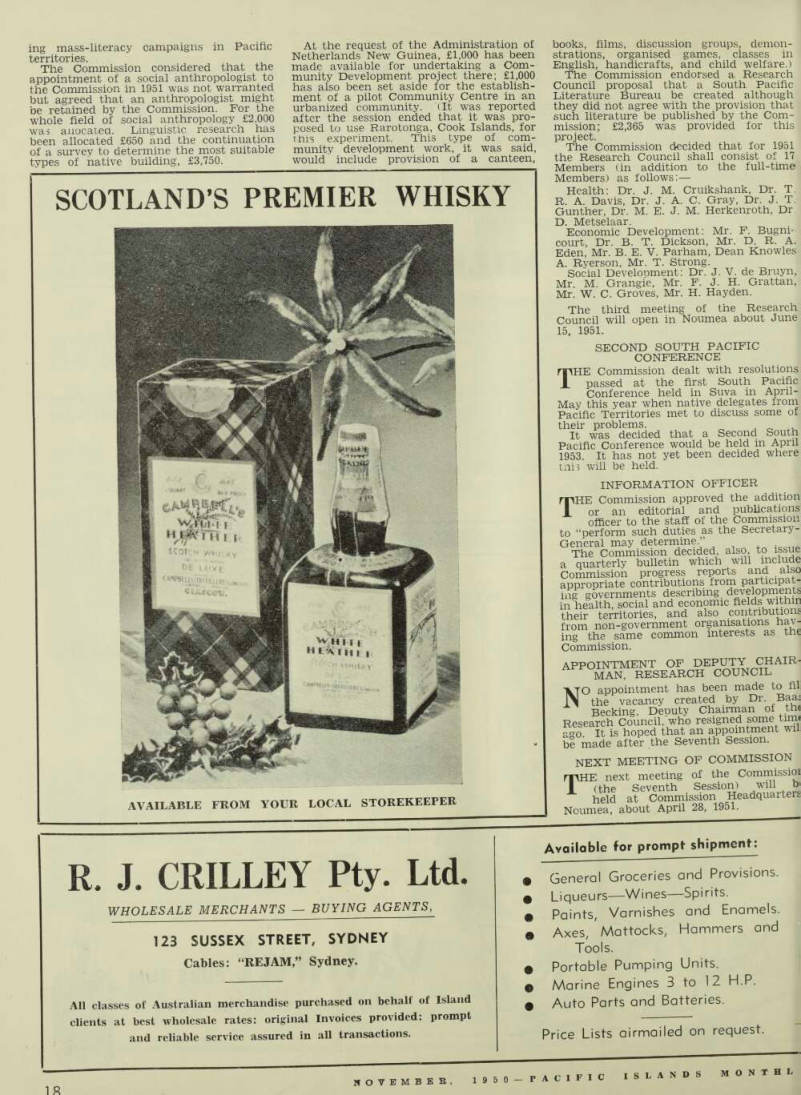
Commission
Financial Allocations Made at Sixth Session
Headquarters: Anse Vata Noumea, New Caledonia
THE sixth session of the South Pacific Commission was held at Commission headquarters in Noumea between October 23 and November 2.
Chief representatives of member govern ments were: Mr. J. R. Halligan, for Aus tralia, Mons. R. Lassalle-Sere, for France, Mr. J. B. D. Pennink, for the Netherlands.
Mr. C. G. R. McKay, for New Zealand, Sir Brian Freeston, for the United Kingdom, and Dr. F. M. Keesing, for the United States.
Some time was taken up on purely housekeeping problems—such as housing, superannuation fund, advances to officials for the purchase of motor vehicles, etc.— but the two agenda items of general in terest were the report and recommenda tions of the second meeting of the Research Council which met in Sydney in August, and the budget for 1951.
The Commission budgeted to spend £149,165 Stg. in the year January 1 to December 31, 1951. Of this amount about £17,000 is provided for Health projects, £21,000 for Economic Development and about £16,000 for Social Development.
Health
THE allocation for Health will be spent mainly on continuation of projects already begun—£6,ooo, for example, for continuation of research into the tuberculosis problem in Pacific Territories under the control of member governments.
Research in infant feeding and nutrition among the Islanders will also be carried on. Allocation for this is £3,225.
Allocations have been made for research
projects on leprosy (£1,675 allocated) Ophthalmology (£2,125); malaria (£500)-’ and venereal diseases (£2,125); but in all these cases, with the exception of malaria member governments have been asked to submit their needs to the Commission
Economic Development
AMONG projects to be carried out or continued under the heading of Economic Development are the intro duction and distribution of economic plants (provision of £4,000); the intro duction and distribution of cash crops and the appointment of two experts to super vise the project (£6,000); the economic development of coral atolls (£2,800); research into the subsistence of indigenous peoples (£4,650).
Social Development
SOCIAL Development allocations include £6OO for a meeting in Suva of the 'Social Development Committee; £390 for visual education, and £950 for further
ins: mass-literacy campaigns in Pacific territories.
The Commission considered that the appointment of a social anthropologist to the Commission in 1951 was not warranted taut agreed that an anthropologist might be retained by the Commission. For the whole field of social anthropology £2,000 was allocated. Linguistic research has been allocated £650 and the continuation of a survey to determine the most suitable types of native building, £3,750.
At the request of the Administration of Netherlands New Guinea, £l,OOO has been made available for undertaking a Corn munity Development project there; £l,OOO has also been set aside f<pr the estabhsh ment of a pilot Community Centre in an urbanized community. (It was reported after the session ended that it was pro posed to use Rarotonga, Cook Islands, for this experiment. This type of com munity development work, it was said, would include provision of a canteen.
books, films, discussion groups, demon strations, organised games, classes in English, handicrafts, and child welfare.) The Commission endorsed a Research Council proposal that a South Pacific Literature Bureau be created although they did not agree with the provision that such literature be published by the Com mission; £2,365 was provided for this project.
The Commission decided that for 1951 the Research Council shall consist of 17 Members (in addition to the full-time Members) as follows: — Health; Dr. J. M. Cruikshank, Dr. T.
R. A. Davis, Dr. J. A. C. Gray, Dr. J. T.
Gunther, Dr. M. E. J. M. Herkenroth, Dr D. Metselaar.
Economic Development: Mr. F. Bugni court, Dr. B. T. Dickson, Mr. D. R. A.
Eden, Mr. B. E. V. Parham, Dean Knowles A. Ryerson, Mr. T. Strong.
Social Development: Dr. J. V. de Bruyn, Mr M. Grangie, Mr. F. J. H. Grattan, Mr! W. C. Groves, Mr. H. Hayden.
The third meeting of the Research Council will open in Noumea about June 15. 1951.
Second South Pacific
Conference
THE Commission dealt with resolutions passed at the first South Pacific Conference held in Suva in April- May this year when native delegates from Pacific Territories met to discuss some of their problems. , It was decided that a Second South Pacific Conference would be held in April 1953. It has not yet been decided where tnis will be held.
Information Officer
THE Commission approved the addition or an editorial and publications officer to the staff of the Commission to “perform such duties as the Secretary- General may determine/’
The Commission decided, also, to issue a quarterly bulletin which will include Commission progress reports and also appropriate contributions from participat ing governments describing developments in health, social and economic fields within their territories, and also contribution., from non-government organisations hav ing the same common interests as the Commission,
Appointment Of Deputy Chair
Man Research Council
NO appointment has been made to fill the vacancy created by Dr. Baas Becking, Deouty Chairman of the Research Council, who resigned some time ago It is hoped that an appointment will be made after the Seventh Session.
Next Meeting Of Commission
THE next meeting of the Commissioi (the Seventh Session) will bn held at Commission Headquarters Noumea, about April 28, 1951.
Advertisements & other items, pp. 19-20 (2 items)
Millers Ltd. 'V'miiki, I
SUVA and LAUTOKA, FIJI.
Every Branch of Engineering and Building
C onstruction
Sawmillers and Timber Merchants; Shipwrights and Sailmakers; Joinery and Furniture Manufacturers; Upholsterers; Plumbers; Electricians; Hardware Merchants; Motor Dealers.
AGENCIES :
Chevrolet, Bedford, Vauxhall, Nash Motors. Firestone Tyres. Fetters Marine and Stationary Engines. G.E.C. Radio Sets. British Australian Lead Manufacturers Pty., Ltd. Atlas Assurance Co., Ltd.
There is no need to send to Australia or New Zealand for Repairs or Replacements. We can give you a sound Quotation and guarantee First-Class Workmanship.
‘ R cady for another ’ ’
asked Jim
Tom drained his glass and held it out. “Who puts this up Ted.
“It s bottled by Dewars.
“That explains it. Best
drop o’ rum I’ve sampled for a long time. * * TKe fact that “Valiant” Rum is bottled by John Dewar and Sons Ltd., is, of course, your guarantee of a consistently high-quality product . . . but let’s tell you something of the rum itself.
Valiant has a smoothness and richness which comes from the use of the finest ingredients. It has a deep, ruby colour and a mellow maturity which is the natural result of long ageing in the cask.
Words cannot fully describe a flavour so well simply say that here’s a refreshing, bracing flavour that makes a very happy first impression, and improves with acquaintance.
If you haven t tried Valiant Rum as yet, the best time for you may be your next opportunity.
Valiant PURE RUM
' Fully-matured in the wood
Bottled by John Dewar & Sons Ltd.
SCOTLAND’S PREMIER WHISKY
wmm mmsm .. mvmm w.ii i f , i i scar<* *,» it
VIX--'- ■
w Mill H * 111 I n
AVAILABLE FROM YOUR LOCAL STOREKEEPER
Available for prompt shipment: General Groceries and Provisions.
Liqueurs —Wines —Spirits.
Paints, Varnishes and Enamels.
Axes, Mattocks, Hammers and Tools.
Portable Pumping Units.
Marine Engines 3to 12 H.P.
Auto Parts and Batteries.
Price Lists airmailed on request.
R. J. CRILLEY Pty. Ltd.
WHOLESALE MERCHANTS BUYING AGENTS,
123 SUSSEX STREET, SYDNEY
Cables: “REJAM,” Sydney.
All classes of Australian merchandise purchased on behalf of Island clients at best wholesale rates: original Invoices provided: prompt and reliable service assured in all transactions.
18
NOVEMBEB. 1950 PACIF.C ISLANDS MONTHL
The Sorry Plight of Australia’s Great Tropical
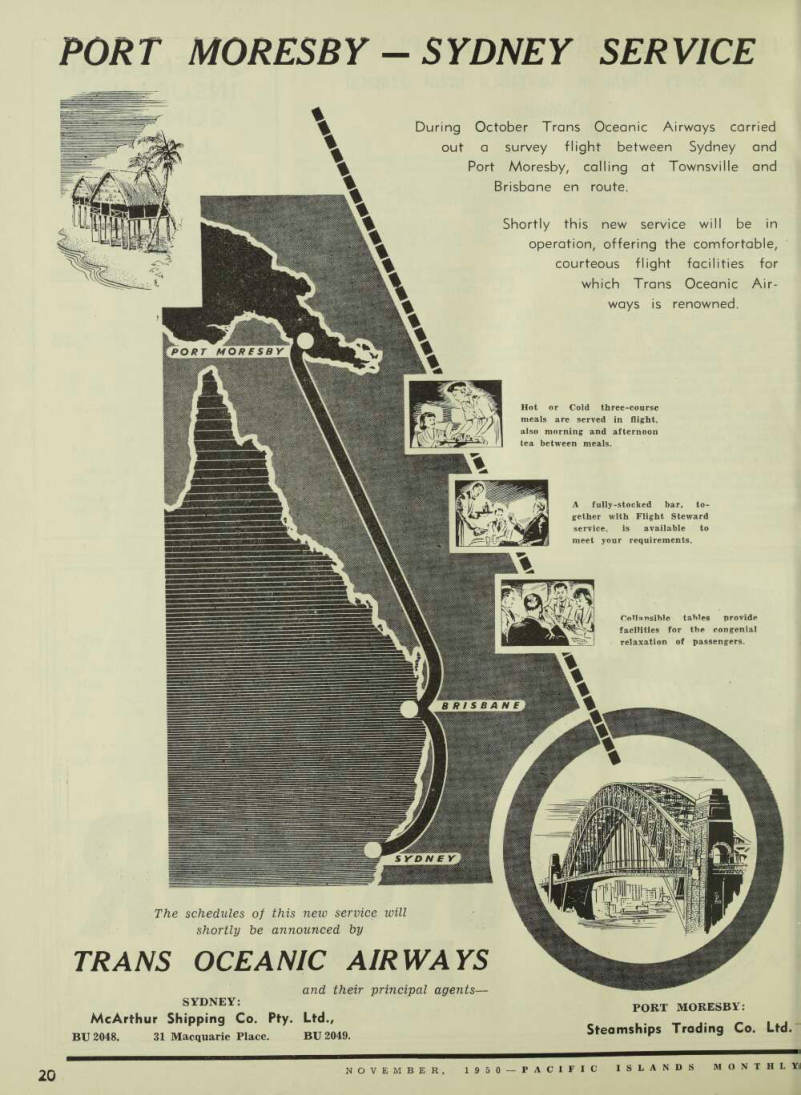
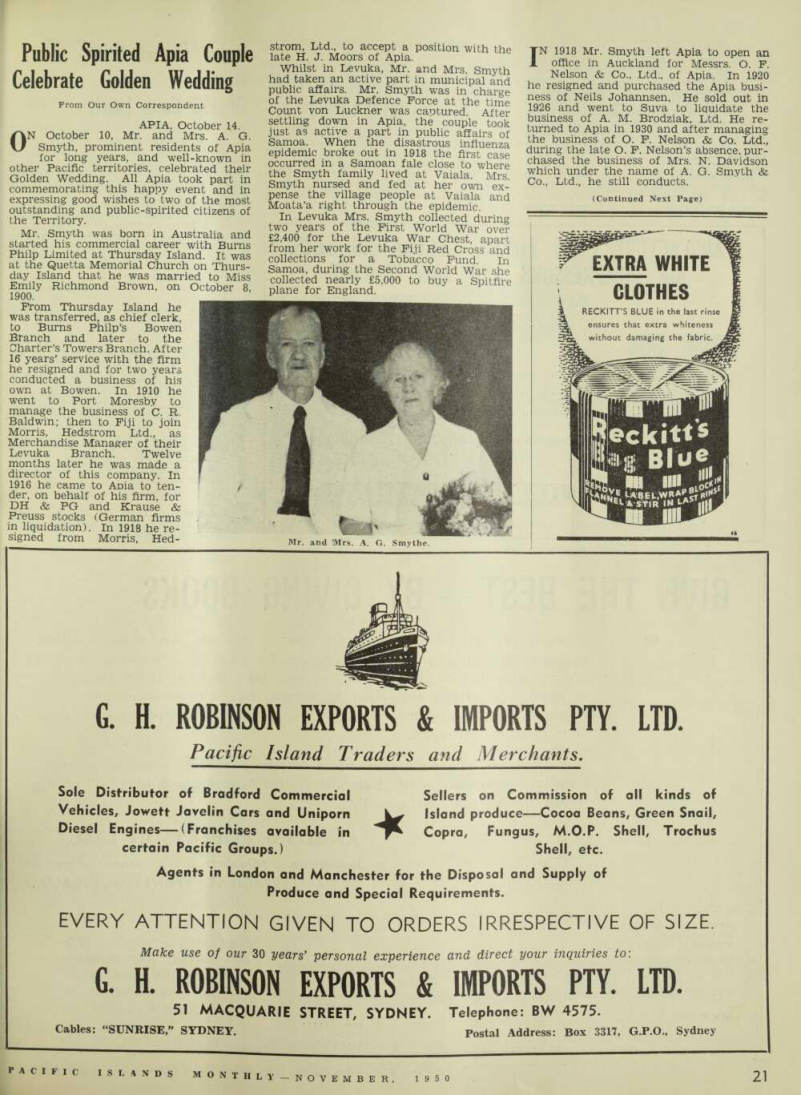

STILL IN THE GRIP OF THE PLANNERS The Sorry Plight of Australia’s Great Tropical Dominion
From R. W. Robson
Pt. Moresby, Oct. 30.
THE following is my summing-up of impressions gained in a« 4-weeks’ tour of Papua-New Guinea, just completed. This comparison is made be tween conditions as I knew them in 1939, and conditions today. I am told that to-day’s conditions are somewhat better than they were in 1948-49; but I had no first-hand knowledge of the Ter ritories in 1948-49.
There is demoralisation among the non- Highland natives who supply the native labour force.
This is due to (a) the Ward-Murray policy of wiping out the indentured labour system, especially the provisions for penalty in respect of breaches of contract: (b) the Ward-Murray policy of distributing huge amounts of money among natives as war damage compensa tion, on a very loose system.
There is demoralisation among non official Europeans, who provide the mainspring of the private enterprise without which this PNG Territory cannot be developed and made less of a financial burden on Australia.
This is because of the failure of the ad ministration to provide the Europeans with economic and efficient labour, and adequate security in land titles and leases.
Evidence of this is seen in the almost cessation of coconut planting; the con
tinued importation of sawn timber at fantastic prices (although scores of per sons and interests are clamouring for permission to cut local timber); the de crease in the number of individual gold miners (who cannot carry on under present-day costs); and a general reluct ance to engage in enterprise which could be wrecked by an unsympathetic gov ernment.
There is demoralisation among official Europeans, more especially among field officials, such as District Ser vices.
This is due in part to the centralisation of authority and the almost incredible delays which occur in getting rulings and decisions from Port Moresby (and, it is suspected, from Canberra).
It is due in part to the introduction to the Territory of Works and Housing— surely the most wasteful and inefficient set-up ever seen under conditions such as these. The commonest types of white workmen in this set-up receive from £35 to £4O per fortnight, less about 16 6 per week for mess charge—the net result of which is that these people are being paid far more than the most skilled and ex perienced field officials.
It is due in part to the introduction of swarms of officials and “experts ’ who are running around the Territory on
(Continued on Page 101)
jpecial jobs, getting in each other’s way m transport services and in hotels, and the value of whose work it is hard to see. rhere is demoralisation among members of the public generally, because of the lack of any means by which they can express their views on public affairs.
There should be Town Advisory Coun cils in Rabaul and Lae, at least. There should be Advisory Councils for the Dis trict Officers —which were promised, but of which there is no sign. Above all, there should be a Legislative Council, rep resentative of all classes, which should meet at least twice yearly.
There is demoralisation among the hand ful of executive heads who direct Big Business in the Territories.
They can see very clearly the pie crust character of the economy which has been built up in Papua-New Guinea.
There are many surface evidences of great prosperity and an abundance of money. The Territories’ income comes from five main sources —Governmental expenditure, which may be £6,000,000 or £7,000,000 p.a.,; expenditure on oil search, may be £1,000,000 p.a.; receipts from sales of copra, say £2,000,000 p.a.; sales of gold, say £1,000,000 p.a.; and rubber, say £750,000.
The two first-named sources may close up at any time. Receipts from copra, gold and rubber are not likely to in crease. Little real progress has been made in the establishment of new in dustries—such, for example, as timber cutting, although the South Pacific gen erally is crying aloud for timber at any price. 1 COULD elaborate on each of these themes at considerable length—but space considerations forbid. But I have a notebook filled with concrete ex amples to prove every allegation; and. moreover, in New Guinea and Papua, I have gone over the foregoing summary with the leading official and non-official men, and they have generally agreed with it.
The most definite challenge to my sum mary came from a highly-placed official, held in universal respect, who said that the abolition of the indenture system could not be laid at the door of the Ward-Murray regime—that one had to go further and dig deeper to find the origin of the drastic change.
How Indenture System Was
Cancelled.
AS it happens, I know what he was referring to. The move against the indenture system began about 1944, when the late Mr. Beasley, Australian Socialist Minister, was attending an In ternational Labour Conference some where. He cabled Australia that ILO were hostile to the indenture system, and sought instructions. Under advice from External Territories officials, he was in formed that the system would be abolished as soon as it was deemed advisable to make the change.
Soon after this, Mr. “Eddie” Ward and his pack' of precious planners, called the Army Research Council, took charge of the situation. There was not among them one practical man, experienced in tropical administration —the head was a Sydney medical student, who be came a full colonel, and the Council comprised academicians, anthropolo gists, and what-not, all of whom be came lieutenant-colonels, majors and captains, who travelled around the Is lands with full regalia and priority
privileges.
They were all regarded as professed Socialists—as some undoubtedly were.
Colonel J. K. Murray, afterwards head of the School of Tropical Administra
tion, was a member. He then was— probably still is—a convinced Socialist.
Although he had never had one hour’s practical experience of Pacific Islands administration, he was selected by Ward for the post of Administrator. One of his first acts, on arriving at Konedubu, was to call all his leading officials to gether, and deliver a paean of praise of “Eddie” Ward, and declare that Ward would be Australia’s next Socialist Prime Minister.
IT was the Research Council, plus Ward, plus Murray, plus all kinds of so called experts, who framed the Ward- Murray policy, during the confused ANGAU regime. It was then that the Australian Socialist Government com mitted itself to the United Nations and the ILO with the statement that the in denture system would be abolished in five years. It was then that the guiding hand of Mr. “Jim” Taylor was seen. (Continued Next Page)
“Jim” Taylor was one of the best fieldmen that the NG Administration ever had. It was he who, in association with the Leahy brothers, explored much of the Highlands. His success in bringing uncontrolled areas under control was not-
able. But, as an administrator of a dis trict, he was not regarded as above the average.
This was the man whom the Planners called in to assist them in framing part of their policy; and the Native Labour
Ordinance, introduced when the Ward- Murray regime took over from ANGAU and mainly responsible for the chaos and confusion in the Territories between 1945 and 1950, is regarded as the compilation of Mr. Taylor. Mr. Taylor was Director of Native Labour for two or three years.
His retirement from the job, and from the Administration service, was not re garded as a calamity.
His defenders say that Colonel J. K.
Murray did not favour the early abolition of the indenture system—they say it was forced upon him by Ward and Evatt. If he had had any experience, he would have foreseen the effect of the change, and resigned rather than agree to it.
As it was, he agreed to the abolition of the indenture system at the end of five years, and the immediate reduction of the contract term to one year; and he should now be forced to take responsibility for the results —a disorganised and de moralised labour force; cheeky and unde pendable natives, who seem to be moving steadily towards the point where they will challenge the white man’s authority; the embarrassment and discouragement of private enterprise; and a staggering increase in the costs of administration.
NEW Planners argue, of course, that whatever we may think, we are forced by our obligations to the UN Trusteeship Council to wipe out the in denture system. That is prevarication.
It was the Chifley Socialist Government which committed us to the abolition of the system within five years; and the Chifley Government and all its works were repudiated by the Australian people.
We are not obliged to accept, in every thing, the dictation of the Socialist or the Trusteeship Planners.
The primary paramount consideration in respect to New Guinea is its devel opment as Australia’s mosU important
outward bastion of defence; and in that regard the natives must be compelled to do their share.
The new Native Labour Ordinance is a weak compromise, for which the Spender regime will be blamed. It will not re move the evils created by tne Ward- Murray-Taylor regime. The whole thing will be up for review and amendment again.
Extraordinary Hold-Up In
Timber.
PROBE as I might, I could not find the reason for the extraordinary nold-up in the issue of permits to take timber out of the coastal jungles.
Canberra has approved; Port Moresby has approved; everyone has approved except \ne very stubborn Director of For ests, Mr. McAdam. In the absence of any other information, we aie forced to the conclusion that tne cause of delay lies in the office of the Forestry Director.
As a forester, Mr. McAdam is held in high respect. It was due to his probity and forthrightness that the timber-lease conspiracy of 1945-48 (which sent “Jock”
Garden to gaol, and threatened “Eddie”
Ward with political extermination) was defeated. It is believed McAdam would rather have a tooth pulled than lose one of his beloved trees to greedy commerce.
It was thought that when, as a matter of policy, it was decided that the Morobe pines and cedar should be cut only under a tender system, with adequate re-affor estation provisions, Mr. McAdam would withdraw his objections to the wholesale milling of the timber in the coastal areas.
But, at the date of this writing, the hold-up persists and there are whispers of somewhat drastic action being planned by the powers at the top.
The timber industry of New Guinea is at a most interesting stage, and is the subject of a special article elsewhere in this issue.
Channels Choked In Moresby
And Canberra.
MOST informed people are agreed that the ideal system of administration in this vast wide country would be achieved through the decentralisation and delegation of authority, so that the offi cers in charge of districts would have the widest possible authority to proceed along lines laid down in a general policy.
That idea was accepted by Mr. Spender.
He promised that District Officers would become District Commissioners, who would be aided by local Advisory Councils; and that much of the excessive powers now exercised by Port Moresby and Canberra should be delegated through Deputy Ad ministrators to the men in the field.
Seven months have gone by, and at this writing not one of these things has come to pass. I am told that fantastic delays occur, while more and more mat ters are referred South, to the inevitable Mr. Reg Halligan, for decision.
Everyone blames everyone else—it is like fighting a feather bed.
I would place the blame mostly upon the present Administrator —a most worthy professor, who has had no experience whatever in this kind of turbid and turgid organisation, who is too much of a gentleman to do the obvious, necessary things, and who is the South Pacific’s outstanding example of a round peg in a hole that has become painfully square.
W & H—Frankenstein Monster
COLONEL MURRAY is generally held to be responsible for the introduction to the combined Territory of the De partment of Works and Housing. It was his idea of a way to get things done, without private enterprise. For him it has become indeed a Frankenstein Mon ster.
It is directed and controlled /by a Minister in Australia. Although it is
responsible for practically all the public works in the country, the Administrator has no authority over it. Liaison be -525; £J* H a ? d the Administration to provided by a series of stiff n^ h^ ge ! S een Gover nment Secretary and local W & H Director. i nS? 1 !* monstr ous concern lias just under th°p 00 H^ r^ P6ar i em P lo y ee s- spread all over the two Territories. Heaven knows how uS? y l ac S es , a ?? how many natives it uses of the latter, there must be thousands. It is building roads, bridges houses, stores, air-strips, wharves— and “ * u tbe instrumentalities which are wasting the Australian taxpayers’ money ln u u 01 [ any other country, this is probably the worst. From my own ob servations, I have gathered scores of ex amples of W & H muddle and waste. . That 15 bad enough. But even worse is the concern s effect on native morale.
It has brought in hundreds of whites of ! °w wage-plug type-uncouth hooli gans who have no idea of how to main tain the status of the European among these natives. They fraternise with the native labourers, and associate with native women, and they have so much un accustomed money that they are a posi tive pest in all the places where beer is sold.
Many of us had hoped that the natives wouid soon have recovered from the effects of the military occupation. But this W & H invasion confirms the harm done by the thoughtless soldiery.
There are scores of very competent and responsible officials in W. & H, but they are in a minority, and swamped in the general inefficiency and disrepute.
The Territory is getting its houses and public works, but at an appalling cost, in more ways than one.
IN a native village, not far from a small town where I stayed, there was en camped a woman doctor, who has specialised in infant dietetics. She is said to be getting £1,200 per annum, plus travelling and other expenses, for teach ing native mothers how and when to feed their small children.
Old Territorians, who know the natives and their ways, think it is extremely funny. As an Australian taxpayer, I am not amused, because this is typical of the sort of thing that is going on all over the Territory.
These priceless Planners, in their eager ness to present New Guinea to the Trus teeship Council as a model Native Welfare State, are consistently putting the cart before the horse.
Out at Matupi, near Rabaul, they have a most expensive set-up, where half-a dozen Europeans are training some 25 or 30 boys (who are being paid labourers wages) in certain trades. Out at Station 9PA, near Moresby, they maintain no less than three Europeans (two appar ently quite untrained) as announcers in Motuan and Pidgin; but in not one native village, anywhere in the Territory, did I find any regular listeners-in. In fact I did not locate one community receiver.
If only these planners would get down to the hard earth, and use these easy funds from Australia to train selected natives for the difficult task of teaching simple English to the natives of New Guinea, we might be getting somewhere.
We may be getting somewhere now: but it looks to me very like the road to fin ancial and administrative bankruptcy.
I have had 28 days of ear-bashing— cheerfully endured, because these Papua-New-Guinea people are the most lovable people in the Pacific, and they surely have real grievances. Their troubles are like an ingrowing toe-nail: the more they think about them, the worse they seem, and they feel they must talk about them.
Their plight is made worse because
there is no way in which they can offi cially let off steam. They should have a Legislative Council, where their moans could be channelled to official ears, and genuine grievances dealt with. But there is no sign of the Legislative Council, so often promised. I have followed it back as far as I can—and I am convinced that it is just another of those things held up in Canberra.
It is a pity we could not get a bird's eye view of the matters which await decision in the Department presided over by Mr. Halligan. It would make a startling picture.
Advertisements & other items, pp. 21-22 (2 items)
Anchor
QUEENSLAND
INSURANCE
COMPANY
LIMITED
(Incorporated 1886 in Australia).
ASSETS EXCEED £5,000,000
Head Office:
QUEENSLAND
INSURANCE BUILDING.
80-82 PITT STREET. SYDNEY.
Specialists in South Sea Fire,
Marine & Accident Insurances
Apply to:—
FlJl.—Branch Office: I. B. Chalmers, Manager.
Burns Philp (South Sea) Co., Ltd.
VlLA.—Burns Philp (New Hebridesi. Ltd.
Comptoirs Francais Des Nouvelles Hebrides.
NOUMEA.—L. & W. Johnston.
NEW GUlNEA—Manager for the Territory of New Guinea and Papua, W, A.
Anderson.
PORT MORESBY—SAMARAI—LAE
—MADANG—RABAUL.
Burns Philp (New Guinea), Ltd.
PAGO PAGO.
Burns Philp (South Sea) Co., Ltd.
G. H. C. Reid & Co.
OTHER SOUTH SEA ISLANDS.
Burns Philp (South Sea) Co., Ltd.
Also to any of the Company’s
Offices in Australia or New
Zealand.
FOR
GILLESPIE'S
Gillespie’s Anchor Flour is milled from selected high quality Australian wheats and is entoleted for purity. Its consistent high quality has made it the best-known, most asked-for brand of flour in the Islands. (Entolelion is a special new purifying process which reduces the risk of insect infestation).
ANCHOR
FLOUR
GILLESPIE BROS. PTY. LTD., ANCHOR FLOUR MILLS, SYDNEY
PORT MORESBY - SYDNEY SERVICE
During October Trans Oceanic Airways carried out a survey flight between Sydney and Port Moresby, calling at Townsville and Brisbane en route.
Shortly this new service will be in operation, offering the comfortable, courteous flight facilities for which Trans Oceanic Airways is renowned.
Hot or Cold three-course meals are served in flight, also morning and afternoon tea between meals. % \ % I % % % % % % % % \ % % % %
RT MORESBY
PO \ £S % fS M-* m % m % % % %
RIS B A N
Sr D N
A fully-stocked bar, together with Flight Steward service, is available to meet your requirements.
Collansible tables provide facilities for the congenial relaxation of passengers.
The schedules of this new service will shortly he announced hy
TRANS OCEANIC AIRWAYS
and their principal agents —
SYDNEY:
McArthur Shipping Co. Fty. Ltd., BU 2048. 31 Macquarie Place. BU 2049.
PORT MORESBY;
Steamships Trading Co. Ltd.
November, 1950 Pacific Islands Monthl
Public Spirited Apia Couple
Celebrate Golden Wedding
Prom Our Own Correspondent APIA, October 14.
ON October 10, Mr. and Mrs. A. G.
Smyth, prominent residents of Apia for long years, and well-known in other Pacific territories, celebrated their Golden Wedding, All Apia took part in commemorating this happy event and in expressing good wishes to two of the most outstanding and public-spirited citizens of the Territory.
Mr. Smyth was born in Australia and started his commercial career with Burns Philp Limited at Thursday Island. It was at the Quetta Memorial Church on Thurs day Island that he was married to Miss Emily Richmond Brown, on October 8, 1900.
From Thursday Island he was transferred, as chief clerk, to Burns Philp’s Bowen Branch and later to the Charter’s Towers Branch. After 16 years’ service with the firm he resigned and for two years conducted a business of his own at Bowen. In 1910 he went to Port Moresby to manage the business of C. R.
Baldwin; then to Fiji to join Morris, Hedstrom Ltd., as Merchandise Manager of their Levuka Branch. Twelve months later he was made a director of this company. In 1916 he came to Apia to ten der, on behalf of his firm, for DH & PG and Krause & Preuss stocks (German firms in liquidation). In 1918 he re signed from Morris, Hed
strom, Ltd., to accept a position with the late H. J. Moors of Apia.
Whilst in Levuka, Mr. and Mrs. Smyth had taken an active part in municipal and public affairs. Mr. Smyth was in charge of the Levuka Defence Force at the time Count von Luckner was captured. After settling down in Apia, the couple took just as active a part in public affairs of Samoa. When the disastrous influenza epidemic broke out in 1918 the first case occurred in a Samoan fale close to where the Smyth family lived at Vaiala. Mrs.
Smyth nursed and fed at her own ex pense the village people at Vaiala and Moata’a right through the epidemic.
In Levuka Mrs. Smyth collected during two years of the First World War over £2,400 for the Levuka War Chest, apart from her work for the Fiji Red Cross and collections for a Tobacco Fund. In Samoa, during the Second World War she collected nearly £5,000 to buy a Spitfire plane for England.
IN 1918 Mr. Smyth left Apia to open an office in Auckland for Messrs. O. F.
Nelson & Co., Ltd., of Apia. In 1920 he resigned and purchased the Apia busi ness of Neils Johannsen. He sold out in 1926 and went to Suva to liquidate the business of A. M. Brodziak, Ltd. He re turned to Apia in 1930 and after managing the business of O. F. Nelson & Co. Ltd., during the late O. P. Nelson’s absence, pur chased the business of Mrs. N. Davidson which under the name of A. G. Smyth & Co., Ltd., he still conducts.
(Continued Next Page)
Mr. and Mrs. A. G. Smythe.
Mr. Smyth has taken an active interest in all sport in Apia, promoting racing, bowling, boxing, rifle shooting and other activities. He has participated actively in local politics and was instrumental in persuading the New Zealand Government to open up the Aleisa settlement for local bom European settlers, where many families are now growing bananas, cocoa and taro. He was a member of the Legislative Council of Western Samoa for nine years.
In appreciation of his interest in and assistance to the Marist Brothers’ School at Apia, the school gave a party to the couple on October 10 with appropriate
songs, recitations and speeches in honour of the occasion.
At a cocktail party in the evening of October 10 a large number of residents and many old identities and friends gathered to pay sincere tribute to Mr. and Mrs. Smyth. Mr. E. F. Paul, MLA, in proposing their health, spoke of their pub lic spirit and their many good deeds.
Instead of personal gifts for the occa sion, Mr. and Mrs. Smyth had expressed the wish that a benevolent fund should be created in their name for charitable purposes and their friends have liberally contributed to the Mr. and Mrs. Smyth Jubilee Fund.
Advertisements & other items, pp. 23-24 (1 item)
G. H. Robinson Exports & Imports Pty. Ltd.
EXTRA WHITE
CLOTHES
RECKITT’S BLUE in the last rinse ensures that extra whiteness without damaging the fabric.
G. H. ROBINSON EXPORTS & IMPORTS PTY. LTD.
Pacific Island Traders and Merchants .
Sole Distributor of Bradford Commercial Sellers on Commission of all kinds of Vehicles, Jowett Javelin Cars and Uniporn Island produce—Cocoa Beans, Green Snail, Diesel Engines—(Franchises available in Copra, Fungus, M.O.P. Shell, Trochus certain Pacific Groups.) Shell, etc.
Agents in London and Manchester for the Disposal and Supply of Produce and Special Requirements.
EVERY ATTENTION GIVEN TO ORDERS IRRESPECTIVE OF SIZE.
Make use 0/ our 30 years’ personal experience and direct your inquiries to: G. H. ROBINSON EXPORTS & IMPORTS PTY. LTD. 51 MACQUARIE STREET, SYDNEY. Telephone: BW 4575.
Cables; “SUNRISE,” SYDNEY. Postal Address; Box 3317, G.P.0., Sydney
MANUFACTURERS OF PUMPS, GENERATING SETS,
AIR COMPRESSORS AND SAW BENCHES
4 Here is the ideal DIESEL ENGINE for you!
COVENTRY CDI DIESEL
Complete with Radiator, Fan. Fuel Tank and Governor.
5 1 B.H.P. at 1,500 R.P.M.
WEIGHT: 452 lbs.
DIMENSIONS: 20i in. x 22| in. x 31i in.
The GDI is the ideal engine for mechanical equipment requiring a mobile power unit. Trade and manufacturers’ equipment discounts available on request.
Delivery ex stock. PRICE: £2OO (plus tax)
A COVENTRY CLIMAX PRODUCT
44 MISSENDEN ROAD, NEWTOWN, SYDNEY. N.S.W., AUSTRALIA.
Sugar Expert Sees
Misuse Of Fiji Cane Lands
IN a statement made before he left Fiji in mid-October, after a four weeks’ visit to Fiji, the general manager of the Colonial Sugar Refining Company (Mr. C. W. Rothe) expressed concern about the misuse of cane-land in the Colony.
He said that some farms had no cane and some were not fully planted. Others suffered from over-ratooning and lack of effective drainage; insufficient quantities of fertiliser were being applied and trash was too frequently burned instead of being ploughed-in.
In many cases contour planting, neces sary to reduce risk of erosion, was not practised on hilly country. In certain areas the continued use of sledges is causing much damage to the land, fre quently starting gully erosion.
Mr. Rothe said that these faults must be corrected if the sugar industry in Fiji was to attain the efficiency which was necessary to qualify for a sugar quota on the basis of that recently allotted to Fiji by the United Kingdom Government. This year’s production of sugar was disappoint ingly small, as a result of bad weather and the faults he had enumerated. Next year’s crop would be smaller still because to these factors must be added the cam paign, some months ago, against planting and the ploughing out of some crops already established.
The Rev. G. Cook, of the Methodist Overseas Mission, Papua, was in Brisbane on furlough in November.
Advertisements & other items, p. 24 (1 item)
Give The Best-By Giving Books
So many gifts offer only passing pleasure. A book gives seasonal delight to young and old, but it also gives joy for years to come—and because it's chosen with thought and care, it has that individual touch that means so much. A child's enjoyment of a book, too, is heart-warming, and our range of the latest juvenile books of every description caters for every child, from tinies to teen-agers..
Our catalogues will make your choice a simple matter, and the speciallyorganised department which deals with our extensive overseas trade will handle YOUR orders quickly and expertly.
ANGUS Cr ROBERTSON LTD.,
Booksellers : Publishers : Librarians,
89 CASTLEREAGH ST., SYDNEY, AUSTRALIA.
Angus & Robertson Ltd., 89 Castlereagh St.,
SYDNEY, AUSTRALIA.
Please send me FREE copies of (a) Your Christmas Catalogue “100 Best Books” (b) Your Children’s Catalogue for 4-14 years.
NAME
ADDRESS
Send attached coupon TO- DAY for our free Christmas Catalogue “100 Best Books” and our free Catalogue for children aged 4-14.
W. Samoan Assembly
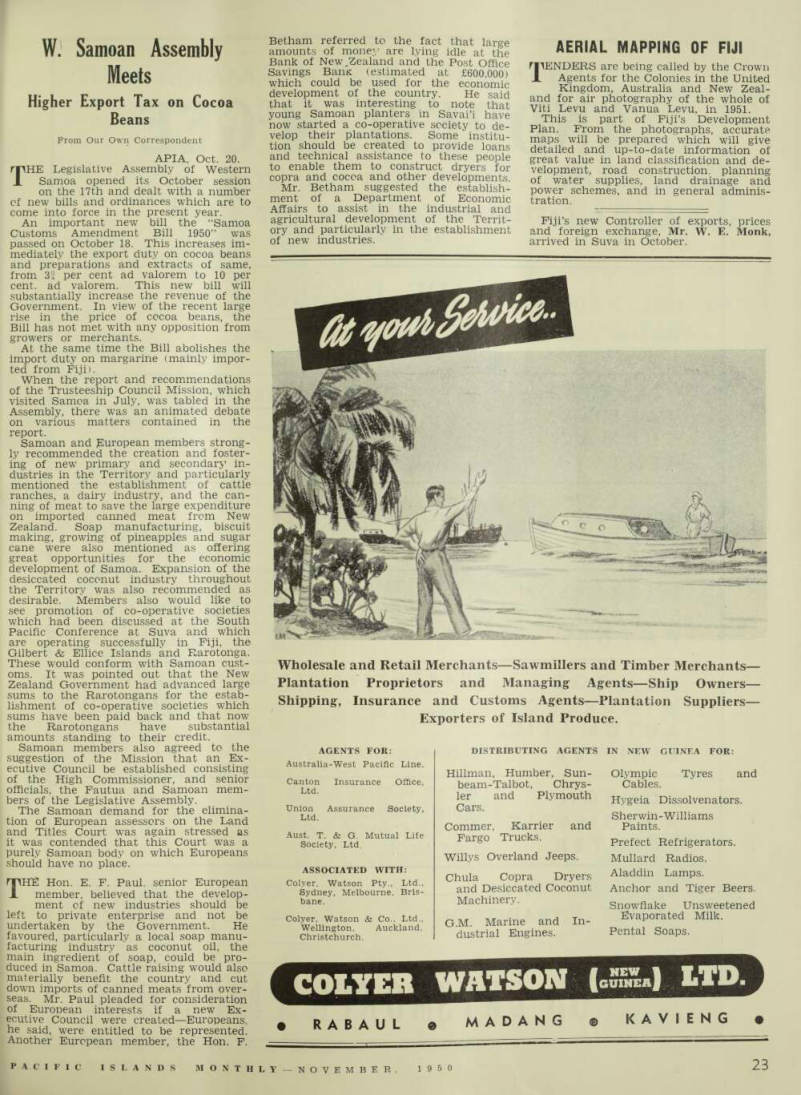
Meets Higher Export Tax on Cocoa Beans
From Our Own Correspondent
Apia, Oct. 20.
THE Legislative Assembly of Western Samoa opened its October session on the 17th and dealt with a number of new bills and ordinances which are to come into force in the present year.
An important new bill the “Samoa Customs Amendment Bill 1950” was passed on October 18. This increases im mediately the export duty on cocoa beans and preparations and extracts of same, from 32 per cent ad valorem to 10 per cent, ad valorem. This new bill will substantially increase the revenue of the Government. In view of the recent large rise in the price of cocoa beans, the Bill has not met with any opposition from growers or merchants.
At the same time the Bill abolishes the import duty on margarine (mainly impor ted from Fiji).
When the report and recommendations of the Trusteeship Council Mission, which visited Samoa in July, was tabled in the Assembly, there was an animated debate on various matters contained in the report.
Samoan and European members strong ly recommended the creation and foster ing of new primary and secondary in dustries in the Territory and particularly mentioned the establishment of cattle ranches, a dairy industry, and the can ning of meat to save the large expenditure on imported canned meat from New Zealand. Soap manufacturing, biscuit making, growing of pineapples and sugar cane were also mentioned as offering great opportunities for the economic development of Samoa. Expansion of the desiccated coconut industry throughout the Territory was also recommended as desirable. Members also would like to see promotion of co-operative societies which had been discussed at the South Pacific Conference at Suva and which are operating successfully in Fiji, the Gilbert & Ellice Islands and Rarotonga.
These would conform with Samoan cust oms. It was pointed out that the New Zealand Government had advanced large sums to the Rarotongans for the estab lishment of co-operative societies which sums have been paid back and that now the Rarotongans have substantial amounts standing to their credit.
Samoan members also agreed to the suggestion of the Mission that an Ex ecutive Council be established consisting of the High Commissioner, and senior officials, the Fautua and Samoan mem bers of the Legislative Assembly.
The Samoan demand for the elimina tion of European assessors on the Land and Titles Court was again stressed as it was contended that this Court was a purely Samoan body on which Europeans should have no place.
THE Hon. E. F. Paul, senior European member, believed that the develop ment of new industries should be left to private enterprise and not be undertaken by the Government. He favoured, particularly a local soap manu facturing industry as coconut oil, the main ingredient of soap, could be pro duced in Samoa. Cattle raising would also materially benefit the country and cut down imports of canned meats from over seas. Mr. Paul pleaded for consideration of European interests if a new Ex ecutive Council were created —Europeans, he said, were entitled to be represented.
Another European member, the Hon, F.
Betham referred to the fact that large amounts of money are lying idle at the Bank of New .Zealand and the Post Office Savings Bamc (estimated at £600.000) which could be used for the economic development of the country. He said that it was interesting to note that young Samoan planters in Savai’i have now started a co-operative society to de velop their plantations. Some institu tion should be created to provide loans and technical assistance to these people to enable them to construct dryers for copra and cocoa and other developments.
Mr. Betham suggested the establish ment of a Department of Economic Affairs to assist in the industrial and agricultural development of the Territ ory and particularly in the establishment of new industries.
Aerial Mapping Of Fiji
mENDERS are being called by the Crown A Agents for the Colonies in the United Kingdom, Australia and New Zeal and for air photography of the whole of Viti Levu and Vanua Levu, in 1951, This is part of Fiji’s Development Plan. From the photographs, accurate maps will be prepared which will give detailed and up-to-date information of great value in land classification and de velopment, road construction, planning of water supplies, land drainage and power schemes, and in general adminis tration.
Fiji’s new Controller of exports, prices and foreign exchange, Mr. W. E. Monk, arrived in Suva in October.
Advertisements & other items, pp. 25-26 (1 item)
r COLYER WATSON (guinea) LTD.
Wholesale and Retail Merchants —Sawmillers and Timber Merchants-
Plantation Proprietors and Managing Agents—Ship Owners
Shipping, Insurance and Customs Agents—Plantation Suppliers-
Exporters of Island Produce.
AGENTS FOR:
Australia-West Pacific Line.
Canton Insurance Office, Ltd.
Union Assurance Society, Ltd.
Aust. T. & G. Mutual Life Society, Ltd.
ASSOCIATED WITH:
Colyer, Watson Pty., Ltd., Sydney, Melbourne, Brisbane.
Colyer, Watson & Co.. Ltd., Wellington. Auckland, Christchurch.
DISTRIBUTING AGENTS
Hillman, Humber, Sunbeam-Talbot, Chrysler and Plymouth Cars.
Commer, Karrier and Fargo Trucks.
Willys Overland Jeeps.
Chula Copra Dryers and Desiccated Coconut Machinery.
G.M. Marine and Industrial Engines.
IN NEW GUINEA FOR:
Olympic Tyres and Cables.
Hygeia Dissolvenators.
Sherwin-Williams Paints.
Prefect Refrigerators.
Mullard Radios.
Aladdin Lamps.
Anchor and Tiger Beers.
Snowflake Unsweetened Evaporated Milk.
Pental Soaps.
r COLYER WATSON (guinea) LTD.
• RABAUL @ MADANG © KAVIENG •
Est. 1887. ESTABLISHED OVER 60 YEARS. Est. 1887.
ANDREW M°GEE
SYDNEY'S FOREMOST TOBACCONIST.
1 CASTLEREAGH AND 70 PITT STREET,
SYDNEY.
BLADE RAZORS
BENGALI. and 17/6 BLUE WONDER J 27/6 LONGLIFE and 30/- ATOYA 22/6 L. & CO. PIPES from £3/6/3 to £4/0/6
COMOY "TRADITION" £2/4/3
BARLING PIPES £2/2/6
NIMROD DRYSMOKER PIPES £l/7/6
To Pitcairn in
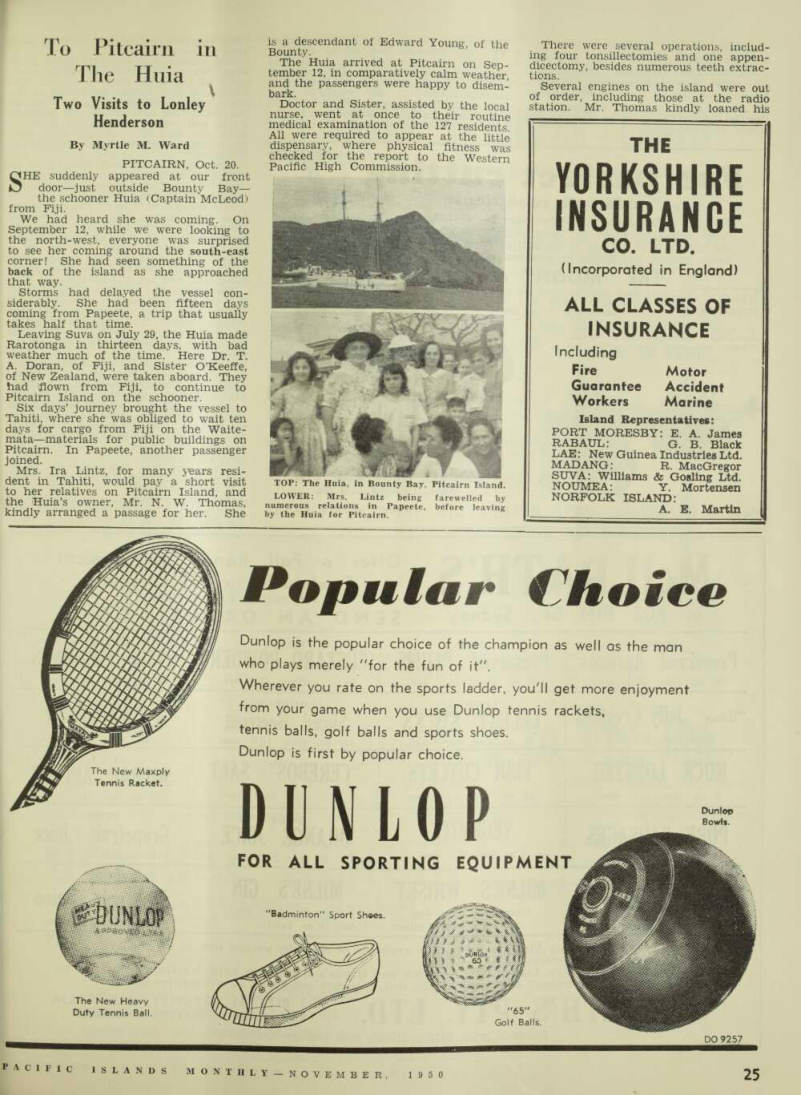
The Huia Two Visits to Lonley Henderson
By Myrtle M. Ward
Pitcairn, Oct. 20.
SHE suddenly appeared at our front door —just outside Bounty Bay— the schooner Huia (Captain McLeod) from Fiji.
We had heard she was coming. On September 12, while we were looking to the north-west, everyone was surprised to see her coming around the south-east corner! She had seen something of the back of the island as she approached that way.
Storms had delayed the vessel con siderably. She had been fifteen days coming from Papeete, a trip that usually takes half that time.
Leaving Suva on July 29. the Huia made Rarotonga in thirteen days, with bad weather much of the time. Here Dr. T.
A. Doran, of Fiji, and Sister O’Keeffe, of New Zealand, were taken aboard. They had tflown from Fiji, to continue to Pitcairn Island on the schooner.
Six days’ journey brought the vessel to Tahiti, where she was obliged to wait ten days for cargo from Fiji on the Waite mata —materials for public buildings on Pitcairn. In Papeete, another passenger joined.
Mrs. Ira Lintz, for many jr'ears resi dent in Tahiti, would pay a short visit to her relatives on Pitcairn Island, and the Huia’s owner, Mr. N. W. Thomas, kindly arranged a passage for her. She
is a descendant of Edward Young, of the Bounty.
The Huia arrived at Pitcairn on Sep tember 12, in comparatively calm weather and the passengers were happy to disem bark.
Doctor and Sister, assisted by the local nurse, went at once to their routine medical examination of the 127 residents All were required to appear at the little dispensary, where physical fitness was checked for the report to the Western Pacific High Commission.
There were several operations, includ ing four tonsillectomies and one appen dicectomy, besides numerous teeth extrac tions.
Several engines on the island were out of prder, including those at the radio station. Mr. Thomas kindly loaned his
LOWER: Mrs. Lintz being farewelled by numerous relations in Papeete, before leaving by the Huia for Pitcairn.
chief engineer and Mr. Ron Round will ingly worked hard and long over the many difficulties he found. Imagine our joy when it was announced, “Pitcairn Island is on the air again!” The engin eer also set in operation the engines which run the electric lights for the Government school and residence.
WHILE the medical fraternity was busy, Mr. Thomas took across to Hen derson Island all the people who chose to make the trip. Everyone was welcome to go—so long as they could content themselves with whatever place they could find to sleep. Fifty-five per sons went, leaving (besides women and children) only eleven men on Pitcairn!
From Henderson they were to bring miro wood and coconuts.
Men, women and children had a great time. They slept on deck —being shel tered in the hold when it rained. On Henderson they spread the fronds of the coconut palm and slept on them. Children paddled on the long beach, and gathered shells, and women climbed for coconuts, while the men chopped the miro wood and ferried it in the small boat to the schooner.
They were to be back some time on Saturday, so when we sighted the ship returning on Friday there was a feeling abroad—“Something’s wrong!”
Sure enough, as they approached in the dusk, they morsed with electric torches, telling how Joycie had taken bad with appendicitis while they were on Hender son the previous night. Within three hours, so splendid was the co-operation and good will, they had packed up in the moonlight and set sail at 2 a.m.
The doctor was at the landing to meet the patient and soon she was carried up to the little dispensary near the church, where an immediate operation was performed. It was 11 p.m. when the doctor left his patient in the care of the sister.
As the doctor had another week’s work, it was arranged that the Huia should repeat the trip to Henderson. On Mon day afternoon the little ship headed north-east again, expecting to return on Friday. When we sighted her Thursday we thought, “What's wrong this time?”
The small boat had been damaged on the reef, so that work on the island had been discontinued.
It was well they had returned, for we had received news that the Athenic would call early next day. .
How happy were the doctor and the sister when a message was received that the ship was able to take them! What
if they did have to leave at midnight to embark on the Athenic at 3 a.m.!
They would have a safe and comfortable trip to New Zealand, on their way home to Fiji.
The little Huia, now freed of respon sibility for the doctor, made preparations to leave immediately. It was a big job to get water and fresh food out to the ship but at last it was accomplished.
Many friends and relatives accompanied Mr. Theodore Young to the ship, where he bade farewell to his sister, Mrs. Lintz.
A public meeting expressed to Mr. Thomas and his company our thanks for many favours, especially the trip to Henderson.
As the little Huia lay at anchor out side Bounty Bay, it was interesting to make comparison with the famous old Bounty. While the Bounty had a length of 90 feet, the Huia was 115. Bounty’s beam was 20 feet, Huia’s 25. The Bounty carried a crew of 45, while Huia managed with 10 (sometimes 9).
Mr. Thomas said there was a possibility that the Huia would be sold on the return trip. If not, they had some further trips planned: a cargo of 1,300 drums from Auckland to Suva, cement to Raro tonga, copra to Auckland. The Huia might enter the Australian timber run, carrying hardwood to New Zealand and softwood back to Australia.
When they got back to Suva they would have travelled 6,500 miles. Auckland to Auckland would total 11,000. We wish that the little craft might continue for many more thousands.
Advertisements & other items, pp. 27-28 (1 item)
Dunlop
THE
YORKSHIRE
INSURANCE
CO. LTD.
(Incorporated in England)
ALL CLASSES OF
INSURANCE
Including
Fire Motor Guarantee Accident Workers Marine Island Representatives:
PORT MORESBY: E. A. James
RABAUL: G. B. Black LAE: New Guinea Industries Ltd.
MADANG: R. MacGregor SUVA: Williams & Gosling Ltd.
NOUMEA: Y. Mortensen
NORFOLK ISLAND:
A. E. Martin
The New Maxply Tennis Racket. m . - The New Heavy Duty Tennis Ball.
Popular Choice
Dunlop is the popular choice of the champion as well os the man who plays merely "for the fun of it".
Wherever you rate on the sports ladder, you'll get more enjoyment from your game when you use Dunlop tennis rackets, tennis balls, golf balls and sports shoes.
Dunlop is first by popular choice.
DUNLOP
FOR ALL SPORTING EQUIPMENT
'Badminton" Sport Shoes.
Dunlop Bowl*.
Golf Balls DO 9257
For perfect cutting
under all conditions
There is a Ransomes Mower for every lawn our range covers machines for every requirement from the smooth, even surface of the putting green to the sports ground, golf course or aerodrome.
The "MOON" Mower
GANG
MOWERS
For grass such as couch, klkuyu, buffalo, etc., and grass longer than the average. 14-ln. and 18-ln. wide. 50 acres a day can easily be cut with Ransomes’ Quintuple Mower drawn by tractor and even larger outfits up to ft. wide are available.
ansomes
Lawn Mowers
Write for illustrated literature and all Information
MORRIS, HEDSTROM LTD.,
Suva, Laotoka, and Ba.
Made by RANSOMES, SIMS & JEFFERIES LTD., IPSWICH, ENGLAND.
McILRATH’S
of 202 Pitt St., Sydney Otter a Full Range of Tropical Foodstuffs to All Clients
ALL PRICES F. 0.8. SYDNEY.
SEND AN ORDER TODAY
McILRATH’S PTY. LTD.
Detailed price lists available application
202 PITT ST., SYDNEY, AUSTRALIA
Cable Address; “ROTUNDA,” SYDNEY
SPC Health Team Visits
W. Samoa
Prom Our Own Correspondent
Apia, Nov. 4.
THE Tuberculosis Research Team of the South Pacific Commission (health Research Project H 3) is at present visit ing Western Samoa.
The team has already completed its work in Papua and New Guinea where 6,000 natives were examined, and in New Caledonia where 7,000 natives were ex amined. A short visit was also paid to Fiji before coming to Western Samoa.
After completion of research in this Territory, the team will go on to Tahiti.
To date, 700 Samoans have been ex amined..
The T. B. Research Team consists of the leader. Dr. L. P. J. Guillermin, of Paris,, a well-known authority and a member of the French Colonial Medical Service with wide experience in French Equatorial Africa and elsewhere; an Aus tralian bacteriologist, Miss B. G. Balferu; and a well-known X-Ray Specialist, Mr.
W. Hapi Love, of Wellington, NZ.
The objects of the investigation are:— (a) to compare the different antigens and methods used in Tuberculin tests in various racial and age groups; (b) to
study and compare various bacteriological techniques for use in the field; (c) to compare the radiological appearances in different races at different ages within the
World Health Organisation and, (and) to examine the possibility of producing sim pie technioues in radio2ranhv Snder fie?d conditlons 8 P y
Advertisements & other items, pp. 29-30 (1 item)
Gabriel Achun
KAVEN KEROSENE LAMPS
The most suitable lamps for the South Pacific Kayen Lamps are designed for good hard use in all climatic conditions.
They provide a full 300 candlepower of unflickering steady light, even in severe draughts. The mantle is a simple double-tie type which provides a long life. All vibration is taken away from the mantle and burner top and nothing is held rigid which might tend to break the mantle. All Kayen lamps are fully insect proof. Glassware is strong Pyrex glass and the oil container, pump and burner body are made of solid brass and will not corrode. The vaporiser is fitted with an internal automatic cleaning needle with a stainless steel jet. The brass pump is selfcontained and may be completely removed with the fingers only. Kayen Lamps run efficiently, light easily and are easy to manage and adjust. •a* H Kayen Model AP2 All Purpose Lamp is the most useful lamp ever produced. With reflector as illustrated, it is a shadowless hanging lamp suitable for use inside or out. Without reflector, which slips off, it is an efficient storm lantern not affected by wind or rain.
With an extra parchment shade, not illustrated, it is a bright, attractive lamp for the home and may be placed on a table or shelf anywhere. Fitted with 12 in. reflector overall height 19 in.
Kayen All-Purpose Lamp.
Kayen Tall Table Lamp, standing 24 in. high, it throws a full 300 candlepower. steady light over the largest room. It is a firstclass lighting unit and a beautiful ornament. For reading, studying or fine work this lamp is indispensable and, although more brilliant than any other class of kerosene lamp, the light is soft and does not offend the eyes. Can be supplied with Pyrex opal anti-glare shade as illustrated, or with a handsome 16 in. parchment shade. May be carried from room to room wherever required. <*m Kayen Table Lamp.
We have large stocks of other types of kerosene lamps, including the Fames Wick and Mantle Table Lamp, Veritas Kerosene Pressure Lantern. Blue Boy and Blue Ace Kerosene Stoves, Companion Primus Stoves, Thermil Wick Stoves, etc. Write for catalogue.
Available from stores in all centres or from
W. KOPSEN S CO. PTY. LTD.
376/382 Kent St. ( Sydney. Cables: "Kopsen," Sydney.
GABRIEL ACHUN
Importer and Wholesale Merchant
Malaguna Road
RABAUL
Territory of New Guinea Specialises in:
BEERS
BICYCLES
AERATED WATER MANUFACTURING
COTTON PIECEGOODS FOR NATIVE TRADE
AGENT FOR “STANDARD” AND “TRIUMPH” CARS
Proprietor:
RABAUL CORDIAL FACTORY.
Telegraphic Address:
“GABRIEL ACHUN,” RABAUL.
MB
SHIPS
AND
SMALLCRAFT
As one of the oldest, largest and most active shipbroking firms in Australasia, we are in a position to offer a wide range of vessels suitable for economic Island operation. Some of these craft are solely in our hands for sale.
At this time of publication, and subject to prior sale, we have the following vessels to offer:— • New diesel engined 300 tonner. • Modern diesel engined 300 tonner. • Modern steel 200 tonner, twin diesels. • Powerful diesel tug. • Twin screw motorship, 450 tons d/w. • Number of 50/60/80/100/150 tons capacity motor - vessels, some with auxiliary sails.
Si V
TRAILER
FIRE
ENGINES
These units are widely used throughout Australia for rural fire protection by Fire Brigades, Municipal Authorities, Harbour Boards, etc. They are ideal for the protection of Island townships, store depots, properties, etc. Available in 225 GPM and 500 GPM capa cities.
“BLUE STREAK” POWER CHAIN SAWS
MS V I As sole Factory Representatives for the truly sensational Australian-made BLUB STREAK range of one-man and two-man power chain saws, we are now finalising distribution arrangements for South Seas. , such arrangements will not be regarded by us as complete, until full stocks of machines and par by all Distributors. Until then, we are open to accept direct orders and full details of these amazing time and money-saving units, will be gladly supplied on request.
A. J. ELLERKER
63 PITT STREET, SYDNEY, N.S.W.
'Phones: BU 1574, BU 5055.
Cable Address: "Hipex, Sydney.
The Cecil

The Battle Of
The Lae Planners and the New Hotel
From R. W. Robson
LAE, October 15.
LAE is in the grip of the Town Planners, and a minor war is proceeding.
Officialdom insists that all builders must build “on top” (on the green ter race behind the air-strip); but, for some reason, the trading community yearns for the flat area beside the air-strip, between the terrace and the sea, site of the original Lae, wiped out by war.
There has been rebellion against The
Plan. Ail real Territorians hate Planners, anyway. Leader of the rebels is the in domitable Mrs. Flo Stewart; and, to date, she has had the victory.
In 1946, she took over a collection of Army-made bush shacks, three miles out in the jungle, and opened up the Hotel Cecil (named after the hotel which was obliterated by bombs). She achieved miracles in providing a resting-place for transients; but, from the moment of her return, she aimed to rebuild the Cecil on the Cecil’s old site. Officialdom said “No —the Plan provides for a hotel there, on the terrace.”
The lady insisted on her right to build on her own land, site of the original hotel.
Officialdom said; “You can’t build without a title. Everything was obliterated by bombs. The area must be re-surveyed.
But all is ready for you to build on top.”
The stubborn woman would not build on top. The stubborn bureaucracy would not produce a title.
But the gods favoured the woman. The concrete floor of the old Cecil was still there, among the bomb-craters. A couple of iron posts, which were buried in con crete and marked the old tennis-court, were a help. Using these marks, Mrs.
Stewart got her approximate boundaries— and after a four-years’ fight, commenced building.
The new hotel is now in shape—frame, floors, walls and roof —and the tireless owner still hopes to occupy it by Christ mas. But she is meeting all the usual frustrations and laziness, and it looks as if the bush pub will have to function for some months yet.
When the Cecil is finished, it will com
pare with anything in Papua and New Guinea —which includes the excellent Papua Hotel in Moresby, and Mr. Brown’s fine new Ascot Hotel in Rabaul. With cool lounges, wide corridors, bedroom amenities and a tropical garden on the flat roof, overlooking the sea, and with gardens, lawns and a swimming-pool Mrs. Stewart has planned a hotel that should put Lae clearly upon the tourist’s schedule.
But it is “down on the beach.” and officialdom still looks sourly upon the en terprise. Buntings, of Samarai, have also built on the beach —a fine new store on land they acquired from Henry Eekhoff— and one hears of one or two others who reckon they can defy the Town Plan.
Generally, however, the Lae community —now big and growing—is conforming to The Plan; and the indications are that it will be a lovely little town, cleverly ar ranged, sheltering from the tropical sun amid trees and green lawns, and fanned by the Huon Gulf breezes. It is less than half built, but despite temporary ugli nesses created by the builders, it already has distinction and charm. The construc tion of the Number One hotel down on the beach will merely give variety to its charm.
Mr. and Mrs. P. Chandler and infant son, of Madang, New Guinea, were in Aus tralia on leave in October.
The Minister for Overseas France, M.
Francois Mitterand, who is the youngest member of the French Cabinet, is to visit the Pacific to study the French Colonies on the spot. A man with a briliant record, his visit is arousing great interest in Noumea and Port Vila. (He was expected on November 7.)
Mrs. Flo Stewart and her daughter, Miss Ela Gofton, photographed in front of their fine, new hotel, now nearing completion on the sea-front at Lae, New Guinea. Photo of hotel on page 11.
Advertisements & other items, pp. 31-32 (1 item)
Mosqjmtoes
Weary, Dreary
People
Put Some GO Into Your Life
Too many men, women and girls suffer aching backs, headaches, and feel dreadfully tiredtired, always tired. The cause? Very often, anaemia or bloodlessness.
You see the symptoms in dull eyes, pallid cheeks and lips, breathlessness, vague aches, exhaustion after the slightest exertion. Young children, especially girls, suffer frequently.
If you haven’t blood normal in red corpuscles you are not receiving sufficient energy-giving oxygen which is dispersed by the blood throughout your body every second of the day and night. Your nerves, organs and tissues are not properly nourished and you remain weary and dreary.
Get the GO which rich red blood can give you. Take the famous Dr. Williams’ Pink Pills for a few weeks. Dr. Williams’ Pink Pills are specially compounded to provide you with a normal rich blood supply. Always at your chemist or store.
F LIT MEANS DEATH
MOSQjMTOES
Kills r "*» Moth* j&U, Hotqujioe* y T / A\ s 'lv»rfi»h //\ Bui* / / N Ant* ,*«— -2:— A" V'»r ”•» m " 1 FLIT is again available everywhere to help you wage war against insect pests.
FLIT contains D.D.T., in addition to Pyrethrum and Thanite, making it the most effective insecticide available.
VACUUM OIL COMPANY PTY. LTD.
thFmost effective insecticide you can buy
'THAT
th e
Spare Yourself
Unnecessary Worry
Executorship need not eat into your time with its incessant demands on your judgment, experience and patience. If you are administering an estate —or if you intend to do so— you can free your hands by transferring full responsibility to Burns Philp Trust Company Limited.
This commonsense arrangement does more than relieve you of unsought worries; it guarantees that the estate will be efficiently managed at all times. Your own beneficiaries will gain substantially by a similar move. Full details of the Company's helpful services are given in "Hands That Never Leave The Wheel." A complimentary copy of this extremely useful booklet can be obtained from any branch of Burns Philp (South Seas) Company, Burns Philp (New Guinea) Limited, or direct from the head office of this Company.
DIRECTORS;
James Burns P. T. W. Black Joseph Mitchell Eric Priestley Lee MANAGER: L. S. Parker.
SECRETARY: E. R. Overton, F.F.I.A.
Burns Philp Trust
COMPANY LIMITED
Executor * Trustee • Attorney
7 BRIDGE STREET, SYDNEY
Telephone: 8U5901 Box 543, G.P.0., Sydney.
Agencies at Album, Bathurst , Goulburn, Orange and Wagga.
Problem
Fiji Slums and the TB Problem More Action and Less “Planning” Wanted
Prom Our Own Correspondent
Suva, Nov. 6
MORE than a year ago the people of Fiji subscribed £62,000 to the War Memorial Anti-TB Appeal, and a Government subsidy brought the total to £82,000.
Although the original idea was to make an appeal every year for ten years, the overwhelming response to the 1949 appeal made a new appeal this year unnecessary.
From time to time the War Memorial Fund trustees make a statement of how money is being expended on the extension of hospital facilities and similar work.
Yet the main objective, as far as the public is concerned, does not seem to have been tackled yet.
In the eyes of most Europeans, the most ghastly feature of the TB situation was that, with the disease making appalling headway amongst the Fijians, the hos pitals found that they had no alternative but to send incurable cases back to the villages to die, after spreading the infec tion. It was determination to end this state of affairs that produced £62,000 in voluntary subscriptions in less than three months. Yet, a year later, it is still going on.
The Suva slums are amongst the worst, "robablv the worst, areas of TB infection.
But although new buildings are going up in all directions, there is no slum clearance or even slum amelioration named out anywhere. Slum landlords, it is said, will not rebuild because of rent restrictions.
The Government is aware of the situa tion; the Town Council regularly deplores it but is powerless to enforce demolition orders which would only increase the overcrowding; the missions are presumably aware of it: and private individuals who are not entirely blind must be aware of: it also.
Yet nothing is done bevond a vague andJ futile reference to a rehousing scheme ini the Development Plan.
If the Government borrowed some of the unused land in the Suva area and, in the name of a national emergency, built temporary houses, on modified Fijian traditional lines, the usual excuse of the lack of expensive imnorted materials would no longer hold good. And temporary rehousing for. sav. five years; would spike the guns of the more ruthless slum-profiteers.
Those who know something of the Suva slums and the effect thev have or the people crammed into them, know that something like emergency measures are desperately needed. Decent living con ditions are more urgently needed than are new shops, new cinemas or even new churches and schools. But nothing it done.
Wharf At Lodoni
From a Special Correspondent IT is hoped that, at an early date passengers by launch from Suva t: Levuka will be able to land at Mata vatacou. Arrangements are being madl for them to use the wharf near thi school. This will save a wade in thi sand at low tide, as has been the custon for travellers between Lodoni arii Levuka.
Samoan Woman Dies At 102
From Our Own Correspondent THOUGH the Samoan people are a strong and virile race, they are not renowned for longevity. Therefore, the case of a Samoan woman, Fau Patu, of the Apia village of Vaiala, who recently died at the reputed age of 102, attracted considerable interest in the Territory.
Fau Patu was a daughter of Patu Lauta, one of the High Chiefs of Vaiala, Vai mauga in Tuamasaga South District. She lived during the time of the last Samoan King, Malietoa Laupepa, and remembered clearly the hurricane in 1889 which wrecked the Adler on the reef off Apia.
At that time her only son, the present Patu Va’afuti, Messenger Police Corporal attached to the Samoan Affairs Depart ment, was already born. This son is now 67 years old. Pau married very late in life. In 1928 Fau Patu celebrated her eightieth birthday and was therefore at the time of her death, a few weeks ago, 102 years old. She was born in or about the year 1848.
Very few centenarians have been known in Samoa, and all such claims must be regarded with some suspicion, as they cannot be authenticated, no official re cords having been kept until the latter part of the 19th century. There have been no centenarians amongst the Euro pean population, though some nona genarians have been recorded in the past.
Professor A. Guillaumin, one of France’s leading botanists from the Paris Museum of Natural History, is visiting New Caledonia to study the local flora. He has, in 40 years, formed in Paris the world’s finest collection of New Cale donian plants. He is author of the book “Flore Analytique et Synoptique de la Nouvelle Caledonie” published in Paris a couple of years ago.
TT °„Jt Cession 76
Cession Day Celebrations
From a special Correspondent cip-nino- of thP nf
Jr., years ago was celebrated at Levuka, Fiji, on Oct. 9, by a large s Po. rts Gather mg in which the Levuka.public the Con anc* the Manst Brothers, the Lomai- Provincial, the Motunki and the
Buresalu Schools took part.
Mr. G • H - Thomson organised the meet ing and he was ably assisted by the staff of the Levuka public schools. Mr. Picker mg and the Heads of the other schools, Mr. H. B. Gibson, the newly-elected Member for the Eastern Division formally opened the meeting and apologised for the absence of the District Officer and the Chairman of the Levuka Township Board.
Advertisements & other items, pp. 33-38 (2 items)
RESis#
Stewarts and Lloyds (Australia) Pty. Ltd.
Manufacturers of "S & L" PIPES and FITTINGS for GAS, WATER, STEAM and other purposes.
AND Distributors of:
MILD STEEL BARS, PLATES and SECTIONS;
GALVANISED IRON; BOLTS and NUTS; ELECTRODES
and WELDING EQUIPMENT.
Stewarts and Lloyds (Australia) pt y . Ltd.
SYDNEY WAREHOUSE - - -• Herbert Street, St. Leonards BRISBANE WAREHOUSE - Montague Road, South Brisbane MELBOURNE WAREHOUSE - - City Road. South Melbourne Telegraph! c Address: 'Tubes ' — Sydney, Br'nbane or Melbourne
RESis#
the FIERCE ONSLAUGHTS
of
Prepared
h w
WIND
RAIN
& HEAT!
ENAMELS, LACQUERS S VARNISHES
(T % P/} Sp The fierce foe of wind, rain and heat combined menaces your property!
At the first sign of attack—prepare to resist with Spartan! Spartan will see you right through any painting job! M^ e ° spartal l Prepared Paints are specially mixed and scientifically prepared for the tropics, that’s why so many people paint with SPARTAN— proved equal to every occasion!
Ask your Store for SPARTAN House Paints, Roof Paints, Enamels, Lacquers or Varnishes. Inspect the wide range of colours on the Spartan Paint chart—your dealer will gladly show it to you on request. If your store cannot supply, contact direct.
SPARTAN PAINTS PTY. LIMITED, 102-104 King St., Melb., Vic., Aust.
World-Wid
e v.
Reception
TROPICAL
MOND
RECEIVERS
I 0^:
CRAMMOND TROPIC EAGLE
Most famous tropic-proofed and completely sealed receiver in the world to-day. The designers’ claim that range is unlimited and reception perfect anywhere throughout the world has been fully justified by the reports received from hundreds of enthusiastic owners. Three Years’ Guarantee and easy terms are available wherever you live.
CRAMMOND
TROPIC HAWK
This is a 2-unit receiver especially designed for Patrol Officers and others who require absolute portability and dependability. Combined weight of both cabinets —32 lb.
Measurements of each cabinet —15 x 9 x 9. This set covers from 16- 150 metres shortwaves only. Three Years’ Guarantee and easy terms wherever you live.
Features exclusive to both sets: Completely Tropic Proofed, Built-in Moisture Absorber, and available in Vibrator or All Dry Cell.
Write for particulars to-day!
CRAMMOND RADIO
TROPIC/U DIVISION
No g QUEEN STREET ,
LONDQN-SUVA
E ' - r
«\Y y Cs,
> PANAMA V
For Sailings and Further Particulars Apply To: BETHELL, GWYN & CO., BURNS PHILP (SOUTH SEA) 138 LEADENHALL ST., co - LTD >
LONDON, E.C.3. SUVA.
aMPLIOh
ONE HORSEPOWER
PETROL ENGINES
■K
ELECTRIC
LIGHTING PLANTS
Bring you brilliant electric light in your home, week-ender or plantation.
Low operating and initial costs. Treated for the tropics. * Press button starting. * 300 watts output. 4 M 12 and 32 volt models. * Weight 70 lb. \ hole borers— The Amplion makes the most of your petrol, runs longer on a tankful, 8 to 10 hours to the gallon. It’s light in weight too —40 lb.
Obviously the best proposition for driving: Pumps—Compressors—Post Lawn mowers—Saws —Shearing Machines — Crutching Machines —Spraying outfits —Concrete Mixers —Concrete Vibrators —Milking Machines.
★ 4 CYCLE AIR COOLED DESIGN
★ FULL FLOAT CARBURETTOR
★ EFFICIENT AIR CLEANER
PRICE :
£36/0/6 F. 0.8.
swc “,Sf £67/13/6
F. 0.8.
DISTRIBUTORS THROUGHOUT
AUSTRALIA AND THE ISLANDS
aUPLIOk
(Australasia) Pty. Ltd. 36-40 Parramatta Road, Camperdown.
Telegrams: Amplion, Sydney Telephone: LA2828 (6 lines)
KERR BROS. S
G.P.O. Box 3838, Sydney.
ISLAND MERCHANTS SINCE 1895
50 years old . hut as young as ever and eager to serve you.
Cocoa Beans, Copra, Coffee and all Island Produce Sold on Commission.
All merchandise purchased at best wholesale prices and original invoices supplied.
Use Our Co-operative Specialised Overseas Buying Service.
the FERGUSON TRACTOR
a system
WEIGHT TRANSFERENCE
I included in the wide range of implements available is the all-purpose hydraulic trailer. Capable of carrying 3 tons, hydraulic operation raises and lowers the tray in a matter of seconds.
Distributors for Papua and New Guinea:
BURNS PHILP (NEW GUINEA) LIMITED
Send your enquiries to the nearest branch at — ORT MORESBY • SAMARAI • MADANG • LAE • RABAUL The Ferguson System is one that employs natural laws instead of using heavy in-built weight to give traction and penetration. This ensures that the tractor automatically adjusts its weight to the job—and the implement maintains an even depth by automatic hydraulic control on all types of ground.
For maximum efficiency with utmost economy the Ferguson System has the complete answer.
OUR HANDS MAKE GOOD ARMS
For your Fishing and Shooting Wants Consult Us.
Lithgow .22 Cal. Repeating Rifles .. £l3 3 0 1 Post Lithgow .22 Cal. Single Shot ... £6 12 6 \ Extra.
SI L RO H U 143 ELIZABETH STREET, SYDNEY.
THE FERGUSON TRACTOR
Is the most popular tractor of its kind in the world to-day because its revolutionary AUTOMATIC Hydraulic control makes it possible to do any type of farm cultivation and to work better, faster and more economically.
The Ferguson System was introduced to Fiji only six months ago and already it is breaking all previous tractor sales records as it is doing all over the world.
This patented system has given to the farmer complete mechanisation with simplicity hitherto unheard of. It has made other methods of farming obsolete.
Its hydraulic control is not just a means of raising and lowering implements from and to work but, MOST IMPORTANT OF ALL.
AUTOMATICALLY CONTROLS THE IMPLEMENTS WHEN THEY
ARE WORKING AND AT THE SAME TIME TRANSFERS IMPLEMENT WORKING PRESSURES TO TRACTION. This is a combination that was only a dream to farmers until Harry Ferguson conceived and introduced it only a few years ago. IT IS A FERGUSON PATENT AND INCORPORATED ONLY IN THE FERGUSON TRACTOR.
Farming can now be interesting and a joy to everybody. A combination of implements can be purchased to do any type of farming everywhere, whether it be cane, rice, peanuts, potatoes, maize or anything else.
Apart from cultivation implements, other attachments such as the 9 and 12 inch Post Hole Digger, 3-Ton Hydraulic Tipping Trailer, 30-Cwt. Utility Trailer, Earth Scoop, Grader and Terracer, Transport Box, Wood Saw, Hammer Mill, Manure Spreader and Loader, Mower, etc,, can be obtained.
Our Lautoka Branch, in Fiji, has comprehensive stocks on hand, and will assist in making equipment and information available to places not yet carrying stocks.
BURNS PHILP (S.S.) CO., LTD.
Sole Agents for Pacific Islands.
UNION MANUFACTURING & EXPORT CO. LTD.
"sectte/ry greet
rf.'jK
rjLK
o c* Priced at 10/- PER SQUARE FOOT FLOOR AREA, these buildings can be adapted to suit a multitude of purposes. Constructed of 3/32 in. gauge steel plate, they will withstand indefinitely the hardest conditions of use.
Conveniently made in two basic sizes—6o ft, x 20 ft. x 10 ft. high and 40 ft. x 20 ft. x 10 ft. high. Extra corrugated steel side plates can be supplied to raise the height to 17 ft. if required. LARGER SIZED BUILD-
INGS CAN BE SUPPLIED BY ARRANGEMENT.
AfXSrRfP
J m •• Ideal for use as bridge decking, reinforcing material fences, reading, etc., “Airstrip” Steel Matting can be supplied in sheets 10 ft. long x 15 in. wide. Sheets interlock readily. This material is immensely strong.
Slotted fence posts can be supplied for those using “Airstrip” Matting for fences. Price of matting, £24 per ton, (33 sheets per ton.)
secte/ry greet
MASS PRODUCTION METHODS AND SLIGHT RE-
DUCTIONS IN SIZES ENABLE US TO OFFER A £2O REDUCTION IN PRICE ON ALL MODELS OF THE
SECURITY STEEL GARAGE.
Sizes are now 7 ft. 6 in. x 16 ft., price £B5, and 11 ft. x 20 ft,, price £155, Pre-fabricated.
Components include sides, back, front arch, 8 roof sheets and nuts and bolts. Can be erected on site in 2 days. Larger sizes can be supplied by arrangement.
AU WAUAeu pop mmPMre
All prices quoted British Sterling or equivalent, Wellington, New Zealand.
UNION MANUFACTURING & EXPORT CO. LTD
G.P.O. Box 1060. WELLINGTON, (N.Z.) Telephone 61.387.
Cables: “UMEC,” Wellington (N.Z.).
33
NOTES BY THE WAYSIDE FROM R. W. R. IN N. G. (Continued from Page 11)
PACIFIC ISLANDS MONTHLY— NOVEMBER, 1950
Moresby’s
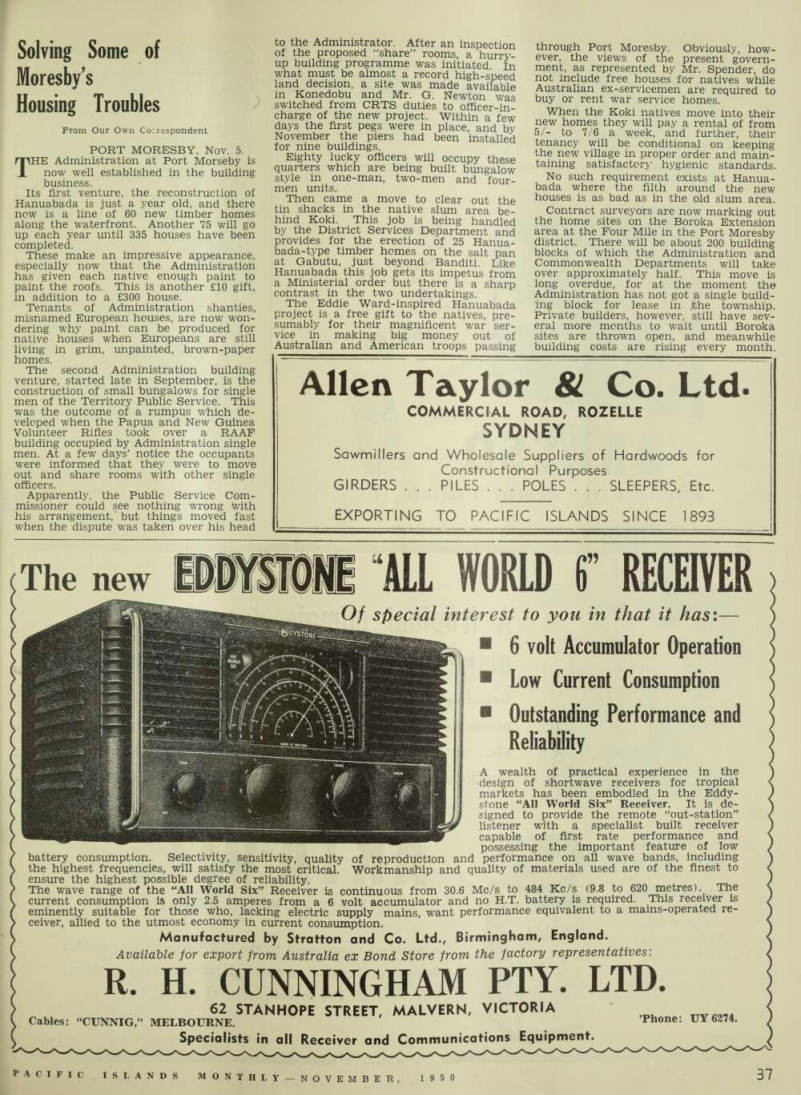

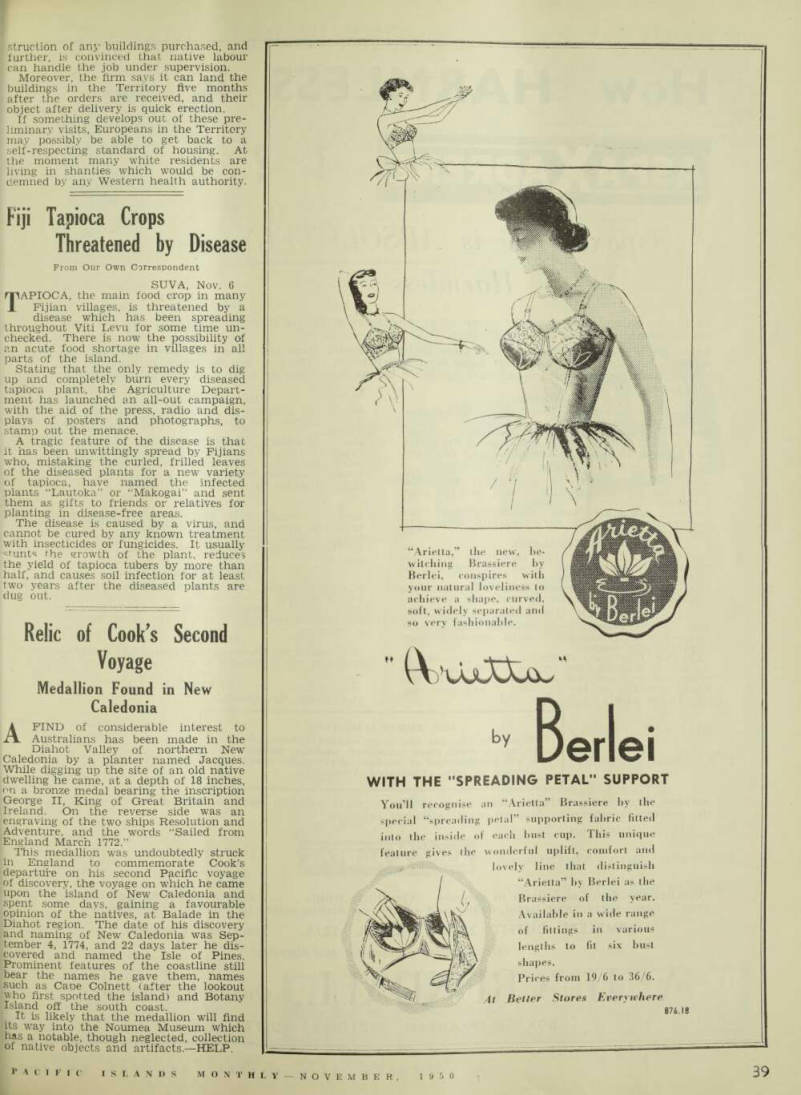
Solving Some of Moresby’s Housing Troubles
From Our Own Correspondent
Port Moresby. Nov. 5.
THE Administration at Port Morseby is now well established in the building business.
Its first venture, the reconstruction of Hanuabada is just a year old, and there now is a line of 60 new timber homes along the waterfront. Another 75 will go up each year until 335 houses have been completed.
These make an impressive appearance, especially now that the Administration has given each native enough paint to paint the roofs. This is another £lO gift, in addition to a £3OO house.
Tenants of Administration shanties, misnamed European houses, are now won dering why paint can be produced for native houses when Europeans are still living in grim, unpainted, brown-paper homes.
The second Administration building venture, started late in September, is the construction of small bungalows for single men of the Territory Public Service. This was the outcome of a rumpus which de veloped when the Papua and New Guinea Volunteer Rifles took over a RAAF building occupied by Administration single men. At a few days’ notice the occupants were informed that they were to move out and share rooms with other single officers.
Apparently, the Public Service Com missioner could see nothing wrong with his arrangement, but things moved fast when the dispute was taken over his head
to the Administrator. After an inspection of the proposed “share” rooms, a hurry up building programme was initiated In what must be almost a record high-speed land decision, a site was made available in Konedobu and Mr. G. Newton was switched from CRTS duties to officer-in charge of the new project. Within a few days the first pegs were in place, and by November the piers had been installed for nine buildings.
Eighty lucky officers will occupy these quarters which are being built bungalow style in one-man, two-men and four men units.
Then came a move to clear out the tin shacks in the native slum area be hind Koki. This job is being handled by the District Services Department and provides for the erection of 25 Hanua bada-type timber homes on the salt pan at Gabutu, just beyond Banditi. Like Hanuabada this job gets its impetus from a Ministerial order but there is a sharp contrast in the two undertakings.
The Eddie Ward-inspired Hanuabada project is a free gift to the natives, pre sumably for their magnificent war ser vice in making big money out of Australian and American troops passing
through Port Moresby. Obviously, how ever, the views of the present govern ment, as represented by Mr. Spender, do not include free houses for natives while Australian ex-servicemen are required to buy or rent war service homes.
When the Koki natives move into their new homes they will pay a rental of from 5/- to 7/6 a week, and further, their tenancy will be conditional on keeping the new village in proper order and main taining satisfactory hygienic standards.
No such requirement exists at Hanua bada where the filth around the new houses is as bad as in the old slum area.
Contract surveyors are now marking out the home sites on the Boroka Extension area at the Four Mile in the Port Moresby district. There will be about 200 building blocks of which the Administration and Commonwealth Departments will take over approximately half. This move is long overdue, for at the moment the Administration has not got a single build ing block for lease in jthe township.
Private builders, however, still have sev eral more months to wait until Boroka sites are thrown open, and meanwhile building costs are rising every month.
THE first prefabricated houses to be imported into the Territory are due from Britain early in the New Year.
These are aluminium buildings and there is much speculation as to their suitability for the tropics. This particular type has no ventilation at either end of the build ing, unless the tenants take (to the walls with a pair of tinsnips. To over come the ventilation problem the survey
ors are selecting special sites at the Boroka estate for these homes. About seventy are to be erected in Port Moresby and the balance at Lae, Madang and Finschhafen for the Civil Aviation De partment.
Apparently the overseas manufacturers have just heard of the Territory’s home shortage and an influx of agents started this month. A representative of the Scan
dinavian Trading Company arrived early in November with a neat set of plans for prefabricated homes built in Sweden of Baltic pine. These, he said, were already treated for protection against termites, but any other treatment desired by the Territory could be undertaken before the timber units left Stockholm. By direct shipment in a specially chartered cargo vessel, the houses could be landed at Territory ports for £1,200 to £1,400 on the two-bedroom plan, and from £1,400 to £1 600 with three bedrooms. The price included all fittings, cupboards, windows, doors and interior fixtures. Furthermore, they could be erected by native labour under the direction of a skilled tradesman.
With just ordinary timber homes sell ing at around £3 000 in Port Moresby, the Swedish offer is arousing a lot of inter est among prospective home-builders.
The main difficulty will be to make up shipload orders, but with the possibility of government and business firm purch ases, a few private individuals might be able to get in on a shipload deal.
The next arrivals in the prefabrication parade were executives of the Bristol Aeroplane Company Housing Limited whose former airplane factory in the West of England is now specializing in the output of aluminium schools and hospitals. Doubtless the bait which drew these representatives to the Territory was the £7,000,000 hospital building programme announced some time ago by the Minister for External Territories.
When a private resident queried the suitability of aluminium buildings for tropical areas, the experts hastened to explain that the outer walls of the Bristol Company structures have a 4i in. cavity space insulated with glass silk, and that this was equal to an 11 in. brick wall cavity. This firm, too, is ready to send technical supervisors to direct the con
' struction of any buildings purchased, and further, is convinced that native labour can handle the job under supervision.
Moreover, the firm says it can land the buildings in the Territory five months after the orders are received, and their object after delivery is quick erection. if something develops out of these pre liminary visits, Europeans in the Territory may possibly be able to get back to a self-respecting standard of housing. At the moment many white residents are living in shanties which would be con demned by any Western health authority.
Advertisements & other items, pp. 39-40 (1 item)
The new mmi ALL WORLD r RECEIVER
Allen Taylor & Co. Ltd.
COMMERCIAL ROAD, ROZELLE
SYDNEY
Sawmillers and Wholesale Suppliers of Hardwoods for Constructional Purposes GIRDERS . . . PILES . . . POLES . . . SLEEPERS, Etc.
EXPORTING TO PACIFIC ISLANDS SINCE 1893
The new mmi ALL WORLD r RECEIVER Of special interest to you in that it has: —
■ 6 volt Accumulator Operation
■ Low Current Consumption
■ Outstanding Performance and
Reliability
A wealth of practical experience in the design of shortwave receivers for tropical markets has been embodied in the Eddystone “All World Six” Receiver. It is designed to provide the remote “out-station” listener with a specialist built receiver capable of first rate performance and possessing the important feature of low battery consumption. Selectivity, sensitivity, quality of reproduction and performance on all wave bands, including the highest frequencies, will satisfy the most critical. Workmanship and quality of materials used are of the finest to ensure the highest possible degree of reliability. A The wave range of the “All World Six” Receiver is continuous from 30.6 Mc/s to 484 Kc/s (9.8 to 620 metres). The current consumption is only 2.5 amperes from a 6 volt accumulator and no H.T. battery is required. This receiver is eminently suitable for those who, lacking electric supply mains, want performance equivalent to a mains-operated receiver, allied to the utmost economy in current consumption.
Manufactured by Stratton and Co. Ltd., Birmingham, England.
Available for export from Australia ex Bond Store from the factory representatives :
R. H. CUNNINGHAM PTY. LTD.
62 STANHOPE STREET, MALVERN, VICTORIA
Cables: “CUNNIG,” MELBOURNE.
Specialists in all Receiver and Communications Equipment. ’Phone: UY6274.
See how r it shin es X
BRASSO
The quality Metal Polish ]jj(
A tropical climate does not
make life any easier for them . . .
Growing children ond nursing mothers particularly are prone to the lassitude, nerviness, fatigue, sleeplessness, etc., so common in tropical areas. During periods of rapid growth an adequate and balanced diet is essential.
'Akta-Vite' is delicious with iced milk, but also has great appeal when added to icecream and iced desserts.
Kiddies love
'AKTA-VITE' on
bread and butter or in sandwiches. r 9 O
AKTA-VITE
NUTRITIVE FOOD TONIC
is on ideal supplement to the diet because it provides definite and stated amounts of four essential vitamins, with minerals and carbohydrate for energy.
A.E.P.I
Fiji Tapioca Crops
Threatened by Disease
From Our Own Correspondent
Suva, Nov. 6
11APIOCA, the main food crop in many Fijian villages, is threatened by a disease which has been spreading throughout Viti Levu for some time un checked. There is now the possibility of an acute food shortage in villages in all parts of the island.
Stating that the only remedy is to dig up and completely burn every diseased tapioca plant, the Agriculture Depart ment has launched an all-out campaign, with the aid of the press, radio and dis plays of posters and photographs, to stamp out the menace, A tragic feature of the disease is that it has been unwittingly spread by Fijians who, mistaking the curled, frilled leaves of the diseased plants for a new variety of tapioca, have named the infected plants “Lautoka” or “Makogai” and sent them as gifts to friends or relatives for planting in disease-free areas.
The disease is caused bv a virus, and cannot be cured by any known treatment with insecticides or fungicides. It usually stunts the growth of the plant, reduces the yield of tapioca tubers by more than half, and causes soil infection for at least two years after the diseased olants are dug out.
Voyage
Relic of Cook’s Second Voyage Medallion Found in New Caledonia
A FIND of considerable interest to Australians has been made in the Diahot Valley of northern New Caledonia by a planter named Jacques.
While digging up the site of an old native dwelling he came, at a depth of 18 inches, on a bronze medal bearing the inscription George 11, King of Great Britain and Ireland. On the reverse side was an engraving of the two ships Resolution and Adventure, and the words “Sailed from England March 1772.”
This medallion was undoubtedly struck in England to commemorate Cook’s departure on his second Pacific voyage of discovery, the voyage on which he came upon the island of New Caledonia and spent some davs, gaining a favourable opinion of the natives, at Balade in the Diahot region. The date of his discovery and naming of New Caledonia was Sep tember 4, 1774, and 22 days later he dis covered and named the Isle of Pines.
Prominent features of the coastline still bear the names he gave them, names such as Cape Colnett (after the lookout who first spotted the island) and Botany Island off the south coast.
It is likely that the medallion will find its way into the Noumea Museum which has a notable, though neglected, collection ol native objects and artifacts.—HELP.
Advertisements & other items, pp. 41-42 (2 items)
39
PACIFIC ISLANDS M ONTH LY NOVEMBER. 1950
erlei
- 'i \ “Arietta,” the new, hewitching Brassiere by Berlei, conspires with your natural loveliness to achieve a shape, curved, soft, widely separated ami so very fashionable. by B
WITH THE "SPREADING PETAL" SUPPORT
You’ll recognise an “Arietta” Brassiere by the special “spreading petal” supporting fabric fitted into the inside of each bust cup. This unique feature gives the wonderful uplift, comfort and lovely line that distinguish “Arietta” by Berlei as the Brassiere of the year.
Available in a wide range of fittings in various lengths to fit six bust shapes.
Prices from 19/6 to 36/6.
At Better Stores Everywhere M
How HARMLESS is
||HS3S32ISi
7 7 7
Aspaxadrene is ABSOLUTELY
Harmless
* m.t Look —both hands.
Even the tiniest baby uses the same spray and same undiluted liquid as an adult; one baby even swallowed half-a-bottle without ill effect.
Below are a few' sample testimonials from grateful parents from the hundreds (and hundreds) received. Full name and addresses have been withheld, but there is no chicanery in this, as full names, addresses and comments have appeared in our own monthly issue, and are in possession of this paper.
VICTORIA.
Mrs. , Wallace Avenue, Pascoe Vale: Very helpful for our little toddler.
Mrs. , Paradise, via St. Arnaud: Now use only as a guard against coughs and colds. Wonderful, and I thank God for the cure—and your discovery.
N.S.W.
Mrs. , Amosfield, via Tenterfield: Wonderful relief for my baby nearly 3 —had asthma since 9 months.
Mr. , Armadale Road, South Grafton: Not only wards off my little girl’s bronchitis, but coughs and colds as well.
QUEENSLAND.
Mrs. Whitly, 117 Mlail Service, Monto: My son treats his 4 little children with it on slightest sign of cold —even baby.
Mrs. , Murgon, Kingaroy Line: Wonderful—no terrible asthma attacks for my little boy now.
SOUTH AUSTRALIA.
Mrs. , Naracoorte: Twin boys—one asthma, other croup—now sleep soundly at night, arrests strained breathing like magic.
Lawrence Hannigan, Caltowie: Aged 12—most of my life in hospital. Set arrived 3 weeks ago, great relief and now can stay at home in comfort. Not much schooling so far but sure I will now (use this as you wish).
WEST AUSTRALIA.
Mrs. , Dalgeish St., Wembley Park: My two little children very much better after wonderful Aspax.
Master Craddock, Curtis St., Osborne Park. —Mrs.
Craddock wrote in 1942: Doing my boy a lot of good— more effect than other remedies. In 1948, Master Craddock wrote: Better relief than anything: use this testimonial to help other sufferers.
TASMANIA.
Mrs. , Pearl Street, Mhonah: My son has now wonderful sleep and putting on weight.
Mr. , Abbot Street, Upper Burnie; Instant relief my children—B, 6 and 3. No attack for several months.
NEW ZEALAND.
Mrs. , Hawick: God-send to our home—two boys benefit no end.
John , P.O. (employee), Auckland; My little girl generally in bed most of the winter. O.K. now!!
BORNEO.
Mj-s. Smallwood, Sarawak Oil Fields, Miri: Small son now free for 18 months,
EGYPT.
Mrs, Healy, Ras Ghariz.
THE ADRENALIN TEST.
Expose in the hot sun some undiluted Aspaxadrene in, say, a white glass, uncovered, medicine measure— it will not discolour or blacken— showing the complete absence of free, unbalanced Adrenalin, Vsthma, Bronchitis, Catarrh, Hay Fever, Sinus, Antrum, etc., all result in inflamed congestion of he mucous membranes. Modern magic atomiser inhalant
aspaXaprene
Touches the Spot” so relieves in seconds. “Five little whiffs and in five little jiffs off she lops.” Same spray, same liquid, babies and adults—no dieting—sleep on anything—anywhere
COMPLETE OUTFIT 28/6.
REFILL 12/6. From all Chemists.
Sole discoverer, proprietor and dispenser.
A. H. CRUNDALL, Qualified Chemist
BOX 58, PRAHRAN, VICTORIA, AUSTRALIA.
Rabaul Roundabout
From Our Own Correspondent
Rabaul, Nov. 1.
ON October 2, the District Officer, Mr.
J. K. McCarthy, and Mrs. McCarthy entertained the commanding officer of HMAS Culgoa (Lt.-Cmdr. Jerram) and Wardroom Officers at a cocktail party held at their residence. Later the same even ing the party attended an official recep tion and dance at the RSL club, which had been arranged for all members of the Culgoa. Lt.-Cmdr. Jerram and his officers were guests of the RSL Executive, at the official table.
At 11 o’clock the following morning Lt.- Commander Jerram, with traditional ceremony and escorted by a naval guard of honour, laid a wreath at the RSL Ceno taph. The afternoon was given over to sport, in which Rabaul played teams from the Culgoa at Rugby League. Soccer, baseball and tennis. Billiards and snooker were also played against members, at the New Guinea Club. That evening a cock tail party was held aboard Culgoa at which President E. V. Smythe was the RSL representative. Following this, an other dance was conducted at the RSL Club for officers and crew members who were on duty the previous night.
Also visiting Rabaul aboard Culgoa was Lt.-Commander “Snowy” Rhoades. Naval Intelligence Officer for South-eastern area, well known in the Islands as a former plantation manager, Coastwatcher and PCB inspector.
Culgoa departed Rabaul on October 4.
WE do not know the answer to the Oc tober PIM editorial—“ls the Spender Policy being Sabotaged?”—but we do know that since Mr. Spender’s visit, costs have risen. Who can afford 3/9 for a bottle of beer which holds only three glasses or 2/3 increase on each tin of 50 cigarettes? Last week butter was reduced from 5/- to 4/9 per lb. This week a fur ther decrease of twopence brought it to 4/7. This does little to relieve the situa tion, however. We understood that it would be reduced by at least 6d. per lb.
Whether it be that costs have risen in Australia or that the retailer is reap ing the benefit, the fact remains that the housewife is still the sufferer, irres pective of any “policy.”
MR. D. BARRETT, President of the Planters’ Association of New Guinea, has arrived back in Rabaul following his visit to Canberra with Messrs. H. T.
Allan and E. T. Pulton. These planters’ representatives met Under-Secretary Howes and demands were made for higher copra prices as detailed in the October issue of PIM.
AN informal dance held at the New Guinea Club on October 14, coincided with the arrival of the Naval deep sea tug HMAS Reserve. The Command ing Officer, Lt. Stevens, and other officers including Commander Kennedy from Naval Base, Manus, were entertained as guests of the Club.
RABAUL is now in its third month without rain. Never has the place presented such a dry and “burnt off” appearance. Dust is more prevalent than ever, mostly from the roads. Whether it be shortage of equipment or labour, Works and Housing do not seem to be able to fulfil their promise to seal the roads with gravel and thus minimise the dust hazard.
ALTHOUGH the Papua and New Guinea Volunteer Rifles have been estab lished at Moresby and Lae, Rabaul has received no notice of the formation of the unit in this area. The Rabaul RSL offered the use of portion of their club premises for this purpose, and this was gratefully accepted. However, no further details have been forthcoming from Northern Command.
DURING October, the Ascot Hotel opened in Mango Avenue, Rabaul.
Well-known Territorian, Miss Dorothy Stewart, is the capable manager ess. The building is tastefully finished and maximum use has been made of glass louvres, thus ensuring coolness. When completed, the hotel will fulfil a long
awaited want in providing accommoda tion.
A COURT case of unusual interest to Rabaul took place in Moresby at the latter part of the month. Mr. A.
Gaskin, sole surviving trustee of the Rabaul Anzac House Trust Fund, applied
to the Supreme Court for a direction as to the disposal of these funds (approx. £3,500) which are at present held in the name of the Rabaul Sub-Branch of the RSL. Mr. Dudley Jones appeared for the latter organisation, and Mr. Cromie for ivir. GasK.in. Although the judge reserved his decision, it is anticipated that the ultimate direction will be satisfactory to all concerned.
Mr. M. J. Forster, who entered the Colonial Service in 1939 as a Cadet Administrative Officer in the British Solomon Islands Protectorate and has served in the Solomons throughout his career, has been transferred to the Malayan Administration.
Lower Bulolo May Wind Up
PIHAREHOLDERS of Lower Bulolo Gold Dredging Co. N. L. and of Lower Bulolo Gold Dredging Co. No. 2 N.L. will be asked to consider proposals to wind up the companies voluntarily.
Archbishop Duhig (Roman Catholic Archbishop of Brisbane), who returned recently from a four months’ tour over seas, said that Australia’s immigration target should be stepped up with special emphasis on migrants to populate and develop New Guinea. Something must be done in New Guinea quickly, he said, as it was going to be a serious problem for Australia.
Advertisements & other items, pp. 43-44 (1 item)
Robert Gillespie Pty It?
THE PACIFIC ISLANDS SOCIETY
(Founded 1937) Visitors from the Pacific Islands to Sydney, or persons interested in Islands affairs, are invited to communicate with the Honorary Secretary of the above Society which was formed to constitute a social centre for those interested in the Pacific Islands.
Regular meetings and social gatherings, with lectures, are held at History House. 8 Young Street, Sydney, on the fourth Wednesday of each month, at 8 p.m.
Address for correspondence:—
THE PACIFIC ISLANDS SOCIETY,
Box 2434, G.P.0., Sydney.
5k \ A \ u iS?
C> o*> All classes of merchandise purchased for Island clients throughout the South-west Pacific.
Island produce sold on Australian and overseas markets on a commission basis.
ROBERT GILLESPIE PTY IT?
54a PITT ST..SYDNEY - PHONES 8W4782* 81305
\ VS\ v^A 3?2 C«S % VO: find the many Commonwealth Bank service services of great assistance if you are engaged in business or trading of any kind. Wide experience of local and overseas trade enables our Island Branches to help you in matters relating to importing and exporting, finance and exchange.
The Commonwealth Bank offers complete Trading Bank facilities. All types of commercial enterprise may be financed. All advances are made at low rates of interest.
With 420 Branches in Australia, Branches in London, and correspondent Banks in all countries, the Commonwealth Bank provides a world-wide :e.
iUbmmonwcaltbJßank
of Australia.
C805.2.8*
ISLAND BRANCHES ARE SITUATED AT
RABAUL, PORT MORESBY. LAE AND MADANG. COMPLETE TRADING AND SAVINGS BANK SERVICES ARE AVAILABLE
AT ALL THESE BRANCHES. ENQUIRIES WELCOMED
THE MOST COMPLETE TRADING BANK SERVICE IN THE ISLANDS
Second Death Sentence
In W. Samoa
From Our Own Correspondent
Apia, Oct. 14
A FORTNIGHT after the death sen tence had been imposed on a Samoan for brutal murder of his young wife at Faleasiu village, another death sentence was pronounced by the
Apia High Court after the murder trial of Miki Ekesia a Samoan aged 18 years.
He had killed, with a machete, a chief of his village, Tofilau Lagu, following a dispute over the boundary of a taro patch.
The case was heard on October 13 before Chief Judge C. C. Marsack and a jury of two European and two Samoan assessors. In his summing up the Chief Judge said the reason given by accused constituted no excuse or justification for the offence. After a short retirement, the jury pronounced accused guilty of murder and the Chief Judge sentenced him to death by hanging—subject to con firmation by the Governor General of New Zealand.
Fetuiu’i Togialua, who murdered his de facto wife and has received a death sentence.
Suggested
New Guinea Border Patrol
IN the Australian Senate recently,, Senator Roy Kendall asked: “Will the: Minister consider the possibility of. increasing the Papua-New Guinea native* police force to such numbers as would! allow a patrol to be maintained on the borders of Dutch New Guinea, and thus: preclude possibility of infiltration and the: dissemination of adverse propaganda?
The following reply was given on behalt of the Minister: “The Police Force con sists of the Royal Papuan Constabulary, and the New Guinea Police Force. The numerical strength of the Force is de termined from time to time as may be necessary to ensure the maintenance ot law order and good government in aL. parts of the Territory.”
Which of course is not an answer at all —and a good example of the way in which the average Minister, no matter what may be his party colour, can dodgfl an attempt to get information to which the public is entitled.
Correction And Apology
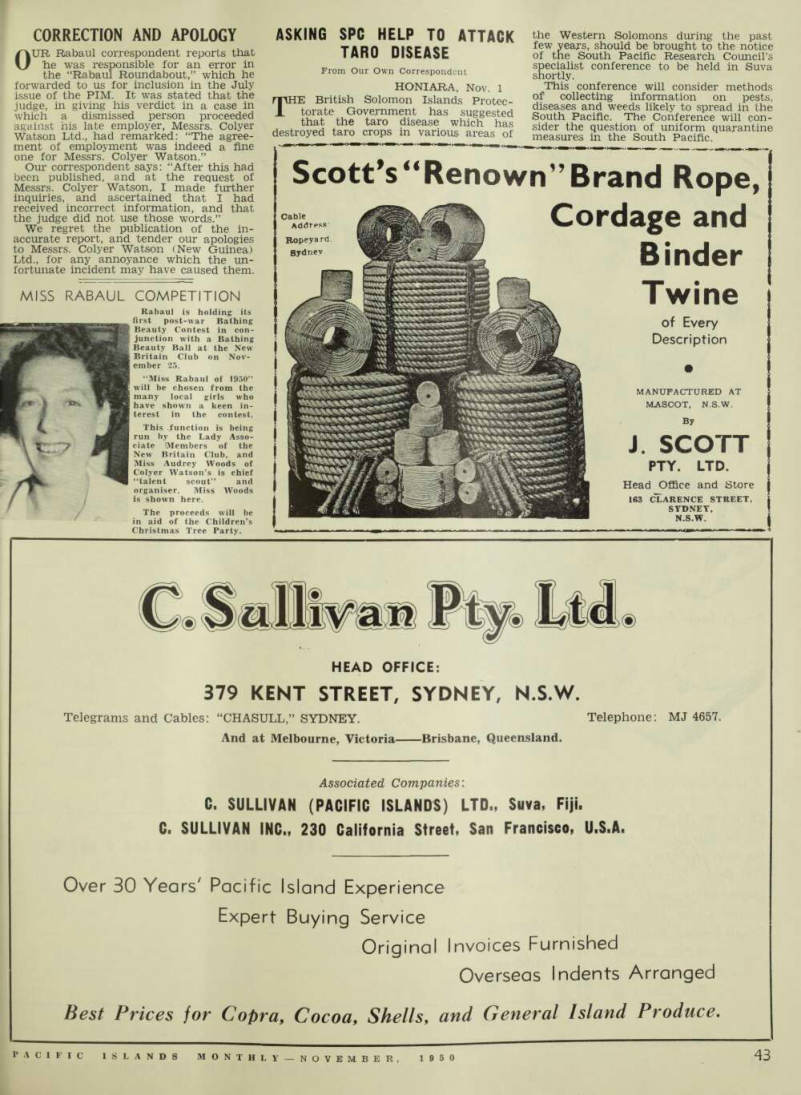
OUR Rabaul correspondent reports that he was responsible for an error In the “Rabaul Roundabout,” which he forwarded to us for inclusion in the July issue of the PIM. It was stated that the judge, in giving his verdict in a case in which a dismissed person proceeded against his late employer, Messrs. Colyer Watson Ltd., had remarked: “The agree ment of employment was indeed a fine one for Messrs. Colyer Watson,”
Our correspondent says: “After this had been published, and at the request of Messrs. Colyer Watson, I made further inquiries, and ascertained that I had received incorrect information, and that the judge did not use those words.”
We regret the publication of the in accurate report, and tender our apologies to Messrs. Colyer Watson (New Guinea) Ltd., for any annoyance which the un fortunate incident may have caused them.
Miss Rabaul Competition
Rabaul is holding its first post-war Bathing Beauty Contest in con junction with a Bathing Beauty Ball at the New Britain Club on Nov ember 25.
“Miss Rabaul of 1950” will be chosen from the many local girls who have shown a keen in terest in the contest.
This function is being run by the Lady Asso ciate Members of the New Britain Club, and Miss Audrey Woods of Colyer Watson’s is chief “talent scout” and organiser. Miss Woods is shown here.
The proceeds will be in aid of the Children’s Christmas Tree Party.
Taro Disease
Asking Spc Help To Attack
Prom Our Own Correspondent
Honiara, Nov. 1
rpHE British Solomon Islands Protec- X torate Government has suggested that the taro disease which has destroyed taro crops in various areas of
the Western Solomons during the past few years, should be brought to the notice of the South Pacific Research Council’s specialist conference to be held in Suva shortly, This conference will consider methods collecting information on pests, diseases and weeds likely to spread in the South Pacific. The Conference will con sider the question of uniform quarantine measures in the South Pacific.
Advertisements & other items, pp. 45-46 (2 items)
Cordage and
Scott's “Renown” Brand Rope,
Cable Address Ropeyard Sydnev "//§ Vi
Binder
Twine
of Every
Description
MANUFACTURED AT
MASCOT. N.S.W.
By
J. SCOTT
PTY. LTD.
Head Office and Store
163 CLARENCE STREET,
SYDNEY,
N.S.W.
HEAD OFFICE:
379 KENT STREET, SYDNEY, N.S.W.
Telegrams and Cables: “CHASULL,” SYDNEY. Telephone: MJ 4657.
And at Melbourne, Victoria Brisbane, Queensland.
Associated Companies : C. SULLIVAN (PACIFIC ISLANDS) LTD., Suva, Fiji.
C. SULLIVAN INC., 230 California Street, San Francisco, U.S.A.
Over 30 Years' Pacific Island Experience Expert Buying Service Original Invoices Furnished Overseas Indents Arranged Best Prices for Copra, Cocoa, Shells, and General Island Produce.
6
mwk.
* v V
i rouds
A birthday gift . . . o wedding gift . . . a Christmas gift ... or whatever the occasion may be.
S' M & * ■* ii Proud’s Seven Floor Gift Store , right in the heart of Sydney, has exactly the gift you need. er i /. world-wide variety of merchandise is specially selected with a thought for the giver of gifts.
It’s easier, it's more fun to shop by mail with the help of Proud's Gift Book. Cut out the coupon below, send it to Mail Order Manager, Prouds Limited, Box 1502, G.P.0., Sydney, and receive Proud's Gift Book free.
Precious Jewellery Watches China and Glassware Art Jewellery Compacts Souvenirs Pens and Pencils Smokers' Accessories Silverware Cutlery Shaving Accessories Leather Goods Brush Sets Handbags All types of clocks from the "Clock Shop"
PROUD’S GIFT BOOH VOUCHER
Mo/7 Order Manager, Frauds Limited, Box 1502, G.P.0., Sydney.
Please send me Proud's new Gift Book free of all charge.
Name - - Address... -
44
NOVEMBER, 1950 PACIFIC ISLANDS MONTHL
Air-Drop At Mendi

Extending Administ’n in NG Highlands
LAE. Nov. 1.
THE landing, this month, of a plane on the new air-strip at Mendi, in the almost unknown region in the centre of New Guinea, between Mount Hagen (New Guinea Highlands) and Lake Kutu bu (in behind the Gulf of Papua) will mark a new stage in aviation develop ment and in administration.
Hitherto, the exploration and control of this vast new Highland region—which Australia, until about 1932, did not know she had —have been carried out mostly from the east. Step by step, from the Markham into the Benna Benna Valleys, and thence on westward through Goroka, Chimbu, Wahgi, Hagen and Wabag, the patrols followed the explorers, the air strip makers followed the patrols, and the administrative machinery settled in alongside the air-strips.
Now, in all these great valley systems, there are good air-strips; and, under the direction of DO George Greathead, at Goroka, there is a series of government stations, serviced entirely by air, through out the region. The way in which the Highlands have been brought under con trol and direction is the most creditable achievement in the record of the post-war Administration.
BUT the thrust has come from the east.
Planes, in order to reach Wabag, away west of Hagen, have flown usually from Lae, in the far east, or Madang, in the north-east.
Now, the thrust has turned south-west and south from Hagen, around the western end of the central mountain mass which cuts off Papua from New Guinea.
These fairly open plateaus run away south and lose themselves in the bad limestone and jungle country near the Gulf of Papua—explored in the ’twenties and ’thirties by Hubert Murray’s young men (Ivan Champion, Jack Hides, etc.,) from Papua, and the gold-seeking Leahy brothers, from the north.
In September, a party under ADO Smith left the Lake Kutubu station (serviced by Catalina from Moresby) and made their way to a point midway between Hagen and Kutubu, called Mendi, and proceeded to construct an air-strip.
On October 15, a Gibbes’ Norseman plane arrived in Goroka from Moresby, was loaded with supplies and, guided by ADO Timperley (from Hagen) and as sisted by ADO Les Williams, from Goroka, they went out into this new country, located the air-strip party, and, in two trips, dropped the supplies, in war-time fashion.
Later on, ADO Smith’s party returned to Kutubu and ADO Timperley took in a party to finish the job.
Not only will Mendi allow servicing planes to make a sort of round trip (Lae- Goroka-Hagen-Mendi-Moresby); but it appears also to be the intention of the Government to establish an important station there. It will be centre of still another valley system, carrying a large population, about which comparatively little is known.
The Rev. Fr. R. J. Quirk, of the Fran ciscan Fathers, and stationed at Vanimo, New Guinea, is in Melbourne on six months furlough. The new Catholic mission at Vanimo has risen from the ashes of the old one destroyed during the war. Ft. Quirk is the only European there, but besides his house there are school rooms, a church, dispensary and a small native hospital.
Apia Employees
Salary Increases For M. H.’S
BECAUSE of the steadily rising cost of living, Morris Hedstrom, Ltd., have recently given considerable salary increases to their Western Samoa staff.
Increases average about 22 per cent.
At the same time, however, a former incentive bonus has been reduced from 25 per cent, to 12i per cent, on the in creased salary.
It is hoped by employees that other Apia firms will follow the lead given by Morris Hedstrom, Ltd.
It is reported that as a result of their move MH, Ltd., have been swamned by an avalanche of applications from'people seeking employment with them.
Mrs. H. G. Gregory Smith and Miss Gregory Smith are expected to arrive in Sydney on November 16, by the Strathaird, en route to the British Solomon Islands Protectorate, where they will join the Resident Commissioner (Mr. H. G.
Gregory-Smith) who arrived in the Pro tectorate last February. Mr. Gregory Smith was posted to the Solomons from British Guiana.
Advertisements & other items, p. 47 (1 item)
Dettol
Send us your orders for
DEVELOPING, PRINTING
Enlarging and
COPYING FROM OLD PHOTOS
All Photographic Supplies.
CAINE’S STUDIOS, SUVA
Box 8. (Estb. 1904) ’Phone: 68.
Sag
I i tm w m ..
Tell me
doctor .
Can an antiseptic help in healing ? ”
Wounds heal of their own accord when they are kept free from the germs that cause septic infection. To keep wounds in the healthy condition for healing, surgeons have for years relied upon ‘Dettol’. This ruthless destroyer of germs is non-poisonous, gentle and safe on human tissues. While it disinfects the wound, ‘Dettol leaves the living tissues undamaged to continue the natural processes of safe and rapid repair.
DETTOL
THE MODERN ANTISEPTIC
Awards To Western Samoa
Police
From Our Own Correspondent
Apia. Oct. 14
A PLEASING little ceremony took place at the Apia Police Station on October 6 when, in the presence of the Hon. Fautua and other members of the Samoan Government, the High Com missioner, Mr. G. R. Powles, presented long-service and good-conduct medals and
clasps to European and Samoan members of the Samoan Police Force.
Those decorated were: Sub-Inspector H. Irwin (appointed 16/12/1919), second clasp to medal; Gaoler, H. M. H. Bower (appointed 18/4/28), Ist clasp to medal; Sergeant Tafaeono (appointed 1/4/28), medal; Traffic Sergeant W. Johnston (appointed 14/1/29), medal; Corporal T.
Tasi (appointed 8/12/19) 2nd clasp; Corporal Lepaio (appointed 18/3/30), medal; Constable Lemalu (appointed 15/12/20), second clasp.
Education In Bsi
From Our Own Correspondent
Honiara, Oct. 12
A N Education Conference was held in Honiara, on September 25 and 26, at which representatives of the Maris c Mission, Melanesian Mission, Seventh Day Adventist and Methodist Missions discussed with the Judicial Commissioner and Director of Education the provisions of proposed new BSI education legislation and other matters of educational policy.
Under the proposed Education Regu lations, on which agreement was reached in principle, the Government will make some financial contribution towards run ning costs of Mission Schools, the expenses of which have previously beer met entirely by Missions.
Other matters discussed were the Government Experimental School recently opened at Auki, Malaita; the urgent necessity for a supply of trained native teachers: and a suggestion that some form of mass education campaign be launched among BSIP natives. Mission teachers of long experience estimate that it will be ten years before the handicap of complete lack of schooling for natives during the war, is overcome.
Ratu Sukuna for London
Ratu Sir Lala Sukuna, Who Has
been attending the General Assembly of the United Nations in New York as a member of the UK delegation, will pay a short visit to London on his way back to Fiji.
He is expected back in the Colony at the end of November.
Sixteen-year-old Hawaiian woman swimming champion, Thelma Halana, will probably visit Australia to compete in the Jubilee Championships next year.
Advertisements & other items, p. 48 (3 items)
46
November. 1950 pacific islands month l y
W. Balchin Pty. Ltd.
WORLD PARITY FOR YOUR PRODUCE!
We are outright buyers of —
TROGHUS SHELL M.O.P. SHELL
IVORY NUTS GREEN SNAIL SHELL
As direct exporters to World’s consuming centres we can offer
TOP PRICES.
We supply TIMBER, DOORS, JOINERY, MOULDINGS, Etc.
W. BALCHIN PTY. LTD.
(Established 1848).
TIMBER, IMPORT Cr EXPORT MERCHANTS
Head office Also at SYDNEY: 247 George St. LONDON: 78 Gt. Bushey Drive ’Phones: B\V 1538-9 Totteridge Cables: “BALCHINCO”
A. H. Bunting Limited
SAMARAI PAPUA
Optical discovery allows you
to see right through reflected glare
Ct) 'Polaroid
DAY GLASSES & SUNSHIELDS
* Regd. Trade Mark Patented in U.S.A., Great Britain and other countries. ★ We are Sole Agents in the Territory of Papua and New Guinea for POLAROID Day Glasses and Sunshields and enquiries are invited from Merchants and Traders. Prompt attention given to all enquiries. Many models available, in a wide range of colours. ★ Also procurable from Bunting’s, Lae.
NG’s Coolest, Healthiest
Town How a Community Spirit is Putting Wau on the Map
WAU, October 10.
WHEN the war came, Wau was a solid little business town, based on the gold production of Edie Creek, Golden Ridges, Koranga, Black Cat, etc., and—less directly—of Bulolo. There were indications of agricultural development.
Coffee was being grown.
The war literally blew Wau off the map. The town, in common with every establishment in the Bulolo valley, was scorch-earthed. Australians, coming in dramatically at the last moment with their 25-pounders, fought a savage battle and smashed the invading Japs in the coffee plantation at the foot of the famous, sloping air-strip.
But now the big gold-mining people are back. The town is partly re-built.
Planes come and go. There are, how ever two notable differences: Higher costs have prevented much of a come back by the small miners; and the use of the Wau-Lae road for heavy transport has greatly reduced the freighting planes.
THE 300 Europeans who live in and around Wau do not see a big or a long future in gold; but—with a virile community spirit I have never seen excelled—they are backing this Upper Bulolo area with everything they’ve got.
They say they are going to make this cool, green beautiful valley, nestling so attractively among the blue mount ains, the health and hill station of New Guinea, and a great producer of Euro pean foodstuffs.
Hospitable to a degree, the Wau citizen likes nothing better than to get you to spend a weekend with him. You walk about in air that is like wine. You sleep comfortably under two good blan kets. You are fed on local-grown potatoes, cabbages, salads, strawberries, milk, eggs, bacon; your room is decorated with glorious English flowers; and then, with deep cunning, the Wau citizen in stils into the mind of every coast dweller the thought that it is easier and much cheaper, and pleasanter, to spend one hour in a plane, to weekend most com fortably in Wau, than twelve hours in order to “recuperate” in the industrial lunatic asylum down South.
A tireless committee headed by Norman White, Alec Malcolm, Joe Bourke, Ossie Ireland and ADO Seale led me along the primrose paths, and sold me Wau. I saw the Golf Club, one Saturday afternoon, raise over £lOO for a swimming pool, and a social club, that same evening, gather £l6O for some other community purpose.
Over £4OO raised in one weekend from only 350 people—which 350 includes about 50 of the prettiest and healthiest kids I have ever seen in the tropics.
THEY were eager to see the big secon dary school established —they said that their hill-and-health station would be built around the school. A few days later, Canberra “canned ’ the school.
On last reports Norman White, with stur dy henchmen and pitiless statistics, was headed for Canberra. These Wau folk will take some stopping. I forsee the day when Wau will be the Nawara Eliya of New Guinea.
Wau. of course, has rivals now. Places like Kainantu, Aiyura, Goroka, on the new Highlands, in climate, beauty and fertility can challenge the Bulolo centres.
But none of them has got a European
community—let alone a community spirit—like Wau. And, anyway, Wau is 100 miles nearer to the sweat-soaked coastal towns, whose people crave for fresh foods and cool nights.—RWß Mrs. G. Kennedy, of Madang, NG, is at present on holiday in Australia. She will be joined later by her husband.
Mr. Albert Jensen, an old resident of Apia, Western Samoa, has received the welcome news that he won £lO,OOO in Tattersall’s sweepstake. This is the highest prize ever won by a resident of the Territory.
Internal Air Services?
Qantas To Operate
W. H. CROWTHER, of Qantas ) Empire Airways Ltd., was in Suva in October to discuss with the Govern ment of Fiji financial aspects of the pro posal that QEA should operate internal air services in the Colony.
The company recently carried out a series of survey flights to obtain informa tion about operating conditions and to enable tentative itineraries to be drawn up.
Advertisements & other items, pp. 49-50 (1 item)
I Pan A
PROTECT THOSE TEETH!
PROTECT
m
with
& A O O T -A -0 & a T & 4* G *> to* $ * s’
"Ur i aO <U/ *IS
I PAN A
TOOTH PASTE
Dentists know that you can't have sound teeth unless you have healthy gums. That's why you should always use IPANA.
IPANA not only keeps teeth radiantly clean . . . but it stimulates the gums, keeps them firm and healthy, and guards against decay.
You'll like IPANA . . . it's refreshingly different!
Sold Everywhere
A PRODUCT OF \jjL- BRISTOL-MYERS
8M33-49
Instantaneous Hot Water for all Kitchen Purposes. / /
2? IS IKiT,
Hot Showers. Hot Baths.
Hot Water for Shaving and Washing.
KEROSENE OPERATED
FULLY AUTOMATIC
HOT WATER SERVICE
DESIGNED TO BRING THE LABOUR SAVING AND LUXURY OF CONTINUOUS HOT WATER
TO EVERY ISLAND HOME.
Kerostat will deliver 80 gallons of hot water daily and uses only 2 to 3 gallons of kerosene per week. This economy is made possible by use of a patented Thermostat which automatically controls the flow of kerosene to the silent, odourless, totally enclosed blue flame burner and maintains the water heat in the insulated copper cylinder located inside the cabinet at a temperature of 180 deg. Fahr. or at whatever temperature the user selects.
Being fully automatic, Kerostat requires no attention beyond checking the kerosene supply which, if desired, can be run from a 44-gallon drum.
Kerostats are installed in thousands
• AUTOMATIC
• ECONOMICAL
• SAFE
• SIMPLE
"THE HEATER
THAT COULDN’T
HAPPEN”
• COMPLETELY
CONTAINED
SELF-
-9 NO ATTENTION
• EASY TO INSTALL
of country homes in Australia, where they are operating with complete satisfaction. Greatly increased production now permits export.
Copper pipe and special type fittings may be purchased at normal retail prices when ordering your Kerostat.
We estimate material for a 4-point installation with 80 ft. copper pipe will cost approximately £27. Clients, if they so desire, may carry out their own installation, as detailed directions accompany each unit despatched, and the special compression fittings obviate the necessity of screwing and sweating joints. Any handy man is capable of doing the installation.
Kerostat lends itself to a convenient installation in the kitchen, bathroom, laundry or back verandah, as it measures only 49 in. x 19 in. x 19 in., and is completely selfcontained.
• FULLY GUARANTEED
• INDESTRUCTIBLE
NICHROME. STAIN-
LESS STEEL BURNER
PRICE: £6O
PACKED
F. 0.8.,
SYDNEY.
AUSTRALIAN LIGHT AND POWER COMPANY
PTY., LTD.
161 WILLIAM STREET, SYDNEY.
Bankers: Bank of N.S.W., Sydney. Telegrams, Cables; “AUSLIGHT,” Sydney.
ORDERS ARE
ACCEPTED
IN STRICT
ROTATION.
Fiji’s Rent Racket
Receipts Urged To Curb It
Prom Our Own Correspondent
Suva, Oct. 23
ALTHOUGH no publicity has yet been given to it locally, there are signs that the Government of Fiji may be asked for legislation to enforce the giving of receipts in all business transactions where receipts are normally required.
This demand has been brewing for years, but several factors are now working to bring matters to a head.
The first of these is Suva’s overcrowding problem in the slum and semi-slum areas.
With alternative accommodation Impos sible to find, masses of low-wage workers and their families are at the mercy of merciless Asiatic landlords, who use devious means of evading the fair-rent regulations and who step up rentals to the last penny that can be wrung from people who dare not complain lest they are thrown out of the only shelter available to them.
And because few, if any, Asiatic land lords can be induced to give their tenants receipts the tenants are open to another form of despicable exploitation—threats of legal action for the recovery of rent which has actually been paid.
From any point of view the slum situation at Suva is a national scandal, and in a centre where the cost of living continues to be pushed up by overseas conditions, and is made worse by the profiteering in local foodstuffs, tempers are short over the rent racket. Fijians, of course, are the main victims.
Europeans who would like to see some thing done for the exploited Fijian are looking to a possible Fijian claim against an Indian landlord to provide useful ammunition. This Indian, it is alleged, with the support of an Indian lawyer,
seized virtually the entire contents of the Fijian tenant’s home in the absence of the owner and his wife. The Fijian maintains that the Indian’s allegation of unpaid rent is untrue and is believed to be prepared to produce at least one witness of the actual payment. The tenant, of course, has no receipt.
It is known that in this case the Fijian made an appeal to a high Government authority and that prompt official action secured the return of the seized property.
In addition to the landlords, Indian tailors do not give receipts for payment.
IT is clear that the Government would find it hard to give any logical reason for not granting full legal authority to demands for receipts. Compulsory receipts would check the illegal excess rent racket—at least until ways of getting round the receipts were worked out—and receipts could help in recovering the sub stantial sums lost every year through Asiatic evasion of income tax. (Official dom openly admits and laments the loss but does not mention what would happen
to any European with a medium salary who attempted some of the activities which wealthy Asiatics engage in with impunity). Finally, compulsory receipts would assuredly provide increased stamp duty returns.
Units
Suva Firms Build Housing
From Our Own Correspondent
Suva, Oct. 16
BUILDING applications totalling £120,344 were made to the Suva Town Council in the quarter ended September 30.
The largest items were a £50,000 hostel for Morris Hedstrom, Ltd., and £11,400 for three double-unit flats for Millers, Ltd.
This could be taken as an echo of the reaction of workers from overseas to Suva’s cost of living and the standard (and cost) of the present available ac commodation.
Advertisements & other items, p. 51 (1 item)
Giobite
useyipAtr
TRAVE L CASES
They're lighter, stronger, longerlasting. That's why a Globite costs less in the long run.
Made by
FORD SHERINGTON LTD.
STEAMSHIPS TRADING COMPANY LTD.
PORT MORESBY AND SAMARAI PAPUA
Wholesale & Retail Merchants, Planters, Sawmillers, Engineers, Slip
Proprietors, Shipping, Customs and Insurance Agents.
MANAGING AGENTS for:
SAWMILLERS & TRADERS LTD.
CORAL SEAS INSURANCE CO. LTD
ACME BAKERY COMPANY.
MARIBOI RUBBER LTD.
RUBBERLANDS LTD.
KEREMA RUBBER PLANTATIONS LTD.
COCOALANDS LTD.
AGENCIES:
BANKERS & TRADERS INSURANCE CO. LTD.
VACUUM OIL CO. PTY., LTD.
DIRECTORATE OP SHIPPING—Papua-New
Guinea Division.
ROYAL INTEROCEAN LINE.
KOKE BAGU PTY., LTD.
TRANS OCEANIC AIRWAYS.
DISTRIBUTORS IN PAPUA for:
ARMSTRONG-HOLLAND PTY., LTD.
Earth Moving and Logging Equipment.
WILLYS-OVERLAND EXPORT CORPORATION.
Jeep cars, etc.
HILLMAN MOTOR CARS.
INTERNATIONAL HARVESTER CO. OF AUST. LTD.
International Trucks, McCormick-Deering Farming Machinery, Defender Refrigerators.
SYDNEY AGENTS: NELSON & ROBERTSON PTY, LTD., 12 SPRING STREET
Bsi Regrets Suspension Of

Toa Service
From Our Own Correspondent
Honiara, Oct. 20
NEWS of the suspension of Trans oceanic Airways’ flying-boat service to the Solomons was received with great regret by BSIP residents, a few of whom still remember TOA’s pioneering efforts in 1947 when they battled gamely
altng with the organisation of the Protectorate’s first civil air service.
The Company has announced that the suspension is temporary, and will be reconsidered when their new modern air craft are delivered. Qantas Empire Air ways now provide he only airline to the Protectorate —the Rabaul-Honiara link.
Fiji’s new Postmaster-General, Mr. J. A.
Marais, arrived in the Colony on October 25.
Levuka’s Historical Assets
Cession Pageant Suggested
From Our Own Correspondent
Suva, Oct. 16
C SESSION Day (October 10), the anni- J versary of the signing of the famous Deed oy which Ratu Cakobau and the high chiefs of Fiji handed over their islands to Queen Victoria, was as usual celebrated with a holiday this year.
In 1874 the Deed of Cession was signed at Nasova, Levuka, and the site of the ceremony is marked by a simple memorial.
Usually described to-day as a pleasant and picturesque backwater, the one-time capital of Fiji is being accused of failing to make proper use of one of its greatest assets —its historical associations. - It has been suggested that if Levuka took the matter in hand with careful and imaginative organisation, it could make Cession Day an occasion of vivid and dignified pageantry that would be unique in the South Pacific.
This suggestion has been made by a Fijian, and there is little doubt that Fijians throughout the Colony would support any move to commemorate the greatest landmark in Fijiar history. In recent years a number of Fijians have been hoping that somebody might hit on the idea of an authentic reconstruction and re-enactment of the Deed of Cession ceremony at the actual site.
If Levuka could be stirred to active in terest, it is said, Cession Day week-end (the public holiday is the nearest Monday to October 10) could be made an annual rallying-point and demonstration of the survival of the best in Fijian culture.
Few people can deny the value of the suggestions if only because of the racial mix-up which Fiji has become. If the Colony is ever to achieve any sense of history, the Deed of Cession is the only peg on which it can be hung.
Advertisements & other items, p. 52 (2 items)
A. Gregory Pty, Ltd.
IMPORTERS, EXPORTERS AND
MANUFACTURERS
Leather Saddlery and Paint Merchants ALL CLASSES OF LEATHER SUPPLIED FROM STOCK Apply direct to: A. GREGORY PTY., LTD., 107 York Si., Sydney
Ki
m Write for full details of prices and deliveries to: — I Distributors throughout the Territory of New Guinea for
BOOTES GROUP PRODUCTS
HUMBER, HILLMAN
and SUNBEAM-TALBOT CARS
COMMER and KARRIER TRUCKS
The Crazy Story
Of The
Wabag “Rush”
By R. W. Robson
WHENEVER people discuss the phenom enal riches of the Edie Creek- Koranga-Bulolo goldfield, they let their minds wander over the endless mountain gorges of New Guinea; and they say: “Surely there must be other Edie Creeks in this partly-explored country,”
Every so often, there is whisper of a new discovery, and every “goldminer true”—and they all seem to have the fever in their blood, up here—gets rest less and uneasy. That was the start of the “Wabag rush,” last year. Jim Leahy, in an expansive moment, told me the story.
Administration officials Black and Taylor had been through the region west of Hagen—of which Wabag is a sort of centre—and they reported “no gold.” But some of the Old Timers got the im pression that the Government men were “foxing,” and they watched closely.
Mick and Jim Leahy were in Australia, when the rumour spread that there defin itely was good gold near Wabag and that BGD were going to press Canberra to open the field there. It is alleged that Mr. Cromie, well-known Territories solicitor, sent to BGD a radio that the Wabag valley would be opened on April 1, but that they were trying to get permission to go in earlier.
You can’t keep that kind of message secret in New Guinea. Within a few hours, Mick and Jim Leahy, in Austra lia, had a garbled version of the report.
A few hours later they were on a north bound plane. When they reached Goroka, in the Highlands, they found the usual signs of a gathering rush.
Well-known Bill MacGregor (now run ning Baiyer River cattle station for the Administration) was at the head of the BGD party. Danny Leahy had joined Mick and Jim. John Black, who had resigned from the Administration, and Elphinstone, were also getting ready to go in. Nep Blood and Joe Searson led another eager party.
They all moved up to Hagen; and by March 31, using all available air trans port they were at Wabag, 40 miles west of Hagen. There was intense, but good natured rivalry—the gold fever was at its height. No man knew for sure that gold was there; but each man suspected the other of knowing, and “foxing.” Each man was watching every other man, so that, when the knowledgeable one pegged, he could peg beside him.
THEN a patrol officer appeared. He said he had definite instructions from the Administrator that the gold-seekers could not go further in.
The howls of the miners were something to remember.
All hands immediately came together in a protest meeting. They radioed the Administrator that they were going in, whatever he said, and would fight any action brought against them.
The Leahy brothers had arranged that a plane should follow them in, and keep touch. In the midst of the excitement, the pilot was quite accidentally shot in the leg. This was reported, outside, to have been the result of a fight between the baffled miners and the Govern ment's officials.
The parties left Wabag for the alleged goldfield, six days’ walk away. Soon after they left, a plane arrived with Ivan Champion (Director of District Services),
Dr. John Gunther (Director of Medical Services) and Jim Taylor (Director of Native Labour). They sent a patrol hot-foot after the excited miners.
By the time the patrol arrived, the miners were sitting snarling around a creek-bed, trying to decide which of them “had called this bloody place a goldfield.”
There were good colours in places—but not a sign of gold in sufficient quantities to pay even the cost of the boots worn out in that long, weary walk from Wabag.
One wonders what would have happened had there been good gold there. Would it have been war between the invading miners and the Departmental heads who followed them in? Or would the officials have seen the light and become gold miners—as has happened in New Guinea before?
Mr. E. Bennett North, who in recent times has made his home on Norfolk Island, was in Sydney in October. He was one ot the adjudicators at the recent City of Sydney Eisteddfod,
Dr. J. Legg, Director of Research in the Animal Industry Division of the Queens land Department of Agriculture and Stock, has commenced a cattle tick in festation and tick fever survey in Papua- New Guinea.
Advertisements & other items, pp. 53-54 (2 items)
51
pacific ISLANDS MONTHLI - NOVEMBER. 1950
Shell
K. H. D. HAY
GENERAL COMMISSION
AND POSTAGE STAMP
AGENT,
GUADALCANAL 8.5.1.
SETS OF BRITISH SOLOMON
ISLANDS STAMPS, MINT OR
CANCELLED COPIES.
Price: £l/5/- per set.
Get that British spirit
For 46 years more Shell has been bought by more motorists than any other brand of petrol. It’s a good British habit.
In Australia alone, Shell is refining British petrol from British crude at the rate of 72,000,000 gallons a year.
The crude is brought to Australia in British tankers from British wells in British Borneo by Shell—a British company.
Get that British spirit—always fill up at the Shell pump
SHELL
v.> % I #r>. % 4V*
always fill up
at the SHELL pump
The Shell Co. o Aust. Ltd. Inc, in Gt, Britain)
MSSO4J
Insist on. . .
tt ßiio*rTir
CANNED MEATS, HOTMEALS AND SOUPS
Available in 12 oz. and 1 lb. sealed cans in the following
appetising flavours and combinations:
• Corned Beef Loaf With Cereal • Braised Steak and Onions • Boiled and Roast Beef • Beef Steak Pudding • Mutton and Peas • Steak and Onions • Chili Con Came • Curried Mutton • Curried Beef • Irish Stew • Mulligatawny Soup • Vegetable Soup • Mutton Broth • Tomato Soup • Camp Pie
“ BRONTE” Brand high-grade products
are made from the finest fat stock
and the richest vegetables in Australia,
deliciously flavoured.
THE COLONIAL WHOLESALE MEAT CO.
PTY. LTD.
Canning Factory: State Abbatoirs, Homebush, Sydney,
N.S.W.
sJAIIP P
wmtuiui '***
’PHONE: UM 8436
CABLE ADDRESS: “WOOLMILL,” SYDNEY.
Government Geologist

Exploring Guadalcanal’S
Mountains
Three Months’ Trek of Government Geologist
From Our Own Correspondent
Honiara, Oct. 20
THE British Solomon Islands Protec torate Government Geologist (Mr. J.
C. Grover) has recently returned from a three months’ expedition into Central Guadalcanal. After some weeks spent in examining the Gold Ridge and adjacent areas, the party moved, via Mt.
Tauna (3,030 ft.) and Mt. Jonapau (4,000 ft.), to the Sutakiki Valley where camp was made at the old mining site at Tam balusu at 1,700 ft.
The summit of Mt. Popomanisiu was reached on September 6 at an altitude of less than 8,000 feet. This summit is capped by low flat-tooped trees, their trunks thickly draped with moss. In some places tree trunks cannot be found, the ground being knee-deep in colourful and decora tive mosses and lichens in greens, whites and rust-reds. Opossums, rats, owls and eagles and large wild dogs were the only signs of life seen.
On Mt. Sambatangi (5,600 ft.) a bottle was found, believed to have been left by Mr. L. J. Davies, a well-known prospector of pre-war days. The paper inside it, however, was blank except for some native writing. Although the notch in the tree was located, the bottle reported to have been left by “Spearline” Wilson was miss ing, probably removed by natives.
At the summit of Popomanisiu, first climbed in 1939 by Mr Colin Burnside and Mr. Paul Kneen and later, in 1947, by three US Army surveyors, Burnside and Kneen’s bottle with barometric pressures and temperatures could not be found but it was considered this might be still in place at a neak on the same level about 150 yards further to the West.
RETURNING to the Sutakiki River, the party followed its headwaters and tributaries and later the Sutakama River headwaters. The party then moved towards Mt. Tatuva (Lion’s Head Moun tain) which rises impressively some thousands of feet on the eastern side of the Sutakama River. A 2,000 ft.-climb brought the party to Vulolo village where a magnificent mountain panorama opened up to the south, of a much more rugged nature than that to the west of Tatuve.
Following the ridge to Bung-ana and the saddle connecting it to Mt. Tatuve, at 3,250 feet, the party was prevented from proceeding further by the Headman and local natives. Tatuve is tambu and it is said that no man has ever climbed it.
Tn 1931 the botanist Kajewshi left Vulolo village secretly and entered the t Q mbu ground, climbing to the first shelf at about 4,000 ft. He did not reach the summit but was compelled to go back, and got into serious trouble on his return, the natives blaming his breaking of the tambu for the death of a child.
The present party accordingly left Mt.
Tatuve alone and returned to Gold Ridge, subsequently following the Sorvohio River Gorge down to the lower alluvial flats and across the plains to the Nalimbu River and the Government Farm at Hu.
Laboratory and office work following on the expedition in now in progress.
The London firm of Sandford, Fawcett &' Partners have been engaged to advise the Government of Fiji on matters con nected with the extension and improve ment of the Suva Water Supply. A representative of the firm, Mr, P. R.
Jeffcoate, arrived in the Colony in October to carry out a preliminary investigation Into the problems involved, Mr. and Mrs. Don Eisenhauer, of Goroka, Central New Guinea Highlands, are spending five months leave in Aus tralia.
Elephantiasis Threatens
Hawaii
FILARIAL infection has been discovered among members of the Samoan colony on the island of Oahu, Territory of Hawaii.
Prevalence of the fllaria transmitting mosquito in the same district emphasises the gravity of the situation, and control measures are being taken by the health and medical authorities there.
Advertisements & other items, pp. 55-56 (1 item)
buy more
FRANCIS HOOVER
4 Castlereagh Street, Sydney Cables: Petwer, G.P.O. Box 4623.
EXPORTERS
All classes of merchandise supplied. Careful attention given to big and small orders.
Housewives
buy more
S 7 m 3m a \m\m\ Yes, housewives buy more Heinz Cooked Spaghetti than any other brand* Heinz Cooked Spaghetti is so tasty ... so economical ... so satisfying. The whole family says it’s a winner. The Heinz secret is . . . spaghetti from finest wheat . . . sauce from fresh, red-ripe tomatoes and mellow cheese. It’s a ready prepared meal in its self for breakfast, for luncheon, for tea or for sandwiches. It’s an all time winner ... by Heinz it is !
This is proved by independent surveys of what Australian housewives actually buy.
H. J. HEINZ CO. PTY. LTD.
479 Bourke St., Sydney.
Made in the Australian Branch Factory of
BLUNDELL SPENCE & CO., LTD., Hull,
B. & S. SUPER PREPARED PAINT embodies the knowledge and experience gained from nearly 140 years of Paint manufacture.
Tested and proved for tropical conditions, B. & S. PREPARED PAINT is also available in a special Lead-free series for use in volcanic and other sulphurous regions. (Specify B. £r S.-Series 2301).
Ask for supplies of these and other BLUN- DELL Paints and Enamels from your local Storekeeper, or write for particulars and colour-cards to the Agent for Pacific Islands :
KERR BROTHERS PTY. LTD.
4 YORK STREET, SYDNEY
PAINTS
Madang Newsletter
From Our Own Correspondent
Madang, Oct. 30.
REACTIONS were mixed in Madang when it was learned that the pro posed Wau High School would not eventuate. Most parents seemed to prefer a yearly grant of £125 plus return boat fare once a year, instead of the school.
Reasons were several but the chief one is that it is generally thought inadvisable to bring children up in a native country or to keep them in the tropics altogether after they are in their teens.
Although the £125 allowance plus fare will cost the Administration real money, it is likely that it will, in the end, cost less than the building and maintenance of a boarding school.
HMAS Culgoa was in port for three days during the month. Tennis, cricket and soccer matches were played, a dance was held at the Club and local children were shown the ship. On the last night in port, officers entertained about 50 guests at a cocktail party.
MR. NOLAN Snr. has been visiting Mr. and Mrs. L. Nolan of the SDA Mission. At 73 he made his first plane trip—to Bena Bena in the Central Highlands to attend the SDA Conference.
His young grandaughters, Ailsa and Robyn, on the other hand, think no more of a plane trip than city children do of a bus’ ride.
THREE overseas ships and the usual plane services during the month brought an influx of returning residents. Mrs. K. Cahill and Miss Therese O’Brien returned after a long holiday in the UK and Europe. Mr. and Mrs. S. Clarke came back from leave in Cairns, with daughter Glynnis, Mr. and Mrs. A. Shields (he is Collector of Customs, Madang) with their small son returned by Malaita after nine months leave. Dr.
J F. F. Brown arrived to take up duties as local MO but fractured his foot and returned to Lae. Mr. A. Speers arrived to loin the medical staff as a Medical Assis tant. Mr. R. K. Hicks and his wife have been entertaining his parents, Mr. ana Mrs. R. H. Hicks of Western Australia.
AMONG those who went South were Mr. and Mrs. T. Warburton. Mr. J.
Sherry will be acting Burns Philp manager during Mr. Warburton’s absence.
The job of shifting BP’s store to make way for the wharf has begun.
Qantas staff are also being moved.
After months of waiting families are being moved into their new homes at Kalibobo.
Yali is in Gaol
LAE, Oct. 12 THE Rai Coast native, Yali, who made himself prominent in connection with the leadership of the Cargo Cult, was brought before Judge Bignold at Madang, New Guinea, a month or so ago, tried on several charges and found guilty of some, and sentenced to six years gaol.
While some officials regarded Yah with contempt, one or two experienced District Officers thought him capable of creating serious unrest on the Rai Coast (where Cargo Cult has a hold) and were glad to see him go.
Ratu Mara, who has returned to Fiji after graduating in Arts at Oxford Um vertity! has been posted to the Southern District, (headquarters Suva) as an Administrative officer.
Seen In
Vast New Country Seen In Central N. Guinea
From R. W. Robson.
GOROKA (N.G. Highlands) Oct. 14 .
ADO Alan Temperley, from Mount Hagen, is here today organising an airlift. On Sunday, a plane will fly south from Mount Hagen and, at a place between Hagen and Lake Kutubu (western Papua) it will drop supplies to a large party which, under ADO Smith, from Kutubu, is clearing a new air-strip in this hitherto almost unknown and un mapped region.
This gives the measure of the astonish ing progress made in the last three years by the officers of District Services in opening up the New Guinea Highlands and the “uncontrolled” region to the west and south.
There is to be another Government station at this new air-strip; and then there will be a continuous string of ad ministrative posts from Lae, right across the Markham-Ramu-Hagen country to Wabag, in the west, and southwards to Kutubu and the Gulf of Papua, in the south.
The only really uncontrolled country left is that adjoining the Dutch border.
It is now evident that in this vast, fertile and beautiful plateau there are at least a million people.
Twenty Chinese residents of Fiji were passengers in a plane that left Sydney for Nadi in October. They had arrived in Sydney on the steamer Taiping. There were 10 Gees, three Fongs, three Lees, two Seetos, one Tom and one Low.
Death Of Mr. Percy R. Hinds
THE death occurred at Kikori, Papua, on October 27, of Mr. Percy R. Hinds’ at the age of 69. He was one of Papua’s well-known old traders. He went to the Territory some 30 years ago, to the goldfields. Later, he became one of the first staff men of Steamships Trading Co.
For the last 15 years he had been running his own business at Kikori, as a trader and recruiter, with considerable success.
When he died, he was negotiating the sale of his business, with a view to retirement.
He is survived by his wife and his daughter Judy.
A successful sports meeting was held at the Rove Police Depot in Honiara, BSI, on September 30. Some events were open to all Islanders, others only to police.
Cups for all the major events were pre sented by public-spirited citizens.
Advertisements & other items, pp. 57-58 (1 item)
A. B. Donald Limited
SCRAP IRON
PIG IRON
SCRAP STEEL
PIG LEAD
SCRAP METALS
INGOT METALS
Metal Merchants ★ Metal Refiners
Head Office: WILFORD STREET, NEWTOWN, N.S.W.
Phone: LA 5111 (6 lines).
Cable and Telegraphic Address: “SCRAPMETAL,” Sydney.
Works: 2 CANAL ROAD, MASCOT, N.S.W.
Buyers of Non-Ferrous Scrap, Cable, Shells, Cartridges, Copper, Lead, Muntz Metal, Aluminium LARGEST BUYERS OF SCRAP IRON Cr METALS IN AUSTRALIA
A. B. DONALD LIMITED
RAROTONGA COOK ISLANDS
TELEGRAPHIC ADDRESS: “DONALD, RAROTONGA.”
General Merchants (Wholesale & Retail) and Shipowners Importers & Exporters Branches Throughout Cook Islands Fire, Marine & Motor Vehicles Insurance Agents for Yorkshire
Insurance Co.
Lloyd’s Agents.
Agents and Distributors for : ENGLAND.—Austin Cars & Trucks, Pye Radios, Dunlop Rubber Co., Ltd., Vauxhall Cars & Trucks, R. A. Lister & Co., Ltd., Phillips' Cycles, Marples Tools.
U.S.A.—Remington Rand Corp., Radio Corp. of America, Champion Spark Plug Co.. Firestone Tyres, General Steamship Corp.
NEW ZEALAND.—Vacuum Oil Co. Pty., Ltd, Petroleum Products.
AUSTRALlA.—Wunderlich, Ltd., Cement Asbestos Products.
NORWAY. —O. Mustad & Sons, Fish Hooks.
SWEDEN.—B. A. HJorth & Co., Primus Products.
Sydney Agents: London Agents: San Francisco Agents: BURNS, PHILP & CO., LTD. BURNS, PHILP & CO., LTD. BURNS. PHILP CO. OF SAN FRANCISCO.
Head Office:— A. B. DONALD, LTD., Auckland.
Associate Houses:—
ETABLISSEMENTS DONALD TAHITI,
Papeete, Society Islands.
DOMINION FRUIT CO., Suva, Fiji Islands.
CODES: Bentley's Complete Phrase, Acme
There is only one
ELECTROLUX
THE MODERN KEROSENE-OPERATED REFRIGERATOR
THAT ACHIEVES THE MIRACLE OF ICE FROM HEAT
Lasting Efficiency, Silent Operation, Streamlined Beauty
jTx
1 - : Economically operated by kerosene, with a simple precision-built freezing unit that has no moving parts and is GUARANTEED FOR
FIVE (5) YEARS.
Only obtainable from:
NEW GUINEA COMPANY, LIMITED,
Rabaul, Madang, Lae, Kavieng.
J. R. CLAY & CO., LTD., Port Moresby.
W. R. CARPENTER & CO. (Sol. Is.), LTD., Tulagi.
THE NORFOLK ISLAND SERVICE DEPOT,
Norfolk Island.
SOCIETE HEBRIDA, Port Vila.
SOCIETE CALEDONIENNE DTMPORTATION ET
D’EXPORTATION, Noumea.
For Gilbert and Ellice Islands Colony, etc., apply Model LKSSI
PRICES ON APPLICATION.
Storage capacity: 5i cub. ft. (approx.); shelf area, 10 sq. ft. food shelves, six—five removable; 2 self-supporting when half drawn. Ice-making: Four trays —5 lb. ice per freezing; 80 cubes. Fuel consumption: 1.8 pints kerosene per day (approx.).
Height: 4 ft. 10 in. Depth: 2 ft. 3i in.
Weight, unpacked, 406 lb. Packed, 574 lb.
W. R. CARPENTER & CO., LTD.
direct to: Head Office: 16 O'Connell St., Sydney, N. S. Wales
Magazine Section
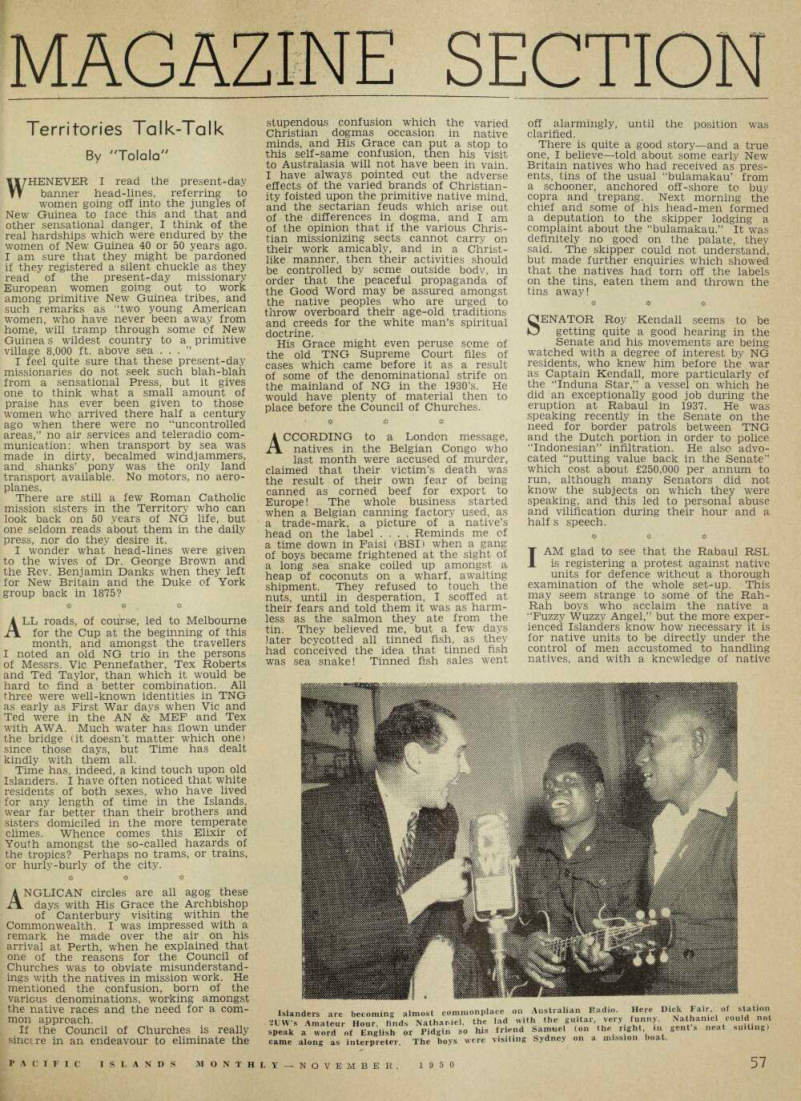
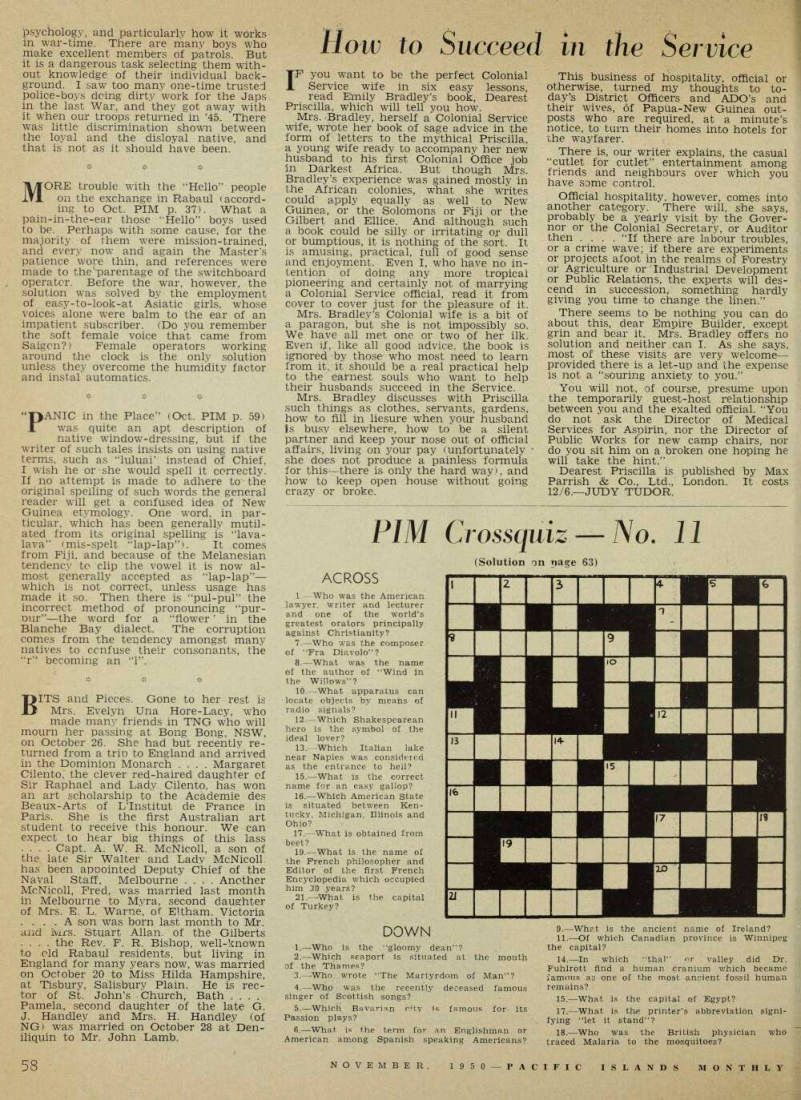
Territories Talk-Talk
By "Tolala"
WHENEVER I read the present-day banner head-lines, referring to women going off into the jungles of New Guinea to face this and that and other sensational danger, I think of the real hardships which were endured by the women of New Guinea 40 or 50 years ago.
I am sure that they might be pardoned if they registered a silent chuckle as they read of the present-day missionary European women going out to work among primitive New Guinea tribes, and such remarks as “two young American women, who have never been away from home, will tramp through some of New Guinea s wildest country to a primitive village 8,000 ft. above sea ...”
I feel quite sure that these present-day missionaries do not seek such blah-blah from a sensational Press, but it gives one to think what a small amount of praise has ever been given to those women who arrived there half a century ago when there were no “uncontrolled areas,’’ no air services and teleradio com munication: when transport by sea was made in dirty, becalmed windjammers, and shanks’ pony was the only land transport available. No motors, no aero planes.
There are still a few Roman Catholic mission sisters in the Territory who can look back on 50 years of NG life, but one seldom reads about them in the daily press, nor do they desire it.
I wonder what head-lines were given to the wives of Dr. George Brown and the Rev. Benjamin Banks when they left for New Britain and the Duke of York group back in 1875? * * ALL roads, of course, led to Melbourne for the Cup at the beginning of this month, and amongst the travellers I noted an old NG trio in the persons of Messrs. Vic Pennefather, Tex Roberts and Ted Taylor, than which it would be hard to find a better combination. All three were well-known identities in TNG as early as First War days when Vic and Ted were in the AN & MEF and Tex with AWA. Much water has flown under the bridge (it doesn’t matter which one) since those days, but Time has dealt kindly with them all.
Time has, indeed, a kind touch upon old Islanders. I have often noticed that white residents of both sexes, who have lived for any length of time in the Islands, wear far better than their brothers and sisters domiciled in the more temperate climes. Whence comes this Elixir of Youth amongst the so-called hazards of the tropics? Perhaps no trams, or trains, or hurly-burly of the city.
ANGLICAN circles are all agog these days with His Grace the Archbishop of Canterbury visiting within the Commonwealth. I was impressed with a remark he made over the air on his arrival at Perth, when he explained that one of the reasons for the Council of Churches was to obviate misunderstand ings with the natives in mission work. He mentioned the confusion, born of the various denominations, working amongst the native races and the need for a com mon approach.
If the Council of Churches is really sincere in an endeavour to eliminate the
stupendous confusion which the varied Christian dogmas occasion in native minds, and His Grace can put a stop to this self-same confusion, then his visit to Australasia will not have been in vain.
I have always pointed out the adverse effects of the varied brands of Christianity foisted upon the primitive native mind. and the sectarian feuds which arise out of the differences in dogma, and I am of the opinion that if the various Christian missionizing sects cannot carry on their work amicably, and in a Christlike manner, then their activities should be controlled by some outside body, in order that the peaceful propaganda of the Good Word may be assured amongst the native peoples who are urged to throw overboard their age-old traditions and creeds for the white man’s spiritual doctrine.
His Grace might even peruse some of the old TNG Supreme Court files of cases which came before it as a result of some of the denominational strife on the mainland of NG in the 1930’5. He would have plenty of material then to place before the Council of Churches.
ACCORDING to a London message, natives in the Belgian Congo who last month were accused of murder, claimed that their victim’s death was the result of their own fear of being canned as corned beef for export to Europe! The whole business started when a Belgian canning factory used, as a trade-mark, a picture of a native’s head on the label ... Reminds me of a time down in Faisi (BSD when a gang of boys became frightened at the sight of a long sea snake coiled up amongst a heap of coconuts on a wharf, awaiting shipment. They refused to touch the nuts, until in desperation, I scoffed at their fears and told them it was as harmless as the salmon they ate from the tin They believed me, but a few days later boycotted all tinned fish, as they had conceived the idea that tinned fish was sea snake' Tinned fish sales went
off alarmingly, until the position was clarified.
There is quite a good story—and a true one, I believe—told about some early New Britain natives who had received as pres ents, tins of the usual “bulamakau’ from a schooner, anchored off-shore to buy copra and trepang. Next morning the chief and some of his head-men formed a deputation to the skipper lodging a complaint about the “bulamakau.” It was definitely no good on the palate, they said. The skipper could not understand, but made further enquiries which showed that the natives had torn off the labels on the tins, eaten them and thrown the tins away! « * * T , „ OENATOR Roy Kendall seems to be O getting quite a good hearing in the Senate and his movements are being watched with a degree of interest by NG residents, who knew him before the war as Captain Kendall, more particularly of the “Induna Star,” a vessel on which he did an exceptionally good job during the eruption at Rabaul in 1937. He was speaking recently in the Senate on the need for border patrols between TNG and the Dutch portion in order to police “Indonesian” infiltration. He also advo cated “putting value back in the Senate” which cost about £250,000 per annum to run, although many Senators did not know the subjects on which they were speaking, and this led to personal abuse and vilification during their hour and a half s speech, * * * , , . T AM glad to see that the Rabaul RSL 1 is registering a protest against native units for defence without a thorough examination of the whole set-up. This may seem strange to some of the Rah- Rah boys who acclaim the native a “Fuzzy Wuzzy Angel,” but the more exper ienced Islanders know how necessary it is for native units to be directly under the control of men accustomed to handling natives, and with a knowledge of native
Islanders are becoming almost commonplace on Australian Radio. Here Dick Fair station 2UW's Amateur Hour finds Nathaniel, the lad with the guitar, very funny. Nathaniel could not speak a word of English or Pidgin so his friend Samuel (on the right, in gents neat suiting) came along as interpreter. The boys were visiting Sydney on a mission boat.
psychology, and particularly how it works in war-time. There are many boys who make excellent members of patrols. But it is a dangerous task selecting them with out knowledge of their individual back ground. I saw too many one-time trusted police-boys doing dirty work for the Japs in the last War, and they got away with it when our troops returned in ’45. There was little discrimination shown between the loyal and the disloyal native, and that is not as it should have been.
MORE trouble with the “Hello” people on the exchange in Rabaul (accord ing to Oct. PIM p. 37). What a pain-in-the-ear those “Hello” boys used to be. Perhaps with some cause, for the majority of them were mission-trained, and every now and again the Master’s patience wore thin, and references were made to the’parentage of the switchboard operator. Before the war, however, the solution was solved by the employment of easy-to-look-at Asiatic girls, whose voices alone were balm to the ear of an impatient subscriber. (Do you remember the soft female voice that came from Saigon?) Female operators working around the clock is the only solution unless they overcome the humidity factor and instal automatics.
“’PANIC in the Place” (Oct. PIM p. 59) X was quite an apt description of native window-dressing, but if the writer of such tales insists on using native terms, such as “luluai’ instead of Chief, I wish he or she would spell it correctly.
If no attempt is made to adhere to the original spelling of such words the general reader will get a confused idea of New Guinea etymology. One word, in par ticular, which has been generally mutil ated from its original spelling is “lava lava” (mis-spelt “lap-lap”). It comes from Fiji, and because of the Melanesian tendency to clip the vowel it is now al most generally accepted as “lap-lap”— which is not correct, unless usage has made it so. Then there is “pul-pul” the incorrect method of pronouncing “pur nur” —the word for a “flower ’ in the Blanche Bay dialect. The corruption comes from the tendency amongst many natives to confuse their consonants, the “r” becoming an “1”.
BITS and Pieces. Gone to her rest is Mrs. Evelyn Una Hore-Lacy, who made many friends in TNG who will mourn her passing at Bong Bong, NSW, on October 26. She had but recently re turned from a trio to England and arrived in the Dominion Monarch ... Margaret Cilento, the clever red-haired daughter of Sir Raphael and Lady Cilento, has won an art scholarship to the Academic des Beaux-Arts of LTnstitut de France in Paris. She is the first Australian art student to receive this honour. We can expect to hear big things of this lass . . . . Capt. A. W. R. McNicoll, a son of the late Sir Walter and Lady McNicoll. has been appointed Deputy Chief of the Naval Staff, Melbourne ... Another McNicoll, Fred, was married last month in Melbourne to Myra, second daughter of Mrs. E. L. Warne, of Eltham. Victoria . . . . A son was born last month to Mr. and Mrs. Stuart Allan, of the Gilberts . . . . the Rev. F. R. Bishop, well-known to old Rabaul residents, but living in England for many years now, was married on October 20 to Miss Hilda Hampshire, at Tisbury, Salisbury Plain. He is rec tor of St. John’s Church, Bath ...
Pamela, second daughter of the late G.
J. Handley and Mrs. H. Handley (of NG) was married on October 28 at Den iliquin to Mr. John Lamb.
How to Succeed the Service
IF you want to be the perfect Colonial Service wife in six easy lessons, read Emily Bradley’s book, Dearest Priscilla, which will tell you how.
Mrs. -Bradley, herself a Colonial Service wife, wrote her book of sage advice in the form of letters to the mythical Priscilla, a young wife ready to accompany her new husband to his first Colonial Office job in Darkest Africa. But though Mrs.
Bradley’s experience was gained mostly in the African colonies, what she writes could apply equally as well to New Guinea, or the Solomons or Fiji or the Gilbert and Ellice. And although such a book could be silly or irritating or dull or bumptious, it is nothing of the sort. It is amusing, practical, full of good sense and enjoyment. Even I, who have no in tention of doing any more tropical pioneering and certainly not of marrying a Colonial Service official, read it from cover to cover just for the pleasure of it.
Mrs. Bradley’s Colonial wife is a bit of a paragon, but she is not impossibly so.
We have all met one or two of her ilk.
Even if, like all good advice, the book is ignored by those who most need to learn from it, it should be a real practical help to the earnest souls who want to help their husbands succeed in the Service.
Mrs. Bradley discusses with Priscilla such things as clothes, servants, gardens, how to fill in liesure when your husband Is busy elsewhere, how to be a silent partner and keep your nose out of official affairs, living on your pay (unfortunately she does not produce a painless formula for this —there is only the hard way), and how to keep open house without going crazy or broke.
This business of hospitality, official or otherwise, turned my thoughts to to- District Officers and ADO’s and their wives, 6f Papua-New Guinea out posts who are required, at a minute’s notice, to turn their homes into hotels for the wayfarer.
There is, our writer explains, the casual “cutlet for cutlet” entertainment among friends and neighbours over which you have some control u .. n .l , Official hospitality, however comes into ca tegory. There will, she says, So? b or 1^oG^ 1 J 1 ! ?I i ly c Vlslt . by the ?i? r or Secretary, or Auditor he 0 n •.• • • If there are labour troubles, % ™ wave > . lf sere$ ere are experiments or Projectsi afoot in the realms of Forestry
£ Development
or Relations, the experts will des hardly giving you time to change the linen.
There seems to be nothing you can do about this, dear Empire Builder, except grin and bear it. Mrs. Bradley offers no solution and neither can I. As she says, most of these visits are very welcome— provided there is a let-up and the expense is not a “souring anxiety to you.”
You will not, of course, presume upon the temporarily guest-host relationship between you and the exalted official. “You do not ask the Director of Medical Services for Aspirin, nor the Director of Public Works for new camp chairs, nor do you sit him on a broken one hoping he will take the hint.”
Dearest Priscilla is published by Max Parrish & Co., Ltd., London. It costs
12/6.—Judy Tudor.
FIM Crossquiz No. 11
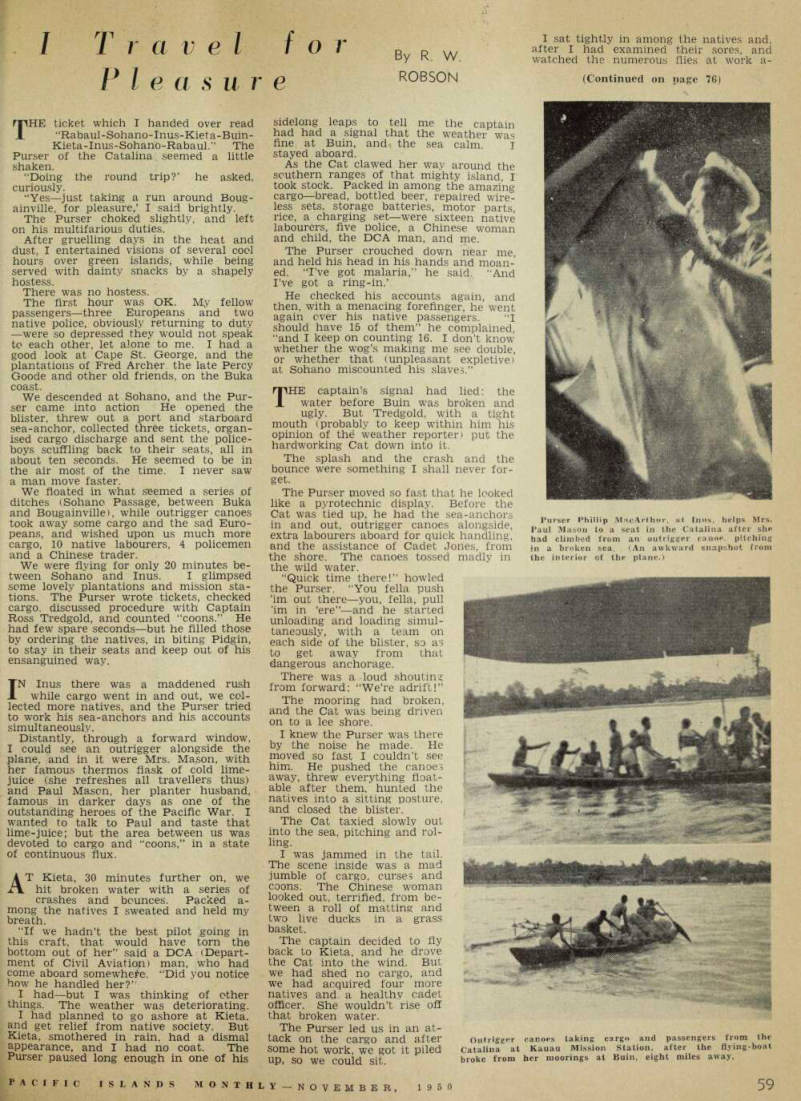
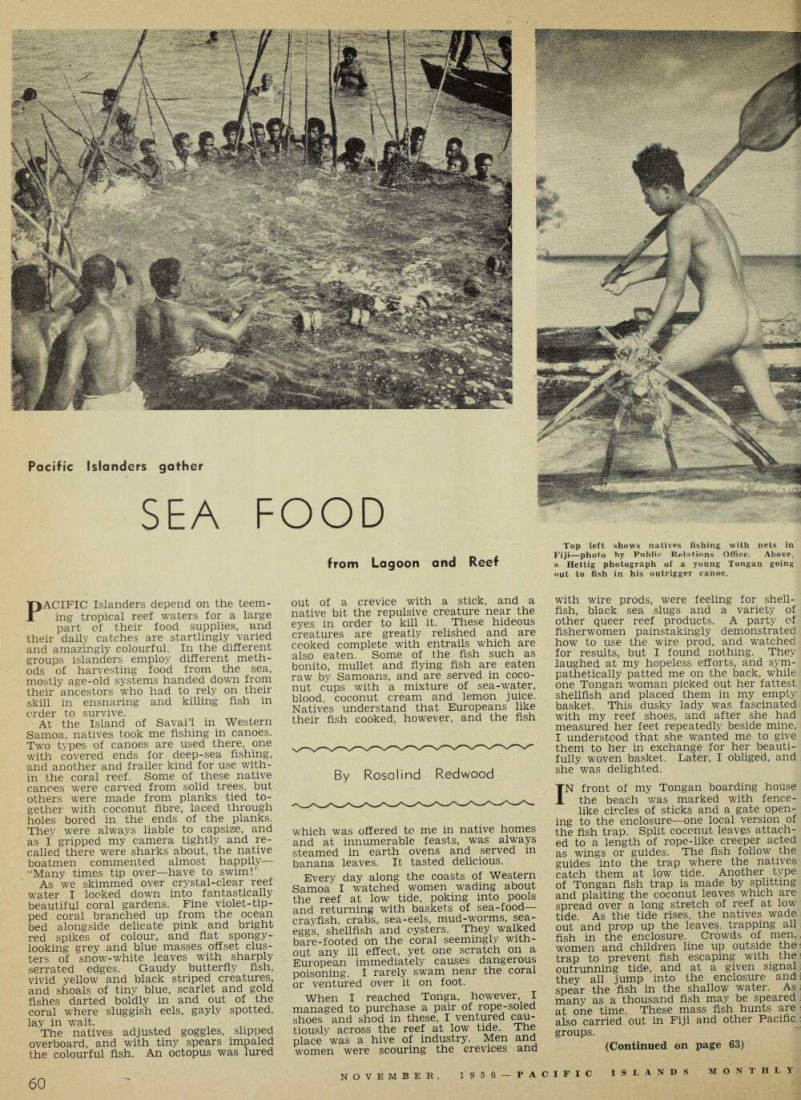
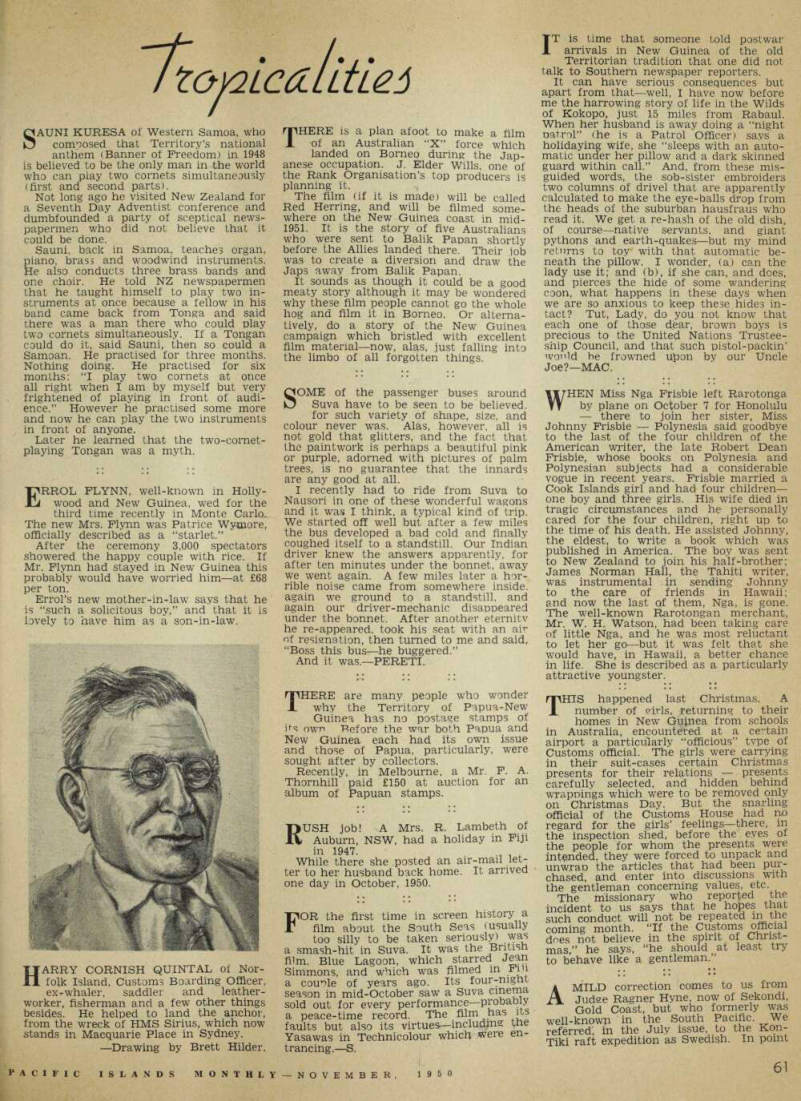
(Solution on page 63)
Across
I—Who1 —Who was the American lawyer, writer and lecturer and one of the world’s greatest orators principally against Christianity? 7. —Who was the composer of “Fra Diavolo”? 8. What was the name of the author of “Wind in the Willows”? 10. —What apparatus can locate objects by means of radio signals? 12. —Which Shakespearean hero is the symbol of the ideal lover? 13. —Which Italian lake near Naples was considered as the entrance to hell? 15. —What is the correct name for an easy gallop? 16. —Which American State is situated between Ken tucky. Michigan. Illinois and Ohio? 17. —What is obtained from beet? 19.—What is the name of the French philosopher and Editor of the first French Encyclopedia which occupied him 30 years? 21. —'What is the capital of Turkey?
Down
1. —Who is the “gloomy dean”? 2. —Which seaport is situated at the mouth of the Thames? 3. —Who wrote “The Martyrdom of Man”? 4. —Who was the recently deceased famous singer of Scottish songs? 5. —Which Bavarian city is famous for- its Passion plays? 6. —What is the term for an Englishman or American among Spanish speaking Americans?
9. —What is the ancient name of Ireland? 11.—Of which Canadian province is Winnipeg the capital? 14. —ln which “thal” or valley did Dr.
Fuhlrott find a human cranium which became famous as one of the most ancient fossil human remains? 15. —What is the capital of Egypt? 17. —What is the printer’s abbreviation signi fying “let it stand”? 18. —Who was the British physician who traced Malaria to the mosquitoes?
Solution to Crossquiz from Page 58
I Travel for Pleasure
Pleasure
By R. W.
Robson
mHE ticket which I handed over read X “Rabaul-Sohano-Inus-Kieta-Buin- Kieta-Inus-Sohano-Rabaul.” The Purser of the Catalina seemed a little shaken.
“Doing the round trip?’ he asked, curiously.
“Yes—just taking a run around Boug ainville, for pleasure,’ I said brightly.
The Purser choked slightly, and left on his multifarious duties.
After gruelling days in the heat and dust, I entertained visions of several cool hours over green islands, while being served with dainty snacks by a shapely hostess.
There was no hostess.
The first hour was OK. My fellow passengers—three Europeans and two native police, obviously returning to duty —were so depressed they would not speak to each other, let alone to me. I had a good look at Cape St. George, and the plantations of Fred Archer the late Percy Goode and other old friends, on the Buka coast.
We descended at Sohano, and the Pur ser came into action He opened the blister, threw out a port and starboard sea-anchor, collected three tickets, organ ised cargo discharge and sent the police boys scuffling back to their seats, all in about ten seconds. He seemed to be in the air most of the time. I never saw a man move faster.
We floated in what seemed a series of ditches (Sohano Passage, between Buka and Bougainville), while outrigger canoes took away some cargo and the sad Euro peans, and wished upon us much more cargo, 10 native labourers, 4 policemen and a Chinese trader.
We were flying for only 20 minutes be tween Sohano and Inus. I glimpsed some lovely plantations and mission sta tions. The Purser wrote tickets, checked cargo, discussed procedure with Captain Ross Tredgold, and counted “coons.” He had few spare seconds—but he filled those by ordering the natives, in biting Pidgin, to stay in their seats and keep out of his ensanguined way.
IN Inus there was a maddened rush while cargo went in and out, we col lected more natives, and the Purser tried to work his sea-anchors and his accounts simultaneously.
Distantly, through a forward window, I could see an outrigger alongside the plane, and in it were Mrs. Mason, with her famous thermos flask of cold lime juice (she refreshes all travellers thus) and Paul Mason, her planter husband, famous in darker days as one of the outstanding heroes of the Pacific War. I wanted to talk to Paul and taste that lime-juice; but the area between us was devoted to cargo and “coons,” in a state of continuous flux.
AT Kieta, 30 minutes further on, we hit broken water with a series of crashes and bounces. Packed a mong the natives I sweated and held my breath.
“If we hadn’t the best pilot going in this craft, that would have torn the bottom out of her” said a DCA (Depart ment of Civil Aviation) man, who had come aboard somewhere. “Did you notice how he handled her?”
I had—but I was thinking of other things. The weather was deteriorating.
I had planned to go ashore at Kieta. and get relief from native society. But Kieta, smothered in rain, had a dismal appearance, and I had no coat. The Purser paused long enough in one of his
sidelong leaps to tell me the captain had had a signal that the weather was fine at Buin, and- the sea calm. I stayed aboard.
As the Cat clawed her way around the southern ranges of that mighty island, I took stock. Packed in among the amazing cargo—bread, bottled beer, repaired wire less sets, storage batteries, motor parts, rice, a charging set —were sixteen native labourers, five police, a Chinese woman and child, the DCA man, and me.
The Purser crouched down near me, and held his head in his hands and moan ed. ‘T’ve got malaria,” he said. “And I’ve got a ring-in.’
He checked his accounts again, and then, with a menacing forefinger, he went again over his native passengers. “I should have 15 of them” he complained, “and I keep on counting 16. I don’t know whether the wog’s making me see double, or whether that (unpleasant expletive) at Sohano miscounted his slaves.”
THE captain’s signal had lied: the water before Buin was broken and ugly. But Tredgold, with a tight mouth (probably to keep within him his opinion of the weather reporter) put the hardworking Cat down into it.
The splash and the crash and the bounce were something I shall never for get.
The Purser moved so fast that he looked like a pyrotechnic display. Before the Cat was tied up, he had the sea-anchors in and out, outrigger canoes alongside, extra labourers aboard for quick handling, and the assistance of Cadet Jones, from the shore. The canoes tossed madly in
the wild water.
“Quick time there!” howled the Purser. “You fella push ’im out there —you, fella, pull 'im in ’ere”—and he started unloading and loading simul taneously, with a team on each side of the blister, so as to get away from that dangerous anchorage.
There was a loud shouting from forward; “We’re adrift!”
The mooring had broken, and the Cat was being driven on to a lee shore.
I knew the Purser was there by the noise he made. He moved so fast I couldn’t see him. He pushed the canoes away, threw everything float able after them, hunted the natives into a sitting posture, and closed the blister.
The Cat taxied slowly out into the sea, pitching and rol ling.
I was jammed in the tail.
The scene inside was a mad jumble of cargo, curses and coons. The Chinese woman looked out, terrified, from be tween a roll of matting and two live ducks in a grass basket.
The captain decided to fly back to Kieta, and he drove the Cat into the wind. But we had shed no cargo, and we had acquired four more natives and a healthy cadet officer. She wouldn’t rise off that broken water.
The Purser led us in an at tack on the cargo and after some hot work, we got it piled up, so we could sit.
I sat tightly in among the natives and, after I had examined their sores, and watched the numerous flies at work a
(Continued on page 76)
Purser Phillip MacArthur, at Inus, helps Mrs.
Paul Mason to a seat in the Catalina after she bad climbed from an outrigger canoe, pitching in a broken sea (An awkward snapshot from the interior of the plane.)
Outrigger canoes taking cargo and passengers from the Catalina at Kauau Mission Station, after the flying-boat broke from her moorings at Buin, eight miles away.
mong us all, I decided that I probably would acquire yaws, leprosy and tropical ulcers.
I was sitting wondering how we were going to get out of that sweating hell hole, and watching a small, reddish native being painfully and meticulously sick in a paper bag, and the Purser was abandoning himself to malarial misery, when he caught my eye. I suppose I looked wan-
He got up, crawled painfully over a heap of cargo and said, “Don’t worry Mr. Robinson. Qantas has the lowest accident rate in the world!”
CAPTAIN Tredgold got out of it by taxi’ing very slowly along the coast, for eight miles, to Kauau mission station. They grasped the sit uation quickly there and sent out can oes, and we lay on a sea-anchor close
to the beach, and slowly discharged all cargo and passengers, which were sent to Buin by jeep.
Then the empty Cat went blithely back to Kieta, where the now merry Pur ser brought aboard two weary Euro peans, a miscellariy of cargo a(nd a stretcher (wherein was an old native with a broken femur) which was placed between the double row of seats, at our feet.
Rain was coming down and the sea was getting up, and we bounced hard again at Inus.
Some well-known Bougainville women joined the plane ... if that is the cor rect term for transferring oneself and one’s bag, etc., from a pitching little canoe to a big rolling aircraft.
All was well, however. The Purser, hitherto a terror to the native passen gers and a bounding devil with the sea anchors, now became a very Galahad. Six ladies were brought aboard under diffi cult conditions —but not even a finger nail was chipped.
I greeted Mrs. Paul Mason eagerly.
“I’ve heard of your hospitality,” I said.
“Have you, by any chance, a bit of bis cuit in your bag? You see, no one eats aboard this craft —they’re much too busy -—and I had my breakfast at 6 o’clock.”
It is typical of Inus’s chatelaine that she is still apologising because she did’nt have second sight, and therefore did not know that I was aboard that plane in an ill-nourished condition.
From Inus to Sohano I argued quietly with Mrs. Bob Stewart. I said that the source of an offensive odour was a bag of fish, from Kieta. She —a stubborn woman—insisted that it was the inca pacitated native, lying so quietly in his dirty old blanket at our feet.
He was hospitalled at Sohano; and, as we rode into Rabaul in the dusk, I was able to forget the clamourings of my out raged stomach in pointing out to that argumentative woman that the offensive smell was still with us.
Sea Food
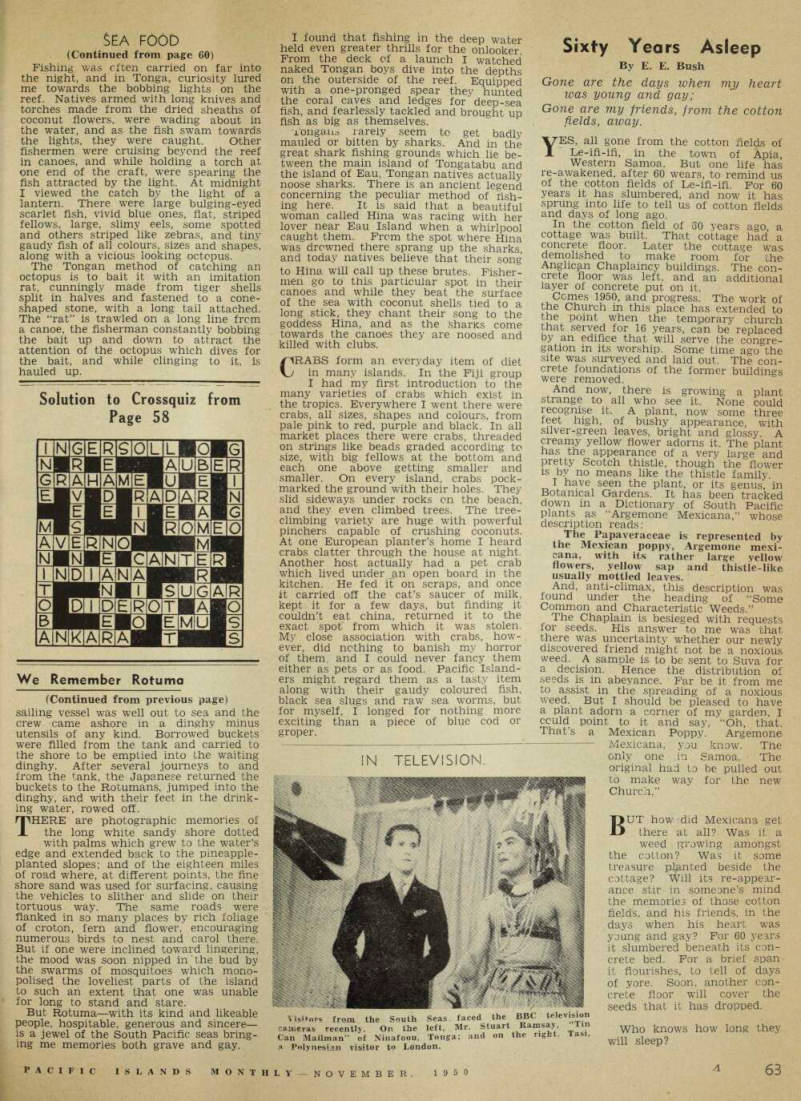
from Lagoon and Reef
PACIFIC Islanders depend on the teem ing tropical reef waters for a large part of their food supplies, and their daily catches are startlingly varied and amazingly colourful. In the different groups islanders employ different meth ods of harvesting food from the sea, mostly age-old systems handed down from their ancestors who had to rely on their skill in ensnaring and killing fish in order to survive.
At the Island of Savai’i in Western Samoa, natives took me fishing in canoes.
Two types of canoes are used there, one with covered ends for deep-sea fishing, and another and frailer kind for use with in the coral reef. Some of these native canoes were carved from solid trees, but others were made from planks tied to gether with coconut fibre, laced through holes bored in the ends of the planks.
They were always liable to capsize, and as I gripped my camera tightly and re called there were sharks about, the native boatmen commented almost happily— “ Many times tip over—have to swim!’
As we skimmed over crystal-clear reef water I locked down into fantastically beautiful coral gardens. Fine violet-tip ped coral branched up from the ocean bed alongside delicate pink and bright red spikes of colour, and flat spongy looking grey and blue masses offset clus ters of snow-white leaves with sharply serrated edges. Gaudy butterfly fish, vivid yellow and black striped creatures, and shoals of tiny blue, scarlet and gold fishes darted boldly in and out of the coral where sluggish eels, gayly spotted, lav in wait.
The natives adjusted goggles, slipped overboard, and with tiny spears impaled the colourful fish. An octopus was lured
out of a crevice with a stick, and a native bit the repulsive creature near the eyes in order to kill it. These hideous creatures are greatly relished and are cooked complete with entrails which are also eaten. Some of the fish such as bonito, mullet and flying fish are eaten raw by Samoans, and are served in coco nut cups with a mixture of sea-water, blood, coconut cream and lemon juice.
Natives understand that Europeans like their fish cooked, however, and the fish
By Rosalind Redwood
which was offered to me in native homes and a t innumerable feasts, was always steamed in earth ovens and served in banana leaves. It tasted delicious. dav a i ong the coasts of Western Q a rnoa I watched women wading about at low tide, poking into pools reel ar iow g , 0 5 f sea-food— ana returning w mud-worms, sea- “ayhsh. crabs sea eeis walked b lre’ -footed on the coral seemingly witha nv ill effect, yet one scratch on a Em-o Sean immediately causes dangerous Trarely warn near the coral P°A„nhi r e d over it on foot. ° r ventured over it on iooi, When I reached Tonga, however, I managed to purchase a P a T ir shoes and shod in these I ventured cautiously across the reef at low tide. The place was rev ¥cls Ind women were scouring the crevices ana
with wire prods, were feeling for shell fish, black sea slugs and a variety of other queer reef products. A party of fisherwomen painstakingly demonstrated how to use the wire prod, and watched for results, but I found nothing. They laughed at my hopeless efforts, and sym pathetically patted me on the back, while one Tongan woman picked out her fattest shellfish and placed them in my empty basket. This dusky lady was fascinated with my reef shoes, and after she had measured her feet repeatedly beside mine, I understood that she wanted me to give them to her in exchange for her beauti fully woven basket. Later, I obliged, and she was delighted.
IN front of my Tongan boarding house the beach was marked with fence like circles of sticks and a gate open ing to the enclosure-one local version of the fish trap. Split coconut leaves attach ed to a length of rope-like creeper acted as wings or guides. The fish follow the guides into the trap where the natives catch them at low tide. Another type of Tongan fish trap is made by splitting and plaiting the coconut leaves which are spread over a long stretch of reef at low tide. As the tide rises, the natives wade out and prop up the leaves, trapping all fish in the enclosure. Crowds of men, women and children line up outside the trap to prevent fish escaping with the outrunning tide, and at a given signal they all jump into the enclosure and spear the fish in the shallow water. As many as a thousand fish may be speared at one time. These mass fish hunts are also carried out in Fiji and other Pacific groups.
(Continued on page 63)
Top left shows natives fishing with nets in Fiji—photo hy Public Relations Office. Above, a Hettig photograph of a young Tongan going out to fish in his outrigger canoe.
Pacific Islanders gather
Fishing was often carried on far into the night, and in Tonga, curiosity lured me towards the bobbing lights on the reef. Natives armed with long knives and torches made from the dried sheaths of coconut flowers, were wading about in the water, and as the fish swam towards the lights, they were caught. Other fishermen were cruising beyond the reef in canoes, and while holding a torch at one end of the craft, were spearing the fish attracted by the light. At midnight I viewed the catch by the light of a lantern. There were large bulging-eyed scarlet fish, vivid blue ones, flat, striped fellows, large, slimy eels, some spotted and others striped like zebras, and tiny gaudy fish of all colours, sizes and shapes, along with a vicious looking octopus.
The Tongan method of catching an octopus is to bait it with an imitation rat, cunningly made from tiger shells split in halves and fastened to a cone shaped stone, with a long tail attached.
The “rat” is trawled on a long line frcm a canoe, the fisherman constantly bobbing the bait up and down to attract the attention of the octopus which dives for the bait, and while clinging to it, is hauled up.
Tropicalities
SAUNI KURESA of Western Samoa, who composed that Territory’s national anthem (Banner of Freedom) in 1948 is believed to be the only man in the world who can play two cornets simultaneously (first and second parts).
Not long ago he visited New Zealand for a Seventh Day Adventist conference and dumbfounded a party of sceptical news papermen who did not believe that it could be done.
Sauni, back in Samoa, teaches organ, piano, brass and woodwind instruments.
He also conducts three brass bands and one choir. He told NZ newspapermen that he taught himself to play two in struments at once because a fellow in his band came back from Tonga and said there was a man there who could play two cornets simultaneously. If a Tongan could do it, said Sauni, then so could a Samoan. He practised for three months.
Nothing doing. He practised for six months; “I play two cornets at once all right when I am by myself but very frightened of playing in front of audi ence.” However he practised some more and now he can play the two instruments in front of anyone.
Later he learned that the two-cornet playing Tongan was a myth.
ERROL FLYNN, well-known in Holly wood and New Guinea, wed for the third time recently in Monte Carlo.
The new Mrs. Flynn was Patrice Wymore, officially described as a “starlet.”
After the ceremony 3,000 spectators showered the happy couple with rice. If Mr. Flynn had stayed in New Guinea this probably would have worried him—at £6B per ton.
Errol’s new mother-in-law says that he is “such a solicitous boy,” and that it is lovely to have him as a son-in-law.
THERE is a plan afoot to make a film of an Australian “X” force which landed on Borneo during the Jap anese occupation. J. Elder Wills, one of the Rank Organisation’s top producers is planning it.
The film (if it is made) will be called Red Herring, and will be filmed some where on the New Guinea coast in mid -1951. It is the story of five Australians who were sent to Balik Papan shortly before the Allies landed there. Their iob was to create a diversion and draw the Japs away from Balik Papan.
It sounds as though it could be a good meaty story although it may be wondered why these film people cannot go the whole hog and film it in Borneo. Or alterna tively, do a story of the New Guinea campaign which bristled with excellent film material—now, alas, just falling into the limbo of all forgotten things.
SOME of the passenger buses around Suva have to be seen to be believed, for such variety of shape, size, and colour never was. Alas, however, all is not gold that glitters, and the fact that the paintwork is perhaps a beautiful pink or purple, adorned with pictures of palm trees, is no guarantee that the innards are any good at all.
I recently had to ride from Suva to Nausori in one of these wonderful wagons and it was I think, a typical kind of trip.
We started off well but after a few miles the bus developed a bad cold and finally coughed itself to a standstill. Our Indian driver knew the answers apparently, for after ten minutes under the bonnet, away we went again. A few miles later a hor rible noise came from somewhere inside, again we ground to a standstill, and again our driver-mechanic disappeared under the bonnet. After another eternitv he re-appeared, took his seat with an air of resignation, then turned to me and said, “Boss this bus —he buggered.”
And it was.—PERETI.
THERE are many people who wonder why the Territory of Papua-New Guinea has no postage stamps of its own Before the war both Papua and New Guinea each had its own issue and those of Papua, particularly, were sought after by collectors.
Recently, in Melbourne, a Mr. F. A.
Thornhill paid £l5O at auction for an album of Papuan stamps.
RUSH job! A Mrs. R. Lambeth of Auburn, NSW, had a holiday in Fiji in 1947.
While there she posted an air-mail let ter to her husband back home. It arrived one day in October, 1950.
FOR the first time in screen history a film about the South Seas (usually too silly to be taken seriously) was a smash-hit in Suva. It was the British film. Blue Lagoon, which starred Simmons, and which was filmed in Fin a couffie of years ago. Its four-night season in mid-October saw a Suva cinema sold out for every performance—probably a peace-time record. The film has its faults but also its virtues —including the Yasawas in Technicolour which were en trancing.—S.
IT is time that someone told postwar arrivals in New Guinea of the old Territorian tradition that one did not talk to Southern newspaper reporters.
It can have serious consequences but apart from that—well, I have now before me the harrowing story of life in the Wilds of Kokopo, just 15 miles from Rabaul.
When her husband is away doing a “night patrol” (he is a Patrol Officer) says a holidaying wife, she “sleeps with an auto matic under her pillow and a dark skinned guard within call.’’ And, from these mis guided words, the sob-sister embroiders two columns of drivel that are apparently calculated to make the eye-balls drop from the heads of the suburban hausfraus who read it. We get a re-hash of the old dish, of course—native servants, and giant pythons and earth-quakes—but my mind returns to toy with that automatic be neath the pillow. I wonder, (a) can the lady use it; and (b), if she can, and does, and pierces the hide of some wandering coon, what happens in these days when we are so anxious to keep these hides in tact? Tut, Lady, do you not know that each one of those dear, brown boys is precious to the United Nations Trustee ship Council, and that such pistol-packin’ would be frowned upon by our Uncle Joe?—MAC.
WHEN Miss Nga Frisbie left Rarotonga by plane on October 7 for Honolulu there to join her sister, Miss Johnny Frisbie Polynesia said goodbye to the last of the four children of the American writer, the late Robert Dean Frisbie, whose books on Polynesia and Polynesian subjects had a considerable vogue in recent years. Frisbie married a Cook Islands girl and had four children— one boy and three girls. His wife died in tragic circumstances and he personally cared for the four children, right up to the time of his death. He assisted Johnny, the eldest, to write a book which was published in America. The boy was sent to New Zealand to join his half-brother; James Norman Hall, the Tahiti writer, was instrumental in sending Johnny to the care of friends in Hawaii; and now the last of them, Nga, is gone.
The well-known Rarotongan merchant, Mr. W. H. Watson, had been taking care of little Nga, and he was most reluctant to let her go—but it was felt that she would have, in Hawaii, a better chance in life. She is described as a particularly attractive youngster.
THIS happened last Christmas. A number of girls. returning to their homes in New Guinea from schools in Australia, encountered at a certain airport a particularly “officious” tvpe of Customs official. The girls were carrying in their suit-cases certain Christmas presents for their relations presents carefully selected, and hidden behind wrappings which were to be removed only on Christmas Day. But the snarling official of the Customs House had no regard for the girls’ feelings—there, in the inspection shed, before the eyes of the people for whom the presents were intended, they were forced to unpack and unwrao the articles that had been pur chased, and enter into discussions with the gentleman concerning values, etc.
The missionary who reported the incident to us says that he hopes that such conduct will not be repeated in the coming month. “If the Customs official does not believe in the spirit of Christ mas,” he says, “he should at least try to behave like a gentleman.”
A MILD correction comes to us from Judge Ragner Hyne. now of Sekondi, Gold Coast, but who formerly was well-known in the South Pacific. We referred, in the July issue, to the Kon- Tiki raft expedition as Swedish. In point
Harry Cornish Quintal Of Nor
folk Island, Customs Boarding Officer, ex-whaler, saddler and leather worker, fisherman and a few other things besides. He helped to land the anchor, from the wreck of HMS Sirius, which now stands in Macquarie Place in Sydney.
Drawing by Brett Hilder.
of fact it was a Norwegian enterprise.
Judge Ragnar Hyne says that he and his wife were in Norway not long ago, and the people there were enthusiastic about the achievement of their countrymen. It will be remembered that, in order to demonstrate a theory concerning Poly nesian migration, the Norwegians brought trpir raft, drifting on ocean currents, from the coast of South America right into French Oceania.
RICHLY gilt silver inkstands and ash trays, each a gift of some British Empire territory or colony, are among the beautiful furnishings of the new House of Commons which was opened in London at the end of October.
Three of the ashtrays have been given by Malta, two by Gambia, two by Basu toland, and one each by Bechuanaland, Swaziland, the Falkland Islands, St. Vin cent, Zanzibar and Nyasaland. Single inkstands have been given by Dominica, Grenada, St. Lucia, and by Fiji (who sent 50 ounces of her own silver for the pur pose). Hong-Kong has given one triple silver-gilt inkstand, Nyasaland another and Bermuda two. British Guiana has presented four similar inkstands and. in addition, a fifth will be placed in the Council Chamber at Georgetown with an inscription to the effect that it is a replica of the gift presented to the House of Commons.
They were all designed by Sir Giles Gilbert and most of the work was carried out by some of the finest craftsmen in Britain in a workshop in the heart of London.
COULD this be an omen? The Insti tute of Pacific Relations is having a book sale. '“American Policy and the Chinese Revolution,” 431 pages by ‘Drrrnv B:,rg, has been marked down from $5 to sl. “American Policy in the Far East,” from $1.25 to 50 cents. “Future of South East Asia —An Indian View” — from $2 to 50 cents.—B.N.
YEARS ago one of the New Guinea firms, in an endeavour to combat the grasshopper nest, sent out a swag of those brown frogs, with which most Territorians are so familiar these days, to one of their larger properties. It was by way of being an exneriment, and the accompanying instructions directed the manager to release the frogs “under conditions conducive to further breeding.”
The manager’s letter in reply stated that he wasn’t very well versed in the biology of the frog, but he had done as much as his limited knowledge permitted In fact, he had let the frogs go under a pale yellow moon, with a gramophone playing soft music. He hoped that this met with their approval, remaining mean while, their faithful servant.— SEAHORSE Mr. E. J. Wauchope, who has been q coconut planter at Hansa Bay, near Madang, in New Guinea, for 25 years, has leased his plantations to Mr. C. G.
Bowman, Administration Officer at Bogia, who shortly will retire. Mr. Wauchone has acquired a property at Wallacia. near Penrith, NSW, where he will reside in future. He has been one of the best known planters of the New Guinea main land, taking a keen interest in public affairs, and his departure is a loss to the Territory.
Norfolk Islanders have formed a brass band under the direction of a conductor, who is a competent musician and who plays several instruments.
Advertisements & other items, p. 63 (1 item)
61
ACIFIC ISLANDS MONTHLY NOVEMBER, 1950
We Remember Rotuma
A. L. Austin
AS the sea roared in battle with Rotu ma’s coral reefs, the Pioneer’s pas sengers were taking a more than usual interest in the barometer. All were ashore with the weather very much on the ominous side, and while officials had checked up on departmental affairs on their one day's visit to Fiji’s adopted island, the passengers had explored the hillsides and had been caught in a down pour.
The demand for dry towels and clothes had been satisfied and now the victims stood around on the verandah drinking tea and looking much like a group in vaudeville, for the men had requisitioned all the shirts and trousers from my hus band’s supply. Shirts, taut on the larger chests and trousers in determined en casement of corpulent waist-lines, con trasted amusingly with the corrugated look of the same sized clothes worn by the smaller men; but through their joking remarks there penetrated concern at the falling barometer needle.
My husband and I were then new to the colony, and as we had not experienced a hurricane we scarcely knew what to ex pect. We had been told, too, that Rotuma lay outside the hurricane zone, so that every few minutes of calm convinced me that the storm was over. But the glass tapping continued and a funereal voice occasionally mourned, “It’s still dropping.”
With the wind’s louder howl, the ship’s officer literally blew in with the announce ment —“The Captain would like you all to come on board without delay so that he can make for the open sea.” So, with a final tap at the glass, our guests hurried their farewells, and later, through binocu lars, we watched them leave the launch to mount safely the gangway of the Pioneer.
The storm soon increased to even heavier squalls. Our reed car-shed became air-borne while we hoped that the car itself would remain grounded. Much to the amusement of our young daughter, I was soon able to make and sail paper boats on the now flooded verandah. But the Pioneer had not managed to get away after all, and messages reached us from time to time, during the next two days, that she was cruising along on whichever happened to be the most sheltered side of the island. The ship’s passengers were being distressingly tossed about and drums of oil had been emptied now and then upon the angry sea.
A faithful watcher —at the suggestion of the Rev. Fr. Griffon of the Roman Catho lic Mission —braced himself on the beach throughout these nights keeping his lan tern alight. At different times during the day we caught sight of the ship heaving about, and we felt especially sorry for the two children who were on board with their mother. Once or twice, during a lull, the concerned, sympathetic Captain Mullins tried to launch a boat to get some of the passengers ashore but the sea was too rough.
The usual devastation had taken place on land. Large areas of bush were blackened as if by fire. Tortured palm trees lay around in whipped defeat, their twisted fronds piled in exhausted heaps over land strewn with scraps of fencing, roofing iron, spouting and empty tins.
When at length the shaken passengers came ashore for a few days to recover from their unpleasant experience the sun shone once more. But we decided that it could not be said truthfully that Rotuma lay outside the hurricane zone.
IN that same year the British gun-boat, Laburnam, visited the island and the people made their biggest display of all
time in the ship’s honour. Every village took part in the celebrations and the old war-dances were executed with such vigour that the ground shook as the Ro tumans stamped along the main road.
Each man wore a magnificent head-dress of reeds and feathers, but as the excite ment increased it became disarranged until it resembled a plucked carcase perched precariously on the head of an elated victor.
Wrestling, and Samoan sword dances added to the entertainment and after a sincerely worded speech of appreciation from the Captain of Laburnam he was presented with an old war club by one of Rotuma’s chiefs who remarked, that, had the Captain been given the club in the bad old days it would have been incum bent upon him to kill a man with it.
IN our shipping facilities we were more fortunate in our time than the resi dents of Rotuma are to-day, taut we had no wireless communication, and if the expected ship didn’t arrive we were left ignorant as to the reason. This happened once when the monthly visit of the Makatea was ‘overdue, and the vessel was looked for every morning and given up every evening for a further fortnight.
The lorries stood idle, as the stores had run out of petrol. Flour dwindled, and the little that remained was mouldy. We oegan to wonder whether the end of the rest of the world had come with our island as the only one remaining, but before we were reduced to hard tack instead of bread, the Endeavour appeared on the horizon and our exile was over.
OUR house was so situated that a “lift ing” wind would sometimes sweep around the back of the building, and there were occasions when anyone occupy ing a particular room could be startled at night by the bed-clothes suddenly billow ing like an opening parachute.
The house-boy’s sleeping quarters lay in line with the hospital—in the same direc tion of the wind —and the Rotumans had feasted this boy’s mind with many stories of prowling spirits. One morning, just before dawn, the boy came pounding along the verandah screaming that the devil was in his house, and had not only caught hold of his leg, but had sat upon his chest. At tempts to pacify him were useless. He would never again sleep in his quarters but rolled himself up near the kitchen door at night. He threatened to leave us before the arrival of every boat, but re mained, after .all, until our time was up.
ONE day, the men decided to explore one of the island’s extinct volcanoes.
With stout rope and other mountain eering gear they set off with Rotumans as guides. The floor of the crater was guaranteed safe to stand upon, and one by one the men were lowered in and brought up again. The first man down disturbed some hundreds of bats and reported the carcase of a dog lying on the crater’s floor.
The last man to be lowered was the manager of a store buying a fair amount of copra at a poor—though ruling—rate of payment. No sooner was the store manager inside the crater, than the Rotu mans, in great glee, threatened to leave him there unless he gave them a better price for their copra. The poor man looked at the bones of the dog and didn’t like what he saw, but all ended happily when the Rotumans had had their joke and brought him to the top.
THEN there was the day when the Jap anese paid a peaceful visit to Rotuma in search of drinking water. Their (See opposite)
sailing vessel was well out to sea and the crew came ashore in a dinghy minus utensils of any kind. Borrowed buckets were filled from the tank and carried to the shore to be emptied into the waiting dinghy. After several journeys to and from the tank, the Japanese returned the buckets to the Rotumans, jumped into the dinghy, and with their feet in the drink ing water, rowed off.
THERE are photographic memories of the long white sandy shore dotted with palms which grew to the water’s edge and extended back to the pineapple planted slopes: and of the eighteen miles of road where, at different points, the fine shore sand was used for surfacing, causing the vehicles to slither and slide on their tortuous way. The same roads were flanked in so many places by rich foliage of croton, fern and flower, encouraging numerous birds to nest and carol there.
But if one were inclined toward lingering, the mood was soon nipped in the bud by the swarms of mosquitoes which mono polised the loveliest parts of the island to such an extent that one was unable for long to stand and stare.
But Rotuma —with its kind and likeable people, hospitable, generous and sincere— is a jewel of the South Pacific seas bring ing me memories both grave and gay.
1 found that fishing in the deep water held even greater thrills for the onlooker From the deck of a launch I watched naked Tongan boys dive into the depths on the outerside of the reef. Equipped with a one-pronged spear they hunted the coral caves and ledges for deep-sea fish, and fearlessly tackled and brought up fish as big as themselves.
T'ongans rarely seem to get badly mauled or bitten by sharks. And in the great shark fishing grounds which lie be tween the main island of Tongatabu and the island of Eau, Tongan natives actually noose sharks. There is an ancient legend concerning the peculiar method of fish ing here. It is said that a beautiful woman called Hina was racing with her lover near Eau Island when a whirlpool caught them. From the spot where Hina was drowned there sprang up the sharks, and today natives believe that their song to Hina will call up these brutes. Fisher men go to this particular spot in their canoes and while they beat the surface of the sea with coconut shells tied to a long stick, they chant their song to the goddess Hina, and as the sharks come towards the canoes they are noosed and killed with clubs.
CIRABS form an everyday item of diet j in many islands. In the Fiji group I had my first introduction to the many varieties of crabs which exist in the tropics. Everywhere I went there were crabs, all sizes, shapes and colours, from pale pink to red, purple and black. In all market places there were crabs, threaded on strings like beads graded according to size, with big fellows at the bottom and each one above getting smaller and smaller. On every island, crabs pock marked the ground with their holes. They slid sideways under rocks on the beach, and they even climbed trees. The tree climbing variety are huge with powerful pinchers capable of crushing coconuts.
At one European planter’s home I heard crabs clatter through the house at night.
Another host actually had a pet crab which lived under jan open board in the kitchen. He fed it on scraps, and once it carried off the cat’s saucer of milk, kept it for a few days, but finding it couldn’t eat china, returned it to the exact spot from which it was stolen.
My close association with crabs, how ever, did nothing to banish my horror of them and I could never fancy them either as pets or as food. Pacific Island ers might regard them as a tasty item along with their gaudy coloured fish, black sea slugs and raw sea worms, but for myself, I longed for nothing more exciting than a piece of blue cod or groper.
Sixty Years Asleep
By E. E. Bush
Gone are the days when my heart was young and gay; Gone are my friends, from the cotton
fields, away.
YES, ail gone from the cotton fields of Le-ifi-ifi, in the town of Apia, Western Samoa. But one life has re-awakened, after 60 wears, to remind us of the cotton fields of Le-ifi-ifi. For 60 years it has slumbered, and now it has sprung into life to tell us of cotton fields and days of long ago.
In the cotton field of 60 years ago, a cottage was built. That cottage had a concrete floor. Later the cottage was demolished to make room for the Anglican Chaplaincy buildings. The con crete floor was left, and an additional layer of concrete put on it.
Comes 1950, and progress. The work of the Church in this place has extended to the point when the temporary church that served for 16 years, can be replaced by an edifice that will serve the congre gation in its worship. Some time ago the site was surveyed and laid out. The con crete foundations of the former buildings were removed.
And now, there is growing a plant strange to all who see it. None could recognise it. A plant, now some three feet high, of bushy appearance, with silver-green leaves, bright and glossy. A creamy yellow flower adorns it. The plant has the appearance of a very large and pretty Scotch thistle, though the flower is by no means like the thistle family.
I have seen the plant, or its genus, in Botanical Gardens. It has been tracked down in a Dictionary of South Pacific plants as “Argemone Mexicana,” whose description reads; The Papaveraceae is represented by the Mexican poppy, Argemone mexi cana. with Its rather large yellow flowers, yellow sap and thistle-like usually mottled leaves.
And, anti-climax, this descrintion was found under the heading of “Some Common and Characteristic Weeds.”
The Chaplain is besieged with requests for seeds. His answer to me was that there was uncertainty whether our newly discovered friend might not be a noxious weed. A sample is to be sent to Suva for a decision. Hence the distribution of seeds is in abeyance. Far be it from me to assist in the spreading of a noxious weed. But I should be pleased to have a plant adorn a corner of my garden, I cculd point to it and say, “Oh, that.
That’s a Mexican Poppy. Argemone
Mexicana, you know. The only one in Samoa. The original had to be pulled out to make way for the new Church.”
BUT how did Mexicana get there at all? Was it a weed (growing amongst the cotton? Was it some treasure planted beside the cottage? Will its re-appear ance stir in someone’s mind the memories of those cotton fields, and his friends, in the days when his heart was young and gay? For 60 years it slumbered beneath its con crete bed. For a brief span it flourishes, to tell of days of yore. Soon, another con crete floor will cover the seeds that it has dropped.
Who knows how long they will sleep?
In Television.
Visitors from the South Seas faced the BBC television cameras recently. On the left, Mr, Stuart Ramsay, "Tin Can Mailman” of Niuafoou, Tonga; and on the rignt, Tasi, a Polynesian visitor to London.
Advertisements & other items, pp. 65-68 (5 items)
63
Sea food (Continued from page 60)
We Remember Rotuma (Continued from previous page)
PACIFIC ISLANDS MONTHLY NOVEMBER, 1950
fashion . . .
A frock in mercerised cotton with stitched-in front and the new peaked cuffs of white pique. Skirt has unpressed pleats. The white grosgrain, head-fitting hat is this yfear s
Corner For The Children
Burns Philp (New Guinea) Limited
General Merchants (Wholesale and Retail)
Shipping, Customs and General Agents
Head Office: PORT MORESBY, PAPUA
BRANCHES:
NEW GUINEA: Rabaul, Kokopo, Lae Cr Madang.
PAPUA: Samarai.
REPRESENTATIVES FOR;
AUSTRALIAN AGENTS:
LONDON AGENTS:
SAN FRANCISCO AGENTS:
QUEENSLAND INSURANCE CO. LTD.
LLOYD S OF LONDON
BURNS PHILP TRUST CO. LTD-
BURNS, PHILP Cr CO. LTD.
All States.
BURNS, PHILP Cr CO. LTD.
"London House", 35 Crutched Friars, E.C.3.
BURNS, PHILP CO. OF SAN FRANCISCO INC 510 Matson Building.
Distributing Agents, Territory of Papua-New Guinea for;
SHELL COMPANY OF AUSTRALIA LIMITED
Petroleum Products
GENERAL MOTORS CORPORATION
Chevrolet, Buick, Pontiac and Oldsmobile Cars Chevrolet and GMC Trucks Frigidaire Refrigerators
VAUXHALL MOTORS LIMITED
Vauxhall Cars and Bedford Trucks
R. A. LISTER Cr CO., BRISTOL
Producers of Petrol, Paraffin and Diesel Engines Pumps and Lighting plants
RUSTON HORNSBY LIMITED
Engines
CROSSLEY MARINE ENGINES
Corrugated Aluminium
Building Sheets
HI I
For speed of erection
Corrugated Aluminium Building Sheets have many advantages over other roofing and siding materials. The lightness of the metal enables easier handling, with a considerable saving in transportation and erection costs.
It is highly resistant to corrosion, and reflects a high percentage of all radiant heat.
Painting is not necessary, and no special maintenance is required.
Corrugated Aluminium Building Sheets are available as listed below .
Widths: Lengths: 26 in. with eight 3 in. corrugations, 32 in. with ten 3 in. corrugations. 26 in. with nine 2| in. corrugations. 31 in. with eleven 2f in. corrugations. 6,7, 8,9, 10, 11 and 12 ft.
Thicknesses: 20, 22, 23, 24 and 26 Imperial Standard Wire Gauge.
ALUMINIUM UNION LIMITED
SALES AGENTS:
(Incorporated in the Dominion of Canada) Principal British Commonwealth Distributor of Aluminium Ocean House, 34 Martin Place, Sydney, N.S.W.
An ALUMINIUM LIMITED Company
Fiji, Western Samoa and Tonga : Morris, Hedstrom, Limited, Suva, Fiji.
Cook Islands: A, B. Donald Limited, Rarotonga, Cook Islands.
French Oceania: Etablissements Donald Tahiti, Papeete, Tahiti.
New Caledonia and New Hebrides: Agence Alma, 39 Rue de I’Alma, Noumea, New Caledonia.
LONDON
MONTREAL
CALCUTTA
SYDNEY
SHANGHAI
KARACHI
TOKYO
66
NOVEMBER 195 (J PACIFIC I S I A N D S MONTHLY
Roads To Interior Of N. Guinea
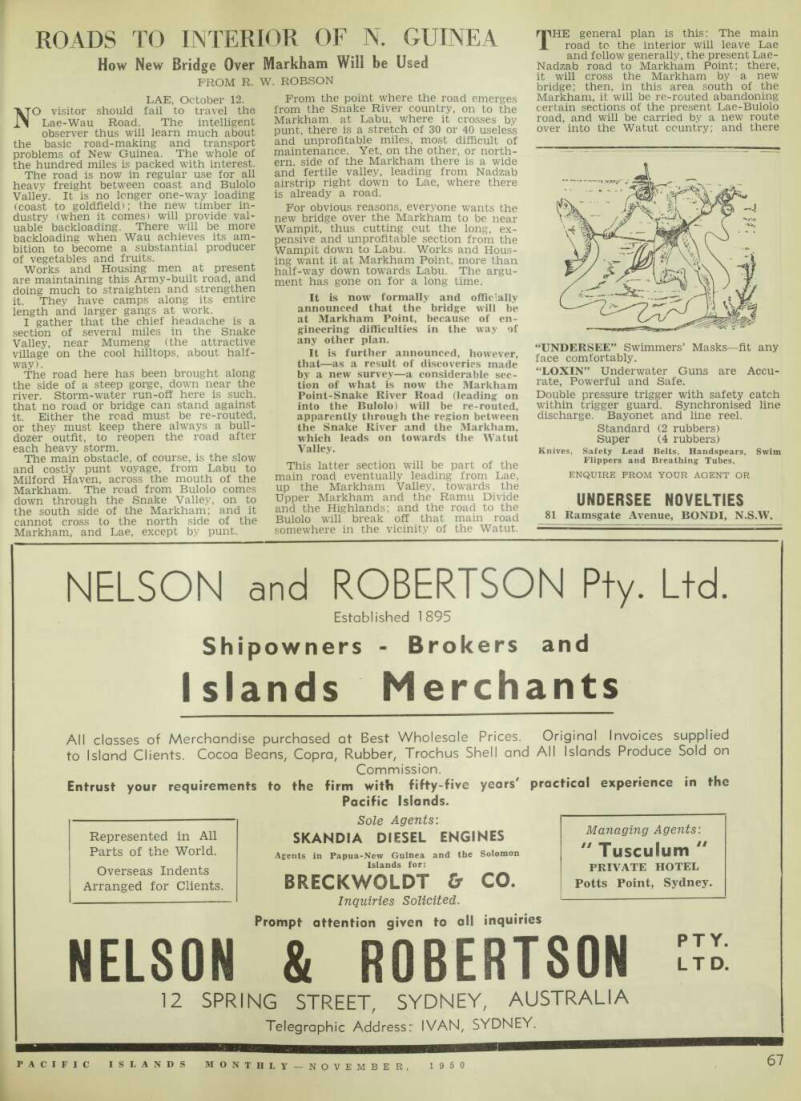
How New Bridge Over Markham Will be Used
From R. W. Robson
LAE, October 12.
NO visitor should fail to travel the Lae-Wau Road. The intelligent observer thus will learn much about the basic road-making and transport problems of New Guinea. The whole of the hundred miles is packed with interest.
The road is now in regular use for all heavy freight between coast and Bulolo Valley. It is no longer one-way loading (coast to goldfield); the new timber in dustry (when it comes) will provide val uable backloading. There will be more backloading when Wau achieves its am bition to become a substantial producer of vegetables and fruits.
Works and Housing men at present are maintaining this Army-built road, and doing much to straighten and strengthen it. They have camps along its entire length and larger gangs at work.
I gather that the chief headache is a section of several miles in the Snake Valley, near Mumeng (the attractive village on the cool hilltops, about half way).
The road here has been brought along the side of a steep gorge, down near the river. Storm-water run-off here is such, that no road or bridge can stand against it. Either the road must be re-routed, or they must keep there always a bull dozer outfit, to reopen the road after each heavy storm.
The main obstacle, of course, is the slow and costly punt voyage, from Labu to Milford Haven, across the mouth of the Markham. The road from Bulolo comes down through the Snake Valley, on to the south side of the Markham; and it cannot cross to the north side of the Markham, and Lae, except by punt.
From the point where the road emerges from the Snake River country, on to the Markham at Labu, where it crosses by punt, there is a stretch of 30 or 40 useless and unprofitable miles, most difficult of maintenance. Yet, on the other, or north ern. side of the Markham there is a wide and fertile valley, leading from Nadzab airstrip right down to Lae, where there is already a road.
For obvious reasons, everyone wants the new bridge over the Markham to be near Wampit, thus cutting cut the long, ex pensive and unprofitable section from the Wampit down to Labu. Works and Hous ing want it at Markham Point, more than half-way down towards Labu. The argu ment has gone on for a long time.
It is now formally and officially announced that the bridge will be at Markham Point, because of en gineering difficulties in the way of any other plan.
It is further announced, however, that —as a result of discoveries made by a new survey—a considerable sec tion of what is now the Markham Point-Snake River Road (leading on into the Bulolo) will be re-routed, apparently through the region between the Snake River and the Markham, which leads on towards the Watut Valley.
This latter section will be part of the main road eventually leading from Lae, up the Markham Valley, towards the Upper Markham and the Ramu Divide and the Highlands: and the road to the Bulolo will break off that main road somewhere in the vicinity of the Watut.
THE general plan is this; The main road to the interior will leave Lae and fellow generally, the present Lae- Nadzab road to Markham Point; there, it will cross the Markham by a new bridge; then, in this area south of the Markham, it will be re-routed abandoning certain sections of the present Lae-Bulolo road, and will be carried by a new route over into the Watut country; and there
the road will branch, one section picking up the present highway to the Bulolo, and a new section providing the new highway on towards the Highlands.
Sooner or later, there must be a road connection between the vast, newly-dis covered Highlands region, and its natural port, Lae, at the mouth of the Markham Valley. Whether they are right or wrong, the road engineers of today are trying to combine this project with that of im
proving the present Lae-Wau road, and cutting out the Labu-Lae punt crossing, at the mouth of the Markham.
Mr. Everard Judd, of the Rural Bank of New South Wales, was in Fiji in October to advise the Government on a scheme for industrial and rural credit. Mr. Judd’s brother, Mr. James Judd, was a former District Commissioner in Fiji.
Advertisements & other items, pp. 69-70 (1 item)
Nelson & Robertson Ki
“UNDERSEE” Swimmers’ Masks—fit any face comfortably.
“LOXIN” Underwater Guns are Accurate, Powerful and Safe.
Double pressure trigger with safety catch within trigger guard. Synchronised line discharge. Bayonet and line reel.
Standard (2 rubbers) Super (4 rubbers) Knives, Safety Lead Belts, Handspears, Swim Flippers and Breathing Tubes.
ENQUIRE FROM YOUR AGENT OR
UNDERSEE NOVELTIES
81 Ramsgate Avenue, BONDI, N.S.W.
NELSON and ROBERTSON Pty. Ltd.
Established 1895
Shipowners - Brokers and
Islands Merchants
All classes of Merchandise purchased at Best Wholesale Prices. Original Invoices supplied to Island Clients. Cocoa Beans, Copra, Rubber, Trochus Shell and All Islands Produce Sold on Commission.
Entrust your requirements to the firm with fifty-five years' practical experience in the Pacific Islands.
Prompt attention given to all inquiries
NELSON & ROBERTSON Ki
12 SPRING STREET, SYDNEY, AUSTRALIA
Telegraphic Address: - IVAN, SYDNEY.
A. B. DONALD Ltd
AUCKLAND, N.Z.
ISLAND TRADERS & GENERAL MERCHANTS
P.O. Box 1509. Cables £r Telegrams, "Kingdom," Auckland.
Death Of Mrs. Lilian Bailey
MRS. LILIAN BAILEY, who taught at Levuka Public School and later the Suva Girls’ Grammar School for over 20 years, and who then became Matron of the Suva Girls’ Grammar School Hostel, died on September 30, in Georgetown, British Guiana. She was living there with her daughter, Mrs. D. ffrench-Mullen.
Mrs. Bailey was born in Tasmania. She went to Fiji to join the staff of Levuka Public School. Her husband was a part ner in the once well-known Levuka firm of Hjorring & Bailey.
Cheaper Electricity For
Suva
WHILE everything else is going up in price the Suva Town Council has reduced the charges for electric current.
The charge for lighting has been reduced from Sid. to 4id. a unit and the charge for industrial and domestic power has come down from 2id. to 2£d. a unit.
The Mayor (Mr. Alport Barker) ex plained that the reductions had been made possible by the increased demand for power.
Fiji Health Stamps
HEALTH stamps will be issued in Fiji about the middle of next year and profits from their sale will go to the War Memorial Anti-Tuberculosis Fund.
Stamps will cost 2d. (Id. postage and Id. for the Fund) and 3d. (2d. postage and Id. for the Fund).
The designs for the stamps were sub mitted in a recent comnetition in the Colony by Mr. Charles A. Stinson and Miss Inez Stinson.
Advertisements & other items, p. 70 (1 item)
Soap
i mm Hlffra I 71 M V Va 3
for that weekly issue!
2-OZ. CAKES OF PLAIN SOAP
PACKED READY FOR
ISSUE IN CASES
CONTAINING 400 CAKES
A G. W. PENNELL PRODUCT
obtainable from GOLYER WATSON PTY. LTD. 22 s „
Newsletter From Tahiti
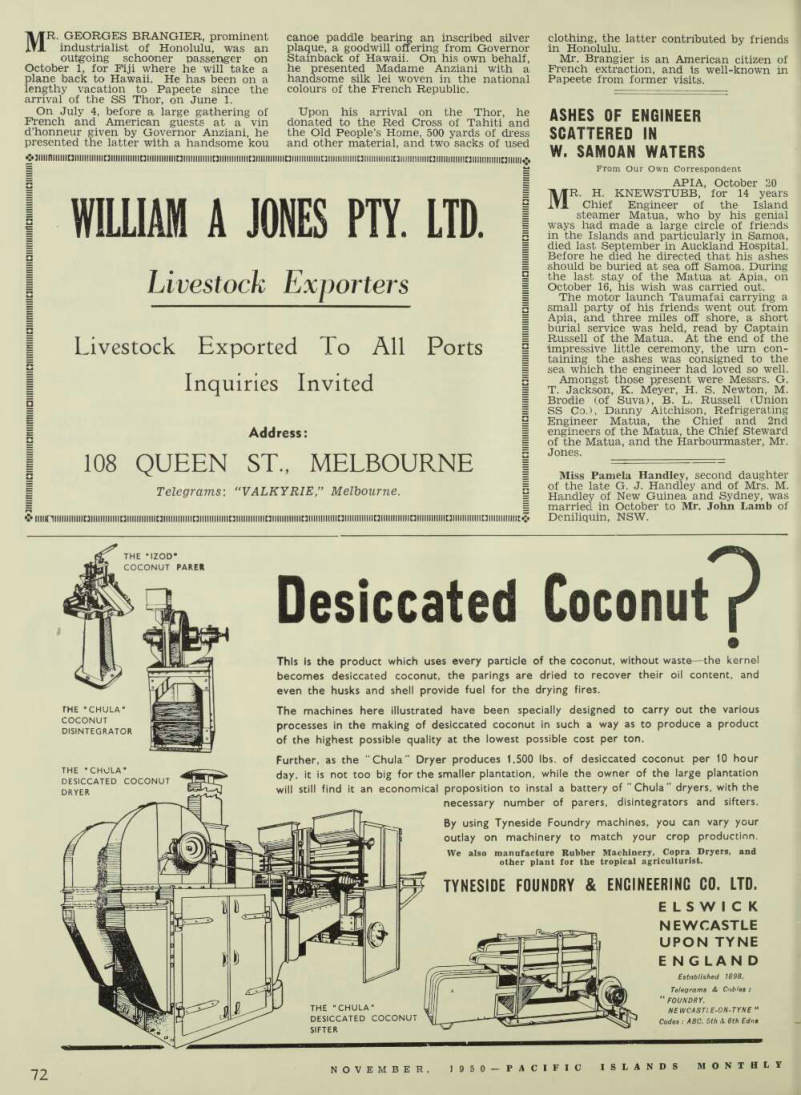
From Our Own Correspondent
PAPEETE, October 2 DUE to an exceedingly long dry season, Tahiti is experiencing something of a drought. Although rain continues to fall in the interior mountains of the island, and clouds hover above the coastal districts, the plains are parched and dry.
Cattle are commencing to look gaunt and to forage afar for fodder, while feed of all kinds is becoming more and more diffi cult to obtain.
From the same cause, apparently, numerous minor sicknesses are reported among children and have assumed almost epidemic proportions. For the time being schools have been closed as a precaution ary measure. Everyone is looking forward anxiously to the seasonal rains which are expected to commence in another few weeks.
THE new 800-ton dry dock at Papeete is rapidly approaching completion. The enterprise was made possible by means of the Economic Co-operation Act of 1948 acting jointly with the Public Works Department of France. Initial work was begun in July 1949 by the Tahiti Department of Public Works which made good progress and prepared the way for American civil engineers on their arrival in December. Construction will be com pleted this month.
The new dry dock is of the railway or marine type which enables vessels to be hauled in a cradle from the water along a track by electrical machinery. Sliding bilge blocks supported on transversal oeams and operated by chains and hand winches are located along the docking platform at each side of the cradle to keep the vessel on an even keel. By means of a side transfer dock, after the vessel has been drawn up from the water, it may be moved laterally to an adjoining platform, thus doubling the normal 800 ton capacity of the dock, and allowing two ships to be worked on at the same time.
Construction and installation of the dock and necessary machinery has been in charge of Civil Engineer V. I. Hight of Crandall Dry Dock Engineers, Cam bridge, Mass. Total cost of the under taking is about $200,000. All material employed, except stone and sand locally produced, was Imported from America.
THE new building of the Institut de Recherches de I’Oceanie Francaise in Papeete, was officially opened on September 9.
Guests were welcomed by Governor Anziani and Dr. Mille, Director of the Institute, who were attended by the Secretary General, the president of the Representative Assembly, the Public Prosecutor of the Republic, the Chief of Cabinet, the Commandant of the Auto nomous Company, the Mayor of Papeete, the civil and military doctors of the city and other distinguished residents.
Accompanying Dr. Mille were Doctors Beye, Rosen and Kessel, the latter on a misson from the University of Southern California in which he is president of Filarial Research. From the same Uni versity also was Dr. Edgar, since returned to America, who with Dr. Rosen, in co operation with Dr. Mille, had started the organising of the new institute of research in Tahiti.
In his speech to the assembled guests, Dr. Mille stated that the Institute is the first permanent centre of investigation established in the Pacific which is devoted to the study of tropical diseases generally, and to the investigation of syphilis, tuber culosis, leprosy and elephantiasis. The incidence of these latter diseases is not confined to Oceania, and therefore the
work of the Institute will interest and be of assistance to medical practitioners generally.
Following Dr. Mille, Governor Anziani gave a brief summary of the history of the new Institute which has been founded by close co-operation between the Uni versity of Southern California and the French medical profession. Funds for this work have been contributed by American philanthropists and by many benefactors in Tahiti. The Governor concluded his address with a tribute of appreciation to the splendid work of Drs. Beye, Rosen and Edgar.
Guests later wished the Institute suc cess in champagne.
The building has been constructed throughout according to the best prin ciples of modern architecture, particular
attention being given to lighting and ventilation.
Although the new Institute has been launched with great eclat, disappointment is being expressed in Papeete that only
those who subscribed large amounts to the building fund were deemed worthy of invitation to its inauguration. In an undertaking, dependent for its success on the co-operation of all classes of the com munity, it is essential to enlist the con tinual interest of all its members, and not to dampen the ardour of the less affluent by ignoring their past help. After all, the widow’s mite was her all. Many of those in Tahiti who donated their small subscriptions to the cause gave as liberally of their means and are as much entitled to recognition as those more fortunate who contributed of their wealth.
ON September 15, in the presence of Governor Anziani and many other distinguished residents of Papeete, the Reverend Pastor Charles Vernier, President of the Superior Council of the Protestant Churches of Tahiti was awarded the insignia of Chevalier of the Legion of Honour of France.
Mr. Vernier comes of a family long dis tinguished for its devotion and outstanding services to the people of Franch Oceania.
His father, the elder Vernier, commenced his pastorate in the Colony in 1867, only relinquishing the Presidency of the churches in 1907. His three sons, Paul, Andre and Charles, were all born in Tahiti and held high office in the Protestant church there with characteristic ability and success.
The Reverend Charles Vernier is an erudite scholar and authoritv on the Tahitian language. He possesses deep understanding of the Polynesians. During the late war he lost both his sons. In 1945, together with Madame Vernier, he made a visit to France where he remained two years. Upon return to Tahiti he was induced to offer himself as candidate for election as Deputy for French Oceania to the Legislative Assembly of France, but, to the regret of his many friends, in this he was unsuccessful.
Mr. Charles Henderson, British
Consul at Papeete has announced his resignation from office and will shortly depart for New Zealand. Lately he returned to his post in Papeete after a vacation of some months because of ill health. Unfortunately while absent he was involved in a car accident and re turned to Tahiti not fully recovered. His presence will be missed in social gather ings in Papeete.
Mr. W. W. Asmus who was in charge of the Consulate during the absence of Mr. Henderson, will now become British Consul in Tahiti.
INFORMATION has been received of the promotion of Monseigneur David le Cadre, Apostolic Vicar of the Mar ouesas Islands to the dignity of Officer of the Legion of Honour. The same honour has been conferred on M. Emile Martin, industrialist of Papeete, at present resid ing in Paris.
MR. ARTHUR E. MOORE, manager of the Yorkshire Insurance Company was a departing passanger to New Zealand aboard the SS Waikawa on August 23, after a visit to Tahiti in the interest of his firm.
He expressed himself well pleased with his six months in Papeete and said that he would have much to report regarding the progress seen in all parts of the city— the reorganisation and rebuilding of the Royal Tahitian and Tropiques hotels, the completion of the new 800-ton dry dock, the new building of the Institute of Medical Research and the establishment of a permanent amusement park.
The day he sailed, he asked Oscar Nordman jocularly, whether the captain of the ship on which he was leaving would blow the traditional three blasts of good bye. Mr. Nordman had, some time before, installed a ship’s syren at his home for just that purpose, and when Mr. Moore’s
vessel left the quay, he was no doubt sur prised to hear a prolonged farewell salute come biarlng across the harbour.
Mr. Nordman says that he intends, from now on, to salute all departing passenger vessels in the same way. He says it is his ambition to see built on the rocks at the entrance to the harbour, a tall tower 'mbiazoned with the word “laorana” and illuminated at night, to welcome visitors in the same way that Honolulu greets tourists with its celebrated Aloha tower.
MR. GEORGES BRANGIER, prominent industrialist of Honolulu, was an outgoing schooner passenger on October 1, for Fiji where he will take a plane back to Hawaii. He has been on a lengthy vacation to Papeete since the arrival of the SS Thor, on June 1.
On July 4, before a large gathering of French and American guests at a vin d’honneur given by Governor Anziani, he presented the latter with a handsome kou
canoe paddle bearing an inscribed silver plaque, a goodwill offering from Governor Stainback of Hawaii. On his own behalf, he presented Madame Anziani with a handsome silk lei woven in the national colours of the French Republic.
Upon his arrival on the Thor, he donated to the Red Cross of Tahiti and the Old People’s Home, 500 yards of dress and other material, and two sacks of used
clothing, the latter contributed by friends in Honolulu.
Mr. Brangier is an American citizen of French extraction, and is well-known in Papeete from former visits.
Advertisements & other items, pp. 71-74 (1 item)
Marjarine
BUSINESS EXECUTIVES !
Increase your business between Australia, Prance and French Overseas Territories.
Join the French Chamber of Commerce in Australia now.
Ask for a free copy of our BULLETIN.
HOMMES D'AFFAIRES !
Augmentez votre chiffre d’affaires entre I’Australie, la France et les Territoires Francais d’Outre-Mer. Devenez Membre de la Chambre de Commerce Francaise en Australie.
Demandez un exemplaire gratuit de notre
BULLETIN.
FRENCH CHAMBER OF
COMMERCE IN AUSTRALIA
72 Pitt Street, Sydney. Tel. BL 1936.
(TOP)
r ‘"U. T IV
TABIfE
MARJARINE
Packaged like this, DELANA TABLE MARGARINE, a Product of Fiji, is now available to
ALL PACIFIC ISLANDS
Wherever and Whenever Suitable Transport Can Be Found.
A SUBSTITUTE
FOR
BUTTER
In i lb. Pats
In
Shipping Outers
of 2 7 lb.
Fresh, wholesome and nutritious, this is a pure Vitamised Vegetable Product made in accordance with the Pure Food Laws of the Colony of Fiji. It contains no animal fat.
You'll enjoy eating DELANA . . .
You'll appreciate its ECONOMY Export Prices and Further Information from
ISLAND INDUSTRIES LIMITED
p.O. Box 299, SUVA, FIJI.
• For Telegraphic Address: “DELANA, SUVA.
Local Reasons, the Product is Labelled ‘ Marjarine” in “Margarine” Elsewhere.
Fiji, and
TAKE YOUR CHOICE ..
From this list of quality canned foods. Packed by the largest meat-processing company in Australia, the Imperial label brings you the Quality meats, right to your table —tasty hot meals and cold meats ready for any occasion. Stock up with Imperial, the Flavour Sealed Quality Foods.
HOT PACKS.
16-oz. Beef Steak Pudding. 16 oz - Be e £ Sausages. i6-oz. Steak & Kidney Pud- \ lb_-oz. Oxfoid Sausage^.
Steak ding. 16-oz. Irish Stew. 16-oz. Braised Beef Stew. 16-oz. Bacon Rashers. 16-oz. Steak & Tomato. 12-oz. Meat & Beans. 16-oz. Sausages & Vegetables. 12-oz. Savourie. 4-oz. Meat and Spaghetti.
COLD MEATS.
It *1 % • « •;i|| ...
RIVERSTONE MEAT CO. PTY. LTD.
5-7 O'CONNELL STREET, SYDNEY.
SAUSAGES.
16-oz. Cambridge Sausages, 16-oz. Pork Sausages. 16-oz. Vienna Sausages. 10-oz. Vienna Sausages. 4. -oz. Vienna Sausages,
SOUPS.
8-oz. Tomato Soup. 8-oz. Vegetable Soup. 8-oz. Clear Beef Soup. 12-oz. Luncheon Pork. 12-oz. Trim (Pork & Beef). 12-oz. Camp Pie. 12-oz. Hampe. 12-oz. Meatreat 12-oz. Corned Beef W/C. 12-oz. Taper Corned Beel. 6-lb. Slicing Beef. 6-lb. Taper Corned Beef 6-llx Taper Corned Beef. 4-oz. Camp Pie. 4-oz. Hampe. 4-oz. Beef Snack. 31-oz. Pate de Foie. 10-oz. Tomato Sauce.
TONGUES.
12-oz. Sheep Tongues. 12-oz. Lamb Tongues. 12-oz. Calves Tongues. 6-lb. Ox Tongues. 2-lb. Ox Tongues.
DRIPPING & LARD,
1-lb. tins Lard. 16-oz. tins Dripping. 1-lb. pats Dripping. 36-lb. Dripping.
CANNED FISH.
4-oz. Flair Fish Cutlets 8-oz. Flair Fish Cutlets. 12-oz. Flair Fish Cutlets. . 113-oz. Flair Squab in Aspic, li-oz. Flair Fish Paste. 8-oz. Flair Scallop Luncheon.
MARGARINE.
56-lb. Boxes Cake Margarine. 56-lb. Boxes Pastry Margarine,
“RIVERMEDE” BUTTER.
56-lb. Boxes Bulk Butter. 16-oz. Pats Butter, i-lb. Pats Butter. 12-oz. Tins Butter. 16-oz. Tins Butter.
PACKET BREAKFAST
FOODS.
8-oz. Purina Crispies. 24-oz. Purina Crispies 12-oz. Purina Weataii cuits.
SWEET PUDDINGS.
16-oz. Plum Puddings. 12-oz. Jam Pudding. 12-oz. Chocolate Pudding. 12-oz. Ginger Pudding.
26 oz. “CAWSEY’S”
CORDIALS.
Double strength Squash.
Single strength Squash.
Double strength Squash.
Single strength Squash.
Double strength 100 per cent. (Lemon & Orange).
Single strength 100 per cent (Lemon & Orange).
Single strength Lime Juice.
MILDURA FRUIT
JUICES.
- :» » *4*4 ' Orange Orange Lemon Lemon 16-oz. Grapefruit Juice. 16-oz. Orange Juice.
CANNED FRUITS.
16-oz. Prunes (Dry Pack). 30-oz. Cherries. 20-oz. Raspberries. 20-oz. Gooseberries. \ 20-oz. Loganberries. \ 20-oz. Plums.
KANGAROO BRAND
Ropes,
Cordage,
and Twines for every purpose Backed by 98 years of service Manufactured hy:
M. DONAGHY AND SONS,
Pty. Ltd., Geelong and Sydney.
Fiji Representatives:
PEARCE AND CO.
LIMITED
P.O. BOX 237, SUVA
A. H. BUNTING LIMITED
SAMARA I PAPUA
Branches at: MISIMA, TUFI, ORO BAY, SOPUTA.
SAMARA I AGENTS FOR:
Vacuum Oil Co. Pty., Ltd.
South British Insurance Co.
National Mutual Life Association
SOLE AGENTS IN PAPUA/NEW GUINEA FOR:
Polarizers (U.K.), Ltd.—Polaroid Sun Glasses.* C.S.A. Industries Eng.— Dual Freeze Refrigerators.
Webley & Scott, Ltd.—Shot Guns, Air Pistols, etc.
E. K. Cole, Ltd., London.—“Ekco” Radio Receivers.
“Getula.”—Nylon Monofilament Fish Lines.
Davison Paints, Ltd., N.S.W.—Paint for Tropical Conditions. • Trade mark patented In U.S.A.. Great Britain, and other countries
REGULAR SUPPLIES OF EASTERN GOODS
WHOLESALE & RETAIL MERCHANTS IMPORTERS
PLANTERS
WILLIAM A JOKES PTV. LTD.
Livestock Exporters
Livestock Exported To All Ports Inquiries Invited Address:
108 QUEEN ST., MELBOURNE
Telegrams : “VALKYRIE,” Melbourne.
Scattered In
Ashes Of Engineer
W. Samoan Waters
From Our Own Correspondent APIA, October 20 MR. H. KNEWSTUBB, for 14 years Chief Engineer of the Island steamer Matua, who by his genial ways had made a large circle of friends in the Islands and particularly in Samoa, died last September in Auckland Hospital.
Before he died he directed that his ashes should be buried at sea off Samoa. During the last stay of the Matua at Apia, on October 16, his wish was carried out.
The motor launch Taumafai carrying a small party of his friends went out from Apia, and three miles off shore, a short burial service was held, read by Captain Russell of the Matua. At the end of the impressive little ceremony, the um con taining the ashes was consigned to the sea which the engineer had loved so well.
Amongst those present were Messrs. G.
T. Jackson, K. Meyer, H. S. Newton, M.
Brodie (of Suva), B. L. Russell (Union SS Co.), Danny Aitchison, Refrigerating Engineer Matua, the Chief and 2nd engineers of the Matua, the Chief Steward of the Matua, and the Harbourmaster, Mr.
Jones.
Miss Pamela Handley, second daughter of the late G. J. Handley and of Mrs. M.
Handley of New Guinea and Sydney, was married in October to Mr. John Lamb of Deniliquin, NSW.
Advertisements & other items, p. 74 (1 item)
Desiccated Coconut f
THE *IZOD"
COCONUT PARER
THE 'CHULA*
COCONUT
DISINTEGRATOR
THE * CHOLA *
DESICCATED COCONUT
DRYER
D.
Desiccated Coconut f
9 This is the product which uses every particle of the coconut, without waste —the kernel becomes desiccated coconut, the parings are dried to recover their oil content, and even the husks and shell provide fuel for the drying fires.
The machines here illustrated have been specially designed to carry out the various processes in the making of desiccated coconut in such a way as to produce a product of the highest possible quality at the lowest possible cost per ton.
Further, as the "Chula" Dryer produces 1,500 lbs. of desiccated coconut per 10 hour day. it is not too big for the smaller plantation, while the owner of the large plantation will still find it an economical proposition to instal a battery of "Chula” dryers, with the necessary number of parers, disintegrators and sifters.
By using Tyneside Foundry machines, you can vary your outlay on machinery to match your crop production.
We also manufacture Rubber Machinery, Copra Dryers, and other plant for the tropical agriculturist.
TYNESIDE FOUNDRY & ENGINEERING CO. LTD.
ELSWICK
THE 'CHULA”
DESICCATED COCONUT
SIFTER
NEWCASTLE
UPON TYNE
E N G LAN D
Established 1898.
Telegrams & Cables :
"FOUNDRY ,
NEWCASTLE-ON-TYNE “
Codes : ABC. sth & 6th Edna
In Defence Of New Hebrides
Labour System
(A Letter to tbe Editor) IN your July issue a Mr. C. Jackson claiming to live, or have been, on Aoba Island, New Hebrides, makes certain charges against the so-called indentured system of labour employed in the New Hebrides.
I have lived here in the Hebrides for 48 years and recruited native labour over that period for my plantation, but Mr.
Jackson is unknown to me and, on inquir ing from the District Agents in charge, he is unknown also to tnem.
My experiences have taught me that if he did the things that Mr. Jackson complained about, the employer of native labour would certainly go out of business quickly—the wily natives of to-day can look after themselves if they wish to.
Natives can and do exaggerate incidents, and when they have an axe to grind, they do not hesitate to do so, as many new chums to the Islands find out to their cost. As for the “Ned Kelly” method allegedly employed in trade stores, it may be possible to overcharge if the planter is living in a remote part, but there are hundreds of stores (white and native) operating throughout the Islands, and competition is so keen that the dishonest master exploiting his labour as Mr. Jack son implies, could not possibly stay in business for any length of time.
And as for brutally kicking natives around, as he says he has seen, Mr. Jack son has only to try that on a native, and he will soon see what happens.
If he is sure of his facts, why did he not report the matter to the local Government District Agent to be dealt with on the spot, instead of writing such a pitiful tale of woe.
I would like Mr. Jackson (if he really exists), to come out into the open and show himself.
No doubt we residents who have a real stake in the country and who have built up its commerce, incidentally giving em ployment and a living to many people, would then understand his motives.
I am etc.,
M. G. Wells
Malo, New Hebrides, Oct. 19, 1950.
EDITORIAL NOTE—The letter written by “Mr. Jackson” and received by us in July appeared to be genuine, and was published in good faith. We now admit however, that enquiries we have made have produced no Mr. Jackson of Aoba, and we now suspect that the letter was just another bit of subversive propaganda. It is part of the Reds’ world-wide campaign against the Western Powers to create the impression that, in our colonial territories, we are oppressing and exploiting the natives.
It has been part of our policy for over 20 years to open our columns to any man or woman who desired to express an opinion over a genuine signature. But, it now would appear, from this and other incidents, that the Red progagandists— whose main tools are deception and treachery—have no hesitation in making use of that system for propaganda pur poses, by means of a faked signature.
Mr. W. C. Gee has been appointed Divisional Engineer of the Posts and Telegraphs in Papua-New Guinea. He has recently been on the staff of GPO, Hobart but he was formerly a Colonial Service engineer in Hong Kong, West Africa and Malaya. He is described as the “most highly qualified radio engineer in Australia.”
Western Solomons
Mystery Eruptions In
From Our Own Correspondent
Honiara, Nov. 1
A MYSTERIOUS volcanic disturbance has been occurring in the ocean to the south of Tetepari in the Western Solomons. The eruption often occurs several times in a week and is then absent for a month or so.
Local natives say there is an audible explosion, accompanied by earthquake shocks, with a pillar of “smoke” at the eruption, first white, then turning black.
It is succeeded by a heavy swell on the ocean, and pumice stone is occasionally washed ashore.
There are several well-known areas of volcanic activity in th Western Solomons, but this is the only one so far reported erupting through the sea.
Wolaroi College, Orange, NSW, now has two students from the Pacific Islands— one is Gordon Lee, a Chinese lad from Rabaul, NO, and the other is Ariedada Akuwo, a Nauruan ,who is known to the other students as Sam.
Advertisements & other items, pp. 75-76 (2 items)
Cut Your Dentifrice
BILLS IN HALF!
’K %*' 5 I/' 0 c> V f * I? \\ Q>%' *%\\ \% so 00« G
W S«%S
** PS
V.ONO
of
pltfff-
KOLYNOS DENTAL CREAM
TASTES BETTER CLEANS BETTER LASTS LON&ER
M . lii
AP6O
iii iC a# •i ji ■;V- -i r.. s^i <€* \ /Sis \ t&SA ■ ' V " •• Vv ';-; Gfi , '"-- , - > S ' /y*v -■ a Si . *. y*% v •*. *
SYDNEY- AUCK LAND -SYDNEY - Daily
SUVA-AUCKLAND-SUVA— Weekly
Sydney- Wellington Service commences October Fly in the comfort of a first-class hotel by T.E.A.L. Solents —the largest, fastest, most luxurious flying boats in service.
Fresh-cooked meals served at your own table laid with crisp linen and gleaming silver. Spacious passenger lounges for resting, reading, writing. Two flight stewards and a flight stewardess on every flight to dispense fine service.
Special service for babies , unaccompanied children and invalids. .<.o -"
TEAL
Reservations: T.E.A.L.
Q.E.A., N.A.C. and leading travel agents.
TASMAN EMPIRE AIRWAYS UNITE
in association with Q.E.A. and 8.0.A.C.
November, 1950 Pacific Islands Monthi
Conferences and Navy
Visits Enliven Honiara Life
From Our Own Correspondent
Honiara, Oct. 16
A CONFERENCE of BSI Protectorate headsmen opened in Honiara by the Resident Commissioner (Mr. H. G.
Gregory-Smith) on September 28, was attended by more that 50 Government headmen from all over the Group.
The conference is an annual event during which headmen are given an opportunity to see the various activities of Government Departments in the capital, to hear addresses on adminis trative matters and to confer with District Commissioners, who were holding a con ference of their own.
HMAS Culgoa visited the Protectorate at the same time, arriving at Gizo on September 23 and arriving at Honiara on the 27th with some of the Western head men as passengers.
On September 29, Father de Klerk of the Roman Catholic Mission at Tangarare, on the weather coast of Guadalcanal, entertained officers and men from the Culgoa, other European visitors, headmen, and local natives at a great feast which had taken four months’ organisation and at which traditional native dancing in the proper style, now rarely seen, was one of the entertainments.
European visitors and headmen re turned to Honiara on September 30, the Culgoa sailing for Rabaul on the same day.
Advisory Council Meets
HEADMEN and District Commissioners left for their various Districts on October 6, allowing harassed Govern
ment officers only a few days before the opening of the 1950 meeting of the Pro tectorate Advisory Council on October 9 The Council has not met since 1948.
An innovation this year is the nomi nation of four Native Members, in addition to the five non-official and four official members. The Resident Com missioner opened the Advisory Council on the morning of October 9 with an address in which he summarised progress made during the last 18 months and touched on proposed future plans and development in the Group. The Council then adjourned till October 12, while non-official members prepared their Address-in-Reply and con sidered the Protectorate’s 1951 Estimates.
Many questions were asked during the session, native members being mainly preoccupied with the need for more schools in the Group. Non-official mem bers sought information regarding prob lems of copra producers and traders, Income Tax and other taxation, Govern ment expenditure, and general policy. The Advisory Council meeting ended on October 12.
NON-OFFICIAL members for 1950 are the Rt. Rev. S. G. Caulton. Bishop of Melanesia, Mr. L. C. Thomas, General Manager of Lever’s Pacific Plan tations Pty., Ltd., Mr. R. C. Symes, Mr.
L. F. Gill, and Mr. G. H. Kuper.
Crown Prince Tungi, of Tonga, and his wife, Princess Mata’aho, visited Canberra in mid-October. They were entertained at dinner by the Governor General. Prince Tungi later discussed agricultural prob lems with departmental experts.
About 40 European and Asiatic children are now in regular attendance at the Lutheran Mission Sunday School in Madang, New Guinea.
Advertisements & other items, pp. 77-78 (2 items)
Etablissements Donald Tahiti
A little mustard
<3> &
xSs
(44)
ETABLISSEMENTS DONALD TAHITI
HEAD OFFICE—QUAI DU COMMERCE—PAPEETE
TELEGRAPHIC ADDRESS—“DONALD, PAPEETE"
General Merchant's (Wholesale & Retail) & Shipowners
Importers & Exporters—Branches Throughout Marquesas Islands
A. B. DONALD, LTD.
T 1 . ASSOCIATE AUCKLAND. NEW ZEALAND.
Lloyd s Agents HOUSES: A rarotonga'. cckdk islands,
j & DOMINION FRUIT CO..
SUVA, FIJI ISLANDS.
Agents and Distributors for:
FRANCE:
HENNESSY COGNACS
MARIE BRIZARD & ROGER
LIQUEURS
CHARLES HEIDSIECK
CHAMPAGNES
PERRIER WATER
GRUBER BEER
Sydney Agents :
U.S.A.:
GENERAL STEAMSHIP CORP.
RADIO CORP. OF AMERICA
BROWN & WILLIAMSON, LTD.
CIGARETTES: LUCKY STRIKE,
WINGS. OLD GOLD
CHAMPION SPARK PLUG CO.
RAINIER BEER
ENGLAND:
RECKITT & COLMAN
(OVERSEAS), LTD.
PHILLIPS BICYCLES
THE BANK LINE LTD.
NEW ZEALAND:
VACUUM OIL CO. PTY., LTD.
PETROLEUM PRODUCTS
SWEDEN:
HJORTH & CO.
PRIMUS STOVES
Agents in France:
HARTH & CIE, PARIS.
A BICKART. MARSEILLES.
London Agents : San Francisco Agents : BURNS. PHILP & CO.. LTD BURNS. PHTLP A CO LTD BURNS. PHTLP CO. OF
SAN FRANCISCO.
Tallerman & Company Pty. Limited
60 YORK STREET, SYDNEY, N.S.W.
Also Brisbane, Melbourne, Adelaide, Perth.
Buying Agents of all Australian Products ..
Sole Exporters for numerous Australian
Manufacturers
Careful and Prompt Attention to all Inquiries Send us your inquiries which will have our careful and prompt attention.
WRITE FOR DETAILED PRICE LIST
Cable Address: “FRESHET”
from Wortham, Blake, England!
NOW!
The “FISHERMAN
Heavy Duty
MARINE
They’re HERE
Variable Pitch
Reversing
Propellers !
by Wortham, Blake, England. 9 Costs less than a gearbox.
ENGINE 32 b.h.p. at 1200 r.p.m. for continuous
duty on KEROSENE
This unit is a marine conversion of the Fordson Major Tractor engine. It is a robust, well proved engine, reliable, cheap to run and maintain, with unsurpassed service facilities. Available now!
Recommended speed range: 900 to 1,500 r.p.m. for continuous duty. Gear-box: Heavy duty forward and reverse. 12-volt starter, generator, raised starting handle, and thermostatic controlled cooling as standard.
L.0.A., 4 ft. 8 in. W.0.A., 2 ft. Length between bolt holes, 3 ft. 7 in. Width between bolt holes, 1 ft. 10 in. Centre of crankshaft, 1% in. below engine bearers.
Depth of sump below centre line, 10 in.
Minimum width between bearers, 1 ft. 7 in.
Weight. 970 lb. Angle of installation: Permissible 8 deg. Desirable 5 deg. Price, £395, plus tax, f.0.b., Brisbane. • Same speeds ahead and astern. 9 Easy to install. 9 Easy one-lever control. 9 Ideal for car-engine installation.
Here's what you’ve been wanting!
A Variable Pitch Reversing Propeller eliminates the need for a gear-box, gives you the same speeds astern as ahead.
Makes your craft ideal for trawling, as any desired speed can be held.
Order Now or Write for Further Particulars to the Distributors:
Hawley’s Pty. Ltd.
52 BOWEN ST., BRISBANE. Phone: B 7161
76
NOVEMBER, 1950 PACIFIC ISLANDS MONTHLY
I TRAVEL FOR PLEASURE
(Continued from page 59)
New Guinea’S New Highland Labour
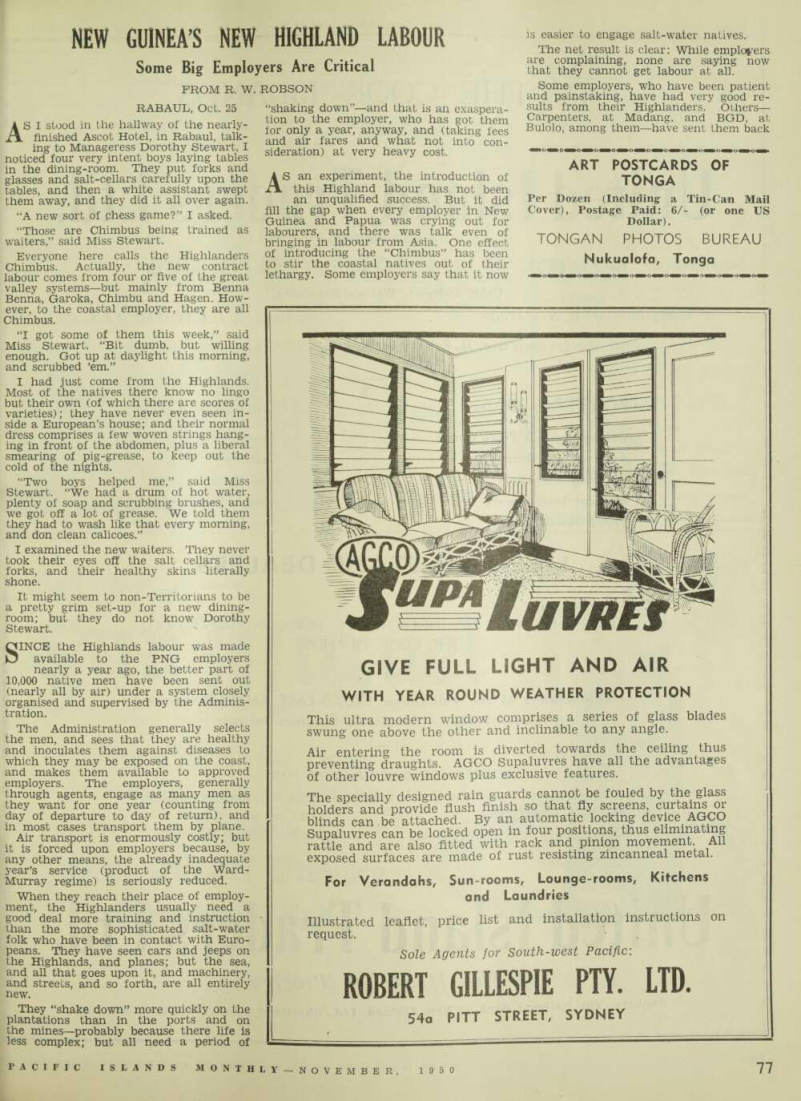

Some Big Employers Are Critical
From R. W. Robson
Rabaul, Oct. 25
AS I stood in the hallway of the nearly finished Ascot Hotel, in Rabaul, talk ing to Manageress Dorothy Stewart, I noticed four very intent boys laying tables in the dining-room. They put forks and glasses and salt-cellars carefully upon the tables, and then a white assistant swept them away, and they did it all over again.
“A new sort of chess game?” I asked.
“Those are Chimbus being trained as waiters,” said Miss Stewart.
Everyone here calls the Highlanders Chimbus. Actually, the new contract labour comes from four or five of the great valley systems—but mainly from Benna Benna, Garoka, Chimbu and Hagen. How ever, to the coastal employer, they are all Chimbus.
“I got some of them this week,” said Miss Stewart. “Bit dumb, but willing enough. Got up at daylight this morning, and scrubbed ’em.”
I had just come from the Highlands.
Most of the natives there know no lingo but their own (of which there are scores of varieties); they have never even seen in side a European’s house; and their normal dress comprises a few woven strings hang ing in front of the abdomen, plus a liberal smearing of pig-grease, to keep out the cold of the nights.
“Two boys helped me,” said Miss Stewart. “We had a drum of hot water, plenty of soap and scrubbing brushes, and we got off a lot of grease. We told them they had to wash like that every morning, and don clean calicoes.”
I examined the new waiters. They never took their eyes off the salt cellars and forks, and their healthy skins literally shone.
It might seem to non-Territorians to be a pretty grim set-up for a new dining room; taut they do not know Dorothy Stewart.
SINCE the Highlands labour was made available to the PNG employers nearly a year ago, the better part of 10,000 native men have been sent out (nearly all by air) under a system closely organised and supervised by the Adminis tration.
The Administration generally selects the men, and sees that they are healthy and inoculates them against diseases to which they may be exposed on the coast, and makes them available to approved employers. The employers, generally through agents, engage as many men as they want for one year (counting from day of departure to day of return), and in most cases transport them by plane.
Air transport is enormously costly; but it is forced upon employers because, by any other means, the already inadequate year’s service (product of the Ward- Murray regime) is seriously reduced.
When they reach their place of employ ment, the Highlanders usually need a good deal more training and instruction than the more sophisticated salt-water folk who have been in contact with Euro peans. They have seen cars and jeeps on the Highlands, and planes; but the sea, and all that goes upon it, and machinery, and streets, and so forth, are all entirely new.
They “shake down” more quickly on the plantations than in the ports and on the mines—probably because there life is less complex; but all need a period of
“shaking down”—and that is an exaspera tion to the employer, who has got them for only a year, anyway, and (taking fees and air fares and what not into con sideration) at very heavy cost.
AS an experiment, the introduction of this Highland labour has not been an unqualified success. But it did fill the gap when every employer in New Guinea and Papua was crying out for labourers, and there was talk even of bringing in labour from Asia. One effect of introducing the “Chimbus” has been to stir the coastal natives out of their lethargy. Some employers say that it now
is easier to engage salt-water natives.
The net result is clear: While employers are complaining, none are saying now that they cannot get labour at all.
Some employers, who have been patient and painstaking, have had very good re sults from their Highlanders. Others — Carpenters, at Madang, and BGD, at Bulolo, among them —have sent them back
to the Highlands, before the expiry of the year, as “hopeless.” The majority have grumblingly made the best possible use of them. Few praise them. Most employers say that they are “dumb”—which is not surprising, in the circumstances.
In course of time, as this very raw labour comes back on a second contract, with some knowledge of the European and his ways, the standard of service should improve. But, under the condi tions established by the Ward-Murray regime, it is very costly labour; and a very small shift in prices or revenues would make it uneconomic.
WHEN they are returned, the High landers are received at the District Offices, and sent into quarantine compounds for a fortnight, to guard against the introduction of coastal diseases to the crowded inland valleys.
About 300 have now returned. Gen erally, they do not retain their pay in our currency. They either spend it at once in the trade stores, or change it into cowrie and gold-lip shell, the regular currency of the Highlands natives.
There are a very few Europeans funning farms and plantations in the Highlands, and most of them have trade stores. As the thousands of time-expired labourers return to the Highlands (and the trickle back is now becoming a stream) the busi ness of changing their money into trade and shell will become pretty important.
The Chinese trade store —a feature of the landscape all over the Territory, ex cept Papua—has not yet appeared in the Highlands, One application for land for a Chinese trade store at Garoka is in. and will be granted. Many people are anxious to keep the Chinese traders out of the Highlands; but, under Trusteeship prin ciples and laws, that may not be done.
Thera are perhaps a million people in these great upland valley systems, be tween the Ramu and the western border.
Already, they have discarded the stone axes for the iron tomahawk, and the fire stick for the kerosene lantern. Old traders see a great new market opening here. But the Highlanders, as yet, have not much to offer in exchange, except labour.
There is some uncertainty about the future purchase by the French Army, for use in Indo-China, of New Caledonian tinned beef. The position is that this beef, of which some 130 tons is usually bought annually in this way, is being seriously undercut by tinned beef from Madagas car. The latter product is, however, alleged to be of an inferior quality.
Qantas Men
Two men well known to Qantas Empire Airways travellers. At left, M. Jean Brock, QEA agent in New Caledonia. On the right, Captain John Solly, well-known pilot of Sandringhams on the Sydney- Noumea-New Hebrides, and the Sydney-Suva runs.
Advertisements & other items, pp. 79-81 (1 item)
Robert Gillespie Pty. Ltd.
ART POSTCARDS OF
TONGA
Per Dozen (Including a Tin-Can Mai!
Cover), Postage Paid: 6/- (or one US Dollar).
TONGAN PHOTOS BUREAU
Nukualofa, Tonga
£ .V A 0 St m
GIVE FULL LIGHT AND AIR
WITH YEAR ROUND WEATHER PROTECTION
This ultra modern window comprises a series of glass blades swung one above the other and inclinable to any angle.
Air entering the room is diverted towards the ceiling thus preventing draughts. AGCO Supaluvres have all the advantages of other louvre windows plus exclusive features.
The specially designed rain guards cannot be fouled by the glass holders and provide flush finish so that fly screens curtains or blinds can be attached. By an automatic locking device AGCO Supaluvres can be locked open in four positions, thus eliminating rattle and are also fitted with rack and pinion movement. All exposed surfaces are made of rust resisting zincanneal metal.
For Verandahs, Sun-rooms, Lounge-rooms, Kitchens and Laundries Illustrated leaflet, price list and installation instructions on request.
Sole Agents for South-west Pacific :
ROBERT GILLESPIE PTY. LTD.
54a PITT STREET, SYDNEY
IN THE COOK ISLANDS
United Island Traders Ltd.
(Established 1930).
P.O. BOX 42, RAROTONGA, COOK ISLANDS
Cable Address: “Watson, Rarotonga.”
Managing Director : W. H. WATSON. Secretary : R. J. A. INGRAM, A.R.A., N. Z, Agents in London: Geo. H. Penney Cr Co. Ltd., 197 Aldersgote St., E.C.I.
IMPORTERS OF:-
Cotton and Silk Piece Goods Apparel and Drapery Building Materials Musical Instruments Trade Jewellery
EXPORTERS OF:-
Tomatoes Cassava Sea-shells Island Handicrafts Broad-last Footwear
LICENSED STAMP DEALERS
REPRESENTATIVES OF INDEPENDENT TRADERS THROUGHOUT
THE COOK ISLANDS
Manufacturers of the well-known BROAD-LAST SANDALS for the Islands Trade Wholesale Enquiries Invited.
AGENTS AND DISTRIBUTORS FOR:—
British Traders' Insurance Co. British Petroleum Company.
Whites Aviation Ltd. Ford Cars and Trucks.
B.S.A. Cycles and Motor-cycles. "Pacific Islands Monthly."
United Island Traders Ltd.
“The House of Progress”
Bankers: The National Bank of New Zealand, Ltd., Shortland Street, Auckland, N.Z.
SPECIALISING IN
PACIFIC ISLAND INSURANCES
FIRE—MOTOR VEHICLE
MARINE—HULLS AND CARGO
EMPLOYER’S LIABILITY
BONDS—in accordance with
ADMINISTRATION ORDINANCES.
COPRA INSURED FROM DRIER
TO BUYER.
AND ALL OTHER CLASSES ARRANGED
AT LOWEST CURRENT RATES.
Established Agencies throughout the Territory of Papua and New Guinea.
Managing Agents: New Guinea Company, Limited.
Island Representative: G. D. A. Kent, Rabaul Branch.
Southern Pacific Insurance
CO., LTD.
HEAD OFFICE: 60 HUNTER STREET,
SYDNEY.
Call for a
San|Uig,uel
The Favourite .
Matured but freshly bottled Brewed Cr Bottled by
§>an jUlifiuel
rw fill*** Obtainable from:
ALOIS AKUN & COMPANY
RABAUL
Bsi Airmail Services
Go Up
From Our Own Correspondent
Honiara, Nov. 1
POSTAL rates on Air Mail carried by the Qantas service within the British Solomon Islands are being increased, and as from November 1, postage on letters and all postal articles carried by
Qantas within the Protectorate will be 2id. per half ounce.
Qantas planes now land regularly at the Barakoma strip on Vella Lavella and the Renard Sound airstrip in the Russell Islands. This service is greatly appreciated by residents, particularly in the West where surface mails are irregular and in frequent.
Carriage of passengers within the Pro tectorate is not so satisfactory at present, as owing to the amount of fuel which
must be carried for the Rabaul-Honiara flight, passenger carrying capacity on this flight is limited, and intending passangers are sometimes unable to obtain bookings.
It is reported that Qantas are considering this aspect of the service with a view to making more passenger space available as soon as possible.
Bsi's Wharf Problems
Reviewed By Expert
From Our Own Correspondent
Honiara, Nov. 1
MR. KENYON BELL, the Crown Agents' Consulting Engineer, spent a fortnight in Honiara in October.
Mr. Bell, who has very wide experience in marine engineering problems, came to advise the Protectorate Government about a slipway which it is proposed to construct at Tulagi. He also inspected wharves and sites in the Honiara area.
His preliminary conclusions favoured the construction of a small slipway at Tulagi, and of a wharf, adequate for small and medium-sized vessels, in the Point Cruz area, larger overseas vessels to load and unload by lighter.
His final report from London is being awaited. Meanwhile the old American built wharf at Kukum it to be kept in the best condition possible, for the handling of overseas ships and cargo, but its present state is not good and its life, even with constant repairs and main tenance, appears to be limited. Mr. Bell was not in favour of large-scale harbour and wharf construction in the Point Cruz-Kukum area, because there is no natural all-weather harbour on this coast.
Mr. J. Anthony Moore, who has retired after a successful career as a Commis sioned officer in the Fiji Police, paid a brief visit to Australia in October.
Advertisements & other items, p. 82 (3 items)
80
NOVEMBER, 1950 PACIFIC ISLANDS MONIHLY
The Hygeia Dissolvenator
if A Guaranteed Sanitary System
Approved by the N.S.W, Board of Health.
Established 1927.
No Water Supply Required
The Sewage matter is chemically transformed into a sterile solution which is absorbed by the surrounding soil.
NO FLIES
NO GERMS
NO SMELLS
NO EMPTYING
AUTOMATIC
Any handy man can install.
HYGEIA SANITARY COMPANY PTY. LTD.
26-30 BRIDGE STREET, SYDNEY, N.S.W.
Phone: BU 2521 Cables: “Berbl,” Sydney Correspondence Invited.
Burns Philp (South Sea) Co. Ltd
Registered Office: SUVA, FIJI
Code Address: "BURNSOUTH”
ISLAND TRADERS AND SHIPOWNERS
General Merchants (Wholesale and Retail)
Shipping, Customs and General Agents
Representatives for:
QUEENSLAND INSURANCE CO., LTD. BURNS PHILP TRUST CO., LTD.
Distributing Agents for :
SHELL COMPANY (P. 1.), LTD. FERGUSON TRACTORS STANDARD MOTOR CAR COMPANY CROSSLEY MARINE ENGINES
BRANCHES:
FIJI—
SUVA.
LEVTJKA.
LAUTOKA.
LABASA.
BA.
SIGATOKA.
ROTUMA ISLAND.
NORFOLK IS.—
SAMOA—
APIA.
PAGO PAGO.
TONGA—
NUKUALOFA.
HAAPAI.
VAVAU.
NIUE IS.—
Sydney Agents:
BURNS, PHILP & CO., LTD..
7 Bridge Street.
London Agents:
BURNS, PHILP & CO.. LTD..
35 Crutched Friars, E.C.3.
San Francisco Agents:
BURNS, PHILP CO. OP SAN FRANCISCO.
Matson Building, 215 Market Street.
Ae-encles Throughout the World.
New Guinea Coastal
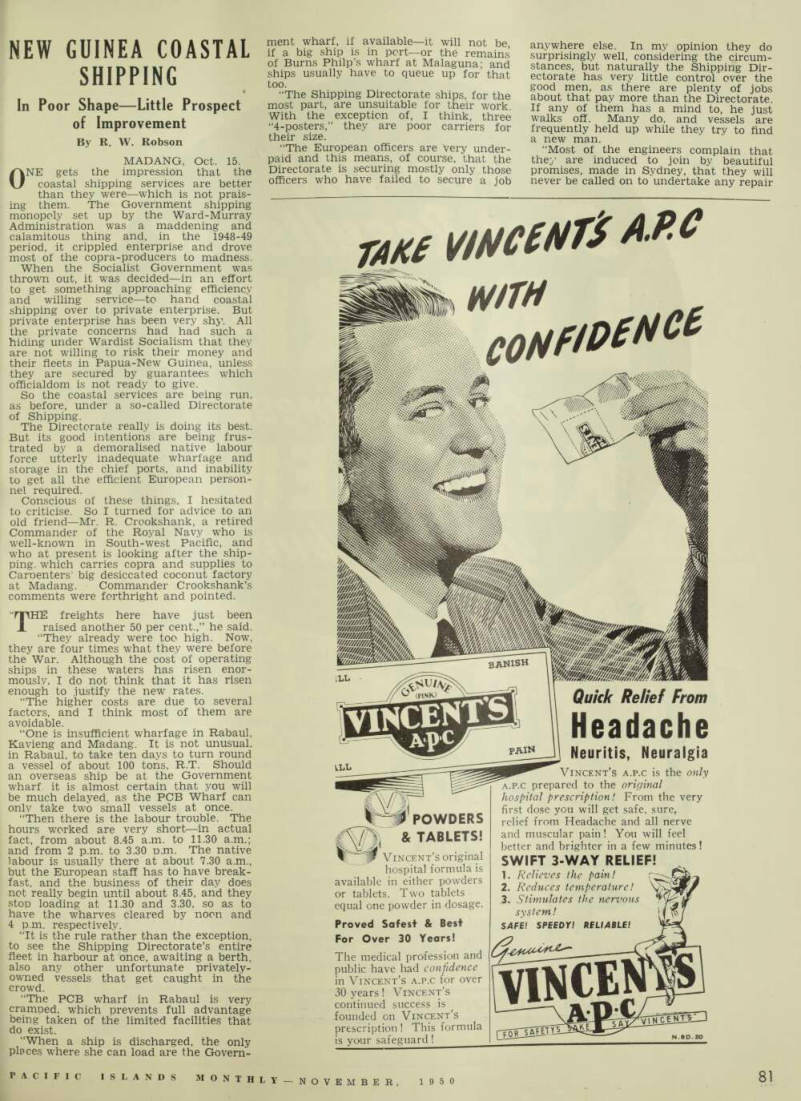


Shipping
In Poor Shape—Little Prospect of Improvement
By R. W. Robson
Madang, Oct. 15.
ONE gets the impression that the coastal shipping services are better than they were—which is not prais ing them. The Government shipping monopoly set up by the Ward-Murray Administration was a maddening and calamitous thing and, in the 1948-49 period, it crippled enterprise and drove most of the copra-producers to madness.
When the Socialist Government was thrown out, it was decided —in an effort to get something approaching efficiency and willing service—to hand coastal shipping over to private enterprise. But private enterprise has been very shy. All the private concerns had had such a hiding under Wardist Socialism that they are not willing to risk their money and their fleets in Papua-New Guinea, unless they are secured by guarantees which officialdom is not ready to give.
So the coastal services are being run, as before, under a so-called Directorate of Shipping.
The Directorate really is doing its best.
But its good intentions are being frus trated by a demoralised native labour force utterly inadequate wharfage and storage in the chief ports, and inability to get all the efficient European person nel required.
Conscious of these things, I hesitated to criticise. So I turned for advice to an old friend —Mr. R. Crookshank, a retired Commander of the Royal Navy who is well-known in South-west Pacific, and who at present is looking after the ship ping which carries copra and supplies to Caroenters’ big desiccated coconut factory at Madang. Commander Crookshank’s comments were forthright and pointed.
"mHE freights here have just been 1 raised another 50 per cent.,” he said.
“They already were too high. Now, they are four times what they were before the War. Although the cost of operating ships in these waters has risen enor mously, I do not think that it has risen enough to justify the new rates.
“The higher costs are due to several factors, and I think most of them are avoidable.
“One is insufficient wharfage in Rabaul, Kavieng and Madang. It is not unusual, in Rabaul, to take ten days to turn round a vessel of about 100 tons, R.T. Should an overseas ship be at the Government wharf, it is almost certain that you will be much delayed; as the PCB Wharf can only take two small vessels at once.
“Then there is the labour trouble. The hours worked are very short —in actual fact, from about 8.45 a.m. to 11.30 a.m.; and from 2 p.m. to 3.30 p.m. The native labour is usually there at about 7.30 a.m., but the European staff has to have break fast, and the business of their day does not really begin until about 8.45, and they stop loading at 11.30 and 3.30, so as to have the wharves cleared by noon and 4 p.m. respectively.
“It is the rule rather than the exception, to see the Shipping Directorate’s entire fleet in harbour at once, awaiting a berth, also any other unfortunate privately owned vessels that get caught in the crowd.
“The PCB wharf in Rabaul is very cramped, which prevents full advantage being taken of the limited facilities that do exist.
“When a ship is discharged, the only places where she can load are the Govern
merit wharf, if available it will not be, BnrmPiSin’q whn P r C f r emain i of Burns Philps wharf at Malaguna, and ships usually have to queue up for that too- . „ The Shipping Directorate ships, for the most part, are unsuitable for their work.
With the exception of, I think, three “4-posters, they are poor carriers for their size.
“The European officers are very underpaid and this means, of course, that the Directorate is securing mostly only those officers who have failed to secure a job
anywhere else. In my opinion they do surprisingly well, considering the circum stances, but naturally the Shipping Dir ectorate has very little control over the good men, as there are plenty of iobs about that pay more than the Directorate, if any of them has a mind to, he just walks off. Many do, and vessels are frequently held up while they try to find a ne w man.
“Most of the engineers complain that the: l are induced to join by beautiful promises, made in Sydney, that they will never be called on to undertake any repair
work when in port,; whereas, in real life, they have to do it all.
“The reason for the low wages paid is hard to understand, as an inter-island iob, if properly done, is both arduous and difficult, and requires a considerable amount of local knowledge—a commodity that is difficult to accumulate if the men employed change round too frequently.
“If a man is unfortunate enough to be married, it is very difficult for him to get a house for his wife, and very expen sive to live in it, if he can get it.
“The climate is still, in 1950, a good deal worse than, say, the Australian Coast.
“No overtime is paid to the Europeans, although the natives get it—which seems to me to be a pretty considerable injustice.
A bonus system would probably speed up the shipping part of the show—but it would be of little worth unless both wharves and copra storage were greatly improved, too.
“Many of the Shipping Directorate’s vessels are not supplied with enough boats, and many of the boats they have are of unsatisfactory pattern. The inter island trade in New Guinea waters is almost all dependent on boats, and many of the anchorages are very bad, conse quently there is usually a pretty heavy casualty list in boats. Before the War, spare boats were always kept ready and repaired in harbour, so that a vessel coming in with damaged boats could change them without delay.
“Another cause of delay would be re moved if the native crews were signed on on any sort of agreement," concluded Commander Crookshank. “At present, much delay is caused by the native crews walking off, whenever they feel inclined.
It is, and always has been, easy to get boats crews. But the present system just doesn’t work—it wouldn’t work with Europeans, or any other kind of crew I am acquainted with, either.”
A Case In Point
Mr. Percy J. Wood, of Brisbane, writing on November 9, says that, before World War 11, a company in which he is inter ested (Sawataitai Ltd., which has a plantation on Normandy Island) could land copra in Samarai for £7 per ton. In 1949, the cost of the same service was £24/4 - per ton.
Pastor George M. Masters, who was with the Seventh Day Adventist Mission in Fiji for 20 years, is now principal of the Adventist Correspondence School in Sydney. Recently he and his mother motored across Australia to Perth, Western Australia.
Vessel for the Solomons
A . . cc J
T HE New Auki, a 55 ft. schooner-rigged A vessel, with a 42 HP Southern Cross auxiliary diesel engine, left Sydney f or Honiara, British Solomon Islands, on November 15. She is being delivered to BSI on behalf of W. S. Tait & Co. Pty.
Ltd., Islands agents of Sydney, by Cap tain George O Brien. IVIi. Bill Davis is tSmen^The 6 vessel o '^s^nett^^nage nf io?’tnn«s ve 61 n ett tonnage “ Captain O’Brien will collect the Fairy mead Sugar Co.’s ship Ruena in the Sol omons and bring her back to Bundaberg, Queensland.
New Caledonia’s Melanesian Society, which is doing a good deal to arouse interest in the Coloney’s native life and ancient history recently, with the co operation of the Native Affairs Dept., held a successful “session folklorique” in Noumea. The entertainment included a show of native art; a showing of the film Oceanie, made by the Rev. Father O’Reilly, who spent a long time in the French Pacific and who is now attached to the Musee de I’Homme in Paris; a brief coloured film of the Noumea-Santo flight made by Air France; and singing by natives of Mare.
Advertisements & other items, pp. 83-86 (2 items)
81
PACIFIC ISLANDS MONIHLV-N O V E M B E R , 1950
CONflrt NC
tak£ met"*** 0
» mH
mggm
WMM
BANISH
LL
(PINK)
ILL
m
“ POWDERS
& TABLETS!
Vincent’s original hospital formula is available in either powders or tablets. Two tablets equal one powder in dosage.
Proved Safest & Best For Over 30 Years!
The medical profession and public have had confidence in Vincent’s a.p.c for over 30 years! Vincent’s continued success is founded on Vincent’s prescription! This formula is your safeguard !
Quick Relief From
Headache
Neuritis, Neuralgia
Vincent’s a.p.c is the only l.p.c prepared to the original hospital prescription! From the very first dose you will get safe, sure, relief from Headache and all nerve and muscular pain! You will feel better and brighter in a few minutes!
SWIFT 3-WAY RELIEF!
1. Relieves the pain! 2. Reduces temperature! 3. Stimulates the nervous system!
SAFE! SPEEDY! RELIABLE!
VINCE
LAUREL
iwl a Use only Laurel Kerosene in your refrigerator-the best and most economical "frig.' fuel you can buy. Laurel burns with a clean, even heat with a minimum of smoke or smell.
But, when ordering, Always ask tor LAUREL by name.
Try this Recipe— PASSIONFR UIT DELIGHT Take 1 cup water, 1 cup sugar, large teaspoon gelatine and boil together for 5 minutes. Mix 1 tablespoon plain flour with a little cold water and the juice of ‘ orange or lemon and the juice of 6 passionfruit. Add to boiling mixture. Stand to cool-then beat well until thickening.
VACUUM OIL COMPANY PTY. LTD. (Inc, in Aust.)
TAHITI
To Shipmasters and Visitors
When calling at Tahiti, and seeking SHIPS SUPPLIES and FRESH
PROVISIONS, see—
OSCAR G. NORDMAN
Supply Agent for Messageries Maritimes, Union S.S. Co. of N.Z., Ltd., Matson-Oceanic Line, United States Line, General S.S. Corp,, Etc.
We supply General Service Act as Shipping Agents Address all inquiries to the Tourist Bureau.
OSCAR G. NORDMAN
Ship Chandler
PAPEETE. TAHITI
Wire before your arrival to
“OCEANIC, PAPEETE”—Our
registered cable address.
P 6 0° 0$ &-T.
By Appointment Gin Distiller* to H.M. King George VI Tanqueray, Gordon & Co.
Q'Uu/irfy
Gordon's
Stands Supk&fHA
It’s the “Appetiser With a Difference”
AUNT MARY’S
TOMATO SAUCE
FOR ALL MEAT DISHES HOT OR COLD Another Famous Aunt Marys Pure Food Product Manufactured by
TILLOCK £r CO. PTY. LTD.
Healthy Profits of Reparation
Estates Benefit Samoans
Prom Our Own Correspondent
Apia, Nov. 4
PROFITS from the New Zealand Re paration Estates in Western Samoa for the year ended March 31, amounted to £86,093, an increase of £8,663 over the previous year.
The New Zealand Department of
Island Territories’ annual report explains that the disposal of profits from the Estates rests entirely with the New Zealand Government but the policy has been to use them in the interests of Western Samoa. To date £359,915 has been spent from accrued profits in this way, mainly on broadcasting, housing, education and health.
It has been proposed, in the Legislative Assembly, to divert the profits to a special fund at the disposal of the Samoan Government in accordance with promises made by the former New Zealand Prime Minister, Mr. Peter Frazer.
Suva’S Model Market
Officially Opened
From Our Own Correspondent
Suva, Nov. 6.
SUVA’S new municipal markets provided what was probably the best display of locally grown produce ever seen in Fiji when they were opened by the Mayor (Mr. Alport Barker) on Novem ber 4.
With 200 stalls, a floor space of 30,000 square feet, and a fish market in one corner, the market building is expected to go a long way towards ending the hap hazard arrangements which have been a profitable field for middlemen rather than anybody else.
The cost to the Town Council is about £26,000, the exoenditure being made possible by a Government loan at ex tremely reasonable terms.
The opening ceremony attracted a crowd of thousands.
Advertisements & other items, pp. 86-90 (2 items)
<gafter\j
Buy a Masse battery and enjoy carefree motoring.
There's no better battery made than Masse. Sturdy, husky plates, supercol separators, hard rubber containers, all made in the Masse factory ensure you the utmost in battery life. You can recommend Masse with complete confidence.
SERVICE STATION
f o
Masse Batteries are Tigers for Work'
AGENTS FOR NEW GUINEA AND PAPUA : ROBERT GIL LE S PIE ( ) LTD.
9 K.V.A. ENGLISH GENERATING SETS
230 VOLT, SINGLE PHASE, 50 CYCLE.
The Ideal Set for Island Conditions
Complete with Auto-Voltage Regulator and Switchboard.
IMMEDIATE DELIVERY
PRICE
£375 Plus Tax
Weight: 1,650 lbs. (approx.) “Meadows”—4-cyl. petrol engine, water-cooled, with tropical radiator and fan. Alternator well-known English make with separate Exciter.
Ideal set for LIGHTING, HEATING and other SINGLE PHASE LOADS. Particularly suitable for CINEMA Projection Equipment. Alternator frames are 3-phase type and can be easily rewound for 240-415 Volt 3-phase. PRICE: £405.
We can also quote this set powered with a Coventry Climax diesel engine.
HARDMAN & HALL
44 MISSENDEN ROAD, NEWTOWN. SYDNEY, AUSTRALIA.
Trade inquiries also invited.
The Most Extensive Manufacturers in the British Empire of
RUBBER STAMPS,
INKS, STENCILS,
Marking Devices,
ACME STAMP PADS
OFFICE ft STATIONERY SUPPLIES
ISi We also Manufacture & Supply a Complete Line of
LIMEWASHING and
SPRAYING MACHINES
for all purposes.
Let us know your requirements and we will quote by return.
WRITE FOR OUR GENERAL CATALOGUE
Limewashing Machine
EXCELSIOR SUPPLY CO. PTY. LTD.
278 Post Office Place,
MELBOURNE, VIC.
HEAD OFFICE :
160 BROADWAY,
Formerly known as George St.. West.
SYDNEY. N.S.W.
50 Victoria Street,
WELLINGTON, N.Z.
W ithout a
doubt
f I f I l i; m *
SO SIMPLE TO INSTALL
1. Screw on frames—use old window frames and simple uprights—and use li in. x 8 round head screws. Never over-tighten screws. 2. Close the clips to glass thickness with a pair of pliers.
Remember, never force i in. glass into 3/16 in. frames. 3. Insert glass. If loose, remove it, and, with a pair of pliers, crimp the clips slightly.
Replace the Louvre. Repeat this procedure until glass is held firmly.
OPEN END INSIDE
5. In order to assure complete weather protection, nail or screw on a facia strip at the top and a weather stop on the sill of each rack of Cooper Louvres. Cooper Louvres stay as you set them— facia strip wind will not blow them shut.
THE MS!
M® fflWilW-
piarejm]
“ The Cooper Louvre is the ideal window for tropical areas because it gives unobstructed view and the maximum of light and air ... it actually controls ventilation. It is seldom too wet to keep your Cooper Louvre window partly open—you simply adjust it to keep out the rain and let the fresh air in.
Installations are easy, too! No need for a tradesman; any handyman can install them. ... ... •• • •• • • Breakages are easily replaced and remember it costs less to replace an odd Louvre than an expensive normal size window pane. .
Cleaning is easy and can be done from inside the house.
Send in the enquiry form below for full details of the Cooper Louvre Window. rCI k
OPEN CLIP
GLASS
WEATHER
STOP
a
CLOSED CLIP
4. When the Louvre is held firmly, simply close the clip at each end and the job is done. Replacements are simple, speedy, and cost only a few pence per blade.
PACIFIC ISLANDS REPRESENTATIVE;
£. J. GQUGTI £ CO.
Exporters Importers Manufacturers’ Representative SUPPLIERS OF GENERAL MERCHANDISE TO LEADING FIRMS
THROUGHOUT THE PACIFIC ISLANDS.
I BOND STREET, SYDNEY. AUSTRALIA. Box 3615. G.P-O Tel.; BU 2159 Bankers- Bank of N.S.W. Bank of Adelaide. Comptoir National dEscompte d Paris. Cable Address: ‘ SEAFOODS.” Sydney, Codes: Bentley’s, 2nd and Comp. Phrase: A.8.C.. sth and 6th; Peterson, 2n< and 3rd, Banking; Acme. \
LOUVRE
HORIZONTAL SECTION
SILL
E. J. Gough & Co., Box 3615. G.P.0..
Sydney, Australia.
Please send me full details
ENQUIRY FORM.
of the Cooper Louvre Window.
NAME;. . .
ADDRESS:
Here’s Hope
For A
Persistent Worry
CONSTIPATION, forerunner of many troubles, affects people of all ages and walks of life and causes much annoyance and worry.
When the bowels refuse to work naturally and regularly, the body absorbs poisons from the waste that remains in the system. Constipation brings sick headaches, biliousness, coated tongue and unpleasant breath, flatulence, loss of appetite, blemishes and other troubles which quickly upset your health and well-being.
These troubles are easily corrected by safe, gentle Pinkettes for you and all the family.
Pinkettes are simple to take; and do not have harsh after-effects which can be dangerous.
Being compounded of harmless vegetable ingredients only, Pinkettes act in Nature’s way.
Thousands and thousands of people have found Pinkettes the ideal laxative, because they are not habit-forming and the dose is reduced as they make you regular. Always at chemists and stores.
Fhere s a lot of
BEEF in a li
r
BOVRIL
Bovril is the concentrated goodness of beef, and you only need a little Bovril to give your meat dishes a lot of flavour . . . a lot of appetising tastiness. Your family will enjoy Bovril dishes and you will enjoy making them because they are sure to please. Always have Bovril in the house, and drink it daily. * Remember BOVRIL makes excellent sandwiches, and improves all dishes
Agents: BURNS, PHILP & CO., LTD.
BE.If
YOUR FUTURE CAREER . . .
Merchants, Accountants, Secretaries, Bankers and Business Managers ... all hold responsible positions with commensurate salaries. You too can enhance your prospects in this ever-expanding commercial field, which yields abundant returns to those with adequate qualifications. H.R.I. prepare ambitious men and women for all business positions from junior to senior executive. Tuition is practical authoritative up-to-date time saving . . . and certain in its successful results. The H.R.I. is available always to advise you write or wire for information free and without obligation.
H.R.I. tutorial service is proved by the winning of more honours than all coaches in Australasia combined.
H.R.I. Career Training • ACCOUNTANCY • SECRETARYSHIP • COST ACCOUNTANCY
• PRACTICAL BOOKKEEPING • MARKETING SELLING
ADVERTISING • BANKING • LOCAL GOVERNMENT EXAMS.
Robertson Institute
Hemingway
Founded and Owned by Hemingway & Consulting Accountants :: ::
126 BANK HOUSF BA
126 BARRACK HOUSE. 16
Robertson Pty. Ltd.
Professional Tutors
NK PLACE. MELBOURNE
BARRACK STREET. S YUYJ T 2
126/815
85
acific islands monthlv-november, 1950
NOTES BY THE WAYSIDE
(Continued from Page 35)
Defence of New Guinea
Lae Veterans Express Anxiety
From Our Own Correspondent LAE, Nov. 4 GRAVE concern was the key-note of discussions at the last meeting of the Lae Sub-Branch of the Returned Servicemen’s League when the question of the formation of a volunteer force in New Guinea was brought up. •Members expressed the opinion that people on the mainland would probably feel, in the face of recent publicity in this matter and the arrival of the administrative staff in Port Moresby, that all is well in New Guinea.
The bald truth is that, with the ex ception of public meetings, the authorities have done very little.
In an endeavour to clarify the position a radiogram was forwarded on November 4 to the NG representative at the RSL Congress, Hobart (Mr. Geo. Whittaker) asking him to contact the Minister and press urgently for the formation of the volunteer force, because to date, the position was “all talk and no action.’’
The Sub-Branch felt concern at the vulnerability of New Guinea, and pointed out in the radiogram that it would help in any direction, as always but must have Government assistance in regard to arms and ammunition.
Advertisements & other items, p. 90 (1 item)
W. H. Grove & Sons Ltd.
Established 1896.
Telegraphic and Cable Address: “Grove,” Auckland.
ISLAND MERCHANTS
16-18 Fanshawe St. p.o. Box 490, Auckland, New Zealand.
AUCKLAND
Entrust your requirements to the firm with more than fifty years practical experience in the Island trade.
REPRESENTING ENGLISH MANUFACTURERS
THROUGHOUT THE FIJI, SAMOAN AND TONGAN ISLANDS, NEW HEBRIDES, NEW CALEDONIA, THE SOLOMON ISLANDS, THE SOCIETY ISLANDS, THE COOK ISLANDS,
NIUE, ETC.
SHIPPERS OF ALL CLASSES OF NEW ZEALAND MANUFACTURES AND PRODUCTS SPECIALLY PREPARED FOR THE ISLAND TRADE WE HANDLE ALL KINDS OF ISLAND PRODUCE.
IN FIJI as: W. H. GROVE & SONS (FIJI) LIMITED.
Office and Sample Room: Bank of New South Wales Chambers, Suva, Fiji.
8 mm-worker^could

The Month In Noresby
Prom our own correspondent
Port Moresby, Nov. 5.
TERRITORY Public Servants were pre sented with a new topic of con versation when the Public Service Commissioner, Mr. E. A. F. Head, an nounced early this month that working hours were to be increased from 34 to 36J a week.
Another bone of contention which has troubled the uneasy Public Servants also came into the spotlight when Mr. Head further announced that married women employed by the Administration would no longer receive the Territorial allowance.
This applies to all married women whose husbands are in the Territory. The general effect of this move will probably work out to the advantage of private en terprise, and the exodus of married women from Administration to private jobs has already begun.
AT last the shilly-shallying over the Secondary School at Wau has been settled by a temporary compromise.
The decision as to whether or not the school will be built at all has been shelved until Mr. Spender gets back to ponder the problem.
Meanwhile, for the year 1951 only, the government will grant an allowance of £125 for approved students who have reached a scholastic standard warranting secondary education. Each student will receive one return air passage to Aus tralia. Assuming that there are at least 50 students—47 had already registered for the mythical Wau school—requiring se condary education, this piece of political muddling will cost the External Terri tories Department a minimum of £B,OOO.
It has also caused a spate of worry and bother to parents who are now forced to get their children into whatever Aus tralian schools can accept them at this late date.
Territory people felt months ago that there was just no hope of getting the school built in the short time available, but this apparently could not be grasped by the red-tape experts in far-away Can berra.
BORNEO business interests have re ported favourably on the prospects of setting up a mangrove bark in dustry in the coastal swampland area of south-western Papua, The Chairman and Managing Director of the Island Trading Company of Borneo and London, Mr. Dolbey, returned from a survey of the Kikori area early in Nov ember with the good news that the man grove stand was excellent. Now, if he can get the approval of the External Ter ritories Department, he is prepared to put in a plant which ultimately will be able to develop a valuable dollar trade for the Territory.
He commented that the Papuan pos sibilities were excellent and output, when the plant was fully developed, could equal that of the Company’s factories in Borneo.
During the last two years these shipped II million dollars’ worth of mangrove bark extract to America. This extract, known as cutch, is used throughout the world for tanning leather and dyeing-fish nets and other fibres. Mr. Dolbey re marked that all the “red sails in the sun set” throughout the Eastern and Western world are dyed with cutch.
Some legal formalities have to be nego tiated in Canberra but, as far as the com
pany itself is concerned, it could have the plant and factory erection under way in a few months.
This appears to be a first-rate industry for over-socialised Papua, since the 8,000 natives needed for gathering the bark would not be employees. The company, as in Borneo, would be merely buying bark from them, and the ramifications of native labour regulations would not enter into the deal. There would be no
ramis and rice> cash and coddling for the natives who feel too tired to gather bark, no free plane or ship voyages at the com pany’s expense for a few months’ work.
8 mm-worker^could
enjoy the luxury of getting by on what ever they could scratch from the swamp villages.
An interesting sidelight on the labour value of the Borneo Dyak tribesmen was given by the manager of the Borneo fac tory, Mr. W. H. Doughty. He said that although they were excellent workers, their belief in dreams detracted from their value, for if they had a bad dream
this was always an omen signifying that they should leave their jobs. It’s to be hoped that this dream-complex is never added to the Territory natives’ well stocked store of excuses for dodging work.
ANOTHER recent visitor to the Terri tory, Dr. Andrew Ungar, from Sydney, has a nlan to make rubber trees work harder. He claims that this can be done by giving each tree a dose of hormones which will increase the growth and the rubber flow. Apparently, the use of hor cnat of the Company’s factories in Borneo, ful development of olive groves in South Australia, and for increased rubber output in Brazil.
Simultaneously, Dr. Ungar outlined a plan to planters for producing liquid latex which is used for making rubber surgical supplies. If his plan works out—and he claims that production of liquid latex is more profitable than sheet rubber planters will be operating on much the same basis as dairy farmers. The scheme is to establish a liquid latex processing centre in various rubber-producing areas, and the planters will make regular de liveries to the plant.
These two projects, however, were not the sole reason for Dr. Ungar’s visit to the Territory, for he concentrated a part of his attention on the possibility of locat ing plants for the extract of medical drugs.
PUBLICITY has many guises, and the latest so far as the Territory is con cerned is the comic or adventure strip.
Eric Jolliffe, Australian cartoonist, who has concentrated on the Australian out back, is now switching his attention on to Papua and New Guinea. With a well established adventure strip running in serial form in one of the Australian met ropolitan papers, he plans to turn his strip hero loose in the Territory. Jolliffe voted the Islands an ideal source of ad venture strip material, and he is now get ting ready to launch his hero into the wilds of New Guinea. At the same time, a series of Territory cartoons will be ap pearing in various Australian magazines under Jolliffe’s well-known signature.
THE era of hit-and-miss building in Port Moresby ended last month with the gazetting of building regulations.
This is better late than never for the town has been swamned with fourth-rate build ings which, because of the housing short age, have sold at ridiculously high sums.
Four “permissive occupancy” huts along the road to the aerodrome are a particu lar eyesore, and in normal times would only just pass muster as native quarters.
Now, if the Administration really intends to enforce the building regulations, there is some chance of salvaging a little natural beauty and dignity for this much bedevilled centre.
The town boundaries have also been ex tended to Jackson’s airstrip and beyond Hanuabada Village. It will be interesting to see whether the Hanuabada villagers, who have always been adept at extracting more than their quota of privileges under the law, will now be compelled to comply with their legal obligations. So far the stench and filth around the “model” vil lage appears to offer great scope for the exercise of a sanitary inspector’s authority. This likewise applies to Koki which had previously been outside the town boundaries, and to the native quarters at Murray Barracks where un employed and apparently unemployable natives crowd the rubbish-litter of quar ters of the native servants.
MR. S. REILLY has given the Territory away, and is now going to settle per manently in Australia. With years of
service as a Lands Department surveyor he had an invaluable knowledge of the Territory, and the fact that the release of the much-discussed new classification co incides with his departure, may give the key for his decision not to remain in the Territory.
Perhaps the External Territories De partment would be well advised to check its costs on the engagement of contract surveyors against the salaries paid to its own professional men in the Lands De partment, if there are any left.
Mr. Reilly was president of the Port Moresby RSSAILA for many years. On his retirement from this position a few months ago he was given Honorary Life
Membership.
Another Administration officer who re
cently said goodbye to the Territory is Mr. J. O. Lyons, formerly Works Secre tary. A browse around Australia on leave apparently convinced him that he had had enough of the Territory, and he returned only to pack up his goods and chattels for the exodus of himself and his family to a job in Canberra. In ad dition to his official duties. Mr. Lyons was a staunch worker for numerous com munity organisations, and the none-too vigorous community spirit of the town loses out badly on his departure.
Both men, with Mr. J. Ainsley, RSL Treasurer, were given a joint send-off at a RSL function on October 31. Mr.
Lyons, who was a Vice-president, is to be granted Honorary Life Membership by the Port Moresby Branch.
Advertisements & other items, pp. 91-94 (2 items)
Throughout
the
South-West Pacific
Os K / The development of the South-West Pacific Area has been fostered by the Bank of New South Wales since 1817. To-day, comprehensive banking, travel and trade introduction services are provided in Australia, New Zealand, Fiji, Papua and New Guinea by over 800 branches and agencies of the Bank. Residents of, and visitors to the Islands are invited to avail themselves of the “Wales” complete banking service at the following Doints: — FIJI Branches Suva, Lauloka Agencies Ba, Nadi Airport, Valukoula PAPUA Branch Port Moresby NEW GUINEA Branches Lae, Rabaul
WS'M
'srwwNSS U'ink of Meu South Wales Suva Branch
Consult and use
BANK OF NEW SOUTH WALES
Head Office Sydney, Australia FIRST AND LARGEST COMMERCIAL BANK IN THE SOUTH-WEST PACIFIC (Incorporated in New South Wales wit* limited liability)
ROD
ui e
-V to
it’s *
*fcGO.
t» o
St^ E '
va*° / a \J^ S o^o \W>&* The perfect trouble-free
LUXURY LIGHT. 300 CANDLE
POWER. MADE IN TWO SIZES.
“THE QUEEN.” 21J" TALL AND
“THE PRINCESS,” I6|" TALL. CREAM AND POLISHED BRASS FINISH WITH SHADE TO MATCH, GIVING 12 HOURS LIGHT ON ONE FILLING: (l£ PINTS OF KEROSENE).
“THE LOVELY LAMP” FITTED WITH THE “HAPPY MANTLE.”
THE TILLEY LAMP COMPANY, LTD. HeNDON, ENGLAND
REPRESENTATION :
MELBOURNE; T. H. Bentley, Pty. Ltd., 123-125 William Street, Melbourne, C.l.
TASMANIA: Mr. H. V. Sellers, 108 a Charles Street Launceston.
FIJI: Mr. K. Witherington, 2 Burns Philp Buildings, Suva.
CUcce, <4
FOUNTAIN food products are famous throughout the South Pacific for their consistent quality and suitability of packing for tropical conditions.
You are assured satisfaction when you specify FOUNTAIN brand.
Trade inquiries aro welcome and all orders are promptly despatched.
W
mgcp.
m I R
TOMATO SAUCE
W. C.DOUGLASS L'=2i“
FOVEAUX ST. SYDNEY AUSTRALIA
BRAND
o*r
• RAM
OTHER
FAMOUS
FOUNTAIN
PRODUCTS
%vudair.
M ciTTHEN Ttjjj
At Your Service . . .
WILLIAM E. REED
ENTERPRISES
145 a GEORGE ST., CIRCULAR QUAY, SYDNEY.
William E. Reed
(Established 1913) Island Trade Broker & Commission Agent For more than 36 years the PERSONAL buying services of WILLIAM E. REED, backed by an experienced staff has ensured prompt and reliable service at lowest cost to Missions, Planters and Traders throughout the Pacific. We operate on a WHOLESALE basis only. You receive original invoices at invoiced cost.
Purchase and delivery of Island craft a speciality.
Enquiries invited -for all plantation and trading requirements. Island products sold on a commission "basis.
Cables: "WILREED," Sydney
BOAT SALES DIVISION
For Sea Delivery. 40 FT. TRADE BOATS 10 ton cargo capacity.
Diesel powered. Strong and seaworthy.
Two experienced teams always available for sea delivery anywhere in the Pacific.
For Assembly :
20 FT. HEAVY DUTY TRADE BOATS
Super Craft with a thousand and one uses.
ALSO . . .
Continuously available is a wide range of power and auxiliary power craft ideally suited to various Island purposes. Those immediately available include: — GENERAL PURPOSE CRAFT. 66 ft. x 17 ft., 250 HP diesel powered, complete navigation equipment and auxiliary sails.
Lloyds specifications. ARMY CLASS STEEL LIGHTER ideal for copra carrying; 106 ft. x 30 ft., capacity 400/600 tons. Ready for engine installation. TWIN SCREW DIESEL CARGO SHIP, 104 ft. x 21 ft., 11,000 cubic feet cargo capacity, ready for sea. (Sea delivery arranged.)
WILLREED AGENCIES PTY. LTD.
Distributors for :
COVENTRY VICTOR DIESEL
MARINE ENGINES
5/7 h.p. and 7/9 h.p.
Write for Specifications.
PEERLESS LOCKWOVEN
SQUARE MESH FENCING
INVINCIBLE SINGLETS
First grade, economically priced.
SPANISH SHOTGUNS
Complete range available.
Inquiries invited.
MINIATURE SEWING
MACHINES
Suitable for Native Trade. or cable for our Price List.
For pig fences, sheep fences, cattle fences, general farm fences.
Merchants and Traders—Write Cable Address: “REEDAGE,” Sydney.
90
NOVEMBER, 1950 PACIFIC ISLANDS MONTH!.
Bsi Cattle Must Stay In
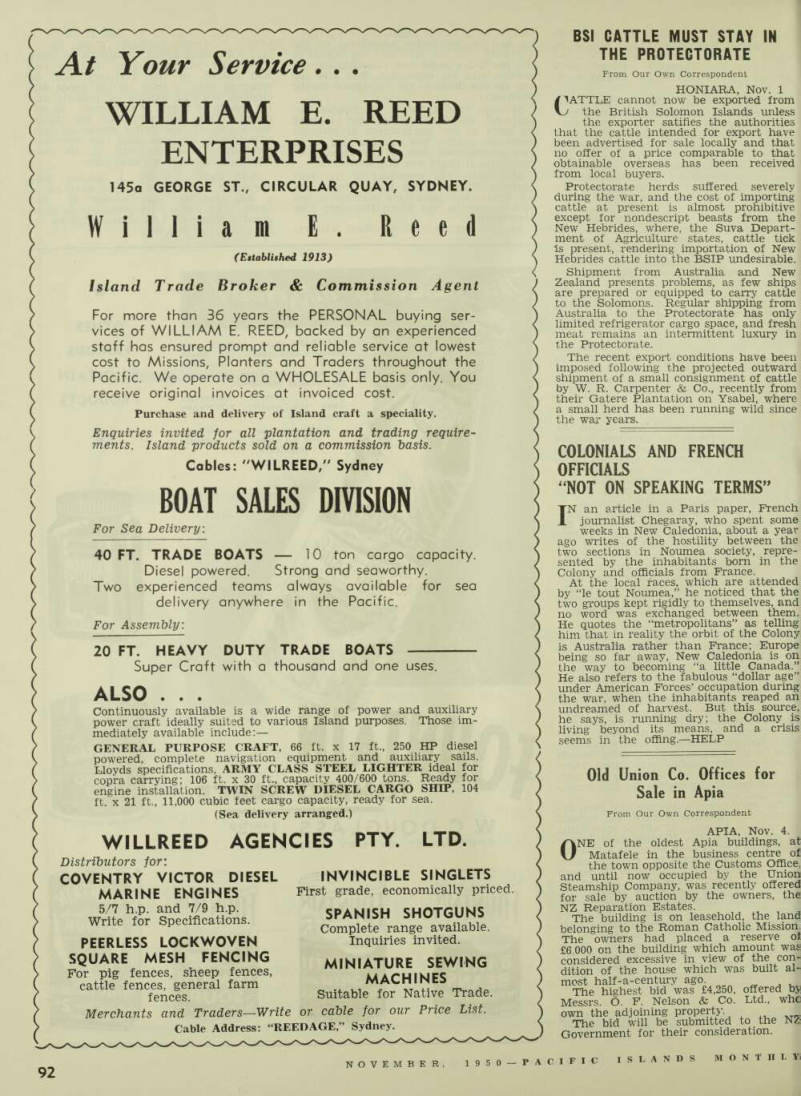
The Protectorate
From Our Own Correspondent
Honiara, Nov. 1
C BATTLE cannot now be exported from J the British Solomon Islands unless the exporter satifies the authorities that the cattle intended for export have been advertised for sale locally and that no offer of a price comparable to that obtainable overseas has been received from local buyers.
Protectorate herds suffered severely during the war, and the cost of importing cattle at present is almost prohibitive except for nondescript beasts from the New Hebrides, where, the Suva Depart ment of Agriculture states, cattle tick is present, rendering importation of New Hebrides cattle into the BSIP undesirable.
Shipment from Australia and New Zealand presents problems, as few ships are prepared or equipped to carry cattle to the Solomons. Regular shipping from Australia to the Protectorate has only limited refrigerator cargo space, and fresh meat remains an intermittent luxury in the Protectorate.
The recent export conditions have been imposed following the projected outward shipment of a small consignment of cattle by W. R. Carpenter & Co., recently from their Gatere Plantation on Ysabel, where a small herd has been running wild since the war years.
Officials
Colonials And French
“Not On Speaking Terms”
IN an article in a Paris paper, French journalist Chegaray, who spent some weeks in New Caledonia, about a year ago writes of the hostility between the two sections in Noumea society, repre sented by the inhabitants bom in the Colony and officials from France.
At the local races, which are attended by “le tout Noumea,” he noticed that the two groups kept rigidly to themselves, and no word was exchanged between them.
He quotes the “metropolitans” as telling him that in reality the orbit of the Colony is Australia rather than France; Europe being so far away, New Caledonia is on the way to becoming “a little Canada.”
He also refers to the fabulous “dollar age” under American Forces’ occupation during the war, when the inhabitants reaped an undreamed of harvest. But this source, he says, is running dry; the Colony is living beyond its means, and a crisis seems in the offing.—HELP
Sale in Apia
Old Union Co. Offices for Sale in Apia
From Our Own Correspondent
Apia, Nov. 4.
ONE of the oldest Apia buildings, at Matafele in the business centre ot the town opposite the Customs Office and until now occupied by the Union Steamship Company, was recently offered for sale by auction by the owners, the NZ Reparation Estates.
The building is on leasehold, the land belonging to the Roman Catholic Mission The owners had placed a reserve oJ £6 000 on the building which amount was considered excessive in view of the con dition of the house which was built al most half-a-century ago The highest bid was £4,250, offered bj Messrs. O. F. Nelson & Co. Ltd., whc own the adjoining property The bid will be submitted to the NZ Government for their consideration.
Samoa—Tonga
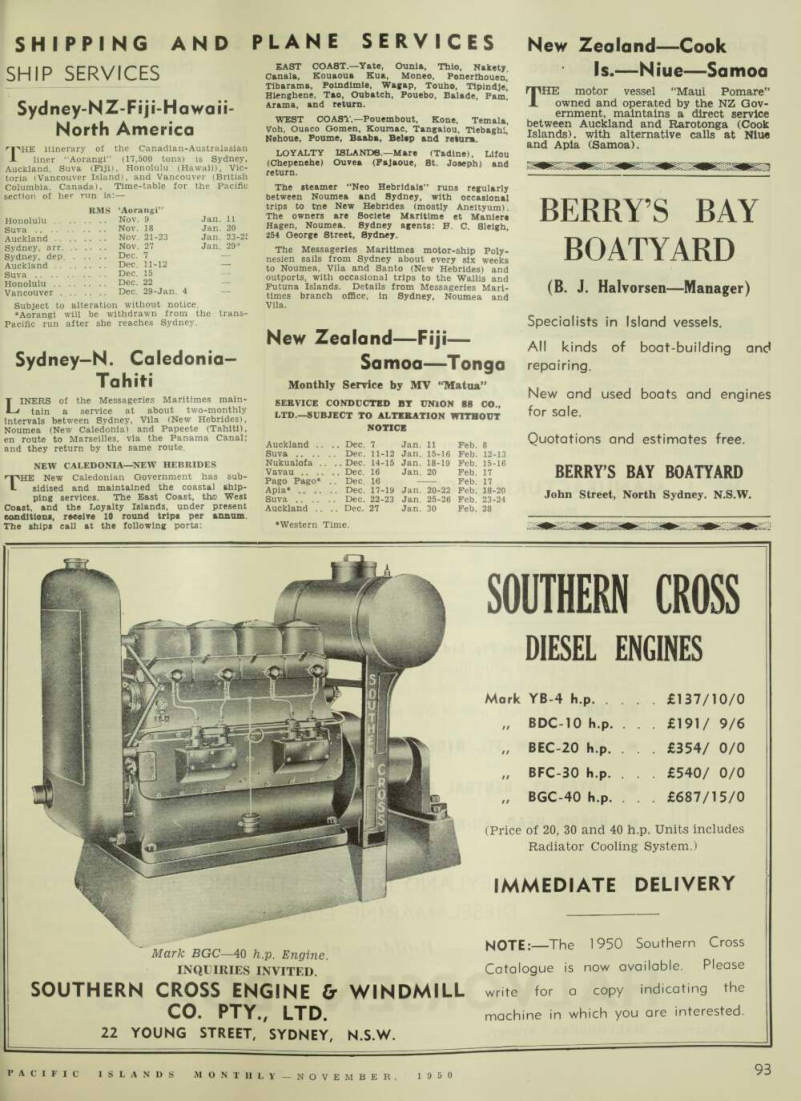
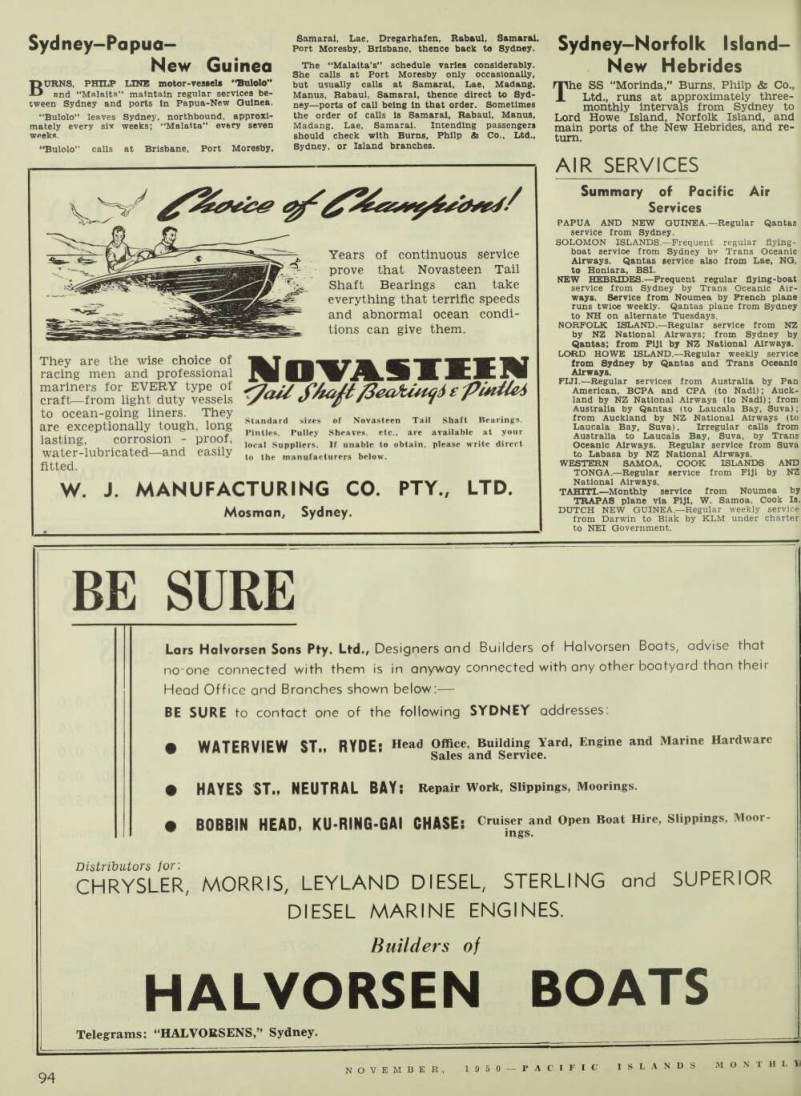
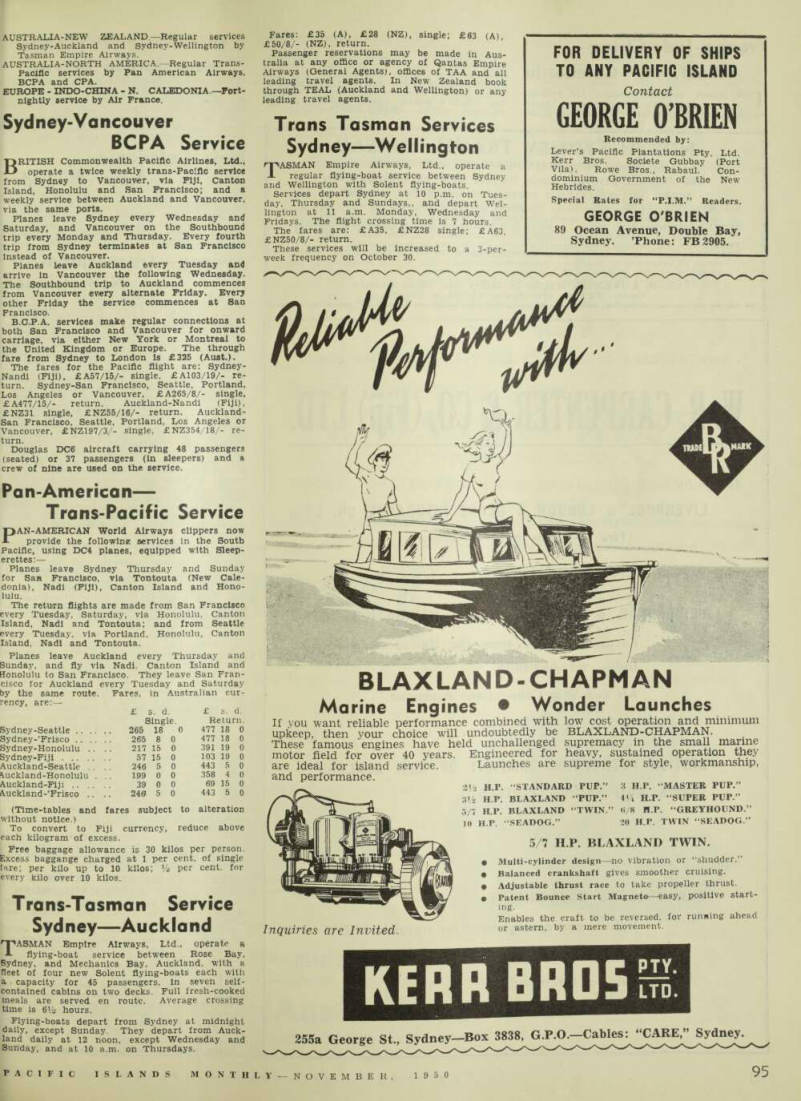
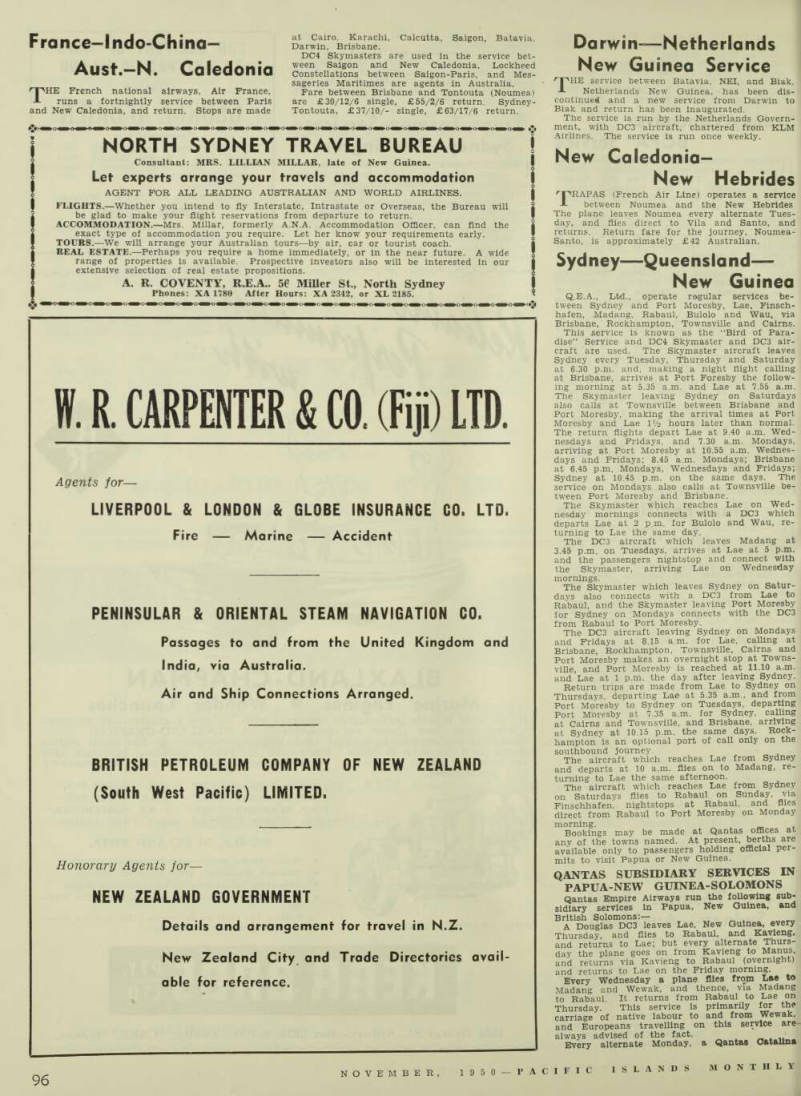
Shipping And Plane Services
Ship Services
Sydney-N Z-Fiji-Hawa ii-
North America
rpnE itinerary of the Canadian-Australasian A liner “Aorangi” (17,500 tons) is Sydney, Auckland, Suva (Fiji), Honolulu (Hawaii), Vic toria (Vancouver Island), and Vancouver (British Columbia. Canada). Time-table for the Pacific section of her run is:—
Subject to alteration without notice. ♦Aorangi will be withdrawn from the trans pacific run after she reaches Sydney.
Sydney-N. Caledonia-
Tahiti
LINERS of the Messagerles Maritimes main tain a service at about two-monthly intervals between Sydney, Vila (New Hebrides), Noumea (New Caledonia) and Papeete (Tahiti), en route to Marseilles, via the Panama Canal; and they return by the same route.
New Caledonia—New Hebrides
THE New Caledonian Government has sub sidised and maintained the coastal ship ping services. The East Coast, tho West Coast, and the Loyalty Islands, under present conditions, receive 10 round trips per annum.
The ships call at the following ports:
EAST COAST.—Yate, Ounla, Thio, Nakety Canala, Kouaoua Kua, Moneo, Ponerlhouen, Tibarama, Poindlmle, Wagap, Touho, Tiplndje, Hienghene, Tao, Oubatch, Pouebo, Balade, Pam, Arama, and return.
WEST COAST.—Pouembout, Kone, Temala, Voh, Ouaco Gomen, Koumac, Tangaiou, Tlebaghi, Nehoue, Poume, Baaba, Belep and retura.
LOYALTY ISLANDS.—Mare (Tadlne), Llfou (Chepenehe) Ouvea (Pajaoue, Bt. Joseph) and return.
The steamer *‘Neo Hebrldals” runs regularly between Noumea and Sydney, with occasional trips to tne New Hebrides (mostly Aneltyum).
The owners are Soclete Maritime et Maniere Hagen, Noumea. Sydney agents: F, C. Sleigh, 254 George Street, Sydney.
The Messagerles Maritlmes motor-ship Poly nesien sails from Sydney about every six weeks to Noumea, Vila and Santo (New Hebrides) and outports, with occasional trips to the Wallis and Futuna Islands. Details from Messagerles Mari times branch office, in Sydney, Noumea and Vila.
New Zealand—Fiji—
Samoa—Tonga
Monthly Service by MY “Matua”
Service Conducted By Union 88 Co.,
Ltd.—Subject To Alteration Without
Notice
New Zealand—Cook
Is.—Niue—Samoa
THE motor vessel “Maui Pomare” owned and operated by the NZ Gov ernment, maintains a direct service between Auckland and Rarotonga (Cook Islands), with alternative calls at Niue and Apia (Samoa).
RMS ‘Aorangi”
Honolulu Nov. 9 Jan. 11 Suva Nov. 18 Jan. 20 Auckland Nov. 21-23 Jan. 23-2S Sydney, arr Nov. 27 Jan. 29* Sydney, dep Dec. 7 Auckland Dec. 11-12 — Suva Dec. 15 Honolulu Dec. 22 Vancouver Dec. 29-Jan. 4 —
Auckland .. .. Dec. 7 Jan. 11 Feb. 8 Suva Dec. 11-12 Jan. 15-16 Feb. 12-13 Nukualofa .. ..Dec. 14-15 Jan. 18-19 Feb. 15-16 Vavau Dec. 16 Jan. 20 Feb. 17 Pago Pago* .. Dec. 16 Feb. 17 Apia* Dec. 17-19 Jan. 20-22 Feb. 18-20 Suva Dec. 22-23 Jan. 25-26 Feb. 23-24 Auckland .. .. Dec. 27 Jan. 30 Feb. 28 •Western Time.
Sydney-Papua—
New Guinea
BURNS, PHILP LINE motor-vessels “Bulolo” and “Malalta” maintain regular services be tween Sydney and ports in Papua-New Guinea.
“Bulolo” leaves Sydney, northbound, approxi mately every six weeks; “Malalta” every seven weeks.
“Bulolo” calls at Brisbane, Port Moresby,
Samaral, Lae, Dregarhafen, Rabaul, Samara!, Port Moresby, Brisbane, thence back to Sydney.
The “Malalta’s” schedule varies considerably.
She calls at Port Moresby only occasionally, but usually calls at Samaral, Lae, Madang, Manus, Rabaul, Samaral, thence direct to Syd ney—ports of call being In that order. Sometimes the order of calls Is Samaral. Rabaul, Manus, Madang. Lae, Samaral. Intending passengers should check with Burns, Philp <fe Co., Ltd., Sydney, or Island branches.
Sydney-Norfolk Island-
New Hebrides
The SS “Morinda,” Burns, Philp & Co., Ltd., runs at approximately three monthly intervals from Sydney to Lord Howe Island, Norfolk Island, and main ports of the New Hebrides, and re turn.
Air Services
Summary of Pacific Air
Services
PAPUA AND NEW GUINEA. —Regular Qantas service from Sydney.
SOLOMON ISLANDS. —Frequent regular flying boat service from Sydney by Trans Oceanic Airways. Qantas service also from Lae, NG, to Honiara, BSI.
NEW HEBRIDES. —Frequent regular flying-boat service from Sydney by Trans Oceanic Air ways. Service from Noumea by French plane runs twice weekly. Qantas plane from Sydney to NH on alternate Tuesdays.
NORFOLK ISLAND. —Regular service from NZ by NZ National Airways; from Sydney by Qantas; from Fiji by NZ National Airways.
LORD HOWE ISLAND. —Regular weekly service from Sydney by Qantas and Trans Oceanic Airways.
FlJl.—Regular services from Australia by Pan American, BCPA and CPA (to Nadi); Auck land by NZ National Airways (to Nadi); from Australia by Qantas (to Laucala Bay, Suva); from Auckland by NZ National Airways (to Laucala Bay, Suva), Irregular calls from Australia to Laucala Bay, Suva, by Trans Oceanic Airways. Regular service from Suva to Labasa by NZ National Airways.
Western Samoa, Cook Islands And
TONGA. —Regular service from Fiji by NZ National Airways, TAHlTl.—Monthly service from Noumea by TRAPAS plane via FIJI, W. Samoa, Cook Is.
DUTCH NEW GUlNEA.—Regular weekly service from Darwin to Biak by KLM under charter to NEI Government.
AUSTRALIA-NEW ZEALAND. —Regular services Sydney-Auckland and Sydney-Wellington by Tasman Empire Airways.
AUSTRALIA-NORTH AMERICA.—Regular Trans pacific services by Pan American Airways,
Bcpa And Cpa.
Europe - Indo-China -N. Caledonia —Fort
nightly service by Air France.
Sydney-Vancouver
BCPA Service
BRITISH Commonwealth Pacific Airlines, Ltd., operate a twice weekly trans-Padflc service from Sydney to Vancouver, via Fiji, Canton Island, Honolulu and San Francisco; and a weekly service between Auckland and Vancouver, via the same ports.
Planes leave Sydney every Wednesday and Saturday, and Vancouver on the Southbound trip every Monday and Thursday. Every fourth trip from Sydney terminates at San Francisco Instead of Vancouver.
Planes leave Auckland every Tuesday and arrive in Vancouver the following Wednesday.
The Southbound trip to Auckland commences from Vancouver every alternate Friday. Every other Friday the service commences at San Francisco. 8.0.P.A. services make regular connections at both San Francisco and Vancouver for onward carriage, via either New York or Montreal to the United Kingdom or Europe. The through fare from Sydney to London is £325 (Aust.).
The fares for the Pacific flight are; Sydney- Nandi (Fiji), £AS7/15/- single, £AIO3/19/- re turn. Sydney-San Francisco, Seattle, Portland, Los Angeles or Vancouver, £A265/8/- single, £ A477/15/- return. Auckland-Nandi (Fiji), £NZ3I single, £NZSS/16/- return. Auckland- San Francisco, Seattle, Portland, Los Angeles or Vancouver, £NZI97/3/- single, £NZ3S4/18/- re turn.
Douglas DC6 aircraft carrying 48 passengers (seated) or 37 passengers (in sleepers) and a crew of nine are used on the service.
Pan-American—
Trans-Pacific Service
PAN-AMERICAN World Airways clippers now provide the following services in the South Pacific, using DC4 planes, equipped with Sleep erettes: — Planes leave Sydney Thursday and Sunday for San Francisco, via Tontouta (New Cale donia), Nadi (Fiji), Canton Island and Hono lulu.
The return flights are made from San Francisco every Tuesday, Saturday, via Honolulu. Canton Island, Nadi and Tontouta; and from Seattle every Tuesday, via Portland, Honolulu, Canton Island, Nadi and Tontouta.
Planes leave Auckland every Thursday and Sunday, and fly via Nadi. Canton Island and Honolulu to San Francisco. They leave San Fran cisco for Auckland every Tuesday and Saturday by the same route. Fares, in Australian cur rency, are:—
To convert to Fiji currency, reduce above each kilogram of excess.
Free baggage allowance is 30 kilos per person.
Excess baggange charged at 1 per cent, of single fare; per kilo up to 10 kilos; Vu per cent, for every kilo over 10 kilos.
Trans-Tasman Service
Sydney—Auckland
TASMAN Empire Airways, Ltd., operate a flying-boat service between Rose Bay, Sydney, and Mechanics Bay, Auckland, with a fleet of four new Solent flying-boats each with a capacity for 45 passengers, in seven self contained cabins on two decks. Full fresh-cooked meals are served en route. Average crossing time is 6V2 hours.
Flying-boats depart from Sydney at midnight daily, except Sunday. They depart from Auck land daily at 12 noon, except Wednesday and Sunday, and at 10 a.m. on Thursdays.
Fares: £35 (A), £2B (NZ), single; £63 (A), £5O/8/- (NZ), return.
Passenger reservations may be made in Aus tralia at any office or agency of Qantas Empire Airways (General Agents), offices of TAA and all leading travel agents. In New Zealand book through TEAL (Auckland and Wellington) or any leading travel agents.
Trans Tasman Services
Sydney—Wellington
TASMAN Empire Airways, Ltd., operate a regular flying-boat service between Sydney arid Wellington with Solent flying-boats.
Services depart Sydney at 10 p.m. on Tues day, Thursday and Sundays,, and depart Wel lington at 11 a.m. Monday, Wednesday and Fridays. The flight crossing time is 7 hours.
The fares are: £A3S. £NZ2B single; £A63, £NZSO/8/- return.
These services will be increased to a 3-per week frequency on October 30.
£ s. d. £ s. d.
Single. Return.
Sydney-Seattle 265 18 0 477 18 0 Sydney-'Prisco 265 8 0 477 18 0 Sydney-Honolulu ... 217 15 0 391 19 0 Sydney-Fiji 57 15 0 103 19 0 Auckland-Seattle ... 246 5 0 443 5 0 ~nd-Honolulu . . 199 0 0 358 4 0 Auckland-Piji 39 0 0 69 15 0 Auckland-’Frisco .. .. 240 5 0 443 5 0 (Time-tables and fares subject to alteration without notice.)
France-1 ndo-China-
Aust.-N. Caledonia
THE French national airways, Air France, runs a fortnightly service between Paris and New Caledonia, and return. Stops are made
at Cairo, Karachi, Calcutta, Saigon, Batavia, Darwin, Brisbane.
DC4 Skymasters are used in the service bet ween Saigon and New Caledonia, Lockheed Constellations between Saigon-Paris, and Mes sageries Maritimes are agents in Australia.
Fare between Brisbane and Tontouta (Noumea) are £3O/12/6 single, £55/2/6 return. Sydney- Tontouta, £37/10/- single, £63/17/6 return.
Darwin-—Netherlands
New Guinea Service
THE service between Batavia, NEI, and Biak, Netherlands New Guinea, has been dis continued and a new service from Darwin to Biak and return has been inaugurated.
The service is run by the Netherlands Govern ment, with DCS aircraft, chartered from KLM Airlines. The service is run once weekly.
New Caledonia-
New Hebrides
'T'RAPAS (French Air Line) operates a service A between Noumea and the New Hebrides The plane leaves Noumea every alternate Tues day, and files direct to Vila and Santo, and returns. Return fare for the journey, Noumea- Santo, is approximately £42 Australian.
Sydney—Queensland—
New Guinea
Q.E.A., Ltd., operate regular services be tween Sydney and Port Moresby, Lae, Finsch hafen, Madang, Rabaul, Bulolo and Wau, via Brisbane, Rockhampton, Townsville and Cairns.
This service is known as the “Bird of Para dise” Service and DC4 Skymaster and DC3 air craft are used. The Skymaster aircraft leaves Sydney every Tuesday, Thursday and Saturday at 6.30 p.m. and, making a night flight calling at Brisbane, arrives at Port Foresby the follow ing morning at 5.35 a.m. and Lae at 7.55 a.m.
The Skymaster leaving Sydney on Saturdays also calls at Townsville between Brisbane and Port Moresby, making the arrival times at Port Moresby and Lae IV2 hours later than normal.
The return flights depart Lae at 9.40 a.m. Wed nesdays and Fridays, and 7.30 a.m. Mondays, arriving at Port Moresby at 10.55 a.m. Wednes days and Fridays: 8.45 a.m. Mondays; Brisbane at 6.45 p.m. Mondays, Wednesdays and Fridays; Sydney at 10.45 p.m. on the same days. The service on Mondays also calls at Townsville be tween Port Moresby and Brisbane.
The Skymaster which reaches Lae on Wed nesday mornings connects with a DCS which departs Lae at 2 p.m. for Bulolo and Wau, re turning to Lae the same day.
The DCS aircraft which leaves Madang at 3.45 p.m. on Tuesdays, arrives at Lae at 5 p.m. and the passengers nightstop and connect with the Skymaster, arriving Lae on Wednesday mornings.
The Skymaster which leaves Sydney on Satur days also connects with a DC3 from Lae to Rabaul, and the Skymaster leaving Port Moresby for Sydney on Mondays connects with the DCS from Rabaul to Port Moresby.
The DCS aircraft leaving Sydney on Mondays and Fridays at 8.15 am. for Lae, calling at Brisbane, Rockhampton, Townsville, Cairns and Port Moresby makes an overnight stop at Towns ville, and Port Moresby is reached at 11.10 a.m. and Lae at 1 p.m. the day after leaving Sydney.
Return trips are made from Lae to Sydney on Thursdays, departing Lae at 5.35 a.m., and from Port Moresby to Sydney on Tuesdays, departing Port Moresby at 7.35 a.m. for Sydney, calling at Cairns and Townsville, and Brisbane, arriving at Sydney at 10.15 p.m. the same days. Rock hampton is an optional port of call only on the southbound journey.
The aircraft which reaches Lae from Sydney and departs at 10 a.m. flies on to Madang, re turning to Lae the same afternoon.
The aircraft which reaches Lae from Sydney on Saturdays flies to Rabaul on Sunday, via Finschhafen. nightstops at Rabaul, and flies direct from Rabaul to Port Moresby on Monday morning. , Bookings may be made at Qantas offices at any of the towns named. At present, berths are available only to passengers holding official per mits to visit Papua or New Guinea.
Qantas Subsidiary Services In
Papua-New Guinea-Solomons
Qantas Empire Airways run the following sub sidiary services in Papua, New Guinea, and British Solomons;— A Douglas DC3 leaves Lae, New Guinea, every Thursday, and flies to Rabaul, and Kavieng. and returns to Lae; but every alternate Thurs day the plane goes on from Kavieng to Manus, and returns via Kavieng to Rabaul (overnight) and returns to Lae on the Friday morning.
Every Wednesday a plane flies from Lae to Madang and Wewak, and thence, via Madang to Rabaul. It returns from Rabaul to Lae on Thursday. This service is primarily for the carriage of native labour to and from Wewak, and Europeans travelling on this service are always advised of the fact. . ..
Every alternate Monday, a Qantas Catalina
flies from Port Moresby, westward to Daru, via Yule Island, Kerema, Kikorl, Lake Kutubu and Lake Murray, remaining overnight at Kikori and returning to PM next morning.
Every alternate Wednesday, a Qantas Catalina flies from Port Moresby eastward (dep. 9 a.m.) and calls at Abau and Samaral before flying out to the Archipelagoes in the afternoon. Calls are made at Esa’ala and Losuia (where an over night stop is made), and the following day (alternate Thursdays) at Deboyne Lagoon, before returning to Port Moresby, via Samarai and Abau.
Every alternate Monday, a Qantas Catalina leaves Port Moresby for Rabaul, via Moewe Har bour, and Talasea (New Britain); next morning Tuesday) it flies to Buka, Kieta, Buin (Bougainville) and returns to Rabaul; next morning (Wednesday) it flies to Talasea, Moewr Harbour and Jacqulnot Bay. and returns to Rabaul; and next morning (Thursday) it re turns from Rabaul direct to Port Moresby. (Optional calls are made at Inus and Linden hafen.) Every alternate Monday a Qantas Douglas flies from t-ae to Rabaul, and continues on to Honiara (British Solomon Islands), via Toro kina, Vellalavella and Yandina remains over night at Honiara: and returns to Lae the fol lowing day Tuesday), over the same route.
Every Tuesday and Friday a plane leaves Port Moresby at 7.30 a.m., reaches Kokoda at 8.35 a.m., flies on to Higatura (Popendetta) at 8.55 a.m., and leaves again for Port Moresby at 9.5 a.m., reaching there at 10.15 a.m.
Dragon DHB4 aircraft operate the following internal services in New Guinea:— Every Tuesday depart Madang for Goroka, Kalnantu, Aiyura, Arona, returning to Madang at noon the same day. Calls as required for loading are made between Arona and Madang.
Every Thursday departs Madang at 7 a.m. for Wabag, Baiyer River, Mt. Hagen, with optional calls at Kerowagi and Chimbu, and returning to Madang at noon the same day.
Every Friday departs Lae at 6.30 a.m., calling at any or all of the following places as re quired; Asolaka, Aiyura, Arona, Banz, Bena Bena, Chimbu, Goroka, Kaiaipit, Kainantu, Kerowagi. Kup, Mt. Hagen. Nadzab, Nondugl, Ogelbeng, Wabag, Wabumunda, Minj.
Daily, except Wednesdays and Sundays, depart
Lae at 3 p.m. for Bulolo and Wau, returning direct from Wau to Lae the same day. arriving at Lae 5.5 p.m.
Sydney-Lord Howe ls.-
Norfolk Is.
QANTAS, Sydney, run a Sandringham three times per month from Sydney to Lord Howe Island. Fare, single, £l2. Return, £2l/12/-.
Qantas run a DC4 Skymaster alt. Thursdays (returning same day) from Sydney to Norfolk Island. Fare. £22 single; £39/12/- return. (For Norfolk Island, see also under NZ National Airways. For Lord Howe, see also under TOA.)
Sydney-New Hebrides
QANTAS operate a service to the New Hebrides with Sandringham flying-boats calling at Noumea, Port Vila and Espiritu Santo. Frequent
non-scheduled flights are made, subject to the approval of the Governments concerned.
NZ National Airways
South Pacific Services
THE Pacific services run by the New Zealand National Airways Corporation are ai follows: —
Auckland-Norfolk Island-Fiji-Tonga
Western Samoa-Cook Islands: A “Douglas”
airliner leaves Whenuapai, Auckland, on alter nate Tuesdays at 9 a.m. (November 13 and 27. etc.) for Norfolk Island (arr. 12.55 p.m.; dep. 2 p.m.), Nadi (arr. 8.40 p.m., dep. 5.40 a.m. Thursday), Nausori (arr. 6.25 a.m., dep. 7.30 a.m.), Tonga (arr. 10.50 a.m., dep. 11.50 a.m.), ♦Faleolo, Western Samoa (arr. 4.5 p.m. Wednes day, dep. 8 a.m. Thursday), Aitutaki, Cook Islands (arr. 1.50 p.m. Thursday, dep. 2.50 p.m.), Rarotonga, Cook Is. (arr. 4.5 p.m.).
The aircraft departs from Rarotonga on the return journey on alternate Saturdays (November 4, 18; December 2, etc.) at 8 a.m. for Aitutaki (arr. 9.15 a.m., dep. 10 a.m.), Faleolo,
W. Samoa (arr. 3.15 p.m., dep. 8 a.m Sunday), ♦Tonga (arr. 10.55 am. Monday, dep. 11.50 a.m.), Nausori (arr. 2.40 p.m., dep. 3.40 p.m.).
Nadi (arr. 4.25 p.m., dep. 5 a.m. Tuesday), Norfolk Is. (arr. 10.55 am., dep. 12 noon), Whenuapai, Auckland (arr. 4.50 p.m.). ♦Crosses International Date Line.
Auckland-Norfolk Island: A ‘‘Douglas”
airliner leaves Whenuapai, Auckland, every Sun day at 8 a.m. for Norfolk Island (arr. 11.55 a.m.), and departs on the return flight at 12.55 p.m., arriving at Whenuapai at 5.45 p.m.
On alternate Sundays (November 12, 26. etc.), a second service is also operated, leaving Whenuapai at 9 a.m., arriving Norfolk at 12.55 p.m., departing again at 1.55 p.m., and arriving Auckland at 6.45 p.m.
FARES, single (in NZ currency): Auckland to Norfolk, £l4; to Fiji, £3l; to Tonga, £35/15/-; to W Samoa, £39/10/-; to Aitutaxi. £43/10/-; to Rarotonga. £45. Norfolk to Fiji, £l9; Fiji to Tonga, £B/15/-; to W. Samoa, £l3; to Aitutaki, £29; to Rarotonga, £3l. W. Samoa to Rarotonga, £l9; to Aitutaki, £l6/10/-. Return fares less 10 per cent.
BOOKING OFFICES: Wellington, Govt. Life Bldg., Customhouse Quay; Auckland. Air Centre, Nathan’s Bldg., Commerce St.; Dunedin, 8-10 Manse St.; Christchurch, 104 Gloucester St.; Gisborne, 74 Peel St.; Palmerston North, 107 Broadway Ave.; Hamilton. 8 Alma St.; New Plymouth, Grand Central Building, Egmont St.; Blenheim, 13 Queen St.; Hokitika. South side Airport; Norfolk Is., Burns Philp, Ltd.; Fiji, NAC at Nadi and Suva; Burns Philp, Lautoka; Tonga, Mrs. F. F. Melhose, Fou-amotu Airfield: W. Samoa, Burns Philp (SS), Ltd., Apia; Cook Is., Mrs. P. McVeagh, Aitutaki, and Mr. J. D. Campbell, Rarotonga.
TOA Services
TRANS Oceanic Airways run the following Pacific services:— SYDNEY-LORD HOWE IS.: A regular fort nightly service with large four-engine flying boats from Rose Bay. Fare: £l2 single; £2l/10/- return. Free baggage allowance 50 lb.
Excess baggage and freight rate Bd. per lb.
SYDNEY-NEW HEBRIDES-BSI: The company’s regular monthly service to these islands was temporarily suspended in October.
SYDNEY-PORT MOREjSBY: A regular weekly service with 4-engined flying-boats leaves Sydney at 8.15 a.m. every Sunday. An overnight stop is made in Townsville and Port Moresby is reached at 1.35 p.m. on Mondays. The return flight leaves Moresby at 7 a.m. on Tuesdays and arrives at Rose Bay, Sydney, at 8.15 p.m. the same evening. Calls are made at Brisbane and Townsville on both northbound and southbound flights. Fares: Sydney-Port Moresby, £39/5/single. £7O/3/- return; Brisbane-Port Moresby, £32/15/- single, £5B/19/- return; Townsville- Pcrt Moresby. £23/15/- single.
NOTE: Sydney-Moresby service expected to start in November or December.
SYDNEY-HOBART: The company now runs a weekly service direct to Hobart, Tasmania, from Sydney, leaving Sydney each Wednesday and Hobart each Thursday. It is possible, therefore, for passengers to book from Moresby to Hobart, making an overnight stop in Sydney. Fares are: £lO/10/- single, £2l return.
N. Caledonia-Tahiti
TRAPAS (Soclete Francals de Transports Aeriens du Pacific Sud-Noumea) runs a monthly service from New Caledonia to Tahiti Western Samoa (Faleolo), Cook Islands (Altu taki) to Papeete, where it arrives at about 11.40 a.m. two days later. One evening is spent In Nadi and one night in Altutaki. The plane re turns by the same route in the following week.
Fare from Noumea to Papeete is 16,000 Pacific francs single, and 28,800 return. (160 Pacific francs equal £1 Australian.) While the plane is at Papeete it runs one round trip between Papeete and Bora Bora.
Sydney-Noumea-Suva
following is the time-table of the Qantas -I- Sandringham flying-boat:— Sydney dep. 9.30 p.m. alt. Tues.
Noumea arr. 6.30 a.m. alt. Wed.
Noumea dep. 8.20 a.m. alt. Wed.
Suva arr. 2.30 p.m. alt. Wed.
Suva dep. 6 a.m. alt. Fri.
Noumea arr. 10.30 a.m. a.t. Fri.
Noumea dep. 12 noon alt, Fri.
Sydney arr. 7.15 p.m. alt. Fri.
Intending passengers may book through Qantas offices in Australia. Burns Philp (South Seas) Company, in Suva; and J. Brock, in Noumea.
The fares for this service in Aust. currency are:
CPA Sydney-Vancouver
Service
(CANADIAN Pacific Airlines, Ltd., run a trans- Pacific service between Sydney and Van couver. For the present there will be one northbound and one southbound trip per fort night. Stops are made at Nadi (Fiji). Canton Island, Honolulu and San Francisco. The north bound flight commences from Sydney every alter nate Tuesday.* Pour-engined, pressurised “Canadalr” aircraft are used; 36 passengers can be carried and a crew of 7. Overnight accommodation is pro vided at hotels in Nadi and Honolulu, which is of course, complimentary.
Fares are (in Australian currency: Sydney- Vancouver, San Francisco-Los Angeles and Port land-Seattle, £265/8/- single. £477/15/- return; Fiji-Vancouver, £207/8/- single, £373/7/- re turn; Sydney-Fiji, £57/15/- single. £lO3/19/- re turn; Sydney-Honolulu, £217/13/- single. £391/16/- return.
Bookings may be made at the Union Steam Ship Company of New Zealand. Limited, Sydney, or Melbourne; Union Steam Shin Co. of NZ. Ltd .
Fiji, Canadian Pacific Airlines, Vancouver; Canadian Pacific Railway Co., Sydney or Mel bourne.
TEAL Flying Boat
Service
Auckland Fiji
new 45 seater Solent flving-boats, TV Tasman Emnire Airways. Limited, operate a weekly Auckland-Suva-Lambasa and return service.
Aircraft depart Mechanics’ Bay, Auckland, a half hour after midnight, each Tuesday, and operate to the following time-table:— dep. Auckland .. .. 0.30 a.m. Tuesday arr. Suva 7.00 a.m. Tuesday dep. Suva 9.00 a.m. Tuesday arr. Lambasa .. .. 10.00 am. Tuesday dep. Lambasa .. .. noon Tuesday arr. Suva 1.00 p.m. Tuesday dep. Suva 7.00 a.m, Wednesday arr. Auckland .. .. 1.30 p.m. Wednesday Fares (Single): Auckland-Suva, £3l (NZ), £34/9/- (Fijian), £3B/15/- (Aust.); (Return); £55/16/- (NZ), £6l/19/- (Fijian), £69/15/- (Aust.).
Suva-Lambasa (Single): £4/10/- (NZ), £5 (Fijian), £5/12/6 (Aust.); (Return); £B/2/- (NZ), £9 (Fijian), £lO/2/6 (Aust.).
Reservations may be made through TEAL (New Zealand), Qantas or TAA (Australia), NZNAC (Suva) or any leading travel agents.
Papua-NG Local
Services
MANDATED Airlines, Ltd., of Lae, New Guinea, and other private operators, run air ser vices between Lae and the New Guinea mainland centres of Wau, Bulolo, Madang, Wewak, Altape, Mt. Hagen, Plnschhafen, Moresby, Kokoda—in fact anywhere in Papua or New Guinea where there is an air-strip. These planes carry pas sengers. malls and cargo on regular schedules or charter flights.
Sydney-Noumea .. , Single, £37 10 0 Return. £67 10 0 Sydney-Suva 55 10 0 99 18 0 Noumea-Suva ... , 20 5 0 36 9 0
Advertisements & other items, pp. 95-106 (3 items)
Southern Cross
BERRY’S BAY
BOATYARD
(B. J. Halvorsen—Manager)
Specialists in Island vessels.
All kinds of boat-building and repairing.
New and used boats and engines for sale.
Quotations and estimates free.
BERRY’S BAY BOATYARD
John Street, North Sydney. N.S.W.
% Mark BGC —4O h.p. Engine.
INQUIRIES INVITED.
SOUTHERN CROSS ENGINE WINDMILL
CO. PTY., LTD.
22 YOUNG STREET, SYDNEY, N.S.W.
SOUTHERN CROSS
DIESEL ENGINES
Mark YB-4 h.p £137/10/0 „ BDC-10 h.p. . . . £l9l/ 9/6 „ BEC-20 h.p. £354/ 0/0 „ BFC-30 h.p. . . . £540/ 0/0 „ BGC-40 h.p. . . £687/15/0 (Price of 20, 30 and 40 h.p. Units includes Radiator Cooling System.)
IMMEDIATE DELIVERY
NOTE: —The 1950 Southern Cross Catalogue is now available. Please write for a copy indicating the machine in which you are interested.
Years of continuous service prove that Novasteen Tail Shaft Bearings can take everything that terrific speeds and abnormal ocean conditions can give them.
They are the wise choice of racing men and professional mariners for EVERY type of craft—from light duty vessels to ocean-going liners. They are exceptionally tough, long lasting. corrosion - proof, water-lubricated —and easily fitted.
NOVASTIEN
Standard sizes of Novasteen Tail Shaft Bearings, Pintles, Pulley Sheaves, etc., are available at your local Suppliers. If unable to obtain, please write direct to the manufacturers below.
W. J. MANUFACTURING CO. PTY., LTD.
Mosmon, Sydney.
BE SURE
Lars Halvorsen Sons Pty. Ltd., Designers and Builders of Halvorsen Boats, advise that no-one connected with them is in anyway connected with any other boatyard than their Head Office and Branches shown below: — BE SURE to contact one of the following SYDNEY addresses; A WATFRVIFW RYDF* Head Office, Building Yard, Engine and Marine Hardware 9 "Micnvicn nine. Sales and Service. HAYES ST., NEUTRAL BAY; Repair Work, Slippings, Moorings. • BOBBIN HEAD, KU-RING-GAI CHASE: Cruiser and Open Boat Hire, Slippings, Moormgs.
Distributors for: , CHRYSLER, MORRIS, LEYLAND DIESEL, STERLING and SUPERIOR
DIESEL MARINE ENGINES.
Builders of
HALVORSEN BOATS
Telegrams; “HALVOBSENS,” Sydney. -
FOR DELIVERY OF SHIPS
TO ANY PACIFIC ISLAND
Contact
GEORGE O’BRIEN
Recommended by: Lever’s Pacific Plantations Pty. Ltd.
Kerr Bros. Societe Gubbay (Port Vila). Rowe Bros., Rabaul. Condominium Government of the New Hebrides.
Special Bates for “P.1.M.” Readers.
GEORGE O'BRIEN
89 Ocean Avenue, Double Bay, Sydney. ’Phone: FB 2905.
m I u
BLAX LAND-CHAPMAN
Marine Engines • Wonder Launches
If you want reliable performance combined with low cost operation and minimum upkeep, then your choice will undoubtedly be BLAXLAND-CHAPMAN.
These famous engines have held unchallenged supremacy in the small marine motor field for over 40 years. Engineered for heavy, sustained operation they are ideal for island service. Launches are supreme for style, workmanship, and performance. :■ m ' ' ' . -i ■.
Z\ z H.P. STANDARD PUP.”
31/2 H P. BLAXLAND “PUP.”
5/7 H.P. BLAXLAND “TWIN.
10 H.P. “SEADOG.”
3 H.P. “MASTER PUP.”
4Vi H.P. “SUPER PUP.”
(i/S H.P, “GREYHOUND.’
20 H.P. TWIN “SEADOG.’
Inquiries are Invited,
5/7 H.P. BLAXLAND TWIN.
Multi-cylinder design—no vibration or “shudder.”
Balanced crankshaft gives smoother cruising.
Adjustable thrust race to take propeller thrust.
Patent Bounce Start Magneto—easy, positive starting.
Enables the craft to be reversed, for running ahead or astern, by a mere movement.
KERR BRDSifo
NORTH SYDNEY TRAVEL BUREAU
Consultant: MRS. LILLLAN MILLAR, late of New Guinea.
Let experts arrange your travels and accommodation AGENT FOR ALL LEADING AUSTRALIAN AND WORLD AIRLINES.
FLlGHTS.—Whether you intend to fly Interstate, Intrastate or Overseas, the Bureau will be glad to make your flight reservations from departure to return.
ACCOMMODATION.—Mrs. Millar, formerly A.N.A. Accommodation Officer, can find the exact type of accommodation you require. Let her know your requirements early.
TOURS. —We will arrange your Australian tours —by air, car or tourist coach.
REAL ESTATE. —Perhaps you require a home immediately, or in the near future. A wide range of properties is available. Prospective investors also will be interested in our extensive selection of real estate propositions.
A. R. COVENTY, R.E.A.. 56 Miller St., North Sydney Phones: XA 1780 After Hours: XA 2342, or XL 2185.
I.R. CARPENTER S CO, (Fiji) LTD.
Agents for — LIVERPOOL & LONDON & GLOBE INSURANCE CO. LTD.
Fire Marine Accident
PENINSULAR & ORIENTAL STEAM NAVIGATION CO.
Passages to and from the United Kingdom and India, via Australia.
Air and Ship Connections Arranged.
BRITISH PETROLEUM COMPANY OF NEW ZEALAND
(South West Pacific) LIMITED.
Honorary Agents for —
NEW ZEALAND GOVERNMENT
Details and arrangement for travel in N.Z.
New Zealand City and Trade Directories avail able for reference.
sdfdfd
RTR4 30 H.P. Marine Diesel
Elec. Starting. 2-1 Red. Gear. c> t > Modern compact Diesel for general purpose use.
MARINE DIESEL AND
PETROL ENGINES
In units—9, 18, 20/30, 33/55, 60/90, and 95/130 H.P.
DB2.
Heavy Duty. % 9 H.P. Heavy Duty Petrol-Kerosene Engine
GOOD DELIVERIES OF ALL MODELS.
Write for full particulars of our complete range of engines to:
Thornycroft (Aust.) Pty., Ltd.
Cables: “THORNMOTOR,” Sydney.
CAPTAIN W. L. KENNEDY
Established 1931.
Shipbrokers, Business & Real Estate
63 Pitt St., Sydney
'Phone: 8W6461. Cables: "CAPKEN," Sydney.
LISTING FOR SALE:
MODERN STEEL CARGO VESSEL. 330 H.P. H.D. Diesel, placed aft; deadweight around 400 tons; Diesel winches: two hatches; built in 1945. Price. £17,500 sterling.
TUSA TUG, in survey, 270 H.P. H.D. Diesel. Price, £8,500 Aust.
SEINE TRAWLER, sturdy, 51 ft., with slow-revving Diesel —suitable for conversion to cargo. Price, £6,300 Aust.
HULL, brand new, strongly built, carry 85 tons. Price, £7,000 Aust.
ALSO WE CAN SUBMIT PARTICULARS OF LAUNCHES, ALL TYPES AND SIZES.
Enquiries Invited.
Through our Business and Real Estate Branch, we can offer a wide variety of Sydney and N.S.W. properties. All Islands inquiries promptly and satisfactorily attended to.
first t/utst.
\* *" .. oicnl thirst than * There's fi-« "£***' •** Jg^
-*■SrJ.— —•“* aR-^
firm favourite
TOOTH’S
hewed AND
lA6ER
OTTLED
by TOOT H & CO. limited
GET THERE SOONER
STAY THERE LONGER
ONE OF THE 51 COUNTRIES ON SPEED6IRO ROUTES You can cover the world and save weeks of valuable travel time by Speedbird services to all six continents.
One ticket can take you to any of eighty ports of call on 8.0.A.C. world routes —with 8.0.A.C.’s incomparable standards of service catering to your personal comfort all the way. Complimentary meals include drinks. No tips, no extras to pay.
Book from Sydney to INDONESIA • FAR EAST HONG KONG • JAPAN • CEYLON • INDIA PAKISTAN • AFRICA • ITALY • GREAT BRITAIN AND VIA U.K. TO U.S.A. • CANADA • CENTRAL
AND SOUTH AMERICA • BERMUDA
8.0.A.C. TAKES GOOD CARE OF YOU
Fir -B OA C
Information & Bookings : Qantas Empire Airways Ltd. ( 8.0.A.C. General Agents in Australia) at Sydney, Melbourne, Brisbane. Townsville, Cairns, Darwin or from Travel Agents in all cities and towns .
AIS/AU
•gm ■& BRITISH OVERSEAS AIRWAYS CORPORATION WITH QANTAS EMPIRE airways ltdGasmanempire airways ltd. & south African airways
If you want something under cover
IN A HURRY!
«> I I r 99 ft. x 30 ft. x 12 ft. high Econo-Steel Store. • FACTORIES, STORES • GARAGES • HOMES • CABINS Whatever your accommodation problem, call on the
Econo-Steel Company for suggestions on their
prefabricated components.
Over 2000 structures built to date.
Qualified Engineering and Building Consultants on
our staff will gladly assist you solve your problem.
ECONO-STEEL
Commonwealth Works and Housing.
Public Works Department.
Joint Coal Board.
Zinc Corporation.
Qantas Empire Airways.
Shell Company.
Atlantic Union Oil.
Commonwealth Wool and Produce.
Pitt, Son & Badgery.
Department of Lands.
Australian Estates.
Ready Mixed Concrete.
PROJECTS, completed for
Timbrol, Limited.
Warringah Shire Council.
Leichhardt Council.
Royal Agricultural Society.
Orange City Council.
North Broken Hill, Ltd.
South Broken Hill, Ltd.
Education Department.
Commonwealth Oil Refinery.
P.M.G. Department.
Robert Gillespie Pty., Ltd.
the following:
Department of Civil Aviation.
Pickwick Productions.
Lewis Berger.
Davison’s Paints.
B.A.L.M.
Hollins Mills.
Morris, Hedstrom, Ltd.
Kosciusko Park Trust.
Victoria Park Golf Club.
State Housing Commissions — N.S.W., Queensland and Western Australia.
6 REASONS why ECONO - STEEL
has been selected :
1. —Flexibility of Design.
2. —Low Cost and Faster Erection.
3. —Simplicity in Construction.
4. —Early Availability.
5. —Uniform High Quality.
6. —Fewer Field Technicians.
,mPP^ 0
Simply built to your own detail in Econo-Steel- —nailable precision steel. Available now.
Call and inspect our exhibition homes and demonstration area at Rhodes (Monday to Saturday) when you
visit Sydney.
Write for further particulars to:
ECONO-STEEL COMPANY
(A DIVISION OF TULLOCH, LTD.)
Concord Road, Rhodes, N.S.W., Australia. Telephone: UF 1231.
Cables: “TULLSTEEL,” Sydney.
BROOMPIELDS Ltd.
Suppliers of
Building Hardware
Ship Chandlery, Paint Materials
3
WRITE DIRECT TO'.
Broomfields Ltd., 152 Sussex Street, Sydney
Tut Garrick Motel
SI «!
iii
k, m vmmmmm s m'%
SUVA
FIJI
This well-known Hotel is centrally situated in Suva's main business quarter :: Modern accommodation provides comfort in all climatic conditions :: Only the best of Beers. Spirits and Wines is served Telephone: 80.
VINCE COSTELLO,
Proprietor.
Pimples and Bad Skin Attacked In 24 Hours
Since the discovery of Nixoderm, the scientific medicine, it is no longer necessary for anyone to suffer from ugly, disgusting and disfiguring skin blemishes such as Pimples, Rash, Ringworm, Psoriasis, Acne, Blackheads, Scabies and Red Blotches. Don't let a bad skin make you feel inferior and cause you to lose your friends. Clear your skin this new scientific way.
A New Discovery
Nixoderm is an ointment, but different from any ointment you have ever seen or felt. It is a new discovery, and is not greasy but feels almost like a powder when you apply it. It penetrates rapidly into the pores and fights the cause of surface skin blemishes.
Nixoderm contains 9 ingredients which fight skin troubles in these 3 ways : 1.
It fights and Y ' lls the microbes or parasites often l ./sponsible for skin disorders. 2. It stops itching, burning and smarting in 7 to 10 minutes, and cools and soothes tfce skin. 3. It helps nature heal the skin clear, soft and velvety smooth.
Works Fast
Because Nixoderm is scientifically compounded to fight skin troubles, it works fast. It stops the itching, burning and smarting in a few minutes, then starts to work immediately, clearing and healing your skin, making it softer, whiter and velvety smooth. In
just a day or two your mirror will tell you that here at last is the scientific treatment you have been needing to clear your skin—the treatment to make you look more attractive, to help you win friends. Nixoderm has brought clearer, healthier skins to thousands such as Mr. Bob Weedon, Edmund Street, Fremantle, who writes: “I was troubled with pimples ever since I was 13, and have spent pounds and pounds on so-called cures without results. I then tried Nixoderm with astounding effect. The pimples seemed to fade away, and after a week there was not the slightest trace of them.”
Satisfaction Guaranteed
Get Nixoderm from your chemist or store to-day. Look in the mirror in the morning and you will be amazed at the improvement. Then just keep on using Nixoderm for one week and at the end of that time It must have made your skin soft, clear, smooth and magnetically attractive —must give you the kind of skin that will make you admired wherever you go, or you simply return the empty package and your money will be refunded in full. Get Nixoderm from your chemist or store to-day. TV guarantee protects you.
Nixoderm
For Skin Sores, Pimples and Itch.
DA VISON PAINTS
jotaved won the mantes
DAVISON
DAVCO
ONE COAT
METAL PAINT
VELVENE
js^gecj
VEITONE
FINIS*!
2*
VIKYLITE
FIATOII FINISH
usteVaterPaint
MiSCJ
veiustre
HICHfSI 6«AOf PURE
PAINT
11*1 $
VIKYLITE
Super gloss porcelain hard Enamel.
VELVENE
Velvet Finish Water Paint for inside and outside use.
OAVCO
One Coat Metal Paint protects all exposed metal-work.
VELTONE
Flat Oil Washable Wall Paint: interior use.
YELUSTRE
Highest grade Tit. Zinc based House Paint.
Davison Paints have for many
years proved
their resistance to severe
tropical
conditions. The Davison range
of products
includes high
quality finishes
for all purposes. You can be sure of V Davison. /
ALL DAVISON FINISHES AVAILABLE FROM
A. H. BUNTING LIMITED AUSTRALIAN FIBRES LIMITED G. G. SMITH Cr CO. LIMITED Samarai, Papua Kokopo and Lae, New Guinea New Britain Port Moresby Papua
SELF
PLAIN AND
RAISING
F LO UR.
daJc fo*c
ESTABLISHED 1868
Agents for Fiji, Tonga and Samoa: C. SULLIVAN (PACIFIC ISLANDS) LTD., Suva, Fiji.
THE WALL-MACNAUGHT
44 Gallon
DRUM PUMP
Fills Everything
O Q X/ V ■ It is ideal for filling tractors, cars, vehicles, stationary engines, boats, stoves, pressure heaters, refrigerators, lamps, bottles, blow torches, 4 gallon drums, etc., and can be used with any non-corrosive liquid.
A solid brass plunger which is always below liquid level makes it self-priming and pumps with the first few strokes . . . waste of liquid due to spillage is entirely eliminated.
DISTRIBUTORS:
• Capacity 4 gallons a minute. • Aluminium Pumphead. • Weight \\ lb. • Guaranteed 12 months. • Unrestricted delivery.
Also available for 4-5 gallon drums
ROBERT GILLESPIE PTY. LTD.
54a Pitt St., Sydney.
Telephone: BU 1305.
NORMAN
tm/vm
Golf Champion, says: “Horlicks helps me sleep soundly—and has a wonderful tonic effect on my whole system”
v^AAAAAAAAAA^^^AAAA^NA/V\AAAAA<, V
“I find Horlicks invaluable" , says Von l\ida , “particularly when I’m playing competitive golf. That’s when I must have a good night’s sleep and wake up feeling fine and that’s when Horlicks does me the most good’’.
While you sleep your body goes on burning up energy. Breathing and heartbeats both use up energy —and unless it is replaced while you sleep , you awake tired.
You feel dull . . . often irritable, “nervy”, and can’t give your best.
A glass of nourishing Horlicks before bed brings deep, restful sleep. And Horlicks replaces tha energy you lose during sleep.
After Horlicks, you awake re- Rich in these food values freshed, bright-eyed and ready for the day.
Every glass of Horlicks is a tonic for your whole system.
Made from full-cream milk and the nutritive extracts of malted barley and wheat, Horlicks soon builds you up. What’s more, you get the benefits of Horlicks much quicker because Horlicks is a balanced food drink, specially manufactured so that its goodness goes straight into your blood stream.
So drink Horlicks regularly before bed for deep, refreshing sleep and bubbling vitality the next day. Buy your tin today!
j V/TAMW Bt
—when mixed as directed. & Ask your storekeeper for
HORLICKS
8-oz. 16-oz. f -
TIN Z'2 TIN 3'6
Prices slightly higher in country area.
94
NOVEMBER, 1950 PACIFIC ISLANDS MONTHLH
104
NOVEMBER, 1950 PACIFIC ISLANDS MONIHLI
Anglican Work in NG and the Solomons
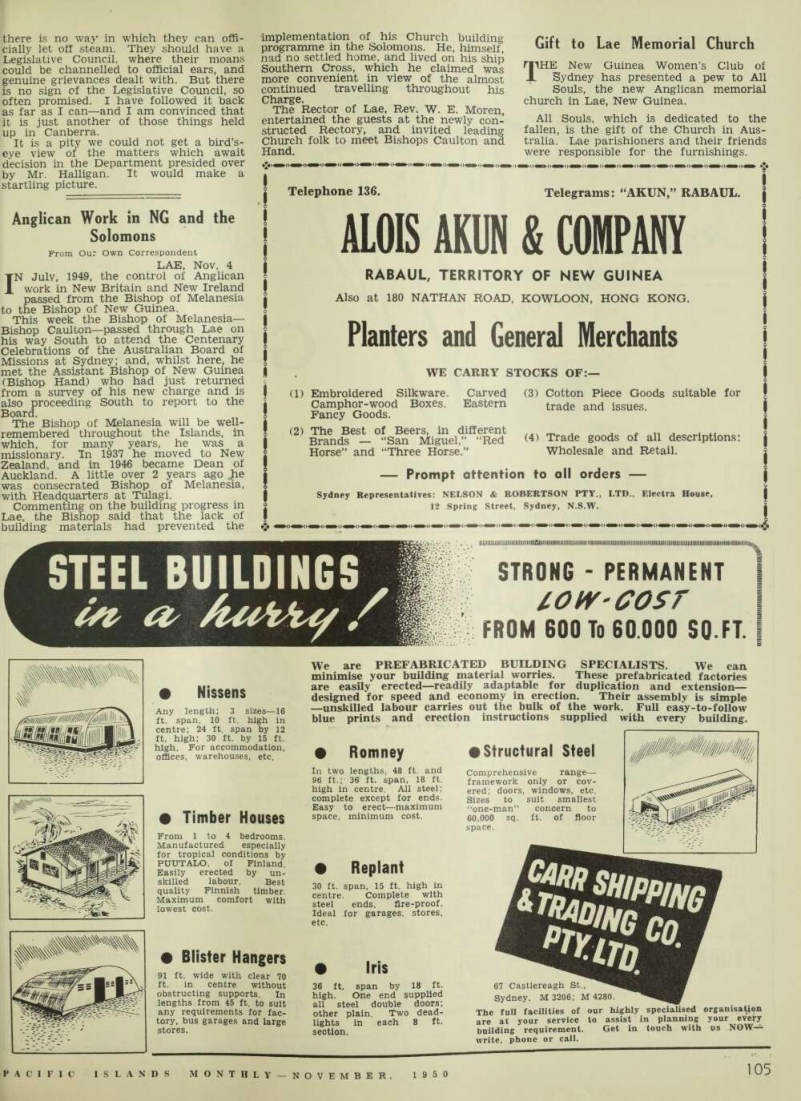
Solomons
From Our Own Correspondent
Lae, Nov. 4
IN July, 1949, the control of Anglican work in New Britain and New Ireland passed from the Bishop of Melanesia to the Bishop of New Guinea.
This week the Bishop of Melanesia— Bishop Caulton —passed through Lae on his way South to attend the Centenary Celebrations of the Australian Board of Missions at Sydney; and, whilst here, he met the Assistant Bishop of New Guinea (Bishop Hand) who had just returned from a survey of his new charge and is also proceeding South to report to the Board.
The Bishop of Melanesia will be well remembered throughout the Islands, in which, for many years, he was a missionary. In 1937 he moved to New Zealand, and in 1946 became Dean of Auckland. A little over 2 years ago jie was consecrated Bishop of Melanesia, with Headquarters at Tulagi.
Commenting on the building progress in Lae, the Bishop said that the lack of building materials had prevented the
implementation of his Church building programme in the Solomons. He, himself, nad no settled home, and lived on his ship Southern Cross, which he claimed was more convenient in view of the almost continued travelling throughout his Charge.
The Rector of Lae, Rev, W. E. Moren, entertained the guests at the newly con structed Rectory, and invited leading Church folk to meet Bishops Caulton and Hand.
Gift to Lae Memorial Church
THE New Guinea Women’s Club of Sydney has presented a pew to All Souls, the new Anglican memorial church in Lae, New Guinea.
All Souls, which is dedicated to the fallen, is the gift of the Church in Aus tralia. Lae parishioners and their friends were responsible for the furnishings.
Advertisements & other items, pp. 107-108 (1 item)
Alois Akun & Company
Telephone 136.
Telegrams: “AKUN,” RABAUL.
RABAUL, TERRITORY OF NEW GUINEA
Also at 180 NATHAN ROAD, KOWLOON, HONG KONG.
Planters and General Merchants
(1) Embroidered Silkware Camphor-wood Boxes.
Fancy Goods. (2) The Best of Beers, in different Brands “San Miguel,” “Red Horse” and “Three Horse.”
WE CARRY STOCKS OF:—
(3) Cotton Piece Goods suitable for trade and issues.
Carved Eastern (4) Trade goods of all descriptions: Wholesale and Retail.
Prompt attention to all orders Sydney Representatives: NELSON & ROBERTSON PTY., LTD., Electra House, 12 Spring Street, Sydney, N.S.W.
STRONG - PERMANENT
lOW’COST
FROM 600 To 60.000 SQ.FT.
• Nissens
Any length; 3 sizes—l 6 ft. span, 10 ft. high in centre; 24 ft. span by 12 ft. high: 30 ft. by 15 ft. high. For accommodation, offices, warehouses, etc.
• Timber Houses
From 1 to 4 bedrooms.
Manufactured especially for tropical conditions by PUUTALO, of Finland.
Easily erected by unskilled labour. Best quality Finnish timber.
Maximum comfort with lowest cost.
• Blister Hangers
91 ft. wide with clear 70 ft. in centre without obstructing supports. In lengths from 45 ft. to suit any requirements for factory, bus garages and large stores.
We are PREFABRICATED BUILDING SPECIALISTS. We can minimise your building material worries. These prefabricated factories are easily erected —readily adaptable for duplication and extension— designed for speed and economy in erection. Their assembly is simple —unskilled labour carries out the bulk of the work. Full easy-to-follow blue prints and erection instructions supplied with every building. ;.** .. '
• Romney
In two lengths. 48 ft. and 96 ft.; 36 ft. span, 18 ft. high in centre. All steel; complete except for ends.
Easy to erect —maximum space, minimum cost.
• Replant
30 ft. span, 15 ft. high in centre. Complete with steel ends, fire-proof.
Ideal for garages, stores, etc.
• Iris
36 ft. span by 18 ft. high. One end supplied all steel double doors; other plain. Two deadlights in each 8 ft. section.
• Structural Steel
Comprehensive range— framework only or covered: doors, windows, etc.
Sizes to suit smallest “one-man” concern to 60,000 sq. ft. of floor space. & 67 Castlereagh St., Sydney. M 3206; M 4280 The full facilities of our highly specialised organisation are at your service to assist in planning your every building requirement. Get in touch with us NOW— write, phone or call.
Of, % //: °*f /j ’ * *• C the
C i LI
j is /° r
GILBEY’S
,l, «* tTI MEte o U R Ne. sy 0 ! */s
fI AN£
Address all enquiries to W. & A. GILBEY LTD., 33 Rosslyn Street, West Melbourne.
CAMERAS from KODAK
SIX-20 BROWNIE “C”
Camera
Six-20 Brownie “C.”
SIX-20 BROWNIE “D”
Camera
Yet another member of the famous Brownie Family, this model combines Brownie simplicity and Kodak dependability at their best. Its outstanding feature is its ability to make pictures as close as three feet —a feature to place the Model "D” in a class of its own.
Otherwise, its operation and performance are exactly the same as the Model “C.”
KODAK (A/asia) PTY.
LIMITED,
379 George St., Sydney.
Probably the most popular of the famous Brownie Family, this model is the “ideal” for a beginner in photography—so easy and dependable is it to use. It has a sturdy all-metal body covered with black grained leatherette, a Kodak Meniscus lens and two brilliant viewfinders. It makes 8 exposures (snapshot or time) size 2'A x SVi in. on Kodak V 620 film.
Six-20 Kodak “A” Camera
The choice of photographers who demand prize-winning quality in their pictures. This model has an Anastar f/4.5 lens apd a 4-speed Epsilon shutter (1/150, 1/100, 1/50 and 1/25 sec.) with provision for “B” and “T” exposures. It will take pictures as close as 3Vs ft.
Strong metal body with black leatherette covering.
Gives 8 exposures (2V4 x 3V* in.) on Kodak V 620 film. (Other models available.) Ensign Ful-vue.
ENSIGN FUL-VUE
Just the camera for youthful beginners—in its large brilliant viewfinder the picture image can be seen in almost actual full size. It’s so easy to use, too, as it provides for time and snapshots exposures and will make pictures as close as three feet. All-metal body; carrying sling. Gives 12 pictures on Kodak Vl2O film.
S
SIX-20 FOLDING
BROWNIE Camera
Just the camera for the keen beginner. It has a Meniscus lens, Kodette shutter (to make time or snapshot exposures), a clear brilliant viewfinder and features single movement opening and closing, pressed steel body (rustproof) and black leatherette covering. Provides 8 exposures (2V4 x 3*A in.) on Kodak V 620 film.
Folding Brownie.
Six-20 Kodak “A.’
Ask to See the Kodak Camera Range.
FROM ALL KODAK DEALERS
THROUGHOUT THE ISLANDS
Timber Scandal
Another Kind Of New Guinea
A Story of Incredible Waste and Maddening
Frustration
By R. W. Robson.
Pt. Moresby, Oct. 31
IN the days Before, if you were in the Bulolo Valley area of New Guinea, and met a couple of men, they sooner or later would lead you onto a hilltop, and point yearningly to the places where they permitted—could find good gold.
The Morobe world then turned on gold prospects. The common language was interlarded with references to penny weights and ounces and “coons” (the patient native labourers who carried and shovelled) and brightened with reflections upon New Guinea Goldfields Ltd., the big company which had leased so much of the likely country, and thus closed it to the fossickers.
That is all changed to-day. Now, the men you meet on the track don’t look down. They point upwards, up the valleys and across tthe mountain-tops; and their talk is all of pine—the famous Hoop and Klinki pine of the Morobe uplands. They visualise the fortunes that can be made, if only that beautiful timber can be cut down and transported to the hungry markets in New Guinea, and Australia, and overseas.
But that is about as far as it goes. In spite of all Liberal-Ministerial assurances, the Territory has not yet developed any comprehensible timber-getting policy. All the people in the Morobe district, and half the peoole elsewhere in the Terri tories. are eager to cut and use and market this timber; Canberra has given instruc tions that it shall, within reason, be cut and used: but still Port Moresby fiddles, and fumbles and footles: and no man knows who is to cut the timber, or how, or when.
My tour through the Territories has been attended by one long chorus of criticism of the Administration; but I think there was more virulence in the remarks relating to timber, than in all the rest.
One explanatory statement from Mores by might have silenced most of it; but Moresby says never a word. In relation to timber, as in most other matters, Moresby is silent, aloof and disdainful.
Therefore, one can only make an intel ligent guess concerning the cause of the present baffling situation.
The outstanding facts are: — • There is a large quantity of very good timber, and an almost incalculable amount of indifferent timber, in Papua and New Guinea. • Every Territories centre is clamouring for sawn timber, for countless construc tion projects. • Although there is an abundance of good to fair timber in the NG forests, imported timber is still pouring into the Territories. While I was there, the Admiral Chase discharged 500,000 feet of NSW timber in Port Moresby, at a landed price of 144/- per hundred super feet! • NG timber could be sold also to an apparently insatiable market overseas. • If the Territories’ present pie-crust economy is not to collapse, with dis astrous consequences, it is vital that the Territories’ resources be exploited, so that the Territories can do something more towards financing themselves.
THESE facts are apparent to everyone— including the Ministers who have been here. Why, then, are the timber resources of Papua and New Guinea not thrown open to exploitation by private enterprise?
The first reason, of course, is the reluctance of the Ward-Murray set-up
(still powerful here, despite the advent of a new Government) to let private pnternrise in on anything.
The second reason is a plan—worked out after the New Guinea timber-lease scandal—which provides that timber exploitation shall be carried out by big companies, in which half the shares shall be held by the Government.
And a third is the apparent reluctance of the Chief Forestry official, Mr. Me- Adam, to allow any of New Guinea’s trees
to be cut down for commercial purposes.
Mr. McAdam’s love of trees is almost fanatical, (See article on p. 103).
Everywhere I have been, I have found examples of the confusion and anger that exist, as a result of this inability of Canberra and Moresby to make up their minds.
Port Moresby, for example, is des perately short of timber; every stick that can be produced at Mr. Tom Flower’s sawmill, a few miles out along the aero drome road, is sold immediately at a handsome price.
There is not much really good timber in Papua, but there are plently of big trees— and, with the present demand, all is grist that comes to Tom’s mill. There, I saw stuff on the breaking-down bench from which most timber-men would turn in
disdain. But why worry—the resultant timber is eagerly bought and is solving some urgent problems in and around the Territory.
Tom Flower has produced a great deal of timber hereabouts in recent years—but generally in defiance of the Administra tion, who want to control his operations
rigidly and make him conform to a Plan.
How he has been able to get logs and keep going is, in the circumstances, one of the minor mysteries.
THE really worth-while timber of the Territories is on the highlands. The pine and cedar in and around the Bulolo Valley (Morobe) would rank high in any country. Its value long has been recognised. Old-time miner Yorkie Booth, 20 years ago, conceived a plan of floating this timber down the rivers to the sea, and clamoured for a lease.
But, as communication between the coast and the Bulolo was then entirely by air, no one could visualise a practicable proposition. Now, there is much heavy freighting along the road (built in war time between Lae and the Bulolo) and nothing to stop the Bulolo timber coming out.
Naturally, therefore, everyone in and around the Bulolo Valley is impatient to get on with the exploitation of these vast stands of pine, which surround the Bulolo and stretch away into the interior —5OO millions of super feet is believed to be the estimate.
The people of Wau insist that the ex ploitation of this timber is vital to them.
The gold industry is on the wane; it could be supplemented and partly replaced by timber; and, by the time that the timber also is worked out, a new economy might be established in the Upper Bulolo Valley, based partly on agriculture, and partly on the acceptance of that beautiful cool place as the natural health resort of the Territories.
But, so far, Moresby is deaf to all the appeals and objurgations of the lively and vocal community at Wau.
The only timber-getting lease granted so far in Morobe has gone to Bulolo Gold Dredging Ltd. Already, that powerful, well-managed company has established, right alongside the great organisation which operates its dredges, a new organisation, with fine equipment, which operates a sawmill, builds roads out into the timber country, and uses super machines to fell the pines, lift them out of the heavily-jungled gullies, and cart them to the mill.
From this timber, BGD are making pre fabricated houses for the Administration, and it is also engaged on a big contract under which the pine is being specially cut and shaped and sent to Australia as separators for storage batteries. BCD’s timber organisation and establishment are most impressive, and sure of success.
This development is well-known. It was formulated, as a special Plan, by Minister Ward before he left office.
WHAT is not so well-known is that the other big goldmining concern, New Guinea Goldfields Ltd., located at Wau, also has gone in for timber in a big way. It has a sawmill at Wau, a carpentry and joinery shop nearby, and it is produc ing good timber, much really excellent furniture, and it, too, has an Australian contract to supply, in pine, huge quan tities of those wooden separators for batteries Moresby did not give NGG a timber lease, or officially countenance its enter prise. NGG has big leases all over the place, and it has an area, called Ander son’s Lease, six or seven miles up the Valley towards the Waria, where there is a good stand of pine. It just went ahead and used that. This will keep NGG going for a while. The rest is on the knees of the political high gods.
PERHAPS a key to Moresby’s policy can be found in a modest establishment 'at Bulolo, between the township and the timber lease. Here, there is a Forestry Branch camp, in charge of Mr. Kavanagh, a high Forestry officer. An area of per haps 50 acres has been cleared, and thousands of little pine-trees, raised from;
seed, are flourishing in sheltered and tended beds.
The idea seems to be that, as BGD tears the big Hoop and Klinki pines out of the jungle, the jungle shall be cleared somewhat, and young pines planted in their place.
In comparison with the enormous size of New Guinea, the stands of pine are limited. I saw patches of pine half way across the highlands, towards Hagen and the Baiyer area; but the bulk of it seems to be in the Bulolo-Watut area. The idea of planting up new pine forests seems sound enough. But if it is intended to hold back the exploitation of NG timber resources until Forestry men can follow milling operations and plant a tree for every one cut out—then the scheme should be wiped out —along with all those other idealistic and quite impractical plans of the Ward-Murray regime.
The vital thing now is to get on with the exploitation of New Guinea’s timber resources, and let afforestation follow on behind, if and when New Guinea can afford it.
LAE, Madang, Goroka, Rabaul—every where I heard the same story: (a) a community literally crying aloud for sawn timber, wherewith to replace their now collapsing post-war buildings of cane and grass; and (b) an Adminis tration which stubbornly refuses to let the trees be taken out and cut up for timber.
At Goroka, for example, they are slowly acquiring BGD air-borne “prefabs,” into which the small European community is shifting from their grass houses. The prefabs are of excellent workmanship and material, but they are far too small for a family in that region—they would repre sent cramped quarters even in a Sydney suburb.
Appeals were made to Moresby for some arrangement under which sawn timber might be brought out of the jungled hills around Goroka. Moresby was not re sponsive. So that sturdy individualist, Jim Leahy who now runs a mixed farm at Goroka—had a Felton wheel and a sawmill flown in from South; he con structed in the ranges, over 6 or 7 miles, a suitable water-race to turn the Felton and drive the saws; and, the day I left Goroka, they were preparing to celebrate, as a national event, the appearance of the first power-sawn timber in that part of the Highlands.
The sour disapproval of high officialdom —which should itself have undertaken this enterprise long ago—could not hide the happiness of all the officials, from DO downwards, who at last see a chance of getting rid of their crumbling old shacks and sheds, and enlarging their newer houses.
The Administration —or its actual boss, the Works and Housing Branch—should have built some sort of road from that sawmill, so that the timber could be brought in to Goroka. But officialdom objected and argued about the route — which it wanted to make 16 miles long, instead of 7 or B—so Jim Leahy, with suitably flavoured phrases, sent his own labour out onto the ridges, to cut the sort of track he needed.
That is typical of NG under the present Administration.
In the shanty-town of Rabaul —where the unsuitability and dilapidation of buildings have to be seen to be believed (the result, of course, of officialdom's at tempt to persuade the community to build at Rapopo instead of in Rabaul)—the hunger for timber is something that is felt.
No one there wants timber more urgently and clamorously than Works and Housing. The Government’s sawmill at Kerawat has been idle for months—the result of someone’s failure to properly service the tractors and Mr. Jack
Chipper’s mill is in course of being shifted to a new site at Kokopo. So— believe it or not—Works and Housing are paying 25/- per hundred freight for the transport of sawn timber from the Colyer Watson mill at Cloudy Bay. • , ...
LATEST official announcements indicate that prefab houses from the Baltic countries, and aluminium houses from Britain, or elsewhere, are to be brought into this country at heavy cost.
Surely, the Moresby-Canberra clique have reached the apex of impractical dreaming and economic lunacy, in thus sending hundreds of thousands of abroad for something that could have been easily and cheaply manufactured in Papua-New Guinea itself.
Can anyone who knows the Territories see people settling down happily in verandah-less houses of metal construc tion? w£ g 0 to press there word of an administrative cataclysm in Moresby, where high officialdom is said to have at last fallen heavily upon certain gentlemen who have been stubbornly blocking all plans for the issuing of timber-cutting permits.
Even if this is so, the damage has been done. Years have been frittered away in “planning,” while huge sums have been and are being wasted in the importation of timber from Australia and New Zealand, and of these prefab things from Europe.
Advertisements & other items, pp. 109-112 (1 item)
Nathan’S Merchandise
r v: X
NATHAN’S MERCHANDISE (NSW) PTY. LTD.
General Merchants (Wholesale)
WINES, SPIRITS AND ENGLISH ALES
GROCERIES
CROCKERY
TOYS
HARDWARE
Australian Agents for WHITE HEATHER SCOTCH WHISKY.
Bottled in Scotland.
Distributors of 77 Lushus 77 MIXED FRUITS and allied lines
INDENT AGENTS
COMMISSION AGENTS
Orders and Enquiries Invited
NATHAN’S MERCHANDISE
(NSW) PTY. LTD.
P.O. Box 2639EE, G.P.0., Sydney, N.S.W., Australia.
Cables: “Senorita,” Sydney.
LIGHTING PLANTS
DIESEL PETROL KEROSENE
• 32 Volt/750 Watt (Norman Engine) Petrol, £l3B, F. 0.8. Sydney. • 32 Volt/1,000 Watt (Norman Engine) Petrol, £155. Kerosene, £163, F. 0.8. Sydney. • 110 Volt/3,000 Watt D.C. (Armstrong Siddeley Engine) Diesel, £475, F. 0.8. Sydney. • 240-415 Volt A.C. 4 K.V.A.-15 K.V.A. (Armstrong Siddeley Diesel Engine). Price on application.
Ventura Trading Company Pty. Ltd.
26 BRIDGE ST. SYDNEY.
0* M m.*
AND
(joV fl/jone^,
IN
VARIETY-
QUALITY—
FLAVOUR.
There’s SAYBON . . . that slightly salty biscuit to tickle party palates.
THIN CAPTAINS ... the perfect base lor piquant savouries, or lunch-time snacks. UNEEDA . . . the all-round family favourite, for every occasion.
SHREDDED WHEATMEAL ... so
rich in health-giving vitamins, and a delight to eat with cheese ! Yes, these are only four reasons why wise housewives say, “Swallow’s biscuits, please.’’
BAKED BY
SWALLOW & ARIELI
S/2983
INQUIRIES ARE INVITED
Concerning the Distribution and
Sale of All Types of Merchandise in the
Pacific Islands
WE ARE AUSTRALIAN —
MORRIS HEDSTROM LTD., Fiji, Tonga and Samoa.
MILLERS LTD., Fiji.
8.5.1. F. GOVERNMENT TRADE SCHEME, Honiara.
G. & E.I.C. WHOLESALE SOCIETY, Ta rawa.
MAX HALECK, Pago, Pago, American Samoa.
Original Invoices Supplied Quotations on Request ★
MORRIS HEDSTROM (Australia) PTY. LTD.
(Established 1922)
MERCANTILE BROKERS,
Asbestos House, 65 York Street, Sydney.
Box No. 2530, G.P.0.. Sydney. Cable Address: “MOBSTROM.” Sydney.
BANKERS: BANK OF NEW ZEALAND, SYDNEY.
You can always depend on
HYTEST
Forged Steel Tools
Actual working experience—the ONE worthwhile test —has proved conclusively that Hytest Axes and Forged Steel Tools are real champions in the Tropics, too.
HYTE
HYTEST “GREEN” AXES are tough but fileable, and are forged in one piece from a specially developed alloy steel. Hytest Axes have proved their superiority in every major woodchopping event in Australia, where champion axemen regard them as setting the standard of quality. Sizes 4, 4V2 and 5 lb. Attractive Forest Green and bright finish. Supplied with Heads only (Ref. No. 1011) or fitted with Handles (Ref. No. 1011 A), Hardwood Handles; or Ref. No. 1011HH, American Hickory Handles.
HYTEST
DOUBLE-FACED SLEDGE HAMMER.
Sizes 4, 7. 8, 10, 12 and 14 lb. (Ref. No. 3731.)
BRICKLAYER’S MASH (CLUB)
HAMMERS, handled, 3 lb. head. (Ref. No. 3651.) BANANA MATTOCKS. Blade, 9 in. x 3 in.; weight, 5 lb. Specially designed for plantation work. (Ref. No. 4603.) Also Mattocks, Cutter or Pick End, 4, 4V2, 5, 6 lb. (Ref. No. 4643), and Picks, Road or Muck, 5,6, 7, 8 lb. (Ref. No. 5052.) THREE-QUARTER AXES 2 3 i lb. head, handle. (Ref. No. 1007.) 28 in.
TOMAHAWKS (Hunter’s Hatchets), IV2 id. read, 16 in. handle. (Ref.
No. 1001.) GRUBBING HOES (single-ended Mattock). Ref. No. 4623.
Weight, 4 lb.
WEDGES—WOODSPLITTING.
Maul Head. (Ref. No. 7053.) Hammer Head. (Ref. No. 7043.)
CULTIVATING
HOES. (Ref.
No. 3850.) Blade, 5Va in.
Each type in 6 in., 8 in.. 10 in. and 12 in.
Ready for immediate use.
COLD CHISELS. Sizes: 5 in. x % in.. 6 in. x V 2 in., 7 in. x % in., 8 in. x % in., 9 in. x Ys in., 10 in. x 1 in. (Ref. No. 1921.) J
CANOE ADZES.
Ref. No. 1120.
Weight, IV2 lb.
Hytest Forged Steel Tools are guaranteed against faulty material and faulty workmanship, but not against misuse. Available through all leading wholesalers and Island merchants.
HYTEST AXE & TOOL PTY. Ltd.
(A Subsidiary of A.C.I. Ltd.)
Collins Street, Alexandria, N.S.W., Australia.
News From Santo
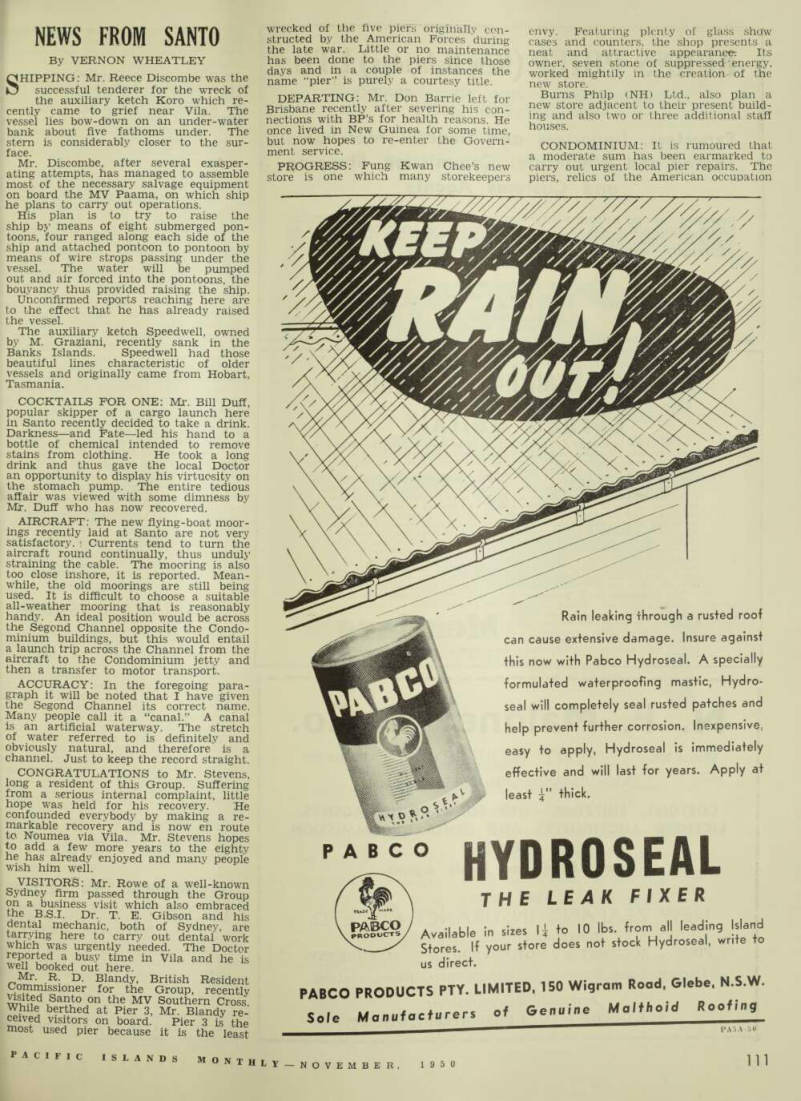
By Vernon Wheatley
SHIPPING: Mr. Reece Discombe was the successful tenderer for the wreck of the auxiliary ketch Koro which re cently came to grief near Vila. The vessel lies bow-down on an under-water bank about five fathoms under. The stem is considerably closer to the sur face.
Mr. Discombe, after several exasper ating attempts, has managed to assemble most of the necessary salvage equipment on board the MV Paama, on which ship he plans to carry out operations.
His plan is to try to raise the ship by means of eight submerged pon toons, four ranged along each side of the ship and attached pontoon to pontoon by means of wire strops passing under the vessel. The water will be pumped out and air forced into the pontoons, the bouyancy thus provided raising the ship.
Unconfirmed reports reaching here are to the effect that he has already raised the vessel.
The auxiliary ketch Speedwell, owned by M. Graziani, recently sank in the Banks Islands. Speedwell had those beautiful lines characteristic of older vessels and originally came from Hobart, Tasmania.
Cocktails For One: Mr. Bill Duff,
popular skipper of a cargo launch here in Santo recently decided to take a drink.
Darkness —and Fate—led his hand to a bottle of chemical intended to remove stains from clothing. He took a long drink and thus gave the local Doctor an opportunity to display his virtuosity on the stomach pump. The entire tedious affair was viewed with some dimness by Mr, Duff who has now recovered.
AIRCRAFT: The new flying-boat moor ings recently laid at Santo are not very satisfactory. Currents tend to turn the aircraft round continually, thus unduly straining the cable. The mooring is also too close inshore, it is reported. Mean while, the old moorings are still being used. It is difficult to choose a suitable all-weather mooring that is reasonably handy. An ideal position would be across the Segond Channel opposite the Condo minium buildings, but this would entail a launch trip across the Channel from the aircraft to the Condominium jetty and then a transfer to motor transport.
ACCURACY; In the foregoing para graph it will be noted that I have given the Segond Channel its correct name.
Many people call it a “canal.” A canal is an artificial waterway. The stretch of water referred to is definitely and obviously natural, and therefore is a channel. Just to keep the record straight.
CONGRATULATIONS to Mr. Stevens, long a resident of this Group. Suffering from a serious internal complaint, little hope was held for his recovery. He confounded everybody by making a re markable recovery and is now en route to Noumea via Vila. Mr. Stevens hopes to add a few more years to the eighty he has already enjoyed and many people wish him well.
VISITORS: Mr. Rowe of a well-known Sydney firm passed through the Group on a business visit which also embraced the 8.5.1. Dr. T. E. Gibson and his dental mechanic, both of Sydney, are tarrying here to carry out dental work which was urgently needed. The Doctor reported a busy time in Vila and he is well booked out here.
Mr. R. d. Blandy, British Resident Commissioner for the Group, recently Sgrtf d , Santo on the MV Southern Cross While berthed at Pier 3, Mr. Blandy re ceived visitors on board. Pier 3is the most used pier because it is the least
wrecked of the five piers originally con structed by the American Forces during the late war. Little or no maintenance has been done to the piers since those days and in a couple of instances the name “pier” is purely a courtesy title.
DEPARTING: Mr. Don Barrie left for Brisbane recently after severing his con nections with BP’s for health reasons. He once lived in New Guinea for some time, but now hopes to re-enter the Govern ment service.
PROGRESS: Fung Kwan Chee’s new store is one which many storekeepers
envy. Featuring plenty of glass show cases and counters, the shop presents a neat and attractive appearance: Its owner, seven stone of suppressed energy, worked mightily in the creation of the new store.
Burns Philp (NH) Ltd., also plan a new store adjacent to their present build ing and also two or three additional staff houses.
CONDOMINIUM: It is rumoured that a moderate sum has been earmarked to carry out urgent local pier repairs. The piers, relics of the American occupation
are in a bad state, as, being nobody’s baby, they were left to deteriorate. They have been temporarily repaired with matting strips.
Departure Deferred: Approxi
mately seventeen years ago, M. Louis Page came to the Condominium on loan from the French Colonial Service in Noumea.
His term of transfer was for three years.
Fourteen years overdue, M. Page was over joyed to learn that he will return to New Caledonia. He and Madame Page expect to make the move early in 1951.
PERSONAL; Madame Page recently re turned from a fortnight’s visit to Noumea where she attended the Confirmation ol her children who are being educated ir New Caledonia.
M. Roger and Madame Eyssartier, ac companied by Michel, will shortly be re turning to Noumea after 18 months in th( Group. A shipwright, M. Eyssartier ir conjunction with M. Gubbay, carried oul extensive repairs and alterations to a ves sel owned by M. Andre Naturel, well known in the Group as a planter anc trader. Mr. and Mrs. George Hager plar to leave soon for a month’s holiday ir Sydney. Mrs. Les. Fox will leave shortl; also, but her stay will be considerabl; longer.
Mr. Lew O’Shea is planning to spem Xmas in NZ. He originally came to th( Group in the converted Fairmile launcl Wailana from NZ. Alter activities in Ne\ Caledonia and the New Hebrides, th< launch visited Santo and was ultimatel: purchased by M. Andre Naturel who in stalled twin Diesel motors. The Wailam is the smartest looking vessel in thes< waters and her white hull and super structure are pleasing to the eye.
Rumour Department; It I
rumoured that French interests have pur chased the NZ vessel Melva. Melva i owned by the Union Manufacturing an Exporting Co. and is a sister ship to th Avon and Rosalie. A wooden ship, I ar told, she is powered by Hercules motor and has a capacity of about 300 tons, Th price is said to be around £NZI6,OOO.
Advertisements & other items, pp. 113-114 (2 items)
111
PACIFIC ISLANDS MONT it r
wiuntHLY NOVEMBER, 1950
Hydroseal
/ / /. r J Rain leaking through a rusted roof can cause extensive damage. Insure against this now with Pabco Hydroseal. A specially formulated waterproofing mastic, Hydroseal will completely seal rusted patches and help prevent further corrosion. Inexpensive, easy to apply, Hydroseal is immediately effective and will last for years. Apply at least z" thick.
the leak fixer
SSSSSj Available in sizes I* to 10 lbs from all fading Island V. Stores. If your store does not stock Hydroseal, write to us direct.
PABCO PRODUCTS PTY. LIMITED. 150 Wigram Road, Glebe. N.S.W.
Sole Manufacturers of G Roofing &
vtJ?V
c o A UA r t \ . II
BURNS PHILP (New Hebrides) LTD.
Registered Office: VILA, NEW HEBRIDES
Branch Office at SANTO
Exporters, Importers and General Merchants
(Retail and Wholesale) Commission, Shipping
and Customs Agents
Representatives for BURNS PHILP TRUST COMPANY LIMITED. QUEENS- LAND INSURANCE CO., LTD., and LLOYD’S OP LONDON. Agents for SOCIETE DES PETROLES SHELL DES ILES FRANC AISES DU PACIFIQUE, and numerous overseas manufacturers of all classes of merchandise.
San Francisco Agents: Sydney Agents: Barns, Philp Co. of San London Agents: Barns, Philp A Co., Ltd., Francisco, Barns, Philp A Co., Ltd., 7 Bridge Street. Matson Building, 35 Crutched Friars, E.C.3. 215 Market Street.
Asthma, Bronchitis Coughing, Curbed Quickly
Do you have attacks of Asthma or Bronchitis so bad that you can’t sleep?
Do you feel weak, unable to work, and have to be careful not to take cold and can’t eat certain foods?
No matter how long you have suffered or what you have tried, there is new hope for you in a doctor’s presscription called Mendaco. No dopes, no smokes, no injections, no atomiser.
All you do is take two tasteless tablets at meals and in three minutes Mendaco starts working through your blood, aiding nature to remove phlegm, promote free, easy breathing and bring sound sleep the first night so that you soon feel years younger and stronger. !Vo Asthma In 2 Years Mendaco not only brings almost immediate comfort and free breathing but builds up the system to ward off future attacks. For instance, J.
Richards, Hamilton, Ont., Canada, had lost 40 lbs., suffered coughing every
night, couldn't sleep. Mendaco stopped Asthma spasms first night and he has had none since in over two years.
Money Back Guarantee The very first dose of Mendaco goes right to work circulating through your blood and helping nature relieve you of the effects of Asthma. Try Mendaco under an iron-clad money back guarantee. You be the judge. If you don’t feel fully satisfied after taking Mendaco just return the empty package and the full purchase price will be refunded. Get Mendaco from your chemist today and see how well you sleep tonight and how much better you will feel tomorrow. The guarantee protects you.
Mendaco
Stops Asthma -$C Bronchitis -$C Hay Fever
N. F. Maloney & Co.
Phone 268. PORT MORESBY Phone 268.
Cables, Radios, etc., “Malco,” Port Moresby.
CUSTOMS, SHIPPING, AND FORWARDING AGENTS.
LICENSED AUCTIONEERS AND GENERAL COMMISSION
AGENTS.
House, Land, and Estate Agents.
Chief Agents:
NEW ZEALAND INSURANCE CO. LTD.
(Incorporated in New Zealand) FIRE . . ACCIDENT . . MOTOR VEHICLE . . MARINE, ETC.
Importers and Exporters :: Manufacturers Representatives.
Australian Representatives : E. J. GOUGH & CO., 1 BOND STREET, SYDNEY.
Death Of D. H. Osborne
MR. D. H. OSBORNE, notable Papua: Old-Timer, did not die at his horn on Rossel Island, as reported i: October PIM. His death occurred o; Rossel Island, but at a coastal tradin station, some miles from his home. Th Shipping Board vessel Matarini, was i: those islands picking up copra. It ha loaded at Osborne’s main station, and i went on to the coastal station. Harr Osborne travelled on the ship, witi Captain Cox and Mr. F. L. Bunting, whil his two sons, Hugh and Roy Osborm accompanied the ship in their laund They were lying off the trading static: the following morning when Harr Osborne who had seemed completel well —suddenly collapsed on the deck, nea his son Hugh, and died shortly afterward!
The ship returned to the main statio: with the body, and Captain Cox and Mi Bunting remained for the funeral.
Bambridge-Brown Wedding
AT the Papeete Protestant Temple o October 21, Miss Polly Simon Titaua Bambridge, daughter c Madame V. T. Bambridge, was married t Mr. Warren Robert Brown, son of M and Mrs. Charles Brown of Raiatea.
Both families are well-known in Frenc Oceania.
A golf course was completed in Madan New Guinea, in October and opened wit an all-day tournament.
Plans—And More
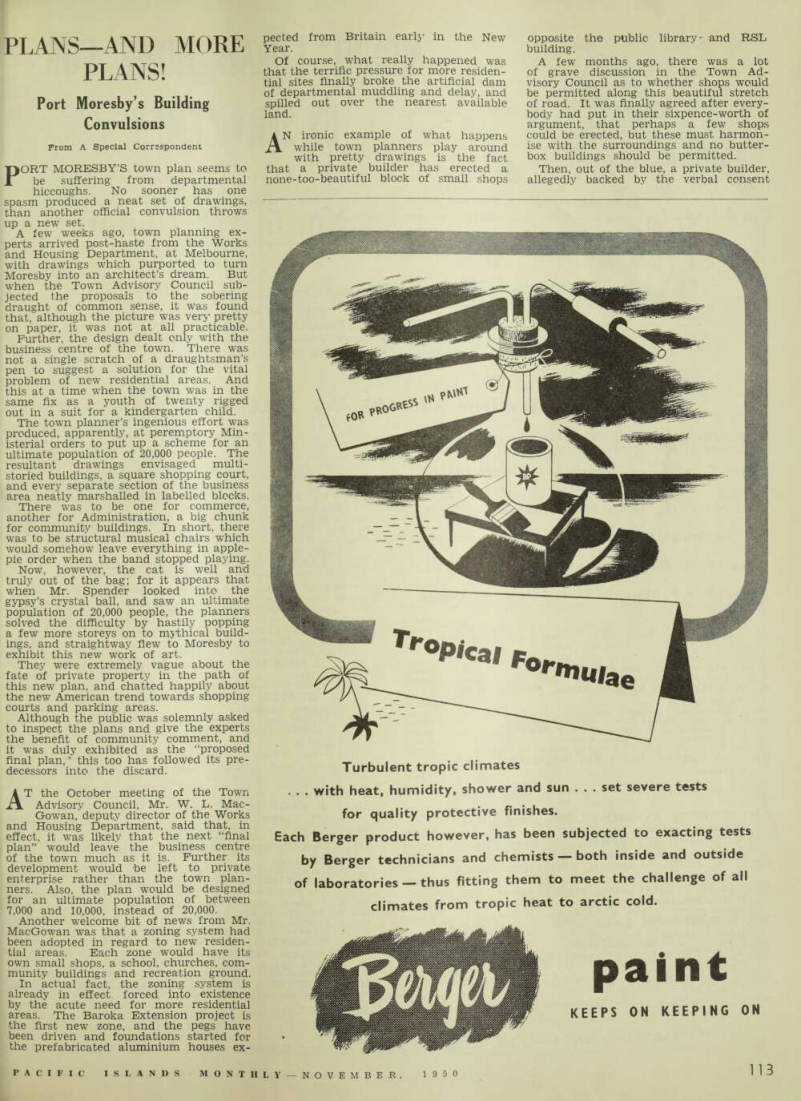
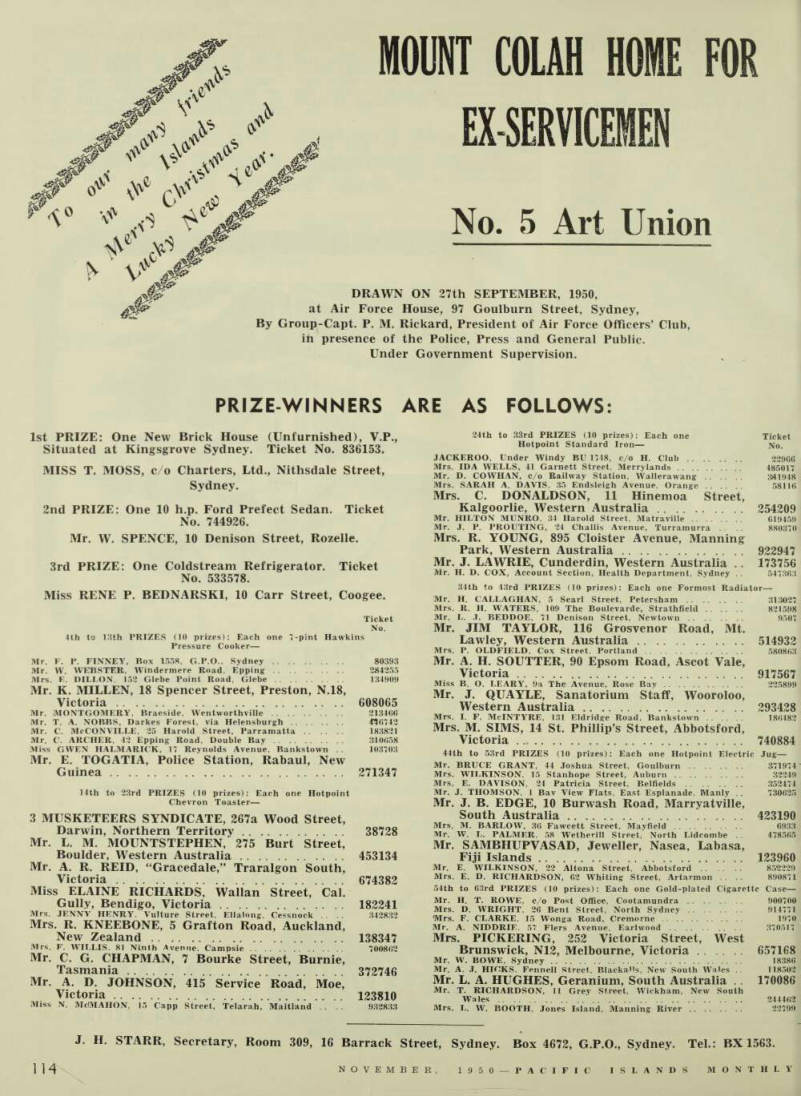
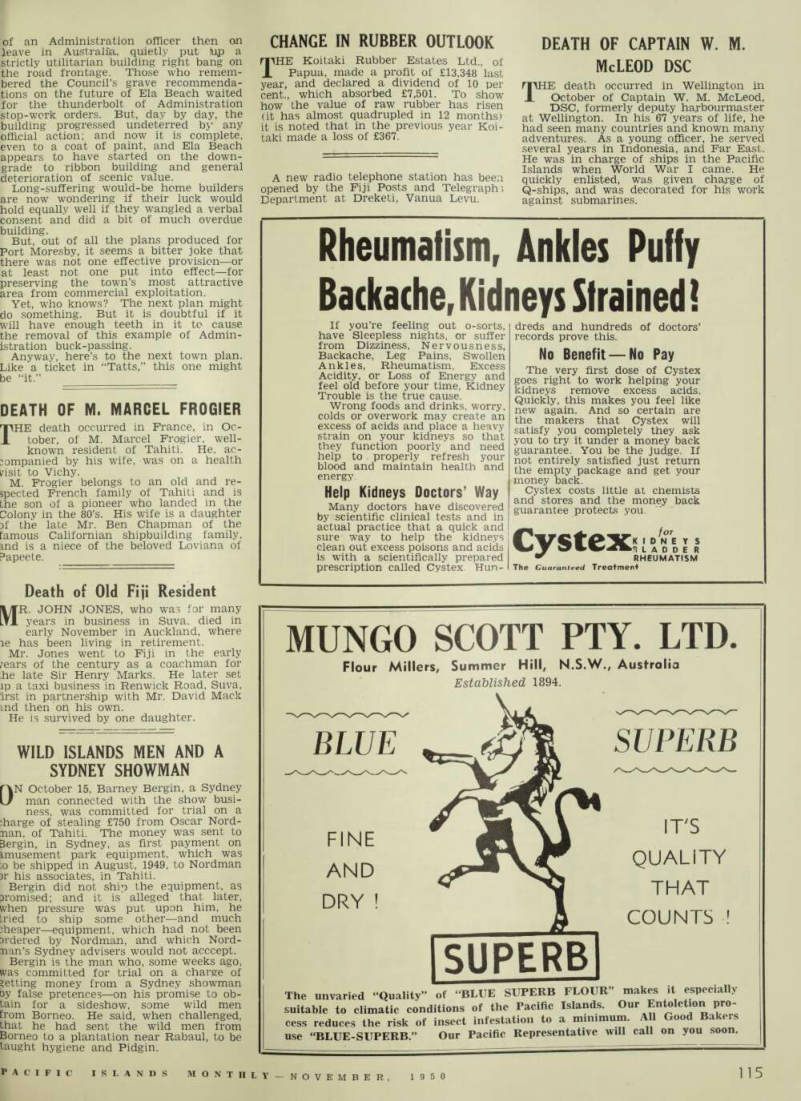
Plans!
Port Moresby's Building Convulsions
From A Special Correspondent PORT MORESBY’S town plan seems to be suffering from departmental hiccoughs. No sooner has one spasm produced a neat set of drawings, than another official convulsion throws up a new set.
A few weeks ago, town planning ex perts arrived post-haste from the Works and Housing Department, at Melbourne, with drawings which purported to turn Moresby into an architect’s dream. But when the Town Advisory Council sub jected the proposals to the sobering draught of common sense, it was found that, although the picture was very pretty on paper, it was not at all practicable.
Further, the design dealt only with the business centre of the town. There was not a single scratch of a draughtsman’s pen to suggest a solution for the vital problem of new residential areas. And this at a time when the town was in the same fix as a youth of twenty rigged out in a suit for a kindergarten child.
The town planner’s ingenious effort was produced, apparently, at peremptory Min isterial orders to put up a scheme for an ultimate population of 20,000 people. The resultant drawings envisaged multi storied buildings, a square shopping court, and every separate section of the business area neatly marshalled in labelled blocks.
There was to be one for commerce, another for Administration, a big chunk for community buildings. In short, there was to be structural musical chairs which would somehow leave everything in apple pie order when the band stopped playing.
Now, however, the cat is well and truly out of the bag; for it appears that when Mr. Spender looked into the gypsy’s crystal ball, and saw an ultimate population of 20,000 people, the planners solved the difficulty by hastily popping a few more storeys on to mythical build ings, and straightway flew to Moresby to exhibit this new work of art.
They were extremely vague about the fate of private property in the path of this new plan, and chatted happily about the new American trend towards shopping courts and parking areas.
Although the public was solemnly asked to inspect the plans and give the experts the benefit of community comment, and it was duly exhibited as the “proposed final plan,’ this too has followed its pre decessors into the discard.
AT the October meeting of the Town Advisory Council, Mr. W. L. Mac- Gowan, deputy director of the Works and Housing Department, said that, in effect, it was likely that the next “final plan” would leave the business centre of the town much as it is. Further its development would be left to private enterprise rather than the town plan ners. Also, the plan would be designed for an ultimate population of between 7,000 and 10,000, instead of 20,000.
Another welcome bit of news from Mr.
MacGowan was that a zoning system had been adopted in regard to new residen tial areas. Each zone would have its own small shops, a school, churches, com munity buildings and recreation ground.
In actual fact, the zoning system is already in effect forced into existence by the acute need for more residential areas. The Baroka Extension project is the first new zone, and the pegs have been driven and foundations started for the prefabricated aluminium houses ex
pected from Britain early in the New Year.
Of course, what really happened was that the terrific pressure for more residential sites finally broke the artificial dam of departmental muddling and delay, and spilled out over the nearest available land.
AN ironic example of what happens while town planners play around with pretty drawings is the fact that a private builder has erected a none-too-beautiful block of small shops
opposite the public library' and RSL building.
A few months ago, there was a lot of grave discussion in the Town Ad visory Council as to whether shops would be permitted along this beautiful stretch of road. It was finally agreed after every body had put in their sixpence-worth of argument, that perhaps a few shops could be erected, but these must harmon ise with the surroundings and no butter box buildings should be permitted, Then, out of the blue, a private builder, allegedly backed by the verbal consent
of an Administration officer then on leave in Australia, quietly put tup a strictly utilitarian building right bang on the road frontage. Those who remem bered the Council’s grave recommenda tions on the future of Ela Beach waited for the thunderbolt of Administration stop-work orders. But, day by day, the building progressed undeterred by any official action; and now it is complete, even to a coat of paint, and Ela Beach appears to have started on the down grade to ribbon building and general deterioration of scenic value.
Long-suffering would-be home builders are now wondering if their luck would hold equally well if they wangled a verbal consent and did a bit of much overdue building.
But, out of all the plans produced for Port Moresby, it seems a bitter joke that there was not one effective provision—or at least not one put into effect —for preserving the town’s most attractive area from commercial exploitation.
Yet, who knows? The next plan might do something. But it is doubtful if it will have enough teeth in it to cause the removal of this example of Admin istration buck-passing.
Anyway, here’s to the next town plan.
Like a ticket in “Tatts,” this one might be “it.”
Advertisements & other items, pp. 115-116 (1 item)
paint
G^ SS
?&0 *
P'ea I
Fot
n 'Wae
Turbulent tropic climates . . . with heat, humidity, shower and sun . . . set severe tests for quality protective finishes.
Each Berger product however, has been subjected to exacting tests by Berger technicians and chemists both inside and outside of laboratories thus fitting them to meet the challenge of all climates from tropic heat to arctic cold.
P
paint
KEEPS ON KEEPING ON
HONE FOR
MEN
dney, By Group-Capt. P. M. Rickard, President of Air Force Officers’ Club, in presence of the Police, Press and General Public.
Under Government Supervision.
5 Art Union
PRIZE-WINNERS ARE AS FOLLOWS:
Ist PRIZE: One New Brick House (Unfurnished), V.P., Situated at Kingsgrove Sydney. Ticket No. 836153.
MISS T. MOSS, c/o Charters, Ltd., Nithsdale Street, Sydney. 2nd PRIZE: One 10 h.p. Ford Prefect Sedan. Ticket No. 744926.
Mr. W. SPENCE, 10 Denison Street, Rozelle. 3rd PRIZE: One Coldstream Refrigerator. Ticket No. 533578.
Miss RENE P. BEDNARSKI, 10 Carr Street, Coogee.
Ticket No. 4th to 13th PRIZES (10 prizes): Each one 7-pint Hawkins Pressure Cooker— Mr. F. P. FINNEY, Box 1558, G.P.0.. Sydney 80393 Mr. W. WEBSTER, Windermere Road. Epping 284255 Mrs. E. DILLON, 152 Glebe Point Road. Glebe 134909 Mr. K. MILLEN, 18 Spencer Street, Preston, N.lB, Victoria 608065 Mr. MONTGOMERY, Braeside. Wentworthville 213466 Mr. T. A. NOBBS, Darkes Forest, via Helensburgh 416742 Mr. C. McCONVILLE. 25 Harold Street, Parramatta 183821 Mr. C. ARCHER, 42 Epping Road, Double Bay 310658 Miss GWEN HALMARICK, 17 Reynolds Avenue, Bankstown . . 103703 Mr. E. TOGATIA, Police Station, Rabaul, New Guinea 271347 14th to 23rd PRIZES (10 prizes): Each one Hotpoint Chevron Toaster— -3 MUSKETEERS SYNDICATE, 267 a Wood Street, Darwin, Northern Territory 38728 Mr. L. M. MOUNTSTEPHEN, 275 Burt Street, Boulder, Western Australia 453134 Mr. A. R. REID, “Gracedale,” Traralgon South, Victoria 674382 Miss ELAINE RICHARDS, Wallan Street, Cal.
Gully, Bendigo, Victoria 182241 Mrs. JENNY HENRY, Vulture Street. Ellalong. Cessnock . . . . 342832 Mrs. R. KNEEBONE, 5 Grafton Road, Auckland, New Zealand 138347 Mrs. F. WILLIS. 81 Ninth Avenue, Campsie 700862 Mr. C. G. CHAPMAN, 7 Bourke Street, Burnie, Tasmania 372746 Mr. A. D. JOHNSON, 415 Service Road, Moe, Victoria 123810 Miss N. McLMAHON. 15 Capp Street, Telarah, Maitland . . . . 932833
24th to 33rd PRIZES (10 prizes): Each one Ticket Hotpoint Standard Iron— No.
JACKEROO, Under Windy BU 1748, c/o H. Club 22966 Mrs. IDA WELLS, 41 Garnett Street. Merrylands 485017 Mr. D. COWHAN, c/o Railway Station, Wallerawang 341948 Mrs. SARAH A. DAVIS, 35 Endsleigh Avenue, Orange 58116
Mrs. C. DONALDSON, 11 Hinemoa Street,
Kalgoorlie, Western Australia 254209
Mr. HILTON MUNRO, 34 Harold Street, Matraville 619459 Mr. J. P. PROUTING, 24 Challis Avenue, Turramurra 880370 Mrs. R. YOUNG, 895 Cloister Avenue, Manning
Park, Western Australia 922947
Mr. J. LAWRIE, Cunderdin, Western Australia .. 173756 Mr. H. D. COX, Account Section, Health Department, Sydney . . 547363 34th to 43rd PRIZES (10 prizes): Each one Formost Radiator — Mr. H. CALLAGHAN, 5 Searl Street, Petersham 313027 Mrs. R. H. WATERS, 109 The Boulevarde, Strathfield 821598 Mr. L. J. BEDDOE. 71 Denison Street, Newtown 9507 Mr. JIM TAYLOR, 116 Grosvenor Road, Mt.
Lawley, Western Australia 514932
Mrs. P. OLDFIELD. Cox Street, Portland 580863 Mr. A. H. SOUTTER, 90 Epsom Road, Ascot Vale,
Victoria 917567
Miss B. O. LEARY, 9a The Avenue, Rose Bay 225899
Mr. J. QUAYLE, Sanatorium Staff, Wooroloo,
Western Australia 293428
Mrs. I. F. McINTYRE, 131 Eldridge Road, Bankstown 186482 Mrs. M. SIMS, 14 St. Phillip’s Street, Abbotsford,
Victoria 740884
44th to 53rd PRIZES (10 prizes): Each one Hotpoint Electric Jug— Mr. BRUCE GRANT, 44 Joshua Street, Goulburn 371974 Mrs. WILKINSON, 15 Stanhope Street, Auburn 32249 Mrs. E. DAVISON, 24 Patricia Street, Belfields 352474 Mr. J. THOMSON, 1 Bav View Flats, East Esplanade. Manly . . 730625 Mr. J. B. EDGE, 10 Burwash Road, Marryatville,
South Australia 423190
Mrs. M. BARLOW, 36 Fawcett Street. Mayfield 6933 Mr. W. L. PALMER. 58 Wetherill Street, North Lidcombe . . 478565
Mr. SAMBHUPVASAD, Jeweller, Nasea, Labasa,
Fiji Islands 123960
Mr. E. WILKINSON, 22 Altona Street. Abbotsford 852229 Mrs. E. D. RICHARDSON, 62 Whiting Street, Artarmon . .. 890871 54th to 63rd PRIZES (10 prizes): Each one Gold-plated Cigarette Case— Mr. H. T. ROWE, c/o Post Office, Cootamundra 900700 Mrs. D. WRIGHT, 26 Bent Street, North Sydney 914771 •Mrs. F. CLARKE, 15 Wonga Road, Cremorne 1970 Mr, A. NIDDRIF. 57 Flers Avenue, Earlwood 370517
Mrs. PICKERING, 252 Victoria Street, West
Brunswick, Nl2, Melbourne, Victoria 657168
Mr. W. BOWE. Sydney 18386 Mr. A. J. HICKS. Fennell Street, Blacka'ls, New South Wales . . 118502 Mr. L. A. HUGHES, Geranium, South Australia . . 170086 Mr. T. RICHARDSON. 11 Grey Street, Wickham, New South Wales ‘ 244462 Mrs. L. W. BOOTH. Jones Island, Manning River 22799
J. H. STARR, Secretary, Room 309, 16 Barrack Street, Sydney. Box 4672, G.P.0., Sydney. Tel.: BX 1563.
Death Of M. Marcel Frogier
THE death occurred in France, in Oc tober, of M. Marcel Frogier, well known resident of Tahiti. He. ac companied by his wife, was on a health yisit to Vichy.
M. Frogier belongs to an old and re spected French family of Tahiti and is the son of a pioneer who landed in the Colony in the 80’s. His wife is a daughter Df the late Mr. Ben Chapman of the famous Californian shipbuilding family, md is a niece of the beloved Loviana of Papeete.
Death of Old Fiji Resident
MR. JOHN JONES, who was for many years in business in Suva, died in early November in Auckland, where le has been living in retirement.
Mr. Jones went to Fiji in the early fears of the century as a coachman for he late Sir Henry Marks. He later set ip a taxi business in Renwick Road, Suva, irst in partnership with Mr. David Mack md then on his own.
He is survived by one daughter.
Sydney Showman
Wild Islands Men And A
ON October 15, Barney Bergin, a Sydney man connected with the show busi ness, was committed for trial on a ;harge of stealing £750 from Oscar Nord nan, of Tahiti. The money was sent to Bergin, in Sydney, as first payment on imusement park equipment, which was ;o be shipped in August, 1949, to Nordman )r his associates, in Tahiti.
Bergin did not ship the equipment, as promised; and it is' alleged that later, when pressure was put upon him, he tried to ship some other —and much cheaper—equipment, which had not been ordered by Nordman, and which Nord nan’s Sydney advisers would not acccept.
Bergin is the man who, some weeks ago, was committed for trial on a charge of Setting money from a Sydney showman by false pretences—on his promise to ob tain for a sideshow, some wild men from Borneo. He said, when challenged, that he had sent the wild men from Borneo to a plantation near Rabaul, to be taught hygiene and Pidgin.
Change In Rubber Outlook
THE Koitaki Rubber Estates Ltd., of Papua, made a profit of £13,348 last year, and declared a dividend of 10 per cent., which absorbed £7,501. To show how the value of raw rubber has risen (it has almost quadrupled in 12 months) it is noted that in the previous year Koi taki made a loss of £367.
A new radio telephone station has been opened by the Fiji Posts and Telegraphs Department at Dreketi, Vanua Levu.
Death Of Captain W. M.
Mcleod Dsc
ITHE death occurred in Wellington in . October of Captain W. M. McLeod, DSC, formerly deputy harbourmaster at Wellington. In his 67 years of life, he had seen many countries and known many adventures. As a young officer, he served several years in Indonesia, and Far East.
He was in charge of ships in the Pacific Islands when World War I came. He quickly enlisted, was given charge of Q-ships, and was decorated for his work against submarines.
Advertisements & other items, p. 117 (2 items)
115
ACIFIC ISLANDS MONTHLY NOVEMBER, 1950
Rheumatism, Ankles Puffy
Backache, Kidneys Strained!
If you’re feeling out o-sorts, have Sleepless nights, or suffer from Dizziness, Nervousness, Backache, Leg Pains, Swollen Ankles, Rheumatism, Excess Acidity, or Loss of Energy and feel old before your time, Kidney Trouble is the true cause.
Wrong foods and drinks, worry, colds or overwork may create an excess of acids and place a heavy strain on your kidneys so that they function poorly and need help to . properly refresh your blood and maintain health and energy.
Help Kidneys Doctors’ Way
Many doctors have discovered by scientific clinical tests and in actual practice that a quick and sure way to help the kidneys clean out excess poisons and acids is with a scientifically prepared prescription called Cystex Hun-
dreds and hundreds of doctors’ records prove this.
The very first dose of Cystex goes right to work helping your kidneys remove excess acids.
Quickly, this makes you feel like new again. And so certain are the makers that Cystex will satisfy you completely they ask you to try it under a money back guarantee. You be the judge. If not entirely satisfied just return the empty package and get your money back.
Cystex costs little at chemists and stores and the money back guarantee protects you.
No Benefit —No Pay
Cystex
* R /or
KIDNEYS
'U A D D E R
RHEUMATISM
The Guaranteed Treatment
MUNGO SCOTT PTY. LTD.
Flour Millers, Summer Hill, N.S.W., Austrolia Established 1894.
BLUE
FINE
AND
DRY !
6
SUPERB
SUPERB
IT'S
QUALITY
THAT
COUNTS !
The unvaried "Quality” of “BUIE SUPERB FLOUR” makes it especially suitable to climatic conditions of the Pacific Islands. Our Entolet.on process reduces the risk of insect infestation to a minimum. 00 a 1 r ’ use “BLUE-SUPERB.” Our Pacific Representative will call on you soon.
News Notes From Lae
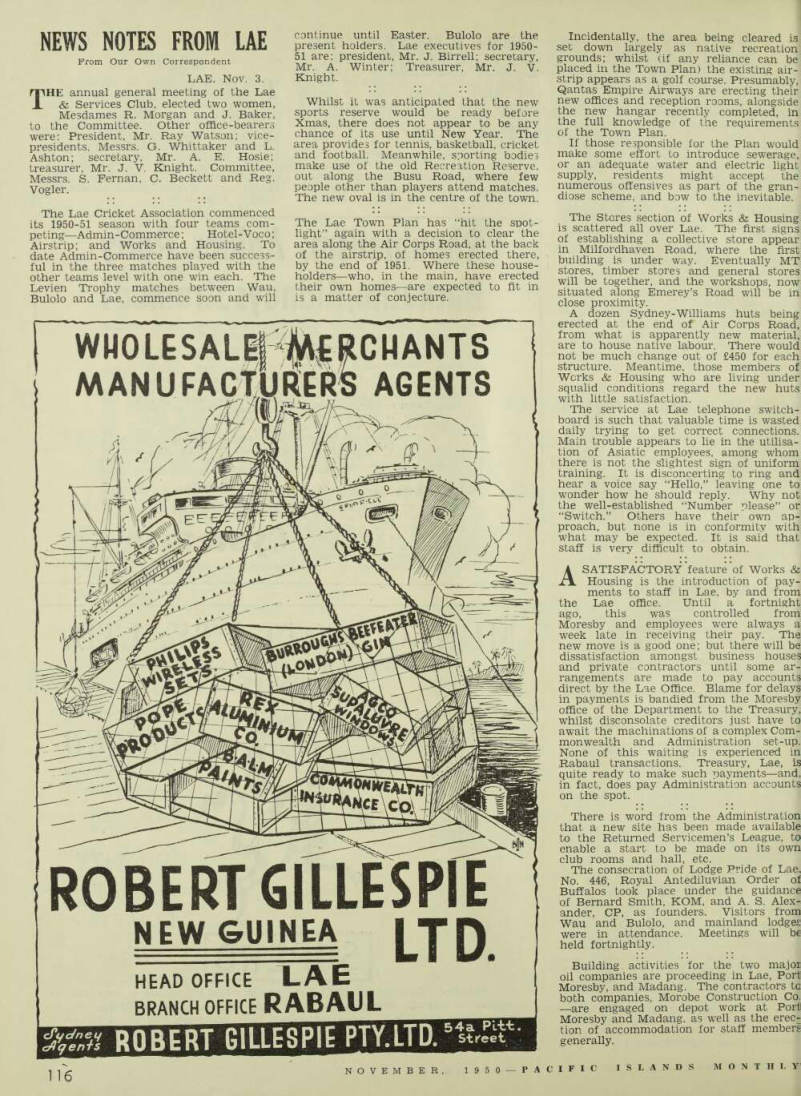
From Our Own Correspondent
Lae. Nov. 3.
THE annual general meeting of the Lae & Services Club, elected two women, Mesdames R. Morgan and J. Baker, to the Committee. Other office-bearers were; President, Mr. Ray Watson; vice presidents, Messrs. G. Whittaker and L.
Ashton; secretary, Mr. A. E. Hosie; treasurer, Mr. J. V. Knight. Committee, Messrs. S. Fernan, C. Beckett and Reg.
Vogler, The Lae Cricket Association commenced its 1950-51 season with four teams com
peting—Admin-Commerce: Hotel-Voco;
Airstrip: and Works and Housing. To date Admin-Commerce have been success ful in the three matches played with the other teams level with one win each. The Levien Trophy matches between Wau, Bulolo and Lae, commence soon and will
continue until Easter. Bulolo are the present holders. Lae executives for 1950- 51 are; president, Mr. J. Birrell; secretary, Mr. A. Winter; Treasurer, Mr. J. V.
Knight.
Whilst it was anticipated that the new sports reserve would be ready before Xmas, there does not appear to be any chance of its use until New Year. The area provides for tennis, basketball, cricket and football. Meanwhile, sporting bodies make use of the old Recreation Reserve, out along the Busu Road, where few people other than players attend matches.
The new oval is in the centre of the town.
The Lae Town Plan has “hit the spot light” again with a decision to clear the area along the Air Corps Road, at the back of the airstrip, of homes erected there, by the end of 1951. Where these house holders—who, in the main, have erected their own homes—are expected to fit in is a matter of conjecture.
Incidentally, the area being cleared is set down largely as native recreation grounds; whilst (if any reliance can be placed in the Town Plan) the existing air strip appears as a golf course. Presumably, Qantas Empire Airways are erecting their new offices and reception rooms, alongside the new hangar recently completed, in the full knowledge of the requirements of the Town Plan.
If those responsible for the Plan would make some effort to introduce sewerage, or an adequate water and electric light supply, residents might accept the numerous offensives as part of the gran diose scheme, and bow to the inevitable.
The Stores section of Works & Housing is scattered all over Lae. The first signs of establishing a collective store appear in Milfordhaven Road, where the first building is under way. Eventually MT stores, timber stores and general stores will be together, and the workshops, now situated along Emerey’s Road will be in close proximity.
A dozen Sydney-Williams huts being erected at the end of Air Corps Road, from what is apparently new material, are to house native labour. There would not be much change out of £450 for each structure. Meantime, those members of Works & Housing who are living under squalid conditions regard the new huts with little satisfaction.
The service at Lae telephone switch board is such that valuable time is wasted daily trying to get correct connections.
Main trouble appears to lie in the utilisa tion of Asiatic employees, among whom there is not the slightest sign of uniform training. It is disconcerting to ring and hear a voice say “Hello,” leaving one to wonder how he should reply. Why not the well-established “Number please” or “Switch.” Others have their own ap proach, but none is in conformity with what may be expected. It is said that staff is very difficult to obtain.
A SATlSFACTORY‘feature‘of Works &
Housing is the introduction of pay ments to staff in Lae, by and from the Lae office. Until a fortnight ago, this was controlled from Moresby and employees were always a week late in receiving their pay. The new move is a good one; but there will be dissatisfaction amongst business houses and private contractors until some ar rangements are made to pay accounts direct by the Lae Office. Blame for delays in payments is bandied from the Moresby office of the Department to the Treasury, whilst disconsolate creditors just have to await the machinations of a complex Com monwealth and Administration set-up.
None of this waiting is experienced in Rabaul transactions. Treasury, Lae, is quite ready to make such payments—and, in fact, does pay Administration accounts on the spot.
There is word from the Administration that a new site has been made available to the Returned Servicemen’s League, to enable a start to be made on its own club rooms and hall, etc.
The consecration of Lodge Pride of Lae, No. 446, Royal Antediluvian Order of Buffalos took place under the guidance of Bernard Smith, KOM, and A. S. Alex ander, CP, as founders. Visitors from Wau and Bulolo, and mainland lodges were in attendance. Meetings will be held fortnightly.
Building activities for the two major oil companies are proceeding in Lae, Portl Moresby, and Madang. The contractors ta both companies, Morobe Construction Co, —are engaged on depot work at Port) Moresby and Madang, as well as the erec tion of accommodation for staff members generally.
Advertisements & other items, p. 118 (1 item)
Robert Gillespie
MANUFACTURERS AGENTS
KB Jsa 9 te s s**s \V -s c H m C£ ♦
NEW GUINEA LTD
HEAD OFFICE LAE
BRANCH OFFICE RABAUL
ROBERT GILLESPIE PTY.LTD.
54a Pitt Street
About Islands People
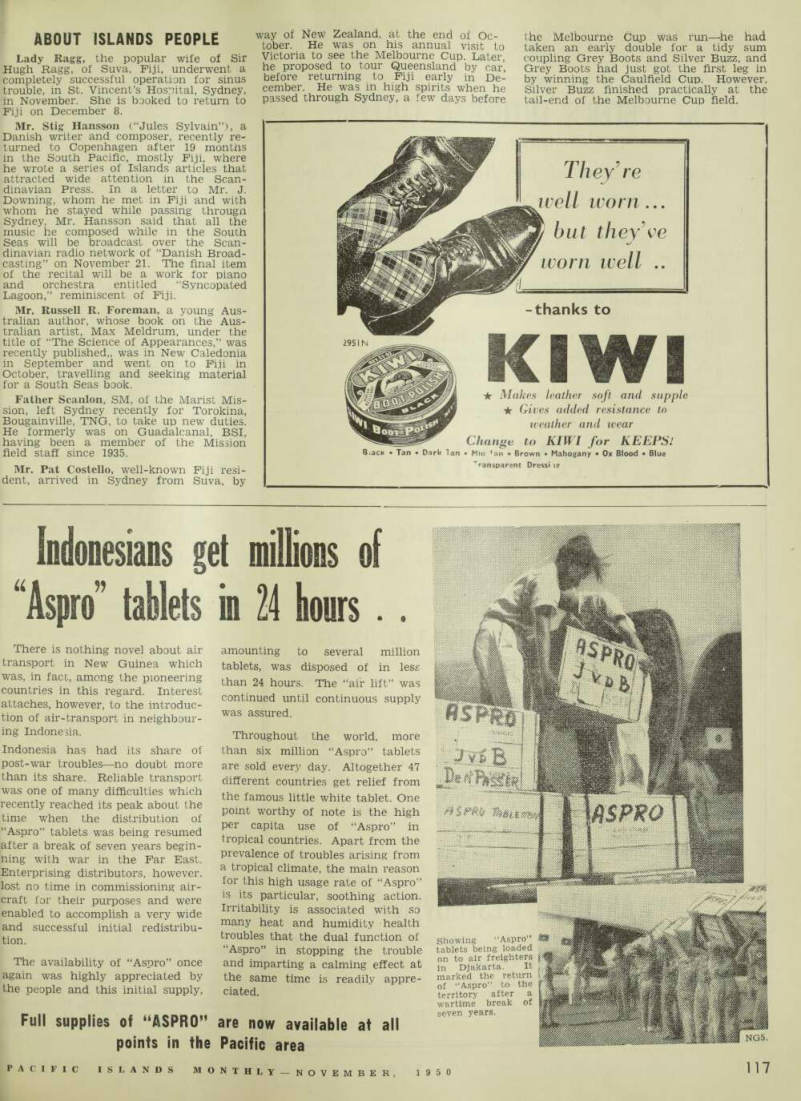
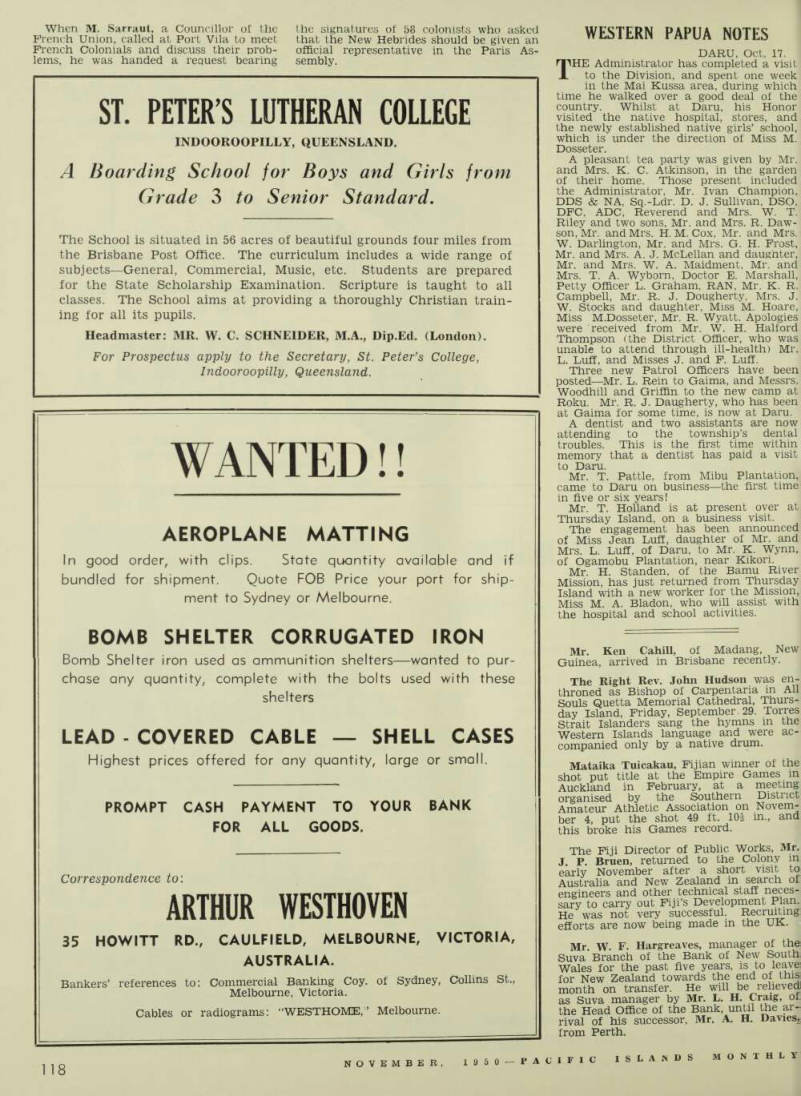
Lady Ragg, the popular wife of Sir Hugh Ragg, of Suva, Fiji, underwent a completely successful operation for sinus trouble, in St. Vincent’s Hospital, Sydney, in November. She is booked to return to Fiji on December 8.
Mr. Stig Hansson (“Jules Sylvain”), a Danish writer and composer, recently re turned to Copenhagen after 19 months in the South Pacific, mostly Fiji, where he wrote a series of Islands articles that attracted wide attention in the Scan dinavian Press. In a letter to Mr, J.
Downing, whom he met in Fiji and with whom he stayed while passing througn Sydney, Mr. Hansson said that all the music he composed while in the South Seas will be broadcast over the Scan dinavian radio network of “Danish Broad casting” on November 21. The final item of the recital will be a work for piano and orchestra entitled “Syncopated Lagoon,” reminiscent of Fiji.
Mr. Russell R. Foreman, a young Aus tralian author, whose book on the Aus tralian artist, Max Meldrum, under the title of “The Science of Appearances,” was recently published,, was in New Caledonia in September and went on to Fiji in October, travelling and seeking material for a South Seas book.
Father Scanlon, SM, of the Marist Mis sion, left Sydney recently for Torokina, Bougainville, TNG, to take up new duties.
He formerly was on Guadalcanal, BSI, having been a member of the Mission field staff since 1935.
Mr. Pat Costello, well-known Fiji resi dent, arrived in Sydney from Suva, by
way of New Zealand, at the end of Oc tober. He was on his annual visit to Victoria to see the Melbourne Cup. Later, he proposed to tour Queensland by car’, before returning to Fiji early in De cember. He was in high spirits when he passed through Sydney, a few days before
the Melbourne Cup was run—he had taken an early double for a tidy sum coupling Grey Boots and Silver Buzz, and Grey Boots had just got the first leg in by winning the Caulfield Cup. However, Silver Buzz finished practically at the tail-end of the Melbourne Cup field.
When M. Sarraut, a Councillor of the French Union, called at Port Vila to meet French Colonials and discuss their prob lems, he was handed a request bearing
the signatures of 58 colonists who asked that the New Hebrides should be given an official representative in the Paris As sembly.
Advertisements & other items, pp. 119-120 (1 item)
Indonesians get millions of
9 295 IN
They’re
well worn ...
but they’ve
worn well .. -thanks to ★ Makes leather soft and supple ★ Gives added resistance to weather and wear Change to KIWI for KEEPSI Biack • Tan • Dark Tan • Mio 'an • Brown • Mahogany • Ox Blood • Blue transparent Dressi ie
0 J L » 1 V £>
#SP*O
howing “Aspro” I iblets being loaded n to air freighters i Djakarta. It larked the return f “Aspro” to the srritory after a artlme break of even years.
Indonesians get millions of “Aspro” tablets in 24 hours.
There is nothing novel about air transport in New Guinea which was, in fact, among the pioneering countries in this regard. Interest attaches, however, to the introduction of air-transport in neighbouring Indonesia.
Indonesia has had its share of post-war troubles—no doubt more than its share. Reliable transport was one of many difficulties which recently reached its peak about the time when the distribution of “Aspro” tablets was being resumed after a break of seven years beginning with war in the Far East.
Enterprising distributors, however, lost no time in commissioning aircraft for their purposes and were enabled to accomplish a very wide and successful initial redistribution.
The availability of “Aspro” once again was highly appreciated by the people and this initial supply,
amounting to several million tablets, was disposed of in less than 24 hours. The “air lift” was continued until continuous supply was assured.
Throughout the world, more than six million “Aspro” tablets are sold every day. Altogether 47 different countries get relief from the famous little white tablet. One point worthy of note is the high per capita use of “Aspro” in tropical countries. Apart from the prevalence of troubles arising from a tropical climate, the main reason for this high usage rate of “Aspro” is its particular, soothing action.
Irritability is associated with so many heat and humidity health troubles that the dual function of “Aspro” in stopping the trouble and imparting a calming effect at the same time is readily appreciated.
Full supplies of “ASPRO” are now available at all points in the Pacific area
ST. PETER’S LUTHERAN COLLEGE
INDOOROOPILLY, QUEENSLAND.
A Boarding School for Boys and Girls from
Grade 3 to Senior Standard.
The School is situated in 56 acres of beautiful grounds four miles from the Brisbane Post Office. The curriculum includes a wide range of subjects—General, Commercial, Music, etc. Students are prepared for the State Scholarship Examination. Scripture is taught to all classes. The School aims at providing a thoroughly Christian training for all its pupils.
Headmaster: MR. W. C. SCHNEIDER, M.A., Dip. Ed. (London).
For Prospectus apply to the Secretary, St. Peter's College, Indooroopilly, Queensland.
WANTED!!
AEROPLANE MATTING
In good order, with clips. State quantity available and if bundled for shipment. Quote FOB Price your port for shipment to Sydney or Melbourne.
BOMB SHELTER CORRUGATED IRON
Bomb Shelter iron used as ammunition shelters —wanted to purchase any quantity, complete with the bolts used with these shelters
LEAD - COVERED CABLE SHELL CASES
Highest prices offered for any quantity, large or small.
PROMPT CASH PAYMENT TO YOUR BANK
FOR ALL GOODS.
Correspondence to:
ARTHUR WESTHOVEN
35 HOWITT RD. ( CAULFIELD, MELBOURNE, VICTORIA,
AUSTRALIA.
Bankers’ references to: Commercial Banking Coy. of Sydney, Collins St., Melbourne, Victoria.
Cables or radiograms: “WESTHOME, ’ Melbourne.
Western Papua Notes
Daru, Oct. 17.
Administrator has completed a visit to the Division, and spent one week in the Mai Kussa area, during which time he walked over a good deal of the country. Whilst at Daru, his Honor visited the native hospital, stores, and the newly established native girls’ school, which is under the direction of Miss M.
Dosseter.
A pleasant tea party was given by Mr. and Mrs. K. C. Atkinson, in the garden of their home. Those present included the Administrator, Mr. Ivan Champion, DDS & NA, Sq.-Ldr. D. J. Sullivan, DSO, DEC, ADC, Reverend and Mrs. W. T.
Riley and two sons, Mr. and Mrs. R. Daw son, Mr. and Mrs. H. M. Cox, Mr. and Mrs.
W. Darlington, Mr. and Mrs. G. H. Frost, Mr. and Mrs. A. J. McLellan and daughter, Mr. and Mrs. W. A. Maidment, Mr. and Mrs. T. A. Wyborn, Doctor E. Marshall, Petty Officer L. Graham, RAN, Mr. K. R.
Campbell, Mr. R. J. Dougherty, Mrs. J.
W. Stocks and daughter, Miss M. Hoare, Miss M.Dosseter, Mr. R. Wyatt. Apologies were received from Mr. W. H. Halford Thompson (the District Officer, who was unable to attend through ill-health) Mr.
L. Luff, and Misses J. and F. Luff.
Three new Patrol Officers have been posted—Mr. L. Rein to Gaima, and Messrs.
Woodhill and Griffin to the new camp at Roku. Mr. R. J. Daugherty, who has been at Gaima for some time, is now at Daru.
A dentist and two assistants are now attending to the township’s dental troubles. This is the first time within memory that a dentist has paid a visit to Daru.
Mr. T. Pattle, from Mibu Plantation, came to Daru on business —the first time in five or six years!
Mr. T. Holland is at present over at Thursday Island, on a business visit.
The engagement has been announced of Miss Jean Luff, daughter of Mr. and Mrs. L. Luff, of Daru, to Mr. K. Wynn, of Ogamobu Plantation, near Kikori.
Mr. H. Standen, of the Bamu River Mission, has just returned from Thursday Island with a new worker for the Mission, Miss M. A. Bladon, who will, assist with the hospital and school activities.
Mr. Ken Cahill, of Madang, New Guinea, arrived in Brisbane recently.
The Right Rev. John Hudson was en throned as Bishop of Carpentaria in All Souls Quetta Memorial Cathedral, Thurs day Island, Friday, September-29. Torres Strait Islanders sang the hymns in the Western Islands language and were ac companied only by a native drum.
Mataika Tuicakau, Fijian winner of the shot put title at the Empire Games m Auckland in February, at a meeting organised by the Southern District Amateur Athletic Association on Novem ber 4, put the shot 49 ft. 101 in., and this broke his Games record.
The Fiji Director of Public Works, Mr.
J. P. Bruen, returned to the Colony in early November after a short visit to Australia and New Zealand in search of engineers and other technical staff neces sary to carry out Fiji’s Development Plan.
He was not very successful. Recruiting efforts are now being made in the UK.
Mr. W. F. Hargreaves, manager of the Suva Branch of the Bank of New South Wales for the past five years, is to leave for New Zealand towards the end of this month on transfer. He will be relieved as Suva manager by Mr. L. H. Craig, of the Head Office of the Bank, until the ar rival of his successor, Mr. A. H. Davies* from Perth.
Advertisements & other items, pp. 120-121 (3 items)
November. 19 5 0 -Pauific Islands Monthly
119
PACIFIC ISLANDS MONTULV-N O V E M B E R. 1950
All Saints’ College
Classified Advertisements
HOLIDAY RESORTS
NORFOLK ISLAND for delightful holidays, with riding, golf, and tennis. Very comfortable Guest House, beautifully situated, reasonable tariff.
Write: “Torrie Glen,” Norfolk Island.
‘‘MOUNTAIN VIEW” GUEST HOUSE, magni-
ficently situated on the banks of the Wollondilly River, in Burragorang Valley, Australia’s largest sunken valley (69 miles from Sydney), a most modern Guest House, with accommodation for 150 guests. Golf, tennis, riding, billiards, dancing and swimming. Hot water service, electric light and sewerage. Licensed to serve liquor. Tariff: £4/4/- per week, with special rates for children. Write direct to: ‘‘MOUNTAIN VIEW,” Burragorang Valley. N.S.W., or phone Burragorang 3 (or XM 1384). Proprietor: R. I.
Fernandez, late of Papua and New Guinea.
BOOKS
BOOK BARGAINS. —Every few months I issue a catalogue of clean secondhand books at really bargain prices from a shilling or two to a pound or two, each. If you’d like these catalogues sent, just send a line stating your interests. (Note: If you order, part payment can always be made in used stamps, not removed from the paper, of which I am always needing any amount.) —Philip R. Boulton, 8, Fore Street, Westbury, Wilts., England.
STAMPS
BRITISH EMPIRE CANCER CAMPAIGN appeals
to well-wishers for used overseas stamps. Regular parcels from all Crown Colonies, etc., are particularly valuable. Please help Cancer Research, wherever you are, by sending stamps, many or few, to Sir Charles Lidbury, Hon.
Treasurer (Dept. P. 1.), 11 Grosvenor Crescent, London, S.W.I, England.
TENDERS
MAMIRUM AND PATIAWAI PLANTATIONS
Tenders are invited and will be received by the undersigned up to January 7. 1951. for the purchase of the following plantations and land: — MAMIRUM (Freehold): Situated on Mamirum Harbour, north-west New Hanover, Territory of New Guinea. Area: 1.606 hectares (approximately 4,000 acres), of which approximately 50 hectares are planted with coconut palms and the balance virgin timber. Mamirum Harbour is deep-water, sheltered, and ideal for timber loading.
The property has been surveyed and survey fees paid. It was purchased under contract sale from the Custodian of Expropriated Properties, who will give title when the enabling ordinance is completed.
PATIAWAI (Freehold): Approximately 120 hectares (approximately 300 acres), originally planted with 12.000 coconut palms, of which 1.100 were blitzed by enemy action in World War 11. This property adjoins Mamirum.
Any buildings on the above two properties belong to the lessee and may be removed by him.
Both Mamirum and Patiawai properties are near the Tsalui Group plantations.
On acceptance of tender. 25 per cent, of tender price to be deposited: and the balance is to be paid upon the execution of a conveyance of the property or such other document or instrument as the successful tenderer may reasonably require to evidence the sale in the absence of a registerable transfer. The successful tenderer shall accept such title as the owner now has, and shall pay cost of transfer and expenses of issue of title.
The highest or any other tender will not necessarily be accepted.
The above properties sold subject to the consent of the Administrator of the Territory of Papua and New Guinea.
K. T. ALLAN, “Stirling,” Rob Roy, via Inverell, New South Wales.
Sydney, November 10, 1950.
FOR SALE
RADIO EQUIPMENT. —We can supply new and reconditioned transmitters and receivers for low powered marine and shore installations at a reasonable price. Crystals supplied to specified frequencies. Inquiries answered promptly.
Write: Liverpool Trading Co., 23 George Street Liverpool, N.S.W.
POSITIONS WANTED
PLANTATION ASSISTANT.—Young man, aged 24, single, well educated, ex-RAAF, with knowledge of accounts and interested in tropical agriculture, wants a position on a plantation in New Guinea or any other Pacific Island.— Reply by airmail to: “Plantation Assistant,” c/o Box 3408, G.P.0., Sydney, N.S.W., Australia.
YOUNG MAN, 25, with previous tropical service, and with commercial and Government experience, desires administrative position with a firm anywhere in South Pacific area. Willing to learn and any reasonable salary considered.
Replies to: Kiwi, c/o Box 3408, G.P.0., Sydney, N.S.W., Australia.
ISLANDS MAN, aged 42, married, exasperated with strikes, Reds, and high cost of living in Sydney, would gladly accept responsible position anywhere in the South Seas. Experienced in alluvial mining, planting, bookkeeping, and handling of large labour lines. Both being thoroughly acclimatised and eager permanently to resume Islands life, every effort would be made to give satisfaction. Replies to; “New Guinea-ite,” Flat 3, Blakeney House, 54 Miller Street, North Sydney, N.S.W.
GOODS FOR STAMPS, ETC.
THE YANKEE TRADER wishes to announce that he is anxious to trade with persons in the South Sea Islands. I will trade fountain pens and pencils, cameras, spectacles (for sun wear), wrist-watches, costume jewellery, books and magazines, dresses for tropical wear, skirts and blouses for women and young girls, and baseball caps—for pearls, pearl shell, or stamps in used and excellent condition, off paper. If you wish to trade with me, write by sea or air-mail, asking for my agreement. Please state what items you wish me to send to you from the United States; also state what you have to offer, in exchange, of the items I am seeking—l can take only pearls, pearl shell or stamps. Send all letters to this address: Yankee Trader/George H. Haupt, P.O. Box 475, Times Square Station, New York, 18, N.Y., U.S.A.
AGENCIES WANTED
AGENCIES WANTED for the products of New Guinea and other Pacific Islands by a wellestablished firm of Indent and Export agents.
Write to: Badham, Littlejohn, 84 Hunter Street (P.O. Box 2047), Sydney, N.S.W., Australia.
ISLANDS SOUVENIR
SONGS OF THE SOUTH SEAS.—lnspirational Verse. Cover: Feathery Palms, Tropical Flowers.
Island Girl. Ideal gift or Souvenir. One dollar (8/- Aust.). Post Free. —Dr. W. Swaan, 715 West 16th Avenue, Vancouver, 8.C., Canada.
A Xmas Gift . .
WHERE THE TRADE
WINDS BLOW’
COLLECTION of fascinating tales and sketches of the South Pacific Islands by R. W. ROBSON
and JUDY TUDOR.
Well Bound and Profusely illustrated.
Price: 7/6, or 8/- post free.
Prom any large book store, or from Steele’s Book Store, Suva, or from—
Pacific Publications Pty. Ltd.
Union House, 247 George St., SYDNEY.
ALL SAINTS’ COLLEGE
BATHURST, N.S.W.
• Established 1874. One of the oldest boarding schools in N.S.W. • A Church of England Boarding School for Boys. • An “approved” school. Registered under the Bursary Endowment Act, 1912. • The School offers a wide variety of courses from Lower Primary Standard to Leaving Certificate and Matriculation Honours.
Agriculture, woolclassing, farm mechanics, woodwork, technical drawing, business principles are taught, in addition to the usmal extra subjects. Pupils are accepted from the age of seven The School, situated in a delightful climate, 2,000 feet above sea level, has extensive grounds and playing fields, and up-to-date boarder accommodation (with recent large additions). Most modern educational equipment is installed. • Recent additions have made a limited number o£ vacancies available for 1951. Immediate application is advised for 1951 and subsequent years. For illustrated prospectus, apply to the Headmaster.
Headmaster: E. C. F. EVANS, 8.A., A.Ed., L.A.S.A.
Islands Produce
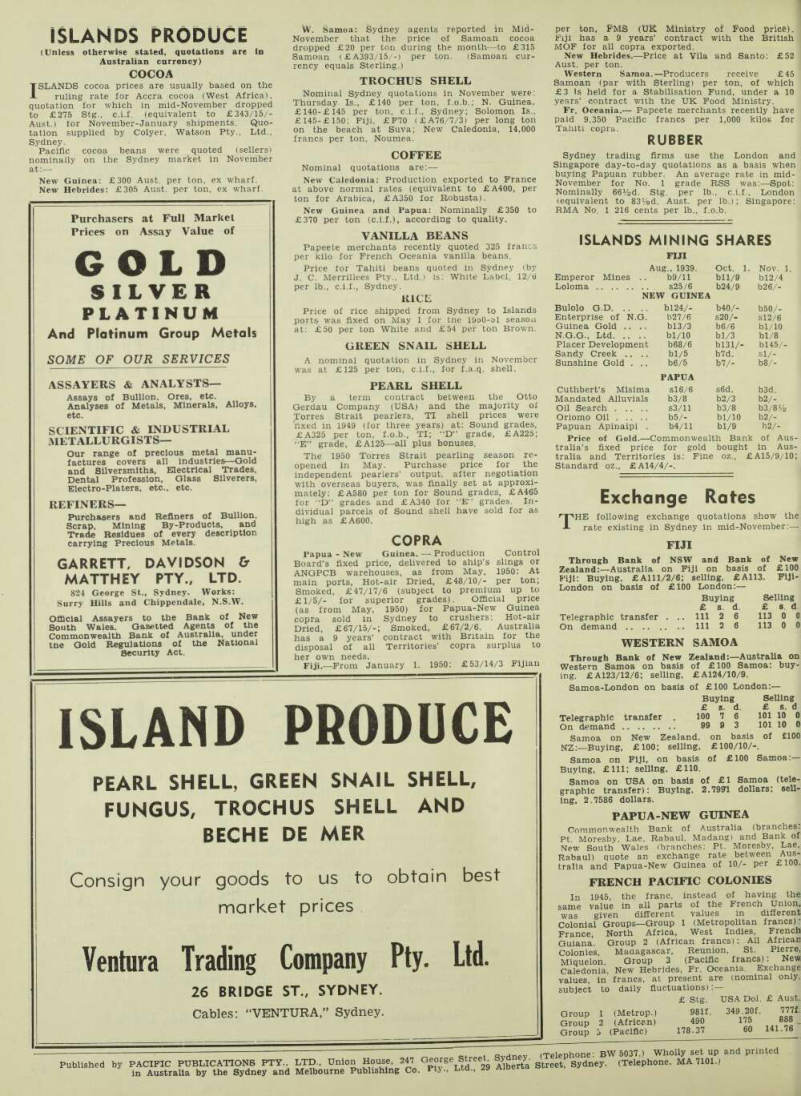
(Unless otherwise stated, quotations are in Australian currency)
Cocoa
ISLANDS cocoa prices are usually based on the ruling rate for Accra cocoa (West Africa), quotation for which in mid-November dropped to £275 Stg., c.i.f. (equivalent to £343/15/- Aust.) for November-January shipments. Quo tation supplied by Colyer. Watson Pty., Ltd., Sydney.
Pacific cocoa beans were quoted (sellers) nominally on the Sydney market in November at: — New Guinea: £3OO Aust. per ton, ex wharf.
New Hebrides: £305 Aust. per ton, ex wharf.
W. Samoa: Sydney agents reported in Mid- November that the price of Samoan cocoa dropped £2O per ton during the month —to £315 Samoan (£ A393/15/-,) per ton. (Samoan cur rency equals Sterling.)
Trochus Shell
Nominal Sydney quotations in November were: Thursday Is., £l4O per ton, f.0.b.; N. Guinea, £l4O-£145 per ton, c.i.f., Sydney; Solomon Is., £ 145-£ 150; Fiji. £F7O ( £A76/7/3) per long ton on the beach at Suva; New Caledonia, 14,000 francs per ton, Noumea.
Coffee
Nominal quotations are;— New Caledonia: Production exported to France at above normal rates (equivalent to £A4OO, per ton for Arabica, £A3SO for Robusta).
New Guinea and Papua: Nominally £350 to £370 per ton (c.i.f.), according to quality.
Vanilla Beans
Papeete merchants recently quoted 325 francs per kilo for French Oceania vanilla beans.
Price for Tahiti beans quoted in Sydney (by J. C. Merrillees Pty., Ltd.) is: White Label, 12/o per lb., c.i.f., Sydney.
Rice
Price of rice shipped from Sydney to Islands ports was fixed on May 1 for tne 1900-al season at: £5O per ton White and £54 per ton Brown.
Green Snail Shell
A nominal quotation in Sydney in November was at £125 per ton, c.i.f., for f.a.q. shell.
Pearl Shell
By a term contract between the Otto Gerdau Company (USA) and the majority of Torres Strait pearlers, TT shell prices were fixed in 1949 (for three years) at: Sound grades, £A325 per ton, f.0.b., TI; “D” grade, £A225; “E” grade, £AI25 —all plus bonuses.
The 1950 Torres Strait pearling season re opened in May. Purchase price for the independent pearlers’ output, after negotiation with overseas buyers, was finally set at approxi mately: £ A5BO per ton for Sound grades, £A465 for “D” grades and £A34O for >I E” grades. In dividual parcels of Sound shell have sold for as high as £A6OO.
Copra
Papua - New Guinea. Production Control Board’s fixed price, delivered to ship’s slings or ANGPCB warehouses, as from May, 1950: At main ports, Hot-air Dried, £4B/10/- per ton; Smoked, £47/17/6 (subject to premium up to £l/5/- for superior grades). Official price (as from May. 1950) for Papua-New Guinea copra sold in Sydney to crushers: Hot-air Dried, £67/15/-; Smoked, £67/2/6. Australia has a 9 years’ contract with Britain for the disposal of all Territories’ copra surplus to her own needs.
Fiji.—From January 1. 1950: £53/14/3 Fijian
per ton, FMS (UK Ministry of Food price).
Fiji has a 9 years’ contract with the British MOF for all copra exported.
New Hebrides. —Price at Vila and Santo: £52 Aust. per ton.
Western Samoa.—Producers receive £45 Samoan (par with Sterling) per ton, of which £3 is held for a Stabilisation Fund, under a 10 years’ contract with the UK Pood Ministry.
Fr. Oceania. — Papeete merchants recently have paid 9,350 Pacific francs per 1,000 kilos for Tahiti copra.
Rubber
Sydney trading firms use the London and Singapore day-to-day quotations as a basis when buying Papuan rubber. An average rate in mid- November for No. 1 grade RSS was;—Spot: Nominally 66Vkd. Stg. per lb., c.i.f., London (equivalent to SSYsd. Aust. per lb.); Singapore: RMA No. 1 216 cents per lb., f.o.b.
Islands Mining Shares
Fiji
Aug., 1939.
Oct. 1.
Nov. 1.
Emperor Mines .. b9/ll bll/9 bl2/4 Loloma S25/6 b24/9 b26/-
New Guinea
Bulolo G.D bl24/b40/b50/- Enterprise of N.G. b27/6 s20/- S12/6 Guinea Gold .. .. bl3/3 b6/6 bl/10 N.G.G., Ltd bl/10 bl/3 bl/8 Placer Development b68/6 bl31/bl45/- I Sandy Creek .. .. bl/5 b7d. sl/- Sunshine Gold . .. b6/5 b7/b8/-
Papua
Cuthbert’s Misima S16/6 s6d. b3d.
Mandated Alluvials b3/8 b2/3 b2/- Oil Search S3/11 b3/8 b3/8 Vz Oriomo Oil b5/bl/10 b2/- Papuan Apinaipi . b4/ll bl/9 b2/- Price of Gold. —Commonwealth Bank of Australia’s fixed price for gold bought in Australia and Territories is: Fine oz., £ A15/9/10; Standard oz., £A14/4/-.
Exchange Rates
THE following exchange quotations show the rate existing in Sydney in mid-November: —
Fiji
Through Bank of NSW and Bank of New Zealand: —Australia on Fiji on basis of £lOO Fiji: Buying. £Alll/2/6; selling. £AII3. Flji- London on basis of £lOO London: —
Western Samoa
Through Bank of New Zealand: —Australia on Western Samoa on basis of £lOO Samoa: buy ing. £AI23/12/6; selling. £AI24/10/9.
Samoa-London on basis of £lOO London: —
Samoa on New Zealand, on basis of £lOO NZ:—Buying, £100; selling, £lOO/10/-.
Samoa on Fiji, on basis of £lOO Samoa:— Buying, £111; selling, £llO.
Samoa on USA on basis of £1 Samoa (tele graphic transfer): Buying, 2.7991 dollars: sell ing. 2.7586 dollars.
Papua-New Guinea
Commonwealth Bank of Australia (branches.
Pt. Moresby, Lae, Rabaul. Madang) and Bank of New South Wales (branches: Pt. Moresby, Lae, Rabaul) quote an exchange rate between Aus tralia and Papua-New Guinea of 10/- per £lOO.
French Pacific Colonies
In 1945, the franc, instead of having the; same value in all parts of the French Union* was given different values in different: Colonial Groups—Group 1 (Metropolitan francs): France, North Africa, West Indies, French Guiana. Group 2 (African francs): All African Colonies, Madagascar, Reunion, St. Pierre, Miquelon. Group 3 (Pacific francs): New- Caledonia, New Hebrides, Fr. Oceania. Exchange values, in francs, at present are (nominal only, subject to daily fluctuations): —
Buying Selling £ s. d. £ s. d Telegraphic transfer . .. Ill 2 6 113 0 0 On demand Ill 2 6 113 0 0
Buying Selling £ s. d. £ s. d Telegraphic transfer . 100 7 6 101 10 0 On demand 99 9 3 101 10 0
£ Stg. USA Dol. £ Aust.
Group 1 (Metrop.) 981f. 349.20f. J77f.
Group 2 (African) 490 175 »88 Group o (Pacific) 178.37 60 141.76
Advertisements & other items, pp. 122-124 (3 items)
cjvrinpv (Telephone: BW 5037.) Wholly set up and printed
Published by PACIFIC PUBLICATIONS PTY.. LTD., Union House, 247 George Street Syd *g. Sydney. (Telephone. MA 7101.) in Australia by the Sydney and Melbourne Publishing Co. Pty.. Ltd., 2a Aioen,*
Island Produce
Purchasers at Full Market Prices on Assay Value of
GOLD
SILVER
PLATINUM
And Platinum Group Metals
SOME OF OUR SERVICES
ASSAYERS & ANALYSTS—
Assays of Bullion, Ores, etc.
Analyses of Metals. Minerals, Alloys, etc.
SCIENTIFIC & INDUSTRIAL
METALLURGISTS—
Our range of precious metal manufactures covers all industries—Gold and Silversmiths. Electrical Trades, Dental Profession, Glass Sllverers, Electro-Platers, etc., etc.
REFINERS—
Purchasers and Refiners of Bullion, Scrap, Mining By-Products, and Trade Residues of every description carrying Precious Metals.
GARRETT, DAVIDSON &
MATTHEY PTY., LTD.
824 George St., Sydney. Works: Surry Hills and Chippendale, N.S.W.
Official Assayers to the Bank of New South Wales. Gazetted Agents of the Commonwealth Bank of Australia, under tne Gold Regulations of the National Security Act.
ISLAND PRODUCE
PEARL SHELL, GREEN SNAIL SHELL,
FUNGUS, TROCHUS SHELL AND
BECHE DE MER
Consign your goods to us to obtain best market prices
Ventura Trading Company Pty. Ltd.
26 BRIDGE ST. ( SYDNEY.
Cables: "VENTURA,” Sydney.
Capstan
The features of this unusual XVlth Century key illustrate its owner’s connection with the sea—a trader on the African coast, no doubts the key obviously being that of his sea-chest.
i ?APST^I
The key
to smoking pleasure
CAPSTAN
FINE CUT
NAVY CUT
TOBACCOS
or *2O ll
MERCHANTS. & SHIP OWNERS
Capital £500,000
ESTABLISHED 1914
GENERAL MERCHANTS
AND
PROVIDORES
TRADE THROUGHOUT THE PACIFIC.
THIRTY-FIVE YEARS OF PACIFIC ISLANDS DEVELOPMENT AND SERVICE.
BUYERS AND EXPORTERS OF ALL KINDS ( AGENTS FOR AUSTRALIAN, EUROPEAN
( AND AMERICAN MANUFACTURERS.
OF ISLAND PRODUCE, COPRA, COCOA, > DISTRIBUTORS OF EVERY DESCRIPTION M.O.P. SHELL, TROCAS SHELL, ETC. \ OF MERCHANDISE.
Through our Sydney office, branches and agents, we distribute a wide and comprehensive range of general merchandise.
W. R. CARPENTER & CO. LTD.
Head Office: 16 O'CONNELL STREET, SYDNEY, N.S.W.
Cable Address:
“CAMOHE.”
Telephone: Postal Address: BW 4421. G.P.0., BOX 168, Sydney., In London: W. R. Carpenter & Co. (London), Ltd., Coronation House, 4 Lloyd's Ave., London, EC
ASSOCIATED COMPANIES THROUGHOUT THE PACIFIC :
IN NEW GUINEA: IN PAPUA: m FIJ1: New Guinea Company, Limited. J. R. Clay & Co., Ltd., W. R. Carpenter & Co. (Fiji) Rabaul, Lae, Madang, Kavieng. Port Moresby. Ltd., Suva.