Pacific
Islands
Monthly
October, 1950
Vol. XXI. No. 3.
•Established 1930,
I Registered at the G.P.0.. SydnasL io'r' transmission by post as a J
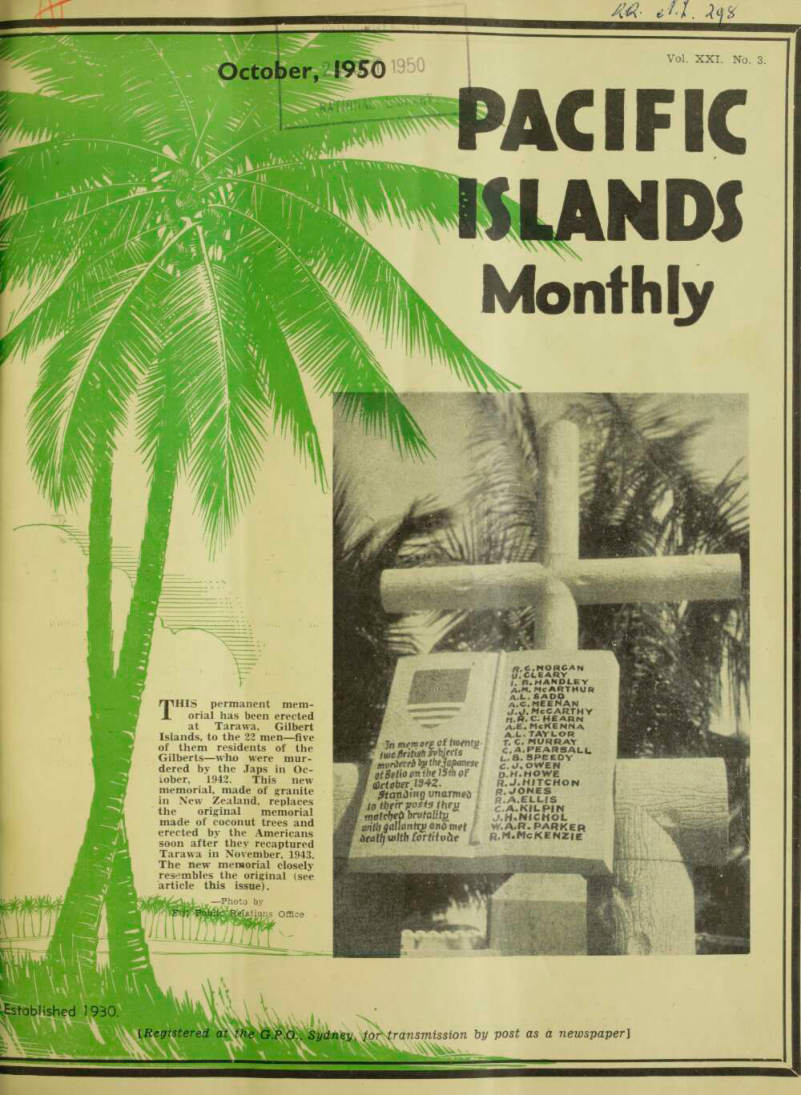
THIS permanent mem orial has been erected at Tarawa, Gilbert Islands, to the 22 men—five of them residents of the Gilberts—who were mur dered by the Japs in Oc tober, 1942. This new memorial, made of granite in New Zealand, replaces the original memorial made of coconut trees and erected by the Americans soon after they recaptured Tarawa in November, 1943.
The new memorial closely resembles the original (see article this issue).
Photo by Fiji Public Relations Office
Advertisements & other items, pp. 2-4 (2 items)
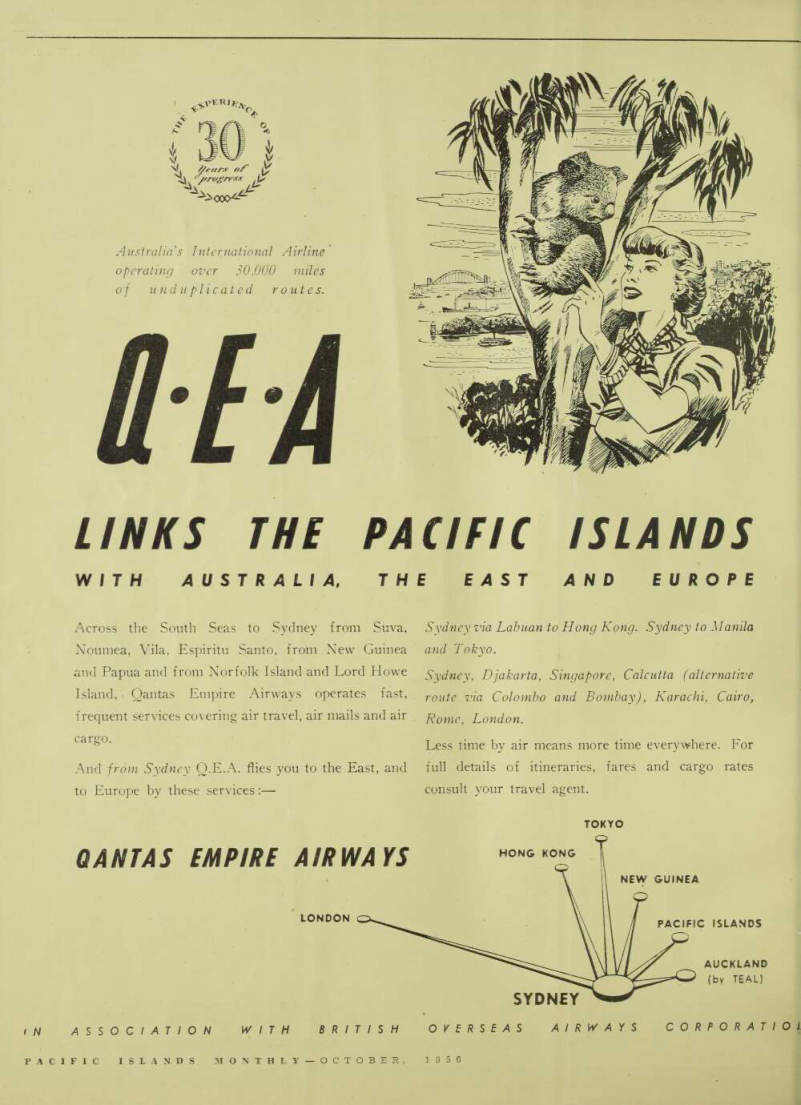
Links The Pacific Islands
V( *• & N. frr/ir.v of y 'Xi ''/rrogrrss .\s Australia's International Airline' operating over 30,000 miles of und u plicated routes. w i> m S£-~-
WITH
AUSTRALIA, THE EAST AND EUROPE
Across the South Seas to Sydney from Suva, Noumea, Vila, Espiritu Santo, from New Guinea and Papua and from Norfolk Island and Lord Howe Island, Qantas Empire Airways operates fast, frequent services covering air travel, air mails and air cargo.
And from Sydney O.E.A. flies you to the East, and to Europe by these services:— Sydney via Lahuan to Hong Kong. Sydney to Manila and Tokyo.
Sydney, Djakarta, Singapore, Calcutta (alternative route via Colombo and Bombay), Karachi, Cairo, Rome, London.
Less time by air means more time everywhere. For full details of itineraries, fares and cargo rates consult your travel agent.
TOKYO
0 A NTAS EMPIRE AIRWAYS
HONG KONG
NEW GUINEA
LONDON
PACIFIC ISLANDS
AUCKLAND
(by TEAL)
SYDNEY
IN ASSOCIATION WITH BRITISH OVERSEAS AIRWAYS
PACIFIC ISLANDS MONTHLY OCTOBER, 1950
CORPORATIO
Your Native Servant
can Iron Better with a
eman Iron
as V- M - The big gloss-smooth ironing base 16 square inches of surface of the Coleman Self-heating Iron is double pointed and heavily nickel - plated to glide smoothly and easily over any fabric.
The Coleman Self-heating Iron lights instantly, makes and burns its own gas, permitting continuous ironing, and the fount holds one pint of fuel, sufficient for hours. The body has a blue vitreous finish which is easy to clean and keep clean. With its rust-proof body and heavily nickeled ironing surface, the Coleman Self-heating Iron will last indefinitely and, because it heats itself, the ironing can be done anywhere, indoors or out-of-doors.
Representatives tor the Pacific Islands s “s p 'v t o t k s e t ; eet ROBERT GILLESPIE PUL 1 ?
Suburban Salons: 166 Parramatta Road, at Johnston
St. LA 3089.
706 Darling St., Rozelle. WB 2915. 421 New Canterbury Rd., Dulwich Hill. LM 6304. 215 Liverpool Road, Ashfield.
UA 5940.
In the Bondi Junction Arcade, 3 doors from Grace Bros. FW 4806.
The Jfende/
City Addresses:
Ist Floor, Rigney’s Bldg., 147 a King St., Sydney.
Pl2a Her Majesty’s Arcade, Pitt S 191 Pitt St., opp. Henderson’s Silk 338 Pitt St., at Snow’s Tram Sto 20 Imperial Arcade, Castlereagh S T & G Building, Elizabeth St. 99 Oxford Street. MA 1789. 169 King Street. MA 1796.
MA 5794. (i i N 3 m £ / 4 Sh
THREE WONDERFUL VALUES
TO ORDER-BY-MAIL . . .
( State 2nd and 3rd Colour Choice)
PARIS-INSPIRED NECKLINE
Never at this price would you expect to find a dress in English floral spun!
Guaranteed fast colours. Lemon, blue, rose, pink or green. XSSW, SSW, SW, W. The Wendel ... 39/11.
ORDER BY MAIL
When ordering by mail, please quote: bust, waist and hip measurements.
And we will send you the nearest stock size.
FREIGHT CHART
Freight 1/2 to all Pacific Islands except those listed below: West Samoa 1/6 East Samoa, U.S.A 1/6 New Caledonia 3/2 Hawaii, U.S.A 1/6
WRITE FOR FREE
CATALOGUE.
L ip £ M a A % i M v «■/ I A r m w / w
JACKETED SUN-DRESS
In British cotton. Guaranteed fast colours. Blue, rose, red, green or Autumn shades. XSSW, SSW, SW,
W, WX. 24/6. SOS, OS, XOS,
XXOS. The Wendel 29/-.
SPECIAL VALUE! 35/-
( Unillustrated ) Joshua Hoyle spun frocks. In floral patterns of navy, blue, aqua, rose or Autumn tones. SOS, OS, XOS. The price a mere 35/-.
SHIRTMAKER DRESS
Summer’s Favourite . . shirtmake style in British cotton. Guaranteed fas colours. Florals in blue, rose, red, c Autumn tones. SSW, SW, W, SOS, OS XOS, XXOS. The Wendel price .. 17/1:
2
OCTOBER, 1950 PACIFIC ISLANDS MONTHL
Index to Advertisers
I Achun, Gabriel . . 117 All Saints’ College . 19 I Alois Akun & Co 79, 118 i Aluminium Union ... cov hi
[ Amplion (A/sia) . . 35
I Angus & Robertson 118 “Aspaxadrene” . .102 I Australian Light & Power Co. ... 24 Baker, W. Juno . . 55 Balchin. W., Ltd. 104 Bank of NSW . .31 Berry’s Bay Boat yard 29 i Bethell, Gwyn Co. 35 I Blaxland Rae Pty. 37 Blundell Spence Co. 92 I Boulton, P. R, . 11l Bovril 41 I Brasso Polish . . .81 Bray & Holliday . 48 Bristol-Myers Co. . 77 I Broomfields, Ltd. 100 Brunton & Co. . 112 Budge, James. Ltd. 19 I Bunting, A. H.
I Ltd 49, 107 Burns Philp (NG) . 65 Burns Philp (NH) 112 I Burns Philp (SS) 73, 76 I Burns Philp Trust 34 Caine’s Studios . . 77 Carpenter, W. R. & Co., Ltd., 52, cov. iv.
Carpenter W. R. (Fiji), Ltd. . . 97 Carr Shipping & Trading Co. ... 22 Central Pharmacy . 15 “Charmosan” ... 15 Classified Advts. . 118 Colonial Meat Co. . 40 Coly er Watson (NG), Ltd. 42, 54, 83 Commonwealth Bank of Australia 69 Crammond Radio . 44 Crilley, R. J., Ltd. 27 i “Cystex” 112 Dangar, Gedye & Malloch, Ltd. 3, 80 Davison Paints . . 50 “Dettol” 23 Donaghy & Sons . 67 Donald, A. 8., Ltd., (Auckland) ... 98 Donald, A. 8., Ltd. (Rarotonga) . . 114 Douglass, W. C., Ltd 17 Econo-Steel Co. . . 36 Electrolux ... 52 Ellerker, A. J. . . 110 Etablissements Donald Tahiti . 103 Ferguson Tractors , 72 “Flit” 27 Ford Sherington . 49 French Chamber of Commerce ... 39 Garrett, Davidson & Matthey. Ltd. . 120 Garrick Hotel . . 38 Gilbey, W. & A. . 104 Gillespie Bros. . .119 Gillespie, R., Pty., Ltd. . 1. 13, 39, 51 Gillespie, R. (NG) Ltd 88, 94 Gordon’s Gin ... 25 Gough & Co., E. J. 74 Grand Pacific Hotel 4 Gregory, A., Ltd. . 88 Grove & Sons . . 30 Halvorsen Sons Ltd. 115 Hardman & Hall 3O, 115 Hawaiian Club . . 93 Hawley’s Pty., Ltd. 45 Hay, K. H. D. . . 51 Heinz & Co., Ltd. . 53
Hemingway &
Robertson, Ltd. . 72 Hoover, Francis . . 71 Hygeia Sanitary Co. 68 Island Industries Ltd 47 Jackson, S. W. . . 119 Johnson, J. Stanley 113 Jones, Wm. A., Ltd. 50
Kennedy, Captain . 94
Kerr Bros. ... 37, 38 Kinfort Pty., Ltd. . 33 Kolynos, Inc. ... 26 Kopsen, W., & Co. 117 Kraft Walker Cheese Co 71 Maclntyre, Thomas & Co.. Ltd. ... 105 Maloney, N. F., Co 113 Martin, John, Ltd. 116 McGee, Andrew . . 78 Mcllrath’s Ltd. . . 21 “Mendaco” . . . 103 Merrillees, J. C. Pty. 32 Millers Ltd. (Fiji) 16 Morris Hedstrom Limited . .12 Morris Hedstrom (Aust.) Pty. Ltd. 11l Mungo Scott Ltd. . 100 Nathan’s Merchan dise (NSW) Pty. 101 National Assn, for Prevention of Tuberculosis . . 33 Nelson & Robertson Pty., Ltd. ... 68 “New Golden Hind” —For Sale ... 95 Nicholas Products . 81 “Nixoderm” ... 79 Nordman, Oscar G. 42 Nth. Sydney Travel Bureau ... 21 O’Brien, Geo. . . 95 Oliver Tractors . . 43 Pabco Products . . 18 Pacific Is. Society 47 Pacific Islands Year Book ... 11 Pan American Air ways, Inc., Ltd. . 14 “Pinkettes” ... 91 Qantas, Ltd. . cov. ii Qld. Insurance Co. 25 Reckitt’s Blue . . 108 Reed, Wm„ E. . 106 Riverstone Meat Co. 56 Robinson, G. H. . 114 Rohu, Sil . . . • 73 Scott, J. Pty., Ltd. 76 Shell Co. of Aust. 55 Sherwin - Williams Paints 99 Sims, A. G 84 Southern Pacific Insurance Co. . . 41 Spartan Paints . . 67 Steamships Trading Co., Ltd. (Papua) 87 Stewarts & Lloyds 109 Sullivan, C., Ltd. . 84 Swallow & Ariell 108 Tallerman & Co. . 5* Tasman Empire Air ways, Ltd. ... 96 Taylor, Allen & Co. 75 Thornycroft, Ltd. . 29 Tilley Lamp Co. . 82 Tillock & Co., Ltd. 46 Ton g a n Photos Bureau 83 Tooth & Co., Ltd. 46 Trans Oceanic Air ways 20 Tyneside Eng. Co. 75 Undersee Novelties . 45 Union Mfg. & Ex port Co.. Ltd. . 90 United Island Traders Ltd. . 66 Vacuum Oil Co. 27, 86 Ventura Trading Co. . . 22, 91. 120 Vincent Chem. Co. 85 Waters, Edwd. & Sons 89 Watson, Victor.
Ltd 107 Wendel Frocks . . 2 West, Harry ... 93 White Heather Whisky ... 109 Wilcox Mofflin, Ltd. 28 Williams’ Pills . . 37 Willreed Agencies 106 Wills, W. D. & H.
O. (Aust.), Ltd. . 70 Wright & Co. . . 98 Wunderlich, Ltd. . 105 Yorkshire Insur ance Co., Ltd. . . 53
Advertisements & other items, p. 5 (1 item)
“Bulldog”
• Crude oil tractor! ® Low operation costs! • Only 8 main moving parts! • Lowest possible maintenance costs!
Big robust, slow moving parts Lasting power! 30, 40 and 45 H.P. Models! 6 forward speeds, 2 reverse!
Available in electric Models!
All tests prove the
“BULLDOG”
Best in the long run!
Whether a “K.L.” or “Lanz,” the simplicity of this rugged, powerful BULLDOG and its low cost for fuel and maintenance have proved it to be the ideal tractor for all Australian farming needs.
We can show you how to save up to £l5O PER YEAR on running costs alone on the Bulldog Crude Oil Tractor. The Bulldog has a slow speed, heavy duty, single-cylinder engine, with only 8 moving parts and is so simple and troublefree that maintenance and depreciation are reduced to a minimum.
The new and improved models, the “E” 16 H.P. and the “J” 20 H.P. will be introduced shortly. The model “E” will have the following standard equipment: (1) Electric push-button starting. (2) Hydraulic power lift. (3) Centrally located power take-off. (4) Dual, independently operated, rear wheel brakes. i(5) Adjustable tread, both front and rear wheels.
Model “J” has standard equipment similar to the larger tractors, power takeoff, adjustable front and rear wheels, and dual, independently operated, rear wheel brakes.
Distributors in N.S.W.:
Dangar, Gedye & Malloch Limited
MALLOCH HOUSE, 10-14 YOUNG STREET, SYDNEY.
Branches: Melbourne, Wagga, Newcastle & Lismore.
In This Issue:
Editorial: Is the Spender Policy Being Sabotaged 5 Governor of Dutch New Guinea to Visit P-NG 6 Nauru Memorial to Colonel Chalmers 6 South Pacific Commission—Sixth Session Opens in Noumea 7 Sir Hugh Ragg, of Fiji, Retires ... 7 Fiji Salary Plan Unpopular 7 New Trans-Tasman Service In augurated 8 Retiring Indian Commissioner in Fiji Gives Some Blunt Advice 8 More About the F’ei Banana 8 New Tarawa Memorial to Victims of Jap Sadism 9 Ambon Wants None of Djakarta .. 9 Government Wholesale Society Thrives in G & E Colony .. .. 10 Nauru Housing Scheme 10 Moresby Says Good-bye to Well known Residents 11 Another Unrealistic Attack on NG’s Native Labour Problems 13 NG Planters’ Demand for Higher Copra Price 15 Montevideo Maru Memorial .. .. 17 The Price Spiral in Fiji 17 Tonkinese Leaving New Caledonia .. 18 New Newspaper Published in Port Moresby 18 The Month in Moresby 21 Trans-Pacific Services to be Allowed to Fly Tasman 26 If Wana Fails 26 They’ll Brew Their Own in Moresby —35 Gallons of Beer per Person 27 Moisture Content in Fiji Copra ... 29 Heat Tolerance in Tropical Dairy Cattle 35 Rabaul Roundabout 37 Annual Meeting of BSI Advisory Council 38 Tahiti Prepares for Tourism —New Hotels being Built 41
Foreigners and New Arrivals “Screened” in P-NG 42 Famous Black Collection of Artifacts 42 Seven Seas II Heads for Bali 42 John Williams VI Calls at Mangaia 43 Golden Wedding of Well-Known Fiji Couple 45 No Crown for Nehru 45 Cost of Living in NZ’s Pacific Islands 46 New Light and Power Soon from Apia’s Hydro-Electricity Supply . 47 LDS Programme for Pacific Educa tion 49 Indian Independence Day was Quiet This Year 49 Dwindling Fish Supplies Cause Alarm in Suva 50 Earthquake in Santo, NH 50 Mariposa and Monterey May Be come Troop-Ships—No Subsidy for Aorangi 51 Indian Nominated M’sLC Appointed in Fiji 51 Fetu Fou —A New School 53 100 Years of ABM Effort 54 Fiji Fines for Watering Hospital Milk 54 Report for 1949—Fiji Statistics in Attractive Form 55 Territories Talk-Talk 57 The Royal and Ancient Game of Pua 58 Panic in the Place 59 PIM Crossquiz 59 The Fishing’s Better Further South 60 Tropicalities 61 Travail in Tahiti—A Short Story .. 62 Fashion :; Children’s Corner ... 64 Yachts Meet in Avarua 68 Even Prices at the Bung are Going Up and Up 69 News Notes from W. Samoa 71 Indian Tailor Shop Workers Want European Sympathy 72 NZ Film Unit in Cook Islands ... 73 Smithy Memorial Fund in Suva .. 73
French Help Build British School in Vila—Miss Vila Quest 75 Crime Wave Continues in West Samoa 70 Vila Welcomes the Dentist 79 Half-Rations for Vanikoro ... 79 Thousands of Bombs Await Disposal in BSI go Island Boats Delivered to Your Doorstep 81 BSI Needs More Overseas Ships .. 83 Fiji Anti TB Memorial Fund 84 Madang Newsletter 85 Notes from Tonga 87 UN Mission Not Satisfied with NG Health Plans 92 Plane and Shipping Timetables ... 93 An Impression of Harold Cooper .. 101 Polynesians Reached New Zealand 600 Years Ago 103 Eight Years of Security for Fiji .. 107 Near-Bankruptcy of Philippines Re public 10s High Cost of Keeping Native Ser vants log Margarine Should be an Alternative to Costly Butter m Deputy Administrators Wanted for Papua-New Guinea 112 Rabaul Comforts Fund—Distribution of Money n* More War Dumps for Sale in New Guinea m Crime Wave in W. Samoa ll£ OBITUARY: O. B. Hug, 19; D. H. Os borne, 25; C. I. H. Campbell, 31; Ottc Soltwedel, 33; Mrs. E. A. Fuller, 34; M. Jean Lods, 38; Mrs. Faamusami Mataafa, 89; Mrs. E. M. Youlden, 92; Gustav Johnson, 108; A. M. Rox burgh, 112.
INDUSTRIES: Sugar, 16; Oil, 26, 88, 100; Copra, 29; Rice, 39; Gold, 89, 92, 108 ORGANISATIONS: New Guinea Women’s Club, Sydney, 9; Pacific Islands Society, 31; NG Memorial Scholarship Fund (Brisbane) 119; New Guinea Ex- Servicemen’s Club, Sydney, 100.
Advertisements & other items, p. 6 (1 item)
sT aV
€ enl s P4C,f '. , u »ie4 ,n boU r. l " e w ie»'6° e 4
*”, w#rf* «. «**Z*
‘*■».»> ■*““• ° ** e fcccett** .. stt v»> r O'’'* 1 . »r *»*' P« r . s ef' ,Jt ' ot ' S
Pacific Islands Monthly
The Newspaper-Magazine of the South Seas
i ßegistered at the G.P.0., Sydney, for transmission by post as a newspaper] Published Once Each Month and Circulated in Australia and New Zealand and in the following Pacific Territories and Islands Groups:
Australian Territory of Papua.
Trustee Territory (Australia) of New Guinea Australian Territory of Norfolk Island.
New Zealand Territory of Cook Islands.
Trustee Territory (NZ) of Western Samoa.
British Colony of FIJI.
British Solomon Islands Protectorate.
British Protectorate of Tongan Islands.
British Crown Colony of Gilbert and Ellice Islands.
Trustee Territory of Nauru.
British and French Condominium of New Hebrides.
French Colony of New Caledonia.
French Colony of Oceania (Tahiti, etc.).
American Territory of Eastern Samoa.
American Territory of Hawaiian Islands.
Owned and Produced by Pacific Publications Pty., Ltd., Union House, 247 George Street, Sydney. nVtAMAO • /*< Avt Awn 1 AOR « « « J A .1 ... '
Telephones: General Office and Advertising
Bw 5037, Bu 4938.
P.O. Box 3408
Registered Address for Telegrams, Radiograms, and Cables: “Pacpub,” Sydney.
Contributions.
Articles, Stories, and Photographs dealing with Pacific Islands subjects are invited and will be paid for on publication.
Subscription Rates.
Per Annum, Pre-paid, Including Postage.
In Australia, New Zealand, Fiji, New Guinea, Papua, Western Samoa, Cook Islands, Tonga, British Solo mons, Gilbert and Ellice Colony, Nauru, New Hebrides, and United Kingdom 18 0 Elsewhere $2.50 £1 1 o Single Copies 19
Editor and Publisher:
R. W. Robson, F.R.G.S.
Assistant Editor: JUDY TUDOR.
General Office: Union House. 247 George Street, Sydney. Telephones: BW 5037, BU 4938.
Business Manager: SELWYN HUGHES
Representative In London.
J, T. Wallis. Coronation House, 4 Lloyd’s Avenue, London, E.C.3, from whom may be obtained copies of Pacific Islands Monthly, Pacific Is. Year Book, advertising schedules, etc.
Agents.
The following are authorised to receive sub scriptions for Pacific Islands Monthly:— Burns. Phllp & Co.. Ltd., and Burns Phllp (South Sea) Co., Ltd. All branches.
W. R. Carpenter & Co., Ltd. All branches.
Morris. Hedstrom, Ltd. All branches.
Steamships Trading Co., Papua. All branches.
A. H. Bunting, Ltd., Samaral, Papua.
Steele’s Central Store, Suva, Fiji.
Adams Pharmacies Pty., Lautoka. FIJI.
Cook Islands Trading Co., Rarotonga. Cook Is.
United Island Traders, Ltd., Rarotonga, Cook Is.
A. Vercoe, Apia, Western Samoa.
Oscar Nordman, Papeete, Tahiti.
Islands Branches and Representatives of W. H.
Grove & Sons, Ltd., Auckland. New Zealand.
Ed. Pentecost, Noumea, New Caledonia.
Soclete Gubbay Kerr et Cie, Noumea, New Caledonia.
Vol. XXI. No. 3.
October, 1950
r 1/9 Per Copy.
Price < Prepaid, p.a; 18/- Anst 1 In USA. p.a.: $2.50.
Sabotaged?
Is the Spender Policy Being Sabotaged?
THE slowness of the Australian Govern mental authority in implementing its policy of developing Papua-New Guinea through the encouragement of private enterprise is causing a lot of irritation, both in and out of the Terri tories.
The soundness of the policy has never been questioned.
As seen from Australia, Piii, Polynesia and New Zealand, the great island of New Guinea is a defensive barrier of vital im portance between us and the crowded mil lions of Asia.
When the advancing armies of General MacArthur threw the Communists out of South Korea the other day, they found tens of thousands of slaughtered civilians —massacred because they were not Com munists. That horror can be repeated in the South Pacific, just as soon as Moscow’s Red Asiatics over-run Malaya and come down through the Indonesian-held East Indies into our Melanesia.
Indonesians are of no use in our plan of security. At this moment, they are trying to subdue the non-Commuhist Ambonese, only a few hundred miles from the New Guinea coast. Racially, they are a poor type; and, politically and socially, they are dominated by their hatred of
Europeans.
If we are to survive in the South Seas during this Red Muscovite era, we must depend initially on our own strength, and our readiness to defend our own countries.
The day may come when our only chance of survival will lie in our ability to hold back Asia’s murderous hordes long enough to allow our friends in North America or Western Europe to come to our aid.
It may happen again—as in 1942-44 that our readiness to fight in New Guinea will save our South Pacific communities from the horrors of invasion.
IT is possible, on economic grounds to make out a good case for the sece rnent and development of New Guinea bv Europeans. There is no good reason whv that huge countrv. with its limitless resources, should not he de veloped for the benefit of Australia and for the ultimate good of its primitive, stone-age inhabitants. But that, dear people, is “colonialism”; and every addle nated theorist who has crept into a posi tion of bureaucratic authority since World War II is telling us that “colonial ism” is a vicious, sinful thing, and that the era of “European colonialism” is over.
The British Empire has contributed more to the advancement of the human race than any other institution in re corded history. It was based on the finest qualities of the human being—en terprise, vision, industry, pioneering courage and a basic justice for all people, whatever their colour. “Colonialism” is another word for the spread of Western European institutions and culture across the world: and the British Empire is— or was! —its finest expression.
The New Planners, of course, use the word “colonialism” to mean “the ex ploitation of coloured races by white men”; and, by their ceaseless propaganda, they have managed to get into circula tion the general idea that this is some thing that must be stopped, on humanitarian grounds.
People are accustomed to the fulmina tions of those myopic theorists whom we
class geuerallv as “ratbags,” and the anti colonialism folk are mostlv in that cate gory. It was only when the C'ummmist element got in behind anti-coloniahsm, and used the latter’s ceaseless scmawking as nart of the Muscovite campaign against Western Eurone. and especially against the British Empire, that the propaganda became dangerous.
THE anti-colonialism campaign against the n r e-war Anstrq.iian in New Guinea could be attacked as P'>mmnni<!t In origin, and damned fo** its imnracticahilitv and lack of realism 'Rut, it, ia not ngppaaarv to take thq,t ii*v> if the New planners are comnletelv right, thev nan he ignored, because—whether it is “colonialism” or not—New Guinea *nust, he held and ranidiv developed and settled, for our own security.
Months ago. the new Australian Minis ter for Territories (Mr. Snenderl an nounced the new policy—co-oneration with private enterprise in creating a strong Australian outnost in New Guinea. and in helning the natives to a higher standard of living. It wa.s acknowledged that to achieve this, certain things we r e essential.
The rnnst, irnn'vrtant of these warp q de nendahie labour force, adequate transport, encouragement of private industrv nromnt clearance of land titles, and as little de lav as nossihle in giving major administra tive decisions.
It can be said at once, in so manv words, that there has been so much maddening delay in giving effect to what mav be called the Spender Policy that a reaction has set in. These New Guinea Europeans are enterprising, bursting with energy, eager to get on with the establishment of industries for the products of which all countries are clamouring. Thev are also intelligent, and not unreasonable: they know that industry and commerce and ad ministration are all seriously handicapped by the go-slow Socialism that, despite everything, is crippling Australia. For all that, they cannot understand why there
is so much frustration and delay in the implementation of the Spender policy.
Ward-ism, as applied to Papua-New Guinea by J. K. Murray, demoralised the New Guinea labour force, and placed an almost incalculable handicap upon in dustry and development. The Ward- Murray native labour policy was conceived in Socialist hatred of the Big Firms, and born amid an idealistic planning for native welfare. It has been proved in dustrially impractical, and economically unsound. It should have been scrapped, and a completely new system introduced.
Instead, we are given a tinkered-up form of the original Ward-Murray system—im provements showing in some directions, but retaining all the features which have hamstrung industry for five years.
The Australian Government has done its best, since taking office, to give the New Guinea producers better sea trans portation, and the Ward-Murray coastal shipping monopoly has been wiped out.
Private interests have been invited to take over the Government-controlled organisa tion. But the big companies—the only concerns large enough to efficiently handle a concern like shipping—have had such a doing-over by Socialism in recent years that they are shy about the proposition; and so the Territories are suffering under a reformed Government-owned shipping service that is an improvement on what it was—but is far from satisfactory.
Private enterprise is not being en couraged in the way it was led to expect.
There is great eagerness to get on with the establishment of new industries—saw milling and coffee-growing, building con struction and cattle-farming, and so on— but everywhere the Europeans are held back by the labour conditions and by Ad ministration slowness in giving decisions, clearing land titles and making materials available.
THE Ward-Murray native labour laws rendered native labour so expensive and inefficient that many small em ployers were driven out, especially in min ing, and the small men cannot return while the contract labour period remains at 12 or 18 months.
There are plenty of timbered areas in Papua-New Guinea; the whole region is crying out for sawn timber; there are dozens of individuals and small as well as big companies clamouring for permis sion to cut timber; the Government owned and operated timber-mills are re garded as a joke; the Spender Policy promised that private enterprise soon would have a chance on timber; but nothing has yet been done by the Ad ministration, apparently because of diffi culties in conforming to the New Planners' ideas.
Hundreds of people are anxious to build, but cannot get titles to their land. The Administration says it cannot proceed with a grant of titles because it can not get surveyors; and, in any event, people must conform to the plans. Every one runs around in a vicious circle.
Very much has been done, in building roads and bridges and Administration buildings for the huge and growing Ad ministration personnel. But that has been done by a monstrous offshoot of a main land Department called “Works and Housing,” which has a white personnel of just 1,000, and which is lavishly equipped and incredibly expensive. Much of this work could have been done by private enterprise (with Government co-opera tion) in half the time, at probably less than half the cost. But that is not the way of the New Planners.
MANY people are asking if the Spender Policy is getting a square deal in Canberra and Port Moresby.
The Territories services were filled up with Wardist nominees between 1944 and 1949. Naturally, they were not happy
when, last December, the Socialists were thrown out of power, and the Ward- Murray regime came to an end in Papua- New Guinea. These people apparently have accepted the new policies philoso phically.
But, when one encounters the fury and frustration of the non-official classes in the Territories, and notes the failure of Canberra and Port Moresby to make re forms where reforms are most urgently needed, one wonders whether the Spender Policy is not being quietly sabotaged. It was Mr. Chifley, Socialist leader, who boasted that, when he had scrambled the eggs, not all the genius of a Menzies could unscramble them again.
Advertisements & other items, p. 7 (1 item)
5
PACIFIC ISLANDS MONTHLY- O C T O B E R, 1950
Governor of DNG
To Visit P-NG
THE Governor of Dutch New Guinea, Mr. Stephan Van Waardenburg plans to visit Papua-New Guinea about December. He returned to DNG from The Hague in October.
He said that he hoped that the present trade barrier between Australia and Dutch New Guinea, brought about by currency difficulties, would soon be lifted.
His country was anxious to import food and consumer goods from its next-door neighbour, Mr. Van Waardenburg said that his projected goodwill visit to Colonel J. K.
Murray, Administrator of Papua and Aus tralian New Guinea, was approved at The Hague last month by the Australian Min ister for External Affairs, Mr. P. C.
Spender.
Nauru Memorial To Colonel
Chalmers
RESIDENTS of Nauru are considering the erection of a memorial to the late Colonel F. R. Chalmers, who, with four members of the British Phos phate Commission, was murdered on the island during the Jap occupation.
Colonel Chalmers, an Australian, was Administrator of Nauru when the Japs occupied it in 1942.
Europeans were evacuated before the Japs landed but he, with the four BPC officials, decided to stay behind to care for the natives.
Following the first American bombing raid on the island on March 25, 1943, the five Europeans were taken from their place of imprisonment and brutally put to death. (The Jap navy Commander in charge of Nauru at the time was later hanged for this crime.) During 1943 two separate shipments of 1,200 Nauruans were taken to Truk, in the Carolines, (where about 500 of them perished). The reason for their removal from Nauru was apparently because of food shortage.
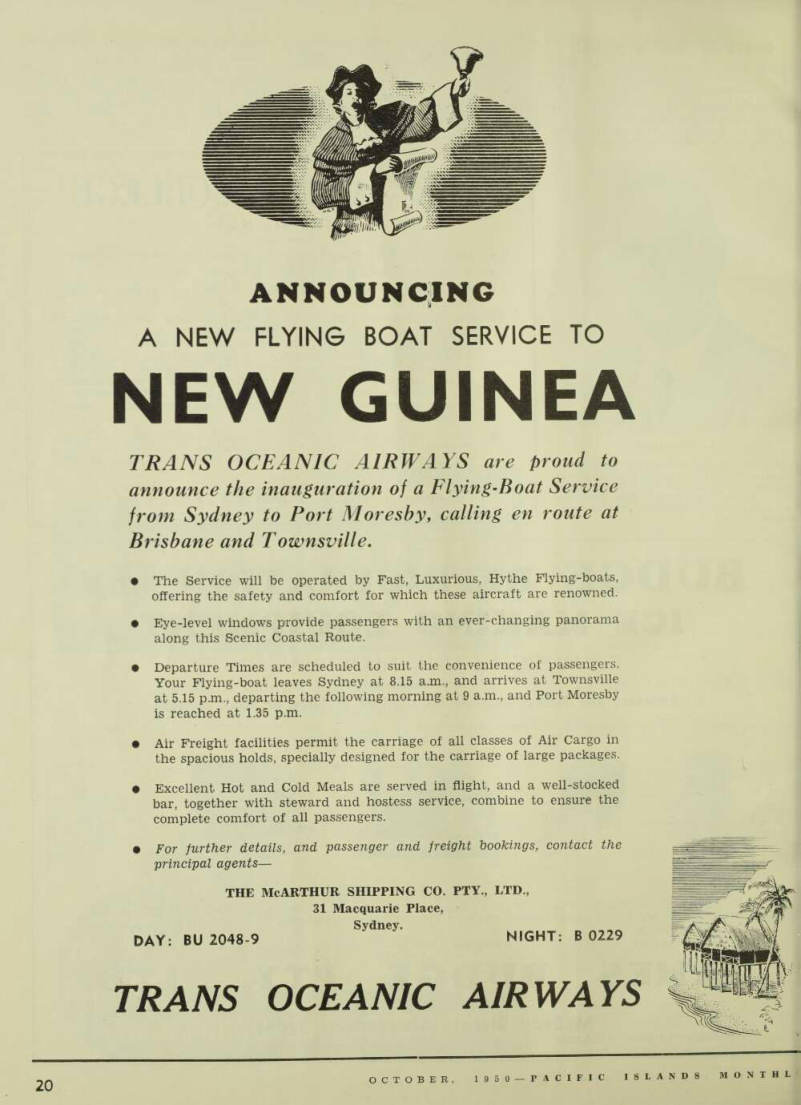
TOA Flying-Boat Services
Late News TOA Flying-Boat Services
TRANS Oceanic Airways have tem porarily suspended their Sydney- New Hebrides-Solomons flying-boat service.
Their new service from Sydney to Port Moresby will commence on October 29.
Fiji Travellers
Among recent TEAL flying boat passengers from Auckland, NZ, to Suva, Fiji, were (at top): Mr. W.
G. Johnson, Managing Director of W. R. Carpenter & Co., Ltd., Suva, who returned with his wife and family from a three months’ holi day in New Zealand. Mrs. E.
Reading, wife of the late H. E.
Reading who was well known in Fiji, returned to Suva for a holiday she is shown here (dark dress) with Mr. J. H. Millitt, Mrs.
A. Sims and Mr. Brian Sims. Mrs.
Reading will be the guest of Mr.
Millitt during her stay in Fiji.
Lower: Mr. and Mrs. R. Mace went to Suva to take up duties with the R.N.Z.A.F. at Laucala Bay. Mr. and Mrs. H. P. Hayward from Auckland-this was their first visit to Fiji and they are spending their holiday with Mr. Bill Hay ward of Suva, brother of Mr. H. P.
Hayward.
Other flying-boat passengers to Suva from New Zealand have been (top): Sir Stephen Allen, DSO, CMG, who was Administrator of Western Samoa from 1928 to 1931, photographed with Miss Allen when in Suva en route to Western Samoa.
Miss Sheneagh Rennie, who attends St. Cuthbert’s College, Auckland who was on a three-weeks’ school vacation trip to visit her parents in Suva. Lower: Mr. W. J. S.
Brabant and his two sons. They recently were on leave in the United Kingdom but Mr. Brabant has now resumed duty at the Treasury, in Suva. Mr. and Mrs.
T. H. Sullivan of Auckland - Mr.
Sullivan is now head mechanic with Suva Motors Ltd.
South Pacific
Commission
Sixth Session Opens at Noumea
THE Sixth Session of the South Pacific Commission will be held at Com mission headquarters at Noumea, from October 21-28. The six participat ing Governments will be represented by Mr. R. Halligan, for Australia, Mons. R. > Lassalle-Sere, for France, Mr. J. B. D.
Pennink, for the Netherlands, Mr. C. G.
R. McKay for New Zealand, Sir Brian Freeston, for the United Kingdom, and Dr. F. M. Keesing, for the United States.
The main items on the agenda will be (1) the report and recommendations of the second meeting of the Research i Council, which met in Sydney during Aug [ ust and produced comprehensive plans I for the Commission’s future work pro ! gramme in the three fields of Health, Economic Development and Social Devel ooment; and (2) the Budget for 1951.
It will be no easv problem to reconcile the research needs of the area, as set out in the Council’s report, with the natural reluctance of manv metropolitan Treasuries to increase their financial allocations.
Other matters of interest will include the apoointment of successors to Dr. L.
G. M. Baas Becking, Director of Research, who resigned in September to take up an appointment in Australia; and to Briga dier F. L. Hunt, Deputy Secretary-Gener al, who is retiring in November.
This will be the first session in which the Commissioners will be able to con sider final reports on Commission pro jects—notably those by Dr. A. Capell. of Sydney University, on Linguistic Re search; Professor A. P. Elkin and Dr. F.
M. Keesing, on research needs in Anthro pology in Melanesia/Papua and Poly nesia/Micronesia respectively; and Mr. A.
L. Moore on the use of visual aids in island education. Far from being mere academic studies, they contain positive recommendations for solving some of the major technical difficulties faced by island administrations in these fields.
Probably the most eagerly awaited re port of all, that on Centralized Voca tional Training Institutions, is at present being prepared bv Mr. R. A. Derrick, the well-known Fiiian educationist and historian. To obtain the data for his work. Mr. Derrick visited every island territory with the exception of Nauru and Niue, examining educational institutions and technical training facilities and listening to the views of local authorities.
He is now completing his findings and recommendations, covering the whole field of technical and professional training from Netherlands New Guinea to Tahiti, at the Social Development office of the Commission in Svdnev, and hopes to Place his report before the Commissioners before the end of the year.
Mr. R. w. Robson, editor and publisher oi the Pacific Islands Monthly, left Syd ney by air on October 3 to spend four or five weeks in Papua-New Guinea. He “*Pf c .ted to visit the Solomons, New Hebrides and New Caledonia also but transport arrangements “would not jell.”
HI p -NG he will visit Port Moresby and ?™er parts of Papua, Lae, Wau, the Cen tral Highlands, Madang, Wewak, Rabaul, Bougainville and Talasea.
Retires
Sir Hugh Ragg
IN his address at the opening of the Fiji Legislative Council on October 3, the Governor announced the retire ment of Sir Hugh Ragg.
In one capacity or another Sir Hugh has given 24 years of continuous member ship to the Council. He was the elected member for the North-west Division until the 1947 election. He did not contest the seat and later became a Government nominated member. He also became a member of the Executive Council.
Sir Hugh was born in Fiji about 66 years ago and has spent all his life there achieving great commercial success As a young man he worked for a number of the leading firms but soon branched out for himself. Eventually he became in terested in the hotel business and the fine string of hotels of Northern Hotels Ltd in Viti Levu bear witness to the success of his enterprise.
He was knighted in the 1947 New Year Honours. He has given lavishly of time energy and money for the betterment of Fiji.
In speaking of his retirement on October 3, the Governor said . “It is my earnest hooe that Sir Hugh’s mvaluable advice, though no longer ten dered in this Council, will still be available to Government in another sphere.”
Copra Moisture Penalties
Reprieve For Fiji Planters
THE deductions and penalties for ex cess moisture in copra, which the Fiji Copra Board intended to im pose from October 15, will not now come into operation on that date.
The secretary of the Board, has stated, however, that the deductions will come into operation on a “later date to be fixed by the Management Committee.” Planters will be notified through the local Press
and radio when a date has been decided upon.
Since the Board announced the pro posed penalties for excess moisture at the end of July, Fiji copra producers have protested vigorously—see article on page 29, this issue.
Fiji Salary Plan Unpopular
Mills Plan Being Considered By Council
X Tttn , Suva. Oct. 9.
HE newly-assembled Legislative Coun cil of Fiji, after meeting on October 3, adjourned until October 12 while the unofficial members in committee re view the Mills report on the revision of Civil Service salaries and the Govern ment’s proposed amendments to the re port.
It is common knowledge, and is openly admitted by the Government, that the Civil Service is almost unanimous in its opposition to the salary plan and to many of the departmental rearrangements sug gested by Mr. E. Mills, who visited Fiji this year as Salaries Commissioner.
The Government’s proposals have met with little more success, and it is known that the Civil Servants’ organisations re cently sent what is believed to be virtually an appeal for help to the powerful Civil Servants’ organisation in Great Britain The Government is thus in a sticky situation. On the one hand there is rapidly increasing discontent in the Civil Service in the face of Fiji’s cost of living, which, in the last few months, has made more than one spectacular leap; and at the same time it is clear that Fiji is out of the running when competing for quali fied technical and other officers—des perately needed in many branches from overseas—and is already losing valuable men who are lured away by better pay and conditions elsewhere.
On the other hand, there is the ques tion of Fiji’s ability to foot the bill. (The Mills report, although heartily condemned by most of the Civil Service, proposes an additional £70,000 a year, including the in corporation of the present cost-of-living
allowance salary).
Princess Halaealue
Tongan Princess At Home
MATA’AHO, wife of Prince Tungi, of Tonga, is shown here in a family group taken on the occasion of her parents’ Silver Wed ding Anniversary. Her father, Chief ’Ahome’e is Governor of Ha’apai, and her mother, Heu-’i-fanga, is a daughter of Chief Veikune. ex-Governor of Vavau.
The photograph shows, from left to right (standing): Chief ’Ahome’e; Princess Mata’aho; Chief ’Ahome’e’s wife Heu-’i-fanga; (seated) Chief Veikune, 83 years old, and his 2-year-old great grandchild, HRH Prince Taufa’ahau son of Prince Tungi and Princess Mata’aho.
Prince Tungi and Princess Mata'aho are at present visit ing Australia. Prince Tungi will visit peanut-growing areas in Queensland with a View to starting the industry in Tonga.
Photo by Hettig.
Advertisements & other items, p. 9 (1 item)
7
Pacific islands monthlv_ o c t o b e r , 1950
Retiring Indian Commissioner in
Fiji Gives Some Blunt Advice
From Our Own Correspondent
Suva, Oct. 9.
MR. S. A. WAIZ, retiring Commissioner for the Government of India in Fiji, left Nadi Airoort on October 6, after two years’ service in the Colony. His successor has not yet been appointed.
Before leaving Suva, Mr. Waiz created a major sensation by administering a comprehensive sorting-up of the Indian situation in Fiji in the course of an ad dress at a farewell gathering organised by the Indian Association of Fiji.
He sharply criticised Indian political leaders for maintaining factional divi sions (Punjabi, Gujerati, Madrassi, and so on) in the Indian community as a means to their own “glorification.”
He said that the younger Indians were profoundly dissatisfied with the present Indian political leadership and added that there was a strong possibility of a “revolt” against that leadership.
“If the experience of the older genera tion and the enthusiasm and energy of the younger people cannot be harnessed for the common good of everyone con cerned —the Colony as a whole —I wish the younger generation all success in their contemplated revolt,” Mr. Waiz added.
After bluntly telling the Indian com munity that all its members were sub jects of the British Crown with the same rights and responsibilities as other British subjects in Fiji, the Commissioner de livered a broadside on the question of de fence.
In the Second World War, he said, the Indians in Fiji failed to take their full share in the defence of their adopted homeland. He continued: “It is not good, and it ought not to happen again. It is your bounden duty as men to come forward and do your bit in the defence of your home. You can not expect others to defend your home for you. . . .
“If ever I visit Fiji again, I would, for a change, love to meet a Private Sharma, a Sergeant Singh, a Lieutenant Kapadia, a Colonel Vishnu Deo, or a Lieutenant- General John Grant.
“These are not empty words, and I am serious.”
PRESUMABLY alluding to the fact that Fiji’s peacetime military forces (over whelmingly composed of volunteer Fijians) contain only one or two Indians and that at no time has the mass of Indians shown the slightest interest in the defence of the Colony, the Commissioner said: “I beseech you to come forward in your hundreds and thousands and enlist iyourselves in the Army, Navy and Air Force of the Colony. . . . India expects her sons in Fiji to come forward in the defence of their adopted homeland. . . .
I hope that leaders of the Indian com munity and others will seriously ponder over my last advice and will act imme diately. Delay will be fatal.”
Speculation on Mr. Waiz’s speech has centred very largely, as far as non-Indians are concerned, on what factor produced the note of extreme urgency in his ap peal.
On October 3, the Governor (Sir Brian Freeston), addressing the Legislative Council, warned the Colony that its plight, economic and otherwise, might be serious if the outbreak of another world war were followed by the temporary cutting of the South Pacific shipping supply-lines by enemy long-range submarines, and added that the Government was contemplating possible “drastic measures” to counter any emergency rising from such possibilities
as external attack (in the event of an outbreak of war) or sabotage of indus trial plant or essential services in Fiji itself.
The Governor’s warning, of course, ap plied to all races and thus can in no sense be interpreted as applying to any one sec tion of the population more than to an other.
Non-Indians now ask if the Commis sioner’s plea is the first open attempt to break the stranglehold of those who preach the doctrine of “India first.” re gardless of the fact that India’s present pro-Communist swing is already creating non-Indian misgivings about the attitude of the many Indians in Fiji who appear to be swayed by the anti-British, anti- West influences at New Delhi.
More About the F'ei
Banana
MR. RONALD GATTY, who is at col lege in the United States and who inquired in September PIM for in formation on the fe’i banana, sent us these photographs of the species and
wrote, on October 2:— “Professor Mac Daniels, who has done much work on the fe’i banana, was kind enough to provide these photographs.
He is interested to see what further information your readers may send in. When I first wrote you Professor Mac Daniels was away from Cornell University and I was working on the Navaho Indian Reservation in the South west. He now points out the importance of finding out the local native names of the plant in tracing its travels.
The various varieties, he says, may be noted by a difference in the size and shape of the fruits, and the varieties, of course, often go by different names. The distinguishing points of all the varieties are two —all upright in their fruit stalk and all with purple sap.
“I may originally have mis spelled this banana’s scientific name. At any rate, just for the records, I checked up on it and find that the correct name is Musa troglodytarum.”
MR. SYDNEY H. CHANCE, now retired and living in Brisbane, but formerly a Resident Magistrate in Papua, says that he saw these upright bananas only once—in the interior of Fergusson Island, in the D’Entrecasteaux Group where few patrols have been made.
This was in 1924, and he describes the bananas as being “more like paw-paws.”
They were five or six inches long and perhaps 3 inches thick. He saw them growing, and also being cooked —in hot ashes, a typical New Guinea method of dealing with cooking bananas.
The engagement has been announced of Miss Loloma Swinbourne, elder daughter of Major and Mrs. C. A. Swinbourne, to Mr. Charles Aylwin Heape. The couple first met on Ocean Island. Miss Swin bourne was born in Fiji and as a child spent a lot of time in the Gilbert and Ellice Islands Colony where Major Swin bourne was Senior Administrative Officer.
Air Search for N
N. Britain Nomads
From a Special Correspondent THE District Officer of Rabaul (Mr. J. K.
McCarthy) has stated that an air re connaissance of the mountain terri tory of the elusive Mokolkol peoples, on the island of New Britain, has just been completed, and a village has been observed.
A patrol will be sent out to try to contact these natives.
The Mokolkol is a fierce nomad tribe, which has consistently evaded capture during the entire years of the Europeans’ rule of New Guinea. The only Mokolkols ever captured are children, abandoned by their parents in flight. There are believed to be two of them at present in Rabaul, now grown up, who were captured in this fashion. These young Mokolkols, it was hoped, could be trained and sent back to their village to civilise their own people but under the influence of civilisation they soon lost the Mokolkol tongue.
These fierce natives hunt with a primi tive axe, descending upon a village and leaving a trail of dead behind them, then disappearing again into the surrounding hills, where they live in temporary camps Other New Britain natives live in mortal fear of the Mokolkol. (Ed. Note: These people sound as though they could be related to the Mumi of Guadalcanal. See March, 1950, PIM p. 17.)
At left F’ei bananas growing in the New Hebrides; at right a bunch from New Caledonia
Inaugurated
New Tasman Service
IN perfect weather the Tasman Empir Airways flying-boat Ararangi touche down at Evans Bay on the morning c October 5, on completion of the first re turn flight in the new Wellington-Sydne service.
Initial frequency of the service will b 2 flights a week, with departures fror Sydney at 10 p.m. every Monday an- Thursday and arrivals every Tuesday an Friday at 4.15 p.m. In November ther will be three flights a week. A furthe increase is scheduled for December.
Solent flying-boats are used for thi new service.
There are 13 movie houses in thi Colony of Fiji which show the standar 35 mm. film; and seven others which us : 16 mm. film.
New Tarawa Memorial Victims
of Jap Sadism
A PERMANENT memorial to the 22 men, (17 of them New Zealanders and five of them residents of the Gilberts), who were killed by the Japanese on Tarawa, in the Gilbert and Ellice Islands Colony, in 1942 now stands on the spot where the murder took place, (See cover photo this issue.) The permanent memorial replaces one built of coconut wood by the American Forces when they recaptured Tarawa, and it follows as closely as possible the form if the original.
The new structure was built in Auck land, NZ. It was originally planned to have it made of bronze but as there was not sufficient bronze available in New Zealand at that time, grey granite was chosen as the material.
Photographs and measurements of the original memorial were sent to Auckland from Tarawa so that a copy could be made.
The dominating feature of the memorial is a granite cross worked to resemble coconut wood. In front is a stand, after the shape of the former coconut stand, and the stand supports an open book.
On the right hand side of the book, in raised black lettering, are the names of the 22 murdered men; on the left is the badge of the Gilbert and Ellice Islands Colony in colour, with a raised inscription underneath reading:— In memory of twenty-two British subjects murdered by the Japanese at Betio on the 15th. of October, 1942.
Standing unarmed to their posts, they matched brutality with gallantry and met death with fortitude.
The memorial is on a raised plinth, with a low stone wall, constructed from stones of the pre-war jetty at Betio, around it.
THE five men whose names appear at the top of the memorial were all residents of the Gilbert and Ellice Islands Colony. They are R. G. Morgan, B.
Cleary, I. R. Handley, A. M. McArthur and A. L. Sadd.
They, with the 17 New Zea landers who were doing some sort of coastwatching duties, were taken prisoner when the Japs occupied Tarawa. Their murder on October 15 was in reprisal for an American raid on the island.
The story of the events that led up to the massacre and of the crime itself have been pieced together from the accounts of natives who were lined up to see the foul deed done. Apparently 21 of the men were shot, but old Captain Handley, whose spirit had never been broken by repeated Jap in sults, was tied to a tree from which he gave the Japs a tongue-lashing in the best traditions of an old Pacific master-mariner. They untied him, beat him and knocked him to the ground. There, lying helpless, his head was severed from his body by a Jap sumurai sword.
The Rev. A. L. Sadd was one of the best-loved mis sionaries of the London Mis sionary Society. The story is told of how he encouraged the men to the end and how, when the time came, he
stepped forward so that he would receive the bullets first. He spoke to the others clearly. This was the end, he said. They
must die calmly. They must not show any emotion which would gratify the sadistic enemy.
When the Pacific war came Mr. R. G Morgan was in charge of the local school for native wireless operators. When most of the other residents of the Colony were evacuated he stayed to maintain wireless communication with the outside world. With a hidden teleradio he was able to do this and by this means he heard on June 22, 1942, that he had been awarded the George Medal, although an announcement could not then be made publicly.
Cleary was an administration official who had elected to remain behind to care for the natives; McArthur was a trader.
For some days after the massacre, the 22 bodies were left lying where they had fallen. Then they were taken away. No trace has ever been found of them.
Tarawa will not be forgotten by those who live in the central Pacific, any more than it will be forgotten by the US Marines who lost so many of their men upon the bloody sands of Betio. But at this stage—five years after the end of the war, with memories growing dim, it is perhaps as well to pause and reflect upon the significance of that new memorial at Tarawa. We have exchanged the Japanese menace for the menace from Red Asia, but whether we nave gained anything there by; and whether five years of enforced democracy has had much influence on the fundamental Japanese character is very open to doubt.
The motor-vessel Margaret, one of the Gilbert and Ellice Islands Colony Marine Department’s 60-footers, went ashore in September on Namumea, most northerly island of the Ellice Group. The island has no sheltered anchorage. It is not known whether it was refloated or not.
Bulolo Gold Dredging, Ltd., have de clared an interim dividend of 50 cents (Canadian) per share, payable Nov 22.
The old memorial photographed soon after it was erected by the Americans.
Ambon Wants None Of
Djakarta
Complex Background to Present Revolt
AUSTRALIA, which since Dr. Evatt’s term as Minister for External Affairs has had the role of little friend to all the world wished upon it, is currently being called upon by the Ambonese for help and sympathy, Ambon is at present in revolt against Djakarta, but so far the present Austra lian Government does not show any signs of throwing itself into the conflict, even though they have been appealed to in the name of fair play and other things which are supposed to be dear to the Australian heart.
To confuse the issue, Moscow Radio has recently espoused the cause of the Ambon rebels—perhaps as a disciplinary measure against the Nationalist Party at Djakarta in which a split is reported.
It is believed that a section of it favours a more anti-communist attitude, and collaboration with the West.
THE history of Ambon has always been turbulent, and viewed against the background of events since the Dutch first went there in the 16th cent urv. it is easy to understand why the Ambonese want no part of the Djakarta set-up.
In those centuries when spice was reck oned as one of the world’s richest com modities, the Dutch found Ambon, in the Moluccas, a veritable treasure house, rich in nutmeg, mace, cloves, etc. The natives, however, were not particularly co-opera tive and about one quarter of them were killed off in making them so.
Later they were converted by Protestant Dutch missionaries to Christianity, and were used by the Dutch to conquer the rest of Indonesia. Missionary enterprise out side of Ambon was later restricted by the Dutch, which has tended to produce an other cross-current in Indonesian affairs —it is said that many Roman Catholic missionaries, resentful of the restrictions placed upon their evangelism by the Dutch Administration, tended to support the Indonesian Nationalists.
The Javanese who remained Moslems, hated the Ambonese, not only on relig ious grounds, but because of their police role for the Dutch which lasted up to and bevond the recent Djkarta “struggle for independence.”
The Indonesian Republic blames the Dutch, of course, for most of their Am bon troubles —they say the Dutch should have restrained the Westerling variety of adventurer.
NG Children’s Xmas Party
Names Should be sent in Now
THE year 1950 is fast dying—so fast that the time has come again for the Sydney New Guinea Women’s Club to be planning Christmas festivities.
Children’s and adults’ parties will be held again this year —the former on De cember 18, the latter on December 22. The president of the Club would like the names of all children of past or present residents of the Territory who are under 13, and who will be in Sydney on that date and would like to attend the party.
Visitors down from the Territory at that time will be welcome —but send in your children’s names as soon as possible, otherwise the kiddies may be disappointed.
The address is c/o Feminist Club, 77 King St., Sydney.
Advertisements & other items, p. 11 (1 item)
9
ACIFIC ISLANDS MONTHLY OCTOBER, 1950
New Manager for 9PA
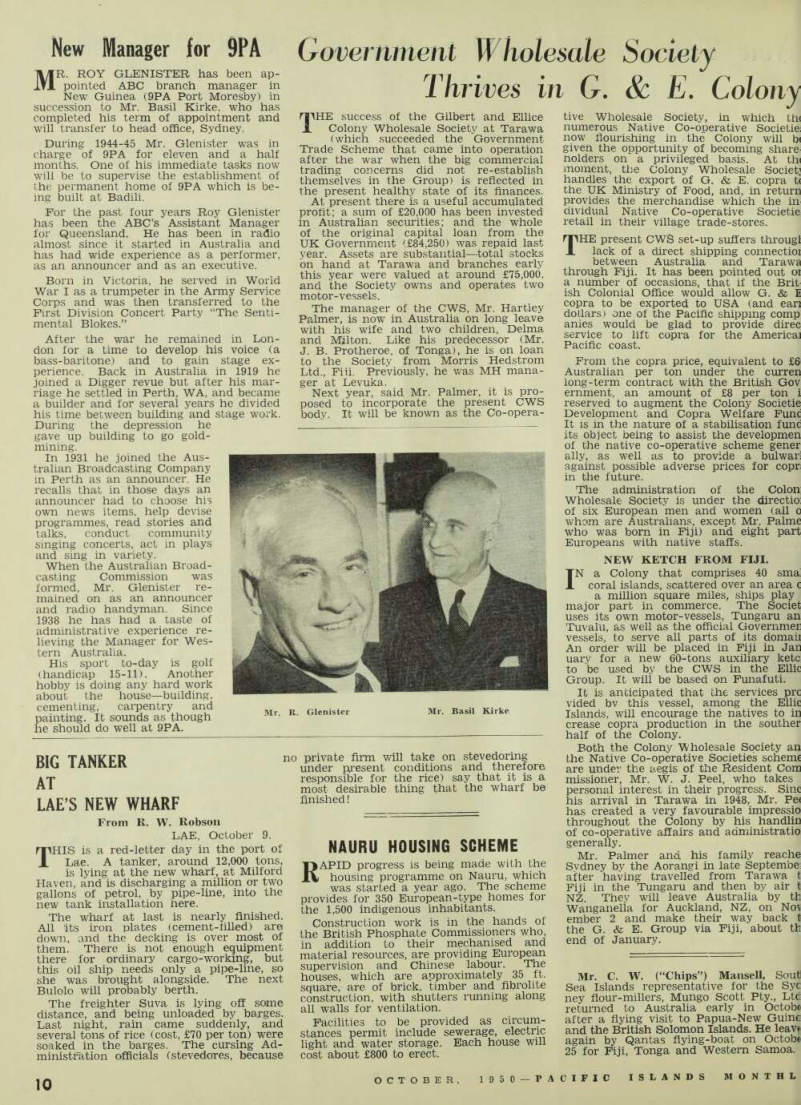
MR. ROY GLENISTER has been ap pointed ABC branch manager in New Guinea (9PA Port Moresby) in succession to Mr. Basil Kirke, who has completed his term of appointment and will transfer to head office, Sydney.
During 1944-45 Mr. Glenister was in charge of 9PA for eleven and a half months. One of his immediate tasks now will be to supervise the establishment of the permanent home of 9PA which is be ing built at Badili.
For the past four years Roy Glenister has been the ABC’s Assistant Manager for Queensland. He has been in radio almost since it started in Australia and has had wide experience as a performer, as an announcer and as an executive.
Born in Victoria, he served in World War I as a trumpeter in the Army Service Corps and was then transferred to the First Division Concert Party “The Senti mental Blokes.”
After the war he remained in Lon don for a time to develop his voice (a bass-baritone) and to gain stage ex perience. Back in Australia in 1919 he joined a Digger revue but after his mar riage he settled in Perth, WA, and became a builder and for several years he divided his time between building and stage work.
During the depression he gave up building to go gold mining.
In 1931 he joined the Aus tralian Broadcasting Company in Perth as an announcer. He recalls that in those days an announcer had to choose his own news items, help devise programmes, read stories and talks, conduct community singing concerts, act in plays and sing in variety.
When the Australian Broad casting Commission was formed, Mr. Glenister re mained on as an announcer and radio handyman. Since 1938 he has had a taste of administrative experience re lieving the Manager for Wes tern Australia.
His sport to-day is golf (handicap 15-11). Another hobby is doing any hard work about the house-building, cementing, carpentry and painting. It sounds as though he should do well at 9PA.
Mr. Basil Kirke
Mr. R. Glenister
Lae’S New Wharf
Big Tanker
AT
From R. W. Robson LAE, October 9.
THIS is a red-letter day in the port of Lae. A tanker, around 12,000 tons, is lying at the new wharf, at Milford Haven, and is discharging a million or two gallons of petrol, by pipe-line, into the new tank installation here.
The wharf at last is nearly finished.
All its iron plates (cement-filled) are down, and the decking is over most of them. There is not enough equipment there for ordinary cargo-working, but this oil ship needs only a pipe-line, so she was brought alongside. The next Bulolo will probably berth.
The freighter Suva is lying off some distance, and being unloaded by barges.
Last night, rain came suddenly, and several tons of rice (cost, £7O per ton) were soaked in the barges. The cursing Ad ministration officials (stevedores, because
no private firm will take on stevedoring under present conditions and therefor© responsible for the rice) say that it is a most desirable thing that the wharf be finished!
Nauru Housing Scheme
RAPID progress is being made with the housing programme on Nauru, which was started a year ago. The scheme provides for 350 European-type homes for the 1,500 indigenous inhabitants.
Construction work is in the hands of the British Phosphate Commissioners who, in addition to their mechanised and material resources, are providing European supervision and Chinese labour. The houses, which are approximately 35 ft. square, are of brick, timber and fibrolite construction, with shutters running along all walls for ventilation.
Facilities to be provided as circum stances permit include sewerage, electric light and water storage. Each house will cost about £BOO to erect.
Government Wholesale Society
Thrives in G. & E. Colony
riIHE success of the Gilbert and Ellice JL Colony Wholesale Society at Tarawa (which succeeded the Government Trade Scheme that came into operation after the war when the big commercial trading concerns did not re-establish themselves in the Group) is reflected in the present healthy state of its finances.
At present there is a useful accumulated profit; a sum of £20,000 has been invested in Australian securities; and the whole of the original capital loan from the UK Government (£84,250) was repaid last year. Assets are substantial —total stocks on hand at Tarawa and branches early this year were valued at around £75,000. and the Society owns and operates two motor-vessels.
The manager of the CWS, Mr. Hartley Palmer, is now in Australia on long leave with his wife and two children, Delma and Milton. Like his predecessor (Mr.
J. B. Protheroe, of Tonga), he is on loan to the Society from Morris Hedstrom Ltd., Fiii. Previously, he was MH mana ger at Levuka.
Next year, said Mr. Palmer, it is pro posed to incorporate the present CWS body. It will be known as the Co-opera
tive Wholesale Society, in which the numerous Native Co-operative Societie! now flourishing in the Colony will be given the opportunity of becoming share holders on a privileged basis. At the moment, the Colony Wholesale Society handles the export of G. & E. copra te the UK Ministry of Food, and, in return provides the merchandise which the in dividual Native Co-operative Societie; retail in their village trade-stores.
THE present CWS set-up suffers througl lack of a direct shipping connectioi between Australia and Tarawa through Fiji. It has been pointed out or a number of occasions, that if the Brit ish Colonial Office would allow G. & E copra to be exported to USA (and earr dollars) one of the Pacific shipping comp anies would be glad to provide direc service to lift copra for the Americai Pacific coast.
From the copra price, equivalent to £6i Australian per ton under the curren long-term contract with the British Gov ernment, an amount of £8 per ton i reserved to augment the Colony Societie Development and Copra Welfare Fund It is in the nature of a stabilisation fund its object being to assist the developmen of the native co-operative scheme gener ally, as well as to provide a bulwarl against possible adverse prices for copri in the future.
The administration of the Colon; Wholesale Society is under the directio] of six European men and women (all o whom are Australians, except Mr. Palme who was bom in Fiji) and eight part Europeans with native staffs.
New Ketch From Fiji.
IN a Colony that comprises 40 sma] coral islands, scattered over an area c a million square miles, ships play major part in commerce. The Societ uses its own motor-vessels, Tungaru an Tuvalu, as well as the official Governmen vessels, to serve all parts of its domaii An order will be placed in Fiji in Jan uary for a new 60-tons auxiliary ketd to be used by the CWS in the Ellic Group. It will be based on Funafuti.
It is anticipated that the services pro vided bv this vessel, among the Ellic Islands, will encourage the natives to in crease copra production in the souther: half of the Colony.
Both the Colony Wholesale Society an the Native Co-operative Societies scheme are under the aegis of the Resident Com missioner, Mr. W. J. Peel, who takes personal interest in their progress. Sine his arrival in Tarawa in 1948, Mr. Pee has created a very favourable impressio throughout the Colony by his handlin of co-operative affairs and administratioi generally.
Mr. Palmer and, his family reache Sydney by the Aorangi in late Septembe: after having travelled from Tarawa ti Fiji in the Tungaru and then by air ti NZ. They will leave Australia by th Wanganella for Auckland, NZ, on Nov ember 2 and make their way back ti the G. & E. Group via Fiji, about th end of January.
Mr. C. W. (“Chips”) Mansell, Sout) Sea Islands representative for the Syc ney flour-millers, Mungo Scott Pty., Ltc: returned to Australia early in Octobe after a flying visit to Papua-New Guine and the British Solomon Islands. He leav( again by Qantas flying-boat on Octobe 25 for Fiji, Tonga and Western Samoa.
Advertisements & other items, p. 12 (1 item)
10
OCTOBER, 1950 PACIFIC ISLANDS MONTHL
Moresby Says Goodbye
To Well-Known Residents Father McEncroe and Gough Family
From Our Own Correspondent
Port Moresby, Oct. 7
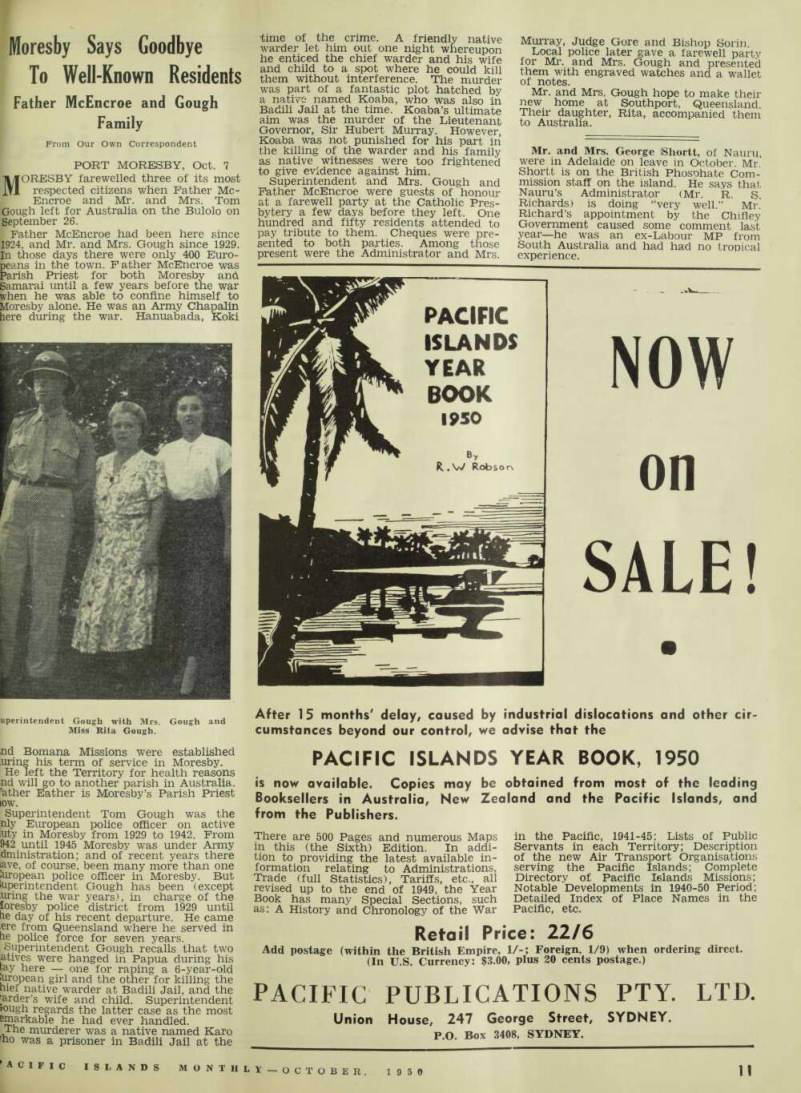
MORESBY farewelled three of its most respected citizens when Father Mc- Encroe and Mr. and Mrs. Tom Gough left for Australia on the Bulolo on September 26.
Father McEncroe had been here since 1924, and Mr. and Mrs. Gough since 1929.
In those days there were only 400 Euro peans in the town. Father McEncroe was Parish Priest for both Moresby and Bamarai until a few years before the war when he was able to confine himself to Moresby alone. He was an Army Chapalin here during the war. Hanuabada, Koki
nd Bomana Missions were established uring his term of service in Moresby.
He left the Territory for health reasons nd will go to another parish in Australia, ’ather Eather is Moresby’s Parish Priest tow.
Superintendent Tom Gough was the nly European police officer on active luty in Moresby from 1929 to 1942. From 942 until 1945 Moresby was under Army dministration; and of recent years there tave, of course, been many more than one luropean police officer in Moresby. But •uperintendent Gough has been (except uring the war years), in charge of the loresby police district from 1929 until he day of his recent departure. He came from Queensland where he served in he police force for seven years.
Superintendent Gough recalls that two atives were hanged in Papua during his pay here one for raping a 6-year-old propean girl and the other for killing the nief native warder at Badili Jail, and the [aider’s wife and child. Superintendent rough regards the latter case as the most emarkable he had ever handled.
The murderer was a native named Karo tio was a prisoner in Badili Jail at the
time of the crime. A friendly native warder let him out one night whereupon he enticed the chief warder and his wife and child to a spot where he could kill them without interference. The murder was part of a fantastic plot hatched by a native named Koaba, who was also in Badili Jail at the time. Koaba’s ultimate aim was the murder of the Lieutenant Governor, Sir Hubert Murray. However, Koaba was not punished for his part in the killing of the warder and his family as native witnesses were too frightened to give evidence against him.
Superintendent and Mrs. Gough and Father McEncroe were guests of honour at a farewell party at the Catholic Pres bytery a few days before they left. One hundred and fifty residents attended to pay tribute to them. Cheques were pre sented to both parties. Among those present were the Administrator and Mrs.
Murray, Judge Gore and Bishop Sorin.
Local police later gave a farewell party for Mi*, and Mrs. Gough and presented them with engraved watches and a wallet of notes.
Mr. and Mrs. Gough hope to make their new home at Southport, Queensland.
Their daughter, Rita, accompanied them to Australia.
Mr. and Mrs. George (Shortt, of Nauru, were in Adelaide on leave in October. Mr.
Shortt is on the British Phosohate Com mission staff on the island. He says that, Nauru’s Administrator (Mr. R. s.
Richards) is doing “very well.” Mr.
Richard’s appointment by the Chifley Government caused some comment last year—he was an ex-Labour MP from South Australia and had had no tropical experience.
[?]uperintendent Gough with Mrs. Gough and Miss Rita Gough.
Advertisements & other items, pp. 13-14 (3 items)
11
ACIFIC ISLANDS MONTHLY—.OCTOBER, 1950
Sale!
PACIFIC
ISLANDS
YEAR
BOOK
1950 By R . W Robso TL
NOW
on
SALE!
After 15 months' delay, caused by industrial dislocations and other circumstances beyond our control, we advise that the
PACIFIC ISLANDS YEAR BOOK, 1950
is now available. Copies may be obtained from most of the leading Booksellers in Australia, New Zealand and the Pacific Islands, and from the Publishers.
There are 500 Pages and numerous Maps in this (the Sixth) Edition. In addition to providing the latest available information relating to Administrations, Trade (full Statistics), Tariffs, etc., all revised up to the end of 1949, the Year Book has many Special Sections, such as: A History and Chronology of the War in the Pacific, 1941-45; Lists of Public Servants in each Territory; Description of the new Air Transport Organisations serving the Pacific Islands; Complete Directory of Pacific Islands Missions; Notable Developments in 1940-50 Period; Detailed Index of Place Names in the Pacific, etc.
Retail Price: 22/6
Add postage (within the British Empire, 1/-; Foreign, 1/9) when ordering direct. (In U.S. Currency: $3.00, plus 20 cents postage.)
PACIFIC PUBLICATIONS PTY. LTD.
Union House, 247 George Street, SYDNEY.
P.O. Box 3408, SYDNEY.
MORRIS HEDSTROM Limitec
General Merchants, Importers and Exporters,
Shipowners, Plantation Owners,
Commission and Insurance Agents
HEAD OFFICE
SUVA, FIJI
Established 1868
SERVICE IN THE SOUTH PACIFIC TERRITORY
rpHROUGH our Large Establishments in Suva and our Numerous Branches, we distribute a wide and comprehensive range of General Merchandise and provide almost every kind of service. Our departments and associated businesses include:
DRAPERY
MOTOR SALES
AND SERVICE
TOBACCO
TIMBER AND
BUILDING
GROCERY
CONFECTIONERY
HARDWARE
ELECTRICAL
LIQUORS
DRUGS
Branches Throughout Fiji, Samoa and Tonga
There is a Branch or Agent of Morris Hedstrom Limited in every Town in the Three Territories.
We are Sole Agents in these Territories for British Drug Houses Ltd.
Electrolux Ltd.
Ford Motor Co.
General Electric Co. Ltd.
Goodyear Tyre Gr Rubber Co.
B. A. Hjorth & Co. (Primus Products) Imperial Chemical Industries Ltd.
International Harvester Export Co.
Matson Navigation Company Max Factor and Co. Inc.
Ransomes, Sims & Jefferies Lt Ruston Gr Hornsby Ltd.
Vacuum Oil Co. Pty. Ltd.
Yorkshire Copper Works Ltd.
Morris Hedstrom Limited are LLOYD’S AGENTS in Fiji and Samoa.
IN AUSTRALIA:
Morris Hedstrom (Aust.) Pty. Ltd.,
Asbestos House, 65 York Street, SYDNEY
IN GREAT BRITAIN:
Morris Hedstrom Limited,
Barclay's Bank Building, 73 Cheapside, LONDON, E.C.2.
12
OCTOBER, 1950 PACIFIC ISLANDS MONTHL
Labour Problems
Another Unrealistic Attack On Ng’S Native
New Ordinance Published—To Operate From Beginning Of Year
From 1? W Robson
From R. W. Robson
Port Moresby, Oct. 7.
THE big event of the week here has been the distribution to all concerned of copies of the new Native Labour Ordinance, with which it is proposed to replace, as from January 1, the fantastic conglomeration of Wardist Socialism and New Planners’ idealism which was brought in as an Ordinance to control native labour some three or four years ago.
The new Ordinance is an improvement on the old—the direct result, of course, of the change of government in Australia — but, compared with the conditions which ruled before World War 11, it is still in the Category of so many things here to-day.
That is to say, it is merely another facet of the New Planners’ attempt to rule a raw country and a very primitive race hvith instrumentalities which would be more fittingly applied to a European com munity.
The new Government in Australia .loins with all practical men in deploring the things that Wardism did to these Terri tories, and is trying to introduce reforms.
But the Australian Socialists —as they themselves gleefully expressed it —proceeded in their years of office on the principle that if any anti-Socialist Gov ernment followed them, it would find it exceedingly difficult to “unscramble the eggs.” The eggs have been well and truly scrambled in Papua-New Guinea and the Australian Government now is up against the double handicap—the implan tation throughout the services of a good sprinkling of Socialists, near-Socialists and idealistic rat-bags, and the indoc trination of the child-like natives with ideas that are in line with Socialist theory, and will take some rooting-out.
THERE were penal sanctions in the old labour system. Wardism more or less wiped them out. Even to-day. un der the Spender regime, officialdom writhes in agony at the very idea of punishing natives with calaboose for breaches of labour contracts.
Perhaps I belong to grandfather’s day: but, since seeing this country after its five years’ dose of Wardism, I am more firmly convinced than ever that you can have no well-controlled and efficient labour service here unless you can find a way of nunishing these lads for labour breaches, either through their stomachs or their hides. The new ordin ance’s provision for punishment is fatal to the whole thing.
The new Ordinance is clearly the pro duct of the present Administrator’s theory that the only way to govern the Melan esian is to treat him as Nature’s gentle man. So the whole plan is based now on a civil contract between employer and em ployed. There are all sorts of admoni tions to DO’s and others to try and make the native realise his obligations under the contract. If he is a naughty native and defies his employer, he is to have some part of his pay withheld, and may even be sent home, at the Administration’s expense.
To any experienced employer here, this is simply silly.
Fundamentally, there is no reason at all why these primitive folk should work at all for Europeans—they can, and mostly do, live adequately, according to their ideas, without organised toil, just as they did before the advent of Europeans. Those
who now hire themselves out, to labour for wages, do so either because they like Euro pean foods and gee-gaws, or because, like the Highlanders, they want to see the strange things of the salt-water country.
But the natives have little regard for money, in the European way. To you and me, a fine is a matter for regret and bitter cursing. To the Papuan, it means very little. Certainly, it does not repre sent punishment.
Yes —I can hear the clamour of the New Planners’ argument! Since these
people are free, what right have we to force them into employment, and to punish them for breaches of their en gagement, and make labour slaves of them? We have heard it all, many times —ever since Evatt and Ward lifted their anti-capitalist howl against the old inden ture system.
THE answer is simple, and its logic in escapeable. New Guinea must be held and developed by Australia, for defence reasons. If New Guinea is not held in this way, it inevitably will be oc cupied by Asiatics who will completely en slave these natives.
Development means that we must have here an adequate labour force. If we can not use the indigenous natives, we must bring in foreign labourers—probably Asiatics—and that would be a very bad thing.
Whether we—and they—like it or not,
(Continued on Page 105.)
the international (or inter-racial) situa tion demands that these Papuan-Melan esians shall give their labour in the development and defence of their country. ,Their halcyon days of freedom-in ’ savagery are over.
The New Planners, with manifest reluc tance, have accepted this viewpoint, in some degree—one can see signs of it in this new Ordinance. But they cling stub bornly to the idea of treating this primi tive bush Kanaka as if he were a literate European, and the whole Ordinance is based on their rejection of the “indenture system” supported by adequate penal pro visions, and their stubborn insistence on the substitution therefor of the ordinary civil contract, guarded by monetary penalties.
It won’t work. If there are to be real progress and development in New Guinea —on a sound economic basis—this Ordin ance will have to be revised drastically fairly soon, or scrapped altogether. It only becomes possible now because more than half the basis of this country’s economy to-day is unsound —it is built, not on the country’s earnings, but on the lavish expenditure within the country of outside money—millions from Canberra, plus other millions from the ever-hope ful oil companies.
If oil is not found, this present struc ture surely will crash. The country then will have to pay its way mostly out of its own resources. Private employers will then be in a position to insist on an ade quate and efficient labour force—and this elaborate and unrealistic Ordinance will be “wiped.”
THE principal changes, from the non official viewpoint, are the extension of the term of contract to 18 months, with another 6 months possible; the com plete change-over to civil law; and the wiping-out of the Department of Native Labour, so that the implementation of the Ordinance becomes the responsibility of the District Services and the Govern ment Secretary.
District Officers will attend to pretty well everything connected with native labour; but inspections will be carried out by officials attached to the Government Secretary’s Department.
The change-over to the District Officers will be welcomed generally. Everyone agrees that the best and most hopeful thing in Papua-New Guinea to-day is the good relationship between the men in the field—the DO’s and ADO’S—and the non official classes.
The DO’s mostly are men of long and sound experience, realistic and reasonable, who have done a great deal to take the bad taste of Canberra and Port Moresby out of the mouths of the private em ployers, If anyone can make this Ordin ance work, they will. Because they are out in the field every day, they are under no delusions about native labourers and the problems they represent. They also know the bad, as well as the good qualities of private employers.
THE following summary of other points has been prepared by officials in Port Moresby:— Under this proposed Ordinance there are two classes of workers, “employees” and “casual workers.” The former are natives employed under Agreement, the latter are those who prefer to work under a verbal arrangement.
Penal sanctions in respect of breaches °L . Agreements by either party are abolished and civil remedies substituted therefor.
Complaints in relation to such breaches
will be heard and determined by a Dis trict Officer, as arbitrator. Appeals against decisions by a DO may be made to the Director of District Services, Claims by or against casual workers will be dealt with by Civil Courts in the ordinary way.
Casual workers and their employers
have the right to terminate the employ ment at any time without notice.
Ordinary legal proceedings may be taken against any employer for non compliance with the general provisions of the Ordinance relating to employment conditions.
Permits to Engage Employees replace Recruiters’ Licences. Cash deposits by way of personal security for the duty ob servance of the Ordinance are abolished but a DO may require the applicant for
a Permit to give security in the form of a guarantee of £5O.
Native Assistants Permits may be issued to natives of good character to engage! natives on behalf of their employers in S districts endorsed on the Permit.
Payments, other than wages and ex penses, for engaging employees are for bidden. No money or other considera tion may be given to a native to induce another native to enter into an Agree ment.
Agreements may be made up to 18 months, and if the parties agree, may be extended for an additional six months.
During the period of extension Agree ments may be terminated by one month’s notice on either side.
A DO may, with the consent of the parties thereto, vary an Agreement, ex cept with regard to the maximum term of 18 months.
A DO may terminate Agreements in cases of emergency (epidemics, war condi tions, prolonged food shortages) and also in the case of a native who has inad vertently been allowed to enter into an Agreement contrary to the provisions of the Ordinance. In all such cases where natives have served for less than twelve months they will be returned to their homes at the expense of the Adminis tration.
Not more than one half of an employee’s wages may be paid to him during the currency of the Agreement: but a DO may in special cases authorise part pay ment of deferred wages.
The Administration provides free medi cal treatment to all natives.
With the consent of the employer, the wife and children of a worker may accom pany and live with him at his place of employment. Rations for wives and children will be less than the ration for workers, and as prescribed.
The minimum age limit for workers, 16 years, has been retained, but natives bet ween 14 and 16 years of age may be en gaged for light labour not more than five miles from their home.
The provisions in the present Ordinance relating to Workmen’s Compensation, and the Removal of Natives from the Terri tory have been retained —in both cases with slight amendments.
The restrictions on the employment of married women have been omitted. Sub ject to the provisions of the Ordinance women generally may be employed as domestics and in any form of light labour.
The provisions relating to the payment of monetary allowances to casual workers in lieu of rations, have been retained but these provisions will not apply to natives employed under Agreements.
Forms have been reduced and simplified.
Advertisements & other items, pp. 15-16 (3 items)
13
pacific islands month ly-october. 1950
Importers
i /
EXPORTERS
All classes of merchandise purchased for Island clients throughout the South-west Pacific.
Island produce sold on Australian and overseas markets on a commission basis.
54a Pitt Street
r p r ▲
Sydney
Cable Address: “ROBERGILL,” Sydney
vours when you Fiy By clipper*
TO I 111111 ■ li toUina mi
iiiiip
VIA
U.S.A
PAN AMERICAN’S COMMONWEALTH PLAN
Pan American’s Commonwealth Plan See America en route covers all your travel expenses to San Francisco, Los Angeles, Chicago, London and return. Includes meals, New York are all on your route. If hotel accommodations, incidental trans- you wish you can arrange additional portation in the U.S.A. All reservations stop-over time anywhere in U.S.A. and arrangements made for you by Pan up to one year!
American.
The Clippers also fly to London via Middle East and Europe.
For complete information, call your Travel Agent or . . .
SUVA: Bank of N.S.W. Bldg. (Tel. 664) NOUMEA : Rue Jean Jaures (Tel. 85)
SPEED YOUR PARCEL BY CLIPPER CARGO
World's Mo sf Experienced Airline
Pm American
World Airways
Fun American World Airways, Inc., Ltd., Incorporated in U.S.A. *Trade Mark, Pan American World Airways, Inc.
October, 19 50 Pacific Islands Month I
Ng Planters’ Demand For Higher
Copra Price
Policy Questions Touch Price at Many Points
Representatives of New Guinea copra producers this month flew from Rabaul to Sydney to confer with Australian crushers and Government f representatives on conditions relating to supply of Territory copra to Australia.
Mr. Don Barrett, president of the Plan ters’ Association of New Guinea, was ac- I companied by Messrs. E. T. Fulton and H. T. Allan.
Some important discussions have al- I ready taken place and will be continued when the producers meet Parliamentary Under-Secretary Howse at Canberra on I October 17.
The producers’ case for a higher copra price was presented by Mr. Barrett in the form of a statement dealing, in a con structive and detailed way, with most problems affecting the planting industry.
I Mr. Barrett explained that any consider ation of the price of the Territory’s staple product necessarily involved many mat ters connected with policy—such as cost of production, export duties, cost and availability of native labour; transport conditions and future planting.
' The statement tabled by Mr. Barrett was accepted as a basis for discussion. He [ stated, inter alia:
Price Paid By Crushers.
“QINCE the war Australian crushers have at all times had first call on Ter ritory copra, and prices paid have been far below world market prices, particularly over the last 18 months.
“The decision to supply copra to Aus tralian markets, from the Territory, at the same price as that paid by United Kingdom Government under the Austra lia-UK copra agreement, was a decision reached by the Australian Government without any reference to copra producers.
“There exists no guarantee that, if world prices fall below that at present being paid under the agreement. Australian crushers would not seek a cheaper market.
“There is no agreement, and there never has been, between coora producers of the Territory and Australian consumers. The Australian crusher has enjoyed, and at present continues to enjoy, the benefit of a relatively low price for his raw material: yet the producer has no collat eral guarantee of continued demand or even of price at the present level.
“The natural corollaries of low-priced raw material follow. Australian manufac turers can produce at lower costs than foreign competitors, despite high labour costs. Whilst this may be beneficial to the secondary industries of Australia and to Australia’s export trade gener ally, it is seriously retarding the devel opment of tracts of New Guinea land which are vital to Australia —from a defence viewpoint, if from no other.
“It is obvious that Australian manufac turers are benefiting at the direct expense of Territory producers.
Demand For World Price.
“ITjROM a purely logical and ethical view -T point it is clear that copra producers are entitled to world prices or at least something approaching them —failing this, a long term agreement with a guarantee of price at a fair level.
“In this regard the agreement with the United Kingdom has the right ideas and sentiments. However, the substance of the agreement and the spirit of its carry ing out, leave much to be desired. It is
the considered opinion of producers that Australian Governments have let them down badly in this matter.
“Wool growers in Australia are reaping the benefit of phenomenal prices for this season’s clip. It may be argued that they are liable to heavy taxation. However, they have franchise and representation!
Copra producers have a direct exnort tax on their product and also a considerable burden in indirect taxation—facts which are, apparently, often overlooked.
“The statement that, since copra prices in the Territory today are much higher than those existing ore-war, then produ cers must be well off and rapidly becom ing wealthy, could only be made by a person who has not troubled to examine the facts. It might iust as well be argued that, because a suit todav costs much more than the same article did in 1939 the manufacturer must be accruing im mense profits.
“The facts are, of course, that produc tion costs have soared supplies are many times their pre-war price, while trans port, labour and management costs have risen. Add to this that many plantations have reached or oassed the peak of their productivity: indeed, many are on the wane. Do not forget the shortage of bmldiner materials for the construction of plantation houses, drving sheds and the like the difficulty of obtaining suitable and exnerienced plantation operatives: and the unsettled conditions amongst the natives—source of labour for all planta tions.
“In a great many cases, plantation build ings had to be completely renewed. War damae-e comoensation was paid on a liber al scale—but in most cases the cost of replacement was in advance of the pre war valuation.”
The Planters’ Assn, spokesman nointed out that war conditions had disorganised and demoralised the natives, source of the indisoensible plantation labour, Renditions were made far worse bv the Socialist policy of discouraging anv work inclination among the natives, attacking
and discrediting the old contract system, and disbursing “war damage compensa tion’’ among them on a most lavish scale.
Transportation facilities have been in a chaotic state for years. These conditions have added enormously to the cost of recruiting labour and of maintaining labour. The following figures give some indication:
THE Planters’ spokesmen pointed out that planters cannot make adequate provision for the new planting, which must go on if the now ageing plantations are to be effectively replaced. The pres ent position, from the viewpoint of New Guinea’s future development, is not good.
Their statement went on to deal with the enormous wastage of Australian public money on plans for native welfare—the general effect of which has been to make less and less native labour available for
the Territories’ development: the huge smns allegedly spent on public works, al though the condition of roads, bridges and wharves Is unsatisfactory.
The producers stated that it was their considered opinion that New Guinea could be self-supporting now as in pre-war years. An export levy of £3/10/- per ton is paid on copra and royalties are collected on gold and timber. The copra tax alone yields over £200,000 per annum. Customs revenue is estimated at £500,000. More over, New Guinea residents pay export levies on Australian goods sent to the
Territory.
Producers would willingly shoulder these burdens if paid a fair price for their produce and if the administration and development of New Guinea were put on a sound basis.
Mr. Barrett concluded by stating that producers were fully prepared to co operate with Australian consumers on reasonable terms. They desire a stable industry but demand a full voice in their own affairs.
Cost Of Essential Commodities In Ng
Pre-war 1946 To-day Rice, ton .. £9/10/- £43/-/- £68/12/6 Meat, case . £1/3/6 £3/10/6 £4/19/- Copra. sacks (bale) . £9/-/- £28/-/- £66/-/- Tobacco, lb. 4/9 8/11 14/8 Laplaps, yd. 3d 1/9 2/3 Petrol, gal. . 1/9 2/5V 2 4/4 Distillate, gal. 9d 2/2 3/2 y a
Australian
Export
Levies On Goods
For
NG Starch SR Flour . . ., Biscuits .. ..
Soap, Butter ..
Advertisements & other items, pp. 17-18 (1 item)
/ Vaucluse, Sydney \
CRt MS
CHARMOSAN
& »ACC CM»«. ' T \' , 0 « PO«0‘«
ADORABLY LOVELY
UNDER POWDER
Charmosan
colder e a rn F# *s!
f CLEANSES AND
I REFRESHES YOUR SKIN
CHARMOSAN
VANISHING and cold creams
4v I THE CENTRAL PHARMACY
j 177 Hopetoun Avenue V S
/ VAUCLUSE, SYDNEY \
E. Kezelman, M.P.S., Ph.C. (Sydney Uni.), Registered Chemist in Charge.
DISPENSING CHEMISTS
All Ethical and Proprietary Drugs.
Full Range of Cosmetics and
Ladies' Requirements.
Home Wave Sets. Shaving. Brush and Manicure Sets.
Nourishing Creams. Photographic Supplies.
Skin Vitalisers and Shampoos, Etc.
We will be pleased to give PERSONAL ATTENTION and PROMPT
DELIVERY to all MAIL ORDERS.
Cheque or Postal Note with order. Credit Established.
Specify Airmail or Ship. On parle Prancais ici.
MILL E R S Mj T D • iiiiiiiiiiiiiiiiiiiiiiiiuiiw
SUVA and LAUTOKA, FIJI. "
Every Branch of Engineering and Building
Construction
Sawmillers and Timber Merchants; Shipwrights and Sailmakers; Joinery
and Furniture Manufacturers; Upholsterers; Plumbers; Electricians;
Hardware Merchants; Motor Dealers.
AGENCIES :
Chevrolet, Bedford, Vauxhall, Nash Motors. Firestone Tyres. Fetters Marine and Stationary Engines. G.E.C. Radio Sets. British Australian Lead Manufacturers Pty., Ltd. Atlas Assurance Co., Ltd.
There is no need to send to Australia or New Zealand for Repairs or Replacements. We can give you a sound Quotation and guarantee First-Class Workmanship.
10 TIMES
STRONGER THAN WOOD!
“DURAPLAS" OVERLAYS
Exclusive to rjk W
RACKETS
"DURAPLAS" OVERLAYS ARE BONDED TO THE SHOULDERS FOR GREATER STRENGTH, EXTRA SPEED, LONGER LIFE ★ No warping or cracking at the shoulders.
Extra strength allows for tighter stringing.
Reinforced frame ensures more restrings. ★ "DURAPLAS' IS THE GREATEST SINGLE ADVANCE IN RACKET CONSTRUCTION FOR 25 YEARS!
HBkB
where a//
the strain
is taken
Experts
Queensland Sugar Cane Experts For P-NG Next Year
MR. N. J. King, director of the Queens land Bureau of Sugar Experiment Stations will leave for Papua-New Guinea in mid-October to make an aerial survey of the country through which a two-man sugar-cane expedition will walk.
The expedition will be made early next year by Mr. J. H. Buzacott, technologist and Mr. C. G. Hughes, a cane pathologist.
They will search first for wild canes for breeding in the Aiyura highland area, 100 miles west of Lae. Then they will comb the south-eastern coastal district, between Port Moresby and Milne Bay.
Montevideo Maru
Memorial
Rabaul RSSAILA Will Build It If Widows Approve
THE War Graves Sub-Committee of the Rabaul Branch of the RSSAILA has undertaken to maintain the Monte video Maru memorial in Rabaul, since there is no other organisation to take the responsibility.
The memorial was built by the Army near Colyer Watson’s old wharf in Rabaul, from which the ill-fated vessel is believed to have departed about June 1942, carry ing men of the 22nd Battalion. AIF, and some hundreds of New Guinea residents who had been caught by the Jap invasion.
The ship was sunk by the Allies on its ;way to Japan and all prisoners were lost.
The present memorial is of cement and it is believed that its life will not be a very long one.
The War Graves sub-committee would like to replace it with a stone memorial, suitably inscribed but they feel that they would like to have the approval of the New Guinea widows of those men who lost their lives on the ship. The sub-com mittee would be responsible for raising 'the funds necessary to build the memorial. (Editorial Note: PIM wrote to the De partment of External Territories, Canber ra, asking for a list of the widows of Montevideo Maru victims, but as yet has not received a reply. It is likely that the various New Guinea women’s organisa tions in Australia would be best qualified to supply lists of Montevideo Maru widows, as many of the members of these organ isations are Rabaul widows. The organ isations are: New Guinea Women’s Club of Sydney; New Guinea Women’s Associa tion, Melbourne; and the New Guinea Women’s Association, Brisbane. Else where this issue it is suggested that when, or if, the new memorial is built there be included thereon the names of those men who, while not Montevideo Maru victims, were killed or mysteriously disappeared while prisoners of the Japs in Rabaul).
The Price Spiral In
Fiji
From Our Own Correspondent
Suva. Nov. 9
of living note: The vendor of a J bundle of five dalo (taro) at a Suva market told a potential Fijian buyer that the price was 8/-, thus establishing a flew record for what is nominally a Fijian staple foodstuff but is very widely con sumed by other races as well.
After argument, the price was reduced to 7/6. This offer was also turned down, the Fijian commenting tersely that he had exactly 7/6 in his pocket to buy the entire evening meal for himself, his wife and three children.
At the fish market a vendor demanded, and was paid, 3/- for two 10 in. mullet and 4/- for a 12 in. saqa.
These examples, however anybody may try to explain away this sort of thing, are an indication of the continued trend winch, if not headed off, is going to produce an impossible situation in Suva in the near future.
Wages of PWD employees throughout faji have gone up again as a result of i big jump in the Indian cost of living index for the last quarter. The European index also went up but not to the same extent as the Indian.
At least two of the big firms have
recently made wage-increases with a notable absence of trumpet-blowing.
And all this comes at a time when the Government, the Civil Service and the Legislative Council are diplomatically haggling over Civil Service nay and con ditions.
A Fijian earning £3O a month (not many Fijians get anything like that) said the other day that, with a wife and five children, he is infinitely worse off than he was in 1930 with a wife, two children and (it looks incredible) only £4 a month.
He now pays an Indian £lO a month for an inadequate place to live in—a figure that is quite moderate in Suva these days —and is constantly worried by the fact that the children are fed mainly on white bread and similar stuff, simply because the price of Fijian dalo, fresh vegetables and meat has put anything like a proper diet out of reach.
Echo of Vichy France
The Saigon Court Martial
IN connection with the tenth anni versary of New Caledonia rallying to Free France, Monsieur Henri Sautot. first Free French Governor and now Mayor of Noumea, announces that he has been able, as a result of recent inves tigations, to discover the names and rank of the members of the Saigon Court Martial which condemned 23 new Hebri ridean and 142 New Caledonian patriots, including M. Sautot, to death.
M. Sautot states that, although normally a Court Martial is composed of colonels and officers of similar rank, on this occasion the court included three generals, as well as a colonel and a colonel in the medical service. He will give the names of those comprising the Court to anybody interested.
Advertisements & other items, p. 19 (1 item)
(Oumtaim
For
LIGHTER,
FLUFFIER
OTHER
FAMOUS
FOUNTAIN
PRODUCTS
ET«»S
vm %y ★ .NS
Hflamtiiaa
'OMATO SAUCE
£L»Trg tv
Jti.vT
ID
SELFRAISING
8 2
lbs
HOUR
*>S, ( o/te s .
FOUNTAIN food products are famous throughout the South Pacific for their consistent quality and suitability of packing for tropical conditions.
You are assured satisfaction when you specify FOUNTAIN brand.
Trade inquiries are welcome and all orders are promptly despatched.
(OUMTAIM
W.c. DOUGLASS L , 'lLL ED
FOVEAUX ST. SYDNEY AUSTRALIA
YouivtajW^
breaks i m ixaufßon* S
FOUNTAIN
JIILT CRTSTALS
-Thxuk^W^
p Ujm pudding
when packer >
More Tonkinese Leaving

New Caledonia
fIiHE Messageries Maritimes ship. Sontay, JL was due in Noumea early in October to repatriate 690 Tonkinese to Indo china. This number represents about 50 per cent, of the Tonkinese still awaiting repatriation from New Caledonia. It is estimated that for every two men to be repatriated there are, to-day, three child ren.
The last shipload of Tonkinese to be re patriated (in June, 1949, by the Yang Tse)
numbered 586, of whom 373 were adults.
Before the war there were about 3,500 Tonkinese workers in the Colony.
Mr. W. E. Monk has been appointed controller of Imports, Prices and Foreign Exchange in Fiji, on contract for three years. He was expected to arrive in Fiji in October. He recently retired from the service of the National Bank of New Zealand. At the time of his retirement he was Chief Accountant at the head office of the Bank in Wellington.
Published
New Newspaper
In P. Moresby
From Our Own Correspondent
Pt. Moresby, Sept. 30.
AFTER months of frustration and dels —difficulties inevitably connectc with the construction of a buildir or the assembly of a plant—the Sout Pacific Post appeared in Port Moresby c September 26 as a twice-a-week new* paper, of 16 pages. It is an exceller production, and has been well received Papua-New Guinea has been withoi a newspaper since 1942, when the Jai came in and destroyed the plants of tf three weeklies—Rabaul Times. Papua Courier and Morobe News. Since 194 various publishers have been in and looke the ground over, but all ran away froi the difficulties created by poor transpor high cost of material and unavailability < staff.
Mr. Les Brodie, a British-Canadia newspaper man, came along here in 194 saw what he believed to be a good oppoi tunity, and somehow was able to rail the very considerable capital required 1 provide buildings and plant. Lack ' housing for his large European staff wj a major headache; but he solved it I building barracks for single men. His plai is capable of taking care of the substanti job-printing required by the Administn tion. All classes realise that the lack ( a local newspaper, as a medium for dr cussing the innumerable problems of th rapidly-growing community, is a handies upon both officials and civilians. The is plenty of scope for Mr. Brodie and b capable sub-editor, Mr. Glover, and ttu start off with the good wishes of ever; one.
Particularly good work has been doi here since the war by the Australis Broadcasting Commission, which no provides, from Port Moresby station a fi service of international and local new lor Papua-New Guinea residents. The is a keen news-gathering staff, and s efficient, up-to-the-minute schedule. Th to a degree, has kept the Territorial thoughts off their rather unhappy new paper isolation —now broken by the adve: of the South Pacific Post.
Do You Know About This
Watch?
BEFORE the American journalist, Cli ford Kruse, left Australia for Eastei Papua (where, unfortunately, he coi tracted Polio and died) he left with h friend, Mr. V. Gadsby, Press -Divisio News and Information Bureau, PO B( 4148, Sydney, a watch to be repaired. I said it belonged to a friend of his 1 French Oceania, and he would pick it i and send it to its owner when he returm to Sydney. Mr. Gadsby does not kne the owner, and has asked us to help, the owner of the watch should see tr paragraph, and write to Mr. Gadsby the address given, and give a descnptw of the watch, he will get the article bai again. :
Answer To Correspondent
Mr. Lou Fay, about whom you we inquiring, now has Muliama and MaritZ' Plantations, on the south-east coast New Ireland, Territory of New Gumei Monsieur Andre Gaillard, former he of the New Caledonian Finance Depai ment, has returned to the Colony frc Paris after some years of absence, to I sume control of his old department.
Advertisements & other items, p. 20 (2 items)
18
OCTOBER, 1950 PACIFIC ISLANDS MONTHL
It's inexpensive
'I
. and easy to add years of life to
your iron or concrete TAHKS
Give new life to your old or leaking tanks with the inexpensive PABCO REPAIR TREATMENT. Easy to apply—-nothing to heal—just two dressings arc needed . . . and Ihe treatment will not contaminate water.
Ask your local storekeeper for a
FREE PAMPHLET
or write to
PABCO PRODUCTS
PTY. LIMITED
150 Wigram Road, Glebe, Sydney, N.S.W.
Australian Manufacturers of Malthoid Roofing
facts
about PABCO REPAIRTREATMEHT
PABCO
PRODUCTS
read
the
PAIOA-50
Death Of Mr. O. B. Hug
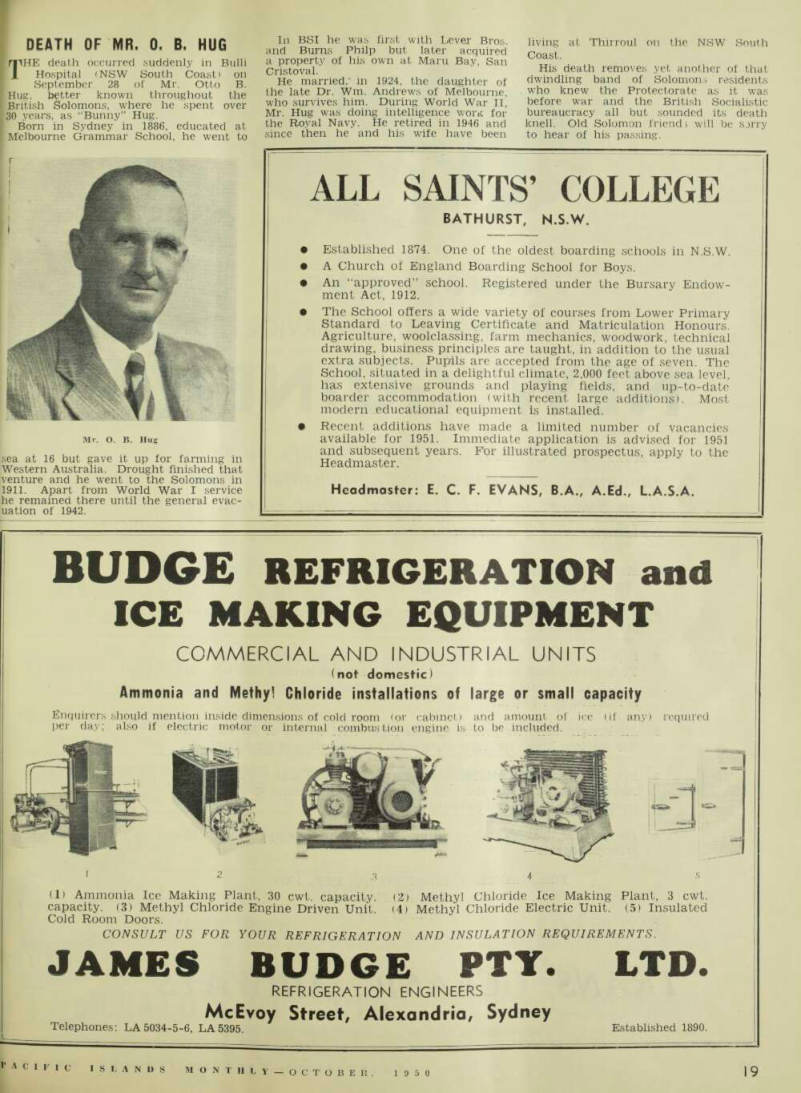
; rfiHE death occurred suddenly in Bulli 1 Hospital (NSW South Coast) on September 28 of Mr. Otto B.
Hug, better known throughout the British Solomons, where he spent over 30 years, as "Bunny” Hug.
Born in Sydney in 1886, educated at Melbourne Grammar School, he went to
sea at 16 but gave it up for farming in Western Australia. Drought finished that venture and he went to the Solomons in 1911. Apart from World War I service he remained there until the general evac uation of 1942.
In BSI he was first with Lever Bros. and Burns Philp but, later acquired a property of his own at Maru Bay, San Cristoval.
He married.' in 1924, the daughter of the late Dr. Wm. Andrews of Melbourne, who survives him. During World War 11, Mr. Hug was doing intelligence wortc for the Royal Navy. He retired in 1946 and since then he and his wife have been
living at Thirroul on the NSW South Coast.
His death removes yet another of that dwindling band of Solomons residents who knew the Protectorate as it was before war and the British Socialistic bureaucracy all but sounded its death knell. Old Solomon friends will be sorry to hear of his passing.
Mr. O. B. Hug
Advertisements & other items, pp. 21-22 (3 items)
19
ACIFIC ISLANDS MONTHLY OCTOBER. 1950
All Saints’ College
BATHURST, N.S.W.
• Established 1874. One of the oldest boarding schools in N.S.W. • A Church of England Boarding School for Boys. • An “approved” school. Registered under the Bursary Endowment Act, 1912. • The School offers a wide variety of courses from Lower Primary Standard to Leaving Certificate and Matriculation Honours.
Agriculture, woolclassing, farm mechanics, woodwork, technical drawing, business principles are taught, in addition to the usual extra subjects. Pupils are accepted from the age of seven. The School, situated in a delightful climate, 2,000 feet above sea level, has extensive grounds and playing fields, and up-to-date boarder accommodation (with recent large additions). Most modern educational equipment is installed. • Recent additions have made a limited number of vacancies available for 1951. Immediate application is advised for 1951 and subsequent years. For illustrated prospectus, apply to the Headmaster.
Headmaster: E. C. F. EVANS, 8.A., A.Ed., L.A.S.A.
BUDGE REFRIGERATION and
ICE MAKING EQUIPMENT
COMMERCIAL AND INDUSTRIAL UNITS
(not domestic) Ammonia and Methyl Chloride installations of large or small capacity Enquirers should mention inside dimensions of cold room for cabinet) and amount of ice (if any) required Per day; also if electric motor or internal combustion engine is to be included.
V ImJ «SKifr (1) Ammonia Ice Making Plant, 30 cwt. capacity. (2) Methyl Chloride Ice Making Plant, 3 cwt. capacity. (3) Methyl Chloride Engine Driven Unit. (4) Methyl Chloride Electric Unit. (5) Insulated Cold Room Doors.
CONSULT US FOR YOUR REFRIGERATION AND INSULATION REQUIREMENTS.
JAMES BUDGE PTY. LTD.
REFRIGERATION ENGINEERS
McEvoy Street, Alexandria, Sydney
Telephones; LA 5034-5-6, LA 5395. Established 1890.
ANNOUNCING
A NEW FLYING BOAT SERVICE TO
NEW GUINEA
TRANS OCEANIC AIRWAYS are proud to
announce the inauguration of a Flying-Boat Service from Sydney to Port Moresby, calling en route at
Brisbane and Townsville.
• The Service will be operated by Fast, Luxurious, Hythe Flying-boats, offering the safety and comfort for which these aircraft are renowned. • Eye-level windows provide passengers with an ever-changing panorama along this Scenic Coastal Route. • Departure Times are scheduled to suit the convenience of passengers.
Your Flying-boat leaves Sydney at 8.15 a.m., and arrives at Townsville at 5.15 p.m., departing the following morning at 9 a.m., and Port Moresby is reached at 1.35 p.m. • Air Freight facilities permit the carriage of all classes of Air Cargo in the spacious holds, specially designed for the carriage of large packages. • Excellent Hot and Cold Meals are served in flight, and a well-stocked bar, together with steward and hostess service, combine to ensure the complete comfort of all passengers. • For further details, and passenger and freight hookings, contact the principal agents— the McArthur shipping co. pty., ltd., 31 Macquarie Place, Sydney.
DAY: BU 2048-9 NIGHT: B 0229
TRANS OCEANIC AIRWAYS
20
OCTOBER, 1950 PACIFIC ISLANDS MONTHL
The Month In Moresby

From Our Own Correspondent
Port Moresby, Oct. 7.
IT seems certain now that Wau High School will not be built in time to open next year. Construction has not yet begun. No official reason has been given for the delay, except that “final ap proval is being awaited.”
It is understood, however, that the cost of the project is making Canberra think twice about it. The original estimate was £70,000 but the latest figure is around £150,000. The hold-up has caused a panic in the Administration which was so con fident the school would be built by next year that it invited parents to enrol their children. On September 4, the Adminis trator sent an urgent radio to the Ex ternal Territories Department asking for a decision on the school. No information was received in reply.
Local officials are disgusted with the last-minute delay. They do not like to break faith with parents who relied on the school opening next year. Now these parents will have to arrange to send their children to Australian schools.
The whole business has produced that same old feeling of frustration that we had under the Labour Government.
A QUICK improvement in the housing position will take place after the first shipment of 100 prefabricated houses arrives in Moresby from England in Nov ember.
Sixty houses will be erected in Moresby —4O by the Administration, 10 by Works and Housing and 10 by DCA. Part of the Administration quota will be erected on land now being opened up at the Four Mile.
Designed for semi-tropical conditions the houses are 42 ft. by 24 ft. and 38 ft by 24 ft., with two bedrooms. The walls are of aluminium with hardboard lining.
Prices landed Moresby will be £2,512 and £2,258. This does not include boy houses, concrete piles, wooden floors, or water, sewerage and electricity services. Works and Housing Director, Mr. D. J. Rooney, says that the houses can be erected in a week.
PUBLIC SERVANTS are still awaiting the promulgation of the Public Ser vice Regulations. Among other im portant matters, the regulations will deal with working hours.
Some time ago the Public Service Com missioner (Mr. A. Head) told the Public Service Association that working hours would probably be increased from 34 to 36s a week. The Association made strong protests but it will not be known whether
these were effective until the Regulations appear.
A recent meeting of the Association de cided to protest against discrimination against wives of Commonwealth and Ad ministration officers. It is proposed that when both husband and wife are employed by the Commonwealth or Administration, the wife will lose the Territorial Allowance.
In a letter to the Minister, the Associa tion urged that all female married offi cers doing the same work be given the same salary. If there must be a reduc tion, however, this should consist only of the £25 difference in the allowances paid to married male and single male officers.
THREATS of water rationing by the Works and Housing Department pro voked some sharp comments from members of the Advisory Council at the Council’s last meeting.
Chairman E, A. James said: “Works and Housing is not doing enough by blackguarding residents with threats of rationing. Before they start talking about what they are going to do to us, they should start mending some of the
-leaky taps which are wasting, gallons of water. It is about time that they realised that the present pumps are useless.”
Mr. S. E. Reilly said consumers should not be paying full water rates while they are getting a reduced supply. Mr. E. J.
Frame pointed out the danger from sep tic systems which were not working properly because of the water shortage.
Mr. N. F. Maloney said: “We will never be out of this mess until we have a 16 in.
main running from a hydro-electric scheme at Rouna.”
The Council decided to ask that the regulations controlling water wastage be better policed and that no more septic systems be installed until the water sup ply improves.
Regarding the new wharf, tenders for which are now being called, the Council decided to ask the Government Secretary for answers to these questions; (1) Does
the Government intend to call tenders for an extra 200 feet of wharf so that work on this can start as soon as the first 700 feet is constructed; (2) Have the Council’s recommendations for better cargo storage facilities been rejected; and (3) have Council’s suggested improvements to the general wharf layout been rejected?
A proposal that a memorial be erected to those who served in the last war was supported by the Council but it would like residents’ suggestions on the form ana location of the memorial.
A LADIES’ wear store and a barber’s shop are being built on Ela Beach opposite the Public Library. They should be open in a month or two. Mr, N. F. Maloney’s new store at the Three Mile is doing good business after a slow start. Three and Four Mile residents are now served by two small general stores.
POLICE now have little hope that cadet patrol officer Peter Robert Evans, aged 23, will be found alive. Evans disappeared from Port Moresby on Sep tember 22 after leaving a suicide note and his will at the Department of District Services.
Police have searched surrounding country by land, sea and air. Departing shins and planes have also been checked, Police say it would be almost impossible for Evans to leave Papua without theii knowledge. Evans, an English migrant arrived here in May and was posted tc Kainantu. A few days before he disap peared he came to Moresby and resigned Police say that they know no reason whj he should want to commit suicide.
Eileen luk poi wai, aged 7, daughter of Moresby’s Chinese tailor, was knocked down and killed by a three-ton truck at Hanuabada on September 21. The truck was driven by a native, Billi Veri. The Coroner (Mr.
B. Faithorn) gave a verdict of accidental death.
AFTER single officers in Moresby pro tested vigorously against their present accommodation, the Adminis tration quickly got moving on its plan to build new quarters. Work has begun on the foundations for 10 one-man houses and 25 two-men houses. The houses will overlook the Konedobu “industrial” area.
Mr. G. Newton, of the Government Seqre tary’s Department, is supervising the work.
MR. COLIN MARR and Mr. F. C. Hen derson, of the Agriculture Depart ment, left Sydney by air on October 4 for Pakistan where they will attend a course at the Asian Training Centre for Agricultural and Allied Development Pro jects. Mr. Marr is Chief of the Division of Agricultural Extension and Mr. Hen derson is the Economic Botanist at Kera vat. They will be away until the end of the year.
POLICE Commissioner Colonel Grim shaw has warned motorists that Papua’s registration ordinance will come into force within a few weeks. Sim ilar warnings have been given periodically for the past year but this time Colonel Grimshaw is positive that the ordinance is well on the way.
Police are anxious to have it behind them so that they can smarten up traffic generally. Under registration, vehicles not roadworthy will be ordered off the road. “Authorised testing stations will be named and local police will issue regis trations on their recommendations,” said Colonel Grimshaw.
A POSTER competition is being held by the Port Moresby Swimming Pool Committee to publicise the Swim ming Pool Appeal and the £l,OOO Art Union, which is now in progress. Posters will be judged by Mr. Justice Phillips, Mr.
E. A. James and Mr. W. Little.
First prize is £lO worth of Art Union tickets, second prize £5 worth and there will be prizes of two tickets for each entry. The posters will be displayed at the Library Institute.
Art Union tickets are being sold throughout the Territory. The prizes will be drawn on November 17 under Govern ment supervision.
REPEAT’ED requests by the Advisory Council for new dressing sheds on Ela Beach have met with encourag ing replies from the Administration, but still the sheds have not been built. The present sheds are full of holes and are practically falling down. New sheds with showers are urgently needed.
Also needed badly are more street lights, improvements to dangerously narrow sec tions of road (particularly on Upper Port Road), and outside letter boxes and stamp machines at the post office.
MR. JIM RITCHIE, SNR.*, of the Har bour Master’s Office, is in hospital recovering from injuries received in a motor accident on September 23. He suffered several broken ribs and a frac tured arm when the truck he was driving left the road on Paga Hill and rolled down a steep 80 ft. drop. The truck ended up behind the PCB shed on the water front. Both Mr. Ritchie and a passenger, Mr. Ernie Wilson, of Works & Housing, jumped out on the way down. Mr. Wil son escaped with minor injuries.
PORT MORESBY RSL is looking for another club manager. Mr. V. Snudden resigned as manager recently and left for Australia with Mrs. Snudden, on the last Bulolo. :: :: :: AFTER 21 years as a surveyor in Papua’s Lands Department Mr S. E. Reilly leaves on the next Bulolo for Brisbane, accompanied by Mrs. Reilly. Mr.
Reilly served in the first world war and was with the Australian Survey Corps in the last war. He was President of Port Moresby RSL from 1941 to 1950. He did not stand for office this year.
Mr. Reilly’s departure leaves the Administration with no surveyors in Papua and only one, Mr. Webb, in New Guinea.
Contract surveyors are doing most of the survey work in the Territory now.
Miss Dorothy Hamilton, of Moresby, and
Mr. Prank Low, of Morobe Transport, Lae, were married at St. John’s Church of England, Moresby, on September 26. They left that day for a honeymoon in Syd ney. Miss Joan Gilbert was bridesmaid and Mr. Ken Low, the bridegroom’s brother, was best man.
Miss Alma Youngblutt, formerly of Steamships Trading Co., married Mr Sidney Gibson, of APC, at St John’s Church of England, Moresby, on October 7. Miss Pam Geddes was bridesmaid and Mr. Gordon Wrightson was best man Mr. and Mrs. A. B. Malone leave Moresby next week for Sydney where they will catch the Himalaya to England Mr Malone, who is from the Anglo Iranian Oil Co., has been on loan to APC. Mrs o. de Coulon, of Moresby, will also travel to England on the Himalaya this month She is going to Switzerland.
Advertisements & other items, pp. 23-26 (3 items)
Mcilrath's
NORTH SYDNEY TRAVEL BUREAU
Consultant: MRS. LILLIAN MILLAR, late of New Guinea.
Let experts arrange your travels and accommodation AGENT FOR ALL LEADING AUSTRALIAN AND WORLD AIRLINES.
FLlGHTS.—Whether you intend to fly Interstate, Intrastate or Overseas, the Bureau will be glad to make your flight reservations from departure to return.
ACCOMMODATION.—Mrs. Millar, formerly A.N.A. Accommodation Officer, can find the exact type of accommodation you require. Let her know your requirements early.
TOURS.—We will arrange your Australian tours—by air, car or tourist coach.
REAL ESTATE.—Perhaps you require a home immediately, or in the near future. A wide range of properties is available. Prospective investors also will be Interested in our extensive selection of real estate propositions.
A. R. COVENTY, R.E.A.. 56 Miller St., North Sydney Phones: XA 1780 After Hours: XA 2342, or XL 2185.
McILRATH'S
of 202 Pitt St., Sydney
Offer a Full Range of Tropical
Foodstuffs to All Clients
ALL PRICES F. 0.8. SYDNEY.
SEND AN ORDER TODAY
Plain Flour, Self-Raising Flour and Sugar is available in specially packed new 25 lb. and 35 lb. lever lid tins for Island customers.
A full range of Penfold’s, Lindeman’s, Seppelt’s and Hardy’s Wines now available from 3/6 per 26 oz, bottle. Also leading brands of Whisky, Rum, Gin, Liqueurs (ex-bond) at competitive prices.
Mr!l DTV ITb 202 PITT ST - Sydney, Australia in CiL/I\H 1 o O r 1 I, L I Cable Address: “ROTUNDA,” SYDNEY Detailed price lists available post free on application.
LIGHTING PLANTS
DIESEL PETROL KEROSENE
• 32 Volt/750 Watt (Norman Engine) Petrol, £l3B, F. 0.8. Sydney. • 32 Volt/1,000 Watt (Norman Engine) Petrol, £155. Kerosene, £163, F. 0.8. Sydney. • 110 Volt/3,000 Watt D.C. (Armstrong Siddeley Engine) Diesel, £475, F. 0.8. Sydney. • 240-415 Volt A.C. 4 K.V.A.-15 K.V.A. (Armstrong Siddeley Diesel Engine). Price on application.
Ventura Trading Company Pty. Ltd.
26 BRIDGE ST., SYDNEY.
STEEL BUILDINGS
STRONG - PERMANENT
lOW-COST
FROM 600 To 60.000 SQ.FT.
Nissens
Any length: 3 sizes—l 6 ft. span, 10 ft. high in centre; 24 ft span by 12 ft. high; 30 ft. by 15 ft. high. For accommodation, offices, warehouses, etc.
9 Timber Houses
Prom 1 to 4 bedrooms.
Manufactured especially for tropical conditions by PUUTALO, of Finland.
Easily erected by unskilled labour. Best quality Finnish timber.
Maximum comfort with lowest cost.
I
% Blister Hangers
91 ft. wide with clear 70 ft. in centre without obstructing supports. In lengths from 45 ft. to suit any requirements for factory, bus garages and large stores.
We are PREFABRICATED BUILDING SPECIALISTS. We can minimise your building material worries. These prefabricated factories are easily erected—readily adaptable for duplication and extension— designed for speed and economy in erection. Their assembly is simple —unskilled labour carries out the bulk of the work. Full easy-to-follow blue prints and erection instructions supplied with every building.
• Romney
In two lengths. 48 ft. and .96 ft.; 36 ft. span. 18 ft. high in centre. All steel; complete except for ends.
Easy to erect —maximum space, minimum cost.
• Replant
30 ft. span, 15 ft. high in centre. Complete with steel ends. fire-proof.
Ideal for garages, stores, etc.
• Iris
36 ft. span by 18 ft. high. One end supplied all steel double doors; other plain. Two deadlights in each 8 ft. section.
• Structural Steel
Comprehensive range—framework only or covered; doors, windows, etc.
Sizes to suit smallest “one-man” concern to 60,000 sq. ft. of floor space. 67 Castlereagh St.
Sydney. M 3206; M 4280 The full facilities of our highly specialised organisation are at your service to assist in planning your every building requirement. Get in touch with us NOW— write, phone or call.
wm m Wm w. 555^ m m m m m m
“Tell me
doctor . .
Can an antiseptic help in healing ? ”
Wounds heal of their own accord when they are kept free from the germs that cause septic infection. To keep wounds in the healthy condition for healing, surgeons have for years relied upon ‘DettoT. This ruthless destroyer of germs is non-poisonous, gentle and safe on human tissues. While it disinfects the wound, ‘DettoT leaves the living tissues undamaged to continue the natural processes of safe and rapid repair.
TOL
THE MODERN ANTISEPTIC
D E
Instantaneous Hot Water for all Kitchen Purposes. / ft Hot Showers, Hot Baths.
Hot Water for Shaving and W T ashing.
KEROSENE OPERATED
FULLY AUTOMATIC
HOT WATER SERVICE
DESIGNED TO BRING THE LABOUR SAVING AND LUXURY OF CONTINUOUS HOT WATER
TO EVERY ISLAND HOME.
Kerostat will deliver 80 gallons of hot water daily and uses only 2 to 3 gallons of kerosene per week. This economy is made possible by use of a patented Thermostat which automatically controls the flow of kerosene to the silent, odourless, totally enclosed blue flame burner and maintains the water heat in the insulated copper cylinder located inside the cabinet at a temperature of 180 deg. Fahr. or at whatever temperature the user selects.
Being fully automatic, Kerostat requires no attention beyond checking the kerosene supply which, if desired, can be run from a 44-gallon drum.
Kerostats are installed in thousands
THE HEATER
THAT COULDN’T
HAPPEN ”
of country homes in Australia, where they are operating with complete satisfaction. Greatly increased production now permits export.
Copper pipe and special type fittings may be purchased at normal retail prices when ordering your Kerostat.
We estimate material for a 4-point installation with 80 ft. copper pipe will cost approximately £27. Clients, if they so desire, may carry out their own installation, as detailed directions accompany each unit despatched, and the special compression fittings obviate the necessity of screwing and sweating joints. Any handy man is capable of doing the installation.
Kerostat lends itself to a convenient installation in the kitchen, bathroom, laundry or back verandah, as it measures only 49 in. x 19 in. x 19 in., and is completely selfcontained.
PRICE: £6O
PACKED
F. 0.8.,
SYDNEY.
AUSTRALIAN LIGHT AND POWER COMPANY
PTY., LTD.
161 WILLIAM STREET, SYDNEY.
Bankers: Bank of N.S.W., Sydney. Telegrams, Cables; “AUSLIGHT,” Sydney.
ORDERS ARE
ACCEPTED
IN STRICT
ROTATION.
22
OCTOBER, 1950 PACIFIC ISLANDS MONTH!-
24
OCTOBER, 1950 PACIFIC ISLANDS MONTHLIf
Death Of Mr. D. H. Osborne
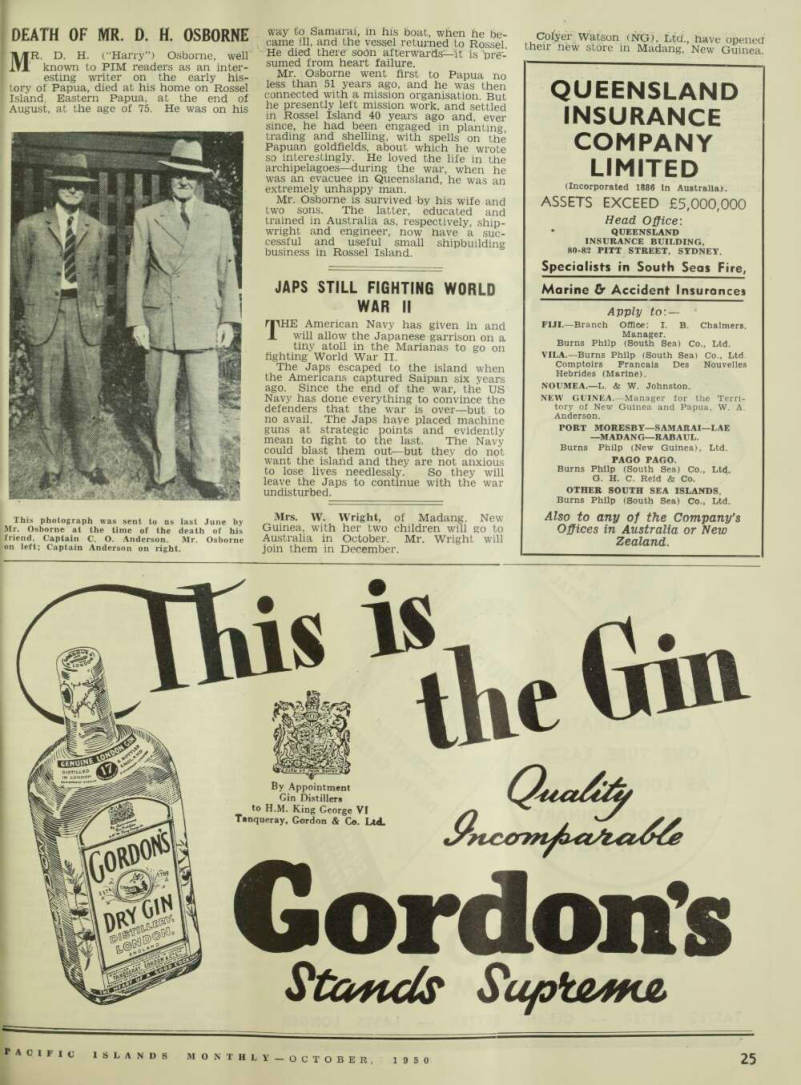
MR. D. H. (“Harry”) Osborne, well known to PIM readers as an inter esting writer on the early his tory of Papua, died at his home on Rossel Island, Eastern Papua, at the end of August, at the age of 75. He was on his
way to Samarai, in his boat, when he be came ill, and the vessel returned to Rossel He died there sobn afterwards—lt is pre sumed from heart failure.
Mr. Osborne went first to Papua no less than 51 years ago, and he was then connected with a mission organisation. But he presently left mission work, and settled in Rossel Island 40 years ago and, ever since, he had been engaged in planting trading and shelling, with spells on the Papuan goldfields, about which he wrote so interestingly. He loved the life in the archipelagoes—during the war, when he was an evacuee in Queensland, he was an extremely unhappy man.
Mr. Osborne is survived by his wife and two sons. The latter, educated and trained in Australia as, respectively, ship wright and engineer, now have a suc cessful and useful small shipbuilding business in Rossel Island.
This photograph was sent to us last June by Mr. Osborne at the time of the death of his friend, Captain C. O. Anderson. Mr. Osborne on left; Captain Anderson on right.
Japs Still Fighting World
War Ii
THE American Navy has given in and will allow the Japanese garrison on a tiny atoll in the Marianas to go on fighting World War 11.
The Japs escaped to the island when the Americans captured Saipan six years ago. Since the end of the war, the US Navy has done everything to convince the defenders that the war is over—but to no avail. The Japs have placed machine guns at strategic points and evidently mean to fight to the last. The Navy could blast them out—but they do not want the island and they are not anxious to lose lives needlessly. So they will leave the Japs to continue with the war undisturbed.
Mrs. W. Wright, of Madang, New Guinea, with her two children will go to Australia in October. Mr. Wright will join them in December.
Colyer Watson (NG), Ltd., have opened their new store in Madang, New Guinea.
Advertisements & other items, p. 27 (1 item)
Gordon's
QUEENSLAND
INSURANCE
COMPANY
LIMITED
(Incorporated 1886 In Australia).
ASSETS EXCEED £5,000,000
Head Office:
• QUEENSLAND
INSURANCE BUILDING,
80-82 PITT STREET, SYDNEY.
Specialists in South Seas Fire,
Marine & Accident Insurances
Apply to:
FlJl.—Branch Office: I. B. Chalmers, Manager.
Burns Phllp (South Sea) Co., Ltd.
VlLA.—Burns Phllp (South Sea) Co., Ltd.
Comptolrs Francais Des Nouvelles Hebrides (Marine).
NOUMEA.—L. & W. Johnston.
NEW GUlNEA.—Manager for the Territory of New Guinea and Papua, W. A.
Anderson.
PORT MORESBY—SAMARAI—LAE
—MADANG—RABAUL.
Burns Philp (New Guinea), Ltd.
PAGO PAGO.
Burns Phllp (South Sea) Co., Ltd.
G. H, C. Reid & Co.
OTHER SOUTH SEA ISLANDS.
Burns Phllp (South Sea) Co., Ltd.
Also to any of the Company’s
Offices in Australia or Hew Zealand.
is §f&\ f S 3
l\ie
Gordon's
Stands Supk&wjL
By Appointment Gin Distiller# to H.M. King George VI Tanqueray, Gordon & Co. Ltd.
Aerial Mapping Of Fiji
TENDERS are being called by the Crown Agents for the Colonies in the United Kingdom, Australia and New Zeal and for air photography of the whole of Viti Levu and Vanua Levu, in 1951.
This is part of Fiji’s Development Plan. From the photographs, accurate maps will be prepared which will give detailed and up-to-date information of great value in land classification and de velopment, road construction, planning of water supplies, land drainage and power schemes, and in general adminis tration.
Trans-Pacific Services to be
Allowed Fly Tasman
IT is expected that an air-agreement will be signed shortly which will make it possible for the three trans-Pacific air services to fly between Australia and New Zealand.
The three companies affected will be Pan American Airways, British Com monwealth Pacific Airlines, and Canadian
Pacific Airlines. At present, aircraft be longing to these companies are not per mitted to complete the natural route between North America and Australia by flying the Tasman. PAA and BCPA fly a special service to Auckland, NZ. CPA has not bothered to enter this field.
It is expected that after the agreement is signed between the respective govern ments all three companies will fly from San Francisco (and/or Vancouver) to Honolulu, Canton Is., Nadi (Fiji), Auck land and then Sydney. Under the old set-up, many outward bound services from San Francisco to Auckland were lightly and uneconomically loaded. For example, a BCPA airliner on a normal run flies from Sydney to North America, back to NZ, back to America, and finally back to Sydney.
At present the PAA planes call at Tontouta, New Caledonia. Presumably, some arrangement will be made to con tinue to service this territory.
Although the planes will be permitted to fly between Auckland and Sydney and vice versa, they will not be permitted to pick up passangers in Auckland for Sydney, or passangers in Sydney for Auckland. That traffic belongs to Tasman Empire Airways, “the chosen instrument” of the Governments of Australia and New Zealand.
If Wana Fails!
Economic Possibilities in Papua
From R. W. Robson
Port Moresby, Oct. 5
IT is reported unofficially here that the hopes of the oil men now are centred upon the bore at Wana, over in the Delta district. It is down some 7,000 feet.
The drill had entered hard limestone— exactly as was expected by the experts— and is now making slow progress. Up to the sandstone, drilling was excellent, and rapid.
Somewhere below the limestone, the ex perts expect to find oil.
If Wana, too, is a failure, Papua had better have a look at its bank account, because ordinary commonsense suggests that the oil companies will not continue indefinitely with the expensive search, So far, they must have spent here between £8,000,000 and £10,000,000.
Here, in Port Moresby, no one ever has seen such an orgy of spending, especially by the natives. Every native seems tc have money to burn. The shrewd whites who have catered for the natives’ simple ideas of luxuries bottled drinks, coffee stalls, pies—have made small fortunes.
That abundant cash has come from twc main sources—the millions of Australian taxpayers’ money which this Administra tion is lavishly spending, and the money from Australian Petroleum Company.
If the oil-men pull out, Papuan economy will be most seriously jarred. For instance there will be at once 250 vacant residence;: in this now tightly-packed town. Rubber; 1/3 per pound 18 months ago, is now 4/: per pound—an intoxicating stimulant fo;< the planting people. But it would not make up for the loss of the APC generally regarded as Santa Claus” nephew. .
Men with a stake in the country an* keeping an anxious eye on Wana.
Miss Judy Sherwood, of Nausori, Fiji is spending three months’ holiday in Aus; tralia.
Advertisements & other items, p. 28 (2 items)
October, 1950 Pacific Islands Monthl
Kolynos
YOU SAVE MONEY WHEN
YOU USE KOLYNOS
SO
CONCENTRATED
ONE TUBE LASTS
AS LONG AS TWO
TUBES OF ORDINARY
TOOTH PASTE
o'*
Kolynos
DENTAL CREAM
TASTES BETTER CLEANS BETTER LASTS LONGER
They'll Brew Their
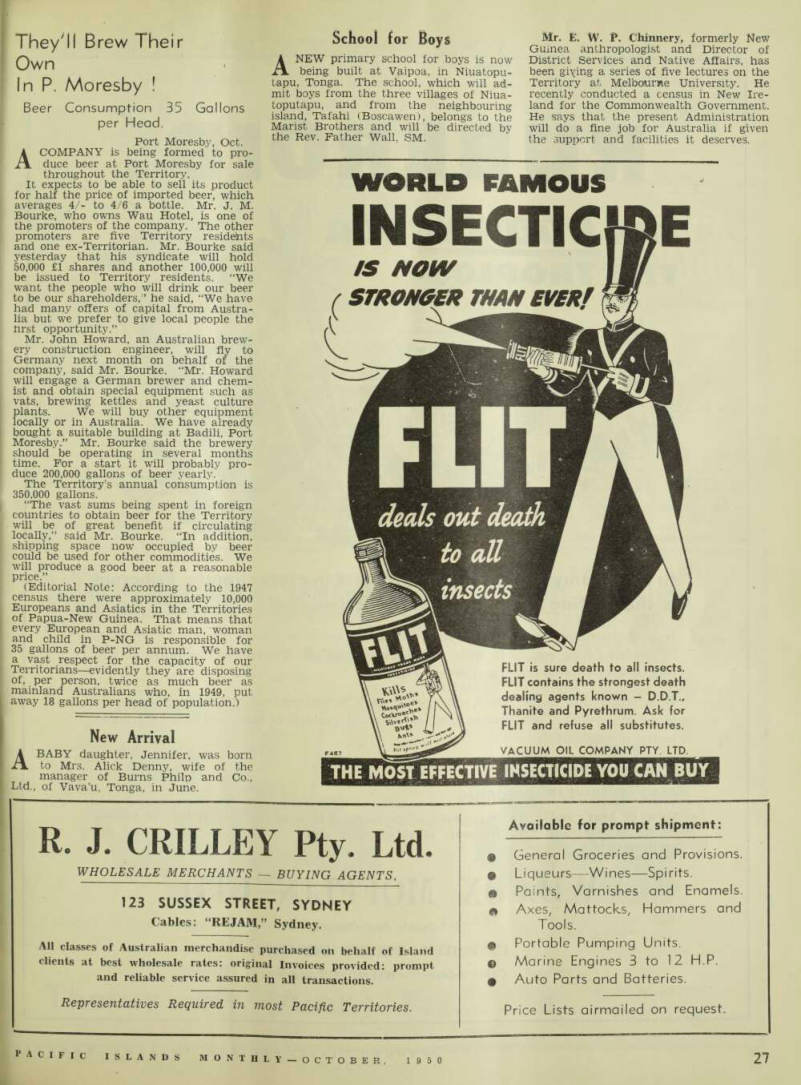
Own In P. Moresby !
Beer Consumption 35 Gallons per Head.
Port Moresby, Oct.
A COMPANY is being formed to pro duce beer at Port Moresby for sale throughout the Territory.
It expects to be able to sell its product for half the price of imported beer, which averages 4/- to 4/6 a bottle. Mr. J. M.
Bourke, who owns Wau Hotel, is one of the promoters of the company. The other promoters are five Territory residehts and one ex-Territorian. Mr. Bourke said yesterday that his syndicate will hold 50,000 £1 shares and another 100,000 will be issued to Territory residents. “We want the people who will drink our beer to be our shareholders, ’ he said, “We have had many offers of capital from Austra lia but we prefer to give local people the hrst opportunity.”
Mr. John Howard, an Australian brew ery construction engineer, will fly to Germany next month on behalf of the company, said Mr. Bourke. “Mr. Howard will engage a German brewer and chem ist and obtain special equipment such as vats, brewing kettles and yeast culture plants. We will buy other equipment locally or in Australia. We have already bought a suitable building at Badili, Port Moresby.” Mr. Bourke said the brewery should be operating in several months time. For a start it will probably pro duce 200,000 gallons of beer yearly.
The Territory's annual consumption is 350.000 gallons.
“The vast sums being spent in foreign countries to obtain beer for the Territory will be of great benefit if circulating locally,” said Mr. Bourke. “In addition, shipping space now occupied by beer could be used for other commodities. We will produce a good beer at a reasonable price.” (Editorial Note: According to the 1947 census there were approximately 10,000 Europeans and Asiatics in the Territories of Papua-New Guinea. That means that every European and Asiatic man, woman and child in P-NG is responsible for 35 gallons of beer per annum. We have a vast respect for the capacity of our Territorians—evidently they are disposing of, per person, twice as much beer as mainland Australians who, in 1949, put away 18 gallons per head of population.)
Advertisements & other items, p. 29 (1 item)
New Arrival
A BABY daughter, Jennifer, was born to Mrs. Alick Denny, wife of the manager of Burns Philp and Co., Ltd., of Vava’u, Tonga, in June.
School for Boys
ANEW primary school for boys is now being built at Vaipoa, in Niuatopu tapu, Tonga. The school, which will ad mit boys from the three villages of Niua toputapu, and from the neighbouring island, Tafahi (Boscawen), belongs to the Marist Brothers and will be directed by the Rev. Father Wall, SM.
Mr. E. W. P. Chinnery, formerly New Guinea anthropologist and Director of District Services and Native Affairs, has been giving a series of five lectures on the Territory at Melbourne University. He recently conducted a census in New Ire land for the Commonwealth Government.
He says that the present Administration will do a fine job for Australia if given the support and facilities it deserves.
Advertisements & other items, pp. 29-30 (1 item)
Insecticffie
WORLD FAMOUS
ts NOW
( STRONGER THAN EVER?
I U <L re* CotVro» c H**"' &\\Vt fk(A' FLIT Is sure death to all insects.
FLIT contains the strongest death dealing agents known - D.D.T., Thanlte and Pyrethrum. Ask for FLIT and refuse all substitutes.
VACUUM OIL COMPANY PTY. LTD.
THE MOST EFFECTIVE INSECTICIDE YOU CAN BUY
Available for prompt shipment: $ General Groceries and Provisions. $ Liqueurs—Wines—Spirits. m Paints, Varnishes and Enamels. & Axes, Mattocks, Hammers and Tools. & Portable Pumping Units. $ Marine Engines 3to 12 H.P. • Auto Parts and Batteries.
Price Lists airmailed on request.
R. J. CRILLEY Pty. Ltd.
WHOLESALE MERCHANTS BUYING AGENTS,
128 SUSSEX STREET, SYDNEY
Cables: “REJAM,” Sydney.
All classes of Australian merchandise purchased on behalf of Island clients at best wholesale rates: original Invoices provided: prompt and reliable service assured in all transactions.
Representatives Required in most Pacific Territories.
THE ROOTING
THE TROPICS
FOR
mm j&Sbb*. ikT' '' a ft z ¥ A m In the steamy heat of the Tropics and in every climate, Ruberoid
is the roofing of greatest satisfaction.
It is weatherproof and possesses high insulating qualities against the heat of the sun.
In rolls of 24 sq. yds., 3 ft. wide, it is lighter in weight than other roofing materials, thus saving cost in construction and handling.
It is easily and quickly laid, no special skill being required and is suitable for all types of roofs. The lasting and economical qualities of Ruberoid have been timetested throughout the world.
Ruberoid is available in 1 ply, 2 ply, 3 ply and 5 ply.
ALSO EVERWEAR FLOORING
Made in heavy and extra heavy rolls of 25 yards—3 ft. wide is the ideal type of flooring for all surfaces andi will give years of satisfactory service. Write for prices and full particulars to—
WILCOX MOFFLIN LTD.
Wholesale Distributors,
15 PHILLIP STREET, SYDNEY.
Cable Address: “WILMOFF,” Sydney.
Moisture In Fiji Copra
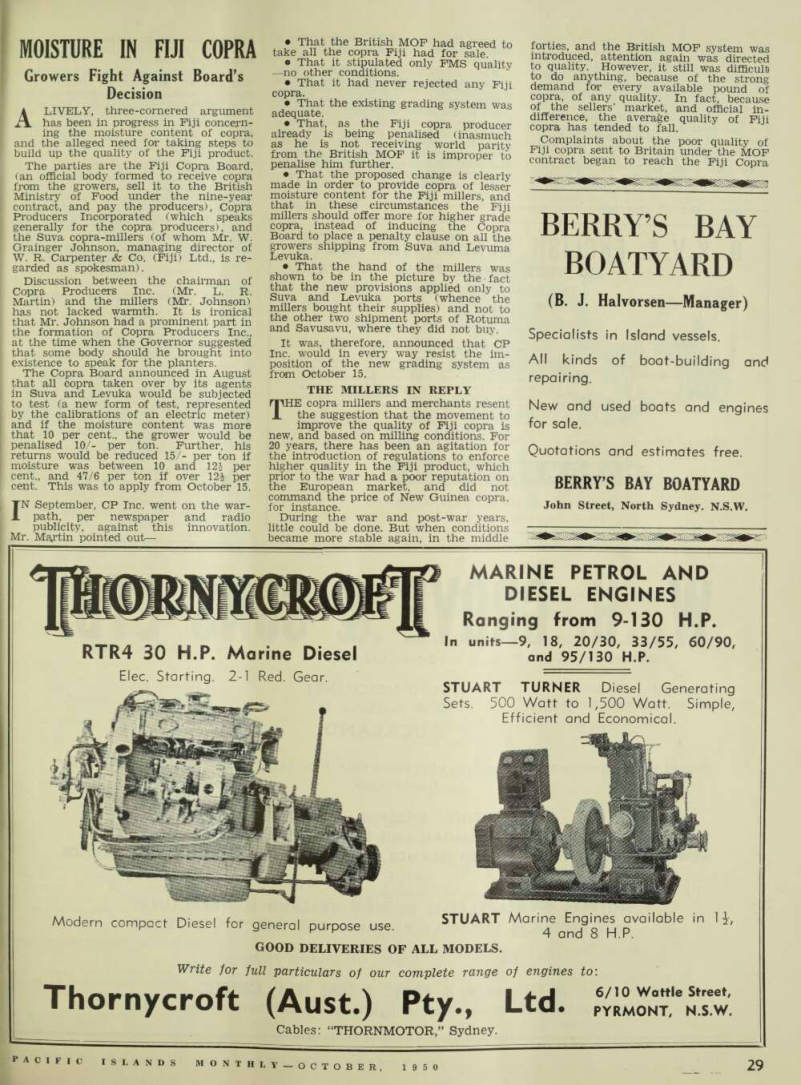
Growers Fight Against Board’s Decision
A LIVELY, three-cornered argument has been in progress in Fiji concern ing the moisture content of copra, and the alleged need for taking steps to build up the quality of the Fiji product.
The parties are the Fiji Copra Board, (an official body formed to receive copra from the growers, sell it to the British Ministry of Food under the nine-year contract, and pay the producers), Copra Producers Incorporated (which speaks generally for the copra producers), and the Suva copra-millers (of whom Mr. W.
Grainger Johnson, managing director of W. R. Carpenter & Co. (Fiji) Ltd., is re garded as spokesman).
Discussion between the chairman of Copra Producers Inc. (Mr. L. R.
Martin) and the millers (Mr. Johnson) has not lacked warmth. It is ironical that Mr. Johnson had a prominent part in the formation of Copra Producers Inc., at the time when the Governor suggested that some body should he brought into existence to speak for the planters.
The Copra Board announced in August that all copra taken over by its agents in Suva and Levuka would be subjected to test (a new form of test, represented by the calibrations of an electric meter) and if the moisture content was more that 10 per cent., the grower would be penalised 10/- per ton. Further, his returns would be reduced 15/- per ton if moisture was between 10 and 12i per cent., and 47/6 per ton if over 121 per cent. This was to apply from October 15.
IN September, CP Inc. went on the war path, per newspaper and radio publicity, against this innovation.
Mr. Martin pointed out—
• That the British MOF had agreed to take all the copra Fiji had for sale. o That it stipulated only FMS quality —no other conditions. • That it had never rejected any Fiji copra. • That the existing grading system was adequate. • That, as the Fiji copra producer already is being penalised (inasmuch as he is not receiving world parity from the British MOF it is improper to penalise him further. • That the proposed change is clearly made in order to provide copra of lesser moisture content for the Fiji millers, and that in these circumstances the Fiji millers should offer more for higher grade copra, instead of inducing the Copra Board to place a penalty clause on all the growers shipping from Suva and Levuma Levuka. • That the hand of the millers was shown to be in the picture by the fact that the new provisions applied only to Suva and Levuka ports (whence the millers bought their supplies) and not to the other two shipment ports of Rotuma and Savusavu, where they did not buy.
It was, therefore, announced that CP Inc. would in every way resist the im position of the new grading system as from October 15.
The Millers In Reply
THE copra millers and merchants resent the suggestion that the movement to improve the quality of Fiji copra is new, and based on milling conditions. For 20 years, there has been an agitation for the introduction of regulations to enforce higher quality in the Fiji product, which prior to the war had a poor reputation on the European market, and did not command the price of New Guinea copra, for instance.
During the war and post-war years, little could be done. But when conditions became more stable again, in the middle
forties, and the British MOF system was introduced, attention again was directed to quality. However, it still was difficult to do anything, because of the strong demand for every available pound of copra, of any quality. In fact, because of the sellers’ market, and official in difference, the average quality of Fiji copra has tended to fall.
Complaints about the poor quality of Fiji copra sent to Britain under the MOF contract began to reach the Fiji Copra
Board many months ago. When Mr, B.
E. V. Parham was in Britain early this year, he was shown the bad effects of Fiji copra on machinery which was milling copra for the British Ministry, and he brought back to Fiji unfavourable reports from the crushers.
Much copra received by Suva millers has not been up to the standard which they might reasonably expect. It is ac cepted throughout the industry that FMS shall mean a moisture content of not more than 6 per cent. The millers say that any planter, entitled to call himself a planter, should produce copra with a moisture content of not more than 6-8 per cent. Yet CP Inc. are crying out
because they are not to be permitted to deliver copra with over 10 per cent, moisture.
When copra, packed or shipped in bulk, shrinks say 3 per cent, after it is shipped, it not only deteriorates sharply in quality; it also affects the quality of well-dried copra in the same shipment, and imposes handicaps, in both quality and weight, upon the competent owners, whose pro ducts have gone into the same shipment.
Under the existing system of collecting and shipping copra, the good planter has to carry the bad planter on his back.
The commencement of control of quality at 10 per cent, is being very generous to planters. The Ordinance
covering the position authorises the Copra Board to commence penalties with a moisture of 8 per cent.
Local millers already have announced that they will pay more for quality— 10/per ton premium for copra between 7 and 8 per cent, moisture, and 20/- between 6 and 7 per cent. —and these premiums will operate from October 15. When copra is £5O per ton, 10/- per ton represents the value of every 1 per cent, of moisture in the copra.
“Moisture in copra is the root of all evil, as it starts the deterioration of the article,” says Mr. Johnson. “Well-cured copra has little smell, and does not ac cumulate copra bugs nor deteriorate in anything like the degree seen in badly cured copra. The latter deteriorates after shipment; and the seller of badly cured copra is placing a very unfair handicap on the seller of good copra.”
Advertisements & other items, pp. 31-32 (1 item)
Thornycroft (Aust.) Pty., Ltd.
BERRY’S BAY
BOATYARD
(B. J. Halvorsen—Manager)
Specialists in Island vessels.
All kinds of boat-building and repairing.
New and used boats and engines for sale.
Quotations and estimates free.
BERRY'S BAY BOATYARD
John Street, North Sydney. N.S.W.
US
RTR4 30 H.P. Marine Diesel
Elec. Starting. 2-1 Red. Gear. nf'"o S . t Modern compact Diesel for general purpose use
MARINE PETROL AND
DIESEL ENGINES
Ranging from 9-130 H.P.
In units—9, 18, 20/30, 33/55, 60/90, and 95/130 H.P.
STUART TURNER Diesel Generating Sets. 500 Watt to 1,500 Watt. Simple, Efficient and Economical.
STUART Marine Engines available in 4 and 8 H.P.
GOOD DELIVERIES OF ALL MODELS.
Write for full particulars of our complete range of engines to:
Thornycroft (Aust.) Pty., Ltd.
Cables: “THORNMOTOR,” Sydney.
9 K.V.A. ENGLISH GENERATING SETS
230 VOLT, SINGLE PHASE, 50 CYCLE.
The Ideal Set for Window Lighting
Complete with Auto-Voltage Regulator and Switch-
board IMMEDIATE DELIVERY
PRICE : £375 Plus Tax
“Meadows” 4-cyl. petrol engine, water-cooled, with tropical radiator and fan. Alternator well-known English make with separate Exciter.
Ideal set for LIGHTING, HEATING and other SINGLE PHASE LOADS. Particularly suitable for CINEMA Projection Equipment. Alternator frames are 3-phase type and can be easily rewound for 240-415 Volt 3-phase. PRICE: £405.
We can also quote this set powered with a Weight: 1,650 lbs. (approx.) Coventry Climax diesel engine.
44 MISSENDEN ROAD, NEWTOWN, SYDNEY, AUSTRALIA.
Trade inquiries also invited.
W. H. GROVE A SONS LTD.
Established 1896.
Telegraphic and Cable Address: “Grove,” Auckland.
ISLAND MERCHANTS
16-18 Fonshawe St.
P.O. Box 490, Auckland, New Zealand.
AUCKLAND
Entrust your requirements to the firm with more than fifty years' practical experience in the Island trade.
REPRESENTING ENGLISH MANUFACTURERS
THROUGHOUT THE FIJI, SAMOAN AND TONGAN ISLANDS, NEW HEBRIDES, NEW CALEDONIA, THE SOLOMON ISLANDS, THE SOCIETY ISLANDS, THE COOK ISLANDS,
NIUE, ETC.
SHIPPERS OF ALL CLASSES OF NEW ZEALAND MANUFACTURES AND PRODUCTS SPECIALLY PREPARED FOR THE ISLAND TRADE WE HANDLE ALL KINDS OF ISLAND PRODUCE .
IN FIJI as: W. H. GROVE & SONS (FIJI) LIMITED.
Office and Sample Room: Bank of New South Wales Chambers, Suva, Fiji.
Jungle
Four Fijians Lost in Sydney Jungle
WHEN the Admiral Chase was due to leave Sydney on September 23, 18 of her Fijian crew could not be found.
A search party of Euronean officers was formed and 12 of the Fijians were located in a waterfront pub. Sailing time was postponed from 5 until 11 pjn. when the ship put to sea leaving four Fijians still missing somewhere in the wilds of Sydney.
Mr. K. R. Henderson, OBE, has been appointed to Fiji as an Administrative Officer Grade I. He served in the Indian Civil Service from 1930 to 1947 and is ex pected to arrive in the Colony towards the end of this year.
Advertisements & other items, p. 32 (1 item)
30
OCTOBER, 1950-PACIFIC ISIANDS M NXB I T
Sudden Death of Mr.
C. I. H. Campbell
NEW GUINEA learned with a shock, late in September, that Mr. C. I. H.
Campbell, well-known planter, of Bougainville, had died suddenly on Sep tember 25 in London, where he had been with his wife on a world tour.
Mr. Campbell was trained in the bank ing profession: and, after service in Prance in World War I, he was sent to New Guinea at the conclusion of the war, and became the first manager of the Commonwealth Bank in Rabaul. He was young, but he was conspicuous for his natural ability, and for some years he was the Finance Member of the Expropriation Board. He saw the opportunity in New Guinea and he personally bought Raua Plantation, in Bougainville. He resigned from the bank to establish his own general agency in Rabaul; and he con ducted this business until he went to live on and manage his Raua estate. For many years, he was secretary of the Planters’ Association and he seemed al ways to be active in public affairs a useful and popular figure.
When the Jap invasion came, Mr. Camp bell lingered too long, and he and his wife were cut off in Bougainville. They were rescued eventually by the Americans, and brought south to safety in an American submarine. He was one of the first to return to New Guinea and get the benefit of the high copra price, after the war; and he and his wife left on a leisurely world tour in 1949. He will be much missed.
He is survived by his wife, Mrs.
Lala Edith Mary Campbell, and his daughter Nari, now Mrs. Forster, and a grandchild. Mrs. Forster, although still little more than a girl, is a widow. Her husband, Peter Forster, was fatally injured in an accident in Bougainville about two years ago. He, his wife and child were on a copra barge which caught fire and later exploded. He saved Mrs, Forster and the baby, but he died from injuries.
Pi Society Members Have A
Look At Fiji
MEMBERS of the Pacific Islands Society, Sydney, were taken on a most comprehensive and colourful tour of Fiji, with sidelights on the Colony’s interesting history, by Mr.
Hubert Sabben, on the evening of Sep tember 27. Mr. Sabben used a collection of over 80 excellent photographs, supplied to him by Mr. Rob Wright and the Fiji Public Relations Office, and his reminis cences from 40 years’ public service in Fiji, which accompanied his lantern slides, kept his listeners enthralled.
During his lecture, Mr. Sabben re marked on the presence of phosphate de posits on Lakemba. They are not regarded today as valuable; but their value he said will surely develop when the huge deposits at Nauru, Ocean Island and Makatea are worked out.
There is a strong Polynesian admixture in eastern Fiji. Mr. Sabben pointed out, m nis photographs, that the native houses m the eastern districts have rounded ends, after the style of Samoa; but those in the western or blacker districts have square ends, in the manner common to old Fiji and parts of Melanesia.
The president (Mr. R. W. Robson) said that when the Society was first estab lished, 15 or more years ago, it comprised mostly Papua and New Guipea people.
Now, the members from Fiji and Poly nesia generally seemed to outnumber those irom the north. They welcomed new members from everywhere; but they would
like more New Guinea members now. to keep balance with “those thrusting Fijians.”
Suggested For Melbourne
Pacific Islands Society
A SUGGESTION that a Branch of the Pacific Islands Society be formed in Melbourne was made in Sydney recently by Major C. Buchanan, a veteran who spent 40 years in various Ter ritories of the South Pacific —mostly as an executive of Levers Pacific Plantations Ltd.
Mr. Buchanan told the President and Secretary of the Pacific Islands Society, Sydney, that there are a large number of people with Pacific Islands interests residing in and near Melbourne and he thought that it should not be difficult to establish, in the southern metropolis, an institution as good and interesting as the Society in Sydney. The suggestion is now under consideration.
Mr. Allen Clarke has been transferred from Madang, New Guinea, to Port Moresby, where he will be QIC Post and Telegraphs.
Advertisements & other items, pp. 33-34 (2 items)
31
,UIF,C ISLANDS MONTHLY-OCTOBER, HS I
Trade
To promote
The Bank of New South Wales offers these services:— • Introductions to importers and exporters in oversea countries. • Credit information about residents of those countries, with whom you may wish to trade. • Facilities for making payments abroad and for receiving payments from overseas. • Arrangements for business visits overseas.
Consult any branch of the
BANK OF
NEW SOUTH WALES
FIRST AND LARGEST COMMERCIAL RANK IN THE SOUTH-WEST PAOIHC
HEAD OFFICE: SYDNEY. AUSTRALIA
ISLANDS BRANCES
FIJI: Suva Lautoka (Agencies at Ba, Nadi Airport, Vahikouto) PAPUA: Port Moresby. NEW GUINEA: La*, Rabo.l, (Incorporated in New South Wal*» with limitod liability)
Mary Baker
ICE CREAM
MIX
Is now available to Islands Storekeepers and Traders in Chocolate and Strawberry Flavours in addition to the
ever-popular Vanilla
Successor to the ice cream making formula introduced to the Pacific Islands in wartime by the U.S. Army, Mary Baker Ice Cream Mix is now made in Australia for export to the South Seas. It's delicious in the home for dessert—on its own, flavoured, or with fresh tropical or canned fruit.
Packed in 16 oz. tins for Household! Servings, 5 lb. Family size tins, and 32 lb. tins for Cafes, Milk Bars and Traders.
Ash Your Store for it To-day!
If unavailable locally, write direct for free sample packet to:
J. C. HERRULEES PTY. LTD.
104 Hunter Street, Sydney, N.S.W.
Telegrams: “MERRILLEES,” Sydney.
Agents': New Caledonia: ETABLISSEMENTS BALLANDE, Noumea.
New Hebrides; COMPTOIRS FRANCAISE DES NOUVELLES HEBRIDES, Vila and Santo.
Tahiti: WALTER GRAND, Papeete.
Fiji: HUNT’S AGENCY, Suva.
With whom residents in those territories should place their orders.
Otto Soltwedel
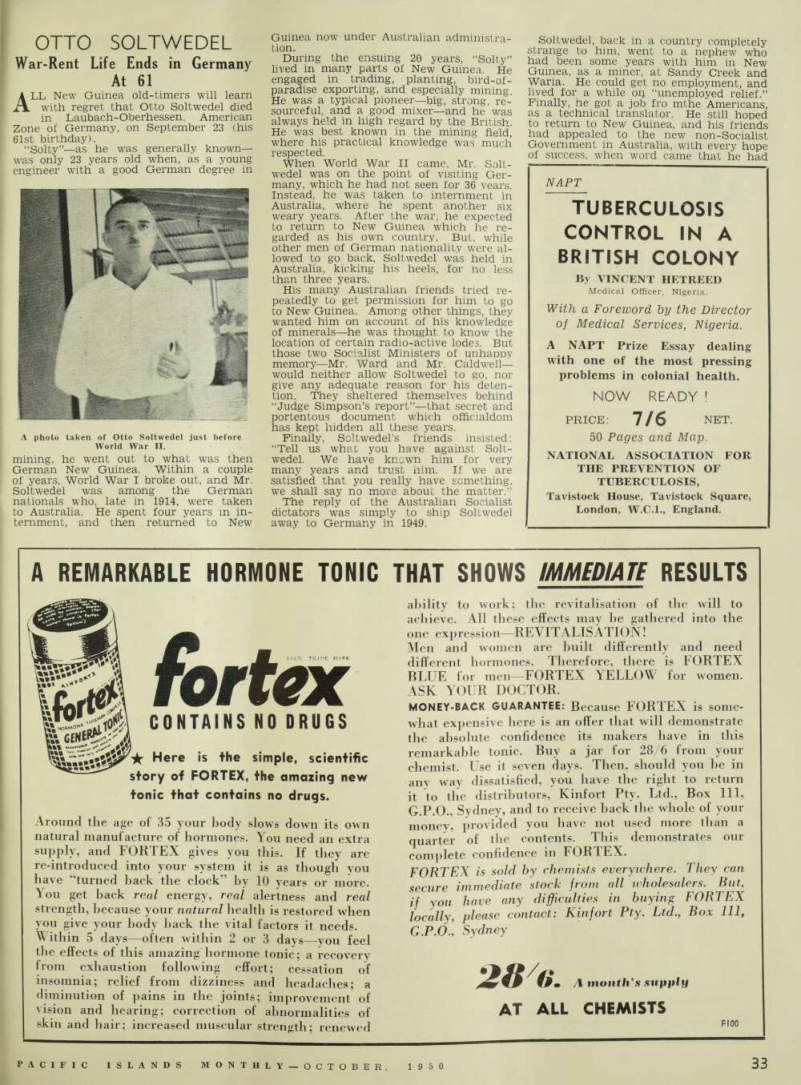
War-Rent Life Ends in Germany At 61
ALL New Guinea old-timers will learn with regret that Otto Soltwedel died in Laubach-Oberhessen, American Zone of Germany, on September 23 (his 61st birthday).
“Solty”—as he was generally known — was only 23 years old when, as a young engineer with a good German degree in
mining, he went out to what was then German New Guinea. Within a couple of years, World War I broke out, and Mr.
Soltwedel was among the German nationals who, late in 1914, were taken to Australia. He spent four years in in ternment, and then returned to New
Guinea now under Australian administra tion.
During the ensuing 20 years, “Solty” lived in many parts of New Guinea. He engaged in trading, planting, bird-of paradise exporting, and especially mining.
He was a typical pioneer—big, strong, re sourceful, and a good mixer—and he was always held in high regard by the British.
He was best known in the mining field, where his practical knowledge was much respected.
When World War II came, Mr. Solt wedel was on the point of visiting Ger many, which he had not seen for 36 years.
Instead, he was taken to internment in Australia, where he spent another six weary years. After the war, he expected to return to New Guinea which he re garded as his own country. But, while other men of German nationality were al lowed to go back. Soltwedel was held in Australia, kicking his heels, for no less than three years.
His many Australian friends tried re peatedly to get permission for him to go to New Guinea. Among other things, they wanted him on account of his knowledge of minerals —he was thought to know the location of certain radio-active lodes. But those two Socialist Ministers of unhappy memory—Mr. Ward and Mr. Caldwell— would neither allow Soltwedel to go, nor give any adequate reason for his deten tion. They sheltered themselves behind “Judge Simpson’s report”—that secret and portentous document which officialdom has kept hidden all these years.
Finally, Scltwedel’s friends insisted: “Tell us whac you have against Solt wedel. We have known him for very many years and trust him. If we are satisfied that you really have something, we shall say no more about the matter.”
The reply of the Australian Socialist dictators was simply to ship Soltwedel away to Germany in 1949.
Soltwedel, back in a country completely strange to him, went to a nephew who had been some years with him in New Guinea, as a miner, at Sandy Creek and Waria. He could get no employment, and lived for a while op “unemployed relief.”
Finally, he got a job fro mthe Americans, as a technical translator. He still hoped to return to New Guinea, and his friends had appealed to the new non-Socialist Government in Australia, with every hope of success, when word came that he had
A photo taken of Otto Soltwedel just before World War II.
died, after a long and serious illness.
Poor old “Solty”! Out of his 40 years of adult life, no less than 15 were spent in internment or semi-internment. Typical of the tragic life of the German national of his generation.—RWß.
Advertisements & other items, pp. 35-36 (1 item)
A Remarkable Hormone Tonic That Shows Immediate Results
NAPT
TUBERCULOSIS
CONTROL IN A
BRITISH COLONY
By VINCENT HETREED
Medical Officer, Nigeria.
With a Foreword by the Director of Medical Services, Nigeria.
A NAPT Prize Essay dealing with one of the most pressing problems in colonial health.
NOW READY !
PRICE: 7/6 NET.
50 Pages and Map.
NATIONAL ASSOCIATION FOR
THE PREVENTION OF
TUBERCULOSIS,
Tavistock House, Tavistock Square, London, W.C.1., England.
A REMARKABLE HORMONE TONIC THAT SHOWS IMMEDIATE RESULTS
KOWW*’
rtf »w ••* kkcd trapf m\rk
CONTAINS NO DRUGS
★ Here is the simple, scientific story of FORTEX, the amazing new tonic that contains no drugs.
Around the age of 35 your body slows down its own natural manufacture of hormones. You need an extra supply, and FORTEX gives you this. If they are re-introduced into your system it is as though you have turned back the clock by 10 years or more.
You get hack real energy, real alertness and real strength, because your natural health is restored when you give your body hack the vital factors it needs.
W ithin 5 days—often within 2 or 3 days—you feel the effects of this amazing hormone tonic; a recovery from exhaustion following effort; cessation of insomnia; relief from dizziness and headaches; a diminution of pains in the joints; improvement of vision and hearing; correction of abnormalities of skin and hair; increased muscular strength; renewed
ability to work; the revitalisation of the will to achieve. All these effects may be gathered into the
one expression—REVITALISATION!
Men and women are built differently and need different hormones. Therefore, there is FORTEX BLUE for men —FORTEX YELLOW for women.
ASK YOUR DOCTOR.
MONEY-BACK GUARANTEE: Because FORTEX is somewhat expensive here is an offer that will demonstrate the absolute confidence its makers have in this remarkable tonic. Buy a jar for 28/6 from your chemist. Use it seven days. Then, should you he in any way dissatisfied, you have the right to return it to the distributors, Kinfort Pty. Ltd., Box 111, G.P.0., Sydney, and to receive back the whole of your money, provided you have not used more than a quarter of the contents. This demonstrates our complete confidence in FORTEX.
FORTEX is sold by chemists everywhere. They can secure immediate stock from all wholesalers. But , if you have any difficulties in buying FORTEX locally , please contact: Kinfort Pty. Ltd., Box 111,
G.P.0., Sydney
28 6.
A month's supply
AT ALL CHEMISTS
FIDO
THAT
The
Executor - T
Attorney
FIND OUT YOUR
OBLIGATIONS FIRST
Before you agree to act as an executor or trustee, you should be quite clear regarding the extent of your obligations. The same precaution will prevent you from appointing an unsuitable executor. All essential facts regarding the administration of estates are given in the new edition of "Hands That Never Leave The Wheel”. This informative booklet explains why the fulltime services of the capable directors and experienced officers of Burns Philp Trust Company Limited should be at your disposal.
A complimentary copy of this 20-page booklet can be obtained from any branch of Burns Philp (South Sea) Company, Burns Philp (New Guinea) Limited, or direct from the head office of this Company .
DIRECTORS:
James Burns Joseph Mitchell P. I. W. Black Eric Priestley Lee MANAGER: I. S. Parker
SECRETARY: E. R. Overton. F.F.I.A.
Bums Philp Trust
COMPANY LIMITED
Constituted by Special Act of the N.S.W. Parliament
Head Office: 7 BRIDGE STREET, SYDNEY
TELEPHONE: BU 5901
BOX 543, G.P.0., SYDNEY
Visitors To Kar Kar Island
Prom A Special Correspondent KAR KAR ISLAND (off the Madang coast, New Guinea mainland), had several official visitors during Sep tember including the Inspector of Expropriated Properties, Mr. Jock Esson.
He had spent many years managing Kar Kar plantations pre-war.
Dr. Jamieson spent a fortnight on the island immunising natives against T.B.
In one day he treated 3,200 natives. He considers Kar Kar Island a splendid station for experimental work as the population is concentrated and the natives co-operative.
ADO Reg Bentick was also among the visitors. He had at one time been stationed on the island as a patrol officer and was chosen for the job of taking the census of 10,000 natives. Mr. H. Evans went along to carry out inspection of native labour.
All Kar Kar Islanders speak in glowing terms of the work that Mr. and Mrs. E.
Tscharke, of the American Lutheran Mission, have done among the natives.
As well as building and supervising a hos pital of 300 beds, Mr. Tscharke conducts a pre-natal clinic, teaches at the school for doctor-boys and their wives and supervises the station. Mrs. Tscharke makes time to take a weekly baby clinic, assists her husband in the hospital and trains future brides of native teachers in housework. It is largely due to Mr.
Tscharke’s efforts that the local saw milling industry had been conducted with such success by the natives.
Mr. W. Middleton, who has been envy ing an extended stay on his plantation thinks well of his line of 100 Highlanders.
He has established a branch of the Com monwealth Savings Bank on his estate.
The natives on Kar Kar are money hungry and let their gardens and homes deteriorate while both men and women work in the plantations or native in dustries. Many natives have bank accounts that would be envied by many Europeans in the Territory.
Mr. Huntley Carpenter has left Kai KAR to take up the position he had previously at Siar. From Siar, Mn Jack Broadhurst comes to Kar Kar. Mr. George Ord went South from Kar Kar some time ag Mr Paul Bayetto seems to have re covered from the jeep accident he experienced in Madang. He is managei at Dogowen Plantation.
Kar Kar Island, often marked Dampiei on the maps, has an interesting history.
The volcano was observed aflame by the explorer in 1700. It is recorded that there was another “blow up” in 1895 when two German Lutheran missionaries were trapped at Kulabob 9 n the island. After several deaths, the mission was abandoned In 1895 and not reopened till 1910 when it was removed to Kurum.
Death Of Mrs. E. A. Fuller
THE death occurred in New Zealand recently of Mrs. E. A. Fuller a resident of Fiji for many years. She was a daughter of the late Mr. and Mrs. J. Addis, who came to Fiji 68 years ag Mrs. Fuller’s husband was at one time Captain of the paddle steamer ‘ Roko. which ran from Suva to Nauson and other points on the Rewa River. After Captain Fuller’s death, M for many years matron of the Cottage, H ghe is survived by a son and daughter.
Advertisements & other items, p. 36 (1 item)
34
OCTOBER, 19 5 0 -TACIFIC ISLANDS MONTHLY
Important
Heat-Tolerance is Important In Tropical Cattle
According to Dr. w. j. a. Payne, officer in charge of the Sigatoka Ag ricultural Station. Fiji, whether or not cattle do well in the tropics depends upon their heat tolerance.
Animals which have a high degree of heat tolerance thrive in the tropics. Those with a low heat tolerance are unhappy under Fiji conditions. This shows itself in the poor appearance of the animal and in low production. Heat tolerance can be measured when the animal is still young and remains approximately the same throughout its life. It is to some ex tent hereditary.
Dr. Payne was speaking at a recent field day at Sigatoka. An attempt is to be made there, he said, to breed stock for their heat tolerance as well as high pro ductivity. A start will be made on animals already in the Colony and if any more stock are bought from overseas it may be possible to arrange with agricultural re search stations in the country of origin to test for heat tolerance in special cham bers where an artifically tropical climate could be produced.
He described the twin heifer experi ment which is being carried out at Siga toka in conjunction with the New Zealand Animal Research Institute at Ruakura. By eliminating all other factors it is hoped to be able to find out the effects of a tropical climate on imported cattle, in general.
The experiment is unique and the results will be of great interest to farmers in
tropical countries throughout the world At Sigatoka. the feeding, measurement and observation of the heifers arc in the hands of Eminoni Raivoka. a Fijian graduate of Gatton Agricultural College.
Queensland.
Dr. Payne spoke of studies which have been made in the behaviour of cattle on the Station. Records of the hours of the day and night when cattle graze show that the common practice of shutting the ani mals up at night is bad management in Fiji, as cattle in the Colony do much of their grazing at night. Denying cattle access to pasture at this time therefore means a lowering of the intake of food and therefore of production.
He said that there were three major
problems in the Department’s animal re search work in the Colony: First,, it had to be decided what type or breed of ani mals thrive best in Fiji. Secondly, highly productive individual animals from these types and breeds had to be selected, and first class herds had to be built up on the two stations at Sigatoka in the dry zone, and Koronivia, in the wet zone. Prom these herds good stock could even tually be distributed among the Colony’s farmers. Finally, it was necessary to learn how to manage and feed the stock so that they remained productive and heal thy. Any system of farming had to give an economic return on capital and labour, and so careful records of costs were being kept at Sigatoka.
Advertisements & other items, pp. 37-38 (2 items)
Akplioh
LON DON-SUVA
VIA
PANAMA
For Sailings and Further Particulars Apply To:— BETHELL, GWYN & CO., BURNS PHILP (SOUTH SEA)
138 LEADENHALL ST., CO. LTD.,
LONDON, E.C.3. SUVA.
h c
ONE HORSEPOWER
PETROL ENGINES
ELECTRIC
LIGHTING PLANTS
Bring you brilliant electric light in your home, week-ender or plantation.
Low operating and initial costs. Treated for the tropics. * Press button starting. * 300 watts output. + * 12 and 32 volt models. ♦ Weight 70 lb. hole borers— .
The Amplion makes the most of your petrol, runs longer on a tankful, 8 to 10 hours to the gallon. It’s light in weight too—4o lb.
Obviously the best proposition for driving: Pumps—Compressors—Post Lawn mowers—Saws—Shearing Machines Crutching Machines—Spraying outfits —Concrete Mixers—Concrete Vibrators—Milking Machines.
★ 4 CYCLE AIR COOLED DESIGN
★ FULL FLOAT CARBURETTOR
★ EFFICIENT AIR CLEANER
* * m Special Islands
PRICE
!■ £67/13/6 F. 0.8.
PRICE :
£36/0/6 F. 0.8.
DISTRIBUTORS THROUGHOUT
AUSTRALIA AND THE ISLANDS
aKPLIOh
(Australasia) Pty. Ltd. 36-40 Parramatta Road, Camperdown.
Telegrams: Amplion, Sydney Telephone: LA2828 (6 lines)
ECONO-STEEL Can Be Sent Anywhere!
' / . * MO.'** DARWIN RESIDENCE FOR C. O. R. MANAGER, using Econo-Steel construction , Aluminium Econo-Tile roofing and Aluminium walling and guttering and downpiping.
Econo-Steel has been used successfully in every Australian State, in South Africa, and in the Pacific Islands.
Missions, manager’s bungalows and tropical homes may be designed to suit almost any requirements.
Hollow box-sections of protected nailable steel can be more economically consigned to remote points than any other material.
Over 2,000 Econo-Steel structures built to date for State and Commonwealth Works Departments, Public Works Department, and private interests, testify to the universal acceptance of Econo-Steel —an Australian patented product. Available now —erected faster and at less cost.
Write for further particulars to:
ECONO-STEEL COMPANY
(A DIVISION OF TULLOCH, LTD.)
Concord Rood, Rhodes, N.S.W., Australia. Telephone: UF 1231.
Cables: “TULLSTEEL,” Sydney.
36
OCTOBER. 1950 PACIFIC ISLANDS MONTHL
Rabaul Roundabout
From Our Own Correspondent
Rabaul. Oct. 3.
MR. D. BARRETT, president of the Planters’ Association of New Guinea, accompanied by Executive member, Mr. E. T. Fulton, flew to Sydney early this month to present a case to the Federal Government for higher prices for copra. Colonel H. T. Allen, at present in Australia, will join Messrs. Barrett and Fulton in their representations.
AT the annual general meeting of the Rabaul RSL Branch on September 26 an interesting and lengthy dis cussion took place on the formation of native units in the Territory. The majority of speakers were old residents and, in most cases, had served as front line soldiers in New Guinea in the recent war. It was finally resolved as follows: “That this body strongly urges that the Federal Government do not form native units in the territory of New Guinea with out close study of the organisation ne cessary and, in particular, of the proper officering of the units by European resi dents of the Territory experienced in deal ing with natives. It considers that the Papua and New Guinea Volunteer Rifles should be a training corps for officers and NCO’s of the native units.”
DURING the day the Rabaul telephone exchange is operated by two Malay girls whose efficiency and courtesy leaves nothing to be desired. However, their duties finish each afternoon and the switch is then manned by natives.
Subscribers are highly indignant at the poor service given by these boys. Com
plaints have been made to the appropriate authorities who explain that the position is due to the shortage of competent tele phonists and until they are forthcoming, nothing can be done to improve the ser vice.
MR. DUDLEY JONES defeated Mr. C.
Ashley at the New Guinea Club, in the play off for the billiards cham pionship, during the month.
Due to ill health, Mr. Eric Petterson has resigned as manager of the New Guinea Club. His successor is Mr. Arthur George, an ex-Squadron Leader.
Mr. A. Finn has undertaken the management of the RSL Club. The affairs of the club have so increased that a sub manager, Mr. J. McKinaly, has been ap pointed.
COLYER WATSON are to be congratu lated on their enterprise by intro ducing a town delivery service. Two modern vans are in use and the service is proving a bDjn to Rabaul housewives.
DURING September at the Namanula General Hospital a daughter was born to Mr. and Mrs. W. Moore of Kokopo.
FOLLOWING on the Lautoka and Suva, the Bulolo arrived from Australia, and clearly showed up the Customs shed’s inadequacy to handle huge volumes of cargo. The shed was packed to capacity and presented a problem for those desiring to take delivery of their goods.
Another regular shipping visitor to
Rabaul is the modern freighter, Viria, on charter to the Vacuum Oil Company.
It carries bulk products from the Lae bulk installation.
AT approximately 8.30 p.m. on Septem ber 9 Rabaul and Kokopo were se verely rocked by an earth tremor of intensity five to six. Thirty tremors of lesser intensity continued throughout the night and Sunday morning. Mr. A.
Taylor, the vulcanologist, inspected Matupi, Vulcan and other surrounding craters and reported that all were normal.
Although no damage occurred, residents experienced a very anxious night.
COMMEMORATION DAY was observed in Rabaul by a service at the Anzac
House Memorial in the morning, and with a ball at the RSL Club Rooms in the evening.
AS no further supplies of bitumen are , forthcoming, Works and Housing De partment are endeavouring to keep the roads in a reasonable state of repair by the use of gravel from local pits. Work is still progressing on the Tunnel Hill es cape road but the shaving-down of the hill has proved a difficult undertaking.
EXCEPT for a heavy but short down pour which temporarily eased the water shortage, Rabaul has been without rain for two months; sore throats and dengue fever are prevalent.
MEMBERS of the New Guinea Club proceeded by boat and road to Ko kopo, for a sports meeting during September. Tennis, billiards and snooker were played against members of the Ko kopo Sports Club. The Rabaul Rugby League played Kokopo at the same time.
The visitors were the winners in most games.
Advertisements & other items, pp. 39-40 (1 item)
Kerr Bros
Weary, Dreary
People
Put Some GO Into Your Life
Too many men, women and girls suffer aching backs, headaches, and feel dreadfully tiredtired, always tired. The cause? Very often, anaemia or bloodlessness.
You see the symptoms in dull eyes, pallid cheeks and lips, breathlessness, vague aches, exhaustion after the slightest exertion. Young children, especially girls, suffer frequently.
If you haven’t blood normal in red corpuscles, you are not receiving sufficient energy-giving oxygen which is dispersed by the blood throughout your body every second of the day and night. Your nerves, organs and tissues are not properly nourished and you remain weary and dreary.
Get the GO which rich red blood can give you. Take the famous Dr. Williams’ Pink Pills for a few weeks. Dr. Williams’ Pink Pills are specially compounded to provide you with a normal rich blood supply. Always at your chemist or store.
BLAXLAND-CHAPMAN
Marine Engines • Wonder Launches
Pumps and Engineering Products
ZV. is HP. BLAXLAND “PUP.
i'A HP. BLAXLAND-CHAPMAN “SUPER PUP.
Island Residents can rely on prompt attention to inquiries and orders for Blaxland- Chapman Marine Engines. Launches, Pumps and other Engineering requirements from Kerr Bros. Pty., Ltd., Sole Pacific Distributors for Blaxland Rae Pty., Ltd. (successors to Chapman & Sherack).
A A
SUc
Of
Off
Os T 0
C H*P
Mjfj
S *(. *4
Off
Renowned for Simplicity, Reliability, and Durability, there is a Blaxland-Chapman or Chapman Marine Engine for most boating applications in sizes ranging from 2Va H.P, to 20 H.P. Engines are Guaranteed for Five Years and are supplied complete with all fittings and accessories. The 3V 2 H.P. Blaxland “Pup” and the 4V 4 H.P. Blaxland- Chapman “Super Pup” (illustrated herei are notable examples of these efficient power units, embodying features that give safe, simple, and economic operation under all conditions. Models from 41/4 H.P. upwards are reversible; direction of rotation being changed by a mere flick of the patented magneto.
Enquiries are invited :
KERR BROS
PTY.
LTD.
(Sole Pacific Distributors for BLAXLAND RAE PTY., LTD.)
255 a GEORGE ST., SYDNEY, AUSTRALIA
Box 3838, G.P.O. Cables: “CARE,” Sydney.
KERR BROS. S
G.P.O. Box 3838, Sydney.
ISLAND MERCHANTS SINCE 1895
50 years old, hut as young as ever and eager to serve you.
Cocoa Beans, Copra, Coffee and all Island Produce Sold on Commission.
All merchandise purchased at best wholesale prices and original invoices supplied.
Use Our Co-operative Specialised Overseas Buying Service.
The Garrick Hotel
rrt
MlHii
» & *3s
SUVA
FIJI
This well-known Hot-el is centrally situated in Suva's main business quarter :: Modern accommodation provides comfort in all climatic conditions :: Only the best of Beers, Spirits and Wines is served Telephone: 80. VINCE COSTELLO, Proprietor.
Advisory Council
Annual Meeting of BS Islands Advisory Council
From Our Own Correspondent
Honiara. Sept 20.
11HE 1950 session of the BSIP Advisory Council will be opened on October 9.
The Council, which meets annually to discuss Protectorate Government Esti mates and any other matters of im portance, has advisory powers only, copies of the minutes of proceedings, and recom mendations by members being forwarded to the High Commissioner for the Wes tern Pacific, at Suva.
This year’s Council is expected to con sist of 14 members, under the chairman ship of the Resident Commissioner (Mr.
H. G. Gregory Smith). There are five non-official members—the Rt. Rev. S. G.
Caulton, Bishop of Melanesia; Mr. L. C.
Thomas, General Manager of Lever’s Pacific Plantations Pty., Ltd., Mr. R. C.
Symes and Mr. L. F. Gill, well-known planters and traders; and Mr. G. H.
Kuper. Four official members—the Judi cial Commissioner (Mr. W. T. Charles); the Secretary to Government (Mr. V. J.
Andersen); the Treasurer (Mr. R. F. Ran kin) ; and the Senior Medical Officer (Dr.
J. S. McKenzie Pollock)—have been ap pointed. A new departure, which the Government regards as an important con stitutional advance, is the appointment of Solomon Islanders to the Council, four of whom have been chosen to represent the various administrative districts of the Protectorate. Appointment of native members to sit on the Advisory Council has caused some differences of opinion among non-official members.
Death Of M. Jean Lods
THE death was reported from France on June 18 of former Vila resident and Condominium Government offi cial, Monsieur Jean Lods.
He was born in New Caledonia, in Oc tober, 1906, and joined the Customs De partment of the New Hebrides’
Condominium in 1926. He was appointed Collector of Customs to the Condominium in 1942 which post he held until the time of his death.
He was a staunch patriot and ener getically supported the Free French cause after the fall of France in 1940. In 1939, he was called up but owing to his local origin and knowledge he was trans ferred back to the New Hebrides and at tained the rank of lieutenant in the local Home Guard.
The happy possessor of a clear and im partial “Condominium” outlook, M. Lods was equally at home among British as John, as he was among the French as Jean. The two names rapidly became synonomous with the man who was re garded as the true “Condominiumite.”
In March this year, he was granted special leave to consult doctors in Noumea regarding his general health. Among the doctors who attended him was his sister, Dr. Lucie Lods. His illness was diagnosed as tumour of the brain and upon advice he flew to France for specialised treat ment.
An operation was performed but little; hope was held for its successful outcome.
M. Lods’ passing is a great loss to both. the Condominium Government service and J to the New Hebridean community as aj whole.
Queen Salote, of Tonga will leave Nu kualofa in November for a holiday in Zealand.
Rice—To Have or Have Not, That
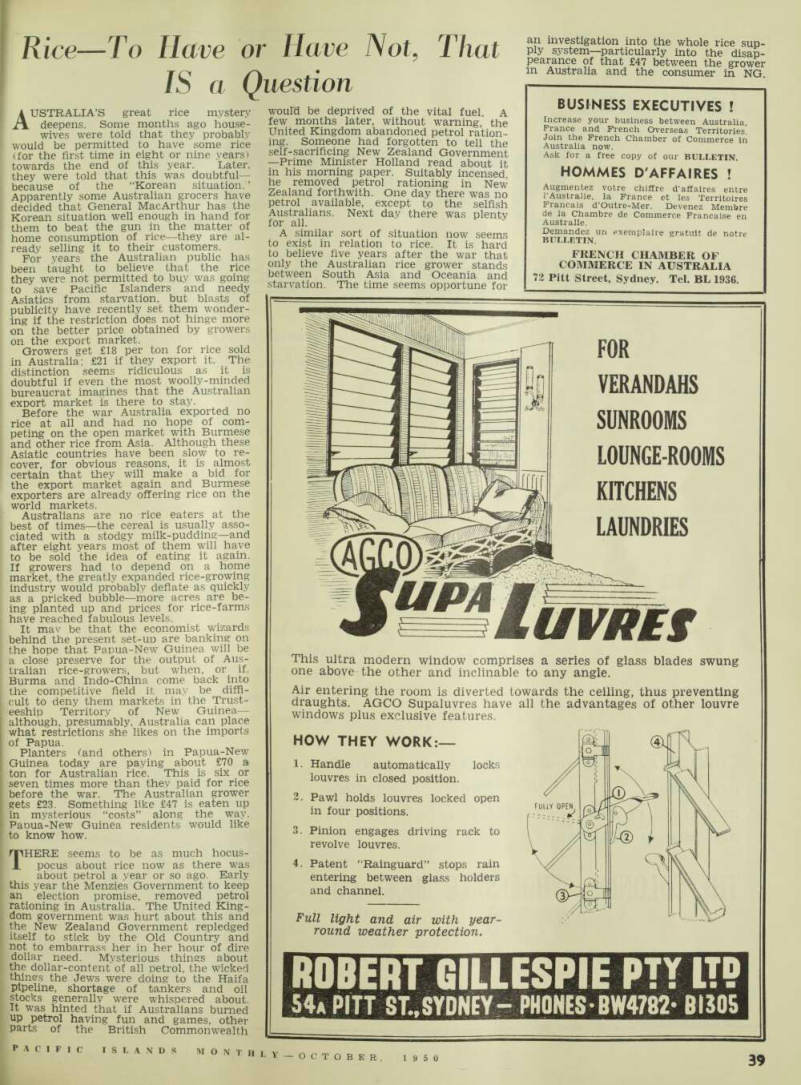

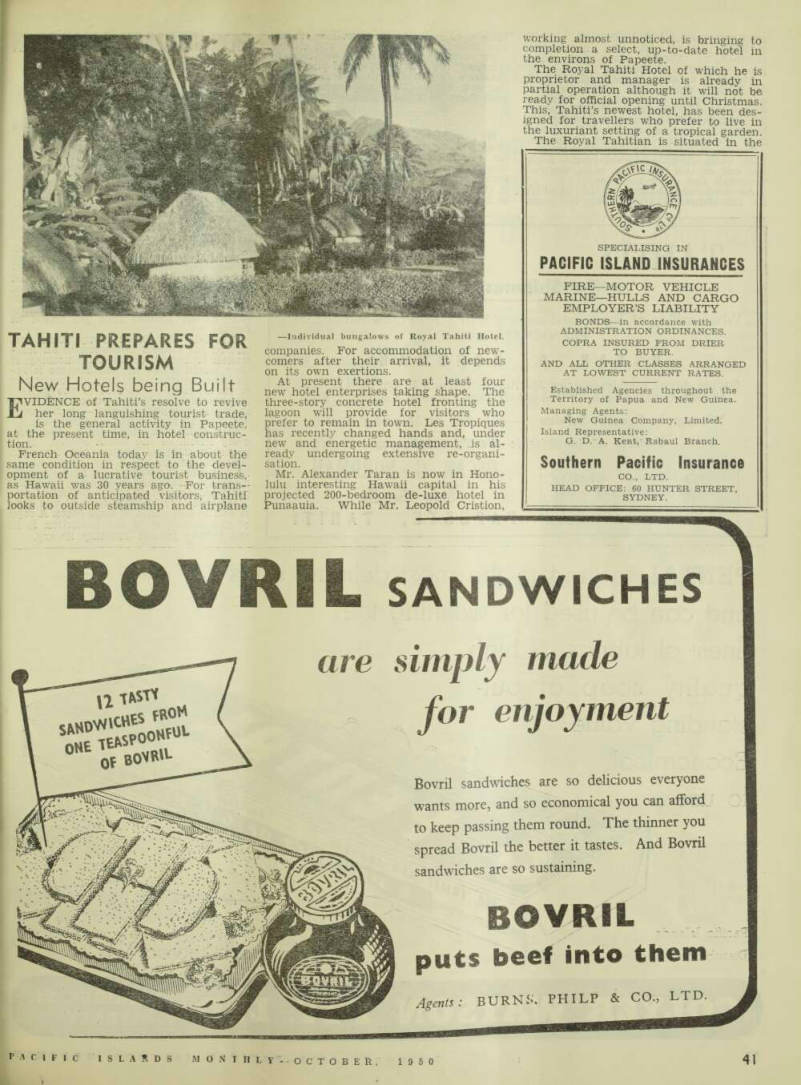
IS a Question
AUSTRALIA’S great rice mystery deepens. Some months ago house wives were told that they probably would be permitted to have some rice (for the first time in eight or nine years) towards the end of this year. Later, they were told that this was doubtful— because of the “Korean situation.’
Apparently some Australian grocers have decided that General MacArthur has the Korean situation well enough in hand for them to beat the gun in the matter of home consumption of rice—they are al ready selling it to their customers.
For years the Australian public has been taught to believe that the rice they were not permitted to buy was going to save Pacific Islanders and needy Asiatics from starvation, but blasts of publicity have recently set them wonder ing if the restriction does not hinge more on the better price obtained by growers on the export market.
Growers get £lB per ton for rice sold in Australia: £2l if they export it. The distinction seems ridiculous as it is doubtful if even the most woolly-minded bureaucrat imagines that the Australian export market is there to stay.
Before the war Australia exported no rice at all and had no hope of com peting on the open market with Burmese and other rice from Asia. Although these Asiatic countries have been slow to re cover, for obvious reasons, it is almost certain that they will make a bid for the export market again and Burmese exporters are already offering rice on the world markets.
Australians are no rice eaters at the best of times—the cereal is usually asso ciated with a stodgy milk-pudding—and after eight years most of them will have to be sold the idea of eating it again.
If growers had to depend on a home market, the greatly expanded rice-growing industry would probably deflate as quickly as a pricked bubble —more acres are be ing planted up and prices for rice-farms have reached fabulous levels.
It mav be that the economist wizards behind the present set-up are banking on the hope that Papua-New Guinea will be a close preserve for the output of Aus tralian rice-growers, but when, or if.
Burma and Indo-China come back into the competitive field it may be diffi cult to deny them markets in the Trust eeship Territory of New Guinea — although, presumably. Australia can place what restrictions she likes on the imports of Papua.
Planters (and others) in Papua-New Guinea today are paying about £7O a ton for Australian rice. This is six or seven times more than they paid for rice before the war. The Australian grower gets £23. Something like £47 is eaten up in mysterious “costs” along the way.
Paoua-New Guinea residents would like to know how.
THERE seems to be as much hocus pocus about rice now as there was about petrol a year or so ago. Early this year the Menzies Government to keep an election promise, removed petrol rationing in Australia. The United King dom government was hurt about this and the New Zealand Government repledged itself to stick by the Old Country and not to embarrass her in her hour of dire dollar need. Mysterious things about the dollar-content of all petrol, the wicked thine-s the Jews were doing to the Haifa pipeline, shortage of tankers and oil stocks generally were whispered about.
It was hinted that if Australians burned up petrol having fun and games, other parts of the British Commonwealth
would be deprived of the vital fuel. A few months later, without warning,’ the United Kingdom abandoned petrol ration ing. Someone had forgotten to tell the self-sacrificing- New Zealand Government —Prime Minister Holland read about it in his morning paper. Suitably incensed he removed petrol rationing in New Zealand forthwith. One dav there was no petrol available, except to the selfish Australians. Next day there was plenty for all.
A similar sort of situation now seems to exist in relation to rice. It is hard to believe five years after the war that only the Australian rice grower stands between South Asia and Oceania and starvation. The time seems opportune for
an investigation into the whole rice sup ply system—particularly into the disap pearance of that £47 between the grower m Australia and the consumer in NG.
Advertisements & other items, pp. 41-42 (2 items)
39
ac.fic islands monthiv-october, , 950
Robert Gillespie Pty It?
BUSINESS EXECUTIVES !
Increase your business between Australia.
Prance and French Overseas Territories.
Join the French Chamber of Commerce in Australia now.
Ask for a free copy of our BULLETIN.
HOMMES D'AFFAIRES !
Augmentez votre chiffre d’affaires entre i’Australie, la France et les Territoires Francais d’Outre-Mer. Devenez Membre de la Chambre de Commerce Francaise en Australie.
Demandez un exemplaire gratult de notre
BULLETIN.
FRENCH CHAMBER OF
COMMERCE IN AUSTRALIA
72 Pitt Street, Sydney. Tel. BL 1936.
M A 0
FOR
VERANDAHS
SUNROOMS
LOUNGE-ROOMS
KITCHENS
LAUNDRIES
This ultra modern window comprises a series of glass blades swung one above the other and inclinable to any angle.
Air entering the room is diverted towards the ceiling, thus preventing draughts. AGCO Supaluvres have all the advantages of other louvre windows plus exclusive features.
HOW THEY WORK:—
1. Handle automatically locks louvres in closed position. 2. Pawl holds louvres locked open in four positions. 3. Pinion engages driving rack to revolve louvres. 4. Patent “Rainguard” stops rain entering between glass holders and channel.
Full light and air with yearround weather protection. ...
ROBERT GILLESPIE PTY IT?
S4> PITT ST..SYDHEY- PHOWtSBW47B2- BISOS
Insist on. . .
“P*. 0 NT£”
CANNED MEATS, HOTMEALS AND SOUPS
Available in 12 oz. and 1 lb. sealed cans in the following
appetising flavours and combinations:
• Corned Beef Loaf With Cereal • Braised Steak and Onions • Boiled and Roast Beef • Beef Steak Pudding • Mutton and Peas • Steak and Onions • Chili Con Came • Curried Mutton • Curried Beef • Irish Stew • Mulligatawny Soup • Vegetable Soup • Mutton Broth • Tomato Soup • Camp Pie
“BRONTE” Brand high-grade products
are made from the finest fat stock
and the richest vegetables in Australia,
deliciously flavoured.
THE COLONIAL WHOLESALE MEAT CO.
. LTD.
Canning Factory: State Abbatoirs, Homebush, Sydney,
N.S.W.
’PHONE: UM 8436 CABLE ADDRESS: “WOOLMTLL,” SYDNEY. a wmoitsAU ***
Tourism
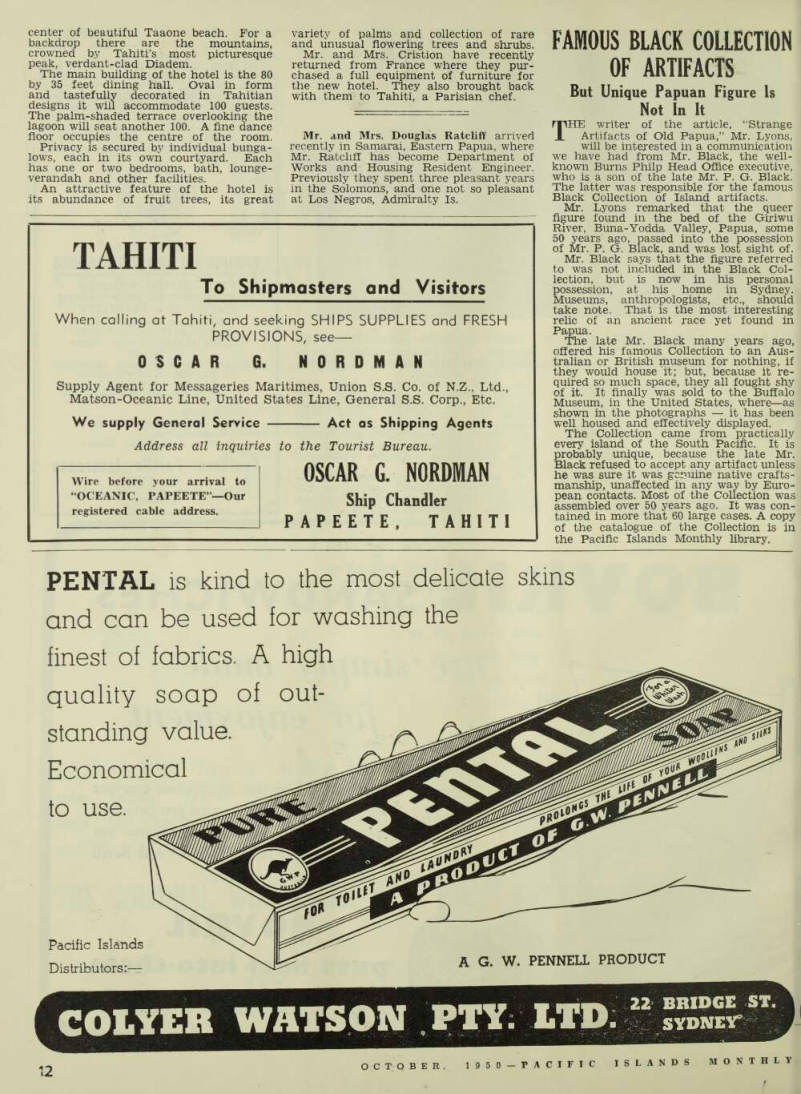
Tahiti Prepares For
New Hotels being Built
EVIDENCE of Tahiti’s resolve to revive her long languishing tourist trade, is the general activity in Papeete, at the present time, in hotel construc tion.
French Oceania today is in about the same condition in respect to the devel opment of a lucrative tourist business, as Hawaii was 30 years age. For trans portation of anticipated visitors, Tahiti looks to outside steamship and airplane
—lndividual bungalows of Royal Tahiti Hotel. companies. For accommodation of new comers after their arrival, it depends on its own exertions.
At P resent there are at least four new hotel enterprises taking shape. The three-story concrete hotel fronting the lagoon will provide for visitors who prefer to remain in town. Les Tropiques has recently changed hands and, under new and energetic management, .is al ready undergoing extensive re-organi sation.
Mr. Alexander Taran is now in Hono lulu interesting Hawaii capital in his projected 200-bedroom de-luxe hotel in Punaauia. While Mr. Leopold Cristion,
working almost unnoticed, is bringing to completion a select, up-to-date hotel in the environs of Papeete.
The Royal Tahiti Hotel of which he is proprietor and manager is already in partial operation although it will not be ready for official opening until Christmas.
This, Tahiti’s newest hotel, has been des igned for travellers who prefer to live in the luxuriant setting of a tropical garden.
The Royal Tahitian is situated in the
center of beautiful Taaone beach. For a backdrop there are the mountains, crowned by Tahiti’s most picturesque peak, verdant-clad Diadem.
The main building of the hotel is the 80 by 35 feet dining hall. Oval in form and tastefully decorated in Tahitian designs it will accommodate 100 guests.
The palm-shaded terrace overlooking the lagoon will seat another 100. A fine dance floor occupies the centre of the room.
Privacy is secured by individual bunga lows, each in its own courtyard. Each has one or two bedrooms, bath, lounge verandah and other facilities.
An attractive feature of the hotel is Its abundance of fruit trees, its great
variety of palms and collection of rare and unusual flowering trees and shrubs.
Mr. and Mrs. Cristion have recently returned from France where they pur chased a full equipment of furniture for the new hotel. They also brought back with them to Tahiti, a Parisian chef.
Mr. and Mrs. Douglas Ratcliff arrived recently in Samarai, Eastern Papua, where Mr. Ratcliff has become Department of Works and Housing Resident Engineer.
Previously they spent three pleasant years in the Solomons, and one not so pleasant at Los Negros, Admiralty Is.
Advertisements & other items, pp. 43-44 (1 item)
Bovril Sandwiches
SPECIALISING IN
PACIFIC ISLAND INSURANCES
FIRE-MOTOR VEHICLE
MARINE—HULLS AND CARGO
EMPLOYER’S LIABILITY
BONDS—in accordance with
ADMINISTRATION ORDINANCES.
COPRA INSURED FROM DRIER
TO BUYER.
AND ALL OTHER CLASSES ARRANGED
AT LOWEST CURRENT RATES.
Established Agencies throughout the Territory of Papua and New Guinea.
Managing Agents: New Guinea Company, Limited.
Island Representative: G. D. A. Kent* Rabaul Branch.
Southern Pacific Insurance
CO., LTD.
HEAD OFFICE: 60 HUNTER STREET,
SYDNEY.
BOVRIL SANDWICHES
12 *Sr :: A.
V 5> Eh
are simply made
for enjoyment
Bovnl sandwiches are so delicious everyone wants more, and so economical you can afford to keep passing them round. The thinner you spread Bovril the better it tastes. And Bovril sandwiches are so sustaining.
BOVRIL
outs beef into them
Agents: BURNS. PHILP & CO., LTD.
TAHITI
To Shipmasters and Visitors
When calling at Tahiti, and seeking SHIPS SUPPLIES and FRESH
PROVISIONS, see—
OSCAR G. NORDMAN
Supply Agent for Messageries Maritimes, Union S.S. Co. of N.Z., Ltd., Matson-Oceanic Line, United States Line, General S.S. Corp., Etc.
We supply General Service Act as Shipping Agents Address all inquiries to the Tourist Bureau.
OSCAR G. NORDMAN
Ship Chandler
PAPEETE. TAHITI
Wire before your arrival to
“OCEANIC, PAPEETE”—Our
registered cable address.
PENTAL is kind to the most delicate skins and can be used for washing the finest of fabrics. A high quality soap of
standing value.
Economical to use.
Pacific Islands Distributors: — out w fNS j®a yo<2 hcJ m »* M m 10 fo*
A G. W. PENNELL PRODUCT
GOLYER WATSON PTY. LTD.
Famous Black Collection
Of Artifacts
But Unique Papuan Figure Is Not In It
THE writer of the article, “Strange Artifacts of Old Papua,” Mr. Lyons, will be interested in a communication we have had from Mr. Black, the well known Burns Philp Head Office executive, who is a son of the late Mr. P. G. Black.
The latter was responsible for the famous Black Collection of Island artifacts.
Mr. Lyons remarked that the queer figure found in the bed of the Giriwu River, Buna-Yodda Valley, Papua, some 50 years ago, passed into the possession of Mr. P. G. Black, and was lost sight of.
Mr. Black says that the figure referred to was not included in the Black Col lection, but is now in his personal possession, at his home in Sydney.
Museums, anthropologists, etc., should take note. That is the most interesting relic of an ancient race yet found in Papua.
The late Mr. Black many years ago, offered his famous Collection to an Aus tralian or British museum for nothing, if they would house it; but, because it re quired so much space, they all fought shy of it. It finally was sold to the Buffalo Museum, in the United States, where—as shown in the photographs it has been well housed and effectively displayed.
The Collection came from practically every island of the South Pacific. It is probably unique, because the late Mr.
Black refused to accept any artifact unless he was sure it was genuine native crafts manship, unaffected in any wav by Euro pean contacts. Most of the Collection was assembled over 50 years ago. It was con tained in more that 60 large cases. A copy of the catalogue of the Collection is in the Pacific Islands Monthly library.
Seven Seas II Heads
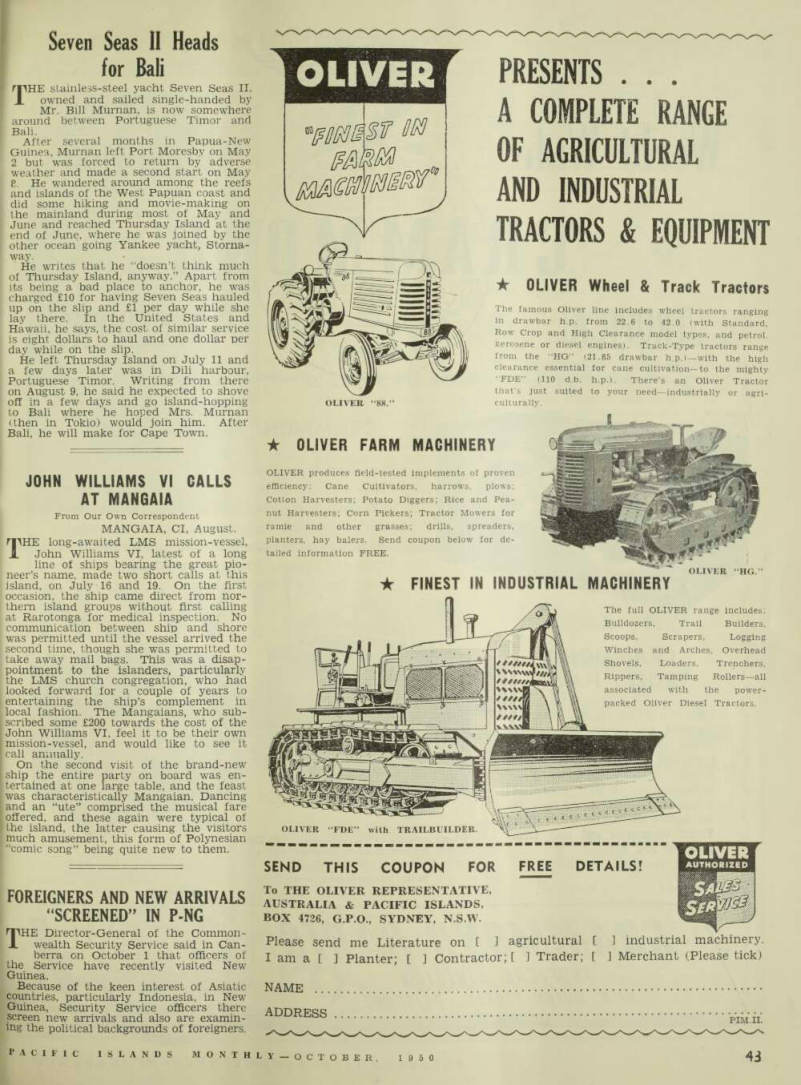
for Bali
THE stainless-steel yacht Seven Seas 11, owned and sailed single-handed by Mr. Bill Murnan, is now somewhere around between Portuguese Timor and Bali.
After several months in Papua-New Guinea, Murnan left Port Moresby on May 2 but was forced to return by adverse weather and made a second start on May 8. He wandered around among the reefs and islands of the West Papuan coast and did some hiking and movie-making on the mainland during most of May and June and reached Thursday Island at the end of June, where he was joined by the other ocean going Yankee yacht, Storna way.
He writes that he ‘‘doesn’t think much of Thursday Island, anyway.” Apart from its being a bad place to anchor, he was charged £lO for having Seven Seas hauled up on the slip and £1 per day while she lay there. In the United States and Hawaii, he says, the cost of similar service is eight dollars to haul and one dollar per day while on the slip.
He left Thursday Island on July 11 and a few days later was in Dili harbour, Portuguese Timor. Writing from there on August 9. he said he expected to shove off in a few days and go island-hopping to Bali where he hoped Mrs. Murnan (then in Tokio) would join him. After Bali, he will make for Cape Town.
John Williams Vi Calls
At Mangaia
From Our Own Correspondent MANGAIA, Cl, August.
THE long-awaited LMS mission-vessel, John Williams VI, latest of a long line of ships bearing the great pio neer’s name, made two short calls at this island, on July 16 and 19. On the first occasion, the ship came direct from nor thern island groups without first calling at Rarotonga for medical inspection. No communication between ship and shore was permitted until the vessel arrived the second time, though she was permitted to take away mail bags. This was a disap pointment to the islanders, particularly the LMS church congregation, who had looked forward for a couple of years to entertaining the ship’s complement in local fashion. The Mangaians, who sub scribed some £2OO towards the cost of the John Williams VI, feel it to be their own mission-vessel, and would like to see it call annually.
On the second visit of the brand-new ship the entire party on board was en tertained at one large table, and the feast was characteristically Mangaian. Dancing and an “ute” comprised the musical fare offered, and these again were typical of the island, the latter causing the visitors much amusement, this form of Polynesian “comic song” being quite new to them.
Foreigners And New Arrivals
“Screened" In P-Ng
THE Director-General of the Common wealth Security Service said in Can berra on October 1 that officers of the Service have recently visited New Guinea.
Because of the keen interest of Asiatic countries, particularly Indonesia, in New Guinea, Security Service officers there screen new arrivals and also are examin ing the political backgrounds of foreigners.
Advertisements & other items, pp. 45-46 (1 item)
Oliver
dm at*
OLIVER “88.
PRESENTS . . .
A COMPLETE RANGE
OF AGRICULTURAL
AND INDUSTRIAL
TRACTORS & EQUIPMENT
★ OLIVER Wheel & Track Tractors
The famous Oliver line includes wheel tractors ranging in drawbar h.p. from 22.6 to 42.0 (with Standard, Row Crop and High Clearance model types, and petrol, kerosene or diesel engines). Track-Type tractors range from the "HG" (21.85 drawbar h.p.)—with the high clearance essential for cane cultivation—to the mighty “FDE” (110 d.b. h.p.). There’s an Oliver Tractor that’s just suited to your need —industrially or agriculturally.
★ OLIVER FARM MACHINERY
OLIVER produces field-tested implements of proven efficiency: Cane Cultivators, harrows, plows; Cotton Harvesters; Potato Diggers: Rice and Peanut Harvesters: Corn Pickers; Tractor Mowers for ramie and other grasses; drills, spreaders, planters, hay balers. Send coupon below for detailed information FREE.
OLIVER “HG.
★ FINEST IN INDUSTRIAL MACHINERY
f \\V v> /// /// ft**/ :■ The full OLIVER range includes; Bulldozers, Trail Builders, Scoops, Scrapers, Logging Winches and Arches, Overhead Shovels, Loaders, Trenchers.
Rippers, Tamping Rollers—all associated with the powerpacked Oliver Diesel Tractors.
OLIVER “FDE’’ with TRAILBUILDER
SEND THIS COUPON FOR FREE
To THE OLIVER REPRESENTATIVE,
AUSTRALIA & PACIFIC ISLANDS,
BOX 4726, G.P.0., SYDNEY, N.S.W.
DETAILS!
OLIVER
AUTHORIZED
Please send me Literature on t 1 agricultural [ ] industrial machinery.
I am a [ ] Planter; [ ] Contractor; [ 1 Trader; [ ] Merchant (Please tick)
NAME
ADDRESS
PIM.II.
World-Wide
TROPICAL
I V. &. /. n* 'V V
0 OF TVtf-
aeeeplion
MON D
RECEIVERS
CRAMMOND TROPIC EAGLE
Most famous tropic-proofed and completely sealed receiver in the world to-day. The designers' claim that range is unlimited and reception perfect anywhere throughout the world has been fully justified by the reports received from hundreds of enthusiastic owners. Three Years’ Guarantee and easy terms are available wherever you live.
CRAMMOND
TROPIC HAWK
This is a 2-unlt receiver especially designed Tor Patrol Officers and others who require absolute portability and dependability. Combined weight of both cabinets—32 lb.
Measurements of each cabinet—ls x 9 x 9. This set covers from 16- 150 metres shortwaves only. Three Years’ Guarantee and easy terms wherever you live. m Features exclusive to both sets: Completely Tropic Proofed, Built-in Moisture Absorber, and available in Vibrator or All Dry Cell.
Write for particulars to-day!
CRAMMOND RADIO
TROPICAL DIOI SION
NO 8 QUEEN STREET , BRISBRNE
Golden Wedding Of Well-Known Fiji Couple
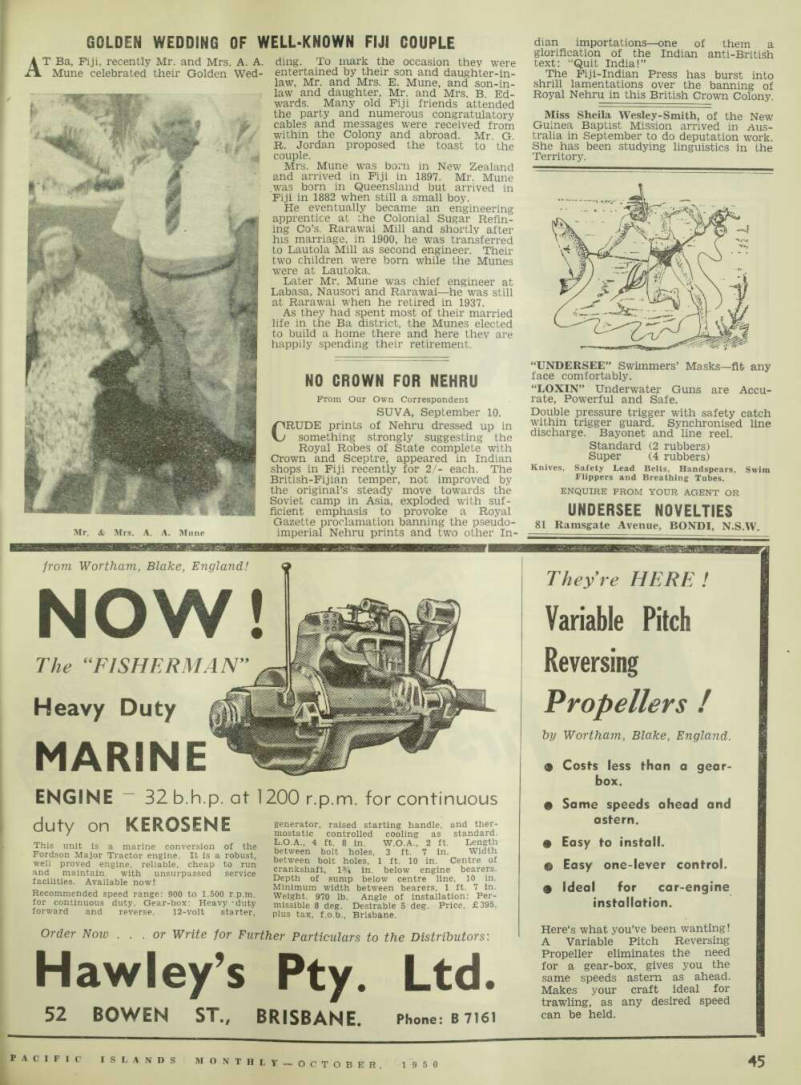
AT Ba, Fiji, recently Mr. and Mrs. A. A.
Mune celebrated their Golden Wed-
ding. To mark the occasion they were entertained by their son and daughter-in law, Mr. and Mrs. E. Mune, and son-in law and daughter, Mr. and Mrs. B. Ed wards. Many old Fiji friends attended the party and numerous congratulatory cables and messages were received from within the Colony and abroad. Mr. G.
R. Jordan proposed the toast to the couple.
Mrs. Mune was born in New Zealand and arrived in Fiji in 1897. Mr. Mune ,was born in Queensland but arrived in Fiji in 1882 when still a small boy.
He eventually became an engineering apprentice at r.he Colonial Sugar Refin ing Co’s. Rarawai Mill and shortly after his marriage, in 1900, he was transferred to Lautola Mill as second engineer. Their two children were born while the Munes were at Lautoka.
Later Mr. Mune was chief engineer at Labasa, Nausori and Rarawai —he was still at Rarawai when he retired in 1937.
As they had spent most of their married life in the Ba district, the Munes elected to build a home there and here they are happily spending their retirement.
Mr. & Mrs. A. A. Mune
No Crown For Nehru

Prom Our Own Correspondent SUVA, September 10.
CRUDE prints of Nehru dressed up in something strongly suggesting the Royal Robes of State complete with Crown and Sceptre, appeared in Indian shops in Fiji recently for 2/- each. The British-Fijian temper, not improved by the original’s steady move towards the Soviet camp in Asia, exploded with suf ficient emphasis to provoke a Royal Gazette proclamation banning the pseudo imperial Nehru prints and two other In
dian importations—one of them a glorification of the Indian anti-British text: “Quit India!”
The Fiji-Indian Press has burst into shrill lamentations over the banning of Royal Nehru in this British Crown Colony.
Miss Sheila Wesley-Smith, of the New Guinea Baptist Mission arrived in Aus tralia in September to do deputation work.
She has been studying linguistics in the Territory.
Ponape Agricultural Demonstration Station was started in 1921 by the Jap anese and re-established in 1948 by the United States Trust Territory Administra tion. The Directors’ 1949-50 Report states that the station (about 30 acres) is well stocked with tropical, economic plants, and an attempt has been made to establish a native subsistence garden where the per formance of main native food crops can be compared with new introductions. Soil fertility and land use studies were carried out, and possible reafforestation studied.
Brahma livestock was successfully intro duced.
Advertisements & other items, pp. 47-48 (2 items)
45
ACIFIC ISLANDS MONTHLY OCTOBER, 19 50
Hawley’s Pty. Ltd.
“UNDERSEE” Swimmers’ Masks—fit any face comfortably.
“LOXIN” Underwater Guns are Accurate, Powerful and Safe.
Double pressure trigger with safety catch within trigger guard. Synchronised line discharge. Bayonet and line reel.
Standard (2 rubbers) Super (4 rubbers) Knives, Safety Lead Belts, Handspears, Swim Flippers and Breathing Tubes.
ENQUIRE FROM YOUR AGENT OR
UNDERSEE NOVELTIES
81 Ramsgate Avenue, BONDI, N.S.W.
from Wortham, Blake, England! 9
NOW!
The “ FISHERM
Heavy Duty
MARINE
m ENGINE 32 b.h.p. at 1200 r.p.m. for continuous
duty on KEROSENE
This unit is a marine conversion of the Fordson Major Tractor engine. It is a robust, well proved engine, reliable, cheap to run and maintain, with unsurpassed service facilities. Available now!
Recommended speed range: 900 to 1.500 r.p.m. for continuous duty. Gear-box: Heavy -duty forward and reverse. 12-volt starter, generator, raised starting handle, and thermostatic controlled cooling as standard.
L.0.A.. 4 ft. 8 in. W.0.A., 2 ft. Length between bolt holes, 3 ft. 7 in. Width between bolt holes. 1 ft. 10 in. Centre of crankshaft, 1% in. below engine bearers.
Depth of sump below centre line, 10 in.
Minimum width between bearers, 1 ft. 7 in.
Weight. 970 lb. Angle of installation: Permissible 8 deg. Desirable 5 deg. Price, £395, plus tax, f.0.b., Brisbane.
Order Now ... or Write for Further Particulars to the Distributors :
Hawley’s Pty. Ltd.
52 BOWEN ST., BRISBANE. Phone: B 7161
They're HERE
Variable Pitch
Reversing
Propellers !
by Wortham, Blake, England. $ Costs less than a gearbox. • Same speeds ahead and astern. • Easy to install. © Easy one-lever control. $ ideal for car-engine installation.
Here's what you’ve been wanting!
A Variable Pitch Reversing Propeller eliminates the need for a gear-box, gives you the same speeds astern as ahead.
Makes your craft ideal for trawling, as any desired speed can be held.
AUNT
MARYS
BAKING POWDER
For the best in delicious baking results A product of TILLOCK AND CO. PTY. LTD. manufacturers of all the famous Aunt Mary s Pure Foods
<0 a A 4 4T.
first fcr
W “ * , . thirst than m * finer .cay to "“freshingK.B.
There s no ith a g lass of sparM re alike.
A ivonien th men an vourite tvi firm i K 8.57. H
lager
s
tooth
pi
Cost Of Living Mounts In
Nz Pacific Islands
From Our Own Correspondent MANGAIA, Cook Is.
THE recent increase of tea-prices to 8/lb., (in place of former 6/8) has caused much consternation among consumers of the Cup that Cheers —and they are many on this island.
Other grocery lines, including tinned meats, went up in price earlier in the year.
It has been explained to locals that these increases, so much at variance with the pre-election claim that the National Party would at once proceed to “lower the cost of living,” are due to the removal of certain subsidies previously paid by the NZ Government on various commodi ties. Residents, who are told that this removal of a burden on the NZ taxpayer, although it has the effect of making groceries dearer at present, will later prove a benefit, may be pardoned for failing to see how this is to be accomplished. Ris ing food-prices are inevitably followed by increased salaries; and workers’ wages, already high, may have to be further aug mented in the Cl.
Prices here to-day are three times 1935 level. Dress-goods have risen even higher, in view of the disappearance of Japanese supplies of “ninepenny silks.” A rumour is going the rounds that certain trading interests propose to buy heavily in Japan, with a view to flooding the Cl market with cheap dress-material again. This laudable aim appears to depend for its achievement upon whether the Japanese textile workers are still willing to function for ninepence a day. Judging by world wide trends, it is to be feared that the cheap silk and the sixpenny knife (and razor) together with the half-crown clock, are a thing of the past.
Certainly the prices obtained by Cook Islands fruit growers have gone up too, but they have not kept pace with costs.
The gap between income and outgo is widening.
The Rev. Wilfred John Hutton, formerly of Hertfordshire, England, was consecrated Bishop of Carpentaria in St. John’s Angli can Cathedral, Brisbane, on September 21. Thursday Island will be the Bishop’s headquarters. His diocese takes in 600,000 square miles of Northern Australia. The crook which the Bishop carried during his consecration, was carved by Torres Strait natives from local woods and in laid with mother-of-pearl shell.
for Apia
New Light and Power for Apia Hydro-Electric Supply Should Operate by December
By E. E. Bush
THE dream of years is within prospect of fulfilment. Soon we in Apia, Samoa, will be able to put down the switch and have light in our globes—real, bright electric light, and not the glimmer ing glow that sometimes appears, in sufficient to illuminate the page of a book held within a few feet of it. The present plant was satisfactory for its pur poses when it was installed. But this electric age has made great demands on power, and the supply is now insufficient.
But the great project of providing ample electricity is well under way. The dam is constructed, the power house built, and generators installed. For the last few months, workmen have been hauling the great steel pipes from the waterfront up to the dam site, and, there, have been welding them together to conduct the water from the storage dam to the power house.
BUT let us inspect the work from top to bottom. The dam, in the valley of the Fuluasou river, soans the valley for about 150 ft. from side to side. The dam is approximately 25 ft, high, and fif teen feet from the valley floor to the over flow. That is, the depth of water at the dam wall will always be fifteen feet. The base of the wall is 45 ft. below the level of the valley floor, so there is a good solid wall of concrete to stand the stress and strain of thousands of gallons of water. The wall is built in three sections, joined with tarsealing, to allow for earth quake vibrations. Transverse and vertical vibrations are guarded against by joining the sections with a key—a projection of one section fitting into a slot on the next.
The dam is in a beautiful setting, and when filled will provide the residents of Apia with a beauty spot within easy reach, and along a good road. The river flows through a narrow rock-girt valley, bush clad, and with forest trees growing to a great height. The river will be converted into a lake a beauty spot artificially created for man’s enjoyment.
There is a double outlet from the dam —controlled by valves. One outlet con nects with the pipes to the power house; the other allows the dam to be emptied.
Snake-like, the pipes are now creep ing up the valley. They are about half the distance from the power house to the dam. Daily, the length grows greater.
It is a tribute to the workmen and their supervisors that, in the heat of a tropic sun, the work is going along as fast as it is. All operations, except that of weld ing, are manual. The pipes are edged from the roadside to the bed in which they are to lie; joints and angles have to be accounted for, and the pipes cut to fit into the length between a joint and an angle. The next pipe to be fitted is jostled into line, a strap put around it; ropes are anchored to the pipeline, and the next pipe is pulled, so that its end slides inside the last one of the line. The strap is tightened, and the engine started to provide the power for the welding. A shower of sparks, and another link in the chain from water to electricity is forged. Without pause, the workmen com mence to align the next pipe. As the pipe advances, other workmen follow in its train, building up the bed, so that the pipe rests either on a natural earth bed or on buttresses built up to carry the pipe over natural hollows.
The diameter of the pipes varies from
36 inches at the intake to 31 inches at the generator, thus giving, from fall and reduced diameter, a pressure of 100 pounds per square inch.
IT is anticipated that the work will be completed by December. What a Christmas gift the Administration will be able to give to the residents of Apia. The generators are designed to give a load of 600 volts. This will be broken down in Apia to 110 volts—but with the certainty that it will be the full 110 vol tage.
The present supply of hydro electricity is from a small hydro-electric plant, whose capacity is very much overtaxed. Addi tional power is supplied to the Broadcast ing service by means of a Diesel-powered generator. What a joy it will be to turn on a switch and leave it at that—not to have to worry whether the voltage is too low to run the refrigerator; or whether we can get enough power to listen to the radio. The present supply is standing up
remarkably well to the strain put upon it.
There has as yet been no general blackout due to overloading, but the strain cannot go on indefinitely.
Advertisements & other items, pp. 49-50 (1 item)
Marjarine
THE PACIFIC ISLANDS SOCIETY
(Founded 1937) Visitors from the Pacific Islands to Sydney, or persons Interested In Islands affairs, are Invited to communicate with the Honorary Secretary of the above Society which was formed to constitute a social centre for those Interested in the Pacific Islands.
Regular meetings and social gatherings, with lectures, are held at History House. 8 Young Street, Sydney, on the fourth Wednesday of each month, at 8 p.m.
Address for correspondence:—
THE PACIFIC ISLANDS SOCIETY
Box 2434, G.P.0., Sydney.
D)E m % //
(TOP)
TAB,LE
MARJARINE
Packaged like this, DELANA TABLE MARGARINE, a Product of Fiji, is now available to
ALL PACIFIC ISLANDS
Wherever and Whenever Suitable Transport Can Be Found.
A SUBSTITUTE
FOR
BUTTER
In 5 lb. Pats In
Shipping Outers
of 2/ lb.
Fresh, wholesome and nutritious, this is a pure Vitamised Vegetable Product made in accordance with the Pure Food Laws of the Colony of Fiji. It contains no animal fat.
You'll enjoy eating DELANA . . .
You'll appreciate its ECONOMY Export Prices and Further Information from
ISLAND INDUSTRIES LIMITED
P.O. Box 299, SUVA, FIJI.
Telegraphic Address: “DELANA,” SUVA. •For Local Reasons, the Product is Labelled • Marjarine” in Fiji, and “Margarine” Elsewhere.
- : fij 1 ■ Price at Works (6 ft. Length): £4O/10/- Extra for 10-inch additional shelf and brackets (if required) : £2 Packing and Transport to Wharf : £lO/10/- (For cases shipped in quantities,, packing is at greatly reduced rates).
The display case is securely packed in two substantial crates occupying shipping space of 32 cubic feet. Total weight, when packed, 5 cwt 4 ft. Length: £27 8 ft. Length: £52 Another view of the “Brahol”
Export Counter case, showing width of counter space.
BRIEF SPECIFICATIONS
To help you get an accurate picture of the “Brahol”
Special Export Glass Counter Case, here are the main specifications: Overall size is 6 feet long x 1 ft. 9 in. deep x 3 ft. 3 in. high. Made from first-class, wellseasoned Queensland Maple, hand french polished, wax finished, in natural maple colour. Glass parts are i inch British plate glass.
The inside is lacquered ivory colour, and the recessed base is lacquered burgundy.
There is a pair of solid core sliding doors, and one glass shelf, 14 inches wide, on adjustable nickelplated brackets.
Storage space below is 11 inches high.
The plate glass front is 22 inches high.
This Modem Display
Counter will Help to
Sell Goods in
Store!
{and it’s specially built for Export)
As smart as those in leading Australian city stores, and built by a firm that has been making fine store and office fittings for over a third of a century.
Moreover, it is specially built for export, so that it can be readily securely packed, and assembled by anyone, from simple directions, in an hour, with no tools other than a screwdriver. Retailers all over the world have learned the selling value of modern display equipment, and this "silent salesman" will soon pay for itself in increased sales.
BRAY & HOLLIDAY
PTY. LTD.
Makers of Fine Store and Office
Fittings for over a third of a century Brahol House, 66-74 McLachlan Avenue, Rushcutter Bay, Sydney. Telephone: FA 4121 - Cable and Telegraphic Address: “Brahol.”
LDS Programme for Pacific Education
Pacific Education.
From Our Own Correspondent Apia, September 12.
MANY Pacific Islanders in years to come will benefit by an extensive school-building programme now be ing sponsored by the Church of Jesus Christ of Latter Day Saints (Mormon).
Three new schools are now being con structed in Tonga, Western Samoa and New Zealand. While the LDS Church Board of Education will direct the opera tion of these schools, the curriculum set down by the New Zealand Education Department will be followed.
The school in Tonga, located on the outskirts of Nukualofa, is nearing com pletion, and will be the largest school in that Group.
Work has recently begun in Samoa on a school which will consist of four large multiple class-rooms, a large auditorium, principal’s home, and other buildings. It will accommodate 1,000 students and is located at Pesega, near Apia.
Plans are also in preparation for a college in New Zealand to replace the former Maori Agricultural College, which was destroyed by an earthquake. It will be located on a 215 acre farm near Hamilton.
These buildings will all be of reinforced concrete structure with asbestos roofing and they will be specially adapted to the various climatic conditions existing in their respective localities.
All costs of construction, materials and labour for these schools are being pro vided by the LDS Church in America, (headquarters are at Salt Lake City, Utah) in order to advance education and a higher standard of living in the Pacific.
All planning and designing is being done bv E. O. Anderson. Supervising Architect of the Church, and construction in Samoa and New Zealand is under the direction
of Elder G. R. Biesinger, who left a private contracting business in Salt Lake City to direct this work as a missionary.
There are 7,000 missionaries for the LDS Church in almost every country in the world who support themselves while engaged in mission work. Elder Biesinger has already spent two years in New Zeal and as a missionary and now speaks Maori. He is accompanied by his wife and four children on this, his second mission.
The Samoan Government and Samoan leaders, on behalf of the Samoan people, have expressed their appreciation of the LDS Mission at Apia for the generosity of the Church in making large amounts of money available for education in Samoa.
The Branch Manager of the Union Steamship Company at Apia, Mr. B. L, Russell, has been transferred as manager to New Plymouth, NZ‘. Mr. C. E. Pea gram, branch manager at Rarotonga, has been transferred to Apia.
Independence Day Was Quiet
This Year
Prom Our Own Correspondent SUVA, September 10.
THE third Indian Independence Day (August 15) came and went in Fiji almost unnoticed this year.
There were no parades; no aggressive posters; no raucous Indian loud-speakers on trucks in the streets of Suva: no parade of Nehru-capped youth to cheer the hoist ing of the Indian Republican flag at Albert Park; no cocktail party at the Grand Pacific Hotel.
Beyond the usual outbreak of Indian flags and a dead-and-alive political meet ing at the Town Hall, Suva was hardly reminded that Mother India had been “freed from the tyranny of Imperialism.”
Mr. H. Knewstubb, well-known to people in Fiji, Tonga and Samoa as chief en gineer on the MV Matua died in Auckland in early September.
Mataica Tuicakau, the giant Fijian athlete who won the shot-put in the Em pire Games in Auckland, NZ, early this year, will probably be invited to visit Aus tralia next year during Federal Jubilee celebrations. A number of overseas ath letes will be invited to go to Australia.
Sister Ruth Jamieson and Sister Hen rietta Paling recently left Melbourne to
nurse in the Paton Memorial Hospital, Vila, New Hebrides.
Advertisements & other items, pp. 51-52 (2 items)
A. H. Bunting Limited
Better for School Books'll
Th and tumbla and ay stand the rough nbla. Thay’ra lightar nd aaiiar to carry. J Ask first for
SCHOOL CASES
MAfff gr
FORD SHERINGTON LTD.
A. H. BUNTING LIMITED
SAMARAI PAPUA
Branches at: MISIMA, TUFI, ORO BAY, SOPUTA.
SAMARAI AGENTS FOR:
Vacuum Oil Co. Pty., Ltd.
South British Insurance Co.
National Mutual Life Association
SOLE AGENTS IN PAPUA/NEW GUINEA FOR:
Polarizers (U.K.), Ltd.— Polaroid Sun Glasses.* C.S.A. Industries Eng.— Dual Freeze Refrigerators.
Webley & Scott, Ltd.— Shot Guns, Air Pistols, etc.
E. K. Cole, Ltd., London.— “Ekco” Radio Receivers.
“Getula.” —Nylon Monofilament Fish Lines.
Davison Paints, Ltd., N.S.W.—Paint for Tropical Conditions. • Trade mark patented In U.8.A., Great Britain, and other countries
REGULAR SUPPLIES OF EASTERN GOODS
WHOLESALE & RETAIL MERCHANTS IMPORTERS PLANTERS
WILLIAM A JONES PTV. LTD.
Livestock Exporters
Livestock Exported To All Ports Inquiries Invited Address:
108 QUEEN ST., MELBOURNE
Telegrams: “VALKYRIE,” Melbourne.
/ * A A / / / /
DAVISON
4 OAVCO
ONE COAT
METAI PAINT
VELVENE
L?IVEIfINIS|Ld
'■•’Vl KYIITE
\ SUPER FINISH
WHITE
MJ ViIUSTRJE
6MOE W«
PAINT
VIKYLITE
Super gloss porcelain hard Enamel.
VELVENE
Velvet Finish Water Paint for inside and outside use.
DAVCO
One Coat Metal Paint protects all exposed metol’Mvorh.
VELTONE
Flat Oil Washable Wall Point; interior use-
VELUSTRE
Highest grade Tit. Zinc based House Point.
Davison Paints have for many
years proved
their resistance to severe
tropical
conditions. The Davison range
of products
includes high
quality finishes
for all purposes. You can be sure of Davison,
ALL DAVISON FINISHES AVAILABLE FROM
H BUNTING LIMITED AUSTRALIAN FIBRES LIMITED G. G. SMITH & CO. LIMITED Samarai, Papua Kokopa Port Moresby and Lae, New Guinea New Britain Papua
Quake On Santo
A SEVERE earthquake occurred on Santo, New Hebrides, on September 13.
Damage caused was estimated at about £2,000.
Dwindling Fish Supplies
Cause Alarm in Suva
From Our Own Correspondent SUVA, Sept. 18.
THE apparently wholesale catching and selling of undersized or immature fish in Suva Harbour and neighbour ing Laucala Bay has obviously had a serious effect in depleting the Suva fish supply. The use of small-mesh nets by many fishermen (a large proportion of them Indians) is blamed.
It is also alleged that the widespread practice of using the New Guinea duva vine to poison the water, stupefying large fish and killing small fish, is at least an equal menace.
The situation is fully covered by Ordin ance, but, as is not uncommon in Fiji, the regulations under the Ordinance are. for the most part, ignored because there are not enough people to enforce the law.
To save the fish population from pos sible extermination a considerable num ber of European launch-owners and fisher men have offered to serve as volunteer “wardens.”
Neither the continuing protests (through the local Press) nor the would-be volun teers’ offer has received official recogni tion or acknowledgment.
The reason is, that although the Government is believed to read the Press ho official is ever officially aware of any thing that goes on in the Press unless the matter also goes into the “proper official channels.”
The Rev. G. J. Flatten, who first went to New Guinea as a Methodist Missionary in 1927, has resigned.
Mariposa and Monterey
as Troop Ships ?
IN mid-September the United States House of Representatives passed a bill to permit the Government to negotiate purchase of the Matson ships Monterey and Mariposa. It was stated, at the time, that the US Government would probably purchase them for troop carriers.
However, there have been so many rumours about these two ships since they were laid up in 1947 that this latest report will be treated with some reserve.
Mariposa and Monterey were well known trans-Pacific liners until the out break of the Pacific war. They were then used as troop transports until about 1946 when they were put into dock for recon version to luxury passenger liners. Work suddenly ceased on them in 1947, due, it was stated to the enormous costs in volved. They have been laid up in San Francisco ever since.
The ships and their future use have been the subject of innumerable confer ences between the company and the US Government and scarcely a month has passed when some rumour concerning their fate has not been circulating.
South Pacific residents have hoped that the ships—or one of them—would event ually come back to the San Francisco- Sydney service (they called also at Hono lulu, Pago Pago, Suva and Auckland) but this seems unlikely now.
No Subsidy for Aorangi
UNLESS there are new developments regular passenger sea-travel across the Pacific will cease at the end of January when the Canadian Australasian Line vessel, Aorangi, is withdrawn.
After war-time service, Aorangi was reconverted in Sydney for the Sydney- Vancouver passenger trade, and resumed the service in August, 1948. Although there was no opposition on this route (except from the airways) and although passenger accommodation was fully booked, the company has sustained enor mous losses. Last year the company asked the Governments of Canada, Australia and New Zealand to pay a subsidy to keep the liner on the run. New Zealand was Willing to pay its share but Australia and Canada were not. The company then announced on July 3, that they would Withdraw Aorangi when she reached Sydney at the end of January.
It was hoped that the Australian and Canadian governments would reconsider their decision not to pay a subsidy in order to keep the sole remaining pas senger ship on the Pacific service. But so far they have not done so.
It has been suggested that the day of the passenger ship on the Pacific routes is over and that they should fade away gracefully in favour of air services. This seems a ridiculous argument—it is not through lack of public support that liners like the Aorangi have' to be withdrawn, but because of other post-war devetop rnents that have made their operation Uneconomic. Both air and sea transport have a place but where time is not a factor, the majority of travellers still prefer to travel long distances by sea.
So-called HdMlar-restrictions resulting jin lack of Jreight between Australia and New Zealand and North America is one in the withdrawal of the Aorangi. ,Enormously increased costs as a result of |Australia’s 40-hour week, increased de mands by maritime unions and general reluctance to work at all, is another.
When -the Aorangi was refitted after the ..war, her passenger accommodation was reduced in order that her crew could have
better quarters. There probably is no reason why seamen should not have com fort, but the demands of Unionists and their general abuse of privileges in recent years has so sickened those at the receiv ing end that one is permitted to hope that the withdrawal of the Aorangi is Nemesis overtaking them. Unfortunately, there probably still are more berths than there are sailors to fill them—unless as the prophets tell us, the passenger ship era really is over.
Indian Nominated Mlc’S
Appointed In Fiji
rpHE Indian nominated members of 1 Fiji’s Legislative Council have been appointed by the Governor. They are Mr. B. M. Jannif (Muslim) and Mr.
Sada Nand Maharaj, of Ra, son of the late Mr. Badri Maharaj, the first Indian to sit in the Legislative Council of Fiji.
Mrs. W. R. Cahill, accompanied by her sister, Miss T. M. O’Brien, arrived in Syd ney recently en route to Madang, New Guinea, after having toured Europe and the British Isles.
Advertisements & other items, pp. 53-54 (2 items)
Drum Pump
K. H. D. HAY
GENERAL COMMISSION
AND POSTAGE STAMP
AGENT,
GUADALCANAL 8.5.1.
SETS OF BRITISH SOLOMON
ISLANDS STAMPS, MINT OR
CANCELLED COPIES.
Price: £l/5/- per set.
THE WALL-MACNAUGHT
44 Gallon
DRUM PUMP
Fills Everything
'h <j </ 1 — It is ideal for filling tractors, cars, vehicles, stationary engines, boats, stoves, pressure heaters, refrigerators, lamps, bottles, blow torches, 4 gallon drums, etc., and can be used with any non-corrosive liquid.
A solid brass plunger which is always below liquid level makes it self-priming and pumps with the first few strokes . . , waste of liquid due to spillage is entirely eliminated.
DISTRIBUTORS:
• Capacity 4 gallons a minute. • Aluminium Pumphead. • Weight 42 lb. • Guaranteed 12 months. • Unrestricted delivery.
Also available for 4-5 gallon drums.
ROBERT GILLESPIE PTY. LTD,
54a Pitt St., Sydney.
Telephone: BU 1305.
There is only one
ELECTROLUX
THE MODERN KEROSENE-OPERATED REFRIGERATOR
THAT ACHIEVES THE MIRACLE OF ICE FROM HEAT
Lasting Efficiency, Silent Operation, Streamlined Beauty
■ ■ i ■I ' 1 ■i Economically operated by kerosene, with a simple precision-built freezing unit that has no moving parts and is GUARANTEED FOR
FIVE (5) YEARS.
Only obtainable from :
NEW GUINEA COMPANY, LIMITED,
Rabaul, Madang, Lae, Kavieng.
J. R. CLAY & CO., LTD., Port Moresby.
W. R. CARPENTER & CO. (Sol. Is.), LTD., Tulagi.
THE NORFOLK ISLAND SERVICE DEPOT,
Norfolk Island.
SOCIETE HEBRIDA, Port Vila.
SOCIETE CALEDONIENNE DTMPORTATION ET
D’EXPORTATION, Noumea.
For Gilbert and Ellice Islands Colony, etc., apply Model LKSSI
PRICES ON APPLICATION.
Storage capacity: 5i cub. ft. (approx.) shelf area, 10 sq. ft. food shelves, six—fiv removable; 2 self-supporting when hal drawn. Ice-making: Four trays—s lb. ic per freezing: 80 cubes. Fuel consumption 1.8 pints kerosene per day (approx.) Height: 4 ft. 10 in. Depth: 2 ft. ir Weight, unpacked, 406 lb. Packed, 574 It
W. R. CARPENTER & CO., LTD.
direct to: Head Office: 16 O'Connell St., Sydney, N. S. Wales
52
OCTOBER, 1950 PACIFIC ISLANDS MONTHLIf
XTfetsUng and dan?e manT'ot^he
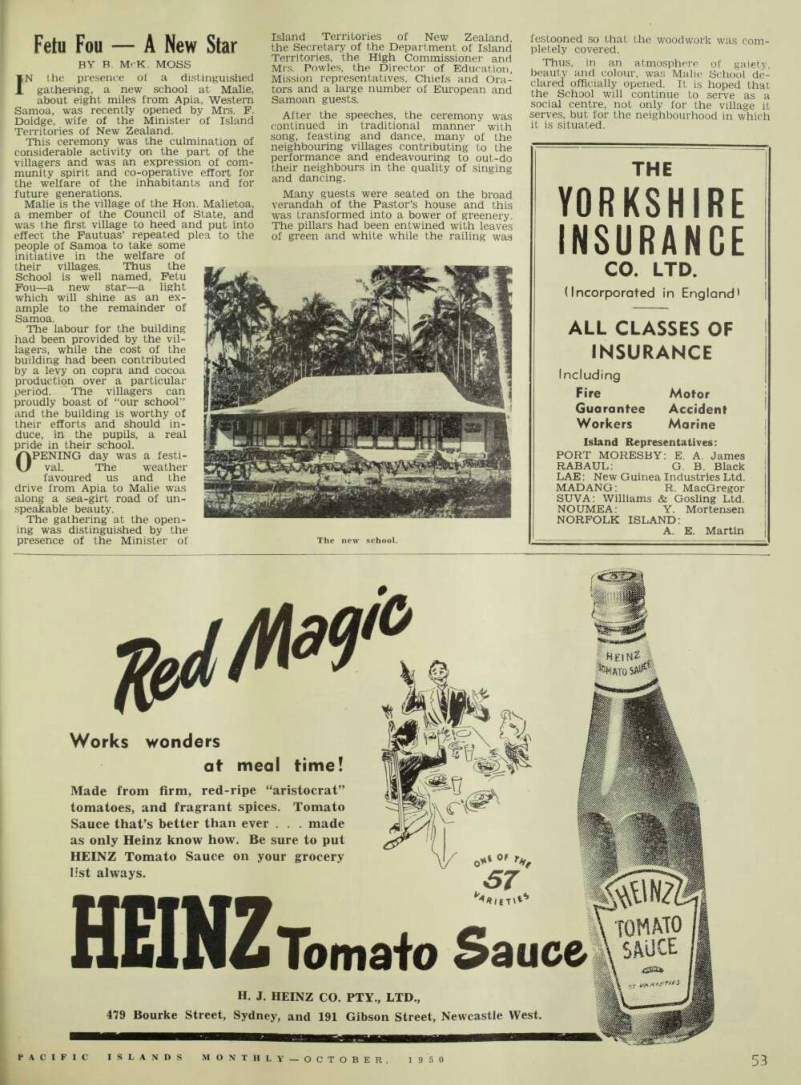
Fetu Fou-A New Star
By B. Mck. Moss
IN the presence of a distinguished gaihering, a new school at Malie, about eight miles from Apia, Western Dotdee wife Mffiis?er b Territories*of New Zealand.
This ceremony was the culmination of considerable activity on the part of the villagers and was an expression of com munity spirit and co-operative effort for the welfare of the inhabitants and for future generations.
Malie is the village of the Hon. Malietoa, a member of the Council of State, and was the first village to heed and put into effect the Fautuas’ repeated plea to the
people of Samoa to take some initiative in the welfare of their villages. Thus the School is well named, Fetu Fou—a new star —a light which will shine as an ex ample to the remainder of Samoa.
The labour for the building had been provided by the vil lagers, while the cost of the building had been contributed by a levy on copra and cocoa production over a particular period. The villagers can proudly boast of “our school’’ and the building is worthy of their efforts and should in duce, in the pupils, a real pride in their school.
OPENING day was a festi val. The weather favoured us and the drive from Apia to Malie was along a sea-girt road of un speakable beauty.
The gathering at the open ing was distinguished by the presence of the Minister of
Island Territories of New Zealand, the Secretary of the Department of Island Territories, the High Commissioner and Mrs. Powles, the Director of Education, Mission representatives. Chiefs and Ora tors and a large number of European and Samoan guests.
After the s P eeches - the ceremony was
XTfetsUng and dan?e manT'ot^he
tn the
for mane? lntSn
their of sffiffin? 5.7,H ir aa?fir>o-° UrS m tne quallty 01 sin S m g ana aancin &- Many guests were seated on the broad verandah of the Pastor’s house and this was transformed into a bower of greenery, The pillars had been entwined with leaves of green and white while the railing was
festooned so that the woodwork was com pletely covered.
Thus, in an atmosphere of gaiety, beauty and colour, was Malic School de clared officially opened. It is hoped that the School will continue to serve as a social centre, not only for the village it serves, but for the neighbourhood in which it is situated.
The new school.
Advertisements & other items, p. 55 (1 item)
Heinzt
THE
YORKSHIRE
INSURANCE
CO. LTD.
(Incorporated in England)
ALL CLASSES OF
INSURANCE
Including
Fire Motor Guarantee Accident Workers Marine Island Representatives:
PORT MORESBY: E. A. James
RABAUL: G. B. Black LAE: New Guinea Industries Ltd.
MADANG: R. MacGregor SUVA; Williams & Gosling Ltd.
NOUMEA; Y. Mortensen
NORFOLK ISLAND:
A. E. Martin
Works wonders
at meal time!
Made from firm, red-ripe “aristocrat” tomatoes, and fragrant spices. Tomato Sauce that’s better than ever . . . made as only Heinz know how. Be sure to put HEINZ Tomato Sauce on your grocery list always.
HEINZt
& V ■'i- 0, s*.
D 0»‘ 0f S 7 ' 4 *l pi m
bmafo Sauce
H. J. HEINZ CO. PTY., LTD.,
479 Bourke Street, Sydney, and 191 Gibson Street, Newcastle West.
TOMATO
SAUCE
100 Years Of Effort By

The Abm
CENTENARY year of the Australian Board of Missions ends this month.
It is hoped to attain £lOO,OOO during this year for the advancement of educa tion in the Papua-New Guinea area.
The centenary year began on last Oc tober 29, the anniversary of the formation of the Board of Missions by a meeting of Australian bishops.
Since 1850 work had been expanded through Melanesia, Polynesia, Torres Strait Islands, New Guinea, New Britain, New Ireland, a section of Singapore and parts of China and Japan.
Fines For Watering The
Hospital Milk
From Our Own Correspondent SUVA, September 25.
INDIAN milk vendors have recently been forming something like a procession to the Suva Magistrate’s Court to answer charges of selling adulterated or below-standard milk.
The head of the Nasinu Dairy Com pany, with ten convictions at various times in the last few years, is now reported to have relinquished his job.
The company was found by a Health Inspector to have been, supplying watered milk to the Tamavua Tuberculosis Hos pital and the Colonial War Memorial Hospital under a Government contract, as well as to the general public.
A court defence has been put forward that dairy proprietors are unable to pre vent the watering of milk by their em ployees—an argument which is not sym pathetically received by those who pay for a watered product Further, in the Suva area at least, the quality of the water is known to be deplorable.
Whether the adulteration is done with or without the knowledge of the pro prietors of the dairy businesses, the fact remains that the public and Government institutions have been paying substan tially for water. The victimisation of the Tamavua Hospital in particular has roused the highest indignation in a com munity which has been compelled to be come TB-conscious.
The Royal New Zealand Air Force Cata lina which was damaged when she struck a reef just before taking off at Vila last month was successfully repaired and is back at Laucala Bay. Fiji.
Advertisements & other items, p. 56 (1 item)
Tallerman & Company Pty. Limited
60 YORK STREET, SYDNEY, N.S.W.
Also Brisbane, Melbourne, Adelaide, Perth.
Buying Agents of all Australian Products .
Sole Exporters for numerous Australian
Manufacturers
Careful and Prompt Attention to all Inquiries Send us your inquiries which will have our careful and prompt attention.
WRITE FOR DETAILED PRICE LIST
Cable Address: “FRESHET”
The NEW HILLMAN MINX
\ 698£ m im. fea4fig| now has a plus-power
engine developing 37.5 h.p,!
This gives you
• more
at the getaway
. MORE POWER
on the hills— yet running costs are as low as ever Full particulars available from the distributors throughout the Territory of New Guinea
COLYER WATSON
NEW 1
GUINEA,
Report For 1949
Fiji Statistics in Attractive Form
FOR the second year the Colony of Fiji has issued its Annual Report (it covers the year 1949), as an attrac tive book.
The 100 pages contain a wealth of in formation and statistics on all aspects of life in the Colony. Chapters cover popu lation, occupation, wages, finance and tax ation, currency and banking, commerce, social services, legislation, justice, public works, communications, development, climate, history, geography, etc.
There is an excellent index, a coloured folding map of the Colony and numerous photographs.
Two interesting points from the Report cover population and cost-of-living figures.
It is estimated, says the report, that at the time of Cession (1874), there were about 200,000 Fijians. Following Cession came the introduction of European dis eases to which the Fijians had no im munity, and measles and other epidemics took severe toll until in 1905 there were only 87,000 natives. The population re mained stationary for the next 12 years and then began a small increase but hardly had that trend manifested itself when the disastrous influenza epidemic of 1919 reduced the Fijian population to an all-time low of 83,000. From that time, however, the increase has been steadv and by 1949 there were 126,650 Fijians—4s per cent, of the total population of the Colony, There were 43,000 Indians in the Colony in 1911; by 1936 there were 85,000 and by 1949 nearly 134,000 or 47 per cent, of the whole Fiji population. In 1945 the Indians outnumbered the Fijians for the first time. It is estimated that at the present rate of increase there will be 250,000 In dians in Fiji by 1967 but that the Fijians will not reach that figure until 1980.
The Indians have a higher birth rate and a lower death rate than the Fiiians but this does not account wholly for the ascendency of the Indian over the Fijian population. Other contributing factors are thought to be: Indian people are more fertile than the Fijians; Indian women bear children at an earlier age than do Fijian women; and Indian women apparently give birth to a higher propor tion of female children than do Fijian women,
Cost Of Living
IT is stated that the cost of living in dexes remained stationary during the year—which in these times of spirall ing costs is a matter for jubilation. It will be interesting to see, however, if the same can be said of the year 1950 or whether Fiji will be caught up in the balloon of inflation that is taking Aus tralian living costs up into the strato sphere. Fiji depends for 30 per cent, of its imports upon Australia.
Although the Colony has very little direct interest in Australian wool, the bloated Australian wool-industry is hav ing repercussions throughout the whole of the Australian economy with the cost of all goods and services mounting steadily from day to in turn affects the living costs of those Pacific territories de pendent upon Australian imports.
A few years ago it would have been impossible to convince any Australian that high prices for wool would be regarded as a national calamity. Yet that is how they are regarded by the majority of Aus tralians, to-day.
Various remedies (most of which con sist of taking some of his increased in come off the wool-grower) are being dis cussed currently in Australia, in official and unofficial circles. All schemes so far
discussed, however, are as unpopular with the wool-growers as the proposed export tax on Fiji copra was with Fiji copra producers—and for the same reasons.
Fiji’S Meat Supply By
Air Now
ONE and a half tons of fresh New Zealand beef, mutton and pork were loaded onto one of Tasman Empire Airways’ Solent flying boats, in Auckland, for shipment to Fiji, in September.
This was the biggest consignment of meat ever shipped there by air; and, as a result of this trial, this may become a regular feature of the air cargo service on the Auckland-Suva route.
The shortage of meat in Fiji has been brought about by two factors: a lack of sufficient refrigerated space to hold the islands’ requirements, and the decimation of live stock during the war.
Advertisements & other items, pp. 57-58 (2 items)
' rr' rj'
VETERINARY
INSTRUMENTS
For Sheep and Cattle can be
Supplied Immediately
EARMARKERS.
SPEYING INSTRUMENTS.
BULLRINGS.
FIRE BRANDS.
EMASCULATORS.
W. JNO. BAKER
PTY. LTD.
3 Hunter Street, Sydney, N.S.W., Australia
wcdwt on mm
' rr' rj'
C DIF
t The Shell Company of Australia Ltd. (Inc. in Gt. Britain)
GSOIH
TAKE YOUR CHOICE .
. . . From this list of quality canned foods. Packed by the largest meat-processing company in Australia, the Imperial label brings you the Quality meats, right to your table —tasty hot meals and cold meats ready for any occasion. Stock up with Imperial, the Flavour Sealed Quality Foods.
HOT PACKS.
16-oz. Beef Steak Pudding. 16-oz. Steak & Kidney Pud ding. 16-oz. Irish Stew. 16-oz. Braised Beef Steak Stew. 16-oz. Bacon Rashers. 16-oz. Steak & Tomato. 12-oz. Meat & Beans. 16-oz. Sausages & Vegetables. 12-oz. Savourie. 4-oz. Meat and Spaghetti.
COLD MEATS.
SAUSAGES.
16-oz. Beef Sausages. 16-oz. Oxford Sausages. 16-oz. Cambridge Sausages. 16-oz. Pork Sausages. 16-oz. Vienna Sausages. 10-oz. Vienna Sausages. 4-oz. Vienna Sausages.
SOUPS.
8-oz. Tomato Soup. 8-oz. Vegetable Soup. 8-oz. Clear Beef Soup. 12-oz. Luncheon Pork. 12-oz. Trim (Pork & Been. 12-oz. Camp Pie. 12-oz. Hampe. 12-oz. Meatreat 12-oz. Corned Beef W/ C. 12-oz. Taper Corned Beef 6-lb. Slicing Beef. 6-lb. Taper Corned 6-lb! Taper Corned Beef M 4-oz. Camp Pie. mk 4-oz. Hampe. 4-oz. Beef Snack. ™ Pate de Foie. 10-oz. Tomato Sauce. m : ( * i % Beef Bis
DRIPPING & LARD.
1-lb. tins Lard. 16-oz. tins Dripping. 1-lb. pats Dripping. 36-lb. Dripping.
CANNED FISH.
4-oz. Flair Fish Cutlets. 8-oz. Flair Fish Cutlets. 12-oz Flair Fish Cutlets. 113-oz. Flair Squab in Aspic.
U-oz. Flair Fish Paste 8-oz. Flair Scallop cheon.
TONGUES.
12-oz. Sheep Tongues. 12-oz. Lamb Tongues. 12-oz. Calves Tongues. 6-lb. Ox Tongues. 2-lb. Ox Tongues.
MARGARINE.
56-lb. Boxes Cake Margarine. 56-lb. Boxes Pastry Margarine.
RIVERMEDE” BUTTER.
56-lb. Boxes Bulk Butter. 16-oz. Pats Butter.
I-lb. Pats Butter. 12-oz. Tins Butter. 16-oz. Tins Butter. m
sgs|K
26 oz. “CAWSEY’S
CORDIALS.
Double strength Squash.
Single strength Squash.
Double strength Squash.
Single strength Squash.
Double strength 100 per cent. (Lemon & Orange).
Single strength 100 per cent. (Lemon & Orange).
Single strength Lime Juice.
Orange Orange Lemon Lemon Lun-
PACKET BREAKFAST
FOODS.
8-oz. Purina Crispies. 24-oz. Purina Crispies 12-oz. Purina Weataii cuits.
MILDURA FRUIT
JUICES.
16-oz. Grapefruit Juice. 16-oz. Orange Juice. 16-oz. Plum Puddings. 12-oz. Jam Pudding. 12-oz. Chocolate Pudding. 12-oz. Ginger Pudding.
CANNED FRUITS.
16-oz.‘Prunes (Dry Pack) 30-oz. Cherries. 20-oz. Raspberries. 1 20-oz. Gooseberries. \ 20-oz. Loganberries.
' 20-oz. Plums.
SWEET PUDDINGS.
s . ft . stmt , . We,
RIVERSTONE MEAT CO. PTV. LTD.
U $ * - - T C'T' T) T? CT C VTA TXT TT V *
56
OCTOBER, 1950 PACIFIC MONTHL
Magazine Section
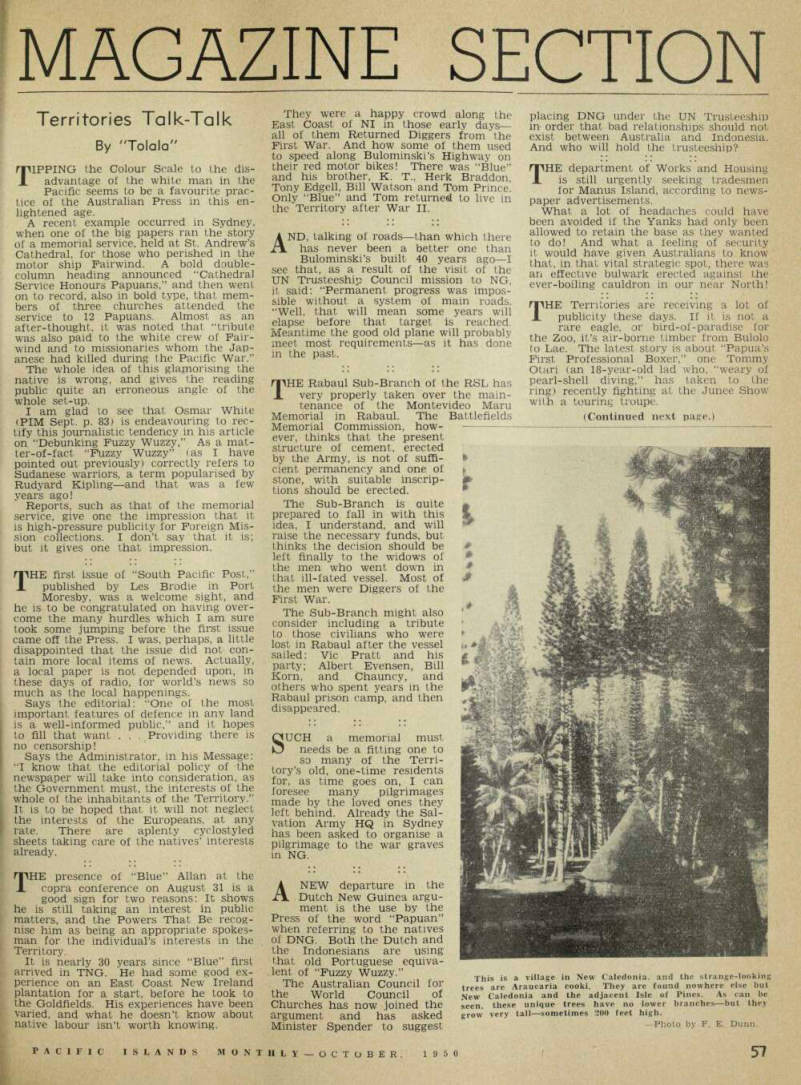
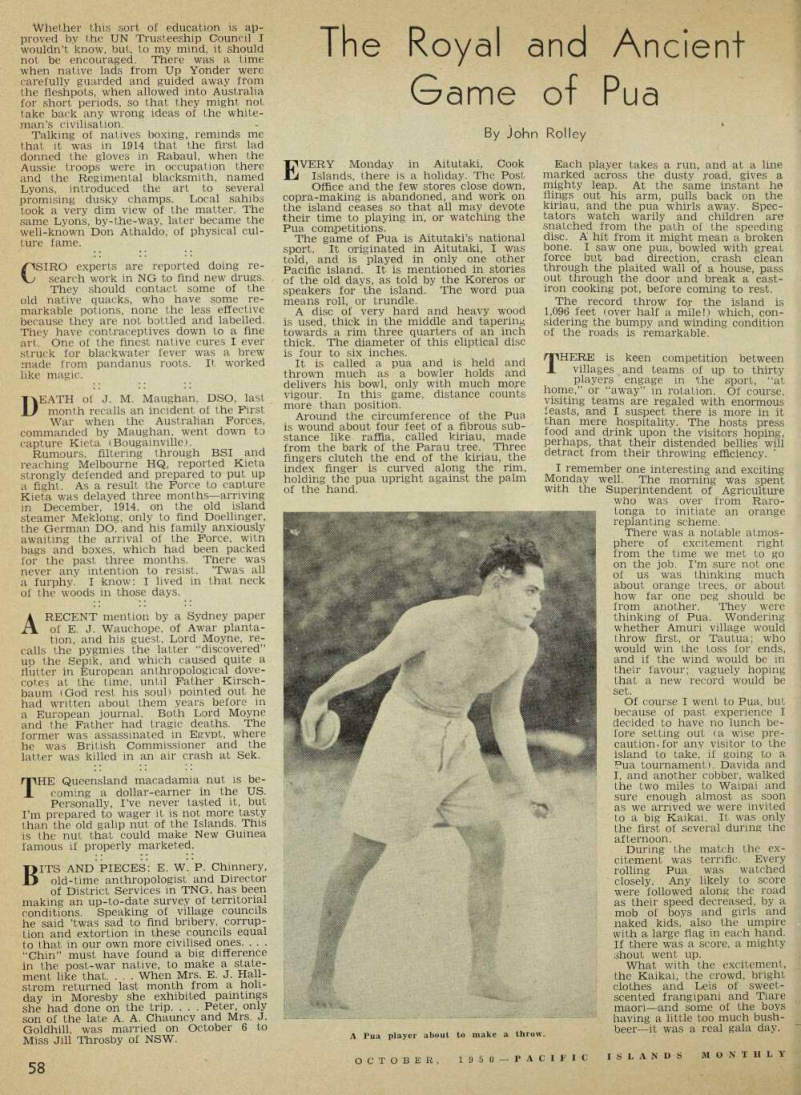
Territories Talk-Talk
By "Tolala"
TIPPING the Colour Scale to the dis advantage of the white man in the Pacific seems to be a favourite prac tice of the Australian Press in this en
lightened age.
A recent example occurred in Sydney, when one of the big papers ran the story of a memorial service, held at St. Andrew’s Cathedral, for those who perished in the motor ship Fairwind. A bold double column heading announced “Cathedral Service Honours Papuans,” and then went on to record, also in bold type, that mem bers of three churches attended the service to 12 Papuans. Almost as an after-thought, it was noted that “tribute was also paid to the white crew of Fair wind and to missionaries whom the Jap anese had killed during the Pacific War.”
The whole idea of this glamorising the native is wrong, and gives the reading public quite an erroneous angle of the whole set-up.
I am glad to see that Osmar White (PIM Sept. p. 83) is endeavouring to rec tify this journalistic tendency in his article on “Debunking Fuzzy Wuzzy,” As a mat ter-of-fact “Fuzzy Wuzzy” (as I have pointed out previously) correctly refers to Sudanese warriors, a term popularised by Rudyard Kipling—and that was a few years ago!
Reports, such as that of the memorial service, give one the impression that it is high-pressure publicity for Foreign Mis sion collections. I don’t say that it is; but it gives one that impression.
THE first issue of “South Pacific Post,” published by Les Brodie in Port Moresby, was a welcome sight, and he is to be congratulated on having over come the many hurdles which I am sure took some jumping before the first issue came off the Press. I was, perhaps, a little disappointed that the issue did not con tain more local items of news. Actually, a local paper is not depended upon, in these days of radio, for world’s news so much as the local happenings.
Says the editorial: “One of the most important features of defence in any land is a well-informed public,” and it hopes to fill that want . . . Providing there is no censorship!
Says the Administrator, in his Message; “I know that the editorial policy of the newspaper will take into consideration, as the Government must, the interests of the whole of the inhabitants of the Territory.”
It is to be hoped that it will not neglect the interests of the Europeans, at any rate. There are aplenty cyclostyled sheets taking care of the natives’ interests already.
THE presence of “Blue” Allan at the copra conference on August 31 is a good sign for two reasons: It shows he is still taking an interest in public matters, and the Powers That Be recog nise him as being an appropriate spokes man for the individual’s interests in the Territory.
It is nearly 30 years since “Blue” first arrived in TNG. He had some good ex perience on an East Coast New Ireland plantation for a start, before he took to the Goldfields. His experiences have been varied, and what he doesn’t know about native labour isn’t worth knowing.
They were a happy crowd along the East Coast of NI in those early days— all of them Returned Diggers from the First War. And how some of them used to speed along Bulominski’s Highway on their red motor bikes! There was “Blue” and his brother, K. T., Herk Braddon, Tony Edgell, Bill Watson and Tom Prince.
Only “Blue” and Tom returned to live in the Territory after War 11.
AND, talking of roads —than which there has never been a better one than Bulominski’s built 40 years ago—l see that, as a result of the visit of the UN Trusteeship Council mission to NG, it said: “Permanent progress was impos sible without a system of main roads.
“Well, that will mean some years will elapse before that target is reached.
Meantime the good old plane will probably meet most requirements—as it has done in the past.
THE Rabaul Sub-Branch of the RSL has very properly taken over the main tenance of the Montevideo Maru Memorial in Rabaul. The Battlefields
Memorial Commission, how ever, thinks that the present structure of cement, erected by the Army, is not of suffi cient permanency and one of stone, with suitable inscrip tions should be erected.
The Sub-Branch is quite prepared to fall in with this idea, I understand, and will raise the necessary funds, but thinks the decision should be left finally to the widows of the men who went down in that ill-fated vessel. Most of the men were Diggers of the First War.
The Sub-Branch might also consider including a tribute to those civilians who were lost in Rabaul after the vessel sailed: Vic Pratt and his party; Albert Evensen, Bill Korn, and Chauncy, and others who spent years in the Rabaul prison camp, and then disappeared.
SUCH a memorial must needs be a fitting one to so many of the Terri tory’s old, one-time residents for, as time goes on, I can foresee many pilgrimages made by the loved ones they left behind. Already the Sal vation Army HQ in Sydney has been asked to organise a pilgrimage to the war graves in NG.
ANEW departure in the Dutch New Guinea argu ment is the use by the Press of the word “Papuan” when referring to the natives of DNG. Both the Dutch and the Indonesians are using that old Portuguese equiva lent of “Fuzzy Wuzzy.”
The Australian Council for the World Council of Churches has now joined the argument and has asked Minister Spender to suggest
placing DNG under the UN Trusteeship in order that bad relationships should not exist between Australia and Indonesia.
And who will hold the trusteeship?
THE department of Works and Housing is still urgently seeking tradesmen for Manus Island, according to news paper advertisements.
What a lot of headaches could have been avoided if the Yanks had only been allowed to retain the base as they wanted to do! And what a feeling of security it would have given Australians to know that, in that vital strategic spot, there was an effective bulwark erected against the ever-boiling cauldron in our near North!
THE Territories are receiving a lot of publicity these days. If it is not a rare eagle, or bird-of-paradise for the Zoo, it’s air-borne timber from Bulolo to Lae. The latest story is about “Papua’s First Professional Boxer,” one Tommy Otari (an 18-year-old lad who, “weary of pearl-shell diving,” has taken to the ring) recently fighting at the Junee Show with a touring troupe.
(Continued next page.)
This is a village in New Caledonia, and the strange-looking trees are Araucaria cooki. They are found nowhere else but New Caledonia and the adjacent Isle of Pines. As can be seen, these unique trees have no lower branches—but they grow very tall—sometimes 200 feet high.
Photo by F. E. Dunn.
Whether this sort of education is ap proved by the UN Trusteeship Council I wouldn’t know, but, to my mind, it should not be encouraged. There was a time when native lads from Up Yonder were carefully guarded and guided away from the fleshpots, when allowed into Australia for short periods, so that they might not take back any wrong ideas of the white man’s civilisation.
Talking of natives boxing, reminds me that it was in 1914 that the first lad donned the gloves in Rabaul. when the Aussie troops were in occupation there and the Regimental blacksmith, named Lyons, introduced the art to several promising dusky champs. Local sahibs took a very dim view of the matter. The same Lyons, by-the-way, later became the well-known Don Athaldo, of physical cul ture fame.
CSIRO experts are reported doing re search work in NG to find new drugs.
They should contact some of the old native quacks, who have some re markable potions, none the less effective because they are not bottled and labelled.
They have contraceptives down to a fine art. One of the finest native cures I ever struck for blackwater fever was a brew made from pandanus roots. It worked like magic.
DEATH of J. M. Maughan, DSO, last month recalls an incident of the First War when the Australian Forces, commanded by Maughan, went down to capture Kieta (Bougainville).
Rumours, filtering through BSI and reaching Melbourne HQ, reported Kieta strongly defended and prepared to put up a fight. As a result the Force to capture Kieta was delayed three months—arriving in December, 1914, on the old island steamer Meklong, only to find Doellinger, the German DO. and his family anxiously awaiting the arrival of the Force, with bags and boxes, which had been packed for the past three months. There was never any intention to resist. ’Twas all a furphy. I know: I lived in that neck of the woods in those days.
A RECENT mention by a Sydney paper of E. J. Wauchope, of Awar planta tion, and his guest, Lord Moyne, re calls the pygmies the latter “discovered” un the Sepik, and which caused quite a flutter in European anthropological dove cotes at the time, until Father Kirsch baum (God rest his soul) pointed out he had written about them years before in a European journal. Both Lord Moyne and the Father had tragic deaths. The former was assassinated in Egvpt. where he was British Commissioner and the latter was killed in an air crash at Sek.
THE Queensland macadamia nut is be coming a dollar-earner in the US.
Personally, I’ve never tasted it, but I’m prepared to wager it is not more tasty than the old galip nut of the Islands. This is the nut that could make New Guinea famous if properly marketed.
BITS AND PIECES: E. W. P. Chinnery, old-time anthropologist and Director of District Services in TNG, has been making an up-to-date survey of territorial conditions. Speaking of village councils he said ’twas sad to find bribery, corrup tion and extortion in these councils equal to that in our own more civilised ones. . . .
“Chin” must have found a big difference in the post-war native, to make a state ment like that. . . . When Mrs. E. J. Hall strom returned last month from a holi day in Moresby she exhibited paintings she had done on the trip. . . . Peter, only son of the late A. A. Chauncy and Mrs. J.
Goldhill. was married on October 6 to Miss Jill Throsby of NSW.
The Royal and Ancient
Game of Pua
By John Rolley
EVERY Monday in Aitutaki, Cook Islands, there is a holiday. The Post Office and the few stores close down, copra-making is abandoned, and work on the island ceases so that all may devote their time to playing in, or watching the Pua competitions.
The game of Pua is Aitutaki’s national sport. It originated in Aitutaki, I was told, and is played in only one other Pacific island. It is mentioned in stories of the old days, as told by the Koreros or speakers for the island. The word pua means roll, or trundle.
A disc of very hard and heavy wood is used, thick in the middle and tapering towards a rim three quarters of an inch thick. The diameter of this eliptical disc is four to six inches.
It is called a pua and is held and thrown much as a bowler holds and delivers his bowl, only with much more vigour. In this game, distance counts more than position.
Around the circumference of the Pua is wound about four feet of a fibrous sub stance like raffia, called kiriau, made from the bark of the Parau tree. Three fingers clutch the end of the kiriau, the index finger is curved along the rim, holding the pua upright against the palm of the hand.
Each player takes a run, and at a line marked across the dusty road, gives a mighty leap. At the same instant he flings out his arm, pulls back on the ki.riau, and the pua whirls away. Spec tators watch warily and children are snatched from the path of the speeding disc. A hit from it might mean a broken bone. I saw one pua, bowled with great force but bad direction, crash clean through the plaited wall of a house, pass out through the door and break a cast iron cooking pot, before coming to rest.
The record throw for the island is 1,096 feet (over half a mile!) which, con sidering the bumpy and winding condition of the roads is remarkable.
INHERE is keen competition between villages and teams of up to thirty players engage in the sport, “at home,’’ or “away” in rotation. Of course, visiting teams are regaled with enormous feasts, and I suspect there is more in it than mere hospitality. The hosts press food and drink upon the visitors hoping, perhaps, that their distended bellies will detract from their throwing efficiency. ' I remember one interesting and exciting Monday well. The morning was spent with the Superintendent of Agriculture
who was over from Raro tonga to initiate an orange replanting scheme.
There was a notable atmos phere of excitement right from the time we met to go on the job. I’m sure not one of us was thinking much about orange trees, or about how far one peg should be from another. They were thinking of Pua. Wondering whether Amuri village would throw first, or Tautua; who would win the toss for ends, and if the wind would be in their favour; vaguely hoping that a new record would be set.
Of course I went to Pua, but because of past experience I decided to have no lunch be fore setting out (a wise pre caution, for any visitor to the island to take, if going to a Pua tournament). Davida and I, and another cobber, walked the two miles to Waipai and sure enough almost as soon as we arrived we were invited to a big Kaikai. It was only the first of several during the afternoon.
During the match the ex citement was terrific. Every rolling Pua was watched closely. Any likely to score were followed along the road as their speed decreased, by a mob of boys and girls and naked kids, also the umpire with a large flag in each hand.
If there was a score, a mighty shout went up.
What with the excitement, the Kaikai, the crowd, bright clothes and Leis of sweet scented frangipani and Tiare maori—and some of the boys having a little too much bush beer —it was a real gala day.
A Pua player about to make a throw.
Panic In The Place
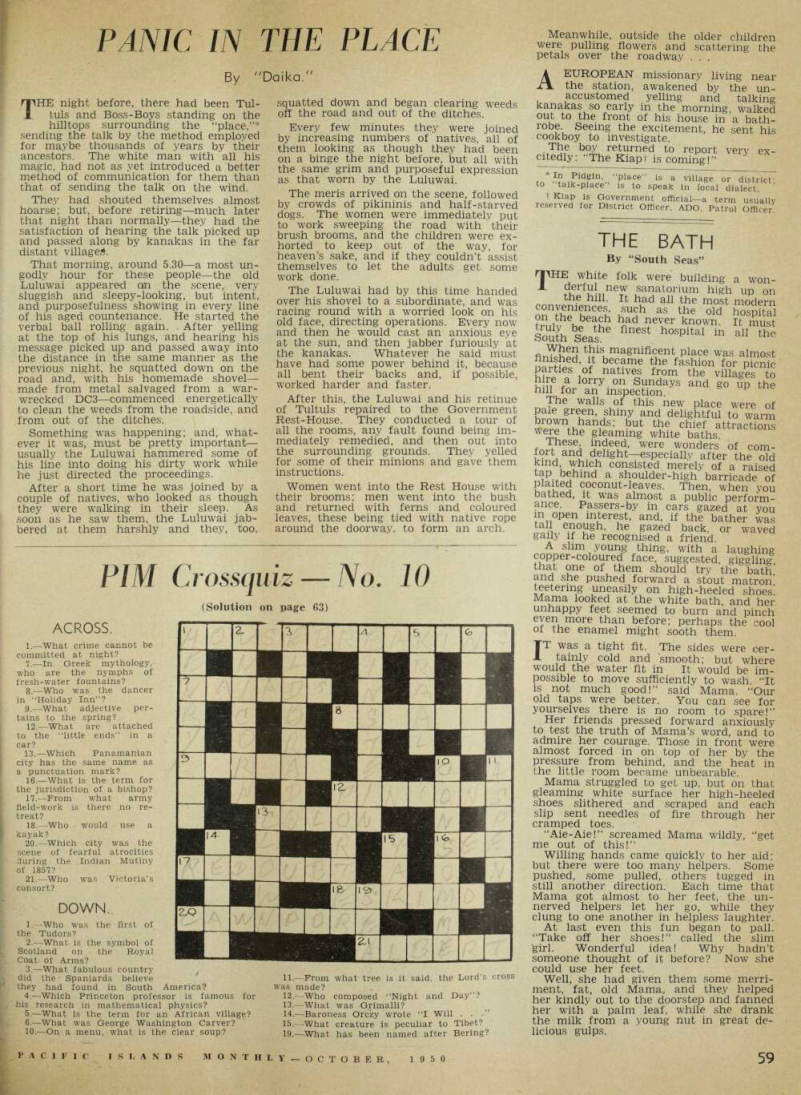
By "Daika."
THE night before, there had been Tul tuls and Boss-Boys standing on the hilltops surrounding the “place,”* sending the talk by the method employed for maybe thousands of years by their ancestors. The white man with all his magic, had not as yet introduced a better method of communication for them than that of sending the talk on the wind.
They had shouted themselves almost hoarse; but, before retiring—much later that night than normally—they had the satisfaction of hearing the talk picked up and passed along by kanakas in the far distant village^.
That morning, around 5.30—a most un godly hour for these people—the old Luluwai appeared on the scene, very sluggish and sleepy-looking, but intent, and purposefulness showing in every line of his aged countenance. He started the verbal ball rolling again. After yelling at the top of his lungs, and hearing his message picked up and passed away into the distance in the same manner as the previous night, he squatted down on the road and, with his homemade shovel— made from metal salvaged from a war wrecked DC3 —commenced energetically to clean the weeds from the roadside, and from out of the ditches.
Something was happening; and, what ever it was, must be pretty important— usually the Luluwai hammered some of his line into doing his dirty work while he just directed the proceedings.
After a short time he was joined by a couple of natives, who looked as though they were walking in their sleep. As soon as he saw them, the Luluwai jab bered at them harshly and they, too,
squatted down and began clearing weeds off the road and out of the ditches.
Every few minutes they were joined by increasing numbers of natives, all of them looking as though they had been on a binge the night before, but all with the same grim and purposeful expression as that worn by the Luluwai.
The meris arrived on the scene, followed by crowds of pikininis and half-starved dogs. The women were immediately put to work sweeping the road with their brush brooms, and the children were ex horted to keep out of the way, for heaven’s sake, and if they couldn’t assist themselves to let the adults get some work done.
The Luluwai had by this time handed over his shovel to a subordinate, and was racing round with a worried look on his old face, directing operations. Every now and then he would cast an anxious eye at the sun, and then jabber furiously at the kanakas. Whatever he said must have had some power behind it, because all bent their backs and, if possible, worked harder and faster.
After this, the Luluwai and his retinue of Tultuls repaired to the Government Rest-House. They conducted a tour of all the rooms, any fault found being im mediately remedied, and then out into the surrounding grounds. They yelled for some of their minions and gave them instructions.
Women went into the Rest House with their brooms: men went into the bush and returned with ferns and coloured leaves, these being tied with native rope around the doorway, to form an arch.
PIM Crossquiz -No. 10
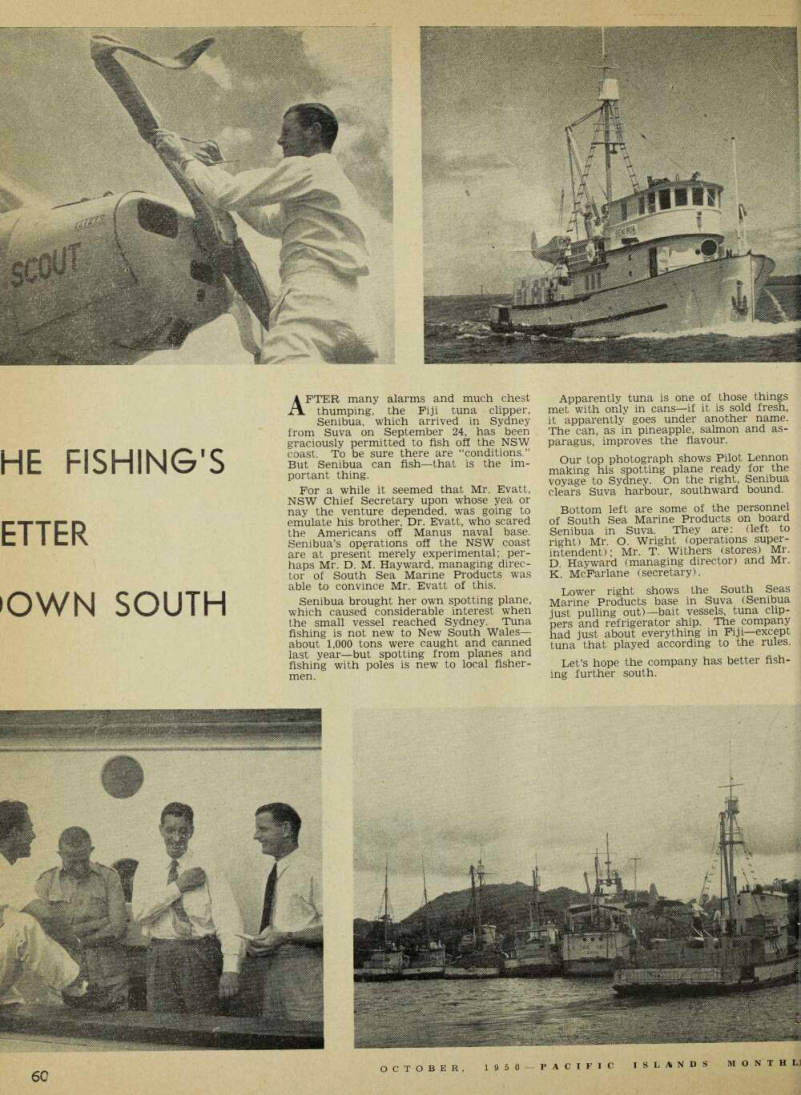
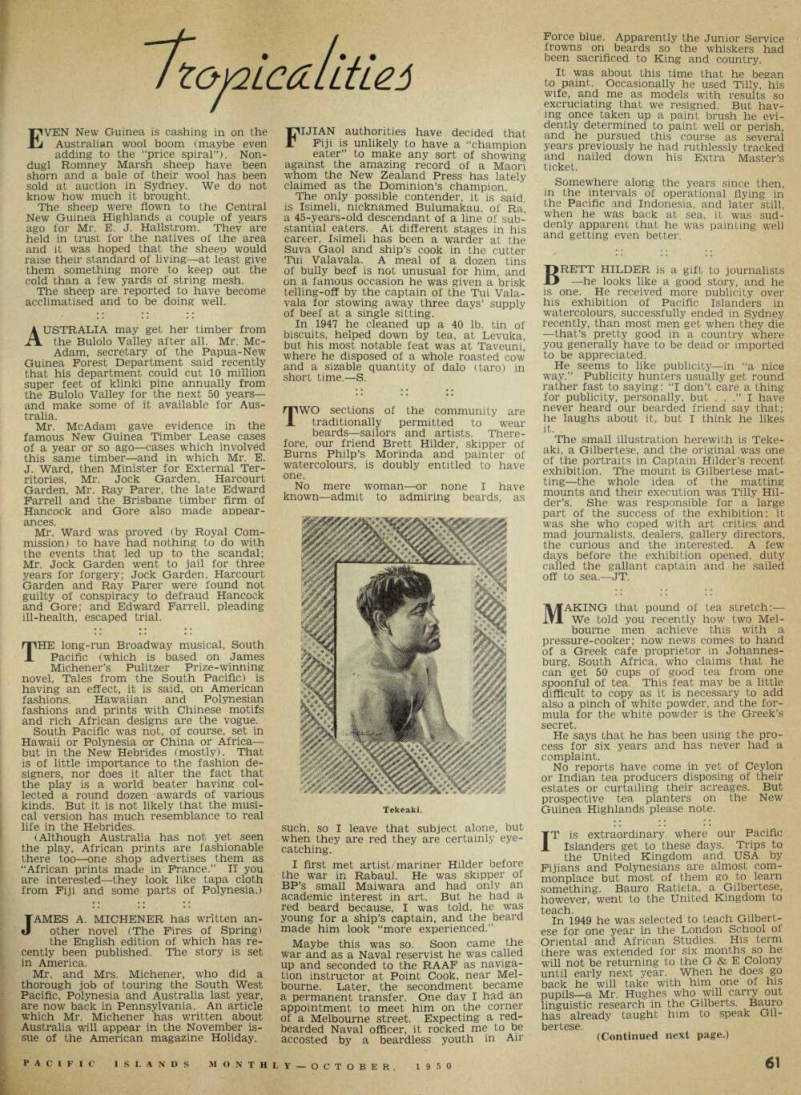
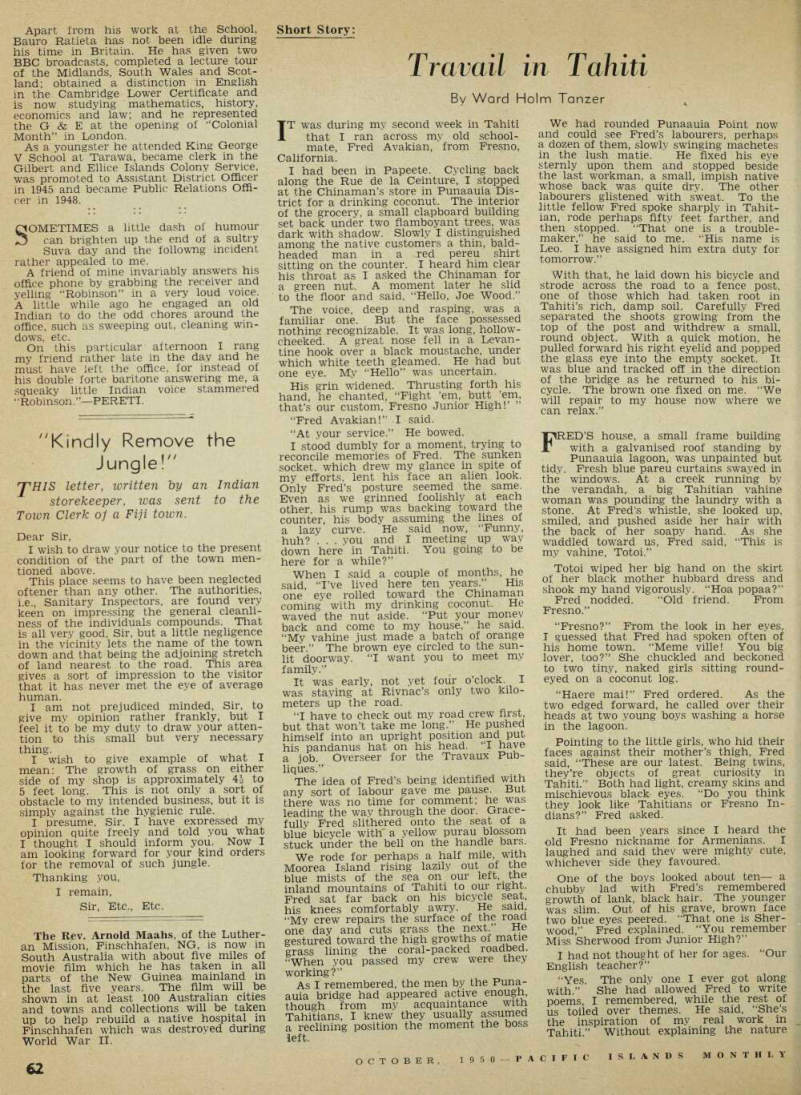
(Solution on page 63)
Across.
I.—What crime cannot be committed at night? 7. In Greek mythology, who are the nymphs of fresh-water fountains? 8. —Who was the dancer in “Holiday Inn”? 9. —What adjective per tains to the spring? 12, —What are attached to the “little ends” in a car? 13. —Which Panamanian city has the same name as a punctuation mark? 16. —What is the term for the jurisdiction of a bishop? 17. From what army field-work is there no re treat? 18. Who would use a kayak? 20. —-Which city was the scene of fearful atrocities during the Indian Mutiny of 1857? 21. —Who was Victoria’s consort?
Down.
I.—Who was the first of the Tudors? 2—What is the symbol of Scotland on the Royal Coat of Arms? 3. —What fabulous country did the Spaniards believe
they had found in South America? 4. —Which Princeton professor is famous for his research in mathematical physics? 5. —What is the term for an African village? 6. —What was George Washington Carver? 10.—On a menu, what is the clear soup?
11. —From what tree is it said, the Lord’s cross was made? 12. —Who composed “Night and Day”? 13. —What was Grimalli? 14. —Baroness Orczy wrote “I Will . . •” 15. —What creature is peculiar to Tibet? 19. —What has been named after Bering?
Meanwhile, outside the older children were pulling flowers and scattering the petals over the roadway . .
A EUROPEAN missionary living near the station, awakened by the un accustomed yelling and talking kanakas so early in the morning, walked out to the front of his house in a bath robe Seeing the excitement, he sent his cookboy to investigate.
The boy returned to report verv ex citedly: “The Kiapt is coming!” t * Ql v ld P n ’,, ‘‘P lace ” is a village or district; to talk-place is to speak in local dialect. t Kiap is Government official—a term usually reserved ior District Officer. ADO. Patrol Officer
Solution to Crossquiz on page 59
The Bath
By “South Seas”
THE white folk were building a won fLerf^,, new sanatorium high up on the hill. It had all the most modern conveniences, such as the old hospital trulv h6 J? e ?i£ n ad ? 6V vf r known - Tt must South seas flneSt hoSpltal in all the this magnificent place was almost be( ? me tbe fashion for picnic parties of natives from the villages to hiu 6 fnr ° rry • on S^ nda ys and go up the hill for an inspection.
The walls of this new place were of green, shiny and delightful to warm wpr! th? n i ds; bllt t t e chief attractions were the gleaming white baths. i nd . e ed- were wonders of com and delight—especially after the old f md > which consisted merely of a raised tap behmd a shoulder-high barricade of piaited coconut-leaves. Then, when you bathed, it was almost a public perform ance. Passers-by in cars gazed at vou in open interest, and, if the bather was tall enough, he gazed back, or waved gaily if he recognised a friend.
A slim young thing, with a laughing copper-coloured face, suggested, giggling, that ? ne of them should try the bath and she pushed forward a stout matron’ teetering uneasily on high-heeled shoes.
Mama looked at the white bath, and her unhappy feet seemed to burn and pinch even more than before; perhaps the cool of the enamel might sooth them.
IT was a tight fit. The sides were cer tainly cold and smooth; but where would the water fit in It would be im possible to move sufficiently to wash “It is not much good!” said Mama. “Our old taps were better. You can see for yourselves there is no room to spare'”
Her friends pressed forward anxiously to test the truth of Mama’s word, and to admire her courage. Those in front were almost forced in on top of her by the pressure from behind, and the heat in the little room became unbearable.
Mama struggled to get up, but on that gleaming white surface her high-heeled shoes slithered and scraped and each slip sent needles of fire through her cramped toes.
“Aie-Aie!” screamed Mama wildly, “get me out of this!”
Willing hands came quickly to her aid; but there were too many helpers. Some pushed, some pulled, others tugged in still another direction. Each time that Mama got almost to her feet, the un nerved helpers let her go, while they clung to one another in helpless laughter.
At last even this fun began to pall.
“Take off her shoes!” called the slim ‘girl. Wonderful idea! Why hadn’t someone thought of it before? Now she could use her feet.
Well, she had given them some merri ment, fat, old Mama, and they helped her kindly out to the doorstep and fanned her with a palm leaf, while she drank the milk from a young nut in great de licious gulps.
The Fishing's
Better
[?]Own South
AFTER many alarms and much chest thumping, the Fiji tuna clipper, Senibua, which arrived in Sydney from Suva on September 24, has been graciously permitted to fish off the NSW
Buf senfbua 6 can fish-that -
nnint n th portant thing.
For a while it seemed that Mr. Evatt, NSW Chief Secretary upon whose yea or nay the venture depended, was going to emulate his brother, Dr. Evatt, who scared the Americans off Manus naval base.
Senibua’s operations off the NSW coast are at present merely experimental; perhaps Mr. D. M. Hayward, managing director of South Sea Marine Products was able to convince Mr. Evatt of this.
Senibua brought her own spotting plane, which caused considerable interest when the small vessel reached Sydney. Tuna fishing is not new to New South Wales— about 1,000 tons were caught and canned last year—but spotting from planes and fishing with poles is new to local fishermen.
Apparently tuna is one of those things met with only in cans—if it is sold fresh, it apparently goes under another name, The can, as in pineapple, salmon and as paragus, improves the flavour.
Our top photograph shows Pilot Lennon making his spotting plane ready for the voyage to Sydney. On the right, Senibua clears Suva harbour, southward bound. „ , Bottom left are some of the personnel of South Sea Marine Products on board Senibua in Suva. They are: (leit to right) Mr. O. Wright (operations super intendent); Mr. T. Withers (stores) Mi.
D. Hayward (managing director) and Mi.
K. McFarlane (secretary), Lower right shows the South Seas Marine Products base in Suva (Senibua j ust pulling out)—bait vessels, tuna clip pers an d refrigerator ship. The company h a( j j US t about everything in Fiji—except tuna that played according to the rules, , , Let’s hope the company has better fish ing further south.
Advertisements & other items, p. 62 (1 item)
60
OCTOBER, 1950 PACIFIC ISLANDS MONTH LJ
Tropicalities
EVEN New Guinea is cashing in on the Australian wool boom (maybe even adding to the “price spiral”). Non dugl Romney Marsh sheep have been shorn and a bale of their wool has been sold at auction in Sydney. We do not know how much it brought.
The sheep were flown to the Central New Guinea Highlands a couple of years ago for Mr. E. J. Hallstrom. They are held in trust for the natives of the area and it was hoped that the sheeo would raise their standard of living—at least give them something more to keep out the cold than a few yards of string mesh.
The sheep are reported to have become acclimatised and to be doing well.
AUSTRALIA may get her timber from the Bulolo Valley after all. Mr. Mc- Adam, secretary of the Papua-New Guinea Forest Department said recently that his department could cut 10 million super feet of klinki pine annually from the Bulolo Valley for the next 50 years— and make some of it available for Aus tralia.
Mr. McAdam gave evidence in the famous New Guinea Timber Lease cases of a year or so ago—cases which involved this same timber —and in which Mr. E.
J. Ward, then Minister for External Ter ritories, Mr. Jock Garden. Harcourt Garden, Mr. Ray Parer, the late Edward Farrell and the Brisbane timber firm of Hancock and Gore also made appear ances.
Mr. Ward was proved (by Royal Com mission) to have had nothing to do with the events that led up to the scandal; Mr. Jock Garden went to jail for three years for forgery; Jock Garden, Harcourt Garden and Ray Parer were found not guilty of conspiracy to defraud Hancock and Gore; and Edward Farrell, pleading ill-health, escaped trial.
THE long-run Broadway musical, South Pacific (which is based on James Michener’s Pulitzer Prize-winning novel, Tales from the South Pacific) is having an effect, it is said, on American fashions. Hawaiian and Polynesian fashions and prints with Chinese motifs and rich African designs are the vogue.
South Pacific was not, of course, set in Hawaii or Polynesia or China or Africa — but in the New Hebrides (mostly). That is of little importance to the fashion de signers, nor does it alter the fact that the play is a world beater having col lected a round dozen awards of various kinds. But it is not likely that the musi cal version has much resemblance to real life in the Hebrides. (Although Australia has not yet seen the play, African prints are fashionable there too —one shop advertises them as “African prints made in France.” If you are interested—they look like tapa cloth from Fiji and some parts of Polynesia.) JAMES A. MICHENER has written an other novel (The Fires of Spring) the English edition of which has re cently been published. The story is set in America.
Mr. and Mrs. Michener, who did a thorough job of touring the South West Pacific, Polynesia and Australia last year, are now back in Pennsylvania. An article which Mr. Michener has written about Australia will appear in the November is sue of the American magazine Holiday.
FIJIAN authorities have decided that Fiji is unlikely to have a “champion eater” to make any sort of showing against the amazing record of a Maori whom the New Zealand Press has lately claimed as the Dominion’s champion.
The only possible contender, it is said, is Isimeli, nicknamed Bulumakau. of Ra, a 45-years-old descendant of a line of sub stantial eaters. At different stages in his career, Isimeli has been a warder at the Suva Gaol and ship’s cook in the cutter Tui Valavala. A meal of a dozen tins of bully beef is not unusual for him, and on a famous occasion he was given a brisk telling-off by the captain of the Tui Vala vala for stowing away three days’ supply of beef at a single sitting.
In 1947 he cleaned up a 40 lb. tin of biscuits, helped down by tea, at Levuka, but his most notable feat was at Taveuni, where he disposed of a whole roasted cow and a sizable quantity of dalo (taro) in
short time.-
s.
TWO sections of the community are traditionally permitted to wear beards—sailors and artists. There fore, our friend Brett Hilder, skipper of Burns Philp’s Morinda and painter of watercolours, is doubly entitled to have one.
No mere woman—or none I have known—admit to admiring beards, as
such, so I leave that subject alone, but when they are red they are certainly eye
catching.
I first met artist/mariner Hilder before the war in Rabaul. He was skipper of BP’s small Maiwara and had only an academic interest in art. But he had a red beard because, I was told, he was young for a ship’s captain, and the beard made him look “more experienced.”
Maybe this was so. Soon came the war and as a Naval reservist he was called up and seconded to the RAAF as naviga tion instructor at Point Cook, near Mel bourne. Later, the secondment became a permanent transfer. One day I had an appointment to meet him on the corner of a Melbourne street. Expecting a red bearded Naval officer, it rocked me to be accosted by a beardless youth in Air
Force blue. Apparently the Junior Service frowns on beards so the whiskers had been sacrificed to King and country.
It was about this time that he began to paint. Occasionally he used Tilly, his wife, and me as models with results so excruciating that we resigned. But hav ing once taken up a paint brush he evi dently determined to paint well or nerish, and he pursued this course as several years previously he had ruthlessly tracked and nailed down his Extra Master’s ticket.
Somewhere along the years since then, in the intervals of operational flying in the Pacific and Indonesia, and later still, when he was back at sea, it was sud denly apparent that he was painting well and getting even better.
BRETT HILDER is a gift to journalists —he looks like a good story, and he is one. He received more publicity over his exhibition of Pacific Islanders in watercolours, successfully ended in Sydney recently, than most men get when they die —that’s pretty good in a country where you generally have to be dead or imported to be appreciated.
He seems to like publicity—in “a nice way.” Publicity hunters usually get round rather fast to saying; “I don’t care a thing for publicity, personally, but . . .” I have never heard our bearded friend say that; he laughs about it, but I think he likes it.
The small illustration herewith is Teke aki, a Gilbertese, and the original was one of the portraits in Captain Hilder’s recent exhibition. The mount is Gilbertese mat ting—the whole idea of the matting mounts and their execution was Tilly Hil der’s. She was responsible for a large part of the success of the exhibition: it was she who coped with art critics and mad journalists, dealers, gallery directors, the curious and the interested. A few days before the exhibition opened, duty called the gallant captain and he sailed
off to sea.
JT.
MAKING that pound of tea stretch;— We told you recently how two Mel bourne men achieve this with a pressure-cooker; now news comes to hand of a Greek cafe proprietor in Johannes burg, South Africa, who claims that he can get 50 cups of good tea from one spoonful of tea. This feat may be a little difficult to copy as it is necessary to add also a pinch of white powder, and the for mula for the white powder is the Greek’s secret He says that he has been using the pro cess for six years and has never had a complaint.
No reports have come in yet of Ceylon or Indian tea producers disposing of their estates or curtailing their acreages. But prospective tea planters on the New Guinea Highlands please note.
IT is extraordinary, where our Pacific Islanders get to these days. Trips to the United Kingdom and USA by Fijians and Polynesians are almost com monplace but most of them go to learn something. Bauro Ratieta, a Gilbertese, however, went to the United Kingdom to In 1949 he was selected to teach Gilbert ese for one year in the London School of Oriental and African Studies. His term there was extended for six months so he will not be returning to the G & E Colony until early next year. When he does go back he will take with him one of his pupils—a Mr. Hughes who will carry out linguistic research in the Gilberts. Bauro has already taught him to speak Gil bertese. (Continued next page.)
Tekeaki.
Apart from his work at the School, Bauro Ratieta has not been idle during his time in Britain. He has given two BBC broadcasts, completed a lecture tour of the Midlands, South Wales and Scot land; obtained a distinction in English in the Cambridge Lower Certificate and is now studying mathematics, history, economics and law; and he represented the G & E at the opening of “Colonial Month” in London.
As a youngster he attended King George V School at Tarawa, became clerk in the Gilbert and Ellice Islands Colony Service, was promoted to Assistant District Officer in 1945 and became Public Relations Offi cer in 1948.
SOMETIMES a little dash of humour can brighten up the end of a sultry Suva day and the followng incident rather appealed to me.
A friend of mine invariably answers his office phone by grabbing the receiver and yelling “Robinson” in a very loud voice.
A little while ago he engaged an old Indian to do the odd chores around the office, such as sweeping out, cleaning win dows, etc.
On this particular afternoon I rang my friend rather late in the day and he must have left the office, for instead of his double forte baritone answering me, a squeaky little Indian voice stammered
“Robinson.”-
Pereti.
Jungle!"
"Kindly Remove the Jungle!"
J'HIS letter, written by an Indian
storekeeper, was sent to the Town Clerk of a Fiji town.
Dear Sir, I wish to draw your notice to the present condition of the part of the town men tioned above.
This place seems to have been neglected oftener than any other. The authorities, i.e., Sanitary Inspectors, are found very keen on impressing the general cleanli ness of the individuals compounds. That is all very good, Sir, but a little negligence in the vicinity lets the name of the town down and that being the adjoining stretch of land nearest to the road. This area gives a sort of impression to the visitor that it has never met the eye of average human.
I am not prejudiced minded, Sir, to give my opinion rather frankly, but I feel it to be my duty to draw your atten tion to this small but very necessary thing. I wish to give example of what I mean; The growth of grass on either side of my shop is approximately 4J to 5 feet long. This is not only a sort of obstacle to my intended business, but it is simplv against the hygienic rule.
I presume, Sir. I have expressed my opinion quite freely and told you what I thought I should inform you. Now I am looking forward for your kind orders for the removal of such jungle.
Thanking you, I remain,
Sir, Etc., Etc.
The Rev. Arnold Maahs, of the Luther an Mission, Finschhafen, NG, is now in South Australia with about five miles of movie film which he has taken in all parts of the New Guinea mainland in the last five years. The film will be shown in at least 100 Australian cities and towns and collections will be taken up to help rebuild a native hospital in Finschhafen which was destroyed during World War IT.
Travail in Tahiti
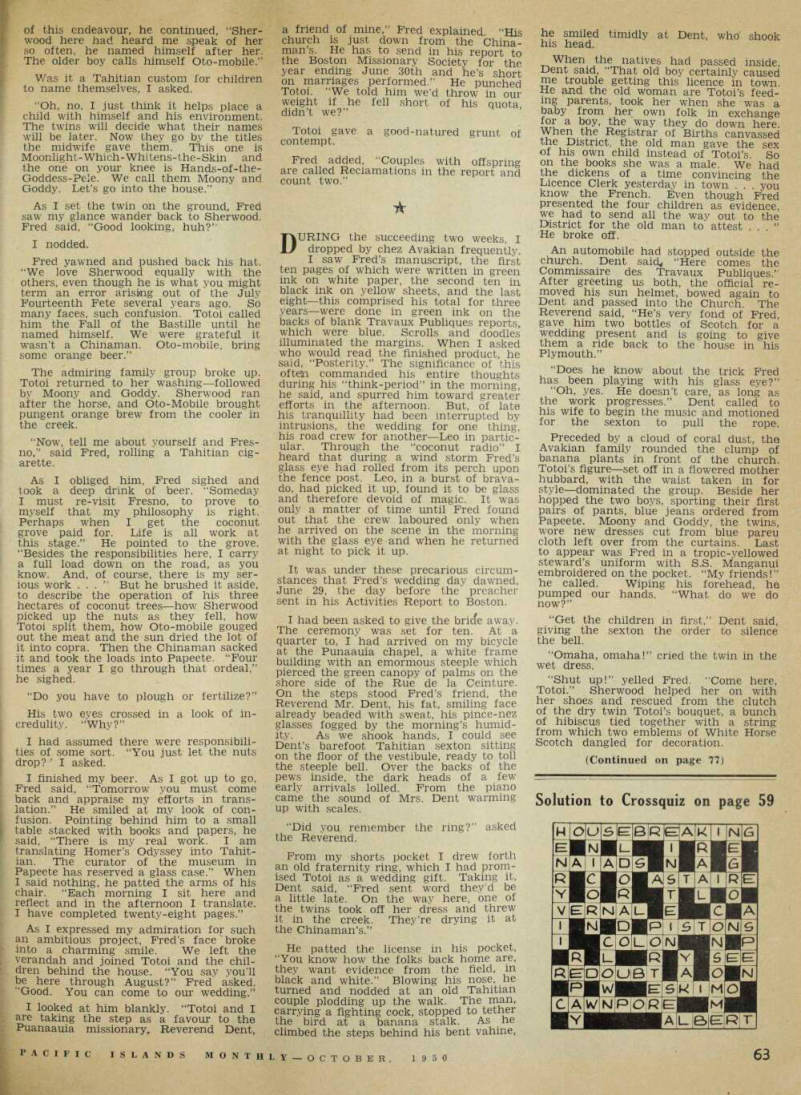
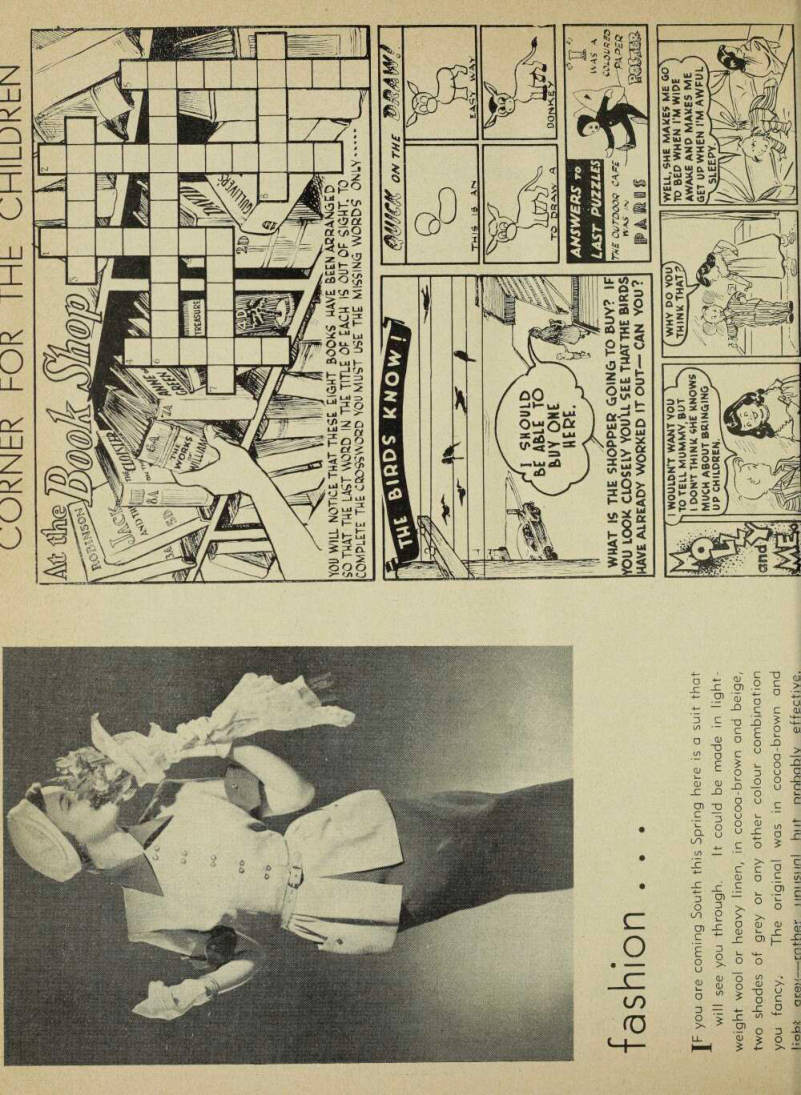
Short Story:
By Ward Holm Tanzer
IT was during my second week in Tahiti that I ran across my old school mate, Fred Avakian, from Fresno, California.
I had been in Papeete. Cycling back along the Rue de la Ceinture, I stopped at the Chinaman’s store in Punaauia Dis trict for a drinking coconut. The interior of the grocery, a small clapboard building set back under two flamboyant trees, was dark with shadow. Slowly I distinguished among the native customers a thin, bald headed man in a red pereu shirt sitting on the counter. I heard him clear his throat as I asked the Chinaman for a green nut. A moment later he slid to the floor and said, “Hello, Joe Wood.”
The voice, deep and rasping, was a familiar one. But the face possessed nothing recognizable. It was long, hollow cheeked. A great nose fell in a Levan tine hook over a black moustache, under which white teeth gleamed. He had but one eye. My “Hello” was uncertain.
His grin widened. Thrusting forth his hand, he chanted, “Fight ’em, butt ’em, that’s our custom, Fresno Junior High!’ ”
“Fred Avakian!” I said.
“At your service.” He bowed.
I stood dumbly for a moment, trying to reconcile memories of Fred. The sunken socket, which drew my glance in spite of my efforts, lent his face an alien look.
Only Fred’s posture seemed the same.
Even as we grinned foolishly at each other, his rump was backing toward the counter, his body assuming the lines of a lazy curve. He said now, “Funny, huh 9 . . . you and I meeting up way down here in Tahiti. You going to be here for a while?”
When I said a couple of months, he said, “I’ve lived here ten years.” His one eye rolled toward the Chinaman coming with my drinking coconut. He waved the nut aside. “Put your money back and come to my house,” he said.
“My vahine just made a batch of orange beer.” The brown eye circled to the sun lit doorway. “I want you to meet my family.”
It was early, not yet four o’clock. I was staying at Rivnac’s only two kilo meters up the road.
“I have to check out my road crew first, but that won’t take me long.” He pushed himself into an upright position and put his pandanus hat on his head. “I have a job. Overseer for the Travaux Pub liques.”
The idea of Fred’s being identified with any sort of labour gave me pause. But there was no time for comment; he was leading the way through the door. Grace fully Fred slithered onto the seat of a blue bicycle with a yellow purau blossom stuck under the bell on the handle bars.
We rode for perhaps a half mile, with Moorea Island rising lazily out of the blue mists of the sea on our left, the inland mountains of Tahiti to our right.
Fred sat far back on his bicycle seat, his knees comfortably awry. He said, “My crew repairs the surface of the road one day and cuts grass the next.” He gestured toward the high growths of matie grass lining the coral-packed roadbed.
“When you passed my crew were they working?”
As I remembered, the men by the Puna auia bridge had appeared active enough, though from my acquaintance with Tahitians, I knew they usually assumed a reclining position the moment the boss left.
We had rounded Punaauia Point now and could see Fred’s labourers, perhaps a dozen of them, slowly swinging machetes in the lush matie. He fixed his eye sternly upon them and stopped beside the last workman, a small, impish native whose back was quite dry. The other labourers glistened with sweat. To the little fellow Fred spoke sharply in Tahit ian, rode perhaps fifty feet farther, and then stopped. “That one is a trouble maker,” he said to me. “His name is Leo. I have assigned him extra duty for tomorrow.”
With that, he laid down his bicycle and strode across the road to a fence post, one of those which had taken root in Tahiti’s rich, damp soil. Carefully Fred separated the shoots growing from the top of the post and withdrew a small, round object. With a quick motion, he pulled forward his right eyelid and popped the glass eye into the empty socket. It was blue and tracked off in the direction of the bridge as he returned to his bi cycle. The brown one fixed on me. “We will repair to my house now where we can relax.” rED’S house, a small frame building with a galvanised roof standing by Punaauia lagoon, was unpainted but tidy. Fresh blue pareu curtains swayed in the windows. At a creek running by the verandah, a big Tahitian vahine woman was pounding the laundry with a stone. At Fred's whistle, she looked up, smiled, and pushed aside her hair with the back of her soapy hand. As she waddled toward us, Fred said, “This is my vahine, Totoi.”
Totoi wiped her big hand on the skirt of her black mother hubbard dress and shook my hand vigorously. “Hoa popaa?”
Fred nodded. “Old friend. From Fresno.”
“Fresno?” From the look in her eyes, I guessed that Fred had spoken often of his home town. “Meme ville! You big lover, too?” She chuckled and beckoned to two tiny, naked girls sitting round eyed on a coconut log.
“Haere mai!” Fred ordered. As the two edged forward, he called over their heads at two young boys washing a horse in the lagoon.
Pointing to the little girls, who hid their faces against their mother’s thigh, Fred said, “These are our latest. Being twins, they’re objects of great curiosity in Tahiti.” Both had light, creamy skins and mischievous black eyes. “Do you think they look like Tahitians or Fresno In dians?” Fred asked.
It had been years since I heard the old Fresno nickname for Armenians. I laughed and said thev were mighty cute, whichever side they favoured.
One of the boys looked about ten— a chubby lad with Fred’s remembered growth of lank, black hair. The younger was slim. Out of his grave, brown face two blue eyes peered. “That one is Sher wood,” Fred explained. “You remember Miss Sherwood from Junior High?”
I had not thought of her for ages. “Our English teacher?”
“Yes. The only one I ever got along with.” She had allowed Fred to write poems, I remembered, while the rest of us toiled over themes. He said, “She’s the inspiration of my real work in Tahiti.” Without explaining the nature
of this endeavour, he continued, “Sher wood here had heard me speak of her so often, he named himself after her.
The older boy calls himself Oto-mobile.”
Was it a Tahitian custom for children to name themselves, I asked.
“Oh, no, I just think it helps place a child with himself and his environment.
The twins will decide what their names will be later. Now they go by the titles the midwife gave them. This one is Moonlight-Which-Whitens-the-Skin and the one on your knee is Hands-of-the- Goddess-Pele. We call them Moony and Goddy. Let’s go into the house.”
As I set the twin on the ground, Fred saw my glance wander back to Sherwood.
Fred said, “Good looking, huh?”
I nodded.
Fred yawned and pushed back his hat.
“We love Sherwood equally with the others, even though he is what you might term an error arising out of the July Fourteenth Fete several years ago. So many faces, such confusion. Totoi called him the Fall of the Bastille until he named himself. We were grateful it wasn’t a Chinaman. Oto-mobile, bring some orange beer.”
The admiring family group broke up.
Totoi returned to her washing—followed by Moony and Goddy. Sherwood ran after the horse, and Oto-Mobile brought pungent orange brew from the cooler in the creek.
“Now, tell me about yourself and Fres no,” said Fred, rolling a Tahitian cig arette.
As I obliged him, Fred sighed and took a deep drink of beer. “Someday I must re-visit Fresno, to prove to myself that my philosophy is right.
Perhaps when I get the coconut grove paid for. Life is all work at this stage.” He pointed to the grove.
“Besides the responsibilities here, I carry a full load down on the road, as you know. And, of course, there is my ser ious work . . . But he brushed it aside, to describe the operation of his three hectares of coconut trees —how Sherwood picked up the nuts as they fell, how Totoi split them, how Oto-mobile gouged out the meat and the sun dried the lot of it into copra. Then the Chinaman sacked it and took the loads into Papeete. “Four times a year I go through that ordeal,” he sighed.
“Do you have to plough or fertilize?”
His two eyes crossed in a look of in credulity. “Why?”
I had assumed there were responsibili ties of some sort. “You just let the nuts drop? ’ I asked.
I finished my beer. As I got up to go, Fred said, “Tomorrow you must come back and appraise my efforts in trans lation.” He smiled at my look of con fusion. Pointing behind him to a small table stacked with books and papers, he said, “There is my real work. I am translating Homer’s Odyssey into Tahit ian. The curator of the museum in Papeete has reserved a glass case.” When I said nothing, he patted the arms of his chair. “Each morning I sit here and reflect and in the afternoon I translate, I have completed twenty-eight pages.”
As I expressed my admiration for such an ambitious project, Fred’s face broke into a charming smile. We left the verandah and joined Totoi and the chil dren behind the house. “You say you’ll be here through August?” Fred asked.
“Good. You can come to our wedding.”
I looked at him blankly. “Totoi and I are taking the step as a favour to the Puanaauia missionary. Reverend Dent,
a friend of mine,” Fred explained. “His church is just down from the China man’s. He has to send in his report to the Boston Missionary Society for the year ending June 30th and he’s short on marriages perfprmed.” He punched Totoi. “We told him we’d throw in our weight if he fell short of his quota, didn’t we?” 4 ’
Totoi gave a good-natured grunt of contempt.
Fred added, “Couples with offspring are called Reclamations in the report and count two.”
DURING the succeeding two weeks, I dropped by chez Avakian frequently.
I saw Fred’s manuscript, the first ten pages of which were written in green ink on white paper, the second ten in black ink on yellow sheets, and the last eight—this comprised his total for three years—were done in green ink on the backs of blank Travaux Publiques reports, which were blue. Scrolls and doodles illuminated the margins. When I asked who would read the finished product, he said, “Posterity.” The significance of this oftejn commanded his entire thoughts during his “think-period” in the morning, he said, and spurred him toward greater efforts in the afternoon. But, of late his tranquillity had been interrupted by intrusions, the wedding for one thing, his road crew for another —Leo in partic ular. Through the “coconut radio” I heard that during a wind storm Fred’s glass eye had rolled from its perch upon the fence post. Leo, in a burst of brava do, had picked it up, found it to be glass and therefore devoid of magic. It was only a matter of time until Fred found out that the crew laboured only when he arrived on the scene in the morning with the glass eye and when he returned at night to pick it up.
It was under these precarious circum stances that Fred’s wedding day dawned, June 29, the day before the preacher sent in his Activities Report to Boston.
I had been asked to give the bricfe away.
The ceremony was set for ten. At a quarter to, I had arrived on my bicycle at the Punaauia chapel, a white frame building with an emormous steeple which pierced the green canopy of palms on the shore side of the Rue de la Ceinture.
On the steps stood Fred’s friend, the Reverend Mr. Dent, his fat, smiling face already beaded with sweat, his pince-nez glasses fogged by the morning’s humid ity. As we shook hands, I could see Dent’s barefoot Tahitian sexton sitting on the floor of the vestibule, ready to toll the steeple bell. Over the backs of the pews inside, the dark heads of a few early arrivals lolled. From the piano came the sound of Mrs. Dent warming up with scales.
“Did you remember the ring?” asked the Reverend.
From my shorts pocket I drew forth an old fraternity ring, which I had prom ised Totoi as a wedding gift. Taking it, Dent said, “Fred sent word they’d be a little late. On the way here, one of the twins took off her dress and threw it in the creek. They’re drying it at the Chinaman’s.”
He patted the license in his pocket, “You know how the folks back home are, they want evidence from the field, in black and white.” Blowing his nose, he turned and nodded at an old Tahitian couple plodding up the walk. The man, carrying a fighting cock, stopped to tether the bird at a banana stalk. As he climbed the steps behind his bent vahine,
he smiled timidly at Dent, who shook his head.
When the natives had passed inside.
Dent said, “That old boy certainly caused me trouble getting this licence in town.
He and the old woman are Totoi’s feed ing parents, took her when she was a baby from her own folk in exchange for a way they d° down here.
When the Registrar of Births canvassed the District, the old man gave the sex of his own child instead of Totoi’s. So on the books she was a male. We had the dickens of a time convincing the Licence Clerk yesterday in town . . . you know the French. Even though Fred presented the four children as evidence, we had to send all the way out to the District for the old man to attest . . . ”
He broke off.
An automobile had stopped outside the church. Dent said* “Here comes the Commissaire des Travaux Publiques.”
After greeting us both, the official re moved his sun helmet, bowed again to Dent and passed into the Church. The Reverend said, “He’s verv fond of Fred gave him two bottles of Scotch for a wedding present and is going to give them a ride back to the house in his Plymouth.”
“Does he know about the trick Fred has been playing with his glass eye?”
“Oh, yes. He doesn’t care, as long as the work progresses.” Dent called to his wife to begin the music and motioned for the sexton to pull the rope.
Preceded by a cloud of coral dust, the Avakian family rounded the clump of banana plants in front of the church.
Totoi’s figure—set off in a flowered mother hubbard, with the waist taken in for style—dominated the group. Beside her hopped the two boys, sporting their first pairs of pants, blue jeans ordered from Papeete. Moony and Goddy, the twins, wore new dresses cut from blue pareu cloth left over from the curtains. Last to appear was Fred in a tropic-yellowed steward’s uniform with S.S. Manganui embroidered on the pocket. “My friends!” he called. Wiping his forehead, he pumped our hands. “What do we do now?”
“Get the children in first,” Dent said, giving the sexton the order to silence the bell.
“Omaha, omaha!” cried the twin in the wet dress.
“Shut up!” yelled Fred. “Come here, Totoi.” Sherwood helped her on with her shoes and rescued from the clutch of the dry twin Totoi’s bouquet, a bunch of hibiscus tied together with a string from which two emblems of White Horse Scotch dangled for decoration.
(Continued on page 77)
“Now, ’ said Fred with a sigh.
Dent gave him the ring, then with a “Horo! Horo!” shooed the children down the aisle. When they had reached the front pew, he called to his wife for Lohengrin.
A few moments later we were assembled at the altar. Mrs. Dent at the piano sounded a loud chord and stopped.
“Dearly beloved, we are met here to day ...” Dent began.
During the ceremony, the fighting cock tethered outside crowed, a baby in the audience cried, and two mynah birds, flying through the open doorway, alighted on the window sill and made love, which caused titters. But there was a certain sweetness and solemnity about the cere mony. Fred’s face glowed as he pushed Totoi’s fat finger through my Phi Delta Theta ring.
Then it was over. There was the kiss, the triumphant strains from the piano, the toll of the bell. Outside in the sun shine, Totoi stilled Moony’s cries of “Omaha!” with a quick trip into the bushes. Mrs. Dent photographed the group. Dent thanked Fred profusely for his trouble. Then Monsieur le Commis saire, with a sweeping gesture, indicated the Plymouth. Into it the wedding party climbed, bound for chez Avakian to re ceive congratulations from friends and relatives and to consume the two bottles of White Horse. ★ THREE weeks after the wedding I received a radiogram calling me back to Fresno. Reserving passage on a freighter leaving Tuesday, I spent Monday night packing. My goodbye to Fred would have to be made on my way into town on the morning bus.
The driver agreed to a short stop, but warned that it was boat day; the bus, jammed with half a hundred natives, was an express. They would brook no greater delay than twenty minutes, a half hour at the most.
A short time after leaving my house, we sighted the perspiring figures of Fred’s road workers in Punaauia. The bus stopped. As I alighted and crossed the road, the passengers arranged them selves on the benches in various positions for sleep.
On the far side of the road back under the palm trees, sat the road crews oVer seer. His back was propped against a coco nut tree, his bald head cushioned by a red pareu pillow. To his right sat Totoi, weaving a pandanus hat. One of the twins was teasing a hermit crab, the other slept beside Sherwood, who held a kerosene tin, on which rested Fred’s copy of Chapman’s Homer and some blank blue paper and pencils. To Fred’s left squatted Oto-Mobile, his round face very grave, his chubby finger stuck through the hole of a bottle opener. Between his legs rested another kerosene can i packed with damp miri fern, out of which stuck the brown necks of six bottles of ibeer.
I “Hello, friend,” said Fred, rubbing his leyes. “Heard you were leaving Tahiti.”
He placed his thin left arm on the niau mat beneath him and held out his right.
I said hello to Totoi. She shook her head, and said in a deep voice, “Aita maitai.”
Fred said, “She thinks our wedding brought all this bad luck on me. Ridic ulous idea, of course.” He smothered a yawn and added soberly, “It's a deeper force at work ...”
“You have to stay down here all day?”
I asked.
He tore off a palm fibre, ran it between his teeth, and said quietly, “From seven in the morning until eleven. From one thirty in the afternoon until four-thirty.
Five days a week. Oto-Mobile, open some beer.”
I said, “Something will come along to change things.”
“Most certainly,” Fred answered, with sudden spirit. “This is just a temporary set-back for me, a quirk of destiny. Credit will always be earned where credit is due, if the environment is right.” He took a mouthful of beer.
“Anything I can do for you?”
He said, “You might phone Miss Sher wood and tell her . . . what I was doing ...”
As I promised to let her know, he said, “Tell her about her namesake, too,
and how he is learning English.”
“Maybe you can adjust, Fred,” I said.
“Maybe you can get used to it down here and pick up again on your manus cript.”
“Impossible, while I’m on the move.”
liabt acex —rather iinnsml hut nmhnblv effective,
fashion . . .
JF you are coming South this Spring here is a suit that will see you through. It could be made in light weight wool or heavy linen, in cocoa-brown and beige, two shades of grey or any other colour combination you fancy. The original was in cocoa-brown and liabt acex —rather iinnsml hut nmhnblv effective,
Advertisements & other items, pp. 66-68 (2 items)
'Tvsleepy.Yrf Ttctt
OUKNhK FOR I Hh OHILUKtN
D D t I gg a* «€ 9te
treasure
i L YOU WILL NOTICE THAT THESE. EIGHT BOOKS WAVE BEEN ARRANGED SO THAT THE LAST WORD IN TWE TITLE OP EACH IS OUT OF SIGHT. TO N COMPLETE THE CROSSWORD YOU MUST USE THE MISSING WORDS ONLY
ON THE
fclRDS KNOtv
SHOULD
TO
AB.LE
E>E
OME
MJV
HERE
WHAT IS THE SHOPPER GOING TO BUY? IF YOU LOOK CLOSELY YOUll SEE THATTHE BIROS HAVE ALREADY WORKED IT OUT— CAN YOU?
( I WOULDN'T WANT VOU
TO TELL MUMMY, BUT
I DON’T THINK SHE KNOWS
MUCH ABOUT BRINGING
UP CHILDREN
ANSWERS ro
LAST PUZZLES
and m tv AS A
COlOUBffO
TUB OUTDOOR C\P£
YV-\S //v "
PARIS
A PER
WELL, SHE MAKES ME GO
TO BED WHEN I'M WIDE
AWAKE AND MAKES ME
GET UP WHEN I'M AWFUL
'TVSLEEPY.yrf tTCTT
pm
WHY DO YOU
THINK THAT Z
Z U
BURNS PHILP (New Guinea) LIMITED
General Merchants (Wholesale and Retail)
Shipping, Customs and General Agents
Head Office: PORT MORESBY, PAPUA
BRANCHES:
HEW GUINEA: Rabaul, Kokopo, Lae & Madong.
PAPUA: Samarai.
REPRESENTATIVES FOR: QUEENSLAND INSURANCE CO. LTD.
Distributing Agents, Territory of Papua-New Guinea for:
SHELL COMPANY OF AUSTRALIA LIMITED
Petroleum Products
GENERAL MOTORS CORPORATION
Chevrolet, Buick, Pontiac and Oldsmobile Cars Chevrolet and GMC Trucks
Frigidaire Refrigerators
VAUXHALL MOTORS LIMITED
Vauxhall Cars and Bedford Trucks
R. A. LISTER & CO., BRISTOL
Producers of Petrol, Paraffin and Diesel Engines Pumps and Lighting plants
RUSTON HORNSBY LIMITED
Engines
CROSSLEY MARINE ENGINES
SAN FRANCISCO AGENTS:
AUSTRALIAN AGENTS:
LONDON AGENTS:
LLOYD'S OF LONDON
BURNS PHILP TRUST CO. LTD
BURNS, PHILP & CO. LTD.
All States.
BURNS, PHILP & CO. LTD.
"London House", 35 Crutched Friars, E C. 3.
BURNS, PHILP CO. OF SAN FRANCISCO INC 510 Matson Building.
IN THE COOK ISLANDS
United Island Traders Ltd.
(Established 1930).
P.O. BOX 42, RAROTONGA, COOK ISLANDS
Cable Address: “Watson, Rarotonga.”
Managing Director : W. H. WATSON . Secretary'. R. J. A. INGRAM, A.R.A., N. Z.
Agents in London; Geo. H. Penney & Co. Ltd., 197 Aldersgote St., E.C.I.
IMPORTERS OF:-
Cotton and Silk Piece Goods Apparel and Drapery Building Materials Musical Instruments Trade Jewellery
EXPORTERS OF:-
Tomatoes Cassava Sea-shells Island Handicrafts Broad-last Footwear
LICENSED STAMP DEALERS
REPRESENTATIVES OF INDEPENDENT TRADERS THROUGHOUT
THE COOK ISLANDS
Manufacturers of the well-known BROAD-LAST SANDALS for the Islands Trade Wholesale Enquiries Invited.
AGENTS AND DISTRIBUTORS FOR:
British Traders 7 Insurance Co. British Petroleum Company.
Whites Aviation Ltd. Ford Cars and Trucks.
B.S.A, Cycles and Motor-cycles. "Pacific Islands Monthly."
United Island Traders ltd.
“ The House of
Bankers: The National Bank of New Zealand, Ltd., Shortland Street, Auckland, N.Z.
65
PACIFIC islands Monthly_ o c t o b e R, 1950
Power Machines Reach

Isolated Polynesia
From Our Own Correspondent MANGAIA, Cook Is.
THE cliff-village traffic tunnel, which is the most ambitious Public Works project ever attempted here on Man gaia, Cook Is., is being pierced, after the completion of a deep cutting in the Maka tea highway, and a rock-crusher is now in operation. Driven from a power-hub on ’ the PW tractor, this formidable machine, the heaviest metal item ever landed, chews up coral rock between mas sive iron jaws, and is a source of interest to the villagers, nothing like it having been seen here before.
The forty-foot cutting was originally made to lay the angle at which the high way will lead into the planned tunnel, and for which Major W. H. Ryan, our energetic RA, who is an engineer, did the prelim inary surveying.
In view of its great historical value, an attempt is to be made to preserve the famous cliff steps, a relic of heathen times These, at present the only approach to the cliff-village, consist of great blocks of stone, laid (and roughly squared) en tirely by human labour—slaves, if old legend be accurate. It was formerly pro posed to fill the stairway in entirely, but revised plans allow for the retention of a portion of it as a concession to the archaeologist.
Our “ ‘ole in the road” is now illumin ated at night, for the sake of safety, even when the moon is full. It has already claimed a “human sacrifice,” in the best palae-Polynesian tradition—a village drunk who tumbled-in at the shallower end, fortunately without sustaining worse injury than a few bruises.
The completion of the project will enable the island’s fleet of trucks, in creasing each season, to proceed direct to the cargo-sheds, eliminating the present detour of two miles necessitated by the old road to the beach, made in 1930 by
Captain Wilcox. Before that, pack-horses struggled down the steps. For all minor purposes, such as bringing-up sand for floors from the beach, they still do; and of course, pedes trians use them at all times to reach the lower levels.
Miss Kathleen O'Callaghan, a South Australian nurse who will relieve the matron of Nauru hospital for six months, was the only passenger on a Norwegian freighter which left Adelaide for Nauru at the end of September.
A 60-ft. diesel tug was recently towed behind a freighter from New Guinea to the Clarence River, NSW. The NSW State Government has purchased her for harbour construction work.
Ambulance for Apia
THIS up-to-date ambulance is now in use in Apia, Western Samoa. AMP Takopo is shown standing be side it Superflash photo.
Mr. M. 11. R. Gough, a director of Hackshall’s Ltd., and Australian Soaps Ltd., Sydney, accompanied by his wife, arrived in Fiji in August. They will be in the Colony two months and will visit Tonga and Samoa by the October Matua.
Mrs. H. E. Maude, wife of the member for Social Development on the South Paci fic Commission, was guest-speaker at the South Australian Women’s Association in Sydney in September.
Advertisements & other items, pp. 69-70 (1 item)
Ropes,
kangaroo brand
Cordage,
and Twines for every purpose Backed by 98 years of service Manufactured hy :
M. DONAGHY AND SONS,
Pty. Ltd., Geelong and Sydney.
Fiji Representatives :
PEARCE AND CO.
LIMITED
P.O. BOX 237, SUVA
PREPARED PAINTS prevent the havoc caused to home and property by burning, blistering heat, soaking torrential rains and steamy, trying conditions!
PROTECT with SPARTAN—the prepared Paints that defy the elements!
Ask for Spartan In its wide range of colours. Paint store for only SPARTAN Paint*, Enamels, Lacquers with Spartan—and paint successfully! Ask yourand Varnishes.
Manufactured under ideal conditions from selected pigments and oils.
If your store cannot supply contact direct :
SPARTAN PAINTS PTY., LIMITED, Melbourne
102-104 King St., Melbourne, Vic., Aust.
+ A Guaranteed Sanitary System
Approved by the N.S.W. Board of Health.
THE HYGEIA DISSOIVENATOR
Established 1927.
No Water Supply Required
The Sewage matter is chemically transformed into a sterile solution which is absorbed by the surrounding soil.
NO FLIES
NO GERMS
NO SMELLS
NO EMPTYING
AUTOMATIC
Any handy man can install. w Correspondence Invited.
HYGEIA SANITARY COMPANY PTY. LTD,
26-30 BRIDGE STREET, SYDNEY, N.S.W.
Phone: BU 2521 Cables: “Berbl” Sydney m
NELSON and ROBERTSON Pty. Ltd.
Established 1895
Shipowners - Brokers and
Islands Merchants
All classes of Merchandise purchased at Best Wholesale Prices. Original Invoices supplied to Island Clients. Cocoa Beans, Copra, Rubber, Trochus Shell and All Islands Produce Sold on Commission.
Entrust your requirements to the firm witli fifty-five years' practical experience in the Pacific Islands.
Sole Agents :
SKANDIA DIESEL ENGINES
Agents in Papua-New Guinea and the Solomon Islands for:
BRECKWOLDT Cr CO.
Inquiries Solicited.
Prompt attention given to all inquiries
& ROBERTSON r?£
12 SPRING STREET, SYDNEY, AUSTRALIA
Telegraphic Address: IVAN, SYDNEY.
Represented in All Parts of the World.
Overseas Indents Arranged for Clients,
NELSON
Managing Agents :
"Tusculum
PRIVATE HOTEL
Potts Point, Sydney.
Yachts Meet at Avarua
From Our Own Correspondent, Rarotonga, Sept. 15.
THE Avarua wharf at Rarotonga is a very busy place these days, no less than seven small craft being tied up there.
Mr. Dick Brown seems determined to acquire a private fleet. His Mahurangi is back again, and on. her starboard side the Karoro wobbles about with her usual
lack of dignity, to port the Marie proudly floats once more. (About a year ago Mr.
Frank Donat wrecked this little boat bringing her into the anchorage. Mr.
Brown bought the wreck and with typical Rarotongan flourishes patched her up, intending her for use in Manihiki.
In front of the government ketch Ranui lies the Debonair, fresh down from Tahiti. She is owned and sailed by Mr. and Mrs. Fisk who have brought her from England and are on their way to settle in New Zealand, taking their two small children along as well. The Fisks, recently in the Indian service, knew noth ing of small boat sailing when they left England, and confess that they know little more now after coming almost across the world. They admit also that they are still martyrs to sea-sickness and while at sea exist on a diet of drammamine and hope.
Over on the other side of the quay and only semi-detached lies the Stort-Brecker which can only be described as rakish.
She is owned and sailed by Dr. J. Evans, also late of the Indian service, while a young Norwegian, Frank Jensen acts as crew. Dr. Evans brought the Stort- Brecker all the way from Norway and has been over a year on the way. He is thoroughly enjoying a well-earned retire ment from the social and medical obliga tions of a colonial doctor by wandering round the world in his own time, and the more haphazard things are, the more he likes it.
With this congestion Rarotongan old timers are hoping that we are not sud denly visited with a tidal wave.
Mr. C. W. Rothe, general manager of the Colonial Sugar Refining Co., Ltd. — arrived in Fiji in September for four weeks’ inspection of the company’s ac tivities in Fiji.
Advertisements & other items, p. 70 (1 item)
68
OCTOBER, 1950 PACIFIC ISLANDS MONTH I. Y
Bung

Even Prices at the Bung Are Going Up and Up
IN Rabaul, on Saturday, all roads lead to the Bung. (Pidgin for the local native market.) There was a time when all you needed was sixpence in your pocket, and a strong pair of elbows to push your way through thronging natives. To-day, you need considerably more in your pockets if you want to do more than look.
For sixpence once, you could buy things which would have astonished the Southern housewife: A delicate piece of coral, sun dried to brilliant whiteness; a sheaf of galup nuts (and until you have tasted the galup you have never eaten a delicious nut); a bundle of fresh young corn; a basket of tomatoes; a pumpkin; a comb for your hair; a broom for your floor; or even a pair of brilliantly plumed love birds, or a cocky “guaranteed” to talk. Of course, you had to realise that the Pidgin word “behain,” was much the same as “manana,” and might never come, but you were assured that your bird would talk — “behain’’!
Mostly, payment for goods was ten dered in the form of sticks of twist to bacco, one stick of which was equivalent to sixpence. But to-day there is a marked tendency among the natives to ask for “marks” or silver, in preference to tobac co. This is part of the growing sophisti cation of the native who shows an increasing preference for the white man’s tobacco and cigarettes.
To-day there is a great discontent among the European shoppers at the Bung, who feel they are being greatly overcharged. Where a basket of tomatoes or a bunch of spinach was once only six pence, to-day the native will sell nothing under one shilling—except, of course, native betel nut, which remains at its old price of sixpence. For sixpence the native can still buy enough betel nut to chew his way to a kanaka heaven.
On a green sward the Bung is set pic turesquely among trees, with long open air counters, laden with produce. Lorries, filled with native goods start rolling in from Toma, in the mountains around Rabaul Harbour, from early dawn. Many of these lorries are native-owned, and also carry native passengers at 2/- per head.
Those who do not have the price of a ride will walk, sometimes leaving the pre vious dawn and sleeping along the road side, in order to arrive in time for the Bung. For the native it is the great social occasion of the week when “one-talks” meet and exchange the gossip between town and village.
The prevailing feeling to-day amongst Europeans is that the natives have put up their prices in order to “get some of their own back” on the Chinese, who are pro digious shoppers at the Bung. Chinese shopkeepers consistently overcharge the natives and the latter feel that this is the one way they can retaliate. The un fortunate European, as usual, falls bet ween the two.
In a recent letter to the Rabaul Women’s Club, one European woman put forward an excellent suggestion, which, however, the Club considered too big for them to handle. She suggested that Europeans start a market garden of their own in the mountains, import a qualified agriculturist, and until such time as the gardens were self-supporting, to pay this expert and staff by public subscription.
The produce thus supplied would be sold in a similar market to the present native Bung, but only Europeans would be the salesmen and customers. Her husband
offered to donate the heavy agricultural equipment necessary to the project.
As it is, with the high cost of living in Rabaul, crippling to most of the white population, and with the announcement of higher import duties on so-called luxury goods, most Europeans are saying wearily: “Oh Lord, Oh Lord, where will it all end!”
Roberta M. Rhodes.
Mrs. Metcalfe, wife of the Rev. J. R.
Metcalfe, of the Methodist Mission in BSI, recently visited her parents in New Zea land. She has now returned to the Solomons.
The Tongan Crown Prince and Premier, Prince Tungi, will make a business trip to Australia in October. He will be ac companied by his wife, Princess Mata aho. They will travel by air.
The Hon. Tualaulalei, a member of the Legislative Assembly of Western Samoa, was in Wellington, NZ. in September. He visited Parliament, then in session, and was given a seat on the floor of the House during a debate. During his stay in NZ he had interviews with the Prime Min ister, and the Acting Minister of Island Territories.
Advertisements & other items, pp. 71-72 (1 item)
mbmmonwealtb Bank
- 5^ Da U\ ■ css» -y. find the many Commonwealth Bank services of great assistance if you are engaged in business or trading of any kind. Wide experience of local and overseas trade enables our Island Branches to help you in matters relating to importing and exporting, finance and exchange.
The Commonwealth Bank offers complete Trading Bank facilities. All types of commercial enterprise may be financed. All advances are made at low rates of interest.
With 420 Branches in Australia, Branches in London, and correspondent Banks in all countries, the Commonwealth Bank provides a world-wide service
mbmmonwealtb Bank
of Australia.
e»oi ».*•
ISLAND BRANCHES ARE SITUATED AT
RABAUL, PORT MORESBY LAE AND MADANG. COMPLETE TRADING AND SAVINGS BANK SERVICES ARE AVAILABLE
AT ALL THESE BRANCHES. ENQUIRIES WELCOMED.
THE MOST COMPLETE TRADING BANK SERVICE IN THE ISLANDS
The features of this unusua XVlth Century key illustrate its owner s connection with the sea'—a trader on the African coast, no doubt-* the key obviously being that of his sea-chest. sm
The key
pleasure
to smoking
FINE CUT
NAVY CUT
TOBACCOS
or P 26 1 1 4«
W. Samoa
News Notes From W. Samoa
From Our Own Correspondent APIA, September 10.
ASPORTSDAY for the Samoan schools of the North Coast of Upolu, Manono and Apolima was held on September 1 and 2 at the Malifa (Apia) school grounds and attracted large crowds of interested onlookers. Thirty-eight Gov ernment and village schools and 2,000 pupils took part in a display of dancing, marching, singing, handicraft, drawing, etc., during the two-day period.
Mr. J. R. Corston, formerly of Tau ranga, New Zealand, recently arrived by plane to take over the position of Super intendent of Police for the Samoan Gov ernment. He was accompanied by Mrs.
Croston. Mr. M. McLeod, the former In spector of Police, left with Mrs. McLeod for New Zealand in the last Matua. He has retired on pension.
The mysterious murder of a Samoan, Solofa, on August 19 in the centre of Apia, has so far not been solved. A burglary was committed during the night of Sep tember 4 to September 5. Thieves entered by drilling through the floor of Messrs.
O. F. Nelson & Co. Ltd.’s main store at Matafele, Apia, and stole some Swiss watches and also rifled the tills. Their haul, however, was insignificant.
As a result of Samoan prosperity, build ing activity in Apia and the outside dis tricts is continuing. The Church of Lat ter Day Saints, has set aside the sum of $lO,OOO for the building of a large school at Pesega, Apia.
The London Missionary Society is build ing a new school building and 22 con crete family dwellings for teachers at the old-established LMS College at Malua, 12 miles west of Apia.
Messrs. Morns, Hedstrom's new busi ness premises at Matafele, Apia are near ing completion while the new Methodist Church on Apia Main Beach near the Post Office is also well on its way to being finished.
Apart from these larger building pro jects, additions to existing buildings and new structures are going up everywhere, a visible sign of the continuing prosperity of European and Samoan residents of Western Samoa.
Two Papeete Weddings
From Our Owji Correspondent
Papeete, Sept. 5.
THE marriage took place in Papeete, Tahiti, on August 26 of Mile. Claude Guilpain to M. Francois Levesque, well-known industrialist of Tahiti. Mile Guilpain is the daughter of a prominent local solicitor.
The ceremony was attended by Governor and Madame Anziani and other distin
guished guests.
On the same day, Mile. Jessy Fanaurai was married to M. Edwin Poroi. Both bride and groom are on the staff of the Health Department and they were about to leave Papeete to take up duties in the outlying islands of French Oceania where the natives are in need of guidance on education and hygiene.
Governor and Madame Anziani and officials of the Health Department were present at the wedding to congratulate the couple and to wish them success in their new work.
The Fiji Customs Department, which re presents the United Kingdom Board of Trade in Fiji, has set up a reading room in Suva to give traders and other local buyers ready access to catalogues of United Kingdom firms and to British busi ness directories and trade journals.
Mr. J. B. Mawson, MA, Headmastet ol the Suva Boys’ Grammar School, will be leaving the Colony on retirement at the end of the present school term. He will be succeeded by Mr. M. McGrath, BA, who went to the Colony from New Zealand in 1936 as an Assistant Master at Queen Vic toria School and was promoted Head master at Levuka Public School in 1937.
In 1944 he became Headmaster of Provin cial School, Eastern, and two years later, Inspector of Schools. At present he is in charge of all schools in the Southern Dis trict.
July 4 was the first anniversary of the daily news-broadcast from Radio-Tahiti.
Before July, 1949, the radio was operated on a bi-weekly schedule.
A prize of two weeks’ holiday in Fiji, donated by Qantas Empire Airways, was recently won by a Manly (NSW) woman, Mrs. Olga Azevedo. This was the first prize in a Lucky Blood Donors’ Competi tion run by Red Cross in their Sydney campaign for enrolling more blood donors.
Advertisements & other items, pp. 73-74 (1 item)
Francis Hoover
4 Castlereagh Street, Sydney Cables: Petwer, G.P.O. Box 4623.
EXPORTERS
All classes of merchandise supplied. Careful attention given to big and small orders.
Look for KRAFT
and find QUALITY
The unchanging quality of Kraft foods is a byword wherever fine foods find appreciation. In their constant vigilance over quality, Kraft experts have achieved even more than just that, for hand in hand with Kraft quality goes flavour perfection and food value of a very high order.
Wherever you see the name “Kraft”, buy confidently, and remember, “Red Feather” foods are made by Kraft too. No finer foods can be found.
Export Division .
Kraft Walker Cheese Co. Pty, Ltd.,
Riverside Ave., South Melbourne,
AUSTRALIA.
fIOGEMITIW
& m
KRAFT
V '/ '■s Three famous Kraft Foods now available in full supply everywhere, VEGEMITE the delicious, healthful yeast extract. One of the richest known sources of the important Vitamin B complex. Strongly recommended in all areas where fresh vegetables are scarce. A little does a power of good.
KRAFT CHEDDAR CHEESE a
creamy-smooth, choice processed cheddar.
Rich in Vitamins A, B and D, calcium, phosphorus, and other nutrients of milk.
Always fresh whether in the attractive blue can or in its hygienic foil wrapping. Not too sharp not too mild—just too good for words.
BONOX pre-digested beef in its tastiest and most assimilable form. A valuable food for its high content of niacin (the anti-pellagric factor), and a powerful digestive stimulant. Dissolve in hot water for an appetising drink, or use as a spread or a flavouring for cooked dishes. Eat it and drink it for a lift I
The Hey to Earning ..
Sometimes men think that a general education or an elementary knowledge of business is enough to get ahead. But experience soon teaches that thorough, specialised training is just as necessary for success in business as it is in the professions of Law, Medicine or Dentistry. If you are interested in the many opportunities in the Business World ... if you seek responsibility, success and economic security, commence training now —in some specialised business subject. H.R.I. is available always to help and advise ambitious men and women. Write or wire for particulars and career information.
H.R.I. tutorial service is proved by the winning of more honours than all coaches in Australasia combined.
H.R.I, Career Training • ACCOUNTANCY • SECRETARYSHIP • COST ACCOUNTANCY
• PRACTICAL BOOKKEEPING • MARKETING SELLING
ADVERTISING • BANKING • LOCAL GOVERNMENT EXAMS.
II emingwaT llobertson Institute
Founded and Owned by Hemingway & Robertson Pty. Ltd.
Consulting Accountants :: :: Professional Tutors
126 BANK HOUSE, BANK PLACE, MELBOURNE
126 BARRACK HOUSE, 16 BARRACK STREET, SYDNEY 126/814
“ONE MAN AND A FERGUSON”
SAVES MAN-HOURS
With an implement for every farm task, the world famous Ferguson tractor is built for the tougher jobs.
The Ferguson is a complete mechanised system—traetor and implement working together as a single integral unit by means of a 3-point linkage and automatic hydraulic control. It is ideally adaptable to industrial requirements with a power take-off shaft easily convertible to drive a machine. In both small and large scale farming, the Ferguson System will save YOU time, work and money. 0 Included in the wide range of implements
available, is the all-purpose hydraulic trailer.
With a capacity of 3 tons, the trailer eliminates
need for secondary transport. Hydraulic operation
raises and lowers the tray in a matter of seconds.
Distributors for Papua and New Guinea:
BURNS PHILP (NEW GUINEA) LIMITED
Send your inquiries to the
Indian Tailor-Shop
Workers Want European Sympathy
From Our Own Correspondent SUVA, Sept. 25.
TWENTY-SEVEN employees of Indian tailoring shops at Suva have signed a letter to the Mayor of Suva (Mr,
Alport Barker), appealing to him both as Mayor and a member of the Legislative Council, to support the claims of tailoring workers to have the Labour Department fix maximum hours of work for them, as well as for other workers.
All the signatories stated that they are Fiji-born. They complain that during the war, when it was impossible for the Gu jerati tailors to import young Gujerati workers from India, employers fell back on Fiji-born recruits, but that as soon as direct ships again began running between India and Fiji, local employees began to be displaced by Gujerati newcomers. The new arrivals, it is said, are more amenable to working a 12-hour day than are the Fiji-born Indians.
The present complaint is the latest of a series, mostly made in the English language Press in the last three years.
There is no question that more or less sweated labour conditions exist, openly or secretly, in many Indian establishments, but the employers appear to have a water tight system of stalling Government in terference. The Labour Department has previously admitted its inability to cope with the problem of the tailoring workers, even though it has tacitly conceded the justice of their case.
The appeal to the Mayor ends with an expression of confidence that although Mr.
Barker “represents the Europeans” he will see that “every possible step is taken to make things run more smoothly.” The significance of the fact that Indians make such appeals to European representatives rather than to their own political leaders is interesting to followers of events in Fiji. A team of amateur athletes from Auck land, NZ, will probably make a short tour of Fiji in November or December. They have been invited by Southern District Athletic Association of Fiji.
NZ Film Unit
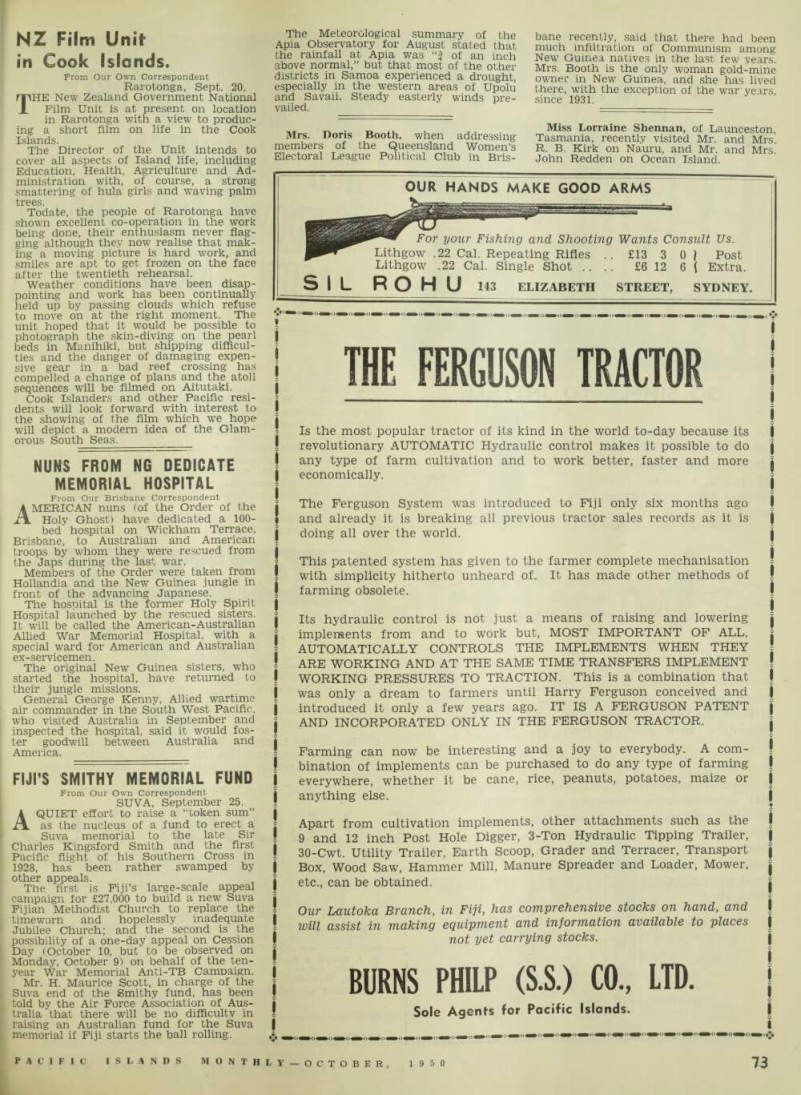
in Cook Islands.
From Our Own Correspondent Rarotonga, Sept. 20.
THE New Zealand Government National Film Unit is at present on location in Rarotonga with a view to produc ing a short film on life in the Cook Islands.
The Director of the Unit intends to cover all aspects of Island life, including Education, Health, Agriculture and Ad ministration with, of course, a strong smattering of hula girls and waving palm trees.
Todate, the people of Rarotonga have shown excellent co-operation in the work being done, their enthusiasm never flag ging although they now realise that mak ing a moving picture is hard work, and smiles are apt to get frozen on the face after the twentieth rehearsal.
Weather conditions have been disap pointing and work has been continually held up by passing clouds which refuse to move on at the right moment. The unit hoped that it would be possible to photograph the skin-diving on the pearl beds in Manihiki, but shipping difficul ties and the danger of damaging expen sive gear in a bad reef crossing has compelled a change of plans and the atoll sequences will be filmed on Aitutaki.
Cook Islanders and other Pacific resi dents will look forward with interest to the showing of the film which we hope will depict a modern idea of the Glam orous South Seas.
Nuns From Ng Dedicate
Memorial Hospital
From Our Brisbane Correspondent AMERICAN nuns (of the Order of the Holy Ghost) have dedicated a 100bed hospital on Wickham Terrace, Brisbane, to Australian and American troops by whom they were rescued from the Japs during the last war.
Members of the Order were taken from Hollandia and the New Guinea jungle in front of the advancing Japanese.
The hospital is the former Holy Spirit Hospital launched by the rescued sisters.
It will be called the American-Australian Allied War Memorial Hospital, with a special ward for American and Australian ex-servicemen.
The original New Guinea sisters, who started the hospital, have returned to their jungle missions.
General George Kenny, Allied wartime air commander in the South West Pacific, who visited Australia in September and inspected the hospital, said it would fos ter goodwill between Australia and America.
Fiji’S Smithy Memorial Fund
From Our Own Correspondent SUVA, September 25.
A QUIET effort to raise a “token sum” as the nucleus of a fund to erect a Suva memorial to the late Sir Charles Kingsford Smith and the first Pacific flight of his Southern Cross in 1928, has been rather swamped by
other appeals.
The first is Fiji’s large-scale appeal campaign for £27,000 to build a new Suva Fijian Methodist Church to replace the timeworn and hopelessly inadequate Jubilee Church; and the second is the possibility of a one-day appeal on Cession Day (October 10. but to be observed on Monday, October 9) on behalf of the ten year War Memorial Anti-TB Campaign.
Mr. H. Maurice Scott, in charge of the Suva end of the Smithy fund, has been told by the Air Force Association of Aus tralia that there will be no difficulty in raising an Australian fund for the Suva memorial if Fiji starts the ball rolling.
The Meteorological summary of the Apia Observatory for August stated that the rainfall at Apia was “i of an inch above normal,” but that most of the other districts in Samoa experienced a drought, especially in the western areas of Upolu and Savaii. Steady easterly winds pre vailed.
Mrs. Doris Booth, when addressing members of the Queensland Women’s Electoral League Political Club in Bris
bane recently, said that there had been much infiltration of Communism among New Guinea natives in the last few years.
Mrs. Booth is the only woman gold-mine owner in New Guinea, and she has lived there, with the exception of the war years, since 1931.
Miss Lorraine Shennan, of Launceston, Tasmania, recently visited Mr. and Mrs.
R. B. Kirk on Nauru, and Mr. and Mrs.
John Redden on Ocean Island.
Advertisements & other items, pp. 75-76 (1 item)
The Ferguson Tractor
OUR HANDS MAKE GOOD ARMS
For your Fishing and Shooting Wants Consult Us.
Lithgow .22 Cal. Repeating Rifles .. £l3 3 0 \ Post Lithgow .22 Cal. Single Shot ... £6 12 6 ( Extra.
SI L RO H U 143 ELIZABETH STREET, SYDNEY.
THE FERGUSON TRACTOR
Is the most popular tractor of its kind in the world to-day because its revolutionary AUTOMATIC Hydraulic control makes it possible to do any type of farm cultivation and to work better, faster and more economically.
The Ferguson System was introduced to Fiji only six months ago and already it is breaking all previous tractor sales records as it is doing all over the world.
This patented system has given to the farmer complete mechanisation with simplicity hitherto unheard of. It has made other methods of farming obsolete.
Its hydraulic control is not just a means of raising and lowering implements from and to work but, MOST IMPORTANT OF ALL,
AUTOMATICALLY CONTROLS THE IMPLEMENTS WHEN THEY
ARE WORKING AND AT THE SAME TIME TRANSFERS IMPLEMENT WORKING PRESSURES TO TRACTION. This is a combination that was only a dream to farmers until Harry Ferguson conceived and introduced it only a few years ago. IT IS A FERGUSON PATENT AND INCORPORATED ONLY IN THE FERGUSON TRACTOR.
Farming can now be interesting and a joy to everybody, A combination of implements can be purchased to do any type of farming everywhere, whether it be cane, rice, peanuts, potatoes, maize or anything else.
Apart from cultivation implements, other attachments such as the 9 and 12 inch Post Hole Digger, 3-Ton Hydraulic Tipping Trailer, 30-Cwt. Utility Trailer, Earth Scoop, Grader and Terracer, Transport Box, Wood Saw, Hammer Mill, Manure Spreader and Loader, Mower, etc., can be obtained.
Our Lautoka Branch, in Fiji, has comprehensive stocks on hand, and will assist in making equipment and information available to places not yet carrying stocks.
BURNS PHILP (S.S.) CO., LTD.
Sole Agents for Pacific Islands.
W ithout a
doubt
I i I I iM
SO SIMPLE TO INSTALL
1. Screw on frames—use old window frames and simple uprights—and use U in. x 8 round head screws. Never over-tighten screws. 2. Close the clips to glass thickness with a pair of pliers.
Remember, never force i in. glass into 3/16 in. frames. 3. Insert glass. If loose, remove it, and, with a pair of pliers, crimp the clips slightly.
Replace the Louvre. Repeat this procedure until glass is held firmly.
OPEN END INSIDE
5. In order to assure complete weather protection, nail or screw on a facia strip at the top and a weather stop on the sill of each rack of Cooper Louvres. Cooper Louvres stay as you set them— wind will not blow them shut.
Iffi UIOSI Slfflli
m EOSOWCM
nm The Cooper Louvre is the ideal window for tropical areas because it gives unobstructed view and the maximum of light and air . . . it actually controls ventilation. It is seldom too wet to keep your Cooper Louvre window partly open—you simply adjust it to keep out the rain and let the fresh air in.
Installations are easy, too! No need for a tradesman; any handyman can install them Breakages are easily replaced and remember it costs less to replace an odd Louvre than an expensive normal size window pane.
Cleaning is easy and can be done from inside the house.
Send in the enquiry form below for full details of the Cooper Louvre Window.
OPEN CLIP
.LASS
S 3
WEATHER
STOP
FACIA STRIP
SILL
CLOSED CUP
4. When the Louvre is held firmly, simply close the clip at each end and the job is done. Replacements are simple, speedy, and cost only a few pence per blade.
PACIFIC ISLANDS REPRESENTATIVE:
£. J. GOUGrI & CO.
Exporters Importers Manufacturers’ Representatives SUPPLIERS OP GENERAL MERCHANDISE TO LEADING FIRMS
THROUGHOUT THE PACIFIC ISLANDS.
1 BOND STREET, SYDNEY, AUSTRALIA. Box 3615, G.P.O.
Tel.: 8U2159 Hankers: Bank of N.S.W. Bank of Adelaide. Comptolr National d’Escompte de Paris. Cable Address: “SEAFOODS,” Sydney.
Codes: Bentley’s, 2nd and Comp. Phrase: A.8.C.. sth and 6th; Peterson, 2nd and 3rd, Banking; Acme.
LOUVRE
HORIZONTAL SECTION
ENQUIRY FORM.
E. J. Gough & Co., Box 3615, G.P.O.
Sydney, Australia, Please send me full details of the Cooper Louvre Window.
NAME:...
ADDRESS:
British School
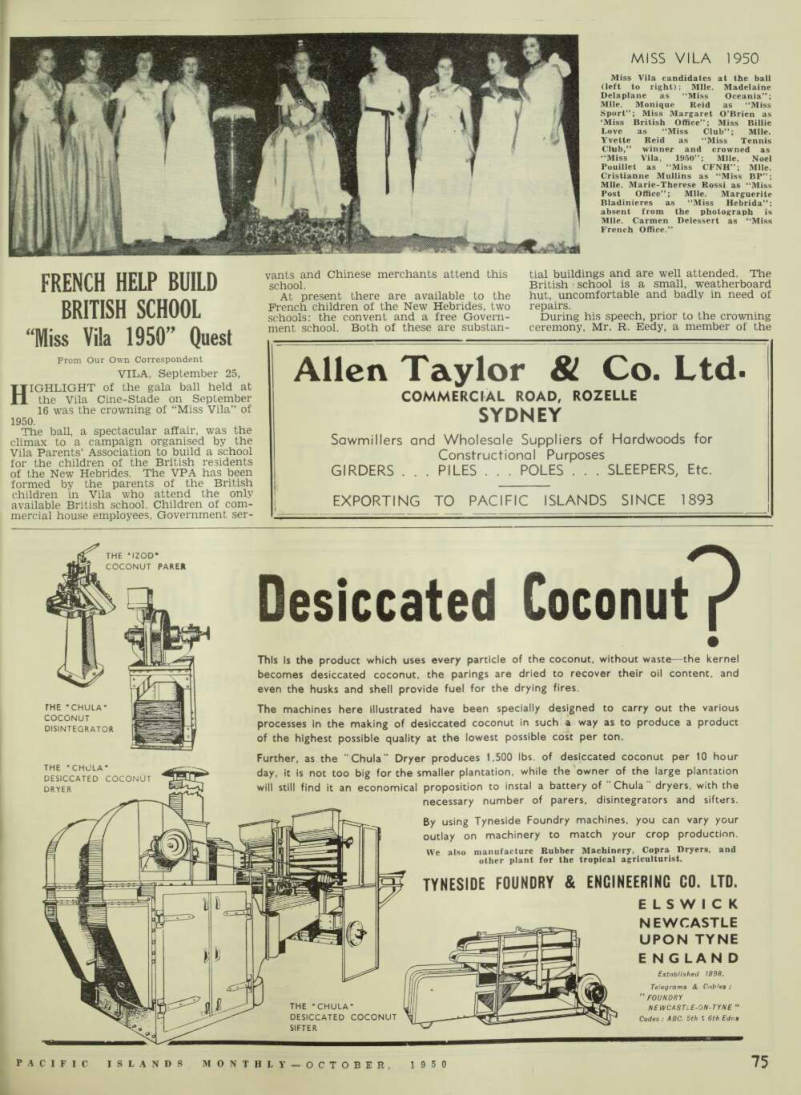
French Help Build
“Miss Vila 1950” Quest
Prom Our Own Correspondent VILA, September 25, HIGHLIGHT of the gala ball held at the Vila Cine-Stade on September 16 was the crowning of “Miss Vila” of 1950.
The ball, a spectacular affair, was the climax to a campaign organised by the Vila Parents’ Association to build a school for the children of the British residents of the New Hebrides. The VPA has been formed by the parents of the British children in Vila who attend the only available British school. Children of com mercial house employees, Government ser
vants and Chinese merchants attend this school.
At present there are available to the French children of the New Hebrides, two schools; the convent and a free Government school. Both of these are substan-
tial buildings and are well attended. The British school is a small, weatherboard hut, uncomfortable and badly in need of repairs.
During his speech, prior to the crowning ceremony. Mr. R. Eedy, a member of the
Miss Vila 1950
Miss Vila candidates at the ball (left to right): Mile. Madelaine Delaplane as “Miss Oceania”; Mile. Monique Reid as “Miss Sport”; Miss Margaret O’Brien as ‘Miss British Office”; Miss Billie Love as “Miss Club”; Mile.
Yvette Reid as “Miss Tennis Club,” winner and crowned as “Miss Vila, 1950”; Mile. Noel Pouillet as “Miss CFNH”; Mile.
Cristianne Mullins as “Miss BP”; Mile. Marie-Therese Rossi as “Miss Post Office”; Mile. Marguerite Bladinieres as “Miss Hebrida”: absent from the photograph is Mile. Carmen Delessert as “Miss French Office.”
VPA expressed the gratitude of the Asso ciation for the generous manner in which the French people of the New Hebrides had contributed—it will be largely with French money that the new school will be built and eight of the ten candidates for “Miss Vila” were French girls.
The campaign, extending over a period of six weeks, was conducted on the familiar “Queen” competition lines.
Ten girls, each representing some
phase of Vila activity—social, commercial and official—were elected as the compe titors. Committees behind them held parties, raffles, etc., to raise funds for their nominee.
Mr. George Hill, Condominium Treasurer, announced Mile. Yvette Reid, nominee of the Jacques Tassy Tennis Club, as winner of the competition and Mrs. Hill crowned Mile. Reid “Miss Vila, 1950.” Yvette Reid is the daughter of well-known Vila resi
dent and Vila hotel proprietor, Mr. Ernie Reid, and Mrs. Reid.
Runner-up was Miss Billie Love as “Miss Club.” Mile. Reid was presented with a camphor-wood box containing linen to the approximate value of seventy pounds.
Miss Love received a portable gramo phone and a wristlet watch. The remain ing eight girls each received a piece of jewellery.
The quest is expected to raise approxi mately £l,OOO towards the new school.
Advertisements & other items, pp. 77-78 (1 item)
Desiccated Coconut^
Allen Taylor & Co. Ltd.
COMMERCIAL ROAD, ROZELLE
SYDNEY
Sawmillers and Wholesale Suppliers of Hardwoods for Constructional Purposes GIRDERS . . . PILES . . . POLES . . . SLEEPERS, Etc.
EXPORTING TO PACIFIC ISLANDS SINCE 1893
THE " IZOD*
COCONUT PARER
THE 'CHULA'
COCONUT
DISINTEGRATOR
THE ' CHOLA '
DESICCATED COCONUT
DRYER
m 3 9^
Desiccated Coconut^
• This Is the product which uses every particle of the coconut, without waste —the kernel becomes desiccated coconut, the parings are dried to recover their oil content, and even the husks and shell provide fuel for the drying fires.
The machines here illustrated have been specially designed to carry out the various processes in the making of desiccated coconut in such a way as to produce a product of the highest possible quality at the lowest possible cost per ton.
Further, as the “Chula" Dryer produces 1,500 lbs. of desiccated coconut per 10 hour day, it is not too big for the smaller plantation, while the owner of the large plantation will still find it an economical proposition to instal a battery of Chula dryers, with the necessary number of parers, disintegrators and sifters.
By using Tyneside Foundry machines, you can vary your outlay on machinery to match your crop production.
We also manufacture Rubber Machinery, Copra Dryers, and other plant for the tropical agriculturist.
TYNESIDE FOUNDRY & ENGINEERING CO. LTD.
ELSW I C K
NEWCASTLE
UPON TYNE
ENGLAND
Established 1898.
Telegrams & Cables :
“FOUNDRY
NEWCASTLE-ON-TYNE "
Codes : ABC. sth t 6th Edr.s
THE 'CHULA*
DESICCATED COCONUT
SIFTER
Scott's “Renown” Brand Rope,
Cordage and
Binder
Twine
Cable Address Ropeyard Sydney.
of Every
Description
MANUFACTURED AT
MASCOT, N.S.W.
J. SCOTT
PTY. LTD.
Head Office and Store
163 CLARENCE STREET,
SYDNEY,
N.S.W.
BURNS PHILP (SOUTH SEI) Go. ltd.
Registered Office: SUVA, FIJI
Code Address: “BURNSOUTH”
ISLAND TRADERS AND SHIPOWNERS
General Merchants (Wholesale and Retail)
Shipping, Customs and General Agents
Representatives for :
QUEENSLAND INSURANCE CO., LTD. BURNS PHILP TRUST CO., LTD.
Distributing Agents for :
SHELL COMPANY (P. 1.), LTD. FERGUSON TRACTORS STANDARD MOTOR CAR COMPANY CROSSLEY MARINE ENGINES
BRANCHES:
FIJI—
SUVA.
LEVUKA.
LAUTOKA.
LABASA.
BA.
SIGATOKA.
ROTUMA ISLAND.
SAMOA—
APIA.
PAGO PAGO.
TONGA-
NUKUALOPA.
HAAPAI.
VAVAU.
Sydney Agents:
BURNS. PHILP & CO., LTD..
7 Bridge Street.
London Agents:
BURNS, PHILP & CO.. LTD.,
35 Crutched Friars, E.C.3.
San Francisco Agents:
BURNS, PHILP CO. OF SAN FRANCISCO,
Matson Building, 215 Market Street.
NORFOLK IS.—
NIUE IS
Agencies Throughout the World.
Crime-Wave Continues
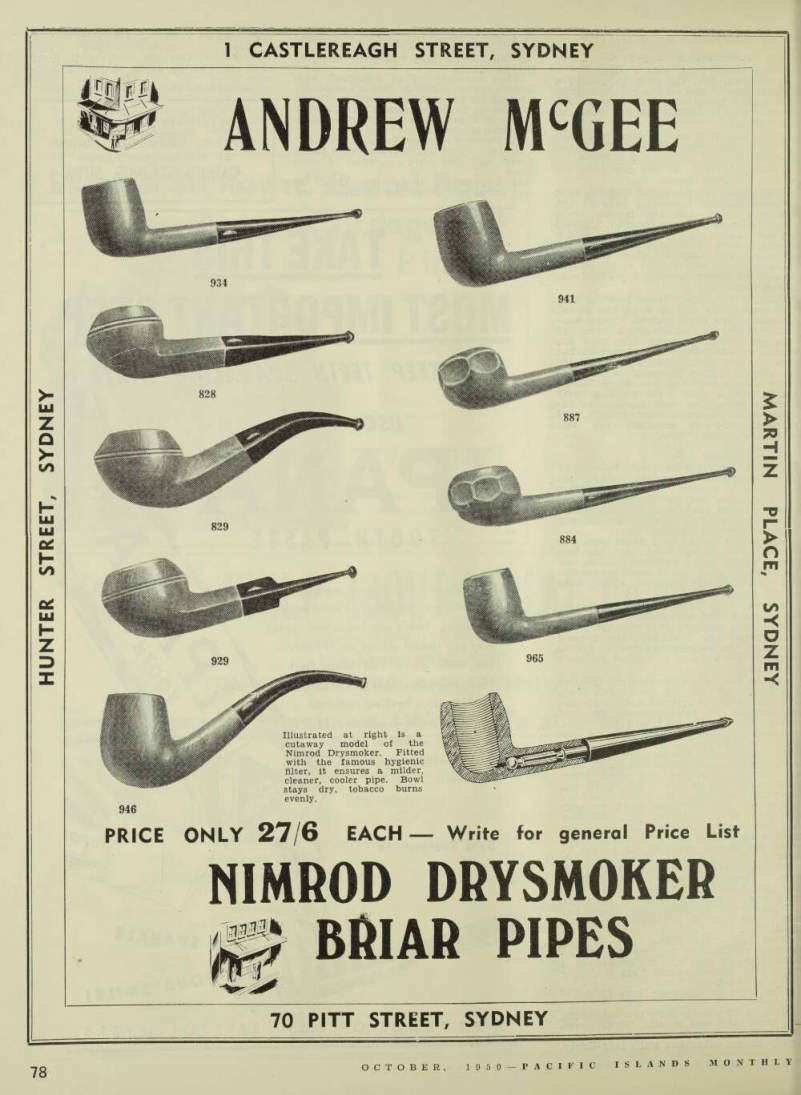

in W. Samoa Wife Murdered by Jealous Husband
From Our Own Correspondent APIA, September 22.
ANOTHER brutal murder occurred on September 19 at the west coast vil lage of Faleasiu, when a 25-year-old Samoan, Petuiai, killed his 19-year-old wife, Fa’atelo by practically decapitating her with a cane knife. She had been sit ting in their house feeding her baby, which was nearly smothered in its mother’s blood.
The husband was taken into custody and is now facing a murder charge. Ap parently he suspected his wife of having a love affair with one of his friends and committed the crime in a fit of jealousy.
This murder is the 10th in the current year. Popular feeling in Samoa strongly favours the reintroduction of the death penalty for murder as gaol sentences have proved no deterrent.
As the death penalty has been reintro duced in New Zealand, it is probable that It will also be legalised in Western Samoa. It is hoped that this will put an end to the present crop of murders.
Me pointed at the next palm tree. “To morrow I must move down there. Next week, when the crew progresses farther, I shall run out of shade on this side of the road and have to take position on the other side under the mape trees. I can’t concentrate with the scene shifting so.”
I got up. ‘Something will happen.”
“Of course. It’s just a matter of hold ing out until this unnatural state of affairs corrects itself.’
We shook hands. * SHORTLY after arriving home, I sent to Tahiti a movable plastic eye which I found at the Fresno Novelty Comp any. By means of a small spring, it scowled and rolled periodically: I hoped Fred might use it in place of the blue one on the fence post. His letter arrived in September.
My friend, my friend, he wrote.
Can I tell you how deeply I w r as touched by your ingenious gesture to aid me in my plight. The contrivance is most clever. I rather think it would have worked, with the proper build-up.
But it arrived too late.
Yes, too late. The inexorable forces of destiny moved. I have been pro moted. I am no longer overseer, but Inspector General of the Rue de la Ceinture. Twice a month I circle the island in a Chevrolet and make a report. I take the family and we have picnics. Oto-Mobile has learned to drive. With my free time I am once more addressing the Odyssey and shall soon be up to the part where Telemachos calls on Nestor.
Such peace I feel, after the ordeal by the roadside. Such faith have I in my fateful philosophy.
I shall close with greetings from the family. With our sudden, if belated,
turn in fortune, Totoi has become reconciled to marriage. Our fifth little stranger arrived last week, pre maturely, when Oto-Mobile ran into the ditch. Although it yelled its head off all the way home and spoiled our outing, Totoi is happy and hopes that the benefits of clergy will like wise reduce her next pregnancy from nine to seven months.
Ever onward, my friend!
Trust in Fate’s justice!
Come back to Tahiti!
Fred.
Advertisements & other items, pp. 79-80 (2 items)
77
TRAVAIL IN TAHITI
(Continued from page 63)
ACIFIC ISLANDS MONTHLY- o c T O B E R, 1950
I Pan A
Send us your orders for
DEVELOPING, PRINTING
Enlarging and
COPYING FROM OLD PHOTOS
All Photographic Supplies.
CAINE’S STUDIOS, SUVA
Box 8. (Estb. 1904) ’Phone: 68.
TAKE THIS
MOST IMPORTANTSTEP
TO HTTP Tim S WHITE
use
I PAN A
TOOTH PASTE
Doctors and dentists all agree that gum troubles are the cause of most tooth extractions. That's one important reason why you should always use IPANA— the tooth paste that keeps both teeth and gums clean and healthy.
IPANA gives lasting radiance to your smile because it protects as well as cleans your teeth to sparkling whiteness.
Sold Everywhere » .
S' A. <0 4 O O A. %
a0 D SPARKUE
To your
smile
A PRODUCT OF
BRISTOL-MYERS
1 CASTLEREAGH STREET, SYDNEY
ANDREW M C GEE
Z D >■ h- LO H Z 946 934 828 829 929 ml Illustrated at right is a cutaway model of the Nimrod Drysmoker. Fitted with the famous hygienic filter, it ensures a milder, cleaner, cooler pipe. Bowl stays dry, tobacco burns evenly. % > 73 H 884 965 > n m < U z PRICE ONLY 27/6 EACH Write for general Price List
NIMROD DRYSMOKER
BRIAR PIPES
70 PITT STREET, SYDNEY
Dentist!
Vila Welcomes Sydney Dentist!
From Our Own Correspondent VILA, October 6.
ALTHOUGH one normally does not look forward to a visit to (or from) a dentist, we were glad to welcome Dr.
T. E. Gibson, of Sydney, when he arrived in Vila on a professional visit on Sep tember 20.
Dr. Gibson’s makeshift surgery was opened at the Hotel Holland the day of his arrival and he continued practice un til October 4, Normal dental facilities in the New Hebrides are restricted to extractions or not over-successful fillings performed by a semi-trained medical assistant at the British Hospital on Iririki. While in no way detracting from this young man’s skill, adequate dental attention for resi dents of the New Hebrides is non-exis tent. For expert care, with full equip ment, locals must wait upon the yearly visits of itinerant dentists, some of whom have, in the past, left behind them repu tations for fantastic prices and unsatis factory work; or go South.
Half Rations For Vanikoro
Vanikoro
From Our Own Correspondent
Honiara, Sept 26
VANIKORO, in the Eastern Solomons, where the Kauri Timber Company resumed operations soon after the war, has been critically short of supplies, and half rations only were available during most of August.
Trans-Oceanic Airways’ Sunderland flew in a ton of rice at the end of August, and W. R. Carpenter’s M.V. Lautoka called there on September 19 with adequate supplies to relieve the shortage.
Advertisements & other items, pp. 81-82 (1 item)
lanfllgtiel
Eczema itch
Dispelled
Your skin has nearly 50 million tiny seams and pores where germs hide and cause terrible Itching, Cracking, Peeling, Burning, Acne, Ringwo m. Psoriasis, Blackheads, Pimples, Foot Itch and other blemishes. Ordinary treatments give only temporary relief because they do not kill the germ cause. The new discovery, Nixoderm, kills the germs quickly and is guaranteed to give you a soft, clear, attractive, smooth skin, or money back on return of empty package. Get guaranteed Nixoderm from your chemist or store to-day and attack the real cause of many skin troubles.
The guarantee protects you.
Nixoderm
For Skin Sores, Pimples and Itch.
Call for a
lanfllgtiel
The Favourite .
Matured but freshly bottled Brewed Cr Bottled by
g>an illifiud HSrcmcip
«■» m frll*** Obtainable from:
ALOIS AKUN & COMPANY
RABAUL
Lister
and
Blackstone
MARINE DIESELS
DETAILS OF DELIVERY:
LISTER propulsion:
Freshwater cooling and electric starting are standard equipment in 40 and 60 H.P. engines.
LISTER auxiliaries:
21 H.P immediate delivery. 40 H.P Immediate delivery. (Shipments of other sizes are arriving shortly.
BLACKSTONE propulsion:
IBS H.P 4 months. 180 H.P. ... 4 months. 225 H.P. 4 months. 275 H.P, 4 months. 860 H.P. 4 months.
DANGAR, GEDYE & MALLOCH LTD.
Head Office: 10-14 Young St., Sydney.
Cable Address: “Dangars,” Sydney.
Marine Workshop: Careening Cove.
Await Disposal
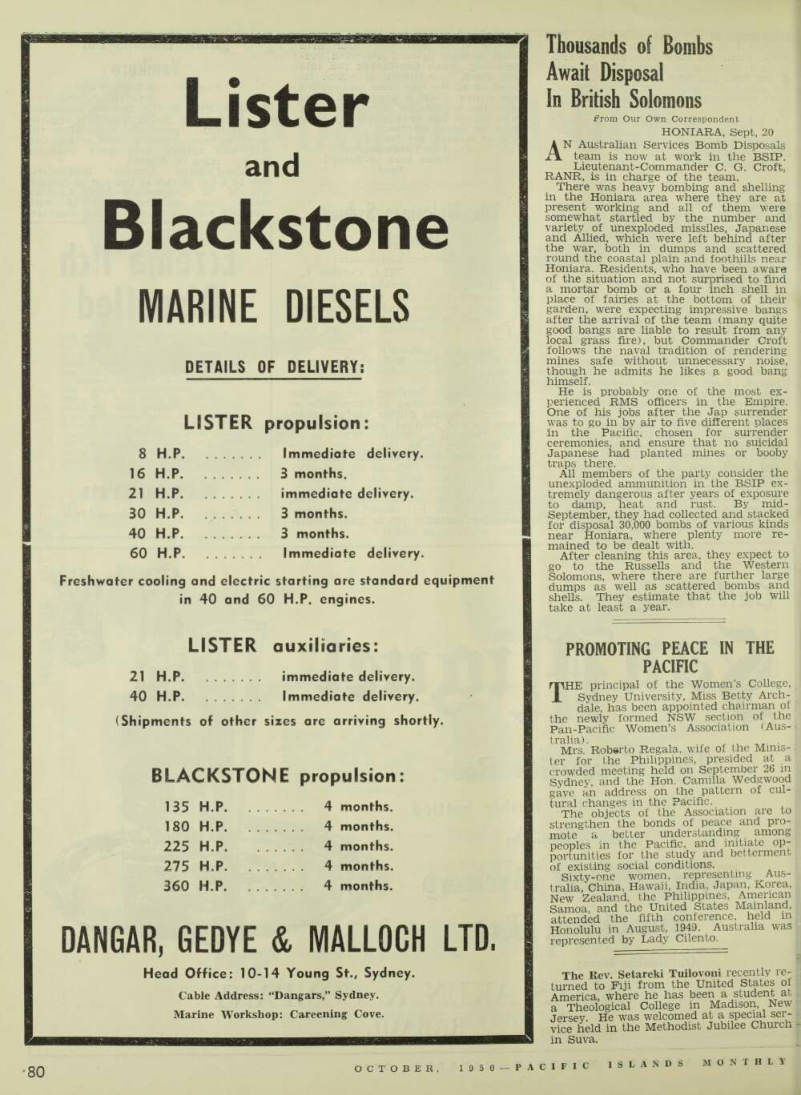
Thousands of Bombs Await Disposal In British Solomons
From Our Own Correspondent
Honiara, Sept, 20
AN Australian Services Bomb Disposals team is now at work in the BSIP.
Lieutenant-Commander C. G. Croft.
RANR, is in charge of the team.
There was heavy bombing and shelling in the Honiara area where they are at present working and all of them were somewhat startled by the number and variety of unexploded missiles, Japanese and Allied, which were left behind after the war, both in dumps and scattered round the coastal plain and foothills near Honiara. Residents, who have been aware of the situation and not surprised to find a mortar bomb or a four inch shell in place of fairies at the bottom of their garden, were expecting impressive bangs after the arrival of the team (many quite good bangs are liable to result from any local grass fire), but Commander Croft follows the naval tradition of rendering mines safe without unnecessary noise, though he admits he likes a good bang himself.
He is probably one of the most ex perienced RMS officers in the Empire.
One of his jobs after the Jap surrender was to go in by air to five different places in the Pacific, chosen for surrender ceremonies, and ensure that no suicidal Japanese had planted mines or booby traps there.
All members of the party consider the unexploded ammunition in the BSIP ex tremely dangerous after years of exposure to damp, heat and rust. By mid- September, they had collected and stacked for disposal 30,000 bombs of various kinds near Honiara, where plenty more re mained to be dealt with.
After cleaning this area, they expect to go to the Russells and the Western Solomons, where there are further large dumps as well as scattered bombs and shells. They estimate that the job will take at least a year.
Promoting Peace In The
Pacific
THE principal of the Women’s College, Sydney University, Miss Betty Arch dale, has been appointed chairman of the newly formed NSW section of the Pan-Pacific Women’s Association (Aus tralia). .
Mrs. Roberto Regala, wife of the Minis ter for the Philippines, presided at a crowded meeting held on September 26 in Sydney, and the Hon. Camilla Wedgwood gave an address on the pattern of cul tural changes in the Pacific.
The objects of the Association are to strengthen the bonds of peace and pro mote a better understanding among peoples in the Pacific, and initiate op portunities for the study and betterment of existing social conditions.
Sixty-one women, representing Aus tralia, China, Hawaii, India, Japan, Korea, New Zealand, the Philippines, American Samoa, and the United States Mainland, attended the fifth conference, held in Honolulu in August, 1949. Australia was represented by Lady Cilento.
The Rev. Setareki Tuilovoni recently re turned to Fiji from the United States of America, where he has been a student at a Theological College in Madison New Jersey He was welcomed at a special ser vice held in the Methodist Jubilee Church in Suva.
Island Boats Delivered To
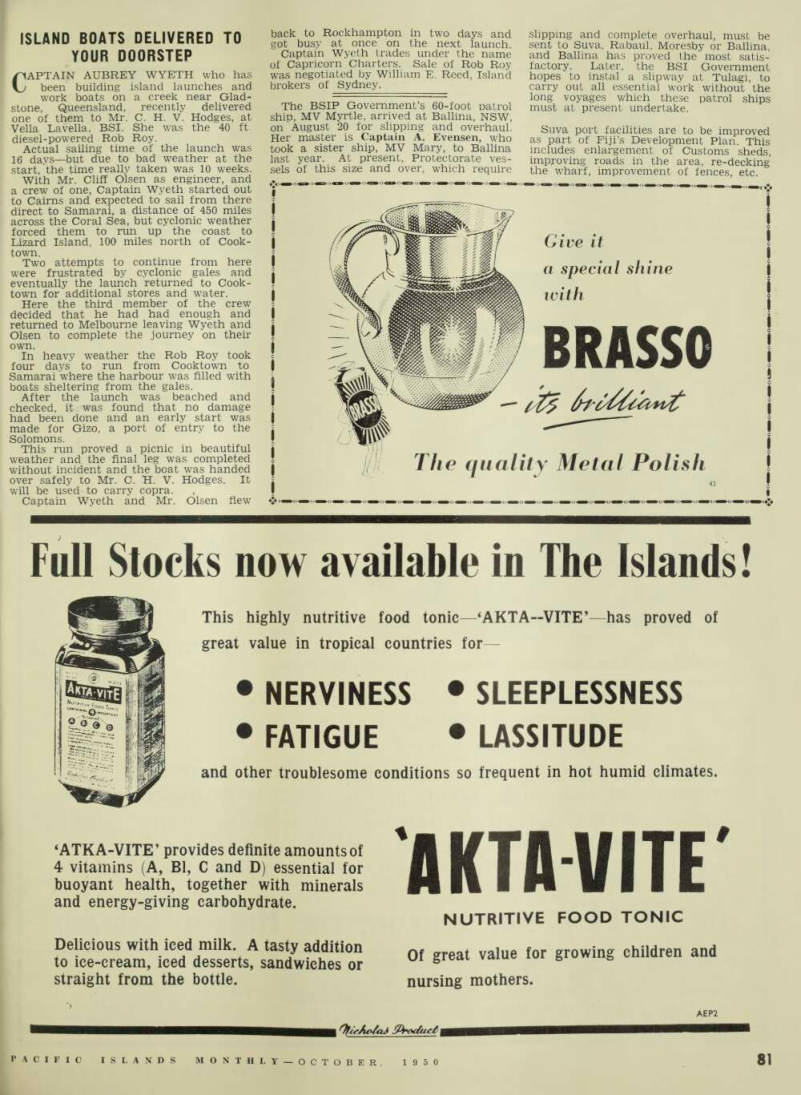
Your Doorstep
Captain Aubrey Wyeth Who Has
been building island launches and work boats on a creek near Glad stone, Queensland, recently delivered one of them to Mr. C. H. V. Hodges, at Vella Lavella, BSI. She was the 40 ft. diesel-powered Rob Roy.
Actual sailing time of the launch was 16 days—but due to bad weather at the start, the time really taken was 10 weeks.
With Mr. Cliff Olsen as engineer, and a crew of one, Captain Wyeth started out to Cairns and expected to sail from there direct to Samarai, a distance of 450 miles across the Coral Sea, but cyclonic weather forced them to run up the coast to Lizard Island, 100 miles north of Cook town.
Two attempts to continue from here were frustrated by cyclonic gales and eventually the launch returned to Cook town for additional stores and water.
Here the third member of the crew decided that he had had enough and returned to Melbourne leaving Wyeth and Olsen to complete the journey on their own.
In heavy weather the Rob Roy took four days to run from Cooktown to Samarai where the harbour was filled with boats sheltering from the gales.
After the launch was beached and checked, it was found that no damage had been done and an early start was made for Gizo, a port of entry to the Solomons.
This run proved a picnic in beautiful weather and the final leg was completed without incident and the boat was handed over safely to Mr. C. H. V. Hodges. It will be used to carry copra.
Captain Wyeth and Mr. Olsen flew
back to Rockhampton in two days and got busy at once on the next launch.
Captain Wyeth trades under the name of Capricorn Charters. Sale of Rob Roy was negotiated by William E. Reed, Island brokers of Sydney.
The BSIP Government’s 60-foot patrol ship, MV Myrtle, arrived at Ballina, NSW, on August 20 for slipping and overhaul.
Her master is Captain A. Evensen, who took a sister ship, MV Mary, to Ballina last year. At present, Protectorate ves sels of this size and over, which require
slipping and complete overhaul, must be sent to Suva, Rabaul, Moresby or Ballina, and Ballina has proved the most satis factory. Later, the BSI Government hopes to instal a slipway at Tulagi, to carry out all essential work without the long voyages which these patrol ships must at present undertake.
Suva port facilities are to be improved as part of Fiji’s Development Plan. This includes enlargement of Customs sheds, improving roads in the area, re-decking the wharf, improvement of fences, etc.
Advertisements & other items, pp. 83-84 (1 item)
Akta Vite'
Give it a special shine with
BRASSO
The quality Metal Polish
Full Stocks now available in The Islands! £• e o This highly nutritive food tonic —‘AKTA—VITE’ —has proved of great value in tropical countries for
• NERVINESS • SLEEPLESSNESS
• FATIGUE • LASSITUDE
and other troublesome conditions so frequent in hot humid climates. ‘ATKA-VITE’ provides definite amounts of 4 vitamins (A, 81, C and D) essential for buoyant health, together with minerals and energy-giving carbohydrate.
Delicious with iced milk. A tasty addition to ice-cream, iced desserts, sandwiches or straight from the bottle.
AKTA VITE'
NUTRITIVE FOOD TONIC
Of great value for growing children and
AEP2
nursing mothers.
a .Jttes 0 3 it* e® O Mi% m ml 4, 1
osene .
r>
VCEH
Jf o^ D Ji ❖
burN s
If YOU THINK OF NIGHT WORK—YOU MUST “ THE GUARDSMAN ‘ THINK OF TILLEY. THERE IS A LAMP FOR
STORM LANTERN X 246
500 Candle Power EVERY JOB. FROM THE 300 CANDLE POWER
“GUARDSMAN” STORM LANTERN. AS ILLU-
STRATED, TO THE 5,000 CANDLE POWER
PORTABLE FLOODLIGHT. EVERY TILLEY OUTDOOR LAMP IS ENTIRELY STORM PROOF AND WILL OPERATE IN THE WORST WEATHER CONDITIONS WITH COMPLETE RELIABILITY. MANUFACTURED TO THE HIGHEST ENGIN- EERING STANDARDS FROM THE FINEST MATERIALS, TILLEY PRODUCTS ARE THE FINEST YOU CAN BUY. THE LAMP WITH THE “HAPPY MANTLES.”
THE TILLEY LAMP COMPANY, LTD. HeMDON, ENGLAND
REPRESENTATION:
MELBOURNE;, T. H. Bentley, Pty. Ltd., 123-125 William Street, Melbourne, Cl.
TASMANIA: Mr. H. V. Sellers, 108 a Charles Street, Launceston.
FIJI: Mr. K. Witherington, 2 Burns Philp Buildings, Suva.
Ships
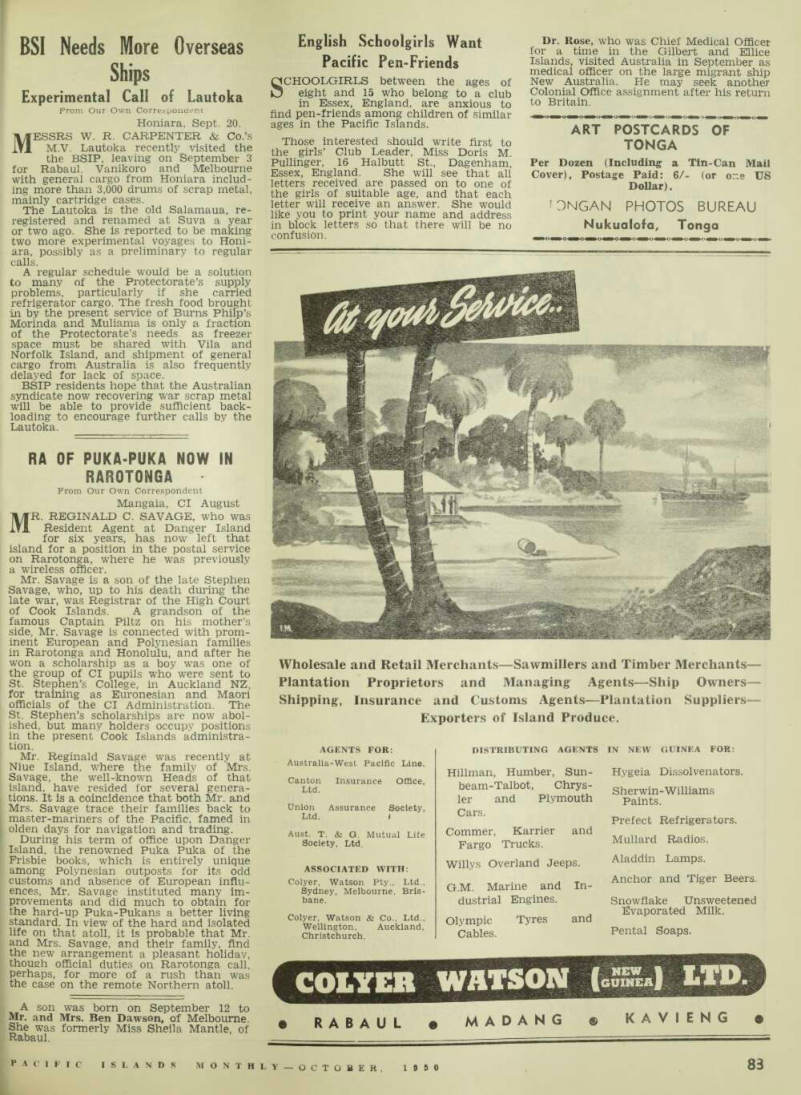
BSI Needs More Overseas Ships Experimental Call of Lautoka
Prom Our Own Correspondent Honiara, Sept. 20.
Messrs w. r. carpenter & co.’s M.V. Lautoka recently visited the the BSIP, leaving on September 3 for Rabaul. Vanikoro and Melbourne with general cargo from Honiara includ ing more than 3,000 drums of scrap metal, mainly cartridge cases.
The Lautoka is the old Salamaua, re registered and renamed at Suva a year or two ago. She is reported to be making two more experimental voyages to Honi ara, possibly as a preliminary to regular calls.
A regular schedule would be a solution to many of the Protectorate’s supply problems, particularly if she carried refrigerator cargo. The fresh food brought in by the present service of Bums Philp’s Morinda and Muliama is only a fraction of the Protectorate’s needs as freezer space must be shared with Vila and Norfolk Island, and shipment of general cargo from Australia is also frequently delayed for lack of space.
BSIP residents hope that the Australian syndicate now recovering war scrap metal will be able to provide sufficient back loading to encourage further calls by the Lautoka.
Ra Of Puka-Puka Now In
Rarotonga
From Our Own Correspondent Mangaia, Cl August
Mr. Reginald C. Savage, Who Was
Resident Agent at Danger Island for six years, has now left that island for a position in the postal service on Rarotonga, where he was previously a wireless officer.
Mr. Savage is a son of the late Stephen Savage, who, up to his death during the late war, was Registrar of the High Court of Cook Islands. A grandson of the famous Captain Piltz on his mother’s side, Mr. Savage is connected with prom inent European and Polynesian families in Rarotonga and Honolulu, and after he won a scholarship as a boy was one of the group of Cl pupils who were sent to St. Stephen’s College, in Auckland NZ, for training as Euronesian and Maori officials of the Cl Administration. The St. Stephen’s scholarships are now abol ished, but many holders occupy positions in the present Cook Islands administra tion.
Mr. Reginald Savage was recently at Niue Island, where the family of Mrs.
Savage, the well-known Heads of that island, have resided for several genera tions. It is a coincidence that both Mr. and Mrs. Savage trace their families back to master-mariners of the Pacific, famed in olden days for navigation and trading.
During his term of office upon Danger Island, the renowned Puka Puka of the Frisbie books, which is entirely unique among Polynesian outposts for its odd customs and absence of European influ ences, Mr. Savage instituted many im provements and did much to obtain for the hard-up Puka-Pukans a better living standard. In view of the hard and isolated life on that atoll, it is probable that Mr. and Mrs. Savage, and their family, find the new arrangement a pleasant holiday, though official duties on Rarotonga call, perhaps, for more of a rush than was the case on the remote Northern atoll.
A son was born on September 12 to Mr. and Mrs. Ben Dawson, of Melbourne.
She was formerly Miss Sheila Mantle, of Rabaul.
English Schoolgirls Want
Pacific Pen-Friends
SCHOOLGIRLS between the ages of eight and 15 who belong to a club in Essex, England, are anxious to find pen-friends among children of similar ages in the Pacific Islands.
Those interested should write first to the girls’ Club Leader, Miss Doris M.
Pullinger, 16 Halbutt St., Dagenham, Essex, England. She will see that all letters received are passed on to one of the girls of suitable age, and that each letter will receive an answer. She would like you to print your name and address in block letters so that there will be no confusion.
Dr. Rose, who was Chief Medical Officer for a time in the Gilbert and Ellice Islands, visited Australia in September as medical officer on the large migrant ship New Australia. He may seek another Colonial Office assignment after his return to Britain.
Advertisements & other items, p. 85 (1 item)
Nukualofa, Tonga
ART POSTCARDS OF
TONGA
Per Dozen (Including: a Tin-Can Mail Cover), Postage Paid: 6/- (or one US Dollar).
'ONGAN PHOTOS BUREAU
Nukualofa, Tonga
7/ •>- Wholesale and Retail Merchants—Sawmillers and Timber Merchants —
Plantation Proprietors and Managing Agents—Ship Owners—
Shipping, Insurance and Customs Agents—Plantation Suppliers—
Exporters of Island Produce.
AGENTS FOR:
Australia-West Pacific Line.
Canton Insurance Office, Ltd.
Union Assurance Society, Ltd. < Aust. T. & G. Mutual Life Society, Ltd.
ASSOCIATED WITH:
Colyer, Watson Pty., Ltd., Sydney, Melbourne, Brisbane.
Colyer, Watson & Co., Ltd., Wellington, Auckland, Christchurch.
DISTRIBUTING AGENTS
Hillman, Humber, Sun-
beam-Talbot, Chrys-
ler and Plymouth Cars.
Commer, Karrier and Fargo Trucks.
Willys Overland Jeeps.
G.M. Marine and Industrial Engines.
Olympic Tyres and Cables.
IN NEW GUINEA FOR:
Hygeia Dissolvenators.
Sherwin-Williams Paints.
Prefect Refrigerators.
Mullard Radios.
Aladdin Lamps.
Anchor and Tiger Beers.
Snowflake Unsweetened
Evaporated Milk.
Pental Soaps.
RABAUL * MADANG ® KAVIENG •
Memorial Fund Helps Fiji
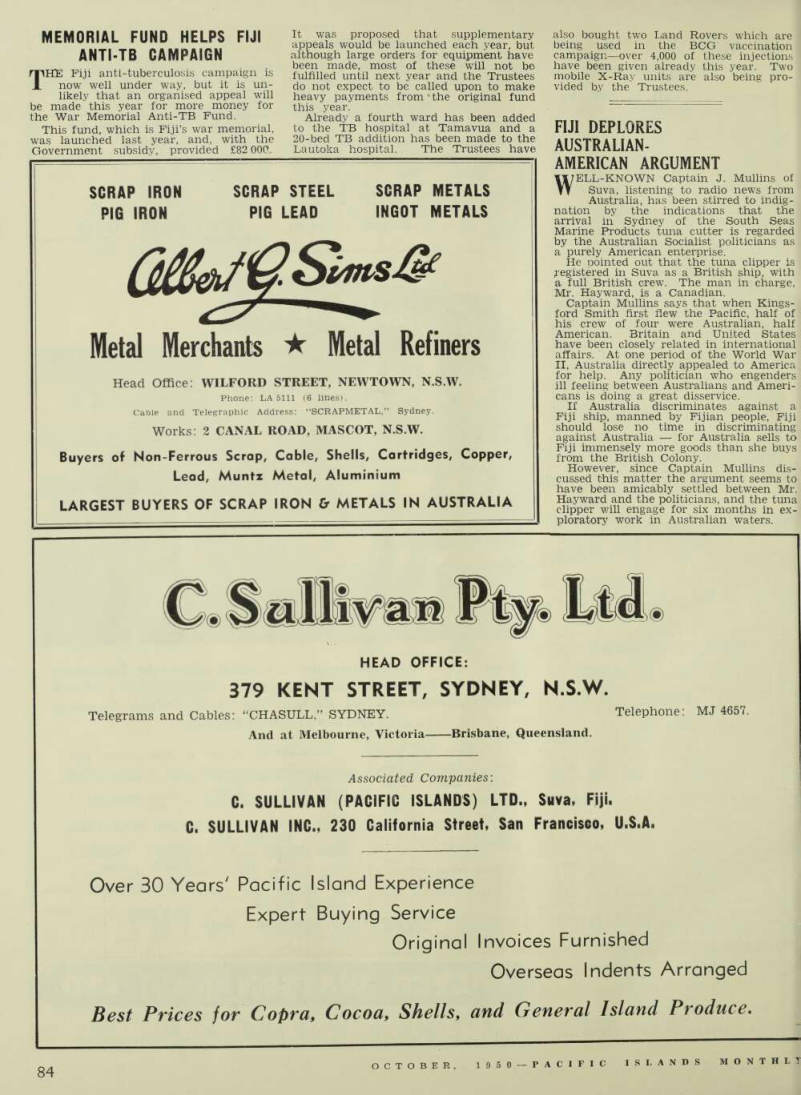
Anti-Tb Campaign
THE Fiji anti-tuberculosis campaign is now well under way, but it is un likely that an organised appeal will be made this year for more money for the War Memorial Anti-TB Fund.
This fund, which is Fiji’s war memorial, was launched last year, and, with the Government subsidy, provided £B2 000.
It was proposed that supplementary appeals would be launched each year, but although large orders for equipment have been made, most of these will not be fulfilled until next year and the Trustees do not expect to be called upon to make heavy payments from * the original fund this year.
Already a fourth ward has been added to the TB hospital at Tamavua and a 20-bed TB addition has been made to the Lautoka hospital. The Trustees have
also bought two Land Rovers which are being used in the BCG vaccination campaign—over 4,000 of these injections have been given already this year. Two mobile X-Ray units are also being pro vided by the Trustees.
Fiji Deplores
Australian
American Argument
Well-known captain j. Mullins of Suva, listening to radio news from Australia, has been stirred to indig nation by the indications that the arrival in Sydney of the South Seas Marine Products tuna cutter is regarded by the Australian Socialist politicians as a purely American enterprise.
He pointed out that the tuna clipper is registered in Suva as a British ship, with a full British crew. The man in charge, Mr. Hayward, is a Canadian.
Captain Mullins says that when Kings ford Smith first flew the Pacific, half of his crew of four were Australian, half American. Britain and United States have been closely related in international affairs. At one period of the World War 11, Australia directly appealed to America for help. Any politician who engenders ill feeling between Australians and Ameri cans is doing a great disservice.
If Australia discriminates against a Fiji ship, manned by Fijian people, Fiji should lose no time in discriminating against Australia for Australia sells to Fiji immensely more goods than she buys from the British Colony.
However, since Captain Mullins dis cussed this matter the argument seems to have been amicably settled between Mr.
Hayward and the politicians, and the tuna clipper will engage for six months in ex ploratory work in Australian waters.
Advertisements & other items, p. 86 (2 items)
84
OCTOBER. 1950 PACIFIC ISLANDS MONTH L
CAils
SCRAP IRON SCRAP STEEL SCRAP METALS
PIG IRON PIG LEAD INGOT METALS
Metal Merchants ★ Metal Refiners
Head Office: WILFORD STREET, NEWTOWN, N.S.W.
Phone; LA 5111 (6 lines).
Cable and Telegraphic Address: “SCRAPMETAL.” Sydney.
Works: 2 CANAL ROAD, MASCOT, N.S.W.
Buyers of Non-Ferrous Scrap, Cable, Shells, Cartridges, Copper, Lead, Muntz Metal, Aluminium LARGEST BUYERS OF SCRAP IRON Cr METALS IN AUSTRALIA
HEAD OFFICE:
379 KENT STREET, SYDNEY, N.S.W.
Telegrams and Cables: “CHASULL,” SYDNEY. Telephone: MJ 4657.
And at Melbourne, Victoria—Brisbane, Queensland.
CAils
•) ML m w Associated Companies : G. SULLIVAN (PACIFIC ISLANDS) LTD., Suva. Fiji.
C. SULLIVAN INC., 230 California Street, San Francisco, U.S.A.
Over 30 Years' Pacific Island Experience Expert Buying Service Original Invoices Furnished Overseas Indents Arranged Best Prices for Copra, Cocoa, Shells, and General Island Produce.
Madang Newsletter
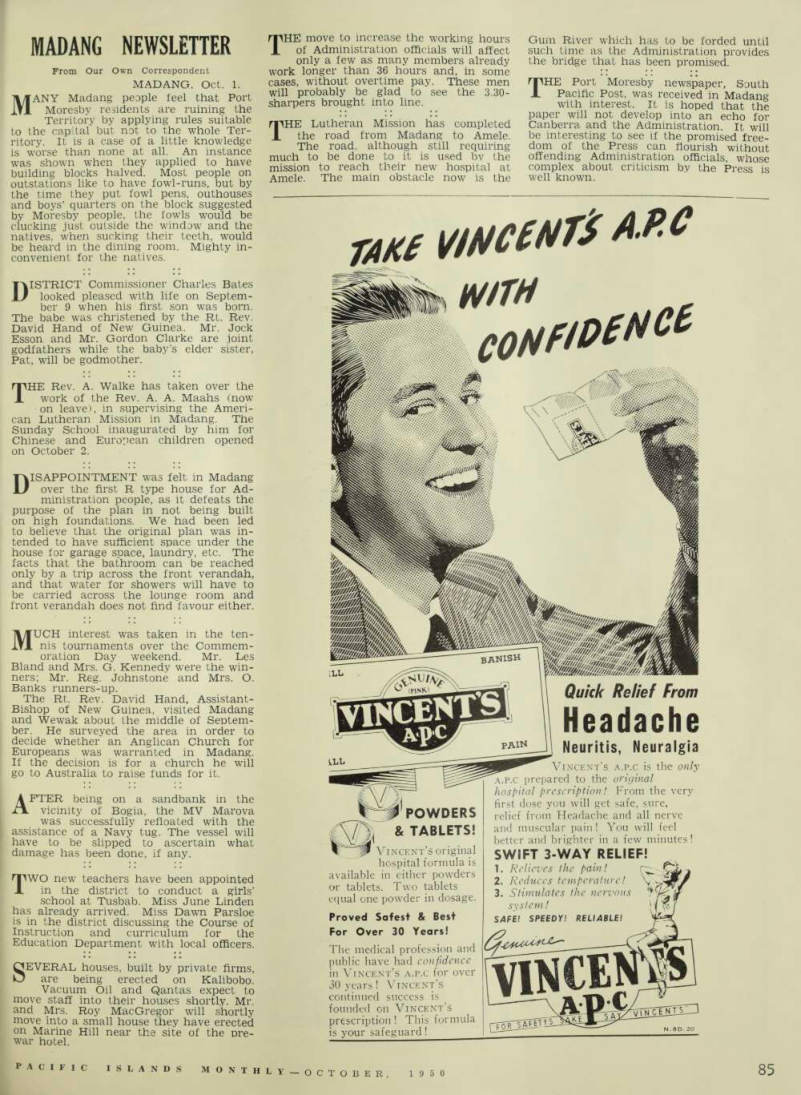
From Our Own Correspondent
Madang. Oct. 1.
MANY Madang people feel that Port Moresby residents are ruining the Territory by applying rules suitable to the capital but not to the whole Ter ritory. It is a case of a little knowledge is worse than none at all. An instance was shown when they applied to have building blocks halved. Most people on outstations like to have fowl-runs, but by the time they put fowl pens, outhouses and boys’ quarters on the block suggested by Moresby people, the fowls would be clucking just outside the window and the natives, when sucking their teeth, would be heard in the dining room. Mighty in convenient for the natives.
DISTRICT Commissioner Charles Bates looked pleased with life on Septem ber 9 when his first son was bom.
The babe was christened by the Rt. Rev.
David Hand of New Guinea. Mr. Jock Esson and Mr. Gordon Clarke are joint godfathers while the baby’s elder sister, Pat, will be godmother.
THE Rev. A. Walke has taken over the work of the Rev. A. A. Maahs (now on leave), in supervising the Ameri can Lutheran Mission in Madang. The Sunday School inaugurated by him for Chinese and European children opened on October 2.
Disappointment was felt in Madang over the first R type house for Ad ministration people, as it defeats the purpose of the plan in not being built on high foundations. We had been led to believe that the original plan was in tended to have sufficient space under the house for garage space, laundry, etc. The facts that the bathroom can be reached only by a trip across the front verandah, and that water for showers will have to be carried across the lounge room and front verandah does not find favour either.
MUCH interest was taken in the ten nis tournaments over the Commem oration Day weekend. Mr. Les Bland and Mrs. G. Kennedy were the win ners; Mr. Reg. Johnstone and Mrs. O.
Banks runners-up.
The Rt. Rev. David Hand, Assistant- Bishop of New Guinea, visited Madang and Wewak about the middle of Septem ber. He surveyed the area in order to decide whether an Anglican Church for Europeans was warranted in Madang.
If the decision is for a church he will go to Australia to raise funds for it.
AFTER being on a sandbank in the vicinity of Bogia, the MV Marova was successfully refloated with the assistance of a Navy tug. The vessel will have to be slipped to ascertain what damage has been done, if any.
TWO new teachers have been appointed in the district to conduct a girls’ school at Tusbab. Miss June Linden has already arrived. Miss Dawn Parsloe is in the district discussing the Course of Instruction and curriculum for the Education Department with local officers.
SEVERAL houses, built by private firms, are being erected on Kalibobo.
Vacuum Oil and Qantas expect to move staff into their houses shortly. Mr. and Mrs. Roy MacGregor will shortly move into a small house they have erected on Marine Hill near the site of the pre war hotel.
THE move to increase the working hours of Administration officials will affect only a few as many members already work longer than 36 hours and, in some cases, without overtime pay. These men will probably be glad to see the 3.30sharpers brought into line.
T J rpHE Lutheran Mission has completed JL the road from Madang to Amele.
The road, although still requiring much to be done to it is used bv the mission to reach their new hospital at Amele. The main obstacle now is the
Gum River which has to be forded until such time as the Administration provides the bridge that has been promised, :: :: rpHE Port Moresby newspaper, South JL Pacific Post, was received in Madang with interest. It is hoped that the Paper will not develop into an echo for Canberra and the Administration. It will be interesting to see if the promised free dom of the Press can flourish without offending Administration officials, whose complex about criticism by the Press is well known.
Advertisements & other items, pp. 87-88 (1 item)
CONfH> eNCe
tak£ mcwrt A.P.C
mu
m
*CL-I
/// mm
BANISH
LL
Qu/VAr Relief From
PAIN
LLL
POWDERS
& TABLETS!
I Vincent’s original hospital formula is vailable in either powders r tablets. Two tablets ciual one powder in dosage. roved Safest & Best or Over 30 Years!
'he medical profession and üblic have had confidence i Vincent’s a.p.c for over 0 years! Vincent’s ontinued success is Dunded on Vincent’s rescription! This formula ; your safeguard!
Headache
Neuritis, Neuralgia
Vincent’s a.p.c is the only "a.p.c prepared to the original hospital prescription! From the very first dose you will get safe, sure, relief from Headache and all nerve and muscular pain! You will feel better and brighter in a few minutes!
SWIFT 3-WAY RELIEF!
1. Relieves the pain! r^- 2. Reduces temperature! \ 3. Stimulates the nervous
system! \i*
SAFE! SPEEDY! RELIABLE!
£
VINCE
vTHTTnj_
: Wm
PUMP
■V. L .:i * ' I" ■mffl |9BP
H IP
T
VACUUM
OIL CO. PTY. LTD,
(INC. IN AUST
FROM PALEMBANG’S
MODERN REFINERY
Notes From Tonga
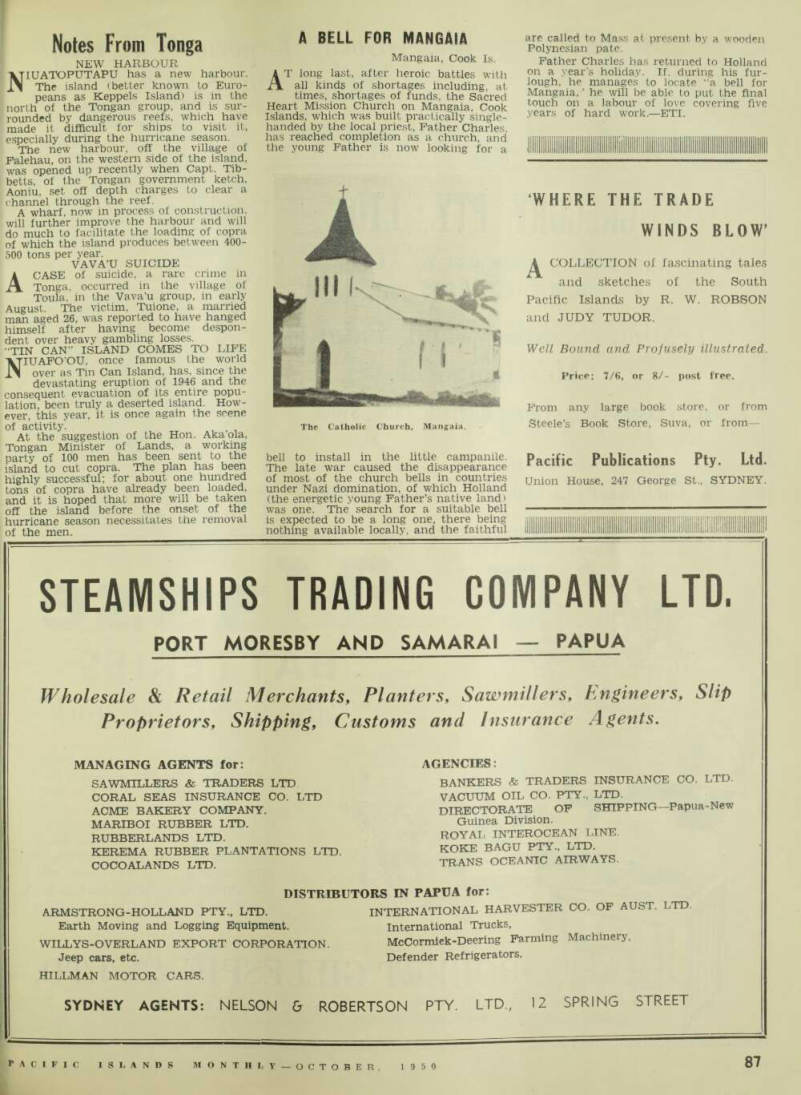
New Harbour
NIUATOPUTAPU has a new harbour.
The island (better known to Euro peans as Keppels Island) is in the north of the Tongan group, and is sur rounded by dangerous reefs, which have made it difficult for ships to visit it, especially during the hurricane season.
The new harbour, off the village of Falehau, on the western side of the island, was opened up recently when Capt. Tib betts, of the Tongan government ketch, Aoniu. set off depth charges to clear a channel through the reef.
A wharf, now in process of construction, will further improve the harbour and will do much to facilitate the loading of copra of which the island produces between 400- 500 tons per year.
Vava’U Suicide
A CASE of suicide, a rare crime in Tonga, occurred in the village of Toula, in the Vava’u group, in early August. The victim, Tuione, a married man aged 26, was reported to have hanged himself after having become despon dent over heavy gambling losses.
“Tin Can’’ Island Comes To Life
NIUAFO’OU, once famous the world over as Tin Can Island, has, since the devastating eruption of 1946 and the consequent evacuation of its entire popu lation, been truly a deserted island. How ever, this year, it is once again the scene of activity. , , , At the suggestion of the Hon. Aka ola, Tongan Minister of Lands, a working party of 100 men has been sent to the island to cut copra. The plan has been highly successful; for about one hundred tons of copra have already been loaded, and it is hoped that more will be taken off the island before the onset of the hurricane season necessitates the removal of the men.
A Bell For Mangaia
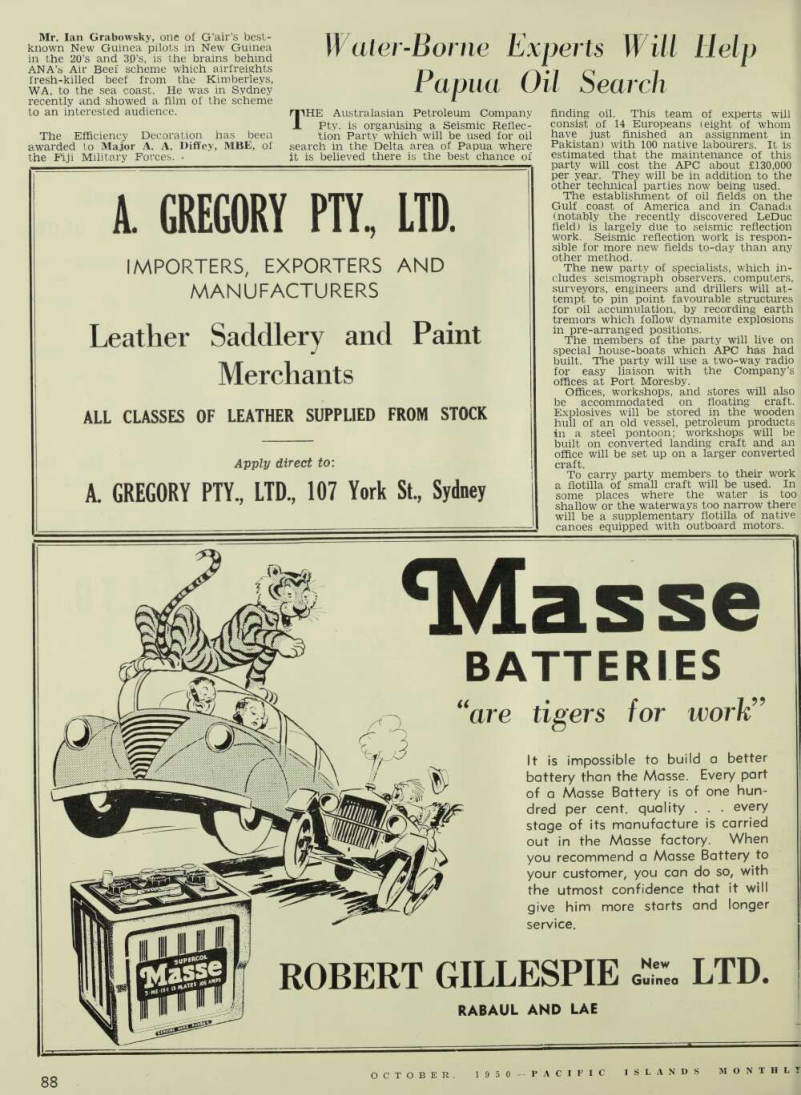
Mangaia, Cook Is.
AT long last, after heroic battles with all kinds of shortages including, at times, shortages of funds, the Sacred Heart Mission Church on Mangaia, Cook Islands, which was built practically single handed by the local priest, Father Charles, has reached completion as a church, and the young Father is now looking for a
bell to install in the little campanile.
The late war caused the disappearance of most of the church bells in countries under Nazi domination, of which Holland (the energetic young Father’s native land) was one. The search for a suitable bell is expected to be a long one, there being nothing available locally, and the faithful
are called to Mass at present by a wooden Polynesian pate.
Father Charles has returned to Holland on a year’s holiday. If, during his fur lough. he manages to locate “a bell for Mangaia, ’ he will be able to put the final touch on a labour of love covering five
years of hard work.-
Eti.
The Catholic Church, Mangaia.
Mr. lan Grabowsky, one of G’air’s bestknown New Guinea pilots in New Guinea in the 20’s and 3f)’s, is the brains behind ANA’s Air Beef scheme which airfreights fresh-killed beef from the Kimberleys, WA, to the sea coast. He was in Sydney recently and showed a film of the scheme to an interested audience.
The Efficiency Decoration has been awarded to Major A. A. Diffey, MBE, of the Fiji Military Forces. •
Advertisements & other items, pp. 89-90 (1 item)
Steamships Trading Company Ltd.
WHERE THE TRADE
WINDS BLOW’
COLLECTION of fascinating tales and sketches of the South Pacific Islands by R. W. ROBSON
and JUDY TUDOR.
Well Bound and Profusely illustrated.
Price: 7/6, or 8/- post free.
From any large book store, or from Steele’s Book Store, Suva, or from —
Pacific Publications Pty. Ltd.
Union House, 247 George St., SYDNEY.
STEAMSHIPS TRADING COMPANY LTD.
PORT MORESBY AND SAMARAI PAPUA
Wholesale & Retail Merchants, Planters, Engineers, Slip
Proprietors, Shipping, Customs and Insurance Agents.
MANAGING AGENTS for;
SAWMILLERS & TRADERS LTD
CORAL SEAS INSURANCE CO. LTD
ACME BAKERY COMPANY.
MARIBOI RUBBER LTD.
RUBBERLANDS LTD.
KEREMA RUBBER PLANTATIONS LTD.
COCOALANDS LTD.
AGENCIES:
BANKERS & TRADERS INSURANCE CO. LTD.
VACUUM OIL CO. PTY., LTD.
DIRECTORATE OP SHIPPING— Papua-New
Guinea Division.
ROYAL INTEROCEAN LINE.
KOKE BAGU PTY., LTD.
TRANS OCEANIC AIRWAYS.
DISTRIBUTORS IN PAPUA for:
ARMSTRONG-HOLLAND PTY., LTD.
Earth Moving and Logging Equipment.
WILLYS-OVERLAND EXPORT CORPORATION.
Jeep cars, etc.
HILLMAN MOTOR CARS.
INTERNATIONAL HARVESTER CO. OF AUST. LTD.
International Trucks, McCormiek-Deering Farming Machinery, Defender Refrigerators.
SYDNEY AGENTS: NELSON & ROBERTSON PTY. LTD., 12 SPRING STREET
A. GREGORY PTY, LTD.
IMPORTERS, EXPORTERS AND
MANUFACTURERS
Leather Saddlery and Paint Merchants ALL CLASSES OF LEATHER SUPPLIED FROM STOCK Apply direct to: A. GREGORY PTY., LTD., 107 York St, Sydney
□ VA 1
‘Masse
BATTERIES
are tigers for work
99 It is impossible to build a better battery than the Masse. Every part of a Masse Battery is of one hundred per cent, quality . . . every stage of its manufacture is carried out in the Masse factory. When you recommend a Masse Battery to your customer, you can do so, with the utmost confidence that it will give him more starts and longer service.
ROBERT GILLESPIE LTD.
RABAUL AND LAE
Water-Borne Experts Will Help
Papua Oil Search
THE Australasian Petroleum Company Pty. is organising a Seismic Reflec tion Party which will be used for oil search in the Delta area of Papua where it is believed there is the best chance of
finding oil. This team of experts will consist of 14 Europeans (eight of whom have just finished an assignment in Pakistan) with 100 native labourers. It is estimated that the maintenance of this party will cost the APC about £130,000 per year. They will be in addition to the other technical parties now being used.
The establishment of oil fields on the Gulf coast of America and in Canada (notably the recently discovered LeDuc field) is largely due to seismic reflection work. Seismic reflection work is respon sible for more new fields to-day than any other method.
The new party of specialists, which in cludes seismograph observers, computers, surveyors, engineers and drillers will at tempt to pin point favourable structures for oil accumulation, by recording earth tremors which follow dynamite explosions in pre-arranged positions.
The members of the party will live on special house-boats which APC has had built. The party will use a two-way radio for easy liaison with the Company’s offices at Port Moresby.
Offices, workshops, and stores will also be accommodated on floating craft.
Explosives will be stored in the wooden hull of an old vessel, petroleum products in a steel pontoon; workshops will be built on converted landing craft and an office will be set up on a larger converted craft.
To carry party members to their work a flotilla of small craft will be used. In some places where the water is too shallow or the waterways too narrow there will be a supplementary flotilla of native canoes equipped with outboard motors.
Advertisements & other items, p. 90 (1 item)
88
OCTOBER, 1950- PACIFIC ISLANDS MONTHLx
First Lady
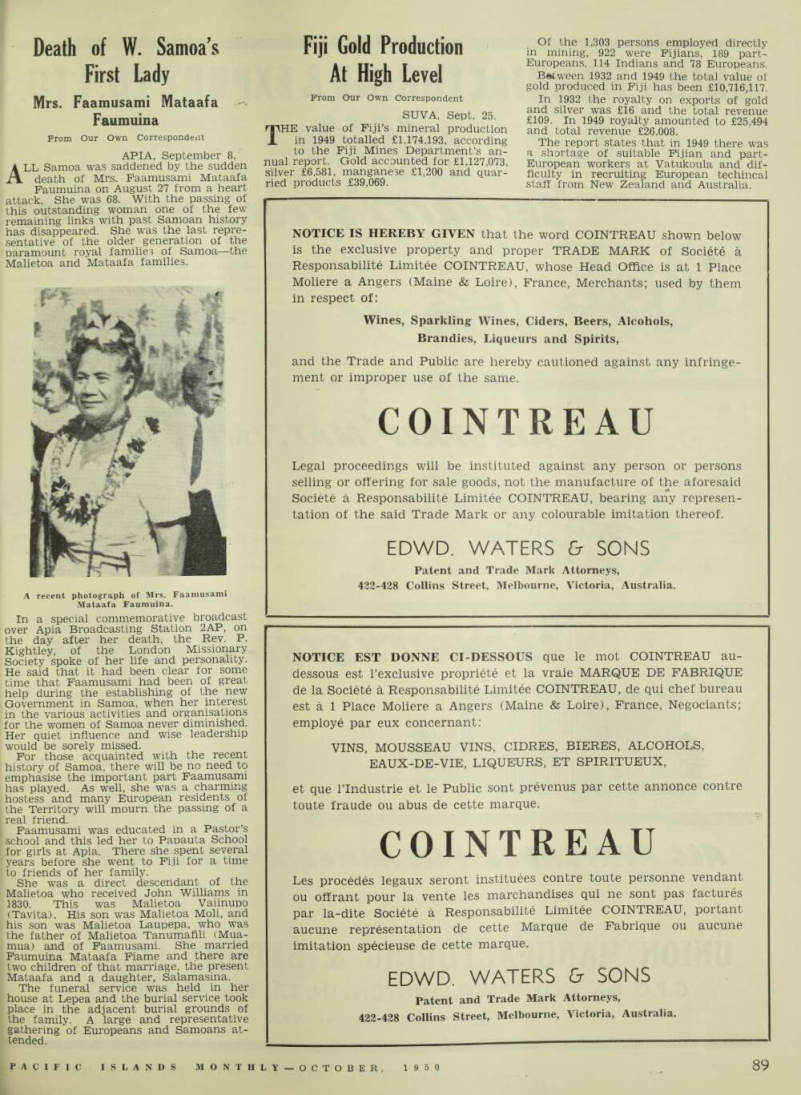
Death of W. Samoa’s First Lady Mrs. Faamusami Mataafa Faumuina
From Our Own Correspondent APIA, September 8.
ALL Samoa was saddened by the sudden death of Mrs. Faamusami Mataafa Faumuina on August 27 from a heart attack. She was 68. With the passing of this outstanding woman one of the few remaining links with past Samoan history has disappeared. She was the last repre sentative of the older generation of the paramount royal families of Samoa—the Malietoa and Mataafa families.
In a special commemorative broadcast over Apia Broadcasting Station 2AP, on the day after her death, the Rev. P.
Kightley, of the London Missionary Society spoke of her life and personality.
He said that it had been clear for some time that Faamusami had been of great help during the establishing of the new Government in Samoa, when her interest in the various activities and organisations for the women of Samoa never diminished.
Her quiet influence and wise leadership would be sorely missed.
For those acquainted with the recent history of Samoa, there will be no need to emphasise the important part Faamusami has played. As well, she was a charming hostess and many European residents of the Territory will mourn the passing of a real friend.
Faamusami was educated in a Pastor’s school and this led her to Papauta School for girls at Apia. There she spent several years before she went to Fiji for a time to friends of her family.
She was a direct descendant of the Malietoa who received John Williams in 1830. This was Malietoa Vaiinupo (Tavita). His son was Malietoa Moli, and his son was Malietoa Laupepa, who was the father of Malietoa Tanumafili (Mua mua) and of Faamusami. She married Faumuina Mataafa Fiame and there are two children of that marriage, the present Mataafa and a daughter, Salamasina.
The funeral service was held in her house at Lepea and the burial service took place in the adjacent burial grounds of the family. A large and representative gathering of Europeans and Samoans at tended.
A recent photograph of Mrs. Faamusami Mataafa Faumuina.
Fiji Gold Production
At High Level
From Our Own Correspondent SUVA. Sept. 25.
THE value of Fiji’s mineral production in 1949 totalled £1,174,193, according to the Fiji Mines Department’s an nual report. Gold accounted for £1.127,073, silver £6,581, manganese £1,200 and quar ried products £39,069.
of the 1)303 P ersons employed directly in mining, 922 were Fijians, 189 part- Europeans, 114 Indians and 78 Europeans.
Between 1932 and 1949 the total value of gold produced in Fiji has been £10,716,117.
In 1932 the royalty on exports of gold ancl sil ver was £l6 and the total revenue £lO9. In 1949 royalty amounted to £25,494 and total revenue £26,008.
The report states that in 1949 there was a shortage of suitable Fijian and part- European workers at Vatiikoula and dif ficulty in recruiting European techincal staff from New Zealand and Australia.
Advertisements & other items, pp. 91-92 (1 item)
Cointreau
NOTICE IS HEREBY GIVEN that the word COINTREAU shown below is the exclusive property and proper TRADE MARK of Societe a Responsabilite Limitee COINTREAU, whose Head Office is at 1 Place Moliere a Angers (Maine & Loire), France, Merchants; used by them in respect of: Wines, Sparkling Wines, Ciders, Beers, Alcohols, Brandies, Liqueurs and Spirits, and the Trade and Public are hereby cautioned against any infringement or improper use of the same.
Legal proceedings will be instituted against any person or persons selling or offering for sale goods, not the manufacture of the aforesaid Societe a Responsabilite Limitee COINTREAU, bearing any representation of the said Trade Mark or any colourable imitation thereof.
EDWD. WATERS & SONS
Patent and Trade Mark Attorneys, 422-428 Collins Street, Melbourne, Victoria, Australia.
NOTICE EST DONNE CI-DESSOUS que le mot COINTREAU audessous est I’exclusive propriety et la vraie MARQUE DE FABRIQUE de la Societe a Responsabilite Limitee COINTREAU, de qui chef bureau est a 1 Place Moliere a Angers (Maine & Loire), France, Negociants; employe par eux concernant:
VINS, MOUSSEAU VINS, CIDRES, BIERES, ALCOHOLS,
EAUX-DE-VIE, LIQUEURS, ET SPIRITUEUX,
et que ITndustrie et le Public sont prevenus par cette annonce centre toute fraude ou abus de cette marque.
COINTREAU
Les precedes legaux seront institutes centre toute personne vendant ou offrant pour la vente les marchandises qui ne sont pas factures par la-dite Societe a Responsabilite Limitee COINTREAU, portant aucune representation de cette Marque de Fabrique ou aucune imitation specieuse de cette marque.
EDWD. WATERS & SONS
Patent and Trade Mark Attorneys, 422-428 Collins Street, Melbourne, Victoria, Australia.
UNION MANUFACTURING & EXPORT CO. LTD
seett*/rysreei
e£S
snCK
Priced at 10/- PER SQUARE FOOT FLOOR AREA, these buildings can be adapted to suit a multitude of purposes. Constructed of 3/32 in. gauge steel plate, they will withstand indefinitely the hardest conditions of use.
Conveniently made in two basic sizes—6o ft. x 20 ft. x 10 ft. high and 40 ft. x 20 ft. x 10 ft. high. Extra corrugated steel side plates can be supplied to raise the height to 17 ft. if required. LARGER SIZED BUILD-
INGS CAN BE SUPPLIED BY ARRANGEMENT.
AfMSTKfP AfATr/Afa
Ideal for use as bridge decking, reinforcing material, fences, reading, etc., “Airstrip” Steel Matting can be supplied in sheets 10 ft, long x 15 in. wide. Sheets interlock readily. This material is immensely strong.
Slotted fence posts can be supplied for those using “Airstrip” Matting for fences. Price of matting, £24 per ton. (33 sheets per ton.)
sec#*/ry srpei gapacps
£lO5 PRE-FABRICATED READY FOR ERECTION, ALL
COMPONENTS SUPPLIED. Standard sizes, 8 ft. x 16 ft., as illustrated, and 12 ft. x 20 ft. (prices on request).
Components include sides, back, front arch, 8 roof sheets and nuts and bolts. Can be erected on site in 3 days. Larger sizes can be supplied by arrangement.
au 4¥AUA9ie fo* mMtPftrr »n*rexy
All prices quoted British Sterling or equivalent, F. 0.8., Wellington , New Zealand.
UNION MANUFACTURING & EXPORT CO. LTD.
G.P.O. Box 1060. WELLINGTON, (N.Z.) Telephone 61.387.
Cables: “UMEC,” Wellington (N.Z.).
~r r ’ •• * i 1 ««
Swinbournes
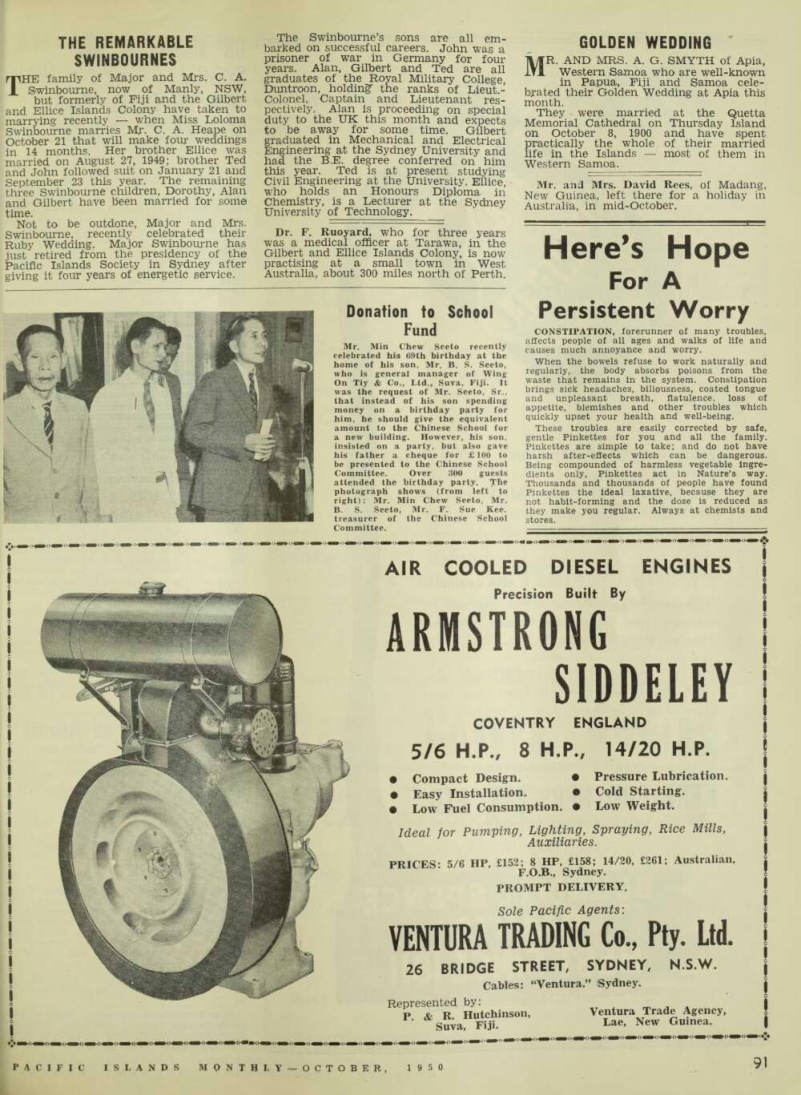
The Remarkable
THE family of Major and Mrs. C. A.
Swinbourne, now of Manly, NSW, but formerly of Fiji and the Gilbert and Ellice Islands Colony have taken to marrying recently when Miss Loloma Swinbourne marries Mr. C, A. Heape on October 21 that will make four weddings in 14 months. Her brother Ellice was married on August 27, 1949; brother Ted and John followed suit on January 21 and September 23 this year. The remaining three Swinbourne children, Dorothy, Alan and Gilbert have been married for some time.
Not to be outdone, Major and Mrs.
Swinbourne, recently celebrated their Ruby Wedding. Major Swinbourne has just retired from the presidency of the Pacific Islands Society in Sydney after giving it four years of energetic service.
The Swinbourne’s sons are all em barked on successful careers. John was a prisoner of war in Germany for four years. Alan, Gilbert and Ted are all graduates of the Royal Military College, Duntroon, holding" the ranks of Lieut.- Colonel, Captain and Lieutenant res pectively. Alan is proceeding on special duty to the UK this month and expects to be away for some time. Gilbert graduated in Mechanical and Electrical Engineering at the Sydney University and had the B.E. degree conferred on him this year. Ted is at present studying Civil Engineering at the University. Ellice, who holds an Honours Diploma in Chemistry, is a Lecturer at the Sydney University of Technology.
Dr. F. Ruoyard, who for three years was a medical officer at Tarawa, in the Gilbert and Ellice Islands Colony, is now practising at a small town in West Australia, about 300 miles north of Perth.
Donation to School
Fund
Mr. Min Chew Seeto recently celebrated his 69th birthday at the home of his son, Mr. B. S. Seeto, who is general manager of Wing On Tiy & Co., Ltd., Suva, Fiji. It was the request of Mr. Seeto, Sr., that instead of his son spending money on a birthday party for him, he should give the equivalent amount to the Chinese School for a new building. However, his son, insisted on a party, but also gave his father a cheque for £100 to be presented to the Chinese School Committee. Over 300 guests attended the birthday party. The photograph shows (from left to right): Mr. Min Chew Seeto, Mr.
B. S. Seeto, Mr. F. Sue Kee, treasurer of the Chinese School Committee.
Golden Wedding
]%/fR. AND MRS. A. G. SMYTH of Apia, 1 y 1 Samoa who are well-known and Samoa cT bra ted their Golden Wedding at Apia this month They were married at the Quetta Memorial Cathedral on Thursday Island on October 8, 1900 and have spent practically the whole of their married nf e in the Islands - most of them in Western Samoa Mr and Mrs David Rees of Madane: New Guinea left there for a holiday in Australia in’ mid-October Y Australia, in mia uctooei.
Here’s Hope
For A Persistent Worry
CONSTIPATION, forerunner of many troubles, affects people of all ages and walks of life and causes much annoyance and worry.
When the bowels refuse to work naturally and regularly, the body absorbs poisons from the waste that remains in the system. Constipation brings sick headaches, biliousness, coated tongue and unpleasant breath, flatulence, loss of appetite, blemishes and other troubles which quickly upset your health and well-being.
These troubles are easily corrected by safe, gentle Pinkettes for you and all the family.
Pinkettes are simple to take; and do not have harsh after-effects which can be dangerous.
Being compounded of harmless vegetable ingre dients only, Pinkettes act in Nature’s way.
Thousands and thousands of people have found Pinkettes the ideal laxative, because they are not habit-forming and the dose is reduced as they make you regular. Always at chemists and stores.
Advertisements & other items, pp. 93-94 (1 item)
Armstrong
n
AIR COOLED DIESEL ENGINES
Precision Built By
ARMSTRONG
SIDDELEY
COVENTRY ENGLAND
5/6 H.P., 8 H.P., 14/20 H.P.
• Compact Design. • Pressure Lubrication. • Easy Installation. • Cold Starting. • Low Fuel Consumption. • Low Weight.
Ideal for Pumping, Lighting, Spraying, Rice Mills, Auxiliaries.
PRICES* 5/6 HP, £152; 8 HP, £158; 14/20, £261; Australian, F. 0.8., Sydney.
PROMPT DELIVERY.
Sole Pacific Agents :
VENTURA TRADING Co, Pfy. ltd.
26 BRIDGE STREET, SYDNEY, N.S.W.
Cables: “Ventura,” (Sydney.
Represented by: P. & R. Hutchinson, Suva, Fiji.
Ventura Trade Agency, Lae, New Guinea.
'4> Made in the Australian Branch Factory of
BLUNDELL SPENCE & CO., LTD., Hull,
B. & S. SUPER PREPARED PAINT embodies the knowledge and experience gained from nearly 140 years of Paint manufacture.
Tested and proved for tropical conditions, B. & S. PREPARED PAINT is also available in a special Lead-free series for use in volcanic and other sulphurous regions. (Specify B. Gr S.-Series 2301).
Ask for supplies of these and other BLUN- DELL Paints and Enamels from your local Storekeeper, or write for particulars and colour-cards to the Agent for Pacific Islands :
KERR BROTHERS PTY. LTD.
4 YORK STREET, SYDNEY
Satisfied
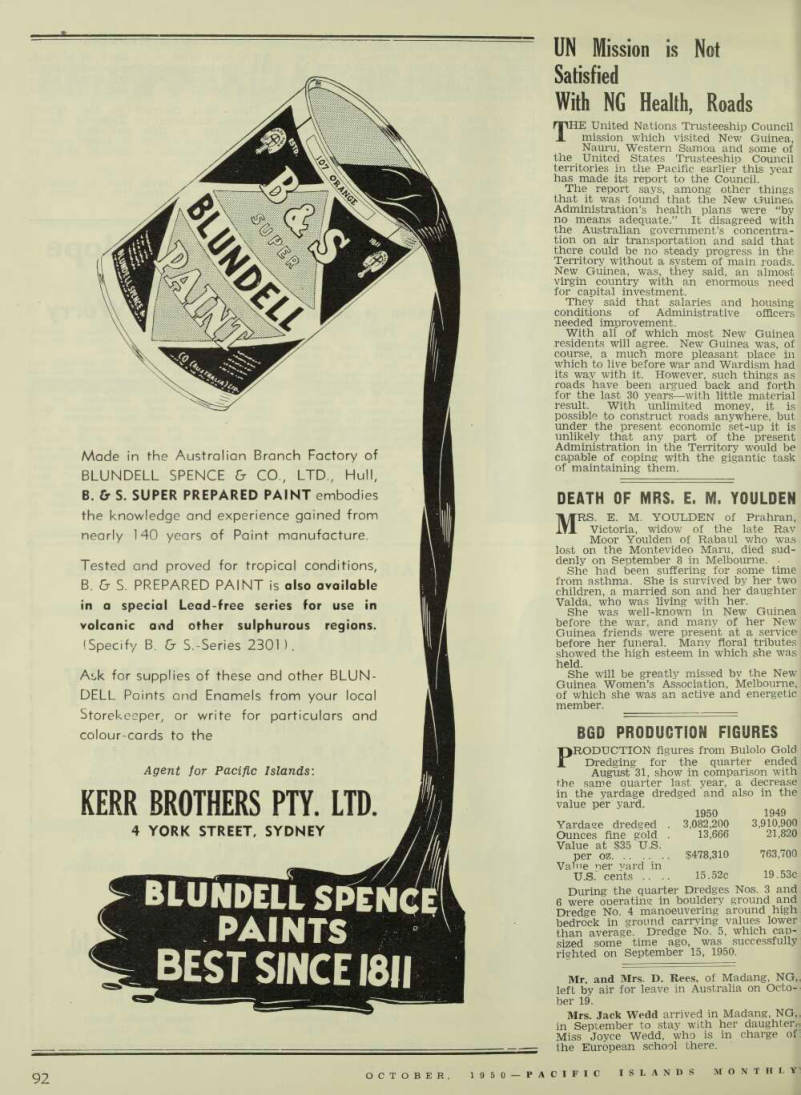
UN Mission is Not Satisfied With NG Health, Roads
THE United Nations Trusteeship Council mission which visited New Guinea, Nauru, Western Samoa and some of the United States Trusteeship Council territories in the Pacific earlier this year has made its report to the Council.
The report says, among other things that it was found that the New Guinea Administration’s health plans were “by no means adequate.” It disagreed with the Australian government’s concentra tion on air transportation and said that there could be no steady progress in the Territory without a system of main roads.
New Guinea, was, they said, an almost virgin country with an enormous need for capital investment.
They said that salaries and housing conditions of Administrative officers needed improvement.
With all of which most New Guinea residents will agree. New Guinea was, of course, a much more pleasant place in which to live before war and Wardism had its way with it. However, such things as roads have been argued back and forth for the last 30 years—with little material result. With unlimited money, it is possible to construct roads anywhere, but under the present economic set-up it is unlikely that any part of the present Administration in the Territory would be capable of coping with the gigantic task of maintaining them.
Death Of Mrs. E. M. Youlden
MRS. E. M. YOULDEN of Prahran, Victoria, widow of the late Ray Moor Youlden of Rabaul who was lost on the Montevideo Maru, died sud denly on September 8 in Melbourne.
She had been suffering for some time from asthma. She is survived by her two children, a married son and her daughter Valda, who was living with her.
She was well-known in New Guinea before the war, and manv of her New Guinea friends were present at a service before her funeral. Manv floral tributes showed the high esteem in which she was held.
She will be greatly missed by the New Guinea Women’s Association, Melbourne, of which she was an active and energetic member.
Bgd Production Figures
PRODUCTION figures from Bulolo Gold Dredging for the quarter ended August 31, show in comparison with the same Quarter last year, a decrease in the yardage dredged and also in the value per yard.
During the quarter Dredges Nos. 3 and 6 were operating in bouldery ground and Dredge No. 4 manoeuvering around high bedrock in ground carrying values lower than average. Dredge No. 5, which cap sized some time ago, was successfully righted on September 15, 1950.
Mr. and Mrs. D. Rees, of Madang, NG, left by air for leave in Australia on Octo ber 19.
Mrs. Jack Wedd arrived in Madang, NG, in September to stay with her Miss Joyce Wedd, who is in charge of the European school there.
1950 1949 Yardage dredged . 3,082,200 3,910,900 Ounces fine gold .
Value at $35 U.S. 13,666 21,820 per oz Value per yard in $478,310 763,700 U.S. cents .. .. 15.52c 19.53c
Samoa—Tonga
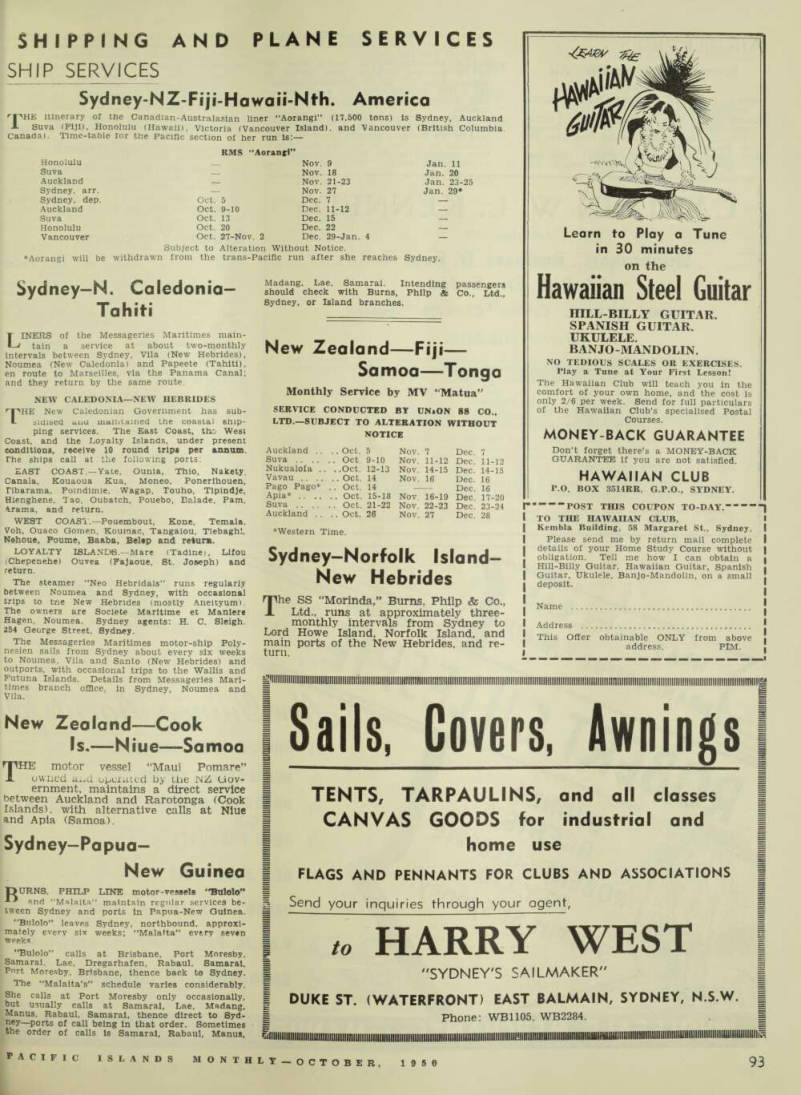
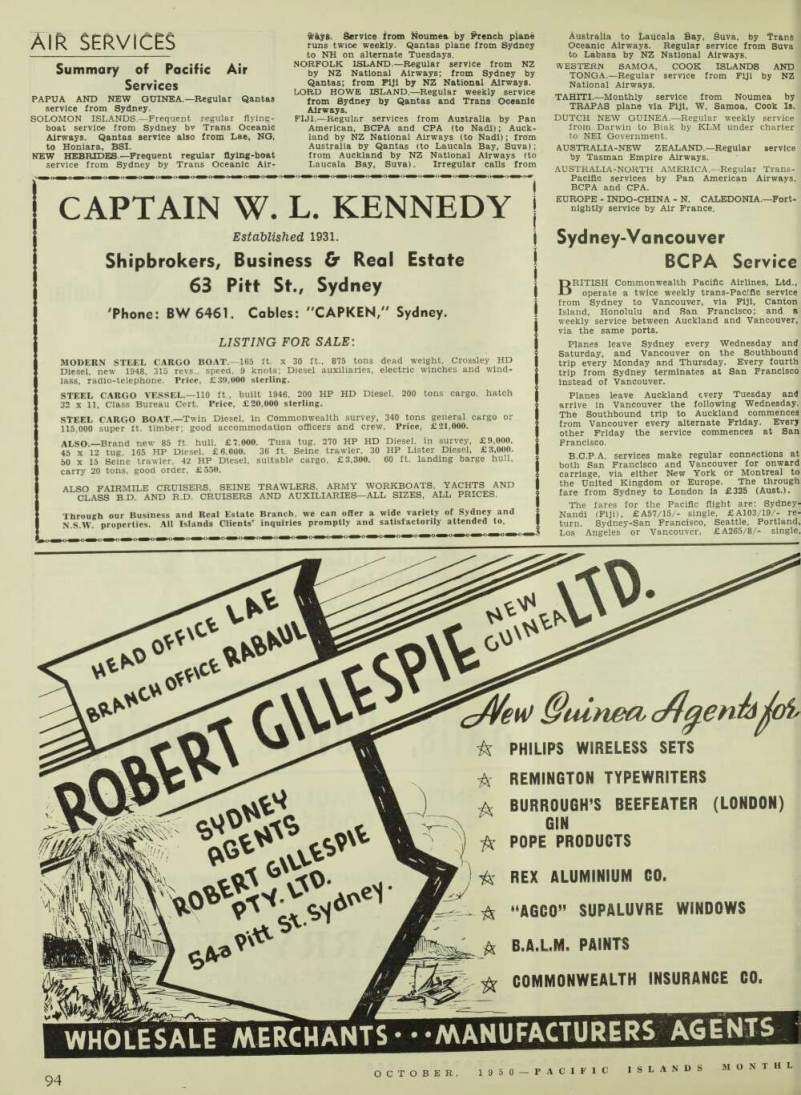
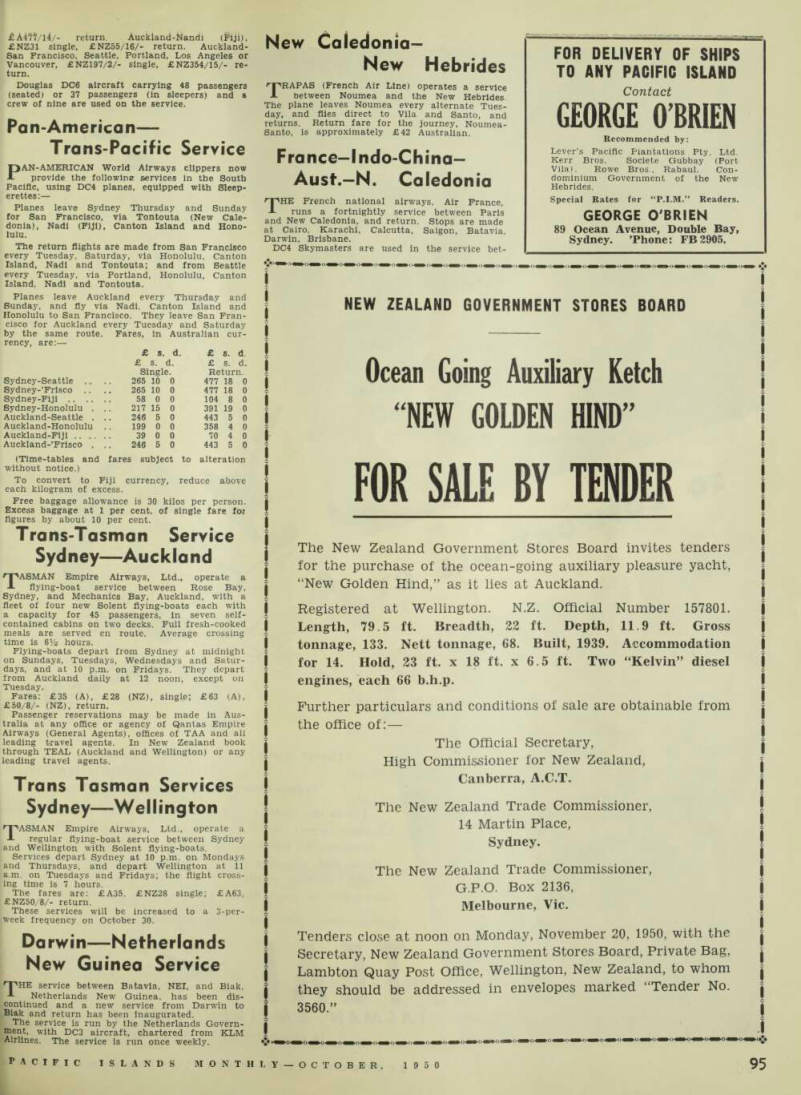
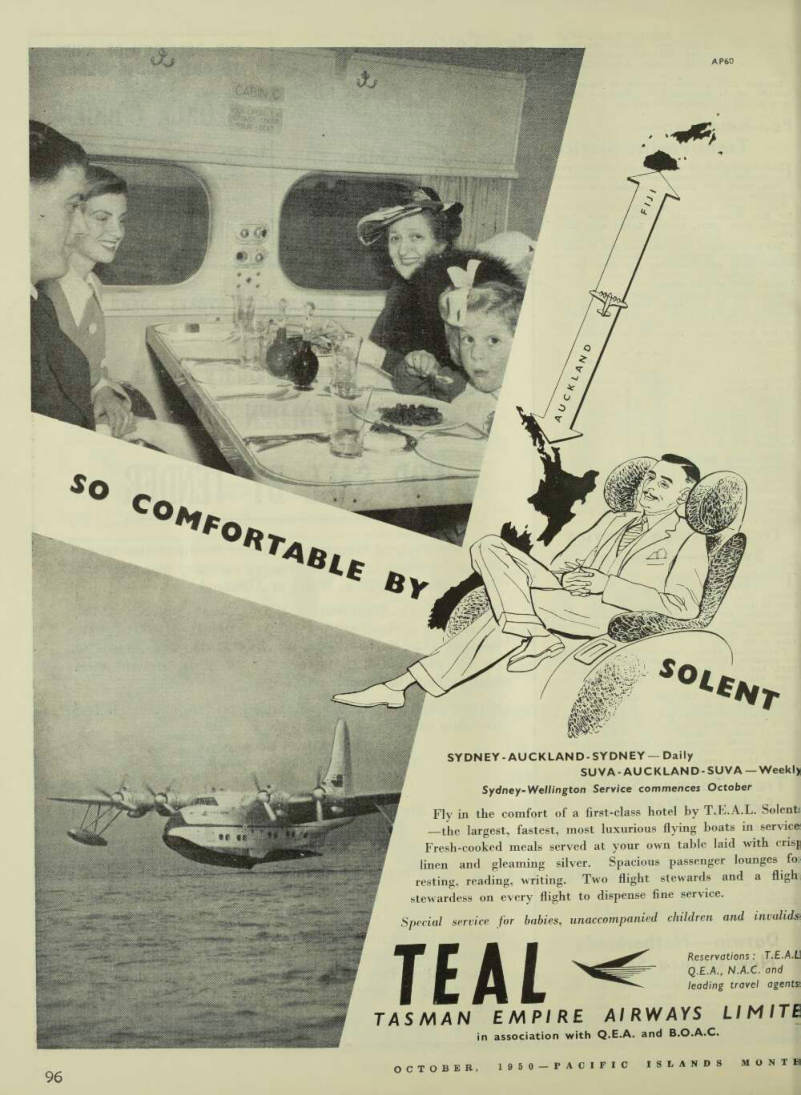
Shipping And Plane Services
Ship Services
Sydney-NZ-Fiji-Hawaii-Nth. America
r PHIS Itinerary of the Canadian-Australaslan liner "Aorangi” (17,500 tons) Is Sydney, Auckland A Suva (FIJI), Honolulu (Hawaii), Victoria (Vancouver Island), and Vancouver (British Columbia Canada). Time-table lor the Pacific section of her run Is:—
Subject to Alteration Without Notice. ♦Aorangi will be withdrawn from the trans-Pacific run after she reaches Sydney.
Sydney-N. Caledonia—
Tahiti
LINERS of the Messageries Maritimes main tain a service at about two-monthly intervals between Sydney, Vila (New Hebrides), Noumea (New Caledonia) and Papeete (Tahiti), en route to Marseilles, via the Panama Canal; and they return by the same route.
New Caledonia—New Hebrides
THE New Caledonian Government has sub sidised ana maintained the coastal ship ping services. The East Coast, th.l West Coast, and the Loyalty Islands, under present conditions, receive 10 round trips per annum The ships call at the following ports; EAST COAST— Yate, Ounia, Thio, Nakety.
Canala, Kouaoua Kua, Moneo, Ponerfhouen, Tibarama, Polndlmie. Wagap, Touho, Tlpindje, Hienghene, Tao, Oubatch, Pouebo, Balade, Pam.
Arama, and return.
WEST COAST.— Pouembout, Kone, Temala, Voh, Ouaco Gomen, Koumac, Tangaiou, Tlebaghl.
Nehoue, Poume, Baaba, Belep and return.
LOYALTY ISLANDS.—Mare (Tadine), Llfou (Chepenehe) Ouvea (Pajaoue, St. Joseph) and return.
The steamer “Neo Hebrldals” runs regularly between Noumea and Sydney, with occasional trips to tne New Hebrides (mostly Aneltyum).
The owners are Soclete Maritime et Manlere Hagen, Noumea. Sydney agents: H. C. Sleigh. 254 George Street. Sydney.
The Messageries Maritimes motor-ship Poly nesien sails from Sydney about every six weeks to Noumea, Vila and Santo (New Hebrides) and outports, with occasional trips to the Wallis and Futuna Islands. Details from Messageries Mari times branch office, in Sydney, Noumea and Vila.
New Zealand—Cook
Is.—Niue—Samoa
THE motor vessel “Maui Pomare” owned and opoiaied by Hie NZ (Gov ernment, maintains a direct service between Auckland and Rarotonga (Cook Islands), with alternative calls at Niue and Apia (Samoa).
Sydney-Papua—
New Guinea
r>URNS. PHILP LINE motor-vessels "Bulolo" * and "Malaita” maintain regular services be tween Sydney and ports in Papua-New Guinea.
“Bulolo” leaves Sydney, northbound, approxi mately every six weeks; “Malalta” every seven weeks “Bulolo” calls at Brisbane, Port Moresby.
Samarai, Lae, Dregarhafen, Rabaul, Samarai.
Port Moresby, Brisbane, thence back to Sydney.
The “Malalta’s” schedule varies considerably.
She calls at Port Moresby only occasionally, but usually calls at Samarai, Lae, Madang, Manus, Rabaul, Samarai, thence direct to Syd —Ports of call being in that order. Sometimes the order of calls is Samarai, Rabaul, Manus,
Madang, Lae, Samaral. Intending passengers should check with Burns, Phllp & Co., Ltd., Sydney, or Island branches.
New Zealand—Fiji—
Samoa—Tonga
Monthly Service by MV “TVlatua”
Service Conducted By Dnion Ss Co..
Ltd.—Subject To Alteration Without
Sydney-Norfolk Island-
New Hebrides
The SS “Morinda,” Burns, Phllp & Co., Ltd., runs at approximately three monthly intervals from Sydney to Lord Howe Island, Norfolk Island, and main ports of the New Hebrides, and re turn.
Honolulu RMS "Aoranfl”
Nov. 9 Jan. 11 Suva Nov. 18 Jan. 20 Auckland Nov. 21-23 Jan. 23-25 Sydney, arr. — Nov. 27 Jan. 29* Sydney, dep.
Oct. 5 Dec. 7 — Auckland Oct. 9-10 Dec. 11-12 — Suva Oct. 13 Dec. 15 Honolulu Oct. 20 Dec. 22 Vancouver Oct. 27-Nov. 2 Dec. 29-Jan. 4 —
Notice
Auckland . . .. Oct. 5 Nov. 7 Dec. 7 Suva .. . . .. Oct. 9-10 Nov. 11-12 Dec. 11-12 Nukualofa .. ..Oct. 12-13 Nov. 14-15 Dec. 14-15 Vavau .. , ,. .. Oct. 14 Nov. 16 Dec. 16 Pago Pago * .. Oct. 14 Dec. 16 Apia* .. . . .. Oct. 15-18 Nov. 16-19 Dec. 17-20 Suva .. . . .. Oct, 21-22 Nov. 22-23 Dec. 23-24 Auckland . . ,. Oct. 26 Nov. 27 Dec. 28 ♦Western Time.
Air Services
Summary of Pacific Air
Services
PAPUA AND NEW GUlNEA.—Regular Qantas service from Sydney.
SOLOMON ISLANDS. —Frequent regular flying boat service from Sydney by Trans Oceanic Airways. Qantas service also from Lae, NG, to Honiara, BSI.
NEW HEBRIDES. —Frequent regular flying-boat service from Sydney by Trans Oceanic Air
ft&ys. Service from Noumea by French plane runs twice weekly. Qantas plane from Sydney to NH on alternate Tuesdays.
NORFOLK ISLAND. —Regular service from NZ by NZ National Airways; from Sydney by Qantas: from Fiji by NZ National Airways.
LORD HOWE ISLAND. —Regular weekly service from Sydney by Qantas and Trans Oceanic Airways.
FlJl.—Regular services from Australia by Pan American, BCPA and CPA (to Nadi); Auck land by NZ National Airways (to Nadi); from Australia by Qantas (to Laucala Bay, Suva); from Auckland by NZ National Airways (to Laucala Bay, Suva), Irregular calls from
Australia to Laiicala Bay, Suva, by Trans Oceanic Airways. Regular service from Suva to Labasa by NZ National Airways.
Western Samoa, Cook Islands And
TONGA.—Regular service from Fiji by NZ National Airways.
TAHlTl.—Monthly service from Noumea by TRAPAS plane via Fiji, W. Samoa, Cook la.
DUTCH NEW GUlNEA.—Regular weekly service from Darwin to Biak by KLM under charter to NEI Government.
AUSTRALIA-NEW ZEALAND.—ReguIar service by Tasman Empire Airways.
AUSTRALIA-NORTH AMERICA—Regular Trans pacific services by Pan American Airways,
Bcpa And Cpa.
Europe - Indo-China -N. Caledonla.—Fort
nightly service by Air France.
Sydney-Vancouver
BCPA Service
BRITISH Commonwealth Pacific Airlines, Ltd., operate a twice weekly trans-Paclflc service from Sydney to Vancouver, via Fiji, Canton Island, Honolulu and San Francisco; and a weekly service between Auckland and Vancouver, via the same ports.
Planes leave Sydney every Wednesday and Saturday, and Vancouver on the Southbound trip every Monday and Thursday. Every fourth trip from Sydney terminates at San Francisco instead of Vancouver.
Planes Leave Auckland every Tuesday and arrive in Vancouver the following Wednesday.
The Southbound trip to Auckland commences from Vancouver every alternate Friday. Every other Friday the service commences at San Francisco.
B.C.P.A. services make regular connections at both San Francisco and Vancouver for onward carriage, via either New York or Montreal to the United Kingdom or Europe. The through fare from Sydney to London is £325 (Aust.).
The fares for the Pacific flight are: Sydney- Nandi (Fiji), £AS7/15/- single, £AIO3/19/- re turn. Sydney-San Francisco, Seattle, Portland, Los Angeles or Vancouver, £A265/8/- single,
£A4II/14/- return. Auckland-Nandi (Fiji),
£ NZ3I single, £ NZSS/16/- return. Auckland- San Francisco, Seattle, Portland, Los Angeles or Vancouver, £NZI97/2/- single, £NZ3S4/15/- re turn.
Douglas DC6 aircraft carrying 48 passengers (seated) or 37 passengers (in sleepers) and a crew of nine are used on the service.
Pan-American—
Trans-Pacific Service
PAN-AMERICAN World Airways clippers now provide the followlm? services in the South Pacific, using DC4 planes, equipped with Sleep erettes:— Planes leave Sydney Thursday and Sunday for San Francisco, via Tontouta (New Cale donia), Nadi (Fiji), Canton Island and Hono lulu.
The return flights are made from San Francisco every Tuesday, Saturday, via Honolulu, Canton Island, Nadi and Tontouta; and from Seattle every Tuesday, via Portland, Honolulu, Canton Island, Nadi and Tontouta.
Planes leave Auckland every Thursday and Sunday, and fly via Nadi. Canton Island and Honolulu to San Francisco. They leave San Fran cisco for Auckland every Tuesday and Saturday by the same route. Fares, in Australian cur rency, are:—
(Time-tables and fares subject to alteration without notice.) To convert to Fiji currency, reduce above each kilogram of excess.
Free baggage allowance is 30 kilos per person.
Excess baggage at 1 per cent, of single fare for figures by about 10 per cent.
Trans-Tasman Service
Sydney—Auckland
TASMAN Empire Airways, Ltd., operate a flying-boat service between Rose Bay, Sydney, and Mechanics Bay, Auckland, with a fleet of four new Solent flying-boats each with a capacity for 45 passengers, in seven self contained cabins on two decks. Full fresh-cooked meals are served en route. Average crossing time is 6V2 hours.
Flying-boats depart from Sydney at midnight on Sundays, Tuesdays, Wednesdays and Satur days, and at 10 p.m. on Fridays. They depart from Auckland daily at 12 noon, except on Tuesday.
Fares: £35 (A), £2B (NZ), single; £63 (A), £5O/8/- (NZ), return.
Passenger reservations may be made in Aus tralia at any office or agency of Qantas Empire Airways (General Agents), offices of TAA and all leading travel agents. In New Zealand book through TEAL (Auckland and Wellington) or any leading travel agents.
Trans Tasman Services
Sydney—Wellington
TASMAN Empire Airways, Ltd., operate a regular flying-boat service between Sydney and Wellington with Solent flying-boats.
Services depart Sydney at 10 p.m. on Mondays and Thursdays, and depart Wellington at 11 a.m. on Tuesdays and Fridays; the flight cross ing time is 7 hours.
The fares are: £A3S. £NZ2B single; £A63, £NZSO/8/- return.
These services will be increased to a 3-per week frequency on October 30.
Darwin—Netherlands
New Guinea Service
r PHE service between Batavia, NEI, and Biak, Netherlands New Guinea, has been dis continued and a new service from Darwin to Biak and return has been inaugurated.
The service is run by the Netherlands Govern ment, with DC3 aircraft, chartered from KLM Airlines. The service is run once weekly.
New Caledonia-
New Hebrides
TRAPAS (French Air Line) operates a service between Noumea and the New Hebrides The plane leaves Noumea every alternate Tues day, and flies direct to Vila and Santo, and returns. Return fare for the journey, Noumea- Santo, is approximately £42 Australian.
France-1 ndo-China-
Aust.—N. Caledonia
THE French national airways, Air Prance, runs a fortnightly service between Paris and New Caledonia, and return. Stops are made at Cairo, Karachi, Calcutta, Saigon, Batavia, Darwin, Brisbane.
DC4 Skymasters are used in the service bet
Sydney-Seattle . . .. £ 8. d. £ s. d.
Single. 265 10 0 £ s. d £ s. d.
Return. 477 18 0 Sydney-’Frlsco 265 10 0 477 18 0 Sydney-Fiji 58 0 0 104 8 0 Sydney-Honolulu . . . 217 15 0 391 19 0 Auckland-Seattle . . . 246 5 0 443 5 0 Auckland-Honolulu 199 0 0 358 4 0 Auckland-Flji Auckland-’Frlsco . .. 39 0 0 70 4 0 246 5 0 443 5 0
ween Saigon and New Caledonia, Lockheed I Constellations between Salgon-Paris, and Mes ' sageries Maritimes are agents in Australia.
Fare between Brisbane and Tontouta (Noumea) are £3O/12/6 single, £55/2/6 return. Sydney- Tontouta, £37/10/- single, £63/17/6 return.
Sydney—Queensland—
New Guinea
Q.E.A., Ltd., operate regular services be tween Sydney and Port Moresby, Lae, Finsch hafen, Madang, Rabaul, Bulolo and Wau, via Brisbane, Rockhampton, Townsville and Cairns.
This service is known as the “Bird of Para dise” Service and DC4 Skymaster and DC3 air craft are used. The Skymaster aircraft leaves Sydney every Tuesday, Thursday and Saturday at 8.30 p.m. and, making a night flight calling at Brisbane, arrives at Port Foresby the follow ing morning at 9.30 a.m. and Lae at 9.50 a.m.
The Skymaster leaving Sydney on Thursdays also calls at Townsville between Brisbane and Port Moresby, making the arrival times at Port Moresby and Lae IV2 hours later than normal.
The return flights depart Lae at 8 a.m. Mon days and Thursdays, and 7 a.m. on Saturdays, arriving at Port Moresby at 9.20 Mondays and Thursdays, 8.20 Saturdays, Brisbane at 5.30 p.m.
Mondays and Thursdays, 6.25 p.m, Saturdays and Sundays, and Sydney at 9.45 p.m. Mondays and Thursdays, and 10.15 p.m. Saturdays. The service on Saturdays also calls at Townsville, between Port Moresby and Brisbane.
The Skymaster which reaches Lae on Wed nesday mornings connects with a DC3 which departs Lae at 2 p.m. for Bulolo and Wau, re turning to Lae the same day.
DC3 aircraft leave Sydney on Mondays and Fridays at 8.15 a.m. for Lae, calling at Bris bane, Rockhampton, Townsville, Cairns and Port Moresby. An overnight stop is made at Townsville and Port Moresby is reached at 11.10 a.m. and Lae at 1 p.m. the day after leaving Sydney.
Return trips are made from Lae to Sydney on Wednesdays, departing Lae at 5.45 a.m. and from Port Moresby to Sydney on Tuesdays, de parting Port Moresby at 7.35 a.m. for Sydney, calling at Cairns, Townsville, and Brisbane, arriving Sydney at 10.15 p.m. the same days.
Rockhampton is an optional port of call only on the south-bound journey.
The aircraft that reaches Lae from Sydney on Tuesdays at 1 p.m., flies on to Madang, re turning to Lae the same afternoon.
The aircraft that reaches Lae from Sydney on Saturdays flies on to Rabaul. on Sundays, via Finschhafen, night-stops at Rabaul, and flies direct from Rabaul to Port Moresby on Monday morning.
Bookings may be made at Qantas offices at any of the towns named. At present, berths are available only to passengers holding official per mits to visit Papua or New Guinea.
Qantas Subsidiary Services In
Papua-New Guinea-Solomons
Qantas Empire Airways run the following sub sidiary services in Papua, New Guinea, and British Solomons:— A Douglas DC3 leaves Lae. New Guinea, every Thursday, and flies to Rabaul, and Kavieng, and returns to Lae; but every alternate Thurs day the plane goes on from Kavieng to Manus, and returns via Kavieng to Rabaul (overnight) and 'returns to Lae on the Friday morning.
Every Wednesday a plane flies from Lae to Madang and Wewak, and thence, via Madang to Rabaul. It returns from Rabaul to Lae on Thursday. This service is primarily for the carriage of native labour to and from Wewak, and Europeans travelling on this service are always advised of the fact.
Every alternate Monday, a Qantas Catalina flies from Port Moresby, westward to Daru, via Yule Island, Kerema, Kikorl, Lake Kutubu and Lake Murray, remaining overnight at Kikori and returning to PM next morning.
Every alternate Wednesday, a Qantas Catalina flies from Port Moresby eastward (dep. 9 a.m.) and calls at Abau and Samarai before flying out to the Archipelagoes in the afternoon. Calls are made at Esa’ala and Losuia (where an over night stop is made), and the following day (alternate Thursdays) at Deboyne Lagoon, before returning to Port Moresby, via Samarai and Abau.
Every alternate Monday, a Qantas Catalina leaves Port Moresby for Rabaul, via Moewe Har bour, and Talasea (New Britain); next morning (Tuesday) it flies to Buka, Kleta and Buln (Bougainville) and returns to Rabaul; next morning (Wednesday) it flies to Talasea, Moewe Harbour and Jacqulnot Bay, and returns to Rabaul; and next morning (Thursday) it re turns from Rabaul direct to Port Moresby.
(Optional calls are made at Inus and Lenden hafen.) Every alternate Monday a Qantas Douglas flies from Lae to Rabaul, and continues on to Honiara (British Solomon Islands), via Toro kina, Vellalavella and Yandina remains over night at Honiara: and returns to Lae the fol lowing day Tuesday), over the same route.
Every Tuesday and Friday a plane leaves Port Moresby at 7.30 a.m., reaches Kokoda at 8.35 a.m., flies on to Higatura (Popendetta) at 8.55 a.m., and leaves again for Port Moresby at 9.5 a.m., reaching there at 10.15 a.m.
Dragon DHB4 aircraft operate the following internal services in New Guinea:— Every Tuesday depart Madang for Goroka, Kainantu, Aiyura, Arona, returning to Madang at noon the same day. Calls as required for loading are made between Arona and Madang.
Every Thursday departs Madang at 7 a.m. for Wabag, Baiyer River, Mt. Hagen, with optional calls at Kerowagi and Chimbu, and returning to Madang at noon the same day.
Every Friday departs Lae at 6.30 a.m., calling at any or all of the following places as re quired; Asolaka, Aiyura, Arona, Banz, Bena Bena, Chimbu, Goroka. Kalaipit, Kainantu, Kerowagi. Kup, Mt. Hagen, Nadzab, Nondugl,
Ogelbeng, Wabag, Wabumunda.
Daily, except Thursdays and Sundays, depart Lae at 3 p.m. for Bulolo and Wau, returning direct from Wau to Lae the same day, arriving at Lae 5.5 p.m.
Sydney-Lord Howe ls.-
Norfolk Is.
QANTAS, Sydney, run a Sandringham once weekly from Sydney to Lord Howe Island.
Pare, single, £l2. Return, £2l/12/-, Qantas run a DC4 Skymaster alt. Thursdays 1 returning same day) from Sydney to Norfolk Island. Fare, £22 single; £39/12/- return. (For Norfolk Island, see also under N 2 National Airways. For Lord Howe, see also under TOA.)
Sydney-New Hebrides
QANTAS operate a service to the New Hebrides with Sandringham flying-boats calling at Noumea, Port Vila and Espiritu Santo. Frequent non-scheduled flights are made, subject to the approval of the Governments concerned.
NZ National Airways
South Pacific Services
THE Pacific services run by the New Zealand National Airways Corporation are as follows: —
Auckland-Norfolk Island-Fiji-Tonga
Western Samoa-Cook Islands: A “Douglas”
airliner leaves Whenuapai, Auckland, on alter
nate Tuesdays at 9 a.m. (October 3, 17, 31, etc.) for Norfolk Island (arr. 12.55 p.m.; dep. 2 p.m.), Nadi (arr. 8 40 p.m., dep. 5.40 a.m. Thursday), Nausori (arr. 6.25 a.m., dep. 7.30 a.m.), Tonga (arr. 10.50 a.m., dep. 11.50 a.m.), ♦Faleolo, Western Samoa (arr. 4.5 p.m. Wednes day, dep. 8 a.m. Thursday), Aitutaki, Cook Islands (arr. 1.50 p.m. Thursday, dep. 2.50 p.m.), Rarotonga, Cook Is. (arr. 4.5 p.m.).
The aircraft departs from Rarotonga on the return journey on alternate Saturdays
(October 7, 21, November 4. etc.), at 8 a m. for j Aitutaki (arr. 9.15 a.m., dep. 10 a.m.), Paleolo, W. Samoa (arr. 3.15 p.m., dep. 8 a.m. Sunday), *Tonga (arr. 10.55 am. Monday, dep. 11.50 a.m.), Nausori (arr. 2.40 p.m., dep. 3.40 p.m.).
Nadi (arr. 4.25 p.m., dep. 5 a.m. Tuesday), Norfolk Is. (arr. 10.55 am., dep. 12 noon), Whenuapai, Auckland (arr. 4.50 p.m.), 'Crosses International Date Line.
Auckland-Norfolk Island: A ‘Douglas”
airliner leaves Whenuapai, Auckland, every Sun day at 8 a.m. for Norfolk Island (arr. 11.55 a.m.), and departs on the return flight at 12.55 p.m., arriving at Whenuapai at 5.45 p.m.
On alternate Sundays (October 1, 15 and 29, etc.), a second aircraft also makes the run. leaving Whenuapai at 9 a.m., reaching Norfolk at 12.55 p.m., departing again at 1.55 p.m., and reaching Auckland at 6.45 p.m.
FARES, single (in NZ currency): Auckland to Norfolk, £l4; to Fiji, £3l; to Tonga, £3l; to Samoa, £34; to Aitutaki, £39; to Raro tonga, £39/10/-. Norfolk to Fiji, £l9. Fiji to Tonga, £B/15/-; to Samoa, £l3; to Aitutaki, £29/15/-; to Rarotonga, £3l. Samoa to Raro tonga, £l7/15/-; to Aitutaki, £l6/10/-.
Return fares, less 10 per cent.
BOOKING OFFICES: Wellington. Govt. Life Bldg., Customhouse Quay; Auckland. Air Centre.
Nathan’s Bldg., Commerce St.; Dunedin, 8-10 Manse St.; Christchurch, 104 Gloucester St.; Gisborne, 74 Peel St.; Palmerston North, 107 Broadway Ave.; Hamilton. 8 Alma St.; New Plymouth, Grand Central Building, Egmont St.; Blenheim, 13 Queen St.; Hokitika, South side Airport: Norfolk Is., Burns Philp, Ltd.; Fiji, NAC at Nadi and Suva; Burns Philp.
Lautoka; Tonga, Mrs. F. P. Melhose, Fou-amotu Airfield: W. Samoa, Burns Philp (SS), Ltd., Apia; Cook Is., Mrs. P. McVeagh, Aitutaki, and Mr. J. D. Campbell, Rarotonga.
TOA Services
TRANS Oceanic Airways run the following Pacific services:— SYDNEY -LORD HOWE IS.: A regular fort nightly service with large four-engine flylng
boats from Rose Bay. Pare: £l2 single; £2l/10/- return. Free baggage allowance 50 lb.
Excess baggage and freight rate Bd. per lb.
SYDNEY-NEW HEBRIDES: A regular monthly service with large four-engine flying-boats from Sydney, via Noumea, to Vila and Espiritu Santo (overnight stop). Fares (single and re turn); Sydney-Vila, £39/10/- and £7l/2/-; Sydney-Santo, £42/10 - and £76/10/-; Noumea- Vila, £lO and £18; Noumea-Santo, £l5 and £27. Freight: Sydney-Vila, 2/- per lb.; Sydney- Santo, 2/3.
Sydney-Solomon Islands: A Regular
monthly service from Sydney, via New Cale donia and New Hebrides to Tulagi and Honiara, Solomon Islands. This service is frequently ex tended to Llngatou, in the Russell Islands, and calls are sometimes made at Vanikoro, in the Santa Cruz Group. Fares: Sydney-Tulagi- Honlara, £55 S; £99 R. Free baggage allow ance. 60 lb.; excess baggage and freight, 3/6 per lb.
N. Caledonia-Tahiti
TRAPAS (Soclete Francals de Transports Aeriens du Pacific Sud-Noumea) runs a monthly service from New Caledonia to Tahiti Western Samoa (Faleolo), Cook Islands (Aitu takl) to Papeete, where it arrives at about 11.40 a.m. two days later. One evening is spent in Nadi and one night in Altutakl. The plane re turns by the same route In the following week.
Fare from Noumea to Papeete Is 16,000 Pacific francs single, and 28,800 return. (160 Pacific francs equal £1 Australian.) While the plane is at Papeete it runs one round trip between Papeete and Bora Bora.
Sydney-Noumea-Suva
THE following is the time-table of the Qantas Sandringham flying-boat:— Sydney dep. 9.30 p.m. alt. Tues.
Noumea arr. 6.30 a.m. alt. Wed.
Noumea dep. 8.20 a.m. alt. Wed.
Suva arr. 2.30 p.m. alt. Wed.
Suva dep. 6 a.m. alt. Fri.
Noumea arr. 10.30 a.m. alt. Fri.
Noumea dep. 12 noon alt. Fri.
Sydney arr. 7.15 p.m. alt. Fri.
Intending passengers may book through Qantas offices in Australia. Burns Philp (South Seas) Company, in Suva; and J. Brock, in Noumea.
The fares for this service in Aust. currency are:
CPA Sydney-Vancouver
Service
/■ CANADIAN Pacific Airlines, Ltd., run a trans- Pacific service between Sydney and Van couver. For the present there will be one northbound and one southbound trip per fort night. Stops are made at Nadi (Fiji), Canton Island, Honolulu and San Francisco. The north bound flight commences from Sydney every alter nate Tuesday.
Pour-engined, pressurised "Canadalr” aircraft are used; 36 passengers can be carried and a crew of 7. Flying is done in daylight. Over night accommodation Is provided at hotels in Nadi and Honolulu, which Is, of course, com plimentary.
Fares are (in Australian currency: Sydney- Vancouver, San Franclsco-Los Angeles and Port land-Seattle, £265/8/- single, £477/14/- return- Fiji-Vancouver, £207/8/- single, £373/7/- re turn; Sydney-Fiji, £57/15/- single, £lO3/19/- re turn; Sydney-Honolulu, £217/13/- single, £391/16/- return.
Bookings may be made at the Union Steam bhip Company of New Zealand. Limited, Sydney or Melbourne: Union Steam Ship Co. of NZ, Ltd.
Fiji; Canadian Pacific Airlines, Vancouver.
TEAL Flying Boat
Service
Auckland Fiji
VX/TTH new 45 sieater Solent flying-boats, Tasman Empire Airways, Limited, operate weekly Auckland-Suva-Lambasa and return service.
Aircraft depart Mechanics’ Bay, Auckland, a
half hour after midnight, each Tuesday, and operate to the following time-table:- dep. Auckland .. 0.30 a.m. Tuesday arr. Suva 7.00 a.m. Tuesday dep. Suva 9.00 a.m. Tuesday arr. Lambasa .. .. 16.00 a.m. Tuesday dep. Lambasa .. .. noon Tuesday arr. Suva 1.00 p.m. Tuesday dep. Suva 7.00 a.m. Wednesday arr. Auckland .. .. 1.30 p.m. Wednesday Fares (Single): Auckland-Suva, £3l (NZ), £34/9/- (Fijian), £3B/15/- (Aust.); (Return): £55/16/- (NZ), £6l/19/- (Fijian), £69/15/- (Aust.).
Suva-Lambasa (Single): £4/10/- (NZ), £5 (Fijian), £5/12/6 (Aust.); (Return): £B/2/- (NZ), £9 (Fijian), £lO/2/6 (Aust.).
Reservations may be made through TEAL (New Zealand I. Qantas or TAA (Australia), NZNAC (Suva) or any leading travel agents.
Papua-NG Local
Services
MANDATED Airlines, Ltd., of Lae, New Guinea, and other private operators, run air ser vices between Lae and the New Guinea mainland centres of Wau, Bulolo, Madang, Wewak, Aitape, Mt. Hagen, Flnschhafen, Moresby, Kokoda—in fact anywhere In Papua or New Guinea where there is an air-strip. These planes carry pas sengers. malls and cargo on regular schedules or charter flights.
Sydney-Noumea .. , Single, Return. £37 10 0 £67 10 0 Sydney-Suva 55 10 0 99 18 0 Noumea-Suva ... 20 5 0 36 9 0
Advertisements & other items, pp. 95-101 (3 items)
jkĵĥ
We 6m > J
Learn to Play a Tune
in 30 minutes
on the
Hawaiian Steel Guitar
HILL-BILLY GUITAR.
SPANISH GUITAR.
UKULELE.
BANJO-MANDOLIN.
NO TEDIOUS SCALES OR EXERCISES.
Play a Tune at Your First Lesson!
The Hawaiian Club will teach you in the comfort of your own home, and the cost is only 2/6 per week. Send for full particulars of the Hawaiian Club’s specialised Postal Courses.
MONEY-BACK GUARANTEE
Don’t forget there’s a MONEY-BACK GUARANTEE if you are not satisfied.
HAWAIIAN CLUB
P.O. BOX 3514 RR, G.P.0., SYDNEY.
POST THIS COUPON TO-DAY.
TO THE HAWAIIAN CLUB,
Kembla Building, 58 Margaret St., Sydney.
Please send me by return mail complete details of your Home Study Course without obligation. Tell me how I can obtain a Hill-Billy Guitar, Hawaiian Guitar, Spanish Guitar, Ukulele, Banjo-Mandolin, on a small deposit.
Name Address This Offer obtainable ONLY from above address. PIM.
jkĵĥ
CAPTAIN W. L. KENNEDY
Established 1931.
Shipbrokers, Business & Real Estate
63 Pitt St., Sydney
'Phone: 8W6461. Cables; "CAPKEH," Sydney.
LISTING FOR :
MODERN STEEL CARGO 80AT.—165 ft. x 30 ft., 875 tons dead weight. Crossley HD Diesel, new 1948, 315 revs., speed, 9 knots; Diesel auxiliaries, electric winches and windlass, radio-telephone. Price, £39,000 sterling.
STEEL CARGO VESSEL.—IIO ft., built 1946, 200 HP HD Diesel, 200 tons cargo, hatch 32 x 11, Class Bureau Cert. Price, £20,000 sterling.
STEEL CARGO BOAT.—Twin Diesel, in Commonwealth survey, 340 tons general cargo or 115,000 super ft. timber; good accommodation officers and crew. Price, £21,000.
ALSO.—Brand new 85 ft. hull, £7.000. Tusa tug, 270 HP HD Diesel, in survey, £9,000. 45 x 12 tug 165 HP Diesel, £6,000. 36 ft. Seine trawler. 30 HP Lister Diesel, £3,000. 50 x 15 Seine trawler. 42 HP Diesel, suitable cargo, £3,300. 60 ft. landing barge hull, carry 20 tons, good order, £550.
ALSO FAIRMILE CRUISERS, SEINE TRAWLERS. ARMY WORKBOATS. YACHTS AND CLASS B.D. AND R.D. CRUISERS AND AUXILIARIES—ALL SIZES, ALL PRICES.
Through our Business and Real Estate Branch, we can offer a wide variety of Sydney and N.S.W. properties. All Islands Clients’ inquiries promptly and satisfactorily attended to.
o** \C* *o* oV k 4&* *&* C^ V
{guinea
PHILIPS WIRELESS SETS
REMINGTON TYPEWRITERS
c/lfyenfafth
BURROUGH’S BEEFEATER (LONDON)
GIN
POPE PRODUCTS
is REX ALUMINIUM GO.
is “AGCO” SUPALUVRE WINDOWS
Js B.A.L.M. PAINTS
is COMMONWEALTH INSURANCE CO.
FOR DELIVERY OF SHIPS
TO ANY PACIFIC ISLAND
Contact
GEORGE O’BRIEN
Recommended by: Lever’s Pacific Plantations Pty. Ltd.
Kerr Bros. Societe Gubbay (Port Vila). Rowe Bros.. Rabaul. Condominium Government of the New Hebrides.
Special Rates for “P.1.M.” Readers.
GEORGE O'BRIEN
89 Ocean Avenue, Double Bay, Sydney. ’Phone: F 82905.
NEW ZEALAND GOVERNMENT STORES BOARD
Ocean Going Auxiliary Ketch
“NEW GOLDEN HIND"
FOR SALE BY TENDER
The New Zealand Government Stores Board invites tenders for the purchase of the ocean-going auxiliary pleasure yacht, “New Golden Hind,” as it lies at Auckland.
Registered at Wellington. N.Z. Official Number 157801.
Length, 79.5 ft. Breadth, 22 ft. Depth, 11.9 ft. Gross tonnage, 133. Nett tonnage, 68. Built, 1939. Accommodation for 14. Hold, 23 ft. x 18 ft. x 6.5 ft. Two “Kelvin” diesel engines, each 66 b.h.p.
Further particulars and conditions of sale are obtainable from the office of: — The Official Secretary, High Commissioner for New Zealand, Canberra, A.C.T.
The New Zealand Trade Commissioner, 14 Martin Place, Sydney.
The New Zealand Trade Commissioner, G.P.O. Box 2136, Melbourne, Vic.
Tenders close at noon on Monday, November 20, 1950, with the Secretary, New Zealand Government Stores Board, Private Bag, Lambton Quay Post Office, Wellington, New Zealand, to whom they should be addressed in envelopes marked “Tender No. 3560.”
AP6O
... -■ i; w -
iii
90 » » I ' * m ~-i *1 sji ah* * *»s- - W it \ ■ \m .
Wil f «
-■ - : ■ ■; ■ iiil ill ■ , ■ I - •i ■ v Mj| w„ - u - -, ■.J
tims&st
SYDNEY-AUCKLAND-SYDNEY— Daily
SUVA-AUCKLAND-SUVA— Weekly
Sydney-Wellington Service commences October Fly in the comfort of a first-class hotel by T.E.A.L. Solent —the largest, fastest, most luxurious flying boats in service* Fresh-cooked meals served at your own table laid with crisj linen and gleaming silver. Spacious passenger lounges fo resting, reading, writing. Two flight stewards and a fligh stewardess on every flight to dispense fine service.
Special service for babies , unaccompanied children and invalid?
TEAL
Reservations: T.E.A.L Q.E.A., N.A.C. and leading travel agentst
TASMAN EMPIRE AIRWAYS LIMITS
in association with Q.E.A. and 8.0.A.C.
I R. CARPENTER & CO. (Fiji) LTD.
Buyers of Copra for Fiji Copra Board, and
independent- buyers of Trocas Shell
Sellers of all Island Merchandise
AGENTS
GARDNER'S British Marine, Stationary and Road Transport Diesel Engines.
NUFFIELD EXPORTS —Cars and Commercial Trucks. Morris Marine Engines.
CHRYSLER CORPORATION: Cars and Trucks.
GUY MOTORS —"Gardner" Diesel Engined Chassis.
CATERPILLAR Tractors and Allied Equipment.
CHAPMAN Pup Marine Engines.
ALLEN Motor Scythes.
Adequate spares carried for all mechanical
appliances
OPERATORS FOR
ISLAND TRANSPORT LIMITED Motor Vessels "KOMAIWAI"
and "TOVATA" within the Fiji Group.
A. B. DONALD Ltd.
AUCKLAND, N.Z.
ISLAND TRADERS & GENERAL MERCHANTS
P.O. Box 1509. Cables Or Telegrams, "Kingdom," Auckland.
SEAGOIN
■suqtj
es* io ''
for
HE* I hoi- boat of yours ... be she runabout or cruiser, sail or power yacht . . . will be improved if she's Monel* equipped.
PROPELLER SHAFTING
of Monel, for example, resists corrosion and cannot rust thereby retain ing its strength and toughness indefinitely. Monel shafts are also hard and rigid —they do not whip and are almost unbreakable.
GALLEY EQUIPMENT
always looks spic and span when it's Monel. Easy to keep clean and bright, the smooth, silvery surface of Monel has no coating or plating to chip, crack or wear off. And because Monel is tough and resilient, it withstands lots of abuse.
HULL
FASTENINGS AND
FITTINGS
made of Monel will not corrode since they resist the attack of both sea air and salt water. They're strong, tough and rustless, and once installed, Monel fastenings and fittings never need replacing.
May we tell you more about Monel? Full information is gladly available from WRIGHT & COMPANY, 81 CLARENCE STREET, SYDNEY Sole Australian Distributors of Monel Phone: BX 1211 (Six Lines) *Monel is a registered trade-mark covering a rich nickel, alloy, mined in Canada and rolled in Great Britain.
Tropical formulae
Throughout the years the Paints and Finishes of the Sherwin-Williams Organisation have earned for themselves an enviable reputation for
their consistently high standards,
and special suitability to all climates and conditions.
I T * s'J I *
Sherwin-Williams
Globe-Tested % Finishes
■ i ;>t Distributors throughout New Guinea
COLYER WATSON (NEW GUINEA) LTD.
94
OCTOBER, 1950 PACIFIC ISLANDS MONTHL
October, 19 5 0 -Pacific Islands Month
APC Progress Report
AUSTRALASIAN Petroleum Company Proprietary Limited reported on October 10, as follows; — WAN A: The hole has been deepened 727 feet from 7,308 feet to 8,035 feet, HOHORO: Rig site for No. 2 Test has been levelled in preparation for transfer of the deep drilling outfit from the No. 1 site.
Island Exploration Company Proprietary Limited reports that rig erection has com menced at Omato.
Operation Perfume
THE British freighter, Eastern Glory, which was in Sydney in early Oc tober was nicknamed the “farmyard special” around dockland. When she left for Lae, New Guinea, there were on board five pigs, seven yearling bulls, 26 horses, 70 donkeys and 78 heifers.
The ship was expected to take on an other 300 donkeys in Brisbane, and 300 goats.
Ng Ex-Servicemen Form Club
In Sydney
THE six-months’ old New Guinea Ex- Servicemen’s Club of Sydney held a successful ball in Sydney in early September. There was an excellent at tendance and a very good time, in the old New Guinea manner, was had by those who were there.
The new club was formed at a reunion of New Guinea ex-servicemen on Anzac Day, April 25, this year. They got down to business at a general meeting on June 5.
Anyone who served in New Guinea units such as New Guinea Volunteer Rifles, New Guinea Infantry Battalions, ANGAU, Coastwatchers, FELO, Moss Troopers, etc. —or, in fact, any New Guinea resident or ex-resident who served in any theatre of the First or Second World Wars, may join.
The object of the club is purely social.
The ambition of the committee is to pro vide clubrooms where members may meet their wives, friends and families, to dis cuss old times, to dance or arrange other entertainments.
Present difficulty is to find a permanent home for the club, but it is hoped that even this obstacle will be overcome in time. The Partially-Blinded Soldiers’
Association has been approached with regard to renting their clubrooms for monthly meetings. The rooms are situ ated in Wavell House, 27 King Street, and are equipped with bar, radio, refrigerator, piano and other amenities.
Office-bearers of the New Guinea club are: Patron, Dr. E. T. Brennan: President, S. Costelloe; Vice-Presidents, C. B. Schu ler, L. Clark; Hon. Secretary, G. Gregory; Hon. Treasurer, T. Hawnt.
The secretary, Mr. Gregory, may be contacted c/o the Club, Park House, 15 Park St., Sydney, or telephones MA3595 or JW 1416 (private).
No Gold Now
Coming
Out Of Papua
From R. W. Robson
Port Moresby, Oct. 5.
THERE still is a lot of gold in Misima, Island,” said an old-time miner' whom I met here to-day. “But it. does not pay to get it out, under present; conditions.
“There are from 5 to 6 pennyweights of gold in an average ton of Misima ore..
Before the war, it could be recovered at; a cost of 28/- per ton. That left a nice; profit.
“To-day, with the terrific increase mi the cost of labour and of supplies, it costs? twice as much to recover that gold; andl the gold is not enough to pay the costs of recovery. So the biggest mine has closed up, and—except for a half-dozen atJ Quartz Mountain—all mining has ceased.
In 1939, there were hundreds of ment there. “The only hope of restoring a profitable; industry to Misima is for one big company to take over the whole of the gold bearing country on Misima, and for the Administration to assist it by reducing the costs of native labour, transportation, and: essential supplies.” .
No gold is now being produced irr Papua.
Mr. D. S. Deacon, of the New Zealand] Education Department, in September visited Fiji to inspect New Zealand teachers employed in the Colony under: the scheme of co-operation between the two Governments. He is not a to Fiji. He was for a time on the staff] of the Suva Boys’ Grammar School.
Advertisements & other items, p. 102 (2 items)
100
OCTOBER. 1950 PACIFIC ISLANDS MONTHL
Broomfields Ltd.
Suppliers of Building Hardware Ship Chandlery, Paint Materials
WRITE DIRECT TO:
Broomfields Ltd., 152 Sussex Street, Sydney
MUNGO SCOTT PTY. LTD.
Flour Millers, Summer Hill, N.S.W., Australia Established 1894.
BLUE
FINE
AND
DRY !
6
SUPERB
SUPERB
ITS
QUALITY
THAT
COUNTS !
The unvaried “Quality” of “BLUE SUPERB FLOUR” makes it especially suitable to climatic conditions of the Pacific Islands. Our Entoletion process reduces the risk of insect infestation to a minimum. All Good Bakers use “BLUE-SUPERB.” Our Pacific Representative will call on you soon.
Harold Cooper.
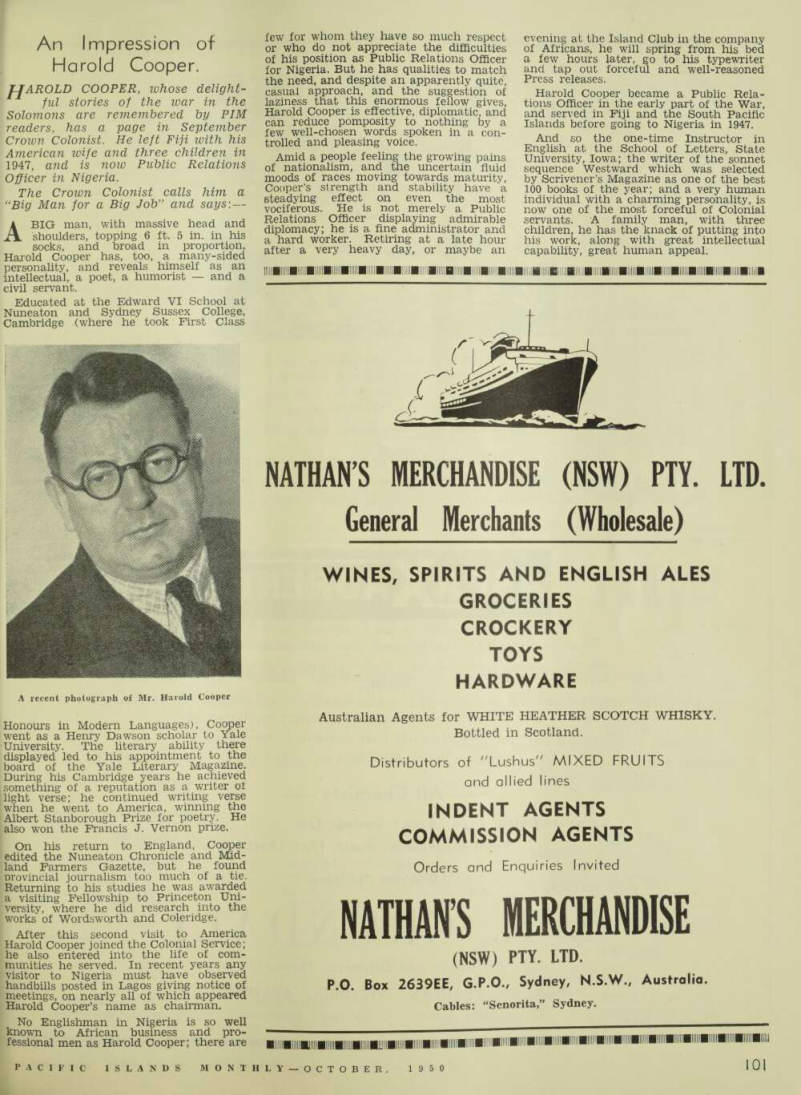
An Impression of Harold Cooper.
TJAROLD COOPER, whose delight ful stories of the war in the Solomons are remembered by PIM readers, has a page in September Crown Colonist. He left Fiji with his American wife and three children in 1947, and is now Public Relations Officer in Nigeria.
The Crown Colonist calls him a <( Big Man for a Big Job” and says : A BIG man, with massive head and shoulders, topping 6 ft. 5 in. in his socks, and broad in proportion, Harold Cooper has, too, a many-sided personality, and reveals himself as an intellectual, a poet, a humorist and a civil servant.
Educated at the Edward VI School at Nuneaton and Sydney Sussex College.
Cambridge (where he took First Class
Honours in Modem Languages), Cooper went as a Henry Dawson scholar to Yale University. The literary ability there displayed led to his appointment to the board of the Yale Literary Magazine.
During his Cambridge years he achieved something of a reputation as a writer of light verse; he continued writing verse when he went to America, winning the Albert Stanborough Prize for poetry. He also won the Francis J. Vernon prize.
On his return to England, Cooper edited the Nuneaton Chronicle and Mid land Farmers Gazette, but he found provincial journalism too much of a tie.
Returning to his studies he was awarded a visiting Fellowship to Princeton Uni versity, where he did research into the works of Wordsworth and Coleridge.
After this second visit to America Harold Cooper joined the Colonial Service; he also entered into the life of com munities he served. In recent years any visitor to Nigeria must have observed handbills posted in Lagos giving notice of meetings, on nearly all of which appeared Harold Cooper’s name as chairman.
No Englishman in Nigeria is so well known to African business and pro fessional men as Harold Cooper; there are
few for whom they have so much respect or who do not appreciate the difficulties of his position as Public Relations Officer for Nigeria. But he has qualities to match the need, and despite an apparently quite, casual approach, and the suggestion of laziness that this enonnous fellow gives, Harold Cooper is effective, diplomatic, and can reduce pomposity to nothing by a few well-chosen words spoken in a controlled and Dleasina voice troliea ana pleasing voice.
Amid a people feeling the growing pains of nationalism, and the uncertain fluid moods of races moving towards maturity, Cooper’s strength and stability have a steadying effect on even the most vociferous. He is not merely a Public Relations Officer displaying admirable diplomacy; he is a fine administrator and a hard worker. Retiring at a late hour after a very heavy day, or maybe an
evening at the Island Club in the company of Africans, he will spring from his bed a few hours later, go to his typewriter and tap out forceful and well-reasoned Press releases.
Harold Cooper became a Public Rela tions Officer in the early part of the War, and served in Fiji and the South Pacific Islands before going to Nigeria in 1947. * . .. .. , And so the one-time Instructor in English at the School of Letters, State University, Iowa; the writer of the sonnet sequence Westward which was selected by Scrivener’s Magazine as one of the best 100 books of the year; and a very human individual with a charming personality, is now one of the most forceful of Colonial servants. A family man, with three children, he has the knack of putting into his work, along with great intellectual capability, great human appeal.
A recent photograph of Mr. Harold Cooper
Advertisements & other items, pp. 103-104 (2 items)
Nathan’S Merchandise
L M
NATHAN'S MERCHANDISE (NSW) PTY. LTD.
General Merchants (Wholesale)
WINES, SPIRITS AND ENGLISH ALES
GROCERIES
CROCKERY
TOYS
HARDWARE
Australian Agents for WHITE HEATHER SCOTCH WHISKY.
Bottled in Scotland.
Distributors of "Lushus" MIXED FRUITS and allied lines
INDENT AGENTS
COMMISSION AGENTS
Orders and Enquiries Invited
NATHAN’S MERCHANDISE
(NSW) PTY. LTD.
P.O. Box 2639EE, G.P.0., Sydney, N.S.W., Australia.
Cables: “Senorita,” Sydney.
' f f m 1 ~s K J ¥ a .*■ -- -y/' #✓' „ '* 7 r Spring is here—the grass is rizz I wonder where me Hay Fever is.
Me Hay Fever's gone, it cant he seen, Thanks to good old Aspaxadrene. (By a Spring poet—Anonymous—and rightly so) In Hoy Fever (as you know) the sensitive part of the nose affected is mainly the mucous membrane on the projection inside known as the turbinals—any of the three bones situated in the lateral wall of the nose.
aspaXadrene
"Touches the Spot" (unchanged)—so relieves in seconds (not years)—same spray —same liquid (undiluted) —babies and adults.
Aspaxadrene is used similarly against inflamed capillaries of the mucous membrane which result from Asthma, Catarrh, Bronchitis, Sinus, Antrum, etc.
All Chemists —- Complete Outfit, 28/6 (Aust.), postage 1/6, Refill Aspaxadrene liquid, 12/6 (Aust,), post free.
'All About It" from
A. H. CRUNDALL
(Discoverer and Dispenser Thereof)
BOX 58, PRAHRAN, VICTORIA, AUSTRALIA.
102
OCTOBER, 1950 PACIFIC ISLANDS MONT II I, »
Six Hundred Years Ago
Maori Canoe Fleet Reached NZ
IjiROM September 22 to 24 celebrations 1 were held at Whakatane, New Zealand, to mark the 600th anni versary of the arrival of the canoe, Mataa tua. About 4,000 Maoris attended, and competitions were held amongst tribes all over New Zealand in poi dancing, hakas. action songs, and similar events.
The celebrations were held at Wairaka Pa. where the main ceremonies were com bined with the unveiling of a memorial gate at the Pa to commemorate Maori soldiers who died in the Boer War and the two World Wars.
The tribes involved in these celebrations were those from the Urewera, Whakatane and Oootiki districts.
Although there were Polynesian immi grants in New Zealand before 1350, in cluding the famous and legendary Toi-kai-rakau (about 1150) they are con sidered to have been in all probability drift voyagers. But the big migration of 1350 was a planned migration from Tahiti, using Rarotonga as a port of call.
Sir Peter Buck <Te Rangi Hiroa) in his Coming of the Maori—that indispensable book —considers these famous canoes to have been capable of sailing seven miles an hour, so that they could have done the full 2,000 miles in a fortnight, and if the canoes called at Rarotonga, the final stretch would have been further reduced, so that “the unconcern with which the Maori traditions brought the Fleet to New Zealand offers a contrast with the con cern expressed by European writers,” Sir Peter also considers the canoes quite capable of carrying ample provisions and water.
Cook, of course, noted the excellent sea going canoes of Tahiti when he was there in 1769. Anyway, the South-East trades would have brought them as far as the Kermadecs, after which their deep sea paddles would have come into strenuous use, plied by those muscular, disciplined arms.
Other canoes of the 1350 migration cele brated in Maori song and story include
the Nukutere, Tainui, Te Arawa, Toko maru, Aotea, and Kurahaupo.
Says the Encyclopaedia Britannica: “For general culture the most important, clement in the Maori population is pro vided by the Fleet of 1350, and on this the present social organisation largely de pends.”—H.E.L.P.
M. Henri Bonneaud, president of the New Caledonian General Council since 1947, has been recommended for the Legion d’Honneur. He is general manager of Maison Ballande and a vice-president of the Noumea Chamber of Commerce.
Advertisements & other items, p. 105 (1 item)
Etablissements Donald Tahiti
Coughing, Asthma, Bronchitis
Curbed
Do you have attacks of Asthma or Bronchitis so bad that you can’t sleep?
Do you feel weak, unable to work, and have to be careful not to take cold and can’t eat certain foods?
No matter how long you have suffered or what you have tried, there is new hope for you in a doctor’s prescription called Mendaco. No dopes, no smokes, no injections, no atomiser.
All you do is take two tasteless tablets at meals and in three minutes Mendaco starts working through your blood, aiding nature to remove phlegm, promote free, easy breathing and bring sound sleep the first night so that you soon feel years younger and stronger.
No Asthma in 2 Years Mendaco not only brings almost immediate comfort and free breathing but builds up the system to ward off future attacks. For instance, J.
Richards, Hamilton, Ont., Canada, had lost 40 lbs., suffered coughing every night, couldn’t sleep. Mendaco stopped
Quickly
Asthma spasms first night and he has had none since in over two years.
Money Back Guarantee The very first dose of Mendaco goes right to work circulating through your blood and helping nature relieve you of the effects of Asthma. Try Mendaco under an iron-clad money back guarantee. You be the judge. If you don’t feel fully satisfied after taking Mendaco just return the empty package and the full purchase price will be refunded Get Mendaco from your chemist to-day and see how well you sleep to-night and how much better you will feel to-morrow. The guarantee protects you.
Mendaco
ETABLISSEMENTS DONALD TAHITI
HEAD OFFICE—QUAI DU COMMERCE—PAPEETE
TELEGRAPHIC ADDRESS—“DONALD, PAPEETE”
General Merchants (Wholesale & Retail) & Shipowners
Importers & Exporters—Branches Throughout Marquesas Islands
A B. DONALD. LTD.
T -I A ASSOCIATE AUCKLAND. NEW ZEALAND.
Lloyd S Agents HOUSES: ISLANDS
j ° DOMINION FRUIT CO..
SUVA, FIJI ISLANDS.
Agents and Distributors for :
FRANCE:
HENNESSY COGNACS
MARIE BRIZARD & ROGER
LIQUEURS
CHARLES HEIDSIECK
CHAMPAGNES
PERRIER WATER
GRUBER BEER
U.S.A.;
GENERAL STEAMSHIP CORP.
RADIO CORP. OF AMERICA
BROWN & WILLIAMSON, LTD.
CIGARETTES: LUCKY STRIKE.
WINGS. OLD GOLD
CHAMPION SPARK PLUG CO.
RAINIER BEER
ENGLAND:
RECKITT & COLMAN
(OVERSEAS), LTD.
PHILLIPS BICYCLES
THE BANK LINE LTD.
NEW ZEALAND:
VACUUM OIL CO. PTY., LTD.
PETROLEUM PRODUCTS
SWEDEN:
HJORTH & CO.
PRIMUS STOVES
Sydney Agents ;
BURNS, PHTLP A CO., LTD.
London Agents.
BURNS, PHILP A CO.. LTD.
San Francisco Agents'.
BURNS. PHILP CO. OF
SAN FRANCISCO.
Agents in France ;
HARTH A CIE, PARIS.
A. BICKART, MARSEILLES.
Suva Town Board Councillor
Elected
MR. L. F. GARNETT was the only candidate in the Suva Town Council by-election, and has been declared elected as a Councillor.
The by-election was made necessary by the resignation of Mr, D. B. Costello, who has moved from Suva to Tavua.
Two old-timers from Eastern Papua, Mr.
P. R. Osborne and Mr. R. D. Smith, ar rived in Sydney early in October—Mr.
Smith on long leave, and Mr. Osborne to settle down in NSW. Mr. Osborne arrived first in Port Moresby in 1909, when there were only 70 Europeans (13 women) there. For very many years he has been on the staff of Cuthberts Misima Gold mines and few men know more than he about that type of mining.
Visitors To Mangaia
From Our Own Correspondent WE had a number of visitors on the first of this season’s two fruit ships to call at Mangaia, Cook Islands.
Sister Nancy Ellison, who has been for one term at Rarotonga Hospital, renewed her own connection with this island, which she last saw as a child of three.
Her father, Dr. E. P. Ellison, OBE, (for merly CMO at Rarotonga), who is of NZ Maori blood, beside his medical pursuits, was an ethnologist, and the Doctor traced a link here between local tribes and his own in NZ. Hence, the Sister’s visit, on her way back to NZ?, was a double re union, and she received a warm welcome from friends ashore. It is Miss Ellison’s intention to later visit Honolulu and Sir Peter Buck, another tribal relation. Island friends of Sir Peter will be sorry to hear that his health has not been good of late.
Another visitor was Mrs. H. McCarthy, the wife of Judge McCarthy of the High Court of Cl, who is connected with the well-known Framhein family at Mauke Island.
New Zealand “big business” was repre sented by Mr. P. Mounsey, of W. H.
Grove and Sons Ltd., a firm whose name has been famous here for some decades in the native cloth market.
The engagement has been announced of Miss Robin Mantle, younger daughter of the late Mr. F. W. Mantle and Mrs.
Mantle, of South Yarra, and formerly of Rabaul, to Mr. Michael Young, only son of Dr. and Mrs. J. Wilkie Young, of East St, Kilda. The marriage will take place at the Melbourne Grammar Chapel on November 17. The young couple are booked to sail for England on the Orontes and expect to be away about two years.
Advertisements & other items, pp. 106-108 (3 items)
Gilbey’S
WORLD PARITY FOR YOUR PRODUCE!
We are outright buyers of—
TROGHUS SHELL M.O.P. SHELL
IVORY NUTS GREEN SNAIL SHELL
As direct exporters to World’s consuming centres we can offer
TOP PRICES.
We supply TIMBER, DOORS, JOINERY, MOULDINGS, Etc.
W. BALCHIN PTY. LTD.
(Established 1848).
TIMBER, IMPORT Cr EXPORT MERCHANTS
Head office Also at SYDNEY: 247 George St. LONDON: 78 Gt. Bushey Drive ’Phones: BW 1538-9 Totteridge Cables: “BALCHINCO”
O/- // °'o /J « A
the
Ci^ 1
Is /° r
GILBEY’S
G /L B
Ey f-To. mel b °ur N f . sy &Ney, R/s, a/s/ £
GBBS3
Address all enquiries to W. & A. GILBEY LTD., 33 Rosslyn Street, West Melbourne.
105
Unrealistic Attack on NG's Native Labour Problem (Continued from page 13.)
pacific islands monthly October, 1950
Quality
m "^O^M
f w s&t.
The New WUNDERLICH SINK UNIT
is available in Stainless Steel, 4', 4'6" 1 5' and 6’ long, with a lustrous, rustless, smooth "Wunderbrite" finish that is easy to keep spick and span.
Ask your local Hardware Merchant, 'phone MX 241 I or write to Wunderlich Limited, Box 474, G.P.0., Sydney, for prices and leaflet.
COMBINATION SINK & DRAINER
a
BRAND
QUALITY
k > Ya gall ?V ft
At Your Service . . .
WILLIAM E. REED
ENTERPRISES
145 a GEORGE ST. ( CIRCULAR QUAY, SYDNEY.
William E . Reed
(Established 1913) Island Trade Broker & Commission Agent For more than 36 years the PERSONAL buying services of WILLIAM E. REED, backend by an experienced staff has ensured prompt and reliable service at lowest cost to Missions, Planters and Traders throughout the Pacific. We operate on a WHOLESALE basis only. You receive original invoices at invoiced cost.
Purchase and delivery of Island craft a speciality.
Enquiries invited for all plantation and trading requirements. Island products sold on a commission basis.
Cables: "WILREED," Sydney
BOAT SALES DIVISION
For Sea Delivery: 40 FT. TRADE BOATS 10 ton cargo capacity.
Diesel powered. Strong and seaworthy.
Two experienced teams always available for sea delivery anywhere in the Pacific.
For Assembly :
20 FT. HEAVY DUTY TRADE BOATS
Super Craft with a thousand and one uses.
ALSO . . .
Continuously available is a wide range of power and auxiliary power craft ideally suited to various Island purposes. Those immediately available include:— GENERAL PURPOSE CRAFT, 66 ft. x 17 ft., 250 HP diesel powered, complete navigation equipment and auxiliary sails.
Lloyds specifications, ARMY CLASS STEEL LIGHTER ideal for copra carrying; 106 ft. x 30 ft., capacity 400/600 tons. Ready for engine installation. TWIN SCREW DIESEL CARGO SHIP. 104 ft. x 21 ft., 11,000 cubic feet cargo capacity, ready for sea. (Sea delivery arranged.) Cables: " WILLREED," Sydney.
WILLREED AGENCIES PTY. LTD.
Distributors for :
COVENTRY VICTOR DIESEL
MARINE ENGINES
5/7 h.p. and 7/9 h.p.
Write for Specifications.
PEERLESS LOCKWOVEN
SQUARE MESH FENCING
For pig fences, sheep fences, cattle fences, general farm fences.
Merchants and Traders—Write
INVINCIBLE SINGLETS
First grade, economically priced
SPANISH SHOTGUNS
Complete range available.
Inquiries invited.
MINIATURE SEWING
MACHINES
Suitable for Native Trade. or cable for our Price List.
Cable Address: “REEDAGE,” Sydney.
Potato Ballad
We’ve got potatoes for dinner, We’ve got potatoes for tea — Six for Master and three for me— And nary a cargo of spuds on the sea!
But a native came down from the hills to-day With a beautiful basket of spuds—soc hooray!
We’ve got potatoes for dinner, We’ve got potatoes for tea — Five for Master and four for me— A sight for the gods in these parts, you’ll agree.
In the eye of the Master I notice a glin j We’ve plenty of butter; we’ve even got mint: And we’ve got potatoes for dinner We’ve got potatoes for tea— Pour for Master and five for— Dash it! We’ll mash ’em, and no one wil see!
Noelle Taylor.
Security
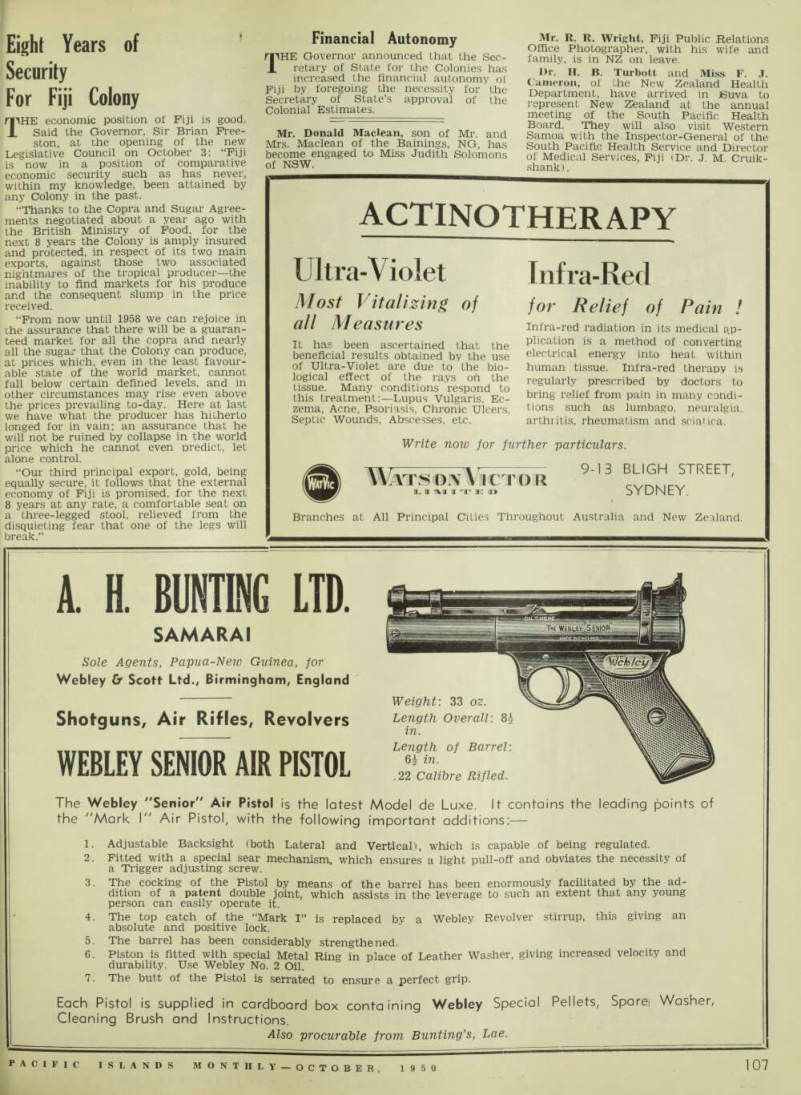
Eight Years of Security For Fiji Colony
THE economic position of Fiji is good.
Said the Governor, Sir Brian Pree ston, at the opening of the new Legislative Council on October 3: “Fiji is now in a position of comparative economic security such as has never, within my knowledge, been attained by any Colony in the past.
“Thanks to the Copra and Sugar Agree ments negotiated about a year ago with the British Ministry of Food, for the next 8 years the Colony is amply insured and protected, in respect of its two main exports, against those two associated nightmares of the tropical producer—the inability to find markets for his produce and the consequent slump in the price received.
“Prom now until 1958 we can rejoice in the assurance that there will be a guaran teed market for all the copra and nearly all the sugar that the Colony can produce, at prices which, even in the least favour able state of the world market, cannot fall below certain defined levels, and in other circumstances may rise even above the prices prevailing to-day. Here at last we have what the producer has hitherto longed for in vain; an assurance that he will not be ruined by collapse in the world price which he cannot even predict, let alone control.
“Our third principal export, gold, being equally secure, it follows that the external economy of Fiji is promised, for the next 8 years at any rate, a comfortable seat on a three-legged stool, relieved from the disquieting fear that one of the legs will break.”
Financial Autonomy
THE Governor announced that the Sec retary of State for the Colonies has increased the financial autonomy of Fiji by foregoing the necessity for the Secretary of State’s approval of the Colonial Estimates.
Mr. Donald Maclean, son of Mr. and Mrs. Maclean of the Bainings, NG, has become engaged to Miss Judith Solomons of NSW.
Mr. R. R. Wright, Fiji Public Relations Office Photographer, with his wife and family, is in NZ on leave.
I>r. H. B. Turbott and Miss F. J.
Cameron, of the New Zealand Health Department, have arrived in jSuva to represent New Zealand at the annual meeting of the South Pacific Health Board. They will also visit Western Samoa with the Inspector-General of the South Pacific Health Service and Director of Medical Services, Fiji (Dr. J. M. Cruik shank).
Advertisements & other items, pp. 109-110 (2 items)
107
PACIFIC islands month ly-october, 1950
A. H. Bunting Ltd.
ACTINOTHERAPY
Ultra-Violet
Most Vitalizing of
all Measures
It has been ascertained that the beneficial results obtained bv the use of Ultra-Violet are due to the biological effect of the rays oh the tissue. Many conditions respond to this treatment: —Lupus Vulgaris, Eczema, Acne, Psoriasis, Chronic Ulcers, Septic Wounds, Abscesses, etc.
Infra-Red
for Relief of Pain
Infra-red radiation in its medical application is a method of converting electrical energy into heat within human tissue. Infra-red therapy is regularly prescribed by doctors to bring relief from pain in many conditions such as lumbago, neuralgia, arthritis, rheumatism and sciatica.
Write now for further particulars.
|gl Wv
rSDIV VICTO R
9-13 BLIGH STREET,
SYDNEY.
Branches at All Principal Cities Throughout Australia and New Zealand.
A. H. BUNTING LTD.
SAMARA!
Sole Agents, Papua-Netv Guinea, for
Webley & Scott Ltd., Birmingham, England
Shotguns, Air Rifles, Revolvers
WEBLEY SENIOR AIR PISTOL
3 Weight'. 33 oz.
Length Overall : 8 £ in.
Length of Barrel : in. .22 Calibre Rifled.
The Webley "Senior" Air Pistol is the latest Model de Luxe. It contains the leading points of the "Mark I" Air Pistol, with the following important additions: — 1. Adjustable Backsight (both Lateral and Vertical), which is capable of being regulated. 2. Fitted with a special sear mechanism, which ensures a light pull-off and obviates the necessity of a Trigger adjusting screw. 3. The cocking of the Pistol by means of the barrel has been enormously facilitated by the addition of a patent double joint, which assists in the leverage to such an extent that any young person can easily operate it. 4. The top catch of the “Mark I” is replaced by a Webley Revolver stirrup, this giving an absolute and positive lock. 5. The barrel has been considerably strengthened. 6. Piston is fitted with special Metal Ring in place of Leather Washer, giving increased velocity and durability. Use Webley No. 2 Oil. 7. The butt of the Pistol is serrated to ensure a perfect grip.
Each Pistol is supplied in cardboard box containing Webley Special Pellets, Spare) Washer,
Cleaning Brush and Instructions.
Also procurable from Bunting's, Lae.
EXTRA WHITE
CLOTHES
RECKITT’S BLUE in the last rinse ensures that extra whiteness without damaging the fabric.
Bakers of the best biscuits S/9620
Tongan Footballers
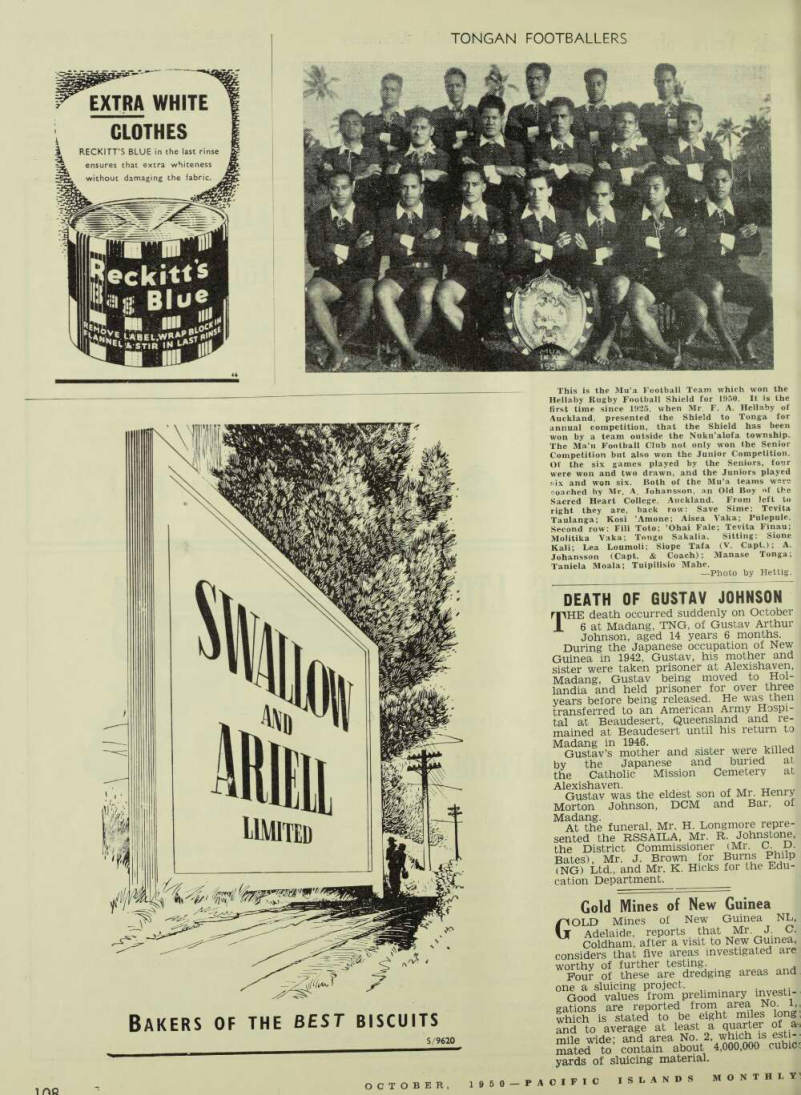
This is the Mu’a Football Team which won the Hellaby Rugby Football Shield for 1950. It is the first time since 1925, when Mr F. A. Hellaby of Auckland, presented the Shield to Tonga for annual competition, that the Shield has been won by a team outside the Nuku’alofa township.
The Ma’u Football Club not only won the Senior Competition but also won the Junior Competition.
Of the six games played by the Seniors, four were won and two drawn, and the Juniors played six and won six. Both of the Mu’a teams were coached by Mr. A. Johansson, an Old Boy of the Sacred Heart College, Auckland. From left to right they are, back row: Save Sime; Tevita Taulanga; Kosi ’Amone; Aisea Vaka; Pulepule.
Second row: Fili Toto; ’Ohai Fale; Tevita Finau; Molitika Vaka; Tongo Sakalia. Sitting: Sione Kali; Lea Loumoli; Siope Tafa (V. Capt.); A.
Johansson (Capt. & Coach); Manase Tonga; Taniela Moala; Tuipilisio Mahe.
Photo by Hettig.
Death Of Gustav Johnson
THE death occurred suddenly on October 6 at Madang, TNG, of Gustav Arthur Johnson, aged 14 years 6 months.
During the Japanese occupation of New Guinea in 1942, Gustav, his mother and sister were taken prisoner at Alexishaven, Madang, Gustav being moved to Hol landia and held prisoner for over three years before being released. He was then transferred to an American Army Hospi tal at Beaudesert, Queensland and re mained at Beaudesert until his return to Madang in 1946. . . ... , Gustav’s mother and sister were killed by the Japanese and buried at the Catholic Mission Cemetery at Alexishaven.
Gustav was the eldest son of Mr. Henry Morton Johnson, DCM and Bar, of Madang.
At the funeral, Mr. H. Longmore repre sented the RSSAILA, Mr. R. Johnstone, the District Commissioner (Mr. C. p.
Bates), Mr. J. Brown for Burns Philp (NG) Ltd., and Mr. K. Hicks for the Edu cation Department.
Gold Mines of New Guinea
NL, Adelaide, reports that Mr J. C.
Coldham, after a visit to New Guinea, considers that five areas investigated are worthy of further testing.
Four of these are dredging areas and one a sluicing project.
Good values from preliminary investi gations are reported from area No. L, which is stated to be eight miles long; and to average at least a Quarter of mile -wide; and area No. 2. which is esti mated to contain about 4,000,000 cubic, yards of sluicing material.
Near Bankruptcy Of
Philippines
ONLY a recent loan from the Inter national Monetary Fund has saved the Philippines Republic from bank ruptcy. When tne loan came, the salaries of thousands of public servants were in arrears.
The cost of living spiral in the Republic makes similar trouoles in Oceania look as puny as a corkscrew. A glass of beer in Manila costs 5/-; a decent meal 25/-.
Like their Djakarta friends, the Filipino politicians who so ardently desired •‘independence” are finding that it can be a two-edged sword.
Trade with Australia
THE Philippines could not continue to make big purchases in Australia unless Australia bought more in exchange, the Pnilippines Minister to Australia, Dr. Roberto Regala, told the Junior Chamber of Commerce in Mel bourne in early October.
The trade balance between the two countries is now seven to one in Aus tralia’s favour. The Minister said that there were great opportunities for Aus tralian businessmen in the Philippines.
New firms and businesses were tax-free for four years. This year 58 new firms had been established. Their products included glass, bricks and tiles, nails, cement, and textiles.
The Philippines could also supply Aus tralia with all the hardwood she needed.
High Cost of Keeping Native
Servants
AT present in South Australia on leave is Mrs. W. L. MacGowan, wife of the Assistant Director of Works and Housing, in Papua-New Guinea.
Mrs. MacGowan has spent 23 years in the Territory—except for the war-evacuee years and before the war lived in Rabaul; the family now lives in Port Moresby.
In an interview with the Adelaide Advertiser, she said that the cost of living at Moresby is twice as high as it was at Rabaul before the war, and in spite of the “living allowance” which Government officials receive it is quite impossible to save.
In Rabaul she kept three native servants who were each paid 10/- a month and provided with food rations. In Moresby she has one servant who is paid £2 a week and keeps himself in food. He is provided with quarters away from the house, with his own septic system and a bathroom.
The natives, who are taught in Govern ment schools and trade classes, make very good mechanics and practically all the Government buses, which provide free transport, are driven by natives. On “boat days” the town is crowded with tourists who comprise at least 50 per cent, of the passengers on the now regular
shipping runs.
Government medical services in Papua are excellent. There is a very good hospital for the natives, with a white sister in charge. There is also a very good hospital for Europeans. The climate is so healthy, Mrs. MacGowan says, that there is very little malaria and the children in particular are “a lovely,
healthy lot.”
The Rev. R. de Voil, Vicar of Hwywood, Lancs., England, who was Rector of St.
George’s Church, Rabaul, New Guinea, and Archdeacon of Northern Melanesia, 1935-37 has been appointed to the charge of the Chinchilla Parochial District, Queensland, and arrived in Sydney on the New Australia in September. Mr. de Voil would welcome the opportunity of meeting any old New Guinea friends.
Advertisements & other items, pp. 111-112 (1 item)
Scotland’S Premier Whisky
CM
Stewarts and Lloyds (Australia) Pty. Ltd
Manufacturers of "S & L" PIPES and FITTINGS for GAS, WATER, STEAM and oilier purposes.
AND Distributors of;
MILD STEEL BARS, PLATES and SECTIONS;
GALVANISED IRON; BOLTS and NUTS; ELECTRODES
and WELDING EQUIPMENT.
Stewarts and Lloyds (Australia) pt y . Ltd SVDNEy WAREHOUSE - - Herbert Street, St. Leonards BRISBANE WAREHOUSE - Montague Road, South Brisbane MELBOURNE WAREHOUSE - - City Road, South Melbourne Telegraphic Address: "Tubes Sydney, Brisbane or Melbourne
SCOTLAND’S PREMIER WHISKY
% c k * \ :-4 HI
HtfcfHl
v ,™
AVAILABLE FROM YOUR LOCAL STOREKEEPER
SHIPS
AND
SMALLCRAFT
As one of the oldest, largest and most active shipbroking firms in Australasia, we are in a position to offer a wide range of vessels suitable for economic Island operation. Some of these craft are solely in our hands for sale.
At this time of publication, and subject to prior sale, we have the following vessels to offer:— • New diesel engined 300 tonner. • Modern diesel engined 300 tonner. • Modern steel 200 tonner, twin diesels. • Powerful diesel tug. • Twin screw motorship, 450 tons d/w. • Number of 50/60/80 100/150 tons capacity motor - vessels, some with auxiliary sails.
TRAILER
FIRE
ENGINES
These units are widely used throughout Australia for rural fire protection by Fire Brigades, Municipal Authorities, Harbour Boards, etc. They are ideal for the protection of Island townships, store depots, properties, etc. Available in 225 GPM and 500 GPM capacities.
“BLUE STREAK” POWER CHAIN SAWS
As sole Factory Representatives for the truly sensational Australian-made “® L y E .®Jf h^ A F’ t r sg| e ° f However and two-man powet chain saws, we are now finalising distribution arrangements e S s 0 " t A S ®®®ts are held such arrangements will not be regarded by us as complete stocks .of“ a^^ es se a and by all Distributors. Until then, we are open to accept direct orders and full details of these amazing uiue aim money-saving units, will be gladly supplied on request.
A. J. ELLERKER
63 PITT STREET, SYDNEY, N.S.W.
'Phones: BU 1574, BU 5055.
Cable Address: "Hipex, Sydney."
Margarine Should be an Alternative
to Costly Butter
THE old controversy as to whether or not the manufacture of margarine should be restricted in Australia, in order to protect the dairy industry, is again being argued back and forth.
At prseent margarine manufacture is restricted in all Australian States, al though the many reasons for this, which were believed to be well-founded before 1939, no longer hold good.
To keep the retail price of butter at 2 2 per pound, the Australian Government last year paid £8,900,000 in subsidies.
This year, with butter rationing removed, it is expected that it will cost the Com monwealth (indirectly the taxpayer) £11,000,000.
If the subsidy on butter were removed, the price per pound would be well over 3/-.
Meanwhile margarine retails at 1/9 \ a lb. In a free economy this product would offer a very serious threat to butter. However, the law as it stands ordains that only a limited amount of margarine may be sold in Australia, whether people can or cannot afford butter.
Although Australia’s population is rising rapidly—by the arrival of scores of thous ands of migrants who have no anti margarine prejudices—Australian produc tion of butter has not increased —nor will it while Australians desert their farms for the doubtful pleasures of a 40-hour week in a city factory. Nonetheless, the same old reasons why margarine should be restricted in favour of dairy products are brought out for an airing everytime the subject comes up.
There is still a great shortage of edible fats. World population is increasing at an alarming rate and more and more communities are demanding these protec tive foods in their diet.
There is ample room in this fat-starved world for both the margarine and butter industries.
The Commonwealth Director-General of Agriculture recently gave this review of Australian vegetable oil crops to a Melbourne Herald reporter (he said that only two vegetable oil crops would be increased —linseed because it did not com pete with the dairying industry, and cotton-seed because of its defence im portance).
LINSEED. —Only a few years ago it was held that Australia could not pro duce this crop economically because of rust and caterpillars, but today there are from 30,000 to 35,000 acres of linseed, and the figure is still rising steadily.
About 200,000 acres are needed to make Australia self-sufficient.
Australia suffers from a grave shortage of linseed meal because producing coun tries export a minimum of seed and a maximum of oil. They retain the seed for stock cake. This lack of meal is reflected most sharply in Australia’s winter milk shortages.
MAIZE.—The oil is used in the kitchen and in margarine. Production has not varied much in 20 years, despite price increases.
A substantial increase in the amount of maize processed would not result in a significant increase in the volume of oil available for human consumption because maize oil is only a by-product.
COTTON-SEED.—The oil is a by product and like maize the seed cannot be grown economically for oil alone. Pro
duction seems to be fairly well established in Queensland, but with the war other crops become more profitable, efficient harvest labour became scarce, and the crop dwindled to its lowest level last harvest.
To encourage renewed production the Commonwealth is guaranteeing farmers 9£-d. a lb. and buying mechanical harv esters with the new dollar loan.
PEANUTS. —The Commonwealth is in
vestigating the possibility of mechanical harvesting.
SUNFLOWER SEED. —For an unknown reason the crop is smaller this year. (Continued next page)
However, it has possibilities second only
to linseed. It has a wide soil and climate tolerance and can be grown over a wide area.
SOYA BEAN—Production has been encouraged enthusiastically in NSW, Queensland and Victoria, but the oil con sumption is limited.
NAVY BEANS. —Many farmers have switched from soya beans to navy beans because they are more profitable. In wartime the beans are canned.
COCONUT.—OiI production is mainly in New Guinea although the coconut has been grown successfully in Northern Queensland.
COCOA. —New Guinea may supply both cocoa and tea to Australia in years to come.
Advertisements & other items, pp. 113-114 (1 item)
Morris Hedstrom (Australia) Pty. Ltd.
BOOKS
BOOK BARGAINS. —Every few months I issue a catalogue of clean secondhand books at really bargain prices from a shilling or two to a pound or two, each. If you’d like these catalogues sent, just send a line stating your interests. (Note: If you order, part payment can always be made in used stamps, not removed from the paper, of which I am always needing any amount.) —Philip R. Boulton, 8, Fore Street, Westbury, Wilts., England.
INQUIRIES ARE INVITED
Concerning the Distribution and
Sale of All Types of
Merchandise in the
Pacific Islands
WE ARE AUSTRALIAN AGENTS FOR-
MORRIS HEDSTROM LTD., Fiji, Tonga and Samoa,
MILLERS LTD., Fiji.
8.5.1. P. GOVERNMENT TRADE SCHEME, Honiara.
G. b E.I.C. WHOLESALE SOCIETY, Tarawa.
MAX HALECK, Pago, Pago, American Samoa.
Original Invoices Supplied Quotations on Request ★
MORRIS HEDSTROM (Australia) PTY. LTD.
(Established 1922)
MERCANTILE BROKERS,
Asbestos House, 65 York Street, Sydney.
Box No. 2530, G.P.0., Sydney. Cable Address: “MORSTROM,” Sydney.
BANKERS: BANK OF NEW ZEALAND, SYDNEY.
PLAIN AND
SELF RAISING
FLOUR,
CidJc fi/C 4#/
ESTABLISHED 1868
BURNS PHILP (Mew Hebrides) LTD.
Registered Office: VILA, NEW HEBRIDES
Branch Office at SANTO
Exporters, importers and General Merchants
(Retail and Wholesale) Commission, Shipping
and Customs Agents
Representatives for BURNS PHILP TRUST COMPANY LIMITED, QUEENS- LAND INSURANCE CO., LTD., and LLOYD’S OP LONDON. Agents for SOCIETE DES PETROLES SHELL DES ILES FRANCAISES DU PACIFIQUE, and numerous overseas manufacturers of all classes of merchandise.
San Francisco Agents: Sydney Agents; Burns. Phllp Co. of San London Agents: Burns, Philp & Co., Ltd., Francisco, Burns, Philp A Co., Ltd., 7 Bridge Street. Matson Building, 35 Crutched Friars, E.C.3 215 Market Street.
Kidney Trouble Causes Backache, Puffy Ankles
If you're feeling out o-sorts, have Interrupted Sleep, or suffer from Dizziness, Nervousness, Backache. Leg Pains, Swollen Ankles, Rheumatism, Excess Acidity, or Loss of Energy and feel old before your time. Kidney Trouble is the true cause.
Wrong foods and drinks, worry, colds or overwork may create an excess of acids and place a heavy strain on your kidneys so that they function poorly and need help to properly refresh your blood and maintain health and energy.
Kelp Kidneys Scientific Way
It has been proven by scientific clinical tests that a quick and sure way to help the kidneys clean out excess acids and poisons is with a scientifically prepared prescription called
Cystex. Hundreds and hundreds of clinical records prove this.
No Benefit —No Pay
The very first dose of Cystex goes right to work helping your kidneys remove excess acids Quickly, this makes you feel like new again. And so certain are the makers that Cystex will satisfy you completely they ask you to try it under a money backguarantee. You be the judge. If not entirely satisfied just return the empty package and get your money back.
Cystex costs little at chemists and stores and the money back guarantee protects you.
Cystex
for
KIDNEYS
BLA D D E
RHEUMATISM
The Guaranteed Treatment
A. M. Roxburgh Dies
In Levuka
MR. A. McP. ROXBURGH, who has lived in Levuka, Fiji for “just on 20 years, died suddenly on October 7 as a result of a fall into the rocky bed of Totogo Creek, which runs through Levuka. He was 50 years of age.
He was born in Scotland, went to Fiji from Australia, after working for some time in the Philippines. He was at first employed in the Levuka branch of Burns Philp (SJ3.) Co., Ltd., but later joined Morris Hedstrom, Ltd.
Mr. Roxburgh was a talented artist and in his youth, while a student at the Glasgow School of Art, he was one of a group which painted murals for the 1924 Wembley Exhibition. From time to time in recent years his cartoons have appeared in the Pacific Islands Monthly.
He was secretary of the Levuka Cham ber of Commerce and the Levuka Bowling Club.
He is survived by his wife (formerly Mrs. N. Crooks), a son and a daughter and two step-daughters.
Pacific Relations Conference
At Lucknow
THE Institute of Pacific Relations met in conference at Lucknow in early October.
Officials of the Institute were, until the last minute, trying to beat up some Aus tralian delegates, but without success.
Dr. H. V. Evatt was elected by the Aus tralian section of the Institute to attend but he said that matters of importance involving foreign affairs and of domestic importance were occupying the attention of the Australian Parliament, in which he had an official position. He therefor© could not attend.
Book Wanted
MR. SYDNEY H. CHANCE would like to purchase a copy of a book of Papuan folk-tales that was written by Captain Bruce Hamilton about five or six years ago. He thinks that the book was called Fuzzy-Wuzzy Tales. It appears to be out of print now. Mr. Chance wants a copy for an American friend. If you can assist, his address is 15 Pe.rrott St. f Brisbane, W 2.
The first volume of Mr. R. A. Derrick’s History of Fiji, has been revised and is on sale at the Fiji Government Printing Office, Suva at 12/6 or 7/6, according to the binding. This volume covers the period up to Cession in 1874, and includes new material that has come to light since the first edition was printed a few years ago.
Deputy-Administrators
Wanted For Papua-New Guinea
THE following advertisement appeared
in Australian newspapers recently:—
Two Deputy Administrators are to be appointed to the administration of the Terri tory of Papua and New Guinea, and appli cations are invited from persons desirous of being 1 considered for such appointments.
Appointment will be open to persons both within and without the Public Service of Papua and New Guinea.
Salary to be fixed between £2,000 and £2,500 per annum, plus entertainment allowance. (The Income Tax Assessment Act does not apply to any income derived by residents of the Territory from sources within the Terri tory.) The Deputy Administrators will be required to assist the Administrator in all phases of administration. Appointees may be stationed in any part of the Territory.
Applicants should have good organising and administrative capacity. Experience in Gov ernmental administration and particularly in the administration of tropical areas would be an advantage.
Applications accompanied by copies only of references, stating full name, date and place of birth, marital state, experience, quali fications and war service (if any) should "be submitted by October 27, 1950, to the Secre tary, Department of External Territories, Canberra, ACT.
Ter.ritorians may be pardoned if they
wonder why it should be necessary to advertise in Australia for such men. It has, of course, always been the practice of Australian governments to give the job of administrator of any external territory to a defeated politician or some other person who has found favour in the sight
of the current government. Whether or not they have had any experience in administering tropical territories has mattered little, if at all.
It should not be necessary to go further than the top ranks of the present Public Service of Papua-New Guinea to find the men fitted to fill these jobs. It might even be beneficial if experienced Terri torians from wicked private enterprise could be persuaded to take on these jobs.
Major H. W. S. Jackson, of the Aus tralian Army recently returned to Mel bourne after several weeks in Borneo where he paid out several thousands of pounds to 100 natives (or their widows) who had helped Australian soldiers during the notorious Sandakan death march. The natives were paid in Straits dollars. Major Jackson’s efforts to trace some native families took him as far as Malaya.
Advertisements & other items, pp. 115-116 (1 item)
have MUSIC !
N. F. Maloney & Co.
Phone 268. PORT MORESBY Phone 268.
Cables, Radios, etc., “Malco,” Port Moresby.
CUSTOMS, SHIPPING, AND FORWARDING AGENTS.
LICENSED AUCTIONEERS AND GENERAL COMMISSION
AGENTS.
House, Land, and Estate Agents.
Chief Agents:
NEW ZEALAND INSURANCE CO, LTD.
(Incorporated in New Zealand) FIRE . . ACCIDENT . . MOTOR VEHICLE . . MARINE, ETC.
Importers and Exporters :: Manufacturers Representatives.
Australian Representatives : E. J. GOUGH & CO., 1 BOND STREET, SYDNEY.
Let’s
have MUSIC !
ORDER NOW
BY POST war
SEND COUPON
... by post in time for Christmas.
MOUTH ORGANS
Send coupon now for your instrument or further details of our huge range of instruments, accessories, gramophones and parts, radios, sheet music, tutors,
BUTTON
ACCORDIONS
Button Accordions:
21 Keys, £l7/10/-
10 Keys, £B/17/6
Cases finished in
Nacrolaque.
GUITARS
Here is a musical instrument that will give you pride and pleasure to own. Pine music must come from such a fine guitar. Spanish or Hawaiian models, beautiful in construction and workmanship.
Models from £B/17/6, complete with case.
RECORDS
LARGE STOCKS OP AUSTRALIAN AND
ENGLISH RECORDS ON ALL LABELS.
New releases always available.
H.M V.—COLUMBIA—CONTINENTAL
PORTABLE PHONOGRAPHS AT RULING
PRICES.
Ask to be put on our mailing list.
Trade Enquiries Invited
ALWAYS POPULAR. More so with these strong quality instruments with full note range.
Hohner, 20-Reed Vamper 11/- Auto-Valve Harp, 40-Reed . . . 26/6 Chromonica, 40-Reed 47/6 Super-Chromonica, 48-Reed . . . 65/-
NYLON STRINGS
CREMONA
ii ii At last there is now a durable string for the tropical climate.
Nylon Strings have superseded all other types of strings throughout America and the Continent.
Ukulele Nylon Strings per set, 5/6 Guitar. Ist, 2/6; 2nd, »/-; 3rd. 3/6 Violin, Ist or E. 2/-; 2nd or A, 2/6; 3rd or D. 3/-.
437-439 GEORGE STREET,
SYDNEY.
>5 -Q U o V o C CO til u X a Q < Q z < w S < z
G. H. ROBINSON EXPORTS & IMPORTS PTY. LTD,
Pacific Island Traders and Merchants .
Sole Distributor of Bradford Commercial Sellers on Commission of all kinds of Vehicles, Jowett Javelin Cars and Uniporn Island produce—Cocoa Beans, Green Snail, Diesel Engines—(Franchises available in Copra, Fungus, M.O.P. Shell, Trochus certain Pacific Groups.) Shell, etc.
Agents in London and Manchester for the Disposal and Supply of Produce and Special Requirements.
EVERY ATTENTION GIVEN TO ORDERS IRRESPECTIVE OF SIZE.
Make use of our 30 years’ personal experience and direct your inquiries to: G. H. ROBINSON EXPORTS & IMPORTS PTY. LTD. 51 MACQUARIE STREET, SYDNEY. Telephone: BW 4575.
Cables: “SUNRISE,” SYDNEY. Postal Address: Box 3317, G.P.0., Sydney
A. B. DONALD LIMITED
RAROTONGA COOK ISLANDS
TELEGRAPHIC ADDRESS: “DONALD, RAROTONGA.”
General Merchants (Wholesale & Retail) and Shipowners Importers & Exporters Branches Throughout Cook Islands Fire, Marine & Motor Vehicles Insurance Agents for Yorkshire
Insurance Co.
Lloyd’s Agents.
Agents and Distributors for: ENGLAND.—Austin Cars & Trucks, Pye Radios, Dunlop Rubber Co., Ltd., Vauxhall Cars & Trucks, R. A. Lister & Co., Ltd., Phillips' Cycles, Marples Tools.
U.S.A.—Remington Rand Corp., Radio Corp. of America, Champion Spark Plug Co.. Firestone Tyres, General Steamship Corp.
NEW ZEALAND.—Vacuum Oil Co. Pty., Ltd, Petroleum Products.
AUSTRALIA.—WunderUch, Ltd., Cement Asbestos Products.
NORWAY.—O Mustad & Sons, Fish Hooks.
SWEDEN—B. A. HJorth & Co., Primus Products.
Sydney Agents: London Agents: San Francisco Agents: BURNS, PHILP ft CO., LTD. BURNS, PHILP ft CO., LTD. BURNS, PHILP CO. OF SAN FRANCISCO.
Head Office;— A. B. DONALD, LTD., Auckland.
Associate Houses:—
ETABLISSEMENTS DONALD TAHITI,
Papeete, Society Islands.
DOMINION FRUIT CO., Suva, Fiji Islands.
CODES: Bentley's Complete Phrase, Acme
Rabaul Comforts Fund
Distribution of Money
rIS paragraph, which appeared in a Sydney newspaper on October 7, caused the phone of Mrs. N. H. Fox croft, President of the New Guinea Women’s Club, Sydney, to run almost hot:
Money Waiting.
During the war the Rabaul Comforts Fund raised money for prisoners of war and their dependents.
The war over, the New Guinea Women’s Club became the trustees of the money, but they’re having trouble in locating widows and dependents of men who were made prisoners or had lost their lives in the Islands.
If you know of a New Guinea war widow ask her to ring Mrs. N. H.
Foxcroft, LX 1778; there’s a bit of money to be distributed.
THE facts are these: The New Guinea Womens Club, Sydney, had two funds —one of which they originated and worked for themselves and which they called the POW and Civilian Internees’ Fund; and the other, the Rabaul Comforts Fund which was raised in Rabaul before the Japanese occupation for the purpose of sending comforts to men who had en listed therefrom. The money was got out of the Territory and was later handed over to the NG Women’s Club for dis tribution. It was specified by the trust ees of the Fund that it be used to assist New Guinea-enlisted ex-prisoners-of-war or their dependents only. Therefore the distinction between the two funds, in a nutshell, is that the POW and Civ ilian Internees’ Fund money may be used
to assist NG POWs, civilian internees or their dependents. The old Comforts Fund money on the other hand, may be used only for ex-prisoners-of-war—that is, ser vicemen who enlisted in New Guinea— or their dependents.
The club has been anxious to wind up the Comforts Fund for a long time.
Last March they inserted an advertise ment in Australian newspapers, the Pacific Islands Monthly and had a notice displayed in several New Guinea clubs, etc., asking for those eligible and in need, to apply for grants. It was hoped that this would enable them to clean the
whole thing up before the middle of this year. But there was so little response to these advertisements, etc., that the matter has not yet been settled.
Mr. G. W. Nettles, of the Fiji Public Works Department, has arrived in England to begin a four-year course in Civil Engineering at Loughborough Engineering College, Leicestershire. He was awarded a Colonial Development and Welfare Scholarship by the UK Government last year.
Advertisements & other items, pp. 117-118 (1 item)
Be Sure
300 WAIT ELECTRIC GENERATING SET
10 HRS. POWER OH ONE GALLON PETROL 1 1/4 H.P. 4-stroke air-cooled
J.A.P. English
Engine coupled
to D/C generator 12-32 volt 9-12 amps
Complete with
Ball bearing generator delivers 300 wait, switchboard. at voltage which can be varied by a W e i a k+ OQlbs knob on the switch box from 12 to 32 q volts. It is a sturdy battery-charging £53 set and is ideal for lighting say 7 x 40 watt globes or 10 x 25 watt globes using With Battery either 12, 24 or 32 volt battery. Start.
Trade enquiries also invited.
44 MISSENDEN ROAD, NEWTOWN, SYDNEY,
N.S.W., AUSTRALIA.
BE SURE
Lars Halvorsen Sons Pty. Ltd., Designers and Builders of Halvorsen Boats, advise that no-one connected with them is in anyway connected with any other boatyard than their Head Office and Branches shown below:— BE SURE to contact one of the following SYDNEY addresses: • WATERVIEW ST. RYDE' Head Office, Building Yard, Engine and Marine Hardware Sales and Service. • HAYES ST., NEUTRAL BAY: Repair Work, Slippings, Moorings. • BOBBIN HEAD, KU-RING-GAI CHASE: Cruiser and Open Boat Hire, Slippings, Moor- Distributors for: CHRYSLER, MORRIS, LEYLAND DIESEL, STERLING and SUPERIOR
DIESEL MARINE ENGINES.
Builders of
HALVORSEN BOATS
Telegrams: “HALVORSENS,” Sydney.
Build your own
RADIO RECEIVER
Yes, you can build your own Radio Receiver Set with a special kit from John Martin. Send now for full particulars of these and other sets, also valves and all types of radio components.
B/C SUPERHET KIT
* (Illustrated at left) (See Radio and Hobbies, p. 52, July, 1950).
An excellent circuit to select as your first assembly job.
John Martin kit is child’s play to assemble and is complete down to the last nut and bolt, together with full instructions for wiring, lining up, etc.
H
D/W SUPERHET KIT
(Illustrated at right) 6-Valve Dual-Wave Super-Het capable of World Range. Remember, this is the year for England- Australian Test Matches.
STANDARD MULTIMETER KIT
(See Radio and Hobbies, p. 64, September, 1950).
A multimeter is indispensable to the serious amateur. This unit is standard in every way and will successfully perform against expensive standard units. Simplified circuit ensures a guaranteed performance. Full kit of first quality components available now from John Martin.
Available Now from . . .
JOHN MARTIN PTY. LTD.
116 - 118 CLARENCE STREET, SYDNEY.
Telegrams; “JONMAR,” Sydney.
POST COUPON NOW
John Martin Pty., Ltd., 116-118 Clarence Street, Sydney.
Please send me further details of your radio kit. Also full details of your range of kits, valves and components, (Cross out words not applicable).
NAME.. . .
ADDRESS,
More War Dumps For
Sale In Ng
Concurrently with a plea by Port Moresby’s new newspaper (South Pacific Post) that the remaining scrap metals in Papua-New Guinea be acquired by Australia, is the announce ment that a war dump will be sold shortly in the Rabaul district.
Scrap metal buyers In America, the Philippines, England and a number of European countries are showing renewed interest in the war-time dumps in Papua and New Guinea.
America is said to have placed fantas tic orders for scrap throughout the world, and it is now almost impossible to get it anywhere.
There is still plenty of scrap in New Guinea, but most of it, having been sold at disposals, is owned by private people.
One big dump in the Rabaul district has been reacquired by the disposals authori ties following a High Court ruling that the owners had allowed the time clause in their contract to lapse. Now the dump is to be sold by public tender.
Hundreds of tunnels in N. Britain con tain an unknown quantity of old war supplies. Rotted coconut palm supports in tunnels have made speculators wary about exploring the underground dumps.
Earthquakes and heavy rains have caused many tunnels to collapse, burying what ever treasure was there.
The Disposals sales in Papua-New Guinea of 1946-47 have now passed into history—apparently without making much Impression on Authority. The Australian Government of that day did everything possible to help Australian and overseas buyers to remove from the Territory as much valuable equipment as possible in the shortest possible time.
The Territory, much of which was com pletely devastated, found itself soon in the position of reimporting goods that had been taken away as War Disposals pur chases. Other valuable equipment was permitted to lie mouldering and rusting away in dumps, paw-paw, banana and other growth sprouting up amongst, or through it.
Just how far this war-disposals mater ial travelled was indicated in Melbourne in 1948. A feud between some Jewish interests, which had ended in a kidnap ping, apparently has its origin in war materials ex-New Guinea which had been shipped to Palestine by Melbourne sympa thisers to help the Jews in their campaign against the British.
Monsieur Anthonioz, Flench colonial administrator 2nd class, has been con firmed in his appointment as French Resident Commissioner in the New Heb rides.
Mr. and Mrs. A. H. B. Crabbe and their three children arrived in Sydney by plane
early in October from Suva, Fiji, where they have spent the last five years.
Advertisements & other items, pp. 119-120 (2 items)
Gabriel Achun
CASH
REGISTERS
Electric Model.
HUGIN Cash Registers are built in Sweden with the precision and finish for which Sweden is world famous. They are built in one of the largest register factories in the world and are completely modern in design. HUGIN Cash Registers have been tested and proved over the years and several large emporiums in Australia have had numbers in use since 1938. During the past four years hundreds have been installed in stores all over Australia and New Zealand.
HUGIN machines are most suitable for use in the Islands. The base and cash drawer are made of polished stainless steel not affected by humidity or tropical conditions and all parts that are touched by hand are made of stainless steel or highly chrome-plated special alloy steel. HUGIN design and mechanical efficiency win praises wherever they are used and they provide printed office records for a complete cash sale system.
HUGIN Cash Registers can be provided with a keyboard capacity of £9/19/11?- or £99/19/11. Issue a printed receipt for the customer or print on a duplicate cash sale docket. Also provide detailed audit strip, total counter, customer counter and several other Hand Mndpi attractive and useful features. Hantl iVAOaei - Can be supplied with one or two drawers, or totals, and shortly, with itemising device.
Please send us details of your business, without obligation, and we will be glad to supply full details of suitable machines. Orders will be accepted through any accredited Sydney export house.
W. KOPSEN & CO. m. LTD.
376-382 KENT STREET, SYDNEY
Cables: KOPSEN, Sydney.
GABRIEL ACHUN
Importer and Wholesale Merchant
Specialises in:
BEERS
BICYCLES
AERATED WATER MANUFACTURING
COTTON PIECEGOODS FOR NATIVE TRADE
AGENT FOR “STANDARD” AND “TRIUMPH” CARS
Malaguna Road
RABAUL
Territory of New Guinea Proprietor:
RABAUL CORDIAL FACTORY.
Telegraphic Address:
“GABRIEL ACHUN,” RABAUL.
Classified Advertisements
DEATH NOTICE.
CAMPBELL. Claud Ivo Hamilton. —September 25. 1950, London. England (suddenly), late of Raua Estate, Bougainville. New Guinea, beloved Husband of Lala Edith Mary Campbell and Father of Mrs. Nari Elspeth Hamilton Forster.
THANKS
MISS OLIVE KURTZ, of Cremorne Point, Sydney, N.S.W.. who was recently holidaying in Rabaul, New Guinea, as the guest of Mr. Bill Bailey, of the New Guinea Company, would like to thank sincerely all those friends of Mr. Bailey who extended to her such warm hospitality, thereby making her holiday such a happy and enjoyable one.
ISLANDS SOUVENIR
SONGS OF THE SOUTH SEAS.—lnspirational Verse. Cover: Feathery Palms, Tropical Flowers.
Island Girl. Ideal gift or Souvenir. One dollar (8/- Aust.). Post Free. —Dr. W. Swaan, 715 West 16th Avenue, Vancouver, 8.C., Canada.
secondary growth and will be paid to the successful tenderer by the War Damage Section when satisfactory evidence is produced to it that the work has been completed or well advanced: Tsalui Plantation, £831; Matanabago Plantation, £304; Wassanga and Meteissong Plantations, £706.
Title. —The successful tenderer shall accept such title as the Administrators of the Estate now have and without further investigation.
Terms. —All properties sold subject to the consent of the Administrator of the Territory of Papua and New Guinea. Tsalui, Matanabago.
Wassanga and Meteissong Plantations are sold subject to the consent of the Custodian of Expropriated Properties. On acceptance of tender. 25 per cent, of tender price to be deposited; and the balance is to be paid upon the execution by the Trustees of a conveyance of the property or such other document or instrument as the successful tenderer may reasonably require to evidence the sale in the absence of a registerable transfer. The highest or any other tender will not necessarily be accepted.
BURNS PHILP TRUST COMPANY, LIMITED,
7 Bridge Street, Sydney.
Administrator Estate E. R. Miller, deceased.
Sydney, October 4, 1950.
MAMIRUM AND PATIAWAI PLANTATIONS.—
Tenders are invited and will be received by the undersigned up to January 7. 1951, for the purchase of the following plantations and land: — MAMIRUM (Freehold): Situated on Mamirum Harbour, north-west New Hanover, Territory of New Guinea. Area: 1.606 hectares (approximately 4,000 acres), of which approximately 50 hectares are planted with coconut palms and the balance virgin timber. Mamirum Harbour is deep-water, sheltered, and ideal for timber loading.
The property has been surveyed and survey fees paid. It was purchased under contract sale from the Custodian of Expropriated Properties, who will give title when the enabling ordinance is completed.
PATIAWAI (Freehold): Approximately 120 hectares (approximately 300 acres), originally planted with 12,000 coconut palms, of which 1,100 were blitzed by enemy action in World War 11. This property adjoins Mamirum.
Any buildings on the above two properties belong to the lessee and may be removed by him.
Both Mamirum and Patiawai properties are near the Tsalui Group plantations.
On acceptance of tender, 25 per cent, of tender price to be deposited; and the balance is to be paid upon the execution of a conveyance of the property or such other document or instrument as the successful tenderer may reasonably require to evidence the sale in the absence of a registerable transfer. The highest or any other tender will not necessarily be accepted.
K. T. ALLAN, “Stirling,” Rob Roy, via Inverell, New South Wales.
Sydney, October 10, 1950.
FOR SALE
RADIO EQUIPMENT.—We can supply new and reconditioned transmitters and receivers for low powered marine and shore installations at a reasonable price. Crystals supplied to specified, frequencies. Inquiries answered promptly.
Write: Liverpool Trading Co., 23 George Street,, Liverpool, N.S.W.
PACIFIC VERSES
ISLAND VERSES.—“Songs From The South Seas’* By Alice Allen Innes, with Foreword by Dame Mary Gilmour, and delightfully illustrated by, Captain Brett Hilder Price: 6/- (including gaily illustrated mailing envelope), posted 6d. extra. An ideal Christmas gift. Copies available from: Pacific Publications Pty. Ltd., 247 George St., Sydney, N.S.W.
HOLIDAY RESORT
‘MOUNTAIN VIEW,” magnificently situated on ;he banks of the Wollondilly River, is the largest; ind most modern Guest House in Burragorang i/alley. NSW, with accommodation for 15t< 'nests Golf, tennis, riding, billiards, dancing md swimming. Hot water service, electric ligh. md sewerage. Licensed to serve liquor. Tariff] £4/4/- per week, with special rates for childrens Write direct to: “MOUNTAIN VIEW,” Burra i 'orang Valley, NSW, or phone Burragorang • ’or XM 1384). Proprietor: R. I. Fernandez, laid if Papua and New Guinea.
TENDERS.
ESTATE ERNEST RUSSELL MILLER,DECEASED.
—Sealed Tenders endorsed “ESTATE E. R.
MILLER” are invited and will be received by the undersigned until 5 p.m., November 30, 1950, for the purchase of the following, either wholly or in part:— 1. —Tsalui Group Plantation.— (.a) Situation; 27 miles north-west of Kavieng, New Ireland, (b) Area: 598 hectares (approximately 1,495 acres) planted with approximately 55,000 coconut palms. 2. —Matanabago Plantation. — (a) Situation: Near Tsalui Group, approximately 10 miles from Kavieng. (b) Area: 323.60 hectares (approximately 809 acres) planted with approximately 13.500 coconut palms. 3. —Wassanga and Meteissong Plantations. — (a) Situation: On west coast of New Hanover, New Ireland District. (b) Area; 762.40 hectares (approximately 1,906 acres) planted with approximately 41,000 coconut palms.
General.—Above properties are heavily overgrown with secondary growth. An assessment as under has been made by War Damage Section as a subsidy towards clearing the
BOOKS FOR HORSE LOVERS
TELL ME THE NEXT ONE.— By John Godley. The startling story of a man whose dreams paid dividends and who succeeded for years in picking horse-race winners in his sleep. 10/6 (post 5d.).
HORSESENSE.— By Clive Inglis. This bright, breezy book takes the reader behind the scenes in the mating, rearing and racing of great thoroughbreds. 24 illustrations from photographs and humorous drawings by Jack Quayle. 12/6 (post Bd.).
NINE O’CLOCK.—By J. C. Bendrodt. A collection of warmlysympathetic tales, varied in setting, subject and mood, for all who love a horse or a dog. Illustrated by John Baird. 7/6 (post 5d.).
ANGUS & ROBERTSON LTD.
Booksellers :: Publishers :: Librarians
89 CASTLEREAGH ST., SYDNEY, AUSTRALIA.
Telephone 136. Telegrams: “AKUN,” RABAUL.
ALOIS AKUN & COMPANY
RABAUL, TERRITORY OF NEW GUINEA
Also at 180 NATHAN ROAD, KOWLOON, HONG KONG.
Planters and General Merchants
WE CARRY STOCKS OF:—
(1) Embroidered Silkware. Carved Camphor-wood Boxes. Eastern Fancy Goods. (2) The Best of Beers, in different Brands “San Miguel,” “Red Horse” and “Three Horse.” (3) Cotton Piece Goods suitable for trade and issues. (4) Trade goods of all descriptions: Wholesale and Retail.
Prompt attention to all orders Sydney Representatives: NELSON & ROBERTSON PTY., LTD., Electra House, 12 Spring Street, Sydney, N.S.W.
118
OCTOBER, 19 5 0 -PACIFIC ISLANDS MONTHI
Samoan Crime Wave
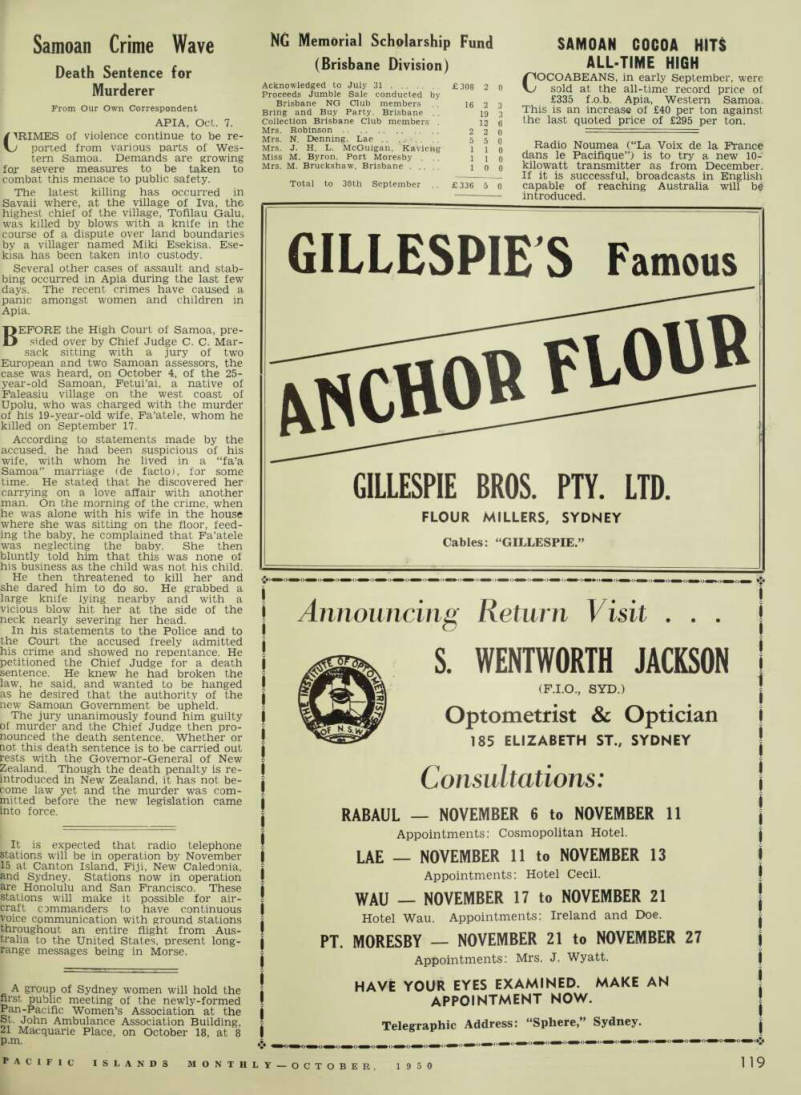
Death Sentence for Murderer
From Our Own Correspondent
Apia, Oct. 7.
C CRIMES of violence continue to be re j ported from various parts of Wes tern Samoa. Demands are growing for severe measures to be taken to combat this menace to public safety.
The latest killing has occurred in Savaii where, at the village of Iva, the highest chief of the village, Tofilau Galu, was killed by blows with a knife in the course of a dispute over land boundaries by a villager named Miki Esekisa. Ese kisa has been taken into custody.
Several other cases of assault and stab bing occurred in Apia during the last few days. The recent crimes have caused a panic amongst women and children in Apia.
BEFORE the High Court of Samoa, pre sided over by Chief Judge C. C. Mar sack sitting with a jury of two European and two Samoan assessors, the case was heard, on October 4, of the 25year-old Samoan, Fetui’ai, a native of Paleasiu village on the west coast of Upolu, who was charged with the murder of his 19-year-old wife, Fa’atele, whom he killed on September 17.
According to statements made by the accused, he had been suspicious of his wife, with whom he lived in a “fa’a Samoa’’ marriage (de facto), for some time. He stated that he discovered her carrying on a love affair with another man. On the morning of the crime, when he was alone with his wife in the house where she was sitting on the floor, feed ing the baby, he complained that Fa’atele was neglecting the baby. She then bluntly told him that this was none of his business as the child was not his child.
He then threatened to kill her and she dared him to do so. He grabbed a large knife lying nearby and with a vicious blow hit her at the side of the neck nearly severing her head.
In his statements to the Police and to the Court the accused freely admitted his crime and showed no repentance. He petitioned the Chief Judge for a death sentence. He knew he had broken the law, he said, and wanted to be hanged as he desired that the authority of the new Samoan Government be upheld.
The jury unanimously found him guilty of murder and the Chief Judge then pro nounced the death sentence. Whether or not this death sentence is to be carried out rests with the Governor-General of New Zealand. Though the death penalty is re introduced in New Zealand, it has not be come law yet and the murder was com mitted before the new legislation came into force.
It is expected that radio telephone stations will be in operation by November 15 at Canton Island, Fiji, New Caledonia, and Sydney. Stations now in operation are Honolulu and San Francisco. These stations will make it possible for air craft commanders to have continuous voice communication with ground stations throughout an entire flight from Aus tralia to the United States, present long range messages being in Morse.
A group of Sydney women will hold the first public meeting of the newly-formed Pan-Pacific Women’s Association at the St. John Ambulance Association Building, 21 Macquarie Place, on October 18, at 8 p.m.
(Brisbane Division)
MG Memorial Scholarship Fund (Brisbane Division)
Acknowledged to July 31 £3OB 2 o Proceeds Jumble Sale conducted by Brisbane NG Club members 16 2 3 Bring and Buy Party. Brisbane . . 19 3 Collection Brisbane Club members . 12 6 Mrs. Robinson 220 Mrs. N. Denning, Lae ... 550 Mrs. J. H. L. McGuigan, Kavieng 110 Miss M. Byron, Port Moresby ... 110 Mrs. M. Bruckshaw, Brisbane 10 0 Total to 30th September £336 5 o
Samoan Cocoa Hits
All-Time High
COCOABEANS, in early September, were sold at the all-time record price of £335 f.o.b. Apia, Western Samoa.
This is an increase of £4O per ton against the last quoted price of £295 per ton.
Radio Noumea (“La Voix de la France dans le Pacifique”) is to try a new 10kilowatt transmitter as from December.
If it is successful, broadcasts in English capable of reaching Australia will be introduced.
Advertisements & other items, p. 121 (1 item)
GILLESPIES Famous
GILLESPIE BROS. PTY. LTD.
FLOUR MILLERS, SYDNEY
Cables: “GILLESPIE.”
Announcing Return Visit
S. WENTWORTH JACKSON
Consultations:
RABAUL NOVEMBER 6 to NOVEMBER 11
LAE NOVEMBER 11 to NOVEMBER 13
WAU NOVEMBER 17 to NOVEMBER 21
Hotel Wau. Appointments: Ireland and Doe.
PT. MORESBY NOVEMBER 21 to NOVEMBER 27 Appointments: Mrs. J. Wyatt.
HAVE YOUR EYES EXAMINED. MAKE AN
APPOINTMENT NOW.
Telegraphic Address: “Sphere,” Sydney.
Optometrist & Optician
185 ELIZABETH ST., SYDNEY
(F. 1.0., SYD.)
Appointments: Cosmopolitan Hotel.
Appointments: Hotel Cecil.
Islands Produce
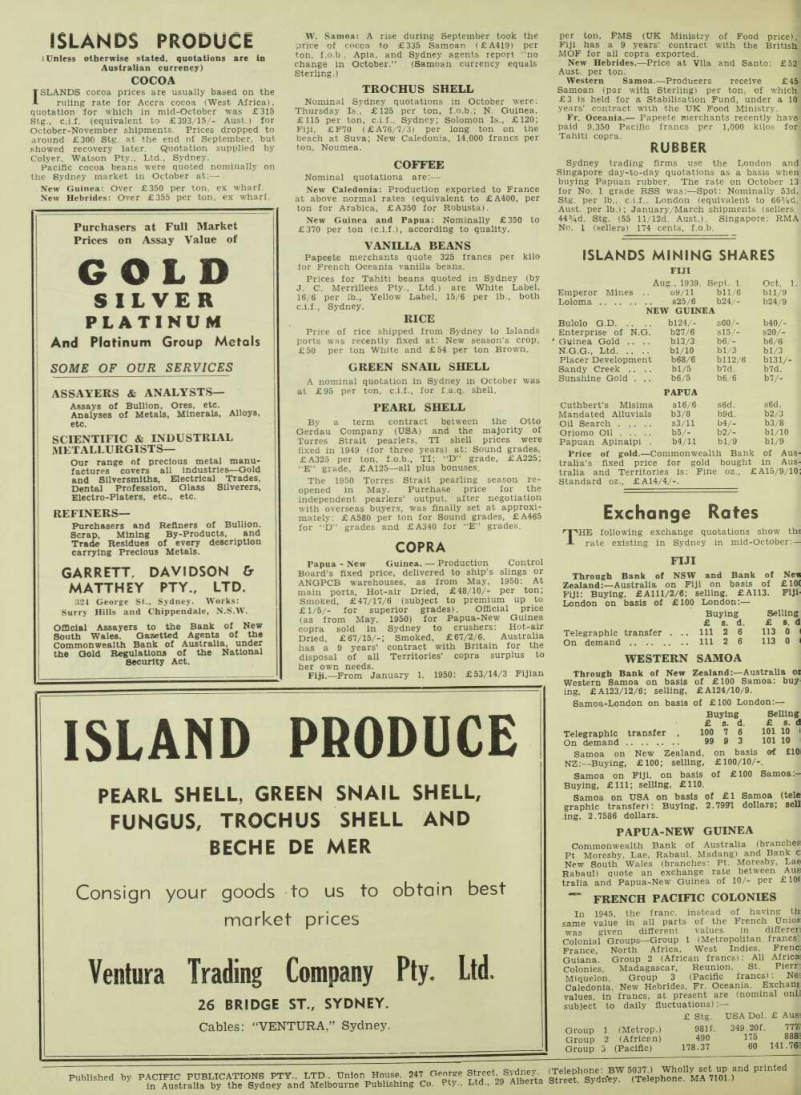
(Unless otherwise stated, quotations are in Australian currency)
Cocoa
ISLANDS cocoa prices are usually based on the ruling rate for Accra cocoa (West Africa). quotation for which in mid-October was £315 Stg., c.i.f. (equivalent to £393/15/- Aust.) for October-November shipments. Prices dropped to around £3OO Stg. at the end of September, but showed recovery later. Quotation supplied by Colyer. Watson Pty., Ltd., Sydney.
Pacific cocoa beans were quoted nominally on the Sydney market in October at:— New Guinea: Over £350 per ton, ex wharf.
New Hebrides: Over £355 per ton, ex wharf.
W. Samoa; A rise during September took the price of cocoa to £335 Samoan (£A4I9) per ton, f.o.b , Apia, and Sydney agents report “no change in October.” (Samoan currency equals Sterling.)
Trochus Shell
Nominal Sydney quotations in October were; Thursday Is., £125 per ton, f.0.b.; N. Guinea, £ll5 per ton, c.i.f., Sydney; Solomon Is., £120; Fiji, £F7O (£A76/7/3) per long ton on the beach at Suva; New Caledonia, 14,000 francs per ton, Noumea.
Coffee
Nominal quotations are:— New Caledonia: Production exported to France at above normal rates (equivalent to £A4OO, per ton for Arabica, £A3SO for Robusta).
New Guinea and Papua: Nominally £350 to £370 per ton (c.i.f.), according to quality.
Vanilla Beans
Papeete merchants quote 325 francs per kilo for French Oceania vanilla beans.
Prices for Tahiti beans quoted in Sydney (by J. C. Merrillees Pty., Ltd.) are White Label, 16/6 per lb., Yellow Label, 15/6 per lb., both c.i.f., Sydney.
Rice
Price of rice shipped from Sydney to Islands ports was recently fixed at: New season’s crop, £5O per ton White and £54 per ton Brown.
Green Snail Shell
A nominal quotation in Sydney in October was at £95 per ton, c.i.f., for f.a.q. shell.
Pearl Shell
By a term contract between the Otto Gerdau Company (USA) and the majority of Torres Strait pearlers, TT shell prices were fixed in 1949 (for three years) at: Sound grades, £A325 per ton, f.0.b., TI; “D” grade, £A225; “E” grade, £AI25 —all plus bonuses.
The 1950 Torres Strait pearling season re opened in May. Purchase price for the independent pearlers’ output, after negotiation with overseas buyers, was finally set at approxi mately: £ A5BO per ton for Sound grades, £A465 for “D” grades and £A34O for “E” grades.
Copra
Papua - New Guinea. Production Control Board’s fixed price, delivered to ship’s slings or ANGPCB warehouses, as from May, 1950: At main ports. Hot-air Dried, £4B/10/- per ton; Smoked, £47/17/6 (subject to premium up to £l/5/- for superior grades). Official price (as from May, 1950) for Papua-New Guinea copra sold in Sydney to crushers: Hot-air Dried, £67/15/-; Smoked, £67/2/6. Australia has a 9 years’ contract with Britain for the disposal of all Territories’ copra surplus to her own needs.
Fiji.—From January 1. 1950: £53/14/3 Fijian
per ton, FmS (UK Ministry of Food price).
Fiji has a 9 years’ contract with the British MOF for all copra exported.
New Hebrides.—Price at Vila and Santo; £52 Aust. per ton.
Western Samoa.—Producers receive £45 Samoan (par with Sterling) per ton, of which; £3 is held for a Stabilisation Fund, under a 10 years’ contract with the UK Food Ministry.
Fr. Oceania. — Papeete merchants recently have) paid 9,350 Pacific francs per 1,000 kilos for] Tahiti copra.
Rubber
Sydney trading firms use the London and Singapore day-to-day quotations as a basis when buying Papuan rubber. The rate on October 13 for No. 1 grade RSS was;—Spot: Nominally 53d.
Stg. per lb., c.i.f.. London (equivalent to 66y4d.
Aust. per lb.); January/March shipments (sellers 44%d. Stg. (55 11/12d. Aust.). Singapore; RMA No. 1 (sellers) 174 cents, f.o.b.
Islands Mining Shares
Price of gold.—Commonwealth Bank of Aus tralia’s fixed price for gold bought in Aus tralia and Territories is: Fine oz., £AIS/9/10; Standard oz., £AI4/4/-.
Fiji
Aug., 1939.
Sept. 1.
Oct. 1.
Emperor Mines ..
D9/11 bll/6 bll/9 Loloma S25/6 b24/b24/9
New Guinea
Bulolo G.D bl24/s60/~ b40/- 1 Enterprise of N.G. b27/6 sl5/s20/- Guinea Gold .. .. bl3/3 b6/b6/6 N.G.G., Ltd bl/10 bl/3 bl/3 Placer Development b68/6 bll2/6 bl31/- Sandy Creek .. bl/5 b7d. b7d.
Sunshine Gold . .. b6/5 b6/6 b7/- Cuthbert’s Misima
Papua
sie/6 s6d. s6d.
Mandated Alluvials b3/8 b9d. b2/3 Oil Search S3/11 b4/b3/8 bl/10 Oriomo Oil b5/b2/- Papuan Apinaipi . b4/ll bl/9 bl/9
Exchange Rates
THE following exchange quotations show the rate existing in Sydney in mid-October:—
Fiji
Through Bank of NSW and Bank of New Zealand:—Australia on Fiji on basis of £ 10C Fiji; Buying, £Alll/2/6; selling. £AII3. Flji- London on basis of £lOO London: —
Western Samoa
Through Bank of New Zealand:— Australia or Western Samoa on basis of £lOO Samoa: buy ing, £AI23/12/6; selling. £AI24/10/9.
Samoa-London on basis of £lOO London:—
Samoa on New Zealand, on basis of £lOl NZ:—Buying, £100; selling, £lOO/10/-.
Samoa on Fiji, on basis of £lOO Samoa Buying, £111; selling, £llO.
Samoa on USA on basis of £1 Samoa (tele graphic transfer): Buying, 2.7931 dollars; sell Ing, 2.7586 dollars.
Papua-New Guinea
Commonwealth Bank of Australia (branches Pt Moresby, Lae, Rabaul, Madang) and Bank a New South Wales (branches: Pt. Moresby, Lae Rabaul) quote an exchange rate between Aus tralia and Papua-New Guinea of 10/- per £10(i
“* French Pacific Colonies
In 1945, the franc, instead of having tlr same value in all parts of the French Unioir was given different values in difieren Colonial Groups—Group 1 (Metropolitan francs]; France, North Africa, West Indies, Freno Guiana. Group 2 (African francs): All Africa Colonies, Madagascar, Reunion. St. Piern Miquelon. Group 3 (Pacific francs): Nes Caledonia, New Hebrides, Fr. Oceania. Exchang; values, in francs, at present are (nominal onll subject to daily fluctuations): —
Buying Selling £ s. d. £ s. d Telegraphic transfer . .. Ill 2 6 113 0 ( On demand Ill 2 6 113 0 (
Buying Selling £ 8. d. £ s. d Telegraphic transfer . 100 7 6 101 10 i On demand 99 9 3 101 10 1
£ Stg. USA Dol. £ Auk Group 1 (Metrop.) 981f. 349.20f. 777T Group 2 (African) 490 175 8883 Group 5 (Pacific) 178.37 60 141.769
Advertisements & other items, pp. 122-124 (3 items)
Published by PACIFIC PUBLICATIONS PTY.. LTD.. Union House 247 Georee Sydney ™ePhone: BW W^ n^ et u 0 P ) and prmted
in Australia by the Sydney and Melbourne Publishing Co. Pty., Ltd., 29 Alberta street, oyuucy. u v
Island Produce
Purchasers at Full Market Prices on Assay Value of
GOLD
SILVER
PLATINUM
And Platinum Group Metals
SOME OF OUR SERVICES
ASSAYERS & ANALYSTS—
Assays of Bullion. Ores, etc.
Analyses of Metals, Minerals, Alloys, etc.
SCIENTIFIC & INDUSTRIAL
METALLURGISTS—
Our range of precious metal manufactures covers all industries—Gold and Silversmiths, Electrical Trades, Dental Profession. Glass Sllverers, Electro-Platers, etc., etc.
REFINERS—
Purchasers and Refiners of Bullion, Scrap. Mining By-Products, and Trade Residues of every description carrying Precious Metals.
GARRETT, DAVIDSON &
MATTHEY PTY., LTD.
324 George St.. Sydney. Works: Surry Hills and Chippendale, N.S.W r .
Official Assayers to the Bank of New South Wales. Gazetted Agents of the Commonwealth Bank of Australia, under the Gold Regulations of the National Security Act.
ISLAND PRODUCE
PEARL SHELL, GREEN SNAIL SHELL,
FUNGUS, TROCHUS SHELL AND
BECHE DE MER
Consign your goods to us to obtain best market prices
Ventura Trading Company Pty. Ltd.
26 BRIDGE ST., SYDNEY.
Cables: “VENTURA,” Sydney.
Building Sheets
Corrugated Aluminium
For speed of erection
Corrugated Aluminium Building Sheets have many advantages over other roofing and siding materials. The lightness of the metal enables easier handling, with a considerable saving in transportation and erection costs.
It is highly resistant to corrosion, and reflects a high percentage of all radiant heat.
Painting is not necessary, and no special maintenan is required.
Corrugated Aluminium Building Sheets are available as listed below.
Widths: 26 in. with eight 3 in. corrugations. 32 in. with ten 3 in. corrugations. 26 in. with nine 2j in. corrugations. 31 in. with eleven 2| in. corrugations.
Lengths; 6,7, 8,9, 10, 11 and 12 ft.
Thicknesses; 20, 22, 23, 24 and 26 Imperial Standard Wire Gauge.
ALUMINIUM UNION LIMITED
(Incorporated in the Dominion of Canada) Principal British Commonwealth Distributor of Aluminium Ocean House, 34 Martin Place, Sydney, N.S.W.
An ALUMINIUM LIMITED Company
SALES AGENTS:
Fiji, Western Samoa and Tonga : Morris, Hedstrom, Limited, Suva, Fiji.
Cook Islands: A. B. Donald Limited, Rarotonga, Cook Islands.
French Oceania: Etablissements Donald Tahiti, Papeete, Tahiti.
New Caledonia and New Hebrides: Agence Alma, 39 Rue de I’Alma, Noumea, New Caledonia.
LONDON
MONTREAL
CALCUTTA
SYDNEY
SHANGHAI
KARACHI
TOKYO
MERCHANTS, & SHIP OWNERS
Capital £500,000
ESTABLISHED 1914
GENERAL MERCHANTS
AND
PROVIDORES
TRADE THROUGHOUT THE PACIFIC.
THIRTY-FIVE YEARS OF PACIFIC ISLANDS DEVELOPMENT AND SERVICE.
BUYERS AND EXPORTERS OF ALL KINDS
OF ISLAND PRODUCE, COPRA, COCOA,
M.O.P. SHELL, TROCAS SHELL, ETC.
AGENTS FOR AUSTRALIAN, EUROPEAN
AND AMERICAN MANUFACTURERS.
DISTRIBUTORS OF EVERY DESCRIPTION
OF MERCHANDISE.
Through our Sydney office, branches and agents, we distribute a wide and comprehensive range of general merchandise .
W. R. CARPENTER S CO. LTD.
Head Office: 16 O'CONNELL STREET, SYDNEY, N.S.W.
Cable Address: Telephone: Postal Address: “CAMOHE.” BW 4421. G.P.0., BOX 168, Sydney.
In London: W. R. Carpenter tr Co. (London), Ltd., Coronation House, 4 Lloyd s Aye., London, EC
ASSOCIATED COMPANIES THROUGHOUT THE PACIFIC:
IN NEW GUINEA: IN PAPUA:
New Guinea Company, Limited, J. R. Clay & Co,, Ltd., Rabaul, Lae, Madang, Kavieng. Port Moresby.
IN FIJI:
W. R. Carpenter & Co. (Fiji), Ltd., Suva.