Pacific
Islands
Monthly
September, 1950
Vol. XXI. No. 2.
Established 1930.
I Registered at the G.P.0., by post as a newspaper]
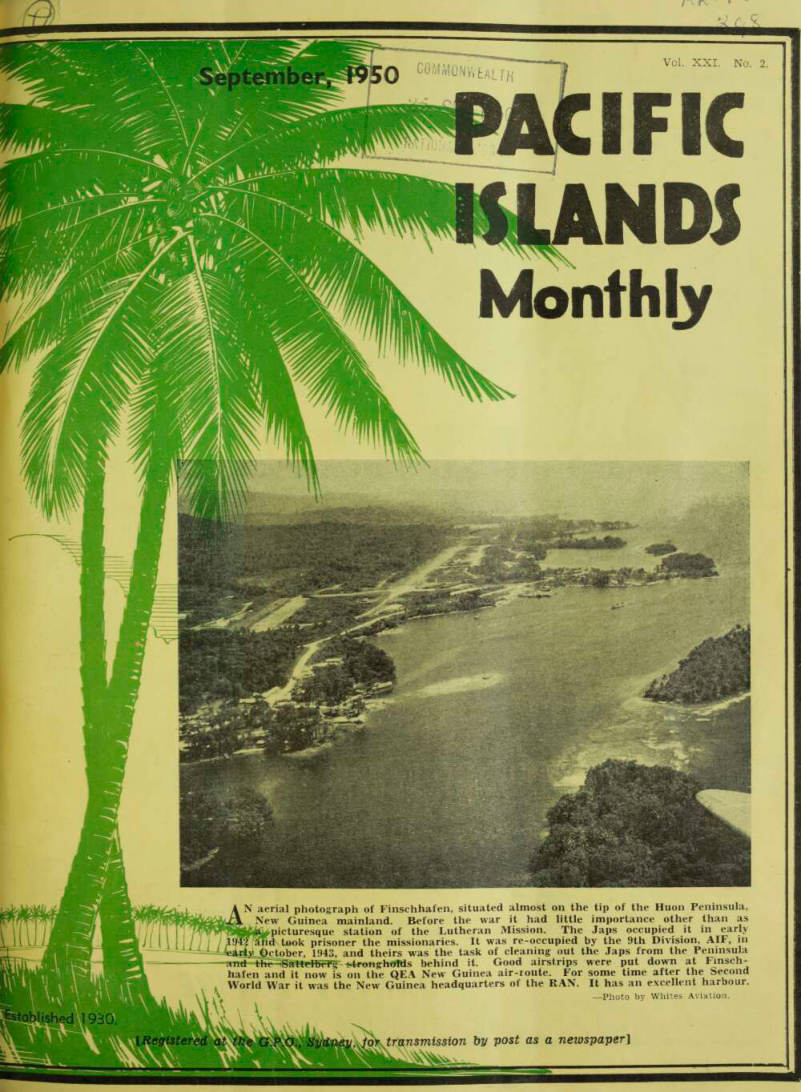
An aerial photograph of Finschhafen, situated almost on the tip of the Huon Peninsula, New Guinea mainland. Before the war it had little importance other than as picturesque station of the Lutheran Mission. The Japs occupied it in early 1942 took prisoner the missionaries. It was re-occupied by the 9th Division, AIF, in early October, 1943, and theirs was the task of cleaning out the Japs from the Peninsula and the SateIbefg trongholds behind it. Good airstrips were put down at Finsch hafen and it now is on the QEA New Guinea air-route. For some time after the Second World War it was the New Guinea headquarters of the RAN. It has an excellent harbour. -Photo by Whites Aviation.
Advertisements & other items, pp. 2-4 (3 items)
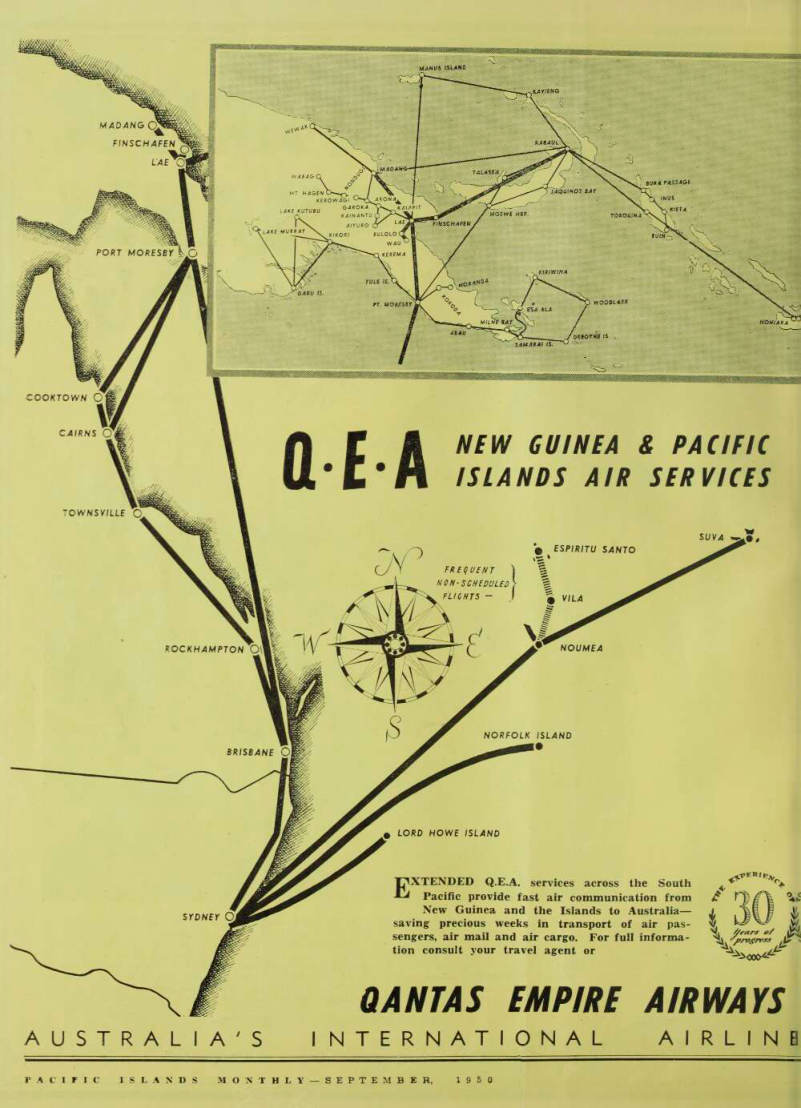
A Ant As Empire Airways
MANUS tStAHO
HAtliHO
MADANO
FINSCHAFEN
LA?
KAtAVL.
MAO A
TALABBA,
SU*A IMSSAOf
JAQUIHOT BAY
mSCHAftN
PORT MORESBY
YtBIWINA
WOOOLAR*
HOUIA r a
ASAtI
D€«or«f IS. .
BAUAPAf
OOKTOWN O
V
CAIRNS
Q-EA
NEW GUINEA & PACIFIC
ISLANDS AIR SERVICES
"OWNSVILLE O
SUVA i
e ESPIRITU SANTO
A VILA
S \ £ if
NOUMEA
ROCKHAMPTON
NORFOLK ISLAND
BRISBANE
SYDNEY
LORD HOWE ISLAND
jTIXTENDED Q.E.A. services across the South Pacific provide fast air communication from New Guinea and the Islands to Australia — T it I saving precious weeks in transport of air pas- Vj sengers, air mail and air cargo. For full information consult your travel agent or
a ANT AS EMPIRE AIRWAYS
AUSTRALIA'S
INTERNATIONAL AIRLINE
<*ol [MAN TARIF IAMPt
: ! * § wm 1 K ii SP/^ oT -. r V \ u <* ¥ a From a safety point of view, these lamps leave nothing to be desired.
There is no spilling of fuel if tipped over accidentally, even while burning and they cannot be filled while lighted.
The mantles are shock-proof and the fuel fount unbreakable.
Coleman Table Lamps give brilliant light, so like natural daylight that you can match delicate shades by it. They are twenty times as powerful as ordinary kerosene lamps and seven times as powerful as household electric bulbs.
They light instantly, are draught-proof and the fuel capacity is sufficient for 1 2 hours of abundant eye-saving light. Finished in ivory enamel, with decorated plastic covered parchment-type shade and heat resisting globe, the lamp is a as well as a utility.
Representatives tor the Pacific Islands:
54a PITT STREET
SYDNEY
ROBERT GILLESPIE PLH™
PEARCE & CO. LTD.
SUVA
FOR FIJI ISLANDS
Suburban Salons: 166 Parramatta Road, at Johnston
St. LA 3089.
706 Darling St., Rozelle. WB 2915. 421 New Canterbury Rd., Dulwich Hill. LM 6304. 215 Liverpool Road, Ashfield.
UA 5940.
In the Bondi Junction Arcarde, 3 doors from Grace Bros. FW 4806.
The Jfende/
City Addresses:
Pl2a Her Majesty’s Arcade, Pit! 191 Pitt St., opp. Henderson’s S 338 Pitt St., at Snow’s Tram SOi ■ u ou Ist Floor, Rigney’s Bldg., 147 a King St., Sydney. MA 5794. 20 Im Perial Arcade, CastlereagH T & G Building, Elizabeth St..; V-S' 99 Oxford Street. MA 1789. ■A > rc Write for Free Maternity Catalogue. \ \ t 9 X & a %
ass
sr W A 0) / I § r m & A.
L m
KSS^S
KU % * •M
XXXXOS
<-> TO
ssw
n i, t w •A\ (• II *1
ORDER BY MAIL
When ordering by mail, please quote: bust, waist and hip measurements.
And we will send you the nearest stock size.
ORDER BY MAI
FREIGHT CHART
Freight 1/2 to all Pacific Islands except those listed below: West Samoa 1/6 East Samoa, U.S.A 1/6 New Caledonia 3/2 Hawaii, U.S.A 1/6 Left:
BRITISH COTTON
SUN-SUIT. White pique trim. Blue, rose, autumn or green toni n g s (guaranteed).
SSW, SW, W, WX,
29/11. OS, XOS, XXOS,
32/11.
Centre:
BRITISH COTTON
FROCK (Guaranteed).
Ric-rac braid trim.
Tones, blue, rose, green, autumn. SSW, SW,
W, 19/11. OS, 21/11,
XOS, 22/11. XXOS,
23/11. XXOS, 24/11.
XXXXOS, 25/11.
Above:
STRIPED JERU
FROCK. In
red/white, blue/w/* maroon/white. S 3
SW, W, 55/11. S
OS. XOS, 60/11.
1
ACIFIC ISLANDS MONTHLY --SEPTEMBER, 1950
September, 1950 Pacific Islands Mont
2
Index to Advertisers
Achun, Gabriel . . 99 Alois Akun & Co 43, 76 Aluminium Union . 90 Amplion (A/sial . . 76 Angus & Robertson 16 •‘Aspaxadrene’’ . . 18 Balchin. W„ Ltd. 88 Bank of NSW . . 85 Berger’s Paints . . 41 Berry's Bay Boat yard 27 Bethell. Gwyn Co. 89 Blaxland Rae Pty. 102 Blundell Spence Co. 54 8.0.A.C 103 Boulton, P. R. . . 117 Bovril 71 Brasso Polish . . 108 Bray & Holliday . 86 Bristol-Myers Co. . 48 Broomflelds, Ltd, 25 Brunton & Co.. Ltd. 44 Budge, James, Ltd. 88 Bunting, A. H., Ltd. (Papua», 35. 55 Burns Philp (NG) . 65 Burns Philp (NH) 107 Burns Philp (SS) 44. 47 Burns Philp Trust 112 Cadbury-Fry-Pascall Pty.. Ltd 22 Caine’s Studios . . 29 Carpenter, W. R. & Co., Ltd., 82. cov. iv.
Carpenter. W. R. (Fiji). Ltd. . . 100 Carr Shipping & Trading Co. ... 83 Central Pharmacy . 15 "Charmosan’’ ... 15 Chrome Investment 119 Classified Advts. . 118 Colman’s Mustard . 67 Colonial Meat Co. . 74 C o 1 y e r Watson (NG) Ltd. 23, 31, 80 Commonwealth Bank of Australia 45 Courtney. G, R. . 91 Crammond Radio 114 Crawford’s Hatchery ... 71 Crilley. R. J.. Ltd. 21 Cunningham, R. H. 36 “Cystex’’ 99 Dangar. Gedye & Malloch Ltd. 3, 34. llB Davison Paints . . 87 Donaghy & Sons . 79 Donald, A. 8., Ltd. (Auckland) ... 80 Donald, A. 8., Ltd. (Rarotonga) ... 49 Douglass, W. C., Ltd 97
Dunlop Rubber
Ltd 24 Econo-Steel Co. . . 30 Electrolux ... 82 Btablissements Donald Tahiti . . 68
Excelsior Supply
Co. Pty. Ltd. . . 33 'erguson Tractors . 28 ’Flit” 89
*ord Sherington . 39
'rench Chamber of Commerce ... 115 iarrett, Davidson &
Matthey, Ltd. . 120
larrick Hotel . . 110 lilbey. W. & A. . 115 Hllespie Bros. . . 116 Dillespie, R., Pty., Ltd. 1, 69, 96, 101 jillespie, R. (NG) Ltd 40, 52 Jordon's Gin ... 51 lough & Co., E. J. 38 »rand Pacific Hotel 4 jregory. A., Ltd . 96 ,r °ve & Sons . . 84 lalvorsen, B. J. . 101 Jalvorsen Sons Ltd. 39 lardman & Hall 4O, 110 lawley’s Pty., Ltd. 79 lay. K. H. D. . . 47 [einz & co., Ltd . 27
iemingway &
Robertson Ltd. . 25
loover, Francis . . 35
iorlicks Pty., Ltd. 94
Hygeia Sanitary Co. 49
I.C.S 37
Island Industries Ltd 77 Jackson, S. Went worth 119 Jones, Wm, A., Ltd. 72 Kennedy, Captain 105 Kerr Bros. . . 95, 102 Kodak Pty. Ltd. . 105 Kolynos, Inc. ... 73 Kopsen, W., & Co. 109 Macintyre, Thomas & Co., Ltd. ... 93 Maloney, N. F., Co 93 McGee, Andrew . . 50 Mcllrath’s P t y..
Ltd 19 “Mendaco” ... 11l Millers Ltd (Fiji) 24 Morris Hedstrom Limited . . . .12 Morris Hedstrom (Aust.) Pty, Ltd. 20 Mungo Scott Ltd. , 113 Nathan’s Merchan dise (NSW) Pty. 29 Nelson & Robertson Pty., Ltd. ... 92 Nicholas Products . 16 “Nixoderm” . . . 107 Nordman, Oscar G. 104 Nth. Sydney Travel Bureau ... 109 NZ National Air ways Corporation 56 O’Brien, Geo. . . 100 Pacific Is. Society 69 Pacific Islands Year Book ... 13 Pan American Air ways, Inc . Ltd. . 14 “Pinkettes” ... 43 Piper. Tom ... 95 Proud's Ltd. ... 26 Qantas, Ltd. . cov. ii.
Qld. Insurance Co. 51 Ransomes, Sims & Jefferies Ltd. . . 92 Reckitt’s Blue . . 83 Reed, Wm., E. lO4, 113 Riverstone Meat Co. 46 Robinson, G. H. . 72 Rohu, Sil . . . . 77 Scott, J., Pty., Ltd. 68 S.E. Book Co. . . HI Shell Co. of Aust. 81 Sims, A. G 36 “Songs From The South Seas” . . 17 Southern Pacific Insurance Co. . . 37 Spartan Paints . . 32 Steamships Trading Co., Ltd. (Papua) 67 Stewarts & Lloyds 28 Sullivan, C., Ltd. . 108 Tallerman & Co. . 52 Tasman Airways cov. ill.
Taylor, Allen & Co. 75 Thornthwaite, H. G. & Co 31 Thornycroft, Ltd. 118 Tilley Lamp Co. . 42 Tillock & Co., Ltd. 55 T o n g a n Photos Bureau 81 Tooth & Co. ... 98 Tyneside Eng. Co. 75 Undersee Novelties 21 Union Mfg. & Ex port Co. Ltd. . 106 United Island Traders Ltd. . . 78 Vacuum Oil Co. 66, 89 Ventura Trading Co. . . . 32. 116, 120 Vincent Chem. Co. 53 Waters, Edwd. & Sons 117 Wendel Frocks . . 2 West, Harry ... 98 White Heather Whisky ... 17 Williams, Dr. (Pills) 33 Willreed Agencies 104 Wills, W. D. & H.
O. (Aust.), Ltd. . 70 W. J. Manufactur ing 84 Yorkshire Insur ance Co., Ltd. . . 87
Advertisements & other items, p. 5 (1 item)
Bulldog”
• Crude oil tractor! • Low operation costs! • Only 8 main moving parts! possible maintenance Lowest costs!
Big robust, slow moving parts!
Lasting power! 30, 40 and 45 H.P. Models! 6 forward speeds, 2 reverse!
Available in electric Models!
All tests prove the
BULLDOG”
Best in the long run!
Whether a “K.L.” or “Lanz,” the simplicity of this rugged, powerful BULLDOG and its low cost for fuel and maintenance have proved it to be the ideal tractor for all Australian farming needs.
We can show you how to save up to £l5O PER YEAR on running costs alone on the Bulldog Crude Oil Tractor. The Bulldog has a slow speed, heavy duty, single-cylinder engine, with only 8 moving parts and is so simple and troublefree that maintenance and depreciation are reduced to a minimum.
The new and improved models, the “E” 16 H.P. and the “J” 20 H.P. will be introduced shortly. The model “E” will have the following standard equipment: (1) Electric push-button starting. (2) Hydraulic power lift. (3) Centrally located power take-off. (4) Dual, independently operated, rear wheel brakes. i(5) Adjustable tread, both front and rear wheels.
Model “J” has standard equipment similar to the larger tractors, power takeoff, adjustable front and rear wheels, and dual, independently operated, rear wheel brakes.
Distributors in N.S.W.:
Dangar, Gedye & Malloch Limited
MALLOCH HOUSE, 10-14 YOUNG STREET, SYDNEY.
Branches: Melbourne, Wagga, Newcastle & Lismore.
In This Issue:
Editorial: Western New Guinea Issue Grows Hot as December Ap proaches 5 New Public Markets for Suva ... 6 Tonkinese Reds Discouraged in New Hebrides 6 Fiji Elections —Some Changes ... 7 Control of New Guinea Copra Market 7 Australian Warship to Show the Flag in Islands 7 15 Per Cent, of Fijians Have Filaria 7 Territorians and Taxation 8 Fiji Tuna Clipper for Australia .. 8 The Scandalous Price of Rice ... 9 South Pacific Commission —Research Cel. Meets in Sydney 9 Planters’ Growing Voice in New Guinea Affairs 10 First Steps Towards New Guinea De fence 11 New Honour for Ratu Sir Lala Sukuna 11 News from New Hebrides 11 The Month in Moresby 13 Memorial to Bishop Newton 15 No Infiltration from Dutch New Guinea Yet 17 New Sydney-Wellington Flying-Boat Service 17 RLS’s Stepdaughter Laughs at News paper Error 19 Samoa’s Continued Prosperity .. .. 21 Papua’s Polio Epidemic is Over ... 23 Legion of Honour Awards 23 British Socialists’ Fantastic Peanuts Scheme 24 NG Hibiscus Fibre May Solve Copra Sack Shortage 25 Notes from American Samoa ... 28 Should White Employers Smack Native Labourers? 29
Millions for Papua-New Guinea — Too Good to be True 35 No Parcels for Netherlands New Guinea 36 Fiji Co’s Minor War with Australian Taxation Dept 37 Ambonese Seek Australia’s Help .. 39 New Ship for Bums Philp ... .. 39 BEM Awarded to Fijian Woman ... 40 Plea for Political Reform in Tonga 41 RNZAF Catalina Mishap in Vila .. 43 New Caledonia’s Increased Trade With USA 44 Sidelights on Yali 45 More Prison Farms for Papua-New Guinea 48 News from NG Highlands 48 Indonesians 700 Miles East of Aus tralia —Effect of Broken-down N. Caledonian Labour System .. 49 Australian Oranges for Fiji 51 White Man’s Laws Outweigh Malaita Justice 53 Nukualofa Tortoise 54 American Air Tourists for S-W Pacific 55 Territories Talk Talk 57 PIM Crossquiz 58 Strange Artifacts of Old Papua .. 59 Islands Under the Wind 60 Tropicalities 62 Fashion :: Children’s Section .. .. 64 Niue Basketware Trade in Doldrums 67 NG Airstrips in Use Again? .. .. 67 SDA Sawmill for Garoka 68 On the Way to a South Pacific Federation 69 Rabaul War Graves Identification 73 Medical Survey for Pitcairn Is. .. 73
Marching Rule Petering Out 7T Fiji’s Pineapple Cup Goes to L. F.
Garnett 7T Catamaran for Hawaii-Tahiti Tourist Traffic 77 One-Teach-One—The Laubach Sys tem of Overcoming Illiteracy 88 Debunking Fuzzy-Wuzzy 88 Tahiti Notes 88 Indians Irritate Fijians in Newspaper Brawl 88 Madang Newsletter 99 PAA Guards Planes Against Red Sabotage 99 Showman’s Troubles—Wheel for Tahiti, and Pygmies from Borneo 99 Alarming Crime Wave Continues in W. Samoa 99 First Steps Towards New Guinea De fence 99 Nauru and Ocean Island Phosphate Industry is 50 Years old 98 Plane and Shipping Timetables for Pacific Islands 99 Rabaul Roundabout 10 Another “Cat Island” 10 Hospital Reborn HE Scope of South Pacific Plan .. .. lit Commercial, Markets, etc 12 OBITUARY: Charles Leake, 8; L. K Benjamin, 16; J. A. Cottell, 16; J. H Meads, 17; M. J. Lynch, 17; Cliffon Kruse, 23; P. A. Morris, 25: A. Walter 27; Mrs. A. S. Fitch, 32; Madam Blanchard, 85; Fr. L. McCarthy, 105< INDUSTRIES; Oil, 6, 44; Copra, 9, 33: Tea, 32; Sugar, 94; Cocoa, 94; Phosi phate, 98; Gold, 115.
ORGANISATIONS: Pacific Islano Society, 9; New Guinea Planters’ Assn 10; New Guinea Scholarship Fun* 77; Polynesian Club, 110.
Advertisements & other items, p. 6 (2 items)
September, 1950 Pacific Islands Monthl
STA'rf’^
-r. 4r r* * ~s » STA'rf’^
Pacific Islands Monthly
The Newspaper-Magazine of the South Seas
ißegistered at the G.P.0., Sydney , for transmission by post as a newspaper l Published Once Each Month and Circulated in Australia and New Zealand and in the following Pacific Territories and Islands Groups;
Australian Territory of Papua.
Trustee Territory (Australia) of New Guinea.
Australian Territory of Norfolk Island.
New Zealand Territory of Cook Islands.
Trustee Territorv fNZi of Western Samoa.
British Colony of Fiji.
British Solomon Islands Protectorate.
British Protectorate of Tongan Islands.
British Crown Colony of Gilbert and Ellice Islands.
Trustee Territory of Nauru.
British and French Condominium of New Hebrides.
French Colony of New Caledonia.
French Colony of Oceania (Tahiti, etc.).
American Territory of Eastern Samoa.
American Territory of Hawaiian Islands.
Owned and Produced by Pacific Publications Pty., Ltd., Union House, 247 George Street, Sydney.
Telephones: General Office and Advertising,
Bw 5037, Bu 4938.
P.O. Box 3408
Registered Address for Telegrams, Radiograms, and Cables: “Pacpub,” Sydney.
Contributions.
Articles, Stories, and Photographs dealing with Pacific Islands subjects are invited and will be paid for on publication.
Subscription Rates.
Per Annum, Pre-paid, Including Postage.
In Australia, New Zealand, Fiji New Guinea, Papua, Western Samoa, Cook Islands, Tonga, British Solo mons, Gilbert and Ellice Colony, Nauru, New Hebrides, and United Kingdom 18 0 Elsewhere $2.50 £1 1 0 Single Copies 19
Editor and Publisher:
R. W. Robson. F.R.G.S.
Assistant Editor: JUDY TUDOR.
General Office: Union House, 247 George Street, Sydney. Telephones: BW 5037, BU 4938.
Business Manager: SELWYN HUGHES
Representative In London.
J. T. Wallis. Coronation House, 4 Lloyd’s Avenue, London, E.C.3, from whom may be obtained copies of Pacific Islands Monthly, Pacific Is. Year Book, advertising schedules, etc.
Agents.
The following are authorised to receive sub scriptions for Pacific Islands Monthly:— Burns, Philp & Co., Ltd., and Burns Phllp (South Sea) Co., Ltd. All branches.
W. R. Carpenter & Co., Ltd. All branches.
Morris, Hedstrom, Ltd. All branches.
Steamships Trading Co., Papua. All branches.
A. H. Bunting, Ltd., Samarai, Papua.
Steele’s Central Store, Suva, FIJI.
Adams Pharmacies Pty., Lautoka, Fiji.
Cook Islands Trading Co., Rarotonga, Cook Is.
United Island Traders, Ltd., Rarptonga, Cook Is.
A. Vercoe, Apia, Western Samoa.
Oscar Nordman, Papeete, Tahiti.
Islands Branches and Representatives of W. H.
Grove & Sons, Ltd., Auckland, New Zealand.
Ed. Pentecost, Noumea, New Caledonia.
Societe Gubbay Kerr et Cie, Noumea, New Caledonia.
Vol. XXI. No. 2.
September, 1950.
r 1/9 Per Copy.
Price ] Prepaid, p.a.; 18/- Aust.
I In USA. p.a.: $2.50.
December Approaches
Western N. Guinea Issue Grows 'Hot’ as December Approaches
DEVELOPMENTS in Indonesia, seen through Australian eyes against the seething background of Asia, present a picture that has an ugly appearance for all residents of the South Pacific.
The Pink Planners of the United Nations succeeded in forcing the Dutch out of Indonesia. Power in the East Indies was promptly seized by a gang of anti-European Javanese, calling them selves the Republic of Indonesia, who had been coached and trained by the Japanese.
The Indonesians, on January 1, took over all the former Dutch possessions except Western New Guinea, the status of which is to be settled before December 31.
Ever since then the Indonesians, with an arrogance which is very hard to bear, have been insisting that Western New Guinea must become theirs. Australia, which fears Asia in general, and Asiatic Communists in particular, has made it clear that she does not want Indonesians on her northern frontier. Dutch New Guinea is a sort of barrier between Aus tralia and Indonesia; and Indonesians are not desirable neighbours—simply because, being racially inferior to Europeans, and lively events in relation to Indonesia. The they are quite undependable.
While the conflict in Korea between the Western and the Communist forces has been building up into major issues likely to convulse the world, there have been lively events in relation to Indonesia. The Australian newspapers have been excitedly publishing masses of material about the situation; but few people probably have been able to follow it all.
IT all started when, in July, the Dutch- Indonesian Commission set up in January last to consider the future status of Dutch New Guinea announced
that it saw no possibility of an agreement.
On August 17, Soekarno, president of In donesia, said: “If settlement by negotia tion cannot be reached by the end of the year, 75 million people will stand behind me in demanding possession of Western New Guinea.” It was an aggressive speech, and Soekarno spoke of “a major conflict.”
Next day, Australian newspapers played up a report that the Aru and Tenimber islands, between Western New Guinea and Australia, had been occupied by Indo nesians. That was simply scare mongering. The Dutch have made no claim to those little islands. The Aru and Tenimber groups, though so close to Australia, have never been part of the Dutch New Guinea administration; al though, geographically, that is where they belong.
On August 21, a new Indonesian “am bassador” to Australia, Dr. Oetoyo said Indonesians found it hard to reconcile Australia’s former role in “cutting short Dutch colonialism in Indonesia” with Aus tralia’s present “seeming desire to pre serve Dutch colonialism to New Guinea.”
AT the same time, there were statements by Australian Prime Minister Men zies, now returned from abroad, and Foreign Minister Spender, now in Paris — that “in the Australian Government’s judgment there is no foundation whatever for the claim that Dutch New Guinea belongs to Indonesia.”
In Sydney, a Dutch official, Dr. Jean de Bruijn, told newspauers that, if invaded, the Dutch would defend Western New Guinea, and all the natives would assist them.
Australian newspapers, now in a sort of frenzy, announced that the Northern
Military Command had been extended over Papua, New Guinea, New Britain, New Ireland and Manus, and “top-rank ing officers” were putting in an organisa tion there.
On August 22—probably by way of com mentary!—it was reported from the Philippines that that native republic, although it had received no less than two thousand million dollars from USA since 1945, had now an accumulated deficit of two hundred million dollars, and that the national economy was on the verge of collapse.
SOEKARNO, on August 25, echoing his “ambassador” in Canberra, told pressmen that Australia’s popularity in Indonesia had declined in recent months— he could not understand why Australia could not cultivate “good neighbour” relations with Indonesia. He also warned the Dutch that they should try to “understand our viewpoint in re lation to Western New Guinea.”
These Javanese revolutionaries ap parently cannot understand that the pro-Indonesian policy put into effect in the critical 1946-49 period by the Aus tralian Communist wharf-labourers, and by Dr. Evatt through his most mischievous “UN Commission on Indonesia.” did not in any way represent the opinion of the Australian nation. If the Australians have any instructed feeling in the matter, it is overwhelmingly pro-Dutch, as expressed by its anti-Socialist Government.
AT the end of August, it was disclosed that Mr. Spender had entered into long conferences at The Hague, with the Governor of Dutch New Guinea pre sent. The effect was summed up in a statement by Mr. Spender that “Western New Guinea must remain in safe hands, and the Government of Indonesia, being unstable and politically immature, is not capable of assisting the native peoples of New Guinea in the way required”; and a Reuter report that the Dutch Govern -
ment had been greatly encouraged and strengthened in its attitude towards New Guinea and the Indonesian demands Next day, in a statement made in Indo nesia, Soekarno said he could not under stand Mr. Spender’s viewpoint; and Indonesia would press her claim on Sep tember 30. when the Dutch-Indonesian Committee met at The Hague in a final effort to settle their differences.
Two days later, the Indonesians at Lake Success issued an aggressive statement, challenging Australia to choose her future course.
Suggestions from Indonesia that a ioint Dutch-Indonesian administration over Western New Guinea, arranged by the United Nations, might be possible, was commented on by Mr. Spender. He said Australia would not agree to any un necessary interference by the United Nations—not even by the “Commission on Indonesia.” This, of course, was a slap at the pet instrumentality of Dr. Evatt (Mr. Spender’s predecessor in office), which helped the Indonesians so much in ousting the Dutch.
ON September 9 came the newspaper report (unofficial and unconfirmed, but piquant and probably true) that Mr. Spender and the British Foreign Minister had clashed, Mr. Spender wanted support for the Dutch in relation to New Guinea. Mr. Bevin was unwilling to give that support, on the ground that Indonesian nationalism should be en couraged, in order to prevent the local spread of Communism.
The British Socialist Government gave independence to Burma and India, and aid much to help drive the Dutch out of the East Indies. To-day, the extrava gance, inefficiency and corruption which have almost destroyed the Philippines are rampant in Burma, and are making an increasingly strong appearance in India and Indonesia. Everything that Socialist Britain has done in the Far Fast since 1945 has weakened the Amer. '.an-Aus tralian defence structure against Asia in the Pacific. Little wonder thf L Mr.
Spender, playing a remarkably * t rong hand in relation to Western New Gix.nea, looks with jaundiced eye upon the feeble platitudes of Britain’s very sick Foreif Minister!
Papua Oil Search : Upoia
Bore Abandoned
THE Australasian Petroleum Co. Pty., Ltd., on September 12, reported on drilling in Papua: UPOIA. —In view of the highly-faulted condition at depth, as proved by drilling together with absence of porosity and oil indications in the formations' already penetrated, it has been decided to aban don the test at 5,356 feet.
WANA.—The hole has been deepened 1,178 feet, from 6,130 feet to 7,308 feet; 6 inch casing has been, cemented at 6,780 feet.
HOHORO.—Construction of a road to No. 2 site is proceeding.
The Island Exploration Co. Pty., Ltd., reports that camp construction is pro ceeding at Omati, and rig foundations have been laid.
Hons. Clive Elliot And
Harold Catty M’S.L.C.
THE governor has appointed Messrs.
Clive Elliot of the CSR Co, Ltd., and Harold Gatty to membership of the Legislative Council. Since his retirement from South Seas Marine Products Ltd.
Mr. and Mrs. Gatty have been living at their beautiful little island of Katafaga, in the Lau group.
Advertisements & other items, p. 8 (1 item)
« h^fteenTegarded 6 al'Ze M
NEW PUBLIC MARKETS IN SUVA
THE opening of these new public markets in Suva at the end of this month marks an important stage in the development of the chief town of Fiji.
Hitherto Suva’s main public market has been conducted in the open beside
« h^fteenTegarded 6 al'Ze M
Colony’s most picturesque institutions.
P rodu^ rs from the surrounding districts assemble here nearly every day to sell the produce of plantation and garden, forest and lagoon.
The markets in future will not only be sheltered from the weather, but will be conducted in a more orderly and hygienic manner. ’These new buildings are only a few hundred yards west of the Nubukalou Creek and they have been built on the reclaimed land behind the King’s wharf.
The wharves used by overseas ships exi tend from the end of the street, show« in the picture, for a considerable distanoi to the right. , Present plans provide that the vacarj land around the market building will tf soon be in the central Irea™and it felt that this vacant land should be turne. into a mid-town park. If it were planta up as a park and garden, it would noi only be a pleasant resting-place for people awaiting buses nearby, but it would alsJ give new arrivals by ship a very muo more pleasing picture of Suva. Ttt reclaimed land has been an eyesore fo years; and, if the markets were sun rounded by park and gardens, the transi ition would be complete.
-Photo by Stinson Studios
New Sydney-Moresby
Seaplane Service
C 'COMMENCING in mid-October, Trans ) Oceanic Airways will run a service, once a week (leaving Rose Bay every Sunday morning), from Sydney to Port Moresby and return, with calls at Brisbane and Townsville. The company’s big Hythe flying-boats will be used.
For Ng
New Air Charter Company
Prom Our Own Correspondent
Port Moresby, Sept. 6.
ANEW air charter company, using Avro Feeder Liners, is starting up in the Territory. The company, Charter Aviation Services, expects to be gin operations in the next few days. It has three planes now but within 12 months expects to have seven or eight in use here.
Charter Aviation has taken over Guinea Air Traders’ Establishment at Lae. It is bringing its air crews from Australia but will engage some local staff. Directors of the company are Mr. R. W. Charlier and Mr. Robert Shute. Mr. Charlier was here in the RAAP during the war and since has ferried aircraft to the Territory from Australia.
Discouraged
Tonkinese Reds
In New Hebrides
From Vernon Wheatley, Santo'
CERTAIN aspects of the Korean camr paign led a few ill-advised hot-heacb in this section of the New HebrideJ to flaunt a few pieces of red rag, plus couple of photographs.
The authorities moved with commend) able promptness and a gendarme, sup} ported by a small party of police visited the Tonkinese concerned. Thl offensive articles were torn down arm burned, it is reported, and a few wellil chosen words of advice were proffered tf the offenders.
The Tonkinese originally came to thh Group as indentured labour and, whe:s their contracts expired, the war was i:l progress and they were unable to gea: transport home. They were quite happq to take advantage of the release offeree by the Condominium —a release whido made them safe from a semi-coolie exx istence in their homeland—and entered into the life of the community as smaL shopkeepers catering for the native tradef It may be that the communist tendb encies shown by a few necessarily reflecoi upon many. It is reported that thtr police force here in Santo is to b©< augmented by a detachment from Vilafl The Rev. Alfred Clint, of the AnglicaEi Mission, Papua, is in Australia on siclo leave.
Fiji Elections
Changes in the Council
THE only outstanding features of the Legislative Council elections were the return of two former European members (Messrs Alport Barker and Gibson) who had been defeated when last befor the electors; and the defeat of a well-known Indian publicist, Mr.
A. D. Patel.
Mr. Barker had been a member of the Council for 22 years when he was de feated by Mr. A. A. Ragg. At the next electron, he and Mr. Ragg fought it out again, and again Mr. Ragg was victor ious. But on this occasion “the old war horse” came out on top. Mr. Barker is Mayor of Suva and proprietor and editor of the Fiji Times.
Southern Division
European: T. W. Alport Barker, 316 votes; A. A. Ragg, 182; R. Spowart,l74.
Indian: Vishu Deo, 1,681 votes, defeated Han Charan, 1,446.
North-Western Division
European: H. Maurice Scott, sitting member, was returned unopposed.
Indian; Tulsi Ram Sharma, 2,340 votes defeated the sitting member, A. D. Patel, 1,858.
Eastern Division
European: H. B. Gibson, defeated the sitting member, F. G. Archibald by 11 votes.
Indian: J. Madhavan, sitting member, defeated his opponent, Tularam by 368 votes.
TO complete the unofficial side of the Council, two European and two Indian members have still to be nominated by the Governor. (See page 6).
The five Fijian members who will com plete the new non-official set up in the Legislative Council to meet at the begin ning of October, will be Ratu George Tuisawau, who goes back to his former post of First Fijian Member; Ravuama Vunivalu (whose election to second place by the Council of Chiefs in July caused a major sensation); Ratu George Toganivalu and Ratu Edward Cakobau (both former members of long-standing), and Ratu George Cakobau, who has been appointed Fifth Fijian Member in the place of Joeli K. Ravai, who is at present in England
Proposed New Electoral
Regulations For Fiji
THE Government of Fiji has for some time had under consideration a number of changes in the electoral regulations and copies of the proposed regulations have been sent to various interested persons and organisations in the Colony for criticism and suggestions.
The new regulations are based on pro cedure in England.
Australian Warship On
Island Tour
THE Australian frigate, Culgoa, under the command of Lieut.-Commander Jerram, carrying about 130 men, will leave Sydney on September 16 to make the following tour in the South-west Pacific Islands:— Gizo (Solomons), Sept. 22-25.
Honiara, Sept. 26-30.
Rabaul (NG), Oct. 2-4.
Manus (NG), Oct. 5-7.
Madang (NG), Oct. 8-10.
Dreger (NG), Oct. 11-12.
Lae-Samarai (NG), Oct. 13-14.
Pt. Moresby, until Oct. 17.
Vila (N. Hebrides) Oct. 28-Nov. 2.
Noumea, Nov. 3-6.
Return to Sydney, Nov. 10.
Copra Market
Control Of New Guinea
Position Considered by Formal Meeting in Sydney
THE question of whether it was feasible, under present conditions, for the Australian Government to hand over to private interests the marketing of copra produced in the Australian Pacific Ter ritories was considered on August 31 at a private conference held in Sydney.
Mr. Clarrie Archer, of the Production Control Board, presided, and among those who attended were Mr. J. Virtue (Burns Philp & Co., Ltd.), Mr. R. B. Carpenter (W. R. Carpenter and Co., Ltd.), Mr.
Norman Nelson (Nelson and Robertson Ltd.), Mr. Colyer (Colyer Watson Ltd.), Mr. Charles Sullivan (C. Sullivan Ltd.), and Colonel H. T. Allen (representing the New Guinea Planters’ Association).
The meeting was informed that two Committees (on which producers will be represented) are being appointed by Can berra to make recommendations concern ing (a) the Copra Stabilisation Fund; and (b) the price which Australian crushers should be charged for New Guinea copra.
The whole of the time of the meeting was taken up with a discussion of how best to handle the marketing and dis tribution of Territories’ copra, in view of present commitments, and especially in view of the agreement under which the British Ministry of Food is to receive most of the Territories’ production.
It was pointed out that abolition of the Production Control Board was announced in January last, but it had not been possible to give effect to this. More recently, direct representatives of the Papua and New Guinea planters had been added to the Board.
It was finally agreed that any drastic change in the system at this stage was not practicable. The general view was that the present system might be replaced eventually by control by a body jointly representing Government, merchants and planters, having much the same functions and using much the same machinery as the present Board. It was agreed that the present system should continue for a while and that, in the meantime, the system in operation in Fiji should be examined.
Lae To Have A Direct Radio
Station
THE general manager of Overseas Tele communications Commission (Aus tralia), Mr. J. E. S. Stevens, wrote as follows on August 31:— On page 6, of your August issue, you report that residents of Lae are to protest against a decision to close the Overseas Telecommunications Station there and to provide, in its place, a relay system, under the control of the Administration, and operating through Port Moresby or Rabaul.
The Overseas Telecommunications Com mission, with the full agreement of the Administration, will now establish a Coastal Radio Station at Lae and, in ad dition, will provide from it a direct radio telephone service between Lae and Sydney.
Some little time must necessarily elapse before the new station can be placed in operation, as buildings have to be erected and modern equipment installed. The work will, however, be completed as quickly as possible.
Mr. C. W. (“Chips”) Mansell. Islands representative of Mungo Scott Pty., Ltd., flour-millers, left Sydney at the end of August by air for Papua-New Guinea on an extensive business tour of those Terri tories.
15 Per Cent, of Fijians
Have Filaria
Suva, Sept. 1.
A MEDICAL survey exteding over five years shows that 18 per cent, of Fijian males and 11 per cent, of females are affected by filariasis, the mosquito-borne disease which causes (among other things) elephantiasis. The average infestation is 15 per cent.
Men are affected most because their clothing leaves more of the body exposed.
The disease is most prevalent in coastal areas where coconut palms are plentiful.
The officer in charge of Mosquito Con trol, Mr. Stanley Nelson, says that control of the mosquito demands con tinuous teamwork by the native communities.
Filariasis is carried in Fiji by the mosquito Aedes Scutellaris pseudoscut ellarls. It breeds in rot holes in trees or rotted stems of small shrubs, bamboo stumps or bamboo poles used as fence posts or barricades for pigs, turtles, etc., coconut shells or husks, old tins, bottles, drums, tanks or any small container capable of holding rain water, boats hauled up on to dry land for repairs, and leaf axils.
The adult mosquito of this species, in Fiji, bites in the daytime. It invades houses in search of a blood meal, after which it flies out again in search of shelter in long grass, bush, etc. Its flight range, in Fiji, is limited to not more than 150 yards.
The control methods now in use are therefore to destroy all possible breeding places within villages, clear each village of all possible shelter such as long grass and shrubs, and then clear all bush, long grass and reeds from a belt 100 yards in depth round the perimeter of each village.
New Guinea Veteran
Retires from Air
AFTER clocking 17,000 hours in the air, Captain Aubrey Koch retired from active flying in early Septem ber. He was one of the best-known pilots in New Guinea in the thirties, at a time when no better fliers existed than those who mountain-hopped in New Guinea.
He left Guinea Airways to go to Qantas Empire Airways and was with them at the outbreak of the recent war. His wartime service included the famous long range hop from Western Australia to Ceylon and Catalina deliveries over the Pacific. Early in the Pacific war seven Japanese Zeros shot his unarmed flying boat down in flames over the Timor Sea.
With two bullet wounds and a broken leg, he swam four miles to the Timor coast.
He was picked up five days later.
While living soldiers and supplies to New Guinea, he was forced down in the sea near Port Moresby at night. Captain Koch swam for 19 hours —towing a non swimmer against an off-shore current — before a native fishing vessel picked him up.
He has been flyinsr for 25 years—recently with Trans Australian Airlines. He will remain with the company as inspector of air safety.
The elder daughter of Mr. and Mrs. W.
E. Rowe, of Kokopo, New Guinea. Miss Patricia Joan Rowe, is to be married on October 14. in Melbourne, to Mr. John Aikins, of Toorak, Melbourne. Mr. Rowe arrived in Melbourne this month to be present at the happy event.
Territorians
And Taxation
Further Light on an Unpleasant Subject
TAXATION has been exercising the minds of residents of Papua and New Guinea recently.
People domiciled in Australia’s Pacific Territories are free of the punishing taxa tion which is imposed upon persons resi dent in Australia. It is one of their few cherished privileges. Naturally, they are sensitive on the subject.
A statement made during his visit in April by the new Minister for Terri tories—that Territorians could not expect indefinitely to enjoy freedom from direct taxation—was received with something akin to horror. There have been no fur ther indications of any move to impose direct taxation; but Territorians should refrain from cheering until the next Aus tralian Budget is out of the way.
Meanwhile, the Australian Taxation Commissioner has been very busy, and has caused some resentment among Ter ritorians by his demands.
Question Of Domicile
IN July, an Australian named Charles Hall appealed to the Supreme Court against income tax imposed upon him in respect of monies paid to him by Aus tralia while, during the war, he was em ployed in small ships in New Guinea waters. This was regarded as a test case: many other persons were awaiting the outcome of the appeal.
Mr. Justice Herron ruled that earnings by Australians in New Guinea were tax able, if the employee entered into a con tract of service in Australia. Hall was ordered to pay.
This caused a flutter in some quarters.
There are many persons in New Guinea who are earning incomes on contracts made in Australia, but who regard them selves as clear of income tax. Were they to be taxed?
Inquiries indicated that the matter turns on the question of domicile. It is clear beyond doubt that persons domiciled in New Guinea and Papua may not be taxed on the income they earn while so domiciled. New Guinea public servants, for example, are clear of all income tax liability: yet many of them are serving under contracts made in Australia with Australian Departments.
Mr. Hall could not claim that he was domiciled in New Guinea, although he spent a lot of his time in New Guinea waters. He is in the same position as the personnel of Australian-registered ships running between Australia and the Islands. They may spend three quarters of their time outside of Australian waters; but they are all obliged to pay income tax.
Some Territories residents get income from produce sold in Australia; others from investments in Australia; and cer tain of these have been wondering whether their position is secure. It ap pears to be. Australian income tax may be imposed only on persons who are do miciled in Australia. Residence in Aus tralia’s Pacific Territories, including Norfolk Island, is not held to constitute an Australian domicile.
Tax On “Compensation” Interest
THE position of those Territorians who have had income tax claims made upon them in respect of interest paid on War Damage compensation has been somewhat clarified.
This claim by the Taxation Commis
sioner has been bitterly resented by many Territorians-especially by those whose homes were completely destroyed by war time operations, and who had no income other than the interest on compensation awarded them.
It was reported last month that Mr.
Spender, Minister for Territories, had taken the matter to Mr. Fadden, Com monwealth Treasurer; and that Mr Fadden had gone to the Taxation Com missioner, who insisted that he had a right to collect the tax. It was then proposed to set up a committee of Territories resi dents to fight the matter on both Parlia mentary and law-court levels.
Since then, the opinion of taxation ex perts has been taken, and they say the Act is quite clear: as the compensation was paid in Australia, and the interest was earned in Australia, the amount is taxable in Australia. It is acknowledged that this legal interpretation is not in accord w r ith justice—but there it is. There is little chance of the Act being amended; and, if it were, it would not be amended to cover payments of income tax already made.
It is learned, also, that the War Damage Commission got the opinion of learned counsel, which was that the interest pay ments were taxable. The Commission, which treated most Territorians with generosity and consideration, was not happy to see the Australian tax-gatherer grabbing at those interest payments, but it could do nothing.
Former Territorians who decided not to return to the Territories after the war, and became domiciled in Australia, cannot now legally resist the payment of income tax on interest attaching to any war damage compensation they have received.
Territorians who resided in Australia only because they were evacuees or re fugees from the war area, and who re turned to the Territories as soon as it was practicable for them to do so, and who never claimed any privileges as Aus tralian residents, naturally resent the attempt to collect any tax in respect of their war damage compensation. Some taxation advisers have said that if such persons are again residents of the Terri tories, and simply ignore the demands of the Australian tax-gatherer, there is very little the latter can do about it. The Territorian’s action may be legally un tenable, . but he has justice on his side.
There are many women now resident in Australia who lost their all in the war in New Guinea—their breadwinners, as well as their homes. Many of these, being in poor circumstances, spent the com pensation interest never dreaming it would be taxed. Payment of the tax now de manded would represent, to them, a real hardship. Taxation advisers say that, for them, Section 265 of the Taxation Act (“Claim on account of hardship”) is clearly applicable. Women who consider that this demand for taxation is imposing a hardship and an injustice should take the necessary steps to appeal under Sec tion 265.
Death Of Mr. Charles Leake
THE death occurred on August 13, at his home in Sydney—very suddenly, from a heart attack —of Mr. Charles Leake, 56, who was the official representa tive in Sydney of the Department of Ex ternal Territories. He had been connected with the Department since the middle ’twenties, and was in charge of the New Guinea Trade Agency for many years, prior to World War 11. Mr. A. S. E.
Pearce, formerly of the Munitions De partment, who had been associated with Mr. Leake for 18 months, is acting as officer in charge of the Department’s Sydney office.
Australia
Fiji Tuna Clipper Form
Protest by Mr. Evatt
ALTHOUGH most Australians will 1 pleased to see the American turn clipper arrive from Fiji to fish soutEd ern New South Wales waters for dollar earning tuna, for some extraordinam reason, Mr. Clive Evatt (NSW Chiei Secretary) describes it as a “body blow the NSW fishing industry.”
Mr. Evatt, a brother of the more famoic D i:V E Y att ’ and with the same politico affiliations, was until the recent NSW eleos tions, Minister for Housing. His greateo claim to fame was in laying foundatioi stones. Scarcely one house or block ■ flats erected by the NSW Housing Com mission escaped without his name appear mg in gilt letters on the corner stom Whereas the Doctor, politically, maka occasional efforts at sweet reasonableness: his younger brother uses the tactics of ; steamroller. Soon after his appointmer; as Chief Secretary he announced that as government instrumentalities under hi jurisdiction would forthwith take the 9 business away from private banks an transfer to Rural Bank of NSW. Aftd a howl from the people concerned, Labovt Premier McGirr was forced to counter mand the direction. This must have hwi both Mr. McGirr and Mr. Evatt.
In respect of the arrival of the turn clipper from Fiji, Mr. Evatt had this t say (September 7); “There should be an immediate outer; by local fishing interests concerned againr this intrusion, which apparently has be©; sanctioned by the Commonwealth Got( eminent. As Chief Secretary I will taMj this matter up with the Commonwealth Government, to see that the interest of the Australian industry are protectedb THE clipper belonged to South Sei Marine Products, (headquarters i Suva, Fiji) pioneered by Mr. Harolc Gatty. The tuna were to be caught ii Fiji waters and taken to a canning plan, in Pago Pago, American Samoa. Unforc tunately, for some reason that remaini unexplained, the tuna in Fijian wateis will not take the prepared baits as thej do m other parts of the world, and thl Pago cannery put out only one batch o canned tuna (it is at present in charg* of a caretaker). It is hoped that the turn on the Australian eastern coast will tf more co-operative.
South Sea Marine Products has non gone out of business and the Australiae investigations are being carried out tef Island Packers Inc., the American half o the original joint company. Mr. Gatttd has resigned from both companies am the new general manager is Mr. Doo Hayward, who recently completed nego; tiations with the Commonwealth Direo; tor of Fisheries (Mr. F. F. Anderson a Considerable amounts of tuna are a:£ ready caught and canned off the eas,f and south-east coasts of Australia; bu< in comparison with the United States-? where tuna fishing is a 100 million dollsJ industry—Australians are not turn minded, Australian tuna fishing is done by trollI( ing. The American clipper will be thl first in those waters to use pole fishim with live bait.
When the visiting politicians returned tr Australia from Papua-New Guinea r©-: cently they stated that Mr. Cottrell Done mer is retiring from the position o Director of Agriculture; but that he imi tends to remain in Papua to introduce among the natives a co-operative rice; growing project. Part of the basis is thsr all profits shall go back into welfare plafiu for the benefit of the workers.
Advertisements & other items, p. 10 (1 item)
8
SEPTEMBER, 1950 PACIFIC ISLANDS MONTHLW
The Scandalous Price Of Rice
Find the Difference Between £23 and £70
EMPLOYERS in Papua-New have many grievances—but probably the biggest and most persistent cause for complaint is the price of rice. Rice is the staple food for plantation labour ers; but, both in quantity available - and in price, it is a constant headache.
Prior to the arrival of the Territories Minister last April, the price of rice in New Guinea was £65 per ton. (For com parison it may be noted that just before World War II rice could be landed in Salamaua for £l2/10/0 per ton). The attention of Mr. Spender was directed to the heavy impost, and he said he would do something about it. Sure enough, immediately after his return, the landed cost was altered, to give a reduction of £1 per ton. But, immediately after that, the general price of rice was raised by £5 per ton —so the planter was £4 per ton worse off.
To-day, few planters are getting rice to their plantations for less than £7O per ton. Even then, there is a shortage—many “lines” have been on native foods recently.
IN the old days, rice came freely from South-east Asia —to-day there is little from that source. Growers on the Australian Irrigation Areas provide most of the rice that goes to Papua-New Guinea; and the Sydney Daily Telegraph of September 6 said that they are making so much money they don’t know what to do with it.
Before the war they got £ll for rice
sold locally and less for rice exported.
To-day, tney get £lB per ton on the local market and £23 per ton for export.
The Telegraph adds: “There is enough grown in Australia to supply our Pacific Islands commitments and the local mar ket. Next January, anticipating a record crop of 70,000 tons, the Australian dis tributors will defy the Federal Govern ment and pour rice on to the local market.”
It seems quite clear that the Austra lian Federal Government, through its sys tem of controls is responsible for this shocking profiteering. If the Australian grower is getting £23 for rice exported, and making a huge profit, why is the New Guinea employer paying £7O? Who gets the difference?
RICE is not the only commodity in which there is scandalous profiteer ing against the Papua-New Guinea employers. In Cairns, Dieseline (motor fuel) costs 1/2J per gallon—in Rabaul it is 3/4i per gallon. The need for pro viding containers represents a higher cost —but not all that much extra.
Before the war residents of Papua- New Guinea, being free from many of the tax impositions of Australia, got many staple commodities more cheaply than in Australia. To-day, it seems to be the purpose and delight of the bureaucrats to make the cost of living in the Territ ories as expensive as possible—and the various politicians who promised so much, are not able to do anything about it.
Trying Out Shell 40
Shell 40, a tug built in Vancouver for the Royal Navy to carry out fire fighting and salvage duties, was recently acquired by the Shell Company (Pacific Islands), Ltd., and is to be stationed in Fiji. The tug will be engaged primarily in the work of towing bulk cargoes of motor spirit, etc., between Suva and Lautoka, but in cases of emergency will be available for salvage work in the Colony. She was demonstrated at Suva on August 28 to Government officials and members of the Snva Fire Board. The official party is shown in this photograph: Sitting (left to right): T. J. Kerin (Shell Superintendent Engineer); R. C. Evetts (Pacific and Atlas Insurance); W. Alport Barker (Mayor and Chairman, Fire Board); R. D. Moore (AGM, Bank of NZ); D. A. Butler (Manager, Union Steamship Co.); Capt. E. W. Harness (Harbour Master); and T.W. Davis (Secretary, Marine Board).
Standing (left to right): W. G. Simmons (Shell Representative); T. P. Harrison (Liverpool, London and Globe Insurance); J. Bish (Mechanical Engineer, PWD); T. S. Mote (Fire Commissioner); F.W. Pet^ e (Shell Representative, SW Pacific); H. W. Halstead (D. Commissioner of Police); P.H. Nightingale (A/Colonial Secretary); I. B. Chalmers (Manager, Queensland Insurance); and John Trotter (Director and GM. Burns, Philp).
South Pacific
Commission
Research Council’s Sydney Conference
11HE members of the Research Council of the South Pacific Commission and their various associates and observers concluded their important Conference at the University of Sydney on August 18 (see August PIM) and, in the following week, most of them returned home.
This was followed immediately by a meeting in Sydney of the Working Com mittee of the South Pacific Commission; and, as a result of both meetings, a good draft programme covering 1951 activities will be presented to the Sixth Session of the South Pacific Commission, which com mences in Noumea on October 20.
Having seen both meetings to a suc cessful conclusion, the Secretary-General, Mr. W. D. Forsyth, went off southwards on a long-awaited and well-earned month’s leave. He expects to return to Noumea early in October.
Guests of Pacific Islands Society THE members and officials of the Re search Council who had assembled in Sydney were entertained at a cocktail party at History House on August 18 by the President and Members of the Pacific Islands Society. Proceedings were marked by a spirit of international good will. The visitors appreciated the in formality and pleasant relations of the occasion: and the members of the Society were delighted to meet so many distin guished people from overseas.
A guest of honour was Mrs. J. K.
Murray, wife of the Administrator of Papua-New Guinea, who happened to be passing through Sydney at that time.
Brett Milder
Meets
Granny’S ‘Art Critic
CAPTAIN Brett Hilder, of the Islands steamer Morinda had the amusing experience of being publicly sneered at because he put 70 of his paintings of Islanders’ heads on exhibition at the Anthony Hordern art gallery in Sydney, on September 12.
The sneerer is described by the Sydney Morning Herald as “our art critic,” and he has been a joy to Herald readers for some time. He is an intensely superior person, whose idea of criticism is to destroy with biting phrases, but who usually gets so snarled up in his own terminology that he produces para graphs like this (taken from the column of critiques in which he slated Hilder): Virtuosity here delights in its own lucidity, as an end in itself. The mind is certainly not at the service of form, the contact with reality is slight, and the romantic atmosphere, in conse quence, appears manufactured. It is a mirage which at times, becomes preten tious . . .
Hilder, whom the gentleman recom mends to attend an art school, never production in paint anything as terrible as “our art critic” produces in English. He said that the best part of Hilder’s paint ings were the frames; but he is one of those who proclaimed Dobell’s caricature of Joshua Smith as pure and noble art !
Brett Hilder need not worry aboift “our art critic.’ His exhibition —opened by Professor Elkin, before a large and friendly gathering on September 12—was flatteringly received by people who like to see something unusual in painting, and a third of the pictures were sold at fair and modest prices before that day ended.
Importance of New Advisory Committees
Planters’ Growing Voice In New
Guinea Affairs
THE Under-Secretary for External Territories, Mr. John Howse, MP, said on September 12 that satisfac tory progress was being made in giving shape to decisions which followed his discussions with the Planters’ Association and other interests in Papua-New Guinea last month, and a conference in Sydney on August 31 (see article on Page 7).
Mr. Howse said that the Papua-New Guinea Production Control Board had been re-constituted, with the addition of Messrs. Don Barrett, of New Guinea, and Tom Nevitt, of Papua, as planters’ representatives. Mr. Clarrie Archer was chairman, and Mr. I. MacDonald, as deputy chairman, was responsible for most of the executive work. The Board still was regarded as a temporary organ isation; but, for the present, it would deal with the several matters affecting the copra industry which recently had been under discussion.
A committee to deal with the Copra Stabilisation Fund, now over £750,000, had not yet been appointed, but was almost ready for the announcement. It would include two representatives of the plant ers, and it would advise the Government on policy, in relation to the disposal of the Fund, and in relation to future con tributions from the planters.
Mr. Howse would not comment upon the growing demand by copra producers for a revision of the price paid by Britain for copra under the Ministry of Food contract.
“The planters’ chief grievance is that the £ Sterling, and with it the Australian £, was de-valued after the contract was made, although copra retains its value as a world commodity,” said the PIM. “Per haps the Australian £ will be re-valued, to par with Sterling, in which event the planters will not have so big a grievance.”
"Perhaps,” said Mr. Howse, non-com mittally.
Mr. Howse spoke with appreciation of the good work of a Medical Committee, led by Dr. Gunther and Dr. Brennan.
“They have done a first-class job in making a survey for the Government of the hospital needs of the Territories,” he said, and he indicated that this would help along the work of the Medical Department genrally.
Survey by N. Guinea Planters’
Association
IjIOLLOWING annual meetings of the New Britain, New Ireland and Bou gainville sub-branches in July, the Planters’ Association of New Guinea held its second annual conference in Rabaul In August, in the Association s new and commodious offices. We are indebted to Mr. D. Barrett, the president, for the following summary of proceedings.
The financial statement and balance sheet presented by the general secretary, Mr. W. R. Paul, showed that the year’s trading had been highly satisfactory.
The Conference showed its confidence in the trading activities by authorising the issue of further debentures to pro vide finance for the expansion that is necessary due to increased support of the Association’s co-operative buying scheme.
Interest, declared on debentures pre viously issued, was sanctioned by Con ference.
Membership stands at 109 individuals, but many members own more than one
plantation; and in the case of certain companies one member may represent six or seven properties. All delegates re ported prospective new members, and a livening interest. The Association now has members at Lae. Manus, and Madang.
Despite a slow beginning, our recruit ers, operating in the Sepik and Morobe districts, had supplied a steady flow of recruits, despite transport difficulties, opposition from highly organised recruit ing combines, and unrest among natives in some areas. The latter was caused by the insidious propaganda of quasi officials among the natives themselves, representing the Administration’s rural co-operative scheme. Our recruiters had few outstanding orders at the end of the financial year. Since that date members have expressed confidence by further orders.
Generally, much had been accomplished by the Association during the twelve months. Transport had been provided for the secretary by the purchase of a jeep; a store building rented, and exten sive renovations made to it; new office building erected adjacent to the store.
The restriction on the operation of privately owned small ships in the Terri tory had been lifted, due partly to the Association’s efforts. The Association had now been given representation on the Production Control Board for the first time. The Native Labour Ordinance was under review and the Admin istration had called for a representative to go to Port Moresby to discuss the new Ordinance; and Mr. J. T. Allan, of Gil alum, was selected and very ably had carried out his important mission. It was gratifying to find that most of the Asso ciation’s suggestions had gone into the new Ordinance.
During the Conference, important dis cussions took place between the delegates and Mr. John Howse, Under-Secretary of the Department of External Territories, who had arrived on an official visit. The exchange of views (reported in the Late News column of August PIM) led to a number of official decisions, already re ported or in course of formulation. The matters affected were price of copra; the Stabilisation Fund; the marketing of copra; control of shipping; and new Labour Ordinance.
The conference closed on August 5 with an expression of confidence in the future by Mr. Don Barrett, who was re-elected president. Branch delegates in turn ex pressed their confidence In the executive and promised increased interest and sup port. Mr. Barrett said in his closing remarks:— “The Association is now enjoying the fine reputation which it had in pre-war years. The post-war years have been difficult ones for all of us. So much had to be done in the way of rehabilitation, and each of us had so many individual problems, that we were inclined to neg lect our Association. Now that nmst mem bers are back on a sound footing, they have more time to devote to thinking of matters and problems which affect the planting community generally. It is in dealing with such matters that the Asso ciation needs support and unity.
“The past year has indicated what can be accomplished in a short time by a few willing workers. In the coming year, we can look forward to even greater advances, even better results —but only if we pull together. We have seen in the past that any suggestion of division will be rightly taken as a sign of weakness and lack of
unity. Our views are now sought by tli Government, and valued as the views men of experience and wisdom. What v fight for benefits not only us but tli whole Territory, for the economy of Nel Guinea depends on the planting industid Office Bearers for 1950-51.
President: D. Barrett. Vice-Presidents: W. A. Washington, , l. Allan.
Council; L. W. Bell, M. E. Babbagj R. E. Arrowsmith, J. L. Chipper, S. m Cosker, C. W. Blake, A. H. Cresswell, Fulton, W. Moore, J. L. Stokie, L.
Searle, D. N. G. Chambers.
Woes of Bougainville Producen
WHILE much has been done to me: the grievances of New Guinc Planters generally, the copra-prodb cers of the Buka-Bougainville area appes not to be happy. They cannot get thei copra quickly to the market.
Their plantations are producing we but the shipping services and means storing the accumulations are far fro satisfactory. A few weeks ago, the sic uation was looked over by Mr. Daw Mackay, of the Head Office of the Dires torate of Shipping, accompanied by M George Hill, who is now in charge Papua-New Guinea, and there are hopq of improvement.
“More ships are coming to deal with tld accumulation” reported one planter ♦ August 12. “But, with the advent of tld redskins (native labourers from outsid Bougainville) our output is increasing. W still have difficulties with unsatisfactoo native crews, small and leaky surf boar indifferent and dissatisfied skippers, las of wharf accommodation at Rabaul, t'.i slow and inefficient PCB methods of ui loading—all cause delays and accumulL tion in the stores. The PCB and t'd Directorate of Shipping hate each oth<r and each tries to blame the other fi shortcomings.”
High Cost of Recruits.
Says another planter: “There as enough natives in this Bougainville an (now closed to recruiting) to eat all tJ copra we can produce, let alone process j The population of Bougainville seems have increased —but the villages are dim and in many cases short of food; there e a lot of sickness, and the roads are in b;c order. The impression given by tho conditions is borne out by the figunj showing indentured labour. There as nearly 1,000 indentured labourers in tile area, and two thirds of them brought i the way from New Guinea mainland. TH r is all the result of conditions by the Administration between the end J the war and 1950.
“I am told that it costs BP interests ; Bougainville just under £4O per head bring native labourers from the mainlaix and return them, under the one-year s y 3 i tern. My own Highland boys from N«t Guinea cost me, apart from keep, £35 pq head: and they arrive without the slight est knowledge of how to work, and wih native labour and other officials watchirj constantly, they have to be handled liil brittle china.”
Bougainville’s Ports In an attempt to solve the shippifi difficulties of the Buka-Bougainville am Mr. Paul Mason, of Inus Plantation, hi placed before the Directorate of Shippifi some details about the several good hasj hours of Bougainville. jHe urges that, instead of the smso vessels being dragged painfully around W coast of Buka and Bougainville, pickli: up copra at more or less unorganisai points, with a heavy waste of time aus effort, one or two suitable ports selected as collecting-points for copiq Suitabile wharves, to take oversea ship.
and stores, should be provided at such ports, and facilities should be made a vailable. to encourage the planters to deliver the copra into small vessels, which, would take the copra to the collecting point, and bring back supplies.
Mr. Mason says that it is not easy to decide the size of the overseas ships— they should be big enough to carry a payable load to Australia or Asiatic ports, and small enough to call at suitable
plantation ports.
Mr. Mason suggests that, pending the development of a suitable collecting port or ports, a system of collecting copra by power barges, for the Board ships, should be tried out.
It is understood that the Administra tion is generally in favour of some plan such as suggested by Mr. Mason, but that the officials favour the develop ment of Kieta as collecting port. The more experienced Bougainville people oppose Kieta, because it is jammed against steep hills, and there is around it neither fiat ground whereon to build a town, nor flat country anywhere near that could be developed for plantation purposes. There are huge areas of un developed land in Bougainville suitable for development, but such areas lead to harbours other than Kieta.
Advertisements & other items, p. 12 (1 item)
10
SEPTEMBER, 1950 PACIFIC ISLANDS MONTHL"
Steps Towards N. Guinea
Defence
Prom Our Own Correspondent
Port Moresby, Sept. 9.
THE newly-appointed commanding offi cer of the New Guinea Volunteer Rifles Detachment, Lieut.-Colonel N. R. McLeod, flew to Port Moresby at the end of August. (Lieut.-Col. McLeod was one of the comparatively few army officers who escaped from New Britain in early 1942.) He will arrange accommodation for the unit hear Moresby and will then begin recruiting.
The detachment will be under the con trol of Major-General R. H. Nimmo of Northern Command and will be drawn from the European residents of Papua- New Guinea. Equipment is awaiting shipment in Brisbane.
Col. McLeod’s discussions with the Ad ministration on accommodation have not reached any finality. He says it may be necessary to establish his headquarters four or five miles out of town. However, this would create transport difficulties.
The Rifles will operate on the same basis as the Citizens’ Military Forces in Aus tralia. he said. As well as himself, two regular Army officers would be attached to the Rifles, also 16 other regular army instructors. Eventually, the regular officers and men would probably be with drawn. Lieut.-Col. McLeod said the Rifles will be separate from the native militia battalion. Members of the Rifles will receive part-time training whereas the natives will be full-time militia.
He was not here to organise the native militia—this would be done by Regular Army officers when they became available.
“Training periods for the Rifles will be fixed to suit residents,” said Lieut.-Col.
McLeod. “There may be classes a couple of nights a week, with occasional week end training; or training may be con fined to weekends only.”
It is hoped that units of the Rifles throughout the Territory will be able to combine in annual camps lasting about a fortnight. Age limit for the Rifles will Probably be from 18 to 35.
What is the Colour of Your Eyes
Your Eyes and Hair!
ALTHOUGH the Menzies Government pledged to wipe out Socialist practices and bureaucratic absurd ities —has been many months in office in Australia, persons desirous of travelling to Papua-New Guinea are still forced to submit to the ridiculous permit system invented by the Wardist regime.
Any person planning to go to these Territories must apply for a permit to enter; and, in making application for the permit, he or she must give all sorts of details. Name, address, occupation, age and nationality should be sufficient; but this super-cautious Department wants, also, to know how long you have been in Australia, the name and address and birthplace of your spouse, the names and ages of your children, what you are going to do in the Territory and how long you will stay, your sex, your height, the colour of your eyes and hair, and whether you have previously resided in the Territories.
As a war-time measure, this elaborate questionnaire may have been justified.
Under to-day’s conditions it is not. One may move around any other Pacific territory with a passport; or, failing a passport, by giving only the usual partic ulars (name, address, occupation, age and nationality.
There is much movement between Papua-New Guinea and Australia: but everyone, including the oldest Territor ian, has to answer the 14 questions in this absurd form every time he moves.
Maty and Ninigo
Another ‘Shangri La’
American Press Discovers Maty and Ninigo
rjlWO or three months ago, Mr. George X H. Johnston, a Sydney Sun writer, got a trip out from Manus (where the Jap War Criminal trials are pro ceeding) to the New Guinea North- Western Islands (Maty, Ninigo, etc.); and in the course of general observations, he remarked that a number of persons in this more or less Micronesian “pocket” had light-coloured skins, and the women were noted for their good looks. He referred to the ancient story that in one or two of these atolls the gentlemen spent much of their leisure in combing the hair of their favourite girl-friends. The party with which the journalist travelled were medi cal men making a survey.
It must have done good to the heart of Mr. Johnston to see how this story was dished up for the information of readers of a big chain of newspapers in the United States. Here is the story, naked but not unadorned, as it was published in many American newspapers on June 14:— Australian scientists were reported to-day to be investigating a tiny ‘‘Shangri-La” island in the Pacific, where native men spend long hours combing the hair of beautiful, almost white native women.
George H. Johnston, Sydney Sun correspondent, said scientists already were on the island, described as part of the coral-fringed Western isles some 800 miles north of New Guinea.
Johnston s?.id the women were reported to have figures rivalling those of Balinese beauties, and faces reminiscent of the Egyptian lovtUies of Cleopatra’s time.
Their only dress, he said, is a short, belted sarong, usually white. Unlike most primitive races, he said, the men folk wait on the women hand and foot.
Johnston said the expedition hoped to save the island beauties from extinction from malafia, tuberculosis, inbreeding and dietary deficiencies.
In The New Hebrides
From Our Own Correspondent
Santo, Aug. 31.
MR. REECE DISCOMBE, well-known as a driver of midget cars in NZ and Australia, has left to view the wreck of the Koro, down Vila way. The Koro hit a reef and sank in a few feet of water, but has since slipped into deeper water.
Mr. Discombe has hopes of possible salvage. If ingenuity counts for anything, Reece will float the ship—if it is worth floating.
Condominium
A RECENT visitor (to Santo was the small French gun-boat, Tiare. The officers and men of the trim, white vessel were entertained at a cocktail party before departure.
Earthquakes
WE have been experiencing a few shakes lately. The first of the tremors caused the coconuts to fly like can nonballs. The second shake, a few days later, was not so severe, but more sus tained. In between, there were gentle tremors one night, which lasted from 10 p.m. to 5 a.m. Somehow, I just could not sleep—l remembered Napier, NZ. Old residents of the Group tell me that no damage is caused.
Labour
TT is reported from Noumea that the I first contingents of the new Javanese indentured labour are not very happy —it is uncertain whether they are just plain homesick or are not satisfied with their contracts. The first parties of Javanese for this group are due here shortly, and planters are looking forward to the influx. With the New Hebridean native becoming increasingly worldly—and he also listens to certain newly-settled Tonkinese who pose the question, “Why work for a boss when you can do better on your own?”—the plantation-owners are finding it very difficult to economically work their plantations.
New Honour
For
Sir Lala Sukuna
ONE of the outstanding men of Fiji— and in some degree one of the most remarkable men in the world—Ratu Sir Lala Sukuna, KBE Med. Mil., left Suva in mid-September, to join the Brit ish delegation to the General Assembly of the United Nations, which opened on September 19, in New York. Sir Lala will be an advisor to the Delegation on Colonial Affairs.
Lala Sukuna is a pure-blooded Fijian, 62 years old. He was educated in New Zealand, graduated at Oxford University, and was called to the Bar of the Middle Temple. He volunteered to fight for Britain in World War I—when he was a student in England—but he found his colour an embarrassment in those stiff necked days, so he crossed to France and joined the French Foreign Legion. It is sufficient comment on his service to say that the French awarded him the Medaille Militaire, France’s highest a ward for gallantry in the field. In World War II Sir Lala recruited most of the Fijian members of the famous Fiji Military Forces. He was the first member of his race to become a District Commissioner in Fiji. He has held many important posts, in the Fiji Administration and elsewhere and is at present Secretary for Fijian Affairs. His work for the Fijian race—especially in the protection of their land rights—will never be for gotten.
Advertisements & other items, p. 14 (2 items)
12
SEPTEMBER, 1950 PACIFIC ISLANDS MONTHL
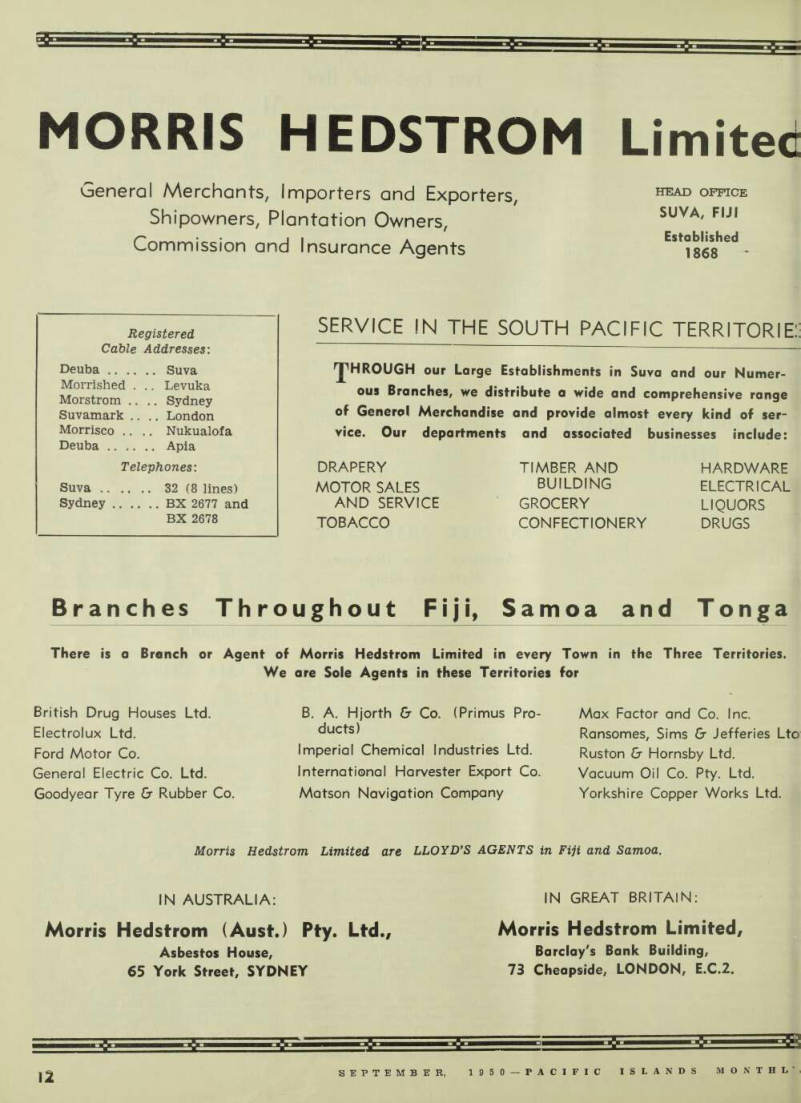
Morris Hedstrom Limited
General Merchants, Importers and Exporters,
Shipowners, Plantation Owners,
Commission and Insurance Agents
HEAD OFFICE
SUVA, FIJI
Established 1868
SERVICE IN THE SOUTH PACIFIC TERRITORY
'JHROUGH our Large Establishments in Suva and our Numerous Branches, we distribute a wide and comprehensive range of General Merchandise and provide almost every kind of service. Our departments and associated businesses include:
DRAPERY
MOTOR SALES
AND SERVICE
TOBACCO
TIMBER AND
BUILDING
GROCERY
CONFECTIONERY
HARDWARE
ELECTRICAL
LIQUORS
DRUGS
Branches Throughout Fiji, Samoa and Tonga
There is a Branch or Agent of Morris Hedstrom Limited in every Town in the Three Territories.
We are Sole Agents in these Territories for British Drug Houses Ltd.
Electrolux Ltd.
Ford Motor Co.
General Electric Co. Ltd.
Goodyear Tyre Gr Rubber Co.
B. A. Hjorth Gr Co. (Primus Products) Imperial Chemical Industries Ltd.
International Harvester Export Co.
Matson Navigation Company Max Factor and Co. Inc.
Ransomes, Sims Gr Jefferies Lto Ruston Gr Hornsby Ltd.
Vacuum Oil Co. Pty. Ltd.
Yorkshire Copper Works Ltd.
Morris Hedstrom Limited are LLOYD'S AGENTS in Fiji and Samoa.
IN AUSTRALIA: IN GREAT BRITAIN:
Morris Hedstrom (Aust.) Pty. Ltd.,
Asbestos House, 65 York Street, SYDNEY
Morris Hedstrom Limited,
Barclay's Bank Building, 73 Cheopside, LONDON, E.C.2.
The Month In Moresby
From Our Own Correspondent
Port Moresby. Sept. 6.
UNLESS the External Territories De partment takes urgent action it is certain that Wau High School will not be built in time to open on February 1, as promised by the Minister.
Red tape at the Canberra end is hold ing up the project. The Administration has plans and specifications ready; equip ment has been organised; staff has been appointed and 46 pupils have been en rolled. All that is needed is the Exter nal Territories Department’s approval to let the contract for construction of the school. The Administrator is so worried about the delay that this week he sent an urgent cable to the Department asking for an immediate decision on the school.
He said there was still time to finish the job before February, particularly if the work were divided among several contrac tors. Parents and others, however, are not so sure that there is still time. Some of the 46 children who have been enrolled for the non-existent school will be in an awkward position if the school does not open on February 1. Their parents will have to try to get them into southern secondary schools at the last moment.
Those among the 46 who are now in Grades 6 or 7 in Territory schools will not be so seriously affected. They can con tinue in their present schools until they finish Grade 8 and by then the High School should be completed.
Port Moresby Parents & Citizens’ Asso ciation fears that if the building of the school is shelved until next year it may result in an indefinite hold-up, perhaps the cancellation of the whole scheme. An alternative to opening the school next year is already being considered. This alternative is for the Administration to pay the fares of all children going to Australia for secondary education and to make an allowance of £l5O a year for each child. However, this same scheme was rejected by the Commonwealth Treasury four years ago and another approach on these lines would probably meet a similar fate. Mr. Spender’s reputation in the Territory as a man who gets things done will be marred if the school does not open on schedule.
NEW houses for Hanuabada and Elevata natives are still going up at a great rate. Fifty of the 335 houses to be built have been completed; the frames are up for another three and foundations are down for seven more—all in ten months. This remarkable progress has been made by a team of 27 natives work ing under Mr. Max Roth, with Mr. Des Sullivan supervising the project. Timber for the houses has come from Port Romilly, Wau and several other sources.
Soon the Administration will begin building 20 houses at Gabuta, near the Moresby golf course, to accommodate natives to be moved from Shanty Town at Koki. Meanwhile, houses for Adminis tration staff in Moresby crawl into exis tence at no more than a fifth of the rate achieved by Mr. Sullivan’s team. Reason for the different results is easily explained.
The Hanuabada project is under the direct control or the Government Secretary and red tape has been cut to a minimum.
QANTA3 Bird of Paradise services have been chahged following the with drawal of a Skymaster from the run.
Previously there was no regular service on Fridays but now a DC3 arrives from Sydney on Friday and another goes south from Bulolo and Wau. Instead of the
Rabaul aircraft arriving in Moresby on Thursday and returning south on Saturday, it now comes through on Saturday and returns south on Tuesday. ;; ;; •' , . , CONTOUR survey is now being made of the small island off Koki on which it is planned to erect a national war memorial. The Administration is having the survey made on behalf of the Australian authorities who are handling the erection of five national war memorials. ft is not definitely known what form the memorial will take. Port Moresby RSL
understands that it will be a beacon with a perpetual light. Before the war the Moresby European jail was on the island on which the memorial is to stand.
TWO hundred building blocks on the Boroka Estate at the Four Mile, Moresby, will be available soon. The Government Secretary told the Advisory Council recently that Mr. Foxall, a con tract surveyor, was working in the area and would go as far as pegging the al lotments. There was provision for shops, a school, churches and a recreation ground.
The Government Secretary said that the contour survey of the new Pandora Crescent blocks was finished and the de signing could now begin. Pegging of new allotments on Lawes Road would start
soon It had been decided to give priority to Boroka Estate because this could be opened up quicker than the other two areas. A second party of contract sur veyors would be engaged by the Adminis tration to speed up survey work which had been held up by the shortage of Administration surveyors.
The Government Secretary said that the Minister’s decision that the minimum size of residential allotments should be 120 ft. by 200 ft. (nearly 2 of an acre), was now being reviewed. The Advisory Council decided to recommend that the minimum size be 4 of an acre. Council mem bers felt that 3/4 of an acre would be unnecessarily big in certain cases.
THE Advisory Council has been disap pointed to find that its recom mendations regarding the new Moresby wharf and storage areas have been put aside. The Government Secre tary reported that to change the design as requested by the Council would delay the construction of the wharf. It had therefore been decided to retain the original plan for a 640 ft. wharf. If necessary, the wharf could later be ex tended to 900 ft., the size suggested by the Council.
The Administration advised the Council that the 1950-51 works programme in Moresby included the following works; Re-sealing of Musgrave Street, Ela Beach Road and Lower Koki Road; construction of Bampton Street and construction of roads serving new allotments on Lawes Road and Boroka Estate; improvements to pumping plant at Bomana; investiga tions regarding an underground water supply for the Three and Four Mile; commencement of the new wharf; com pletion of the emergency landing ground on Fisherman’s Island; commencement of reconstruction work at Jackson’s Strip; provision of safety fences on dangerous sections of road and widening of narrow sections as far as possible; power house extensions and installation of new plant; renewal of the oil pipeline to the Moresby wharf.
THE Territory has probably received the last of the American cars that it has been getting from Hong Kong.
Under a new Commonwealth regulation, a permit has to be obtained to bring these cars into the Territory—and permits will be hard to get because of the dollar shortage. Before the restriction was in troduced, about 40 American cars from Hong Kong had entered New Guinea and six-four of them second hand—had arrived in Moresby.
SAMARAI has become an easier place to visit since Mrs. Robertson opened a guest house there recently. Pre viously there was nowhere in Samarai where visitors could stay except in private homes. Mrs. Robertson’s guest house has about 20 beds. The tariff is £l/5/- a day, or seven guineas a week.
AT St. John’s Church of England, Moresby, on September 2, Miss Marion Trenaman, of PCB, married Assistant Sub-Inspector John Simons.
Miss Frances Bradley of PCB was brides maid and Assistant Sub-Inspector Vince Neilsen was best man. The honeymoon is being spent at Yule Island.
Mr. and Mrs. Arthur Foley, of Subitana Plantation, Moresby, have gone to Sydney on their first leave for several years.
Mr. Norm Odgers, of OTC, Moresby, and Mrs. Odgers, have left for Esperance, Wes tern Australia, where Mr. Odgers will manage the OTC station.
Advertisements & other items, pp. 15-16 (2 items)
Sale!
PACIFIC
ISLANDS
YEAR
BOOK
1950 R..W Robso r
NOW
on
SALE!
After 15 months' delay, caused by industrial dislocations and other circumstances beyond our control, we advise that the
PACIFIC ISLANDS YEAR BOOK, 1950
is now available. Copies may be obtained from most of the leading Booksellers in Australia, New Zealand and the Pacific Islands, and from the Publishers.
There are 500 Pages and numerous Maps in this (the Sixth) Edition. In addition to providing the latest available information relating to Administrations, Trade (full Statistics), Tariffs, etc., all revised up to the end of 1949, the Year Book has many Special Sections, such as: A History and Chronology of the War
Retail Price
Add postage (within the British Empire, 1/-; Foreign 1/9) when ordering direct. (In U.S. Currency: $3.00, plus 20 cents postage.)
PACIFIC PUBLICATIONS PTY. LTD.
Union House, 247 George Street, SYDNEY.
P.o. Box 3408, SYDNEY.
in the Pacific, 1941-45; Lists of Public Servants in each Territory; Description of the new Air Transport Organisations serving the Pacific Islands; Complete Directory of Pacific Islands Missions; Notable Developments in 1940-50 Period; Detailed Index of Place Names in the Pacific, etc. 22/6
YOURS WHEN YOU FLY BY
CLIPPER* TO
LONDON
% kl !
S'
VIA US A.
Sleeperette Comfort*
Across the Pacific to Hawaii you enjoy Pan American’s exclusive Sleeperette Service.
Your softly cushioned Sleeperette reclines ’way back so you can stretch out full-length . . . even has curtains for privacy! All day long you relax in blissful comfort.
At night you sleep like a top.
The Clippers also fly to London via Middle East and Europe For complete information, call your Travel Agent or .
SUVA: Bank of N.S.ff. Bldg. (Tel. 664) NOUMEA: Rue Jean Jaures (Tel. 85) World’s Most Experienced Airline
SPEED YOUR PARCEL BY CLIPPER CARGO
Pan American's Commonwealth Plan Pan American’s Commonwealth Plan covers all your travel expenses to London and return. Includes meals, hotel accommodations, incidental transportation in the U.S.A. All reservations and arrangements made for you by Pan American. *Trade Marks, Pan American World Airways, Inc, I / / Pan American World Airwayt Inc., Ltd., Incorporated in U.S.A.
14
SEPTEMBER, 1950 PACIFIC ISLANDS MONTULU
Memorial To Bishop Newton
A FUND to provide a memorial to the late Bishop Newton of Carpentaria and New Guinea has been started in Brisbane.
Dr. Henry Newton DD, was Bishop of Carpentaria from 1915-1921 and Bishop of New Guinea from 1922-37. After his retirement he continued to live at Dogura, Papua.
After an illness of some months in Australia in 1947 he went back to Dogura where he died in September of that year.
The aged Bishop was widely-known and loved throughout the Pacific and in the United Kingdom. Those who would like to contribute to a lasting memorial to his work in Northern Australia and Papua, should send their donations direct to Miss lima C. Townson, 152 Alexandra Rd Clayfield, NE2, Queensland. Cheques should be endorsed “Newton Memorial Appeal Account.”
Sandals For Ng Natives
AFTER many months of experiment on the part of the Department of Footwear, Sydney Technical College, a sample of a sandal designed to meet the peculiar requirements of the New Guinea native (mostly for police-boys) has been forwarded to the Department of External Territories for approval. If it is approved, tenders will be called immediately for at least 2,000 pairs.
Preliminary experimental work included a visit by a member of the Footwear Department’s staff to Papua, where he took numerous plaster casts and X-ray photographs of natives’ feet.
The project has entailed the drawing up of entirely new last scales, as the main feature of the natives’ feet was found to be their extreme breadth. Con trary to expectations, the average length turned out to be particularly short. On standard sizes, in length, the range will run from about 3 s to 9’s, but with exceptional breadth.
Stud poultry, including 25 White Leg horn hens, was shipped to the Solomons from Australia in August to establish a stud flock nucleus from which birds will later be distributed to the natives to build up the quality of native stock.
Advertisements & other items, p. 17 (1 item)
The Central Pharmacy
* *s V .^1 ❖
ADORABLY LOVELY
UNDER POWDER
CH ARMOSAN
J' A
CLEANSES AND
REFRESHES YOUR SKIN
CHARMOSAN
SOLD EVERYWHERE
THE CENTRAL PHARMACY
/ 177 Hopetoun Avenue V
VAUCLUSE, SYDNEY
E. Kezelman, M.P.S., Ph.C. (Sydney University).
We take pleasure in announcing the establishment of a special Mail Order Department. Our aim is to offer all Pacific Islands residents the advantage of city shopping. We carry a full range of Ethical and Proprietary Drugs, Cosmetics, and all Ladies' requirements. We will be pleased to give personal attention and prompt delivery to all Mail Orders.
Cheque or Postal Note with order. Credit Established.
Specify Airmail or Ship. On parle Prancais ici.
Death Of L. B. Benjamin
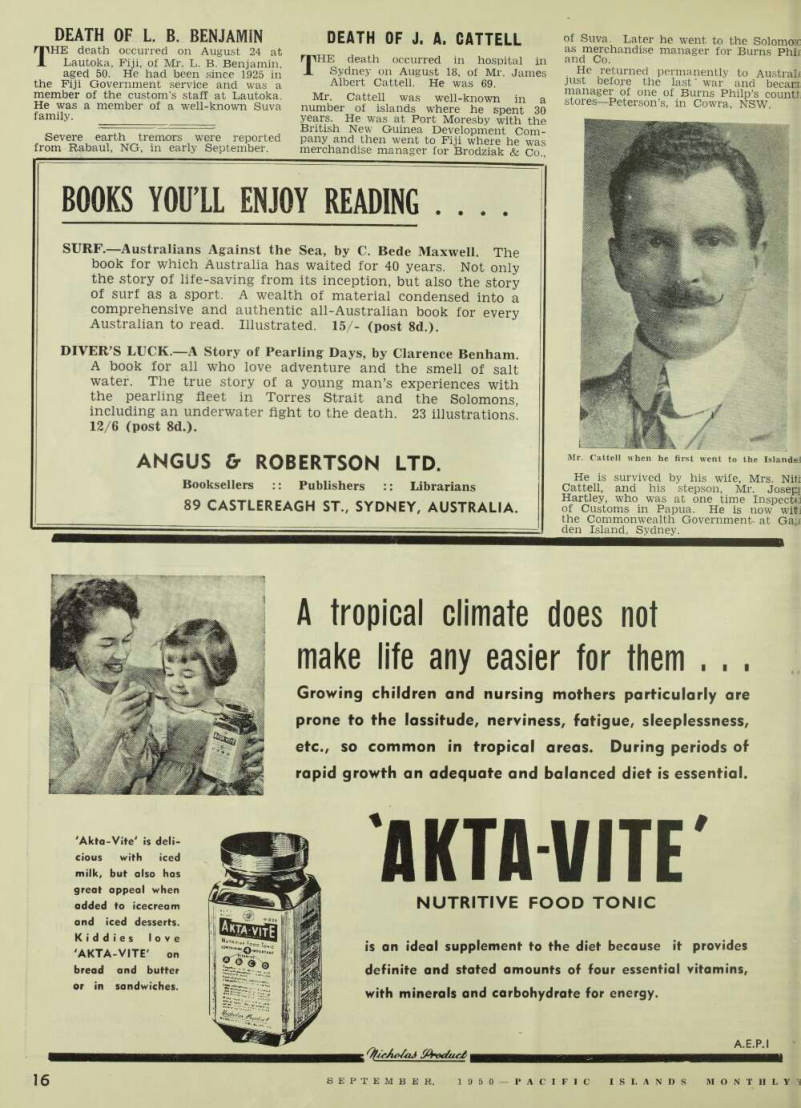
THE death occurred on August 24 at Lautoka, Fiji, of Mr. L. B. Benjamin, aged 50, He had been since 1925 in the Fiji Government service and was a member of the custom’s staff at Lautoka.
He was a member of a well-known Suva family.
Severe earth tremors were reported from Rabaul, NG, in early September.
Death Of J. A. Cattell
THE death occurred in hospital in Sydney on August 18, of Mr. James Albert Cattell. He was 69.
Mr. Cattell was well-known in a number of islands where he spent 30 years. He was at Port Moresby with the British New Guinea Development Com pany and then went to Fiji where he was merchandise manager for Brodziak & Co
of Suva. Later he went to the Solomon as merchandise manager for Burns Phir and Co. . He returned permanently to Austral* just before the last' war and becarn, manager of one of Burns Philp’s counts stores—Peterson’s, in Cowra, NSW.
He is survived by his wife, Mrs. Niti Cattell, and his stepson, Mr. Josepj Hartley, who was at one time Inspects of Customs in Papua. He is now witri the Commonwealth Government- at Gajr den Island, Sydney.
Mr. Cattell when he first went to the Islands
Advertisements & other items, p. 18 (2 items)
Books You’Ll Enjoy Reading
SURF.—Australians Against the Sea, by C. Bede Maxwell. The book for which Australia has waited for 40 years. Not only the story of life-saving from its inception, but also the story of surf as a sport. A wealth of material condensed into a comprehensive and authentic all-Australian book for every Australian to read. Illustrated. 15/- (post Bd.).
DIVER’S LUCK. —A Story of Pearling Days, by Clarence Benham.
A book for all who love adventure and the smell of salt water. The true story of a young man’s experiences with the pearling fleet in Torres Strait and the Solomons, including an underwater fight to the death. 23 illustrations 12/6 (post Bd.).
ANGUS & ROBERTSON LTD.
Booksellers :: Publishers :: Librarians
89 CASTLEREAGH ST., SYDNEY, AUSTRALIA.
Akta-Vite'
A tropical climate does not
make life any easier for them .. .
Growing children and nursing mothers particularly are prone to the lassitude, nerviness, fatigue, sleeplessness, etc., so common in tropical areas. During periods of rapid growth an adequate and balanced diet is essential.
'Akto-Vite' is delicious with iced milk, but also has great appeal when added to icecream and iced desserts.
Kiddies love
'AKTA-VITE' on
bread and butter or in sandwiches. o o '< 0 ©
AKTA-VITE'
NUTRITIVE FOOD TONIC
is an ideal supplement to the diet because it provides definite and stated amounts of four essential vitamins, with minerals and carbohydrate for energy. {Product
A.E.P.I
No Infiltration Vet
But P-NG Residents Would Like More Border Patrols
From Our Own Correspondent
Port Moresby, Sept. 6.
RESIDENTS of Papua-New Guinea do not believe that there has been any Indonesian infiltration into the Ter ritory vet, but they think that border patrols" should be increased as a pre- Ca, They have been disturbed to realise that the Territory is wide open to infiltration from Dutch New Guinea. Only a hand ful of European officers and native police are in a position to watch the Dutch New Guinea border and they cannot hope to patrol more than a fraction of the 500 miles frontier. Indonesians could cross the border and spend months stirring up trouble among the natives before the Aus tralian authorities heard about their ac tivities. Residents feel, however, that the time to get really worried will be when, or if. the Indonesians take over Dutch New Guinea. “If that happens we can be sure of trouble,” they say. Even then, they think that the danger would come more from Indonesian propaganda than from direct Indonesian action.
Said one old Territorian: “If the In donesians took Dutch New Guinea they would soon have the natives hating us.
We must do all we can to guard against f this.” One local suggestion is that the native militia battalion when it is formed, should be given the job of guarding the bolder. At present, there are only three outposts near the border. One is at Vanimo on the north coast; the second at Telefomin in the centre; and the third at Lake Murray in the south. The area is the least developed in Papua-New Guinea. Natives move freely between Australian and Dutch New Guinea on fishing or trading trips.
Residents feel that the recently an nounced defence measures will be ade quate at present, but not if the Indonesians occupy Dutch New Guinea.
It is suggested that instead of going to the trouble of creating a new set-up for the native militia, the Territory’s native police force should be enlarged from its present strength of 2,400 and given military training. Rifle instruction is al ready part of the police training course.
Some residents think that the native militia should be more than one battalion.
One high Administration official estimates that 3,000 natives could be recruited with out much effect on the Territory’s economy. It is pointed out that native militia will be much cheaper to maintain than a European force of the same size.
It is felt that the natives, with the right training, would be the ideal troops for this country. Port Moresby RSL would like to see Moresby re-established as a big defence base, or, at least, as an Air Force base. Said RSL President Fred Edwards: “The Air Force should never have been withdrawn from here.”
Residents have doubts about the effec tiveness of Manus base. There has been no air or naval movement to indicate that the base is being strengthened. Side by side with the Indonesian threat, in the minds of Territorians, is the Communist menace. A few years ago, several Com munists were openly active in Moresby.
They are blamed for the only strike by native wharflabourers here. The natives struck for higher pay and got it, but there have been no more strikes anywhere in the Territory since then. Communists are also said to have tried to persuade native houseboys in Moresby to demand more pay. These Communists have now gone.
New Guinea, with its 3,000 Chinese, is regarded as the main danger area.
Sydney-Wellington
Flying-Boat Service
rjIHE inaugural flight of the new Tas- JL man Empire Airways, Ltd., service from Wellington to Sydney will be made from Wellington on October 2, and from Sydney on October 3.
Solent flying-boats will be used and it is expected that each crossing will take about seven hours. Aircraft will leave Rose Bay, Sydney, at 10 a.m. on Mondays and Thursdays, make a night crossing, and land at Wellington about 7 a.m. (NZ time) the following morning. Departure times from Wellington will be 11 a.m. on Tuesday and Fridays.
As the New Zealand tourist season ap proaches, the schedule will be increased and it is expected that around Christmas there will be about five services a week.
Fares are the same as on the TEAL Auckland-Sydney service.
Advertisements & other items, p. 19 (1 item)
Death of Mr. J. H. Meads
MR. JOHN HARTLEY MEADS,
formerly of Papua, died suddenly in Sydney on August 26.
He leaves a widow and three daughters.
Death Of Mr. M. J. Lynch
mHE death has occurred of Mr. J. Lynch, X at his home in Auckland. Mr. Lynch CSR Co.. Ltd., at their RanTwafMl, bI He later j° in ed the staff of Emperor Gold Mining Co., Ltd., Vatukoula. when the m ines were in their infancy. He leaves behind his wife, daughter, and two sons. His eldest son, Wallace, who learned engineering at the Rarawai Mill, was lost on SS Justitia, sunk in 1940.
Advertisements & other items, pp. 19-20 (1 item)
Scotland’S Premier Whisky
An Ideal Gift.
Souvenir Book of Verses
"SONGS FROM THE
SOUTH SEAS"
By ALICE ALLEN INNES.
Foreword by Dame Mary Gilmour. and delightfully illustrated by Captain Brett Hilder.
Price: 6/-. (Including gaily illustrated gift envelope).
Posted, 6d. extra.
Copies obtainable from:
PACIFIC PUBLICATIONS PTY.. LTD.,
247 George Street, Sydney, N.S.W.
SCOTLAND’S PREMIER WHISKY
fei
••• WHi r , i 9 ,
AVAILABLE FROM YOUR LOCAL STOREKEEPER
Proof Of The Puddin’
About 10 years ago Aspaxadrene was discovered by a 100 per cent. British Australian; not the result of yean of research bunkum, but an overnight inspiration (Inspiration without perspiration), unadvertised till twv years ago, it has spread all over the world.
FRENCH.—L’aspiratolre "Aspaxadrene” se trouve maintenant partout.
GERMAN.—Die Bhandlung durch Einatmung von "Aspaxadrene” wird jetzt in der ganzen.
YIDDISH.— oum pnKDPKBDK,, un ITALIAN.—La cura per inalazione "Aspaxadrene” e adesso adoperata in tutto il mondo.
SPANISH.—-Ei trato respiratorio—^"Aspaxadrene”—es empleado ahora de todos los pueblos del CHINESE: Hj is ,1 , J |,J ,(S
HINDI: ,
( Asp ax ad re nc treatment;
ASTHn/N )
FEVEK ) -rn \HfvSAL CAT RKRrt)
It has been supplied to Vice Royalty (two States), Prime Ministers, Repatriation Dept, (all States), Allies
Generals, Hospitals, etc., etc.
—AROUND THE WORLD WITH ASPAXADRENE—
Topical and Typical Testimonials:
NAURU.—J. D. Agoko, Nauru Island, Central Pacific.
PAPUA.—Mr. J. H. Lonergan, Port Moresby.
NEW GUINEA.—Rev. Father , Mission, Utau, Aitape.
FIJI.—Mr. K. D. L. Brook, 7th Day Adventists, Suva.
SOLOMONS.—Rev. Father , Mission, Guadalcanal.
OCEAN ISLAND.—K. D. Lennon, Ocean Island, Central Pacific, PHILIPPINES.—AnacIeto R. Madriaga, Meycanayan, Brilican. [Asthma sufferer—2o years—was retired from Government Service after 22 years—very thin during Japanese occupation and no relief medicineattacks daily—X-ray after liberation showed early pulmonary T. 8.; after using Aspaxadrene few months—health much improved—attacks seldom and subside early on using inhalant—now sleep well and eat anything 1 want; already dispensed with Adrenalin, Ephedrin, etc., etc., and use only Aspaxadrene.—l thank you very much.] MALAYA.—V. Sana Asir, 217 C, Jalang Kilang Lama.
BORNEO—Mrs. Smallgood, Oilfields, Miri.
NEW ZEALAND.—J. C. , Guthrie Road, Hawkes Bay.
AUSTRALIA.—Mrs. Bullen, 12 Simmons Street, South Yarra, Victoria. (And over 20,000 others in Australia!!!) CHINA.—Mr. Slui Sluik. House 34, Lane 16, Tai Shang Street, Insii House, 118 Her Pyng Huh Duann Taipet, Taiwan.
SWEDEN.—Lars Wijkmark, c/o A. Nordbakels, Box 203, Gothenberg.
AFRICA.—Mrs. E. M. Tanner, KB5, W. Rand Consol Mine, Krugersdoic Transvaal.
AMERICA.—Mrs. Clefferman, 116 N. Roselawn Street, Pontiac, Mi.
ENGLAND—J. Stevens, 48 Furzedown Road. Sutton, Surrey.
IRELAND.—Mrs. Agnes Wallace, Riverview Bruff, Co. Limerick.
SCOTLAND. —Mr. H. B. Barbour Sen., 28A Bank Street, Aberdeen.
WALES.—Rev. Greenway.
FRANCE.—Miss , Rue Charles Alex, Le Seuers ’Adrene-Seine.
HOLLAND.—Lieut. Commander , 4 Den Helden, Timorevan.
EGYPT.—Mrs. Healy, Oil Co., Ras Ghariz.
INDIA.—Mr. A. G. , Calcutta.
CEYLON.—Miss A. B. Morris, Box 387, Colombo.
JAPAN.—Convent, Nagasaki.
Asthma, Bronchitis, Catarrh, Hay Fever, Sinus, Antrum, Coughs, Colds, ’Flu, etc., etc., all result in inflame capillaries of the mucous membranes —whatever the cause.
Modern magic atomized inhalant
ASgAX*PRE#|
Touches the spot—so relieves in seconds (not years). Absolutely harmless —same spray same liquid, babie and adults —no dieting—sleep on anything, anywhere—may be used in conjunction with any other treatmen —takes the strain from the heart by easing the breathing.
Complete Outfit, 28/6 Aspaxadrene Refill, 12/6
All Chemists—(Your sure protection in all things pharmaceutical)
A. H. CRUNDALL
(Discoverer and Dispenser Thereof)
BOX 58, PRAHRAN, VICTORIA, AUSTRALIA.
v
Newspaper Error
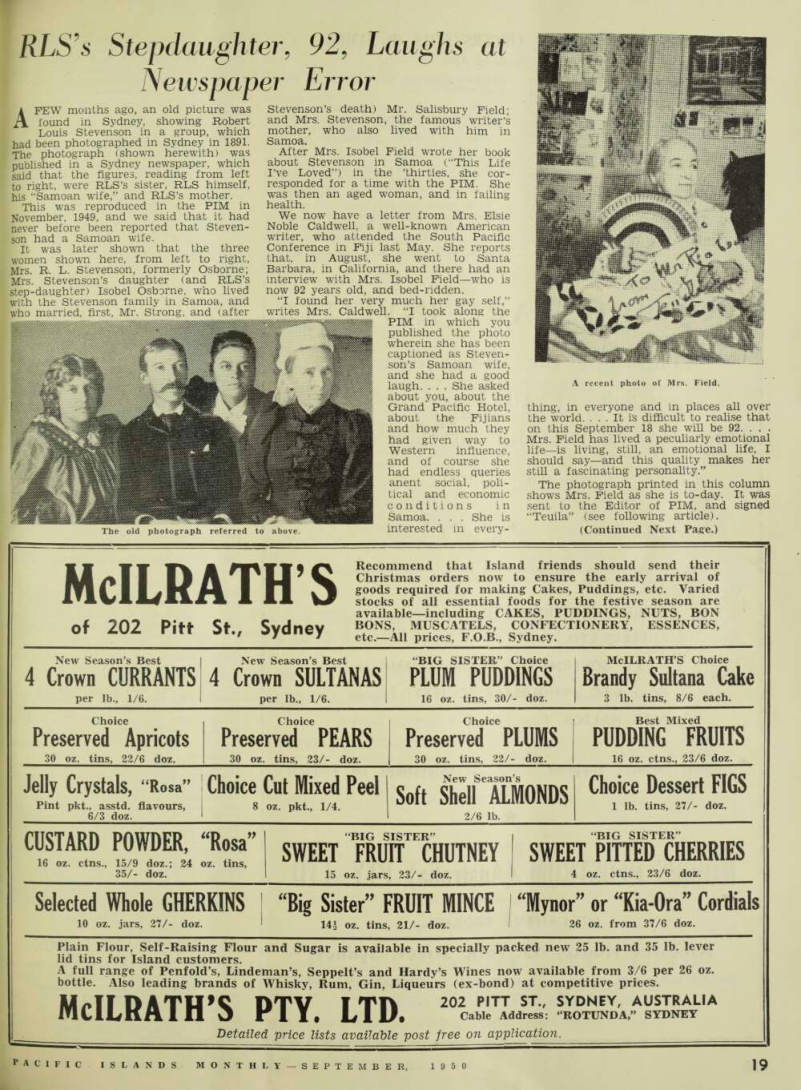
RLS’s Stepdaughter , 92, Laughs at Newspaper Error
A FEW months ago, an old picture was found in Sydney, showing Robert Louis Stevenson in a group, which had been photographed in Sydney in 1891.
The photograph (shown herewith) was published in a Sydney newspaper, which said that the figures, reading from left to right, were RLS’s sister, RLS himself, his “Samoan wife,” and RLS’s mother.
This was reproduced in the PIM in November, 1949, and we said that it had never before been reported that Stevenson had a Samoan wife.
It was later shown that the three women shown here, from left to right, Mrs. R. L. Stevenson, formerly Osborne; Mrs. Stevenson’s daughter (and RLS’s step-daughter) Isobel Osborne, who lived with the Stevenson family in Samoa, and who married, first, Mr. Strong, and (after
Stevenson’s death) Mr. Salisbury Field; and Mrs. Stevenson, the famous writer’s mother, who also lived with him in Samoa.
After Mrs. Isobel Field wrote her book about Stevenson in Samoa (“This Life I’ve Loved”) in the ’thirties, she cor responded for a time with the PIM. She was then an aged woman, and in failing health.
We now have a letter from Mrs. Elsie Noble Caldwell, a well-known American writer, who attended the South Pacific Conference in Fiji last May. She reports that, in August, she went to Santa Barbara, in California, and there had an interview with Mrs. Isobel Field—who is now 92 years old, and bed-ridden, “I found her very much her gay self,” writes Mrs. Caldwell. “I took along the
PIM in which you published the photo wherein she has been captioned as Steven son’s Samoan wife, and she had a good laugh. . . . She asked about you, about the Grand Pacific Hotel, about the Fijians and how much they had given way to Western influence, and of course she had endless queries anent social, poli tical and economic conditions in Samoa. . . . She is interested in every-
thing, in everyone and in places all over the world. ... It is difficult to realise that on this September 18 she will be 92. . . .
Mrs. Field has lived a peculiarly emotional life—is living, still, an emotional life, I should say—and this quality makes her still a fascinating personality.”
The photograph printed in this column shows Mrs, Field as she is to-day. It was sent to the Editor of PIM, and signed “Teuila” (see following article).
(Continued Next Page.)
The old photograph referred to above.
A recent photo of Mrs. Field.
Advertisements & other items, p. 21 (1 item)
Mcilbath’S
of 202 Pitt St., Sydney
Recommend that Island friends should send their Christmas orders now to ensure the early arrival of goods required for making Cakes, Puddings, etc. Varied stocks of all essential foods for the festive season are available—including CAKES, PUDDINGS, NUTS, BON
BONS, MUSCATELS, CONFECTIONERY, ESSENCES,
etc.—All prices, F. 0.8., Sydney.
Plain Flour, Self-Raising Flour and Sugar is available in specially packed new 25 lb. and 35 lb. lever lid tins for Island customers.
A full range of Penfold’s, Lindeman’s, Seppelt’s and Hardy’s Wines now available from 3/6 per 26 oz. bottle. Also leading brands of Whisky, Rum, Gin, Liqueurs (ex-bond) at competitive prices.
M/>II DATII’Q DTV I TV\ 2 <> 2 P,TT ST - Sydney, Australia HlllLKnl It \J Ail* L 1 !/• Cable Address: “ROTUNDA,” SYDNEY Detailed price lists available post free on application.
Memory Of “Teuila” Lingers Still In Samoa
By E. E. Bush, of Apia
Mrs. Isobel Field, Aged 92 On
September 18, and now residing at El Mirasol, Santa Barbara, Cali fornia, has lost her good health, unfor tunately, but not her good spirits. She still is the same bright Teuila, gay and chatty, looking back on “This Life I’ve Loved,” or passing comment on the pres ent age.
In the Vailima days, in Samoa, she gave much pleasure to R.L.S., and added much to the gaiety and laughter of the happier days in that hilltop home. She was then, of course, Mrs. Isobel (or Belle) Strong. Isobel and Lloyd Osbourne were the children of Mrs. Fanny Stevenson, by
her first marriage. RLS called her Teuila. and wrote of her: , - , ... . . ir £ ear and * ai T my and pretty, come and sue to me for praise?
Why come and tease me for a ditty, Who are, yourself, my song of praise?
Yourself the goddess bright that lingers The 1 days ground And the hoiise hrie Si fl l,r p And tne ftouse brightens with your eyes.
RLS wrote several poems about her always they express the regard in which he held her. As his amanuensis in the latter days they were drawn close to
gether. Many a depression must hayi oeen lifted in the hours they spent tod gether, and many a pain eased in til; presence which he described as “the turn ihat the whole world goes to, and til; brightness of the passing miles.’
Some of his work would never havi seen the light of day if it had not bee; for his beloved Teuila. Who but Teuiij would have thought of the deaf an dumb alphabet when Louis was stricke: on his bed, forbidden to speak one won for the effort involved, yet anxious to to his manuscripts, to correct the pax labours, or to pour out the ideas thsr were forming in his never-resting brain..
Teuila was his right hand and his let' Perhaps, too, he had tender regard hi her because her marriage was not work ing out very happily. He who found suoi happiness with his Fanny (her motheie could sympathise when another was n<r finding the complete happiness that H knew could be found in marriage.
THERE are those who criticised Bell: and Joe Strong, and Lloyd Osbournn for adding themselves to the Steven; son household. But Belle, in a veie moving passage, tells us why she did.
She had her own ideas of independent) and did not wish to join the household t Vailima. But, in Sydney, Louis put til situation to her from his viewpoint. H had no family of his marriage, nor woui. he. Belle was Fanny’s daughter. A such he looked on her, begged her to rti main as part of Fanny’s family, an therefore of the only family he' woux ever have.
He was home-loving. Home require'; a family; only the family spirit com. convert the four walls of a house inr home. Therefore he begged her to com And, happily for us, she did.
“This Life I’ve Loved” gives us intimax glimpses of the family on its travels; gives us a picture that no one else —nr even Nellie Sanchez or Graham Balfoun has given.
The little cottage at Vailima in whioi Joe and Belle Strong lived is there h longer. Indeed, the face of Vailima it self is changed, and Belle would ha\£ difficulty in recognising the house wheo she spent those happy years. Whn Fanny Stevenson, after her husbanoj death, placed the house on the markji it came to the hands of Herr Kunst, wM enlarged the building by the addition another wing, and improvements. TF! house later became the property of tld German Government, and was used ; Government House. Governor Solf wv its first occupant in this capacity.
And so the years roll by. Septembd 18 marks the 92nd anniversary of tld birth of Belle Osbourne in Indianapolis The house at the foot of Vaea, associate for ever with the immortal name Stevenson, is yet a memorial also to thoo who lived with him within those walltl to Fanny, whose labours are perpetuate in the lawns and flowerbeds she mabj and the waterworks she engineered; Teuila, whose laughter and happy diil position added so much sunshine to thri home. Her name lives on in Samoa. Til flower she brought from Honolulu —th ginger flower —is called the Teuila flowev and its brightness is the essence of hd life.
Inquiry For A Book
A MELBOURNE reader asks urgent)! if anyone can assist him to procuu a copy of “Three Admirals,”
Kingston. It is understood that this boio explains much of the origin of N©‘ Guinea nomeanclature, and is of assiax ance to some research workers. CK any reader oblige?
Advertisements & other items, p. 22 (1 item)
Morris Hedstrom (Australia) Pty. Ltd.
INQUIRIES ARE INVITED
Concerning the Distribution and
Sale of All Types of Merchandise in the Pacific Islands ★
WE ARE AUSTRALIAN AGENTS FOR—
MORRIS HEDSTROM LTD., Fiji, Tonga and Samoa.
MILLERS LTD., Fiji.
8.5.1. P. GOVERNMENT TRADE SCHEME, Honiara
G. & E.I.C. WHOLESALE SOCIETY, Ta rawa.
MAX HALECK, Pago, Pago, American Samoa.
Original Invoices Supplied Quotations on Request ★
MORRIS HEDSTROM (Australia) PTY. LTD.
(.Established 1922)
MERCANTILE BROKERS,
Asbestos House, 65 York Street, Sydney.
Box No. 2530, G.P.0., Sydney. Cable Address: “MORSTROM,” Sydney.
BANKERS: BANK OP NEW ZEALAND, SYDNEY.
Samoa’S Continued Prosperity
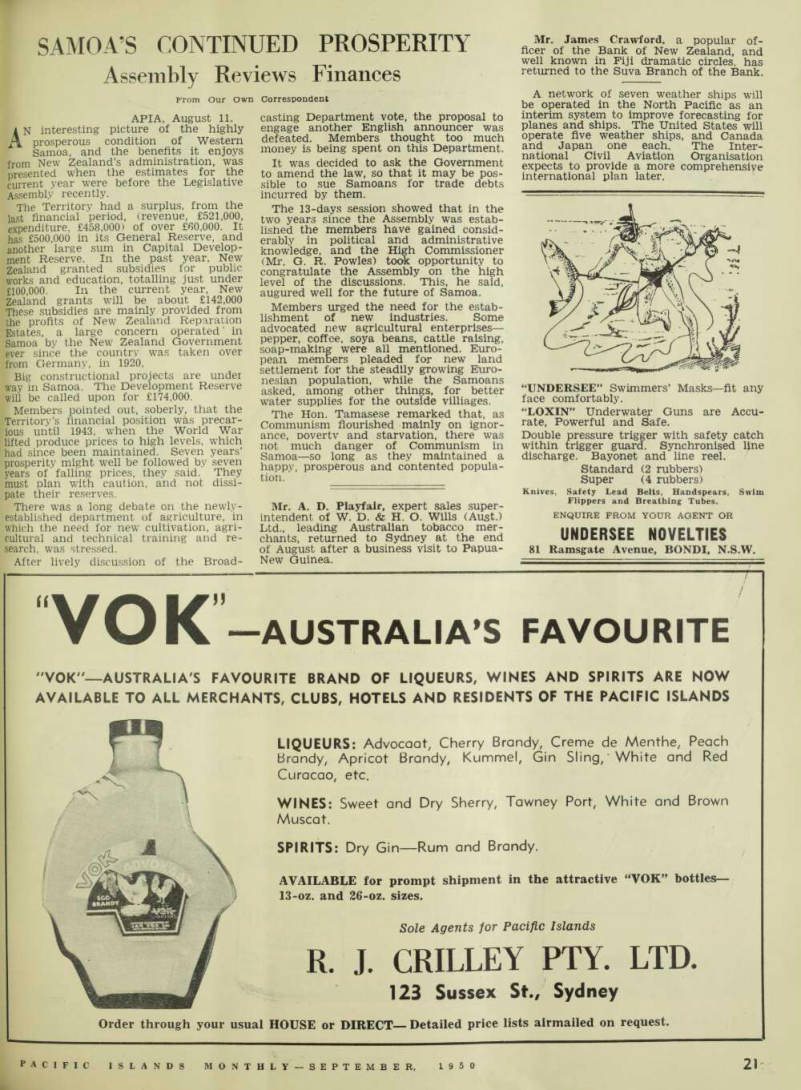
Assembly Reviews Finances
From Our Own Correspondent
APIA, August 11. i N interesting picture of the highly A prosperous condition of Western Samoa, and the benefits it enjoys from New Zealand’s administration, was presented when the estimates for the current year were before the Legislative Assembly recently.
The Territory had a surplus, from the last financial period, (revenue, £521,000, expenditure, £458,000) of over £60,000. It has £500,000 in its General Reserve, and another large sum in Capital Develop ment Reserve. In the past year. New Zealand granted subsidies for public works and education, totalling just under £lOO,OOO. In the current year, New Zealand grants will be about £142,000 These subsidies are mainly provided from the profits of New Zealand Reparation Estates, a large concern operated' in Samoa by the New Zealand Government ever since the country was taken over from Germany, in 1920.
Big constructional projects are under way in Samoa. The Development Reserve will be called upon for £174,000.
Members pointed out, soberly, that the Territory’s financial position was precar ious until 1943, when the World War lifted produce prices to high levels, which had since been maintained. Seven years’ prosperity might well be followed by seven years of falling prices, they said. They must plan with caution, and not dissi pate their reserves.
There was a long debate on the newly established department of agriculture, in which the need for new cultivation, agri cultural and technical training and re search, was stressed.
After lively discussion of the Broad
casting Department vote, the proposal to engage another English announcer was defeated. Members thought too much money is being spent on this Department.
It was decided to ask the Government to amend the law, so that it may be pos sible to sue Samoans for trade debts incurred by them.
The 13-days session showed that in the two years since the Assembly was estab lished the members have gained consid erably in political and administrative knowledge, and the High Commissioner (Mr. G. R. Powles) took opportunity to congratulate the Assembly on the high level of the discussions. This, he said, augured well for the future of Samoa.
Members urged the need for the estab lishment of new industries. Some advocated new agricultural enterprises— pepper, coffee, soya beans, cattle raising, soap-making were all mentioned. Euro pean members pleaded for new land settlement for the steadily growing Euro nesian population, while the Samoans asked, among other things, for better water supplies for the outside villiages.
The Hon. Tamasese remarked that, as Communism flourished mainly on ignor ance, novertv and starvation, there was not much danger of Communism in Samoa —so long as they maintained a happy, prosperous and contented popula tion.
Mr. A. D. Playfair, expert sales super intendent of W. D. & H. O. Wills (Aust.) Ltd., leading Australian tobacco mer chants, returned to Sydney at the end of August after a business visit to Papua- New Guinea.
Mr. James Crawford, a popular of ficer of the Bank of New Zealand, and well known in Fiji dramatic circles, has returned to the Suva Branch of the Bank.
A network of seven weather ships will be operated in the North Pacific as an interim system to improve forecasting for planes and ships. The United States will operate five weather ships, and Canada and Japan one each. The Inter national Civil Aviation Organisation expects to provide a more comprehensive international plan later.
Advertisements & other items, pp. 23-24 (1 item)
Vok —Australia’S Favourite
•N \ X “UNDERSEE” Swimmers’ Masks—fit any face comfortably.
“LOXIN” Underwater Guns are Accurate, Powerful and Safe.
Double pressure trigger with safety catch within trigger guard. Synchronised line discharge. Bayonet and line reel.
Standard (2 rubbers) Super (4 rubbers) Knives, Safety Lead Belts, Handspears, Swim Flippers and Breathing Tubes.
ENQUIRE FROM YOUR AGENT OR
UNDERSEE NOVELTIES
81 Ramsgate Avenue, BONDI, N.S.W.
VOK —AUSTRALIA’S FAVOURITE
"VOK "—AUSTRALIA'S FAVOURITE BRAND OF LIQUEURS, WINES AND SPIRITS ARE NOW AVAILABLE TO ALL MERCHANTS, CLUBS, HOTELS AND RESIDENTS OF THE PACIFIC ISLANDS sT\ LIQUEURS: Advocaat, Cherry Brandy, Creme de Menthe, Peach Brandy, Apricot Brandy, Kummel, Gin Sling/White and Red Curacao, etc.
WINES: Sweet and Dry Sherry, Tawney Port, White and Brown Muscat.
SPIRITS: Dry Gin—Rum and Brandy.
AVAILABLE for prompt shipment in the attractive “VOK” bottles— -13-oz. and 26-oz. sizes.
Sole Agents for Pacific Islands
R. J. CRILLEY PTY. LTD.
123 Sussex St., Sydney
Order through your usual HOUSE or DIRECT— Detailed price lists airmailed on request.
H PI L* OH \i
fiS«
POUND
nVV- v
Everywhere
people are saying . . .
\L\ Vi\'o'o\° c ' f ' \* RV
graso^l
IvPS*
7.01 ergX £N
CAP*
O&ns*
loi, r
MOMAj
CoMmf
a
C a J
In every half pound of Cadbury’s delicious Dairy Milk chocolate there is a glass and a half of rich, full cream milk from Tasmania’s richest dairying districts. Cadbury’s insistence on the very choicest of ingredients, consistent high quality, and careful manufacture have won a world-wide reputation for Cadbury products. Cadbury’s chocolates are wrapped in moisture, resisting paper and especially packed for tropical conditions.
Traders —for further information write to :
CADBURY-FRY-PASCALL PTY. LTD.
212-218 YORK ST. NORTH, SYDNEY
(SiJluAy*
lift
LB.NET
BCUIRN
the ideal
FOOD DRINK
sjL°* by cadbupJJ Socialists |N //iSs Dr 'nks fcr ioo jUB NtT
CI3FPO
Papua Polio Epidemic Is
Over
Tragic Death of Clifford Kruse
From a Special Correspondent
Samarai, Sept. 2.
A CLOSE investigation does not make it appear that blame for the tragic deatn of Clifford Kruse, young American journalist, at Losuia, on Kiri wina island, in the Trobriands, on August 6 can be laid at the door of any official, as was suggested by the article published in August PIM.
It appears that Mr. Kruse was on Kiriwina island in July, when Polio myelitis was first reported, and before quarantine was proclaimed. A Medical Assistant was handling the situation there, and he warned Mr. Kruse of the danger of entering the villages. Mr.
Kruse moved about freely, however.
Mr. Kruse then went back from Kiri wina to Samarai, with the intention of returning to the Trobriands to do a par ticular story. He was warned that the epidemic was spreading, and quarantine might be proclaimed.
He spent three days in the Samarai i Milne Bay area, and then sought to return to the Trobriands, to Kitava. He was told by the Assistant District Officer and the Medical Assistant that it would be impossible for him to return to the Trobriands, as Misima and Kiriwina sub districts were about to be placed under quarantine—and on July 29 they were so quarantined.
Mr. Kruse, however, secured a passage on the Health Department’s vessel Hekaha, from Samarai to Kitava, on July 30.
When the Hekaha arrived in the Tro briands, she was met at Kiriwina (Losuia) by the Medical Officer, Dr. May.
Dr. May desired to proceed in the Hekaha direct to Misima, where it was reported that both the Medical Officer and the Medical Assistant were ill, probably from Polio.
Mr. Kruse wanted to go on to the ad joining island of Kitava. Dr. May would not permit it—first, because Kitava was not under quarantine and Kiriwina was; and, second, because he wanted to get to Misima without delay. He said Kruse must remain on Kiriwina, in quarantine.
Mr. Kruse naturally resented this action very strongly, and appealed for help.
However, the stand taken by the medical men was justified by the fact that Kruse, a little later, was found to be suffering from Polio, which he had contracted on his earlier visit to Kiriwina. He died in the Medical Assistant’s house at Losuia after a very brief illness.
The medical report is that “it was ex tremely rapid but classical acute anterior poliomyelitis, with bulbar paralysis.”
The Chief Medical Officer has expressed the opinion, based on all the circum stances, that Mr. Kruse undoubtedly had been infected during his first visit to Kiriwina; and his death came so rapidly, when he did fall ill, that no treatment c<Duld have saved him—he would have died even had he remained at Samarai on July 30, or been taken to hospital at Port Moresby. * * * THE Polio epidemic in the islands east of Papua died down almost as sud denly as it flared up; and a Gazette notice of August 26 revoked the quaran tine declaration over the Trobriands sub-district. But 33 cases of Polio occurred since the epidemic appeared in June, and one European and seven natives died of the disease in Kiriwina and Misima.
Legion Of Honour Awards
THE official journal of the French Gov ernment recently announced that Monseigneur Le Cadre, Bishop of the Marquesas Islands, has been elevated to the grade of Officier of the Legion of Honour, while the Reverend Pastor Vernier has been nominated Chevalier of the same order.
It was stated also that the following are to be promoted Officiers of the Legion: Capitaine de Pregate Dartigues, Commandant of the French sloop, Francis Gamier; Corvette Capitaines Denis and Beghelli (both well known in Tahiti); and Corvette Capitaine Cousot, marine com mandant, Noumea.
Travellers From the Hebrides
AMONG Qantas air passengers from Vila, to Sydney in early September, were three members of the staff of Messrs.
Burns Philp, Vila, New Hebrides.
One of them was Mr. D. Anderson, formerly captain of the 80 tons Burns Philp auxiliary ketch, Koro, which met with disaster off the island of Efate a few weeks ago. Mr. and Mrs. Anderson leave the Group for good to go to Mel bourne first and then live in Sydney.
The other two BP employees are both making unplanned trips for urgent medi cal attention. They are, Mr. B. Lodwick and Mr. H. Horsborough.
Both will be patients at the Royal Prince Alfred Hospital in Melbourne.
Advertisements & other items, p. 25 (1 item)
Colyer Watson Ltd
I fa Wholesale and Retail Merchants—Sawmillers and Timber Merchants— Plantation Proprietors and Managing Agents—Ship Owners —
Shipping, Insurance and Customs Agents—Plantation Suppliers—
Exporters of Island Produce.
AGENTS FOR:
Australia-West Pacific Line.
Canton Insurance Office, Ltd.
Union Assurance Society, Ltd.
Aust. T. & G. Mutual Life Society, Ltd.
ASSOCIATED WITH:
Colyer, Watson Pty., Ltd., Sydney, Melbourne, Brisbane.
Colyer, Watson & Co.. Ltd., Wellington. Auckland, Christchurch.
DISTRIBUTING AGENTS
Hillman, Humber, Sunbeam-Talbot, Chrysler and Plymouth Cars.
Commer, Karrier and Fargo Trucks.
Willys Overland Jeeps.
G.M. Marine and Industrial Engines.
Olympic Tyres and Cables.
IN NEW GUINEA FOR:
Hygeia Dissolvenators.
Sherwin-Williams Paints.
Prefect Refrigerators.
Mullard Radios.
Aladdin Lamps.
Anchor and Tiger Beers.
Snowflake Unsweetened Evaporated Milk.
Pental Soaps.
COLYER WATSON LTD
• RABAUL • MADANG • KAVIENG •
British Socialists’
Fantastic Peanuts Scheme
A DISMAL tale has been told concern ing the gigantic British Socialist plan for the production of ground nuts in East Africa, from which Britain was to derive enough good vegetable oil to assist materially in the problem of providing food.
The project was given shape and authority by a Governmental document,
Command 7030 (it hath indeed a rich Soviet flavour!), published in February, 1947.
Up to March 31, the famous “Scheme” had incurred liabilities totalling £23,200,000. 150,000 acres were to be cleared and sown in peanuts in 1947, and a further 450,000 acres in 1948; 56,920 tons of peanuts were to be produced in 1948 and 227,676 in 1949. Up to March, 1949, they had planted exactly 49,620 acres, and up to the date of the report they had produced 2,150 tons of unshelled ground-nuts and 800 tons of sunflower seeds.
The promoters of the Scheme—typical Planners of the post-war Socialist period —were not in the least downcast. They
admitted that the results were “disiJ appointing”; but they found great caun for jubilation in the fact that the finf groundnuts sent home for pressing ga T £ a ? yield U P to 46 P er cent., instess of the 40 per cent, that had been estts mated.
The promoters say that they are sun that magnificent results will be achievev within the Six Years Plan, according i Command 7030, but the auditors, a wells known London firm of chartered account! ants, refused to certify that proper boolo of account had been kept.
Copra producers, for the present, neee not lose any sleep concerning the oiio seed competition of Command 7030.
Fete For Papeete School
Brother gabriel edouard, aia sistant General of the Brother School of Ploermel, after a briui visit to Tahiti in which he was widely entertained, departed by TRAP AS plan* at the end of July. During his stay, ii a fete held in honour of the opening o the new school buildings in Papeete, thiJ ferris wheel and merry-go-round recently imported from Australia made their inin tial appearance to the public and wene enthusiastically received.
As a former pupil of the school, MU Oscar G. Nordman, owner of the amuses ment devices, presented Brother Edouam with 15,000 francs, representing the profitfl he had made on the occasion.
From a letter received from Mr. Eugene Overton, of Hawaii, Colonel Leopold O Blackman reports that the projected bid ennial trans-Pacific yacht race frono Honolulu to Papeete is well under wa:i3 The event is creating much interest ii American mainland and Hawaii centres- Mr. Overton has been nominated Coran modore of the race.
Advertisements & other items, p. 26 (2 items)
Millers Ltd.
Every Branch Of
ENGINEERING and BUILDING CONSTRUCTION
SUVA and LAUTOKA
Sawmillers and Timber Merchants; Shipwrights and Saihnakers; Joinery and Furniture Manufacturers; Upholsterers; Plumbers; Electricians; Hardware Merchants; Motor Dealers.
AGENCIES :
Chevrolet, Bedford, Vauxhall, Nash Motors. Firestone Tyres.
Fetters Marine and Stationary Engines. G.E.C. Radio Sets British Australian Lead Manufacturers Pty., Ltd. Atlas Assurance Co., Ltd.
There is no need to send to Australia or New Zealand for Repairs or Replacements. We can give you a sound Quotation and guarantee First-Class Workmanship
“Doraplas" Overlays
10 TIMES
*”"** Twm.
Exclusive to
RACKETS
"DU RAP LAS" OVERLAYS ARE BONDED TO THE SHOULDERS FOR GREATER STRENGTH, EXTRA SPEED, LONGER LIFE No warping or cracking at the shoulders.
Extra strength allows for tighter stringing.
Reinforced frame ensures more restrings. * "DURAPLAS" IS THE GREATEST SINGLE ADVANCE IN RACKET CONSTRUCTION FOR 25 YEARS!
Hem
where
the st
is taken
Mk. P. A. Morris
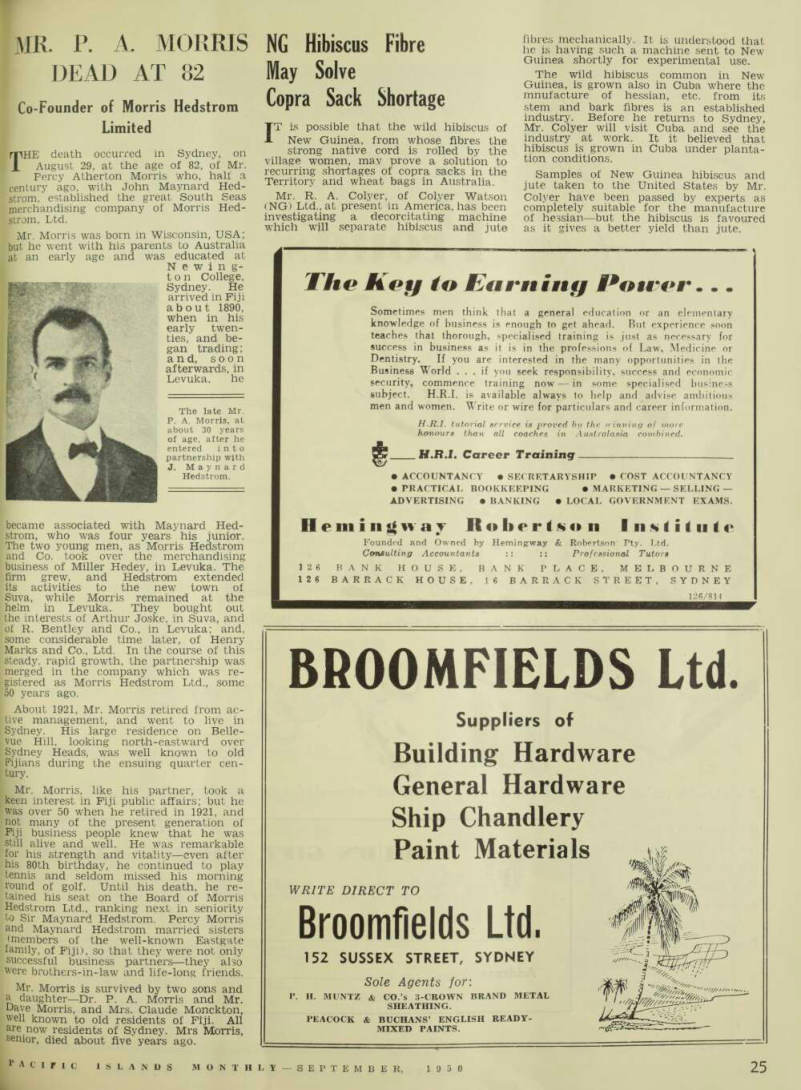
Dead At 82
Co-Founder of Morris Hedstrom Limited
THE death occurred in Sydney, on August 29, at the age of 82, of Mr.
Percy Atherton Morris who, half a century ago, with John Maynard Hed strom, established the great South Seas merchandising company of Morris Hed strom, Ltd.
Mr. Morris was bom in Wisconsin, USA; but he went with his parents to Australia at an early age and was educated at
Newing ton College, Sydney. He arrived in Fiji about 1890, when in his early twen ties, and be gan trading; and, soon afterwards, in Levuka, he
became associated with Maynard Hed strom, who was four years his junior.
The two young men, as Morris Hedstrom and Co. took over the merchandising business of Miller Hedey, in Levuka. The firm grew, and Hedstrom extended its activities to the new town of Suva, while Morris remained at the helm in Levuka. They bought out the interests of Arthur Joske, in Suva, and of R. Bentley and Co., in Levuka: and, some considerable time later, of Henry Marks and Co., Ltd. In the course of this steady, rapid growth, the partnership was merged in the company which was re gistered as Morris Hedstrom Ltd., some 50 years ago.
About 1921, Mr. Morris retired from ac tive management, and went to live in Sydney. His large residence on Belle vue Hill, looking north-eastward over Sydney Heads, was well known to old Fijians during the ensuing quarter cen tury.
Mr. Morris, like his partner, took a keen interest in Fiji public affairs; but he was over 50 when he retired in 1921, and not many of the present generation of Fiji business people knew that he was still alive and well. He was remarkable for his strength and vitality—even after his 80th birthday, he continued to play tennis and seldom missed his morning round of golf. Until his death, he re tained his seat on the Board of Morris Hedstrom Ltd., ranking next in seniority to Sir Maynard Hedstrom. Percy Morris and Maynard Hedstrom married sisters (members of the well-known Eastgate family, of Fiji), so that they were not only successful business partners—they also were brothers-in-law and life-long friends.
Mr. Morris is survived by two sons and a daughter—Dr. P. A. Morris and Mr.
Dave Morris, and Mrs. Claude Monckton, well known to old residents of Fiji. All are now residents of Sydney. Mrs Morris, senior, died about five years ago.
The late Mr.
P. A. Morris, at about 30 years of age, after he entered into partnership with J. Maynard Hedstrom.
Copra Sack Shortage
NG Hibiscus Fibre May Solve Copra Sack Shortage
IT is possible that the wild hibiscus of New Guinea, from whose fibres the strong native cord is rolled by the village women, may prove a solution to recurring shortages of copra sacks in the Territory and wheat bags in Australia.
Mr. R. A. Colyer, of Colyer Watson (NG) Ltd., at present in America, has been investigating a decorcitating machine which will separate hibiscus and jute
fibres mechanically. It is understood that he is having such a machine sent to New Guinea shortly for experimental use.
The wild hibiscus common in New Guinea, is grown also in Cuba where the mnufacture of hessian, etc. from its stem and bark fibres is an established industry. Before he returns to Sydney, Mr. Colyer will visit Cuba and see the industry at work. It it believed that hibiscus is grown in Cuba under planta tion conditions.
Samples of New Guinea hibiscus and jute taken to the United States by Mr.
Colyer have been passed by experts as completely suitable for the manufacture of hessian —but the hibiscus is favoured as it gives a better yield than jute.
Advertisements & other items, pp. 27-28 (2 items)
Broomfiblds Ltd.
The Key io Tarnintj ..
Sometimes men think that a general education or an elementary knowledge of business is enough to get ahead. But experience soon teaches that thorough, specialised training is just as necessary for success in business as it is in the professions of Law, Medicine or Dentistry. If you are interested in the many opportunities in the Business World ... if you seek responsibility, success and economic security, commence training now —in some specialised business subject. H.R.I. is available always to help and advise ambitious men and women. Write or wire for particulars and career information.
H.R.I. tutorial service is proved b>i the winning of more honours than all coaches in Australasia combined.
H.R.I. Career Training • ACCOUNTANCY • SECRETARYSHIP • COST ACCOUNTANCY
• PRACTICAL BOOKKEEPING • MARKETING SELLING
ADVERTISING • BANKING • LOCAL GOVERNMENT EXAMS.
Heniiit g w a t Ho her* *on Insti i u i e Founded and Owned by Hemingway & Robertson Pty. Ltd.
Consulting Accountants :: :: Professional Tutors
126 BANK HOUSE. BANK PLACE. MELBOURNE
126 BARRACK HOUSE, 16 BARRACK STREET, SYDNEY 126/814
BROOMFIBLDS Ltd.
Suppliers of Building Hardware General Hardware
Ship Chandlery
Paint Materials v
WRITE DIRECT TO
Broomfields Ltd.
152 SUSSEX STREET, SYDNEY
Sole Agents for : P. H. MUNTZ & CO.’s 3-CROWN BRAND METAL
SHEATHING.
PEACOCK & BUCHANS’ ENGLISH READY-
MIXED PAINTS.
'hofi'
Cft
jt troud’s
Precious Jewellery Watches i Art Jewellery 9 y m ■y Souvenirs A birthday gift ... a wedding gift . . . o Christmas gift ... or whatever the occasion may be Pens and Pencils Smokers Accessories 33 s % Cutlery y Shaving Accessories Leather Goods Proud's Seven Floor Gift Store, right in the heart of Sydney, has exactly the gift you need Brush Sets Handbags n / All types of m 4 "Clock Shop" /. world-wide variety of merchandise is specially selected with a thought for the giver of gifts It's easier, it's more fun to shop by mail with the help of Proud's Gift Book. Cut out the coupon below, send it to Mail Order Manager, Prouds Limited, Box 1502, G.P.0., Sydney, and receive Proud's Gift Book free.
PROUD’S GIFT BOOK VOUCHER
Mail Order Manager, Prouds Limited, Box 1502, G.P.0., Sydney.
Please send me Proud's new Gift Book free of all charge.
Name Address.
26
SEPTEMBER, 1950 PACIFIC ISLANDS MONT B L
Rabaul Baths Reopened
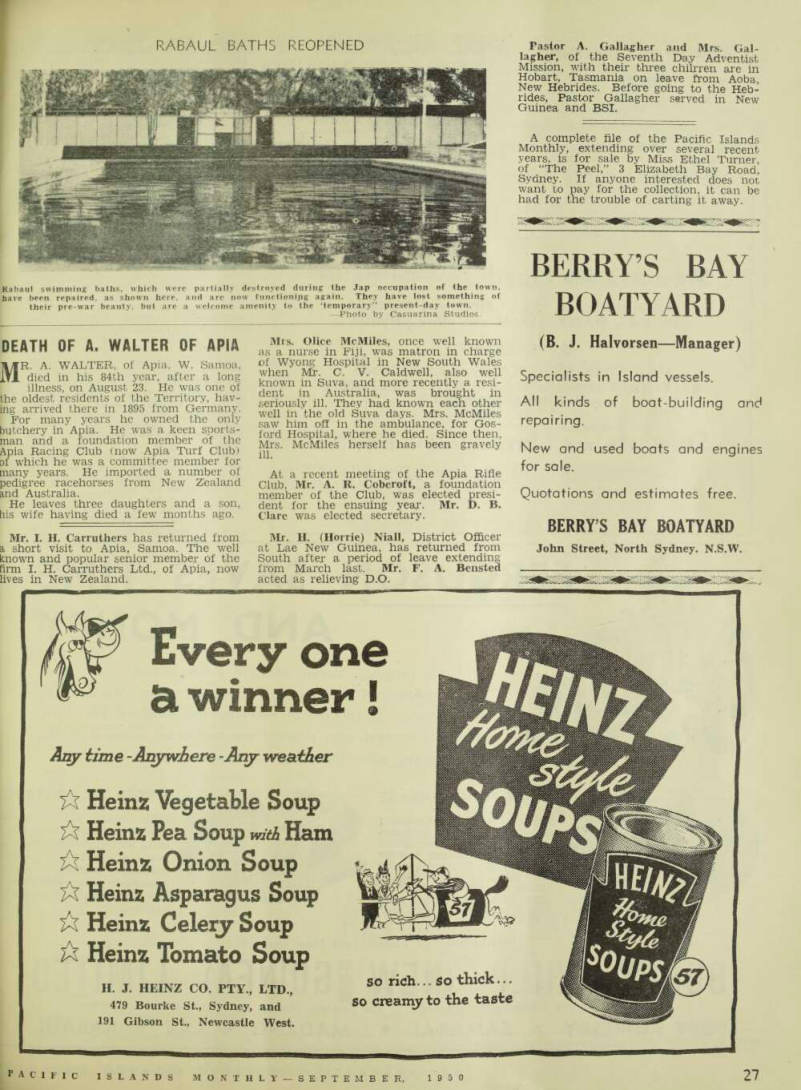
Rabaul swimming baths, which were partially destroyed during the Jap occupation of the town, have been repaired, as shown here, and are now functioning again. They have lost something of their pre-war beauty, but are a welcome amenity to the ‘temporary” present-day town.
Photo by Casuarina Studios,
Death Of A. Walter Of Apia
MR. A. WALTER, of Apia, W. Samoa, died in his 84th year, after a long illness, on August 23. He was one of the oldest residents of the Territory, hav ing arrived there in 1895 from Germany.
For many years he owned the only butchery in Apia. He was a keen sports man and a foundation member of the Apia Racing Club (now Apia Turf Club) of which he was a committee member for many years. He imported a number of pedigree racehorses from New Zealand and Australia.
He leaves three daughters and a son, bis wife having died a few months ago.
Mr. I. H. Carruthers has returned from a short visit to Apia, Samoa. The well known and popular senior member of the firm I. H. Carruthers Ltd., of Apia, now lives in New Zealand.
Mrs. Olice McMiles, once well known as a nurse in Fiji, was matron in charge of Wyong Hospital in New South Wales when Mr. C. V. Caldwell, also well known in Suva, and more recently a resi dent in Australia, was brought in seriously ill. They had known each other well in the old Suva days. Mrs. McMiles saw him off in the ambulance, for Gos ford Hospital, where he died. Since then, Mrs. McMiles herself has been gravely ill.
At a recent meeting of the Apia Rifle Club, Mr. A. R. Cobcroft, a foundation member of the Club, was elected presi dent for the ensuing year. Mr. D. B.
Clare was elected secretary.
Mr. H. (Horrie) Niall, District Officer at Lae New Guinea, has returned from South after a period of leave extending from March last. Mr. F. A. Bensted acted as relieving D.O.
Pastor A. Gallagher and Mrs. Gal lagher, of the Seventh Day Adventist Mission, with their three chilrren are in Hobart, Tasmania on leave from Aoba, New Hebrides. Before going to the Heb rides, Pastor Gallagher served in New Guinea and BSI.
A complete file of the Pacific Islands Monthly, extending over several recent years, is for sale by Miss Ethel Turner, of “The Peel,” 3 Elizabeth Bay Road, Sydney. If anyone interested does not want to pay for the collection, it can be had for the trouble of carting it away.
Advertisements & other items, p. 29 (1 item)
Every one
BERRY’S BAY
BOATYARD
(B. J. Halvorsen—Manager)
Specialists in Island vessels.
All kinds of boat-building and repairing.
New and used boats and engines for sale.
Quotations and estimates free.
BERRY S BAY BOATYARD
John Street, North Sydney. N.S.W.
Every one
a winner!
Any time - Anywhere-Any weather A Heinz Vegetable Soup A Heinz Pea Soup with Ham A Heinz Onion Soup A Heinz Asparagus Soup A Heinz Celery Soup A Heinz Tomato Soup
H. J. HEINZ CO. PTY., LTD.,
479 Bourke St., Sydney, and 191 Gibson St., Newcastle w> so rich... so thick... so creamy to the taste
Notes From American
Samoa
Pago Pago, July 5.
IT was interesting to learn, from speeches made during the jubilee celebrations (American Samoa was 50 years old in mid-April) that there are
now 4,300 school-children (between 7 and 17) in this Territory.
The growth of population since United States took us over in 1900 has been remarkable. Then there were only 6,000; by 1940 census the number had grown to 18,000: and the census now being taken is likely to show a further sub stantial increase.
The Navy (responsible hitherto for ad ministration) is now moving out, and the US Department of Interior officials are
Lading charge. We wonder where the administration funds are coming fronu Can you see Congress voting large sums for the upkeep of this small isolated; place? We can’t!
A facetious remark recently, that Con gress might ask New Zealand to takes over Eastern Samoa and run it with Western Samoa, caused a near panic; The Eastern Samoans cannot even toler ate the thought that they might becomes subservient to the richer and more powerful chiefs of Western Samoa. The; three groups—Eastern Samoa, Western; Samoa and Manu a—stand jealously^ alone, each ready to fiercely defend its rights, traditions and its own little bit
of territory.
The United States Naval Air Station at Tafuna packed up and departed fori Honolulu on June 20—to the outspoken regret of everyone. They were popular] folk. Their Catalina—which kept us in touch with Suva—has gone, too. There are vague rumours that Pago Pago may be included in soma trans-Pacific ain service—but nothing definite. Now we get our air-mails through Apia; and a Matson freighter calls in every three weeks.
It now appears as if the Tuna fishing venture promoted by Mr. Harold Gatty is going out, too. The canning plant here — which was to work in cooperation with Marine Products in Suva—has been idle for months —in fact, there was only one shipment of canned tuna since it was erected. The two remaining families are about to leave. It is a great pity—an industry like this would have made a lot of difference to Pago Pago. I under stand that a caretaker will remain here? to look after the plant.
Talk about your 1949 rainfall in Suva— a mere 13 feet! Whv, here in Pago Pago we had over 26 feet (313 inches)! In 1948, we had 253 inches.
Advertisements & other items, p. 30 (1 item)
Burns Philp (New Iguinea) Limited
V Stewarts and Lloyds (Australia) pt y . Ltd.
Manufacturers of "S&L" PIPES and FITTINGS for GAS, WATER, STEAM and other purposes.
AND Distributors of:
MILD STEEL BARS, PLATES and SECTIONS;
GALVANISED IRON; BOLTS and NUTS; ELECTRODES
and WELDING EQUIPMENT.
Stewarts and Lloyds (Australia) pty. Ltd.
SVDNEy WAREHOUSE - - - Herbert Street. St. Leonards BRISBANE WAREHOUSE - Montague Road, South Brisbane MELBOURNE WAREHOUSE - - City Road, South Melbourne Telegraphic Address: "Tubes " Sydney, Brisbane or Melbourne
m % 3
FERGUSON SAVES TIME
AND MONEY
With the Ferguson System of form mechanisation there is no heavy handling of machinery. Built for economy, the scientific design makes it capable of handling the roughest job. With electrical starting, easy steering and unrivalled manoeuvrability, the Ferguson saves time and money on every job.
THREE-POINT LINKAGE
One of the most outstanding features of the Ferguson System is the three-point hitch. This unique linkage converts the tendency of the implement to revolve into a strong forward-slantrthrust that holds down the front wheels as well as the rear.
FINGER TIP CONTROL
With finger tip hydrauliti control right at the driver’;' seat, the implement can lx raised or lowered or kept a£ constant working depthl Automatic safety devices enr sure protection to driver anoi implement.
Distributors for Papua and New Guinea
BURNS PHILP (NEW IGUINEA) LIMITED
Send your enquiries to the nearest branch at — PORT MORESBY • SAMARAI • MADANG • LAE • RABAUL
Native Labourers?
SHOULD WHITE EMPLOYERS BE ALLOWED TO SMACK
By Robert Slade
THE case of John Breen McKenna, assistant director of the Native Labour Department of Papua-New I Guinea, convicted recently in Port Moresby of assaulting a native, directs attention to a matter that should have been dealt with, on Canberra level, long ago. The Eddie Ward policy of treating the New Guinea natives as Brown Brothers and gentlemen has been carried to ridiculous lengths. It is time we had a stocktaking, in relation to this aspect I of native policy.
McKenna was charged with punching a native. He pleaded guilty to assault, but declared that he did not punch the man. He had directed the native to do some work: and the native did not do what he was told, and when reprimanded, he swore at the white man. McKenna thereupon had slapped the native’s face with his open hand.
This was a misdemeanour. Since the Socialist Utopia was introduced to Papua- New Guinea, one may not lift a finger against Brown Brother. The useful old habit of applying the toe of a lively shoe to the native’s stem is now in a category close to murder. As a result, the sophis ticated salt-water native has become arrogant, cheeky and almost unmanage able.
There have been many cases, in Papua- New Guinea, in the last two or three years, of Europeans of good status and reputation, being prosecuted for so-called assault upon natives.
There was, for example, the fine im posed for assault, in Kavieng, upon Captain Finnelly, of the 300-tonner Karu.
Finnelly had oftimes been criticised by his fellows for pampering his native em ployees; his friends pointed out that his natives abused his generosity and re garded his patient kindness as weakness.
The day came when the Captain could answer a native’s impudence only by giving him the hiding that was long overdue. His record made no difference: they fined him £l2.
The law, as they have it now in these Australian Territories—and in most other Pacific Territories —is an absurdity.
THE New Planners of the post-war generation would have it that there is no essential difference between races. The theory is enthusiastically presented and developed in the last issue of the magazine published by the Aust ralian School of Tropical Administration.
From that base the Planners have now got native administration policy to the point where relations between Europeans and natives in New Guinea must be the same as between employers and employed in Australia. Nowadays, in Papua-New Guinea, if a native employee is diso bedient or cheeky or offensive, you must proceed against him by civil process, or call for the police.
The majority of Europeans in charge of natives simply cannot be bothered with either civil court or police. When they find it necessary, they use their hands, or a handy stick, to knock respect, and some sense of the fitness of things, into the usually stupid head of Brown Brother; and, if they are “reported” for it, and come officially under the notice of some Government servant, they must just grin and bear it.
Fortunately, most of the officials in Papua-New Guinea are sufficiently realist to deal properly with the situation, and the great majority of slapped faces and kicked behinds never reach the sanctity of a court. And no harm is done there by. There are very few Europeans in Papua-New Guinea who will strike a
native without good reason, or from sheer bad temper. Most of them have a very clear sense of noblesse oblige, and govern their conduct accordingly.
These dark-skinned people of Melanesia —and, in fact most of the Pacific Islanders —recognise, above all, the quali ties of strength and firmness. Let the white man be just and strong, and ready at any time to assert his authority, where necessary, with a resounding wallop, and he will hold the respect and willing obedience of every native from Wau to Aitutaki, and from Noumea to Nauru.
Even a little man, if he has a straight eye and a ready fist, governed by a sense of strict justice, will enjoy perfectly satisfactory relations with natives; while the man who tries to rule them with cajoleries and empty threats, no matter how big he is, will suffer endless humilia tion and trouble.
THESE Planners say there is no funda mental difference in race, and try to introduce their theories into ad-
I ministrative laws, as in I Guinea. Ninety-five per cent, of Euro- I peans who have had to live among I coloured people in Asia or Africa, or the [lslands, know the absurdity of that claim.
Biologically, yes—there is no difference, f Caucasian can mate with Mongol, or Negroid with Caucasian, or with any of their mixtures. But in the non-physical things, character and temperament, there is a world of difference; and in the qualities which make for good citizen ship and human progress (according to our standards) the North European is better than the South European; and the European generally is in advance of the Asiatic and the Negro.
I can almost hear the screams of wrath with which such an opinion will be received by the New Planners of the post war period; but a lifetime of experience and observation has convinced me of its truth.
Standards change. Perhaps, two or three centuries from now, the unwritten rules which govern human life and human relations will have moved in favour of the standards to which non- European races conform. I have been speaking of the standards of present-day Western Civilisation, under which the human race has made phenomenal pro gress in the last few hundred years.
And I am discussing the average man of the various races. There are many men among the Indians of Asia, or the Negros, or Mongols, who are equal in quality to the best that Caucasia ever produced: just as there are, in Europe, human types as low as the lowest in Africa or Asia. I can name Chinese, and Polynesians, and Indonesians, whom it is an honour to know. I have seen, in a London slum, white derelicts as loath some as the coloured scum of Port Said.
ABSOLUTE equality is as impossible in inter-racial relations as it is between classes in even the most highly civilised white State. There must always be a governing section, and a governed.
Men may be bom equal, in their claim to personal freedom and all the privileges of citizenship. But men are never born equal in the qualities which constitute leadership. Some are bom to lead, and the mass are intended by nature to con form to leadership. Any attempt to escape from those fundamental laws—and the whole world to-day is cursed with such experiments—leads inevitably to social confusion and economic trouble.
SO, by a wide circle, we come back to our starting-point: the absurdity of the attempt to apply the laws of common British citizenship to a primitive Melanesian community. We have a duty to these people: to give them medical
service, to provide them with means for acquiring literacy .to . assist them to higher standards of living, and to teach
£e m how n^SrrJSv
e rcJowded worid Buf ff we pamp ? ?hlm we defSt oiir own’ ends pamper aeieal our enas ' .We have a very long way to go, in those directions, before we reach the
fhSa
our Ssf our planters a
biiSocks of a recaYcitrant
nttive buttocks of a recalcltrant ‘ Sister Mary Wellington, of Sydney,
‘doctors' A an“nurses° who
are doing maternal and baby-welfare work among the natives. Part of her work will be to travel around among vil lages and instruct mothers in hygiene and babv care.
Advertisements & other items, pp. 31-33 (1 item)
Nathan’S Merchandise
Send us your orders for
DEVELOPING, PRINTING
Enlarging; and
COPYING FROM OLD PHOTOS
All Photographic Supplies.
CAINE’S STUDIOS, SUVA
Box 8. (Estb. 1904) Phone: 68.
r vt
NATHAN’S MERCHANDISE (NSW) PTY. LTD.
General Merchants (Wholesale)
WINES, SPIRITS AND ENGLISH ALES
GROCERIES
CROCKERY
TOYS
HARDWARE
Australian Agents for WHITE HEATHER SCOTCH WHISKY.
Bottled in Scotland.
Distributors of "Lushus" MIXED FRUITS and allied lines
INDENT AGENTS
COMMISSION AGENTS
Orders and Enquiries Invited
NATHAN’S MERCHANDISE
(NSW) PTY. LTD.
P.O. Box 2689EE, G.P.0., Sydney, N.S.W., Australia.
Cables: “Senorita,” Sydney.
If you want something under coven
IN A HURRY!
Si IK
99 ft. x 30 ft. x 12 ft. high Econo-Steel Store. • FACTORIES, STORES • GARAGES • HOMES • CABINS Whatever your accommodation problem, call on the
Econo-Steel Company for suggestions on their
prefabricated components.
Over 2000 structures built to date.
Qualified Engineering and Building Consultants onnc
our staff will gladly assist you solve your problem..n
ECONOSTEEL
Commonwealth Works and Housing.
Public Works Department.
Joint Coal Board.
Zinc Corporation.
Qantas Empire Airways.
Shell Company.
Atlantic Union Oil.
Commonwealth Wool and Produce.
Pitt, Son & Badgery.
Department of Lands.
Australian Estates.
Ready Mixed Concrete.
PROJECTS, completed for
Timbrol, Limited.
Warringah Shire Council.
Leichhardt Council.
Royal Agricultural Society.
Orange City Council.
North Broken Hill, Ltd.
South Broken Hill, Ltd.
Education Department.
Commonwealth Oil Refinery.
P.M.G. Department.
Robert Gillespie Pty., Ltd.
the following:
Department of Civil Aviation.
Pickwick Productions.
Lewis Berger.
Davison’s Paints.
B.A.L.M.
Hollins Mills.
Morris, Hedstrom, Ltd.
Kosciusko Park Trust.
Victoria Park Golf Club.
State Housing Commissions— N S.W., Queensland and Western Australia. 6 REASONS why ECONO-STEEL has been selected
I—-Flexibility of Design. 4.—Early Availability.
2.—Low Cost and Faster Erection. S.—Uniform High Quality.
B.—Simplicity in Construction. 6.—Fewer Field Technicians.
Simply built to your own detail in Econo-Steel—nailable precision steel. Available now.
Call and inspect our exhibition homes and demonstration area at Rhodes (Monday to Saturday) when youu(
visit Sydney.
Write for further particulars to:
ECONO-STEEL COMPANY
(A DIVISION OF TULLOCH, LTD.)
Concord Road, Rhodes, N.S.W., Australia. Telephone: UF 1231.
Cables: “TULLSTEEL,” Sydney.
GLENIFFER MARINE DIESELS
Twin set 160 h.p. each engine, 8-cylinder, 900 r.p.m., air starting equipment, 2-1 reverse gear, complete with Serck freshwater cooling system and centrifugal pumps—engines built under Board of Trade survey.
JUST ARRIVED—IMMEDIATE DELIVERY.
H. G. THORNTHWAITE & CO.
43 Margaret St., Sydney, N.S.W., Australia.
Phone: BX 3603.
i Hlft* 1 1 ¥i (K 3 f
SOAP
for that weekly issue!
2-OZ. CAKES OF PLAIN SOAP
PACKED READY FOR
ISSUE IN CASES
, CONTAINING 400 CAKES
A G. W. PENNELL PRODUCT
obtainable from: COLYER WATSON PTY. LTD. 22 S "
Death Of Mrs. A. S. Fitch
THE many Islands friends of Captain A. S. Fitch, founder of Steamships Trading Co., Ltd., of Papua, will learn with regret of the death of his wife, Mrs. Jessie Fitch, in London, on August 22.
They left, on a leisurely world tour, a few months ago, and had expected to return shortly to Australia. Captain Fitch retired from business some three years ago and has since resided at Neutral Bay, Sydney.
Central Highlands
Tea Planting in N. Guinea Central Highlands
A READER in the New Guinea Central Highlands, writing apropos of Old Territorian’s letter in August PIM, states that two South Australians have cleared an airstrip near Arona (not Altona, as stated) and that they will later plant tea. Arona is on the Kainantu side of Garoka and there is a Department of Agriculture stock experimental farm
there.
Although no announcement has been made to that effect, apparently some parts of the NO Highlands have been thrown open to private enterprise and it is possible to take up land there for com mercial purposes.
Our Highland reader states also, that tea is, of course, being grown at Aiyura and in fact is being processed there. But at present it is not a palatable drink because it is straight tea, and not blended —the pleasure in tea-drinking is in direct proportion to the skill displayed by the blender.
No tea has been planted yet at Nondugl but they do expect to plant a few acres if or when they get the seeds or plants.
Hallstrom National Park?
ANOTHER reader, with tongue in cheek, has written suggesting a solution to Mr. Hallstrom’s dilemma over his lions. It appears that the lions at Sydney’s Taronga Park Zoo (Mr. Hall strom is chairman of tne Zoo Trust) are breeding in such prolific fashion that it is possible to buy one for £35 although they are still worth about £4OO in Afncr.
It has been suggested, therefore, that Mr.
Hallstrom ship them up to Nondugl and turn them loose. The idea, we have been assured, has dollars in it. Wealthy Americans would pay a lot to go big game shooting in the wilds of Central New Guinea, and the whole thing could be turned into something akin to Kruger National Park in Kenya.
What would the lions do for nourish ment? Well, there are the Nondugl sheep; and our reader has been told that the area is a well-populated one. The Africans have coped with lions all their lives and the big cats would provide a bit of interest in the dull existence of the Central Highlanders.
We still think that the United Nations Trusteeship Council would object.
Advertisements & other items, p. 34 (2 items)
Lighting Plants
DIESEL PETROL KEROSENE
• 32 Volt/750 Watt (Norman Engine) Petrol, £l3B, F. 0.8. Sydney. • 32 Volt/1,000 Watt (Norman Engine) Petrol, £155. Kerosene, £163, F. 0.8. Sydney. • 110 Volt/3,000 Watt D.C. (Armstrong Siddeley Engine) Diesel, £475, F. 0.8. Sydney. • 240-415 Volt A.C, 4 K.V.A.-15 K.V.A. (Armstrong Siddeley Diesel Engine). Price on application.
Ventura Trading Company Pty. Ltd.
26 BRIDGE ST., SYDNEY.
0
Prepared
the FIERCE ONSLAUGHTS
of
WIND
RAIN
& HEAT!
ENAMELS, LACQUERS & VARNISHES
m The tierce toe of wind, rain and heat combined menaces your pro perty!
At the first sign of attack —prepare to resist with Spartan! Spartan will see you right through any painting job! Moreover, Spartan Prepared Paints are specially mixed and scientifically prepared for the tropics, that’s why so many people paint with SPARTAN—proved equal to every occasion!
Ask your Store for SPARTAN House Paints, Roof Paints, Enamels, Lacquers or Varnishes. Inspect the wide range of colours on the Spartan Paint chart—your dealer will gladly show it to you on request. If your store cannot supply, contact direct.
SPARTAN PAINTS PTY. LIMITED, 102-104 King St., Melb., Vic., Aust.
Where the New Guinea Copra
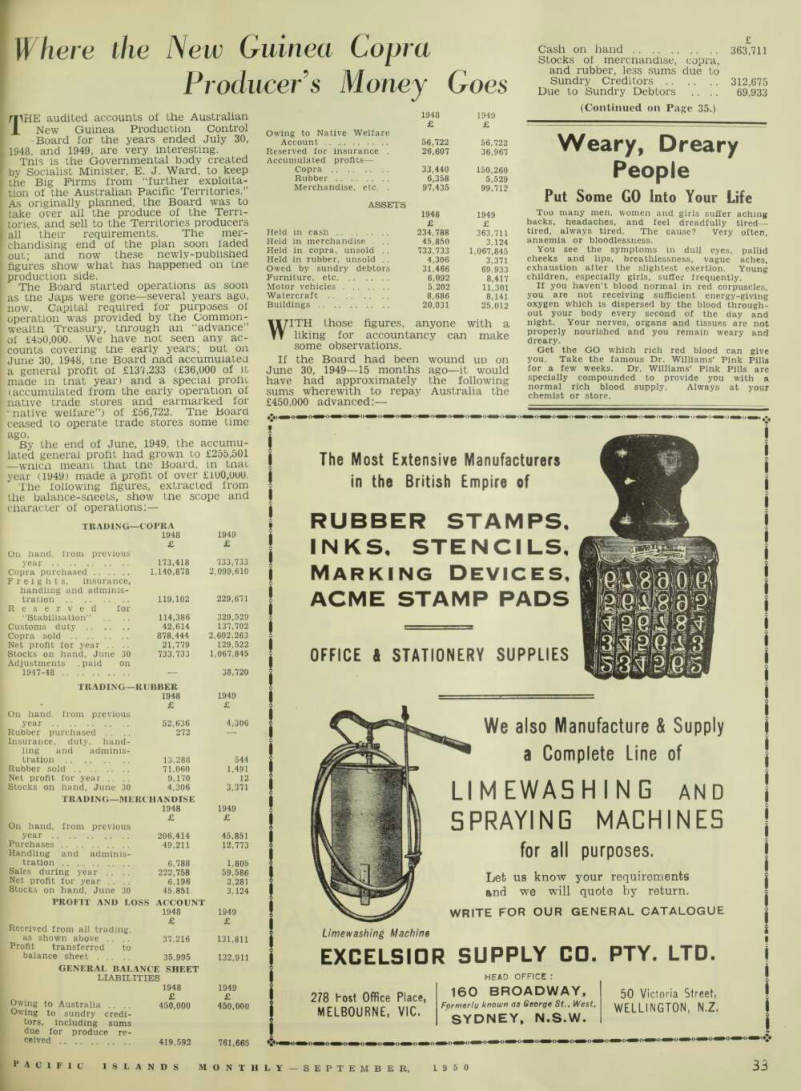
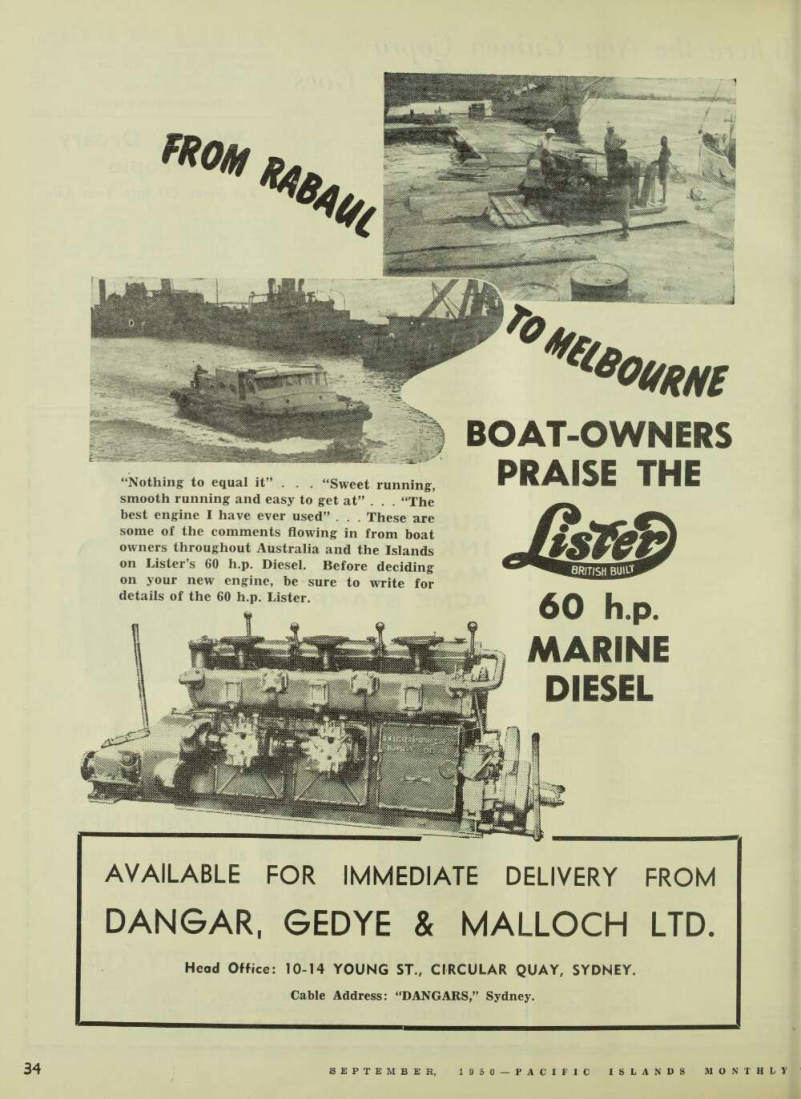
Producer's Money Goes
11HE audited accounts of the Australian New Guinea Production Control Board for the years ended July 30, 1948, and 1949, are very interesting.
Tnis is the Governmental body created ' by Socialist Minister, E. J. Ward, to keep the Big Firms from “further exploita tion of the Australian Pacific Territories.”
As originally planned, the Board was to take over all the produce of the Terri tories, and sell to the Territories producers all their requirements. The mer ' chandising end of the plan soon faded out; and now these newly-published figures show what has happened on tne
production side.
The Board started operations as soon as the Japs were gone-several years ago, now. Capital required for purposes of operation was provided by the Common wealtn Treasury, tnrough an “advance” of £4t>o,ooo. We have not seen any ac counts covering the early years; but on June 30, 1948, tne Board nad accumulated a general profit of £137,233 (£36,000 of it made in tnat year) and a special profit (accumulated from the early operation of native trade stores and earmarked for ■ native welfare”) of £56,722. Tne Board ceased to operate trade stores some time ago.
By the end of June, 1949, the accumu lated general profit had grown to £255,501 —wnicn meant that tne Board, in tnac year (1949) made a profit of over £lOO,OOO.
The following figures, extracted from the balance-sneets, show tne scope and character of operations:—
WITH those figures, anyone with a liking for accountancy can make some observations.
If the Board had been wound un on June 30, 1949 —15 months ago—it would have had approximately the following sums wherewith to repay Australia the £450,000 advanced:—
(Continued on Page 35.)
1948 1949 £ £ Owing to Native Welfare Account 56,722 56,722 Reserved for insurance . 26,607 36,967 Accumulated profits— Copra 33,440 150,260 Rubber 6,358 5,529 Merchandise, etc. . 97,435 99,712
Assets
1948 1949 £ £ Held in cash 234,788 363,711 Held in merchandise . . . 45,850 3,124 Held in copra, unsold . . 733,733 1.067,845 Held in rubber, unsold . . 4,306 3,371 Owed by sundry debtors 31.466 69.933 Furniture, etc 6,092 8,417 Motor vehicles 5,202 11,301 Watercraft 8,686 8,141 Buildings 20,031 25.012
Cash on hand £ 363,711 Stocks of mercnandise, copra, and rubber, less sums due to Sundry Creditors .. .. 312,675 Due to Sundry Debtors 69,933
Trading—Copra
1948 1949 £ £ On hand, from previous year 173,418 733,733 Copra purchased 1,140,878 2,099,610 Freights, insurance, handling and administration 119,102 229,671 Reserved for "Stabilisation” 114,386 329,529 Customs duty 42,614 137,702 Copra sold 878,444 2,602,263 Net profit for year .. .. 21,779 129,522 Stocks on hand, June 30 733,733 1,067,845 Adjustments paid on 1947-48 — 38,720
Trading—Rubber
1948 1949 - £ £ On hand, from previous year 52,636 4,306 Rubber purchased .. .. 272 — Insurance, duty, handling and administration 13,288 544 Rubber sold 71.060 1,491 Net profit for year .. .. 9,170 12 Stocks on hand, June 30 4,306 3,371
Trading—Merchandise
1948 1949 £ £ On hand, from previous year 206,414 45,851 Purchases 49.211 12,773 Handling and administration 6.788 1,805 Sales during year .. 222,758 59,586 Net profit for year .. 6,196 2,281 Stocks on hand, June 30 45.851 3,124
Profit And Loss
Account
1948 1949 Received from all trading, £ £ as shown above .. 37,216 131,811 Profit transferred to balance sheet 35,995 132,911
General Balance Sheet
Liabilities
1948 1949 £ £
Owing to Australia .. ..
450,000 450,000 Owing to sundry creditors, including sums due for produce received .. 419.592 761,665
V Furniture, motor vehicles, buildings, which might produce 40,000 f That totals in the neighbourhood of £780,000; to which can be added an in surance reserve of £37,000; less the £56,000 ■reserved for native welfare. Money always disappears in a realisation; but it does look as if the Board, on a wind-up 15 I months ago, would have had a surplus of between £400,000 and £500,000. It will be much more now—maybe £700,000 or
£Boo,Ooo.
It will be noted that most of the cost of running the organisation has been loaded onto the copra trading account, and that such cost represents about 10 per cent, of the gross sales.
Taking the two years, 1948 and 1949, as an example, it would appear that the New Guinea copra producer has been “socked” by Board and other Government instru mentalities like this:— Cost of administration .. 10 per cent.
Cost of duty collected .. 5 per cent.
Deduction for “stabilisa tion” 13.8 per cent.
Quite a healthy deduction from the sales of his hard-won product. Compari sons are odious —but probably the copra planter would rather have the private enterprise system—even if it should mean that there would be no profits wherewith to endow the Australian Government, and Native Welfare.
Dr. H. G. Knowles and his wife, Dr.
E. E. Knowles, have arrived in Fiji to take up their appointments as Medical Officers with the Medical Department.
The Australian Minister for the Navy announced in early August that HMAS Culgoa, a Navy frigate, would show the flag in New Guinea waters shortly.
Advertisements & other items, pp. 35-36 (1 item)
Weary, Dreary
People
Put Some GO Into Your Life
Too many men, women and girls suffer aching backs, headaches, and feel dreadfully tiredtired, always tired. The cause? Very often, anaemia or bloodlessness.
You see the symptoms in dull eyes, pallid cheeks and lips, breathlessness, vague aches, exhaustion after the slightest exertion. Young children, especially girls, suffer frequently.
If you haven’t blood normal in red corpuscles, you are not receiving sufficient energy-giving oxygen which is dispersed by the blood throughout your body every second of the day and night. Your nerves, organs and tissues are not properly nourished and you remain weary and dreary.
Get the GO which rich red blood can give you. Take the famous Dr. Williams’ Pink Pills for a few weeks. Dr. Williams’ Pink Pills are specially compounded to provide you with a normal rich blood supply. Always at your chemist or store.
The Most Extensive Manufacturers in the British Empire of
RUBBER STAMPS,
INKS, STENCILS,
Marking Devices,
ACME STAMP PADS
OFFICE & STATIONERY SUPPLIES
DE m I We also Manufacture & Supply a Complete Line of
LIMEWASHING AND
SPRAYING MACHINES
for all purposes.
Let us know your requirements and we will quote by return.
WRITE FOR OUR GENERAL CATALOGUE
Li mew ashing Machine
EXCELSIOR SUPPLY CO. PTY. LTD.
278 Lost Office Place,
MELBOURNE, VIC.
HEAD OFFICE :
160 BROADWAY,
Formerly known as George St.. West,
SYDNEY. N.S.W.
50 Victoria Street,
WELLINGTON, N.Z.
% Is**.
I “Nothing to equal it” . . . “Sweet running, smooth running and easy to get at” . . . “The best engine I have ever used” . . . These are some of the comments flowing in from boat owners throughout Australia and the Islands on Lister’s 60 h.p. Diesel. Before deciding on your new engine, be sure to write for details of the 60 h.p. Lister.
BOAT-OWNERS
PRAISE THE
PS m 60 h.p.
MARINE
DIESEL
AVAILABLE FOR IMMEDIATE DELIVERY FROM
DANGAR, GEDYE & MALLOCH LTD.
Head Office: 10-14 YOUNG ST., CIRCULAR QUAY, SYDNEY.
Cable Address; “DANGARS,” Sydney.
Millions For Fapua-New
Guinea
Too Good to be True!
THE Sunday Sun of August 27 was responsible for the statement that the Australian Government plans to spend £100,000,000 on a defence and devel opment plan for Papua and New Guinea within the next ten years.
The plan provides for the establish ment, within eight years, of tea planta tions calculated to fill all Australia’s needs. Copra and rubber production is to be increased; planters are to be encour aged to produce cocoa, spices, coffee, jute, hemp, vanilla and “beans”; large tracts of land suitable for cattle and pig-raising are to be exploited; and hydro-electric power is to be provided on a big scale for such industries as sawmilling and can ning.
Private enterprise is to be encouraged, by finance provided through the Common wealth Bank, to enter into these plans.
Editorial Note:
It reads like the pipe-dreams usually indulged in by politicians after a trip to the Territories; but the report says it is the result of deliberations by an inter departmental committee that had been sitting in Canberra during the week. There is no reason v/hy it should all be written off as chimerical—it is quite practicable.
But we shall believe it when we see it.
With a threat of world war, and re newed talk of stockpiling, British and American mining concerns seem to be
showing increased interest in New Cale donian chrome deposits. In 1949 the chrome ore production increased from 75,000 to 89,000 tons.
Rabaul, NG, Works and Housing De partment personnel and friends organised a “send off” to their QIC, Mr. G. Mac- Lennan and Mrs. MacLennan at the New Britain Club, on July 22. Mr. MacLennan is now on six months furlough.
Advertisements & other items, p. 37 (1 item)
Francis Hoover
4 Castlereagh Street, Sydney Cables: Petwer, G.P.O. Box 4623.
EXPORTERS
All classes of merchandise supplied. Careful attention given to big and small orders.
A. H. BUNTING LTD.
SAMARAI, PAPUA
Select your own musical
programme an
AUTO-TABLE CONVERTOGRAM
Just plug in and your radio
becomes a radiogram
"NATIONAL BAND" Auto-Table Convertograms are fitted with latest pattern Garrard Automatic Record Changer, which automatically plays eight mixed 10-inch or 12-inch records of any make and in any combination. High fidelity magnetic pick-up, with rotating head.
Needle cups for new and used needles. Cabinets are of delicately grained and matched walnut, beautifully polished in medium or light colour to choice, measuring in. high, 1 6i in. deep, in. wide. The motor board slides forward to receive records immediately the door handle is pulled ... a slight push and the unit returns to its place inside the cabinet.
Model 80 for A.C. Mains 100/250 Volts, 50 Cycles.
Manufactured by National Band Gramophone Co., London.
A. H. BUNTING LTD., SAMARAI, PAPUA.
Also procurable from Bunting's, Lae.
F. 0.8., Samarai, £35.
No Parcels To Netherlands
New Guinea
THE Australian Postmaster-General an nounced in late August, that parcel post between Australia and Nether lands New Guinea had been suspended owing to difficulty of maintaining com munication.
Air and surface mail letters were still going through however.
The Rev. W. J. Hudson, formerly of Hertfordshire, England, will be enthroned shortly at All Souls’ Cathedral, Thurs day Island, as Bishop of Carpentaria. His former parish had an area of two square miles; his new diocese will have an area of 620,000 square miles.
Pilot Jeff Withers, a new resident of Lae, New Guinea, was married in Ade laide in August before he left for the Territory.
Primitive Natives
And The
Calendar Problem
THE different ways in which primitives peoples have tried to put a fixedfc measure upon the solar year is toldfc m an interesting article, “Primitives Calendars,” by E. R. Leach, in the Junes issue of “Oceania,” the quarterly produced! by Professor A. P. Elkin for the Australian!
National Research Council.
Most communities have tried to mark} the passage of time according to thes periodicity of the moon; but, unfortu nately, the solar year consists of 365.241 days, while 12 lunar months account fori only 354.37 days. The problem of how toe fit a regular number of months, compris ing a regular number of days, to a figures like 365.24, has baffled the experts sinces the dawn of civilisation; and even they are trying to abolish the present! clumsy, but generally-used Gregorian r Calendar, in favour of the World Calen dar, which offers the best solution of th©s puzzle yet devised. So far, however, thes United Nations have refused to face upc to the pleas and arguments of the World I Calendar advocates.
According to Dr. Leach, some of oun Pacific Islands peoples made a remark ably good attempt to provide themselves c with a workable calendar. Mr. Leoc Austen, a former District Officer ini Papua, writes an illuminating note om how the natives of the Trobriands dealt d with the problem, as it affected theiri seasonal plantings.
It is reported that the price of brides c in Papua has risen from about £lO pre war to anything up to £2OO to-day Ase few natives earn more than £2 per week most of them seem fated to remain i bachelors.
Advertisements & other items, p. 38 (2 items)
Metal Merchants * Metal Refiners
SCRAP IRON SCRAP STEEL SCRAP METALS
P| G IRON PIG LEAD INGOT METALS
Head Office: WILFORD STREET, NEWTOWN, N.S.W.
Phone: LA 5111 (6 lines).
Cable and Telegraphic Address: “SCRAPMETAL,” Sydney.
Works: 2 CANAL ROAD, MASCOT, N.S.W.
Buyers of Non-Ferrous Scrap, Cable, Shells, Cartridges, Copper, Lead, Muntz Metal, Aluminium LARGEST BUYERS OF SCRAP IRON & METALS IN AUSTRALIA
The New Mfshne “All World 6” Receiver
is & Of special interest to you in that it has: —
■ 6 volt Accumulator Operation
■ Low Current Consumption
■ Outstanding Performance and
Reliability
A wealth of practical experience in the design of shortwave receivers for tropical markets has been embodied in the Eddystone “All World Six” Receiver. It is designed to provide the remote “out-station” listener with a specialist built receiver capable of first rate performance and , „ . x possessing the important feature of low battery consumption. Selectivity, sensitivity, quality of reproduction and performance on all wave bands including the highest frequencies, will satisfy the most critical. Workmanship and quality of materials used are of the finest to ensure the highest possible degree of reliability.
The wave range of the “All World Six” Receiver is continuous from 30.6 Mc/s to 484 Kc/s (9.8 to 620 metres). The current consumption is only 2.5 amperes from a 6 volt accumulator and no H.T. battery is required. This receiver is eminently suitable for those who, lacking electric supply mains, want performance equivalent to a mains-operated receiver, allied to the utmost economy in current consumption.
Manufactured by Stratton and Co. Ltd., Birmingham, England.
Available for export from Australia ex Bond Store from the factory representatives :
R. H. CUNNINGHAM PTY. LTD.
62 STANHOPE STREET, MALVERN, VICTORIA
Cables: “CUNNIG,” MELBOURNE.
Specialists in all Receiver and Communications Equipment. ’Phone: UY6274.
A Welcome Ceremony In Tahiti
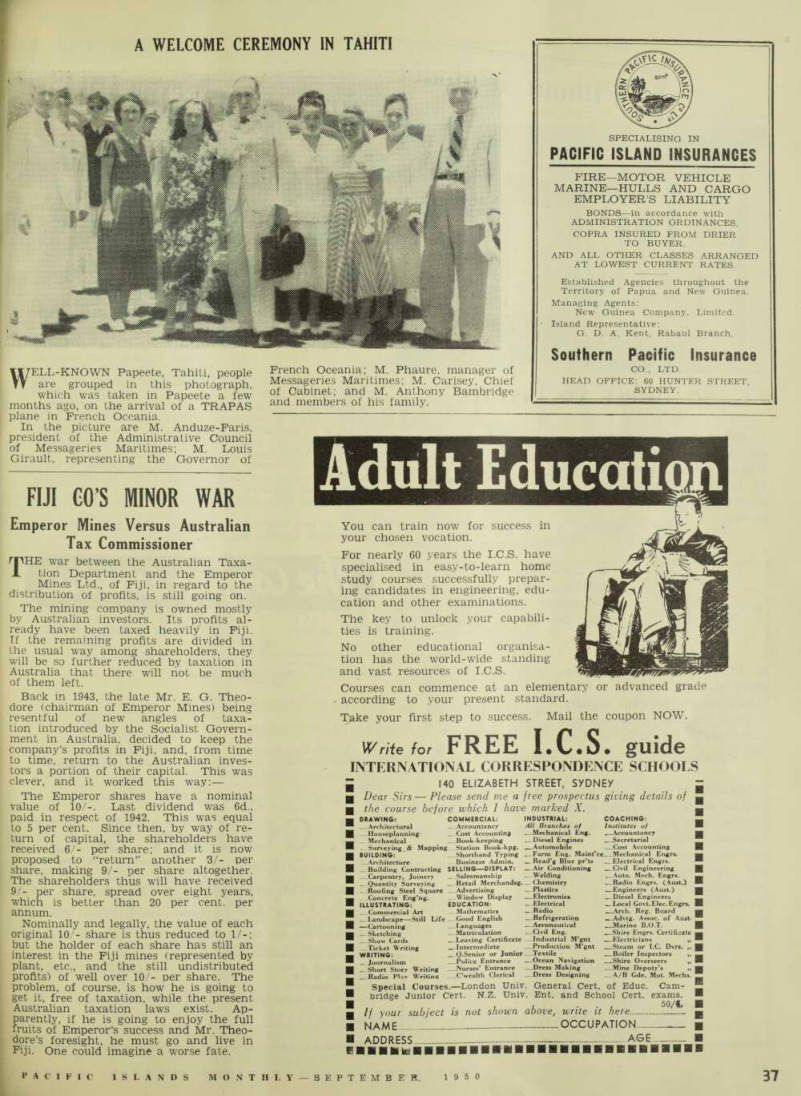
WELL-KNOWN Papeete, Tahiti, people are grouped in this photograph, which was taken in Papeete a few months ago, on the arrival of a TRAPAS plane in French Oceania.
In the picture are M. Anduze-Faris, president of the Administrative Council of Messageries Maritimes; M. Louis Girault, representing the Governor of
French Oceania; M. Phaure, manager of Messageries Maritimes; M. Carisey, Chief of Cabinet; and M. Anthony Bambridge and members of his family.
Fiji Go's Minor War
Emperor Mines Versus Australian Tax Commissioner
rpHE war between the Australian Taxa- X tion Department and the Emperor Mines Ltd., of Fiji, in regard to the distribution of profits, is still going on.
The mining company is owned mostly by Australian investors. Its profits al ready have been taxed heavily in Fiji.
If the remaining profits are divided in the usual way among shareholders, they will be so further reduced by taxation in Australia that there will not be much of them left.
Back in 1943, the late Mr. E. G. Theo dore (chairman of Emperor Mines) being resentful of new angles of taxa tion introduced by the Socialist Govern ment in Australia, decided to keep the company’s profits in Fiji, and, from time to time, return to the Australian inves tors a portion of their capital. This was clever, and it worked this way:— The Emperor shares have a nominal value of 10/-. Last dividend was 6d., paid in respect of 1942. This was equal to 5 per cent. Since then, by way of re turn of capital, the shareholders have received 6/- per share; and it is now proposed to “return” another 3/- per share, making 9/- per share altogether.
The shareholders thus will have received 9/- per share, spread over eight years, which is better than 20 per cent, per annum.
Nominally and legally, the value of each original 10/- share is thus reduced to 1/-; but the holder of each share has still an interest in the Fiji mines (represented by plant, etc., and the still undistributed profits) of well over 10/- per share. The problem, of course, is how he is going to get it, free of taxation, while the present Australian taxation laws exist. Ap parently, if he is going to enjoy the full fruits of Emperor’s success and Mr. Theo dore’s foresight, he must go and live in Fiji. One could imagine a worse fate.
Advertisements & other items, pp. 39-40 (1 item)
Write for FREE I.C.S. guide
SPECIALISING IN
PACIFIC ISLAND INSURANCES
FIRE—MOTOR VEHICLE
MARINE—HULLS AND CARGO
EMPLOYER’S LIABILITY
BONDS—in accordance with
ADMINISTRATION ORDINANCES.
COPRA INSURED FROM DRIER
TO BUYER.
AND ALL OTHER CLASSES ARRANGED
AT LOWEST CURRENT RATES.
Established Agencies throughout the Territory of Papua and New Guinea.
Managing Agents: New Guinea Company, Limited.
Island Representative; G. D. A. Kent, Rabaul Branch.
Southern Pacific Insurance
CO.. LTD.
HEAD OFFICE: 60 HUNTER STREET,
SYDNEY.
You can train now for success in
your chosen vocation.
For nearly 60 years the I.C.S. have
specialised in easy-to-learn home
study courses successfully prepar-
ing candidates in engineering, edu-
cation and other examinations.
The key to unlock your capabili-
ties is training.
No other educational organisa-
tion has the world-wide standing
and vast resources of I.C.S.
Courses can commence at an elementary or advanced grade
■ according to your present standard.
Take your first step to success. Mail the coupon NOW.
Write for FREE I.C.S. guide
INTERNATIONAL CORRESPONDENCE SCHOOLS
140 ELIZABETH STREET, SYDNEY
Dear Sirs — Please send me a free prospectus giving details of the course before which I have marked X.
INDUSTRIAL;
All Branches of ... Mechanical Eng. ... Diesel Engines
DRAWING: COMMERCIAL:
Architectural Accountancy Houseplanning- . Cost Accounting ... Mechanical Book-keeping . Surveying & Mapping Station Book-kpg.
BUILDING: Shorthand Typing Architecture Business Admin.
Building Contracting SELLING—DISPLAY: Carpentry, Joinery .. Salesmanship Quantity Surveying Retail Merchandsg. . Roofing Steel Square Advertising Concrete Eng’ng. Window Display
ILLUSTRATING: EDUCATION:
Commercial Art Mathematics Landscape—Still Life Good English —Cartooning Sketching .. .Show Cards Ticket Writing
WRITING:
... Journalism ... Short Story Writing ... Radio Plav Writing ..Automobile
COACHING:
Institutes of Accountancy ...Secretarial Cost Accounting Farm Eng. Mainl’ce Mechanical Engrs.
Read’g Blue pr’ts ... Electrical Engrs.
Air Conditioning ... Welding Chemistry ... Plastics ..Electronics ...Electrical Radio Refrigeration Languages ...Aeronautical Matriculation Civil Eng. ..Leaving Certificate Industrial M’gnt . Intermediate Production M’gnt „Q.Senior or Junior Textile Police Entrance —Ocean Navigation , Nurses’ Entrance Dress Making . C’wealth Clerical Dress Designing ..Civil Engineering ... Auto. Mech. Engrs. . Radio Engrs. (Aust.) Engineers (Aust.) Diesel Engineers Local Govt. Elec. Engrs.
Arch. Reg. Board Advtg. Assoc, of Aust.
Marine 8.0. T. ...Shire Engrs. Certificate ...Electricians „ Steam or I.C. Dvrs. „ Boiler Inspectors „ Shire Overseers „ Mine Deputy’s „ A/B Gde. Mol. Mechs.
Special Courses.—London Univ. General Cert, of Educ. Cambridge Junior Cert. N.Z. Univ. Ent. and School Cert, exams.
If your subject is not shown above, write it here
NAME OCCUPATION
ADDRESS - AGE
Without a
doubt-
\ f i f j at
f f i
I ci
f I I
f I I i.
SO SIMPLE TO INSTALL
1. Screw on frames—use old window frames and simple uprights—and use U in. x 8 round head screws. Never over-tighten screws. 2. Close the clips to glass thickness with a pair of pliers.
Remember, never force £ in. glass into 3/16 in. frames. 3. Insert glass. If loose, remove it, and, with a pair of pliers, crimp the clips slightly.
Replace the Louvre. Repeat this procedure until glass is held firmly.
OPEN END INSIDE
5. In order to assure complete weather protection, nail or screw on a facia strip at the top and a weather stop on the sill of each rack of Cooper Louvres. Cooper Louvres stay as
the m
ECU** 1 '
WWKWS FOR W
PMW BtM
The Cooper Louvre is the ideal window for tropical areas because it gives unobstructed view and the maximum of light and air . . . it actually controls ventilation. It is seldom too wet to keep your Cooper Louvre window partly open—you simply adjust it to keep out the rain and let the fresh air in.
Installations are easy, too! No need for a tradesman; any handyman can install them Breakages are easily replaced and remember it costs less to replace an odd Louvre than an expensive normal size window pane.
Cleaning is easy and can be done from inside the house.
Send in the enquiry form below for full details of the Cooper Louvre Window.
JMUhH
OPEN CLIP
GLASS
Ciir 4. When the Louvre is held firmly, simply close the clip at each end and the job is done. Replacements are simple, speedy, and cost only a few pence per blade.
PACIFIC ISLANDS REPRESENTATIVE:
you set them— wind will not blow them shut.
WEATHER
STOP
FACIA STRiP
HORIZONTAL SECTION
SILL
£. J. GOUGH & CO.
Exporters Importers Manufacturers’ Representatives^ SUPPLIERS OP GENERAL MERCHANDISE TO LEADING FIRMS
THROUGHOUT THE PACIFIC ISLANDS.
1 BOND STREET, SYDNEY, AUSTRALIA. Box 3615, G.P.O.
Tel.: 8U2159 Hankers: Bank of N.S.W. Bank of Adelaide. Comptoir National d’Escompte del Paris. Cable Address: “SEAFOODS,” Sydney.
Codes: Bentley’s, 2nd and Comp. Phrase: A.8.C.. sth and 6th; Peterson, 2ncbi and 3rd, Banking; Acme.
LOUVRE
E. J. Gough & Co., Box 3615, G.P.O.
Sydney, Australia.
Please send me full details
ENQUIRY FORM.
of the Cooper Louvre Window.
NAME:...
ADDRESS;
Ambonese Seek
Help
From Australia
IN August, by a series of smart political manoeuvres, the anti-European Jav anese who, with Japanese support, formed the “Republic of Indonesia” in 1945, succeeded in having their “Republic” substituted for the Federal body (the Republic of the United States of Indo nesia) which was accepted as the basis of the agreement between the Nether lands and the Indonesians at the con ference at The Hague in November, 1949.
There were 16 States in the original.
Federation plan. There are only 10 in the Javanese plan; and the peoples of the eastern parts of the archipelagoes, who were promised at least nominal in dependence under the Federation, are now brought almost completely under the cor rupt and aggressive Javanese Republic.
Although there is much discontent, only one of the eastern States has revolted— the Moluccas. There has been some savage fighting there between the Jav anese and the Ambonese, who have been helped by Dutch elements.
In August, the following appeal was received by the editors of a number of Australian newspapers: We should like to tell the people of Australia of the plight of our countrymen on the islands of Ambon in the Moluccas, lying north of Australia".
The Ambonese are a proud, courageous race, because they are standing up for their rights for self-determination (which was granted to them at the round-table conference between the Netherlands and the Republic of Indonesia).
They are out of all food, and, for many weeks, they have been denied by the In
donesian Government (which blockaded the islands) medical supplies and com munication with the outside world.
Your Australian representative at UNO has always upheld the rights of minorities to self-determination. We have appealed to UNO and to the Netherlands Govern ment to intervene in this situation which has arisen, but, so far, no help has come.
Because Australia is our nearest and most important neighbour, we hope that the Australian representative at UNO will raise our case with that organisation as soon as possible before our free country is annexed by force.
Both Mr. Spender and Dr. Evatt pro tested against Dr. Soekarno’s claims on New Guinea.
The belt of defence for Australia does not only include New Guinea, but the islands of the South Moluccas as well.
These islands were used by the Japanese in World War II as bases of operations against Australia. There, on these islands of the South Moluccas, begins Australia’s defence.—E. A. KAIJADOE, J. PATTY (Org. of South Moluccans in the Nether lands) .
Ship
New Islands
For Burns Philp
AN order for a new motor-vessel, of a gross tonnage of 3,200 tons, for the Pacific Islands trade, has been placed with Glasgow builders by Messrs. Burns Philp and Co., Ltd. It is hoped that the vessel will be completed about the end of 1951.
The ship will have cargo capacity for 150,000 cubic feet of bale space, and 10,500 feet of refrigerator space. She will be specially built for Islands conditions and will have accommodation for 12 passen gers—two single-berth and five double berth cabins.
She will have diesel engines, single screw, and a calculated speed of 12 knots.
At present, the company’s regular ser vices between Australia and the Islands are carried on by the modern vessels, Bu lolo and Malaita, and the old Morinda.
Advertisements & other items, p. 41 (1 item)
Marine Engines
GIOBITE
TRAVEL CASES
They're lighter, stronger, longerlasting. That's why a Globite costs less in the long run.
Made by
FORD SHERINGTON LTD.
MARINE ENGINES
HALVORSEN’S HAVE FOR IMMEDIATE
MORRIS “VEDETTE” 4 Cylinder 6/12 H.P. Petrol or Kerosene MORRIS “NAVIGATOR” 4 Cylinder 12/24 H.P. Petrol or Kerosene MORRIS “COMMODORE” 6 Cylinder 20/40 H.P. Petrol or Kerosene CHRYSLER “CROWN” 6 Cylinder 45/102 H.P. Petrol CHRYSLER “ROYAL” 8 Cylinder 55/132 H.P. Petrol “LEYLAND” DIESEL MARINE 6 Cylinder 85 H.P.
Further particulars from the distributors:
LARS HALVORSEN SONS PTY. LTD.
WATERVIEW ST., RYDE ( Sydney }* N.S.W.
Telegrams: Halvorsens. Sydney. 'Phone: Byde 705
• LARGE RANGE OF BOAT FITTINGS
• FREE EXPERT PROPELLER ADVICE
BUILDERS OF HALVORSEN BOATS
BEM Awarded to Fijian
Woman
11HE King has awarded the British Empire Medal to Maria Wati, a Fijian woman, for bravery displayed when a motor launch was wrecked off the Tavua coast on February 26. 1950.
On February 25, a fishing party com prising Mr. Edward Steele, Mr. Victor Irwin, Mr. Michael Storck and Maria
Wati set out in a small motor launch from Tavua. They anchored the launch off Salisali reef, four miles from the main = land, and fished until 2 o’clock the next morning.
A strong wind came up, the engine would not start and at 4 o’clock in the morning the launch was driven by the wind on to the reef and foundered in about 3 ft. of water. Big waves carried away the superstructure and Mr. Storck was taken off with it.
Mr. Irwin, Mr. Steele and Maria Wati remained with the wreckage of the launch
until daybreak. Neither Irwin nor Steele could swim.
When daylight came the three peoole saw a beacon about two miles away along the reef and Maria persuaded the two men to walk along the reef towards the beacon. When the party reached it they set out for Manava Islet, a further two miles away. Steele developed cramp but Maria did her best to keep up the spirits of the two men and continued to help them as the going became more difficult.
When they were about 50 yards from Manava Mr. Steele’s cramps became so paralysing that he could not move. Maria then saw Mr. Storck on the islet. He had been washed out to sea but on the change of the tide he was carried through the Tavua Bay passage towards Manava.
He had abandoned the cabin top and had swum to the islet after having spent five hours in the sea.
Maria shouted to him and he came along the reef and helped to carry Mr, Steele, who was completely exhausted, to safety on Manava. Maria offered to swim over to Vatia, about five miles away, to get help. She was persuaded not to take the risk of being attacked by sharks.
The four people dug a foxhole in order to shelter from the stinging sand and rain and the biting wind. Forty-eight hours after they had set out a rescue party arrived in the Emperor Gold Min ing Company’s launch and took the three men and Maria to the mainland.
If Maria Wati had not been in the party neither Steele nor Irwin would have moved from the launch and it is cer tain they both would have drowned. Her determination and cheerfulness played an outstanding part in helping the two men to make their way along the four miles of submerged reef to Manava Islet from which they were eventually rescued.
Advertisements & other items, p. 42 (1 item)
pvT'S
300 WATT ELECTRIC GENERATING SET
10 HRS. POWER ON ONE GALLON PETROL 11/ 4 H.P. 4-stroke air-cooled
J.A.P. English
Engine coupled
to D/C generator 12-32 volt 9-12 amps
Complete with
Ball bearing generator delivers 300 watts switchboard. at voltage which can be varied by a W e ; a U4. gnlu, knob on the switch box from 12 to 32 4 volts. It is a sturdy battery-charging £53 set and is ideal for lighting say 7 x 40 watt globes or 10 x 25 watt globes using With Battery either 12, 24 or 32 volt baitery. Start.
Trade enquiries also invited.
HARDMAN & HALL
44 MISSENDEN ROAD, NEWTOWN, SYDNEY,
N.S.W., AUSTRALIA.
m
i Wf»v uitieco
pvT'S
9.* \9®
WHOLESALE MERCHANTS
GENERAL AGENTS
FORWARDING , SHIPPING fi CUSTOMS AGENTS
Tonga
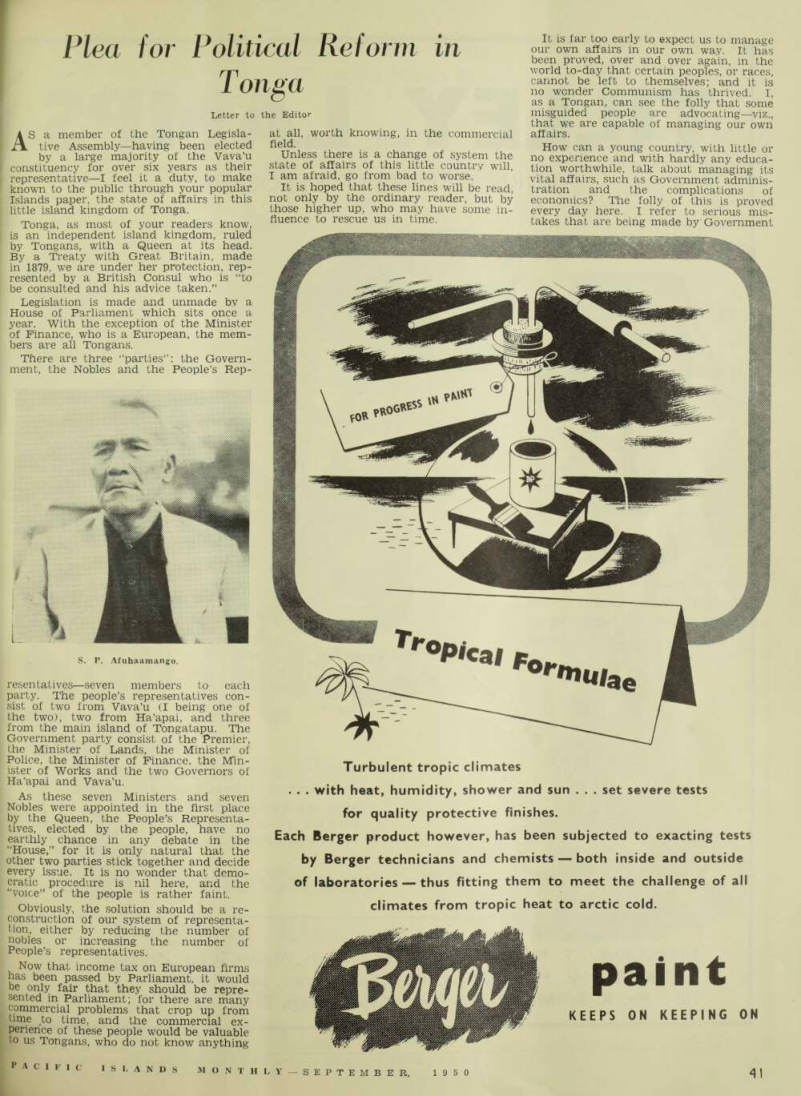


Plea for Political Reform in Tonga
Letter to the Editor
AS a member of the Tongan Legisla tive Assembly—having been elected by a large majority of the Vava’u constituency for over six years as their representative—l feel it a duty, to make known to the public through your popular Islands paper, the state of affairs in this little island kingdom of Tonga.
Tonga, as most of your readers know, is an independent island kingdom, ruled by Tongans, with a Queen at its head.
By a Treaty with Great Britain, made in 1879, we are under her protection, rep resented by a British Consul who is “to be consulted and his advice taken.”
Legislation is made and unmade by a House of Parliament which sits once a year. With the exception of the Minister of Finance, who is a European, the mem bers are all Tongans.
There are three “parties”; the Govern ment, the Nobles and the People’s Rep-
resentatives—seven members to each party. The people’s representatives con sist of two from Vava’u (I being one of the two), two from Ha’apai, and three from the main island of Tongatapu. The Government party consist of the Premier, the Minister of Lands, the Minister of Police, the Minister of Finance, the Min ister of Works and the two Governors of Ha’apai and Vava’u.
As these seven Ministers and seven Nobles were appointed in the first place by the Queen, the People’s Representa tives, elected by the people, have no earthly chance in any debate in the “House,” for it is only natural that the other two parties stick together and decide every issue. It is no wonder that demo cratic procedure is nil here, and the “voice” of the people is rather faint.
Obviously, the solution should be a re construction of our system of representa tion, either by reducing the number of nobles or increasing the number of People’s representatives.
Now that income tax on European firms has been passed by Parliament, it would be only fair that they should be repre sented in Parliament; for there are many commercial problems that crop up from time to time, and the commercial ex perience of these people would be valuable to us Tongans, who do not know anything
at all, worth knowing, in the commercial field.
Unless there is a change of system the state of affairs of this little country will, I am afraid, go from bad to worse.
It is hoped that these lines will be read, not only by the ordinary reader, but by those higher up, who may have some in fluence to rescue us in time.
It is far too early to expect us to manage our own affairs in our own way. It has been proved, over and over again, in the world to-day that certain peoples, or races, cannot be left to themselves; and it is no wonder Communism has thrived. I, as a Tongan, can see the folly that some misguided people are advocating—viz., that we are capable of managing our own affairs.
How can a young country, with little or no experience and with hardly any educa tion worthwhile, talk about managing its vital affairs, such as Government adminis tration and the complications of economics? The folly of this is proved every day here. I refer to serious mis takes that are being made by Government
S. P. Afuhaamango.
officials, the unlawful use of Government monies in trading deals, and the un- I authorised drawings of materials by certain Ministers from the Public Works Department (to which I have referred in the House). Favouritism and unfair trials, flimsy charges, too many appoint ments of family and friends, unfair dis missals. and incompetency and chaos are widespread.
I am, sir,
S. P. Afuha'amango,
Member Legislative Assembly.
Nukualofa, Tonga, 12/8/50.
The New Caledonian maize crop in 1950 is estimated at 2,000 tons, The General Council has fixed a guaranteed price of 5,000 francs a ton for highest quality, but local traders complain that they get too much low quality grain. To encourage export, the Administration is waiving the export tax of six per cent, for France and 11 per cent, for foreign countries.
The Catalina stuck fast between two coral heads.
Advertisements & other items, pp. 43-44 (2 items)
paint
PN\H'
6^ SS p*o \ *
°P'eai
for
Turbulent tropic climates . . . with heat, humidity, shower and sun ... set severe tests for quality protective finishes.
Each Berger product however, has been subjected to exacting tests by Berger technicians and chemists both inside and outside of laboratories thus fitting them to meet the challenge of all climates from tropic heat to arctic cold. p
paint
KEEPS ON KEEPING ON
TILLEY LAMPS
BURN ORDINARY KEROSENE
3 \' v / v v 0-
“THE QUEEN ” MODEL TLIO6
HEIGHT Hi". 300 CANDLE POWER
ALSO AVAILABLE “THE PRINCESS’’
HEIGHT 16$*. 300 CANDLE POWER
V & \ v 1 *
“THE VICTOR” MODEL KLBO
300 CANDLE POWER
BURNS 12 HOURS ON
1$ PINTS OF KEROSENE
REPRESENTATION :
MELBOURNE: T. H. Bentley, Pty. Ltd., 123-125 William Street, Melbourne, Cl.
TASMANIA : Mr. H. V. Sellers, 108 a Charles Street, Launceston.
FIJI : Mr. K. Witherington, 2 Burns Philp Buildings, Suva.
42
SEPTEMBER, 1950 PACIFIC ISLANDS M O N T H I V
RNZAF Catalina Mishap
BSIP and Fiji Officials Have Lucky Escape
VILA, August 15.
WITH ten passengers, including the Resident Commissioner of the British Solomon Islands (Mr. H. G. Gregory Smith), the Public Relations Officer. Fiu (Mr. L. G. Usher) and Mr. R. A. Derrick, technical education chief in Fi.ii who is making a survey of Islands educational needs for the South Pacific Commission, an RNZAF Catalina flying-boat was badly smashed when it struck a reef
at Vila, New Hebrides, on August 9. No one was in jured, although two large holes were torn in the air frame. The reef joins the small islet of Iririki, and juts out about 500 yards in a semi circle across Mele Bay.
The Catalina was tem porarily repaired and pumped out by the crew, with tech nical help flown from the RNZAF station on Laucala Bay, Suva, and on August 12 it was floated off the reef and beached. Technicians who have gone to Vila hope
the flying-boat can be patched up to per mit a safe flight back to Laucala Bay.
The flying-boat was on the way from Suva to Honiara, via Vila. The passen gers were taken from Vila to Honiara by a relief aircraft sent from Suva.
The incident has revived an old con troversy between the Government and local residents: should there, or should there not be a marker of some descrip tion on this reef? The Government says
it is not necessary; residents say that it is.
The photograph shows the Catalina held fast between two niggerheads, with her nose well under at high tide.
The seventy-fifth anniversary of the landing of the Rev. George Brown in New Britain fell on August 15, 1950. This pioneer missionary, explorer and natural ist, had been a Methodist missionary in Samoa for years before serving in New Britain. There are now 15,000 recog nised Methodist church members in New Britain and 150 young men are train ing as missionaries in the George Brown Teachers’ College.
Advertisements & other items, p. 45 (1 item)
Here’s Hope
For A
Persistent Worry
CONSTIPATION, forerunner of many troubles, affects people of all ages and walks of life and causes much annoyance and worry.
When the bowels refuse to work naturally and regularly, the body absorbs poisons from the waste that remains in the system. Constipation brings sick headaches, biliousness, coated tongue and unpleasant breath, flatulence, loss of appetite, blemishes and other troubles which quickly upset your health and well-being.
These troubles are easily corrected by safe, gentle Pinkettes for you and all the family.
Pinkettes are simple to take: and do not have harsh after-effects which can be dangerous.
Being compounded of harmless vegetable ingredients only, Pinkettes act in Nature’s way.
Thousands and thousands of people have found Pinkettes the ideal laxative, because they are not habit-forming and the dose is reduced as they make you regular. Always at chemists and stores.
Call for a
The Favourite Beer, Matured but freshly bottled Brewed Cr Bottled by
i>an jHiftuel 25tcmciB
Obtainable from:
ALOIS AKUN & COMPANY
RABAUL
MB tr*
Another Million For Papuan
Oil Bores
TO provide funds wherewith to continue drilling for oil in Papua, the Aus tralian Petroleum Co. Pty., Ltd., in August, made a further issue of 1,000,000 £1 shares. The two big partners in APC, Vacuum Oil Co., and Anglo-Iranian Oil Co., each accepted its proportion (407,000 shares) in this new issue; but Oil Search Ltd. was unable to take up its proportion of 186,000 shares. Consequently, the 186,000 were allotted to the two major companies. The issued capital of APC now stands at £7,500,000.
As reported in last issue, the shares of
Oil Search Ltd. enjoyed a sharp appre ciation on Australian stock exchanges in August. Now, they probably will slump again.
The Upoia and Nana bores, in Papua, are being proceeded with steadily. At Hohoro, the bore has been abandoned at 4,724 feet, and another hole is being put down, under better sub-surface conditions, three-quarters of a mile further north.
The Audio-Visual Aids Division of the Trans-Pacific Film Service will make films in Australia on a new sign language devised by Mr. Charles Bliss. The film company will then suggest to Mr. Spen der that the films be used to educate New Guinea natives.
N. Caledonia’s Increased
Trade With USA
OWING to wartime isolation from i France, followed by Lend-Lease and! subsequently by Marshall Aid, New\ Caledonia trade continues to show ai decided North American swing. (Caledonian imports from the United!
States in 1949 were valued at 223,000,000 C francs, and exports to the US were valued! at 105,000,000 francs.
From Australia, formerly the leader ini foreign imports, the French Colony took 3 goods amounting to 133,000,000 francs,,; but Australia bought only 14,000,000 C francs worth of Caledonian produce ini return. Trade with Prance almostd balanced with imports amounting toe 272,000,000 francs and exports to 276,000,000 C francs; but the island could export only\ 11,000,000 francs worth to French from which she took goods worth! 58,000,000. With other countries trades was small—exports to 19,000,000, and im ports 26,000,000 francs—HELP
Pacific Voyager
Danish journalist Hakon Mielche, who was in the Pacific 15 years ago in the Mon sunen, is return ing soon with a Danish scientific party, to measure ocean deeps.
This picture shows Mielche in a 57 ft. yawl, in which he sailed from Spain to West Indies in 1948-49.
Advertisements & other items, p. 46 (2 items)
Producing Uniform Good Results Since 1868
ALWAYS ASK FOR IT
Burns Philp (South Sea) Go. Ltd
Registered Office: SUVA, FIJI
Code Address: “BURNSOUTH”
ISLAND TRADERS AND SHIPOWNERS
General Merchants (Wholesale and Retail)
Shipping, Customs and General Agents
Representatives for :
QUEENSLAND INSURANCE CO., LTD. BURNS PHILP TRUST CO., LTD.
Distributing Agents for:
SHELL COMPANY (P. 1.), LTD. FERGUSON TRACTORS STANDARD MOTOR CAR COMPANY CROSSLEY MARINE ENGINES
BRANCHES:
FIJI—
SUVA.
LEVUKA.
LAUTOKA,
LABASA.
BA.
SIGATOKA.
ROTUMA ISLAND.
NORFOLK IS.—
SAMOA—
APIA.
PAGO PAGO.
TONGA—
NUKUALOFA.
HAAPAI.
VAVAU.
NIUE IS.—
Sydney Agents:
BURNS. PHILP & CO., LTD..
7 Bridge Street.
London Agents:
BURNS, PHILP & CO.. LTD.,
35 Crutched Friars, E.C.3.
San Francisco Agents:
BURNS, PHILP CO. OF SAN FRANCISCO
Matson Building, 215 Market Street.
Agencies Throughout the World.
Some Sidelights On Yali
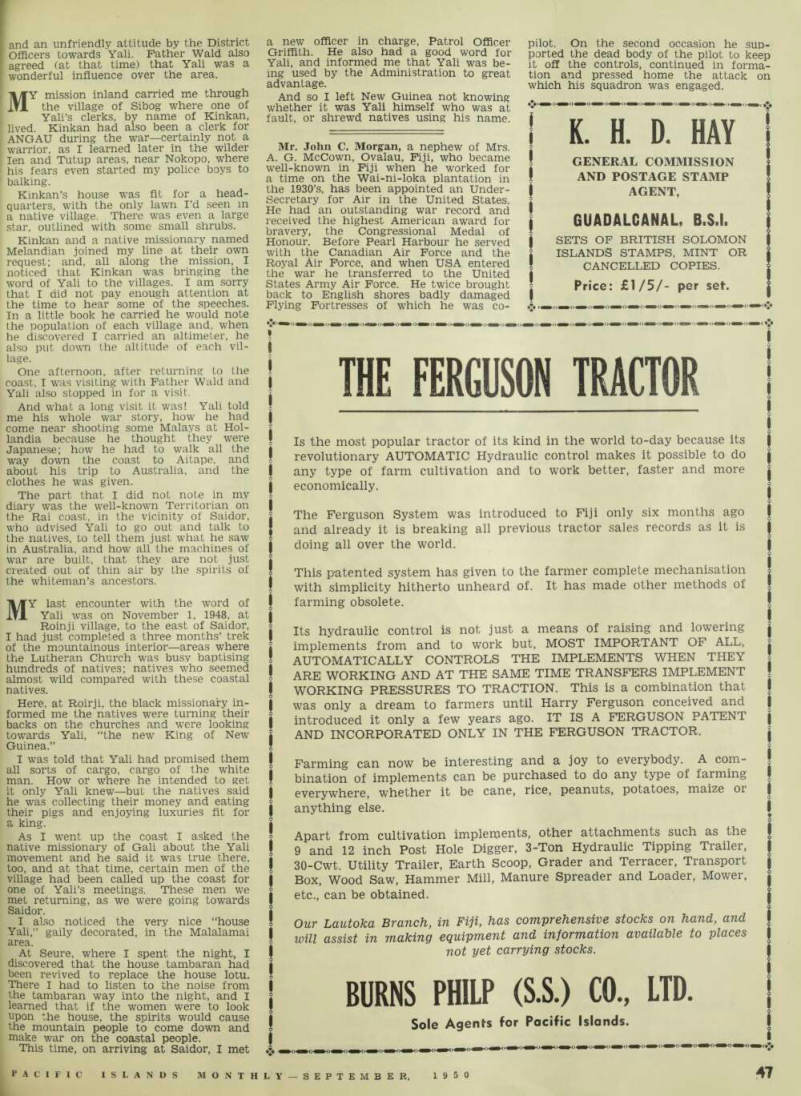
Can He Be Regarded As “Cargo Cult,” or Mischievous Influence?
Written For Pim By Sumit
WHILE I was in New Guinea in 1946- 48, on special work, I met Yali, of your article “Case History of Yali” (PIM, May, 1950) and I believe it would be interesting to know more about him from various possible sources, especially missionary.
My first contact with Yali was with his name only. It was in Mungo village, on the south slope of the Pinesterres, south-east of Bogadjim, May 1, 1946.
That morning the village people began to congregate near the main trail entrance and, when I asked the luluai what it was all about, he replied that some of the men who had been working on the coast were returning to the village and all were lining up to welcome them back.
The men were at the head of the line, in order of importance; then the young men and boys; and, last of all, the women.
There were nearly 150 in all.
The line suddenly stilled and straightened, as the home-comers arrived.
The procession was led by a tall, dig nified native wearing an Aussie hat, with a red band on it. He was followed by three other men. All four of them were wearing packs.
The four proceeded slowly along the line, shaking hands with each member of the line. As the leading man seemed to be a somebody, I asked the luluai who he was and I was told that he was one of Yali’s men and had come to Mungo to bring the word of Yali.
Having never heard of Yali, I inquired further and was told, “Im i big fellow man, im i all same King belong New Guinea.”
Then I asked just what was the word of Yali, and was told that Yali’s word was the same as that of the Government.
The government would tell Yali its wishes and Yali would pass it on to the villages, etc.
The luluai also told me that Yali was from Yamai, near Saidor, so I made a mental note that if I ever came through Saidor way I would like to meet this “King belong New Guinea.”
LATER, at Finschhafen, Patrol Officer White mentioned to me that they had received word of a gold bespangled ex-sergeant-major up on the Rai Coast who was supposed to be the root of a case of Cargo Cult. I told him the above tale, and a check was begun.
On December 22, 1946, I finally reached Saidor, meeting Patrol Officer Prowse and, later, Father John Wald, of nearby Gumbi. Christmas was Wednesday and, so as not to interfere with Father Wald’s Christmas mass, the sing-sing was to be held starting Monday afternoon and to finish Tuesday morning.
I asked various natives about Yali, and if they thought he would be coming to the sing-sing. As they were sure he would be coming, I mentioned that I would like to meet him.
Monday night, while watching one par ticular dance, I sensed a peculiar activity behind me and turned around to see a very large and impressive native stand ing in what looked like an old Salvation
Army coat.
I needed no guessing, I just said, “You, Yali.”
I shook hands with a very cold hand and told him I had heard of him over much of my travelling. He did not have much to say, although he appeared very
friendly.
Going from one dance area to another, I noticed that everywhere that Yali went
all activity other than the dances ceased and men would stop to shake hands with Yali.
We walked into one house where a group of natives were busy over a pile of money and a deck of cards. Every one stood up, stepped across the money and shook hands with Yali.
Later that evening I asked Mr. Prowse:
“Is Yali considered a good influence or a bad influence in this area?”
As Mr. Prowse’s station was in the middle of Yali’s area I felt sure he could straighten the matter in my mind. Mr.
Prowse replied that Yali’s word was not a hindrance in the area, that it was good advice which blended very much with the Kiap’s way of government. This seemed to coincide with what I had heard in Mungo village.
Mr. Prowse believed that along the edge of Yali’s area various natives were changing the word of Yali, or adding his name to plans which were sufficient to start an undertone among the natives,
I and an unfriendly attitude by the District Officers towards Yali. Father Wald also S agreed (at that time) that Yali was a 1 wonderful influence over the area.
MY mission inland carried me through the village of Sibog where one of Yali’s clerks, by name of Kinkan, ' lived. Kinkan had also been a clerk for ANGAU during the war—certainly not a warrior, as I learned later in the wilder Ten and Tutup areas, near Nokopo, where his fears even started my police boys to balking.
Kinkan’s house was fit for a head quarters, with the only lawn I’d seen in a native village. There was even a large star, outlined with some small shrubs.
Kinkan and a native missionary named Melandian joined my line at their own request; and, all along the mission, I noticed that Kinkan was bringing the word of Yali to the villages. I am sorry that I did not pay enough attention at the time to hear some of the speeches.
In a little book he carried he would note the population of each village and, when he discovered I carried an altimeter, he also put down the altitude of each vil lage.
One afternoon, after returning to the coast, I was visiting with Father Wald and Yali also stopped in for a visit.
And what a long visit it was! Yali told me his whole war story, how he had come near shooting some Malays at Hol landia because he thought they were Japanese: how he had to walk all the way down the coast to Aitape, and about his trip to Australia, and the clothes he was given.
The part that I did not note in my diary was the well-known Territorian on the Rai coast, in the vicinity of Saidor, who advised Yali to go out and talk to the natives, to tell them just what he saw in Australia, and how all the machines of war are built, that they are not just created out of thin air by the spirits of the Whiteman’s ancestors.
MY last encounter with the word of Yali was on November 1, 1948, at Roinji village, to the east of Saidor, I had just completed a three months’ trek of the mountainous interior —areas where the Lutheran Church was busy baptising hundreds of natives; natives who seemed almost wild compared with these coastal natives.
Here, at Roirji, the black missionary in formed me the natives were turning their backs on the churches and were looking towards Yali, “the new King of New Guinea.”
I was told that Yali had promised them all sorts of cargo, cargo of the white man. How or where he intended to get it only Yali knew —but the natives said he was collecting their money and eating their pigs and enjoying luxuries fit for a king.
As I went up the coast I asked the native missionary of Gall about the Yali movement and he said it was true there, too, and at that time, certain men of the village had been called up the coast for one of Yali’s meetings. These men we met returning, as we were going towards Saidor.
I also noticed the very nice “house Yali,” gaily decorated, in the Malalamai area.
At Seure, where I spent the night, I discovered that the house tambaran had been revived to replace the house lotu.
There I had to listen to the noise from the tambaran way into the night, and I learned that if the women were to look upon the house, the spirits would cause the mountain people to come down and make war on the coastal people.
This time, on arriving at Saidor, I met
a new officer in charge, Patrol Officer Griffith. He also had a good word for Yali, and informed me that Yali was be ing used by the Administration to great advantage.
And so I left New Guinea not knowing whether it was Yali himself who was at fault, or shrewd natives using his name.
Mr. John C. Morgan, a nephew of Mrs.
A. G. McCown, Ovalau, Fiji, who became well-known in Fiji when he worked for a time on the Wai-ni-loka plantation in the 1930’5, has been appointed an Under secretary for Air in the United States.
He had an outstanding war record and received the highest American award for bravery, the Congressional Medal of Honour. Before Pearl Harbour he served with the Canadian Air Force and the Royal Air Force, and when USA entered the war he transferred to the United States Army Air Force. He twice brought back to English shores badly damaged Flying Fortresses of which he was co
pilot. On the second occasion he sup ported the dead body of the pilot to keep it off the controls, continued in forma tion and pressed home the attack on which his squadron was engaged.
Advertisements & other items, pp. 47-49 (1 item)
€bmmoitwcaltb Bank
s-p,;-* 09
\VV\\V^\
£« find the many Commonwealth Bank services of great assistance if you are engaged in business or trading of any kind. Wide experience of local and overseas trade enables our Island Branches to help you in matters relating to importing and exporting, finance and exchange.
The Commonwealth Bank offers complete Trading Bank facilities. All types of commercial enterprise may be financed. All advances are made at low rates of interest.
With 420 Branches in Australia, Branches in London, and correspondent Banks in all countries, the Commonwealth Bank provides a world-wide service
€bmmoitwcaltb Bank
of Australia.
ISLAND BRANCHES ARE SITUATED AT
RABAUL, PORT MORESBY, LAE AND MADANG. COMPLETE TRADING AND SAVINGS BANK SERVICES ARE AVAILABLE
AT ALL THESE BRANCHES. ENQUIRIES WELCOMED.
THE MOST COMPLETE TRADING BANK SERVICE IN THE ISLANDS
TAKE YOUR CHOICE .
. . . From this list of quality canned foods. Packed by the largest meat-processing company in Australia, the Imperial label brings you the Quality meats, right to your table —tasty hot meals and cold meats ready for any occasion. Stock up with Imperial, the Flavour Sealed Quality Foods. 3 .11
HOT PACKS.
16-oz. Beef Steak Pudding. 16-oz. Steak & Kidney Pudding. 16-oz. Irish Stew. 16-oz. Braised Beef Steak Stew. 1 16-oz. Bacon Rashers. 16-oz. Steak & Tomato. 12-oz. Meat & Beans. 16-oz. Sausages & Vegetables. 12-oz. Savourie. 4-oz. Meat and Spaghetti.
COLD MEATS.
SAUSAGES.
16-oz. Beef Sausages. 16-oz. Oxford Sausages. 16-oz. Cambridge Sausages. 16-oz. Pork Sausages. 16-oz. Vienna Sausages. 10-oz. Vienna Sausages, 4-oz. Vienna Sausages.
SOUPS.
8-oz. Tomato Soup. 8-oz. Vegetable Soup. 8-oz. Clear Beef Soup.
TONGUES.
12-oz. Luncheon Pork. 12-oz. Trim (Pork & Beef). 12-oz. Camp Pie. 12-oz. Hampe. 12-oz. Meatreat 12-oz. Corned Beef W/ c - -12-oz. Taper Corned Beef. 6-lb. Slicing Beef. 6-lb. Taper Corned Beet W/C. 6-lb. Taper Corned Beef. 4-oz. Camp Pie. 4-oz. Hampe. 4-oz. Beef Snack. 31-oz. Pate de Foie. 10-oz. Tomato Sauce.
DRIPPING & LARD.
12-oz. Sheep Tongues. 12-oz. Lamb Tongues. 12-oz. Calves Tongues. 6-lb. Ox Tongues. 2-lb. Ox Tongues,
MARGARINE.
56-lb. Boxes Cake Margarine. 56-lb. Boxes Pastry Margarine.
RIVERMEDE” BUTTER.
56-lb. Boxes Bulk Butter. 16-oz. Pats Butter, i-lb. Pats Butter. 12-oz. Tins Butter. 16-oz. Tins Butter. 8-oz. Flair cheon. m i l-lb. tins Lard. 16-oz. tins Dripping, l-lb. pats Dripping. 36-lb. Dripping.
CANNED FISH.
4-oz. Flair Fish Cutlets. 8-oz. Flair Fish Cutlets. 12-oz, Flair Fish Cutlets. 111-oz. Flair Squab in Aspic U-oz. Flair Fish Paste.
Scallop Lun-
-26 oz. “CAWSEY’S
CORDIALS.
Double strength Squash.
Single strength Squash.
Double strength Squash.
Single strength Squash.
Double strength 100 per cent. (Lemon & Orange).
PACKET BREAKFAST
FOODS.
8-oz. Purina Crispies. 24-oz. Purina Crispies. 12-oz. Purina Weatall cuits.
Single strength 100 per cent. (Lemon & Orange).
Single strength Lime Juice.
MILDURA FRUIT
JUICES.
16-oz. Grapefruit Juice. 16-oz. Orange Juice.
SWEET PUDDINGS.
16-oz. Plum Puddings. 12-oz. Jam Pudding. 12-oz. Chocolate Pudding. 12-oz. Ginger Pudding. ■ IS mm u Orange Orange Lemon Lemon
CANNED FRUITS.
16-oz. Prunes (Dry Pack). 30-oz. Cherries. 20-oz. Raspberries. 20-oz. Gooseberries. \ 20-oz. Loganberries.
' 20-oz. Plums. i k l'
RIVERSTONE MEAT CO. PTY. LTD.
ii:
Aft#
«. 5-7 O’CONNELL STREET, SYDNEY.
K. H. D. HAY
GENERAL COMMISSION
AND POSTAGE STAMP
AGENT,
GUADALCANAL 8.5.1.
SETS OF BRITISH SOLOMON
ISLANDS STAMPS, MINT OR
CANCELLED COPIES.
Price: £1 /5/- per set.
HE FERGUSON TRACTOR
Is the most popular tractor of its kind in the world to-day because its revolutionary AUTOMATIC Hydraulic control makes it possible to do any type of farm cultivation and to work better, faster and more economically.
The Ferguson System was introduced to Fiji only six months ago and already it is breaking all previous tractor sales records as it is doing all over the world.
This patented system has given to the farmer complete mechanisation with simplicity hitherto unheard of. It has made other methods of farming obsolete.
Its hydraulic control is not just a means of raising and lowering implements from and to work but, MOST IMPORTANT OF ALL,
AUTOMATICALLY CONTROLS THE IMPLEMENTS WHEN THEY
ARE WORKING AND AT THE SAME TIME TRANSFERS IMPLEMENT WORKING PRESSURES TO TRACTION. This is a combination that was only a dream to farmers until Harry Ferguson conceived and introduced it only a few years ago. IT IS A FERGUSON PATENT AND INCORPORATED ONLY IN THE FERGUSON TRACTOR.
Farming can now be interesting and a joy to everybody. A combination of implements can be purchased to do any type of farming everywhere, whether it be cane, rice, peanuts, potatoes, maize or anything else.
Apart from cultivation implements, other attachments such as the 9 and 12 inch Post Hole Digger, 3-Ton Hydraulic Tipping Trailer, 30-Cwt. Utility Trailer, Earth Scoop, Grader and Terracer, Transport Box, Wood Saw, Hammer Mill, Manure Spreader and Loader, Mower, etc., can be obtained.
Our Lautoka Branch , in Fiji , has comprehensive stocks on hand , and will assist in making equipment and information available to places not yet carrying stocks.
BURNS PHILP (S.S.) CO.. LTD.
Sole Agents for Pacific Islands.
More Prison Farms Planned
For Papua-New Guinea
ENCOURAGED by the tremendous suc cess of the Bomana Prison Farm, near Port Moresby, the Royal Papuan Constabulary intends to estab lish a series of prison farms in Papua and New Guinea, said Superintendent of the Bomana Farm, Inspector George Gough, when he arrived in Australia from New Guinea in the Bulolo in Au gust.
He with his wife and four sons, are on
leave.
At the Bomana farm 13 miles from Port Moresby, 40 prisoners mainly natives produce from 120 acres enough fruit and vegetables regularly for 1,400 people.
The Bomana farm in 1937 consisted of only four acres.
Output is absorbed by hospitals, Gov ernment messes, a native police train ing school and a police transit depot.
Mrs. J. K. Murray, wife of the Ad ministrator of Papua-New Guinea, spent two weeks in Sydney in August.
News From The Ng
Highlands
By Daika
August 17. 1950.
Misfortune was the lot of pilot Pat Tainton, of the Gibbs Sepik Air ways Auster which has been stationed at Goroka, when he was caught by a downdraft while flying over rough country between there and Chimbu. The plane crashed into the side of a moun tain, was severely damaged and is thought to be a complete loss. The pilot suffered shock and abrasions and a passenger, Dr.
D. Jamieson, of the Anti-TB unit now operating in the Highlands, received a fractured ankle. Both were admitted to the Lae hospital, but were allowed to re turn after treatment.
Mr. Bob Gibbs, owner of the aircraft, can always be reckoned on to do the un usual. He was landed at Chimbu, with Mr. Bill Cavanaugh, an engineer, and two motor cycles on which they were able to travel to within an hour’s walk of the scene of the crash. As the cycles were only of the two-stroke type it was a revelation to the sceptics who claimed that the trip over such rugged country was impossible on motor-bikes.
There was another accident at Wabag (west of Mt. Hagen) when Pilot Ross Christenson, of Qantas Empire Airways, was caught by a gust of wind just as he landed his DHB4. The pilot was un injured, and damage to the plane was slight. Engineers from Qantas are at present working on the plane which should be flown back to Lae in the near future.
ANEW arrival in the Central High lands is Dr. R. Wilson, ex-British Army, who has taken up the position cf District Medical Officer at Goroka. Dr.
Wilson has seen service in Borneo and India and will be a real asset to the District.
THE movement of labour recruits from the Highlands has recommenced after a short hold-up when no orders were forthcoming. During the past month, however, 200 recruits were flown from Kerowagi to Goroka by GSA who operated Norsemans for this Operation Coon.
AUSTRALIAN Federal Members of Parliament representing both sides of the House have visited the High lands during this month. Both parties had a hurried trip to all airports west of Goroka, but it is hard to imagine the value of such visits when the persons concerned spend such a short time at each airstrip. The debate in the House of Rep resentatives should be worth listening to when these roaming parliamentarians start telling each other of the things they have learned up here.
THE task of painting the Bulolo type houses which were erected through out the Highlands some months ago is well in hand, and is being carried out by Mr. Clarrie Locke of the Department of Works and Housing. So far, eight houses have been completed at Goroka, one at Kainantu. two at Hagen and one at Kerowagi. This leaves only the two at Chimbu to be painted and all the ori ginal houses will be completed with the exception of the interiors, which will be done at a later date.
Mr. Paul Burns, who at one time was Town and Sewerage Engineer in Suva, Fiji, and has also spent some time in Papua, was recently appointed Illabo Shire Engineer (Junee) N.S.W.
Advertisements & other items, p. 50 (1 item)
I Pan A
FOR A DAIZU
SPARKLING mil
use
I PAN A
TOOTH PASTE
At least twice a day, brush your teeth thoroughly and massage your gums gently—with IPANA. That's the way to a dazzling smile!
IPANA not only cleans and polishes your teeth to sparkling whiteness, it stimulates circu lation in the gums . . . keeps them firm and healthy. IPANA guards against decay, because its deep-reaching foam sweeps away germs and food particles.
You'll like IPANA—it's refreshingly different! h \ O O ii *0 for Sold Everywhere fi Ojf A product of Bristol-Myers.
Indonesians Settle In 700 Miles East Of Australia
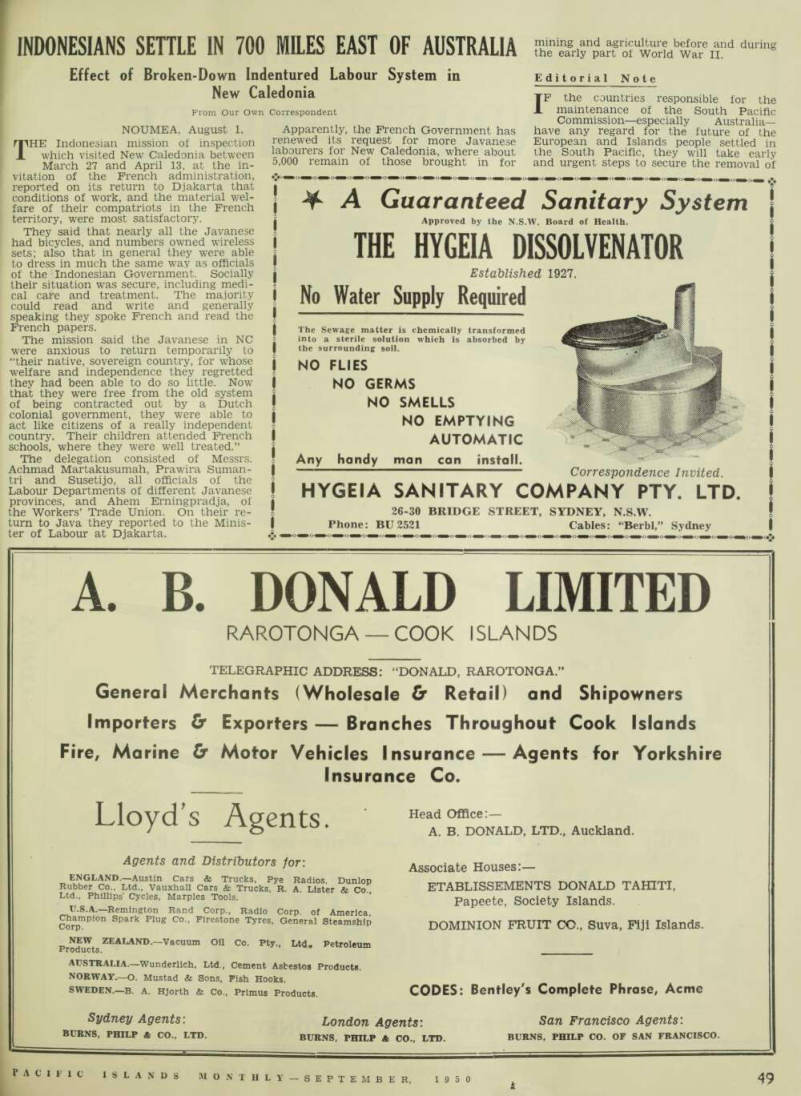
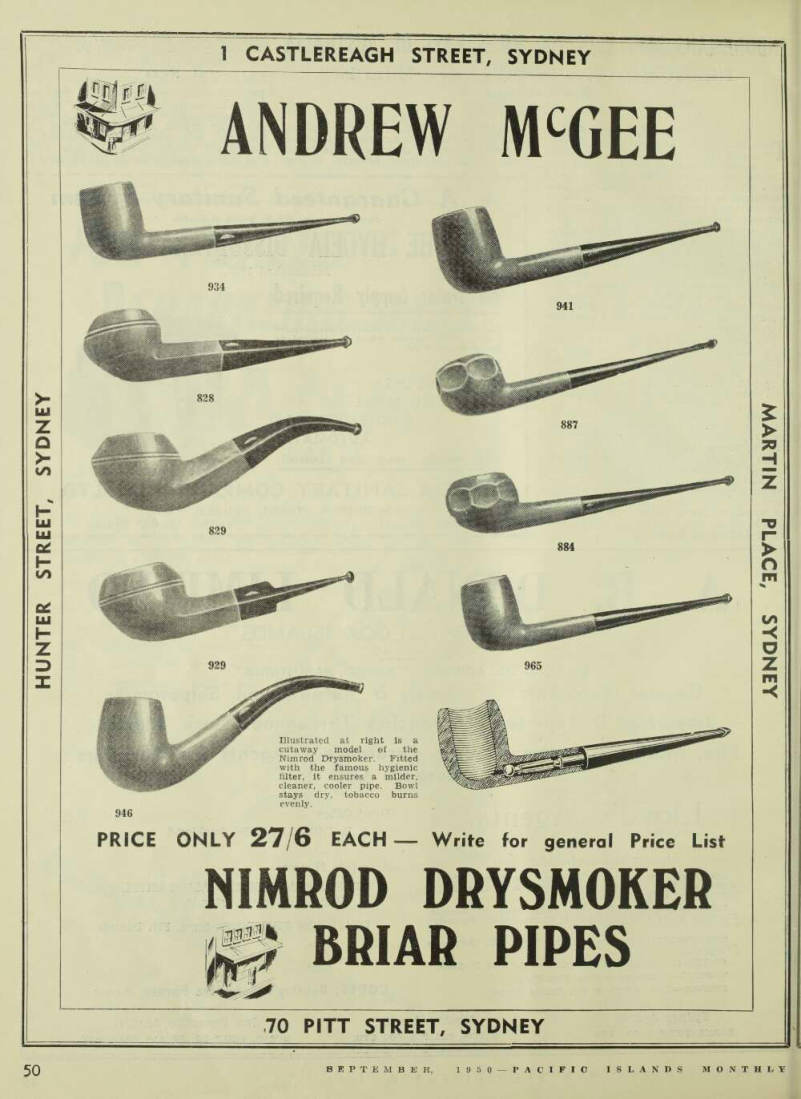
Effect of Broken-Down Indentured Labour System in New Caledonia
From Our Own Correspondent
NOUMEA, August 1.
THE Indonesian mission of inspection which visited New Caledonia between March 27 and April 13, at the in vitation of the French administration, reported on its return to Djakarta that conditions of work, and the material wel fare of their compatriots in the French territory, were most satisfactory.
They said that nearly all the Javanese had bicycles, and numbers owned wireless sets; also that in general they were able to dress in much the same way as officials of the Indonesian Government. Socially their situation was secure, including medi cal care and treatment. The majority could read and write and generally speaking they spoke French and read the French papers.
The mission said the Javanese in NC were anxious to return temporarily to “their native, sovereign country, for whose welfare and independence they regretted they had been able to do so little. Now that they were free from the old system of being contracted out by a Dutch colonial government, they were able to act like citizens of a really independent country. Their children attended French schools, where they were well treated.”
The delegation consisted of Messrs.
Achmad Martakusumah, Prawira Suman tri and Susetijo, all officials of the Labour Departments of different Javanese provinces, and Ahem Erningpradja, of the Workers’ Trade Union, On their re turn to Java they reported to the Minis ter of Labour at Djakarta.
Apparently, the French Government has renewed its request for more Javanese labourers for New Caledonia, where about 5,000 remain of those brought in for
mining and agriculture before and during the early part of World War 11.
Editorial Note IF the countries responsible for the maintenance of the South Pacific Commission—especially Australia— have any regard for the future of the European and Islands people settled in the South Pacific, they will take early and urgent steps to secure the removal of
that Indonesian community from New
' Caledonia.
It is ridiculous that Australia should be showing such concern at the prospect of Indonesians settling in Dutch New Guinea, so close to Australia’s northern shores, while the French are permitting 5,000 Indonesians to take root, as a com placently permanent colony, in New Caledonia, only 700 miles east of the Queensland coast.
Surely, with the tragic example of In dian settlement in Fiji before them, Aus tralia’s leaders can see the danger of permitting this Indonesian community settlement in New Caledonia. Is it to be just another example of the suicidal policy of laisser faire? Originally, the Indians were brought into Fiji, Chinese into Tahiti and New Guinea, Javanese into New Caledonia, as indentured labourers, to work the plantations and the mines, under a strictly-policed system of repatriation. They were in no circum stances to be allowed to settle—they were to be sent home as soon as their labour contracts expired.
But, one by one, those precious systems broke down; and consequently we have Asiatic communities firmly established in Fiji, Tahiti and New Guinea, where they are increasingly anti-European in charac ter, and where they certainly will in time supplant the indigenous Islands people.
Now, as a result of World War 11, the repatriation clauses of the Javanese in dentured labour system have broken down also in New Caledonia. Within a few years, the Javanese will be claiming New Caledonia for the “republic of Indonesia.”
The French arranged it —so the French will deserve all they get. But what a re flection upon Australia, so sensitive re garding all these racial problems!
Mrs. Stephen Broinowski was in Sydney in August. She expected to leave soon for Lae, NG.
Advertisements & other items, pp. 51-52 (1 item)
A. B. Donald Limited
-¥■ A Guaranteed Sanitary System
Approved by the N.S.W, Board of Health.
THE HYGEIA DISSOLVENATOR
Established 1927.
No Water Supply Required
The Sewage matter is chemically transformed into a sterile solution which is absorbed by the surrounding soil.
NO FLIES
NO GERMS
NO SMELLS
NO EMPTYING
AUTOMATIC
Any handy man can install.
HYGEIA SANITARY COMPANY PTY. LTD.
26-30 BRIDGE STREET, SYDNEY, N.S.W.
Phone: BU 2521 Cables: “Berbl,” Sydney Correspondence Invited.
A. B. DONALD LIMITED
RAROTONGA COOK ISLANDS
TELEGRAPHIC ADDRESS: “DONALD, RAROTONGA.”
General Merchants (Wholesale & Retail) and Shipowners Importers & Exporters Branches Throughout Cook Islands Fire, Marine & Motor Vehicles Insurance Agents for Yorkshire
Insurance Co.
Lloyd's Agents.
Head Office: — A. B. DONALD, LTD., Auckland.
Agents and Distributors for : ENGLAND.—Austin Cars & Trucks, Pye Radios. Dunlop Rubber Co.. Ltd., Vauxhall Cars & Trucks. R. A. Lister & Co Ltd., Phillips' Cycles, Marples Tools.
U.S.A.—Remington Rand Corp., Radio Corp. of America Champion Spark Plug Co., Firestone Tyres, General Steamship NEW ZEALAND.—Vacuum Oil Co. Pty., Ltd Products.
Petroleum AUSTRALlA.—Wunderlich, Ltd., Cement Asbestos Products.
NORWAY.—O. Mustad & Sons, Pish Hooks.
SWEDEN.—B. A. HJorth & Co., Primus Products.
Associate Houses:—
ETABLISSEMENTS DONALD TAHITI,
Papeete, Society Islands.
DOMINION FRUIT CO., Suva, Fiji Islands.
CODES: Bentley's Complete Phrase, Acme Sydney Agents : London Agents : San Francisco Agents : BURNS, PHILP & CO., LTD. BURNS, PHILP A CO., LTD. BURNS, PHILP CO. OF SAN FRANCISCO.
1 CASTLEREAGH STREET, SYDNEY
am
ANDREW M C GEE
934 828 D >■ c* hto h- Z 829 946 2: > 73 H > O c/t -< D 965 Illustrated at right Is a cutaway model of the Nimrod Drysmoker. Fitted with the famous hygienic filter, It ensures a milder, cleaner, cooler pipe. Bowl stays dry, tobacco burns evenly.
PRICE ONLY 27/6 EACH Write for general Price List
NIMROD DRYSMOKER
BRIAR PIPES
* 11
70 PITT STREET, SYDNEY
Australian Oranges
For Fiji
ALTHOUGH it might be imagined that a country with Fiji’s climate could produce all the oranges needed for local requirements, this is evidently not the case. Permits have been granted for the importation of Australian navel oranges during the winter months when danger from fruit-fly is not so great.
Because of the danger of introducing the fruit fly, which is a major pest in Eastern Australian coastal orchards, im portation of oranges from Australia was prohibited in Fiji last October.
The fruit fly affects Australian oranges very little—but it plays havoc among the soft fruits grown in the coastal areas of NSW and Queensland.
Rice Crop Prospects
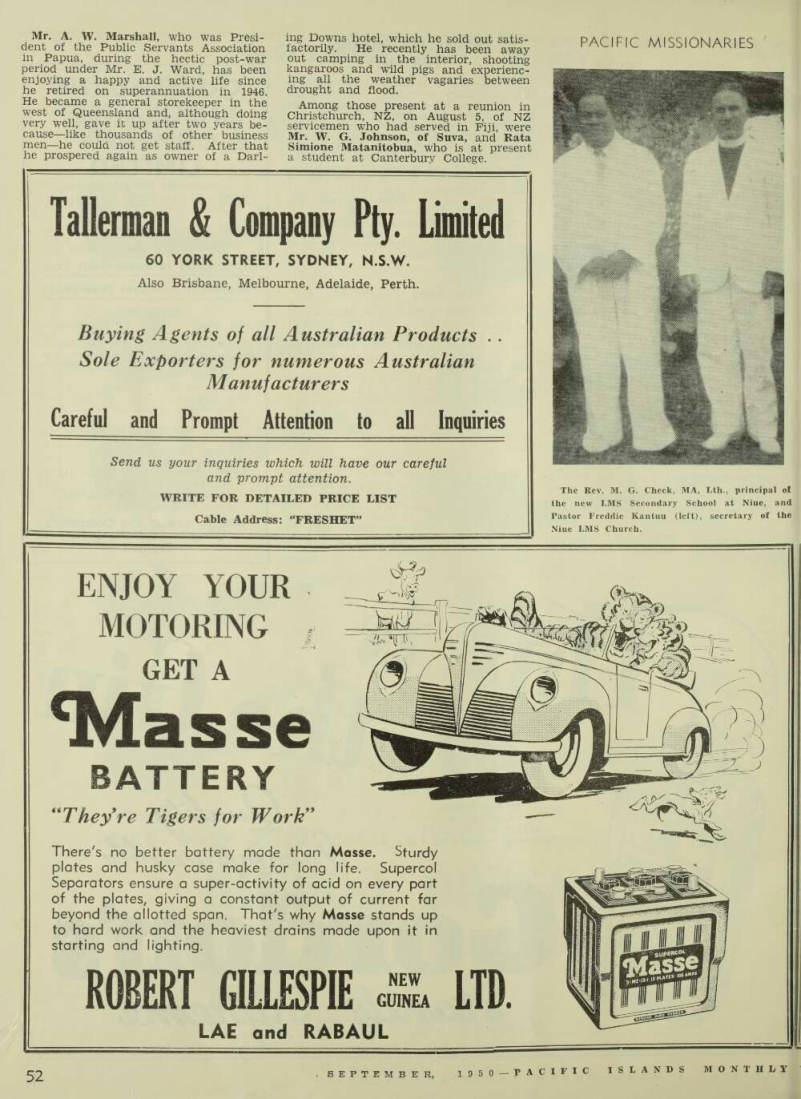
COMMUNIST operations in Malaya and Korea may close some rice markets in the East, in which case Australia will be obliged to send some of her com ing rice harvest to feed people in Formosa and Hong Kong.
This year’s rice harvest in Australia is expected to be a record and it was hoped that the ban on sales in Australia, which has existed since 1942, would be lifted.
Lifting of the ban depends now upon allocation of Australian rice to the Far East.
Mrs. E. J. Hallstrom, wife of the Sydney philanthropist, said in Brisbane recently that New Guinea Highland natives were becoming expert shearers. She was on her way to New Guinea for a short holiday. She said she would stay at Nondugl sheep station which her hus band established in the. New Guinea Highlands to foster native farming.
There are about 1,000 sheep on the station.
Mr. A. W. Marshall, who was Presi dent of the Public Servants Association in Papua, during the hectic post-war period under Mr. E. J. Ward, has been enjoying a happy and active life since he retired on superannuation in 1946.
He became a general storekeeper in the west of Queensland and, although doing very well, gave it up after two years be cause—like thousands of other business men—he could not get staff. After that he prospered again as owner of a Dari
ing Downs hotel, which he sold out satis factorily. He recently has been away out camping in the interior, shooting kangaroos and wild pigs and experienc ing all the weather vagaries between drought and flood.
Among those present at a reunion in Christchurch, NZ, on August 5, of NZ servicemen who had served in Fiji were Mr. W. G. Johnson, of Suva, and Rata Simione Matanitobua, who is at present a student at Canterbury College.
Advertisements & other items, pp. 53-54 (3 items)
Gordon's
QUEENSLAND
INSURANCE
COMPANY
LIMITED
(Incorporated 1886 In Australia).
ASSETS EXCEED £5,000,000
Head Office :
QUEENSLAND
INSURANCE BUILDING.
80-82 PITT STREET, SYDNEY.
Speciolists in South Seas Fire,
Marine & Accident Insurances
Apply to: — FlJl.—Branch Office: I. B. Chalmers.
Manager.
Burns Phllp (South Sea) Co.. Ltd.
VILA. —Burns Phllp (South Sea) Co., Ltd.
Comptolrs Prancais Des Nouvelles Hebrides (Marine).
NOUMEA.—L. & W. Johnston.
NEW GUlNEA.—Manager for the Territory of New Guinea and Papua, W. A.
Anderson.
PORT MORESBY—SAMARAI—LAE
—MADANG—RABAUL.
Burns Philp (New Guinea), Ltd.
PAGO PAGO.
Burns Phllp (South Sea) Co., Ltd.
G. H. C. Reid & Co.
OTHER SOUTH SEA ISLANDS.
Burns Phllp (South Sea) Co., Ltd.
Also to any of the Company's Offices in Australia or Hew Zealand.
m.
By Appointment Gin Distiller*
ft# S
G° * B ■M to H.M. King George VI Tanqueray, Gordon & Co. Lid-
Gordon's
Stands Supk&wui
Tallerman & Company Pty. Limited
60 YORK STREET, SYDNEY, N.S.W.
Also Brisbane, Melbourne, Adelaide, Perth.
Buying Agents of all Australian Products ..
Sole Exporters for numerous Australian
M anufacturers
Careful and Prompt Attention to all Inquiries Send us your inquiries which will have our careful and prompt attention.
WRITE FOR DETAILED PRICE LIST
Cable Address: “FRESHET”
Pacific Missionaries
The Rev. M. G. Check, MA, Lth., principal of the new LMS Secondary School at Niue, and Pastor Freddie Kantuu (left), secretary of the Niue LMS Church.
'Masse
ENJOY YOUR
MOTORING
GET A
'Masse
BATTERY
“ They're Tigers for ± > <p
ssm
(5 There's no better battery made than Masse. Sturdy plates and husky case make for long life. Supercol Separators ensure a super-activity of acid on every part of the plates, giving a constant output of current far beyond the allotted span. That's why Masse stands up to hard work and the heaviest drains made upon it in starting and lighting.
MERI GILLESPIE JH
LAE and RABAUL
Outweigh
Whiteman’s Laws Outweigh Malaita Justice
Prom Our Own Correspondent
Honiara, July 24.
MURDER story with a difference was told in Court recently in Honiara before the Judicial Commissioner (Mr. W. T. Charles) during the case of The King against Feoti of Koio, Malaita.
Feoti was charged with the murder of a young woman named Toriana. It was stated in evidence that Toriana and Fe oti lived in the same village until Toriana became a leper. She was then put out of the village, and was ordered to stay alone.
However, she would come into the vil lage and talk to people; she stole pigs and taro, and broke tambus, and her family had to pay out a good deal of money as compensation for the wrong things that she did. The villagers were angry with all her family because she would not stay alone and they were afraid that they would get leprosy.
Toriana was seen one day walking along a river bank in the Koio bush near the village, and the accused and another man were walking a little way behind.
She was never seen alive again, and her body was never identified, but a few days after she disappeared there was much distress and fright in the village because her ghost was appearing at night. The pagan priest of the village called a meet ing of all the people, and told Feoti and the other man who had been seen follow ing the girl, that if they had killed her they must admit it, and must pay 14 pigs and 14 moneys to be sacrificed to the local deity, so that the woman’s ghost would go away—otherwise the people would die.
Feoti told the priest quite cheerfully that he had killed Toriana. He said that he put a rope round her neck and strangled her because she was a nuisance and did so many wrong things, and that he would provide the pigs and money for the sacrifice.
Nobody looked for Toriana’s body when she disappeared, because she had leprosy, but nearly a year afterwards the police were taken to the foot of a big tree, where they found a complete skeleton with small delicate bones lying covered with leaves. There was no proof, how ever, that the bones were Toriana’s.
Feoti made a full confession, which it was thought might have resulted from fear of the priest. However, on being questioned again in Court, he said, “I have nothing more to say. I did it be cause she stole and ate a sacred taro. I got angry and killed her and told the headman, too.”
Because there was no proof of the woman’s actual death, Feoti was not found guilty of murder but of “an at tempt to strangle Toriana with intent to commit murder.” He was sentenced to 15 years’ imprisonment with hard labour.
NO evidence was given as to whether the lonely ghost was quietened by the 14 pigs and 14 moneys or whether it consented at last to go away all by itself.
Miss Mackie McCown, daughter of Mr. and Mrs. A. G. McCown of Nageledamu Point, Ovalau, Fiji, has completed her nursing training at Johns Hopkins Hos pital in the United States of America and has graduated Bachelor of Science at Johns Hopkins University. She received the degree of Bachelor of Arts from the University of Texas several years ago.
in Disgust
Hawaii Co. Gives Up in Disgust
From Our Tahiti Correspondent AFTER being a prominent factor in the economic life of Hawaii for 67 years, the Inter-Island Steam Navigation Company, of Honolulu, has disposed of its last remaining ship, the Humuula, and gone out of business.
Losses due to a succession of shipping strikes since the termination of the war
left the company with no alternative but to suspend operations. The Inter-Island’s smaller floating drydock was towed to sea and scuttled on February 16. Now, in consequence of the demands of the Dry dock Union and the inability of the com pany to accede to them, their remaining drydock is condemned to the same fate as the most practical means of her dis posal.
Mr. Eric C. Were, a former resident of New Guinea, gave a lecture and showed films of the Territory to the Newcastle (NSW) Geographical Society in August
Advertisements & other items, pp. 55-56 (1 item)
Vince
Take Vincent's arc
with confidence!
FOR HEADACHE, NERVOUS DEPRESSION,
'FLU & COLDS, SORE THROAT, Tonsillitis!
I m . ■■■
PROVED AND FULLY ACCEPTED
MEDICAL PRESCRIPTION!
You can be confident of safe, positive relief when you take genuine Vincent's a.p.c Powders, or Tablets! Vincent's is the only a.p.c prepared to the original hospital prescription first used by the Medical Superintendent of one of Australia’s largest public hospitals.
PROVED Safest &
for OYER 30 YEARS!
Vincent's hospital formula has been proved safest and best for over 30 years. This prescription is your \ safeguard! Be sure you get genuine Vincent's a.p.c. fTo!CISTu-_-
VINCE
N.8D.16
SAFEST & BEST
m Made in the Australian Branch Factory of
BLUNDELL SPENCE & CO., LTD., Hull,
B. & S. SUPER PREPARED PAINT embodies the knowledge and experience gained from nearly 140 years of Paint manufacture.
Tested and proved for tropical conditions, B. &• S. PREPARED PAINT is also available in a special Lead-free series for use in volcanic and other sulphurous regions. (Specify B. &■ S.-Series 2301).
Ask for supplies of these and other BLUN- DELL Paints and Enamels from your local Storekeeper, or write for particulars and colour-cards to the Agent for Pacific Islands :
KERR BROTHERS PTY. LTD.
4 YORK STREET, SYDNEY
Nukualofa Tortoise
Was In King’s Garden In 1885
Letter to the Editor IT may interest the writer of the article about Captain Cook’s tortoise in Nukualofa (published in February issue of the PIM) if I tell him what I know about this tortoise, called “Tui Malila.”
One day, in 1885, while residing in Felemea, Haapai, I went to Lifuka (the Island where the Government is situ ated) to transact some business and to buy some fresh bread. While I was at Mr. Smith’s bakehouse, a messenger came, and told me that King George Tubou I wanted to see me. I was a poor Tonga linguist, so I asked Mr. Smith to come with me, and act as interpreter.
King George was on a visit to Haapai and was living in a large Tongan house, built of Kaho.
I entered the house and saw King George sitting on a high pile of fine mats. He beckoned me to come to sit alongside him. As there were no chairs in the house, Mr. Smith had to sit cross legged on the floor.
The King asked me if I had been in New Britain. I said I had.
“Did you visit the Rev. Dr. George Brown, of the Wesleyan Church?” he asked.
I told him I did.
I had to answer many questions about the Wesleyan Church in New Britain, and say if I thought they had made any progress.
I said that there were Wesleyan and Catholic Missions there, but that pro gress had been very slow, as the New Britain natives were still cannibals—l had twice seen human flesh being eaten.
“I prefer tortoise,” said the King, and then he asked me if there were many tortoises in New Britain.
I told him there were many—that I used to go every morning and dig up a few tortoise-eggs for my breakfast and that I had also had a very large tortoise in my yard, big enough for a child to ride on.
The King said he also had a large tor toise in Nukualofa, over 100 years old, which Captain Cook presented to—(he told me the name but I have forgotten it)—a very high female chief. (After reading the article in the PIM, I made enquiries and I was told the name was the “Tamaka Moungalakeba,’ a Tongan leader to whom Bau made “moemoe.’ ) The King said the next time I came to Nukualofa I should come to the Palace, and see if I could ride the tortoise. I saw the tortoise in 1895—a very large specimen, but not a beauty. Several of the shells were cracked and, on one side, it was bruised. Not being a de Rouge mont, I did not ride it.
The tortoise which was presented by someone to the Governor of NSW, and is now in the Botanical Gardens in Sydney, may have come from Tonga. But it cannot be an offspring of the “Tui Malila,” as it is a male, and does not lay eggs, and there is no record that Captain Cook landed two tortoises.
I am, etc.,
F. T. Goedicke Van Asten.
Haapai, Tonga, 6 4/1950.
M. Raoul Thomas, of the Police Dep artment of the New Caledonian Adminis tration, has been staying at Coogee, Sydney, on three months’ leave. He re turned to Noumea at the end of August by air. Madam Thomas, who accompanied him to Australia, returned to New Cale donia in July.
Advertisements & other items, p. 56 (1 item)
54
SEPTEMBER, 1950-P A C I F I C ISLANDS MONTHLY
New Fijian Methodist
Church For Suva
From Our Own Correspondent
SUVA, July 31.
WITH £9,000 in hand, the Methodist Mission has launched an appeal to raise funds for the new Fijian Methodist Church to replace the Jubilee Church at Suva. The estimated cost of the new building is £27,000.
Lady Freeston, wife of the Governor of Fiji, when launching the appeal with a broadcast address, pointed out that the Jubilee Church, built in 1887 and enlarged in 1908, seats only 730, which is totally inadequate for what is acknow ledged to be the Fijian Mother Church.
The Methodist Mission first came to Fiji more than a centry ago, and to day only a small minority of the Fijian population is non-Methodist.
The appeal is being organised by a committee headed by the Mayor of Suva (Mr. Alport Barker) and the non-sec tarian angle is being underlined. The committee’s first statement said that Fijian generosity had become an ac cepted tradition whenever any sort of public appeal came along, and this was a chance for non-Fijians to show their gratitude.
American Air Tourists For
S-W Pacific
SIXTY- SIX American tourists will fly from San Francisco on a 34-day tour of the South-West Pacific in November.
The tour, which has been arranged by Ansett Airways at a cost of 1,700 dollars a head will also take them to Fiji, Hay man Island (Barrier Reef, Queensland), Sydney and Tasmania.
“Sound Social System’’
New Guinea Natives Have
PROFESSOR A. P. ELKIN, professor of anthropology at the University of Syd ney, just back in Sydney after a tour in New Guinea, told reporters in August that primitive natives in the heart of New Guinea have an astonishingsly sound social and economic system.
Professor Elkin said that he found
around Wabag, almost at the centre of New Guinea, a community of more than 120,000 people, mostly farmers. Trade with coastal and other centres is arranged through local native agents who fix the barter scale and distribute goods which arrive in exchange for local products.
The community has its own compensation system for the relatives of those killed in battle. Pigs are generally given, the num ber varying with the importance of the dead man.
Advertisements & other items, pp. 57-58 (1 item)
Aunt Mary’S
Makes double the quantity in the can it’s delicious
CONCENTRATED
TOMATO SOUP
SMOOTH, CREAMY, FULL OF FLAVOUR
Another famous Aunt Mary's Pure Food Product.
MANUFACTURED BY: TILLOCK & GO. PTY. LTD.
A. H. BUNTING LIMITED
SAMARAI PAPUA
Branches at: MISIMA, TUFI, ORO BAY, SOPUTA.
SAMARAI AGENTS FOR:
Vacuum Oil Co. Pty., Ltd.
South British Insurance Co.
National Mutual Life Association
SOLE AGENTS IN PAPUA/NEW GUINEA FOR:
Polarizers (U.K.), Ltd.—Polaroid Sun Glasses.* C.S.A. Industries Eng.— Dual Freeze Refrigerators.
Webley & Scott, Ltd.—Shot Guns, Air Pistols, etc.
E. K. Cole, Ltd., London. —“Ekco” Radio Receivers.
“Getula.”—Nylon Monofilament Fish Lines.
Davison Paints, Ltd., N.S.W.—Paint for Tropical Conditions. • Trade mark patented in. U.S.A., Great Britain, and .other countries
REGULAR SUPPLIES OF EASTERN GOODS
WHOLESALE & RETAIL MERCHANTS IMPORTERS PLANTERS
vv o m: / %
sfc
s I a <W J£:. *** /£ ♦ <4
SCJI«I
t Ml «* / & />. £ 'l^ / o^ 1 V' pbanz / -A, 33 » V\ V|0 A =*S -nr /VC 51 •'*
the
services
sour**
m
BSMSiPiC
*> *. v "
New Zealand is a whole world of travel ... but it’s a small world when you fly on the N.Z. National Airways Corporation air network that brings New Zealand’s playgrounds and wonderlands invitingly close.
NEW ZEALAND NATIONAL AIRWAYS CORPORATION.
New Zealand National Airways Corporation provides a network of air services throughout the Dominion and the South-West Pacific. General Agents in the Dominion for British Commonwealth Pacific Airlines and Trans-Australia Airlines. Booking Agents for Tasman Empire Airways, Qantas Empire Airways, the 8.0.A.t. and other overseas airlines.
Offices and Agents throughout New Zealand and the South-West Pacific.
Magazine Section
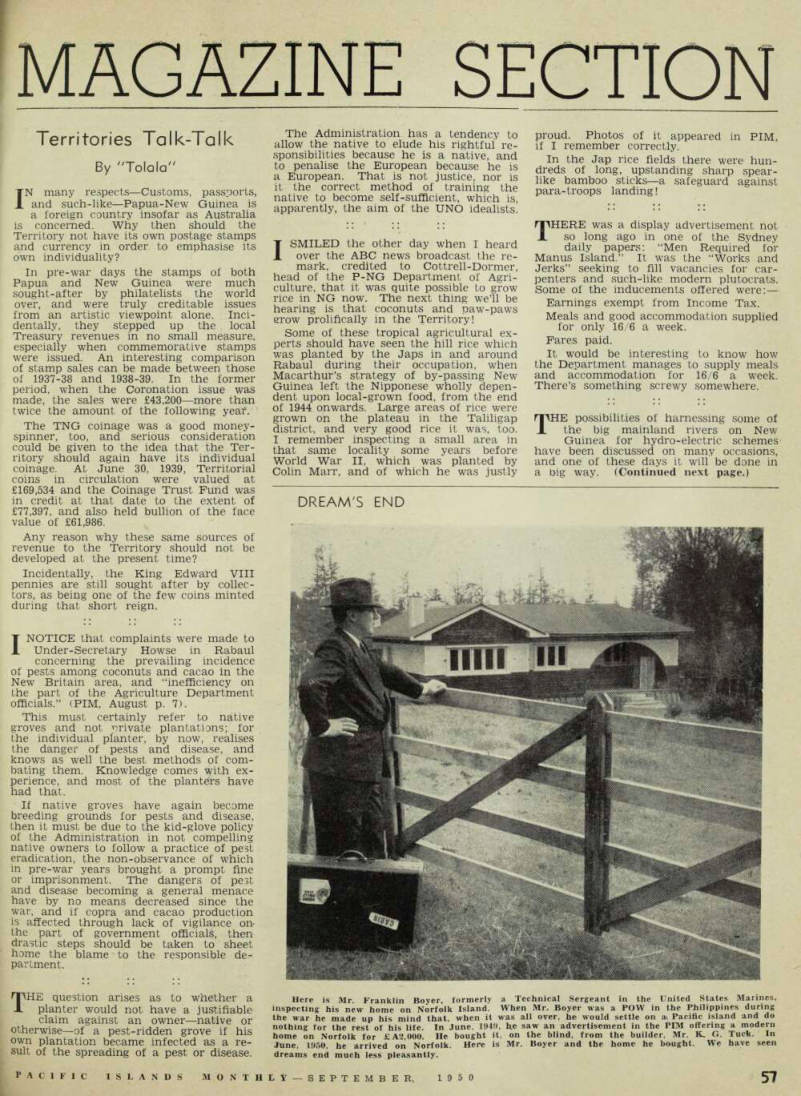
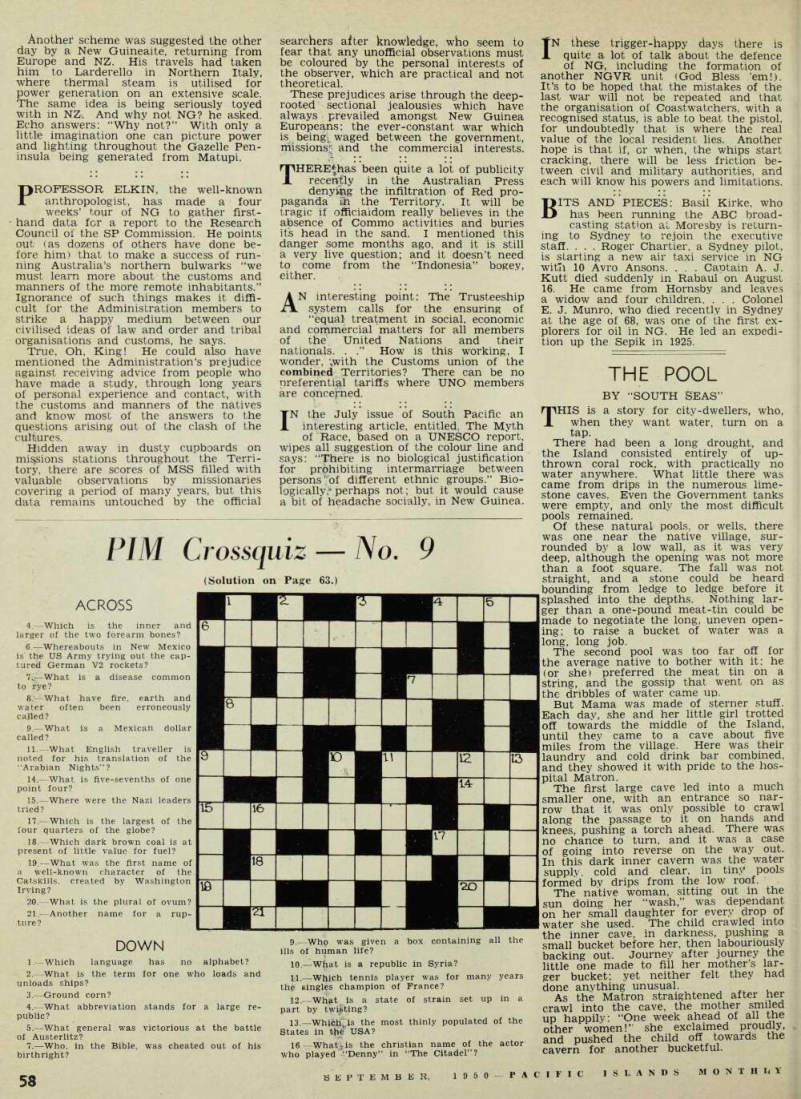
Territories Talk-Talk
By "Tolala"
IN many respects—Customs, passports, and such-like —Papua-New Guinea is a foreign country insofar as Australia is concerned. Why then should the Territory not have its own postage stamps and currency in order to emphasise its own individuality?
In pre-war days the stamps of both Papua and New Guinea were much sought-after by philatelists the world over, and were truly creditable issues from an artistic viewpoint alone. Inci dentally, they stepped up the local Treasury revenues in no small measure, especially when commemorative stamps were issued. An interesting comparison of stamp sales can be made between those of 1937-38 and 1938-39. In the former period, when the Coronation issue was made, the sales were £43,200 —more than twice the amount of the following yeaif.
The TNG coinage was a good money spinner, too, and serious consideration could be given to the idea that the Ter ritory should again have its individual coinage. At June 30, 1939, Territorial coins in circulation were valued at £169,534 and the Coinage Trust Fund was in credit at that date to the extent of £77,397, and also held bullion of the face value of £61,986.
Any reason why these same sources of revenue to the Territory should not be developed at the present time?
Incidentally, the King Edward VIII pennies are still sought after by collec tors, as being one of the few coins minted during that short reign.
I NOTICE that complaints were made to Under-Secretary Howse in Rabaul concerning the prevailing incidence of pests among coconuts and cacao in the New Britain area, and “inefficiency on the part of the Agriculture Department officials.” (PIM, August p. 7).
This must certainly refer to native groves and not private plantations; for the individual planter, by now, realises the danger of pests and disease, and knows as well the best methods of com bating them. Knowledge comes with ex perience, and most of the planters have had that.
If native groves have again become breeding grounds for pests and disease, then it must be due to the kid-glove policy of the Administration in not compelling native owners to follow a practice of pest eradication, the non-observance of which in pre-war years brought a prompt fine or imprisonment. The dangers of pest and disease becoming a general menace have by no means decreased since the war, and if copra and cacao production is affected through lack of vigilance on the part of government officials, then drastic steps should be taken to sheet home the blame to the responsible de partment.
THE question arises as to whether a planter would not have a justifiable claim against an owner —native or otherwise—of a pest-ridden grove if his own plantation became infected as a re sult of the spreading of a pest or disease.
The Administration has a tendency to allow the native to elude his rightful re sponsibilities because he is a native, and to penalise the European because he is a European. That is not justice, nor is it the correct method of training the native to become self-sufficient, which is, apparently, the aim of the UNO idealists.
I SMILED the other day when I heard over the ABC news broadcast the re mark, credited to Cottrell-Dormer, head of the P-NG Department of Agri culture, that it was quite possible to grow rice in NG now. The next thing we’ll be hearing is that coconuts and paw-paws stow prolifically in the Territory!
Some of these tropical agricultural ex perts should have seen the hill rice which was planted by the Japs in and around Rabaul during their occupation, when Macarthur’s strategy of by-passing New Guinea left the Nipponese wholly depen dent upon local-grown food, from the end of 1944 onwards. Large areas of rice were grown on the plateau in the Taliligap district, and very good rice it was, too.
I remember inspecting a small area in that same locality some years before World War 11, which was planted by Colin Marr, and of which he was justly
proud. Photos of it appeared in PIM, if I remember correctly.
In the Jap rice fields there were hun dreds of long, upstanding sharp spear like bamboo sticks—a safeguard against para-troops landing!
THERE was a display advertisement not so long ago in one of the Sydney daily papers: “Men Required for Manus Island.” It was the “Works and Jerks” seeking to fill vacancies for car penters and such-like modern plutocrats.
Some of the inducements offered were: — Earnings exempt from Income Tax.
Meals and good accommodation supplied for only 16/6 a week.
Fares paid.
It would be interesting to know how the Department manages to supply meals and accommodation for 16/6 a week.
There’s something screwy somewhere.
THE possibilities of harnessing some of the big mainland rivers on New Guinea for hydro-electric schemes have been discussed on many occasions, and one of these days it will be done in a big way. (Continued next page.)
Another 4 scheme was suggested the other day by a New Guineaite, returning from Europe and NZ. His travels had taken him to Larderello in Northern Italy, where thermal steam is utilised for power generation on an extensive scale.
The same idea is being seriously toyed with in NZ-. And why not NG? he asked.
Echo answers: “Why not?” With only a little imagination one can picture power and lighting throughout the Gazelle Pen insula being generated from Matupi.
PROFESSOR ELKIN, the well-known anthropologist, has made a four weeks’ tour of NG to gather first hand data for a report to the Research Council of the SP Commission. He points out (as dozens of others have done be fore him) that to make a success of run ning Australia’s northern bulwarks “we must learn more about the customs and manners of the more remote inhabitants.”
Ignorance of such things makes it diffi cult for the Administration members to strike a happy medium between our civilised ideas of law and order and tribal organisations and customs, he says.
True, Oh, King! He could also have mentioned the Administration’s prejudice against receiving advice from people who have made a study, through long years of personal experience and contact, with the customs and manners of the natives and know most of the answers to the questions arising out of the clash of the cultures.
Hidden away in dusty cupboards on missions stations throughout the Terri tory, there are scores of MSS filled with valuable observations by missionaries covering a period of many years, but this data remains untouched by the official
searchers after knowledge, who seem to fear that any unofficial observations must be coloured by the personal interests of the observer, which are practical and not theoretical.
These prejudices arise through the deep rooted sectional jealousies which have always prevailed amongst New Guinea Europeans: the ever-constant war which is beings waged between the government, missions;; and the commercial interests.
THERE*has been quite a lot of publicity recently in the Australian Press denytpg the infiltration of Red pro paganda ih the Territory. It will be tragic if officialdom really believes in the absence of Commo activities and buries its head in the sand. I mentioned this danger some months ago, and it is still a very live question; and it doesn’t need to come from the “Indonesia” bogey, either.
AN interesting point: The Trusteeship system calls for the ensuring of “equal treatment in social, economic and commercial matters for all members of the United Nations and their nationals. . .” How is this working, I wonder, ;with the Customs union of the combined Territories? There can be no preferential tariffs where UNO members are concerned.
IN the July issue of South Pacific an interesting article, entitled, The Myth of Race, based on a UNESCO report, wipes all suggestion of the colour line and says: “There is no biological justification for prohibiting intermarriage between persons "of different ethnic groups.” Bio logically; * perhaps not; but it would cause a bit of headache socially, in New Guinea.
IN these trigger-happy days there is
quite a lot of talk about the defence of NG, including the formation of another NGVR unit (God Bless ’em!).
It’s to be hoped that the mistakes of the last war will not be repeated and that the organisation of Coastwatchers, with a recognised status, is able to beat the pistol, for undoubtedly that is where the real value of the local resident lies. Another hope is that if, or when, the whips start cracking, there will be less friction be tween civil and military authorities, and each will know his powers and limitations.
BITS AND'pieces: Basil Kirke, who
has been running the ABC broad casting station at Moresby is return ing to Sydney to rejoin the executive staff. . . . Roger Chartier, a Sydney pilot, is starting a new air taxi service in NG with 10 Avro Ansons. . . . Captain A. J.
Kutt died suddenly in Rabaul on August 16. He came from Hornsby and leaves a widow and four children. . . . Colonel E. J. Munro, who died recently in Sydney at the age of 68, was one of the first ex plorers for oil in NG. He led an expedi tion up the Sepik in 1925.
Dream's End
Here is Mr. Franklin Boyer, formerly a Technical Sergeant in the United States Marines, inspecting his new home on Norfolk Island. When Mr. Boyer was a POW in the Philippines during the war he made up his mind that, when it was all over, he would settle on a Pacific island and do nothing for the rest of his life. In June, 1949, he saw an advertisement in the PIM offering a modern home on Norfolk for £A2,000. He bought it, on the blind, from the builder, Mr. K. G. Tuck. In June, 1950, he arrived on Norfolk. Here is Mr. Boyer and the home he bought. We have seen dreams end much less pleasantly.
PIM Crossquiz No. 9
(Solution on Page 63.)
Across
4, —Which is the inner and larger of the two forearm bones? 6.—Whereabouts in New Mexico is the US Army trying out the cap tured German V 2 rockets? 7„—What is a disease common to rye? 8. —What have fire, earth and water often been erroneously called? 9. —What is a Mexican dollar called? 11. —What English traveller is noted for his translation of the “Arabian Nights”? 14. —What is five-sevenths of one point four? 15. —Where were the Nazi leaders tried? 17. —Which is the largest of the four quarters of the globe? 18. Which dark brown coal is at present of little value for fuel? 19. —What was the first name of a well-known character of the Catskills, created by Washington Irving? 20. —What is the plural of ovum? 21. —Another name for a rup ture?
Down
I—Which language has no alphabet? 2. —What is the term for one who loads and unloads ships? 3. —Ground corn? 4. —What abbreviation stands for a large re public? 5. What general was victorious at the battle of Austerlitz? 7.—Who. in the Bible, was cheated out of his birthright?
9. —Who was given a box containing all the ills of human life? 10. —What is a republic in Syria?
M.—Which tennis player was for many years the singles champion of France? 12. —Wh?t is a state of strain set up in a part by twisting? 13. Whicht is the most thirty populated of the States in the USA? 16 —Whatsis the Christian name of the actor who played “Denny” in ‘‘The Citadel”?
The Pool
By “South Seas”
THIS is a story for city-dwellers, who, when they want water, turn on a tap.
There had been a long drought, and the Island consisted entirely of up thrown coral rock, with practically no water anywhere. What little there was came from drips in the numerous lime stone caves. Even the Government tanks were empty, and only the most difficult pools remained.
Of these natural pools, or wells, there was one near the native village, sur rounded by a low wall, as it was very deep, although the opening was not more than a foot square. The fall was not straight, and a stone could be heard bounding from ledge to ledge before it (splashed into the depths. Nothing lar ger than a one-pound meat-tin could be made to negotiate the long, uneven open ing; to raise a bucket of water was a long, long job.
The second pool was too far off for the average native to bother with it: he (or she) preferred the meat tin on a string, and the gossip that went on as the dribbles of water came up.
But Mama was made of sterner stuff.
Each day, she and her little girl trotted off towards the middle of the Island, until they came to a cave about five miles from the village. Here was their laundry and cold drink bar combined, and they showed it with pride to the hos pital Matron.
The first large cave led into a much smaller one, with an entrance so nar row that it was only possible to crawl along the passage to it on hands and knees, pushing a torch ahead. There was no chance to turn, and it was a case of going into reverse on the way out.
In this dark inner cavern was the water supply, cold and clear, in tiny pools formed by drips from the low roof.
The native woman, sitting out in the sun doing her “wash,” was dependant on her small daughter for every drop of (water she used. The child crawled into the inner cave, in darkness, pushing a small bucket before her, then laboriously backing out. Journey after journey the little one made to fill her mother’s lar ger bucket; yet neither felt they had done anything unusual.
As the Matron straightened after her crawl into the cave, the mother smiled up happily: “One week ahead of all the other women!” she exclaimed proudly, and pushed the child off towards the cavern for another bucketful.
Strange Artifacts of Old Papua
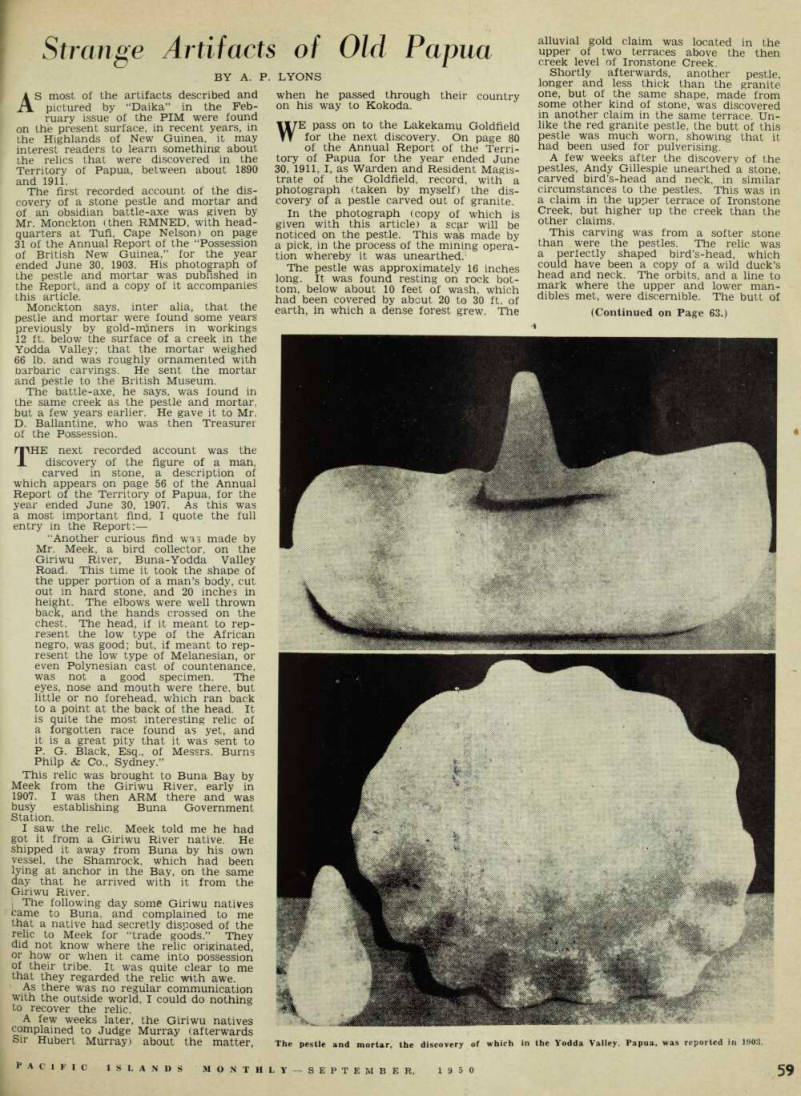
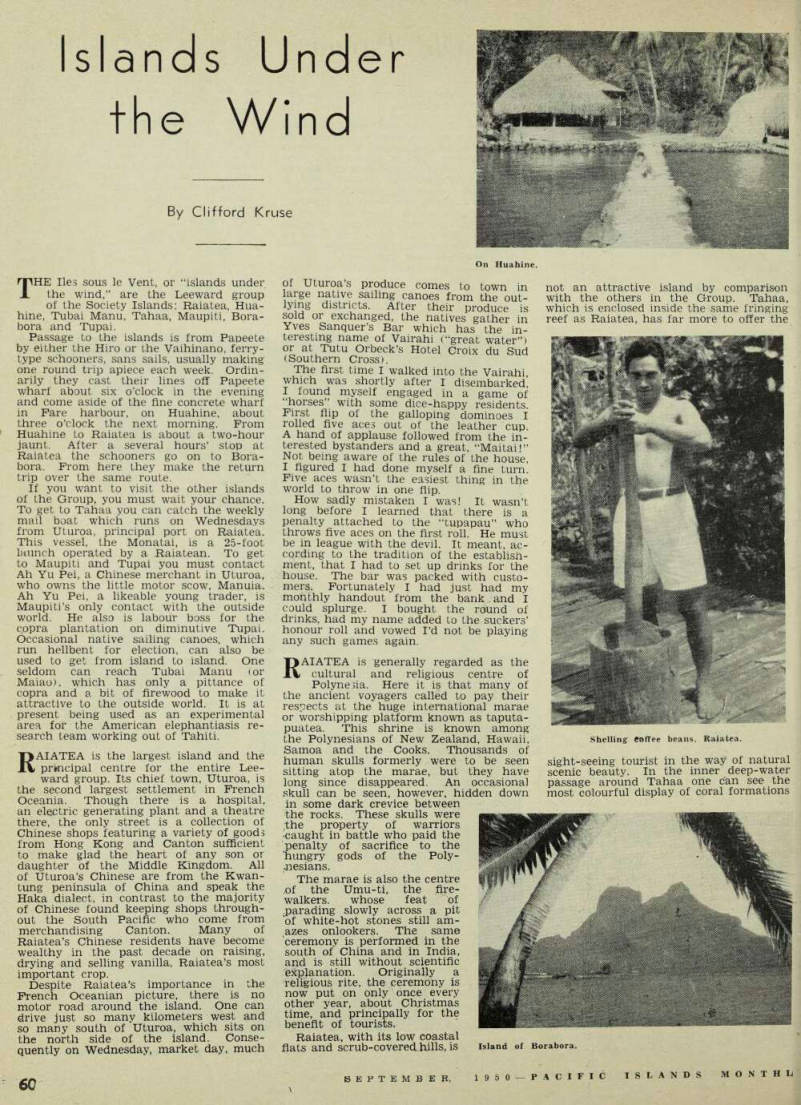
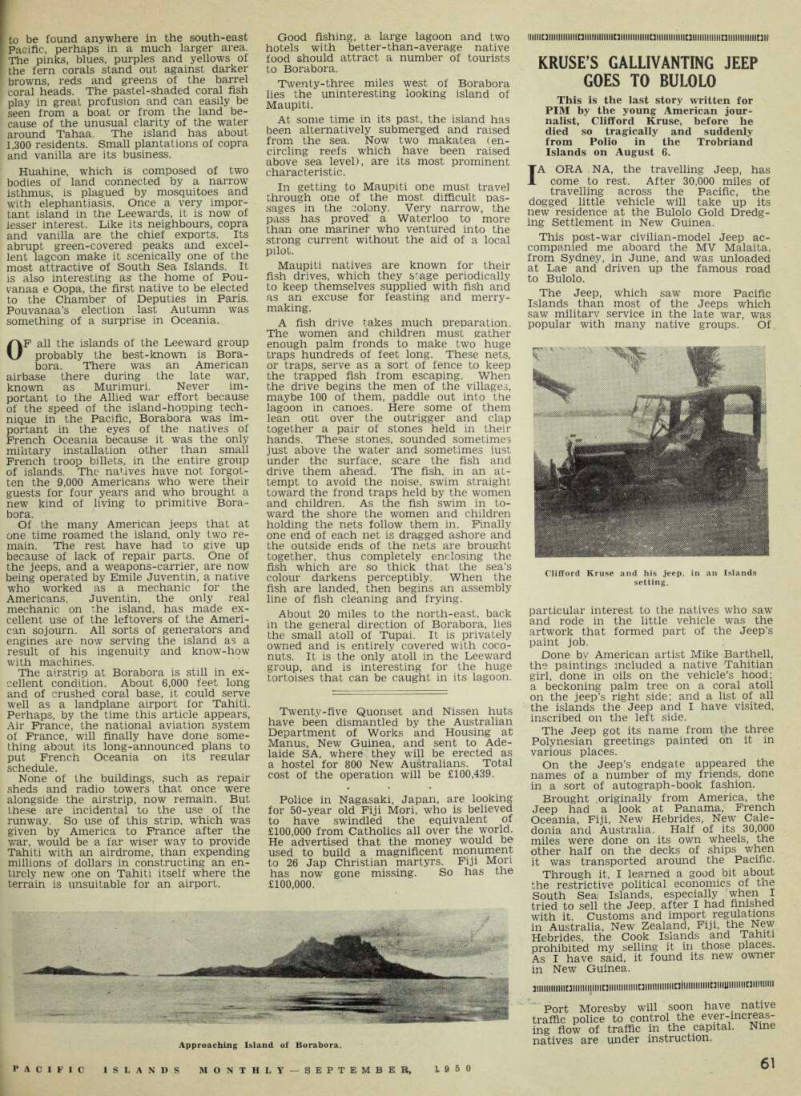
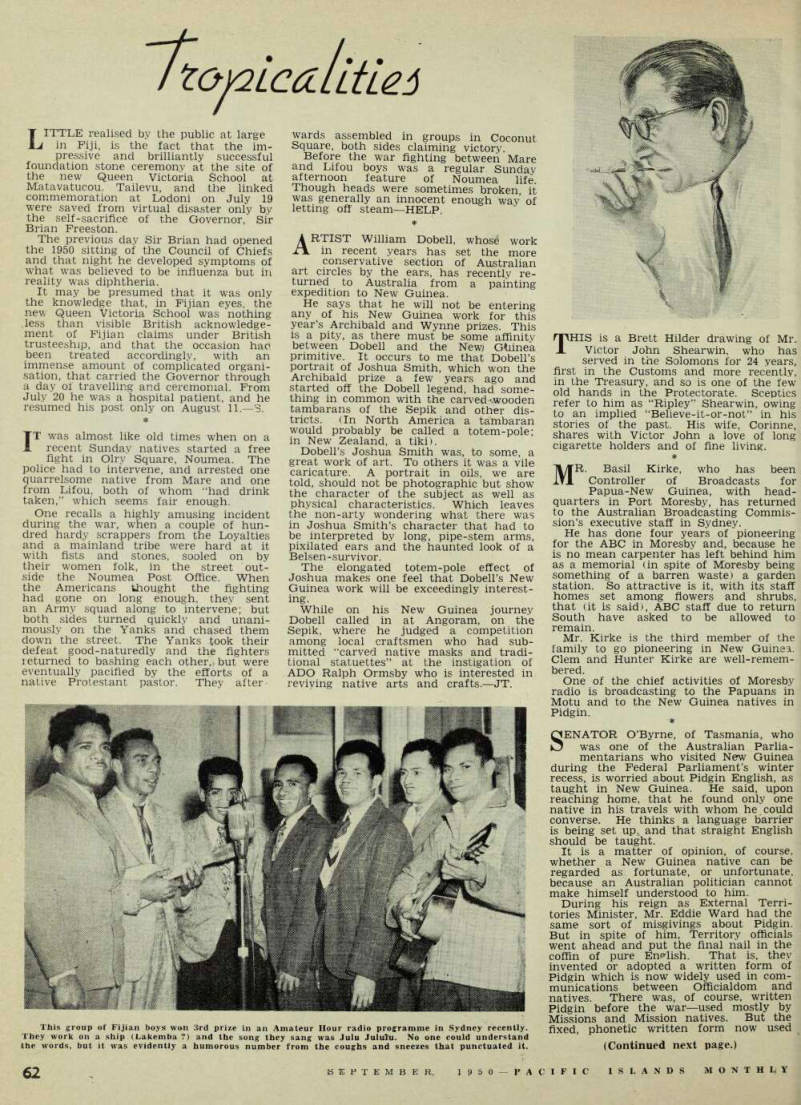
By A. P. Lyons
AS most of the artifacts described and pictured by “Daika” in the Feb ruary issue of the PIM were found on the present surface, in recent years, in the Highlands of New Guinea, it may interest readers to learn something about the relics that were discovered in the Territory of Papua, between about 1890 and 1911.
The first recorded account of the dis covery of a stone pestle and mortar and of an obsidian battle-axe was given by Mr, Monckton (then RMNED, with head quarters at Tufi, Cape Nelson) on page 31 of the Annual Report of the “Possession of British New Guinea,” for the year ended June 30, 1903. His photograph of the pestle and mortar was published in the Report, and a copy of it accompanies this article.
Monckton says, inter alia, that the pestle and mortar were found some years previously by gold-miners in workings 12 ft. below the surface of a creek in the Yodda Valley; that the mortar weighed 66 lb. and was roughly ornamented with barbaric carvings. He sent the mortar and pestle to the British Museum.
The battle-axe, he says, was found in the same creek as the pestle and mortar, but a few years earlier. He gave it to Mr.
D. Ballantine, who was then Treasurer of the Possession.
THE next recorded account was the discovery of the figure of a man, carved in stone, a description of which appears on page 56 of the Annual Report of the Territory of Papua, for the year ended June 30, 1907. As this was a most important find, I quote the full entry in the Report:— “Another curious find was made by Mr. Meek, a bird collector, on the Giriwu River, Buna-Yodda Valley Road. This time it took the shape of the upper portion of a man’s body, cut out in hard stone, and 20 inches in height. The elbows were well thrown back, and the hands crossed on the chest. The head, if it meant to rep resent the low type of the African negro, was good; but, if meant to rep resent the low type of Melanesian, or even Polynesian cast of countenance, was not a good specimen. The eyes, nose and mouth were there, but little or no forehead, which ran back to a point at the back of the head. It is quite the most interesting relic of a forgotten race found as yet, and it is a great pity that it was sent to P. G. Black, Esq., of Messrs. Burns Philp & Co., Sydney.”
This relic was brought to Buna Bay by Meek from the Giriwu River, early in 1907. I was then ARM there and was busy establishing Buna Government Station.
I saw the relic. Meek told me he had got it from a Giriwu River native. He shipped it away from Buna by his own vessel, the Shamrock, which had been lying at anchor in the Bay, on the same day that he arrived with it from the Giriwu River. . The following day some Giriwu natives came to Buna, and complained to me that a native had secretly disposed of the relic to Meek for “trade goods.” They did not know where the relic originated, or how or when it came into possession of their tribe. It was quite clear to me that they regarded the relic with awe.
As there was no regular communication with the outside world, I could do nothing to recover the relic.
A few weeks later, the Giriwu natives complained to Judge Murray (afterwards Sir Hubert Murray) about the matter,
when he passed through their country on his way to Kokoda.
WE pass on to the Lakekamu Goldfield for the next discovery. On page 80 of the Annual Report of the Terri tory of Papua for the year ended June 30, 1911, I, as Warden and Resident Magis trate of the Goldfield, record, with a photograph (taken by myself) the dis covery of a pestle carved out of granite.
In the photograph (copy of which is given with this article) a scpr will be noticed on the pestle. This was made by a pick, in the process of the mining opera tion whereby it was unearthed.
The pestle was approximately 16 inches long. It was found resting on rock bot tom, below about 10 feet of wash, which had been covered by about 20 to 30 ft. of earth, in which a dense forest grew. The
alluvial gold claim was located in the upper of two terraces above the then creek level of Ironstone Creek.
Shortly afterwards, another pestle, longer and less thick than the granite one, but of the same shape, made from some other kind of stone, was discovered in another claim in the same terrace. Un like the red granite pestle, the butt of this pestle was much worn, showing that it had been used for pulverising.
A few weeks after the discovery of the pestles, Andy Gillespie unearthed a stone, carved bird’s-head and neck, in similar circumstances to the pestles. This was in a claim in the upper terrace of Ironstone Creek, but higher up the creek than the other claims.
This carving was from a softer stone than were the pestles. The relic was a perfectly shaped bird’s-head, which could have been a copy of a wild duck’s head and neck. The orbits, and a line to mark where the upper and lower man dibles met, were discernible. The butt of
(Continued on Page 63.)
The pestle and mortar, the discovery of which in the Yodda Valley, Papua, was reported in 1903.
the neck was level and there was nothing on it to suggest that it might have been attached to a stone body or anything else.
Stood upright on its butt, it measured ap proximately six inches high. Gillespie told me he intended sending it to the British Museum.
The last relic to be discovered on the Lakekamu Goldfield while I was in charge there, was a double-bladed and flat stone
axe. A hole was bored through the middle of the flat surface. It was found by Jim Mulholland, in his claim, situated beneath the lower terrace of Ironstone Creek but further down that creek than where the other relics were unearthed. The axe was much corroded.
It will be as well for me to say that I saw all of these relics and the places where they were found, shortly after their discovery.
HAVING related some facts, I will pro ceed to theorise on the origin of both the Lakekamu and Giriwu dis coveries.
Upon looking at the photograph of the granite pestle found at the Lakekamu Goldfield, it suggests that it was intended to represent a phallus. That being so, where was it most likely to have come from? Clearly, from an Asiatic country whose inhabitants —or some of them, at any rate —were followers of the Phallic Rite. It is well known that some of the inhabitants of both Java and India prac tised Phallic worship, and perhaps still do. The curious may still see many phal lic carvings in those countries.
It is also well known that many Asiatic peoples, down the ages, have been expert handicraftsmen in working with gold and other metals. Their prospectors would travel far afield to search for gold in
mountains and valleys, at the headwaters of rivers, as we do to-day.
Therefore, it is reasonable to suppose that prospectors of some Asiatic race, who were Phallic worshippers, made voyages along the south coast of the island of New Guinea to search for gold in the high mountains of the interior. And they would try to find a river that would take them by the shortest route to those moun tains.
They would find such a route by either the Lakekamu or Tauri Rivers, which flow into the Gulf of Papua within a few miles of each other. They would bring with them symbols of their worship; and I be lieve the pestles and bird’s-head found at the Lakekamu Goldfield were some of those symbols.
These prospectors would most certainly come into contact with the aborigines, establish friendly relations with them, and even intermarry with them and have off spring. Both aborigines and the off spring would learn, amongst other things, to make rough imitations of the Phallic symbols they saw, and it is these imita tions that have been found on the surface of New Guinea in recent years.
Someone steeped in the ancient culture of Asiatic countries could tell us more about the probable origin of the Giriwu stone man. To me, its general appearance suggested that it was of Asiatic origin.
FOOTNOTE: A copy of the Catalogue of the Black Collection of Islands Arti facts (which consisted of over 6,000 articles, contained in some 40 cases) is in the Pacific Islands Monthly library. It does not mention the stone carving re ferred to by Mr. Monckton.
The Rev. J. R. Metcalfe who has been a Methodist missionary in ESI since 1920, has been designated by the NZ Foreign Mission Board to succeed the Rev. J. F.
Goldie, as chairman of the Solomon Islands district, when Mr. Goldie retires in 1951. Mr. Metcalfe has been in charge of Methodist mission activities on Choiseul Island for a number of years.
Mrs. Metcalfe has had even longer mis sionary experience than her husband and for the past 33 years has been one of the outstanding Methodist women workers in the BSI.
Rabaul and Kokopo, New Guinea, have started a rugby league club. Training has already commenced and a Rabaul- Kokopo match will be staged shortly. A high standard of play is anticipated. Mr.
Tony Normoyle, who was outstanding in Queensland GPS football in 1949, will be among the players.
The ancient pestle unearthed on the Lakekamu goldfield, about 1911. It was photographed beside a beer bottle, to give an idea of size.
Islands Under
the Wind
By Clifford Kruse
THE lies sous le Vent, or “islands under the wind,” are the Leeward group of the Society Islands: Raiatea, Hua hine, Tubai Manu, Tahaa, Maupiti, Bora bora and Tupai.
Passage to the islands is from Papeete by either the Hiro or the Vaihinano, ferry type schooners, sans sails, usually making one round trip apiece each week. Ordin arily they cast their lines off Papeete wharf about six o’clock in the evening and come aside of the fine concrete wharf in Fare harbour, on Huahine, about three o’clock the next morning. From Huahine to Raiatea is about a two-hour jaunt. After a several hours’ stop at Raiatea the schooners go on to Bora bora. From here they make the return trip over the same route.
If you want to visit the other islands of the Group, you must wait your chance.
To get to Tahaa you can catch the weekly mail boat which runs on Wednesdays from Uturoa, principal port on Raiatea.
This vessel, the Monatai, is a 25-foot launch operated by a Raiatean. To get to Maupiti and Tupai you must contact Ah Yu Pei, a Chinese merchant in Uturoa, who owns the little motor scow. Manuia.
Ah Yu Pei, a likeable young trader, is Maupiti’s only contact with the outside world. He also is labour boss for the copra plantation on diminutive Tupai.
Occasional native sailing canoes, which run hellbent for election, can also be used to get from island to island. One seldom can reach Tubai Manu (or Maiao), which has only a pittance of copra and a bit of firewood to make it attractive to the outside world. It is at present being used as an experimental area for the American elephantiasis re search team working out of Tahiti.
RAIATEA is the largest island and the principal centre for the entire Lee ward group. Its chief town, Uturoa, is the second largest settlement in French Oceania. Though there is a hospital, an electric generating plant and a theatre there, the only street is a collection of Chinese shops featuring a variety of goods from Hong Kong and Canton sufficient to make glad the heart of any son or daughter of the Middle Kingdom. All of Uturoa’s Chinese are from the Kwan tung peninsula of China and speak the Haka dialect, in contrast to the majority of Chinese found keeping shops through out the South Pacific who come from merchandising Canton, Many of Raiatea’s Chinese residents have become wealthy in the past decade on raising, drying and selling vanilla, Raiatea’s most important crop.
Despite Raiatea’s importance in the French Oceanian picture, there is no motor road around the island. One can drive just so many kilometers west and so many south of Uturoa, which sits on the north side of the island. Conse quently on Wednesday, market day, much
of Uturoa’s produce comes to town in large native sailing canoes from the out lying districts. After their produce is sold or exchanged, the natives gather in Yves Sanquer’s Bar which has the in teresting name of Vairahi (“great water”) or at Tutu Orbeck’s Hotel Croix du Sud (Southern Cross).
The first time I walked into the Vairahi which was shortly after I disembarked’, I found myself engaged in a game of “horses” with some dice-happy residents.
First flip of the galloping dominoes I rolled five aces out of the leather cup.
A hand of applause followed from the in terested bystanders and a great, “Maitai'”
Not being aware of the rules of the house, I figured I had done myself a fine turn.
Five aces wasn’t the easiest thing in the world to throw in one flip.
How sadly mistaken I was! It wasn’t long before I learned that there is a penalty attached to the “tupapau” who throws five aces on the first roll. He must be in league with the devil. It meant, ac cording to the tradition of the establish ment, that I had to set up drinks for the house. The bar was packed with custo mers. Fortunately I had just had my monthly handout from the bank and I could splurge. I bought the round of drinks, had my name added to the suckers’ honour roll and vowed I’d not be playing any such games again.
RAIATEA is generally regarded as the cultural and religious centre of Polynesia. Here it is that many of the ancient voyagers called to pay their respects at the huge international marae or worshipping platform known as taputa puatea. This shrine is known among the Polynesians of New Zealand, Hawaii, Samoa and the Cooks. Thousands of human skulls formerly were to be seen sitting atop the marae, but they have long since disappeared. An occasional skull can be seen, however, hidden down in some dark crevice between
the rocks. These skulls were ,the property of warriors ■caught in battle who paid the penalty of sacrifice to the ‘hungry gods of the Poly
nesians.
The marae is also the centre ,of the Umu-ti, the fire walkers. whose feat of .parading slowly across a pit of white-hot stones still am azes onlookers. The same ceremony is performed in the south of China and in India, and is still without scientific explanation. Originally a religious rite, the ceremony is now put on only once every other year, about Christmas time, and principally for the benefit of tourists.
Raiatea, with its low coastal flats and scrub-covered.hills, is
not an attractive island by comparison with the others in the Group. Tahaa, which is enclosed inside the same fringing reef as Raiatea, has far more to offer the
sight-seeing tourist in the way of natural scenic beauty. In the inner deep-water passage around Tahaa one can see the most colourful display of coral formations
On Huahine.
Shelling Coffee beans, Raiatea.
Island of Borabora.
to be found anywhere in the south-east Pacific, perhaps in a much larger area.
The pinks, blues, purples and yellows of the fern corals stand out against darker browns, reds and greens of the barrel coral heads. The pastel-shaded coral fish play in great profusion and can easily be seen from a boat or from the land be cause of the unusual clarity of the water around Tahaa. The island has about 1,300 residents. Small plantations of copra and vanilla are its business.
Huahine, which is composed of two bodies of land connected by a narrow isthmus, is plagued by mosquitoes and with elephantiasis. Once a very impor tant island in the Leewards, it is now of lesser interest. Like its neighbours, copra and vanilla are the chief exports. Its abrupt green-covered peaks and excel lent lagoon make it scenically one of the most attractive of South Sea Islands. It is also interesting as the home of Pou vanaa e Oopa, the first native to be elected to the Chamber of Deputies in Paris.
Pouvanaa’s election last Autumn was something of a surprise in Oceania.
OF all the islands of the Leeward group probably the best-known is Bora bora. There was an American airbase there during the late war, known as Murimuri. Never im portant to the Allied war effort because of the speed of the island-hopping tech nique in the Pacific, Borabora was im portant in the eyes of the natives of French Oceania because it was the only military installation other than small French troop billets, in the entire group of islands. The natives have not forgot ten the 9,000 Americans who were their guests for four years and who brought a new kind of living to primitive Bora bora.
Of the many American jeeps that at one time roamed the island, only two re main. The rest have had to give up because of lack of repair parts. One of the jeeps, and a weapons-carrier, are now being operated by Emile Juventin, a native who worked as a mechanic for the Americans. Juventin, the only real mechanic on the island, has made ex cellent use of the leftovers of the Ameri can sojourn. All sorts of generators and engines are now serving the island as a result of his ingenuity and know-how with machines.
The airstrip at Borabora is still in ex cellent condition. About 6,000 feet long and of crushed coral base, it could serve well as a landplane airport for Tahiti.
Perhaps, by the time this article appears, Air Prance, the national aviation system of France, will finally have done some thing about its long-announced plans to put French Oceania on its regular schedule.
None of the buildings, such as repair sheds and radio towers that once were alongside the airstrip, now remain. But these are incidental to the use of the runway. So use of this strip, which was given by America to France after the war, would be a far wiser way to provide Tahiti with an airdrome, than expending millions of dollars in constructing an en tirely new one on Tahiti itself where the terrain is unsuitable for an airport.
Good fishing, a large lagoon and two hotels with better-than-average native food should attract a number of tourists to Borabora.
Twenty-three miles west of Borabora lies the uninteresting looking island of Maupiti.
At some time in its past, the island has been alternatively submerged and raised from the sea. Now two makatea (en circling reefs which have been raised above sea level), are its most prominent characteristic.
In getting to Maupiti one must travel through one of the most difficult pas sages in the colony. Very narrow, the pass has proved a Waterloo to more than one mariner who ventured into the strong current without the aid of a local pilot.
Maupiti natives are known for their fish drives, which they stage periodically to keep themselves supplied with fish and as an excuse for feasting and merry making.
A fish drive takes much preparation.
The women and children must gather enough palm fronds to make two huge traps hundreds of feet long. These nets, or traps, serve as a sort of fence to keep the trapped fish from escaping. When the drive begins the men of the villages, maybe 100 of them, paddle out into the lagoon in canoes. Here some of them lean out over the outrigger and clap together a pair of stones held in their hands. These stones, sounded sometimes just above the water and sometimes just under the surface, scare the fish and drive them ahead. The fish, in an at tempt to avoid the noise, swim straight toward the frond traps held by the women and children. As the fish swim in to ward the shore the women and children holding the nets follow them in. Finally one end of each net is dragged ashore and the outside ends of the nets are brought together, thus completely enclosing the fish which are so thick that the sea’s colour darkens perceptibly. When the fish are landed, then begins an assembly line of fish cleaning and frying.
About 20 miles to the north-east, back in the general direction of Borabora, lies the small atoll of Tupai. It is privately owned and is entirely covered with coco nuts. It is the only atoll in the Leeward group, and is interesting for the huge tortoises that can be caught in its lagoon.
Twenty-five Quonset and Nissen huts have been dismantled by the Australian Department of Works and Housing at Manus, New Guinea, and sent to Ade laide SA, where they will be erected as a hostel for 800 New Australians. Total cost of the operation will be £100,439.
Police in Nagasaki, Japan, are looking for 50-year old Fiji Mori, who is believed to have swindled the equivalent of £lOO,OOO from Catholics all over the world.
He advertised that the money would be used to build a magnificent monument to 26 Jap Christian martyrs. Fiji Mon has now gone missing. So has the
£Loo,Ooo.
Port Moresby will soon have native traffic police to control the ever-increas ing flow of traffic in the capital. Nine natives are under instruction.
Approaching Island of Borabora.
Advertisements & other items, p. 62 (1 item)
60
SEPTEMBER, 1950 PACIFIC ISLANDS MONTHLj
Goes To Bulolo
Kruse’S Gallivanting Jeep
This is the last story written for PIM by the young American jour nalist, Clifford Kruse, before he died so tragically and suddenly from Polio in the Trobriand Islands on August 6. 1A ORA . NA, the travelling Jeep, has come to rest. After 30,000 miles of travelling across the Pacific, the dogged little vehicle will take up its new residence at the Bulolo Gold Dredg ing Settlement in New Guinea.
This post-war civilian-model Jeep ac companied me aboard the MV Malaita, from Sydney, in June, and was unloaded at Lae and driven up the famous road to Bulolo.
The Jeep, which saw more Pacific Islands than most of the Jeeps which saw military service in the late war, was popular with many native groups. Of
particular interest to the natives who saw and rode in the little vehicle was the artwork that formed part of the Jeep’s paint job.
Done by American artist Mike Barthell, the paintings included a native Tahitian girl, done in oils on the vehicle’s hood; a beckoning palm tree on a coral atoll on the jeep’s right side; and a list of all the islands the Jeep and I have visited, inscribed on the left side.
The Jeep got its name from the three Polynesian greetings painted on it in various places.
On the Jeep’s endgate appeared the names of a number of my friends, done in a sort of autograph-book fashion.
Brought originally from America, the Jeep had a look at Panama, French Oceania, Fiji, New Hebrides, New Cale donia and Australia. Half of its 30,000 miles were done on its own wheels, the other half on the decks of ships when it was transported around the Pacific.
Through it, I learned a good bit about the restrictive political economics of the South Seai Islands, especially when I tried to sell the Jeep, after I had finished with it. Customs and import regulations in Australia, New Zealand, Fiji, the New Hebrides, the Cook Islands and Tahiti prohibited my selling it in those places.
As I have said, it found its new owner in New Guinea.
Clifford Kruse and his jeep, in an Islands setting.
Tropicalities
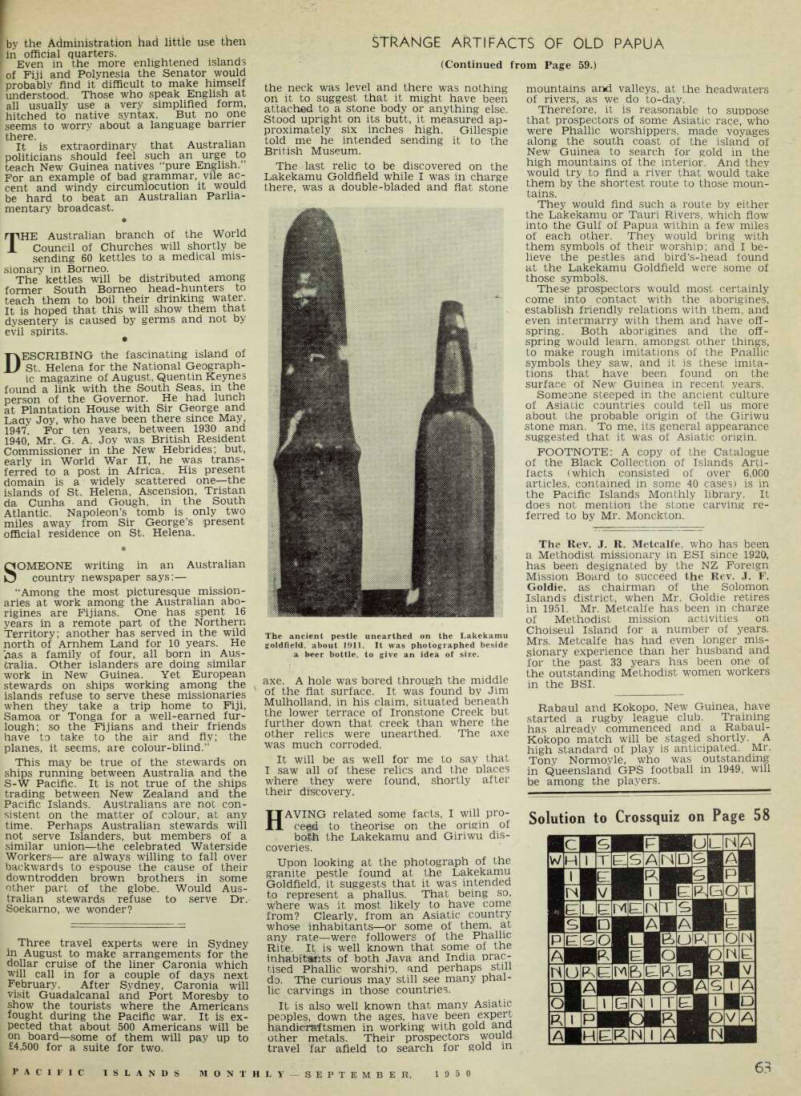
LITTLE realised by the public at large in Fiji, is the fact that the im pressive and brilliantly successful foundation stone ceremony at the site of the new Queen Victoria School at Matavatucou. Tailevu, and the linked commemoration at Lodoni on July 19 were saved from virtual disaster only by the self-sacrifice of the Governor, Sir Brian Freeston.
The previous day Sir Brian had opened the 1950 sitting of the Council of Chiefs and that night he developed symptoms of what was believed to be influenza but in reality was diphtheria.
It may be presumed that it was only the knowledge that, in Fijian eyes, the new Queen Victoria School was nothing less than visible British acknowledge ment of Fijian claims under British trusteeship, and that the occasion hac. been treated accordingly, with an immense amount of complicated organi sation, that carried the Governor through a day of travelling and ceremonial. From July 20 he was a hospital patient, and he resumed his post only on August 11.—S. * IT was almost like old times when on a recent Sunday natives started a free fight in Olry Square, Noumea. The police had to intervene, and arrested one quarrelsome native from Mare and one from Lifou. both of whom “had drink taken,” which seems fair enough.
One recalls a highly amusing incident during the war, when a couple of hun dred hardy scrappers from the Loyalties and a mainland tribe were hard at it with fists and stones, sooled on by their women folk, in the street out side the Noumea Post Office. When the Americans thought the fighting had gone on long enough, they sent an Army squad along to intervene; but both sides turned quickly and unani mously on the Yanks and chased them down the street. The Yanks took their defeat good-naturedly and the fighters returned to bashing each other,, but were eventually pacified by the efforts of a native Protestant pastor. They after
wards assembled in groups in Coconut Square, both sides claiming victory.
Before the war fighting between Mare and Lifou boys was a regular Sunday afternoon feature of Noumea life.
Though heads were sometimes broken, it was generally an innocent enough wav of letting off steam—HELP. ♦ ARTIST William Dobell, whose work in recent years has set the more conservative section of Australian art circles by the ears, has recently re turned to Australia from a painting expedition to New Guinea.
He says that he will not be entering any of his New Guinea work for this year’s Archibald and Wynne prizes. This is a pity, as there must be some affinity between Dobell and the New) Guinea primitive. It occurs to me that Dobell’s portrait of Joshua Smith, which won the Archibald prize a few years ago and started off the Dobell legend, had some thing in common with the carved wooden tambarans of the Sepik and other dis tricts. (In North America a tambaran would probably be called a totem-pole; in New Zealand, a tiki).
Dobell’s Joshua Smith was, to some, a great work of art. To others it was a vile caricature. A portrait in oils, we are told, should not be photographic but show the character of the subject as well as physical characteristics. Which leaves the non-arty wondering what there was in Joshua Smith’s character that had to be interpreted by long, pipe-stem arms, pixilated ears and the haunted look of a Belsen-survivor.
The elongated totem-pole effect of Joshua makes one feel that Dobell’s New Guinea work will be exceedingly interest ing.
While on his New Guinea journey Dobell called in at Angoram, on the Sepik, where he judged a competition among local craftsmen who had sub mitted “carved native masks and tradi tional statuettes” at the instigation of ADO Ralph Ormsby who is interested in reviving native arts and crafts.—JT.
THIS is a Brett Hilder drawing of Mr.
Victor John Shearwin, who has served in the Solomons for 24 years, first in the Customs and more recently, in the Treasury, and so is one of the few old hands in the Protectorate. Sceptics refer to him as “Ripley” Shearwin, owing to an implied “Believe-it-or-not” in his stories of the past. His wife, Corinne, shares with Victor John a love of long cigarette holders and of fine living. * MR. Basil Kirke, who has been Controller of Broadcasts for Papua-New Guinea, with head quarters in Port Moresby, has returned to the Australian Broadcasting Commis sion’s executive staff in Sydney.
He has done four years of pioneering for the ABC in Moresby and, because he is no mean carpenter has left behind him as a memorial (in spite of Moresby being something of a barren waste) a garden station. So attractive is it, with its staff homes set among flowers and shrubs, that (it is said), ABC staff due to return South have asked to be allowed to remain.
Mr. Kirke is the third member of the family to go pioneering in New Guinea.
Clem and Hunter Kirke are well-remem bered.
One of the chief activities of Moresby radio is broadcasting to the Papuans in Motu and to the New Guinea natives in Pidgin.
SENATOR O’Byrne, of Tasmania, who was one of the Australian Parlia mentarians who visited New Guinea during the Federal Parliament’s winter recess, is worried about Pidgin English, as taught in New Guinea. He said, upon reaching home, that he found only one native in his travels with whom he could converse. He thinks a language barrier is being set up.„ and that straight English should be taught.
It is a matter of opinion, of course, whether a New Guinea native can be regarded as fortunate, or unfortunate, because an Australian politician cannot make himself understood to him.
During his reign as External Terri tories Minister, Mr. Eddie Ward had the same sort of misgivings about Pidgin.
But in spite of him, Territory officials went ahead and put the final nail in the coffin of pure English. That is, they invented or adopted a written form of Pidgin which is now widely used in com munications between Officialdom and natives. There was, of course, written Pidgin before the war—used mostly by Missions and Mission natives. But the fixed, phonetic written form now used
(Continued next page.)
This group of Fijian boys won 3rd prize in an Amateur Hour radio programme in Sydney recently.
They work on a ship (Lakemba?) and the song they sang was Julu Jululu. No one could understand the words, but it was evidently a humorous number from the coughs and sneezes that punctuated it.
I by the Administration had little use then in official quarters.
Even in the more enlightened islands of Fiji and Polynesia the Senator would probably find it difficult to make himself understood. Those who speak English at all usually use a very simplified form, hitched to native syntax. But no one seems to worry about a language barrier there.
It is extraordinary that Australian politicians should feel such an urge to teach New Guinea natives “pure English.”
For an example of bad grammar, vile ac cent and windy circumlocution it would be hard to beat an Australian Parlia mentary broadcast. * THE Australian branch of the World Council of Churches will shortly be sending 60 kettles to a medical mis sionary in Borneo.
The kettles will be distributed among former South Borneo head-hunters to teach them to boil their drinking water It is hoped that this will show them that dysentery is caused by germs and not by evil spirits.
DESCRIBING the fascinating island of St. Helena for the National Geograph ic magazine of August, Quentin Keynes found a link with the South Seas, in the person of the Governor. He had lunch at Plantation House with Sir George and Lady Joy, who have been there since May, 1947 For ten years, between 1930 and 1940, Mr. G. A. Joy was British Resident Commissioner in the New Hebrides; but, early in World War 11, he was trans ferred to a post in Africa. His present domain is a widely scattered one—the islands of St. Helena, Ascension, Tristan da Cunha and Gough, in the South Atlantic. Napoleon’s tomb is only two miles away from Sir George’s present official residence on St. Helena. * SOMEONE writing in an Australian country newspaper says:— “Among the most picturesque mission aries at work among the Australian abo rigines are Fijians. One has spent 16 years in a remote part of the Northern Territory; another has served in the wild north of Arnhem Land for 10 years. He has a family of four, all born in Aus tralia. Other islanders are doing similar work in New Guinea. Yet European stewards on ships working among the islands refuse to serve these missionaries when they take a trip home to Fiji, Samoa or Tonga for a well-earned fur lough; so the Fijians and their friends have to take to the air and fly; the planes, it seems, are colour-blind.”
This may be true of the stewards on ships running between Australia and the S-W Pacific. It is not true of the ships trading between New Zealand and the Pacific Islands. Australians are not con sistent on the matter of colour, at any time. Perhaps Australian stewards will not serve Islanders, but members of a similar union—the celebrated Waterside Workers — are always willing to fall over backwards to espouse the cause of their downtrodden brown brothers in some other part of the globe. Would Aus tralian stewards refuse to serve Dr.
Soekarno, we wonder?
Three travel experts were in Sydney in August to make arrangements for the dollar cruise of the liner Caronia which will call in for a couple of days next February. After Sydney, Caronia will visit Guadalcanal and Port Moresby to show the tourists where the Americans fought during the Pacific war. It is ex pected that about 500 Americans will be on board—some of them will pay up to £4,500 for a suite for two.
Advertisements & other items, p. 65 (2 items)
Solution to Crossquiz on Page 58
Strange Artifacts Of Old Papua
(Continued from Page 59.)
fashion . . .
THE original of this model was in black velvet and lace.
But black velvet is not suitable north of Capri corn so a suggested alternative is black taffeta and lace. Bodice is cuffed and strapless.
The full skirt has a centre panel of lace.
The original was de signed for a “Shades of Black” collection in New York.
Advertisements & other items, pp. 66-68 (2 items)
Corner For The Children
Burns Philp (New Guinea) Limited
General Merchants (Wholesale and Retail)
Shipping, Customs and General Agents
Head Office: PORT MORESBY, PAPUA
BRANCHES:
NEW GUINEA: Rabaul, Kokopo, Lae Gr Madang.
PAPUA: Samarai.
REPRESENTATIVES FOR:
QUEENSLAND INSURANCE CO. LTD.
LLOYD S OF LONDON
BURNS PHILP TRUST CO. LTD,
AUSTRALIAN AGENTS
BURNS, PHILP Cr CO. LTD.
All States.
LONDON AGENTS:
SAN FRANCISCO AGENTS:
BURNS, PHILP Cr CO. LTD.
"London House", 35 Crutched Friars, E.C.3.
BURNS, PHILP CO. OF SAN FRANCISCO INC. 510 Matson Building.
Distributing Agents, Territory of Papua-New Guinea for:
SHELL COMPANY OF AUSTRALIA LIMITED
Petroleum Products
GENERAL MOTORS CORPORATION
Chevrolet, Buick, Pontiac and Oldsmobile Cars Chevrolet and GMC Trucks Frigidoire Refrigerators
VAUXHALL MOTORS LIMITED
Vauxhall Cars and Bedford Trucks
R. A. LISTER Cr CO., BRISTOL
Producers of Petrol, Paraffin and Diesel Engines Pumps and Lighting plants
RUSTON HORNSBY LIMITED
Engines
CROSSLEY MARINE ENGINES
,*¥** .. -from ° uf * (Xt trnai
PLUME
Basketware
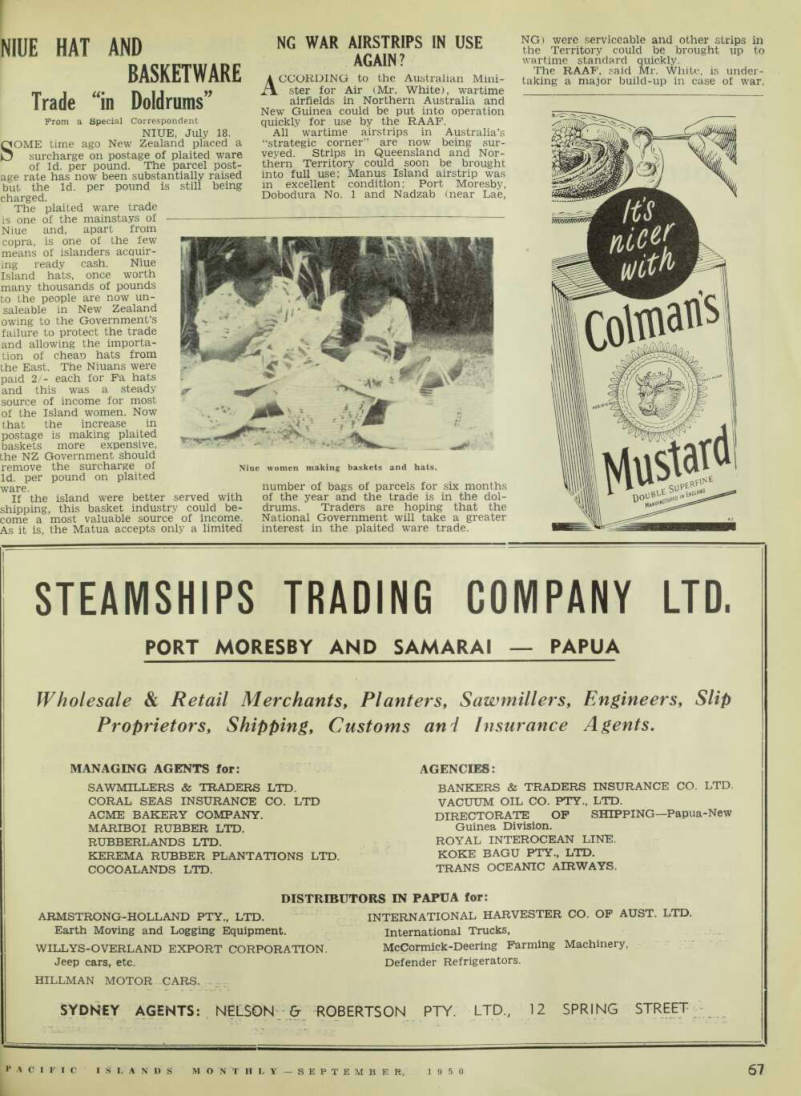
Niue Hat And
Trade “in Doldrums”
Prom a Special Correspondent NIUE, July 18.
SOME time ago New Zealand placed a surcharge on postage of plaited ware of Id. per pound. The parcel post age rate has now been substantially raised but the Id. per pound is still being charged.
The plaited ware trade
is one of the mainstays of Niue and, apart from copra, is one of the few means of islanders acquir ing ready cash. Niue Island hats, once worth many thousands of pounds to the people are now un saleable in New Zealand owing to the Government’s failure to protect the trade and allowing the importa tion of cheap hats from the East. The Niuans were paid 2/- each for Fa hats and this was a steady source of income for most of the Island women. Now that the increase in postage is making plaited baskets more expensive, the NZ Government should remove the surcharge of Id. per pound on plaited ware.
If the island were better served with shipping, this basket industry could be come a most valuable source of income.
As it is, the Matua accepts only a limited
number of bags of parcels for six months of the year and the trade is in the dol drums. Traders are hoping that the National Government will take a greater interest in the plaited ware trade.
Niue women making baskets and hats.
Again?
Ng War Airstrips In Use
ACCORDING to the Australian Mini ster for Air (Mr, White), wartime airfields in Northern Australia and New Guinea could be put into operation quickly for use by the RAAF.
All wartime airstrips in Australia’s “strategic corner” are now being sur veyed. Strips in Queensland and Nor thern Territory could soon be brought into full use; Manus Island airstrip was in excellent condition; Port Moresby, Dobodura No. 1 and Nadzab (near Lae,
NG) were serviceable and other strips in the Territory could be brought up to wartime standard quickly.
The RAAF, said Mr. White, is under taking a major build-up in case of war.
Advertisements & other items, p. 69 (1 item)
niC fh
a US
unci' 1 m
STEAMSHIPS TRADING COMPANY LTD.
PORT MORESBY AND SAM ARM PAPUA
Wholesale & Retail Merchants , Planters , Sawmillers, Engineers , Slip Proprietors 9 Shipping , Customs ani Insurance Agents.
MANAGING AGENTS for:
SAWMILLERS & TRADERS LTD.
CORAL SEAS INSURANCE CO. LTD
ACME BAKERY COMPANY.
MARIBOI RUBBER LTD.
RUBBERLANDS LTD.
KEREMA RUBBER PLANTATIONS LTD.
COCOALANDS LTD.
AGENCIES:
BANKERS & TRADERS INSURANCE CO. LTD
VACUUM OIL CO. PTY., LTD.
DIRECTORATE OP SHIPPING—Papua-New
Guinea Division.
ROYAL INTEROCEAN LINE.
KOKE BAGU PTY., LTD.
TRANS OCEANIC AIRWAYS.
DISTRIBUTORS IN PAPUA for:
ARMSTRONG-HOLLAND PTY., LTD.
Earth Moving and Logging Equipment.
WILLYS-OVERLAND EXPORT CORPORATION.
Jeep cars, etc.
HILLMAN MOTOR CARS. - ---
INTERNATIONAL HARVESTER CO. OF AUST. LTD.
International Trucks, McCormick-Deering Farming Machinery, Defender Refrigerators.
SYDNEY AGENTS: NELSON & ROBERTSON PTY. LTD., 12 SPRING STREET
Wharfies' Strike In Nz
Means Poverty
For Cook Islands Growers
ABOUT £6,000 worth of Cook Islands tomatoes were in danger of becom ing a dead loss in early August
when a wharf hold-up in Auckland, NZ, prevented their being unloaded.
Mr. W. H. Watson, European-elected member on the Cook Islands Legisla tive Council, said in Rarotonga that the islanders would be without money and would have to live on what they could grow for the next few months if the tomatoes could not be unloaded and sold.
SDA Saw-mill for Goroka
From a Special Correspondent
AN industrial section of the Seventh day Adventist Mission in the Cen tral Highlands of New Guinea (Kabiufa Mission Industries), a few weeks ago commenced operating the first saw-mill in that area.
The mill is near Goroka at an eleva tion of 7,000 feet, and is powered by a diesel engine. It is capable of produc ing from 1,200 to 1,500 super feet of tim ber per day. In early August, 2,000 super feet of sawn timber were flown by Douglas aircraft to Madang for use on residences being erected there by the Mission. This is believed to be the first Central Highlands timber sent to the coast. The Mission builder reports its quality to be good.
A planing machine is now being in stalled at the Goroka mill and it is ex pected that tongue-and-groove flooring and other dressed timbers will shortly be in production. However, because of the local requirements of the Mission and others, it will not be possible, for the time being, to send much of this tim ber out of the Goroka District.
Kabiufa Mission Industries have been established in order to facilitate the Mis sion’s industrial training scheme. High land natives will be given instruction in the manufacture of simple furniture, joinery, and other wood products. Its mill will provide timber for this purpose and also for the general building pro gramme of the Mission. Any profits made from the commercial side of the industry will be used in extending or improving the Mission’s activities in the Highlands.
Advertisements & other items, p. 70 (2 items)
Cordage and
Scott’s “Renown” Brand Rope,
Binder
Twine
of Every Description Cable Address Ropeyard, Sydney.
S a 8 p
MANUFACTURED AT
MASCOT, N.S.W.
J. SCOTT
PTY. LTD.
Head Office and Store
163 CLARENCE STREET,
SYDNEY,
N.S.W.
Etablissements Donald Tahiti
HEAD OFFICE—QUA! DU COMMERCE—PAPEETE
TELEGRAPHIC ADDRESS—“DONALD, PAPEETE”
General Merchants (Wholesale & Retail) & Shipowners
Importers & Exporters—Branches Throughout Marquesas Islands
A. B. DONALD, LTD.
ASSOCIATE AUCKLAND, NEW ZEALAND.
A. B. DONALD, LTD.
HOUSES: RAROTONGA, COOK ISLANDS.
DOMINION FRUIT CO..
SUVA, FIJI ISLANDS.
Lloyd’s Agents
Agents and Distributors for:
FRANCE:
HENNESSY COGNACS
MARIE BRIZARD & ROGER
LIQUEURS
CHARLES HEIDSIECK
CHAMPAGNES
PERRIER WATER
GRUBER BEER
U.S.A.:
GENERAL STEAMSHIP CORP.
RADIO CORP. OF AMERICA
BROWN & WILLIAMSON, LTD.
CIGARETTES: LUCKY STRIKE,
WINGS, OLD GOLD
CHAMPION SPARK PLUG CO.
RAINIER BEER
ENGLAND:
RECKITT & COLMAN
(OVERSEAS), LTD.
PHILLIPS BICYCLES
THE BANK LINE LTD.
NEW ZEALAND:
VACUUM OIL CO. PTY„ LTD.
PETROLEUM PRODUCTS
SWEDEN:
HJORTH & CO.
PRIMUS STOVES
Sydney Agents: London Agents:
BURNS, PHILP A CO., LTD. BURNS, PHILP * CO., LTD.
San Francisco Agents: Agents in France: BURNS, PHILP CO. OF HARTH A CIE, PARIS.
SAN FRANCISCO. A. BICKART, MARSEILLES.
Federation?
ON THE WAY TO A SOUTH PACIFIC
Some Speculation About Our Future Government
By R. W. Robson.
I SUGGEST that the time has come when we might begin seriously to consider a plan for a South Pacific Federation of English-speaking Islanders.
Twelve Territories of the West Indies, all under the Union Jack, are getting ready to form a West Indies Federation.
Why not a South Pacific Federation of nine Territories or Units?
Twenty years ago, when I first published the PIM, there was in the South Pacific an administrative con glomeration of an extraordinary charac ter. From west to east, we had the Aus tralian Territory of Papua; the Man dated Territory of New Guinea; the Mandated Territory of Nauru; the British Protectorate of the Solomons; the Condominium of the New Hebrides; the Crown Colonies of Fiji, and Gilbert and Ellice; the British Protectorate (more or less) of the Kingdom of Tonga; the Mandated Territory of Western Samoa; the New Zealand Territory of Cook Islands. In addition, there were the French Colonies of New Caledonia and Oceania; the Dutch Territory of Western New Guinea; and the United States Ter ritory of Eastern Samoa.
Except that the Solomons and the Gil bert and Ellice Colony were together under the High Commissioner for the Western Pacific, these Territories were— administratively—completely separate and independent. They did not even engage in consultations on matters of common interest, or exchange experience—a ridiculous set-up.
It was ridiculous because, as is ap parent to anyone who knows anything of tropical islands administration, and rea lises that the South Pacific islands lie between the equator and the Tropic of Capricorn, conditions of life in these Territories are similar. Eighty per cent, of the problems with which the respec tive Administrators are faced are com mon to all.
Since then, the Islands Administrations have gone some way along the road to wards co-operation in government and co-ordination of plans for native wel fare. Papua and New Guinea now have a joint administration. There is some exchange of ideas between the Austra lians, in the west, and the British and New Zealanders, in the centre. New Zealand, Fiji, Samoa and Tonga, have joint schemes covering health, educa tion, defence, air transport. There is co-operation between the French officials in New Caledonia, New Hebrides and Tahiti.
BUT there was no deliberate and of ficial effort to achieve overall con sultation, co-ordination and co operation until Australia and New Zea land got together in the Anzac Pact at the end of World War 11, and brought in to being the South Pacific Commission, now supported and maintained by Aus tralia, Britain, United States, France, New Zealand and Holland.
Expert men and women from the Com mission's Research Council are now at work on administrative problems in all the Territories of the South Pacific; and, m Fiji in April, there met the first South Pacific Conference. Under the direction of the Commission, the delegates from 15 Territories—mostly members of the in digenous races—met and discussed many conditions which affect them all, in com mon.
The gathering of these peoples under the one roof, for the first time in his tory, and their exchange of opinions and
experiences, were valuable. Unquestion ably, the foundation of a future struc ture of great importance was laid.
The formal discussions of the Confer ence were confined strictly to non-politi cal subjects. For the present, those sub jects gave the delegates all the scope they needed: they were concerned with the three fundamental needs of the Islanders —food, health and education.
BUT, before long—if there is no World War III —the Islanders will be given assurance of food supplies; their health and natural increase will be guarded by a better medical organisation than they have now; and they will sur
obstacle of a multiplicity of languages! a " “n"o their political wings, and go on to deal with such subjects as self-government, racial security, Asiatic immigration, the estab lishment and protection of industries; and then the present machinery, as rep resented by the South Pacific Commis-
Lion and the periodical Conferences be tween native delegates, will be wholly Inadequate. [ The greater the success the South Pacific Commission has with its plans, the sooner will we discern a movement from the Commission.
The natural tendency will be towards a nationalistic isolationism. But if the six nations behind the South Pacific Commission are wise and far-see ing, they may direct the movement to wards a Federation of small, self-govern ing States, which would maintain and protect a freely-given allegiance to Western Democracy.
PROBABLY, for reasons of sentiment, the non-British countries in the South Pacific Commission will not at first favour the idea of a Federation of the English-speaking Territories — which are, in their order of political im portance, Fiji, Papua-New Guinea, West ern Samoa, and Tonga—with Solomons, Nauru, New Hebrides, Gilbert and Ellice and Cook Islands, of no political im portance. They will point out that New Guinea, Western Samoa and Nauru are Trustee Territories, and New Hebrides is a Condominium; and that, with those four out, there are not enough purely British Territories left to form a Federa tion.
The point I would make—and empha sise—is that New Guinea, Western Samoa, Nauru and New Hebrides, under their present status, have little hone of being anything other than unimportant and undeveloped appendages of some re mote Power. But as Units in a Federa tion, protected by the British Common wealth, they could —and probably would —develop a real life of their own. The Condominium is a farce, and the Man date (or Trustee) system is merely the useless plaything of the mostly useless
Planners who live their happy lives at Geneva and Lake Success.
Non-British nations have possessions in the West Indies. But in the West Indies, as in the South Pacific, there are sufficient Territories with interests predominantly British to form a work able Federation, to enjoy a worth-while status, to give each Unit an independent life of its own.
THE destructive critic will offer a dozen practical objections against the idea of a South Pacific Federation. I myself can see many.
The first —and a very difficult one it is—is that, racially and culturally, there is a bigger gap between the Polynesians and the Melanesians than there is be tween Europeans and Polynesians. An other is the complexity of languages.
Another lies in the fact that the primi tive Melanesians outnumber the more cultured and adaptable Polynesians by 10 to one.
But the things which divide the indi genous races of the South Pacific are small and insignificant, compared with the considerations which unite them.
There is no suggestion of a national union. What is suggested is that a South Pacific Federation may now be regarded as a possibility of the not too distant future. We may contemplate a Federa tion of which each unit would have free dom to develop, as a national entity, within its own borders.
IT is helpful, at this stage, to glance at the “Federal Plan for the British Caribbean/’ as set out in the May issue of the journal, Corona. The plan has two fundamentals —the achievement of political independence within the British Commonwealth, and recognition of the fact that political independence can be secured only through economic stability and solvency. It is obvious that
much has to be accomplished in the latter regard in the South Pacific, through the Commission, before the South Pacific will be ready to consider political independ ence.
The Australian type of Federation is the one recommended —the system under which the units of a Federation surren der to the Federal authority certain clearly defined powers, and retain for themselves all the undefined powers. In the West Indies plan there is an “ex
elusive’’ list, containing all the matters on which the Federal body may legislate, and a “concurrent” list, whereon the Federal body and the Unit government may take joint action, but where the Federal law prevails in case of a clash.
The “exclusive” list is concerned mainlv with defence and external affairs, and also provides for the raising of external loans. The “concurrent” list deals with matters requiring some overall uniformity and central control, like the collection of import duties, the supervision of inter
islands transport, and the development of industries.
The Federal legislature proposed pro vides for a Senate of 23 members ap pointed by the Governor-General, and a House of Assembly of 50 members, elected on adult suffrage. It is con sidered that the nominated revisionary chamber is necessary to protect the small Units against the numerical superiority in the Assembly of the larger Units.
The proposed West Indies Assembly would include the following seats; —
Jamaica 16; Trinidad and Tobago, 9 British Guiana, 6; Barbados, 4; Montser of ’ v,, a . n £ British Honduras, Antigua St. Christopher-Nevis, Grenada, St Lucia, St. Vincent, Dominica, 2 each certain other small groups would be ad ministered by the British Governor- General, as dependencies of the Federa tion. The Governor-General would be as sisted by a Council of State of 14 mem bers.
AT present, Australia is deeply con cerned with the administration ol Papua-New Guinea and the Bis marck Islands, and would give very little thought to any plan to transfer ad ministrative responsibility elsewhere, Australia now is said to be examining the possibility of extending her responsibility into the British Solomons and New Hebrides.
But that is only because Australia, just now, is preoccupied with the problems of defence against Asia and Indonesia. She wants all the Islands, just named, under her control, so that if and when another defence crisis arises, those islands may provide her with a first-line barrier. She is not concerned with colonisation and development; all her thought and ef fort in those directions, for the next 50 years, can be absorbed within her own boundaries.
At present, all considerations affecting the Western way of life in the South Pacific are subverted to the danger in Asia, where the under-privileged half of the human race, directed and equipped by Moscow Communism, is threatening our very existence. Until the menace of Totalitarianism is removed, it seems a waste of time to think much about the present condition and future welfare of the peoples in the South Pacific, in cluding Australia and New Zealand.
(Continued on Page 73.)
I But, when the Muscovite conspiracy lagainst world peace has been smashed, land the world returns to normalcy—as it I will—Australia probably will be happy to I hand over her Melanesian responsibili ties to another body; and a plan for a iSouth Pacific Federation may become [practical and topical.
FRANCE, with New Caledonia and Oceania, and some responsibility for New Hebrides, would not be in terested in such a Federation. As in the West Indies, her Territories, while friendly and interested, would remain aloof. But Holland, because of the close association of her Territory with the rest of New Guinea and United States, owing to an ever closer association of Eastern Samoa with Western Samoa, might assist the Federation.
Leadership of such a Federation would go naturally—in the beginning, at any rate—to the Polynesian people of Tonga and Western Samoa, and to those re markable folk, the Fijians, who, although scientifically called Melanesians, are in culture, intelligence and general ability entitled to stand as equals beside the Polynesians.
I'think that, in planning and organis ing the South Pacific Conference, we unconsciously took the first definite step towards a South Pacific Federation.
Advertisements & other items, pp. 71-74 (1 item)
S UPA luvnif
THE PACIFIC ISLANDS SOCIETY
(Founded 1937) Visitors from the Pacific Islands to Sydney, or persons interested in Islands affairs, are invited to communicate with the Honorary Secretary of the above Society which was formed to constitute a social centre for those interested in the Pacific Islands.
Regular meetings and social gatherings, with lectures, are held at History House. 8 Young Street, Sydney, on the fourth Wednesday of each month, at 8 p.m.
Address for correspondence:—
THE PACIFIC ISLANDS SOCIETY,
Box 2434, G.P.0., Sydney.
L & o m
S UPA luvnif
GIVE FULL LIGHT AND AIR
WITH YEAR ROUND WEATHER PROTECTION
This ultra modern window comprises a series of glass blades swung one above the other and inclinable to any angle.
Air entering the room is diverted towards the ceiling thus preventing draughts. AGCO Supaluvres have all the advantages of other louvre windows plus exclusive features.
The specially designed rain guards cannot be fouled by the glass holders and provide flush finish so that fly screens, curtains or blinds can be attached. By an automatic locking device AGCO Supaluvres can be locked open in four positions, thus eliminating rattle and are also fitted with rack and pinion movement. All exposed surfaces are made of rust resisting zincanneal metal.
For Verandahs, Sun-rooms, Lounge-rooms, Kitchens and Laundries Illustrated leaflet, price list and installation instructions on request.
Sole Agents for South-west Pacific:
ROBERT GILLESPIE PTY. LTD.
54a PITT STREET, SYDNEY
The features of this unusua XVlth Century hey illustrate its owner’s connection with the sea>—a trader on the African coast, no doubts the hey obviously being that of his sea-chest. £3 Th
key
e k P* o s m o i n 9 e a s u r e
CAPSTAN
B 20-11-49
FINE CUT
NAVY CUT
TOBACCOS
Introducing
CRAWFORD’S
TROPIC BRED
Day-Old Chicks
Specialising in Islands deliveries by plane.
Australorps, £5/15/- per 100.
White Leghorns, £4/15/- per 100.
Cross Breds, £5 per 100. (Plus Air Freight) Free Rearing Instructions with each consignment.
For Honest Dealing Order From Tom Crawford’s Poultry
Breeding Farm & Hatchery,
Stratford, via Cairns, North Queensland.
Established 1933
you iUf
BOVRIL
5 7$
means rich meaty flavour
Try Bovril with all your soups and casserole dishes. It makes them wonderfully tasty and, in addition, makes them nourishing, too. For Bovril is the concentrated goodness of beef. Always keep Bovril in \he kitchen. Use it for tasty sandKviches, and drink it daily.
BOVRIL puts BEEF into you
Agents:
BURNS, PHILP
& CO., LTD.
BE.4w
WILLIAM A JONES PTV. LTD.
Livestock Exporters
Livestock Exported To All Ports Inquiries Invited Address:
108 QUEEN ST., MELBOURNE
Telegrams : “VALKYRIE,” Melbourne.
fane*
90 /MXS 0
r*4Pwa
.WHOLESALE SHIPMENTS
EXECUTED
A T
-_LOWEST PRICES
G. H. ROBINSON
EXPORTS & IMPORTS PTY. LTD.
51 Macquarie St., Sydney.
TELEGRAMS: "SUNRISE" SYDNEY
Pacific Islands Distributors for: BRADFORD COMMERCIAL VEHICLES, JOWETT JAVELIN CARS, and IIfrIPORN DIESEL ENGINES—aII available for immediate delivery. Inquiries invited.
Identification
Rabaul War Graves Identification History of “Garbled” Report
Letter to the Editor IN July PIM there appeared a report of a mass-grave discovered near Kokopo, and the positive identification of members of the Army and RAAF.
This report is not only erroneous but vicious. Too many relatives are Still awaiting news of the fate of these men, and in all fairness to them, such articles should be checked prior to publication.
How such reports originate can be seen from the following:— A crater made by the Army Bomb Dis posals Unit was photographed by a cer tain man and a garbled story was soon going from one end of Rabaul to the other: a “mass grave” had been un covered containing “bodies” wrapped in “mosquito nets.”
Investigations proved that the “mosquito nets” were marked veal, mutton, shoulder, etc. —the “grave” was an old meat dump and the “mosquito nets” were cheesecloth in which frozen meat had been wrapped.
The operations of the War Graves Com mission raised the question of the men of the AN&MEF (PIM, June). The graves of these men have been the subject of much investigation by a sub-committee specially created for the purpose by the Rabaul Sub-branch of the RSS&AILA.
The cemetery was devastated during the war and all graves records lost. However, all the bodies in the Rabaul cemetery have been disinterred and removed to the Im perial War Graves Cemetery at Bitapaka.
Two who were buried at Kokopo cemetery have been left there in consecrated ground and their graves are being maintained by the Imperial War Graves Commission.
This sub-committee works in the closest liaison with all War Graves authorities, RAAF War Graves, and Army War Graves and has been responsible for the finding of identified bodies.
M. Munro,
For War Graves Sub committee, RSL, Rabaul.
In July, a daughter was born to Mr. and Mrs. Gordon Kinsey at the Rabaul General Hospital.
Snorted The French
Medical Survey Of Pitcairn
Island
DR. T. A. Doran and Miss M. T.
O’Keefe (Medical Superintendent and Theatre Sister of Colonial War Memorial Hospital, Suva) have gone to Pitcairn Island to carry out a medical survey.
Dr. Doran and Miss O’Keefe left Suva by air for Tahiti and will travel from there to Pitcairn Island by the schooner Huia. They expect to be on the island for about a week, and will return by the same route.
Miss Peggy Lorking, of Hurlstone Park Sydney, will leave by air for Madang, New Guinea, in September where she will marry Mr. Alexander J. Ilobinson.
XT „. ,
"SE, /ml™* ““
Snorted The French
Il ? dl !f’
, ® not intended to renew this trade, The sugar was imported because Australia allows New Caledonia only 1,200 tons per annum, whereas consumption is 1,500 to 1,800 tons. It is likely that the Admini stration, at the request of the General Council and Chamber of Commerce, will ask Australia to increase its quota for 1950.
Advertisements & other items, pp. 75-76 (1 item)
bhosh’
CUT YOUR DENTIFRICE
BILLS IN HALF!
OHtf
HtW OH
\HCH
AH
bhosh’
VOOR
£ P r -A out o
EUtu^r
tout PS
LPSt*
-± 0? touts t>NO PPStt PS toottt
oo\u^ x
0
KOLYNOS DENTAL CREAM
TASTES BETTER CLEANS BETTER LASTS LONGER
Insist on. . .
“0* o KTE"
CANNED MEATS, HOTMEALS AND SOUPS
Available in 12 oz. and 1 lb. sealed cans in the following
appetising flavours and combinations:
Corned Beef Loaf With Cereal • Braised Steak and Onions • Boiled and Roast Beef • Beef Steak Pudding • Mutton and Peas • Steak and Onions • Chili Con Came • Curried Mutton • Curried Beef • Irish Stew • Mulligatawny Soup • Vegetable Soup • Mutton Broth • Tomato Soup • Camp Pie “ BRONTE” Brand high-grade products are made from the finest fat stock and the richest vegetables in Australia,
deliciously flavoured.
THE COLONIAL WHOLESALE MEAT CO.
PTY. LTD.
Canning Factory: State Abbatoirs, Homebush, Sydney,
N.S.W.
’PHONE: UM 8436 CABLE ADDRESS: “WOOLMILL,” SYDNEY.
I
Marching Rule Petering Out
In Solomons
From Our Own Correspondent
Suva, Aug. 14.
Marching rule, the post-war civil disobedience movement in Malaita, which has gravely hampered the recovery of the British Solomon Islands 'protectorate, is now swinging over to [willing and friendly co-operation with the Government, according to an inter view with the Resident Commissioner, BSIP (Mr. H. G. Gregory Smith).
The Resident Commissioner said that five native Solomon Islands representa tives are to be added to the three official and three nominated members of the Protectorate’s advisory Legislative Coun cil and that when the last vestiges of the dwindling civil disobedience campaign have disappeared four District Councils will be set up, each with a District Com missioner as president, a native vice president and a membership half elected and half nominated.
Of the nine imprisoned Marching Rule leaders at Honiara, Mr. Gregory Smith said that they had recently been released on licence and had been faithfully carrying out the promise they had given to use their influence to sway their adherents to co-operation with the Government.
Mr. Gregory Smith said that contrary to the sensational publicity it had re ceived overseas, Marching Rule had not shown disrespect to the British flag and had never submerged the war-proved loyalty of the Solomon Islanders, as a whole. He added that the movement, originally inspired by various American servicemen (presumably with Communist
leanings), had been maintained by a few thousands out of Malaita’s population of 43,000. In very few places outside Malaita had it ever threatened to gain a strong hold.
The principal feature of Marching Rule’s civil disobedience campaign was re fusal to pay taxes —a fact which has given anti-British propagandists, particularly in India, a chance to denounce the alleged “crushing oppression of British imperial ism.”
The Western Pacific High Commission has now released for publication the fol lowing facts: The range of taxation for adult male Solomon Islanders is from one shilling to £1 per annum. In most of Malaita the tax is 5/-, and in other areas it varies considerably. In the Western District the
range is from 5/- to £l, and in the Cen tral District it is from 1/- to 12/-. Al lowances are made for married men’s families.
As the total population of BSI is only about 10,000, the highest possible amount of revenue from taxes payable by the men is not very impressive.
Sacramental Wine Is
Permitted Now
APPARENTLY someone made the startling discovery recently that every Australian aboriginal and New Guinea native who has taken wine as part of a Church Sacrament has been guilty of an offence against Common wealth law.
Under the law it is illegal for any full blooded or half-caste native to accept or have liquor in his possession; or for any one to supply it to him.
A regulation was brought in, in early August, to rectify the position. A na tive may now be served with alcoholic liquor, when it is for the observance of a religious ceremony.
Advertisements & other items, p. 77 (1 item)
Desiccated Coconut f
Allen Taylor & Co. Ltd.
COMMERCIAL ROAD, ROZELLE
SYDNEY
Sawmillers and Wholesale Suppliers of Hardwoods for Constructional Purposes GIRDERS . . . PILES . . . POLES . . . SLEEPERS, Etc.
EXPORTING TO PACIFIC ISLANDS SINCE 1893
THE * IZOD*
COCONUT PARER
S 3
THE ‘CHULA’
COCONUT
DISINTEGRATOR
THE * CHOLA ‘
DESICCATED COCONUT
DRYER
5)
Desiccated Coconut f
O This Is the product which uses every particle of the coconut, without waste—the kernel becomes desiccated coconut, the parings are dried to recover their oil content, and even the husks and shell provide fuel for the drying fires.
The machines here illustrated have been specially designed to carry out the various processes in the making of desiccated coconut in such a way as to produce a product of the highest possible quality at the lowest possible cost per ton.
Further, as the ‘‘Chula’’ Dryer produces 1,500 lbs. of desiccated coconut per 10 hour day, it is not too big for the smaller plantation, while the owner of the large plantation will still find it an economical proposition to instal a battery of “Chula” dryers, with the necessary number of parers, disintegrators and sifters.
By using Tyneside Foundry machines, you can vary your outlay on machinery to match your crop production.
We also manufacture Rubber Machinery, Copra Dryers, and other plant for the tropical agriculturist.
TYNESIDE FOUNDRY & ENGINEERING CO. LTD.
ELSW I C K
NEWCASTLE
UPON TYNE
ENGLAND
Established 1898.
Telegrams & Cables t
"FOUNDRY.
NEWCASTLE-ON-TYNE "
Codes : ABC. sth i. 6th Edna
THE ‘CHULA*
DESICCATED COCONUT
SIFTER
Plane For Ng Lutherans
IN October the Lutheran Mission will take delivery of a four-seater Auster aircraft for use in New Guinea.
It will be based on Madang and will carry freight, missionary personnel, medi cal equipment and supplies to the Cen tral Highlands and other stations of the Lutheran, Baptist and other protestant
missions. The plane can carry 600 lb. of freight. It is expected that it will cut present flying costs by one-third and will open up new areas for mission work.
Mr. A. L. Baker, secretary of the Fiji Medical Department, who is at present in Australia on vacation leave, has been promoted to the post of Establishment Officer, Secretariat.
Ims Assembly Held At
Pago This Year
From Our Own Correspondent
IAPIA, July 20.
T is usual to hold the General As sembly of the Samoan Church of the LMS in Upolu, Western Samoa, but this year the Assembly was held in American Samoa from June 26-29 to cele brate the 50th anniversary of the estab lishment of the Atauloma Girls’ School.
A large number of people from Western Samoa made the journey to Tutuila to take part in the celebrations and the Fono.
The Jubilee Service was conducted by the chairman of the General Assembly, the Rev. P. Kightley, and among those taking part in the service were the Gov ernor of American Samoa; Miss E. E.
Maxfield, the Headmistress of the School- Miss. Ruth Watts of the Papuata Girls’
School; and Miss B. Johnson, newly-ap pointed to the Avoka Girls’ School.
The General Assembly conducted its usual business, but history was made for the Church by the appointment of four scholarship boys, two to go to America and two to New Zealand. It is hoped that all these young men will return to Samoa and help with the edu cational programme of the Church.
The Rev. J. H. Hoadley, BA, BD, was elected vice-chairman for 1951.
Mr. J. A. Crockett, well-known New Guinea resident, left Sydney by the Strathaird on August 18 for a visit to England, where he will see his parents and also receive special treatment for injuries suffered while a prisoner-of war in Japanese hands.
Advertisements & other items, p. 78 (1 item)
Akplioh
Telephone 136. Telegrams: “AKUN,” RABAUL.
ALOIS AKUN & COMPANY
RABAUL, TERRITORY OF NEW GUINEA
Also at 180 NATHAN ROAD, KOWLOON, HONG KONG.
Planters and General Merchants
(1) Embroidered Silkware.
Camphor-wood Boxes.
Fancy Goods. (2) The Best of Beers, in different Brands “San Miguel,” “Red Horse” and “Three Horse.” (3) Cotton Piece Goods suitable for trade and issues. (4) Trade goods of all descriptions: Wholesale and Retail.
WE CARRY STOCKS OF:—
Carved Eastern Prompt attention to all orders Sydney Representatives: NELSON & ROBERTSON PTY., LTD., Electra House, 12 Spring Street, Sydney, N.S.W.
ONE HORSEPOWER
PETROL ENGINES
ELECTRIC
LIGHTING PLANTS
Bring you brilliant electric light in your home, week-ender or plantation.
Low operating and initial costs. Treated for the tropics. * Press button starting. * * * 300 watts output. + M 12 and 32 volt models. + * Weight 70 lb. hole borers— < The Amplion makes the most of your petrol, runs longer on a tankful, 8 to 10 hours to the gallon. It’s light in weight too —40 lb.
Obviously the best proposition for driving: Pumps—Compressors —Post Lawn mowers—Saws—Shearing Machines— Crutching Machines—Spraying outfits—Concrete Mixers—Concrete Vibrators—Milking Machines.
★ 4 CYCLE AIR COOLED DESIGN
★ FULL FLOAT CARBURETTOR
★ EFFICIENT AIR CLEANER
T Special Islands
PRICE :
£6O/11/6 F. 0.8.
PRICE :
£36/0/6 F. 0.8.
DISTRIBUTORS THROUGHOUT
AUSTRALIA AND THE ISLANDS
aKPLIOh
(Australasia) Pty. Ltd. 36-40 Parramatta Road, Camperdown.
Telegrams: Amplion, Sydney Telephone: LA 2828 (6 lines)
Fiji’S Pineapple Cup
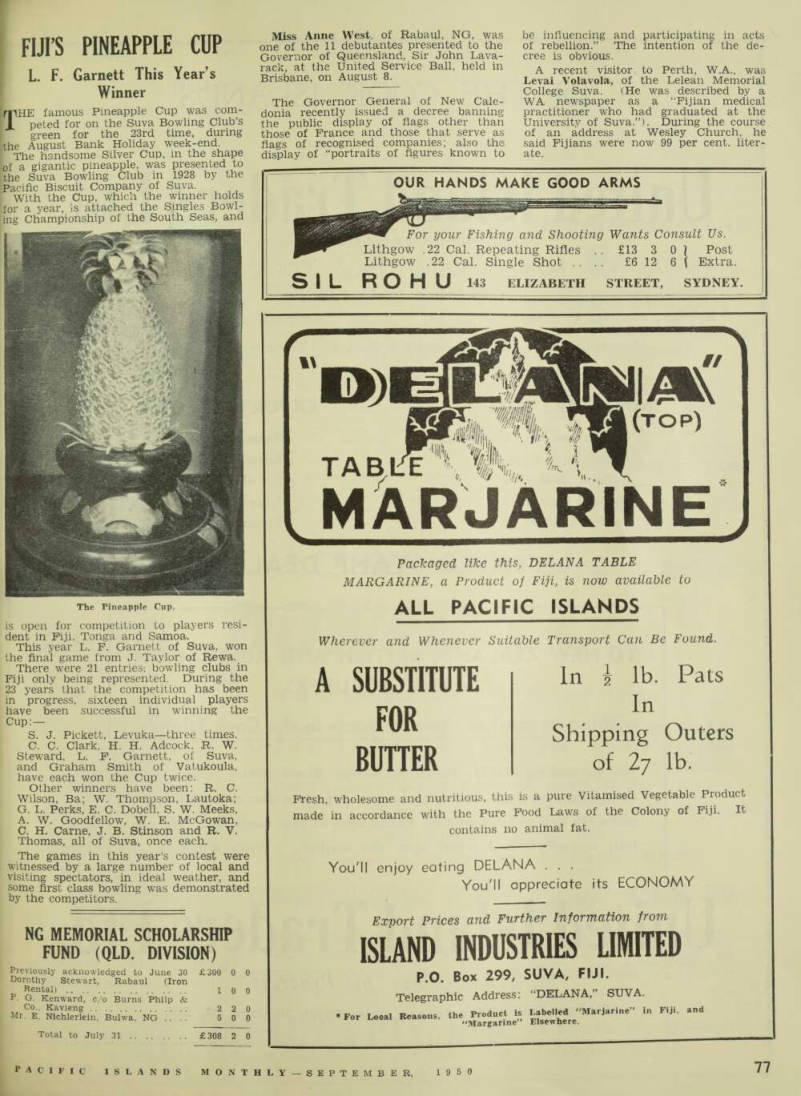
L. F. Garnett This Year’s Winner
11HE famous Pineapple Cup was com peted for on the Suva Bowling Club’s ' green for the 23rd time, during the August Bank Holiday week-end ! The handsome Silver Cup. in the shape of a gigantic pineapple, was presented to the Suva Bowling Club in 1928 by the ipacific Biscuit Company of Suva.
With the Cup, which the winner holds for a year, is attached the Singles Bowl ing Championship of the South Seas, and
is open for competition to players resi dent in Fiji, Tonga and Samoa.
This year L. F. Garnett of Suva, won the final game from J. Taylor of Rewa.
There were 21 entries-, bowling clubs in Fiji only being represented. During the 23 years that the competition has been in progress, sixteen individual players have been successful in winning the Cup:— S. J. Pickett, Levuka—three times.
C. C. Clark, H. H. Adcock. ,R. W.
Steward, L. F. Garnett, of Suva, and Graham Smith of Vatukoula, have each won the Cup twice.
Other winners have been: R. C.
Wilson, Ba; W. Thompson, Lautoka; G. L. Perks, E. C. Dobell, S. W. Meeks, A. W. Goodfellow, W. E. McGowan, C. H. Came, J. B. Stinson and R. V.
Thomas, all of Suva, once each.
The games in this year’s contest were witnessed by a large number of local and visiting spectators, in ideal weather, and some first class bowling was demonstrated by the competitors.
The Pineapple Cup.
Fund (Qld. Division)
Ng Memorial Scholarship
Miss Anne West, of Rabaul, NG, was one of the 11 debutantes presented to the Governor of Queensland, Sir John Lavarack, at the United Service Ball, held in Brisbane, on August 8.
The Governor General of New Caledonia recently issued a decree banning the public display of flags other than those of France and those that serve as flags of recognised companies; also the display of “portraits of figures known to
be influencing and participating in acts of rebellion.” The intention of the de cree is obvious.
A recent visitor to Perth, W.A., was Levai Volavola, of the Lelean Memorial College Suva. (He was described by a WA newspaper as a “Fijian medical practitioner who had graduated at the University of Suva.”). During the course of an address at Wesley Church, he said Fijians were now 99 per cent, liter ate.
Previously acknowledged to June 30 £300 0 0 Dorothy Stewart, Rabaul (Iron Rental) 10 0 F. G. Kenward, c/o Burns Philp & Co.. Kavieng 2 2 0 Mr. E. Nichlerlein, Bulwa, NG ... 500 Total to July 31 £308 2 0
Advertisements & other items, pp. 79-80 (1 item)
Marjarine
OUR HANDS MAKE GOOD ARMS
For your Fishing and Shooting Wants Consult Us.
Lithgow .22 Cal. Repeating Rifles .. £l3 3 0 ] Post Lithgow .22 Cal. Single Shot .. .. £6 12 6 ( Extra.
SI L RO H U
143 ELIZABETH STREET,
SYDNEY.
m % // m\m.
(TOP)
, m 'WJIflu,. < 5
TABIfE
MARJARINE
■■■l Packaged like this, DELANA TABLE MARGARINE, a Product of Fiji, is now available to
ALL PACIFIC ISLANDS
Wherever and Whenever Suitable Transport Can Be Found.
A SUBSTITUTE
FOR
BUTTER
In i lb. Pats
In
Shipping Outers
of 2y lb.
Fresh, wholesome and nutritious, this is a pure Vitamised Vegetable Product made in accordance with the Pure Pood Laws of the Colony of Fiji. It contains no animal fat.
You'll enjoy eating DELANA . . .
You'll appreciate its ECONOMY Export Prices and Further Information fiom
ISLAND INDUSTRIES LIMITED
P.O. Box 299, SUVA, FIJI.
Telegraphic Address: “DELANA, SUVA. •For Local Beacons, the Product Is Labelled “Marianne” In Fiji, and “Margarine” Elsewhere.
IN THE COOK ISLANDS
United Island Traders Ltd.
(Established 1930).
P.O. BOX 42, RAROTONGA, COOK ISLANDS
Cable Address: “Watson,” Rarotonga.
Managing Director-. W. H. WATSON. Secretary. R. J. A. INGRAM, A.R.A., Z.
Agents in London; Geo. H. Penney Cr Co. Ltd., 197 Aldersgote St., E.C.I.
IMPORTERS OF:-
Cotton and Silk Piece Goods Apparel and Drapery Building Materials Musical Instruments Trade Jewellery
EXPORTERS OF:-
Tomatoes Cassava Sea-shells Island Handicrafts Broad-last Footwear
LICENSED STAMP DEALERS
TO NEW ZEALAND, BRITISH AND AUSTRALIAN
MANUFACTURERS
wishing to market their products in the Cook Islands.
We are seeking Manufacturers' Agencies. Direct service means lower cost, increased sales, quick turnover. We have the organisation to make the best of your article. Please send us your quotation. We will fully investigate and report upon the market. Write direct to:—
United Island Traders Ltd.
“The House of ”
Bankers: Bank of New Zealand, Queen Street, Auckland, C. 1., N.Z.
Catamaran for T
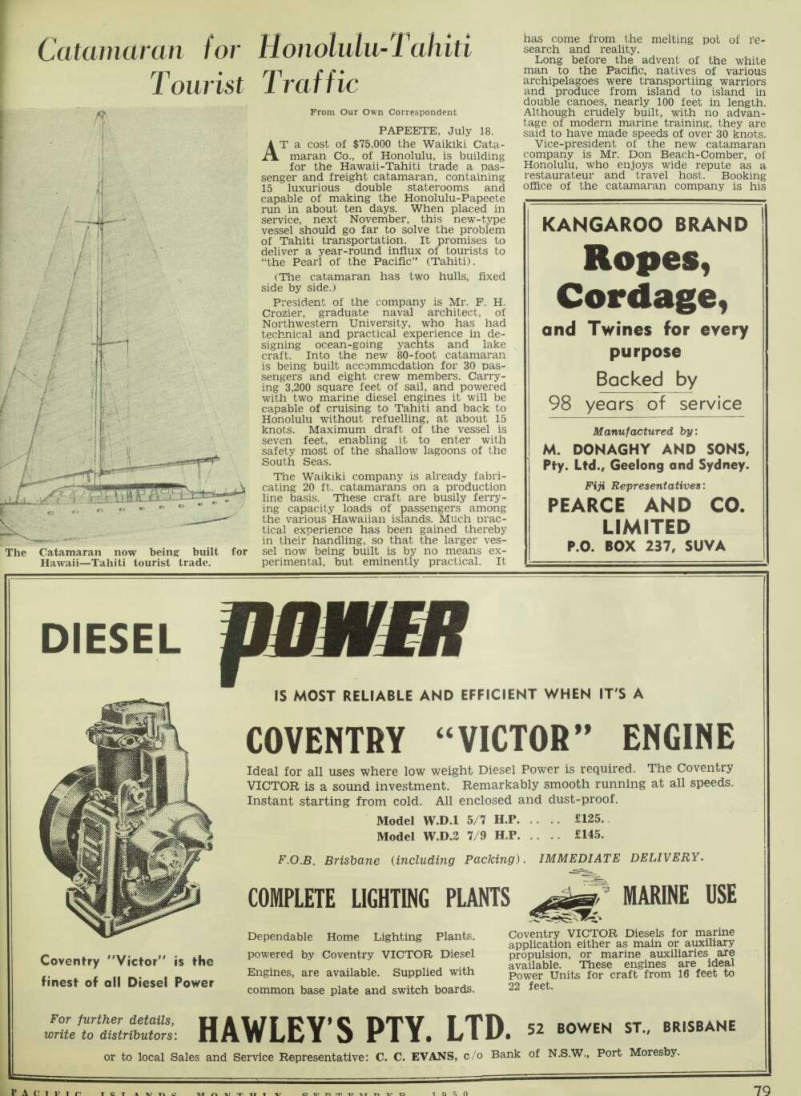
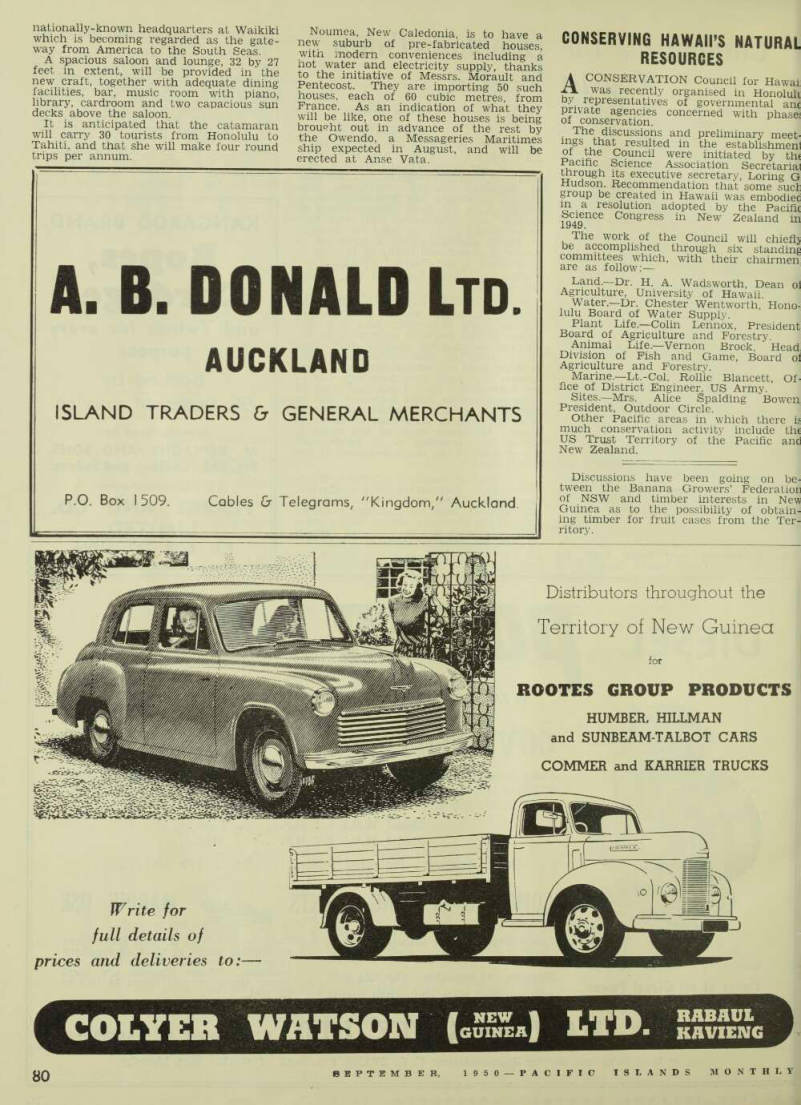
Tourist Traffic
From Our Own Correspondent
Papeete, July 18.
AT a cost of $75,000 the Waikiki Cata maran Co., of Honolulu, is building for the Hawaii-Tahiti trade a pas senger and freight catamaran, containing 15 luxurious double staterooms and capable of making the Honolulu-Papeete run in about ten days. When placed in service, next November, this new-type vessel should go far to solve the problem of Tahiti transportation. It promises to deliver a year-round influx of tourists to “the Pearl of the Pacific” (Tahiti). (The catamaran has two hulls, fixed side by side.) President of the company is Mr. F. H.
Crozier, graduate naval architect, of Northwestern University, who has had technical and practical experience in de signing ocean-going yachts and lake craft. Into the new 80-foot catamaran is being built accommodation for 30 pas sengers and eight crew members. Carry ing 3,200 square feet of sail, and powered with two marine diesel engines it will be capable of cruising to Tahiti and back to Honolulu without refuelling, at about 15 knots. Maximum draft of the vessel is seven feet, enabling it to enter with safety most of the shallow lagoons of the South Seas.
The Waikiki company is already fabri cating 20 ft. catamarans on a production line basis. These craft are busily ferry ing capacity loads of passengers among the various Hawaiian islands. Much prac tical experience has been gained thereby in their handling, so that the larger ves sel now being built is by no means ex perimental, but eminently practical. It
has come from the melting pot of re search and reality.
Long before the advent of the white man to the Pacific, natives of various archipelagoes were transportiing warriors and produce from island to island in double canoes, nearly 100 feet in length.
Although crudely built, with no advan tage of modern marine training, they are said to have made speeds of over 30 knots.
Vice-president of the new catamaran company is Mr. Don Beach-Comber, of Honolulu, who enjoys wide repute as a restaurateur and travel host. Booking office of the catamaran company is his
The Catamaran now being built for Hawaii —Tahiti tourist trade.
nationally-known headquarters at Waikiki
which is becoming regarded as the gate way from America to the South Seas.
A spacious saloon and lounge, 32 by 27 feet in extent, will be provided in the new craft, together with adequate dining facilities, bar, music room with piano, library, cardroom and two capacious sun decks above the saloon.
It is anticipated that the catamaran will carry 30 tourists from Honolulu to Tahiti, and that she will make four round trips per annum.
Noumea, New Caledonia, is to have a new' suburb of pre-fabricated houses, with modern conveniences including a hot water and electricity supply, thanks to the initiative of Messrs. Morault and Pentecost. They are importing 50 such houses, each of 60 cubic metres, from France. As an indication of what they will be like, one of these houses is being brought out in advance of the rest by the Owendo, a Messageries Maritimes ship expected in August, and will be erected at Anse Vata.
Advertisements & other items, pp. 81-82 (2 items)
79
P A C I K I r T C T a vr r» a TVT n at tut v o p n t n ii n tt td 1 Q R fl
pawn
KANGAROO BRAND
Ropes,
Cordage,
and Twines for every purpose Backed by 98 years of service Manufactured by:
M. DONAGHY AND SONS,
Pty. Ltd., Geelong and Sydney.
Fiji Representatives :
PEARCE AND CO.
LIMITED
P.O. BOX 237, SUVA
DIESEL
pawn
m Coventry Victor' is the finest of all Diesel Power IS MOST RELIABLE AND EFFICIENT WHEN irs A
COVENTRY “VICTOR” ENGINE
Ideal for all uses where low weight Diesel Power is required. The Coventry VICTOR is a sound investment. Remarkably smooth running at all speeds.
Instant starting from cold. All enclosed and dust-proof.
Model W.D.I 5/7 H.P £125.
Model W.D.2 7/9 H.P £145.
IMMEDIATE DELIVERY.
F. 0.8. Brisbane (including Packing ).
COMPLETE LIGHTING PLANTS
MARINE USE
Dependable Home Lighting Plants, powered by Coventry VICTOR Diesel Engines, are available. Supplied with common base plate and switch boards.
Coventry VICTOR Diesels for marine application either as main or auxiliary propulsion, or marine auxiliaries are available. These engines are ideal Power Units for craft from 16 feet to 22 feet.
For further details, write to distributors : HAWLEY’S PTY. LTD. 52 BOWEN st., BRISBANE or to local Sales and Service Representative: C. C. EVANS, c/o Bank of N.S.W., Port Moresby.
A. B. DONALD Ltd.
AUCKLAND
ISLAND TRADERS & GENERAL MERCHANTS
P-O. Box 1509. Cables £r Telegrams, "Kingdom," Auckland
Rfl -s— -re& Distributors throughout the Territory of New Guinea for
ROOTES GROUP PRODUCTS
HUMBER, HILLMAN
and SUNBEAM-TALBOT CARS
COMMER and KARRIER TRUCKS
Write for full details of prices and deliveries to: —
OWt\
COLYER WATSON {guhiea) LTD.
RABAUL
KAVIENG
Conserving Hawaii’S Natural
Resources
A CONSERVATION Council for Hawaf was recently organised in Honoluli oy representatives of governmental anc private agencies concerned with phases of conservation. • The diseussions and preliminary meet mgs that resuited in the establishment of the Council were initiated by the Pacific Science Association Secretariat through its executive secretary, Loring G Hudson. Recommendation that some such group be created in Hawaii was embodied m a resolution adopted by the Pacific Science Congress in New Zealand in 1949.
The work of the Council will chiefly be accomplished through six standing committees which, with their chairmen, are as follow: Land.—Dr. H. A. Wadsworth, Dean ot Agriculture, University of Hawaii.
Water. —Dr. Chester Wentworth, Hono lulu Board of Water Supply.
Plant Life. —Colin Lennox, President Board of Agriculture and Forestry.
Animal Life. —Vernon Brock, Head, Division of Fish and Game, Board of Agriculture and Forestry.
Marine.—Lt.-Col. Rollie Blancett, Of fice of District US Army.
Sites. —Mrs. Alice Spalding Bowen, President, Outdoor Circle.
Other Pacific areas in which there is much conservation activity include the US Trust Territory of the Pacific and New Zealand.
Discussions have been going on be tween the Banana Growers’ Federation of NSW and timber interests in New Guinea as to the possibility of obtain ing timber for fruit cases from the Ter ritory.
One-Teach -One, the Laubach System

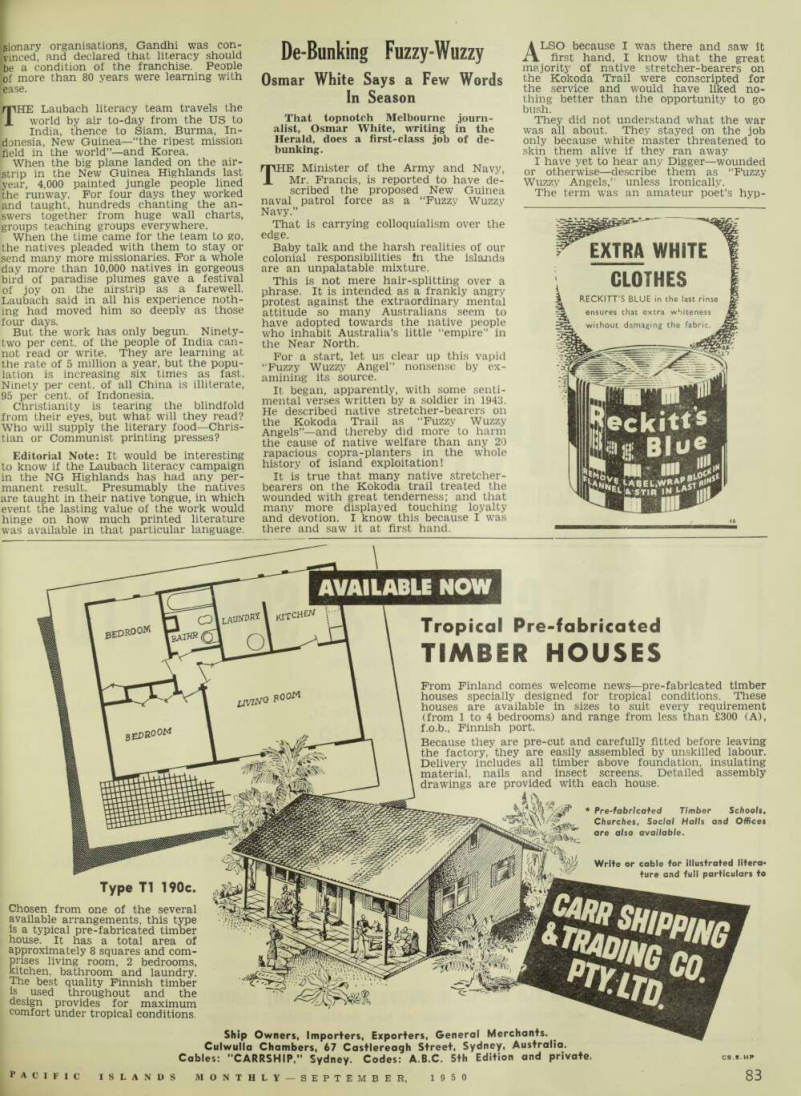
To Overcome Illiteracy
By the Rev. Ralph Sutton, in Newcastle Herald
rrwo small dark men strode hurriedly X up the hill to the missionary’s cot tage.
They insisted that they must learn to [read. They had only one hour and wanted to learn all they could.
I The missionary had been all the morn ing in the hot sun teaching in the market place, his chart on a tree, the excited crowd following each lesson and cheering every pupil as he learnt the letters on the chart. He was tired and hungry. But the two visitors insisted. They could not come any other time owing to work. The missionary relented. He decided to con centrate on the elder of the two and let the other fellow be taught later by his friend.
An hour later that man went joyfully out having learnt to read, having read all the lessons and several pages of the mis sionary’s little newspaper and everything else he put before him.
“This is magic,” he said. “This is magic,” and the magic for him lay not in the brevity of the time taken, but in the new wonder of reading.
Away in Africa, years afterwards, a mis sionary was teaching a man by the side of the road. A labourer stopped out of curiosity and said, in another tongue: “This is magic, let me learn, too!”
In Indonesia, a weary missionary saw native men and women learning in 15 minutes what it had taken months to teach children in school, what they had almost despaired of adults ever learning.
In an hour she saw them reading all that was put before them and, with tears in her eyes, said; “This is a miracle, this is a gift from Heaven.”
These experiences had been repeated thousands of times in many lands. A new wonder was in the world.
IT all began when Dr. Frank Laubach, a young Congregational missionary from the United States, went to the Philippines as a missionary in 1915. He desired to work among the ferocious Moros of the island of Mindanao, but was for bidden for 15 years. These were the most troublesome people under the American flag; a permanent garrison was main tained to quell their rebellions: it was here that General Pershing first made his name. They hated anything Christian 9 r “Western,” and were bitterly pre judiced Mohammedans.
When Laubach at last went to live among them in 1930, he found the work frustrating in the extreme. But by sym pathy and understanding he gradually won their confidence and a deputation of chiefs requested him to become their re ligious leader—“ For you have told us more beautiful things from our own sacred books than we know ourselves.”
That opened the door to service and to the Christian message. Slowly and patiently Laubach developed an alpha bet, each letter having one oronunciation.
By experiment he developed a rapid method of teaching. He found three key words such as “mother,” “hand,” “work,” known well to everyone and which, bet ween them, contained all the consonants in the language. They also contained several vowels and he soon taught the others. When the pupil learnt these three key words he knew almost all the alpha bet. The shorter syllables themselves made other words also. His first lesson could be mastered in from 10 to 15 min utes. That gave immediate confidence
and lifted the illiterate out of his in feriority.
SOON Laubach was running a “lightning literacy” campaign throughout the Philippines, backed by Press and Government. He devised lesson charts in more than 20 languages, and met with the same success everywhere. A servant girl learnt to read in 15 minutes. She taught another before an audience of more than 30, tears of joy running down their cheeks.
One of the island’s villains was so grate ful that he came to Laubach and said; “You taught me to read. You are my best friend. I want to do something for
you. Tell me, is there anyone around here you’d like put out of the way?”
The missionary assured him that he would get great joy if the grateful man merely taught someone else to read. “One teach-one” is the motto of the Laubach literacy movement.
Dr. Laubach went to India, only to be rebuffed by Gandhi, who did not think literacy was important. The Governments were sceptical or indifferent. His claims sounded too good to be true. After a year of working through the churches’ mis
fcionary organisations, Gandhi was con vinced, and declared that literacy should be a condition of the franchise. People of more than 80 years were learning with
lease.
THE Laubach literacy team travels the world by air to-day from the US to India, thence to Siam, Burma, In donesia, New Guinea—“the ripest mission field in the world”—and Korea.
When the big plane landed on the air strip in the New Guinea Highlands last year, 4,000 painted jungle people lined the runway. For four days they worked and taught, hundreds chanting the an swers together from huge wall charts, groups teaching groups everywhere.
When the time came for the team to go, the natives pleaded with them to stay or send many more missionaries. For a whole day more than 10,000 natives in gorgeous bird of paradise plumes gave a festival of joy on the airstrip as a farewell.
Laubach said in all his experience noth ing had moved him so deeply as those four days.
But the work has only begun. Ninety two per cent, of the people of India can not read or write. They are learning at the rate of 5 million a year, but the popu lation is increasing six times as fast.
Ninety per cent, of all China is illiterate, 95 per cent, of Indonesia.
Christianity is tearing the blindfold from their eyes, but what will they read?
Who will supply the literary food—Chris tian or Communist printing presses?
Editorial Note: It would be interesting to know if the Laubach literacy campaign in the NG Highlands has had any per manent result. Presumably the natives are taught in their native tongue, in which event the lasting value of the work would hinge on how much printed literature was available in that particular language.
Advertisements & other items, pp. 83-84 (1 item)
Art Postcards Of
TONGA
Per Dozen (Including a Tin-Can Mail Cover), Postage Paid: 6/- (or one US Dollar).
TONGAN PHOTOS BUREAU
Nukualofa, Tonga
©iiu m jssr gt A s J 7/' (jun? i \ The Shell Company of Australia Ltd. (Inc. in Gt. Britain;
GSOIH
There is only one
ELECTROLUX
THE MODERN KEROSENE-OPERATED REFRIGERATOR
THAT ACHIEVES THE MIRACLE OF ICE FROM HEAT
Lasting Efficiency, Silent Operation, Streamlined Beauty
i Economically operated by kerosene, with a simple precision-built freezing unit that has no moving parts and is GUARANTEED FOR
FIVE (5) YEARS.
Only obtainable from :
NEW GUINEA COMPANY, LIMITED,
Rabaul, Madang, Lae, Kavieng.
J. R. CLAY & CO., LTD., Port Moresby.
W. R. CARPENTER & CO. (Sol. Is.), LTD., Tulagi.
THE NORFOLK ISLAND SERVICE DEPOT,
Norfolk Island.
SOCIETE HEBRIDA, Port Vila.
SOCIETE CALEDONIENNE D’IMPORTATION ET
D’EXPORTATION, Noumea.
For Gilbert and Ellice Islands Colony, etc., apply
W. R. CARPENTER & CO., LTD.
Model LKSSI
PRICES ON APPLICATION.
Storage capacity: 5i cub. ft. (approx.); shelf area, 10 sq. ft. food shelves, six—five removable; 2 self-supporting when half drawn. Ice-making: Four trays—s lb. ice per freezing: 80 cubes. Fuel consumption: 1.8 pints kerosene per day (approx.).
Height: 4 ft. 10 in. Depth; 2 ft. 3i in.
Weight, unpacked, 406 lb. Packed, 574 lb. direct to: Head Office: 16 O'Connell St., Sydney, N. S. Wales
De-Bunking Fuzzy-Wuzzy
Osmar White Says a Few Words In Season
That topnotch Melbourne journ alist, Osmar White, writing in the Herald, does a first-class job of de bunking.
THE Minister of the Army and Navy, Mr. Francis, is reported to have de scribed the proposed New Guinea naval patrol force as a “Fuzzy Wuzzy Navy.”
That is carrying colloquialism over the edge.
Baby talk and the harsh realities of our colonial responsibilities fn the islands are an unpalatable mixture.
This is not mere hair-splitting over a phrase. It is intended as a frankly angry protest against the extraordinary mental attitude so many Australians seem to have adopted towards the native people who inhabit Australia’s little “empire” in the Near North.
For a start, let us clear up this vapid “Fuzzy Wuzzy Angel” nonsense by ex amining its source.
It began, apparently, with some senti mental verses written by a soldier in 1943.
He described native stretcher-bearers on the Kokoda Trail as “Fuzzy Wuzzy Angels”—and thereby did more to harm the cause of native welfare than any 20 rapacious copra-planters in the whole history of island exploitation!
It is true that many native stretcher bearers on the Kokoda trail treated the wounded with great tenderness; and that many more displayed touching loyalty and devotion. I know this because I was there and saw it at first hand.
ALSO because I was there and saw it first hand, I know that the great majority of native stretcher-bearers on the Kokoda Trail were conscripted for the service and would have liked no thing better than the opportunity to go bush.
They did not understand what the war was all about. They stayed on the job only because white master threatened to skin them alive if they ran away I have yet to hear any Digger—wounded or otherwise —describe them as “Fuzzy Wuzzy Angels,’’ unless ironically.
The term was an amateur poet’s hyp
erbole. But for some inexplicable rea son it made a tremendous hit, passed in to the vernacular and has clouded our appreciation of New Guinea’s problems ever since.
The Fuzzy Wuzzy Angel complex was responsible for stifling much of the de vastating criticism that could justly have been levelled at Ex-Minister Eddie Ward’s New Guinea policy.
It prompted the idiotic waste of public money occasioned by the Labor Govern
ment’s war damage compensation for mula which came within an ace of wrecking the entire structure of native village economy in the war zones.
Is it now to be carried on so that we can comfortably imagine ourselves pro tected by jolly Fuzzy Wuzzy Jack Tarsies sailing over the boundless main in search of wicked infiltrating Malay pirates?
The situation in New Guinea is far too serious for grown-up people to in dulge in nursery nonsense.
Advertisements & other items, pp. 85-86 (1 item)
saihrQl q\^/
EXTRA WHITE
CLOTHES
©ckitt* •« Bln*
AVAILABLE NOW
1 I KITCHEN
saihrQl q\^/
PEDRO OM
boom
UVIN°
ggpaooM
Type T 1 190 c.
Tropical Pre-fabricated
TIMBER HOUSES
From Finland comes welcome news—pre-fabricated timber houses specially designed for tropical conditions. These houses are available in sizes to suit every requirement (from 1 to 4 bedrooms) and range from less than £3OO (A), f.0.b., Finnish port.
Because they are pre-cut and carefully fitted before leaving the factory, they are easily assembled by unskilled labour.
Delivery includes all timber above foundation, insulating material, nails and insect screens. Detailed assembly drawings are provided with each house.
Pre-fabricated Timber Schools, Churches, Social Halls and Offices are also available.
Write or cable for illustrated literature and full particulars to w Chosen from one of the several available arrangements, this type is a typical pre-fabricated timber house. It has a total area of approximately 8 squares and comprises living room, 2 bedrooms, kitchen, bathroom and laundry.
The best quality Finnish timber is used throughout and the design provides for maximum comfort under tropical conditions.
Ship Owners, Importers, Exporters, General Merchants.
Culwulla Chambers, 67 Castlereagh Street, Sydney, Australia.
Cables: ~C ARRSHIP., , Sydney. Codes: A.B.C. sth Edition and private
Iss^St
currosiom
Plastacoat 33 gives a protective coating which will resist steam, moisture, salt spray, acid fumes, oil, acid, weak alkalis, fresh and salt water, high temperatures, and the corrosive effects of damp earth.
It offers an effective protection for brick, stone, concrete, metals, wood, canvas, etc., and its protection will continue for a very long time.
Plastacoat 33 is a liquid, in standard white and a wide range of colours, and can be applied by brushing, spraying, or dipping.
Composed oi inert synthetic materials and pigments, dissolved in fast drying solvents, it contains no paint, oils or varnish.
For complete surface protection, use;—PLASTACOAT 33 Keying Coat, PLASTACOAT 33 Undercoat, PLASTACOAT 33 Finishing- Coat. ± EVERY Industry can use Plastacoat 33 for immunity against corrosion. Fullest information sent on request by the Manufacturers: —
W. J. MANUFACTURING CO. PTY. LTD.
Mosman, Sydney, Australia.
33 li&tct
W. H. GROVE & SONS LTD.
Established 1896.
Telegraphic and Cable ISLAND MERCHANTS P.O. Box 490, Address: “Grove,” Auckland. 16-18 Fanshawe St Auckland, New Zealand.
AUCKLAND
Entrust your requirements to the firm with more than fifty years' practical experience in the Island trade.
REPRESENTING ENGLISH MANUFACTURERS
THROUGHOUT THE FIJI, SAMOAN AND TONGAN ISLANDS, NEW HEBRIDES, NEW CALEDONIA, THE SOLOMON ISLANDS, THE SOCIETY ISLANDS, THE COOK ISLANDS,
NIUE, ETC.
SHIPPERS OF ALL CLASSES OF NEW ZEALAND MANUFACTURES AND PRODUCTS SPECIALLY PREPARED FOR THE ISLAND TRADE WE HANDLE ALL KINDS OF ISLAND PRODUCE.
IN FIJI as: W. H. GROVE & SONS (FIJI) LIMITED.
Office and Sample Room: Bank of New South Wales Chambers, Suva, Fiji.
The News
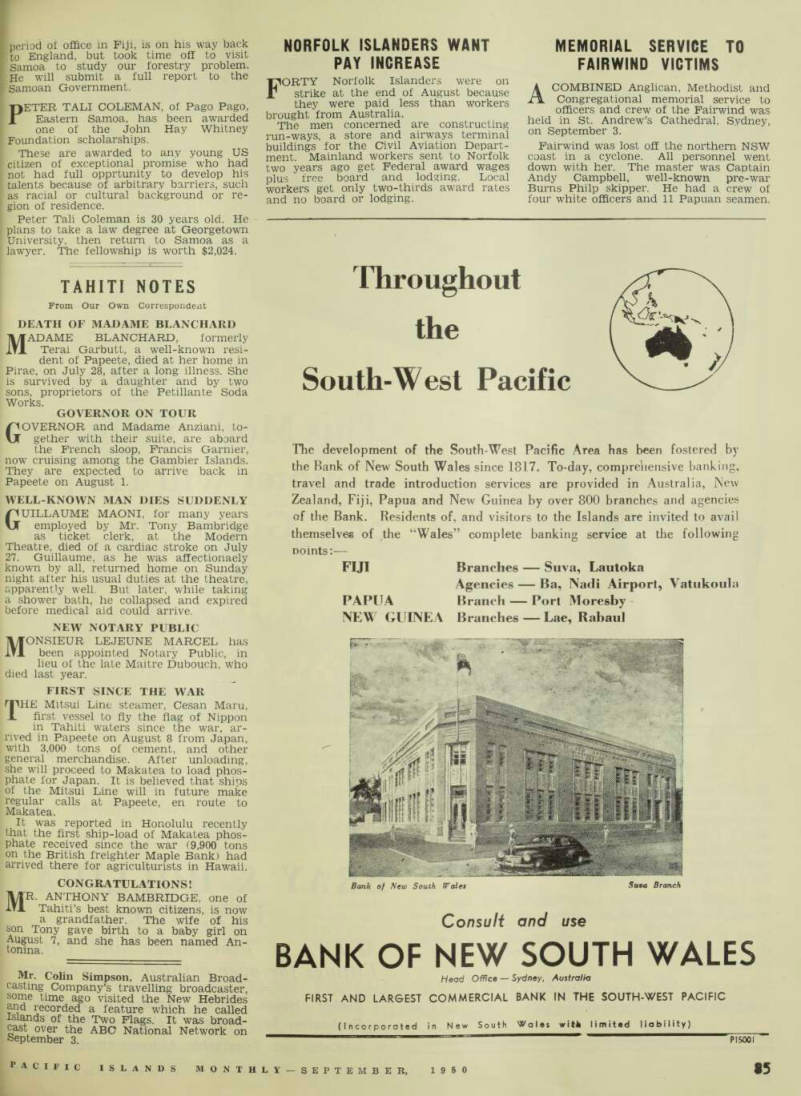
W. Samoan Notes On
From Our Own Correspondent Ttttti , . APIA, August 23.
HE oldest building in Apia, the wooder business premises next to the Cour House and Central Office, is now mg demolished. The building was erectec m 1886 and was then occupied by the firn of McArthur. It has changed hands man} times and for a long time was owned h the late Mr. T. Andrew. Recently i had been occupied as a store by Messrs E. A. Coxen & Co.
The lumber, mostly redwood and blu< gum, is in an excellent state of preserva tion and is being used again by th( present owners.
Most of the new business premises or the Apia waterfront are built in concrete but many of the older stores on Anu beach are wooden buildings.
An interesting lecture on forestry wa given at the Vailima residence of th( High Commissioner, Mr. G. R. Powles on August 21, by forestry expert, Mr Colin Marshall, until recently in chargi of the Forestry Department' of the Fij Government. An audience of 100 invitee guests heard the lecture which was sup ported by numerous slides showing th< damages caused by soil erosion in Fiji a: a result of the burning of bush and thi washing away of soil by rains and floods The lecturer stressed the importance o forestry for Samoa, where at present then is little evidence of soil erosion. He als< pointed out the need for an organiser forestry service in Samoa in order to oh tain supplies of lumber for building pur poses and for banana cases which an imported at present in large quantitie: but which could easily be grown in Samoa Mr. Marshall, after terminating hi;
period of office in Fiji, is on his way back to England, but took time off to visit Samoa to study our forestry problem.
He will submit a full report to the Samoan Government.
PETER TALI COLEMAN, of Pago Pago, Eastern Samoa, has been awarded one of the John Hay Whitney Foundation scholarships.
These are awarded to any young US citizen of exceptional promise who had not had full opprtunity to develop his talents because of arbitrary barriers, such as racial or cultural background or re gion of residence.
Peter Tali Coleman is 30 years old. He plans to take a law degree at Georgetown University, then return to Samoa as a lawyer. The fellowship is worth $2,024.
Advertisements & other items, p. 86 (1 item)
84
SEPTEMBER, 1950 PACIFIC ISLANDS MONTHLV
Tahiti Notes
From Our Own Correspondenit
Death Of Madame Blanchard
MADAME BLANCHARD, formerly Terai Garbutt, a well-known resi dent of Papeete, died at her home in Pirae, on July 28, after a long illness. She is survived by a daughter and by two sons, proprietors of the Petillante Soda Works.
Governor On Tour
GOVERNOR and Madame Anziani, to gether with their suite, are aboard the French sloop, Francis Gamier, now cruising among the Gambier Islands.
They are expected to arrive back in Papeete on August 1.
Well-Known Man Dies Suddenly
GUILLAUME MAONI, for many years employed by Mr. Tony Bambridge as ticket clerk, at the Modern Theatre, died of a cardiac stroke on July 27. Guillaume, as he was affectionaely known by all, returned home on Sunday night after his usual duties at the theatre, apparently well. But later, while taking a shower bath, he collapsed and expired before medical aid could arrive.
New Notary Public
Monsieur lejeune marcel has been appointed Notary Public, in lieu of the late Maitre Dubouch, who died last year.
First Since The War
THE Mitsui Line steamer, Cesan Maru, first vessel to fly the flag of Nippon in Tahiti waters since the war, ar rived in Papeete on August 8 from Japan, with 3,000 tons of cement, and other general merchandise. After unloading, she will proceed to Makatea to load phos phate for Japan. It is believed that ships of the Mitsui Line will in future make regular calls at Papeete, en route to Makatea.
It was reported in Honolulu recently that the first ship-load of Makatea phos phate received since the war (9,900 tons on the British freighter Maple Bank) had arrived there for agriculturists in Hawaii.
Congratulations!
Mr. Anthony Bambridge, One Of
Tahiti’s best known citizens, is now a grandfather. The wife of his son Tony gave birth to a baby girl on August 7, and she has been named An tonina.
Mr. Colin Simpson, Australian Broad casting Company’s travelling broadcaster, some time ago visited the New Hebrides and recorded a feature which he called islands of the Two Flags. It was broad cast over the ABC National Network on September 3.
Norfolk Islanders Want
Pay Increase
FORTY Norfolk Islanders were on strike at the end of August because they were paid less than workers brought from Australia.
The men concerned are constructing run-ways, a store and airways terminal buildings for the Civil Aviation Depart ment. Mainland workers sent to Norfolk two years ago get Federal award wages plus free board and lodging. Local workers get only two-thirds award rates and no board or lodging.
Memorial Service To

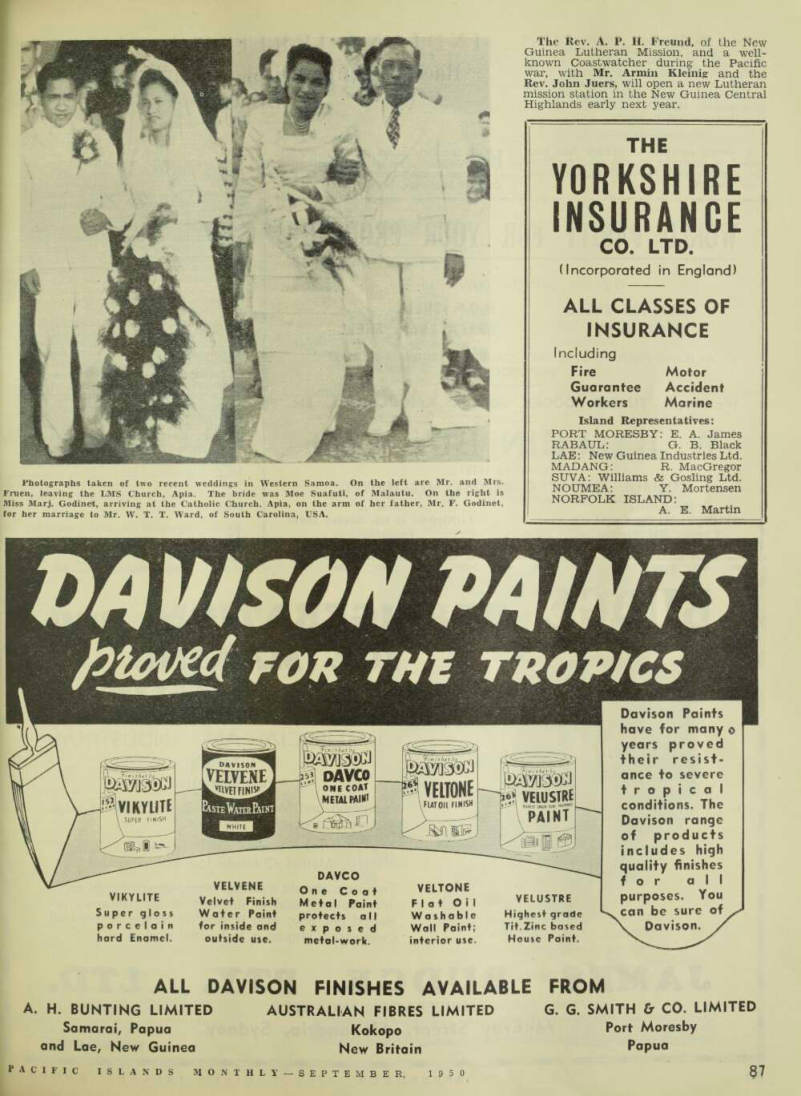
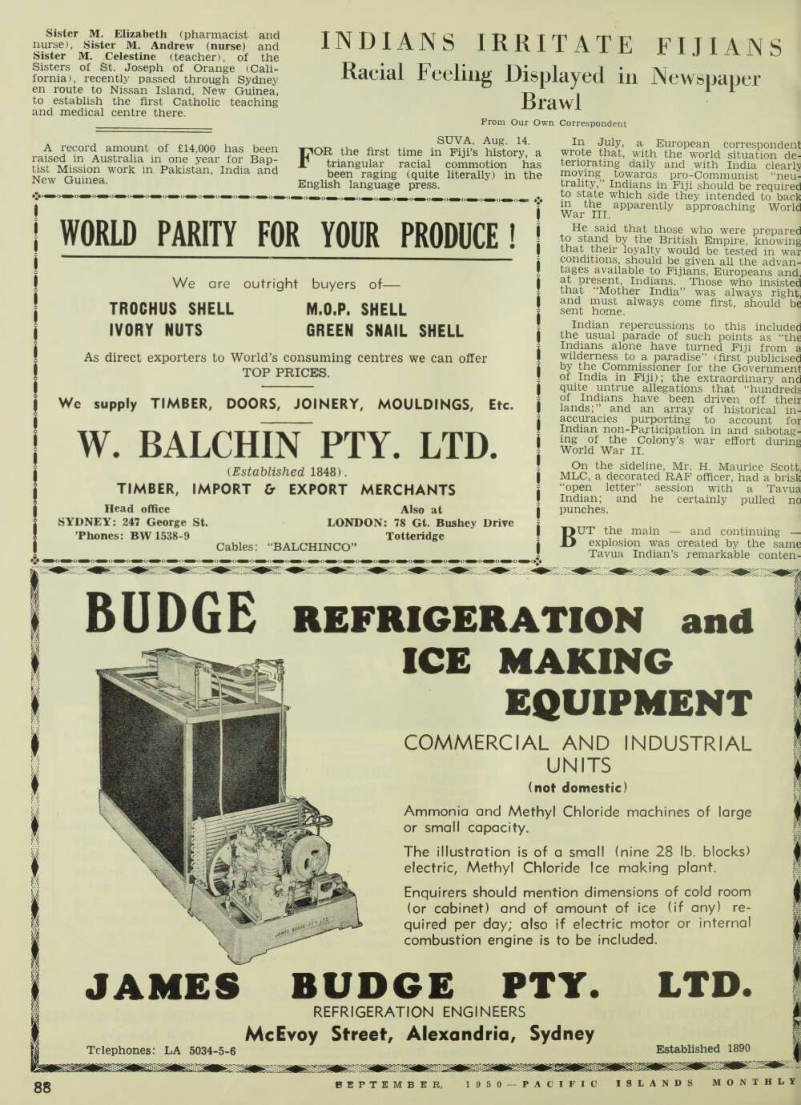
Fairwind Victims
A COMBINED Anglican, Methodist and Congregational memorial service to officers and crew of the Fairwind was held in St. Andrew’s Cathedral, Sydney, on September 3.
Fairwind was lost off the northern NSW coast in a cyclone. All personnel went down with her. The master was Captain Andy Campbell, well-known pre-war Burns Philp skipper. He had a crew of four white officers and 11 Papuan seamen.
The Rev. A. P. 11. Freund, of the New Guinea Lutheran Mission, and a well known Coastwatcher during the Pacific war, with Mr. Armin Kleinig and the Rev. John Juers, will open a new Lutheran mission station in the New Guinea Central Highlands early next year.
Photographs taken of two recent weddings in Western Samoa. On the left are Mr. and Mrs.
Fruen, leaving the LMS Church, Apia. The bride was Moe Suafuti, of Malautu. On the right is Miss Marj. Godinet, arriving at the Catholic Church, Apia, on the arm of her father, Mr. F. Godinet, for her marriage to Mr. W. T. T. Ward, of South Carolina, USA.
Sister M. Elizabeth (pharmacist and nurse), Sister M. Andrew (nurse) and Sister M. Celestine (teacher), of the Sisters of St. Joseph of Orange (Cali fornia), recently passed through Sydney en route to Nissan Island, New Guinea, to establish the first Catholic teaching and medical centre there.
A record amount of £14,000 has been raised in Australia in one year for Bap tist Mission work in Pakistan, India and New Guinea.
Advertisements & other items, pp. 87-90 (1 item)
Throughout
the
South-West Pacific
Os * / The development of the South-West Pacific Area has been fostered by the Bank of New South Wales since 1817. To-day, comprehensive banking, travel and trade introduction services are provided in Australia, New Zealand, Fiji, Papua and New Guinea by over 800 branches and agencies of the Bank. Residents of, and visitors to the Islands are invited to avail themselves of the “Wales” complete banking service at the following noints:— FIJI Branches Suva, Lautoka Agencies Ba, Nadi Airport, Valukoula PAPUA Branch Port Moresby NEW GUINEA Branches Lae, Rahaul v"
ill \h
Bank of New South JFalet Suva Branch
Consult and use
BANK OF NEW SOUTH WALES
Head Office Sydney, Australia FIRST AND LARGEST COMMERCIAL BANK IN THE SOUTH-WEST PACIFIC (Incorporated in New South Wales with limited liability) Pl5OOl
Wmk ■■ajp 1 is® m s# HH ■Hi rnce at worxs (b ft. Length) £4O/10/- Extra for 10-inch additional shelf and brackets (if required) : £2 Packing and Transport to Wharf : £lO/10/- (For cases shipped in quantities, packing is at greatly reduced rates).
The display case is securely packed in two substantial crates occupying shipping space of 32 cubic feet. Total weight, when packed, 5 cwt. 4 ft. Length: £27 8 ft. Length: £52 Another view of the “Brahol”
Export Counter case, showing width of counter space.
BRIEF SPECIFICATIONS
To help you get an accurate picture of the “Brahol”
Special Export Glass Counter Case, here are the main specifications: Overall size is 6 feet long x 1 ft. 9 in. deep x 3 ft. 3 in. high. Made from first-class, wellseasoned Queensland Maple, hand french polished, wax finished, in natural maple colour. Glass parts are i inch British plate glass.
The inside is lacquered ivory colour, and the recessed base is lacquered burgundy.
There is a pair of solid core sliding doors, and one glass shelf, 14 inches wide, on adjustable nickelplated brackets.
Storage space below is 11 inches high.
The plate glass front is 22 inches high.
This Modern Display
Counter will Help to
Sell Goods in
Store!
{and it's specially built for Export)
As smart as those in leading Australian city stores, and built by a firm that has been making fine store and office fittings for over a third of a century.
Moreover, it is specially built for export, so that it can be readily securely packed, and assembled by anyone, from simple directions, in an hour, with no tools other than a screwdriver. Retailers all over the world have learned the selling value of modern display equipment, and this "silent salesman" will soon pay for itself in increased sales.
BRAY & HOLLIDAY
PTY. LTD.
Makers of Fine Store and Office
Fittings for over a third of a century Brahol House, 66-74 McLachlan Avenue, Rushcutter Bay, Sydney. Telephone: FA 4121 Cable and Telegraphic Address: “Brahol.”
THE
YORKSHIRE
INSURANCE
CO. LTD.
(Incorporated in England)
ALL CLASSES OF
INSURANCE
Including Fire Motor Guarantee Accident Workers Marine Island Representatives:
PORT MORESBY: E. A. James
RABAUL: G. B. Black LAE: New Guinea Industries Ltd.
MADANG: R. MacGregor SUVA: Williams & Gosling Ltd.
NOUMEA: Y. Mortensen
NORFOLK ISLAND:
A. E. Martin
L t<rt,Sh'S Uu
•>-\VI M
DAVISON
VELVENE
FINISH
g OAVCO
ONI COAT
METAI PAINT
a VEITONt
VIKYUTI
FIAT oil FINISH
Esste Water Paint
WHITE
to
Wmm
I VELUSTRE
PAINT
VIKYLITE
Super gloss porcelain hard Enamel.
VELVENE
Velvet Finish Water Point for inside and outside use.
DAVCO
One Coat Metal Paint protects all exposed metal-work.
VELTONE
Flat Oil Washable Wall Paint: interior use.
VELUSTRE
Highest grade Tit. Zinc based House Paint.
Davison Paints have for many
years proved
their resistance to severe
tropical
conditions. The Davison range
of products
includes high
quality finishes
for a I purposes. You can be sure of Davison,
ALL DAVISON FINISHES AVAILABLE
A. H. BUNTING LIMITED AUSTRALIAN FIBRES LIMITED
Samaroi, Papua Kokopo
and Lae, New Guinea New Britain
FROM
G. G. SMITH & CO. LIMITED
Port Moresby
Papua
WORLD PARITY FOR YOUR PRODUCE!
We are outright buyers of—
TROCHUS SHELL M.O.P. SHELL
IVORY NUTS GREEN SNAIL SHELL
As direct exporters to World’s consuming centres we can offer
TOP PRICES.
We supply TIMBER, DOORS, JOINERY, MOULDINGS, Etc.
W. BALCHIN PTY. LTD.
(Established 1848).
TIMBER, IMPORT Cr EXPORT MERCHANTS
Head office Also at SYDNEY: 247 George St. LONDON; 78 Gt. Bushey Drive ’Phones: BW 1538-9 Totteridge Cables: “BALCHINCO”
BUDGE
REFRIGERATION and
ICE MAKING
EQUIPMENT
COMMERCIAL AND INDUSTRIAL
UNITS
(not domestic) Ammonia and Methyl Chloride machines of large or small capacity.
The illustration is of a small (nine 28 lb. blocks) electric, Methyl Chloride Ice making plant.
Enquirers should mention dimensions of cold room (or cabinet) and of amount of ice (if any) required per day; also if electric motor or internal combustion engine is to be included.
JAMES BUDGE PTY.
REFRIGERATION ENGINEERS
McEvoy Street, Alexandria, Sydney
Telephones: LA 5034-5-6
LTD.
Established 1890
Racial Feeling Displayed in Newspaper

Indians Irritate Fijians
Racial Feeling Displayed in Newspaper Brawl
From Our Own Correspondent
Suva, Aug. 14.
FOR the first time in Fiji’s history, a triangular racial commotion has been raging (quite literally) in the English language press.
a European correspondent wrote that, with the world situation de teriorating daily and with India clearly moving towards pro-Communist “neu trality,” Indians in Fiji should be required to state which side they intended to back in the apparently approaching World War 111.
He said that those who were prepared to stand by the British Empire, knowing that their loyalty would be tested in war conditions, should be given all the advan tages available to Fijians, Europeans and, at present, Indians. Those who insisted that “Mother India” was always right, and must always come first, should be sent home.
Indian repercussions to this included the usual parade of such points as “the Indians alone have turned Fiji from a wilderness to a paradise” (first publicised by the Commissioner for the Government of India in Fiji); the extraordinary and quite untrue allegations that “hundreds of Indians have been driven off their lands;” and an array of historical in accuracies purporting to account for Indian non-Participation in and sabotag ing of the Colony’s war effort during World War 11.
On the sideline, Mr. H. Maurice Scott, MLC, a decorated RAF officer, had a brisk “open letter” session with a Tavua Indian; and he certainly pulled no punches.
BUT the main and continuing explosion was created by the same Tavua Indian’s remarkable conten
ition that “the Indians must stay in Fiji to protect their Fijian friends and see [that they do not get pushed about like [the natives of New Guinea.” i The full effects of this absurdity have [not yet been felt. It is still spreading out from Suva to the remoter Fijian villages 'and islands. What can be said now is that nothing in the post-war years has stirred such bitter, angry resentment among all sections of the Fijian popula tion.
In 1948, the reiterated Indian “claim” in the Legislative Council to co-trusteeship with the British over the Fijians was dismissed by the Fijians with contemp tuous amusement—and a Fijian leader’s comment: “Effrontery!” ! This time, the word “protection” has gone very deep, and the concentrated bitterness of a disdainful Fijian repu diation, published in the Fijian Times, has no precedent.
THE paper itself, refereeing the brawl with strict impartiality, was dragged in when Indians alleged that Fijian correspondence had been “inspired” if not actually fabricated by Europeans.
With an excusably wrathful note, the Fiji Times stated that the Fijian com batants had complied with all the re quirements of published correspondence, that the Fijian comment had been delivered personally, and that the paper itself, bv publishing the Fijian view in good faith, had automatically guaranteed authenticity. Dismissing the Indian sneers as “despicable slander,” the Fiji Times added that any signed accusations of editorial untruth or of fabricated cor respondence would be published on receipt and “dealt with in a suitable way.”
The newspaper published a Fijian con tribution which stated that any ideas along the “Little India of the Pacific” line, and any Indian attempt to displace full British authority in Fiji (presumably by way of manoeuvres to rearrange the Colony’s constitution, another of which was recently launched behind the scenes! would be rejected and resisted by the Fijians as a whole.
EARLIER, a Fijian had written: “We have not forgotten the slogan of India in 1942—‘India for the Indians: English-quit !’.”—and had added that if the Fijians ever said “Fiji for the Fijians; Indians —quit!” it would be because the Indians had “asked for it.”
This time, the unqualified version was tersely given with the statement that the Indians, in Fiji as in Africa, were causing endless trouble and were now making it clear that their sympathies, by way of the Republic of India, would go increasingly towards aggressive Asiatic Communism.
In reply to an Indian’s published query; “What about the English?” this Fijian replied: “The Fijians' sole allegiance is to the British Crown. We have never re gretted the ceding of these islands by our chiefs to the rule of British justice. The English language and the English way nave become part of our own way of life.
Why should we tell our friends to ‘quit’?”
There is little doubt that Asiatic propagandists will renresent the present showdown—which goes far beyond the wordy war in the press— as a ganging up of British imperialists and their Fijian satellites. The plain truth, however, is merely that the lid has been taken off by Indian inability or refusal to give the feelings of others the same tender care as snl politically-conscious Indians invariably demand for their own.
Aithough there has been no rush of recruits for Korea in Australia, recruit m8 ’ .^ as apparently brisk in the P-NG lerntory. in one day, in Port Moresby there were 40 volunteers, all but two oi them ex-servicemen.
A library of GOO books in 10 portable bookcases, assembled by the Australian Red Cross Libraries, recently loft, Sydney for hospitals in New Guinea. Wewak hospital will be the first to receive the books, then Rabaul, Samarai, Lae and then smaller centres where hospitals have been established.
The Fiji Director of Medical Services, Dr. J. M. Cruickshank, the Director of Education, Mr. H. Hayden, and thr Senior Agricultural Officer, Mr. B. E. V.
Parham, associate members of the Re search Council of the South Pacific Com mission, attended a meeting of the Coun cil in Sydney at the end of August.
Advertisements & other items, pp. 91-92 (2 items)
Flit
LONDON-SUVA
S£^
VIA
> PANAMA V
For Sailings and Further Particulars Apply To: BETHELL, GWYN & CO., BURNS PHILP (SOUTH SEA) 138 LEADENHALL ST., co * LTD >
LONDON, E.C.3. SUVA.
THE WORLD'S GREATEST
SELLING INSECTICIDE
id ncwSPwujoL them
m
FLIT
SPEEDILY KILLS
FLIES,
AND OTHER A
INSECT PESTS
In addition to D.D.T., Flit also contains Pyrethrum and Thanite, making it the most effective insecticide available to Australian housewives.
When ordering, ask for FLIT, and look for the Soldier on the package.
VACUUM OIL COMPANY Pty. Ltd.
THE MOST EFFECTIVE INSECTICIDE YOU CAN BUY
Corrugated Aluminium
Building Sheets
iiiiiiiimiiHiiim
r ■ ■ ■ ■
For speed of erection
Corrugated Aluminium Building Sheets have many advantages over other roofing and siding materials. The lightness of the metal enables easier handling, with a considerable saving in transportation and erection costs.
It is highly resistant to corrosion, and reflects a high percentage of all radiant heat.
Painting is not necessary, and no special maintenance is required.
Corrugated Aluminium Building Sheets are available as listed below.
Widths: Lengths: 26 in. with eight 3 in. corrugations. 32 in. with ten 3 in. corrugations. 26 in. with nine 2| in, corrugations. 31 in. with eleven 2| in. corrugations. 6,7, 8,9, 10, 11 and 12 ft.
Thicknesses: 20, 22, 23, 24 and 26 Imperial Standard Wire Gauge.
ALUMINIUM UNION LIMITED
SALES AGENTS:
(Incorporated in the Dominion of Canada) Principal British Commonwealth Distributor of Aluminium Ocean House, 34 Martin Place, Sydney, N.S.W.
An ALUMINIUM LIMITED Company
Fiji, Western Samoa and Tonga : Morris, Hedstrom, Limited, Suva, Fiji.
Cook Islands: A. B. Donald Limited, Rarotonga, Cook Islands.
French Oceania: Etablissements Donald Tahiti, Papeete, Tahiti.
New Caledonia and New Hebrides: Agence Alma, 39 Rue de I’Alma, Noumea, New Caledonia.
LONDON
MONTREAL
CALCUTTA
SYDNEY
SHANGHAI
KARACHI
TOKYO
90
SEPTEMBER, 1950 PACIFIC ISLANDS MONTHLSi
Madang Newsletter
Prom Our Own Correspondent MADANG, August 29.
THERE have been few startling hap penings this month. Perhaps the most interesting news item has been I the succession of visitors.
The two most eye-catching were the two Highlands natives brought down by ADO John Wakefield to give them an opportunity to see how their tribesmen working on the coast were making out.
While talking to a government official they managed to convey by handsigns and interpreters that they had lectured the boys about climbing coconut trees and swimming, as they knew nothing about these coastal tricks.
Dressed in full fighting uniform of plumes, nose and neck shells, dyed faces and net belts, with great tassels of foliage at the back, they attracted interest wherever they went.
Janice Longmore, aged three, was frightened but after looking down her nose a bit asked, “Are they Father Christ mas?” Another young hopeful wanted to know “How do they make the flowers grow out of their backs?”
A MONO European visitors were two Australian Parliamentarians. Mr.
Drummond, MLC, and Mr. Failles, MP, who were enjoying a holiday and tour through the Territory.
Prom Sydney came Major-General Stevens, General Manager of Overseas Telecommunications Commission, review ing and inspecting radio communications.
Accompanying Major-General Stevens was Mr. Franks, the Manager for New Guinea.
Mr. Koefod, Administration Land Valuer, spent a fortnight in Madang, carrying out land valuations.
The chairman for PCB, Mr. lan Mc- Donald, visited Madang while reviewing the general position of the Board in the Territory.
The Co-operative Society had its rep resentative in the District in the person of the Acting Registrar, Mr. C. J. Millar.
Mr. Millar was carrying out preliminary work in establishing Co-operative Societies in New Guinea.
We wonder if outlying districts will re ceive better services now that the Direc torate of Shipping has a representative here in the person of Mr. H. D. McGilvery.
Assistant Director of District Services, Mr. W. E. Sansom, was in town carrying out stores investigation.
SEVERAL acres of ground on Astrolabe Bay foreshore have been reserved for sports and club facilities. A golf course is being prepared and a swimming pool of Olympic size is being excavated.
Three tennis courts will be erected. All sports will be run by the Social Club and the one subscription will cover all sports as well as the Social Club.
THE Stella Maris, formerly owned by the Catholic Mission at Sek. has been sold to the New Zealand Harbour Trust. Both tugs, owned by Coconut Products Ltd., have been sold to a company from Northern Borneo.
Representatives from New Guinea are at present attending the Seventh Day Adventist Mission Camp at Bena Bena. Based on similar annual camps in Australia, this is the first of its kind 'in New Guinea. European and native representatives conferred in specially erected buildings. Some natives walked hundreds of miles while Madang group chartered a plane to take them there.
THE wedding of Miss Jill Sedgers to Mr. Brian Back, shipping manager of New Guinea Co., Ltd., caused interest. Mr. J. B. Sedgers, father of the bride, gave the bride away while sister Jac acted as bridesmaid with Janice Longmore as flower girl. Mr. Alec Ramsay was the best man. The ceremony took place at the Lutheran Mission. Afterwards about 100 guests gathered at the Sedgers home for a wedding breakfast. fJTWO resignations noted among local Ad-
1 SmorTtoreman Cl who
appointment Melbourne; Ind Mr It. J Westropp, Medical Assistant, who will travel south by the MV Malaita and spend a short time in Newcastle before taking up employment elsewhere.
THE Rev. A. A. Maahs, superintendent of the Lutheran Mission, in Madang,
and Mrs. Maahs and family, left by plane for a month in the Highlands in August, After photographing points of interest there, they will show films on mission life in New Guinea throughout Australia and Tasmania while photo graphing as they go—in caravan and car They will then tour India, British Isles and Germany showing films before pro ceeding to the United States, . PTER spending eight months on TB A work in the Highlands, Dr. Jamieson EuropliSs^TnatTvef 6 he *“ immunise Eur °P eans and natives, Sister Lowe arrived at the European Hospital to bring the nursing staff uo to three. Sister Kiernan, of Madang Hospi tal, will visit the Highlands shortly to give assistance to any of the many mothers and infants requiring her ser vices.
PROGRESS on BP’s new retail store is rapid; Mr. T. Huxley, the successful contractor for Madang wharf, was seen in town during the month. This suggests that work may soon start on the wharf. Colyer Watson opened their retail store at the end of August.
AT the inaugural meeting of the Public Service Branch in Madang, members expressed their views on the fallacy
held in Port Moresby that living in the outstations is cheaper than in the capital.
Most members felt that, considering the poverty-stricken condition of housing and electricity throughout the Territory, rent and electricity charges could be decreased to make some concession to the overburdening cost of living. It was de cided to approach other outstations to prepare and submit weekly statements of household costs to the Public Service
Board. As well, the clause that seniority should be considered only when all other things were equal, was discussed. One member pointed out that the judgment of efficiency was a debatable point particu larly when in the hands of people who had little or no knowledge of the officials’ ability. The officers elected were Mr. C.
D. Bates, president; Mr. A. Clark, secre tary and treasurer; and Mr. R. Johnstone, committee member.
TWO accidents occurred in the week end of August 26. In a jeep, Messrs.
Stan Cameron and George Thomp son crashed over a culvert on the Modil lon Road near the aerodrome: while Mr.
Ron Judge had a head-on collision with a tree in the Kalibobo Road. All three men were admitted to hospital.
Advertisements & other items, pp. 93-94 (1 item)
Used Copra
SACKS
Selected —Sound —Clean —Fumigated
20/- per doz., F. 0.8., Sydney.
Trial order of 1 Bale, containing 200 or 300, according to dumping facilities —subsequent orders a minimum of 100 dozen, which will be guaranteed of same standard as trial order.
Permits are now being granted for permission to import good quality bags into New Guinea and Papua—avail yourself of the opportunity.
Having had 15 years’ experience in the New Guinea" Territory on coconut plantations, etc., I understand your requirements and you may rest assured that the bags forwarded will carry their full load of copra.
Order direct, or through your Agent in Sydney.
Established credit in Sydney required with direct orders.
G. R. COURTNEY
IBS King St., Newtown, Sydney, N.S.W.
Telephone: LA 4602.
PLOUGHS for EVERY PLANTER
There is a Ransomes Plough for every planter. For nearly 150 years Ransomes have been leaders in plough design, and to-day they offer a range for animal and tractor draught covering all possible requirements. Whether a light steel plough or a tractor disc plough weighing more than 3 tons is required, there is a Ransomes model which will give complete satisfaction. /i
Ransomes
THE
"CUB
PLOUGH
Write for illustrated catalogues and all information. Ask also for particulars of out lawn mowers, aerodrome equipment, etc
MORRIS, HEDSTROM LTD.
Suva, Lautoka and Ba.
Made by: RANSOMES, SIMS & JEFFERIES LTD., IPSWICH, ENG.
NELSON and ROBERTSON Pty. Ltd.
Established 1895
Shipowners - Brokers and
Islands Merchants
All classes of Merchandise purchased at Best Wholesale Prices. Original Invoices supplied to Island Clients. Cocoa Beans, Copra, Rubber, Trochus Shell and All Islands Produce Sold on Commission.
Entrust your requirements to the firm with fifty-five years" practical experience in the Pacific Islands.
NELSON & ROBERTSON "i;
12 SPRING STREET, SYDNEY, AUSTRALIA
Telegraphic Address: IVAN, SYDNEY.
Sabotage
PAA Guards Planes from Sabotage
ARMED guards are now protecting Pan American Airways planes at stopping places on their trans-Paci fic service. This is a precaution against Communist interference as the Skymasters which are being operated on the Pacific route are also used to build un an airlift from America to Japan.
As well as armed guards, other precau tions include opening and checking all out-bound cargo.
Pan American is now running an air lift under charter to the US Government and transporting men and supplies to Korea. All air crews are now fully en gaged but so far there have been no can cellations on the South Pacific service.
Showman’S Troubles
Wheel for Tahiti and Pygmies From Borneo
INTEREST in Pacific affairs has brought a crop of troubles to a gentleman named Barney Bergin, known to Syd ney as a former secretary of the Show men’s Guild of Australia.
When the British Consul in Tahiti, Mr. Henderson, was in Australia on leave in early 1949. he was asked by Mr. Oscar Nordman, of Papeete, if he could find for him a merry-go-round or something of the kind. It appeared that Mr. Nord man planned to open an amusement park in Papeete.
Knowing nothing about such equipment, Mr. Henderson got in touch with the Showmen’s Guild; and the secretary of that organisation, Barney Bergin, placed a Ferris wheel under offer to Mr. Nord man, for £2,500.
Having received specifications and a photograph, Mr. Nordman accepted the offer, and, in July, one of his agents in the Islands sent £7OO to Sydney. Mr.
Nordman. being unrepresented in Sydney, asked Mr. R. W. Robson, publisher of Pacific Islands Monthly, to receive the £7OO and pass it on to Bergin, as part payment on the wheel.
This was done. Bergin received the money on August 1, 1949, gave a receipt for it, and an undertaking that the wheel would be shipped to Tahiti on the Sag gittaire on August 4.
Some weeks later, Nordman radioed from Tahiti that the wheel was not on the Saggittaire. Robson, after some diffi culty, contacted Bergin, who was no longer secretary of the Guild; and Bergin offered a series of explanations for non-shipment.
He then offered to supply another wheel; but Robson, who in the meantime had received the photograph and specifica tions from Nordman, insisted that either the original wheel be supplied, or the money be returned and, if another wheel was to be supplied, another contract be made.
When, after several weeks, no satis factory action was taken by Bergin, a warrant was issued on Mr. Nordman’s in structions, for the arrest of Bergin, on a charge of theft. He was arrested early in 1950, and released on bail.
Mr. Nordman and Mr. Henderson were both in Sydney in March last, and the hearing of a protracted case began. Ow ing to absence of certain witnesses, illness of counsel, and other circumstances, there were various adjournments, and the case for the prosecution had not concluded in August, 1950. The defence has not been heard, but it is understood that Bergin claims that he did not sell Nordman a particular machine, but simply a machine. That is denied by Henderson and Nordman.
MEANWHILE, Bergin has been in dif ficulties elsewhere. Towards the middle of 1950, he was arrested on a charge of improperly obtaining £lBO from certain showmen who, it is under stood, had been preparing exhibits for the Sydney Royal Show.
It is alleged that Bergin undertook to procure some exhibits (“pygmies from the jungles of Borneo,” or something of the sort) for the showmen, and they paid him certain moneys, on the understanding that he was going to the Islands to get the jungle men. It is alleged that he did not go to the Islands but turned up in Darwin, and that he failed to obtain any wild jungle men. (Someone has suggested that if Bergin had gone to the Bismarck Archipelago early in 1950 he might perhaps have snared a few very wild coconut planters, m whom Sydney Royal Show patrons
would have been interested.) It was stated, in evidence, that Bergin told the showman that his jungle-men had been procured from Borneo, but that he had been obliged to send them to the home of a planter near Rabaul, to be taught Pidgin and hygiene.
The charge was heard in August, and Bergin was committed for trial. The hearing of the charge brought by Nord man has not been completed, owing to the absence of an important witness.
Mr. Pat Byrne, Native Labour Officer at Lae, New Guinea, and Mrs. Byrne, are receiving congratulations on the arrival of another member of the family—born at the European Hospital, Lae, in August.
Address Wanted
AN appeal for the present address of Mr. Louis Fay is made by Mr. L. F.
D. Carter, Terminus Hotel. Dallarnil, Queensland. Mr. Fay went to New Guinea 30 years ago for the Expro. Board. Soon afterwards, in Rabaul, he married Miss Dorothy Wallace. Subsequently, Mr. Fay was in business in New Guinea, and he may have returned to the Territories after the war. Can anyone oblige?
Mrs. L. White, of 19 Wavej-ley St., Bel more, Sydney, who is 37 years old, would like to correspond with Islands residents — especially with women home-makers of about her own age.
Advertisements & other items, pp. 95-96 (1 item)
Paints
N. F. Maloney & Co.
Phone 268. PORT MORESBY Phone 268.
Cables, Radios, etc., “Malco,” Port Moresby.
CUSTOMS, SHIPPING, AND FORWARDING AGENTS.
LICENSED AUCTIONEERS AND GENERAL COMMISSION
AGENTS.
House, Land, and Estate Agents.
Chief Agents:
NEW ZEALAND INSURANCE CO. LTD.
(Incorporated in New Zealand) FIRE . . ACCIDENT . . MOTOR VEHICLE . . MARINE, ETC.
Importers and Exporters :: Manufacturers Representatives.
Australian Representatives'.
E. J. GOUGH & CO., 1 BOND STREET, SYDNEY.
9
BRAND
k
SHOE
lIMUTT
PAINTS
/a PINT
|T PINT
'A GALL
Vi GALL
■tet
Famous RADIO STAR AND AUCTIONEER
Me# O
says
“Hor licks takes
the Jack Pot
for flavour and
nourish in
\T hat ant I
offered?
When Jack Dover steps onto his auctioneering rostrum at eleven in the morning he doesn’t come down again until four in the afternoon!
And that happens every Thursday and Friday at “Hi Ho House”, Sydney. In that time he will sell anything from a fork to a fox f ur — nonstop! “Yes,” says Jack, “ I’ve got to keep going flat out for five solid hours — that’s why I always have a glass of Horlicks before I start.”
Radio Star, auctioneer, newspaper columnist, song writer . .. where does he get all that bubbling energy? Listen to Jack Davey himself: “I’ve been a Horlicks regular for many years.
Horlicks has always kept me going at the top of my form.”
Just like Jack Davey, you’ll enjoy the delicious, distinctive flavour of Horlicks. And, like Jack, you’ll find that Horlicks will give you extra energy.
Rich In These Food Values
yifA^
V/TAMM*'
when mixed as directed HI The full, satisfying flavour of Horlicks comes from a careful blend of fresh, full-cream milk and the nutritive extracts of malted barley and wheat. It is Nature’s flavour . . . that’s why you never tire of it.
Many people drink Horlicks simply because they enjoy that distinctive flavour. Others drink Horlicks because they need it to build them up ... to nourish the body and nerves . . . and to
induce deep, refreshing sleep.
But whatever the reason everyone enjoys Horlicks. It is equally delicious hot or cold.
Ask your storekeeper for
HORLICKS
2! 2 ’U' ■ 3'6 8-oz
TIN
Prices slightly higher in country areas.
New Guinea Helped
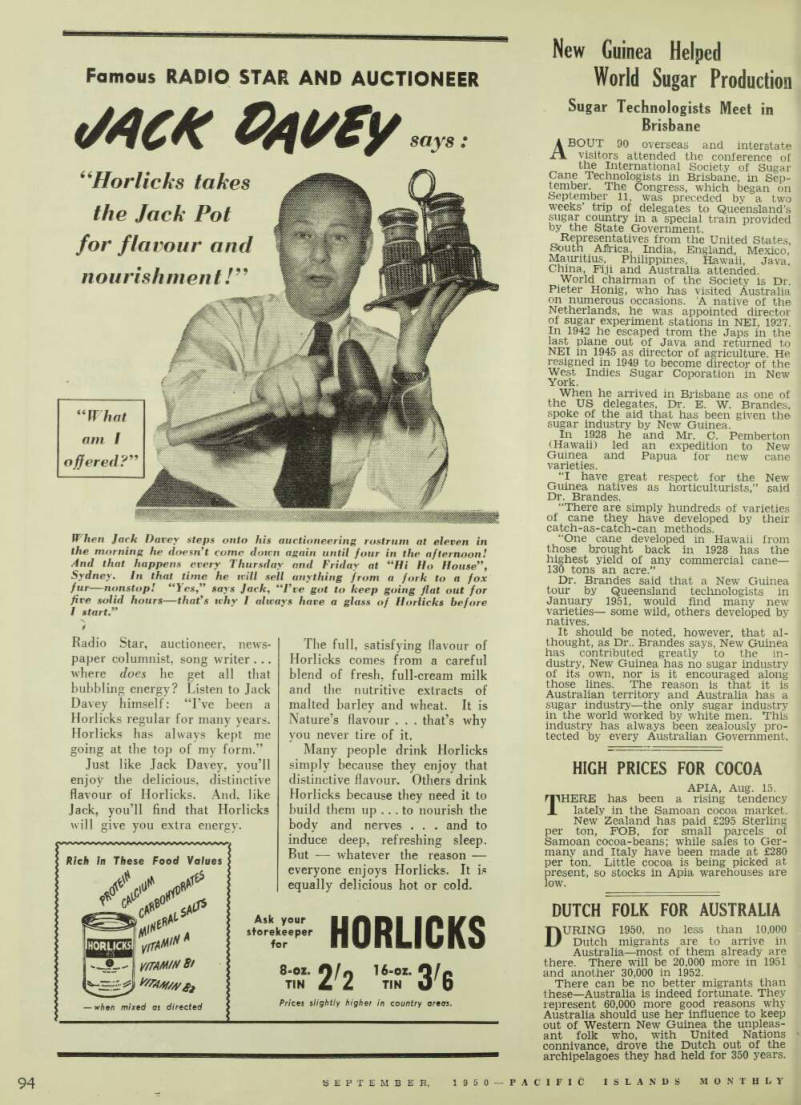
World Sugar Production Sugar Technologists Meet in Brisbane
ABOUT 90 overseas and interstate visitors attended the conference of the International Society of Sugar Cane Technologists in Brisbane, in Sep tember. The Congress, which began on September 11, was preceded by a two weeks’ trip of delegates to Queensland’s sugar country in a special train provided by the State Government.
Representatives from the United States, South Affrica, India, England, Mexico, Mauritius, Philippines, Hawaii, Java.
China, Fiji and Australia attended.
World chairman of the Society is Dr.
Pieter Honig, who has visited Australia on numerous occasions. A native of the Netherlands, he was appointed director of sugar experiment stations in NEI, 1927.
In 1942 he escaped trom the Japs in the last plane out of Java and returned to NEI in 1945 as director of agriculture. He resigned in 1949 to become director of the West Indies Sugar Coporation in New York.
When he arrived in Brisbane as one of the US delegates, Dr. E. W. Brandes, spoke of the aid that has been given the sugar industry by New Guinea.
In 1928 he and Mr. C. Pemberton (Hawaii) led an expedition to New Guinea and Papua for new cane varieties.
“I have great respect for the New Guinea natives as horticulturists,” said Dr. Brandes.
“There are simply hundreds of varieties of cane they have developed by their catch-as-catch-can methods.
“One cane developed in Hawaii from those brought back in 1928 has the highest yield of any commercial cane— -130 tons an acre.”
Dr. Brandes said that a New Guinea tour by Queensland technologists in January 1951, would find many new varieties— some wild, others developed by natives.
It should be noted, however, that al thought, as Dr.. Brandes says, New Guinea has contributed greatly to the in dustry, New Guinea has no sugar industry of its own, nor is it encouraged along those lines. The reason is that it is Australian territory and Australia has a sugar industry—the only sugar industry in the world worked by white men. This industry has always been zealously pro tected by every Australian Government.
High Prices For Cocoa
Apia, Aug. 15.
THERE has been a rising tendency lately in the Samoan cocoa market.
New Zealand has paid £295 Sterling per ton, FOB, for small parcels of Samoan cocoa-beans; while sales to Ger many and Italy have been made at £2BO per ton. Little cocoa is being picked at present, so stocks in Apia warehouses are low.
Dutch Folk For Australia
DURING 1950, no less than 10,000 Dutch migrants are to arrive in Australia—most of them already are there. There will be 20,000 more in 1951 and another 30,000 in 1952.
There can be no better migrants than these —Australia is indeed fortunate. They represent 60,000 more good reasons why Australia should use her influence to keep out of Western New Guinea the unpleas ant folk who, with United Nations connivance, drove the Dutch out of the archipelagoes they had held for 350 years.
Alarming Crime Wave Continues in
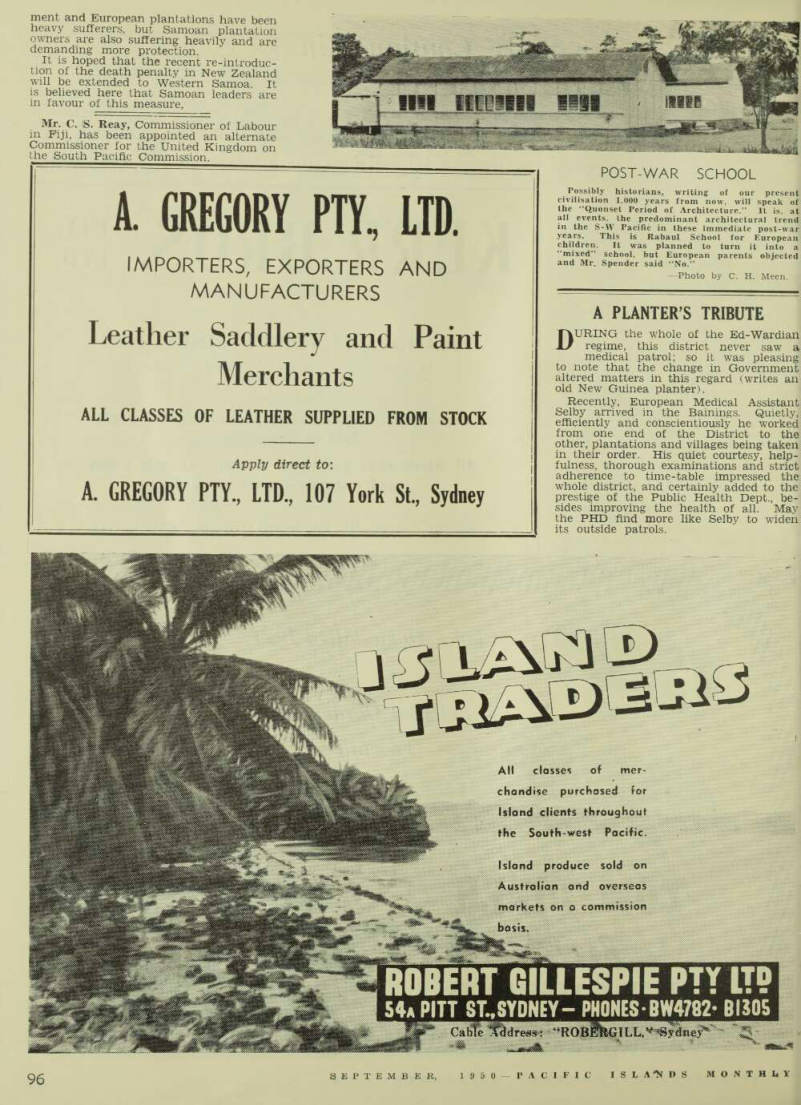
Western Samoa
From Our Own Correspondent
APIA, August 23.
THE High Commissioner of Western Samoa, Mr. G. R. Powles, in a broad cast over Apia Radio on August 19, spoke of the current crime wave in the Territory.
Lawlessness, in recent months has cul minated in a number of crimes of violence like the assault on plantation manager, D C. M. Campbell, who was seriously in jured by knife wounds: the shooting of a Samoan employee of the New Zealand Reparation Estates Mulifanua Plantation bv trespassers; and, more recently, the killing of a Samoan chief in Savaii, also by knifing, following a land dispute. ‘The High Commissioner stressed also the increasing number of thefts from Government, school, Mission and private plantations: and pointed out that the stealing of coconuts, cocoa, bananas and other produce has reached incredible dimensions and that plantations, both European and Samoan, are suffering large losses in consequence. He appealed to Samoan leaders, teachers, missionaries and parents to use their influence to stop the wave of lawlessness and warned that the Government would not hesitate to take all necessary measures to put an end to such criminal offences and to enforce strictly the existing laws.
The necessity for strong action by the Government was highlighted, when a few hours after the High Commissioner’s radio address (which was broadcast in English and Samoan), another murder was committed right in Apia.
At 9.30 p.m., a middle-aged Samoan, Solofa, from the South Coast village of
Lefaga, was found unconscious near the Samoan Printing & Publishing Company’s premises. He had been struck with a blunt instrument and died without re gaining consciousness, shortly after being
admitted to the Apia Government Hos pital. The motive for the killing and the killers are unknown and so far the Police have been unable to make any headway in solving the case.
Government and European plantations have lately introduced a system of plan tation guards to patrol the boundaries of their properties. The high prices of copra and cocoa in recent years have been a growing temptation to young Samoans to make easy money by stealing coconuts and cocoa from plantations. Govern
ment and European plantations have been heavy sufferers, but Samoan plantation owners are also suffering heavily and are demanding more protection.
It is hoped that the recent re-introduc tion of the death penalty in New Zealand will be extended to Western Samoa. It is believed here that Samoan leaders are in favour of this measure, Mr. C. IS. Reay, Commissioner of Labour in Fiji, has been appointed an alternate Commissioner for the United Kingdom on the South Pacific Commission.
Post-War School
Possibly historians, writing of our present civilisation 1,000 years from now. will speak of the “Quonset Period of Architecture.” It is, at all events, the predominant architectural trend in the S-W Pacific in these immediate post-war years. This is Rabaul School for European children. It was planned to turn it into a “mixed” school, but European parents objected and Mr. Spender said “No.”
Photo by C. H. Meen.
Advertisements & other items, pp. 97-98 (1 item)
Kerr Bros. S
G.P.O. Box 3838, Sydney.
ISLAND MERCHANTS SINCE 1895
50 years old, but as young as ever and eager to serve you.
Cocoa Beans, Copra, Coffee and all Island Produce Sold on Commission.
All merchandise purchased at best wholesale prices and original invoices supplied.
Use Our Co-operative Specialised Overseas Buying Service.
Choice Home-killed Beef Selected Garden-fresh
Vegetables
TOM PIPER
h STEAK & VEGETABLES
x %\\\m\\\^ ns w jf « 4 i-v i 1 NP9«
A. GREGORY PTY, LIB.
IMPORTERS, EXPORTERS AND
MANUFACTURERS
Leather Saddlery and Paint Merchants ALL CLASSES OF LEATHER SUPPLIED FROM STOCK Apply direct to: A. GREGORY PTY., LTD., 107 York St., Sydney
N ** I t r All classes of merchandise purchased for Island clients throughout the South-west Pacific.
Island produce sold on Australian and overseas markets on a commission basis.
ROBERT GILLESPIE PTT IT?
54a PITT ST„SYDNEY-PHONES-8W4782* BIBOS
Cable fSdress-t ‘ROBBIIGI LL,''"•Sydney*’
•m
A Planter’S Tribute
DURING the whole of the Ed-Wardian regime, this district never saw a medical patrol; so it was pleasing to note that the change in Government altered matters in this regard (.writes an old New Guinea planter).
Recently, European Medical Assistant Selby arrived in the Bainings. Quietly, efficiently and conscientiously he worked from one end of the District to the other, plantations and villages being taken in their order. His quiet courtesy, help fulness, thorough examinations and strict adherence to time-table impressed the whole district, and certainly added to the prestige of the Public Health Dept., be sides improving the health of all. May the PHD find more like Selby to widen its outside patrols.
This Banana?
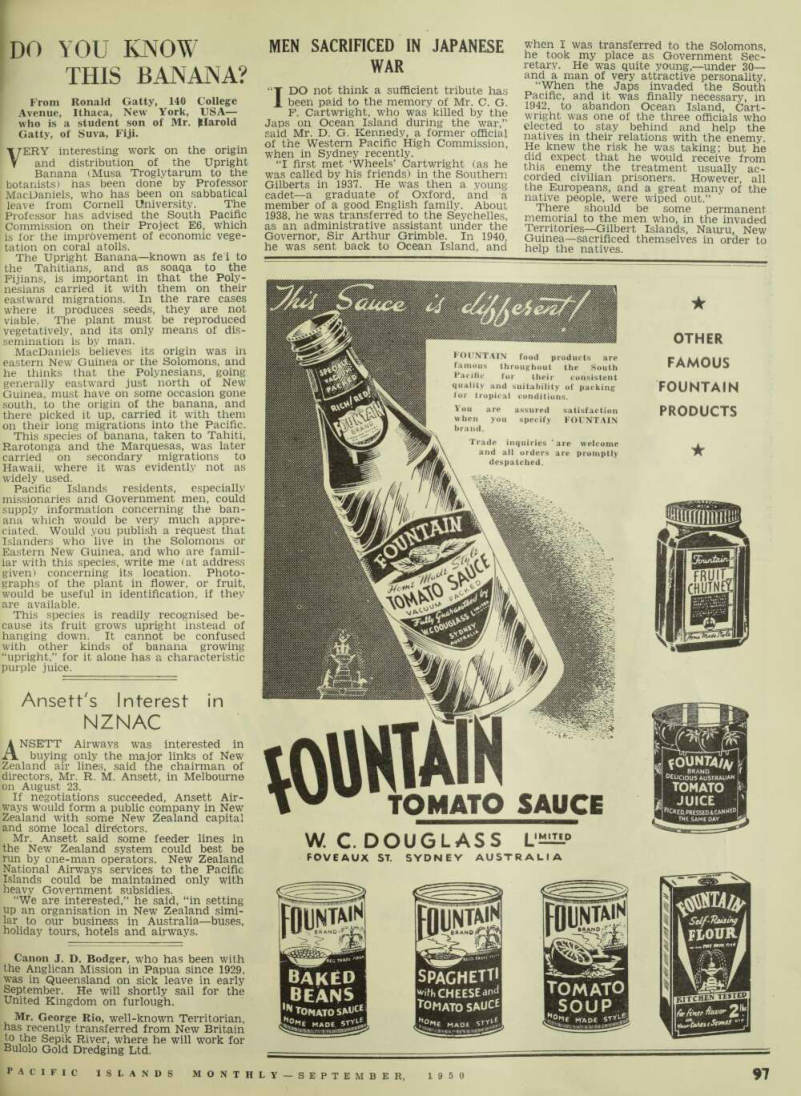
Do You Know
From Ronald Gatty, 140 College Avenue, Ithaca, New York, USA — who is a student son of Mr. Marold Gatty, of Suva, Fiji.
VERY interesting work on the origin and distribution of the Upright Banana (Musa Troglytarum to the botanists) has been done by Professor Mac Daniels, who has been on sabbatical leave from Cornell University. The Professor has advised the South Pacific Commission on their Project E 6, which is for the improvement of economic vege tation on coral atolls.
The Upright Banana—known as fe'i to the Tahitians, and as soaqa to the Fijians, is important in that the Poly nesians carried it with them on their eastward migrations. In the rare cases where it produces seeds, they are not viable. The plant must be reproduced vegetatively, and its only means of dis semination is by man.
Mac Daniels believes its origin was in eastern New Guinea or the Solomons, and he thinks that the Polynesians, going generally eastward just north of New Guinea, must have on some occasion gone south, to the origin of the banana, and there picked it up, carried it with them on their long migrations into the Pacific.
This species of banana, taken to Tahiti, Rarotonga and the Marquesas, was later carried on secondary migrations to Hawaii, where it was evidently not as widely used.
Pacific Islands residents, especially missionaries and Government men, could supply information concerning the ban ana which would be very much appre ciated. Would you publish a request that Islanders who live in the Solomons or Eastern New Guinea, and who are famil iar with this species, write me (at address given) concerning its location. Photo graphs of the plant in flower, or fruit, would be useful in identification, if they are available.
This species is readily recognised be cause its fruit grows upright instead of hanging down. It cannot be confused with other kinds of banana growing “upright,” for it alone has a characteristic purple juice.
Nznac
Ansett's Interest in
ANSETT Airways was interested in buying only the major links of New Zealand air lines, said the chairman of directors, Mr. R. M. Ansett, in Melbourne on August 23.
If negotiations succeeded, Ansett Air ways would form a public company in New Zealand with some New Zealand capital and some local directors.
Mr. Ansett said some feeder lines in the New Zealand system could best be run by one-man operators. New Zealand National Airways services to the Pacific Islands could be maintained only with heavy Government subsidies.
“We are interested,” he said, “in setting up an organisation in New Zealand simi lar to our business in Australia—buses, holiday tours, hotels and airways.
Canon J. D. Bodger, who has been with the Anglican Mission in Papua since 1929, was in Queensland on sick leave in early September. He will shortly sail for the United Kingdom on furlough.
Mr. George Rio, well-known Territorian, has recently transferred from New Britain to the Sepik River, where he will work for Bulolo Gold Dredging Ltd.
Men Sacrificed In Japanese
War
IDO not think a sufficient tribute has been paid to the memory of Mr. C. G.
F. Cartwright, who was killed by the Japs on Ocean Island during the war,” said Mr. D. G. Kennedy, a former official of the W’estern Pacific High Commission, when in Sydney recently.
“I first met ‘Wheels’ Cartwright (as he was called by his friends) in the Southern Gilberts in 1937. He was then a young cadet—a graduate of Oxford, and a member of a good English family. About 1938, he was transferred to the Seychelles, as an administrative assistant under the Governor, Sir Arthur Grimble. In 1940, he was sent back to Ocean Island, and
when I was transferred to the Solomons, he took my place as Government Sec retary. He was quite young,—under 30— and a man of very attractive personality.
“When the Japs invaded the South Pacific, and it was finally necessary, in 1942, to abandon Ocean Island, Cart wright was one of the three officials who elected to stay behind and help the natives in their relations with the enemy.
He knew the risk he was taking: but he did expect that he would receive from this enemy the treatment usually ac corded civilian prisoners. However, all the Europeans, and a great many of the native people, were wiped out.”
There should be some permanent memorial to the men who, in the invaded Territories —Gilbert Islands, Nauru, New Guinea—sacrificed themselves in order to help the natives.
Advertisements & other items, p. 99 (1 item)
Tomato Sauce
★ FOUNTAIN food products are famous throughout the South Pacific for their consistent quality and suitability of packing for tropical conditions.
You are assured satisfaction when you specify FOUNTAIN brand.
Irade inquiries ‘are welcome and all orders are promptly despatched.
'it ms & W* /// MOf* m '■S i
TOMATO SAUCE
W. C DOUGLASS L'SIL”
FOVEAUX ST. SYDNEY AUSTRALIA
m c
OTHER
FAMOUS
FOUNTAIN
PRODUCTS
FRUIT
CHUTN
BTTThfn TESiMjj
Growth Of Insurance Co.
THE South Pacific Insurance Co., Ltd., of Sydney, which was established very modestly by the Carpenter in terests 15 years ago, had an income from premiums in the year ended March 31 of just under £373 000, and a net profit of over £12,000. Its issued capital is £62,000, and it has reserves of about £200,000, mostly invested in Government loans.
Industry 50 Years Old
Nauru and Ocean Is. Phosphate Industry 50 Years Old
AUGUST 28, 1960 was the 50th anniver sary of the landing of the first party of phosphate experts on Ocean Island and the birthday of Sir Albert Ellis, NZ representative on the British Phosphate Commission, and the man
responsible for the discovery of phos phate on Nauru.
To mark the 50th anniversary of the beginning of the great Pacific phosphate industry, the New Zealand Herald recent ly published a photograph of Sir Albert holding the piece of Nauru phosphatic rock which led to the discovery of the untold wealth on that island and on Ocean.
This is the historic piece of rock which was used as a door-stop in the Sydney office of the young Mr. Ellis. It had been brought from Nauru several years previously and classified, by the experts, as petrified wood. Mr. Ellis—as he then was—knew his phosphate, as his firm had been trading in a low-quality product from Howland and Baker Islands. He was not satisfied that the door-stop was petrified wood, but had some of it ground up and tested. It was high grade phos phate.
From that discovery and after many vicissitudes (Nauru, for one thing, then belonged to Germany), evolved the million pound industry we know today.
Sir Albert kept the famous door-stop in his Auckland home until 1938 when he gave it to Auckland museum where it now resides in a glass case.
Sir Brian Freeston, Governor of Fiji, in early September returned to the Colony from Sydney where he attended a meeting of the Working Committee of the South Pacific Commission in preparation for the sixth session next month. He is Senior Commissioner for the United King dom.
Advertisements & other items, p. 100 (1 item)
aetn
first fa
* W „„,-h a tropical thirst than * -- - *- r :££*•** «• r ’“"■ " ‘ ,UJ«. »"■ sSr firm
TOOTH’S
rewed AND
U6ER
OTTLED
Y TOO
TH & CO. limited
Samoa—Tonga
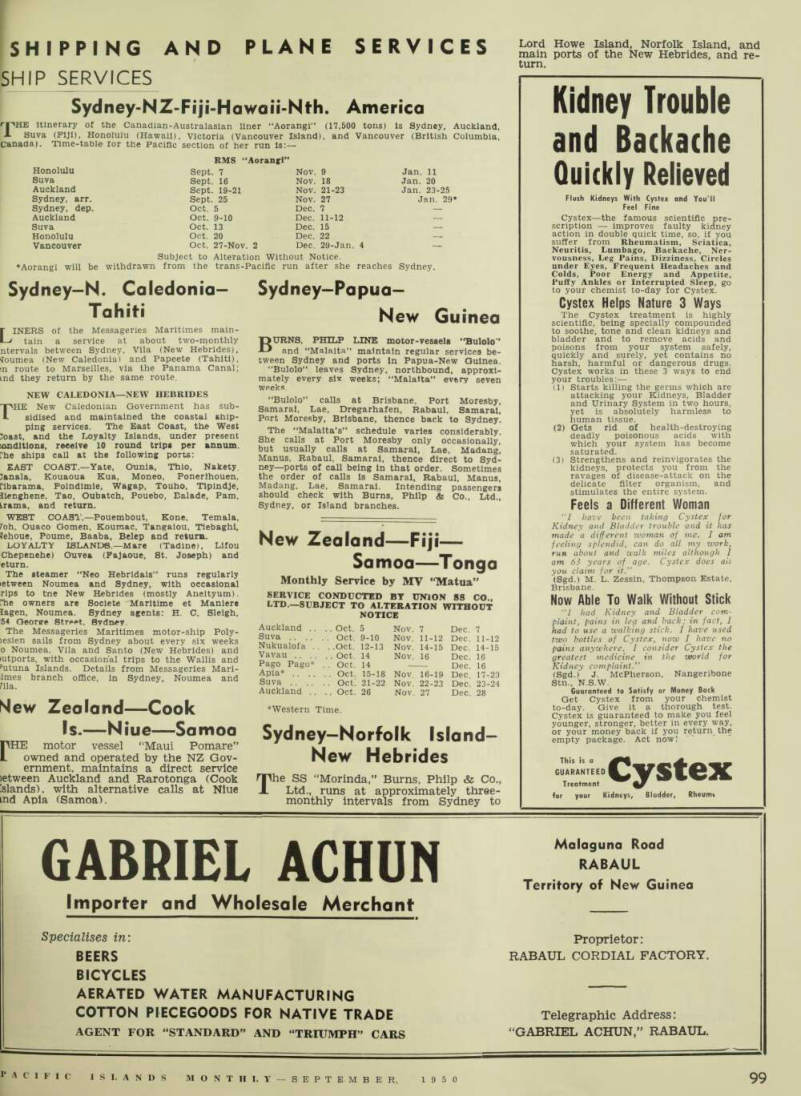
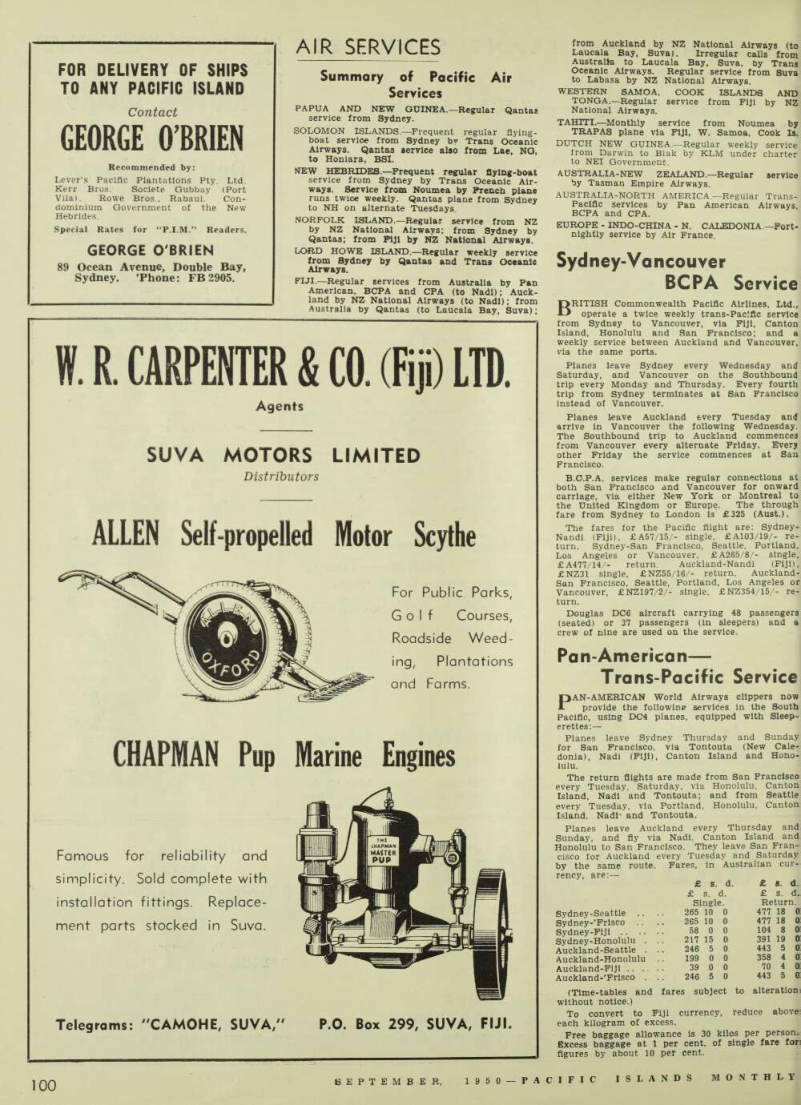
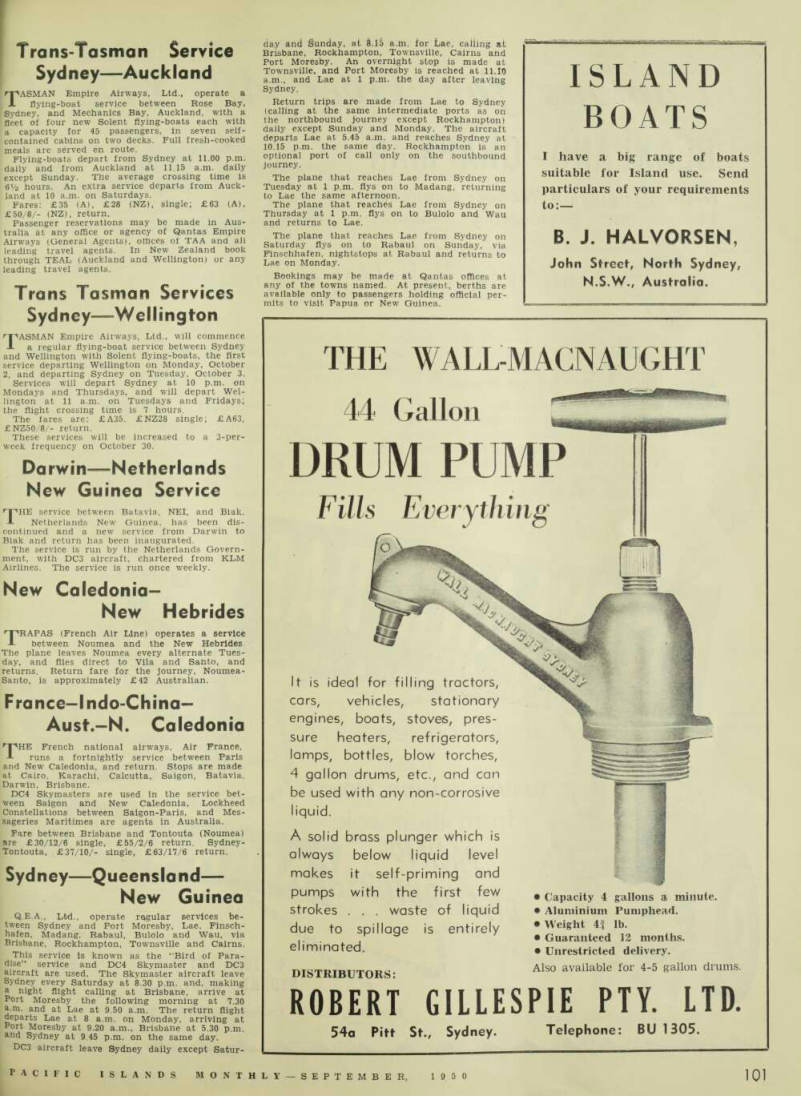
Shipping And Plane Services
Ship Services
Sydney-NZ-Fiji-Hawoii-Nth. America
rHE Itinerary of the Canadian-Australaslan liner “Aorangi” (17,500 tons) Is Sydney, Auckland, Suva (FIJI), Honolulu (Hawaii), Victoria (Vancouver Island), and Vancouver (British Columbia, Canada). Time-table for the Pacific section of her run Is:—
RMS “Aorangl”
Subject to Alteration Without Notice. ♦Aorangi will be withdrawn from the trans-Pacific run after she reaches Sydney.
Sydney-N. Caledonia- Tahiti
LINERS of the Messageries Maritimes main tain a service at about two-monthly ntervals between Sydney. Vila (New Hebrides), Noumea (New Caledonia) and Papeete (Tahiti), >n route to Marseilles, via the Panama Canal; md they return by the same route.
New Caledonia—New Hebrides
rHE New Caledonian Government has sub sidised and maintained the coastal ship ping services. The East Coast, the West toast, and the Loyalty Islands, under present iondltlons, receive 10 round trips per annum. :he ships call at the following ports; EAST COAST. —Yate, Ounia, Thio, Nakety, Janala, Kouaoua Kua, Moneo, Ponerlhouen, ribarama, Polndlmle, Wagap, Touho, Tlpindje, lienghene, Tao, Oubatch, Pouebo, Balade, Pam, Lrama, and return.
WEST COAST.—Pouembout, Kone, Temala, toh. Ouaco Gomen, Koumac, Tangaiou. Tiebaghl, lehoue, Poume, Baaba, Belep and return.
LOYALTY ISLANDS.—Mare (Tadlnej, Llfou Chepenehe) Ouvea (Pajaoue, St. Joseph) and eturn.
The steamer “Neo Hebrldais” runs regularly ictween Noumea and Sydney, with occasional rips to tne New Hebrides (mostly Aneityum).
Tie owners are Soclete Maritime et Manlere lagen, Noumea. Sydney agents: H. C. Sleigh, 54 Georee Street. Sydney.
The Messageries Maritimes motor-ship Poly icsien sails from Sydney about every six weeks 0 Noumea, Vila and Santo (New Hebrides) and iutports, with occasional trips to the Wallis and l ’utuna Islands. Details from Messageries Mari imes branch office, in Sydney, Noumea and rila.
Mew Zealand—Cook
Is.—Niue—Samoa
rHE motor vessel “Maui Pomare” owned and operated by the NZ Gov ernment, maintains a direct service
letween Auckland and Rarotonga (Cook
islands), with alternative calls at Niue
md Apia (Samoa).
Sydney-Popua- New Guinea
BURNS, PHILP LINE motor-vessels “Bulolo'’ and “Malaita” maintain regular services be tween Sydney and ports In Papua-New Guinea.
“Bulolo” leaves Sydney, northbound, approxi mately every slv weeks; “Malaita” every seven weeks.
“Bulolo” calls at Brisbane. Port Moresby, Samaral, Lae, Dregarhafen, Rabaul, Samaral, Port Moresby, Brisbane, thence back to Sydney.
The “Malalta’s” schedule varies considerably.
She calls at Port Moresby only occasionally, but usually calls at Samaral, Lae, Madang, Manus, Rabaul, Samaral, thence direct to Syd ney—ports of call being In that order. Sometimes the order of calls Is Samaral, Rabaul, Manus, Madang, Lae, Samaral. Intending passengers should check with Burns, Philp & Co., Ltd., Sydney, or Island branches.
New Zealand—Fiji—
Samoa—Tonga
Monthly Service by MY “Matua”
Service Conducted By Union Ss Co.,
Ltd.—Subject To Alteration Without
Notice
Sydney—Norfolk Island-
New Hebrides
The SS “Morinda,” Burns, Philp & Co., Ltd., runs at approximately three monthly intervals from Sydney to
Lord Howe Island, Norfolk Island, and main ports of the New Hebrides, and re turn.
Honolulu Sept. 7 Suva Sept. 16 Auckland Sept. 19-21 Sydney, arr.
Sept. 25 Sydney, dep.
Oct. 5 Auckland Oct. 9-10 Suva Oct. 13 Honolulu Oct. 20 Vancouver Oct. 27-Nov. 2
Nov. 9 Jan. 11 Nov. 18 Jan. 20 Nov. 21-23 Jan. 23-25 Nov. 27 Jan. 29* Dec, 7 — Dec. 11-12 —, Dec. 15 — Dec. 22 — Dec. 29-Jan. 4 —
Auckland .. .. Oct. 5 Nov. 7 Dec. 7 Suva Oct. 9-10 Nov. 11-12 Dec. 11-12 Nukualofa .. ..Oct. 12-13 Nov. 14-15 Dec. 14-15 Vavau Oct. 14 Nov. 16 Dec. 16 Pago Pago* . . Oct. 14 Dec. 16 Apia* Oct. 15-18 Nov. 16-19 Dec 17-20 Suva Oct. 21-22 Nov. 22-23 Dec. 23-24 Auckland .. .. Oct. 26 Nov. 27 Dec. 28 ♦Western Time.
Air Services
Summary of Pacific Air
Services
PAPUA AND NEW GUlNEA.—Regular Qantas service from Sydney.
SOLOMON ISLANDS. —Frequent regular flying boat service from Sydney bv Trans Oceanic Airways. Qantas service also from Lae, NG, to Honiara, BSI.
NEW HEBRlDES.—Frequent regular flying-boat service from Sydney by Trans Oceanic Air ways. Service from Noumea by French plane runs twice weekly. Qantas plane from Sydney to NH on alternate Tuesdays.
NORFOLK ISLAND. —Regular service from NZ by NZ National Airways; from Sydney by Qantas; from Fiji by NZ National Airways.
LORD HOWE ISLAND.—Regular weekly service from Sydney by Qantas and Trans Oceanic Airways.
FlJl.—Regular services from Australia by Pan American. BCPA and CPA (to Nadi); Auck land by NZ National Airways (to Nadi); from Australia by Qantas (to Laucala Bay, Suva);
from Auckland by NZ National Airways (to Laucala Bay, Suva). Irregular calls from Australia to Laucala Bay, Suva, by Trans Oceanic Airways. Regular service from Suva to Labasa by NZ National Airways.
Western Samoa. Cook Islands And
TONGA.—Regular service from Fiji by NZ National Airways.
TAHlTl.—Monthly service from Noumea by TRAPAS plane via FIJI, W. Samoa, Cook Is.
DUTCH NEW GUlNEA..—Regular weekly service from Darwin to Biak by KLM under charter to NEI Government.
AUSTRALIA-NEW ZEALAND.—ReguIar service by Tasman Empire Airways.
AUSTRALIA-NORTH AMERICA—Regular Trans pacific services by Pan American Airways.
Bcpa And Cpa.
Europe - Indo-China -N. Caledonia —Port
nightly service by Air France.
Sydney-Vancouver
BCPA Service
BRITISH Commonwealth Pacific Airlines, Ltd., operate a twice weekly trans-Pac’flc service from Sydney to Vancouver, via FIJI, Canton Island, Honolulu and San Francisco; and a weekly service between Auckland and Vancouver, via the same ports.
Planes leave Sydney every Wednesday and Saturday, and Vancouver on the Southbound trip every Monday and Thursday. Every fourth trip from Sydney terminates at San Francisco Instead of Vancouver.
Planes Leave Auckland every Tuesday and arrive in Vancouver the following Wednesday.
The Southbound trip to Auckland commences from Vancouver every alternate Friday. Every other Friday the service commences at San Francisco. 8.0.P.A. services make regular connections at both San Francisco and Vancouver for onward carriage, via either New York or Montreal to the United Kingdom or Europe. The through fare from Sydney to London Is £325 (Aust.).
The fares for the Pacific flight are: Sydney- Nandi (Fiji), EAS7/15/- single. £AIO3/19/- re turn. Sydney-San Francisco, Seattle, Portland, Los Angeles or Vancouver, £A265/8/- single, £ A477/14/- return. Auckland-Nandi (Fiji), £ NZ3I single, ENZSS/16/- return. Auckland- San Francisco. Seattle, Portland, Los Angeles or Vancouver, ENZI97/2/- single, £NZ3S4/15/- re turn.
Douglas DC6 aircraft carrying 48 passengers (seated) or 37 passengers (in sleepers) and a crew of nine are used on the service.
Pan-American —
Trans-Pacific Service
PAN-AMERICAN World Airways clippers now provide the following services in the South Pacific, using DC4 planes, equipped with Sleep erettes: — Planes leave Sydney Thursday and Sunday for San Francisco, via Tontouta (New Cale donia), Nadi (FIJI), Canton Island and Hono lulu.
The return flights are made from San Francisco every Tuesday, Saturday, via Honolulu, Canton Island, Nadi and Tontouta; and from Seattle every Tuesday, via Portland, Honolulu, Canton Island, Nadi' and Tontouta.
Planes leave Auckland every Thursday and Sunday, and fly via Nadi, Canton Island and Honolulu to San Francisco. They leave San Fran cisco for Auckland every Tuesday and Saturday by the same route. Fares, in Australian cur-
(Time-tables and fares subject to alteration without notice.) To convert to Fiji currency, reduce above 1 each kilogram of excess.
Free baggage allowance is 30 kilos per persom Excess baggage at 1 per cent, of single fare for figures by about 10 per cent.
rency, are:— £ 8. d. £ 8. d. £ s. d. £ s. d.
Single. Return.
Sydney-Seattle .. .. 265 10 0 477 18 0 Sydney-’Prlsco .. 265 10 0 477 18 0 Sydney-Pljl 58 0 0 104 8 0 Sydney-Honolulu . .. 217 15 0 391 19 0 Auckland-Seattle . .. 246 5 0 443 5 0 Auckland-Honolulu .. 199 0 0 358 4 0 Auckland-Pijl 39 0 0 70 4 0!
Auckland-’Prlsco . .. 246 5 0 443 5 0
Trans-Tasman Service
Sydney—Auckland
TASMAN Empire Airways, Ltd., operate a flying-boat service between Rose Bay, Sydney, and Mechanics Bay, Auckland, with a fleet of four new Solent flying-boats each with a capacity for 45 passengers, in seven self contained cabins on two decks. Full fresh-cooked meals are served en route.
Flying-boats depart from Sydney at 11.00 p.m. daily and from Auckland at 11.15 a.m. daily except Sunday. The average crossing time is 6y 2 hours. An extra service departs from Auck land at 10 a.m. on Saturdays.
Fares: £35 (A), £2B (NZ), single; £63 (A), £5O/8/- (NZ), return.
Passenger reservations may be made in Aus tralia at any office or agency of Qantas Empire Airways (General Agents), offices of TAA and all leading travel agents. In New Zealand book through TEAL (Auckland and Wellington) or any leading travel agents.
Trans Tasman Services
Sydney—-Wellington
'T'ASM AN Empire Airways, Ltd., will commence -I- a regular flying-boat service between Sydney and Wellington with Solent flying-boats, the first service departing Wellington on Monday, October 2, and departing Sydney on Tuesday, October 3.
Services will depart Sydney at 10 p.m. on Mondays and Thursdays, and will depart Wel lington at 11 a.m. on Tuesdays and Fridays; the flight crossing time is 7 hours.
The fares are: £A3S. £NZ2B single; £A63, £ NZSO/8/- return.
These services will be increased to a 3-per week frequency on October 30.
Darwin—Netherlands
New Guinea Service
THE service between Batavia, NEI, and Biak, Netherlands New Guinea, has been dis continued and a new service from Darwin to Biak and return has been inaugurated.
The service is run by the Netherlands Govern ment, with DC3 aircraft, chartered from KLM Airlines. The service is run once weekly.
New Caledonia-
New Hebrides
TRAPAS (French Air Line) operates a service between Noumea and the New Hebrides The plane leaves Noumea every alternate Tues day, and flies direct to Vila and Santo, and returns. Return fare for the journey, Noumea- Santo, is approximately £42 Australian.
France-1 ndo-China—
Aust.-N. Caledonia
THE French national airways, Air France, runs a fortnightly service between Paris and New Caledonia, and return. Stops are made at Cairo. Karachi, Calcutta,. Saigon, Batavia, Darwin, Brisbane.
DC4 Skymasters are used in the service bet ween Saigon and New Caledonia, Lockheed Constellations between Saigon-Paris, and Mes sageries Maritimes are agents in Australia.
Fare between Brisbane and Tontouta (Noumea) are £3O/12/6 single, £55/2/6 return. Sydney- Tontouta, £37/10/- single, £63/17/6 return.
Sydney—Queensland—
New Guinea
Q.E.A., Ltd., operate regular services be tween Sydney and Port Moresby, Lae, Pinsch hafen, Madang. Rabaul, Bulolo and Wau, via Brisbane, Rockhampton, Townsville and Cairns.
This service Is known as the “Bird of Para dise’’ service and DC4 Skymaster and DC3 aircraft are used. The Skymaster aircraft leave Sydney every Saturday at 8.30 p.m. and, making a night flight calling at Brisbane, arrive at Port Moresby the following morning at 7.30 a.m. and at Lae at 9.50 a.m. The return flight departs Lae at 8 a.m. on Monday, arriving at Port Moresby at 9.20 a.m., Brisbane at 5.30 p.m. and Sydney at 9.45 p.m. on the same day.
DC3 aircraft leave Sydney daily except Satur
day and Sunday, at 8.15 a.m. lor Lae. calling at Brisbane, Rockhampton, Townsville, Cairns and Port Moresby. An overnight stop is made at Townsville, and Port Moresby is reached at 11. It) a.m., and Lae at 1 p.m. the day after leaving Sydney.
Return trips are made from Lae to Sydney (calling at the same intermediate ports as on the northbound journey except Rockhampton) daily except Sunday and Monday. The aircraft departs Lae at 5.45 a.m. and reaches Sydney at 10.15 p.m. the same day. Rockhampton is an optional port of call only on the southbound journey.
The plane that reaches Lae from Sydney on Tuesday at 1 p.m. flys on to Madang, returning to Lae the same afternoon.
The plane that reaches Lae from Sydney on Thursday at 1 p.m. flys on to Bulolo and Wau and returns to Lae.
The plane that reaches Lae from Sydney on Saturday flys on to Rabaul on Sunday, via Finschhafen, nightstops at Rabaul and returns to Lae on Monday.
Bookings may be made at Qantas offices at any of the towns named. At present, berths are available only to passengers holding official per mits to visit Papua or New Guinea.
Qantas Subsidiary Services In
Papua-New Guinea-Solomons
Qantas Empire Airways run the following sub sidiary services in Papua, New Guinea, and British Solomons:— A Douglas DC3 leaves Lae, New Guinea, every Thursday, and flies to Rabaul, and Kavieng, and returns to Lae; but every alternate Thurs day the plane goes on from Kavieng to Manus, and returns via Kavieng to Rabaul (overnight) and returns to Lae on the Friday morning.
Every Wednesday a plane flies from Lae to Madang and Wewak, and thence, via Madang to Rabaul. It returns from Rabaul to Lae on Thursday. This service is primarily for the carriage of native labour to and from Wewak. and Europeans travelling on this service are always advised of the fact.
Every alternate Monday, a Qantas Catalina flies from Port Moresby, westward to Daru, via Yule Island, Kerema, Kikori, Lake Kutubu and Lake Murray, remaining overnight at Kikori and returning to PM next morning.
Every alternate Wednesday, a Qantas Catalina flies from Port Moresby eastward (dep. 9 a.m.) and calls at Abau and Samara! before flying out to the Archipelagoes in the afternoon. Calls are made at Esa’ala and Losuia (where an over night stop is made), and the following day (alternate Thursdays) at Deboyne Lagoon, before returning to Port Moresby, via Samarai and Abau.
Every alternate Monday, a Qantas Catalina leaves Port Moresby for Rabaul, via Moewe Har bour, and Talasea (New Britain); next morning (Tuesday) it flies to Buka, Kieta and Buin (Bougainville) and returns to Rabaul; next morning (Wednesday) it flies to Talasea, Moewe Harbour and Jacqulnot Bay. and returns to Rabaul: and next morning (Thursday) it re turns from Rabaul direct to Port Moresby. (Optional calls are made at Inus and Lenden hafen.) Every alternate Monday a Qantas Douglas flies from Lae to Rabaul, and continues on to Honiara (British Solomon Islands), via Torokina; remains overnight at Honiara; and returns to Lae the following day (Tuesday), via Torokina and Rabaul. This service calls at Vellalavella and Renard each alternate trip.
Every Tuesday and Friday a plane leaves Port Moresby at 7.30 a.m., reaches Kokoda at 8.35 a.m., flies on to Higatura (Popendetta) at 8.55 a.m., and leaves again for Port Moresby at 9.5 a.m., reaching there at 10.15 a.m.
Sydney-Lord Howe ls.-
Norfolk Is.
QANTAS, Sydney, run a Sandringham once weekly from Sydney to Lord Howe Island.
Fare, single, £l2. Return, £2l/12/-.
Qantas run a DC4 Skymaster alt. Thursdays (returning same day) from Sydney to Norfolk Island. Fare, £22 single; £39/12/- return. (For Norfolk Island, see also under NZ National Airways. For Lord Howe, see also under TOA.)
Sydney-New Hebrides
QANTAS operate a service to the New Hebrides with Sandringham flying-boats calling at Noumea, Port Vila and Espiritu Santo. Frequent non-scheduled flights are made, subject to the approval of the Governments concerned.
NZ National Airways
South Pacific Services
THE Pacific services run by the New Zealand National Airways Corporation are ai follows;
Auckland-Norfolk Island-Fiji-Tonga
Western Samoa-Cook Islands: A “Douglas”
airliner leaves Whenuapai, Auckland, on alter nate Tuesdays at 9 a.m. (September 5, 19, October 3, etc.) for Norfolk Island (arr. 12.55 p.m.; dep. 2 p.m.), Nadi (arr. 8.40 p.m., dep. 5.40 a.m. Thursday), Nausori (arr. 6.25 a.m., dep. 7.30 a.m.), Tonga (arr. 10.50 a.m., dep. 11.50 a.m.), •Faleolo, Western Samoa (arr. 4.5 p.m. Wednes day, dep. 8 a.m. Thursday), Aitutaki, Cook Islands (arr. 1.50 p.m. Thursday, dep. 2.50 p.m.), Rarotonga, Cook Is. (arr. 4.5 p.m.).
The aircraft departs from Rarotonga on the return journey on alternate Saturdays return journey on alternate Saturdays (Sep tember 9, 23, October 7, etc.), at 8 a.m. for Aitutaki (arr. 9.15 a.m., dep. 10 a.m.), Faleolo, W. Samoa (arr. 3.15 p.m., dep. 8 a.m. Sunday), •Tonga (arr. 10.55 a.m. Monday, dep. 11.50 a.m.), Nausori (arr. 2.40 p.m., dep. 3.40 p.m.).
Nadi (arr. 4.25 p.m., dep. 5 a.m. Tuesday),
Norfolk Is. (air. 10.55 am., dep. 12 noon), Whenuapai, Auckland (arr. 4.50 p.m.). •Crosses International Date Line.
Auckland-Norfolk Island: A “Douglas”
airliner leaves Whenuapai, Auckland, every Sun day at 8 a.m. for Norfolk Island (arr. 11.55 a.m.), and departs on the return flight at 12.55 p.m., arriving at Whenuapai at 5.45 p.m.
On alternate Sundays, a second aircraft also makes the run, leaving Whenuapai at 9 a.m., reaching Norfolk at 12.55 p.m., departing again at 1.55 p.m., and reaching Auckland at 6.45 p.m.
FARES, single (in NZ currency): Auckland to Norfolk, £l4; to Fiji, £3l; to Tonga, £3l; to Samoa, £34; to Aitutaki, £39; to Raro tonga, £39/10/-. Norfolk to Fiji, £l9. Fiji to Tonga, £B/15/-; to Samoa, £l3; to Aitutaki, £29/15/-; to Rarotonga, £3l. Samoa to Raro tonga, £l7/15/-; to Aitutaki, £l6/10/-.
Return fares, less 10 per cent.
BOOKING OFFICES: Wellington, Govt. Life Bldg., Customhouse Quay; Auckland, Airways House, Customs St.; Dunedin, 8-10 Manse St.; Christchurch, 104 Gloucester St.; Gis borne, 74 Peel St.; Palmerston North, 107 Broadway Ave.; Hamilton, 8 Alma St.; New Plymouth, Grand Central Building, Egmont St.; Blenheim, 13 Queen St.; Hokitika, South side Airport: Norfolk Is., Burns Phllp, Ltd.; Fiji, NAC at Nadi and Suva; Burns Philp, Lautoka; Tonga, Mrs. P. P. Melhose, Fou-amotu Airfield: W. Samoa, Burns Philp (SS), Ltd., Apia; Cook Is., Mrs. P. McVeagh, Aitutaki, and Mr. J. D. Campbell, Rarotonga.
TOA Services
TRANS Oceanic Airways run the following Pacific services:— SYDNEY-LORD HOWE IS.: A regular fort nightly service with large four-engine flylng
boats from Rose Bay. Fare: £i2 single: £2l/10/- return. Free baggage allowance 50 lb.
Excess baggage and freight rate Bd. per lb.
SYDNEY-NEW HEBRIDES: A regular monthly
service with large four-engine flying-boats from Sydney, via Noumea, to Vila and Espiritu Santo (overnight stop). Fares (single and re turn): Sydney-Vila. £39/10/- and £7l/2/-; Sydney-Santo, £42/10/- and £76/10/-; Noumea-
Vila, £lO and £18; Noumea-Santo, £l5 and £27. Freight: Sydney-Vila, 2/- per lb.; Sydney- Santo, 2/3.
Sydney-Solomon Islands: A Reguiai
monthly service from Sydney, via New Cale donia and New Hebrides to Tulagi and Honiara, Solomon Islands. This service is frequently ex tended to Lingatou, in the Russell Islands, and calls are sometimes made at Vanikoro, in the Santa Cruz Group. Fares; Sydney-Tulagi- Honlara. £55 S; £99 R. Free baggage allow ance. 60 lb.; excess baggage and freight, 3/C per lb.
N. Caledonia-Tahiti
TRAPAS (Soclete Francals de Transport!
Aeriens du Pacific Sud-Noumea) runs £ monthly service from New Caledonia to Tahiti Western Samoa (Faleolo), Cook Islands (Altu taki) to Papeete, where it arrives at about 11.4( a.m. two days later. One evening Is spent ir Nadi and one night in Altutaki. The plane re turns by the same route in the following week Fare from Noumea to Papeete Is 16,000 Pacifi< francs single, and 28,800 return. (160 Paclflt francs equal £ 1 Australian.) While the plam is at Papeete it runs one round trip betweer Papeete and Bora Bora.
Sydney-Noumea-Suva
THE following is the time-table of the Qanta: Sandringham flying-boat:— Sydney dep. 9.30 p.m. alt. Tues.
Noumea arr. 6.30 a.m. alt. Wed.
Noumea dep. 8.20 a.m. alt. Wed.
Suva arr. 2.30 p.m. alt. Wed.
Suva dep. 6 a.m. alt. Fri.
Noumea arr. 10.30 a.m. alt. Fri.
Noumea dep. 12 noon alt, Fri.
Sydney arr. 9.15 p.m. alt. Fri.
Intending passengers may book through Qantas offices in Australia. Burns Philp (South Seas) Company, in Suva; and J. Brock, ii Noumea.
The fares for this service in Aust. currenc; are:
CPA Sydney-Vancouver
Service
C CANADIAN Pacific Airlines, Ltd., run a trans >< Pacific service between Sydney and Van couver. For the present there will be om northbound and one southbound trip per fort night. Stops are made at Nadi (Fiji), Cantoi Island, Honolulu and San Francisco. The north' bound flight commences from Sydney every alter nate Tuesday.
Four-engined, pressurised "Canadair” alrcraf are used; 36 passengers can be carried am a crew of 7. Flying is done in daylight. Over night accommodation is provided at hotels ii Nadi and Honolulu, which Is, of course, com plimentary.
Fares are (in Australian currency: Sydney Vancouver, San Franclsco-Los Angeles and Port land-Seattle, £265/8/- single. £477/14/- return Fiji-Vancouver, £207/8/- single, £373/7/- re turn; Sydney-Fiji, £57/15/- single, £lO3/19/- re turn; Sydney-Honolulu, £217/13/- single £391/16/- return.
Bookings may be made at the Union Stean Ship Company of New Zealand, Limited, Sydney or Melbourne: Union Steam Ship Co. of NZ, Ltd.
Fiji; Canadian Pacific Airlines, Vancouver.
TEAL Flying Boat
Service
Auckland Fiji
WITH new 45 seater Solent flying-boats Tasman Empire Airways. Limited, operat; a weekly Auckland-Suva-Lambasa and retun service.
Aircraft depart Mechanics’ Bay. Auckland, i half hour after midnight, each Tuesday, am operate to the following time-table: —
Single. Return.
Sydney-Noumea ... £37 10 0 £67 10 ( Sydney-Suva 55 10 0 99 18 ( Noumea-Suva 20 5 0 36 9 (
dep. Auckland .. .. 0.30 a.m. Tuesday arr Suva 7.00 a.m. Tuesday dep' Suva 9.00 a.m. Tuesday arr. Lambasa .. .. 10.00 a.m. Tuesday
dep. Lambasa .. .. noon Tuesday arr. Suva 1.00 p.m. Tuesday dep. Suva 7.00 a.m. Wednesday I arr. Auckland .. .. 1.30 p.m. Wednesday Fares (Single): Auckland-Suva, £3l (NZ), £34/9/- (Fijian), £3B/15/- (Aust.); (Return): £55/16/- (NZ), £6l/19/- (Fijian), £69/15/- (Aust.).
Suva-Lambasa (Single): £4/10/- (NZ), £5 (Fijian). £5/12/6 (Aust.); (Return): £B/2/- (NZ). £9 (Fijian), £lO/2/6 (Aust.).
Reservations may be made through TEAL (New Zealand), Qantas or TAA (Australia), NZNAC (Suva) or any leading travel agents.
Papua-NG Local
Services
MANDATED Airlines, Ltd., of Lae, New Guinea, and other private operators, run air ser vices between Lae and the New Guinea mainland centres of Wau, Bulolo, Madang, Wewak, Altape, Mt. Hagen, Plnschhafen, Moresby, Kokoda—in fact anywhere in Papua or New Guinea where there is an air-strip. These planes carry pas •engers, mails and cargo on regular schedules or charter flights.
Advertisements & other items, pp. 101-106 (1 item)
Gabriel Achun
Kidney Trouble
and Backache
Quickly Relieved
Flush Kidneys With Cystex and You'll Feel Fine Cystex—the famous scientific prescription improves faulty kidney action in double quick time, so, if you suffer from Rheumatism, Sciatica, Neuritis, Lumbago, Backache, Nervousness, Leg Pains, Dizziness, Circles under Eyes, Frequent Headaches and Colds, Poor Energy and Appetite, Puffy Ankles or Interrupted Sleep, go to your chemist to-day for Cystex.
Cystex Helps Nature 3 Ways
The Cystex treatment is highly scientific, being specially compounded to soothe, tone and clean kidneys and bladder and to remove acids and poisons from your system safely, quickly and surely, yet contains no harsh, harmful or dangerous drugs.
Cystex works in these 3 ways to end your troubles: — (1) Starts killing the germs which are attacking your Kidneys, Bladder and Urinary System in two hours, yet is absolutely harmless to human tissue. (2) Gets rid of health-destroying deadly poisonous acids with which your system has become (3) Strengthens and reinvigorates the kidneys, protects you from the ravages of disease-attack on the delicate filter organism, and stimulates the entire system.
Feels a Different Woman
“1 have been taking Cystex for Kidney and Bladder trouble and it has made a different woman of me. I am feeling splendid, can do all my work, run about and walk miles although I am 63 years of age. Cystex does ail you claim for it.” (Sgd.) M. L. Zessin, Thompson Estate, Brisbane.
Now Able To Walk Without Stick
“7 had Kidney and Bladder complaint, pains in leg and back; in fact, 1 had to use a walking stick. I have used two bottles of Cystex, now I have no pains anywhere. I consider Cystex the greatest medicine in the world for Kidney complaint (Sgd.) J. McPherson, Nangeribone Stn., N.S.W.
Guaranteed to Satisfy or Money Back Get Cystex from your chemist to-day. Give it a thorough test.
Cystex is guaranteed to make you feel younger, stronger, better in every way, or your money back if you return the empty package. Act now!
This is a
GUARANTEED
Treatment
Cystex
for your Kidneys, Bladder, Rheunu
GABRIEL ACHUN
Importer and Wholesale Merchant
Specialises in:
BEERS
BICYCLES
AERATED WATER MANUFACTURING
COTTON PIECEGOODS FOR NATIVE TRADE
AGENT FOR “STANDARD” AND “TRIUMPH” CARS
Malaguna Road
RABAUL
Territory of New Guinea Proprietor:
RABAUL CORDIAL FACTORY.
Telegraphic Address:
“GABRIEL ACHUN,” RABAUL.
FOR DELIVERY OF SHIPS
TO ANY PACIFIC ISLAND
Contact
GEORGE O’BRIEN
Recommended by: Lever’s Pacific Plantations Pty. Ltd.
Kerr Bros. Soclete Gubbay (Port Vila). Rowe Bros., Rabaul. Condominium Government of the New Hebrides.
Special Rates for “P.1.M.” Readers.
GEORGE O'BRIEN
89 Ocean Avenue, Double Bay, Sydney. ’Phone: F 82905.
W. R. CARPENTER & CO. (Fiji) LTD.
Agents
SUVA MOTORS LIMITED
Distributors
ALLEN Self-propelled Motor Scythe
For Public Parks, Golf Courses, Roadside Weeding, Plantations and Farms.
CHAPMAN Pup Marine Engines
Famous for reliability and simplicity. Sold complete with installation fittings. Replacement parts stocked in Suva.
MASTER
PUP
Telegrams: "CAMOHE, SUVA,"
P.O. Box 299, SUVA, FIJI.
ISLAND
BOATS
I have a big range of boats suitable for Island use. Send particulars of your requirements to:—
B. J. HALVORSEN,
John Street, North Sydney, N.S.W., Australia.
THE WALL-MACNAUGHT
44 Gallon
DRUM PUMP
Fills Everything
o> r- O' - It is ideal for filling tractors, cars, vehicles, stationary engines, boats, stoves, pressure heaters, refrigerators, lamps, bottles, blow torches, 4 gallon drums, etc., and can be used with any non-corrosive liquid.
A solid brass plunger which is always below liquid level makes it self-priming and pumps with the first few strokes . . . waste of liquid due to spillage is entirely eliminated.
DISTRIBUTORS:
• Capacity 4 gallons a minute. • Aluminium Pumphead. • Weight 43 lb. • Guaranteed 12 months. • Unrestricted delivery.
Also available for 4-5 gallon drums.
ROBERT GILLESPIE PTY. LTD.
54a Pitt St., Sydney.
Telephone: BU 1305.
Famous for Over 40 Years!
BLAXLAND-CHAPMAN
Marine Engines • Wonder Launches
Pumps and Engineering Products
Simple • Reliable • Durable
World renowned Chapman patents, plus modern production methods, have made Blaxland-Chapman engines justly famous for reliability, durability and simplicity of operation, for over 40 years.
Notable amongst these patents is the bounce-start magneto which achieves instantaneous starting by merely flicking the fly-wheel against compression.
Engines from 4i H.P. upwards are reversible for running ahead or astern by a slight movement of this magneto. Every Blaxland-Chapman engine carries a 5 YEAR GUARANTEE.
A complete range of engines from H.P. to 20 H.P. is available for early delivery. All power ratings are conservative compared with the modern trend towards maximum ratings.
WONDER LAUNCHES
Style, performance and seaworthiness have made CHAPMAN WONDER LAUNCHES leaders in the small launch field. These trim craft, sturdily constructed for long service under all conditions, are available in 16 ft. open and half-cabin and 18 ft. half-cabin models. \ i i I
i Invite your enquiries /
S for ?•
\ V
BLAXLAND CHAPMAN PRODUCTS
from their sole
PACIFIC
i ’w" 4 ar •II
YORK STREET,
SYDNEY, AUSTRALIA
Box 3838, G.P.O. Cables: “CARE,” Sydney. zz
I
This modern
Speedbird Fleet
provides swift sure
services to all
6 continents
Constellation Speedbirds rtf Stratocruiser Speedbirds Argonaut Speedbirds Solent Speedbirds 8.0.A.C. routes to fifty-one countries on all six continents can save you weeks of valuable
travelling time.
You fly in the world’s most modern comfortable airliners, arrive with a bonus of extra time to do and see more at your journey’s end. You get there sooner .. . stay there longer.
Complimentary meals and refreshments served en route ; no tips or extras for countless comforts and courtesies. It’s all part of 8.0.A.C.’s 31-year-old tradition of Speedbird service and experience.
Book from Sydney to Indonesia • far east • hong kong • japan CEYLON • INDIA • PAKISTAN * AFRICA • ITALY • GREAT BRITAIN AND VIA U.K. TO U.S.A. • CANADA • CENTRAL AND SOUTH AMERICA • BERMUDA Information fijf Bookings : Qantas Empire Airways Ltd. {8.0.A.C. General Agents in Australia) at Sydney, Melbourne, Brisbane, Townsville, Cairns, Darwin or from Travel Agents in all cities and towns.
8.0.A.C. TAKES GOOD CARE
OF
YOU
FLY' BOAT
Specify 8.0.A.C. “Air Cargo” for your overseas shipments! M6B BRITISH OVERSEAS AIRWAYS CORPORATION WITH QANTAS EMPIRE AIR- WAYS LTD., TASMAN EMPIRE AIRWAYS LTD. & SOUTH AFRICAN AIRWAYS
TAHITI
To Shipmasters ond Visitors
When calling at Tahiti, and seeking SHIPS SUPPLIES and FRESH
PROVISIONS, see—
OSCAR G, NORDMAN
Supply Agent for Messageries Maritimes, Union S.S. Co. of N.Z., Ltd., Matson-Oceanic Line, United States Line, General S.S. Corp., Etc.
We supply General Service—lnformation about the Islands— Real Estate Service—Make Reservations—Act as Shipping Agents
OSCAR C. NORDMAN
Ship Chandler
PAPEETE, TAHITI
Wire before your arrival to
OCEANIC PAPEETE—Our
registered cable address.
William E . Reed
(Established 1913) Island Trade Broker Commission Agent 145 a GEORGE ST., CIRCULAR QUAY, SYDNEY For more than 36 years the PERSONAL buying services of WILLIAM E. REED, backed by an experienced staff has ensured prompt and reliable service at lowest cost to Missions, Planters and Traders throughout the Pacific. We operate on a WHOLESALE basis only. You receive original invoices at invoiced cost.
Purchase and delivery of Island craft a speciality.
Enquiries invited for all plantation and trading requirements. Island products sold on a commission basis.
Cables: "WILREED," Sydney
WILLREED AGENCIES PTY. LTD.
145 a George Street, Circular Quay, Sydney.
Cable Address: “REEDAGE” Sydney.
Sole Distributors for
INVINCIBLE SINGLETS.
First grade, economically priced.
40 ft. TRADE BOATS.
(for sea delivery). 10 ton cargo capacity, diesel powered.
20 ft. HEAVY DUTY TRADE BOATS.
(for assembly)
COVENTRY VICTOR DIESEL MARINE.
5/7 h.p. and 7/9 h.p.
PEERLESS LOCKWOVEN SQUARE MESH FENCING.
For pig fences, sheep fences, cattle fences, general farm fences.
SPANISH SHOTGUNS. COMPLETE RANGE AVAILABLE
Inquiries Invited.
MINIATURE SEWING MACHINES.
Suitable for native trade.
Harbour Works For Fiji
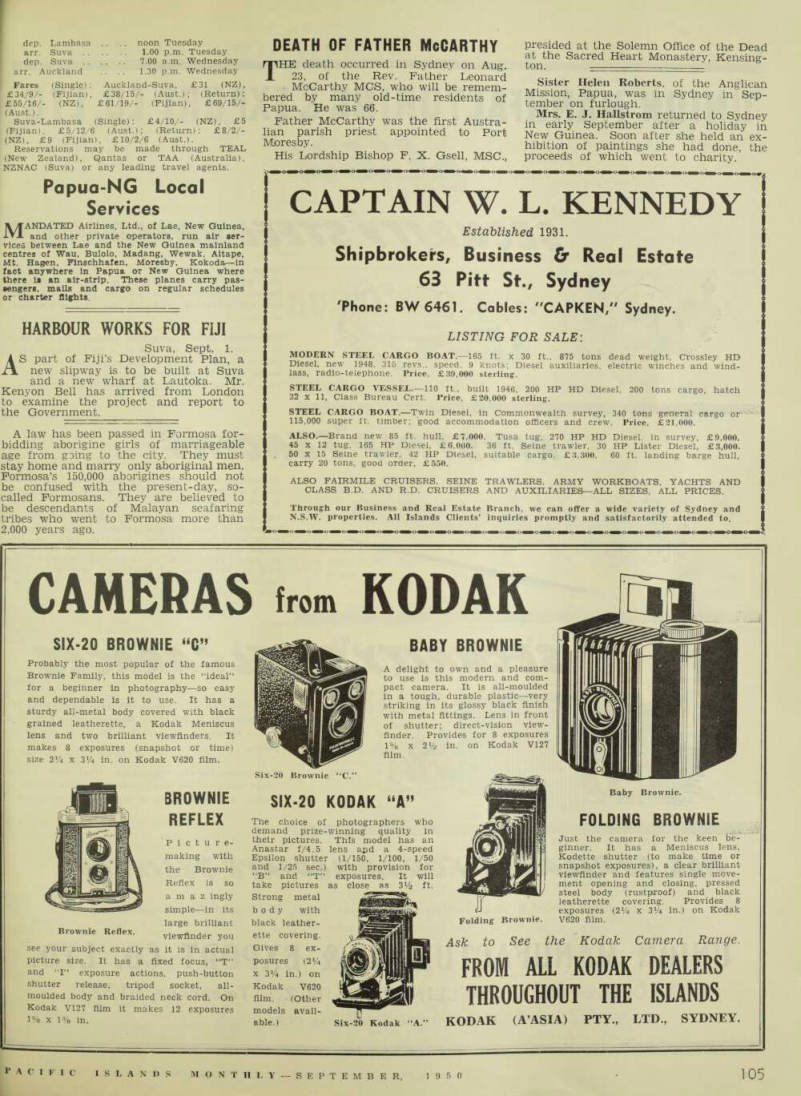
Suva, Sept. 1.
AS part of Fiji’s Development Plan, a new slipway is to be built at Suva and a new wharf at Lautoka. Mr.
Kenyon Bell has arrived from London to examine the project and report to the Government.
A law has been passed in Formosa for bidding aborigine girls of marriageable age from going to the city. They must stay home and marry only aboriginal men.
Formosa’s 150,000 aborigines should not be confused with the present-day, so called Formosans. They are believed to be descendants of Malayan seafaring tribes who went to Formosa more than 2,000 years ago.
Death Of Father Mccarthy
THE death occurred in Sydney on Aug. 23, of the Rev. Father Leonard McCarthy MCS, who will be remem bered by many old-time residents of Papua. He was 66.
Father McCarthy was the first Austra lian parish priest appointed to Port Moresby.
His Lordship Bishop F. X. Gsell, MSC.,
presided at the Solemn Office of the Dead at the Sacred Heart Monastery, Kensing ton.
Sister Helen Roberts, of the Anglican Mission, Papua, was in Sydney in Sep tember on furlough.
Mrs. E. J. Hallstrom returned to Sydney in early September after a holiday in New Guinea. Soon after she held an ex hibition of paintings she had done, the proceeds of which went to charity.
Advertisements & other items, pp. 107-108 (1 item)
Cameras Irom Kodak
CAPTAIN W. L. KENNEDY
Established 1931.
Shipbrokers, Business & Real Estate
63 Pitt St. f Sydney
'Phone: 8W6461. Cables: "CAPKEN," Sydney.
LISTING FOR SALE:
MODERN STEEL CARGO 80AT.—165 ft. x 30 ft.. 875 tons dead weight, Crossley HD Diesel, new 1948, 315 revs., speed. 9 knots; Diesel auxiliaries, electric winches and windlass, radio-telephone. Price, £39,000 sterling.
STEEL CARGO VE.SSEL.—IIO ft., built 1946, 200 HP HD Diesel, 200 tons cargo, hatch 32 x 11, Class Bureau Cert Price, £20,000 sterling.
STEEL CARGO BOAT.—Twin Diesel, in Commonwealth survey, 340 tans general cargo or 115,000 super ft. timber; good accommodation officers and crew. Price, £21,000.
ALSO.—Brand new 85 ft. hull. £7,000. Tusa tug, 270 HP HD Diesel, in survey, £9,000. 45 x 12 tug. 165 HP Diesel, £6,000. 36 ft. Seine trawler. 30 HP Lister Diesel, £3,000. 50 xl5 Seine trawler. 42 HP Diesel, suitable cargo. £3,300. 60 ft. landing barge hull, carry 20 tons, good order, £550.
ALSO PAIRMILE CRUISERS. SEINE TRAWLERS. ARMY WORKBOATS, YACHTS AND CLASS B.D. AND R.D. CRUISERS AND AUXILIARIES—ALL SIZES, ALL PRICES.
Through our Business and Real Estate Branch, we can offer a wide variety of Sydney and N.S.W. properties. AH Islands Clients’ Inquiries promptly and satisfactorily attended to.
CAMERAS irom KODAK
SIX-20 BROWNIE “C”
Probably the most popular of the famous Brownie Family, this model is the “ideal” for a beginner in photography—so easy and dependable is it to use. It has a sturdy all-metal body covered with black grained leatherette, a Kodak Meniscus lens and two brilliant viewfinders. It makes 8 exposures (snapshot or time) size 2Vi x 3Vi in. on Kodak V 620 film.
BROWNIE
REFLEX
Picturemaking with the Brownie Reflex is so a m a z ingly simple—in its large brilliant viewfinder you see your subject exactly as it is In actual picture size. It has a fixed focus, “T” and “I” exposure actions, push-button shutter release, tripod socket, allmoulded body and braided neck cord. On Kodak V 127 film it makes 12 exposures 1% x 1% in. © Brownie Reflex.
Oj u
BABY BROWNIE
A delight to own and a pleasure to use is this modern and compact camera. It is all-moulded in a tough, durable plastic—very striking in its glossy black finish with metal fittings. Lens in front of shutter; direct-vision viewfinder. Provides for 8 exposures l s /8 x 2V2 in. on Kodak V 127 film.
Six-20 Brownie “C.’
SIX-20 KODAK “A”
The choice of photographers who demand prize-winning quality in their pictures. This model has an Anastar f/4.5 lens apd a 4-speed Epsilon shutter (1/150, 1/100, 1/50 and 1/25 sec.) with provision for “B” and “T” exposures. It will take pictures as close as 3Va ft.
Strong metal body with black leatherette covering.
Gives 8 exposures (2 Vi x 3Vi in.) on Kodak V 620 film. (Other models available.) Six-20 Kodak Q a f 1 Folding Brownie.
Baby Brownie.
FOLDING BROWNIE
Just the camera for the keen beginner. It has a Meniscus lens, Kodette shutter (to make time or snapshot exposures), a clear brilliant viewfinder and features single movement opening and closing, pressed steel body (rustproof) and black leatherette covering. Provides 8 exposures (2Vi x 3Vi in.) on Kodak V 620 film.
Ask to See the Kodak Camera Range.
FROM ALL KODAK DEALERS
THROUGHOUT THE ISLANDS
KODAK (A’ASIA) PTY., LTD., SYDNEY.
UNION MANUFACTURING & EXPORT CO. LTD.
seata/rysmi awi»/*es
h . £ Priced at 10/- PER SQUARE FOOT FLOOR AREA, these buildings can be adapted to suit a multitude of purposes. Constructed of 3/32 in. gauge steel plate, they will withstand indefinitely the hardest conditions of use.
Conveniently made in two basic sizes—6o ft. x 20 ft. x 10 ft. high and 40 ft. x 20 ft. x 10 ft. high. Extra corrugated steel side plates can be supplied to raise the height to 17 ft. if required. LARGER SIZED BUILD-
INGS CAN BE SUPPLIED BY ARRANGEMENT.
r\r.v. ■■
null
An attractive, ruggedly constructed fence, which will give a lifetime of service. Height overall, 3 ft. Lengths to suit buyer’s requirements.
PRICED AT 6/- PER LINEAL FOOT OF FENCE, inclusive of steel air-strip fencing treated with rust preventative and painted, concrete posts specially slotted to take fencing, and top rail. THIS MATERIAL IS ALSO AVAILABLE IN LARGE QUANTITIES FOR
USE AS REINFORCING, ROADING MATERIAL, ETC.
Special prices will be quoted for quantities (not treated with anti-rust).
secsf*/ry sreti eaaaces
£10f» PRE FABRICATED READY FOR ERECTION, ALL COMPONENTS SUPPLIED. Standard sizes, 8 ft. x 16 ft., as illustrated, and 12 ft. x 20 ft. (prices on request).
Components include sides, back, front arch, 8 roof sheets and nuts and bolts. Can be erected on site in 2 days. Larger sizes can be supplied by arrangement.
AU AVAUAeie aoa mMSP/Are peitrexy
All prices quoted British Sterling or equivalent , F. 0.8 .. Wellington, New Zea ] and.
UNION MANUFACTURING & EXPORT CO. LTD.
G.P.O. Box 1060. WELLINGTON, (N.Z.I Telephone 61.387.
Cables: “UMEC,” Wellington (N.Z.).
Rabaul Roundabout
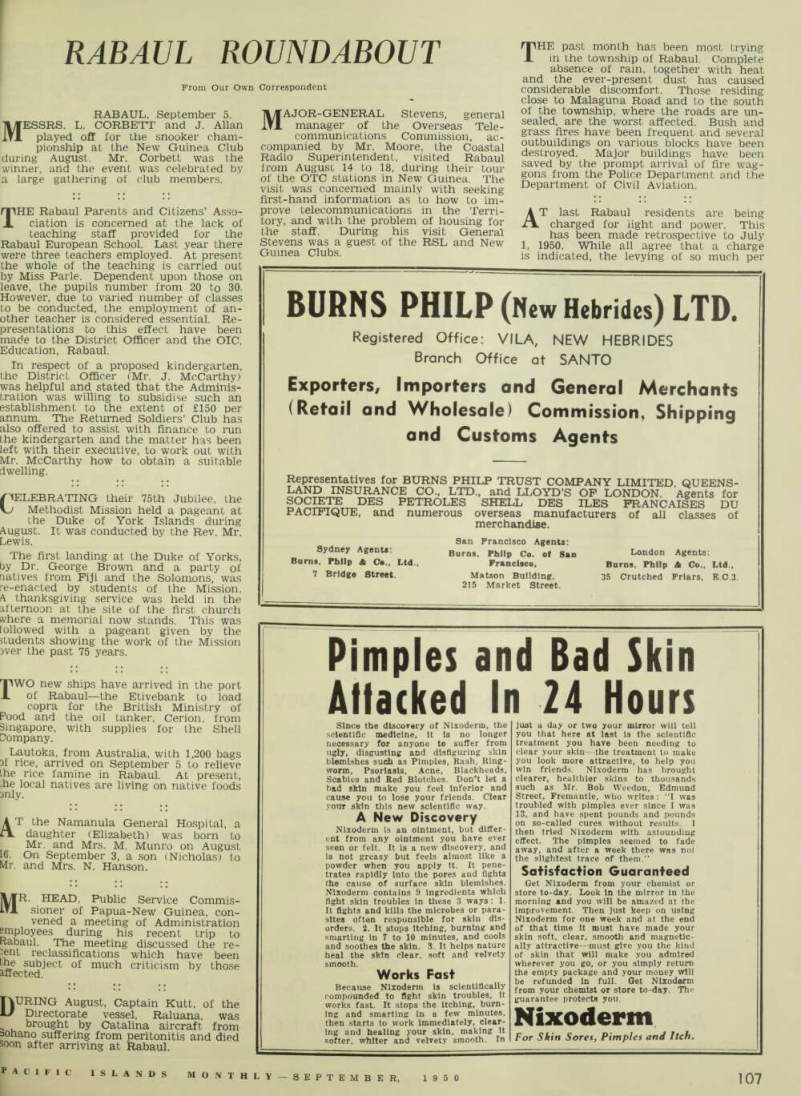
From Our Own Correspondent
RABAUL, September 5.
MESSRS. L. CORBETT and J. Allan played off for the snooker cham pionship at the New Guinea Club during August. Mr. Corbett was the winner, and the event was celebrated by a large gathering of club members.
THE Rabaul Parents and Citizens’ Asso ciation is concerned at the lack of teaching staff provided for the Rabaul European School. Last year there were three teachers employed. At present the whole of the teaching is carried out by Miss Parle. Dependent upon those on leave, the pupils number from 20 to 30.
However, due to varied number of classes to be conducted, the employment of an other teacher is considered essential. Re presentations to this effect have been made to the District Officer and the OIC, Education, Rabaul.
In respect of a proposed kindergarten, the District Officer (Mr. J. McCarthy) was helpful and stated that the Adminis tration was willing to subsidise such an establishment to the extent of £l5O per annum. The Returned Soldiers’ Club has also offered to assist with finance to run the kindergarten and the matter has been left with their executive, to work out with Mr. McCarthy how to obtain a suitable dwelling.
CELEBRATING their 75th Jubilee, the Methodist Mission held a pageant at the Duke of York Islands during August. It was conducted by the Rev. Mr.
Lewis.
The first landing at the Duke of Yorks, by Dr. George Brown and a party of natives from Fiji and the Solomons, was re-enacted by students of the Mission.
A thanksgiving service was held in the afternoon at the site of the first church ivhere a memorial now stands. This was followed with a pageant given by the students showing the work of the Mission aver the past 75 years. rWO new ships have arrived in the port of Rabaul —the Etivebank to load copra for the British Ministry of Pood and the oil tanker, Cerion, from Singapore, with supplies for the Shell Company.
Lautoka, from Australia, with 1,200 bags af rice, arrived on September 5 to relieve the rice famine in Rabaul. At present, me local natives are living on native foods anly.
A T the Namanula General Hospital, a daughter (Elizabeth) was born to Mr. and Mrs. M. Munro on August 6. On September 3, a son (Nicholas) to Mr. and Mrs. N. Hanson.
MR. HEAD, Public Service Commis sioner of Papua-New Guinea, con vened a meeting of Administration employees during his recent trip to Rabaul. The meeting discussed the re cent reclassifications which have been the subject of much criticism by those affected.
DURING August, Captain Kutt, of the Directorate vessel, Raluana, was brought by Catalina aircraft from aohano suffering from peritonitis and died soon after arriving at Rabaul.
MAJOR-GENERAL Stevens, general manager of the Overseas Tele communications Commission, ac companied by Mr. Moore, the Coastal Radio Superintendent, visited Rabaul from August 14 to 18, during their tour of the OTC stations in New Guinea. The visit was concerned mainly with seeking first-hand information as to how to im prove telecommunications in the Terri tory, and with the problem of housing for the staff. During his visit General Stevens was a guest of the RSL and New Guinea Clubs.
THE past month has been most trying in the township of Rabaul. Complete absence of rain, together with heat and the ever-present dust has caused considerable discomfort. Those residing close to Malaguna Road and to the south of the township, where the roads are un sealed, are the worst affected. Bush and grass fires have been frequent and several outbuildings on various blocks have been destroyed. Major buildings have been saved by the prompt arrival of fire wag gons from the Police Department and the Department of Civil Aviation.
AT last Rabaul residents are being charged for light and power. This has been made retrospective to July 1, 1950. While all agree that a charge is indicated, the levying of so much per
light point, etc., leaves much to be desired.
One can anticipate consumers buying their own meters to reduce these costs.
FATHER DALTON, MSC, one of Aus tralia’s foremost orators, conducted a mission at the Roman Catholic Church from August 6 to 13. The church was packed to capacity, at each service.
Sub-inspector dix, who has been stationed at Kokopo for several years, has been transferred to Rabaul. Sub-Inspector F. Towner, from Kavieng has succeeded Sub-Inspector Dix at Kokopo.
The modern photographic Casurina Studio opened at Rabaul during August and offers plenty of enticement to the camera fan.
Climaxing many weeks of competition
tennis, the Rabaul championship results were as follows: Men’s Singles Champion ship, Lieut. R. Sebastien; Ladies’ Singles Championship, Miss Egan; Men’s Doubles Championshio, Messrs. Willis and Mcßae; Men’s Singles Handicap, Mr. F. Mcßae; Ladies’ Singles Handicap, Miss Egan; Men’s Doubles Handicap, Messrs. Cook and Mcßae; Ladies’ Doubles Handicap, Miss Parle and Miss Egan; Mixed Doubles Handicap, Mr. and Mrs. O’Farrell.
TO expedite the reforming of the New Guinea Volunteer Rifles, the Rabaul RSL sub-branch offered to Northern Command, Brisbane, the use of section of the RSL Club Rooms as a centre of operations and office. Express ing his thanks for the offer, Maj.- Gen. Nimmo, GOC, Northern Command, replied that Lt.-Col. McLeod would be contacting the sub-branch to make de tailed arrangements, and that the offer had eased the problem at Rabaul.
In anticipation of these arrangements being finalised in the near future, the sub-branch welcomes any recruits for the unit in the Rabaul District.
THE first post-war informal dance, ex clusive to members and their lady guests, was held by the New Guinea Club on September 3. The function, under the capable direction of Messrs. L. Corbett and K. Cummings, was successful and is , likely to be a regular feature at the Club.
It has been rumoured that American President Lines are considering diverting one of their liners to the San Francisco- Australasia service. Aorangi (Canadian A/sian Line) is to be withdrawn from the Pacific Service in January, 1951.
Advertisements & other items, pp. 109-110 (1 item)
Pimples and Bad Skin
BURNS PHILP (New Hebrides) LTD.
Registered Office: VILA, NEW HEBRIDES
Branch Office at SANTO
Exporters, Importers and General Merchants
(Retail and Wholesale) Commission, Shipping
and Customs Agents
pacifique, and numerous overseas manufacturers of all classes of merchandise.
San Francisco Agents: Representatives for BURNS PHILP TRUST COMPANY LIMITED QUEENS- ~£™JJ? SURANCE CO ” LTD., and LLOYD’S OP LONDON. Agents for TT'l’IP T)T7' r T'T~) S~\T TT»O ntJLiT T rtnn -r-r ■■ Sydney Agents: Burns, Phllp & Co., Ltd., 7 Bridge Street.
Burns, Phllp Co. of San Francisco, Matson Building.
London Agents; Burns, Phllp A Co., Ltd., 35 Crutched Friars, EC.3 215 Market
Pimples and Bad Skin Attacked In 24 Hours
Since the discovery of Nixoderm, the scientific medicine. It Is no longer necessary for anyone to suffer from ugly, disgusting and disfiguring skin blemishes such as Pimples, Rash, Ringworm, Psoriasis, Acne, Blackheads, Scabies and Red Blotches. Don't let a bad skin make you feel Inferior and cause you to lose your friends. Clear your skin this new scientific way.
A New Discovery
Nixoderm is an ointment, but different from any ointment you have ever seen or felt. It is a new discovery, and is not greasy but feels almost like a powder when you apply It. It penetrates rapidly into the pores and fights the cause of surface skin blemishes.
Nixoderm contains 9 ingredients which fight skin troubles in these 3 ways : 1.
It fights and kills the microbes or parasites often responsible for skin disorders. 2. It stops Itching, burning and smarting in 7 to 10 minutes, and cools and soothes the skin. 3. It helps nature heal the skin clear, soft and velvety smooth.
Works Fast
Because Nixoderm Is scientifically compounded to fight skin troubles. It works fast. It stops the itching, burning and smarting in a few minutes, then starts to work immediately, clearing and healing your skin, making It softer, whiter and velvety smooth. In
just a day or two your mirror will tell you that here at last is the scientific treatment you have been needing to clear your skin—the treatment to make you look more attractive, to help you win friends. Nixoderm has brought clearer, healthier skins to thousands such as Mr. Bob Weedon, Edmund Street, Fremantle, who writes: “I was troubled with pimples ever since I was 13, and have spent pounds and pounds on so-called cures without results. I then tried Nixoderm with astounding effect. The pimples seemed to fade away, and after a week there was not the slightest trace of them.”
Satisfaction Guaranteed
Get Nixoderm from your chemist or store to-day. Look In the mirror in the morning and you will be amazed at the improvement. Then just keep on using Nixoderm for one week and at the end of that time It must have made your skin soft, clear, smooth and magnetically attractive —must give you the kind of skin that will make you admired wherever you go, or you simply return the empty package and your money will be refunded In full. Get Nixoderm from your chemist or store to-day. The guarantee protects you.
Nixoderm
For Skin Sores, Pimples and Itch.
V\o^ it shines m
BRfISSO
The quality Metal Polish M
IjJL
w
HEAD OFFICE:
379 KENT STREET, SYDNEY, N.S.W.
Telegrams and Cables: “CHASULL,” SYDNEY. Telephone: MJ 4657.
And at Melbourne, Victoria- Brisbane, Queensland.
Associated Companies ; C. SULLIVAN (PACIFIC ISLANDS) LTD., Suva, Fiji.
C. SULLIVAN INC., 230 California Street, San Francisco, U.S.A.
Over 30 Years' Pacific Island Experience Expert Buying Service Original Invoices Furnished Overseas Indents Arranged Best Prices for Copra, Cocoa, Shells, and General Island Produce.
Another Cat Island
Did This Happen in Torres Strait ?
I HAVE another version of Cat Island, from the writings of a gentleman named McManus. He apparently travelled so much and so widely that probably he got his notes mixed up when he wrote, “the flesh of my brother”— evidently based on the old cannibal adage “the flesh of my brother is no less sweet than the flesh of my brother's pig.” Mr.
McManus was out seeking cannibals and consequently every native or savage that he saw was in his eyes a potential flesh eater.
On one of his “kia kia” expeditions (he says that “kia kia’ means flesh eaters) he went to Malaita, and thence over into Papuan territory, where he captioned one of his illustrations, “monk eys—millions of them in New Guinea.”
This was the writer who as a precaution against malaria, ate a handful of garlic every day. He says that he was not approached by one anopheles mosquito.
This is one of the statements that is not open to doubt.
In the Torres Strait Islands Mr. Mc- Manus wrote a Cat Island story. It seems that a ship was wrecked, some how, just off this small island, and but one survivor, a man, made his way ashore.
He was so grateful that he named the island Deliverance Island, which I be lieve our friends will find in the vicinity of Latitude 7 deg. 30 min. South, and Longitude 141 deg. 35 min. East. Later a passing ship called in to take the survivor off, but he desired to remain with his deliverer. So the skipper left him a cat for a companion.
And then another ship came, and like wise left him another cat, but of the apposite sex. In time, there were many cats —more cats in fact than the old man could find food for.
As the story goes the cats began to sat the island lizards, which make cats yery wild and blood-thirsty. The rest, as you can guess, is simple. There be came a shortage of lizards, so the cats took after the old man. However, they left enough for a friend of our friend to bury.
However, it is my opinion that under the circumstances there are no cats left an Deliverance Island; as what can apply to the cannibals must have surely come to the cats and they have all eaten each other.
Our Californian friends might write the Administrator on Thursday Island for further clues; but, if that particular story was as “unfair dinkum” as some of the other fantastic bits in Mr. McManus' book, we might consider that he, too, had his tongue in his cheek.
What about the Thursday Islanders?
Let us have your comments please!—
Sumit.
Concerning That Aerial
A BOOKLET called “Making the Most of your Receiver,” which gives help ful information on the best ways of constructing a radio aerial, putting an aerial on a ship, getting an earth mini mising electrical interference etc., is being distributed for 1/-, post free, by R. H. Cunningham Pty., Ltd., of 62 Stan hope Street, Malvern, Melbourne. Mr.
Robert Cunningham, who has been re cently in Europe studying the latest developments in television, brought sup plies of this booklet back with him. It should be very useful to Islanders.
Mr. Ggorge K. Courtney, who was in New Guinea from 1925 until 1942, now is managing his own business in Sydney as a bag and sack merchant. He was with the old Expro. Board during 1925-26, in
charge of copra buying at Malaguna, New Britain; then he went across to the main land to engage in gold prospecting and sluicing around Edie Creek, until World War II broke out.
Advertisements & other items, p. 111 (1 item)
Kopsen Marine Equipment
NORTH SYDNEY TRAVEL BUREAU
Consultant: MRS. LILLIAN MILLAR, late of New Guinea.
Let experts arrange your travels and accommodation AGENT FOR ALL LEADING AUSTRALIAN AND WORLD AIRLINES.
FLIGHTS. —Whether you intend to fly Interstate, Intrastate or Overseas, the Bureau will be glad to make your flight reservations from departure to return.
ACCOMMODATION. —Mrs. Millar, formerly A.N.A. Accommodation Officer, can find the exact type of accommodation you require. Let her know your requirements early.
TOURS. —We will arrange your Australian tours—by air, car or tourist coach.
REAL ESTATE.—Perhaps you require a home immediately, or in the near future. A wide range of properties is available. Prospective investors also will be interested in our extensive selection of real estate propositions.
A. K. COVENTY, R.E.A., 56 Miller St., North Sydney Phones: XA 1780. After Hours: XA 2342, or XL 2185.
KOPSEN MARINE EQUIPMENT
I Everything for Boats or Boatbuilding COPPER NAILS of all types and sizes. Copper Clouts. Cut Copper Tacks. Brass Bolts and Nuts. Copper and Brass Rod.
Copper Sheathing Metal and Copper Sheet.
DEKOL. The modern preservative against dry rot, mildew, decay, Borers, White Ants and Marine Teredo. For wood or canvas. Green or colourless. Applied as paint. Prolongs life of articles treated by three times. 16/- and 24/- per gallon.
DEK
*OR
*OOf> OR
9/1 *oo d A cO* yC WIRE ROPE. Galv. for yachts, ships, mines or timber logging. All sizes and grades. Also shackles, thimbles, turnbuckles, wire rope grips, and every class of lifting equipment.
PROPELLER SHAFTING for
motor boats. All sizes from in. to 4 in. dia. in brass, bronze or monel metal.
Bearings in bronze, rubber or novasteen. Propellers all sizes.
Orders accepted through your buying agent. Price lists on request at any time. Send a list of lines for quotation.
W. KOPSEN & CO. PTY. LTD.
376-382 Kent St., Sydney. Cables: “Kopsen,” Sydney.
Verses Of The Pacific
Isles
MRS. Alice Allen Innes has published some of her verses in a gift-booklet —called “Songs from the South Seas”—a boon to givers of Christmas presents in these days of increasing responsibilities and little time.
Some of the verses are known already to PIM readers; some are not. The technical perfection or the intellectual snob (of whom, God help us, there as an over-abundant supply in this age) would probably find fault with them, but AAI has, nonetheless, the happy gift of capturing the real essence of the Islands world —perhaps, because she, like most Islands residents, is part-realist, part-romanticist.
Captain Brett Milder has done several black and white drawings for the booklet which is attractively printed. They are done up in envelopes ready for posting.
Price is 6 - or 6/6 posted. Copies may be obtained from Pacific Publications Office, 7th Floor, 247 George Street, or by writing to our box number—34oB, Sydney.
The members of a research team which is studying the incidence of tuberculosis in the South Pacific for the South Pacific Commission are to visit Fiji shortly. The team is led by Dr. J, Guillermin of the French Colonial Medical Service. The re maining members are a bacteriologist, Miss B. G. Balfour of Melbourne, and an X-ray technician, Mr. W. H. P. Love of Wellington.
Polynesian Club Of Sydney
DESPITE a change of domicile, the Polynesian Club of Sydney main tains its successful programme of weekly “Get Togethers,” where Islands peoples meet their Sydney friends. The Club meets every Wednesday evening at 14 Ennis Road, Milson’s Point, Sydney, one stop across the Bridge, and right under the tram station on the Kirribilli side. The telephone number is FW 4661.
Among the interesting visitors have been Captain Tom Milner of the Gilbert and Ellice ship “Nei Niminoa’ and Mrs.
Milner; and Polly Wilder and her cous ins, Mrs. Amy Cubis and George and Terence Dighton, all originally from Suva.
Others from Fiji were Mr. and Mrs.
Chris. Sorenson, of Levuka; Reg. Spow ert, from Suva, who is now studying medicine at Sydney University; and former Suva Police Inspector, Don Wat son, who was introduced by radio star Joan Reid. Samoan visitors were Derek Bernard (making a return visit to the Club after a number of years abroad), Henry Purcell, Bob and Peter Williams, and Jim Roberts.
From Tahiti came Madame Vienne, of Fariipiti, and Madame Pana Edmonds, of Maraa (Paea). The latter returned to Tahiti by the S.S. Waitemata with another member, Marie Finch, who was farewelled before starting on holiday to Papeete.
Another departing member was Jack Barkley, formerly of Sigatoka, Fiji, who has gone to the Solomon Islands.
On his 50th birthday, the President, Leonard Moran, was chief guest at a ceremonious “Faikava,” conducted by John Ha’u and Truda Cameron, with her brothers Evan and Dugal Cameron, all originally from Nukualofa, Tonga. At the feast which followed, raw fish —“Poe’' and “Fafa’’ in Tahitian style—and Vak alolo, with other island dishes, were served, and much enjoyed.
Crime Wave
IN
Western Samoa
Apia, August 11. mHERE seems to be increasing lawless ly ness in Western Samoa. These attacks by village youths are causing serious concern.
The Chief Judge, Mr. C. C. Marsack sentenced the Samoan Fa’asuaga, 18. to seven years’ hard labour, for his murder ous attack on Mr. D. C. M. Campbell, Manager of the New Zealand Reparation Estates’ Vaitele Plantation.
The Judge pointed out that the case had no redeeming features, and that the accused could consider himself fortunate in that, through the attention and care of the doctors at Apia Hospital, Mr.
Campbell had survived.
Another assault, on an employee of the Estates' Mulifanua Plantation, took place on August 7, when Alefaga, a Sam oan stockman on Mulifanua, encountered two Samoans carrying shotguns, inside the Vaipapa cocoa block. He accused them of trespass and demanded their guns. One man complied, but the other fired at him. from a distance of three yards hitting him just above the heart.
The Samoan then fled and Alofaga was attended to by plantation employees and taken to Apia Hospital, where his serious injury was treated and he was given, several blood transfusions.
The assailant, a native of Nofoaliii village, reported his crime to his father,, who took him to Apia and surrendered! him to the police.
Advertisements & other items, p. 112 (1 item)
Tnc Garrick Motel
9 K.V.A. ENGLISH GENERATING SETS
230 VOLT, SINGLE PHASE, 50 CYCLE.
The Ideal Set for Window Lighting
Complete with Auto-Voltage Regulator and Switchboard.
IMMEDIATE DELIVERY
PRICE : £375 Plus Tax
“Meadows” 4-cyl. petrol engine, water-cooled, with tropical radiator and fan. Alternator well-known English make with separate Exciter, Ideal set for LIGHTING. HEATING and other SINGLE PHASE LOADS. Particularly suitable for CINEMA Projection Equipment. Alternator frames are 3-phase type and can be easily rewound for 240-415 Volt 3-phase. PRICE: £ 405.
We can also quote this set powered with Weight: 1,650 lbs. (approx.) Coventry Climax diesel engine. 9|
ARDMA
11 MISSENDEN ROAD, NEWTOWN. SYDNEY, AUSTRALIA.
Trade inquiries also invited.
Tnc Garrick Motel
* ml
llli
•in, ii
BurT
li .4 m * il
SUVA
FIJI
This well-known Hofei is centrally situated in Suva's main business quarter :: Modern accommodation provides comfort in all climatic conditions :: Only the best of Beers, Spirits and Wines is served Telephone: 80. VINCE COSTELLO, Proprietor.
Hospital Reborn
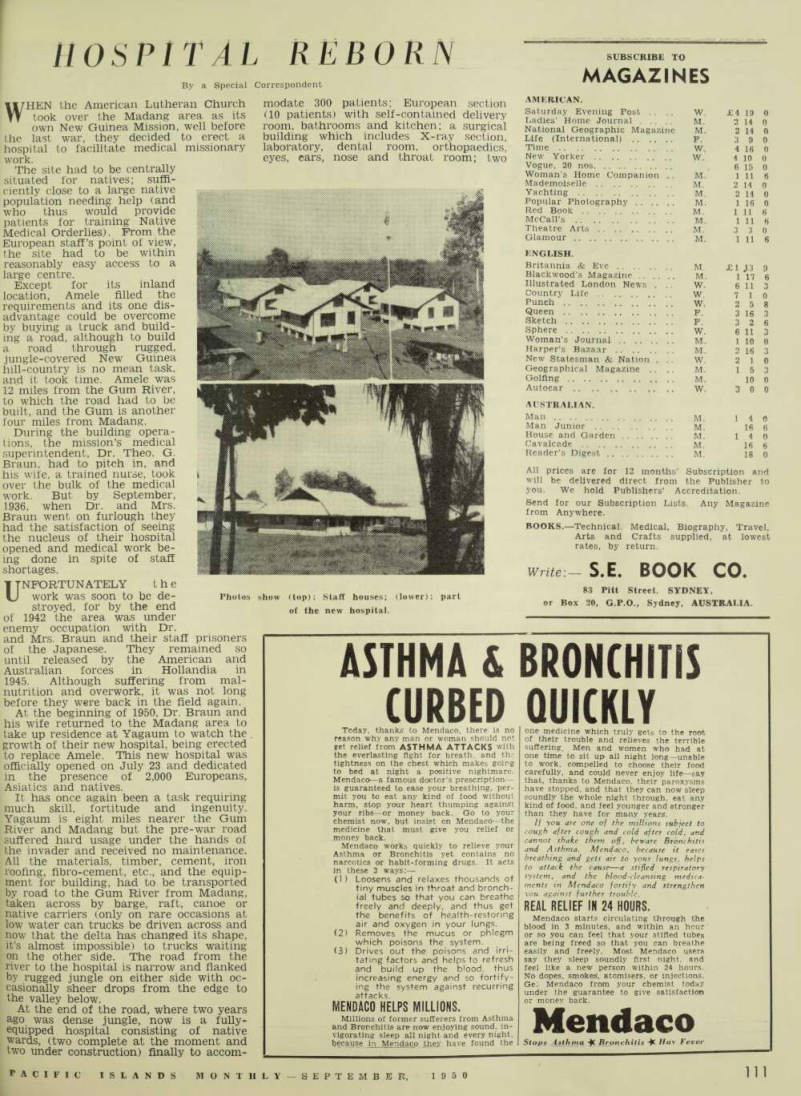
By a Special Correspondent
WHEN the American Lutheran Church took over the Madang area as its own New Guinea Mission, well before the last war, they decided to erect a hospital to facilitate medical missionary work.
The site had to be centrally situated for natives; suffi ciently close to a large native population needing help (and who thus would provide patients for training Native Medical Orderlies). From the European staff’s point of view, the site had to be within reasonably easy access to a large centre.
Except for its inland location, Amele filled the requirements and its one dis advantage could be overcome by buying a truck and build ing a road, although to build a road through rugged, jungle-covered New Guinea hill-country is no mean task, and it took time. Amele was 12 miles from the Gum River, to which the road had to be built, and the Gum is another four miles from Madang.
During the building opera tions, the mission’s medical superintendent, Dr. Theo. G.
Braun, had to pitch in, and his wife, a trained nurse, took over the bulk of the medical work. But by September, 1936, when Dr. and Mrs.
Braun went on furlough they had the satisfaction of seeing the nucleus of their hospital opened and medical work be ing done in spite of staff shortages.
Unfortunately th e work was soon to be de stroyed, for by the end of 1942 the area was under
enemy occupation with Dr. and Mrs. Braun and their staff prisoners of the Japanese. They remained so until released by the American and Australian forces in Hollandia in 1945. Although suffering from mal nutrition and overwork, it was not long before they were back in the field again.
At the beginning of 1950, Dr. Braun and his wife returned to the Madang area to take up residence at Yagaum to watch the growth of their new hospital, being erected to replace Amele. This new hospital was officially opened on July 23 and dedicated in the presence of 2,000 Europeans, Asiatics and natives.
It has once again been a task requiring much skill, fortitude and ingenuity.
Yagaum is eight miles nearer the Gum River and Madang but the pre-war road suffered hard usage under the hands of the invader and received no maintenance.
All the materials, timber, cement, iron roofing, fibro-cement, etc., and the equip ment for building, had to be transported by road to the Gum River from Madang, taken across by barge, raft, canoe or native carriers (only on rare occasions at low water can trucks be driven across and now that the delta has changed its shape, it’s almost impossible) to trucks waiting on the other side. The road from the river to the hospital is narrow and flanked by rugged jungle on either side with oc casionally sheer drops from the edge to the valley below.
At the end of the road, where two years ago was dense jungle, now is a fully equipped hospital consisting of native wards, (two complete at the moment and two under construction) finally to accom
modate 300 patients; European section (10 patients) with self-contained delivery room, bathrooms and kitchen: a surgical building which includes X-ray section, laboratory, dental room, orthopaedics, eyes, ears, nose and throat room; two
Photos show (top): Staff houses; (lower): part of the new hospital.
Magazines
Subscribe To
All prices are for 12 months’ Subscription and will be delivered direct from the Publisher to you. We hold Publishers’ Accreditation.
Send for our Subscription Lists. Any Magazine from Anywhere.
BOOKS.—Technical. Medical, Biography, Travel, Arts and Crafts supplied, at lowest rates, by return.
Write:— S.E. BOOK CO.
83 Pitt Street, SYDNEY, or Box 20, G.P.0., Sydney, AUSTRALIA.
American.
Saturday Evening Post .. . .
W. £4 19 0 Ladies' Home Journal M. 2 14 0 National Geographic Magazine M. 2 14 0 Life (International) F. 3 9 0 Time W. 4 16 0 New Yorker W. 4 10 0 Vogue, 20 nos 6 15 0 Woman’s Home Companion . .
M. 1 11 6 Mademoiselle M. 2 14 0 Yachting M. 2 14 0 Popular Photography M. 1 16 0 Red Book M. 1 11 6 McCall’s M. 1 11 6 Theatre Arts M. 3 3 0 Glamour M. 1 11 6
English.
Britannia & Eve M. £1 13 9 Blackwood’s Magazine M. 1 17 6 Illustrated London News . ..
W. 6 11 3 Country Life W. 7 1 0 Punch w. 2 5 8 Queen F. 3 16 3 Sketch F. 3 2 6 Sphere W. 6 11 3 Woman’s Journal M. 1 10 0 Harper’s Bazaar M. 2 16 3 New Statesman & Nation . .
W. 2 1 0 Geographical Magazine ..
M. 1 5 3 Golfing M. 10 0 Autocar W. 3 0 0
Australian.
Man M. 1 4 0 Man Junior M. 16 6 House and Garden M. 1 4 0 Cavalcade M. 16 6 Reader’s Digest M. 18 0
theatres with observation room; dispen sary, pharmacy, general office, medical stores, library and rest-room for Euro pean staff; and a native medical orderlies’ room. Staff houses, both European and native, are built close to the hospital site.
European staff includes Dr. Braun, who is in charge; his secretary, a pharmacist, dentist, three nursing sisters, and 15 trained native medical orderlies. There will always be a number of natives re ceiving training in medical work and this field is open to native women now, as well as to the men.
THE cost of this building and equip ment had been donated once again by the Women’s Missionary Federa tion of USA and Canada and amounted to $75,000 (over £30,000 at present rate of exchange). The supervising of the re building of this hospital has been to Dr.
Braun a labour of love and once again he has had to do far more than is ordin arily required of a medical man whose whjje liie is bound up in surgery and healing. As with all great men there is a great woman at his side and without the support of his wife he would not so easily have overcome the many delays and dis appointments.
This time we hope that the results of their work will not be marred by the hostilities and sufferings of war, but stand in the midst of the jungle as a symbol of Christian influence, healing, peace on earth and goodwill to all men.
Advertisements & other items, pp. 113-114 (1 item)
Curbed Quickly
ASTHMA & BRONCHITIS
Today, thanks to Mendaco, there is no reason why any man or woman should not get relief from ASTHMA ATTACKS with the everlasting fight for breath, and th: tightness on the chest which makes going to bed at night a positive nightmare.
Mendaco—a famous doctor’s prescription— is guaranteed to ease your breathing, permit you to eat any kind of food without harm, stop your heart thumping against your ribs—or money back. Go to your chemist now, but insist on Mendaco —the medicine that must give you relief or money back.
Mendaco works quickly to relieve your Asthma or Bronchitis yet contains no narcotics or habit-forming drugs. It acts in these 3 ways:— (1) Loosens and relaxes thousands of tiny muscles in throat and bronchial tubes so that you can breathe freely and deeply, and thus get the benefits of health-restoring air and oxygen in your lungs. (2) Removes the mucus or phlegm
which poisons the system.
(3) Drives out the poisons and irritating factors and helps to refresh and build up the blood, thus increasing energy and so fortify-
ing the system against recurring
attacks.
MENDACO HELPS MILLIONS.
Millions of former sufferers from Asthma and Bronchitis are now enjoying sound, invigorating sleep all night and every night, because in Mendaco they have found the
one medicine which truly gets to the root of their trouble and relieves the terrible suffering. Men and women who had at one time to sit up all night long—unable to work, compelled to choose their food carefully, and could never enjoy life—say that, thanks to Mendaco, their paroxysms have stopped, and that they can now sleep soundly the whole night through, eat any kind of food, and feel younger and stronger than they have for many years.
If you are one of the millions subject to cough after cough and cold after cold, and cannot shake them off, beware Bronchitis and Asthma. Mendaco, because it eases breathing and gets air to your lungs, helps to attack the cause —a stifled respiratory system, and the blood-cleansing medicaments in Mendaco fortify and strengthen you against further trouble.
REAL RELIEF IN 24 HOURS.
Mendaco starts circulating through the blood in 3 minutes, and within an hour or so you can feel that your stifled tubes are being freed so that you can breathe easily and freely. Most Mendaco users say they sleep soundly first night, and feel like a new person within 24 hours.
No dopes, smokes, atomisers, or injections.
Gei Mendaco from your chemist today under the guarantee to give satisfaction or money back.
Mendaco
Stops Asthma -|C Bronchitis -K Hay Fever
IS
HOW OLD
YOUR WILL?
Placing your signature on your will should not end your concern for this extremely important document. Unless it is kept up to date, neglect can thwart your intentions.
A beneficiary may die, specific property may be sold, increases in your assets may be overlooked. Marriage, too, revokes a will in almost every case. However, you can avoid these hazards quite easily.
Let your solicitor revise your will, then appoint Burns Philp Trust Company Limited as executor or trustee. This commonsense precaution removes another danger that of
faulty administration.
The solid advantages of securing the Company's services are explained in "Hands That Never Leave The Wheel."
A complimentary copy of this 20-page booklet can be obtained from any branch of Burns Philp (South Sea) Company, Burns Philp (New Guinea) Limited, Burns Philp (New Hebrides) Ltd., or direct from the head office of this Company.
DIRECTORS:
James Burns Eric Priestley Lee P. T. W. Black Joseph Mitchell MANAGER; L. S. Parker.
SECRETARY: E. R. Overton, F.F.I.A.
Bums Philp Trust
COMPANY
LIMITED
Executor • Trustee • Attorney
Constituted hy Special Act of the N.S.W. Parliament.
7 BRIDGE STREET, SYDNEY
Telephone: 8U5901 Box 543, G.P.0., Sydney.
Papua-N. Guinea
Problems of Education Papua-N. Guinea
THE Director of Education in Papua- New Guinea, Mr. William C. Groves, left Australia by air at the end of Aug ust on a special mission to the United Nations Headquarters in New York, where he represented Australia before a special UN committee on colonial education.
According to newspaper reports Mr.
Groves said that the first step in dealing with his department’s greatest problem— namely, the reduction of illiteracy—was to instruct the native in his own tongue.
He also indicated that in his view the removal of illiteracy was closely tied in with the solution of economic and social problems.
Editorial Note.—lt is, of course, a matter of common knowledge that little, if any, progress can be made in the spread of literacy in Papua-New Guinea until there is establishel some common medium of speech. Among the li million or so natives in Papua-New Guinea there are hundreds of languages; and the only thing resembling a common language is Motuan (brought into use in Papua by the late Sir Hubert Murray, and now partly discontinued) and Pidgin—a bast ard form of language which is condemned by all education authorities, but which is so easily picked up by the natives that it is coming more and more into general use.
Captain George O’Brien, well-known skipper of Islands small boats, who re cently took the Marist Mission’s Halgard from Sydney to Fiji, delivered a 56 ft. vessel, Gumleaf, equipped with an 80 HP Vivien marine engine, to Messrs. Bryan and Williams (Guadalcanal Planting and Trading Ltd.) in the Solomon Islands in August. He returned to Sydney from Honiara by TOA flying-boat late in August, and was off again for BSI early in September to deliver another 50-footer,, the Aldebaran, to Fairymead Sugar C 0.,, Ltd. Skipper O’Brien has delivered so< many boats to the Islands in recent yearsN that one of his Solomon pals now de scribes him as “a nautical midwife.”
Scope Of South Pacific
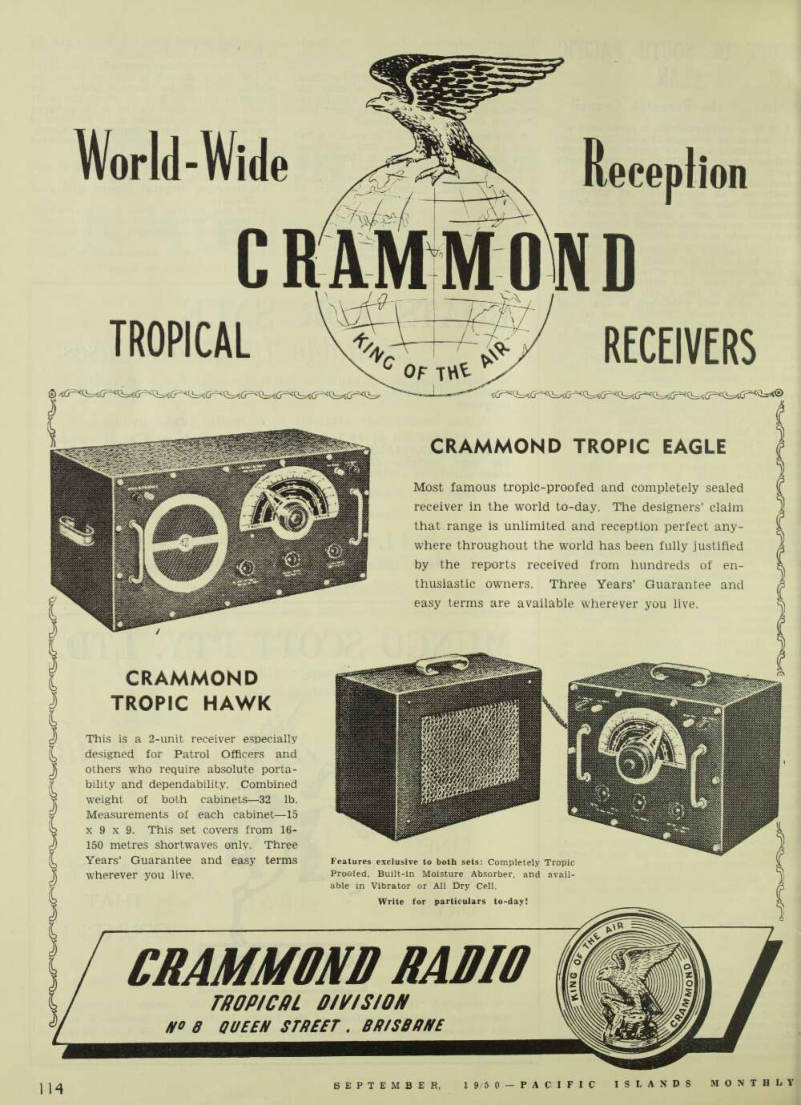
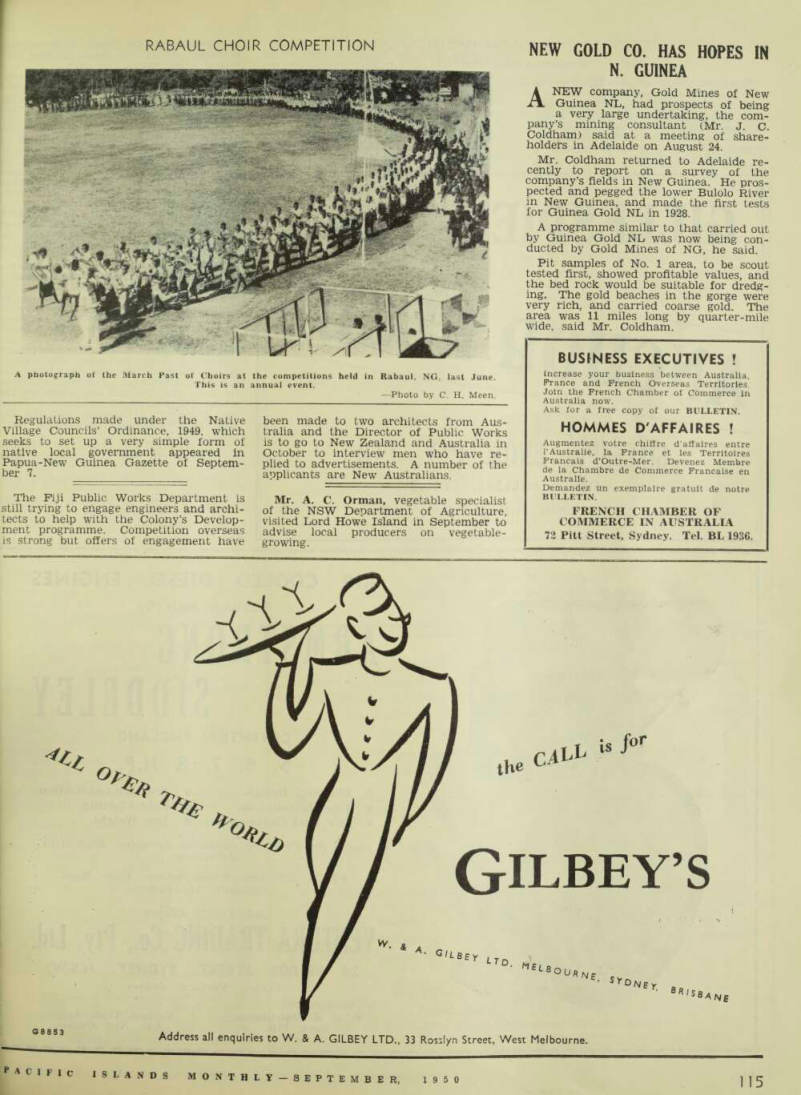
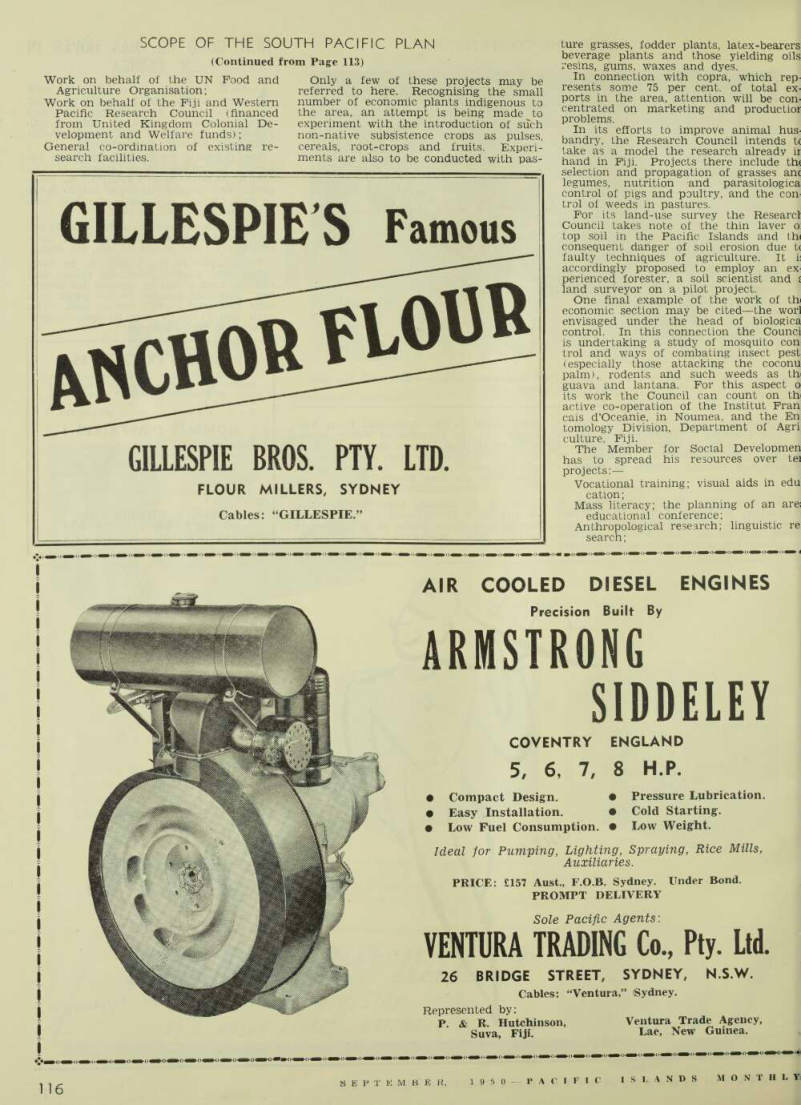
Plan
Aims of the Research Council
WE have received, from a prominent re sident of a South Pacific Territory, a private letter, in which he strongly criticises the activities of the South Pacific Commission. He questions the practical value of the plan, and sees it mostly as “an opportunity of providing well-paid jobs for a group of academic dreamers, who are spending a great deal of public money which could be more ad vantageously used in other directions.”
This is typical of a good deal of com ment: and it is the result of the failure of the Commission to effectively publicise its aims, objects and activities. A very good outline of the South Pacific Com mission plan was published in the April issue of the Crown Colonist; and we re print the article in full, so that the general idea will be better understood in the South Pacific. It will serve as an ex planatory background to the report of the recent Sydney meeting of the Com mission’s Research Council.
THE members of the six Powers who met at the Fifth Session of the South Pacific Commission in Suva, early in May, can look back on a year of solid preparatory work and forward to a period of steadily expanding activity.
Under the guidance of the Commission’s Secretary-General, Mr. W. D. Forsyth, and his collaborators a new era of pro gress is being planned for the scattered area comprising all the non-self-govern ing territories in the South Pacific which are administered by the participating Governments —Australia, France, Nether lands, New Zealand, United Kingdom and United States.
The Commission was established in 1947 as a consultative and advisory body to “encourage and strengthen international co-operation in promoting the economic and social welfare and advancement” of the peoples of these territories.
To this end the Commission was re commended at the time of inception to give early consideration to a wide range of projects deemed to be of particular importance to the social welfare of the inhabitants. These projects are now arranged under the three general head ings of Health, Economic Development (including agriculture) and Social De
velopment (including education).
Five projects were allocated to the field of Health, thirteen to Economic Develop ment and ten to Social Welfare. On the Research Council (which is responsible to the Commission itself for the orderly development of these projects) there is a specialist member in charge of each of the three groups.
A survey of the twenty-eight projects reveals the care with which the schemes of work have been devised.
The Member for Health, for example, has the following projects under con sideration:— Epidemiological information and quarantine; Maternal and infant welfare; Tuberculosis: filariasis and elephan tiasis; Diet and nutrition. . A standard system of epidemiological information and stringent quarantine re gulations has become necessary as a re sult of the wider use of aviation in the area, which has increased the risk of infection. Such a standard procedure has been evolved under which member Gov ernments can supply information on
thirty-six infectious diseases to headquarters, for transmission to appropriate authorities throughout the area.
In regard to maternal and child welfare, member Governments have already for some years been engaged in valuable research into weaning foods and their preparation under local conditions.
A particularly wide field of research lies open in the case of diet and nutrition, Here the main object of the Member for Health on the Research Council has been to concentrate on the collection and study of existing data, including statistics of imported foodstuffs, individual and communal diets and alcoholism.
The most urgent of South Pacific health problems are tuberculosis, filariasis and elephantiasis. A detailed plan has been prepared in the case of tuberculosis, under which simple techniques suitable for
use under actual field conditions can be developed and implemented.
Economic questions naturally loom large in the Commission’s system of priorities, and in selecting its thirteen projects the Research Council bore in mind the wide diversity of peoples in the area, ranging as they do from isolated atoll-dwellers to “westernised” urban communities accus tomed to a money economy. The selected projects are: Introduction and distribution of econo mic plants; Cash crops; tropical pasture and ani mals; Land use surveys; fruit and vegetables; Economic development of coral islands; fisheries: subsistence of indigenous peoples; Control of pests; commercial relations;
(Continued on Page 116)
Work on behalf of the UN Food and Agriculture Organisation: Work on behalf of the Fiji and Western Pacific Research Council (financed from United Kingdom Colonial De velopment and Welfare funds); General co-ordination of existing re search facilities.
Only a few of these projects may be referred to here. Recognising the small number of economic plants indigenous to the area, an attempt is being made to experiment with the introduction of such non-native subsistence crops as pulses, cereals, root-crops and fruits. Experi ments are also to be conducted with pas
ture grasses, fodder plants, latex-bearers, beverage plants and those yielding oils resins, gums, waxes and dyes.
In connection with copra, which rep resents some 75 per cent, of total ex ports in the area, attention will be con centrated on marketing and productior problems.
In its efforts to improve animal hus bandry, the Research Council intends tc take as a model the research already ir hand in Fiji. Projects there include the selection and propagation of grasses anc legumes, nutrition and parasitological control of pigs and poultry, and the con trol of weeds in pastures.
For its land-use survey the Research Council takes note of the thin layer oi top soil in the Pacific Islands and the consequent danger of soil erosion due tc faulty techniques of agriculture. It h accordingly proposed to employ an ex perienced forester, a soil scientist and £ land surveyor on a pilot project.
One final example of the work of the economic section may be cited —the worl envisaged under the head of biologica control. In this connection the Counci is undertaking a study of mosquito con' trol and ways of combating insect pest (especially those attacking the coconu palm), rodents and such weeds as the guava and lantana. For this aspect o its work the Council can count on the active co-operation of the Institut Fran cais d’Oceanie, in Noumea, and the En tomology Division, Department of Agri culture, Fiji.
The Member for Social Developmen has to spread his resources over tei projects:— Vocational training; visual aids in edu cation; Mass literacy; the planning of an arej educational conference; Anthropological research; linguistic re search;
J The role of co-operative societies; Building; community development; Preservation of archaeological sites of historical and scientific importance.
Indicative of the general line to be fol lowed is the work suggested under com munity development. It is proposed that pilot projects should be instituted in Fiji and Netherlands New Guinea. A selected community will participate in its own de velopment under the leadership of a trained native team, including a teacher, agricultural instructor, carpenter and house builder, a leader trained in sani tation and hygiene, a co-operative leader and a woman experienced in child wefare.
A village on the island of Moturiki has been chosen for the Fiji experiment.
Should this method prove successful the team will then move on to another com munity.
Allied to this is the plan proposed for combating mass illiteracy. One particular method is already being tried out as a pilot project in New Guinea, and the Research Council will consider the ade quacy of this method in the light of ex periments taking place elsewhere, notably in Jamaica, Northern Rhodesia, Nyasa land, Pakistan, India and China. Since both these lines of experiment involve the use of educational techniques, a study will be made of the use of such visual aids as films and film strips.
Advertisements & other items, pp. 115-116 (1 item)
Superb
BOATS FOR SALE . . .
Suitable for Island uses.
We have continuously available for sale a large and wide variety of power and auxiliary power craft ideally suited for various Island purposes.
Those immediately available at attractive prices include:— 66 ft. SCHOONER of 40 tons displacement; 28 ft. and 36 ft. raised deck and AUXILIARY FISHING BOATS. TRADING VESSELS up to 300 tons, suitable for many Islands uses. (Conversion arranged economically if desired) . . and other craft.
Delivery of most types to Island destinations arranged.
Send for details and photographs.
WILLIAM E. REED
1450 George Street, Circular Quay, Sydney.
Cable Address: “WILREED,” Sydney.
MUNGO SCOTT PTY. LTD.
Flour Millers, Summer Hill, N.S.W., Australia Established 1894.
BLUE
FINE
AND
DRY !
6
SUPERB
SUPERB
IT'S
QUALITY
THAT
COUNTS !
The unvaried “Quality” of “BLUE SUPERB FLOUR” makes it especially suitable to climatic conditions of the Pacific Islands. Our Entoletion process reduces the risk of insect infestation to a minimum. All Good Bakers use “BLUE-SUPERB.” Our Pacific Representative will call on you soon.
World-Wid
TROPICAL
(5 e V N* 'V V c OF
Reeepllon
MON D
RECEIVERS
(P^Q^Cr^Q^Cr^Q^Cr
CRAMMOND TROPIC EAGLE
Most famous tropic-proofed and completely sealed receiver in the world to-day. The designers’ claim that range is unlimited and reception perfect anywhere throughout the world has been fully justified by the reports received from hundreds of enthusiastic owners. Three Years’ Guarantee and easy terms are available wherever you live.
CRAMMOND
TROPIC HAWK
This is a 2-unit receiver especially designed for Patrol Officers and others who require absolute portability and dependability. Combined weight of both cabinets—32 lb.
Measurements of each cabinet—ls x 9 x 9. This set covers from 16- 150 metres shortwaves only. Three Years’ Guarantee and easy terms wherever you live.
Features exclusive to both sets: Completely Tropic Proofed, Built-in Moisture Absorber, and available in Vibrator or All Dry Cell.
Write for particulars to-day!
CRAMMOND RADIO
TROPICRL DIVISION
!\/o 8 QUEEN STREET .
Rabaul Choir Competition
Regulations made under the Native Village Councils’ Ordinance, 1949, which seeks to set up a very simple form of native local government appeared in Papua-New Guinea Gazette of Septem ber 7.
The Fiji Public Works Department is still trying to engage engineers and archi tects to help with the Colony’s Develop ment programme. Competition overseas is strong but offers of engagement have
been made to two architects from Aus tralia and the Director of Public Works is to go to New Zealand and Australia in October to interview men who have re plied to advertisements. A number of the applicants are New Australians.
Mr. A. C. Orman, vegetable specialist of the NSW Department of Agriculture, visited Lord Howe Island in September to advise local producers on vegetable growing.
A photograph of the March Past of Choirs at the competitions held in Rabaul, NG, last June.
This is an annual event. -Photo by C. H. Meen.
New Gold Co. Has Hopes In
N. Guinea
ANEW company, Gold Mines of New Guinea NL, had prospects of being a very large undertaking, the com pany’s mining consultant (Mr. J. c.
Coldham) said at a meeting of share holders in Adelaide on August 24.
Mr. Coldham returned to Adelaide re cently to report on a survey of the company’s fields in New Guinea. He pros pected and pegged the lower Bulolo River in New Guinea, and made the first tests for Guinea Gold NL in 1928.
A programme similar to that carried out by Guinea Gold NL was now being con ducted by Gold Mines of NG, he said.
Pit samples of No. 1 area, to be scout tested first, showed profitable values, and the bed rock would be suitable for dredg ing. The gold beaches in the gorge were very rich, and carried coarse gold. The area was 11 miles long by quarter-mile wide, said Mr. Coldham.
Advertisements & other items, pp. 117-118 (2 items)
Gilbey’S
BUSINESS EXECUTIVES !
Increase your business between Australia, Prance and French Overseas Territories Join the French Chamber of Commerce in Australia now.
Ask for a free copy of our BULLETIN.
HOMMES D'AFFAIRES !
Augmentez votre chiffre d’affaires entre I’Australie, la France et les Territoires Francais d’Outre-Mer. Devenez Membre de la Chambre de Commerce Francaise en Australle.
Demandez un exemplalre gratuit de notre
BULLETIN.
FRENCH CHAMBER OF
COMMERCE IN AUSTRALIA
72 Pitt Street, Sydney. Tel. BL 1936.
Of, // 4 * A
the
is /° r
GILBEY’S
g /L 8
Ey ITD K.
* El *ou ßne SYoh Ey. ■ br, s b am e C 8853 Address all enquiries to W. & A. GILBEY LTD., 33 Rosslyn Street, West Melbourne.
GILLESPIE'S Famous
GILLESPIE BROS. PTY. LTD.
FLOUR MILLERS, SYDNEY
Cables: “GILLESPIE.”
■ I
AIR COOLED DIESEL ENGINES
Precision Built By
ARMSTRONG
SIDDEIEY
COVENTRY ENGLAND
5,6, 7, 8 H.P. • Compact Design. • Pressure Lubrication. • Easy Installation. • Cold Starting. • Low Fuel Consumption. • Low Weight.
Ideal for Pumping, Lighting, Spraying, Rice Mills, Auxiliaries.
PRICE: £157 Aust., F. 0.8. Sydney. Under Bond.
PROMPT DELIVERY
Sole Pacific Agents :
VENTURA TRADING Co., Pty. ltd.
26 BRIDGE STREET, SYDNEY, N.S.W.
Cables; “Ventura,” Sydney.
Represented by: P & R. Hutchinson, Ventura Trade Agency, Suva, Fiji. Lae, New Guinea.
116
SEPTEMBER. 19 5 0 PACIFIC ISLANDS MONTHLY*
SCOPE OF THE SOUTH PACIFIC PLAN
(Continued from Page 113)
Visit To Mount Mother
Rabaul, Aug. 10.
ON Sunday, August 6, a party comprising Messrs. Fred Catell, Wallie Howard, Bill Wallace, Neville Eaglesham and John W. Cox, all of Works and Housing, Rabaul, climbed the 2,000 feet to the sum mit of Mount Mother, known to the local natives as Kambiu.
The ascent began from Nodup village at 5.45 a.m., and the summit was reached at 7.45.
Perfect atmospheric conditions pre vailed, and many photographs were taken of the breath-taking panorama spread out below them. A native from Nodup guided the party to a tree-shaded dell, where cold water bubbled from the moun tain-side, and where a well-deserved lunch was eaten.
A Japanese two-engined fighter-bomber, which was shot down by our fighters in the war was photographed as it lay near by. It was rather smashed up, and it has six unexploded 250 lb. bombs attached.
A rare Harpie (not to be confused with “happy”) eagle has just been brought down to Sydney from New Guinea by members of a Taronga Park Zoo bird hunting expedition. Seems that the Harpie is a real rara avis—no zoo has had a live specimen before. Mr. Hallstrom (of Zoo and 'NondugD says it is priceless.
Taronga will build a special enclosure for it.
Mamara Plantations Ltd., registered in Brisbane, which owns a plantation in the Solomons, had a net profit in the year ended June 30 of £1,367 —the best for many years. It allowed the directors to pay 5 per cent, to their cumulative pre ference shares, which meant that the arrears to June 30, 1945, are wiped out.
This company has a subscribed capital of £90,145, of which £50,000 is in cumulative preference shares. It balances its ac counts by showing a War Damage claims account (“for record only”) of £32,690.
There is no likelihood of BSI plantations receiving any war damage compensation.
On his return from leave, Mr. John W.
Cox, New Guinea Public Works road master, was kept temporarily in Rabaul, to do a special job on the North Coast road. He expects, after that, to return to Bougainville.
Mr. j. R. B. Angus, Assistant Conserva tor of Forests, Kenya, has been appointed Conservator of Forests, Fiji. He will take short leave in the United Kingdom to wards the end of this year, and will sail for Fiji early in 1951.
Ratu Mara, a young Fijian Chief who has completed the Administrative officers’
Course in the United Kingdom, is on his way back to Fiji to take up an appoint ment as an Administrative Officer in the Colony. Another new Administrative Officer, Mr. R. D, Sanders, has also sailed from the United Kingdom for Fiji.
Advertisements & other items, pp. 119-120 (3 items)
117
BACIFIC ISLANDS MONTHLY SEPTEMBER, 1950
Cointreau
BOOKS
BOOK BARGAINS.—Every few months I issue a catalogue of clean secondhand books at really bargain prices from a shilling or two to a pound or two, each. If you’d like these catalogues sent, just send a line stating your interests. (Note: If you order, part payment can always be made in used stamps, not removed from the paper, of which I am always needing any amount.) —Philip R. Boulton, 8, Fore Street, Westbury, Wilts., England.
NOTICE IS HEREBY GIVEN that the word COINTREAU shown below is the exclusive property and proper TRADE MARK of Societe a Responsabilite Limitee COINTREAU, whose Head Office is at 1 Place Moliere a Angers (Maine & Loire), France, Merchants; used by them in respect of: Wines, Sparkling Wines, Ciders, Beers, Alcohols, Brandies, Liqueurs and Spirits, and the Trade and Public are hereby cautioned against any infringement or improper use of the same.
COINTREAU
Legal proceedings will be instituted against any person or persons selling or offering for sale goods, not the manufacture of the aforesaid Societe a Responsabilite Limitee COINTREAU, bearing any representation of the said Trade Mark or any colourable imitation thereof.
EDWD. WATERS & SONS
Patent and Trade Mark Attorneys, 422-428 Collins Street, Melbourne, Victoria, Australia.
NOTICE EST DONNE CI-DESSOUS que le mot COINTREAU audessous est I’exclusive propriety et la vraie MARQUE DE FABRIQUE de la Societe a Responsabilite Limitee COINTREAU, de qui chef bureau est a 1 Place Moliere a Angers (Maine & Loire), France, Negociants; employe par eux concernant:
VINS, MOUSSEAU VINS, CIDRES, BIERES, ALCOHOLS,
EAUX-DE-VIE, LIQUEURS, ET SPIRITUEUX,
et que ITndustrie et le Public sont prevenus par cette annonce contre toute fraude ou abus de cette marque.
COINTREAU
Les precedes legaux seront institutes contre toute personne vendant ou offrant pour la vente les marchandises qui ne sont pas factures par la-dite Societe a Responsabilite Limitee COINTREAU, portant aucune representation de cette Marque de Fabrique ou aucune imitation specieuse de cette marque.
EDWD. WATERS & SONS
Patent and Trade Mark Attorneys, 422-428 Collins Street, Melbourne, Victoria, Australia.
Classified Advertisements
ISLANDS SOUVENIR
SONGS OF THE SOUTH SEAS.—lnspirational Verse. Cover; Feathery Palms, Tropical Flowers.
Island Girl. Ideal gift or Souvenir. One dollar (8/- Aust.). Post Free.—Dr. W. Swaan, 715 West 16th Avenue, Vancouver, 8.C., Canada.
FOR SALE
FOR SALE.—Houses, Land, Businesses, with living accommodation. State your requirements.— Sides, Norfolk Island.
NEW Bartile (U.S.A.) Concrete Roof Tile Machinery, complete with pallets, hopper, motor steel forms for trim tiles, etc. Vibration feature produces dense, economical tiles. Write Seaboard Corporation Pty., Ltd., P.O. Box 3508, GPC Sydney, Australia
STAMPS EXCHANGED
COMICS FOR STAMPS—Boys and G.rls living in any Pacific Isles: Send me as many used postage stamps as you can and I will send books of comics in return; or I will exchange stamps for stamps. I send all world issues used and unused.—W. J. Mills. P.O. Box 202 Haymarket P.O. (Sydney), N.S.W.. Australia.
PUBLIC NOTICE
PUBLIC TRUST OFFICE
(New Zealand)
NOTICE TO CREDITORS.
NOTICE is hereby given that all creditors and others having claims against the undermentioned Estate are required to lodge such claims at the Public Trust Office at Auckland.
New Zealand, on or before the Ist day of March. 1951 Any claim not lodged by the date named is liable to exclusion. The claims must show full details, and must be certified as follows: “I HEREBY CERTIFY that the amount of this claim was due and owing at the death of the deceased.”
ESTATE.—SMITH, Dougall McDonald, late of Rabaul, Contractor, died, 1/7/1942. —D. CAMPBELL. District Public Trustee for Auckland. New Zealand.
POSITIONS WANTED
BRITISH PLANTER, aged 27, two years’ experience rubber planting in Malaya and Java, seeks any post connected with tropical agricultural produce in the Pacific area.—Replies to F. D Warren, Subang-Tjipeo Estate, P. & T. Lands’
Subang, Djawa, Indonesia.
EXPERIENCED PLANTER seeks position affording full scope for advancement and initiative.
Aged 34; married; experienced in cocoa, coffee, sugar, copra, also construction labour lines! houses, mills, roads, etc., initial clearing and planting. Has knowledge of agricultural machinery, trucks, boats, etc. Accustomed to responsibility, handling large labour force, labour negotiations and plantation accounts. First-class references. Free at end of year.—Reply “Planter,” c/o Dept. S., Box 3408, G.P.0., Sydney, NSW AUSTRALIAN, 29, requires position of trust as manager or assistant on plantation. Sound organising ability, familiar with accounts, can handle native labour. Good knowledge of tropical diseases and treatment. Experienced in copra. Prefers Polynesia, and married accommodation, but alternatives will be considered. Can be interviewed in Sydney (Aust.) October 11 to 14, or in Port Moresby (Papua) by arrangement in November.—Replies by airmail to: “Trustworthy,” c/o Box 3408, G.P.0., Sydney, N.S.W.
POSITION VACANT
WANTED. —Housekeeper-Cook for three adults, four children. Two Papuan assistants. Light work. Interesting plantation life. Salary: £2 per week and found. Fare returned after 12 months. For particulars write to: Mrs. S.
Holland, Madiri Plantation, Fly River, Papua.
RETURN THANKS
JOLLEY. —Mrs. Eunice L. Jolley, of 10 The Grove, Coburg, Melbourne. Victoria, wishes to thank sincerely all kind friends for telegrams, letters, cards and floral tributes received in her recent sad bereavement. Please accept this as a personal expression of sincere gratitude.
A BARGAIN . . .
A BRAND NEW 110 VOLT
D.C. LIGHTING PLANT !
This self-contained Generating Set is economical to run. and can be used as a 110-Volt Direct Lighting Unit for providing power for a theatre, large store, hospital or garage. In addition, it can be used as a battery charger, for charging a series of 6 or 12-Volt batteries. It is operated by a 16 H.P. Air-Cooled “Wisconsin” Petrol Engine with control panel, and is mounted on one base, and with sheet-iron housing. Write for further particulars.
A BARGAIN PRICE
Dangar, Gedye & Malloch
Limited.
Malloch House, 10-14 Young Street,
Circular Quay, Sydney.
RTR4 30 H.P. Marine Diesel
Elec. Starting. 2-1 Red. Gear. o m Modern compact Diesel for general purpose use
MARINE PETROL AND
DIESEL ENGINES
Ranging from 9-130 H.P.
In units—9, 18, 20/30, 33/55, 60/90, and 95/130 H.P.
STUART TURNER Diesel Generating Sets. 500 Watt to 1,500 Watt. Simple, Efficient and Economical.
STUART Marine Engines available in 1 4 and 8 H.P.
GOOD DELIVERIES OF ALL MODELS.
Write for full particulars of our complete range of engines to:
Thorn/croft (Aust.) Pty., Ltd.
6/10 Wattle Street,
PYRMONT, N.S.W.
Cables: “THORNMOTOR,” Sydney.
118
SEPTEMBER, 1950 PACIFIC ISLANDS MONTHLf
Control Of Ng Native
Labour
Planters’ Voice in Re-Drafting
Recommendations covering the complete re-drafting of the Native Labour Ordinance of Papua-New Guinea, framed by a conference held re cently in Port Moresby under Govern ment auspices, have gone forward to Canberra. Directly, and through its delegate, at 'Port Moresby (Mr. J. T. Allan) the New Guinea Planters’ Association has urged the following reforms: — The maximum period of agreement [should be three years. All employees making their first Agreement of service should be encouraged to sign on for a three years’ period, this being the mini mum period over which they could be economically employed. Failing sanc tion for three years, the Agreement be for two years, with an option on the part of the native to sign for three years.
For the first year, an employee should receive a cash remuneration of £1 per month, to be increased to £l/5/- per month for the second, and £l/10/- per month for the third year. This to be contingent on at least a two-year period of Agreement, otherwise it would not be economical.
At the expiration of his period of Agreement an employee should be free to sign a further Agreement of Service and, providing he does so with his previous employer, he should be given three months’ holiday on full pay (if he has completed a three years’ agreement) or two months’ holiday (if he has com pleted a two years’ agreement).
An employee who has completed a three years’ agreement, and who makes a fur ther agreement with his previous em ployer, should receive 35/- per month
cash remuneration for the first year of his second term, with an additional 5/per month for each year thereafter.
The commencing date of the agree ment should be the time of the labourer’s arrival at his place of employment—the employer to be responsible for rationing and travelling expenses only during the period of transit.
The Planters’ Association hopes that most of its recommendations will be well received. The opinions of the Associa tion have been sought by the new Aus tralian Government in most matters affecting primary production in the Ter ritories. (See article elsewhere.)
P-NG Korea Volunteers
Not Wanted
From Our Own Correspondent
Port Moresby. Sept 6.
NO volunteers for Korea will be ac cepted from Papua-New Guinea.
Advice to this effect was received in Moresby from Army Headquarters last week. Fifteen Moresby men were ready to leave to start training in Brisbane when the news arrived. It is stated that employees of the Department of External Territories will not be accepted into the Korea force under any circumstances.
Non-administration employees could go to Australia and join up there. Cancella tion of recruiting in the Territory caused some confusion among men who had ar ranged to leave their jobs and join up.
The Director of Education, Fiji, Mr. H.
Hayden, has returned to Suva. After at tending a meeting of the South Pacific Research Council in Sydney last month, he went on to New Zealand for discus sions with the educational authorities there and to interview applicants for teaching positions in Fiji, and to see students from the Colony.
Advertisements & other items, p. 121 (1 item)
Chrome
As an Investment Chromite Ore is found in huge alluvial open cut deposits in New Caledonia If interested in a prospective dividend earning Company with capital appreciation, write: —
SECRETARY,
BOX 857, G.P.O.
BRISBANE, AUSTRALIA
Announcing Return Visit . . .
S. WENTWORTH JACKSON
(P. 1.0., SYD.)
Optometrist & Optician
185 ELIZABETH ST., SYDNEY
Consultations:
RABAUL NOVEMBER 6 to NOVEMBER 11
Appointments: Cosmopolitan Hotel.
LAE NOVEMBER 11 to NOVEMBER 13
Appointments: Hotel Cecil.
WAU NOVEMBER 17 to NOVEMBER 21
Hotel Wau. Appointments: Ireland and Hare.
PT. MORESBY NOVEMBER 21 to NOVEMBER 27 Appointments: Mrs. J. Wyatt.
HAVE YOUR EYES EXAMINED. MAKE AN
APPOINTMENT NOW.
Telegraphic Address: “Sphere,” Sydney.
Islands Produce
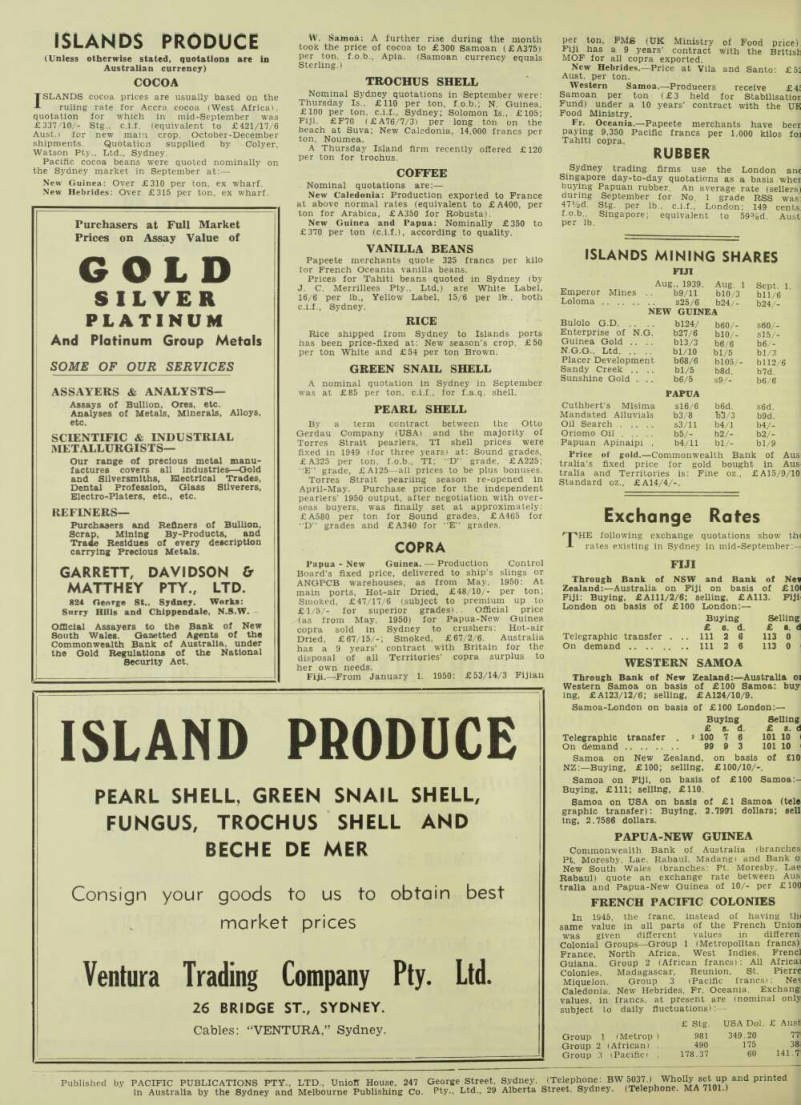
(Unless otherwise stated, quotations are in Australian currency)
Cocoa
ISLANDS cocoa prices are usually based on the ruling rate for Accra cocoa (West Africa), quotation for which in mid-September was £337/10/- Stg.. c.i.f. (equivalent to £421/17/6 Aust.) for new main crop, October-December shipments. Quotation supplied by Colyer, Watson Pty.. Ltd., Sydney.
Pacific cocoa beans were quoted nominally on the Sydney market in September at;— New Guinea: Over £3lO per ton, ex wharf.
New Hebrides: Over £315 per ton, ex wharf.
W. Samoa: A further rise during the month took the price of cocoa to £3OO Samoan (£A375) per ton, f.0.b., Apia. (Samoan currency equals Sterling.)
Trochus Shell
Nominal Sydney quotations in September were: Thursday Is., £llO per ton, f.0.b.; N. Guinea. £lOO per ton. c.i.f., Sydney; Solomon Is., £105; Fiji. £F7O (£ A76/7/3) per long ton on the beach at Suva; New Caledonia, 14,000 francs per ton, Noumea.
A Thursday Island firm recently offered £l2O per ton for trochus.
Coffee
Nominal quotations are:— New Caledonia: Production exported to France at above normal rates (equivalent to £A4OO, per ton for Arabica, £A3SO for Robusta).
New Guinea and Papua: Nominally £350 to £370 per ton (c.i.f.), according to quality.
Vanilla Beans
Papeete merchants quote 325 francs per kilo for French Oceania vanilla beans.
Prices for Tahiti beans quoted in Sydney (by J. C. Merrillees Pty., Ltd.) are White Label, 16/6 per lb., Yellow Label, 15/6 per lb., both c.i.f., Sydney.
Rice
Rice shipped from Sydney to Islands ports has been price-fixed at: New season’s crop, £5O per ton White and £54 per ton Brown.
Green Snail Shell
A nominal quotation in Sydney in September was at £B5 per ton, c.i.f., for f.a.q. shell.
Pearl Shell
By a term contract between the Otto Gerdau Company (USA) and the majority of Torres Strait pearlers, TI shell prices were fixed in 1949 (for three years) at: Sound grades, £A325 per ton. f.0.b., TI; “D” grade, £A225; “E'’ grade, £AI25 —all prices to be plus bonuses.
Torres Strait pearling season re-opened in April-May. Purchase price for the independent pearlers’ 1950 output, after negotiation with over seas buyers, was finally set at approximately; £ A5BO per ton for Sound grades, £A465 for "D” grades and £A34O for “E” grades.
Copra
Papua - New Guinea. Production Control Board’s fixed price, delivered to ship’s slings or ANGPCB warehouses, as from May, 1950: At main ports, Hot-air Dried, £4B/10/- per ton; Smoked. £47/17/6 (subject to premium up to £l/5/- for superior grades).. Official price (as from May, 1950) for Papua-New Guinea copra sold in Sydney to crushers: Hot-air Dried, £67/15/-; Smoked, £67/2/6. Australia has a 9 years’ contract with Britain for the disposal of all Territories’ copra surplus to her own needs.
Fiji.—From January 1. 1950: £53/14/3 Fijian
per ton, FM6 (UK Ministry of Food price).
Fiji has a 9 years’ contract with the British MOF for all copra exported.
New Hebrides,—Price at Vila and Santo: £52 Aust. per ton.
Western Samoa.—Producers receive £4J Samoan per ton (£3 held for Stabilisation Fund) under a 10 years’ contract with the UK Food Ministry.
Fr. Oceania.—Papeete merchants have beer paying 9,350 Pacific francs per 1,000 kilos foi Tahiti copra.
Rubber
Sydney trading firms use the London anc Singapore day-to-day quotations as a basis wher buying Papuan rubber. An average rate (sellers) during September for No. 1 grade RSS was: 47y 2 d. Stg. per lb., c.i.f., London; 149 cents, fob.. Singapore; equivalent to 59%d. Aust per lb.
Islands Mining Shares
Price of gold.—Commonwealth Bank of Aus tralia’s fixed price for gold bought in Aus tralia and Territories is: Fine oz., £AIS/9/10 Standard oz., £AI4/4/-.
Fiji
Aug., 1939.
Aug. 1 Sept. 1.
Emperor Mines .. b9/ll blO/3 bll/6 Loloma S25/6 b24/ b24/-
New Guinea
Bulolo G.D bl24/ b60/s60/- Enterprise of N.G. b27/6 blO/sl5/- Guinea Gold .. .. bl3/3 b6/6 b6 - N.G.G.. Ltd Placer Development bl/10 bl/5 bl/3 b68/6 bl05/bll2/6 Sandy Creek .. bl/5 b8d. b7d.
Sunshine Gold . .. b6/5 s9/b6/6 Cuthbert’s Misima
Papua
S16/6 b6d. s6d.
Mandated Alluvials b3/8 b3/3 b9d.
Oil Search S3/11 b4/l b4/- Oriomo Oil b5/b2/b2/- Papuan Apinaipi . b4/ll bl/bl/9
Exchange Rates
THE following exchange quotations show tlu rates existing in Sydney in mid-September:—
Fiji
Through Bank of NSW and Bank of Nev Zealand: —Australia on Fiji on basis of £10( Fiji: Buying, £Alll/2/6; selling. £AII3. Fiji- London on basis of £lOO London: —
Western Samoa
Through Bank of New Zealand: —Australia ot Western Samoa on basis of £lOO Samoa; buy' ing, £AI23/12/6; selling, £AI24/10/9.
Samoa-London on basis of £lOO London:—
Samoa on New Zealand, on basis of £loi NZ:—Buying, £100; selling, £lOO/10/-.
Samoa on Fiji, on basis of £lOO Samoa Buying, £111; selling, £llO.
Samoa on USA on basis of £1 Samoa (tele graphic transfer): Buying, 2.7991 dollars; sell Ing, 2.7586 dollars.
Papua-New Guinea
Commonwealth Bank of Australia (branches Pt. Moresby. Lae. Rabaul, Madang) and Bank o: New South Wales (branches; Pt. Moresby. Lae Rabaul) quote an exchange rate between Aus tralia and Papua-New Guinea of 10/- per £lOO
French Pacific Colonies
In 1945, the franc, instead of having tht same value in all parts of the French Union was given different values in differen Colonial Groups—Group 1 (Metropolitan francs) France, North Africa, West Indies. Frencl Guiana. Group 2 (African francs); All Africai Colonies, Madagascar, Reunion, St. Pierre Miquelon. Group 3 (Pacific francs): Nev Caledonia. New Hebrides, Fr. Oceania. Exchang; values, in francs, at present are (nominal only, subject to daily fluctuations) :
Buying Selling £ s. d. £ 8. d Telegraphic transfer ... Ill 2 6 113 0 ' On demand Ill 2 6 113 0 i
Buying Selling £ s. d. £ s. d Telegraphic transfer . » 100 7 6 101 10 ( On demand 99 9 3 101 10 '
£ Stg. USA Dol. £ Aust) Group 1 (Metrop ) 981 349.20 77"
Group 2 (African) . 490 175 38) Group 3 (Pacific) 178.37 60 141.7'
Advertisements & other items, pp. 122-124 (3 items)
Published by PACIFIC PUBLICATIONS PTY.. LTD., Unioff House, 247 George Street, Sydney. (Telephone: BW 5 ° 37 ) Wh °SJ and pnnted
in Australia by the Sydney and Melbourne Publishing Co. Pty., Ltd., 29 Alberta Street, Sydney. (Telephone. MA 7101.)
Island Produce
Purchasers at Full Market Prices on Assay Value of
GOLD
SILVER
PLATINUM
And Platinum Group Metals
SOME OF OUR SERVICES
ASSAYERS & ANALYSTS—
Assays of Bullion, Ores, etc.
Analyses of Metals, Minerals, Alloys, etc.
SCIENTIFIC & INDUSTRIAL
METALLURGISTS—
Our range of precious metal manufactures covers all industries—Gold and Silversmiths, Electrical Trades, Dental Profession, Glass Sllverers, Electro-Platers, etc,, etc.
REFINERS—
Purchasers and Refiners of Bullion, Scrap, Mining By-Products, and Trade Residues of every description carrying Precious Metals.
GARRETT, DAVIDSON Cr
MATTHEY PTY., LTD.
824 George St,, Sydney. Works: Snrry Hills and Chippendale, N.B.W.
Official Assayers to the Bank of New South Wales. Gazetted Agents of the Commonwealth Bank of Australia, under the Gold Regulations of the National Security Act.
ISLAND PRODUCE
PEARL SHELL, GREEN SNAIL SHELL,
FUNGUS, TROCHUS SHELL AND
6ECHE DE MER
Consign your goods to us to obtain best market prices
Ventura Trading Company Pty. Ltd.
26 BRIDGE ST., SYDNEY.
Cables: “VENTURA,” Sydney.
Now 2 air routes
to NEW ZEALAND
SYDNEY—WELLINGTON SERVICE COMMENCES OCTOBER
I LY direct from Sydney to Wellington or
Auckland overnight by fast
luxurious Solent flying-boat. Equal
fares on both routes —£35 single, £63 return and no incidental expenses. Interchangeable tickets.
You will enjoy finest meals and service Free baggage allowance of 66 lbs.
FLY to New Zealand. 10% concession for parties of 10 or more.
Book now for Christmas.
C^ PV b i
LLINGTON
W T A 8 K A N EMPIRE AIRWAYS LIMITED in association with Q.E.A., 8.0.A.C. and B.C.P.A.
RESERVATIONS : QANTAS, T.A.A., AND LEADING TRAVEL AGENTS
w
MERCHANTS, &. SHIP OWNERS
M Capital £500,000
ESTABLISHED 1914
GENERAL MERCHANTS
AND
PROVIDORES
TRADE THROUGHOUT THE PACIFIC.
THIRTY-FIVE YEARS OF PACIFIC ISLANDS DEVELOPMENT AND SERVICE.
BUYERS AND EXPORTERS OF ALL KINDS
OF ISLAND PRODUCE, COPRA, COCOA,
M.O.P. SHELL, TROCAS SHELL, ETC.
Through our Sydney office , branches and agents , we distribute a wide and comprehensive range of general merchandise .
». R. CARPENTER & CO. LTD.
Head Office: 16 O'CONNELL STREET, SYDNEY, N.S.W.
Cable Address: Telephone: Postal Address: “CAMOHE.” BW 4421. G.P.0., BOX 168, Sydney.
In London: W. R. Carpenter & Co. (London), Ltd., Coronation House, 4 Lloyd's Ave., London, EC
f AGENTS FOR AUSTRALIAN, EUROPEAN
AND AMERICAN MANUFACTURERS.
( DISTRIBUTORS OF EVERY DESCRIPTION
( OF MERCHANDISE.
ASSOCIATED COMPANIES THROUGHOUT THE PACIFIC :
IN NEW GUINEA:
New Guinea Company, Limited, Rabaul, Lae, Madang, Kavieng.
IN PAPUA:
J. R. Clay & Co., Ltd., Port Moresby.
IN FIJI:
W. R. Carpenter & Co. (Fiji), Ltd., Suva.