Makogai
pp. 59-83 · Read in the full issue
Mother Agnes Of
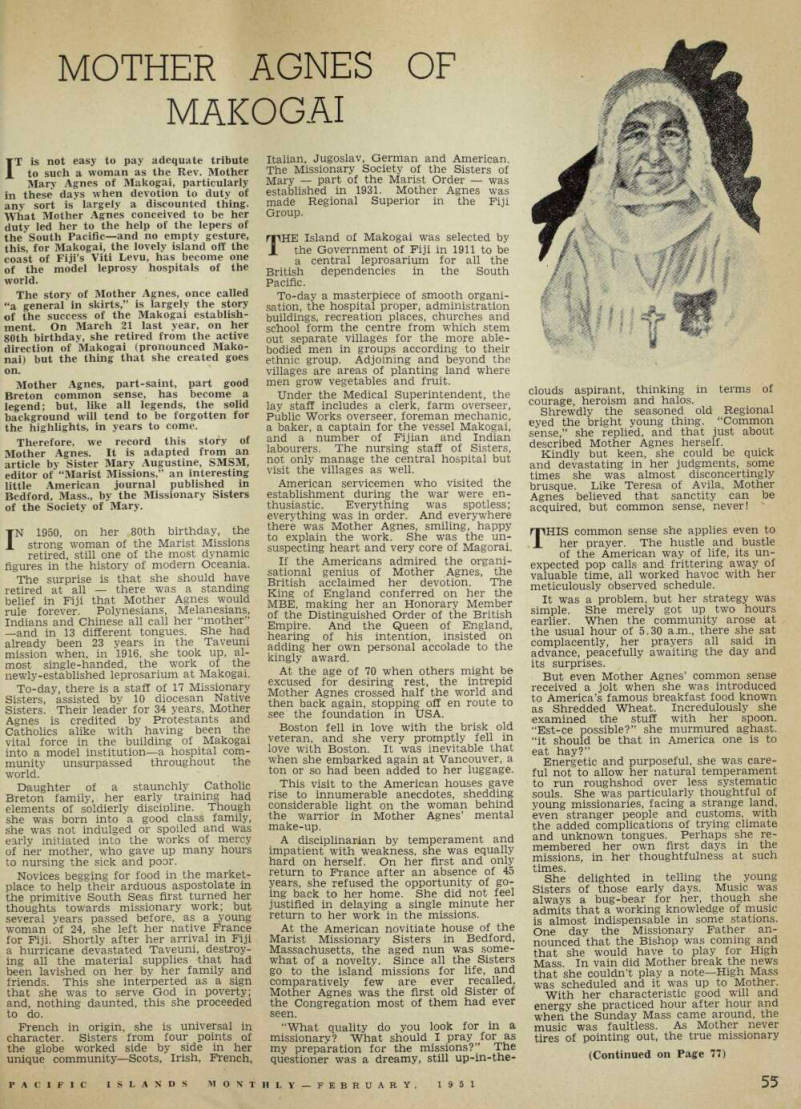
IT is not easy to pay adequate tribute to such a woman as the Rev. Mother Mary Agnes of Makogai, particularly in these days when devotion to duty of any sort is largely a discounted thing.
What Mother Agnes conceived to be her duty led her to the help of the lepers of the South Pacific—and no empty gesture, this, for Makogai, the lovely island off the coast of Fiji’s Viti Levu, has become one of the model leprosy hospitals of the world.
The story of Mother Agnes, once called “a generalin skirts,” is largely the story of the success of the Makogai establish ment. On March 21 last year, on her 80th birthday, she retired from the active direction of Makogai (pronounced Mako nai) but the thing that she created goes on.
Mother Agnes, part-saint, part good Breton common sense, has become a legend; but, like all legends, the solid background wall tend to be forgotten for the highlights, in years to come.
Therefore, we record this story of Mother Agnes. It is adapted from an article by Sister Mary Augustine, SMSM, editor of “Marist Missions,” an interesting little American journal published in Bedford, Mass., by the Missionary Sisters of the Society of Mary.
IN 1950, on her 80th birthday, the strong woman of the Marist Missions retired, still one of the most dynamic figures in the history of modern Oceania.
The surprise is that she should have retired at all there was a standing belief in Fiji that Mother Agnes would rule forever. Polynesians, Melanesians, Indians and Chinese all call her “mother” —and in 13 different tongues. She had already been 23 years in the Taveuni mission when, in 1916, she took up, al most single-handed, the work of the newly-established leprosarium at Makogai.
To-day, there is a staff of 17 Missionary Sisters, assisted by 10 diocesan Native Sisters. Their leader for 34 years, Mother Agnes is credited by Protestants and Catholics alike with having been the vital force in the building of Makogai into a model institution —a hospital com munity unsurpassed throughout the world.
Daughter of a staunchly Catholic Breton family, her early training had elements of soldierly discipline. Though she was born into a good class family, she was not indulged or spoiled and was early initiated into the works of mercy of her mother, who gave up many hours to nursing the sick and poor.
Novices begging for food in the market place to help their arduous aspostolate in the primitive South Seas first turned her thoughts towards missionary work; but several years passed before, as a young woman of 24, she left her native France for Fiji. Shortly after her arrival in Fiji a hurricane devastated Taveuni, destroy ing all the material supplies that had been lavished on her by her family and friends. This she interperted as a sign that she was to serve God in poverty; and, nothing daunted, this she proceeded to do.
French in origin, she is universal in character. Sisters from four points of the globe worked side by side in her unique community—Scots, Irish, French,
Italian, Jugoslav, German and American.
The Missionary Society of the Sisters of Mary part of the Marist Order was established in 1931. Mother Agnes was made Regional Superior in the Fiji Group.
THE Island of Makogai was selected by the Government of Fiji in 1911 to be a central leprosarium for all the British dependencies in the South Pacific.
To-day a masterpiece of smooth organi sation, the hospital proper, administration buildings, recreation places, churches and school form the centre from which stem out separate villages for the more able bodied men in groups according to their ethnic group. Adjoining and beyond the villages are areas of planting land where men grow vegetables and fruit.
Under the Medical Superintendent, the lay staff includes a clerk, farm overseer, Public Works overseer, foreman mechanic, a baker, a captain for the vessel Makogai, and a number of Fijian and Indian labourers. The nursing staff of Sisters, not only manage the central hospital but visit the villages as well.
American servicemen who visited the establishment during the war were en thusiastic. Everything was spotless; everything was in order. And everywhere there was Mother Agnes, smiling, happy to explain the work. She was the un suspecting heart and very core of Magorai.
If the Americans admired the organi sational genius of Mother Agnes, the British acclaimed her devotion. The King of England conferred on her the MBE, making her an Honorary Member of the Distinguished Order of the British Empire. And the Queen of England, hearing of his intention, insisted on adding her own personal accolade to the kingly award.
At the age of 70 when others might be excused for desiring rest, the intrepid Mother Agnes crossed half the world and then back again, stopping off en route to see the foundation in USA.
Boston fell in love with the brisk old veteran, and she very promptly fell in love with Boston. It was inevitable that when she embarked again at Vancouver, a ton or so had been added to her luggage.
This visit to the American houses gave rise to innumerable anecdotes, shedding considerable light on the woman behind the warrior in Mother Agnes’ mental make-up.
A disciplinarian by temperament and impatient with weakness, she was equally hard on herself. On her first and only return to France after an absence of 45 years, she refused the opportunity of go ing back to her home. She did not feel justified in delaying a single minute her return to her work in the missions.
At the American novitiate house of the Marist Missionary Sisters in Bedford, Massachusetts, the aged nun was some what of a novelty. Since all the Sisters go to the island missions for life, and comparatively few are ever recalled, Mother Agnes was the first old Sister of the Congregation most of them had ever seen.
“What quality do you look for in a missionary? What should I pray for as my preparation for the missions?” The questioner was a dreamy, still up-in-the-
clouds aspirant, thinking in terms of courage, heroism and halos.
Shrewdly the seasoned old Regional eyed the bright young thing. “Common sense,” she replied, and that just about described Mother Agnes herself.
Kindly but keen, she could be quick and devastating in her judgments, some times she was almost disconcertingly brusque. Like Teresa of Avila, Mother Agnes believed that sanctity can be acquired, but common sense, never!
THIS common sense she applies even to her prayer. The hustle and bustle of the American way of life, its un expected pop calls and frittering away of valuable time, all worked havoc with her meticulously observed schedule.
It was a problem, but her strategy was simple. She merely got up two hours earlier. When the community arose at the usual hour of 5.30 a.m., there she sat complacently, her prayers all said in advance, peacefully awaiting the day and its surprises.
But even Mother Agnes’ common sense received a jolt when she was introduced to America’s famous breakfast food known as Shredded Wheat. Incredulously she examined the stuff with her spoon.
“Est-ce possible?” she murmured aghast, “it should be that in America one is to eat hay?”
Energetic and purposeful, she was care ful not to allow her natural temperament to run roughshod over less systematic souls. She was particularly thoughtful of young missionaries, facing a strange land, even stranger people and customs, with the added complications of trying climate and unknown tongues. Perhaps she re membered her own first days in the missions, in her thoughtfulness at such times.
She delighted in telling the young Sisters of those early days. Music was always a bug-bear for her, though she admits that a working knowledge of music is almost indispensable in some stations.
One day the Missionary Father an nounced that the Bishop was coming and that she would have to play for High Mass. In vain did Mother break the news that she couldn’t play a note—High Mass was scheduled and it was up to Mother.
With her characteristic good will and energy she practiced hour after hour and when the Sunday Mass came around, the music was faultless. As Mother never tires of pointing out, the true missionary
(Continued on Page 77)
spirit is just this: if you don’t know how to do a thing, learn; and if there is no one |o teach you, teach yourself!
She could not believe that she would ever be old. Meeting a Sister whom she had not seen for 10 years, her first question was: “Do you notice much change in me? Do you think I’m growing old?” She was 70 then!
Even to-day, 80 years young is the way to describe Mother Agnes. A youthful spirit still puts beauty in her wise old eyes. Her face is creased with the wrinkles of time, her hands hardened by years of manual labour. All the joys and sorrows, all her victories and even her defeats, have mellowed the rugged character into something almost serene.
No longer is there the need for the indomitable will, the iron hand. But that an iron hand once was needed no cne will deny.
The gathering together of some 700 people of varying languages and cultures, from an area covering thousands of square miles, to confine them to one part cf a relatively small island does not lutomatically create an harmonious com nunity.
Add to this the fact that the only thing hey have in common is that they are suffering from an unpleasant and weaken ng disease, and an idea will be had of he difficulties calling for only Mother \gnes.
Many were the storms that swept over Vlakogai, social and moral as well as seasonal and physical. The falling baro neter of fraying nerves, religious ani nosities, and despair that beset the strange community of isolated, afflicted jeings, found Mother Agnes ready for ;very emergency.
With the children, particularly, she was truly a mother. And it was at Christmas time that she was a queen.
Even at 70, she would climb the hill and, with her binoculars, scan the horizon for the ship which she knew would be bringing presents for the patients. And when the cases were finally unloaded, she was in her glory.
She would perch on a case, and supervise the unpacking of every box, assigning each article as it was unwrapped. This work would last for several days, and
the Sisters were kept running from morning to night. Outside, a crop of youngsters waited with wheelbarrows to cart away the debris, and in the midst of it all, directing everything, a thoroughly happy Mother Agnes, This happiness came from her know ledge of the joy awaiting the patients at Christmas. For herself, she kept nothing.
Even on her Golden Jubilee (during the Pacific War) when she was showered with offerings, she personally directed it all to the Sisters who had just been evacuated
from the Solomons. These missionaries, she felt, could make good of her treasures when they returned to reopen their war torn missions.
The fine work of healing and the al most miraculously smooth running of the complex community at Makogai was no iccident. Even the functioning together Df the Church and State has been, in )ther leprosaria, a source of constant friction. Mother Agnes, however had the nind of a general. To her it was a natter of departments and descipline, vith the charity of Christ as the bond between all.
THE perfect harmony and understand ing that exists between Dr. Austin (the Medical Superintendent, and a 3 rotestant) and Mother Agnes and her Sisters is an object lesson to the world )f medicine and science,” a speaker noted, n testimonial to Dr. Austin, then leaving or a trip abroad.
Whereupon Dr. Austin himself dis ;laiming all credit, replied emphatically; ‘All honour for the work at Makogai nust be given to Mother Agnes—the fact hat the work is going so smoothly is the greatest tribute I can pay to the Mission iry Sisters of the Society of Mary.”
This mutual harmony was not obtained ixcept by nrudence and rigid discipline.
Expecting and exacting unflinching >bedience on the part of her Sisters, Mother Agnes was herself the inter nediary between the Church and State it Makogai.
This same Church and State united to lo her honour on the occasion of her ■etirement. The acting Governor of Fiji, ,he Secretary of Fijian Affairs, the director of Medical Services, the head of he Lepers’ Trust Board, representatives if the Fijian people, and the Assistant of he Superior General of the Marist fathers flew from Suva to mark her 80th urthday.
Quoting the remark of one Governor if Fiji, who greatly admired Mother and who had playfully referred to her kindly tyranny,” Dr. Austin declared: This is not to suggest that she ruled us vith a rod of iron, though everyone knows hat her yes is yes and her no, no.” ‘‘When I took over my present position lere 20 years ago,” he continued, “my iredecessor gave me some very good .dvice. Among other things he remarked hat whenever he had gone against the leverend Mother’s advice, he had later egretted it.” pi ENERATIONS of Sisters have come to LX Makogai. “Do as I say,” the self taught old mother warned, “and you fill never have to fear the disease.” As he herself remarked, she had the Faith if a Breton which is like granite, and he never tired of repeating, “We are in he hands of our Master, so confidence.”
Jtrangely enough, with no formal knowl dge of medicine and in years when little /as known of leprosy, Mother Agnes hit m just the right balance between irudence and charity, between caution md self-forgetfulness.
The work as begun by Mother Agnes [oes on. The Sisters give the injections, lo all the general nursing, assist at iperations, do the dressings and dispense he medicines, operate the X-Ray plant tnd the laboratory, control the rations md the main hospital kitchen, teach ichool, run a Co-on store for the patients, md even operate the 35 mm. movie pro ector in a full-sized theatre.
For Mother Agnes, however, life has irranged its own private showings. Liv ng in retirement close to the scene of her brmer work, she has many reminders of -he days now gone.
Scenes and events, some humorous,
some tragic, some crucial in the extreme — all unreel before her as she tries to adapt herself to this new life of rest.
STRENGTH of the weak, comforter of the afflicted, help of the dying this is Mother Agnes of Makogai.
She has witnessed the stark dramas of many years. Now she lives the quieter tragedies of watching old friends slip away.
Like Napoleon on Elba, the “old general” plans her last campaign. Once again, her strategy is classic in its simplicity, she faces eternity with that stolid directness and firmness which has marked her whole life.
Meanwhile, with her characteristic com mon sense and energy, she attacks the problems of the moment. Lightweight woollens are needed when the cool season spells suffering for fever-wasted bodies.
Incessantly and almost militantly, her needles click and glint in the tropical sun, while she knits into the soft white wool her prayers for all her charges.
M. Caillard, who went to Indonesia recently to negotiate for labour for New Caledonian mines and farms, reports that the Indonesian authorities were favourable to the recommencement of recruiting, but under conditions which needed careful consideration. A com mittee appointed by the New Caledonian General Council, and consisting of Messrs. St. Quentin, Cuer, Loucheron and Robert is studying the matter.