Tropicalities
pp. 61-62 · Read in the full issue

MORE than 10,000 New Guinea butter flies are at present being classified in Sydney for Mr. E. J. Hallstrom, of Sydney. They represent two years hard work by Mr. W. Brandt, a Finnish butter fly expert who has been in New Guinea catching them. Mr. Brandt is on Mr Hallstrom’s personal payroll.
Having caught them, it is now going to take another three years to classify them—with the aid of £5OO worth of books from Germany.
When the work is through, Mr. Hall strom expects that it will be the most extensive collection in existence. Many of the species have not been caught before. The collection will probably be housed in Canberra; but, meantime, Mr.
Hallstrom is sole custodian—he has to produce them on demand by the P-NG Administration—or so we are! told by the Sydney newspapers, which always' give Mr. Hallstrom a Good Press.
THE watchful grocery manager in a large store in a certain South Seas town observed a native employee surreptitiously reaching for a tin of meat, and secreting same under his shirt, before leaving for the luncheon interval. The manager pounced on the man outside the store, secured the “evidence” and. when the offender admitted his lapse from honesty, the Police were informed and the thief taken into custody. The tin of meat was taken charge of by the Police as “Exhibit A.”
On the morning of the trial, the grocery manager received a frantic telephone appeal from the police-sergeant in charge: “Please send me another tin of that meat, to be produced as ‘exhibit A.’
The tin we had has been pinched from my office.”
Sorrowfully shaking his head, the grocery manager supplied a replacement.
The trial took place, and the offender was duly punished. But the watchful grocery manager is still patiently waiting for the return of “exhibit A, No. 2”— which had also been stolen while in charge of the long-suffering police!
HERE in Germany, now, one lives in constant fear of the Russians,” wrote a former resident of New Guinea, on January 11. “This fear seems to affect everything in our daily life. Why is there so much empty talk-talk among the Western nations, and so little real action?
“I am afraid Russia will swallow Western Europe while the others -are still talking about defence, with or without Germany.
“As a matter of fact, the broad masses of the Germans do not want to fight any more. There is a dangerous and
widespread defeatism in our population.
Everyone is trying to make the best of life, before the curtain falls upon us.
Morals and habits are affected accordingly.”
MY host came back to the table in the corner of the verandah and finished his drink in one go. I nodded in the direction of the native disappearing into the dusk, and raised questioning eyebrows.
“Oh,” he said, “that’s Belipen, an old rogue from the village up in the hills behind the plantation.”
I sensed a yarn.
“My friend!” he added.
I grinned encouragement.
“That is, he was; though he doesn’t seem as hanpy about the arrangement now.” He chuckled reminiscently. This is the yarn. (I should perhaps explain that “friend” in New Guinea, entails complete co ownership of all worldly possessions).
Old Belipen, who owned considerable land on the timbered slopes above the plantation, had suggested “friends” to my
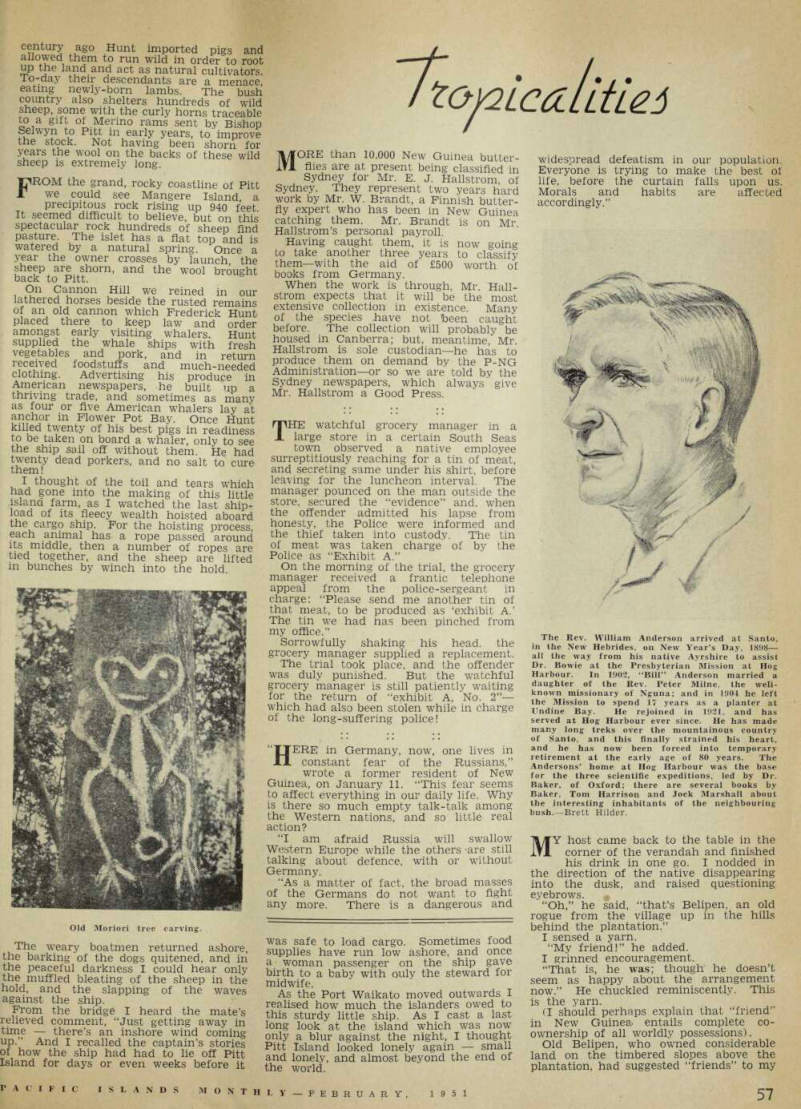
The Rev. William Anderson arrived at Santo, in the New Hebrides, on New Year’s Day, 1898— all the way from his native Ayrshire to assist Dr. Bowie at the Presbyterian Mission at Hog Harbour. In 1902, “Bill” Anderson married a daughter of the Rev. Peter Milne, the well known missionary of Nguna; and in 1904 he left the Mission to spend 17 years as a planter at Undine Bay. He rejoined in 1921, and has served at Hog Harbour ever since. He has made many long treks over the mountainous country of Santo, and this finally strained his heart, and he has now been forced into temporary retirement at the early age of 80 years. The Andersons’ home at Hog Harbour was the base for the three scientific expeditions, led by Dr.
Baker, of Oxford: there are several books by Baker, Tom Harrison and Jock Marshall about the interesting inhabitants of the neighbouring bush. Brett Hilder.
host who had readily, though halfamusedly agreed. within' fiftppn minutes Belinen oresented himself to his new partner, con-
venilntly nlar the tradeTto?e “Friend,”
he announced, “I’ve got nothing to smoke”
“It grieves me to hear it,” my host replied, and forthwith handed over a few St A kS la%e°af CC a minute or two. Then, F Ma?^he^ e \rare S °pr^uced eS and handed over “Friend me no got laplap!” A couple of fathoms of calico went to cement the bonds of friendship.
And so it went on. He had no axe, no blanket, no lamo. no kerosene, to the tune nf £5 or £6 in trade goods Bellpen hotfooted it to the village, disbcSs about P the SS host 6 had y thaib S 1 morning hcfe^pa^ched team and knocked down a magnificent stick of tunber—about £l5 worth. They hitched up, brought it to the plantation, and began SSrfaW'U as my host and I began twirling ice around in long glasses on the verandah. And, not knowing the foregoing story I was puzzled when my host bounded over to
the rail and said, “Ah! Good day, Friend.”
The native didn’t look happy. “Ergood day.”
“You got everything you want, Friend?
Smoke? 8 Matches? Sugar?”
The native did not reply to that. Instead, he said; “Master! You cut one of my trees!”
“That’s right, Friend. I needed some I sent a few boys up to your land. You d °The old even less happy, and presently shambled oft, muttering about “friends.”
And, whilst my host sat chuckling, I reflected that in these days, when natives were permitted to put almost anything over the newcomers—who for the most part remain blissfully unaware that they are being fooled-it is refreshing to meet
M WmtoTSt MfhSs
4 FIJIAN native, regarded as a reliable A and trustworthy man reported early m January that he saw a submarine near Sau Sau passage, on the coast of Vanua Levu, on the evening of December & the “°™i ns i. h * el^ lji 0 a u n t challenged, the .Fijian repuaiatea ime suggestion that it might have been whale. “Men do not walk about on tne
backs of whales,” he said -. o .
It probably was a submarine but it need not necessarily have been hostile, There are many American and British submarines practising trans - Pacific
voyages. . ™lnn?kpls” are
of Russia’s choicest Snorkels are engaged in the same occupation,