Condominium
pp. 56-57 · Read in the full issue
or Conundrum?
by Lex Holliday.
SANTO, New Hebrides, where Time stands still. Where people live to make money, but don’t have to.
Where the conflicting interests of two governments clash and retard progress instead of helping it. Where the oppres sive heat drives men to drink. Where your perspiration turns the dust into mud and the mosquitoes eat the lot!
Imagine yourself reclining on a small 15-feet square cement porch at the en trance to an old US Army Quonset hut, a hundred feet up a hillside overlooking Santo harbour.
In between wild forays after mosquitoes you find time to wonder at the beauty of the silvery waters as they shimmer through coconut palms. Lunging out at
a large Anopheles, you glimpse some islands in the distance fringed with pink clouds, and you say to yourself, “This is probably quite a pretty place.”
On your right the hotel proprietor and two Frenchmen chatter excitedly. A fourth approaches from the hut and asks your name for the hotel records. The others think this funny for they know the place, for some misdemeanour, is un licensed. Apparently the proprietor had his license cancelled by Monsieur le Commissaire some time before my visit, but business continued as usual.
YOU decide to take a stroll and see the sights of the town, so you leave the hotel porch, cross to your bedroom, a partitioned cubicle in another Quonset hut, clip the padlock shut on the door and step out into the broiling heat.
The main highway follows the harbour shore-line, you discover, in unending monotony. The stores, post office, those wharves that still function hotel, are literally miles apart. The buildings pro vide an explanation for such a layout, every store or office being a Quonset hut.
When the war ended and the Americans left, government officials and traders acquired the first available huts, set up business and gave little thought to cen tralising their activities. You just cannot walk these distances in such heat, so you thumb a ride on an ex-American 10wheel truck, bumning along with a cargo of natives aboard; or you hire a jeep-taxi, are charged an exorbitant sum by the pocket-size Tonkinese driver and bounce along from one pot-hole to another.
A few more days and the lack of gen eral activity really starts to get you down.
You expect this in the tropics, but some how it seems worse in Santo. Perhaps it is the contrast to that great activity of only a few years ago. Wherever you turn you see evidence that Santo, as a stepping off point for the Solomons’ attack, was once the greatest US advance ba.se in the Pacific. Hundreds of dilapidated army and navy huts and stores greet you at every turn of the overgrown roads.
Around the vast harbour large wharves, once servicing a great fleet, rot under the relentless tropical climate.
Roads and bridges and air strips laid down by the Americans are now in a state of ruin.
Before the war Santo was merely a trading post for copra planters; it had no roads. Now it has over 400 miles of “roads,” and 200 vehicles inherited from the US forces.
War was profitable to these islands, you are told. Traders who succeeded in taking only a few hundreds of thousands of
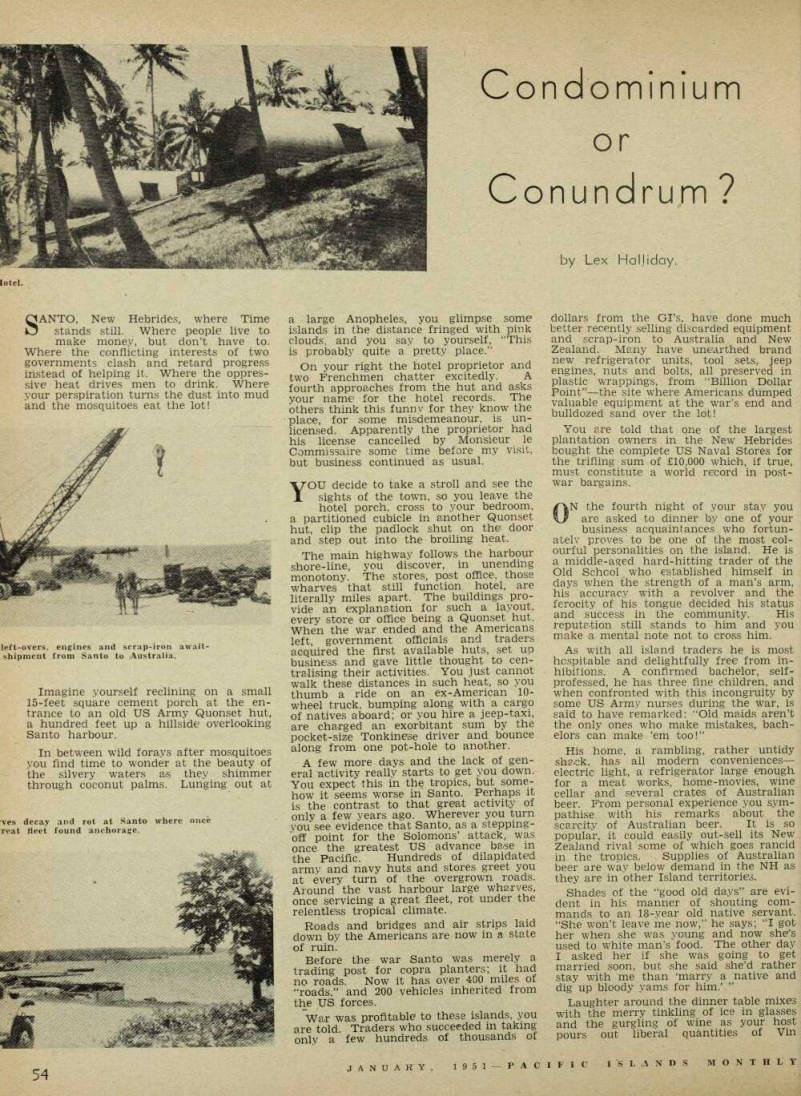
dollars from the Gl’s, have done much better recently selling discarded equipment and scrap-iron to Australia and New Zealand. Many have unearthed brand new refrigerator units, tool sets, jeep engines, nuts and bolts, all preserved in plastic wrappings, from “Billion Dollar Point” —the site where Americans dumped valuable equipment at the war’s end and bulldozed sand over the lot!
You are told that one of the largest plantation owners in the New Hebrides bought the complete US Naval Stores for the trifling sum of £lO,OOO which, if true, must constitute a world record in post war bargains.
ON the fourth night of your stay you are asked to dinner by one of your business acquaintances who fortun ately proves to be one of the most col ourful personalities on the island. He is a middle-aged hard-hitting trader of the Old School who established himself in days when the strength of a man’s arm, his accuracy with a revolver and the ferocity of his tongue decided his status and success in the community. His reputation still stands to him and you make a mental note not to cross him.
As with all island traders he is most hospitable and delightfully free from in hibitions. A confirmed bachelor, self professed, he has three fine children, and when confronted with this incongruity by some US Army nurses during the war, is said to have remarked: “Old maids aren’t the only ones who make mistakes, bach elors can make ’em too!”
His home, a rambling, rather untidy shaek, has all modern conveniences— electric light, a refrigerator large enough for a meat works, home-movies, wine cellar and several crates of Australian beer. From personal experience you sym pathise with his remarks about the scarcity of Australian beer. It is so popular, it could easily out-sell its New Zealand rival some of which goes rancid in the tronics. Supplies of Australian beer are way below demand in the NH as they are in other Island territories.
Shades of the “good old days” are evi dent in his manner of shouting com mands to an 18-year old native servant.
“She won’t leave me now,” he says; “I got her when she was young and now she’s used to white man’s food. The other day I asked her if she was going to get married soon, but she said she’d rather stay with me than ‘marry a native and dig up bloody yams for him.’ ”
Laughter around the dinner table mixes with the merry tinkling of ice in glasses and the gurgling of wine as your host pours out liberal quantities of Vin
[?]left-overs, engines and scrap-iron await [?]shipment from Santo to Australia.
[?]es decay and rot at Santo where once [?]reat fleet found anchorage.
Hotel.
Rouge. In between soup, iced salmon, pork and boiled potatoes, pineapple and custard—all with appropriate wines—he reminisces about the past . . .
“Years ago I captained the BP boats between Vila, and Sydney and always took a couple of buck-niggers with me. Every time, without fail, the blighters would end up in jail for brawling in a bar. Some times I’d be enjoying myself with pleasant company and damn it if BP’s wouldn’t ring for me to come and bail ’em out.
Once the police grabbed me too, to help get the niggers into the Black Maria; they’d fight like hell when arrested, six men couldn’t hold them. I’d arrive, curse the daylights out of ’em and in they’d go; of course, niggers will only recognise one master. It was always a relief when they were jailed. I could leave them there until ready to sail. When I'd bail them out they’d cry like kids; ‘Very sorry, no like prison, rice no has sugar; meat no has salt!’ ”
AND so you wake up next morning suffering from TAR (Tropical Alcho holic Remorse) the worst kind of the lot, wondering just how you reached the hotel the previous evening, determined never to touch liquor again (well, not in the tropics anyway).
With the preliminaries over you decide to discuss business with this friendly client and you find him both co-operative and honest. Island traders appreciate sincerity; try to deceive them and they will out-smart you every time.
In his store a jangle of languages fills the air. Two Tonkinese, easily mistaken for Chinese, enter and examine the be wildering array of goods displayed on the shelves. Finally, they fix their gaze upon a small torch globe and ask the assistant, “Combien?”
He replies “One and Seex.”
The Tonkinese, uncertain, repeats “Combien?”
The assistant, with a scornful flash of white teeth, answers, “One Sheeling and Seexpence.”
The Tonkinese turns to his companion, “x-?.;!; !&?:! :o?”
Who answers in obvious agreement, “o!-?&:?o/!:-?!”
The first Tonkinese then places the globe, together with some French currency on the counter, confirming the purchase with an, “Okay.”
The assistant, mentally converting Aus tralian to French currency, re-states the price at “Douze Francs,” and the Tonkin ese finally consents with, “Eh bien.”
You remark about this to the store manager and he proudly tells you that his boys also speak Pidgin-French/ English which is the Lingua Franca of the New Hebrides, and that they swear very well in Tonkinese!
Prices of goods in the store, you note, are about 50 per cent, dearer than their Australian equivalents and while this fact makes living' costs high, it is apparently compensated for by the complete absence of taxation, treasury revenue being ob tained from a 15 per cent, duty levied on all imported goods.
Despite this and other obvious advant ages over our more modern civilizations, you gather that many people are discon tented with the administration and its, reputedly, dictatorial commissioners. Many too, deplore Britain’s failure to ensure financial security for her copra growers, thus enabling the French to acquire most of the plantations.
You leave, wondering why Australia has not had more say in the management of this territory whose trade she dominates.
But that, I believe, is an old story.