Tropicalities
pp. 57-58 · Read in the full issue
THIS story appeared in McNicoll’s col umn in the Sydney Daily Telegraph.
Hans does not sound like a New Guinea native. But it is a good story.
A Sydney jewellery concern decided to drop the word “catalogue” and substitute “gift book” as the title of its annual booklet showing what the store had to offer.
This letter arrived from a native at Lae, New Guinea: “Dear Mr. Proud.
I have studied over your gift book with joy and ask you please to gift me a watch, pipe, and ring. Also gift me a gold chain.
Hans.” :J: SOME months ago, in this column, we sneered at the American publishers’ eagerness to introduce the ridiculous word “Paradise” into the titles of books describing conditions in the South Pacific.
Remember Lambert’s “Yankee Doctor in Paradise” and Furnas’s “Anatomy of Paradise”?
Now a- little bird tells us there is to be another “Paradise” book. James A.
Michener, whose “Tales from the South Pacific” has enjoyed great success—the stage version has had a remarkable run — has just finished a. new book about the South Pacific Islands; and report hath it that he has been in a fierce argument with his publishers. He, knowing his Pacific, wants a reasonably realistic title.
But American publishers have the right to title a book as they wish; and Michener’s publishers are insisting that they shall have “Paradise” somewhere on the cover.
A good example of the way in which American Big Business will unhesitatingly sacrifice art to profits. ;I: $ HE was a solidly-built, bullet-headed native in the prime of life; and, as he stamped up to the plantation manager, I could see he was in a rage.
I recognised him as one of the passengers I had just brought from Rabaul in my ship.
The native woman he was dragging so purposefully with him was weeping, and seemed almost too scared to walk.
“Master!” the boy ground out in Pidgin.
“Do you remember I married this meri before I ‘made paper’ to go to Rabaul for two years?”
The manager nodded.
“And I left her here to await my re turn?”
“Yes ” agreed the manager. ‘ Well, she’s got a six-months-old baby, and she won’t tell me who its father is.
I want satisfaction.”
The woman let out a wail, and protested shrilly that there had been no other man: it was her husband’s child.
“But,” said the manager patiently, “your husband’s been away for two years!”
“My husband visited me one night in a dream,” she howled, desperately, also in Pidgin. “And shortly afterwards I found out I was to have a pikinini!”
The woman’s husband whipped round like lightning. “Was that about Christmas time?” he demanded.
“Yes,” she whimpered.
The boy turned back to the manager and pushed out his chest. “‘e alright, Master,” he announced, “pikinini belong me!’’—“Seahorse.”
SOME residents of Rabaul put down the new trend of undressing in public to the “unhealthy influence” of the re cent controversial bathing-suited bathing beauty parade (December PIM). Others are just laughing at the crop of Harem Ladies who appeared at the local New Year’s Eve fancy dress ball.
Most of the ladies seem to consider that the correct wear for a Sultan’s missus consists of brief trunks, a briefer bras siere, a net veil and a pair of net pants which reveal more than they conceal.
Well, it’s cool for a hot tropical night —but me, with visions of Diggers muffled up in balaclavas and greatcoats, I wonder what a Harem Lady wears on a winter’s night in Egypt.—RABAULITE.
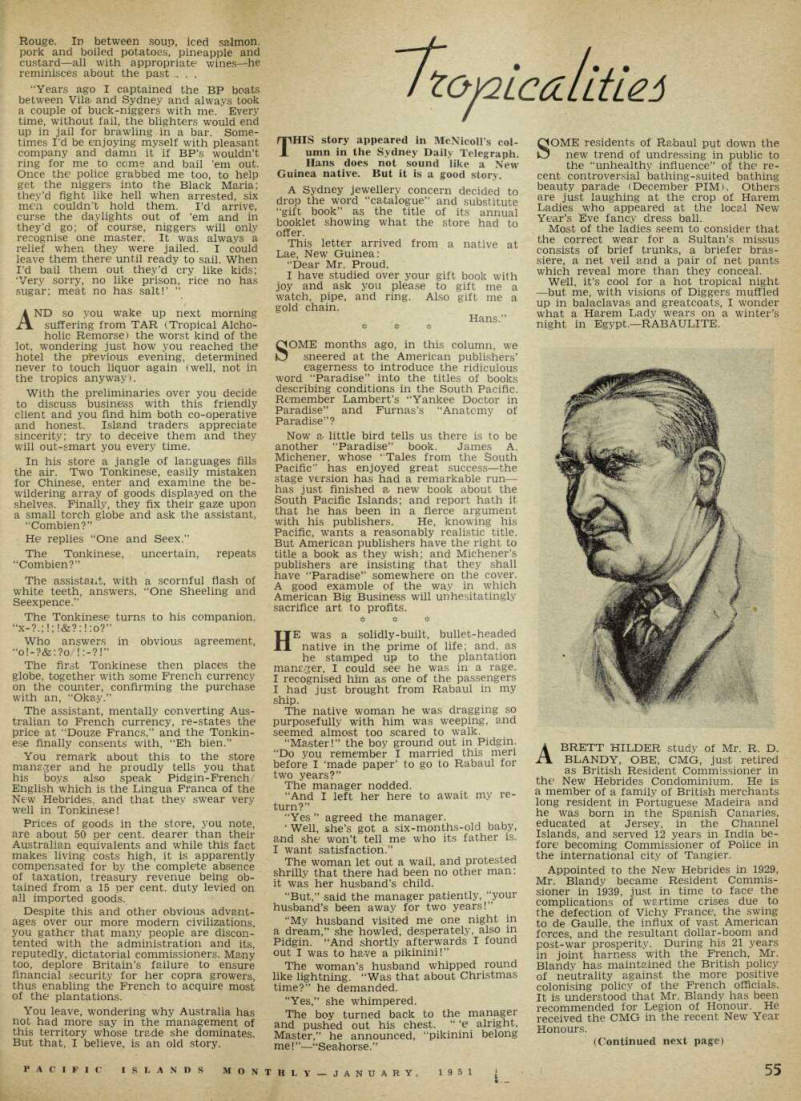
A BRETT HILDER study of Mr. R. D.
BLANDY, OBE, CMG, just retired as British Resident Commissioner in the New Hebrides Condominium. He is a member of a family of British merchants long resident in Portuguese Madeira and he was born in the Spanish Canaries, educated at Jersey, in the Channel Islands, and served 12 years in India be fore becoming Commissioner of Police in the international city of Tangier.
Appointed to the New Hebrides in 1929, Mr. Blandy became Resident Commis sioner in 1939, just in time to face the complications of wartime crises due to the defection of Vichy France, the swing to de Gaulle, the influx of vast American forces, and the resultant dollar-boom and post-war prosperity. During his 21 years in joint harness with the French, Mr.
Blandy has maintained the British policy of neutrality against the more positive colonising policy of the French officials.
It is understood that Mr. Blandy has been recommended for Legion of Honour. He received the CMG in the recent New Year Honours. (Continued next page)
RATU BCLABASAGA. better known to Suva residents and to overseas tour ists as Ratu Bola, died in Suva in mid-December. He is believed to have been over 80, although records were not kept at the time he was born.
In Suva for many years he appointed himself a sort of one-man reception com mittee to tourists. He was completely self assured and as he wore a white suit, a panama hat, knee-length stockings pulled over his trousers—plus-four fashion —and shoes, smoked enormous locally made cigars (sulukas) and carried a large fly-whisk, he was, in comparison with more conservative-minded Fijians, an eyeful. He was probably the most photo graphed person in Fiji and because of his startling appearance few people be lieved that he had a right to the titles and high lineage he claimed, He wa-s nonetheless a high chief of the Vusaradave people—Ratu Cakobau’s fighting men of Bau. Many Bauan and Rewa chiefs and their families went to Suva for his funeral. His wife, Adi Salote, died about 23 years ago. They had four children —including the late Buii of Bau, and Ratu Waisea Volavola of Suva.
Ratu Bola was a boxer of some note in his youth. On one occasion in 1907, still remembered by old residents of the Colony, he appeared in the ring at Suva Town Hall to fight an exhibition bout with Tommy Burns, then heavyweight champion of the world.
Unpublicised Penhryn Atoll, in the hot Northern Cooks, is remarkable in that its lagoon would hold the entire US Pacific Fleet (plus our own, come to that).
The little jetty used by the schooners in the days that the celebrated “Wilkie” kept store there was something of a bone of contention among the aristocracy and landed gentry of Penhryn. Latrines were not numerous, and the use of the jetty “as the spirit moved” by natives often offended both the eyesight and the aes thetics of Wilkie; worse, the state of the jetty was frequently unhygienic.
So Wilkie made the place tapu by util ising a well-known Cl native superstition, that if human excreta be burnt with fire, the “owner” will suffer at once a des tructive disease, better imagined than named. Wherefore, Wilkie covered the nuisance with dry palm-leaves, and set them alight.
For a long time the charm seemed to work: the jetty remained undefiled, until one darkish evening the eagle-eyed Boer Warrior espied a dim figure at the end of the wharf in unmistakable attitude.
Sneaking along the planks, Wilkie, with out ceremony shoved the squatting figure into Neptune’s realm with a mighty splash.
A yell of objurgatory English arose from the sea and Wilkie had a free prognos tication of his future career, plus a few facts on his past one. Then he realised he had ducked a VIP of the isle, one of his greatest friends—unwisely, if deser vedly! It took all his month’s rum ration to heal the breach when the dripping victim emerged.
To-day, Rockefeller latrines surround the lagoon, and a certain type of small fish, known by a Polynesian term equal ling “scavenger,” look after details of
sanitation.
Eti.
TO-DAY, when all the Pacific countries are looking fearfully over their shoulders at the gathering armies of a hungry Red Asia, it is interesting to recall that, within 20 years of the dis covery of gold in the Eastern States, the Chinese were pouring into Australia.
At one time, in many districts, the Chinese outnumbered the Europeans. On
the Palmer gold field, in Queensland, in 1877, there were 1,400 whites and 17,000 Chinese. A little later, there were 7,000 Chinese in Northern Territory, and 900 whites.
By the end of the century, when the colonists became nation-conscious, and began to insist on a “White Australia,” there was a substantial Chinese popula tion in every State. In 1881, there were 38,397 Chinese in Australia’s population of millions; 36,011 in 1891; under 30,000 in 1911; and by last census we had only 4,800 Chinese —mostly aged—left in the Commonwealth’s total population of 8 millions. What a different story it would have been if Asiatics had been admitted as freely in the 20th century as they were in the 19th. * * * EYES in the Pacific” was the title of a recent BBC attempt to present in true perspective the extraordinary wartime story of the Australian Coast Watching Service. That service, as we know, was made up of men of many trades and professions who stayed in the Pacific Islands north-east of Australia after the Japanese invasion, and reported on enemy movements. Although the men concerned were typically reluctant to do other than minimise their personal stories, the details were obtained and the pieces fitted together into a pattern of absorbing drama, which listeners could follow in “Eyes in the Pacific.”
The author of the programme, Arthur Mathers, who served as a war correspond ent in the Bougainville hinterland, by a stroke of luck rather than an intensive investigation gathered a wealth of first hand material for much of the incident in the story.
While covering the Solomons campaign, he came into contact with Father O’Sullivan —the priest who had escaped into the Buin jungle from the Japanese and who had then set about and com pleted an incredible task. Three times he had hiked from one end of Japanese held Bougainville to the other, rescuing nuns from the Buin area and guiding them to Buka —more than 100 miles each way.
“Father O’Sullivan,” says Arthur Math ers, “told me the stories of the men of the Coast Watching Service. He had known most of them in the days before the war, for the Eyes in the Pacific were those of planters, miners, administrators, and other officials who remained in the islands in face of the Japanese offensive of 1941-42 to relay vital intelligence.
“To what extent that intelligence con tributed to the utlimate defeat of the Japanese can be assessed only when one is confronted with the whole picture of “Ferdinand” —the code name of the Coast
Watching operation.”-
Help.
AN incidental but important aspect of the proposal to develop New Guinea’s Bulolo Valley forests concerns pro tection of native rights. A very consid erable area of the hoop pine which will probably be milled when the new company gets into operation is growing on the tribal ground of a Kukukuku clan num bering about 60 people.
These tribesmen are primitive and un der suspicion of raiding and cannibalism.
The Ward administration proposed to pay them £lO,OOO compensation for their trees —and leave it to them what they did with the money!
Will the Spender administration ap proach the matter a little more realis tically, devise ah equitable system of royalty, and assure that the very consid erable proceeds are allotted sensibly and used wisely for the benefit of the native population a.s a whole? —Osmar White in Melbourne Herald.