New Guinea Was a Good Place Then!
pp. 55-85 · Read in the full issue
Reminiscences of an Old Timer
OLD Ned Oakley was a true son of the Church, although many years often elapsed between his attendances at Mass.
Edie Creek was the last—and the best —goldfield that Ned worked on, and his claim on the Upper Edie turned in suffi cient each month to keep Ned in a state of alcoholic bliss in the grass shack which did duty, in 1928, as the Hotel de Wau.
Occasionally, Ned would return to his claim to do penance and recover strength for a further onslaught on whatever grog the pub might have available for its clients.
Then Ned’s boys turned up a lovely 120 oz. “specimen.” We admired it res pectfully, and congratulated Ned on find ing it.
This was Ned’s opportunity to get square to some extent for the way he had strayed from the fold, and, accordingly, Ned consigned the specimen to Melbourne as a gift to the Church.
A month or so later Ned arrived on my claim with a letter he wished me to read.
His glasses were broken and he was dis gustingly sober. The letter was a very gracious one thanking Edward Coakley, Esq., for the magnificent gift of such a valuable “nugget.” It was signed “Head.”
Ned said: “Who’s this cove, Head?
He must be Dr. Mannix’s secretary, do you reckon?”
A close study of the important looking missive disclosed the horrible truth. The specimen had gone to the wrong Arch bishop !
Then the fireworks started. “Those so and-so Protestant so-and-so’s have pinched my blanky specimen.”
For three days, Ned was unapproach able. Then, after soothing the wild Irish man with two or three generous pannikins of rum and coffee, it was suggested to him th at occasion ally* in the 'higher orders of the Anglican Church, a mod erate amount of simple honesty had been noted, and that, possibly, a letter of ex planation might rectify the terrible mis take. A letter was carefully worded and despatched.
Later, a letter arrived from the “blankety Protestant blanks,” not quite so effusive as the first one, but stating that the specimen had been handed over to the True Faith, and another letter from the opposition “His Grace,” thank ing Mr. Coakley for his magnificent gift.
All was peace again on the Upper Edie.
The Recruiter.
WE’LL call him Jones. He was leaning over the rail of the Montoro, then lying off Lae. Money was scarce,
and times were hard. His last recruiting trip had been an expensive failure. BP’s had closed up on him, and much domestic trouble had been piling up down south.
His last two or three trips to the head of the Wein district and across to the Mark ham had been tough and unprofitable.
Now, he was standing gazing at the 10,000 ft. range in front of him, and curs ing mentally its back-breaking ridges and reluctant kanakas. None knew better than he the days of weary toil needed to reach the valleys on the other side, where a few elusive kanakas might be snared to “make paper” for a year or two.
A sweet young thing, accompanied by a smartly-dressed young fellow, came out of the saloon and leaned on the rail alongside of him.
“Oh, just look at those lovely hills over there,” she gushed, “I’d just love the Captain to stay here for the afternoon so that I could go for a ramble over them.”
This was the last straw for Jones.
Screwing up his face into a horrible leer, he pushed it within an inch or two of the powdered nose of the sweet young thing, and, in a voice that sounded something like a klaxon horn a little bit off kev, he blared, “BAAAH!”
Hors D’Oeuvres.
“T>ED BILL” PARKES quietened down XV a lot in his old age—so much so that, on one occasion, he was per suaded to don a borrowed white coat and “go social.”
The occasion was the visit of the Mon toro to Salamaua late in 1928. Bill reck oned he had got his education, and learned to read and write by studying labels on tins and sauce bottles.
A year or so previously Ernie Dover and another chap had imported a team of mules, with the idea of thus transporting cargo from Salamaua to the goldfields.
Alas, the road was too rough for the mules, and the animals were left to fend for themselves around Salamaua where for a year or so they were a damned nuisance.
The Montoro’s steward handed the menu to old Bill; and Bill, peering through his glasses, slowly began to spell out the words. “H - O - R - S, that’s horse,” he muttered. “D - O - E - U - V - R - E - S, that’s Dover,” he said.
Then Bill turned his chair around and began to leave the dining saloon.
“Where are you going?” asked Bill’s friend.
“I’m going ashore to get a decent feed,” said Bill, “I’m not going to eat any of Dover’s bloody horses.”
Power Politics!
THE last UB troops were leaving Guadalcanal. No one was sorrier to see them depart than the kanakas, who had had the privilege of working for them. To them, they were the direct descendants of Santa Claus and more over, they played the part every day of the year.
Generous pay, lavish rations, cartons of cigarettes, cases of sockeye salmon and their readiness to pay good American dollars for pawpaws, bananas, etc., made them appear like Supermen to the simple Melanesians.
The return of Civil Government meant an end to all this. For a while, such developments as Marching Rule (probably now a thing of the past, until the next Cult develops), disinclination to work on plantations or on regular jobs, etc., were evidence that the British came far short in the estimation of the kanakas, of the hero worship which they had showed the Yanks.
It is said that, during the early stages of “rehabilitation,” a deputation of Malaita boys saw the Commandant US Forces, at Camp Guadal, and made a proposition to him. The spokesman for the Malaita boys said that they had many thousands of good US dollars with which they wished to purchase modern arms and ammunition. Then they proposed an alliance with the US Forces against the British Civil Administration. They pro posed that, after the campaign had suc ceeded, there should be a coalition Government of the Yanks and themselves, over the Group. The US Commandant explained that owing to other commit ments elsewhere he must regretfully decline the offer.
Camp Oven Cooking.
IT was one of those rare mornings on Edie Creek, back in 1928. Not a cloud was in the sky. The boys were “box
(Continued on page 80)
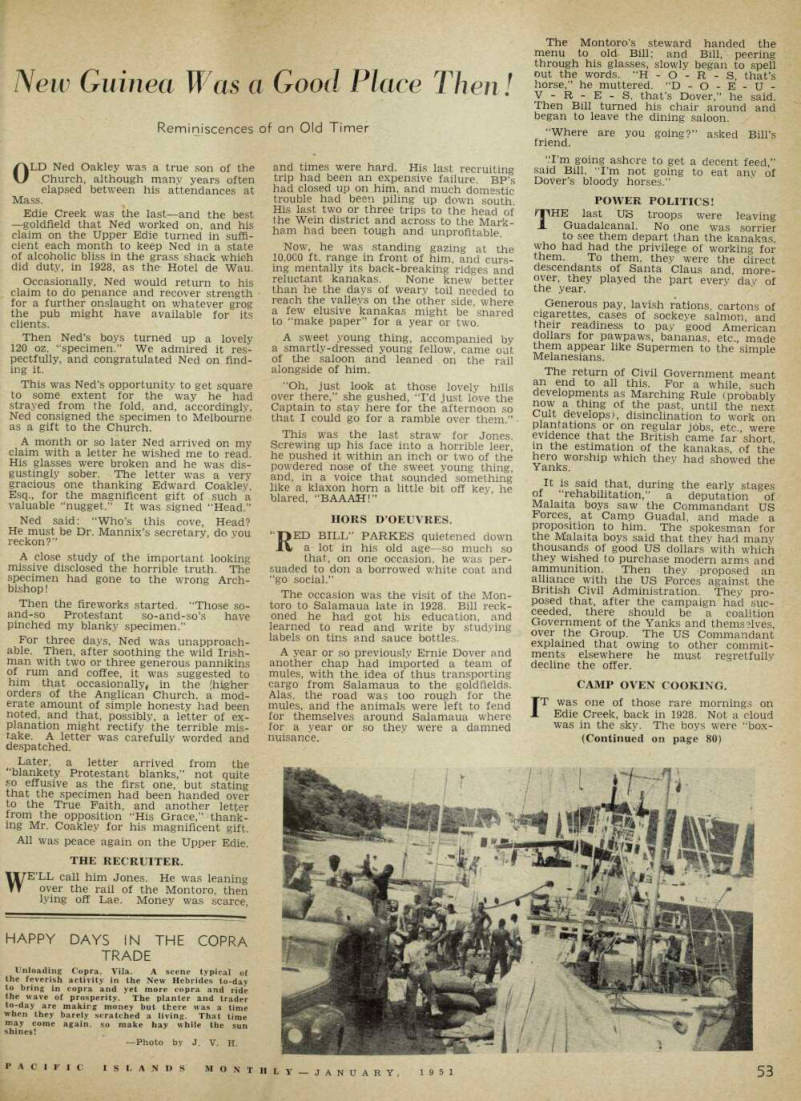
Happy Days In The Copra
Trade
Unloading Copra, Vila. A scene typical of the feverish activity in the New Hebrides to-day to bring in copra and yet more copra and ride the wave of prosperity. The planter and trader to-day are making money but there was a time when they barely scratched a living. That time may come again, so make hay while the sun shines! —Photo by J. V. H.
ing” the rich, virgin ground, making it necessary every hour or so to turn the water off to clean up the gold choking up the top riffles.
Within a hundred yards, half a dozen teams were working on their masters’ claims.
Suddenly bedlam broke loose. Picks and shovels were dropped, sluice boxes abandoned, and every boy in sight joined in a mad scramble through the scrub around the edge of the Little Upper Edie Creek.
I had heard of mass insanity amongst the natives, but had never believed it could strike as suddenly as this. Would it be best to make a break for the hut and get my revolver (the one with the big bulge in the barrel) or go bush and hide?
It didn’t last long, however. What had happened was that an unsuspecting scrub turkey had wandered down into the middle of the claims before being spotted.
My cook-boy was the victor in the chase with the result that I copped the turkey.
After an unvaried diet of tinned meat
for many months, this was an event; an occasion for a celebration. Fortunately] I had a bottle of OP, and a small pump kin, growing alongside the hut.
To go with the Roast Turkey, however, a second course seemed to be indicated. I decided to make jam tarts (according to the book) in the second camp oven.
Previously, when I had made jam tarts, I had burnt the bottoms of them by laying them down on the floor of the camp oven. I would not make this mis take again. This time I cut small sticks to put on the floor of the oven and rested the pastry on top of them.
Old Bill Parkes was the first guest to arrive. We sat down, and yarned over pannikins of rum and coffee, while the turkey sizzled in its oven and the jam tarts made headway in theirs.
Suddenly, Bill noticed a smell of burn ing. Anxiously, I lifted the lid of the turkey oven. Everything was all right.
Then the lid of the pastry oven. As I did so, a cloud of smoke gushed out and the interior burst into flame. The sticks had caught fire!
Old Bill was astonished. “Well,” he said, “I’ve seen camp oven cooking for over sixty years. I’ve seen ’em put the fire under the oven, round the side of the oven, and on top of the oven; but this is the first blanky time I’ve ever seen the blanky fire put inside the oven!”
Guilty, Y’Honor, But—!
THIS happened in the real bad old days, in New Guinea. At that time there was a fair-dinkum nark in the Gov ernment at Madang; and, during the absence of the NO. 1, he acted as boss cocky.
He had a down on traders, planters, Expro-Boardites, miners, and recruiters — particularly on recruiters.
The nark had been trying to catch Bluey for a long time, Bluey lobbed in
ne day with a string of boys, en route o Salamaua to sign them on.
In Salamaua, the ADO’s weren’t so 3ugh or inquisitive in signing on boys.
Bluey put his boys in smoke until the oat came in, but a few wandered in to 3wn. The nark grabbed them, and put he third degree on them, to find out diat Bluey had been up to during his ecruiting trip. He didn’t collect much but he did discover that Huey had shot a Goura pigeon.
This was enough. Bluey was called to he bar. The witnesses were examined nd Bluey could see that the going was bit up-hill. Then Bluey’s turn came.
“Did you shoot the Goura pigeon, as hese boys say you did?” was the ques ion.
“Yes, I did, but—” replied Bluey.
“And who gave you permission to shoot loura pigeon?” says the Nark.
“Well,” Bluey says, “it was like this, ’he bloody bird attacked me, and I had y fire in self-defence.”
Love’S Labour Lost.
JOMEWHERE around 1928, boys for the 5 goldfields were bringing thirty quid a nob. So, the roll being a bit light, ly mate and I, in a misguided moment, ecided to go recruiting in that pleasant ttle corner of the world just south of le lower Ramu River, about four days’ r alk behind Awar Plantation.
The least said about the trip the better, 'he kanakas just about did everything ) us except recruit us.
I wore a rather stylish bush outfit, Dpped off with an ex-AIF sombrero. A ery bright, oversized brass badge decor ted the hat. I think the badge originally elonged to the Mongogorie Girl Guides r the Bulgarian Fusiliers or something.
It was surprising the number of kan kas who thought I was “Guberman.” At aat time, the quaint bush kanakas had tie old-fashioned idea that Government ras something to rely on in time of rouble, and several complaints were rought to me which I promised to look ito personally at some time in the dis ant future, or refer to the proper de artmental head.
Then I stumbled on to a real tragedy.
It appears that up on the mountains, ot so very far away, a certain tribe of nterprising kanakas had been doing big usiness in supplying wives to the coastal lutocrats. The supply of wives was al lost inexhaustible, as they were obtained y raiding even more primitive villages urther back in the mountains. It isn’t ecorded whether any of the original wners ever raised any objections.
The cove who came to see me, with his omplaint, had been saving up for a long ime to buy a wife. On the previous ccasion, when the mountain boys brought own their wares for sale, he had missed ut, although he had had the where ithal to make his purchase. On the next ccasion the supply had not been equal d the demand.
But, following ordinary commercial sage, he had placed an order, to be ex cuted at the time of next delivery. He ad, however, made a fatal mistake. He’d aid the mountain kanakas in advance.
Ie brought to me his books of account d certify his payments.
These consisted of many small bundles f sticks. The number of sticks in each ttle bundle corresponded with the par icular number of certain articles he had 'aid. So many rings (curtain) belong rtiite man, so many plaited rings belong anaka, so many beads, gaum shells, owrie shells, etc., etc. Truly, a goodly •rice for a fair damosel.
But, alas, those cunning mountain anakas had put a swifty over him. In tead of the plump, young mary that he iad been dreaming about, and that he tad paid for, they had sold him a pup ti the shape of a toothless, wrinkled, and
grillie-skinned old crone.
He’d brought her along with him to nn° a ble m %as W this simple notice* And JL loShprmS? 1 oShprmS? v n l i A? d ’ please, Mr Guberman, what are you gom f/r to u2ovf a^ wlS inr fv. P o . My heart bled for the stricken Romeo, ? ut th .Hnn ivonreri Of transaction savoured 01 very sharp practice, I could not see that the Sale of Goods Act (with amendments thereto) had been contravened. My judicial
opinion was that the principle of Caveat Emptor must apply.
Atter m '' Judgment had been explained to him P er interpreter, I dismissed him from presence. He went away mut tering something which may have been a jaifdatory declamation of the blessings ot civilization, but probably was not.
Thpn T rp<;t.prl for an hour nr twn from
mv Lm
my iaDOUrs
(Continued on page 83)
Jeeves, my cookboy and valet, shattered ny tranquility.
“Masta, what are you going to do with his mary,” he asked. “What mary?” I eplied. “The one the kanaka left with r ou this morning,” he answered.
The kanaka had parked his problem on ne and gone off to his village!
During the afternoon several kanakas Irifted along. I suggested to them that hey might like to possess themselves, ree of charge, of a real good and useful nary. The idea appealed to them: but one ook at my charge cured any romantic deas that may have struck them, and the ffer was, not too politely, declined.
Things looked bad. Even when I offered , dowry with the damosel there was noth ng doing.
Towards dusk, along came a skinny, flzened lapun (old native). He had a mall taro, which he wished to trade for , razor blade or a kelly axe, or something.
The proposition concerning the mary ras put to him. It took him a long time o cotton on. The mary was brought up nd paraded: the dowry (a bush knife and length of calico, plus a 6d. taro knife) ras displayed.
The old fellow must have bought many orses in his time! He felt her ribs, xamined her teeth, inspected for string alt, spavins, and ingrowing toe-nails, 'inally he was satisfied. With his dowry nder one arm, holding his blushing ride’s wrist and with many facial ex ressions he departed to face a rosy uture.
Mrs. Rachael Amy Carr, widow of the ite Mr. Robert Palgrave Carr, who owned r otua Levu sugar plantation at Ba, Fiji, ied in Sydney on January 3.