PIM Crossquiz -No. 13
p. 54 · Read in the full issue
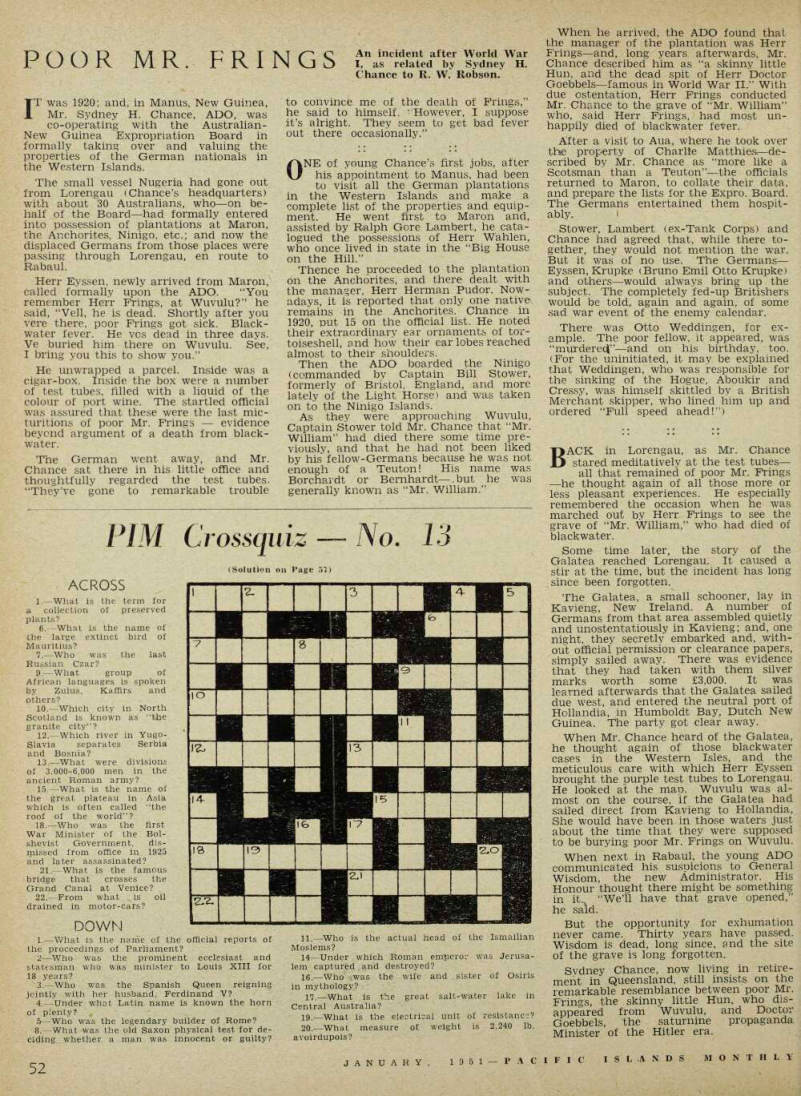
(Solution on Page 57)
Across
1. —What is the term for a collection of preserved plants? 6. —What is the name of the large extinct bird of Mauritius? 7. —Who was the last Russian Czar? 9. —What group of African languages is spoken by Zulus, Kaffirs and others? 10. —Which city in North Scotland is known as “the granite city”? 12.—Which river in Yugo slavia separates Serbia and Bosnia? 13—What were divisions of 3.000-6,000 men in the ancient Roman army? 15. —What is the name of the great plateau in Asia which is often called “the roof of the world”? 18.—Who was the first War Minister of the Bol shevist Government, dis missed from office in 1925 and later assassinated? 21. —What is the famous bridge that crosses the Grand Canal at Venice? 22.—From what is oil drained in motor-cars?
Down
I.—What is the name of the official reports of the proceedings of Parliament? 2—Who was the prominent ecclesiast and statesman who was minister to Louis XIII for 18 years? 3. —Who was the Spanish Queen reigning jointly with her husband, Ferdinand V? 4. —Under what Latin name is known the horn of plenty? s—Who was the legendary builder of Rome? 8. —What was the old Saxon physical test for de ciding whether a man was innocent or guilty?
11-—-Who is the actual head of the Ismailian Moslems? 14—Under which Roman emperor was Jerusa lem captured, and destroyed? 16.—Who s; was the wife and .sister of Osiris j n mythology? 17—What is the great salt-water lake in central Australia? 19-What Is the electrical unit of resistance? 20.—What measure of weight is 2,240 lb. avoirdupois?
When he arrived, the ADO found that the manager of the plantation was Herr Frings—and, long years afterwards, Mr.
Chance described him as “a skinny little Hun, and the dead spit of Herr Doctor Goebbels —famous in World War II.” With due ostentation, Herr Frings conducted Mr. Chance to the grave of “Mr. William” who, said Herr Frings, had most un happily died of blackwater fever.
After a visit to Aua, where he took over the property of Charlie Matthies.—de scribed by Mr. Chance as “more like a Scotsman than a Teuton” —the officials returned to Maron, to collate their data, and prepare the lists for the Expro. Board.
The Germans entertained them hospit ably.
Stower, Lambert (ex-Tank Corps) and Chance had agreed that, while there to gether, they would not mention the war.
But it was' of no use. The Germans — Eyssen, Krupke (Bruno Emil Otto Krupke) and others —would always bring up the subject. The completely fed-up Britishers would be told, again and again, of some sad war event of the enemy calendar.
There was Otto Weddingen, for ex ample. The poor fellow, it appeared, was “murderedT —and on his birthday, too. (For the uninitiated, it may be explained that Weddingen, who was responsible for the sinking of the Hogue, Aboukir and Cressy, was himself skittled by a British Merchant skipper, who lined him up and ordered “Full speed ahead!”) BACK in Lorengau, as Mr. Chance stared meditatively at the test tubes— all that remained of poor Mr. Frings —he thought again of all those more or less pleasant experiences. He especially remembered the occasion when he was marched out by Herr Frings to see the grave of “Mr. William,” who had died of blackwater.
Some time later, the story of the Galatea reached Lorengau. It caused a stir at the time, but the incident has long since been forgotten.
The Galatea, a small schooner, lay in Kavieng, New Ireland. A number of Germans from that area assembled quietly and unostentatiously in Kavieng; and, one night, they secretly embarked and, with out official permission or clearance papers, simply sailed away. There was evidence that they had taken with them silver marks worth some £3,000. It was learned afterwards that the Galatea sailed due west, and entered the neutral port of Hollandia, in Humboldt Bay, Dutch New Guinea. The party got clear away.
When Mr. Chance heard of the Galatea, he thought again of those blackwater cases in the Western Isles, and the meticulous care with which Herr Eyssen brought the nurple test tubes to Lorengau.
He looked at the map. Wuvulu was al most on the course, if the Galatea had sailed direct from Kavieng to Hollandia, She would have been in those waters just about the time that they were supposed to be burying poor Mr. Frings on Wuvulu.
When next in Rabaul, the young ADO communicated his suspicions to General Wisdom, the new Administrator. His Honour thought there might be something in it. k “Well have that grave opened,” he said.
But the opportunity for exhumation never came. Thirty years have passed.
Wisdom is dead, long since, and the site of the grave is long forgotten.
Sydney Chance, now living in retire ment in Queensland, still insists on the remarkable resemblance between poor Mr.
Flings, the skinnv little Hun, who dis appeared from Wuvulu, and Doctor Goebbels, the saturnine propaganda Minister of the Hitler era.