Tropicalities
pp. 60-61 · Read in the full issue
ALONG many miles of the Bulolo River flats there are vast, unsightly heaps of bare gravel—the tailings from the dredges which have worked over the ground. Someone said to me that he supposed those horrors would remain there indefinitely. But I noticed that already rough vegetation is beginning to hide the unsightly masses.
I am reminded that, during the past 25 years, the people of the Roxburgh district, in Central Otago, New Zealand, planted thousands of pinus radiata on the apparently endless heaps of dredge tailings which once made that region hideous. To-day the whole area is covered by a vast pine forest which not only makes the district beautiful, but repre sents now almost incalculable wealth in terms of timber. There may be. there, an idea or two for New Guinea —RWR.
A CORRESPONDENT in the United States tells us that recently a South Pacific reunion took place in Flem ington, New Jersey, at the home of Mr. and Mrs. J. C. Furnas (he wrote that excellent book on the Pacific, Anatomy of Paradise). A number of Americans in terested in the area, including the former president of Standard Oil, Mr. Walter Teague, and Mr. and Mrs. James Michener who had recently returned from the South Seas, were invited to meet Ratu Sir Lala Sukuna, of Fiji, who was then acting as an advisor to the British delegation to the United Nations. He created a most favourable imnression by his wide know ledge and good humour, and he later was the subject of a lengthy story that was syndicated in 300 American newspapers, wherein he was upheld as one of the world’s learned men who are working for international friendship.
ONE of the first Christmas greetings re ceived by our editor this year came from the Misses Parham, of Suva Fiji, and takes the form of a small book of verses written by their mother, the late Mrs. H. B. R. Parham. The booklet is called a Fiji Floral Calendar and contains a verse for each month of the year, the subject in each case being a Fiji native flower that blooms in that month.
Mrs. Parham was a distinguished botan ist and the study of the Colony’s flora was one of her chief interests. She was a member of Fiji’s old school of pioneers and PlM’s editor remembers his meetings with her with pleasure.
He recollects, also, but with less plea sure, that once when he was taking tea with her in her Suva garden, her pet tortoise bit him.
Mr. B. E. V. Parham, QBE. MA, Chief Agricultural Officer of the Fiji Depart ment of Agriculture and a member of the Research Council (Economic Develop ment) of the South Pacific Commission, is her son.
APPROACHES recently made to the natives of Mangaia, Cook Islands, for the installation of an orange-squeez ing plant with view to export of juice for soft-drink factories in NZ, were not suc cessful. They recalled to an old-timer the defunct “Rarotonga Limejuice Com pany” of more than half-a-century ago, when an eccentric Hebrew named John Salmon (the only Jew Cl history im mortalises) commenced a similar enter prise.
This man, who came to the Islands on spec.—adventurers could, then —married a minor native Queen, not Rarotonga’s reigning one.
His subsequent pompous proclamations, in which he calls himself "Prime Min ister.” are still treasured by officialdom.
Salmon appears to have started his company on a shoestring, with a few barrels, and an old boat to “juice” his limes in, by the simple process of getting natives to tread them down, with bare feet, like the old Roman wine-makers. For a while the juice, exported to USA, went well, and he made money. But later he altered his manufacturing process—and there lay the hitch.
After several shipments, an awesome letter arrived from a US attorney-firm, re certain “improvements” to the pro duct, now labelled as “best fortified lime juice” (a few of these gaudy labels are also still extant). Upon the arrival of this epistle, the limejuice company went into liquidation—the stuff had been “forti fied” by the cunning proprietor with sea water !
Salmon is also remembered for his amazing success in persuading a firm of US cartmakers to supply a fleet of Cones togas—brakeless four-wfiieeled buggies— for one of his enterprises without COD. or other financial preliminary. A few of these veteran buggies are said to be still rattling around Rarotonga.
Poor Salmon died long agone, and had fallen upon evil days, due to the untimely death of his "Queen,” in his last years, losing all his land. —EG.
BY proclamation, the name of the administrative district of Kieta, New Guinea, has been altered. In future, it will be known as the District of
Bougainville. It required half a page of the Gazette, and a dozen “whereas-es” to effect the change.
A SOLOMON Islander, Tetavi, member of the crew of an Islands ship calling at Sydnpy, put aside 3 - to buy Christmas presents for his two young daughters back in BSI. This, for Sydney, Christmas 1950, was slightly inadequate.
But with the indulgence shown all Island ers these days a Sydney doll manufac turer presented him with two, £3/10/0 dolls. This achieved the usual publicity and Tetavi’s photograph, complete with glamour dolls, appeared in the news papers.
It was recorded, also, that when in the doll storeroom, Tetavi was offered a choice —a black girl doll, or a white doll.
He spurned the black girl doll. There should be a moral in this, but we don’t know what it is.
PROMOTION. This appeared in Sydney Truth of November 19: Archbishop Bodger, of New Guinea, the man who was largely responsible for the building, by natives, of the magnificent cathedral in that part of the world passed through Sydney this week on his way to England.
It should be: Canon John D. Bodger.
The cathedral referred to is at Dogura, Papua.
DR. MARGARET MEAD, a distinguished American anthropologist, who did field work in the Sepik River district of New Guinea just before the war, and in Samoa before that, will be one of Aus tralia’s Jubilee visitors next year. She will lecture on education.
At present she is Associate Curator of Ethnology at the American Museum of Natural History and a lecturer at Colom bia University. After seven years in civilization she says that she is sick of it.
She would like to live with an abor igine tribe for a year to get the taste of it out of her mouth. That’s not orig inal, of course. There are plenty of Australians who have lived seven years in Sydney who would like to go live with the aborigines. The only difference is that Margaret Mead probably will go; Sydneysiders just play around with the thought.
She has theories on other things be sides anthropology. One of her pro nouncements is that any woman can get herself a husband these days unless she is deaf, dumb and blind. Dr. Mead has been married twice, both times to men in the same line of business as herself. In private life she is now Mrs. Gregory Bateson. They have a daughter, Cathy, who will come to Australia next year with her mother—J.T.
THE Suva Indians are original if noth ing else. Noticed a sign recently outside an enterprising bookshop on Suva’s main boulevard, “We are sub scriptions for all American magazines.
I peeped inside and decided, well maybe the proprietors had a trifle overestimated their value on the American market!
However, further along the street, I found a more truthful sign for the an nouncement said, “Souvenir and Curious Shop.” And it was.
Journeying on my way I came across another proudly displayed signboard: “Pianos, Organs, and musical instru ments, tuned by experts to satisfaction.
Of the customer I hope! But it con firmed my suspicion that some of the noises my young daughter extracts from our piano are just noises, and not music at all.
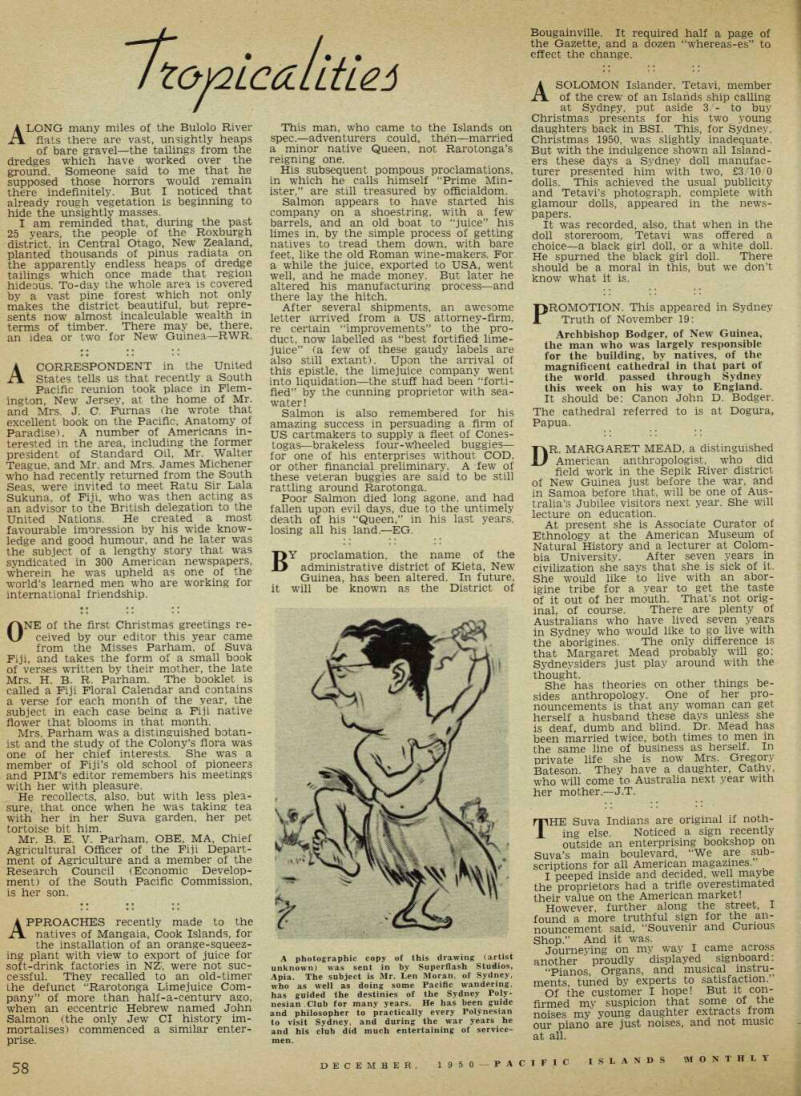
A photographic copy of this drawing (artist unknown) was sent in by Superflash Studios, Apia. The subject is Mr. Len Moran, of Sydney, who as well as doing some Pacific wandering, has guided the destinies of the Sydney Poly nesian Club for many years. He has been guide and philosopher to practically every Polynesian to visit Sydney, and during the war years he and his ciub did much entertaining of service men.
Then 1 see advertised in our local paper; “Try Messrs. So-and-so. Dressmakers and Tailors. Give us a trial. You will be surprised at the results.”
I’ll say!
Pereti.
Administration in Papua and New Guinea is difficult enough, in any circumstances; but imagine how complicated it becomes when the basic records covering 20 years have been lost.
When the Japs came suddenly into New Guinea in 1942, and the Europeans tem porarily withdrew, nearly all basic records covering the period 1920-41 were destroyed or disappeared.
A notice in the Gazette of November 20 announces, formally, that the following are, for the purposes of the Lost Registers Ordinance of 1950 declared to be Lost- Registers: Registers of Firms and Per sons; of Companies; of Administration Leases; of Mining Leases; and of Births, Deaths and Marriages. In the case of New Guinea, the lost records covered the post-German period; but in the case of Papua, they apparently extend back to 1912.
Captain William Murdoch Mc-
LEOD, whose death was reported in November PIM had 50 years at sea —mostly in South Pacific waters—and was well-known to old-timers (and some more recent residents) of the Pacific Islands.
He went to sea in 1900, by 1910 had his Extra Masters ticket, and between 1911 and 1915 served with the AUSN Co. and Burns, Philp, Ltd. in the following ships: Suva, Maranoa, Moira, Wyreema, Levuka, Amra, Arawatta, Tambo, Moresby, Mor inda. In these craft he gained a wide knowledge of the Solomons, Gilbert and Ellice, Marshall and Caroline Islands, etc.
The latter group which became a Jap.
Mandate after World War I was later closed to the rest of the world and when American forces were preparing a land ing there during the Pacific War, Captain McLeod’s accurate and painstaking notes and sketches were of great value to them.
Following an interesting career in World War I in “mystery ships,” he joined the Wellington Harbour Board as a pilot in 1919. He became Deputy-Harbourmaster in 1936.
His retirement in 1945 did not mean the end of his interest in the Pacific; m 1946 he acted as Harbourmaster at Apia for six months and in 1947 he was in Honolulu in command of the former LST Rawhiti, now a familiar sight in the Pacific.