Tusitala The Teller of Tales—Was
pp. 61-101 · Read in the full issue

Born 100 Years Ago
By E. E. Bush
THE centenary of the birth of Robert Louis Stevensin at 8 Howard Place, Edinburgh, on November 13, 1850, did not pass unobserved in Western Samoa, the land of his adoption.
Several parties made the pilgrimage up Mt. Vaea in the cool of the afternoon to pay tribute to Tusitala. Some took flowers; one took the standard of Scot land; one a copy of “Vailima Prayers.”
In the stillness of that forest, gathered around his tomb, we listened to the words of his prayers for Success, for Evening, and that last prayer which he wrote on the day before his death: “Look down upon Thy servants with a patient eye, even as Thou sendest sun and rain; look down, call upon the dry bones, quicken, enliven; recreate in us the soul of service, the spirit of peace; renew in us the sense of joy.”
As we placed our flowers, and read the prayers, we realised that many people throughout the world, to whom the name of Robert Louis Stevenson means much, would wish to be in that place, on that day. We, therefore, were greatly privileged that we could gather there and pay our homage, although neither this nor our flowers were ours alone; they were the respectful remembrance of the whole coterie of Stevenson lovers, given by those whose good fortune it was to live in the land he knew, the land in which he found health and happiness, the land wherein he lies in everlasting sleep.
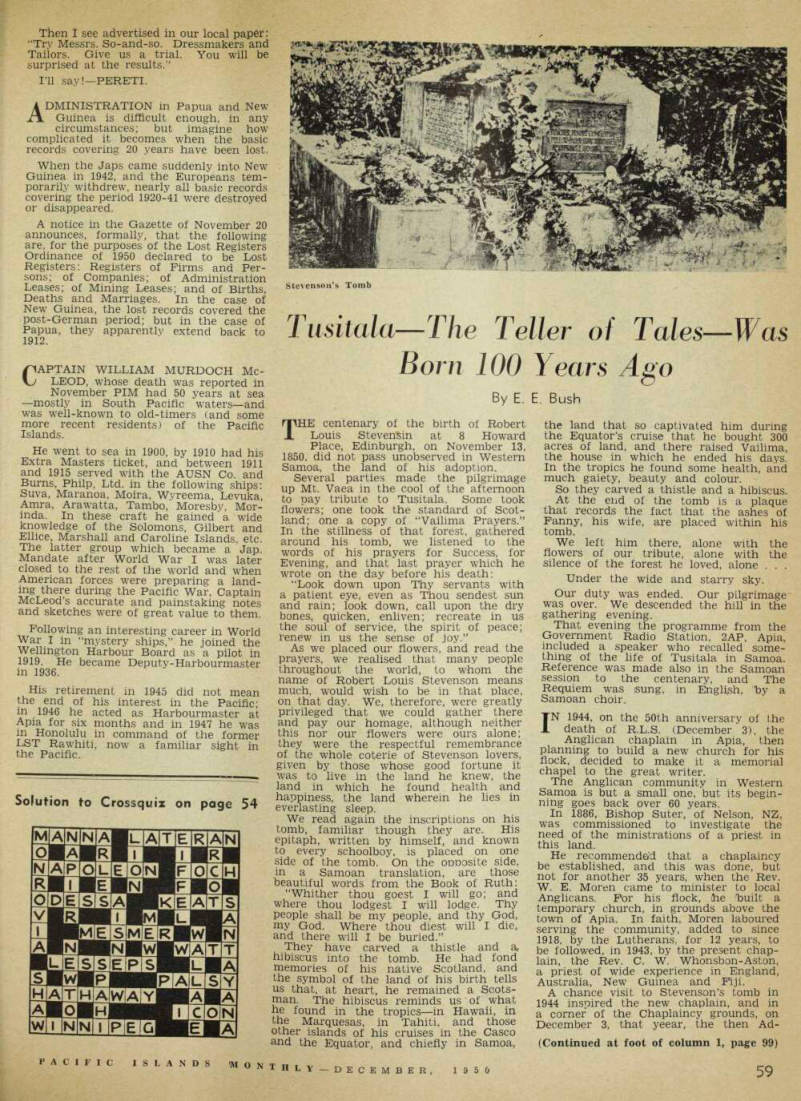
We read again the inscriptions on his tomb, familiar though they are. His epitaph, written by himself, and known to every schoolboy, is placed on one side of the tomb. On the opposite side, in a Samoan translation, are those beautiful words from the Book of Ruth: “Whither thou goest I will go; and where thou lodgest I will lodge. Thy people shall be my people, and thy God, my God. Where thou diest will I die, and there will I be buried.”
They have carved a thistle and a, hibiscus into the tomb. He had fond memories of his native Scotland, and the symbol of the land of his birth tells us that, at heart, he remained a Scots man. The hibiscus reminds us of what ne found in the tropics—in Hawaii, in the Marquesas, in Tahiti, and those other islands of his cruises in the Casco and the Equator, and chiefly in Samoa,
the land that so captivated him during the Equator’s cruise that he bought 300 acres of land, and there raised Vailima, the house in which he ended his days.
In the tropics he found some health, and much gaiety, beauty and colour.
So they carved a thistle and a hibiscus.
At the end of the tomb is a plaque that records the fact that the ashes of Fanny, his wife, are placed within his tomb.
We left him there, alone with the flowers of our tribute, alone with the silence of the forest he loved, alone . . .
Under the wide and starry sky.
Our duty was ended. Our pilgrimage was over. We descended the hill in the
gathering evening.
That evening the programme from the Government Radio Station, 2AP. Apia, included a speaker who recalled some thing of the life of Tusitala in Samoa.
Reference was made also in the Samoan session to the centenary, and The Requiem was sung, in English, hy a Samoan choir.
IN 1944, on the 50th anniversary of the death of R.L.S. (December 3), the Anglican chaplain in Apia, then planning to build a new church for his flock, decided to make it a memorial chapel to the great writer.
The Anglican community in Western Samoa is but a small one, but its begin ning goes back over 60 years.
In 1886, Bishop Suter, of Nelson, NZ, was commissioned to investigate the need of the ministrations of a priest in this land.
He recommend&'d that a chaplaincy be established, and this was done, but not for another 35 years, when the Rev.
W. E. Moren came to minister to local Anglicans. For his flock, lie huilt a temporary church, in grounds above the town of Apia. In faith, Moren laboured serving the community, added to since 1918, by the Lutherans, for 12 years, to be followed, in 1943, by the present chap lain, the Rev. C. W. Whonsbon-Aston, a priest of wide experience in England, Australia, New Guinea and Fiji.
A chance visit to Stevenson’s tomb in 1944 inspired the new chaplain, and in a corner of the Chaplaincy grounds, on December 3, that yeear, the then Ad
(Continued at foot of column 1, page 99)
Stevenson’s Tomb
ministrator of the Territory, the Hon.
A. C. Turnbull, laid a stone that com memorated the death of Tusitala, and would, in due season, become the chief cornerstone of a new church.
And now, in 1950, fulfilment. The stone was moved to the place where the Church would rise, and on All Soul’s Day this year, in the presence of the Lord Bishop in Polynesia, the chaplain and the congregation, was re-set by the High Commissioner of Western Samoa, the Hon. G. R. Powles.
In the course of his address. Mr.
Powles spoke of the visit of Bishop Sutor in 1886 and the long years to the insti tution of the chaplaincy in 1931. This did not mean, however, that the Church of England in this place was neglected, for some workers for the L.M.S. were Anglican priests. Mr. Powles spoke in high praise of the work of the honorary architect, Mr. A. Schaafhausen, who de signed the building, and referred to the happy coincidence that the contractor for the foundations, Mr. A. Betham, had been baptised by Bishop Sutor during his visit in 1886.