for the Leahy brothers
pp. 58-74 · Read in the full issue
Life was never dull for the Leahy brothers
By R. W. Robson
ABOUT the best thing that New Guinea o-ot out of its famous gold discoveries of the 1920’s was a string of Leahy brothers—Mick, Paddy. Jim and Danny (named in the order of their appearance on the Morobe goldfields).
At the end of 1921, Sharkeye Park re located the rich Koranga gold, found in Bulolo Valley in 1913 by his old mate Darling, and forgotten during World War 1.
“Foxing” by Sharkeye and his mates, plus the incredible difficulties of the terrain, discouraged any kind of rush; but, as large packages of gold dribbled out, various old prospectors smelt something, and began to creep in through Salamaua.
By 1925, about 100 miners were in there, washing gold out of the Koranga and other creeks which flowed into the Bulolo.
In February, 1926, W. G. Royal somehow clambered over the sheer precipices be hind Wau (they climbed over 3,000 feet in a few miles) and discovered the fabulous riches of Edie Creek. Then the rush really started.
DOWN in Toowoomba, Queensland, the eldest son of the Leahy family of four
sons and five daughters, Michael, then in his middle twenties, had been listening to tales of NG gold. In 1926, soon after Bill Royal’s dis covery, he walked in from Salamaua and joined the Big Six, who were literally lifting gold in lumps out of the Edie.
Mick was more than eager to dig gold, too; but, like scores of others, he was crippled by lack of labour and supplies. Recruits were scarce, and supplies were carried in over the mount ains, on the backs of men.
Mick began “contracting.”
He got more gold by perform ing essential services for the mining community than if he had dug it himself. It was he who cut the first mule-track up and over the razor backs between Koranga (Wau) and Edie.
Paddy Leahy joined Mick at Edie Creek in 1928, and with him engaged in various enter prises. Next year, 1929, Jim joined Mick and Paddy; and the Leahy brothers became known in roadmaking, mining, transportation, recruiting and prospecting.
Big, strong, handsome fel lows, with an amiable dis position and a shrewd and ready wit, they were held in high regard throughout the
Morobe district. Mick had the imag ination and was always ready for a new enterprise. Jim had the cool busi ness head and administrative ability, and he kept the feet of his volatile brothers on the hard earth. Danny—then a good looking youngster just out of his teens— joined them in 1931. The quartet pros pered. They bought and developed a good gold lease on the Watut in 1932.
By 1930, the Leahy brothers were widely known as recruiters and prospectors, with a record of success in the unexplored and uncontrolled country to the north and west.
IN 1930, Mick Leahy and Mick Dwyer, prospecting and recruiting, went from Lae to the Markham River, and crossed over the divide onto what they thought was the headwaters of the Ramu (which flows away northwest to the north coast of NG). Actually, they were on the Durantina, and in a tangle of rivers which, until then, had baffled the very few whites who had got over into this area.
The party followed the Durantina, which led into a bigger and still bigger river, which flowed away southwards into the central mountains. They could not get back, so they somehow fought their way through the mountains, to come out eventually at Port Romilly, on the Gulf of Papua. Then, for the first time, it was realised that the great Purari River, which discharges into the Gulf of Papua, actually has its source on NG’s Central Highlands, only a few miles from the source of the Ramu. The Durantina (which is not part of the Ramu, but is a tributary of the Purari) flows through the Benna Benna country the first (or most easterly) of the great valley systems which make up the now famous Central Highlands of NG. It was then that Mick Leahy got his first real glimpse of what they called the “grass country”—in other words, the Highlands.
NEXT year (1931) Mick and Paddy had their closest of many close calls. They v/ere prospecting in the region west ward of the Bulolo, among the Kukukukus —very dangerous and treacherous little jungle men, who fought anyone, white or Just before daylight one morning—it was only four days after Baum, a prospector, was murdered, in the same district —the Leahys’ camp was attacked. Mick went outside, saw a native beside the doo.r, thought it was one of his own boys: then had only time to shoot before the native’s club crashed on his head, and he fell unconscious. Paddy, although surrounded by Kukukukus, kept on shooting and was helped bv their own boys.
The battle lasted for an hour. Arrow after arrow found its mark in Paddy, but none touched a vital place. Paddy pulled out the arrows, and kept on shooting.
When daylight came, the savages cleared out. Mick presently regained conscious ness, and took charge—Paddy, by now, was a cot case. They carried Paddy for four davs, and got back to the Bulolo. That club blow deafened Mick permanently, in one ear.
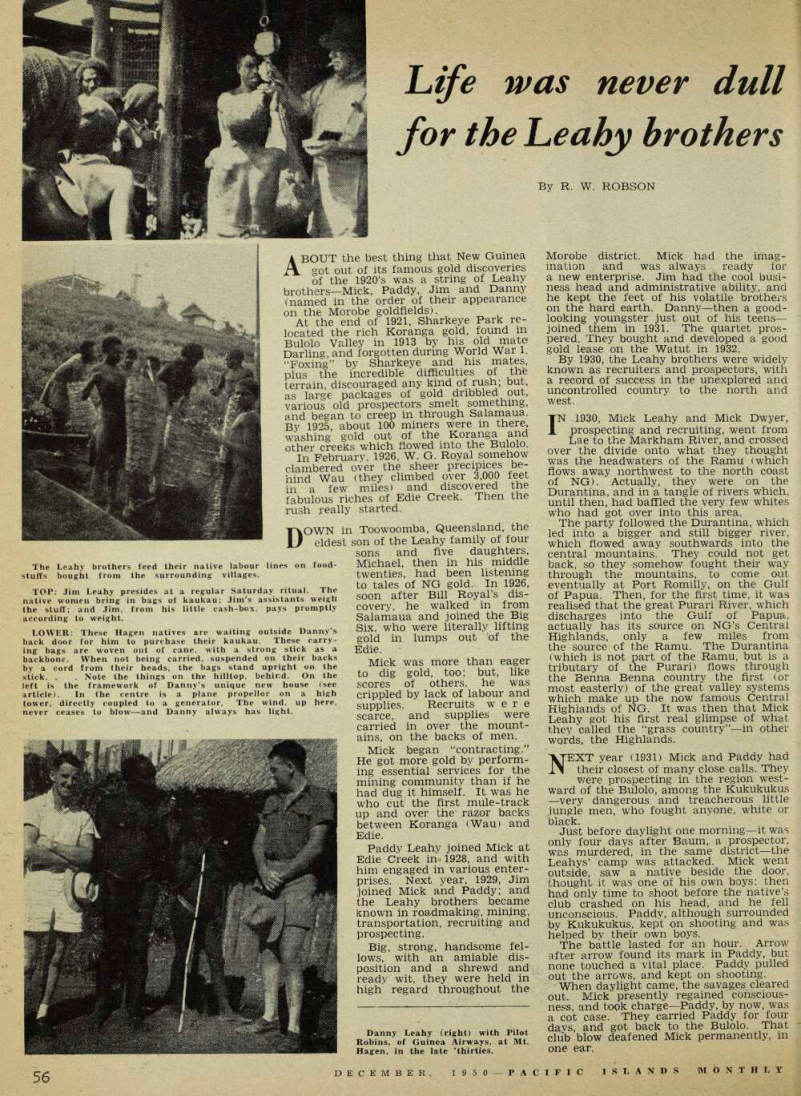
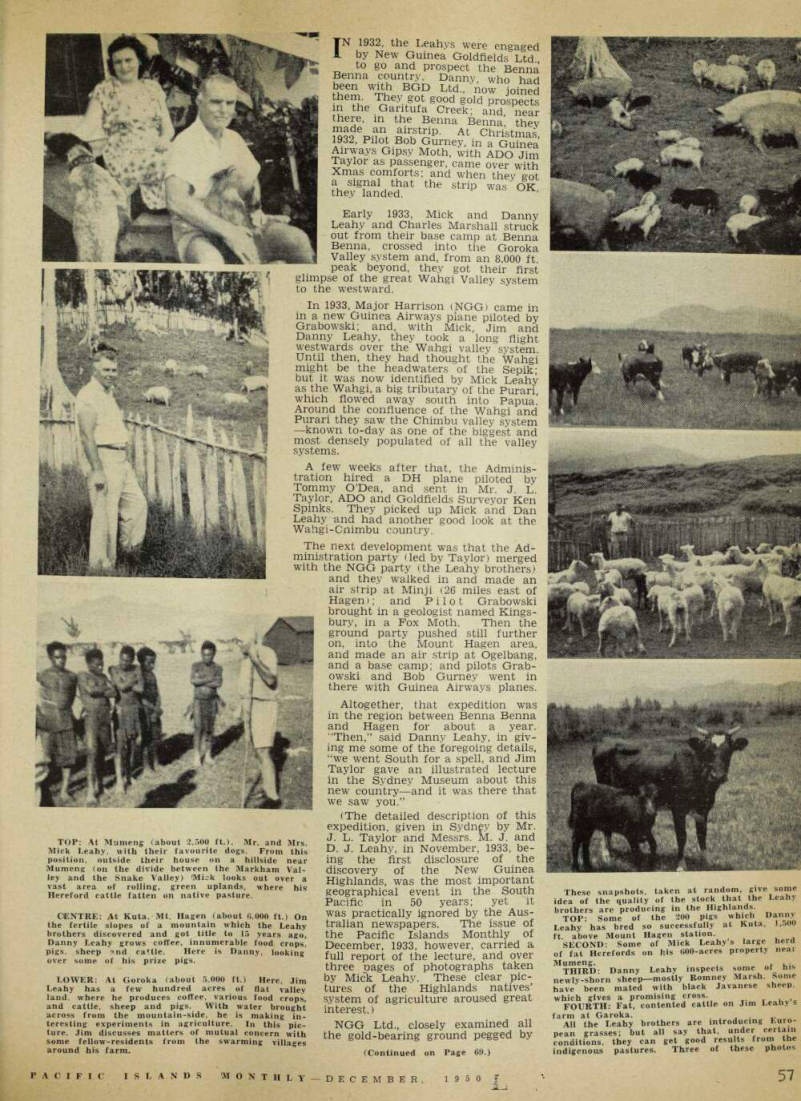
The Leahy brothers feed their native labour lines on food stuffs bought from the surrounding villages.
TOP: Jim Leahy presides at a regular Saturday ritual. The native women bring in bags of kaukau; Jim’s assistants weigh the stuff; and Jim, from his little cash-box. pays promptly according to weight.
LOWER: These Hagen natives are waiting outside Danny’s back door for him to purchase their kaukau. These carry ing bags are woven out of cane, with a strong stick as a backbone. When not being carried, suspended on their backs by a cord from their heads, the bags stand upright on the stick. . . Note the things on the hilltop, behind. On the left is the framework of Danny’s unique new house (see article). In the centre is a plane propeller on a high tower, directly coupled to a generator. The wind, up here, never ceases to blow—and Danny always has light.
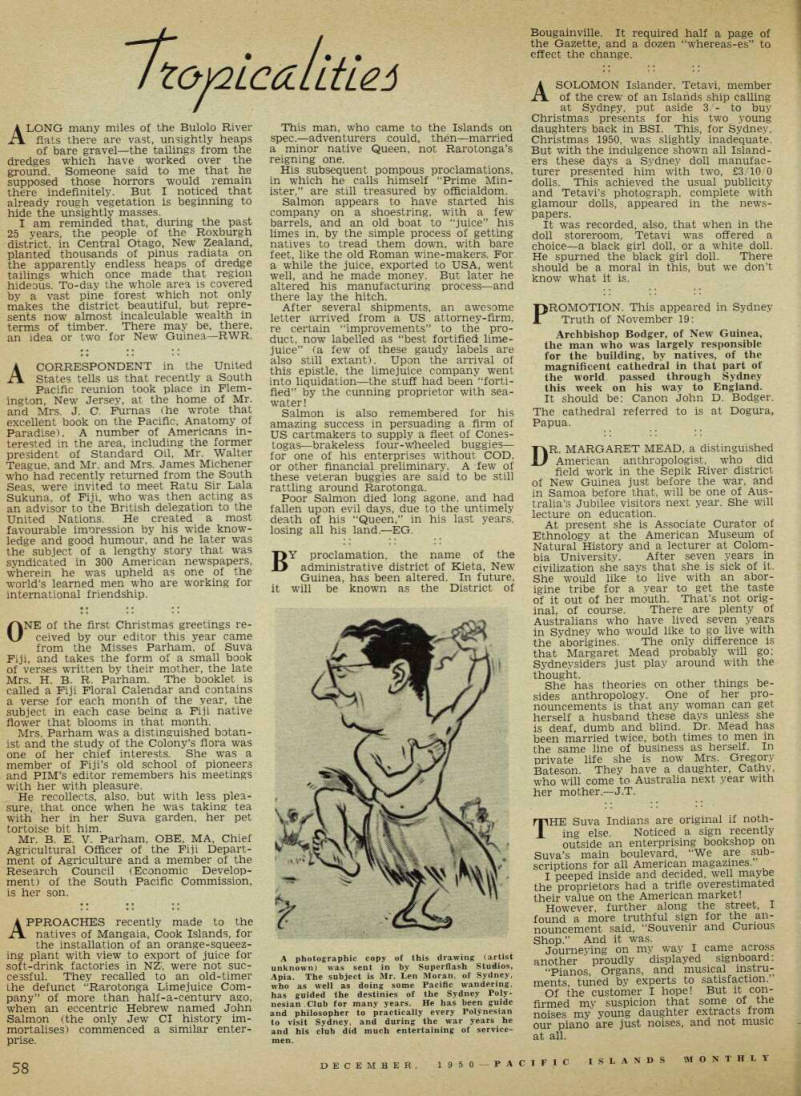
Danny Leahy (right) with Pilot Robins, of Guinea Airways, at Mt.
Hagen, in the late ’thirties.
IN 1932, the Leahys were engaged by New Guinea Goldfields Ltd to go and prospect the Benna Benna country. Danny, who had been with BGD Ltd., now joined ™ ey S O / Sood gold prospects m the Gantufa Creek; and, near there, in the Benna Benna, they
At Christmas,
1932, Pilot Bob Gurney, in a Guinea An ways Gipsy Moth, with ADO Jim Taylor as passenger, came over with Xmas comforts; and when they aot a signal that the strip was OK they landed.
Early 1933, Mick and Danny Leahy and Charles Marshall struck out from their base camp at Benna Benna, crossed into the Goroka Valley system and, from an 8,000 ft. peak beyond, they got their first
glimpse of the great Wahgi Valley system to the westward.
In 1933, Major Harrison (NGG) came in in a new Guinea Airways plane piloted by Grabowski; and, with Mick, Jim and Danny Leahy, they took a long flight westwards over the Wahgi valley system Until then, they had thought the Wahgi might be the headwaters of the Sepik; but it was now identified by Mick Leahy as the Wahgi, a big tributary of the Purari, which flowed away south into Papua.
Around the confluence of the Wahgi and Purari they saw the Chimbu valley system —known to-day as one of the biggest and most densely populated of all the valley systems.
A few weeks after that, the Adminis tration hired a DH plane piloted by Tommy O’Dea, and sent in Mr. J. L.
Taylor, ADO and Goldfields Surveyor Ken Spinks. They picked up Mick and Dan Leahy and had another good look at the Wahgi-Cnimbu country.
The next development was that the Ad ministration party (led by Taylor) merged with the NGG party (the Leahy brothers)
and they walked in and made an air strip at Minji (26 miles east of Hagen); and Pilot Grabowski brought in a geologist named Kings bury, in a Fox Moth. Then the ground party pushed still further on, into the Mount Hagen area, and made an air strip at Ogelbang, and a base camp; and pilots Grab owski and Bob Gurney went in there with Guinea Airways planes.
Altogether, that expedition was in the region between Benna Benna and Hagen for about a year.
“Then,” said Danny Leahy, in giv ing me some of the foregoing details, “we went South for a spell, and Jim Taylor gave an illustrated lecture in the Sydney Museum about this new country—and it was there that we saw you.” (The detailed description of this expedition, given in Sydney by Mr.
J. L. Taylor and Messrs. M. J. and D. J. Leahy, in November, 1933, be ing the first disclosure of the discovery of the New Guinea Highlands, was the most important geographical event in the South Pacific in 50 years; yet it was practically ignored by the Aus tralian newspapers. The issue of the Pacific Islands Monthly of December, 1933, however, carried a full report of the lecture, and over three nages of photographs taken by Mick Leahy. These clear pic tures of the Highlands natives’ system of agriculture aroused great interest.) NGG Ltd., closely examined all the gold-bearing ground pegged by
(Continued on Page 69.)
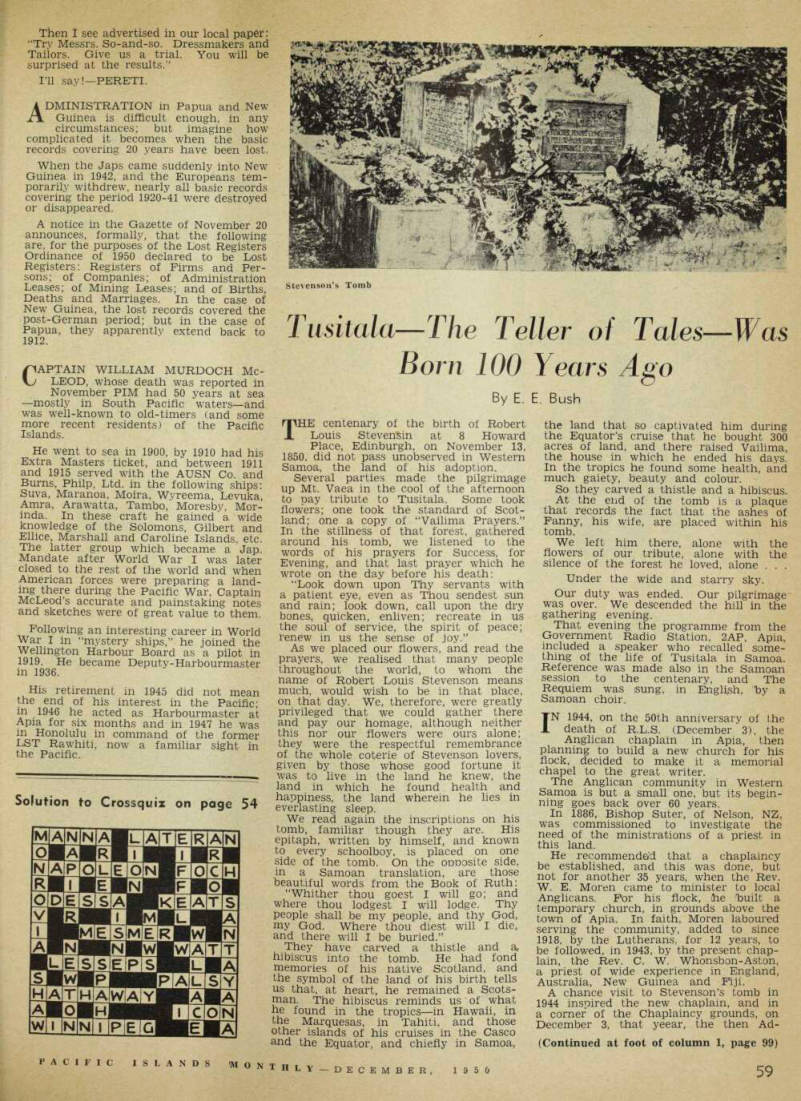
TOP; At Mumeng (about 2,500 ft.). Mr. and Mrs.
Mick Leahy, with their favourite dogs. From this position, outside their house on a hillside near Mumeng (on the divide between the Markham Val ley and the Snake Valley) Mick looks out over a vast area of rolling, green uplands, where his Hereford cattle fatten on native pasture.
CENTRE: At Kuta. Mt. Hagen (about 6,000 ft.) On the fertile slopes of a mountain which the Leahy brothers discovered and got title to 15 years ago, Danny Leahy grows coffee, innumerable food crops, pigs, sheep and cattle. Here is Danny, looking over some of his prize pigs.
LOWER: At Goroka (about 5,000 ft.) Here, Jim Leahy has a few hundred acres of flat valley land, where he produces coffee, various food crops, and cattle, sheep and pigs. With water brought across from the mountain-side, he is making in teresting experiments in agriculture. In this pic ture, Jim discusses matters of mutual concern with some fellow-residents from the swarming villages around his farm.
These snapshots, taken at random, give some idea of the quality of the stock that the Leahy brothers are producing in the Highlands.
TOP: Some of the 200 pigs which Danny Leahy has bred so successfully at Kuta. 1,500 ft. above Mount Hagen station.
SECOND; Some of Mick Leahy’s herd of fal Herefords on his 600-acres property near Mumeng.
THIRD: Danny Leahy inspects some of his newly-shorn sheep—mostly Romney Marsh. Some have been mated with black Javanese sheep,
which gives a promising cross.
FOURTH: Fat, contented cattle on Jim Leahy’s farm at Garoka.
All the Leahy brothers are introducing Euro pean grasses; but all say that, under certain conditions, they can get good results from the indigenous pastures. Three of these photos
the Leahy brothers; but none of it was valuable enough to be worth develop ment.
IN those expeditions the Leahys con ceived a strong love for the Central Highlands, and they determined that some day they should link their future with the development of this rich and beautiful region. It was after that first visit to Mount Hagen— after NGG had turned down the gold possibilities—that the brothers got land rights over the low mountain called Kuka, where Danny Leahy has his home to-day.
Between 1933 and the outbreak of war, the Leahys were goldmining, contracting, prospecting, recruiting, and generally do ing very well for themselves.
With their knowledge of the country and their skill in handling natives, the Leahys were of great service to both Aus tralian and American forces during the Pacific War (1941-1945); and all of them, as commissioned officers, carried out special jobs. The war held tragedy for Danny, however.
Danny just naturally became involved in hush-hush jungle work. He directed rescue operations, led lost parties out to safety, located and built jungle roads, harassed the Japs, and did a good deal of useful spying. His eating was on a catch-as-catch-can basis—often out of tins. Towards the end, he noticed his sight curiously out of focus; and, finally, they rushed him away for expert attention.
He ended as a notable patient in the famous Mayo Clinic, in America.
It is explained that Danny probably was born with some weakness of the optic nerve system; that his failure to get necessary vitamins during those severe years in the jungle developed the weak ness; and, by the time it was recognised, much of Danny’s sight had gone, per manently. He can see well enough, look ing straight ahead; but he has no vision on either side. The experts say that, while he remains healthy, he will hold his sight; and Danny, out on his Highlands farm, is literally wallowing in vitamins, and is one of the cheeriest and healthiest men I ever have seen. He is not yet 40.
AFTER the war, the brothers went their several ways. But, in three directions, they still remain as one: They love New Guinea, and will live nowhere else; he who injures one Leahy, injures the lot, and had better don armour; and they are fiercely enthusiastic about experimental farming.
All are well endowed; and all are putting their money back into New Guinea.
Mick is believed to have made many thousands out of War Disposals trans actions; Jim owns a large wheat-ranch in Queensland, and wheat is better to-day than gold; Danny has washed thousands of ounces of gold out of the two mountain streams which border his large holding near Hagen.
Mick, with one of the prettiest wives and quite the prettiest youngster in NG, farms 600 acres on the Mumeng-Nadzab range, 4,500 ft. up. Jim farms a couple of hundred acres of rich valley floor, five miles out of Goroka, and 5,000 ft. up.
Danny has apparently about a thousand acres at Kuka, over 6,000 ft. up, five miles south of Hagen. Paddy, the most senti mental of the quartette, has not settled anywhere. He spends most of his time in the more civilised centres of NG, nurs ing an inside that NG has more or less ruined.
The farming operations of the three Leahys, although quite independent, have a remarkable similarity. And all are of considerable importance to NG.
WHEN you fly over these vast NG High lands, you see beneath you countless green grass-clad valleys and wooded hills, where the temperature ranges kindlv from 55 to 75 degrees, and clear streams flow always out of the surrounding moun tains. You never saw a more promising pastoral country land but it is all promise—there isn’t a beast in it, except the countless domestic pigs of the natives
Therein lies the value of the work that is being done by these restless and virile Leahys. They are showing how a sound
pastoral industry can be introduced and established.
Mick has Hereford cattle (a very big herd), sheep and pigs, as well as a wide selection of ducks, geese, turkeys and Australorp hens. Jim has 16 Shorthorns, a dozen Romney Marsh sheep and a score of pigs, with which he is experimenting, Danny has a very large heard of very good pigs, a selection of cattle, and Rom ney Marsh and Javanese sheep, in the crossing of which he is making an in teresting experiment.
Jim and Danny have planted consider able areas with Blue Mountain coffee; all three are growing every kind of food crop they can think of; and all are enthusi astically making experiments with in troduced grasses.
Seen from high up, those valleys seem to be an endless series of lush meadows.
The grass however, is mostly kunai, or similarly coarse and apparently useless stuff. But certain of these indigenous grasses are quite acceptable to European animals. That herd of Mick Leahy’s Herefords (see photograph) has grown fat on a natural- grass, which Mick had cut and top-dressed.
Danny gave me interesting data. He said that Philaris Tuberosa grass grew magnificently in clumps, but did not stop erosion, which was heavy in the Hagen district. He praised Kikuyu which covered the ground like a carpet. He found red clover fair, and white clover very good.
The best of the lot, in that it stopped erosion and gave excellent pasture, was a mixture of Kikuyu and White Clover, especially in shaded places.
ALL the brothers said that they had had much valuable help from Adminis tration officials —especially the De partment of Agriculture. An expert will come a hundred miles to study a sick animal or the strange behaviour of a
crop. Officials went to endless trouble to select for them the most suitable strains of coffee, I heard indirectly, however, that Mick had had a raw deal from some of the stuffier kinds of bureaucrats.
It costs a small fortune to transport a single beast from Australia to the Highlands. Naturally, Mick wanted to select his own animals. But officialdom wouldn’t have it. A Government agent down South—for whose judgment Mick has no respect whatever chooses the animals for shipment; but Mick has to pay for them and try to establish a flock or herd with them. The typical Canberra touch.
The Administration spends thousands on foodstuffs (mostly imported) for its labour lines. Mick wanted to grow kaukau, rice, etc., on his place at Mumeng, quite handy to Lae. In this direction, official dom gave him neither help nor encourage ment.
THESE Leahys are as practical as they are ingenious. To light his attractive 'modern, 2-storey house, Jim dug a 5-mile water-race. Water turns a Felton, geared to a generator. Another race, with a bigger Felton, drives a saw-mill.
I called unexpectedly on Jim, as he was sitting down to luncheon, and shared his lunch. No special preparations. But lunch consisted of pork chops, green peas, tomatoes and potatoes, followed by straw berries with passionfruit and cream—every item grown on the premises. That’s how Farmer Jim Leahy lives!
At Danny’s place, a propeller on his everlastingly windswept mountain-top turned a generator, and Danny has light and refrigeration. Nearby was the frame work of a new 2-story house, being made of pit-sawn timber. Bearded natives, who still carry spears on their normal
peregrinations, were busily hand-planing some soft timber for the interior, Danny is teaching the local natives' to shear sheep, spin wool, cure hides, milk and
tend cattle grow coffee, build houses. He never rests. Out at daylight, from his mountain-top he sees all the surrounding peaks made golden by the rising sun—a most glorious view. We looked south into Papua, westward over the continuing valley systems towards Dutch New Guinea, northwards over the headwaters of the
Sepik. I was shivering—yet we were only 5 degrees from the equator. , T7^T twd , vw T WONDER why New Guinea has not X done more to honour the Leahy brothers, most faithful and piost en terprising of her pioneers. Somewhere along the line of valley systems, I believe,
there is a Mount Michael and a Mount Leahy. That does not seem adequate.
Maybe, when all this post-war muddle and confusion are past, and Australia begins to realise the value of the newly discovered Central Highlands, they will place a special memorial at Goroka or somewhere there, in honour of the brothers.
Or—better still—why not change the spelling of Lae to Leahy? The pronun ciation is the same, and Lae (Leahy) is destined to be the busy sea-port of the Highlands.