Sea Food
pp. 62-65 · Read in the full issue
from Lagoon and Reef
PACIFIC Islanders depend on the teem ing tropical reef waters for a large part of their food supplies, and their daily catches are startlingly varied and amazingly colourful. In the different groups islanders employ different meth ods of harvesting food from the sea, mostly age-old systems handed down from their ancestors who had to rely on their skill in ensnaring and killing fish in order to survive.
At the Island of Savai’i in Western Samoa, natives took me fishing in canoes.
Two types of canoes are used there, one with covered ends for deep-sea fishing, and another and frailer kind for use with in the coral reef. Some of these native canoes were carved from solid trees, but others were made from planks tied to gether with coconut fibre, laced through holes bored in the ends of the planks.
They were always liable to capsize, and as I gripped my camera tightly and re called there were sharks about, the native boatmen commented almost happily— “ Many times tip over—have to swim!’
As we skimmed over crystal-clear reef water I locked down into fantastically beautiful coral gardens. Fine violet-tip ped coral branched up from the ocean bed alongside delicate pink and bright red spikes of colour, and flat spongy looking grey and blue masses offset clus ters of snow-white leaves with sharply serrated edges. Gaudy butterfly fish, vivid yellow and black striped creatures, and shoals of tiny blue, scarlet and gold fishes darted boldly in and out of the coral where sluggish eels, gayly spotted, lav in wait.
The natives adjusted goggles, slipped overboard, and with tiny spears impaled the colourful fish. An octopus was lured
out of a crevice with a stick, and a native bit the repulsive creature near the eyes in order to kill it. These hideous creatures are greatly relished and are cooked complete with entrails which are also eaten. Some of the fish such as bonito, mullet and flying fish are eaten raw by Samoans, and are served in coco nut cups with a mixture of sea-water, blood, coconut cream and lemon juice.
Natives understand that Europeans like their fish cooked, however, and the fish
By Rosalind Redwood
which was offered to me in native homes and a t innumerable feasts, was always steamed in earth ovens and served in banana leaves. It tasted delicious. dav a i ong the coasts of Western Q a rnoa I watched women wading about at low tide, poking into pools reel ar iow g , 0 5 f sea-food— ana returning w mud-worms, sea- “ayhsh. crabs sea eeis walked b lre’ -footed on the coral seemingly witha nv ill effect, yet one scratch on a Em-o Sean immediately causes dangerous Trarely warn near the coral P°A„nhi r e d over it on foot. ° r ventured over it on iooi, When I reached Tonga, however, I managed to purchase a P a T ir shoes and shod in these I ventured cautiously across the reef at low tide. The place was rev ¥cls Ind women were scouring the crevices ana
with wire prods, were feeling for shell fish, black sea slugs and a variety of other queer reef products. A party of fisherwomen painstakingly demonstrated how to use the wire prod, and watched for results, but I found nothing. They laughed at my hopeless efforts, and sym pathetically patted me on the back, while one Tongan woman picked out her fattest shellfish and placed them in my empty basket. This dusky lady was fascinated with my reef shoes, and after she had measured her feet repeatedly beside mine, I understood that she wanted me to give them to her in exchange for her beauti fully woven basket. Later, I obliged, and she was delighted.
IN front of my Tongan boarding house the beach was marked with fence like circles of sticks and a gate open ing to the enclosure-one local version of the fish trap. Split coconut leaves attach ed to a length of rope-like creeper acted as wings or guides. The fish follow the guides into the trap where the natives catch them at low tide. Another type of Tongan fish trap is made by splitting and plaiting the coconut leaves which are spread over a long stretch of reef at low tide. As the tide rises, the natives wade out and prop up the leaves, trapping all fish in the enclosure. Crowds of men, women and children line up outside the trap to prevent fish escaping with the outrunning tide, and at a given signal they all jump into the enclosure and spear the fish in the shallow water. As many as a thousand fish may be speared at one time. These mass fish hunts are also carried out in Fiji and other Pacific groups.
(Continued on page 63)
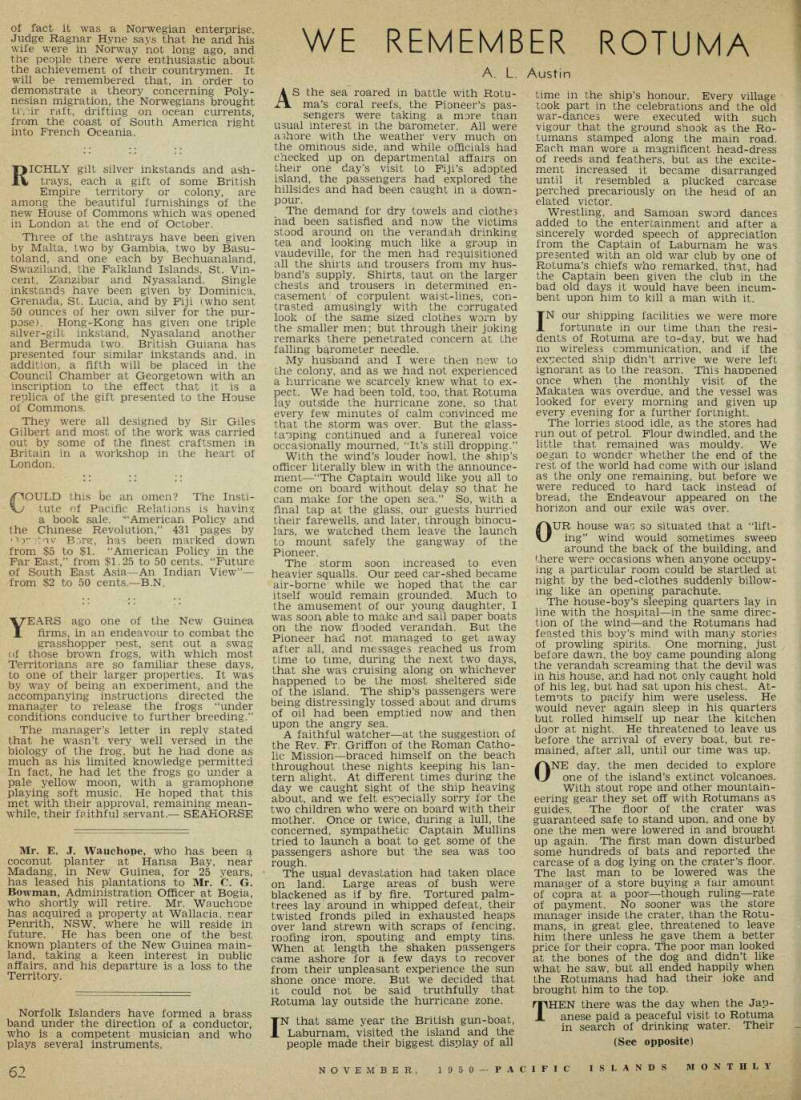
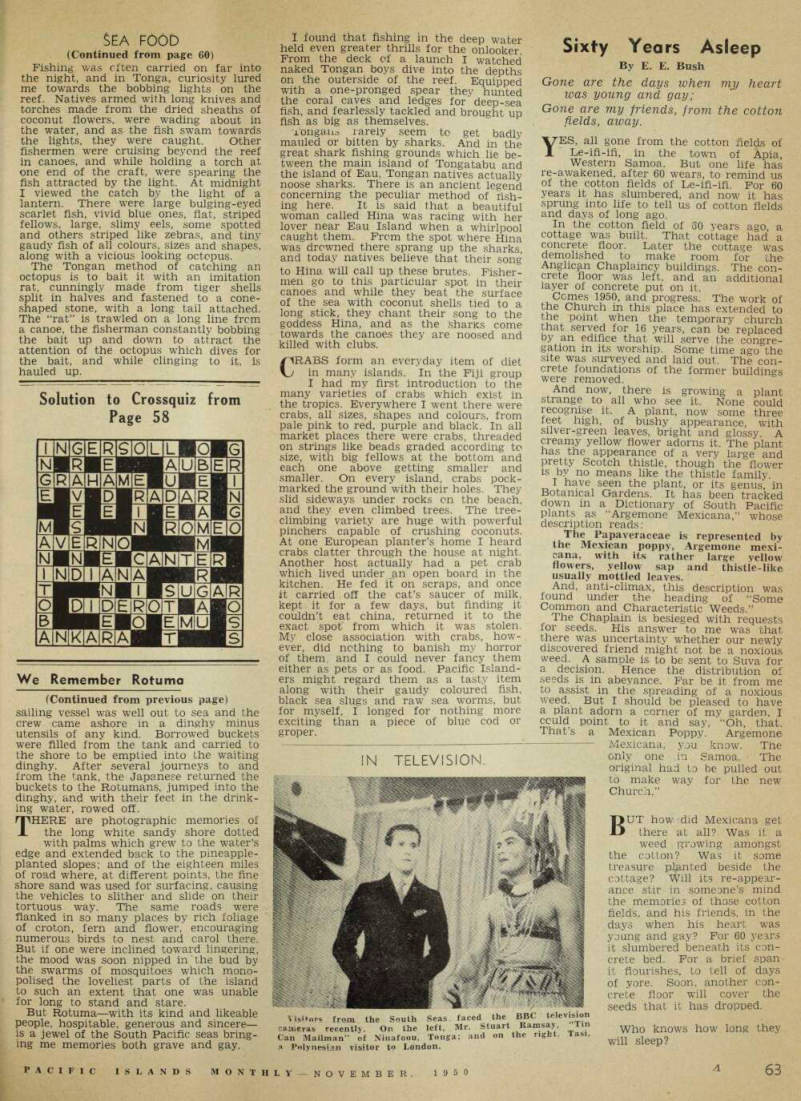
Top left shows natives fishing with nets in Fiji—photo hy Public Relations Office. Above, a Hettig photograph of a young Tongan going out to fish in his outrigger canoe.
Pacific Islanders gather
Fishing was often carried on far into the night, and in Tonga, curiosity lured me towards the bobbing lights on the reef. Natives armed with long knives and torches made from the dried sheaths of coconut flowers, were wading about in the water, and as the fish swam towards the lights, they were caught. Other fishermen were cruising beyond the reef in canoes, and while holding a torch at one end of the craft, were spearing the fish attracted by the light. At midnight I viewed the catch by the light of a lantern. There were large bulging-eyed scarlet fish, vivid blue ones, flat, striped fellows, large, slimy eels, some spotted and others striped like zebras, and tiny gaudy fish of all colours, sizes and shapes, along with a vicious looking octopus.
The Tongan method of catching an octopus is to bait it with an imitation rat, cunningly made from tiger shells split in halves and fastened to a cone shaped stone, with a long tail attached.
The “rat” is trawled on a long line frcm a canoe, the fisherman constantly bobbing the bait up and down to attract the attention of the octopus which dives for the bait, and while clinging to it, is hauled up.