Tropicalities
pp. 63-64 · Read in the full issue
SAUNI KURESA of Western Samoa, who composed that Territory’s national anthem (Banner of Freedom) in 1948 is believed to be the only man in the world who can play two cornets simultaneously (first and second parts).
Not long ago he visited New Zealand for a Seventh Day Adventist conference and dumbfounded a party of sceptical news papermen who did not believe that it could be done.
Sauni, back in Samoa, teaches organ, piano, brass and woodwind instruments.
He also conducts three brass bands and one choir. He told NZ newspapermen that he taught himself to play two in struments at once because a fellow in his band came back from Tonga and said there was a man there who could play two cornets simultaneously. If a Tongan could do it, said Sauni, then so could a Samoan. He practised for three months.
Nothing doing. He practised for six months; “I play two cornets at once all right when I am by myself but very frightened of playing in front of audi ence.” However he practised some more and now he can play the two instruments in front of anyone.
Later he learned that the two-cornet playing Tongan was a myth.
ERROL FLYNN, well-known in Holly wood and New Guinea, wed for the third time recently in Monte Carlo.
The new Mrs. Flynn was Patrice Wymore, officially described as a “starlet.”
After the ceremony 3,000 spectators showered the happy couple with rice. If Mr. Flynn had stayed in New Guinea this probably would have worried him—at £6B per ton.
Errol’s new mother-in-law says that he is “such a solicitous boy,” and that it is lovely to have him as a son-in-law.
THERE is a plan afoot to make a film of an Australian “X” force which landed on Borneo during the Jap anese occupation. J. Elder Wills, one of the Rank Organisation’s top producers is planning it.
The film (if it is made) will be called Red Herring, and will be filmed some where on the New Guinea coast in mid -1951. It is the story of five Australians who were sent to Balik Papan shortly before the Allies landed there. Their iob was to create a diversion and draw the Japs away from Balik Papan.
It sounds as though it could be a good meaty story although it may be wondered why these film people cannot go the whole hog and film it in Borneo. Or alterna tively, do a story of the New Guinea campaign which bristled with excellent film material—now, alas, just falling into the limbo of all forgotten things.
SOME of the passenger buses around Suva have to be seen to be believed, for such variety of shape, size, and colour never was. Alas, however, all is not gold that glitters, and the fact that the paintwork is perhaps a beautiful pink or purple, adorned with pictures of palm trees, is no guarantee that the innards are any good at all.
I recently had to ride from Suva to Nausori in one of these wonderful wagons and it was I think, a typical kind of trip.
We started off well but after a few miles the bus developed a bad cold and finally coughed itself to a standstill. Our Indian driver knew the answers apparently, for after ten minutes under the bonnet, away we went again. A few miles later a hor rible noise came from somewhere inside, again we ground to a standstill, and again our driver-mechanic disappeared under the bonnet. After another eternitv he re-appeared, took his seat with an air of resignation, then turned to me and said, “Boss this bus —he buggered.”
And it was.—PERETI.
THERE are many people who wonder why the Territory of Papua-New Guinea has no postage stamps of its own Before the war both Papua and New Guinea each had its own issue and those of Papua, particularly, were sought after by collectors.
Recently, in Melbourne, a Mr. F. A.
Thornhill paid £l5O at auction for an album of Papuan stamps.
RUSH job! A Mrs. R. Lambeth of Auburn, NSW, had a holiday in Fiji in 1947.
While there she posted an air-mail let ter to her husband back home. It arrived one day in October, 1950.
FOR the first time in screen history a film about the South Seas (usually too silly to be taken seriously) was a smash-hit in Suva. It was the British film. Blue Lagoon, which starred Simmons, and which was filmed in Fin a couffie of years ago. Its four-night season in mid-October saw a Suva cinema sold out for every performance—probably a peace-time record. The film has its faults but also its virtues —including the Yasawas in Technicolour which were en trancing.—S.
IT is time that someone told postwar arrivals in New Guinea of the old Territorian tradition that one did not talk to Southern newspaper reporters.
It can have serious consequences but apart from that—well, I have now before me the harrowing story of life in the Wilds of Kokopo, just 15 miles from Rabaul.
When her husband is away doing a “night patrol” (he is a Patrol Officer) says a holidaying wife, she “sleeps with an auto matic under her pillow and a dark skinned guard within call.’’ And, from these mis guided words, the sob-sister embroiders two columns of drivel that are apparently calculated to make the eye-balls drop from the heads of the suburban hausfraus who read it. We get a re-hash of the old dish, of course—native servants, and giant pythons and earth-quakes—but my mind returns to toy with that automatic be neath the pillow. I wonder, (a) can the lady use it; and (b), if she can, and does, and pierces the hide of some wandering coon, what happens in these days when we are so anxious to keep these hides in tact? Tut, Lady, do you not know that each one of those dear, brown boys is precious to the United Nations Trustee ship Council, and that such pistol-packin’ would be frowned upon by our Uncle Joe?—MAC.
WHEN Miss Nga Frisbie left Rarotonga by plane on October 7 for Honolulu there to join her sister, Miss Johnny Frisbie Polynesia said goodbye to the last of the four children of the American writer, the late Robert Dean Frisbie, whose books on Polynesia and Polynesian subjects had a considerable vogue in recent years. Frisbie married a Cook Islands girl and had four children— one boy and three girls. His wife died in tragic circumstances and he personally cared for the four children, right up to the time of his death. He assisted Johnny, the eldest, to write a book which was published in America. The boy was sent to New Zealand to join his half-brother; James Norman Hall, the Tahiti writer, was instrumental in sending Johnny to the care of friends in Hawaii; and now the last of them, Nga, is gone.
The well-known Rarotongan merchant, Mr. W. H. Watson, had been taking care of little Nga, and he was most reluctant to let her go—but it was felt that she would have, in Hawaii, a better chance in life. She is described as a particularly attractive youngster.
THIS happened last Christmas. A number of girls. returning to their homes in New Guinea from schools in Australia, encountered at a certain airport a particularly “officious” tvpe of Customs official. The girls were carrying in their suit-cases certain Christmas presents for their relations presents carefully selected, and hidden behind wrappings which were to be removed only on Christmas Day. But the snarling official of the Customs House had no regard for the girls’ feelings—there, in the inspection shed, before the eyes of the people for whom the presents were intended, they were forced to unpack and unwrao the articles that had been pur chased, and enter into discussions with the gentleman concerning values, etc.
The missionary who reported the incident to us says that he hopes that such conduct will not be repeated in the coming month. “If the Customs official does not believe in the spirit of Christ mas,” he says, “he should at least try to behave like a gentleman.”
A MILD correction comes to us from Judge Ragner Hyne. now of Sekondi, Gold Coast, but who formerly was well-known in the South Pacific. We referred, in the July issue, to the Kon- Tiki raft expedition as Swedish. In point
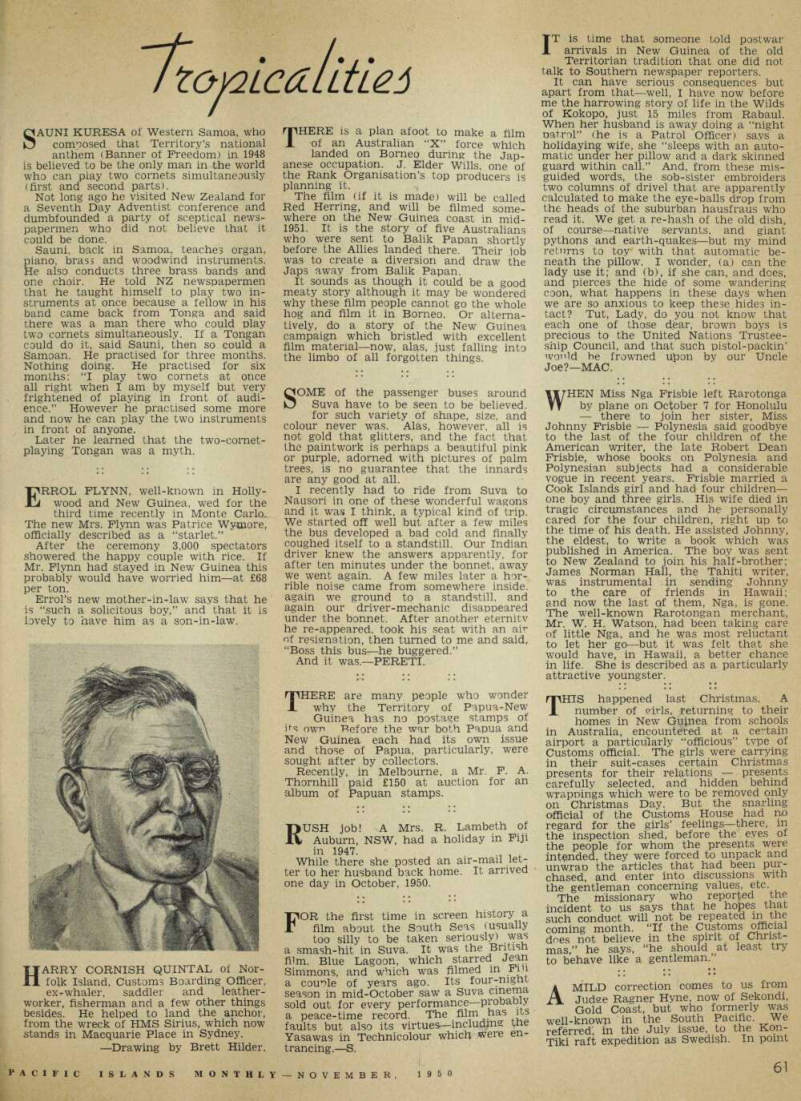
Harry Cornish Quintal Of Nor
folk Island, Customs Boarding Officer, ex-whaler, saddler and leather worker, fisherman and a few other things besides. He helped to land the anchor, from the wreck of HMS Sirius, which now stands in Macquarie Place in Sydney.
Drawing by Brett Hilder.
of fact it was a Norwegian enterprise.
Judge Ragnar Hyne says that he and his wife were in Norway not long ago, and the people there were enthusiastic about the achievement of their countrymen. It will be remembered that, in order to demonstrate a theory concerning Poly nesian migration, the Norwegians brought trpir raft, drifting on ocean currents, from the coast of South America right into French Oceania.
RICHLY gilt silver inkstands and ash trays, each a gift of some British Empire territory or colony, are among the beautiful furnishings of the new House of Commons which was opened in London at the end of October.
Three of the ashtrays have been given by Malta, two by Gambia, two by Basu toland, and one each by Bechuanaland, Swaziland, the Falkland Islands, St. Vin cent, Zanzibar and Nyasaland. Single inkstands have been given by Dominica, Grenada, St. Lucia, and by Fiji (who sent 50 ounces of her own silver for the pur pose). Hong-Kong has given one triple silver-gilt inkstand, Nyasaland another and Bermuda two. British Guiana has presented four similar inkstands and. in addition, a fifth will be placed in the Council Chamber at Georgetown with an inscription to the effect that it is a replica of the gift presented to the House of Commons.
They were all designed by Sir Giles Gilbert and most of the work was carried out by some of the finest craftsmen in Britain in a workshop in the heart of London.
COULD this be an omen? The Insti tute of Pacific Relations is having a book sale. '“American Policy and the Chinese Revolution,” 431 pages by ‘Drrrnv B:,rg, has been marked down from $5 to sl. “American Policy in the Far East,” from $1.25 to 50 cents. “Future of South East Asia —An Indian View” — from $2 to 50 cents.—B.N.
YEARS ago one of the New Guinea firms, in an endeavour to combat the grasshopper nest, sent out a swag of those brown frogs, with which most Territorians are so familiar these days, to one of their larger properties. It was by way of being an exneriment, and the accompanying instructions directed the manager to release the frogs “under conditions conducive to further breeding.”
The manager’s letter in reply stated that he wasn’t very well versed in the biology of the frog, but he had done as much as his limited knowledge permitted In fact, he had let the frogs go under a pale yellow moon, with a gramophone playing soft music. He hoped that this met with their approval, remaining mean while, their faithful servant.— SEAHORSE Mr. E. J. Wauchope, who has been q coconut planter at Hansa Bay, near Madang, in New Guinea, for 25 years, has leased his plantations to Mr. C. G.
Bowman, Administration Officer at Bogia, who shortly will retire. Mr. Wauchone has acquired a property at Wallacia. near Penrith, NSW, where he will reside in future. He has been one of the best known planters of the New Guinea main land, taking a keen interest in public affairs, and his departure is a loss to the Territory.
Norfolk Islanders have formed a brass band under the direction of a conductor, who is a competent musician and who plays several instruments.