I Travel for Pleasure
pp. 61-78 · Read in the full issue
Pleasure
By R. W.
Robson
mHE ticket which I handed over read X “Rabaul-Sohano-Inus-Kieta-Buin- Kieta-Inus-Sohano-Rabaul.” The Purser of the Catalina seemed a little shaken.
“Doing the round trip?’ he asked, curiously.
“Yes—just taking a run around Boug ainville, for pleasure,’ I said brightly.
The Purser choked slightly, and left on his multifarious duties.
After gruelling days in the heat and dust, I entertained visions of several cool hours over green islands, while being served with dainty snacks by a shapely hostess.
There was no hostess.
The first hour was OK. My fellow passengers—three Europeans and two native police, obviously returning to duty —were so depressed they would not speak to each other, let alone to me. I had a good look at Cape St. George, and the plantations of Fred Archer the late Percy Goode and other old friends, on the Buka coast.
We descended at Sohano, and the Pur ser came into action He opened the blister, threw out a port and starboard sea-anchor, collected three tickets, organ ised cargo discharge and sent the police boys scuffling back to their seats, all in about ten seconds. He seemed to be in the air most of the time. I never saw a man move faster.
We floated in what seemed a series of ditches (Sohano Passage, between Buka and Bougainville), while outrigger canoes took away some cargo and the sad Euro peans, and wished upon us much more cargo, 10 native labourers, 4 policemen and a Chinese trader.
We were flying for only 20 minutes be tween Sohano and Inus. I glimpsed some lovely plantations and mission sta tions. The Purser wrote tickets, checked cargo, discussed procedure with Captain Ross Tredgold, and counted “coons.” He had few spare seconds—but he filled those by ordering the natives, in biting Pidgin, to stay in their seats and keep out of his ensanguined way.
IN Inus there was a maddened rush while cargo went in and out, we col lected more natives, and the Purser tried to work his sea-anchors and his accounts simultaneously.
Distantly, through a forward window, I could see an outrigger alongside the plane, and in it were Mrs. Mason, with her famous thermos flask of cold lime juice (she refreshes all travellers thus) and Paul Mason, her planter husband, famous in darker days as one of the outstanding heroes of the Pacific War. I wanted to talk to Paul and taste that lime-juice; but the area between us was devoted to cargo and “coons,” in a state of continuous flux.
AT Kieta, 30 minutes further on, we hit broken water with a series of crashes and bounces. Packed a mong the natives I sweated and held my breath.
“If we hadn’t the best pilot going in this craft, that would have torn the bottom out of her” said a DCA (Depart ment of Civil Aviation) man, who had come aboard somewhere. “Did you notice how he handled her?”
I had—but I was thinking of other things. The weather was deteriorating.
I had planned to go ashore at Kieta. and get relief from native society. But Kieta, smothered in rain, had a dismal appearance, and I had no coat. The Purser paused long enough in one of his
sidelong leaps to tell me the captain had had a signal that the weather was fine at Buin, and- the sea calm. I stayed aboard.
As the Cat clawed her way around the southern ranges of that mighty island, I took stock. Packed in among the amazing cargo—bread, bottled beer, repaired wire less sets, storage batteries, motor parts, rice, a charging set —were sixteen native labourers, five police, a Chinese woman and child, the DCA man, and me.
The Purser crouched down near me, and held his head in his hands and moan ed. ‘T’ve got malaria,” he said. “And I’ve got a ring-in.’
He checked his accounts again, and then, with a menacing forefinger, he went again over his native passengers. “I should have 15 of them” he complained, “and I keep on counting 16. I don’t know whether the wog’s making me see double, or whether that (unpleasant expletive) at Sohano miscounted his slaves.”
THE captain’s signal had lied: the water before Buin was broken and ugly. But Tredgold, with a tight mouth (probably to keep within him his opinion of the weather reporter) put the hardworking Cat down into it.
The splash and the crash and the bounce were something I shall never for get.
The Purser moved so fast that he looked like a pyrotechnic display. Before the Cat was tied up, he had the sea-anchors in and out, outrigger canoes alongside, extra labourers aboard for quick handling, and the assistance of Cadet Jones, from the shore. The canoes tossed madly in
the wild water.
“Quick time there!” howled the Purser. “You fella push ’im out there —you, fella, pull 'im in ’ere”—and he started unloading and loading simul taneously, with a team on each side of the blister, so as to get away from that dangerous anchorage.
There was a loud shouting from forward; “We’re adrift!”
The mooring had broken, and the Cat was being driven on to a lee shore.
I knew the Purser was there by the noise he made. He moved so fast I couldn’t see him. He pushed the canoes away, threw everything float able after them, hunted the natives into a sitting posture, and closed the blister.
The Cat taxied slowly out into the sea, pitching and rol ling.
I was jammed in the tail.
The scene inside was a mad jumble of cargo, curses and coons. The Chinese woman looked out, terrified, from be tween a roll of matting and two live ducks in a grass basket.
The captain decided to fly back to Kieta, and he drove the Cat into the wind. But we had shed no cargo, and we had acquired four more natives and a healthy cadet officer. She wouldn’t rise off that broken water.
The Purser led us in an at tack on the cargo and after some hot work, we got it piled up, so we could sit.
I sat tightly in among the natives and, after I had examined their sores, and watched the numerous flies at work a
(Continued on page 76)
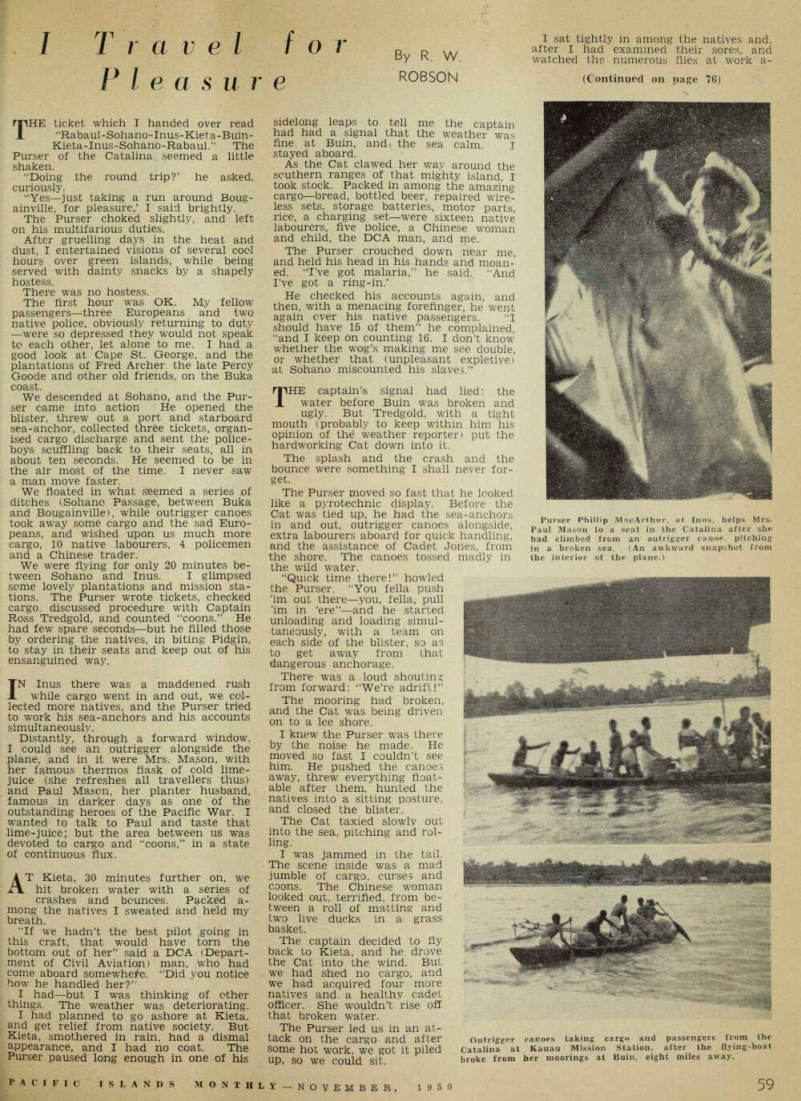
Purser Phillip MacArthur, at Inus, helps Mrs.
Paul Mason to a seat in the Catalina after she bad climbed from an outrigger canoe, pitching in a broken sea (An awkward snapshot from the interior of the plane.)
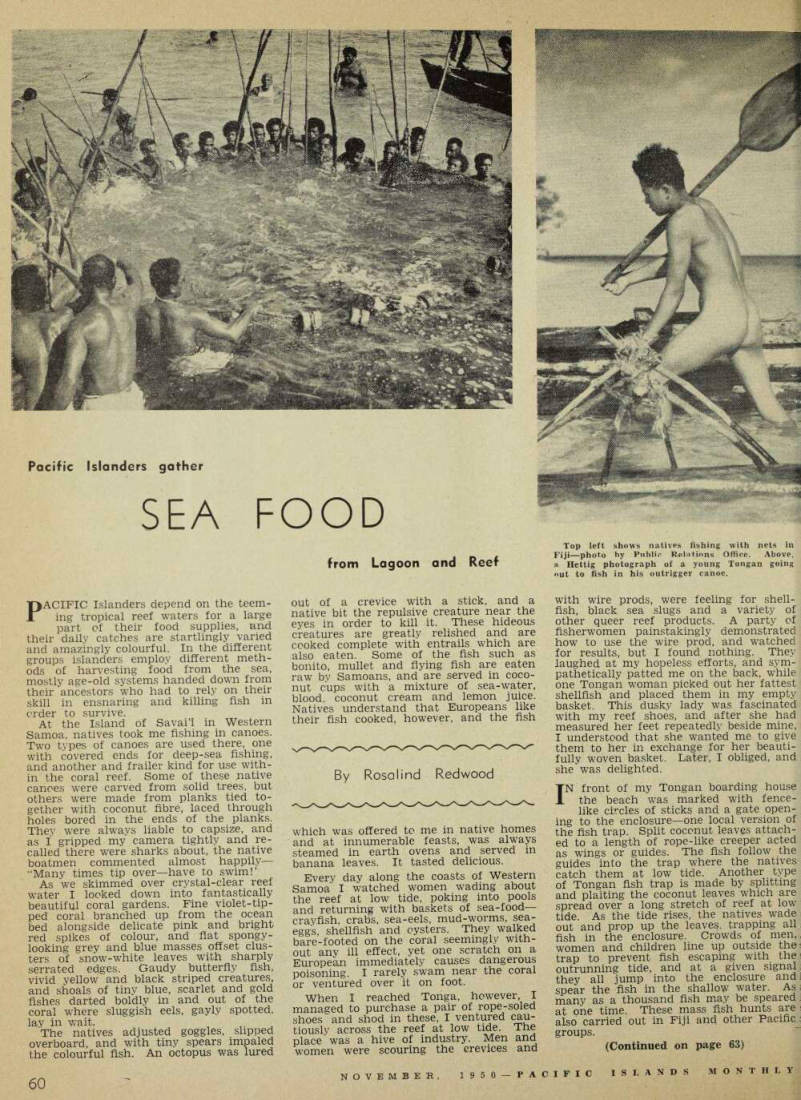
Outrigger canoes taking cargo and passengers from the Catalina at Kauau Mission Station, after the flying-boat broke from her moorings at Buin, eight miles away.
mong us all, I decided that I probably would acquire yaws, leprosy and tropical ulcers.
I was sitting wondering how we were going to get out of that sweating hell hole, and watching a small, reddish native being painfully and meticulously sick in a paper bag, and the Purser was abandoning himself to malarial misery, when he caught my eye. I suppose I looked wan-
He got up, crawled painfully over a heap of cargo and said, “Don’t worry Mr. Robinson. Qantas has the lowest accident rate in the world!”
CAPTAIN Tredgold got out of it by taxi’ing very slowly along the coast, for eight miles, to Kauau mission station. They grasped the sit uation quickly there and sent out can oes, and we lay on a sea-anchor close
to the beach, and slowly discharged all cargo and passengers, which were sent to Buin by jeep.
Then the empty Cat went blithely back to Kieta, where the now merry Pur ser brought aboard two weary Euro peans, a miscellariy of cargo a(nd a stretcher (wherein was an old native with a broken femur) which was placed between the double row of seats, at our feet.
Rain was coming down and the sea was getting up, and we bounced hard again at Inus.
Some well-known Bougainville women joined the plane ... if that is the cor rect term for transferring oneself and one’s bag, etc., from a pitching little canoe to a big rolling aircraft.
All was well, however. The Purser, hitherto a terror to the native passen gers and a bounding devil with the sea anchors, now became a very Galahad. Six ladies were brought aboard under diffi cult conditions —but not even a finger nail was chipped.
I greeted Mrs. Paul Mason eagerly.
“I’ve heard of your hospitality,” I said.
“Have you, by any chance, a bit of bis cuit in your bag? You see, no one eats aboard this craft —they’re much too busy -—and I had my breakfast at 6 o’clock.”
It is typical of Inus’s chatelaine that she is still apologising because she did’nt have second sight, and therefore did not know that I was aboard that plane in an ill-nourished condition.
From Inus to Sohano I argued quietly with Mrs. Bob Stewart. I said that the source of an offensive odour was a bag of fish, from Kieta. She —a stubborn woman—insisted that it was the inca pacitated native, lying so quietly in his dirty old blanket at our feet.
He was hospitalled at Sohano; and, as we rode into Rabaul in the dusk, I was able to forget the clamourings of my out raged stomach in pointing out to that argumentative woman that the offensive smell was still with us.