a disappointment?
pp. 54-56 · Read in the full issue
Is much-praised Tahiti a disappointment?
This question is asked —and answered —
By Lex Hallway
SINCE my return from French Oceania recently, .many friends, anxious to visit Tahiti, have asked this per tinent question and, frankly, it’s one to which I cannot give a simple answer.
But I will say this: If you are the type of person who has the time and patience to stand in a queue all night to book theatre seats and can still enjoy the per formance, then you’ll like Tahiti. If. like myself, you’re impatient of delay and in tolerant of officialdom, you’ll find it hard to justify the performance with the effort entailed.
Don’t visit Tahiti from New Zetland if your time is limited, for you will need to be absent from these contaminated isles for three weeks before setting a cleansed foot on Tahiti’s shores. At the time of writing (early August) the 21 days Poliomyelitis quarantine st:ll applies to the Society Islands, although it ha> been lifted from all other Pacific Islands including French New Caledonia. You may visit Tahiti from the USA, where the incidence of Polio’ is high; or from the International Airport at Nadi. Fiji, where passengers and the French aircrews from Noumea to Papeete are “contaminated” weekly by scores of people arriving direct from New Zealand.
But if your passport visa is issued in
NZ you must wait the 21 days set by officialdom in Papeete. This delay may mean that you miss a connection with the monthly flying-boat service to Pa peete and your quarantine is thereby extended to seven weeks—expensive and discouraging to the most ardent tourist.
"Mainly a matter of timing,” you’ll say.
True —but your experience could be similar to mine and the date of departure of the French plane from Fiji turn out to be six days earlier than stated in ad vice originally received from that air company’s NZ agents. This miscalcula tion merely indicates the growing pains of a new airline not yet properly estab lished, but nevertheless it is disconcerting.
While the plane fare is expensive and return bookings not always guaranteed, boats are even more irregular and in frequent. With luck there may be a berth on a phosphate ship leaving Auck land for Makatea which, of comse, is miles from Papeete; or there is an occa sional Union SS Co. boat direct to Papeete. Suva, too, has a rare boat con nection with Papeete and this turned out to be my salvation —a Greek ship running short of oil and calling at Suva to refuel en route to Tahiti was my means of arriving three weeks ahead of the plane.
Reaching Tahiti, then, is difficult and
leaving it is even harder, but the biggest hurdle for intending visitors is a col lateral deposit which must be lodged with the Bank of Indo-China, Papeete, before a visa can be granted. The amount lodged must be roughly £NZSO for each month of stay. For various economic reasons, Governments in sterling areas are reluctant to authorise their exchange controls to convert their currencies to francs and tourists have told me that where they can provide no valid business reason for visiting Tahiti, this advance has not been forthcoming. The French apparently impose the ruling to dis courage beachcombers and, it has been said, even go so far as to ask you, un officially, to spend more money in the Colony if they feel that you are living off the community instead of off your bank account!
It is anticipated that as the Colony's economy becomes increasingly short of foreign currency, these restrictions will be lifted.
ON arrival, your feelings will be mixed.
Your impressions from years of literary romanticism concerning the place will conflict with unfavourable re ports you’ve heard from other people.
Perhaps you’ll have a poor opinion of the orderliness of French colonies and. all
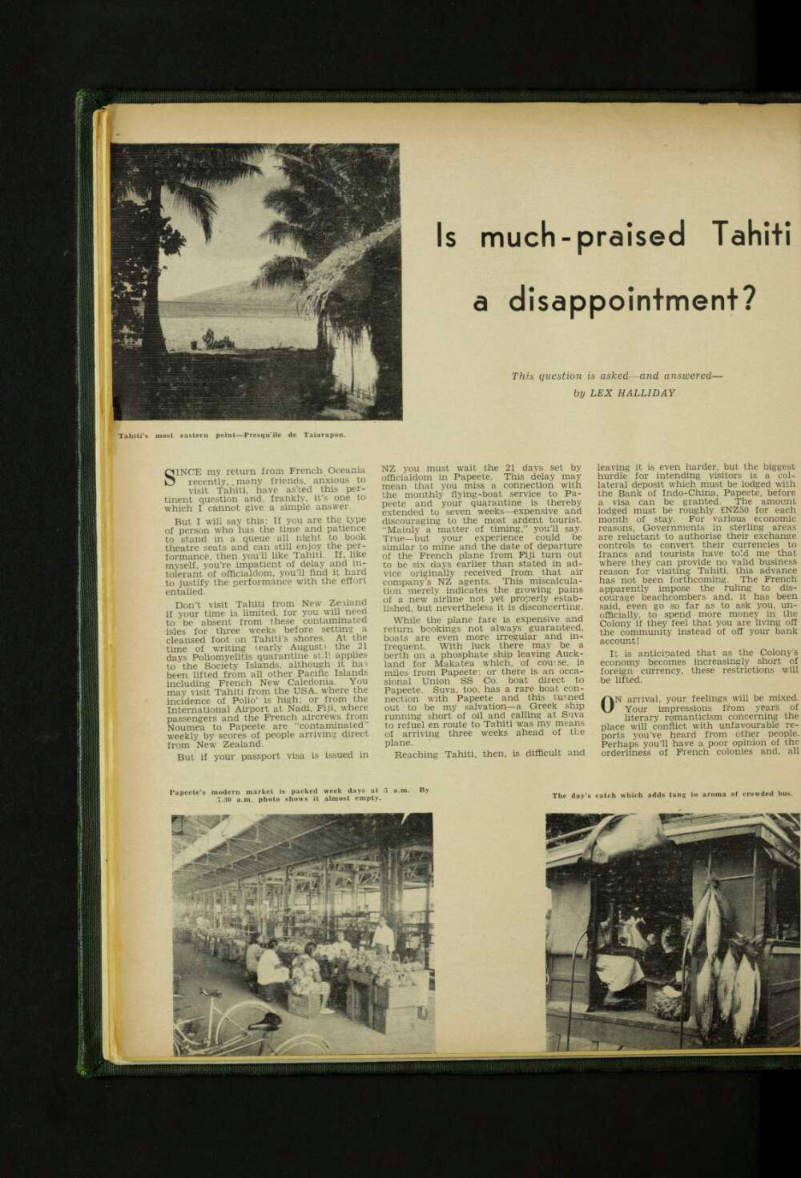
Tahiti’s most eastern point—Presqu’ile de Taiarapon.
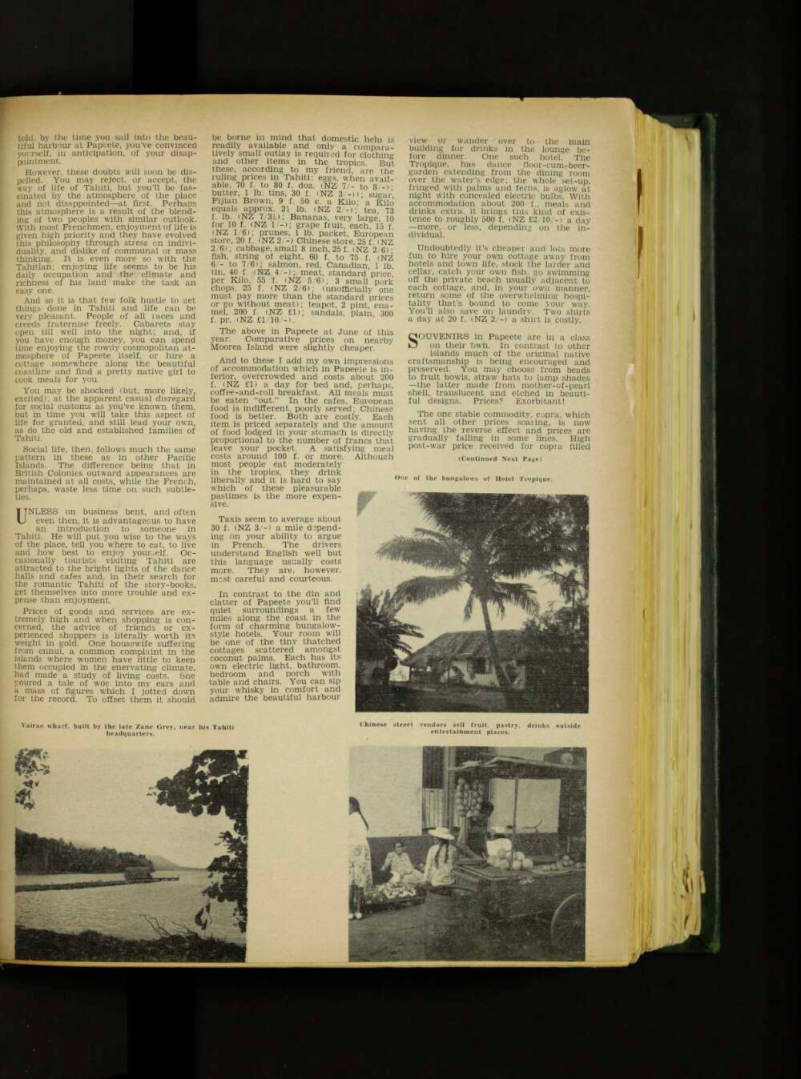
Papeete’s modern market is packed week days at 5 a.m. By 7.30 a.m. photo shows it almost empty.
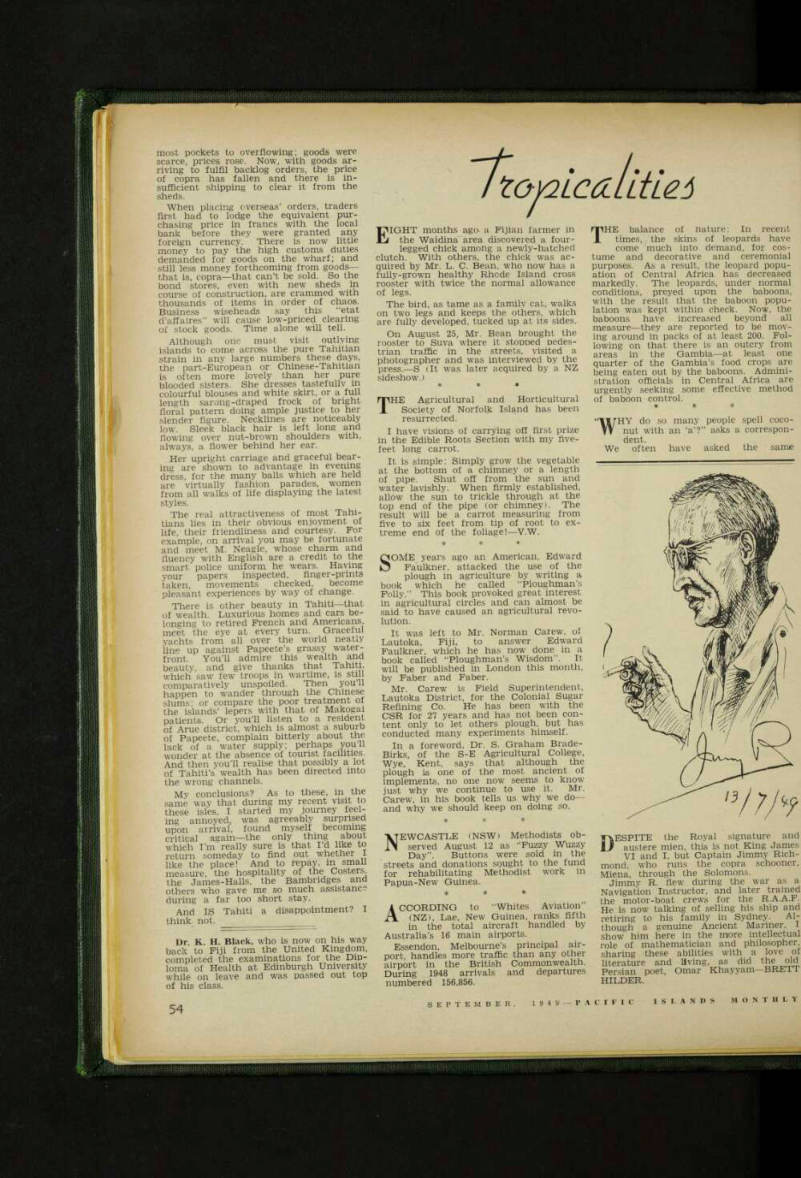
The day’s catch which adds tang to aroma of crowded bus.
told, by the time you sail into the beau tiful harbour at Papeete, you’ve convinced yourself, in anticipation, of your disap
pointment.
However, these doubts will soon be dis pelled. You may reject, or accept, the way of life of Tahiti, but you’ll be fas cinated by the atmosphere of the place and not disappointed—at first. Perhaps this atmosphere is a result of the blend ing of two peoples with similar outlook.
With most Frenchmen, enjoyment of life is given high priority and they have evolved this philosophy through stress on indivi duality, and dislike of communal or mass thinking. It is even more so with the Tahitian; enjoying life seems to be his daily occupation and the climate and richness of his land make the task an easy one.
And so it is that few folk hustle to get things done in Tahiti and life can be very pleasant. People of all races and creeds fraternise freely. Cabarets stay open till well into the night; and, if you have enough money, you can spend time enjoying the rowdy cosmopolitan at mosphere of Papeete itself, or hire a cottage somewhere along the beautiful coastline and find a pretty native girl to cook meals for you.
You may be shocked (but. more likely, excited), at the apparent casual disregard for social customs as you’ve known them, but in time you will take this aspect of life for granted, and still lead your own, as do the old and established families of Tahiti.
Social life, then, follows much the same pattern in these as in other Pacific Islands. The difference being that in British Colonies outward appearances are maintained at all costs, while the French, perhaps, waste less time on such subtle ties.
UNLESS on business bent, and often even then, it is advantageous to have an introduction to someone in Tahiti. He will put you wise to the ways of the place, tell you where to eat, to live and how best to enjoy yourcelf. Oc casionally tourists visiting Tahiti are attracted to the bright lights of the dance halls and cafes and, in their search for the romantic Tahiti of the story-books, get themselves into more trouble and ex pense than enjoyment.
Prices of goods and services are ex tremely high and when shopping is con cerned, the advice of friends or ex perienced shoppers is literally worth its weight in gold. One housewife suffering from ennui, a common complaint in the islands where women have little to keep them occupied in the enervating climate, had made a study of living costs. She poured a tale of woe into my ears and a mass of figures which I jotted down for the record. To offset them it should
be borne in mind that domestic help is readily available and only a compara tively small outlay is required for clothing and other items in the tropics But these, according to my friend, are the ruling prices in Tahiti: eggs, when avail able, 70 f. to 80 f. doz. (NZ 7/- to 8/-) • butter, 1 lb. tins, 30 f. (NZ 3/-)); sugar’
Fijian Brown, 9 f. 50 c. a Kilo; a Kilo equals approx. 2\ lb. (NZ 2/-); tea, 73 f. lb. (NZ 7/ 3i>; Bananas, very large 10 for 10 f. (NZ 1 /-); grape fruit, each, 15 f (NZ 1/6); prunes, 1 lb. packet, European store, 20 f. (NZ 2/-) Chinese store, 25 f. (NZ 2 6); cabbage, small 8 inch, 25 f. (NZ 2 6) fish, string of eight, 60 f. to 75 f. (NZ 6/- to 7/6); salmon, red, Canadian, 1 lb tin, 40 f. (NZ 4/-); meat, standard price, per Kilo, 55 f. (NZ 5/6); 3 small pork chops, 25 f. (NZ 2/6); (unofficially one must pay more than the standard prices or go without meat); teapot, 2 pint, ena mel, 200 f. (NZ £1); sandals, plain, 300 f. pr. (NZ £l/10/-).
The above in Papeete at June of this year. Comparative prices on nearby Moorea Island were slightly cheaper.
And to these I add my own impressions of accommodation which in Papeete is in ferior, overcrowded and costs about 200 f. (NZ £1) a day for bed and, perhaps, coffee-and-roll breakfast. All meals must be eaten “out.” In the cafes, European food is indifferent, poorly served; Chinese food is better. Both are costly. Each item is priced separately and the amount of food lodged in your stomach is directly proportional to the number of francs that leave your pocket. A satisfying meal costs around 100 f. or more. Although
most people eat moderately in the tropics, they drink liberally and it is hard to say which of these pleasurable pastimes is the more expen sive.
Taxis seem to average about 30 f. (NZ 3/-) a mile dapend ing on your ability to argue in French. The drivers understand English well but this language usually costs more. They are, however, most careful and courteous.
In contrast to the din and clatter of Papeete you’ll find quiet surroundings a few miles along the coast in the form of charming bungalow style hotels. Your room will be one - of the tiny thatched cottages scattered amongst coconut palms. Each has its own electric light, bathroom, bedroom and porch with table and chairs. You can sip your whisky in comfort and admire the beautiful harbour
view or wander over to the main building for drinks in the lounge be fore dinner. One such hotel, The Tropique, has dance floor-cum-beer garden extending from the dining room over the water’s edge; the whole set-up, fringed with palms and ferns, is aglow at night with concealed electric bulbs. With accommodation about 200 f., meals and drinks extra, it brings this kind of exis tence to roughly 500 f. (NZ £2/10/-) a day —more, or less, depending on the in dividual.
Undoubtedly it’s cheaper and lots more fun to hire your own cottage away from hotels and town life, stock the larder and cellar, catch your own fish, go swimming off the private beach usually adjacent to each cottage, and, in your own manner, return some of the overwhelming hospi tality that’s bound to come your way.
You’ll also save on laundry. Two shirts a day at 20 f. (NZ 2/-) a shirt is costly.
SOUVENIRS in Papeete are in a class on their t>wh. In contrast to other islands much of the original native craftsmanship is being encouraged and preserved. You may choose from beads to fruit bowls, straw hats to lamp shades —the latter made from mother-of-pearl shell, translucent and etched in beauti ful designs. Prices? Exorbitant!
The one stable commodity, copra, which sent all other prices soaring, is now having the reverse effect and prices are gradually falling in some lines. High post-war price received for copra filled
(Continued Next Page)
Vairao wharf, built by the late Zane Grey, near his Tahiti headquarters.
One of the bungalows of Hotel Tropique.
Chinese street vendors sell fruit, pastry, drinks outside entertainment places.
most pockets to overflowing; goods were scarce, prices rose. Now, with goods ar riving to fulfil backlog orders, the price of copra has fallen and there is in sufficient shipping to clear it from the sheds.
When placing overseas’ orders, traders first had to lodge the equivalent pur chasing price in francs with the local bank before they were granted any foreign currency. There is now little money to pay the high customs duties demanded for goods on the wharf; and still less money forthcoming from goods— that is, copra—that can’t be sold. So the bond stores, even with new sheds in course of construction, are crammed with thousands of items in order of chaos.
Business wiseheads say this “etat d’affaires” will cause low-priced clearing of stock goods. Time alone will tell.
Although one must visit outlying islands to come across the pure Tahitian strain in any large numbers these days, the part-European or Chinese-Tahitian is often more lovely than her pure blooded sisters. She dresses tastefully in colourful blouses and white skirt, or a full length sarong-draped frock of bright floral pattern doing ample justice to her slender figure. Necklines are noticeably low. Sleek black hair is left long and flowing over nut-brown shoulders with, always, a flower behind her ear.
Her upright carriage and graceful bear ing are shown to advantage in evening dress, for the many balls which are held are virtually fashion parades, women from all walks of life displaying the latest styles.
The real attractiveness of most Tahi tians lies in their obvious enjoyment of life, their friendliness and courtesy. For example, on arrival you may be fortunate and meet M. Neagle, whose charm and fluency with English are a credit to the smart police uniform he wears. Haying your papers inspected, finger-prints taken, movements checked, become pleasant experiences by way of change.
There is other beauty in Tahiti—that of wealth. Luxurious homes and cars be longing to retired French and Americans, meet the eye at every turn. Graceful yachts from all over the world neatly line up against Papeete’s grassy water front. You’ll admire this wealth and beauty, and give thanks that Tahiti, which saw few troops in wartime, is still comparatively unspoiled. Then you’ll happen to wander through the Chinese slums; or compare the poor treatment of the islands’ lepers with that of Makogai patients. Or you’ll listen to a resident of Arue district, which is almost a suburb of Papeete, complain bitterly about the lack of a water supply: perhaps you’ll wonder at the absence of tourist facilities.
And then you’ll realise that possibly a lot of Tahiti’s wealth has been directed into the wrong channels.
My conclusions? As to these, in the same way that during my recent visit to these isles, I started my journey feel ing annoyed, was agreeably surprised upon arrival, found myself becoming critical again—the only thing about which I'm really sure is that I’d like to return someday to find out whether I like the place! And to repay, in small measure, the hospitality of the Costers, the James-Halls, the Bambndges and others who gave me so much assistance during a far too short stay.
And IS Tahiti a disappointment? I think not.
Dr K. H. Black, who is now on his way back to Fiji from the United Kingdom, completed the examinations for the Dip loma of Health at Edinburgh University while on leave and was passed out top of his class.