Octopus-Fishing Is Women’S
p. 53 · Read in the full issue
Work
By Henry O. Wright
A FIJIAN legend has it that once a shipwrecked rat, when near to drowning, was rescued by a kind hearted, though wary, octopus.
The rescuer gave the rescued to un derstand in no uncertain terms that, as land was a long way off, he would bear his passenger thence, only if he first re ceived an assurance that he was “house broke” and a solemn promise that the land creature remembered his manners, keeping nature at bay until he was de livered safely ashore.
The promise was readily given, but alas, nature conquered, and at the mo ment the rat leapt ashore, the promise was broken. Like the elephant, the octopus never forgets!
Fijian mothers tell this story to their girl children, for its is by reminding the octopus of the false land creature that “did him wrong,” that the fisherwomen are able to catch this most welcome of seafood delicacies.
A species of sea-shell, the Kauri, with its dark mottled colouring and some what rat-body shape, is punctured here and there and lashed securely to a reed or tough willow wand, the appearance of the finished article having a fair re semblance to the octopus world’s Public Enemy Number One.
Armed with this, and with her coco nut-frond plaited waist-basket, the fisherwoman is ready for the fray. To gether with others (she believes in “safety in numbers”) she proceeds reef wards, by canoe if the reef is well off shore, or swimming there, if nearby.
Once on the reef, she begins searching in waist-deep water for likely holes in the coral which may house the prey. (I repeat, “prey”!) Now she brings her makeshift rat to work, thrusting it rapidly in and out of the hole. Faint rat-squeak sounds are made as the water drives the air out through the holes in the shell, and should that par ticular hole house a “Quita”, it wastes no time in making a move to even up old scores.
First one tentacle then another, reaches
out searchingly in waving eagerness, followed quickly by others that become longer with each hopeful movement.
Soon there are five or six feelers, searching, hoping, re membering, in wild abandon, then 10, eureka! one is grip ping, slimily-tight, onto “the thing,” at the same time sending frantic messages to headquarters for support which almost immediately is forthcoming.
It is a matter of seconds only before five or six of the octopus’s eight tentacles are glued firmly around, not the “furry falseness”, but now the woman’s clenched fist and forearm —at the right moment she has substituted her arm for the squeaking shell, this being when she perceiyes her family’s prospective dinner hasn’t more than a “leg or two” to stand on. She begins to feel the needling pain of blood about to be drawn through the skin, as the scores of suction cups that line the tentacles begin their work, and she tenses herself. This is it!
Heaving backwards she tears the creature forth into the clear. Swift and true her other hand thrusts into the bag-like head, and gripping firmly on slimy flesh, is withdrawn, pulling the head inside out. It is over. The octopus is at once a limp paralysed slipperyness, ready for the basket.
For some minutes after, the woman’s arm sports a hundred or more small pink ish spots, where the suction cups had been busy. She hopes that before she returns there will be a moderate soreness where there is now only a tickling sensation, for then her basket will be heavy, and later, her family pot full.
The average size of her catch, measured by tentacle Length, will be about four feet long, for she is wise enough to leave the larger ones alone.
Now and then, one finds an old hand at the game, wearing a scar necklace to show that she was once a tenderfoot, and probably only because she was as sisted by other fisherwomen, is she around to show off her “jewellery”.
This method of octopus fishing is, oddly enough, recognised to be one of the few which womenfolk only are al lowed to practise. Others, such as prawning, crabbing and clam digging, are also “sissy” and very definitely un worthy of a Fijian fisherman’s time.
Following upon the transfer of Mr. J.
Bennett to Nigeria, Mr. J. L. McDuff has been promoted to the post of Chief Magis trate, Fiji.
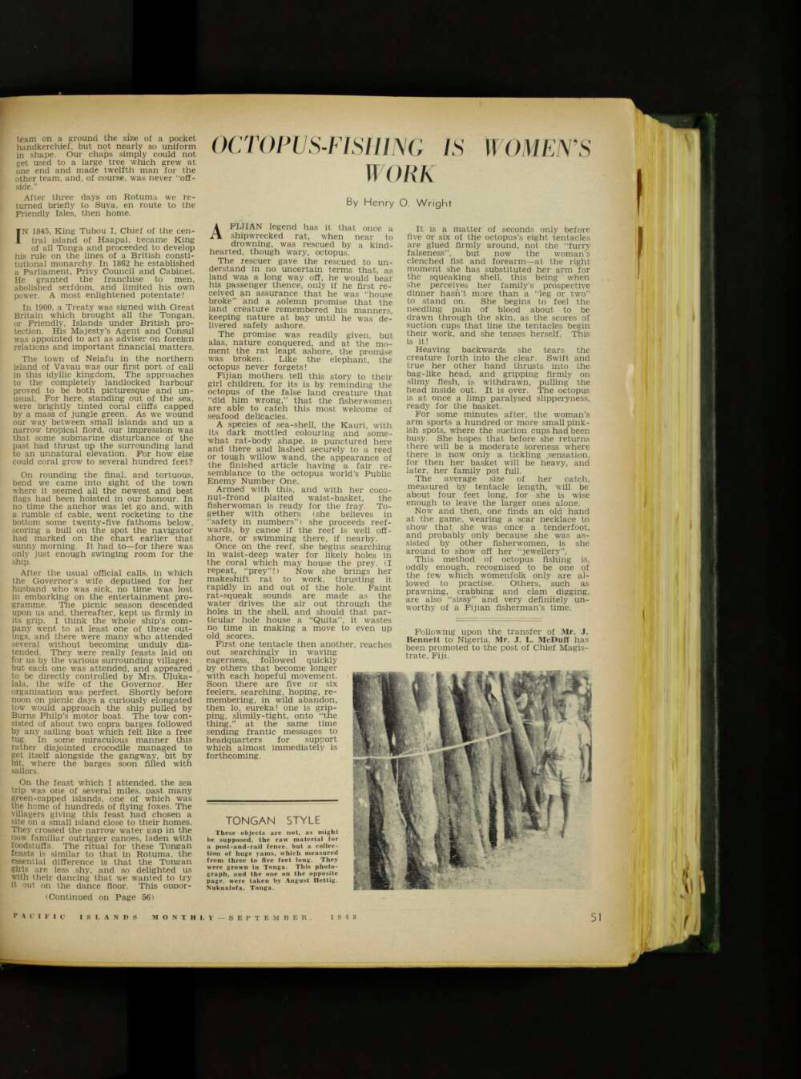
Tongan Style
These objects are not, as might be supposed, the raw material for a post-and-rail fence, but a collec tion of huge yams, which measured from three to five feet long. They were grown in Tonga. This photo graph, and the one on the opposite page, were taken by August Hettig, Nukualofa, Tonga.