The Navy Shows The Flag
pp. 52-58 · Read in the full issue
Part lII—In Rotuma and Tonga
SOUTHWARDS to Rotuma. An easy day’s steaming brought us to this garden island, which was discovered by Captain Edwards of HMS "Pandora,” in 1791, when searching for the mutineers of the "Bounty.” At the request of its chiefs, who found that they could not keep order after an influx of Europeans and Asiatics of doubtful origin, the island was annexed by Great Britain in 1880, and now forms part of the Colony of Fiji although 300 miles distant. Un like Funafuti, which we had just left, Rotuma is hilly and clothed in tropical verdure, and whereon fruits of almost every description grow.
On a breezy morning the ship anchored in the small roadstead of Foviung Efau, and almost under—or so it seemed —a sheer green hill which forms one of the apexes of the Bay. In the centre of this bay, across a breaking reef, could be seen the small settlement, dominated by a grey stone church. No living person was in sight and we did want to obtain some information about the navigability of the extensive reef between ourselves and the shore. It looked as if it might prove a very sharp snag to our boats. We were not kept waiting long, for soon the native
District Officer, a polished and charming man, came off. It was decided to try out the other anchorage where boats can get inshore at all stages of the tide. So up came the hook and off we steamed to Foviung Emau, a few miles up the coast.
Here we found little shelter from the sea and swell which were in ho mood to be ignored. In another forty minutes we were back in our original berth making things as comfortable as possible for the
By Starshell
ship. We had to adjust both ourselves and our routine to the serving of the tide. ’Tis unusual for man to be so trammelled by nature in this atomic age; so this was a novel, and noteworthy, ex perience for many.
The boat problem was solved, free of charge, by private enterprise in the form of a South Seas trading company which came to our rescue with flat-bottomed barges, towed by motor boats with specially protected propellers. Even these could not traverse a partially dry reef,
so the ferry service was limited to periods of high and half tide.
In the early forenoon of our second day, the Captain and about half the officers and ship’s company landed to witness a welcome ceremony of the first magnitude.
In the clearing, a short dis tance from the village, shel ters had been improvised for the Captain and those officers and men invited (by ticket only!) to the feast; and for the local Chiefs and their families. Opposite the shel ters. and under gigantic dila trees, sat the remainder of the men who had landed, with throngs of natives of both sexes and all sizes. By com parison with the natives of Funafuti, these are more hybrid and far less naive, but, nevertheless, most charming, witty and hospitable. While waiting for the show to start our Royal Marine Band played, to the great acclama tions of the populace, some members of which became earnest and clinging admirers who refused to be shaken off until the very last bandsman left the island.
There was mass singing and rhythmic dancing by a mixed choir 120 strong and male action dances the most notable of these being the Rotuman war dance in which the hundred performers ranged from 15 to 50 and were in brilliantly coloured array, the whole being sur mounted by a plumed conical helmet of fascinating design and colour. These helmets were much sought after as souvenirs, and are now highly prized by those who were lucky enough to be presented with one.
At “half-time” in the show there was a feast for about fifty of us. I may say that the cards were issued by the ship to prevent gate-crashing and not by our hosts who have probably never heard of such a thing. A low bench was assembled in front of our chairs and covered with banana leaves for tablecloth. Then came, not plates and knives, but food—masses of it. Sucking pigs, great lumps of pork, yams, taro, chicken, bananas, seafoods, coconuts, plantains, and other gastrono mic splendours followed each other in quick succession before our astonished eyes.
These and more, were brought and served by the maidens of the village, who then sat down, giggling, to watch us eat while brushing away the few flies that tried to assist our efforts.
The problem was how to eat a propor tion of this assortment before it got stone cold. The only thing for it was to grab, tear, gnaw and stuff. So we did all of these with considerable embarrassment and clumsiness, much to the amusement of the girls. We found several things which our palates were not quite attuned to; but, with the help of that fortitude and determination for which all British races are renowned, we grinned and swallowed in one motion —or so we hoped.
In the meanwhile, another team of specially selected maidens —we presumed this was their status and some, no doubt, reflected that it might not remain so for long—made kava in the traditional style and presented the first coconut cupful to the Captain who quaffed it without a tremor. The remainder were then served, but by the time it was the turn of those at the extremities of this crescent shaped festive board, the kava was mysteriously replaced by fizzy green lemonade. The latter is considered a treat as it cannot be made locally, and the visit of a store ship is a quarterly event.
The time soon came when we were suf fering from a surfeit of sucking pig, yams, plantains and such like. To our dismay, but to the delight of the maidens, only the tiniest impression had been made on the glut of food which surrounded us.
That is, except at one spot, where a few champion trenchermen had made a small hole. Despite our utter rout, there was nothing for it but to sit back and feebly hold the paunch.
Then, with alarming suddenness, a great gang of males descended on the feast and, actively assisted by all the maidens, whisked the whole lot away in a twinkling.
On making anxious inquiries we learnt that nothing is ever wasted on these oc casions. Each of the families told off by the Chief to make up the feast supplies one large banana leaf basket —the shape and size of a cricket bag—full of food.
The daughters set out the various dishes (or should I say heaps?) and serve it to the honoured guests. “No one,” we were told, “will be at all offended if you do not eat much because, at the given signal, the family grabs what you have left of its contribution, rushes out of sight and de vours every scrap!” It seems the majority did the right thing after all.
During the remainder of our short stay at Rotuma we explored the island which is lovely, and the Band made a musical tour of several villages and was much ap preciated. Our soccer eleven was beaten after an amusing match with the local
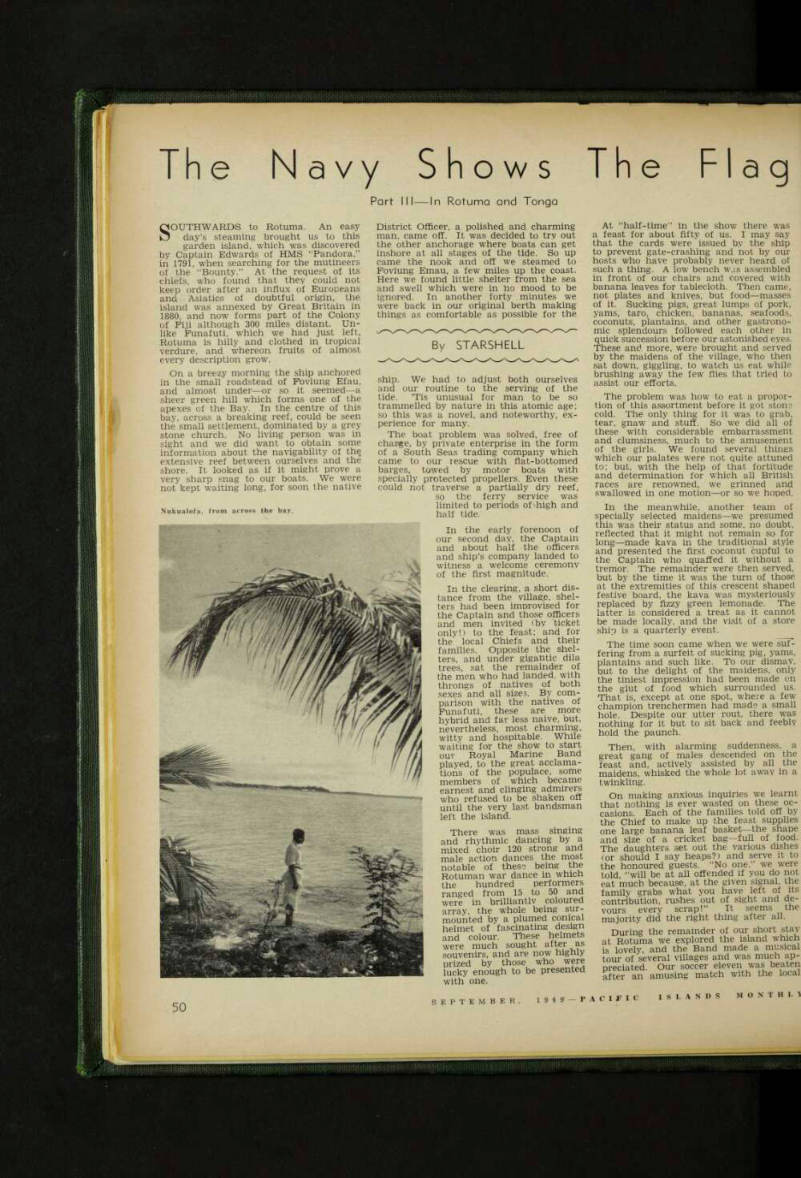
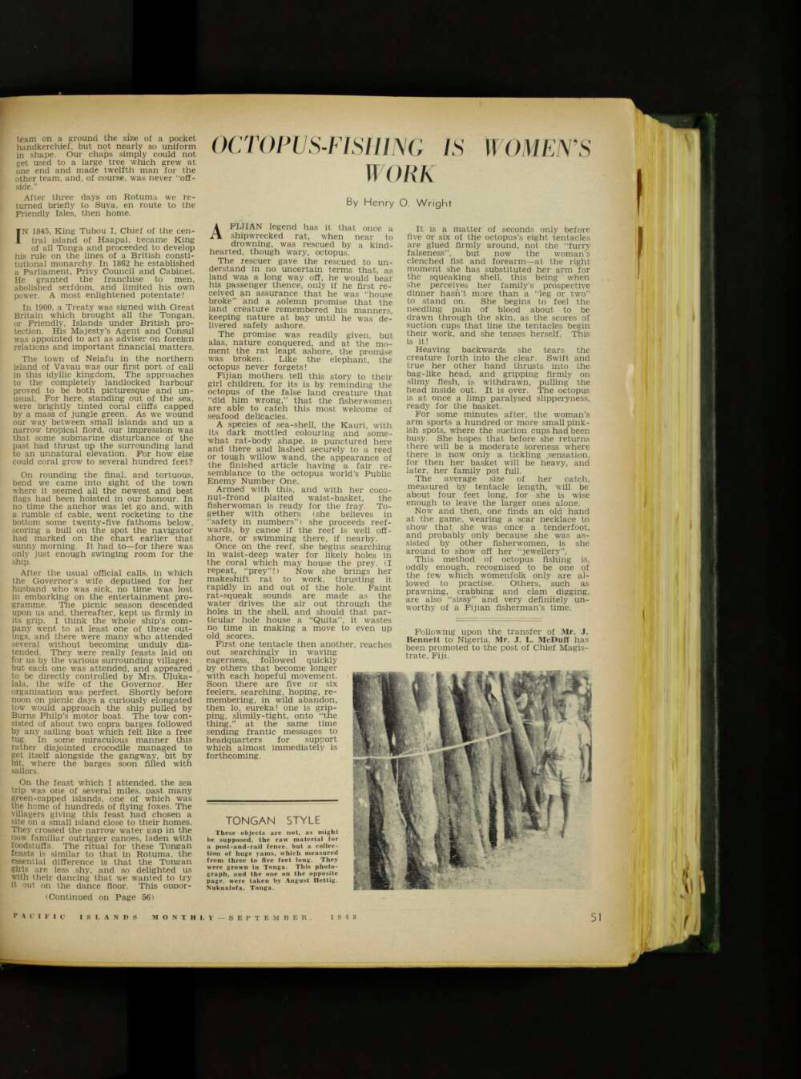
Nukualofa, from across the bay.
team on a ground the size of a pocket handkerchief, but not nearly so uniform in shape. Our chaps simply could not get used to a large tree which grew at one end and made twelfth man for the other team, and, of course, was never “off side,”
After three days on Rotuma we re turned briefly to Suva, en route to the Friendly Isles, then home.
IN 1845, King Tubou I, Chief of the cen tral island of Haapai, became King of all Tonga and proceeded to develop his rule on the lines of a British consti tutional monarchy. In 1862 he established a Parliament, Privy Council and Cabinet.
He granted the franchise to men, abolished serfdom, and limited his own power. A most enlightened potentate!
In 1900, a Treaty was signed with Great Britain which brought all the Tongan, or Friendly, Islands under British pro tection. His Majesty’s Agent and Consul was appointed to act as adviser on foreign relations and important financial matters.
The town of Neiafu in the northern island of Vavau was our first port of call in this idyllic kingdom, The approaches to the completely landlocked harbour proved to be both picturesque and un usual, For here, standing out of the sea, were brightly tinted coral cliffs capped by a mass of jungle green. As we wound our way between small islands and up a narrow tropical fiord, our impression was that some submarine disturbance of the past had thrust up the surrounding land to an unnatural elevation. For how else could coral grow to several hundred feet?
On rounding the final, and tortuous, bend we came into sight of the town where it seemed all the newest and best flags had been hoisted in our honour. In no time the anchor was let go and, with a rumble of cable, went rocketing to the bottom some twenty-five fathoms below, scoring a bull on the spot the navigator had marked on the chart earlier that sunny morning. It had to—for there was only just enough swinging room for the ship.
After the usual official calls, in which the Governor’s wife deputised for her husband who was sick, no time was lost in embarking on the entertainment pro gramme. The picnic season descended upon us and, thereafter, kept us firmly in its grip. I think the whole ship’s com pany went to at least one of these out ings, and there were many who attended several without becoming unduly dis tended. They were really feasts laid on for us by the various surrounding villages; but each one was attended, and appeared to be directly controlled by Mrs. Uluka lala, the wife of the Governor. Her organisation was perfect. Shortly before noon on picnic days a curiously elongated tow would approach the ship pulled by Burns Philp’s motor boat. The tow con sisted of about two copra barges followed by any sailing boat which felt like a free tug. In some miraculous manner this rather disjointed crocodile managed to get itself alongside the gangway, bit by bit, where the barges soon filled with sailors.
On the feast which I attended, the sea trip was one of several miles, past many green-capped islands, one of which was the home of hundreds of flying foxes. The villagers giving this feast had chosen a site on a small island close to their homes.
They crossed the narrow water gap in the now familiar outrigger canoes, laden with foodstuffs. The ritual for these Tongan feasts is similar to that in Rotuma, the essential difference is that the Tongan girls are less shy, and so delighted us with their dancing that we wanted to try it out on the dance floor. This oppor
(Continued on Page 56)
tunity came later. The beaches on our picnic island were of the purest white sand and proved ideal for bathing—a risk which some took despite a rather uneasy feeling in the belly.
In under a week officers and men ate their way through no less than six Ton gan feasts, each accompanied by native dancing, and great hilarity during the return trip in the copra barges.
An enchanting aspect of our stay was the way in which dancers with bands, were thoughtfully sent off to the shin in the evenings to entertain those who had to remain onboard. The race meetings were a great surprise and thoroughly en joyed. Anything that went wrong, or that was not according to the rules, was treated as a huge joke. At the second meeting the ship put up some performers, many of whom came to grief in the usual way or by getting carried off the course and into the jungle, all hugely to the de light of the natives.
A certain amount of trade by barter was done, for, though copra sales have rendered most of the Islanders well off, there is little on which they can spend their money. Clothes are in short supply and such things as shirts and shorts were greatly appreciated and brought showers of gifts in return. Strictly speaking, one does not barter in Tonga. The Islanders have a far better system. The would-be barterer “gives” his New Zealand friend a present and the latter should then “give” a present in return. There is no haggling and the whole affair is carried out in a convivial atmosphere.
It was with genuine regret that we weighed our anchor and steamed slowly down harbour and away from charming Vavau.
The overnight trip to Nukualofa took us past Falcon Island which has the dis turbing habit, of disappearing from time to time. It is rumoured that this hide and seek is not at all popular with the Prime Minister of Tonga, for every time it re-appears, he has to take a sea trip in order, to plant the Tongan flag firmly on top!
In Nukualofa, picnics were again ar ranged for all, but even the most ardent gluttons were now thinking ahead to home and leave; so a few, I regret to say, rather floundered in.the fodder. Anyway in my own case, indigestion inculcated by endless feasts, was beginning to rear its ugly head.
A few visited one of the largest aero dromes in the Pacific, sixteen milesi from the town. During the war it was exten sively used by the Americans for whom it
was built by the New Zealand Public
Works Department.
The Yankee influence is noticeable in Tongatabu. In this case the natives were not removed to another island and our allies have left their mark in more ways than one.
We “did” the sights, including the great blow holes on the weather coast of the island which provide an imposing, if rather damp, spectacle. Here the Pacific rollers strike the coial shelf with a vio lence which sends tons of water and spume hundreds of feet into the air.
It was unfortunate that Queen Salote should be sick and away in the country for a rest, but we were honoured by both Prince Tungi and Prince Tui’pel ahaki who came onboard.
A church bazaar, held in the grounds of the British Residency, provided an excellent opportunity for all hands to arm themselves with native baskets and mats, perhaps in an effort to forestall brickbats from their wives when the stories about the hula dancing come out! Fruit, par ticularly bananas, were another popular peace offering, though the most effective of all were probably nylon and silk stock ings picked up, at a price, in Suva.
On a calm Sunday evening we nosed our way through hidden reefs to the open sea, the Islands astern but not forgotten.
We look forward to visiting many more next year.
When a Fijian constable was searching a Chinese house at Suva for opium, he found none, but in a suitcase discovered 178 United States dollars. At the in evitable court sequel the Chinese said the dollars had been given to him by <us father so that he could take them to China for a family distribution Conse quently, he maintained, his father was the offender as he could not disobey his father by complying with the law and offering the dollars to the Financial Sec retary or to a bank. Unsympathetic to wards this example of filial piety, the magistrate imposed a fine of £2O and ordered the dollars to be handed over to the Financial Secretary in exchange for the currency of Fiji.
After being missing for more than 6C years, a carpenter’s claw hammer has been found during repairs to a Suva (Fiji) house owned by Mr. J.
Several years ago the late Mr. Gavir Lawrie, formerly a PWD employee ir charge of the Suva water-mains, tolc Mr. Suklal’s father that he had.left th< hammer in the ceiling when the house was being built.