Pacific
Islands
Monthly
September, 1949
Vol. xx. No. 2.
toblished 1930.
L Registered at the G.P.0., Sydney, jar transmission by past as a newspaper ]
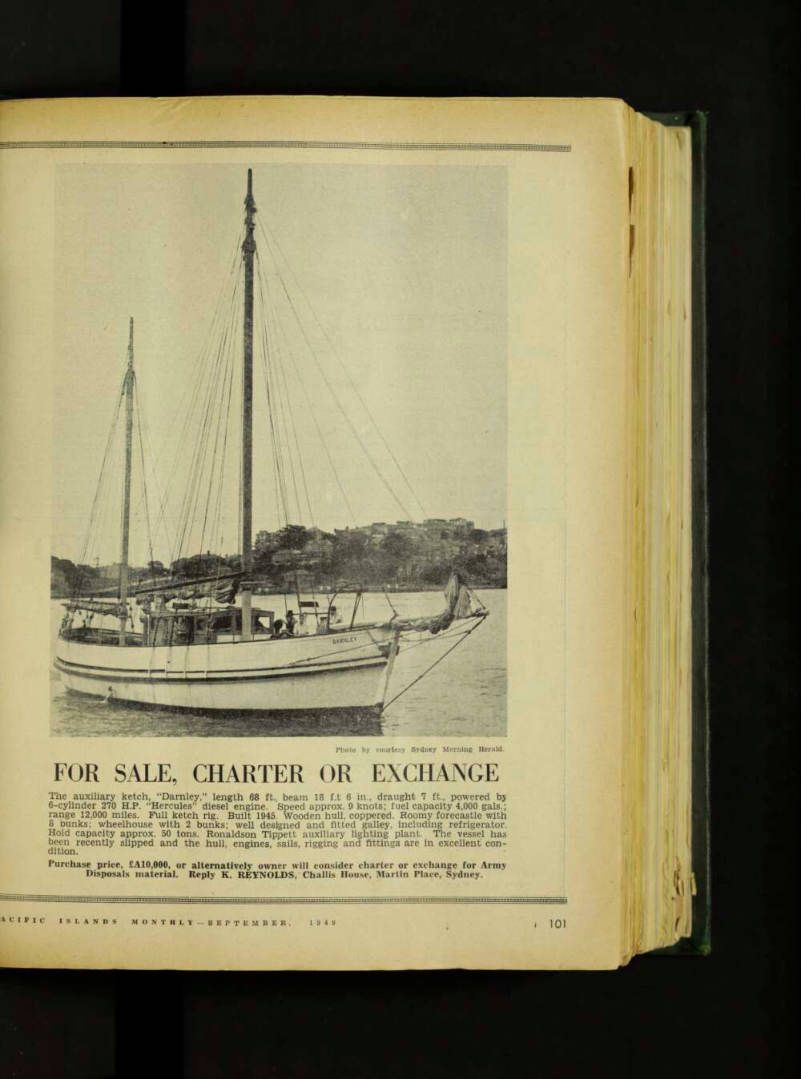
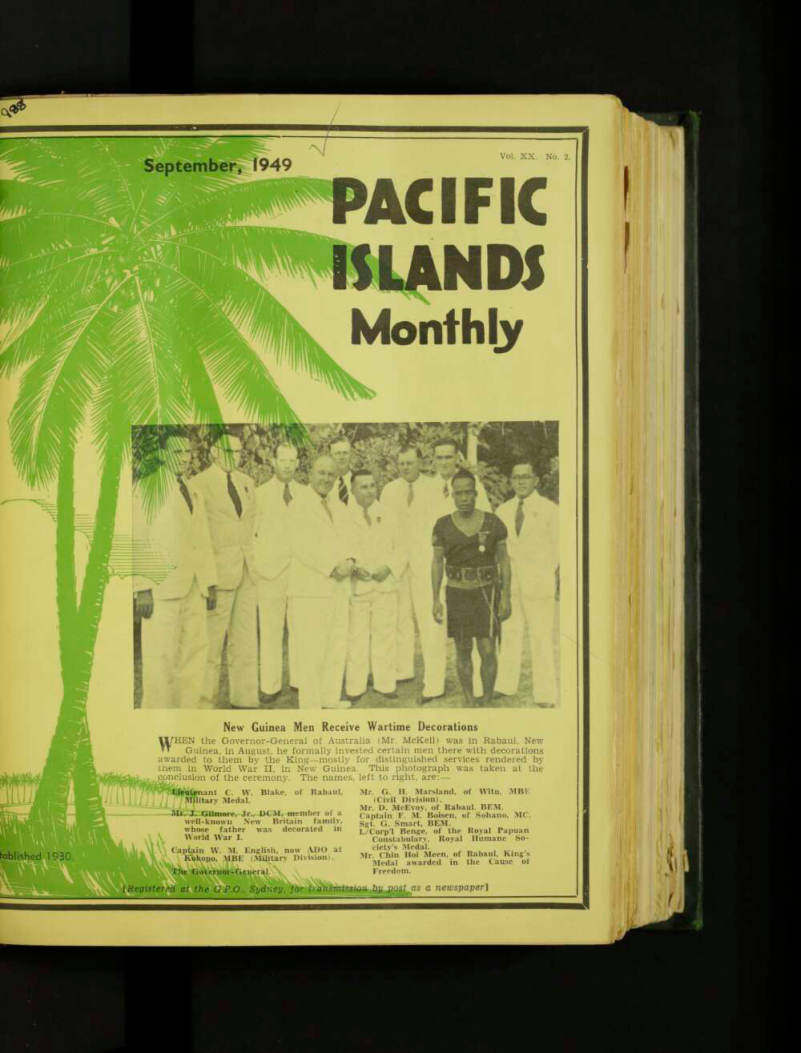
New Guinea Men Receive Wartime Decorations
WHEN the Governor-General of Australia (Mr. McKell) was in Rabaul, New Guinea, in August, he formally invested certain men there with decorations awarded to them by the King—mostly for distinguished services rendered by them in World War II, in New Guinea. This photograph was taken at the conclusion of the ceremony. The names, left to right, are:-
Lieutenant C. W. Blake, of Rabaul, Military Medal.
Mr. J. Gilmore, Jr., DCM, member of a well-known New r Britain family, whose father was decorated in World War I.
Captain W. M. English, now ADO at
Kokopo, MBE (Military Division).
The Governor-General.
Mr. G. H. Marsland, of Witu, MBE (Civil Division).
Mr. D. McEvoy, of Rabaul, BEM.
Captain F. M. Boisen, of Sohano, MC.
Sgt. G. Smart, BEM.
L/Corp’l Benge, of the Royal Papuan Constabulary, Royal Humane So ciety’s Medal.
Mr. Chin Hoi Meen, of Rabaul, King’s Medal awarded in the Cause of Freedom.
Advertisements & other items, pp. 2-4 (2 items)
Qcwtab
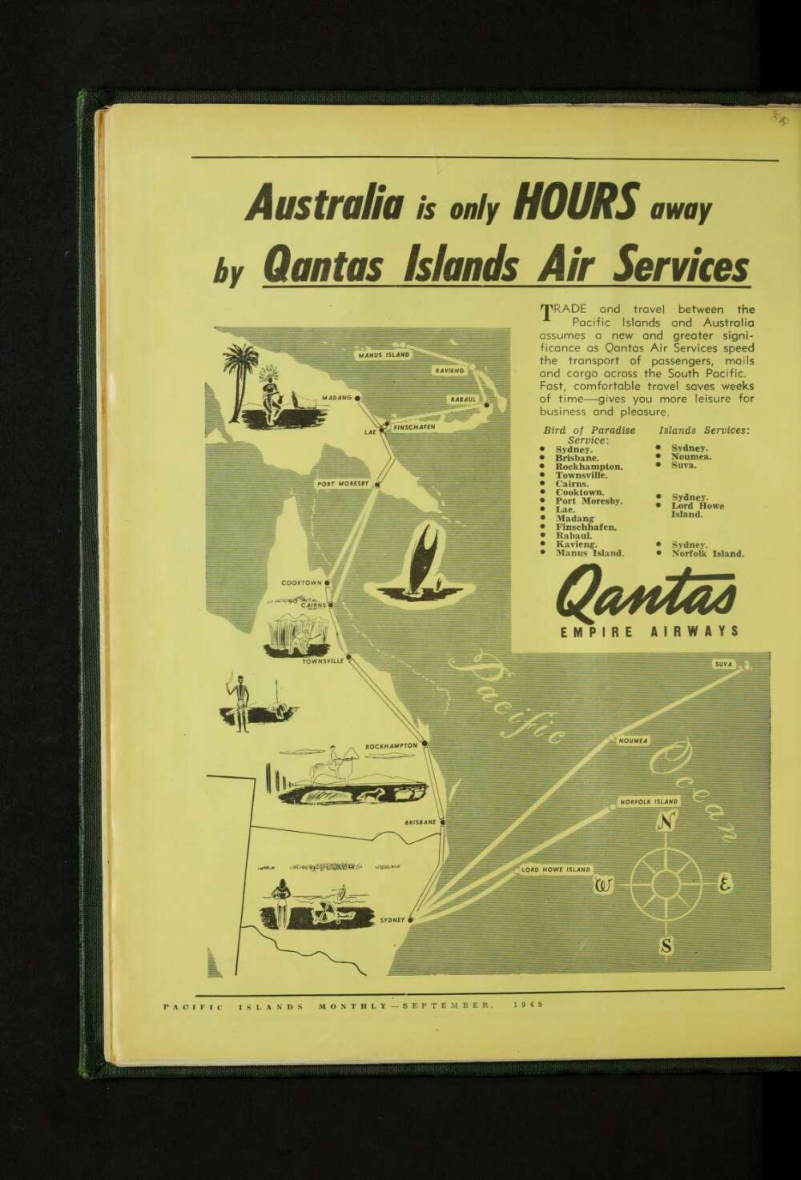
Australia is only HOURS away
by Qantas Islands Air Servkes
TIRADE and travel between the
Pacific Islands and Australia
assumes a new and greater signi-
ficance as Qantas Air Services speed
the transport of passengers, mails
and cargo across the South Pacific.
Fast, comfortable travel saves weeks
of time—gives you more leisure for
business and pleasure.
Bird of Paradise Islands Services : • Sydney. • Noumea. • Suva. • Sydney. • Lord Howe Island. • Sydney. • Norfolk Island.
MANUS ISLAND
KAVIENG =
MADANG
RABAUL ii
J FINSCHAFEN
LAE
Service: Sydney.
Brisbane.
Rockhampton.
Townsville.
Cairns.
Cooktown.
Port Moresby.
Lae.
Madang Finschhafen.
Rabaul.
Kavieng.
Manus Island.
PORT MORESBY «
Qcwtab
COOKTOWN
EMPIRE AIRWAYS
TOWNSVILLE
SUVA *
mmr
= NOUMEA
ROCKHAMPTON
fMi
NORFOLK ISLAND
BRISBANE
== LORD HOWE ISLAND
I or
SYDNEY •
s
s 5? SaL ' .. :
THE BEST OF
MM** Instant-lite Petrol Lantern 300 or 500 C.P.
Speed-master Petrol Stove
THEIR KIND
Coleman appliances have for many years been bringing better ways of living to
people everywhere. They bring greater
comfort and happiness with better light . . . easier, faster ironing . . . more convenient, more healthful heating , . .
better cooking.
Over forty years’ experience in producing
these appliances have made Coleman Products “The best of their kind.”
Coleman’s appliances include:— Petrol and Kerosene operated Lamps. Lanterns, Irons, Stoves, Portable Stoves, Brazing Torches and Blow Lamps.
Kerosene or Petrol Table or Hanging Lamp Coleman “530”
Pocket Stove SiE— Coleman Kerosene Iron Kerosene 3 Burner Cooking Stove ?; - .
Instant-lighting portable Petrol Cooking Stove Representatives for the Pacific Islands :
ROBERT GILLESPIE PTY. LTD.
54a PITT STREET, SYDNEY
PEARCE & CO. LTD.
JSUVA
FOR FIJI ISLANDS
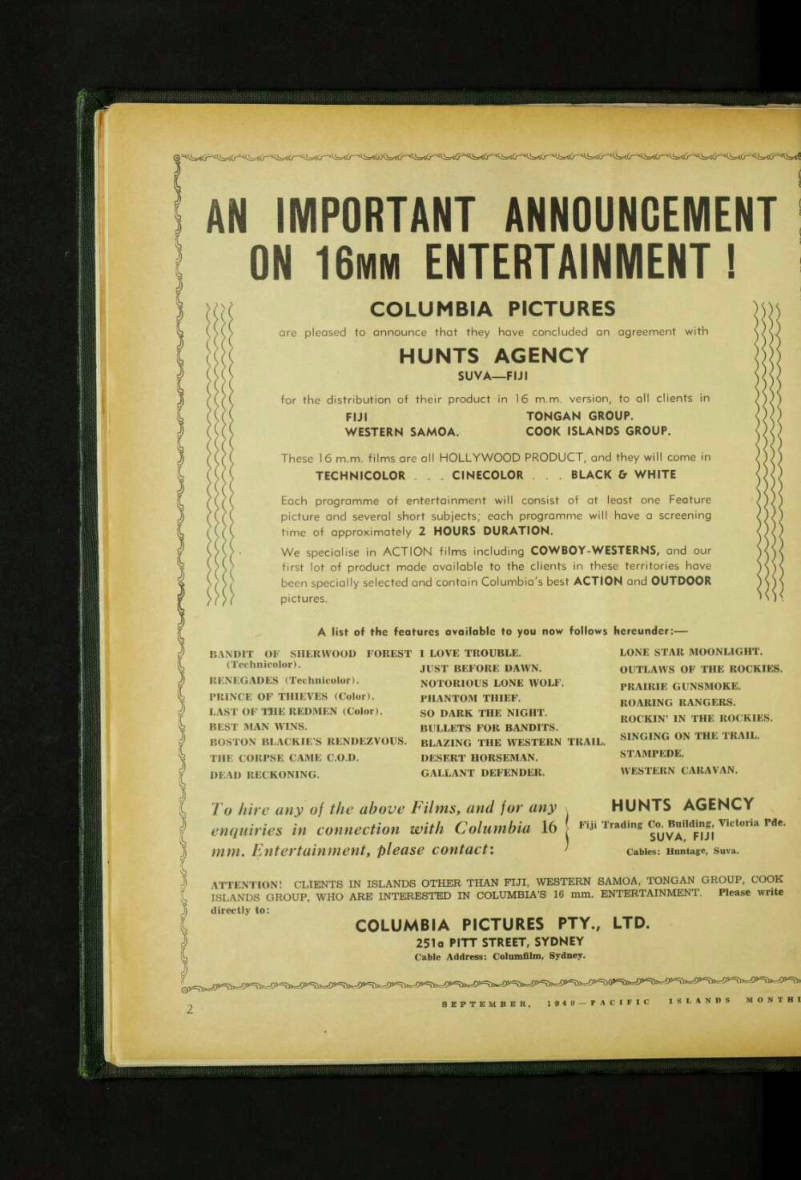
AN IMPORTANT ANNOUNCEMENT
ON 16mm ENTERTAINMENT I
COLUMBIA PICTURES
are pleased to announce that they have concluded an agreement with
HUNTS AGENCY
SUVA—FIJI
for the distribution of their product in 16 m.m. version, to all clients in
FIJI TONGAN GROUP.
WESTERN SAMOA. COOK ISLANDS GROUP.
These 16 m.m. films are all HOLLYWOOD PRODUCT, and they will come in TECHNICOLOR . . CINECOLOR . BLACK & WHITE Each programme of entertainment will consist of at least one Feature picture and several short subjects; each programme will have a screening time of approximately 2 HOURS DURATION.
We specialise in ACTION films including COWBOY-WESTERNS, and our first lot of product made available to the clients in these territories have been specially selected and contain Columbia's best ACTION and OUTDOOR
pictures.
BANDIT OF
(Technicolor).
RENEGADES (Technicolor).
PRINCE OF THIEVES (Color).
LAST OF THE REDMEN (Color).
BEST MAN WINS.
BOSTON BLACKIE’S RENDEZVOUS.
THE CORPSE CAME C.O.D.
DEAD RECKONING.
I LOVE TROUBLE.
JUST BEFORE DAWN.
NOTORIOUS LONE WOLF.
PHANTOM THIEF.
SO DARK THE NIGHT.
BULLETS FOR BANDITS.
BLAZING THE WESTERN TRAIL.
DESERT HORSEMAN.
GALLANT DEFENDER.
LONE STAR MOONLIGHT.
OUTLAWS OF THE ROCKIES.
PRAIRIE GUNSMOKE.
ROARING RANGERS.
ROCKIN’ IN THE ROCKIES.
SINGING ON THE TRAIL.
STAMPEDE.
WESTERN CARAVAN.
A list of the features available to you now follows hereunder:—
SHERWOOD FOREST
To hire any of the above Films, and for any
enquiries in connection with Columbia 16
mm. Entertainment, please contact:
HUNTS AGENCY
Fiji Trading Co. Building, Victoria Pde.
SUVA, FIJI
Cables: Huntage, Suva.
ATTENTION! CLIENTS IN ISLANDS OTHER THAN FIJI, WESTERN SAMOA, TONGAN GROUP, COOK ISLANDS GROUP, WHO ARE INTERESTED IN COLUMBIA’S 16 mm. ENTERTAINMENT. Please write directly to:
COLUMBIA PICTURES PTY., LTD.
251 a PITT STREET, SYDNEY
Cable Address: Columfllm, Sydney.
2
SEPTEMBER, 19 4 PACIFIC ISLANDS MONTHI
Index to Advertisers
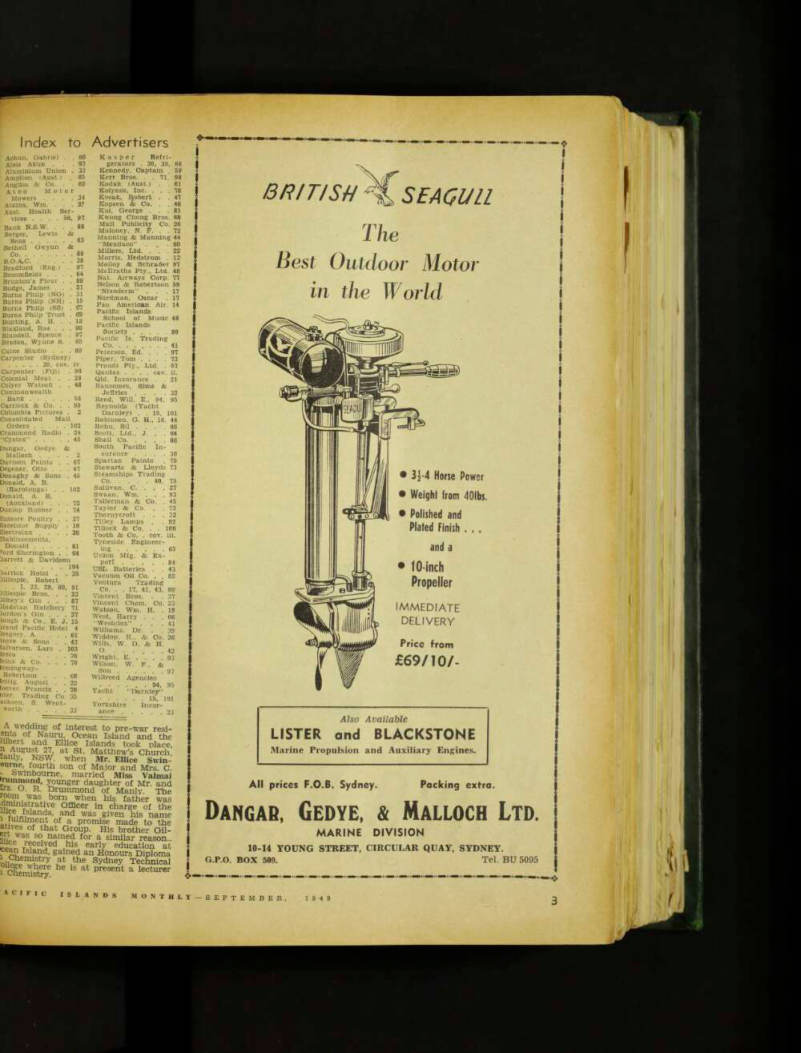
Achun, Gabriel . . 60 Alois Akun ... 93 Aluminium Union . 33 Amplion (Aust.) . 85 Angliss & Co. . .62 Aitoo Motor Mowers ... 34 Atkins, Wm. . . . 2f Aust. Health Ser vices ... 58, 97 Bank N.S.W. ... 88 Berger, Lewis & Sons ... 63 Bethell Gwynn & Co 89 8.0.A.C 38 Bradford (Eng.) . 97 Broomfields ... 64 Brunton’s Flour . . 89 Budge, James ... 21 Burns Philp (NG) . 31 Burns Philp (NH) . 15 Burns Philp (SS) . 67 Burns Philp Trust . 69 Bunting, A. H. . . 13 Blaxland, Rae ... 98 Blundell, Spence . 97 Breden, Wynne S. . 65 Caine Studio ... 80 Carpenter (Sydney) 2O, cov. iv.
Carpenter (Fiji) . 96 Colonial Meat . . 28 Colyer Watson . . 48 Commonwealth Bank ... 58 Carrlock & Co. . . 99 Columbia Pictures . 2 Consolidated Mail Orders 102 Crammond Radio . 24 “Cystex” 45 Dangar, Gedye & Malloch ... 3 Davison Paints . . 67 Degener, Otto ... 47 Donaghy & Sons . 45 Donald, A. B. (Rarotongai . . 102 Donald, A. B. (Auckland) ... 72 Dunlop Rubber . . 74 Snmore Poultry . . 27 Excelsior Supply . 16 Electrolux ... 20 Etablissements, Donald 81 f’ord Sherington . . 64 Jarrett & Davidson lO4 >arrick Hotel . . 35 Jillespie, Robert . . 1, 22, 29, 80, 91 Jillespie Bros. . . 23 Jilbey’s Gin ... 87 Jladstan Hatchery 71 Jordon's Gin ... 37 Jough & Co., E. J. 15 Jrand Pacific Hotel 4 Jregory, A 61 Jrove & Sons . . 43 lalvorsen, Lars . 103
lerco 36
leinz & Co. ... 70
lemingway-
Robertson ... 68
tettig, August . . 22
(oover. Francis . . 70
nter. Trading Co. 35 ackson, S. Went worth 33
Kasper Refri gerators . 30, 39, 66 Kennedy, Captain . 59 Kerr Bros. . . 71, 98 Kodak (Aust.) . . 61 Kolynds, Inc. ... 78
Kosak, Robert . . 47
Kopsen & Co. . . 46 Kui, George ... 81 Kwong Chong Bros. 68 Mail Publicity Co. 26 Maloney, N. F. . . 72 Manning & Manning 44 “Mendaco” ... 60 Millers, Ltd. ... 22 Morris, Hedstrom . 12 Molloy & Schrader 97 Mcllraths Pty., Ltd. 48 Nat. Airways Cdrp. 77 Nelson & Robertson 59 “Nixoderm” ... 17 Nordman, Oscar . 17 Pan American Air. 14 Pacific Islands School of Music 46 Pacific Islands Society 99 Pacific Is. Trading Co. ... 41 Peterson, Ed. ... 97 Piper, Tom ... .73 Prouds Pty., Ltd. . 57 Qantas ... cov. ii.
Qld. Insurance . . 21 Ransomes, Sims & Jeffries ... 32 Reed, Will. E., 94. 95 Reynolds {Yacht Darnley) . . 15, 101 Robinson, G. H., 16, 44 Rohu, Sil . . . .88 Scott, Ltd., J. . .64 Shell Co 86 South Pacific In surance ... 36 Spartan Paints .79 Stewarts & Lloyds 73 Steamships Trading Co 40, 75 Sullivan, C. ... 27 Swaan, Wm. ... 93 Tallerman & Co. . 45 Taylor & Co. . . 72 Thornycroft ... 32 Tilley Lamps . . 92 Tillock & Co. . . 100 Tooth & Co. . cov. iii.
Tyneside Engineer ing 65 Union Mfg. & Ex port 84 USL Batteries . . 43 Vacuum Oil Co. . . 82 Ventura Trading Co. . . 17, 41, 43, 89 Vincent Bros. . . 37 Vincent Chem. Co. 23 Watson, Wm. H. . 19 West, Harry ... 66 “Westclox” ... 41 Williams, Dr. . . 39 Widdop. H.. & Co. 26 Wills, W. D. & H.
O. . ... 42 Wright, E 93 Wilson, W. F., & Son 97 Willreed Agencies • • ... 94, 95 Yacht “Darnley” l5, 101 Yorkshire Insur ance 23
A wedding of interest to pre-war resi sts of Nauru, Ocean Island and the Albert and Ellice Islands took place, at Matthew’s Church, lanly, NSW, when Mr. Ellice Swin ourne, fourth son of Major and Mrs. C. ;• kwinboume, married Miss Valmai rrc m ?? on T?’ yo un S er daughter of Mr. and ITS. O. R. Drummond of Manly. The jJJSL y as .- b orn when his father was dimmstrative Officer in charge of the 1 an 4 ? nd was given his name fttwr5 e ?£ ? f^ a promise made to the atives of that Group. His brother Gil ii£.J vas so - nam , e d for a similar reason.. received his early education at ,5;? Is l3-nd, gamed an Honours Diploma niw mi 5 try the Sydney Technical i° ChenSstry e 6 ‘ S at present a lecturer
Advertisements & other items, p. 5 (2 items)
3
ACIFIC ISLANDS MONTHLY SEPTEMBER, 1949
Dangab, Gedye, & Malloch Ltd.
BRITISH
SEAQUII
The
Best Outdoor Motor
in the World
SS I 3 Kk • 3y-4 Horse Power • Weight from 40lbs. • Polished and Plated Finish . . . and a • 10-inch
Propeller
IMMEDIATE
DELIVERY
Price from £69/10/- Also Available
LISTER and BLACKSTONE
Marine Propulsion and Auxiliary Engines.
All prices F. 0.8. Sydney. Packing extra.
Dangab, Gedye, & Malloch Ltd.
MARINE DIVISION
10-14 YOUNG STREET, CIRCULAR QUAY, SYDNEY.
G.P.O. BOX 509. Tel. BU 5095
In This Issue:
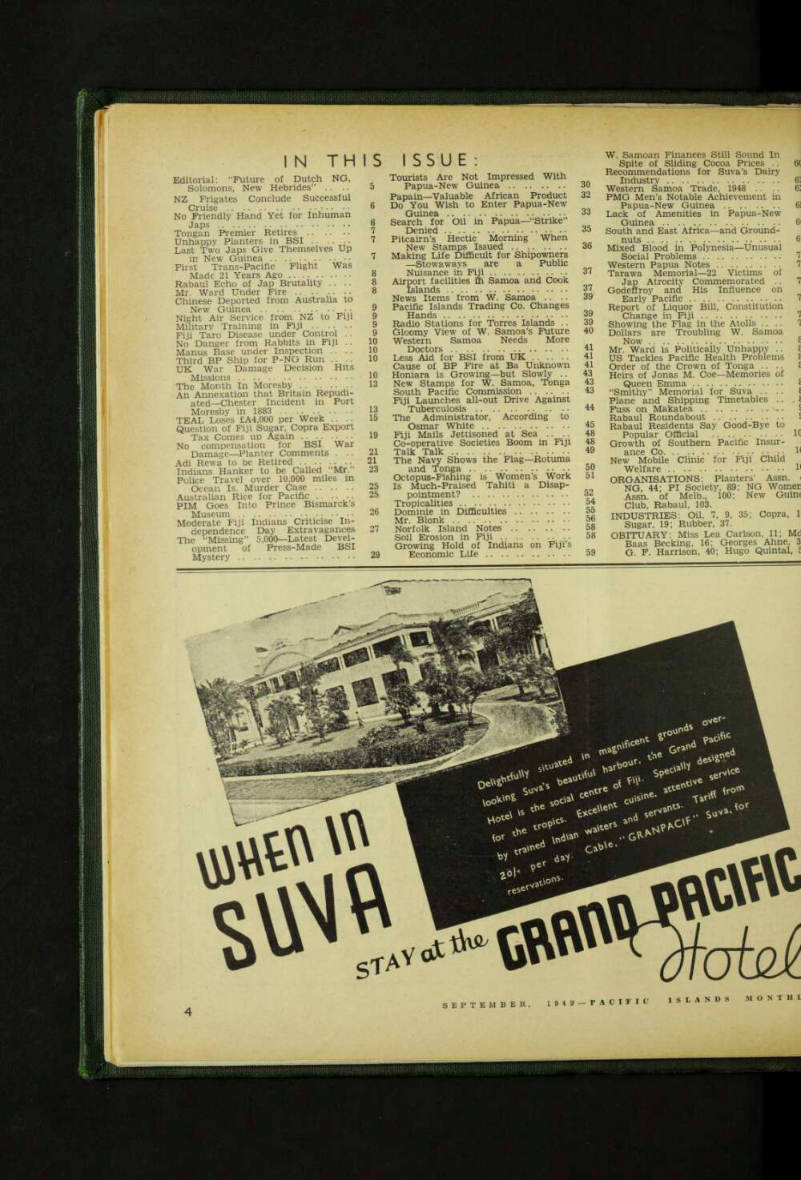
Editorial: “Future of Dutch NG, Solomons, New Hebrides” ... 5 NZ Frigates Conclude Successful Cruise 6 No Friendly Hand Yet for Inhuman Japs 6 Tongan Premier Retires 7 Unhappy Planters in BSI 7 Last Two Japs Give Themselves Up in New Guinea 7 First Trans-Pacific Flight Was Made 21 Years Ago 8 Rabaul Echo of Jap Brutality ... 8 Mr. Ward Under Fire 8 Chinese Deported from Australia to New Guinea 9 Night Air Service from NZ to Fiji 9 Military Training in Fiji 9 Fiji Taro Disease under Control .. 9 No Danger from Rabbits in Fiji .. 10 Manus Base under Inspection ... 10 Third BP Shin for P-NG Run ... 10 UK War Damage Decision Hits Missions The Month In Moresby 13 An Annexation that Britain Repudi ated—Chester Incident in Port Moresby in 1883 13 TEAL Loses £A4,000 per Week ... 15 Question of Fiji Sugar, Copra Export Tax Comes up Again 19 No compensation for BSI War Damage—Planter Comments ... 21 Adi Rewa to be Retired 21 Indians Hanker to be Called “Mr.” 23 Police Travel over 10,000 miles in Ocean Is. Murder Case 25 Australian Rice for Pacific .. .. .. 25 PIM Goes Into Prince Bismarck s Museum • : • • • • 26 Moderate Fiji Indians Criticise In dependence Day Extravagances 27 The “Missing” s,ooo—Latest Devel opment of Press-Made BSI Mystery 29
Tourists Are Not Impressed With Papua-New Guinea 30 Papain—Valuable African Product 32 Do You Wish to Enter Papua-New Guinea 33 Search for Oil in Papua—“Strike”
Denied 35 Pitcairn’s Hectic Morning When New Stamps Issued 36 Making Life Difficult for Shipowners —Stowaways are a Public Nuisance in Fiji 37 Airport facilities m Samoa and Cook Islands 37 News Items from W. Samoa ... 39 Pacific Islands Trading Co. Changes Hands 39 Radio Stations for Torres Islands .. 39 Gloomy View of W. Samoa’s Future 40 Western Samoa Needs More Doctors 41 Less Aid for BSI from UK 41 Cause of BP Fire at Ba Unknown 41 Honiara is Growing—but Slowly .. 43 New Stamps for W. Samoa, Tonga 43 South Pacific Commission 43 Fiji Launches all-out Drive Against Tuberculosis 44 The Administrator, According to Osmar White 45 Fiji Mails Jettisoned at Sea ... 48 Co-operative Societies Boom in Fiji 48 Talk Talk 49 The Navy Shows the Flag—Rotuma and Tonga 50 Octopus-Fishing is Women’s Work 51 Is Much-Praised Tahiti a Disap pointment? 52 Tropicalities 54 Dominie in Difficulties 55 Mr. Blonk 56 Norfolk Island Notes 58 Soil Erosion in Fiji 58 Growing Hold of Indians on Fiji’s Economic Life 59
W. Samoan Finances Still Sound In Spite of Sliding Cocoa Prices .. 6C Recommendations for Suva’s Dairy Industry 6J Western Samoa Trade, 1948 ... 6J PMG Men’s Notable Achievement in Papua-New Guinea 61 Lack of Amenities in Papua-New Guinea 6( South and East Africa —and Ground nuts 6!
Mixed Blood in Polynesia—Unusual Social Problems 7' Western Papua Notes 7 Tarawa Memorial—22 Victims of Jap Atrocity Commemorated .. 7 Godeffroy and His Influence on Early Pacific 7 Report of Liquor Bill, Constitution Change in Fiji 7 Showing the Flag in the Atolls ... 7 Dollars are Troubling W. Samoa Now 8 Mr. Ward is Politically Unhappy .. 8 US Tackles Pacific Health Problems 8 Order of the Crown of Tonga ... 8 Heirs of Jonas M. Coe—Memories of Queen Emma 8 “Smithy” Memorial for Suva ... 8 Plane and Shipping Timetables .. 8 Fuss on Makatea £ Rabaul Roundabout £ Rabaul Residents Say Good-Bye to Popular Official 10 Growth of Southern Pacific Insur ance Co .••• 1( New Mobile Clinic for Fiji Child Welfare 1( ORGANISATIONS: Planters’ Assn. < NG, 44; PI Society, 89; NG Women Assn, of Melb., 100; New Guint Club, Rabaul, 103.
INDUSTRIES: Oil, 7,9, 35; Copra, 11 Sugar, 19; Rubber, 37.
OBITUARY: Miss Lea Carlson, 11; Md Baas Becking, 16; Georges Ahne, 3 p G. F. Harrison, 40; Hugo Quintal, 5
Advertisements & other items, p. 6 (2 items)
4
SEPTEMBER, IM.-PACIf.C ISLANDS MONTHL
\B
Pacific Islands Monthly
The Newspaper-Magazine of the South Seas
IRegistered at the G.P.O., Sydney, for transmission hy post as a netosp.aper ] Published Once Each Month and Circulated in Australia and New Zealand and in the following Pacific Territories and Islands Groups:
Australian Territory ot Papua.
Trustee Territory (Australia) of New Guinea.
Australian Territory of Norfolk Island.
New Zealand Territory of Cook Islands, Trustee Territory (NZ) of Western Samoa.
British Colony of FIJI.
British Solomon Islands Protectorate.
British Protectorate of Tongan Islands.
British Crown Colony of Gilbert and Ellice Islands.
Trustee Territory of Nauru.
British and French Condominium of New Hebrides.
French Colony of New Caledonia.
French Colony of Oceania (Tahiti, etc.).
American Territory of Eastern Samoa.
American Territory of Hawaiian Islands.
Owned and Produced by Pacific Publications Pty., Ltd., Union House, 247 George Street, Sydney.
Telephone: General Office and Advertising, BW 5037.
P.O, Box 3408
Registered Address for Telegrams, Radiograms, and Cables: “Pacpub,” Sydney.
Contributions,
Articles, Stories, and Photographs dealing with Pacific Islands subjects are Invited and wIU be paid for on publication.
Subscription Rates.
Per Annum, Pre-paid, Including Postage.
In Australia, New Zealand, FIJI, New Guinea, Papua, Western Samoa. Cook Islands, Tonga, British Solomons, Gil bert and Ellice Colony, Nauru, and United Kingdom 18 0 Elsewhere $3.50 £1 1 0 Single Copies 1 9
Editor and Publisher:
R. W. Robson. P.R.G.S.
Assistant Editor: JUDY TUDOR.
General Office: Union House, 247 George Street, Sydney. Telephone: BW 5037.
Advertising Manager: W. E. Rogers.
Representative In London.
J. T. WalUs, Coronation House. 4 Lloyds Avenue, London, E.C.3, from whom may be obtained copies of Pacific Islands Monthly, Pacific Is. Year Book, advertising schedules, etc.
Representative In U.S.A.
Pacific Islands Trading Co..
244 California St., San Francisco, U.S.A.
Agents.
The following are authorised to receive sub scriptions for Pacific Islands Monthly:— Burns. Phllp & Co., Ltd., and Burns Phllp (South Sea) Co., Ltd. All branches.
W. R. Carpenter «fc Co., Ltd. All branches.
Morris, Hedstrom, Ltd. All branches.
Steamships Trading Co., Papua. All branches.
Steele’s Central Store, Suva, Fiji.
Cook Islands Trading Co., Rarotonga, Cook Is.
Oscar Nordman, Papeete, Tahiti.
Islands Branches and Representatives of W. H.
Grove <sc Sons, Ltd., Auckland, New Zealand.
Ed. Pentecost, Noumea. New Caledonia.
Soclete Gubbay Kerr et Cle, Noumea, New Caledonia.
Vol. Xx. No. 2.
September, 1949.
r 1/9 Per Copy Price \ Prepaid, p.a.; 18/- Aust I In USA, p.a.; $3.50.
Future of Dutch N. Guinea, Solomons, New
Hebrides—and Pacific Security
THERE is much that is significant for us in recent events in Indo nesia and South-east Asia: — • Under pressure from the mis chief-making United Nations, the Dutch apparently have surrendered to the Indonesians, to the extent that they now are going to allow these people to have an equal if not a dominant voice in the future Govern ment of the large Archipelagoes be tween Australia and Asia. • Dutch interests—which naturally do not like what they see developing in the East Indies—are making a strong effort to keep Dutch New Guinea (the western half of the great Island of New Guinea) out of the new set-up, so that the Indonesians can have no voice in the control of Dutch New Guinea—in the future of which Australia and Oceania generally are vitally concerned. • United States interests, pre occupied with the problem of the future of Japan (where the popu lation is increasing by nearly 2,000,000 per annum) are inclined to support the proposition that Dutch New Guinea should be thrown open to colonisation by surplus Japanese. • Guided, directed and equipped by Moscow, Chinese Communist armies are sweeping steadily southwards through China. They already are close to the British Colony of Hong Kong; they threaten to close the gap m South China through which the remaining Nationalist provinces In South-west China receive supplies,
and they are menacing the non- Communist administrations of Indo china, Malaya, Siam, and Burma. • In order to impose a real obstacle between China and Japan (which they regard as an important bulwark between Communist Asia and the United States) General MacArthur and his advisers are believed to be giving serious consideration to the occupation by American troops of the great island of Formosa, just off the coast of China.
TT'OR many decades, the communities * of the South Pacific, including Australia and New Zealand, have seen the menace to their future security which lies in the over-population of Asia. That menace has become greater in recent years, since Asia began to pass under the influence of Moscow, and to become generally Communist.
The establishment of Communism in China means its early establish ment in South-east Asia. The Indo nesian set-up, into which the un happy Dutch have been forced by Western European visionaries, Is honeycombed with Communism. It is not too much to fear that this line of stepping-stones between Malaya and Australia soon will be more or less controlled bv world Communist power.
That seems to be the situation, stated in general terms. At the moment. Australia—and Oceania— has a peculiar and particular interest in political events in New Guinea.
AUSTRALIA is as much interested in the future of Western New Guinea, which she does not control, as in Eastern New Guinea, which she holds in trust.
Three important factors now near upon the future of Western (Dutch) New Guinea—namely, the apparent wish of the Indonesians to control this Territory, and the equal deter mination of the Dutch that Indonesia shall be kept out; the proposal to transfer thither the surplus popu lation of Japan; and the discovery and recent development there of a great, new oilfield, which must pro foundly affect the Territory’s econo mic future.
The future of Dutch New Guinea has been widely discussed lately in newspaper articles. The Territory is being called, by some, “Iriania,” and it is believed there are 1,000,000 natives there. A small, literate sec tion of these natives has petitioned the Queen of Holland, begging that Iriania shall not pass under the control of the proposed United States of Indonesia, the constitution of which is now being discussed at The Hague. It is reported that a depu tation of four Irianians is on its way to The Hague to make a further ap peal that Iriania shall be developed as a separate Dutch Colony, indepen dent of the “Republic of United Indonesia” —and, failing that, that it be placed under Australian Trustee ship.
The 200,000 Eurasians of the for mer Netherlands Indies are asking that Iriana be kept as an indepen dent State for them.
AS it is plain that under the double impact of Asiatic Nationalism and advancing Communism, startling events are likely in South-east Asia and the Western Pacific generally within the next decade, non-Asiatic communities in the South Pacific— and especially Europeans. Polynesians and Melanesians—naturally look to Australia for leadership, in meeting whatever threats to their security are implicit in these events. So far, Aus tralia’s policy in relation to such developments is indefinite, and con fused by Socialistic thinking.
But the facts cannot be much longer ignored. Sooner or later Aus tralia must—in consultation, of course, with Britain and the United States —frame a policy which will guide her future political activities in the South-west and Western Pacific.
Australia now controls Eastern New Guinea and the Bismarck Archi pelago. For her future security she should control also the archipelagoes of the Solomon Islands and the New Hebrides, thus giving her a complete screen of Islands defences covering her northern and north-eastern frontiers.
So far, Australia has made a poor showing in the administration and development of her Pacific Islands Territories. But that is due to politics —confused thinking. Socialistic pre occupation with native welfare, and the maintenance of the wrong men in positions of authority—and the phase will pass. Australia is quite capable of properly developing the tropical Archipelagoes placed in her care: and there is little doubt that the European residents of the now tragically-neglected Solomon and New Hebrides Islands would prefer active Australian control to the con ditions under which they'now suffer.
It is not necessary to point out that efficient administration and a happy and contented European community provide the safest guarantee of native welfare.
It is not too much to hope that there some day will be created, under non-Socialist government, an Aus tralian Department of Pacific Islands, to take care of Eastern New Guinea, New Britain, New Ireland, Bougain ville, and the eight or more other large Islands of the Solomons and New Hebrides. This would represent a Territory almost as important in area, resources and potentialities, as the former great Dutch Territory of the East Indies; and this expanded Australian Pacific Islands Adminis tration then might co-operate very happily with the Dutch (Dutch New Guinea), British (Borneo and Fiji), French (New Caledonia) and Ameri cans (Micronesia and the Philip pines), for the security of the Pacific and the protection and advancement of the native peoples of the Islands.
A games evening was held at the resi dence of Mrs. Sutherland. Rabaul, NG, on August 29. The function was most sucand as a result of it. the RSL Building fund was opened with the sum of £5/5/-.
No Friendly Hand Yet For
The Inhuman Japs
Memories of 1942 and 1943
A SECTION of American public opinion, led by General Douglas MacArthur, appears to be in favour to a “forgive and forget” policy in relation to the Japanese.
A non-Communist Japan could be a valuable barrier between the United States and the onward-sweeping power of Communism in Asia, which now has the Americans somewhat bothered. One sympathises with their viewpoint.
But the idea has not been well received in Australia and New Zealand, and the islands of the South Pacific. Some events of 1942 and 1943 are much too fresh in the memories of all of us. We have not forgotten;— • How the Japs massacred the young Australian servicemen at Tol plantation, in New Britain. When the Japs came down in overwhelming numbers upon Rabaul, a few handfuls of Australians got away westward into the jungle. The majority escaped, but a considerable num ber were rounded up, exhausted and help less, at Tol, and simply butchered. • How 22 men —17 New Zealand service men and five civilians—were massacred at Tarawa, in the Gilbert Islands. The Japs had held them prisoners. American planes, one day, attacked the Jap fortress at Tarawa. The immediate reaction of these sub-human creatures was to march their 22 helpless prisoners out, and butcher them. • How ten Anglican missionaries were massacred by the Japs in Northeast Papua. One was beheaded even while he was celebrating Communion at Gona.
Two young European nurses were taken out into a plantation, where a grave was dug, and slaughtered. Who can forget the report of Mr. W. R. Humphries, who later investigated this horrible occur rence? • How a hospital ship was sunk off the Queensland coast, with tragic loss of life. • How helpless Australian servicemen and women were massacred at Ambon, East Indies. • How the fiendish cruelty of the Japs caused the deaths of many, many hun dreds of Australians who became prisoners at Singapore.
There is no end to the foul record.
Those merely are cases which spring to the memory of this writer.
We may perhaps forgive the Germans They introduced some fiendish forms of war, and the way in which the Nazis mas sacred Jews is one of the blackest blots on history’s pages. But they did not murder military prisoners.
Our friends the Yanks will perhaps understand if we of the South Pacific show a certain unwillingness to resume civilised relations with the most un civilised and inhuman enemy we ever
encountered.-
R.
Papua-New Guinea
Copra Price in Papua-New Guinea
Canberra, Sept. 15.
EXTERNAL Territories Department an nounces that the Conra Agreement with the British Ministry of Food has been confirmed along lines already in dicated. It had been unofficially reported that the Agreement (which has been in operation since January 1) had not been confirmed.
Successful Cruise
NZ Frigates Conclude Successful Cruise
THE four New Zealand Navy frigates which spent ten weeks cruising in the Pacific returned to Auckland in early August having performed a mixed bag of duties and shown the flag from Sunday Island to Tahiti.
Taupo spent most of her time in the Gilbert and Ellice Islands. A meteorolo gical officer checked up on weather stations in the group and a considerable time was soent in surveying the Tarawa Atoll.
Hawea visited Tahiti, Cook Islands, Niue, Suva, Western Samoa, Tokelaus and Raoul (Sunday) Island. Her duties in cluded blasting with depth charges a main shipping channel about five miles from Apia, Western Samoa, where coral growth had made it unsafe for shipping; and visiting Savaii Island, Western Samoa, which had not seen a British war ship for over 20 years.
Pukaki travelled extensively among the Fiji and Tongan Groups. Kaniere visited the remote Northern Cooks, Phoenix Islands, Christmas, Fanning, Canton, Syd ney, Hull and Gardner. One of their duties was to reaffirm British sovereignty over Flint and, at Christmas Island, two officers acted as assessors when a native was tried for manslaughter.
All four ships checked radio and meteorological stations, gave medical aid when necessary, landed stores, presented gifts of tobacco, flour, tinned meat, sweets, etc. All personnel of all ships were entertained lavishly by the native inhabitants of the islands, were feasted, admired, and showered with gifts of native handicrafts.
The captain of the Kaniere calculated that he made 31 speeches in response to ceremonial welcomes which invariably marked the ship’s arrival at island anchorages.
New Peak Appears in Pacific
DURING her ten weeks’ cruise, Pukaki investigated a new volcanic cone that has more than doubled in size tiny Matthew Island, 200 miles east of New Caledonia. It had been reported by the British Phosphate Commission’s ship, Triona.
Until recently, Matthew Island, a vol canic cone, was about 30 acres in extent; now a second cone has been thrown up alongside |the first, making the whole island the shape of an hour-glass and about 1,200 yards long by 800 yards wide Matthew Island was discovered in 178£ and the older portion is covered with rough grass. Its sides are precipitous, it is uninhabited (except by a huge popula tion of sea birds) and it is doubtful il anyone has ever landed on it.
in Pacific
Effect of New Exchange in Pacific
Canberra. Sept. 19.
TWO factors of the international cur rency rearrangement announced thii morning will immediately affec Pacific Territories; — • Sterling has been de-valued about 3( per cent, in relation to the United State! dollar. Australian, NZ and Fiji currenciei remain in the same relation to Sterling and therefore automatically are reducet in terms of Dollars. In other words, th< Australian, NZ and Fiji pounds buy thi same amount of Sterling as heretofore but one third fewer dollars. • Gold has been increased in valui from £lO Aust. to £l5 Aust. per fin ounce. This immediately benefits th economies of New Guinea and Fiji.
Unhappy Planters In
Solomons
Resentful of British Administration and Policy
(CONDITIONS in the British Solomons j provide a good example of what hap pens in an under-developed British tropical territory under a Socialist regime.
Before World War 11, it was the policy of the British Colonial office to encourage private enterprise to go into such places and develop their resources. There was not much to develop in the Solomons then —copra was not greatly in demand—but a good type of planter was at least assisted to make his home there.
To-day, there appears to be nearly double the pre-war number of public ser vants in BSI; but the production of copra —in quantity—is probably no more than half the pre-war volume. The Adminis tration’s pre-war policy of encouraging private enterprise has been replaced by a laissez-faire attitude that is taken to mean that, while officialdom is indifferent about the condition of non-official Euro peans, it is intensely pre-occupied with native welfare.
The net result, of course, is seen in three things—discontented and resentful Europeans, spoiled natives and a heavy additional burden upon the British tax payer. Only a handfull of the planters and traders who were driven out by the war have returned to the Solomons.
In some respects, conditions in BSI are almost a duplicate of conditions in Papua- New Guinea. In the latter country, the Socialist policy, directed from Canberra, discourages private enterprise, spoils the natives, makes non-official Europeans non-co-operative and resentful, and throws an enormously increased burden upon the Australian exchequer. Before the war, Papua-New Goinea was almost self-supporting, and BSI was only a little less so.
IN a comparison, however, the planters who have returned to the Solomons are worse off than the Australian non-officials in Papua-New Guinea.
The Australians got war damage com pensation from a fund created for that purpose in war-time; BSI got nothing at all. The Australians escape taxation — although they are heavily taxed through import duties —but they lose from £lO to £I2A per ton on their copra. The latter is taken from them by Canberra as (a) export tax and (b) some mysterious de duction —which Canberra so far has re fused to explain—called “stabilisation fund.” The BSI planters have to pay an export tax; and, also, they are savagely mulcted in income tax. It is only 1/3 in the £ on the first £1,500 of income; but, after that, the rise is so steep that, around £5,000, a big trader can lose a large part of his income.
The collection of income tax in BSI — something new since the war —is an evil imposition. Income tax should be im posed only when the citizen receives, from his government, substantial ameni ties and encouragement. BSI is such a primitive country that it gives its Euro pean residents practically nothing in the way of amenities —someone said lately that “The BSI, to-day, is at the same stage of development as England was in the time of the Romans.”
"117’E are so sick of administrative pin- Tf pricks, and official indifference to European welfare, that we should welcome any move for transfer to Aus tralian government,” said a BSI planter recently. “We pay an import tax of 17a per cent, an export tax of 15 per cent, on our copra, and now we are faced with heavy income tax.”
Other residents say that, although non officials, who lost everything, get no war damage compensation at all, all officials who were affected by the Jap invasion have been given, secretly, a sum of £5O each, as compensation for the loss of their personal effects.
It is anticipated that there soon will be a new Resident Commissioner in the Solomons (Mr. Noel, who has been away on long leave, is not expected to return, and Mr. A. Germond, MBE. has been acting RC); but no change in policy is expected while the Socialists rule Britain.
Last Two Japs
Give Themselves Up At Saidor, NG
From Our Own Correspondent
Port Moresby, Sept. 6.
TWO Japanese walked into the Govern ment post at Saidor, northern New Guinea, a few days ago, after having lived among the natives of that area for five years without being discovered. The natives sheltered them, and never once mentioned their presence to Government officers, who patrol the area regularly.
When they gave themselves up the Japs were barefooted, and their clothing was falling to pieces; but, apart from slight malnutrition, their health was good.
Speaking in Pidgin English they told their story yesterday to District Officer J. K. McCarthy, at Madang, where they were taken from Saidor by trawler.
They said they deserted their unit during the Japanese retreat and joined tribes in the Saruwaget Range, inland from Saidor. After several months they threw away their weapons and went com pletely native, hunting native fashion and growing native foods. A native medical orderly supplied them with quinine and other drugs. They said their friends had told them the war was over but they were too frightened to emerge from hiding until a faw days ago.
On Thursday, they will be flown to Manus to join the Japanese war criminals who are imprisoned there.
Seventeen Japs have now given them selves up in the Madang area since the war ended and, according to these last two, there are no more in hiding.
Search For Oil
Progress At Five Bores
THE progress of the oil-boring opera tions in Papua, during August, is thus reported by the Australian Petroleum Co. Pty., Ltd.:— Hohoro: The hole has deepened 131 feet from 2,192 feet to 2,323 feet. As previously reported, a core taken in the last 16 feet drilled revealed a low oil con tent, Resumption of drilling awaits the arrival of barytes.
Upoia:: The depth remains at 2,662 feet. Pressure drilling equipment re cently received from overseas is being installed.
Oroi: The hole has been deepened 1,947 feet, from 2,096 feet to 4,043 feet.
Malalaua; Road formation has been completed, the rig site levelled and foundations commenced. Construction of staff quarters and industrial buildings is in progress.
Wana: Area development has been in progress in preparation for receiving the drilling outfit.
Tonga's Premier Retires
Prince Tugi To Act As Head of Cabinet
Nukualofa, Sep. 7.
IT has been officially announced (by Queen Salote) that the Hon. Ata.
OBE, who has held the office of Premier of Tonga since 1941, will proceed on leave immediately, prior to retire ment.
The Queen has announced, also, that the following new Cabinet appointments have been made, with effect as from September 1 HRH Tugi to be Acting Premier, and Minister of Education, Hon. Akau’ola to be Deputy Premier, and Minister of Lands and Minister of Health.
Hon. Tu’iha’ateiho to be Minister of works, Hon. Ulukalala to be Minister of Police.
HRH Tu’ipelehake to be Governor of Vava’u.
Prince Tugi, who is to act as Premier, has been Minister for Education for some years. He has many friends in Sydney, where he took a degree at the University of Sydney some nine years ago, and where he was personally popular. He, of course, is heir to the throne of Tonga.
Representing Spc At Un
Conference
Mr. B. E. V. Parham, OBE, Senior Agricultural Officer, Fiji, and Associate Member of the Re search Council of the South Pacific Commission, will represent the Commission at the forth coming United Nations conference at Lake Suc cess, New York, on the conservation and utilisa tion of resources. Mr. Parhan who was educated at Canterbury College, New Zealand, has been on the staff of the Department of Agriculture, Fiji, since 1933. He is an acknowledged auth ority on practical agriculture in the tropical South Pacific, and his botanical research work has attracted the attention of students overseas.
He has made a special study of agriculture among Fijians and has been prominent in es tablishing Fijian agricultural co-opferative societies. During the 1939-45 war he played a leading part in organising the growing of fresh vegetables and fruit by Fijians for the largo forces of New Zealand and American troops stationed in Fiji. -Fiji Public Relations Office photo.
First Trans-Pacific Flight Was
Made 21 Years Ago
IT is almost exactly 21 years since those wizards of the air, Sir Charles Kings ford Smith and C. T. P. Ulm, made the first Trans-Pacific flight (San Fran cisco to Brisbane —June, 1928) and the first Trans-Tasman flight (Sydney to Christchurch, on September 11, 1928). (See also page 89, this issue). Later, the two great Australian airmen (Kingsford Smith and Ulm) were lost, on different occasions, when attempting other pioneer flights.
That excellent New Zealand magazine, White’s Aviation, thus describes the first Trans-Pacific crossing:— The Southern Cross left Oakland and flew out over the Pacific at between 70 and 80 knots. To-day the speed is in the region of 300 m.p.h. There was monotony in the sea below and the blue sky above. After flying for nine hours they had covered 700 miles and still had 1,390 to go. Darkness set in and another day broke. At last the pioneer airmen saw a landmark at their first destina tion. They passed over Honolulu and landed at Wheeler Field. After flying for 275 hours they had successfully covered 2,400 miles nonstop.
The next leg, from Hawaii to Fiji, rep resented what was then the longest ocean flight ever attempted. The distance was 3,138 miles.
The Southern Cross was flown from Wheeler Field to Barking Sands some 90 miles away to be refuelled for the take off. The beach was cleared to make a runway 4,500 feet long and a load of 1,300 gallons of petrol was taken aboard. The take-off was set for 5.20 a.m. and every thing depended on the accuracy of navi gation for, as Kingsford Smith com mented, “We were making a long shot at a dot on the map and that dot was over 3,000 miles away.”
EARLY in the flight Ulm saw a trickle of liquid running from the wing tank and he nudged Smith. But, it was not petrol, only water formed by the condensation of air around the cold petrol pipe. That incident remained in their memories for some time.
Smith then records that he was worried by the clouds ahead and that worry was justified because they passed through thunderstorm after thunderstorm.
A motor coughed and spluttered. That gave them another shock, but it started a steady roar again and gave no further trouble for the rest of the trip.
Daylight began to wane and the air craft was put into a climb for night flying. Higher flying was safer at night and moreover there was a possibility of keeping above stormy clouds. Smith also wrote: “By climbing, we prolonged the day, for the higher we went the longer we kept the sun’s rays in view.”
After being 32 hours in the air the airmen picked from the feel of the tropi cal air that they were drawing close to Fiji and they began to look for land. Ulm, who at that time was at the controls, was the first to spot land on the hori zon, so to check where they were they went down to 20 feet to allow the navi gator to obtain a sight. While he was doing that another look for the land showed that it had disappeared. That was uncanny, but the fact was that they had simply lost sight of it through losing altitude —the curvature of the earth had played a trick on them.
WHEN nearing Suva, Kingsford Smith began to think about Albert Park, the only suitable snot for a landing.
He had never seen it before. He had been advised that the longest runway would
be only 400 yards and the landing would require good airmanship. That was not so easy after 34 hours in the air.
But he successfully put the old Fokker down on the Suva sports ground and completed the longest nonstop ocean flight on record at that time, a distance of 3,138 miles in 345 hours.
The Southern Cross was flown to an other beach to take off on the last leg of the epic flight. Brisbane was 1,700 miles away. Soon after take-off, their most important compass refused to work and once again they flew into storms. It was blind flying with a vengeance. Dawn brought an improvement. Finally, how ever, they saw land and they found that they had been driven 110 miles south of their course by the storm. They flew up the coast to Brisbane and completed the first crossing of the Pacific by air.
Fire
Mr. Ward Under
Papua-N. Guinea Administration
IT was reported in Sydney in August that the Australian Territories Min ister (Mr. Ward) proposed to make a quick visit to Papua and New Guinea, where many urgent matters await his at tention. The visit was not made, how ever; the Australian Parliament is in session; and the Australian general elec tion campaign follows immediately.
Election day is December 10.
A Ministerial visit, therefore, need not be expected before December 10. And, if the Australian electors think that way, the Ministerial visit then will not be made by Mr. Ward.
There are indications that Papua-New Guinea affairs will receive considerable attention in this last session of the Aus tralian Parliament.
The renort of the Royal Commission in to the New Guinea Timber Leases was debated in the House on September 7; and, in the course of some hours, most of the leading men on the Opposition side had something scathing to say about Mr.
Ward’s administration of the Department of External Territories. There was nothing new or startling in the debate, however —the facts are all familiar to resi dents of the Territories. The Deputy Leader of the Liberals, Mr. Harrison, made a strong plea for an inquiry into the ad ministration of the Department, but this was brushed aside by the Government majority.
Mr. Ward was defended fiercely by the Minister for Immigration (Mr. Calwell)
who said that, “perhaps the best indication as to the Minister’s integrity in finan cial matters can be found in the fact that throughout the whole of 1948 continuous efforts were made to unearth material to be used to de stroy him, but without suc cess.”
Advertisements & other items, p. 10 (1 item)
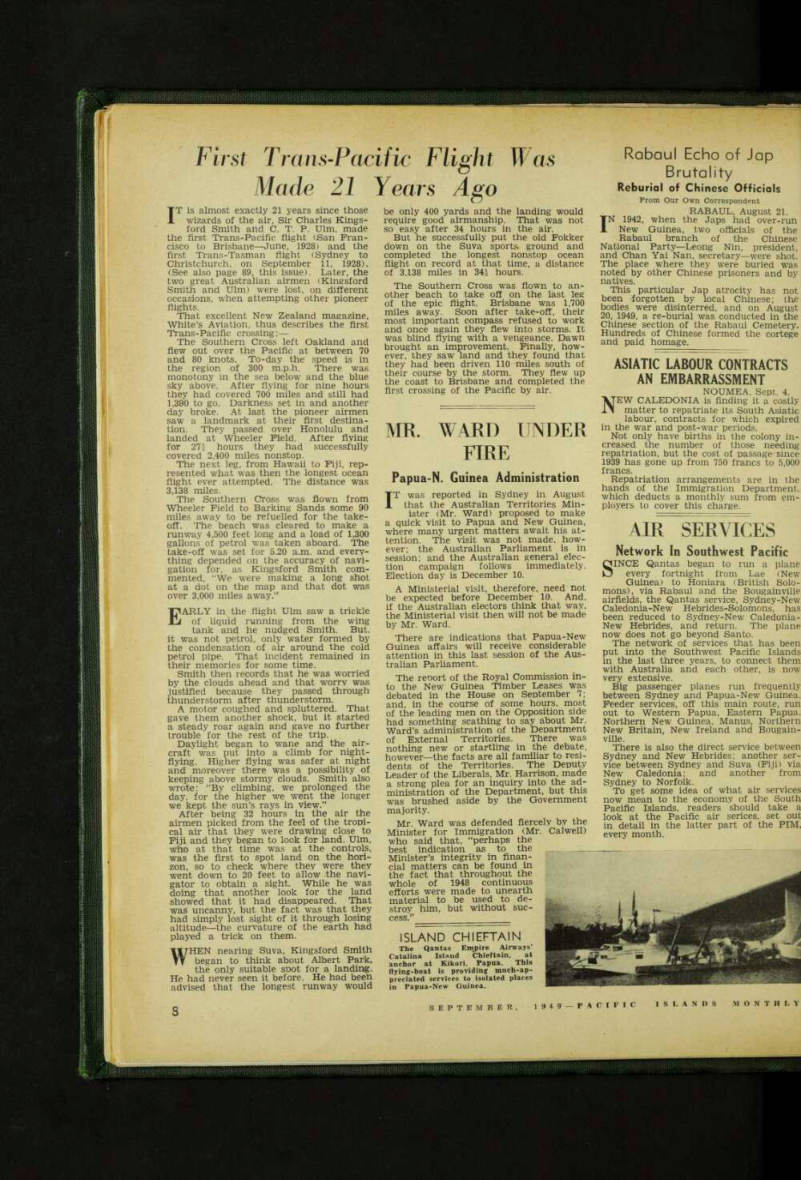
Island Chieftain
The Qantas Empire Airways’
Catalina Island Chieftain. at anchor at Kikori, Papua. This flying-boat is providing much-ap preciated services to isolated places in Papua-New Guinea.
Brutality
Rabaul Echo of Jap Brutality Reburial of Chinese Officials
Prom Our Own Correspondent RABAUL, August 21.
IN 1942, when the Japs had over-run New Guinea, two officials of the Rabaul branch of the Chinese National Party—Leong Nin, president, and Chan Yai Nan, secretary—were shot.
The place where they were buried was noted by other Chinese prisoners and by natives.
This particular Jap atrocity has not been forgotten by local Chinese; the bodies were disinterred, and on August 20, 1949, a re-burial was conducted in the Chinese section of the Rabaul Cemetery.
Hundreds of Chinese formed the cortege and paid homage.
An Embarrassment
Asiatic Labour Contracts
Noumea, Sept. 4.
NEW CALEDONIA is finding it a costly matter to repatriate its South Asiatic labour, contracts for which expired in the war and post-war periods.
Not only have births in the colony in creased the number of those needing repatriation, but the cost of passage since 1939 has gone up from 750 francs to 5,000 francs.
Repatriation arrangements are in the hands of the Immigration Department, which deducts a monthly sum from em ployers to cover this charge.
Air Services
Network In Southwest Pacific
SINCE Qantas began to run a plane every fortnight from Lae (New Guinea) to Honiara (British Solo mons), via Rabaul and the Bougainville airfields, the Qantas service, Sydney-New Caledonia-New Hebrides-Solomons, has been reduced to Sydney-New Caledonia- New Hebrides, and return. The plane now does not go beyond Santo.
The network of services that has been put into the Southwest Pacific Islands in the last three years, to connect them with Australia and each other, is now very extensive.
Big passenger planes run frequently between Sydney and Papua-New Guinea.
Feeder services, off this main route, run out to Western Papua, Eastern Papua, Northern New Guinea, Manus, Northern New Britain, New Ireland and Bougain ville, There is also the direct service between Sydney and New Hebrides; another ser vice between Sydney and Suva (Fiji) via New Caledonia; and another from Sydney to Norfolk.
To get some idea of what air services now mean to the economy of the South Pacific Islands, readers should take a look at the Pacific air serices, set out in detail in the latter part of the PIM, every month.
Chinese Returned To NG
By Mr. Calwell
IN a special chartered plane, Mr. Cal well’s Department of Immigration sent nine Chinese from Australia back to New Guinea on August 28. Aus tralian newspapers said that the charter of the plane was arranged “secretly.”
All of the Chinese had gone to Aus tralia in 1942 as evacuees: all had gone into business or had taken jobs there and did not want to leave. However, they said that they bore no grudge against the Australian authorities and were returning to New Guinea “because they did not want any trouble.”
Plans had been made by Australian Im migration Department to fly a number of other Chinese to Hong Kong. However, an injunction restraining the Government from deporting them was obtained and a decision of the High Court is now awaited.
Legal opinion is uncertain as to whether the Chinese who have been sent back to New Guinea would be able to return to Australia if the High Court upholds the appeal against deportation.
Meanwhile, the Chinese-deportations war between Mr. Calwell and Australian newspapers continues. Mr. Calwell says that these men are “scum—who are living in the filthiest slum conditions”: that most of them were deserters from shins which had called at Australian ports during the war, and that therefore they were traitors.
Australian newspapers (who do not like Mr. Calwell, anyway) describe them as upstanding citizens.
Chinese Needed in NG
From Our Own Correspondent
Port Moresby, Sept. 1.
/CHINESE communities in New Guinea \j are preparing to receive 335 of their countrymen whom the Australian Government intends .to leturn to New Guinea under the Wartime Refugees Re moval Act.
Nine Chinese—the first batch to be re turned—arrived at Lae on August 29 in a Government-chartered Qantas plane. Un til the confusion in Australia over the de portations is sorted out, the a’rival date of the remaining Chinese will be inde finite.
District Officers have been asked to ar range accommodation for the Chinese and to help them as much as possible. The Administration’s view is that the Chinese will have no trouble getting jobs as most of the men are skilled tradesmen.
Night Air Service From
Nz To Fiji
THE first regular night air service to be operated by a New Zealand airline will commence in mid-September (see Plane and Shipping Timetables, this issue) with the NZ-NAC flying-boat ser vice between Auckland and Suva, Fiji.
Phnes will leave Auckland every Thursday night at 10.30 p.m. and arrive m Suva a little after seven the following [Homing. It is hoped that this will re leve pressure on Suva hotel accommoda tion by allowing passengers for country listricts to reach home the same day.
The return journey from Fiji will >tart at 11.30 p.m. on Sundays and arrive m Auckland at 8.15 next morning.
Mr. W. E. J. Donovan, Fiji Assistant Accountant General, has returned to the colony from Australia, where he has been in leave.
Military Training for Fiji
THREE months’ continuous training for batches of 40 men drawn from terri torials is proposed in a bill which the Fiji Legislative Council will consider soon. Some New Zealand Regular Force officers and instructors have already ar rived in Fiji on loan.
The intake of men for training is restricted to 40 because of limited ac commodation. It is proposed to restrict groups to men from the same locality and of the same race.
The manning of defences for Suva is to have priority, and first recruits will be enlisted there.
The Governor of Fiji has appealed to employers to co-operate by granting men leave and keeping employment open until the training period ends.
Auckland Star.
Trobriands Photos
A FINE series of photographs depicting native life in the Trobriand Islands is being shown during September by Kodak, Ltd., 379 George St., Sydney.
These photographs were made by an Aus tralian Department of Information photo grapher, and represent portion of the official photographic record made during the recent Nutritional Survey jointly organised by the New Guinea admihistra tion and The Institute of Anatomy, Can berra.
4,000 Barrels per Day
Oil From Dutch New
Guinea
IT was stated by a Shell Company official in Melbourne, on August 23, that 4,000 barrels of oil a day were being produced from the Klamono field, Dutch New Guinea.
This field was discovered and proved early in the war period, but it was not developed until after the war. The first shipment of crude oil from the Klamono field was sent to Java for refining last December.
It is this important fact which has en couraged Australian interests to believe that oil will be similarly discovered in Papua, in the South-East section of New Guinea, 500 miles east of Klamono. £4,000,000 already has been spent on the Papuan search—see article elsewhere in this issue.
Fiji Taro Disease Under Control
THE dalo (taro) disease which appeared near Suva, Fiji about two months ago appeared to be completely un der control in early September.
It has not spread in the area where it was first discovered and no reports have been received of its appearance elsewhere.
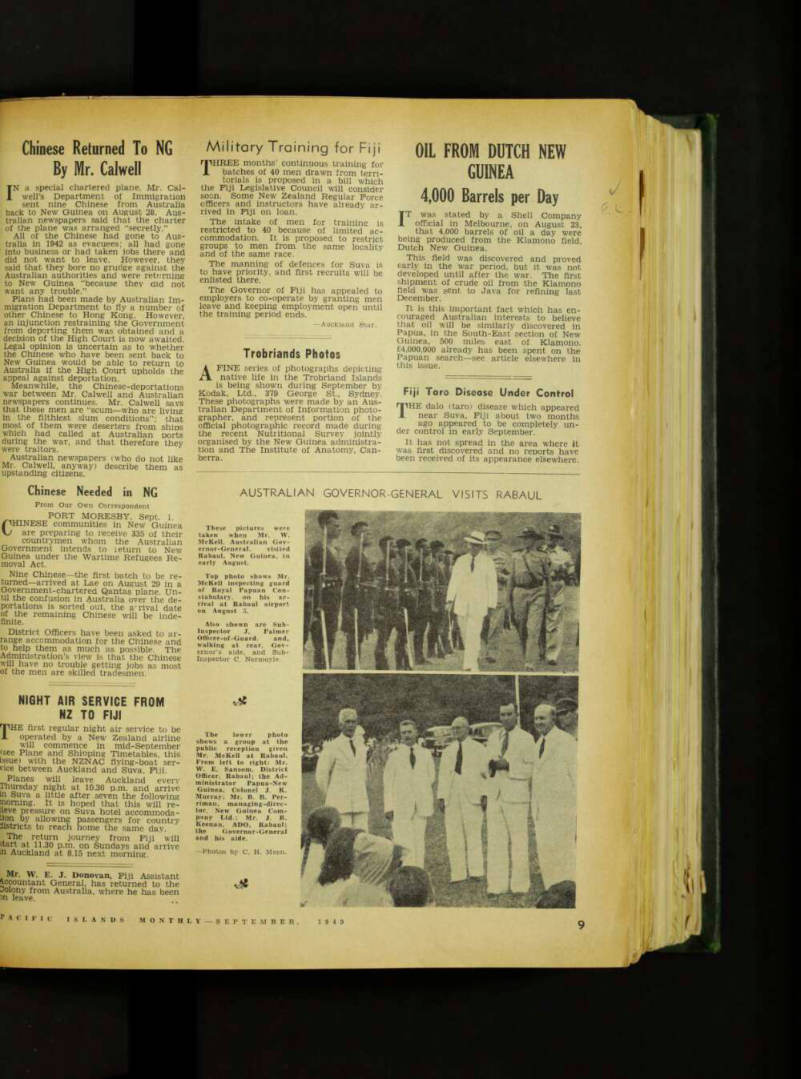
Australian Governor-General Visits Rabaul
These pictures were taken when Mr. W.
McKell. Australian Gov ernor-General, visited Rabaul, New Guinea, in early August.
Top photo shows Mr.
McKell inspecting guard of Royal Papuan Con stabulary, on his ar rival at Rabaul airport on August 5.
Also shown are Sub- Inspector J. Palmer Officer-of-Guard, and, walking at rear, Gov ernor’s aide, and Sub- Inspector C. Normoyle.
The lower photo show's a group at the public reception given Mr. McKell at Rabaul.
From left to right: Mr.
W. E. Sansom, District Officer, Rabaul; the Ad ministrator Papua-New Guinea, Colonel J. K.
Murray; Mr. B. B. Per riman, managing-direc tor, New Guinea Com pany Ltd.; Mr. J. R.
Keenan, ADO, Rabaul; the Governor-General and his aide. —Photos by C. H. Meen.
This, too, is Suva
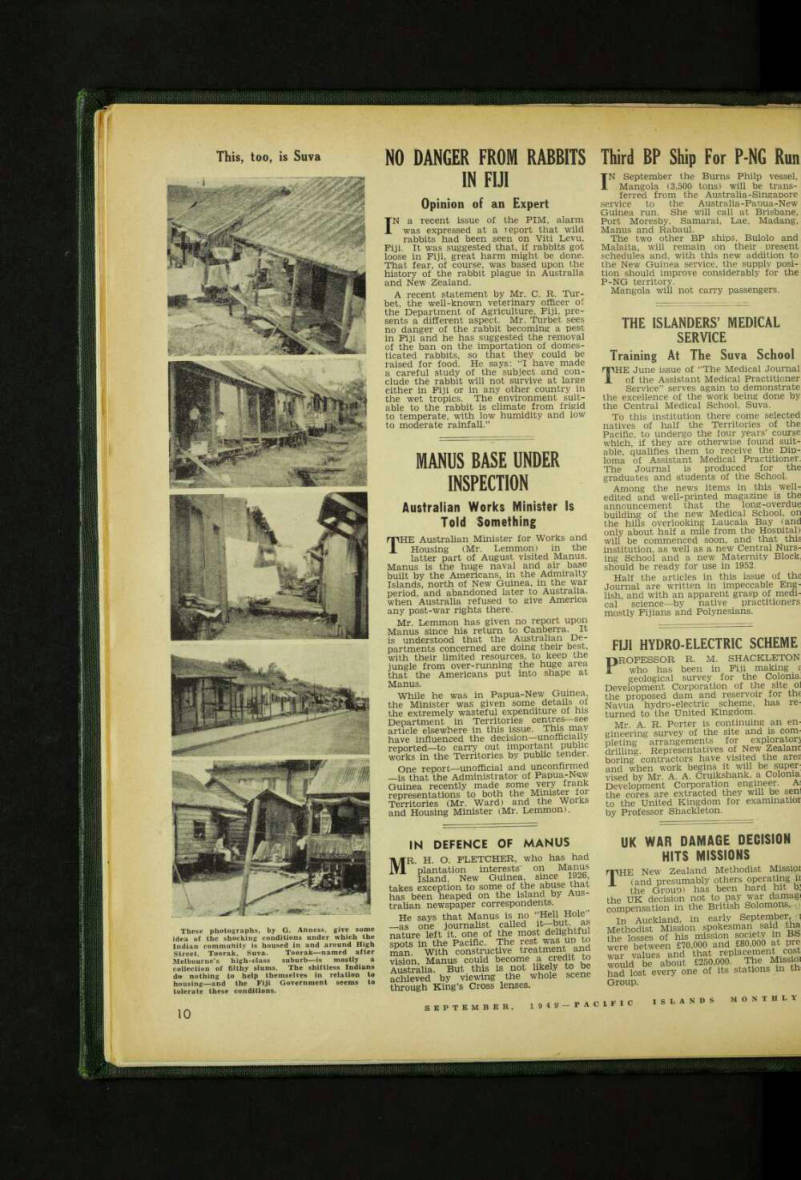
These photographs, by G. Anness, give some idea of the shocking conditions under which the Indian community is housed in and around High Street, Toorak, Suva. Toorak —named after Melbourne’s high-class suburb —is mostly a collection of filthy slums. The shiftless Indians do nothing to help themselves in relation to housing—and the Fiji Government seems to tolerate these conditions.
No Danger From Rabbits
In Fiji
Opinion of an Expert
IN a recent issue of the PIM, alarm was expressed at a report that wild rabbits had been seen on Viti Levu, Fiji. It was suggested that, if rabbits got loose in Fiji, great harm might be done.
That fear, of course, was based upon the history of the rabbit plague in Australia and New Zealand.
A recent statement by Mr. C. R. Tur bet, the well-known veterinary officer of the Department of Agriculture, Fiji, pre sents a different aspect. Mr. Turbet sees no danger of the rabbit becoming a pest in Fiji and he has suggested the removal of the ban on the importation of domes ticated rabbits, so that they could be raised for food. He says: “I have made a careful study of the subject and con clude the rabbit will not survive at large either in Fiji or in any other country in the wet tropics. The environment suit able to the rabbit is climate from frigid to temperate, with low humidity and low to moderate rainfall.”
Inspection
Manus Base Under
Australian Works Minister Is Told Something
THE Australian Minister for Works and Housing (Mr. Lemmon) in the latter part of August visited Manus.
Manus is the huge naval and air base built by the Americans, in the Admiralty Islands, north of New Guinea, in the war period, and abandoned later to Australia, when Australia refused to give America any post-war rights there.
Mr. Lemmon has given no report upon Manus since his return to Canberra. It is understood that the Australian De partments concerned are doing their best, with their limited resources, to keep the jungle from over-running the huge area that the Americans put into shape at Manus.
While he was in Papua-New Guinea, the Minister was given some details of the extremely wasteful expenditure of his Department in Territories centres—see article elsewhere in this issue. This may have influenced the decision —unofficially reported—to carry out important public works in the Territories by public tender.
One report—unofficial and unconfirmed —is that the Administrator of Guinea recently made some very frank representations to both the Munster for Territories (Mr. Ward) and the Works and Housing Minister (Mr. Lemmon).
In Defence Of Manus
MR. H. O. FLETCHER, who has had plantation interests' on Manus Island, New Guinea, since 192 b, takes exception to some of the abuse that has been heaped on the island by Aus tralian newspaper correspondents.
He says that Manus is no “Hell Hole” —as one journalist called but, as nature left it, one of the most delightful spots in the Pacific. The rest was up to man. With constructive treatment and vision, Manus could become a credit to Australia. But this is not likely to be achieved by viewing the whole scene through King’s Cross lenses.
Third BP Ship For P-NG Run
IN September the Burns Philp vessel, Mangola (3,500 tons) will be trans ferred from the Australia-Singapore service to the Australia-Papua-New Guinea run. She will call at Brisbane, Port Moresby, Samarai, Lae, Madang, Manus and Rabaul.
The two other BP ships, Bulolo and Malaita, will remain on their present schedules and, with this new addition to the New Guinea service, the supply posi tion should improve considerably for the P-NG territory.
Mangola will not carry passengers.
The Islanders’ Medical
Service
Training At The Suva School
THE June issue of “The Medical Journal of the Assistant Medical Practitioner Service” serves again to demonstrate the excellence of the work being done by the Central Medical School. Suva.
To this institution there come selected natives of half the Territories of the Pacific, to undergo the four years’ course which, if they are otherwise found suit able, qualifies them to receive the Dip loma of Assistant Medical Practitioner.
The Journal is produced for the graduates and students of the School.
Among the news items in this well edited and well-printed magazine is the announcement that the long-overdue building of the new Medical School, on the hills overlooking Laucala Bay (and only about half a mile from the Hospital) will be commenced soon, and that this institution, as well as a new Central Nurs ing School and a new Maternity Block, should be ready for use in 1952.
Half the articles in this issue of the Journal are written in impeccable Eng lish, and with an apparent grasp of medi cal science—by native practitioners, mostly Fijians and Polynesians.
Fiji Hydro-Electric Scheme
Professor R. M. Shackleton,
who has been in Fiji making a geological survey for the Colonial Development Corporation of the site oi the proposed dam and reservoir for the Navua hydro-electric scheme, has re turned to the United Kingdom.
Mr. A. R. Porter is continuing an en gineering survey of the site and is com pleting arrangements for exploratory drilling. Representatives of New Zealand boring contractors have visited the area and when work begins it will be super vised by Mr. A. A. Cruikshank, a Colonial Development Corporation engineer. As the cores are extracted they will be sem to the United Kingdom for exammatior by Professor Shackleton.
Hits Missions
Uk War Damage Decision
THE New Zealand Methodist Missipr (and presumably others operating ir the Grouo) has been hard hit bj the UK decision not to pay war damage compensation in the British Solomons, In Auckland, in early September, * Methodist Mission spokesman said tna thp losses of his mission society in 80. were between £70,000 and £BO,OOO at pre' war values and that replacement cost! would be about £250,000. The Missioi had lost every one of its stations m th Group.
The Month In Moresby
Prom Our Own Correspondent
Port Moresby, Sept. 2.
A VOLUNTEER defence unit similar to the old New Guinea Volunteer Rifles may be formed in Papua-New Guinea. General Nimmo, GOC Northern Command, has been visiting the Terri tory to prepare the way for Major Hobbs, of Northern Command, who will organise the unit. Major Hobbs will address ex- AMF members at the Moresby RSL Club on September 8, as one of the first steps towards forming the unit. Port Moresby RSL is also urging the formation of a squadron of the Citizen Air Force in the Territory. ♦ ♦ * THE Minister for Works and Housing, Mr. Lemmon, visited Manus during August and before returning to Aus tralia reassured the Administration that it would have first call on wartime build ings on the island. There were 1,000 steel framed and galvanised iron build ings to be dismantled at Manus, he sa He didn’t say anything, however, about the slowness of the salvage work there. * ♦ * SECRETARY General of the South Pacific Commission, Mr. W. D. For syth, is due to arrive in the Terri tory on a two or three weeks visit early in September. It is expected that he will attend some sessions of the District Officers’ conference, which starts at Moresby on September 14. The confer ence will discuss “general problems of the Administration.” ♦ ♦ * THE reaction of the Port Moresby firm of G. G. Smith & Co., to price con trol is to cease bread production in protest against the recent price drop.
The Deputy Prices Commissioner cut the price of a 2 lb. loaf from 1/4 to I/Oh, then raised it to 1/1. Steamships Trad ing Coy accepted the new price, but G.
G. Smith & Co. claims that it could not make a profit at this price. The Deputy Prices Commissioner claims that there is a good profit margin.
In principle, residents are backing the Prices Commissioner but bread is now in such short supply that they wonder whether it isn’t better to get bread at high prices than to get none at all. * * ♦
BISIANUMU plantation, near Sogeri,
is being turned into a livestock in troduction and breeding station and a rubber research station. The Admini stration recently bought the property from the Armstrongs and will use the rattle already there as a basis for its livestock activities.
Rubber budwood from Ceylon will be propogated on the station and distributed to planters in order to raise the quality and yield of their trees. ♦ * * HMAS Australia’s flag-showing cruise in Papua-New Guinea waters looks like being a dull one for the crew.
Measles and mumps have broken out on the ship and unless they clear up quickly the crew will be confined aboard for the entire cruise. Social activities planned oy Moresby folk to entertain them had t? be cancelled and if the Administra tion had not organised trips out to the ship on the Laurabada, residents would riot have even seen the crew, As it was, they were only able to circle the ship and wave.
THREE Europeans were fined heavily in the Moresby Court of Petty Sessions recently for supplying liquor to natives. Reahio William Taylor, of Stubbs’ Construction Company was fined £2O; Edward Biddle, of the Edu cation Department, was fined £25; and Hugh Clark Kennedy, of Works and Housing Department was fined £4O. Most people agree that this type of offence deserves strong punishment; but the Administration suspended Biddle, although Kennedy is still with the Department of Works and Housing. Apparently the Commonwealth is more forgiving than the Administration. ♦ ♦ * TENDERS are being called for the supply of fresh vegetables and fruit to the Administration in the Port Moresby area. The contract will be for two years from December 1, 1949, and tenders close on September 30. * * * ANEW, important-sounding post—that of Secretary for Planning and De velopment—has been created in the Administration and the Director of District Services, Mr. J. H. Jones, has got the job, on an acting basis. Mr. I.
F. Champion becomes Acting Director of District Services. Creation of the new position was recommended by the Com monwealth classification officers, Archer and Bland. One thing the Administra tion is not short of is plans, so Mr. Jones should be kept very busy. ♦ ♦ ♦ OFFICER in charge of Jackson’s Strip, Mr. Kelly, is being transferred to Madang as OIC of the Civil Aviation station there. Mr. Steve Hutch inson, formerly acting OIC, Madang, will return to Moresby. ♦ • * MR. LESTER SIMS, who successfully produced the three-act play, “Night of January 16th,” in Moresby, some months ago, is now working on Noel Coward’s “Private Lives.” In the cast are George Bardsley and Warren Steele, who both did well in the first production, with Tina Wright, Leila Steege and Dallas Baldwin. The show will be staged at the Papuan Theatre on October 18, 21 and 25 and proceeds, once again, will go to the Red Cross. * * *
Miss Nora Houston And Mr. Fred
Werrin, both of APC, are due to leave Moresby soon for Melbourne, where they will be married on October 1.
The bride’s uncle, the Reverend A. S.
Houston, Moderator of the Presbyterian Church in Victoria, will perform th,e ceremony. The couple will be return ing to Port Moresby to live. ♦ ♦ * AMONG those who left Moresby for Australia on the last “Bulolo” were Mr. and Mrs. C. J. Olsson, Mr. G.
Loudon, Mr. and Mrs. F. Edwards, Mrs.
C. G. Oneile, Mr. G. Hogarty, Mrs. A.
Parnell, Mr. and Mrs. J. Evans and Mr. and Mrs. D. Wilmott. * * * HIDDEN local talent was revealed at the Arts and Crafts Exhibition held by the Port Moresby RSL on August 19 and 20. The walls of the RSL Club were covered with paintings, drawings, photographs, etc., and the Club itself was crowded with people on both nights of the exhibition. Nearly £2OO was raised
to help RSL members who need financial assistance to give their children secondary education in Australia. A competition which created much interest was for a design for a Papua and New Guinea postage stamp. The winner was Miss Muriel McGowan. Her design and those of other entrants will be considered by the authorities for use when the Territory starts issuing its own stamps again. * * * DESPITE protests that “it’s too hot” and “the ground’s too hard,” Rugby League football has got under way in Moresby. Only two teams, Paga Hill and the Magani’s, have been formed so far but others are expected to be organ ised. A trip to Wau is being discussed at the moment. Officials of the Football Association are Mr. R. E. Grout (Presi dent), Mr. F. S. Lawn (Secretary), and Mr. Buckley (Treasurer).
Sudden Death Of Well-Known
Tahiti Girl
Papeete. July 30.
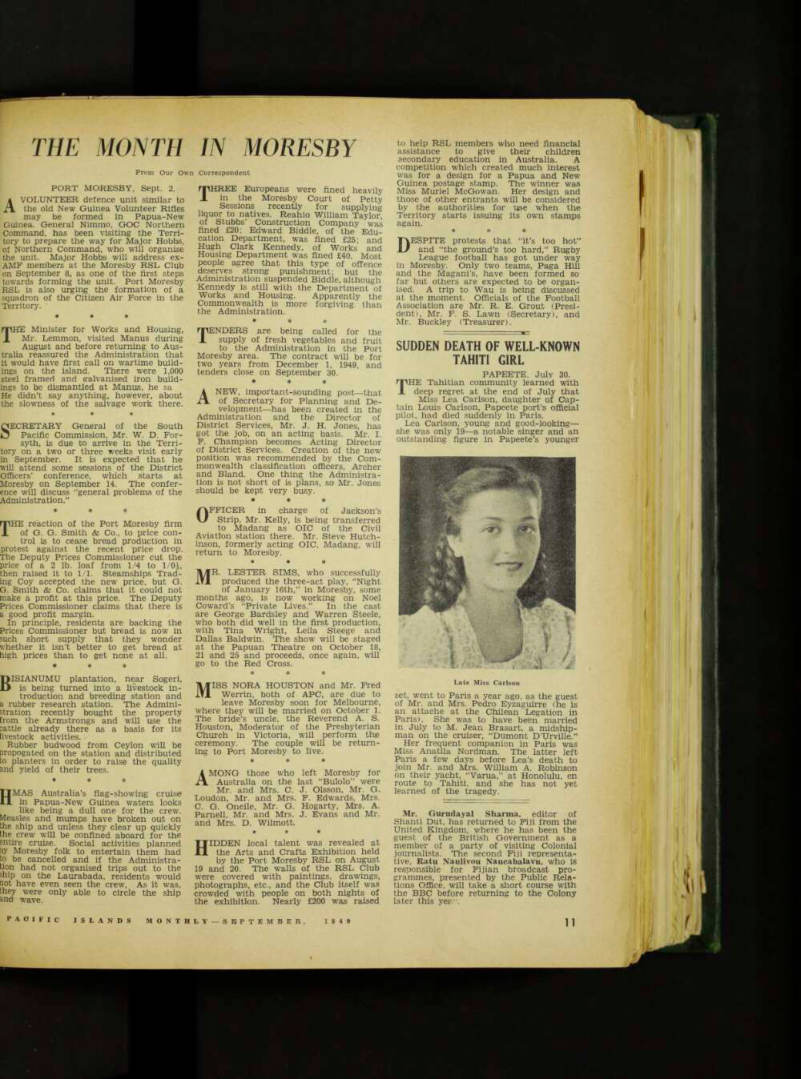
THE Tahitian community learned with deep regret at the end of July that Miss Lea Carlson, daughter of Cap tain Louis Carlson, Papeete port’s official pilot, had died suddenly in Paris, Lea Carlson, young and good-looking— she was only 19 —a notable singer and an outstanding figure in Papeete’s younger
Mr. Gurudayal Sharma, editor of Shanti Dut, has returned to Fiji from the United Kingdom, where he has been the guest of the British Government as a member of a party of visiting Colonial journalists. The second Fiji representa tive, Ratu Naulivou Naucabaiavu, who is responsible for Fijian broadcast pro grammes, presented by the Public Rela tions Office, will take a short course with the BBC before returning to the Colony later this ye?;-.
Late Miss Carlson set, went to Paris a year ago, as the guest of Mr. and Mrs. Pedro Eyzaguirre (he is an attache at the Chilean Legation in Paris). She was to have been married in July to M. Jean Brasart, a midship man on the cruiser, “Dumont D’Urville.”
Her frequent companion in Paris was Miss Anatila Nordman. The latter left Paris a few days before Lea’s death to join Mr. and Mrs. William A. Robinson on their yacht, “Varua,” at Honolulu, en route to Tahiti, and she has not yet learned of the tragedy.
Advertisements & other items, p. 14 (1 item)
Morris Hedstrom Limited
General Merchants, Importers and Exporters,
Shipowners, Plantation Owners,
Commission and Insurance Agents
HEAD OFFICE
SUVA, FIJI
Established 1868
SERVICE IN THE SOUTH PACIFIC TERRITORIES
our Large Establishments in Suva and our Numerous Branches, we distribute a wide and comprehensive range of General Merchandise and provide almost every kind of service. Our departments and associated businesses include:
DRAPERY
MOTOR SALES
AND SERVICE
TOBACCO
TIMBER AND
BUILDING
GROCERY
CONFECTIONERY
HARDWARE
ELECTRICAL
LIQUORS
DRUGS
Branches Throughout Fiji, Samoa and Tonga
There is a Branch or Agent of Morris Hedstrom Limited in every Town in the Three Territories.
We are Sole Agents in these Territories for British Drug Houses Ltd.
Electrolux Ltd.
Ford Motor Co.
General Electric Co. Ltd.
Goodyear Tyre £r Rubber Co.
B. A. Hjorth £r Co. (Primus Products) Imperial Chemical Industries Ltd.
International Harvester Export Co.
Matson Navigation Company Max Factor and Co. Inc.
Ransomes, Sims £r Jefferies Ltd Ruston & Hornsby Ltd.
Vacuum Oil Co. Pty. Ltd.
Yorkshire Copper Works Ltd.
Morris Hedstrom Limited, are LLOYD'S AGENTS in Fiji and Samoa.
IN AUSTRALIA:
IN GREAT BRITAIN:
Morris Hedstrom (Aust.) Pty. Ltd.,
Asbestos House, 65 York Street, SYDNEY
Morris Hedstrom Limited,
Africa House, Kingsway, LONDON
An ‘Annexation’ That Britain
Repudiated
Chester Incident in Port Moresby in 1883
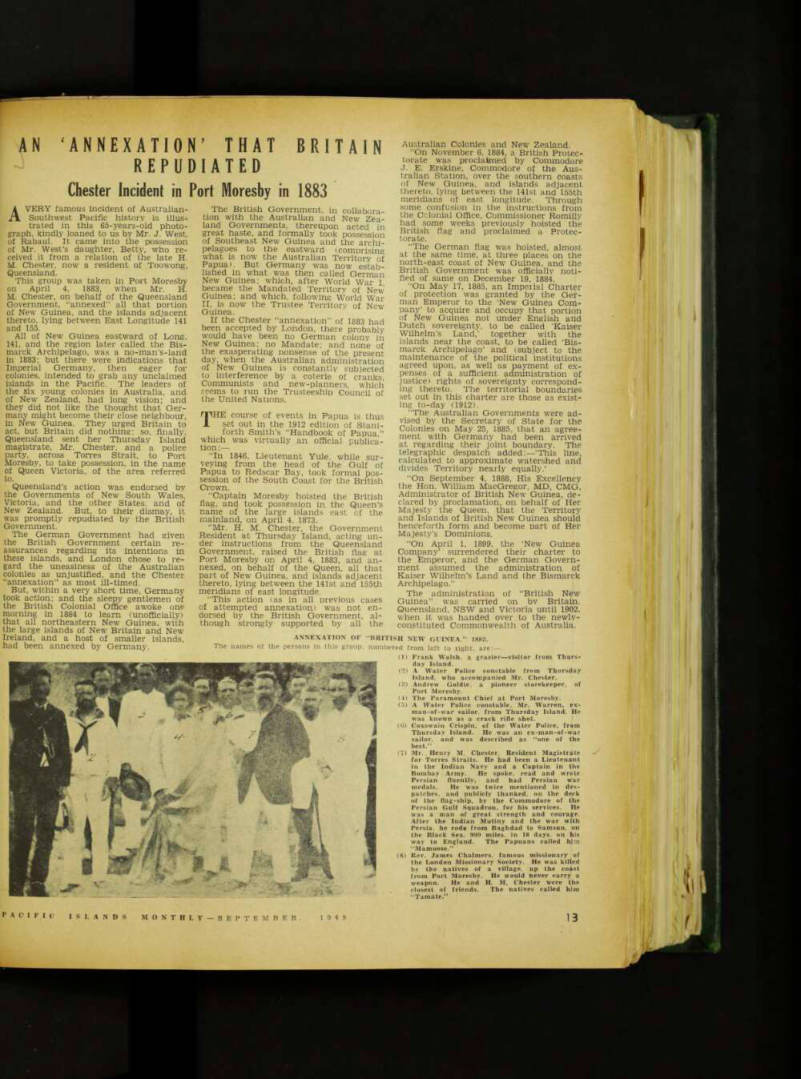
AVERY famous incident of Australian- Southwest Pacific history is illus trated in this 65-years-old photo graph, kindly loaned to us by Mr. J. West, of Rabaul. It came into the possession of Mr. West’s daughter, Betty, who re ceived it from a relation of the late H.
M. Chester, now a resident of Toowong, Queensland.
This group was taken in Port Moresby on April 4, 1883, when Mr. H.
M. Chester, on behalf of the Queensland Government, “annexed” all that portion of New Guinea, and the islands adjacent thereto, lying between East Longitude 141 and 155.
All of New Guinea eastward of Long. 141, and the region later called the Bis marck Archipelago, was a no-man’s-land in 1883; but there were indications that Imperial Germany, then eager for colonies, intended to grab any unclaimed islands in the Pacific. The leaders of the six young colonies in Australia, and of New Zealand, had long vision; and they did not like the thought that Ger many might become their close neighbour, in New Guinea. They urged Britain to act, but Britain did nothing: so, finally, Queensland sent her Thursday Island magistrate, Mr. Chester, and a police party, across Torres Strait, to Port Moresby, to take possession, in the name of Queen Victoria, of the area referred to.
Queensland’s action was endorsed by the Governments of New South Wales, Victoria, and the other States, and of New Zealand. But, to their dismay, it was promptly repudiated by the British Government.
The German Government had given the British Government certain re assurances regarding its intentions in these islands, and London chose to re gard the uneasiness of the Australian colonies as unjustified, and the Chester “annexation” as most ill-timed.
But, within a very short time, Germany took action; and the sleepy gentlemen of the British Colonial Office awoke one morning in 1884 to learn (unofficially) that all northeastern New Guinea, with the large islands of New Britain and New Ireland, and a host of smaller islands, had been annexed by Germany.
The British Government, in collabora tion with the Australian and New Zea land Governments, thereupon acted in great haste, and formally took possession of Southeast New Guinea and the archi pelagoes to the eastward (comprising what is now the Australian Territory of Papua). But Germany was now estab lished in what was then called German New Guinea: which, after World War I became the Mandated Territory of New Guinea; and which, following World War 11, is now the Trustee Territory of New Guinea.
If the Chester “annexation” of 1883 had been accepted by London, there probably would have been no German colony in New Guinea; no Mandate: and none of the exasperating nonsense of the present day, when the Australian administration of New Guinea is constantly subjected to interference by a coterie of cranks Communists and new-planners, which seems to run the Trusteeship Council of the United Nations.
THE course of events in Papua is thus set out in the 1912 edition of Stani forth Smith’s “Handbook of Papua,” which was virtually an official publica tion:— “In 1846, Lieutenant Yule, while sur veying from the head of the Gulf of Papua to Redscar Bay, took formal pos session of the South Coast for the British Crown.
“Captain Moresby hoisted the British flag, and took possession in the Queen’s name of the large islands east of the mainland, on April 4, 1873.
“Mr. H. M. Chester, the Government Resident at Thursday Island, acting un der instructions from the Queensland Government, raised the British flag at Port Moresby on April 4, 1883, and an nexed, on behalf of the Queen, all that part of New Guinea, and islands adjacent thereto, lying between the 141st and 155th meridians of east longitude.
“This action (as in all previous cases of attempted annexation) was not en dorsed by the British Government, al though strongly supported by all the
Australian Colonies and New Zealand.
"On November 6, 1884, a British Protec torate was proclaimed by Commodore J. E. Erskine, Commodore of the Aus tralian Station, over the southern coasts of New Guinea, and islands adjacent thereto, lying between the 141st and 155th meridians of east longitude. Through some confusion in the instructions from the Colonial Office, Commissioner Romilly had some weeks previously hoisted the British flag and proclaimed a Protec torate.
“The German flag was hoisted, almost at the same time, at three places on the north-east coast of New Guinea, and the British Government was officially noti fied of same on December 19, 1884.
“On May 17, 1885, an Imperial Charter of protection was granted by the Ger man Emperor to the ‘New Guinea Com pany’ to acquire and occupy that portion of New Guinea not under English and Dutch sovereignty, to be called ‘Kaiser Wilhelm’s Land,’ together with the islands near the coast, to be called ‘Bis marck Archipelago’ and (subject to the maintenance of the political institutions agreed upon, as well as payment of ex penses of a sufficient administration of justice) rights of sovereignty correspond ing thereto. The territorial boundaries set out in this charter are those as exist ing to-day (1912).
“The Australian Governments were ad vised by the Secretary of State for the Colonies on May 25, 1885, that an agree ment with Germany had been arrived at regarding their joint boundary. The telegraphic despatch added:—‘This line, calculated to approximate watershed and divides Territory nearly equally.’
“On September 4, 1888, His Excellency the Hon. William MacGregor, MD, CMG, Administrator of British New Guinea, de clared by proclamation, on behalf of Her Majesty the Queen, that the Territory and Islands of British New Guinea should henceforth form and become part of Her Majesty’s Dominions.
“On April 1, 1899, the ‘New Guinea Company’ surrendered their charter to the Emperor, and the German Govern ment assumed the administration of Kaiser Wilhelm’s Land and the Bismarck Archipelago.”
The administration of “British New Guinea” was carried on bv Britain, Queensland. NSW and Victoria until 1902. when it was handed over to the newlv constituted Commonwealth of Australia.
Annexation Of “British New Guinea,” 1883.
The names of the persons in this group, numbered from left to right, are:—
(1) Frank Walsh, a grazier—visitor from Thurs day Island. (2) A Water Police constable from Thursday Island, who accompanied Mr. Chester. (3) Andrew Goldie, a pioneer storekeeper, of Port Moresby. (4) The Paramount Chief at Port Moresby. (5) A Water Police constable, Mr. Warren, ex man-of-war sailor, from Thursday Island. He was known as a crack rifle shot. (6) Coxswain Crispin, of the Water Police, from Thursday Island. He was an ex-man-of-war sailor, and was described as “one of the best.” (7) Mr. Henry M. Chester. Resident Magistrate for Torres Straits. He had been a Lieutenant in the Indian Navy and a Captain in the Bombay Army. He spoke, read and wrote Persian fluently, and had Persian war medals. He was twice mentioned in des patches. and publicly thanked, on the deck of the flag-ship, by the Commodore of the Persian Gulf Squadron, for his services. He was a man of great strength and courage.
After the Indian Mutiny and the war with Persia, he rode from Baghdad to Samsun, on the Black Sea, 999 miles, in 18 days, on his way to England. The Papuans called him “Mamoose.” (8) Rev. James Chalmers, famous missionary of the London Missionary Society. He was killed by the natives of a village, up the coist from Port Moresby. He would never carry a weapon. He and H. M. Chester were the closest of friends. The natives called him “Tamate.”
Advertisements & other items, p. 16 (2 items)
14
SEPTEMBER, 1945-PACIFIC ISLANDS MONIHL
LONDON by Clipper
When you fiy to
❖ until EJ I i a?
UUUi
91 P re» Vt
You enjoy all these extras!
• You fly to Hawaii in Pan American’s exclusive Sleeperette* Clippers. You enjoy lounge chair ease by day . . . bed-length comfort by night.
From Hawaii to San Francisco or Los Angeles you can fly in new double-decked “America”-class Clippers — world’s largest, fastest airliners. Connecting airlines give you a choice of scenic routes across the U.S. to New York, where you board the “America”-class Clipper for London.
You enjoy delicious meals ... traditional Clipper service all the way. For fares and reservations, call your Travel Agent or SWA: Bank of A KS.W.Bldg. (Tel. 664)
NOUMEA; Rue Jean Jaures (Tel. 85)
Swift engine
Clipper
Service from Sydn Noum ey via ea Fil Honolulu
Pam American World Alrways
WORLD'S MOST EXPERIENCED AIRLINE
Pan American Airways, Inc., Ltd., Incorporated in U.S.A. ♦Trade Marks, Pan American Airways, Inc.
Teal Loses £A4,000
Per Week
Mounting Losses of Government owned Airlines Need Investi gation
FIGURES released in New Zeland show that Tasman Empire Airways Limited, for the year ending March 31, 1949, lost £NZ 170,000. TEA is owned by the governments of New Zealand (50 per cent.); Australia (30 per cent.); and United Kingdom (20 per cent). This means that NZ taxpayers must make good £85,000; UK taxpayers, £34,000; and Australian taxpayers, £51,000 stg.—or £63,750 in their own currency.
Another interesting indication of huge losses achieved by government-controlled airlines is the announcement that NZ will have to find £48,000 towards the losses of British Commonwealth Pacific Airlines and £21,000 to offset the deficit in New Zealand National Airways Cor porations’ Pacific regional services.
These figures saw the light of day through the New Zealand Auditor- General’s annual report to Parliament. So far there has been no emulation of this engaging frankness on the other side of the Tasman. Mr. Chifley believes that the less the Australian taxpayer knows about how his contribution to the Treasury is spent, the happier he will be.
Australia’s airways commitments are far greater than New Zealand’s and its losses must, therefore, be far greater. As well as a share in TEA and BCPA. Aus tralia owns Qantas Empire Airways and Trans-Australia-Airlines. Qantas was acquired by the Australian Government in 1948; TAA was the Government’s an swer to a decision of the Australian High Court that it could not nationalise exist ing airline companies. TAA has been in operation for about three years and is said to be still losing money, in spite of every effort of the Government to bolster it.
Government-owned airways can serve two purposes—to guarantee an efficient service to the people at low cost; and to pioneer new fields that are outside the scope of a private company. Government airways give efficient service to passen gers but far from lowering fares, they keep them fixed at a high level once they have gained a monopoly.
In respect of the second purpose, it can be said that the Australian government, with Qantas’ Island services, and the NZNAC, with its Pacific regional airways services, have fulfilled this purpose ad mirably. This is particularly so of Qantas who have linked Sydney with even the remotest parts of the terri tories and islands of the South-west Pacific, running regular services that would have little interest to private operators.
If these services cost the taxpayer
money, then it is a justifiable expense— not only because it brings the world to the isolated people of the Island terri tories, but because it maintains a vital link between Australia, or New Zealand, and their rich island outposts.
BUT there is no pioneering entailed by TEA in running (without competi tion) the 1,300 miles between Sydney and Auckland and the loss of large sums on this route are unlikely to please either New Zealand or Australian
taxpayers. If TEA slides so badly into red ink at this stage, then it seems that it will always be a liability and drastic remedies are indicated. Prom the beginning of the Pacific war until 1948 there were no ships on the regular Australia- New Zealand run. For those years TEA had a monopoly of all transport across the Tasman. In the last 12 months since two ships came back to the Tasman
service, it has continued to have a mono poly of the air route. Not even BCPA, which is owned by the same governments, has been permitted to break into this close preserve.
This has created the ridiculous situa tion of putting New Zealand out at the end of a blind alley as far as the trans- Pacific route is concerned, instead of permitting Auckland to take its right
place on the natural circuit between North American, the Pacific Islands, and Australasia.
SOME time ago, in PIM, we compared the high fares charged by TEA with the low fares charged on internal airlines in Australia. In an effort to jus tify this difference in fares, the NZ journal, Whites Aviation, in its August issue, gave a number of reasons, some of them sound enough, but compared the charge of 3.4 d. per mile, Melbourne to Townsville, made by Australian companies with the charge per mile across the Tas man—which they stated was 4,506 d. per mile. The Tasman fare, however, was calculated in NZ currency; the Mel bourne-Townsville fare in Australian currency. In other words, an Australian can fly from Melbourne to Townsville, a distance of 1,600 miles, for £23/12/6 (3.4 d. per mile); but if he wishes to fly from Sydney to Auckland, which is only 1,300 miles, he must pay £A3S for a single fare or £A63 return (5.6 d. per mile for the return journey).
Furthermore, consider that, in August, 1948, the fare from Sydney to Auckland was only £2B in Australian currency.
Then the NZ- £ went to parity with sterling—a move that was designed tc assist New Zealanders. The fare for the trans-Tasman flight was not reduced for New Zealanders, however —it remained at £2B. But for Australians it leapt over night to its present figure—£A3s.
Some time ago a private airline opera tor in Australia offered to run a trans- Tasman service for £A2S for a single journey. Australians who care little foi the high level reasonings that permit Government monopolies, would like te see this happen, as soon as possible.
WE do not know the losses of BCPA They probably are considerable. It was stated in the Sydney Press recently that it took 200 of a staff to keer two aircraft per week on the route bet ween Sydney and Vancouver. It is un likely, anyhow, that the airline will ever make much profit for the three govern ments that own it. Whether or not il has value as a prestige-builder (oi holder), is a matter of opinion.
There is no suggestion that there is anj deficiency in the service given passenger: in these Government-owned airlines Service is 100 per cent, excellent. Bui the time seems to be coming when it wil be necessary to overhaul the whole ques tion of Government-airways’ finance The United Kingdom, in recent years, ha: lost millions in nationalised airline: operation. Australasia is fast following hei into the millionaire bracket.
To date the taxpayer has meekly paic up. Some point is given to this attitude by the cynical observation attributed t( a Sydney businessman, when discussing
government-owned, Trans-Australia-Air
lines: “We’d better patronise the b show—we have to pay for it, anyhow.”
Will he always be so forbearing?
Advertisements & other items, pp. 17-18 (1 item)
Disposals Goods Wanted
The owner of the 68 ft. auxiliary Ketch “Darnley,” ideally suited and equipped for Island trade, is prepared to consider exchanging this vessel for Army Disposals material, timber stand or logs.
See full-page advertisement of the "Darnley" on Page 101 of this issue.
BURNS PHILP (New Hebrides) LTD.
Registered Office: VILA, NEW HEBRIDES
Branch Office at SANTO
Exporters, Importers and General Merchants
(Retail and Wholesale) Commission, Shipping
and Customs Agents
Representatives for BURNS PHILP TRUST COMPANY LIMITED, QUEENS- LAND INSURANCE CO., LTD., and LLOYDS OF LONDON. Agents for SOCIETE DES PETROLES SHELL DES ILES FRANCAISES DU PACIFIQUE, and numerous overseas manufacturers of all classes of merchandise.
Sydney Agents; Burns, Phllp & Co., Ltd., 7 Bridge Street.
San Francisco Agents: Burns, Philp Co. of San Francisco, Matson Building, 215 Market Street, London Agents: Burns, Philp & Co., Ltd., 35 Crutched Friars, E.C.3.
W* I k I r* f \ A-\ 1 Bond Street, Sydney, Australia Ji \j IJ jp| \ Tel. 8U2195. Box 3615 G.P.O.
SUPPLIERS OF GENERAL MERCHANDISE TO LEADING FIRMS THROUGHOUT THE
PACIFIC ISLANDS
Exporters ... Importers Manufacturers' Representatives Bankers: Bank of N.S.W. Bank of Adelaide. Comptoir Nat, d’Escompte do Paris.
Cable Address: "SEAFOODS.” SYDNEY.
Codes; Bentley’s, 2nd and Comp. Phrase; A.8.C., sth and 6th; Peterson, 2nd and 3rd; Banking; Acme.
"IT'S NEW RIGHT THROUGH"
Built by Jowetts, of Bradford, Yorkshire.
The JOWETT “JAVELIN” Gar, English Body Work. Flat Four Engine, 75 m.p.h. 30-32 m.p.g.
ALSO
The BRADFORD 10 ewt. Lorry, Van, 6-seater Utility and Utility de Luxe. Ample Power and 40 m.p.g.
Pacific Islands Distributors : G. H. ROBINSON EXPORTS & IMPORTS PTY. LTD 51 Macquarie Street, Sydney For early deliveries Telegraph: “Sunrise, Sydney.”
The Most Extensive Manufacturers in the British Empire of
RUBBER STAMPS,
INKS, STENCILS,
Marking Devices,
ACME STAMP PADS
OFFICE S STATIONERY SUPPLIES
We also Manufacture & Supply a Complete Line of
LIMEWASHING AND
SPRAYING MACHINES
for all purposes.
Let us know your requirements and we will quote by return.
WRITE FOR OUR GENERAL CATALOGUE
Limewashing Machine
EXCELSIOR SUPPLY CO. PTY. LTD.
278 Post Office Place,
MELBOURNE, VIC.
HEAD OFFICE :
160 BROADWAY,
Former In known as George St., West,
SYDNEY, N.S.W.
50 Victoria Street,
WELLINGTON, N.Z.
Death Of Madame Baas
Becking
Madame baas becking, wife of Dr Baas Becking, deputy chairman o: the South Pacific Research Council died from injuries received a few hour: after she was injured in a car accident a their bungalow in Noumea, early in Sep tember. , . , , Dr. Baas Becking and his daughter lef Noumea for Sydney shortly after thi: tragic accident.
Mr. D. J. Barnes, of the Fiji Accoun tant-General’s Department, has gone t< the United Kingdom to take a three years’ course in income tax work with th( British Treasury.
Queer Fishing in Papeete
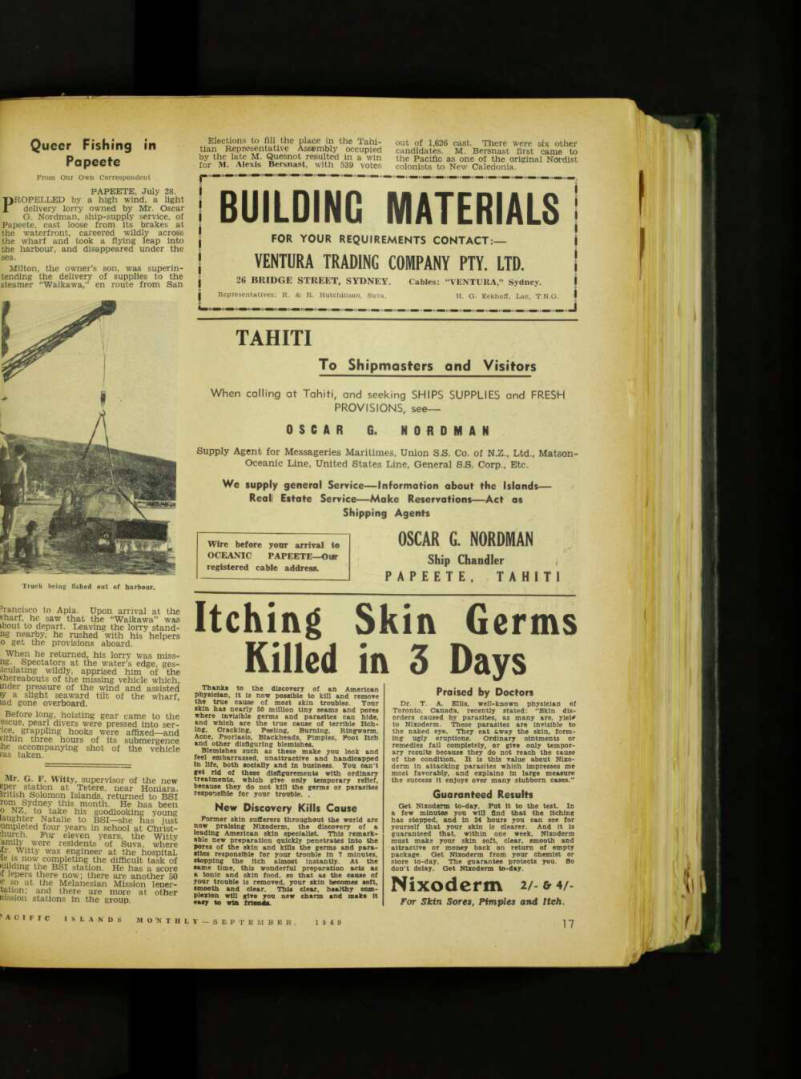
Papeete
From Our Own Correspondent
Papeete, July 28.
PROPELLED by a high wind, a light delivery lorry owned by Mr. Oscar G. Nordman, ship-supply service, of Papeete, cast loose from its brakes at the waterfront, careered wildly across the wharf and took a flying leap into the harbour, and disappeared under the sea.
Milton, the owner’s son, was superin tending the delivery of supplies to the steamer “Waikawa,” en route from San
Francisco to Apia. Upon arrival at the vharf, he saw that the “Waikawa” was ibout to depart. Leaving the lorry stand ng nearby, he rushed with his helpers o get the provisions aboard.
When he returned, his lorry was miss ug. Spectators at the water’s edge, ges nculating wildly, apprised him of the of the missing vehicle which, mder pressure of the wind and assisted >y a slight seaward tilt of the wharf, lad gone overboard.
Before long, hoisting gear came to the escue, pearl divers were pressed into ser ice, grappling hooks were affixed—and iuthm three hours of its submergence he accompanying shot of the vehicle Pas taken.
Mr. G. F. Witty, supervisor of the new eper station at Tetere, near Honiara, Jntish Solomon Islands, returned to BSI rom Sydney this month. He has been o NZ, to take his goodlooking young laughter Natalie to BSI —she has just ompleted four years in school at Christ hurch. For eleven years, the Witty amily were residents of Suva, where Jr. Witty was engineer at the hospital, le is now completing the difficult task of •uilding the BSI station. He has a score * lepers there now; there are another 50 !r so at the Melanesian Mission leper tatipn; and there are more at other mssion stations in the group.
Elections to fill the place in the Tahitian Representative Assembly occupied by the late M. Quesnot resulted in a win for M. Alexis Bersnast, with 539 votes
out of 1,626 cast. There were six other candidates. M. Bersnast first came to the Pacific as one of the original Nordist colonists to New Caledonia.
Truck being fished out of harbour.
Advertisements & other items, pp. 19-20 (2 items)
17
AOI P I C ISLANDS MO*NTHLY SEPTEMBER, 1949
Itching
BUILDING MATERIALS
FOR YOUR REQUIREMENTS CONTACT:—
VENTURA TRADING COMPANY FTY. LTD.
26 BRIDGE STREET, SYDNEY. Cables: “VENTURA,” Sydney.
Representatives: H. & R. Hutchinson, Suva. H. G. Eekhoff, Lae, T.N.G.
TAHITI
To Shipmasters and Visitors When calling at Tahiti, and seeking SHIPS SUPPLIES and FRESH
PROVISIONS, see—
OSCAR
G.
NOfiDMAN
Supply Agent for Messageries Maritimes, Union S.S. Co. of N.Z., Ltd., Matson- Oceanic Line, United States Line, General S.S. Corp., Etc.
We supply general Service—lnformation about the Islands— Real/ Estate Service—Moke Reservations—Act as Shipping Agents
OSCAR G. NORDMAN
Ship Chandler
PAPEETE, TAHITI
Wire before your arrival to
OCEANIC PAPEETE—de-
registered cable address.
Itching Killed Skin Germs in 3 Days
Thanks to the discovery of an American physician, It Is now possible to kill and remove the true cause of most skin troubles. Your skin has nearly 50 million tiny seams and pores where invisible germs and parasites can hide, and which are the true cause of terrible Itching. Cracking, Peeling, Burning, Ringworm, Acne, Psoriasis, Blackheads, Pimples, Foot Itch and other disfiguring blemishes.
Blemishes such as these make you look and feel embarrassed, unattractive and handicapped In life, both socially and In business. You can’t get rid of these disfigurements with ordinary treatments, which give only temporary relief, because they do not kill the germs or parasites responsible for your trouble. .
New Discovery Kills Cause
Former skin sufferers throughout the world are now praising Nlxoderm, the discovery of a leading American skin specialist. This remarkable new preparation quickly penetrates into the Pores of the skin and kills the germs and parasites responsible for your trouble In 7 minutes, stopping the Itch almost Instantly. At the same time, this wonderful preparation acts as a tonic and skin food, so that as the cause of your trouble Is removed, your skin becomes soft, smooth and clear. This clear, healthy complexion will give you new charm and make It easy to win friends.
Praised by Doctors
Dr. T. A. Ellis, well-known physician of Toronto, Canada, recently stated: “Skin disorders caused by parasites, as many are, ylel* to Nixoderm. These parasites are invisible to the naked eye. They eat away the skin, forming ugly eruptions. Ordinary ointments or remedies fall completely, or give only temporary results because they do not reach the cause of the condition. It is this value about Nixoderm In attacking parasites which impresses me most favorably, and explains In large measure the success It enjoys over many stubborn cases.”
Guaranteed Results
Get Nixoderm to-day. Put It to the test. In a few minutes you will find that the itching has stopped, and In 24 hours you can see for yourself that your skin Is clearer. And It is guaranteed that, within one week, Nixoderm must make your skin soft, clear, smooth and attractive or money back on return of empty package. Get Nixoderm from your chemist or store to-day. The guarantee protects you. So don’t delay. Get Nixoderm to-day.
Nixoderm
For Skin Sores, Pimples and Itch.
A. H. BUNTING LIMITED
SAMARAI — PAPUA
Presents the NEW
C.S.A. ENGLISH DUAL FREEZE
P
MORE THAN A REFRIGERATOR—A FREEZER AS
WELL—FRESH VEGETABLES, FRUIT, MEAT AT
ANY TIME—AND SO SMALL A COST
DIMENSIONS: Overall 42 in. wide. 21 in. deep. 36 in. high.
REFRIGERATOR CAPACITY: 4 CUBIC FEET.
ZERO DEEP FREEZE STORAGE SPACE: U CUBIC FEET.
ALL ALUMINIUM CABINET.
STAINLESS STEEL TOP.
RUSTLESS.
240 VOLT A.C. 50 CYCLES.
ALSO AVAILABLE—110 VOLT A.C.—SLIGHTLY EXTRA,
PRICE: £152/10/6. F.O.B., SAMARAI.
SOLE AGENTS IN PAPUA/NEW GUINEA FOR:
SAMARAI AGENTS FOR:
Vacuum Oil Co. Ply., Ltd.
South British Insurance Co.
National Mutual Life Association Polarizers (U.K.), Ltd.— Polaroid Sun Glasses.
C.S.A. Industries Eng.— Dual Freeze Refrigerators.
Webley & Scott, Ltd.— Shot Guns, Air Pistols, etc.
Le Bryan Group Products (Great Britain) Ltd.—Powermaster Electric Refrigerators.
“Getula.”—Nylon Monofilament Fish Lines.
REGULAR SUPPLIES OF EASTERN GOODS
A. H. BUNTING LIMITED - SAMARAI
WHOLESALE & RETAIL MERCHANTS — IMPORTERS — PLANTERS
Question of Sugar , Copra Export
Tax Comes Up Again
From Our Own Correspondent
SUVA, Sept. 4.
IN accordance with a promise given by the Governor, the correspondence be tween Sir Brian Preeston and the Secretary of State for the Colonies (Mr.
A. Creech Jones) on the question of the taxation of primary products (opposed by unofficial members of the Legislative Council of Fiji) has been published as a Council Paper.
Behind the taxation question lie several important points: The first is that for many years, and particularly in the war period, the Colony lost enormous sums which should have been paid by Asiatic income tax dodgers. Even to-day large sums are being lost, but collection is virtually impossible without the creation of a huge collecting department because many Indians and Chinese cannot, or will not, keep books in English.
The only direct tax paid by all Asiatics, Europeans and other non- Europeans is the Residential Tax of £2 a year. Even this is escaped by Asiatics with small incomes and large families, and, in any case, a large part of the small taxation revenue that comes from the bulk of the Indian and Chinese popula tion consists of penalties imposed on Re sidential Tax defaulters.
On the other hand, the Fijians are heavily taxed by their own Fijian Ad ministration for educational and other purposes. Except in the limited Fijian copra areas, the Fijian tax burden is officially stated to have reached the limit.
Regardless of the position of both
Fijians and Europeans, the Indian poli ticians ceaselessly proclaim the Resi dential Tax to be an “iniquity” as far as the Indians are concerned, and there has been a planned Indian political cam paign for the abolition of this tax and for the removal of the export tax on sugar, which is met mainly by the CSR Company and hits the Indian cane growers comparatively lightly.
Late last year and early this year the Indian campaign for a tax-free ride be came linked in the Legislative Council with European and Fijian opposition to the proposed export tax on copra. The sequel to this was united unofficial sup port for the theory of non-taxation of primary products, ON June 10 the Secretary of State wrote to the Governor: “It is true that if financial arrangements in Fiji could be ideally regulated, a care fully graded increase in the incidence of income tax would be a better method of collecting the funds required by your Government than the maintenance or imposition of export duties.
“In Fiji, however, as in nearly all colonial territories, there are difficulties in adopting this theoretically more desirable alternative. . . . You have pointed out the difficulties in administration and col lection that a reduction in the statutory income tax allowances would involve (though I note that these allowances are generous) and for this reason you reached the conclusion that the Residential Tax should be retained.”
For similar reasons, the letter con tinued, export duties were almost uni versally employed in colonial territories to supplement revenue, although this would clearly be inadvisable if they acted as a brake on production. This, however, was conspicuously not the case with sugar and copra, which were covered by long-term marketing arrangements which ensured the producers an adequate re turn.
“I have no hesitation in expressing the view that the imposition on export pro ducts, whose market value has greatly appreciated during and after the war, is both proper and desirable,” wrote the Secretary of State, and adds that the United Kingdom would regard the dis continuance of the sugar export duty and the decision not to impose a duty on copra, unaccompanied by any increase in direct taxation, as an impediment in the way of any development loan applica tions Fiji might make.
The Secretary of State, in response to the Governor’s request, enclosed a state ment showing that export duties were levied by the Governments of 42 units in the Colonial Empire and Ceylon.
New Hebrides Presbyterian
Church
THE Presbyterian Church of the New Hebrides held its first General As sembly in mid-August. Until a year ago the Presbyterian Church work in the islands was under the direct control of missionaries, directed from Victoria: but last year control was handed over to the native Church with the title of the Presbyterian Church in the New Hebrides. The missionaries continue to act as guides and counsellors, and the first moderator of the assembly is the Rev. Graham Miller.
Advertisements & other items, pp. 21-22 (2 items)
19
ACIFIC ISLANDS MONTHLY SEPTEMBER. 1949
William H. Watson
— ESTABLISHED 1930 —
RAROTONGA, COOK ISLANDS
Wholesale and Retail Trader
LICENSED STAMP DEALER
Agent For:—
BRITISH TRADERS' INSURANCE CO.
CORONA & L. C. SMITH TYPEWRITERS
KAISER & FRAZER MOTOR CARS
B.S.A. CYCLES AND MOTOR CYCLES
AMERICAN LEAD PENCIL CO.
WHITES AVIATION LTD.
Manufacturers of: FOOTWEAR, ALL CLASSES SUITABLE FOR NATIVE TRADING . . . M.O.P. PRODUCTS INCLUDING ROUND EAR-RING BLANKS AND BU1TON BLANKS Exporter of: “Rarotonga” Hula-Skirts.
Sea-Shell Necklaces.
M.O.P. Jewellery.
Island Produce.
Wholesale and Retail Inquiries Invited.
Prepared to Consider Agencies for all Class of Goods.
Importer of: Textiles.
General Hardware.
Fancy Goods.
General Merchandise.
Cable Address: “Watson” Rarotonga Bankers: Bank of New Zealand, Auckland.
There is only one
ELECTROLUX
THE MODERN KEROSENE-OPERATED REFRIGERATOR
THAT ACHIEVES THE MIRACLE OF ICE FROM HEAT
Lasting Efficiency, Silent Operation, Streamlined Beauty
IMMEDIATE
DELIVERY
■ I £ Nmm - ■ I i ■HH Also Available Model LK550 5i cub. ft. Capacity Economically operated by kerosene, with a simple precision-built freezing unit that has no moving parts and is GUARANTEED FOR
FIVE (5) YEARS.
Only obtainable from :
NEW GUINEA COMPANY, LIMITED.
Rabaul, Madang, Lae, Kavieng.
J. R. CLAY & CO., LTD., Port Moresby.
W. R. CARPENTER & CO. (Sol. Is.), LTD., Tulagi.
For New Hebrides, Butaritari, Noumea, New Caledonia. Apply— Model LK551
PRICES ON APPLICATION.
Storage capacity: 5i cub. ft. (approx.); shelf area, 9 sq. ft. food shelves, six—five removable; 2 self-supporting when half drawn. Ice-making: Four trays —5 lb. ice per freezing: 80 cubes. Fuel consumption: 1.8 pints kerosene per day (approx.).
Height: 4 ft. 10 in. Depth: 2 ft. 3i in.
Weight, unpacked, 406 lb. Packed, 574 lb.
W. R. CARPENTER & CO., LTD. Head Office: 16 O'Connell St., Sydney, N. S. Wales
No Compensation
One Planter’s Comments
Letter to the Editor THE Western Pacific High Commission has announced; “Bearing in mind that the normal revenues of these territories (Gilbert and Ellice Islands Colony and British Solomon Islands Pro tectorate) are insufficient to meet their recurrent costs of administration and that the principal factor to be considered is the degree to which payments by way of compensation are in fact needed to effect rehabilitation or to restore economic productivity, the High Commissioner has been unable to recommend to the Secre tary of State for the Colonies the payment of any war damage compensation by these territories.”
A study of this official jargon indicates that the High Commissioner is of opinion that war damage in the territories men tioned was not worth while worrying about and that, in any case, the cost of restoring plantations or commercial ven tures to their pre-war condition would be so paltry as not to warrant the attention of His Majesty’s Government.
I wonder how many of the companies and individuals who lost heavily as a re sult of the Japanese invasion will accept cheerfully such a glib dismissal of their claims. Furthermore, if it is really be lieved that the cumulative effects of many years of war damage are so negligible, how does it come about that even at this stage copra production in particular is so far behind pre-war volume?
I have no doubt that the individuals and companies who have tackled the job of rehabilitation would have little diffi culty in proving that heavy capital ex penditure without any governmental as sistance has been necessary to achieve
the mediocre results obtained to date.
Whatever assistance was offered by the government had too many strings tied to it to be in the least attractive.
This latest pronouncement will do nothing to allay the feeling of planters that their temporal lords and masters are not in the least sympathetic to their hopes of re-establishing themselves and stabilising their position.
The confession that the revenues of the territories are insufficient to meet ad ministrative costs will continue to be true until such time as the government realises that the development of these countries requires outside capital, which must be fostered and encouraged—a policy de signed to deal with conditions as they are now, not one based on illogical dreams of a tropical Utopia.
I am, etc.,
Manly, N.S.W.
Mug Planter.
Adi Rewa To Be Retired
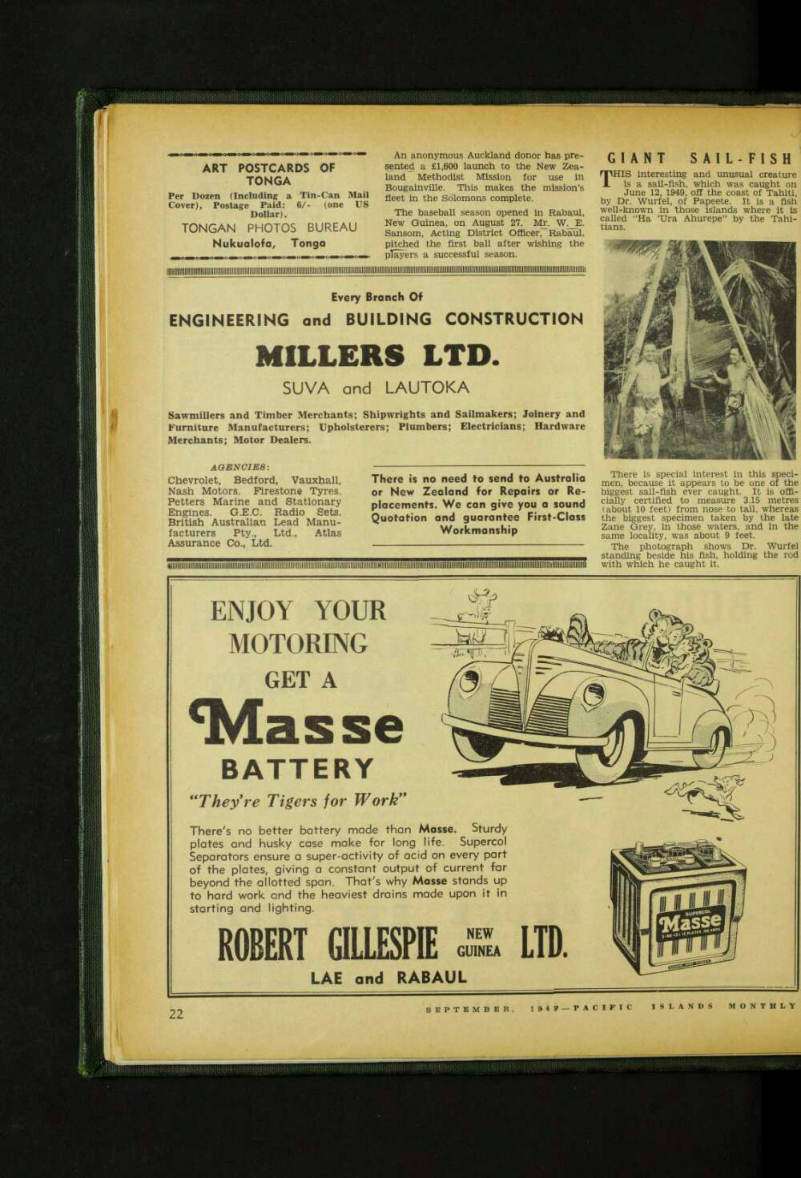
SUVA, September 3.
THE well-known Fiji inter-island ship, Adi Rewa, built at Suva in 1926, has been withdrawn from service by Morris Hedstrom, Ltd. An examination on the slip showed that the extensive repairs needed were not warranted in view of the few years of active life re maining to the vessel.
Skippered by Captain E. Williams, the Adi Rewa has been popular with travel lers for 23 years. Recently she was on the Suva-Levuka-Macuata run, but when she started life there was no highway right round Viti Levu, as there is now, and travellers from Suva to Lautoka, Ba, and Penang, voyaged by sea. To-day a large part of Fiji’s passenger transport is by land, and in the case of Labasa-Suva, by air.
An anonymous Auckland donor has pre sented a £1,600 launch to the New Zea land Methodist Mission for use in Bougainville. This makes the mission’s fleet in the Solomons complete.
The baseball season opened in Rabaul, New Guinea, on August 27. Mr. W. E.
Sansom, Acting District Officer, Rabaul, pitched the first ball after wishing the players a successful season.
Advertisements & other items, pp. 23-24 (1 item)
Budge
QUEENSLAND
INSURANCE
COMPANY
LIMITED
(Incorporated 1886 In Australia)
ASSETS EXCEED £5,000,000
Head Office :
QUEENSLAND
INSURANCE BUILDING,
80-82 PITT STREET, SYDNEY.
Specialists in South Seas Fire,
Marine fir Accident Insurances
Apply to:—
FlJl.—Branch Office: I. B, Chalmers, Manager, Burns Philp (South Sea) Co .
Ltd.
VlLA.—Burns Philp (South Sea) Co., Ltd.
Comptolrs Prancais Des Nouvelles Hebrides (Marine).
NOUMEA.—L. & W. Johnston.
NEW GUlNEA.—Manager for Mandated Territory and Papua, W. A. Anderson.
PORT MORESBY—SAMARA!—LAE
—MADANG—RABAUL.
Burns, Philp (New Guinea), Ltd.
PAGO PAGO.
Burns Philp (South Sea) Co., Ltd.
G. H. C. Reid & Co.
OTHER SOUTH SEA ISLANDS.
Burns Philp (South Sea) Co., Ltd.
Also to any of the Company’s Offices in Australia or New Zealand.
BUDGE
REFRIGERATION and
ICE MAKING
EQUIPMENT
COMMERCIAL AND INDUSTRIAL
UNITS
(not domestic) Ammonia and Methyl Chloride machines of large or small capacity.
The illustration is of a small (nine 28 lb. blocks) electric, Methyl Chloride Icemaking plant.
Enquirers should mention dimensions of cold room (or cabinet) and of amount of ice (if any) required per day; also if electric motor or interna! combustion engine is to be included.
JAMES BUDGE PTY. LTD.
\ Telephones: LA 5034-5-6
REFRIGERATION ENGINEERS
McEvoy Street, Alexandria, Sydney
Established 1890
ART POSTCARDS OF
TONGA
Per Dozen (Including a Tin-Can Mail Cover), Postage Paid: 6/- (one US Dollar).
TONGAN PHOTOS BUREAU
Nukualofa, Tonga
Every Branch Of
ENGINEERING and BUILDING CONSTRUCTION
MILLERS LTD.
SUVA and LAUTOKA
Sawmillers and Timber Merchants; Shipwrights and Saihnakers; Joinery and Furniture Manufacturers; Upholsterers; Plumbers; Electricians; Hardware Merchants; Motor Dealers.
AOENOIEB:
Chevrolet, Bedford, Vauxhall, Nash Motors. Firestone Tyres.
Fetters Marine and Stationary Engines. G.E.C. Radio Sets.
British Australian Lead Manufacturers Pty., Ltd., Atlas Assurance Co., Ltd.
There is no need to send to Australia or New Zealand for Repairs or Replacements. We can give you a sound Quotation and guarantee First-Class Workmanship
Giant Sail-Fish
THIS interesting and unusual creature is a sail-fish, which was caught on June 12, 1949, off the coast of Tahiti, by Dr. Wurfel, of Papeete. It is a fish well-known in those islands where it is called “Ha TJra Ahurepe” by the Tahi tians.
There is special interest in this speci men, because it appears to be one of the biggest sail-fish ever caught. It is offi cially certified to measure 3.15 metres (about 10 feet) from nose to tail, whereas the biggest specimen taken by the late Zane Grey, in those waters, and in the same locality, was about 9 feet.
The photograph shows Dr, Wurfel standing beside his fish, holding the rod with which he caught it.
Advertisements & other items, p. 24 (1 item)
*Masse
ENJOY YOUR
MOTORING
GET A
*Masse
BATTERY
“ They’re Tigers for --v- -yarn 3 There's no better battery made than Masse. Sturdy plates and husky case make for long life. Supercol Separators ensure a super-activity of acid on every part of the plates, giving a constant output of current far beyond the allotted span. That's why Masse stands up to hard work and the heaviest drains made upon it in starting and lighting.
ROBERT GHLESPIE JS,
LAE and RABAUL
Called “Mr.”
Indians Hanker to be Called “Mr.”
From Our Own Correspondent SUVA, Sept. 3.
WHEN a Fiji-born Indian wrote to the Press objecting to what seems to be a widespread adoption of Indian “titles” by various local Indians although the Indian leaders in India have dis carded their British titles, he added: “Indians in Fiji must be on guard against fancy foreign titles and slogans.”
Besides being the first time an Indian has called anything Indian “foreign,” this started a discussion in which it was pointed out that Indians in Fiji uni versally demand the English courtesy title of “Mr.” although this is absolutely foreign to them.
In Fiji no Fijian is ever addressed as “Mr.” If a Fijian is not entitled to the hereditary title of Ratu, he gets nothing.
Thus occurs the absurd situation in which Fijian officials, teachers, and (in more than one case) officers of flourishing busi nesses are not “Mr.,” while Indian youths of no standing whatever are solemnly given their “Mr.”
One of the Fijian members of the Legislative Council who is not a Ratu is not a “Mr.” either.
Certainly, the Fijians have never ex pressed the slightest wish to adopt the foreign “Mr.,” and Indian insistence is merely part of the Indian obsession over “equality.”
Resentment comes mainly from Euro peans who, in one case, have pointed by way of example, to the last Suva Town Board report, which lavishly distributes “Mr.” to all and sundry Indians. The report also inadvertently deprives a Fijian Ratu of his title. This has not been the subject of any sort of protest, but there would have been an uproar if an Indian “Mr.” had been mislaid.
Incidentally, the shipping and airline companies insist on calling Fijians “Mr.” whether they want it or not.
Advertisements & other items, pp. 25-26 (2 items)
Vince
GILLESPIE
The Flour - sydn:ey -
TRADE
MARK
’S of the Islands
OVER 25
YEARS OF
PAIN
RELIEF!
.1
SWIFT 3-WAY RELIEF
From HEADACHE and all Nerve and Muscular Pain! 5 Vincent’ B a.p.c Powders and Tablets r ' are a combination of three valuable medicinal ingredients and bring swift 3-way relief! Vincent’s is prepared to the original therapeutic prescription containing Aspirin to relieve pain, Phenacetin to reduce temperature, Caffeine to stimulate the nervous system. Vincent’s A.P.C quickly relieves Headache, and all nerve and muscular pain!
VINCE
s/v
aTTncTnT
SAFEST S BEST!
THE
YORKSHIRE
INSURANCE
CO. LTD.
(Incorporated in England)
ALL CLASSES OF
INSURANCE
Including Fire Motor Guarantee Accident Workers Marine Island Representatives:
PORT MORESBY: E. A. James
RABAUL: G. B. Black LAE: New Guinea Industries Ltd.
MADANG: R. MacGregor SUVA: Williams & Gosling Ltd.
NOUMEA: Y. Mortensen
NORFOLK ISLAND:
A. E. Martin
A CRAMHOND
TROPICAL V OF TUB AIR’ RECOVER
Will make fresh fields and pastures new available for your radio
entertainment
THE SENSATIONAL
TROPIC EAGLE
Available in Vibrator, all dry cell or all electric (240 or 1 10 volt).
The most completely tropic-proofed receiver ever produced.
CRAMMOND 'KING OF
THE AIR' TROPICAL
PORTABLE
Features:— Moisture-proofed bondwood cabinet, components infra-red ray tropic-proofed. Available in Dual or Triple Wave; Vibrator, all dry cell or electric operation.
Over thirty Tropic models to choose from including vibrator operated gramo-combinations also full range of all electric, 240 or 110, other voltages to order. Terms may be arranged. Write for illustrations and price lists to-day.
Its best advertisement is its performance.
Read the following extract from letter received from Mr.
M. B. P. Madang:— “Yesterday Mrs. P. and I spent a day with Mr. and Mrs. R. at — Plantation. Mr. R. switched on his Tropic Eagle receiver at 12 o’clock and left it on until 5 p.m. The reception was excellent, especially for that time of the day. Please forward me a receiver the same as his.”
We have Mr. McColl’s permission to publish his letter in full. Here it is:— Aitape, New Gumea.
“I must say that the set gives superb performance, with plenty of volume, even during the ‘off’ hours of the day.
You certainly know how to pack a lot of volume and selectivity into a small set. Keep\ on building sets like these, and there is no limit to your customers”
CRAMMOND RADIO
TROPICOL DIVISION
No 8 QUEEN STREET . BRISBRNE
24
SEPTEMBER, 194 9 PACIFIC ISLANDS MONTHL’'
10,000 Miles
Police Travel Over
Curious Sequel To Ocean Island Murder
THREE Brisbane detectives (Senior- Sergeant T. E. Martin, Sergeant C.
Smith, fingerprint expert, and Con stable J. Hamilton), having already travelled over 10,000 miles in the pursuit and punishment of an alleged Pacific Islands murderer, left Brisbane again on September 3 for Suva, and probably will add another 3,000 or 4,000 miles to their joumeyings before justice is done.
Last April, on Ocean Island (that hump-backed dot of phosphatic rock near the equator) a middle-aged engineer and his wife, Mr. and Mrs. T. Allen, were found in their bungalow, stabbed to death.
It was a strange, motive-less crime.
Ocean Island (part of the domain of the British High Commission of the Western Pacific, headquarters in Suva) appealed for help. Suva appealed to Australia.
On April 30 the three detectives, at very short notice, went out from Bris bane on a launch, to intercept and board the phosphate steamer, Edenbank, for Ocean Island, 1,200 miles away.
On Ocean Island, they found, in the Allens’ bungalow, certain fingerprints which seemed to have significance. On Ocean Island, there are large numbers of Chinese and Gilbertese, labourers on the phosphate deposits, in addition to the indigenous Banabans. The detectives set to work to fingerprint the whole popula tion. They took no less than 18,000 finger and palm prints.
As a result, they arrested and charged with murder a 28-years-old Chinese labourer, Tai Shek, and he was committed to Suva, for trial. As reported in last
Issue of the PIM, the British court in Suva, owing to some colonial law tech nicality (Ocean Is. is in the Gilbert and Ellice Colony) did not have authority to try Tai Shek. He was discharged and returned to Ocean Island, for re-arrest and re-committal, while the detectives (by now perhaps the most completely fed-up police officials in the wide Pacific) went back to their Brisbane homes.
The new trial was expected to com mence in Suva on September 6; so the three detectives, on September 3, set off from Brisbane again upon their travels.
Unexpected Incident
ON the night of July 26, in Apia, Wes tern Samoa, the men of the NZ warship, Hawea, were warmly entertained, in the Tivoli Theatre, by hospitable Samoans. Quite late in the evening, some of the guests were enjoying a lavish supper, spread on the stage; others were dancing. Two old Samoans — one with spectacles, one without—were chatting amicably in one corner.
Suddenly, a sharp disturbance attracted general attention. The surprised guests beheld the bespectacled Samoan being fiercely assaulted by a well-known Samoan leader. He bit the dust; and, before he could rise, the Samoan gentle man hurled himself upon his other, un spectacled, countryman.
Spectators intervened and the riotous chieftain was suppressed and led away.
As the happy party broke up, the old Samoan was searching vociferously for his glasses. They were found a dozen feet from where he had fallen —evidence of the fury of the mysterious attack.
The bluejackets thought it was a new, highly acceptable form of entertainment arranged for their benefit; but their em barrassed hosts still are wondering what impelled the big Samoan aristocrat to make that demonstration.
Pacific
Australian Rice For South
THE International Emergency Food Committee of UN advised the Rice Association of Australia late in August that the bulk of Australia’s rice exports for 1949 will go again to natives in zones of British influence-in the South Pacific.
The lEFC has sent to the governments concerned its recommendations for the distribution of the 1949 world export supply of rice. Under the “block” system, the supplying country may send no more than its allocation to the importing country. Conversely, no importing coun try will accept any more than its quota.
The Premier of India (Pandit Nehru) has appealed to his people to eat less rice and more wheat, so that the popu lace can exist on 10 per cent, less food —all that will be available to them this year.
A Wreath From Kentucky
A LOUISVILLE (Kentucky) coalminer named David Wallen is about to set off on. a walk to Los Angeles, en route to Guadalcanal. With him there goes a metal wreath, carrying one flower for each of the 690 American servicemen who lost their lives when the American cruiser Juneau was sunk in the Solo mons in 1942. Mr. Wallen’s son was one of the 690. His wife will join him in Los Angeles; and, according to him, they “somehow” will get across the Pacific to Gaudalcanal, where they will drop their wreath in the approximate spot where the warship was lost. He told reporters he was “leaving the details of the journey to the Lord—He will find a way.”
Advertisements & other items, p. 27 (1 item)
William Atkins lm.
Head Office, 449-451 KENT ST., SYDNEY
Iron & Steel Merchants-Engineers' Supplies
Coach fir Motor Hardware
ESTABLISHED OVER 50 TEARS
Cable Address: WXLATKDt, Sydney.
STEEL DEPARTMENT
MILD STEEL:
Rounds, Squares, Flats, Half-rounds, Hexagons, Bevel, Shoeing, Tyre, Angles, Tees, Sheets, Plates, Girder Plates, Chequer Plates, Channels, Hoops, Etc.
BRIGHT STEEL:
Rounds, Squares, Hexagons.
Extra Special High Speed Tool Steel, Mining Steel, Blister Steel and Spring Steel, Rounds, Flats & Squares.
Bar Iron—All sections and sizes.
Engineers' Supplies: Set Screws, Studs, Metal Thread Screws, Coach Screws, Piles, Cotter Pins, Bright and Black Bolts, Rivets, Etc., Hack Saw Blades.
Power Transmission Gear: Including Plummer Blocks, Couplings, Collars, Etc.
Coach and Motor Hardware: Axles, Springs, Wheelstufl, Duck, Paints.
Farriers' Supplies: Horse Nails, Anvils, Vices, Etc.
Motor-Trimmers and Motor Builders' & Motor Painters' Requirements Pacific Island Agents : Corrie & Co., Sura, Fiji DUCO Lacquers and DULUX Enamels—FABREX Motor Toppings and Leather Cloths, House & Decorators' Paints, Varnishes & Brushware.
Sole Distributors of CHAMPION'S Decorators Point Products.
Distributing Agents far BROLITE Lacquers, SYNFLEX Enamels and "POLYGLOSS" Finish.
Well-Known Suva People
Married
From Our Own Correspondent SUVA, Sept. 3.
MR. H. E. SNELL, managing director of Morris Hedstrom, Ltd., and Mrs.
Neville Windrum, daughter of Sir Henry and Lady Scott, were married at Suva on August 30. The wedding was very quiet, only the parents of the bride and a few close relatives and friends be ing present.
“PIM" Goes Into Prince Bismarck’s Museum
Prince Bismarck’s Museum
The following is an extract from a letter from Mr. F. T. Goedicke-van Asten, an elderly gentleman of Dutch birth who resides in Haapai, Tonga.
The reference in the article is to a medal presented many years ago by Prince Bismarck to Mr. Goedicke-van Asten, in connection with an event in German New Guinea about 1884. The medal was given by Mr. Goedicke-van Asten to the Pacific Islands Monthly, and is on exhibition in the PIM offices.
SINCE I have been writing articles for PIM I receive by every mail letters starting something like this: “I read with great pleasure your article in the PIM.” And many go on: “I am a great stamp collector and I would be very thankful to you if you could send me a few Tonga stamps”!
By last mail I received an unusually interesting letter by airmail. Its post mark was Friedricksruh, Germany. Frie dricksruh is the estate which Emperor William II presented to Otto von Bismarck Schoenhausen, when he created him a Furst (prince).
The letter is from Count Otto von Bis marck-Schoenhausen, grandson of Prince Bismarck. Count Otto writes (translated): “I thank you for the very interesting magazine, Pacific Monthly Magazine, you sent me. I read every line of it. The article about your interview with the Prince, my grandfather, interested me also very much.
“During the last war, I shifted my family to Schoenhausen, the home of my ancestors; and there, in the Bismarck Museum, erected by my father, Count
Herbert, I found in a glass case, in which all the different Orders and Decorations of my grandfather are exhibited, a medal similar to the one mentioned in your article in the magazine. I have taken the liberty to send the magazine to the care taker of the Museum, with an instruction to place the magazine in the glass case, and have the medal placed on top of it.
“When Countess Irma, my wife, saw the 3d. stamp on the wrapper of the maga zine, which I presume represents Stone henge, she took charge of the stamp, as she is a great stamp collector. Countess Irma sends her love to you and under separate cover seven photos of Friedrick sruh and Schoenhausen.
“I will close my letter, wishing you the best for the future and adding the words my grandfather used when you said farewell to him at the Imperial Chancellery, ‘and may the blessing of our Lord rest upon you’.” (The Count may be pardoned for sup posing that the mysterious Trilithon, near Nukualofa, is a part of the more famous Druidic ruins at Stonehenge, in England.
There is a vague resemblance).
Melanesian Mission
Centenary
THE Melanesian Mission ship, Southern Cross, the seventh of that name to serve the mission during the past century, has been making a goodwill tour of New Zealand ports in celebration of the centenary of the Melanesian Mission.
The activities of the Melanesian Mis sion are now restricted almost entirely to the British Solomon Islands, where it is very influential, and the Mission gener ally is controlled by New Zealand.
Advertisements & other items, p. 28 (2 items)
Book Lovers!
Hutchinson’s UNIVERSAL BOOK CLUB offers an easy way to build a well-chosen Home Library.
Each month a Committee, with the co-operation of leading English and American publishers, selects for the members of the UNIVERSAL BOOK CLUB an outstanding contemporary novel by a famous author.
The subscription is £2/2/- for 12 books a year delivered monthly or £l/1/- for 6 months. This is the only charge and includes postage.
Join now and receive your first Hook by return mail .
Membership in other Book Clubs may also be arranged.
MAIL PUBLICITY COMPANY
175 Pitt Street, Sydney, N.S.W.
Widdop
DIESEL ENGINES
BY
5 H P TO 300 H P
H • WIDDOP & CO LTD
GREENGATE KEIGHLEY ENGLAND
Telephone: Keighley 3727-8 Telegrams: Widdop Keighley Codes: A.B.C. 6th Edition, Bentley’s, Bentley’s Second in r Above:
(D-Type)
36/45 H.P.
ML-. fei <=
f BIUDOP ' ?
I O Kj
ll£JCxUiy n On left:
(X-Type)
120 H.P.
Direct reversing o
CVS —86
Moderate Fiji-lndians Criticise
Independence Day Extravagances
From Our Own Correspondent
SUVA, August 28.
A CURIOUS sequel to the carefully organised Indian political demon strations throughout Fiji on August 15 (Indian Independence Day) has been an outburst by moderate Indians in the correspondence columns of the English language press in Fiji. Some of the Indian writers condemn the aggressive waving of Indian national flags in the Colony.
The Indian Government Commissioner in Fiji has been criticised for allegedly permitting prominence to be given to one Hindu sect at a ceremony at his house on August 15 (incidentally, the Commis sioner, Mr. S. A. Waiz, is a Christian) and correspondents have suggested that In dian political disunity has increased in the last year.
A Fiji-born Indian, for the first time in the English press, openly ridiculed the repeated expressions of “grateful appre ciation for the kindly interest now being taken by Free India in the welfare of the Indians in Fiji.”
He quoted the case of two Indians who went to India from Fiji, secured jobs and then were officially told to get out of India, which did not want them. He added that it would be better for Indians in the Colony if they paid less attention to the “agitators who only seem to get the Indian people into trouble.”
Yet another, who signed his letter with his own name, briskly “demanded an ex planation” from whoever was responsible
for a hurricane of Indian flag-waving at a country centre and the total elimination of the Union Jack.
“As British subjects, it is our duty to be loyal and the Union Jack should have had the place of honour with the Indian flag,” he wrote, and added that as the Pakistan flag was displayed, this possibly was due to the fact that the organisers were apprehensive at the number of “Pakistanis” present.
Somewhat belatedly, Indian concern for the Union Jack appears to be growing, particularly in the country districts. The trend is much less marked in Suva, al though a published letter by a young Indian recently expressed grave disap proval of the absence of the National Anthem at boxing programmes.
Malaria And The West
Pacific
ELEVEN experts on malaria recom mended to World Health Organi sation in Geneva, on August 10, that WHO should give top priority to the con trol of malaria in its technical assistance programme for undeveloped countries in malarial belts.
It was suggested that the programme to increase food production by combating diseases should be initiated in the East ern Mediterranean, South-East Asia, the Western Pacific and Latin America be cause those regions were largely unde veloped because of endemic malaria.
Sydney newspapers have given space to the reactions of Mr. Guildford Adams. 24. of Norfolk Island, who arrived recently.
He had never previously seen a train or tram, or ridden on top of a bus. He is a direct descendant of John Adams, of Bounty fame.
Advertisements & other items, pp. 29-30 (2 items)
C Sullivan Pty. Ltd
COLE’S
T ropic-Seasoned
CHICKENS
Pure WHITE LEGHORNS and
First-crosses: R.l. Red x W.L, or Australorp x W.L.
Bred in the sub-tropics and seasoned to your climate.
All Breeders guaranteed Government blood-tested. 25’s 50’s 100’s £ s. d. £ s. d. £ s. d.
V> .. 110 0 212 6 415 0 Crosses 1 11 6 2 15 0 500 Plus Air Freight
ED. COLE,
Enmore Poultry Farm, Cairns, N.Q.
C SULLIVAN PTY. LTD
Island Merchants
Over 30 years' experience in the Pacific island Trade.
Expert Buying Service Original Invoices Furnished Sellers of Island Produce.
Represented in all Australian States, New Zealand, England, France, United States, etc.
BANKERS: Bank of New South Wales, Comptoir National d’Escompte de Paris, Bank of New Zealand.
C. SULLIVAN PTY. LTD.
379 KENT STREET, SYDNEY
Telegrams & Cables: CHASULL, Sydney. Phone; MJ4657 (6 lines).
V r A Va / 'A- - • si ski r'
From
Australia’s
Finest Fat
Stock
I I I
BRONTE BRAND:
Chili Con Came Braised Steak and Onions Curried Beef Curried Mutton Steak and Onions Mutton and Peat Irish Stew Beef Steak Pudding Corned Beef Hash Corned Beef Loaf With Cereal Mutton Broth Mulligatawny Soup Tomato Soup Vegetable Soup From the finest fat stock and the rich-
est vegetables in Australia we produce
these high-grade canned meats and
soups. BRONTE BRAND meats,
hotmeals and soups are deliciously
flavoured and are made from
ONLY meats and vegetables
of the highest quality
THE COLONIAL WHOLESALE MEAT CO.
PTY. LTD.
Canning Factory, State Abattoirs, Homebush Bay, Sydney.
N.S.W.
PHONES:
PHONE: UM 8436.
CABLE ADDRESS:
WOOLMILL. SYDNEY.
28
SEPTEMBER, 194? PACIFIC ISLANDS MONTHLI
The Missing 5,000
Latest Development of a Press- Made Mystery
THE story of the missing 5,000 natives in the Solomon Islands—see PIM of July—is still circulating among the news agencies of the world and causing further absurdities.
It will be remembered that, about June last, a party of geologists returned to Sydney from the Solomon Islands. One of them remarked to a reporter that they had found interesting mineral specimens upon a small island called St. George— and he added that at one time there was a population of 5,000 or 6,000 upon St.
George whereas now there are none.
The reporter asked him what had be come of the 5,000 people, and the scientist replied that he had no idea.
Thereupon the reporter wrote some thing about the disappearance of 5,000 natives from the island of St. George.
By the time this had been cabled to the United States it had developed into a first-class mystery; and, within a week, the editor of the PIM had received mes sages from New York, from London and from Johannesburg asking if he could supply any further details about the miss ing 5,000.
The PIM informed the newspapers that it was Mendana who, in 1568, reported some 5,000 or 6,000 people upon the island of St. George; but that when European explorers next visited the place, some 250 years ago, there were no people upon that island. Perhaps Mendana got his islands mixed—we shall never know. That was what the geologist was referring to when speaking to the Sydney reporter.
But, in August, several weeks after PIM had broadcast the explanation of the mystery, there was another cablegram in the Sydney evening newspapers.
It was to the effect that certain dele gates of the United Nations, who are passionately interested in native welfare, are taking steps to find out what had be come of the 5,000 natives who were re ported missing from the island of St.
George in the British Solomons. They evidently believe they are about to se cure more evidence of capitalist ex ploitation!
Blown Up In Apia 20 Years Ago
Memory Of The Carnegie
IT will be 20 years next month since the famous yacht, “Carnegie,” engaged in research work, was blown up in Apia lagoon; the officer in charge, Commander Ault, was killed. The vessel was loading petrol, and the fumes somehow became ignited. Commander Ault, who was read ing on the deck nearby, was blown from his chair into the water, and fatally injured. Fire destroyed the yacht.
The “Carnegie” was launched in 1908, to continue the research work of the “Galilee.” She was known as the non magnetic vessel, and was owned by the Carnegie Institute. The purpose of these vessels was to make a magnetic survey of the Pacific Ocean. As a result, many charts were corrected, and many depths accurately ascertained.
Mr. Oscar Nordman, of Papeete, served aboard both the “Galilee” and the “Car negie” and a fine water-colour painting of the ship signed by Commander Ault and his officers, given to Mr. Nordman before the “Carnegie” sailed on her last voyage, is among his treasured posses sions.
Four Veterans Meet
Memories of Rabaul and The Coast Watchers
FOUR Australian officers who served together in the 22nd Battalion in Rabaul, when the Japs invaded in 1942, had a happy reunion in Melbourne on July 27, when they attended an in vestiture at Government House, to re ceive war decorations. They were: Lieut.-Colonel Leggatt, now Chief Sec retary in Victoria, who left Rabaul for Timor to command the 2/40th Battalion.
He received the DSO.
Captain W. B. Bowring (MC), who left Rabaul and was posted to Malaya to the 2/29th Battalion, and later was taken prisoner at the Muar Road action.
Captain J. Mack Hamilton (MBE,
Military Division), and Lieutenant R. K.
Walls (MC), both of the 2/22nd Battalion, who took part in the now famous over land trek south through the jungle of New Britain to elude capture. After two and a half months they reached Cairns.
When they were together in Rabaul, Leggatt was a Major, being 2nd-in-Com mand; Bowring was a Captain; and Hamilton and Walls were Corporals.
Later, Walls and Hamilton became members of the famous Allied Intelli gence Bureau (Coast Watchers), and won their commissions and both spent years in New Guinea. According to the re cords, both earned very fully the decora tions which were later awarded to them.
Suva’s rainfall for 1949 to September 3 is 160.85 in., already a record. The average annual rainfall for 57 years is 120.85 in.
Advertisements & other items, p. 31 (2 items)
29
PAOIFIC ISLANDS MONTHLY—SEPTEMBER, 1949
Robert Gillespie
WHOLESALE ijAfRCHANTS
MANUFACTURERS AGENTS
-EC. 5) > .I', / f. 9 tr 1 Et LI Ba a m & w Of -X 65 C£ m
ROBERT GILLESPIE
NEW GUINEA LTD
HEAD OFFICE LAE
BRANCH OFFICE RABAUL
ROBERT GILLESPIE PTY.LTD.
54a Pitt.
StTeet
With P-NG
Tourists Not Impressed With P-NG
From Our Brisbane Correspondent IT was reported recently in the Bris bane Courier-Mail that round-trip passengers, who travelled to New Guinea on the MV Bulolo recently, complained of Federal Government apathy to boosting tourist traffic to New Guinea.
According to press reports, the pas sengers claimed that failure to foster US tourist interest in New Guinea and near by islands, was losing Australia thousands of dollars. The tourists com plained of inferior hotel accommodation, limited sightseeing through poor trans port facilities, and that no organised tourist arrangements had been provided.
The Bulolo had completed a month’s trip, including visits to Port Moresby, Rabaul, Lae, and Samarai (Papua).
A Sydney company director contended that there was a wonderful opening for an organised tourist outfit in New Guinea alone. At present, no interest was displayed in tourists, and everything was badly organised once the passengers had left the boat. He believed Australia could reap thousands of dollars from Americans anxious to bring parents and wives back to see the places where they fought in 1942-45.
Another passenger said that tourist traffic was not encouraged and that some of the hotels were “dreadful.” Trippers were totally dependent on friends for sight-seeing. “Why not have a roomy tourist coach at ports of call?” queried another passenger. He considered that taxi fares were very costly when tourists wished to go any distance.
Editorial Note:
EVEN before the war there was no effort made by the Administrations of Papua or New Guinea to attract tourists. Such tourist industry as there was, was fostered by the shipping com panies.
During the war, Samarai (in Papua), and all the towns in New Guinea were totally destroyed. Since the war both Territories have been labouring under the Wardist regime when all things have been orientated towards making the (now) combined Territories a fit place for Fuzzy-wuzzy. All else has taken second place which under post-war conditions has meant no place at all. Township rebuilding has been further complicated by ambitious town-plans that have thrown private enterprise and private citizens into complete confusion. Add to this the facts that until a year ago there was a totally inadequate shipping service to Papua-New-Guinea; that Com munist-dominated Australian workers have refused to supply Australia with the building materials she needs; and that Australian Communistic wharf labourers, who fix Australia’s foreign policy, have refused to let Papua-New Guinea import its just quota of this material—then it is easily understood why, four years after the war, New Guinea towns are still collections of ex- Army hutments. Some of the hotels may be “dreadful.” But this is not the fault of the licencees who want to build decent establishments —(a) if the Administra tion can make up its mind where and how the new towns are to be built ac cording to The Plan: and (b) if they can get sufficient material from Australia.
The round-trippers could have ascer tained the state of the Territories before
they left Australia. However, the trip is still worth taking if only to see how a completely defranchised, socialistic state is run. The scenery is still good, in places; the Bulolo is a fine ship; plan tations have been cleaned up and are flourishing; missions are hard at work; individual Administration officials have performed miracles in getting their par ticular areas under some sort of organi sation; and above all, Territorians, with all their problems, would not change places with any Australian suburbanite.
Ideas of attracting American tourist dollars to New Guinea are best forgot ten. Other innocents once thought along similar lines. They now know better.
If, in the next five years, Papua-New Guinea can be made a really fit place for Territorians (white as well as brown) to live in that is all that can be ex pected.
Medical Service
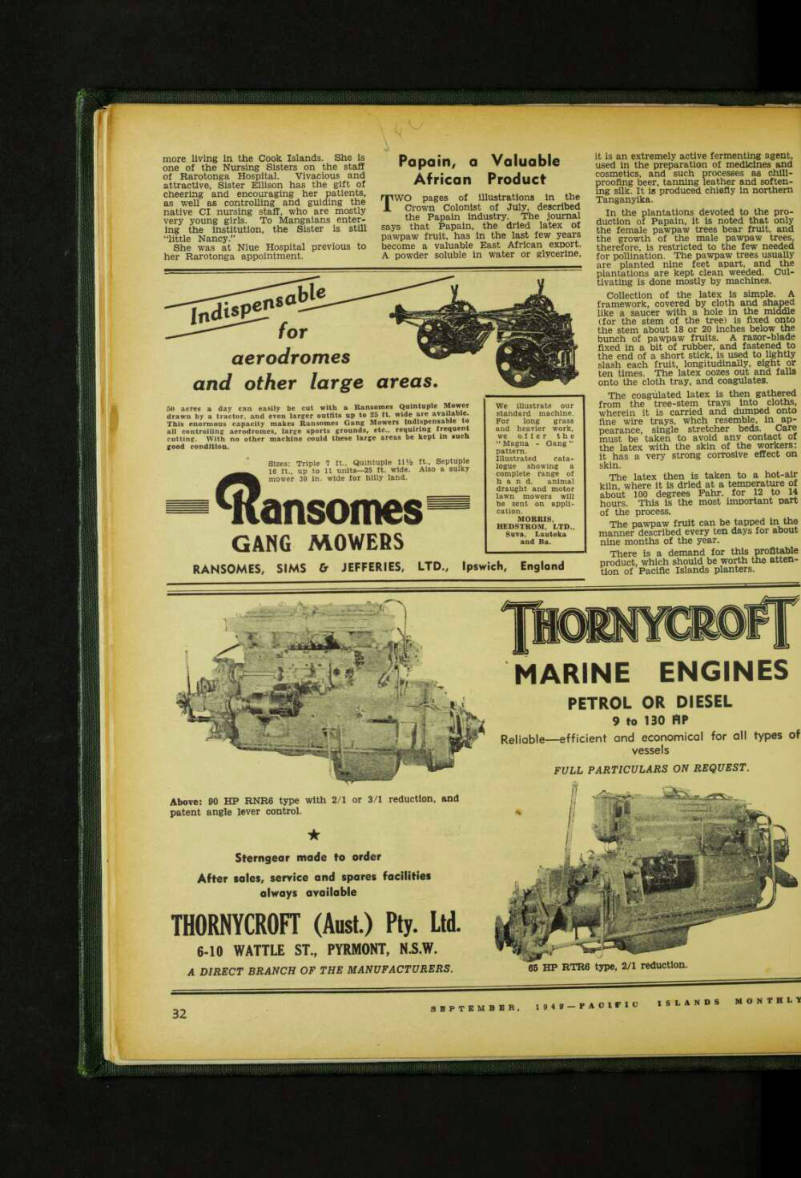
Another Ellison In Ci
Mangaia, Cl.
mwARn pohatt FTimnw
Edward Pohau Ellison,
U OBE, who for many years served faithfully the native population of the Cook Islands, and whose efforts have given Cl its splendid new TEI Sanatorium it well remembered, though he retired from local practice some years ago.
Mangaians recall the stay of Dr, Elli son here at the close of 1926, in which year h e h a d the misfortune to lose his wife His Httle three-year-old daughter, who came W ith him, was a pet of the is i a nders; the little girl was in the care of Miss Doris H ead, a member of the wpli-known Ninp fAtnilv weu Known INlue lamuy.
Nancy Ellison, now grown-up, is once
more living in the Cook Islands. She is one of the Nursing Sisters on the staff
fttrSrifstefiuton M
»arconTr^n| gI aldlui^ng e ?he
ing the institution, the Sister is still “little Nancy.”
She was at Niue Hospital previous to her Rarotonga appointment.
Advertisements & other items, pp. 32-33 (1 item)
KASPER Sujyerior
M Kasper Superior Soda Fountain of all stainless steel welded construction surfaces .
SODA FOUNTAINS
Complete with ICE CREAM
MAKING MACHINE
Specially designed for TROPICAL CONDITIONS Complete fountains, including metal rust-proof surround, carbonators and refrigerator units shipped from Australia through your agent.
For beauty, for low lifetime cost, for convenience, for dependability, for profit-making power, “Kasper” Fountains stand supreme in Australia to-day. The “Kasper” Fountain is years ahead of conventional models. Every detail has been thoroughly worked out and tested in the factory and in use.
“Kasper” superior fountains are of all steel, lifetime construction with stainless steel, WELDED surfaces and chromeplated fittings. Adequate cork board insulation helps assure lowest operating costs.
ORDER NOW AND AVOID DELAY
Kasper Refrigerators Pty. Ltd.
77 Railway Parade, Erskineville, N.S.W., Australia Telephone: LA 1326
BURNS PHILP (New Guinea) LIMITED
General Merchants (Wholesale and Retail)
Shipping, Customs and General Agents
Head Office; PORT MORESBY, PAPUA
BRANCHES:
NEW GUINEA: Rabaul, Kokopo, Lae £r Madang.
PAPUA: Samarai.
QUEENSLAND INSURANCE CO. LTD.
LLOYDS OF LONDON
BURNS PHILP TRUST CO. LTD.
BURNS, PHILP & CO. LTD.
All States.
BURNS, PHILP & CO. LTD.
"London House", 35 Crutched Friars, E.C.3.
BURNS, PHILP CO. OF SAN FRANCISCO INC. 510 Matson Building.
Distributing Agents, Territory of Papua-New Guinea for:
SHELL COMPANY OF AUSTRALIA LIMITED
Petroleum Products
GENERAL MOTORS CORPORATION
Chevrolet, Buick, Pontiac and Oldsmobile Cars Chevrolet and GMC Trucks Frigidaire Refrigerators
VAUXHALL MOTORS LIMITED
Vouxhall Cars and Bedford Trucks
R. A. LISTER Cr CO., BRISTOL
Producers of Petrol, Parrafin and Diesel Engines Pumps and Lighting plants
RUSTON HORNSBY LIMITED
Engines
CROSSLEY MARINE ENGINES
REPRESENTATIVES FOR:
AUSTRALIAN AGENTS:
LONDON AGENTS:
SAN FRANCISCO AGENTS:
savs ‘^Cain^rdrteriaK
Papain, a Valuable African Product
says that Papain, the dried latex or pawpaw fruit, has in the last few years become a valuable East African export, A powder soluble in water or glycerine,
it is an extremely active fermenting agent, used in the preparation of medicines and cosmetics, and such processes as chill proofing beer, tanning leather and soften ing silk. It is produced chiefly in northern Tanganyika.
In the plantations devoted to the pro duction of Papain, it is noted that only the female pawpaw trees bear fruit, and the growth of the male pawpaw trees, therefore, is restricted to the few needed for pollination. The pawpaw trees usually are planted nine feet apart, and the plantations are kept clean weeded. Cul tivating is done mostly by machines.
Collection of the latex is simple. A framework, covered by cloth and shaped like a saucer with a hole in the middle (for the stem of the tree) is fixed onto the stem about 18 or 20 inches below the bunch of pawpaw fruits. A razor-blade fixed in a bit of rubber, and fastened to the end of a short stick, is used to lightly slash each fruit, longitudinally, eight or ten times. The latex oozes out and falls onto the cloth tray, and coagulates.
The coagulated latex is then gathered from the tree-stem trays into cloths, wherein it is carried and dumped onto fine wire trays, whch resemble, in ap pearance, single stretcher beds. Care must be taken to avoid any contact of the latex with the skin of the workers: it has a very strong corrosive effect on skin.
The latex then is taken to a hot-air kiln, where it is dried at a temperature of about 100 degrees Fahr. for 12 to 14 hours. This is the most important part of the process.
The pawpaw fruit can be tapped in.the manner described every ten days for about nine months of the year.
There is a demand for this profitable product, which should be worth the atten tion of Pacific Islands planters.
Advertisements & other items, p. 34 (2 items)
32
SEPTEMBER. 1949-P A C I F I C ISLANDS MONTHLT
ansomes
IndisP!
icn* a
for
aerodromes
and other large areas.
50 acres a day can easily be cut with a Ransomes Quintuple Mower drawn by a tractor, and even larger outfits up to 25 ft. wide are available.
This enormous capacity makes Ransomes Gang Mowers indispensable to all controlling aerodromes, large sports grounds, etc., requiring frequent cutting. With no other machine could these large areas be kept in such good condition.
Sizes: Triple 7 ft., Quintuple UVa ft., Septuple 16 ft., up to 11 units—25 ft. wide. Also a sulky mower 30 in. wide for hilly land.
ansomes
GANG MOWEfiS
We illustrate our standard machine.
For long grass and heavier work, we Oil f er the “ Magna - Gang ” pattern.
Illustrated catalogue showing a complete range of hand, animal draught and motor lawn mowers will be sent on application.
MORRIS,
HEDSTROM, LTD.,
Suva, Lautoka and Ba.
RANSOMES, SIMS & JEFFERIES, LTD., Ipswich, England
Above: 90 HP RNR6 type with 2/1 or 3/1 reduction, and patent angle lever control. ★ Sterngeor made to order After sales, service and spares facilities always available
THORNYCROFT (Aust.) Pty. Ltd.
6-10 WATTLE ST., PYRMONT, N.S.W.
A DIRECT BRANCH OF THE MANUFACTURERS.
MARINE ENGINES
PETROL OR DIESEL
9 to 130 HP Reliable —efficient and economical for all types of vessels
FULL PARTICULARS ON REQUEST.
S 65 HP RTR6 type, 2/1 reduction.
Do You Wish
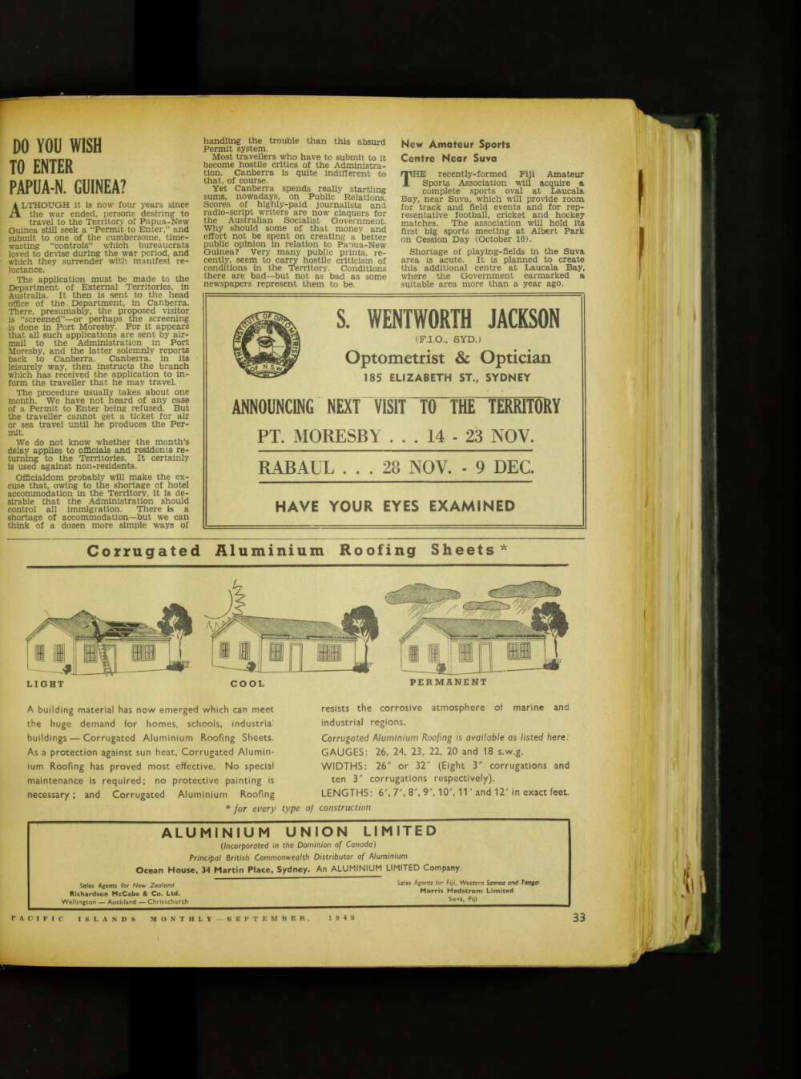
To Enter
Papua-N. Guinea?
ALTHOUGH it is now four years since the war ended, persons desiring to travel to the Territory of Papua-New Guinea still seek a “Permit to Enter,” and submit to one of the cumbersome, time wasting “controls” which bureaucrats loved to devise during the war period, and which they surrender with manifest re luctance.
The application must be made to the Department of External Territories, in Australia. It then is sent to the head office of the Department, in Canberra.
There, presumably, the proposed visitor is “screened”—or perhaps the screening is done in Port Moresby. For it appears that all such applications are sent by air mail to the Administration in Port Moresby, and the latter solemnly reports back to Canberra. Canberra, in its leisurely way, then instructs the branch which has received the application to in form the traveller that he may travel.
The procedure usually takes about one month. We have not heard of any case of a Permit to Enter being refused. But the traveller cannot get a ticket for air or sea travel until he produces the Per mit.
We do not know whether the month’s delay applies to officials and residents re turning to the Territories. It certainly is used against non-residents.
Officialdom probably will make the ex cuse that, owing to the shortage of hotel accommodation in the Territory, it is de sirable that the Administration should control all immigration. There is a shortage of accommodation—but we can think of a dozen more simple ways of
Permit^ystem. trouble than this absurd Most travellers who have to submit to it become hostile critics of the Administra tion. Canberra is quite indifferent to that, of course.
Yet Canberra spends really startling sums, nowadays, on Public Relations.
Scores of highly-paid journalists and radio-script writers are now claquers for the Australian Socialist Government.
Why should some of that money and effort not be spent on creating a better public opinion in relation to Panua-New Guinea? Very many public prints, recently, seem to carry hostile criticism of conditions in the Territory. Conditions there are bad—but not as bad as some newspapers represent them to be.
New Amateur Sports
Centre Near Suva
mHE recently-formed Fiji Amateur J. Sports Association will acquire a complete sports oval at Laucala Bay, near Suva, which will provide room f or track and field events and for rep resentative football, cricket and hockey matches. The association will hold its fi rs t big sports meeting at Albert Park 0 n Cession Day (October 10). , .
Shortage of playing-fields in the Suva area is acute. It is planned to create this additional centre at Laucala Bay, where the Government earmarked a suitable area more than a year ago.
Advertisements & other items, pp. 35-36 (1 item)
S. Wentworth Jackson
0/5
(F. 1.0., SYD.)
Optometrist & Optician
185 ELIZABETH ST., SYDNEY
ANNOUNCING NEXT VISIT TO THE TERRITORY
PT. MORESBY ... 14 ■ 23 NOV.
RABAUL ... 28 NOV. - 9 DEC.
HAVE YOUR EYES EXAMINED
Corrugated Aluminium Roofing Sheets *
ii 5 Hi i
LIGHT
COOL
PERMANENT
A building material has now emerged which can meet the huge demand for homes, schools, industrial
buildings — Corrugated Aluminium Roofing Sheets.
As a protection against sun heat, Corrugated Aluminium Roofing has proved most effective. No special maintenance is required; no protective painting is necessary; and Corrugated Aluminium Roofing * for every type of resists the corrosive atmosphere of marine and industrial regions.
Corrugated Aluminium Roofing is available as listed here: GAUGES: 26, 24, 23, 22, 20 and 18 s.w.g.
WIDTHS: 26" or 32" (Eight 3" corrugations and ten 3" corrugations respectively).
LENGTHS: 6', 7', 8', 9', 10', 11' and 12' in exact feet. construction
ALUMINIUM UNION LIMITED
(Incorporated in the Dominion of Canada) Principal British Commonwealth Distributor of Aluminium Ocean House, 34 Martin Place, Sydney. An ALUMINIUM LIMITED Company.
Sales Agents for New Zealand Richardson McCabe & Co. Ltd, Wellington — Auckland — Christchurch Sales Agents for Fiji, Western Samoa and Tonga: Morris Hedstrom Limited Suva, Fiji
IDEAL FOR THE ISLANDS...
The Famous
flTCO Products!
ATCO—BOATIMPELLER
/z • Simple to handle • Light—easily carried Surprisingly economical It's easy starting, has smooth powers and gives trouble-free performance.
ATCOSCYTHE
7//i n
f III
|\V Vv v Cut time and labour costs with this dependable machine. It's eight to twelve times as rapid as hand-scything. Ideal for cutting long grass, weeds, tall undergrowth, etc.
Just fill in the coupon below for illustrated booklets which will be sent post free.
ATCO MOTOR MOWER
There's a full range from the 12 and 14 inch models up to the 17, 20, 28 and 34 inch for big-area requirements. The ATCO is a self-contained unit and will go anywhere.
MOTOR TRACTORS
PTY. LIMITED
369-385 Wattle Street, Ultimo, Sydney Telegrams; “Sellmotors,” Sydney.
Papua
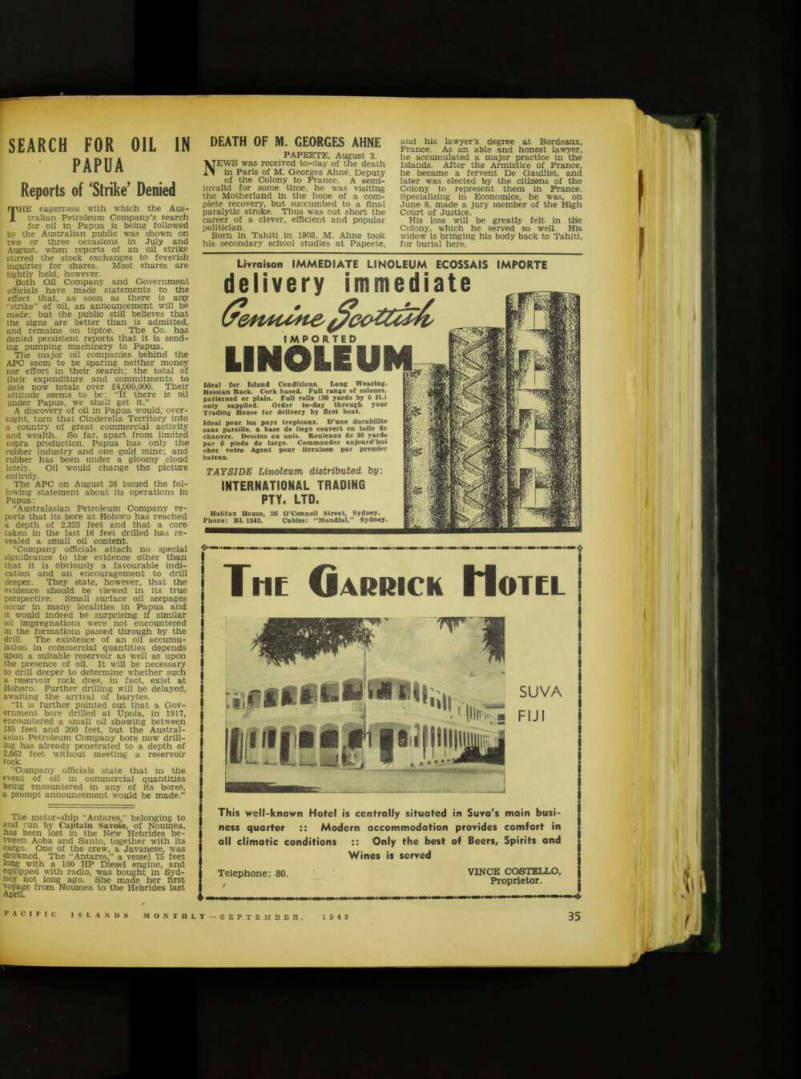
Search For Oil In
Reports of ‘Strike’ Denied
THE eagerness with which the Aus tralian Petroleum Company’s search for oil in Papua is being followed by the Australian public was shown on two or three occasions in July and August, when reports of an oil strike stirred the stock exchanges to feverish inquiries for shares. Most shares are tightly held, however.
Both Oil Company and Government officials have made statements to the effect that, as l soon as there is amy “strike” of oil, an announcement will be made; but the public still believes that the signs are better than is admitted, and remains on tiptoe. The Co. has denied persistent reports that it is send ing pumping machinery to Papua.
The major oil companies behind the APC seem to be sparing neither money nor effort in their search; the total of their expenditure and commitments to date now totals over £4,000,000. Their attitude seems to be: “If there is oil under Papua, we shall get it.”
A discovery of oil in Papua would, over night, turn that Cinderella Territory into a country of great commercial activity and wealth. So far, apart from limited copra production, Papua has only the rubber industry and one gold mine; and rubber has been under a gloomy cloud lately. Oil would change the picture entirely.
The APC on August 26 issued the fol lowing statement about its operations in Papua: “Australasian Petroleum Company re ports that its bore at Hohoro has reached a depth of 2,323 feet and that a core taken in the last 16 feet drilled has re vealed a small oil content.
“Company officials attach no special significance to the evidence other than that it is obviously a favourable indi cation and an encouragement to drill deeper. They state, however, that the evidence should be viewed in its true perspective. Small surface oil seepages occur in many localities in Papua and it would indeed be surprising if similar oil impregnations were not encountered in the formations passed through by the drill. The existence of an oil accumu lation in commercial quantities depends upon a suitable reservoir as well as upon the presence of oil. It will be necessary to drill deeper to determine whether such a reservoir rock does, in fact, exist at Hohoro. Further drilling will be delayed, awaiting the arrival of barytes.
“It is further pointed out that a Gov ernment bore drilled at Upoia, in 1917, encountered a small oil showing between 185 feet and 200 feet, but the Austral asian Petroleum Company bore now drill ing has already penetrated to a depth of 2,662 feet without meeting a reservoir rock.
“Company officials state that in the event of oil in commercial quantities being encountered in any of its bores, a prompt announcement would be made.”
The motor-ship “Antares,” belonging to and run by Captain Savoie, of Noumea, has been lost in the New Hebrides be tween Aoba and Santo, together with its cargo. One of the crew, a Javanese, was drowned. The “Antares,” a vessel 75 feet long with a 100 HP Diesel engine, and equipped with radio, was bought in Syd ney not long ago. She made her first voyage from Noumea to the Hebrides last April.
Death Of M. Georges Ahne
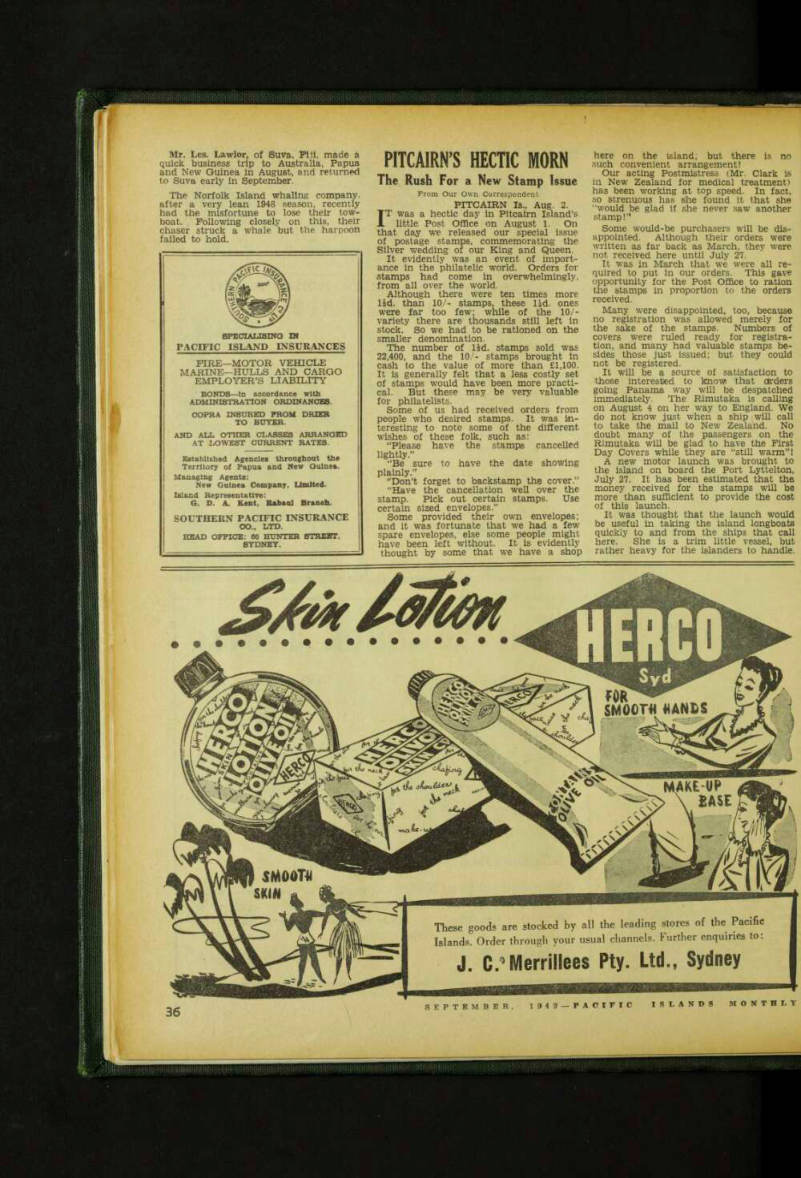
PAPEETE, August 3.
NEWS was received to-day of the death in Paris of M. Georges Ahne, Deputy of the Colony to France. A semi invalid for some time, he was visiting the Motherland in the hope of a com plete recovery, but succumbed to a final paralytic stroke. Thus was cut short the career of a clever, efficient and popular politician.
Bom in Tahiti in 1903, M. Ahne took his secondary school studies at Papeete,
and his lawyer’s degree at Bordeaux, France. As an able and honest lawyer, he accumulated a major practice in the Islands. After the Armistice of France, he became a fervent De Gaullist, and later was elected by the citizens of the Colony to represent them in France.
Specialising in Economics, he was, on June 8, made a jury member of the High Court of Justice.
His loss will be greatly felt in the Colony, which he served so well. His widow is bringing his body back to Tahiti, for burial here.
Mr. Les. Lawlor, of Suva, Plii, made a quick business trip to Australia, Papua and New Guinea in August, and returned to Suva early in September, The Norfolk Island whaling company, after a very lean 1948 season, recently had . the misfortune to lose their tow boat. Following closely on this, their chaser struck a whale but the harpoon failed to hold.
Advertisements & other items, pp. 37-38 (1 item)
The Garrick Hotel
Livroison IMMEDIATE LINOLEUM ECOSSAIS IMPORTS
delivery immediate
MPORTED
LINOLEUM
Ideal for Island Conditions. Long Wearing.
Hessian Back. Cork based. Full range of colours, patterned or plain. Full rolls (30 yards by 6 ft.) only supplied. Order to-day through your Trading House for delivery by first boat.
Ideal pour les pays tropicaux. D’une durabilite sans pareille, a base de liege couvert en toile de chanvre. Dessins ou unis. Rouleaux de 30 yards par 0 pieds de large. Commandez aujourd’hui chez votre Agent pour livraison par premier bateau.
TAY SIDE Linoleum distributed by:
INTERNATIONAL TRADING
PTY. LTD.
Halifax House, 26 O’Connell Street, Sydney.
Phone: BL 1543. Cables; “Mondial,” Sydney.
The Garrick Hotel
''H'fiiiifr:
■ ft ft *
SUVA
FIJI
This well-known Hotel is centrally situated in Suva's main business quarter :: Modern accommodation provides comfort in all climatic conditions Only the best of Beers, Spirits and Wines is served Telephone: 80.
VINCE COSTELLO,
Proprietor.
m
SPECIALISING IN
PACIFIC ISLAND INSURANCES
FIRE—MOTOR VEHICLE
MARINE—HULLS AND CARGO
EMPLOYER’S LIABILITY
BONDS—in accordance with
ADMINISTRATION ORDINANCES.
COPRA INSURED FROM DRIER
TO BUYER.
AND ALL OTHER CLASSES ARRANGED
AT LOWEST CURRENT RATES.
Limited.
Established Agencies throughout the Territory of Papua and New Guinea.
Managing Agents: New Guinea Company, Island Representative: G. D. A. Kent, Babanl Branch.
SOUTHERN PACIFIC INSURANCE
CO.. LTD.
HEAD OFFICE: 60 HUNTER STREET.
SYDNEY.
Pitcairn’S Hectic Morn
The Rush For a New Stamp Issue
From Our Own Correspondent
Pitcairn Is., Aug. 2.
IT was a hectic day in Pitcairn Island’s little Post Office on August 1. On that day we released our special issue of postage stamps, commemorating the Silver wedding of our King and Queen.
It evidently was an event of import ance in the philatelic world. Orders for stamps had come in overwhelmingly, from all over the world.
Although there were ten times more lid. than 10/- stamps, these lid. ones were far too few; while of the 10/variety there are thousands still left in stock. So we had to be rationed on the smaller denomination.
The number of lid. stamps sold was 22,400, and the 10/- stamps brought in cash to the value of more than £l,lOO.
It is generally felt that a less costly set of stamps would have been more practi cal. But these may be very valuable for philatelists.
Some of us had received orders from people who desired stamps. It was in teresting to note some of the different wishes of these folk, such as: “Please have the stamps cancelled lightly.”
“Be sure to have the date showing plainly.”
“Don’t forget to backstamp the cover.”
“Have the cancellation well over the stamp. Pick out certain stamps. Use certain sized envelopes.”
Some provided their own envelopes; and it was fortunate that we had a few spare envelopes, else some people might have been left without. It is evidently thought by some that we have a shop
here on the island, but there is no such convenient arrangement!
Our acting Postmistress (Mr. Clark is in New Zealand for medical treatment) has been working at top speed. In fact, so strenuous has she found it that she “would be glad if she never saw another stamp!’* Some would-be purchasers will be dis appointed. Although their orders were written as far back as March, they were not received here until July 27.
It was in March that we were all re quired to put in our orders. This gave opportunity for the Post Office to ration the stamps in proportion to the orders received.
Many were disappointed, too, because no registration was allowed merely for the sake of the stamps. Numbers of covers were ruled ready for registra tion, and many had valuable stamps be sides those just issued; but they could not be registered.
It will be a source of satisfaction to those interested to know that drders going Panama way will be despatched immediately. The Rimutaka is calling on August 4 on her way to England. We do not know just when a ship will call to take the mail to New Zealand. No doubt many of the passengers on the Rimutaka will be glad to have the First Day Covers while they are “still warm”!
A new motor launch was brought to the island on board the Port Lyttelton, July 27. It has been estimated that the money received for the stamps will be more than sufficient to provide the cost of this launch.
It was thought that the launch would be useful in taking the island longboats quickly to and from the ships that call here. She is a trim little vessel, but rather heavy for the islanders to handle.
Advertisements & other items, p. 38 (1 item)
J. C.’Merrillees Pty. Ltd., Sydney
FOR
o Vi /
SMOOTH HANDS
c£x s/ &|i tL V V ifc b% U*> iL Lu&uv
MAKE
* 4 &
BASE
ss> s i
SMOOTH
SKIM
These goods are stocked by all the leading stores of the Pacific Islands. Order through your usual channels. Further enquiries to:
J. C.’Merrillees Pty. Ltd., Sydney
Again Selling
Papuan Planters
Rubber
Prom Our Own Correspondent
Port Moresby, Sept. 2.
PAPUAN planters are selling their rubber again after a five months break during which approximately 800 tons accumulated at storage centres and plantations in the Territory.
The Australian Government, through the Production Control Board, is buying the rubber at Singapore prices. Al though planters sayi that the present prices of 12.3 pence for second grade, and 13.1 pence for first grade, are below cost of production, they, nevertheless, are thankful for the Government’s help.
In any case, this arrangement is be lieved to be a temporary one. After October 31, it is hoped that a permanent stabilisation scheme will be introduced.
An officer of the Commonwealth De partment of Agriculture (Mr. Grogan), is being sent to investigate the whole rubber problem. In this he will be assisted by the local Assistant Director of Agri culture, Mr. R. E. Dwyer, who is being recalled from leave for this purpose.
The rubber trouble, it will be remem bered, arose at the end of March when Australian manufacturers stated that they could buy Papuan rubber only if growers were prepared to sell their No. 1 grade at the price for No. 2 grade. .
Planters refused to sell under these con ditions.
There appears to have been no change in the attitude of the manufacturers, therefore the Government, in buying the rubber at Singapore prices, will have to sell at a loss if it wishes to supply the Australian market.
for Shipowners
Making Life Difficult for Shipowners Stowaways Become Public Nuisance in Fiji
Prom Our Own Correspondent
Suva, Aug. 28.
AFTER being delayed for an hour to permit an intensive daylight search for stowaways, the Union Company’s ship, Wairuna, sailed from Lautoka, Fiji, at 7 a.m. on August 24. No stowaways had been found, but at 9 a.m. the Wairuna was back to empty out six en terprising young men who had materialised in No. 4 hold.
Three of them —two part-Europeans and an Indian —are reported to have travelled to Lautoka from Suva for the express purpose of stowing away. The other three were Fijians from Lautoka.
They were taken over by the police.
Stowing away is a popular activity at Fiji’s ports. One of the Lautoka trio went to Vancouver in the Waihemo in April and was brought back by the Wairuna in June.
Fiji’s most publicised stowaway, how ever, is Jonasa Nasau, aged 16, who travelled to and from Melbourne and Sydney in the Wairuna, and who, by his own account, had a pretty good time. He arrived back with a new leather case, a comprehensive outfit of clothes and other gifts from benevolent organisations at Sydney.
There is usually general sympathy with the instinctive love of adventure which prompts people to stow away in ships, but, these days, stowaways often involve dollar-wastage for oil fuel as well as delay to ships and, consequently, ex pense to the shipowners.
And Cooks
Airport Facilities In Samoa
PROVISION for the establishment of customs facilities at airports in the Cook Islands and Western Samoa was made in New Zealand regulations published on August 25. These will be in accordance with international re quirements and will be the first customs facilities for air travel established in those islands.
Advertisements & other items, pp. 39-40 (2 items)
Gordon's
H.P. Single Cylinder Model.
VINCO Inboard Launch
Engines.
Suitable Boats. 10 ft. to 22 ft.
For over 20 years the most efficient and popular make in Australia. 2% H.P., £B9/10/-; 4 H.P., £55; 8 H.P. (Twin), £lO3, F. 0.8., Sydney. Prices include Clutch and Equipment.
Write for Free 16-Page Illustrated Booklet
VINCENT BROS.
44 Wentworth Park Rd., Glebe,
Sydney.
By Appointment Gin Distillers to H.M. King George VI Tanqueray, Gordon & Co. Ltd.
Gordon's
Stands SufA&ms,
cc
Co-operation like this
makes things happen fast!
55 . Agent. He’s the chap —multiplied 3,500 times throughout the world —who saves me hours of preliminary planning.
Yes, my Agent makes things happen in a hurry.
And he knows the answers to all my riddles about currency restrictions, baggage allowances, visas and regulations. I give him my itinerary and leave the details to him. He handles everything without fuss or confusion. All I do is pack a bag and leave on schedule.
This same Speedbird efficiency—this same concern for your comfort and pleasure —applies wherever you may fly along 150,000 miles of —comfortable, too. You enjoy complimentary meals, and there are no extras for the countless attentions and courtesies that make your journey so much more enjoyable. It’s all part of B.O.A.C.’s 30-year-old tradition of Speedbird service and experience.
GREAT BRITAIN • USA • BERMUDA • CANADA MIDDLE EAST • WEST AFRICA • EAST AFRICA SOUTH AFRICA • PAKISTAN • INDIA • CEYLON AUSTRALIA • NEW ZEALAND • FAR EAST • JAPAN
I.O.A.C. TAKES GOOD CARE OF YOU
FLY" SOAC
AIO/AU
Information & Bookings : Qantas Empire Airways Ltd., Sydney , Melbourne , Brisbane , Townsville , Cairns , Darwin (General Agents in Australia ), or from Booking Agents in all cities.
BRITISH OVERSEAS AIRWAYS CORPORATION WITH Q.E.A., T.E.A.L. AND S.A.A.
38
SEPTEMBER. IHJ-MCIFIC ISLANDS MONTH I,
W. Samoa
News Items From
From Our Own Correspondent APIA, August 25.
Miss Mary. Woodward, Who As
“Miss New Zealand, 1949”, has figured prominently in recent New Zealand reports, is the daughter of Mr.
W. H Woodward, SM, of New Plymouth, who was Chief Judge of the High Court of Western Samoa during the twenties, and in the period of the “Mau” trouble.
Amongst other former judges of West ern Samoa, who at present hold the po sition of Magistrate in New Zealand, are Judges Luxford, Harley and Morling.
Mr. F. L. Goetz, well-known as former General Manager of the New Zealand Reparation Estates at Apia, and now of Auckland, NZ, was recently selected National Party candidate for the Ota huhu electorate at the coming New Zea land elections. Mr. Goetz is keenly in terested in matters affecting Samoa. ♦ ♦ ♦ If weather conditions are favourable, a bumper cocoa crop will come in to wards the end of this year, probably be ginning in October and lasting until December/January. The “Thor I,” ex pected this week, is to load practically all the cocoa in stores for the American market. The local price is about £135 per ton FOB, Apia.
There is an accumulation of about 4,000 tons of copra in Apia sheds, and exporters are anxious for the arrival of the next copra steamer. * * ♦ The recent shortage of native food stuffs, particularly of taro and bananas, has been relieved by the beginning of the breadfruit season.
The last “Matua” took 6,300 cases of bananas for the New Zealand market.
The “Waitomo” expected here at the be ginning of September is bringing much needed supplies of Australian goods. Un fortunately, she does not carry supplies of Australian sugar—for this we still de dend mostly on Fijian brown sugar. ♦ * « The Select Committee on the Pre ferential Customs Tariff has heard some evidence, but has not, as yet, terminated its deliberations and no decision has been made whether or not the Preferential Tariff on British goods is to be modified or abolished.
Trading Co.
New Head For Pacific Islands
THE Pacific Islands Trading Co., estab lished in' San Francisco a few years ago by Mr. A. G. Andrews, formerly of Fiji and other South Pacific Terri tories, has been sold as a going concern to Mr. C. C. Butler, of Oakland (Cali fornia), and Guam.
Mr. Butler has been a leading merchant in the American North Pacific Territory of Guam for some years and, although he has removed to San Francisco, he retains his business interests in the North Pacific.
Under Mr. Andrews’ direction the Pacific Islands Trading Co. has built up a con siderable turnover in the Islands of the South Pacific; and the indications are that Mr. Butler will seek to extend and develop these connections.
Mr. Andrews will remain at the office of the Co. in San Francisco until the end of October and then, with Mrs. Andrews and their son, he will spend a year or so in Europe.
Radio Stations For Torres
Islands
A NETWORK of 14 wireless sub-stations was planned to connect Torres Strait islands and Peninsula missions with a central station at Thursday Island, the Health and Home Affairs Minister (Mr.
Jones) said yesterday.
Already sub-stations had been estab lished at Murray, Darnley, Badu, and Mabuiag islands in Torres Strait.
Advertisements & other items, p. 41 (1 item)
Cannot Sleep
If You
FEEL FIT FOR NOTHING.
You may be anaemic or bloodless, for this ailment plays havoc with your health and nervous energy. You feel terribly nervy; suffer headaches and dizzy spells, have poor appetite, cannot sleep at night —losing those precious hours of rest and recovery, essential for your health and fitness.
Many people have recovered from these miseries by taking Dr. Williams’ Pink Pills, which have reinvigorated, strengthened their systems and banished the vague pains and weariness. Dr. Williams’ Pink Pills always help to enrich and increase the blood supply, giving beneficial help to the nerves, tissues and organs of the body. With enriched blood you cannot help feeling happier, sleeping better, becoming reinvigorated.
Stop anaemia making you a suffering invalid without delay. Take Dr. Williams' Pink Pills and soon notice the difference in your eyes, skin, nerves and general health. At all chemists and stores.
KASPER ELECTRIC
ill ■ KA The Kasper No. 1 K Electric Carbonator.
CARBONATORS
Available NOW
DESCRIPTION: Fully automatic, noiseless and efficient at all times. Capacity 24 gallons of pure sparkling peppy soda per hour. All working parts easily accessible from the front. Dimensions: 22 in. x 27 in, floor space; 26 in. high. Finish: Rust resistant and easy to clean. Valves and fittings are hard bronze accurately machined.
Thoroughly tested and fully guaranteed for 12 months.
INSTALL A KASPER No. IK
ELECTRIC CARBONATOR and
be assured of dependable, trouble-free service.
KASPER REFRIGERATORS PTY. LTD.
77 Railway Parade, Erskinevilie, N.S.W., Australia. Phone LA 1326.
Gloomy View Of Western
Samoa’S Future
(Extract from a Private Letter from a Recent Visitor to the Territory.) ICOME more and more to the opinion that the prospective “self-govern ment” of Western Samoa is going on the rocks.
Graft and corruption are growing here; there are favoritism and money-grabbing for the few fortunate ones who can feed in the public manger.
The waste of money by the Govern ment is terrific, particularly on educa tion, roads and salaries—£7o,ooo for a small country like Western Samoa, whose exports amounted last year to some £1,300,000 in value!
The whole structure of the Govern ment is top-heavy, and is bound to topple in a few years. They have already started to draw on accumulated reserves and in a few years, particularly with produce prices dropping, they will be in the red.
I give you these private opinions of mine for what they are worth. One can not blame the new Administrator—he is the victim of circumstances he cannot control. Definitely, the state of affairs is unhealthy and the future looks any thing but bright.
The present-day Samoan does not want to work on the land and the young genera tion, with the stress on higher education, is after white-collar jobs only.
The territory seems to be crowded with New Zealand officials and their wives, who also get Government jobs here, and the promised preference for local appli cants for jobs is sabotaged most effec tively.
You may think me a Bassandra with these tales of woe—but I assure you that my views are shared by the great majority of the old European, Euronesian and wiser Samoans in the Territory. (Editorial Note: Some of the conditions described by our friend may be found, duplicated exactly, in Papua-New Guinea which, like Western Samoa, is a Trustee ship Territory run by a Socialist Do minion Government.)
Dwight Long Returns To
Tahiti
From Our Own Correspondent PAPEETE, August 1.
MR. DWIGHT LONG, who won con siderable fame as a yachtsman, with his film production “Fighting Lady,” and with his travel book, “Round the World on a Shoestring,” has returned to Tahiti to complete his documentary film on life in Tahiti—which will include recent July 14 Celebrations.
The film is in technicolour and promises to be a success. There is a light love story woven into it, the stars being Mile. Adeline Tetahoumaui. and M. Paul Moe, both of whom are showing promise before the camera. M. Paul Moe, a veteran of the North African campaign, also acts as assistant and interpreter.
Other assistants are Mrs. Jeannette Shel ton and Mrs. C. Swenson.
The Governor will give Mr. Long every facility for the successful completion of the film. The documentary is being pro duced entirely by Mr. Long and the camera and equipment are the same that he used to make “Fighting Lady.”
A print will be presented to the Papeete Town Council as a mark of appreciation for the courtesy and help received by Mr.
Long.
Death Of G. F. Harrison
Of Papua
THE death occurred in Samarai, Papua, on August 1, of George Fernley Harrison, of Fergusson Island. He was born at Farnsfield, Notts., England, 62 years ago. Emigrated with his parents to New Zealand in 1902, and joined his brother, E. W. Harrison, in Papua in 1910.
For five years he was engaged in build ing contracts in Samarai; one of the buildings he erected was the Samarai Post Office. In 1915 ne became a planter, and made his home at Kedidia Plantation, Fergusson Island. During the depression he gave his services to the Methodist Mis sion and amongst other jobs, built the Mission vessel, Eliam.
He served as a supervising shipwright at the Sariba Slip for ANGAU, from June, 1942, until the war ended, when he returned to his home at Kedidia.
At the time of his death he had taken two vessels into Samarai to be slipped and repaired. His death came suddenly.
One of the old brigade—honest, loyal, hospitable, and friendly with all—those who knew him well will miss him. He is survived by his brother who also lives on Fergusson Island.
Leper Hospital For Papua
THE Rev. A. Crookes_ Hull, organising secretary of Methodist Overseas Missions, announced in Perth, in August, that a leper hospital would be built at Übuia on Normandy Island, Papua. When completed the institution would provide treatment for 80 patients.
Advertisements & other items, p. 42 (1 item)
Steamships Trading Company Ltd
PORT MORESBY AND SAMARA! — PAPUA
Wholesale & Retail Merchants, Planters, Sawmillers, Engineers, Slip
Proprietors, Shipping, Customs and Insurance Agents.
MANAGING AGENTS for:
SAWMILLERS & TRADERS LTD.
CORAL SEAS INSURANCE CO. LTD.
ACME BAKERY COMPANY.
MARIBOI RUBBER LTD.
RUBBERLANDS LTD.
KEREMA RUBBER PLANTATIONS LTD.
COCOALANDS LTD.
AGENCIES:
BANKERS & TRADERS INSURANCE CO. LTD.
VACUUM OIL CO. PTY., LTD.
DIRECTORATE OP SHIPPING—Papua—New
Guinea Division.
ROYAL PACKET NAVIGATION CO.
KOKE BAGU PTY., LTD.
TRANS OCEANIC AIRWAYS.
GUINEA AIR TRADERS.
DISTRIBUTORS IN PAPUA for:
ARMSTRONG-HOLLAND PTY., LTD. INTERNATIONAL HARVESTER CO. OP AUST, LTD.
Earth Moving and Logging Equipment. International Trucks, WILLYS-OVERLAND EXPORT CORPORATION. McCormack Deering Farming Machinery, Jeep cars, etc. Defender Refrigerators.
SYDNEY AGENTS: NELSON & ROBERTSON PTY. LTD., 12 SPRING STREET
W. Samoa Needs
More Doctors
From 'Our Own Correspondent APIA, August 25.
A SHORTAGE of doctors in the Western Samoan Government Medi cal Service has been a serious prob lem for the Government as well as the general public for many years and has become worse recently.
There are, at present, only two medi cal officers in the Territory—the Chief Medical Officer, Dr. J. Lopdell, whose time is occupied with Administrative matters and sanitation; and Dr. D. L.
Frost. Consequently, these two doctors are overburdened with work in a popu lation of nearly 80,000 people and there is a great deal of public dissatisfaction.
It is recalled that, before the first World War, when Samoa, under German rule, had less than half the present popula tion, there were six doctors practising, five of whom were private practitioners amongst whom were an eye specialist, a surgeon, and a specialist for women’s and children’s diseases. Apparently New Zea land medical men find Western Samoa unattractive from a financial and other points of view.
It has been that the Gov ernment should undertake an advertis ing campaign to try to attract Govern ment-subsidised private practitioners, not necessarily from New Zealand, but from England, Australia, USA or Europe.
A number of medical officers have lately come to Samoa for short periods, or hav ing come for a longer term have left the Territory before their three years’ con tracts expired. They found conditions uncongenial.
The vote of the Medical Department
for the current year is £150,000, but it is of little use to spend money on new hospitals and equipment, if there is a lack of competent medical officers to use these facilities.
Less Aid for BSI
from UK
From Our Own Correspondent
A Honiara, Bsi, Aug. 1.
reassuring sign of the gradual pro gress of BSI towards ultimate eco nomic recovery is indicated by the fact that the annual Grant-in-Aid from Great Britain, drawn from the pockets of British taxpayers to tide the Protec torate over the painful period of re construction, has been reduced by £172,000 for the current year—that is, the grant has been approximately halved This announcement was made here yesterday. It was explained that a slight increase in revenue, and various econo mies made during the past six months, will enable the local Government to meet
the reduction confidently. (Editorial Note; It may be that this is not so much a “reassuring sign” of the progress of rehabilitation in BSI, as a sign of the economic blizzard that has hit the United Kingdom. In recent months, the UK has not spared her colonies but evidently expects them, in future, to share in her austerity.)
Still Unknown
Inquiry Into Cause of Fire in BP Store at Ba
From Our Own Correspondent SUVA, August 8.
THE official inquiry into the disastrous Burns, Philp fire at Ba, Fiji, on May 28, failed to establish the cause of the outbreak.
The finding of Mr. C. L. Regan was that the fire started somewhere near the boundary of the grocery bulk store and the drapery bulk store. The inquiry lasted for several days and 16 witnesses gave evidence.
Advertisements & other items, pp. 43-44 (1 item)
Hand Tools
ALL CLASSES OF HAND TOOLS AVAILABLE
FROM:—
VENTURA TRADING COMPANY PTY. LTD.
26 BRIDGE STREET. SYDNEY. Cables: “VENTURA,” Sydney.
Representatives: R. & R. Hutchinson, Suva. H. G. EekhofT, Lae, T.N.G.
For the RIGHT TIME Rely on WESTCLOX The finest, smartest clocks in Westclox history—that’s what Westclox has in store for you! A wide range of stunning clocks for every room— spring-wound and electric alarm models—wall clocks for your kitchen and time clocks for the living room— yes, wrist and pocket watches, too— all with traditional Westclox dependability and smartness that have made Big Ben and other members of this time-keeping family famous all over the world.
“It’s a Westclox.” is,the-finest thing you can say about a clock or watch.
Some Westclox have luminous dials that you can see in the dark.
You can buy any Westclox with confidence. Look for that trade mark on the dial of the next clock or watch you buy.
• QUALITY •
• RELIABILITY •
10 Baby Ben —His alarm may be adjusted to loud or soft. Quiet tick. Made in two finishes— ivory and gold colour; also black with nickel trim. big ben Big Ben is made two ways—There’s Big Ben Loud Alarm with booming intermittent call. If you want a more gentle awakening, there’s Big Ben Chime Alarm which first calls you with soft chimes. If you ignore these chimes, there’s a loud call in reserve.
PACIFIC ISLANDS TRADING CO.
244 CALIFORNIA ST., SAN FRANCISCO, CALIF., U.S.A.
/In ornate example of historical keys, this XVlth Century French key features the sporting motif in its club and animal carvings. It seems to have been the key to a Duke’s country lodge. 0 v' LUm / / / X B in S
key
Th e Pi ok ur e s o e to 9 n i m s
CAPSTAN
FINE CUT
NAVY CUT
TOBACCOS
or
But Slowly!
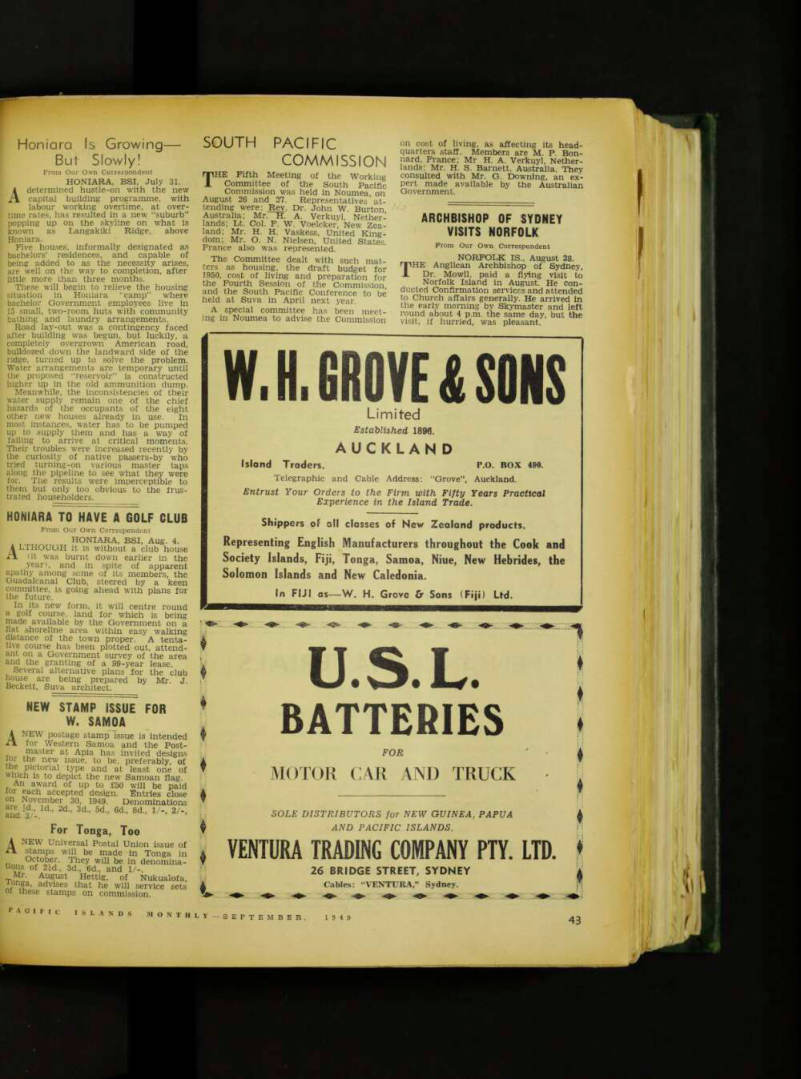
Honiara Is Growing— But Slowly!
From Our Own Correspondent
Honiara, Bsi, July 31.
A determined hustle-on with the new capital building programme, with labour working overtime, at over time rates, has resulted in a new “suburb” popping up on the skyline on what is known as Langakiki Ridge, above Honiara.
Five houses, informally designated as bachelors’ residences, and capable of being added to as the necessity arises, are well on the way to completion, after little more than three months.
These will begin to relieve the housing situation in Honiara “camp” where bachelor Government employees live in 15 small, two-room huts with community bathing and laundry arrangements.
Road lay-out was a contingency faced after building was begun, but luckily, a completely overgrown American road, bulldozed down the landward side of the ridge, turned up to solve the problem.
Water arrangements are temporary until the proposed “reservoir” is constructed higher up in the old ammunition dump.
Meanwhile, the inconsistencies of their water supply remain one of the chief hazards of the occupants of the eight other new houses already in use. In most instances, water has to be pumped up to supply them and has a way of failing to arrive at critical moments.
Their troubles were increased recently by the curiosity of native passers-by who tried turning-on various master taps along the pipeline to see what they were for. The results were imperceptible to them but only too obvious to the frus trated householders.
Honiara To Have A Golf Club
From Our Own Correspondent
Honiara, Bsi, Aug. 4.
ALTHOUGH it is without a club house (it was burnt down earlier in the year), and in spite of apparent apathy among some of its members, the Guadalcanal Club, steered by a keen committee, is going ahead with plans for the future.
In its new form, it will centre round a golf course, land for which is being made available by the Government on a flat shoreline area within easy walking distance of the town proper. A tenta tive course has been plotted out, attend ant on a Government survey of the area and the granting of a 99-year lease.
Several alternative plans for the club house are being prepared by Mr. J.
Beckett, Suva architect.
W. Samoa
New Stamp Issue For
ANEW postage stamp issue is intended for Western Samoa and the Post master at Apia has invited designs lor the new issue, to be, preferably, of the pictorial type and at least one of which is to depict the new Samoan flag.
An award of up to £5O will be paid lor each accepted design. Entries close on November 30, 1949. Denominations and 3/- ’ 2d ” 3d ” sd ” 6d ” 8d ” 17 “* 2/ -’
For Tonga, Too
ANEW Universal Postal Union issue of stamps will be made in Tonga in Oc i i0 o l e i' They will be in denomina tions of 2Jd., 3d., 6d., and 1/-.
A J u^ ust of Nukualofa, if On JL a ’ a( fvises that he will service sets oi these stamps on commission.
South Pacific
Commission
T HE Fifth Meeting of the Working Committee of the South Pacific Commission was held in Noumea on August 26 and 27. Representatives ’ at tending were: Rev. Dr. John W. Burton c^^w A volfe r k k eM land; Mr. H. H. Vaskess, United King dom; Mr. O. N. Nielsen, United States France also was represented.
The Committee dealt with such mat ters as housing, the draft budget for 1950, cost of living and preparation for the Fourth Session of the Commission and the South Pacific Conference to be held at Suva in April next year A special committee has been' meet mg in Noumea to advise the Commission
on cost of living, as affecting its head- Quarters staff. Members are M. P. Bon- P ard> France: Mr H - A - Verkuyl, Nether lands; Mr. H. S. Barnett, Australia. They consulted with Mr. G. Downing, an ex perfc made available by the Australian Government.
Archbishop Of Sydney
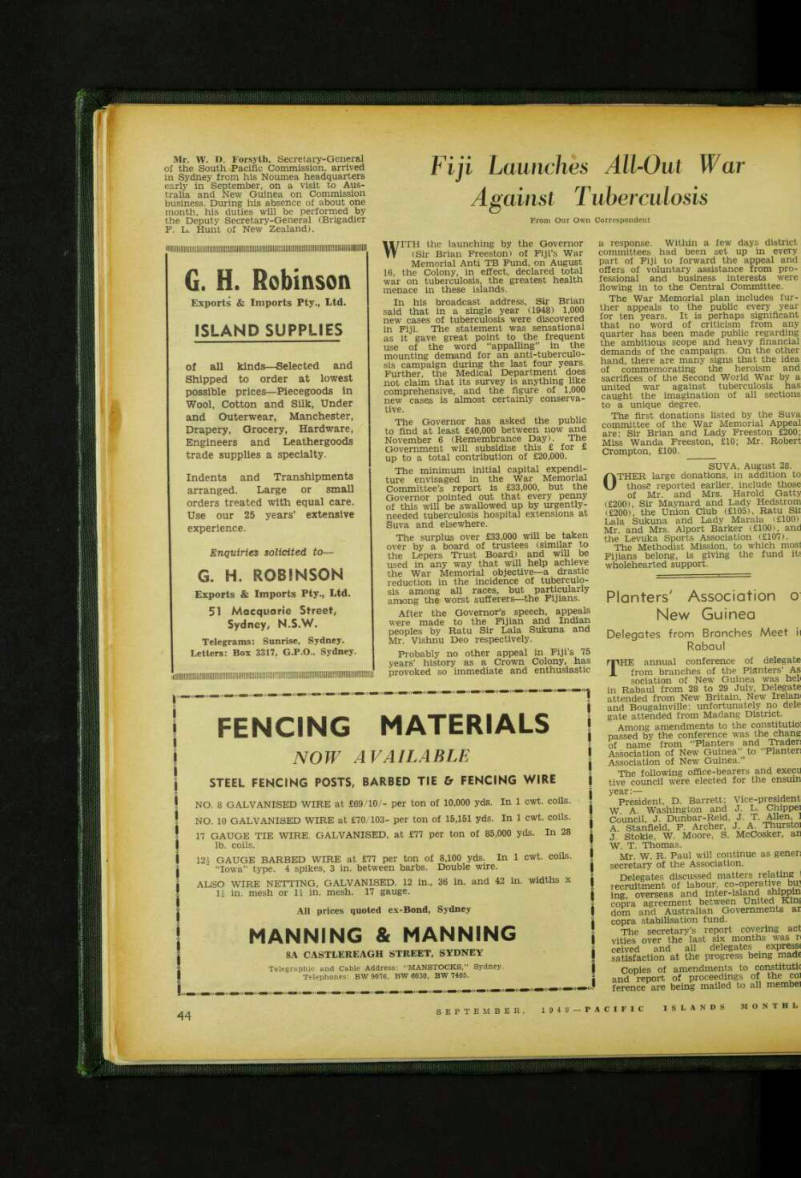
Visits Norfolk
™ From Our Own Correspondent miI1? A NORTOLK IS., August 28.
Anglican Archbishop of Sydney, sr-5 r -„ I £ owll, paid a visit to Norfolk Island in August. He con ducted Confirmation services and attended Church affairs generally. He arrived in
JoSnd aboutTp'S dav hilt the
visit if hurried, waspfeTlant
Mr. W. D. Forsyth, Secretary-General of the South Pacific Commission, arrived in Sydney from his Noumea headquarters early in September, on a visit to Aus tralia and New Guinea on Commission business. During his absence of about one month, his duties will be performed by the Deputy Secretary-General (Brigadier F. L. Hunt of New Zealand).
Advertisements & other items, pp. 45-46 (2 items)
43
°IFIC ISLANDS MONTHLY SEPTEMBER, 1949
W. H. Grove & Sons
Limited
Established 1896.
AUCKLAND
Island Traders. P.O. BOX 490.
Telegraphic and Cable Address: “Grove", Auckland.
Entrust Your Orders to the Firm with Fifty Years Practical Experience in the Island Trade.
Shippers of all classes of New Zealand products.
Representing English Manufacturers throughout the Cook and Society Islands, Fiji, Tonga, Samoa, Niue, New Hebrides, the Solomon Islands and New Caledonia.
In FIJI as—W. H. Grove Cr Sons (Fiji) Ltd.
U.S.L.
BATTERIES
FOR
MOTOR CAR AND TRUCK
SOLE DISTRIBUTORS for NEW GUINEA, PAPUA
AND PACIFIC ISLANDS.
VENTURA TRADING COMPANY PTY. LTD.
26 BRIDGE STREET, SYDNEY
Cables: “VENTURA,” Sydney.
G. H. Robinson
Exports & Imports Pty., Ltd.
ISLAND SUPPLIES
of all kinds—Selected and Shipped to order at lowest possible prices—Piecegoods in Wool, Cotton and Silk, Under and Outerwear, Manchester, Drapery, Grocery, Hardware, Engineers and Leathergoods trade supplies a specialty.
Indents and Transhipments arranged. Large or small orders treated with equal care.
Use our 25 years’ extensive experience.
Enquiries solicited to —
G. H. ROBINSON
Exports & Imports Pty., Ltd. 51 Macquarie Street, Sydney, N.S.W.
Telegrams: Sunrise, Sydney.
Letters: Box 3317, G.P.0.. Sydney.
FENCING MATERIALS
NOW AVAILABLE
STEEL FENCING POSTS, BARBED TIE & FENCING WIRE NO. 8 GALVANISED WIRE at £69/10/- per ton of 10,000 yds. In 1 cwt. coils.
NO. 10 GALVANISED WIRE at £7O/103- per ton of 15,151 yds. In 1 cwt. coils. 17 GAUGE TIE WIRE, GALVANISED, at £77 per ton of 85,000 yds. In 28 lb. coils. 12i GAUGE BARBED WIRE at £77 per ton of 8,100 yds. In 1 cwt. coils.
“Iowa” type. 4 spikes, 3 in. between barbs. Double wire.
ALSO WIRE NETTING, GALVANISED. 12 in., 36 in. and 42 in. widths x U in. mesh or II in. mesh. 17 gauge.
All prices quoted ex-Bond, Sydney
MANNING & MANNING
8A CASTLEREAGH STREET, SYDNEY
Telegraphic and Cable Address; “MANSTOCKS,” Sydney.
Telephones: BW 9076, BW 6030, BW 7405.
Against Tuberculosis
Fiji Launches All-Out War Against Tuberculosis
From Our Own Correspondent
WITH the launching by the Governor (Sir Brian Freeston) of Fiji’s War Memorial Anti TB Fund, on August 16, the Colony, in effect, declared total war on tuberculosis, the greatest health menace in these islands.
In his broadcast address, Sir Brian said that in a single year (1948) 1,000 new cases of tuberculosis were discovered in Fiji. The statement was sensational as it gave great point to the frequent use of the word “appalling” in the mounting demand for an anti-tuberculo sis campaign during the last four years.
Further, the Medical Department does not claim that its survey is anything like comprehensive, and the figure of 1,000 new cases is almost certainly conserva tive.
The Governor has asked the public to find at least £40,000 between now and November 6 (Remembrance Day). The Government will subsidise this £ for £ up to a total contribution of £20,000.
The minimum initial capital expendi ture envisaged in the War Memorial Committee’s report is £33,000, but the Governor pointed out that every penny of this will be swallowed up by urgently needed tuberculosis hospital extensions at Suva and elsewhere.
The surplus over £33,000 will be taken over by a board of trustees (similar to the Lepers Trust Board) and will be used in any way that will help achieve the War Memorial objective—a drastic reduction in the incidence of tuberculo sis among all races, but particularly among the worst sufferers —the Fijians.
After the Governor’s speech, appeals were made to the Fijian and Indian peoples by Ratu Sir Lala Sukuna and Mr. Vishnu Deo respectively.
Probably no other appeal in Fiji’s 75 years’ history as a Crown Colony, has provoked so immediate and enthusiastic
a response. Within a few days district committees had been set up in every part of Fiji to forward the appeal and offers of voluntary assistance from pro fessional and business interests were flowing in to the Central Committee.
The War Memorial plan includes fur ther appeals to the public every year for ten years. It is perhaps significant that no word of criticism from any quarter has been made public regarding the ambitious scope and heavy financial demands of the campaign. On the other hand, there are many signs that the idea of commemorating the heroism and sacrifices of the Second World War by a united war against tuberculosis has caught the imagination of all sections to a unique degree.
The first donations listed by the Suva committee of the War Memorial Appeal are: Sir Brian and Lady Freeston £200; Miss Wanda Freeston, £10; Mr. Robert Crompton, £lOO.
SUVA, August 28.
OTHER large donations, in addition to those reported earlier, include those of Mr. and Mrs. Harold Gatty (£200), Sir Maynard and Lady Hedstrom (£200), the Union Club (£105). Ratu Sir Lala Sukuna and Lady Maraia (£100) Mr. and Mrs. Alport Barker (£100), and the Levuka Sports Association (£107).
The Methodist Mission, to which most Fijians belong, is giving the fund its wholehearted support.
New Guinea
Planters' Association a New Guinea Delegates from Branches Meet it Rabaul
THE annual conference of delegate from branches of the Planters’ As sociation of New Guinea was hel< in Rabaul from 28 to 29 July. Delegate attended from New Britain, New Irelam and Bougainville; unfortunately no dele gate attended from- Madang District.
Among amendments to the constitution passed by the conference was the chang of name from “Planters and Trader!
Association of New Guinea” to “Planter!
Association of New Guinea.”
The following office-bearers and exe9U tive council were elected for the ensuin year:— President, D. Barrett; Vice-president W A. Washington and J. L. Chippei Council, J. Dunbar-Reid, J. T. Allen, 1 A. Stanfield, F. Archer, J. A. Thurstoi J. Stokie, W. Moore, S. McCosker, an W. T. Thomas.
Mr. W. R. Paul will continue as genen secretary of the Association.
Delegates discussed matters relating 1 recruitment of labour, co-operative buj ing, overseas and inter-island shippm copra agreement between United Kim dom and Australian Governments ar copra stabilisation fund.
The secretary’s report covering act vities over the last six months was n ceived and all delegates . expresse satisfaction at the progress being mad€ Copies of amendments to constitutic and report of proceedings of the coi ference are being mailed to all membei
Advertisements & other items, p. 46 (1 item)
44
SEPTEMBER, 194 S’- PACIFIC ISLANDS MONTHL
The Administrator, According To Osmar White
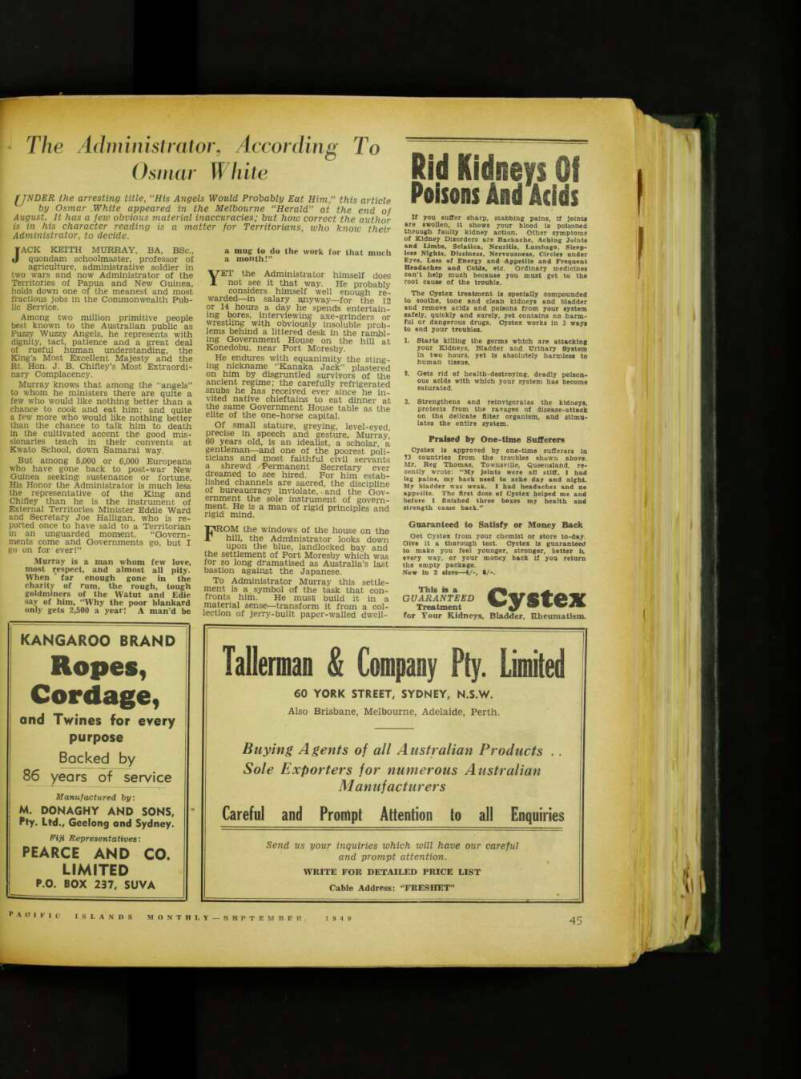
Osmar White
fJNDER the arresting title, “His Angels Would Probably Eat Him,” this article by Osmar White appeared in the Melbourne “Herald” at the end of August. It has a few obvious material inaccuracies; but hoiv correct the author is in his character reading is a matter for Territorians, who know their Administrator, to decide.
Jack Keith Murray, Ba, Bsc.,
quondam schoolmaster, professor of agriculture, administrative soldier in two wars and now Administrator of the Territories of Papua and New Guinea, holds down one of the meanest and most fractious jobs in the Commonwealth Pub lic Service.
Among two million primitive people best known to the Australian public as Fuzzy Wuzzy Angels, he represents with dignity, tact, patience and a great deal of rueful human understanding, the King’s Most Excellent Majesty and the Rt. Hon. J. B. Chifley’s Most Extraordi nary Complacency.
Murray knows that among the “angels” to whom he ministers there are quite a few who would like nothing better than a chance to cook and eat him; and quite a few more who would like nothing better than the chance to talk him to death in the cultivated accent the good mis sionaries teach in their convents at Kwato School, down Samarai way.
But among 5,000 or 6,000 Europeans who have gone back to post-war New Guinea seeking! sustenance or fortune, His Honor the Administrator is much less the representative of the King and Chifley than he is the instrument of External Territories Minister Eddie Ward and Secretary Joe Halligan, who is re ported once to have said to a Territorian in an unguarded moment. “Govern ments come and Governments go, but I go on for ever!”
Murray is a man whom few love, most respect, and almost all pity.
When far enough gone in the charity of rum, the rough, tough goldminers of the Watut and Edie say of him, “Why the poor blankard only gets 2,500 a year! A man’d be
a mug to do the work for that much a month!”
YET the Administrator himself does not see it that way. He probably considers himself well enough re warded—in salary ajnyway—for the 12 or 14 hours a day he spends entertain ing bores, interviewing axe-grinders or wrestling with obviously insoluble prob lems behind a littered desk in the rambl ing Government House on the hill at Konedobu, near Port Moresby.
He endures with equanimity the sting ing nickname “Kanaka Jack” plastered on him by disgruntled survivors of the ancient regime; the carefully refrigerated snubs he has received ever since he in vited native chieftains to eat dinner at the same Government House table as the elite of the one-horse capital.
Of small stature, greying, level-eyed precise in speech and gesture, Murray, 60 years old, is an idealist, a scholar, a gentleman—and one of the poorest poli ticians and most faithful civil servants a shrewd Permanent Secretary ever dreamed to see hired. For him estab lished channels are sacred, the discipline of bureaucracy inviolate, and the Gov ernment the sole instrument of govern ment. He is a man of rigid principles and rigid mind.
FROM the windows of the house on the hill, the Administrator looks down upon the blue, landlocked bay and the settlement of Port Moresby which was for so long dramatised as Australia’s last bastion against the Japanese.
To Administrator Murray this settle ment is a symbol of the task that con fronts him. He must build it in a material sense—transform it from a col lection of jerry-built paper-walled dwell
ings and offices into a substantial, permanent town.
He must also reconcile the three elements in its population, European, sophisticated native, and primitive— and that alone is a task from which any man with a grainless idealism might well flinch.
The Administrator is primarily charged with the responsibility of seeing that this melting pot does not boil over and emit a political stink. He hopes—and probably believes —that if a contained boiling goes on long enough, the brew will blend smoothly and Australia need no longer worry about outsiders peering into the caldron with either jealous or critical eyes.
If Murray were backed by a Govern
ment that had any real understanding of the task it has given him, he might succeed—or, at least, pave the way for future success. But he has not received any intelligent direction in high policy, nor the sympathy, support, or clear dele gation of authority that would do much to offset the handicaps under which he now labors.
FACTOR One in the New Guinea prob lem is the nature of the country it self—an immoderate, sprawling, violent land of great mountains, rivers, forests and swamps of whose natural wealth we have only an inkling.
Factor Two is its geographical position, a barrier of wilderness between East Asia and Australasia.
Factor Three is the native population— the most heterogeneous collection of savages gathered together in any one part of the world.
Factor Four in the New Guinea prob lem is the nature of metropolitan power itself. Australia is seven and a half million people clotted unevenly along the 12,000-mfle coastline of a three million square mile continent. Australian poli tical leaders are wholly preoccupied with problems of internal development and are inexperienced in the delicate, tricky business of formulating policy for a sub ject tropical country.
To the task of rationalising those four factors and controlling them, Admini strator Murray brings the wisdom he gained as principal of the Gratton Agri cultural College from 1923 to 1945; as Professor of Agriculture at Queensland University from 1927; as founder of a veterinary section in a Light Horse Squadron; as researcher in maize-breed ing and microbiology; and as commandei of the 25th (Darling Downs) Battalion oi the AMF.
To the variety of that career he ha! now added nearly four years o patient wTestling with the smaller day to day conundrums that arriv* by letter, memorandum and word o mouth from the rotting hutments which still serve Moresby as govern ment offices; four years of patien waiting for Canberra to proclaim : public service ordinance that wouli give him some degree of rea authority.
A lesser—or perhaps a greater—mai could not have lasted the distance.
But Administrator Murray’s patienc is seemingly inexhaustible. Its source apparently, is in his deep conviction tha the Ward New Deal was inspired by re cognition of the human rights of natiy peoples and the principle that Australia prime duty is to educate them, scholasti cally and politically, to the level at whic. they can undertake self-government.
“Yes, it will take' time—a grea deal of time,” he admits. “Perhaj it will take 50 or 100 years, but w must do it . . . I am convinced tha natives are the equal in intelligent of Europeans . . . Only now we ai beginning to regret the years tha the locusts have eaten!”
The present Administrator is no ad mirer of the methods of the late S: Hubert Murray, to whom he is not re lated either by blood or common phil osophy. The late Sir Hubert ran Panu on benevolent police-state lines. Tf territory was explored, pacified and go\ erned by a patrol system, on a Parsimc nious allotment of from £40,000 £60,000 a year. Its lieutenant-governc was an old-time anthropologist wt thought even mission schoolmasters wr educated their scholars to the tnu
standard were a pack of interfering, dis ruptive busy-bodies.
Such an interpretation of the moral responsibilities of metropolitan govern ment offends J. K. Murray, to whose humanitarian mind even a laissez-faire imperialism is abhorrent.
MURRAY’S jealous championship of native rights, his passionate faith in the ability of educationists to haul in 40,000 years of evolutionary slack within a couple of generations, has made 'him bitter enemies among resident Euro peans in whom color-prejudice and the desire to profit from cheap labour run strong. These he coldly ignores as self seekers —and hits them hard wherever and whenever he can.
But there is a more informed and con siderable opposition to the Administra tor’s convictions —those who say that he cannot yet appreciate the bewildering diversity of New Guinea. These critics claim that the natives can be helped effectively only by the admini stration of a man who has worked among them for many years, who understands the nuances of tribal psychology and who can distinguish clearly between what one would wish to do for them and what one can do for them, Murray, however, has clear ideas about how New Guinea could be made pros perous. Australia, he declares, must ad mit its island territories to an economic union—guarantee to buy for home con sumption or sale overseas all the tropi cal crops that they can produce.
The costs of production will for many years be higher than world parity—but that is the price Australia must pay for holding New Guinea.
Advertisements & other items, pp. 47-48 (3 items)
45
PAUIFIC ISLANDS MONTHLY— SEPTEMBER, 1949
Tallennan & Company Fty. Limited
Rid Kidneys Of
Poisons And Adds
If you suffer sharp, stabbing pains, if Joint* are swollen, It shows your blood Is poisoned through faulty kidney action. Other symptoms of Kidney Disorders are Backache, Aching Joints and Limbs, Sciatica, Neuritis, Lumbago, Sleepless Nights, Dizziness, Nervousness, Circles under Eyes, Loss of Energy and Appetite and Frequent Headaches and Colds, etc. Ordinary medicines can’t help much because you must get to the root cause of the trouble.
The Cystex treatment is specially compounded to soothe, tone and clean kidneys and bladder and remove acids and poisons from your system safely, quickly and surely, yet contains no harmful or dangerous drugs. Cystex works in 3 ways to end your troubles. 1. Starts killing the germs which are attacking your Kidneys, Bladder and Urinary System in two hours, yet is absolutely harmless to human tissue. 8. Gets rid of health-destroying, deadly poisonous acids with which your system has become saturated. 3. Strengthens and reinvigorates the kidneys, protects from the ravages of disease-attack on the delicate filter organism, and stimulates the entire system.
Praised by One-time Sufferers Cystex Is approved by one-time sufferers In 73 countries from the troubles shown above.
Mr. Reg Thomas, Townsville, Queensland, recently wrote: “My joints were all stiff, I had leg pains, my back used to ache day and night.
My bladder was weak. I had headaches and no appetite. The first dose of Cystex helped me and before I finished three boxes my health and strength came back.”
Guaranteed to Satisfy or Money Back Get Cystex from your chemist or store to-day.
Give it a thorough test. Cystex is guaranteed to make you feel younger, stronger, better lv every way, or your money back if you return the empty package.
Now in 2 sizes—4/-, */-.
This is 2l
GUARANTEED
Treatment W J ® for Tour Kidneys, Bladder, Rheumatism,
KANGAROO BRAND
Ropes,
Cordage,
and Twines for every purpose Backed by 86 years of service Manufactured by:
M. DONAGHY AND SONS,
Pfy. Ltd., Geelong and Sydney.
Fiji Representatives:
PEARCE AND CO.
LIMITED
P.O. BOX 257, SUVA
Tallennan & Company Fty. Limited
60 YORK STREET, SYDNEY, N.S.W.
Also Brisbane, Melbourne, Adelaide, Perth.
Buying Agents of all Australian Products . .
Sole Exporters for numerous Australian
Manufacturers
Careful and Prompt Attention to all Enquiries Send us your inquiries which will have our careful and prompt attention.
WRITE FOR DETAILED PRICE LIST
Cable Address: “FRESHET”
LEARN TO PLAY the Hawaiian Steel Guitar or Ukulele in the modern manner. Complete postal course available. Full details free ... no obligation. Send 4d. in stamps for full particulars to
SECRETARY.
PACIFIC SCHOOL OF MUSIC
P.O. Box 487.
Palmerston North, New Zealand,
INDOORS or OUT...
BRILLIANT LIGHTING
WHEN AND WHERE
REQUIRED
KAYEN
The All Australian Kerosene Pressure Lamp
DORMAN
MARINE DIESELS
British made quality power units 15 h.p. to 100 h.p. 6 models, all electric. Suitable for commercial, fishing or pleasure boats. Specification on request. is*b Prevention is Better than Cure * o
PREVENT DECAY WITH
DEKOL
Guards Wood and Canvas from the Ravages of White Ants. Borers, Dry Rot, Mildew Etc.
DEKOL penetrates deeply and permanently protects wood and fabrics from rot and attacks by fungi and insects If is simple to apply and when dry can be painted and varnished. DEKOL prevents attack by marine borers on wood immersed in sea water.
W. Kopsen & Co. Pty. Ltd.
SHIPCHANDLERS AND MARINE ENGINEERS
376-382 KENT STREET, SYDNEY. PHONE: MA 6336 (9 lines).
Cables: “KOPSEN” Sydney.
46
m „ T n ISLANDS MONTH L
SEPTEMBER, 1949 1 PACIFIC
Indian Trading Co’S
New Suva Building
From Our Own Correspondent
Suva, Aug. 21.
THE Vishal Bharteeya Company, Ltd.’s, new building in Waimanu Road, Suva, was formally opened by the managing director (Mr. Vishnu Deo, MLC) on August 18, when the company entertained a large number of guests at morning tea.
Portion of the new building is occupied by the offices of the Indian Government’s Commissioner in Fiji.
The company was registered in 1945 after an Indian syndicate, of which Mr.
Deo was a member, had bought the valu able Waverley site. The purchase price has not been disclosed, but at the open ing ceremony Mr. Deo said that in 1945 the company was offered £25,000 for the land. In the light of present freehold values in Suva, he estimated the value at not much under £lOO,OOO.
Martin-Ombler Wedding
AT Norfolk Island, on August 11, Miss Odette Gilberte Martin was married to Mr. Robin William Ombler. The Rev. Father P. F. McCarthy officiated.
The bride, who is the second daughter of Mr. and Mrs. A. E. Martin, well-known residents of Norfolk Island and formerly of the New Hebrides, was attended by her younger sister, Gisele. The bride groom is the son of Mr. and Mrs. H.
Ombler of Dunedin, NZ. The best man was Mr. D. R. Henderson of Wellington, NZ.
The ceremony and reception took place at the home of the bride’s parents where
many friends offered good wishes to the young couple who will make their home in Nelson, NZ.
Mr. W. H. Carpenter, was a visitor to New Guinea on the “Bulolo’s” August trip. He will make routine inspections of Lae, Rabaul and Madang interests of the New Guinea Company, Ltd.
Advertisements & other items, p. 49 (1 item)
Robert Kosak
NOTICE
The undersigned owns option to purchase his foimer Junk-yacht CHENG HO in good condition in 1952 besides other rights, and invites correspondence with reliable interested parties.
—OTTO DEGENER.
BOOKS
NEW ILLUSTRATED HAWAIIAN FLORA.
Second Edition. 1192 pages, with 429 plates. (Many Hawaiian plants likewise grow elsewhere in the South Seas.) .. $6.00
PLANTS OF HAWAII NATIONAL PARK.
ILLUSTRATIVE OP PLANTS AND
CUSTOMS OF THE SOUTH SEAS.
Second Edition, with war emergency paper cover. 333 pages, with 140 illustrations $2.50 First edition, similar to above, but on superior paper, with coloured frontispiece and board covers $5.00
NATURALIST’S SOUTH PACIFIC EX-
PEDITION: FIJI. 312 pages, with 166 photos $5.00 (If impossible to remit American currency. authentic native artifacts may be accepted In exchange.) Order from Author: OTTO DEGENER, Waialua, Oahu. Hawaii, U.S.A.
IK THIS PART OF THE WORLD TOO/ 'j '’tv* - «* & v_ c / ILJ Jms sf
JB A
A V, T* Sif ¥ ■*/ ah BPiOt'J * am w L,jra& )s i^,.‘ s V i / && J*£V sa
k.fe
uc«, tr r r 7m*'£* VtAWWIii •35flK £j fet WW»W fstnr > t ?j|»s -47 ~T »■**& 'A*y<* -sr. *‘ r v q 2Jo*%*: * S2V M't **< % Throughout the Pacific, as with other parts of the world, ROBERT KOSAK, representing leading English, Continental and U.S.A. manufacturers, offers all the advantages of an old-established importexport service.
ISLAND PRODUCTS
SOLD ON ALL
WORLD MARKETS
ON A COMMISSION
BASIS
Inquiries invited
ROBERT KOSAK
Exporters and Manufacturers* Representatives,
77 KING STREET, SYDNEY, AUSTRALIA
Cable Address: “ROKOSTRA,” Sydney.
Bankers: National Bank of Australasia, Ltd,, Sydney.
Bank of New South Wales, Sydney.
Fiji Mails Jettisoned At Sea
Prom Our Own Correspondent
Suva, Aug. 21.
ABOUT 1,000 letters posted in Fiji went into the sea during the week when a Dakota of the RNZAF, on a flight from Nausori Airport to Auckland, developed engine trouble, jettisoned the mail, and limped back to Nausori on one engine.
When about 400 miles from Fiji, the plane’s port motor went out and before the dumping of the entire cargo, in
eluding the mail, the plane was losing height at the rate of 300 feet a minute.
A call was sent to the air base at Laucala Bay and a Catalina was sent out to intercept the Dakota and escort her back to land.
The birth of a daughter to Mr. and Mrs. A. V. Guy, of Suva, was announced at Atherton, Queensland, on July 10.
Mr. and Mrs. Guy, with their small son, left Suva in April to spend leave in Aus tralia. Mr. Guy is widely known as a draughtsman with the Lands Depart ment, Fiji.
Societies Boom In
Co-Operative
Fiji
From Our Own Correspondent
Suva, Aug. 19.
FIJIAN co-operatives have now become an economic force in the Colony.
The annual report of the Acting Registrar of Co-operatives (Mr. B. E. V.
Parham), states that by the end of the first year of organised co-operative ac tivity, 25 societies —all but one of them Fijian—had been registered. Total mem bership was 1,402, with a share capital of £49,300 of which £10,796 was issued.
During the first year, 33 other groups were brought to various stages of de velopment.
The position is summed up by Mr.
Parham, as follows: The prospects for future development are good. Fijians are naturally inclined to co-operative effort; with good leadership and some super vision they are capable of greatly in creased production and activity . , .
There is a firm and resolute determina tion to make better use of their lands, to grow cash crops more efficiently and to market their produce to the best ad vantage.
A remarkable example of Fijian co operative activity is the Fijian Co-opera tive Marketing Association, Ltd., registered as a company in 1942. It has 200 members and fully-subscribed capital of £5,000. This Association is engaged in farming, processing and marketing. New developments in 1948 were the processing of ginger for export, the trial shipment of special lines of vegetables and the manufacture of tapioca starch. The company operates a banana area and its own transport.
Advertisements & other items, p. 50 (1 item)
Mcilrath’S
LET
SYDNEY'S LEADING GROCERY HOUSE
Supply your Christmas requirements NOW and avoid the delays and disappointments caused by later ordering. Varied stocks of all essential foods for the festive season are available—including CAKES in tins — PUDDINGS NUTS, etc. Also a wide range of WINES—SPIRITS—LIQUEURS—CIDER — CORDIALS and PURE FRUIT JUICES — together with
ALLSOPP'S ENGLISH LAGER
26 oz. bottles—in 4 doz. case lots.
All shipments of general and refrigerated cargo are covered against Pillage —Theft—N on - delivery
REMEMBER THE NAME—AND THE LOCATION
McILRATH’S PTY. LTD.
202 Fitfr St., Sydney, Australia. Cable address—ROTUNDA, Sydney,
COLYER WATSON (£.) LTD
RABAUL & KAVIENG
Kvfm Wholesale and Retail Merchants. Shipowners. Sawmillers.
General Engineers. Customs and Shipping Agents.
Catering for all Plantation Supplies. Buyers of Island Produce.
Plantation Owners and Managing Agents.
Agents for: — Australia-West Pacific Line.
China Navigation Co.
Canton Insurance Office, Ltd.
Union Assurance Society, Ltd.
Aust. T. & G. Mutual Life Society, Ltd.
Guinea Air Traders , Ltd.
Distributing for: — Agents in New Guinea PTt
CTO
_. vER , VrfATSO*
cotvw-
cov«.«sr.:,c-i
ton ’
Hillman, Humber, Sunbeam-Talbot , Chrysler and Plymouth Cars.
Commer, Karrier and Fargo Trucks.
Willys Overland Jeeps.
G.M. Marine and Industrial Engines.
Olympic Tyres and Cables.
Hygeia Dissolvenators.
Sherwin-Williams Paints.
Prefect Refrigerators.
Mullard Radios.
Aladdin Lamps.
Ewo Beer.
Snowflake Unsweetened Evaporated Milk.
Magazine Section
Territories Talk-Talk
By "Tolala"
THERE was another stir, late in August, in the Australian oil-prospecting market, when APC reported “a small oil content” in the Hohoro bore, which was down some 2,300 feet.
Mention of boring for oil in NG re minds me of the early days of this kind of exploration over in TNG, when the Mandated Development Co. was putting down its first bore at Matapau, in the old Aitape district, back in 1924. They struck a seepage in No. 1 bore, at 45 ft., and hopes ran high, but it was only a seepage. Other bores put down in this area were not encouraging. The drill was the old hit-and-miss type, and the staff numbered half-a-dozen on the field.
There have been some wonderful changes during the last quarter of a century, both in appliances and staff. It will be a great day, not only for NG but for Aus tralia as well, when that long-sought gusher comes rushing up out of the cas ing. But the speculator should not for get those “seepages”. ♦ * * SEPTEMBER is a historic month for TNG, and, in particular, the 13th.
It was on this day, in 1914, the Australian flag was raised in Rabaul to celebrate the capitulation by the Ger mans; and the Bitapaka Memorial, un veiled by Administrator Tom Griffiths in 1934, still stands to mark the spot where, a couple of days before, Australian soldiers first fell in World War I.
Thirty-one years later (September 13, 1945) Australian troops took possession of Rabaul from the Japanese and con tacted the Europeans who had been im prisoned for over 3J years by the Japs.
In the mission valley at Ramale —not so very far from the same Bitapaka— when Charlie Bates, and his ANGAU rhen came in, he met a number of civilians who had witnessed both cam paigns. * * * WHICH reminds me that within recent months Bishop Scharmach, who was the mainstay in the Ramale Valley during the Jap occupation, cele brated his Silver Jubilee of priesthood, and the Vunapope Mission put on a special “do” in commemoration. Those who had the pleasure of hearing native choirs would be sure of fine har monious entertainment. One of the most pathetic Pidgin-English songs, sung by the Vunapope boys choir, is “Yumi Sori.” ♦ * * THE recent agitation against “horror” films in New Zealand brings to mind the one-time censorship on films in Rabaul. Anything of a sexy nature was definitely tabu, and the re strictions did not only apply to the screenings on “boys’ night,” but to the somewhat garish posters, supplied by the film companies, and displayed on the street hoardings about the town.
In order to preserve decorum, and hav ing due regard to the morals of the more than 5,000 house and work boys about the place, any shapely silken legs were modestly hidden by the simple method of painting black skirts over them, often
with inartistic results. But morality had to be maintained.
The result, too often, was that inside the boys’ houses, the walls were plastered with pin-up girls painted in gorgeous colours—usually culled from ladies’ journals, advertising stockings and lingerie of every description. • ♦ » THE spending of £636,000 has been ap proved for the building of wharves in Papua-New Guinea, so we are told. That sum won’t go very far when divided between Moresby, Madang, Lae and Samarai—to say nothing of Kokopo and Kavieng. At the same time we hear of a breakwater to be constructed at Rapopo, to cost £8 million. And where is that coming from?
The best wharf ever built in TNG was the old NDL wharf at Rabaul, which was started back in 1905, when the Germans realised that Kokopo (or, rather Her bertshohe) was an unsuitable site for the capital of the colony.
The circle is complete, apparently—and back goes administrative headquarters to Kokopo—or, at least, to that district.
Time marches on! * * * LATE last month there arrived., Drum mond Thomson, from Bougainville.
He is about to retire after some 30 years’ arduous work with Buka Planta tions, Ltd., which is one of the few pri vate planting companies to make a suc cess of things. Numa Numa, the head quarters of the company, was started back in the early 1900’s, when Bougain ville was practically terra incognita, and
the natives fairly wild. Hand-picked personnel, with a more or less free hand and ample consideration, has been the secret of plenty of labour and good production, which spelt the company’s success.
Drummond Thom son (who was with the Navy during the War) is settling down in Sydney, but will retain an inter est in the Bougain ville activities. ♦ ♦ * Rice - growing in the Kim berley district of Northern Austra lia is the latest plan in this age of plan ning. What I’m waiting to see is rice again being grown in NG, as it was by the Japs during their erstwhile occupation there, when they were by-passed bv MacArthur. It was hill rice, and made excellent eating. As everyone knows, NG could be self-sup porting where native rations are con cerned, if it would only make up its
mind. And look at the saving in cash and transport! * * * JAPANESE migrants to New Guinea represent another plan in the offing, and it will be interesting to watch the outcome of the conference between Malcolm MacDonald and MacArthur in Tokio this month. Dutch New Guinea has already been re-named Iriana by Dutch settlers, but that doesn’t make it any further from Australia. I suppose it depends to a great extent on what the Australian Waterside Workers have to say, as to whether the Japs will be al lowed to settle there or not! * + ♦ BITS AND PIECES: Chief Judge and Mrs. F. B. Phillips are on leave in Melbourne . Larry Dwyer, Economic Botanist at Moresby, is spend ing some of his leave at Orange . . .
Thomas Nagle, a one-time resident of Ba, Fiji, passed away at his home at Bondi Junction on August 12. He was 77 . . .
Miss Jane Ferrier was married to Nigel Moon at St. Marks, Darling Point, on August 5. They will make their home at Port Moresby . . . Miss Nornie Santos was amongst the debutantes presented to the Governor at the Legacy Ball on August 23. She was a Papuan ward of Legacy.
Canon W. G. Thomas, of the mission of St. Peter and St. Paul, Dogura, New Guinea, has been visiting Perth on work connected with the Australian Board of Missions.
Just That Much, Please!
THE candid camera snapped this moving scene during a party given in Suva by Mr. C. C. Chuang (Chinese Vice-Consul in Fiji) and Madame Chuang, whereat many well-known Suva citizens were lavishly entertained.
The guest is Captain G. J. Webster, Marine Superin tendent for the Western Pacific Commission.
There is not a large Chinese community in Fiji, but it is an influential community, most of its members being traders in a big way.
The Navy Shows The Flag
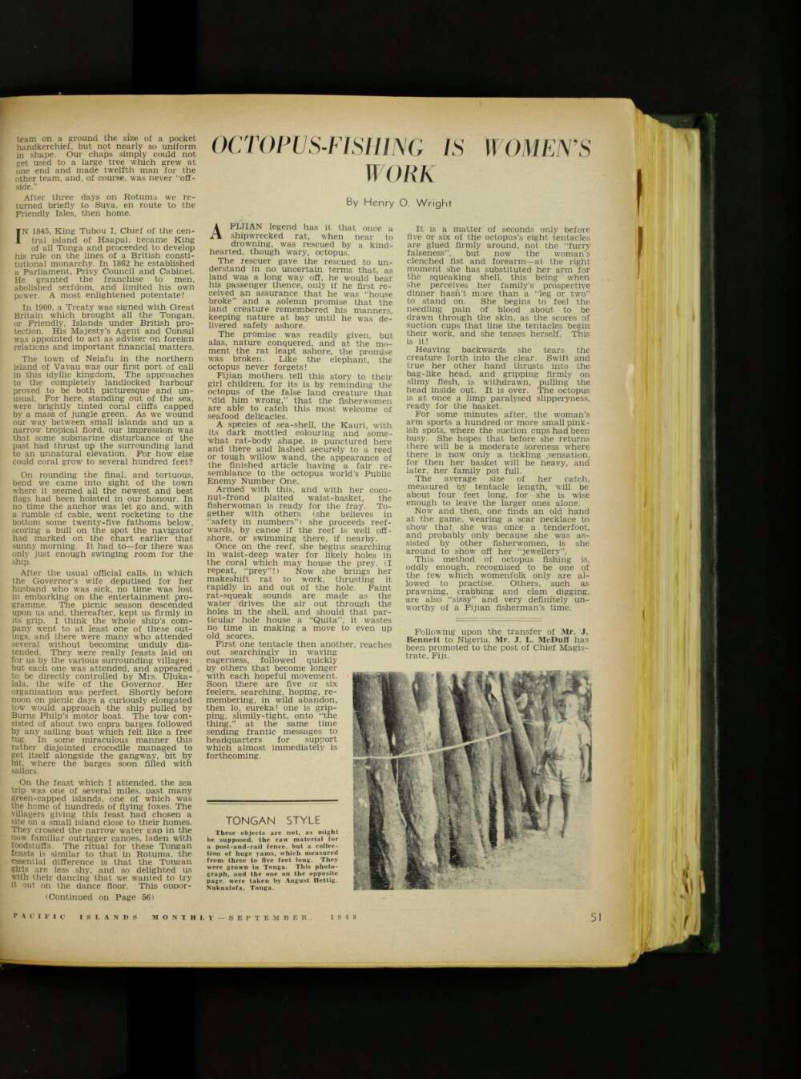
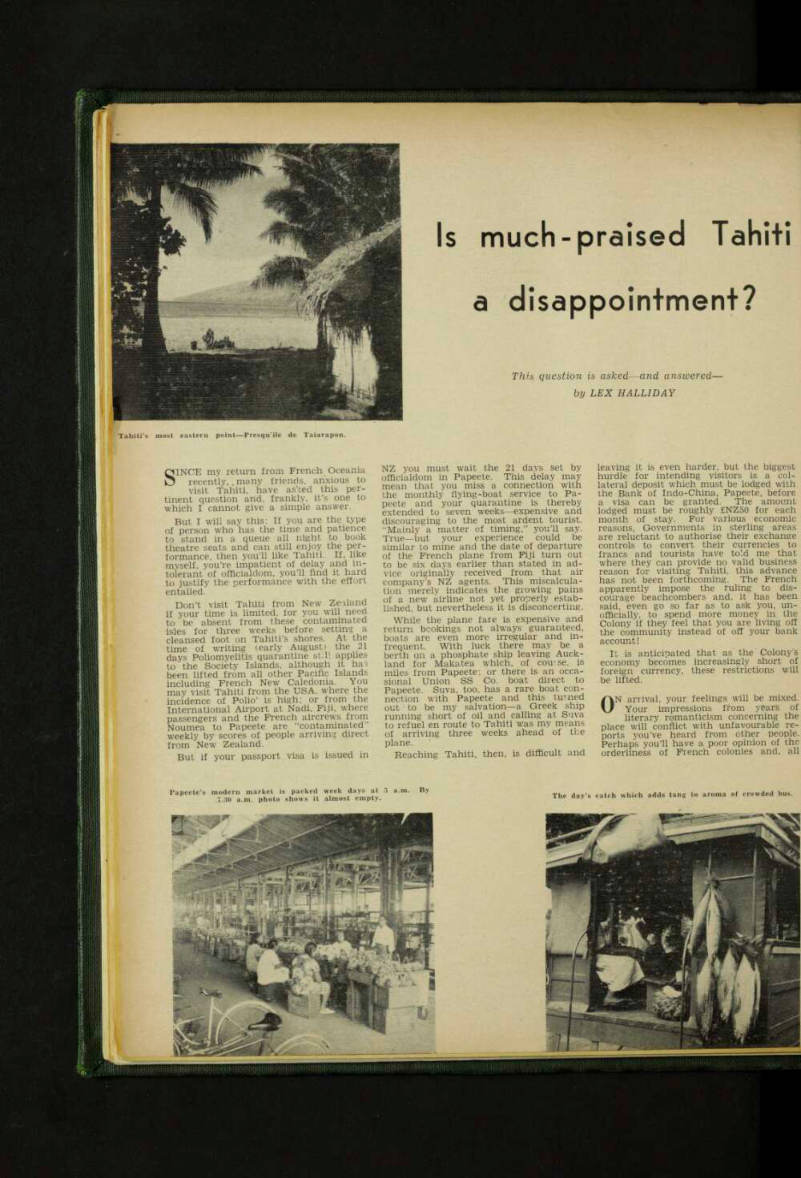
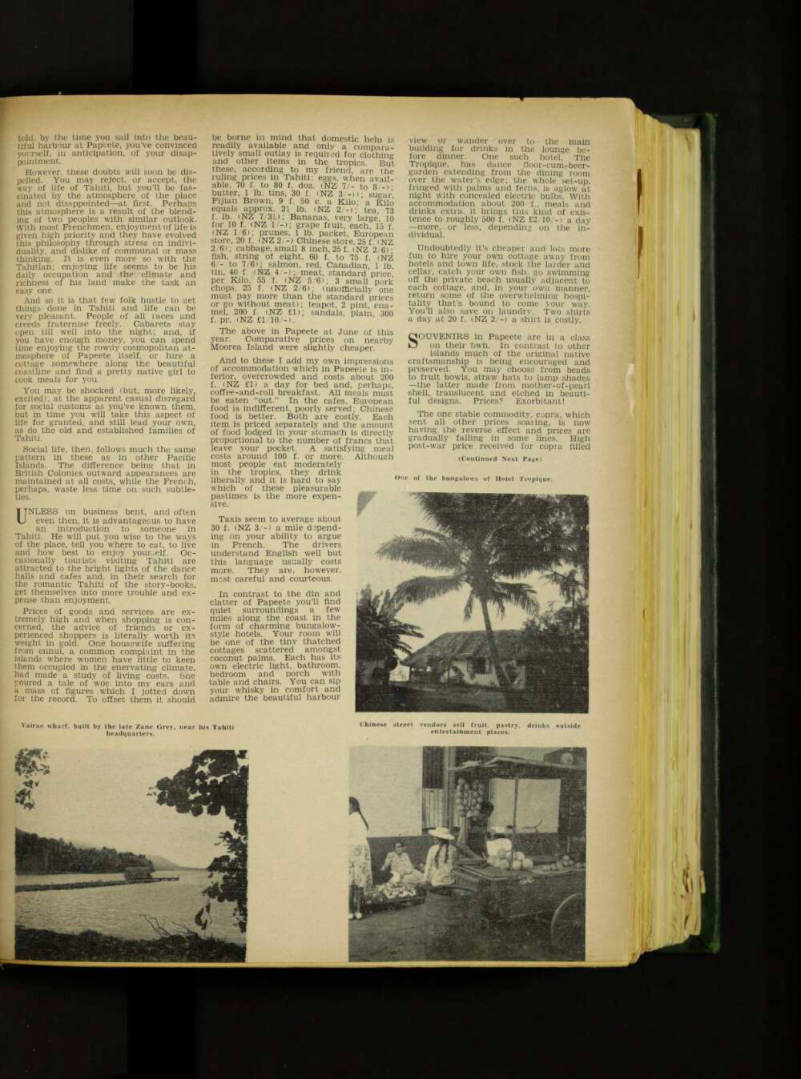
Part lII—In Rotuma and Tonga
SOUTHWARDS to Rotuma. An easy day’s steaming brought us to this garden island, which was discovered by Captain Edwards of HMS "Pandora,” in 1791, when searching for the mutineers of the "Bounty.” At the request of its chiefs, who found that they could not keep order after an influx of Europeans and Asiatics of doubtful origin, the island was annexed by Great Britain in 1880, and now forms part of the Colony of Fiji although 300 miles distant. Un like Funafuti, which we had just left, Rotuma is hilly and clothed in tropical verdure, and whereon fruits of almost every description grow.
On a breezy morning the ship anchored in the small roadstead of Foviung Efau, and almost under—or so it seemed —a sheer green hill which forms one of the apexes of the Bay. In the centre of this bay, across a breaking reef, could be seen the small settlement, dominated by a grey stone church. No living person was in sight and we did want to obtain some information about the navigability of the extensive reef between ourselves and the shore. It looked as if it might prove a very sharp snag to our boats. We were not kept waiting long, for soon the native
District Officer, a polished and charming man, came off. It was decided to try out the other anchorage where boats can get inshore at all stages of the tide. So up came the hook and off we steamed to Foviung Emau, a few miles up the coast.
Here we found little shelter from the sea and swell which were in ho mood to be ignored. In another forty minutes we were back in our original berth making things as comfortable as possible for the
By Starshell
ship. We had to adjust both ourselves and our routine to the serving of the tide. ’Tis unusual for man to be so trammelled by nature in this atomic age; so this was a novel, and noteworthy, ex perience for many.
The boat problem was solved, free of charge, by private enterprise in the form of a South Seas trading company which came to our rescue with flat-bottomed barges, towed by motor boats with specially protected propellers. Even these could not traverse a partially dry reef,
so the ferry service was limited to periods of high and half tide.
In the early forenoon of our second day, the Captain and about half the officers and ship’s company landed to witness a welcome ceremony of the first magnitude.
In the clearing, a short dis tance from the village, shel ters had been improvised for the Captain and those officers and men invited (by ticket only!) to the feast; and for the local Chiefs and their families. Opposite the shel ters. and under gigantic dila trees, sat the remainder of the men who had landed, with throngs of natives of both sexes and all sizes. By com parison with the natives of Funafuti, these are more hybrid and far less naive, but, nevertheless, most charming, witty and hospitable. While waiting for the show to start our Royal Marine Band played, to the great acclama tions of the populace, some members of which became earnest and clinging admirers who refused to be shaken off until the very last bandsman left the island.
There was mass singing and rhythmic dancing by a mixed choir 120 strong and male action dances the most notable of these being the Rotuman war dance in which the hundred performers ranged from 15 to 50 and were in brilliantly coloured array, the whole being sur mounted by a plumed conical helmet of fascinating design and colour. These helmets were much sought after as souvenirs, and are now highly prized by those who were lucky enough to be presented with one.
At “half-time” in the show there was a feast for about fifty of us. I may say that the cards were issued by the ship to prevent gate-crashing and not by our hosts who have probably never heard of such a thing. A low bench was assembled in front of our chairs and covered with banana leaves for tablecloth. Then came, not plates and knives, but food—masses of it. Sucking pigs, great lumps of pork, yams, taro, chicken, bananas, seafoods, coconuts, plantains, and other gastrono mic splendours followed each other in quick succession before our astonished eyes.
These and more, were brought and served by the maidens of the village, who then sat down, giggling, to watch us eat while brushing away the few flies that tried to assist our efforts.
The problem was how to eat a propor tion of this assortment before it got stone cold. The only thing for it was to grab, tear, gnaw and stuff. So we did all of these with considerable embarrassment and clumsiness, much to the amusement of the girls. We found several things which our palates were not quite attuned to; but, with the help of that fortitude and determination for which all British races are renowned, we grinned and swallowed in one motion —or so we hoped.
In the meanwhile, another team of specially selected maidens —we presumed this was their status and some, no doubt, reflected that it might not remain so for long—made kava in the traditional style and presented the first coconut cupful to the Captain who quaffed it without a tremor. The remainder were then served, but by the time it was the turn of those at the extremities of this crescent shaped festive board, the kava was mysteriously replaced by fizzy green lemonade. The latter is considered a treat as it cannot be made locally, and the visit of a store ship is a quarterly event.
The time soon came when we were suf fering from a surfeit of sucking pig, yams, plantains and such like. To our dismay, but to the delight of the maidens, only the tiniest impression had been made on the glut of food which surrounded us.
That is, except at one spot, where a few champion trenchermen had made a small hole. Despite our utter rout, there was nothing for it but to sit back and feebly hold the paunch.
Then, with alarming suddenness, a great gang of males descended on the feast and, actively assisted by all the maidens, whisked the whole lot away in a twinkling.
On making anxious inquiries we learnt that nothing is ever wasted on these oc casions. Each of the families told off by the Chief to make up the feast supplies one large banana leaf basket —the shape and size of a cricket bag—full of food.
The daughters set out the various dishes (or should I say heaps?) and serve it to the honoured guests. “No one,” we were told, “will be at all offended if you do not eat much because, at the given signal, the family grabs what you have left of its contribution, rushes out of sight and de vours every scrap!” It seems the majority did the right thing after all.
During the remainder of our short stay at Rotuma we explored the island which is lovely, and the Band made a musical tour of several villages and was much ap preciated. Our soccer eleven was beaten after an amusing match with the local
Nukualofa, from across the bay.
team on a ground the size of a pocket handkerchief, but not nearly so uniform in shape. Our chaps simply could not get used to a large tree which grew at one end and made twelfth man for the other team, and, of course, was never “off side,”
After three days on Rotuma we re turned briefly to Suva, en route to the Friendly Isles, then home.
IN 1845, King Tubou I, Chief of the cen tral island of Haapai, became King of all Tonga and proceeded to develop his rule on the lines of a British consti tutional monarchy. In 1862 he established a Parliament, Privy Council and Cabinet.
He granted the franchise to men, abolished serfdom, and limited his own power. A most enlightened potentate!
In 1900, a Treaty was signed with Great Britain which brought all the Tongan, or Friendly, Islands under British pro tection. His Majesty’s Agent and Consul was appointed to act as adviser on foreign relations and important financial matters.
The town of Neiafu in the northern island of Vavau was our first port of call in this idyllic kingdom, The approaches to the completely landlocked harbour proved to be both picturesque and un usual, For here, standing out of the sea, were brightly tinted coral cliffs capped by a mass of jungle green. As we wound our way between small islands and up a narrow tropical fiord, our impression was that some submarine disturbance of the past had thrust up the surrounding land to an unnatural elevation. For how else could coral grow to several hundred feet?
On rounding the final, and tortuous, bend we came into sight of the town where it seemed all the newest and best flags had been hoisted in our honour. In no time the anchor was let go and, with a rumble of cable, went rocketing to the bottom some twenty-five fathoms below, scoring a bull on the spot the navigator had marked on the chart earlier that sunny morning. It had to—for there was only just enough swinging room for the ship.
After the usual official calls, in which the Governor’s wife deputised for her husband who was sick, no time was lost in embarking on the entertainment pro gramme. The picnic season descended upon us and, thereafter, kept us firmly in its grip. I think the whole ship’s com pany went to at least one of these out ings, and there were many who attended several without becoming unduly dis tended. They were really feasts laid on for us by the various surrounding villages; but each one was attended, and appeared to be directly controlled by Mrs. Uluka lala, the wife of the Governor. Her organisation was perfect. Shortly before noon on picnic days a curiously elongated tow would approach the ship pulled by Burns Philp’s motor boat. The tow con sisted of about two copra barges followed by any sailing boat which felt like a free tug. In some miraculous manner this rather disjointed crocodile managed to get itself alongside the gangway, bit by bit, where the barges soon filled with sailors.
On the feast which I attended, the sea trip was one of several miles, past many green-capped islands, one of which was the home of hundreds of flying foxes. The villagers giving this feast had chosen a site on a small island close to their homes.
They crossed the narrow water gap in the now familiar outrigger canoes, laden with foodstuffs. The ritual for these Tongan feasts is similar to that in Rotuma, the essential difference is that the Tongan girls are less shy, and so delighted us with their dancing that we wanted to try it out on the dance floor. This oppor
(Continued on Page 56)
tunity came later. The beaches on our picnic island were of the purest white sand and proved ideal for bathing—a risk which some took despite a rather uneasy feeling in the belly.
In under a week officers and men ate their way through no less than six Ton gan feasts, each accompanied by native dancing, and great hilarity during the return trip in the copra barges.
An enchanting aspect of our stay was the way in which dancers with bands, were thoughtfully sent off to the shin in the evenings to entertain those who had to remain onboard. The race meetings were a great surprise and thoroughly en joyed. Anything that went wrong, or that was not according to the rules, was treated as a huge joke. At the second meeting the ship put up some performers, many of whom came to grief in the usual way or by getting carried off the course and into the jungle, all hugely to the de light of the natives.
A certain amount of trade by barter was done, for, though copra sales have rendered most of the Islanders well off, there is little on which they can spend their money. Clothes are in short supply and such things as shirts and shorts were greatly appreciated and brought showers of gifts in return. Strictly speaking, one does not barter in Tonga. The Islanders have a far better system. The would-be barterer “gives” his New Zealand friend a present and the latter should then “give” a present in return. There is no haggling and the whole affair is carried out in a convivial atmosphere.
It was with genuine regret that we weighed our anchor and steamed slowly down harbour and away from charming Vavau.
The overnight trip to Nukualofa took us past Falcon Island which has the dis turbing habit, of disappearing from time to time. It is rumoured that this hide and seek is not at all popular with the Prime Minister of Tonga, for every time it re-appears, he has to take a sea trip in order, to plant the Tongan flag firmly on top!
In Nukualofa, picnics were again ar ranged for all, but even the most ardent gluttons were now thinking ahead to home and leave; so a few, I regret to say, rather floundered in.the fodder. Anyway in my own case, indigestion inculcated by endless feasts, was beginning to rear its ugly head.
A few visited one of the largest aero dromes in the Pacific, sixteen milesi from the town. During the war it was exten sively used by the Americans for whom it
was built by the New Zealand Public
Works Department.
The Yankee influence is noticeable in Tongatabu. In this case the natives were not removed to another island and our allies have left their mark in more ways than one.
We “did” the sights, including the great blow holes on the weather coast of the island which provide an imposing, if rather damp, spectacle. Here the Pacific rollers strike the coial shelf with a vio lence which sends tons of water and spume hundreds of feet into the air.
It was unfortunate that Queen Salote should be sick and away in the country for a rest, but we were honoured by both Prince Tungi and Prince Tui’pel ahaki who came onboard.
A church bazaar, held in the grounds of the British Residency, provided an excellent opportunity for all hands to arm themselves with native baskets and mats, perhaps in an effort to forestall brickbats from their wives when the stories about the hula dancing come out! Fruit, par ticularly bananas, were another popular peace offering, though the most effective of all were probably nylon and silk stock ings picked up, at a price, in Suva.
On a calm Sunday evening we nosed our way through hidden reefs to the open sea, the Islands astern but not forgotten.
We look forward to visiting many more next year.
When a Fijian constable was searching a Chinese house at Suva for opium, he found none, but in a suitcase discovered 178 United States dollars. At the in evitable court sequel the Chinese said the dollars had been given to him by <us father so that he could take them to China for a family distribution Conse quently, he maintained, his father was the offender as he could not disobey his father by complying with the law and offering the dollars to the Financial Sec retary or to a bank. Unsympathetic to wards this example of filial piety, the magistrate imposed a fine of £2O and ordered the dollars to be handed over to the Financial Secretary in exchange for the currency of Fiji.
After being missing for more than 6C years, a carpenter’s claw hammer has been found during repairs to a Suva (Fiji) house owned by Mr. J.
Several years ago the late Mr. Gavir Lawrie, formerly a PWD employee ir charge of the Suva water-mains, tolc Mr. Suklal’s father that he had.left th< hammer in the ceiling when the house was being built.
Advertisements & other items, p. 52 (1 item)
50
SEPTEMBER. 194 - PACIFIC ISLANDS MONTH I.
Octopus-Fishing Is Women’S
Work
By Henry O. Wright
A FIJIAN legend has it that once a shipwrecked rat, when near to drowning, was rescued by a kind hearted, though wary, octopus.
The rescuer gave the rescued to un derstand in no uncertain terms that, as land was a long way off, he would bear his passenger thence, only if he first re ceived an assurance that he was “house broke” and a solemn promise that the land creature remembered his manners, keeping nature at bay until he was de livered safely ashore.
The promise was readily given, but alas, nature conquered, and at the mo ment the rat leapt ashore, the promise was broken. Like the elephant, the octopus never forgets!
Fijian mothers tell this story to their girl children, for its is by reminding the octopus of the false land creature that “did him wrong,” that the fisherwomen are able to catch this most welcome of seafood delicacies.
A species of sea-shell, the Kauri, with its dark mottled colouring and some what rat-body shape, is punctured here and there and lashed securely to a reed or tough willow wand, the appearance of the finished article having a fair re semblance to the octopus world’s Public Enemy Number One.
Armed with this, and with her coco nut-frond plaited waist-basket, the fisherwoman is ready for the fray. To gether with others (she believes in “safety in numbers”) she proceeds reef wards, by canoe if the reef is well off shore, or swimming there, if nearby.
Once on the reef, she begins searching in waist-deep water for likely holes in the coral which may house the prey. (I repeat, “prey”!) Now she brings her makeshift rat to work, thrusting it rapidly in and out of the hole. Faint rat-squeak sounds are made as the water drives the air out through the holes in the shell, and should that par ticular hole house a “Quita”, it wastes no time in making a move to even up old scores.
First one tentacle then another, reaches
out searchingly in waving eagerness, followed quickly by others that become longer with each hopeful movement.
Soon there are five or six feelers, searching, hoping, re membering, in wild abandon, then 10, eureka! one is grip ping, slimily-tight, onto “the thing,” at the same time sending frantic messages to headquarters for support which almost immediately is forthcoming.
It is a matter of seconds only before five or six of the octopus’s eight tentacles are glued firmly around, not the “furry falseness”, but now the woman’s clenched fist and forearm —at the right moment she has substituted her arm for the squeaking shell, this being when she perceiyes her family’s prospective dinner hasn’t more than a “leg or two” to stand on. She begins to feel the needling pain of blood about to be drawn through the skin, as the scores of suction cups that line the tentacles begin their work, and she tenses herself. This is it!
Heaving backwards she tears the creature forth into the clear. Swift and true her other hand thrusts into the bag-like head, and gripping firmly on slimy flesh, is withdrawn, pulling the head inside out. It is over. The octopus is at once a limp paralysed slipperyness, ready for the basket.
For some minutes after, the woman’s arm sports a hundred or more small pink ish spots, where the suction cups had been busy. She hopes that before she returns there will be a moderate soreness where there is now only a tickling sensation, for then her basket will be heavy, and later, her family pot full.
The average size of her catch, measured by tentacle Length, will be about four feet long, for she is wise enough to leave the larger ones alone.
Now and then, one finds an old hand at the game, wearing a scar necklace to show that she was once a tenderfoot, and probably only because she was as sisted by other fisherwomen, is she around to show off her “jewellery”.
This method of octopus fishing is, oddly enough, recognised to be one of the few which womenfolk only are al lowed to practise. Others, such as prawning, crabbing and clam digging, are also “sissy” and very definitely un worthy of a Fijian fisherman’s time.
Following upon the transfer of Mr. J.
Bennett to Nigeria, Mr. J. L. McDuff has been promoted to the post of Chief Magis trate, Fiji.
Tongan Style
These objects are not, as might be supposed, the raw material for a post-and-rail fence, but a collec tion of huge yams, which measured from three to five feet long. They were grown in Tonga. This photo graph, and the one on the opposite page, were taken by August Hettig, Nukualofa, Tonga.
a disappointment?
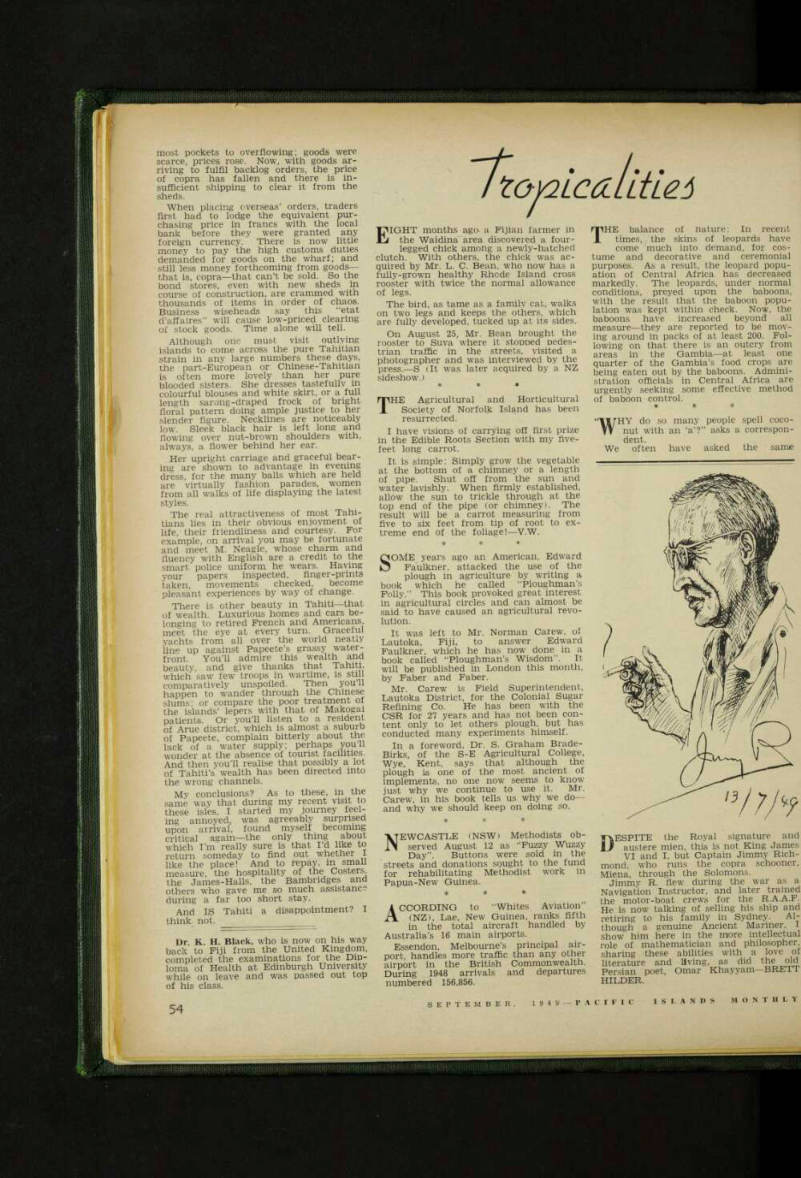
Is much-praised Tahiti a disappointment?
This question is asked —and answered —
By Lex Hallway
SINCE my return from French Oceania recently, .many friends, anxious to visit Tahiti, have asked this per tinent question and, frankly, it’s one to which I cannot give a simple answer.
But I will say this: If you are the type of person who has the time and patience to stand in a queue all night to book theatre seats and can still enjoy the per formance, then you’ll like Tahiti. If. like myself, you’re impatient of delay and in tolerant of officialdom, you’ll find it hard to justify the performance with the effort entailed.
Don’t visit Tahiti from New Zetland if your time is limited, for you will need to be absent from these contaminated isles for three weeks before setting a cleansed foot on Tahiti’s shores. At the time of writing (early August) the 21 days Poliomyelitis quarantine st:ll applies to the Society Islands, although it ha> been lifted from all other Pacific Islands including French New Caledonia. You may visit Tahiti from the USA, where the incidence of Polio’ is high; or from the International Airport at Nadi. Fiji, where passengers and the French aircrews from Noumea to Papeete are “contaminated” weekly by scores of people arriving direct from New Zealand.
But if your passport visa is issued in
NZ you must wait the 21 days set by officialdom in Papeete. This delay may mean that you miss a connection with the monthly flying-boat service to Pa peete and your quarantine is thereby extended to seven weeks—expensive and discouraging to the most ardent tourist.
"Mainly a matter of timing,” you’ll say.
True —but your experience could be similar to mine and the date of departure of the French plane from Fiji turn out to be six days earlier than stated in ad vice originally received from that air company’s NZ agents. This miscalcula tion merely indicates the growing pains of a new airline not yet properly estab lished, but nevertheless it is disconcerting.
While the plane fare is expensive and return bookings not always guaranteed, boats are even more irregular and in frequent. With luck there may be a berth on a phosphate ship leaving Auck land for Makatea which, of comse, is miles from Papeete; or there is an occa sional Union SS Co. boat direct to Papeete. Suva, too, has a rare boat con nection with Papeete and this turned out to be my salvation —a Greek ship running short of oil and calling at Suva to refuel en route to Tahiti was my means of arriving three weeks ahead of the plane.
Reaching Tahiti, then, is difficult and
leaving it is even harder, but the biggest hurdle for intending visitors is a col lateral deposit which must be lodged with the Bank of Indo-China, Papeete, before a visa can be granted. The amount lodged must be roughly £NZSO for each month of stay. For various economic reasons, Governments in sterling areas are reluctant to authorise their exchange controls to convert their currencies to francs and tourists have told me that where they can provide no valid business reason for visiting Tahiti, this advance has not been forthcoming. The French apparently impose the ruling to dis courage beachcombers and, it has been said, even go so far as to ask you, un officially, to spend more money in the Colony if they feel that you are living off the community instead of off your bank account!
It is anticipated that as the Colony's economy becomes increasingly short of foreign currency, these restrictions will be lifted.
ON arrival, your feelings will be mixed.
Your impressions from years of literary romanticism concerning the place will conflict with unfavourable re ports you’ve heard from other people.
Perhaps you’ll have a poor opinion of the orderliness of French colonies and. all
Tahiti’s most eastern point—Presqu’ile de Taiarapon.
Papeete’s modern market is packed week days at 5 a.m. By 7.30 a.m. photo shows it almost empty.
The day’s catch which adds tang to aroma of crowded bus.
told, by the time you sail into the beau tiful harbour at Papeete, you’ve convinced yourself, in anticipation, of your disap
pointment.
However, these doubts will soon be dis pelled. You may reject, or accept, the way of life of Tahiti, but you’ll be fas cinated by the atmosphere of the place and not disappointed—at first. Perhaps this atmosphere is a result of the blend ing of two peoples with similar outlook.
With most Frenchmen, enjoyment of life is given high priority and they have evolved this philosophy through stress on indivi duality, and dislike of communal or mass thinking. It is even more so with the Tahitian; enjoying life seems to be his daily occupation and the climate and richness of his land make the task an easy one.
And so it is that few folk hustle to get things done in Tahiti and life can be very pleasant. People of all races and creeds fraternise freely. Cabarets stay open till well into the night; and, if you have enough money, you can spend time enjoying the rowdy cosmopolitan at mosphere of Papeete itself, or hire a cottage somewhere along the beautiful coastline and find a pretty native girl to cook meals for you.
You may be shocked (but. more likely, excited), at the apparent casual disregard for social customs as you’ve known them, but in time you will take this aspect of life for granted, and still lead your own, as do the old and established families of Tahiti.
Social life, then, follows much the same pattern in these as in other Pacific Islands. The difference being that in British Colonies outward appearances are maintained at all costs, while the French, perhaps, waste less time on such subtle ties.
UNLESS on business bent, and often even then, it is advantageous to have an introduction to someone in Tahiti. He will put you wise to the ways of the place, tell you where to eat, to live and how best to enjoy yourcelf. Oc casionally tourists visiting Tahiti are attracted to the bright lights of the dance halls and cafes and, in their search for the romantic Tahiti of the story-books, get themselves into more trouble and ex pense than enjoyment.
Prices of goods and services are ex tremely high and when shopping is con cerned, the advice of friends or ex perienced shoppers is literally worth its weight in gold. One housewife suffering from ennui, a common complaint in the islands where women have little to keep them occupied in the enervating climate, had made a study of living costs. She poured a tale of woe into my ears and a mass of figures which I jotted down for the record. To offset them it should
be borne in mind that domestic help is readily available and only a compara tively small outlay is required for clothing and other items in the tropics But these, according to my friend, are the ruling prices in Tahiti: eggs, when avail able, 70 f. to 80 f. doz. (NZ 7/- to 8/-) • butter, 1 lb. tins, 30 f. (NZ 3/-)); sugar’
Fijian Brown, 9 f. 50 c. a Kilo; a Kilo equals approx. 2\ lb. (NZ 2/-); tea, 73 f. lb. (NZ 7/ 3i>; Bananas, very large 10 for 10 f. (NZ 1 /-); grape fruit, each, 15 f (NZ 1/6); prunes, 1 lb. packet, European store, 20 f. (NZ 2/-) Chinese store, 25 f. (NZ 2 6); cabbage, small 8 inch, 25 f. (NZ 2 6) fish, string of eight, 60 f. to 75 f. (NZ 6/- to 7/6); salmon, red, Canadian, 1 lb tin, 40 f. (NZ 4/-); meat, standard price, per Kilo, 55 f. (NZ 5/6); 3 small pork chops, 25 f. (NZ 2/6); (unofficially one must pay more than the standard prices or go without meat); teapot, 2 pint, ena mel, 200 f. (NZ £1); sandals, plain, 300 f. pr. (NZ £l/10/-).
The above in Papeete at June of this year. Comparative prices on nearby Moorea Island were slightly cheaper.
And to these I add my own impressions of accommodation which in Papeete is in ferior, overcrowded and costs about 200 f. (NZ £1) a day for bed and, perhaps, coffee-and-roll breakfast. All meals must be eaten “out.” In the cafes, European food is indifferent, poorly served; Chinese food is better. Both are costly. Each item is priced separately and the amount of food lodged in your stomach is directly proportional to the number of francs that leave your pocket. A satisfying meal costs around 100 f. or more. Although
most people eat moderately in the tropics, they drink liberally and it is hard to say which of these pleasurable pastimes is the more expen sive.
Taxis seem to average about 30 f. (NZ 3/-) a mile dapend ing on your ability to argue in French. The drivers understand English well but this language usually costs more. They are, however, most careful and courteous.
In contrast to the din and clatter of Papeete you’ll find quiet surroundings a few miles along the coast in the form of charming bungalow style hotels. Your room will be one - of the tiny thatched cottages scattered amongst coconut palms. Each has its own electric light, bathroom, bedroom and porch with table and chairs. You can sip your whisky in comfort and admire the beautiful harbour
view or wander over to the main building for drinks in the lounge be fore dinner. One such hotel, The Tropique, has dance floor-cum-beer garden extending from the dining room over the water’s edge; the whole set-up, fringed with palms and ferns, is aglow at night with concealed electric bulbs. With accommodation about 200 f., meals and drinks extra, it brings this kind of exis tence to roughly 500 f. (NZ £2/10/-) a day —more, or less, depending on the in dividual.
Undoubtedly it’s cheaper and lots more fun to hire your own cottage away from hotels and town life, stock the larder and cellar, catch your own fish, go swimming off the private beach usually adjacent to each cottage, and, in your own manner, return some of the overwhelming hospi tality that’s bound to come your way.
You’ll also save on laundry. Two shirts a day at 20 f. (NZ 2/-) a shirt is costly.
SOUVENIRS in Papeete are in a class on their t>wh. In contrast to other islands much of the original native craftsmanship is being encouraged and preserved. You may choose from beads to fruit bowls, straw hats to lamp shades —the latter made from mother-of-pearl shell, translucent and etched in beauti ful designs. Prices? Exorbitant!
The one stable commodity, copra, which sent all other prices soaring, is now having the reverse effect and prices are gradually falling in some lines. High post-war price received for copra filled
(Continued Next Page)
Vairao wharf, built by the late Zane Grey, near his Tahiti headquarters.
One of the bungalows of Hotel Tropique.
Chinese street vendors sell fruit, pastry, drinks outside entertainment places.
most pockets to overflowing; goods were scarce, prices rose. Now, with goods ar riving to fulfil backlog orders, the price of copra has fallen and there is in sufficient shipping to clear it from the sheds.
When placing overseas’ orders, traders first had to lodge the equivalent pur chasing price in francs with the local bank before they were granted any foreign currency. There is now little money to pay the high customs duties demanded for goods on the wharf; and still less money forthcoming from goods— that is, copra—that can’t be sold. So the bond stores, even with new sheds in course of construction, are crammed with thousands of items in order of chaos.
Business wiseheads say this “etat d’affaires” will cause low-priced clearing of stock goods. Time alone will tell.
Although one must visit outlying islands to come across the pure Tahitian strain in any large numbers these days, the part-European or Chinese-Tahitian is often more lovely than her pure blooded sisters. She dresses tastefully in colourful blouses and white skirt, or a full length sarong-draped frock of bright floral pattern doing ample justice to her slender figure. Necklines are noticeably low. Sleek black hair is left long and flowing over nut-brown shoulders with, always, a flower behind her ear.
Her upright carriage and graceful bear ing are shown to advantage in evening dress, for the many balls which are held are virtually fashion parades, women from all walks of life displaying the latest styles.
The real attractiveness of most Tahi tians lies in their obvious enjoyment of life, their friendliness and courtesy. For example, on arrival you may be fortunate and meet M. Neagle, whose charm and fluency with English are a credit to the smart police uniform he wears. Haying your papers inspected, finger-prints taken, movements checked, become pleasant experiences by way of change.
There is other beauty in Tahiti—that of wealth. Luxurious homes and cars be longing to retired French and Americans, meet the eye at every turn. Graceful yachts from all over the world neatly line up against Papeete’s grassy water front. You’ll admire this wealth and beauty, and give thanks that Tahiti, which saw few troops in wartime, is still comparatively unspoiled. Then you’ll happen to wander through the Chinese slums; or compare the poor treatment of the islands’ lepers with that of Makogai patients. Or you’ll listen to a resident of Arue district, which is almost a suburb of Papeete, complain bitterly about the lack of a water supply: perhaps you’ll wonder at the absence of tourist facilities.
And then you’ll realise that possibly a lot of Tahiti’s wealth has been directed into the wrong channels.
My conclusions? As to these, in the same way that during my recent visit to these isles, I started my journey feel ing annoyed, was agreeably surprised upon arrival, found myself becoming critical again—the only thing about which I'm really sure is that I’d like to return someday to find out whether I like the place! And to repay, in small measure, the hospitality of the Costers, the James-Halls, the Bambndges and others who gave me so much assistance during a far too short stay.
And IS Tahiti a disappointment? I think not.
Dr K. H. Black, who is now on his way back to Fiji from the United Kingdom, completed the examinations for the Dip loma of Health at Edinburgh University while on leave and was passed out top of his class.
Tropicilities
EIGHT months ago- a Fijian farmer in the Waidina area discovered a four legged chick among a newly-hatched clutch. With others, the chick was ac quired by Mr. L. C. Bean, who now has a fully-grown healthy Rhode Island cross rooster with twice the normal allowance of legs.
The bird, as tame as a family cat, walks on two legs and keeps the others, which are fully developed, tucked up at its sides.
On August 25, Mr. Bean brought the rooster to Suva where it stopped pedes trian traffic in the streets, visited a photographer and was interviewed by the press.—S (It was later acquired by a NZ sideshow.) * » • THE Agricultural and Horticultural Society of Norfolk Island has been resurrected.
I have visions of carrying off first prize in the Edible Roots Section with my five feet long carrot.
It is simple; Simply grow the vegetable at the bottom of a chimney or a length of pipe. Shut off from the sun and water lavishly. When firmly established, allow the sun to trickle through at the top end of the pipe (or chimney). The result will be a carrot measuring from five to six feet from tip of root to ex treme end of the foliage!—V.W.
SOME years ago an American, Edward Faulkner, attacked the use of the plough in agriculture by writing a book which he called “Ploughman’s Folly.” This book provoked great interest in agricultural circles and can almost be said to have caused an agricultural revo lution.
It was left to Mr. Norman Carew. of Lautoka, Fiji, to answer Edward Faulkner, which he has now done in a book called “Ploughman’s Wisdom”. It will be published in London this month, by Faber and Faber.
Mr. Carew is Field Superintendent, Lautoka District, for the Colonial Sugar Refining Co. He has been with the CSR for 27 years and has not been con tent only to let others plough, but has conducted many experiments himself.
In a foreword, Dr. S. Graham Brade- Birks, of the S-E Agricultural College, Wye, Kent, says that although the plough is one of the most ancient of implements, no one now seems to know just why we continue to use it. Mr.
Carew, in his book tells us why we do— and why we should keep on doing so.
NEWCASTLE (NSW) Methodists ob served August 12 as “Fuzzy Wuzzy Day”. Buttons were sold in the streets and donations sought to the fund for rehabilitating Methodist work in Papua-New Guinea. * * * ACCORDING to “Whites Aviation” (NZ), Lae, New Guinea, ranks fifth in the total aircraft handled by Australia’s 16 main airports.
Essendon, Melbourne’s principal air port, handles more traffic than any other airport in the British Commonwealth.
During 1948 arrivals and departures numbered 156,856.
THE balance of nature: In recent times, the skins of leopards have come much into demand, for cos tume and decorative and ceremonial purposes. As a result, the leopard popu ation of Central Africa has decreased markedly. The leopards, under normal conditions, preyed upon the baboons, with the result that the baboon popu lation was kept within check. Now, the baboons have increased beyond all measure —they are reported to be mov ing around in packs of at least 200. Fol lowing on that there is an outcry from areas in the Gambia —at least one quarter of the Gambia’s food crops are being eaten out by the baboons. Admini stration officials in Central Africa are urgently seeking some effective method of baboon control. * * * “\\I UY do 80 man y people spell coco- Vf nut with an ‘a’?” asks a correspon dent.
We often have asked the same
DESPITE the Royal signature and austere mien, this is not King James VI and I, but Captain Jimmy Rich mond, who runs the copra schooner, Miena, through the Solomons.
Jimmy R. flew during the war as a Navigation Instructor, and later trained the motor-boat crews for the R.A.A.F.
He is now talking of selling his ship and retiring to his family in Sydney. Al though a genuine Ancient Mariner. I show him here in the more intellectual role of mathematician and philosopher, sharing these abilities with a love of literature and living, as did the old Persian poet, Omar Khayyam—BßETT
Hilder.
question. The answer was supplied the other day by an overseas magazine. Our old friend, the late Dr. Johnson—plus a careless man in a printing-office—is to blame.
When Dr. Johnson was compiling his dictionary, he had an article on the coconut, which he spelled correctly. But (according to Dr. Johnson, later, in his own defence) the compositor set it “cocoanut”, and the proof-reader passed it. As a result of this century-old error, there still are many people who confuse the product of the cacao tree (which somehow became “cocoa”), with the pro duct of the coco-palm. * * ♦ AFTER having lived in the South Sea Islands for the last three years, Cap tain H. E. R. Wilson, who is 69, has these faults to find with them: — Fiji: “It rained there 90 per cent, of the time.”
Tahiti: “Too expensive. The cost of living—just food and accommoda tion—is from £3 to £4 a day.
Samoa: “Too many New Zealand regu lations. You have to get a doctor’s cer tificate to get any alcoholic spirit at all —even beer.”
The island of Tobago, 20 miles from Trinidad, West Indies, is Captain Wil son’s idea of an ideal place.
“It has beautiful weather, wonderful hunting, fishing, and swimming, beer without doctors’ certificates, and the best rum in the world,” he said. He told the newspapers in Brisbane, in August, that he was leaving as a passenger, in the “Pioneer Glen,” en route to Tobago. ♦ ♦ * THE terns are arriving back on Nor folk Island after their annual mi gration to Japan. These dainty little birds are part of the Island’s sum mer scenery.
Maybe it isn’t coincidence, but latest addition to our family is a large, black and glossy tom-cat, who strolled out of the lantana recently and established him self with the lordly air and confidence of a wartime black marketeer —V.W. * * ♦ THERE was a jolly get-together of New Guinea folk over in London Town recently, when old days and old ways were lived over again, as the cups clattered and the glasses clinked. In the party were Mrs. Muriel Costelloe, June Ewen, Mrs. Phillpott, Mrs. Baden Jones and Mr. Bob Clark. The two last named ladies arrived back in Australia by the “Orion” early in September. An other old Rabaulite in England these days is Mrs. Taffy Webb. Her Comman der husband is back on the bridge again and, as a result, as happy as a sand boy. He is Master of “River Glenelg,” and is in Sydney occasionally.—GT.
Dominie in Difficulties
By Old Charlie
TEACHING in the Cannibal Isles is something quite out of the ordinarv but nevertheless, it is not without its attractions.
Quite apart from the usual idiosyn cracies of the pupils there are a number of things to occupy one's mind; at least I have found this so. School is held In a bure, or native house, in this case a circular building about 24 feet across and fe . e f t hl £h at its conical top.
Thatched with makita and reeds it is degrees cooler than any European-sfviP house. With wooden floor and Fow balus class 0 -room° Und ’ 18 a m ° St comfort able Unfortunately we are not the only oc cupants. The centre pole which, native fashion, does not reach the top is cauaht by a; cross girder some six feet up and provides an excellent winter home for thousands of large, yellow hornets which cluster around it in a seething mass De spite the assurance that “they won’t hurt you at this time of the year” I keen a wary eye on the intruders, being from time to time reminded of their presence by the arrival on my head of a pair locked in mortal combat. These hornets mlnu ?„ 1 t er ’f 1 t£ S - Sanitary ' habltS ’ t 0 re mind one of their presence.
Sometimes a heavy blow on the head or shoulders signals the sudden descent of a gheko lizard who has decided to seek terra firma. And, while on the subject of lizards, I should mention that, seated on the balustrades, are sundry cats of all ages, colours and sexes and sizes, who find lizards a useful article of diet and prefer the class-room for their meal. Being of sportive nature they do not hurry over it and the victims’ sufferings are often ended by the intervention of one or other of the children ejecting the feline in ques tion. H Then again there are the toads, of the giant species—but incidentally, the smallest giants I’ve ever seen—who feel that they, too, are interested in the curri culum and hop unafraid across the floor to gaze fixedly at the blackboard. They too, are not without hope of an extra meal’ m the shape of the hornets that drop to the floor.
A TALK on the law of gravity is pointedly illustrated by the dull thud of a coconut dropping to earth or the swish of falling palm branches. To both these sounds, disconcerting at first, one becomes accustomed, though the noise of a large nut hurtling down the slope (did I mention that we are situated on a slight eminence?) or even rolling into the bure, is somewhat startling.
Then there is a dog, an intelligent Al satian, allergic to strangers both human and canine. Should the former appear, a rescue is the order of the day and les sons are temporarily suspended. Should the intruder fall into the latter category, however, then it is yoicks and tally-ho, with the protesting yelps fading away Into the distance and the elated heroine coming back with a look of smug com placency that, at times, is almost un bearable.
We are in view of the main traffic route and so can enliven our day by the antics of the passers-by—bullock teams, small children and hard-working (sic) Indians.
One must overlook the small birds which swoop in and out of the class room to alight on a chair-back or cross-beams, while their larger and more frivolous
cousins, the noisy Mynahs, chatter and gossip the livelong day.
Daily there are the mosquitos which are not the most attractive room-mates Un less one wishes to be eaten alive then recourse must be had to some repellent usually so evil-smelling that everyone be comes mutually repellant.
Perhaps, however, the most disconcert ing thing is the sudden look of intelli gence that appears on the faces of the pupils. The momentary satisfaction at the thought that some bon mot of yours has penetrated, is rudely dispelled by the cry of, “There’s the Tui Bua!” and you realise that the class has caught the dis tant sound of the monthly steamer chug chugging up the river—an event, naturally, of extreme importance.
However, with these things with which to contend, who will dare to say that life here is not far more pleasant than in more distant and civilised climes? At least we have no strikes, blackouts and “commos.” Sa moce.
Beloved Isles of Viti
By Harold Chambers
O, Viti! string of gems most rare On the Pacific bosom set, Isles of enchantment passing fair, Thy spell one never can forget.
The queenly palms that grace thy strand, The green seas rolling leisurely, Beauty ineffable and grand, Oft in the dreams of night I see.
With peaks that pierce the cloud-flecked sky, Uprising from the turquoise seas, Thy storied Isles green-mantled lie Panned by the scented tropic breeze— Stories of poignancy and pain, Of human flotsam from afar.
Of gentle brown-folk, warriors slain, Of love and laughter, hate and war.
Serenely basking in the Main, In timeless somnolence, they lie; Anon, lashed by a hurricane Are battered ’neath a sullen sky.
Across the reefs the ebb-tides creep.
And turning tides flow in again With rhythmic hiss and murmur deep.
Like slumbering giants of the Main.
The brooding calm of tropic noon, The opalescent sunset skies.
The molten silver of the moon That gleaming on the palm fronds lies And, on her lone nocturnal beat.
A shimmering path flings o’er the sea, Whereon, perchance, the tripping feet Of tropic sea-sprites dance with glee.
Thy children of euphonious tongue, Light-hearted live and leisurely, Carefree, their native Isles among, Endowed by Nature lavishly.
Ah! ne’er a day but longings rise For thee, O Viti! In my dreams I live again ’neath thy blue skies Among thy Isles and hills and streams.
Dr. P. W. J. Searle and Dr. F. R. T.
Hollins have resigned from the Medical Department, Fiji. Dr. Searle will be leaving the Colony in September and Dr. Hollins in December.
Advertisements & other items, p. 57 (1 item)
The Mangaia Week
MONDAY: No mon’, no fun.
TUESDAY: Very little to chew.
WEDNESDAY: Wondering when there will be something!
THURSDAY: Thirsty—no rain for months. Tanks empty.
FRIDAY: Bad reef, no fish to fry.
SATURDAY and SUNDAY—Just
like Monday.
Puzzle — Find the Pacific Paradise!—ETl.
Mr. Blonk
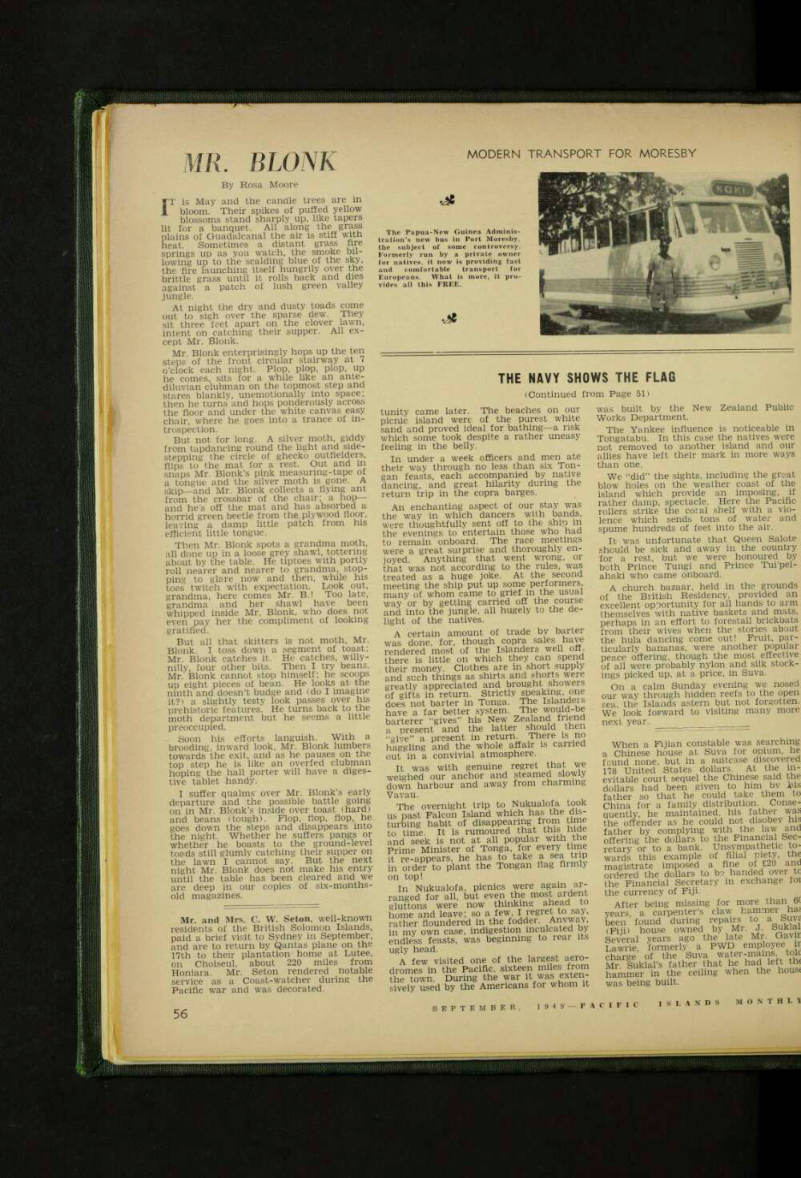
By Rosa Moore
IT is May and the candle trees are in bloom. Their spikes of puffed yellow blossoms stand sharply up, like tapers lit for a banquet. All along the grass plains of Guadalcanal the air is stiff with heat. Sometimes a distant grass fire springs ud as you watch, the smoke bil lowing up to the scalding blue of the sky, the fire launching itself hungrily over the brittle grass until it rolls back and dies against a patch of lush green valley jungle.
At night the dry and dusty toads come out to sigh over the sparse dew. They sit three feet apart on the clover lawn, intent on catching their supper. All ex cept Mr. Blonk.
Mr. Blonk enterprisingly hops up the ten steps of the front circular stairway at 7 o’clock each night. Plop, plop, plop, up he comes, sits for a while like an ante diluvian clubman on the topmost step and stares blankly, unemotionally into space; then he turns and hops ponderously across the floor and under the white canvas easy chair, where he goes into a trance of in trospection.
But not for long. A silver moth, giddy from tapdancing round the light and side stepping the circle of ghecko outfielders, flips to the mat for a rest. Out and in snaps Mr. Blonk’s pink measuring-tape of a tongue and the silver moth is gone. A skip—and Mr. Blonk collects a flying ant from the crossbar of the chair; a hop— and he’s off the mat and has absorbed a horrid green beetle from the plywood floor, leaving a damp little patch from his efficient little tongue.
Then Mr. Blonk spots a grandma moth, all done up in a loose grey shawl, tottering about by the table. He tiptoes with portly roll nearer and nearer to grandma, stop ping to glare now and then, while his toes twitch with expectation. Look out, grandma, here comes Mr. B.! Too late, grandma and her shawl have been whipped inside Mr. Blonk, who does not even pay her the compliment of looking gratified.
But all that skitters is not moth, Mr.
Blonk. I toss down a segment of toast: Mr Blonk catches it. He catches, willy nilly, four other bits. Then I try beans.
Mr. Blonk cannot stop himself; he scoops up eight pieces of bean. He looks at the ninth and doesn’t budge and (do I imagine it?) a slightly testy look passes over his prehistoric features. He turns back to the moth department but he seems a little
preoccupied.
Soon his efforts languish. With a brooding, inward look, Mr. Blonk lumbers towards the exit, arid as he pauses on the top step he is like an overfed clubman hoping the hall porter will have a diges tive tablet handy.
I suffer qualms over Mr. Blonk’s early departure and the possible battle going on in Mr. Blonk’s inside over toast (hard) and beans (tough). Flop, flop, flop, he goes down the steps and disappears into the night. Whether he suffers pangs or whether he boasts to the ground-level toads still glumly catching their supper on the lawn I cannot say. But the next night Mr. Blonk does not make his entry until the table has been cleared and we are deep in our copies of six-months old magazines.
Mr. and Mrs. C. W. Seton, well-known residents of the British Solomon Islands, paid a brief visit to Sydney in September, and are to return by Qantas plane on the 17th to their plantation home at Lutee, on Choiseul, about 220 miles from Honiara. Mr. Seton rendered notable service as a Coast-watcher during the Pacific war and was decorated.
Modern Transport For Moresby
The Papua-New Guinea Adminis tration’s new bus in Port Moresby, the subject of some controversy.
Formerly run by a private owner for natives, it now is providing fast and comfortable transport for Europeans. What is more, it pro vides all this FREE.
Mr. J. Maynard Hedstrom, son of Sir Maynard Hedstrom, of Suva, and general manager of Morris Hedstrom Ltd., ar rived in Australia, with Mrs. Hedstrom
and their small family, in August, on an overdue holiday. They propose to spend a few leisurely weeks on a holiday tour in the Eastern States.
Advertisements & other items, pp. 58-60 (3 items)
56
THE NAVY SHOWS THE FLAG
(Continued from Page 51)
SEPTEMBER, 1&4 5 - PACIFIC ISLANDS MONTHL
57
AOIFIC ISLANDS MONTHLY SEPTEMBER, 1949
jt trouds
✓ V r m A birthday gift ... a wedding gift ... a Christmas gift . . . or v/hatever the occasion may be. z i i* ■v i&LJr 5* y -/m Proud's Seven Floor Gift Store, right in the heart of Sydney, has exactly the gift need. &L a> /4 world-wide variety of merchandise is specially selected with a thought for the giver of gifts. * * /'f / / f Precious Jewellery Watches China and Glassware Art Jewellery H Compacts Souvenirs Pens and Pencils Smokers' Accessories > Silverware Cutlery Shaving Accessories Leather Goods Brush Sets Handbags All types of clocks from the "Clock Shop"
It's easier, it's more fun to shop by mail with the help of Proud's Gift Book. Cut out the coupon below, send it to Mail Order Manager, Prouds Limited, Box 1502, G.P.0., Sydney, and receive Proud's Gift Book free.
l>BOIT»*S GIFT BOOK VOIJCHEK
Mo/7 Order Manager, Prouds Limited, Box 1502, G.P.0., Sydney.
Please send me Proud's new ,Gift Book free of all charge.
Name Address
vXvWiMV
DON’T PUT UP WITH
needless suffering. Safe, effective treatment for tropical diseases, rheumatic conditions, digestive troubles, skin diseases, nerves, weakness, complaints of men and of women, and all forms of acute or chronic bodily ailments.
Specialist advice freely given without obligation. Use Air Mail. Consult to-day The Superintendent,
AUSTRALIAN HEALTH SERVICES
156 Castlereagh St., SYDNEY
WE m
CAN HOP WU
With Full banking facilities at our Island Branches
RABAUL ... LAE
PORT MORESBY
MADANG
The Service links with our Branches throughout Australia, also our Agents and correspondents all over the world.
(flbirnnonwealtl) Bank
of Australia.
Every Branch of the Bank conducts Savings Bonk business.
Norfolk Is. Notes
By Vernon Wheatley
VISITOR: Mr. L. A. Knox, architect on the staff of the Department of Works and Housing. Mr. Knox re cently spent a fortnight on Norfolk inspecting the work done on three of the ten houses to be erected for the staff of the Department of Civil Aviation.
They should be good houses—if cost is any indication. It is understood that they will cost about £3,000 each; and will have only malthoid roofs.
PROJECTS: In the distant future, work will start on the airport terminal build ing and the hotel. If costs of the staff houses are an indication, these buildings will run into astronomical figures. Work on the aerodrome apron and taxi-way is well under way.
LINK WITH THE PAST: Recently, Mr, Hugo Quintal died. Uncle Hugo, as he was affectionately known to hundreds ol residents, was approaching his 93rd birth day. He was the first child born on the Island after the Pitcairners settled here He died peacefully, after his customary evening’s stroll, and the large crowd (the largest seen in years) which attended hh funeral indicated the esteem in whicl he was held.
COMMERCE: The repaired butter factory will soon be in operation, it i understood. With NZ butter on sale a 4/7 per lb. (1/6 per lb., or l/4i wholesal in NZ), the re-opening of the factor; will be a very welcome relief, althougl the product will cost 2/9 per lb.
PRICES: It is reported that an In spector of the Commonwealth Price Branch will make an official visit to th Island.
Imports And Exports: It J
cheaper to import a suite of furniture b air than to have it sent over by se* according to one resident who has worke it out, considering all angles. It is als payable to export eggs by air. Quantity are going to Fiji.
WELCOME: Mr. and Mrs. Mayo (re cently married on the Island) are hei to live. They have purchased a proper! at Duncome Bay. Mr. Mayo former] resided in Nigeria, while Mrs. Mayo can from NZ. Other new arrivals are M and Mrs. Oliver who will take over tr management of Hopkins, Ltd., from tr
Fred Halls. . ,
WHALING; The season has official opened, but at the time of writing, r catch had been made. This new mdusti deserves success. By calling it new , leave myself open to criticism. Actuall whaling has been going on for yea here, but the present Company is t first to attempt to bring it into the u dustry class”.
Soil Erosion in Fiji
Hard Task Set Agricultural Dep[?]
Suva, Aug. 19.
For years Fiji’s Agriculture Depai ment has been battling to carry o a campaign, practical as wen educational, against soil ® ro , sl °?- ki , indications are that it 18 P^ some headway against states of ml ranging from indifference to (in the ca of many Indians), active opposition.
The annual report of the District Co missioner Western (Mr. C. «-• Nott) states that in the Sigatoka ar five farmers promptly P lQ ughed out t contours which departmental officers h carefully prepared. Later, however fc of the five asked for their farms to recontoured. This was duly done.
Advertisements & other items, p. 60 (1 item)
Pacific Islands Monthi
SEPTEMBER, 1949-PAC
Growing Hold Of Indians On Fiji’S Economic Life
From Our Own Correspondent
Suva, Aug. 19.
INTERESTING facts on the growing influence of Indians in Fiji economy emerged from the annual report of the District Commissioner Southern (Mr.
J. Judd), issued recently.
“The Indian colonists are now found actively engaged in practically every avenue of employment in Fiji,” states the report. “They are in agriculture in all its branches, in the building industry (both as contractors and as skilled work men), in commerce, in engineering and, by no means least, in public transport, which virtually is their monopoly.
“They fill places in the professions of dentistry, medicine and law.”
The report also points out that Indian farmers, particularly in the sugarcane industry, have combined in unions “for the purpose of improving their position in any negotiations wth the CSR Com pany, and for political ends.”
SUBSTANTIAL increases in the pro duction of rice by Fijian farmers are commented upon in the annual report which draws attention to the handicaps under which Fijian growers are work ing.
Even the more ambitious are greatly hampered by the shortage of capital and equipment. “In far too many cases Fijian rice-farmers have to hire bullocks and ploughs from Indians, often at ex orbitant rates, and the expense of get ting produce to market in commercial vehicles is very noticeable. Until the Fijians can equip themselves, not only with beasts and implements, but also with means of transport, they will con
tinue to lose far too large a percentage of their profit to the middleman.”
OFFICIAL figures of liquor permits in foj-ce in Fiji at the end of 1948 show that of 7,526 permits issued
5,272 were held b# Indians and 2,254 by Fijians. Bottle liquor permits were held by 2,839 Indians and only 379 Fijians.
Mr. H. G. Boys-Smith, DSO, DSC, Marine Superintendent for the Western Pacific High Commission, is absent from Fiji on furlough, and Captain G. J.
Webster is acting as marine superinten dent.
Advertisements & other items, p. 61 (1 item)
Nelson & Robertson "5:
CAPTAIN W. L. KENNEDY
Established 1931,
Shipbrokers, Business & Real Estate
163 Pitt St., Sydney
'Phone: BW 6461
LISTING FOR SALE;
Among other fine Boats Listed for Sale we have the following : FAIRMILE CRUISER, Twin 225 HP, Gray Diesels. Well appointed. £7,500. 38 ft. MOTOR, SAIL OR KETCH, Bermuda Rig. 4 Berths; Toilet; Wireless.
Well-appointed. Maple fittings. £1,750.
WORKBOAT, 28 x 9. 6 HP. Petrol or Kero. £550.
WORKBOAT, 32 x 11. 18/20 Thornycroft Diesel. £1,300. 27 ft. 30 H.P. GARDINER Diesel. £1,300. 22 ft. 10 H.P. Simplex. £350.
Also Cargo Boats, Tugs, Trawlers and Launches. All Types and Sizes.
All Boats listed to Island Clients will stand up to Ist class inspection.
Inquiries to our Real Estate and Business Branch for New South Wales and Queensland properties will be promptly attended to.
NELSON and ROBERTSON Pfy. L+d.
Established 1895
Shipowners - Brokers and
Islands Merchants
All classes merchandise purchased at Best Wholesale Prices. Original Invoices supplied to Island Clients. Cocoa Beans, Copra, Rubber, Trochus Shell and All Islands' Produce Sold on Commission.
Entrust your requirements to the firm with fifty years' practical experience in the Pacific Islands.
NELSON & ROBERTSON "5:
12 SPRING STREET, SYDNEY, AUSTRALIA
Telegraphic Address: IVAN, SYDNEY.
Despite Sliding Cocoa Prices
W. Samoan Finances Still Sound Despite Sliding Cocoa Prices
From Our Own Correspondent
APIA, August 2.
IN a radio address over the Western Samoan Broadcasting Station, 2AP, on July 16, 1949, the High Commis sioner, Mr. G. R. Powles, reviewed the work of the Legislative Assembly at its last session which began on June 20. This was the Samoan “budget session , and estimates of the Government for the current financial year were de bated and considered. Session lasted a fortnight, and estimates were approved without any important variations.
The Secretary-Treasurer of the Samoan Government gave the Assembly a com plete picture of the financial position of the Territory, pointing out that finances were sound as the Government had been able to accumulate a large amount in
various reserve funds; and that, though the Government revenue in the com ing year was expected to be less than last year, sufficient funds were available to carry out very important works for the welfare of the Samoan people.
Figures of estimated expenditure were given as follows; Education, £198,000; Public Works, £196,000; Health, £155,000; Postal, Radio and Broadcasting, £38,000; Samoan Affairs, £28,000; Police and Prisons, £25,000; Treasury and Customs, £24,000; Secretariat and Legislative As sembly, £21,000; High Commissioner and Government House, £7,000; Lands and Surveys, £6,000; Justice, £5,000. Total expenditure is estimated at over £700,000.
When speaking over 2AP, Mr. Powles stated that about £170,000, or nearly one
quarter of the total expenditure, is pro vided by subsidies and grants from New Zealand, an evidence of the readiness and willingness of New Zealand to ex tend a helping hand to the Territory.
An amount of £120,000 will be taken out of reserve funds, and the balance will come from estimated revenue for the coming year.
Although £120,000 is drawn from General Reserve fund, £50,000 remain in the insurance fund, £25,000 in the Re serve Fund for the Vaisigano Bridge and several other minor funds. Few countries, said Mr. Powles, were in so satisfactory a position, but care must be exercised in the future.
The High Commissioner outlined im portant new works which the Assembly authorised the Government to carry out.
For the Education Department extensions will be made to the school buildings at Malifa and Leifiifi in Apia; improve ments to Avele School and rebuilding of the Vaipouli (Savaii) School. It was suggested that the New Zealand subsidy should be utilised to build the new Samoa College and a new Intermediate School at Malifa (Apia).
Under the heading of Health, it was agreed to proceed with the enlargement of the Apia Hospital (half the expendi ture would be a New Zealand subsidy).
Subsidies also are to be paid to districts for the erection of various district hos pital buildings.
Under the heading of Public Works the necessary money for the completion of the Hydro Electric Scheme was voted.
After much discussion it was decided to carry out substantial improvements to the existing roads to avoid excessive ex penditure on maintenance work, this work to include the trans-island road in Upolu, and the road on the South Coast of Upolu as well as several Savaii roads.
The road wotrk is subsidised by New Zealand to the extent of £25,000.
The proposed abolition of Empire trade preference was discussed by the Assembly.
At present the duty on goods from British countries is 17§ per cent, while goods from other countries are subject to 25 per cent. duty. It has been sug gested that as Samoa is under United Nations Trusteeship there should be no different rates of duty applying to dif ferent groups of nations.' Others take the view that a preferential tariff on British goods is desirable because of Samoa’s 9 years copra contract with the United Kingdom. This matter has been discussed in the Trusteeship Council in New York and the New Zealand Govern ment has taken the attitude that it is a matter for Samoa to make her own decision in the matter. No agreement was reached in Assembly, but it was re solved to set up a special committee to examine the position and report to the Legislative Assembly at a later sitting.
AT the suggestion of the Fono of Faipule (the Samoan parliament), the Assembly authorised the Gov ernment to prepare plans for a new building at Mulinu’u for the Fono of Faipule and the Legislative Assembly, and for the enlargement of the Malae at Mulinu’u for important public func tions.
In view of the great popularity of broadcasting in Western Samoa, the As sembly recommended that arrangements be made for broadcasting of the pro ceedings of th'e Assembly. This has been acted upon and the next meeting of the Assembly, in September, will be broad cast, enabling all people in the Territory to listen to the debates, the subjects dis cussed and the decisions reached.
Advertisements & other items, p. 62 (1 item)
Gabriel Achun
Asthma, Bronchitis Coughing,
Curbed in 3 Minutes
Do you hare attacks of Asthma or Bronchitis so bad that you can’t sleep? Do you feel weak, unable to work, and have to be careful not to take cold and can’t eat certain foods?
No matter how long you have suffered or what you have tried, there is new hope for you In a doctor’s prescription called Mendaco.
No dopes, no smokes, no injections, no atomizer.
All you do Is take two tasteless tablets at meals and In 3 minutes Mendaco starts working through your blood, aiding nature to remove phlegm, promote free easy breathing and bring sound sleep the first night, so that you soon feel years younger and stronger.
No Asthma in 2 Years
Mendaco not only brings almost Immediate comfort and free breathing but builds up the system to ward off future attacks. For Instance, J. Richards, Hamilton, Ont., Canada, had lost 40 lbs., suffered coughing every night, couldn't sleep, Mendaco stopped Asthma spasms first night and he has had none since In over two years.
Money Bock Guarantee
The very first dose of Mendaco goes right to work circulating through your blood and helping nature relieve you of the effects of Asthma. Try Mendaco under an iron-clad money back gaurantee. You be the judge. If you don’t feel fully satisfied after taking Mendaco just return the empty package and the full purchase price will be refunded. Get Mendaco from your chemist to-day and see how well you sleep to-night and how much better you feel to-morrow. The guarantee protect/
RELIEVES ASTHMA
Mendaco
Now in 2 sizes . . . 6/- and 12/-
Gabriel Achun
Malaguna Road, RABAUL, T.N.G.
WHOLESALE MERCHANT AND IMPORTER
CORDIAL MANUFACTURER
Piecegoods for Native Trade. (Large shipment of variety arrives with every Eastern boat.) Other Lines of Trade Goods.
High-class Aerated Water and Cordials. Beer, Wines and Spirits.
Quotations and Samples of Materials gladly sent upon request.
Telephone; Cables & Radios: Vo 104 Gabriel Achun. Rabaul
Americans Tackling
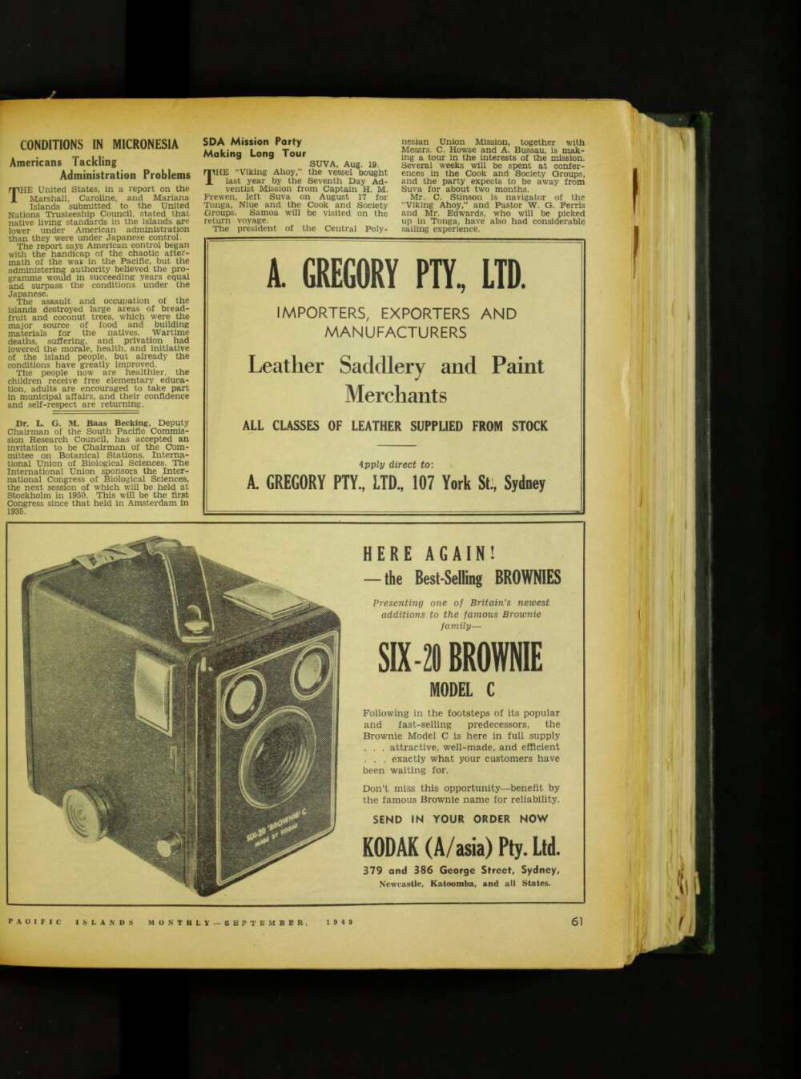
Conditions In Micronesia
Americans Tackling Administration Problems
THE United States, in a report on the Marshall, Caroline, and Mariana Islands submitted to the United Nations Trusteeship Council, stated that native living standards in the islands are lower under American administration than they were under Japanese control.
The report says American control began with the handicap of the chaotic after math of the war in the Pacific, but the administering authority believed the pro gramme would in succeeding years equal and surpass the conditions under the Japanese.
The assault and occupation of the islands destroyed large areas of bread fruit and coconut trees, which were the major source of food and building materials for the natives. Wartime deaths, suffering, and privation had lowered the morale, health, and initiative of the island people, but already the conditions have greatly improved.
The people now are healthier, the children receive free elementary educa tion, adults are encouraged to take part in municipal affairs, and their confidence and self-respect are returning.
Dr. L. G. M. Baas Becking, Deputy Chairman of the South Pacific Commis sion Research Council, has accepted an invitation to be Chairman of the Com mittee on Botanical Stations, Interna tional Union of Biological Sciences. The International Union sponsors the Inter national Congress of Biological Sciences, the next session of which will be held at Stockholm in 1950. This will be the first Congress since that held in Amsterdam in 1935.
Making Long Tour
SDA Mission Party Making Long Tour
Suva, Aug. 19.
THE “Viking Ahoy,” the vessel bought last year by the Seventh Day Ad ventist Mission from Captain H. M.
Frewen, left Suva on August 17 for Tonga, Niue and the Cook and Society Groups. Samoa will be visited on the return voyage.
The president of the Central Poly
nesian Union Mission, together with Messrs. C. Howse and A. Bussau, is mak ing a tour in the interests of the mission.
Several weeks will be spent at confer ences in the Cook and Society Groups, and the party expects to be away from Suva for about two months.
Mr. C. Stinson is navigator of the “Viking Ahoy,” and Pastor W. G. Ferris and Mr. Edwards, who will be picked up in Tonga, have also had considerable sailing experience.
Advertisements & other items, p. 63 (1 item)
A, Gregory Piy, Ltd.
IMPORTERS, EXPORTERS AND
MANUFACTURERS
Leather Saddlery and Paint Merchants ALL CLASSES OF LEATHER SUPPLIED FROM STOCK kpply direct to: A. GREGORY PTY., LTD., 107 York St, Sydney
I » / , , V ■ Hi IS m M
msm
■m-y &
HERE AGAIN!
the Best-Selling BROWNIES
Presenting one of Britain’s newest additions to the famous Brownie family —
SIX-20 BROWNIE
MODEL C
Following in the footsteps of its popular and fast-selling predecessors, the Brownie Model C is here in full supply . . . attractive, well-made, and efficient . . . exactly what your customers have been waiting for.
Don’t miss this opportunity—benefit by the famous Brownie name for reliability.
SEND IN YOUR ORDER NOW
KODAK (A/asia) Pty. Ltd.
379 and 386 George Street, Sydney, Newcastle, Katoomba, and all States.
More Round-World Yachts
Call At Fiji
From Our Own Correspondent SUVA, August 8.
American yacht, “Seven Seas II,” from Los Angeles, left Suva on August 6, for the New Hebrides and Solomons in continuation of its round the-world cruise. Mr. W. Murnan (owner), was joined by Mr. J. Rolley, who first visited Fiji in the Danish yacht “Nordkaparen” last year. He recently returned to Suva from New Zealand.
The 38 ft. Bermuda-rigged sloop "Trade Winds,” arrived at Lautoka from New Zealand by way of Papeete, Pago Pago, and Apia, on August 5. The sloop left Auckland on April 28. It was in tended to sail from Apia to Suva, but storms took the vessel 200 miles off course to the west and calls were made at the Wallis Group and Futuna.
Two New Zealanders, Messrs. Michael Georgetti (owner and skipper) and Jim Baker, are on board. They are heading for England by way of the Islands, Aus tralia, the Indian Ocean, and Cape Town.
Stories In Plants
Hawaiian Botanist’s Book
THE pineapple and the bread-fruit are found all over the islands of Hawaii.
But they are not indigenous. There fore, how did they get there? They seem to have been there before Europeans settled in, at the beginning of last century.
That is only one of scores of intriguing problems discussed in “Plants of Hawaii National Park”, by Otto Degener, of Honolulu; who is famous throughout the South Seas as a botanist. He has spent a good deal of time in Fiji and Samoa.
In spite of its unimaginative name and unattractive cover, this book is written by a man who really can make nature study as fascinating and interesting as is should be; and the compilation, while no doubt of value to the scientist, is readable from cover to cover by the non scientist.
The section on coconut palms, for ex ample, does full justice to the world’s most interesting tree. The author de scribes not only the innumerable uses of the coconut palm, but also its origin.
He rejects the theory that it came from Africa and Madagascar, via the Orient following, it would seem, the track of the supposed Polynesian migrations.
There is also the fascinating story of the taro (or kalo, or dalo) that root which is a staple foodstuff throughout Oceania, and which appears to have originated in the East Indies, and been distributed all over the Pacific Islands by the wander ing Polynesians. Incidentally, Mr.
Degener, in his study of Hawaiian plants, finds plenty of evidence that the Poly nesians reached Hawaii via Tahiti.
Do you know why the taro is so free from injury by insects and herbivorous animals? If not, put your tongue against the cut stem of an old-type taro that has not yet been boiled. The new-style taro, introduced from Japan in recent years, has not got that natural protec tion, and can be eaten raw.
Mr. Degener, in this copiously illust rated book of 300 pages, deals also with birds, insects, native customs—with every thing, in fact, that makes the Islands interesting to the visitor from the tem perate zones. But, written so carefully and authoritatively, it is of interest also to the salted dweller in the Islands: the old-timer, no matter how long he has been in Oceania, can always learn some thing new about plants, insects, birds and native customs.
The index of plant and bird names should be most valuable, because so much of what is found in Hawaii is found also in other Pacific Islands.
The book was printed and published in United States, and copies are not available in Sterling areas. Copies may be obtained, for 2h dollars, from the author, Mr. Otto Degener, Waialua, Oahu, Hawaii. t Mr. H. D. Kelly has been promoted from assistant manager to general manager of Misima Goldmine, Ltd., Eastern Papua, and Mr. P. R. Osborne, who has been acting as general manager since the mine reopened, will resume charge of the metallurgical operations.
The Directors have expressed apprecia tion of the “great job” done by Mr.
Osborne in getting the mine back into production, after the four years shut down following the Jap invasion.
Advertisements & other items, p. 64 (1 item)
Menu
iiiiiii Hi -
delicious
« f ,OP -^ODS
. • Sausages and • Corned Beef u a mpe i © Bacon “ t Luncheon ?orV \ r isVi S+ ev/ • Trim • Sa usa^ s ' f orna *o • MC (stelvP' Jtid “' g * U S« uwgel <;tew © Toma+o • SfeaV and K.dney OnPPjgJ Salmon Pudding to • AusHal • s *“ k ‘ n<l " ,o« «•« «°* <r<r< \Z CO
RIVERSTONE
MEAT
Imperial goods are prepared from prime selected stock by the largest meat-processing organisation in Australia. You can be sure of top-quality when you order "Imperial."
PTY. LTO,
5-7 O'Connell Street, Sydney.
Fiji Representative: Pearce & Co. Ltd., Suva.
Recommendations
For Fiji’S
Dairy Industry
SUVA. July 10.
THE dairying industry in Fiji consists mainly of one large company operat ing its own farms and factory, and fewer than 40 farmers supplying another factory.
For this reason Mr. E. B. Rice, the Queensland Government expert brought to Fiji to investigate the Colony’s dairy ing industry and to submit recommenda tions for increased efficiency, has declined to support the producers’ request for a committee to be set up to fix the prices of butter in Fiji. He says that in the cir cumstances the producers could always make any representations to the Govern ment through their existing organisation.
Eleven recommendations in Mr. Rice’s report are summarised as follows: (1) Overseas work on the crossing of Zebu with European breeds of cattle to introduce a factor of resistance to high temperatures should be watched: but the use of Zebu crossbreeds for dairying pur poses in Fiji is not recommended at the present time, particularly as there is no milking strain of Zebu in the Colony, (2) Work should be undertaken and given high priority on the selection of legumes to be grown in association with grasses for the improvement of pastures. (3) Trials should be undertaken on the regular mowing of pastures to assist in pasture improvement. (4) Trials should be undertaken on the supplementary feeding of forage crops. (5) Farmers should take care to pro vide good night grazing for their cows. (6) Dairy farmers supplying the Rewa factory should institute a scheme of regular herd recording. (7) The Department of Agriculture should undertake a survey of wastage in dairy herds to determine the reason for such wastage. (8) Both fanners and department should pay special attention to improve ments in calf-rearing practice. 09) Owing to the variation in standards of hygiene on dairy farms, farmers and the department should endeavour to raise the standard of routine maintenance of buildings, the repair of bails where ne cessary and the concreting or gravelling of bail surrounds. (10) Farmers should economise in labour costs by the wider adoption of milking machines. (11) Farmers should engage more widely in the production of by-products of dairying, as the net incomes of farmers who so engage are found to be markedly above the average.
Western Samoa Trade In
1948
FURTHER details of trade in Western Samoa in 1948 have been released.
Exports amounted to £1,108,258, of vhich £597,185 went to the United King iom, £255,550 to New Zealand, £167,067 ■o USA, £51,638 to Canada and £34,511 to Australia.
Imports amounted to £761,146 of which ; 301,544 came from New Zealand, -180,368 from USA, £154,749 from Aus -ralia, £146,733 from the United King lorn, £68,874 from Canada, £32,261 from ndia and £31,339 from Fiji.
Exports of cocoabeans in 1948 were ,630 tons valued at £369,492. Exports of *Pra amounted to 14,178 tons while 9,507 cases of bananas were exported to *ew Zealand.
Condemned
Drift To Suva Again
From Our Own Correspondent
Suva, Aug. 19.
THE process of commercial and indus trial expansion in Fiji, which tends to be centered on Suva, is constantly in creasing the demand for Fijian workers, and the number of Fijians concentrated at Suva is a matter for constant con cern, states the annual report of the District Commissioner, Southern (Mr. J.
Judd), “If taken to its logical conclusion,” the
report continues, “it will largely reduce the Fijian population to a floating labour force, dependent for its prosperity and the means of its livelihood on economic forces outside this Colony. If these fail, the previously abandoned communal life will not be there to fall back upon; neither will it be easily regenerated”.
The Rev. Father O. Shelley, of the Society of the Divine Word, has been appointed to the Roman Catholic mis sion fields of New Guinea. He has been professor of mathematics at St, Vincent’s Mission Seminary, Marburg, Queensland, for the last five years.
Advertisements & other items, pp. 65-66 (1 item)
'SeimatM f i«i sll s
y mm. / Wm / ' + ■ im ;'V N v \ N \ N N ' \ w
T rop
irtil I «r«*"»« c
Every Berger finish must withstand lest after test to prove worthy of the Berger label . . . every product must satisfy the Berger technicians and chemists that it will meet the challenge of all climates from tropic heal to arctic cold.
'SeimatM f i«i sll s
KEEP ON KEEPING ON!
Better for School Books I
They stand the rough and tumble. They're lighter and easier to carry.
Ask first for Hi maof gy
FORD SHERINGTON LTD.
Scott’s “Renown” Brand Rope,
Cordage and
Binder
Twine
of Every
Description
Cable Address: Ropeyard, Sydney.
MANUFACTURED AT
MASCOT, N.S.W.
J. SCOTT
PTY. LTD.
Head Office and Store
163 CLARENCE STREET,
SYDNEY,
N.S.W.
BROOMFIELDS Ltd.
Suppliers of Building Hardware Ship Chandlery, Paint Materials
WRITE DIRECT TO:
Broomfields Ltd., 152 Sussex Street, Sydney
A Bank Slip
And A
Sequel In Court
SUVA, July 10.
A “courtroom drama” that illustrated several of the curious ’ features of life in Fiji cropped up in the Suva Magistrate’s Court on July 8.
The central figure was Gurdar Singh, described as an illiterate Indian cultiva tor from Tavua, who had come to Suva on July 7 to board the ship, “Orna,” en route to India.
On his arrival, Gurdar Singh went straight from the bus to a bank, to get a draft for £275. At the bank doorway he met a helpful but previously unknown Indian named Sadhu (alias Sharma).
Accepting Sadhu’s offer of help, Gurdar Singh handed over his passport and money. After the usual formalities, dur ing which Gurdar Singh affixed his thumbprint to a paper, Sadhu received a bank slip which he placed in the pass port, and returned both to the owner.
Outside the bank Gurdar Singh met an Indian friend to whom he showed the bank slip. It was for only £175. And the helper named Sadhu had disappeared.
The matter was reported to the police, who, after an extensive search, found Sadhu during the evening. After deny ing all knowledge of the transaction, the man offered to write a cheque for the £lOO as he “did not want any trouble.”
Bank officials revealed to the police that Sadhu had paid £lOO into his previously modest account.
In court next morning Sadhu was sen tenced to six months’ hard labour. He gave notice of intention to appeal against the sentence.
Suva's Electricity
Absorbed in General Scheme Town Council Sells Undertaking
Suva, Aug. 19.
AFTER several months of negotiations the Suva Town Council has agreed to sell Suva’s electricity undertak ing to the Colonial Development Corpora tion, or to some public utility company to be set up in connection with the Navua hydro-electricity scheme. The price has yet to be negotiated, but it is believed to be about £150,000.
The Suva Council will continue the management of Suva’s electricity supply until the hydro-electric scheme is in op eration, probably about 1955.
Indian Independence
Day In Fiji
From Our Own Correspondent
Suva, Aug. 21.
INDIAN Independence Day (August 15) was celebrated by Indians in Fiji with the customary political demon strations, ceremonial hoisting of Indian flags and speech-making.
At one small Viti Levu centre a Gov ernment official, after congratulating the organisers on a spectacular display, ex pressed a mild hope that Fiji s 75th Cession Day in October might produce somewhat similar enthusiasm.
The Fiji Muslim community, which since the establishment of Pakistan has shown an increasing tendency to resent being called “Indian”, commemorated Pakistan Day much more quietly on August 14.
Achievements
Pmg Men’S Notable
In Papua N. Guinea
Letter to the Editor AN article appeared in your July issue under the heading, “Invaluable Equipment Lost in New Guinea.” It was a report of statements made in the Federal Parliament.
This article, whilst containing some vestige of truth, is nevertheless a gross mis-statement of the true position.
The supposed Labour Senator has been very much misinformed, or else his in formant has some personal axe to grind.
The whole article, can and no doubt will, be shot full of holes. I, myself, will endeavour to refute any suggestion of incompetence or inefficiency on behalf of the Postal and Telephone staff, and leave other points to more competent critics.
The Civil Administration took over Postal and Telephone services late in 1945, and out of chaos a small band of technicians and Post officials did a man size job in getting the service going at all. The technicians in the main were fully trained PMG personnel, with many years’ experience in Australia, and the equipment they used was, as stated, sal vaged from the bush, or where left by the Army, and without exception was in a deplorable condition.
The telephone services have been main tained and improved, despite the fact that very little if any assistance has come from Australia in the form of men or material. For four years we have been unable to procure any telephone material whatsoever; and the wages paid to tech nical personnel are not sufficient to at
tract anyone from Australia, other than those of high ideals who place country first. Amongst these are men from Bal larat, Melbourne, Perth, Sydney and Brisbane. Some have returned to Aus tralia owing to frustration: but some still remain, and I can assure you these re maining men rank high in the estimation of the PMG’s Department. Australia.
In Port Moresby there are a PMG en gineer, three PMG technicians, one PMG line inspector, and several PMG lines men; and many other PMG men are dis tributed throughout the Territory, doing a really miraculous job.
If the Senator would direct his energies into obtaining for us some supplies and help, I am sure he would be doing his country a better service than that which will result from such an article, riddled with so many untruths, and completely at variance with facts.
A Training School was established for the training of natives in telephone tech nical work; but, unfortunately, this School was established bv men un acquainted with the native mind and habits, with the result that, despite the
most strenuous efforts of men who fol lowed on, the training scheme is just a shadow of what it set out to be. The scheme is most laudable—and I am sure will ultimately reach fruition, but only through a combination of technical ability with anthropological or local knowledge.
In conclusion, let me once again state that if the Senator could give us material, we, even though 80 per cent, understaffed could, and would, stifle all criticism I am, etc.,
Pmg Technician.
Pt. Moresby, 8/9/49.
Mr. D. McMillan, of Overseas Tele communications, returned to Rabaul, New Guinea, in August, to resume duties as Officer-in-Charge of that station.
During his leave in Australia he under went an operation on his eyes.
Noumea has a new suburban cinema.
It is the Cine Tropic, opened by M.
Auguste Mercier in the Valle des Colons, the suburb leading to Magenta airfield.
Advertisements & other items, p. 67 (1 item)
4U/0 Labour Costs*
Wynne S. Breden Pty. Ltd.
SHIPWRIGHTS , BOAT BUILDERS AND ENGINEERS.
"PHOENIX SHIPYARDS", NEWCASTLE, N.S.W.
Designers, Builders & Outfitters of ISLAND Vessels Work Boats, Cargo Boats and Auxiliary Craft up to 200 tons.
M f%O/ REDUCTION IN*
4U/0 LABOUR COSTS*
with the ‘CHULA’’ Patent COPRA DRYER
This remarkable Dryer also
• PRODUCES 12 TONS OF COPRA PER WEEK at the rate of 2 Tons every 24 hours. • PRODUCES COPRA OF HIGHER OIL CONTENT.
• IS SIMPLE AND
QUICK TO ERECT.
THE INVENTORS AND MANUFACTURERS OF
THE "CHULA" COPRA DRYER ALSO MAKE
DESICCATED COCONUT
MACHINERY
TYNESIDE FOUNDRY &
ENGINEERING CO. LTD.
ELSWICK • NEWCASTLE-ON-TYNE • ENGLAND
Established 1898.
Telegrams & Cables: "FOUNDRY. NEWCASTLE-ON-TYNE" . Codes: ABC, sth & 6th Eds m Hr A\ & & □ Write for Catalogues of
CHULA"
COPRA DRYERS
Capacities from 1,000 to 10,000 nuts per day.
Part-Europeans In
No Preference For
Fijian Land Leases
From Our Own Correspondent SUVA, August 8.
THE Legislative Council of Fiji had no power to direct the Native Lands Commission to give preferential treatment in any claim for the leasing of land made before the Commission This was a point emphasised during a debate on a motion by Mr. F. G. Archibald which, in effect, asked for special treat ment of part-Europeans by reason of the fact that they are also part-Fijians.
After stating the problems that face the part-European people, Mr Archibald said he was content to withdraw the motion as the debate had served to dis close a difficult question.
The Governor (Sir Brian Freeston) said that the Government had every sympathy with the part-European, who had “a foot in both camps.” Within the legal structure, he added, the Govern ment would do all it could to help.
A son was born to Mr. and Mrs. R. T.
Collings, of Gunanur Plantation. Kokopo, New Guinea at Namanula Hospital, Rabaul, on August 2, 1949.
Lack Of Amenities In Papua-New Guinea
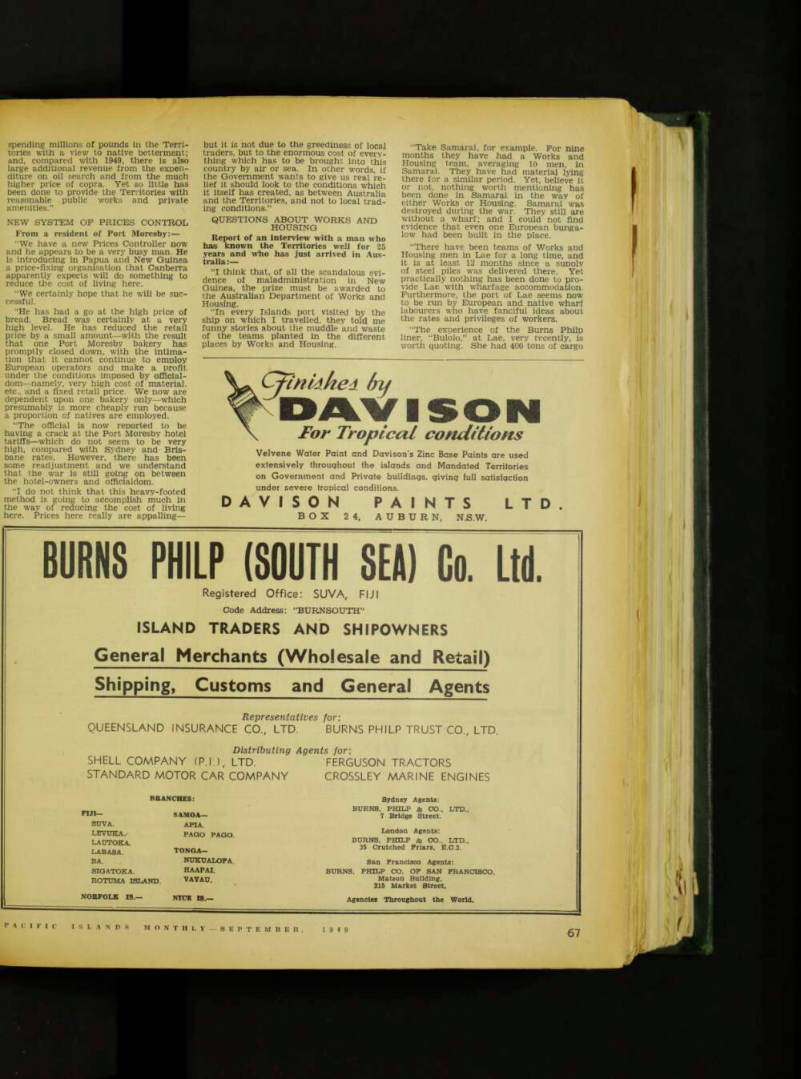
Canberra Blamed For Waste and Muddle and Bad Condition of Ports
INFORMATION from various sources indicates that rehabilitation and pro gress in the Australian Pacific Terri tories of Papua and New Guinea are still being retarded by muddling and waste, for which the Australian Socialist Gov ernment and Canberra control seem primarily to blame.
The following is from a well-known commercial man who paid a business visit to Papua and New Guinea in August;— “I have had occasion recently to visit most of the Territories in the South Paci fic. In Fiji, Samoa and places eastward I find travelling conditions normal, except that all means of transport and accom modation are still seriously overcrowded.
But Administration, trade and transport seem to have settled down again, after the war, to a normal existence.
“My last visit was to Papua and New Guinea, countries which I had not previ ously seen. I was appalled by the lack there of ordinary amenities and amazed to discover that so little has yet been done to make good the destruction caused by the war. It is four years since hosti
lities ceased and I had assumed that in that time something like normal condi tions would have been restored.
“There are two modern hotels in Port Moresby, in which conditions are rea sonably good; but the demand for ac commodation seems far in excess of sup ply and travellers are jammed together in a way that makes for great discomfort.
I am told that the prewar European popu lation of Port Moresby has more than quadrupled, as the result of the town be ing made the headquarters of the double Administration and the headquarters, also, of the big oil search. But the authorities have failed in a remarkable way to provide anything suitable in the way of office accommodation for all these people. The wharves are falling down and there is nothing like sufficient houses for the people quartered there. One would have expected far more to have been done since 1945.
“In Lae and Rabaul, hotel conditions are simply terrible. The people running the hotels do their best under the condi tions Imposed upon them—but they can not be expected to provide decent accommodation when they are forced to use buildings of purely temporary con struction or native material. The failure to provide decent hotels in Lae and Rabaul apparently is due to the failure of the Government to assist private enter prise in any way in getting hotel sites, building materials and anything else.
“I never in my life saw anything like the fire risk in Rabaul, where countless thousands of pounds’ worth of goods are stored in all sorts of ways into flimsy shacks of a purely temporary character.
There is this tremendous demand in the Territory for goods, which the merchants —both European and Chinese —have tried to meet: but there is apparently no co operaion from the Government in making building material and facilities available so that suitable stores can be erected.
“In fact, I got the impression all through both Territories that the Govern ment is deliberately withholding reason able assistance from private enterprise in this matter of building and rehabilitation, simply because the Government is Socialistic and hates private enterprise.
“It was surprising to find that so little had been done to restore the amenities of life in Papua and New Guinea. I under stand that, before the war, life in these Territories was reasonably comfortable, and they were generally self-supporting.
To-day, the Government is said to be
spending millions of pounds in the Terri tories with a view to native betterment; and, compared with 1949, there is also large additional revenue from the expen diture on oil search and from the much higher price of copra. Yet so little has been done to provide the Territories with reasonable public works and private amenities.”
New System Op Prices Control
From a resident of Port Moresby:— “We have a new Prices Controller now and he appears to be a very busy man. He is introducing in Papua and New Guinea a price-fixing organisation that Canberra apparently expects will do something to reduce the cost of living here.
“We certainly hope that he will be suc cessful.
“He has had a go at the high price of bread. Bread was certainly at a very high level. He has reduced the retail price by a small amount—with the result that one Port Moresby bakery has promptly closed down, with the intima tion that it cannot continue to employ European operators and make a profit under the conditions imposed by official dom —namely, very high cost of material, etc., and a fixed retail price. We now are dependent upon one bakery only—which presumably is more cheaply run because a proportion of natives are employed.
“The official is now reported to be having a crack at the Port Moresby hotel tariffs—which do not seem to be very high, compared with Sydney and Bris bane rates. However, there has been some readjustment and we understand that the war is still going on between the hotel-owners and officialdom.
“I do not think that this heavy-footed method is going to accomplish much in the way of reducing the cost of living here. Prices here really are appalling—
but it is not due to the greediness of local traders, but to the enormous cost of every thing which has to be brought into this country by air or sea. In other words, if the Government wants to give us real re lief it should look to the conditions which it itself has created, as between Australia and the Territories, and not to local trad ing conditions.”
Questions About Works And
Housing
Report of an interview with a man who has known the Territories well for 25 years and who has just arrived in Aus tralia:— “I think that, of all the scandalous evi dence of maladministration in New Guinea, the prize must be awarded to the Australian Department of Works and Housing.
“In every Islands port visited by the ship on which I travelled, they told me funny stories about the muddle and waste of the teams planted in the different places by Works and Housing.
“Take Samarai, for example. For nine months they have had a Works and Housing team, averaging 10 men, in Samarai. They have had material lying there for a similar period. Yet, believe it or not, nothing worth mentioning has been done in Samarai in the way of either Works or Housing. Samarai was destroyed during the war. They still are without a wharf; and I could not find evidence that even one European bunga low had been built in the place, “There have been teams of Works and Housing men in Lae for a long time, and it is at least 12 months since a supply of steel piles was delivered there. Yet practically nothing has been done to pro vide Lae with wharfage accommodation.
Furthermore, the port of Lae seems now to be run by European and native wharf labourers who have fanciful ideas about the rates and privileges of workers.
“The experience of the Burns Philp liner, “Bulolo,” at Lae, very recently, is worth quoting. She had 400 tons of cargo
and many passengers for Lae. She arrived on a Thursday morning and she should have been out of the place within 24 hours. But on Saturday morning the barges still had not com pleted unloading and they knocked off on Saturday afternoon and Sunday because, presumably, the week-end is sacred in this workers’ paradise.
“So Captain Rothery, unable to get any guarantee of when his ship would be un loaded, sailed off to Dreger Harbour (Finschhafen) and other ports, and was obliged to call at Lae on his return trip in order to complete discharging. -That is typical. There is not only the enormous cost of discharging by barge, because the Government has failed to supply a suitable wharf; but there is also a further heavy cost of lazy and ineffi cient labour. The Territories’ people pay for that. , . “There are similar conditions in Port Moresby and Rabaul. The Port Moresby wharf is literally falling down and is really dangerous. At Rabaul. they still have only a pontoon wharf, which is costly and unsatisfactory.
“Canberra must have spent millions on these Works and Housing teams. I am told that the men get not less than £l5 per week each—and heaven alone knows what they do for it. They told me in Lae that there were now 60 men there, but no one could say what they were doing.
“High officials of the Administration are quite aware of these unsatisfactory
conditions, but they have no authority whatever over Works and Housing. Works and Housing in Papua and New Guinea is directly under the control of the Bris bane office of this Federal Department, and the Administrator at Port Moresby seems to have no authority at all in rela tion thereto. Administration officials, time and again, have tried to get some sort of control over this farcical set-up, and get some substantial advance made in regard to port conditions, but the con trol is still held jealously by Canberra.
High officials of Works and Housing come and go in the Territories, countermand ing each other’s orders and fighting be tween themselves. It is an incredible situation, and has to be seen to be be lieved.
“High and responsible officials have said to me very urgently that if there is need anywhere for a Royal Commission of Inquiry, there is need for one into the operations of Works and Housing in Papua and New Guinea during the past two years.” (Territories Minister Ward stated in Canberra on August 10 that wharves cost ing £636,000 would be built in Papua and New Guinea “to replace wartime struc tures which could not be economically repaired.”)
Conference In Port Moresby
•TT is reported in Sydney, that recently 1 there have been urgent conferences in Port Moresby between the Ad
ministration, and the shipping interests, in relation to the conditions in the dif ferent Territories ports. •It is understood that the shipping companies concerned have made the strongest possible protests to the Admin istration against the conditions they are forced to put up with in practically all the principal ports—conditions which add seriously to the cost of all transport and of all goods entering the Territories.
The Administration promised that im mediate steps would be taken to alleviate some of the worst conditions complained of but little appears to have been done, yet.
It is reported, unofficially, that Can berra has decided to abandon the plan of carrying out important Public Works in the Territories by Works and Housing and that such works will be carried out by private contractors.
Advertisements & other items, pp. 68-70 (1 item)
hghgh
Small Bottling Plants
NOW AVAILABLE
Automatic Electric Carbonators . . . Crown Sealing Machines Bottle Filling Machines . . . Labelling Machines Syrup Dispensers . . • Bottle Cleaning Machines.
KASPER REFRIGERATORS PTY. LTD.
77 RAILWAY PARADE, ERSKINEVILLE, N.S.W., AUSTRALIA LA 1326
Cpniiked by
DAVISON
For Tropical conditions
Velvene Water Paint and Davison's Zinc Base Paints are used extensively throughout the islands and Mandated Territories on Government and Private buildings, giving full satisfaction under severe tropical conditions.
DAVISON PAINTS LTD
BOX 24, AUBURN, N.S.W.
BURNS PHILP (SOUTH SEA) Go. ltd
Registered Office: SUVA, FIJI
Code Address: “BURNSOUTH”
ISLAND TRADERS AND SHIPOWNERS
General Merchants (Wholesale and Retail)
Shipping, Customs and General Agents
Representatives for :
QUEENSLAND INSURANCE CO., LTD. BURNS PHILP TRUST CO., LTD.
Distributing Agents for :
SHELL COMPANY (P.L), LTD. FERGUSON TRACTORS
STANDARD MOTOR CAR COMPANY CROSSLEY MARINE ENGINES
BRANCHES:
FIJI—
SUVA.
LEJVUKA..
LAUTOKA.
LAB AS A.
BA.
SIGATOKA.
ROTUMA ISLAND.
NORFOLK IS.—
SAMOA—
APIA.
PAGO PAGO.
TONGA-
NUKUALOPA.
HAAPAI.
VAVAU.
NIUE IS.—
Sydney Agents:
BURNS, PHILP & CO.,
7 Bridge Street.
LTD.,
London Agents:
BURNS. PHILP & CO.. LTD.,
35 Crutched Prlars, E.C.3.
San Francisco Agents:
BURNS, PHILP CO, OP SAN FRANCISCO.
Matson Building, 215 Market Street, Agencies Throughout the World.
The Key to Earning Power . . .
Sometimes men think that a general education or an elementary knowledge of business is enough to get ahead. But experience soon teaches that thorough, specialised training is just as necessary for success in business as it is in the professions of Law, Medicine or Dentistry. If you are interested in the many opportunities in the Business World ... if you seek responsibility, success and economic security, commence training now — in some specialised business subject. H.R.I. is available always to help and advise ambitious men and women. Write or wire for particulars and career information.
H.R.I. tutorial service is 'proved by the winning of more honcncrs than all coaches in Australasia combined. § H.R.I. Career Training — VS/ • ACCOUNTANCY • SECRETARYSHIP • COST ACCOUNTANCY • PRACTICAL BOOKKEEPING • MARKETING — SELLING — ADVERTISING © BANKING • LOCAL GOVERNMENT EXAMS.
Hemingway Robertson Institute
Founded and Owned by Hemingway & Robertson Pty. Ltd.
Consulting Accountants :: :: Professional Tutors
126 BANK HOUSE,
126 BARRACK HOUSE.
B 1 6
ANK PLACE, MELBOURNE
BARRACK STREET, SYDNEY
126/814
KWONG CHONG BROTHERS
General Merchants and Planters
★ Have now re -established their business on their original pre-war site, and are carrying stacks of Trading and Plantation requ.remcnts. All enquiries welcomed and service assured.
Sydney Representatives:
NELSON & ROBERTSON PTY., LTD.,
Electra House, 12 Spring Street, Sydney, N.S.W.
KWONG CHONG BROTHERS
kemarere street, rabaul
Ride
Three Killed On A ‘Joyous’
PAPEETE, August 9.
AT 2 a.m. on Sunday, August 7, a taxi, No. 1428, was carrying homewards to Papeete three revellers, Messrs.
Albert Cowan, Camille Marcantoni and Tuanaa Tuare, who had spent a joyous evening at the cabaret, “Lido.”
M. Cowan took the wheel bv force. He had just induced a native woman, on her way to early morning market, to join them in the car.
By the bridge of Hamuta, the vehicle, which was travelling fast, left the high way and crashed into an electric light pole, knocking it down, and then career ing on into a cement post, ending up almost a complete wreck, with the front wheels of the car whirling in the air.
The noise, and cries from the im prisoned passengers, quickly brought aid.
After much trouble, the victims were re leased, and two were found to be dead— M. Cowan and the unfortunate wayside native woman, Madame Teata Tamatoa a Tuino. M. Tuanaa Tuare later died without regaining consciousness. The chauffeur, Temarii Nadeaud, and Mar cantoni, were gravely hurt taut are now out of danger.
A court inquiry is proceeding. Although such accidents are rare in Tahiti, this incident is a warning to all who will drive while inebriated.
In Honiara, BSI on July 12 Miss Mavis Kathleen Wood was married to Mr. J.
Parry, of Yandina, Russell Islands. The ceremony was performed by the acting Resident Commissioner (Mr. J. D. A.
Germond) and the bride was attended by Mrs. W. Gorrie who was herself married only two months ago.
Africa
South And East
And Ground Nuts
From a Special Correspondent riOUTH AFRICA is a wonderul country, 3 but lam afraid there are many “buts.” If you are interested in con litions here, I recommend two books— ‘The Beloved Country,” by Allan Baton, ind “Kaffirs are Lively,” by Oliver talker.
Inter-racial feeling is rampant and fear .unrecognised as such) of the natives is iniversal.
Smuts, in his own country, is not the lopular hero that he is when out of it. le is an Empire Statesman of the first rater, but this carries no weight in his >wn country.
I did not see the Rhodesias—only the lastern district of Southern Rhodesia. :hat is a lovely country.
One heard a good deal of talk about he two Rhodesias joining with Nyassa md to form a Dominion. Doubtless, that ventually will take place, but there are ome difficulties yet to be surmounted. )ne is that the native policies of the hree areas differ fundamentally, and an ther is that Southern Rhodesia, being he wealthiest of the three, is a little shy f accepting the responsibility of carry ig the baby.
Kenya, Uganda and Tanganyika should >mbine and form another Dominion. Let s hope they will. Tanganyika is to the Dre at present—but do not take too much otice of what you hear concerning the Iround Nut Scheme. There is much lore to it than that. (The Ground Nut Scheme, to which our Direspondent refers, is of direct interest ) the Pacific Islands. The British plan ) produce almost incalculable quantities f peanuts in East Africa was formulated ) take care of a world shortage of vege ible oils—a shortage that has kept the rice of copra very high since the end I World War 11. Some students of the orld’s vegetable oil situation expect the rice of copra to fall steadily, as the East frican ground-nuts come to market, ut information from many sources in icates that the African ground-nut pro nction scheme is suffering all the usual labilities of Socialistic planning— tuddle and delay in implementation, and lormous costs, making the ultimate pro uct of little economic use. The British ocialist Government already has spent lany millions of pounds on the African round Nut Scheme, but even its best iends have not yet been able to acclaim s success. In theory it was a good plan -and it might have proved so in prac ce had it not had placed upon it the ight of Socialistic operation. The copra 'oducers of the Pacific need not begin to orry, just yet.) Mr, A. Wilson, the Administrator of Nor >lk Island, with Mrs. Wilson, recently ft the island for NSW and Victoria on inual leave.
Commander William Burrows, lately of iji, went on to London recently from 3Uth Africa and Rhodesia, where he >ent several months. He has lost the ?ht of one eye, and he went to London 1 obtain expert opinion about the condi gn of his other eye. Expert opinion, )wever, was reassuring. Commander arrows is at present engaged in writing book connected with the experiences of s YF y iHteresting life; but indications ’e that he will soon return to Fiji.
Advertisements & other items, p. 71 (2 items)
69
AOIFIC ISLANDS MONTHLY-SEPTEMBER. 1949
can’t drag
'THAT
<C A *
This Anchor
can’t drag
The security of an estate, like the safety of a ship, depends on skilful handling under all circumstances. Unless your will provides for experienced and unbroken administration, unforeseen events can wreck your plans. As a private executor, toe, you will find that your unsought duties are complex, tiresome and endless. However, the appointment of Burns Philp Trust Company Limited as executor or trustee solves both problems; all responsibility is transferred to capable directors and experienced officers.
Full particulars of the Company’s helpful services are given in "Hands That Never Leave the Wheel.” A complimentary copy of this booklet can be obtained from any branch of Burns Philp (South Sea) Company, Burns Philp (New Guinea) Limited, or direct from the head office of this Company.
DIRECTORS:
James Burns Joseph Mitchell P. T. W. Black Eric Priestley Lee MANAGER: L. S. Parker SECRETARY; E. R. Overton. F.F.I.A.
Burns Philp Trust
COMPANY LIMITED
EXECUTOR • TRUSTEE • AGENT
Constituted by Special Act of the N.S.W. Parliament
HEAD OFFICE: 7 BRIDGE STREET. SYDNEY
Tel. BU 5701 Box 543, G.P.0., Sydney
Mixed Blood In Polynesia
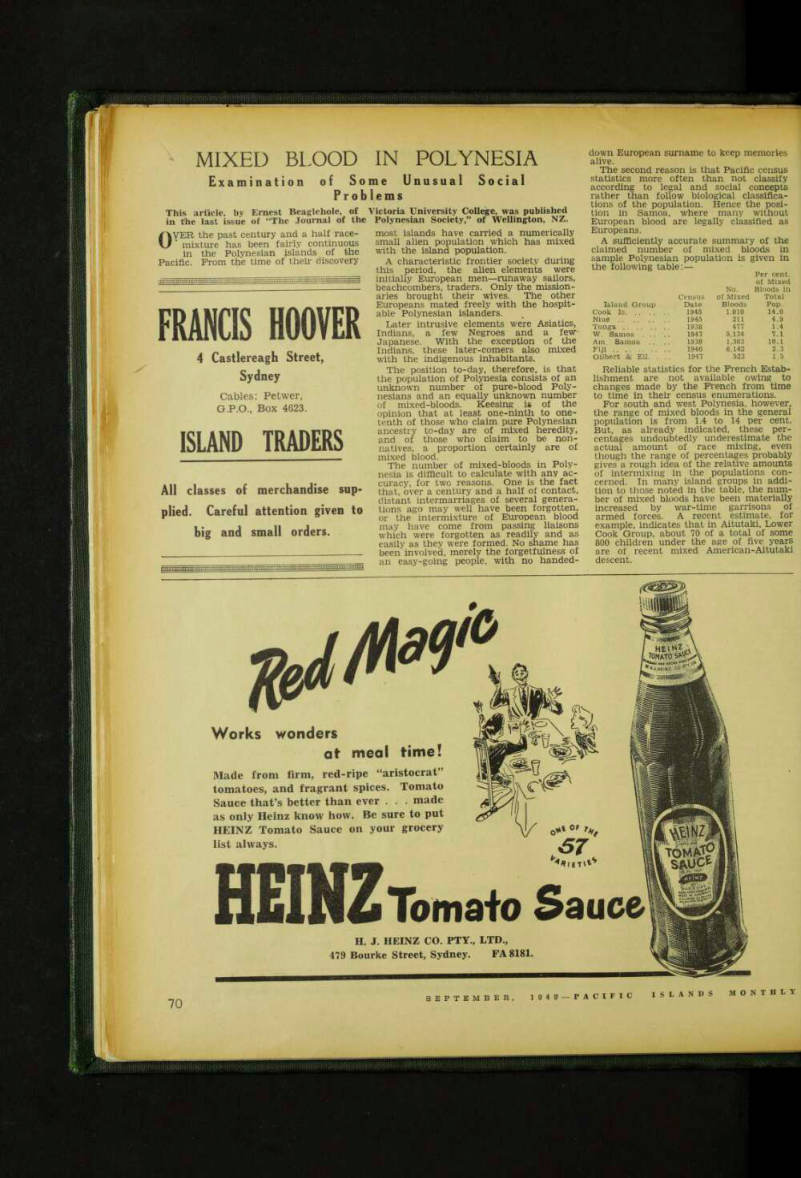
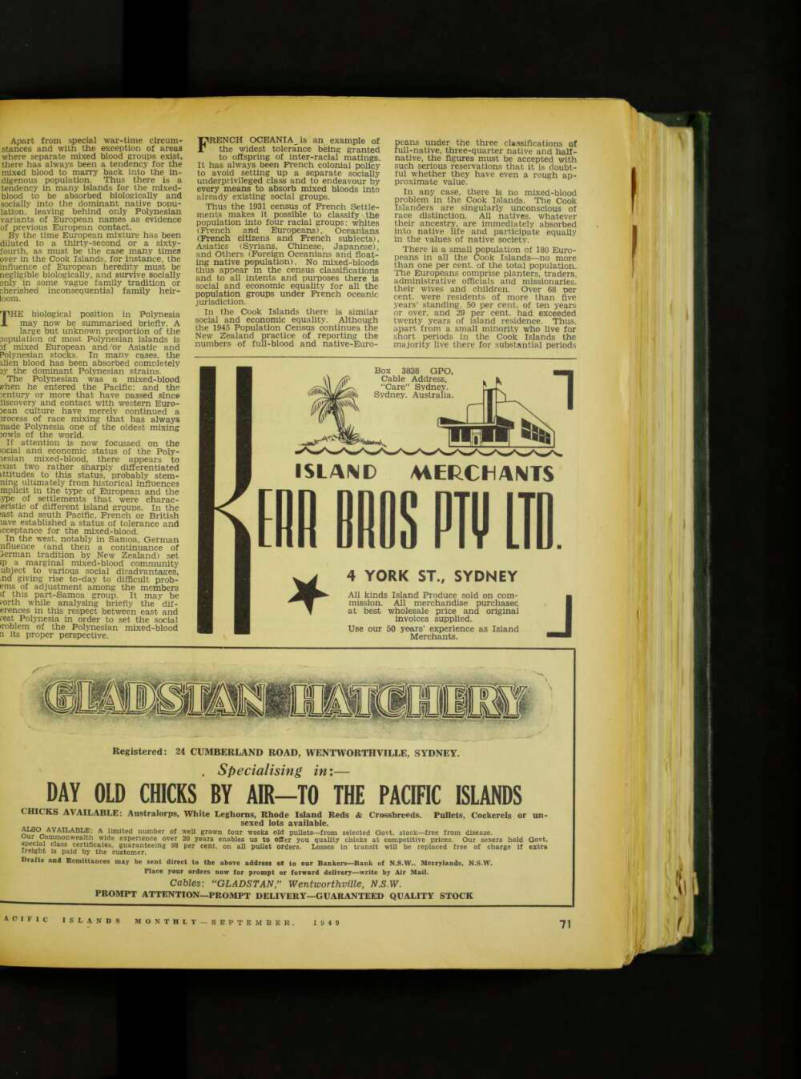
Examination of Some Unusual Social Problems
This article, by Ernest Beaglehole, of Victoria University College, was published in the last issue of “The Journal of the Polynesian Society,” of Wellington, NZ.
OVER the past century and a half race * mixture has been faMv continuous in the Polynesian islands of the Pacific From the time of their discovery
most islands have carried a numerically small alien population which has mixed with the island population.
A characteristic frontier society during this period, the alien elements were initially European men —runaway sailors, beachcombers, traders. Only the mission aries brought their wives. The other Europeans mated freely with the hospit able Polynesian islanders.
Later intrusive elements were Asiatics, Indians, a few Negroes and a few Japanese. With the exception of the Indians, these later-comers also mixed with the indigenous inhabitants.
The position to-day, therefore, is that the population of Polynesia consists of an unknown number of pure-blood Poly nesians and an equally unknown number of mixed-bloods. Keesing is of the opinion that at least one-ninth to one tenth of those who claim pure Polynesian ancestry to-day are of mixed heredity, and of those who claim to be non natives, a proportion certainly are of mixed blood.
The number of mixed-bloods in Poly nesia is difficult to calculate with any ac curacy, for two reasons. One is the fact that, over a century and a half of contact, distant intermarriages of several genera tions ago may well have been forgotten, or the intermixture of European blood may have come from passing liaisons which were forgotten as readily and as easily as they were formed. No shame has been involved, merely the forgetfulness of an easy-going people, with no handed
down European surname to keep memories alive.
The second reason is that Pacific census statistics more often than not classify according to legal and social concepts rather than follow biological classifica tions of the population. Hence the posi tion in Samoa, where many without European blood are legally classified as Europeans.
A sufficiently accurate summary of the claimed number of mixed bloods in sample Polynesian population is given in the following table: —
Reliable statistics for the French Estab lishment are not available owing to changes made by the French from time to time in their census enumerations.
For south and west Polynesia, however, the range of mixed bloods in the general population is from 1.4 to 14 per cent.
But, as already indicated, these per centages undoubtedly underestimate the actual amount of race mixing, even though the range of percentages probably gives a rough idea of the relative amounts of intermixing in the populations con cerned. In many island groups in addi tion to those noted in the table, the num ber of mixed bloods have been materially increased by war-time garrisons of armed forces. A recent estimate, for example, indicates that in Aitutaki, Lower Cook Group, about 70 of a total of some 800 children under the age of five years are of recent mixed American-Aitutaki descent.
Census No. of Mixed Per cent, of Mixed Bloods in Total Island Group Date Bloods Pop.
Cook Is 1945 1.910 14.0 Niue 1945 211 4.9 Tonga 1938 477 1.4 W. Samoa ... . 1947 . 5,134 7.1 Am. Samoa .. 1938 1,303 10.1 Fiji 1946 6,142 2.3 Gilbert & Ell. . . 1947 523 1.5
Apart from special war-time circum stances and with the exception of areas where separate mixed blood groups exist, there has always been a tendency for the mixed blood to marry back into the in digenous population. Thus there is a tendency in many islands for the mixed blood to be absorbed biologically and socially into the dominant native popu lation. leaving behind only Polynesian variants of European names as evidence of previous European contact.
By the time European mixture has been diluted to a thirty-second or a sixty fourth, as must be the case many times over in the Cook Islands, for instance, the influence of European heredity must be negligible biologically, and survive socially only in some vague family tradition or cherished inconsequential family heir loom.
THE biological position in Polynesia may now be summarised briefly. A large but unknown proportion of the oopulation of most Polynesian islands is of mixed European and/or Asiatic and Polynesian stocks. In many cases, the ilien blood has been absorbed comnletely oy the dominant Polynesian strains.
The Polynesian was a mixed-blood vhen he entered the Pacific: and the century or more that have passed since liscovery and contact with western Euro oean culture have merely continued a orocess of race mixing that has always nade Polynesia one of the oldest mixing jowls of the world.
If attention is now focussed on the social and economic status of the Poly nesian mixed-blood, there appears to ;xist two rather sharply differentiated ittitudes to this status, probably stem ning ultimately from historical influences mplicit in the type of European and the ype of settlements that were charac eristic of different island groups. In the last and south Pacific, French or British nave established a status of tolerance and icceptance for the mixed-blood.
In the west, notably in Samoa, German nfluence (and then a continuance of German tradition by New Zealand) set ip a marginal mixed-blood community übject to various social disadvantages, nd giving rise to-day to difficult prob ems of adjustment among the members )f this part-Samoa group. It may be rarth while analysing briefly the dif erences in this respect between east and zest Polynesia in order to set the social iroblem of the Polynesian mixed-blood a its proper perspective.
French Oceania ns an example of the widest tolerance being granted to offspring of inter-racial matings.
It has always been French colonial policy to avoid setting up a separate socially underprivileged class and to endeavour by every means to absorb mixed bloods into already existing social groups.
Thus the 1931 census of French Settle ments makes it possible to classify the population into four racial groups: whites (French and Europeans), Oceanians (French citizens and French subjects), Asiatics (Syrians, Chinese, Japanese), and Others (Foreign Oceanians and float ing native population). No mixed-bloods thus appear in the census classifications and to all intents and purposes there is social and economic equality for all the population groups under French oceanic jurisdiction.
In the Cook Islands there is similar social and economic equality. Although the 1945 Population Census continues the New Zealand practice of reporting the numbers of full-blood and native-Euro
peans under the three classifications of full-native, three-quarter native and half native, the figures must be accepted with such serious reservations that it is doubt ful whether they have even a rough ap proximate value.
In any case, there is no mixed-blood problem in the Cook Islands. The Cook Islanders are singularly unconscious of race distinction. All natives, whatever their ancestry, are immediately absorbed into native life and participate equally in the values of native society.
There is a small population of 180 Euro peans in all the Cook Islands—no more than one per cent, of the total population.
The Europeans comprise planters, traders, administrative officials and missionaries, their wives and children. Over 68 ner cent, were residents of more than five years’ standing, 50 per cent, of ten years or over, and 29 per cent, had exceeded twenty years of island residence. Thus, apart from a small minority who live for short periods in the Cook Islands the majority live there for substantial periods
and adapt themselves, as easily as the natives, to the prevailing tolerant social attitudes.
THE position in Western Samoa is very different from the tolerant eastern Pacific. Much of this difference must be due to the fact that German,
British and, under Mandate, New Zea land administration has, unlike the French, introduced into Samoa the racial consciousness and prejudice of Anglo- Saxon colonial society.
Successive censuses have set up statis tical and social distinctions which have
resulted, in Samoa, in the development of a segregated social group, known officially as Europeans of part-Samoan ancestry. Some 93 per cent, of this group consist of local-born part-Samoans, mixed-bloods who would have disap peared into the native societies of French Oceania or the Cook Islands, but who re main in Samoa an artificial group creat ing strain and tension in the whole of Samoan society.
Two points about this part-Samoan group are important to notice. First, the group is increasing very rapidly, and the majority being at the pre-productive age level, a further rapid increase can be confidently expected. The second point is that the definition of a part-Samoan has passed far beyond the simplicities of racial ancestry and is now purely a con cept with a complicated legal definition, which refers operationally to legal rights and limitations in regard to such matters as land-holding, schooling, court pro cedures.
The part-Samoan thus suffers from a number of serious disadvantages, and in return he is privileged to enjoy the doubt ful value of being a European, but a Euro pean with a big difference, a second-rate European in other words, who enjoys less favourable wages and other conditions of employment than personnel recruited from New Zealand.
That the distinctions which define this part-Samoan group are to-day purely arbitrary and technical is shown by the manner in which European status may be acquired. Europeans of part-Samoan ancestry are defined as (a) the legitimate descendants in the male line of Europeans; (b) persons with not more than 50 per cent. Samoan blood who peti tion the Court for European status; (c) persons not of Samoan status whose male ancestors have not more than 75 pr cent, of Polynesian blood.
Out of these technicalities, the situation arises where a person may be denied European status because his father was a full Samoan, but granted this status if his father were a full Chinese or Melanesian labourer.
It is estimated that about 15 per cent, of the “Europeans” in the territory pos sess not even the slightest trace of European or white ancestry in their racial make-up. Because of the sense of social superiority implicit in being a European many part-Samoans prefer European to Samoan status. Thus, up to March Sl. 1947 541 part-Samoans have petitioned for and been granted European status while only 27 with European status have petitioned to become Samoans, and of these three subsequently repetitioned to become Europeans.
These figures suggest that whatever the discrimination implicit J n traded as a European of part-Samoan ancestry many more mixed-bloods prefer Status than that 9 f being a Samoan.
Racial discrimination is, therefore a part of nresent-day Samoan society, with skin colom 5 influencing the kind and amount of schooling and hospital attention a person receives.
This discrimination, this “ranking source of deep-seated irritation, requires careful analysis with a. view to its. elim ination unless the strain and tension of a conflict of interests are going to con tinue to upset the harmony of Samoan social and political life.
TTnrrmeans of part-Samoan descent have contributed greatly in the past and continue to d 0 so to-day, to the economic and social leadership of the Territory^ b?o e odf h live h bar d ely m above a subsistence
standard of living as artisans, small traders, employees of business firms and of the administration.
To draw these part-Samoans into the great society that is modem Samoa, to utilise their skills and their capacities for leadership, and at the same time not an tagonise the pure Samoan population will require, during the next decades, states manship of high order. But the task is worth trying, if for no other reason than that at present Samoa stands out as an unfortunate exception to a more humane, wiser, general Polynesian pattern of be haviour towards the mixed-blood.
IT is curious that the one island group in Polynesia where the mixed-blood is a social problem and where person ality integration for the mixed-blood should be so difficult to achieve is Samoa.
Hawaii and New Zealand, the far north and far south of Polynesia, have pre sented few social problems for the mixed blood. East and south-east. French Oceania and the Cook Islands have ab sorbed those of mixed alien blood both biologically and socially.
The west alone stands out. Why, it is hard to say. Frontier life, large seaports are found elsewhere in Polynesia. Is the problem, therefore, a heritage from Ger man tradition and were consuls, German business men, administrators, and sons af missionaries so ashamed of association with Samoans that they unconsciously quietened their guilt by segregating the mixed blood? Some psychological ex planation is probably the correct one be cause neither purely social nor economic factors are sufficiently unique for Samoa o make socio-economic explanations com pletely plausible.
Some authorities are of the opinion that the basic prejudice against mixed-bloods in Samoa arises primarily from the So v* 16 ™ fri V 0 * true t ? at Ipl ?^ n ohnn l r nj>i§ a S. (^^r.c : Spe 'o! C <- R ' S t?°w , oL^ But * is ftj®9 highly probable, m Keesing notes, that mucil of thls discrimination is simply
a reflection on the part of the Samoan of attitudes and opinions about the mixed blood which the Samoan has acquired from the white officials, Before the German administration of Samoa, little, if any stigma was attached to the mixed-blood. His problems, there fore, are to-day typically those of a
marginal man caught in the pincers of a double prejudice. The problem of solving the status of the; mixed-blood m Samoa is thus made doubly difficult, but it still
noTTe 5
social skills of the new Samoa.
Advertisements & other items, pp. 72-75 (3 items)
Heinzt
FRANCIS HOOVER
4 Castlereagh Street, Sydney Cables: Petwer, G.P.0., Box 4623.
ISLAND TRADERS
All classes of merchandise supplied. Careful attention given to big and small orders.
Works wonders at meal time!
Made from firm, red-ripe “aristocrat” tomatoes, and fragrant spices. Tomato Sauce that’s better than ever . . . made as only Heinz know how. Be sure to put HEINZ Tomato Sauce on your grocery list always.
HEINZt
rfui
U KS o'** or T »t ST
4 */ETV tS
bmato Sauce
H. J. HEINZ CO. PTY., LTD.,
479 Bourke Street, Sydney. FA 8181. m
Box 3838 GPO, Cable Address, “Care” Sydney.
Sydney. Australia. r
ISLAND MERCHANTS
ERR BROS PHI LTD
4 YORK ST., SYDNEY
All kinds Island Produce sold on com* mission. All merchandise purchaser at best wholesale price and original invoices supplied.
Use our 50 years’ experience as Island Merchants.
J
'^l i m m I*l i u m II m U M
Registered: 24 CUMBERLAND ROAD, WENTWORTHVILLE, SYDNEY.
. Specialising in: — DAY OLD CHICKS BY AIR-TO THE PACIFIC ISLANDS Pullets, Cockerels or un- CHICKS AVAILABLE: Australorps, White Leghorns, Rhode Island Reds & Crossbreeds sexed lots available.
ALSO AVAILABLE: A limited number of well grown four weeks old pullets—from selected Govt, stock—free from disease. . oommo n wea lth wide experience over 20 years enables us to offer you quality chicks at competitive prices. Our sexers hold Govt. , ass certificates, guaranteeing per cent, on all pullet orders. Losses in transit will be replaced free of charge if extra freight is paid by the customer.
Drafts and Remittances may be sent direct to the above address or to our Bankers—Bank of N.S.W., Mcrrylands, N.S.W.
Place your orders now for prompt or forward delivery—write by Air Mail.
Cables : “GLADSTAN,” Wentworthville, N.S.W.
PROMPT ATTENTION— PROMPT DELIVERY—GUARANTEED QUALITY STOCK
Allen Taylor & Co. Ltd.
COMMERCIAL ROAD, ROZELLE,
SYDNEY
Sawmillers and Wholesale Suppliers of Hardwoods for Constructional Purposes GIRDERS . . . PILES . . . POLES . . . SLEEPERS, Etc.
EXPORTING TO PACIFIC ISLANDS SINCE 1893
FOR SALE
QUANTITY OF NEW PLUMBING FITTINGS
GALVANISED AND BLACK FITTINGS, i
in. to 6 in.
BRASS COCKS, 818, BALL, ETC., ± in. to 1 in. 3 in. and 4 in. Johns Pattern Gate and Check Valve.
Write for Complete Catalogue.
N. F. MALONEY & CO.,
Agents, Port Moresby, PAPUA Cab. add; MALCO. P.M.
A. B. DONALD Ltd.
AUCKLAND
ISLAND TRADERS & GENERAL MERCHANTS
I p.O. Box 1 509. Cobles & Telegrams, "Kingdom/' Auckland.
&H» Stewarts and Lloyds (Australia) Pty. Ltd.
Manufacturers of "S&L" PIPES and FITTINGS for GAS, WATER, STEAM and other purposes.
AND Distributors of:
MILD STEEL BARS, PLATES and SECTIONS:
GALVANISED IRON; BOLTS and NUTS; ELECTRODES
and WELDING EQUIPMENT.
Stewarts and Lloyds (Australia) Pty. Ltd.
SYDNEY WAREHOUSE - - - Herbert Street. St. Leonards BRISBANE WAREHOUSE - Montague Road, South Brisbane MELBOURNE WAREHOUSE - - City Road, South Melbourne Telegraphic Address: "Tubes' ' Sydney, Brisbane or Melbourne
TOM PIPER means
economical fresh-canned food
Take Tom Piper Tomato Soup, for instance. The specially-grown fruit is picked, cooked and canned within 24 hours—and each concentrated can provides for a family of five.
Every Tom Piper product brings you tasty, natural freshness and vitaminpacked nourishment, and every can of palate-tempting goodness is fully guaranteed.
Export Agents for South Pacific Islands
S. E. TATHAM & COMPANY,
178 Collins Street, Melbourne - Australia.
Cables: “ SET Melbourne. o'-*" / ?\^ Sou?
Totu* 1 % *** 'Q G W ste»^ heW i \se?
S?»6 b\es Q Q H ?U a* SV 2* *ee' Ste'H \x\& to*' it* htou tuu c m a ms?
72
SEPTEMBER, 1949-PACIFIC ISLANDS MONTHL
73
AOI F TC ISLANDS MONTHLY— SEPTEMBER, 1949
Western Papua Notes
From Our Own Correspondent DARU, August 20.
THREE European carpenters from the Department of Works & Housing are now busily engaged on construc tion of the two pre-fabricated houses landed some months ago. One of these is for the Doctor the other for the Dis trict Labour Officer. Progress of con struction has been notable, and the writer has seen local natives watching with evident interest, and possibly some amaze ment, the speed with which the buildings go up.
Ambitious Merchant
In a local store the other day the fol lowing conversation took place between the storekeeper and a local native.
Storekeeper: “Yes, what you want?”
LN: “You want buy tie?”
Storekeeper: “How much?”
LN: “One pound ten. This is a good one. I get him from Mr. So and So’s store in Port Moresby.”
Storekeeper: “No, thanks, too dear.”
Local native departs, still holding crumpled tie in his hand.
This happened after the visit of Judge Gore, on Supreme Court Circuit, and possibly the native had noticed that ties were more in evidence than usual and thought they were worth something.
Court Procedure
At the Supreme Court sittings, pre sided over by Judge Gore, one of the cases, a charge of murder, was interesting, insofar as the body was not found.
A native from Lake Murray was charged with the murder of a young native girl, aged seven years, and he was found guilty of murder and sentenced to seven years, with hard labour.
In these cases it is noteworthy that Court procedure is different from the form usually known in Australia. Here, the Judge is, to all intents and purposes, Prosecutor, Judge and Defence, rolled into one. This system has been followed for many years in this Territory.
Visitors
Mr. Lyall Lush, artist and publisher, of Adelaide, was a guest recently of the Unevangelised Fields Mission at Wasua.
Mr. Lush was investigating the possibility of publishing books suitable for native school children. Some of his drawings of natives and river scenery were out standing.
Mrs. E. Standen, of the Bamu River Mission, visited Port Moresby recently and, whilst there, gave a talk over 9PA on Mission work in the Bamu River area.
Mrs. N. Zammit, of Cairns, accompanied by her two children, has just completed a visit to her parents’ home at Daru.
She returned via Thursday Island on Mr.
T. Holland’s vessel, the Pauline.
Mr. H. P. Beach has completed his fiftieth anniversary since first coming to this Division. He is at present the BNG Trading Co.’s manager on Daru.
A son was born in Port Moresby, Papua, recently to Mr. and Mrs. T. Rosser.
Tarawa Memorial
22 Victims of Atrocity Commemorated
A PERMANENT memorial has been erected on Tarawa in the Gilbert Islands to commemorate the 17 New Zealanders and five other Europeans who were murdered by Japanese on October 15, 1942. The New Zealanders were serv ing in the group as soldiers and radio operators in a coast-watching detach ment.
Officers and men of the NZ frigate Taupo, which returned to Auckland on August 8, after visiting the Gilbert Group, said a temporary memorial erected by the Americans from the trunks of coconut palms had now been replaced by a permanent concrete struc ture. It was most appropriately designed and merged harmoniously into its sur rounding of coral and palms. The names of the men killed in the massacre were perpetuated on a plaque designed in the form of a book of honour.
Tarawa itself has not recovered from the ravages it suffered during the heavy fighting of the Pacific war. The atolls on which there was battle have had to be replanted with young coconut trees and the beaches and reefs are still littered with the abandoned wreckage of barges, landing craft and small ships of many kinds. The land, too, is dotted with the remnants of huge dumps of rusted vehicles, aeroplane engines, army huts and military stores. Once worth millions of pounds, they are now reduced to the value of junk.—New Zealand Herald.
Advertisements & other items, pp. 76-77 (2 items)
Too/ dn
Snug Waterproofs, Thigh, Knee and Ankle Boots for wet weather wear in styles and sizes for men, women and children.
ALL THE YEAR ROUND
Dunlop Footwear is designed to relieve the jolts and fatigue of hard work and long wear and will be available soon in an extensive range of sizes and styles to suit every member of
the family.
Genuine Dunlop Kromhyd Soles — guaranteed to out- Sport and Sandshoes for every w^ ar tW ° leather recreational occasion. soles.
Rubber heels for comfort and economy. i
DUNLOP fy/itfUi the T)M
HEAVY MACHINERY AND EQUIPMENT
FOR THE ISLANDS TERRITORIES
Steamships Trading Company Ltd.
AUTOMOTIVE and MACHINERY DEPARTMENT
Distributors in Papua and New Guinea for —
M 0 JJ) fi CARS
ROOTS, LTD.—Hillman Minx—Humber Hawk— Humber Snipe and Sunbeam—Talbot Cars.
WILLYS-OVERLAND —Universal Jeeps—Jeepsters —Jeep Station Waggons.
Papua only.
R 0 A D TR A N SPORT
INTERNATIONAL HEAVY DUTY MOTOR
TRUCKS —15 cwt. to 8 tons Gross Carrying Capacity. Utility Bodies—Platform Bodies — Tippers—Semi-Trailers—Low Loaders, etc.
AGRICULTURAL M A C HIN ER Y
McCORMICK-DEERING FARM TRACTORS, all
sizes, Wheel and Crawler Types.
FARM MACHINERY to suit every Purpose—- Ploughs — Harrows — Cultivators — Planters — Harvesters — Grass-Mowers — Hay Rakes & Power Pressers—Chaff Cutters—Feed Grinders —Hammer Mills, Etc.
RICE-MILLING MACHINERY—Hullers—Pearlers — Polishers — Threshers & Dressers — Seed Graders—Aspirators—also Complete Mills from 100 to 3,000 lb. capacity rice per hour.
EARTH-MOVING EQUIPMENT
Bullgraders — Dozers — Excavators — Front End
Loaders—Road Graders—Road-Rippers—Waggon
Scoops—Quarry Dumpers—Bitumen Sprayers, Etc.
TIMBER LOGGING AND
MILLING EQUIPMENT
Diesel Logging Tractors—Timber Trucks—Timber
Jinkers—Log Haulers—Tractor Logging Winches
—Truck Mounted Loading & Front End Pull Winches—Wire Rope, Etc.
SAW-MILLING MACHINERY — Circular Saw
Benches Circular Rack Saws & Log Mills up to 31" depth of cut.
INDUSTRIAL EQUIPMENT
DIESEL STATIONARY ENGINES—from 5 h.p.
upward, all purposes.
DIESEL MARINE ENGINES—from 5 h.p. upward W/Reverse £r Reducing Gears.
OUTBOARD MOTORS—2i to 22 h.p.
MOBILE CRANES—Wharf Gr Material Handling, 1 to 5 tons Capacity.
PUMPS & PUMPING PLANTS—Agriculture- Mining and General Purpose Pumps.
ELECTRIC GENERATING SETS—sizes to suit every purpose—A.C.-D.C. current.
ELECTRIC MOTORS—GENERATORS—Fractional
sizes upwards—A.C. and D.C. current.
GANG & POWER GRASS MOWERS—Municipal,
Golf Course and Airfield use.
REFRIGERATORS
ELECTRIC COMPRESSOR and KEROSENE
OPERATED Food Storage Capacity. Models 4 to 7 Cubic Feet.
AUTOMOTIVE EQUIPMENT
STORAGE BATTERIES—for every purpose—Car —Truck—Radio—Marine—Lighting sets.
TYRES & TUBES—Cars—Trucks—Tractors— Industrial Equipment.
HYDRAULIC LIFTING JACKS—i ton to 10 ton capacity.
GENERAL CAR AND TRUCK ACCESSORIES—
Electrical Cr Hydraulic Replacements—Clutch Linings, Brake Linings, Etc.
Adequate stocks of spare parts are available for all vehicles and machinery at our
SERVICE PARTS DEPOT
PORT MORESBY
Cable Address : Telephone : Postal Address: ‘Steamships,” Port Moresby Moresby, 476 Port Moresby, Papua
75
OIFIC ISLANDS MONTHLY SEPTEMBER, 1949
Godeffroy
His Influence on Early Events In S. Pacific
THE colonies which Germany possessed in the Pacific before World War I. and which, as former Mandates, are now Trusteeship Territories administered by various nations, formed only a part of the commercial sphere of influence Ger man enterprise had created during the last half of last century and the first decade of this, in the far islands of the South Seas.
Without the backing of their Govern ment and the protection of its flag, Ger man merchants had gone overseas and laid the foundations of a commercial em pire stretching from the coasts of China to the South American continent.
The pioneers of this enterprise were Hamburg merchants, and prominent among them were the Godeffroy family.
The Godeffroys were Huguenots, driven from France after the abolition of the Edict of Nantes, and migrating via Hol land to Hamburg. Here, by industry and enterprise, they soon advanced into the first ranks of the commercial oligarchy of the important city. Frederick the Great of Prussia acknowledged the valuable services of the Godeffroys to trade and industry, in Prussia, after the Seven Years’ War. They made the linen of Silesia, the most important product of the European market.
During the textile Napoleonic era the Godeffroys, in spite of their French origin, proved themselves as German patriots, and contributed large sums for the equip ment of the Hamburg military forces.
Thirty years later, when war with Den mark threatened and Hamburg Port was blockaded, they bore the cost of equipping warships.
AT that time, the peak of Godeffroy prosperity seemed to have been reached. They had branches in Havana and South America, and the fleet of ships under the Godeffroy house flag was considerable.
Then, in the year 1857, Johann Cesar Godeffroy took over the management and a new spirit at once manifested itself in the firm’s policy. From the West Coast of South America, from Valparaiso, Godeffroy’s ships emerged into the mys terious island world of the South Seas, full of riches but full also of dangers and unknown risks, and awaiting exploration and exploitation. Slavers and black birders from Peru and Chile had brought thousands of natives from the South Sea Islands to South America to perish there miserably in the mines. Adventurous whalers had returned from their travels with exciting tales of pearl and tortoise shell islands.
Unshelm, manager for Godeffroy at Valparaiso, resolved on the exploration of the mysterious islands, which had be come the grave of so many audacious sea farers. From Magellan to Captain Cook, Portuguese, Spanish and British sea heroes had been murdered by the canni bals of the South Seas. Woe to the crew of the ship which happened to be struck by one of the deadly hurricanes of that region! Whoever managed to escape from shipwreck became a victim of the poisoned spears of the cannibals.
But behind all the tales of dangers and privations, of burning heat and torment ing thirst, of the terrors of the hurricanes and the atrocities of the cannibals, there remained a picture of happy and care free islands with smiling, good-natured inhabitants, flower-girded girls who wel comed the strangers with winning friend liness. Many a stranded sailor had won
the love of a dusky princess and, with her, a kingdom.
After several exploratory trips under taken by Unshelm in secrecy, he became convinced that trade in the South Sea would be far more profitable than coastal trade in South America. With iron energy, he established everywhere in the islands new trading stations, and Ham burg schooners, under the houseflag of the Godeffroys, in increasing numbers appeared in all parts of the South Seas.
They brought pearls from the atolls, tre pang to China and coconut oil to Ham burg.
Parseeing Unshelm had selected Samoa as headquarters for his widespread acti vities. Samoa, populated by an intelligent race, had been converted to Christianity by British and French missionaries. Here Unshelm leased land from the natives and started large plantations.
The coconut tree is the lifeblood of the South Seas. It grows in the poorest soil and supplies the natives with much of their needs. The fibre gives him ropes and mats. The nut supplies him with cooling drink and with food. The shell provides dishes and cups.
Unshelm suffered the fate of so many great seafarers. On an inspection trip his ship was struck by a hurricane and sank with all the crew.
UNSHELM’S successor, Theodor Weber, had arrived in Samoa at the age of 18 years, and he continued Unshelm s work with renewed energy. Dramatic struggles with the natives on distant islands—where he recruited the labourers for his plantations—fights with pirates— of whom he cleaned the South Seas — marked the road of the young Hamburg merchant, who was predestined to play an important political role. First Consul of the Free City of Hamburg, later Consul of the North German Federation and still later of the German Empire he con cluded the treaties with the Chiefs in the South Sea Islands, which prepared the way for a German Colonial Empire in the Pacific Ocean.
The time had not come yet for German colonies. The Fiji Islands, Tonga and Samoa asked the North German Federa tion and. later, the German Empire foi a German Protectorate; but the idea ot colonial acquisitions then found no sup port in the German Fatherland.
However, the British anticipated the danger that threatened from the fast growing German commercial interests, in a Blue Book published in 1872, the then Prime Minister of New Zealand. Sir Julius Vogel, discussed the German danger in the South Seas. The many ‘factories of Godeffroy in the South Seas were enumerated, and he said that they rep resented a bridge across the whole of the Pacific Ocean, from the coast of Chile to India. Over one hundred ships under tne Godeffroy houseflag were counted by the New Zealander. He said England should hurry, else the black, white and red flag would soon wave over every South Sea island.
Johann Cesar Godeffroy Did Not
limit his activities to the South Seas.
He spent immense sums on the de velopment of the Ruhr coal mining in dustry, to compete against English coal.
He also invested heavily in railway con struction, which only much later became
profitable.
As a result of this over-extension, the firm found itself in grave financial difficulties and. in spite of all the efforts of friends and members of the family, it was liqui dated. Berlin bankers then took action to save the South Seas enterprise and formed the Deutsche Handels & Plan tagen Gesellschaft der Suedsee-Inseln. the famous “long handle” firm.
The foundation for the German colonies in the South Seas thus had been laid long before Bismarck, in 1884, decided to take over Protectorates for the German Empire. The 30-years period of the Ger man colonies in the South Seas will always be closely connected with the name of Johann Cesar Godeffroy, whose ships explored and opened up the island world of the South Seas.—A. M. GURAU.
Footnote: Although the Godeffroy family had so great an influence on the early South Pacific, the only Godeffroy who ever came to the South Seas was August, a younger brother of Johann Cesar. He was a kind of wandering black sheep of the family. He married in Syd ney in 1881 and died in Capetown in 1900. (See articles in PIM of November. 1948, and March, 1949.)
Fiji Does Not Want A Change
Reports on Liquor Bill, Constitution Inconclusive
SUVA, August 8.
TWO reports of Select Committees which were tabled at this month’s session of the Legislative Council of Fiji, seem likely to remain in that in definite state.
The report of the committee of un official members set up to investigate possible changes into the Colony’s con stitution revealed, as most observers ex pected, an entanglement of conflicting views.
The report makes one thing clear, how ever—a new constitution is of little in terest to anybody in the Colony, outside minority political groups.
In such a matter the Fijians obviously hold the key position and the limited number of Fijians who responded to the Committee’s well-publicised appeals for expressions of opinion were mainly against any change in the constitution.
Both inside and outside the committee, the Hindu-Muslim political feud was once again brought to light; the Muslims, in the face of Hindu opposition, firmly de manding separate representation.
In the end, the committee produced a report in which the only important recommendation was that all the five European and five Indian unofficial members should be elected (at present two of each group are nominated); and that the five Fijian members should be elected by the Great Council of Chiefs without reference to the Governor This report, however, was virtually nullified by no fewer than three minority reports from the chairman (Mr. A. A. Hagg) and Hindu and Muslim representatives.
EVEN greater confusion is disclosed by the report of the committee on the controversial Liquor Bill. It states that it was found impossible to reach unanimity on any of the questions con sidered. , . , .
Two minority reports are attached to the majority report, which suggests a liquor permit system for all races as a means of avoiding the lifting of all re strictions on the Indians while retain ing them for the Fijians (as proposed in the Bill) and at the same time meeting the Indian political demand for equalitj with the Europeans.
Mrs. E. W. Maclean, formerly of New Guinea, who has been living for some time in Sydney, left by the Bulolo for Rabaul, en route to Sohano, Buka Passage. She will make her future home with her son, Mr. Colin Maclean now ADO at Sohano.
Advertisements & other items, pp. 78-82 (6 items)
76
SEPTEMBER. 134? PACIFIC ISLANDS MONT H I. I
77
AOIFIC ISLANDS MONTHLIT SEPTEMBER, 1949
Mow Ice
ONE OF THE WORLD’S
WONDER-SIGHTS
Miles of
MOW ICE
See New Zealand's
FRANZ JOSEF-GLACIER
From the Air !
NOWHERE else in the world can you see an eight-mile long river of ice framed in an evergreen setting of sub-tropical forest. Franz Josef is one of the scenic wonders of the world. Why not take the holiday you’ve promised yourself . . . relax in comfort, in scenic surroundings? Travel in comfort too, by N.A.C. aircraft that land you fresh and unweary two hundred yards from th“ hotel door. mmm
HOTEL ACCOMMODATION
Comfortable accommodation and attentive service is provided by the Government Tourist Department's Hotel at the foot of the Glacier.
-AT YOUR SERVICE
New Zealand National Airways Corporation provides a network of air services throughout the Dominion and the South-west Pacific. General Agents in the Dominion for British Commonwealth Pacific Airlines and Trans-Australia Airlines. Booking Agents for Tasman Empire Airways, Qantas Empire Airways, the 8.0.A.C. and other overseas airlines.
Offices and Agents throughout New Zealand and the South-west Pacific 37
Your teeth
sparkle
with new
lustre
You save money
at the same
time with
KOLYNOS
a** W.
Jtl \ r
CVT^
i • * 3 <s> & % \jc *sr &, <a r*v%% N Yes! Kolynos does save you money. Kolynos lasts longer because it is highly concentrated. Half an inch on a dry brush is all you need to leave your teeth surgically clean and gleaming. Always ask for Kolynos.
DENTAL
CREAM
(SL€ans better - Vastbs better- [Lasts longer
aVe“hSe
SHOWING THE FLAG IN THE ATOLLS
The Navy's Miscellaneous Jobs
THE New Zealand frigate, Taupo, had 1 some interesting experiences amrnig . a O S nnn° Paci ? c ’ in the course of an 8,000 miles cruise in June and July. The warship re turned to Auckland in August. The New W Zealand eS HSaId r ° m an artlcle m the
New Herald.
Nothing impressed the ship’s company more than the signs of a simple and still-Victorian loyalty which they saw on isolated and rarely-visited
;slands -
Dozens of native huts on palm-fringed itolls along the equator were adorned vith tattered but still prized photographs .f the Royal Family. Faded Union JadS -not always the right way up-flew iravely from poles and palms, hundreds )f questions were asked about the King md Queen and gifts of a New Zealand ;nsign to each community drew more gratitude than parcels of sweets and o°d.
The simplicity of island life was well llustrated at Nui a reef-encircled island a the Ellice Group, a few miles south f the equator. The atoll’s best orators welcomed the ship, loyalty was extolled nd a mountain of fruit and handicrafts fas offered as a gift to the sailors aiL io tne sailors.
Then an elder presented the island’s ne plea. “A few of us old ones have sen a movie but none of the young eople or children has any idea of the ehghts of the screen ” he said. “How id it would be if they were to grow £r P r h mo P vie 6 and affable to'pal a the story to their children.”
That night 150 people from the little community got their movies. A fireworks display and some gunfire were added for extra measure. moUGHEST of many tough landings A through reefs and surf faced the Taupo’s men at Nuilakita, a midget island also in the Ellice Group.
A heavy sea was pounding on the reef when the frigate made a cautious ap proach at dawn and, while Commander Bourke investigated an uncharted ledge J 8 a ai J. cllo £ age ’ a canoe headed * ron the be ach through the towering breakers. A second canoe, which also
Ta P dlv°d~d he WaS
back, badly damaged. . Tbe first canoe brought the native wireless operator and meteorological re- Pfter to the ship He told a sad story of radio equipment that had been out of a ction for two months and Lieutenant Gr. Carr and a petty-officer radio the journey ashore
* VvJLi ■
t SS ugh f the + ■ 6 P arty , was landed, but a fur damaged* bevond 6 'use** 1 thC Can ° 6 b6ing .. . . 9^ er then had to be found of getting the men back to the ship but, reconnoitring the landing in a 16 ft skiff, Commander Bourke found that the only passage through the reef was a small tapering channel. It was barely 12 ft wide and subject to continuous and heavy breakers. y
thr? haTa/d tow* a° f eXy'floa!
as near as possible to the reef! anchor
aVe“hSe
way hawser could then be set up to number of passengers ancTgifts^of 1 much needed stores were landed for the podu lation of 11 males, seven females and nine children u In return for the first flmir hr^cri sweets and tobacco they had m Tri months or even years, the natives insisted on showing their gratitude with eggs, coconuts and the scrawniest chickens mos t of the sailors had ever seen, TJERE at Nuilakita there was only one A request from islanders who were seeing their first British ship since 1937.
It was that the sailors, with traditional versatility, should stalk and kill one of the atoll ’= ei « ht wild which had repeatedly eluded capture. It was wanted for a King’s birthday feast The Navy agreed but the cows' it seemed, had their spies That Tf’ter noon no trace of them could be found At Tarawa, scene of some of the fiercest fighting in the Pacific war, the Tauoo carried out a survey of channels and an chorages in the maze of coral reefs, T . Hal , f -way between Fiji and Ocean Island, a search was also made for ? atches of submerged land which had been reported by passing ships. Evidence was obtained of a chain of shallows with a least depth of 15 fathoms. ■ r ' ■ mu r JE!?^em C nniP? vcrnment has agreed to of Tahitf of ,o whiS r t2nnnnn°win h h Col °u y ol Tahiti of which $200,000 will be avail
hf Siadl
The Tahiti market has first call on fish caught'by the United States firm which ten^y^rs P «mtract° Ut The “n h Wes't eV Coa^ 11 by e vessels, and is to be paid for in dollars.
Other foreign concerns will not be allowed to operate in Tahiti during the period of the contract.
79
OIFIC ISLANDS MONTHLY SEPTEMBER, 1940
artan
NlMHiO
PAINT
SPARTAN
the name that symbolises fine Quality in Paint.
artan
Specially Prepared
to withstand
Tropical Conditions
A range of high grade, quality paints, enamels, and varnishes carefully made and manufactured to withstand the destructive forces of sun, wind, rain and heat.
PROTECTS AND PRESERVES.
THE SPARTAN RANGE INCLUDES: Automobile Lacquers and Primers, Duraflex Synthetic Enamels, Auto Enamels, Traffic Paints, Aluminium Paints, Car Wax and Polish, Gasket Cement, Radiator Cement, Hardiproof Anti-Rot Compound.
ALL TYPES OF SURFACE COATINGS
Agents:—FIJI: Colonial Trade Development Agency of Fiji. P.O. Box 373, Suva.
Other Territories—please order through usual channels.
SPARTAN PAINTS PTY., LIMITED
102-104 King St., Melbourne, Victoria.
KODAK FILMS
and all Photographic Supplies
WHOLESALE AND RETAIL
CAINE'S STUDIOS
P.O. Box 8, Suva Photographers. Est. 1904.
Write for free price lists.
as ft 0 A m UP
GIVES FULL LIGHT AND AIR
WITH YEAR ROUND WEATHER PROTECTION
This ultra modern window comprises a series of glass blades swung one above the other and inclinable to any angle.
Air entering the room is diverted towards the ceiling thus nreventing draughts. AGCO Supaluvres have all the advantages of other louvre windows plus exclusive features.
The specially designed rain guards cannot be fouled by the glass holders and provide flush finish so that fly screens, curtains or blinds can be attached. By an automatic locking device AGCO Supaluvres can be locked open in four positions, thus eliminating rattle and are also fitted J*™h rack and pinion movement. All exposed surfaces are made of rust resisting zincanneal metal.
Kitchens For Verandohs,
Sun-rooms, Lounge-rooms,
and Laundries Illustrated leaflet, price list and installation instructions on request.
Sole Agents for South-west Pacific:
ROBERT GILLESPIE PTT IT?
& m ■■ a m m mam A I A i*
54a PITT ST.,SYDNEY- PHONES 8W4782- BISOS
W. Samoa Now
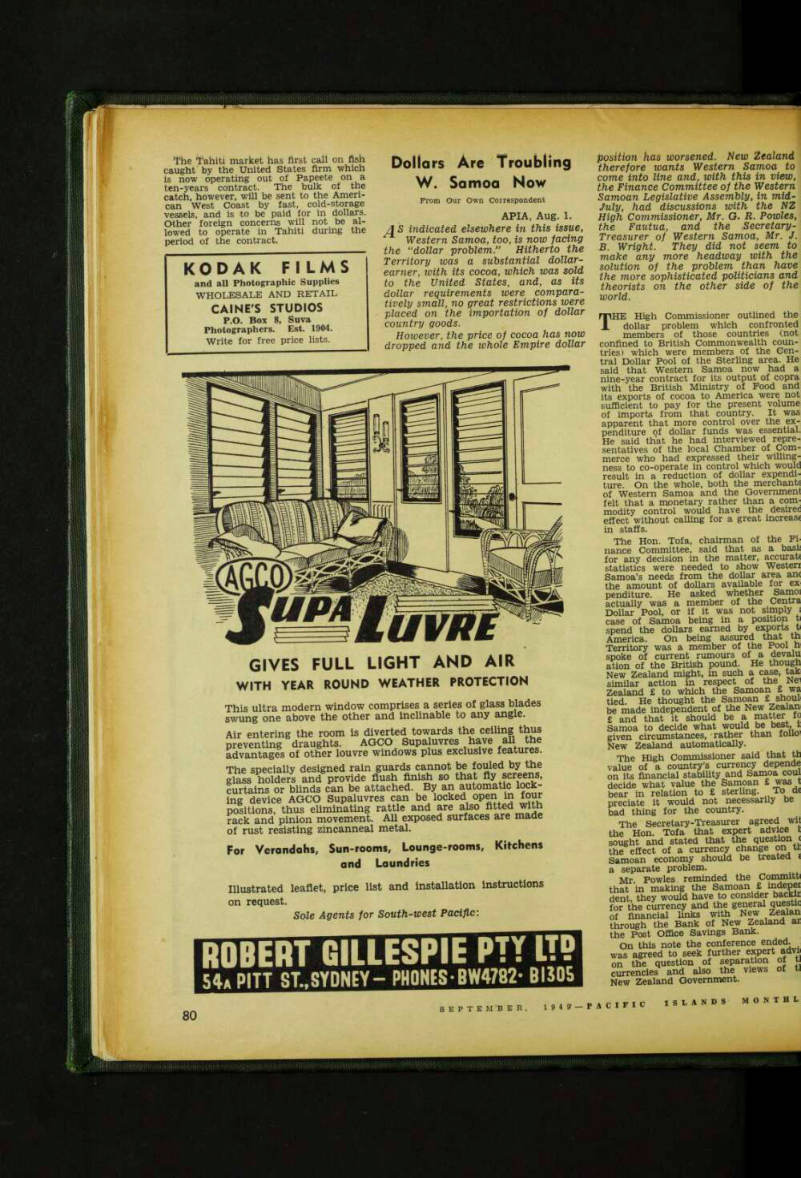
Dollars Are Troubling W. Samoa Now
From Our Own Correspondent
Apia, Aug. 1.
JS indicated elsewhere in this issue, Western Samoa, too, is now facing the “dollar problem.” Hitherto the Territory was a substantial dollar earner, with its cocoa, which was sold to the United States, and, as its dollar requirements were compara tively small, no great restrictions were placed on the importation of dollar country goods.
However, the price of cocoa has now dropped and the whole Empire dollar
position has worsened. New Zealand
therefore wants Western Samoa to come into line and, with this in view, the Finance Committee of the Western Samoan Legislative Assembly, in mid- July, had discussions with the HZ High Commissioner, Mr. G. R. Powles, the Fautua, and the Secretary- Treasurer of Western Samoa, Mr. J.
B. Wright. They did not seem to make any more headway with the solution of the 'problem than have the more sophisticated politicians and theorists on the other side of the world.
THE High Commissioner outlined the dollar problem which confronted members of those countries (not confined to British Commonwealth coun tries) which were members of the Cen tral Dollar Pool of the Sterling area. He said that Western Samoa now had a nine-year contract for its output of copra with the British Ministry of Food and its exports of cocoa to America were not sufficient to pay for the present volume of imports from that country. It was apparent that more control over the ex penditure of dollar funds was essential.
He said that he had interviewed repre sentatives of the local Chamber of Com merce who had expressed their willing ness to co-operate in control which would result in a reduction of dollar expendi ture. On the whole, both the merchants of Western Samoa and the Government felt that a monetary rather than a com modity control would have the desired effect without calling for a great increase in staffs.
The Hon. Tofa, chairman of the Fi nance Committee, said that as a basii for any decision in the matter, accurate statistics were needed to show Westerr Samoa’s needs from the dollar area anc the amount of dollars available for ex penditure. He asked whether Samos actually was a member of the Centra Dollar Pool, or if it was not simply i case of Samoa being in a position U spend the dollars earned by exports to America. On being assured that th Territory was a member of the Pool h spoke of current rumours of a devalu ation of the British pound. He though New Zealand might, in such a case, tak similar action in respect of the Nei Zealand £ to which the Samoan £ wa tied. He thought the Samoan £ shout be made independent of the New Zealan £ and that it should be a matter fo Samoa to decide what would be best, t given circumstances, rather than follow New Zealand automatically.
The High Commissioner said that th value of a country’s currency depende on its financial stability and Samoa corn decide what value the Samoan £ was t bear in relation to £ sterling. To de predate it would not necessarily be bad thing for the country.
The Secretary-Treasurer agreed wit the Hon. Tofa that expert advice t sought and stated that the question c the effect of a currency change on tt Samoan economy should be treated £ a separate problem.
Mr. Powles reminded the Comnntw that in making the Samoan £ mdeper dent, they would have to consider *>&<*** for the currency and the general questic of financial links with New Zeal£ m through the Bank of New Zealand ar the Post Office Savings Bank.
On this note the conference ended. . was agreed to seek further expert advij on the question of separation of tl currencies and also the views of tl New Zealand Government.
Advertisements & other items, p. 82 (1 item)
80
SEPTEMBER, 194 E-P A C I F I C ISLANDS MONXHI
Unhappy
Mr. Ward Is Politically Unhappy
SOME Australian newspapers are specu lating about the political future of Mr. E. J. Ward, known to residents of Papua and New Guinea as Australian Minister for the Territories.
Mr. Ward spent all 1948 and a good part of 1949 fighting a series of charges made against him in connection with New Guinea timber leases. He emerged from lengthy court and Royal Commis sion inquiries with his political repu tation unscathed.
But, during that period, he seemed to ose his position in the Parliamentary Labour Party as runner-up to the Deputy Prime Minister. It is said that Dr. Evatt no longer fears him.
Then came the coal strike, and Mr.
IJhifley’s shadow-sparring with the Com nunists, in the course of which he em fioyed the troops, Mr. Ward got off lide in this—he criticised the Prime Minister. There is a rebellion within the 3 arty, but he did steer clear of that.
There is a very strong anti-Chifley jabour group now in East Sydney—Mr.
Vard’s electorate. There are also, there, l large number of staunch friends of rock Garden, who went to gaol after naking various timber-lease charges igainst Mr. Ward—which the judge re ected.
There has been juggling with electoral )oundaries. East Sydney has lost a lice of its Labour voters. Even in the Id days, East Sydney was not always jabour. “Dicky” Orchard held it for mg years, as a non-Labour seat; and fr. Ward lost it once to a doughty ghter named Clasby. Mr. Clasby died
three weeks after his victory, and Mr Ward returned on the by-election.
Watch the East Sydney figures on election night (December 10). They may be interesting.
Dr. K. J. Gilchrist, Surgeon Specialist with the Medical Department, Fiji, has accepted a transfer to Nigeria as Sur geon Specialist. Dr. Gilchrist was in Australia in September,
Mr. J. G. Garnett, who recently returned to Fiji after leave, after being seconded to the British Service in Tonga for U years, is now on the staff of the Public Relations Office.
Mr. J. W. Gittins, Registrar of Co operative Societies, Fiji, has been ap pointed District Commissioner. Southern, to replace Mr. G. K. Roth, who is ill. Mr.
Gittins will continue his duties as Regis trar of Co-operatives but will have assis tance.
Advertisements & other items, pp. 83-84 (3 items)
81
AOIFIC ISLANDS MONTHLY SEPTEMBER, 1949
GEORGE Kill
★ Specialist in ladies' and gentlemen's wear, eastern fancy goods, embroidered silk wear, embroidered linen table sets, carved camphorwood trunks, cane furniture, curios, etc.
LARGE SHIPMENT AND VARIETY ARRIVES WITH
EVERY HONG KONG BOAT
GENERAL MERCHANT & IMPORTER
Always Prompt Attention and Service.
RABAUL
ETABLISSEMENTS DONALD TAHITI
HEAD OFFICE—QUAI DU COMMERCE—PAPEETE
TELEGRAPHIC ADDRESS—“DONALD, PAPEETE”
General Merchants (Wholesale & Retail) & Shipowners
Importers & Exporters—Branches Throughout Marquesas Islands
Lloyd’s Agents
ASSOCIATE
HOUSES:
A. B. DONALD, LTD.
AUCKLAND, NEW ZEALAND.
A. B. DONALD, LTD,
RAROTONGA, COOK ISLANDS.
DOMINION FRUIT CO.,
SUVA, FIJI ISLANDS.
Agents and Distributors for:
FRANCE:
HENNESSY COGNACS
MARIE BRIZARD & ROGER
LIQUEURS
CHARLES HEIDSIECK
CHAMPAGNES
PERRIER WATER
GRUBER BEER
U.S.A.:
GENERAL STEAMSHIP CORP.
RADIO CORP. OF AMERICA
BROWN & WILLIAMSON, LTD.
CIGARETTES: LUCKY STRIKE,
WINGS, OLD GOLD
CHAMPION SPARK PLUG CO.
KATNIER BEER
ENGLAND:
RECKITTS & COLMAN
fOVERSEAS), LTD.
PHILLIPS BICYCLES
NEW ZEALAND:
VACUUM OIL CO. PTY., LTD.
PETROLEUM PRODUCTS
SWEDEN:
HJORTH & CIE
PRIMUS STOVES
Sydney Agents :
BURNS, PHILP & CO., LTD.
London Agents :
BURNS, PHILP & CO., LTD,
San Francisco Agents :
BURNS. PHILP CO. OF
SAN FRANCISCO.
Agents in France :
HARTH & CIE, PARIS.
A. BICKART, MARSEILLES.
You'D always
from the
PLUME
pump
Today, Plume is the best motor spirit you can buy. And as soon as world conditions permit, the Plume Pump will lead in serving the highest quality motor spirits, made by revolutionary methods developed by the world’s largest research staff. So form the habit now of going to the Plume Pump, where you’ll always get the best motor spirit.
VACUUM
QUALITT PRODUCT,
VACUUM OIL COMPANY PTY. LTD. [lncorporated in Australia] ■«»*«■■«■
September. 194 P-Pacific Islands Monthl
United States Tackles Health Problems With Realism
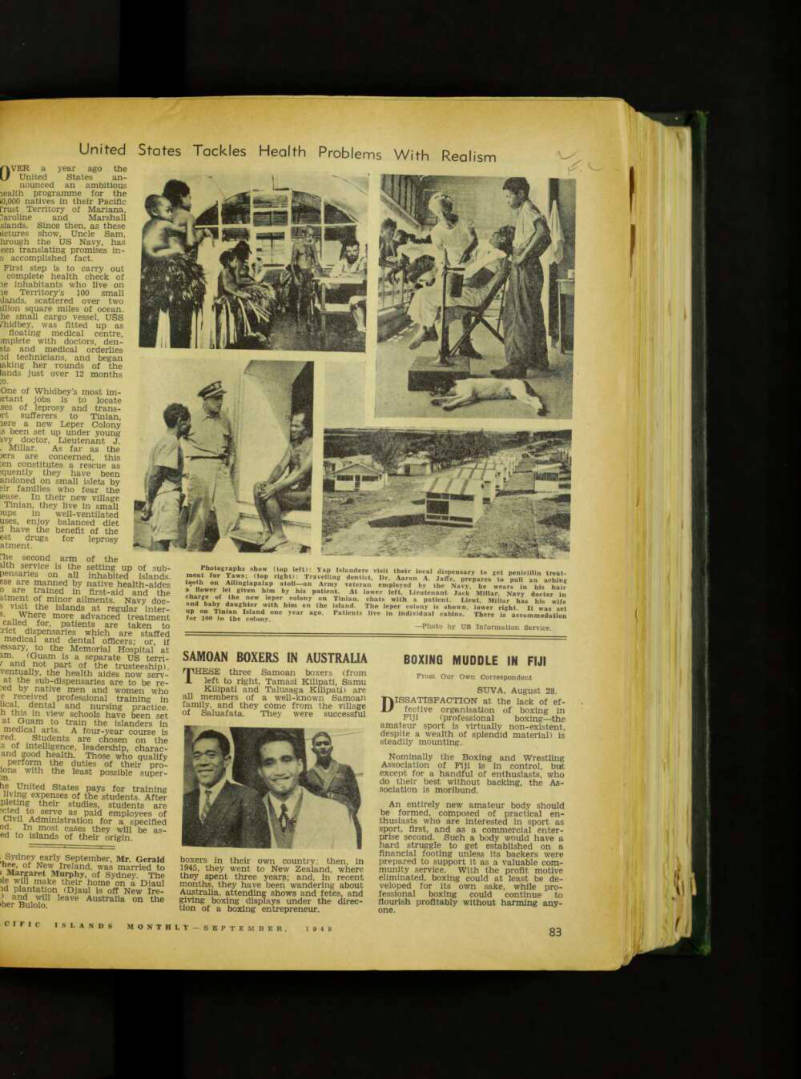
OVER a year ago the United States an nounced an ambitious lealth programme for the »0,000 natives in their Pacific rrust Territory of Mariana, Caroline and Marshall slands. Since then, as these (ictures show, Uncle Sam, hrough the US Navy, has een translating promises in o accomplished fact.
First step is to carry out complete health check of le inhabitants who live on le Territory’s 100 small slands, scattered over two lilion square miles of ocean, he small cargo vessel, USS /hidbey, was fitted up as floating medical centre, >mplete with doctors, den sts and medical orderlies id technicians, and began taking her rounds of the lands just over 12 months ;o.
One of Whidbey’s most im irtant jobs is to locate ses of leprosy and trans it sufferers to Tinian, lere a new Leper Colony -s been set up under young ivy doctor, Lieutenant J. . Millar. As far as the )ers are concerned, this ten constitutes a rescue as ;quently they have been andoned on small islets by fir families who fear the lease. In their new village Tinian, they live in small )ups in well-ventilated uses, enjoy balanced diet 3 have the benefit of the est drugs for leprosy atment. rhe second arm of the
Uth service is the setting up of sub pensaries on all inhabited islands, ese are manned by native health-aides o are trained in first-aid and the atment of minor ailments. Navy doc 3 v1 Elands at regular inter - S ‘ more advanced treatment called for, patients are taken to .net dispensaries which are staffed medical and dental officers; or, if essary, to the Memorial Hospital at am. (Guam is a separate US terri 7 and not part of the trusteeship), ventually, the health aides now serv ant the sub-dispensaries are to be re ’ed by native men and women who e received professional training in dental and nursing practice, h this in view schools have been set at Guam to train the islanders in medical arts, A four-year course is red. Students are chosen on the s of intelligence, leadership, charac and good health. Those who qualify . Perform the duties of their pro ions with the least possible super he United States pays for training living expenses of the students. After pleting their studies, students are d to serve as paid employees of Civil Administration for a specified od. In most cases they will be as ed to islands of their origin, ; Sydney early September, Mr. Gerald nee, of New Ireland, was married to 5 Margaret Murphy, of Sydney. The >le will make their home on a D.iaul id plantation (Djaul is off New Ire ) and will leave Australia on the •ber Bulolo.
Photographs show (top left): Yap Islanders visit their local dispensary to get nenicillin treat ment for Yaws; (top right): Travelling dentist, Dr. Aaron A. Jaffe, prepares to pull an aching too hon Ailinglapalap atoll—an Army veteran employed by the Navy, he wears in his hair a flower lei given him by his Patient . At lower left, Lieutenant Jack Millar, Navy doctor in charge of the new leper colony on Tinian, chats with a patient. Lieut. Millar has his wife an baby daughter with him on the island. The leper colony is shown, lower right. It was set up on Tinian Island one year ago. Patients live in individual cabins. There is accommodation for 100 in the colony. —Photo by US Information Service.
Samoan Boxers In Australia
THESE three Samoan boxers (from left to right, Tamasi Kilipati, Samu Kilipati and Talusaga Kilipati) are all members of a well-known Samoan family, and they come from the village of Saluafata. They were successful
boxers in their own country; then, in 1945, they went to New Zealand, where they spent three years; and, in recent months, they have been wandering about Australia, attending shows and fetes, and giving boxing displays under the direc tion of a boxing entrepreneur.
Boxing Muddle In Fiji
From Our Own Correspondent SUVA, August 28.
Dissatisfaction at the lack of ef fective organisation of boxing in Fiji (professional boxing—the amateur sport is virtually non-existent, despite a wealth of splendid material) is steadily mounting.
Nominally the Boxing and Wrestling Association of Fiji is in control, but except for a handful of enthusiasts, who do their best without backing, the As sociation is moribund.
An entirely new amateur body should be formed, composed of practical en thusiasts who are interested in sport as spprt, first, and as a commercial enter prise second. Such a body would have a hard struggle to get established on a financial footing unless its backers were prepared to support it as a valuable com munity service. With the profit motive eliminated, boxing could at least be de veloped for its own sake, while pro fessional boxing could continue to flourish profitably without harming any one.
Advertisements & other items, pp. 85-86 (3 items)
83
CIFIC ISLANDS MONTH LY SEPTEMBER, 1949
84
SEPTEMBER, 1&49 PACIFIC ISLANDS MONTBI
Union Manufacturing
•iva
73 I**l2 & %
-- 1,-. COFHI
NEW ZEALAND
OFFERS
@1
SHIPPING AND TRADE
Mt-
to the Residents of New
Caledonia, New Hebrides,
Gilbert Islands, Ellice
Islands, British Solomon
Islands and New Guinea.
r We are operating a shipping service throughout the above Islands. All goods ordered will be delivered without delay. Should large orders be contemplated we will arrange for a representative to visit you with
samples and discuss the transaction.
Many classes of general merchandise are available at competitive prices and for early delivery.
SAWN TIMBER.
PLYWOODS.
W ALLBOARDS.
PAINTS.
VARNISHES.
BUILDING PAPER.
ASBESTOS
SIDINGS.
FURNITURE.
CANDLES.
WASHING SOAP.
TOILET SOAP.
TENNIS SHOES.
LEATHER BOOTS
AND SHOES.
LEATHER SOLES
AND HEELS.
LEATHER BELTING.
LEATHER BENDS,
ETC
SEEDS (INCLUDING
BLUE & MAPLE
PEAS).
LIVESTOCK.
FROZEN MEATS.
TINNED MEATS.
TINNED FISH.
FROZEN PISH.
BUTTER.
CHEESE.
DRIED MILK, ETC.
TINNED
VEGETABLES.
TINNED SOUPS.
CUSTARD POWDER.
BAKING POWDER.
COFFEE ESSENCE.
POTATOES. FRESH
AND CANNED.
ONIONS.
CORDIALS.
BEER.
We are also buyers of Islands Produce of every description and we can provide shipping. Our sell-
ing organisation is world-wide,
BUYING OR SELLING —WE CAN HELP YOU gc 3
UNION MANUFACTURING
& EXPORT CO. LTD.
G.P.O. Box 1060, Wellington, NEW ZEALAND
Cables: "UMEC", Wellington
★ 1/4S/P.
'Order Of The Crown
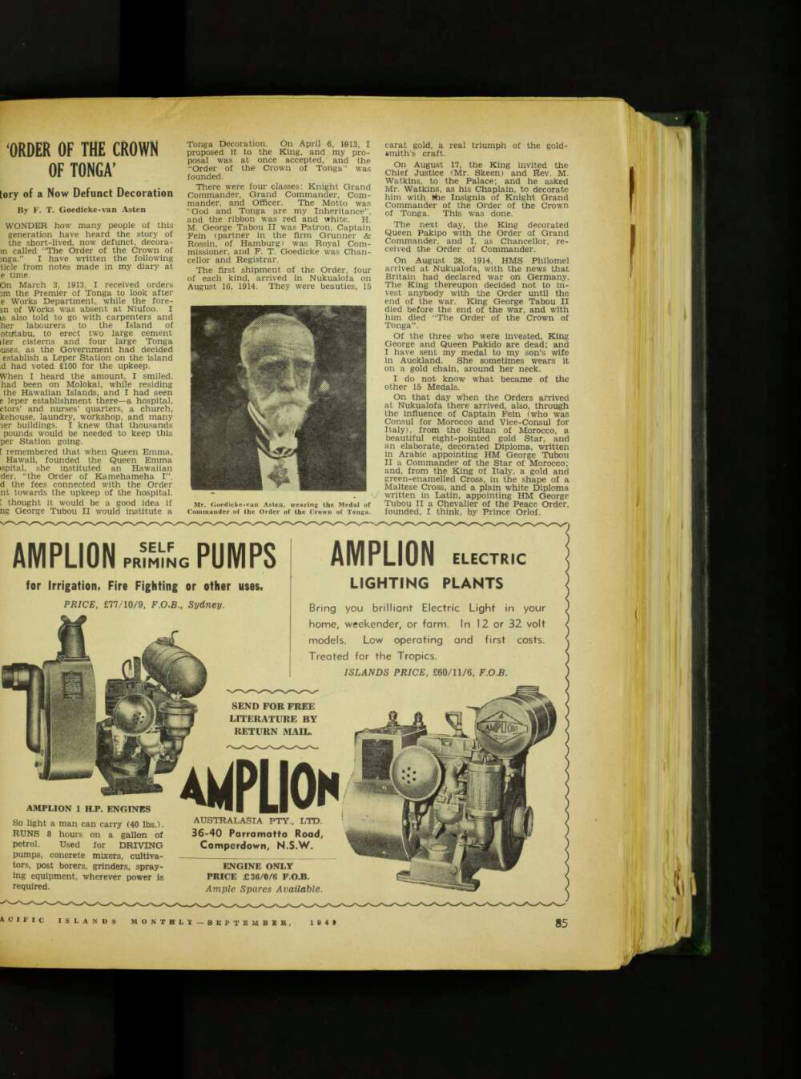
Of Tonga’
[?]tory of a Now Defunct Decoration
By F. T. Goedicke-van Asten
WONDER how many people of this generation have heard the story of the short-lived, now defunct, decora >n called “The Order of the Crown of mga.” I have written the following tide from notes made in my diary at e time.
On March 3, 1913, I received orders jm the Premier of Tonga to look after e Works Department, while the fore m of Works was absent at Niufoo. I ls also told to go with carpenters and her labourers to the Island of otutabu, to erect two large cement iter cisterns and four large Tonga uses, as the Government had decided establish a Leper Station on the island d had voted £lOO for the upkeep.
When I heard the amount, I smiled, had been on Molokai, while residing the Hawaiian Islands, and I had seen 5 leper establishment there—a hospital, ctors’ and nurses’ quarters, a church, kehouse, laundry, workshop, and many ler buildings. I knew that thousands pounds would be needed to keep this per Station going. [ remembered that when Queen Emma, Hawaii, founded the Queen Emma ispital, she ipstituted an Hawaiian der, “the Order of Kamehameha I”, d the fees connected with the Order nt towards the upkeep of the hospital. : thought it would be a good idea if ng George Tubou II would institute a
Tonga Decoration. On April 6, 1013, 1 proposed it to the King, and my pro posal was at once accepted, and the “Order of the Crown of Tonga” was founded.
There were four classes: Knight Grand Commander, Grand Commander, Com mander, and Officer. The Motto was “God and Tonga are my Inheritance”, and the ribbon was red and white. H.
M. George Tabou II was Patron, Captain Fein (partner in the firm Grunner & Rossin, of Hamburg) was Royal Com missioner, and F. T. Goedicke was Chan cellor and Registrar.
The first shipment of the Order, four of each kind, arrived in Nukualofa on August 16, 1914. They were beauties, 15
carat gold, a real triumph of the gold smith’s craft.
On August 17, the King invited the Chief Justice (Mr. Skeen) and Rev. M.
Watkins, to the Palace; and he asked Mr. Watkins, as his Chaplain, to decorate him with ttie Insignia of Knight Grand Commander of the Order of the Crown of Tonga. This was done.
The next day, the King decorated Queen Pakipo with the Order of Grand Commander, and I, as Chancellor, re ceived the Order of Commander.
On August 28, 1914, HMS Philomel arrived at Nukualofa, with the news that Britain had declared war on Germany.
The King thereupon decided not to in vest anybody with the Order until the end of the war. King George Tabou II died before the end of the war, and with him died “The Order of the Crown of Tonga”.
Of the three who were invested, King George and Queen Pakido are dead; and I have sent my medal to my son’s wife in Auckland. She sometimes wears it on a gold chain, around her neck.
I do not know what became of the other 15 Medals.
On that day when the Orders arrived at Nukualofa there arrived, also, through the influence of Captain Fein (who was Consul for Morocco and Vice-Consul for Italy), from the Sultan of Morocco, a beautiful eight-pointed gold Star, and an elaborate, decorated Diploma, written in Arabic appointing HM George Tubou II a Commander of the Star of Morocco; and, from the King of Italy, a gold and green-enamelled Cross, in the shape of a Maltese Cross, and a plain white Diploma written in Latin, appointing HM George Tubou II a Chevalier of the Peace Order, founded, I think, by Prince Orlof.
Mr. Goedicke-van Asten, wearing the Medal of Commander of the Order of the Crown of Tonga.
Advertisements & other items, p. 87 (2 items)
85
OIFIC ISLANDS MONTHLY SEPTEMBER, 19 4 §
Akiplioh
AMPLION PRIMING PUMPS
for Irrigation, Fire Fighting or other uses.
PRICE, £77/10/9, F. 0.8., Sydney.
AMPLION I H.P. ENGINES
So light a man can carry (40 lbs.).
RUNS 8 hours on a gallon of petrol. Used for DRIVING pumps, concrete mixers, cultivators, post borers, grinders, spraying equipment, wherever power is required.
AMPLION ELECTRIC
LIGHTING PLANTS
Bring you brilliant Electric Light in your home, weekender, or farm. In 12 or 32 volt models. Low operating and first costs.
Treated for the Tropics.
ISLANDS PRICE, £6O/11/6, F. 0.8.
SEND FOR FREE
LITERATURE BY
RETURN MAIL.
AkIPLIOH
AUSTRALASIA PTY., LTD.
36-40 Parramatta Road,
Camperdown, N.S.W.
ENGINE ONLY
PRICE £36/0/6 F. 0.8.
Amvle Si m m
Heirs Of Jonas
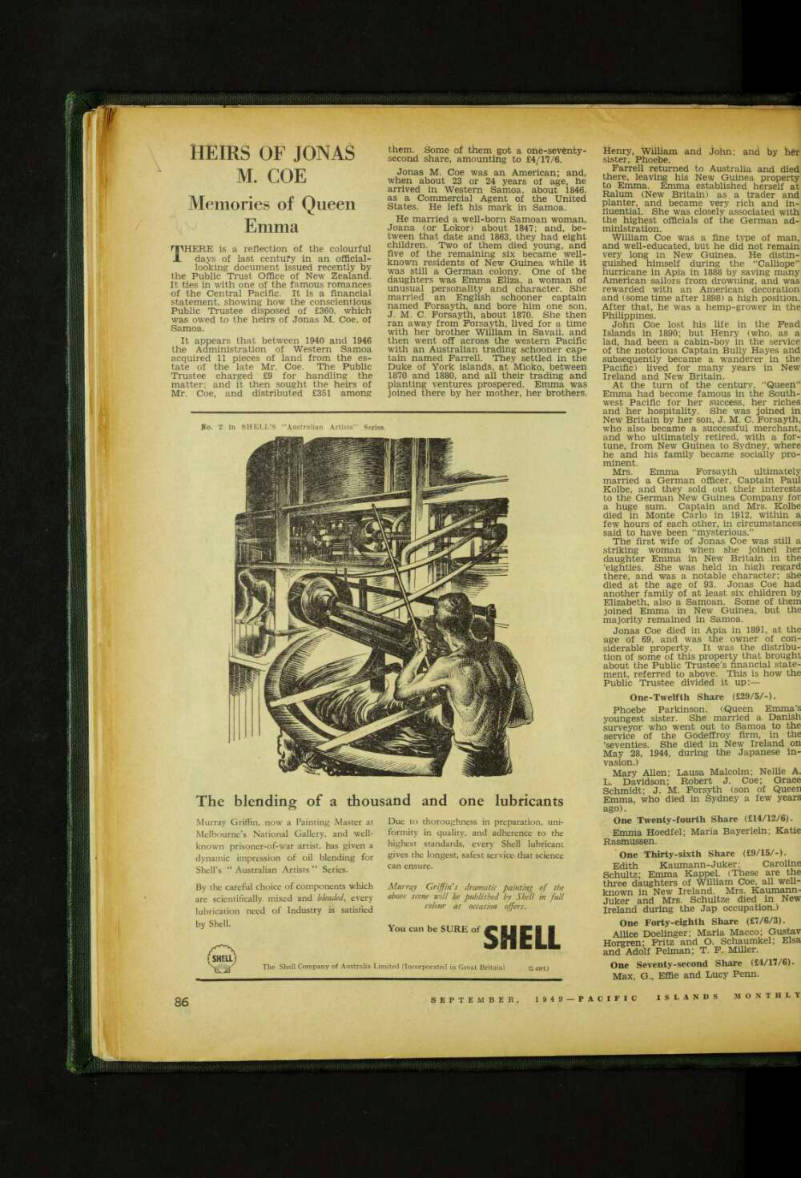
M. Coe
Memories of Queen Emma
THERE is a reflection of the colourful days of last century in an official looking document issued recently by the Public Trust Office of New Zealand.
It ties in with one of the famous romances of the Central Pacific. It is a financial statement, showing how the conscientious Public Trustee disposed of £360, which was owed to the heirs of Jonas M. Coe, of Samoa.
It appears that between 1940 and 1946 the Administration of Western Samoa acquired 11 pieces of land from the es tate of the late Mr. Coe. The Public Trustee charged £9 for handling the matter; and it then sought the heirs of Mr. Coe, and distributed £351 among
them. Some of them got a one-sev6nty second share, amounting to £4/17/6.
Jonas M. Coe was an American; and, when about 23 or 24 years of age, he arrived in Western Samoa, about 1846, as a Commercial Agent of the United States. He left his mark in Samoa.
He married a well-born Samoan woman, Joana (or Lokor) about 1847: and, be tween that date and 1863, they had eight children. Two of them died young, and five of the remaining six became well known residents of New Guinea while it was still a German colony. One of the daughters was Emma Eliza, a woman of unusual personality and character. She married an English schooner captain named Forsayth, and bore him one son, J. M. C. Forsayth, about 1870. She then ran away from Forsayth, lived for a time with her brother William in Savaii, and then went off across the western Pacific with an Australian trading schooner cap tain named Farrell. They settled in the Duke of York islands, at Mioko, between 1870 and 1880, and all their trading and planting ventures prospered. Emma was joined there by her mother, her brothers,
Henry, William and John; and by h6r sister, Phoebe.
Farrell returned to Australia and died there, leaving his New Guinea property to Emma. Emma established herself at Ralum (New Britain) as a trader and planter, and became very rich and in fluential. She was closely associated with the highest officials of the German ad ministration.
William Coe was a fine type of man, and well-educated, but he did not remain very long in New Guinea. He distin guished himself during the “Calliope” hurricane in Apia in 1888 by saving many American sailors from drowning, and was rewarded with an American decoration and (some time after 1898) a high position.
After that, he was a hemp-grower in the Philippines.
John Coe lost his life in the Pead Islands in 1890; but Henry (who, as a lad, had been a cabin-boy in the service of the notorious Captain Bully Hayes and subsequently became a wanderer in the Pacific) lived for many years in New Ireland and New Britain.
At the turn of the century, “Queen”
Emma had become famous in the South west Pacific for her success, her riches and her hospitality. She was joined in New Britain by her son, J. M. C. Porsayth, who also became a successful merchant, and who ultimately retired, with a for tune, from New Guinea to Sydney, where he and his family became socially pro minent.
Mrs. Emma Porsayth ultimately married a German officer, Captain Paul Kolbe, and they sold out their interests to the German New Guinea Company for a huge sum. Captain and Mrs. Kolbe died in Monte Carlo in 1912, within a few hours of each other, in circumstances said to have been “mysterious.”
The first wife of Jonas Coe was still a striking woman when she joined her daughter Emma in New Britain in the ’eighties. She was held in high regard there, and was a notable character; she died at the age of 93. Jonas Coe had another family of at least six children by Elizabeth, also a Samoan. Some of them joined Emma in New Guinea, but the majority remained in Samoa.
Jonas Coe died in Apia in 1891, at the age of 69, and was the owner of con siderable property. It was the distribu tion of some of this property that brought about the Public Trustee’s financial state ment, referred to above. This is how the Public Trustee divided it up:— One-Twelfth Share (£29/5/-).
Phoebe Parkinson. (Queen Emma’s youngest sister. She married a Danish surveyor who went out to Samoa to the service of the Godeffroy firm, in the ’seventies. She died in New Ireland on May 28, 1944, during the Japanese in vasion.) Mary Allen; Lausa Malcolm; Nellie A.
L. Davidson; Robert J. Coe; Grace Schmidt; J. M. Forsyth (son of Queen Emma, who died in Sydney a few years ago).
One Twenty-fourth Share (£l4/12/6).
Emma Hoedfel; Maria Bayerlein; Katie Rasmussen.
One Thirty-sixth Share (£9/15/-).
Edith Kaumann-Juker; Caroline Schultz; Emma Kappel. (These are the three daughters of William Coe, all well known in New Ireland. Mrs. Kaumann- Juker and Mrs. Schultze died in New Ireland during the Jap occupation.) One Forty-eighth Share (£7/6/3).
Allice Doelinger; Maria Macco; Gustav Horgren; Fritz and O. Schaumkel; Elsa and Adolf Pelman; T. F. Miller.
One Seventy-second Share (£4/17/6).
Max, G., Effie and Lucy Penn.
The retiring Anglican Bishop of Carpehtaria, the Rt. Rev. S. H. Davis, said in Brisbane recently, that Queensland’s Education Department should take over teaching of Torres Strait islanders from
the Native Affairs Department, and that the franchise should be granted to the Islanders. Torres Strait Islanders are obliged to pay Federal income tax but were denied a vote.
Advertisements & other items, pp. 88-90 (2 items)
Shell
No. 2 in SHELL’S ‘’Australian Artists” Series. m The blending of a thousand and one lubricants Murray Griffin, now a Painting Master at Melbourne’s National Gallery, and wellknown prisoner-of-war artist, has given a dynamic impression of oil blending for Shell’s “ Australian Artists ” Series.
By the careful choice of components which are scientifically mixed and blended, every lubrication need of Industry is satisfied by Shell.
Due to thoroughness in preparation, uniformity in quality, and adherence to the highest standards, every Shell lubricant gives the longest, safest service that science can ensure.
Murray Griffin’s dramatic painting of the above scene will be published by Shell in full colour as occasion offers.
You can be SURE of
SHELL
The Shell Company of Australia Limited (Incorporated in Great Britain)
DON'T SAY £ |]\ DON'T
ill DON'T SAY «
DON'T SAY G f
GIN DON'T SAY
DON'T SAY G I M
GIM DON'T SAY
DON'T SAY G I M
G I M DON'T SAY
DON'T SAT G I
G I W DON'T SAY
DON'T SAY |p I f T
GIN DON'T SAY
DON'T SAY G I M DON'T
DON'T SAY GIN DON'T
GIN DON'T SAY
DON'T SAY GI DO
GIN DON'T SAY G
DON'T SAY GINd
GIN DON'T SAY
DON'T SAY GIN
G I M DON'T SAY
DON'T SAY G I N
GIN DON'T SAY
DON'T SAY GIN DON'T
G,I N DON'T SAY G I
DON'T SAY GIN DON'T
SAY GIN
DON'T SAY
DON'T SAY ft I IV
GIN DON'T SAY
DON'T SAY G I N
DON'T SAY
DON
D S AY Qoy Li Qu N ir 0 Co
C*CT
SAY
IN r 'sh
'I, SAY
JIM
DON'T
GI
DON'T S
SAY G I N
SAY GIN
IT SAY
DON'T
DON'T SAY G 1
GIN DON'T SAY
DON'T SAY G I M
DON'T SAY
M Y
DON
S AY * N s/ io I To u o, *
°CICT
SAY
S y<*n 9 IN *n b Qlj
T SAY
11M T
DON'T
SAY GIN DON'
Address all inquiries to: Telegrams and Cables: “GILBEYS,” Melbourne
W. & A. GILBEY LTD.
33 ROSSLYN STREET, WEST MELBOURNE. 109 REGENT STREET, SYDNEY.
Telegrams and Cables: •‘GILBEYS,” Sydney.
OUR HANDS MAKE GOOD ARMS
For your Fishing and Shooting Wants Consult Us.
Lithgow .22 Cal. Repeating Rifles ... £ll 14 01 Post Lithgow .22 Cal. Single Shot 5 1 3f Extra.
SI L RO H U 143 ELIZABETH STREET, SYDNEY.
The essential link
Today, great aircraft link Australia and New Zealand with the rest of the world.
Similarly, the Bank of New South Wales — oldest, yet most modern bank in the South- West Pacific provides the essential financial link facilitating trade and travel between Australia and New Zealand and countries overseas.
The "Wales” complete banking service is available through a network of over 800 oranches and agencies in Australia, New Zealand, Fiji, Papua and New Guinea, linked with two branches in London and over 7,000 oversea agents and correspondents.
W hey ever you go Consult and use
BANK OF
NEW SOUTH WALES
incorporated in New South Wales with limited liability
87
IFIC ISLANDS MONTHLY SEPTEMBER. 1949
Many Yachts At Papeete
Papeete. July 16.
BEARING the name*. “Tiare” (the love flower of Tahiti), Eugene Overton’s beautiful yacht cast anchor in Papeete Lagoon on July 14, in time to be present at the opening celebrations of the French national holiday.
Mr. Overton is an old time visitor to Tahiti, where he has numerous friends.
He arrived here previously in the yacht, “Dwyn Wenn,” in 1926, and again in
1937. During his present visit, he was en tertained at dinner by His Excellency the Governor and Madame Anziani. Mrs.
Overton and Dr. Ben Bryant accompany Mr. Overton.
After remaining in Papeete for the fete, and making various trips around Tahiti, the yacht will sail for Honolulu about August 14, on her way back to Los Angeles. Mr. Overton is a successful California lawyer.
The American yacht “Tiare,” as she lay at Papeete on July 14, bedecked with flags in honour of France’s national day.
Yachts From Africa, Panama
OTHER yachts here for the Fete In clude the “Cariad”, flying the South African flag. She is 103 feet long, and, despite her 53 years, she sailed from Cape Town to Tahiti without mis hap. The captain, Mr. A. W. Flitton, carried eight young men as crew. They had just finished their studies and were making a world tour to broaden their
education. , . „
An old, but trim craft, was the “Winds Will”, bearing the flag of the Yacht Club of Panama, and expertly navigated by an American couple, Mr. and Mrs.
Kim Powell, with an 18-months-old baby enrolled as crew member.
There were also the “Escapade”, and the “Te Whaka Pono”, visiting these waters to enjoy the Tahiti fete, anc South Sea enchantment.
Mr. T. H. Manning, of the Fiji Posts and Telegraphs Department has been transferred to the Solomon Islands as Postmaster at the Capital, Honiara.
"The inaugural meeting of the Ladies Auxiliary to the RSSAILA, Rabau Branch, New Guinea, was very successfu when held on the afternoon of August 8 in the European school. Officers ap pointed were president, Mrs. F. A Rhoades; vice-president Mrs. J. Clymo secretary, Miss F. Fitzgibbons; treasurer Mrs. R. Whippey. Committee, Mesdames P. Chapman, D. McEvoy, J. Gilmore, M Munro, and B. Bruce. They will wort towards raising funds for the rebuild ing of the proposed new* club house Rabaul.
"Smithy" Memorial for Suva
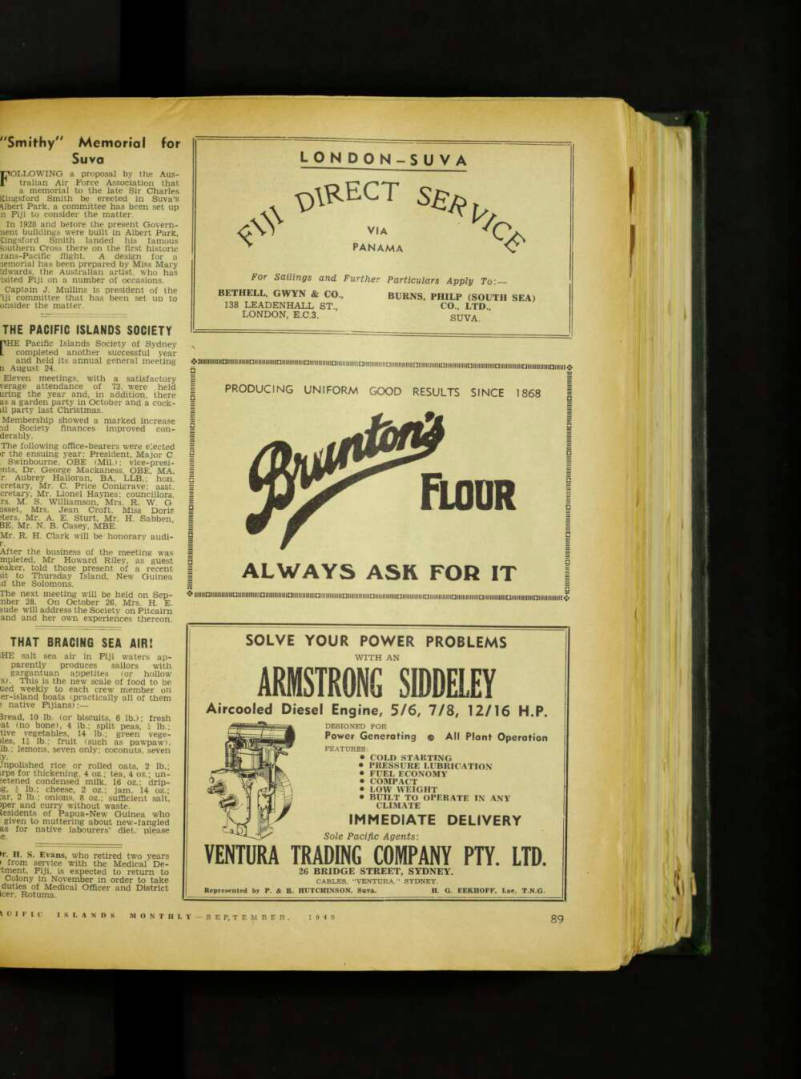
Suva
FOLLOWING a proposal by the Aus tralian Air Force Association that a memorial to the late Sir Charles Kingsford Smith be erected in Suva’s \lbert Park, a committee has been set up n Fiji to consider the matter.
In 1928 and before the present Govern nent buildings were built in Albert Park, Cingsford Smith landed his famous southern Cross there on the first historic rans-Pacific flight. A design for a lemorial has been prepared by Miss Mary Sdwards, the Australian artist, who has isited Fiji on a number of occasions.
Captain J, Mullins is president of the l iji committee that has been set up to onsider the matter.
The Pacific Islands Society
CHE Pacific Islands Society of Sydney completed another successful year and held its annual general meeting n August 24.
Eleven meetings, with a satisfactory verage attendance of 73, were held uring the year and, in addition, there as a garden party in October and a cock iil party last Christmas.
Membership showed a marked increase id Society finances improved con derably.
The following office-bearers were elected •r the ensuing year: President, Major C Swinbourne, OBE (Mil.); vice-presi ;nts, Dr. George Mackaness. OBE, MA. r. Aubrey Halloran, BA, LLB.: hon. cretary, Mr. C. Price Conigrave; asst, cretary, Mr. Lionel Haynes: councillors, rs. M. S. Williamson, Mrs. R, W. G osset, Mrs. Jean Croft, Miss Doris ;ters, Mr. A. E. Sturt, Mr. H. Sabben.
BE, Mr. N. B. Casey, MBE.
Mr. R. H. Clark will be honorary audi r.
After the business of the meeting was mpleted, Mr Howard Riley, as guest eaker, told those present of a recent ;it to Thursday Island, New Guinea d the Solomons.
The next meeting will be held on Sep nber 28. On October 26, Mrs. H. E. mde will address the Society on Pitcairn and and her own experiences thereon.
That Bracing Sea Air!
IHE salt sea air in Fiji waters ap parently produces sailors with gargantuan appetites (or hollow s). This is the new scale of food to be lied weekly to each crew member on er-island boats (practically all of them ; native Fijians):— Bread, 10 lb. (or biscuits, 6 lb.); fresh at (no bone), 4 lb.; split peas, i lb.; tive vegetables, 14 lb.; green vege >les, 1| lb.; fruit (such as pawpaw), lb.; lemons, seven only; coconuts, seven y.
Jnpolished rice or rolled oats. 2 lb.; irps for thickening, 4 oz.; tea, 4 oz.; un jetened condensed milk. 16 oz.: drip ig, I lb.; cheese, 2 oz.; jam. 14 oz.; :ar, 2 lb.; onions, 8 oz.; sufficient salt, >per and curry without waste, lesidents of Papua-New Guinea who given to muttering about new-fangled as for native labourers’ diet, please e. ►r. H. S. Evans, who retired two years » from service with the Medical De tment, Fiji, is expected to return to Colony in November in order to take duties of Medical Officer and District icer, Rotuma.
Advertisements & other items, p. 91 (2 items)
89
101 F I C ISLANDS MONTHLY SEP, TEMBER, 1949
Hour
LONDON-SUVA
, \)^ ECT SE$ h
/c <=- For Sailings and Further
BETHELL, GWYN & CO.,
138 LEADENHALL ST.,
LONDON, E.C.3.
Particulars Apply To:
BURNS, PHILP (SOUTH SEA)
CO., LTD.,
SUVA.
PRODUCING UNIFORM GOOD RESULTS SINCE 1868
Hour
ALWAYS ASK FOR IT
SOLVE YOUR POWER PROBLEMS
WITH AN
ARMSTRONG SIDDELEY
Aircooled Diesel Engine, 5/6, 7/8, 12/16 H.P. w
DESIGNED FOR
Power Generating © All Plant Operation
FEATURES:
• COLD STARTING
• PRESSURE LUBRICATION
• FUEL ECONOMY
• COMPACT
• LOW WEIGHT
• BUILT TO OPERATE IN ANY
CLIMATE
IMMEDIATE DELIVERY
Sole Pacific Agents :
VENTURA TRADING COMPANY PTY. LTD.
26 BRIDGE STREET, SYDNEY.
CABLES, “VENTURA.” SYDNEY.
Represented by P. & R. HUTCHINSON, Suva. H. G. EEKHOFF, Lae, T.N.G.
Sydney-Popua-
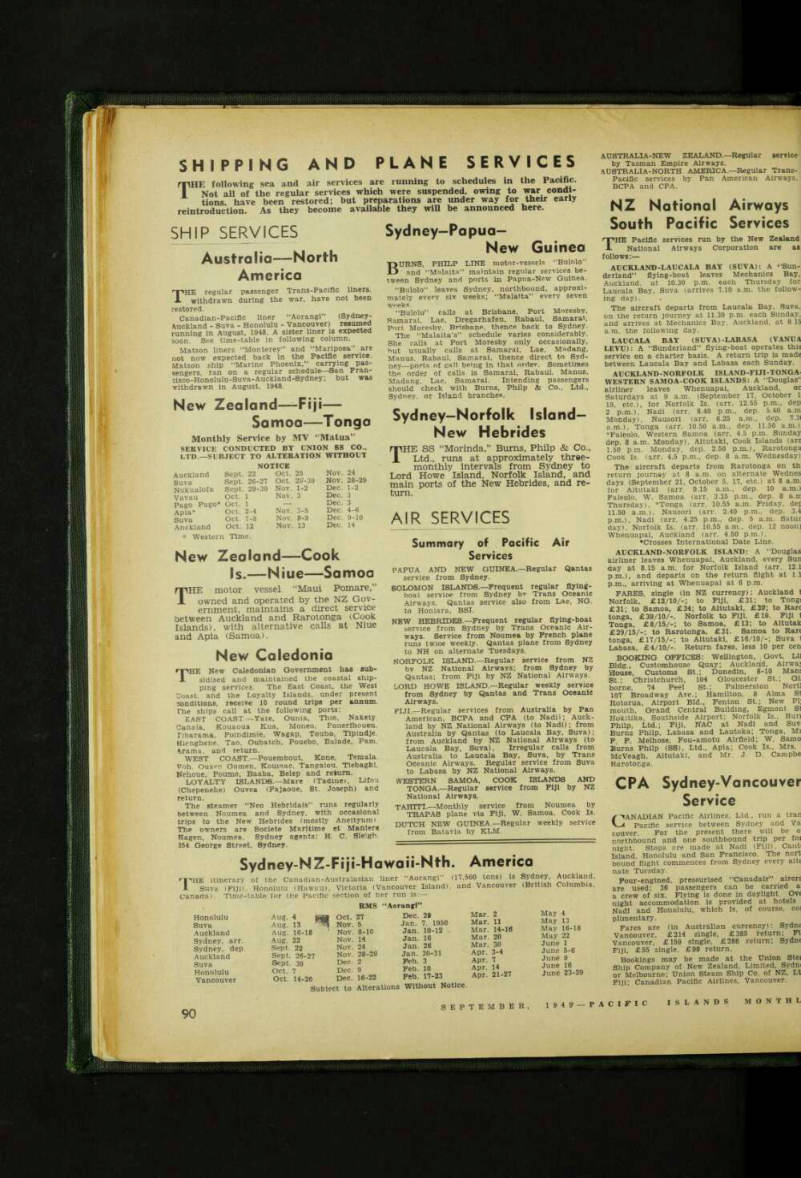
Shipping And Plane Services
Ship Services
THE following sea and air services are running to schedules in the Pacific.
Not all of the regular services which were suspended, owing to war condi tions. have been restored; but preparations are under way for their early reintroduction. As they become available they will be announced here.
Australia-—North
America
THE regular passenger Trans-Pacific liners, withdrawn during the war, have not been restored.
Canadian-Pacific liner “Aorangi” (Sydney- Auckland - Suva - Honolulu - Vancouver) resumed running in August, 1948. A sister liner is expected soon. See time-table in following column.
Matson liners “Monterey” and “Mariposa” are not now expected back in the Pacific service.
Matson ship “Marine Phoenix,” carrying pas sengers, ran on a regular schedule—San Fran cisco-Honolulu-Suva-Auckland-Sydney; but was withdrawn in August, 1948.
New Zealand—Fiji—
Samoa—Tonga
Monthly Service by MV “Matua”
Service Conducted By Union Ss Co.,
Ltd.—Subject To Alteration Without
Notice
Auckland Sept. 22 Oct. 25 Nov. 24 Suva Sept. 26-27 Oct. 29-30 Nov. 28-29 Nukualofa Sept. 29-30 Nov. 1-2 Dec. 1-2 Vavau Oct. 1 Nov. 3 Dec. 3 Pago Pago* Oct. 1 Dec. 3 Apia* Oct. 2-4 Nov. 3-5 Dec. 4-6 Suva Oct. 7-8 Nov. 8-9 Dec. 9-10 Auckland Oct. 12 Nov. 13 Dec. 14 * Western Time.
New Zealand—Cook
Is.—Niue—Samoa
THE motor vessel “Maui Pomare,”
owned and operated by the NZ Gov ernment, maintains a direct service between Auckland and Rarotonga (Cook islands), with alternative calls at Niue and Apia (Samoa).
New Caledonia
THE New Caledonian Government has sub sidised and maintained the coastal ship ping services. The East Coast, the West Coast, and the Loyalty Islands, under present conditions, receive 10 round trips per annum.
The ships call at the following ports: EAST COAST.—Yate, Ounia, Thio. Nakety Canala, Kouaoua Kua, Moneo, Ponerthouen, Dbarama, Poindlmle, Wagap, Touho, Tipindje, Hienghene, Tao, Oubatch, Pouebo, Balade, Pam.
Arama. and return.
WEST COAST.—Pouembout, Kone, Temala.
Voh. Ouaro Gomen, Koumac. Tangaiou. Tiebaghl, Nehoue, Poume, Baaba, Belep and return.
LOYALTY ISLANDS.—Mare (Tadlne), Lifou (Chepenehe) Ouvea (Pajaoue. St. Joseph) and return.
The steamer “Neo Hebridais” runs regularly between Noumea and Sydney, with occasional trips to the New Hebrides (mostly Aneityumi.
The owners are Societe Maritime et Manlere Hagen, Noumea. Sydney agents: H. C. Sleigh. 254 George Street. Sydney.
Sydney-Popua-
New Guinea
BURNS, PHILP LINE motor-vessels “Bulolo” and “Malaita” maintain regular services be tween Sydney and ports in Papua-New Guinea.
“Bulolo” leaves Sydney, northbound, approxi mately every six weeks; “Malaita” every seven weeks.
“Bulolo” calls at Brisbane, Port Moresby.
Samarai, Lae, Dregarhafen, Rabaul, Samarai, Port Moresby. Brisbane, thence back to Sydney.
The “Malaita’s” schedule varies considerably.
She calls at Port Moresby only occasionally, hut usually calls at Samarai, Lae, Madang.
Manus, Rabaul, Samarai, thence direct to Syd ney—ports of call being in that order. Sometimes the order of calls is Samarai, Rabaul. Manus, Madang. Lae, Samarai. Intending passengers should check with Burns, Philp <fe Co., Ltd., Sydney, or Island branches.
Sydney—Norfolk Island-
New Hebrides
THE SS “Morinda,” Burns, Philp & Co., Ltd., runs at approximately three monthly intervals from Sydney to Lord Howe Island, Norfolk Island, and main ports of the New Hebrides, and re turn.
Advertisements & other items, pp. 92-98 (8 items)
“ SL iiL Sk. £&.
AIR SERVICES
Summary of Pacific Air
Services
PAPUA AND NEW GUlNEA.—Regular Qantas service from Sydney.
SOLOMON ISLANDS.—Frequent regular flying boat service from Sydney by Trans Oceanic Airways. Qantas service also from Lae, NG, to Honiara, BSI.
NEW HEBRlDES.—Frequent regular flying-boat service from Sydney by Trans Oceanic Air ways. Service from Noumea by French plane runs twice weekly. Qantas plane from Sydney to NH on alternate Tuesdays.
NORFOLK ISLAND—Regular service from NZ by NZ National Airways; from Sydney by Qantas; from Fiji by NZ National Airways.
LORD HOWE ISLAND.—Regular weekly service from Sydney by Qantas and Trans Oceanic Airways.
PUI —Regular services from Australia by Pan American, BCPA and CPA (to Nadi); Auck land by NZ National Airways (to Nadi); from Australia by Qantas (to Laucala Bay, Suva); from Auckland by NZ National Airways (to Laucala Bay, Suva). Irregular calls from Australia to Laucala Bay, Suva, by Trans Oceanic Airways. Regular service from Suva to Labasa by NZ National Airways.
WESTERN SAMOA, COOK ISLANDS AND
TONGA.—Regular service from Fiji by NZ National Airways.
TAHlTl.—Monthly service from Noumea by TRAPAS plane via Fiji, W. Samoa, Cook Is.
DUTCH NEW GUlNEA—Regular weekly service from Batavia by KLM.
Sydney-NZ-Fijs-Hawaii-Nfrh. America
'X'HE itinerary of the Canadian-Australasian liner “Aorangi” (17,500 tons) is Sydney, Auckland, i- Suva (Fiji), Honolulu (Hawaii), Victoria (Vancouver Island), and Vancouver (British Columbia, Canada), Time-table lor the Pacific section of her run is:—
AUSTRALIA-NEW ZEALAND. —Regular service by Tasman Empire Airways.
AUSTRALIA-NORTH AMERICA.—Regular Trans pacific services by Pan American Airways,
BCPA and CPA.
NZ National Airways
South Pacific Services
THE Pacific services run by the New Zealand National Airways Corporation are aa follows:
AUCKLAND-LAUCALA BAT (SUVA): A “Sun
derland” flying-boat leaves Mechanics Bay, Auckland, at 10.30 p.m. each Thursday for Laucala Bay, Suva (arrives 7.10 a.m. the follow ing day), The aircraft departs from Laucala Bay. Suva, on the return journey at 11.30 p.m. each Sunday, and arrives at Mechanics Bay, Auckland, at 8 15 a.m. the following day.
LAUCALA BAY (SUVA)-LABASA (VANUA
LEVU): A “Sunderland” flying-boat operates this service on a charter basis. A return trip is made between Laucala Bay and Labasa each Sunday.
AUCKLAND-NORFOLK ISLAND-FIJI-TONGA
WESTERN SAMOA-COOK ISLANDS: A “Douglas’
airliner leaves Whenuapai, Auckland, or Saturdays at 9 a.m. (September 17, October 1 15, etc.), for Norfolk Is. (arr. 12.55 p.m., dep 2 p.m.), Nadi (arr. 8.40 p.m., dep. 5.40 a.m Monday), Nausori (arr. 6.25 a.m., dep. 7.3( a.m.), Tonga (arr. 10.50 a.m., dep. 11.50 a.m.) *Faleolo, Western Samoa (arr. 4.5 p.m. Sunday dep. 8 a.m. Monday), Aitutaki, Cook Islands (an 1.50 p.m. Monday, dep. 2.50 p.m.), Rarotonga Cook Is. (arr. 4.5 p.m., dep. 8 a.m. Wednesday) The aircraft departs from Rarotonga on th return journey at 8 a.m. on alternate Wednes days (September 21, October 5, 17, etc.) at 8 a.m, for Aitutaki (arr, 9.15 a.m., dep. 10 a.m.) Faleolo, W. Samoa (arr. 3.35 p.m., dep. 8 a.m Thursday), *Tonga (arr. 10.55 a.m. Friday, dep 11.50 a.m.). Nausori (arr. 2.40 p.m., dep. 3.4 p.m.), Nadi (arr. 4.25 p.m., dep. 5 a.m. Satur day), Norfolk Is. (an. 10.55 a.m., dep. 12 noon) Whenuapai, Auckland (arr. 4.50 p.m.). •Crosses International Date Line.
AUCKLAND-NORFOLK ISLAND: A “Douglas
airliner leaves Whenuapai, Auckland, every Sun day at 8.15 a.m. for Norfolk Island (arr. 12.1 p.m.), and departs on the return flight at 1.1 p.m., arriving at Whenuapai at 6 p.m.
FARES, single (in NZ currency): Auckland 1 Norfolk, £l2/10/-; to Fiji, £3l; to Tongi £3l; to Samoa, £34; to Aitutaki, £39; to Rare tonga, £39/10/-. Norfolk to Fiji, £l9. Fiji 1 Tonga, £B/15/-; to Samoa, £l3; to Altutak £29/15/-; to Rarotonga, £3l. Samoa to Ran tonga, £l7/15/-; to Aitutaki, £l6/10/-; Suva 1 Labasa, £4/10/-. Return fares, less 10 per cen BOOKING OFFICES: Wellington, Govt. Llf Bldg., Customhouse Quay; Auckland, Airwaj House, Customs St.; Dunedin, 8-10 Mam St.; Christchurch, 104 Gloucester St.; Gi: borne, 74 Peel St.; Palmerston Nortl 107 Broadway Ave.; Hamilton, 8 Alma St Rotorua, Airport Bid., Fenton St.; New PI; mouth, Grand Central Building, Egmont St Hokitika, Southside Airport; Norfolk Is., Bun Philp, Ltd.; Fiji, NAC at Nadi and Suv Burns Philp, Labasa and Lautoka; Tonga, Mi F F. Melhose, Fou-amotu Airfield; W. Samo Burns Philp (SS), Ltd., Apia; Cook Is., Mrs.
McVeagh, Aitutaki, and Mr. J. D. Campbe Rarotonga.
CPA Sydney-Vancouver
Service
C CANADIAN Pacific Airlines, Ltd., run a trar -4 Pacific service between Sydney and Va couver. For the present there will be o northbound and one southbound trip per foi night. Stops are made at Nadi (Fiji), Cauh Island, Honolulu and San Francisco. The nort bound flight commences from Sydney every altf nate Tuesday.
Pour-engined, pressurised "Canadair” airers are used; 36 passengers can be carried a a crew of six. Flying is done in daylight. Ov( night accommodation is provided at hotels Nadi and Honolulu, which is, of course, coi plimentary.
Pares are (in Australian currency): Sydm Vancouver, £214 single, £385 return; Fi Vancouver, £159 single, £286 return; Sydnf Fiji, £55 single, £99 return.
Bookings may be made at the Union Stes Ship Company of New Zealand, Limited, Sydm or Melbourne: Union Steam Ship Co. of NZ, Lt Fiji; Canadian Pacific Airlines, Vancouver.
RMS “Aorangrl”
Honolulu Aug. 4 sa Oct. 27 Dec. 29 Ma-r. 2 May 4 Suva Aug. 13 ” Nov. 5 Jan. 7. 1950 Mar. 11 May 13 Auckland Aug. 16-18 J Nov. 8-10 Jan. 10-12 Mar. 14-16 y arr Aue 22 Nov. 14 Jan. 16 Mar. 20 May zz S£SU jgjU. f 3. g-a ji «
“ SL iiL Sk. £&.
Subject to Alterations Without Notice.
sydney-Vancouver
BCPA Service
BRITISH Commonwealth Pacific Airlines, Ltd., operate a twice weekly trans-Paciflc service rom Sydney to Vancouver, via Fiji, Canton sland, Honolulu and San Francisco; and a reekly service between Auckland and Vancouver, ia the same ports.
Planes leave Sydney every Wednesday and aturday, and Vancouver on the Southbound rip every Monday and Thursday. Every fourth rip from Sydney terminates at San Francisco istead of Vancouver.
Planes Leave Auckland every Tuesday and rrlve in Vancouver the following Wednesday, he Southbound trip to Auckland commences •om Vancouver every alternate Friday. Every ther Friday the service commences at San rancisco.
B.C.P.A. services make regular connections at )th San Francisco and Vancouver for onward image, via either New York or Montreal to le United Kingdom or Europe. The through ,re from Sydney to London is £327/10/- (Aus alian); from Fiji, via New York, £303/8/6; om Fiji, via Montreal, £324/9/- (Australian).
Pares are (in Australian currency): Sydney in Francisco, £2OO single and £360 return; uckland-Vancouver, £AI9B single; Auckland adi (Fiji), £A39; Sydney-Nandi, £ASS.
Douglas DC6 aircraft carrying 48 passengers eated) or 37 passengers (in sleepers) and a ew of nine are used on the service.
an-American—
Trans-Pacific Service
> AN-AMERICAN World Airways clippers now provide the following services in the South icific, using DC4 planes, equipped with Sleep ettes:— Planes leave Sydney Monday and Friday r San Francisco, via Tontouta (New Cale nia), Nadi (Fiji), Canton Island and Hono lu.
The return flights are made from San Francisco ery Thursday, via Honolulu, Canton Island, idi and Tontouta; and from Seattle every
Monday, via Portland, Honolulu, Canton Island Nadi and Tontouta.
Planes leave Auckland every Wednesday and fly via Nadi, Canton Island and Honolulu to San Francisco. They leave San Francisco for Auckland every Saturday by the same route Fares, in Australian currency, are-
(Time-tables and fares subject to alteration without notice.) To convert to FIJI currency, reduce above figures by about 10 per cent.
Free baggage allowance is 30 kilos per person Excess baggage at 1 per cent, of single fare for each kilogram of excess.
Trans-Tasman Service
Sydney—Auckland
TASMAN Empire Airways, Ltd., operate a flying-boat service between Rose Bay Sydney, and Mechanics Bay. Auckland. Large flying-boats, capable of carrying 30 passenger*, are employed. The trip is comfortable, and takes approximately 8 hours.
Flying-boats now depart Sydney and Auckland six times per week, Monday to Saturday in clusive.
This service will be supplemented by Charter Services operated by DC4 and DC6 aircraft Fares: £35 (A) (£28 NZ currency) single-’ £63 (A) (£50/8/- NZ currency) return.
Bookings may be made at Tasman Empire Airways in Auckland and at Qantas Empire Air ways, Carrington Street, Sydney.
Sydney—Queensland—
New Guinea
QANTAS Empire Airways, Ltd., employing DCS planes, operate a regular service between Sydney, Port Moresby, Lae, Pinschhafen,
Madang, Rabaul, Bulolo and Wau, and return via Brisbane, Rockhampton, Townsville and Cairns.
This service is now known as the "Bird ol Paradise” Service. DC3 aircraft, carrying 19 passengers, are usea.
Planes leave Sydney on Mondays, Tuesdays, Wednesdays, Fridays and Saturdays at 9 a.m.’ and arrive at Lae at 1 p.m. on Tuesdays, Wed nesdays, Thursdays, Saturdays and Sundays.
The plane which leaves Sydney on Wednesday and arrives at Lae on Thursday then goes on to Rabaul. It returns on Friday. The plane, which arrives at Lae on Tuesdays, then goes on to Madang, returning to Lae the same day.
The plane, which arrives at Lae at 1 p.m. on Saturdays, flies on to Bulolo and Wau on Satur day afternoons, and returns to Lae.
Planes leave Lae at 5.45 a.m. on Wednesdays, Thursdays, Saturdays, Sundays and Mon days, and arrive in Sydney at 10.15 p.m., accom plishing the Lae-Sydney run in a day.
The return plane from Rabaul leaves at 1.30 p.m. on Fridays.
Bookings may be made at Qantas offices at any of the towns named. At present, berths are available only to passengers holding official per mits to visit Papua or New Guinea.
QANTAS SUBSIDIARY SERVICES IN
PAPUA-NEW GUINEA-SOLOMONS
Qantas Empire Airways run the following sub sidiary services in Papua, New Guinea, and British Solomons:— A Douglas DC3 leaves Lae every Wednesday, Wednesday, and flies to Rabaul, and Kavieng,’ and flies to Rabaul, and Kavieng, and returns to Lae; but every alternate Wednesday the plane goes on from Kavieng to Manus, and returns via Kavieng to Rabaul (overnight) and returns to Lae on the Thursday morning.
Every alternate Monday, a Qantas Catalina flies from Port Moresby, westward to Daru, via Yule Island, Kerema, Kikori, Lake Kutubu and Lake Murray, remaining overnight at Kikori and returning to PM next morning.
Every alternate Wednesday, a Qantas Cata lina flies from Port Moresby, eastward to Samarai, via Abau and Milne Bay; and every second trip (that is, every fourth Wednesday) the plane remains overnight at Samarai, and
£ s. d. £ 8. d.
Sydney-Seattle .. . .. 200 0 0 360 o 0 Sydney-’Prisco . . 200 0 0 360 o o Sydney-Pljl 0 0 99 1 3 Sydney-Honolulu . . 166 17 6 300 6 3 Auckland-Seattle .. 184 1 3 331 5 o Auckland-Honolulu , . .. 150 18 9 271 11 3 Auckland-Pljl .. .. 1 3 70 6 3 PlJl-’Prlsco 0 0 260 18 9
I the following day (Thursday) dies out oVef ie archipelagoes, calls at Esa’ala, Kiriwina, oodlark and Deboyne Lagoon, and returns to H. via Samarai, Milne Bay and Abau, Every alternate Monday, a Qantas Catalina ives Port Moresby for Rabaul, via Moewe Har ur. and Talasea (New Britain); next morning ’uesday) it flies to Buka, Kieta and Buin lougainville) and returns to Rabaul; next srning (Wednesday) it flies to Talasea, Moewe irbour and Jacquinot Bay, and returns to ibaul; and next morning (Thursday) it re rns from Rabaul direct to Port Moresby.
Every alternate Monday a Qantas Douglas flies am Lae to Rabaul, and continues on to miara (British Solomon Islands), via Torokina; mains overnight at Honiara; and returns to e the following day (Tuesday), via Torokina d Rabaul.
Sydney-Noumea-Suva
'HE following is the time-table of the Qantas flying-boat:— Sydney dep. 9 p.m. alt. Tues Noumea arr. 7 a.m. alt. Wed.
Noumea dep. 8 a.m. alt. Wed.
Suva arr. 3 p.m. alt. Wed.
Suva dep. 6 a.m. alt. Frid.
Noumea arr. 11 a.m. alt. Frid.
Noumea dep. 12 noon alt. Frid.
Sydney arr. 8 p.m. alt. Frid. n tending passengers may book through ntas offices in Australia. Burns, Phllp (South is) Company, in Suva; and T, Johnston In limea. ’ares: To Noumea, £35 single: £63 return Suva. £52/10/- single; £94/10/- return. foumea-Suva, £l7/10/- single; £3l/10/- re □.
irdney-Lord Howe ls.-
Norfolk Is.
(ANTAS, Sydney, run a Catalina once weekly from Sydney to Lord Howe Island. Fare, sle, £l2. Return, £2l/12/-. •antas run a land plane alt. Thursdays (re ning same day) from Sydney to Norfolk ,nd. Fare, £22 single; £39/12/- return.
For Norfolk Island, see also under NZ ional Airways. For Lord Howe, see also ler TO A.)
Sydney-New Hebrides
AQANTAS plane leaves Sydney for New Hebrides on alternate Tuesdays. It flies via Noumea and Port Vila to Santo, and returns.
New Caledonia—
New Hebrides
nnRAPAS (French Air Line) operates a service 1 between Noumea and the New Hebrides The plane leaves Noumea every Tuesday, and flies direct to Vila and Santo, and returns. Re turn fare for the journey, Noumea-Santo is approximately £42 Australian.
N. Caledonia—Tahiti
'T'RAPAs (Societe Francais de Transports A Aeriens du Pacific Sud-Noumea) runs a monthly service from New Caledonia to Tahiti.
Departing at 8 a.m. from Noumea, every third Thursday, the plane flies via Fiji (Nadi) Western Samoa (Faleolo), Cook Islands (Aitu taki) to Papeete, where it arrives at about 11.40 a.m. two days later. One evening is spent in Nadi and one night in Aitutaki. The plane re turns by the same route in the following week.
Pare irom Noumea to Papeete is 16,000 Pacific francs single, and 28,800 return. (160 Pacific francs equal £1 Australian.) While the plane is at Papeete it runs one round trip between Papeete and Bora Bora.
KLM Dutch New Guinea
Service
K.L.M. Royal Dutch Airlines run a regular weekly service from Batavia to Dutch New
(Continued Page 96)
Guinea, via Sourabaya, Makassar and Amboil, on the following schedule: Batavia dep. Sundays at 10.30 a.m.. Biak Island arr. Mondays at 4.40 p.m.; dep. Tuesdays at 6 a.m., Hollandia arr. Tuesdays at 8.10 a.m. On the return journey the aircraft leaves Hollandia at 9 a.m. on Tuesdays; Biak Island arr. 11.10 a.m.. dep. 12.15 p.m. on Tuesdays: and Batavia arr. 6 p.m. on Wednesdays.
The aircraft used are C. 475, a type of DC-3, and the single fares are Batavia-Biak Island £ A 80; Batavia-Hollandia £A9I/15/-; and Biak Island-Hollandia £AII/15/-. Return fares, double single.
TOA Services
r pRANS Oceanic Airways run the following A Pacific services:— SYDNEY-LORD HOWE IS.. A regular fort nightly service with large four-engine flying \Z7f laifiuTS 113 -veg asoy uioaj saeoq return. Free baggage allowance 50 lb. Excess baggage and freight rate 6d. per lb.
SYDNEY-NEW HEBRIDES: A regular monthly service with large four-engine flying-boats from Sydney, via Noumea (overnight stop), to Vila and Espiritu Santo. Fare: Sydney-Vila, £45; Sydney-Santo, £5O; Noumea-Vila, £l2/10/-, Noumea-Santo, £lB/15/-. Freight: Sydney-Vila, 2/- per lb.; Sydney-Santo. 2/3.
SYDNEY-SOLOMON ISLANDS: A regular
monthly service from Sydney, via New Cale donia and New Hebrides to Tulagi, Solomon Islands. This service is frequently extended to Lingatou, in the Russell Islands, and calls are sometimes made at Vanikoro, in the Santa Cruz Group. Fares: Sydney-Tulagi, £65. Free bag gage allowance, 60 lb.; excess baggage and freight, 3/- per lb.
Papuo-NG Local
Services
MANDATED Airlines, Ltd., of Lae, New Guinea, and other private operators, run air ser vices between Lae and the New Guinea mainland centres of Wau, Bulolo, Madang, Wewak, Aitape, Mt. Hagen, Plnschhafen, Moresby. Kokoda—in fact anywhere In Papua or New Guinea where there is an air-strip. These planes carry pas sengers, malls and cargo on regular schedules or charter flights.
Guinea Air Traders Ltd., of Lae. New Guinea,
employ six aircraft on local services, and on charter work.
Under arrangement with the Administration, a Qantas plane, carrying Administration personnel and cargo, and mails, flies once each week from Lae to Rabaul, Kavleng ana Manus, and returns 10 Lae by the same route.
90
SEPTEMBER. 194<T-P A C I F I C ISLANDS MONTHL
91
401 F I c ISLANDS MONTHLY SEPTEMBER, 1949
Robert Gillespie Ptv.Ltd
IMPORTERS
EXPORTERS
ALL CLASSES OF MERCHANDISE PURCHASED FOR ISLAND CLIENTS
THROUGHOUT THE SOUTH-WEST PACIFIC.
ISLAND PRODUCE SOLD ON AUSTRALIAN AND OVERSEAS MARKETS
ON COMMISSION BASIS.
ROBERT GILLESPIE PTV.LTD
BANKERS; BANK OF N.S.W.
COMPTOIR NATIONAL
DESCOMPTE DE PARIS
54a PITT ST. SVDNEV N.S.W.
CABLE ADDRESS:
“ROBERGILL”
PHONES BW 4782-B 1305
TIL
REGD
tike £auefy
£cunp!
IILJI
“THE QUEEN” T.L. 106
Height 2IJ"
“THE PRINCESS” T.L. 136
Height 16 V'
BURNS ORDINARY PARAFFIN 300 CANDLE POWER
GIVES TWO EVENINGS’ LIGHT ON ONE FILLING: IJ PINTS THE TILLEY LAMP COMPANY LTD. of ENGLAND London Offices and Showrooms: SACKVILLE STREET, PICCADILLY, W.l
REPRESENTATION:
MELBOURNE ; T. H. Bentley, Pty. Ltd., 123-125 William Street, Melbourne, C.
TASMANIA : Mr. H. V. Sellars, 108 a Charles Street, Launceston.
FIJI : Mr. K. Witherington, 2 Burns FhMp Buildings, Suva.
Songs of the South Seas!
Inspirations. Cheer. Uplift.
Cover: Feathery Palms, Tropical Flowers, Native Girl. Ideal Gift or Souvenir. 5/-. Post free.
Order from :
Dr. Wm. SWAAN
c/o 3735 West Tenth Ave., Vancouver, B.C.
Woven Wire for ail Industry
COPRA DRYING TRAYS, FLOORS, Etc.
FRUIT DRYING TRAYS, MINING SCREENS.
Heavy Mosquito Gauze in Phosphor Bronze and other Metals Impervious to Salt Sea Air.
W * RE DOOR MATS AND GENERAL WIRE WORKS
E. WRIGHT & CO. LTD.
Office and Work*: 148-152 Cleveland Street. Sydney. N.S.W.
Telegraphic Address: “Wrlghtmake," Chippendale.
Telephone 136.
Telegrams: “AKUN,” RABAUL.
ALOIS AKUN & COMPANY
RABAUL, TERRITORY OF NEW GUINEA
Also at 180 NATHAN ROAD, KOWLOON, HONG KONG
Planters, Shipowners and General Merchants
WE CARRY STOCKS OF:—
(1) Embroidered Silkwear. Carved Camphorwood Boxes. Eastern Fancy goods. (2) The Best of Beers, in different brands — 'Three Horse"—"San Miguel"—"Red
Horse"—"Allsopp's".
(3) Cotton Piece Goods suitable for trade and issues. (4) Trade goods of all descriptions: Wholesale and Retail.
Prompt attention to all orders Sydney Representatives; NELSON & ROBERTSON PTY., LTD., Electra House, 12 Spring St„ Sydney, N.S.W.
A NEW STAB IN THE PACIFIC..
But With An Old Established I
To cater more fully for clients throughout the Pacific and to ensure better service and adequate representation for Australian manufacturers and agents, William E. Reed has established a subsidiary company known as WILLREED AGENCIES PTY. LTD. This new concern, now linked with William E. Reed’s 38 years of Pacific trading history, will function exclusively as a selling organisation. William E. Reed, with augmented staff and facilities, will continue to provide a wholesale buying service for clients in the Pacific. The products listed on these two pages are those for which Willreed Agencies Pty. Ltd. are distributors in the Pacific. Other products will be listed in future issues of “P.1.M.”
NOW with delivery to Island ports .
TRADE BOATS ESPECIALLY DESIGNED
AND BUILT FOR ISLAND CONDITIONS
By special arrangement with Capricorn Charters, with boat-building division at their Gladstone base, we are able to supply (with reasonably early delivery) sturdy craft, designed and constructed for Island conditions.
SPECIAL FEATURE is the standard design 40 ft. trade boat, constructed solidly throughout of high quality Queensland timbers and powered with Lister Marine diesel engine. This roomy craft, ideal for missions, traders, planters, etc., has accommodation for 4 and will carry 10 tons of cargo. A SPLENDID ALL-ROUND WORK BOAT.
Smaller and larger craft 35 ft., 45 ft. and 50 ft. along similar lines can be constructed to order. Economically priced.
' . :v- v This 50 ft. ketch —“Capricorn”—built by Capricorn Charters, and recently delivered to an Island port, is typical of this firm’s excellent workmanship.
Remember —ANY CRAFT GAN BE DELIVERED TO DESTINATION
ROBINCRAFT PRESSURE JETS
Ideal For
Any Heating Purpose
A Kerosene Pressure Jet Thermal Unit with many uses for Dairies, Hospitals, Homes, Guest Houses, Hotels, Shops, Boat Sheds, etc.
The Robincraft, which is clean, quick and portable, and uses only lighting kerosene, gives instant heat at any time without delay in preparation. The pressure jet throws an intense blue flame against the baffle, the heat being controlled at will by the valve on the storage unit. With a Robincraft you can forget worries about wood, ashes and smoke-discoloured walls. Extremely economical on kerosene. Unit comprises heating unit and flexible copper tube with a H gallon capacity storage container complete with pressure gauge, pump control tap, etc.
FAMOUS BRITISH MADE FILM
PROJECTOR
Made by The British Thomson- Houston Co. Ltd., England, this is a portable, easily operated, precision-made 16 mm. sound-film projector, giving faultless reproduction of sound and picture. Will give equally good service with silent films. Distinctive features of the B.T.H. Projector are: Easily set up. Film easily threaded. Brilliant Screen Illumination. High Fidelity Sound Reproduction. Easily Maintained. Unit Construction enables easy removal for servicing or replacement. Compact, Conveniently Handled and readily PORTABLE, Our experienced shipping department can attend to supply from Australia by sea or air of all available films on loan or purchase basis. 4 This view of the Projector with the side of the “blimp” case removed, gives an excellent idea of the precision construction of the machine.
Finish is black crackle. m mm ... - - -r*.- , 5 ’8 ■ , * ' The B.T.H. Projector, mounted in “blimp” case, ready for operation.
Use of the case is conducive to silent running. Apertures are conveniently situated to facilitate use of controls.
THE RAMBLER AUTO BIKE
With a speed of up to 30 m.p.h. and sturdily built throughout, this British-made Rambler Auto Bike is ideal for Island use. A 98 c.c. lightweight motor cycle, and with petrol consumption up to 150 miles per gallon, the Rambler has automatic lubrication, electric head and tail lamps with fly-wheel lighting. Wheels have 26/lf in. heavy gauge chromium-plated rims and the tyre size is 26 in. x 2 in. Frame, with special short wheel base design, is of best quality weldless steel tubing. Carburettor is of the single lever type with air strangler.
Engine is a Villiers De Luxe, bore and stroke, 50 x 50 mm. Two-plate counter-shaft clutch runs in oil bath. Handle bars are chrome-plated, fitted with rubber grips, complete with all controls conveniently placed. Replacement parts, including tyres, readily available.
Send for full details of the products featured on these pages to:
WILLREED AGENCIES PTY. LTD.
145 a George Street, Circular Quay, Sydney Cable Address; “REEDAGE” SYDNEY.
92
September, 194?- pacific islands monthl
93
CIF I C ISLANDS MONTHLY— SEPTEMBER. 1949
94
SEPTEMBER, 1949-P A C I F I C ISLANDS MONTHL
95
CIFIC ISLANDS MONTHLY SEPTEMBER, 1949
Alleged Overcharge and a
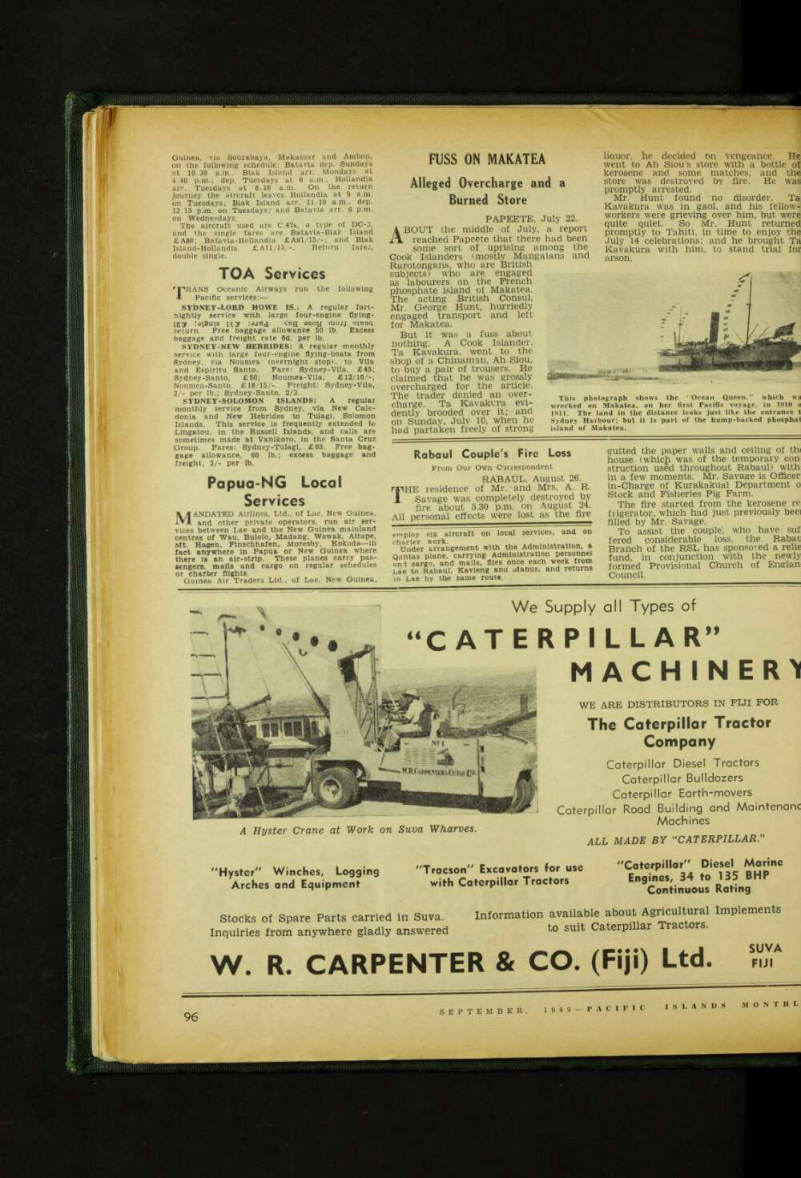
Fuss On Makatea
Alleged Overcharge and a Burned Store
Papeete, July 22.
4 BOUT the middle of July, a report reached Papeete that there had been some sort of uprising among the Cook Islanders (mostly Mangaians and
Rarotongans, who are British subjects) who are engaged as labourers on the French phosphate island of Makatea.
The acting British Consul, Mr. George Hunt, hurriedly engaged transport and left for Makatea.
But it was a fuss about nothing. A Cook Islander.
Ta Kavakura, went to the shop of a Chinaman, Ah Siou, to buy a pair of trousers. He claimed that he was grossly overcharged for the article.
The trader denied an over charge. Ta Kavakura evi dently brooded over it; and on Sunday, July 10, when he had partaken freely of strong
liquof, he decided bn vengeahce. He went to Ah Siou's store with a bottle of kerosene and some matches, and the store was destroyed by fire. He was promptly arrested.
Mr. Hunt found no disorder. Ta Kavakura was in gaol, and his fellow workers were grieving over him, but were quite quiet. So Mr. Hunt returned promptly to Tahiti, in time to enjoy the July 14 celebrations; and he brought Ta Kavakura with him, to stand trial for arson.
This photograph shows the “Ocean Queen,’’ which wa[?] wrecked on Makatea, on her first Pacific voyage, in 1910 [?] 1911. The land in the distance looks just like the entrance t[?] Sydney Harbour; but it is part of the hump-backed phosphat[?] island of Makatea.
Rabaul Couple's Fire Loss
From Our Own Correspondent RABAUL, August 26. rriHE residence of Mr. ■ and Mrs. A. R. 1 Savage was completely destroyed by fire about 5.30 p.m. on August 24.
All personal effects were lost as the fire
gutted the paper walls and ceiling of th( house (whicji was of the temporary con struction used throughout Rabaul) with in a few moments. Mr. Savage is Officer in-Charge of Kurakakual Department o Stock and Fisheries Pig Farm.
The fire starred from the kerosene re frigerator, which had just previously taeei filled by Mr. Savage.
To assist the couple, who have suf fered considerable loss, the Rabau Branch of the RSL has sponsored a relie fund, in conjunction with the newly formed Provisional Church of Englan Council.
Advertisements & other items, pp. 98-100 (4 items)
96
SEPTEMBER, 1945-PACIFIC ISLANDS MONTHL
“Caterpillar”
We Supply all Types of
MACHINERY
WE ARE DISTRIBUTORS IN FIJI FOR
The Caterpillar Tractor
Company
Caterpillar Diesel Tractors Caterpillar Bulldozers Caterpillar Earth-movers Caterpillar Road Building and Maintenanc A Hyster Crane at Work on Suva Wharves.
Machines
ALL MADE BY “CATERPILLAR
'Hyster" Winches, Logging Arches and Equipment Tracson" Excavators for use with Caterpillar Tractors "Caterpillar" Diesel Marine Engines, 34 to 135 BHP Continuous Rating Stocks of Spare Parts carried in Suva.
Inquiries from anywhere gladly answered Information available about Agricultural Implements to suit Caterpillar Tractors.
W. R. CARPENTER & CO. (Fiji) Ltd.
SUVA
FIJI
LEGAL NOTICE
IN THE MATTER OF THE RABAUL CLUB.
NOTICE is hereby given that a Petition in nnection with the affairs of the abovenamed le Rabaul Club was presented to the Supreme iurt of the Territory of Papua and New Guinea the Second day of September, 1949, by MES IRWIN CROMIE, a former member jreof asking as follows: That the Club may be declared to have been dissolved on the Twenty-fourth day of January, 1942. or at such other date as the Court may determine.
That directions be given by the Court as to the disposal of the assets of the said Club.
That the Court determine the-persons who are entitled to share in the said assets.
That the said James Irwin Cromie and Basil Fairfax-Ross be appointed Official Liquidators of the said Club to be wound up by the Court pursuant to the provisions of the Companies Ordinance, (Papua Adopted).
That the Petitioner’s costs of and incidental to the Petition may be provided for.
That such further or other order may be made as shall seem meet, he Court directed that the said Petition be rd before the said Court at 9.30 o’clock in forenoon on Tuesday the Eighth day of ember, 1949, at the Supreme Court House t Moresby. ny person desiring to support or oppose the :ing of an Order on the said Petition should ear in person or by his Counsel at the time i for the hearing of the Petition.
ATED the Ninth day of September, 1949
J. IRWIN CROMIE.
Petitioner.
• STAMPS
{change. —Send yours; receive mine E D irson 1265 No. Harvard Blvd., Los Angeles’
An International Stamp Club—Free Dues
MEDICAL
JM-TABS— the new effective treatment, ranteed harmless. No tiresome exercises starvation dieting. Follow simple directions reduce up to 7 lb. in a week. Send 20/rocMn ll *°; d S t 0 Australia n Health Services, Castlereagh Street, Sydney.
AGENCIES
RT-TIME AGENCY. Good money can b ed by becoming one of our agents for th n,.ff?ff ade t 0„ Measure Suits ’ Suit Lengths Outfitting. Excellent commission, and ever ort given to genuine applicants. Full par irs sent on hearing from you. Why no ‘ now to: The Mail Order Dept., P.O. Bo 111, Bradford, England.
MACHINERY FOR
SALE
SECOND-HAND AND
RECONDITIONED
: — Ba tteries, Pumps,
Winches, Steam and I.C
Locomotives. All sizes.
hydro electric plants
AND PELTON WHEELS
to 700 H.P.
Boilers, Compressors, Stone
rushers, Logging Winches, etc.,
etc.
Inquiries Invited. New and
Second-hand Machinery,
(ILHAM F. WILSON & SON
Engineers, Contractors
The Problem Work Specialists
Postal Address: P. 0., BOX
078 A.A., G.P.0., MELBOURNE.
Cable and Telegraphic Address:
“WTLBORBSON.” MELBOURNE.
3odes: A.B.C. sth Edition. Bentleys.
Made in the Australian Branch Factory of
BLUNDELL SPENCE Gr CO., LTD., Hull,
B. Gr S. SUPER PREPARED PAINT embodies the knowledge and experience gained from nearly 140 years of Paint manufacture.
Tested and proved for tropical conditions, B. Gr S. PREPARED PAINT is also available in a special Lead-free series for use in volcanic and other sulphurous regions. (Specify B. Gr S.-Series 2301).
Ask for supplies of these and other BLUN- DELL Paints and Enamels from your local Storekeeper, or write for particulars and colour-cards to the \ Agent for Pacific Islands :
KERR BROTHERS PTY. LTD.
4 YORK STREET, SYDNEY
Successors to
CHAPMAN
and
SHERACK
\ V x V \ \ \ as
have pleasure in announcim
the appointment pf
KERR BROS.
PTY. LTC
SOLE PACIFIC DISTRIBUTORS
BLAXLAND-CHAPMAN Products
This appointment will assure for Island Residents and Traders the highly efficient and understanding service for which Messrs. Kerr Bros, have become notable in their fifty years’ experience of Island trading. With the recent acquisition by Blaxland Rae Pty., Ltd., of the long established Chapman and Sherack business, a vastly widened and improved range of produce b comes available to the Islands.
Notable amongst these products a the new HP. Blaxland Pup a 5/7 HP. Blaxland Twin Mari engines and the full range of Bla land-Chapman Marine Engin (from 2 h HP. to 20 HP.) and Bla land-Chapman Wonder Launche also their famous Pumping unit.
Inquiries are Invited from Island Residents. p*n-
-ssa
fj
4 YORK ST., SYDNE
AUSTRALIA
Box 3838, G.P.O.
Cables: “CARE,” Sydney.
97
?I F I C ISLANDS MONTHLY SEPTEMBER, 1949
98
SEPTEMBER, 194 9 - PACIFIC ISLANDS MONTH
Rabaul Roundabout
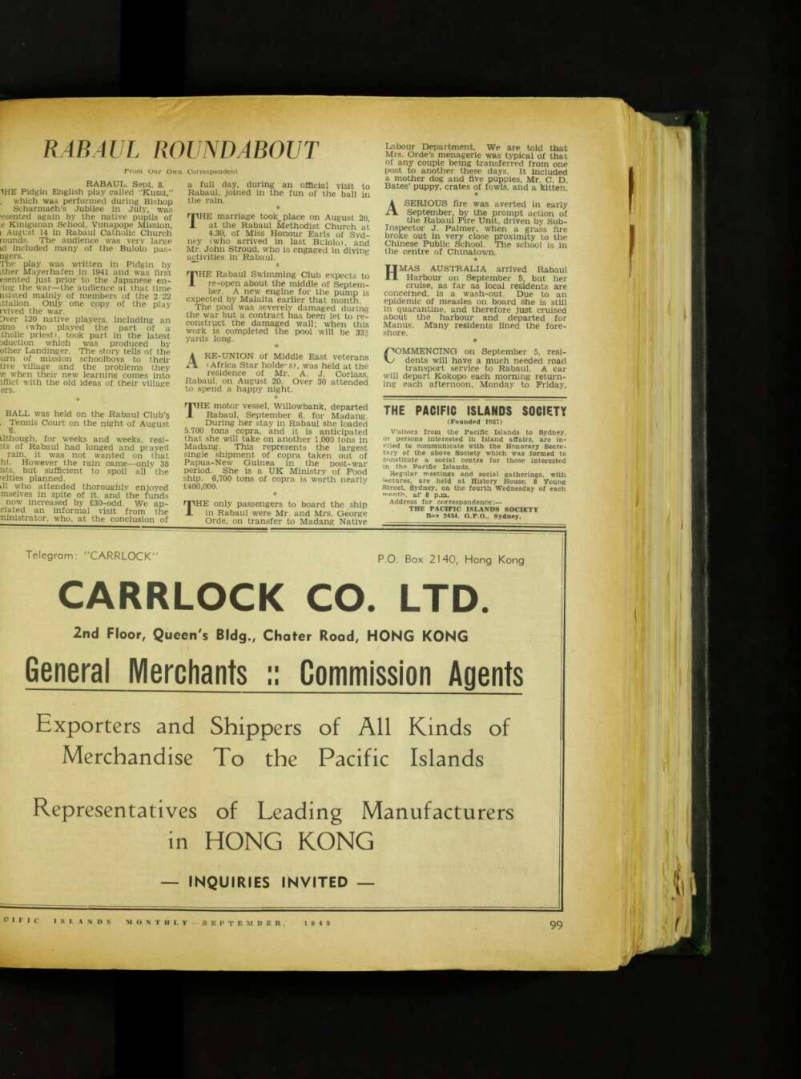
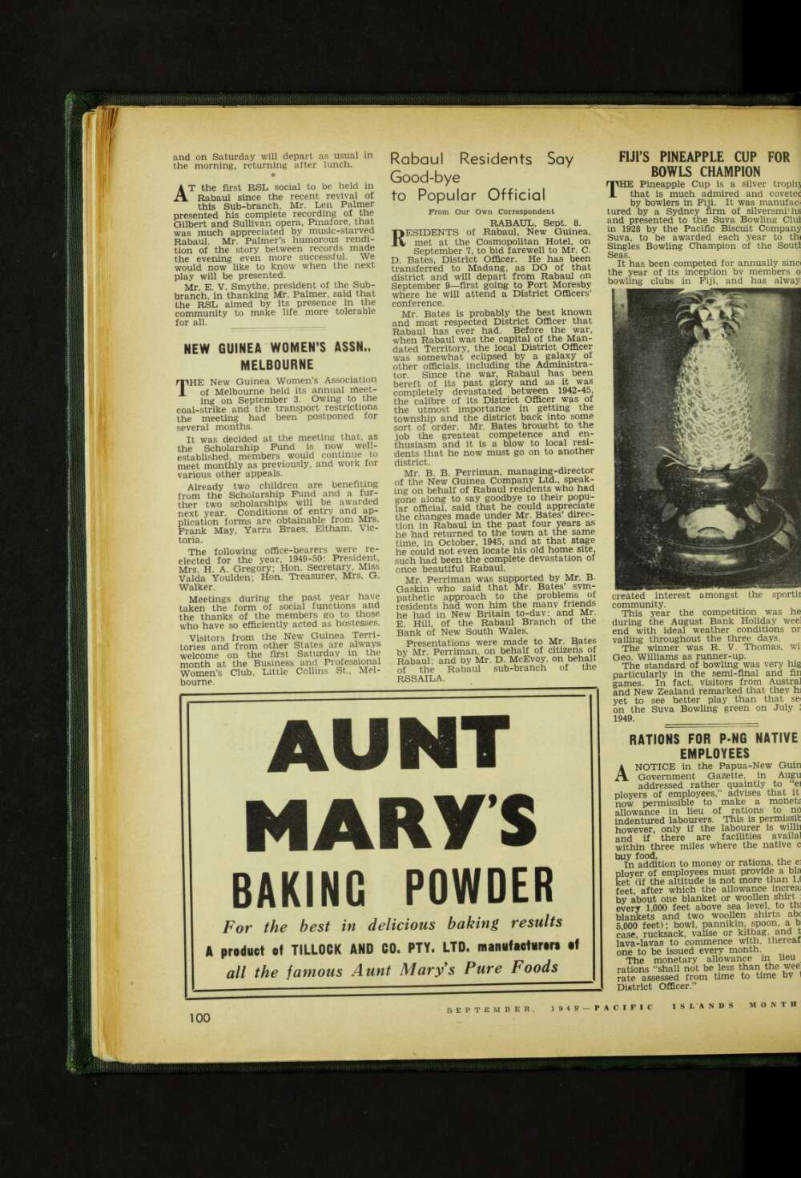
From Our Own Correspondent
Rabaul. Sept. 8.
IHE Pidgin English play called “Kussi,” . which was performed during Bishop Scharmach’s Jubilee in July, was ■esented again by the native pupils of e Kinigunan School, Vunapope Mission, 1 August 14 in Rabaul Catholic Church rounds. The audience was very large id included many of the Bulolo pas ngers.
The play was written in Pidgin by ither Mayerhafen in 1941 and was first esented just prior to the Japanese en ding the war —the audience at that time nsisted mainly of members of the 2 22 ittalion. Only one copy of the play rvived the war.
Dver 120 native players, including an )ino (who played the part of a tholic priest), took part in the latest Dduction which was produced by other Landinger. The story tells of the urn of mission schoolboys to their tive village and the problems they :e when their new learning comes into iflict with the old ideas of their village ers. * BALL was held on the Rabaul Club’§ . Tennis Court on the night of August 6. dthough, for weeks and weeks, resi lts of Rabaul had longed and prayed rain, it was not wanted on that ht. However the rain came—only 38 nts, but sufficient to spoil all the cities planned. dl who attended thoroughly enjoyed mselves in spite of it, and the funds now increased by £3O-odd. We ap ciated an informal visit from the ninistrator, who, at the conclusion of
a full day, during an official visit to Rabaul, joined in the fun of the ball in the rain.
THE marriage took_ place on August 20, at the Rabaul Methodist Church at 4.30, of Miss Honour Earls of Syd ney (who arrived in last Bulolo), and Mr. John Stroud, who is engaged in diving activities in Rabaul, * THE Rabaul Swimming Club expects to re-open about the middle of Septem ber. A new engine for the pump is expected by Malaita earlier that month.
The pool was severely damaged during the war but a contract has been let to re construct the damaged wall; when this work is completed the pool will be 33 i yards long. * A RE-UNION of Middle East veterans (Africa Star holde*s), was held at the residence of Mr. A. J. Corlass.
Rabaul, on August 20. Over 30 attended to spend a happy night. * THE motor vessel, Willowbank, departed Rabaul, September 6, for Madang.
During her stay in Rabaul she loaded 5.700 tons copra, and it is anticipated that she will take on another 1.000 tons in Madang. This represents the largest single shipment of copra taken out of Papua-New Guinea in the post-war period. She is a UK Ministry of Food ship. 6,700 tons of copra is worth nearly £400,000. * THE only passengers to board the ship in Rabaul were Mr. and Mrs. George Orde, on transfer to Madang Native
Labour Department. We are told that Mrs. Orde’s menagerie was typical of that of any couple being transferred from one post to another these days. It included a mother dog and five puppies, Mr. C. D.
Bates’ puppy, crates of fowls, and a kitten. * A SERIOUS fire was averted in early September, by the prompt action of the Rabaul Fire Unit, driven by Sub- Inspector J. Palmer, when a grass fire broke out in very close proximity to the Chinese Public School. The school is in the centre of Chinatown. * HMAS AUSTRALIA arrived Rabaul Harbour on September 5, but her cruise, as far as local residents are concerned, is a wash-out. Due to an epidemic of measles on board she is still in quarantine, and therefore just cruised about the harbour and departed for Manus. Many residents lined the fore shore. ♦ COMMENCING on September 5, resi dents will have a much needed road transport service to Rabaul. A car will depart Kokopo each morning return ing each afternoon, Monday to Friday,
and on Saturday will depart as usual in the morning, returning after lunch. * AT the first RSL social to be held in Rabaul since the recent revival of this Sub-branch, Mr. Len Palmer presented his complete recording of the Gilbert and Sullivan opera, Pinafore, that was much appreciated by music-starved Rabaul. Mr. Palmer’s humorous rendi tion of the story between records made the evening even more successful. We would now like to know when the next play will be presented.
Mr. E. V. Smythe, president of the Sub branch, in thanking Mr. Palmer, said that the RSL aimed by its presence in the community to make life more tolerable for all.
Advertisements & other items, p. 101 (2 items)
99
OIFIC ISLANDS MONTHLY SEPTEMBER, 1949
Carrlock Co. Ltd.
THE PACIFIC ISLANDS SOCIETY
(Founded 1937) Visitors from the Pacific Islands to Sydney, or persons interested in Island affairs, are invited to communicate with the Honorary Secretary of the above Society which was formed to constitute a social centre for those interested in the Pacific Islands.
Regular meetings and social gatherings, with lectures, are held at History House. 8 Young Street, Sydney, on the fourth Wednesday of each month, af 8 p.m.
Address for correspondence:—
THE PACIFIC ISLANDS SOCIETY
Box 2434. G.P.0., Sydney.
Telegram: CARRLOCK" P.O. Box 2140, Hong Kong
CARRLOCK CO. LTD.
2nd Floor, Queen's Bldg., Chafer Road, HONG KONG ; i
General Merchants ;; Commission Agents
Exporters and Shippers of All Kinds of Merchandise To the Pacific Islands Representatives of Leading Manufacturers
in HONG KONG
INQUIRIES INVITED
Melbourne
New Guinea Women’S Assn.,
THE New Guinea Women’s Association of Melbourne held its annual meet ing on September 3. Owing to the coal-strike and the transport restrictions the meeting had been postponed for several months.
It was decided at the meeting that, as the Scholarship Fund is now well established, members would continue to meet monthly as previously, and work for various other appeals.
Already two children are benefiting from the Scholarship Fund and a fur ther two scholarships will be awarded next year. Conditions of entry and ap plication forms are obtainable from Mrs.
Frank May, Yarra Braes, Eltham, Vic toria.
The following office-bearers were re elected for the year, 1949-50: President, Mrs H A. Gregory; Hon. Secretary, Miss Valda Youlden; Hon. Treasurer, Mrs. G.
Walker.
Meetings during the past year have taken the form of social functions and the thanks of the members go to those who have so efficiently acted as hostesses.
Visitors from the New Guinea Terri tories and from other States are always welcome on the first Saturday in the month at the Business and Professional Women’s Club, Little Collins St., Mel bourne.
Good-bye
Rabaul Residents Say Good-bye to Popular Official
From Our Own Correspondent
Rabaul, Sept. 8.
RESIDENTS of Rabaul, New Guinea, met at the Cosmopolitan Hotel, on September 7, to bid farewell to Mr. C.
D. Bates, District Officer. He has been transferred to Madang, as DO of that district and will depart from Rabaul on September 9 —first going to Port Moresby where he will attend a District Officers’ conference.
Mr. Bates is probably the best known and most respected District Officer that Rabaul has ever had. Before the war, when Rabaul was the capital of the Man dated Territory, the local District Officer was somewhat eclipsed by a galaxy of other officials, including the Administra tor. Since the war, Rabaul has been bereft of its past glory and as it was completely devastated between 1942-45, the calibre of its District Officer was of the utmost importance in getting the township and the district back into some sort of order. Mr. Bates brought to the lob the greatest competence and en thusiasm and it is a blow to local resi dents that he now must go on to another district.
Mr. B. B. Perriman, managing-director of the New Guinea Company Ltd., speak ing on behalf of Rabaul residents who had gone along to say goodbye to their popu lar official, said that he could appreciate the changes made under Mr. Bates’ direc tion in Rabaul in the past four years as he had returned to the town at the same time, in October, 1945, and at that stage he could not even locate his old home site such had been the complete devastation of once beautiful Rabaul.
Mr. Perriman was supported by Mr. B.
Gaskin who said that Mr. Bates’ sym pathetic approach to the problems of residents had won him the many friends he had in New Britain to-dav; and Mr.
E. Hill, of the Rabaul Branch of the Bank of New South Wales.
Presentations were made to Mr. Bates by Mr Perriman, on behalf of citizens of Rabaul: and by Mr. D. McEvoy, on behalf of the Rabaul sub-branch of the
Rssaila.
Fiji’S Pineapple Cup For
Bowls Champion
THE Pineapple Cup is a silver trophj that is much admired and covetec by bowlers in Fiji. It was manufac tured by a Sydney firm of silversmiths and presented to the Suva Bowling Clul in 1928 by the Pacific Biscuit Company Suva, to be awarded each year to thi Singles Bowling Champion of the Soutl Seas.
It has been competed for annually sine the year of its inception by members o bowling clubs in Fiji, and has alway
created interest amongst the sportii community.
This year the competition was he during the August Bank Holiday weel end with ideal weather conditions nr vailing throughout the three days.
The winner was R. V. Thomas, wi Geo. Williams as runner-up.
The standard of bowling was very hig particularly in the semi-final and fin games. In fact, visitors from Austral and New Zealand remarked that they hi yet to see better play than that se< on the Suva Bowling green on July ; 1949.
Employees
Rations For P-Ng Native
A NOTICE in the Papua-New Guin Government Gazette, in Augu addressed rather quaintly to “ei ployers of employees,” advises that it now permissible to make a monete allowance in lieu of rations to no indentured labourers. This is permissit however, only if the labourer is willii and if there are facilities availal within three miles where the native c buy food, .. In addition to money or rations, the e: ployer of employees must provide a bla ket (if the altitude is not more than l.( feet, after which the allowance mcreai by about one blanket or woollen shirt : every 1,000 feet above sea level, to th; blankets and two woollen shirts ab( 5,000 feet); bowl, pannikin spoon, a b case, rucksack, valise or kitbag, and t lava-lavas to commence with, thereat one to be issued every month.
The monetary allowance in lieu rations “shall not be less than the wee rate assessed from time to time by 1 District Officer.”
Advertisements & other items, pp. 102-103 (4 items)
100
SEPTEMBER. 194 ff-PACIFIC ISLANDS MONTH
Mary’S
AUNT
BAKING POWDER
For the best in delicious baking results A product of TILLOCK AND CO. PTY. LTD. manufaeturor* ol all the famous Aunt Marys Pure Foods
101
CIFIC ISLANDS MONTHLY SEPTEMBER, 1949
For Sale, Charter Or Exchange
■m \ k m t Photo by courtesy Sydney Morning Herald.
The auxiliary ketch, “Darnley,” length 68 ft. ; beam 18 f.t 6 in., draught 7 ft., powered bji 6-cylinder 270 H.P. “Hercules” diesel engine. Speed approx. 9 knots; fuel capacity 4,000 gals.; range 12,000 miles. Full ketch rig. Built 1945. Wooden hull, coppered. Roomy forecastle with 8 bunks; wheelhouse with 2 bunks; well designed and fitted galley, including refrigerator.
Hold capacity approx. 50 tons. Ronaldson Tippett auxiliary lighting plant. The vessel has been recently slipped and the hull, engines, sails, rigging and fittings are in excellent condition.
Purchase price, £AIO,OOO, or alternatively owner will consider charter or exchange for Army Disposals material. Reply K. REYNOLDS, Challis House, Martin Place, Sydney.
Growth Of Southern Pacific
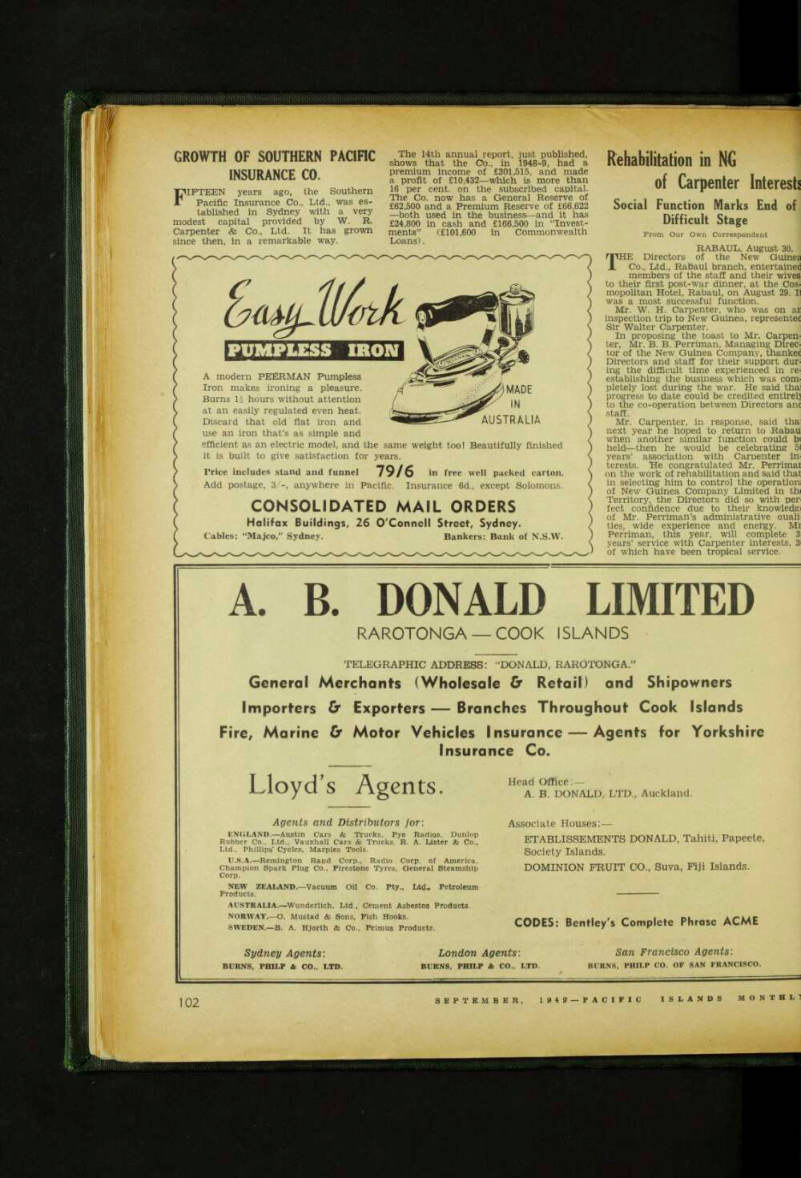
Insurance Co.
FIFTEEN years ago, the Southern Pacific Insurance Co., Ltd., was es tablished in Sydney with a very modest capital provided by W. R.
Carpenter & Co., Ltd. It has grown since then, in a remarkable way.
The 14th annual report, just published, shows that the Co., in 1948-9, had a premium income of £301,515, and made a profit of £lo,432—which is more than 16 per cent, on the subscribed capital.
The Co. now has a General Reserve of £62,500 and a Premium Reserve of £66,622 —both used in the business—and it has £24,800 in cash and £166,500 in “Invest ments” (£101,600 in Commonwealth Loans).
Rehabilitation in NG
of Carpenter Interests Social Function Marks End of Difficult Stage
From Our Own Correspondent RABAUL, August 30.
THE Directors of the New Guinea Co., Ltd., Rabaul branch, entertained members of the staff and their wives to their first post-war dinner, at the Cos mopolitan Hotel, Rabaul, on August 29. II was a most successful function, Mr. W. H. Carpenter, who was on ar inspection trip to New Guinea, represented Sir Walter Carpenter.
In proposing the toast to Mr. Carpen ter, Mr. B. B. Perriman, Managing Direc tor of the New Guinea Company, thanked Directors and staff for their support dur ing the difficult time experienced in re establishing the business which was com pletely lost during the war. He said thal progress to date could be credited entirely to the co-operation between Directors and staff.
Mr. Carpenter, in response, said thai next year he hoped to return to Rabau when another similar function could b( held —then he would be celebrating 5( years’ association with Carpenter in terests. He congratulated Mr. Perrimai on the work of rehabilitation and said that in selecting him to control the operation! of New Guinea Company Limited in tin Territory, the Directors did so with per fect confidence due to their knowledgi of Mr. Perriman’s administrative Quali ties, wide experience and energy. Mr Perriman, this year, will complete 31 years’ service with Carpenter interests, 3i of which have been tropical service.
Advertisements & other items, p. 104 (2 items)
102
SEPTEMBER, 1949 PACIFIC ISLANDS MONTHL
A. B. Donald Limited
PEERMAN Pumpless A modern PEERMAN Pumpless [ Iron makes ironing a pleasure. MADE Burns li hours without attention / at an easily regulated even heat, 4-"..
Discard that old flat iron and AUSTRALIA use an iron that’s as simple and efficient as an electric model, and the same weight too! Beautifully finished it is built to give satisfaction for years.
Trice includes stand and funnel 79/6 in free well packed carton.
Add postage, 3/-, anywhere in Pacific. Insurance 6d., except Solomons.
CONSOLIDATED MAIL ORDERS
Halifax Buildings, 26 O'Connell Street, Sydney.
Cables: “Majco,” Sydney.
Bankers: Bank of N.S.W.
A. B. DONALD LIMITED
RAROTONGA COOK ISLANDS
TELEGRAPHIC ADDRESS: “DONALD, RAROTONGA."
General Merchants (Wholesale & Retail) and Shipowners Importers & Exporters Branches Throughout Cook Islands Fire, Marine & Motor Vehicles Insurance Agents for Yorkshire
Insurance Co.
Lloyd’s Agents.
Head Office;— A. B. DONALD, LTD., Auckland.
Agents and Distributors for: ENGLAND.—Austin Cars & Trucks, Pye Radios, Dunlop Rubber Co., Ltd., Vauxhall Cars & Trucks, R. A. Lister & Co., Ltd., Phillips' Cycles, Marples Tools.
U.S.A,—Remington Rand Corp., Radio Corp. of America.
Champion Spark Plug Co., Firestone Tyres, General Steamship Corp.
NEW ZEALAND.—Vacuum Oil Co. Pty., Ltd* Petroleum Products.
AUSTRALlA.—Wunderlich, Ltd., Cement Asbestos Products.
NORWAY.—O. Mustad & Sons, Fish Hooks.
SWEDEN.—B. A. Hjorth & Co., Primus Products.
Associate Houses:— ETABLISSEMENTS DONALD, Tahiti, Papeete, Society Islands.
DOMINION FRUIT CO., Suva, Fiji Islands.
CODES: Bentley's Complete Phrase ACME Sydney Agents : London Agents : San Francisco Agents : BURNS, PHILP & CO., LTD, BURNS, PHILP & CO., LTD. BURNS, PHILP CO. OF SAN FRANCISCO.
Fiji’S New Chief Justice
From Our Own Correspondent SUVA. Sept. 3. y|R. J. H. VAUGHAN, MC, Attorney (l General, Fiji, since 1945, has' been appointed Chief Justice, Fiji, and lief Judicial Commissioner. Western icific High Commission, in succession Sir Claud Seton, who recently retired.
Mr. Vaughan is expected to return to ji late in October after leave spent in reat Britain. He was educated at East iume College and Cambridge, served th the Forces from 1914 to 1921 and en became an Assistant District Com issioner in Zanzibar. In 1929 he was lied to the Bar and was appointed a sident magistrate, later becoming ,tomey-General, Zanzibar. He was ansferred to Tanganyika as Solicitor meral in 1936.
Stories Of The Islands
THOMAS IDWAL PARRY, 47, described as a “master mariner, of Sydney,” was committed for sentence in Lunceston on August 23, for false etences. He obtained £7lO, on stories nnected with the Pacific Islands.
He got £BO from Mrs. Kathleen Day md, of New Guinea, by saying he had [)0 coming from Sydney; £5BO from iwen, a Launceston builder, by saying owned a schooner, with which he was inging war equipment from the Solo ms; and £5O from Charles Willes by liming he and friends had found oil New Guinea.
T ropics!
Hail-stones in the T ropics!
APIA, August 2.
DURING the recent cold spell in Western Samoa, a fall of hail was reported from the Falealili district on the South Coast of Upolu, an occur rence which, as far as known, is un precedented in Samoa.
The hail completely puzzled the in habitants of the Falealili district.
Fiji Gets A Good Press
In Canada
SUVA. Sept. 4.
VANCOUVER newspaper articles writ ten by members of the Canadian official party in the pre-inaugural flight of Canadian Pacific Airlines Ltd., indicate that Fiji scored top marks, largely because it was “different” and not subservient to the dictates of tour ism.
Jack Webster, in the Vancouver Sun says that compared with “the strike-torn holiday haven of Honolulu and Com munist-crippled Australia,” Fiji is peace ful. All the Canadians appear to believe that for Canadians Fiji is a potential South Sea “soft-currency rival to Hawaii.”
Ed. Martin, news-editor of the Van couver News-Herald, appears to have been pleasurably overwhelmed because “the Fijian porters and others who as sisted us were disinclined to take tips for their efforts.”
In a letter to the Mayor of Suva (Mr.
Alport Barker), the president of the Van couver Board of Trade (Mr. T. Norris), says that the party was impressed by Fiji’s “scenic beauty, sound economy and great kindness.”
Lsi Cattle Transport A
Success
Prom Our Own Correspondent HONIARA, August 8.
THE best weeding gang we’ve ever had,” is how Mr. O. Bergin, manager of the Fairymead Sugar Company’s BSI interests, described a shipment of 400 head of New Zealand cattle which were landed at Yandina (Russell Islands) last week from the New Zealand LST “Rawhiti.”
Only two cows succumbed to the sea trip and one became a casualty after landing, allegedly through a long and mis guided drink of salt water. These mis haps were more than balanced by several calves born on the way and on arrival, with plenty more expected.
The cattle lost no time in attacking the plantation undergrowth, which is for midable in areas not yet tackled by hand.
New Guinea Club, Rabaul
Reopens
From Our Own Correspondent RABAUL, August 29.
THE New Guinea Club, Rabaul, will open on September 14, with a social and dance. All old members have been requested to become financial before that date. Town membership fees are £5/5/- and Country membership, £3/3/-.
On the opening night members will be allowed one guest.
The New Guinea Club was probably the Territory’s best known club before the war, but its building was almost wholly demolished during the occupation of Rabaul. The new club building has been reconstructed most attractively from the remains, although it will not be as large as the pre-war Club.
Advertisements & other items, p. 105 (2 items)
103
ACIFIC ISLANDS MONTHLY SEPTEMBER, 1949
Marine Engines
HALVORSEN’S HAVE FOR IMMEDIATE DELIVERY:
“UNDERWOOD” 3 H.P. —2 Cycle—with built in Clutch -Petrol MORRIS “VEDETTE” 4 Cylinder 6/12 H.P. Petrol or Kerosene MORRIS “NAVIGATOR” 4 Cylinder 12/24 H.P. Petrol or Kerosene MORRIS “COMMODORE” 6 Cylinder 20/40 H.P. Petrol or Kerosene CHRYSLER “CROWN” 6 Cylinder 45/102 H.P. Petrol CHRYSLER “ROYAL” 8 Cylinder 55/132 H.P. Petrol Available soon: “LEYLAND” DIESEL MARINE 6 Cylinder 85 H.P.
Further particulars from the distributors :
LARS HALVORSEN SONS PTY. LTD.
WATERVIEW ST., RYDE ( 0 ' )- N.S.W.
Telegrams: Halvorscns, Sydney. ’Phone: Ryde 705
• FREE EXPERT PROPELLER ADVICE
Islands Produce
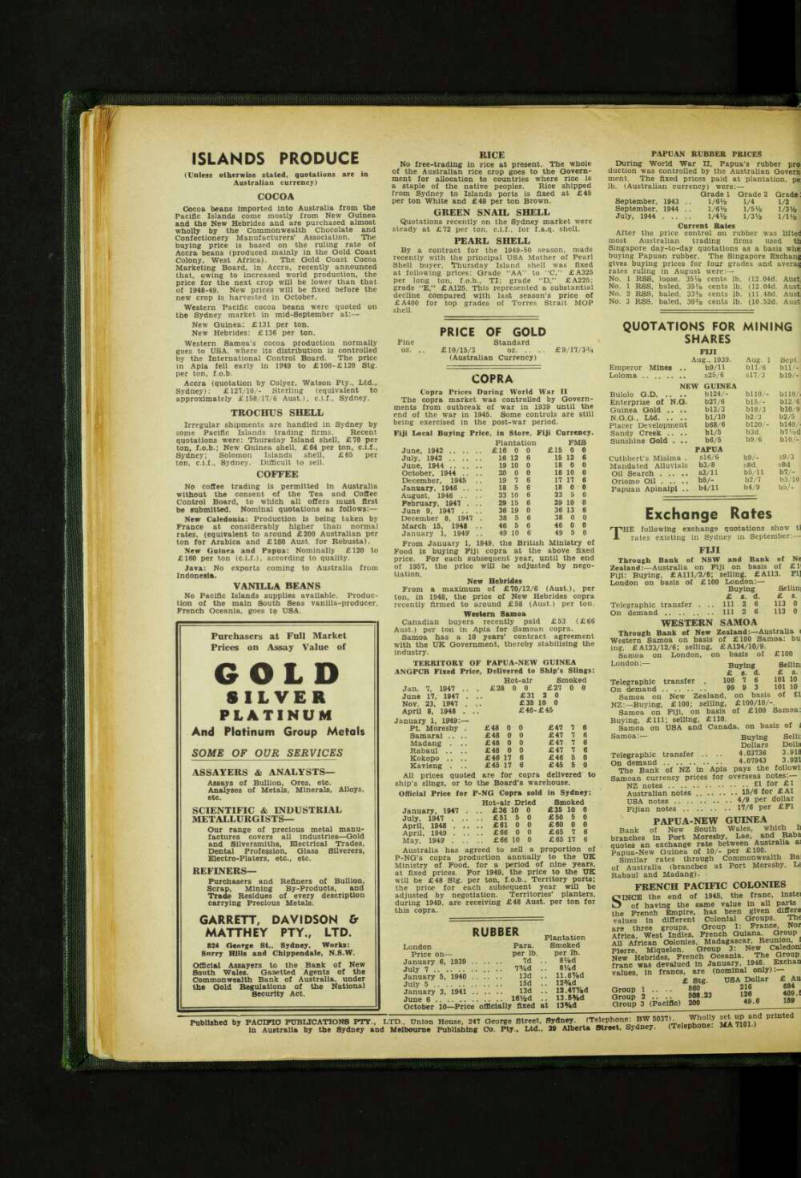
(Unless otherwise stated, quotations are in Australian currency)
Cocoa
Cocoa beans imported into Australia from the Pacific Islands come mostly from New Guinea and the New Hebrides and are purchased almost wholly by the Commonwealth Chocolate and Confectionery Manufacturers’ Association. The buying price is based on the ruling rate of Accra beans (produced mainly in the Gold Coast Colony, West Africa). The Gold Coast Cocoa Marketing Board, in Accra, recently announced that, owing to increased world production, the price for the next crop will be lower than that of 1948-49. New prices will be fixed before the new crop is harvested in October, Western Pacific cocoa beans were quoted on the Sydney market in mid-September at:— New Guinea: £l3l per ton.
New Hebrides: £136 per ton.
Western Samoa’s cocoa production normally goes to USA, where its distribution is controlled by the International Control Board. The price in Apia fell early in 1949 to £lOO-£l2O Stg. per ton, f.o.b.
Accra (quotation by Colyer, Watson Pty., Ltd., Sydney): £127/10/- Sterling (equivalent to approximately £l5B/17/6 Aust.), c.i.f., Sydney.
Trochus Shell
Irregular shipments are handled in Sydney by some Pacific Islands trading firms. Recent quotations were: Thursday Island shell, £7O per ton, f.0.b.; New Guinea shell, £64 per ton, c.i.f., Sydney: Solomon Islands shell, £65 per ton, c.i.f., Sydney. Difficult to sell.
Coffee
No coffee trading is permitted in Australia without the consent of the Tea and Coffee Control Board, to which all offers must first be submitted. Nominal quotations as follows: — New Caledonia: Production is being taken by France at considerably higher than normal rates, (equivalent to around £2OO Australian per ton for Arablca and £l6O Aust. for Robusta).
New Guinea and Papua: Nominally £l2O to £l6O per ton (c.i.f,), according to quality.
Java: No exports coming to Australia from Indonesia.
Vanilla Beans
No Pacific Islands supplies available. Produc tion of the main South Seas vanilla-producer, French Oceania, goes to USA.
Rice
No free-trading in rice at present. The whole of the Australian rice crop goes to the Govern ment for allocation to countries where rice is a staple of the native peoples. Rice shipped from Sydney to Islands ports is fixed at £45 per ton White and £49 per ton Brown.
Green Snail Shell
Quotations recently on the Sydney market were steady at £72 per ton, c.i.f., for f.a.q. shell.
Pearl Shell
By a contract for the 1949-50 season, made recently with the principal USA Mother of Pearl Shell buyer, Thursday Island shell was fixed at following prices: Grade “AA” to “C,” £A325 per long ton, f.0.b., TI; grade “D,” £A225; grade “E,” £AI2S. This represented a substantial decline compared with last season’s price of £ A4OO for top grades of Torres Strait MOP shell.
Advertisements & other items, p. 106 (1 item)
Price Of Gold
Fine Standard oz. .. £lO/15/3 oz £9/17/3% (Australian Currency)
Copra
Prices During World War II The copra market was controlled by Govern ments from outbreak of war in 1939 until the end of the war in 1945. Some controls are still being exercised in the post-war period.
Fiji Local Buying Price, in Store, Fiji Currency.
From January 1, 1949, the British Ministry of Food is buying Fiji copra at the above fixed price. For each subsequent year, until the end of 1957, the price will he adjusted by nego tiation.
New Hebrides From a maximum of £70/12/6 (Aust.), per ton, in 1948, the price of New Hebrides copra recently firmed to around £58 (Aust.) per ton.
Western Samoa Canadian buyers recently paid £53 (£66 Aust.) per ton in Apia for Samoan copra.
Samoa has a 10 years’ contract agreement with the UK Government, thereby stabilising the industry.
Territory Of Papua-New Guinea
ANGPCB Fixed Price, Delivered to Ship’s Slings:
All prices quoted are for copra delivered to ship’s slings, or to the Board’s warehouse.
Official Price for P-NG Copra sold in Sydney:
Australia has agreed to sell a proportion of P-NG’s copra production annually to the UK Ministry of Pood, for a period of nine years, at fixed prices. For 1949, the price to the UK will be £4B Stg. per ton, f.0.b., Territory ports; the price for each subsequent year will be adjusted by negotiation. Territories’ planters, during 1949, are receiving £4B Aust. per ton for this copra.
Plantation FMS June, 1942 £16 0 0 £15 0 0 July, 1942 16 12 6 15 12 6 June, 1944 19 10 0 18 0 0 October, 1944 ... 20 0 0 18 10 0 December, 1945 .. 19 7 6 17 17 6 January, 1946 ... 18 5 6 18 0 0 August, 1946 .. .. 23 10 6 23 5 0 February, 1947 ... 29 15 6 29 10 0 June 9, 1947 ... 36 19 0 36 13 6 December 8, 1947 . 38 5 6 38 0 0 March 15, 1948 .. 46 5 6 46 0 0 January 1, 1949 .. 49 10 6 49 5 0
Hot-air Smoked Jan. 7, 1947 .. . £28 0 0 £27 0 0 June 17, 1947 . ,, £31 2 0 Nov. 23, 1947 . . £35 10 0 April 8, 1948 . . . £40- £45 January 1, 1949:— £47 Pt, Moresby . £48 0 0 7 6 Samaral .. £48 0 0 £47 7 6 Madang . .. £48 0 0 £47 7 6 Rabaul .. £48 0 0 £47 7 6 Kokopo .. £46 17 6 £46 5 0 Kavieng . .. £45 17 6 £45 5 0
Hot-air Dried Smoked January, 1947 . .. £36 10 0 £35 10 0 July. 1947 . .. .. £51 5 0 £50 5 0 April, 1948 . . . .. £61 0 0 £60 0 0 April, 1949 . . . .. £66 0 0 £65 7 6 May, 1949 . . , .. £66 10 0 £65 17 6
Rubber
Plantation
Papuan Rubber Prices
During World War II, Papua’s rubber pro' duction was controlled by the Australian Govern ment. The fixed prices paid at plantation, pe; lb. (Australian currency) were;—
Current Bates After the price control on rubber was lifted most Australian trading firms used th Singapore day-to-day quotations as a basis whei buying Papuan rubber. The Singapore Exchang gives buying prices for four grades and averag rates ruling in August were:—
London Para.
Smoked Price on— per lb. per lb.
January 6, 1939 . ... 7d 8‘/ad July 7 . ... 7%d .. 8‘/ 4 d January 5, 1940 ., 13d .. 11.6%d July 5 . ... 15d .. 12%d January 3, 1941 . 13d .. 12.47%d June 6 . 16‘/ 2 d .. 13.5%d October 10—Price officially fixed at 13%d
Grade 1 Grade 2 Grade: September, 1943 . 1/6% 1/4 1/2 September, 1944 i/6 y 2 1/5 % 1/3% July, 1944 . .. . 1/4% 1/3 % 1/1%
No. 1
Rss,
loose. 35 V» cents lb. (12.04d.
Aust.
No. 1
Rss,
baled, 35 Va cents lb. (12.04d.
Aust.
No. 2
Rss,
baled, 33% cents lb. (11.48d.
Aust, No. 3
Rss,
baled, 30% cents lb. (10.52d.
Aust,
Quotations For Mining
Shares
Fiji
New Guinea
Papua
g Aug., 1939.
Aug. 1 Sept.
Emperor Mines .. b9/H bll/6 bll/- Loloma s25/6 S17/3 bl9/-
Bulolo G.D bl24/- bllO/- bllOA Enterprise of N.G. b27/6 bl5/- b!2/6 Guinea Gold .. .. bl3/3 blO/3 blO/9 N.G.G., Ltd bl/10 b2/3 b2/5 Placer Development b68/6 bl20/- bl40/- Sandy Creek .. .. bl/5 b3d. b7V 2 d Sunshine Gold . .. b6/5 b9/6 blO/-
Cuthbert’s Misima . sl6/6 b9/- s9/3 Mandated Alluvials b3/8 s8d. s8d Oil Search s3/ll b5/ll b7/- Oriomo Oil b5/- b2/7 b3/10 Papuan Apinaipi .. b4/H b4/9 b5/-
Advertisements & other items, pp. 106-108 (4 items)
Si:: j8.» Sj
Exchange Rates
THE following exchange quotations show tl rates existing in Sydney in September;—
FIJI
Through Bank of NSW and Bank of Ne Zealand: —Australia on Fiji on basis of £h Fiji: Buying. £Alll/2/6; seUing, £A113. F1J London on basis of £100 London: —
WESTERN SAMOA
Through Bank of New Zealand: —Australia < Western Samoa on basis of £100 Samoa: bu; ing, £A123/12/6; selling, £A124/10/9.
Samoa on London, on basis of £100
Samoa on New Zealand, on basis of £1 NZ: —Buying, £100; selling, £100/10/-, Samoa on Fiji, on basis of £100 Samoa: Buying, £111; selling, £110.
Samoa on USA and Canada, on basis of i
The Bank of NZ In Apia pays the followl!
Samoan currency prices for overseas notes: NZ notes « for *} Australian notes 15/6 for £ Ai USA notes 4/9 per dollar Fijian notes 17/6 per £P1
PAPUA-NEW GUINEA
Bank of New South Wales, which h branches in Port Moresby, Lae, and Rami quotes an exchange rate between Australia ai Papua-New Guinea of 10/- per £100.
Similar rates through Commonwealth Bai of Australia (branches at Port Moresby, Le Rabaul and Madang).
FRENCH PACIFIC COLONIES
SINCE the end of 1945, the franc, instei of having the same value in all parts the French Empire, has been given differe values in different Colonial Groups. The are three groups. Group 1: France, Nor Africa. West Indies, French Guiana. Group All African Colonies, Madagascar, Reunion, * Pierre Miquelon. Group 3: New Caledon] New Hebrides, French Oceania. The Group franc was devalued in January, 1948. Exchan values, in francs, are (nominal only):—
Buying Sel [lie £ s. d. £ s.
Telegraphic transfer . .. Ill 2 6 113 0 On demand .. Ill 2 6 113 0
London: Buying Bellini £ s. d. £ s.
Telegraphic transfer . 100 7 6 101 10 On demand 99 9 3 101 10
Samoa: — Buying Sellii Dollars Dolla Telegraphic transfer ..
On demand 4.03736 4.07943 3.918 3.921
£ Stg. USA Dollar £ Au
Si:: j8.» Sj
Group 3 (Pacific) 200 49 ■ 6 189
Published by PACTFIO PUBLICATIONS PTY.. LTD.. Union House. 247 George Street. Sydney. ( T^epho n e; BW 5 037 ) printed
In Australia by the Sydney and Melbourne Publishing Co. Pty., Ltd., 39 Alberta Street. Sydney. (Telepho
Gold
Purchasers at Full Market Prices on Assay Value of
SILVER
PLATINUM
And Platinum Group Metals
SOME OF OUR SERVICES
ASSAYERS & ANALYSTS—
Assays of Bullion, Ores, etc.
Analyses of Metals, Minerals, Alloys, etc.
SCIENTIFIC & INDUSTRIAL
METALLURGISTS—
Our range of precious metal manufactures covers all industries—Gold and Silversmiths, Electrical Trades, Dental Profession, Glass Silverers, Electro-Platers, etc., etc.
REFINERS—
Purchasers and Refiners of Bullion, Scrap, Mining By-Products, and Trade Residues of every description carrying Precious Metals.
GARRETT, DAVIDSON &
MATTHEY PTY., LTD.
824 George St., Sydney. Works: Snrry Hills and Chippendale, N.S.W.
Official Assayers to the Bank of New South Wales. Gazetted Agents of the Commonwealth Bank of Australia, under the Gold Regulations of the National
®oiip
?2 S): St.
Li V r i-L IP G ood company deserves the best, and it is a thoughtful and discerning* host who serves his guests sparkling K.B. Lager. For “K. 8.” adds enjoyment to any gathering, and it’s one drink that’s appreciated by everybody, men and women alike.
TOOTH’S
d 1
LAGER
K 8.35. F
urn
Ik
MERCHANTS
OWNERS
& m
Capital £1,000,000
ESTABLISHED 1914
i< ★
COPRA MERCHANTS & MILLERS
ASSOCIATED COMPANIES THROUGHOUT THE PACIFIC ISLANDS
IN LONDON
Buyers and exporters of ail kinds of Islands produce. Copra Merchants and Millers.
Agents for Australian, European and American Manufacturers. Distributors of every description of merchandise.
Thirty years of Pacific Islands development and service.
REGULAR CARGO
PACIFIC
Head
W.
Office:
AND PASSENGER SERVICE BETWEEN EUROPE AND
ISLAND PORTS WAS ESTABLISHED BY
R. CARPENTER Cr CO. LTD.
16 O'CONNELL STREET, SYDNEY.
Cable Address
CAMOHE.
Telephone BW 4421.
Postal Address: P.O. Box No. 168, Sydney.
PACIFIC ISLANDS MONTHLY SEPTEMBER, 1949