Pacific
Islands
Monthly
August, 1949
Vol. XX. No. 1.
Established 1930.
[Registered at the G.P.O., Sydney, for transmission by post as a newspaper]
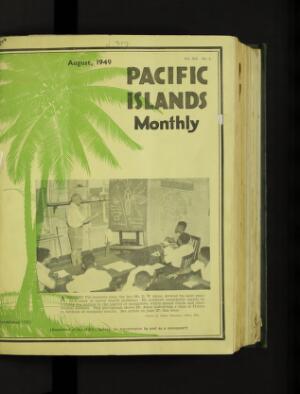
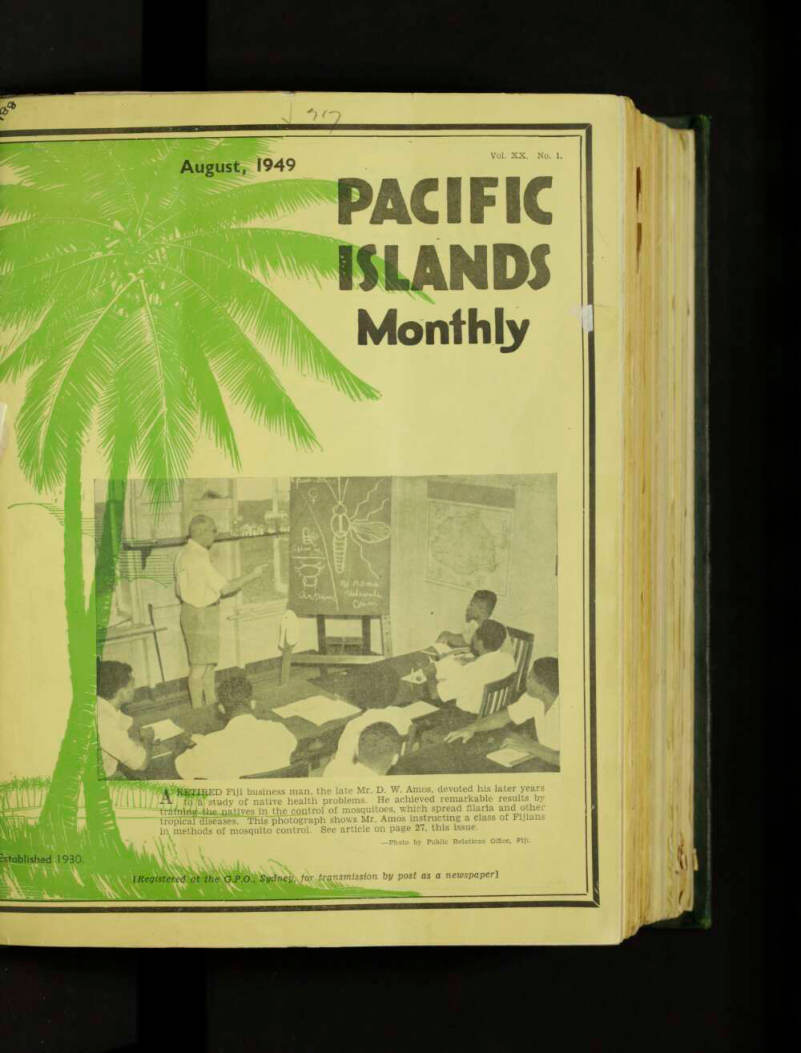
A RETIRED Fiji business man, the late Mr. D. W. Amos, devoted his later years to a study of native health problems. He achieved remarkable results by training the natives in the control of mosquitoes, which spread filaria and other tropical diseases. This photograph shows Mr. Amos instructing a class of Fijians in methods of mosquito control. See article on page 27, this issue. —Photo by Public Relations Office, Fiji.
Advertisements & other items, pp. 2-4 (1 item)
Qantas
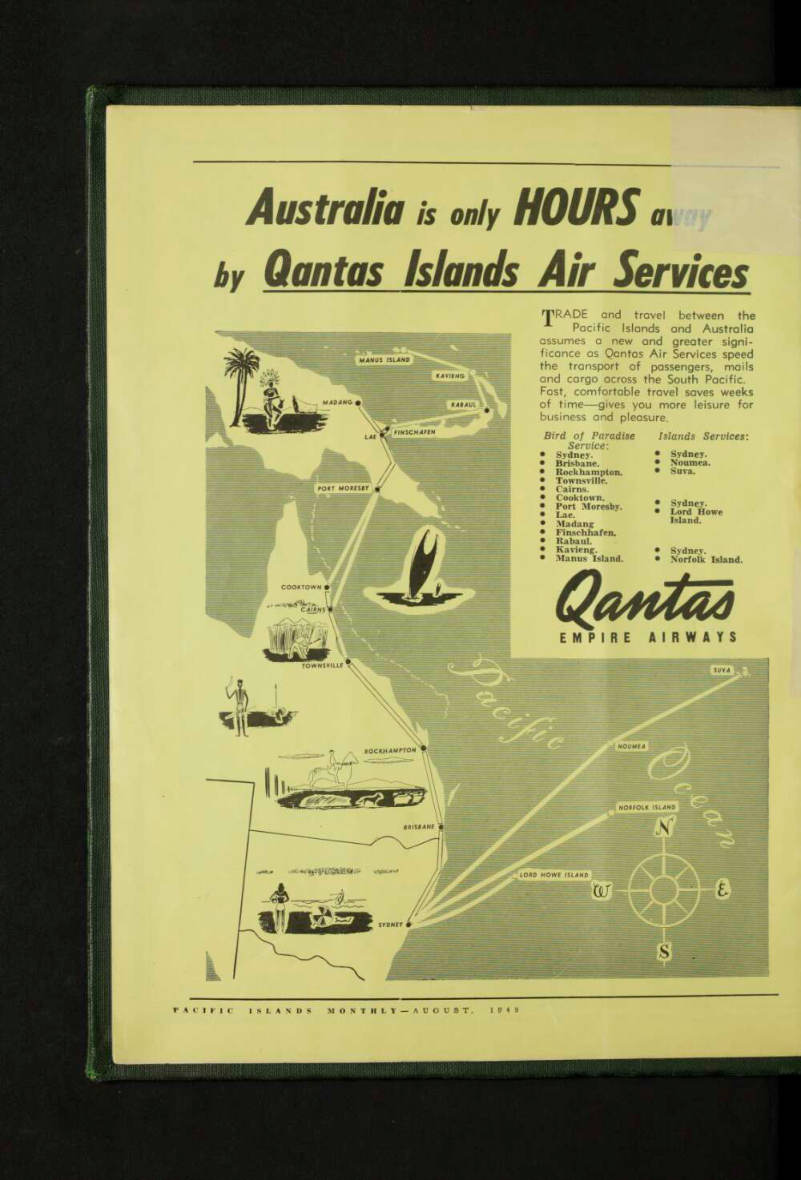
Australia is only HOURS away
by Qantas Islands Air Services
TRADE and travel between the Pacific Islands and Australia assumes a new and greater significance as Qantas Air Services speed the transport of passengers, mails and cargo across the South Pacific.
Fast, comfortable travel saves weeks of time—gives you more leisure for business and pleasure.
Islands Services : Sydney.
Noumea.
Suva.
Sydney.
Lord Howe Island.
Sydney.
Norfolk Island.
MANUS ISLAND
KAVIENG
MADANG
RABAUL
FINSCHAFEN
Bird of Paradise Service ; Sydney.
Brisbane.
Rockhampton.
Townsville.
Cairns.
Cooktown.
Port Moresby.
Lae.
Madang Finschhafen.
Rabaul.
Kavieng.
Manus Island.
LAE
PORT MORESBY
Qantas
COOKTOWN
CAIRNS
EMPIRE AIRWAYS
TOWNSVILLE
SUVA
NOUMEA
ROCKHAMPTON
NORFOLK ISLAND
BRISBANE
LORD HOWE ISLAND
E W
SYDNEY
S
3
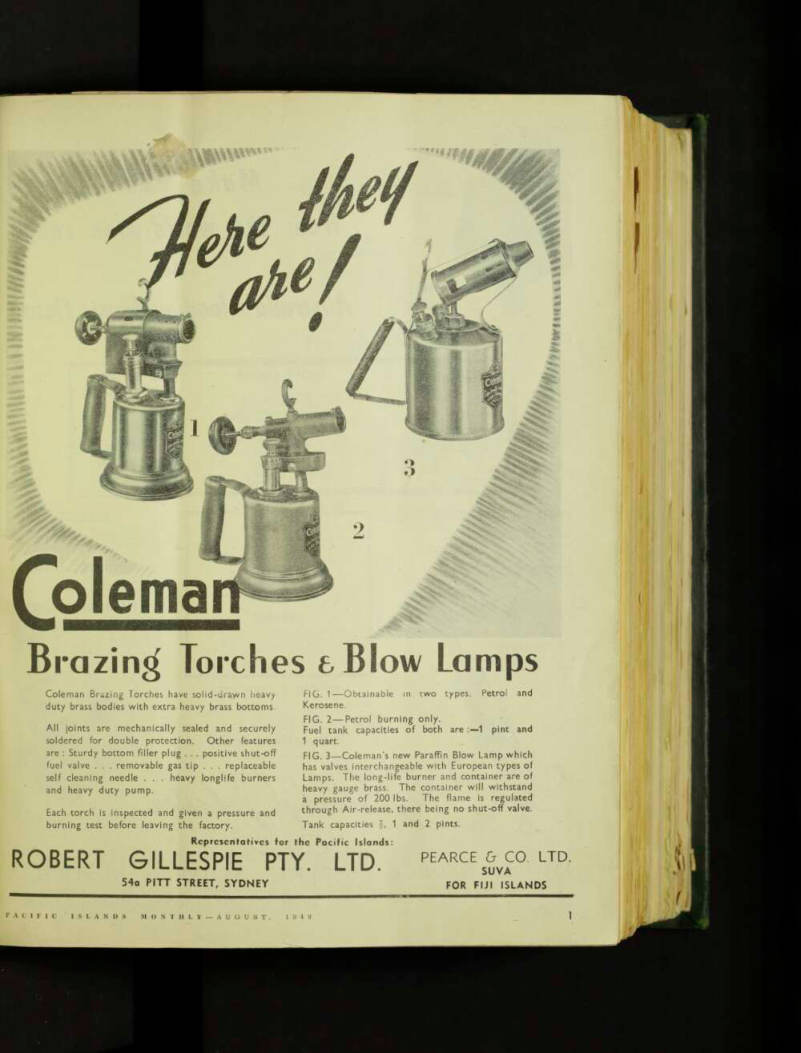
Brazing Torches & Blow Lamps
Coleman Brazing Torches have solid-drawn heavyduty brass bodies with extra heavy brass bottoms.
All joints are mechanically sealed and securely soldered for double protection. Other features are : Sturdy bottom filler plug . . . positive shut-off fuel valve . . . removable gas tip . . . replaceable self cleaning needle . . . heavy longlife burners and heavy duty pump.
Each torch is inspected and given a pressure and burning test before leaving the factory.
FIG. 1—Obtainable —Obtainable In two types. Petrol and Kerosene.
FIG. 2—Petrol burning only.
Fuel tank capacities of both are 1 pint and 1 quart.
FIG. 3—Coleman's new Paraffin Blow Lamp which has valves interchangeable with European types of Lamps. The long-life burner and container are of heavy gauge brass. The container will withstand a pressure of 200 lbs. The flame is regulated through Air-release, there being no shut-off valve.
Tank capacities 1 and 2 pints.
Representatives for the Pacific Islands:
ROBERT GILLESPIE PTY. LTD.
54a PITT STREET, SYDNEY
PEARCE & CO. LTD.
SUVA
FOR FIJI ISLANDS
model, £B7/19/6.
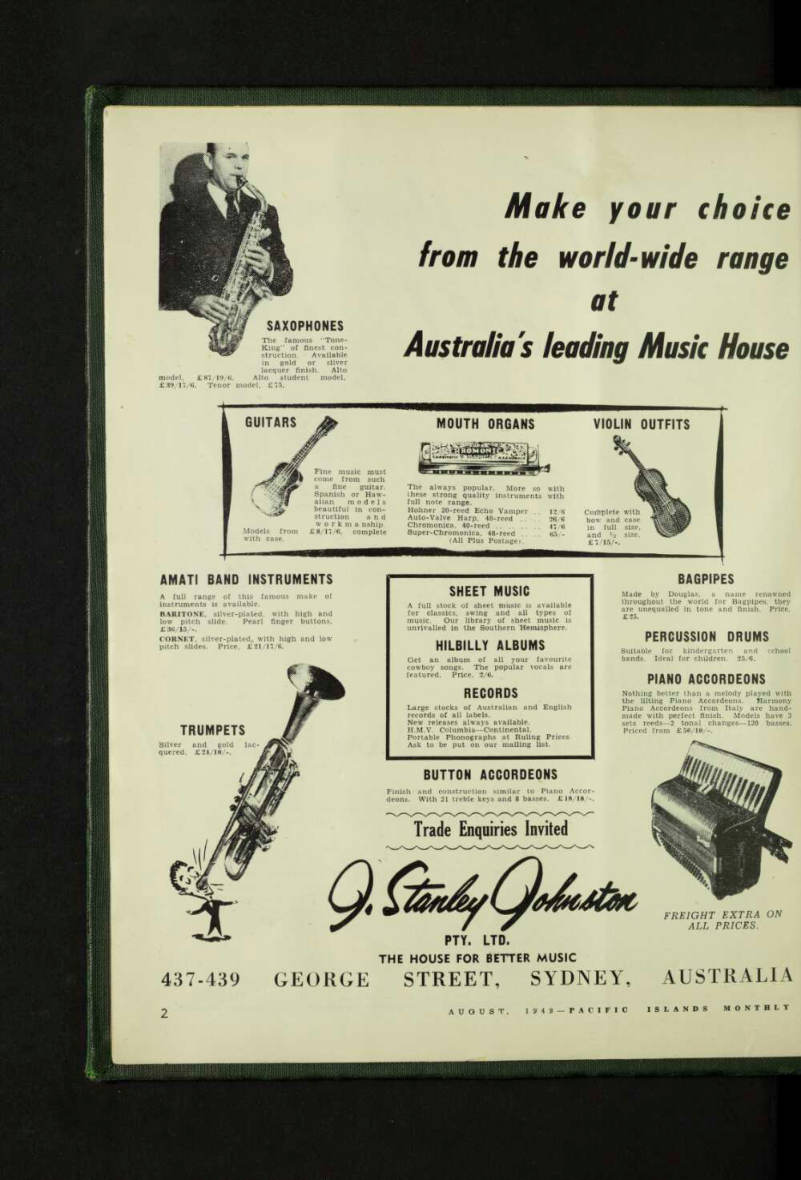
SAXOPHONES
The famous “Tone- King” of finest construction. Available in gold or silver lacquer finish. Alto Alto student model, £39/17/6. Tenor model, £75.
Make your choice
from the world-wide range
at
Australia's leading Music House
GUITARS
MOUTH ORGANS
VIOLIN OUTFITS
Fine music must come from such. fine guitar.
Spanish or Hawaiian models beautiful in construction and workmanship. £8/17/6, complete The always popular. More so with these strong quality instruments with full note range.
Hohner 20-reed Echo Vamper .. 12/8 Auto-Valve Harp, 40-reed . . .. 26/6 Chromonica, 40-reed 47/6 Super-Chromonica, 48-reed .. .. 65/- (All Plus Postage).
Complete with bow and case in full size, and ½ size, £7/15/-.
AMATI BAND INSTRUMENTS
A full range of this famous make of instruments is available.
BARITONE, silver-plated, with high and low pitch slide. Pearl finger buttons, £36/15/-.
CORNET, silver-plated, with high and low pitch slides. Price. £3l/17/6.
Silver and gold quered, £34/10/-.
TRUMPETS
SHEET MUSIC
A full stock of sheet music is available for classics, swing and all types of music. Our library of sheet music is unrivalled in the Southern Hemisphere.
HILBILLY ALBUMS
Get an album of all your favourite cowboy songs. The popular vocals are featured. Price, 3/6.
RECORDS
Large stocks of Australian and English records of all labels.
New releases always available.
H.M.V. Columbia —Continental.
Portable Phonographs at Ruling Prices.
Ask to be put on our mailing list.
BAGPIPES
Made by Douglas, a name renowned throughout the world for Bagpipes, they are unequalled in tone and finish. Price, £35.
PERCUSSION DRUMS
Suitable for kindergarten and school bands. Ideal for children. 35/6.
PIANO ACCORDEONS
Nothing better than a melody played with the lilting Piano Accordeons. Harmony Piano Accordeons from Italy are handmade with perfect finish. Models have 3 sets reeds—2 tonal changes—120 basses.
Priced from £56/10/-.
BUTTON ACCORDEONS
Finish and construction similar to Piano Accordeons. With 21 treble keys and 8 basses. £18/18/-.
Trade Enquiries Invited
437-439
PTY. LTD.
THE HOUSE FOR BETTER MUSIC
GEORGE STREET, SYDNEY,
FREIGHT EXTRA ON
ALL PRICES.
AUSTRALIA
Index to Advertisers
Atco Motor Mowers Pty., Ltd 83 Aluminium Union, Ltd 92 Achun, Gabriel . . 69 Angliss & Co. ... 46 Amplion (Aust.) Pty., Ltd. ... 37 AC Services ... 94 Atkins, Wm., Pty., Ltd. 79 Australian Health Services ... 26 Broomflelds ... 85 Baker, W. Jno., Pty., Ltd. ... 79 BP (SS) Co. . . . 38 Bethell, Gwyn & Co 67 Brunton’s Flour 19 Burns, Philp (New Hebrides), Ltd. . 15 Blundell & Spence 41 Berrys Bay Boat yard 33 Brown, Thos.. & Sons 25 Bank of NSW . . 16 Burnetts Dry Gin . 62 Burns, Philp (NG), Ltd. ... 55 Burns, Philp Trust Co., Ltd 87 Budge, James, Pty. 67 Caine’s Studio . . 32 W. R. Carpenter & Co. (Fiji), Ltd. . 33 Carpenter, Ltd., W.
R cov. iv.
Colonial Wholesale Meat ... 17 Colyer Watson (New Guinea), Ltd. . . 61 Crammond Radio Pty., Ltd. ... 73 Costello, Vince Garrick Hotel . .31 “Cystex” 69 Donald. A. 8., Ltd., Rarotonga . 27 Donaghy & Sons 35 Donald, Ltd., A. B. 42 Davison Paints Ltd 64 Dr. Williams Pink Pills 30 Dangar Gedye & Malloch ... 3 Etablissements, Donald 45 Enmore Poultry Farm 45 Electrolux Refrigerators . . 60 Ford Sherington . 71 Garrett & Davidson 100 Gillespie Pty., Ltd., Robert . . 1, 20, 32 Gregory, A., Pty., Ltd 81 Robt. Gillespie (NG), Ltd. . 71, 99 Gilbey’s Gin ... 34 Gillespie’s Flour §6 Grand Pacific Hotel Pty., Ltd. ... 4 Glaustan Hatchery 85 Gough & Co., E. J. 15 Grove & Sons, W.
H 86 Gordons Gin ... 81 Heinz & Co. Pty., Ltd., H. J. . . .59 Herco 30 Hoover, Francis . . 72 Hettig, August . . 66 Hawaiian Club . . 42 Halvorsen, Lars, Sons, Pty., Ltd. . 29 Hemingway & Robertson ... 28 International Trad ing Co 64 J. Stanley Johnson Pty., Ltd 2 Jones, Wm. A. . . 39 Kennedy, Capt. W.
L 26 Kasper Refrigera tion Pty., Ltd., 35, 39, 74 Kodak (Aust.) Pty., Ltd 72
Kosak, Robert . . 77 Kolynos, Inc. ... 80 Kopsen & Co., Ltd. 70 Kerr Brothers ... 22 Kwong Chong Bros. 26 Kui, George ... 28 Kraft Walker Cheese 63 Locker, Geo. J. . . 40 Manstocks ... 93 Mail Publicity Co. (Magazine Sub scriptions) . 29, 65 Maloney, N. F., & Co 35 Millers, Ltd., Suva 89’
Miscellaneous. 93, 95, 99 “Mendaco” ... 91 Mcllraths Pty., Ltd. 23 Morris, Hedstrom, Ltd., Suva ... 12 National Airways Corporation . . 24 Nordman, Oscar . 89 Nelson & Robertson Pty., Ltd 23 “Nixoderm” ... 94 Pacific Is. Society 46 Pan American Air ways 14 Pacific Islands Trading Co. ... 57 “Pinkettes” ... 92 Plypac ... 88 Pitt & Scott, Ltd. 27 Proprietary Pro ducts 57 Qantas Empire Air ways . . . cov. ii.
Queensland Insur ance Co 61 Robinson, G. H.. 36. 82 Reed. William E., 22, 88 Rohu, Sil . . . . 16 Salt 95 Scott, Ltd., J. ... 82 Shell Co 18 Southern Pacific Insurance Co. . 37 Stewarts & Lloyds (Aust.) Pty., Ltd. 31 Swallow & Ariell . 56 Steamships Trading Co,. Ltd. . . 36. 90 Sullivan & Co., C. 98 Tatham, S. E., & Co . 21 Tallerman & Pty., Ltd. ... 57 Taylor & Co., A. . 38 Tooth & Go. Pty., Ltd cov. iii.
Thornycroft (Aust.) Pty., Ltd. . . . 76 Tilley Lamps ... 68 Tillock & Co. ... 64 Tyneside Foundry & Engineering Co., Ltd 86 Union Manufactur ing & Export Co. 44 Vacuum Oil Co., Ltd. ... 78 Ventura Trading Co. Pty.. Ltd., l9, 85, 9'4 Vincent Chemical Co 43 Vincent Bros. . . 91 Vickers Gin ... 58 Harry West ... 43 Wunderlich, Ltd. . 77 Wright & Co. . . 97 Watson, Wm. H.. 75, 95 Watson-Victor . 93 White Satin ... 84 Wynne S. Breden Pty., Ltd 74 Widdop, H., & Co- Ltd. 65 Wills, W. D. & H. 0 96 Wright & Co., Ltd., E 76 Wakefield Green wood & Co. . . 66 Yorkshire Insur ance Co., Ltd. . . 15
Advertisements & other items, p. 5 (1 item)
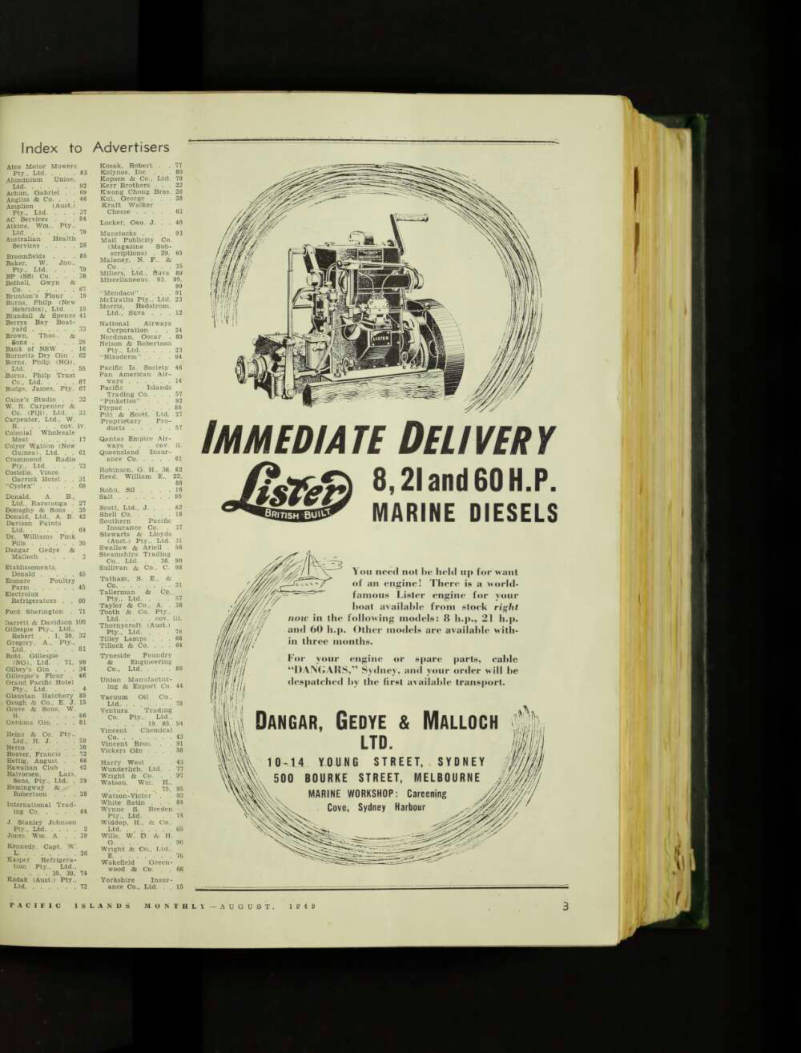
Immediate Delivery
8, 21 and 60 H.P.
MARINE DIESELS
Lister
You need not be held up for want of an engine! There is a worldfamous Lister engine for your boat available from stock right now in the following models: 8 h.p., 21 h.p. anti 60 h.p. Other models are available within three months. your engine or spare parts, cable “DANGARS,” Sydney, and your order will be despatched by the first available transport.
Dangar, Gedye & Malloch
LTD.
10-14 YOUNG STREET, SYDNEY
500 BOURKE STREET, MELBOURNE
MARINE WORKSHOP: Careening Cove, Sydney Harbour
In This Issue:
Editorial: “Fiji Governor Puts it Into Plain Words” 5 Travellers and Currency in New Caledonia 6 Unilever’s Profits 6 Remarkable Report About Fiji-Indian Scholarships for Fijians 7 M. Lasalle-Sere Represents Tahiti in Paris 7 No War Compensation for Property Owners in BSI and G & E Islands 7 Madang as it Is To-day 8 Paris Robbery Leads to New Caledo nian Court 8 Sausages for Rabaul 8 Governor Warns Fiji Indians of Over population Peril 9 Cost of Repatriating Indo-Chinese from French Pacific Territories .. 9 How Fiji Bananas are Sold in NZ 9 Australian G-G’s Visit to Papua-New Guinea 10 Australian Warship Shows Flag in Pacific 10 Papeete Admires the “Eridan” —but Sydney does not 11 Fiji Establishes New Army Forces .. 11 New Native Timber Industry on the Sepik River, NG 11 New Hotel for Rarotonga? 13 Fiji Governor at Labasa 13 Uneasiness in Relation to Copra Market —Assault on Sterling Seen as Threat to British Guarantee .. 15 South Pacific Languages—Dr. Capell Undertakes An Interesting Task 16 Chrome, The Key to N. Caledonian Economy 18 Another Cure fcr Malaria 18 Silver Jubilee of Bishop Scharmach 19 More Taxes for Fiji—Governor’s Grim W T arning 20 Papua Planters’ Difficulties Reviewed 22 Civil Service Staff Shortages in Fiji 23 RNZAF Helps Lau Islands Again .. 23
Australia’s Million Natives a Potential Headache 25 Dependents of Rabaul Victims— Ministers Squabble over Respon sibility 28 Conference of Native Peoples to be held in Fiji, in April 29 W. Samoa Considers Abolition of Empire Trade Preference 30 Operation Whoop—New Role for Qantas Plane 31 Coolie Discharged in Ocean Is. Case 32 Fiji has a Communist Party 32 French Market Disappears for Hebridean Copra 33 Unwanted Atolls—NZ Warship Finds a lot of Coconut Palms .. 35 BSI War-Scrap for Sale 35 £8,300,000 Allegedly Spent on Terri tories By Australia 35 Was Sentence on P. J. McDonald Harsh? 36 Twist Tobacco in New Guinea ... 37 Problems of Repatriating Tonkinese in New Hebrides 38 First Canadian Airliner at Nadi .. 39 New “King” Crowned on Mangaia Is. 41 Fiji’s Hydro-Electric Scheme —Another Expert Pays the Colony a Visit 41 Hinduism in Terms of Religion ... 42 Rabbits in Fiji—Report Being Investi gated 43 CIPA is in the Inter-Island Trans port Business Now 45 What Makes Manus Natives Grow? 46 TB Menace in Fiji—Plan to Use War Memorial Fund to Fight the Disease 46 “Talk-Talk” 47 High Society in the Bachelors’
Quarters 48 Thrills, Spills and Copra at Washing ton Island 49 The Navy Shows the Flag 50
Tropicalities 51 Echo of “Deep Water and Shoal” .. 53 How Rabaul Lost its Rain-Trees .. 53 The Malolo Lagoon 54 American Journalists'Expose Betrayal of Dutch in Indonesia 56 Rapid Fiji-Indian Population Increase 61 Australian Strike Causes Samoan Shortages 61 Where the Japs were Stopped ... 62 Fire Brigade Wanted in Western Samoa 62 Australia Builds an Oil Refinery .. 63 Cook Islands RC Visits Mangaia Is. 64 Exploitation of Native Boxers in Fiji 65 The Fiji-Indian Problem —Readers Offer Solutions 69 Serious Agricultural Pest on Norfolk Is 70 July 14—Tahiti’s Week of Revelry .. 71 Payment By Results —NG Reply to Mr. Ward's New Indenture System 74 The Month in Moresby 75 Small Ship Wrecked on New Britain Coast 79 Samoan Girl’s Successful Business Career 81 Plane and Shipping Timetables ... 82 NG Native Constables Provide Most of the Criminals 89 Cinema Shows in Pacific Islands .. 89 Metropolitan France’s Ignorance of Her Colonies 91 Rabaul Roundabout 94 Native Copra Industry in Fiji .. .. 97 In Defence of the Fijians 99 OBITUARY; Mrs. R. Chugg, 19: D. W.
Amos, 27; Mrs. Bertha Betham, 36; MRS. W. Cottrell-Dormer, 72; N.
Johnston, 81.
ORGANISATIONS: Planters’ Association of Papua, 22; New Guinea Women’s Club of Sydney, 92; New Britain Ladies' Club, 95.
INDUSTRIES: Gold, 9, 20; Copra, 15, 33; Rubber, 13; Oil, 43, 63, 98.
Advertisements & other items, p. 6 (1 item)
When in Suva
Delightfully situated in magnificent grounds overlooking Suva's beautiful harbour, the Grand Pacific Hotel is the social centre of Fiji. Specially designed for the tropic. Excellent cuisine, attentive service by trained Indian waiters and servants. Tariff from 20/- per day. Cable, "GRANPACIF" Suva, for reservations.
Stay at the Grand Pacific Hotel
Pacific Islands Monthly
The Newspaper-magazine of the South Seas
[Registered at the G.P.O., Sydney, for transmission by post as a newspaper] Published Once Each Month and Circulated in Australia and New Zealand and in the following Pacific Territories and Islands Groups:
Australian Territory of Papua.
Trustee Territory (Australia) of New Guinea.
Australian Territory of Norfolk Island.
New Zealand Territory of Cook Islands.
Trustee Territory (NZ) of Western Samoa.
British Colony of Fiji.
British Solomon Islands Protectorate.
British Protectorate of Tongan Islands.
British Crown Colony of Gilbert and Ellice Islands.
Trustee Territory of Nauru.
British and French Condominium of New Hebrides.
French Colony of New Caledonia.
French Colony of Oceania (Tahiti, etc.).
American Territory of Eastern Samoa.
American Territory of Hawaiian Islands.
Owned and Produced by Pacific Publications Pty., Ltd., Union House, 247 George Street, Sydney.
Telephone: General Office and Advertising, BW 5037.
P.O. Box 3408
Registered Address for Telegrams, Radiograms, and Cables: “Pacpub,” Sydney.
Contributions.
Articles, Stories, and Photographs dealing with Pacific Islands subjects are invited and will be paid for on publication.
Subscription Rates.
Per Annum, Pre-paid, Including Postage.
In Australia, New Zealand, Fiji, New Guinea, Papua, Western S:.;roa. Cook Islands, Tonga, British Sol_ -is, Gil bert and Ellice Colony, Nauru, and United Kingdom 18 0 Elsewhere $3.50 £1 1 0 Single Copies 1 6
Editor and Publisher:
R. W. Robson, P.R.G.S.
Assistant Editor: JUDY TUDOR.
General Office: Union House, 247 George Street, Sydney. Telephone: BW 5037.
Advertising Manager: W. E. Rogers.
Representative In London.
J. T. Wallis, Coronation House, 4 Lloyds Avenue, London, E.C.3, from whom may be obtained copies of Pacific Islands Monthly, Pacific Is. Year Book, advertising schedules, etc.
Representative In U.S.A.
Pacific Islands Trading Co..
244 California St., San Francisco, U.S.A.
Agents.
The following are authorised to receive sub scriptions for Pacific Islands Monthly:— Burns, Phllp & Co., Ltd., and Burns Phllp (South Sea) Co., Ltd. All branches.
W. R. Carpenter & Co., Ltd. All branches.
Morris, Hedstrom, Ltd. All branches.
Steamships Trading Co., Papua. All branches.
W. M. Caldwell, Suva, Fiji.
Cook Islands Trading Co., Rarotonga, Cook Is.
Oscar Nordman, Papeete, Tahiti.
Islands Branches and Representatives of W. H.
Grove & Sons, Ltd., Auckland, New Zealand.
Ed. Pentecost, Noumea, New Caledonia.
Societe Gubbay Kerr et Cle, Noumea, New Caledonia.
Vol. Xx. No. 1.
August, 1949.
1/6 Per Copy Price 1 Prepaid, p.a.; 18/- Aust In USA, p.a.; $3.50.
Words
Fiji’s Governor Put It Into Plain Words
THOSE who read, on page 9 of this issue, the Fiji Governor’s frank and forthright speech on the subject of Indian over-population in Fiji, probably will say: “Very interesting— but, thank God, a problem peculiar to Fiji.” It is nothing of the kind.
The situation in Fiji is a complete microcosm of the situation in the South Pacific generally. The Europeans and Pacific Islanders of these lands south of the equator are menaced as sharply by Asiatic overpopulation, and the truly horrible fecundity of the Asiatic, as are the 120,000 natives of Fiji.
In South-eastern Asia there are more than one thousand million people, whose rate of natural increase is very great. In these South Pacific lands there are about nine million Europeans, 150,000 Polynesians and 120,000 Fijians whose natural increase is slow and steady — what might be called normal — and over a million primitive Melanesians, concerning whom there are no reliable vital statistics. Inevitably, over-crowded Asia will tend to spill over into the more comfortable lands of the South Pacific.
Until Western civilisation spread across the world, there was little menace in the Asiatic populations.
Nature there maintained a rough balance. Terrific fecundity, developed in the course of countless centuries, took care of a high death-rate, caused
by lack of medical knowledge, sani tation, etc. When populations in creased beyond the capacity of the land to provide for them, they were wiped out by wars, plagues and famines.
During the past two hundred years, the Europeans have taken corn munity orderliness and medical skill to Asia, whereby wars have been pre vented and diseases checked and famines partly combated. By and large, the death-rate has been re duced, but the birth-rate has re mained as high as ever—with the result, of course, that most Asiatic populations, in the last half century, have increased in a startling way.
INVARIABLY, as cultured communities attain a high standard of living their birth-rate falls and comes within manageable proportions.
That, in the course of time, should happen in the case of the Asiatic communities. But their numbers are so enormous, and there is such a fierce scramble for the available means of sustenance, that their climb to higher living standards is slow and painful. In the meantime, their overcrowded state constitutes a very real menace to all neighbours who have more living space and greater means of sustenance.
That is the position in Fiji. And that, in a general sense, is the situa tion all along the Indian Ocean and Pacific seaboard of Asia.
FOR proof of it, we need go no farther than our daily news paper. China, gone Communist, threatens to become expansionist and aggressive. Philippines, Malaya, India, are showing active resentment of any suggestion that the immigration of their nationals should be restricted by the Pacific countries. The Indo nesians already are making plans for the removal of all European institu tions from the East Indies.
The over-all picture is complicated by the fact that some Asiatic countries are inclined to join Euro pean countries in a Pacific Pact against other Asiatic countries which have gone Communist, under the direction of a European country. But, presently, it must develop as a struggle between East and West, be tween European and Asiatic.
IT may seem that Sir Brian Free ston, coming new to this area only 18 months ago, was handed in Fiji a problem more forbidding than any one man in that position should be called upon to tackle. It is a problem that should long ago have been dealt with at the highest level in London, and not left as a nightmare to haunt every occupant of Government House in Suva.
None who has seen the harassed men of the Colonial Office meeting the suave but insistent Indians and the grim Fijian chiefs on the hill above the pleasant Suva gardens could have had any doubt that the half-dozen Governors who have held office since Hutson were very glad to move on.
Each did his best with an appar ently insoluble problem. Fletcher,
with praiseworthy foresight, killed the electoral system before it could get out of hand. Richards, clearly seeing the crux of the problem, applied him self to the reservation of Fijian lands.
But it has remained for Sir Brian Freeston, with most praiseworthy courage, to put into a public speech a clear and logical summary of a problem that may no longer be ignored. The Indians will snarl at him, and some Europeans perhaps will be critical and hostile; but Sir Brian Freeston will go down in Pacific history as the first man game enough to grab this monster by the throat, and drag it out into the public gaze, and demand that the problem be dealt with, openly and honestly.
“Either they (the Indians) will con tinue to multiply beyond the available means of subsistence, with consequent poverty and distress; or they will maintain and improve their present standard of living by a voluntary re duction in their natural rate of increase.” With those grave words, Sir Brian Freeston proved himself worthy of the trust that is imposed in a British Colonial Governor. There are the alternatives: there is no other way of getting around the Fiji prob lem. He has placed the issue squarely before the Indians.
ANYONE can see, of course, that Sir Brian, in naming the problem’s most embarrassing factor the Indians’ high birth-rate—may find himself in conflict with the most powerful institution of the European world, the Catholic Church. That Church has set its face most resolutely against birth-control; and Sir Brian’s speech could be read as advocacy of birth-control. Sir Brian was well aware of that, when he prepared his statement—which only makes us admire his courage the more.
Actually, there need be no conflict whatever. The Indian birth-rate in Fiji, over 46 per thousand, is pheno menal, and partly the result of a peculiar social and domestic outlook, which the Catholic Church certainly would not endorse. The wise men of the Catholic Church probably see the Fiji problem as clearly as does the Governor, and they almost certainly will agree with him that the solution, if it is to be found, must be provided by the Indians themselves. They will realise that neither the Governor, nor
anyone else in authority, would advocate what might be called mech anical birth-control. What everyone with any intelligent outlook over the Pacific Islands is urging is that a change in Indian living conditions in Fiji could be quite simply brought about by the Indians themselves, re sulting in higher standard of life for the Indians, and a less calamitous rate of natural increase. It would involve mostly a change in the Fiji- Indian way of political thought.
At that point, it should be possible for Europeans, Fijians and Indians to come together in an atmosphere of mutual tolerance and goodwill to jointly seek a solution of the Fiji- Indian problem.
Handy Sydney Addresses
PACIFIC ISLANDS SOCIETY meets every fourth Wednesday of each month at History House, 8 Young Street, Sydney.
President: Major A. C. Swinbourne.
Tel.: XJ 3205.
New Guinea Women’S Club Meets In
the Feminist Club Rooms, 7th Floor, 77 King every Thursday morn ing at 11; and approximately once each month in the evening.
Polynesian Club Of Sydney—Meets
regularly—evening social activities.
Ring Mr. Moran (president) on FW 4601 (evenings and week-ends) or Miss Dorothea Kerr (secretary) on BW 1038 (day-time only).
Pacific Travel Agency And Sydney
office of Fiji Tourist Board—7th Floor, Union House, 247 George Street, Sydney. BW 5037.
Travellers and Currency In New Caledonia
New Caledonia
ALTHOUGH New Caledonia is eager to obtain Australian exchange, the Government is not doing anything to make easier the conditions of entry of Australian tourists into the Colony.
One of the chief irritations is the Bureau Economique.
When the overseas traveller arrives in Noumea, he is forced to hand over to officials every bit of currency he pos sesses. He gets a receipt for it, of course, and the money is sent to the Bank. Then the traveller is obliged to go to the Bureau Economique to get a cheque-book, and sign various docu ments. He then is allowed to sign cheques drawn on the bank.
When he is ready to leave the Colony, the whole complicated and irritating pro cess is put into reverse. Certain French officials behave like little dictators, and the bank (the Bank of Indo-China, of course) appears to have been given com plete control of exchange in every shape and form.
Recent visitors to New Caledonia have complained to the “PIM” of these con ditions, and of the fearfully high cost of everything; and they say that any one planning a pleasure visit to the Colony should take the famous advice of Mr. Punch —and “Don’t”.
Bodyguard For Vila Resident
A PERSON or persons at Vila, New Hebrides have been trying to do bodily and material harm to M. Max Frouin. Several times attempts have been made to set fire to his store; and recently an attempt was made to gain entrance to his dwelling at Mele; then when he was about to leave Vila for home one day he was attacked in his car. The Police Commissioner has given him a bodyguard of five militiamen.
Vila authorities are on the lookout for thieves who have been active of late.
Most daring of recent robberies took place in a building where a number of Tonkinese were indulging in their favourite gambling game. A man entered, clad in a big cloak, swept all their banknotes into his pocket and disappeared while the Tonkinese sat rigid with fear.
The Tahitian administration is offer ing a bonus for rats. Tails should be sent to Papeete whereupon payment will be made, but the inhabitants of Uturoa Island find it too much trouble to pack up the tails and post them, so they are demanding that payment should be made available on presentation of the tails locally.
Unilever Profits
THE international combine known as Unilever apparently came through the war unscathed and is continuing its international activities as happily as it did in the halcyon period between the wars.
Unilever affairs are of great interest in all the lands where the coconut palm grows because, before World War 11, Uni lever was the primary factor in fixing the world price of copra. It could do this because its international character allowed it to do what it wished with the vegetable and animal oil markets. It was singularly successful in playing one kind of oil against another, so that the prices of all were maintained at a level which suited Unilever. Since the war, as the result of various kinds of governmental controls, Unilever has not exercised the same power over the markets—although its influence still is very great.
It was announced, in July, that during the year the consolidated profits of Lever Bros, and Unilever, Ltd., soap and mar garine manufacturers, in Britain, were £7,161,505 Sterling—which was no less than £1,874,687 higher than the previous year.
The consolidated profits of the Dutch section of the combine were over 35,000,000 florins, which was nearly 1,000,000 florins bigger than the previous year.
The combine has branches in other countries as well.
Viscount Leverhulme, governor of Lever Brothers and Unilever, Ltd. (who died recently in the USA, on his way home from Australia) left an estate of a gross value of £2,357,039. Net personalty was £2,199,548. Estate duty paid amounts to £1,656,479.
Mr. Maloney!
The Drinks Were On
ABOUT three months ago, in Port Moresby, sundry friends took Mr. N.
F. Maloney firmly by the arm and led him to a place of public refreshment, and introduced him to sundry exciting liquors. For Mr. Maloney had let it be known that a new son, Peter, had been born to Mrs. Maloney at a private hospi tal, in Brisbane: and the glad occasion had to be suitably marked.
A couple of weeks later, along came the June “PIM,” with a brief intimation that a Maloney son and heir had been born in Melbourne.
Melbourne? What did this mean?
Maloney friends called forthwith upon Maloney pere, and took him apart, and demanded the truth of these things. They had drunk happily to a Brisbane birth; and now they insisted on going into re verse, and drinking to a Melbourne birth —and the cost of it was on papa!
They would not believe him when he protested that it was “a printer’s error”; and he has appealed to us. Sadly, we admit the mistake: Peter’s first glimpse of this tortured world was gained in Bris bane. But the drinks are still on Mr. Maloney. Established institutions, whether newspapers or taxgatherers, have no mercy upon paterfamilias.
During the absence on furlough of Mr.
Henderson, British Consul in Tahiti, Mr.
George Hunt is acting as British Con sul. Mr. Hunt spent most of his life in the Royal Air Force and served in both World Wars. He took his discharge about 1944 and has been for some years in the South Pacific—especially Auckland, Rarotonga, Fiji and Tahiti. His re lationship with the French authorities is particularly happy.
He Says He Did
Not Say It
Remarkable Report About Fiji- Indian Scholarships
THERE has been a little storm in a tea-cup over “Indian Scholarships” in Fiji—amusing, to the distant on looker, but embarrassing to the principals on the spot.
The Government of India recently de cided to grant three scholarships, tenable at Indian universities, to young Indians resident in Fiji.
It was not a very wise gesture. If there ever is to be any peaceful solution of the Indian problem in Fiji, the present strong links between India and the Fiji Indians must be removed or reduced. The grant ing of scholarships in this way only tends to create new cultural relations between India and Fiji. Therefore, in the view of the more thoughtful Europeans and Fijians, the scholarship system is un desirable.
On June 29, in the Suva Town Hall, at the instance of the Indians, a public meeting was held to say farewell to two of the Indian scholarship-winners. Mr.
Vishnu Deo, MLC, presided, and among those present were the Mayor of Suva (Mr. Alport Barker), the Director of Education (Mr. Howard Hayden) and the Commissioner for the Government of India (Mr. S. A. Waiz), A speech was made by Mr. Waiz. Next day, in the “Fiji Times” (whose owner editor is Mr. Barker and who was pre sent on the platform) it was reported that Mr. Waiz had said that it was proposed that the Indian Government should ex tend the Fiji scholarship scheme to in clude two native Fijian students, who could go to Indian universities for “higher education” and to “learn some thing of the arts and crafts of that great country, whose glories exceed those of ancient Greece.” It was reported, also, that Mr. Waiz said he had consulted the Secretary for Fijian Affairs (Sir Lala Sukuna); that a selection of two students would soon be made; and he “hoped the Fijians would return to their own country and tell their people here something of the wondeiful country where they had completed their education.”
THE report, of course, caused a sensa tion. If true, it not only disclosed an almost unforgiveable impertin ence on the part of the Government of India, but an astonishing attitude of mind on the part of Sir Lala Sukuna.
No one knows what happened then in the private rooms of officialdom: but al most immediately there was an emphatic disclaimer by both Mr. Waiz and Sir Lala Sukuna.
In a formal letter to the Fiji Govern ment, Mr. Waiz insisted that he had said nothing of the kind —his remarks had been completely misinterpreted and misreported.
Sir Lala let it be known that he had not been consulted regarding any Indian scholarship plan, and had not approved of it.
There, at last report, the matter rested, with sundry high official personages breathing heavily. But—no “correction” has appeared in the “Fiji Times.”
In a way, it is quite an intriguing mystery. I am inclined to put my money on Alport Barker, mayor and editor. He is not, in any sense, an irresponsible per son, and I cannot believe that he would create that speech—which he reported in some detail —out of nothing. He has sat tight and said not a word: and, as far as I can find out, the somewhat distressed
Mr. Waiz has made no protest to him.
Which may or may not be significant.
Anyway, we may take it that no Indian scholarships are going to be offered this
year to Fijian students.
-R. W. Robson.
Represent Tahiti
M. Lasalle-Sere To Represent Tahiti He Is Also French Commissioner For SPC
TAHITI’S new Councillor of the French Republic (he represents the Colony in Paris), is M. Robert F. J, Lasalle- Sere, who is also Inspector-General of Colonies and Senior Commissioner for France on the South Pacific Commission.
M, Lasalle-Sere’s election (nine votes) as Councillor has been contested by Maitre Weil-Curiel (who received eight votes), on the score that M. Sere, being an official in the Pacific “en mission” could not become representative of a country covered in that mission.
It was pointed out that there was nothing to prevent an Inspector of Colonies from presenting himself for election, and that in any case, he was not “en mission” but on leave granted for personal reasons at the time of the elec tion.
M. Lasalle-Sere was recently made an honorary citizen of Noumea for his work in inducing the South Pacific Commission to make its headquarters in that, at pre sent, all-too-expensive town.
Astonishing Story About
Petrol Drums
IN the course of a lively discussion in the Australian Parliament on June 15, as the result of charges of ad ministrative blundering and muddling in New Guinea made by the Melbourne Herald correspondent, Mr. Osmar White, members demanded a general inquiry into New Guinea conditions.
The Acting Minister for the Territories refused any inquiry, and attacked the Herald, and said most of the charges were untrue.
In the course of the debate, Mr.
McEwen said he had been advised that about two years ago there was a dis posals sale at Milne Bay, in which a lot was “knocked down” in curious circum stances to a man named Stubbs for £10,000.
Mr. McEwen said he was advised that Stubbs proceeded to sell part of the lot, which consisted solely of petrol drums, for £80,000, and that the return to Stubbs for the one transaction was at least £100,000.
Report Of Rugby Tour
Criticised
Prom Our Own Correspondent SUVA. July 10.
REPORTS that arrangements have been made at Sydney for a Fijian Rugby tour of Australia in 1951 have been neither confirmed nor denied by the Fiji Rugby Union.
In the meantime, there has been sharp criticism in and out of the press by Fijians and Europeans who insist that as Fiji is indebted almost exclusively to New Zealand for its Rugby, a Dominion tour should be made to return the Maori team’s 1948 visit before any tour of Aus tralia is contemplated.
No Compensation!
Bitter Blow for Property Owners In Solomons and Gilberts
THE dwindling hopes of Solomon Islands and Gilbert Islands property-owners that they might some day receive war damage compensation were finally dashed on August 7, when Sir Brian Freeston (High Commissioner for the Western Pacific) published a statement in
Bsi.
His Excellency said that the report of the War Damage Claims Commissioner had been carefully considered. As the normal revenues of the British Solomon Islands and the Gilbert and Ellice Islands were already insufficient to meet adminis trative costs, and as the principal factor to be considered was the degree to which compensation payments were needed to effect rehabilitation, or restore economic productivity, it had been decided, in con sultation with the British Government, that there should be no war damage com pensation scheme in respect of either of the Territories named.
The announcement —which is not re markable for its clarity—has been badly received in the British Territories, although it was not unexpected.
During the Jap invasion, the British Solomon Islands and the Gilbert and Ellice Colony were at least as badly damaged as New Guinea. New Guinea owners were very generously compensated in 1944-47 from a special Australian fund; owners elsewhere got nothing.
The British Government said, however, about 1946, that if Japan paid any war damage compensation, property-owners in all Britain’s invaded Pacific Territories (Malaya, Borneo, Singapore, Hong Kong, Solomons, Gilberts, etc.) might receive something. Hopes were raised when Com missioners were appointed to receive and assess claims.
But, in the past two or three years, it has become clear that no substantial war damage compensation is to be extracted from Japan; and, meantime, under Socialist administration, British national finance has seriously deteriorated. It now is Britain’s policy to make her Colonies share in her financial troubles. (See article on page 20.) Had there not been a principle involved, the BSI and Gilbert owners might have received something. But acknowledgment of any liability there would automatically have included war damage in the bigger British Territories nearer to Asia; and that would have represented an enormous sum.
Editorial Note
There are still a few millions left in the Australian War Damage Compensation Fund.
Why should consideration not be given now to the plan that Australia should take over the British Solomon Islands, and re habilitate planters and traders there as she did in Papua-New Guinea?
It is the only way in which the Solomon Islands will develop any real economic value —it will never be done under the present regime.
The Solomons are bound to come under Australian rule, sooner or later. Why not now?
New Head For Abm
THE former rector of St. John’s Church, Canberra, Archdeacon C. S. Robert son, was commissioned chairman of the Australian Board of Missions in July.
A commissioning service in St. An drew’s Cathedral, Sydney, was conducted by Archbishop Mowll.
Archdeacon Robertson succeeds the Rt. Rev. J. H. Cranswick who has re tired after many years as chairman of the ABM.
Madang As It Is
To-Day
From a New Guinea Correspondent MADANG seems lacking in civic pride.
The only apparent attempt to brighten the place up is that of the Commonwealth Bank, which has laid out floral gardens outside its office.
Even then, the immediate vicinity is marred by scrap war-time rubbish lying about in confusion.
As one leaves the ship’s gangway one treads precariously over a dilapidated wharf, for fear of spraining one’s ankle or breaking one’s neck. Right opposite are the unsightly, black-iron Quonset copra sheds: and, as one makes one’s way in puddles to the centre of activities, one is confronted with huge stacks of 44gallon drums—some day, the township will blow up.
Alas! Here is the steel skeleton of the war-time Port Maintenance Section —a shock to the aesthetic!
But, what is this ahead? It is the ghastly quarters of the staff of Messrs.
Burns, Philp (New Guinea). Ltd., perched high on the pyramidal concrete blocks of the German regime.
Konedobu, and its paper shacks, is palatial compared to this depressing slum-like zone. Here, there, and every where, are small, battered, unsightly native hovels. The rotten hessian sur rounding the lone tennis-court stands out in bold relief against the magnificent verdantly-green sports-oval, surrounded by its majestic, stately shade-trees.
The arboreal splendour of Madang’s main avenues bears testimony to the old Germans’ civic pride, industry and fore sight. Very few of these monarchs were damaged during the war, and to wander along these beautiful thoroughfares is de lightful when the moon is full and the Chinese shanty-town, and the natives’ hovels, and the 44-gallon drums, and the uncut kunai, are out of sight.
A steel bridge now crosses the Meiro. and the 16-miles or so of coranus road to Sek (headquarters of the Catholic Mis sion) may be travelled with ease.
It is distressing to see the huge swim ming pool, so ably constructed by the armed forces, in disrepair and unused, owing to marine growth of a dangerous nature. Cannot something be done?
Beer? Yes, there’s plenty—at £2 per dozen 20 oz. bottles —a Chinese brew —but “New Guinea would drink anything through an oily rag.”
Prices are extortionate, but you must pay or starve —there’s no redress and no price control. Here are some samples:—
You have to be in the upper strata to afford bread.
The best tribute I can pay Madang is that it is the prettiest spot on the coast— but it needs a fortnight and 100 “boys” to clean it up, and dump the war-time rub bish in the sea, and centralise those dangerous oil drums.
And I do say that the Madang native wharf-labourers are the most cheerful and efficient toilers in New Guinea. I’d back them against Port Moresby, Rabaul or Lae, any time.
Peaceful, magnificent Madang—with your harbour, coastal beauty, enchanting islets, your emerald greenness and shady avenues: you deserve a better fate!
Per lb. s. d.
Sugar 8?
Rice 85 Butter 4 6 Eggs, per doz 6 4 Bacon 3 9 Tin of Beef 2 5 Tea 7 3 Mutton 2 4 Sausages 2 6
Paris Robbery Leads To New Caledonian
Court
AFTER eight years, justice caught up with Raymond Dubois in a New Caledonian court recently. He was a member of a small film unit visiting the Colony.
His trial, which has aroused great in terest in New Caledonia, resulted in a verdict of guilty; the charge was one of theft.
He was sentenced to two years im prisonment, with expulsion from the Colony for a period of ten years.
The whole thing reads like a page from a French novel, for the act for which he was found guilty took place in Paris, and a special witness brought from France, was a police inspector, and fingerprint expert named de Massiac. The date of the crime was November 14, 1941.
Towards 10 o’clock on that night, a young woman was charged by a Paris tailor named Charles Gliksmann to look after his business while he was away on service. Later, she thought she saw a light on the first floor. She called the police who found the place in great disorder, and many rolls of cloth miss ing. A hole had been made in the plaster wall, rolls of cloth had been un rolled on the floor to deaden sound, and a hole gaped in the ceiling of the shop.
After a thorough examination, the police were able to report that finger prints on an empty bottle found in the place were those of Dubois who had been convicted of theft in 1936 and sentenced to 15 months imprisonment. But Dubois had completely disappeared.
Dubois, in the New Caledonion Court, denied the charge, saying that at the
time of the theft he had been living with a woman who owned a bar in the neighbourhood of Les Halles (the Covent Garden market area of Paris). He claimed that the bottle with his finger prints must have been taken by the thieves to the tailor’s, but that he had had nothing to do with the theft.
The Paris police reported that Dubois was a man of doubtful morals, that he had lived on women and had run a number of brothels (maisons closes).
During his speech for the prosecution, the New Caledonian Avocat General said that he would do all in his power to purify the New Caledonian air of a number of gangsters from the metropolis who were seeking refuge in the Colony.
Sausages For Rabaul!
From Our Own Correspondent
Rabaul, Aug. 9.
MR. FLORENTINO, who is associated with Anderson’s Island Industries and who has been connected with sausage manufacturing in numerous parts of the world, has been visiting Rabaul for past weeks.
He has supervised the installation of machinery to manufacture sausages here, and the plant is now in operation.
Anderson’s Island Industries hope soon to install more machinery for the manu facture of other small goods. (Editorial Note: There is always some thing faintly humorous about sausages.
However, fresh meat has always been a problem in Papua-New Guinea and if this firm can do anything towards providing cheap meat for Europeans or natives, it will be rendering the Territory a real ser vice).
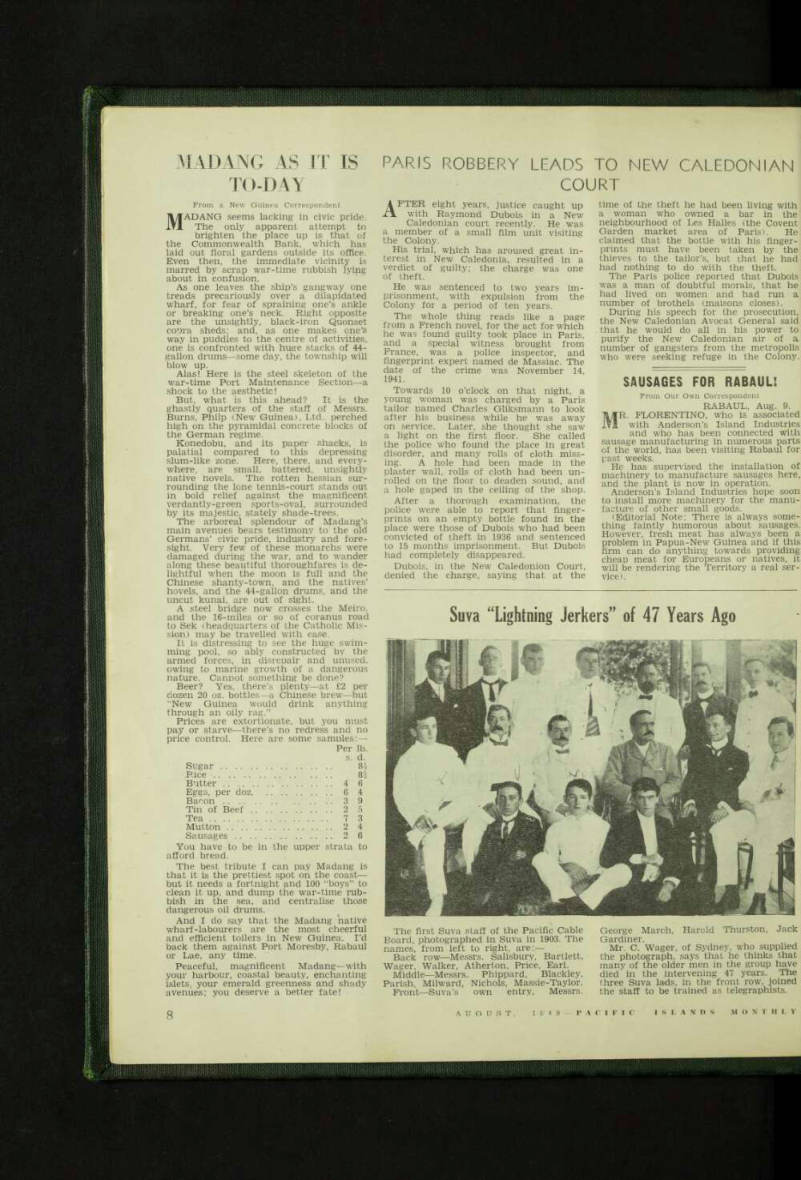
Suva “Lightning Jerkers” of 47 Years Ago
The first Suva staff of the Pacific Cable Board, photographed in Suva in 1903. The names, from left to right, are: — Back row—Messrs. Salisbury, Bartlett, Wager, Walker, Atherton, Price, Earl.
Middle —Messrs, Phippard, Blackley, Parish, Milward, Nichols, Massie-Taylor.
Front —Suva’s own entry. Messrs.
George March, Harold Thurston, Jack Gardiner.
Mr. C. Wager, of Sydney, who supplied the photograph, says that he thinks that many of the older men in the group have died in the intervening 47 years. The three Suva lads, in the front row, joined the staff to be trained as telegraphists.
Governor Warns Fiji Indians
Of Over-Population Peril
Britain Will Maintain Pledges Given to Fijians
From Our Own Correspondent SUVA, August 2.
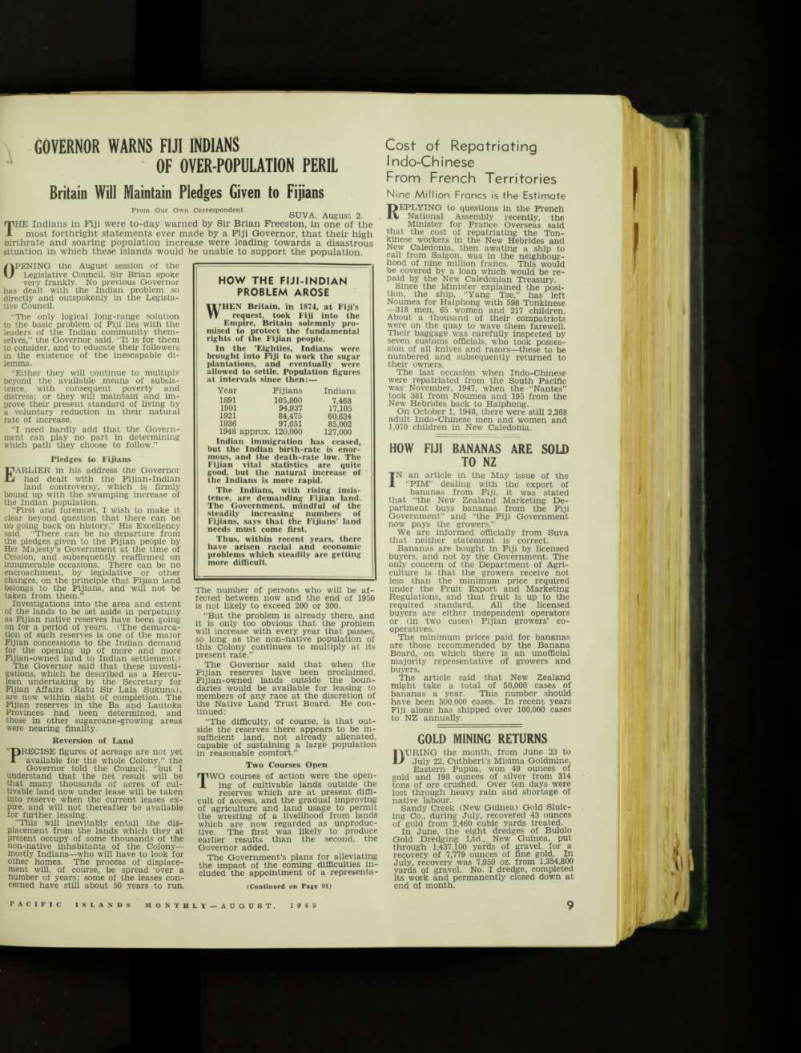
THE Indians in Fiji were to-day warned by Sir Brian Freeston, in one of the most forthright statements ever made by a Fiji Governor, that their high birthrate and soaring population increase were leading towards a disastrous situation in which these islands would be unable to support the population.
OPENING the August session of the Legislative Council, Sir Brian spoke very frankly. No previous Governor has dealt with the Indian problem so directly and outspokenly in the Legisla tive Council.
“The only logical long-range solution to the basic problem of Fiji lies with the leaders of the Indian community them selves,” the Governor said. “It is for them to consider, and to educate their followers in the existence of the inescapable di lemma.
“Either they will continue to multiply beyond the available means of subsis tence, with consequent poverty and distress; or they will maintain and im prove their present standard of living by a voluntary reduction in their natural rate of increase.
“I need hardly add that the Govern ment can play no part in determining which path they choose to follow.”
Pledges to Fijians EARLIER in his address the Governor had dealt with the Fijian-Indian land controversy, which is firmly bound up with the swamping increase of the Indian population.
“First and foremost, I wish to make it clear beyond question that there can be no going back on history,” His Excellency said. “There can be no departure from the pledges given to the Fijian people by Her Majesty’s Government at the time of Cession, and subsequently reaffirmed on innumerable occasions. There can be no encroachment, by legislative or other changes, on the principle that Fijian land belongs to the Fijians, and will not be taken from them.”
Investigations into the area and extent of the lands to be set aside in perpetuity as Fijian native reserves have been going on for a period of years. (The demarca tion of such reserves is one of the major Fijian concessions to the Indian demand for the opening up of more and more Fijian-owned land to Indian settlement.) The Governor said that these investi gations, which he described as a Hercu lean undertaking by the Secretary for Fijian Affairs (Ratu Sir Lala Sukuna), are now within sight of completion. The Fijian reserves in the Ba and Lautoka Provinces had been determined, and those in other sugarcane-growing areas were nearing finality.
Reversion of Land PRECISE figures of acreage are not yet available for the whole Colony,” the Governor told the Council, “but I understand that the net result will be that many thousands of acres of cul tivable land now under lease will be taken into reserve when the current leases ex pire, and will not thereafter be available for further leasing.
“This will inevitably entail the dis placement from the lands which they at present occupy of some thousands of the non-native inhabitants of the Colony— mostly Indians—who will have to look for other homes. The process of displace ment will, of course, be spread over a number of years; some of the leases con cerned have still about 50 years to run.
The number of persons who will be af fected between now and the end of 1950 is not likely to exceed 200 or 300.
“But the problem is already there, and it is only too obvious that the problem will increase with every year that passes, so long as the non-native population of this Colony continues to multiply at its present rate.”
The Governor said that when the Fijian reserves have been proclaimed, Fijian-owned lands outside the boun daries would be available for leasing to members of any race at the discretion of the Native Land Trust Board. He con tinued: “The difficulty, of course, is that out side the reserves there appears to be in sufficient land, not already alienated, capable of sustaining a large population in reasonable comfort.”
Two Courses Open TWO courses of action were the opening of cultivable lands outside the reserves which are at present diffi cult of access, and the gradual improving of agriculture and land usage to permit the wresting of a livelihood from lands which are now regarded as unproduc tive. The first was likely to produce earlier results than the second, the Governor added.
The Government’s plans for alleviating the impact of the coming difficulties in cluded the appointment of a representa
(Continued on Page 91)
Governor Warns Indians (Continued from page 9) tive settlement committee in each of the three districts of the Colony.
Charged with assisting displaced tenants to find other accommodation and
with formulating schemes for making new areas (outside the reserves) available for occupation, these committees’ proposals will be reviewed by a central co-ordinat ing committee at Suva, on which the Native Land Trust Board will be strongly represented.
Indian Leftist Paper’s Views On Population
SUVA, August 4.
A FEW days before the Governor (Sir Brian Freeston) warned the Indians in Fiji that their rapid numerical increase is creating a disastrous situation, as much for themselves as for others, the “Pacific Review,” a Leftist Indian weekly, stated its views in the opposite direction.
The Colony’s European community was described as “migratory, consisting mostly of birds of passage,” and the paper alleges that the fact that more Europeans than Indians came into Fiji in 1948 “throws an interesting sidelight on the immigration policy of the Government of Fiji” (This is an echo of the Immigration Bill battle in 1947 when the Indians fought bitterly for the retention of un restricted Indian immigration while the Fijians, showing an unprecedented de gree of anger, demanded an end to it.) The “Pacific Review,” which in the past has actually claimed to be a cham pion of the Fijians, now declares that
“the Fijian community is a land-owning community which enjoys better housing, better food, better clothing, more literacy, and better medical facilities than the Indian.”
Nothing is added to justify this in credible statement —which is simply un true.
Dealing with the population increase in 1948, when the Indian birthrate leaped to 46.33 per thousand and the Fijian dropped slightly to 36.39, the paper says: “The other communities (non-European), more particularly the Indians and the Fijians, contributed their quota by a natural increase and thereby rendered a very useful and commendable service to the underpopulated Colony.”
It must be added that ever since the 1946 Census (which inspired the Immi gration Ordinance) authorities have been warning that Fiji’s population, thanks mainly to the Indians, is within sight of the danger-line maximum.
How The Fiji-Indian
Problem Arose
WHEN Britain, in 1874, at Fiji’s request, took Fiji into the Empire, Britain solemnly pro mised to protect the fundamental rights of the Fijian people.
In the ’Eighties, Indians were brought into Fiji to work the sugar plantations, and eventually were allowed to settle. Population figures at intervals since then:— Year Fijians Indians 1891 105,800 7,468 1901 94,937 17,105 1921 84,475 60,634 1936 97,651 85,002 1948 approx. 120,000 127,000 Indian immigration has ceased, but the Indian birth-rate is enor mous, and the death-rate low. The Fijian vital statistics are quite good, but the natural increase of the Indians is more rapid.
The Indians, with rising insis tence, are demanding Fijian land.
The Government, mindful of the steadily increasing numbers of Fijians, says that the Fijians’ land needs must come first.
Thus, within recent years, there have arisen racial and economic problems which steadily are getting more difficult.
Indo-Chinese
Cost of Repatriating Indo-Chinese From French Territories Nine Million Francs is the Estimate
REPLYING to questions in the French National Assembly recently, the Minister for France Overseas said that the cost of repatriating the Ton kinese workers in the New Hebrides and New Caledonia, then awating a ship to call from Saigon, was in the neighbour hood of nine million francs. This would be covered by a loan which would be re paid by the New Caledonian Treasury.
Since the Minister explained the posi tion, the ship, “Yang Tse,” has left Noumea for Haiphong with 598 Tonkinese —318 men, 65 women and 217 children.
About a thousand of their compatriots were on the quay to wave them farewell.
Their baggage was carefully inspected by seven customs officials, who took posses sion of all knives and razors—these to be numbered and subsequently returned to their owners.
The last occasion when Indo-Chinese were repatriated from the South Pacific was November, 1947, when the “Nantes” took 381 from Noumea and 195 from the New Hebrides back to Haiphong.
On October 1, 1948, there were still 2,368 adult Indo-Chinese men and women and 1,070 children in New Caledonia.
How Fiji Bananas Are Sold
To Nz
IN an article In the May Issue of the “PIM” dealing with the export of bananas from Fiji, it was stated that “the New Zealand Marketing De partment buys bananas from the Fiji Government” and “the Fiji Government now pays the growers.”
We are informed officially from Suva that neither statement is correct.
Bananas are bought in Fiji by licensed buyers, and not by the Government. The only concern of the Department of Agri culture is that the growers receive not less than the minimum price required under the Fruit Export and Marketing Regulations, and that fruit is up to the required standard. All the licensed buyers are either independent operators or (in two cases) Fijian growers’ co operatives.
The minimum prices paid for bananas are those recommended by the Banana Board, on which there is an unofficial majority representative of growers and buyers.
The article said that New Zealand might take a total of 50,000 cases of bananas a year. This number should have been 500,000 cases. In recent years Fiji alone has shipped over 100,000 cases to NZ annually.
Gold Mining Returns
DURING the month, from June 23 to July 22, Cuthbert’s Misima Goldmine, Eastern Papua, won 49 ounces of gold and 198 ounces of silver from 314 tons of ore crushed. Over ten days were lost through heavy rain and shortage of native labour.
Sandy Creek (New Guinea) Gold Sluic ing Co., during July, recovered 43 ounces of gold from 2,460 cubic yards treated.
In June, the eight dredges of Bulolo Gold Dredging Ltd., New Guinea, put through 1,437,100 yards of gravel, for a recovery of 7,779 ounces of fine gold. In July, recovery was 7,959 oz. from 1,354,800 yards of gravel. No. 1 dredge, completed its work and permanently closed down at end of month.
Governor-General
Australian Governor-General Visit to Papua and New Guinea
From Our Own Correspondent
Port Moresby, Aug. 3.
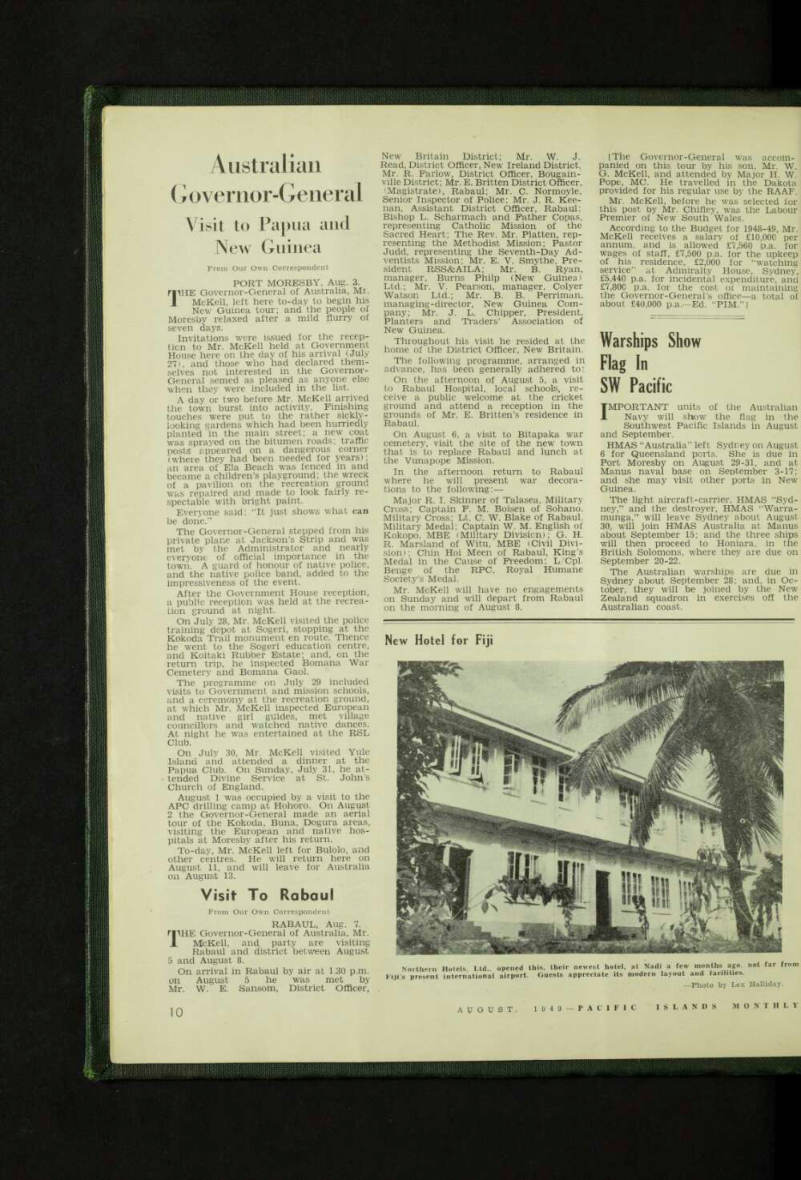
THE Governor-General of Australia, Mr.
J McKell, left here to-day to begin his New Guinea tour; and the people of Moresby relaxed after a mild flurry of seven days.
Invitations were issued for the recep tion to Mr. McKell held at Government House here on the day of his arrival (July 27), and those who had declared them selves not interested in the Governor- General semed as pleased as anyone else when they were included in the list.
A day or two before Mr. McKell arrived the town burst into activity. Finishing touches were put to the rather sickly looking gardens which had been hurriedly planted in the main street: a new coat was sprayed on the bitumen roads; traffic posts appeared on a dangerous corner (where they had been needed for years); an area of Ela Beach was fenced in and became a children’s playground: the wreck of a pavilion on the recreation ground was repaired and made to look fairly re spectable with bright paint.
Everyone said; “It just shows what can be done.”
The Governor-General stepped from his private plane at Jackson’s Strip and was met by the Administrator and nearly evervone of official importance in the town. A guard of honour of native police, and the native police band, added to the impressiveness of the event.
After the Government House reception, a public reception was held at the recrea tion ground at night.
On July 28, Mr. McKell visited the police training depot at Sogeri, stopping at the Kokoda Trail monument en route. Thence he went to the Sogeri education centre, and Koitaki Rubber Estate; and, on the return trip, he inspected Bomana War Cemetery and Bomana Gaol.
The programme on July 29 included visits to Government and mission schools, and a ceremony at the recreation ground, at which Mr. McKell inspected European and native girl guides, met village councillors and watched native dances.
At night he was entertained at the RSL Club.
On July 30, Mr. McKell visited Yule Island and attended a dinner at the Papua Club. On Sunday, July 31, he at tended Divine Service at St. John’s Church of England.
August 1 was occupied by a visit to the APC drilling camp at Hohoro. On August 2 the Governor-General made an aerial tour of the Kokoda, Buna, Dogura areas, visiting the European and native hos pitals at Moresby after his return.
To-day, Mr. McKell left for Bulolo, and other centres. He will return here on August 11, and will leave for Australia on August 13.
Visit To Robaul
From Our Own Correspondent
Rabaul, Aug. 7.
THE Governor-General of Australia, Mr.
McKell, and party are visiting Rabaul and district between August 5 and August 8.
On arrival in Rabaul by air at 1.30 p.m. on August 5 he was met by Mr. W. E. Sansom, District Officer,
New Britain District; Mr. W. J.
Read, District Officer, New Ireland District, Mr. R. Farlow, District Officer, Bougain ville District; Mr. E. Britten District Officer, (Magistrate), Rabaul; Mr. C. Normoyle, Senior Inspector of Police; Mr. J. R. Kee nan, Assistant District Officer, Rabaul; Bishop L. Scharmach and Father Copas, representing Catholic Mission of the Sacred Heart; The Rev. Mr. Flatten, rep resenting the Methodist Mission; Pastor Judd, representing the Seventh-Day Ad ventists Mission; Mr. E. V. Smythe, Pre sident RSS&AILA; Mr. B. Ryan, manager, Burns Philp (New Guinea) Ltd.; Mr. V. Pearson, manager. Colyer Watson Ltd.; Mr. B. B. Perriman. managing-director, New Guinea Company; Mr. J. L. Chipper, President, Planters and Traders’ Association of New Guinea.
Throughout his visit he resided at the home of the District Officer, New Britain.
The following programme, arranged in advance, has been generally adhered to: On the afternoon of August 5, a visit to Rabaul Hospital, local schools, re ceive a public welcome at the cricket ground and attend a reception in the grounds of Mr. E. Britten’s residence in Rabaul.
On August 6, a visit to Bitapaka war cemetery, visit the site of the new town that is to replace Rabaul and lunch at the Vunapope Mission.
In the afternoon return to Rabaul where he will present war decora tions to the following;— Major R. I. Skinner of Talasea, Military Cross; Captain F. M. Boisen of Sohano.
Military Cross; Lt. C. W. Blake of Rabaul.
Military Medal; Captain W. M. English of Kokopo, MBE (Military Division): G. H.
R. Marsland of Witu, MBE (Civil Divi sion) ; Chin Hoi Meen of Rabaul, King’s Medal in the Cause of Freedom; L/Cpl.
Benge of the RPC, Royal Humane Society’s Medal.
Mr. McKell will have no engagements on Sunday and will depart from Rabaul on the morning of August 8.
The Governor-General was accompanied on this tour by his son, Mr. W.
G. McKell, and attended by Major H. W.
Pope, MC. He travelled in the Dakota provided for his regular use by the RAAF.
Mr. McKell, before he was selected for this post by Mr. Chifley, was the Labour Premier of New South Wales.
According to the Budget for 1948-49, Mr.
McKell receives a salary of £10,000 per annum, and is allowed £7,560 p.a. for wages of staff, £7,500 p.a. for the upkeep of his residence, £2,000 for “watching service” at Admiralty House, Sydney, £5,440 p.a. for incidental expenditure, and £7,800 p.a. for the cost oi maintaining the Governor-General’s office—a total of about £40,000 p.a.—Ed. “PIM.”]
Flag In
Warships Show Flag In SW Pacific
IMPORTANT units of the Australian Navy will show ithe flag in the Southwest Pacific Islands in August and September.
HMAS “Australia” left Sydney on August 6 for Queensland ports. She is due in Port Moresby on August 29-31, and at Manus naval base on September 3-17; and she may visit other ports in New Guinea.
The light aircraft-carrier, HMAS “Syd ney,” and the destroyer, HMAS “Warra munga,” will leave Sydney about August 30, will join HMAS Australia at Manus about September 15; and the three ships will then proceed to Honiara, in the British Solomons, where they are due on September 20-22.
The Australian warships are due in Sydney about September 28: and, in Oc tober, they will be joined by the New Zealand squadron in exercises off the Australian coast.
New Hotel for Fiji
Northern Hotels. Ltd., opened this, their newest hotel, at Nadi a few months ago, not far from Fiji’s present international airport. Guests appreciate its modern layout and facilities. —Photo by Lex Halliday.
"Eridan"
Papeete Admires the "Eridan"
But Sydney Does Not
THE Tahiti Chamber of Commerce has asked that the Messageries Mari times liner “Eridan” be kept on the Marseilles-Papeete-Via-Noumea run be cause it is the only vessel “capable of maintaining the prestige of the French flag in the Pacific”.
Tahiti, no doubt, knows about the charges of inferior accommodation which appear in the Australian Press when this and other French ships reach Sydney.
When the “Eridan” arrived in Sydney some months ago, she was described as a “hell-ship”, because of accommodation given migrant passengers who had paid about £100 for a single fare.
The Messageries Maritimes Co. de clared that this was not its fault, as all these passengers had paid their fares through some European tourist agency.
Some English passengers who travelled under these conditions complained bitterly about troopship sleeping arrange ments, bad food, general insanitary con ditions, lack of bathrooms and toilets, and the conduct of some crew members.
Illustrations in the Australian press pre sented a grim picture of what travel in the ship must have been like.
There has never been any complaint about the “Eridan’s” first-class accom modation. But this is not taken into account in Australian ports, where the blast of newspaper publicity has robbed her of any prestige she might enjoy in Papeete or elsewhere.
Army Forces
Fiji Establishes New Army Forces
From Our Own Correspondent SUVA. August 4.
THE Legislative Council of Fiji to-day gave unanimous assent to the Fiji Military Forces Bill, which provides for Regular, Territorial and Reserve Forces in the Colony.
During the debate on the Bill, the Acting Colonial Secretary (Mr. R. M.
Taylor) said: “This Bill will help Fiji de fend the way of life which the Western democracies enjoy and intend to continue to enjoy.”
Referring to the decisive conscription referendum in New Zealand, Mr. Taylor said: “This is Fiji’s opportunity to show that she stands beside her neighbour in the task of mutual defence.”
Members representing all three races spoke in Council in support of the Bill.
Of the four Indian members (Mr. A. D.
Patel was absent) Mr. Vishnu Deo was the only speaker. He commended the fact that under the new legislation the terms of service will be the same for all races. (The reason usually given for Indian non-participation in the Second World War forces in Fiji is that Indians were not offered the same pay as Euro peans.) Now that the Bill has become law, the Government proposes to start limited re cruiting. The initial intake will consist almost entirely of men from the existing Territorials, who are almost exclusively Fijians.
Rev. Stewart Hurse, BA, and Mrs.
Hurse, have gone from Australia to take up work in the Presbyterian Mission field in the New Hebrides, vacated by the Rev. W. F. Paton. Mr. Paton retired a few months ago owing to ill-health.
Timber!
N. Guinea Administration Helps River Natives To Establish New Industry
A contributor describes how, in
NG, Sepik natives take rafts of
logs hundreds of miles down the great river, to a saivmill near the
coast, for the production of
much-needed timber.
DID the natives become tired of waiting for their “big cargo”? Or was it due to the powerful influence of the energetic ADO of Angoram? Or was it brought about by a combination of both?
At all events, we have entered the timber era on the Sepik and all over the land near the main river and its tribu taries the bush is echoing to the sound of axes and the fall of trees —Quila or soft wood —of any size manageable by the natives.
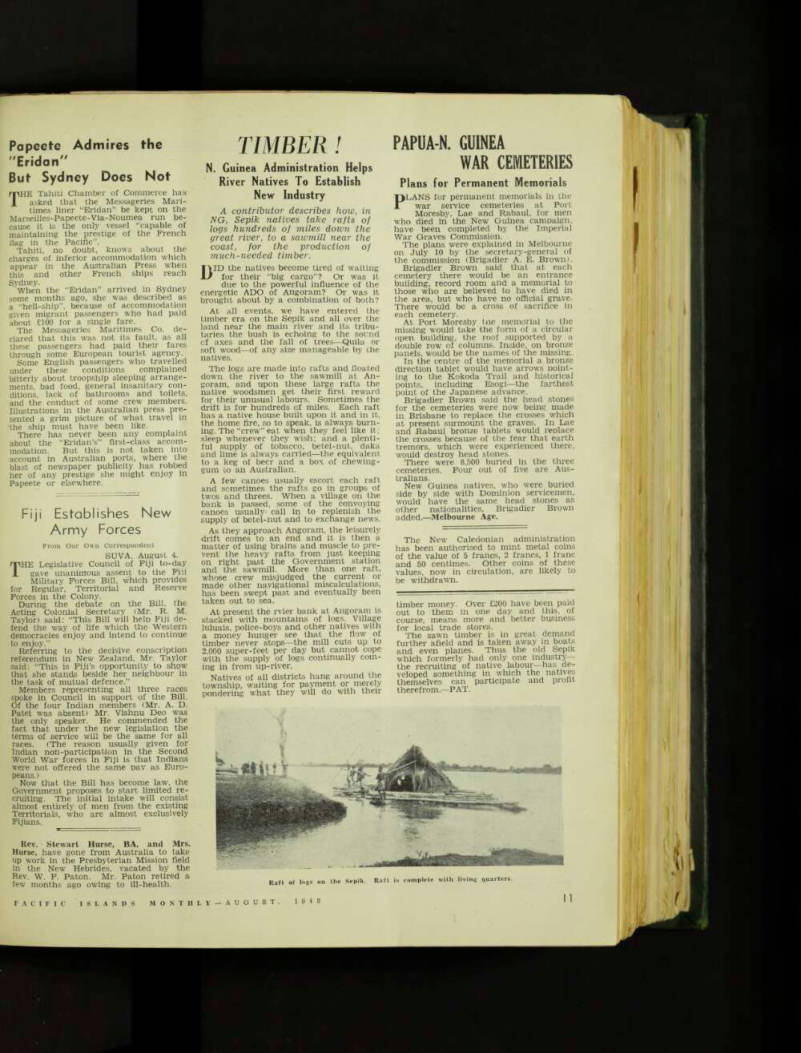
The logs are made into rafts and floated down the river to the sawmill at An goram, and upon these large rafts the native woodsmen get their first reward for their unusual labours. Sometimes the drift is for hundreds of miles. Each raft has a native house built upon it and in it, the home fire, so to speak, is always burn ing. The “crew” eat when they feel like it; sleep whenever they wish; and a plenti ful supply of tobacco, betel-nut, daka and lime is always carried —the equivalent to a keg of beer and a box of chewing gum to an Australian.
A few canoes usually escort each raft and sometimes the rafts go in groups of twos and threes. When a village on the bank is passed, some of the convoying canoes usually call in to replenish the supply of betel-nut and to exchange news.
As they approach Angoram, the leisurely drift comes to an end and it is then a matter of using brains and muscle to pre vent the heavy rafts from just keeping on right past the Government station and the sawmill. More than one raft, whose crew misjudged the current or made other navigational miscalculations, has been swept past and eventually been taken out to sea.
At present the rvier bank at Angoram is stacked with mountains of logs. Village luluais, police-boys and other natives with a money hunger see that the flow of timber never stops—the mill cuts up to 2,000 super-feet per day but cannot cope with the supply of logs continually com ing in from up-river.
Natives of all districts hang around the township, waiting for payment or merely pondering what they will do with their
timber money. Over £200 have been paid out to them in one day and this, of course, means more and better business for local trade stores.
The sawn timber is in great demand further afield and is taken away in boats and even planes. Thus the old Sepik which formerly had only one industry— the recruiting of native labour—has de veloped something in which the natives themselves can participate and profit therefrom. —PAT.
Raft Of logs on the Sepik. Raft is complete with living quarters.
Papua-N. Guinea
War Cemeteries
Plans for Permanent Memorials
PLANS for permanent memorials in the war service cemeteries at Port Moresby, Lae and Rabaul, for men who died in the New Guinea campaign, have been completed by the Imperial War Graves Commission.
The plans were explained in Melbourne on July 10 by the secretary-general of the commission (Brigadier A. E. Brown).
Brigadier Brown said that at each cemetery there would be an entrance building, record room and a memorial to those who are believed to have died in the area, but who have no official grave.
There would be a cross of sacrifice in each cemetery.
At Port Moresby tne memorial to the missing would take the form of a circular open building, the roof supported by a double row of columns. Inside, on bronze panels, would be the names of the missing.
In the centre of the memorial a bronze direction tablet would have arrows noint ing to the Kokoda Trail and historical points, including Esogi—the farthest point of the Japanese advance.
Brigadier Brown said the head stones for the cemeteries were now being made in Brisbane to replace the crosses which at present surmount the graves. In Lae and ,Rabaul bronze tablets would replace the crosses because of the fear that earth tremors, which were experienced there, would destroy head stones.
There were 8,500 buried in the three cemeteries. Four out of five are Aus tralians.
New Guinea natives, who were buried side by side with Dominion servicemen, would have the same head stones as other nationalities. Brigadier Brown added. —Melbourne Age.
The New Caledonian administration has been authorised to mint metal coins of the value of 5 francs, 2 francs, 1 franc and 50 centimes. Other coins of these values, now in circulation, are likely to be withdrawn.
Advertisements & other items, p. 14 (1 item)
Morris Hedstrom Limited
General Merchants, Importers and Exporters, OFFICE Shipowners, Plantation Owners, SUVA ' FUI Established Commission and Insurance Agents 1868
SERVICE IN THE SOUTH PACIFIC TERRITORIES
THROUGH our Large Establishments in Suva and our Numerous Branches, we distribute a wide and comprehensive range of General Merchandise and provide almost every kind of service. Our departments and associated businesses include:
DRAPERY
MOTOR SALES
AND SERVICE
TOBACCO
TIMBER AND
BUILDING
GROCERY
CONFECTIONERY
HARDWARE
ELECTRICAL
LIQUORS
DRUGS
bj
Branches Throughout Fiji, Samoa and Tonga
There is a Branch or Agent of Morris Hedstrom Limited in every Town in the Three Territories.
We are Sole Agents in these Territories for British Drug Houses Ltd.
Electrolux Ltd.
Ford Motor Co.
General Electric Co. Ltd.
Goodyear Tyre Gr Rubber Co.
B. A. Hjorth Gr Co. (Primus Products) Imperial Chemical Industries Ltd.
International Harvester Export Co.
Matson Navigation Company Max Factor and Co. Inc.
Ransomes, Sims Gr Jefferies Ltd.
Ruston Gr Hornsby Ltd.
Vacuum Oil Co. Pty. Ltd.
Yorkshire Copper Works Ltd.
Morris Hedstrom Limited, are LLOYD'S AGENTS in Fiji and Samoa.
IN AUSTRALIA: IN GREAT BRITAIN:
Morris Hedstrom (Aust.) Pty. Ltd., Morris Hedstrom Limited, Asbestos House, Africa House, 65 York Street, SYDNEY Kingsway, LONDON
Prospects Brighter
Representations to Minister on Papuan Rubber
From Our Own Correspondent
Port Moresby, August 3.
PAPUAN rubber planters are still wait ing for the Federal Government to do something about the collapse of the Australian market for their rubber, but they are more hopeful now than they have been since the trouble started four months ago.
The President and Secretary of the Papuan Planters’ Association (Mr. E. V.
Crisp and Mr. E. A. James), returned to Port Moresby from Sydney on July 20 after interviewing the Minister for Ex ternal Territories, Mr. Ward. They re ported that he would submit proposals for immediate aid and future stabilisation to Federal Cabinet.
They reported also that Mr. Ward had said that the industry should be protected and maintained: the delegation felt that prospects for an early solution of planters’ difficulties were good.
Later, the Administrator informed the Association of Mr. Ward’s proposals.
These the Association found acceptable.
Next step is to submit the proposals to Cabinet —the Association does not know whether this has been done, as yet.
Meanwhile, on Mr. Ward’s advice, planters are continuing production as usual.
Hotel For Rarotonga?
IT is believed that plans are under con sideration for the construction of a big hotel in Rarotonga—something that has been needed for many years.
Rarotonga, from the pleasure-traveller’s point of view, is a very attractive place; but there can be no tourist traffic worthy of the name until suitable accommodation is available.
A new hospital is to be built, and it is suggested that the present hospital build ings could be used in the construction of the hotel. The present Resident Com missioner, Mr. Tailby, is believed to be in favour of the hotel proposal.
Fiji Governor At Labasa
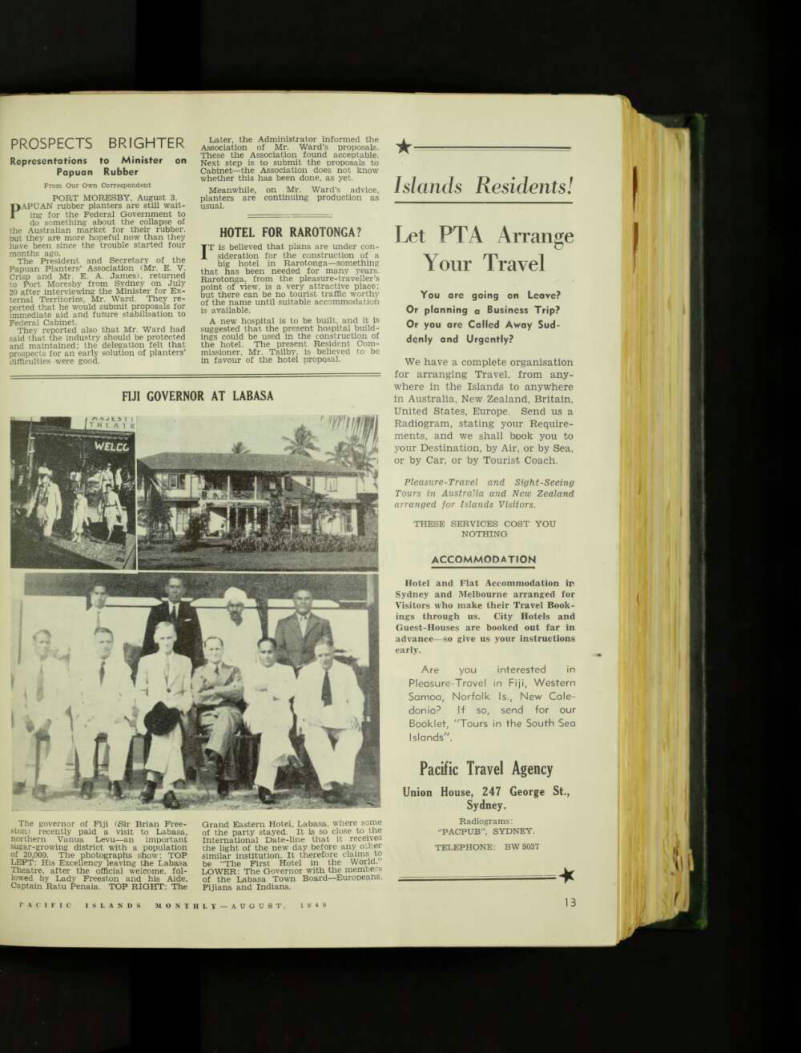
The governor of Fiji (Sir Brian Free ston) recently paid a visit to Labasa, northern Vanua Levu—an important sugar-growing district with a population of 20,000. The photographs show: TOP LEFT: His Excellency leaving the Labasa Theatre, after the official welcome, fol lowed by Lady Freeston and his Aide, Captain Ratu Penaia. TOP RIGHT: The
Grand Eastern Hotel, Labasa, where some of the party stayed. It is so close to the International Date-line that it receives the light of the new day before any other similar institution. It therefore claims to be “The First Hotel in the World."
LOWER: The Governor with the members of the Labasa Town Board— Europeans, Fijians and Indians.
Advertisements & other items, pp. 15-16 (1 item)
Islands Residents!
Let PTA Arrange
Your Travel
You ore going on Leave?
Or planning a Business Trip?
Or you are Called Away Suddenly and Urgently?
We have a complete organisation for arranging Travel, from anywhere in the Islands to anywhere in Australia, New Zealand, Britain, United States, Europe. Send us a Radiogram, stating your Requirements, and we shall book you to your Destination, by Air, or by Sea, or by Car, or by Tourist Coach.
Pleasure-Travel and Sight-Seeing Tours in Australia and New Zealand arranged for Islands Visitors.
THESE SERVICES COST YOU
NOTHING
ACCOMMODATION
Hotel and Flat Accommodation in Sydney and Melbourne arranged for Visitors who make their Travel Bookings through us. City Hotels and Guest-Houses are booked out far in advance —so give us your instructions early.
Are you interested in Pleasure-Travel in Fiji, Western Samoa, Norfolk Is., New Caledonia? If so, send for our Booklet, "Tours in the South Sea Islands".
Pacific Travel Agency
Union House, 247 George St.,
Sydney.
Radiograms:
“PACPUB”, SYDNEY.
TELEPHONE : BW 5037
NOW!
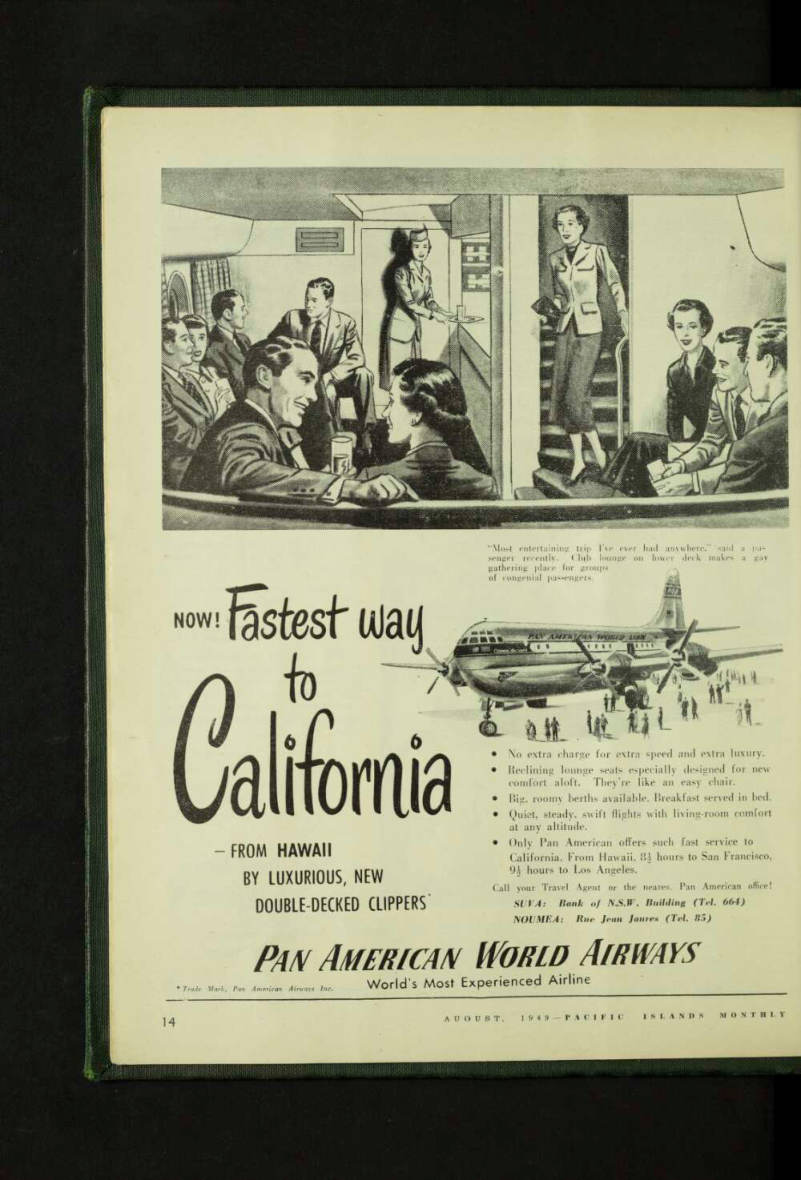
Fastest way
‘‘Most entertaining trip I've ever had anywhere.” said a pa-> senger recently. Club lounge on lower deck makes a gay gathering place for groups of congenial passengers.
FROM HAWAII
BY LUXURIOUS, NEW
DOUBLE-DECKED CLIPPERS
• No extra charge for extra speed and extra luxury. • Reclining lounge seats especially designed for new comfort aloft. They’re like an easy chair. • Big, roomy berths available. Breakfast served in bed. • Quiet, steady, swift flights with living-room comfort at any altitude. • Only Pan American offers such fast service to California. From Hawaii. hours to San Francisco, hours to Los Angeles.
Call your Travel Agent or the neares: Pan American office!
SUVA: Batik of N.S.fV. Building (Tel. 664) NOUMEA: Bue Jean Jaures (Tel. 85) * Trade Mark, Pan American Airways Inc ,
Pan American World Airways
World s Most Experienced Airline
Uneasiness In Relation To
Copra Market
Assault on Sterling Seen As Threat to British Guarantee
A MINOR panic, caused in New Heb rides, New Caledonia and French Oceania by the temporary failure of GNAPO (the French official copra buying authority) to continue the pur chase of copra at the rates ruling in the early part of 1949, has subsided.
It has been officially announced that GNAPO will continue to buy French Territories copra until the end of 1949; but there is no guarantee of price and no undertaking that GNAPO will con tinue buying after 1949.
An article on page 33 of this issue de scribes conditions in the New Hebrides, after the disappearance of the (Sopra market.
The announcement that GNAPO will continue buying copra followed a strong appeal to the Minister for Overseas France by M. Roger Gervolino, who is a representative of New Caledonian in terests in Paris. He said that he had directed the attention of the Minister to the serious situation which must de velop in the French Pacific Islands should GNAPO fail to meet what are regarded as its obligations.
M. Gervolino added that the 150,000 people in French Pacific islands depended on receiving regular payment for their copra, and if there were any disturbance in this arrangement they would lose a major source of income and be very hard hit GNAPO had compelled producers to deal through it, and there would be an unfavourable reaction, against France, if the organisation did not fulfil its under takings.
The Minister apparently reviewed the whole situation because GNAPO renewed its operations early in August.
AUSTRALIAN copra interests watched the GNAPO development very closely, because there is a feeling abroad that British copra prices may be threatened with a decline.
Copra producers in British Territories —especially Fiji, Solomons, Gilberts, Papua and New Guinea —have been in clined to congratulate themselves on hav ing, as from the beginning of 1949, entered into the British Ministry of Food contract, guaranteeing copra prices over a period of nine years. It was felt that this gave much-needed stabilisation to the industry.
Now, however, there is a persistent rumour that all is not well with the British Ministry of Food contract —that the guarantee is not necessarily “iron bound”.
The “PIM” has tried to track down the source of this report—but can find noth ing whatever on which it may be based.
But it is a fact that there is uneasi ness among the biggest men connected with the copra industry in Australia.
THE Australian Minister for External Territories (Mr. Chambers) in Can berra on March 3, officially an nounced that Australia had entered into a contract with the British Ministry of Food, under which Britain for nine years would guarantee a price for copra from the Australian Pacific Territories; and that the price for 1949 would be £4B Stg. per ton, FOB, Territories ports.
That statement was quite definitely made, with a promise in the following week that details of the system would be worked out and made public: but there has been no further Ministerial statement, and no details.
The announcement made in 1948 in Suva, with regard to the copra price in the British Pacific Territories, was equally definite.
The uneasiness to which we refer may be due to the fact that the British financial structure is being bitterly as
sailed at the present time; and that, in turn, may be causing commercial and
financial houses to wonder whether Britain can honour that copra guaran tee. She was quite sincere in making the contract, of course; but economic troubles are falling thick upon her, and she may not be physically capable of carrying it out.
There still is a great shortage of com modities in the world, including vege table oils, and there seems to be no reason why copra should fail to find a ready market, for at least a year or two.
There is an enormous margin between £4B Stg. per ton (1949 price) and the 1939 price of around £10.
But fear in the hearts of all copra growers is induced by the knowledge that, in this mad, post-war world, there can be very little profit in copra under £3O per ton. War and post-war troubles, plus a world-wide orgy of Socialism (in which millions of men are trying to do as little work as possible for as much as they can get) have increased costs beyond all reasonable calculation, and put 1939 standards completely out of gear.
The Pacific copra market is bound up with the fate of the British £. If it falls, the price of copra must fall, too, because the guaranteed price of copra is based on the £ Sterling, and not on the Dollar. £4B Stg. (the guaranteed price of copra in New Guinea) is equal to £6O Australian. If Sterling is depreci ated, it is not to be expected that the Australian £, instead of being valued at 15/- Stg., should be at par with Sterling. If the £ Stg. breaks, £4B Stg. may be worth only £4B Australian, or less.
Advertisements & other items, pp. 17-18 (1 item)
I J. Gougri S. Cq.
THE
YORKSHIRE
INSURANCE
CO. LTD.
(Incorporated in England)
ALL CLASSES OF
INSURANCE
Including
Fire Motor Guarantee Accident Workers Marine Island Representatives:
PORT MORESBY: E. A. James
RABAUL: G. B. Black LAE: New Guinea Industries Ltd.
MADANG: R. MacGregor SUVA: Williams & Gosling Ltd.
NOUMEA: Y. Mortensen
NORFOLK ISLAND:
A. E. Martin
BURNS PHILP (New Hebrides) LTD.
Registered Office: VILA, NEW HEBRIDES
Branch Office of SANTO
Exporters, Importers and General Merchants
(Retail and Wholesale) Commission, Shipping
and Customs Agents
Representatives for BURNS PHILP TRUST COMPANY LIMITED, QUEENS- LAND INSURANCE CO., LTD., and LLOYDS OF LONDON. Agents for SOCIETE DES PETROLES SHELL DES ILES FRANC AISES DU PACTFIQUE, and numerous overseas manufacturers of all classes of merchandise.
San Francisco Agents: Sydney Agents; Burns, Philp Co. of San Burns, Philp & Co.. Ltd., Francisco, 7 Bridge Street. Matson Building, 215 Market Street, London Agents: Burns, Philp & Co., Ltd., 35 Crutched Friars, EC.3
I J. GOUGrI S. CQ.
Bond Street, Sydney, Australia Tel. BIT 2195. Box 3615 G.P.O.
SUPPLIERS OF GENERAL MERCHANDISE TO LEADING FIRMS THROUGHOUT THE
PACIFIC ISLANDS
Exporters ... Importers Manufacturers' Representatives Bankers: Bank of N.S.W. Bank of Adelaide. Oomptoir Nat. d’Escompte de Paris.
Cable Address: “SEAFOODS,” SYDNEY.
Codes: Bentley’s, 2nd and Comp. Phrase; A.8.C., sth and 6th; Peterson, 2nd and 3rd; Banking; Acme.
OUR HANDS MAKE GOOD ARMS
S I L
For your Fishing and Shooting Wants Litngow .22 Cal. Repeating Rifles ... £ll 14 Lithgow .22 Cal. Single Shot 5 1
RO H U 143 ELIZABETH STREET,
Consult Us. 0 \ Post 3 ( Extra.
SYDNEY.
DAYS
WORK
What a confusion of currencies there is in the world to-day!
And what a maze of controls and restrictions surrounds transactions in international trade!
Yet familiarity with foreign exchange prob-
lems is all in the day’s work to officers of the "Wales” overseas departments.
If you have any financial dealings with another country, you cannot do better than Consult and use
BANK OF
NEW SOUTH WALES
FIRST
ANK IN AUSTRALIA
Incorporated in New South Wales with limited liability
Languages
South Pacific
Dr. Capell Undertakes An Interesting Task
DR, A. CAPELL, who has been described as the world’s recognised authority on Oceanic languages, will under take the South Pacific Commission’s re search project on linguistics. This is one of the ten projects in Social Development approved by the Commission at its Mav session. Dr. Capell is Lecturer in Oceanic Languages at the University of Sydney.
The field of linguistics has been singu larly unco-ordinated in the South Pacific, points out Mr. H. E. Maude (Member for Social Development on the South Pacific Commission Research Council). A vest amoimt of work actually has been done on the native vernaculars; but it has been done usually by individual effort and not on a plan of systematic scientific study.
Before a mass campaign can be con ducted against illiteracy in the South Pacific area —such as is contemplated by the Commission —it is necessary to know the general linguistic picture, and the position as regards vernacular literature.
Dr. Capell’s intimate knowledge of all four maior native language groups of the area—Papuan. Melanesian.
Polynesian—fits him particularly well to guide the linguistic research. He is to be provided with technical assistance through Commission funds.
Mr. H. L. Schultze, who returned to Kavieng, New Guinea, in 1948, after hav ing spent the war years in Australia, arrived in Sydney in August on a brief visit. He is now in charge of a number of plantations in New Ireland.
Advertisements & other items, p. 19 (1 item)
Australia’s
From
Finest Fat
Stock ...
BRONTE BRAND:
Chili Con Came Braised Steak and Onions Curried Beef Curried Mutton Steak and Onions Mutton and Peas Irish Stew Beef Steak Pudding Corned Beef Hash Corned Beef Loaf With Cereal Mutton Broth Mulligatawny Soup Tomato Soup Vegetable Soup From the finest fat stock and the rich-
est vegetables in Australia we produce
these high-grade canned meats and
soups. BRONTE BRAND meats,
hotmeals and soups are deliciously
flavoured and are made from
ONLY meats and vegetables
of the highest quality
THE COLONIAL WHOLESALE MEAT CO.
PTY. LTD.
Canning Factory, State Abattoirs, Homebush Bay, Sydney.
N.S.W.
PHONES:
PHONE: UM 8436.
CABLE ADDRESS:
WOOLMTLL. SYDNEY.
mm
Chrome, the Key to N
N. Caledonian Economy
THE foreign controlled Tiebaghi Com pany, which has operated the in credibly rich Tiebaghi chrome mine in the north-west of New Caledonia, since early in the present century (it was acquired from the Bernstein interests), is now becoming active in the south of the Colony. It recently received authorisa tion to construct a 31 mile road leading from a mining concession to the wharf at Bay N’Go. The Nickel Company has a nickel declaration close to the wharf.
There has, however, been a fall in the price of chrome in the United States which may have its effect on New Cale donian economy—the Colony since the
war has become a valuable dollar-earner for France. Now US has built up a con siderable stockpile, and it is reported that smelters there have reduced their acti vities, some by as much as 40 per cent.
America already gets a large proportion of her chrome from Turkey, whom she is militarily pledged to protect against Rus sian aggression: while another major producer is Rhodesia.
Mr. Jack Miedecke, younger son of Mr. and Mrs. G. Miedecke of Falelauniu Plantation, Western Samoa, was visiting his parents in July after an absence of 16 years from the Territory. He served with the AIF in the islands during World War 11. Another son of this family, Mr.
George Miedecke, won the, DFC while serving with the RAAF.
Another Cure For
Malaria
STILL they come. Two Chicago doc tors have discovered another new “permanent” cure for malaria. It is so new that it has no name yet—only a number. No. 13,272—if you are interested.
Sufferers from malaria may be par doned if they are a little bit sceptical of this new discovery. They will no doubt remember all the other drugs, since quinine, that have been hailed as malarial cure-alls. First plasma-quin, then ate brin, and lastly paludrine.
Plasma-quin was an experiment of the late 20’s; atebrin (invented by German scientists) was developed in the early and mid thirties, treated, at first, with the exaggerated caution given all lethal in struments; then, as familiarity bred con tempt, swallowed with wild abandon. It would be a pretty problem for an up-and coming statistician to work out just how many billions of atebrin nills were swallowed by American and Australian troops in New Guinea during the Pacific war. A great deal of propaganda was churned out by the US Medical Corps to counteract the GI notion that atebrin made males sterile or impotent (or both).
This seemed to worry the GI’s a great deal. It maybe worried the Aussies, but they didn’t say so much about it.
Atebrin carried us over the early war years, then they invented paludrine. This was supposed to be a certain remedy and a reliable prophylactic but a few months ago members of the BMA were having second thoughts about paludrine. It was stated that in certain cases it was not as effective as atebrin. It did not, however, turn patients green-yellow, which was a drawback of atebrin.
Now we have No. 13,272. Dr. A. S.
Alving and Dr. John Arnold, the two Chicago doctors who are responsible for it, were given a grant equal to £2,000,000 Australian by the USA government, and they used, as guinea-pigs, 300 convicts from the Illinois State Prison. It is claimed that a single dose of the drug will cure malaria in three days.
Here’s hoping they are right.
Murdered By Papuans
The late Tom Kessick Bowes, who was mur dered by two Papuans near Port Moresby on April 21. He was 72. One of the natives responsible was sentenced to death; with the other, the death sentence was “recorded” —which usually means commutation to life imprisonment. Mr.
Bowes was well known in Papua where he had lived for many years. The full story was pub lished in July “ PIM.”
Advertisements & other items, p. 20 (1 item)
Shell
Horizons widen through Shell research
Drawn in one of Shell’s Australian laboratories by William Dargie, famous portraitist (live-time Archibald Prize winner) the above study well expresses the studious concentration of the scientist. Discoveries in Shell laboratories throughout the world have contributed to many of
The Shell Company of Australia today’s most advanced achievements in transport, aviation, industry and
primary production.
Wm. Dargie also painted a much more detailed laboratory scene in full colour. This will be reproduced in colour as opportunity offers .
You can be SURE of
SHELL
Limited (Inc. in Gt. Brit.) G492J
Bishop Schormoch
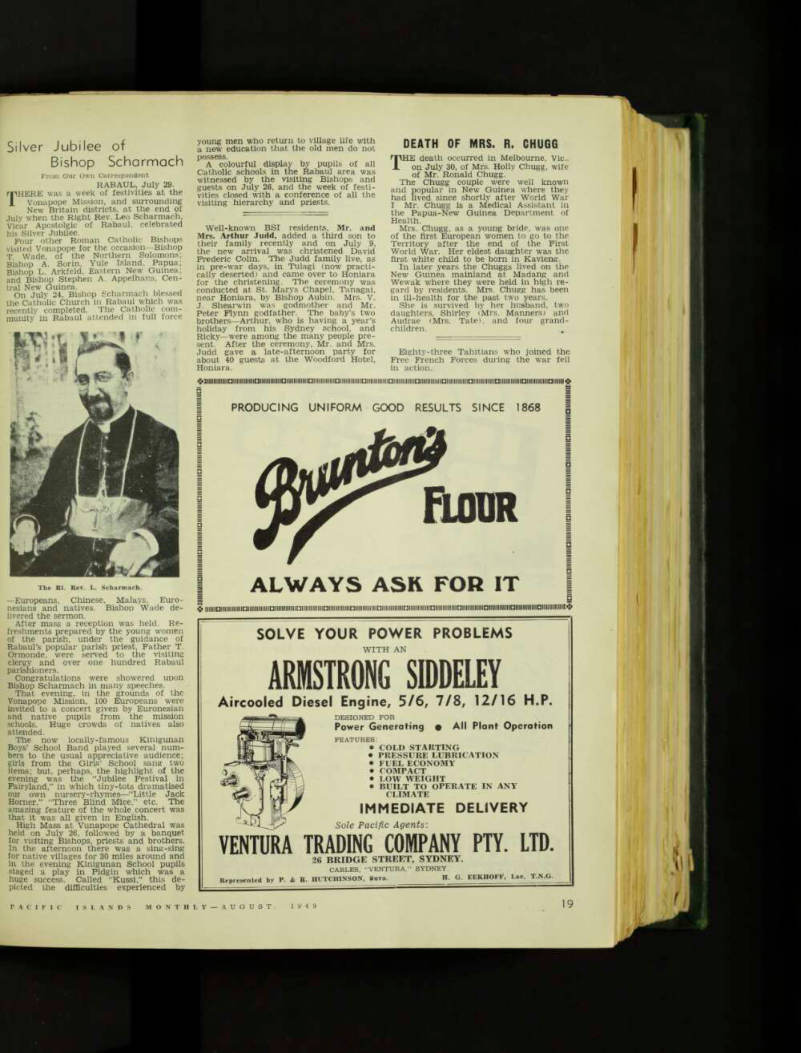
Silver Jubilee of Bishop Schormoch
From Our Own Correspondent
Rabaul, July 29.
THERE was a week of festivities at the Vonapope Mission, and surrounding New Britain districts, at the end of July when the Right Rev. Leo Scharmach, Vicar Apostolgic of Rabaul, celebrated his Silver Jubilee.
Four other Roman Catholic Bishops visited Vonapope for the occasion—Bishop T Wade, of the Northern Solomons; Bishop A. Sorin, Yule Island, Papua; Bishop L. Arkfeld, Eastern New Guinea; and Bishop Stephen A. Appelhans, Cen tral New Guinea.
On July 24, Bishop Scharmach blessed the Catholic Church in Rabaul which was recently completed. The Catholic com munity in Rabaul attended in full force
—Europeans, Chinese, Malays, Euro nesians and natives. Bishop Wade de livered the sermon.
After mass a reception was held. Re freshments prepared by the young women of the parish, under the guidance of Rabaul’s popular parish priest, Father T.
Ormonde, were served to the visiting clergy and over one hundred Rabaul parishioners.
Congratulations were showered upon Bishop Scharmach in many speeches.
That evening, in the grounds of the Vonapope Mission, 100 Europeans were invited to a concert given by Euronesian and native pupils from the mission schools. Huge crowds of natives also attended.
The now locally-famous Kinigunan Boys’ School Band played several num bers to the usual appreciative audience; girls from the Girls’ School sang two items; but, perhaps, the highlight of the evening was the “Jubilee Festival in Fairyland,” in which tiny-tots dramatised our own nursery-rhymes—“Little Jack Horner,” “Three Blind Mice,” etc. The amazing feature of the whole concert was that it was all given in English.
High Mass at Vunapope Cathedral was held on July 26, followed by a banquet for visiting Bishops, priests and brothers.
In the afternoon there was a sing-sing for native villages for 30 miles around and in the evening Kinigunan School pupils staged a play in Pidgin which was a huge success. Called “Kussi,” this de picted the difficulties experienced by
young men who return to village life with a new education that the old men do not possess.
A colourful display by pupils of all Catholic schools in the Rabaul area was witnessed by the visiting Bishops and guests on July 26, and the week of festi vities closed with a conference of all the visiting hierarchy and priests.
Well-known BSI residents, Mr. and Mrs. Arthur Judd, added a third son to their family recently and on July 9, the new arrival was christened David Frederic Colin. The Judd family live, as in pre-war days, in Tulagi (now practi cally deserted) and came over to Honiara for the christening. The ceremony was conducted at St. Marys Chapel, Tanagai, near Honiara, by Bishop Aubin. Mrs. V.
J. Shearwin was godmother and Mr.
Peter Flynn godfather. The baby’s two brothers —Arthur, who is having a year’s holiday from his Sydney school, and Ricky—were among the many people pre sent. After the ceremony, Mr. and Mrs.
Judd gave a late-afternoon party for about 40 guests at the Woodford Hotel, Honiara.
The Rt. Rev. L. Scharmach.
Death Of Mrs. R. Chugg
THE death occurred in Melbourne, Vic., on July 30, of Mrs. Holly Chugg, wife of Mr. Ronald Chugg.
The Chugg couple were well known and popular in New Guinea where they had lived since shortly after World War I. Mr. Chugg is a Medical Assistant in the Papua-New Guinea Department of Health.
Mrs. Chugg, as a young bride, was one of the first European women to go to the Territory after the end of the First World War. Her eldest daughter was the first white child to be born in Kavieng.
In later years the Chuggs lived on the New Guinea mainland at Madang and Wewak where they were held in high re gard by residents. Mrs. Chugg has been in ill-health for the past two years.
She is survived by her husband, two daughters. Shirley (Mrs. Manners) and Audrae (Mrs. Tate), and four grand children. , Eighty-three Tahitians who joined the Free French Forces during the war fell in action.
Advertisements & other items, p. 21 (1 item)
Flour
PRODUCING UNIFORM GOOD RESULTS SINCE 1868
9m
ALWAYS ASK FOR IT
SOLVE YOUR POWER PROBLEMS
WITH AN
ARMSTRONG SIDDELEY
Aircooled Diesel Engine, 5/6, 7/8, 12/16 H.P.
DESIGNED FOR
Power Generating All Plant Operation
FEATURES:
o COLD STARTING
• PRESSURE LUBRICATION
• FUEL ECONOMY
• COMPACT
• LOW WEIGHT
® BUILT TO OPERATE IN ANY
CLIMATE
IMMEDIATE DELIVERY
Sole Pacific Agents :
VENTURA TRADING COMPANY PTY. LTD.
26 BRIDGE STREET, SYDNEY.
CABLES, “VENTURA,” SYDNEY.
Represented by P. & R. HUTCHINSON, Suva. H. G. EEKHOFF, Lae, T.N.G
New Co. For Ng Gold Leases
MR. F. A. ROBERG returned to Mel bourne from New Guinea in July and recommended that Gold Pros pecting and Development NL should exercise its option over Yonki and Oma pinka leases.
A new company will be formed to acquire these areas.
The company has applied for a lease of 40 acres on which a lode formation has been discovered. Pan prospects from sur face to present depth of trench, 9 ft., are very encouraging, the company states.
Representative samples have been sent for assay.
There are nine doctors practising in Papeete, a town of some 11,000 people.
More Taxes For Fiji
Governor’s Grim Warning
From Our Own Correspondent SUVA, August 2.
THE backwash of a debate at the previous session caught Fiji’s Legislative Council to-day when the Governor (Sir Brian Freeston) dealt with the Colony’s finances in the course of his opening address.
At the previous session, said the Governor, the unofficial members were practically united in their opposition in principle to export taxes on primary pro ducts.
“While bowing to their wishes for the moment, I reserved liberty of action for the future,” he added.
Since then he had been in communica tion with the Secretary of State for the Colonies, the Governor continued, and he had been informed at some length that, in circumstances such as now prevail in Fiji, not only were export taxes on primary products proper forms of taxa tion but they were also necessary forms.
“The Secretary of State has urged this Government to reconsider its decision to abandon even temporarily the tax on sugar and the proposed tax on copra,” said the Governor.
“Very significantly, the Secretary of State pointed out that he would have great difficulty in sanctioning the Colony’s approach to the capital market for a development loan unless he was satisfied that all alternative sources of finance were being fully utilised. And it is evident from his remarks that, in the absence of a tax on sugar and a tax on copra, in times such as the present, he would be hard to convince that all other available sources of finance were being fully utilised.”
The Governor recalled that at the March session he had stated that the Government had no wish to impose taxa tion merely for taxation’s sake and that his final decision would be based on the probable outcome of the financial year.
It now appeared that the revenue esti mate of just over £2,900,000 would be realised, or nearly realised. At the same time, shortages of staff and materials had held up many of the Government’s major projects.
Therefore, said the Governor, he had decided not to reopen the question of the sugar and copra taxes at the present session, but he warned the Council that “both taxes will be very much to the fore in the Government’s mind when drawing up the financial plans for 1950.”
Editorial Note
THIS is just another reflection of the Socialist policy that is crippling Britain, disturbing the Empire and embarrassing British relations with the United States.
What are the peculiar conditions in the Colony of Fiji, referred to by the Secre tary of State for the Colonies, which make it desirable that taxes should be imposed on the colony’s primary indus tries? Actually, there is no essential dif ference between the Fiji of 1939 and the Fiji of 1949; and the principle of keeping the tax-gatherer’s clutching hand off primary production is as sound now, as then.
The difference is in Britain herself.
The British people have elected to go off on an economic orgy with a Socialist Government; and, after four years of it, they are getting deeper into a financial morass. The British people themselves are now poor, and groaning under the load of intolerable taxation, and their politicians think that the Colonies should be dragged down to the same level. Fiji essentially is a country of private enter prise; but Fiji, in relation to taxation, is to be treated as if it were part of the set-up which has nationalised coal and transport, and is trying to nationalise steel.
Taxation of sugar and copra surely will come. Copra, for a year or two, may bear the impost; but it may do fatal harm to the precariously-balanced sugar industry.
Mr. J. R. Elliott, accountant of the Bank of New Zealand, Suva, Fiji, has been transferred on promotion to the New Plymouth branch as accountant. He will be replaced in Suva by Mr. W. J. G.
Roach, who is expected to arrive in Fiji at the end of August.
Advertisements & other items, pp. 22-23 (1 item)
Robert Gillespie Pty Ltd
ISLAND TRADERS
\ All classes of merchandise purchased for Island clients throughout the South-west Pacific.
Island produce sold on Australian and overseas markets on a commission basis.
ROBERT GILLESPIE PTY LTD
S 4» PITT ST..SYDNEY-PHONES ■ 8W4782- 81305
The Best Stores Stock
Australia’s Best Brands ! ★ “MAC ROBERTSONS” Confectionery & Cocoa ★ “CRUSADER” & “LIFEGUARD Condensed Milk if “TOM PIPER” Canned Foods if “METTERS” Enamelware if “DIAMOND” Torch Refills & Batteries ★ “HAMMER” Brand Butter
★ “AUSTRAL” Ghee
★ “EPICURE” Preserves ★ “EEZY-FYRE” Kerosene Pressure Cookers if “AUSTRAMAX” Kerosene Pressure Lamps ★ “GAC” Cast Aluminiumware if “GLENLEIGH” Immersion Heaters ★ "SETCO" Cast Iron Pots & Boilers ★ “BRISTOL” Paints if “SETCO” Brown Paper Bags Wholesale Merchants should place orders and
inquiries through their own Australian Repre-
sentatives otherwise direct to us
S. E. TATHAM & COMPANY
178 Collins Street
MELBOURNE AUSTRALIA
Established 1924 Cables: 'SET, Melbourne
Papua Planters’ Difficulties
No Information About Copra Reserve Fund or Labour Ordinance
A NUMBER of matters of vital interest to Territories’ planters have been dealt with by the Planters’ Association of Papua, which held its second annual meeting in Port Moresby on August 5. The following are extracts from the Committee’s report:—
Mystery Of Copra Reserve
SOME little clarification on the position of copra producers in connection with the ANG Production Control Board has been obtained during the year, but unfortunately some points still are very obscure.
Fixed prices for the period to 30/6/48 were declared on March 3 last and a tentative price from 1/1/49 of £4B per ton for hot-air and sun-dried copra. This latter price is based on the amount to be paid by the Government of the United Kingdom under a proposed nine years’
agreement, details of which already have been notified to members, The matter of the Copra Reserve Fund (also called Market Stabilisation Fund) remains obscure. We have been unable to obtain from the Government any statement as to proposals for the utilisa tion of this fund, to the credit of which £5 per ton of copra sold is being taken from proceeds paid to growers, although the later have no knowledge of its purpose or management, we have got no further in this matter in last year, despite personal interviews with the Minister and a never ending correspondence.
Twelve months ago in this report the Committee expressed serious concern at the lack of knowledge concerning this Re serve Fund; yet another year has passed without result in this matter, while growers’ material interest in it has very considerably increased.
Rubber Market
DURING the latter part of the year under review, the position of rubber growers became critical, with the Australian manufacturers’ restriction of purchases and a continuing fall in world prices. Urgent representations were made to the Commonwealth Government for assistance to the industry, then faced with collapse. These submissions were:— (1) Enforcement of import licences in Australia, preventing the importation of foreign rubber until the full Papuan pro duction is absorbed; (2) A temporary grant-in-aid of 2id. per pound on all rubber exported to Aus tralia; (3) A permanent stabilisation scheme to be introduced.
These submissions were made through and supported by the Administration.
Early in July, 1949, it was decided to send representatives to Canberra to press these submissions and the President and Sec retary visited Australia for this purpose.
They conferred with the Minister for Ex ternal Territories (Hon. E. J. Ward) and also attended a conference called by him with representatives of the manufacturers and certain departmental officers.
Mr. Ward stated he was of the opinion that the industry should be protected and maintained, and promised to submit to Federal Cabinet, at an early date, pro posals for the immediate assistance of the industry, and also for stabilisation of future prices.
Rural Production
A RURAL Production Advisory Council has been formed by the Adminis trator, comprising four representa tives each of Administration and producers; so far this Association has four representatives on the Council, two of whom will retire upon the appoint ment of two producer representatives from New Guinea.
So far, the Council has gone little be yond the formative stage, but it is hoped that when properly functioning it may prove beneficial to producers generally.
Native Labour—No Action
WE regret having to report a complete lack of success in the matter of the Native Labour Ordinance. For two years we have been advocating reforms to this Ordinance, a great many of which are approved by the Administration; but absolutely no action whatever has been taken to effect amendments or improve conditions.
In an endeavour to supply an alterna tive to Contracts of Service, soon to be abolished, this Association suggested a form of agreement for native employees to come into being at once, side by side with the indenture system. After lengthy consultation with the Adminis tration, a form of agreement was evolved which was acceptable to all parties. This was over six months past, yet no action has resulted.
Range Of Activities
MEMBERS probably would be surprised to learn of the very large number of matters dealt with during a year and wide range of subjects. Outside of copra and rubber prices and similar mat ters, subjects dealt with have included shipping- services, freight rates, air ser vices, roads, bridges, navigational aids, entry permits, telephones, livestock pro duce grading, importation of iron, bank ing hours, postal services, issue of woollen clothing to labourers, native labour houses, fire prevention, etc., etc.
Any matter likely to be beneficial to members or to the industry as a whole is investigated and where considered ad visable, action is taken.
New Executive
THE following Executive Committee was elected for 1949-50: President: Mr. E. V. Crisp.
Vice-President: Mr. B. Fairfax-Ross.
Committee; Messrs. F. L. Clarke. F. H.
Godson, A. L. Johnston, F. A. Julian, I.
S. Loudon, P. J. McDonald, J. B.
McKenna, T. L. Sefton, L. A. Willis, R.
F. Bunting, E. T. Ward, J. Grimmer.
Auditor: Mr. J. W. Lukin.
Secretary: Mr. E. A. James.
There are now 79 members and owner members representing a planted area of 42,882 acres.
The Association had an income last year of £79 from subscriptions and £531 from fees: it spent £554; and ended the year with a surplus of £6O, which gave it a cash balance in hand of £394.
Advertisements & other items, p. 24 (1 item)
Buy On The Best Market!
When you buy through us you buy at lowest prices.
YOU RECEIVE ORIGINAL INVOICES AT IN-
VOICED COST. Enquiries invited for all plantation and trading requirements. Island products sold on commission basis.
WILLIAM E. REED
(Established 36 years).
BROKER AND AGENT,
145 a GEORGE ST., CIRCULAR QUAY, SYDNEY Cables: "WILREED,” Sydney.
Box 3838 GPO, Cable Address, “Care” Sydney.
Sydney. Australia.
LULU
ISLAND MERCHANTS
4 YORK ST., SYDNEY
All kinds Island Produce sold on commission. All merchandise purchased at best wholesale price and original invoices supplied.
Use our 50 years’ experience as Island Merchants.
Rnzaf Again Helps
Lau Islands
WHEN a hurricane devastated parts of the Lau Group, Fiji, at the end of 1948, the RNZAF units stationed in the Colony went to the rescue. In a four days’ air-lift they flew in food and medi cal supplies.
Recently the RNZAF helped the Lau Group again by flying in 4,000 pounds of taro and yams.
The vegetables were part of a gift to the people of Lau by Fijians of the Vuni dawa area. They were presented to Ratu Sir Lala Sukuna in Suva, and if they had had to await sea transport would have deteriorated.
The yams were especially acceptable to the Lau people as they arrived in the yam-planting season and so provided valuable material for new food gardens to replace those destroyed in the hurri cane.
Civil Service Staff
Shortages In Fiji
From Our Own Correspondent SUVA. August 2.
FIJI’S Medical Department is short of nine officers in an establishment of 29. No replacements can be secured and some communities will soon lose their medical officers.
The Agriculture Department has seven vacancies in a total of 15 executive posts.
These examples of the Colony’s chronic Civil Service manpower shortage were quoted by the Governor (Sir Brian Free ston) in his address to the Legislative Council recently.
After pointing out that the market for
highly and expensively-trained officers was likely to remain a sellers’ market, the Governor said that, at his request, the Secretary of State for the Colonies would send a salaries-commissioner to investi gate the situation in Fiji and recommend such regrading of salaries and conditions as would enable this Colony to compete with others in recruiting and retaining men of the calibre required.
Ratu Mara, a Fijian chief who is a student 'at Oxford University, has graduated as Bachelor of Arts, Ratu Mara, who is a son of Ratu Tevita Uluila keba and a nephew of Ratu Sir Lala Sukuna, is shortly to take the Adminis trative Service course at Oxford,
Advertisements & other items, pp. 25-26 (1 item)
Nelson & Robertson
LET
McILRATH’S
SYDNEY'S LEADING GROCERY HOUSE
Supply your Christmas requirements NOW and avoid the delays and disappointments caused by later ordering. Varied stocks of all essential foods for the festive season are available-including CAKES in tins—PUDDINGS— NUTS, etc. Also a wide range of WINES—SPIRITS—LIQUEURS—CIDER- CORDIALS and PURE FRUIT JUICES—together with
ALLSOPP'S ENGLISH LAGER
26 oz. bottles—in 4 doz. case lots.
All shipments are covered against PILLAGE—THEFT—NONDELIVERY
REMEMBER THE NAME—AND THE LOCATION
McILRATH’S PTY. LTD.
202 Pin St., Sydney, Australia. Cable address—ROTUNDA, Sydney.
NELSON and ROBERTSON Pty. Ltd.
Established 1895
Shipowners - Brokers and
Islands Merchants
All classes merchandise purchased at Best Wholesale Prices. Original Invoices supplied to Island Clients. Cocoa Beans, Copra, Rubber, Trochus Shell and All Islands' Produce Sold on Commission.
Entrust your requirements to the firm with fifty years' practical experience in the Pacific Islands.
NELSON & ROBERTSON
12 SPRING STREET, SYDNEY, AUSTRALIA
Telegraphic Address: IVAN, SYDNEY.
ONE OF THE WORLD’S
WONDER-SIGHTS
Miles of
MOVING ICE
See New Zealand’s
FRANZ JOSEF-GLACIER
From the Air !
NOWHERE else in the world can you see an eight-mile long river of ice framed in an evergreen setting of sub-tropical forest. Franz Josef is one of the scenic wonders of the world. Why not take the holiday you’ve promised yourself relax in comfort, in scenic surroundings? Travel in comfort too, by N.A.C. aircraft that land you fresh and unweary two hundred yards from hotel door.
EC
HOTEL ACCOMMODATION
Comfortable accommodation and attentive service is provided by the Government Tourist Department’s Hotel at the foot of the Glacier.
-AT YOUR SERVICE
New Zealand National Airways Corporation provides a network of air services throughout the Dominion and the South-west Pacific. General Agents in the Dominion for British Commonwealth Pacific Airlines and Trans-Australia Airlines. Booking Agents for Tasman Empire Airways, Qantas Empire Airways, the 8.0.A.c. and other overseas airlines.
Offices and Agents throughout New Zealand and the South-west Pacific 37
Australia’S Million-Natives Headache
Airways Chiefs Shrewd Observations On New Guinea
SOME shrewd and interesting observations on the present and future condition of Papua and New Guinea were made by Mr. Hudson Fysh, chairman and managing director of Qantas Empire Airways Ltd., in an address broadcast in Australia on July 31.
Qantas, controlled by the Australian Government, now supplies Papua and New Guinea (as well as Norfolk Island Fiji, New Hebrides and the Solomons) with most of their passenger and freight air services; and Mr. Hudson Fysh was recently in the Territories. The follow ing are extracts from his address: —
War And Its Effects
WITH the War and the Japanese invasion, realisation of the importance of New Guinea was forced on Australia, and particularly on thje Australian Forces who fought a game of hide-and-seek with death in the mosquito-infested swamps and jungle. In Rabaul alone there were at one time 128,000 Japs, whom Australia alone could never have unearthed from their elaborate system of tunnels and fortifications.
When flying along over New Guinea we see that the shores are here and there strewn for 500 miles, from Port Moresby to Rabaul, with sunken ships, stranded Jap destroyers and landing barges. At Rabaul the harbour is still full of wrecks, including a large Japanese flying-boat silhouetted just under the water. Pill boxes, old trucks, and the nose of a Zero or two can still be seen protruding from the fast-enveloping jungle.
Australia is a growing power centre, a bastion of the democratic way of life m this part of the world; and lying right
athwart its northern shores is New Guinea, with a population of some 7,500 whites, 2,500 to 3,000 Chinese and (at a guess) 900,000 natives, most of whom still live in a primitive stone-age state. Ex cepting Australia and Greenland, New Guinea is the largest island in the world —and one of the richest and most unde veloped.
Very great progress has been made in three years in the rehabilitation of the country following the War years. Despite all the difficulties - common to a dis turbed and re-adjusting world-things are really starting to move m New Guinea and great changes are under way.
Pioneering—And Paludrin
THERE is nothing drab about Papua A and New Guinea. They are vital, and make a strong appeal to all enterprising spirits attracted by develop mental work in a primitive country and amongst primitive people. The job which the white population is doing there is fully in the great tradition of the hardy Australian pioneers of last century.
New Guinea is a good colonising country. Much is heard about the ravages of malaria, but in many parts fever is now very rare. A wonderful new discovery has completely changed the pic ture. The magic word is Paludrin, a drug developed by Imperial Chemical Indus tries in England and introduced into New Guinea in 1947. Paludrin not only cures malarial fever, but is 100 per cent, effec tive as a (preventative, if the easily swallowed little pills are taken as pre scribed. Furthermore, there are no un pleasant drug effects as is often the case
Paludrin was the final thing necessary to make New Guinea a good colonising country.
Coffee and cocoa await exploitation, while tea, tobacco, rice and other such crops are being experimentally farmed.
Timber Possibilities
IN regard to timber, the pine forests at Bulolo are, of course, of consider able value to Australia with her soft wood shortage. There is also a quantity of cedar. Houses and furniture are being built in the Territory of these materials, principally pine.
Bulolo Gold Dredging Ltd., at their mills, have done a very fine job in de signing and prefabricating homes made from the Bulolo pine; and apart from comfortably housing their own staff these houses are now being shipped out to other parts of New Guinea, most of them by air. It takes about five DC-3 Freighter loads to transport a house.
At Lae I saw a nice house of 10½ squares nearing completion, which anyone would be happy to own in a warm climate, was flown down from Bulolo by Qantas and will cost about £1,200 completed, in
eluding air-freighting,
Air Transport: A Vital Factor
ONE of the most interesting things about the Territories is the predominant part which air transport has taken in their communications sys tern. This has been due to the almost impenetrable and mountainous nature of the country and the general difficulty of road making, and of road maintenance owing to tropical rains, You have heard of the magnificent work of Guinea Airways and the other pioneers in opening up the gold-fields by air, when even heavy equipment (suen as gold dredges) was all flown in. We
of Qantas, feel privileged to be set the task of carrying on this work in which we first became interested as the result of a business deal shortly after the end of the War, when Carpenter Airways were bought out and we established the Bird of Paradise Service from Sydney to Lae.
At The Outposts
OUR most recent development in this respect is the inauguration of a Catalina Flying Boat Service, at the request of the Administrator (Colonel J. K.
Murray) to cover points which cannot be reached by the land-plane network. Between the two types of aircraft, Qantas now covers practically the whole of the islands. Including the Sydney-Lae Service and other Island Services, the system
involves some 6,964 miles of unduplicated air route mileage. These local land-plane and flying-boat services and charters are carrying half-a-million pounds of freight a month, and about 500 passengers, and 5,000 lb. of mail.
In Papua I flew out on the Western Cata lina circuit and visited Lake Murray, near the Dutch border. This is a typical out post station and missionary post, where their mail and supplies used to arrive every three or four months. The District Officer and Resident Doctor came out to meet us in canoes paddled by natives to hand over the mail in a potato bag and receive in exchange a load of medical supplies and provisions, At our next stop, Kikori, it was canoes
again; but here we tied up to a mooring buoy in the fast flowing river. A load of 300 mud-crabs was taken on for Port Moresby.
From the lakes, marshes and rivers of the south-west and the Fly River delta area it is a great contrast to visit the Highlands plateau, across the Owen Stanleys in New Guinea. Here is open country dotted with villages, served by mountain streams, and flanked by mounts going up to 13,000 feet or more. It has an invigorating, healthy climate, above the fever belt, and its primitive inhabi tants are administered by District Posts.
It is these posts that are served from Lae and Madang by Qantas freighters, sup plies being flown in to Karowagi by Douglas freighters and distributed from there to the smaller landing-strips by Dragon aircraft.
Primitive men meet the planes at these stops. They are in their primitive state, many carrying bows and arrows and other weapons of warfare.
Warfare and head hunting seem to have been the principal occupation of these people, who had their sorcerers, but apparently little religion. Tribe fought against tribe and village against village, as in the dawn of our own civilisation, 2,000 years or more ago. The currency in the Highlands, and indeed in many parts of New Guinea, is still shell or tobacco.
A District Officer in the Highlands told us of the natives’ interest in football, which is being encouraged, but matches have to be watched carefully, and police boys sent to supervise each game. He had a Corporal killed —“arrowed” —at one only the other day. They start eleven a side; but often end up in a free-for-all, in which the several hundred spectators join, often ending up in a rush for bows and arrows, concealed nearby.
The District Officers are undoubtedly doing a very fine job with the natives, from these comparatively civilised high land areas to the remote jungles, where head-hunting and cannibalism are still at times practised. I heard of one party on the Sepik River who recently went into a village where a boy had just been eaten.
“A Problem, Indeed”
THE problem of New Guinea is a prob lem, indeed. It seems to involve all the reconciliation which is possible between the essential need to adequately develop the country commercially in the interests of industry, trade and food pro duction, and the safety of Australia — which is the ordinary law of self preservation. On the other hand, the interests of the native inhabitants must be considered. Still vastly primitive and, as I have so often heard expressed, “just like children,” their problem is a difficult one. Over-harshness and exploitation are not the answer; neither are over generosity, and the practice of something for nothing.
Advertisements & other items, pp. 27-28 (1 item)
Thomas Bbown & Sons Ltd.
Merchants, Manufacturers and Distillers Wines and Spirits, Foodstuffs, Drapery, Clothing, Textiles, Stationery, Hardware, and Fancy Goods.
Our Manufactures include :
TOPS FOODSTUFFS, ESQUIRE SHIRTS AND CLOTHING,
BEENLEIGH POT STILL RUM, DUNCAN'S GIN, MARTIN'S
AUSTRALIAN WHISKY, GRAND ESTATE BRANDY, ETC.
Special attention given to Island inquiries
EAGLE STREET, BRISBANE
DON’T PUT UP WITH
needless suffering. Safe, effective treatment for tropical diseases, rheumatic conditions, digestive troubles, skin diseases, nerves, weakness, complaints of men and of women, and all forms of acute or chronic bodily ailments.
Specialist advice freely given without obligation.
Air Mail. Consult to-day The Superintendent,
AUSTRALIAN HEALTH SERVICES
156 Castlereaeh St., SYDNEY Use
CAPTAIN W. L. KENNEDY
Established 1931.
Shipbrokers, Business & Real Estate
163 Pitt St., Sydney
'Phone; BW 6461
LISTING FOR SALE:
Among other fine Boats Listed for Sale we have the following: — TWO HUNDRED AND FIFTY TON SCHOONER, powered, 150 h.p., Garden or diesel. £12,000.
FAIRMILE CRUISER, twin Gray marine diesels, well fitted, ready for sea, at £7,500. 50 ft. SEINE TRAWLER, Gardener diesel, £4,500. 36 ft. CARGO WORKBOAT, 30 h.p., Lister diesel, coppered, £1,900. 29 ft. WORKBOAT, 22 h.p. Southern Cross diesel, £950. 26 ft. WORKBOAT, 8 h.p. diesel, 3/1 reduction gear, £750.
KWONG CHONG BROTHERS
General Merchants and Planters
Have now re-established their business on their original pre-war site, and are carrying stocks of Trading and Plantation requirements. All enquiries welcomed and service assured. ★ Sydney Representatives:
NELSON & ROBERTSON PTY., LTD.,
Electra House, 12 Spring Street, Sydney, N.S.W.
KWONG CHONG BROTHERS
KEMARERE STREET, RABAUL
Death Of D. W. Amos
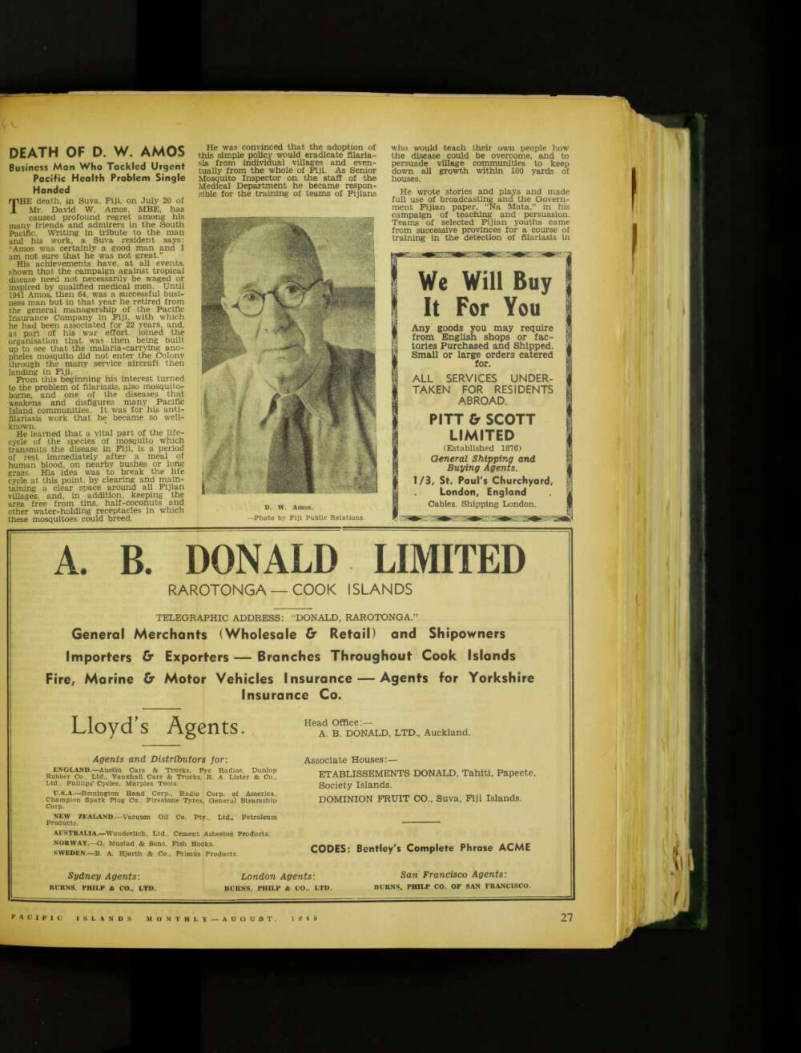
Business Man Who Tackled Urgent Pacific Health Problem Single Handed
THE death, in Suva, Fiji, on July 20 of Mr. David W. Amos, MBE, has caused profound regret among his many friends and admirers in the South Pacific. Writing in tribute to the man and his work, a Suva resident says: “Amos was certainly a good man and I am not sure that he was not great.”
His achievements have, at all events, shown that the campaign against tropical disease need not necessarily be waged or inspired by qualified medical men. Until 1941 Amos, then 64, was a successful busi ness man but in that year he retired from the general managership of the Pacific Insurance Company in Fiji, with which he had been associated for 22 years, and, as part of his war effort, joined the organisation that was then being built up to see that the malaria-carrying ano pheles mosquito did not enter the Colony through the many service aircraft then landing in Fiji.
Prom this beginning his interest turned to the problem of filariasis, also mosquito borne, and one of the diseases that weakens and disfigures many Pacific Island communities. It was for his anti filariasis work that he became so well known.
He learned that a vital part of the life cycle of the species of mosquito which transmits the disease in Fiji, is a period of rest immediately after a meal of human blood, on nearby bushes or long grass. His idea was to break the life cycle at this point, by clearing and main taining a clear space around all Fijian villages, and, in addition, keeping the area free from tins, half-coconuts and other water-holding receptacles in which these mosquitoes could breed.
He was convinced that the adoption of is simple policy would eradicate fllariasis from individual villages and evendually from the whole of Fiji. As Senior Mosquito Inspector on the staff of the Medical Department he became responsible for training of teams of Fijians
who would teach their own people how the disease could be overcome, and to persuade village communities to keep down all growth within 100 yards of houses.
He wrote stories and plays and made full use of broadcasting and the Govern ment Fijian paper, “Na Mata,” in his campaign of teaching and persuasion.
Teams of selected Fijian youths came from successive provinces for a course of training in the detection of filariasis in
D. W. Amos. —Photo by Fiji Public Relations.
human beings, and in the life habits of mosquitoes of various types. As each team was trained, its members returned to the provinces from which they came to spread the knowledge gained and to direct antifilariasis work in conjunction with ofiicers of the Medical Department and with the Fijian local authorities.
The campaign of persuasion was not successful everywhere but in places where the cleaning-up policy was adopted and maintained there was great improvement in the general health of sufferers from filariasis and no fresh cases appeared.
The whole basis of Mr. Amos training scheme was to impress upon his Fijian trainees the idea of service to their own people, rather than the attitude that they were merely taking on a job of work. He believed implicitly that health education among Pacific peoples could not be imposed upon them from outside, but could be taught only from trained and enthusiastic natives who had not grown away from
their own people. This, he believed, had already been proved conclusively by the successful training of Native Medical Practitioners at the Central Medical School in Suva, who returned to give ser vice to their own native communities, He had little real support, at least in the beginning, but he believed that the work; was worth doing. No disappoint ments—and he had many turned him from his path. He knew that the process of such health education could not be hurried and he resisted those who called for quick results or yelled that he was not getting anywhere.
Just before he died his training pro gramme was almost complete and he looked forward to being able to assess the value of the campaign for which he was responsible.
HIS pioneering work attracted the attention of overseas experts and before the launching of anti-filariasis campaigns in other Pacific territories in recent years, those responsible first came
to Fiji to study Mr. Amos’ methods. He was invited by the New Zealand Govern ment to visit the Cook Islands and Wes tern Samoa to advise on the organisation of a campaign against the disease in those territories.
His anti-mosquito work followed years of public-spirited activities. Mr. Amos was one of the founders of the Suva Rotary Club and remained one of its most enthusiastic supporters. He was an active member of the Fiji Club and was for a number of years its secretary. He was prominent in amateur dramatic circles in Suva. During the latter years of the war, he made himself responsible for the re ception of overseas news for re-broad casting by the Fiji station ZJV.
In this year’s New Year Honours he was awarded the MBE.
He is survived by his widow and two daughters of a former marriage.
Advertisements & other items, pp. 29-30 (1 item)
A. B. Donald Limited
We Will Buy
It For You
Any goods you may require from English shops or factories Purchased and Shipped.
Small or large orders catered for.
ALL SERVICES UNDER-
TAKEN FOR RESIDENTS
ABROAD.
PITT & SCOTT
LIMITED
(Established 1876) General Shipping and Buying Agents. 1/3, St. Paul's Churchyard, London, England Cables. Shipping London.
A. B. DONALD LIMITED
TELEGRAPHIC ADDRESS: “DONALD, RAROTONGA.”
General Merchants (Wholesale & Retail) and Shipowners Importers & Exporters Branches Throughout Cook Islands Fire, Marine & Motor Vehicles Insurance Agents for Yorkshire
Insurance Co.
RAROTONGA COOK ISLANDS
Lloyd’s Agents
Head Office:— A. B. DONALD, LTD., Auckland.
Agents and Distributors for : Associate Houses: — ETABLISSEMENTS DONALD, Tahiti, Papeete, Society Islands.
DOMINION FRUIT CO., Suva, Fiji Islands.
ENGLAND.—Austin Cars & Trucks, Pye Radios, Dunlop Rubber Co., Ltd., Vauxhall Cars & Trucks, R. A. Lister & Co., Ltd., Phillips' Cycles, Marples Tools.
U.S.A.—Remington Rand Corp., Radio Corp. of America.
Champion Spark Plug Co., Firestone Tyres, General Steamship Corp.
NEW ZEALAND.—Vacuum Oil Co. Pty., Ltd* Petroleum Products.
AUSTRALlA.—Wunderlich, Ltd., Cement Asbestos Products.
NORWAY.—O. Mustad & Sons, Fish Hooks.
CODES: Bentley's Complete Phrase ACME SWEDEN.—B. A. Hjorth & Co., Primus Products.
Sydney Agents :
BURNS, PHILP & CO., LTD.
London Agents.
BURNS, PHILP & CO., LTD.
San Francisco Agents.
BURNS, PHILP CO. OF SAN FRANCISCO.
GEORGE KUI
★ Specialist in ladies’ and gentlemen s wear, eastern fancy goods, embroidered silk wear, embroidered linen table sets, carved camphorwood trunks, cane furniture, curios, etc.
LARGE SHIPMENT AND VARIETY ARRIVES WITH
EVERY HONG KONG BOAT
GENERAL MERCHANT & IMPORTER
Always Prompt Attention and Service.
RABAUL
The Key to Earning Power. . .
Sometimes men think that a general education or an elementary knowledge of business is enough to get ahead. But experience soon teaches that thorough, specialised training is just as necessary for success in business as it is in the professions of Law, .Medicine or Dentistry. If you are interested in the many opportunities in the Business World ... if you seek responsibility, success and economic security, commence training now —in some specialised business subject. H.R.I. is available always to help and advise ambitious men and women. Write or wire for particulars and career information.
H.R.I. tutorial service is proved by the winning of more honours than all coaches in Australasia combined.
A Career Training
• ACCOUNTANCY • SECRETARYSHIP • COST ACCOUNTANCY
• PRACTICAL BOOKKEEPING • MARKETING SELLING
ADVERTISING • BANKING • LOCAL GOVERNMENT EXAMS.
Hemingway Robertson Institute
Founded and Owned by Heminfirway & Robertson Pty. Ltd.
Consulting Accountants ;; :: Professional Tutor* Accountants
126 BANK HOUSE,
126 BARRACK HOUSE.
BANK PLACE, MELBOURNE
16 BARRACK STREET, SYDNEY
19C/SI A
'Responsibility’
Dependants Of Rabaul
Victims
Ministers Squabble Over 'Responsibility’
IN the Australian Parliament, last month, Mr. T. W. White asked why the widows of public servants killed in New Guinea during the Japanese in vasion—there were some scores of them —were not getting the full repatriation benefits that had been promised to them.
Furniture grants and medical benefits were being withheld, and the Department of External Territories was blamed.
The Repatriation Minister (Mr. Bar nard) said that some difficulties had arisen in determining the joint respon sibility (he probably meant respective responsibilities—Ed.) of the Departments of Repatriation and External Territories; and he would make inquiries.
EDITORIAL NOTE—Which is typical of the way in which these people have been treated by the Australian Govern ment. Nearly four years have passed since Japan surrendered; yet the Austra lian Departments still are muddling around, trying to decide their “responsi bilities." It was this same Government— or its officials—which kept hundreds of men in Rabaul, to become prisoners of the Japs, and eventually to be killed in various ways-, when they might quite easily have been got away to safety on ships that were then available. That very black mark against Canberra is something which old New Guinea resi dents never will forget. The public servants among those men who thus were sacrificed died for their country, in exactly the same way as the uniformed servicemen; and their dependants are fully entitled to all pension and repatria tion benefits. Remembering the history of the disaster, it is a sickening thing now to hear this Repatriation Minister say so casually: “These people do receive some benefits. I am having another look at the matter ... to see if we can iron out the difficulties."
Mr. C. Normoyle, Jnr., (known to his friends as young Chris), elder son of Mr.
C Normoyle, the present Senior Inspector of Police. Rabaul, left Rabaul by air on July 8 to attend the Australian School of Pacific Administration in Sydney. He ar rived in the Territory with his parents at the age of two and had the early part of his schooling at the Rabaul School, and later at the Church of England Grammar School, Brisbane, It is interest ing to note that he is the second young Territorian to be accepted as a Cadet Patrol Officer, District Services-the first lad being the son of the present Director, Mr. J. H. Jones. Mr. Normoyle. Jnr., will be much missed in the sporting com munity of Rabaul.
Conference Of Native
Peoples
Delegates of 16 Territories To Go To Suva Next April
ACCORDING to present plans, a re markable experiment will be carried out, early next year, by the South Pacific Commission, when it holds—in Suva, commencing about April 24, 1950 the first South Pacific Conference.
It is intended that the Conference shall be attended by native representatives of the native peoples of:— Papua Solomon Islands New Caledonia American Samoa Western Samoa Nauru Fiji Dutch N. Guinea Ellice Islands Cook Islands New Guinea Gilbert Islands French Oceania New Hebrides Tokelau Is.
Tonga will be invited to send a rep resentative.
A statement issued at the head quarters of the Commission, in Noumea, says:— “The primary aim of this Conference, (which is given advisory powers as a body auxiliary to the Commission), is to enable the local inhabitants and insti tutions of the territories within the scope of the Commission to associate with its work.
“Because the native representatives will in most cases not be experienced in the work of international bodies the Commission is anxious to keep the agenda items simple.
“The provisional agenda has not yet been finalised but suggestions include the discussion of village sanitation, sub sistence crops, fisheries and their im
brovement, co-operative movements and land usage.
“The agenda will be considered at the fourth session of the Commission after the suggested agenda items have been commented on by the Territorial Govern ments."
THE Government of Fiji already has applied itself to the preliminary problem of housing, in overcrowded Suva, this Conference and its numerous delegates.
Mr. H. E. Maude, member for Social Development on the Commission’s Re search Council, and Mr. J. Ryan, acting head of the Conference Division of the Secretariat, were in Suva at the end of July, and they discussed these matters with the Fiji Government.
THIS will be the first time in history that members of all the South Pacific communities—it will be noted that they number sixteen—have come together in any convention of this kind. The Fijian, Polynesian and Micro nesian peoples are quite competent to take part in such a gathering; but it may not be so easy to get suitable dele gates from the Melanesian section (Papua, New Guinea, Solomons, New Caledonia and New Hebrides).
The only occasion when men ifrom most of these Territories met together was when selected students, two or three years ago were assembled at the Suva Medical School, to undergo train ing as Native Medical Practitioners.
About 1947 there were young native students there from all the Polynesian countries, and from Guam, Fiji, New Hebrides, Solomons, Papua and New Guinea. It was found, however, that, generally, the young Melanesians were somewhat too backward in their primary education to go into classes with Fijians and Polynesians of the same age. A
plan for a Melanesian Medical School has been under consideration for some time.
All persons concerned with the future of the Pacific native races will follow this South Pacific Conference in Suva, next April, with the liveliest interest.
Special Work For Dr. Elkin
Dr. A. P. ELKIN, Professor of Anthro pology at the University of Sydney, is to assist the South Pacific Com
mission in its research programme by undertaking a study in Social Anthro pology. He will make a review of all that has been accomplished in Mela nesia in the field of Social Anthropology, prepare recommendations on what still needs to be done, and assess priorities for further work in the field. The Com mission hopes that this will produce something of a practical nature, of de finite value to government officers, mis sionaries and others dealing with the problems of native peoples in the South west Pacific. Dr. Elkin already has com menced his task.
Advertisements & other items, pp. 31-32 (1 item)
Marine Engines
OVERSEAS MAGAZINES
Direct to You from the Publishers.
American:
CHARM
COLLIERS WEEKLY
CORONET
ESQUIRE
HARPER’S BAZAAR
LADIES’ HOME JOURNAL
LIFE
LOOK
POPULAR MECHANICS .. .
READERS’ DIGEST
SATURDAY EVENING POST
SCIENTIFIC AMERICAN . .
TIME
VOGUE
YACHTING
32/6 60/- 18/9 75/- 75/- 37/6 49/- 39/- 28/3 12/- 68/9 52/6 96/- 105/- 40/-
English:
APOLLO
COURIER
PICTURE POST
PUNCH
TATLER
TIMES WEEKLY
52/6 60/6 27/6 46/3 122/- 38/- Rates are for one year and include all charges. Many other overseas periodicals available on all subjects.
ALL ORDERS AIR-MAILED TO
PUBLISHERS.
MAIL PUBLICITY CO., 175 PITT
STREET, SYDNEY, N.S.W.
MARINE ENGINES
HALVORSEN'S HAVE FOR IMMEDIATE DELIVERY:
“UNDERWOOD” 3 H.P. —2 Cycle—with built in Clutch -Petrol MORRIS “VEDETTE” 4 Cylinder 6/12 H.P. Petrol or Kerosene MORRIS “NAVIGATOR” 4 Cylinder 12/24 H.P. Petrol or Kerosene MORRIS “COMMODORE” 6 Cylinder 20/40 H.P. Petrol or Kerosene CHRYSLER “CROWN” 6 Cylinder 45/102 H.P. Petrol CHRYSLER “ROYAL” 8 Cylinder 55/132 H.P. Petrol Available soon: “LEYLAND” DIESEL MARINE 6 Cylinder 85 H.P.
Further particulars from the distributors:
LARS HALVORSEN SONS PTV. LTD.
WATERVIEW ST.. HYDE ( B SXy Of )> H.S.W.
Telegrams; Halvorsens, Sydney. ’Phone; Ryde 705
• FREE EXPERT PROPELLER ADVICE
If You
Cannot Sleep
FEEL FIT FOR NOTHING.
You may be anaemic or bloodless, for this ailment plays havoc with your health and nervous energy. You feel terribly nervy: suffer headaches and dizzy spells, have poor appetite, cannot sleep at night —losing those precious hours of rest and recovery, essential for your health and fitness.
Many people have recovered from these miseries by taking Dr, Williams’ Pink Pills, which have reinvigorated, strengthened their systems and banished the vague pains and weariness. Dr. Williams’ Pink Pills always help to enrich and increase the blood supply, giving beneficial help to the nerves, tissues and organs of the body. With enriched blood you cannot help feeling happier, sleeping better, be-
coming reinvigorated.
Stop anaemia making you a suffering invalid without delay. Take Dr. Williams’
Pink Pills and soon notice the difference in your eyes, skin, nerves and general health. At all chemists and stores.
W. Samoa Considers Abolition
Of Empire Preference
From Our Own Correspondent APIA, July 26.
A SELECT Committee of the Western Samoan Legislative Assembly has been set up to investigate the present preferential tariff in favour of British Empire goods. Dr. J. W. Davidson is chairman.
It is suggested that the preferential tariff be abolished and one equal rate of import duty be levied on all goods re gardless of origin.
As the dollar revenue of the Territory has been decreasing rapidly of late, owing mainly to the drop in the cocoa price and export of cocoa beans to countries outside the dollar area, restrictions on imports from dollar countries (USA and Canada) have now been imposed.
Import of motor vehicles is allowed only by special permission and in cases of urgency, while importers generally are al located only a specified amount of cur rency to be used for imports from dollar
countries for the rest of the current calendar year.
First Post-War Catholic
Marriage At Madang
THE first post-war Catholic marriage to be celebrated in Madang was solemnised on June 8 by the Rev.
George Bernarding, SVD, Rector of the Catholic Mission of the Holy Ghost, Alexishafen. Miss Adelaide Mary Hop kins, of Seymour, Victoria, was married to Mr. Chas. Augustus (“Gus”) Mitchell, formerly of Highfields, Toowoomba, and now with the Department of Works and Housing, Madang.
Mr. E. J. Kernan (Education Officer) was best man, and Miss Theresa Maud O’Brien, a well-known Madang resident, charmingly filled the duties of brides maid. The bride was given away by Mr.
J. A. Crockett.
The bridegroom served with the 2nd AIF in the Middle East, and is a son of the late Mr. F. A. C. E. Mitchell, who was one of the best-known pioneer cattlemen in the early days of Queens land.
The reception was held at the resi dence of Mr. and Mrs. Eric M. Roy, and Pastor W. Gander, Seventh Day Ad ventist Mission, acted as Master of Ceremonies with his customary witti cisms and joviality.
Dr. Eric Bridgman, formerly of Rotorua, New Zealand, has taken up his duties in Western Samoa as Medical Officer at Apia Government Hospital There is still a shortage of medical officers in Samoa and it has been sug gested that private medical practitioners be invited and subsidised in order to im prove medical services.
Advertisements & other items, p. 32 (1 item)
J. C. Merrillees Pty. Ltd., Sydney
FOR
SMOOTH HANDS
MAKE-UP
BASE
SMOOTH
SKIN
These goods are stocked by all the leading stores of the Pacific Islands. Order through your usual channels. Further enquiries to:
J. C. Merrillees Pty. Ltd., Sydney
Operation Whoop
New Role for Qantas Plane
From Our Own Correspondent
Honiara, July 27.
THIRTY children from European, Chinese and native families in Honiara were taken on an hour’s flight at 10,000 feet above the township in the Qantas plane that arrived here on July 25.
All the young passengers were whoop ing-cough sufferers and the plane was chartered by Honiara Central Hospital.
High-altitude flight is the latest overseas technique for taking the whoop out of whooping-cough—although it is not claimed that it arrests the course of the disease. In affording this relief to the young victims the local medical depart ment is doing its best for our native population which is, of course, particu larly susceptible to epidemic European diseases An epidemic of whooping-cough is sweeping BSI and a number of deaths among the natives, principally children, have occurred in the past few weeks.
The origin of the outbreak is mysterious; it has been widespread on Malaita, where one of the first cases has been since traced back to a remote village as early as mid-March. In Honiara, cases have occurred among police, prison and labour personnel. There have been four deaths of children belonging to families of Solomon Islander members of the Central Hospital staff.
Children of the Chinese community are practically 100 per cent, affected but not in such a serious form as in the local Solomon Islander and Euronesian families.
Four of the 14 European children in Honiara have contracted the disease to date.
'Unforgivable Sneer At
Fijian War Effort’
Letter to the Editor WHILE I appreciate the fact that the best treatment of views such as those expressed by J. Price (June “PIM”) is to ignore them, this particular cor respondent’s letter has achieved the dis tinction of infuriating me to the point of replying.
The allegation that Fijians are irres ponsible, lazy and will not work is untrue rubbish. Possibly they decline to work for certain plantation-owners. So most em phatically would I.
The letter suggests a curiously out-dated outlook, and I can see no reason why any Fijian in his own country should not pre fer to produce his own copra instead of working to keep Mr. Price’s plantation in profitable operation. Certainly neither the Fijians nor anybody else are under any obligation to the writer of such a letter, although he seems to assume that this is the case.
Mr. Price’s sneer at the Fijians’ part in the war is in the worst of bad taste. To me it is unforgivable, and I can only point out that its stupid irresponsibility is answered by the war history review on Page 95 of the June “PIM.”
My own experience of and association with Fijians is probably rather closer than that of Mr. Price. For every case of dis honesty and other failings he cares to produce from his apparently distressing records I will undertake to produce—from personal experience—a case of rigid honesty, absolute trustworthiness and a sense of loyalty wider than that of most Europeans or Asiatics.
Further, the average Fijian would scorn to show the selfishness, pettiness and intolerance so often reflected in the statements of other people.
I am, etc.
Fiji European.
Suva.
Fiji’s Petrol Price Up,
Flour and Sharps Down
SUVA, July 18.
THE price of petrol at Suva and Lautoka went up a penny, to 3/3 a gallon, on July 16.
On the same day the controlled price of flour and sharps dropped a halfpenny to 1/7½ for 4 lb. The price for a sack is down 1/6 to 59/-.
The Government subsidy on flour and sharps has now been withdrawn.
Fijian Rugby Tours
Still Indefinite
SUVA, July 18.
NO decision has yet been made regard ing future Fijian Rugby tours, ac cording to a statement by the president of the Fiji Rugby Union (Mr.
H. M. Scott).
He added that it was hoped that an Australian tour could be arranged for next year and that the union was in communication with the New Zealand Rugby Union with reference to future tours in the Dominion.
From Priday, July, 15 Rabaul will have an additional outward air mail via Kavieng, Manus, Wewak, Madang, and Lae to Australia. This will take slightly longer than the usual outward mail, but as it closes at 7 p.m., it will permit resi dents to answer urgent correspondence received the same day in the regular Qantas service.
Advertisements & other items, pp. 33-34 (1 item)
The Garrick Hotel
S&L
Stewarts and Lloyds (Australia) Pty. Ltd.
Manufacturers of "S&L" PIPES and FITTINGS for GAS, WATER, STEAM and other purposes.
AND Distributors of:
MILD STEEL BARS, PLATES and SECTIONS;
GALVANISED IRON; BOLTS and NUTS; ELECTRODES
and WELDING EQUIPMENT.
Stewarts and Lloyds (Australia) pt y . Ltd.
SYDNEY WAREHOUSE - - - Herbert Street, St. Leonards BRISBANE WAREHOUSE - Montague Road, South Brisbane MELBOURNE WAREHOUSE - - City Road, South Melbourne Telegraphic Address: "Tubes" — Sydney, Brisbane or Melbourne
The Garrick Hotel
SUVA
FIJI
This well-known Hotel is centrally situated in Suva's main business quarter :: Modern accommodation provides comfort in all climatic conditions :: Only the best of Beers, Spirits and Wines is served Telephone: 80.
VINCE COSTELLO,
Proprietor.
KODAK FILMS
and all Photographic Supplies
WHOLESALE AND RETAIL
CAINE'S STUDIOS
P.O. Box 8, Suva Photographers. Est. 1904.
Write for free price lists.
AGCO
FOR
VERANDAHS
SUNROOMS
LOUNGE-ROOMS
KITCHENS
LAUNDRIES
This ultra modern window comprises a series of glass blades swung one above the other and inclinable to any angle.
Air entering the room is diverted towards the ceiling, thus preventing draughts. AGCO Supaluvres have all the advantages of other louvre windows plus exclusive features.
HOW THEY WORK;—
1. Handle automatically locks louvres in closed position. 2. Pawl holds louvres locked open in four positions. 3. Pinion engages driving rack to revolve louvres. 4. Patent “Rainguard” stops rain entering between glass holders and channel.
Full light and air with yearround weather protection.
FULLY OPEN
ROBERT GILLESPIE PTY LTD
54A PITT ST., SYDNEY- PHONES-BW4782- B1305
New Factory Buildings For
Suva
From Our Own Correspondent SUVA, July 18.
WORK has started on the erection of new buildings for the Pacific Biscuit Company and Union Soaps, Ltd., in Rodwell Road, Suva, Fiji.
Millers, Ltd., are the contractors.
The Pacific Biscuit Co.’s new building will consist of offices and a warehouse; the Union Soaps building, works and a warehouse.
These additions to the companies’ al ready substantial establishment are ex pected to be completed in a year.
Coolie Discharged
In Ocean Is Murder
Case
From Our Own Correspondent SUVA, July 26.
A TWIST of British law has resulted in an extraordinary muddle over the murder charge against a Chinese named Tai Shek of Ocean Island. He was discharged by Mr. Justice Carew in the Supreme Court, Suva, on July 19.
In April, on Ocean Island, two highly esteemed residents were brutally murder ed. A ship on the Australian-Ocean Island phosphate run was diverted to Brisbane where two CIB detectives were picked up, on April 30. On May 23, on Ocean Island, a Chinese coolie was ar rested and charged with the crime.
The prisoner was originally charged before one magistrate at Ocean Island and the balance of the case was heard by another magistrate. In the first com mittal-order, the prisoner was ordered to be tried before the Criminal Court at Ocean Island. This order was not can celled, but a second order was made com mitting him for trial before the Supreme Court of Fiji.
In his judgment Mr. Justice Carew said: “I agree that the matter is not free from doubt, but I am inclined to this view. The committal is bad, first, be cause the accused already stands com mitted for trial to the High Commis sioner’s Court. Therefore the Order for Removal for trial to the Supreme Court of Fiji is invalid. Accordingly, the in formation before this Court based on this Removal Order is bad. Secondly, even if the Removal Order were valid, com mittal for trial is bad by reason of the irregular way in which the depositions were taken, that is to say, taken by two different magistrates, i.e., Deputy Com missioners. In the circumstances, I think the information now before the Court is bad and must be quashed.”
For three days after he was discharged Tai Shek was at liberty in Suva. He then voluntarily offered to return to Ocean Island, where, presumably, he will be rearrested and the peliminary inquiry heard.
The phosphate ship “Astoria”, en route from New Zealand to Ocean Island was diverted to Suva, where it picked up Tai Shek, on July 25.
Fiji Has A Communist Party
From Our Own Correspondent SUVA. July 24.
COMMUNIST propaganda on familiar lines has been common in Fiji since the war—attention was drawn to it by the Methodist Mission’s journal last year. It is not generally known, however, that Fiji has a Communist Party.
Confirmation of the existence of such an organisation has come to light by way of a report in the People’s Voice, the organ of the New Zealand Communist Party, on July 6.
“The Communist Party in Fiji is be coming increasingly active in the interests of the workers,” states the report. It ap pears that the party held its annual meeting recently at which a new sec retary, Mr. H. Singh, was elected. (A photograph of Mr. Singh is published with the report.) Alleging that “a repressive colonial ad ministration rules Fiji,” the report states that the aim of the administration is “to keep the Indian and Fijian people divided and within bounds. This policy has not been relaxed by the advent of a ‘Labour’ Government in Britain.
Shock To New Hebrides
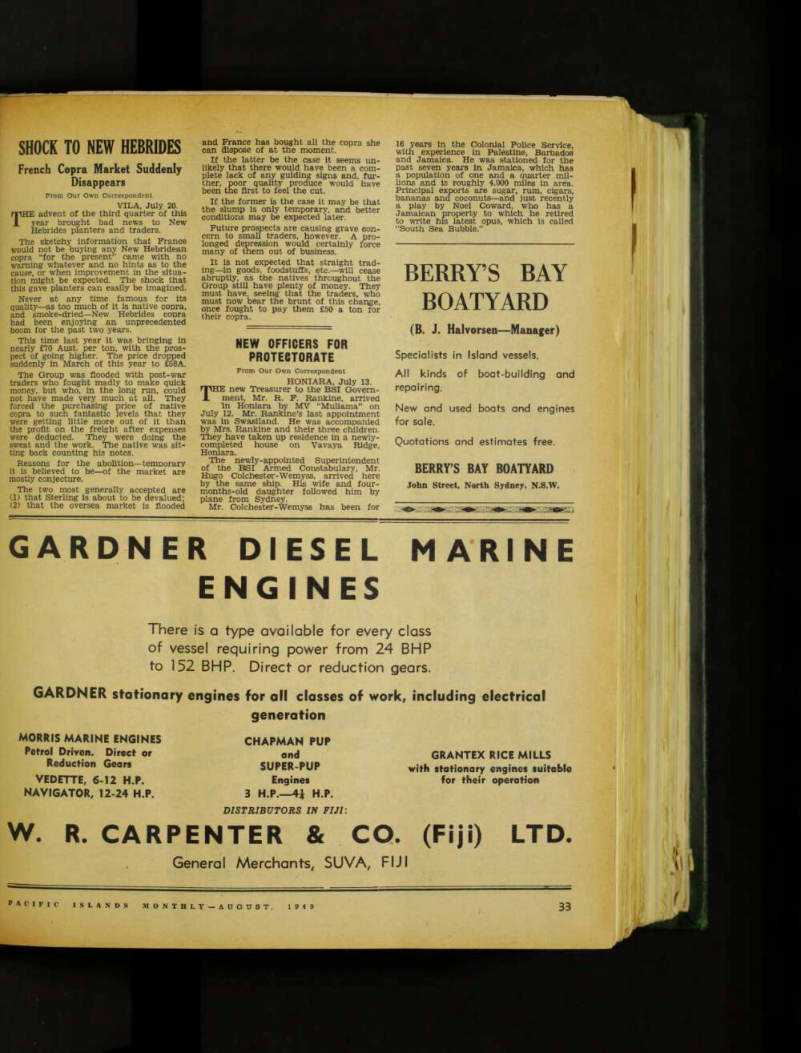
French Copra Market Suddenly Disappears
From Our Own Correspondent VILA, July 20.
THE advent of the third quarter of this year brought bad news to New Hebrides planters and traders.
The sketchy information that Prance would not be buying any New Hebridean copra “for the present” came with no warning whatever and no hints as to the cause, or when improvement in the situa tion might be expected. The shock that this gave planters can easily be imagined.
Never at any time famous for its quality—as too much of it is native copra, and smoke-dried —New Hebrides copra had been enjoying an unprecedented boom for the past two years.
This time last year it was bringing in nearly £70 Aust. per ton, with the prospect of going higher. The price dropped suddenly in March of this year to £58A.
The Group was flooded with post-war traders who fought madly to make quick money, but who, in the long run, could not have made very much at all. They forced the purchasing price of native copra to such fantastic levels that they were getting little more out of it than the profit on the freight after expenses were deducted. They were doing the sweat and the work. The native was sit ting back counting his notes.
Reasons for the abolition—temporary it is believed to be—of the market are mostly conjecture.
The two most generally accepted are (1) that Sterling is about to be devalued; (2) that the oversea market is flooded
and France has bought all the copra she can dispose of at the moment.
If the latter be the case it seems un likely that there would have been a com plete lack of any guiding signs and, fur ther, poor quality produce would have been the first to feel the cut.
If the former is the case it may be that the slump is only temporary, and better conditions may be expected later.
Future prospects are causing grave con cern to small traders, however. A pro longed depression would certainly force many of them out of business.
It is not expected that straight trad ing—in goods, foodstuffs, etc.—will cease abruptly, as the natives throughout the Group still have plenty of money. They must have, seeing that the traders, who must now bear the brunt of this change, once fought to pay them £50 a ton for their copra.
Protectorate
New Officers For
From Our Own Correspondent
Honiara. July 13.
THE new Treasurer to the BSI Govern ment, Mr. R. F. Rankine, arrived In Honiara by MV “Muliama” on July 12. Mr. Rankine’s last appointment was in Swasiland. He was accompanied by Mrs. Rankine and their three children.
They have taken up residence in a newly completed house on Vavaya Ridge, Honiara.
The newly-appointed Superintendent of the BSI Armed Constabulary, Mr.
Hugo Colchester-Wemyss, arrived here by the same ship. His wife and four months-old daughter followed him by plane from Sydney.
Mr. Colchester-Wemyss has been for
16 years In the Colonial Police Service, with experience in Palestine, Barbados and Jamaica. He was stationed for the past seven years in Jamaica, which has a population of one and a quarter mil lions and is roughly 4,000 miles in area.
Principal exports are sugar, rum, cigars, bananas and coconuts —and just recently a play by Noel Coward, who has a Jamaican property to which he retired to write his latest opus, which is called “South Sea Bubble.”
Advertisements & other items, pp. 35-36 (1 item)
Engines
BERRY’S BAY
BOATYARD
(B. J. Halvorsen—Manager)
Specialists in Island vessels.
All kinds of boat-building and repairing.
New and used boats and engines for sale.
Quotations and estimates free.
BERRY'S BAY BOATYARD
John Street, North Sydney. N.S.W.
GARDNER DIESEL MARINE
ENGINES
There is a type available for every class of vessel requiring power from 24 BHP to 152 BHP. Direct or reduction gears.
GARDNER stationary engines for all classes of work, including electrical
generation
MORRIS MARINE ENGINES
Petrol Driven. Direct or Reduction Gears
VEDETTE, 6-12 H.P.
NAVIGATOR, 12-24 H.P.
CHAPMAN PUP
and
SUPER-PUP
Engines
3 H.P.—4¼ H.P.
DISTRIBUTORS IN FIJI:
GRANTEX RICE MILLS
with stationary engines suitable for their operation W. R. CARPENTER & CO. (Fiji) LTD.
General Merchants, SUVA, FIJI
DON'T SAY GIN
telegrams and Cables: "GILBEYS,” Melbourne.
Address all inquiries to:
W. & A. GILBEY LTD.
33 ROSSLYN STREET, WEST MELBOURNE. 109 REGENT STREET, SYDNEY.
Telegrams and Cables: “GILBEYS.” Sydney.
Unwanted Atolls
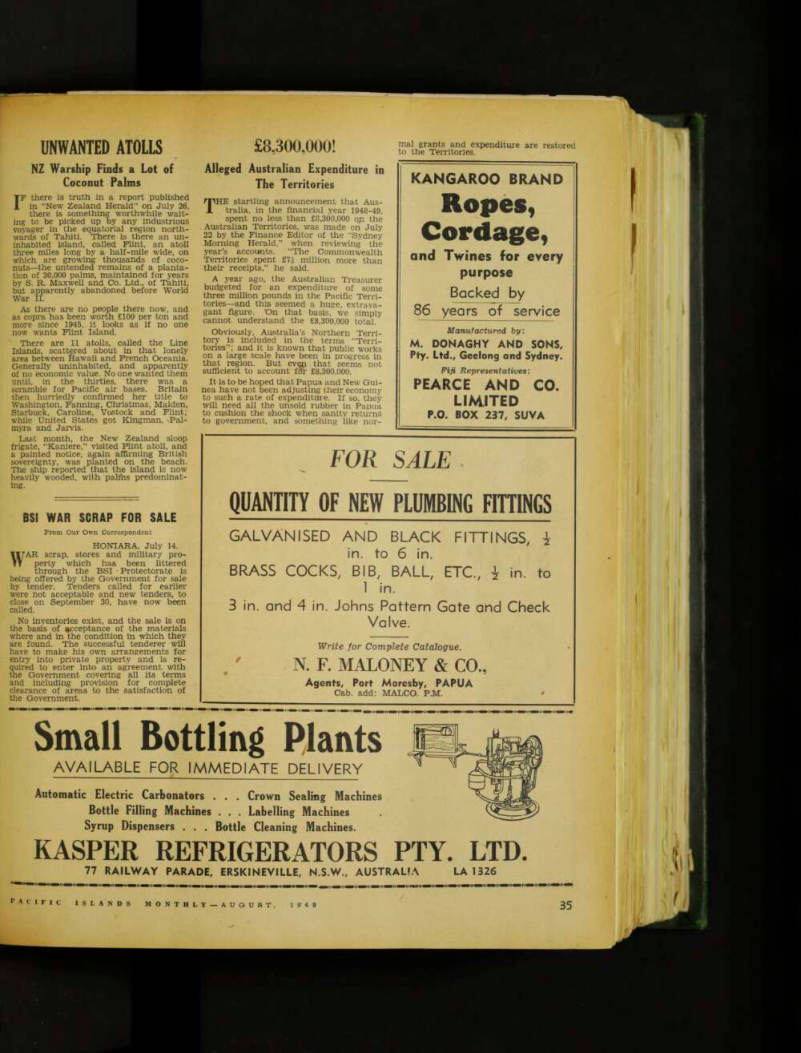
NZ Warship Finds a Lot of Coconut Palms
IF there is truth in a report published in “New Zealand Herald” on July 26, there is something worthwhile wait ing to be picked up by any industrious voyager in the equatorial region north wards of Tahiti. There is there an un inhabited island, called Flint, an atoll three miles long by a half-mile wide, on which are growing thousands of coco nuts —the untended remains of a planta tion of 30,000 palms, maintained for years by S. R. Maxwell and Co. Ltd., of Tahiti, but apparently abandoned before World War II.
As there are no people there now, and as copra has been worth £100 per ton and more since 1945, it looks as if no one now wants Flint Island.
There are 11 atolls, called the Line Islands, scattered about in that lonely area between Hawaii and French Oceania.
Generally uninhabited, and apparently of no economic value. No one wanted them until, in the thirties, there was a scramble for Pacific air bases. Britain then hurriedly confirmed her title to Washington, Fanning, Christmas, Malden, Starbuck, Caroline, Vostock and Flint; while United States got Kingman, Pal myra and Jarvis.
Last month, the New Zealand sloop frigate, “Kaniere,” visited Flint atoll, and a painted notice, again affirming British sovereignty, was planted on the beach.
The ship reported that the island is now heavily wooded, with palms predominat ing.
Bsi War Scrap For Sale
From Our Own Correspondent
Honiara, July 14.
WAR scrap, stores and military pro perty which has been littered through the BSI Protectorate is being offered by the Government for sale by tender. Tenders called for earlier were not acceptable and new tenders, to close on September 30, have now been called.
No inventories exist, and the sale is on the basis of acceptance of the materials where and in the condition in which they are found. The successful tenderer will have to make his own arrangements for entry into private property and is re quired to enter into an agreement with the Government covering all its terms and including provision for complete clearance of areas to the satisfaction of the Government.
Alleged Australian Expenditure in
£8,300,000!
Alleged Australian Expenditure in The Territories
THE startling announcement that Aus tralia, in the financial year 1948-49, spent no less than £8,300,000 on the Australian Territories, was made on July 22 by the Finance Editor of the “Sydney Morning Herald,” when reviewing the year’s accounts. “The Commonwealth Territories spent £7½ million more than their receipts,” he said.
A year ago, the Australian Treasurer budgeted for an expenditure of some three million pounds in the Pacific Terri tories—and this seemed a huge, extrava gant figure. On that basis, we simply cannot understand the £8,300,000 total.
Obviously, Australia’s Northern Terri tory is included in the terms “Terri tories”; and it is known that public works on a large scale have been in progress in that region. But even that seems not sufficient to account for £8,300,000.
It is to be hoped that Papua and New Gui nea have not been adjusting their economy to such a rate of expenditure. If so, they will need all the unsold rubber in Papua to cushion the shock when sanity returns to government, and something like nor
mal grants and expenditure are restored to the Territories.
Advertisements & other items, p. 37 (1 item)
Small Bottling Plants
KANGAROO BRAND
Ropes,
Cordage,
and Twines for every purpose Backed by 86 years of service Manufactured by:
M. DONAGHY AND SONS,
Pty. Ltd., Geelong and Sydney.
Fiji Representatives :
PEARCE AND CO.
LIMITED
P.O. BOX 237, SUVA
FOR SALE
QUANTITY OF NEW PLUMBING FITTINGS
GALVANISED AND BLACK FITTINGS, i
in. to 6 in.
BRASS COCKS, 818, BALL, ETC., i in. to 1 in. 3 in. and 4 in. Johns Pattern Gate and Check Valve.
Write for Complete Catalogue.
N. F. MALONEY & CO.,
Agents, Port Moresby, PAPUA Cab. add: MALCO. P.M.
Small Bottling Plants
AVAILABLE FOR IMMEDIATE DELIVERY
Automatic Electric Carbonators . . . Crown Sealing Machines Bottle Filling Machines . . . Labelling Machines Syrup Dispensers . . . Bottle Cleaning Machines.
KASPER REFRIGERATORS PTY. LTD.
77 RAILWAY PARADE, ERSKINEVILLE, N.S.W., AUSTRALIA LA 1326
Death Of Mrs. Bertha
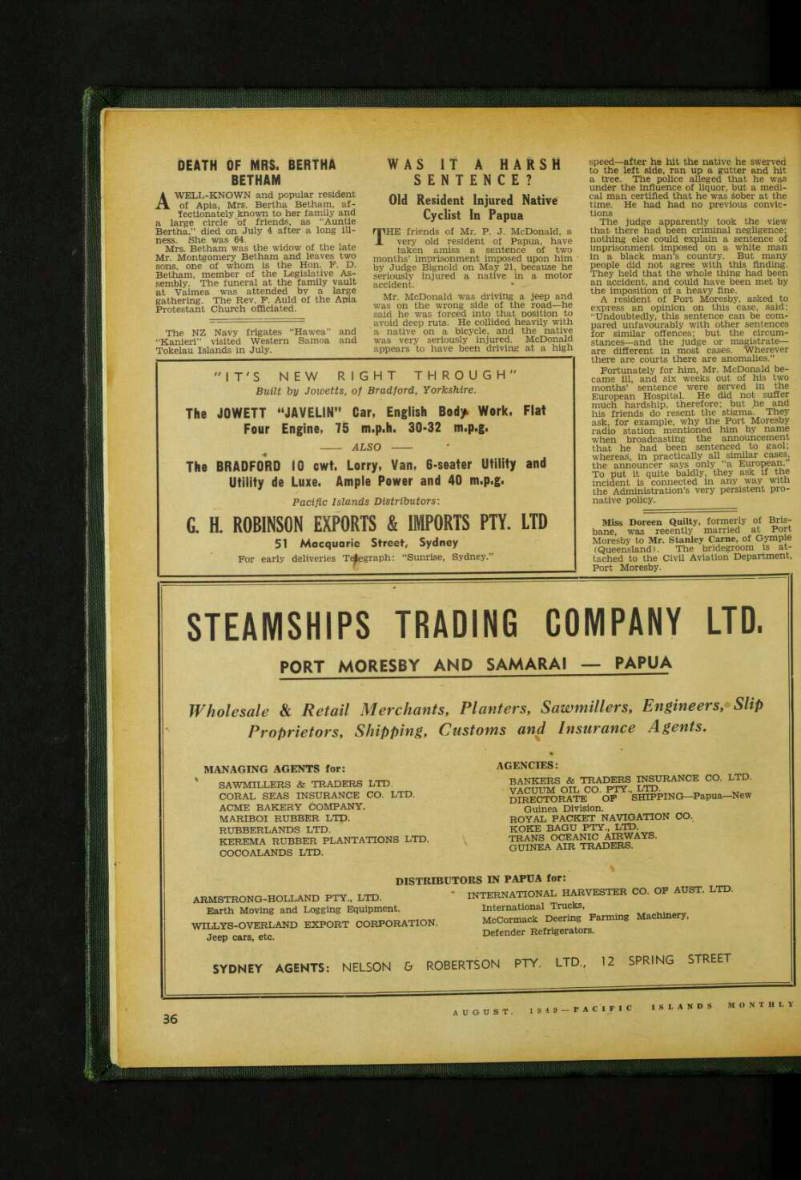
Betham
A WELL-KNOWN and popular resident of Apia, Mrs. Bertha Betham, af fectionately known to her family and a large circle of friends, as “Auntie Bertha,” died on July 4 after a long ill ness. She was 64.
Mrs. Betham was the widow of the late Mr. Montgomery Betham and leaves two sons, one of whom is the Hon. F. D.
Betham, member of the Legislative As sembly. The funeral at the family vault at Vaimea was attended by a large gathering. The Rev. F. Auld of the Apia Protestant Church officiated.
The NZ Navy frigates “Hawea” and “Kanieri” visited Western Samoa and Tokelau Islands in July.
Cyclist In Papua
Was It A Harsh
Sentence?
Old Resident Injured Native Cyclist In Papua
THE friends of Mr. P. J. McDonald, a very old resident of Papua, have taken amiss a sentence of two months’ imprisonment imposed upon him by Judge Bignold on May 21, because he seriously injured a native in a motor accident.
Mr. McDonald was driving a jeep and was on the wrong side of the road —he said he was forced into that position to avoid deep ruts. He collided heavily with a native on a bicycle, and the native was very seriously injured. McDonald appears to have been driving at a high
speed—after he hit the native he swerved to the left side, ran up a gutter and hit a tree. The police alleged that he was under the influence of liquor, but a medi cal man certified that he was sober at the time. He had had no previous convic tions The judge apparently took the view that there had been criminal negligence; nothing else could explain a sentence of imprisonment imposed on a white man in a black man’s country. But many people did not agree with this finding.
They held that the whole thing had been an accident, and could have been met by the imposition of a heavy fine, A resident of Port Moresby, asked to express an opinion on this case, said: “Undoubtedly, this sentence can be com pared unfavourably with other sentences for similar offences; but the circum stances—and the judge or magistrate are different in most cases. Wherever there are courts there are anomalies.”
Fortunately for him, Mr. McDonald be came ill, and six weeks out of his two months’ sentence were served in the European Hospital. He did not suffer much hardship, therefore; but he and his friends do resent the stigma. They ask, for example, why the Port Moresby radio station mentioned him by name when broadcasting the announcement that he had been sentenced to gaol; whereas, in practically all similar cases, the announcer says only “a European."
To put it quite baldly, they ask if the incident is connected in any way with the Administration’s very persistent pro native policy.
Miss Doreen Quilty, formerly of Bris bane, was recently married at Port Moresby to Mr. Stanley Carne, of Gympie (Queensland). The bridegroom is at tached to the Civil Aviation Department, Port Moresby.
Advertisements & other items, p. 38 (1 item)
Steamships Trading Company Ltd
"IT'S NEW RIGHT THROUGH"
Built by Jowetts, of Bradford, Yorkshire.
The JOWETT “JAVELIN” Car, English Body Work, Flat Four Engine, 75 m.p.h. 30-32 m.p.g.
ALSO
The BRADFORD 10 cwt. Lorry, Van, 6-seater Utility and Utility de Luxe. Ample Power and 40 m.p.g.
Pacific Islands Distributors : G. H. ROBINSON EXPORTS & IMPORTS PTY. LTD 51 Macquarie Street, Sydney For early deliveries “Sunrise, Sydney.”
STEAMSHIPS TRADING COMPANY LTD
PORT MORESBY AND SAMARAI PAPUA
Wholesale & Retail Merchants, Planters, Sawmillers, Engineers, Slip
Proprietors, Shipping, Customs and Insurance Agents.
MANAGING AGENTS for:
SAWMILLERS & TRADERS LTD.
CORAL SEAS INSURANCE CO. LTD.
ACME BAKERY COMPANY.
MARIBOI RUBBER LTD.
RUBBERLANDS LTD.
KEREMA RUBBER PLANTATIONS LTD.
COCOALANDS LTD.
AGENCIES:
BANKERS & TRADERS INSURANCE CO. LTD.
VACUUM OIL CO. PTY., LTD.
DIRECTORATE OP SHIPPING— Papua—New
Guinea Division.
ROYAL PACKET NAVIGATION CO.
KOKE BAGU PTY., LTD.
TRANS OCEANIC AIRWAYS.
GUINEA AIR TRADERS.
DISTRIBUTORS IN PAPUA for:
ARMSTRONG-HOLLAND PTY., LTD. * INTERNATIONAL HARVESTER CO. OF AUST. LTD.
Earth Moving and Logging Equipment. International Trucks, WILLYS-OVERLAND EXPORT CORPORATION. McCormack Deermg Farming a Jeep cars. etc. defender Refrigerators.
SYDNEY AGENTS: NELSON & ROBERTSON PTY. LTD., 12 SPRING STREET
Twist Tobacco
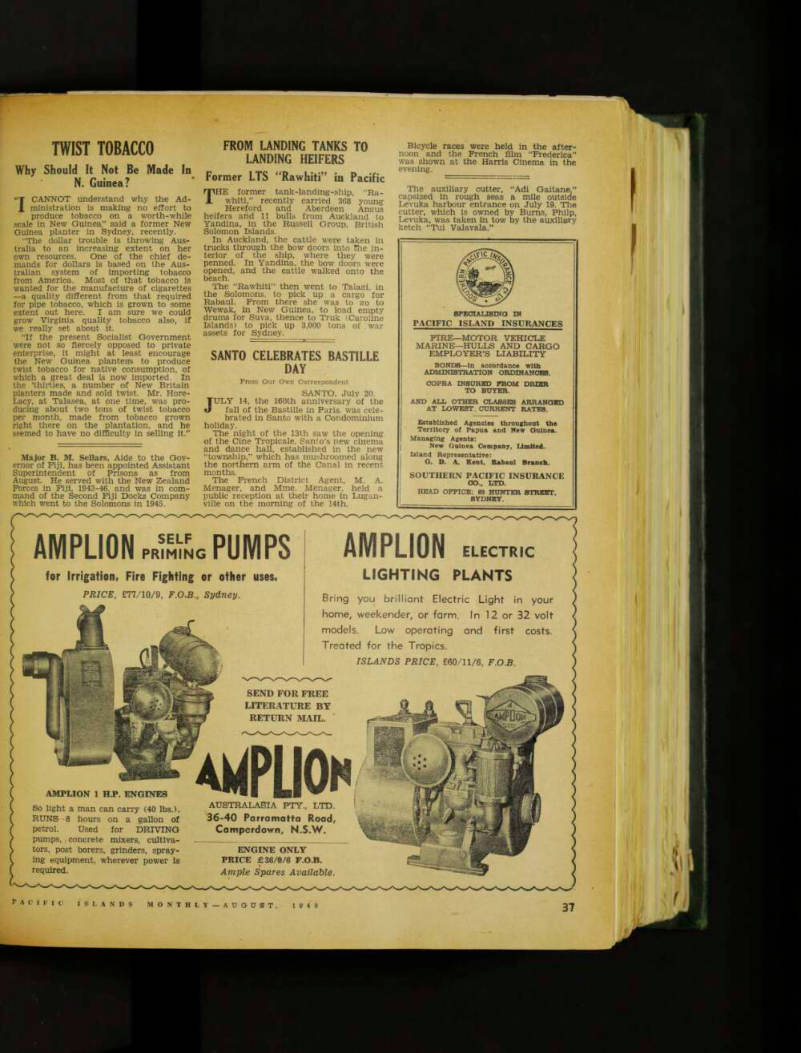
Why Should It Not Be Made In N. Guinea?
“I CANNOT understand why the Administration is making no effort to produce tobacco on a worth-while scale in New Guinea” said a former New Guinea planter in Sydney, recently.
“The dollar trouble is throwing Aus tralia to an increasing extent on her own resources. One of the chief de mands for dollars is based on the Aus tralian system of importing tobacco from America. Most of that tobacco is wanted for the manufacture of cigarettes —a quality different from that required for pipe tobacco, which is grown to some extent out here. I am sure we could grow Virginia quality tobacco also, if we really set about it.
“If the present Socialist Government were not so fiercely opposed to private enterprise, it might at least encourage the New Guinea planters to produce twist tobacco for native consumption, of which a great deal is now imported. In the ’thirties, a number of New Britain planters made and sold twist. Mr. Hore- Lacy, at Talasea, at one time, was pro ducing about two tons of twist tobacco per month, made from tobacco grown right there on the plantation, and he seemed to have no difficulty in selling it.”
Major B. M. Sellars, Aide to the Gov ernor of Fiji, has been appointed Assistant Superintendent of Prisons as from August. He served with the New Zealand Forces in Fiji, 1943-46, and was in com mand of the Second Fiji Docks Company which went to the Solomons in 1945.
From Landing Tanks To
Landing Heifers
Former LTS “Rawhiti” in Pacific
THE former tank-landing-ship, “Ra
whiti,” recently carried 368 young Hereford and Aberdeen Angus heifers and 11 bulls from Auckland to Yandina, in the Russell Group, British Solomon Islands.
In Auckland, the cattle were taken in trucks through the bow doors into the in terior of the ship, where they were penned. In Yandina, the bow doors were opened, and the cattle walked onto the beach.
The “Rawhiti” then went to Talagi, in the Solomons, to pick up a cargo for Rabaul. From there she was to go to Wewak, in New Guinea, to load empty drums for Suva, thence to Truk (Caroline Islands) to pick up 3,000 tons of war assets for Sydney.
Santo Celebrates Bastille
Day
From Our Own Correspondent SANTO. July 20.
JULY 14, the 160th anniversary of the fall of the Bastille in Paris, was cele brated in Santo with a Condominium holiday.
The night of the 13th saw the opening of the Cine Tropicale, Santo’s new cinema and dance hall, established in the new “township,” which has mushroomed along the northern arm of the Canal in recent months.
The French District Agent, M. A.
Menager, and Mme. Menager, held a public reception at their home in Lugan ville on the morning of the 14th.
Bicycle races were held in the after noon and the French film “Frederica” was shown at the Harris Cinema in the evening.
The auxiliary cutter, “Adi Gaitane,” capsized in rough seas a mile outside Levuka harbour entrance on July 19. The cutter, which is owned by Burns, Philp, Levuka, was taken in tow by the auxiliary ketch “Tui Valavala.”
Advertisements & other items, p. 39 (1 item)
Amplioh
SPECIALISING IN
PACIFIC ISLAND INSURANCES
FIRE—MOTOR VEHICLE
MARINE—HULLS AND CARGO
EMPLOYER’S LIABILITY
BONDS—In accordance with
ADMINISTRATION ORDINANCES.
COPRA INSURED PROM DRIER
TO BUYER.
AND ALL OTHER CLASSES ARRANGED
AT LOWEST CURRENT RATES.
Established Agencies throughout the Territory of Papua and New Guinea.
Managing Agents: New Guinea Company, Limited.
Island Representative: G. D. A. Kent, Babaul Branch.
SOUTHERN PACIFIC INSURANCE
CO.. LTD.
HEAD OFFICE; 60 HUNTER STREET.
SYDNEY.
AMPLION PRIMING PUMPS
for Irrigation, Fire Fighting or other uses.
PRICE, £77/10/9, F. 0.8., Sydney.
AMPLION 1 H.P. ENGINES
So light a man can carry (40 lbs.).
RUNS 8 hours on a gallon of petrol. Used for DRIVING pumps, concrete mixers, cultivators, post borers, grinders, spraying equipment, wherever power is required.
AMPLION
ELECTRIC
LIGHTING PLANTS
Bring you brilliant Electric Light in your home, weekender, or farm. In 12 or 32 volt models. Low operating and first costs.
Treated for the Tropics.
ISLANDS PRICE, £6O/11/6, F. 0.8.
SEND FOR FREE
LITERATURE BY
RETURN MAIL.
aMPLIOh
AUSTRALASIA PTY., LTD.
36-40 Parramatta Road,
Camperdown, N.S.W.
ENGINE ONLY
PRICE £36/0/6 F. 0.8.
Ample Spares Available.
Shortage Of Drinking Water
At Mangaia, Cook Is.
From Our Mangaia Correspondent THE lack of any heavy showers for several months, has created an acute shortage of good drinking water.
The people now must go with buckets, tins, etc., to the muddy creeks that irri gate the Keia taro-patches.
Keia water, full as it is of gambusia minnows and other living things, includ ing mosquito-larvae and infant dragon flies, may possibly have the makings of an excellent stew but when drunk straight from the pail or tin, unboiled, as customary with the villagers, it is likely to have an adverse effect upon native health.
We would like to hear more of “Weil’s disease,” described by retiring Dr. C. M.
Dawson in April “PIM.” Cases have been known here of a mystery complaint that appears to attack the bloodstream and more particularly the spinal nerves, re ducing the patient to great weakness, and
this in spite of the absence of a high tem perature. Might the disease be the result of drinking infected creek-water, if caused, on Dr. Dawson’s affirmation, by “a wriggling microbe”?
In the case of Keia-water, even boiling does not remove the fishy smell of the fluid, though it undoubtedly slays the minnows, etc.
There is no substitute for pure rain water, straight from sky to tank, and, until we get a supply piped direct from the springs that well out of the foothills, and which at present is inaccessible, village health will be endangered during every dry spell.
Miss Barbara Grose, a daughter of the late Mr. W. Grose, a New Ireland planter, and Mrs. Grose, of Moss Vale, NSW, and Kavieng, was married in Sydney on July 21 to Mr. James (Sandy) McLeish, of Coonamble, NSW.
Mr. James Grose, of Kavieng, New Guinea, made a special trip to Sydney to attend the wedding.
Tonkinese At Large
Repatriation Problem In New Hebrides
From Our Own Correspondent SANTO, July 20.
A MEETING was held recently in Santo to discuss the latest developments in the projected repatriation of all Tonkinese imported labour from the Group.
Those present were planters who had employed Tonkinese on the indentured system when the labour was first intro duced into the New Hebrides. The ori ginal repatriation went amiss owing to war conditions.
Following demonstrations by Tonkinese in Vila and Santo against attempts to force them to continue the terms of their contracts, despite the fact they had ex pired, they were granted free citizenship, with the right to engage in whatever pur suit they wished.
Stores, vegetable gardens, a so-called “taxi” service, grog-running to the natives, arrogance, and Tonkinese camps were among the results.
When this coolie labour was first intro duced, a planter made application for a quota, and had to put up a bond with the Government to cover the cost of the repatriation of the labourers allotted to him. The Government now insists that that bond is inadequate to cover repatria tion, in view of the increased costs of shipping, etc.
The meeting of planters protested against attempts to make them pay more, on the grounds that their erstwhile labour had long since been employed on its own affairs, and that, as planters had fulfilled their terms of contract, any fur ther responsibility in regard to repatria tion was on the Government.
Advertisements & other items, p. 40 (1 item)
Burns Philp (South Sea) Go. Ltd
Allen Taylor & Co. Ltd,
COMMERCIAL ROAD, ROZELLE,
SYDNEY
Sawmillers and Wholesale Suppliers of Hardwoods for Constructional Purposes GIRDERS ... PILES .. . POLES . SLEEPERS, Etc.
EXPORTING TO PACIFIC ISLANDS SINCE 1893
BURNS PHILP (SOUTH SEA) Go. Ltd
Registered Office: SUVA, FIJI
Code Address: “BURNSOUTH”
ISLAND TRADERS AND SHIPOWNERS
General Merchants (Wholesale and Retail)
Shipping, Customs and General Agents
Representatives for :
QUEENSLAND INSURANCE CO., LTD. BURNS PHILP TRUST CO., LTD.
Distributing Agents for :
SHELL COMPANY (P. 1.), LTD. FERGUSON TRACTORS STANDARD MOTOR CAR COMPANY CROSSLEY MARINE ENGINES
BRANCHES:
FIJI—
SUVA.
LEVUKA.
LAUTOKA.
LAB AS A.
BA.
SIGATOKA.
ROTUMA ISLAND.
NORFOLK IS.—
SAMOA—
APIA.
PAGO PAGO.
TONGA—
NUKUALOFA.
HAAPAI.
VAVAU.
NIUE IS,—
Sydney Agents:
BURNS, PHILP St CO., LTD.,
7 Bridge Street.
London Agents:
BURNS, PHILP St CO., LTD.,
35 Crutched Friars, E.C.3.
San Francisco Agents:
BURNS. PHILP CO. OP SAN FRANCISCO,
Matson Building, 215 Market Street.
Agencies Throughout the World.
First Canadian Airliner
At Nadi, Fiji
From Our Own Correspondent SUVA. July 18.
THE official Canadian party, travelling in the pre-inaugural flight of Cana dian Pacific Airlines' “Empress of Sydney,” was welcomed at Nadi Airport on July 13.
The Mocambo lounge had been lavishly decorated, and an Islands string band intailed; hula-skirted girls garlanded the visitors with leis.
The official party of welcome included the manager of the Union Steam Ship Company of New Zealand in Fiji (Mr. D.
A. Butler); the Nadi Airport manager (Mr. J. Turner); the District Commis sioner Western (Mr. C. Harley Nott); Sir Hugh Ragg; the Mayor of Suva (Mr. Al port Barker); the Fiji Publicity Board’s officer at Nadi Airport (Mr. R. A. Hew lett) ; the chairman of the Lautoka Town Board (Mr. C. A. Adams); and the manager of the Lautoka office of the USS Company. (The USS Company is the local agent for CPA).
There was a large gathering of Lautoka and Nadi residents to greet the plane when it arrived at 9.37 p.m. and before the 33 Canadians left for Sydney next morning they expressed warm apprecia tion of the friendliness and informality of their welcome to Fiji.
The “Empress of Sydney” arrived back at Nadi at 9.20 a.m. on July 18. Twenty members of the Canadian party went to Suva by a special Dakota flight to Nausori Airport and the remainder travelled by road, arriving in the late afternoon.
Apart from a motor tour arranged for the early arrivals, there was time only for a cocktail party at the Grand Pacific Hotel. Most of the travellers seized the
opportunity for an early night in the last stage of a strenuous tour.
This is the largest group of Govern ment, commercial, newspaper and other representatives to visit Fiji in one air liner.
Jack, a New Hebrides native teacher of the Presbyterian Mission, will visit New Zealand with the Rev. C. K. Crump, when he returns to the Dominion on leave.
Mr. T. Taverner, lately of Suva, but for a number of years on the office staff of the associated gold-mining companies at Vatukoula, Fiji, died on July 18.
Mr. and Mrs. Oscar Rundahl made a “round trip” to Papua-New Guinea in the July-August “Bulolo”. Mr. Rundahl formerly was a well-known planter in New Britain, but he is now settled in South Australia, where he is interested in stock-breeding and the film industry.
Advertisements & other items, pp. 41-42 (1 item)
William A Jones Ptv. Lid.
Livestock Exporters
Livestock Exported To All Ports Inquiries Invited Address:
108 QUEEN ST., MELBOURNE
Telegrams: “VALKYRIE” Melbourne.
KASPER ELECTRIC
The Kasper No. 1 K Electric Carbonator.
CARBONATORS
Available
DESCRIPTION: Fully automatic, noiseless and efficient at all times; Capacity 24 gallons of pure sparkling peppy soda per hour. All working parts easily accessible from the front. Dimensions: 22 in. x 27 in. floor space; 26 in. high. Finish: Rust resistant and easy to clean. Valves and fittings are hard bronze accurately machined.
Thoroughly tested and fully guaranteed for 12 months.
INSTALL A KASPER No. 1K
ELECTRIC CARBONATOR and
be assured of dependable, trouble-free service.
KASPER REFRIGERATORS PTY. LTD.
77 Railway Parade, Erskineville, N.S.W., Australia. Phone LA 1326.
GEORGE J. LOCKYER & COMPANY
CONSULTING ENGINEERS
DOCKYARD MACHINERY
In association with GEORGE J. LOCKYER (Far East) & CO. and GEORGE J. LOCKYER (Overseas) & CO.
ENGINEERING SUPPLIES, GENERAL HARDWARE EXPORTERS AND MERCHANTS Agents for the Finest Australian Liquors Aerated Water and Cordial Manufacturing Machinery, Bottling and Capping Machinery, etc.
IF YOU ARE INTERESTED IN: —
MILLS
Flour mills. Hard semolina mills. Self-contained Colonial Flour Mills. Flour improving equipment. Feed milling equipment. Grinding and blending plants. Saw dust mills. Grinding and blend plants for spices and colours. Laboratory equipment.
HULLING INDUSTRY
Hulling mills for rice, barley (for making groats), oats (for flakes and groats), peas, buckwheat, millets, kauliang, entils, Dal and other pulses.
OIL MILLING
Complete equipments for the manufacture and refining of vegetable oils and fats. Pressing, Extraction-, and Refining plants. Oil separating plants for wool and leather. Margarine granulators, Melting and Tempering Pand for the manufacture of margarine.
SUGAR TREATING MACHINERY
Installations for drying, cooling and assorting granulated sugar. Conveying plants. Grinding plants for pile and granulated sugar. Manufacture of powdered sugar.
MALTING AND BREWING PLANTS
Equipments of complete maltings and breweries. Barley and Malt cleaning plants. Pneumatic Maltings (Drum and Saladin Box Maltings). Malt Kilns. High Capacity Malt Kilns. Floor Stores and Silos for barley and malt.
Pneumatic and mechanical handling plants for barley and malt. Malt crushing plants. Brew house equipment. Mash filters. Wort colling plants. Fermentation and Storage Tanks. Conveying plants for barrels ana bottles. Laboratory equipments.
MACHINES FOR SOAP MAKING
Soap boiling equipment. Pumps. Soap slabs cooling plants. Cutting machines. Presses. Drying plants.
Milling equipment. Pendulum cutter. Flaking rolls.
Soap-powder plants.
MACHINES FOR THE CHOCOLATE INDUSTRY
Cocoa beans crushing, cleaning and grinding plants.
Cocoa presses. Cocoa and chocolate roller mills.
CONSTRUCTION OF GRANARIES AND
WAREHOUSES
Construction of Export and Import Granaries. Agricultural and Mill Granaries for all kinds of gram, oil fruits, pulses, and seed, in bulk or in sacks. Mechanical and pneumatic handling plants for loading and unloading ships and railway cars with the above-namea goods. Steel Silos. Grain Cleaning Plants. Machinery for dressing seed.
PNEUMATIC HANDLING PLANTS
For grain, bran, flour, oil seed, coal, salt, chemical products, ashes, blast furnace dust, wood chips, woodshavings. Floating pneumatic elevators. Floating pneumatic grain elevators. Stationary and travelling ship discharging plants. Conveying plants for rubbish from wash plants and rubbish disposal plants for mines.
MECHANICAL HANDLING PLANTS
For all kinds of goods in bulk and packages, such as grain, coal, salt, earth and ores stornes, bags, cases, bales, barrels, wood logs, etc. Mechanical equipment for warehouses of salt works and the chemical industry.
Trans-shipping plants for loading saits into ships and railway cars. Coal handling plants for boiler houses.
Equipment for the automatic operation of mail offices.
CEMENT WORKS AND ROCK CRUSHING
PLANTS
Equipment of complete cement works. Crushing, burning grinding, and conveying equipment for the chemi cal’ industry; specially for Dolomite, Magnesite, and AluminiumWorks. Installations for salt mills and salt stores. Crushing and grinding plants for coal.
Road metal plants, etc.
MECHANICAL PULP AND BOARD MILLS
Comnlete equipment for mechanical wood pulp mills and boSd mills of every size. Preparing plants for cellulose and pulp lood. Wood barking plants. Installations for handling wood sticks and pulp.
All communications to be addressed to The General Manager, G.P. O., Box 4553, Sydney.
- CONSULT US -
Bankers: Commonwealth Bank of Australia, Sydney.
Also Bank of N.S.W., Sydney.
Telegraphic and Cable Address; "LOCKMACH.” Sydney.
New King Crowned At
Mangaia Island
From Our Mangaia Correspondent WITH the formal coronation on June 21, in the presence of all the district Havana, chiefs and Council mem bers, of King Tangi-ariki, the successor of the late King Mateke Trego (an elder brother), the continuance of Mangaia’s rule by a member of the renowned Trego clan is assured.
This European surname was assumed by an earlier king in compliment to a Cornish missionary of that name, some three-quarters of a century ago, and has since passed to all the descendants, whether of full Maori or part-European blood. Commoners, on Mangaia, have no surnames, merely taking the father’s given name in addition to their own, under which condition Mangaian native nomen clature is in a continuous state of flux.
At this Coronation, all were required to wear local morning dress to the cere mony, performed in the great LMS church of Oneroa—morning dress being starched white drill for the males and muslin for the fair sex. Additional in terest was given by the presence at Man gaia of a large number of passengers, native and European from the new CIPA Fairmile, which brought a “tere” from Rarotonga. The little motor-vessel stayed off the reef for three days, departing for Rarotonga on the afternoon of Corona tion Day.
Round The World Alone
From Our Own Correspondent SUVA. Julv 25.
LATEST of the single-handed, round the-world voyagers to call at Suva is Mr. William T. Murnan, who is sailing a 30 ft. all-steel yawl which he built at Los Angeles.
The vessel has a 25 HP auxiliary engine, electric light, an air-conditioned plant, radio, and a stove constructed so that it is always perpendicular whatever the angle at which the shin is rolling.
Mr. Murnan has been at sea for 40 years. He started by stowing away in a whaler. He built his first vessel, a 54 ft. schooner, in Seattle. In 12 years he and his wife sailed this ship, the “Seven Seas,” 100,000 miles, mostly tin South and Central American waters.
He left Los Angeles in the new steel ship, “Seven Seas II” on March 2, 1947, and has visited the Hawaiian, Marquesas, Tuamotu, Society and Samoan Groups.
Mrs. Muman travelled as far as Pago Pago.
From Fiji, Mr. Muman intends to go to the New Hebrides and Solomons. New Guinea, Australia, East Indies, India, Mauritius, South Africa and New York, finishing this cruise about 1954.
Fiji’S Hydro-Electric Scheme
Visit of Another Expert
From Our Own Correspondent SUVA, July 24.
Professor R. M. Shackleton,
Professor of Geology at Liverpool University and until recently on the staff of the Imperial College of Science and Technology, London, will arrive in Fiji on July 28, to make a detailed exa mination of the floor of the Navua valley and the site of the proposed dam for the Navua hydro-electric scheme.
He will then report to the Colonial De velopment Corporation, which has tenta tively agreed to take part in the scheme, m collaboration with the Fiii Govern ment.
Advertisements & other items, pp. 43-44 (1 item)
Best Since 1811
Made in the Australian Branch Factory of
BLUNDELL SPENCE & CO., LTD., Hull,
B. Cr S. SUPER PREPARED PAINT embodies the knowledge and experience gained from nearly 140 years of Paint manufacture.
Tested and proved for tropical conditions, B. & S. PREPARED PAINT is also available in a special Lead-free series for use in volcanic and other sulphurous regions. (Specify B. & S.-Series 2301).
Ask for supplies of these and other BLUN- DELL Paints and Enamels from your local Storekeeper, or write for particulars and colour-cards to the Agent for Pacific Islands :
KERR BROTHERS PTY. LTD.
4 YORK STREET, SYDNEY
PAINTS
BEST SINCE 1811
LEARN THE
Hill-Billy Guitar
Hawaiian Steel Guitar,
Spanish Guitar, Ukulele,
Hill-Billy Guitar,
Cow-Boy Guitar,
Mandolin and Banjo-Mandolin.
In 30 minutes
Let Norm. Scott, the Singing
Stockman, teach you!
You can learn to play your favourite melody or accompaniment to your favourite cowboy or popular song in 30 minutes. Be the most popular member of your set —play around the camp-fire, at dances, parties, or over the radio. It costs only 2/8 weekly to learn in the comfort of your own home, AND the Postal Instruction Course is so simple the smallest buckaroo can follow it.
MONEY - BACK GUARANTEE
Don't forget there's a MONEY-BACK GUAR- ANTEE if you are not satisfied. Decide to-day to change your whole life through the magic and popularity of real hill-billy music.
POST THIS COUPON
TODAY
To The Hawaiian Club, [P.I.] Kembla Building, 58 Margaret St.,
SYDNEY.
Please send me oy return mail complete i details of your Home Study Cour without J obligation. Tell me how I can obtain a Hill-Billy Guitar, Hawaiian Guitar, Spanish J Guitar, Ukulele, Mandolin and Banjo-Mandolin on a small deposit.
Name —— —— J Address • —— I This Offer obtainable ONLY from above address
A. B. DONALD Ltd.
AUCKLAND
ISLAND TRADERS & GENERAL MERCHANTS
P.O. Box 1 509. Cables & Telegrams, "Kingdom/' Auckland.
of Religion
‘Hinduism’ In Terms
Explanation and An Apology
I HAVE an apology to make —to a few scores of thousands of Indians in Fiji, and to R. C. Macpherson.
A woman, writing in a Sydney maga zine, made some inaccurate statements about Fiji. Mr. Macpherson, formerly a journalist in Fiji, wrote an article for “PIM,” in which he sharply corrected the lady.
Among other things, the lady said that the visitor to Fiji could hear “long wailing recitations from the Koran, ampli fying the paper prayers. . . .” Mr. Mac pherson commented: “Ye gods! Prayers from the Koran, and paper prayers, for the worshippers of Buddha!”
Editing that, I thought I would assist Mr. Macpherson’s point by adding the words, “The majority of the Fiji Indians are Brahmans.” That is what I intended to say; but, in a moment of mental care lessness, I wrote “Buddhists” instead of “Brahmans.”
The result has been most unhappy. Mr.
Macpherson, with his tartans flying and his dirk unsheathed, wanted to know who added this foolish line to his article just when he was busily correcting the foolish errors of another journalist. And some indignant people in Fiji, in close touch with Indian institutions, have written jeeringly to the “PIM.”
I abase myself before them all. My in tentions were good, but my hand certainly fumbled.
FEW people know much about the re ligions of India. The belief that the majority of these people are Moham medans is common. Actually, there are only some 80 million Moslems in India’s total of over 350 million people. In Fiji, the Moslems in the total Indian population of some 128,000 are only a handful.
Buddhism—which some thoughtful people claim to be the world’s finest re ligion—at one period prevailed generally in India; but now it is found mainly m the border countries like Burma and Thibet. There are comparatively few ad
herents in India proper; and that condi tion is reflected in Fiji.
About 250,000,000 of the 350,000,000 people in India are followers of Hinduism; and Hinduism comprises the various branches of Brahmanism. One would need long study, and much time and space, to describe the origin and history of Brahmanism, and the development of Hindu philosophy and culture.
Writers have traced the beginnings of certain divisions of the Vedic works in the period 1,200-1,000 years BC. The sacred book named “Rig Veda” has been called the oldest of the Vedas, and probably is the oldest human document in existence.
In reading the history of this religion, one is impressed with the age of old India, the length of its history and the once great depth of its culture.
At an early stage in the slow formation of this philosophy or religion the word Brahman first appears. A part of the Vedas is devoted to an effort to reconcile the pure worship of elementary powers with the idea of one supreme being, and this is called “Brahmana.” The conflict goes on over the centuries: the philosophy is changed and modified - and although Brahma never actually disappears from the 'constitution of the religion, the two gods, Vishnu and Siva, dominate all de velopment, until there comes a time when Vishnu and Siva appear to be rivals for the faith of the masses.
BUT the popular faith, as seen among the great masses of Hindus to-day— and which now is generally called Hin duism, rather than Brahmanism—is based on the triad of Brahma, the creator, Vish nu, the preserver, and Siva, the destroyer.
Brahma now has lapsed into an abstrac tion, and practical adoration is divided between the other two. It is a most com plicated religious system, and very diffi cult of comprehension by anyone who has not read deeply of Indian history and culture.
The rule of life is comprehended in the word Dharm, which includes religious fidelity and moral virtue.
The caste system, which now is part of Indian life, actually is not based on the Hindu religion, but in the course of time has become deeply interwoven with it.
Compared with Hinduism, such religions as Christianity, Mohammedanism and Buddhism are simple and easily compre hended. Hinduism drove Buddhism out of India; but when, in the last century, India began to feel the impact of Western civi lisation, and Christianity made sharp in roads, leading Hindus realised that, if the Brahma-based religion was to stand up to modern conditions, it would have to have a more definite shape, and made simple and direct.
Thus there arose Brahma Samai and Arya Samaj and other theistic reforming movements, being modern attempts to produce a pure, spiritual Hinduism We wish them well; for there is much in ancient Hinduism that Europeans, when thev have to live in close contact witn Indians, do not like. Brahma Samai is said to be very close to Christianity, but it appeals more to the intellectuals. Arya Samai preserves much more of the ancient
Vedic philosophy, and apparently appeals
more to the masses.
Other religions of India include the Sikhs, the Jains and the Parsecs. each of which has some special merits and— from our viewpoint—some peculiarities.
But the overwhelming maionty of Indians in Fiji belong to the Brahman-Hindu faith.—R. W. ROBSON.
A son (Garth Trevor) has been born in Brisbane to Mr. and Mrs. Trevor Ward, of Veimauri Estate, Papua.
Rabbits Reported In Fiji
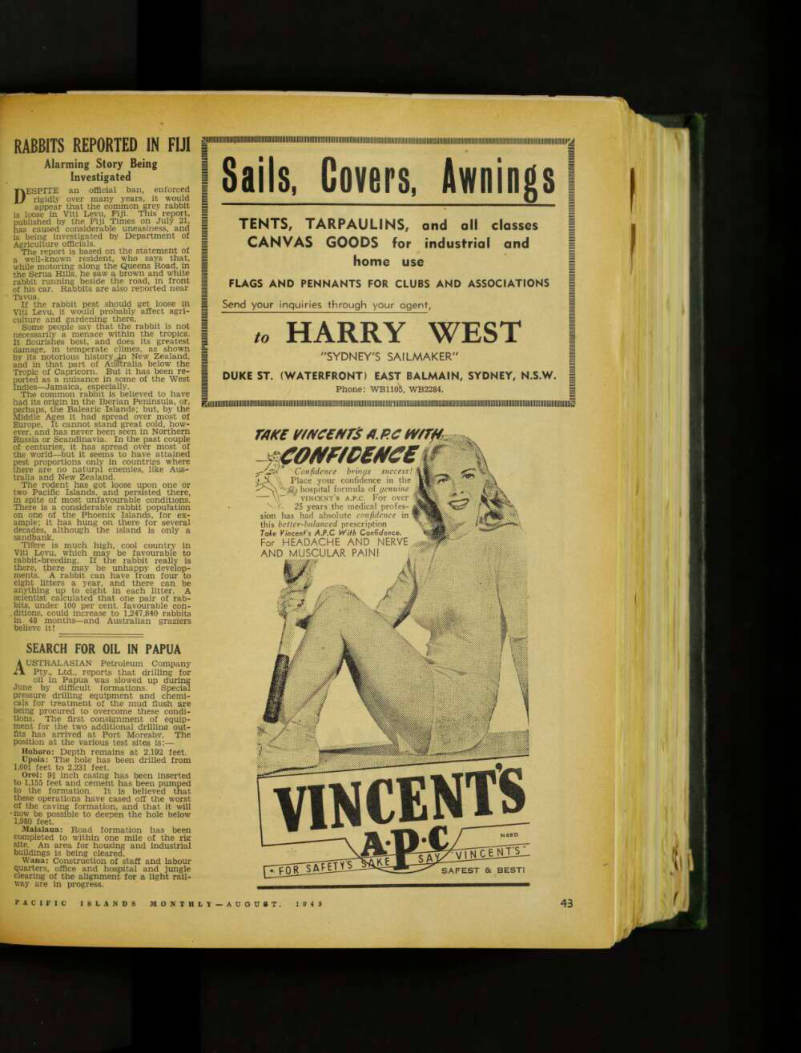
Alarming Story Being Investigated
DESPITE an official ban, enforced rigidly over many years, it would appear that the common grey rabbit is loose in Viti Levu, Fiji. This report, published by the Fiji Times on July 21, has caused considerable uneasiness, and is being investigated by Department of Agriculture officials.
The report is based on the statement of a well-known resident, who says that, while motoring along the Queens Road, in the Serua Hills, he saw a brown and white rabbit running beside the road, in front of his car. Rabbits are also reported near Tavua.
If the rabbit pest should get loose in Viti Levu, it would probably affect agri culture and gardening there.
Some people say that the rabbit is not necessarily a menace within the tropics.
It flourishes best, and does its greatest damage, in temperate climes, as shown by its notorious history in New Zealand, and in that part of Australia below the Tropic of Capricorn. But it has been re ported as a nuisance in some of the West Indies —Jamaica, especially.
The common rabbit is believed to have had its origin in the Iberian Peninsula, or, perhaps, the Balearic Islands; but, by the Middle Ages it had spread over most of Europe. It cannot stand great cold, how ever, and has never been seen in Northern Russia or Scandinavia. In the past couple of centuries, it has spread over most of the world —but it seems to have attained pest proportions only in countries where there are no natural enemies, like Aus tralia and New Zealand.
The rodent has got loose upon one or two Pacific Islands, and persisted there, in spite of most unfavourable conditions.
There is a considerable rabbit population on one of the Phoenix Islands, for ex ample; it has hung on there for several decades, although the island is only a sandbank.
There is much high, cool country in Viti Levu, which may be favourable to rabbit-breeding. If the rabbit really is there, there may be unhappy develop ments. A rabbit can have from four to eight litters a year, and there can be anything up to eight in each litter. A scientist calculated that one pair of rab bits, under 100 per cent, favourable con ditions, could increase to 1,247,840 rabbits in 48 months —and Australian graziers believe it!
Search For Oil In Papua
AUSTRALASIAN Petroleum Company Pty., Ltd., reports that drilling for oil in Papua was slowed up during June by difficult formations. Special pressure drilling equipment and chemi cals for treatment of the mud flush are being procured to overcome these condi tions. The first consignment of equip ment for the two additional drilling out fits has arrived at Port Moresby. The position at the various test sites is;— Hohoro: Depth remains at 2,192 feet.
Upoia: The hole has been drilled from 1,601 feet to 2,231 feet.
Oroi: 9½ inch casing has been inserted to 1,155 feet and cement has been pumped to the formation. It is believed that these operations have cased off the worst of the caving formation, and that it will now be possible to deepen the hole below 1,980 feet.
Maialaua: Road formation has been completed to within one mile of the rig site. An area for housing and industrial buildings is being cleared.
Wana: Construction of staff and labour quarters, office and hospital and jungle clearing of the alignment for a light rail way are in progress.
Advertisements & other items, pp. 45-46 (1 item)
Vincents
Sails, Covers. Awnings
TENTS, TARPAULINS, and all classes CANVAS GOODS for industrial and home use FLAGS AND PENNANTS FOR CLUBS AND ASSOCIATIONS Send your Inquiries through your agent,
to HARRY WEST
"SYDNEY'S SAILMAKER"
DUKE ST. (WATERFRONT) EAST BALMAIN, SYDNEY, N.S.W.
Phone: WBIIOS, W 82284.
takc nnceurs arc tmftf
-fCOMFICEMCE
Confidence brings success!
Place your confidence in the hospital formula of genuine \\ — Vincent’s a.p.c. For over \.U 25 years the medical profession has had absolute confidence in this better-balanced prescription Take Vincent's A.P.C With Confidence.
For HEADACHE AND NERVE
AND MUSCULAR PAIN!
VINCENTS
AT
HtTS
VINCINXI-
- & BESTI
NEW ZEALAND
OFFERS
UMEC
SHIPPING AND TRADE
to the Residents of New
Caledonia, New Hebrides,
Gilbert Islands, Ellice
Islands, British Solomon
Islands and New Guinea.
We are operating a regular shipping service throughout the above Islands. All goods ordered will be delivered without delay. Should large orders be contemplated we will arrange for a representative to visit you with samples and discuss the transaction.
Many classes of general merchandise are available at competitive prices and for early delivery.-
SAWN TIMBER.
PLYWOODS.
wallboards.
PAINTS.
VARNISHES.
BUILDING PAPER.
ASBESTOS
SIDINGS.
FURNITURE.
CANDLES.
WASHING SOAP.
TOILET SOAP.
TENNIS SHOES.
LEATHER BOOTS
AND SHOES.
LEATHER SOLES
AND HEELS.
LEATHER BELTING.
LEATHER BENDS,
ETC.
SEEDS (INCLUDING
BLUE & MAPLE
PEAS).
LIVESTOCK.
FROZEN MEATS.
TINNED MEATS.
TINNED FISH.
FROZEN FISH.
BUTTER.
CHEESE.
DRIED MILK, ETC.
TINNED
VEGETABLES.
TINNED SOUPS.
TINNED JAMS.
CUSTARD POWDER.
BAKING POWDER.
COFFEE ESSENCE.
POTATOES, FRESH
AND CANNED.
ONIONS.
CORDIALS.
BEER.
SILVERPLATE
WARE.
We are also buyers of Islands Produce of every description and we can provide shipping. Our sell-
ing organisation is world-wide.
BUYING OR SELLING—WE CAN HELP YOU
UNION MANUFACTURING
& EXPORT CO. LTD.
G.P.O. Box 1060, Wellington, NEW ZEALAND
Cables: "UMEC", Wellington
★ 1/40/P.
Rumoured Backing By NZ Government
Cipa In The Inter-Island
Transport Business Now
From Our Mangaia Correspondent
THE Cook Islands Progressive Associa tion, which has faded from the news somewhat of late, appears to have changed its tactics.
It is now making a bold bid for the control of inter-island transport. Its newly acquired motor-vessel, a converted Fairmile, made a round of the lower Cooks in the last week of June, and is scheduled to make further trips, to carry passengers between islands and pick up cargo.
The Association is well established, with a store and an exporting business in Raro tonga, and plans include extension of the enterprise, which is all-native and co operative, to the outer islands of the Group.
The Association is interested in market ing off-season products, such as candle nuts and arrowroot, etc., which are not handled by the NZ Government’s Internal Marketing Division, to which goes the whole of the orange crop each season.
Though there are rumours that the CIPA intends to enter the orange trade later there are no present indications of the IMD ceding its monopoly to the As sociation. In any case, the small Fair mile, with its limited cargo capacity, would not be suited to the carriage of oranges to New Zealand.
Observers with long experience of trade and shipping are intrigued with the alleged new attitude of the NZ Govern ment towards the formerly noisy and re bellious Association and its leader. Albert Henry. Originally anti-CIPA, the Gov
ernment is now believed to be taking an active interest in the enterprise, possibly with a view to quietening native discon tent at this end.
In taking over the orange trade, the Socialist NZ administration utilised exist ing markets, built-up by private interests over many years of trading. If the Asso ciation's enterprise is successful and ex pands, a similar development may pos sibly eventuate.
It has been stated here that the NZ Government encouraged the purchase of the new Fairmile, a former sub-chaser, with a loan to the CIPA of £11,000 towards the total cost of £15,000. This, if accurate, indicates that the Socialist ad ministration sees in the new venture a possible avenue for the gaining of good will among the Cook Islanders; or, alter natively, a means of getting control of the Association, and reducing its power, if the Henry faction fails to play ball with the NZ authorities.
Enthusiasm for the CIPA here at Man gaia runs high, and locals are seeking, by what means suit them best, the £3 share money that gives the individual planter a stake in the Association and the ship.
There are also, to offset the enthusiasts.
Mangaian men-from-Missouri who evoke the vanished Rarotonga Fruit Company, a former native enterprise, long defunct, and keep their cash in hand until the CIPA shall have achieved victory against the long-established trading interests with
head offices in NZ, and share-capital run ning into the million.
Whatever the outcome, the CIPA has at least made good its promise to acquire a ship of its own, and the trading in terests are now faced with the prospect of having to produce something bigger and better, or lose a certain amount of face.
Advertisements & other items, pp. 47-48 (1 item)
Etablissements Donald Tahiti
COLE’S
Tropic-Seasoned
CHICKENS
Pure WHITE LEGHORNS and
First-crosses: R.l. Red x W.L. or Australorp x W.L.
Bred in the sub-tropics and seasoned to your climate.
All Breeders guaranteed Government blood-tested. 25’s 50’s 100’s £ s. d. £ s. d. £ s. d.
V* .. 110 0 212 6 415 0 Crosses 111 6 215 0 500 Plus Air Freight
ED. COLE,
Enmore Poultry Farm, Cairns, N.Q.
ETABLISSEMENTS DONALD TAHITI
HEAD OFFICE—QUAI DU COMMERCE—PAPEETE
TELEGRAPHIC ADDRESS—"DONALD, PAPEETE"
General Merchants (Wholesale & Retail) fir Shipowners
Importers & Exporters—Branches Throughout Marquesas Islands
Lloyd’s Agents
ASSOCIATE
HOUSES:
A. B. DONALD, LTD.
AUCKLAND, NEW ZEALAND.
A. B. DONALD, LTD.
RAROTONGA, COOK ISLANDS.
DOMINION FRUIT CO.,
SUVA, FIJI ISLANDS.
Agents and Distributors for :
FRANCE:
HENNESSY COGNACS
MARIE BRIZARD «fe ROGER
LIQUEURS
CHARLES HEIDSIECK
CHAMPAGNES
PERRIER WATER
GRUBER BEER
U.S.A.:
GENERAL STEAMSHIP CORP.
RADIO CORP. OP AMERICA
BROWN & WILLIAMSON, LTD.
CIGARETTES: LUCKY STRIKE,
WINGS, OLD GOLD
CHAMPION SPARK PLUG CO.
KAINIER BEER
ENGLAND:
RECKITTS & COLMAN
(OVERSEAS), LTD.
PHILLIPS BICYCLES
NEW ZEALAND:
VACUUM OIL CO. PTY., LTD.
PETROLEUM PRODUCTS
SWEDEN:
HJORTH & CIE
PRIMUS STOVES
Sydney Agents :
BURNS, PHILP & CO., LTD.
London Agents :
BURNS, PHILP & CO., LTD.
San Francisco Agents :
BURNS, PHILP CO. OF
SAN FRANCISCO.
Agents in France :
HARTH & CIE, PARIS.
A. BICKART, MARSEILLES.
THE PACIFIC ISLANDS SOCIETY
(Founded 1937) Visitors from the Pacific Islands to Sydney, or persons interested in Island affairs, are invited to communicate with the Honorary Secretary of the above Society which was formed to constitute a social centre for those interested in the Pacific Islands.
Regular meetings and social gatherings, with lectures, are held at History House, 8 Young Street, Sydney, on the fourth Wednesday of each month, at 8 p.m.
Address for correspondence:—
THE PACIFIC ISLANDS SOCIETY
Box 2434, G.P.O., Sydney.
What Makes Manus Natives
Grow?
IT was stated recently, in the Australian Parliament, that health experts had been trying to discover the factors in the diet of the natives of Manus (in the New Guinea area) which gave them a superior physique. External Territories Minister Ward said that he was seeking further information on the subject.
Mrs. Max. Bay returned to Fiji recently by air after spending several weeks with her parents in Brisbane, Queensland.
Tuberculosis Menace
In Fiji
Plan To Use War Memorial In Fight Against Disease
A MEANS of paying tribute to Fiji’s gallant dead, and of honouring the part played by the Colony in the Pacific War, is to be decided upon this month. A responsible committee has re commended to the Legislative Council that the War Memorial should take the form of a Colony-wide campaign against tuberculosis: and it seems certain that this plan will be accepted.
The Committee, which considered many suggestions as to the form the memorial should take, says:— “The Committee was deeply concerned when its inquiries revealed the degree to which tuberculosis has developed in the Colony.
“The Committee was impressed by the considered view of a medical officer that a determined, large scale attack on the disease for ten years would do much to bring it under control, but that if ade quate measures were not taken it must continue to spread.
“The Committee was concerned to dis cover that there is insufficient hospital accommodation for all cases seeking treatment, and that many sufferers from the disease must therefore return to their villages, frequently to become steadily worse and certainly to run the risk of spreading the disease still further.”
The Committee learned with equal con cern that no adequate provision exists for the isolation of advanced cases or for comforts for patients who are ex-service men, or for the after-care of discharged patients.
The Committee recommended:— (a) That a Fiji War Memorial Anti- Tuberculosis Fund be established for the prevention, treatment and control of tuberculosis in Fiji. (b) That a Statutory Board, similar to the Lepers Trust Board, be set up to ad minister the Fund, in collaboration with the Medical Department. (c) That a public appeal be launched to establish the initial Fund, and that an nual appeals to supplement it be made for the following ten years. (d) That the money raised in the initial appeal should be subsidised pound for pound by the Government up to £20,000. (This was the amount which, in the Com mittee’s terms of reference, was specified as the maximum Government contribution to the war memorial.) (e) That of the total amount available from public contributions and Govern ment subsidy, £33.000 should be used to meet the capital cost of the proposed new wards and staff quarters, and the re mainder should form the nucleus of the Fund to be administered by the proposed Board. (f) That the Board should spend money from the Fund on general welfare work in connection with tuberculosis.
Sir Hugh Ragg was chairman of the Committee, the members of which were Mr H TVT. Scott, Ratu Edward Cakobau and the Rev. S. G. C. Cowled. The Pub lic Relations Officer (Mr, L. G. Usher), was Secretary.
Mr. and Mrs. Warner Shand and their young son, Roger, arrived in Brisbane recently from New Guinea on several months vacation. They will spend some time at Surfers’ Paradise.
Advertisements & other items, p. 48 (1 item)
Imperial
MENU
delicious
ol W^Sd,
, Corned Bee? * Vegejb^^
J lunXon PorV *w* *®«
* T /' m o Pie * SeHi, T°ma?o * p?[" P de Foie Bee? Sausages • MS f + S+elvc Pudding • Q^ord^Sausages
•|$ ri T ;»S-
-• *• * ' _. i i. RoftT AVA»i-^ fc “ , . cTued^ B ®® oien Ais°, Sa' ted Q 0 it,. Kegs . • SO ,b H "Hams and Bacon.
M ’ p r ices on oppMcotlon r<r<
ALL
GOO?
\Z Imperial goods are prepared from prime selected stock by the largest meat-processing organisation in Australia. You can be sure of top-quality wherr you order "Imperial."
Imperial
CANNED FOODS
ARE FLAVOUR-SEALED!
RIVERSTONE MEAT CO.
PTY. LTD.
5-7 O’Connell Street, Sydney.
Fiji Representative: Pearce & Co. Ltd., Suva.
Magazine Section
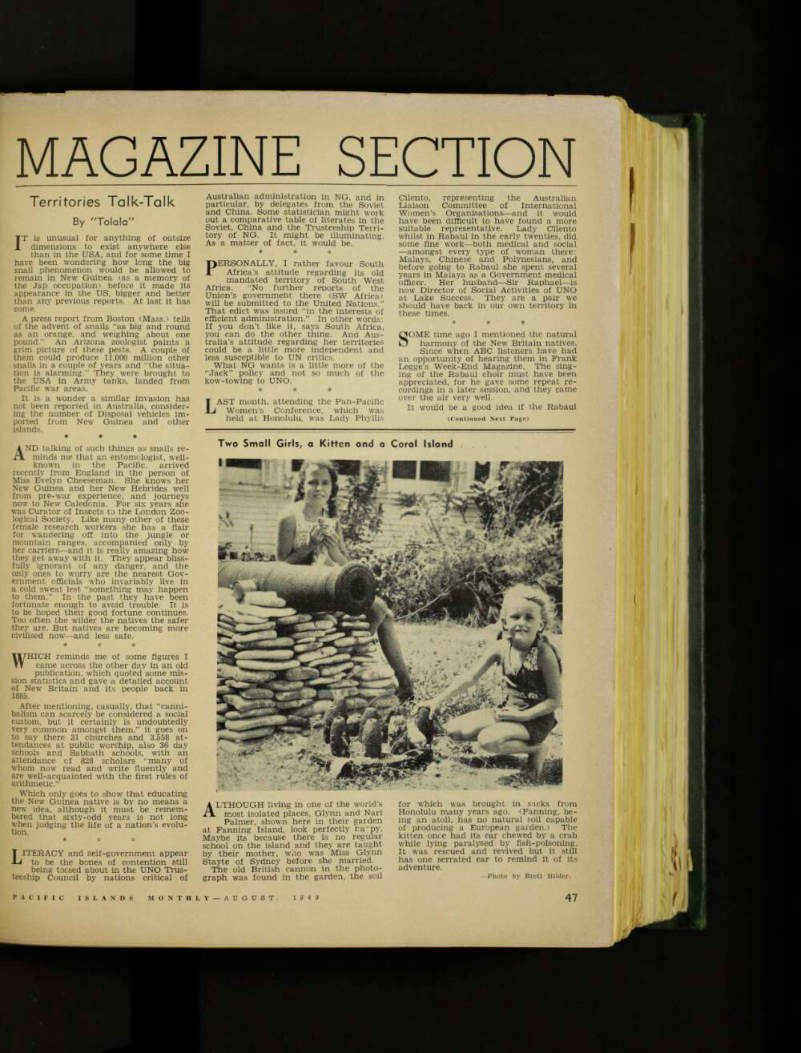
Territories Talk-Talk
By "Tolala"
IT is unusual for anything of outsize dimensions to exist anywhere else than in the USA, and for some time I have been wondering how long the big snail phenomenon would be allowed to remain in New Guinea (as a memory of the Jap occupation) before it made its appearance in the US, bigger and better than any previous reports. At last it has come.
A press report from Boston (Mass.) tells of the advent of snails “as big and round as an orange, and weighing about one pound.” An Arizona zoologist paints a grim picture of these pests. A couple of them could produce 11,000 million other snails in a couple of years and “the situa tion is alarming.” They were brought to the USA in Army tanks, landed from Pacific war areas.
It is a wonder a similar invasion has not been reported in Australia, consider ing the number of Disposal vehicles im ported from New Guinea and other islands.
AND talking of such things as snails re minds me that an entomologist, well known in the Pacific, arrived recently from England in the person of Miss Evelyn Cheeseman. She knows her New Guinea and her New Hebrides well from pre-war experience, and journeys now to New Caledonia. For six years she was Curator of Insects to the London Zoo logical Society. Like many other of these female research workers she has a flair for wandering off into the jungle or mountain ranges, accompanied only by her carriers—and it is really amazing how they get away with it. They appear bliss fully ignorant of any danger, and the only ones to worry are the nearest Gov ernment officials who invariably live in a cold sweat lest “something may happen to them.” In the past they have been fortunate enough to avoid trouble. It is to be hoped their good fortune continues.
Too often the wilder the natives the safer they are. But natives are becoming more civilised now—and less safe.
WHICH reminds me of some figures I came across the other day in an old publication, which quoted some mis sion statistics and gave a detailed account of New Britain and its people back in 1885.
After mentioning, casually, that “canni balism can scarcely be considered a social custom, but it certainly is undoubtedly very common amongst them,” it goes on to say there 31 churches and 3,558 at tendances at public worship, also 36 day schools and Sabbath schools, with an attendance cf 828 scholars “many of whom now read and write fluently and are well-acquainted with the first rules of arithmetic.”
Which only goes to show that educating the New Guinea native is by no means a new idea, although it must be remem bered that sixty-odd years is not long when judging the life of a nation’s evolu tion.
LITERACY and self-government appear to be the bones of contention still being tossed about in the UNO Trus teeship Council by nations critical of
Australian administration in NG, and in particular, by delegates from the Soviet and China. Some statistician might work out a comparative table of literates in the Soviet, China and the Trusteeship Terri tory of NG. It might be illuminating.
As a matter of fact, it would be, PERSONALLY, I rather favour South Africa’s attitude regarding its old mandated territory of South West Africa. “No further reports of the Union’s government there (SW Africa) will be submitted to the United Nations.”
That edict was issued “in the interests of efficient administration.” In other words: If you don’t like it, says South Africa, you can do the other thing. And Aus tralia’s attitude regarding her territories could be a little more independent and less susceptible to UN critics.
What NG wants is a little more of the “Jack” policy and not so much of the kow-towing to UNO.
LAST month, attending the Pan-Pacific Women’s Conference, which was held at Honolulu, was Lady Phyllis
Cilento, representing the Australian Liaison Committee of International Women’s Organisations—and it would have been difficult to have found a more suitable representative. Lady Cilento whilst in Rabaul in the early twenties, did some fine work—both medical and social —amongst every type of woman there: Malays, Chinese and Polynesians, and before going to Rabaul she spent several years in Malaya as a Government medical officer. Her husband —Sir Raphael—is now Director of Social Activities of UNO at Lake Success. They are a pair we should have back in our own territory in these times.
SOME time ago I mentioned the natural harmony of the New Britain natives.
Since when ABC listeners have had an opportunity of hearing them in Frank Legge’s Week-End Magazine. The sing ing of the Rabaul choir must have been appreciated, for he gave some repeat re cordings in a later session, and they came over the air very well.
It would be a good idea if the Rabaul (Continued Next Page)
choir could make a tour of Australia, pro viding the lads were hand-picked and shepherded under wise escorts. Australia could then see what potentialities the NG lads have and dispel many illusions which the average Australian holds in regard to these Islanders.
THERE have been quite a lot of things said about the Disposals set-up in New Guinea—both in the past and in the present—and apparently many people are not quite satisfied as to what hap pened to the war-time gear which was put up for auction—or otherwise. There have been many innuendoes made and Dis posals Officials must surely feel some what embarrassed. It might not be a bad scheme to have a few official inquiries made which would cover the whole busi ness. If everything has been OK then Disposals should welcome such an Inquiry, to put them in the clear. If not —well . . .?
A RECENT paragraph in a Sydney paper stated that widows of the New Guinea Voluntary Reserve [sic] will receive the sum of £306 from the old Rabaul Comforts Fund, to be handed over from the NG Women’s Association.
Actually there should be no argument so far as pensions for widows of members of the NGVR are concerned, for a few days before the Jap invasion in Rabaul in January, ’42, the NGVR was merged with the 2 22nd Battalion, which was defend ing Rabaul at the time; therefore it was most definitely a fighting unit and its members’ dependents entitled to any war time privileges. If ever a unit did a good job of work in New Guinea it was the NGVR, and any attempt to discriminate is a scandalous reflection on the men who were really responsible for stopping the Japs advance over the Kokoda trail. Had it not been for these old-time New Guineaites in the NGVR it is very doubt ful whether the same response would have been received from the famous “Fuzzy- Wuzzies” (spare the name!).
So far as pensions for the widows of the NGVR are concerned, there is not an ounce of justification for the suggestion that they should not receive the ordinary service pension, and nobody is better able to endorse that sentiment than the one time OC of the 2 22nd Battalion, who is still alive. * * * BITS AND PIECES: Applications for the position of Administrator of Nauru are being called for by the Department of External Territories. They close in Canberra on August 13. . . Bill Dobell, the artist, returned from NG last month, and says he is thinking of going back there. Apparently the crudeness of the NG native appeals to him. . . . Mrs.
K. T. Joubert, widow of the well-known “Les,” has been holidaying in Sydney and is now returning to Wau. . . . Barbara Grose, daughter of the late W. E. Grose.
MLC, of Kavieng, was married recently in Sydney to Sandy McLeish, of Coon amble. It was quite a swish affair. Mrs.
Margaret Grose, of Moss Vale and New Ireland, the bride’s mother, was there.
At the wedding was the bride’s uncle, Commander Dyson Hore-Lacey, RN (retd.) and he, later on, was married in Melbourne on July 23 to Mrs. Marjorie Haggard, a daughter of the late Sir Geoffrey Syme. Dyson is well-known in the Territory for his support of the planters for many years, and he did an excellent job in the RN during the War.
He has given NG away for sheep in Vic toria, but his heart, no doubt, is still in the land where he lived for the past quarter of a century. He is the type that should be back there now, assisting in navigating the ship of state. . . . The en
gagement is announced of Winifred Singer, of the Lae Nursing staff, to Allan Warden, whose people live in Arncliffe. . .
Gone to his rest is Jack Sims, on July 14, at Vanimo. He was the son of Mr. and Mrs. O. P. Sims, of Raglan St., Manly.
Two Small Girls, a Kitten and a Coral island
ALTHOUGH living in one of the world’s most isolated places, Glynn and Nari Palmer, shown here in their garden at Fanning Island, look perfectly Maybe its because there is no regular school on the island and they are taught by their mother, who was Miss Glynn Stayte of Sydney before she married.
The old British cannon in the photo graph was found in the garden, the soil
for which was brought in sacks from Honolulu many years ago. (Fanning, be ing an atoll, has no natural soil capable of producing a European garden.) The kitten once had its ear chewed by a crab while lying paralysed by fish-poisoning.
It was rescued and revived but it still has one serrated ear to remind it of its adventure. —Photo by Brett Hilder.
quarters
High Society in the bachelors' quarters
By Tutu Ba
WE in the bachelors’ quarters decided to become social and, by way of in augurating our new policy, to have a dinner party.
We had been the guests at many a one, and knew that such an occasion was quite solemn, with full ritual being observed from soup to liqueurs.
With great misgiving we invited four people. Two we knew we could count up on to act as if nothing untoward were happening (when we knew there would be plenty); the other two, a Mister and Missus, we felt might be difficult. “Missus” was very much so-so and still clung to her drawing-room status among the coconuts.
She was a very attractive woman, and perfect in appearance. She discussed the correct lighting of a cigarette with as much intellectual intensity as she des cribed native culture —about which she, and everyone else, knew nothing.
Her husband talked whenever she stopped. He stared at you through thick rimmed glasses, making you feel as though you were merely a specimen under a microscope—which, actually, you were.
He, too, clung to his drawing-room ways, though more in self-defence than any thing.
WE convinced ourselves from the start that only three things could mar the dinner party; Andrew, Homer and Cleopatra. Respectively these were our house-boy, our dog, and our neigh bour’s pregnant nanny-goat.
Andrew had been carefully coached and “polished” for the occasion by various practical demonstrations of how knives, forks, and plates, etc., should be laid on a table, and not simply left to lie where they fell in the general chaos which ac companied Andrew’s domestic activities.
Homer, apart from exhibiting a com pletely brainless skull at such simple com mands as “come inside,” “go outside,” “sit up” and “lie down” had at least reached the stage where he “left the room.” so we would be spared embarrassment m that direction.
Our third and greatest fear, even in cluding Andrew, was Cleopatra. Of late Cleo had made it clear that she was “expecting,” and doubly clear that the place of her choice was a clump of banana trees which grew immediately outside our living-room window. And, to prove her claim, she rarely left the place.
We were prepared to co-operate. All we asked in return was that Cleo should sleep that night peacefully. After all, there was bound to be enough entertainment without her.
THE guests arrived and nominated their choice of sherry or peppermint.
Dinner arrived all too soon; hut the sooner it was done with, the better, we felt, for all concerned.
The carefully rehearsed and direly threatened Andrew got stage fright and panicked as early in the proceedings as the soup. The veneer of poise and confi dence dropped from him like a cloak.
The clean white singlet with which he
had been issued not two hours previously had evidently been considered too good to be used, and had been replaced by one of a dirty yellow and ancient vintage.
Each time he appeared bearing a plate which only remained horizontal on its tray by virtue of the saint who looks after bachelors, a different side of the singlet had slipped from his shouldeis.
Each time he left the dining-room the right side would be drooping across his chest; in the kitchen he would hitch it up and reappear with the left side dang ling. His new white shorts were carefully hidden —and thus saved from soiling— by a lava-lava of faded design.
In the consternation of finding glass ware, cutlery and crockery, not to men tion an odd item here and there of kitchen-ware, distributed about the table, one of us forgot to tell him to bring serviettes and simply said: “Carry ’im tow-el along all man.”
At the mere mention of such a com plicated process, Andrew’s mind dissolved into complete chaos.
He fluttered around the table an in stant and then vanished, to appear later
bearing a towel from the bathroom, which he dangled above the table in the hope that it might be the right thing.
We tried hard to conceal the fact that things were not going as well as they should, fearing it might throw Andrew in to a worse state than ever, if that were possible. We could only hope that he might spill the dessert on the floor—or, at the worst, over one of us—and not over one of the guests.
But he managed to bring the plates in full and take them away empty, without accident; and when a crash from the kitchen announced the commencement of the washing-up our feeling of relief was
profound.
The dinner was a success, we liked to think. Over our liqueurs in the lounge we heard Andrew strumming his guitar over the washing-up water.
Cleo behaved until the guests were gone. Then, with the psychology which only another goat could understand, she picked herself up, dug a little hole be neath my bedroom floor, and, much to Homer’s delight, gave birth to twins.
Something Nasty In The
Grocery Dept.!
HAS any ex-Army medico mislaid a couple of sets of brains?
A member of the staff of Burns, Philp’s Rabaul branch was slightly shaken re cently when stocktaking in the store. On opening an unlabelled tin, taken from a shelf, he found it to contain two sets of human brains. The grisly contents were at once taken to the local police depart ment, who sought medical opinion.
It is presumed that an Army medical officer had skilfully removed them, pre served them, and packed them ready to take away with him, either as a prize of war or for future study.
Burns, Philp purchased a large quantity of army stock during the change over from Army to civil control in the Ter ritory.
But the gruesome discovery opens up some interesting speculation.—K.
Thrills, Spills
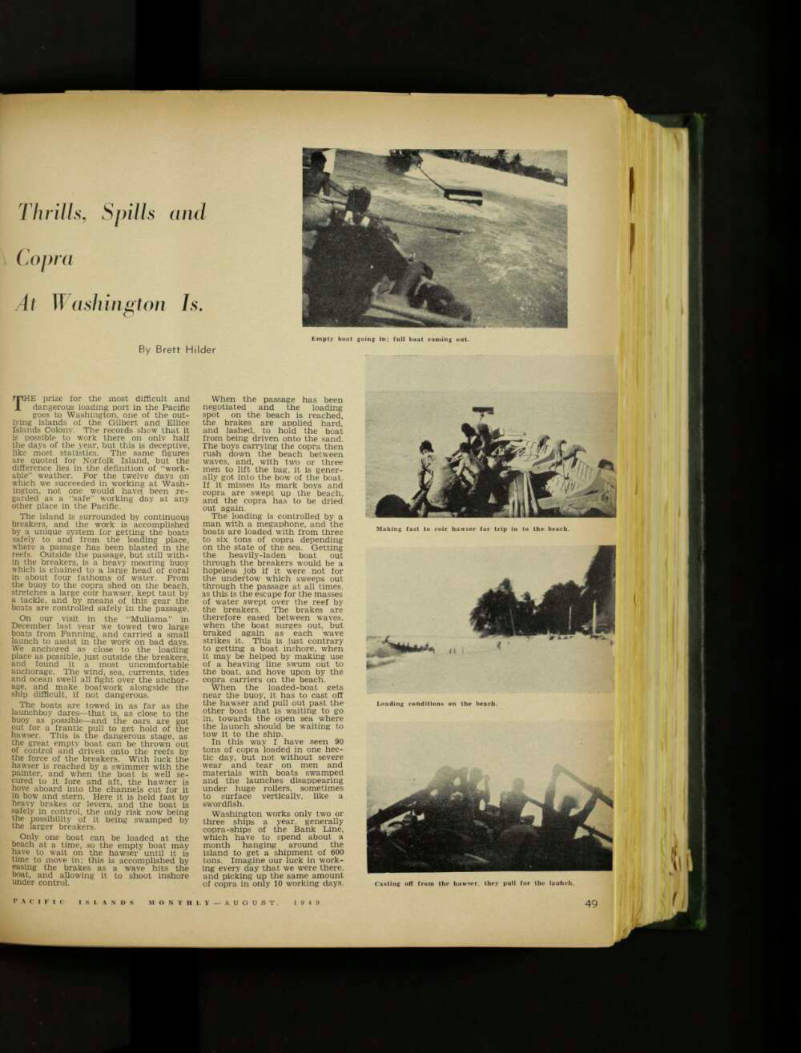
Copra At Washington Is.
By Brett Hilder
THE prize for the most difficult and dangerous loading port in the Pacific goes to Washington, one of the out lying islands of the Gilbert and Ellice Islands Colony. The records show that it is possible to work there on only half the days of the year, but this is deceptive, like most statistics. The same figures are quoted for Norfolk Island, but the difference lies in the definition of “work able” weather. For the twelve days on which we succeeded in working at Wash ington, not one would have been Regarded as a “safe” working day at any other place in the Pacific.
The island is surrounded by continuous breakers, and the work is accomplished by a unique system for getting the boats safely to and from the loading place, where a passage has been blasted in the reefs. Outside the passage, but still with in the breakers, is a heavy mooring buoy which is chained to a large head of coral in about four fathoms of water. From the buoy to the copra shed on the beach, stretches a large coir hawser, kept taut by a tackle, and by means of this gear the boats are controlled safely in the passage.
On our visit in the “Muliama” in December last year we towed two large boats from Fanning, and carried a small launch to assist in the work on bad days.
We anchored as close to the loading place as possible, just outside the breakers, and found it a most uncomfortable anchorage. The wind, sea, currents, tides and ocean swell all fight over the anchor age, and make boatwork alongside the ship difficult, if not dangerous.
The boats are towed in as far as the launchboy dares—that is, as close to the buoy as possible—and the oars are got out for a frantic pull to get hold of the hawser. This is the dangerous stage, as the great empty boat can be thrown out of control and driven onto the reefs by the force of the breakers. With luck the hawser is reached by a swimmer with the painter, and when the boat is well se cured to it fore and aft, the hawser is hove aboard into the channels cut for it m bow and stern. Here it is held fast by heavy brakes or levers, and the boat is safely in control, the only risk now being the possibility of it being swamped by the larger breakers.
Only one boat can be loaded at the beach at a time, so the empty boat may have to wait on the hawser until it is time to move in; this is accomplished by easing the brakes as a wave hits the boat, and allowing it to shoot inshore under control.
When the passage has been negotiated and the loading spot on the beach is reached, the brakes are applied hard, and lashed, to hold the boat from being driven onto the sand.
The boys carrying the copra then rush down the beach between waves, and, with two or three men to lift the bag, it is gener ally got into the bow of the boat.
If it misses its mark boys and copra are swept up the beach, and the copra has to be dried out again.
The loading is controlled by a man with a megaphone, and the boats are loaded with from three to six tons of copra depending on the state of the sea. Getting the heavily-laden boat out through the breakers would be a hopeless job if it were not for the undertow which sweeps out through the passage at all times, as this is the escape for the masses of water swept over the reef by the breakers. The brakes are therefore eased between waves, when the boat surges out, but braked again as each wave strikes it. This is just contrary to getting a boat inshore, when it may be helped by making use of a heaving line swum out to the boat, and hove upon by the copra carriers on the beach.
When the loaded-boat gets near the buoy, it has to cast off the hawser and pull out past the other boat that is waiting to go in, towards the open sea where the launch should be waiting to tow it to the ship.
In this way I have seen 90 tons of copra loaded in one hec tic day, but not without severe wear and tear on men and materials with boats swamped and the launches disappearing under huge rollers, sometimes to surface vertically, like a swordfish.
Washington works only two or three ships a year, generally copra-ships of the Bank Line, which have to spend about a month hanging around the island to get a shipment of 600 tons. Imagine our luck in work ing every day that we were there, and picking up the same amount of copra in only 10 working days.
Empty boat going in; full boat coming out.
Making fast to coir hawser for trip in to the beach.
Loading conditions on the beach.
Casting off from the hawser, they pull for the lauhch.
the Flag
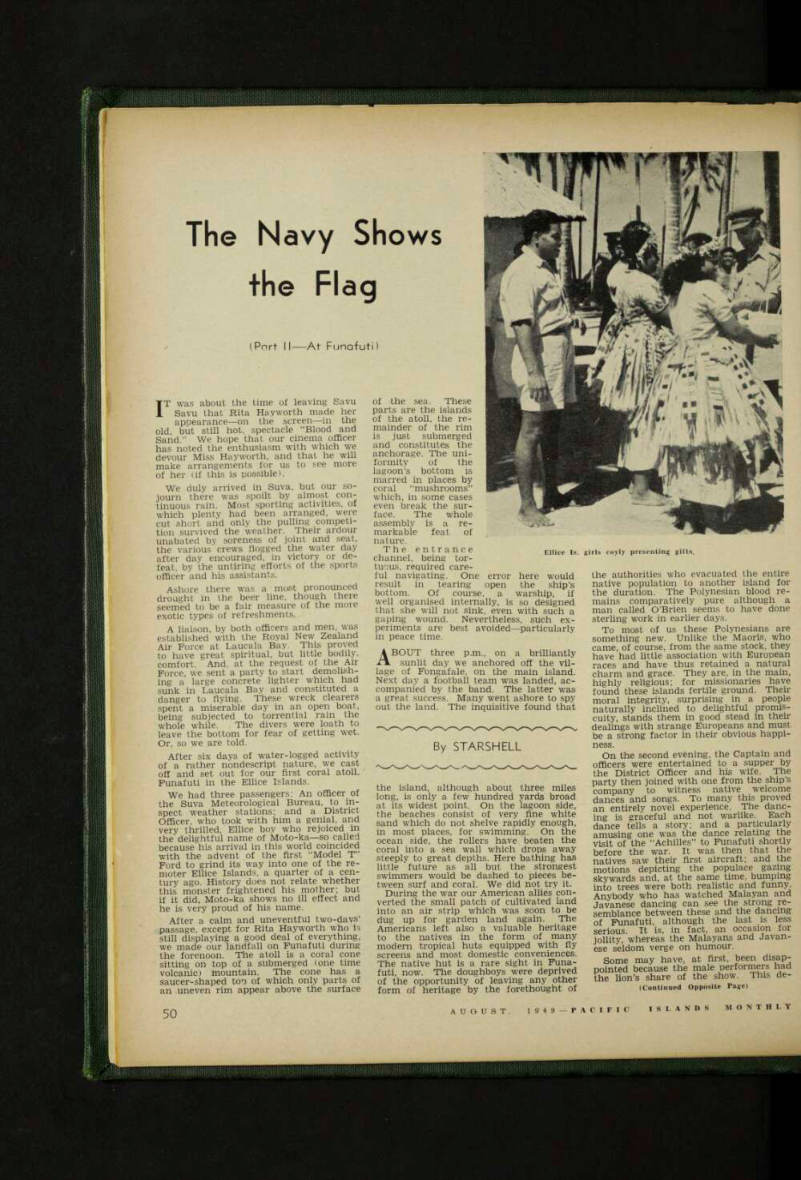
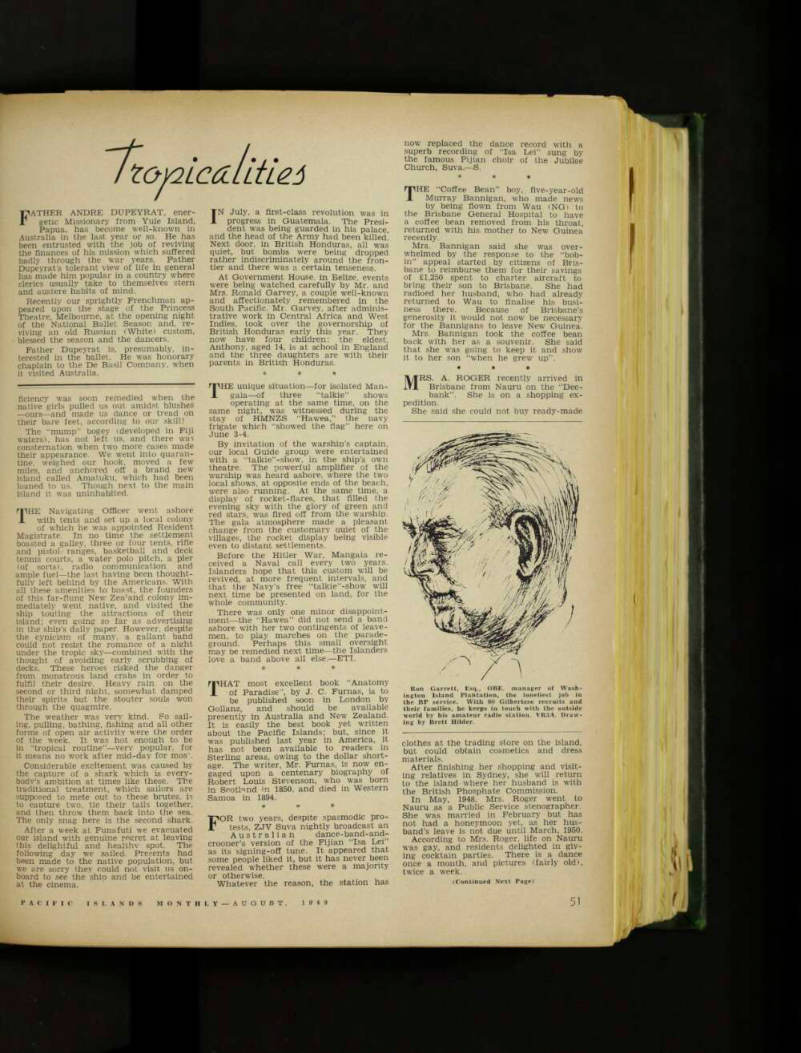
The Navy Shows the Flag
(Part II—At Funafuti)
IT was about the time of leaving Savu Savu that Rita Hayworth made her appearance—on the screen—in the old, but still hot, spectacle “Blood and Sand.” We hope that our cinema officer has noted the enthusiasm with which we devour Miss Hayworth, and that he will make arrangements for us to see more of her (if this is possible).
We duly arrived in Suva, but our so journ there was spoilt by almost con tinuous rain. Most sporting activities, of which plenty had been arranged, were cut short and only the pulling competi tion survived the weather. Their ardour unabated by soreness of joint and seat, the various crews flogged the water day after day encouraged, in victory or de feat, by the untiring efforts of the sports officer and his assistants.
Ashore there was a most pronounced drought in the beer line, though there seemed to be a fair measure of the more exotic types of refreshments.
A liaison, by both officers and men, was established with the Royal New Zealand Air Force at Laucala Bay. This proved to have great spiritual, but little bodily, comfort. And. at the request of the Air Force, we sent a party to start demolish ing a large concrete lighter which had sunk in Laucala Bay and constituted a danger to flying. These wreck clearers spent a miserable day in an open boat, being subjected to torrential rain the whole while. The divers were loath to leave the bottom for fear of getting wet.
Or, so we are told.
After six days of water-logged activity of a rather nondescript nature, we cast off and set out for our first coral atoll, Funafuti in the Ellice Islands.
We had three passengers: An officer of the Suva Meteorological Bureau, to in spect weather stations; and a District Officer, who took with him a genial, and very thrilled, Ellice boy who rejoiced in the delightful name of Moto-ka —so called because his arrival in this world coincided with the advent of the first “Model T”
Ford to grind its way into one of the re moter Ellice Islands, a quarter of a cen tury ago. History does not relate whether this monster frightened his mother; but if it did, Moto-ka shows no ill effect and he is very proud of his name.
After a calm and uneventful two-days’ passage, except for Rita Hayworth who is still displaying a good deal of everything, we made our landfall on Funafuti during the forenoon. The atoll is a coral cone sitting on top of a submerged (one time volcanic) mountain. The cone has a saucer-shaped top of which only parts of an uneven rim appear above the surface
of the sea. These parts are the islands of the atoll, the re mainder of the rim is just submerged and constitutes the anchorage. The uni formity of the lagoon’s bottom is marred in places by coral “mushrooms” which, in some cases even break the sur face. The whole assembly is a re markable feat of nature.
The entrance channel, being tor
tuous, required care ful navigating. One error here would result in tearing open the ship’s bottom. Of course, a warship, if well organised internally, is so designed that she will not sink, even with such a gaping wound. Nevertheless, such experiments are best avoided—particularly in peace time.
ABOUT three p.m., on a brilliantly sunlit day we anchored off the village of Fongafale, on the main island.
Next day a football team was landed, accompanied by the band. The latter was a great success. Many went ashore to spy out the land. The inquisitive found that
By Starshell
the island, although about three miles long, is only a few hundred yards broad at its widest point. On the lagoon side, the beaches consist of very fine white sand which do not shelve rapidly enough, in most places, for swimming. On the ocean side, the rollers have beaten the coral into a sea wall which drops away steeply to great depths. Here bathing has little future as all but the strongest swimmers would be dashed to pieces between surf and coral. We did not try it.
During the war our American allies converted the small patch of cultivated land into an air strip which was soon to be dug up for garden land again. The Americans left also a valuable heritage to the natives in the form of many modem tropical huts equipped with fly screens and most domestic conveniences.
The native hut is a rare sight in Funafuti, now. The doughboys were deprived of the opportunity of leaving any other form of heritage by the forethought of
the authorities who evacuated the entire native population to another island for the duration. The Polynesian blood re mains comparatively pure although a man called O’Brien seems to have done sterling work in earlier days.
To most of us these Polynesians are something new. Unlike the Maoris, who came, of course, from the same stock, they have had little association with European races and have thus retained a natural charm and grace. They are, in the main, highly religious; for missionaries have found these islands fertile ground. Their moral integrity, surprising in a people naturally inclined to delightful promis cuity, stands them in good stead in their dealings with strange Europeans and must be a strong factor in their obvious happi ness.
On the second evening, the Captain and officers were entertained to a supper by the District Officer and his wife. The party then joined with one from the ship’s company to witness native welcome dances and songs. To many this proved an entirely novel experience. The danc ing is graceful and not warlike. Each dance tells a story; and a particularly amusing one was the dance relating the visit of the “Achilles” to Funafuti shortly before the war. It was then that the natives saw their first aircraft: and the motions depicting the populace gazing skywards and, at the same time, bumping into trees were both realistic and funny.
Anybody who has watched Malayan and Javanese dancing can see the strong re semblance between these and the dancing of Funafuti, although the last is less serious. It is, in fact, an occasion for jollity, whereas the Malayans and Javan ese seldom verge on humour.
Some may have, at first, been disap pointed because the male performers had the lion’s share of the show. This de (Continued Opposite Page)
Ellice Is. girls coyly presenting gifts.
ficiency was soon remedied when the native girls pulled us out amidst blushes —ours —and made us dance or tread on their bare feet, according to our skill!
The “mump” bogey (developed in Fiji waters), has not left us, and there was consternation when two more cases made their appearance. We went into quaran tine, weighed our hook, moved a few miles, and anchored off a brand new island called Amatuku, which had been loaned to us. Though next to the main island it was uninhabited.
THE Navigating Officer went ashore with tents and set up a local colony of which he was appointed Resident Magistrate. In no time the settlement boasted a galley, three or four tents, rifle and pistol ranges, basketball and deck tennis courts, a water polo pitch, a pier (of sorts), radio communication and ample fuel—the last having been thought fullv left behind by the Americans. With all these amenities to boast, the founders of this far-flung New colony im mediately went native, and visited the ship touting the attractions of their island; even going so far as advertising in the ship’s daily paper. However, despite the cynicism of many, a gallant band could not resist the romance of a night under the tropic sky—combined with the thought of avoiding early scrubbing of decks. These heroes risked the danger from monstrous land crabs in order to fulfil their desire. Heavy rain, on the second or third night, somewhat damped their spirits but the stouter souls won through the quagmire.
The weather was very kind. So sail ing, pulling, bathing, fishing and all other forms of open air activity were the order of the week. It was hot enough to be in “tropical routine” —very popular, for it means no work after mid-day for most.
Considerable excitement was caused by the capture of a shark which is every body’s ambition at times like these. Tbe traditional treatment, which sailors are supposed to mete out to these brutes, is to capture two, tie their tails together, and then throw them back into the sea.
The only snag here is the second shark.
After a week at Funafuti we evacuated our island with genuine regret at leaving this delightful and healthy spot. The following day we sailed. Presents had been made to the native population, but we are sorry they could not visit us on board to see the ship and be entertained at the cinema.
Tropicalities
Father Andre Dupeyrat, Ener
getic Missionary from Yule Island, Papua, has become well-known in Australia in the last year or so. He has been entrusted with the job of reviving the finances of his mission which suffered badly through the war years. Father Dupeyrat’s tolerant view of life in general has made him popular in a country where clerics usually take to themselves stern and austere habits of mind.
Recently our sprightly Frenchman ap peared upon the stage of the Princess Theatre, Melbourne, at the opening night of the National Ballet Season and, re viving an old Russian (White) custom, blessed the season and the dancers.
Father Dupeyrat is, presumably, in terested in the ballet. He was honorary chaplain to the De Basil Company, when it visited Australia.
IN July, a first-class revolution was in progress in Guatemala. The Presi dent was being guarded in his palace, and the head of the Army had been killed.
Next door, in British Honduras, all was quiet, but bombs were being dropped rather indiscriminately around the fron tier and there was a certain tenseness.
At Government House, in Belize, events were being watched carefully by Mr. and Mrs. Ronald Garvey, a couple well-known and affectionately remembered in the South Pacific. Mr. Garvey, after adminis trative work in Central Africa and West Indies, took over the governorship of British Honduras early this year. They now have four children: the eldest, Anthony, aged 14, is at school in England and the three daughters are with their parents in British Honduras. * ♦ * THE unique situation—for isolated Man gaia—of three “talkie” shows operating at the same time, on the same night, was witnessed during the stay of HMNZS “Hawea,” the navy frigate which “showed the flag” here on June 3-4.
By invitation of the warship’s captain, our local Guide group were entertained with a “talkie”-show, in the ship’s own theatre. The powerful amplifier of the warship was heard ashore, where the two local shows, at opposite ends of the beach, were also running. At the same time, a display of rocket-flares, that filled the evening sky with the glory of green and red stars, was fired off from the warship.
The gala atmosphere made a pleasant change from the customary quiet of the villages, the rocket display being visible even to distant settlements.
Before the Hitler War, Mangaia re ceived a Naval call every two years.
Islanders hope that this custom will be revived, at more frequent intervals, and that the Navy’s free “talkie”-show will next time be presented on land, for the whole community.
There was only one minor disappoint ment—the “Hawea” did not send a band ashore with her two contingents of leave men, to play marches on the parade ground. Perhaps this small oversight may be remedied next time —the Islanders love a band above all else. —ETI. ♦ * ♦ THAT most excellent book “Anatomy of Paradise”, by J. C. Furnas, is to be published soon in London by Gollanz, and should be available presently in Australia and New Zealand.
It is easily the best book yet written about the Pacific Islands; but, since it was published last year in America, it has not been available to readers in Sterling areas, owing to the dollar short age. The writer, Mr. Furnas, is now en gaged upon a centenary biography of Robert Louis Stevenson, who was born in Scotland in 1850, and died in Western Samoa in 1894, * » * FOR two years, despite spasmodic pro tests, ZJV Suva nightly broadcast an Australian dance-band-and crooner’s version of the Fijian “Isa Lei” as its signing-off tune. It appeared that some people liked it, but it has never been revealed whether these were a majority or otherwise.
Whatever the reason, the station has
now replaced the dance record with a superb recording of “Isa Lei” sung by the famous Fijian choir of the Jubilee Church, Suva. —S. * * ♦ THE “Coffee Bean” boy, five-year-old Murray Bannigan, who made news by being flown from Wau (NGi to the Brisbane General Hospital to have a coffee bean removed from his throat, returned with his mother to New Guinea recently.
Mrs. Bannigan said she was over whelmed by the response to the “bob in” appeal started by citizens of Bris bane to reimburse them for their savings of £1,250 spent to charter aircraft to bring their son to Brisbane. She had radioed her husband, who had already returned to Wau to finalise his busi ness there. Because of Brisbane’s generosity it would not now be necessary for the Bannigans to leave New Guinea.
Mrs. Bannigan took the coffee bean back with her as a souvenir. She said that she was going to keep it and show it to her son “when he grew up”. • • • MRS. A. ROGER recently arrived in Brisbane from Nauru on the “Dee bank”. She is on a shopping ex pedition.
She said she could not buy ready-made
Ron Garrett, Esq., OBE, manager of Wash ington Island Plantation, the loneliest job in the BP service. With 80 Gilbertese recruits and their families, he keeps in touch with the outside world by his amateur radio station, VRBA. Draw ing by Brett Hilder. clothes at the trading store on the island, but could obtain cosmetics and dress materials.
After finishing her shopping and visit ing relatives in Sydney, she will return to the island where her husband is with the British Phosphate Commission.
In May, 1948, Mrs. Roger went to Nauru as a Public Service stenographer.
She was married in February but has not had a honeymoon yet, as her hus band’s leave is not due until March, 1950.
According to Mrs. Roger, life on Nauru was gay, and residents delighted in giv ing cocktail parties. There is a dance once a month, and pictures (fairly old), twice a week.
(Continued Next Page)
THERE are few people who cannot laugh over a schoolboy howler.
And when the schoolboy happens also to be an Islander, struggling with the foolishness of the English language, the howlers are apt to become classics.
This collection, supplied by Eti, comes from the Cook Islands: — THE Prophet Jeremiah was always sad because he said that we are here gone and to-day to-morrow.
The great bridge from Auckland to San Francisco is one of the modern wonders of the world.
King George V was a good man because, although he was a grandson of Queen
Recipes from Home —V (and finally): WANTED, job as a cook. Go anywhere. Do anything. No references from any living persons. Specialise in pickling for a hot climate.
The above testified to by the seven little wooden crosses that mark the happy resting places of my last seven employers.
Reply, bv spiritual medium, to Alma Gross, C - The Asylum.
Victoria, he had been trained in the Navy and could swear like a sailor.
Lord Nelson left his wife for Lady Hamilton but we must not be angry be cause he could not help it.
The duck is a very useful bird but you must be careful not to boil it when it is an egg.
James Watt saw the steam in his kettle move the lid and then he took the tram to London to tell the Government it was a good idea.
John Williams was killed at the Solomon Islands by the heathen and he said Father forgive me for I know not what I do.
Some foods come to us in a tin, from New Zealand, and we get our Resident Agents in the same way, because the Gov ernment is up there.
My brother fell off the horse last week and broke his color bone but God is the boss of everything, so we put him to bed and send for the doctor.
We have been playing football, and I am glad because the Headteacher made me right side out, and our team got all the golds.
Queen Elizabeth executed the Queen of Scotch because her followers called Queen Elizabeth a Virgin, but Sir Francis Drake did not have anything to do with this cruel act. * * * IF you can believe a Sydney daily paper report (and you very often cannot) Mrs. Bryan Hanrahan of Suva, Fiji,, and her son, Sean, aged two, do not speak the same language. Mrs. Hanrahan ar rived in Sydney recently on holiday with Sean. She speaks English, exclusively.
Sean speaks Fijian—exclusively.
This came about because both Mr. and Mrs. Hanrahan go to business, a Fijian nurse looked after Sean and they rarely saw him. The Fijian nurse did not come to Sydney and, denied this interpreter, Mrs. Hanrahan finds her son “a complete stranger and cannot understand a word he says.” * * ♦ REBUILDING the House of Commons, which was badly blitzed by the Germans in 1941, is officially stated to be “proceeding satisfactorily.” It is expected
to be completed towards the end of 1950.
The new Chamber will, when completed, contain something from almost every British Dominion and Colony. From Aus tralia came Queensland black bean tim ber for the Speaker’s chair and walnut for the floor; Canada has given a table in white oak. South Africa has pro vided some chairs made from timber with the decidedly unromantic name of stink wood; other tables and chairs originated in the forests of Nigeria. British Guiana has sent cigarette boxes and ashtrays and Fiji has provided 50 ounces of silver for a massive inkstand to be used by the Secretary of State for the Colonies.
IF seasick try dramamine, the new mal de-mer remedy lately developed in the United States. According to an Army doctor, with the use of this drug and a strong friend, the most seasick sailor can be got up on deck. It does not state, however, whether he feels any better for having got there.
Dramamine is likely to be the succes sor of hyocine, a drug used extensively by the Americans to cure seasick soldiers during World War 11. But in spite of medical science the best remedy for sea sick passengers seems likely to continue to be a piece of smooth sea or, better still, dry land.
The Hymn of a Fed-up
Planter
(Sung to the tune of “Bless ’Em All.”) They say that New Guinea’s a very fine place— Oh, what a story to tell!
They must have been drunk when they first saw the place— It’s more like a corner in hell!
Anopheline skeeters they bite you all day, And all night they bite you as well; And your only safe bet is to crawl in your net, And sweat like a sinner in hell.
Swat some more, swat some more, The fat and the thick and the poor— Fill all the holes up and puncture the tins, Cover the craters and empty the bins.
We’re getting fed up with it all, As thousands more answer the call, We don’t want the fever —there is no reliever — So swat ho, me lads, swat ’em all!
They say that Brown Brother’s a very good bloke — Oh, what a story to tell!
He hasn’t the savvy to make one good stroke For the planter who lives in this hell.
He wanders about with his knife in his hand Thinking of meri and hut, It is only at night that the gent is in sight, When he dances and kais betel-nut.
Bless ’em all, bless ’em all.
The Sepik and Buin and all!
Bless all his brothers and sisters and kids— They’re not worth a pennypiece let alone quids, When monthly they’re handed their Pay “This man is a muggins,” they say.
They know nothing at all about con tracts and all — Maybe they’ll learn it some day.
They tell me the “policy’s” all very fine— Oh, what a story to tell!
It sets out the rations, and how they must dine, And instructs us in what we can sell.
There’s not an instruction on how they must work, Only pages of penalties, fines.
We can’t do a thing except blinkin’ well sing As we hand the tobac to the lines: Bless ’em all, bless ’em all — The long and the short and the tall!
Bless all the powers that blinkin’ well be, Bless the red tape and the great “policy”— For we’re saying goodbye to them all, As back to old UNO they crawl.
There’s no satisfaction before resurrection — So cheer up, my lads, bless ’em all!
—Paul Stewart.
New Guinea.
With Feeling
Lines Written In Haste, and With Feeling
How many miles does the housewife run In the bracing air of the tropics?
Sorties to kitchen and housewash and one Twice round the house in the broiling sun To see that what has to be done is done.
The cookboy leaned on the last precious egg; The washboy has broken the iron; The garden boy’s dreaming on one lazy leg; The houseboy’s baby has swallowed a peg; The chickens queue up in the kitchen and beg.
White-ants peer from the bathroom floor, The seed boxes call out for water, The lock has sprung on the bedroom door, The butter’s run out and there’s none in the store, And the tanks will run dry if it doesn’t soon pour.
Masta brings scissors and points to his hair, And adds that three shirts need new buttons; The cover has ripped on the very best chair, The cake tins are empty, guests com ing, and there Is no corner shop selling ready made fare.
And old southern friends, in their innocent way, Are a further trial with their letters: “How lucky you are, right out of the fray, With servants to cope with the work,” they say; “Just WHAT do you do with yourself all day?”
Honiara, BSI.
R.M.
Criminal cases disposed of by the Magistrates’ Courts in Fiji in 1948 totalled 6,643. Details were: Fijians—l. 477 accused, 1.296 convicted. Indians — 4,572 accused, 3,092 convicted. Others— 1,090 accused, 797 convicted. Twenty-two Supreme Court cases involved 29 accused persons of whom 17 were Fijians, six were Indians and six were of other races.
Echo of “Deep Water and Shoal ”
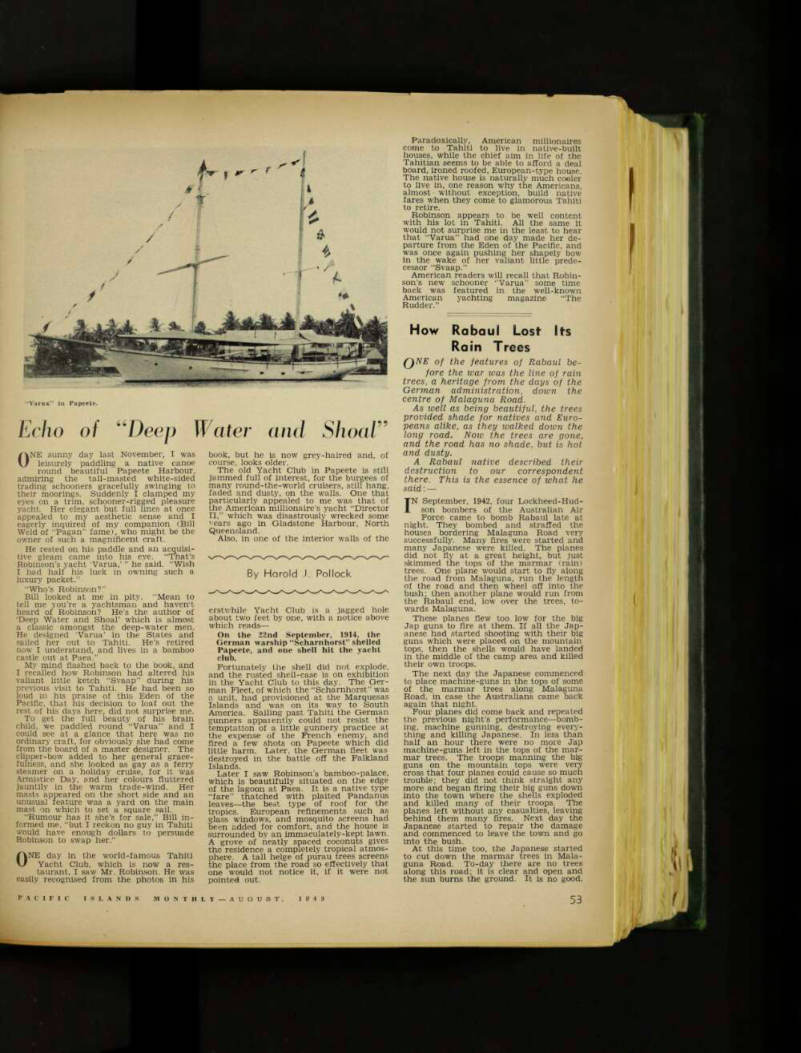
ONE sunny day last November, I was leisurely paddling a native canoe round beautiful Papeete Harbour, admiring the tall-masted white-sided trading schooners gracefully swinging to their moorings. Suddenly I clamped my eyes on a trim, schooner-rigged pleasure yacht. Her elegant but full lines at once appealed to my aesthetic sense and I eagerly inquired of my companion (Bill Weld of “Pagan” fame), who might be the owner of such a magnificent craft.
He rested on his paddle and an acquisi tive gleam came into his eye. “That’s Robinson’s yacht ‘Varua,’ ” he said. “Wish I had half his luck in owning such a luxury packet.”
“Who’s Robinson?”
Bill looked at me in pity. “Mean to tell me you’re a yachtsman and haven‘t heard of Robinson? He’s the author of ‘Deep Water and Shoal’ which is almost a classic amongst the deep-water men.
He designed ‘Varua’ in the States and sailed her out to Tahiti. He’s retired now I understand, and lives in a bamboo castle out at Paea.”
My mind flashed back to the book, and I recalled how Robinson had altered his valiant little ketch “Svaap” during his previous visit to Tahiti. He had been so loud in his praise of this Eden of the Pacific, that his decision to loaf out the rest of his days here, did not surprise me.
To get the full beauty of his brain child, we paddled round “Varua” and I could see at a glance that here was no ordinary craft, for obviously she had come from the board of a master designer. The clipper-bow added to her general grace fulness, and she looked as gay as a ferry steamer on a holiday cruise, for it was Armistice Day, and her colours fluttered jauntily in the warm trade-wind. Her masts appeared on the short side and an unusual feature was a yard on the main mast on which to set a square sail.
“Rumour has it she’s for sale,” Bill in formed me, “but I reckon no guy in Tahiti would have enough dollars to persuade Robinson to swap her.”
ONE day in the world-famous Tahiti Yacht Club, which is now a res taurant, I saw Mr. Robinson. He was easily recognised from the photos in his
book, but he is now grey-haired and, of course, looks older.
The old Yacht Club in Papeete is still jammed full of interest, for the burgees of many round-the-world cruisers, still hang, faded and dusty, on the walls. One that particularly appealed to me was that of the American millionaire’s yacht “Director II,” which was disastrously wrecked some years ago in Gladstone Harbour, North Queensland.
Also, in one of the interior walls of the
By Harold J. Pollock
erstwhile Yacht Club is a jagged hole about two feet by one, with a notice above which reads — On the 22nd September, 1914, the German warship “Scharnhorst” shelled Papeete, and one shell hit the yacht club.
Fortunately the shell did not explode, and the rusted shell-case is on exhibition in the Yacht Club to this day. The Ger man Fleet, of which the “Scharnhorst” was a unit, had provisioned at the Marquesas Islands and was on its way to South America. Sailing past Tahiti the German gunners apparently could not resist the temptation of a little gunnery practice at the expense of the French enemy, and fired a few shots on Papeete which did little harm. Later, the German fleet was destroyed in the battle off the Falkland Islands.
Later I saw Robinson’s bamboo-palace, which is beautifully situated on the edge of the lagoon at Paea. It is a native type “fare” thatched with plaited Pandanus leaves —the best type of roof for the tropics. European refinements such as glass windows, and mosquito screens had been added for comfort, and the house is surrounded by an immaculately-kept lawn.
A grove of neatly spaced coconuts gives the residence a completely tropical atmos phere. A tall hedge of purau trees screens the place from the road so effectively that one would not notice it, if it were not pointed out.
Paradoxically, American millionaires come to Tahiti to live in native-built houses, while the chief aim in life of the Tahitian seems to be able to afford a deal board, ironed roofed, European-type house.
The native house is naturally much cooler to live in, one reason why the Americans, almost without exception, build native fares when they come to glamorous Tahiti to retire.
Robinson appears to be well content with his lot in Tahiti. All the same it would not surprise me in the least to hear that “Varua” had one day made her de parture from the Eden of the Pacific, and was once again pushing her shapely bow in the wake of her valiant little prede cessor “Svaap.”
American readers will recall that Robin son’s new schooner “Varua” some time back was featured in the well-known American yachting magazine “The Rudder.”
“Varua” in Papeete.
How Rabaul Lost Its
Rain Trees
One of the features of Rabaul before the war was the line of rain trees, a heritage from the days of the German administration, down the centre of Malaguna Road.
As well as being beautiful, the trees provided shade for natives and Euro peans alike, as they walked down the long road. Now the trees are gone, and the road has no shade, but is hot
and dusty.
A Rabaul native described their destruction to our correspondent there. This is the essence of what he said : IN September, 1942, four Lockheed-Hud son bombers of the Australian Air Force came to bomb Rabaul late at night. They bombed and straffed the houses bordering Malaguna Road very successfully. Many fires were started and many Japanese were killed. The planes did not fly at a great height, but just skimmed the tops of the marmar (rain) trees. One plane would start to fly along the road from Malaguna, run the length of the road and then wheel off into the bush; then another plane would run from the Rabaul end, low over the trees, to wards Malaguna.
These planes flew too low for the big Jap guns to fire at them. If all the Jap anese had started shooting with their big guns which were placed on the mountain tops, then the shells would have landed in the middle of the camp area and killed their own troops.
The next day the Japanese commenced to place machine-guns in the tops of some of the marmar trees along Malaguna Road, in case the Australians came back again that night.
Four planes did come back and repeated the previous night’s performance—bomb ing, machine gunning, destroying every thing and killing Japanese. In less than half an hour there were no more Jap machine-guns left in the tops of the mar mar trees. The troops manning the big guns on the mountain tops were very cross that four planes could cause so much trouble; they did not think straight any more and began firing their big guns down into the town where the shells exploded and killed many of their troops. The planes left without any casualties, leaving behind them many fires. Next day the Japanese started to repair the damage and commenced to leave the town and go into the bush.
At this time too, the Japanese started to cut down the marmar trees in Mala guna Road. To-day there are no trees along this road; it is clear and open and the sun burns the ground. It is no good.
The Malolo Lagoon
A Story in Rhyme by Tolala
WHILE cruising through the lazy Southern Seas, I lay becalmed one day; the Nor’-west breeze dropped suddenly, and so I made my way towards a little land-locked island bay, and there I anchored; made all snug and tight, and paid out cable to remain the night.
Of all the places that I’ve ever seen it was most beautiful; and in between the palm-tree trunks a native house stood there: A rambling, roomy, low, well-built affair. Surrounding it a small plantation grew, while on one side —splashing and tumbling through the tangled jungle rushed a mountain stream. ’Twas like a picture in a pleasant dream: the calm, blue waters of the land-locked bay; the golden, sandy beach which shelved away into the water blue, while tall palm trees stood sentinel, to temper every breeze along high-water mark.
I went ashore, and met the owner near his copra-store; a man of fifty-odd, sun tanned, alert; attired in spotless trousers and a shirt. He greeted me in friendly island style; I liked his cleanliness, his open smile. He showed me through his store of native trade, and pointed out his workshop, where he made his “odds and ends” or so he lightly said; and then, as self-appointed guide, he led to wards the house, ’tween beds of blooming flowers.
“ Tis here,” he said, “I spend my hap piest hours.”
And I could see the tender love and care he lavished on his garden every where: A mass of colour and, more rare, perfume. For sad it is that many a tropic bloom is pleasing to the eye, yet lacks the scent of the more temperate climes.
An argument, no doubt, to prove that great Compensation which Dame Nature gives to every nation.
Then we sat upon his cool verandah, an icy drink beside me, a cigar of his own manufacture in my hand; and then, as the shadows closed down on the land, to my surprise there came electric light throughout the house —a most uncommon sight to see in this place—almost off the map.
“It’s nice,” said he, “to always have on tap an adequate supply of light and power for any purpose and at any hour.”
“Surely a costly luxury,” I said. He only smiled, and then he shook his head: “Nature provides my luxuries,” said he.
“You’d be surprised how cheap living can be.”
I smiled at what, no doubt, he thought was cheap, and thought I surely would not like to keep such an establishment as his appeared, on narrow profits which each year I cleared from selling trade goods in a native store. I gazed upon the highly polished floor, with heavy woven mats placed here and there, and every shape and size of rattan chair.
He watched me as I gazed, then with a wave about the room remarked: “See what I save in having my own furniture made here; an outfit such as this would be quite dear; the jungle here is full of good hardwood, and rattan vines and reeds —all very good for making furniture and all cane-ware. Some Island men will have their home quite bare be cause they cannot buy things from a store, or else have packing cases by the score serving as tables, chairs and book
cases. My idea when living in such places—away from towns and men of your own kind —is all for comfort, for it rests the mind; and when one can have these without much cost it would be very foolish if one lost one’s mental rest in order to escape a little work to plane, to saw and shape the virgin hardwood to the finished ware. A case may serve, but I prefer a chair.”
While he was speaking I gazed round the room, and saw some products of the native loom, in table cloths and native tapestry; and, too, I saw, the products of the sea: The light-shades made from highly polished shells, their opal colour ings like fairy bells; ash-trays and vases —not cheap souvenirs that lose their lustre with the passing years. I realised then how true his words had been as, gazing on that cosy, home-like scene, I noticed chairs and tables, mats and such were all home-made, but with the finished touch of one who was an expert at his trade.
THERE are but few things which are not home-made,” said he, “the radio, ice-chest and stove, and electric fittings, which go to prove Dame Nature is an able provider. But come!
Let’s dine and you will see some more of what Dame Nature gives to those who wish. We’ll have fresh oysters in the shell, and fish with curried pigeon and a chicken pie; of local vegetables a good supply. We’ll finish with fruit salad and ice-cream, and have our coffee here where we can dream while dinner music, played in London Town and coming o’er the air, will help to drown the singing of the local insect choir. But come!
Let’s cease our talking and retire and put the local catering to the test. My cook, you know, claims to be the best there is throughout this island neighbour hood.”
So we dined from off the polished wood. Fine woven mats with glistening silverware, two well-trained house-boys handed round the fare, which proved to be as good as he had said. All food was local-grown, save the bread; and he ex plained to me about his light and power, his water-wheel, his coffee, cocoa and his sugar-cane: his rice and his attempts at tea—in vain—the vegetables and fruits of every kind; the shops and mills to turn, to husk and grind, his poultry and his goats and pigs and bees, his coconut, rubber and kapok trees, the fishing traps, the pigeon islands where the birds are caught by palm-leaf flare.
I was surprised and he, silently amused. He was not boastful, but was most enthused he said in making Nature “toe the line”. And then later, over the nuts and wine, (which, incidentally, were home-products, too the latter good, and made from rice brew) he solved for me the secret of the loom. Waving his hand about the dining-room, he said: “You see these native mats and tapes tries? You will note that all designs and studies are fashioned from the old Malayan art, and that is where my good cook plays her part.” He added with a smile: “She’s a Malay. She’s been with me for years; she ran away from some old drunken whiteman up the coast; she’s educated: knows far more than most of these Malayan women in the ports; she’s taught me many things, and
works all sorts of basket-ware and mat ting-odds and ends upon which so often a room depends for just that little finished touch, you know. When I have visitors she’s not on show, for reasons that you’ll likely understand, despite the super freedom of this land.” We laughed and rose, he waved me to a chair.
“And now,” said he, “we’ll see what’s on the air,”
He worked the dial of his wireless set; while I sat back and lit a cigarette— one of my host’s selected local blend, and soon realised how foolish ’twas to spend large sums each year on Lady Nicotine.
Relaxing, I studied the peaceful scene: The “boy”, with tray of coffee and liqueur; my host who’d just picked up an overture from Rome or Sydney, listening with intent; the brightly-lighted rooms, each ornament of pearly lustre, glisten ing with light; the polished floor, the woven mats—a sight to gladden any housewife’s heart; outside, the insect choir sang counter-part to the grand overture, played o’er the air. Truly my host had built a place most rare, and lived a peaceful life of Great Content. I saw the force of his pet argument of training Nature to supply all needs, but Man himself must concentrate the seeds and plant them near at hand for harvest time; that could be done in this New Guinea clime, but not so easy in a temp’rate zone; so Tropics had advantages their own.
AND then beloved Big Ben struck out his hour from dear old London’s parliamentary tower. And I heard: “This is London calling you . . .”
And sat up in my chair to hear what new events had happened in this world of ours: “A millionaire insolvent . . . Three Great Powers were meeting to discuss World Peace . . . Five thousand workers strike, productions cease in allied in dustries . . . Rioting in France ... A talkie actress murdered at a dance . . .
Ten thousand homeless through a big cyclone ... A Balkan monarch abdicates his throne . . .”
My host arose and turned the volume down: “I’m glad,” he said, “I’m not in London Town; ours is a weary world, I am afraid.
I’m very glad my old age paths are laid along the shores of Malolo Lagoon; no doubt,” he said, “the wireless is a boon.
But there are times when news makes one feel sad, and makes one realise, too, how very bad this world of ours has grown these latter years. It could be called, I think, a 'Vale of Tears’. But then who knows?” he added with a smile. “Malolo in Samoa is ‘Rest a while’, a most ap propriate name it seems to me for this, my stepping-stone t’wards the To-Be.”
I told him he was young yet, as years went, and that his life here was not nearly spent: he was, as I could see, a busy man with much to do before his earthly span had run its course. He laughed at what I said: “Perhaps you’re right; I really have no dread of that time when I shall be called away, and yet I would prefer a while to stay in order that I may com plete some task I have on hand. It is not much to ask.”
Then he fell silent, and the insect choir outside sang loudly; a pin-point of fire upon the distant reef danced to and
(Continued on Page 67)
(Continued from page 54)
fro. I rose; looked at his books there, row on row: Some travel and many biographies, and many works on different “ologies”; my host was of a scientific mind it seemed, and in one row—all neatly lined—a dozen learned books from the same pen. I knew the name from scientific men at Home, who quoted him on native lore of Melanesia. Across the floor my host advanced and said: “Have you read him?” His tone was quiet, though just a little grim it seemed. It was, I said a name I’d heard; he was accepted as the latest word in matters Melanesian, I thought, and as I spoke to him it seemed I caught a twinkle in his eye.
“Oh, by-the-bye,” he said with certain laughter in his eye, “You did tell me your name now, didn’t you?”
I told him with a laugh. ‘And, sir, your name?”
He. pointed to the dozen books. “The same!”
I gasped and registered sincere surprise, then laughed as friendliness crept in his eyes.
"I’m very glad your friends support my views, and do accept the theories which I choose to put together in my simple style; they’re observations over a long while.”
And then he showed me works in more detail; some fiction and some poems— for private sale; his specimens of insects and of plants; of native curios and lores and chants. He saw my interest and waxed verbose, confiding theories which lay very close for want of understanding comradeship: His ardent hopes to make a mountain trip to ascertain the language
spoken there, and also seek an orchid very rare. And thep; “I must go Home again next year. There is a conference, and I must hear what Smith has got to say on native lore. We never have agreed on that before.”
He then explained bis theory, word by word, but I could grasp but half of what I heard. But, sitting there, I envied this savant, who lived the life he loved, with out a\ want, goes half-around the world to please a whim because another dis agrees with him.
All this I told him later on that night.
“I’m glad,” said he, ‘‘you see my theory’s right. But why be envious when there’s no need? What should prevent your own good self, indeed, from doing just exactly what I’ve done? Where’er you go you have the earth and sun. All
you require Is system and the will to make Dame Nature faithfully fulfil her sacred duties to the Master Man. She will not fail; and if you will, you can.”
Advertisements & other items, pp. 57-58 (1 item)
Burns Philp (New Guinea) Limited
General Merchants (Wholesale and Retail)
Shipping, Customs and General Agents
Head Office: PORT MORESBY, PAPUA
BRANCHES:
NEW GUINEA: Rabaul, Kokopo, Lae & Madang.
PAPUA: Samarai.
REPRESENTATIVES FOR:
AUSTRALIAN AGENTS:
LONDON AGENTS:
SAN FRANCISCO AGENTS:
QUEENSLAND INSURANCE CO. LTD.
LLOYDS OF LONDON
BURNS PHILP TRUST CO. LTD.
BURNS, PHILP & CO. LTD.
All States.
BURNS, PHILP fir CO. LTD.
"London House", 35 Crutched Friars, E.C.3.
BURNS, PHILP CO. OF SAN FRANCISCO INC. 510 Matson Building.
Distributing Agents, Territory of Papua-New Guinea for;
SHELL COMPANY OF AUSTRALIA LIMITED
Petroleum Products
GENERAL MOTORS CORPORATION
Chevrolet, Buick, Pontiac and Oldsmobile Cars Chevrolet and GMC Trucks Frigidaire Refrigerators
VAUXHALL MOTORS LIMITED
Vauxholl Cars and Bedford Trucks
R. A. LISTER & CO., BRISTOL
Producers of Petrol, Parrafin and Diesel Engines Pumps and Lighting plants
RUSTON HORNSBY LIMITED
Engines
CROSSLEY MARINE ENGINES
Complexion Perfection with
June Worth
COSMETICS
All chemists and all Stores.
For discriminating Women who desire alluring loveliness, and ... for that Special occasion use
“JUNE WORTH”
POPPY PERFUME 40. R.
Manufacturers and Distributors:
PROPRIETARY PRODUCTS
Manufacturing Chemists 26 Kippax Street, Sydney
mm 1854
This Sign made History
In the year 1854, when the present Victorian shipping centre of Port Melbourne still flourished under its colonial title of Sandridge a Mr. Thomas Swallow left Ballarat goldfields to establish a “ Steam Biscuit Manufactory ”at Sandridge. Later, a Mr. Ariell joined Mr. Swallow in his venture, and so was born the famous firm of “Swallow & Ariell.” To-day the name “Swallow & Ariell” has become a household word. Swallow & Ariell provides Biscuits, Plum Puddings, Cakes and Ice Cream, in ever increasing variety.
From Australia’s finest products come the rich ingredients used in the manufacture of Swallow & Ariell delicasies.
SWALLOW & ARIELL
LIMITED
LEADERS IN THE BISCUIT INDUSTRY SINCE 1854
♦ MAKERS ALSO OF THE FAMOUS
SWALLOW & ARIELL PLUM PUDDINGS, CAKES, AND ICE CREAM
Dead) Expose Betrayal of
American Journalists (All Now Dead) Expose Betrayal of Dutch In Indies
THE destruction, in India, in July, of a large Dutch plane, and the death therein of the 13 American journal ists returning from Batavia, adds one more striking chapter to the) strange post-war history of the Netherlands Indies.
When the Japanese surrendered in 1945, the Americans left to the British (primarily, Britain and Australia) the task of helping the Dutch to restore order in the East Indies. Holland had just been released from German occupation, and needed assistance: there was a large and dangerous Japanese force occupying Indonesia.
But Britain just then had a general election, and went Socialist. Australia, already, was Socialist; and the two Gov ernments made common cause in rela tion to Indonesia. British policy never has been explained, but the facts are clear.
The Japanese had set up in Java what they were pleased to call an “Indonesian republic”, which was intensely nationalist and anti-European, and close to being Communist. Britain and Australia would not do anything to help the Dutch to resume control in the Netherlands Indies unless the Dutch negotiated with the “Republic of Indonesia”.
The Dutch were not ready to negotiate.
They were entitled to go back to the East Indies and take control. They had been there for nearly 350 years; they had de veloped the vast archipelagoes from a disunited collection of small tribes into a rich and prosperous territory, so well organised and equipped that, until the Jap invasion, it was held up to the world as a model of colonial administration.
Under good rule, the native population had increased enormously. The Dutch, as part of their settled policy, were slowly and steadily bringing those Indonesian people into the realm of self-government.
But the British and Australian Social ists treated the Dutch as if they were a nation of cut-throat exploiters, who had come recently to Indonesia, to hold the natives in some form of semi slavery.
AS soon as they restored order in Holland, the Dutch began to send troops and equipment to the Indies.
They were resisted by the Socialist Gov ernments, and interfered with by mischief-making elements in the United Nations.
It is a long and complicated history, that of the Netherlands Indies in 1945- 49, but it amounts to nothing more or less than the sacrifice of the Dutch to the Brown Brother ideals of the Socialist elements in Britain, Australia and the United Nations. The Dutch were ham strung at every turn, in their efforts to get back their valuable East Indies Terri tories; and the bleating little men of the so-called Republic—pro-Jap, anti- European, undependable and unscrupu lous, and more or less Red—were given help and encouragement.
Until 1949, the Dutch fought back sturdily. Late in 1948 it appeared that, except for Java, they had gained com plete control over all the archipelagoes, where their efficient and incorruptible rule really was welcomed by all classes.
And the '“republican government”, con fined to central and western Java, seemed to be at an end.
Then United Nation influences re asserted themselves. We do not know exactly what happened after the end of 1948, but we do know that there was a revolution within the Dutch Administra tion. Under the direction of the UN Security Council, apparently, the Dutch administrators who had shown strength and determination against the Javanese rebels were shipped home, the “republi can” leaders were brought back from gaol and elsewhere, and a completely new set-up, with Brown Brother appeasement as its policy, began to function.
Here is the text of a communique, issued by the appeasers in Batavia on July 19: “Dr. van Royen” (who seems to be the head of the new Dutch Administra tion) “and some members of the Dutch Delegation in Batavia, visited Djokjakarta, the Republican capital, yesterday, and had an interview with President Soekarno
and Vice-President Hatta. President Soekarno entertained Dr. van Royen and his party at dinner, which was also at tended by the Republican Cabinet and Delegation.”
Note the use of the terms “Republic” and “President” and “Republican capital” —evidence of what is almost a complete surrender to the rebels.
Dr. van Royen made a statement to the rebel press bureau in Djokjakarta, expressing his belief that the transfer of government to the United States of In donesia would be complete by the end of 1949.
RIGHT from 1946, the United States has taken no interest in affairs in the Netherlands Indies —everything was left to the United Nations. But, little by little, something of the truth about the betrayal of the Dutch has seeped through to the Americans, and finally that important press delegation was sent into Indonesia in June. The American journalists made a thorough investigation, and what they found was not flattering to the British Socialist Governments or the blundering idealists of the United Nations.
They got their despatches away to their newspapers; but, before they could return home, they were all killed—one of the greatest tragedies of the kind ever recorded.
Those press despatches published between June and July, have been collected, and the following is a summary of them. They provide an illuminating commentary on what has been happen ing in the Netherlands Indies.
The matter is of vital import to all European and Oceanic communities south
of the equator. The Indonesian archi pelagoes, under Asiatic, anti-European and Communist control clearly will pro vide overcrowded Asia with easy access to under-populated Australia, and South Pacific countries generally.
IT is evident that the American news papermen, most of whom were star reporters in their own country, had come to the almost unanimous conclusion that the United States and the United
Nations misjudged the Indonesian prob lem.
A leader which appeared in the Scripps- Howard newspapers of 14th July vigorously attacked the American policy in dealing with the Indonesian question.
According to these papers, Leftist elements were favoured at the expense of the moderates.
Two of the syndicate’s star reporters, W. H. Newton and S. Burton-Heath, ex
(Continued Next Page)
•For developments since July 19, see end of this article.
pressed the opinion that the USA has so far supported the least democratic
and most anti-Western political powers in Indonesia.
H. R. Knickerbocker expressed his views in the following words:— “For reasons which I cannot under stand, Holland has continuously been chased around and worried by the UN and the USA. This was a risky thing to do. Isn’t it so that everybody who is confronted with today’s complicated world problems has to find out first of all Moscow’s intentions? In this case, Moscow’s aim was ‘the Dutch out of Indonesia.’ Ours should have been directly opposed to this.’’
W. H. Newton, in cables to “World Telegram”, repeatedly accused the UN Commission in Indonesia of censoring and altering the reports by military ob servers in the field for the purpose of making them fit in with the views of the UN and the State Department.
He related a report of March 11, 1949, on the wounding of American and British officers after they had been ambushed.
The investigation commission, consisting of an Australian Captain, a Belgian Lieutenant-Colonel, a French Colonel and an American Major, reported unani mously that the fateful shots had been fired by Republican troops. This con clusion was changed into —“It has not been possible to ascertain their identity.”
Newton reports that arms of Com munist origin are being smuggled into Indonesia, where they are being kept in readiness for the final battle for the con trol of the islands, as soon as the Dutch troops have left. “The Dutch,” says Newton, “cannot occupy the ports through which they know these arms enter the country, because they are pre vented from taking action by instructions from the UN. Temporarily, the Com munists in Indonesia make a show of loyalty to the Republican Government . “Practically no soldier here, in cluding the British, the Australians, the French, the Belgians and the Americans, together with the Dutch, is of the opinion that the Republican forces will be able to control the situation in Sumatra when the Dutch have left.”
THE report of former Australian UN Military Observer in Indonesia. Cap tain G. C. Williams, mentioned by Willian Newton, is as follows: “These are impressions of the present trouble as seen by me whilst attached to the UNCI from July, 1948, to March, 1949. I have collected information on matters prior to my arrival from various histories of a non-military nature, written by men of different nationalities, but their words have not influenced me.
I had formed my opinion early after my arrival, and only bought the books after my tour of duty had terminated.”
After giving an historical survey of the Indonesian situation, Williams said Sukarno tried to get around the Linggardjati Agreement from the day it was signed. After two years of dis cussions, he remained as unreliable as ever. He wanted to form the ruling power in entire Indonesia, in spite of strong opposition in various other territories Describing the first Dutch police action.
Williams said Dutch troops did not meet “stiff opposition by fanatical millions but were, on the contrary, welcomed by the civilian population.
“And the same thing happened again, continued violations of the truce by the Republicans, lack of control oyer their armed forces, and the impossible task to have them agree to reasonable con ditions. Sukarno had wrung concession after concession from the Dutch and started to apply the same tactics again.
Recognition by the Security Council and support from his Eastern neighbors made him arrogant, and discussions
between his ministers and the Dutch re mained fruitless because he refused to agree to any plan that was submitted.
Kidnapping, infiltrations, robbery and murder took place continuously, and this led to the second police action which started on December 19, 1948. The Dutch cannot be blamed for this action. They were forced to do it, and no other country could have put up with the con ditions any longer.”
Captain Williams then gave a short description of the second police action and pointed to the fact that Jogjakarta was occupied fifteen hours after the start of the action. He said Dutch troops and the Netherlands administration were welcomed in all places which he had visited; and he continued: “The Dutch are there and if the regu lation of the affair is left to them they are able to do it. They are the only people who can do it. To leave the country a prey to those with Communist tendencies is a serious threat to Aus- Wiliiams said that no one “would know who would support who” in Indonesia until controlled elections have been held, but that he personally opined that Suk arno could not count on more than ten per cent, of the votes, while these per sons mostly would be Japanese-trained elements.
Williams said he was convinced the Dutch have a warm regard for the In donesian people. He also said he re gretted that the Security Council had interefered. If the Security Council should now withdraw its support for Sukarno, he, as well as his ministers, would “smartly fall into line” with the rest of Indonesia and the people would get peace, Williams concluded.
It is most significant that this most important report by an Australian officer was never published by the Australian Socialist Government, and would not
have been known had it not been un earthed by the Americans.
IN the last of a series of articles in the newspapers of the Scripps-Howard group, S. Burton-Heath wrote that the group of American journalists in In donesia had tried unsuccessfully to dis cover who had supplied the US State Department with information regard ing its policy of supporting the Republic instead of the Federalists.
Mr. Heath pointed out that the Republic, with its self-appointed autocracy, is very strongly infiltrated with Moscow trained Communists.
He further stated that the group of journalists had established for a fact that US State Department representa tives in Indonesia were actually opposed to the tour by this group of newsmen, and that the military observers in the field are convinced that their reports, which were based on facts, were dis torted before being sent on to Washing ton, Canberra and Lake Success.
Advertisements & other items, pp. 59-60 (1 item)
Tallerman & Company Ply. Limited
6O YORK STREET, SYDNEY, N.S.W.
Also Brisbane, Melbourne, Adelaide, Perth.
Buying Agents of all Australian Products ..
Sole Exporters for numerous Australian
Manufacturers
Careful and Prompt Attention to all Enquiries Send us your inquiries which will have our careful and prompt attention.
WRITE FOR DETAILED PRICE LIST
Cable Address: “FRESHET”
For the RIGHT TIME Rely on WESTCLOX The finest, smartest clocks in Westclox history—that’s what Westclox has in store for you! A wide range of stunning clocks for every room— spring-wound and electric alarm models—wall clocks for your kitchen and time clocks for the living room— yes, wrist and pocket watches, too— all with traditional Westclox dependability and smartness that have made Big Ben and other members of this time-keeping family famous all over the world.
“It’s a Westclox” is the finest thing you can say about a clock or watch.
Some Westclox have luminous dials that you can see in the dark.
You can buy any Westclox with confidence. Look for that trade mark on the dial of the next clock or watch you buy.
• QUALITY •
• RELIABILITY •
Baby Ben—His alarm may be adjusted to loud or soft. Quiet tick. Made in two finishes— ivory and gold colour; also, black with nickel trim.
Big Ben is made two ways—There’s Big Ben Loud Alarm with booming intermittent call. If you want a more gentle awakening, there’s Big Ben Chime Alarm which first calls you with soft chimes. If you ignore these chimes, there’s a loud call in reserve.
PACIFIC ISLANDS TRADING CO.
244 CALIFORNIA ST., SAN FRANCISCO, CALIF., U.S.A.
VICKERS GIN
VICKERS GIN
This Gin is a highly rectified spirit, tree from all extractive and saccharine matter, and possesses a peculiarly delicate flavor.
PRODUCE OF AUSTRALIA
NOTICE
est donne ci-dessous que les etiquettes montrees dans la marge sont I’exclusive propriete et les vraies* MAR-
QUES DE FABRIQUES de
la DISTILLERS CORPORA-
T I O N PROPRIETARY,
LIMITED, de Byrne Street, South Melbourne, Victoria, Australia, Distilleurs, employes par eux en ce qui concernent.
WHISKY, BRANDY,
GIN et RHUM,
et I’lndustrie et le Public sont prevenus par cette annonce’centre toute fraude ou abus de ces Marques.
Les precedes legaux seront instituees centre toute personne vendant ou offrant pour la vente, les marchandises qui ne sont pas factures par la-dite Distillers Corporation Proprietary Limited, portant aucune representation de I’une ou I’autre de ces Marques de Fabriques ou aucune imitation specieuse de ces Marques.
EDWD. WATERS &
SONS
Patent and Trade Mark Attorneys, 422-428 Collins Street, Melbourne, Victoria, Australia.
VICKERS GIN
VICKERS GIN
This Gin l< a highly rectified spirit, free from all extractive and saccharine matter, and possesses a peculiarly delicate flavor.
PRODUCE OF AUSTRALIA
NOTICE
IS HEREBY GIVEN
that the labels shown in the margin are the exclusive property and proper TRADE
MARKS Of THE DIS-
TILLERS CORPORATION
PROPRIETARY LIMITED,
of Byrne Street, South Melbourne, Victoria, Australia, Distillers: used by them in respect of
WHISKY, BRANDY,
GIN and RUM,
and the Trade and Public are hereby cautioned against any infringement or improper use of the same.
Legal proceedings will be instituted against any person or persons selling or offering for sale goods, not the manufacture of the aforesaid, The Distillers Corporation Proprietary Limited, bearing any representation of either of the said Trade Marks or any colourable imitation thereof.
EDWD. WATERS &
SONS
Patent and Trade Mark Attorneys, 433-428 Collins Street, Melbourne, Victoria, Australia.
A Black Day For the South
Pacific
SYDNEY, August 4.
SINCE the foregoing article, summaris ing the conclusions of the Ameri can journalists, was written, there have been important developments.
An Inter-Indonesian Conference was held in Djokjakarta, July 19-22, attended by delegates representing the Dutch, the pro-Dutch Territories other than Java, and the so-called “republic of Indonesia” (the anti-European, partly-Communist organisation set up by the Japs in 1944- 46 and based on Djokjakarta). The Conference was held more or less under the direction of the pro-Asiatic section
of the United Nations, which took charge of the Netherlands Indies situation early in 1949.
The Conference decided to set up “the free and sovereign Republic of the United States of Indonesia (RUSI) . . . based on principles of democracy and federal ism,” and comprising a Federation of (a) all the different States of the Nether lands Indies formed by the Dutch in the last three years; (b) the “Indonesian Republic” (the Jap-formed organisation based on Djokjakarta); and (c) certain Territories ruled under special conditions, (such as the semi-independent States governed by Indonesian rulers). RUSI will be controlled by a Parliament and a Senate.
A Constitution for this new body has still to be framed and agreed upon. It will indicate how sovereign powers shall be divided between the Federation, the States and the Territories.
It is reported that the Dutch will hand over complete powers to RUSI within a year, and that all Dutch forces thereupon will be withdrawn from the East Indies.
Thenceforward, the Netherlands and RUSI will be joined in a “Union.”
Shrewd observers say that, while United Nations officials claim that the Djokjakarta Republic now has surren dered to the Federation planned by the Dutch, what actually has happened is that the whole region formerly called the Netherlands Indies has been surrendered to the Indonesians, and that it is in evitable that the Republic of the United States of Indonesia will, within a very few years after the withdrawal of the Dutch, be penetrated and over-run by the forces of Asiatic nationalism, and of Com munism.
It was fitting that the “Cease Fire’ order between the Djokjakarta set-up and the Dutch became effective on August 4—the anniversary of the outbreak of World War I, and a black day for all the Nations and Territories of the South Pacific.
Advertisements & other items, pp. 61-62 (1 item)
HEINZ Spaghetti
The Spaghetti that brings
that gleam to his eye!
HUNT
Eyes light up at the sight of Heinz Spaghetti. No wonder.
It’s prepared from finest wheat, rich tomato sauce, tasty cheese and aromatic spices as only Heinz chefs know how to prepare a dish.
U-m-m . . . the family love it . . . it’s famous for flavour! It makes any dinner tasty . . . and it’s delicious on its own.
HEINZ Spaghetti
H. J. HEINZ CO. PTY., LTD.
479 Bourke Street, Sydney.
There is only one
ELECTROLUX
THE MODERN KEROSENE-OPERATED REFRIGERATOR
THAT ACHIEVES THE MIRACLE OF ICE FROM HEAT
Lasting Efficiency, Silent Operation, Streamlined Beauty
IMMEDIATE
DELIVERY
T3T Also Available Model
LKSSO
51 cub. ft. Capacity Economically operated by kerosene, with a simple precision-built freezing unit that has no moving parts and is GUARANTEED FOR
FIVE (S) YEARS.
Only obtainable from :
NEW GUINEA COMPANY, LIMITED.
Rabaul, Madang, Lae, Kavieng.
J. R. CLAY & CO., LTD., Port Moresby.
W. R. CARPENTER & CO. (Sol. Is.), LTD., Tulagi.
For New Hebrides, Butaritari, Noumea, New Caledonia. Apply— Model LKSSI
PRICES ON APPLICATION .
Storage capacity: 5i cub. ft. (approx.); shelf area, 9 sq. ft. food shelves, six—five removable; 2 self-supporting when half drawn. Ice-making: Four trays—s lb. ice per freezing: 80 cubes. Fuel consumption: 1.8 pints kerosene per day (approx.).
Height: 4 ft. 10 in. Depth: 2 ft. 3i in.
Weight, unpacked, 406 lb. Packed, 574 lb.
W. R. CARPENTER & CO., LTD. Head Office: 16 O'Connell St., Sydney, N. S. Wales
Rapid Indian Population
Increase Continues in Fiji
From Our Own Correspondent SUVA, July 24.
A SHARP drop in the Fijian mortality rate and continued rapid increase in the Indian population are the main points in the report of the Registrar- General for 1948, just published as a Legislative Council Paper.
In 1948 the Fijian mortality rate was 59.84 a thousand, compared with 74.88 in 1947 and 79.67 in 1946.
This remarkable improvement, the re port states, is probably due to the vigorous drive for reduction of mortality among Fijian babies.
The Indian infant mortality rate in creased in 1948 compared with 1947, when the figure was exceptionally low. In 1948, the rate was 53.56 compared with the latest available rate for India itself (1945) which is 150.90.
IN 1948 the total population of Fiji in creased by 8,100 to 277,372. The net gain due to migration was only 43, com pared with 1,137 in 1947.
The report points out that probably for the first time in the history of the Colony, the Indian population showed a migration loss. Indian departures ex ceeded arrivals by nearly 750.
The Indian community, however, is still increasing at a faster rate than any other race in Fiji. In 1948 the Indian total increased by more than 4,800 to 129,761, compared with the Fijian total of 123,995.
Europeans numbered 6,159 and part- Europeans 6,530.
In 1948 the Fijian birthrate was 36.39 for every 1,000 of the Fijian population
(38.11 in 1947). The Indian rate was 46.33 (41.77).
Although the Fijian rate showed a de crease for the year, it is slightly above the average for the preceding 11 years.
The Indian rate is the highest recorded for at least 12 years.
The Indian birthrate of 46.33 in Fiji is compared with the Indian rate in India (1945) of 27.30.
Australian Strike Causes
Samoan Shortages
From Our Own Correspondent APIA, July 12.
THE effect of the Australian miners’ strike is already being felt in the delayed arrival of a direct cargo steamer from Sydney. There is a severe shortage of flour, refined sugar and other foodstuffs usually imported from Aus tralia, as well as of building materials re quired for Government and private build ings now in course of construction.
In conformity with general Empire policy to restrict imports from dollar countries, it is also intended to restrict imports from the USA. Western Samoa has had a substantial dollar credit in recent years but following the drop in the price of Samoan cocoabeans and decrease in the export of same to the USA, our dollar earnings have been greatly reduced.
On the other hand, the supply of fresh meat to European and Samoan residents may be improved in the near future by a new project of the New Zealand Re paration Estates. They are clearing the former rubber plantation at Aleisa, an area of about 2,300 acres, and will start a cattle ranch and dairy farm, which is to be managed by Mr. D. M. Heise, a former dairy-farmer of New Guinea.
Advertisements & other items, pp. 63-64 (1 item)
Colyer Watson Us.) Ltd.
QUEENSLAND
INSURANCE
COMPANY
LIMITED
(Incorporated 1886 In Auitralla)
ASSETS EXCEED £5,000,000
Head Office:
QUEENSLAND
INSURANCE BUILDING,
80-82 PITT STREET, SYDNEY.
Speciolists in South Seas Fire,
Marine & Accident Insurances
Apply to:—
FlJl.—Branch Office: I. B. Chalmers, Manager, Burns Philp (South Sea) Co., Ltd.
VlLA.—Burns Philp (South Sea) Co., Ltd.
Comptoirs Prancais Des Nouvelles Hebrides (Marine).
NOUMEA.—L. &W. Johnston.
NEW GUlNEA.—Manager for Mandated Territory and Papua, W. A. Anderson.
PORT MORESBY—SAMARAI—LAE
—MADANG—RABAUL.
Burns, Philp (New Guinea), Ltd.
PAGO PAGO.
Burns Philp (South Sea) Co., Ltd.
G. H. C. Reid & Co.
OTHER SOUTH SEA ISLANDS.
Burns Philp (South Sea) Co., Ltd.
Also to any of the Company's Offices in Australia or Hew Zealand.
COLYER WATSON US.) LTD.
RABAUL & KAVIENG
Wholesale and Retail Merchants. Shipowners. Sawmillers.
General Engineers. Customs and Shipping Agents.
Catering for all Plantation Supplies. Buyers of Island Produce.
Plantation Owners and Managing Agents.
Agents for: — Australia-West Pacific Line.
China Navigation Co.
Canton Insurance Office, Ltd.
Union Assurance Society, Ltd.
Aust. T. & G. Mutual Life Society, Ltd.
Guinea Air Traders, Ltd.
Distributing for:— Agents in New Guinea
COttBU
COU**
Wellington & CO. tto. ns- Hillman, Humber, Sunbeam-Talbot, Chrysler and Plymouth Cars.
Commer, Harrier and Fargo Trucks.
Willys Overland Jeeps.
G.M. Marine and Industrial Engines.
Olympic Tyres and Cables.
Hygeia Dissolvenators.
Prefect Refrigerators.
Mullard Radios.
Eivo Beer.
Snowflake Unsweetened Evaporated Milk.
NOTICE
IS HEREBY GIVEN
that the labels shown In the margin are the exclusive property and proper TRADE
MARKS of THE DIS-
TILLERS CORPORATION
PROPRIETARY LIMITED,
of Byrne Street, South Melbourne, Victoria, Australia, Distillers: used by them in respect of
WHISKY, BRANDY,
GIN AND RUM,
and the Trade and Public are hereby cautioned against any infringement or improper use of the same.
Legal proceedings will be instituted against any person or persons selling or offering for sale goods, not the manufacture of the aforesaid, The Distillers Corporation Proprietary Limited, bearing any representation of either of the said Trade Marks or any colourable imitation thereof.
EDWD. WATERS & SONS
Patent and Trade Mark Attorneys, 422-428 Collins Street, Melbourne, Victoria, Australia
NOTICE
est donne ci-dessous que les etiquettes montrees dans la marge sont I’exclusive propriete et les vraies
MARQUES DE FABRIQUES
de la DISTILLERS COR-
PORATION PROPRIETARY
LIMITED, de Byrne Street, South Melbourne, Victoria, Australia, Distilleurs, employes par eux en ce qui concernent.
WHISKY, BRANDY,
GIN et RHUM,
et I’lndustrie et le Public sont prevenus par cette annonce centre toute fraude
©MEW
ou abus de ces Marques.
Les precedes legaux seront instituees centre toute personne vendant ou offrant pour la vente, les marchandises qui ne sont pas factures par la-dite Distillers Corporation Proprietary Limited, portant aucune representation de I’une ou I’autre de ces Marques de Fabriques ou aucune imitation specieuse de ces Marques.
EDWD. WATERS & SONS
Patent and Trade Mark Attorneys, 422-428 Collins Street, Melbourne, Victoria, Australia.
The Japs Were Stopped,
Here Anzac Day in Milne Bay
From a Special Correspondent ON an overgrown airstrip stands a soli tary concrete monument, against a background of crimson shrubs and green, forested, Milne Bay mountains.
This marks the furthest point reached by the Japs in their advance towards Aus tralia.
The monument, raised in memory of members of the 8th and 17th Brigades of the AIF, who lost their lives in Milne Bay, also marks the burial place of 83 Jap marines, the spearhead that was am bushed and wiped out on this spot.
On the morning of Anzac Day this year, this usually deserted scene came to life.
People began to arrive from all directions.
Some walked along jungle tracks, some came by launch and dug-out canoe, some piled on to trucks and jeeps—local tribes men and European residents, planters and patrol officers, missionaries and traders.
For miles along the roads one drove past Papuans carrying wreaths and crosses, the men striding ahead, the women swinging their heavy grass skirts as they walked along behind. These were the folks who fled to the hills in monsoon rains, and listened to the sounds of fight ing while their homes were being des troyed.
A gathering quickly formed round the monument. Members of the Royal Papuan Constabulary in dark blue uni form, marched into position. They were followed by a line of stalwart, ex-Papuan Infantry Brigade natives, wearing their service ribbons. European returned sol diers took their places, white and brown united in two minutes’ silence.
It is hard to believe now, that just seven years have passed since Australia’s fate was decided on the beaches of Papua.
Apia, Samoa
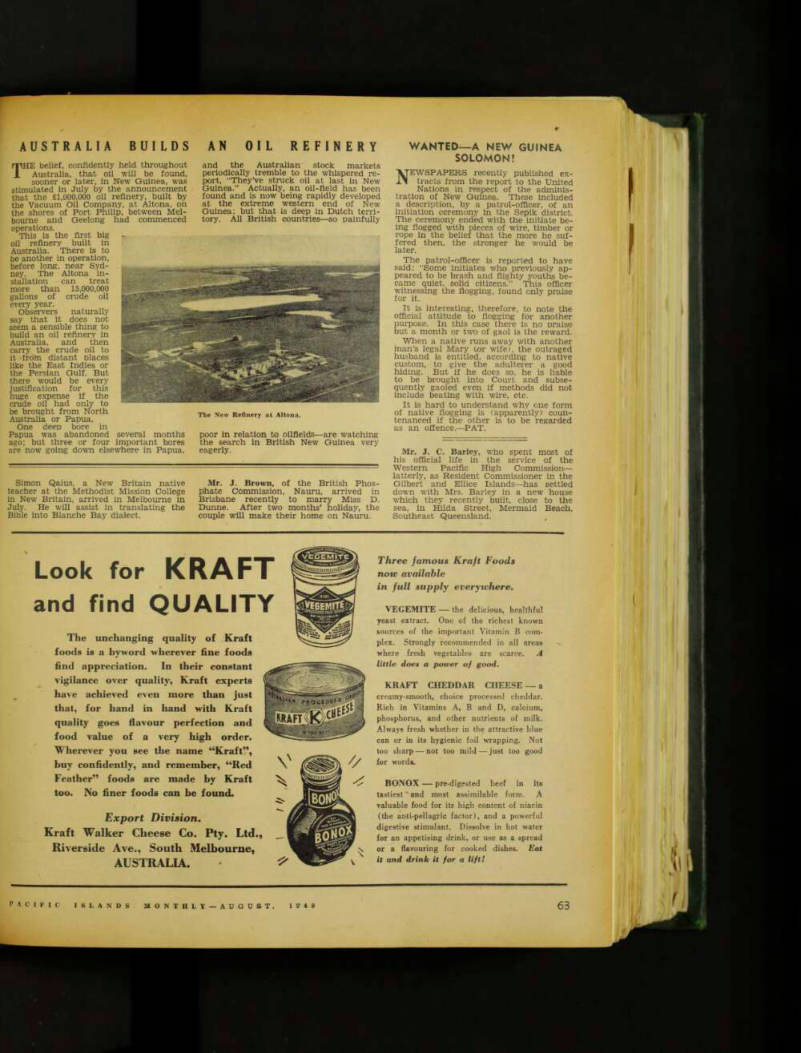
Fire Brigade Is Wanted In
Letter to the Editor IT may be recalled that in 1946 a dis astrous fire wiped out part of the business premises here of Messrs. O.
F. Nelson and Co., and that there then was a public outcry against the lack of fire-fighting equipment. Thanks to our Administrator, we got an up-to-date fire engine and equipment.
But this equipment, in the hands of untrained and unskilled men, is of no use at all. The well-stocked trading store of John Fong and Co., at Matafele, in the centre of Apia, has just been completely destroyed. It was only by chance that there was not blowing a wind which would have wiped out part of the business sec tion of Apia. The same happy chance saved the town in 1946.
It is imperative that we have a team of trained fire-fighters available. Surely it is possible to arrange for the services, for a while, for training purposes, of an officer from the Suva Fire Brigade, which is one of the best. I am sure we could find a dozen good men here to serve as a voluntary fire brigade, and I am sure the whole business community would help.
“Samoa mo Samoa” (Samoa for the Samoans) does not mean much if we can not organise a fire brigade for our own
protection.
I am, etc.,
Apia.
Leaga Tonu Samoa.
Simon Qaius, a New Britain native teacher at the Methodist Mission College in New Britain, arrived in Melbourne in July. He will assist in translating the Bible into Blanche Bay dialect.
Mr. J. Brown, of the British Phosphate Commission, Nauru, arrived in Brisbane recently to marry Miss D.
Dunne. After two months’ holiday, the couple will make their home on Nauru.
Australia Builds An Oil Refinery
THE belief, confidently held throughout Australia, that oil will be found, sooner or later, in New Guinea, was stimulated in July by the announcement that the £1,000,000 oil refinery, built by the Vacuum Oil Company, at Altona, on the shores of Port Philip, between Mel bourne and Geelong had commenced
operations.
This is the first big oil refinery built in Australia. There is to be another in operation, before long, near Syd ney. The Altona in stallation can treat more than 15,000,000 gallons of crude oil every year.
Observers naturally say that it does not seem a sensible thing to build an oil refinery in Australia, and then carry the crude oil to it from distant places like the East Indies or the Persian Gulf. But there would be every justification for this huge expense if the crude oil had only to be brought from North Australia or Papua.
One deep bore in
Papua was abandoned several months ago; but three or four important bores are now going down elsewhere in Papua,
and the Australian stock markets periodically tremble to the whispered re port, “They’ve struck oil at last in New Guinea.” Actually, an oil-field has been found and is now being rapidly developed at the extreme western end of New Guinea; but that is deep in Dutch terri tory. All British countries—so painfully
poor in relation to oilfields—are watching the search in British New Guinea very eagerly.
The New Refinery at Altona.
Wanted—A New Guinea
Solomon!
NEWSPAPERS recently published ex tracts from the report to the United Nations in respect of the adminis tration of New Guinea. These included a description, by a patrol-officer, of an initiation ceremony in the Sepik district.
The ceremony ended with the initiate be ing flogged with pieces of wire, timber or rope in the belief that the more he suf fered then, the stronger he would be later.
The patrol-officer is reported to have said: “Some initiates who previously ap peared to be brash and flighty youths be came quiet, solid citizens.” This officer witnessing the flogging, found only praise for it.
It is interesting, therefore, to note the official attitude to flogging for another purpose. In this case there is no praise but a month or two of gaol is the reward.
When a native runs away with another man’s legal Mary Cor wife), the outraged husband is entitled, according to native custom, to give the adulterer a good hiding. But if he does so, he is liable to be brought into Court and subse quently gaoled even if methods did not include beating with wire, etc.
It is hard to understand why one form of native flogging is (apparently) coun tenanced if the other is to be regarded as an offence.—PAT.
Mr. J. C. Barley, who spent most of his official life in the service of the Western Pacific High Commission— latterly, as Resident Commissioner in the Gilbert and Ellice Islands —has settled down with Mrs. Barley in a new house which they recently built, close to the sea, in Hilda Street, Mermaid Beach, Southeast Queensland.
..Mr. J. B. McAdam, Secretary of the P- NG Department of Forests, made routine inspections of timber areas in Bulolo and New Britain in June and July. In New
Britain many timber leases which were granted before the war, then were sus pended for the duration, are now being revived.
Advertisements & other items, pp. 65-66 (1 item)
Look for KRAFT
and find QUALITY
The unchanging quality of Kraft foods is a byword wherever fine foods find appreciation. In their constant vigilance over quality', Kraft experts have achieved even more than just that, for hand in hand with Kraft quality goes flavour perfection and food value of a very high order.
Wherever you see the name “Kraft”, buy confidently, and remember, “Red Feather” foods are made by Kraft too. No finer foods can be found.
Export Division .
Kraft Walker Cheese Co. Pty. Ltd.,
Riverside Ave., South Melbourne,
AUSTRALIA.
V
Three famous Kraft Foods
notv available in full supply everywhere .
VEGEMITE the delicious, healthful yeast extract. One of the richest known sources of the important Vitamin B complex. Strongly recommended in all areas where fresh vegetables are scarce. A little does a power of good.
KRAFT CHEDDAR CHEESE a
creamy-smooth, choice processed cheddar.
Rich in Vitamins A, B and D, calcium, phosphorus, and other nutrients of milk.
Always fresh whether in the attractive blue can or in its hygienic foil wrapping. Not too sharp not too mild just too good for words.
BONOX pre-digested beef in its tastiest and most assimilable form. A valuable food for its high content of niacin (the anti-pellagric factor), and a powerful digestive stimulant. Dissolve in hot water for an appetising drink, or use as a spread or a flavouring for cooked dishes. Eat it and drink it for a lift !
Opnidked by
OAVISON
For Tropical conditions
Velvene Water Paint and Davison's Zinc Base Paints are used extensively throughout the islands and Mandated Territories on Government and Private buildings, giving full satisfaction under severe tropical conditions.
DAVISON PAINTS LTD.
BOX 24, AUBURN, N.S.W.
AUNT
MARYS
BAKING POWDER
For the best in delicious baking results A product of TILLOCK AND CO. PTY. LTD. manufacturers of all the famous Aunt Marys Pure Foods
Livroison IMMEDIATE LINOLEUM ECOSSAIS IMPORTE
delivery immediate
(/entitne*
IMPORTED
LINOLEUM-
Ideal for Island Conditions. Long Wearing.
Hessian Back. Cork based. Full range of colours, patterned or plain. Full rolls (30 yards by 6 ft.) only supplied. Order to-day through your Trading House for delivery by first boat.
Ideal pour les pays tropicaux. D’une durabilite sans pareille, a base de liege convert en toile de chanvre. Dessins ou unis. Rouleaux de 30 yards par 6 pieds de large. Commandez aujourd’hui chez votre Agent pour livraison par premier bateau.
T AY SIDE Linoleum distributed by :
INTERNATIONAL TRADING
PTY. LTD.
Halifax House, 26 O’Connell Street, Sydney.
Phone: BL 1543. Cables: “Mondial,” Sydney.
Visits Mangaia
Cook Islands RC Visits Mangaia
From Our Mangaia Correspondent THE simultaneous arrival here of the NZ Navy frigate, “Hawea.” and the MV “Maul Pomare,” on June 3 was an event in local maritime history. Both ships stayed overnight, and left in the late afternoon next day.
There was a curious combination of hard work, for the men of Mangaia, at the lighterage and loading (with local oranges) of the “Maui Pomare”: and for the womenfolk the entertaining of Jack ashore.
Arrangements were hasty but effective, and the Navy lads enjoyed their day upon this island. Sports arranged in cluded football and tennis matches.
Passengers rounding the lower islands of the group were the Resident Commis sioner of CI, Mr W. H. Tailby and Mrs.
Tailby, who is President of the Cook Islands Girl Guide organisation. Occa sion was taken to hold a parade and in spection of local Guides, which was attended by the full strength of the Mangaia force, and called forth praise from Mrs. Tailby, for smartness and effi ciency.
The Resident Commissioner, after deal ing with official business, visited local residents and the newly-chosen native King, Tangi Ariki, who succeeds his brother, the late Mateke Ariki.
The Resident Commissioner tells us that the Administration has an ambitious programme for Mangaia. This “five year plan” includes the deepening and im proving of the canoe channel that is our only means of crossing the formidable coral-reef that fringes the isle, plus an arrangement for the diversion of heavy surf-waves that, it is hoped, will ensure fairly calm water in the channel even with a rough sea outside.
Other improvements include an aug mented water-supply, first-class roads to the inland plantations, a local hospital, and possibly an airport. The Adminis tration will spend large sums of money on these projects, and employ local labour upon them, to the advantage of the native population.
THE matter of “gassing” the oranges is to be discussed later. Mangaian pre judice appears to be lessening in re gard to this long-standing dispute. It is argued, by those who can judge, that treatment of our oranges will give these a better chance on the NZ market, by reason of the longer keeping qualities of “gassed” oranges, plus the killing of des tructive spores on rind and under the pith of the fruit, where it joins the twig. This twig-end was once, in the days of the use of secateurs, left on the fruit: but nowadays oranges are merely plucked off the trea leaving a depression in the skin of the orange which affords easy entry for organisms causing spoilage. About 14 years ago, it was routine here to fumi gate export fruit with the fumes from cyanide balls dropped into a bowl of acid, a large canvas being used as a cover.
Only a small number of cases could be fumigated at a time by this method, and it was later abandoned.
Under modem methods it might pay the islanders to give the gassing shed at least a trial, and coming deliberations of the Island Council will consider this matter.
The Resident Commissioner is anxious to provide the islanders with a better in come for their exported fruit, by making use of the most up-to-date methods of packing and handling CT oranges, which are Mangaia’s sole means of earning the money needed for a reasonably civilised standard of living. The curio market “flopped” when the Pacific War ended,
and there is nothing to be looked for in that direction to-day. Coffee exports, though present prices are good, are too limited to be regarded as a major pro duct. Arrowroot comes into the same category, and candlenuts appear to be off the buying market entirely—it would be interesting to know why the demand has ceased. As these three sidelines were not discussed during the RC’s visit, it appears that they are of no importance now, all the emphasis being placed upon oranges.
One hopes that the Mangaian planters, who are enjoying a good demand for their products at present, in view of the dying-off of trees upon other islands, will not make the error of assuming that there will never again be competition by other parts of the Group, where new planted groves will soon be coming into bearing.
He Defied The Japs
THERE was an interesting item in the evidence given last month in United States, at the trial for treason, etc., of the American-born woman known, for her broadcasts during the war, as “Tokio Rose.” It was stated that the Japs put very great pressure upon certain Euro pean prisoners-of-war to “persuade” them to engage in pro-Jap propaganda; and that one man who consistently re fused and defied them was “a Mr. Wil liams, an official from the Gilbert Islands.”
When the Japs swooped on the Gil berts in December, 1941, Mr. H. C. R.
F. Williams, then a cadet in the British Colonial Service, was Administrative Offi cer at Butaribari, and he was taken prisoner and apparently removed to Japan. He was born in 1916, so he then was only 25 years old. He returned to the G and E Colony after the war; and is at present absent on furlough.
Exploitation
Of Native
Boxers In Fiji
A RECENT visitor to Fiji says that boxing there is being exploited for the benefit of a few “shrewd-heads,” who have got a stranglehold on the sport, and are controlling it for their own profit.
The Fijians and their Polynesian cousins make marvellously good ex ponents of the real art of European box ing. They become skilled in the use of their fists, and they develop a very keen appreciation of the finer side of sports manship—so necessary in the ring.
But these young Fijians are simply being grabbed and inducted into the fight game, run for the considerable benefit of a group of promoters. The latter have got possession of the halls and theatres, they have the money for advertising, and they have been making great profits out of the promotion of fights between young Fijians in Suva, Lauioka, Ba, etc. What they are doing is quite legal—but it definitely is not a pretty picture.
Some time ago, Mr. W. G. Gay suc ceeded in reviving the old Fiji Boxing and Wrestling Association and, for a time, it looked as if much would be done in the encouragement of amateur boxing, and in giving a good training in the schools. However, Mr. Gay was trans ferred to Labasa, and the combination of that and other circumstances seemed to be too much for the Association’s much publicised plans; and nothing has been heard of the organisation for some time.
Meanwhile, fight-promotion has created an atmosphere that is not good f<pr the young Fijians who are drawn into it. In
so many words, they are being exploited for ttip benefit generally of rich fight promoters and especially of a motley col lection of hangers-on, Mr. D. S. Hore-Lacy, formerly a well known planter at Talasea, New Guinea, and now a resident of Kallista, Victoria, was married, in July, in Melbourne, to Mrs. Geoffrey Haggard. She is a daughter of the late Sir Geoffrey Syme, one of the owners of the Melbourne "Age”.
The former Eastern Administrative District of Fiji has been incorporated in the Southern District, which now com prises the Provinces of Kadavu, Naitasiri, Namosi, Rewa, Serua, Tailevu, Lau and Lomaiviti. The District headquarters are at Suva. The Eastern District has not had a separate District Commissioner for some years, but has been administered by the District Commissioner Southern.
The change of boundaries makes this ar rangement permanent.
Advertisements & other items, pp. 67-68 (1 item)
Widdop
BOOK LOVERS!
Hutchinson’s UNIVERSAL BOOK CLUB offers an easy way to build a well-chosen Home Library.
Each month a Committee, with the co-operation of leading English and American publishers, selects for the members of the UNIVERSAL BOOK CLUB an outstanding contemporary novel by a famous author.
The subscription is £2/2/- for 12 books a year delivered monthly or £1/1/- for 6 months. This is the only charge and includes postage.
Join now and receive your first book by return mail.
Membership in other Book Clubs may also be arranged.
MAIL PUBLICITY COMPANY
175 Pitt Street, Sydney, N.S.W.
(X-Type) 120 H.P.
Direct reversing
WIDDOP
DIESEL ENGINES By
5 H P TO 300 H P
H • WIDDOP & CO LTD
GREENGATE KEIGHLEY ENGLAND
Telephone: Keighley 3727-8 Telegrams: Widdop Keighley. Codes: A.B.C. 6th Edition, Bentley’s, Bentley s Second
CVS—*7
ART POSTCARDS OF
TONGA
Per Dozen (Including a Tin-Can Mail Cover), Postage Paid: 6/- (one US Dollar).
TONGAN PHOTOS BUREAU
Nukualofa, Tonga
GILLESPIE’S
The Flour
TRADE MARK
of the Islands
- SYDNEY -
SUPER BOTANY
MERINO KNITTING
NON-SHRINK 2 & 3-PLY
‘fe'icc&vvtfcn.
FOR
ALL WOOL
REAL SHETLAND WOOL
2-PLY
15cOv
6k
BABY WOOLS
GOOD KNITTING
WHEREVER YOU
ARE
Manufactured by Wakefield, Greenwood & Co. (Huddersfield) Ltd., St. George’s Sq., Huddersfield, England Agents for Fiji : P. & R. HUTCHINSON, CENTRAL BUILDINGS, THOMPSON
STREET, SUVA, FIJI.
Floating Down The River
River
ONE used to see some odd things float ing down Fiji’s rivers in flood time.
At Naduruloulou Police Station, Rewa, I used to watch for the swollen carcases of drowned stock, and pump .303 bullets into them, hoping they would thus sink and save the calling out later of an official burying squad.
I was amused, one day, watching a cun ning old Fijian. The river was normal; and he started at the head of a long, smooth-running stretch of fast water equipped with a pole about eight feet long, with a short line and hook and a supply of grasshopper bait stuck in his upstanding hair.
He kept himself afloat as he drifted down, dap-dap-dapping a grasshopper ahead of him. He would hook a nice “ika droka,” swim to the bank and hang it to a bush by its gills, and continue the process. Then, walking back to his Koro, he would collect his catch, all fresh for the pot—the queerest bit of fly-fishing I ever saw.
Navua’s flood-time masterpiece was the coming to town of Samuela. All you could see was the front end of a log in midstream, sticking well up. The other end, well under water, carried Samuela, only his head and shoulders showing. It was raining hard, and, to complete the picture, he was holding an umbrella over his head to keep his new permanent wave dry. ‘Mata-kiki-obo-obo.’
The Quality Of A Film
Letter to the Editor I— ANOTHER woman —was present at the showing in Santo of the film, “Le Grand Jen,” which your corres pondent has so strongly criticised. It did not make me feel any too young to recapture the atmosphere of Morocco, scene of those hectic days of our early Twenties. It may have been an old film in years—but it will live far longer than the criticism which was published. It was not so old that it failed to set in a flutter at least one of our white women “in direct contact with natives through their hus bands’ occupations.”
I should have liked to have sat beside some of those white women during the showing—l might have explained to them that for once Pierre Wilm was not in the role of a play-boy—he was portraying the part of a soldier who chose to return to his duty in the full knowledge of the doom awaiting him.
Our local women were horrified to see white women carried away by Moorish soldiers. But they were not Europeans— they were Berberes from the Atlas Moun tains —genuine African natives with white skins.
If our community, so starved of good films, was not able to understand this production, what possible harmful reac tion could have taken place in the minds of our black servants?
The eminent British critic, Roger Man veil, in his excellent guide, “Film” (1946), includes “Le Grand Jeu” among the clas sics of the art of the film.
I am, etc.,
Port Vila.
Patrice Keruel.
EDITORIAL NOTE—Our correspondent did not question the merit of the film only the wisdom of showing, in a com munity predominantly black, a film which might weaken, in some degree, the respect which native men are expected to display towards white women.
Those Tax-Gatherers!
THE tax collector never misses a pass.
It is notified in a recent Western Pacific High Commission Gazette that the Administrative Officer of the Phoenix Islands has been appointed col lector of income tax for Canton Island.
Canton Island is a trans-Pacific airways station —otherwise it is a barren, unin habited sand-bank. The few depressed lads who have to live there and service the planes ought to be paid specially by the government, instead of being mulcted in tax for the benefit of the Gilbert and Ellice Colony’s yawning coffers.
Advertisements & other items, pp. 69-70 (1 item)
—Budge—
LON DON-SUVA
VIA
PANAMA
For Sailings and Further Particulars Apply To: — BETHELL, GWYN & CO., BURNS, PHILP (SOUTH SEA) 138 LEADENHALL ST., co » LTD *»
LONDON, E.C.3. SUVA.
V/ Q.
TELEPHONES: LA5034-5-6
—BUDGE—
REFRIGERATION
EQUIPMENT
Commercial and Industrial Units (not domestic) Ammonia and Methyl Chloride machines of large or small capacity.
The illustration is of a complete 30 cwt. Ice-making Plant, comprising twin, enclosed ammonia compressor, evaporative condenser, insulated ice tank, etc. It may be driven by a 10 h.p. electric motor or diesel engine.
Inquirers should mention dimensions of cold room (or cabinet) and amount of ice (if any) required per day.
JAMES BUDGE PTY. LTD.
Established 1890.
REFRIGERATION ENGINEERS
McEvoy Street, Alexandria,
Sydney
TILLEY. LAMPS
(BURN ORDINARY KEROSENE)
The Modern Form of PORTABLE LIGHTING
ATTENTION TO DETAIL
is the characteristic of all British products
TILLEY LAMPS
are British made throughout at Hendon & Cricklewood, England.
THE TILLEY LAMP COMPANY LTD. of ENGLAND London Offices and Showrooms: 33 SACKVILLE STREET, PICCADILLY, W.l
REPRESENTATION;
MELBOURNE: T. H. Bentley, Pty. Ltd., 123-125 William Street. Melbourne, Cl.
TASMANIA; Mr. C. Sellars, 108 a Charles Street. Launceston.
FIJI: Mr. K. Witherington, 2 Burns Philp Buildings, Suva.
The Fiji-Indian Problem
Former Colonial Governor Offers A Drastic Solution
MUCH interest is taken in other countries in the development of the Indian problem in Fiji.
Comment is usually sympathetic to the young Indians born in Fiji, who are to make their home there. But all observers resent, with varying degrees of fierceness, the suggestion that native Fijians should be dispossessed in any degree of their birthright by Indians who seek to place first the interests of old India. It is ap parent that any official move —either directly, or through the weak-kneed Socialist Government now in command of the British Empire—to transfer Fiji from British to Indian control, will arouse a storm of angry protest in what may be called neutral countries.
Here are a couple of typical letters:— POM a resident of a Middle East country (public servant): “The ex cuse made by the Indians for not enlisting in 1941-42 (one is prepared to waive 1939-40) is that of differential pay ment.
“If you could get in touch with a source familiar with the circumstances in the local forces about 1935-36, when the crisis developed with Italy over Abyssinia, you would find that numbers of Indians re signed from the forces through fear that we should have to go to war.
“As for Indian trading practices, I sug gest you look at the ‘Crown Colonist’ of May, at an article describing the be haviour of Indians in East Africa. You probably will find them identical with conditions in Fiji.”
FROM a resident of California (wellknown author and journalist): “When I was in Fiji in 1927, I could see this Indian threat developing, and I wrote numerous articles about it. When I returned in 1938, coming up from New Zealand, I was amazed and sickened at the way the Indians had pushed the Fijians into the background in Suva. Be cause of this I cancelled my contemplated stay in Fiji and went on to Samoa.
“I had just come from South and East Africa, and I had had just as much as I could stand of Indian arrogance and ag gressiveness . . . The recent race riots in Durban were fully justified, in my opinion; and one wonders how long it will be before similar action is taken by the Fijians. I should not want to be around if ever those giants from the hills go on the warpath with their iron wood clubs!”
FROM a resident of England (retired Governor): “It is hard to see any solution for your Indian problem in Fiji. But you will achieve nothing simply by cursing the Indians, just as you cannot get rid of snakes merely by calling mal edictions upon them.
“We took the Indians to Fiji, in the first place; they now have provided Fiji with a hard core of industry and trade which makes that country probably our most prosperous Colony; and now they are our responsibility.
“I would not consider anything so ab surd as the deportation of the Indians, but I would fix a date for the absolute cessation of all immigration from India; and, after that, I should set to work to break all cultural and, as far as possible, all economic relations between Fiji and India. I would not immediately ban the Indian language, but I should insist that English be taught—and properly taught— in every Indian school.
“The purpose of this would be to make the coming generation of Indians more Fiji-minded than India-minded. Then, it would be up to the Fijians themselves. If, on the basic qualities of citizenship, they could not stand up to the Fiji-born Indian, then they would have to take second place.
Personally, I have not the least doubt that the Fijian would hold his own quite well and the two races would go on happily together.
“But, if the Fijian is to have a chance, we must irrevocably, and soon, break this connection between India and the Indian community in Fiji. There would be a fearful howl from official India, of course, but any Indian who did not like the new arrangement would have complete liberty to leave Fiji and live in India.”
Cook Islands
Honey Possibilities In
From Our Mangala Correspondent DURING the war, some of US at Mangala Island, faced with a serious shortage of sugar, resorted to local honey as a substitute. The commercial potentialities of CI honey, either for local consumption or export, have not yet been extensively developed, and might be worth the attention of an experienced apiarist.
CI bees swarm in immense numbers, and are induced to remain in one selected place by means of rhythmical beating of meat-cans, etc., which music appears to soothe and attract them. After nightfall, the swarm is gathered into buckets or similar containers, and transported to the selected hive—often a soap-box. This transfer of bees is not the risky business one would suspect as island bees never sting after sunset.
Local beeswax, especially upon the island of Atiu, is of fine quality, and has been used, at times, for altar-candles.
Local honey is dark but of good flavour, and would, if it could be produced in quantity, command a good price on the market.
Advertisements & other items, p. 71 (1 item)
Gabriel Achun
Rid Kidneys Of
Poisons And Acids
If you suffer sharp, stabbing pains, If joints are swollen, It shows your blood Is poisoned through faulty kidney action. Other symptoms of Kidney Disorders are Backache, Aching Joints and Limbs, Sciatica, Neuritis, Lumbago, Bleepless Nights, Dizziness, Nervousness, Circles under Eyes, Less of Energy and Appetite and Frequent Headaches and Colds, etc. Ordinary medicines can’t help much because you must get to the root cause of the trouble.
The Cystex treatment is specially compounded to soothe, tone and clean kidneys and bladder and remove acids and poisons from your system safely, quickly and surely, yet contains no harmful or dangerous drugs. Cystex works In 3 ways to end your troubles. 1. Starts killing the germs which are attacking your Kidneys, Bladder and Urinary System in two hours, yet Is absolutely harmless to human tissue. 2. Gets rid of health-destroying, deadly poisonous acids with which your system has become saturated. 3. Strengthens and relnvigorates the kidneys, protects from the ravages of disease-attack on the delicate filter organism, and stimulates the entire system.
Praised by One-time Sufferers
Cystex Is approved by one-time sufferers In 73 countries from the troubles shown above.
Mr. Reg Thomas, Townsville, Queensland, recently wrote: "My Joints were all stiff, I had leg pains, my baek used to ache day and night.
My bladder was weak. I had headaches and ne appetite. The first dose ef Cystex helped me and before I finished three boxes my health and strength came baek."
Guaranteed to Satisfy or Money Back
Get Cystex from your chemist or store te-day.
Give It a thorough test. Oystex Is guaranteed to make you feel younger, stronger, better U every way, or your money back If yeu return the empty package.
Now In 2 sizes—4/-, •/-.
Cystex
for Tour Kidneys, Bladder, Rheumatism.
Gabriel Achun
Malaguna Road, RABAUL, T.N.G.
WHOLESALE MERCHANT AND IMPORTER
CORDIAL MANUFACTURER
Piecegoods for Native Trade. (Large shipment of variety arrives with every Eastern boat.) Other Lines of Trade Goods.
High-class Aerated Water and Cordials. Beer, Wines and Spirits.
Quotations and Samples of Materials gladly sent upon request.
Telephone: Cables & Radios; No. 104 Gabriel Achun. Rabaul
Other fruit trees, and the important bean
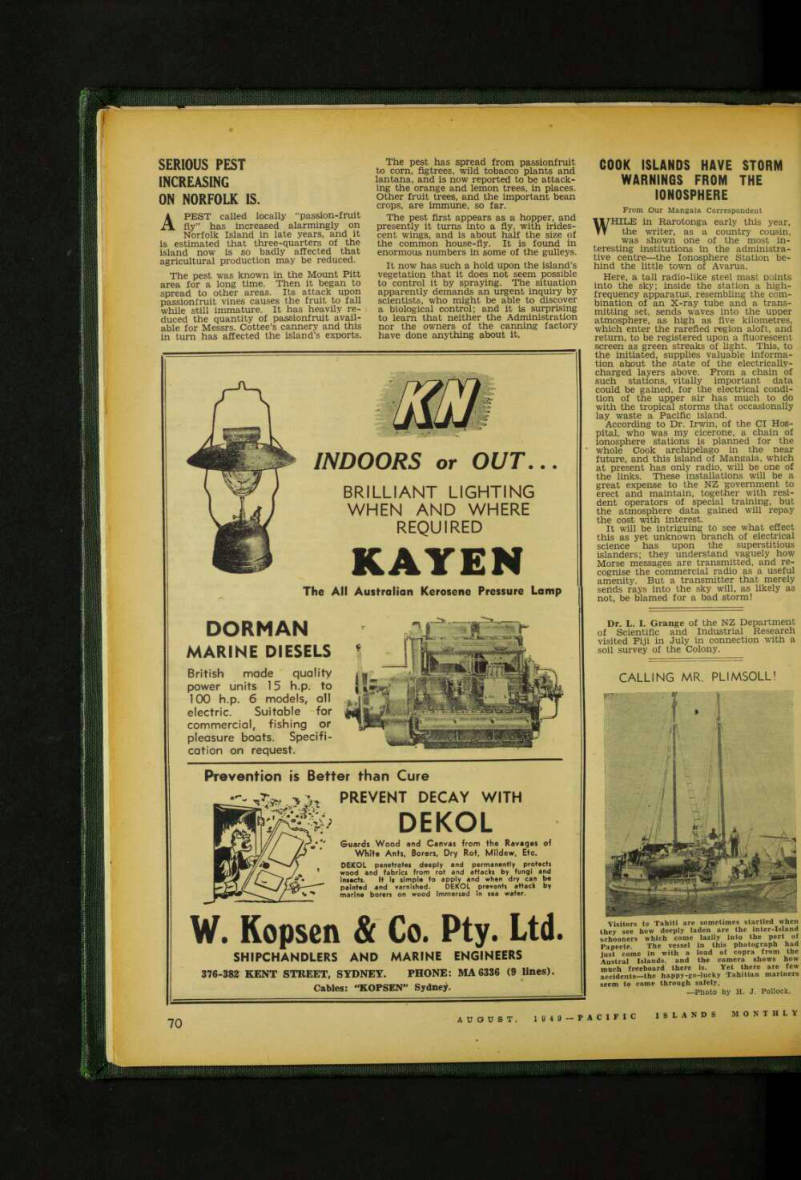
Serious Pest
Increasing
On Norfolk Is.
A PEST called locally “passion-fruit fly” has increased alarmingly on Norfolk Island in late years, and it is estimated that three-quarters of the island now is so badly affected that agricultural production may be reduced.
The pest was known in the Mount Pitt area for a long time. Then it began to spread to other areas. Its attack upon passionfruit vines causes the fruit to fall while still immature. It has heavily re duced the quantity of passionfruit avail able for Messrs. Cottee’s cannery and this in turn has affected the island’s exports.
The pest has spread from passionfruit to corn, figtrees, wild tobacco plants and lantana, and is now reported to be attack ing the orange and lemon trees, in places.
Other fruit trees, and the important bean crops, are immune, so far.
The pest first appears as a hopper, and presently it turns into a fly, with irides cent wings, and is about half the size of the common house-fly. It is found in enormous numbers in some of the gulleys.
It now has such a hold upon the island's vegetation that it does not seem possible to control it by spraying. The situation apparently demands an urgent inquiry by scientists, who might be able to discover a biological control; and it is surprising to learn that neither the Administration nor the owners of the canning factory have done anything about it.
Cook Islands Have Storm
Warnings From The
Ionosphere
From Our Mangaia Correspondent WHILE in Rarotonga early this year, the writer, as a country cousin, was shown one of the most in teresting institutions in the administra tive centre—the ionosphere Station behind the little town of Avarua.
Here, a tall radio-like steel mast points into the sky; inside the station a high frequency apparatus, resembling the com bination of an X-ray tube and a trans mitting set, sends waves into the upper atmosphere, as high as five kilometres, which enter the rarefied region aloft, and return, to be registered upon a fluorescent screen as green streaks of light. This, to the initiated, supplies valuable informa tion about the state of the electrically charged layers above. From a chain of such stations, vitally important data could be gained, for the electrical condi tion of the upper air has much to do with the tropical storms that occasionally lay waste a Pacific island.
According to Dr. Irwin, of the CI Hospital, who was my cicerone, a chain of ionosphere stations is planned for the whole Cook archipelago in the near future, and this island of Mangaia, which at present has only radio, will be one of the links. These installations will be a great expense to the NZ government to erect and maintain, together with resi dent operators of special training, but the atmosphere data gained will repay the cost with interest.
It will be intriguing to see what effect this as yet unknown branch of electrical science has upon the superstitious islanders; they understand vaguely how Morse messages are transmitted, and re cognise the commercial radio as a useful amenity. But a transmitter that merely sends rays into the sky will, as likely as not, be blamed for a bad storm!
Dr. L. I. Grange of the NZ Department of Scientific and Industrial Research visited Fiji in July in connection with a soil survey of the Colony.
Calling Mr. Plimsoll!
Visitors to Tahiti are sometimes startled when they see how deeply laden are the inter-island schooners which come lazily into the port of Papeete. The vessel in this photograph had just come in with a load of copra from the Austral Islands, and the camera shows how much freeboard there is. Yet there are few accidents—the happy-go-lucky Tahitian manners seem to come through safely. —Photo by H. J. Pollock.
Advertisements & other items, p. 72 (1 item)
Kayen
INDOORS or OUT ...
BRILLIANT LIGHTING
WHEN AND WHERE
REQUIRED
KAYEN
The All Australian Kerosene Pressure Lamp
DORMAN
MARINE DIESELS
British made quality power units 15 h.p. to 100 h.p. 6 models, all electric. Suitable for commercial, fishing or pleasure boats. Specification on request.
Prevention is Better than Cure
PREVENT DECAY WITH
DEKOL
Guards Wood and Canvas from the Ravages of White Ants, Borers, Dry Rot, Mildew, Etc.
DEKOL penetrates deeply and permanently protects wood and fabrics from rot and attacks by fungi and insects. It is simple to apply and when dry can be painted and varnished. DEKOL prevents attack by marine borers on wood immersed in sea water.
W. Kopsen & Co. Pty. Ltd.
SHIPCHANDLERS AND MARINE ENGINEERS
376-382 KENT STREET, SYDNEY. PHONE: MA 6336 (9 lines).
Cables: ‘KOPSEN” Sydney.
Revelry
July 14
Tahiti’s Week of Colourful Revelry
From a Special Correspondent
Papeete, July 30.
THE fete’s the thing! Throughout the year, eyes in French Oceania are directed toward the July carnival which celebrates the founding of the Re public.
Horse racing, illuminated Battle of Flowers on the lagoon, public dances and athletic contests add their excitement to the glorified fair which claims the week for its own.
As the Fourteenth approaches, in the country districts of Tahiti, the night vi brates with the throb of tom-toms in viting performers to practise their native dances for the strenuous contests in which they are about to engage.
Meanwhile, alongside Papeete lagoon, stalls decorated with palm fronds, flaming bougainvillea and alamanda flowers are hastily run up to accommodate the gaming wheels and drinking booths with out which no Tahiti holiday would be com plete. Shooting galleries, merry-go rounds and toboggan slides are also being equipped which, together with the raucous clamour of barkers and phono graph amplifiers, will add their hubbub to the babel of the fete.
Two weeks earlier, along Papeete water front, booth-sites are auctioned to aspiring renters. Last year the record amount of 400,000 francs was realised from this source. Due to a profitable copra season and the commencement of a break in the long tourist “drought” throughout French Oceania, the take this year was well over 600,000.
THE evening of the festivities was signalled on the afternoon of the thirteenth by a salvo of cannon across the lagoon. At the first boom of guns, drinking booths and shooting gal leries were thrown open, gaming wheels and merry-go-rounds began to spin, barkers began speiling, and an uproar as of pandemonium broke out.
All Tahiti, and the sister islands of Bora Bora, Raiatea, Huahini and Moorea, seemed present. French, Tahitians, Americans and Chinese, a happy, ex pectant, jostling crowd, thronged the streets, eager to take part in the revels.
Now, to the blare of barbaric music, almost drowned by shouts of spectators’ there passed through Papeete streets a parade as bizarre and colourful as that of an American circus.
Troupes of performers, clad in pic turesque tribal finery, marched in re view; canoe paddlers bearing their pirogues aloft on their shoulders, himene
singers, hula dancers, flute players and javelin throwers. All were brilliantly clad in scarlet, yellow, blue or green pareus, from waist to knee, with nodding head-dress of constrasting colour.
That evening, before an immense con course, at La Place du Marechal Joffre, a public entertainment was given when troupes of himene singers demonstrated their skill in preparation for the contests.
Seated on the ground, unaccompanied by musical instruments, groups of men and women sang without words. Men’s voices boomed resonantly as the notes Of a grand organ in support of the women.
Commencing on a few shrill notes, female voices rose in impetuous, staccato melody.
Other singers from time to time added to the volume until the himene burst forth in one unbridled torrent. Its effect, akin to the abandon of a football yell mingled with the skirl of bagpipes, was at once barbaric and emotional, producing an un forgettable impression on the hearer. (Continued Next Page)
PROCEEDINGS next morning, the Fourteenth, the principal day of the fete, were ushered in at 7.30 by the salute of cannon. A review of garrison troops by Governor Anziani followed. At 9.30 a full programme of bicycle races for both men and women was run off.
Pari-mutuel horse-racing and javelin throwing occupied the afternoon. In the evening a grand public ball was held, and
a Vin d’Honneur (cocktail party) given by the Governor to which civil and mili tary officials and other distinguished residents were invited.
Friday evening an illuminated Battle of Flowers was held on the lagoon.
Beautifully decorated pirogues thronged with singers and accompanied by guitar and accordion players, floated in review, affording on the moonless night an en trancing and gorgeous spectacle to be holders on shore and swarming the rails of trade schooners. Later that evening, hula dancers gave a preliminary demon stration of their art, as himene singers had done before them.
Saturday morning was devoted to a regatta when races for paddle canoes, sail canoes and whale-boats took place. A score of schooners moored along the waterfront, gaily trimmed with colours and fluttering bunting, afforded vantage points for eagerly cheering onlookers.
The programme provided events for double canoes manned by 20 or more pad dlers and single canoes manned by three.
Similar races were also scheduled for women. By regulation, all contestants wore brilliant red and yellow pareus, the torsos of the men being bare.
As a dozen or more canoes crowded with paddlers assembled at the starting line, a faint indication was caught of that sight witnessed by Captain Cook long ago, when a fleet of 200 canoes, manned each by nearly 100 warriors, set out from Tahiti on its ill-starred invasion of Moorea.
At the bark of the starting gun, to the honk of automobile horns and the frenzied plaudits of spectators, the sleek canoes skimmed down the course, the bronze arms of the contestants and their paddles flashing rhythmically in the sun.
Amid great excitement, the four paddle races were all won by the distant little district of Tautira.
In the afternoon, a soccer football match was played at the race track, when a cash prize of 12,000 francs was distri buted among the winners, the losers being solaced with an honorarium of 8,000 fr.
The last evenings of the fete were de voted to final competitions among troupes of himene singers and hula dancers rep resenting the ancient tribal districts of Tahiti.
In all events money awards were at stake which intensified the rivalry of con testants and evoked the genius of the native who trajects the whole of his emo tional and physical equipment into his diversions.
The frenzy of the himene singers, in the abandon of their wild chants, was only surpassed by the fiery gyrations of the hula dancers whose flashing, colour ful garments flared from their revolving bodies and produced an explosive effect, which at times, was even startling.
The fete terminated with a grand torch light procession of all participants in the week’s festivities.
And now, again, a surfeited and jaded Papeete has relapsed into its accustomed somnolence, to dream placidly of the al luring revelry of July, 1950.
Advertisements & other items, pp. 73-74 (1 item)
Batteries
Better for School Books
They stand the rough end tumble. They're lighter and easier to carry.
Ask first for
SCHOOL CASES
MADE BY
FORD SHERINGTON LTD.
BATTERIES
"are tigers for work”
It is impossible to build a better battery than the Masse. Every part of a Masse Battery is of one hundred per cent, quality . . . every stage of its manufacture is carried out in the Masse factory. When you recommend a Masse Battery to your customer, you can do so, with the utmost confidence that it will give him more starts and longer service.
ROBERT GILLESPIE New Guinea LTD.
RABAUL AND LAE
FRANCIS HOOVER
4 Castlereagh Street, Sydney Cables: Petwer, G.P.O., Box 4623.
ISLAND TRADERS
All classes of merchandise supplied. Careful attention given to big and small orders.
PHOTOGRAPHERS..
... make every exposure a "certainty"
with one of these exposure meters
PALEC EXPOSURE METER.
With its dual-range sensitivity and sapphire-jewelled meter movement, this Australian-made meter makes exposure calculation simplicity itself. It covers exposure speeds from 1/1000 sec. to 60 secs., and f. stop numbers from f/1 to f/64 —cine work from 8 to 96 frames per second. Sturdy black plastic body, neck cord, and zipper leather case.
WESTON MASTER UNIVERSAL EXPOSURE METER.
Of reliable British manufacture, the Weston Master is the "favourite” for tropical photography—its sensitive photo-electric cell is specially sealed to provide additional stability and to ensure accurate readings even in extremes of humidity and temperature. Precision made with a jewelled movement in a streamlined plastic case, it covers all f. stops and all exposure times from 1/1200 sec to 90 secs.
AVO EXPOSURE METER.
Whether your choice be black-and-white or colour, during day or night, the delicate sensitivity of the Avo meter ensures accuracy with every reading. It is the first meter to be scaled in B.S. index numbers thus simplifying its operation. It is ideal for tropical use—the photo-electric cell is fully sealed against damp and dust, whilst tne jewelled bearings of the movement are shock-resistant.
ENQUIRIES INVITED TO ALL KODAK
DEALERS THROUGHOUT THE ISLANDS
METROVICK EXPOSURE METER.
;Ss a »W^ S to%f^r a s n ile e Completed ever-ready case.
Kodak (A/sio) Ptv., Ltd., 379 George Street, Sydney
Death Of Mrs. Cottrell
Dormer
THE death occurred in Sydney on July '22, of Mrs. W. Cottrell-Dormer, wife of the Director of Agriculture for Papua-New Guinea. She was only 39.
Mrs. Cottrell-Dormer was well-known in Port Moresby, and also in Tonga where her husband was an agricultural officer.
Advertisements & other items, p. 75 (1 item)
Crammond Receiver
The World Becomes Your Playground
If You Own a
Here’s the evidence, straight from the pens of two enthusiastic purchasers in your own
Territory.
MR. LOVETT-CAMERON, OF KAVIENG, writes on 16th July, 1949: “The Radio continues to give me the utmost satisfaction—the time is now 8 a.m. and lam listening-in to England, and have excellent reception on the 19-metre band. I really consider I have the best set in the Islands, for the following reasons;— (1) I can get all day reception loud and clear from the whole world. (2) The sealed cabinet and crystals not only keeps all moisture out, but also stops beetles, cockroaches, rats and other vermin out which eat all the insulation off the wires and generally play havoc with the inside of a set. Believe it or not, I have before to-day taken a rat’s nest out of one of my sets.
“You are welcome to use any portions of my letters to you in your coming publicity campaign; they were all made in the utmost sincereity and I wish you every success. I tell everyone who calls in what a good set I have and they all agree when they hear it and see its coverage. Of course, broadcast depends solely on local conditions, which are not always good, but when they are favourable, I can log stations all over Australia and New Zealand. However, we depend on short-wave and the 16 to 50 metre bands leave nothing to be desired.”
THE CRAMMOND TROPIC EAGLE
EXCLUSIVE FEATURES:
Complete Sealed Rustless Metal Cabinet. Built in moisture extractor. All components infra-red ray tropic-proofed.
EXCLUSIVE FEATURES:
Unlimited range, day or night. Continuous coverage from 16 to 150 metres and full broadcast band.
This is the Rolls Royce of all receivers.
THE MOST SENSATIONAL LONG-RANGE TROPIC RECEIVER IN THE WORLD TO-D.AY. AVAILABLE AS VIBRATOR. ALL DRY CELL. A.C. OR D.C. OPERATION.
THE CRAMMOND TROPICAL PORTABLE
EXCLUSIVE FEATURES:
Moisture - proof Bondwood Cabinet. Brocade infra-red ray stoved finish. Available in Dual or Triple Waves.
EXCLUSIVE FEATURES:
Unlimited range, day or night.
Available for vibrator. All dry cell. All electric. A.C or D.C. operation.
THE MOST POWERFUL PORTABLE EVER PRODUCED.
Here’s the second letter we promised you : MR. McCOLL, of AIT APE, writes in July, 1949: “I must say that the set gives superb performance, with plenty of volume, even during the ‘off’ hours of the day while in Madang, I tried it one day at 4 p.m. and picked up an American station and had to turn the set down to nail volume.
You certainly know how to pack a lot of volume and selectivity into a small set. Keep on building sets like these and there is no limit to your customers.
“You have my permission to use any parts of this letter which may help your advertising and my name, too, if you desire.
With best wishes for every success.” (Signed) K. H. McColl.
Write for particulars of the Complete Crammond range. We are radio specialists and will quote with pleasure for any special requirements. We are also the sole manufacturers of Crammond pH metres, used throughout the world.
Write now to:
CRAMMOND RADIO MANUFACTURING CO. PTY. LTD.
No. 8 Queen St., BRISBANE
‘Payment By Results’
New Guinea’s Reply to Mr. Ward’s New Indenture System
OLD New Guinea planters are getting a certain amount of grim amuse ment out of the embarrassment be ing suffered by the Administration —or a section of it —in relation to the develop ment of the contract labour system on the plantations.
As is well known, the Ward Socialist regime, when it resumed control after the war, swept away the old native labour system and put in its place a plan that was based partly on idealism and partly on “ratbag” philosophy, and in which practical experience was generally ig nored.
Planters were not allowed to engage native labourers on a 3-year contract. A one-year contract was insisted upon, although it was contended then—and proved by practical experience since— that in the conditions peculiar to New Guinea the one year system either will not work at all, or will be very costly.
The scale of rations and equipment for
these indentured (one year) native labourers, insisted upon by the new Department of Native Labour, caused fur ther complications. It was much too lavish for natives engaged for only one year—and the natives themselves were among the first to say so.
But copra prices were good, and getting better, and the planters naturally made great efforts to work their plantations under these difficult Wardist conditions.
But they found the one-year-indenture system too difficult, and they gradually evolved another—namely, the Native Con tract System.
Under this method, the planter makes an independent contract with suitable natives, under which the natives come in and do the plantation work under a clear cut system of payment by result, and the native contractor usually provides all rations and equipment. This generally has worked quite well. It is being em ployed on an increasing number of plantations. The planter knows exactly how much his own copra is going to cost him, and he is freed of the petty and harassing control by the Native Labour De partment, with its scales and rates and regulations.
THE new system, it is reported, has not been viewed with high favour by the Native Labour officials. This De partment is a post-war creation by Mr.
Ward, designed to administer the new labour regulations and to crack the whip over employers generally. It was only natural that the new officials should re sent the development of the native con tract system.
But the older members of District Ser vices—who formerly controlled and administered the regulations governing indentured labour—had a keener appre ciation of the difficulties which the new Native Labour Ordinance had created for employers; and, generally speaking, they gave endorsement to the system of work ing plantations by native contractors.
Therefore, when the new Native Labour Department was inclined to run to high authority, crying out against the planters’
“evasion of the native labour regulations” by the creation of a contract system, and suggesting remedial measures, the Dis trict Officers—who have considerable the opposite view and urged that the interests of both natives and Europeans would be best served by giving the new development a fair trial.
It was also pointed out, very effectively, that as the ultimate purpose of the Ward ist policy is to build up the status of the native as a free man, no one could object to the system under which the planter was prepared to enter into a contract with selected natives for payment by results.
In this respect the contract system might achieve more than anything else in build ing up among natives a feeling of self confidence, a sense of obligation and ap preciation of a contract.
This argument, for the time being, has silenced the critics in the Native Labour Department. “Old hands” in the Terri tories may be forgiven if they are chuck ling a little.
Advertisements & other items, p. 76 (1 item)
KASPER Superior
Wynne S. Breden Pty. Ltd
SHIPWRIGHTS , BOAT BUILDERS AND ENGINEERS.
"PHOENIX SHIPYARDS", NEWCASTLE, N.S.W.
Designers, Builders & Outfitters of ISLAND Vessels Work Boats, Cargo Boats and Auxiliary Craft up to 200 tons.
KASPER Superior
Kasper Superior Soda Fountain of all stainless steel welded construction surfaces.
SODA FOUNTAINS
Complete with ICE CREAM
MAKING MACHINE
Specially designed for TROPICAL CONDITIONS Complete fountains, including metal rust-proof surround, carbonators and refrigerator units shipped from Australia through your agent.
For beauty, for low lifetime cost, for convenience, for dependability, for profit-making power, “Kasper” Fountains stand supreme in Australia to-day. The “Kasper” Fountain is years ahead of conventional models. Every detail has been thoroughly worked out and tested in the factory and in use.
“Kasper” superior fountains are of all steel, lifetime construction with stainless steel, WELDED surfaces and chromeplated fittings. Adequate cork board insulation helps assure lowest operating costs.
ORDER NOW AND AVOID DELAY
Kasper Refrigerators Pty. Ltd.
77 Railwoy Parade, Erskineville, N.S.W., Australia Telephone: LA 1326
The Month In Moresby
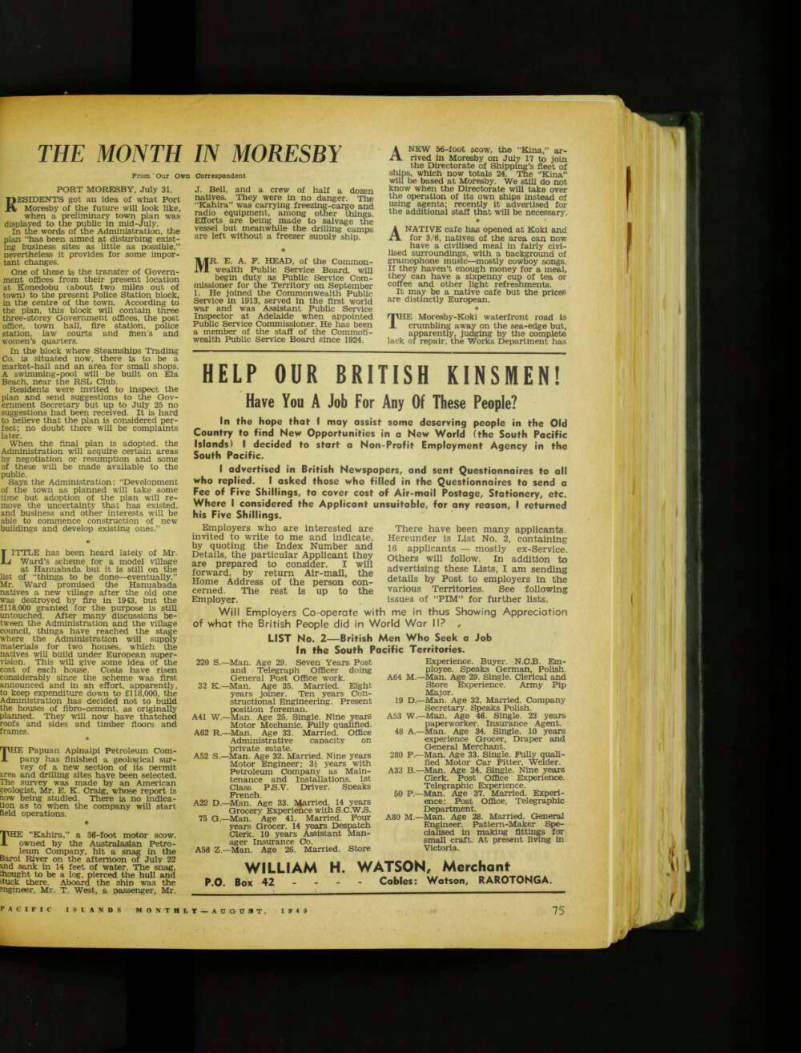
From Our Own Correspondent
Port Moresby, July 31.
RESIDENTS got an idea of what Port Moresby of the future will look like, when a preliminary town plan was displayed to the public in mid-July.
In the words of the Administration, the plan “has been aimed at disturbing exist ing business sites as little as possible,” nevertheless it provides for some impor tant changes.
One of these is the transfer of Govern ment offices from their present location at Konedobu (about two miles out of town) to the present Police Station block, in the centre of the town. According to the plan, this block will contain three three-storey Government offices, the post office, town hall, fire station, police station, law courts and men’s and women’s quarters.
In the block where Steamships Trading Co. is situated now, there is to be a market-hall and an area for small shops.
A swimming-pool will be built on Ela Beach, near the RSL Club.
Residents were invited to inspect the plan and send suggestions to the Gov ernment Secretary but up to July 25 no suggestions had been received. It is hard to believe that the plan is considered per fect; no doubt there will be complaints later.
When the final plan is adopted, the Administration will acquire certain areas by negotiation or resumption and some of these will be made available to the public.
Says the Administration: “Development of the town as planned will take some time but adoption of the plan will re move the uncertainty that has existed, and business and other interests will be able to commence construction of new buildings and develop existing ones.” * LITTLE has been heard lately of Mr.
Ward’s scheme for a model village at Hanuabada but it is still on the list of “things to be done—eventually.”
Mr. Ward promised the Hanuabada natives a new village after the old one was destroyed by fire in 1943, but the £118,000 granted for the purpose is still untouched. After many discussions be tween the Administration and the village council, things have reached the stage where the Administration will supply materials for two houses, which the natives will build under European super vision. This will give some idea of the cost of each house. Costs have risen considerably since the scheme was first announced and in an effort, apparently, to keep expenditure down to £118,000, the Administration has decided not to build the houses of fibro-cement, as originally planned. They will now have thatched roofs and sides and timber floors and frames. * THE Papuan Apinaipi Petroleum Com pany has finished a geological sur vey of a new section of its permit area and drilling sites have been selected.
The survey was made by an American geologist, Mr. E. K. Craig, whose report is now being studied. There is no indica tion as to when the company will start
field operations.
♦ THE “Kahira,” a 56-foot motor scow, owned by the Australasian Petro leum Company, hit a snag in the Baroi River on the afternoon of July 22 and sank in 14 feet of water. The snag, thought to be a log, pierced the hull and stuck there. Aboard the ship was the engineer, Mr. T. West, a passenger, Mr.
J. Bell, and a crew of half a dozen natives. They were in no danger. The “Kahira” was carrying freezing-cargo and radio equipment, among other things.
Efforts are being made to salvage the vessel but meanwhile the drilling camps are left without a freezer supply ship. * MR. E. A. F. HEAD, of the Commonwealth Public Service Board, will begin duty as Public Service Com missioner for the Territory on September 1. He joined the Commonwealth Public Service in 1913, served in the first world war and was Assistant Public Service Inspector at Adelaide when appointed Public Service Commissioner, He has been a member of the staff of the Common wealth Public Service Board since 1924.
ANEW 56-foot scow, the “Kina,” ar rived in Moresby on July 17 to join the Directorate of Shipping’s fleet of ships, which now totals 24. The “Kina” will be based at Moresby. We still do not know when the Directorate will take over the operation of its own ships instead of using agents; recently it advertised for the additional staff that will be necessary. ♦ A NATIVE cafe has opened at Koki and for 3/6, natives of the area can now have a civilised meal in fairly civi lised surroundings, with a background of gramophone music—mostly cowboy songs.
If they haven’t enough money for a meal, they can have a sixpenny cup of tea or coffee and other light refreshments.
It may be a native cafe but the prices are distinctly European. * THE Moresby-Koki waterfront road is crumbling away on the sea-edge but, apparently, judging by the complete lack of repair, the Works Department has
not noticed it yet. In some spots a vehicle has only to be forced a little wide and it will hit the crumbling sur face, with possibly tragic results. One truck went into the sea recently but no one was hurt. * ACTING Assistant District Officer at Abau, Mr. R. M. Geelan, and Mrs.
Geelan, have gone to Sydney on leave. When his leave expires, Mr. Geelan will attend a two years’ course at the School of Pacific Administration. * MR. PHIL HARDY, formerly of the co operative section of District Ser vices, has taken up duty as ADO at Losuia in the Trobriands. Mrs. Hardy is with him. Mr. Hardy replaced Mr. R.
C. Turner who was due for leave. * LATEST births in Moresby; A daughter Barbara, to Mr. and Mrs. Peter Brett; a daughter to Mr. and Mrs.
R. Ruttledge, of Hohoro; and a daughter, Suzanne Esther, to Mr. and Mrs. Neville Chester, of Sohana.
MISS IVY GRAHAMSLAW, youngest daughter of the late Mr. and Mrs.
J. G. Grahamslaw, of Moresby, has announced her engagement to Mr. Frank Middleton, of APC, Moresby. * AFTER two years as Acting Supervising Telephone Technician at Moresby, Mr. Tom Weston has returned to Melbourne, accompanied by Mrs. Weston, who was here for the past few months.
Mr. Sid Kensett, from Rabaul, has filled Mr. Weston’s position at Moresby. * MR. JAMES MARLEY, animal hus bandry officer and a veterinary science graduate, arrived in Moresby recently to take up an appointment with the Department of Agriculture, Stock and Fisheries. Later he will be in charge of the animal breeding and distribution in Papua. * EIGHT-year-old Robert Gorringe, of Moresby, suffered a broken collar bone and other injuries when
knocked down by a jeep on Ela Beach Road recently. He ran out from in front of a bus and apparently did not see the jeep coming. Driver of the jeep, Mr.
Clarence Brady, was fined £1 by Mr. B.
Falthorn in the Moresby Court of Petty Sessions, for negligent driving. * MORESBY residents heard some really startling news the other day—the price of bread has dropped. The Deputy Prices Commissioner for the Ter ritory announced that a 2 lb loaf would cost 1/0½ in future instead of 1/4.
For householders, this is the most im portant local price reduction for some time. Rumour says that price control is going to be stricter but no one is too hopeful just yet. They want to see re sults. * IT is reported that the Port Moresby Freezing Company will extend its business hours soon. At the same time we hear that A. W. Anderson’s Island In dustries will open a butcher’s shop on a freezer barge at Moresby after the call of the next “Bulolo,” This shop will be open most of the day.
Mr. Anderson tells us that his barge freezer is only a temporary measure, and that he will build a freezer in the town as soon as possible. * TWO enterprising women, Mrs. L.
Hannan-Stanley and Mrs. Wilcock son, intend to give Moresby residents an easy-to-reach holiday resort. They have enlarged and renovated the guest house at Rouna Falls, formerly owned by Mrs. Hartwell.
The building has not been used as a guest-house for a long time. The two
ladies, who have had guest-house ex perience in India, will combine the guest house with tea rooms. * Mr. H. L. HUNTER, general fields manager of APC, and Mr. R. L.
Greenham, fields resident geologist, have left Moresby on a business trip to America. They will be away about a month. The General Manager of the Australasian Petroleum Company, Mr. L.
A. Pym, is visiting the company’s head quarters and drilling areas in Papua at
present.
AMONG those who arrived in Moresby on the “Bulolo” were Mr. and Mrs.
Noel Maloney and their baby son, Peter: Mr. and Mrs. Alf. Haynes, Mrs.
W. C. Rich, Mr. and Mrs. Newman; Mr. and Mrs. George Haughan and Mrs. E.
Frame. * A SURPRISE arrival here recently was Mr. Charlie Donaldson, son of Mr. and Mrs. Donaldson, of Moresby, who had not been in Moresby since 1941 and had not seen his parents for three years. He is a crew member of the Blue Funnel ship “Lycaon,” which stopped here en route from Australia to England.
The “Lycaon” could not get coal in Aus tralia because of the strike and had to wait at Moresby while another ship, the Idomenus, brought her some coal from Singapore.
Some months ago, Mr. and Mrs. W.
Wallace-Brown, of Torokina, Bougain ville, well-known Territorians of long residence, walked across Bougainville from Torokina, on the west coast, to Inus Plantation, on the east coast. After three weeks’ visit with Mr. and Mrs. Paul
Mason, of Inus, they recrossed the island to Torokina. by the Numa Numa trail. It is believed that this is the first time a European woman has made this double
journey. Bougainville terrain is moun tainous and difficult. The journey of Mr. and Mrs. Wallace-Brown was not made easier by flooded rivers.
Advertisements & other items, pp. 77-80 (1 item)
Help Our British Kinsmen!
Have You A Job For Any Of These People?
In the hope that I may assist some deserving people in the Old Country to find New Opportunities in a New World (the South Pacific Islands) I decided to start a Non-Profit Employment Agency in the South Pacific.
I advertised in British Newspapers, and sent Questionnaires to all who replied. I asked those who filled in the Questionnaires to send a Fee of Five Shillings, to cover cost of Air-mail Postage, Stationery, etc.
Where I considered the Applicant unsuitable, for any reason, I returned his Five Shillings.
Employers who are interested are invited to write to me and indicate, by quoting the Index Number and Details, the particular Applicant they are prepared to consider. I will forward, by return Air-mail, the Home Address of the person concerned. The rest is up to the Employer.
There have been many applicants.
Hereunder is List No. 2, containing 16 applicants mostly ex-Service.
Others will follow. In addition to advertising these Lists, I am sending details by Post to employers in the various Territories. See following issues of “PIM” for further lists.
Will Employers Co-operate with me in thus Showing Appreciation of what the British People did in World War II? , LIST No. 2—British Men Who Seek a Job In the South Pacific Territories.
220 S—Man. Age 29. Seven Years Post and Telegraph Officer doing General Post Office work. 32 K.—Man. Age 35. Married. Eight years joiner. Ten years Constructional Engineering. Present position foreman.
A41 W—Man. Age 25. Single. Nine years Motor Mechanic. Fully qualified.
A 62 R. —Man. Age 33. Married. Office Administrative capacity on private estate.
A 52 S.—Man. Age 32. Married. Nine years Motor Engineer; 31 years with Petroleum Company as Maintenance and Installations. Ist Class P.S.V. Driver. Speaks French.
A 22 D.—Man. Age 33. Married. 14 years Grocery Experience with S.C.W.S. 75 G.—Man. Age 41. Married. Four years Grocer, 14 years Despatch Clerk. 10 years Assistant Manager Insurance Co.
A5B Z.—Man. Age 26. Married. Store
Experience. Buyer. N.C.B. Employee. Speaks German, Polish.
A 64 M—Man. Age 29. Single. Clerical and Store Experience. Army Pip Major. 19 D.—Man. Age 32. Married. Company Secretary. Speaks Polish, A 53 W—Man. Age 46. Single. 23 years paperworker. Insurance Agent. 48 A.—Man. Age 34. Single. 10 years experience Grocer, Draper and General Merchant. 280 F.—Man. Age 33. Single. Fully qualified Motor Car Fitter, Welder.
A 33 B.—Man. Age 24. Single. Nine years Clerk. Post Office Experience.
Telegraphic Experience. 50 P—Man. Age 37. Married. Experience: Post Office, Telegraphic Department.
A80 M.—Man. Age 28. Married. General Engineer. Pattern-Maker Specialised in making fittings for small craft. At present living in Victoria.
WILLIAM H. WATSON, Merchant P.O. Box 42 Cables: Watson, RAROTONGA.
Woven Wire for all Industry
COPRA DRYING TRAYS, FLOORS, Etc.
FRUIT DRYING TRAYS, MINING SCREENS.
Heavy Mosquito Gauze in Phosphor Bronze and other Metals Impervious to Salt Sea Air.
WIRE DOOR MATS AND GENERAL WIRE WORKS
E. WRIGHT & CO. LTD.
Office and Works: 148-152 Cleveland Street, Sydney, N.S.W.
Telegraphic Address; "Wrightmake," Chippendale.
Above: 90 HP RNR6 type with 2/1 or 3/1 reduction, and patent angle lever control.
Sterngear mode to order After soles, service and spores facilities always available
THORNYCROFT (Aust.) Pty. Ltd
6-10 WATTLE ST., PYRMONT, N.S.W.
A DIRECT BRANCH OF THE MANUFACTURERS.
MARINE ENGINES
PETROL OR DIESEL
9 to 130 HP Reliable —efficient and economical for all types of vessels
FULL PARTICULARS ON REQUEST.
65 HP RTR6 type, 2/1 reduction.
The Perfect Sink Unit
Available to a new streamlined design in Stainless Steel with a lustrous "Wunderbrite" finish.
Sizes 4', 46", 5' and 6' long by 1'6" wide.
Ask your local Hardware Merchant, 'phone MX 2411 or write to Wunderlich Limited, Box 474, G.P.O., Sydney, for prices and leaflet.
COMBINATION SINK &. DRAINER
IN THIS PART OF THE WORLD TOO!
Throughout the Pacific, as with other parts of the world, ROBERT KOSAK, representing leading English, Continental and U.S.A. manufacturers, offers all the advantages of an old-established importexport service.
ISLAND PRODUCTS
SOLD ON ALL
WORLD MARKETS
ON A COMMISSION
BASIS
Inquiries invited
ROBERT KOSAK
Exporters and Manufacturers' Representatives,
77 KING STREET, SYDNEY, AUSTRALIA
Cable Address: “ROKOSTRA,” Sydney.
Bankers: National Bank of Australasia, Ltd., Sydney.
Bank of New South Wales, Sydney.
Grime
does
not
VACUUM
QUALITY PRODUCT
Keep your
Engine Clean
with
A clean engine gives perfect lubrication, improved performance, longer engine life, quicker starting and complete protection at all speeds and temperatures.
VACUUM OIL COMPANY PTY. LTD.
MOBILOIL
Adler-Hurd Wedding
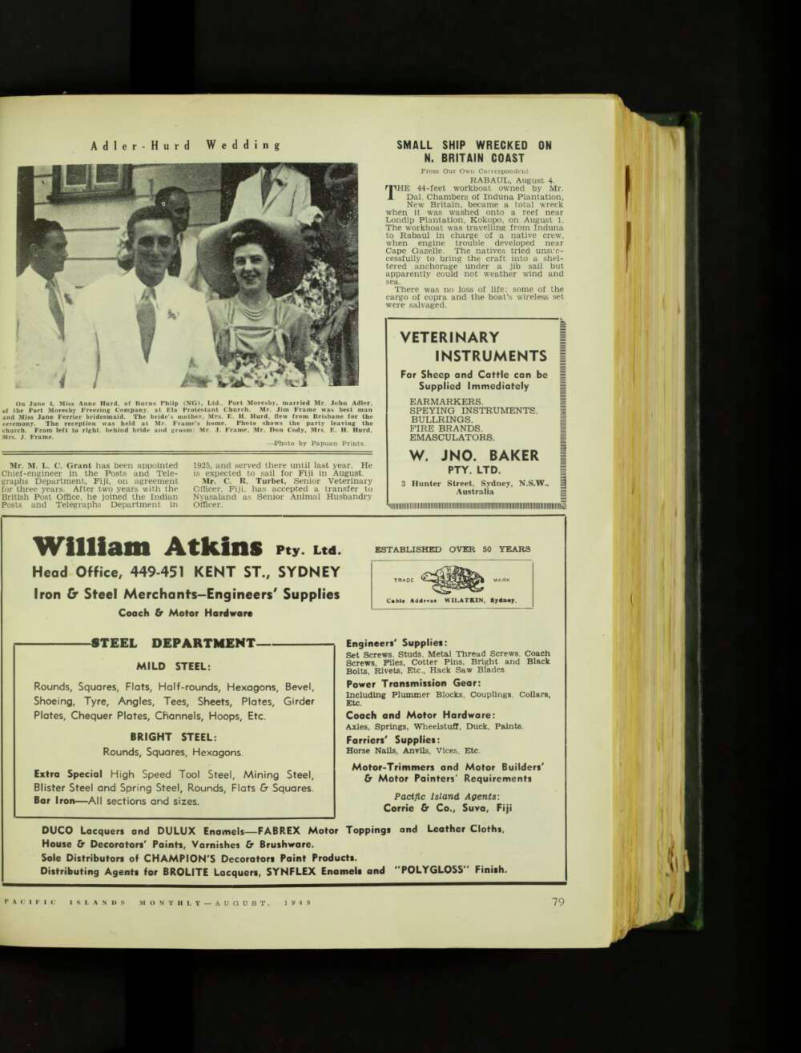
Mr. M. L. C. Grant has been appointed Chief-engineer in the Posts and Tele graphs Department, Fiji, on agreement for three years. After two years with the British Post Office, he joined the Indian Posts and Telegraphs Department in
1925, and served there until last year. He is expected to sail for Fiji in August.
Mr. C. R. Turbet, Senior Veterinary Officer, Fiji, has accepted a transfer to Nyasaland as Senior Animal Husbandry Officer.
On June 4. Miss Anne Hurd, of Burns Philp (NG), Ltd., Port Moresby, married Mr. John Adler, of the Port Moresby Freezing Company, at Ela Protestant Church. Mr. Jim Frame was best man and Miss Jane Ferrier bridesmaid. The bride’s mother, Mrs. E. H. Hurd, flew from Brisbane for the ceremony. The reception was held at Mr. Frame’s home. Photo shows the party leaving the church. From left to right, behind bride and groom: Mr. J. Frame, Mr. Don Cody, Mrs. E. H. Hurd, Mrs. J. Frame. —Photo by Papuan Prints.
Small Ship Wrecked On
N. Britain Coast
From Our Own Correspondent RABAUL, August 4.
THE 44-feet workboat owned by Mr.
Dal. Chambers of Induna Plantation, New Britain, became a total wreck when it was washed onto a reef near Londip Plantation, Kokopo, on August 1.
The workboat was travelling from Induna to Rabaul in charge of a native crew, when engine trouble developed near Cape Gazelle. The natives tried unsuc cessfully to bring the craft into a shel tered anchorage under a jib sail but apparently could not weather wind and sea.
There was no loss of life; some of the cargo of copra and the boat’s wireless set were salvaged.
Advertisements & other items, pp. 81-82 (2 items)
79
PACIFIC ISLANDS MONTH LY AUGUST, 1949
William
VETERINARY
INSTRUMENTS
For Sheep and Cattle can be
Supplied Immediately
EARMARKERS.
SPEYING INSTRUMENTS.
BULLRINGS.
FIRE BRANDS.
EMASCULATORS.
W. JNO. BAKER
PTY. LTD.
3 Hunter Street, Sydney, N.S.W., Australia
William
Atkins Pty. Ltd.
Head Office, 449-451 KENT ST., SYDNEY
Iron & Steel Merchants—Engineers' Supplies
Coach fir Motor Hardware
ESTABLISHED OVER 50 YEARS
STEEL DEPARTMENT
MILD STEEL:
Rounds, Squares, Flats, Half-rounds, Hexagons, Bevel, Shoeing, Tyre, Angles, Tees, Sheets, Plates, Girder Plates, Chequer Plates, Channels, Hoops, Etc.
BRIGHT STEEL:
Rounds, Squares, Hexagons.
Extra Special High Speed Tool Steel, Mining Steel, Blister Steel and Spring Steel, Rounds, Flats & Squares.
Bar Iron— All sections and sizes.
Engineers' Supplies: Set Screws. Studs, Metal Thread Screws. Coach Screws, Piles, Cotter Pins, Bright and Black Bolts, Rivets, Etc., Hack Saw Blades Power Transmission Gear: Including Plummer Blocks, Couplings, Collars, Etc.
Coach and Motor Hardware: Axles, Springs, Wheelstufl, Duck, Paints.
Farriers' Supplies: Horse Nails, Anvils, Vices, Etc.
Motor-Trimmers and Motor Builders' & Motor Painters' Requirements Pacific Island Agents : Corrie tr Co., Suva, Fiji DUCO Lacquers and DULUX Enamels—FABREX Motor Topping* and Leather Cloth*, House & Decorators' Paints, Varnishes & Brushware.
Sole Distributors of CHAMPION'S Decorators Paint Products.
Distributing Agents for BROLITE Lacquers, SYNFLEX Enamels and "POLYGLOSS" Finish.
Your teeth
sparkle
with new lustre You save money at the same time with
KOLYNOS
Yes! Kolynos does save you money. Kolynos lasts longer because it is highly concentrated. Half an inch on a dry brush is all you need to leave your teeth surgically clean and gleaming. Always ask for Kolynos.
DENTAL
CREAM
CLEANS BETTER - TASTES BETTER- LASTS LONGER
Samoan Girl's Successful
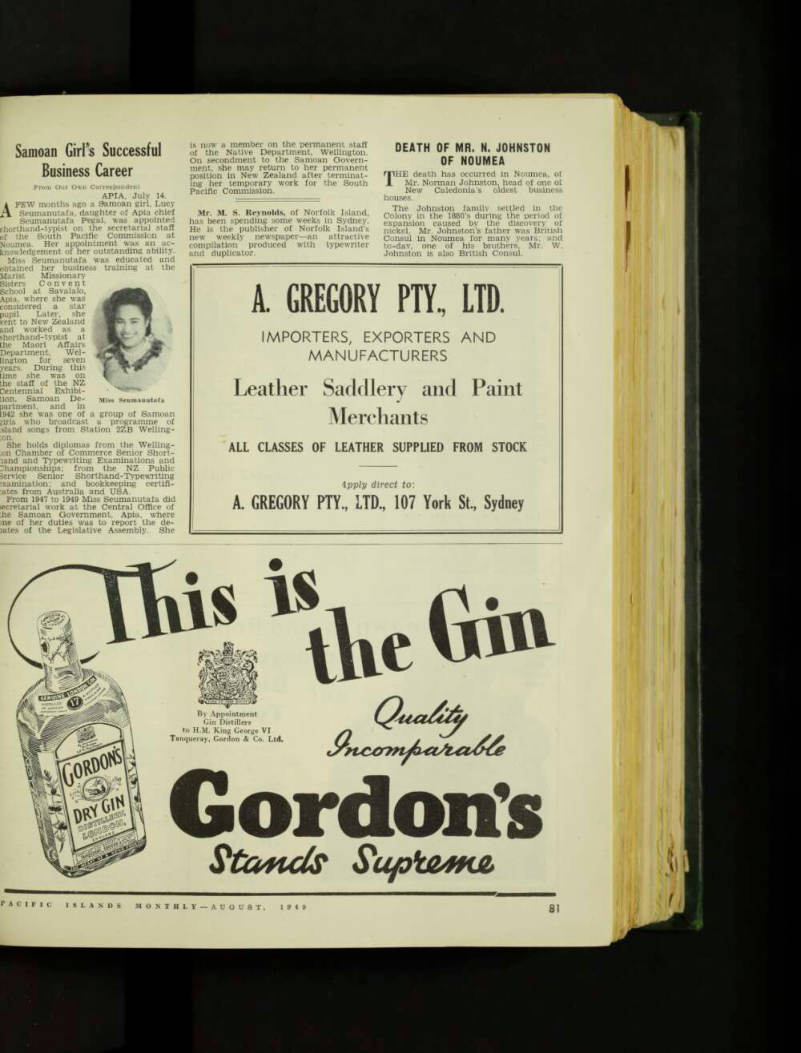
Business Career
From Our Own Correspondent APIA, July 14.
A FEW months ago a Samoan girl, Lucy Seumanutafa, daughter of Apia chief Seumanutafa Pegai, was appointed shorthand-typist on the secretarial staff of the South Pacific Commission at Noumea. Her appointment was an ac knowledgement of her outstanding ability.
Miss Seumanutafa was educated and obtained her business training at the
Marist Missionary Sisters Convent School at Savalalo, Apia, where she was considered a star pupil. Later, she vent to New Zealand and worked as a shorthand-typist at the Maori Affairs Department, Wel lington for seven years. During this time she was on the staff of the NZ Centennial Exhibi tion, Samoan De partment, and in
1942 she was one of a group of Samoan girls who broadcast a programme of island songs from Station 2ZB Wellington.
She holds diplomas from the Welling ton Chamber of Commerce Senior Short land and Typewriting Examinations and Championships; from the NZ Public Service Senior Shorthand-Typewriting examination; and bookkeeping certifi cates from Australia and USA.
From 1947 to 1949 Miss Seumanutafa did secretarial work at the Central Office of the Samoan Government, Apia, where some of her duties was to report the debates of the Legislative Assembly. She
is now a member on the permanent staff of the Native Department, Wellington.
On secondment to the Samoan Govern ment, she may return to her permanent position in New Zealand after terminat ing her temporary work for the South Pacific Commission.
Mr. M. S. Reynolds, of Norfolk Island, has been spending some weeks in Sydney.
He is the publisher of Norfolk Island’s new weekly newspaper—an attractive compilation produced with typewriter and duplicator.
Miss Seumanutafa
Death Of Mr. N. Johnston
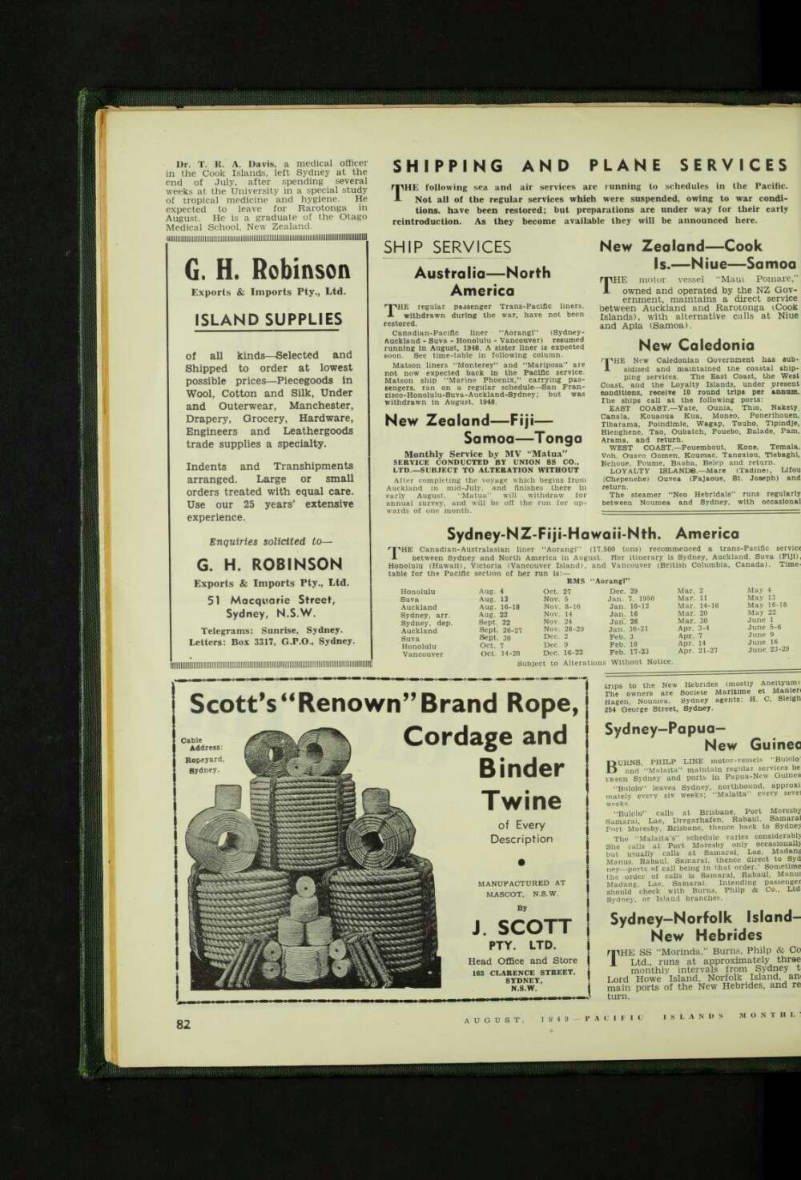
Of Noumea
THE death has occurred in Noumea, ot Mr. Norman Johnston, head of one of New Caledonia’s oldest business houses.
The Johnston family settled in the Colony in the 1880’s during the period of expansion caused by the discovery of nickel. Mr. Johnston’s father was British Consul in Noumea for many years; and to-day, one of his brothers, Mr. W.
Johnston is also British Consul.
Dr. T. R. A. Davis, a medical officer in the Cook Islands, left Sydney at the end of July, after spending several weeks at the University in a special study of tropical medicine and hygiene. He expected to leave for Rarotonga in August. He is a graduate of the Otago Medical School, New Zealand.
Advertisements & other items, pp. 83-84 (1 item)
Gordon's
A. GREGORY FTY, LTD.
IMPORTERS, EXPORTERS AND
MANUFACTURERS
Leather Saddlery and Paint Merchants ALL CLASSES OF LEATHER SUPPLIED FROM STOCK Apply direct to: A. GREGORY PTV., LTD., 107 York St., Sydney
By Appointment Gin Distillers to H.M. King George VI Tanqueray, Gordon & Co. Ltd.
Gordon's
Stands Supreme
G. H. Robinson
Exports & Imports Pty., Ltd.
ISLAND SUPPLIES
of all kinds—Selected and Shipped to order at lowest possible prices—Piecegoods in Wool, Cotton and Silk, Under and Outerwear, Manchester, Drapery, Grocery, Hardware, Engineers and Leathergoods trade supplies a specialty.
Indents and Transhipments arranged. Large or small orders treated with equal care.
Use our 25 years’ extensive experience.
Enquiries solicited to —
G. H. ROBINSON
Exports & Imports Pty., Ltd. 51 Macquarie Street, Sydney, N.S.W.
Telegrams: Sunrise, Sydney.
Letters: Box 3317, G.P.0., Sydney.
Scott’s “Renown” Brand Rope,
Cordage and
Binder
Twine
of Every
Description
Cable Address: Ropeyard.
Sydney.
MANUFACTURED AT
MASCOT. N.S.W.
J. SCOTT
PTY. LTD.
Head Office and Store
163 CLARENCE STREET.
SYDNEY,
N.S.W.
Sydney—Norfolk Island-
Shipping And Plane Services
Ship Services
THE following sea and air services are running to schedules in the Pacific.
Not all of the regular services which were suspended, owing to war condi tions. have been restored; but preparations are under way for their early reintroduction. As they become available they will be announced here.
Australia—North
America
THE regular passenger Trans-Pacific liners, withdrawn during the war, have not been restored.
Canadian-Pacific liner “Aorangi” (Sydney- Auckland - Suva - Honolulu - Vancouver) resumed running in August, 1948. A sister liner is expected soon. See time-table in following column.
Matson liners “Monterey” and “Mariposa” are not now expected back in the Pacific service.
Matson ship “Marine Phoenix,” carrying pas sengers, ran on a regular schedule —San Fran cisco-Honolulu-Suva-Auckland-Sydney; but was withdrawn in August, 1948.
New Zealand—Fiji—
Samoa—Tonga
Monthly Service by MV “Matua”
Service Conducted By Union Ss Co.,
Ltd.—Subject To Alteration Without
After completing the voyage which begins from Auckland in mid-July, and finishes there in early August, “Matua” will withdraw for annual survey, and will be off the run for up wards of one month.
New Zealand —Cook
Is.—Niue—Samoa
THE motor vessel “Maui Pomare,” owned and operated by the NZ Gov ernment, maintains a direct service between Auckland and Rarotonga (Cook Islands), with alternative calls at Niue and Apia (Samoa).
New Caledonia
THE New Caledonian Government has sub sidised and maintained the coastal ship ping services. The East Coast, the West Coast, and the Loyalty Islands, under present conditions, receive 10 round trips per annum.
The ships call at the following ports: EAST COAST.—Yate, Ounia, Thio, Nakety.
Canala, Kouaoua Kua, Moneo, Ponerlhouen, Tibarama, Poindimie, Wagap, Touho, Tlpindje, Hienghene, Tao, Oubatch, Pouebo, Balade, Pam, Arama, and return.
WEST COAST.—Pouembout, Kone, Temala, Vnh. Ouaco Gomen. Kouraac, Taneaiou. Tiebaghl, Nehoue, Poume, Baaba, Belep and return.
LOYALTY ISLANDS.—Mare (Tadlne), Lifou (Chepenehe) Ouvea (Fajaoue, St. Joseph) and return.
The steamer “Neo Hebridais” runs regularly between Noumea and Sydney, with occasional
Sydney-NZ-Fiji-Hawaii-Nth. America
THE Canadian-Australasian liner “Aorangi” (17,500 tons) recommenced a trans-Pacific service between Sydney and North America in August. Her itinerary is Sydney, Auckland, Suva (Fiji), Honolulu (Hawaii), Victoria (Vancouver Island), and Vancouver (British Columbia, Canada). Time table for the Pacific section of her run is:—
trips to the New Hebrides (mostly Aneltyum) The owners are Sociele Maritime et Manlen Hagen, Noumea. (Sydney agents: H. C. Sleigh 254 George Street, Sydney.
Sydney-Papua-
New Guinea
BURNS, PHILP LINE motor-vessels “Bulolo' and “Malaita” maintain regular services be tween Sydney and ports in Papua-New Guinea “Bulolo” leaves Sydney, northbound, approxi mately every six weeks; “Malaita” every seven weeks.
“Bulolo” calls at Brisbane, Port Moresby Samarai, Lae, Dregarhafen, Rabaul, Samarai, Port Moresby, Brisbane, thence back to Sydney.
The “Malaita’s” schedule varies considerably She calls at Port Moresby only occasionally but usually calls at Samarai, Lae, Madang, Manus, Rabaul, Samarai, thence direct to Syd ney—ports of call being in that order. Sometime the order of calls is Samarai, Rabaul, Manus, Madang, Lae, Samarai. Intending passenger should check with Burns, Philp & Co., Ltd, Sydney, or Island branches.
Sydney—Norfolk Island-
New Hebrides
THE SS “Morinda,” Burns, Philp & Co Ltd., runs at approximately three monthly intervals from Sydney to Lord Howe Island, Norfolk Island, and main ports of the New Hebrides, and re turn.
RMS “Aorangl”
Honolulu Aug. 4 Oct. 27 Dec. 29 Mar. 2 May 4 Suva Aug. 13 Nov. 5 Jan. 7. 1950 Mar. 11 May 13 Auckland Aug. 16-18 Nov. 8-10 Jan. 10-12 Mar. 14-16 May 16-18 Sydney, arr. Aug. 22 Nov. 14 Jan. 16 Mar. 20 May 22 Sydney, dep. Sept. 22 Nov. 24 Jan. 26 Mar. 30 June 1 Auckland Sept. 26-27 Nov. 28-29 Jan. 30-31 Apr. 3-4 June 5-6 Suva Sept. 30 Dec. 2 Feb. 3 Apr. 7 June 9 Honolulu Oct. 7 Dec. 9 Feb. 10 Apr. 14 June 16 Vancouver Oct. 14-20 Dec. 16-22 Feb. 17-23 Apr. 21-27 June 23-29 Subject to Alterations Without Notice.
Advertisements & other items, pp. 84-85 (2 items)
82
AUGUST, 1949 PACIFIC ISLANDS MONTHL
Ideal For The Islands
ATCO—BOATIMPELLER
• Simple to handle • Light—easily carried Surprisingly economical It's easy starting, has smooth power and gives trouble-free performance.
ATCOSCYTHE
Cut time and labour costs with this dependable machine. It's eight to twelve times as rapid as hand-scything. Ideal for cutting long grass, weeds, tall undergrowth, etc.
Just fill in the coupon below for illustrated booklets which will be sent post free.
SEND
NOW FOR
DETAILS
MOTOR TRACTORS PTY. LTD.
369-385 Wattle Street, Ultimo, Sydney.
Please send me Atco Booklets.
NAME.
ADDRESS.
ATCO MOTOR MOWER
There's a full range from the 12 and 14 inch models up to the 17, 20, 28 and 34 inch for big-area requirements. The ATCO is a self-contained unit and will go anywhere.
MOTOR TRACTORS
PTY. LIMITED
369-385 Wattle Street, Ultimo, Sydney Telegrams: “Sellmotors,” Sydney.
Sydney-Voncouver
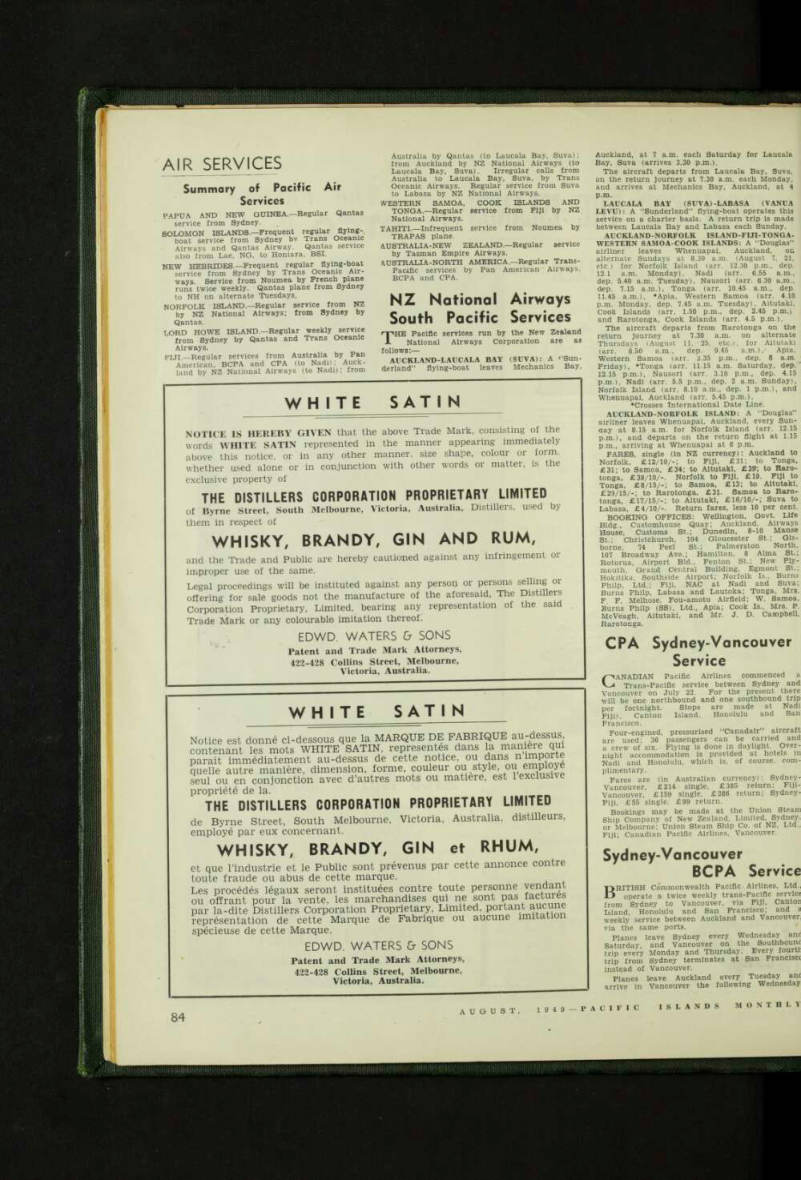
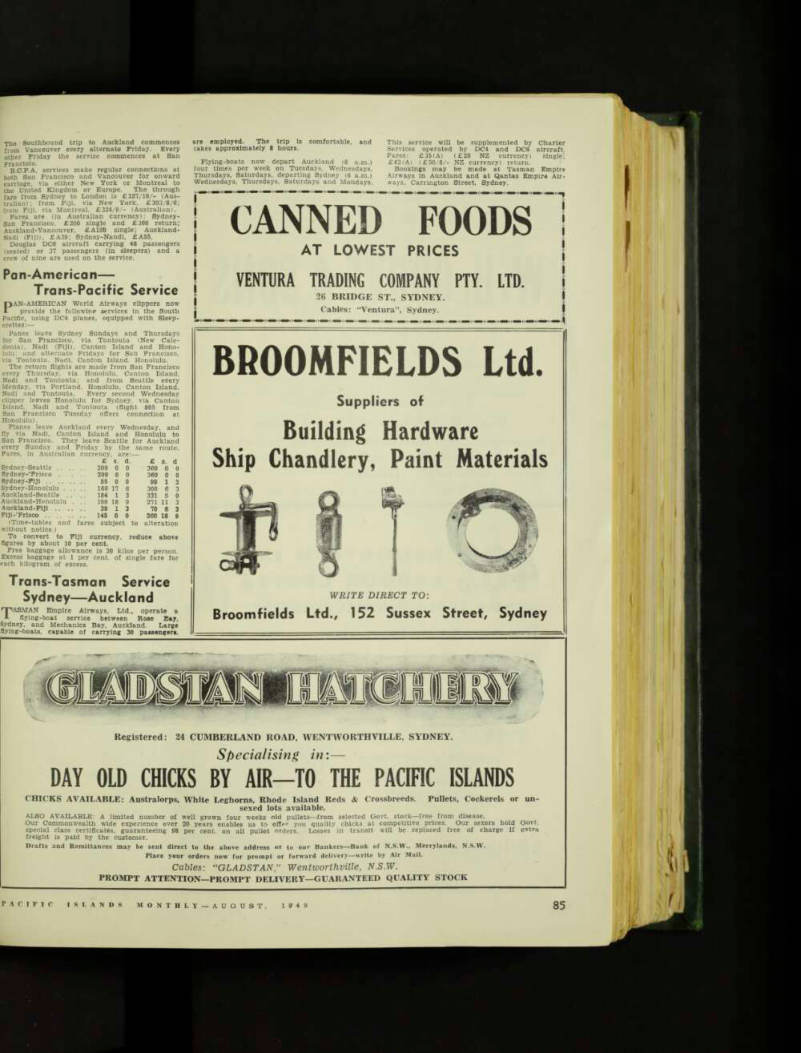
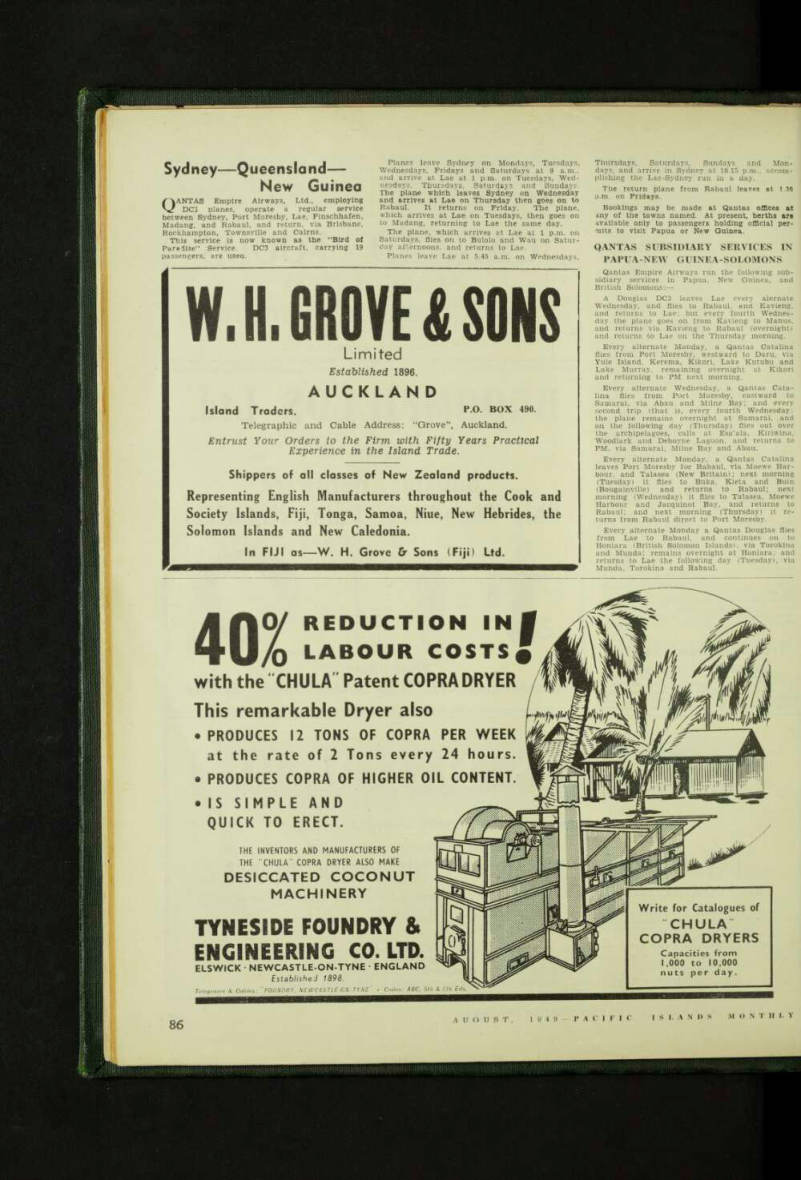
Air Services
Summery of Pacific Air
Services
PAPUA AND NEW GUINEA.—Regular Qantas service from Sydney.
SOLOMON ISLANDS.— Frequent regular flying boat service from Sydney bv Trans Oceanic Airways and Qantas Airway. Qantas service also from Lae, NG, to Honiara, BSI.
NEW HEBRIDES.—Frequent regular flying-boat service from Sydney by Trans Oceanic Air ways. Service from Noumea by French plane runs twice weekly. Qantas plane from Sydney to NH on alternate Tuesdays.
NORFOLK ISLAND.—Regular service from NZ by NZ National Airways; from Sydney by Qantas.
LORD HOWE ISLAND—Regular weekly service from Sydney by Qantas and Trans Oceanic Airways.
FIJI —Regular services from Australia by Pan American, BCPA and CPA (to Nadi): Auck land by NZ National Airways (to Nadi); from
Australia by Qantas (to Laucala Bay, Suva): from Auckland by NZ National Airways (to Laucala Bay, Suva). Irregular calls from Australia to Laucala Bay, Suva, by Trans Oceanic Airways. Regular service from Suva to Labasa by NZ National Airways.
Western Samoa, Cook Islands, And
TONGA - Regular service from Fiji by NZ National Airways.
TAHITI - Infrequent service from Noumea by TRAPAS plane.
AUSTRALIA-NEW ZEALAND.—ReguIar service by Tasman Empire Airways.
AUSTRALIA-NORTH AMERICA. Regular Trans Pacific services by Pan American Airways,
Bcpa And Cpa.
NZ National Airways
South Pacific Services
Pacific services run by the New Zealand National Airways Corporation are as follows: -
Auckland-Laucala Bat (Suva): A "Sun-
derland" flying-boat leaves Mechanics Bay,
Auckland, at 7 a.m. each Saturday for Laucala Bay, Suva (arrives 3.30 p.m.).
The aircraft departs from Laucala Bay, Suva, on the return journey at 7.30 a.m. each Monday, and arrives at Mechanics Bay, Auckland, at 4 p.m.
Laucala Bay (Suva)-Labasa (Vanua
LEVU): A “Sunderland” flying-boat operates this service on a charter basis. A return trip is made between Laucala Bay and Labasa each Sunday.
Auckland-Norfolk Island-Fiji-Tonga
Western Samoa-Cook Islands: A “Douglas”
airliner leaves Whenuapai, Auckland, on alternate Sundays at 8.30 a.m. (August 7, 21, etc.) for Norfolk Island (arr. 12.30 p.m,, dep. 12.1 a.m. Monday), Nadi (arr. 6.55 a.m., dep. 5.40 a.m. Tuesday), Nausori (arr. 6.30 a.m., dep. 7.15 a.m.), Tonga (arr. 10.45 a.m., dep, 11.45 a.m.), *Apia, Western Samoa (arr. 4.10 p.m. Monday, dep. 7.45 a.m. Tuesday), Aitutaki, Cook Islands (arr. 1.50 p.m., dep. 2.45 p.m.) and Rarotonga, Cook Islands (arr. 4.5 p.m.).
The aircraft departs from Rarotonga on the return journey at 7.30 a.m. on alternate Thursdays (August 11, 25. etc.), for Aitutaki (arr. 8.50 a.m., dep. 9.45 a.m.), Apia, Western Samoa (arr. 3.35 p.m., dep. 8 a.m.
Friday), *Tonga (arr. 11.15 a.m. Saturday, dep. 12.15 p.m.), Nausori (arr. 3.10 p.m., dep. 4.15 p.m.), Nadi (arr. 5.5 p.m., dep. 2 a.m. Sunday).
Norfolk Island (arr. 8.10 a.m., dep. 1 p.m.), and Whenuapai, Auckland (arr. 5.45 p.m.). •Crosses International Date Line.
Auckland-Norfolk Island: A “Douglas”
airliner leaves Whenuapai, Auckland, every Sun aay at 8.15 a.m. for Norfolk Island (arr. 12.15 p.m.), and departs on the return flight at 1,15 p.m., arriving at Whenuapai at 6 p.m.
FARES, single (in NZ currency): Auckland to Norfolk, £12/10/-; to Fiji, £31; to Tonga, £31; to Samoa, £34; to Aitutaki, £39; to Rarotonga, £39/10/-. Norfolk to Fiji, £19. Fiji to Tonga, £8/15/-; to Samoa, £13; to Aitutaki, £29/15/-; to Rarotonga, £31. Samoa to Rarotonga, £17/15/-; to Aitutaki, £16/10/-; Suva to Labasa, £4/10/-. Return fares, less 10 per cent.
BOOKING OFFICES: Wellington, Govt. Life Bldg., Customhouse Quay; Auckland, Airways House, Customs St.; Dunedin. 8-10 Manse St.; Christchurch, 104 Gloucester St.; Gis borne, 74 Peel St.; Palmerston North, 107 Broadway Ave.; Hamilton, 8 Alma St.; Rotorua, Airport Bid., Fenton St.; New Ply mouth, Grand Central Building, Egmont St.; Hokitika, Southside Airport; Norfolk Is., Burns Philp, Ltd.; Fiji, NAC at Nadi and Suva; Burns Philp, Labasa and Lautoka; Tonga, Mrs.
F P. Melhose, Fou-amotu Airfield: W. Samoa, Burns Philp (SS), Ltd., Apia; Cook Is., Mrs. P.
McVeagh, Aitutaki, and Mr. J. D. Campbell, Rarotonga.
CPA Sydney-Voncouver
Service
CANADIAN Pacific Airlines commenced a Trans-Pacific service between Sydney and Vancouver on July 22. For the present there will be one northbound and one southbound trip per fortnight. Stops are made at Nadi Fiji), Canton Island, Honolulu and San Francisco.
Four-engined, pressurised “Canadair” aircraft are used; 36 passengers can be carried and a crew of six. Flying is done in daylight. Over night accommodation is provided at hotels in Nadi and Honolulu, which is, of course, com plimentary.
Fares are (in Australian currency): Sydney- Vancouver, £214 single, £385 return; Fiji- Vancouver, £159 single. £286 return; Sydney- Fiji, £55 single, £99 return.
Bookings may be made at the Union Steam Ship Company of New Zealand, Limited, Sydney, or Melbourne: Union Steam Ship Co. of NZ, Ltd., Fiji; Canadian Pacific Airlines, Vancouver.
Sydney-Voncouver
BCPA Service
BRITISH Commonwealth Pacific Airlines, Ltd., operate a twice weekly trans-Paciflc service from Sydney to Vancouver, via Fiji, Canton Island, Honolulu and San Francisco; and a weekly service between Auckland and Vancouver, via the same ports.
Planes leave Sydney every Wednesday and Saturday, and Vancouver on the Southbound trip every Monday and Thursday. Every fourth trip from Sydney terminates at San Franciscc instead of Vancouver.
Planes Leave Auckland every Tuesday and arrive in Vancouver the following Wednesday
The Southbound trip to Auckland commences from Vancouver every alternate Friday. Every other Friday the service commences at San Francisco.
B.C.P.A. services make regular connections at both San Francisco and Vancouver for onward carriage, via either New York or Montreal to the United Kingdom or Europe. The through fare from Sydney to London is £327/10/- (Aus tralian); from Fiji, via New York. £303/8/6; from Fiji, via Montreal, £324/9/- (Australian).
Fares are (in Australian currency): Sydney- San Francisco, £200 single and £360 return; Auckland-Vancouver, £A198 single; Auckland- Nadi (Fiji), £A39; Sydney-Nandi, £A55.
Douglas DC6 aircraft carrying 48 passengers (seated) or 37 passengers (in sleepers) and a crew of nine are used on the service.
Pan-American—
Trans-Pacific Service
PAN-AMERICAN World Airways clippers now provide the following services in the South Pacific, using DC4 planes, equipped with Sleep erettes: Panes leave Sydney Sundays and Thursdays for San Francisco, via Tontouta (New Cale donia), Nadi (Fiji), Canton Island and Hono lulu: and alternate Fridays for San Francisco, via Tontouta, Nadi, Canton Island, Honolulu.
The return flights are made from San Francisco every Thursday, via Honolulu, Canton Island, Nadi and Tontouta; and from Seattle every Monday, via Portland, Honolulu, Canton Island.
Nadi and Tontouta. Every second Wednesday clipper leaves Honolulu for Sydney, via Canton Island. Nadi and Tontouta (flight 805 from San Francisco Tuesday offers connection at Honolulu).
Planes leave Auckland every Wednesday, and fly via Nadi, Canton Island and Honolulu to San Francisco. They leave Seattle for Auckland every Sunday and Friday by the same route.
Fares, in Australian currency, are:—
(Time-tables and fares subject to alteration without notice.) To convert to FIJI currency, reduce above figures by about 10 per cent.
Free baggage allowance is 30 kilos per person.
Excess baggage at 1 per cent, of single fare for each kilogram of excess.
Trans-Tasman Service
Sydney—Auckland
TASMAN Empire Airways, Ltd., operate a A flying-boat service between Rose Bay, Sydney, and Mechanics Bay, Auckland. Large flying-boats, capable of carrying 30 passengers,
are employed. The trip is comfortable, and takes approximately 8 hours.
Flying-boats now depart Auckland (8 a.m.) four times per week on Tuesdays, Wednesdays, Thursdays, Saturdays, departing Sydney (6 a.m.) Wednesdays, Thursdays, Saturdays and Mondays.
This service will be supplemented by Charter Services operated by DC4 and DC6 aircraft.
Fares: £35 (A) (£28 NZ currency) single - £63 (A) (£50/8/- NZ currency) return.
Bookings may be made at Tasman Empire Airways in Auckland and at Qantas Empire Air ways, Carrington Street, Sydney.
Sydney-Seattle .. . 200 0 0 360 0 0 Sydney-’Frisco . 200 0 0 360 0 0 Sydney-Fiji 55 0 0 99 1 3 Sydney-Honolulu . . 166 17 6 300 6 3 Auckland-Seattle .. 184 1 3 331 5 0 Auckland-Honolulu , . .. 150 18 9 271 11 3 Auckland-Fiji .. .. 39 1 3 70 6 3 Fiji-’Frisco .. 0 0 260 18 9
Sydney—Queensland-
New Guinea
QANTAS Empire Airways, Ltd., employing DCS planes, operate a regular service between Sydney, Port Moresby, Lae, Finschhafen, Madang, and Rabaul, and return, via Brisbane, Rockhampton, Townsville and Cairns.
This service is now known as the “Bird of Paradise” Service. DC3 aircraft, carrying 19 passengers, are used.
Planes leave Sydney on Mondays, Tuesdays, Wednesdays, Fridays and Saturdays at 9 a m., and arrive at Lae at 1 p.m. on Tuesdays, Wed nesdays, Thursdays, Saturdays and Sundays, The plane which leaves Sydney on Wednesday and arrives at Lae on Thursday then goes on to Rabaul. It returns on Friday. The plane, which arrives at Lae on Tuesdays, then goes on to Madang, returning to Lae the same day.
The plane, which arrives at Lae at 1 p.m. on Saturdays, flies on to Bulolo and Wau on Satur day afternoons, and returns to Lae.
Planes leave Lae at 5.45 a.m. on Wednesdays,
Thursdays, Saturdays, Sundays and Mon days, and arrive in Sydney at 10.15 p.m., accom plishing the Lae-Sydney run in a day.
The return plane from Rabaul leaves at 1.30 p.m. on Fridays.
Bookings may be made at Qantas offices at any of the towns named. At present, berths are available only to passengers holding official per mits to visit Papua or New Guinea.
Qantas Subsidiary Services In
Papua-New Guinea-Solomons
Qantas Empire Airways run the following sub sidiary services in Papua, New Guinea, and British Solomons: — A Douglas DC3 leaves Lae every alernate Wednesday, and flies to Rabaul, and Kavieng, and returns to Lae; but every fourth Wednes day the plane goes on from Kavieng to Manus, and returns via Kavieng to Rabaul (overnight) and returns to Lae on the Thursday morning.
Every alternate Monday, a Qantas Catalina flies from Port Moresby, westward to Daru, via Yule Island, Kerema, Kikori, Lake Kutubu and Lake Murray, remaining overnight at Kikori and returning to PM next morning.
Every alternate Wednesday, a Qantas Cata lina flies from Port Moresby, eastward to Samarai, via Abau and Milne Bay; and every second trip (that is, every fourth Wednesday) the plane remains overnight at Samarai, and on the following day (Thursday) flies out over the archipelagoes, calls at Esa’ala, Kiriwina, Woodlark and Deboyne Lagoon, and returns to PM, via Samarai, Milne Bay and Abau.
Every alternate Monday, a Qantas Catalina leaves Port Moresby for Rabaul, via Moewe Har bour, and Talasea (New Britain); next morning (Tuesday) it flies to Buka, Kieta and Buin (Bougainville) and returns to Rabaul; next morning (Wednesday) it flies to Talasea, Moewe Harbour and Jacquinot Bay, and returns to Rabaul; and next morning (Thursday) it re turns from Rabaul direct to Port Moresby.
Every alternate Monday a Qantas Douglas flies from Lae to Rabaul, and continues on to Honiara (British Solomon Islands), via Torokina and Munda; remains overnight at Honiara; and returns to Lae the following day (Tuesday), via Munda, Torokina and Rabaul.
Sydney-Noumea-Suva
THE following Is the time-table of the Qantas flying-boat:— Sydney dep. 9 p.m. alt. Tue.
Noumea arr. 7 a.m. alt. Wed.
Noumea dep. 8 a.m. alt. Wed.
Suva arr. 3 p.m. alt. Wed.
Suva dep. 6 a.m. alt. Prid.
Noumea arr. 11 a.m. alt. Frid.
Noumea .. .. .. dep. 12 noon alt. Frid.
Sydney arr. 8 p.m. alt. Frid.
Intending passengers may book through Santas offices in Australia. Burns. Phllp (South 3eas) Company, in Suva; and T. Johnston In Noumea.
Fares: To Noumea, £35 single; £63 return, To Suva. £52/10/- single; £94/10/- return.
Noumea-Suva, £17/10/- single; £31/10/- return.
Sydney-Lord Howe ls.-
Norfoik Is.
QANTAS, Sydney, run a Catalina once weekly from Sydney to Lord Howe Island. Pare. single, £12. Return, £21/12/-, Qantas run a land plane alt. Thursdays (re urning same day) from Sydney to Norfolk sland. Fare, £22 single; £39/12/- return. (For Norfolk Island, see also under NZ rational Airways. For Lord Howe, see also nder TOA.)
Noumea—Fiji—Tahiti
TRAPAS (a French company with headquarters in Noumea) ran an air service once a month from Noumea (New Caledonia), via Nadi Fiji) and Altutakl (Cook Islands) to Papeete Tahiti), and return.
The Trapas Co. also runs a service to New Hebrides—see under Caledonia-New Hebrides.
TOA Services
TRANS Oceanic Airways run the following Pacific services:— SYDNEY-LORD HOWE IS.: A regular fort nightly service with large four-engine flyingboats from Rose Bay. Fare: £11 single: £21 return. Free baggage allowance 50 lb Excess baggage and freight rate 6d. per lb.
SYDNEY-NEW HEBRIDES: A regular monthly service with large four-engine flying-boats from Sydney, via Noumea (overnight stop), to Vila and Espiritu Santo. Fare; Sydney-Vila, £45; Sydney-Santo, £50; Noumea-Vila, £12/10/-
Noumea-Santo, £18/15/-. Freight: Sydney-Vila,
/- per lb.; Sydney-Santo, 2/3.
Sydney-Solomon Islands: A Regular
monthly service from Sydney, via New Caledonia and New Hebrides to Tulagi, Solomon Islands. This service Is frequently extended to ingatou, in the Russell Islands, and calls are sometimes made at Vanikoro, in the Santa Cruz group. Fares: Sydney-Tulagi, £65. Free baggage allowance, 60 lb.; excess baggage and freight, 3/- per lb.
New Caledonia—New
Hebrides—Tahiti
A TRAPAS amphibian runs twice each week between New Caledonia and New Hebrides, the days vary, but on the selected day the planes adhere to the following time-table;— Noumea—dep. 0630. Vila—arr. 1315 Vila—dep. 0945 Santo —arr. 1115 Santo—dep. 1145 Vila—arr. 0900 Vila—dep. 1400 Noumea—arr. 1630 A TRAPAS plane runs monthly between Noumea and Tahiti.
Papua-NG Local
Services
MANDATED Airlines, Ltd., of Lae, New Guinea, and other private operators, run air services between Lae and the New Guinea mainland centres of Wau, Bulolo, Madang. Wewak, Aitape, Mt Hagen, Finschhafen. Moresby. Kokoda—in fact anywhere in Papua or New Guinea where there is an air-strip. These planes carry passengers, malls and cargo on regular schedules and charter flights. (Continued on Next Page)
Guinea Air Traders Ltd., of Lae, New Guinea, employ six aircraft on local services, and on charter work.
Under arrangement with the Administration, a Qantas plane, carrying Administration personnel and cargo, and malls, flies once each week from Lae to Rabaul, Kavieng ana Manus, and returns to Lae by the same route.
Advertisements & other items, pp. 86-90 (2 items)
Whisky, Brandy, Gin And Rum,
WHITE SATIN
NOTICE IS HEREBY GIVEN that the above Trade Mark, consisting of the words WHITE SATIN represented in the manner appearing immediately above this notice, or in any other manner, size shape, colour or form, whether used alone or in conjunction with other words or matter, is the exclusive property of
THE DISTILLERS CORPORATION PROPRIETARY LIMITED
of Byrne Street, South Melbourne, Victoria, Australia, Distillers, used by them in respect of
WHISKY, BRANDY, GIN AND RUM,
and the Trade and Public are hereby cautioned against any infringement or improper use of the same.
Legal proceedings will be instituted against any person or persons selling or offering for sale goods not the manufacture of the aforesaid, The Distillers Corporation Proprietary, Limited, bearing any representation of the said Trade Mark or any colourable imitation thereof.
EDWD. WATERS & SONS
Patent and Trade Mark Attorneys, 422-428 Collins Street, Melbourne, Victoria, Australia.
WHITE SATIN
Notice est donne ci-dessous que la MARQUE DE FABRIQUE au-dessus; contenant les mots WHITE SATIN, representes dans la mamere qui parait immediatement au-dessus de cette notice, ou dans nimporte quelle autre maniere, dimension, forme, couleur employe seul ou en conjonction avec d’autres mots ou matiere, est 1 exclusive propriety de la.
THE DISTILLERS CORPORATION PROPRIETARY LIMITED
de Byrne Street, South Melbourne, Victoria, Australia, distilleurs, employe par eux concernant.
WHISKY, BRANDY, GIN et RHUM,
et que I’industrie et le Public sont prevenus par cette annonce centre toute fraude ou abus de cette marque.
Les precedes legaux seront institutes centre toute personne yendan ou offrant pour la vente, les marchandises qui ne sont pas ractures par la-dite Distillers Corporation Proprietary, Limited, portant i lucune representation de cette Marque de Fabrique ou aucune imitai specieuse de cette Marque.
EDWD. WATERS & SONS
Patent and Trade Mark Attorneys, 422-428 Collins Street, Melbourne, Victoria, Australia.
CANNED FOODS
AT LOWEST PRICES
VENTURA TRADING COMPANY PTY. LTD.
26 BRIDGE ST., SYDNEY.
Cables: “Ventura”, Sydney.
BROOMFIELDS Ltd.
Suppliers of Building Hardware Ship Chandlery, Paint Materials
WRITE DIRECT TO:
Broomfields Ltd., 152 Sussex Street, Sydney
Registered: 24 CUMBERLAND ROAD, WENTWORTHVILLE, SYDNEY.
Specialising in: —
DAY OLD CHICKS BY AIR-TO THE PACIFIC ISLANDS CHICKS AVAILABLE: Australorps, White Leghorns, Rhode Island Reds & Crossbreeds. Pullets, Cockerels or unsexed lots available.
ALSO AVAILABLE: A limited number of well grown four weeks old pullets—from selected Govt, stock —free from disease.
Our Commonwealth wide experience over 20 years enables us to ofler you quality chicks at competitive prices. Our sexers hold Govt, special class certificates, guaranteeing 98 per cent, on all puUet orders. Losses in transit will be replaced free of charge if extra freight is paid by the customer.
Drafts and Remittances may be sent direct to the above address or to our Bankers —Bank of N.S.W., Merrylands, N.S.W.
Place your orders now for prompt or forward delivery—write by Air Mail.
Cables : “GLADSTANWentworthville, N.S.W.
PROMPT ATTENTION—PROMPT DELIVERY—GUARANTEED QUALITY STOCK
W. H. GROVE A SONS
Limited
Established 1896.
AUCKLAND
Island Traders. P.O. BOX 490.
Telegraphic and Cable Address: “Grove”, Auckland.
Entrust Your Orders to the Firm with Fifty Years Practical Experience in the Island Trade.
Shippers of all classes of New Zealand products.
Representing English Manufacturers throughout the Cook and Society Islands, Fiji, Tonga, Samoa, Niue, New Hebrides, the Solomon Islands and New Caledonia.
In FIJI as—W. H. Grove & Sons (Fiji) Ltd.
40% REDUCTION IN
LABOUR costs!
with the "CHULA" Patent COPRA DRYER
This remarkable Dryer also
• PRODUCES 12 TONS OF COPRA PER WEEK at the rate of 2 Tons every 24 hours. • PRODUCES COPRA OF HIGHER OIL CONTENT.
• IS SIMPLE AND
QUICK TO ERECT.
THE INVENTORS AND MANUFACTURERS OF
THE "CHULA" COPRA DRYER ALSO MAKE
DESICCATED COCONUT
MACHINERY
TYNESIDE FOUNDRY &
ENGINEERING CO. LTD.
ELSWICK • NEWCASTLE-ON-TYNE • ENGLAND
Established 1898.
Telegrams & Cables: " FOUNDRY . N EWCASTLE-CK-TY NE Codes: ABC, 5th & 6th Eds.
Write for Catalogues of
"CHULA”
COPRA DRYERS
Capacities from 1,000 to 10,000 nuts per day.
This Anchor
can’t drag
The security of an estate, like the safety of a ship, depends on skilful handling under all circumstances. Unless your will provides for experienced and unbroken administration, unforeseen events can wreck your plans. As a private executor, too, you will find that your unsought duties are complex, tiresome and endless. However, the appointment of Burns Philp Trust Company Limited as executor or trustee solves both problems; all responsibility is transferred to capable directors and experienced officers.
Full particulars of the Company’s helpful services are given in "Hands That Never Leave the Wheel.” A complimentary copy of this booklet can be obtained from any branch of Burns Philp (South Sea) Company, Burns Philp (New Guinea) Limited, or direct from the head office of this Company.
James Burns P. T. W. Black
DIRECTORS:
Joseph Mitchell Eric Priestley Lee MANAGER: L. S. Parker SECRETARY: E. R. Overton, F.F.I.A.
Burns Philp Trust
COMPANY LIMITED
NOW! YOU can assemble your own PLYPAC BOAT easily .. economically ...
PROOFWOOD, the famous marine plywood, is a laminated permanently bonded wood which retains its unusual strength under the most severe conditions of usage.
PROOFWOOD cannot split or warp—thus your PLYPAC boat can be left out of water for long periods and will not leak when refloated.
PLYPAC
NOW —brought within a price range everybody can afford—you can secure a complete kit for the
assembly of YOUR OWN SPECIALLY DESIGNED
PLYPAC BOAT, made from PROOFWOOD, the famous marine plywood.
You need no skill, no boat building knowledge, only a few tools. ALL MATERIALS ARE SUP- PLIED—moulds, essential components and fittings.
All parts are machine-finished to exact shape, so that it is only necessary to fit them together.
SIMPLIFIED WORKING DRAWINGS AND
ASSEMBLY INSTRUCTIONS ACCOMPANY YOUR
PLYPAC ASSEMBLY KIT.
KITS FOR THREE ATTRACTIVE MODELS ARE
AVAILABLE —the Standard 8 (yacht’s dinghy, car-top boat), Special 12 (pulling skiff or outboard motor), Super 16 (launch).
PLYPAC boats are proved designs. Skilled men have modelled these roomy craft, beautiful in line, immensely strong, and embodying 15 years’ experience of waterproof plywood in marine and aircraft uses.
PLYPAC BOAT ASSEMBLY KITS
ARE AVAILABLE FOR EXPORT
Agents required in all territories
BOAT ASSTMBIY KITS
Made by PLYPAC PTY., LTD., 30 Grosvenor St., Sydney, Australia.
Send for this illustrated brochure...
88
AUGUST, 1949 PACIFIC ISLANDS MONTH
Ng Native Constables
Provide Most Of Criminals
From Our Own Correspondent RABAUL, August 4.
THE Supreme Court, presided over by Mr. Justice Bignold, concluded its sittings here to-day.
Three native constables were each sen tenced to eighteen months’ hard labour by Mr. Justice Bignold for forgery. The Crown alleged that the three natives conspired to write a note, to obtain three bottles of whisky from a Chinese store, and that one of the natives actually wrote the note and signed it with the name of a well-known European in Rabaul. The Chinese storekeeper, on sighting the note, refused to accept the order and reported to the police.
In three separate trials, three native constables, stationed at the Sub-District Office, Talasea were sentenced to eight, seven and six years respectively, for a serious offence which they committed while on duty at the native prison, Talasea.
A native from one of the small, isolated and infrequently visited villages of the Talasea Sub-District was sentenced to one year’s imprisonment for wounding a female native with a spear and axe.
A Papuan native, employed in Rabaul, was sentenced to two years’ imprisonment for entering a European dwelling and stealing a watch. This native was, in fact, an escaped prisoner at the time of the stealing In all these cases Mr. S. H. Johnson prosecuted on behalf of the Crown, and Mr. J. R. Keenan, as ADO, provided the natives with a defence.
A European named Tolhurst, who was employed by the New Guinea Company in Rabaul, was found guilty and sentenced to two years’ imprisonment for an indecent assault on a male native.
The Supreme Court of the Territory of Papua-New Guinea, sitting in its Criminal jurisdiction on circuit in Rabaul, concluded at 10.15 a.m. to-day. His Honour departs from Rabaul to-morrow, Friday.
Major Ayris Returns To
New Guinea
THE planters of the Kokopo district propose to make a first-class establish ment of the Kokopo Sports Club, and Major E. B. Ayris has been appointed manager. Major Ayris will leave Sydney for Kokopo at an early date.
Major Ayris is well known in the Ter itory, where he spent more than 25 years. for many years he was military instructor to the New Guinea police. Then, being retired on account of age, he entered the service of New Guinea Goldfields Ltd., and was a well-known figure at Wau beefoe the invasion. During World War II he served for some 2 or 3 years on the ‘little ships”; and, since the end of the war, he has been living on a station in Queensland. He is looking forward eagerly to renewing old friendships in the Territory.
The Australian miners’ strike is the reason given why the sale of flour in New Caledonia is again being controlled, The population has been asked not to waste bread. There is also a shortage of other Australian foodstuffs.
Cinema Shows
For The
S. Pacific Islands
MR. W. M. BARRETT, Australian director of Columbia Pictures, who has been examining film require ments in Fiji, Tonga, Tahiti, Cook Islands and New Caledonia, told reporters on his return to Sydney that Pacific island natives have developed a liking for film shows since the war, but they frown on boogie-woogie musicals and jib at the classics. Their taste in entertainment lies somewhere in between —and they will go a long way to see a cowboy picture.
Mr. Barrett said the Islanders see their shows in wayside villages, and their cinemas are usually mobile projectors provided by travelling traders. One man
who is always welcome is Mr. D. C. Brown, of Rarotonga, Cook Islands.
Mr. Brown cruises among the islands collecting copra and bringing the Holly wood touch to his patrons. Admission fee to these touring talkies, said Mr, Bar rett, is very often one coconut—which adds to the traders’ copra cargos.
Because American is not generally un derstood by island audiences, an inter preter often translates for them as the drama unfolds. He has to shout to beat the volume of the talkie equipment—but nobody seems to mind this minor distrac tion.
Since the development of the 16 mm. film, the cinema is rapidly becoming standard village entertainment in Poly nesia; and the big film distributors — notably, MGM and Columbia —are show ing a keen interest in the new industry.
Sister Betty Crouch joined the staff of the Lutheran Hospital, Finschhafen, NG, in July.
Advertisements & other items, pp. 91-92 (2 items)
Millers Ltd.
TAHITI
To Shipmasters and Visitors When calling at Tahiti, and seeking SHIPS SUPPLIES and FRESH
PROVISIONS, see—
OSCAR G. NORDMAN
Supply Agent for Messageries Maritimes, Union S.S. Co. of N.Z., Ltd., Matson- Oceanic Line, United States Line, General S.S. Corp., Etc.
We supply general Service—lnformation about the Islands— Real Estate Service—Make Reservations—Act as Shipping Agents
OSCAR G. NORDMAN
Ship Chandler
PAPEETE. TAHITI
Wire before your arrival to
OCEANIC PAPEETE—Our
registered cable address.
Every Branch Of
ENGINEERING and BUILDING CONSTRUCTION
MILLERS LTD.
SUVA and LAUTOKA
Sawmillers and Timber Merchants; Shipwrights and Sailmakers; Joinery and Furniture Manufacturers; Upholsterers; Plumbers; Electricians; Hardware Merchants; Motor Dealers.
AGENCIES:
Chevrolet, Bedford, Vauxhall, Nash Motors. Firestone Tyres.
Fetters Marine and Stationary Engines. G.E.C. Radio Sets.
British Australian Lead Manufacturers Pty., Ltd., Atlas Assurance Co., Ltd.
There is no need to send to Australia or New Zealand for Repairs or Replacements. We can give you a sound Quotation and guarantee First-Class Workmanship
HEAVY MACHINERY AND EQUIPMENT
FOR THE ISLANDS TERRITORIES
Steamships Trading Company
AUTOMOTIVE and MACHINERY DEPARTMENT
Ltd.
Distributors in Fajmaand New Guinea for —
MOTOR GARS
ROOTS, LTD.—Hillman Minx—Humber Hawk— Humber Snipe and Sunbeam—Talbot Cars.
WILLYS-OVERLAND —Universal Jeeps—Jeepsters —Jeep Station Waggons.
Papua only.
ROAD TRANSPORT
INTERNATIONAL HEAVY DUTY MOTOR
TRUCKS —15 cwt. to 8 tons Gross Carrying Capacity. Utility Bodies—Platform Bodies— Tippers—Semi-Trailers—Low Loaders, etc.
AGRICULTURAL MACHINERY
McCORMICK-DEERING FARM TRACTORS, all
sizes, Wheel and Crawler Types.
FARM MACHINERY to suit every Purpose— Ploughs — Harrows — Cultivators — Planters — Harvesters — Grass-Mowers — Hay Rakes & Power Pressers—Chaff Cutters —Feed Grinders —Hammer Mills, Etc.
RICE-MILLING MACHINERY—Hullers—Pearlers — Polishers — Threshers £r Dressers — Seed Graders—Aspirators—also Complete Mills from 100 to 3,000 lb. capacity rice per hour.
EARTH-MOVING EQUIPMENT
Bullgraders — Dozers — Excavators — Front End Loaders —Road Graders—Road-Rippers—Waggon Scoops—Quarry Dumpers—Bitumen Sprayers, Etc.
TIMBER LOGGING AND
MINING EQUIPMENT
Diesel Logging Tractors —Timber Trucks—Timber Jinkers—Log Haulers—Tractor Logging Winches —Truck Mounted Loading Cr Front End Pull Winches—Wire Rope, Etc.
SAW-MILLING MACHINERY — Circular Saw
Benches—Circular Rack Saws Cr Log Mills up to 31" depth of cut.
INDUSTRIAL EQUIPMENT
DIESEL STATIONARY ENGINES—from 5 h.p.
upward, all purposes.
DIESEL MARINE ENGINES—from 5 h.p. upward W/Reverse & Reducing Gears.
OUTBOARD MOTORS—2i to 22 h.p.
MOBILE CRANES—Wharf & Material Handling, 1 to 5 tons Capacity.
PUMPS & PUMPING PLANTS—Agriculture- Mining and General Purpose Pumps.
ELECTRIC GENERATING SETS —sizes to suit every purpose—A.C.-D.C. current.
ELECTRIC MOTORS—GENERATORS—Fractional
sizes upwards—A.C. and D.C. current.
GANG & POWER GRASS MOWERS—Municipal,
Golf Course and Airfield use.
REFRIGERATORS
ELECTRIC COMPRESSOR and KEROSENE
OPERATED Food Storage Capacity. Models 4 to 7 Cubic Feet.
AUTOMOTIVE EQUIPMENT
STORAGE BATTERIES—for every purpose—Car —Truck—Radio—Marine —Lighting sets.
TYRES Cr TUBES—Cars—Trucks—Tractors— Industrial Equipment.
HYDRAULIC LIFTING JACKS —1 ton to 10 ton capacity.
GENERAL CAR AND TRUCK ACCESSORIES—
Electrical & Hydraulic Replacements—Clutch Linings, Brake Linings, Etc.
Adequate stocks of spare parts are available for all vehicles and machinery at our
SERVICE PARTS DEPOT
PORT MORESBY
Cable Address’. Telephone:
“Steamships,” Port Moresby Moresby, 476
Postal Address :
Port Moresby, Papua
90
AUGUST, 1949 PACIFIC ISLANDS MONTHY
France's Ignorance of
Her Colonies' Resources Official Publication Makes Several Boners
MORE fantastic statements about New Caledonia’s mineral wealth come from Paris, in a 16-page tourist brochure devoted to the Colony and the New Hebrides—an official prospectus of impeccable layout.
Speaking of the “practically inexhaust ible iron deposits of 55 per cent, teneur in the north and south of the island” the brochure adds that the presence of chrome and nickel in the ore “permits of commercial production on the spot, of iron and steel of different types”.
There is, of course, no iron smelting in New Caledonia, although the Japanese once exported it from Goro in the south; and although Broken Hill experts have, more than once, visited the Plaine des Lacs deposits to see whether ore export to Australia would be worth while.
Actually the presence of small quantities of chrome and nickel in Caledonian ore is a disadvantage, making the ores diffi cult to smelt.
Another error is the statement that the Colony produces “a considerable amount of coal from three deposits of which the principal is situated at Point Doniambo”; and that it is “good anthracite eminently suited to local needs”.
Actually, Doniambo is covered, with the Nickel Co. smelters. Some time be fore the war Maison Ballande lost about 19,000,000 dollars trying to work coal at Moindou, up the west coast, but the coal was so inferior the project was aban doned. A mining village, now deserted, was built close by.
Mr. Tom Sefton, of Koitaki, one of the best-known planters in Papua, suffered a stroke recently and is now a patient in the European Hospital in Port Moresby. It is reported that his con dition has caused anxiety to his many friends. Mr. Sefton has been a resi dent of the Territory for many years, and has been identified with practically all public movements, and is held in high regard.
Night (And Day) Tennis
For Rabaul
From Our Own Correspondent
Rabaul, July 16.
NIGHT tennis will commence in Rabaul, New Guinea, on July 19 when the Rabaul Tennis Club will play on their own court under newly installed electric lights. Lighting equip
merit has been installed by volunteer labour. To offset the expenses incurred in re-establishing the badly-bombed pre war tennis courts, and to declare night tennis a regular feature of Rabaul life, a Ball will be held on the tennis courts on August 8.
A Public Meeting was held on July 15 to endeavour to create enthusiasm for competition tennis. At this meeting the Rabaul Lawn Tennis Association was formed. Mr. E. Britten was elected presi dent; Mr. A. Donney, secretary-treasurer.
Advertisements & other items, p. 93 (2 items)
91
PACIFIC ISLANDS MONTHLY AUGUST, 1949
Governor Warns Indians (Continued from page 9)
Asthma Curbed
4 H.P. Single Cylinder Model.
VINCO Inboard Launch
Engines.
Suitable Boats, 10 ft. to 22 ft.
For over 20 years the most efficient and popular make in Australia. t H.P., £39/10/-; 1 H.P., £55; X H.P. (Twin). £103, F.O.B., Sydney. Prices include Clutch and Equipment.
Write for Free 16-Page Illustrated Booklet.
VINCENT BROS.
44 Wentworth Park Rd., Glebe, Sydney.
Asthma Curbed In 3 Minutes
Since the discovery of Mendaco by a famous physician sufferers can get relief from Asthma. Mendaco does away with expensive injections and offensive smokes.
All you no is to take 2 tasteless tablets with meals and Mendaco starts circulating through the blood in 10 minutes. You breathe easily and freely. Your nerves relax, you get good, fresh, pure air into your lungs, and vigour returns.
Sleep Like a Baby
Thousands of former sufferers from Asthma say that the very first dose of Mendaco brought them glorious ease and comfort, and that they slept soundly the very first night. Then their vigour returned and they felt healthier and stronger, and 5 to 10 years younger. The reason for this is chat Mendaco acts in natural ways to overcome the effects of Asthma. (1) It removes the mucus or phlegm: (2) It relaxes thousands of tiny muscles in your bronchial tubes so that the air can get in and out of your lungs; (3) It promotes body vigour, and stimulates the building of rich, revitalised blood.
No Asthma for Five Years
Mendaco not only brings almost Immediate results, free breathing and comfort and enables you to sleep, but also builds up the system to ward off future attacks. Mr.
J. R. writes: “I was almost dead with Asthma. Dad lost 40 lbs. in weight, suf
fered coughing every night—couldn’t sleep.
Mendaco stopped spasms first night. I have had no Asthma since in over 2 years.”
Mrs. A. W. writes: “I had Asthma for 25 years. After using Mendaco I can sleep all night and have not had an attack since taking it.” Mrs. G. E. C. writes: "I bless the day I first heard of Mendaco. What a godsend it is to a poor woman like me who for 35 years never knew what it was to have a good night’s rest. The constant fight between Asthma and sleep was wearing me down, but I feel now I want to forget my past suffering.”
Benefits Immediate
The very first dose of Mendaco goes right to work circulating through your blood and helping nature rid you of the effects of Asthma. Try Mendaco under an iron-clad money back guarantee. You be the judge.
If you don’t feel fully satisfied after taking Mendaco Just return the package and the purchase price will be refunded. Get Mendaco from your chemist to-day and see how well you sleep to-night and how much better you will feel.
RELIEVES ASTHMA
Mendaco
Now in 2 sizes 6/- and 12/-
Club's 1948-49 Activities
NG Women in Sydney Review Club's 1948-49 Activities
THE annual general meeting of the New Guinea Women’s Club of Sydney, which was postponed owing to the NSW coal-miners’ strike, was held on the morning of July 28.
In her report, the president, Mrs. M. L.
Foxcroft, said that the activities of the Club had been curtailed in the past year
as many members had returned to New Guinea. A number of these, however, had become country members to keep an in terest in the Club’s doings.
Mrs. Foxcroft continued; “Various channels have been used during the year to try to get some extra benefits for our New Guinea widows, but without very much success. At the end of July, 1948, we had an interview with the Repatria tion Department who informed us that it concerned External Territories only. An interview was then arranged with Mr.
Halligan at External Territories Dept, on August 15, 1948. He gave us a sympa thetic hearing and we felt hopeful that something would be done. Since then we have written twice, but without receiving a reply.
“We then had a letter from Mr.
Anthony, MHR, inviting us to visit him as he was concerned by the way our New Guinea women had been treated and was anxious to help them, if possible. Two of our widows gave him the information he desired, and he said it would be brought before the House. This interview took place in October, 1948. As nothing further was heard, we communicated with him, whereupon he replied that nothing could be done at present.
“Club activities during the year in cluded the usual Christmas party for the children in December. The Commit tee is to be congratulated on the success of this function. We owe a debt of gratitude to Miss Brooks and her pupils for the fine programme provided; to Mr.
F. Salisbury for his generous gift of lunch boxes for the children; and to Mr. Hallam for his toys.
“The ‘Get Together’ for the adults at Christmas was a very happy gathering.
Over one hundred attended.
“Twenty-one parcels of food have been sent to New Guinea people who are now residing in England.
“Homage was paid to our dead by plac ing wreaths on the Cenotaph on January 23, April 25, and July 1. We appreciate the thoughtful and kindly action of Miss D. Stewart, of Rabaul, for arranging to have flowers at both services in Rabaul in January, on behalf of the New Guinea Women’s Club of Sydney, “Recently we wrote to the military authorities again asking if they could furnish us with a list of men who had enlisted in New Guinea and whose lives' were lost. They have now sent us an official list of names which will be a help in the allocation of funds we hold for that purpose.
“Five social evenings were held during the year.”
Office Bearers 1949-50
OFFICE bearers were elected, as follows: President, Mrs. M. L. Foxcroft; vice president, Mrs. J. Edwards; secre tary, Mrs. G. Haynes; treasurer, Mrs. H.
Carr; committee: Mesdames J. Whiteman, F. Harvey, N. Hallam, F. Northam, G.
McDonald.
Finances
IN spite of curtailed membership and activities, the Club finances are still healthy. After allowing for all ex penses, an amount of £377 was carried forward as a credit in the general fund.
In the special Prisoners-of-War and Civilian Internees’ Fund, a credit balance of £281 was carried forward.
During 1948-49 grants of assistance to the total of £25 were made from the special POW and Internees’ Fund: and grants of assistance to the total of £54 from the general fund.
At a formal dinner party at the Grand Pacific Hotel in Suva recently, Mr.
Charles Schon, of Auckland, announced the engagement of his daughter, Miss Mavis Schon to Mr. Mark Israel, of the Suva staff of Morris Hedstrom, Ltd. Mr.
Israel is the son of Mr. Claude Israel, who is one of the directors of Morris Hedstrom, Ltd., and at present the manager of the firm’s Sydney branch.
An earthquake in the central Pacific Ocean, of greater severity than the Ecuador shocks, was recorded in Welling ton at midday on August 6. The shock was felt severely at Tonga.
Advertisements & other items, pp. 94-96 (1 item)
Aluminium Union Limited
The Twinkle in
Your Eye
COMES FROM ACTIVE
DIGESTION
Good normal digestive and liver activity means good, normal health and fitness. If yoare becoming gloomy and feel tired out, the cause may be a congested state of your intestinal tract. So many people are troubled with constipation, which, through the retention of waste in the digestive system, causes sick headache, biliousness, pimply skin, unpleasant breath, irritability, slackness and dull eyes.
Regain your bright and attractive appearance by banishing constipation with Plnkettes. Tiny, perfectly harmless, gentle yet effective, these famous laxative and liver pills painlessly exercise and strengthen the bowels, keep the food tract clean and active, stir the liver, and thus banish sick headache, bilious attacks, pimples, unpleasant breath and gloom. All chemists and stores sell Pinkettes, the perfect laxative and liver pills.
Aluminium roofing
The Clerk of the Weather is not feeling very happy. Poor fellow, he is taking an awful beating from Corrugated Aluminium Sheeting nowadays, and he would like to know why. Well, the facts are that this easy-to-handle material stands up to every kind of climatic extreme.
It keeps out heat, it keeps out rain, will not rust, resists sea air, needs no painting, will not burn and will conduct lightning safely. No wonder the demand is increasing, but prompt delivery is one of our good points Corrugated Aluminium Roofing is available as listed here: — GAUGES; 26, 24, 23, 22, 20 and 18 s.w.g,
beats the
WIDTHS: 26" or 32" (Eight 3" corrugations and ten weather 3 " corru s ations res P ective| y)- LENGTHS: 6', 7', B', 9', 10', 11' and 12' in exact feet.
ALUMINIUM UNION LIMITED
(Incorporated in the Dominion of Canada) Principal British Commonwealth Distributor of Aluminium Ocean House, 34 Martin Place, Sydney.
An ALUMINIUM LIMITED Company.
Sales Agents for New Zealand: Sales Agents for Western Samoa and Tonga Richardson McCabe & Co. Ltd. - Wellington Auckland Christchurch Morris Hedstrom Limited Suva, Fiji
POSITIONS WANTED
Single, aged 29, ex-R.A.A.F. F/Lieut., employed before the war, and at present in banking institution. Highest references as to character and ability.
R. MAYZE.
“Clareview,” Nicholson St., Greenslopes, Brisbane.
Experienced pre-school teacher, aged 23, would organise play centre or kindergarten for children, European or native, 195C1, Apply Director, Box 847 G, G.P.0., Adelaide, S.A.
INSURANCE
LOST POLICY: It is the intention of The National Mutual Life Association of Australasia, Limited, on or after the 15th day of September, 1949, to issue a Special Policy in lieu of Policy No. 193292 on the life of Ralph Vernon Grant which is alleged to have been lost.
Dated at Adelaide this 15th day of August, 1949.
S. R. ELLIS,
Manager for South Australia.
POSITIONS VACANT
SALESMAN FOR FIJI; Old-established Island Trading Firm handling Overseas Agencies requires a man with good selling ability, Island experience and knowledge of Textiles. Married man preferred. Reply in writing with copies of references to “Island,” c/o Charles Haines Advertising, Ltd., Auckland, New Zealand.
THE NEW FIRM—SHELTONS
37 Florrie Street, Wooloowin, N. 3, Brisbane, Queensland.
A Stock Breeders Supplies Company, ready and willing to serve you. All transactions on a cash with order basis.
Agencies
Agricultural Text-books.
Books for the Stock and Dairy Inspector.
Correspondence Course Information.
Ear Pliers, Tattoo Markers.
Hearing Aids.
Stock in all Breeds.
Supplies Generally.
State your requirements and we will gladly quote.
TENDERS
Estate S. A. Ashby Dec'd.
Sealed Tenders endorsed “Tender Kanam” are invited and will be received by the undersigned until 5 p.m.. August 31, 1949, for the purchase of land known as Kanam Plantation —also known as Konobuso.
I. —Situation.
Namatanai District, East Coast, New Ireland.
J. —Area.
Approximately 306 Hectares (approximately 765 acres). Approximately 200 Hectares planted with coconut palms during years 1936-39. All coconut palms destroyed during enemy occupation of the Territory.
I. —Title.
The successful tenderer shall accept such title is the administrator of the Estate now has and without further investigation.
I.—Terms The property will be sold subject to the consent of the Administrator of the Territory of Papua-New Guinea, and the Custodian of Expropriated Properties. On acceptance of tender 15 per cent, of tender price to be deposited and the balance is to be paid upon the execution by the Administrator of a Conveyance of the property or such other document or instrument as the successful tenderer may reasonably require to evidence the sale in the absence of a registerable transfer.
The highest or any other tender will not necessarily be accepted.
BURNS, PHILP TRUST COMPANY, LIMITED,
7 Bridge Street,
SYDNEY.
Administrator of the Estate of S. A. Ashby, deceased.
SYDNEY. July 11, 19'49.
Agricultural Lease New Ireland, Sealed Tenders endorsed “Tender PANAMIOKO” are invited and will be received by the undersigned until 5 p.m. on the 30th September, 1949, for the purchase of land known as Panamioko, on the west coast of New Ireland. .—Situation.
West Coast, New Ireland. .—Area.
Approximately 100 Hectares (approximately 250 acres. Land said to contain a number of native planted coconuts. Exact number not known. .—Title.
The successful tenderer shall accept such title as the vendor now has and without further investigation. .—Terms.
The property will be sold subject to the consent of the Administrator of the Territory of Papua-New Guinea. On acceptance of tender 15 per cent, of tender price to be deposited and the balance is to be paid upon the execution by the vendor of a Conveyance of the property or such other document or instrument as the successful tenderer may reasonably require to evidence the sale in the absence of a registerable transfer.
The highest or any other tender will not necessarily be accepted.
BURNS. PHILP TRUST COMPANY. LIMITED.
7 Bridge Street,
SYDNEY.
SYDNEY, July 18, 1949.
POSITIONS WANTED
Young man, 28 years, married, desires position in the Islands Engineering Pattern-Maker, with excellent knowledge of engineering and nonferrous foundry work. Had own business as marine maintenance and fitting manufacturer, to do all phases of work from design to finish product. Elementary bookkeeping and management. c/o P. O., Carrum, Victoria.
Young man. 23, and wife, both require positions anywhere. Versatile and well-educated.
Particulars: A. Thornton, 20 Ascot Street, East Preston. Melbourne.
X-RAY, PHYSICAL-THERAPY
SURGICAL & SCIENTIFIC EQUIPMENT
Prompt Attention to All Inquiries
WjWB"»WATSON VICTORw'ViCT®!R.
LIMITED
Watson House, 9-13 Bligh Street, Sydney, Australia
Hard to Get? Try us
FOR
1. TRADE TOBACCO
2. LAP LAP MATERIAL
3. CANNED GOODS
4. PERFUMERY
5. PRIMUS STOVES
6. KEROLAMPS
7. SHOES, SANDALS
8. UMBRELLAS
9. CHILDREN'S CLOTH
ING
10. SADDLERY & HARNESS
11. HOME LIGHTING PLANTS
12. WINES AND SPIRITS
13. NONELECTRIC WASHING
MACHINES
14. PUMPS, IRRIGATION
PLANTS
15. CROCKERY
16. HAIRDRESSING SUPPLIES
17. HARDWARE
18. AIR CIRCULATORS
8a Castlereagh Street Manstocks Sydney, Australia
ISLAND TRADERS
Cable and Telegraphic address: “MANSTOCKS.” SYDNEY Telephones- EWTiOo. 8W1237. 85076. FM2766
WE DO IT FOR YOU !
BUYING SERVICE. We buy anything, large or small, on your behalf and forward to any address.
Original invoice sent to you. Careful and personal attention in your interests. Send us your instructions.
INFORMATION AND RESEARCH BUREAU. Through our organisation and connections we are in a position to supply thoroughly reliable information on industrial, business, scientific and other matters. Where desired this service may include making inquiries on your behalf.
REASONABLE CHARGES. If payment sent with instructions, any surplus is refunded or credited, as directed by you. Correspondence welcomed.
EXECUTIVE OFFICES: 2nd floor, 156 Castlereagh Street. Sydney. For prompt attention, address all inquiries and instructions to:
THE SECRETARY, A.C. SERVICES,
Box 911, G.P.0., SYDNEY.
FISHING NETS
• IMMEDIATE DELIVERY
• ANY SIZE WITH OR WITHOUT CORKS & LEADING
VENTURA TRADING COMPANY PTY. LTD.
26 BRIDGE ST., SYDNEY. Cables: “Ventura”, Sydney.
Representatives; P. & R. Hutchinson, Suva H. G. Eeekhefl. Lae. T.N.G.
Pimples and Bad Skin Fought in 24 Hours
Since the discovery of Nixoderm by an American physician it is no longer necessary for anyone to suffer from ugly, disgusting and disfiguring skin blemishes such as Eczema, Pimples, Rash, Ringworm, Psoriasis, Acne, Blackheads, Scabies and Red Blotches. Don’t let a bad skin make you feel inferior and cause you to lose your friends. Clear your skin this new scientific way.
A New Discovery
Nixoderm is an ointment, but different from any ointment you have ever seen or felt. It is a new discovery, and is not greasy but feels almost like a powder when you apply it. It penetrates rapidly into the pores and fights the cause of surface skin blemishes. Nixoderm contains 9 ingredients which fight skin troubles in these 3 ways. 1.—It fights and kills the microbes or parasites often responsible for skin disorders. 2.—It stops Itching, burning and smarting in 7 to 10 minutes, and cools and soothes the skin. 3. —It helps nature heal the skin clear, soft and velvety smooth.
Works Fast
mediately, clearing and healing your skin, making it softer, whiter and velvety smooth Because Nixoderm is scientifically compounded to fight skin troubles, it works fast.
It stops the itching, burning and smarting in a few minutes, then starts to work im-
In just a day or two your mirror will tell you that here at last is the scientific treatment you have been needing to clear your skin—the treatment to make you look more attractive, to help you win friends. Nixoderm has brought clearer, healthier skins to thousands, such as Mr. Bob Weedon, Edmund Street, Fremantle, who writes: “I was troubled with pimples ever since I was 13, and have spent pounds and pounds on so-called cures without results. I then tried Nixoderm with astounding effect.
The pimples seemed to fade away, and after a week there was not the slightest trace of them.”
Satisfaction Guaranteed
Get Nixoderm from your chemist or store to-day. Look in the mirror in the morning and you will be amazed at the Improvement.
Then Just keep on using Nixoderm for one week and at the end of that time It must have made your skin soft, clear, smooth and magnetically attractive—must give you the kind of skin that will make you admired wherever you go, or you simply return the empty package and your money will be refunded in full. Get Nixoderm from your chemist or store to-day.
The guarantee protects you.
Nixoderm &
For Skin Sores, Pimples and Itch.
Rabaul Roundabout
From Our Own Correspondent
Rabaul, July 31.
AT the village of Vunavavar, Rabaul, on July 12, a Roman Catholic church was dedicated and blessed by Bishop L. Scharmach. The original church was built in 1903 when the village priest was Father H. Nollen. The village priest to-day is still Father Nollen.
The church at Vunavavar was com pletely demolished during the war and
rebuilding commenced about six months ago. Father Nollen is a Dutchman and recently celebrated his 50th anniversary as a Priest. As a Golden Jubilee gift, the Bishop had his church rebuilt.
Father Nollen is now 79 but still moves about the rugged mountains attending to the work of his parish. He has three native Mission Sisters teaching in the school and the parish is visited weekly by a European nursing sister who attends the sick.
The opening day of the new church was the occasion for a very big sing-sing.
Natives from all over the Rabaul and Kokopo districts gathered in the village of Vunavavar for the celebrations. * MAJOR T. W. UPSON, Officer-in- Charge Ist Australian War Crim inals Compound, Manus, arrived in Rabaul in mid-July by Guinea Air Traders aircraft. He was immediately ad mitted to Rabaul hospital with a frac tured leg—the result of a collision between the jeep he was driving and a ten-wheeler truck. His condition is satis factory. * A FEW days later, Mr. F. Henderson, Officer-in-Charge of Kerevat Agri cultural Station received injuries when travelling in a trawler to Talasea — he was thrown from his bunk during rough weather. The Qantas Catalina brought him to Rabaul where he entered hospital. The following day, the Catalina was called upon to make an emergency landing at Namatanai to bring in a very sick child; and another sick child was brought in by RAAF courier on July 20.
The value of our air services cannot be over-estimated. * THE Rabaul sub-branch of the RSSAILA held a successful ball on July 20, at the residence of Mr. J.
Black of Malaguna Road. Something different was provided for patrons in the way of a barbecue supper of roast pig and fresh oysters.
RSL funds are expected to profit con siderably by the function. * A DAUGHTER (Jennifer) was born to Mr. and Mrs. Eric Petterson, of Rabaul. on July 26, at Namanula Hospital.
Mr. Petterson was a well-known resident of the Wewak district before the war. * AFTER six weeks of dry, hot weather, light rain commenced on July 26. It was very welcome to Rabaul resi dents. The dust has been temporarily laid, practically empty, domestic water tanks partially filled, and our gardens re vived a little. The sealed roads are a tremendous help in making Rabaul live able and when completed throughout the township area the dry season will not be dreaded quite as much as it is now. * THE Carnival which the Rabaul Cricket Association had planned for July 29 and 30 had to be called off owing to the rain. But two foot races sponsored by the RCA were held, in spite of bad weather. They resulted in the following:—RCA Gift, 100 yards handi cap: K. Chambers, first; J. Carroll, se cond; and A. Williams, third. RCA Championship, 75 yards: J. Carroll, first; N. Ellis, second: A. Williams, third.
THE Supreme Court Criminal Session opened in Rabaul on July 20 and was presided over by Mr. Justice E.
Bignold, on his first circuit as Judge of the Supreme Court.
It will be remembered that Mr. Justice Bignold was appointed to the bench recently. Prior to this appointment he was Crown-Law Officer at Port Moresby.
The first case was that of a native, who was charged with stealing a large sum of money from his employer. He was sen tenced to nine months on the first charge and 12 months on the second charge. The second case, was that of a native con stable of the Talasea Sub-district charged with rape of two native female prisoners. He got seven years with hard labour.
A European, charged with misappro priating £450 of Administration funds, was acquitted after a trial lasting four days. Mr. S. H. Johnson prosecuted on behalf of the Crown, Mr. Dudley Jones represented the defence.
Have You A Pet
Recipe?
THE New Britain Ladies’ Club, of Rabaul, which is a vigorous organisation whose purpose is to make life more tolerable for women residents of New Britain and visitors thereto from outports, is anxious to compile a recipe book, the sale of which will help club funds. However, they have not yet received sufficient recipes to make the printing of such a book worth while.
Can you help?
You need not be a resident of Papua-New Guinea. If you are. or have been, a resident of any of the Pacific Islands or tropical terri tories and have a favourite way of making use of any of the local fruits and vegetables, or know any topical, tropical household hints— then this is one way of giving a helping hand to women in a sister Pacific territory. Address them to Miss D. Bridges, Secretary, New Britain Ladies’ Club, Rabaul, New Guinea.
The Club is trying to build a club house where outport women await ing hospital treatment, and others, can be accommodated, but they are meeting with all the usual exas perating delays common to all building projects these days.
Tahiti's Goodwill Gesture
To Americans
Papeete, July 10.
AMERICA’S day of days, July 4, was observed here in a happy fashion by the new Governor of French Oceania, M. Anziana.
The Governor and Mde. Anziana honoured America’s National Day by en tertaining the leading residents of Papeete at a cocktail party; and, at the Governor’s request the French and American flags were flown above the premises of the former United States Consulate “in token of our friendship and respect for the great sister nation of France”.
This gesture by Governor Anziana was without precedent in the history of Tahiti. The American guests particu larly were appreciative because, since their Consulate was closed, they have been without a rallying place for oc casions of national significance.
Advertisements & other items, pp. 97-98 (1 item)
William H. Watson
YACHT FOR SALE
Yacht Albatros, suitable for racing or cruising.
Length, 36 ft. 8 in. Beam. 7 ft. 6 in. Built last year. Well-fitted cabin, new sails and gear.
Auxiliary engine fitted. For further particulars, write to A. C. Underwood, 4 Kennedy Street, Kingsford, NSW.
Overseas Company interested in various minerals and would welcome offers from firms and individuals who have deposited salt for lease or other forms of arrangements.
Please forward all relevant data to "SALT", Box 223, G.P.0.,
Sydney.
ESTABLISHED 1930
WILLIAM H. WATSON
RAROTONGA, COOK ISLANDS
Wholesale and Retail Trader
LICENSED STAMP DEALER
Agent For: —
BRITISH TRADERS' INSURANCE CO.
CORONA Gr L C. SMITH TYPEWRITERS
KAISER Cr FRAZER MOTOR CARS
B.S.A. CYCLES AND MOTOR CYCLES
AMERICAN LEAD PENCIL CO.
WHITES AVIATION LTD.
Manufacturers of: FOOTWEAR, ALL CLASSES SUITABLE FOR NATIVE TRADING . . . M.O.P. PRODUCTS, INCLUDING ROUND EAR-RING BLANKS AND BUITON BLANKS Exporter of: “Rarotonga” Hula-Skirts.
Sea-Shell Necklaces.
M.O.P. Jewellery.
Island Produce.
Wholesale and Retail Inquiries Invited.
Prepared to Consider Agencies for all Class of Goods.
Importer of: Textiles.
General Hardware.
Fancy Goods.
General Merchandise.
Cable Address: “Watson” Rarotonga Bankers: Bank of New Zealand, Auckland.
An ornate example of historical keys, this XVIth Century French key features the sporting motif in its club and animal carvings. It seems to have been the key to a Duke’s country lodge.
The key
to smoking pleasure
CAPSTAN
FINE CUT
NAVY CUT
TOBACCOS
or
Native Copra Industry In
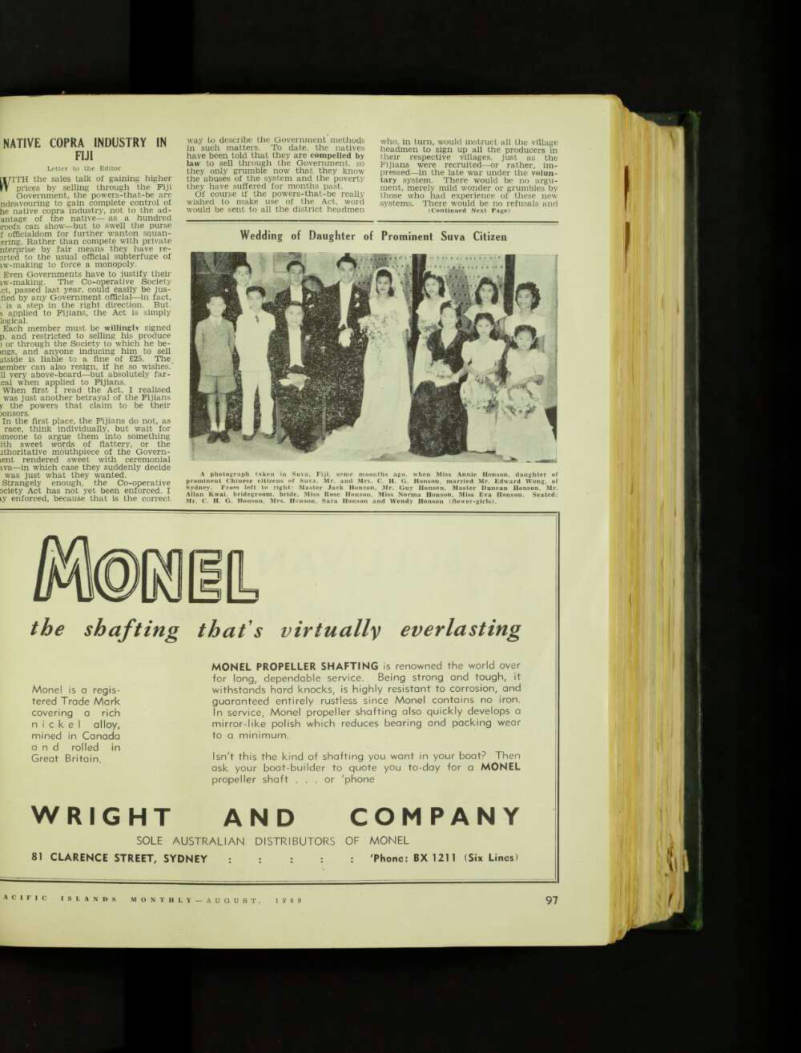
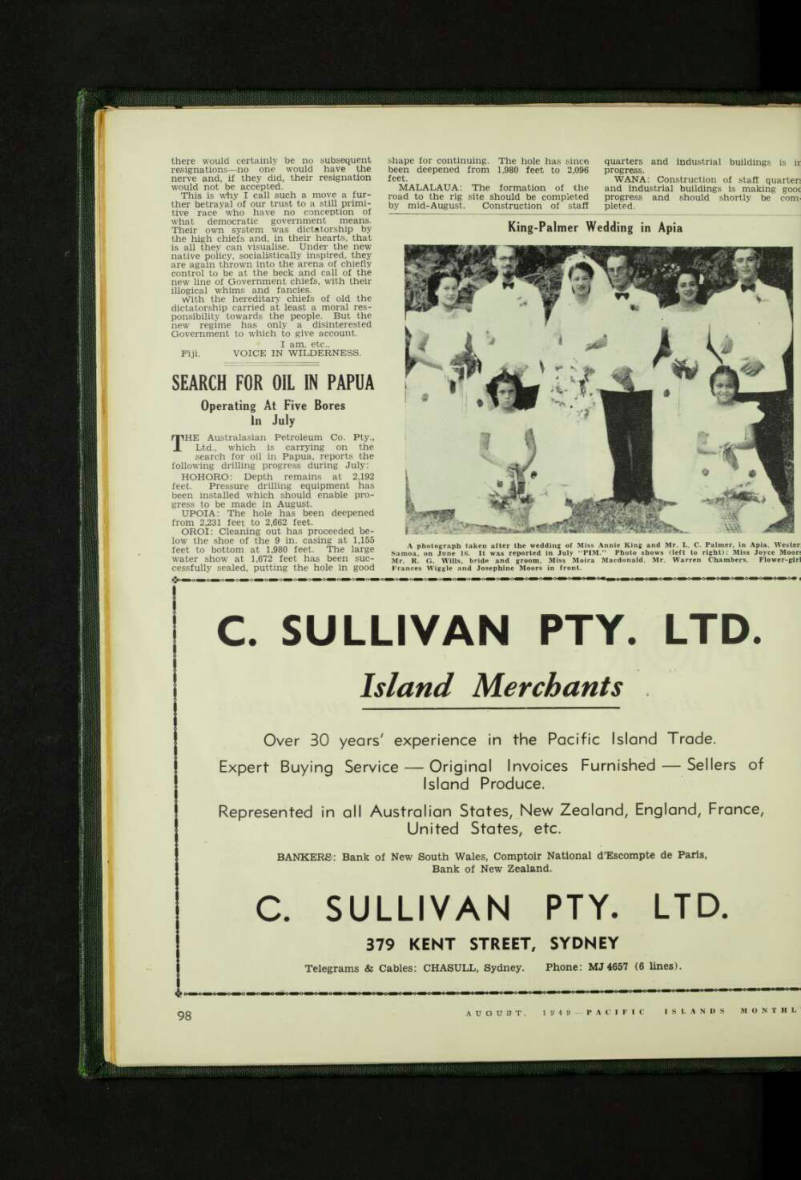
Fiji
Letter to the Editor WITH the sales talk of gaining higher prices by selling through the Fiji Government, the powers-that-be are endeavouring to gain complete control of the native copra industry, not to the advantage of the native— as a hundred proofs can show—but to swell the purse of officialdom for further wanton squandering. Rather than compete with private enterprise by fair means they have reported to the usual official subterfuge of law-making to force a monopoly.
Even Governments have to justify their law-making. The Co-operative Society Act, passed last year, could easily be justified by any Government official —in fact, is a step in the right direction. But. as applied to Fijians, the Act is simply logical.
Each member must be willingly signed up, and restricted to selling his produce ) or through the Society to which he be ings, and anyone inducing him to sell outside is liable to a fine of £25. The member can also resign, if he so wishes.’
All very above-board —but absolutely farcical when applied to Fijians.
When first I read the Act, I realised it was just another betrayal of the Fijians by the powers that claim to be their sponsors.
In the first place, the Fijians do not, as race, think individually, but wait for someone to argue them into something with sweet words of flattery, or the authoritative mouthpiece of the Government rendered sweet with ceremonial kava—in which case they suddenly decide it was just what they wanted.
Strangely enough, the Co-operative Society Act has not yet been enforced. I say enforced, because that is the correct
way to describe the Government methods in such matters. To date, the natives have been told that they are compelled by law to sell through the Government, so they only grumble now that they know the abuses of the system and the poverty they have suffered for months past.
Of course if the powers-that-be really wished to make use of the Act, word would be sent to all the district headmen
who, in turn, would instruct all the village headmen to sign up all the producers in their respective villages, just as the Fijians were recruited —or rather, im pressed—in the late war under the volun tary system. There would be no argu ment, merely mild wonder or grumbles by those who had experience of these new systems. There would be no refusals and (Continued Next Page)
there would certainly be no subsequent resignations—no one would have the nerve and, if they did, their resignation would not be accepted.
This is why I call such a move a fur ther betrayal of our trust to a still primi tive race who have no conception of what democratic government means.
Their own system was dictatorship by the high chiefs and, in their hearts, that is all they can visualise. Under the new native policy, socialistically inspired, they are again thrown into the arena of chiefly control to be at the beck and call of the new line of Government chiefs, with their illogical whims and fancies.
With the hereditary chiefs of old the dictatorship carried at least a moral res ponsibility towards the people. But the new regime has only a disinterested Government to which to give account, I am, etc.,
Fiji.
Voice In Wilderness.
Wedding of Daughter of Prominent Suva Citizen
A photograph taken in Suva, Fiji, some moonths ago, when Miss Annie Honson, daughter of prominent Chinese citizens of Suva, Mr. and Mrs. C. H. G. Honson, married Mr. Edward Wong, of Sydney. From left to right: Master Jack Honson, Mr. Guy Honson, Master Duncan Honson, Mr.
Allan Kwai, bridegroom, bride, Miss Rose Honson, Miss Norma Honson, Miss Eva Honson. Seated: Mr. C. H. G. Honson, Mrs. Honson, Sara Honson and Wendy Honson (flower-girls).
Advertisements & other items, p. 99 (1 item)
the shafting that's virtually everlasting
MONEL
Monel is a registered Trade Mark covering a rich nickel alloy, mined in Canada and rolled in Great Britain.
MONEL PROPELLER SHAFTING is renowned the world over for long, dependable service. Being strong and tough, it withstands hard knocks, is highly resistant to corrosion, and guaranteed entirely rustless since Monel contains no iron.
In service, Monel propeller shafting also quickly develops a mirror-like polish which reduces bearing and packing wear to a minimum.
Isn't this the kind of shafting you want in your boat? Then ask your boat-builder to quote you to-day for a MONEL propeller shaft ... or 'phone
WRIGHT AND COMPANY
SOLE AUSTRALIAN DISTRIBUTORS OF MONEL
81 CLARENCE STREET, SYDNEY : : : : : 'Phone: BX 1211 (Six Lines)
Search For Oil In Papua
Operating At Five Bores In July
THE Australasian Petroleum Co. Pty., Ltd., which is carrying on the search for oil in Papua, reports the following drilling progress during July: HOHORO: Depth remains at 2,192 feet. Pressure drilling equipment has been installed which should enable pro gress to be made in August.
UPOIA: The hole has been deepened from 2,231 feet to 2,662 feet.
OROI: Cleaning out has proceeded be low the shoe of the 9 in. casing at 1,155 feet to bottom at 1,980 feet. The large water show at 1,672 feet has been suc cessfully sealed, putting the hole in good
shape for continuing. The hole has since been deepened from 1,980 feet to 2,096 feet.
MALALAUA: The formation of the road to the rig site should be completed by mid-August. Construction of staff
quarters and ipdustrial buildings is in progress.
WANA: Construction of staff quarters and industrial buildings is making gooc progress and should shortly be com pleted.
King-Palmer Wedding in Apia
A photograph taken after the wedding of Miss Annie King and Mr. L. C. Palmer, in Apia, Western Samoa, on June 16. It was reported in July “PIM.” Photo shows (left to right): Miss Joyce Moors Mr. R. G. Wills, bride and groom, Miss Moira Macdonald, Mr. Warren Chambers. Flower-girl Frances Wiggle and Josephine Moors in front.
Advertisements & other items, p. 100 (1 item)
C. Sullivan Pty. Ltd.
Island Merchants
Over 30 years' experience in the Pacific Island Trade.
Expert Buying Service Original Invoices Furnished Sellers of Island Produce.
Represented in all Australian States, New Zealand, England, France, United States, etc.
BANKERS': Bank of New South Wales, Comptoir National d’Escompte de Paris, Bank of New Zealand.
C. SULLIVAN PTY. LTD.
379 KENT STREET, SYDNEY
Telegrams & Cables: CHASULL, Sydney. Phone: MJ4657 (6 lines).
In Defence Of The Fijians
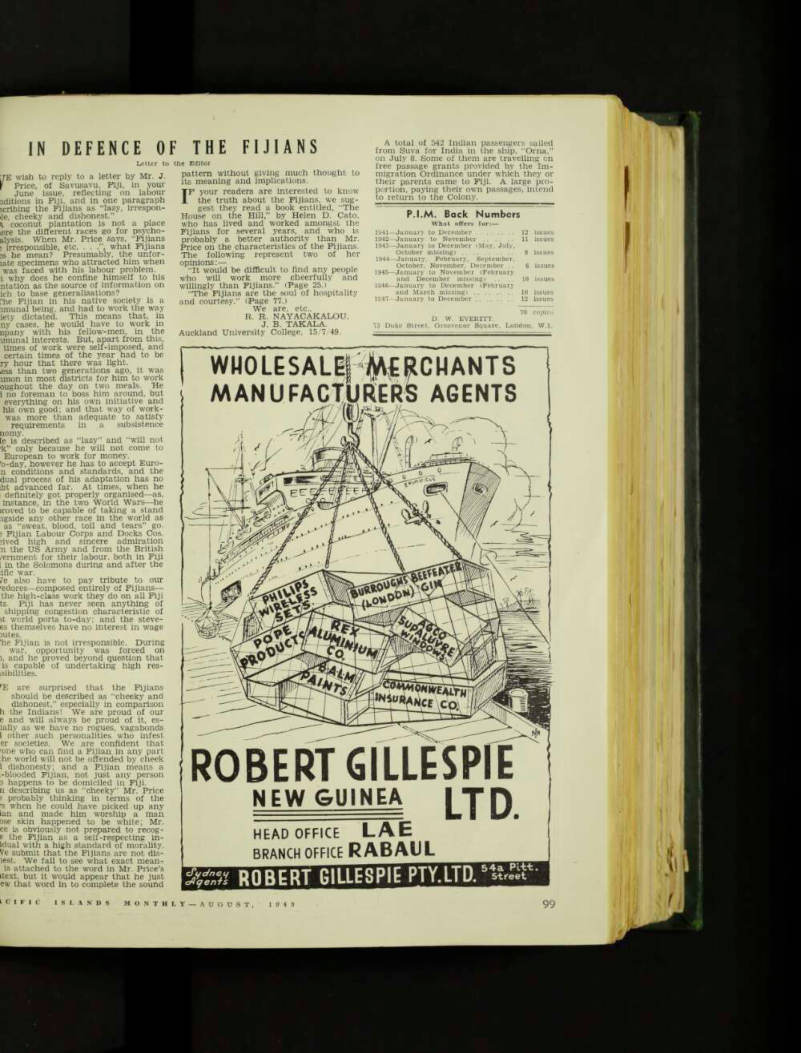
Letter to the Editor
WE wish to reply to a letter by Mr. J.
Price, of Savusavu, Fiji, in your June issue, reflecting on labour conditions in Fiji, and in one paragraph describing the Fijians as “lazy, irresponsible, cheeky and dishonest.”
A coconut plantation is not a place where the different races go for psychoanalysis. When Mr. Price says, “Fijians are irresponsible, etc. . . what Fijians does he mean? Presumably, the unfortunate specimens who attracted him when he was faced with his labour problem, t why does he confine himself to his plantation as the source of information on which to base generalisations?
The Fijian in his native society is a imunal being, and had to work the way society dictated. This means that, in many cases, he would have to work in company with his fellow-men, in the communal interests. But, apart from this, times of work were self-imposed, and certain times of the year had to be every hour that there was light.
Less than two generations ago, it was common in most districts for him to work throughout the day on two meals. He had no foreman to boss him around, but everything on his own initiative and his own good; and that way of work was more than adequate to satisfy requirements in a subsistence nomy.
He is described as “lazy” and “will not work” only because he will not come to the European to work for money.
To-day, however he has to accept European conditions and standards, and the dual process of his adaptation has no ibt advanced far. At times, when he definitely got properly organised—as, instance, in the two World Wars —he proved to be capable of taking a stand alongside any other race in the world as as “sweat, blood, toil and tears” go.
The Fijian Labour Corps and Docks Cos. received high and sincere admiration from the US Army and from the British Government for their labour, both in Fiji and in the Solomons during and after the Pacific war.
We also have to pay tribute to our r edores —composed entirely of Fijians— the high-class work they do on all Fiji ts. Fiji has never seen anything of shipping congestion characteristic of >t world ports to-day: and the steve es themselves have no interest in wage mtes.
The Fijian is not irresponsible. During war, opportunity was forced on him, and he proved beyond question that he is capable of undertaking high responsibilities.
WE are surprised that the Fijians should be described as “cheeky and dishonest,” especially in comparison with the Indians! We are proud of our e and will always be proud of it, es pecially as we have no rogues, vagabonds I other such personalities who infest other societies. We are confident that 'one who can find a Fijian in any part the world will not be offended by cheek and dishonesty; and a Fijian means a -blooded Fijian, not just any person who happens to be domiciled in Fiji, n describing us as “cheeky” Mr. Price was probably thinking in terms of the r s when he could have picked up any ian and made him worship a man whose skin happened to be white; Mr.
Price is obviously not prepared to recognise the Fijian as a self-respecting individual with a high standard of morality.
We submit that the Fijians are not dishonest. We fail to see what exact meanmeaning attached to the word in Mr. Price’s itext, but it would appear that he just threw that word in to complete the sound
pattern without giving much thought to its meaning and implications.
IF your readers are interested to know the truth about the Fijians, we sug gest they read a book entitled, “The House on the Hill,” by Helen D. Cato, who has lived and worked amongst the Fijians for several years, and who is probably a better authority than Mr.
Price on the characteristics of the Fijians.
The following represent two of her opinions:— “It would be difficult to find any people who will work more cheerfully and willingly than Fijians.” (Page 25.) “The Fijians are the soul of hospitality and courtesy.” (Page 77.) We are, etc..
R. R. Nayacakalou.
J. B. Takala.
Auckland University College, 15/7/49.
A total of 542 Indian passengers sailed from Suva for India in the ship, “Orna,” on July 8. Some of them are travelling on free passage grants provided by the Im migration Ordinance under which they or their parents came to Fiji. A large pro portion, paying their own passages, intend to return to the Colony.
P.I.M. Back Numbers
What offers for: — 1941—January to December 12 issues 1942 January to November 11 issues 1943 — January to December (May, July, October missing) 9 issues 1944 January, February, September, October, November, December . . 6 issues 1945 January to November (February and December missing) .. 10 issues 1946 January to December (February and March missing) 10 issues 1847 —January to December 12 issues 70 copies
D. W. Everitt.
73 Duke Street, Grosvenor Square, London, W.l.
Advertisements & other items, p. 101 (1 item)
Robert Gillespie
WHOLESALE MERCHANTS
MANUFACTURERS AGENTS
NEW GUINEA LTD
HEAD OFFICE LAE
BRANCH OFFICE RABAUL
Sydney Agents ROBERT GILLESPIE PTY.LTD. 54a Pitt Street
Islands Produce
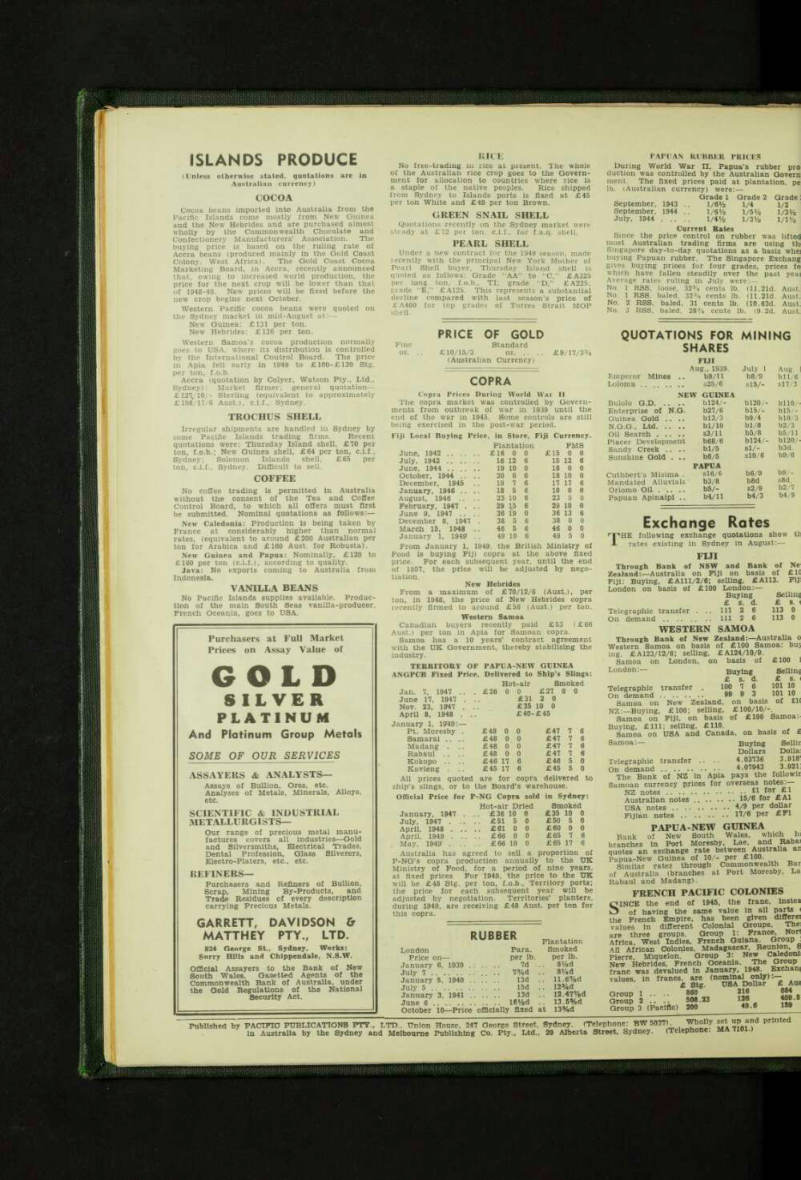
(Unless otherwise stated, quotations are in Australian currency)
Cocoa
Cocoa beans imported into Australia from the Pacific Islands come mostly from New Guinea and the New Hebrides and are purchased almost wholly by the Commonwealth Chocolate and Confectionery Manufacturers’ Association. The buying price is based on the ruling rate of Accra beans (produced mainly in the Gold Coast Colony. West Africa). The Gold Coast Cocoa Marketing Board, in Accra, recently announced that, owing to increased world production, the price for the next crop will be lower than that of 1948-49. New prices will be fixed before the new crop begins next October.
Western Pacific cocoa beans were quoted on the Sydney market in mid-August at:— New Guinea: £l3l per ton.
New Hebrides: £136 per ton.
Western Samoa’s cocoa production normally goes to USA. where its distribution is controlled by the International Control Board. The price in Apia fell early in 1949 to £lOO-£l2O Stg. per ton, f.o.b.
Accra (quotation by Colyer, Watson Pty., Ltd., Sydney): Market firmer; general quotation— £l27/10/- Sterling (equivalent to approximately £l5B/17/6 Aust.), c.i.f., Sydney.
Trochus Shell
Irregular shipments are handled in Sydney by some Pacific Islands trading firms. Recent quotations were: Thursday Island shell, £7O per ton, f.0.b.; New Guinea shell, £64 per ton, c.i.f., Sydney: Solomon Islands shell, £65 per ton, c.i.f., Sydney. Difficult to sell.
Coffee
No coffee trading is permitted in Australia without the consent of the Tea and Coffee Control Board, to which all offers must first be submitted. Nominal quotations as follows; — New Caledonia: Production is being taken by France at considerably higher than normal rates, (equivalent to around £2OO Australian per ton for Arabica and £l6O Aust, for Robusta).
New Guinea and Papua: Nominally, £l2O to £l6O per ton (c.i.f.), according to quality.
Java: No exports coming to Australia from Indonesia.
Vanilla Beans
No Pacific Islands supplies available. Produc tion of the main South Seas vanilla-producer, French Oceania, goes to USA.
Rice
No free-trading in rice at present. The whole of the Australian rice crop goes to the Govern ment for allocation to countries where rice is a staple of the native peoples. Rice shipped from Sydney to Islands ports is fixed at £45 per ton White and £49 per ton Brown.
Green Snail Shell
Quotations recently on the Sydney market were steady at £72 per ton, c.i.f., for f.a.q. shell.
Pearl Shell
Under a new contract for the 1949 season, made recently with the principal New York Mother of Pearl Shell buyer, Thursday Island shell is quoted as follows: Grade “AA” to “C,” £A325 per long ton. f.0.b.. TI; grade “D,” £A225; grade “E,” £AI2S. This represents a substantial decline compared with last season’s price of £ A4OO for top grades of Torres Strait MOP shell.
Advertisements & other items, p. 102 (1 item)
Price Of Gold
Fine Standard oz. .. £lO/15/3 oz £9/17/3% (Australian Currency)
Copra
Prices During World War II The copra market was controlled by Govern ments from outbreak of war in 1939 until the end of the war in 1945. Some controls are still being exercised in the post-war period.
Fiji Local Buying Price, in Store, Fiji Currency.
From January 1, 1949, the British Ministry of Food is buying Fiji copra at the above fixed price. For each subsequent year, until the end of 1957, the price will be adjusted by nego tiation.
New Hebrides From a maximum of £7O/12/6 (Aust.), per ton, in 1948, the price of New Hebrides copra recently firmed to around £5B (Aust.) per ton.
Western Samoa Canadian buyers recently paid £53 (£66 Aust.) per ton in Apia for Samoan copra.
Samoa has a 10 years’ contract agreement with the UK Government, thereby stabilising the industry.
Territory Of Papua-New Guinea
ANGPCB Fixed Price, Delivered to Ship’s Slings:
All prices quoted are for copra delivered to ship’s slings, or to the Board’s warehouse.
Official Price for P-NG Copra sold in Sydney:
Australia has agreed to sell a proportion of P-NG’s copra production annually to the UK Ministry of Food, for a period of nine years, at fixed prices For 1949, the price to the UK will be £4B Stg. per ton, f.0.b., Territory ports; the price for each subsequent year will be adjusted by negotiation. Territories’ planters, during 1949, are receiving £4B Aust. per ton for this copra.
Plantation PMS June, 1942 £16 0 0 £15 0 0 July, 1942 16 12 6 15 12 6 June, 1944 19 10 0 18 0 0 October, 1944 ... 20 0 0 18 10 0 December, 1945 .. 19 7 6 17 17 6 January, 1946 ... 18 5 6 18 0 0 August, 1946 ... 23 10 6 23 5 0 February, 1947 ... 29 15 6 29 10 0 June 9, 1947 ... 36 19 0 36 13 6 December 8. 1947 . 38 5 6 38 0 0 March 15, 1948 .. 46 5 6 46 0 0 January 1. 194ff .. 49 10 6 49 5 0
Hot-air Smoked Jan. 7, 1947 .. . £28 0 0 £27 0 0 June 17, 1947 ... £31 2 0 Nov. 23, 1947 ... £35 10 0 April 8, 1948 ... £40-£45 January 1, 1949: — Pt. Moresby . £48 0 0 £47 7 6 Samarai ... £48 0 0 £47 7 6 Madang . .. £48 0 0 £47 7 6 Rabaul .. .. £48 0 0 £47 7 6 Kokopo . . .. £46 17 6 £46 5 0 Kavieng ... £45 17 6 £45 5 0
Hot-air Dried Smoked January, 1947 . £36 10 0 £35 10 0 July. 1947 . .. £51 5 0 £50 5 0 April, 1948 . .. £61 0 0 £60 0 0 April, 1949 . .. £66 0 0 £65 7 6 May, 1949 . .. £66 10 0 £65 17 6
Rubber
Plantation
Papuan Rubber Prices
During World War n, Papua’s rubber pro duction was controlled by the Australian Govern ment. The fixed prices paid at plantation, pei lb. (Australian currency) were:—
Current Rates Since the price control on rubber was lifted most Australian trading firms are using th( Singapore day-to-day quotations as a basis whei buying Papuan rubber. The Singapore Exchangi gives buying prices for four grades, prices fo which have fallen steadily over the past year Average rates ruling in July were:— No. 1 RSS, loose. 32% cents lb. (11.21 d. Aust.
No. 1 RSS. baled. 32% cents lb. (11.21 d. Aust.
No. 2 RSS, baled. 31 cents lb. (10.63 d. Aust.
No. 3 RSS, baled, 28% cents lb. (9.2 d. Aust.
London Para.
Smoked Price on— per lb. per lb.
January 6, 1939 . ... 7d 8Vad July 7 . ... 7%d .. sy 4 d January 5, 1940 .. 13d .. 11.6 7 /ad July 5 . ... 15d .. 12%d January 3, 1941 . 13d . . 12.47y 8 d June 6 . 16Vfed .. 13.5%d October 10 —Price officially fixed at 13%d
Grade 1 Grade 2 Grade September, 1943 . l/6y 2 1/4 1/2 September, 1944 . 1/01/2 I/51/2 1/3% July. 1944 1/41/2 I/31/2 I/I1/2
Quotations For Mining
Shares
Fiji
New Guinea
Papua
Aug., 1939.
July 1 Aug.
Emperor Mines b9/ll b8/9 bll/6 Loloma s25/6 si 5/si 7/3
Bulolo G.D bl24/bl20/bllO - Enterprise of N.G. b27/6 bl5/bl5/- Guinea Gold .. .. bl3/3 b9/4 blO/3 N.G.G., Ltd bl/10 bl/8 b2/3 Oil Search S3/11 b5/8 b5/ll Placer Development b68/6 bl24/bl20/- Sandy Creek .. .. bl/5 sl/b3d.
Sunshine Gold . .. b6/5 slO/6 b9/6
Cuthbert’s Misima . sl6/6 b6/9 b9/- Mandated Alluvials b3/8 b8d s8d.
Oriomo Oil b5/- s2/9 b2/7 Papuan Apinaipl .. b4/ll b4/3 b4/9
Exchange Rates
The following exchange quotations show th rates existing in Sydney in August:—
Fiji
Through Bank of NSW and Bank of Nei Zealand:—Australia on Fiji on basis of £10 Fiji: Buying, £Alll/2/6; selling, £A113. Fiji London on basis of £100 London:— Buying Selling £ s. d. £ s. t Telegraphic transfer ... Ill 2 6 113 0 On demand Ill 2 6 113 0
Western Samoa
Through Bank of New Zealand: —Australia o Western Samoa on basis of £100 Samoa: buy ing, £A123/12/6; selling, £A124/10/9.
Samoa on London, on basis of £100 i London: Buying Selling £ s. d. £ s. ( Telegraphic transfer . 100 7 6 101 10 On demand 99 9 3 101 10 Samoa on New Zealand, on basis of £1C NZ:—Buying, £100; selling, £100/10/-.
Samoa on Fiji, on basis of £100 Samoa:- Buying, £111; selling, £110.
Samoa on USA and Canada, on basis of £ Samoa: — Buying Sellic Dollars Dollai Telegraphic transfer .. .. 4.03736 3.918^ On demand 4.07943 3-921] The Bank of NZ in Apia pays the followin Samoan currency prices for overseas notes; NZ notes « for *} Australian notes 15/6 'or £A1 USA notes 4/9 per dollar Fijian notes 17/6 P er £^1
Papua-New Guinea
Bank of New South Wales, which In branches in Port Moresby. Lae, and Rabat quotes an exchange rate between Australia an Papua-New Guinea of 10/- per £100.
Similar rates through Commonwealth Bar of Australia (branches at Port Moresby, Lai Rabaul and Madang).
French Pacific Colonies
SINCE the end of 1945, the franc, Instea of having the same value in all parts < the French Empire, has been given dlflerer values in different Colonial Groups. Tnei are three groups. Group 1: France. Nort Africa, West Indies, French Guiana. Group .
All African Colonies, Madagascar. Reunion, S Pierre, Miquelon. Group 3; New Caledonli New Hebrides, French Oceania. The Group franc was devalued in January, 1948. Exchant values, in francs, are : ~l ... £ Stg. USA Dollar £ Aus Groun 1 ... 860 216 684 Group 2 .. .. 508.23 136 tga -5 Group 3 (Pacific) 200 49 • 6 189
Advertisements & other items, pp. 102-104 (3 items)
Published by PACIFIC PUBLICATIONS PTY.. LTD , Union House, 247 George Street, Sydney. (Telephone: BW 5037). Wholly set printed
in Australia by the Sydney and Melbourne Publishing Co. Pty., Ltd., 29 Alberta Street, Sydney. (Telephone, ma 7iui.j
Gold
Purchasers at Full Market Prices on Assay Value of
SILVER
PLATINUM
And Platinum Group Metals
SOME OF OUR SERVICES
ASSAYERS & ANALYSTS—
Assays of Bullion, Ores, etc.
Analyses of Metals, Minerals, Alloys, etc.
SCIENTIFIC & INDUSTRIAL
METALLURGISTS—
Our range of precious metal manufactures covers all industries —Gold and Silversmiths, Electrical Trades, Dental Profession, Glass Silverers, Electro-Platers, etc., etc.
REFINERS—
Purchasers and Refiners of Bullion, Scrap, Mining By-Products, and Trade Residues of every description carrying Precious Metals.
GARRETT, DAVIDSON
MATTHEY PTY., LTD.
824 George St„ Sydney. Works: Sorry Hills and Chippendale, N.S.W.
Official Assayers to the Bank of New South Wales. Gazetted Agents of the Commonwealth Bank of Australia, under the Gold Regulations of the National Security Act,
tropical thirst...
.v quench a
■f m <s
LAGER
KB.2A
When you’re hot and tired, there is nothing quite so satisfying and thirst quenching as a long, cold glass of “K. 8.” Your friends and guests, too, will appreciate this really fine Lager.
TOOTH’S
MERCHANTS. & SHIP OWNERS
Capital £1,000,000
ESTABLISHED 1914
COPRA MERCHANTS & MILLERS
ASSOCIATED COMPANIES THROUGHOUT THE PACIFIC ISLANDS
IN LONDON
Buyers and exporters of all kinds of Islands produce. Copra Merchants and Millers.
Agents for Australian, European and American Manufacturers. Distributors of every description of merchandise.
Thirty years of Pacific Islands development and service.
REGULAR
Head
CARGO
PACIFIC
w.
Office:
AND PASSENGER SERVICE BETWEEN EUROPE AND
ISLAND PORTS WAS ESTABLISHED BY
R. CARPENTER & CO. LTD.
16 O'CONNELL STREET, SYDNEY.
Cable Address:
CAMOHE.
Telephone BW 4421.
Postal Address: P.O. Box No. 168, Sydney.
PACIFIC ISLANDS MONTHLY AUGUST, IH9