Pacific
Islands
Monthly
Jul/|t949
Vol. XIX. No. 12.
Established 1930.
I Registered at the GP.O+Syi transmission by post as a newspaper ]
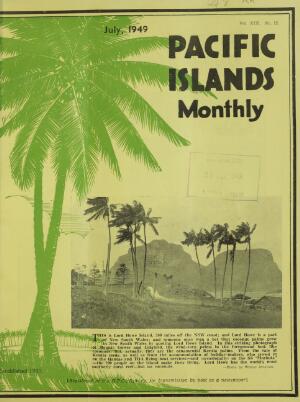
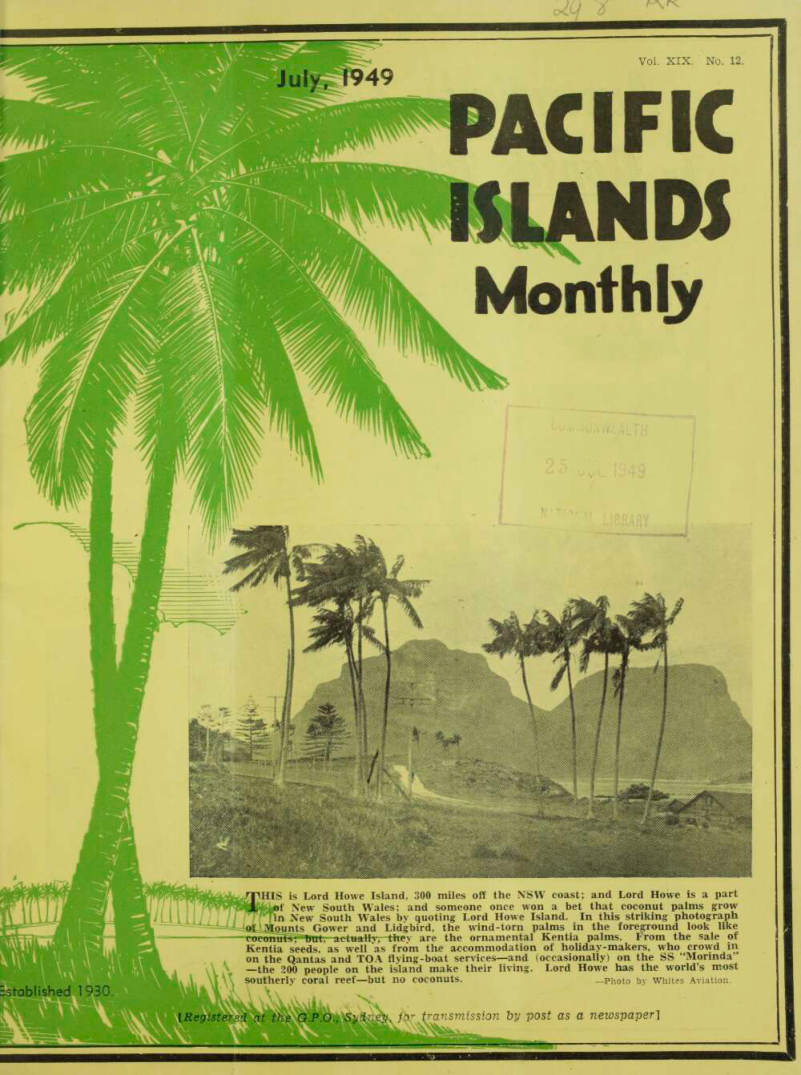
THIS is Lord Howe Island, 300 miles off the NSW coast; and Lord Howe is a part of New South Wales; and someone once won a bet that coconut palms grow in New South Wales by quoting Lord Howe Island. In this striking photograph of Mounts Gower and Lidgbird, the wind-torn palms in the foreground look like coconuts ; but, actually, they are the ornamental Kentia palms. From the sale of Kentia seeds, as well as from the accommodation of holiday-makers, who crowd in on the Qantas and TOA flying-boat services—and (occasionally) on the SS “Morinda’ —the 200 people on the island make their living. Lord Howe has the world’s most southerly coral reef —but no coconuts. —Photo by Whites Aviation.
Advertisements & other items, pp. 2-4 (1 item)
Qafitod
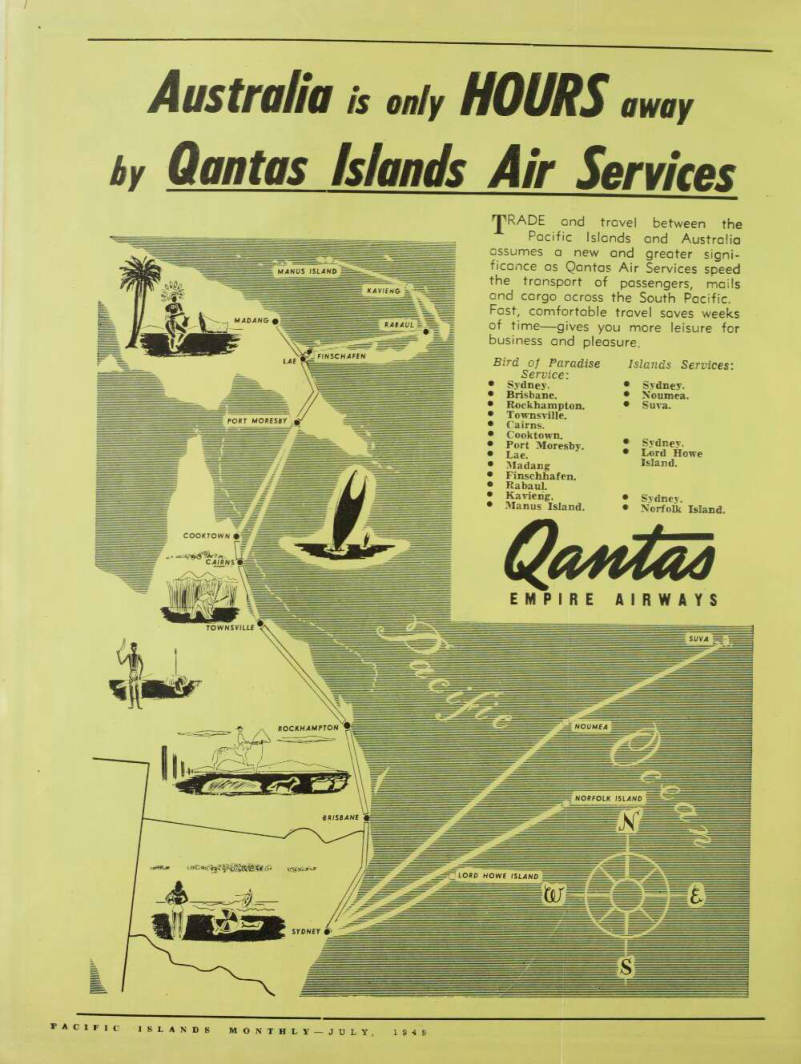
Australia is only HOURS away
by Qantas Islands Air Services
MANUS ISLAND
KAVIEN& ==
MADANG 0
RABAUL '
FINSCHAFEN
LAE
'J'RADE and travel between the Pacific Islands and Australia assumes a new and greater significance as Qantas Air Services speed the transport of passengers, mails and cargo across the South Pacific.
Fast, comfortable travel saves weeks of time—gives you more leisure for business and pleasure.
Bird of Paradise Service : Sydney.
Brisbane.
Rockhampton.
Townsville.
Cairns.
Cooktown.
Port Moresby.
Lae.
Madang Finschhafen.
Rabaul.
Kaviehg.
Manus Island.
Islands Services'.
Sydney.
Noumea.
Suva.
Sydney.
Lord Howe Island.
Sydney.
Norfolk Island.
PORT MORESBY
Qafitod
COOKTOWN •
CAIRNS
EMPIRE AIRWAYS
TOWNSVILLE
Suva m
JmNOUMEA
-©• ROCKHAMPTON
I
1 NORFOLK ISLAND
BRISBANE
LORD HOWE ISLAND
SYDNEY 0
s
CDN
VOU
m m i JS m /
DEPEND ON
Any kerosene or petrol stove which bears the name of Coleman is as dependable and efficient as over 40 years’ intensive specialisation can make a product . . . in fact it is the “Best of its kind.”
This two-burner petrol portable stove illustrated at right requires no preheating and has instant heat control—safety shut-off valve makes it unnecessary to repump each time stove is lighted— has removable fuel tank for safe and easy filling.
In ivory and brown baked enamel finish. Weight 16 lbs. k m Although only 8| ins. high and A\ ins. wide this pocket stove illustrated below boils a pint inside 5 minutes.
Made of corrosion-resistant metal... lights instantly... needs no priming . . . burns any kind of petrol and cannot spill fuel even when tipped over.
This quick-heating “Speedmaster” portable stove lights instantly and can be regulated to any degree of heat. Has odorless windproofburner, rust resisting brass fount of 2 pints, and is unspi 11 able. Boils a pint in 2J minutes. Height 7 ins., width 10J ins., Weight 5 lbs.
A 3 burner kerosene stove finished in glistening white baked enamel with ample cooking top of heavy steel grates. Two-quart fuel tank . . . needle valve asbestos wick. Hot blast cap induces extra oxygen and hastens combustion. Supplied with or without oven.
Representatives for the Pacific Islands:
ROBERT GILLESPIE PTY. LTD.
540 PITT STREET, SYDNEY
PEARCE & CO
SUVA
FOR FIJI ISLANDS
LTD
Va Vj /j v: 7 I m 4.
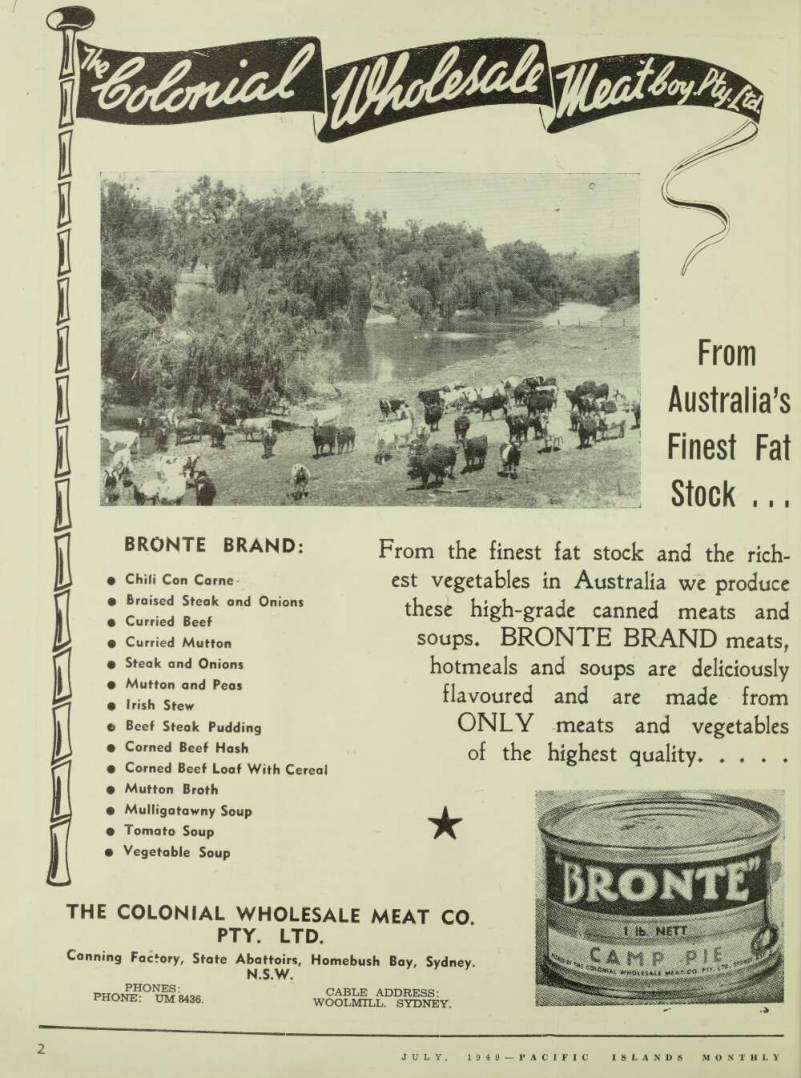
BRONTE BRAND
• Chid Con Came • Braised Steak and Onions • Curried Beef a Curried Mutton • Steak and Onions • Mutton and Peas • Irish Stew C* Beef Steak Pudding • Corned Beef Hash • Corned Beef Loaf With Cereal • Mutton Broth 9 Mulligatawny Soup • Tomato Soup • Vegetable Soup
From
Australia’s
Finest Fat
Stock ...
From the finest fat stock and the rich-
est vegetables in Australia we produce
these high-grade canned meats and
soups. BRONTE BRAND meats,
hotmeals and soups are deliciously
flavoured and are made from
ONLY meats and vegetables
of the highest quality
THE COLONIAL WHOLESALE MEAT CO.
PTY. LTD.
Conning Factory, State Abattoirs, Homebush Bay, Sydney.
N.S.W.
PHONES;
PHONE: UM 8436.
CABLE ADDRESS:
WOOLMTLL. SYDNEY.
ft V c Stim M m wmiti* u
Index to Advertisers
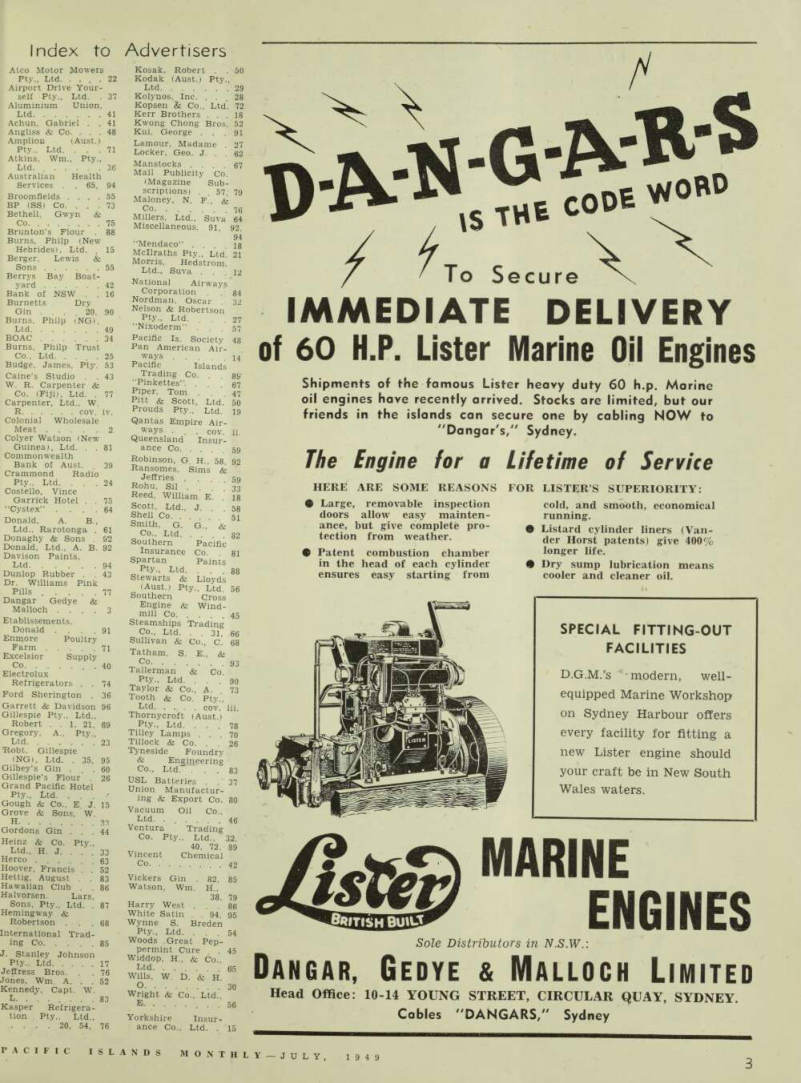
Atco Motor Mowers Pty., Ltd. ... 22 Airport Drive Your self Pty., Ltd. . 37 Aluminium Union, Ltd 41 Achun, Gabriel . . 41 Angliss & Co. ... 48 Amplion (Aust.) Pty., Ltd. ... 71 Atkins, Wm., Pty., Ltd. 36 Australian Health Services . . 65, 94 Broomfields ... 55 BP (SS) Co. . . . 73 Bethell, Gwyn & Co 75 Brunton’s Flour 88 Burns, Philp (New Hebrides), Ltd. . 15 Berger, Lewis & Sons 55 Berrys Bay Boat yard 42 Bank of NSW . . 16 Burnetts Dry Gin ... 20. 90 Burns, Philp (NG), Ltd 49
Boac 34
Burns, Philp Trust Co.. Ltd. ... 25 Budge. James, Pty. 53 Caine’s Studio . . 43 W. R. Carpenter & Co. (Fiji), Ltd. . 77 Carpenter, Ltd., W.
R cov. iv.
Colonial Wholesale Meat 2 Colyer Watson (New Guinea), Ltd. . . 81 Commonwealth Bank of Aust. 39 Crammond Radio Pty.. Ltd. ... 24 Costello, Vince Garrick Hotel . . 75 “Cystex” ... 64 Donald, A. 8., Ltd.. Rarotonga . 61 Donaghy & Sons . 92 Donald, Ltd., A. B. 92 Davison Paints, Ltd 94 Dunlop Rubber . . 43 Dr. Williams Pink Pills ... 77 Dangar Gedye & Malloch ... 3 Etablissements, Donald ... 91 Enmore Poultry Farm 71 Excelsior Supply Co . 40 Electrolux Refrigerators . . 74 Ford Sherington . 36 Garrett & Davidson 96 Gillespie Pty., Ltd., Robert . . 1, 21. 69 Gregory, A.. Pty., Ltd 23 Ttobt. Gillespie (NG), Ltd. . 35, 95 Gilbey’s Gin ... 60 Gillespie’s Flour 26 Grand Pacific Hotel Pty., Ltd. . . . / Gough & Co.. E. J. 15 Grove & Sons, W.
H Gordons Gin ... 44 Heinz & Co. Pty , Ltd., H. J. ... 33 Herco 63 Hoover, Francis . . 52 Hettig, August . . 83 Hawaiian Club . . 86 Halvorsen. Lars, Sons, Pty.. Ltd. . 87 Hemingway & Robertson ... 68 International Trad ing Co 85 J. Stanley Johnson Pty., Ltd 17 Bros. . . 76 Jones, Wm. A. . .52 Kennedy, Capt. W.
L. ... 83 Kasper Refrigera tion Pty.. Ltd., ... 20, 54, 76
Kosak, Robert . . 50 Kodak (Aust.) Pty., Ltd 29 Kolyuos, Inc. ... 28 Kopsen & Co., Ltd'. 72 Kerr Brothers ... 18 Kwong Chong Bros. 52 Kui, George . . .91 Lamour, Madame . 27 Locker, Geo. J. . .62 Manstocks ... 67 Mail Publicity Co. (Magazine Sub scriptions) . . 57, 79 Maloney, N. F., & Co 76 Millers, Ltd.. Suva 64 Miscellaneous, 91, 92, 94 “Mendaco” ... is Mcllraths Pty., Ltd. 21 Morris, Hedstrom.
Ltd., Suva . . . 12
National Airways*
Corporation 84 Nordman. Oscar . 32 Nelson & Robertson Pty., Ltd. ... 27 “Nixoderm” ... 57 Pacific Is. Society 48 Pan American Air ways ... 14 Pacific Islands Trading Co. . 89'
“Pinkettes” . , 67
Piper, Tom . . . 47
Pitt & Scott, Ltd. 50 Prouds Pty., Ltd. 19 Qantas Empire Air
ways . . . cov. lj.
Queensland Insur ance Co 59 Robinson, G. H.. 58, 92 Ransomes, Sims & Jeffries ... 59 Rohu, Sil ... 33 Reed, William E. . 18 Scott, Ltd., J. 58 Shell Co 51 Smith, g. G., & Co., Ltd 82 Southern Pacific Insurance Co. 81 Spartan Paints Pty., Ltd. ... 88 Stewarts & Lloyds (Aust.) Pty., Ltd. 56 Southern Cross Engine & Wind mill Co 45 Steamships Trading Co., Ltd. . . 31. 66 Sullivan & Co., c. 68 Tatham, S. E., & Co 93 Tallerman & Co.
Pty., Ltd. ... 90 Taylor & Co., A. 73 Tooth & Co. Pty..
Ltd cov. iii.
Thornycroft (Aust.i Pty., Ltd. ... 78 Tilley Lamps ... 70 Tillock & Co. . . 26 Tyneside Foundry
& Engineering
Co., Ltd. ... 83 USL Batteries . . 37 Union Manufactur ing & Export Co. 80 Vacuum Oil Co., Ltd. ... 46 Ventura Trading Co. Pty., Ltd.. 32, 40. 72. 89 Vincent Chemical Co 42 Vickers Gin . 82, 85 Watson, Wm. H., 38, 79 Harry West ... 86 White Satin . . 94, 95 Wynne S. Breden Pty., Ltd. ... 54 Woods Great Pep permint Cure . 45 Widdop, H., & Co.
Ltd 65 Wills, W. I). & H. o 30 Wright & Co., Ltd..
E 56 Yorkshire Insur ance Co., Ltd. . 15
Advertisements & other items, p. 5 (1 item)
tsXet,
Secure
IMMEDIATE DELIVERY
of 60 H.P. Lister Marine Oil Engines Shipments of the famous Lister heavy duty 60 h.p. Marine oil engines have recently arrived. Stocks are limited, but our friends in the islands can secure one by cabling NOW to
"Danger's," Sydney.
The Engine for a Lifetime of Service HERE ARE SOME REASONS FOR LISTERS SUPERIORITY: 9 Large, removable inspection cold, and smooth, economical doors allow easy mainten- running. ance, but give complete pro- « Listard cylinder liners (Vantection from weather. der Horst patents) give 400% • Patent combustion chamber longer life. in the head of each cylinder • Dry sump lubrication means ensures easy starting from cooler and cleaner oil. m m %
SPECIAL FITTING-OUT
FACILITIES
D.G.M.’s modern, wellequipped Marine Workshop on Sydney Harbour offers every facility for fitting a new Lister engine should your craft be in New South Wales waters.
tsXet,
MARINE
ENGINES
Sole Distributors in N.S.W.:
Dangar, Gedye & Malloch Limited
Head Office: 10-14 YOUNG STREET, CIRCULAR QUAY, SYDNEY.
Cables "DANGARS," Sydney
In This Issue:
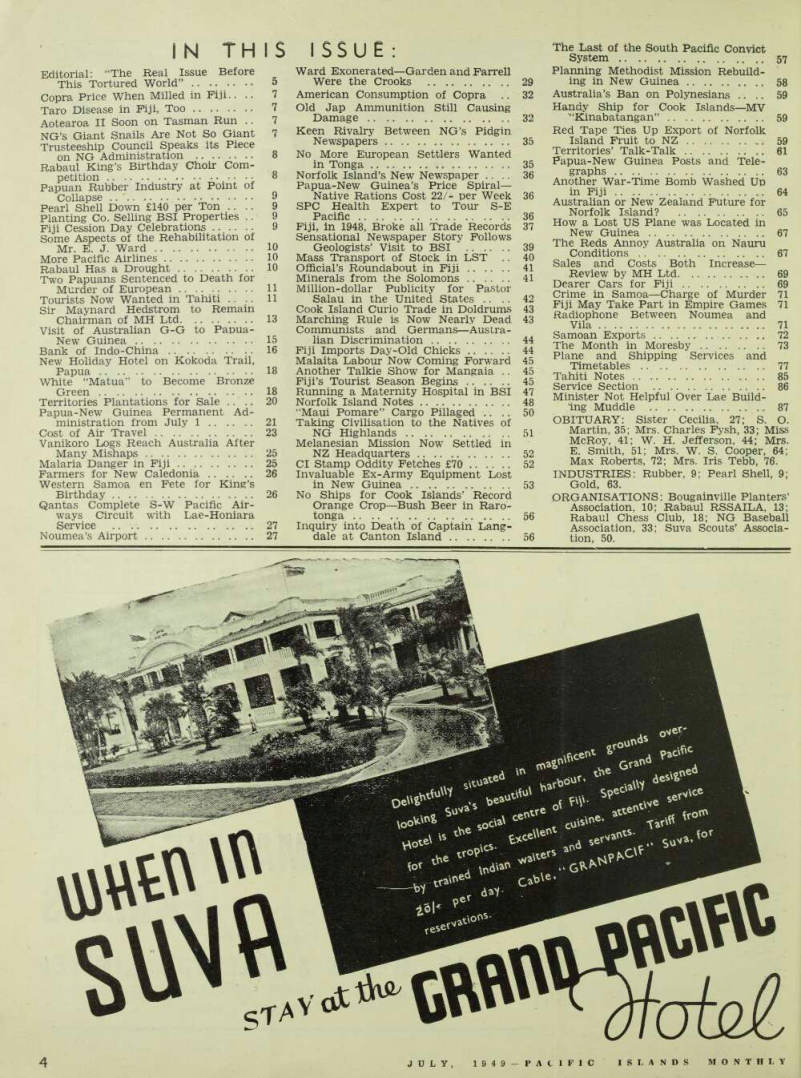
Editorial: “The Real Issue Before This Tortured World” 5 Copra Price When Milled in Fiji.. .. 7 Taro Disease in Fiji, Too 7 Aotearoa II Soon on Tasman Run .. 7 NG’s Giant Snails Are Not So Giant 7 Trusteeship Council Speaks its Piece on NG Administration 8 Rabaul King’s Birthday Choir Com
petition • • • • 8
Papuan Rubber Industry at Point of Collapse 9 Pearl Shell Down £l4O per Ton ... 9 Planting Co. Selling BSI Properties .. 9 Fiji Cession Day Celebrations ... .. 9 Some Aspects of the Rehabilitation of Mr. E. J. Ward 10 More Pacific Airlines 10 Rabaul Has a Drought 10 Two Papuans Sentenced to Death for Murder of European 11 Tourists Now Wanted in Tahiti ... 11 Sir Maynard Hedstrom to Remain Chairman of MH Ltd 13 Visit of Australian G-G to Papua- New Guinea 15 Bank of Indo-China 16 New Holiday Hotel on Kokoda Trail, Papua 18 White “Matua” to Become Bronze Green 18 Territories Plantations for Sale ... 20 Papua-New Guinea Permanent Ad ministration from July 1 21 Cost of Air Travel 23 Vanikoro Logs Reach Australia After Many Mishaps 25 Malaria Danger in Fiji 25 Farmers for New Caledonia 26 Western Samoa en Fete for King’s Birthday 26 Qantas Complete S-W Pacific Air ways Circuit with Lae-Honiara Service 27 Noumea’s Airport 27
Ward Exonerated —Garden and Farrell Were the Crooks 29 American Consumption of Copra .. 32 Old Jap Ammunition Still Causing Damage 32 Keen Rivalry Between NG’s Pidgin Newspapers 35 No More European Settlers Wanted in Tonga 35 Norfolk Island’s New Newspaper ... 36 Papua-New Guinea’s Price Spiral— Native Rations Cost 22/- per Week 36 SPC Health Expert to Tour S-E Pacific 36 Fiji, in 1948, Broke all Trade Records 37 Sensational Newspaper Story Follows Geologists’ Visit to BSI 39 Mass Transport of Stock in LST .. 40 Official’s Roundabout in Fiji 41 Minerals from the Solomons 41 Million-dollar Publicity for Pastor Salau in the United States ... 42 Cook Island Curio Trade in Doldrums 43 Marching Rule is Now Nearly Dead 43 Communists and Germans—Austra lian Discrimination 44 Fiji Imports Day-Old Chicks 44 Malaita Labour Now Coming Forward 45 Another Talkie Show for Mangaia .. 45 Fiji’s Tourist Season Begins 45 Running a Maternity Hospital in BSI 47 Norfolk Island Notes 48 “Maui Pomare” Cargo Pillaged ... 50 Taking Civilisation to the Natives of NG Highlands 51 Melanesian Mission Now Settled in NZ Headquarters 52 Cl Stamp Oddity Fetches £7O 52 Invaluable Ex-Army Equipment Lost in New Guinea 53 No Ships for Cook Islands’ Record Orange Crop—Bush Beer in Raro tonga 56 Inquiry into Death of Captain Lang dale at Canton Island 56
The Last of the South Pacific Convict System 57 Planning Methodist Mission Rebuild ing in New Guinea 58 Australia’s Ban on Polynesians ... 59 Handy Ship for Cook Islands—MV “Kinabatangan” 59 Red Tape Ties Up Export of Norfolk Island Fruit to NZ 59 Territories’ Talk-Talk 61 Papua-New Guinea Posts and Tele graphs 63 Another War-Time Bomb Washed Up in Fiji 64 Australian or New Zealand Future for Norfolk Island? 65 How a Lost US Plane was Located in New Guinea 67 The Reds Annoy Australia on Nauru Conditions 67 Sales and Costs Both Increase — Review by MH Ltd 69 Dearer Cars for Fiji 69 Crime in Samoa —Charge of Murder 71 Fiji May Take Part in Empire Games 71 Radiophone Between Noumea and Vila 71 Samoan Exports 72 The Month in Moresby 73 Plane and Shipping Services and Timetables 77 Tahiti Notes 85 Service Section 86 Minister Not Helpful Over Lae Build ing Muddle 87 OBITUARY: Sister Cecilia, 27; S. O.
Martin, 35; Mrs. Charles Fysh, 33; Miss Mcßoy, 41; W. H. Jefferson, 44; Mrs.
E. Smith, 51; Mrs. W. S. Cooper, 64; Max Roberts, 72; Mrs. Iris Tebb, 76.
INDUSTRIES: Rubber, 9; Pearl Shell, 9; Gold, 63.
ORGANISATIONS: Bougainville Planters’
Association, 10; Rabaul RSSAILA, 13; Rabaul Chess Club, 18; NG Baseball Association, 33; Suva Scouts’ Associa tion, 50.
Advertisements & other items, p. 6 (1 item)
S Tav
Oit^
Paific Islands Monthly
The Newspaper-Magazine of the Sooth Seas t Registered at the G.P.0., Sydney, tor transmission by post as a newspaper]
Published Once Each Month and Circulated in Australia and New Zealand and in the following Pacific Territories and Islands Groups;
Australian Territory ot Papua.
Trustee Territory (Australia) of New Guinea.
Australian Territory of Norfolk Island, New Zealand Territory of Cook Islands.
Trustee Territory (NZ) of Western Samoa.
British Colony of Fiji.
British Solomon Islands Protectorate.
British Protectorate of Tongan Islands.
British Crown Colony of Gilbert and Ellice Islands.
Trustee Territory of Nauru.
British and French Condominium of New Hebrides, French Colony of New Caledonia.
French Colony of Oceania (Tahiti, etc.).
American Territory of Eastern Samoa.
American Territory of Hawaiian Islands.
Owned and Produced by Pacific Publications Pty., Ltd., Union House, 247 George Street, Sydney.
Telephone: General Office and Advertising, BW 5037.
P.O. Box 3408
Registered Address for Telegrams, Radiograms, and Cables: “Pacpub,” Sydney.
Contributions.
Articles, Stories, and Photographs dealing with Pacific Islands subjects are invited and will be paid for on publication.
Subscription Bates.
Per Annum, Pre-paid, Including Postage.
In Australia, New Zealand, Fiji, New Guinea, Papua, Western Samoa, Cook Islands, Tonga, British Solomons, Gil bert and Ellice Colony, Nauru, and United Kingdom 18 0 Elsewhere $3.50 £llO Single Copies 1 6
Editor and Publisher:
R. W. Robson, F.R.G.S.
Assistant Editor: JUDY TUDOR.
General Office: Union House, 247 George Street.
Sydney. Telephone; BW 5037.
Advertising Manager: W. E. Rogers.
Representative In London.
J. T. Wallis, Coronation House, 4 Lloyds Avenue, London, E.C.3, from whom may be obtained copies of Pacific Islands Monthly, Pacific Is. Year Book, advertising schedules, etc.
Representative In U.S.A.
Pacific Islands Trading Co..
244 California St., San Francisco, U.S.A.
Agents.
The following are authorised to receive sub scriptions for Pacific Islands- Monthly:— Burns. Philp & Co., Ltd., and Burns Phllp (South Sea) Co„ Ltd. All branches.
W. R. Carpenter & Co., Ltd. All branches.
Morris, Hedstrom, Ltd. All branches.
Steamships Trading Co., Papua. All branches.
W. M. Caldwell, Suva, FIJI.
Cook Islands Trading Co., Rarotonga, Cook Is.
Oscar Nordman, Papeete, Tahiti.
Islands Branches and Representatives of W. H.
Grove & Sons, Ltd., Auckland, New Zealand.
Ed. Pentecost, Noumea, New Caledonia.
Societe Gubbay Kerr et Cie, Noumea, New Caledonia.
Vol. Xix. No. 12.
July, 1949.
r 1/6 Per Copy Price i Prepaid, p.a.; 18/- Aust. ( In USA, p.a.; $3.50.
The Real Issue Before This Tortured
World
FROM now on, owing to general strikes in Australia and elsewhere, goods and services will be in very short supply “ n? 1 S fnf Tip 6 real cause oi our troubles is riot txic dc* mands of organised labour, but a Communist conspiracy against Western civilisation, made possible by the dithering weakness of Socialist administration in the British Empire.
VTEVER in our recorded history did ■i i the stars gaze down upon a madder world. To-day, wherever we look, we see empires and nations and communities being torn apart in political, or racial or economic conflict. Every day, the situation grows worse. Civilisation is moving to some sort of crisis.
The United States and Russia seem to be quite openly preparing for the inevitable fight for supression be- Democracy, based upon the freedom of the individual, and
T^ hl fV?i« 1S pnnflip?
the Slave State. In this conflict, every nation on earth will be involved. From this, there may emerge a civilisation worthy of the human being at his best-or else all human institutions, as we know them, will go down in utter chaos, into a Dark Age of horror and misery, which easily may last for hundreds of J y ’
There may not seem to be any connection between the persecution of
Catholic prelates in Middle Europe, the racial disturbances in Africa and Southern Asia, the struggle in Western Europe and elsewhere between the ta^i p i nvn itroiv*rr Dollar and the Pound, the paralysing strikes in Britain, Australia and Canada, the submergence of China by incredible waves of Communist armies, and the growing economic unbalance throughout the world; yet they all fit into the one general pattern. They are part of the Cold War, by which the Communist hier archy hopes to overthrow Western civilisation, and bring the whole world under the Red Flag, Within the Communist countries, there are great discontent, indescrib able human misery, ruthless oppres g,°?= ilf j ut gr % er 0 f 1 which keeps all the “satellite” nations quiet, anc j a pp aren tiy united. Throughout the non-Communist States, because we insist that all political creeds S b a n have freedom for argument and clamour, there is no united front, no aprpprnpnt no tiptop and no security agreement ’ n 0 Peace—ana no security. ¥p f western civilisation l F ’ , as some tear ’ wes „" 5 iv f l £!„ . J t ia approaching collapse then we laid the foundations of our own des traction in 1945 when, instead of accepting the responsibilities and obligations placed upon us by our overwhelming victory over Axis Totalitarianism, we of the British Empire rushed off into an adventure with Socialism.
In 1940-41, by their staunchness and courage, the British people saved Western civilisation. In 1942-45, the Anglo-American Alliance, helped con siderably by the Muscovite armies, destroyed utterly the three Great Powers of Germany, Italy and Japan, and so became completely masters of the world. Never in history was the prestige of the English-speaking nations greater than it was then.
Never did we have a greater oppor tunity. Although the destruction throughout the world, both material and spiritual, was appalling—even terrifying in volume and significance —most thinking people faced the future with quiet confidence. They felt that in the United States and the British Empire they had nations and institutions capable of policing the world while it was restored to orderliness and good government, and that we had more than sufficient military strength to cope with all combinations and emergencies.
A few men looked closely at Russia —and did not like what they saw.
Here was a ruthless and brutal force that, unchecked, could be far worse than Hitlerism. They looked also at Southern Asia, and saw there that nationalist and anti-European move ments, shaped and put into action by Japan in 1935-45, might react danger ously against world peace. But the magnificent, organised strength of the world-conquerors, United States and British Empire, acting together as one force in the preservation of human rights and human decencies, seemed to give an assurance that all would be well in the hard, cruel years of reconstruction and rehabilitation that lay immediately ahead.
AND it was then, in the moment of their proudest triumph and greatest responsibility, that three of the most important units of the British Empire—Britain herself, and Australia and New Zealand—chose to launch themselves into a mad whirl of social and economic experiment.
The world’s most urgent needs, from 1945 onwards, were intensely hard work, to make good the incalculable ravages of war, and ruthless police action, to preserve order in scores of countries that were tottering on the brink of politico-economic collapse.
The world was offered, instead, the economic and industrial nostrums of the Bloomsbury Planners, and the Brown Brother system of settling racial troubles in Asia, Africa and Indonesia.
It was bad enough that Australia and New Zealand —just at a time when they might have gained pros perity beyond belief from the post war troubles of the old world —should have gone plunging into Socialism; but the Empire’s outstanding calamity was the rejection of Churchill by the British masses, and the establishment of a band of Socialist nonentities as the Government of Britain. It was not only a calamity for the Empire —it was, as the history of 1946-49 has proved, a disaster for the world. And we have not yet seen the end of the disaster.
IN relation to world affairs—and especially the affairs of Africa and Asia—the two Powers which stood supreme after the 1945 vic tories, Britain and the United States, are very differently constituted.
The United States is homogeneous, united, tightly organised, and, stand ing four-square with Canada in the North American continent, incredibly powerful.
Britain, in both a geographical and economic sense, is exactly the opposite of the United States. The British Empire is spread right across the
world. There are great British Dominions in five out of the six con tinents, a British Territory literally in every sea. Because of theVe things, British influence in inter continental affairs, like United States economic strength at home, is very great.
The two things together, British influence and American economic strength, surely could have ruled the world, for the good of the world. Had the two Powers stood together, Rus sian activity would have counted no more in 1945-49 than it did in 1935-39.
But the British Socialist Govern ment went jazzing off into a realm of economic fantasy. Vital needs of rehabilitation and reconstruction were sacrificed to vast, far-reaching schemes of “social security”—as if there can be social security without economic stability. The need for sternly holding the Empire together, until the inevitable economic blizzards and racial storms of the post-war period had passed, was ignored, and the trained men of the British Colonial Office saw their policies shaped by long-haired visionaries from Chelsea and addle-pated writers from New York and Chicago. The Socialists withdrew the Union Jack from Burma and China, India and Ceylon; and with it went the centuries-old prestige of the Britisher —and most of the immensely valu able markets which had belonged as of right to the British manufacturer for a hundred years, and on which much of Britain’s home economy was built.
There was only one way to restore the economic strength of the United Kingdom, and that was to give private enterprise its head: British trading genius would have done the rest. But that was of no use to the Attlee- Morrison-Cripps combination. Just when the country was least able to bear it, the Socialists shackled and hamstrung private enterprise, and made confusion worse confounded by nationalising the biggest industries.
VIRTUALLY deserted—in spirit, if not in fact—by Britain in their joint task, the United States has made a sorry muddle in the mainten ance of world order. Hitherto strictly non-interventionist, USA was not equipped for the delicate job—it lacked traditions, and a corps of trained diplomats. Yet none can say that the Americans have not brought an eager and unselfish spirit, and enormous material wealth, to the job of trying to bolster up Western civilisation. The blame for their failure goes to the British Socialist Government—not to the Americans.
For example, the Marshall Aid which they gave Britain (in other words, a free gift of billions of dollars) would have sufficed, under normal government, for the restora tion of a safe balance between Britain’s exports and imports. But under Socialism, which just naturally discourages individual effort and re duces per capita production, Marshall Aid has failed to restore British
economy; and the Americans, who hate Socialism, are unwilling to in crease Marshall Aid, In consequence, we have to-day’s “Dollar Crisis” and no solution in sight, while Socialism rules Britain and the British Empire.
MOSCOW, which could have been controlled easily enough in 1945-46, has taken rapid advantage of Anglo-American helplessness and dithering, and her agents now have
penetrated almost every corner of the civilised world which they plan to control. Their mischief-making pro pensities are endless; and the stupi dities of Socialist Governments—as in Australia and Britain—create for them most favourable opportunities for the advancement of their work— which, of course, is the destruction of all our most cherished institutions, and the enslavement of the individual.
The strikes which now are nara lysing Australia and Britain clearly are part of the world-wide operations of the Muscovite Communists. Even the Attlees and Chifleys are be ginning to realise that, and are pro ceeding, in divers futile ways, to “fight” the Reds.
While Socialists are in charge of our Governments, there is no hope of the Communists being controlled in British countries, or in international affairs.
The world situation has deteriorated so much in 1946-49 that one almost despairs of its recovery. We have only one hope. The average Britisher, in his heart, loathes Communism— or the things that Communism stands for. Perhaps, by now, he has “had”
Communism, and realises that its swift underground extension across the world became possible through the weakness of Socialist Govern ments. Maybe, within the next few months, in the coming general elec tions, in Britain, Australia and New Zealand, he will throw the Socialists out of office, and elect truly British Governments, which really will co operate with other democratic Gov ernments in policing the world for a while, until the nations settle down to some sort of orderly system. Per haps—we can only wait and see.
Australian Strike—No
Magazine Section This
Issue
ALTHOUGH a coal strike in Australia has paralysed industry and caused commercial chaos, the orinters of this journal have been able to keep going, with the aid of an auxiliary power-plant.
As it was necessary, however, to reduce the size of this issue, and as the process block-makers can supply only a skeleton service, the Magazine Section has been cut out. This popular feature of the "PIM” will be restored in the August issue —if the Australian strike then is over.
Advertisements & other items, p. 8 (1 item)
Publisher’S
ANNOUNCEMENT
£INCE 1946, the cost of producing the “Pacific Islands Monthly” has increased by about 50 per cent. — wages, paper and services of all kinds have risen steeply. The latest new impost is a sharp increase by the • Australian Post Office in the cost of transmission by post —the charge has nearly doubled as from July 1. As a consequence, the publisher has decided, with reluctance, to raise the subscription rates by 2d. or 3d. per copy, commencing with the August issue. This will not cover all the recent rises in production costs—the balance will be taken care of by a larger volume of advertising. . . . The “PIM,” this month, completes 19 years of continuous publication.
Copra Price
When
Milled In Fiji
A LARGE and important proportion of Fiji’s production of copra is with held from direct export and is dealt with by the copra-crushers in Fiji, which now constitute a valuable industry. In stead of sending away all raw copra, the Colony exports an increasing quantity of coconut oil and coconut meal.
This, in turn, created a new problem for the Colony. Most of Fiji’s copra goes overseas to the British Ministry of Food, at a price arranged last year under a nine-years’ guarantee. The issue arose, as to whether the local copra mills should receive copra from the Fiji pool at rates which are less than are paid for the copra that is being shipped abroad.
The argument developed in the Manage ment Committee of the Copra Board be tween Mr. J. M. Hedstrom, representing the direct-shipment interests, and Mr. W.
G. Johnson who, as managing director of W. R. Carpenter and Co. Ltd., represents the copra-milling interests; and the point was referred to the Copra Board.
The Board, on June 28, by 8 votes to one (Mr. Hedstrom) upheld the Manage ment Committee’s decision that the copra mills should get copra at a reduced rate, provided that the price represented the same nett return to growers.
The original decision by the Committee (challenged by Mr. Hedstrom) was that the price paid by crushers should be ad justed, so that copra for local milling should not cost the local crushers more than the equivalent quality of copra, un der equivalent circumstances, would cost United Kingdom crushers: but that, at the same time, the price paid by Fiji crushers must not yield a lesser return to producers than producers would re ceive if their copra were shipped as copra to the Ministry of Food.
The Management Committee decided that when copra was delivered to crushers in Suva direct from local vessels’ slings, £3/11/- a ton should be allowed off the Ministry of Food’s f.o.b. price. This total of £3/11/- was made up of such charges as cartage and labour from wharf to store and store to wharf, weighing in and out, storage and supervision, tipping, re turning empty sacks, interest on Purchase money, insurance, Port and Customs Ser vice Tax, wharfage and shrinkage.
All these charges would be payable by the Board in respect of copra ultimately shipped to the Ministry of Food, as copra —but they were not incurred if such copra was taken by the local crushers im mediately on arrival at Suva.
In the case of copra taken by local crushers from the stores of the Board’s agents, at some time between the copra’s arrival in Suva and the time of an over seas shipment of copra, the rebate to local crushers is £l/15/7 a ton. This represents a sharing of charges between the Board’s agents and the crushers.
Mr. Hedstrom, opposing the new ar rangement, contended that the Board should charge local crushers, for copra sold at any stage, the full f.o.b. price charged to the Ministry of Food, without any rebate, allowance or reduction.
Advertisements & other items, p. 9 (1 item)
Apia Store Destroyed
From Our Own Correspondent APIA. July 12.
THE general store owned by Mr. John Pong was completely destroyed by fire to-day.
Taro Disease in Fiji, Now
FURTHER to our report in June “PIM” that a disease (Phytophthora Colo casias) was threatening taro crops in parts of BSI, it now appears that the same disease is causing concern in Fiji.
The disease is a fungus that first at tacks leaves and stems, causing them to wilt and die; the rest of the taro follow ing after. The spores of the fungus are carried by the wind or rain drops and live in the soil. The disease spreads quickly, particularly in wet and windy weather.
It can be controlled by spraying with Bordeaux mixture. The Department of Agriculture of Fiji takes a serious view of the outbreak and has asked growers to contact the nearest Department officer if any sign of the disease appears on their properties.
The Department will supply materials and equipment for spraying and, when ever possible, supply officers to carry out the necessary treatment.
Taro (or Dalo as it is called in Fiji) is one of the principal foods of the Fijians.
It was suggested by our BSI corres pondent in June, that the opinion in the Solomons was that matters would right themselves and that the outbreak was a passing phase.
Spectacular Appearance In 1912
Elusive Falcon
Letter to the Editor I WAS much interested to read, in the March “PIM,” the article about elu sive Falcon Island—that island in the Tongan group which, as a result of volcanic action, keeps on rising high above the sea and then disappearing un der the sea for a time.
In 1912, when I was aboard the Oceanic liner, “Sonoma,” we passed close to Fal con Island, which was then a volcano high out of the water, in full emotion.
Vomiting flames and pumice, it gave a marvellous display. 'Captain Trask made a special report on the phenomenon to his company, which attracted attention from mariners and geologists, as the island had been alternately appearing and disappearing below the surface of the ocean for over 200 years.
Soon after the above spectacular ap pearance of Falcon, I was surprised to read in a Sydney newspaper that it had again disappeared from view. Although, for some years subsequently, the “Sonona” continued to pass over the same spot in the Tongas, we never sighted land in the vicinity of Falcon again.
I am, etc.,
Oscar G. Nordman.
Tahiti, 16/6 49.
Not So 'Giant'
Jap Snail Menace In N. Guinea
ALTHOUGH they are a great nuisance, and destroy much green foliage wherever they are, the giant snails released in New Guinea by the Japs, during the invasion, to provide a food supply, have not become the menace that first was anticipated.
When the snails were first reported in the three infected areas—Kavieng district, Rabaul district, and Hansa Bay (westward of Madang)—they were increasing at an appalling rate, were spreading rapidly across the countryside, and had attained sizes that were almost incredible. Now, some five years after they were released, they are reported to be spreading much more slowly, and their shells now rarely attain a size larger than half of a Com munist salute (the clenched fist!).
Nonetheless, it is still regarded by the New Guinea Department of Agriculture as a serious infestation, and it is receiving all the expert attention that can be pro vided. The Department, however, is look ing hopefully for help across the northern horizon where, in the Caroline and Mar shall Islands, the Americans are dealing with the same sort of infestation. The Americans are believed to have sent scientists to Africa, to seek the snail’s natural enemies: and if they can find some control of that kind, the Australian problem in New Guinea will also be solved.
The Japs brought the snails in as a protein food, and they and their prisoners are believed to have eaten this food. But neither the Caroline nor the more primi tive New Guinea natives have admitted the creature to their diet; and it does not seem to be preyed upon by anything in New Guinea. It simply is a nuisance, and a source of serious loss to the natives who cultivate gardens.
of Papua-New Guinea
Retirement of J. H. McDonald of Papua-New Guinea
From Our Own Correspondent
Port Moresby. July 5.
AFTER 28 years in the Territory, Mr.
J. H. McDonald left Moresby on the “Bulolo” for Sydney, where he will live in retirement. Mr. McDonald, who was Assistant Director of District Services when he retired, came here with the Ex propriation Board after World War I. He joined the Administration on April 25, 1925, and after a short term as a patrol officer became an Assistant District Offi cer and later a District Officer. Most of his service was in the Seoik district, Madang, Manus, New Ireland and Bou gainville. He was with ANGAU during the war and was appointed Assistant Director of District Services soon after civil administration resumed.
Aotearoa II Soon on Tasman Service
THIS is Tasman Empire Airways’ new flying-boat, Aotearoa 11, which will soon be on the Sydney-Auckland service.
Aotearoa I had a warm place in the hearts of Island residents. During the war and immediate post-war years, she and her sister ship carried them across the Tas man on the last leg of the Islands-NZ-Sydney journey.
At that time there was no direct sea or air connection.
Aotearoa II is the first of several new Solent flying boats which will replace the present TEAL fleet. She was christened recently at Bel
fast by HRH Princess Elizabeth.
The new a i rcra ft will seat 44. have a cruising speed of 200 MPH and will pro vide a very high standard of comfort for trans-Tasman passengers.
Pulling Australia’S New Guinea Leg
Communist Larrikins at Trustee Council
C COMMUNIST delegates enjoyed them ) selves very much, at Australia’s ex pense, at the Trusteeship Council meeting, at UNO headquarters, in the early part of July.
We, who know New Guinea, sometimes criticise the Australian Government for spending far too much time, effort and money on the primitive Melanesians of Papua and New Guinea, instead of giving more thought to the welfare of the Euro peans domiciled there. It is amusing to read of Australia defending herself against charges that she does not do enough!
The Russian delegate condemned Aus tralia’s administration of the territories in general. He said Australia had taken no steps to give the natives a share in administration: that Australia’s adminis trative union of Papua and New Guinea was incompatible with the basic aims and ends of the United Nations; that both the goldmining and plantation industries were completely in the hands of Australian companies, which “received enormous profits by exploiting the inhabitants.”
He urged the abolition of all alleged discriminatory measures against the native population and the provision of more money for education and health.
The Russian delegate was Mr. A. A.
Soldatov, a mischievous type who spent some time at the Soviet Embassy in Can berra, and evidently collected just enough information there about New Guinea to give himself a nuisance value, and annoy the Australians.
The Filipino and Chinese delegates also criticised the Australian administration— on racial grounds, of course. The Filipino urged that the policy of peaceful penetra tion be revised; that more native officials be used in the administration; that native councils be given more authority; and that indentured labour, corporal punishment, and racial discrimination be abolished, and the tax system revised.
The Chinese said that the White Aus tralia policy was being applied to New Guinea.
The Australian representative, Mr. John Hood, defended and explained the Aus tralian policy and activities in Papua-New
Guinea, and pointed out that “this is the most primitive of all territories held under trust,” and that the admission of natives to self-government could take place only gradually. He said the Russian’s picture of native living conditions was “highly extreme and unwarranted.”
Britain, France, New Zealand and Belgium defended the Australian adminis tration.
The Council’s criticism of Australian administration in Nauru is referred to elsewhere.
It is time that Australia grew up, and refused to allow the Communists thus to harass and annoy her at the Trusteeship Council, and, generally, pull her leg.
LATER; It was announced on July 14 that a Trusteeship Council delegation is coming soon to inspect New Guinea and Nauru.
Indian Cost-Of-Living Falls
FOR the first time in two years, cost of living figures for Indian workmen in Fiji have shown a decline. This was in respect of the period April 1 to July 1 —and was three points lower than for the previous period.
However, taking the base years as 1939 and giving it an index of 100, the index figure for April-July, 1949, is 207—in dicating that the cost of living in Fiji is still depressingly high.
Rabaul Drought
From Our Own Correspondent
Rabaul. July 7.
CONTINUED dry weather in Rabaul is causing local concern.
There is no town water supply, residents depending upon tanks which are now mostly empty. Emergency sup plies are available from wells but water tankers cannot cope with the sudden de mand.
The Commonwealth Department of Works and Housing is sinking more wells.
Papua-Ng Costs Australia
£3,000,000 Per Annum
Letter to the Editor OUR Administrator, Colonel J. K. Mur ray, gave us a short broadcast address on the evening of July 4, re lative to the commencement of the New Era in Papua-New Guinea—the establish ment of the permanent administration.
We were not impressed.
His Honour dealt very briefly with the achievements of the Provisional Adminis tration. Probably, owing to lack of material, he could not have said much more, anyway.
His Honour thanked one and all for their assistance and co-operation in the past. But we noticed that there were no thanks for either the Australian tax payers or the non-official residents of the Territories. He did mention, however, that our Civil Service has increased three-fold since the war, and that the Commonwealth grant, which pre-war was around £50,000, is now over £3,000,000.
Reference was made to the dazzling promise of a Legislative Council, to func tion some day—carefully designed to keep the people who earn the revenues (or would like to do so) in a small minority.
When are we going to hear something about the development of these Terri tories on sound economic lines, so that they can at least become part-supporting?
Surely the Administrator does not ima gine that Australia is prepared to go on indefinitely finding £3,000,000 per annum for the kind of set-up we have here now!
I am, etc.,
Exploiter’S Minion.
Papua.
Mr. and Mrs. E. V. O’Brien, of Madang, New Guinea, returned to their plantation home in mid-July. Mr. O’Brien spent several weeks in a Sydney hospital, receiv ing treatment for an unsatisfactory heart; but he has recovered sufficiently to get his doctor’s permission to leave “the land of strikes and palaver” for a few months.
Rabaul’s King’s Birthday Choir Competition
THIS photograph shows native choirs, which took part in the King’s Birthday Competition, massed on Rabaul’s sports ground.
The Choir Competition has been held each year since the war—so we can almost state that it is an annual event; this is the third year. Each year the choirs have increased in numbers, and in quality, until this year 3,000 natives par ticipated and each choir was limited to 60 members.
There were choirs of all little tots, who won everybody’s heart; choirs of bigger boys and girls, from schools; and the vil lage choirs of men and women combined.
The most popular of all were the girls from the Vunapope Mission dressed in their New Look outfits of white blouses and blue skirts. This choir was conducted by a native mission sister.
The Village Choir Shield was won by Kabakada Village Choir (two songs in native language); second place, Nodup
Village (one song native language, one in English); third place, Matupit Village (two songs native language).
The School Choir Shield was won by Central Boys’ Catholic School; second, Vunapope Catholic Girls’ Technical School; third, Tavui Government School. —From Our Rabaul Correspondent.
—Photo by C. H. Meen.
Papuan Rubber Industry At Point Of Collapse
From Our Own Correspondent
Port Moresby. July 5.
THE Papuan Planters’ Association has got nowhere in its efforts to re-open the Australian market for Papuan rubber. In a last attempt to save the industry from collapse the Association plans to make a direct appeal to the Minister for External Territories (Mr.
Ward).
In answer to a request for an interview, Mr. Ward said he would see representa tives of the Association as soon as pos sible. But no date has been fixed yet.
The President, Mr. E. V. Crisp, flew south on July 2, on business and he hopes to see the Minister during his stay. The Secretary, Mr. E. A. James, may also fly down.
Papuan planters have sold no rubber for three months, and they say that un less the Federal Government gives them a temporary subsidy, or some other as sistance immediately, they will have to close down their plantations.
THE trouble began at the end of March when Australian manufacturers said they would not want Papuan first-grade smoked sheet rubber for some time —unless planters were prepared to sell it at the price of second-grade rubber.
At the time, this meant a difference of about four-fifths of a penny a lb., and planters refused to sell. Since then, hun dreds of tons of rubber have piled up at plantations and storage centres in Papua.
Mr. James said to-day: “The position is very serious. Even if the manufacturers agreed to take all our output immediately, on the usual basis, we would still lose heavily on the accumulated rubber as prices have dropped considerably since the trouble began.
“Prices are now below the cost of pro duction in Papua, and planters can’t carry
on without Government aid. Thev want a temporary subsidy to see them over their difficulties, preference over foreign rubber, and a stabilisation scheme.
Otherwise, the industry will collapse.”
Planters point out that Papua’s rubber production was very important to Aus tralia during the war, when supplies from other countries were cut off.
The Administrator is understood to be greatly concerned about the position.
The Australian Government’s promises to develop the Territory’s resources will become ridiculous if the rubber industry is allowed to collapse.
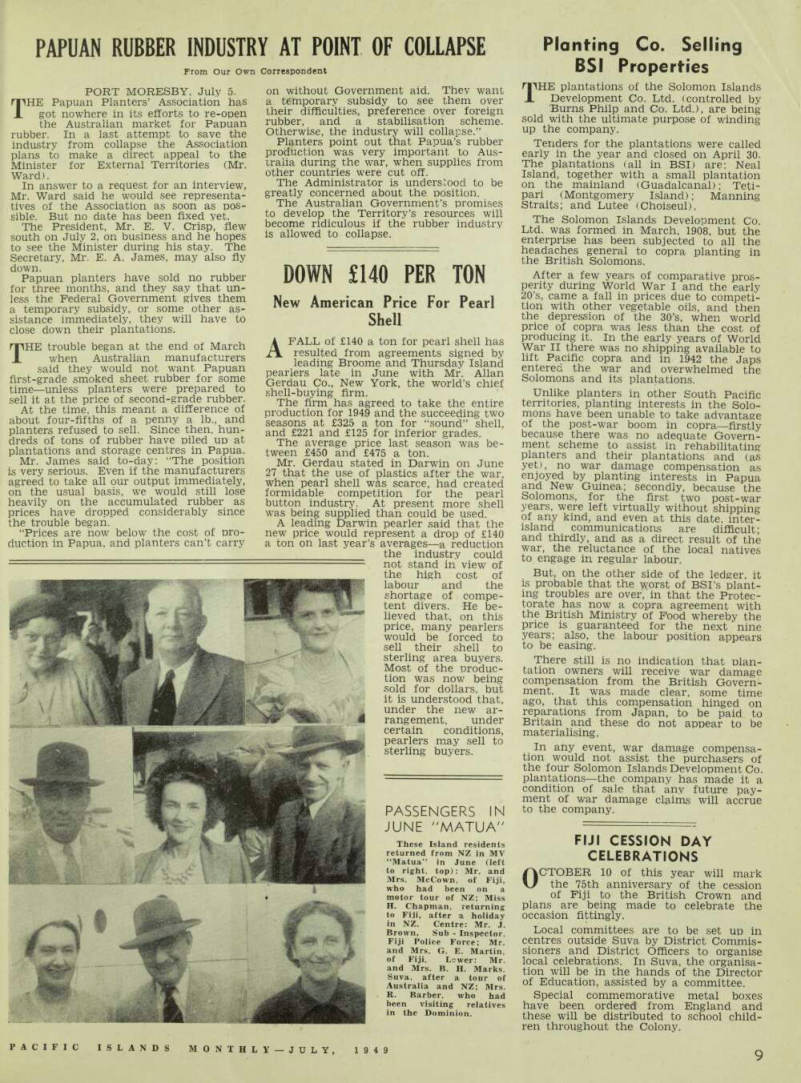
Passengers In
June "Matua"
These Island residents returned from NZ in MV “Matua” in June (left to right, top): Mr. and Mrs. McCown, of Fiji, who had been on a motor tour of NZ; Miss H. Chapman, returning to Fiji, after a holiday in NZ. Centre: Mr. J.
Brown, Sub-Inspector, Fiji Police Force; Mr. and Mrs. G. E. Martin, of Fiji. Lower: Mr. and Mrs. B. H. Marks, Suva, after a tour of Australia and NZ; Mrs.
R. Barber, who had been visiting relatives in the Dominion.
Down £140 Per Ton
New American Price For Pearl Shell
A FALL of £l4O a ton for pearl shell has resulted from agreements signed by leading Broome and Thursday Island pearlers late in June with Mr. Allan Gerdau Co., New York, the world’s chief shell-buying firm.
The firm has agreed to take the entire production for 1949 and the succeeding two seasons at £325 a ton for “sound” shell, and £221 and £125 for inferior grades.
The average price last season was be tween £450 and £475 a ton.
Mr. Gerdau stated in Darwin on June 27 that the use of plastics after the war, when pearl shell was scarce, had created formidable competition for the pearl button industry. At present more shell was being supplied than could be used.
A leading Darwin pearler said that the new price would represent a drop of £l4O a ton on last year’s averages—a reduction
the industry could not stand in view of the high cost of labour and the shortage of compe tent divers. He be lieved that, on this price, many pearlers would be forced to sell their shell to sterling area buyers.
Most of the produc tion was now being sold for dollars, but it is understood that, under the new ar rangement, under certain conditions, pearlers may sell to sterling buyers.
Planting Co. Selling
BSI Properties
11HE plantations of the Solomon Islands . Development Co. Ltd. (controlled by Burns Philp and Co. Ltd.), are being sold with the ultimate purpose of winding up the company.
Tenders for the plantations were called early in the year and closed on April 30.
The plantations (all in BSD are: Neal Island, together with a small plantation on the mainland (Guadalcanal); Teti pari (Montgomery Island); Manning Straits; and Lutee (Choiseul).
The Solomon Islands Development Co.
Ltd. was formed in March. 1908. but the enterprise has been subjected to all the headaches general to copra planting in the British Solomons.
After a few years of comparative pros perity during World War I and the early 20’s, came a fall in prices due to competi tion with other vegetable oils, and then the depression of the 30’s, when world price of copra was less than the cost of producing it. In the early years of World War II there was no shipping available to lift Pacific copra and in 1942 the Japs entered the war and overwhelmed the Solomons and its plantations.
Unlike planters in other South Pacific territories, planting interests in the Solo mons have been unable to take advantage of the post-war boom in copra—firstly because there was no adequate Govern ment scheme to assist in rehabilitating planters and their plantations and (as yet), no war damage compensation as enjoyed by planting interests in Papua and New Guinea; secondly, because the Solomons, for the first two post-war years, were left virtually without shipping of any kind, and even at this date, inter island communications are difficult; and thirdly, and as a direct result of the war, the reluctance of the local natives to engage in regular labour.
But, on the other side of the ledger, it is probable that the of BSl’s plant ing troubles are over, in that the Protec torate has now a copra agreement with the British Ministry of Food whereby the price is guaranteed for the next nine years; also, the labour position appears to be easing.
There still is no indication that plan tation owners will receive war damage compensation from the British Govern ment. It was made clear, some time ago, that this compensation hinged on reparations from Japan, to be paid to Britain and these do not appear to be materialising.
In any event, war damage compensa tion would not assist the purchasers of the four Solomon Islands Development Co. plantations—the company has made it a condition of sale that any future pay ment of war damage claims will accrue to the company.
Celebrations
Fiji Cession Day
OCTOBER 10 of this year will mark the 75th anniversary of the cession of Fiji to the British Crown and plans are being made to celebrate the occasion fittingly.
Local committees are to be set up in centres outside Suva by District Commis sioners and District Officers to organise local celebrations. In Suva, the organisa tion will be in the hands of the Director of Education, assisted by a committee.
Special commemorative metal boxes have been ordered from England and these will be distributed to school child ren throughout the Colony.
Some Aspects Of The Rehabilitation Of
Mr. ‘Eddie’ Ward
His Relationship With Mr. ‘Jock’ Garden
THE findings of the Australian Royal Commissioner who inquired into the bircumstances of the New Guinea Timber Lease scandal are published on another page.
They completely clear the Australian Minister for External Territories of the charges that he had some monetary or improper interest in the attempt made by the Jock Garden-Edward Farrell-Ray Parer-Harcourt Garden syndicate to ob tain a timber-lease concession for Han cock and Gore, the Queensland timber firm; and that he received some portion of the £50,000 paid to the syndicate by Hancock and Gore.
Mr. Justice Ligertwood is a front-rank jurist; and his findings may not be challenged in any respect. But there was certain ground that was not covered, by this inquiry, because it was not within the reference terms of the Royal Com mission.
None who followed the evidence will quarrel with the judge’s opinion that this was a bare-faced fraud worked upon Hancock and Gore, Ltd., by two crooks, Edward Farrell and Jock Garden.
Farrell’s record speaks for itself; he had been involved in various shady tran sactions, and he had been fluttering around the New Guinea goldfields for some time, before the war.
It was common report that Jock Gar den, during the time he was a high official of the National Service Depart ment, was involved in a “racket” under which men could get release from man power call-ups by paying a bribe to certain officials. (The editor of the “PIM,” since 1943, has held details of how a man avoided a call-up by making a payment of £lOO. of which Garden’s share was believed to be £25.) BUT few of those who know about the far-reaching crookedness and cor ruption that exist, as between venal bureaucracy and greedy commerce, will accept the judge’s apparent opinion that Hancock and Gore, in permitting them selves to be defrauded by Farrell and Garden, got just what they deserved. The suggestion is that Hancock and Gore were so eager to get those NG timber leases, and thus secure an advantage over all competitors, that they were ready to be come a party to a very improper “ar rangement” with Garden and his Minister: and, if they were prepared thus to tolerate corruption, they cannot com plain if the crooks robbed them.
There is another side to this, howevpr.
The Hancock and Gore people probably
knew that Farrell and Garden were crooks. But they also knew that Garden had been, for a very long time, a close and trusted political and Departmental associate of Mr. Ward. Garden was in volved in a racket in the National Service Department, and Ward was his Minister; and, although the racket was common knowledge, nothing ever was done about it.
They also knew that Garden still held some sort of mysterious position close to the Minister. Ward was no longer Minister in charge of National Service but now had charge of External Terri tories, with which there was no possible connection; but Garden still was so close to the Minister that he occupied the office next-door to Ward in the Common wealth Bank, although he was paid, ap parently, by the National Service Depart ment.
THERE is so much corruption in the relationships between commerce and some public instrumentalities that Hancock and Gore, Ltd.—a well-known, old-established private company—may be pardoned for believing that the only way in which they could get a lease of the valuable New Guinea timber area was to “work it” through Jock Garden, the Min ister’s offsider. Many, many Australian firms, who value their probity and good reputation, have done the same sort of thing. They speak of these matters with reluctance, and apparent shame; “but,” they say, “if we refuse to touch this dirt, we have competitors who have no such scruples, and we are left standing.”
It is an evil thing which has developed during the past 25 years of political de terioration—ever since political power has been given to men whose only quali fications for public life is their subser vience to party machines.
Not only did Hancock and Gore know of the Ward-Garden connection with the National Service Department; they also knew that the negotiations between the Garden-Farrell syndicate and themselves had been going on for a long time—the better part of three years—and it was surprising to them (as it was to many others) that the Minister knew nothing of them.
The nature of the discussions was so well known that, on page 23 of the “PIM” of October 1945, this paragraph ap peared:— “Th~ dithering: and uncertain attitude of the Department of External Territories, in relation to the forest resources of Papua and New Guinea, have caused a host of rumours, in
which Mr. Ward and his Department are accused of all kinds of bad practices, from Socialism to secret commissions. . . .
“One report says that the Government—or at least four minor Ministers, representing a little respected section of the Government—has been carrying on discussions with a ‘local syndicate,’ headed by a Wau dentist and a New Guinea aviator, and that the negotiations had gone a considerable distance.”
(Continued on Page 79)
That was not quite correct—but there was enough truth in it to make it clear to anyone that very interesting nego tiations were afoot. Many people spoke to us about it —but officialdom ignored it.
Mr. Ward is no drooling innocent. He is a man of outstanding intelligence and ability, with a shrewd and cynical know ledge of the ways of this wicked old world.
Those who know anything of Mr. Ward's character and history were astonished to learn that from 1945 until the end of 1947, he was ignorant of the fact that Hancock and Gore, Ltd., were in close contact with his trusted henchman, Garden, and ap parently confident of getting a conces sion.
We may accept the judge’s finding that Mr. Ward had no improper interest what ever in the Garden-Farrell-Hancock and Gore transactions. But that does not clear Mr. Ward of most reprehensible con duct in keeping the unscrupulous Mr.
Garden so close to him for so long a time, and in ignoring all the funny stories in circulation about Mr. Garden’s activities.
THE judge, and others of his status, may deplore the standard of com mercial morality disclosed in the at titude of Hancock and Gore in their negotiations with the Farrell-Garden set up. But what about the standard of commercial morality shown by Mr. Ward, in keeping his old political friend, Gar den, in a comfortable job, in a com fortable office, beside him in the Commonwealth offices, to carry out Mr.
Ward’s ideas and biddings, while being paid by the nation?
The relationship between Garden and Ward unquestionably led Hancock and Gore to believe that Ward at least knew about Garden’s discussions with Hancock and Gore; and, therefore, that relation ship should have been investigated by the Royal Commission. It was hot in cluded in the terms of reference. But the judge did have this to say: If J. S. Garden had been simply a liaison officer between the Ministry of Labour and National Service and the Unions, he would, no doubt, have been given accommodation at the A.P.A. building. The Department of Labour and National Service had been removed there. But apparently his duties were such that he was useful to the Federal members as well.
He was allowed to remain on the eighth floor of the Commonwealth Bank Building and was assigned a room across the passage from the Minister’s suite.
This proximity of his office to Mr. Ward’s suite “had several effects which proved most unfortunate in relation to the Hancock and Gore transaction.”
Finally, Garden was left in his office without direct supervision by his Minister or the per manent head of his department.
Consequently, Farrell was able to visit him whenever he wished, and Garden’s room at the Commonwealth Bank Building was available for their secret conferences.
I set out these facts by way of narrative only.
They are necessary to a full understanding of how Farrell and Garden were able to work the fraud. I am not in a position to criticise them and I refrain from doing so.
To do justice in any such criticism would re quire a separate inquiry as to Garden’s work as a liaison officer and as to how far the exigencies of the military and industrial position required the retention of his services.
One can be pardoned, however, %or doubting the efficacy of Garden’s work as a liaison officer during the three and a half years in which he was engaged in this fraud.
THEN there is the curious case of Urquhart. Urquhart, at the begin ning of the war, was an inconspi cuous railway clerk and, apparently, a
close personal friend of Ward. When Ward became Minister for National Ser vice, and Garden a high official in that Department, Urquhart also became an official. It was shown that, during that period, really astonishing sums of money passed through the personal banking ac counts of Mr. Urquhart. Urquhart ex plained this by saying that he had be come a consistent racecourse punter— and he was able to produce evidence to show that he had been very busy on the racecourses during those years.
Later, when Ward moved on to another Department, Urquhart (on Ward’s strong recommendation) was appointed manag ing director of a Sydney commercial firm —and is still there.
Garden, in his defence, said that Ward’s share of the money paid to the Garden- Farrell syndicate was handed over to Urquhart. The Royal Commissioner re jected that story completely, and indi cated that in his opinion Garden was ly ing. But there were some things in this series of incidents that were not within the terms of reference, and were not ex amined or explained.
MR. WARD is back in the Department of External Territories, and has re sumed Ministerial control of the more or less demoralised Administration of Papua-New Guinea.
Papua and New Guinea have been without his services for two vears. He went abroad about the middle of 1947; and, when he returned, the Timber Lease scandal broke wide open. In any Gov ernment controlled by political decencies, Mr. Ward would then have been relieved of his portfolios, pending inquiry. But Mr. Ward clung to office until the end of 1948. He might as well have been out of office, because he was so busy with the Timber Lease scandal, in all its angles, during all 1948 and part of 1949, that he had little time or interest for the Aus tralian Pacific Territories; and condi tions there, in certain respects, went from bad to worse. The worsening of conditions is seen in— • The continued functioning of the Pro duction Control Board, although its de mise was officially announced many months ago. • Failure to give the Papua-New Guinea planters any information about the Stabilisation Fund—the amount of it. what is to be done with it, and why it is being continued. • The growing discontent in the Public Service, where men are expected to keep themselves and their families on salaries based more or less on Australian condi tions, although the cost of living in the Territories is much greater. (A Public Service deputation was recently in Can berra, trying to get some improvement in conditions. The relief which they now probably will get should have been given two years ago.) • A whole set of difficult conditions created by the failure of (a) the Wardist plan of controlling native labour; (b) the Wardist plan of keeping private enter prise out of public transport.
However, political developments in Aus tralia probably soon will remove this Socialist genius from the control of a region where Socialism can least be ex pected to work. But he will not be lost to public sight. His ability, and his con sistency as a hater of everything belong ing to the Right, makes it certain that he presently will emerge as the leader of the forces of the extreme Left. He is not a Communist—but God alone knows why
he isn’t.-
R.
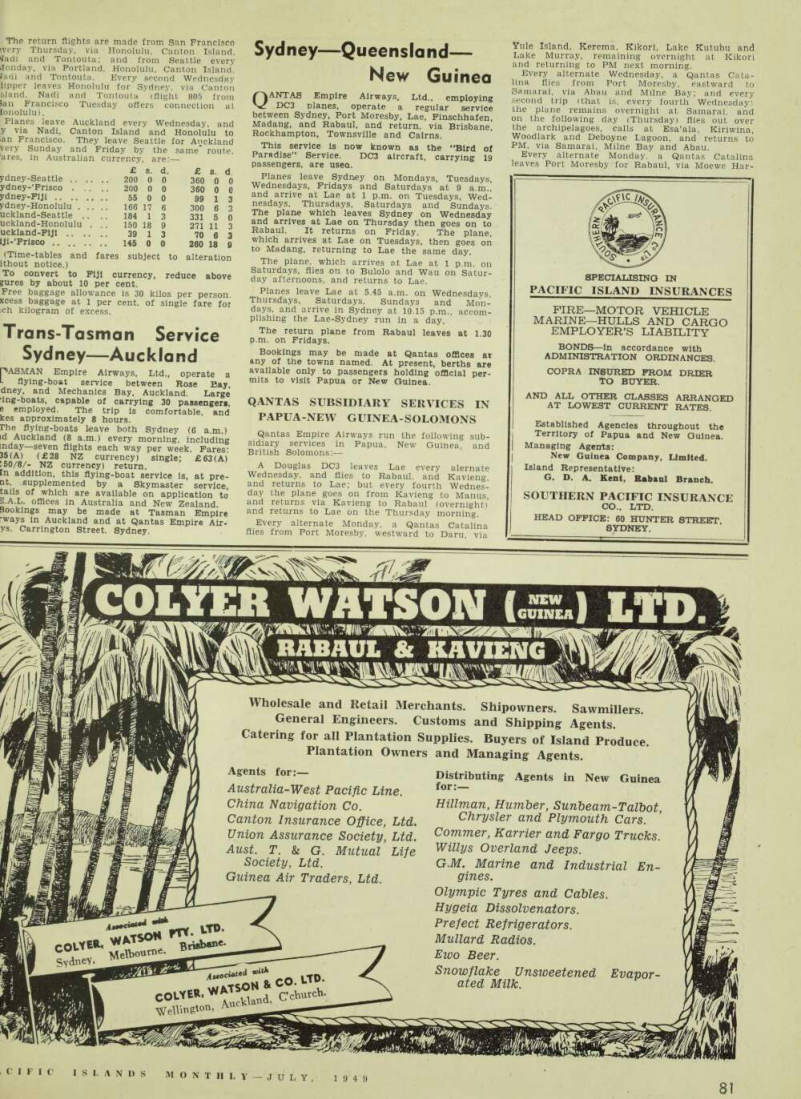
The return flights are made from San Francisco ivory Thursday, via Honolulu. Canton Island, 4adi and Tontouta; and from Seattle every Monday, via Portland, Honolulu. Canton Island, ladi and Tontouta. Every second Wednesday lipper leaves Honolulu for Sydney, via Canton si and. Nadi and Tontouta (flight 805 from Jan Francisco Tuesday offers connection at lonolulu).
Planes leave Auckland every Wednesday, and y via Nadi, Canton Island and Honolulu to an Francisco. They leave Seattle for Auckland very Sunday and Friday by the same* route, ares, in Australian currency, are:—
(Time-tables and fares subject to alteration ithout notice.) To convert to FIJI currency, reduce above gures by about 10 per cent.
Free baggage allowance is 30 kilos per person, xcess baggage at 1 per cent, of single fare for ich kilogram of excess.
Trans-Tasman Service
Sydney—Auckland
GASMAN Empire Airways, Ltd., operate a L flying-boat service between Rose Bay dney. and Mechanics Bay, Auckland. Large 'ing-boats, capable of carrying 30 passengers, e employed. The trip is comfortable, and kes approximately 8 hours, rhe flying-boats Leave both Sydney (6 a.m.) id Auckland (8 a.m.) every morning, including inday —seven flights each way per week. Fares: p®*** ( «i 8 NZ curf ency) single; £63 (A) ,50/8/- NZ currency) return, fn addition, this flying-boat service is, at pre nt. supplemented by a Skymaster service, tails of which are available on application to S.A.L. offices in Australia and New Zealand, Bookings may be made at Tasman Empire •ways in Auckland and at Qantas Empire Air ys. Carrington Street. Sydney
Sydney—Queensland—
New Guinea
QANTAS Empire Airways, Ltd., employing DC3 planes, operate a regular service between Sydney, Port Moresby, Lae, Finschhafen.
Madang, and Rabaul, and return, via Brisbane Rockhampton. Townsville and Cairns.
This service is now known as the “Bird of Paradise” Service. DC3 aircraft, carrying 19 passengers, are useo.
Planes leave Sydney on Mondays, Tuesdays, Wednesdays, Fridays and Saturdays at 9 a.m.,’ and arrive at Lae at 1 p.m. on Tuesdays, Wed nesdays, Thursdays, Saturdays and Sundays.
The plane which leaves Sydney on Wednesday and arrives at Lae on Thursday then goes on to Rabaul. It returns on Friday. The plane, which arrives at Lae on Tuesdays, then goes on to Madang, returning to Lae the same day.
The plane, which arrives at Lae at 1 p.m. on Saturdays, flies on to Bulolo and Wau on Satur day afternoons, and returns to Lae.
Planes leave Lae at 5.45 a.m. on Wednesdays.
Thursdays, Saturdays. Sundays and Mon days, and arrive in Sydney at 10.15 p.m., accom plishing the Lae-Sydney run in a day.
The return plane from Rabaul leaves at 1.30 p.m. on Fridays, Bookings may be made at Qantas offices ar any of the towns named. At present, berths are available only to passengers holding official per mits to visit Papua or New Guinea.
Qantas Subsidiary Services In
Papua-New Guinea-Solomons
Qantas Empire Airways run the following sub sidiary services in Papua, New Guinea, and British Solomons:— A Douglas DC3 leaves Lae every alernate Wednesday, and flies to Rabaul, and Kavieng. and returns to Lae; but every fourth Wednes day the plane goes on from Kavieng to Manus, and returns via Kavieng to Rabaul (overnight) and returns to Lae on the Thursday morning.
Every alternate Monday, a Qantas Catalina flies from Port Moresby, westward to Daru, via
Yule Island, Kerema, Kikorl, Lake Kutubu and Lake Murray, remaining overnight at Kikori and returning to PM next morning.
Every alternate Wednesday, a Qantas Cata lina flies from Port Moresby, eastward to Samarai, via Abau and Milne Bay; and every second trip (that is, every fourth Wednesday) the plane remains overnight at Samarai, and on the following day (Thursday) flies out over the archipelagoes, calls at Esa’ala, Kiriwina, Woodlark and Deboyne Lagoon, and returns to PM, via Samarai, Milne Bay and Abau.
Every alternate Monday, a Qantas Catalina leaves Port Moresby for Rabaul, via Moewe Har
£ s. d. £ s. d ydney-Seattle ,. . 0 0 360 0 0 ydney-'Prisco . 200 0 0 360 0 0 ydney-PIJi 0 0 99 1 3 ydney-Honolulu . . 166 17 6 300 6 3 uckland-Seattle .. 184 1 3 331 5 0 uckland-Honolulu , . .. 150 18 9 271 11 3
uckland-Pljl .. ..
1 3 70 6 3 IJi-’Prlsco .. 0 0 260 18 9
bour, and Talasea (New Britain); next morning (Tuesday i it flies to Buka, Kieta and Bum (Bougainville) and returns to Rabaul; next morning (Wednesday) it flies to Talasea, Moewe Harbour and Jacquinot Bay, and returns to Rabaul; and next morning (Thursday) it re turns from Rabaul direct to Port Moresby.
Every alternate Monday a Qantas Douglas flies from Lae to Rabaul, and continues on to Honiara (British Solomon Islands), via Torokina and Munda; remains overnight at Honiara; and returns to Lae the following day (Tuesday), via Munda, Torokina and Rabaul.
Sydney-Noumea-Suva
THE following is the time-table of the Qantas flying-boat:— Sydney dep. 9 p.m. alt. Tues.
Noumea arr. 7 a.m. alt. Wed.
Noumea dep. 8 a.m. alt. Wed.
Suva arr. 3 p.m. alt. Wed.
Suva dep. 6 a.m. alt. Prid.
Noumea arr. 11 a.m. alt. Prid.
Noumea dep. 12 noon alt. Prid.
Sydney arr. 8 p.m. alt, Prid.
Intending passengers may book through Qantas offices in Australia. Burns, phllp (South Seas) Company, in Suva; and T. Johnston In Noumea.
Fares: To Noumea, £35 single; £63 return.
To Suva. £52/10/- single; £94/10/- return.
Noumea-Suva, £l7/10/- single; £3l/10/- re turn.
Sydney-Lord Howe ls.-
Norfolk Is.
QANTAS, Sydney, run a Catalina once weekly from Sydney to Lord Howe Island. Pare, single, £l2. Return, £2l/12/-.
Qantas run a land plane alt. Thursdays (re turning same day) from Sydney to Norfolk Island. Fare, £22 single; £39/12/- return. (For Norfolk Island, see also under NZ National Airways. For Lord Howe, see also under TOA.)
Noumea-Fiji-Tahiti
rRAPAS (a French company with headquarters in Noumea) ran an air service once a lonth from Noumea (New Caledonia), via Nadi Fiji) and Altutakl (Cook Islands) to Papeete Tahiti), and return.
The Trapas Co. also runs a service to New ebrides—see under Caledonia-New Hebrides.
TOA Services
rRANS Oceanic Airways run the following Pacific services:— SYDNEY-LORD HOWE IS.; A regular fort ightly service with large four-engine flying oats from Rose Bay. Pare: £ll single; £2l ?turn. Free baggage allowance 50 lb. Excess aggage and freight rate 6d. per lb.
SYDNEY-NEW HEBRIDES: A regular monthly srvice with large four-engine flying-boats from rdney, via Noumea (overnight stop), to Vila tid Espiritu Santo. Fare: Sydney-Vila, £45; pdney-Santo, £5O; Noumea-Vila. £l2/10/-, oumea-Santo, £lB/15/-. Freight: Sydney-Vila, - per lb.; Sydney-Santo, 2/3.
Sydney-Solomon Islands: A Regular
onthly service from Sydney, via New Cale mia and New Hebrides to Tulagi, Solomon lands. This service is frequently extended to ngatou, in the Russell Islands, and calls are metimes made at Vanikoro, in the Santa Cruz :oup. Pares: Sydney-Tulagi, £65. Free bag ige allowance, 60 lb.; excess baggage and eight, 3/- per lb.
New Caledonia—New
Hebrides—Tahiti
TRAPAS amphibian runs twice each week between New Caledonia and New Hebrides, ic days vary, but on the selected day the ines adhere to the following time-table:— Noumea—dep. 0630. Vila —arr. 1315 Vila—dep. 0945 Santo—arr. 1115 Santo—dep. 1145 Vila—arr. 0900 Vila—dep. 1400 Noumea—arr. 1630 ) TRAPAS plane runs monthly between umea and Tahiti.
Papua-NG Local
Services
MANDATED Airlines, Ltd., of Lae, New Guinea, and other private operators, run air ser vices between Lae and the New Guinea mainland centres of Wau, Bulolo, Madang, Wewak, Aitape, ivlt. Hagen. Flnschhafen. Moresby. Kokoda—in fact anywhere in Papua or New Guinea where there is an air-strip. These planes carry pas sengers, mails and cargo on regular schedules or charter flights. (Continued on Next Page)
Guinea Air Traders Ltd., of Lae, New Guinea, employ six aircraft on local services, and on charter work.
Under arrangement with the Administration, a Qantas plane, carrying Administration personnel and cargo, and mails, flies once each week from Lae to Rabaul, Kavieng anu Manus, and returns io Lae by the same route.
India-Fiji
More Pacific
Airlines
France-Noumea and India-Fiji
TWO more new airlines for the South Pacific Islands are expected to com mence operations shortly.
Air France has made formal application to Australia for landing rights in Aus tralia in connection with a projected new French service, in which planes will fly between France and New Caledonia, via Indo-China (French) and Australia.
It is expected that Australia will grant permission. Australia recently refused a permit to Air Ceylon, to run a service from Ceylon to Sydney; but Air France is in a different category, because the terminal will be in Noumea, and not in Australia.
A plan for a service by Indian Airlines, from India to Fiji, via Australia, is under consideration, and it is expected that Aus tralia will give permission also in this esse, and for the same reason, Indian interests seem determined to de velop trade between India and Fiji, in every possible way.
Planters’ Meeting In
Bougainville
From Our Own Correspondent
Sohano, July 12.
11HE Bougainville branch of the New Guinea Planters’ Association, held a well-attended meeting in Kieta on July 8 and 9.
Mr. Claude Campbell was elected presi dent.
Delegates were appointed to forthcoming general meeting in Rabaul.
Members keenly supported a cooperative buying plan.
Leading planters present also formed a Bougainville Association, with Mr. Fred Archer as president, with the object of dealing promptly with local problems, working in conjunction with the District Officer and other appropriate administra tion heads.
Homeward-Bound In Mv "Matua"
Passengers who travelled in MV "Matua" from Auckland, NZ, to the Islands, in June, included (left to right): The Bt, Rev. L. S. Kempthorne, Bishop in Polynesia, and Mrs. Kempthorne: Mr. L. Genge, returning to Fiji, after holidaying in NZ; Mr. L. C. Shirling, who also had had a holiday in NZ; Mr. Malcolm Brodie, of Suva, who had visited Australia and New Zealand.
Papua Murder
Death Sentence For Two Natives
From Our Own Correspondent
Port Moresby. July 5.
TWO young native men were sentenced to death in the Supreme Court here on June 24 for the brutal murder of 72-years-old Tom Kessick Bowes, on April 21.
One native, Nikula Marapai, battered the old man to death with a heavy stick while the other, Hariha Mehea, kept watch. Then they stole a few pounds’ worth of clothing and a few shillings in cash from his house, which is in a lonely area 16 miles from Moresby, on the Rouna road.
Mr. Justice Bignold pronounced the death sentence on Nikula and recorded it against Hariha, which amounts to a re commendation that the sentence be car ried out in Nikula’s case and commuted to imprisonment in Hariha’s case.
The Administrator may commute either or both sentences; but only Canberra can authorise the carrying out of a death
sentence. No native has been hanged in Papua-New Guinea since the war.
The story unfolded during the five-days’ trial was that on April 20 Bowes engaged the two natives to do odd jobs around his house, in which he lived alone. After working a few hours they left; but, next day, while Hariha kept watch near the road, Nikula went to the house and at tacked Bowes in the backyard with a heavy stick.
With the first blow the native broke the old man’s wrists, leaving him defence less. After the natives had robbed the house they saw Bowes trying to rise and Nikula hit him again. His body was found next day, and the murderers were arrested on April 23.
Mr. Bowes was manager of the Govern
ment’s Kemp Welch plantation, near Rigo, for many years. He came to Moresby when he retired.
This was the first murder of a white man by Papuan natives for many years.
But, in New Guinea, Mr. A. Robinson was murdered only last December while on a recruiting trip in New Britain. Three natives are now serving gaol terms for the crime.
The two murderers.
Edit’L Note—Europeans Should
Insist On The Death Penalty
THE policy of the Australian Socialist Government is not to carry out the death penalty against white men; and, as it insists on putting the Papuan and New Guinea natives in the same category as white men, presumably it will not hang the murderers of Mr. Bowes.
If this should prove to be so. the Euro pean residents of the Territories should take steps to register the strongest pos sible protest against this kind of official stupidity. The majority of these natives are quite incapable of understanding the Brown Brother approach. Generally, in all our dealings with them, we must show strength and firmness amounting almost to ruthlessness; anything else is regarded by them as weakness. This is especially imoortant in relation to the protection of human life. Unless these people are shown, without any exception whatever, that the death penalty is imposed upon any man taking the life of another, Euro peans in the Territories will not be safe.
There has been too much weakness in the Administration in this respect in re cent years—and too many examples of an inclination on the part of young natives to show disrespect to white men.
Fish, Flesh And Costly
Shipping
Planters’ Grievances in New Guinea
1 NOTICE that Mr. Pennefather hgs had something to say about the enormous cost of shipping stock to New Guinea” said a veteran Territories planter in Syd ney, recently.
“It is about time someone made a pro test. The Japs destroyed practically all our livestock: and when we claimed war damage compensation we were allowed around £5 per head. Yet in 1946, when I brought a bull and two heifers in from Australia, the shipping charges alone were £54. They have increased considerably since then.
“If there is to be real European rehab ilitation in New Guinea, we must have livestock; and we cannot afford these ehormous transport charges. The Govern ment does not hesitate to spend hundreds of thousands of pounds on the natives, who are not asking for it. Yet it will not spend anything in subsidising the transportation of suitable stock from Aus tralia to New Guinea, which it well could do.
“The Administration policy towards the European planter is hard to understand.
We are supposed to provide each of our native labourers with three pounds' of meat per week. But Australia cannot supply the meat—we have great difficulty in getting it, even at the high prices ruling. So we sought permission to dynamite fish. We have thousands of miles of coasts, swarming with edible fish, and a plug of dynamite will give our labour lines an ample supply of food. But the only reply we can get is that dyna miting of fish is forbidden. Why? No one knows. There is so much coastline, and so many fish, that if every European spent all his time dynamiting, it would have no effect on the fish supply.”
For Tahiti
Tourists Now Wanted
New Governor’s Interesting Plans
From Our Own Correspondent
Papeete, June 20.
TOURISM— the handy French word which means that profitable in dustry which caters for and en courages the tourist traffic —is to be assisted in every reasonable way by the energetic new Governor of French Oceania, M. Armand Anziani.
M. Anziani has informed me that all irksome restraints regarding the admis sion to the Colony of visitors are to be removed, and the slogan “Come to Tahiti” is being broadcast to the world as an in vitation to visit the “Pearl of the Pacific.”
Governor Anziani (formerly Directeur Adjoint of Economic Affairs in the Ministry of French Overseas Possessions) comes to his new assignment with ex perience well fitted to a successful ad ministration at this time of international unrest. Cordial and easy of approach, having had experience with America and the American way of life, his administra tion is calculated to go far to make the sojourn of foreigners in Tahiti congenial, and to make French Oceania attractive to overseas visitors.
As regards the tourist business itself, Tahiti stands in about the same position as did Hawaii forty years ago. To pre pare for an anticipated influx of visitors, the formation of a Bureau in Papeete, consisting of French, American and British residents experienced in the de velopment of tourist trade, is under con sideration.
To this Bureau will be assigned the duty of promoting steamer and airplane traffic between Tahiti and the rest of the world. It will also undertake the develop ment of facilities for accommodation and entertainment.
While Papeete already possesses a num ber of small hostelries, notably “Les Tropiques,” Rivnac’s “White Beach” and the “Royal Tahitian” in the suburbs, Gov ernor Anziani is investigating the possi bility of creating and erecting a well equipped modern hotel of one hundred rooms. He is also considering establish ment of a refrigeration plant for storage of quality foods and the formation of a colourful tourist band to welcome steamers and airplanes.
The project of setting in order the Bora Bora airstrip is also engaging his atten tion, together with installation of gaso line storage tanks, a hotel, and small air planes to transport visitors from Bora Bora to Papeete.
Already Trapas Air Company is operat ing monthly from Noumea to Papeete, via Fiji, Samoa and Cook Islands, 'll is anticipated that before year’s end, air service will be established out of Hono lulu to connect at Fiji or Samoa with Trapas planes, which service will effect long-time isolation of French Oceania.
Date Changed
NG Women's Club Meeting— Date Changed
BECAUSE of the Australian coal-strike and electricity restrictions, the date of the annual general meeting of the NG-Women’s Club, Sydney, has been changed from the evening of July 22, to 11 a.m., Thursday, July 28.
Mr. Robert Munro, well-known solicitor in Suva, has been appointed Consul for Norway in Fiji.
Advertisements & other items, p. 14 (1 item)
Morris Hedstrom Limited
General Merchants, Importers and Exporters,
Shipowners, Plantation Owners,
Commission and Insurance Agents
HEAD OFFICE
SUVA, FIJI
Established 1868
SERVICE IN THE SOUTH PACIFIC TERRITORIES
our Large Establishments in Suva and our Numerous Branches, we distribute a wide and comprehensive range of General Merchandise and provide almost every kind of service. Our departments and associated businesses include:
Branches Throughout Fiji, Samoa and Tonga
There is a Branch or Agent of Morris Hedstrom Limited in every Town in the Three Territories.
We are Sole Agents in these Territories for British Drug Houses Ltd.
Electrolux Ltd.
Ford Motor Co.
General Electric Co. Ltd.
Goodyear Tyre £r Rubber Co.
B. A. Hjorth £r Co. (Primus Products) Imperial Chemical Industries Ltd.
International Harvester Export Co.
Matson Navigation Company Max Factor and Co. Inc.
Ransomes, Sims £r Jefferies Ltd.
Ruston £r Hornsby Ltd.
Vacuum Oil Co. Pty. Ltd.
Yorkshire Copper Works Ltd.
Morris Hedstrom Limited, are LLOYD'S AGENTS in Fiji and Samoa.
IN AUSTRALIA: IN GREAT BRITAIN;
Morris Hedstrom (Aust.) Pty. Ltd., Morris Hedstrom Limited, Asbestos House, Africa House, 65 York Street, SYDNEY Kingsway, LONDON
A Visitor Looks At Lae
( Contributed )
IHAVE just visited Lae, New Guinea.
These are my impressions, as a casual visitor.
Arriving by air, one is transported to what is known as “Hotel Cecil”. This consists of an accumulation of ex-army buildings in a state of advanced decay, due to collapse at any moment.
All honour to the proprietor, who has, I am told, struggled for three years under appalling conditions. Some time ago she was allocated a site in the “New Town ship” and duly paid £lOO, plus survey fees, but cannot obtain possession as Government Buildings occupy part of the site for which the Administration accepted the fees. She must still carry on at the old site until something can be done to alter this strange position.
As a visitor I wanted to see as much of Lae as I could —I did, through the kindness of a local resident who ran me round in his Jeep. I have never seen anything like the roads; pot holes were everywhere, but my friend said, “Don’t worry, I have got to know every one of them,” as he dodged here and there to avoid them.
Crossing a bridge near the town he said, “Better keep your fingers crossed, its due to go any old day now,” and from its appearance, I believed him.
The wharf at Milford Haven has col lapsed, its timbers are floating around and some are washed up on the beach.
Piles are dangling, and the whole site is a desolation.
Temporary houses made of sawn timber and covered with tarred paper add beauty to the landscape, while here and there one sees a more imposing dwelling, usually occupied by a Civil Servant.
A VISIT to the school was interesting and instructive. There were about 30 children in a small improvised building which had no windows, no hooks on which to hang hats, no means of washing. All grades were accom
modated in this structure, and I wondered how the teacher could work under such conditions.
I understand that a hospital is to be built in the future. The present structure is a series of military huts, running right and left, off a concrete path.
One felt respect for the medical pro fession there, both doctor and nurses, who carried on under such conditions.
A planter on the Markham Road told me that he had to drive along a road of which part is virtually swamp, while bridges and culverts are blocked up with debris preventing the free flow of flood waters. These sweep over the roads during heavy rains.
I was disappointed with Lae after three years of Civil Administration, es pecially when I considered the millions of pounds of the Australian tax payers’ money which has been poured down the drain in New Guinea, with no visible results.
Residents tell me that the art of passing the buck has reached perfection in Lae. No one seems to care; no one seems to be able to alter the state of frustration which blankets everything.
There is no agricultural development programme; no one knows where’ they are.
The whole set up, to my way of think ing, can be likened to the parable of the servant who hid his talents in the ground.
Photographs show: Top left, bridge over Butibum River; top right, another bridge, near Lae.
Lower, left and right, wharf at Milford Haven. The round piles in the picture on the left are eaten off at water line and swing with the tide.
Rabaul Rssaila
From Our Own Correspondent.
Rabaul, July 7.
AT a lively meeting in Rabaul on June '29, local members of the RSSAILA decided to hold the annual general meeting on July 22, and executive officers were elected pro tern —E. V. Smythe, pre sident: P. J. Chapman, secretary; J.
Whippy, treasurer.
An active sub-committee of ypunger members is organising a ball for July 20. and initial steps towards securing land for a club have already been taken.
Advertisements & other items, pp. 15-16 (1 item)
Islands Residents!
Let PTA Arrange
Your Travel
You ore going on Leave?
Or planning a Business Trip?
Or you are Called Away Sud-
denly and Urgently?
We have a complete organisation for arranging Travel, from anywhere in the Islands to anywhere in Australia, New Zealand, Britain, United States, Europe. Send us a Radiogram, stating your Requirements, and we shall book you to your Destination, by Air, or by Sea, or by Car, or by Tourist Coach.
Pleasure-Travel and Sight-Seeing Tours in Australia and New Zealand arranged for Islands Visitors.
THESE SERVICES COST YOU
NOTHING
ACCOMMODATION
Hotel and Flat Accommodation in Sydney and Melbourne arranged for Visitors who make their Travel Bookings through us. City Hotels and Guest-Houses are booked out far in advance—so give us your instructions early.
Are you interested in Pleasure-Travel in Fiji, Western Samoa, Norfolk Is., New Caledonia? If so, send for our Booklet, "Tours in the South Sea Islands".
Pacific Travel Agency
Union House, 247 George St.,
Sydney.
Radiograms:
“PACPUB”, SYDNEY.
TELEPHONE: BW 5037
Now in service from Hawaii fo San hours the new DOUBLE-DECKED a wOh
AIM
i ; «<W. r "■ 4 .r-*- T m m w ■*#** In club lounge (right) you have your choice of bar refreshments, including special hot coffee or tea, freshly made on board.
Plane flies “above the weather” where car is smoothest. Low-level air pressure maintained in cabins even at 25,000 feet.
Air-conditioned for living-room comfort.
All this at regular air travel fares! You pay no premium to fly in these double-decked luxury airliners. World’s newest, fastest in air travel — altitude-conditioned and air-con-
ditioned throughout. America-class Clippers
fly from Honolulu to San Francisco in just 8| hours — to Los Angeles in 9\ hours! For reservations on America-class Clippers, just call your Travel Agent or Pan American. *Trade Mark, Pan American Airways, Inc.
Mezzanine Floor , Hotel Australia , Sydney. Telephone: BW 4701 Rue Jean Joures, NOUMEA. Bank oj N.S.W. Building , SUVA.
Pam Amerlcam World Airways
World's Most Experienced Airline. "SPEED YOUR PARCEL BY CLIPPER CARGO".
Pan American Airways, Inc. (Incorporated in U.S.A. — Liability Limited)
Sir Maynard Hedstrom
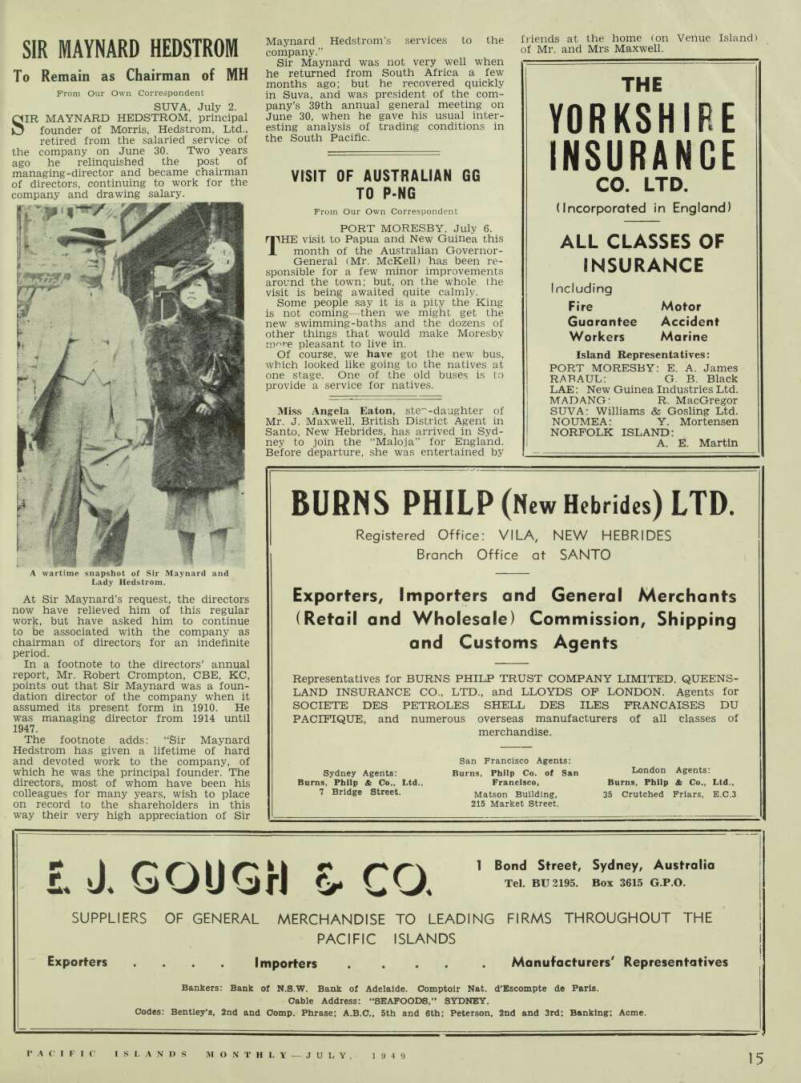
To Remain as Chairman of MH
Prom Our Own Correspondent SUVA, July 2.
SIR MAYNARD HEDSTROM, principal founder of Morris, Hedstrom, Ltd., retired from the salaried service of the company on June 30. Two years ago he relinquished the post of managing-director and became chairman of directors, continuing to work for the company and drawing salary.
At Sir Maynard’s request, the directors now have relieved him of this regular work, but have asked him to continue to be associated with the company as chairman of directors for an indefinite period.
In a footnote to the directors’ annual report, Mr. Robert Crompton, CBE, KC, points out that Sir Maynard was a foun dation director of the company when it assumed its present form in 1910. He was managing director from 1914 until 1947.
The footnote adds: “Sir Maynard Hedstrom has given a lifetime of hard and devoted work to the company, of which he was the principal founder. The directors, most of whom have been his colleagues for many years, wish to place on record to the shareholders in this way their very high appreciation of Sir
Maynard Hedstrom’s services to the company.”
Sir Maynard was not very well when he returned from South Africa a few months ago; but he recovered quickly in Suva, and was president of the com pany’s 39th annual general meeting on June 30, when he gave his usual inter esting analysis of trading conditions in the South Pacific.
A wartime snapshot of Sir Maynard and Lady Hedstrom.
Visit Of Australian Gg
To P-Ng
From Our Own Correspondent
Port Moresby, July 6.
THE visit to Papua and New Guinea this month of the Australian Governor- General (Mr. McKell) has been re sponsible for a few minor improvements around the town; but, on the whole the visit is being awaited quite calmly.
Some people say it is a pity the King is not coming—then we might get the new swimming-baths and the dozens of other things that would make Moresby pleasant to live in.
Of course, we have got the new bus, which looked like going to the natives at one stage. One of the old buses is to provide a service for natives.
Miss Angela Eaton, ste^-daughter of Mr. J. Maxwell, British District Agent in Santo, New Hebrides, has arrived in Syd ney to join the “Maloja” for England.
Before departure, she was entertained by
friends at the home (on Venue Island) of Mr. and Mrs Maxwell.
Advertisements & other items, p. 17 (1 item)
Insurance
THE
YORKSHIRE
CO. LTD.
(Incorporated in England)
ALL CLASSES OF
INSURANCE
Including Fire Motor Guarantee Accident Workers Marine Island Representatives:
PORT MORESBY: E. A. James
RABAUL: G B. Black LAE: New Guinea Industries Ltd.
MADANG: R. MacGregor SUVA: Williams & Gosling Ltd.
NOUMEA: Y. Mortensen
NORFOLK ISLAND:
A. E. Martin
BURNS PHILP (New Hebrides) LTD.
Registered Office: VILA, NEW HEBRIDES
Branch Office at SANTO
Exporters, Importers and General Merchants
(Retail and Wholesale) Commission, Shipping
and Customs Agents
Representatives for BURNS PHILP TRUST COMPANY LIMITED. QUEENS- LAND INSURANCE CO., LTD., and LLOYDS OF LONDON. Agents for SOCIETE DES PETROLES SHELL DES ILES FRANCAISES DU PACIFIQUE, and numerous overseas manufacturers of all classes of merchandise.
Sydney Agents: Burns, Philp & Co., Ltd., 7 Bridge Street.
San Francisco Agents: Burns, Philp Co. of San Francisco, London Agents: Burns, Philp & Co., Ltd., 35 Crutched Friars, E.C.3 Matson Building, 215 Market Street.
W* k k % k \ 1 Bond Street Sydney, Australia nJD -V ij Jfl VTel. BIT 2195. Box 3615 G.P.O.
SUPPLIERS OF GENERAL MERCHANDISE TO LEADING FIRMS THROUGHOUT THE
PACIFIC ISLANDS
Exporters ... Importers ... Manufacturers' Representatives Bankers: Bank of N.S.W. Bank of Adelaide. Comptoir Nat, d’Escompte de Paris.
Cable Address: "SEAFOODS.” SYDNEY.
Codes: Bentley’s, 2nd and Comp, Phrase: A. 8.0., sth and 6th; Peterson. 2nd and 3rd; Banking: Acme.
Old New Guinea Residents
Now In Darwin
A REUNION dinner of pre-war New Guinea residents was held at the Hotel Darwin, in Darwin, on July 5.
After dinner on the lawn, a silent toast was drunk to the memory of friends and relations lost in the war years.
Friendships were renewed and tales told, new and old. It is anticipated that a New Guinea Club will be formed in Darwin.
Those present were: Mr. and Mrs. F.
H. Moy, Mr. and Mrs. A. R. Miller, Mr. and Mrs. O’Neill, Mr. and Mrs. Mackin
non, Mr. and Mrs. Mackenzie, Mr. and Mrs. Matthews, Mr. and Mrs. Farthing, Mr. and Mrs. Halliday, Mr. and Mrs. Stevens, Dr. Deland, and Messrs. Austin, H. S.
Taylor, Muir and McGuire.
Treadwell-Lonergan Wedding
IN Port Moresby, Papua, on June 14, a member of the European Hospital’s nursing staff, Sister Margaret Treadwell, married Mr. John Lonergan, of APC. Mr. Roy Barwick was best man and Sister Bishop was bridesmaid.
The reception was held at the Port Moresby Hospital.
The Mill Stone Again
Some Very Early Recollections
SINCE a photograph of the Marquis de Rays’ mill-stone appeared in the February issue of “PIM,” a number of interesting comments have been re ceived from readers. 'One of the most in teresting comes from Count van Asten- Goedicke, of Haapai, Tonga, who states that he saw the old mill-stone at Port Breton over 60 years ago.
In early January, 1884, he was engaged by the German Consul in Sydney as an assistant to Herr von Oertzen, then Im perial German Commissioner for the Bis marck Archipelago, who was to proceed to New Britain to select a suitable site for the Capital.
“. . . We left Sydney on January 6, by HIMS ‘Albatross,’ commanded by Count von Baudisin and arrived in Mioko, Duke of York Islands, on Januarv 15.
Mr. R. Parkinson was asked bv' von Oertzen to join us as guide as he had visited most of New Britain and New Ireland. On January 18, 1884, we landed at Port Breton, New Ireland, a place which showed signs of recent habitation, but was then deserted—a place covered with rubbish. There was an old boiler, I remember, some old broken tanks, several street names, such as ‘Rue de Rivoli, L’Hotel de ville,’ etc., and the old stone which Mr. Parkinson pointed out to us, expressing the opinion that it was to have been used for crushing copra.
“Mr. Farrell, who is referred to in the February article, assisted only the last settlers who arrived at Port Breton. He sent them to Sydney in his schooner, ‘Elenore,’ having made a very suspicious agreement with the captain of the barque, ‘Marquis de Rays’ whereby Farrell took the barque and everything left at Port Breton in exchange for getting the colonists to Sydney. During my time in New Britain, the barque was on the beach in front of the DH and PG office at Mioko. The firm intended to fill her with sand and stones and use her as a wharf.”
Bank Of Indo-China
A FRENCH financial paper says that, now the Bank of Indo-China (which operates in the French Pacific as well as in the Colonies) has had its right to issue banknotes (withdrawn, it will enlarge its ordinary banking activities.
The bank, closely allied to the Banque de Paris et des Pays Bas, has greatly ex tended its activities in regions other than the Orient, including Africa and America.
Capital has been raised from 127,500,000 francs to 510,000,000 francs by a new share issue on conditions most favourable to shareholders.
Wedding In Samoa
APIA, June 28.
Miss Annie Eileen King, Only
daughter of Mr. and Mrs. A. P.
King, of Apia, was married here on June 16 to Mr. L. C. Palmer, of New Zea land, who is a member of the Education Department staff in Samoa. Best man was Mr. Roy G. Wills and the groomsman was Mr. Warren G. Chalmers; while the Misses Joyce M. Moors and Moira Mac donald acted as bridesmaids, and Frances Wiggle and Josephine Moors were flower girls'. The Rev. C. L. Whonsbon-Aston officiated at the wedding ceremony.
Mr. L. Dwyer, of the Papua-New Guinea Department of Agriculture, was on leave in Australia in July.
Advertisements & other items, pp. 18-20 (2 items)
World
at ?/out
//nym
m Business men everywhere are trying to expand trade with other countries.
Many of them rely on the Bank of New South Wales for • Introductions to oversea importers and exporters; • Credit information about people overseas with whom they wish to do business; • Information about exchange rates and controls; • Finance to import or export; • Facilities for making payments abroad, or receiving payments from overseas; • Arrangements for business visits abroad.
These men have the world at their finger tips, for they can turn to the specialized overseas, information and travel departments of the ''Wales” and its 7,000 over-
sea correspondents.
You, too, can consult and use
BANK OF
NEW SOUTH WALES
FIRST BANK IN AUSTRALIA
Incorporated in New South Wales with limited liability
The House for Better Music
For four generations the famous house of J. STANLEY JOHNSTON, has been privileged to sell the world’s
finest musical instruments.
GUITARS
Here is a musical instrument that will give you pride and pleasure to own. Fine music must come from such a fine guitar. Spanish or Hawaiian models beautiful in construction and workmanship.
Models from £B/17/6, complete with case.
MAGIC
FLUTES
AJ7B
BUTTON
ACCORDEONS
MOUTH ORGANS
m THE ALWAYS POPULAR. More so with these strong quality instruments with full note range.
Hohner. 20-Reed Vamper 11/- Auto-Valve Harp. 40-Reed . . . . 26/6 Chromonica, 40-Reed 47/6 Super-Chromonica, 48-Reed . . . . 65/- (All Plus Postage.)
VIOLIN OUTFITS
Violin, Bow, and Case, Tuning Pipes, £7/15/-
RECORDS
LARGE STOCKS OF AUSTRALIAN AND
ENGLISH RECORDS ON ALL LABELS.
New releases always available.
H.M.V.—COLUMBIA—CONTINENTAL
PORTABLE PHONOGRAPHS AT RULING
PRICES.
Ask to be put on our mailing list.
PLASTIC TRUMPETS
r Tuneful novelty, strongly built. Bright colours. Price, 4/11, plus postage.
OCARINAS
The sweet potato pipe. Best for a piping tune. Fine quality. 11/6 each, plus postage.
JAW HARPS
Old favourite, prettiest tune imaginable, simplest of all to play. Just arrived from England. 1/6, 2/6, and 5/-, plus postage.
FLAGEOLETS
Here’s real enjoyment— charming tune—strongly built, long-lasting plastic whistle.
In full note range. Key C. 3/6, plus postage.
KAZOOS
Just hum the tune and out it comes! The old favourite plastic model. 1/-, plus postage.
Trade Enquiries Invited
SAXOPHONES
By “Tone King.” $$ Your guarantee of quality. Finest construction. In brilliant design—super finish. In Gold Lacquer and Silverplate.
Alto Models. £B7/19/6. plus freight.
Alto Student Model, £44/10/-, plus freight.
Tenor Models, £75, plus freight.
MUSICAL
BONES
The best for a happy beat. Simple to handle. 2/6, plus postage.
PIANO ACCORDEONS
Nothing better than a melody played with the lilting piano accordeons. Harmony Piano Accordeons from Italy are hand-made with perfect finish. Models have 3 sets reeds—2 tonal changes.
M 120 Basses £56/10/- 48 Basses £3B/10/- 24 Basses £26/7/6 12 Basses £l9/19/- Cases included (Freight extra).
PTY. LTD.
ur ii
The House for Better Music
11
437-439 GEORGE STREET, SYDNEY, AUSTRALIA
BUY (HI THE BEST MARKET!
When you buy through us you buy at lowest prices.
YOU RECEIVE ORIGINAL INVOICES AT- IN-
VOICED COST. Enquiries invited for all plantation and trading requirements. Island products sold on commission basis.
WILLIAM E. REED
(Established 36 years).
BROKER AND AGENT,
145 a GEORGE ST., CIRCULAR QUAY, SYDNEY Cables: ■•WILKEED.” Sydney.
Asthma, Bronchitis Coughing, Curbed in 3 Minutes
Do you have attacks of Asthma or Bronchitis so bad that you can't sleep? Do you feel weak, unable to work, and have to be careful not to take cold and can't eat certain foods?
No matter how long you have suffered or what you have tried, there Is new hope for you In a doctor’s prescription called Mendaco.
No dopes, no smokes, no injections, no atomizer.
All you do Is take two tasteless tablets at meals and In 3 minutes Mendaco starts working through your blood, aiding nature to remove phlegm, promote free easy breathing and bring sound sleep the first night, so that you soon feel years younger and stronger.
No Asthma in 2 Years
Mendaco not only brings almost Immediate comfort and free breathing but builds up the system to ward off future attacks. For Instance. J. Richards, Hamilton, Ont.. Canada, had lost 40 lbs., suffered coughing every night, eouldn’t sleep. Mendaco stopped Asthma
spasms first night and he has had none since In over two years.
Money Bock Guarantee
The very first dose of Mendaco foes right to work circulating through your blood and helping nature relieve you of the effects of Asthma. Try Mendaco under an Iron-clad money back gaurantee. You be the Judge. If you don’t feel fully satisfied after taking Mendaco Just return the empty package and the full purchase price will be refunded. Get Mendaco from your chemist to-day and see how well you sleep to-night and how much better you feel to-morrow. The guarantee protects
RELIEVES ASTHMA
Mendaco
Now in 2 sizes . . . 6/- and 12/-
Box 3838 GPO, Cable Address, “Care” Sydney.
Sydney. Australia.
ISLAND MERCHANTS
[HR US PTV LTD.
4 YORK ST., SYDNEY
All kinds Island Produce sold on commission. All merchandise purchasec at best wholesale price and original invoices supplied.
Use our 50 years’ experience as Island Merchants.
J
New Hotel In
Papua
Holiday Resort On The Kokoda Trail
From Our Own Correspondent
Port Moresby, July 6.
THE Kokoda Hotel, which has been built on the Kokoda Trail, between Kokoda and Buna, in Northeast Papua, as a holiday resort, will be ready for the reception of guests in December.
It has been planned and built, to pro vide accommodation for at least 16 guests, by the Kokoda-Buna Tourist Co., a sub sidiary of Sangara Rubber Plantations Pty., which operates plantations in the vicinity. It will have all modern amen ities: will be surrounded by gardens, a golf course and tennis courts (now being laid out); and, as it will be at least at a height of 1,000 feet, on the cool side of the mountains, it should be a favourite week-end resort for Port Moresby people.
The hotel has been built of local tim ber, milled by the Sangara people; and the furnishings and fittings will be simil arly made. The hotel has been granted a liquor license.
The Administration plans to reopen the Popindetta air strip (5 miles from the hotel) which was the first air strip used here by the Allies when they attacked the Japs in the Buna-Gona region.
The place is expected to become a popular resort for Australian visitors.
Another Hotel?
A BIG, new hotel is planned for Moresby, but we have no details yet.
Residents who have heard about it say they hope that the competition will result in lower prices at all three hotels—if the third one does eventuate.
Become Bronze-green
White "Matua" to Become Bronze-green
From Our Own Correspondent SUVA. June 22.
REPROACHES are likely to be heaped on the USS Company of New Zea land for its decision to paint the famous Islands ship, “Matua,” bronze green after two more Fiji-Tonga-Samoa round-trips.
Bronze-green is the Union Company’s traditional liner colour, but except for the war years, the “Matua” has been gleaming white (with the company’s red and-black funnel) ever since she came into the Islands service towards the end of 1936.
During the war she won a high place in Fiji in the affection of residents by keep ing open, single-handed, sea communica tion with New Zealand. Her appearance, late in 1945, with a new white dress re placing the wartime grey, was hailed in the Islands as one of the first tangible signs that the war was actually over.
Rabaul Chess Club
RABAUL (NG) chess players have re formed the chess club that existed before the war and are now meet ing regularly in the Administration mess hall.
Club fees have been fixed at £l/1/- per annum. 'Sets of chess men have been ordered from Sydney and learners’ classes have been formed.
Advertisements & other items, pp. 21-22 (1 item)
rrouds
6 m v I
A birthday gift . . . a wedding gift . . . a Christmas gift . . . or whatever the occasion may be.
U y fwjMS 'i Proud's Seven Floor Gift Store, right in the heart of Sydney, has exactly the gift you need. h
yyy
> /r jr / X J A world wide variety of merchandise Is specially selected with a thought for the giver of gifts.
Precious Jewellery Watches China and Glassware Art Jewellery Compacts Souvenirs Pens and Pencils Smokers' Accessories Silverware Cutlery Shaving Accessories Leather Goods Brush Sets Handbags All types of clocks from the "Clock Shop"
It's easier, it's more fun to shop by mail with the help of Proud's Gift Book. Cut out the coupon below, send it to Mail Order Manager, Prouds Limited, Box 1502, G.P.0., Sydney, and receive Proud's Gift Book free.
PROUD’S GIFT ROOK VOUCHER
Ma/7 Order Manager, Prouds Limited, Box 1502, G.P.0., Sydney.
Please send me Proud's new Gift Book free of all charge.
Name Address
NOTICE
IS HEREBY GIVEN
that the labels shown in the margin are the exclusive property and proper TRADE
MARKS Of THE DIS-
TILLERS CORPORATION
PROPRIETARY LIMITED,
of Byrne Street, South Melbourne, Victoria, Australia, Distillers; used by them in respect of
WHISKY, BRANDY,
GIN and RUM,
and the Trade and Public are hereby cautioned against any infringement or improper use of the same.
Legal proceedings will be instituted against any person or persons selling or offering for sale goods, not the manufacture of the aforesaid, The Distillers Corporation Proprietary Limited, bearing any representation of either of the said Trade Marks or any colourable imitation thereof.
EDWD. WATERS Cr
SONS
Patent and Trade Mark Attorneys, 422-428 Collins Street, Melbourne, Victoria, Australia.
9 9 9 9 99
Territories Plantations
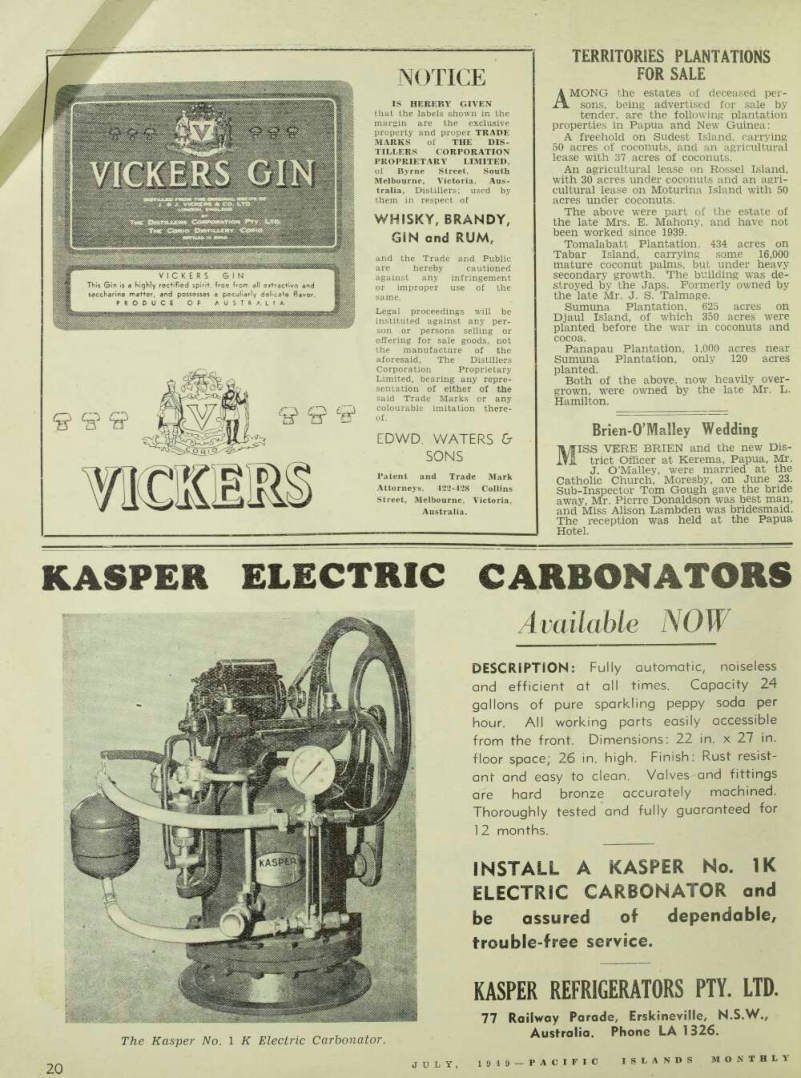
For Sale
AMONG the estates of deceased per sons, being advertised for sale by tender, are the following plantation properties in Papua and New Guinea: A freehold on Sudest Island, carrying 50 acres of coconuts, and an agricultural lease with 37 acres of coconuts.
An agricultural lease on Rossel Island, with 30 acres under coconuts and an agri cultural lease on Moturina Island with 50 acres under coconuts.
The above were part of the estate of the late Mrs. E. Mahony, and have not been worked since 1939.
Tomalabatt Plantation. 434 acres on Tabar Island, carrying some 16,000 mature coconut palms, but under heavy secondary growth. The building was de stroyed by the Japs. Formerly owned by the late Mr. J. S. Talmage.
Sumuna Plantation, 625 acres on Djaul Island, of which 350 acres were planted before the war in coconuts and cocoa.
Panapau Plantation, 1,000 acres near Sumuna Plantation, only 120 acres planted.
Both of the above, now heavily over grown, were owned by the late Mr. L.
Hamilton.
Brien-O’Malley Wedding
MISS VERE BRIEN and the new Dis trict Officer at Kerema, Papua, Mr.
J. O’Malley, were married at the Catholic Church, Moresby, on June 23.
Sub-Inspector Tom Gough gave the bride away, Mr. Pierre Donaldson was best man, and Miss Alison Lambden was bridesmaid.
The reception was held at the Papua Hotel.
Advertisements & other items, p. 22 (1 item)
Carbonators
KASPER ELECTRIC
K « m KA -*' , T/ie Kasper No. 1 K Electric Carhonator.
Available
DESCRIPTION: Fully automatic, noiseless and efficient at all times. Capacity 24 gallons of pure sparkling peppy soda per hour. All working parts easily accessible from the front. Dimensions: 22 in. x 27 in. floor space; 26 in. high. Finish: Rust resistant and easy to clean. Valves and fittings are hard bronze accurately machined.
Thoroughly tested and fully guaranteed for 1 2 months.
INSTALL A KASPER No. IK
ELECTRIC CARBONATOR and
be assured of dependable,
trouble-free service.
KASPER REFRIGERATORS PTY. LTD.
77 Railway Parade, Erskineville, N.S.W., Australia. Phone LA 1 326.
‘Permanent' Administratton
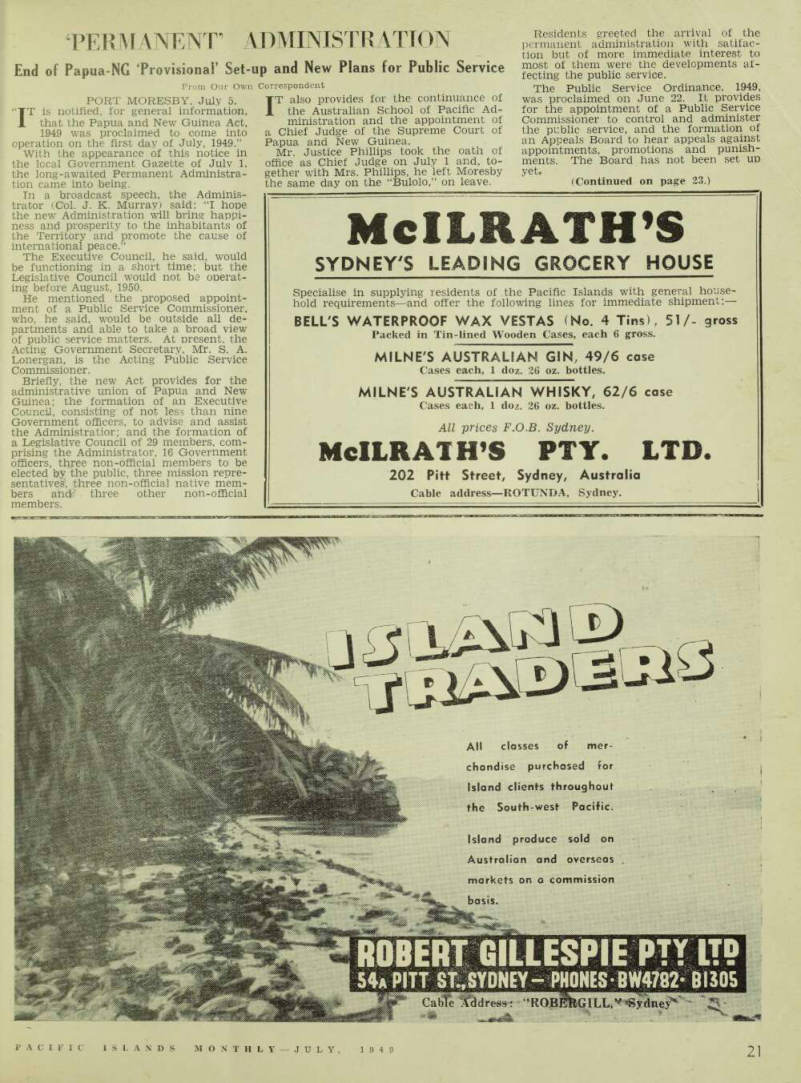

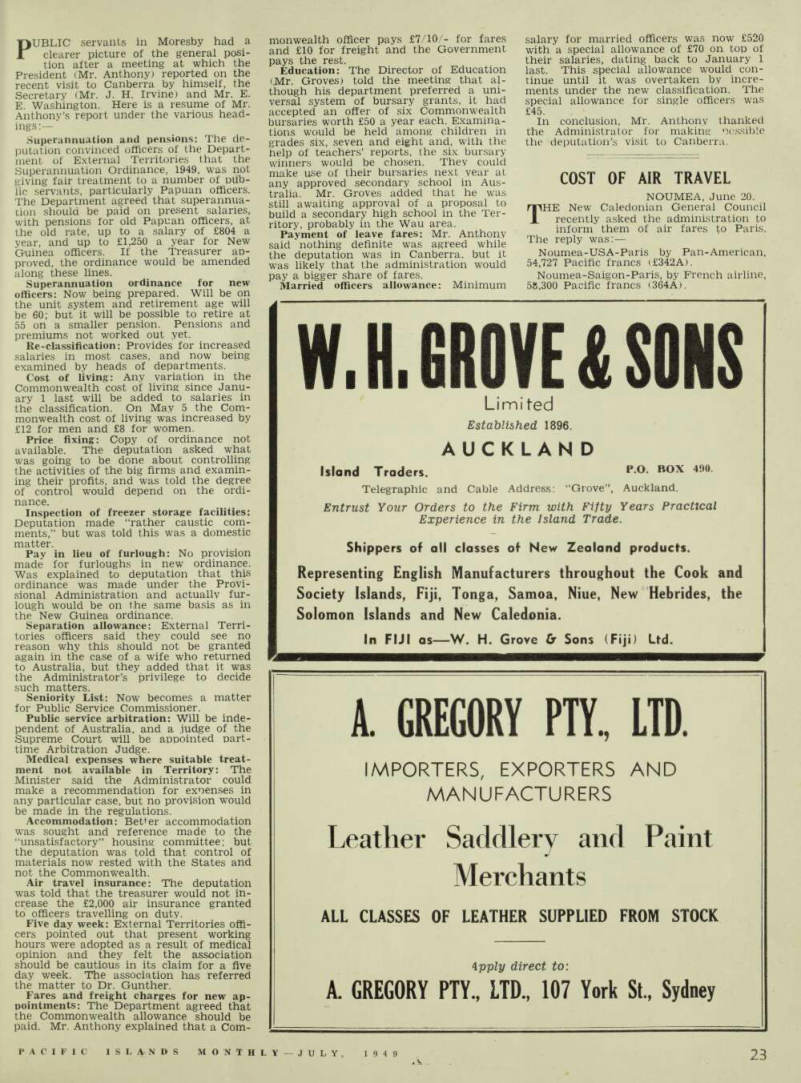
End of Papua-NG ‘Provisional’ Set-up and New Plans for Public Service
From Our Own Correspondent
Port Moresby, July 5.
“TT is notified, for general information, 1 that the Papua and New Guinea Act, 1949 was proclaimed to come into operation on the first day of July, 1949.”
With the appearance of this notice in the local Government Gazette of July 1. the long-awaited Permanent Administra tion came into being.
In a broadcast speech, the Adminis trator (Col. J. K. Murray) said: “I hope the new Administration will bring happi ness and prosperity to the inhabitants of the Territory and promote the cause of international peace.”
The Executive Council, he said, would be functioning in a short time; but the Legislative Council would not be operat ing before August, 1950.
He mentioned the proposed appoint ment of a Public Service Commissioner, who, he said, would be outside all de partments and able to take a broad view of public service matters. At present, the Acting Government Secretary, Mr. S. A.
Lonergan, is the Acting Public Service Commissioner.
Briefly, the new Act provides for the administrative union of Papua and New Guinea: the formation of an Executive Council, consisting of not less than nine Government officers, to advise and assist the Administratior; and the formation of a Legislative Council of 29 members, com prising the Administrator, 16 Government officers, three non-official members to be elected by the public, three mission repre sentatives, three non-official native mem bers and: three other non-official members.
IT also provides for the continuance of the Australian School of Pacific Ad ministration and the appointment of a Chief Judge of the Supreme Court of Papua and New Guinea.
Mr. Justice Phillips took the oath of office as Chief Judge on July 1 and, to gether with Mrs. Phillips, he left Moresby the same day on the “Bulolo,” on leave.
Residents greeted the arrival of the permanent administration with satifac tion but of more immediate interest to most of them were the developments af fecting the public service.
The Public Service Ordinance, 1949, was proclaimed on June 22. It provides for the appointment of a Public Service Commissioner to control and administer the public service, and the formation of an Appeals Board to hear appeals against appointments, promotions and punish ments. The Board has not been set up yet.
(Continued on page 23.)
PUBLIC servants in Moresby had a clearer picture of the general posi tion after a meeting at which the President (Mr. Anthony) reported on the recent visit to Canberra by himself, the Secretary (Mr. J. H. Irvine) and Mr. E.
E. Washington. Here is a resume of Mr.
Anthony’s report under the various head ings:— Superannuation and pensions: The de putation convinced officers of the Depart ment of External Territories that the Superannuation Ordinance, 1949, was not giving fair treatment to a number of pub lic servants, particularly Papuan officers.
The Department agreed that superannua tion should be paid on present salaries, with pensions for old Papuan officers, at the old rate, up to a salary of £BO4 a year, and up to £1,250 a year for New Guinea officers. If the Treasurer ap proved, the ordinance would be amended along these lines.
Superannuation ordinance for new officers: Now being prepared. Will be on the unit system and retirement age will be 60; but it will be possible to retire at 55 on a smaller pension. Pensions and premiums not worked out yet.
Re-classification: Provides for increased salaries in most cases, and now being examined by heads of departments.
Cost of living: Any variation in the Commonwealth cost of living since Janu ary 1 last will be added to salaries in the classification. On May 5 the Com monwealth cost of living was increased by £l2 for men and £8 for women.
Price fixing: Copy of ordinance not available. The deputation asked what was going to be done about controlling the activities of the big firms and examin ing their profits, and was told the degree of control would depend on the ordi nance.
Inspection of freezer storage facilities: Deputation made “rather caustic com ments,” but was told this was a domestic matter.
Pay in lieu of furlough: No provision made for furloughs in new ordinance.
Was explained to deputation that this ordinance was made under the Provi sional Administration and actually fur lough would be on the same basis as in the New Guinea ordinance.
Separation allowance: External Terri tories officers said they could see no reason why this should not be granted again in the case of a wife who returned to Australia, but they added that it was the Administrator’s privilege to decide such matters.
Seniority List: Now becomes a matter for Public Service Commissioner.
Public service arbitration: Will be inde pendent of Australia, and a judge of the Supreme Court will be appointed part time Arbitration Judge.
Medical expenses where suitable treat ment not available in Territory: The Minister said the Administrator could make a recommendation for expenses in any particular case, but no provision would be made in the regulations.
Accommodation: Better accommodation was sought and reference made to the “unsatisfactory” housing committee: but the deputation was told that control of materials now rested with the States and not the Commonwealth.
Air travel insurance: The deputation was told that the treasurer would not in crease the £2,000 air insurance granted to officers travelling on duty.
Five day week: External Territories offi cers pointed out that present working hours were adopted as a result of medical opinion and they felt the association should be cautious in its claim for a five day week. The association has referred the matter to Dr. Gunther.
Fares and freight charges for new ap pointments: The Department agreed that the Commonwealth allowance should be paid. Mr. Anthony explained that a Com
monwealth officer pays £7/10/- for fares and £lO for freight and the Government pays the rest.
Education: The Director of Education <Mr. Groves) told the meeting that al though his department preferred a uni versal system of bursary grants, it had accepted an offer of six Commonwealth bursaries worth £5O a year each. Examina tions would be held among children in grades six, seven and eight and, with the fielp of teachers’ reports, the six bursary winners would be chosen. They could make use of their bursaries next vear at any approved secondary school in Aus tralia. Mr. Groves added that he was still awaiting approval of a proposal to build a secondary high school in the Ter ritory, probably in the Wau area.
Payment of leave fares: Mr. Anthony said nothing definite was agreed while the deputation was in Canberra, but it was likely that the administration would pay a bigger share of fares.
Married officers allowance: Minimum
salary for married officers was now £520 with a special allowance of £7O on top of their salaries, dating back to January 1 last. This special allowance would con tinue until it was overtaken by incre ments under the new classification. The special allowance for single officers was £45.
In conclusion, Mr. Anthony thanked the Administrator for making possible the deputation’s visit to Canberra.
Advertisements & other items, pp. 23-24 (1 item)
Mcilrath’S
SYDNEY'S LEADING GROCERY HOUSE
Specialise in supplying residents of the Pacific Islands with general household requirements—and offer the following lines for immediate shipment:— BELL'S WATERPROOF WAX VESTAS (No. 4 Tins), 51/- gross Packed in Tin-lined Wooden Cases, each 6 gross.
MILNE'S AUSTRALIAN GIN, 49/6 cose
Cases each. 1 doz. 26 oz. bottles.
MILNE'S AUSTRALIAN WHISKY, 62/6 case
Cases each, 1 doz. 26 oz. bottles.
All prices F. 0.8. Sydney.
McILR AIM’S PTY. LTD.
202 Pitt Street, Sydney, Australia Cable address —ROTUNDA, Sydney.
m a m r r All classes of merchandise purchased for island ciienfs throughout the South-west Pacific.
Island produce sold on Australian and overseas markets on o commission basis.
ROBERT GILLESPIE PIT IT?
54* PITT BT..SYONEY- PHONES' 8W4782- 51305
CabTe ‘
MEAL FOR THE IMS...
ATCO —BOATIMPELLER
ns» • Simple to handle • Light—easily carried Surprisingly economical It's easy starting, has smooth power and gives trouble-free performance.
ATCOSCYTHE
AT '///, 7/ •in Cut time and labour costs with this dependable machine. It 7 s eight to twelve times as rapid as hand-scything. Ideal for cutting long grass, weeds, tall undergrowth, etc.
Just fill in the coupon "below for illustrated booklets which will be sent post free. % ...
I
ATCO MOTOR MOWER
There's a full range from the 12 and 14 inch models up to the 17, 20, 28 and 34 inch for big-area requirements. The ATCO is a self-contained unit and will go anywhere.
MOTOR TRACTORS PTY. LTD.
369-385 Wattle Street, Ultimo, Sydney.
Please send me Atco Booklets.
r NAME.
ADDRESS.
MOTOR TRACTORS
PTY. LIMITED
369-385 Wattle Street, Ultimo, Sydney Telegrams: “Sellmotors,” Sydney.
Cost Of Air Travel
Noumea, June 20.
THE New Caledonian General Council recently asked the administration to inform them of air fares to Paris.
The reply was: — Noumea-USA-Paris by Pan-American, 54,727 Pacific francs (£342A).
Noumea-Saigon-Paris, by French airline, 58,300 Pacific francs (364 A).
Advertisements & other items, pp. 25-26 (1 item)
W. H.Grove & Sons
Limited
Established 1896.
AUCKLAND
Island Traders. PO. box 4»o Telegraphic and Cable Address: “Grove”, Auckland.
Entrust Your Orders to the Firm with Fifty Years Practical Experience in the Island Trade.
Shippers of all classes of New Zealand products.
Representing English Manufacturers throughout the Cook and Society Islands, Fiji, Tonga, Samoa, Niue, New Hebrides, the Solomon Islands and New Caledonia.
In FIJI as—W. H. Grove Cr Sons (Fiji) Ltd.
A. GREGORY PTY, LTD.
IMPORTERS, EXPORTERS AND
MANUFACTURERS
Leather Saddlery and Paint Merchants ALL CLASSES OF LEATHER SUPPLIED FROM STOCK 4 rinJii dirppf fo’
A. GREGORY PTY., LTD., 107 York St., Sydney
A CRAMMOND Announcement
Extraordinary . . .
At present, undergoing field tests, is a further addition to the Tropic Eagle range.
The new model will be known as S.W.O TROPIC EAGLE. The letters stand for SHORT WAVES ONLY. Seven band coverage together with band spread have been provided for.
Weight of this new, all metal, moisture and insect proofed receiver will be approximately 28 lb.—measurements, 20 x 11 x 10. Speaker and batteries are housed in separate case, measurements, 12 x 8 x 7}. Weight is approximately 18 lb., including three heavy duty batteries.
This receiver has been developed at the suggestions of many residents of the Territory of New Guinea, who require a powerful, compact and reliable instrument. As usual, Crammonds have the answer.
Write for particulars to-day.
THE TROPIC EAGLE
EXCLUSIVE FEATURES:
Completely tropicproofed. Sealed in rustless metal cabinet.
EXCLUSIVE FEATURES:
Built in moisture absorber. Continuous coverage on short waves 16-150 metres; also broadcast band.
A TRUE "KING OF THE AIR"
Crammonds manufacture a range of thirty five models, including tropic proofed dual and triple wave receivers. In addition, we will design and build an instrument to meet your individual needs.
Write for particulars and illustrations of the famous Crammond Range:
CRAMMOND RADIO TROPIC DIVISION
No. 8 Queen Street, BRISBANE
After Many Mishaps
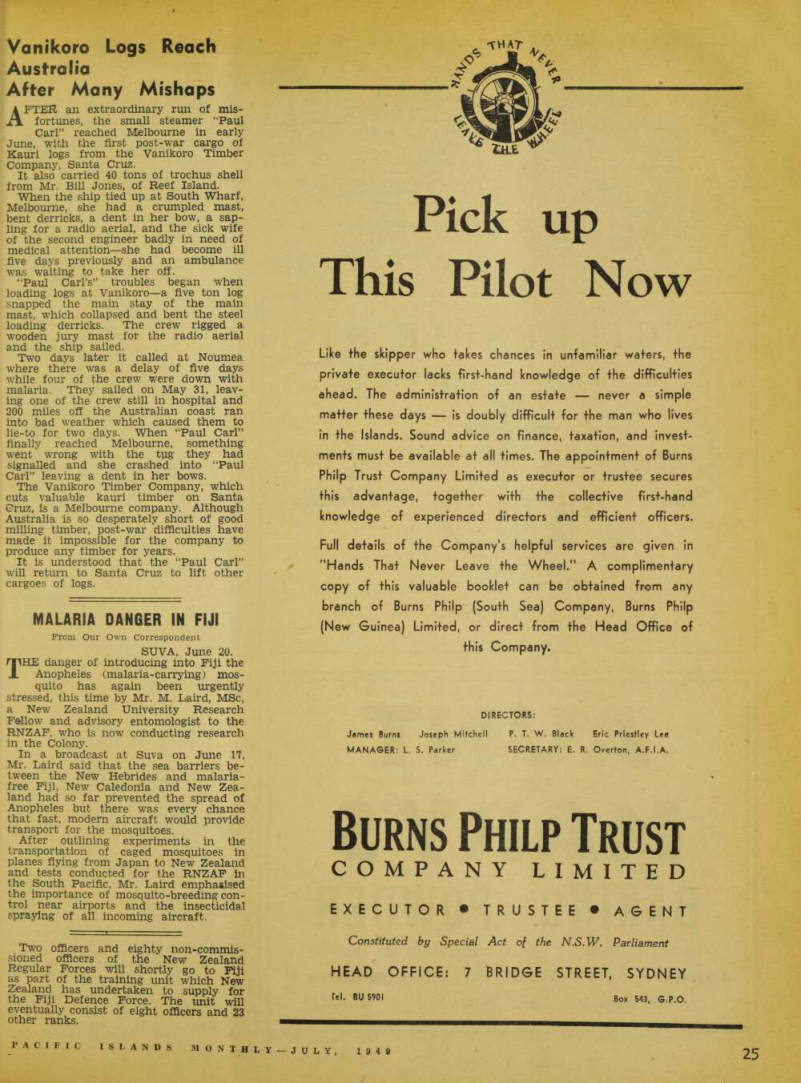
Vanikoro Logs Reach Australia After Many Mishaps
AFTER an extraordinary run of mis fortunes, the small steamer “Paul Carl” reached Melbourne in early June, with the first post-war cargo of Kauri logs from the Vanikoro Timber Company, Santa Cruz.
It also carried 40 tons of trochus shell from Mr. Bill Jones, of Reef Island.
When the ship tied up at South Wharf, Melbourne, she had a crumpled mast, bent derricks, a dent in her bow, a sap ling for a radio aerial, and the sick wife of the second engineer badly in need of medical attention—she had become ill five days previously and an ambulance was waiting to take her off.
“Paul Carrs” troubles began when loading logs at Vanikoro—a five ton log snapped the main stay of the main mast, which collapsed and bent the steel loading derricks. The crew rigged a wooden jury mast for the radio aerial and the ship sailed.
Two days later it called at Noumea where there was a delay of five days while four of the crew were down with malaria. They sailed on May 31, leav ing one of the crew still in hospital and 200 miles off the Australian coast ran into bad weather which caused them to lie-to for two days. When “Paul Carl” finally reached Melbourne, something went wrong with the tug they had signalled and she crashed into “Paul Carl” leaving a dent in her bows.
The Vanikoro Timber Company, which cuts valuable kauri timber on Santa Cruz, is a Melbourne company. Although Australia is so desperately short of good milling timber, post-war difficulties have made it impossible for the company to produce any timber for years.
It is understood that the “Paul Carl” will return to Santa Cruz to lift other cargoes of logs.
Malaria Danger In Fiji
From Our Own Correspondent SUVA, June 20.
THE danger of introducing into Fiji the Anopheles (malaria-carrying) mos quito has again been urgently stressed, this time by Mr. M. Laird, MSc, a New Zealand University Research Fellow and advisory entomologist to the RNZAF, who is now conducting research in the Colony.
In a broadcast at Suva on June 17, Mr. Laird said that the sea barriers be tween the New Hebrides and malaria free Fiji, New Caledonia and New Zea land had so far prevented the spread of Anopheles but there was every chance that fast, modern aircraft would provide transport for the mosquitoes.
After outlining experiments in the transportation of caged mosquitoes in planes flying from Japan to New Zealand and tests conducted for the RNZAF in the South Pacific, Mr. Laird emphasised the importance of mosquito-breeding con trol near airports and the insecticidal spraying of all incoming aircraft.
Two officers and eighty non-commis sioned officers of the New Zealand Regular Forces will shortly go to Fiji as part of the training unit which New Zealand has undertaken to supply for the Fiji Defence Force. The unit will eventually consist of eight officers and 23 other ranks.
Advertisements & other items, p. 27 (1 item)
Burns Philp Trust
'THAT
Pick up
This Pilot Now
Like the skipper who fakes chances in unfamiliar wafers, the private executor lacks first-hand knowledge of the difficulties ahead. The administration of an estate never a simple matter these days is doubly difficult for the man who lives in the Islands. Sound advice on finance, taxation, and investments must be available at all times. The appointment of Burns Philp Trust Company Limited as executor or trustee secures this advantage, together with the collective first-hand knowledge of experienced directors and efficient officers.
Full details of the Company's helpful services are given in "Hands That Never Leave the Wheel." A complimentary copy of this valuable booklet can be obtained from any branch of Burns Philp (South Sea) Company, Burns Philp (New Guinea) Limited, or direct from the Head Office of this Company.
DIRECTORS:
James Burns Joseph Mitchell P. T. W. Black Eric Priestley Lee MANAGER: L. S. Parker SECRETARY; E. R. Overton, A.F.I.A.
Burns Philp Trust
COMPANY LIMITED
EXECUTOR • TRUSTEE • AGENT
Constituted by Special Act of the N.S.W. Parliament
HEAD OFFICE: 7 BRIDGE STREET, SYDNEY
Tel. 8U 5901 Box 543, ©,P.O.
Farmers For New Caledonia
From Our Own Correspondent T tt „ , NOUMEA, June 20.
HE New Caledonian Agricultural De partment has been investigating the suitability of three properties suggested for the establishment of the Colony’s new Farm School. One is on the Paladini property at Paita, one Henard property at the Dumbea, and the third is the ancient convict farm school at Nemeara near Bourail. It is re ported that members of the General Coun cil will favour the last named.
In the hall of the Aero Club, in Paris, M. Edouard Berge, president of the Infor mation and Study Office for the French Pacific, recently delivered an address on New Caledonia, to a distinguished gather ing. He appealed for hard working French colonists for New Caledonia, as well as for investors interested in developing local plantations and industry.
He Knew!
SUVA. July 2.
IN a BBC broadcast, from London, Ravuama Vunivalu, who is studying the workings of co-operatives in Great Britain, related that at one of the Colonial Month exhibitions in London a group of spectators was discussing a 5 ft. picture of a smiling Fijian girl in dancing dress.
“What beautiful teeth!” said one mem ber of the group, “I wonder if they’re real or false.”
“Oh, they’re not false,” interposed Ravuama, in a meek voice.
“How do you know?” asked the first speaker.
“Well,” Ravuama explained, “she hap pens to be my wife!”
Mr. J. Cavanaugh, of the Kerevat Saw mill, Rabaul, is at present on 6 months’ leave in Australia.
Western Samoa
En Fete
On June 1 And 2
From Our Own Correspondent T tt APIA, June 10.
HE first anniversary of the raising of the Samoan flag was celebrated as a public holiday on June 1, and was followed by the celebration of King’s birthday (by special permission of His Majesty) on June 2. There was the usual kava' ceremony at Mulinu’u fono house, attended by the High Commissioner (Colonel G. R. Powles), the Hon. Fautua, members of the Legislative Assembly and the fono of Faipule; and, as guests of honour representing the Prime Minister and the Government of New Zealand, the Hon, A, G. Osborne (private secretary to the Prime Minister) and Mr. R. T. G, Patrick (secretary of the Island Territories Department, Wellington).
Returned Servicemen’s Association and numerous school children, in their pic turesque and colourful school uniforms, took part in the flag-raising ceremony which was followed by a Samoan luncheon (taumafataga).
At the kava ceremony, Mr. Osborne read a message from the Prime Minister (Mr.
Fraser) conveying his good wishes on be half of the New Zealand people. A message was also read from the former High Commissioner (Col. F. E. Voelcker) who represents New Zealand at the South Pacific Commission.
In the afternoon, Samoan dances and entertainments were given by the districts of the island of Savaii.
The King’s birthday celebrations on June 2 began with a function at Apia Court House attended by European and Samoan representatives, at which the Hon.
Malietoa and Hon. Jacob Helg addressed the gathering, and at which the Royal Salute was fired by the saluting battery at Matautu point. Fautasi and canoe races attracted a large crowd of excited spectators. The fautasi races were won by the Manono and Malua boats.
In the afternoon, a monster garden party was held in the beautiful grounds of the High Commissioner’s residence at Vailima (the former home of Robert Louis Stevenson) where some 1,000 people saw Samoan dances by the Atua and Tuama saga districts of Upolu.
Messrs. Osborne and Patrick extended their stay in Samoa for a fortnight and visited many places on both islands.
Only Picturesque
The Fijian Policeman Is Not
SUVA, July 2.
THE spectacle of 23 prisoners, on their way back to Suva Gaol after their day’s outside work, clambering out of the covered gaol truck and lining up near the Town Hall to watch the traffic police test the vehicle’s brakes, might once again have inspired the comment: “Where but in Suva could this happen?”
The incident occurred at 4.20 p.m. on June 30, after a collision between the truck and an Indian youth on a bicycle at the Victoria Parade-Macarthur Street corner.
Within a few minutes a large crowd had materialised and three lines of traffic were entangled at the corner. A handful of Fijian policemen materialised as promptly as the crowd and, within another few minutes, the ex-cyclist, with a minor head injury, had been sent to hospital, the traffic straightened out and the crowd moved off the roadway. The brake-inves tigations were a side-issue.
Which was another demonstration of the stupidity of the parrot-cry (still heard occasionally) that the picturesque Fijian policeman is mainly ornamental.
Advertisements & other items, p. 28 (1 item)
Mary’S
GILLESPIE
The Flour
- SYDNEY -
TRADE
MARK
*S of the Islands
AUNT
MARY’S
BAKING POWDER
For the best in delicious baking results A product of TILLOCK AND CO. PTY. LTD. manufacturers of all the famous Aunt Marys Pure Foods
Qantas Completes S-W Pacific Airways Circuit With
Lae-Honiara Service
From Our Own Correspondent
Rabaul, June 15.
THE inaugural flight of the Lae-BSI Qantas air-service returned to Rabaul, en route Lae, to-day. Ten passengers were carried.
This flight is to be run fortnightly, commencing from Lae on alternate Mon days. Calls will be made at Rabaul, Toro kina (Bougainville), Munda (Kolomban gara, BSD and Honiara. The plane will stay overnight at Honiara and return to Lae, by the same route, on alternate Tuesdays. DC3 Aircraft will be used.
Not only does this bring an extra mail service to Rabaul, but it gives such isolated spots as Torokina and Munda, swift, modern communication with the outside world. And, by linking up with the Qantas Sydney—New Hebrides— Solomon Islands service at Honiara, makes it possible for travellers to make a Sydney to Sydney trip calling at Port Moresby, Lae, Rabaul, Bougainville, BSI, New Hebrides, New Caledonia—without cover ing the same ground twice.
The apprenticeship system in Fiji is to be studied by a newly-appointed com mittee comprising the chief manager in Fiji of the Colonial Sugar Refining Co.
Ltd. (Mr. E. H. Griffiths), the general manager of the Associated Gold Mining Companies (Mr. N. E. Nilsen), the Super visor of Technical Services (Mr. R. A.
Derrick) and Messrs. J. Mercer and N. F.
C. Cowan. The committee will examine the present arrangements for training ap prentices and other juveniles in industry and will advise whether a uniform and controlled system of apprenticeship should be established.
Death Of Sister Cecilia
57 Years’ Work In Samoa
APIA, June 28.
THE senior member of the Marist Mis sionary Sisters, Sister Cecilia, died recently, aged 79, at the Catholic Mission at Moamoa, near Apia. Sister Cecilia, bom in Australia, was a member of the St. Julian family, well known in Fiji, and came to Samoa at the age of 22, in 1892, to organise the religious and educational activities of the Marist Sisters in Samoa.
Together with the late Sister Joseph (a member of the Swann family, also well known in Fiji and Samoa) she founded the Marist Sisters Girls’ School at Savalalo; and, later, from 1905 to 1933, she taught at the Marist Sisters School at S’alelavalu, Savaii. Prom 1934 to 1942 she again taught at the Savalalo (Apia) school, retiring in 1942 to Moamoa, where she spent the last years of her life.
Sister Cecilia was greatly respected by the European and Samoan communities and revered by generations of girls who had been educated and influenced bv her during her long residence of 57 years in the Territory.
Mr. J. B. Wright, after acting for several months after the departure of the former secretary to the Samoan Government, Mr. W. R. McCulloch, was recently ap pointed secretary to the Samoan Govern ment. Mr. L. M. Cook, formerly of Raro tonga, Cook Islands, succeeds Mr. Wright as Collector of Customs.
Noumea’S Airport
THE French technical expert, M. Mazin, who has been studying the project to enlarge Noumea’s Magenta airport, estimates that the work will cost about 45,000,000 Pacific francs (less than £300,000A) plus 10,000,000 francs for build ings. The Colony’s share of the cost will be limited to 15,000,000 francs.
Advertisements & other items, pp. 29-30 (1 item)
Nelson & Robertson Si
MADAME LAMOUR.
Recommends to the smart ladies of the islands her exquisite accessory set of same colour gloves and bag in all pastel shades, and also in first-grade kid and genuine lizard.
SET; (BAG & GLOVES) IN
PASTEL SHADES, OR KID £6/6/-
SET: (BAG & GLOVES) IN
GENUINE LIZARD £lO/10/-
BELT TO MATCH, 15/- EXTRA.
FOR ELBOW LENGTH GLOVES
EXTRA 16/-.
(CASH WITH ORDER)
Please write to Box 466, G.P.0., Sydney , stating size of gloves and colour of set desired. We post designs and colour scheme if required—charge 3/-. If satisfied, please recommend us to your friends.
NELSON and ROBERTSON Pty. Ltd.
Established 1895
Shipowners - Brokers and
Islands Merchants
All classes merchandise purchased at Best Wholesale Prices. Original Invoices supplied to Island Clients. Cocoa Beans, Copra, Rubber, Trochus Shell and All Islands' Produce Sold on Commission.
Entrust your requirements to the firm with fifty years' practical experience in the Pacific Islands.
Prompt attention given to all inquiries
NELSON & ROBERTSON Si
12 SPRING STREET, SYDNEY, AUSTRALIA
Telegraphic Address: IVAN, SYDNEY.
Your teeth
sparkle
with new
lustre
You save money
at the same
time with
KOL YNOS
, m \ v ’
A 9 w <s> & fr o % & % V/ >3 <£, o.
N * Yes! Kolynos save you money. Kolynos lasts longer because it is highly concentrated. Half an inch on a dry brush is all you need to leave your teeth surgically clean and gleaming. Always ask for Kolynos.
DENTAL
CREAM
(Sleans better-wastes better- [Lasts longer
The Crooks
Ward Exonerated—Carden And Farrell Were
Judges Findings In The New Guinea Timber Lease Inquiry
THE report of the Australian Royal Commissioner (Mr. Justice Ligertwood) on the New Guinea Timber Lease Inquiry, made public on June 24, contained no surprises. As was pointed out by the “PIM” in April and May, the nature of the evidence placed before the Commission made it certain that the Commissioner would completelv exonerate the Australian Minister for External Territories, Mr. E. J. Ward, of any charge involving corruption or an improper interest in the alleged sale of a New Guinea timber concession to the Queensland timber merchants. Hancock and Gore Ltd.
The Commissioner’s report covered 95 pages; but the substance of his findings is in his answers to the five terms of reference, as follows; — 1 Txru i. TT7^Q h What were real transactions msolved between Raymond Parer Harand Hancock Limited f
n?its rifrertnr?
in’ Umberriehts
rnfnpno g
m iNew omnea.
FINDING: The transaction embodied in the two deeds was a barefaced fraud by Farrell and J. S. Garden upon Hancock and Gore, Ltd.
By false pretences they induced Hancock and Gore to buy a non-existent timber concession and to pay them £50,000 on account of the purchase money.
Raymond Parer and Harcourt Garden
were involved in the transactions, and their conduct was morally censurable, but a jury had acquitted them of criminal complicity.
The working directors of Hancock and Gore, Ltd. (which did not include Mr. E.
R. Crouch nor Sir William Glasgow), were induced to enter into the transac tion by their greed for timber and by their desire to get into Bulolo Valley ahead of their rivals.
They were prepared to enter into a secret transaction which, because of J. S.
Garden’s position as a public servant, was improper.
They were aware of the impropriety, and were ready to take advantage of it, seeking to salve their consciences with the reflection that they were dealing with the syndicate, and were paying full value for the timber, and that the means by which the syndicate became possessed of the grant, and what they did with the purchase money were no concern of theirs.
So much did they realise the impro priety of the transaction, that for three and a half years, notwithstanding the fact that £50,000 was involved, they were afraid to approach the Minister of the Department to see if there was any sub stance in what they thought they had bought.
Hancock and Gore’s solicitor (Mr. E.
E. Biggs) co-operated with the working directors in negotiating the transaction with similiar knowledge of its impro priety. He failed in his duty to advise
tht company properly and to secure it against loss.
The company’s logging manager (Mr. H.
G. Forshaw) also assisted in negotiations with knowledge of the impropriety of the transaction. 2. Was the Minister for External Terri tories (Mr. E. J. Ward) a party to any of the transactions?
Finding; No.
3. Did the Minister sign or authorise John Smith Garden to sign any notification that the grant to Raymond Parer of any timber licence in the Bulolo Valley had been or would be approved by the Minister?
Finding; No.
4. Was the Minister promised any finan cial benefit from any of the transac tions mentioned or did he receive— either directly or indirectly—any financial benefit from that company?
Finding; No.
5. Was the Minister (a) financially in terested—either directly or indirectly— in Sydney Pincombe, Ltd.; (b) did he receive—either directly or indirectly— any financial benefit from that com pany?
Finding; No.
Concerning Mr. Farrell
Mr. Justice Ligertwood said that the authorities should consider criminal pro secution against Edward Farrell.
He added: “There were many indica tions that Farrell was the master mind in carrying out the Hancock and Gore transaction.
“Medical evidence showed that since 1948 his health had improved consider ably.”
When John Smith Garden, Harcourt Garden, and Raymond Parer came to trial in November last year on charges
(Continued on Page 31)
of conspiracy, Judge Holt adjourned a similar charge against Farrell because of Farrell’s ill-health. On January 7 last, after a jury had acquitted the Gardens and Parer, the Crown dropped the charge against Farrell.
Concerning Mr. Garden
Mr. Justice Ligertwood commented on the position and status of John Smith Garden and Royden Murray Service Cformer manager of Army Inventions Directorate) He said: “Each of them was brought temporarily into the public service and was given a responsible office.
“Each of them was allowed a measure of trust and discretion outside the routine of the department to which he was at tached.
“Each of them betrayed his trust.
“The necessities of the time and the sudden expansion of the Public Service may have made it desirable, if not neces sary, to create offices like those held by Garden and Service.
“But this inquiry has emphasised that the utmost care should be exercised in selecting persons to fill such offices and defining and supervising their duties and activities.”
Concerning Mr. Halligan
“In marked contrast was the secretary and permanent head of the Department of External Territories (Mr. J. R. Halli gan) who, over a long period, faithfully discharged his administrative duties.
Concerning Mr. Ward
Mr, Justice Ligertwood said that he saw no reason to doubt any portion of Mr. Ward’s evidence. He added: “Mr. Ward gave his evidence openly and frankly, and with an air of sincerity and truth.
“Allegations that Mr. Ward was a party to the corrupt transaction and received
£5,000 on account of his share of the purchase money depend entirely on Gar den.
“I find it impossible to give credence to Garden’s story. It comes from a man who, in its very telling, confesses himself engaged in the most corrupt transaction.
“His story shows signs of having been designed to fit in with the indisputable facts and of having been changed from time to time to meet new facts.
“In marked contrast was Mr. Ward’s evidence.”
Mr. Ward Resumes
Mr, Ward immediately resumed con trol of the Department of External Terri tories. He was, at his own request, re lieved of that portfolio six months ago, pending inquiry by a Royal Commission. (Our editorial comment upon this case is published elsewhere in this issue.)
Advertisements & other items, pp. 31-32 (1 item)
Photographers..
... make every exposure a "certainty"
with one of these exposure meters
PALEC EXPOSURE METER.
With its dual-range sensitivity and sapphire-jewelled meter movement, this Australian-made meter makes exposure calculation simplicity itself. It covers exposure speeds from 1/1000 sec. to 60 secs., and f. stop numbers from f/1 to f/64—cine work from 8 to 96 frames per second. Sturdy black plastic body, neck cord, and zipper leather case.
WESTON MASTER UNIVERSAL EXPOSURE METER.
Of reliable British manufacture, the Weston Master is the “favourite" for tropical photography—its sensitive photo-electric cell is specially sealed to provide additional stability and to ensure accurate readings even in extremes of humidity and temperature. Precision made with a jewelled movement in a streamlined plastic case, it covers all f. stops and all exposure times from 1/1200 sec to 90 secs.
AVO EXPOSURE METER.
Whether your choice be black-and-white or colour, during day or night, the delicate sensitivity of the Avo meter ensures accuracy with eves*y reading. It is the first meter to be scaled in B.S. index numbers thus simplifying its operation. It is ideal for tropical use—the photo-electric cell is fully sealed against damp and dust, whilst the jewelled bearings of the movement are shock-resistant.
METROVICK EXPOSURE METER.
A highly accurate yet robust electric light-measuring instrument, the Metrovick is adjustable for use with most cameras and films. It has a double-range sensitivity to permit readings under very dull conditions, and covers exposures from 1/500 sec. to 32 secs. Size 2 x 2 x II ins. Weight 6 ozs. Complete in ever-ready case.
I m
ENQUIRIES INVITED TO ALL KODAK
DEALERS THROUGHOUT THE ISLANDS
Kodak (A/sia) Pty., Ltd., 379 George Street, Sydney
An ornate example of historical
keys, this XVlth Century
French key features the sporting motif in its club and animal carvings. It seems to have been the key to a Duke’s country
lodge.
v'- —£? e 90S ■Cr ill V
The key
to smoking pleasure
APSTAN
FINE CUT
NAVY CUT
TOBACCOS
or 1657./ 4P
Melanesian Chief Weds
Tahitian
Noumea, June 20.
KAKOU KOUMA, son of the grand chief Kakou, of the Tawainedre district of Mare, Loyalty Islands, recently married a pretty ‘Tahitian girl named Vaitupari Apimata.
This is the second time the son of a Mare chief has married a Tahitienne.
In 1911, Billy, son of Naisseline, the most powerful chief on Mare, then a sailor on the gunboat Zelee, married a little wahine, with whom he settled down in Tahiti and raised a large family.
Diesease In Tahiti
Noumea, June 20.
A HEALTH campaign in Tahiti recently gathered in, for treatment, 570 tuber culosis patients, and 1,609 syphilitics.
Lepers are being given a new French treatment known as Promisole,
Nostalgia
Letter to the Editor I HAVE often wondered how many countries, other than those listed on its title page, the “PIM” reaches. It would be very interesting to know.
I always have a copy or two with me on my trips to Siam (or Thailand, as it is again officially called—“Land of the Free”) where my work often takes me, and they have been appreciated by friends of mine in that country.
Incidentally, I have been a reader since the first issue in 1930, when I lived in Apia, I like this part of the world well enough; but my heart will always be in the Islands.
A few days ago, I swam at a Siamese beach, in the Bay of Bengal, where a really magnificent surf was thundering in, and I thought of the beautiful, sequestered spots I know in the Pacific, where I spent many happy hours, 20 and 30 years ago—of the first Islands beach I knew, at Ela, and, later, the beaches of Ysobel and Marau Sound —the lovely little beaches at Utu goke, Nuku Island, Neiafutahi, and at the foot of the Ha’alaufuli Liku. Mulinu’u and Faleula, on moonlight nights, come then readily to my mind, and Saweni and Sigatoka. Then later, during the war years, the grimmer but not less beautiful Gona and Scarlet Beach, and back to the country where I commenced with, Ela.
And now, when I’m past 50, I swim along the sundrenched beaches of Penang and Thailand, and still enjoy life. But the days of my youth in the Islands were the days of zest. I hope to see them all again sometime, and I know I would meet well remembered friends, for I often see their names mentioned in the “PIM.”
I wish you many years of continued success.
I am, etc.,
Arthur H. Green,
Tongkah Compound 3, 15 Beach St., Penang.
Advertisements & other items, p. 33 (1 item)
Steamships Trading Company Ltd
Wholesale & Retail Merchants, Planters, Sawmillers, Engineers, Slip
Proprietors, Shipping, Customs and Insurance Agents.
PORT MORESBY AND SAMARAI PAPUA
MANAGING AGENTS for:
AGENCIES:
SAWMILLERS & TRADERS LTD.
CORAL SEAS INSURANCE CO. LTD.
ACME BAKERY COMPANY.
MARIBOI RUBBER LTD.
RUBBERLANDS LTD.
KEREMA RUBBER PLANTATIONS LTD.
COCOALANDS LTD.
BANKERS & TRADERS INSURANCE CO. LTD.
VACUUM OIL CO. PTY., LTD.
DIRECTORATE OP SHIPPING —Papua—New
Guinea Division.
ROYAL PACKET NAVIGATION CO.
KOKE BAGU PTY., LTD.
TRANS OCEANIC AIRWAYS.
TRADERS.
DISTRIBUTORS IN PAPUA for:
ARMSTRONG-HOLLAND PTY., LTD. INTERNATIONAL HARVESTER CO. OP AUST. LTD.
Earth Moving and Logging Equipment. International Trucks, WILLYS-OVERLAND EXPORT CORPORATION. McCormack Deering Farming Machinery, Jeep cars, etc. Defender Refrigerators.
SYDNEY AGENTS: NELSON & ROBERTSON PTY. LTD., 12 SPRING STREET
American Consumption
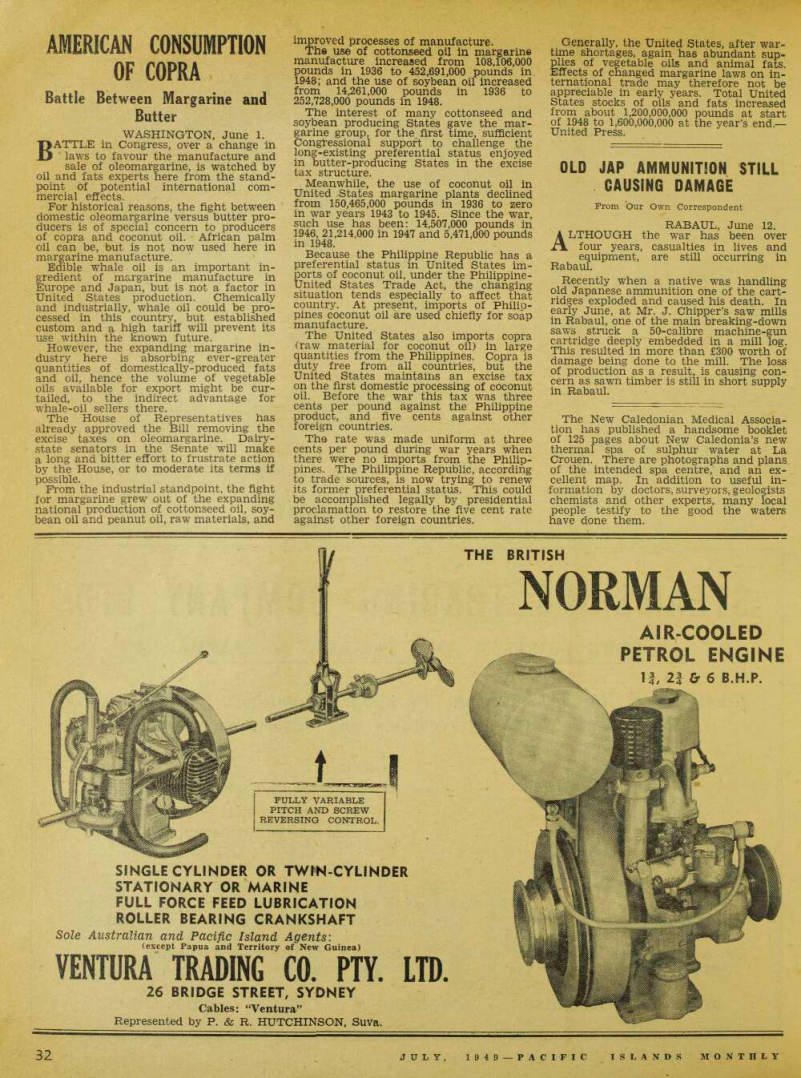
Of Copra
Battle Between Margarine and Butter
Washington, June 1.
BATTLE in Congress, over a change in laws to favour the manufacture and sale of oleomargarine, is watched by oil and fats experts here from the stand point of potential international com mercial effects.
For historical reasons, the fight between domestic oleomargarine versus butter pro ducers is of special concern to producers of copra and coconut oil. African palm oil can be, but is not now used here in margarine manufacture.
Edible whale oil is an important in gredient of margarine manufacture in Europe and Japan, but is not a factor in United States production. Chemically and industrially, whale oil could be pro cessed in this country, but established custom and a high tariff will prevent its use within the known future.
However, the expanding margarine in dustry here is absorbing ever-greater quantities of domestically-produced fats and oil, hence the volume of vegetable oils available for export might be cur tailed, to the indirect advantage for whale-oil sellers there.
The House of Representatives has already approved the Bill removing the excise taxes on oleomargarine. Dairy state senators in the Senate will make a long and bitter effort to frustrate action by the House, or to moderate its terms if possible.
From the industrial standpoint, the fight for margarine grew out of the expanding national production of cottonseed oil, soy bean oil and peanut oil, raw materials, and
improved processes of manufacture.
The use of cottonseed oil in margarine manufacture increased from 108,106,000 pounds in 1936 to 452,691,000 pounds in 1948; and the use of soybean oil increased from 14,261,000 pounds in 1936 to 252,728,000 pounds in 1948.
The interest of many cottonseed and soybean producing States gave the mar garine group, for the first time, sufficient Congressional support to challenge the long-existing preferential status enjoyed in butter-producing States in the excise tax structure.
Meanwhile, the use of coconut oil in United States margarine plants declined from 150,465,000 pounds in 1936 to zero in war years 1943 to 1945. Since the war, such use has been; 14,507,000 pounds in 1946, 21,214,000 in 1947 and 5,471,000 pounds in 1948.
Because the Philippine Republic has a preferential status in United States im ports of coconut oil, under the Philippine- United States Trade Act, the changing situation tends especially to affect that country. At present, imports of Philio pines coconut oil are used chiefly for soap manufacture.
The United States also imports copra (raw material for coconut oil) in large quantities from the Philippines. Copra is duty free from all countries, but the United States maintains an excise tax on the first domestic processing of coconut oil. Before the war this tax was three cents per pound against the Philippine product, and five cents against other foreign countries.
The rate was made uniform at three cents per pound during war years when there were no imports from the Philip pines. The Philippine Republic, according to trade sources, is now trying to renew its former preferential status. This could be accomplished legally by presidential proclamation to restore the five cent rate against other foreign countries.
Generally, the United States, after war time shortages, again has abundant sup plies of vegetable oils and animal fats.
Effects of changed margarine laws on in ternational trade may therefore not be appreciable in early years. Total United States stocks of oils and fats increased from about 1,200,000,000 pounds at start of 1948 to 1,600,000,000 at the year’s end.— United Press.
Old Jap Ammunition Still
Causing Damage
From Our Own Correspondent
Rabaul, June 12.
ALTHOUGH the war has been over four years, casualties in lives and equipment, are still occurring in Rabaul.
Recently when a native was handling old Japanese ammunition one of the cart ridges exploded and caused his death. In early June, at Mr. J. Chipper’s saw mills in Rabaul, one of the main breaking-down saws struck a 50-calibre machine-gun cartridge deeply embedded in a mill log.
This resulted in more than £3OO worth of damage being done to the mill. The loss of production as a result, is causing con cern as sawn timber is still in short supply in Rabaul.
The New Caledonian Medical Associa tion has published a handsome booklet of 125 pages about New Caledonia’s new thermal spa of sulphur water at La Crouen. There are photographs and plans of the intended spa centre, and an ex cellent map. In addition to useful in formation by doctors, surveyors, geologists chemists and other experts, many local people testify to the good the waters have done them.
Advertisements & other items, p. 34 (1 item)
Norman
t
FULLY VARIABLE
PITCH AND SCREW
REVERSING CONTROL.
SINGLE CYLINDER OR TWfN-CYLINDER
STATIONARY OR MARINE
FULL FORCE FEED LUBRICATION
ROLLER BEARING CRANKSHAFT
Sole Australian and Pacific Island Agents : (except Papua and Territory of New Guinea)
VENTURA TRADING CO. PTY. LTD.
26 BRIDGE STREET, SYDNEY
Cables: “Ventura'’
Represented by P. & R. HUTCHINSON. Suva.
THE BRITISH
NORMAN
AIR-COOLED
PETROL ENGINE
IJ, I*Cr 6 B.H.P.
How Nonga Graduates
Assist NG Health Programme
From Our Own Correspondent
Rabaul, June 26.
THE Medical and Hygiene Training School for natives, situated at Nonga, about three and a half miles from Rabaul township, is built in an ideal setting on the foreshores of the north coast of Gazelle Peninsula. It was estab lished in February, 1948, for the purpose of training natives to be Medical Assis tants or Hygiene Assistants.
The present enrolment is 150 students of whom 25 are native women. Fifty of them are now studying for their final examinations which commence at the end of June. The successful candidates will then be considered ready to return to their villages as either Medical Assis tants or Hygiene Assistants—whichever was their chosen study.
The Medical Assistants will be equipped with drugs and instruments with which their trading has made them thoroughly familiar: the Hygiene Assistants will be equipped with DDT spray and the tools required in their special work. They both will be on the payroll of the Depart ment of Public Health.
The normal hours of the school are 23 hours each week but in an all-out effort to pass their examinations most of the students are studying from between 50 to 60 hours at the present time. With such enthusiasm surely great benefit will be derived from these people when they re turn to their villages.
Nonga is one of the schools set up under the Commonwealth Reconstruction Training Scheme.
Mr. Harold Williams, missionary asso ciate, has arrived safely at Ndui Ndui, New Hebrides.
Use Of Coconut Fronds
For Bags
AS a further contribution to the discus sion about the destruction of coconut fronds in Tonga, Mrs. Cameron, of Nukualofa (now a resident of Sydney) says that the practice grew up because the merchants refused to supply the native villagers with sacks for their copra.
The villagers consistently used the sacks for domestic purposes—especially for the cooking-ovens—and the merchants got weary of it.
Unable to get sacks, the villagers made their own bags out of coconut fronds. ‘ PIM” correspondents say that this prac tice has weakened the palms and reduced their production of nuts. Mrs. Cameron does not agree with this—she says all coconut palms should be more or less pruned.
The Public Works Department in Fiji has made it clear that workers are free to join a labour union or otherwise as they feel inclined. In a notice it was stated that the Government’s policy was to encourage its employees to organise in order to facilitate collective bargaining and the composition of differences with employing departments. At the same time, any employee of the Government who brought pressure to bear on any other employee, or interfered with his freedom of action in the matter, was liable to disciplinary action.
Rabaul Baseball Assn.
From Our Own Correspondent
Rabaul, June 30.
AT the annual general meeting of the Rabaul Baseball Association, at the end of June, the following office bearers were elected;— Mr. Keith Chambers, president; Mr. G.
Lange, vice-president; Mr. D. Briggs, se cretary; Mr. Roger Hall, treasurer.
The retiring president, Mr. R, Dobbie, reported on the past season’s activities which were handicapped by equipment shortages and the transfer of players to other districts.
The 1949 season will commence in August. It is not known yet how many teams will compete but it is anticipated that a team from Kokopo will enter the competition for the first time.
Garnett—Suters Wedding
AT Suva Holy Trinity Pro-Cathedral on June 15, Miss Mavis Kathleen Gar nett, younger daughter of Mr. and Mrs. Lionel F. Garnett, of Suva, was married to Mr. Thomas William Suters of the Bank of New South Wales, Suva. The Rev. H. W. Figgess officiated.
The bridesmaids were Miss Joan Garnett and Miss Mary Green. Mr. Wilkie Sim mons was best man and Mr. J. Rogers groomsman.
Advertisements & other items, pp. 35-36 (1 item)
Heinz
OUR HANDS MAKE GOOD ARMS
SI L
For your Fishing and Shooting Wants Consult Us.
Lithgow .22 Cal. Repeating Rifles ... £ll 14 0? Post Lithgow .22 Cal. Single Shot 5 1 3J Extra RO H U 143 ELIZABETH STREET, SYDNEY.
ITMn-m.. it’s Heinz/
Appetites spring to life when its Heinz Tomato Soup made with “Aristocrat” Tomatoes.
Grown specially for Heinz, tended and cared for until red-ripe, then made into the perfect Tomato Soup with that smooth texture and enticing Heinz flavour.
And try Heinz Home Style Tomato Soup too , it’s garnished with vegetables. m
TOW* 1 .?
SOVJ"
VARIt
ST
HEINZ
TOMATO
SOUP
cc
My samples or complete orders
get there fastest by Speedbird!”
p K M Right off-hand I can give you four reasons why it’s good for my business—and B/ 7 1 1 j yours—to send samples and icomplete orders across the JR world by 8.0.A.C. First, & it’s fast —as fast as regular Speedbird service to five continents and fortytwo countries can make it. Next, packing can be lighter and therefore cheaper. Third, insurance rates are reasonable. Finally, there’s little danger of damage or pilferage because Speedbird freight gets individual handling and prompt delivery. All of which means that I can maintain my overseas stocks more easily and cover a wider selling area. These same advantages of speed, service and efficiency apply for Speedbird passengers as well. 150,000 miles of 8.0.A.C. air routes make midgets of the miles and save me valuable travelling time.
And always I feel completely at home —completely comfortable. Piping hot meals and between-meal snacks are served with the compliments of 8.0.A.C. No tipping, either, for attentive service that caters to your every wish !
GREAT BRITAIN
MIDDLE EAST
SOUTH AFRICA
AUSTRALIA
USA • BERMUDA
WEST AFRICA
PAKISTAN • INDIA
NEW ZEALAND
FAR EAST
• CANADA
EAST AFRICA
• CEYLON
JAPAN
8.0.A.C. TAKES GOOD CARE OF YOU
t A/} 30
FLY BO AC
A6/AU
Information & Bookings : Qantas. Empire Airways Ltd ., Sydney , Melbourne , Brisbane , Townsville , Cairns , Darwin (General Agents in Australia ), or from Booking Agents in all cities.
BRITISH OVERSEAS AIRWAYS CORPORATION WITH Q.E.A., T.E.A.L. AND S.A.A.
Pidgin Newspapers
Keen Rivalry Between Pidgin Newspapers
Prom Our Own Correspondent
Rabaul. June 30.
THERE were three European news papers in Papua-New Guinea before the war (published in Port Moresby, Rabaul and Morobe) but there are none to-day. Consequently many Europeans and Chinese are driven to reading the four Pidgin English newspapers that now flourish in the Territory of New Guinea.
The Rabaul paper is called, “Rabaul News”; the others are: “Lagasai” (pub lished in Kavieng), “Garamut” (Lae), and “Buka News’ (Bougainville).
The “Rabaul News” was started on Sep tember 21, 1946, by Mr. "F. Boisen, District Education Officer, and Mr. M. Foley, at present Assistant District Officer, Gas mata. Like the three other papers it is now a roneoed sheet; it is edited by Waiau Ahnon.
The circulation was at first 500. but this has leapt to 1,500 copies per week, with the demand still growing—it is an ticipated that by November, 2,000 copies will be in circulation weekly.
The “News” is printed every Friday night by Waiau and his staff of six natives assisted by volunteers from Mala guna Commonwealth Reconstruction Training School. Distribution gets off to a flying start at the native market on Saturday mornings, and 10 copies for every village in the Rabaul district are left with the Assistant District Officer, who gives them to the Luluai of each village during the usual Saturday com bined conference of native officials.
The Education Department has ar ranged for copies to be posted to such i
schools as Sogeri and to other districts where recruited labour from Rabaul might be serving.
The “Buka News” was' commenced at the end of 1948, by Mr. F. Boisen, District Education Officer, Sohano. The “Laga sai” published its first issue on March 15, 1947, Mr. E. Gibson, District Educa tion Officer in conjunction with District Services, being at the helm. The Lae “Garamut” was first published on October 11, 1947, the editor then being Mr. J.
Doonar, District Education Officer, as sisted by Waiau Ahnon. It is now edited by Kenyon Ahnon, Waiau’s cousin.
There is intense rivalry between these four publications. (Editorial Note: Some time ago, the Minister for External Territories. Mr. E.
J. Ward, described Pidgin as gibberish and expressed a desire that it be rooted out of the New Guinea scheme of things, root and stem. Only the missions bothered to reduce Pidgin to its written form before the war, but now that the Administration is turning out these news-sheets it ap pears that the eradication of Pidgin is one dream of Mr. Ward’s that will not come true.)
Slight Rise In Fiji’s Cost of Living
Prom Our Own Correspondent SUVA, June 22.
ARISE of one point—to 175 — is shown in the quarterly index of the cost of living of European families in Fiji.
The index is compiled by Mr. C. H.
Came on the basis of 100 for August, 1939.
In the last quarter increases occurred in food, cleaning and lighting and hardware groups. A decrease is recorded in the clothing group, mainly in men’s clothing items and household goods, such as sheets and towels.
No More European Sett Les
Wanted In Tonga
SEVERAL months ago, Mr. J. C. Samp son, of police headquarters, Darwin, Australia, wrote to the Government of Tonga, and sought permission to enter the country', with a view to permanent residence. He received the following letter from the Premier; “Owing to the difficulties of procuring accommodation and supplies of essential commodities, prevailing in Tonga under post-war conditions, it is regretted that no permits can be issued at present for permanent residence in the Kingdom.”
Mr. Sampson is a descendant of the Cocker family, pioneer European settlers in Tonga, and regards the country as a sort of ancestral home.
Tropical Sheep-Farmer
Death Of Mr. S. O. Martin,
THE death occurred, in Sydney, at the end of June, of Mr. S. O. Martin, who made history by establishing a sheep station on a tropical island, and carrying it on successfully. Mr. Martin introduced Australian sheep to his pro perty on Erromanga, in the southern New Hebrides, some 20 years ago; and they multiplied and flourished. Mr. Martin taught the natives —once notorious for the number of missionaries they had murdered —to become efficient sheep-ten ders,-and he sold the wool at good prices.
Erromanga is a large island, with ranges nearly 3,000 feet hign, apd the sheep have done well on the plateaus. Mr. Martin was 78 years old, and is survived by his wife and one daughter.
Advertisements & other items, p. 37 (1 item)
'Masse
ENJOY YOUR
MOTORING
GET A
'Masse
BATTERY
“They re Tigers for Work” ■V? f i 1 a There's no better battery made than Masse. Sturdy plates and husky case make for long life. Supercol Separators ensure a super-activity of acid on every part of the plates, giving a constant output of current far beyond the allotted span. That's why Masse stands up to hard work and the heaviest drains made upon it in starting and lighting.
ROBERT GILLESPIE S.
LAE and RABAUL
LTD.
Newspaper
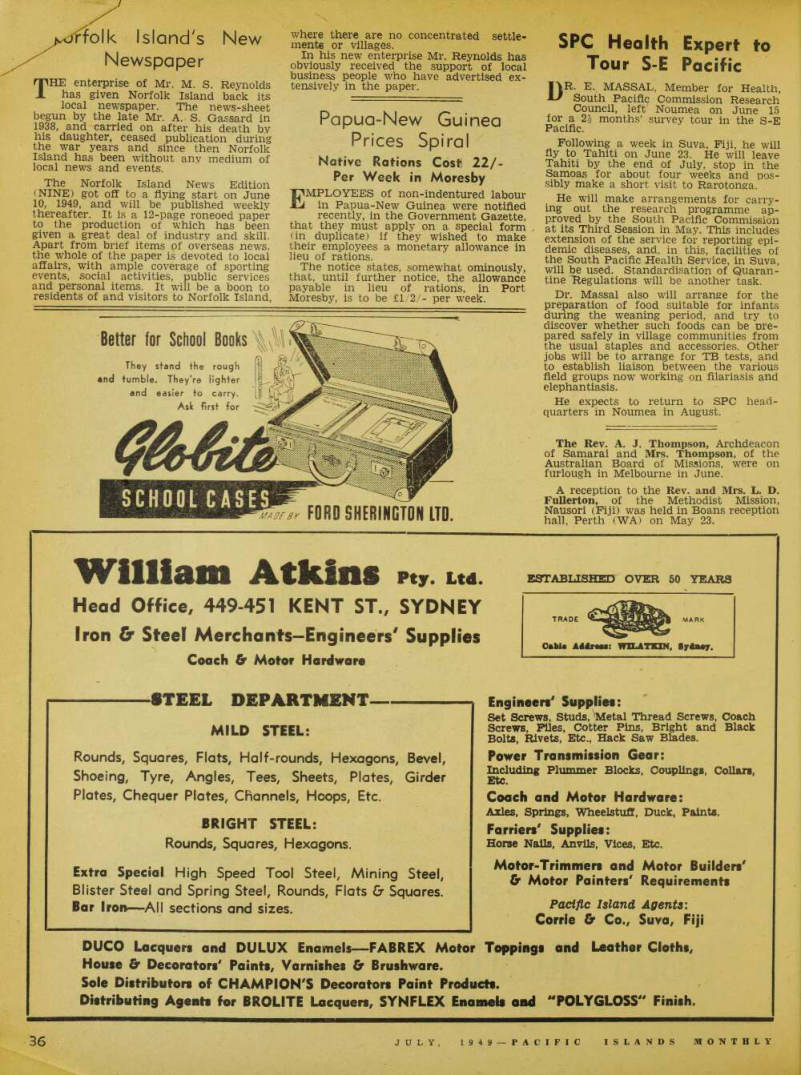
Norfolk Island's New Newspaper
THE enterprise of Mr. M. S. Reynolds has given Norfolk Island back its local newspaper. The news-sheet begun by the late Mr. A. S. Gassard in 1938, and carried on after his death by his daughter, ceased publication during the war years and since then Norfolk Island has been without any medium of local news and events.
The Norfolk Island News Edition (NINE) got off to a flying start on June 10, 1949, and will be published weekly thereafter. It is a 12-page roneoed paper to the production of which has been given a great deal of industry and skill.
Apart from brief items of overseas news, the whole of the paper is devoted to local affairs, with ample coverage of sporting events, social activities, public services and personal items. It will be a boon to residents of and visitors to Norfolk Island,
where there are no concentrated settle ments or villages.
In his new enterprise Mr. Reynolds has obviously received the support of local business people who have advertised ex tensively in the paper.
Prices Spiral
Papua-New Guinea Prices Spiral Native Rations Cost 22/- Per Week in Moresby
EMPLOYEES of non-indentured labour in Papua-New Guinea were notified recently, in the Government Gazette, that they must apply on a special form (in duplicate) if they wished to make their employees a monetary allowance in lieu of rations.
The notice states, somewhat ominously, that, until further notice, the allowance payable in lieu of rations, in Port Moresby, is to be £l/2/- per week.
SPC Health Expert to Tour S-E Pacific
Tour S-E Pacific
DR. E. MASSAL, Member for Health, South Pacific Commission Research Council, left Noumea on June 15 for a 21 months’ survey tour in the S-E Pacific.
Following a week in Suva. Fiji, he will fly to Tahiti on June 23. He will leave Tahiti by the end of July, stop in the Samoas for about four weeks and pos sibly make a short visit to Rarotonga.
He will make arrangements for carry ing out the research programme ap proved by the South Pacific Commission at its Third Session in May. This includes extension of the service for reporting epi demic diseases, and, in this, facilities of the South Pacific Health Service, in Suva, will be used. Standardisation of Quaran tine "Regulations will be another task.
Dr. Massal also will arrange for the preparation of food suitable for infants during the weaning period, and try to discover whether such foods can be pre pared safely in village communities from the usual staples and accessories. Other jobs will be to arrange for TB tests, and to establish liaison between the various field groups now working on filariasis and elephantiasis.
He expects to return to SPC head quarters in Noumea in August.
The Rev, A. J. Thompson, Archdeacon of Samara! and Mrs. Thompson, of the Australian Board of Missions, were on furlough in Melbourne in June, A reception to the Rev. and Mrs. L. D.
Fullerton, of the Methodist Mission, Nausori (Fiji) was held in Boans reception hall, Perth (WA) on May 23.
Advertisements & other items, p. 38 (1 item)
William Atkins Pty. Ltd.
Better for School Books
They stand the rough and tumble. They’re lighter and easier to carry.
Aslc first for 111 maof ffy
FORD SHERINCTON LTD.
William Atkins Pty. Ltd.
Head Office, 449-451 KENT ST., SYDNEY
Iron fir Steel Merchants-Engineers' Supplies
Gooch & Motor Hardware
ESTABLISHED OVER 50 YEARS
TRADE
MARK
Cable Address: WILATKIN. Sydney.
STEEL DEPARTMENT
MILD STEEL:
Rounds, Squares, Flats, Half-rounds, Hexagons, Bevel, Shoeing, Tyre, Angles, Tees, Sheets, Plates, Girder Plates, Chequer Plates, Channels, Hoops, Etc.
BRIGHT STEEL:
Rounds, Squares, Hexagons.
Extra Special High Speed Tool Steel, Mining Steel, Blister Steel and Spring Steel, Rounds, Flats Cr Squares.
Bor Iron—All sections and sizes.
Engineers' Supplies: Set Screws, Studs, Metal Thread Screws, Coach Screws, Piles, Cotter Pins, Bright and Black Bolts, Rivets, Etc., Hack Saw Blades.
Power Transmission Geor: Including Plummer Blocks, Couplings, Collars.
Etc.
Coach and Motor Hardware: Axles, Springs, Wheelstufl, Duck, Paints.
Forriers' Supplies: Horse Nalls, Anvils, Vices, Etc.
Motor-Trimmers ond Motor Builders' & Motor Painters' Requirements Pacific Island Agents : Corrie & Co., Suva, Fiji DUCO Lacquers ond DULUX Enamels—FAßßEX Motor Toppings ond Leather Cloths, House & Decorators' Points, Varnishes & Brushwore.
Sole Distributors of CHAMPION'S Decorators Point Products.
Distributing Agents for BROLITE Lacquers, SYNFLEX Enamels ond "POLYGLOSS" Finish.
Fiji , in 1948 , Broke All Trade
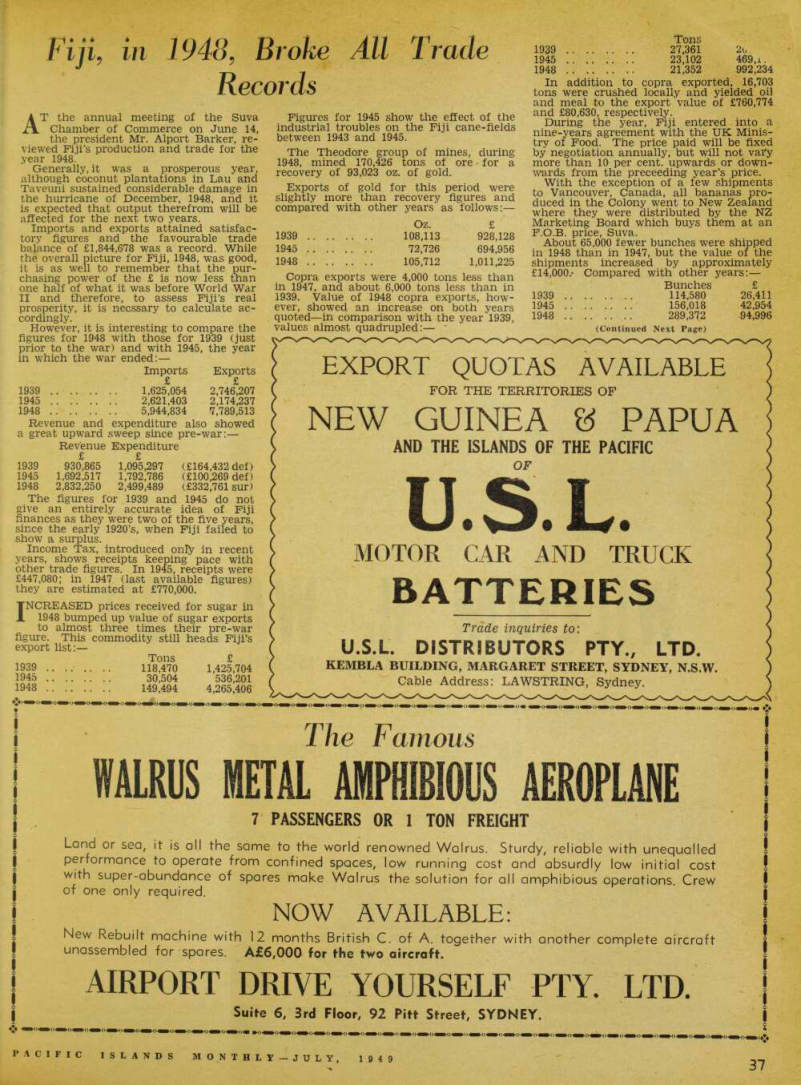
Records
AT the annual meeting of the Suva Chamber of Commerce on June 14, the president Mr. Alport Barker, re viewed Fiji’s production and trade for the year 1948.
Generally, it was a prosperous year, although coconut plantations in Lau and Taveuni sustained considerable damage in the hurricane of December, 1948, and it is expected that output therefrom will be affected for the next two years.
Imports and exports attained satisfac tory figures and the favourable trade balance of £1,844,678 was a record. While the overall picture for Fiji, 1948, was good, it is as well to remember that the pur chasing power of the £ is now less tnan one half of what it was before World War II and therefore, to assess Fiji’s real prosperity, it is necssary to calculate ac cordingly.
However, it is interesting to compare the figures for 1948 with those for 1939 (just prior to the war) and with 1945, the year in which the war ended:—
Revenue and expenditure also showed a great upward sweep since pre-war:— Revenue Expenditure
The figures for 1939 and 1945 do not give an entirely accurate idea of Fiji finances as they were two of the five years, since the early 1920’5, when Fiji failed to show a surplus.
Income Tax, introduced only in recent years, shows receipts keeping pace with other trade figures. In 1945, receipts were £447,080; in 1947 (last available figures) they are estimated at £770,000.
INCREASED prices received for sugar in 1948 bumped up value of sugar exports to almost three times their pre-war figure. This commodity still heads Fiji’s export list:—
Figures for 1945 show the effect of the industrial troubles on the Fiji cane-fields between 1943 and 1945.
The Theodore group of mines, during 1948, mined 170,426 tons of ore for a recovery of 93,023 oz. of gold.
Exports of gold for this period were slightly more than recovery figures and compared with other years as follows:
Copra exports were 4,000 tons less than in 1947, and about 6,000 tons less than in 1939. Value of 1948 copra exports, how ever, showed an increase on both years quoted—in comparison with the year 1939, values almost quadrupled:—
In addition to copra exported, 16,703 tons were crushed locally and yielded oil and meal to the export value of £760,774 and £80,630, respectively.
During the year, Fiji entered into a nine-years agreement with the UK Minis try of Food. The price paid will be fixed by negotiation annually, but will not vary more than 10 per cent, upwards or down wards from the preceeding year’s price.
With the exception of a tew shipments to Vancouver, Canada, all bananas pro duced in the Colony went to New Zealand where they were distributed by the NZ Marketing Board which buys them at an F. 0.8. price, Suva.
About 65,000 fewer bunches were shipped in 1948 than in 1947, but the value of the shipments increased by approximately £14,000.* Compared with other years:—
Oz. £ 1939 108,113 928,128 1945 72,726 694,956 1948 105.712 1,011,225
Tons 1939 27,361 2o 1945 23,102 469,j. . 1948 21,352 992,234
Bunches £ 1939 .. 114,580 26,411 1945 .. 156,018 42,954 1948 .. 289,372 94,996 (Continued Next Pag«)
Imports Exports £ £ 1939 1,625,054 2,746,207 1945 2,621,403 2,174,237 1948 5,944,834 7,789,513
£ £ 1939 930,865 1,095,297 (£164,432 def) 1945 1,692,517 1,792,786 (£100,269 def) 1948 2,832,250 2,499,489 (£332,761 sur)
Tons £ 1939 118,470 1,425,704 1945 30,504 536,201 1948 149,494 4,265,406
During the year canned pineapples to the value of £30,909 were exported (com pared with £7,311 in 1939 and £7,850 in 1945). Miscellaneous exports included fresh pineapples, £3,348; citrus, £1,575; water-melons, £385; green ginger, £4,413; coconuts, £115; peanuts, £21,968; rice bran, £4,420; arrowroot, £203; rubber, £2,745.
For Home Consumption rODS grown for home consumption were either inadequate to meet all demands or were barely sufficient.
The area under rice was increased. Acre age in 1948 was estimated to produce 17,000 tons. While there was no importa tion of rice, there was, at the same time, no surplus.
Butter production was 555,962 pounds weight, and 6,805 pounds of ghee. This was inadequate and 74,475 lb. of butter, butter substitutes and ghee were imported.
A beef shortage continued throughout the year though 6,247 cattle were slaughtered. There was a slight increase in pork production but not sufficient to meet the demand. Fresh pork was im ported to the value of £5,920. Goat meat for the Indian population was also in short supply. Stock importations are being made in an attempt to improve local strains.
During the year , 15,400 gallons of candlenut oil were produced. None of this was exported—it was used locally for the production of paints.
The Fiji Gifts for Britain Fund has al located another £l,OOO for food parcels for general distribution. As well as bulk food distribution the* Committee of the Fund has also sent 5,500 express parcels to mem bers of the Women's Volunteer Services in Britain; a large number of knitted garments have also been sent. Secretary of the Fiji fund is Mrs. R. A. Herrick,
Mbe.
Advertisements & other items, p. 39 (1 item)
Walrus Metal Amphibious Aeroplane
EXPORT QUOTAS AVAILABLE
FOR THE TERRITORIES OF
NEW GUINEA « PAPUA
AND THE ISLANDS OF THE PACIFIC
OF
U.S.L.
MOTOR CAR AND TRUCK
BATTERIES
Trade inquiries to:
U.S.L. DISTRIBUTORS PTY., LTD.
KEMBLA BUILDING, MARGARET STREET, SYDNEY, N.S.W.
Cable Address: LAWSTRING, Sydney.
The Famous
WALRUS METAL AMPHIBIOUS AEROPLANE
7 PASSENGERS OR 1 TON FREIGHT
Land or sea, it is all the same to the world renowned Walrus. Sturdy, reliable with unequalled performance to operate from confined spaces, low running cost and absurdly low initial cost with super-abundance of spares make Walrus the solution for all amphibious operations. Crew of one only required
NOW AVAILABLE:
New Rebuilt machine with 12 months British C. of A. together with another complete aircraft unassembled for spares. A£6,000 for the two aircraft.
AIRPORT DRIVE YOURSELF PTY. LTD.
Suite 6, 3rd Floor, 92 Pin Street, SYDNEY.
Fiji-Indian Pamphlet
Causes Stir
From Our Own Correspondent SUVA. June 15.
A NUMBER of earnest Indians have been trying to impress Fiji residents, including the “PIM” correspondent, that the views expressed by Mr. Gyani Das in the Delhi-published pamphlet, “Fiji—An Indian Colony” (reviewed in the May “PIM”) by no means represents the views of the Indian community in Fiji as a whole.
Two Indian journals have suggested, in a roundabout way, that no one would have taken Mr. Das’s publication at all seriously if the English language press had not spilt the beans —allegedly with the inten tion of sowing enmity between the Fijians and the Indians.
Mr. Leslie Davidson, of Ba, writing to the “Fiji Times,” suggested that the Com missioner for the Government of India in Fiji might clear things up by publicly disclaiming the theories and policies put forward in the pamphlet.
Apparently on the principle of least said soonest mended, no authoritative Indian source has made any public com ment on the pamphlet which, although published at Delhi in Hindi, has ended up by creating a minor commotion among Fijians, Europeans and Indians
alike.
Port Of Samarai
A CORRESPONDENT, referring to a recent photograph showing two ships anchored off Samarai, Papua, says that some ships can tie up at the small wharf there. He says that Captain Wild ing usually lays his motor vessel “Malaita” alongside the wharf, if he does not wish to work more than one hold.
Death Of Mrs. Charles Fysh
THE death occurred on June 14, of Mrs.
Ethel Fysh, wife of Mr. Charles Fysh, of Norfolk Island.
Mrs. Fysh was well-known to hundreds of travellers as the hospitable hostess of “Torren Glen”, one of the best known guest houses on the island. They had a large circle of friends on Norfolk Island.
She was the daughter of Mr. and Mrs.
Edwin Christian and the grand-daughter of Mr. F. M. Nobbs, a former Chief Magistrate.
The esteem in which she was held was demonstrated by the large gather
ing at the funeral.
v.w.
New Native Hospital For
Rabaul
From Our Own Correspondent
Rabaul, June 21.
THE Native Hospital, Rabaul, has now been moved to its new site at the converted War Criminals Compound.
The District Medical Officer, who has had extensive experience in native hos pitals, advises that several improved features include individual and supervised treatment in the wards to every patient.
In the female section there is accommoda tion for 200 cases. It is staffed by Asiatic nurses supervised by a Female Medical Assistant.
The hospital has a fully equipped theatre, casualty and labour wards. The recreation hall will be used for church services, schools, sing-sings, and moving pictures. In the grounds are full-sized cricket and football fields.
Mr. P. Costello has been reappointed a member of the Executive Council of Fiji for a period of one year.
Advertisements & other items, p. 40 (1 item)
William H. Watson
ESTABLISHED 1930
RAROTONGA, COOK ISLANDS
Wholesale and Retail
LICENSED STAMP DEALER
Agent For:—
BRITISH TRADERS' INSURANCE CO.
CORONA & L. C. SMITH TYPEWRITERS
KAISER & FRAZER MOTOR CARS
B.S.A. CYCLES AND MOTOR CYCLES
AMERICAN LEAD PENCIL CO.
WHITES AVIATION LTD.
Manufacturers of: FOOTWEAR, ALL CLASSES SUITABLE FOR NATIVE TRADING . . . M.O.P. PRODUCTS, INCLUDING ROUND EAR-RING BLANKS AND BUITON BLANKS Exporter of: “Rarotonga” Hula-Skirts.
Sea-Shell Necklaces.
M.O.P. Jewellery.
Island Produce.
Cable Address: “Watson” Rarotonga Wholesale and Retail Inquiries Invited.
Prepared to Consider Agencies for all Class of Goods.
Importer of: Textiles.
General Hardware.
Fancy Goods.
General Merchandise.
Bankers: Bank of New Zealand, Auckland.
Sensational Newspaper Story Follows
Visit of Geologists to BSI
From Our Own Correspondent
Honiara, June 20.
MYSTERIOUS St. George’s Island, off the coast of Ysabel, in the Solo mons, has been investigated by a party of Australian experts—Dr. O. A.
Jones, professor of economic geology of Brisbane University, Mr. Roy Hudson, Broken Hill solicitor, and Mr.. John Grover, of Bondi, a post-war CRTS un dergraduate in final year mining and metallurgy at Sydney University. Their interest was directed to the geological possibilities of the island. * St. George’s Island is supposed to be the spiritual home of the Ysabel people when they die. Now and again, according to native accounts, the dead rise for a spree and can be heard singing and dancing while mysterious lights twinkle over the hillsides.
Writing about 400 years ago, Mendana described it as a prosperous island with some 6,000 families living on it. The next historical reference is made about a cen tury later, when it was described as com pletely uninhabited. What became of the islanders, or what caused them to evacuate their island, is buried in anti quity. Its reputation now, anyway, is sinister —much involved with debbils.
Modern practice, although still respect ful towards the ancestral dead, permits Ysabel people to visit St. George’s for copra cutting purposes, without ill effects.
Dr. Jones and Messrs. Hudson and Grover arrived in the Group by Qantas plane in May to make a complete geolo gical survey, and to map the gold-bearing areas of Gold Ridge, in the Guadalcanal mountains. This is to provide the basis for the possible re-opening of mining operations. Messrs. Grover and Hudson made an earlier but brief visit to Gold Ridge in March, 1948.
As a result of ten days’ work at Gold Ridge, they shipped 104 bags of various geological specimens by the mid-June “Muliama” for assay in Australia. At the request of the BSI Government they have also examined other near-at-hand, re ported mineral occurrences in the Group.
There are possibilities, according to Dr.
Jones, of chromite and asbestos being found on St. George’s Island, which also has the characteristics of platinum bearing country. He said that only the' surface of the mining potentialities of the locality has been scratched in their month’s visit. But he thought that the Protectorate, given the interest of mining enterprise, should have a fertile mining future.
The geologists’ last visit was made to Kovogombi, east of Gold Ridge, where they prospected several rivers.
Editorial Note
IT is an interesting sidelight on modern journalism to contrast the above story with the piece of nonsense which appeared in the Melbourne “Sun” on June 21. Under the startling head line, “5,000 Natives Vanished from Hoo doo Pacific Island,” was printed the following:— Out in the Solomon Islands there’s a haunted island called St. George, 80 miles north-west of Guadalcanal, where 5,000 natives have mysteriously vanished.
This was stated by a party of Aus tralian mining experts, who returned to-day from the uninhabited “hoodoo”
island, 12 miles wide and five miles long.
One of the party, Mr. J. C. Grover, a Sydney mining engineering student, said that the Solomon Islands Govern ment could not solve the mystery.
Natives of the adjoining Ysabel Island told the party that St. George was populated now only by spirits of the missing natives.
Natives would not land on the island even in the daytime, much less at night.
The party, which included also Mr.
E. R. Hudson, of Broken Hill, and Dr.
A. O. Jones, of the Brisbane University, tried to induce some oif the Ysabel natives to accompany them as guides on St. George.
The natives weren’t interested.
Eventually, the party found a Chris tian native guide, but he would not stay on the island overnight.
The party has been exploring the mineral possibilities of the Solomons.
NO indication Is given, in the above, that all this is supposed to have happened about four hundred years ago, and then only on the evidence of Mendana, an unreliable witness. iviendana discovered Ysabel, Guadal canal and San Christoval in 1568. He did not make much of an investigation
but four months later he was back in Peru claiming that he had discovered a region of fabulous wealth. He was given a colonising licence but, for one reason or another, did not start on his second expedition until 1595. This time he managed to miss the Solomons altogether anc J,« aII JS Svf Santa Cruz poup, to the south. The expedition S ied x t 0 their colony there, but Mendana died and the remnants of them eventually returned home under the guidance of the navigating officer, de Q uiros - No other European visited the Solomons for 200 years, so whether or not St.
George ever had a population of 5,000 or whether it was just another of Men dana’s fabrications, no one will ever know.
The thousands of readers of the Mel bourne “Sun,” however, can be pardoned -f or believing that this flourishing native community mysteriously disappeared in recent times. The fact that these people ma y or may not have van i S hed 400 years ago , is of no particular news value. Pre sented in such a way that it appears that it might have happened recently, it is startling and has appeal to the sensation seeking readers of Australian newspapers, The logical consequence of this piece
of irresponsible reporting is for the Rus sian delegate to ask in the UN Assembly just what the brutal British have done to cause these poor exploited natives to disappear completely from their Island home.
Advertisements & other items, pp. 41-42 (1 item)
fcmonwealtbIM
WE
CAN HELP VDU
With Full banking facilities at our Island Branches
RABAUL ... LAE
PORT MORESBY
MADANG
The Service links with our Branches throughout Australia, also our Agents and correspondents all over the world.
fcmonwealtbIM
of Australia.
Every Branch of the Bank conducts Savings Bank business.
FOR
PAINTS & BUILDERS’ HARDWARE
Address your enquiries to: —
VENTURA TRADING COMPANY PTYJ LTD.
26 BRIDGE STREET, SYDNEY, N.S.W.
Cables: “Ventura,” Sydney
OR TO
P. & R. HUTCHINSON, Suva H. G. EEKHOFF, Lae,
The Most Extensive Manufacturers in the British Empire of
RUBBER STAMPS,
INKS, STENCILS,
Marking Devices,
ACME STAMP PADS
OFFICE & STATIONERY SUPPLIES
We also Manufacture & Supply a Complete Line of
LIMEWASHING AND
SPRAYING MACHINES
for all purposes.
Let us know your requirements and we will quote by return.
WRITE FOR OUR GENERAL CATALOGUE
Limewashing Machine
EXCELSIOR SUPPLY CO. PTY. LTD.
278 Post Office Place,
MELBOURNE, VIC.
HEAD OFFICE :
160 BROADWAY,
Former lu known as George St., West,
SYDNEY, N.S.W.
50 Victoria Street,
WELLINGTON, N.Z.
Mass Transportation of Stock
Stock by LST Experiment by NZ Co. Should Assist Planters
A SHIP, designed to land tanks on Pacific Islands beaches was, in June, taking on cattle in New Zealand for the Solomons.
The ship, the “Rawhiti,” belonging to the Roose Shipping Company Ltd., caused considerable interest in NZ when she moored up the Tamaki River with her bow-door open on the bank. It was ex pected that between 300 and 400 young cattle and horses would be loaded for the restocking of plantations on Russell Island, BSI.
This is the second trading voyage of the “Rawhiti/’ Her first began on March 20 when she left NZ to pick up war disposals equipment at various Pacific islands.
Trucks, cranes and tractors were driven or hauled on board through the bow-doors from island beaches where no wharf facilities exist. The owners praised the vessel as highly satisfactory for this sort of island trade.
On the vessel’s second trip, after land ing the cattle in BSI, she will proceed to Northern New Guinea to load empty drums for Fiji, then will take on more war disposals goods at Truk.
Apart from this experiment by the Roose Shipping Co., little use has been made of this type of war-time ship.
Planters who have complained of the high cost of stock importations into New Britain (June “PIM”) should watch this mass-migration of cattle to BSI with con siderable interest.
Norfolk Is. Eggs For
Fiji?
From Our Norfolk Island Correspondent EGGS are now scarce on Norfolk Is. The reason is that some people whose love of money outweighs their principles, have been paying above normal prices to corner the market, and the eggs have been flown to Fiji, in company with tomatoes, lettuces, etc.
It would be interesting to know if this produce has been fumigated, etc., and if official sanction has been given in the shape of an Export Licence.
Rabaul Tennis Tournament
From Our Own Correspondent
Rabaul, June 20.
THE results of the first post-war tennis competition, played off at the Rabaul Tennis Club Courts, on June 19, were as follows: LADIES DOUBLES: Mrs. H. Lyon and Miss J. Lyndon defeated Mrs. F. Rhoades and Mrs. J. Lange (6-4).
MIXED DOUBLES: Miss L. Bridges and Mr, D. Martin won the mixed doubles over Miss J. Palmer and Mr. A. Moore (6-1).
MENS DOUBLES: Mr. R. Hall and Mr.
D. Martin defeated Mr. W. Sievers and Mr. W. Daley (6-0).
A collision between a jeep owned by Mr. J. Allen, of Kokopo, New Britain, and a Chinese resident of Rabaul, on June 29, resulted in a Chinese women being ad mitted to Rabaul Hospital. Her condition was not serious.
Officialdom’S Roundabout
In Fiji
From Our Own Correspondent
SUVA, June 22.
ANOTHER temporary move-around among Fiji’s high official posts is in dicated. The present Acting Colonial Secretary, Mr. P. D. McDonald, will leave for New Zealand on June 27, on his way to Great Britain, where he will spend vacation leave.
Mr. McDonald has been Acting Colonial Secretary since Mr. J. F. Nicoll left to be come Colonial Secretary at Hongkong.
When Mr. McDonald goes on leave, the Financial Secretary, Mr. R. M. Taylor, will act as Colonial Secretary until the arrival, in September, of the Colonial Secretary designate, Mr. A. F. R. Stod dart, and Mr. P. H. Nightingale will act as Financial Secretary.
It is assumed that during any absences of the Governor, Sir Brian Freeston, from Suva (His Excellency and Lady Freeston will visit Vanua Levu from July 3 to July 10). the Financial Secretary, as Acting Colonial Secretary, will be Gover nor’s Deputy.
Solomons
Minerals From The
A PARTY of geologists and mining students returned in June to Sydney from the Solomon Islands, with samples of ore from the gold bearing areas of Guadalcanal, and of deposits of Chro mite, nickel and asbestos from the small St. George Island. The expedition was sponsored by an Australian mining syndi cate. Until the samples are assayed, it is not possible to say whether the minerals are there in payable quantities.
(See article on page 39)
Death Of Miss M. C. Roy
Miss Mary Clapton Roy, Who
died in Suva in June, aged 89, arrived in Fiji with her parents in the pioneering days. The family resided on various plantations, and finally settled down in Bua (Vanua Levu) on Baulailai plantation. Her only surviving relative in Fiji now is a niece, Mrs. C. E. Penne father.
The fourth New Zealand frigate, “Pukaki,” left Auckland for a cruise in Pacific waters on June 23. Three other NZ Naval ships, “Taupo,” “Hawea” and “Kariiere,” are already cruising. “Pukaki” will visit the Kermadecs, five islands in the Tongan Group and will then join the three other ships in Suva, Fiji.
Natives, Says Clergyman
Our Civilization Can Be Good
THE 6,000 natives who inhabit the 13 Torres Strait Islands within the Church of England diocese of Carpentaria are more Christian in attitude than the people of Melbourne, in the opinion of the registrar of the diocese, the Rev. Peter Bennie, who was on holiday in the southern capital recently.
Mr. Bennie said that 98 per cent, of the islanders were practising Anglicans.
He does not agree with those who think the natives should be shielded from the impact of white civilisation by allowing them to retain their tribal territories and traditions. ‘'Civilisation, like peace, is indivisible,” he said. ‘‘White commercialism has a bad effect on anybody, natives included. But to deny natives the right to the good things that civilisation can offer is to regard them as anthropological specimens and not human beings.”
Mr. Bennie’s diocese extends from the southern New Guinea coast, through Cape York Peninsula to Cairns, and includes the Northern Territory.
He has been registrar, principal of the native theological college, and sub-dean of
the All Souls Cathedral at Thursday Island since August, 1946.
One of the aims of the mission’s work is to produce an indigenous clergy, and already six Torres islanders are working as clergy.
At Thursday Island there was a serious deficiency of fresh food, which was causing malnutrition in some of the white children, and tuberculosis among the natives was far too prevalent.
The superintendent of the hospital (Dr.
J. H. Barnes) was concentrating on tuber culosis, but supplies and equipment were badly needed. , , Mr. Bennie said that the work of the Queensland Government was well inten tioned and, despite many mistakes, much was being done. He believes that patience and perseverence will bring their reward. —From Melbourne “Age.”
The Director of Public Works in Fiji.
Mr. John L. Brown, has been transferred to Cyprus as Director of Public Works, and will probably leave Fiji in September, He has been in Fiji since 1939.
Advertisements & other items, pp. 43-44 (1 item)
Aluminium Roofing
Gabriel Achun
Mologuno Rood, RABAUL, T.N.G.
WHOLESALE MERCHANT AND IMPORTER
CORDIAL MANUFACTURER
Piecegoods for Native Trade. (Large shipment of variety arrives with every Eastern boat.) Other Lines of Trade Goods.
High-class Aerated Water and Cordials. Beer, Wines and Spirits.
Quotations and Samples of Materials gladly sent upon request.
Telephone: Cables & Radios: No. 104 Gabriel Achun, Rabaul
Aluminium Roofing
Now available for shipment to Pacific Islands Aluminium Corrugated Roofing is rustless and is the lightest of all fabricated roofing materials, This Is a point worth remembering when considering freight costs. Heat due to solar radiation is substantially reduced when Aluminium roofing is used.
Inquiries to:-
UNION
ALUMINIUM
LIMITED
(Incorporated in the Dominion of Canada) Largest Distributors of Aluminium and its alloys in the British Commonwealth OCEAN HOUSE, 34 MARTIN PLACE, SYDNEY, N.S.W.
A Member of the Aluminium Limited Group, Montreal, Canada
BERRY’S BAY
BOATYARD
(B. J. Halvorsen—Manager) Specialists in Island vessels.
All kinds of boat-building and repairing.
New and used boats and engines for sale.
Quotations and estimates free.
BERRY’S BAY BOATYARD
John Street. North Sydney. N.S.W.
mm whc£Nts use mm
CONftCSNCE
Confidence brings successl Place your confidence in the hospital formula of genuine \\ " Vincent’s a.p.c. For over \-to 25 years the medical profession has had absolute confidence in this better-balanced prescription Take Vincent's A.P.C With Confidence.
For HEADACHE AND NERVE
AND MUSCULAR PAIN!
<(i£ i
VINCENTS
N46D
r TTCENIi
FO
SAFEST Qc BESTI
Million Dollar Publicity For Pastor Salau
Pastor Salau in the United States ( Contributed)
PASTOR SALAU, a Solomon Islander, who is at present touring the United States with Pastor A. G. Stewart of the SDA Mission, is receiving much
publicity.
Among the churches where Salau spoke in New York was one in Harlem, where there was a congregation of 1,400 Negros; and another of 800 Spanish speaking people, who mostly had come originally from Puerto Rico and Cuba.
Salau told them that while travelling in England and Europe he had felt lonely, not seeing many coloured people. Since coming to the United States, however, he said he had felt quite at home.
A large department store ran an ad vertisement in Pidgin English in a New York newspaper during the week Salau was in that city. At one of the libraries in the nation’s capital, it was reported that Salau’s presence in the country had developed a new and public interest in the Solomon Islands. It,was suggested that Pidgin might sweep the land, es
pecially among the younger set, so uni versally had Salau’s story been published.
The Associated Press in New York estimated the free publicity gained in the extensive newspaper, magazine, radio, television and newsreel coverage at three to five million dollars.
Salau was a guest at Mary Margaret Mcßride s 15th Anniversary Radio Pro gramme, at Yankee Stadium, where he spoke to an audience of over 43,000. His last appointment in New York was on the night of June 1, in a special broad cast and television programme known as ‘We, the People,” which is nation-wide.
Salau appeared on the platform with Lieut. Gordon Manuel, the airman whom the natives rescued and cared for in New Guinea, and whose adventures were recorded by Quentin Reynolds in the book “Seventy Thousand to One.”
Through Salau this grateful pilot thanked those who had saved his life.
Flying across to Los Angeles from Kansas City, Pastor Stewart and Salau took part in a church gathering of 12,000 people in the Hollywood Bowl, a vast amphitheatre surrounded by wooded hills.
While in Washington, ranking officers of the armed services who had served in the South Pacific had appointments with Salau. Everywhere he went servicemen wanted to do something for him.
Commenting on the welcome and publicity this Solomon Islands pastor has received, Pastor Stewart says: “It is an indication of the interest that America is showing in the South Sea Islanders who did such heroic service in saving some of their unfortunate men during the war.”
Pastor Stewart and Salau will be con stantly travelling and speaking at church conferences until August, when they ex pect to sail for Australia.
Retirement Of The Rev.
A. W. E. Silvester
THE Rev. A. W. E. Silvester and Mrs.
Silvester, who have served the Methodist Missionary Society of New Zealand on Vella Lavella, BSI, for a number of years, are leaving the BSI later this year to live in New Zealand.
Mr. Silvester has compiled a new hymn and scripture book in the Bilua language of Vella Lavella. This is being printed in NZ. It will take the place of a former hymn book, copies of which have become worn out.
Mr. Silvester has been due for retire ment for some time but desires to re main in Vella Lavella until his new hymn book is available to his people. He re ceived help from his predecessor at Vella Lavella, the Rev. A. A. Bensley, now living in New Zealand, who checked the proofs of the book.
Mr. Silvester stayed in Vella Lavella during the Jap occupation in 1942-43.
He and his natives rescued many Allied airmen and sailors. For this Mr. Sil vester was decorated by the American authorities.
Matron Napier, whose term at the Nor folk Island Hospital has expired, has left for Sydney. Sister Austin replaces her.
Choiseul
Mission Work In Lonely
FRIENDS of the Rev. J. R. Metcalfe, who has been a Methodist Mission ary on Choiseul, BSI, for many years, will be interested to learn that he has made good progress in the diffi cult task of rebuilding the work of the mission.
He had a serious illness last year and was absent in Australia from April to October. He returned to his little-visited island to find that mission work had been carried on well by his assistants, Sister Grace McDonald and Sister Lucy Money.
Welfare work among women and children at the end of 1948 included the care of six infants at the head mission station. This meant extra expense.
“We are glad to learn,” writes Mr Metcalfe, “that at long last the Govern ment is to give us half the cost of milk used for infants. Up to the present we have had to pay for the milk, plus cus toms duty on it!”
Ten lepers were being cared for by the mission, but Mr. Metcalfe thinks there are probably more unsuspected cases of leprosy on Choiseul.
During his absence the gardens of the mission station deteriorated, but he is able to secure vegetables by barter. One legacy of the war years was that of an Australian pontoon which floated up on Choiseul from the direction of Fauro. It has been used as a bridge across one of the creeks.
In its schools, the mission on Choiseul is insisting that education is not for males only. The mission is seeing that girls eligible to attend school do so, and although there has been some opposition
from parents, Mr. Metcalfe says, “matters are now progressing favourably.”
School attendance has been well main tained and there is a big demand for additional teachers. Only six teachers have been supplied although 15 were asked for by villagers.
Cook Islands Curio Trade
In Doldrums
Prom Our Mangaia Correspondent THE world shortage of caustic lye has put an end to the formerly flourish ing trade in shell-beads, peculiar to this island. The minute snail-shells had to be boiled in lye to prepare them for threading on hat-bands, necklaces, etc.
There is no caustic now, so there is no “pupu”-market either.
One wonders how many ex-GI homes contain souvenirs of the South Seas of this nature, brought home by servicemen from regions that are still associated in the American mind with hula-dancers, grass skirts and romance a-la Hollywood.
It is rumoured that curio shops in Hawaii pass off Cook Island pupu-work, done by the maids and matrons of Mangaia, as genuine Hawaiian handicrafts—and, no doubt, at a vastly improved value.
Locals did not get much for the stuff, whether they sold loose shells by the pound to the dealers who were not slow to take advantage of the GI market, or finished necklaces and hat-bands.
With the pupu went the hoped-for mar ket for locally-made rau mats, which are great savers of city linoleum. No one wants an island mat now, it would appear.
Mangaia has not yet attempted the ex port of its talent in the form of a troupe of local entertainers. This, from present indications, is the last avenue left for Cook Islanders to make a little monev.
‘Marching Rule’
Is Now
Nearly Dead
THE “Marching Rule” anti-British movement among the Solomon Island natives,, which has caused much un rest since the war, is dying out, Dr, C. E.
Fox, veteran Anglican Missionary, told the “New Zealand Herald” recently. He said that the movement had been confined to two islands, San Cristobal and Malaita, the largest of the group. There was still some passive resistance and nearly 2,000 political prisoners were at present in cus tody. The Acting Resident Commissioner, Mr. A, Germond, who had recently come from Africa, had the situation under con trol.
Dr. Fox has completed 47 years’ mission service in the Solomons. He is now 71 years old, and is an authority on a number of Island languages.
Mrs. N. G. Stephenson, formerly Miss Pat Thomas, of Suva, has had the dis tinction of being awarded, on the same day as her husband, the degree of Doctor of Philosophy of London University. She is a daughter of the late Mr. A. B. Thomas, and Mrs. Thomas, who lives in Suva. She holds the degree of Master of Science.
Advertisements & other items, p. 45 (2 items)
43
PACIFIC ISLANDS MONTHL Y J U L Y 1949
DUNLOP ili£ Vu&bs'i 9ndust>Uf
KODAK FILMS
and all Photographic Supplies
WHOLESALE AND RETAIL
CAINE'S STUDIOS
P.O. Box 8, Suva Photographers. Est. 1904.
Write for free price lists.
c UNLOP
s Dunlop sporting equipment enjoys world’ wide popularity amongst all players of sport. You can be sure, always, of getting the best products of their kind available when you specify Dunlop Tennis Rackets, Tennis Balls, Sports Shoes. Golf Balls and Bowls.
They're still difficult to obtain but keep asking for the Dunlop Brand.
' - ST«| * $ J
U 63 fs » f f f V* D. 443
DUNLOP ili£ Vu&bs'i 9ndust>Uf
VSSSsssyssyssssssyyss*
Strange Discrimination By
Germans And Communists
Strange Discrimination By Australian Bureaucrats
AS an example of how the Australian laws relating to nationality are ad ministered we quote the case of Mr.
George Janke, who is now a resident of Sydney.
Mr. Janke was born in Queensland early in this century, and he went to New Guinea with his father in 1906. There fore he had Australian citizenship, but his father was still a German national, although he had been some years in Aus tralia. His father retired from New Guinea in 1912, to live in Australia.
When World War I came in 1914, George Janke joined what was called the German Citizen Soldiers in New Guinea.
He did not fight—he was in another dis trict when the Australians landed near Rabaul. George and his brother were allowed to remain in New Guinea during World War I; they lived there during the long period between wars; and th6y were brought to Australia for internment in 1942. Later, George was released from Tatura and “manpowered” into a leather factory in Sydney, where he spent the remainder of the war years.
Although George Janke has never seen Europe, and cannot speak any language except English, the bureaucrats insist that he is not an Australian. He has made repeated applications to return to the only country ne knows—New Guinea — but the inscrutable powers that be will not permit it, and George is therefore still a more or less skilled worker in the wilderness of Sydney. His brother, how ever, has been allowed to return to New Guinea, The case is somewhat similar to that of Mr. O. Soltwedel. Apart from spells in internment during both World Wars, Soltwedel spent 36 years continuously in New Guinea, and finally was shipped
away to a Germany that he had not seen since he was a youngster under Kaiser Wilhelm.
We do not know whether Janke and Soltwedel were Nazis. Presumably, they had expressed pro-Nazi sentiments at some time. But why the Australian bureaucrats should so savagely punish the now defeated Nazis, while tenderly cherishing and protecting Communists— who are by far Australia’s worst enemies —is something that no man of ordinary reason can comprehend.
Harbour Bed
Wealth From Noumea
Seventy-six shells of different calibres which had fallen in the sea alongside Noumea Docks, during American war-time loading and unloading operations, have been brought to the sur face by a French contractor during dredg ing work, and handed over to the artillery garrison.
The contractor, M. Mary, has been obliged to cease work owing to the danger of accident.
A fabulous amount of material was dropped in the harbour during the intense war-time activities which, for two years, turned Noumea into the busiest port in the Pacific after San Francisco. It would probably repay an Australian or Ameri can diving outfit to get permission to examine the ocean bed for relics of the US occupation. During the war a US fly ing officer, in his spare time, took to diving as a hobby and brought up— in the diving and not in the colloquial sense—about 7DO bottles of New Zealand beer, which he sold to his mates at a good profit.
In the first five months of 1949. Suva had 134.53 in. of rain. The 57-year average for a complete year is 120.86 in.
Death Of W. H. Jefferson
THE many Papuan and Islands friends of Mr. and Mrs. W. J. Jefferson will regret to hear of the death of Mr.
Jefferson —on June 20 at St. Luke’s Hospital, Sydney, after an abdominal op eration. i He had recently left Malaya, on leave, after many years of rubber planting there, interrupted by the Japanese invasion. He was amongst the first civilians to return to that country and enthusiastically be gan rebuilding his company’s interests there.
“W.J.”, as he was known, was born in Tasmania 65 years ago, of pioneer stock. As a youth he joined the Eastern Extension Cable Service and served in Darwin, Cocos, and Singapore. In 1910 he went into rubber in Malaya, later go ing to Papua, where he was, for 25 years, connected with planting at Kemp Welsh, Ogamobu, Doa, Itikinumi and other estates. He was offered the management of Sagga Estate in Malaya in 1936 and he went back to do an outstanding job in rubber production there.
With a view to ultimate retirement, a property was purchased at Mossvale recently, but W.J. became ill soon after getting established there. Mrs. Jefferson, who is the sister of Mrs. Allen Innes of Vaucluse, will live at the Mossvale home.
Chickens For Fiji
IMPORTATIONS of high-grade poultry into Fiji from Australia and New Zealand are steadily increasing. In 1946, a small number of day-old chicks were sent to the Colony by air from Australia.
In 1947, the number grew to 10,013 and in 1948 it was 13,000. Chicks are now arriving by air from New Zealand as well as Australia, and the number imported so far this year is 4,000.
Advertisements & other items, p. 46 (1 item)
G or cion's
i# m m m gjg By Appointment Gin Distillers to H.M. King George VI Tanqueray, Gordon & Co. Ltd.
Sbt&crm^€t/l4u6de
Stand? Sup\&m&
BSI Palmer Family Has
A Floating Home
From Our Own Correspondent
Honiara, June 4.
FAMILIAR sight round Protectorate waters these days is the graceful little schooner, “Matoma,” in charge of Mr. Ernie Palmer, back again on his pre-war job of recruiting labour. Capable Mrs. Palmer, the five Palmer children and one dog are enthusiastically living on board and enjoying “Matoma” as a home.
Formerly the “Loyaute,” of Noumea, “Matoma” was built in New Caledonia and has expertly planned accommodation.
At one time she was a BP vessel; during the war she was in service for the Navy, then she was bought by Levers’ Pacific Plantations Pty., Ltd., and reached the Protectorate under Mr. Palmer’s command about three months ago. She carries sail and is powered with a 120 HP Fairbanks Morse engine.
Malaita Labour Now Coming
Forward
MR. PALMER is engaged in recruiting labour for Levers’, and has been tackling parts of the problem-island of Malaita. A fertile source of plantation labour pre-war, Malaitamen, confused by Marching Rule doctrines, have, up to now, been reluctant to go back to any form of outside work. Snortage of good labour has been handicapping Levers’ rehabili tation work in their Russell Island plan tations.
In two trips round Malaita in April and May, Mr. Palmer brought in 200 re cruits for Levers’ and believes that more will follow.
“Matoma,” with all seven Palmers on board, left for Rabaul to-day where she
will pick up cargo and bring back to the Protectorate Mr. L. C. Thomas, Levers’ local general manager, who is returning from a business trip to Sydney.
Fiji's 1949 Tourist
Season Begins
From Our Own Correspondent SUVA, June 22.
LATER than usual, Fiji’s winter tourist season is reported to be now under way. Visitors come mainly from New Zealand and Australia, although several small parties from Canada and the United States are at present doing the Viti Levu round-trip between planes at Nadi Air port.
Two other parties are touring Viti Levu under the auspices of Whites Aviation, Ltd. and Northern Hotels, Ltd.
Tourists staying for longer periods are making advance bookings for the trip to Labasa by sea, returning to Suva by plane.
Another Talkie Show For
Mangaia
From Our Mangaia Correspondent THE popularity of the talking picture in the Cook Islands is incontestable, and this isolated isle of ours sighed for many years for a show before Mr. Dick Brown of Rarotonga (one of the well known Browns of Cl, originally a Mangaia family) decided to establish one on the island of his birth. Now, Mr. W. P.
Browne, also of Rarotonga (no relation) has sent over a rival talkie outfit, which has been set-up in an open-air theatre erected by Punga Kareros, of Kaumata Village at the upper end of the beach.
What “talkies” will do to our children’s English, and to their conceptions of the white man’s world, remains to be seen. In Rarotonga, the exploits of Superman, comic-strip hero who, without aid of machinery, flies through the air with the greatest of ease, are regarded as genuine—how could the camera tell a lie?
Advertisements & other items, pp. 47-48 (1 item)
Southern Gross
riy TWRfeAT
WAS RAW
my eyes were red, My nostrils sore, my limbs like lead; I could not sleep, I dare not smoke, And when I ate I seemed to choke. ’Twas influenza at its worst, "The dog’., disease!" a thing accurst; My chemist sold me something sure Hurray! for Woods’ Great Peppermint Cure.
For Influenza Colds, Woods’ Great Pepperailif Tare
SOUTHERN GROSS
DIESEL ENGINES
MARINE AND STATIONARY
BUILT TO
THE
WORLD'S
HIGHEST
ENGINEERING
STANDARDS
4 to 40 H.P.
EARLY
DELIVERIES
ATTRACTIVE
PRICES
30 h.p. Fig. Z 756 Marine Engine.
SOUTHERN CROSS ENGINE & WINDMILL CO. PTY. LTD.
22 YOUNG STREET, SYDNEY, N.S.W.
SEVERAL PACIFIC ISLAND DISTRIBUTORSHIPS STILL AVAILABLE. ENQUIRIES INVITED.
Grime
does
not
f** mm mm mm «« mmmm I • • ■■
' ls W
* „ i w C r- -7 e* /
VACUUM
ooamr product
Keep your
Engine Clean
with
A clean engine gives perfect lubrication, improved performance, longer engine life, quicker starting and complete protection at ail speeds and temperatures.
VACUUM OIL COMPANY PTY. LTD.
MOBILOIL
M492t
Running A Maternity

Hospital in BSI
are extracts from letters received in New Zealand from
Sister Lucy Money, a maternity nurse
who went to the BSI two years ago, to serve with the Methodist Mission on Choiseul.
THIS house is bedlam just at present —there’s never a moment’s quiet.
To start with, I have two new babies. One arrived about ten days ago aged six days on arrival. The father, grandfather and a few other male relatives brought her overland and took three days over the trip. She was in very good condition and weighed about 5h lbs. She put on eight ounces last week so I am quite pleased with her.
I’m bringing her up tough. She was put out to sleep in the bathroom at night, right from scratch and frequently sleeps right through from 9 p.m. to 5 a.m.
Then exactly a week afterwards, a party arrived from Vurulata with the information that they had brought me another orphan baby (making a total of five, under two years old). I groaned aloud but was a little cheered when I discovered that it was a child of over seven months, not a brand new one. I was not at all cheered, however, when I saw the infant and asked a few more questions. The mother had died a few days previously of TB and of course had been feeding this infant from birth. He had become infected himself. He is a very sick-looking child, weighs about lOi
lbs. at li months, and is very limp and miserable. A native medical practitioner who has just been round on one of the government boats had a look at the baby before he was brought here and says there is very little doubt as to his diagnosis.
He is a very pathetic little chap with a nasty cough and a rattly chest, but he is not a bit shy and would be rather a pet if well. Meanwhile, of course, he is a bit of a problem as we cannot let him mix with the other children.
That is not the end of my family how ever. I have Ivy Bui (a teacher’s wife) here for a few months, together with her adopted child. She is a godsend of course, specially as she has taken over the sick baby at her own request and is looking after him for me. It isn’t a good idea from her point of view as she has a tendency to TB herself, but we are letting her do it for the time being and it does help me out of a hole. One of the younger girls is looking after Ivy’s Hena. He is a funny, cross-eyed little chap, but very sturdy now. He does not make any attempt at talking and he is terribly scared of white people.
Ivy is here to get some more maternity experience. The Senga folk are worried about the number of women who die in childbirth over there, and Ivy is keen to be able to help them.
One of the teachers asked the other day if his wife could come here to stay until her baby was born. There are al ready seven in the family and the youngest is still quite small. So he asked if I would have the youngest child, too, and the eldest girl to help look after it! They arrived on
Monday, so the house is almost over flowing.
Then I have two maternity cases—So what with one thing and another, life is a bit hectic. Also Muli, our senior kitchen girl, is away just now. She went home two or three weeks ago to look after her mother who was not well. The mother quickly recovered, but Muli did not show up again. Eventually she put in an appearance one day last week to say she was not coming back again. She said she wanted to attend to her garden, but we suspect that to be an excuse.
Mrs. Metcalf says either Muli is tired of work, or else she has her eye on some man.
Small-Ships Wharf Speeds Up
Turn-Around In Rabaul
From Our Own Correspondent
Rabaul, June 12.
THE work of converting the sunken Japanese ship alongside Rabaul’s pre-war, main wharf into a small ship’s wharf, has been completed.
The wharf was a project of the Direc torate of Shipping and the construction has been carried out by contractors under Department of Works and Housing super vision.
The purpose of this wharf is to expedite the turn-around of inter-island vessels carrying copra. Two 300-tonners can berth alongside, and since it has been in use, a period of six weeks, it has facili tated the handling of copra in Rabaul.
Hitherto inter-island ships could discharge in Rabaul only when there were no over seas ships alongside the pontoon wharf.
Two retiring members of the Fiji PWD sl £ ff were recently entertained at the office of the District Engineer. Suva. The
““ended ° f tas^eC-'
s*** ' t h e p|sT“ *St road Nauson, years service, and Mr.
E - s - H ayles, has been senior foreman at the Walu Bay joinery shop for 21 years. „ T „ Mr. W. R. Dyer, who was for some years in charge of meteorological services in Fiji, paid a brief visit to the Colony in June. He was engaged, with other New Zealand meteorologists in a tour of in spection of meteorological stations in the South Pacific.
Advertisements & other items, pp. 49-50 (1 item)
TOM PIPER means
economical fresh-canned food
Take Tom Piper Tomato Soup, for instance. The specially-grown fruit is picked, cooked and canned within 24 hours—and each concentrated can provides for a family of five.
Every Tom Piper product brings you tasty, natural freshness and vitaminpacked nourishment, and every can of palate-tempting goodness is fully guaranteed.
Export Agents for South Pacific Islands :
S. E. TATHAM & COMPANY,
178 Collins Street, Melbourne • Australia.
Cables: “ SET ” Melbourne. / / / Soup q\ m? <6 0^ G O tv i v»\cs SP Q Q pu SieaV* lie* \i\& to V\t° n \,u" c f
the pacific Islands society
(Founded 1937) Visitors from the Pacific Islands to Sydney, or persons interested in Island affairs, are invited to communicate with the Honorary Secretary of the above Society which was formed to constitute a social centre for those interested in the Pacific Islands.
Regular meetings and social gatherings, with lectures, are held at History House, 8 Young Street, Sydney, on the fourth Wednesday of each month, at 8 pan.
Address for correspondence:—
THE PACIFIC ISLANDS SOCIETY
Bn* 2434, G.P.0., Sydney.
mmm mmm mm ■ ■ - *&sr~ Corned Beet
t CBKon Pork
• Camp P‘® Pate de P°>e * Sausages and
Vegetables
9 Bacon Rashers Irish Stew • w" * Beef Sausages i c ~.cAaes A Pate de r— * Beer —- • ff 6 Pudding Oxford Sausages •. 6 B :S Beef Steak • °£ a Sausages Sfew K . dney • Tomato Soup • Steak and K-dney Dripp«J9 Salmo n Tomato • ' Beef in . r u e d Boneless froien Also. Sa'teo lb> Kegs .. . r 9 ld 100 lb. K®0 S and >uu 50 lb Hams and Bacon.
Meats Prices on oppllcation 7
ore
ALL
Imperial
CANNED FOODS
ARE FLAVOUR-SEALED!
p* 60 0000 se?
Ol=: «
RIVERSTONE MEAT CO.
Imperial goods are prepared from prime selected stock by the largest meat-processing organisation in Australia. You can be sure of top-quality when you order "Imperial."
Pit. LTD. 5-7 O'Connell Street, Sydney.
Fiji Representative: Pearce & Co. Ltd., Suva. £
Norfolk Is Notes
By Vernon Wheatley
SHIPPING. The arrival of the SS “Morinda,” at the beginning of June, ushered in that spell of wet and boisterous weather which is rapidly becoming known as “Morinda weather.”
The ship departed for Vila still carrying some cargo which will be discharged upon her return.
The residents were pleased to see the “Morinda” as local cows have gone dry, and stocks of imported butter have run out.
THE BUTTER FACTORY will shortly be in operation again. A new engine and compressor have been purchased from the Administration to replace the plant which gave up the ghost some time ago.
POLICE AFFAIRS. Popular Sergeant Jimmie Jones has resigned his position, and the job has been taken over by Mr.
T. J. Crommelin, a former member of the NSW Police Department.
We still have no magistrate. Since the last magistrate died some months ago no new appointment has been made and officialdom has made no statement as to when the vacancy will be filled, PROJECTS, The Department of Works and Housing is making good progress, in the face of essential material shortages, with plans to modernise airport facilities here. The programme calls for the erec tion of modern houses for members of the Department of Civil Aviation, a modern terminal building and a licensed accom modation hotel, plus, of course, certain improvements to the strip and the forma tion of a new taxi-way apron. At last we can see the end of the gloomy hut with the dirt floor where passengers are welcomed or farewelled. It is said that, when the hotel is completed, the Liquor Bond Store will move in.
RUMOURS. Sifting the wheat from the chaff, we find that the foregoing state ment explodes the myth that Qantas were planning the erection of a guest house.
BOUNTY DAY. The annual observance of the anniversary of the landing of the Pitcairners on Norfolk Island was cele brated on June 8. The day was fine and clear. The traditional party marched from the pier to the cemetery, placing wreaths at the Memorial, the cemetery gates and also on the headstone of the grave of Mrs. Dinah Quintal, widow of Edward Quintal and eldest daughter of John Adams of the “Bounty.” After the singing of “Gethesemane” by the com pany, the march continued to Govern ment House where the Administrator en tertained them at morning tea. Later, a picnic banquet was held by the Kingston ruins but the gathering could not cope with the food supplied—a credit to the ladies responsible. Marching order was: Colour-bearer (Thornton Quintal), Ad miral of the Fleet (Consett Christian), Captain (Carty Christian). Lieutenants (Messrs. E. Adams, J. Young, Ben Chris tian), Chaplain (Pastor Pat Adams), Doc tor (Fred Quintal), Company of the Fleet (approximately 45 members, with Mid shipmen Evans and Nobbs in the rear), Officer on duty (Ben Christian). (NB. All titles are “courtesy.”) PRESS. A small star has appeared on our horizon, in the shape of NINE (Norfolk Island News Edition).
The last news-sheet published here was the weekly produced by the late Mr. A.
S. Gazzard.
The sponsor of the present service de serves every encouragement.
Mr. W. G. Johnson, managing director of W. R. Carpenter and Co. (Fiji) Ltd., returned to Suva on June 16, after a brief business visit to London.
Mr. and Mrs. Fred Hall, are severing their connections with Messrs. Hopkins Ltd., Norfolk Island, and are planning to holi day m NZ, after which they will travel to Sydney. They will probably settle in Australia.
The Rev. Kolinio Saukuru, a Fijian who belongs to the Methodist Mission, has been appointed to special deputation work in Australia for a year. He became well known to Servicemen who served in Arnhem Land, and won their high regard.
Advertisements & other items, pp. 51-52 (1 item)
Burns Philp (New Guinea) Limited
General Merchants (Wholesale and Retail)
Shipping, Customs and General Agents
Head Office: PORT MORESBY, PAPUA
BRANCHES:
NEW GUINEA: Rabaul, Kokopo, L.ae Gr Madang.
PAPUA: Samarai.
REPRESENTATIVES FOR:
AUSTRALIAN AGENTS
LONDON AGENTS:
SAN FRANCISCO AGENTS
QUEENSLAND INSURANCE CO. LTD.
LLOYDS OF LONDON
BURNS PHILP TRUST CO. LTD.
BURNS, PHILP Cr CO. LTD.
All States.
BURNS, PHILP Cr CO. LTD.
''London House", 35 Crutched Friars, E.C.3.
BURNS, PHILP CO. OF SAN FRANCISCO INC 510 Matson Building.
Distributing Agents, Territory of Papua-New Guinea for:
SHELL COMPANY OF AUSTRALIA LIMITED
Petroleum Products
GENERAL MOTORS CORPORATION
Chevrolet, Buick, Pontiac and Oidsmobile Cars Chevrolet and GMC Trucks Frigidaire Refrigerators
VAUXHALL MOTORS LIMITED
Vauxhall Cars and Bedford Trucks
R. A. LISTER Cr CO., BRISTOL
Producers of Petrol, Parrafin and Diesel Engines Pumps and Lighting plants
RUSTON HORNSBY LIMITED
Engines
CROSSLEY MARINE ENGINES
We Will Buy
It For You
Any goods you may require from English shops or factories Purchased and Shipped.
Small or large orders catered for.
ALL SERVICES UNDER-
TAKEN FOR RESIDENTS
ABROAD.
PITT & SCOTT
LIMITED
(Established 1876) General Shipping and Buying Agents. 1/3, St. Paul's Churchyard, London, England Cables. Shipping London.
Pillaged
“Maui Pomare” Cargo Pillaged Ship’s Long Stay In Mangaia
From Our tlangaia Correspondent BESIDE the excessive time taken to lighter and load-up the motor-vessel, “Maui Pomare,” between April 22 and 25, the inward cargo received here at Mangaia has been found to be pillaged.
In addition, the consignment of furniture from NZ for the RA, Major W. H. Ryan, on delivery was in a shocking condition.
While this may be blamed upon care less stowage in NZ and more careless handling in the Islands, it may also be due to the amateurish packing of the goods at place of purchase. —soft paper was tied around chair legs, etc., and over mirrors. This had no effect at all in taking the force of a drop or blow aboard the. ship.
In the case of the goods landed short, these comprised salmon, lemonade (bottled in NZ) and bacon. The bacon, whole sides, was packed in cases; these had been opened, each side neatly cut in two and half abstracted, and then the case nailed up again. There was no apparent broaching visible, the job being done so neatly that it is suspected as being not the work of natives. The lemonade simply vanished.
As Mangaia has no wharf, the question of claims is not very clear, but it would seem that shippers are able to disclaim all responsibility once any item has left the ship’s sling, under the law affecting anchorages and roadsteads. In the case of goods landed, but on opening found “short,” there would appear to be no re dress for the unfortunate consignee.
THE three-days stay of the ship was the longest off Mangaia reef in the whole of her local service.
There was an exceptionally large cargo this call, exceeding the customary 4,000 cases of a first trip of the orange-season.
Secondly, the local labour, like that of Rarotonga, will no longer work even a steamer on Sunday. Schooners never were lightered upon the sabbath, but until re cently any steamer or motor-vessel, anxious to complete loaning and avoid the loss of costly fuel, was worked after morn ing church. More devout to-day, the is landers make no exceptions—the ship just has to wait for Monday, lying idle off the reef. The expense to the opera tors can be imagined; but no protests are of any avail, this island taking its policy, and perhaps its instructions, from the CIPA in matters affecting the conditions and payment of hired labour.
The combination of piety and increased wages is a headache for the Administra tion, and in turn, the IMD. With wages and prices spiralling, and no Sunday work, the Mangaian planter is still wondering why prosperity is still around the corner, although the price he receives for his fruit is higher than ever before.
Suva Scouts Assn. Revived
FWLY revived, the Suva Local Asso ciation of Boy Scouts has elected the following officers: President, Mr.
Alport Barker; vice-presidents, Sir May nard Hedstrom, Sir Henry Scott, Ratu Sir Lala, Sukuna, the Rev. M. G. Wilmhurst, Messrs. C. Harvey, A. A. Ragg, Ratu Etuate Cakobau, Messrs. R. Crompton, K.
W. Ward, L. Noerr, Hari Charan, J. F.
Grant and Kam Chee; chairman, Mr. C.
Harvey; secretary, Mr. J, Nesbitt; treasurer, Mr. C. M.*Read; auditor, Mr.
A. P. C. Warren.
Advertisements & other items, p. 52 (1 item)
Robert Kosak
IN THIS PART OF THE WORLD TOO/ - \ *or*V •' * sx/
UNITED
T 3& s>bk
*-£. / £JL C
*•> *S jlrc a?
ist&u o
, C^C«"
'iwt j*T ,k_ '-»» ... i
C E A. y/
/& s 1 &aae&A*& w6f£ tLJ^ V*—, , /•? 4~" we C^E?2 s N / k**A AttS tr V, / **.„ *»0« ~T w* 4QC L_l* c» q i. m
KSV
WA Throughout- the Pacific, as with other parts of the world, ROBERT KOSAK, representing leading English, Continental and U.S.A. manufacturers, offers all the advantages of an old-established importexport service,
ISLAND PRODUCTS
SOLD ON ALL
WORLD MARKETS
ON A COMMISSION
BASIS
Inquiries invited
ROBERT KOSAK
Exporters and Manufacturers' Representatives ,
77 KING STREET, SYDNEY, AUSTRALIA
Cable Address: “ROKOSTRA,” Sydney.
Bankers: National Bank of Australasia, Ltd,, Sydney.
Bank of New South Wales, Sydney.
Taking Civilisation
To Natives
Of Ng Highlands
Survey of SDA Schools in
Papua-New Guinea
From Our Own Correspondent
Rabaul, June 14.
DURING the past month, Mr. Alfred W. Peterson, Secretary for Educa tion, accompanied by Pastor Gray, Superintendent of Education for the Coral Sea Union Mission of Seventh-Day Adventists, with Headquarters at Lae, have been making a survey of SDA Mission Schools.
Their itinerary has taken them from Port Moresby to schools located along the Kokoda Trail and to the south-east of Moresby in Papua; then to Lae and up the Markham Valley into the High lands, followed by a visit to Rabaul district. On June 15, accompanied by Pastor White, Mr. Peterson left for a survey of the mission educational work in the Solomons Group. The first flight of the new Qantas service to BSI via Rabaul made it possible to complete a round trip to Sydney without cavering the same ground twice, Mr. Peterson was impressed with the vast resources of the Territory. He said he found the Inland natives much less sophisticated than their beach brethren, their villages revealing their primitive culture. Some of the people of the High lands have neither clothes nor blapkets, their houses, built to keep out the wind and the cold, are dark and>dirty beyond words. To keep them warm during the cold nights, they build fires and lie down on mats on the dirt floor. In these villages most of the children were suffer ing from colds. There is a vast field for the medical missionary and the teacher.
At Kainantu, a high level of training has been given under the direction of Pastor A. J. Campbell. There, as on all other mission stations, a strong building programme was in progress.
They were erecting school units and other buildings necessary to their work.
They had just completed a church which would be a credit to any European com munity. All the lumber had been pit sawn and hand-dressed In the school workshop. The interior of this native church had been varnished to bring out the beauty of the native wood. The floor was dressed and polished until it shone. The natives were proud of it, as they might well be. Pit-sawing, dress ing timber, building and finishing is splendid education and the experience of erecting and using a good building has enormous influence on the culture of the natives.
At Bena-Bena, Mr. Peterson said, Mrs.
Howell had taught the people to knit.
Men, as well as the women, were skil fully using knitting needles, and sweaters and pullovers in all stages of completion could be seen. Some of the pullovers reminded one of Joseph’s coat of many colours. In that upland country with its cold nights, the natives were learn ing a skill which would enable them to provide themselves with warm garments made by their own hands.
SO it was at each school; some new art or craft was being taught which would be of practical value. While all of this was being taught, the natives were making gardens and adding to the value of their own culture. Teachers skilled in psychology and methods of
elementary education had taken raw natives and in a reasonably short time had them doing simple arithmetic and reading simple sentences. A new world was being opened to them. The alert ness of the younger pupils was arresting.
Nothing escaped them. Learning was progressing at a rapid rate.
If human personality is the most valu able asset of a country then the mission schools are making an enormous contri bution to the Territory of New Guinea.
Mr. Alport Barker was re-elected presi dent of the Suva Chamber of Commerce at the annual meeting on June 14. Messrs.
J. Trotter and W. G. Johnson were re elected vice-presidents, Mr. C. W. Aidney, secretary-treasurer and Mr. A. E. Pearce, auditor.
Death Of Mrs. E. Smith
THE death of Mrs. E. Smith occurred at the CWM Hospital, Suva, Fiji, on June 16 after a long illness.
Mrs. Smith, who was only 35 years of age, is survived by her husband, two sons and two daughters. She was the daughter of Mr. F. Hickes and the late Mrs. Hickes, of Sigatoka.
Mr. H. G. R. Mason, New Zealand At torney-General, and Mrs. Mason, arrived at Suva on June 18 to spend a month’s holiday in Fiji.
Mr. K. McFarlane on June 12, retained the Fiji Golf Club’s open championship title with two rounds of 74, equal to 148 for the 36 holes.
Advertisements & other items, pp. 53-54 (1 item)
Symbol Of
Qmlita The Shell Co. of Aust., Ltd. (Inc. in Great Britain).
FRANCIS HOOVER
4 Castlereagh Street, Sydney Cables: Petwer, G.P.0., Box 4623.
ISLAND TRADERS
All classes of merchandise supplied. Careful attention given to big and small orders.
WEIAM A JONES PTY. LTD.
Livestock Exporters
Livestock Exported To All Ports Inquiries Invited Address:
108 QUEEN ST., MELBOURNE
Telegrams : “VALKYRIE ” Melbourne.
Melanesian Mission Now
Settled In Nz Headquarters
WITH the appointment of a successor to the Right Reverend W. H. Baddeley, who was Bishop of Melanesia for 14 years, the new Bishop, the Right Reverend S. G. Caulton, desired that the offices of the mission should be returned to New Zealand as soon as accommodation could be found. This was completed in October of 1948, and the Mission office is now domiciled in The National Mutual Build ings, 41 Shortland Street, Auckland.
It was natural that some loss of in terest in the Mission was sustained in NZ through the long absence of the ad ministrative offices. Bishop Caulton is arranging for the mission vessel “Southern Cross’’ to visit the Dominion more fre quently. A considerable saving is effected by making use of the mission’s own vessel in transferring large quantities of stores etc, to the mission field and it is under stood that the Bishop hopes that plans may be made for the visit to NZ of missionaries who will be given time, in ad dition to their furlough, to carry out deputation work throughout the parishes.
A considerable amount of stores will con tinue to be purchased in and sent for ward from Australia, notably to the New Hebrides and Banks Islands.
The Centenary celebrations of the Melanesian Mission will take place throughout New Zealand in September and October of this year. The mission
vessel “Southern Cross’' will make a good will tour of many ports in the Dominion at this time. Bishop Caulton will head the party from the mission field and meet ings and services will be held throughout the country.
It is of interest to note that the North ern Archdeaconry of Melanesia, that is, the portion lying in New Britain, where the mission had many stations which were destroyed and where lives were lost dur ing the Jap occupation, is to be taken over by the Diocese of New Guinea which is under the leadership of the Right Reverend P. N. Strong, and is part of the Church of the Commonwealth of Aus tralia. The transfer will take effect from July, 1949.
Birthday Honours For Bsi
From Our Own Correspondent
Honiara, June 9.
TWO King’s Birthday Honour awards were announced by the Acting Resi dent Commissioner (Mr. J. D. A, Germond) at the flag parade held in Honiara, BSI, to-day.
Mr. Lloyd Ambler, formerly of the Fijian service and latterly in the Protec torate as Treasurer, was granted the ISO (Imperial Service Order) for 40 years’ faithful service. Mr. Ambler retired at the end of last year and is now living in New Zealand with his family.
Sgt. Iromea, who joined the Solomon Islands Armed Constabulary in the mid ’twenties and is at present stationed at Auki (Malaita), was awarded the Colonial Police Medal.
Ci Stamp Oddity Fetches £70
From Our Mangaia Correspondent A COOK ISLANDS stamp of the “Cap tain Cook” variety, with a centre portrait of the great navigator, issued in the Rarotonga Post Office in 1932 to a European resident, was later found to have Cook’s head upside-down. The only stamp so distinguished in a whole sheet, the rarity was noticed by reason of the fact that, no matter which way it was ex amined, it looked reversed. The item was at length disposed of in collector channels in New Zealand, and has now reappeared at a London stamp auction, where it fetched no less than £7O.
Around the 01, stuck in old native Bibles, etc., are many old issues of postage stamps, dating back to the very first. One may assume that many a philatelic gem of purest ray serene lies thus hidden, and ignored, for the simple reason that the native heir who took over Grandfather’s “parau” knew nothing of the cash value of any old Cl stamps adorning the inside cover (old-timers often kept their “tamepa” safe that way, till they got stuck owing to the humidity).
Advertisements & other items, p. 54 (1 item)
Kwong Chong Brothers
General Merchaiits and Planters
Have now re-established their business on their original pre-war site, and are carrying stocks of Trading and Plantation requirements. All enquiries welcomed and service assured.
Sydney Representatives:
NELSON & ROBERTSON PTY., LTD.,
Electra House, 12 Spring Street, Sydney, N.S.W.
KWONG CHONG BROTHERS
KEMARERE STREET, RABAUL
Invaluable Ex-Army Equipment Lost In New Guinea
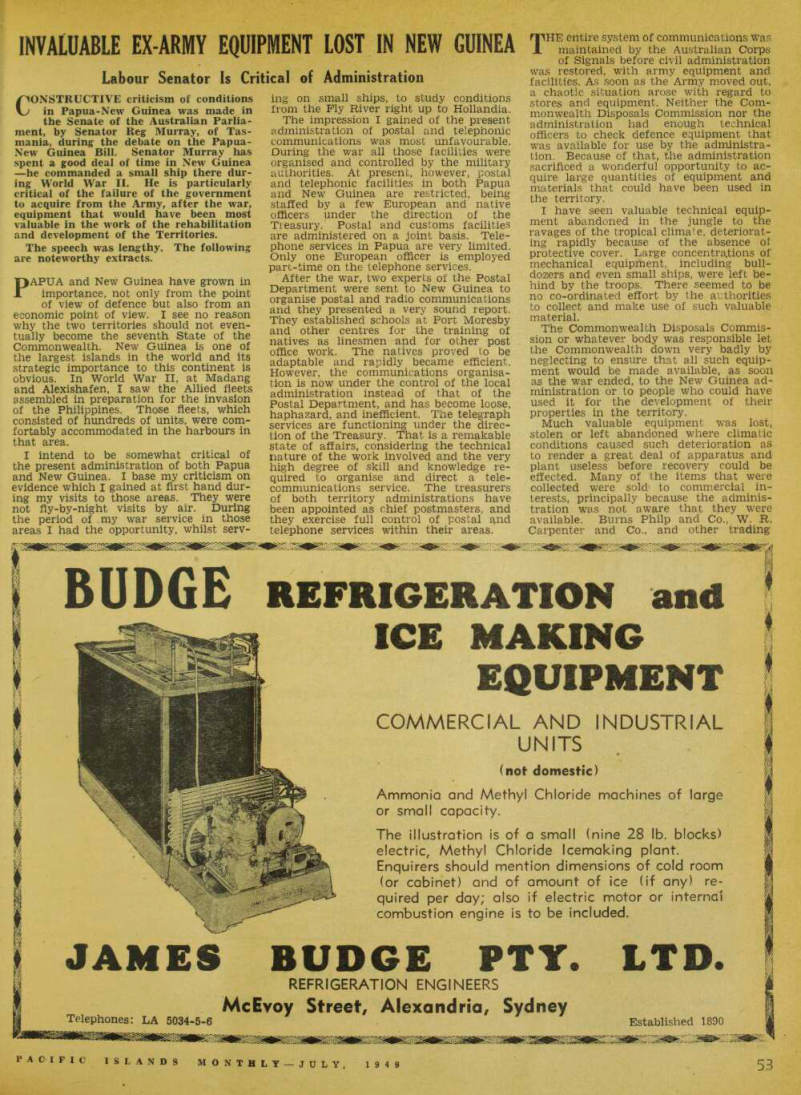
Labour Senator Is Critical of Administration
Constructive criticism of conditions in Papua-New Guinea was made in the Senate of the Australian Parlia ment, by Senator Reg Murray, of Tas mania, during the debate on the Papua- New Guinea Bill. Senator Murray has spent a good deal of time in New Guinea —he commanded a small ship there dur ing World War 11. He is particularly critical of the failure of the government to acquire from the Army, after the war, equipment that would have been most valuable in the work of the rehabilitation and development of the Territories.
The speech was lengthy. The following are noteworthy extracts.
PAPUA and New Guinea have grown in importance, not only from the point of view of defence but also from an economic point of view. I see no reason why the two territories should not even tually become the seventh State of the Commonwealth. New Guinea is one of the largest islands in the world and its strategic importance to this continent is obvious. In World War 11, at Madang and Alexishafen, I saw the Allied fleets assembled in preparation for the invasion of the Philippines. Those fleets, which consisted of hundreds of units, were com fortably accommodated in the harbours in that area.
I intend to be somewhat critical of the present administration of both Papua and New Guinea. I base my criticism on evidence which I gained at first hand dur ing my visits to those areas. They were not fly-by-night visits by air. During the period of my war service in those areas I had the opportunity, whilst serv
ing on small ships, to study conditions from the Fly River right up to Hollandia.
The impression I gained of the present administration of postal and telephonic communications was most unfavourable.
During the war all those facilities were organised and controlled by the military authorities. At present, however, postal and telephonic facilities in both Papua and New Guinea are restricted, being staffed by a few European and native officers under the direction of the Treasury. Postal and customs facilities are administered on a joint basis. Tele phone services in Papua are very limited.
Only one European officer is employed part-time on the telephone services.
After the war, two experts of the Postal Department were sent to New Guinea to organise postal and radio communications and they presented a very sound report.
They established schools at Port Moresby and other centres for the training of natives as linesmen and for other post office work. The natives proved to be adaptable and rapidly became efficient.
However, the communications organisa tion is now under the control of the local administration instead of that of the Postal Department, and has become loose, haphazard, and inefficient. The telegraph services are functioning under the direc tion of the Treasury. That is a remakable state of affairs, considering the technical nature of the work involved and the very high degree of skill and knowledge re quired to organise and direct a tele communications service. The treasurers of both territory administrations have been appointed as chief postmasters, and they exercise full control of postal and telephone services within their areas.
THE entire system of communications was maintained by the Australian Corps of Signals before civil administration was restored, with army equipment and facilities. As soon as the Army moved out. a chaotic situation arose with regard to stores and equipment. Neither the Com monwealth Disposals Commission nor the administration had enough technical officers to check defence equipment that was available for use by the administra tion. Because of that, the administration sacrificed a wonderful opportunity to ac quire large quantities of equipment and materials that could have been used in the territory.
I have seen valuable technical equip ment abandoned in the jungle to the ravages of the tropical climate, deteriorat ing rapidly because of the absence of protective cover. Large concentrations of mechanical equipment, including bull dozers and even small ships, were left be hind by the troops. There seemed to be no co-ordinated effort by the authorities to collect and make use of such valuable material.
The Commonwealth Disposals Commis sion or whatever body was responsible let the Commonwealth down very badly by neglecting to ensure that all such equip ment would be made available, as soon as the war ended, to the New Guinea ad ministration or to people who could have used it for the development of their properties in the territory.
Much valuable equipment was lost, stolen or left abandoned where climatic conditions caused such deterioration as to render a great deal of apparatus and plant useless before recovery could be effected. Many of the items that were collected were sold to commercial in terests, principally because the adminis tration was not aware that they were available. Burns Philp and Co., W. R.
Carpenter and Co., and other trading
S w^ nS kvfua S ble Wa and° f rehabilitate their plantations, seat representatives to the ter. Kory and actually t^i slands bef s re armed tion was not seised wih the importance of getting to work Quickly and the commercial enterprises acovlred mlllions Ol of Ss worth or at a m«S fra?tion of its o v iginal cost I could direct honorable senators to huge dumps of marine stores including anchor
Xffi clble in 4 pipfn- tanks
and goodness knows what’ else ’
When the narliamentarv delation to Japan visited Finschhafen in August last year I ss.w couipmcnt which could have been taken over by the administration and used for the benefit of the territory, still deteriorating in the jungle. . . . , . . . „ HERE has been a lack of planning for the rehabilita+ion of New Guinea. I am not attacking Mr. Ward on that account. I am merely referring to things that have happened. No Minister could
efflcienS wKhou!
visiting the terrltOTV and seS mndl l
tions for himself or sending res-tmSble
representative as observere on his Slf
Iphiss
r\ « * One of the principal weaknesses of the administration of New Guinea and Papua , at arises from the lack of pro- Sessional officers. Key executive men with Wlde ex P erien oe of public administration, accounting procedure and engineering are bacUy needed - The lack of knowledge of P ublic wo'ks engineering in the territory deplorable. A great deal of reconstrucc }s n f in the 190,000 square uiilcs of Now Guinea, and we need the services of the best available men to expedite the work.
Many major war-time instahations cm Id have been absorbed by the civil administration for its own purposes For instance, large stores and barracks could have been used to provide accommodation for labour forces. A plan should have been prepared before the war ended so
that surplus native labour which had been engaged by the Army could have been diverted to civil reconstruction. The work could have been undertaken as soon as hostilities ended.
I have received disquieting information concerning the organisation of the police force. The training of an efficient native force requires a great deal of knowledge of the natives and their conditions and the ability to command natives effi ciently. ... A minor police official from South Australia was sent to the territory and he immediately promoted himself to the rank of full colonel. He also condes cended to grant the rank of lieutenant to his two subordinate officers, who had been working in New Guinea for many years. Appointments of that kind indicate a weakness in the administra ion.
The native police boys in New Guinea are very efficient. They understand local conditions and have done a remarkably good job.
I have been informed bv correspondents that there is a considerable degree of un rest and dissatisfaction in New Guinea as the result of some appointments that have been made to the administration.
IN matters relating to staff welfare generally, the administration has been weak and little interest has been shown in morale or the provision of amenities for Europeans. The Adminis trator at least should have the right to hire and fire. He does not exercise that prerogative at present. We must have in New Guinea men who have the ability to get on with some of those jobs.
I have had some experience with the New Guinea natives, and, although many Of them have a knowledge of pidgin- English, the language most used by the Papuans is Motuan. With a little prac tice, one can get by with ridgin, but Motuan is a separate language.
The natives are of high intelligence, and are capable of acquiring knowledge rapidly. We should get away from the idea that they are merely “fuzzy-wuzzies” who did a good war-time job. With skilled training, they could be of great assistance.
It is only right that they should be given a certain measure of self-government. Not only are there to be native village coun cils to safeguard the welfare of the natives, but also the Legislative Council is to have three non-official native mem bers.
There is an urgent need for proper co ordination of aerial and marine transport.
It must be borne in mind that there are scarcely any roads, and no railways The missionaries have done a fine job in New Guinea. They have improved the health of the natives and endeavoured to educate them. The spiritual guidance and material assistance provided for the natives have also been very considerable.
The zeal and promptitude of the mission aries, who were quickly on the job as soon as the military authorities vacated any particular area, provided a lesson in effi cient administration. They have made the maximum use of abandoned materials.
They obtained some fine small craft, which served to replace many of their old vessels, and they were able to pur chase a number of Army landing barges, which are particularly useful to them.
THERE are tremendous potentialities in New Guinea and in Papua, parti cularly the areas around Port Moresby, Samarai and Milne Bay.
Samarai is the “pearl of the Pacific,” and during the war it was used as a rest and rehabilitation centre for the United States servicemen. Milne Bay has one of the finest ancnorages in New Guinea.
Everyone knows of the importance of gold in New Guinea, but it is not generally known that just inside Dutch New Guinea, 4,000 barrels of oil are produced daily from one area. Any one who is familiar with the topography of Borneo and the Malayan Archipelago must realise that New Guinea is located in one of the world’s greatest oil belts, and I forecast that in future years discoveries of oil will be made in New Guinea that will prove of tremendous importance to Aus tralia.
On the island of Karkar some of the finest cocoa in the world is grown. Kapok, which went off the market during the war, is now being produced near Madang, and in the vicinity of the Rai coast.
Rubber, which is also an important strate gic material, is being grown in the vicinity of Port Moresby. With co-ordinated con trol I think that we could eventually make ourselves independent of overseas sup pliers of strategic materials. One of the finest sources of potential wealth in New Guinea is the Bena Bena Plateau in the hinterland, situated at a height of 4,000 feet. Potatoes, English roses and gladioli flourish.
A great pest is the gaint snail, which was brought to New Guinea by the Japanese during the war to provide food for them. This snail at times measures 6 inches to 9 inches across the back, and has a hard shell. If at night time a light is shone in the plantation these creatures can be seen crawling around. They are very hard to eradicate.
New Guinea is very similar to Ceylon and I am astounded that more has not been done, particularly in the higher al titudes, to grow tea. Some years ago, the Australian Government brought a tea ex pert from Ceylon. I should like to know the result of his efforts, and where he is now.
In my opinion, there are excellent op portunities for the re-establishment of ex-servicemen there. Many have already been established on the land, and in busi ftpss in Australia. I consider that some )f the plantations offer excellent prospects
for a very good and comfortable living for ex-servicemen, provided, of course, that plantations have been surveyed and got ready for them. Whilst some areas in New Guinea are very unhealthy, others are not as hot as north Queensland.
The re-organisation of the two terri tories should take place as soon as this measure becomes law. There should be co-ordination of control. If there had been a co-ordinative plan, blue-printed and ready to be put into operation as the Army moved out of New Guinea, mil lions of pounds’ worth of valuable equip ment and gear that was lying in the jungles could have been utilised in hospi
tals and for rehabilitation purposes. That would have been preferable to allowing that equipment to become the property of the highest bidder, and to those who had the foresight to send men to New Guinea to “pick the eyes out” of what was avail able before the Army moved out. We are now actually forwarding to New Guinea goods similar to those that have been allowed to be overgrown by the jungle.
Mr. and Mrs. W. Christian have left Norfolk Island for NZ on their way back to Pitcairn Island.
Advertisements & other items, pp. 55-58 (1 item)
Budge
REFRIGERATION and
ICE MAKING
EQUIPMENT
COMMERCIAL AND INDUSTRIAL
UNITS
(not domestic) Ammonia and Methyl Chloride machines of large or small capacity.
The illustration is of a small (nine 28 lb. blocks) electric, Methyl Chloride Icemaking plant.
Enquirers should mention dimensions of cold room (or cabinet) and of amount of ice (if any) required per day; also if electric motor or internal combustion engine is to be included.
JAMES BUDGE PTY. LTD.
REFRIGERATION ENGINEERS
McEvoy Street, Alexandria, Sydney
Telephones: LA 5034-5-6 Established 1890
Wynne S. Breden Pty. Ltd.
SHIPWRIGHTS, BOAT BUILD AN
"PHOENIX SHIPYARDS", NEWCASTLE, N.S.W.
Designers, Builders & Outfitters of ISLAND Vessels Work Boats, Cargo Boats and Auxiliary Craft up to 200 tons.
KASPER Superior SODA FOUNTAINS
Kasper Superior Soda Fountain of all stainless steel welded construction surfaces.
Complete with ICE CREAM
MAKING MACHINE
Specially designed for TROPICAL CONDITIONS Complete fountains, including metal rust-proof surround, corbonotors and refrigerator units shipped from Australia through your agent.
For beauty, for low lifetime cost, for convenience, for dependability, for profit-making power, '‘Kasper” Fountains stand supreme in Australia to-day. The “Kasper” Fountain is years ahead of conventional models. Every detail has been thoroughly worked out and tested in the factory and in use.
“Kasper” superior fountains are of all steel, lifetime construction with stainless steel, WELDED surfaces and chromeplated fittings. Adequate cork board insulation helps assure lowest operating costs.
ORDER NOW AND AVOID DELAY
Kasper Refrigerators Pty. Ltd.
77 Railway Parade, Erskineville, N.S.W., Australia Telephone: LA 1326
" : L » ? ' .V* ' 'V —r< ; « n - “V' ’>3 \\ \ \ \N \ N\' \ \ ' l v» vl
T rop
teal Formulae
S 5 Every Berger finish must withstand test after test to prove worthy of the Berger label . . . every product must satisfy the Berger technicians and chemists that it will meet the challenge of all climates from tropic heat to arctic cold.
FINISHES
KEEP ON KEEPING ON!
Woven Wire for all Industry \
COPRA DRYING TRAYS, FLOORS, Etc.
FRUIT DRYING TRAYS, MINING SCREENS.
Heavy Mosquito Gauze in Phosphor Bronze and other Metals Impervious to Salt Sea Air.
WIRE DOOR MATS AND GENERAL WIRE WORKS
E. WRIGHT & CO. LTD.
Office and Works: 148-152 Cleveland Street, Sydney, N.S.W.
Telegraphic Address; ‘‘W^ightmake, ,, Chippendale.
gV'Tv
f- Or r"
Stewarts and Lloyds (Australia) pt y . Ltd.
Manufacturers of "S&L" PIPES and FITTINGS for GAS, WATER, STEAM and other purposes.
AND Distributors of:
MILD STEEL BARS, PLATES and SECTIONS;
GALVANISED IRON; BOLTS and NUTS; ELECTRODES
and WELDING EQUIPMENT.
Stewarts and Lloyds (Australia) pt y . Ltd.
SYDNEy WAREHOUSE - - - Herbert Street, St. Leonards BRISBANE WAREHOUSE - Montague Road, South Brisbane MELBOURNE WAREHOUSE • - City Road, South Melbourne Telegraphic Address: "Tubes ' — Sydney, Brisbane or Melbourne
Itching Skin Germs Killed in 3 Days
Thanks to the discovery of an American physician, it Is now possible to kill and remove the true cause of most skin troubles. Your skin has nearly 50 million tiny seams and pores where invisible germs and parasites can hide, and which are the true cause of terrible Itching, Cracking, Peeling, Burning, Ringworm, Acne, Psoriasis, Blackheads, Pimples, Foot Itch and other disfiguring blemishes.
Blemishes such as these make you look and feel embarrassed, unattractive and handicapped in life, both socially and In business. You can’t get rid of these disfigurements with ordinary ■reatments, which give only temporary relief, because they do not kill the germs or parasites responsible for your trouble. .
New Discovery Kills Cause
Former skin sufferers throughout the world are now praising Nlxoderm, the discovery of a leading American skin specialist. This remarkable new preparation quickly penetrates into the pores of the skin and kills the germs and parasites responsible for your trouble in 7 minutes, stopping the itch almost instantly. At the same time, this wonderful preparation acts as a tonic and skin food, so that as the cause of your troub.e is removed, your skin becomes soft, smooth and clear. This clear, henithv complexion will give you new charm and make it easy to win friends.
Praised by Doctors
Dr. T. A. Ellis, well-known physician of Toronto, Canada, recently stated: “Skin disorders caused by parasites, as many are, yiel* to Nixoderm. These parasites are invisible to the naked eye. They eat away the skin, forming ugly eruptions. Ordinary ointments or remedies fall completely, or give only temporary results because they do not reach the cause of the condition. It Is this value about Nixodenn in attacking parasites which impresses mo most favorably, and explains in large measure the success It enjoys over many stubborn cases.”
Guaranteed Results
Get Nixoderm to-day. Put it to the test. In a few minutes you will find that the itching has stopped, and in 24 hours you can see for yourself that your skin is clearer. And it Is guaranteed that, within one week, Nixoderm must make your skin soft, clear, smooth and attractive or money back on return of empty package. Get Nixoderm from your chemist or store to-day. The guarantee protects you. So don’t delay. Get Nixoderm to-day.
Nixoderm 2/. & 4/-
For Skin Sores, Pimples and Itch.
Fijian Athlete Sets
Another Record
From Our Own Correspondent SUVA. June 22.
A NOTHER brilliant putting-the-shot rl performance by Mataika Tuicakau (see May “PIM”) has inspired Fiji’s Education Department to suggest that the Fiji Amateur Sports Association might be able to send the young Fijian athlete to represent Fiji at British Empire Games to be held at Auckland, in February, 1950.
This time, at a trial held under correct competition conditions at the Teachers’
Training College, Nasinu, Mataika put a 16 lb. shot 48 ft. 9f in. (His April effort was 45 ft. 31 in.) Matalka’s latest performance beats both the Empire Games record of 48 ft. 0$ in. and the best British figure at last year’s Olympiad (48 ft. 6£ in.) with which Giles (Great Britain) established a new home record for England.
Rarotonga
No Ships For Record Orange
Crop
“Bush Beer” Parties In Rarotonga
IT is estimated that there are 100,000 cases of oranges available in the Cook Islands, as the result of a good season—4o,ooo in Rarotonga and 50,000 in Mangaia—and New Zealand has a ready market for them; but there is insufficient shipping, and probably not more than 20,000 cases will reach the Dominion.
As there is little else to be done with the fruit, the Cook Islands natives are turning it into “bush beer.” Orange juice is squeezed into a container, sugar or other fermenting agent is added, and it is treated and sealed up. The resulting liquor is palatable, and usually it has a high alcoholic content. “Bush beer parties” are a feature of social life among some classes in Rarotonga; but for obvious reasons are discouraged by officialdom.
Inquiry Into Death of Capt.
Langdale at Canton Is.
From Our Own Correspondent SUVA, June 15.
AN inquiry by the Administrative Officer, Canton Island (Mr. P. B. Laxton), into the death, on the night of May 31, of Captain G. V. Langdale, master of the motor vessel “Maureen,” resulted in a finding of accidental death by drown ing.
The evidence at the inquiry showed that after dining at the house of the station manager at Canton, Captain Langdale w T ent aboard about 11 p.m. Later a mem ber of the ship’s company observed that he was in bed and asleep. This was the last time he was seen alive. , When the captain was missed next morning a search was made and his body was found floating face downwards in the water.
The ship’s engineer (Mr. R. Sutherland) gave evidence that Captain Langdale did not sleep well and that at night he fre quently went on deck. Inspection of the deck revealed scratches which were con sistent with the possibility that Captain Langdale had missed his footing and slipped, hitting the gunwale before falling overboard.
Stamps of four values—2d., 3d., Bd. and 1/6—will be issued on October 10 by Fiji, as part of the arrangement under which Territories throughout the world will issue sets of new stamps to mark the 75th an niversary of the Universal Postal Union.
Convict System
The Last of The South Pacific Convict System
TIIE following article, entitled, “New Caledonia,” was published in “Chamber’s Journal” of August 24, 1895. A copy was recently unearthed in Sydney. It gives a picture of an era long since forgotten.
The last paragraph especially is in teresting. It is interestng, too, to know that New Caledonia still suffers from acute labour difficulties, from which she now hopes to escape by bringing in workers from Java.
THE official announcement recently made by the French Government to the effect that it had determined to cease transporting criminals to New Caledonia, has closed a period which to many interests of the South Seas was one of fear and friction.
Negotiations towards some such result as that stated have been going on for many years, the Australian colonies more than once manifesting a desire to force the hand of British diplomacy, so real was the injury they sustained by the nearness of the penal settlement, and so great was the apprehension that that injury would grow in aggravating bitterness as the years went by.
New Caledonia is 730 miles from the coast of Queensland, its capital, Noumea, being 1,050 miles from Sydney; and ven turesome spirits, goaded by the system of control on the island, thought little of making a dash for freedom, across these miles of sea. It looked, therefore, as if Australia, which resisted so stoutly the advent of criminals from England forty six years ago, would in time find itself burdened with numbers of as bad, if not worse, ones from France.
A short while back, seven such escapees sighted Queensland after a perilous trip of eighteen days in an ppen boat. They had stolen the boat from a publican on the island, stored it with eighty pounds of rice, sixty coconuts, and a small bag of biscuits and committed themselves -to the waves. When they reached the Barrier, lying off the Queensland coast, the boat was capsized, and men and pro visions were precipitated into the sea.
The breakers which capsized the boat washed it over into smooth water, where the men regained it, and, righting it, con tinued the voyage, but now without a mouthful of food in their possession.
Five days later they arrived at Whit sunday Island, in the sorriest of plights, and were befriended by a tribe of black fellows, until the Queensland police dis covered and arrested them as escaped convicts. Persons arrested on this charge are tried by a special court, and if found guilty, are handed over to the New Cale donian authorities to be redelivered at the settlement. ' Escapes like that narrated are numerous, but arrests such as described are seldom so prompt or sure. Convicts have struck the mainland, unobserved, and made their way into the bush, where they have be come station hands, or fallen into the ways of the nomadic “swagman,” and no particular notice has been taken of them.
Sometimes, too, they discover friends of their own nationality, and are helped to successfully disguise themselves and their objects; and usually, if they are found settled down, they are not interfered with.
But when they are unlucky enough to put into any large town, they mostly go to the bad, or are caught and sent back.
During the Communist excitement of 1874, the well-known Rochefort, with five associates, escaped from New Caledonia,
and landed at Newcastle, New South Wales, where their history became at once known, and, friends and enemies were set in motion.
The ordinary convict who reaches a large town is, however, either tamely caught, or he drops in among the dregs of the population, and applies himself industriously to some form of midnight law-breaking. He mostly takes up the line which originally caused his deporta tion from France, and often displays skill and presence of mind in his operations.
Coining, burglary, safe-robbing, and way laying the tipsy or belated, are favourite exploits with this class of criminal: and sometimes the work is done with such perfection of detail, that detectives know the nationality of the perpetrator before they lay hands on him.
It may be that these escapes have not been at any time so numerous as the Aus tralian public assert, but seeing that they so often come to light when gangs of thieves are captured, or a course of syst ematic crime is suddenly stopped, the general impression as to their numbers may not be far astray, THE French Government classifies its New Caledonian convicts as “recidi vistes,” “condamnes,” and “liberes.” the first meaning habitual criminals; the second, persons undergoing a sentence; and the third, what we would call “ticket of-leave men,” or persons sometimes who have fulfilled their term of punishment, but who are refused permission to return to France.
The recidivistes and condamnes are ever on the watch for a chance to escape.
They esteem almost any spot on earth as a better place to live than where they are. Some of the liberes are not very objectionable, and in the days when those of them who would not be permitted to return to France were allowed to go to America or Australia, they frequently be
haved well, and adopted industrious and lawful occupations. Many of them drifted to the New Hebrides, and are now in inde pendent circumstances there.
But the privilege of leaving New Cale donia for America or Australia was with drawn some years ago, and hence the convicts must now be kept on the island.
In 1882 a trading company was formed with the object of transferring some of this convict labour to the New Hebrides.
As such a transfer would increase French power in the latter group of islands, as well as make room for fresh consignments of convicts in the old quarters, the French Government took up the idea with zest,
and established as a preliminary two mili tary posts in the neighbourhood. But England, vigorously prompted by Austra lia, protested against the scheme with such effect that it was abandoned: and six years after, the military posts were abolished.
M. Biard d’Aunet, the French Consul general at present in New South Wales, visited New Caledonia about a year ago, and discussed with the Governor of the settlement various projects for the ter mination of transportation. M. Biard d’Aunet was fully possessed of the Aus tralian sentiment on the matter, and the outcome of the conference was a series of recommendations to the French Govern ment, which culminated in the decree of the Chamber of Deputies directing that transportation to New Caledonia should cease, and that in future convicts should be sent to one of the French possessions in Africa.
THE news of the cessation of trans portation was received by the busi ness portion of the New Caledonian community with undisguised ill-favour.
The mineral resources of the island are very great, and are as yet but partially tapped. Chrome, cobalt, and nickel abound. The soil is fruitful; coconuts, bananas, and bread-fruits growing wild.
Sugar-cane and coffee-planting, and other industries of a tropical character, promise to be profitable pursuits.
With quick returns from these sources in mind, employers of labour naturally de sired cheap workmen, and the convict system which obtained lent itself admir ably to their needs. In 1879 the Govern ment entered into a compact with Mr.
John Higginson, a naturalised Frenchman old Noumean resident, whereby he wi»s granted the services of three hundred convicts for twenty years, at the charge of one penny per day per man, the Gov ernment agreeing to feed and clothe them during that period. Three or four similar agreements were entered into with other employers. Seventy Chinese convicts lately landed at Noumea, were immediately hired out to applicants for their services. The sentences on these convicts ran from five to fifteen years, and the applicants paid the hiring bureau a trifling sum per year of sentence, and guaranteed to pay the convicts afterwards at the rate of twelve shillings per month.
Consequently, it is not surprising that the news of the impending change pro duced a disquieting effect.
But the die is cast. New Caledonia en ters the list of free countries. Though the immediate effect may be injurious to some businesses, general business is sure to be favourably affected, and social and political life to be improved.
New South Wales ceased to be a convict settlement in 1839, Van Diemen’s Land in 1853, and Western Australia in 1868: and in each case a new spirit appeared to breathe through the country when the convict flag was lowered. Progress, poli tical, social, and industrial, has been the yearly record. There is no reason to fear for New Caledonia.
Advertisements & other items, pp. 59-60 (1 item)
Bboomfields Ltd.
OVERSEAS MAGAZINES
Direct to You from the Publishers.
American:
CHARM
COLLIERS WEEKLY
CORONET
ESQUIRE
HARPER’S BAZAAR
LADIES’ HOME JOURNAL ..
LIFE
LOOK
POPULAR MECHANICS .. ..
READERS 3 DIGEST
SATURDAY EVENING POST . .
SCIENTIFIC AMERICAN ..
TIME
VOGUE
YACHTING
33/6 60/- 18/9 75/- 75/- 37/6 49/- 39/- 28/3 12/- 68/9 52/6 96/- 105/- 40/-
English:
APOLLO
COURIER
PICTURE POST . .
PUNCH
TATLER
TIMES WEEKLY . . .
52/6 50/6 27/6 46/3 122/- 38/- Rates are for one year and include all charges. Many other overseas periodicals available on all subjects.
ALL ORDERS AIR-MAILED TO
PUBLISHERS.
MAIL PUBLICITY CO., 175 PITT
STREET, SYDNEY, N.S.W.
BBOOMFIELDS Ltd.
Suppliers of
Building Hardware
Ship Chandlery, Paint Materials
5
WRITE DIRECT TO:
Broomfields Ltd., 152 Sussex Street, Sydney
G. H. Robinson
Exports & Imports Pty., Ltd.
ISLAND SUPPLIES
of all kinds—Selected and Shipped to order at lowest possible prices—Piecegoods in Wool, Cotton and Silk, Under and Outerwear, Manchester, Drapery, Grocery, Hardware, Engineers and Leathergoods trade supplies a specialty.
Indents and Transhipments arranged. Large or small orders treated with equal care.
Use our 25 years' extensive experience.
Enquiries solicited to—
G. H. ROBINSON
Exports & Imports Pty., Ltd. 51 Macquarie Street, Sydney, N.S.W.
Telegrams: Sunrise, Sydney.
Letters: Box 3317, G.P.0., Sydney.
Scott's “Renown” Brand Rope,
Cordage and
Binder
Twine
of Every
Description
Cable Address: Ropeyard, Sydney.
sss
MANUFACTURED AT
MASCOT, N.S.W.
J. SCOTT
PTY. LTD.
Head Office and Store
163 CLARENCE STREET,
SYDNEY,
N.S.W.
Racecourse
Ng Natives On Sydney
Letter to the Editor ON page 48 of your April issue you publish a photograph of New Guinea natives on a Sydney racecourse, and say they are from the mission vessel “Hotamara.” Actually, the vessel was the “Hotu Maru,” running in the service of W. R. Carpenter & Co., Ltd., and those were not mission boys.
The native crew were getting £5 a month and all found (Australian tucker, too), one of the crew told me when I saw him in Madang on his return.
He was strutting around in the clothes he wore in Sydney and he certainly looked big-headed. He wanted to go back to Sydney to work, and eat our food—no more rice for him. Later on, that morn ing, I noticed him at the Bung, and he was dressed in a red lap-lap, and carrying his little coconut palm-leaf basket.
I am, etc.,
T. K. Slatter.
Editor’s Note: The article referred to was taken, verbatim, out of one of the Sydney newspapers.
Planning Methodist Mission
Rebuilding In N. Guinea
From Our Own Correspondent
Rabaul, June 17.
THE Rev. C. F. Gribble and Mr. F. Field ing of the Methodist Mission Board spent a busy time in New Guinea in May and June. They surveyed Mission rebuilding requirements.
While in Kavieng they were guests of the Rev. and Mrs. B. Chenoweth. From there they went to New Hanover where the mission house at Ranmeleck was the one Methodist building left standing in the New Britain district after the war.
It was, however, so riddled with shell fire to be worthless.
They inspected all mission stations in New Ireland and New Britain and throughout their tour were welcomed en thusiastically by the native villages. At the historic centre at Molot, they inspected the place where Dr. George Brown founded the Methodist Mission in New Guinea in 1875.
On June 17, Mr. Fielding left for Bris bane but Mr. Gribble will visit Methodist Mission stations in Papua before he goes south.
He said that a team of mission builders will shortly arrive in Rabaul to carry out the extensive rebuilding programme that will be necessary.
The headquarters of the London Mis sionary Society in Australia will shortly be removing from 250 Pitt Street, Sydney, to The Boulevarde, Lewisham, where the Rev. N. F. Cocks, secretary in Australia and New Zealand, will reside. The NSW Auxiliary ,will retain an office at 250 Pitt Street.
Red Tape Ties Up Export of Norfolk Is
Norfolk Is. Fruit to NZ
Mr. Douglas Richards, Popular
taxi driver, has disposed of his in terests on Norfolk Island, and is departing. His yellow and brown jeep station waggon was known to hundreds of tourists. * Mr. Richards, some time ago, shipped an experimental consignment of 50 cases of bananas to the Internal Marketing Division in New Zealand. This body—to explain to the uninformed—consists of a collection of ornate and modern offices and buildings loaded with civil servants, and scattered over the face of New Zea land. Their sole aim, it seems, is to con found the producer and jack up prices.
The Division is similar to those Apple and Pear Boards with which Australia was afflicted.
Mr. Richard’s experimental consign ment remained experimental, for, it seems, the only financial reward gained was by the Division.
Exceptionally heavy crops of oranges and lemons are noted this season.
Tourists —especially from orange-starved NZ—comment bitterly on the fact that the fruit cannot be exported from here to NZ.
Oranges sold in NZ come from the Cook Islands and the supply represents about 20 per cent, of the demand. In addi tion, the price is ridiculously high. The same applies to bananas.
From Our Norfolk Island Correspondent
Australia’S Ban On
Polynesians
Letter to the Editor It has been with great interest that I read recent articles in the “Pacific Islands Monthly” relative to Australia’s anti-Polynesian immigration law. The stand the “PIM” has. taken is commended by those whose thinking is on behalf of the dignity of man.
European and American people have observed the natural democratic ten dencies of the Tahitians which are com pletely devoid of politics. This is natural uninhibited democracy untainted by any of the isms. When my house becomes stagnant within, I open the windows and admit the fresh air.
As your excellent editorial indicated, 99 per cent, of Polynesians do not con sider immigration to Australia worthy of their consideration. But it is interesting to note that thousands of the Polynesians who volunteered to fight in the Pacific War, gave their services directly or indirectly to the defence of Australia against the Japs.
In light of mankind’s present efforts toward one world, it behoves popular government to streamline itself by the elimination of racial discrimination, and such ordinances as Australia’s Polynesian exclusion law. If we are too bigoted to make these alterations in our thinking and our government, then we may as well change the name of our democracy.
I am, etc.,
Tahiti.
David Cave.
Editorial Note: Australia does not ban all Polynesians—only those who are with out political strength. The ban on Maoris was hurriedly removed when New Zea land showed resentment, but it still re mains on Samoans, Tongans, Cook [slanders, etc.
Handy Ship For Cook Islands
THE twin-screw, wooden motor vessel “Kinabatangan,” of 309 tons gross, purchased by the Auckland firm of A.
B. Donald, Ltd,, for service in the Cook Islands, arrived in Auckland from Singa pore, via Brisbane, at the end of June. She will be renamed “Charlotte Donald”, after the late Mrs. A. B. Donald, and will be in Auckland for about a month receiving alterations. The vessel will be based on Rarotonga.
Built in Fremantle in 1945, the “Kina batangan” was purchased from the North Borneo Shipping Company, Ltd., which had registered her at Singapore. She has accommodation below decks for eight passengers.
Fiji-Indian Students
Go To India
From Our Own Correspondent SUVA, June 20.
THE Indian Government has selected three Indian students in Fiji to go to India for further studies. The students, who expect to sail from Suva in the “Orna” about the end of June, were chosen from a panel of six recommended by the Commissioner for the Government of India in Fiji (Mr. S. A. Waiz).
They are Mr. Bhagauti Prasad (trained as a teacher at the Government Training College), who is already at the Benares Hindu University; Mr. Hari Ram (for merly a pupil at the Marist Brothers’
School, Suva); and Miss Kiran Mishra, of Lautoka.
At the Rabaul District Court recently a native was fined £2 and had his licence suspended for two months for dangerous driving; a European member of the
Works and Housing Department, was fined £5 and had his licence suspended for three months on a similar charge; three natives received sentences of six months each for illegal use of a motor vehicle; and two Fijian crew members of the “Admiral Chase” were fined for being drunk and disorderly and resisting arrest.
Advertisements & other items, pp. 61-62 (1 item)
ansomes
QUEENSLAND
INSURANCE
COMPANY
LIMITED
(Incorporated 1886 In Australia)
ASSETS EXCEED £5,000,000
Head Office :
QUEENSLAND
INSURANCE BUILDING,
80-82 PITT STREET, SYDNEY.
Speciolists in South Seos Fire,
Marine Cr Accident Insurances
Apply to:—
FlJl.—Branch Office: I. B. Chalmers, Manager, Burns Phllp (South Sea) 00., Ltd.
VlLA.—Burns Phllp (South Sea) Co., Ltd.
Comptolrs Francais Des Nouvelles Hebrides (Marine).
NOUMEA.—L. & W. Johnston.
NEW GUlNEA.—Manager for Mandated Territory and Papua, W. A. Anderson.
PORT MORESBY—SAMARAI—LAE
—MADANG—RABAUL.
Burns, Phllp (New Guinea), Ltd.
PAGO PAGO.
Burns Phllp (South Sea) Co., Ltd- G. H. O, Reid 4s Co.
OTHER SOUTH SEA ISLANDS.
Burns Phllp (South Sea) Co., Ltd.
Also to any of the Company’s Offices in Australia or Hew
Zealand.
For perfect cutting
under all conditions
There is a Ransomes Mower for every lawn our range covers machines for every requirement from the smooth, even surface of the putting green to the sports ground, golf course or aerodrome,
The "MOON" Mower
GANG
MOWERS
For grass such as couch, klkuyu, buffalo, etc., and grass longer than the average. 14-in. and 18-ln. wide. 50 acres a day can easily be cot with a Ransomes Quintuple Mower drawn by a tractor and even larger outfits up to 15 ft. wide are available.
ansomes
Lawn Mowers
Write for illustrated literature and all information
MORRIS, HEDSTROM LTD.,
Suva, Lautoka, and Ba.
Made by RANSOMES, SIMS & JEFFERIES LTD., IPSWICH, ENGLAND.
1 f*#* I Sa "i y
1 H DO NT SAY
N'T SAT G I TV
DON'T SAY ft I M
Lpont say
DON
DON'T SAY
DON'T SAY I* I
G I MDON'T SAY
DON'T SAY fj I M
GIM DON'T SAY
DON'T SAY ft I N
ft I M DON'T SAY
DON'T SAY ft I ft
ft 1 M DON'T SAY
DON'T SAT fill
DON'T SAY G I M
GIM PONT SAY
DON'T SAY GIM
GIM DON'T SAY
DON'T SAY GIM
GIM DON'T SAY
DON'T SAY GIN
GIM DON'T SAY
DON'T SAY GIN
GIM DON'T SAY
DON'T SAY ft 1M
ft 1 M DON'T SAY
DON'T SAY GIM
DON'T SAY GIM
GIM DON'T SAY
DON'T SAY GIM
DON'T SAY
N r D s Gty * Ll ou °u r * C °C s y<b * W Hr e y s *rs s
DON'T
GIM DON'll
DON'T SAY GIM
DON'T SAY GIM
_ON'T SAY
DO G D AY M
SAY
IM
T SAY
DON'T SWWG I M
DON'T SAY © I
GIM DON'T S
DON'T SAY GI
DON'T SAY
Y S AY Sty * u ou m WHs fho IT,
°CKT
SAY
* ey IM «*J£ S^sf,
'T SAY
DON'T
GIM DON'T
DON'T SAY ft IM DON'T
Telegrams and Cables: “GILBETS,” Melbourne.
Address all inquiries to:
W. & A. GILBEY LTD.
33 ROSSLYN STREET, WEST MELBOURNE. 109 REGENT STREET, SYDNEY.
Telegrams and Cables: “GILBEYS,” Sydney.
fraUaTstoik to stand'
Territories Talk-Talk
By "Tolala"
AUSTRALIAN Minister “Eddie” Ward came out of the NG Timber In quiry without a stain on his family escutcheon. But he certainly had a chip on his shoulder during the passage of the miners’ legislation in the Federal House. * * ♦ ONF rpniiv w to dmiip Pt «orr.P of NE reaiiy nas to smile at some of these publicity stunts nowadays launched QAt artLSf Austrahan Government to off se£ adverse criticism of administration in an ioS^ ir ?f r i??L Q i S ,? lpl ? ient of , cattle was some horses, goats
fraUaTstoik to stand'
Anyone would think that TNG had never known Australian livestock before the war, and that the present authorities were breaking new ground. That is far from being the case. There were some fi iP e .nerds of cattle on many estates in the Madang, New Britain and Bougain vine distncts, before the war. Statistics of ten years ago show total cattle in the Territory of 20,565, horses 1,309, mules 8, sheep 1,293 and goats 9,791. Where’s the experimental stage? * * * AND talking of statistics* In 1Q47 4ft Administration ™ ™r- 8 recentlv ttohsp iS£2 tly m • 1 ? ?°y se ’ nme natives are shown as convicted of sorcery.
Ten years ago, 77 were found guilty of this offence in the Courts for Native cnm . lnal comparisons were: #’i as agail l st }?5 ten yaars ag0 > spre a ding false reports 11 (28), threaten £LJiS a o 10 / U i r i,.. 50 (94) and inde cent at} pint a , i g d oclme indicates a more law native community—or less activity on the part of district patrols in taking
legal action - rm inclined to think the latter is the reason. * * * COMPARISONS are odious; but it is in- V teresting to get a glimpse at the cock-eyed trade of the Territory, and explain the economic set-up as it is at Present. In the good old days of 1937-38, Jemtory imported goods to the tune of and exported copra, gpld and other island products totalling £2,980,360. leaving a nice favourable trade balance of £1,369,393. In 1947-48, the story changes: Imports were valued at £3,105,098, and exports only £1,927,075—a balance on the wrong side of the ledger of . , Not so hot! Gold bullion exported for those periods totalled 410,058 oz. and 126,092 oz. respectively . . .Yes, com P arisons are odious - aren,,; the y ? * * * /\NE Sydney paper, publishing the gold v/ figures, showed them as 126,092,025 oz in the ’47-48 period, valued at £A815,570! Cheap golcf, eh? The decimal point, had become a comma—which would be a bit misleading for those earnest UNO representatives studying the report and accustomed to the metric system. * * * . a . , .. . .. AS a result of a letter from the Tanga Group—off the east coast of N. Ireu- land—Deputy Opposition Leader g arrison had something to say in the JJouse at Canberra about the “Cargo Cults” flourishing in Australia’s Trustee Territory. He suggested that Government should take action to nrotect the lives of whites up there P llves 01 Strange, how dangers vary in those Isles of the Blest, as the years roll on. in several of these island groups off N. Ireland’s east coast, 40 or so years ago th c biggest risk a white man ran was in being kidnapped by some of those hefty island females (whose numbers far exceeded the male population) and kept in
durance vile (?) for mating purposes, That would have been an interesting point for an Opposition Member to raise * n the Australian Parliament of those
“nfdein ’’and the’ PathSandSd^
b gthl r^ ’about! th^re
was no polwlot UNO S then to critic!se what governments dM or dft not do wnat governments am or aia not do. . a . * T NOTICE that recordings have been 1 made by the ABC Moresby station of some “sing-sings” around Rabaul. It is to be hoped that the recordings include that old-time sing-sing known as the '‘Solomon Islands dance.” The harmony in the chanting is certainly delightful. The best exponents in the pre-war years were the Matupi natives, who are—or were— wa» ‘heir melody-making. * * * i|NE of Minister Ward’s first jobs, now V/ he is back in office after the Timber Inquiry, will no doubt be to iron out some of the “anomalies” (good old new fashioned phrase for anything resembling a whinge) put forward by the Moresby Public Service representatives, who flew down to Canberra to put their case to act ing Minister Chambers. He “wanted to do all he could to help the delegation get satisfaction,” so the report goes. And that meant, no doubt, keeping the file for Eddie to deal with. If rumours are right it will not surprise me to see that the delegates get some satisfaction from Eddie.
It would be well-earned, * * WHAT with the coal strike and one ▼▼ thing and another, it is quite on the „ r cards that some Get-Rich-Quick Wallingford will work up the idea of floating a company to exploit the coal deposits in the Namatanai area of New Irelal “!* But Australian workers would probably declare it black,
(Continued on Page 63)
HARRY JACKMAN and Grainger Morris, Patrol Officers, are studying co-operative technique in Australia to pass on to their charges in the Territories at a later date. Report has it that 83 native co-operative societies have already been established. A spokesman says the formation of these societies will “teach the native to grow cash crops, like copra and hemp, and thus help the population realise the vast commercial possibilities of NG for themselves.” . .» . Yes. That’s the sort of blah that critical Soviet re presentatives will swallow . . . Perhaps. * * ♦ THE news of the sale of the SID Com pany, in the British Solomon Islands will come as a shock to some of the few old-timers who remember places like Berande and Manning Straits in their hey-day; and, despite change of owner ship, the shades of old managers like Jim Campbell, Phil Shelley, Alan Campbell and Robbie” will probably haunt the foreshores for many a year to come.
Berande was made famous first by that hospitable pair, Darbyshire and Harding, and later by Jack London, when he blew into the group in the “Snark,” and was inspired to write “Adventure.” . . , The Solomons without the SID will be like Sydney without the GPO. * * * lATEST target for Russia’s criticism at i UNO of Australia’s administration in the Pacific is Nauru, where ex ploitation of phosphate workers takes place “in the most slavish human con ditions.” Poppycock, of course! but it influences Australia’s policy in these Trustee Territories to counteract such charges, even though there’s not an lota of truth in them. The Australian Gov ernment is far too sensitive to this sort
of calculated criticism. Trouble is that Australia’s poor private enterprise has to pay the price of these palliative policies. * * * BITS and Pieces: Richard Chugg, the well-known Australian flautist, who has been heard over the ABC re cently with Raphael Kubelik, is a brother of R. C. Chugg, of the Territories Health Department . . .Commander A. W. R.
McNicoll, GM, son of the late Sir Walter, has been promoted to the rank of Captain . . . Leslie Anderson passed away at Cawa, Nadi, Fiji, on June 12.
Advertisements & other items, pp. 63-64 (1 item)
A. B. Donald Limited
RAROTONGA —COOK ISLANDS
TELEGRAPHIC ADDRESS: “DONALD, RAROTONGA.”
General Merchants (Wholesale & Retail) and Shipowners Importers & Exporters Branches Throughout Cook Islands Fire, Marine & Motor Vehicles Insurance-—Agents for Yorkshire
Insurance Co.
Lloyd's Agents.
Head Office: — A. B. DONALD, LTD., Auckland.
Agents and Distributors for: D E W^ GL AND.— Austin Cars & Trucks, Pye Radios Dunlon ft U rt bbe phS" H?” , Vauxhall Cars & Trucks. R. a. Lister & Co P Ltd.. Phillips Cycles, Marples Tools. - ’
U.S.A.—Remington Rand Corp., Radio Corp of America Champion Spark Plug Co,, Firestone Tyres, General Steamship rSs ZEALAND Va,:UUm °" Co Pts ’- Petroleum AUSTRALlA.—Wunderlich, Ltd., Cement Asbestos Products.
NORWAY.—O. Mustad & Sons. Pish Hooks.
SWEDEN.—b. a. Hjorth & Co., Primus Products.
Associate Houses:— ETABLISSEMENTS DONALD, Tahiti, Papeete, Society Islands.
DOMINION FRUIT CO., Suva, Fiji Islands.
CODES: Bentley's Complete Phrase ACME Sydney Agents :
BURNS, PHILP & CO , LTD.
London Agents : San Francisco Agents : BURNS, PHILP & CO.. LTD. BURNS. PHILP CO. OF SAN FRANCISCO.
GEORGE J. LOGKYER & COMPANY
CONSULTING ENGINEERS
DOCKYARD MACHINERY
In association with GEORGE J. LOGKYER (Far East) fir CO. and GEORGE J. LOGKYER (Overseas) Cr CO.
ENGINEERING SUPPLIES, GENERAL HARDWARE EXPORTERS AND MERCHANTS Agents for the Finest Australian Liquors Aerated Water and Cordial Manufacturing Machinery, Bottling and Capping Machinery, etc.
IF YOU ARE INTERESTED IN:—
MILLS
Flour mills. Hard semolina mills. Self-contained Colonial Flour Mills. Flour improving equipment. Feed milling equipment. Grinding and blending plants. Saw dust mills. Grinding and blend plants for spices and colours. Laboratory equipment.
CONSTRUCTION OF GRANARIES AND
WAREHOUSES
HULLING INDUSTRY
Hulling mills for rice, barley (for making groats), oats (for flakes and groats), peas, buckwheat, millets, kauliang, lentils, Dal and other pulses.
Construction of Export and Import Granaries. Agricultural and Mill Granaries for all kinds of grain, oil fruits, pulses, and seed, in bulk or in sacks. Mechanical and pneumatic handling plants for loading and unloading ships and railway cars with the above-named goods. Steel Silos. Grain Cleaning Plants. Machinery for dressing seed.
PNEUMATIC HANDLING PLANTS
OIL MILLING
Complete equipments for the manufacture and refining of vegetable oils and fats. Pressing, Extraction-, and Refining plants. Oil separating plants for wool and leather. Margarine granulators, Melting and Tempering Pand for the manufacture of margarine.
For grain, bran, flour, oil seed, coal, salt, chemical products, ashes, blast furnace dust, wood chips, woodshavings. Floating pneumatic elevators. Floating pneumatic grain elevators. Stationary and travelling ship discharging plants. Conveying plants for rubbish from wash plants and rubbish disposal plants for mines.
SUGAR TREATING MACHINERY
MECHANICAL HANDLING PLANTS
Installations for drying, cooling and assorting granulated sugar. Conveying plants. Grinding plants for pile and granulated sugar. Manufacture of powdered sugar.
MALTING AND BREWING PLANTS
Equipments of complete maltings and breweries. Barley and Malt cleaning plants. Pneumatic Maltings (Drum and Saladin Box Maltings). Malt Kilns. High Capacity Malt Kilns. Floor Stores and Silos for barley and malt.
Pneumatic and mechanical handling plants for barley and malt. Malt crushing plants. Brew house equipment. Mash filters. Wort colling plants. Fermentation and Storage Tanks. Conveying plants for barrels and bottles. Laboratory equipments.
For all kinds of goods in bulk and packages, such as grain, coal, salt, earth and ores, stornes, bags, cases, bales, barrels, wood logs, etc. Mechanical equipment for warehouses of salt works and the chemical industry.
Trans-shipping plants for loading salts into ships and railway cars. Coal handling plants for boiler houses.
Equipment for the automatic operation of mail offices.
CEMENT WORKS AND ROCK CRUSHING
PLANTS
MACHINES FOR SOAP MAKING
Soap boiling equipment. Pumps. Soap slabs cooling plants. Cutting machines. Presses. Drying plants.
Milling equipment. Pendulum cutter. Flaking rolls.
Soap-powder plants.
Equipment of complete cement works. Crushing, burning, grinding, and conveying equipment for the chemical industry; specially for Dolomite, Magnesite, and Aluminium Works. Installations for salt mills and salt stores. Crushing and grinding plants for coal.
Road metal plants, etc.
MECHANICAL PULP AND BOARD MILLS
MACHINES FOR THE CHOCOLATE INDUSTRY
Cocoa beans crushing, cleaning and grinding plants.
Cocoa presses. Cocoa and chocolate roller mills.
Complete equipment for mechanical wood pulp mills and board mills of every size. Preparing plants for cellulose and pulp wood. Wood barking plants. Installations for handling wood sticks and pulp.
- CONSULT US -
All communications to be addressed to The General Manager, 0.1A0., Box 4563, Sydney.
Bankers; Commonwealth Bank of Australia, Sydney.
Also Bank of N.S.W., Sydney.
Telegraphic and Cable Address; “LOCKMAOH,” Sydney.
Rabaul Native Schools
Work For Own Funds
From Our Own Correspondent
Rabaul, June 30.
OTHER Administration schools are now following the lead of Malubunga in accumulating school funds for the general improvement of their schools and for purchasing equipment. The idea be longs to the natives themselves.
Malabunga funds are provided by the sale of taro and kau kau. The school at Toma has not only developed its gardens to produce both taro and kau kau but each pupil brings in six coconuts on Monday and Wednesday mornings. These are sold to PCB.
Advertisements & other items, p. 65 (1 item)
Misima Crushing Returns
IN the nine weeks ended June 22, Cuthbert’s Misima Gold Mine, Papua, crusned 730 tons of ore, for 113 oz. of gold and 332 oz. of silver.
Fijian Nurses Complete
Training At Lautoka
From Our Own Correspondent SUVA, June 20.
FIVE Fijian nursing graduates were honoured at a graduation ceremony at the Lautoka Nurses’ Training School on June 16. The Medical Officer in-Charge, Lautoka Hospital (Dr. T.
Jezierski) welcomed the visitors, who in cluded the Director of Medical Services (Dr. J. M. Cruikshank) and Mrs. Cruik shank, the Nursing Superintendent (Miss D. T. Pederson), the New Zealand Deputy Director-General of Health (Dr. H. B.
Turbott), the Director of the New Zealand Nursing Service (Miss M. I. Lambie, OBE) and the South Pacific Research Council member for Health (Dr. E. Massal).
The winner of the cup for the best all round nurse at Lautoka was Nurse Saine mere Galo, who was top of the class with honours in all subjects. Other prize winners were Nurses Serena Tora (Public Health), Viva Vakua (greatest improve ment in final year), and Mere Tora (best paper in obstetrics).
The other two graduates were Nurses Salete Lcwatu and Livia Daubulu.
Five BCPA passengers had a three-day stay on lonely Canton Island at the end of June, when their aircraft was delayed by engine trouble. They stayed at the Pan American Airways hotel there and said that they had been well looked after.
On eventual arrival in Auckland they complained of the tropical heat of Can ton and said that they had been unable to swim because local waters are in fested with barracuda.
Advertisements & other items, pp. 65-66 (1 item)
J. C. Merrillees Pty. Ltd., Sydney
SMOOTH WANDS
A.. . *v « Y *sos V :i^ I f JL>€ & t L t^c s> V •v b^ tha Lrxt<UV
MAKE-UP
■ \ BASE
y M*i •% t* St y A » * O' -ma f
SMOOTH
SKIM
These goods are stocked by all the leading stores of the Pacific Islands. Order through your usual channels. Further enquiries to:
J. C. Merrillees Pty. Ltd., Sydney
Rid Kidneys Of
Poisons And Adds
If you suffer sharp, stabbing pains, if Joints are swoUen, It shows your blood Is poisoned through faulty kidney action. Other symptoms of Kidney Disorders are Backache, Aching Joints and Limbs, Sciatica, Neuritis, Lumbago, Sleep* less Nights, Dizziness, Nervousness, Circles under Eyes, Lots of Energy and Appetite and Frequent Headaches and Colds, etc. Ordinary medicines can’t help much because you must get to the root cause of the trouble.
The Cystex treatment is specially compounded to soothe, tone and clean kidneys and bladder and remove acids and poisons from your system safely, quickly and surely, yet contains no harmful or dangerous drugs. Cystex works in 3 ways to end your troubles. 1. Starts killing the germs which are attacking your Kidneys, Bladder and Urinary System In two hours, yet Is absolutely harmless to human tissue.
S. Gets rid of health-destroying, deadly poisonous acids with which your system has become saturated. 3. Strengthens and reinvigorates the kidneys, protects from the ravages of disease-attack on the delicate filter organism, and stimulates the entire system.
Praised by One-time Sufferers
Cystex Is approved by one-time sufferers in 13 countries from the troubles shown above.
Mr. Reg Thomas, Townsville, Queensland, recently wrote: "My Joints were all stiff, I had leg pains, my back nsed to ache day and night.
My bladder was weak. I had headaches and no appetite. The first dose of Cystex helped me and before I finished three boxes my health and strength came back.”
Guaranteed to Satisfy or Money Back
Get Cystex from your chemist or store to-day.
Give It a thorough test. Cystex Is guaranteed to make you feel younger, stronger, better ii every way, or your money back If you return the empty package.
Now in 2 sizes—4/-, •/-.
OT lssa“ Cystex
for Your Kidneys, Bladder, Rheumatism.
Every Branch Of
ENGINEERING and BUILDING CONSTRUCTION
MILLERS LTD.
SUVA and LAUTOKA
Sawmillers and Timber Merchants; Shipwrights and Saihnakers; Joinery and Furniture Manufacturers; Upholsterers; Plumbers; Electricians; Hardware Merchants; Motor Dealers.
AGENCIES:
Chevrolet, Bedford, Vauxhall, Nash Motors. Firestone Tyres.
Fetters Marine and Stationary Engines. G.E.C. Radio Sets.
British Australian Lead Manufacturers Pty., Ltd., Atlas Assurance Co., Ltd.
There is no need to send to Australia or New Zealand for Repairs or Replacements. We can give you a sound Quotation and guarantee First-Class Workmanship
Want A Pacific
Island?
ACCORDING to New Zealand sources, there is a 14-acre island for sale in Fiji, 25 miles from Suva. It grows oranges and coconuts, “warm trade winds sough daily through the palms and warm seas crash on the beaches.” Price is £lOO. Many have showed Interest but so far there have been no takers.
The agents point out, that it is not all tropical paradise. 'On the mainland side are vast mangrove swamps that practi cally join it to Viti Levu.
Formerly the island belonged to Mr.
W. H. S. Moorhouse who experimented with rubber there. He last visited it in 1928 and no one appears to have been back since.
Seekers after romantic tropical islands might be interested to know that the New Zealand agent is a firm called Guar dian Trust.
Ngataki's Owner Again On
A Pacific Cruise
MR. JOHNNY WRAY who, in the 30’s built himself a yacht from drift wood salvaged from around Auck land Harbour, and sailed the Pacific in her, has reached Tonga in another ship which he has called “Waihate.”
“Ngataki,” his first yacht, after carry ing her owner on many adventures—in cluding a trans-Tasman race—was wrecked. Mr. Wray wrote a book about “Ngataki” (“Vagabonds of the South Seas”), which was published in London during the war. Not many copies of the book were distributed and a Nazi blitz destroyed the rest. It was proposed, some time ago, that the book be repub lished. In the meantime, the author in a new boat—ketch-rigged with an auxi liary motor—is making a leisurely Pacific cruise, lone-handed.
Two young stowaways were discovered shortly after the “Aorangi” sailed from Suva on June 10. The ship stopped out side the reef and the pair were returned by launch. Returning to Fiji in the ship “Wairuna” are two young men who stowed away at Suva when the vessel was on her way to Vancouver.
Fiji-Born European
Death Of First
BORN at Nukulau Island, at the mouth ? lv £ r ’ on December 12. 1860, Mrs. W. S. Cooper, whose death has occurred at Nasavusavu, Fiji, is be lieved to have been the first European iSJE 16 was formerly Miss Alice Charlotte Smithyman. !n June, 1879, she married Mr. Walter Stonehaven Cooper, who had come from Wales in 1869 and had settled at Vuni wailevu in Nasavusavu Bay. They had six sons and three daughters. All but one son survive and live on the family estate.
Mrs. Cooper’s brother (three years younger) was the first male European born m Fiji. He became manager of the Government Press at Levuka, was respon sible for the building of the first Govern ment printing works at Suva, and, with JJr. G. A. Woods (formerly Premier in the Cakpbau Government), founded the Polynesian Gazette” at Levuka
Another War-Time Bomb
Washed Up In Fiji
From Our Own Correspondent (CONTINUING a notable career in the J disposal of the apparently inexhaust - :ible supply of unexploded American bombs and floating mines which persist ency bob up in Fiji waters, Major A. H.
Diffey, MBE, Fiji Military Forces, has dealt with a mine washed up near Kabulau Passage, in the Savusavu area of Vanua Levu.
Approaching the mine in a punt, Major Diffey, who was assisted by Sergeant- Major Bryson, held the mine off by hand while he slipped on to it a bridle con taining an explosive charge. The party was well away in a launch when the mine exploded.
Fighting Filaria On
Mangaia
From Our Mangaia Correspondent THE ever-present beef-can, once seen around local settlements in its hundreds, and left to rust, or be trodden into the soft ground after rain, is to-day no longer a feature of the Mangaian native village.
These empty tins, till they rusted too completely to hold water, were formerly a very convenient breeding-place for the filaria mosquitoes that are responsible for the attacks of chills and fever that many Mangaians suffer after a sudden change of weather. Now the Resident Agent, Major W. H. Ryan, has instituted a system of trucking away the accumulated cans at intervals, this work being done by the Mosquito Control boys who were trained at Rarotonga last year.
The tins are removed to a distant dump, flattened, and buried, thus rendering them harmless.
Papua-New Guinea Posts
And Telegraphs
ACCORDING to the Australian Post master-General, in June, discussions between the Postmaster-General’s Department and the Department of Ex ternal Territories are still proceeding with a view to finding the most satis factory means of control of Papua-NG posts and telegraphs.
He could not say yet what organisation would be set up in the Territory “but the interests of the residents of Papua and New Guinea will be kept in mind.”
Australian Or New
Zealand?
Future of Norfolk Island
THERE is a feeling among many Nor folk Islanders that the island would be better off as a dependency of New Zealand than under the care of Aus tralia. (said a correspondent in a letter recently to the “New Zealand Herald”).
“Norfolk Island’s greatest form of po tential wealth lies in its oranges and bananas, but there are many difficulties in the way of their export,” adds the writer. “Australia does not want them, fearing their competition with the Queensland products through lower labour costs. On the other hand, the island is faced with the inverse position in the case of New Zealand. The Norfolk growers cannot compete with the lower costs of produce from the Cook Islands, an area which is included within the ex tended boundaries of the Dominion. The barrier to the New Zealand market in volves much more than this, however, going back in the first instance to a dis pute between New Zealand and Australia over primary produce.
Banana Growers’ Difficulties ALTHOUGH Norfolk bananas are al lowed into New Zealand if accom panied by a certificate showing that they are free of disease, they may be im ported only through the Internal Marketing Division or by private firms, subject to New Zealand customs import licences,” the writer continues. “The islanders argue that the Internal Market ing Division prices are not sufficient to pay them to handle the bananas, while the customs import licences, it is felt, are
an automatic prohibition. The preference given Cook Island bananas, as a New Zealand dependency product, constitutes another barrier.
“Many Norfolk Islanders, for this and other reasons, regard with regret the de cision of the Colonial Office against New Zealand’s claim in 1896 to control the island.
“The pro-New Zealand element among the islanders claim that if Norfolk were under New Zealand administration they would be better off in many ways. The island is much nearer to New Zealand than to Australia, and Auckland mer chants are more interested in trading there than are their Sydney counterparts.
New Zealand shipping firms display far more interest than Australian ones in trade with the island. Also, New Zea land maintains a regular passenger and cargo air service with the island.
White Elephant to Australia A PROPOSAL to establish fishing on a large commercial basis ended when one vessel from Australia went ashore,” says the writer. “A trawler, which was expected to be sent from Aus
tralia, did not arrive. However, a com pany formed from “New Zealand and local capital proposes to commence whaling this year. This is an industry which was once firmly established at Nor folk.
“It is contended that Norfolk Island has been little more than a white ele phant to Australia for many years past and that a community of interest seems to lie with New Zealand. What is only a drag to Australia would be an asset to New Zealand, it is stated.
“Major territorial changes are taking place peacefully not only within the Em pire, but elsewhere. For this reason the question is asked: Would it not be pos sible for two independent countries of the Commonwealth to arrange the trans fer of an island, when that transfer would be to the advantage of all con cerned.”
Madame le Carrour, aged 101, who is now living in Nice, has thoughts of re turning to New Caledonia where her three surviving sons are established, two at Bouloupari and one at Poys.
Advertisements & other items, pp. 67-68 (1 item)
Widdop
DON’T PUT UP WITH
needless suffering. Safe, effective treatment for tropical diseases, rheumatic conditions, digestive troubles, skin diseases, nerves, weakness, complaints of men and of women, and all forms of acute or chronic bodily ailments.
Specialist advice freely given without obligation. Use Air Mail. Consult to-day the Superintendent,
AUSTRALIAN HEALTH SERVICES
156 Castlereagh St., SYDNEY
DIESEL ENGINES
BY
WIDDOP
S H P TO 300 H P
H • WIDDOP & CO LTD
GREENGATE KEIGHLEY ENGLAND
Telephone: Keighley 3727-8 Telegrams: Widdop Keighley Codes: A.B.C. 6th Edition, Bentley’s, Bentley’s Second Above: (D-Type) 36/45 H.P.
On left: (X-Type) 120 H.P.
Direct reversing
HEAVY MACHINERY AND EQUIPMENT
FOR THE ISLANDS TERRITORIES
Steamships Trading Company Ltd.
AUTOMOTIVE and MACHINERY DEPARTMENT
Distributors in Papua
MOTOR CARS
ROOTS, LTD.—Hillman Minx—Humber Hawk— Humber Snipe and Sunbeam—Talbot Cars.
WILLYS-OVERLAND—Universal Jeeps—Jeepsters —Jeep Station Waggons.
Papua only.
R 0 A D T R A NSPORT
INTERNATIONAL HEAVY DUTY MOTOR
TRUCKS—IS cwt. to 8 tons Gross Carrying Capacity. Utility Bodies-—Platform Bodies — Tippers—Semi-Trailers—Low Loaders, etc.
AGRICULTURAL MACHINERY
McCORMICK-DEERING FARM TRACTORS, all
sizes, Wheel and Crawler Types.
FARM MACHINERY to suit every Purpose— Ploughs Harrows Cultivators Planters Harvesters Grass-Mowers Hay Rakes & Power Pressers—Chaff Cutters —Feed Grinders —Hammer Mills, Etc.
RICE-MILLING MACHlNERY—Hullers—Pearlers Polishers Threshers & Dressers Seed Graders—Aspirators—also Complete Mills from 100 to 3,000 lb. capacity rice per hour.
EARTH-MOVING E QUI P MENT
Bullgraders Dozers Excavators Front End Loaders—Road Graders—Road-Rippers—Waggon Scoops—Quarry Dumpers—-Bitumen Sprayers, Etc.
TIMBER LOGGING AND
Ml L LIN G E Q UIP M E NT Diesel Logging Tractors—Timber Trucks—Timber Jinkers—Log Haulers—Tractor Logging Winches —Truck Mounted Loading & Front End Pull Winches—Wire Rope, Etc.
SAW-MILLING MACHINERY Circular Saw
Benches—Circular Rack Saws &■ Log Mills up to 31" depth of cut.
and New Guinea for —
INDUSTRIAL EQUIPMENT
DIESEL STATIONARY ENGINES—from 5 h.p.
upward, all purposes.
DIESEL MARINE ENGINES—from 5 h.p. upward W/Reverse £r Reducing Gears.
OUTBOARD MOTORS—2* to 22 h.p.
MOBILE CRANES—Wharf G* Material Handling, 1 to 5 tons Capacity.
PUMPS & PUMPING PLANTS—Agriculture- Mining and General Purpose Pumps.
ELECTRIC GENERATING SETS—sizes to suit every purpose—A.C.-D.C. current.
ELECTRIC MOTORS—GENERATORS—FractionaI
sizes upwards—A.C. and D.C. current.
GANG & POWER GRASS MOWERS—Municipal,
Golf Course and Airfield use.
REFRIGERATORS
ELECTRIC COMPRESSOR and KEROSENE
OPERATED Food Storage Capacity, Models 4 to 7 Cubic Feet.
AUTOMOTIVE EQUIPMENT
STORAGE BATTERIES—for every purpose—Car —Truck—Radio—Marine—Lighting sets.
TYRES & TUBES—Cars—Trucks—Tractors— Industrial Equipment.
HYDRAULIC LIFTING JACKS— i ton to 10 ton capacity.
GENERAL CAR AND TRUCK ACCESSORIES—
Electrical & Hydraulic Replacements—Clutch Linings, Brake Linings, Etc.
Adequate stocks of spare parts are available for all vehicles and machinery at our
SERVICE PARTS DEPOT
PORT MORESBY
CabZe Address: Telephone: Postal Address: “Steamships,” Port Moresby Moresby, 476 Port Moresby, Papua
Strange Coincidence
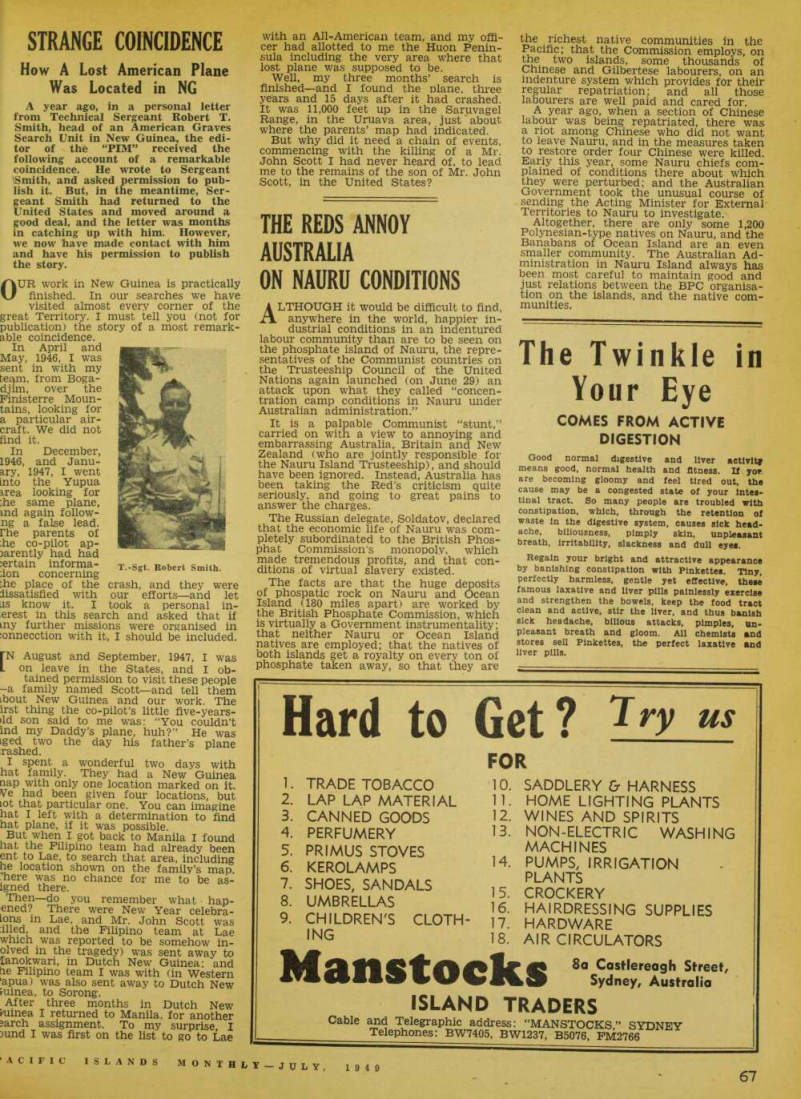
How A Lost American Plane Was Located in NG
A year ago, in a personal letter from Technical Sergeant Robert T.
Smith, head of an American Graves Search Unit in New Guinea, the edi tor of the “PIM” received the following account of a remarkable coincidence. He wrote to Sergeant 'Smith, and asked permission to pub lish it. But, in the meantime, Ser geant Smith had returned to the United States and moved around a good deal, and the letter was months in catching up with him. However, we now have made contact with him and have his permission to publish the story.
OUR work in New Guinea is practically finished. In our searches we have visited almost every corner of the great Territory. I must tell you (not for publication) the story of a most remark able coincidence.
In April and May, 1946, I was sent in with my from Boga djim, over the Pinisterre Moun tains, looking for a particular air craft. We did not find it.
In December, 1946, and Janu ary, 1947, I went into the Yupua area looking for ;he same plane, md again follow ng a false lead, rhe parents of ;he co-pilot ap larently had had certain informa tion concerning
the place of the crash, and they were dissatisfied with our efforts—and let us know it. I took a personal in erest in this search and asked that if my further missions were organised in ;onnecction with it, I should be included. [N August and September, 1947, I was on leave in the States, and I ob tained permission to visit these people -a family named Scott—and tell them ibout New Guinea and our work. The irst thing the co-pilot’s little five-years >ld son said to me was: “You couldn’t ind my Daddy’s plane, huh?” He was tged two the day his father’s plane rashed.
I spent a wonderful two days with hat family. They had a New Guinea nap with only one location marked on it.
Ve had been given four locations, but lot that particular one. You can imagine hat I left with a determination to find hat plane, if it was possible.
But when I got back to Manila I found hat the Filipino team had already been ent to Lae, to search that area, including he location shown on the family’s map. here was no chance for me to be as igned there.
Then—do you remember what hap ened? There were New Year celebra ions in Lae, and Mr. John Scott was illed, and the Filipino team at Lae which was reported to be somehow in olved in the tragedy) was sent away to lanokwari, in Dutch New Guinea; and tie Filipino team I was with (in Western 'apua) was also sent away to Dutch New ruinea, to Sorong.
After three months in Dutch New Kiinea I returned to Manila, for another -arch assignment. To my surprise, I mnd I was first on the list to go to Lae
with an All-American team, and my offi cer had allotted to me the Huon Penin sula including the very area where that lost plane was supposed to be.
Well, my three months’ search is finished—and I found the plane, three years and 15 days after it had crashed.
It was 11,000 feet up in the Saruvagel Range, in the Uruava area, just about where the parents’ map had indicated.
But why did it need a chain of events, commencing with the killing of a Mr.
John Scott I had never heard of, to lead me to the remains of the son of Mr. John Scott, in the United States?
T.-Sgt. Robert Smith.
Australia
The Reds Annoy
On Nauru Conditions
ALTHOUGH it would be difficult to find, anywhere in the world, happier in dustrial conditions in an indentured labour community than are to be seen on the phosphate island of Nauru, the repre sentatives of the Communist countries on the Trusteeship Council of the United Nations again launched (on June 29) an attack upon what they called “concen tration camp conditions in Nauru under Australian administration.”
It is a palpable Communist “stunt,” carried on with a view to annoying and embarrassing Australia, Britain and New Zealand (who are jointly responsible for the Nauru Island Trusteeship), and should have been ignored. Instead, Australia has been taking the Red’s criticism quite seriously, and going to great pains to answer the charges.
The Russian delegate, Soldatov, declared that the economic life of Nauru was com pletely subordinated to the British Phos phat Commission’s monopoly, which made tremendous profits, and that con ditions of virtual slavery existed.
The facts are that the huge deposits of phospatic rock on Nauru and Ocean Island (180 miles apart) are worked by the British Phosphate Commission, which is virtually a Government instrumentality; that neither Nauru or Ocean Island natives are employed; that the natives of both islands get a royalty on every ton of phosphate taken away, so that they are
the richest native communities in the Pacific; that the Commission employs, on the two islands, some thousands of Chinese and Gilbertese labourers, on an indenture system which provides for their regular repatriation; and all those labourers are well paid and cared for.
A year ago, when a section of Chinese labpur was being repatriated, there was a riot among Chinese who did not want to leave Nauru, and in the measures taken to restore order four Chinese were killed.
Early this year, some Nauru chiefs com plained of conditions there about which they were perturbed; and the Australian Government took the unusual course of sending the Acting Minister for External Territories to Nauru to investigate.
Altogether, there are only some 1,200 Polynesian-type natives on Nauru, and the Banabans of Ocean Island are an even smaller community. The Australian Ad ministration in Nauru Island always has been most careful to maintain good and just relations between the BPC organisa tion on the islands, and the native com munities.
Mr. and Mrs. E. j. H. Colchester- Wemyss, with their three-months old daughter, were in Sydney in June, en route to Guadalcanal, BSI. Mr. Col chester-Wemyss is in the Colonial Service and will take charge of police in BSI, after six years in Jamaica. Mrs. Col chester-'Wemyss said that there was no colour bar in Jamaica and no discrimina tion against women. She had been at tended by the leading gynaecologist in the West Indies who happens to be a native woman.
Advertisements & other items, pp. 69-70 (2 items)
67
ACIFIC ISLANDS MONTHLY JULY, 1949
Manstocks
The Twinkle in
Your Eye
COMES FROM ACTIVE
DIGESTION
Good normal digestive and liver activity means good, normal health and fitness. If yor. are becoming gloomy and feel tired out, the cause may be a congested state of your Intestinal tract. So many people are troubled with constipation, which, through the retention of waste In the digestive system, causes sick headache, biliousness, pimply skin, unpleasant breath, Irritability, slackness and dull eyes.
Regain your bright and attractive appearance by banishing constipation with Plnkettes, Tiny, perfectly harmless, gentle yet effective, these famous laxative and liver pills painlessly exercise and strengthen the bowels, keep the food tract clean and active, stir the liver, and thus banish sick headache, bilious attacks, pimples, unpleasant breath and gloom. All chemists and stores sell Plnkettes, the perfect laxative and liver pills.
Hard to Get? 7r v us
1. 2. 3. 4. 5. 6. 7. 8. 9.
TRADE TOBACCO
LAP LAP MATERIAL
CANNED GOODS
PERFUMERY
PRIMUS STOVES
KEROLAMPS
SHOES, SANDALS
UMBRELLAS
CHILDREN'S CLOTH
ING
Manstocks
ISLAND TRADERS
FOR
10. SADDLERY & HARNESS
11. HOME LIGHTING PLANTS
12. WINES AND SPIRITS
13. NON-ELECTRIC WASHING
MACHINES
14. PUMPS, IRRIGATION
PLANTS
15. CROCKERY
16. HAIRDRESSING SUPPLIES
17. HARDWARE
18. AIR CIRCULATORS
8a Castlereagh Street, Sydney, Australia Cable and Telegraphic address: “MANSTOCKS,” SYDNEY Telephones: 8W7405, 8W1237, 85076, PM2766
The Key te Earning JPotrer
Sometimes men think that a general education or an elementary knowledge of business is enough to gel ahead. But experience soon teaches that thorough, specialised training is just as necessary for success in business as it is in the professions of Law, Medicine or Dentistry. If you are interested in the many opportunities in the business World ... if you seek responsibility, success and economic security, commence training now —in some specialised business subject. H.R.I. is available always to help and advise ambitious men and women. Write or wire for particulars and career information.
H.R.I. tutorial service is proved by the winning of more honours than all coaches in Australasia combined.
H.H.J. Career Training • ACCOUNTANCY • SECRETARYSHIP • COST ACCOUNTANCY
• PRACTICAL BOOKKEEPING • MARKETING SELLING
ADVERTISING • BANKING • LOCAL GOVERNMENT EXAMS.
Hemingway Robertson Institute
Founded and Owned by Hemingway & Robertson Pty. Ltd.
Consulting Accountants Professional Tutors
126 BANK HOUSE,
126 BARRACK HOUSE.
BANK PLACE, MELBOURNE
16 BARRACK STREET, SYDNEY
126/814
Sophistication!
Three Stories From The N. Guinea Highlands
From a Special Correspondent THE comparatively recent introduction of money (for the payment of native wages) into the Highlands of New Gumea, has had some rather amusing sidelights.
at an Administration Hospital, the native labourer employed as goat appeared at the back door of the medical assistant’s residence accompanied £L on ?- of *i ls pne-talks. He said that at some time during the night the old billy goat had broken out of the banis and had destroyed one-talk’s garden. He went on +T? a \. 11: he one- talk was given a iob in the hospital, everything would be lorgiven and forgotten, but if he wasn’t employed, he would proceed immediately to the Kiap and make court.
An investigation was instituted, and it was found that the goat had not broken out, and no garden was destroyed, b , oys 9 onf essed on questioning that they had cooked up the story so that the one-talk could get on the pay-roll.
No job was given.
At the same establishment, recently, there appeared six natives, all with fowls!
The missus of the house was pleased, as he f J fo Z ls were sadl y depleted. She asked them what they wished in return for the fowls. They answered that the fowls were not for sale, but a present to the master if he would employ them in the hospital. Unfortunately for them, there was no work offering. ■ from behind the hills came in entire savings to buy a Kina (Goldhp) Shell, and a Talibum (Green Snail) Shell. When the storeman wanted to see the colour of his money, the lad produced mnepence—seven pennies, and four ha pennies. He was upset and an noyed when he was told what it was worth.
He thought he was being “got at,” and in sisted that it was big money—therefore, big value.
For the third quarter of 1949 Tahiti is to receive 30,000 US Marshall Aid dollars, of which $lO,OOO are for the purchase of electric refrigerators.
Advertisements & other items, p. 70 (1 item)
C. Sullivan Pty. Ltd.
Island Me
Over 30 years' experience in the Pacific Island Trade.
Expert Buying Service Original Invoices Furnished Sellers of Island Produce.
Represented in all Australian States, New Zealand, England, France, United States, etc.
BANKERS'; Bank of New South Wales, Comptoir National d’Escompte de Paris, Bank of New Zealand.
C. SULLIVAN PTY. LTD.
379 KENT STREET, SYDNEY
Telegrams & Cables: CHASULL, Sydney. Phone: MJ4657 (6 lines).
Both Increase:
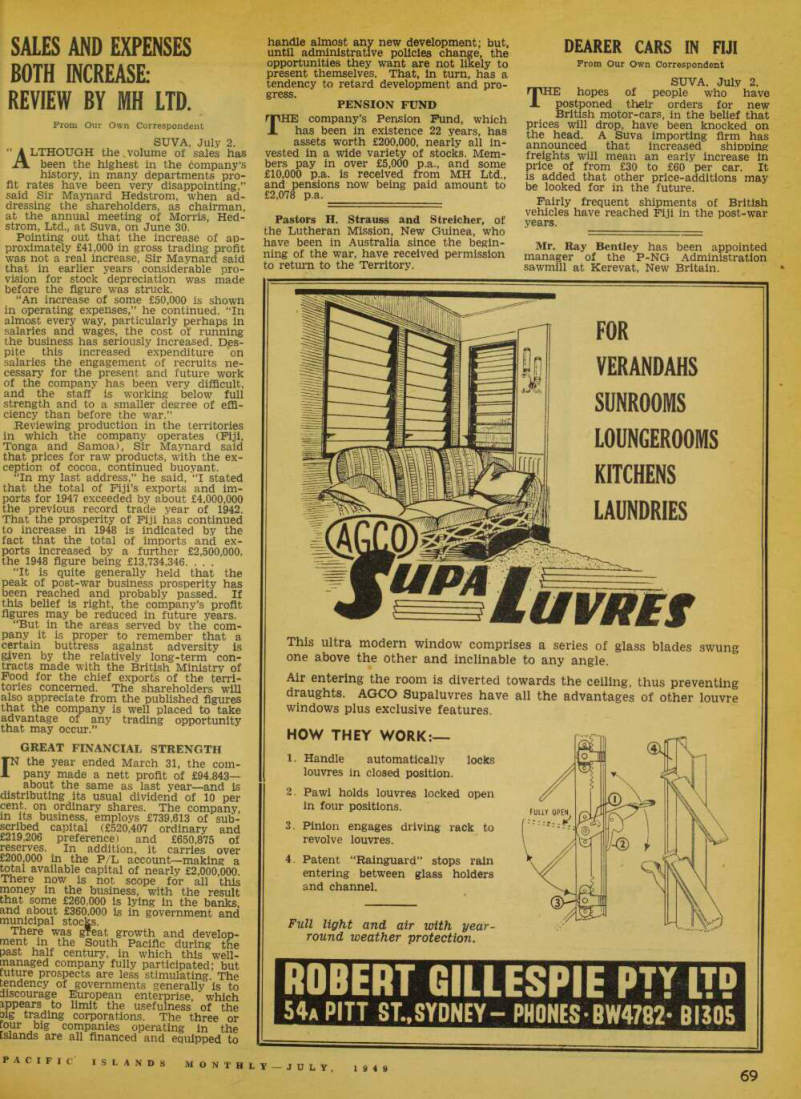
Sales And Expenses
Review By Mh Ltd.
From Our Own Correspondent SUVA. July 2.
ALTHOUGH the .volume of sales has been the highest in the company’s history, in many departments pro fit rates have been very disappointing,” said Sir Maynard Hedstrom, when ad dressing the shareholders, as chairman, at the annual meeting of Morris, Hed strom, Ltd., at Suva, on June 30.
Pointing out that the increase of ap proximately £41,000 in gross trading profit was not a real increase, Sir Maynard said that in earlier years considerable pro vision for stock depreciation was made before the figure was struck.
“An increase of some £50,000 is shown in operating expenses,” he continued. “In almost every way, particularly perhaps in salaries and wages, the cost m running’ the business has seriously Increased. Des pite this increased expenditure on salaries the engagement of recruits ne cessary for the present and future work of the company has been very difficult, and the staff is working below full strength and to a smaller degree of effi ciency than before the war.”
Reviewing production in the territories in which the company operates (Fiji, Tonga and Samoa), Sir Maynard said that prices for raw products, with the ex ception of cocoa, continued buoyant.
“In my last address,” he said, “I stated that the total of Fiji’s exports and im ports for 1947 exceeded by about £4,000,000 the previous record trade year of 1942.
That the prosperity of Fiji has continued to increase in 1948 is indicated by the fact that the total of imports and ex ports increased by a further £2,500,000, the 1948 figure being £13,734,346. . . .
"It is quite generally held that the peak of post-war business prosperity has been reached and probably passed. If this belief is right, the company’s profit figures may be reduced in future years.
“But in the areas served bv the com pany it is proper to remember that a certain buttress against adversity is given by the relatively long-term con tracts made with the British Ministry of Food for the chief exports of the terri tories concerned. The shareholders will also appreciate from the published figures that the company is well placed to take advantage of any trading opportunity that may occur.”
Great Financial Strength
IN the year ended March 31, the com pany made a nett profit of £94,843 about the same as last year—and is distributing its usual dividend of 10 per cent, on ordinary shares. The company, in its business, employs £739,613 of sub scribed capital (£520,407 ordinary and £219,206 preference) and £650,875 of reserves. In addition, it carries over £200,000 in the P/L account—making a total available capital of nearly £2,000,000.
There now is not scope for all this money in the business, with the result that some £260,000 is lying in the banks, and about £360,000 is in government and municipal stocks.
There was great growth and develop ment in the South Pacific during the past half century, in which this well managed company fully participated; but future prospects are less stimulating. The tendency of governments generally is to liscourage European enterprise, which appears to limit the usefulness of the mg trading corporations. The three or four big companies operating in the islands are all financed and equipped to
handle almost any new development; but, until administrative policies change, the opportunities they want are not likely to present themselves. That, in turn, has a tendency to retard development and pro gress.
Pension Fund
THE company’s Pension Fund, which has been in existence 22 years, has assets worth £200,000, nearly all in vested in a wide variety of stocks. Mem bers pay in over £5,000 p.a., and some £lO,OOO p.a. is received from MH Ltd., and pensions now being paid amount to £2,078 p.a.
Pastors H. Strauss and Streicher, of the Lutheran Mission, New Guinea, who have been in Australia since the begin ning of the war, have received permission to return to the Territory.
Dearer Cars In Fiji
From Our Own Correspondent SUVA. July 2.
THE hopes of people who have postponed their orders for new British motor-cars, in the belief that prices will drop, have been knocked on the head. A Suva importing firm has announced that increased shipping freights will mean an early increase in price of from £3O to £6O per car. It is added that other price-additions may be looked for in the future.
Fairly frequent shipments of British vehicles have reached Fiji in the post-war years.
Mr. Ray Bentley has been appointed manager of the P-NG Administration sawmill at Kerevat, New Britain.
Advertisements & other items, pp. 71-72 (1 item)
Robert Gillespie Pit It?
A Q ’4&m
FOR
VERANDAHS
SUNROOMS
LOUNGEROOMS
KITCHENS
LAUNDRIES
This ultra modern window comprises a series of glass blades swung one above the other and inclinable to any angle.
Air entering the room is diverted towards the ceiling, thus preventing draughts. AGCO Supaluvres have all the advantages of other louvre windows plus exclusive features.
HOW THEY WORK:—
1. Handle automatically locks louvres in closed position. 2. Pawl holds louvres locked open in four positions. 3. Pinion engages driving rack to revolve louvres. 4. Patent “Rainguard” stops rain entering between glass holders and channel.
Full light and air with yearround weather protection.
FULLY OPEN
ROBERT GILLESPIE PIT IT?
54a PITT ST..SYDNEY-PHONES 8W4782- BI3OS
TILLEY. LAMPS
(BURN ORDINARY KEROSENE)
The Modern Form of PORTABLE LIGHTING
ATTENTION TO DETAIL
is the characteristic of all British products
TILLEY LAMPS
are British made throughout at Hendon & Cricklewood, England.
THE TILLEY LAMP COMPANY LTD. of ENGLAND London Offices and Showrooms: 33 SACKVILLE STREET, PICCADILLY, W.l
REPRESENTATION :
MELBOURNE: T. H. Bentley, Pty. Ltd., 123-125 William Street, Melbourne, C.l.
TASMANIA: Mr. C. Sellars, 108 a Charles Street. Launceston.
FIJI; Mr. K. Witherington, 2 Burns Philp Buildings, Suva.
Crime In Samoa
Prom Our Own Correspondent APIA, June 28.
UNUSUAL charges of murder and at tempted murder were before the High Court (Chief Judge Marsack, and juries of three Europeans and one Samoan) in Apia in June.
Seko To’oala, of Lu’ua, Faga, Savaii, got ten years’ gaol, for manslaughter. He had used a cane knife to chop off the head of Lokenl, of Fusi. Lokeni had lived with Seko’s sister, who by him had had four childern. Then Lokeni neglected the woman, and he resented the reproaches of Seko; so Seko killed him. Mitigating circumstances caused the charge to be reduced from murder to manslaughter.
Ama Saunoagamaali’i was sentenced to death for murder. One evening, in Beach Road, Matefele, Apia, in front of the Methodist Church, Ama had an argument with another Samoan, and suddenly drew a knife and stabbed him fatally in the abdomen, and then ran away. The police chased and caught him. He begged the Court not to send him to gaol, but to hang him. The Court complied with his wishes.
A Samoan woman, Lotu, was found not guilty of attempting to murder her un named child by burying it in the sand at the sea shore. Another woman, Faapusa Faumuina, was sent to gaol for four years for murdering her newly-born child.
Lucia Roberts was fined £5O, and Joe Steffany £lOO, for having bought bags of cocoa-beans, the property of the NZ Re- Sarations Estates, knowing them to have een stolen.
Mr. John Stitt, of Sohano, New Guinea, was flown to Rabaul and admitted to hospital on July 5. Old fuses, which he was handling, exploded and blew off some of his fingers.
In Empire Games
Fiji May Take Part
SUVA. June 30.
THE New Zealand Empire Games As sociation and the organising com mittee of the 1950 British Empire Games (to be held at Auckland in Feb ruary) have invited Fiji to take part.
The invitation is addressed to the “British Empire Games Association of Fiji,” which does not exist, but the newly formed Fiji Amateur Sports Association is in the process of getting itself affiliated to the Empire Games headquarters at London.
There is as yet no indication of what representatives of Fiji will be available for the Games. Under the strict defi nition of “amateur,” almost all of Fiji’s athletes, including boxers, are “profes sionals.” The reason for this is that with virtually no amateur competitive athletics except swimming, bowling, foot ball, hockey and tennis, people have had to be either “professionals” or nothing at all.
RADIOTELEPHONIC communications
Radiophone Between Noumea
And Vila
Prom Our Own Correspondent
Noumea. June 20.
RADIOTELEPHONIC communications
between Noumea and Port Vila will be on a public basis probably within a month, tests having already proved sat isfactory.
Charges are 12 gold francs for the first three minutes, with an additional four gold francs for each extra minute there after.
The remains of Captain Jean Gilbert, a French officer formerly well known and
much liked in Tahiti and in New Cale donia—where he was placed in command of the naval forces in June, 1942are to be taken by a French warship to Tahiti for re-burial. Catain Gilbert, who was a Navy air pilot, was killed in a bomber accident in New Zealand during the war.
Mr. Roy Dobbie departed from Rabaul, NG, m June. He has been in the Rabaul Hospital for some weeks, suffering from a skin disorder. His medical advisor has ordered him to spend at least 12 months in Australia. He first went to the Islands in 1933, spent some years in Bougainville
and then went to the Sepik District for the Public Works Department. He served in both world wars and since the restora tion of Civil Administration in Rabaul, has been in charge of the transport sec tion. He expects to return to the Territory as soon as his health permits.
Advertisements & other items, pp. 73-74 (2 items)
71
ACIFIC ISLANDS monthly JULY. 1949
Awplioh
COLE’S
T ropic-Seosoned
CHICKENS
Pure WHITE LEGHORNS and
First-crosses: R.l. Red x W.L. or Australorp x W.L.
Bred in the sub-tropics and seasoned to your climate.
All Breeders guaranteed Government blood-tested. 25’s 50’s 100’s £ s. d. £ s. d. £ s. d.
W ' .. 110 0 212 6 415 0 Crosses 111 6 215 0 500 Plus Air Freight
ED. COLE,
Enmore Poultry Form, Cairns, N.Q.
AMPLION PRIMING PUMPS
for Irrigation, Fire Fighting or other uses.
PRICE, £77/10/9, F. 0.8., Sydney.
AMPLION 1 H.P. ENGINES
So light a man can carry (40 lbs.).
RUNS 8 hours on a gallon of petrol. Used for DRIVING pumps, concrete mixers, cultivators, post borers, grinders, spraying equipment, wherever power is required.
AMPLION ELECTRIC
LIGHTING PLANTS
Bring you brilliant Electric Light in your home, weekender, or farm. In 12 or 32 volt models. Low operating and first costs.
Treated for the Tropics.
ISLANDS PRICE , £6O/11/6, F. 0.8.
SEND FOR FREE
LITERATURE BY
RETURN MAIL.
aWPLIOh
AUSTRALASIA PTY., LTD.
36-40 Parramatta Road, Comperdown, N.S.W.
ENGINE ONLY
PRICE £36/0/6 F. 0.8.
Ample Spares Available. 1 m
TRADE STORE SUPPLIES
For YOUR Requirements
CONTACT
VENTURA TRADING COMPANY PIY. ITD.
26 BRIDGE STREET, SYDNEY, N.S.W.
Cables; “Ventura,” Sydney
OR TO
P. & R. HUTCHINSON, Suva H. G. EEKHOFP, Lae, T.N.G.
From WHOA!
SIMPLEX
MARINE ENGINES
3, 5 and 10/12 h.p. Suitable for all crafts from 14-32 ft. The 5 and 10 h.p. are supplied with built-in reverse gear. All Australian made. Prices and specifications on request.
C.Q.R. ANCHORS
The lightweight anchor with three times the holding power of any other anchor. No more efficient tool for quick and positive “dig-in” has ever been found than the ploughshare. The C.Q.R. is two well designed ploughshares welded together. Write for C.Q.R. Anchor leaflet.
to GO!
W. KOPSEN & GO. PTY. LTD.
Have EVERYTHING for Boats
FISHING
TACKLE
Our new Fishing Department has been opened to provide the utmost service and satisfaction in all classes of fishing gear. Marlin Gut lines, Fishkil Nylon Twist, Geisha Wire Traces, Linen and Cotton lines. Rangoon and Split Cane Rods, Reels and numerous other lines.
KAYEN PRESSURE LAMPS
The all Australian made vapour lamps— reliable—efficient—safe—easy to operate.
Burns for 10 hours on IV* pints of kerosene. The lamp illustrated is of 300 O.P. and is the table model (HL7); the allpurpose lamp (AP2) is wlndproof and ideal for outdoor work. Burn ordinary kerosene. Write for illustrated leaflet.
SHIPCHANDLERS & MARINE ENGINEERS
376-380 KENT ST., SYDNEY. MA6336 (9 lines).
Cables: “KOPSEN” Sydney.
Little Appreciated
Fiji’s Coral Reefs Are Little Appreciated
From Our Own Correspondent SUVA, June 22.
PASSAGES through coral reefs are not, JT as is commonly supposed, due primarily to fresh water discharged by streams. Tidal currents play a larger part than fresh water in keeping pas sages open, and the configuration of the sea floor is an important factor.
These facts were stated by the Super visor of Technical Services in Fiji (Mr.
R. A. Derrick, MBE) in the course of an address to the Fiji Society.
Mr. Derrick said that although Dana, the eminent American geologist, had des cribed Fiji as “one of the grandest regions of growing corals in the world,” few people were aware of the extent and the scientific interest of the coral reefs in the Fiji Group. The total length of Fiji’s reefs must be measured in thousands of miles.
The familiar forms of the corals were deceptive. The polyps fed only at night and in most cases it was only at night that their tentacles were extended.
Dealing with the establishment of new colonies by larvae, Mr. Derrick said that these minute organisms, swimming feebly by vibrating the fine hairs with which they are covered, may with the help of ocean currents cover distances of from 500 to 1,500 miles during their short free swimming stage.
Once a colony is established, however, propragation is usually by budding or division, the branching species of corals putting forth buds which develop into new mouths, and become active polyps, and the more massive species multiplying by the division of one polyp into two, each complete in itself.
While fringing reefs are usually nar row, there are many Fiji examples up wards of a mile in width; and off Udu Point they extend for three miles.
The largest barrier reef in the Fiji Group is the Great Sea Reef, which ex tends from the south-western corner of Viti Levu to beyond Udu Point, a dis tance of some 300 miles. This reef is dnbroken for long distances; and it en closes altogether about 300 square miles of continuous reef grounds.
Samoan Exports
APIA, June 29.
THE steamer “Meadowbank” left on June 28 with about 4,000 tons of copra for the British* Food Ministry, relieving the congestion of copra stocks in Apia sheds. Another 1,000 tons of copra are to be shipped to New Zea land by the SS “Waikawa” in July.
Last price of Samoan cocoabeans re ported locally is about £l2O-£125 per ton, FOB Apia, netting planters about £95 per ton. (There is afoot a strong move to induce the United States to resume the buying of various British foodstuffs and raw materials, including cocoabeans, so as to improve the dollar-sterling position. If that succeeds, the price of cocoa beans in Samoa may improve—although a re covery to the 1948 rates (well over £2OO per ton) is not expected).
Fatal Accident In Papua
MR, MAX ROBERTS, aged 22, was killed instantly at Malalaa, Papua, on June 29, when a heavy log which he was pushing with a bulldozer rolled on top of him in the driver’s seat.
He was employed by the Australian Petroleum Company.
Moresby

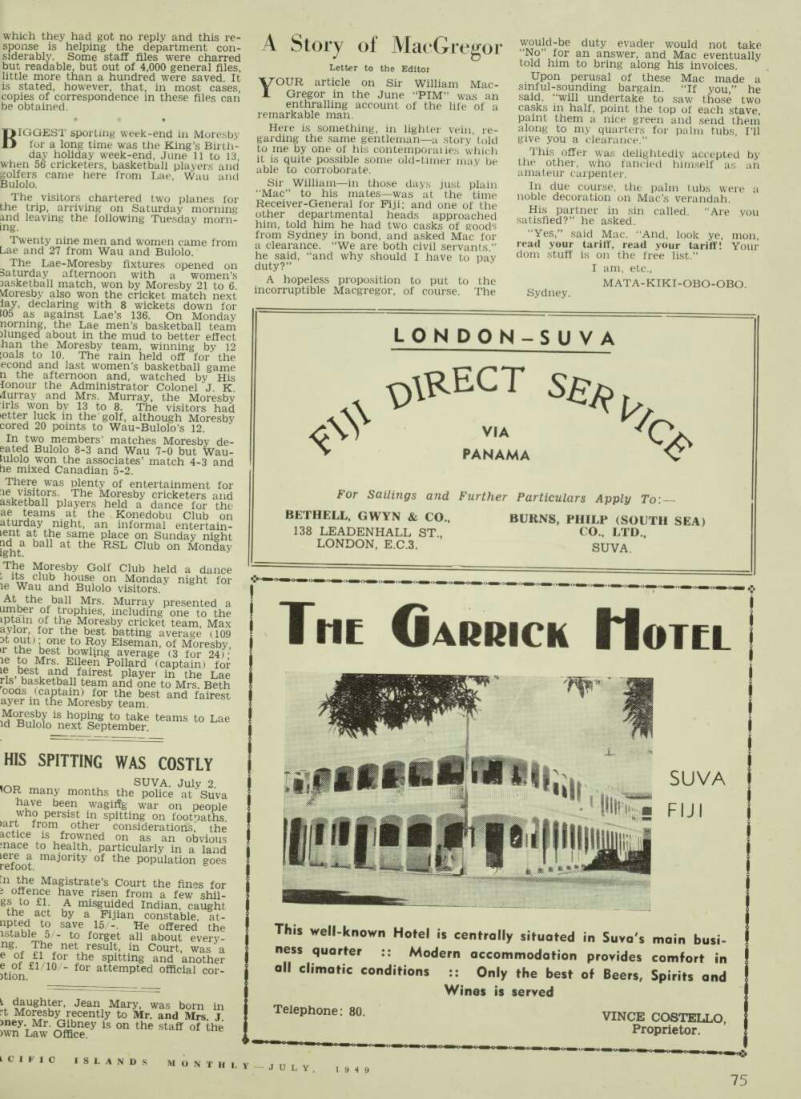
The Month in Moresby
From Our Own Correspondent
Port Moresby. June 30.
rHE administration’s two latest schemes are—first, to replace native carriers with horses and donkeys, where pos ible; and, secondly, equip native police men, in towns throughout Papua-New Juinea, with sandals.
Both ideas have been tried out before n a small scale but this time the Gov rnment is aiming at something wide pread and permanent.
The “River Fitzroy” recently delivered few horses and donkeys to various parts f the Territory and if these prove satis ictory for carrying work, the adminis -ation intends to greatly increase the umber, both by breeding and importation.
One reason for the experiment is that, tficially, the administration disapproves f the use of natives as “beasts of burden ” nother reason is that as education )reads among the natives, the adminis ■ation expects them to become more and tore reluctant to do carrying work.
Old Territorians think horses and don sys could be very useful. They are more optical of the Government’s ability to irry out the idea than of the scheme it- General reaction to the sandals scheme ems to be amusement. People say the itive police are quite happy barefooted * why go to the expense of giving them otwear?
The administration is having 3,000 pairs sandals made in Australia and will me them to town policemen because it inks their feet should be protected :amst hard roads.
MEASLES and whooping cough have broken out in Moresby. Several European children either have measles or have just recovered from them, but the Administration is more worried about the fact that measles and whooping cough are spreading among the natives.
At present the number of native victims is estimated at “three or four dozen”—the Health Department could not give a more definite figure. The Administration is trying to restrict the movement of natives in and out of Moresby to prevent the diseases reaching other areas. v ♦ SOMEONE should tell the officials of the Moresby Tennis Club about the pleasures of night tennis in the tropics. The club has three good courts but many people think it could make better use of them by erecting lights. A common belief is that the Administration has refused to allow lights to be erected because of the power situation, but we have been told officially that the Adminis tration has no objection, and that after 8 n.m. there is plenty of power.
The new Murray Heights Club is putting lights on its tennis court, so why not the Moresby Tennis Club?
The Murray Heights Club has made a lively start with dances and housie nights and if all its plans become realities, life will be much more pleasant for residents of the area. A children’s playground and a sports oval are among the amenities planned. * « * AMONG those who returned to Moresby on the last “Bulolo” were Mr. and Mrs. S. Lonergan, Mr. and Mrs. A. de Groen, Mr. M. C. Rich and Mrs. Crisp.
Dr. and Mrs. J. Gunther have just flown south on leave and Mr. J. McKenna is on six months recreation and sick leave. Mr.
A. E. Way, District Labour Officer, Samarai, is relieving him as Assistant Director of Native Labour. * * ♦ THE Government Secretary’s Depart ment is recovering slowly from the confusion caused by the fire which destroyed its office at Port Moresby on February 12. The Department moved into a new and much better building on May 31, but the work of reolacing lost files will continue for a long time.
After the fire residents of the Territory were asked to forward copies of letters to
which they had got no reply and this re sponse is helping the department con siderably. Some staff files were charred but readable, but out of 4,000 general files, little more than a hundred were saved. It is stated, however, that, in most cases, copies of correspondence in these files can be obtained. ♦ * ♦ BIGGEST sporting week-end in Moresby for a long time was the King’s Birth day holiday week-end, June 11 to 13, when 56 cricketers, basketball players and golfers came here from Lae, Wau and Bulolo.
The visitors chartered two planes for the trip, arriving on Saturday morning and leaving the following Tuesday morn ing.
Twenty nine men and women came from Lae and 27 from Wau and Bulolo.
The Lae-Moresby fixtures opened on Saturday afternoon with a women’s nasketball match, won by Moresby 21 to 6.
Moresby also won the cricket match next lay, declaring with 8 wickets down for 105 as against Lae’s 136. On Monday norning, the Lae men’s basketball team dunged about in the mud to better effect han the Moresby team, winning by 12 foals to 10. The rain held off for the econd and last women’s basketball game n the afternoon and, watched by His lonour the Administrator Colonel J K Jurray and Mrs. Murray, the Moresby iris won by 13 to 8. The visitors had 'fitter luck in the golf, although Moresby cored 20 points to Wau-Bulolo’s 12.
In two members’ matches Moresby de puted Bulolo 8-3 and Wau 7-0 but Wau lulolo won the associates’ match 4-3 and tie mixed Canadian 5-2.
There was plenty of entertainment for ic visitors. The Moresby cricketers and asketball players held a dance for the ae teams at the Konedobu Club on aturday night, an informal entertain icnt at the same place on Sunday night ight a ba 1 at the RSL club on Monda y The Moresby Golf Club held a dance : its club house on Monday night for le Wau and Bulolo visitors.
Mrs. Murra y presented a umbei of trophies, including one to the ? f % Moresby cricket team, Max aylor for the best batting average (109 01 6 ,? 0 oy Eiseman, of Moresby, * vf 10 best bowling average (3 for 24)uL f* rs ’ , El i €< ? n Poll ard (captain) for rU*^LpfK d n f f irest player in the Lae ns basketball team and one to Mrs. Beth ooas (captain) for the best and fairest ayer in the Moresby team.
Moresby is hoping to take teams to Lae id Bulolo next September.
Advertisements & other items, pp. 75-76 (2 items)
73
CIFIC ISLANDS MONTHLY-JULY. 1949
Burns Philp (South Sea) Go. Ltd.
Allen Taylor & Co. Ltd.
COMMERCIAL ROAD, ROZELLE,
SYDNEY
Sowmillers and Wholesale Suppliers of Hardwoods for Constructional Purposes GIRDERS ... PILES . . . POLES . . . SLEEPERS, Etc.
EXPORTING TO PACIFIC ISLANDS SINCE 1893
BURNS PHILP (SOUTH SEA) Go. Ltd.
Registered Office: SUVA, FIJI
Code Address: “BURNSOUTH”
ISLAND TRADERS AND SHIPOWNERS
General Merchants (Wholesale and Retail)
Shipping, Customs and General Agents
Representatives for QUEENSLAND INSURANCE CO. LTD.
Distributing Agents for SHELL COMPANY (PACIFIC ISLANDS) LTD
BRANCHES:
FIJI—
SUVA.
LEVUKA.
lautoka.
LABASA.
BA.
SIGATOKA.
ROTUMA ISLAND.
SAMOA—
APIA.
PAGO PAGO.
TONGA-
nukualopa. haapai. vavau.
NORFOLK IS.— NIUE IS.—
Sydney Agents:
BURNS, PHILP & CO.. LTD..
7 Bridge Street.
London Agents:
BURNS. PHILP & CO.. LTD..
35 Crutched Friars, E.C.3.
San Francisco Agents:
BURNS. PHILP CO. OP SAN FRANCISCO.
Matson Building, 215 Market Street, Agencies Throughout the World.
There only one
ELECTROLUX
THE MODERN KEROSENE-OPERATED REFRIGERATOR
THAT ACHIEVES THE MIRACLE OF ICE FROM HEAT
Lasting Efficiency, Silent Operation, Streamlined Beauty
a ii IWii Economically operated by kerosene, with a simple precision-built freezing unit that has no moving parts and is GUARANTEED FOR
FIVE (5) YEARS.
Model LKSSI
PRICES ON APPLICATION.
Obtainable from :
NEW GUINEA COMPANY, LIMITED.
Rabaul, Madang, Lae, Kavieng.
J. R. CLAY & CO., LTD,, Port Moresby.
W. R. CARPENTER & CO. (Sol. Is.), LTD., Tulagi For New Hebrides, Butaritari, Noumea, New Caledonia. Apply— Storage capacity: 5i cub. ft. (approx.); shelf area, 9 sq. ft. food shelves, six—five removable; 2 self-supporting when half drawn. Ice-making: Four trays —5 lb. ice per freezing: 80 cubes. Fuel consumption: 1.8 pints kerosene per day (approx.).
Height: 4 ft. 10 in. Depth: 2 ft. in.
Weight, unpacked, 406 lb. Packed, 574 lb.
W. R. CARPENTER & CO,, LTD. Head Office: 16 O'Connell St., Sydney, N. S. Wale*
His Spitting Was Costly
,„ D SUVA, July 2. <OR many months the police at Suva have been waging war on people who persist in spitting on footpaths. »art from other considerations, the actice is frowned on as an obvious mace to health, particularly in a land refoot majority of the Population goes [n the Magistrate’s Court the fines for 3 offence have risen from a few shil gf t° £1 - A misguided Indian, caught the act by a Fijian constable, at npted to save 15/-. He offered the istable 5/- to forget all about every ng. The net result, in Court was a pnf wnn 0r he spitting another e of £l/10/- for attempted official cor )tion. daughter, Jean Mary, was born in rt Moresby recently to Mr. and Mrs J A«£ y V Mr /S£ )ney is on the sta ff of the >wn Law Office.
A Story of MacGregor
Letter to the Editoi YOUR article on Sir William Mac- Gregor in the June “PIM” was an enthralling account of the life of a remarkable man.
Here is something, in lighter vein, re garding the same gentleman—a story told to me by one of his contemporai ie.s which it is quite possible some old-timer may be able to corroborate.
Sir William —in those days just plain “Mac” to his mates—was at the time Receiver-General for Fiji; and one of the other departmental heads approached him, told him he had two casks of goods from Sydney in bond, and asked Mac for a clearance. “We are both civil servants ” he said, “and why should I have to pay duty?”
A hopeless proposition to put to the incorruptible Macgregor, of course. The
would-be duty evader would not take “No” for an answer, and Mac eventually told him to bring along his invoices.
Upon perusal of these Mac made a sinful-sounding bargain. “If you,” he said, “will undertake to saw those two casks in half, point the top of each stave, paint them a nice green and send them along to my quarters for palm tubs I’ll give you a clearance.”
This offer was delightedly accepted by the other, who fancied himself as an amateur carpenter.
In due course, the palm tubs were a noble decoration on Mac’s verandah.
His partner in sin called. “Are you satisfied?” he asked.
“Yes,” said Mac. “And, look ye, mon, read your tariff, read your tariff! Your dom stuff is on the free list.”
I am, etc.,
Mata-Kiki-Obo-Obo.
Sydney.
Advertisements & other items, pp. 77-78 (2 items)
Cific Islands Monthly_J Dly ~ „ ,
CIFIC ISLANDS MONTHLy_J DLY „ ,
Tnc Garrick Hotel
LONDON-SUVA
ECT
\V VIA
PANAMA
C <* For Sailings and Further Particulars Apply To: BETHELL, GWYN & CO., BURNS, PHILP (SOUTH SEA)
138 LEADENHALL ST., CO., LTD.,
LONDON, E.C.3. SUVA.
Tnc Garrick Hotel
fit If > k » * rnmmmm
*" 11 • iim;
Hill!
SUVA
FIJI
This well-known Hotel is centrally situated in Suva's main business quarter Modern accommodation provides comfort in all climatic conditions :: Only the best of Beers, Spirits and Wines is served Telephone: 80, VINCE COSTELLO, Proprietor.
PANEL PLANER &
THICKNESSER
This No. 702 “JEFFWOOD” Panel Planer is ideally suited for the island woodworker. Body is solid cast. Will plane timber 12 in. x 4 in. Cutter head and spindle are in one piece mounted on ball bearings. 3 feed speeds combined with spring loaded clutch.
Prompt delivery assured. Also 14 in. Saw Benches and Spindle Moulders.
Write direct to manufacturers :
JEFFRESS BROS.
Northqote Rd., Northgate,
BRISBANE, Q.
FOR SALE
QUANTITY OF NEW PLUMBING FITTINGS
GALVANISED AND BLACK FITTINGS,
in. to 6 in.
BRASS COCKS, 818, BALL, ETC., i in. to 1 in. 3 in. and 4 in. Johns Pattern Gate and Check Valve.
Write for Complete Catalogue.
N. F. MALONEY & CO.,
Agents, Port Moresby, PAPUA Cab. add: MALCO. P.M.
New Guinea Girl Marries
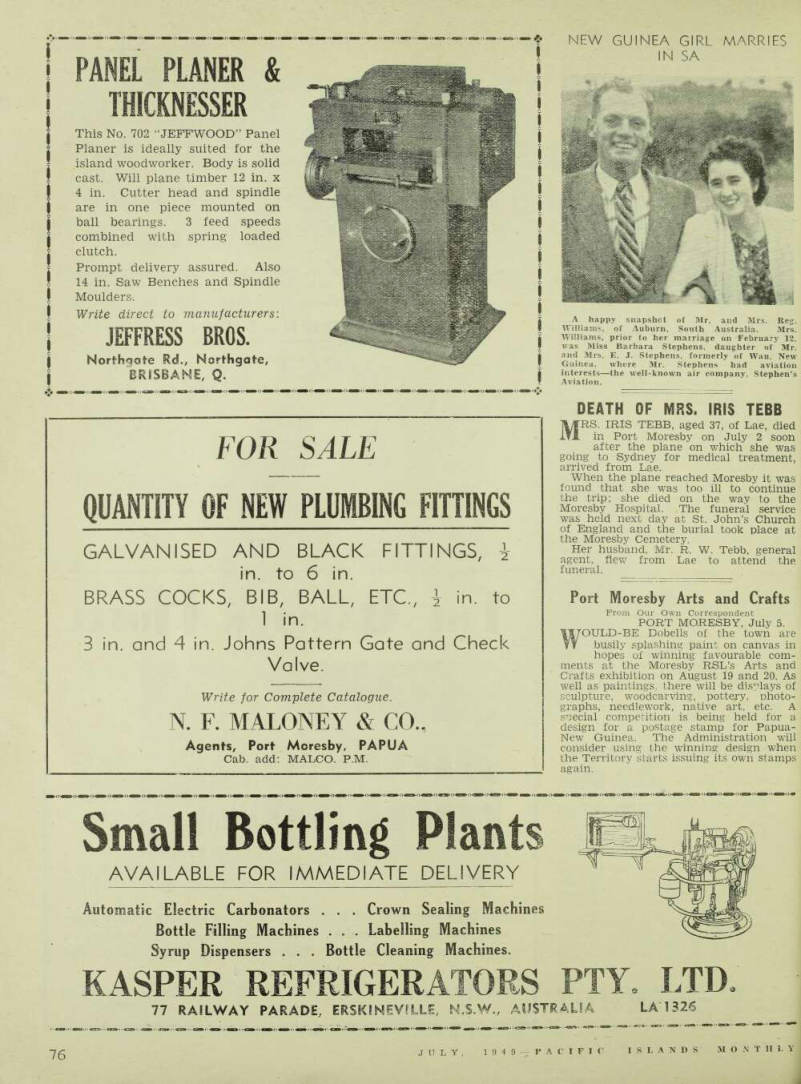
In Sa
A happy snapshot of Mr. and Mrs. Reg.
Williams, of Auburn, South Australia. Mrs.
Williams, prior to her marriage on February 12. was Miss Barbara Stephens, daughter of Mr. and Mrs. E. J. Stephens, formerly of Wau, New Guinea, where Mr. Stephens had aviation interests—the well-known air company, Stephen’s Aviation.
Death Of Mrs. Iris Tebb
MRS. IRIS TEBB, aged 37, of Lae, died in Port Moresby on July 2 soon after the plane on which she was going to Sydney for medical treatment, arrived from Lae.
When the plane reached Moresby it was found that she was too ill to continue the trip; she died on the way to the Moresby Hospital. The funeral service was held next day at St. John’s Church of England and the burial took place at the Moresby Cemetery.
Her husband, Mr. R. W. Tebb, general agent, flew from Lae to attend the funeral.
Port Moresby Arts and Crafts
From Our Own Correspondent
Port Moresby, July 5.
WOULD-BE Dobells of the town are busily splashing paint on canvas in hopes of winning favourable com ments at the Moresby RSL’s Arts and Crafts exhibition on August 19 and 20. As well as paintings, there will be displays of sculpture, woodcarving, pottery, nhoto graphs, needlework, native art, etc. A special competition is being held for a design for a postage stamp for Papua- New Guinea. The Administration will consider using the winning design when the Territory starts issuing its own stamps again.
Advertisements & other items, p. 78 (2 items)
76
JULY, l 9 4 9 PACI F I C ISLANDS MONTHLY
Small Bottling Plants
AVAI LABLE FOR IMMEDIATE DELIVERY
Automatic Electric Carbonators . . . Crown Sealing Machines Bottle Filling Machines . . . Labelling Machines Syrup Dispensers . . . Bottle Cleaning Machines.
KASPER REFRIGERATORS PTY, LTD.
77 RAILWAY PARADE, ERSKINEVILLE, N.S.W., AUSTRALIA LA 1326
Samoa—Tonga
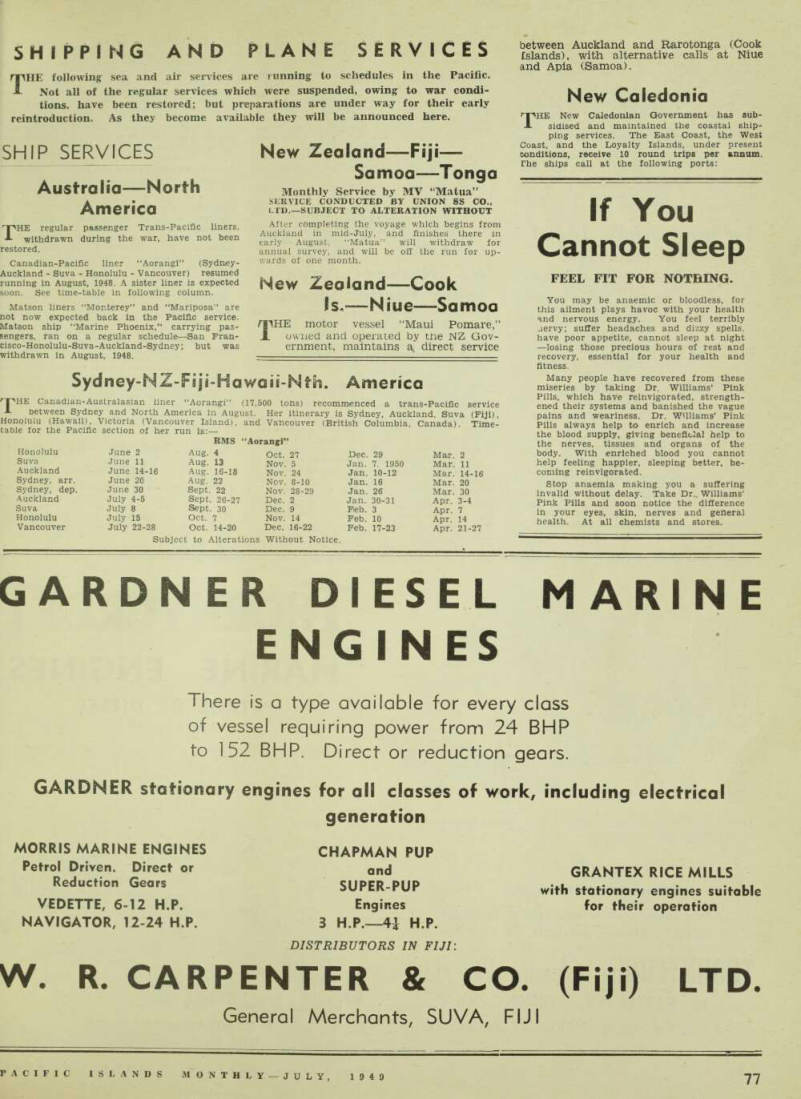
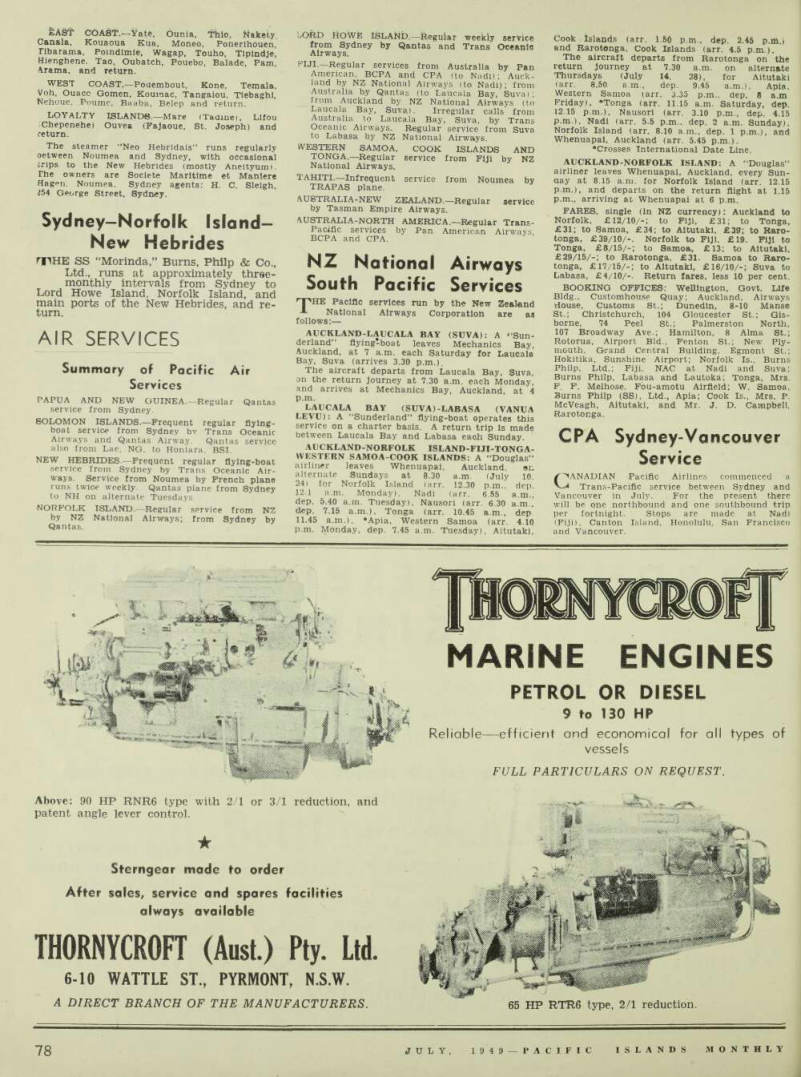
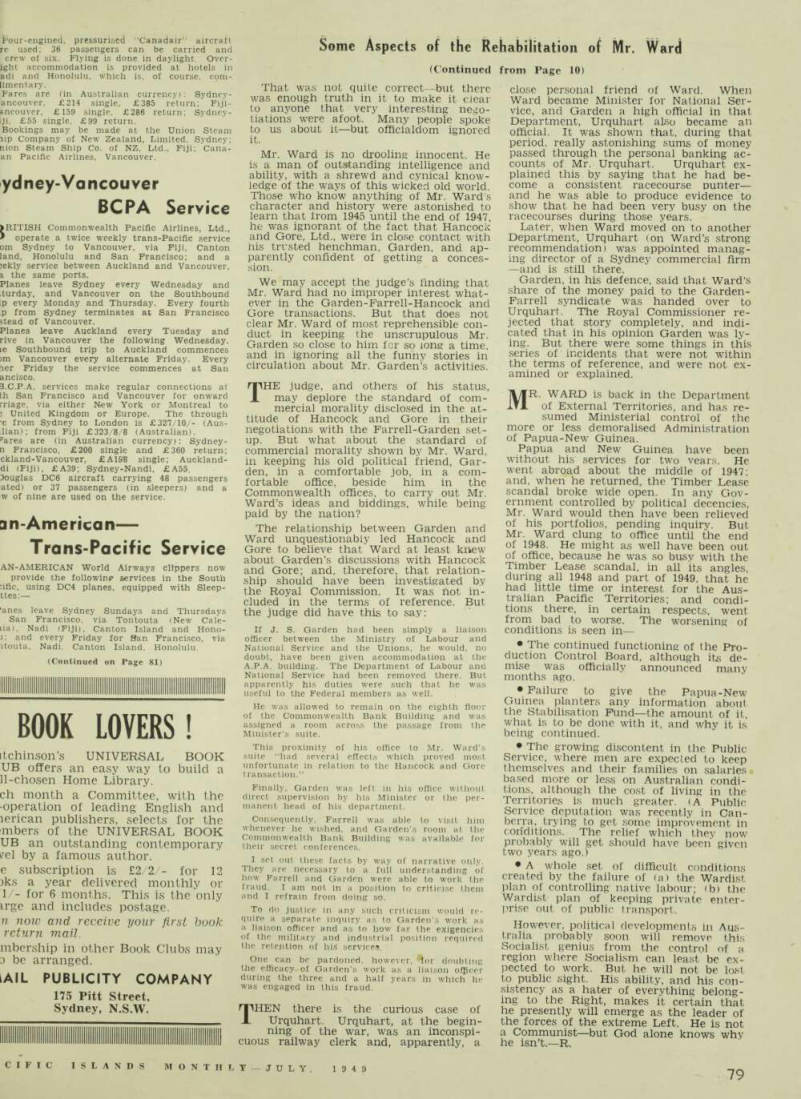
Shipping And Plane Services
THE following sea and air services are running to schedules in the Pacific.
Not all of the regular services which were suspended, owing to war condi tions. have been restored; but preparations are under way for their early reintroduction. As they become available they will be announced here.
Ship Services
Australia—North
America
THE regular passenger Trans-Pacific liners, withdrawn during the war, have not been restored.
Canadian-Pacific liner “Aorangi” (Sydney- Auckland - Suva - Honolulu - Vancouver) resumed running in August, 1948. A sister liner is expected soon. See time-table in following column.
Matson liners “Monterey” and “Mariposa” are not now expected back in the Pacific service.
Matson ship “Marine Phoenix,” carrying pas sengers, ran on a regular schedule —San Fran cisco-Honolulu-Suva-Auckland-Sydney; but was withdrawn in August, 1948.
New Zealand—Fiji—
Samoa—Tonga
Monthly Service by MV “Matua”
Service Conducted By Union Ss Co.,
Ltd.—Subject To Alteration Without
After completing the voyage which begins from Auckland in mid-July, and finishes there in early August, “Matua” will withdraw for annual survey, and will be off the run for up wards of one month.
New Zealand —Cook
Is.—Niue—Samoa
THE motor vessel “Maui Pomare,” owned and operated by the NZ Gov ernment, maintains a,, direct service
Sydney-NZ-Fsji-HawQis-Nf’h. America
TTHE Canadian-Australasian liner “Aorangi” (17,500 tons) recommenced a trans-Pacific service A between Sydney and North America in August. Her itinerary is Sydney, Auckland, Suva (Fiji), Honolulu (Hawaii). Victoria (Vancouver Island), and Vancouver (British Columbia, Canada). Time table lor the Pacific section of her run is:—
between Auckland and Rarotonga (Cook
Islands), with alternative calls at Niue
and Apia (Samoa).
New Caledonia
THE New Caledonian Government has sub sidised and maintained the coastal ship ping services. The East Coast, the West Coast, and the Loyalty Islands, under present conditions, receive 10 round trips per annum.
The ships call at the following ports:
RMS “Aorangi”
Honolulu June 2 Aug. 4 Oct. 27 Dec. 29 Mar. 2 Suvn June H Aug. 13 Nov. 5 Jan. 7. 1950 Mar. 11 Auckland June 14-16 Aug. 16-18 Nov. 24 Jan. 10-12 Mar. 14-16 Sydney, arr. June 20 Aug. 22 Nov. 8-10 Jan. 16 Mar. 20 Sydney, dep. June 30 Sept. 22 Nov. 28-29 Jan. 26 Mar. 30 Auckland July 4-5 Sept. 26-27 Dec. 2 Jan. 30-31 Apr. 3-4 Suva July 8 Sept. 30 Dec. 9 Feb. 3 Apr. 7 Honolulu July 15 Oct. 7 Nov. 14 Feb. 10 Apr. 14 Vancouver July 22-28 Oct. 14-20 Dec. 16-22 Feb. 17-23 Apr. 21-27 Subject to Alterations Without Notice.
iIAST COAST.—Yate, bunia, Thlo, Nakety, Canala, Kouaoua Kua, Moneo, Ponerlhouen, Tibarama, Poindlmle, Wagap, Touho, Tlplndje, Hienghene. Tao, Oubatch, Pouebo, Balade, Pam, Arama, and return.
WEST COAST.—Pouembout, Kone, Temala, Voh, Ouaco Gomen, Koumac, Tangaiou. Tlebaghl, Nehoue, Poume, Baaba, Belep and return.
LOYALTY ISLANDS.—Mare (Tadin'ej, Lifou Chepenehe) Ouvea (Pajaoue, St. Joseph) and return.
The steamer “Neo Hebrldais” runs regularly oetween Noumea and Sydney, with occasional trips to the New Hebrides (mostly Aneityumi.
The owners are Soclete Maritime et Manlere Noumea. Sydney agents: H. C. Sleigh, £54 George Street, Sydney.
Sydney-Norfolk Island-
New Hebrides
HHHE SS “Morinda,” Burns, Philp & Co., Ltd., runs at approximately three monthly intervals from Sydney to Lord Howe Island. Norfolk Island, and main ports of the New Hebrides, and re turn.
Air Services
Summary of Pacific Air
Services
PAPUA AND NEW GUlNEA.—Regular Qantas service from Sydney.
SOLOMON ISLANDS.—Frequent regular flying boat service from Sydney bv Trans Oceanic Airways and Qantas Airway. Qantas service also from Lac. NG, to Honiara. BSI.
NEW HEBRlDES—Frequent regular flying-boat service from Sydney by Trans Oceanic Air ways. Service from Noumea by French plane runs twice weekly. Qantas plane from Sydney to NH on alternate Tuesdays NORFOLK ISLAND.—Regular service from NZ by NZ National Airways; from Sydney by Qantas.
LORD HOWE ISLAND.—Regular weekly service from Sydney by Qantas and Trans Oceanic Airways.
FlJl.—Regular services from Australia by Pan American, BCPA and CPA (to Nadi); Auck land by NZ National Airways (to Nadi); from Australia by Qantas (to Laucala Bay, Suva); from Auckland by NZ National Airways (to Laucala Bay, Suva). Irregular calls from Australia to Laucala Bay, Suva, by Trans Oceanic Airways. Regular service from Suva to Labasa by NZ National Airways.
Western Samoa, Cook Islands And
TONGA.—Regular service from Fiji by NZ National Airways.
TAHlTl.—lnfrequent service from Noumea by TRAPAS plane.
AUSTRALIA-NEW ZEALAND.—ReguIar service by Tasman Empire Airways.
AUSTRALIA-NORTH AMERICA.—Regular Trans pacific services by Pan American Airways,
Bcpa And Cpa.
NZ National Airways
South Pacific Services
HPHE Pacific services run by the New Zealand A National Airways Corporation are as follows:
Auckland-Laucala Bay (Suva): A “Sun
derland” flying-boat leaves Mechanics Bay, Auckland, at 7 a.m. each Saturday for Laucala Bay, Suva (arrives 3.30 p.m.).
The aircraft departs from Laucala Bay, Suva, on the return Journey at 7.30 a.m. each Monday, and arrives at Mechanics Bay, Auckland, at 4 p.m.
Laucala Bay (Suva)-Labasa (Vanua
LEVU): A “Sunderland” flying-boat operates this service on a charter basis. A return trip is made between Laucala Bay and Labasa each Sunday.
Auckland-Norfolk Island-Fiji-Tonga
Westfrn Samoa-Cook Islands: A “Douglas”
airliner leaves Whenuapai, Auckland, or. alternate Sundays at 8.30 a.m (July 10, 24» for Norfolk Island (arr. 12.30 p.m., dep. 12.1 a.m. Monday). Nadi (arr. 6.55 a.m., dep. 5.40 a.m. Tuesday). Nausori (arr. 6.30 a.m., dep. 7.15 a.m.), Tonga (arr. 10.45 a.m., dep 11.45 a.m.), ‘Apia, Western Samoa (arr. 4.10 p.m. Monday, dep. 7.45 a.m. Tuesday), Aitutaki,
Cook islands (arr. 1.50 p.m., dep. 2.45 p.m.) and Rarotonga, Cook Islands (arr. 4.5 p.m.).
The aircraft departs from Rarotonga on the return journey at 7.30 a.m. on alternate Thursdays (July 14. 28), for Aitutaki (arr. 8.50 am.. dep. 9.45 a.m.), Apia, Western Samoa (arr. 3.35 p.m., dep. 8 a.m Friday), ‘Tonga (arr. 11.15 a.m. Saturday, dep. 12.15 p.m.), Nausori (arr. 3.10 p.m.. dep. 4.15 p.m.), Nadi (arr. 5.5 p.m., dep. 2 a.m. Sunday).
Norfolk Island (arr. 8.10 a.m., dep. 1 p.m.), and Whenuapai, Auckland (arr. 5.45 p.m.). •Crosses International Date Line.
Auckland-Norfolk Island: A “Douglas”
airliner leaves Whenuapai, Auckland, every Sun day at 8.15 a.m. for Norfolk Island (arr. 12.15 p.m.), and departs on the return flight at 1.15 p.m., arriving at Whenuapai at 6 p.m.
PARES, single (in NZ currency); Auckland to Norfolk. £l2/10/-; to Fiji, £3l; to Tonga, £3l; to Samoa, £34; to Aitutaki, £3O; to Raro tonga, £39/10/-. Norfolk to Fiji, £l9. FIJI to Tonga. £B/15/-; to Samoa, £l3; to Aitutaki. £29/15/-; to Rarotonga, £3l. Samoa to Raro tonga, £l7/15/-; to Aitutaki, £l6/10/-; Suva to Labasa, £4/10/-. Return fares, less 10 per cent.
BOOKING OFFICES: Wellington, Govt. Life Bldg., Customhouse Quay; Auckland, Airways House, Customs St.; Dunedin, 8-10 Manse St.; Christchurch, 104 Gloucester St.; Gis borne, 74 Peel St.; Palmerston North, 107 Broadway Ave.; Hamilton, 8 Alma St.; Rotorua, Airport Bid., Fenton St.; New Ply mouth, Grand Central Building, Egmont St.; Hokitika, Sunshine Airport; Norfolk Is., Burns Philp, Ltd.; Fiji, NAC at Nadi and Suva: Burns Philp, Labasa and Lautoka; Tonga, Mrs.
P. F. Melhose. Fou-amotu Airfield; W. Samoa, Burns Philp (SS), Ltd., Apia; Cook Is., Mrs. P McVeagh, Aitutaki, and Mr. J. D. Campbell, Rarotonga.
CPA Sydney-Vancouver
Service
C CANADIAN Pacific Airlines commenced a Trans-Pacific service between Sydney and Vancouver in July. For the present there will be one northbound and one southbound trip per fortnight. Stops are made at Nadi (Fiji), Canton Island. Honolulu, San Francisco and Vancouver.
Four-cngmcd, pressurised “Canadair 1 aircraft
re used; 36 passengers can be carried and crew of six. Flying is done in daylight. Over ight accommodation is provided at hotels in adi and Honolulu, which is, of course, cpm limentary.
Fares are (in Australian currency): Sydncy ancouver, £214 single, £385 return; Fiji ancouver, £159 single. £286 return; Sydney iji, £55 single, £99 return.
Bookings may be made at the Union Steam lip Company of New Zealand, Limited, Sydney: nion Steam Ship Co. of NZ, Ltd., Fiji; Cana an Pacific Airlines, Vancouver.
ydney-Vancouver
BCPA Service
BRITISH Commonwealth Pacific Airlines, Ltd., * operate a twice weekly trans-Pacific service om Sydney to Vancouver, via Fiji, Canton land, Honolulu and San Francisco; and a >ekly service between Auckland and Vancouver, i the same ports.
Planes leave Sydney every Wednesday and turday, and Vancouver on the Southbound p every Monday and Thursday. Every fourth p from Sydney terminates at San Francisco stead of Vancouver.
Planes Leave Auckland every Tuesday and rive in Vancouver the following Wednesday, ic Southbound trip to Auckland commences >m Vancouver every alternate Friday. Every ier Friday the service commences at San ancisco. 3.C.P.A. services make regular connections at th San Francisco and Vancouver for onward rriage, via either New York or Montreal to ; United Kingdom or Europe. The through ■e from Sydney to London is £327/10/- (Aus lian); from Fiji £323/8/8 (Australian).
'’ares are (in Australian currency): Sydney n Francisco, £2OO single and £360 return; ckland-Vancouver, £AI9B single; Auckland di (Fiji), £A39; Sydney-Nandi, £ASS.
Douglas DC6 aircraft carrying 48 passengers ated) or 37 passengers (in sleepers) and a w of nine are used on the service.
an-American—
Trans-Pacific Service
AN-AMERICAN World Airways clippers now provide the following services in the South :ific, using DC4 planes, equipped with Sleep ttes:— 'anes leave Sydney Sundays and Thursdays San Francisco, via Tontouta (New Gale na), Nadi (Fiji), Canton Island and Hono i; and every Friday for San Francisco, via itouta, Nadi, Canton Island. Honolulu.
(Continued on Page 81)
Advertisements & other items, pp. 79-86 (5 items)
Cannot Sleep
If You
FEEL FIT FOR NOTHING.
You may be anaemic or bloodless, for this ailment plays havoc with your health and nervous energy. You feel terribly uervy; suffer headaches and dizzy spells, have poor appetite, cannot sleep at night —losing those precious hours of rest and recovery, essential for your health and fitness.
Many people have recovered from these miseries by taking Dr. Williams’ Pink Pills, which have reinvigorated, strengthened their systems and banished the vague pains and weariness. Dr. Williams’ Pink Pills always help to enrich and increase the blood supply, giving beneficial help to the nerves, tissues and organs of the body. With enriched blood you cannot help feeling happier, sleeping better, becoming reinvigorated.
Stop anaemia making you a suffering invalid without delay. Take Dr.. Williams' Pink Pills and soon notice the difference in your eyes, skin, nerves and general health. At all chemists and stores.
There is a type available for every class of vessel requiring power from 24 BHP to 152 BHP. Direct or reduction gears.
GARDNER stationary engines for ail classes of work, including electrical
generation
MORRIS MARINE ENGINES
Petrol Driven. Direct or Reduction Gears
VEDETTE, 6-12 H.P.
NAVIGATOR, 12-24 H.P.
CHAPMAN PUP
and
SUPER-PUP
Engines
3 H.P.—H.P.
DISTRIBUTORS IN FIJI:
GRANTEX RICE MILLS
with stationary engines suitable for their operation W. R. CARPENTER & CO. (Fiji) LTD.
General Merchants, SUVA, FIJI
* 1 , Above; 90 HP RNR6 type with 2/1 or 3/1 reduction, and patent angle lever control. ★ Sterngear made to order After sales, service and spares facilities always available
THORNYCROFT (Aust.) Pty. Lid.
6-10 WATTLE ST., PYRMONT, N.S.W.
A DIRECT BRANCH OF THE MANUFACTURERS.
piOWTOOfr
MARINE ENGINES
PETROL OR DIESEL
9 to ISO HP
Reliable—efficient and economical for all types of vessels
FULL PARTICULARS ON REQUEST.
4SESW
f ‘ J . 1,„ 65 HP RTR6 type, 2/1 reduction.
BOOK LOVERS!
itchinson’s UNIVERSAL BOOK UB offers an easy way to build a 11-chosen Home Library, ch month a Committee, with the ■operation of leading English and lerican publishers, selects for the mbers of the UNIVERSAL BOOK UB an outstanding contemporary /el by a famous author, e subscription is £2/2/- for 12 )ks a year delivered monthly or 1/- for 6 months. This is the only irge and includes postage. n now and receive your first book return mail. mbership in other Book Clubs may 3 be arranged.
IAIL PUBLICITY COMPANY
175 Pitt Street.
Sydney, N.S.W.
*..U. n m 2
NEW ZEALAND
OFFERS
SHIPPING AND TRADE
to the Residents of New
Caledonia, New Hebrides,
Gilbert Islands, Ellice
Islands, British Solomon
Islands and New Guinea.
We are operating a regular shipping service throughout the above Islands. All goods ordered will be delivered without delay. Should large orders be contemplated we will arrange for a representative to visit you with samples and discuss the transaction.
Many classes of general merchandise are available at competitive prices and for early delivery. r I*
wfl
COFHf
SAWN TIMBER.
PLYWOODS.
WAI.LBOARDS.
PAINTS.
VARNISHES.
BUILDING PAPER.
ASBESTOS
SIDINGS.
FURNITURE.
CANDLES.
WASHING SOAP.
TOILET SOAP.
TENNIS SHOES.
LEATHER BOOTS
AND SHOES.
LEATHER SOLES
AND HEELS.
LEATHER BELTING.
LEATHER BENDS,
ETC.
SEEDS (INCLUDING
BLUE & MAPLE
PEAS).
LIVESTOCK.
FROZEN MEATS.
TINNED MEATS.
TINNED PISH.
FROZEN FISH.
BUTTER.
CHEESE.
DRIED MILK, ETC
TINNED
VEGETABLES.
TINNED SOUPS.
TINNED JAMS.
CUSTARD POWDER.
BAKING POWDER.
COFFEE ESSENCE.
POTATOES. FRESH
AND CANNED.
ONIONS.
CORDIALS.
BEER.
SILVERPLATE
WARE.
Produce of every
We are also buyers of Islands
description and we can provide shipping. Our sell
ing organisation is world-wide.
BUYING OR SELLING—WE CAN HELP YOU
UNION MANUFACTURING
& EXPORT CO. LTD.
G.P.O. Box 1060, Wellington, NEW ZEALAND
Cables: "UMEC", Wellington
★ 1/497P.
SPECIALISING IN
PACIFIC ISLAND INSURANCES
FIRE—MOTOR VEHICLE
MARINE—HULLS AND CARGO
EMPLOYER’S LIABILITY
BONDS—In accordance with
ADMINISTRATION ORDINANCES.
COPRA INSURED FROM DRIER
TO BUYER.
AND ALL OTHER CLASSES ARRANGED
AT LOWEST CURRENT RATES.
Established Agencies throughout the Territory of Papua and New Guinea.
Managing Agents: New Guinea Company, Limited.
Island Representative: G. D. A. Kent, Babaol Branch.
SOUTHERN PACIFIC INSURANCE
CO., LTD.
HEAD OFFICE: 60 HUNTER STREET
SYDNEY.
COLTER WATSON („&) LTD
niniiii & kavieng JFIB WmT\
Wholesale and Retail Merchants. Shipowners. Sawmillers.
General Engineers. Customs and Shipping Agents.
Catering for all Plantation Supplies. Buyers of Island Produce.
Plantation Owners and Managing Agents.
Agents for:— Australia-West Pacific Line.
China Navigation Co.
Canton Insurance Office, Ltd.
Union Assurance Society, Ltd.
Aust. T. & G. Mutual Life Society, Ltd.
Guinea Air Traders, Ltd.
Distributing for:— Agents in New Guinea cotter Sydney fTY
LTD.
y/ATSOH
Melbourne.
CO. tto.
COLYE". Cchutch. ■WeW"8 ton ' A Hillman, Humber, Sunbeam-T albot Chrysler and Plymouth Cars.
Commer, Harrier and Fargo Trucks.
Willys Overland Jeeps.
G.M. Marine and Industrial Engines .
Olympic Tyres and Cables.
Hygeia Dissolvenators.
Prefect Refrigerators.
Mullard Radios.
Ewo Beer.
Snowflake Unsweetened Evaporated Milk.
I
xza
VICKERS GIN
o*s,r«x*»s C<mwo*at.q« Pv*. lto, r*m Ccwio Co*K)
s' <5? SP
S' S' f?
NOTICE
est donne ci-dessous que les etiquettes montrees dans la marge sont I’exclusive proprlete et les vraies* MAR-
QUES DE FABRIQUES de
la DISTILLERS CORPORA-
T I O N PROPRIETARY,
LIMITED, de Byrne Street.
South Melbourne, Victoria, Australia, Distilleurs, employes par eux en ce qui concernent.
WHISKY, BRANDY,
GIN et RHUM,
et ITndustrie et le Public sont prevenUs par cette annonce centre toute fraude ou abus de ces Marques.
Les precedes legaux seront instituees centre toute personne vendant ou offrant pour la vente, les marchandises qui ne sont pas factures par la-dite Distillers Corporation Proprietary Limited, portant aucune representation de Tune ou I’autre de ces Marques de Fabriques ou aucune imitation specieuse de ces Marques.
EDWD. WATERS &
SONS
Patent and Trade Mark Attorneys, 422-428 Collins Street, Melbourne, Victoria, Australia.
Dealer for Rahaul :
Gabriel Achun
DESIGNED AND BUILT BY STANDARD OF COVENTRY FOR THE WORLD.
The imported Vanguard has outstanding beauty and performance. With its 18 H.P. engine and ground clearance 8 in. it is admirably suited to New Guinea Roads.
Also available are the Standard Pick -Up Utility, the Estate Car, and the Delivery Van
DISTRIBUTORS
FOR
NEW GUINEA
AND PAPUA:
G. G. SMITH & CO. LIMITED p.«t nobesb.
ART POSTCARDS OF
TONGA
Per Dozen (Including a Tin-Can Mail Cover), Postage Paid: 6/- (one US Dollar).
TONGAN PHOTOS BUREAU
Nukualofa, Tonga
CAPTAIN W. L. KENNEDY
Established 1931.
Shipbrokers, Business Or Real Estate
163 Pitt St., Sydney
'Phone: BW 6461
LISTING FOR SALE:
Among other fine Boats Listed for Sale we have the following : WO HUNDRED AND FIFTY TON SCHOONER, powered, 150 hp Garden or diesel. £12,000. p ‘’
FAI S SEE ’ twin Gra y marine diesels, well fitted, ready for 503,, 3l X, i ,OUU. 50 ft. SEINE TRAWLER, Gardenor diesel, £4,500. 36 ft. CARGO WORKBOAT, 30 h.p., Lister diesel, coppered, £1,900. 29 ft. WORKBOAT, 22 h.p. Southern Cross diesel, £950. 26 ft. WORKBOAT, 8 h.p. diesel, 3/1 reduction gear, £750.
M nO/ REDUCTION IN
LABOUR COSTS 9
with the CHULA Patent COPRA DRYER
This remarkable Dryer also
® PRODUCES 12 TONS OF COPRA PER WEEK at the rate of 2 Tons every 24 hours. 0 PRODUCES COPRA OF HIGHER OIL CONTENT.
•IS SIMPLE AND
QUICK TO ERECT.
THE INVENTORS AND MANUFACTURERS OF
THE “CHULA" COPRA DRYER ALSO MAKE
DESICCATED COCONUT
MACHINERY
TYNESIDE FOUNDRY &
ENGINEERING CO. LTD.
ELSWICK • NEWCASTLE-ON-TYNE • ENGLAND
Fstabh'she J 189 C.
Te'ey . Cables: ' FOUNDRY. NEWCASTLE-ON-TYNE . Codes: ABC. sth & 6th Eds. m m V !>v ¥ CA i/m'r Cl Write for Catalogues of
CHULA
COPRA DRYERS
Capacities from 1,000 to 10,000 nuts per day.
ONE OF THE WORLD’S
WONDER-SIGHTS
Miles of
MOM ICE
ft
See New Zealand 9 s
FRANZ JOSEF-GLACIER
From the Air I
NOWHERE else in the world can you see an eight-mile long river of ice framed in an evergreen setting of sub-tropical forest. Franz Josef is one of the scenic wonders of the world. Why not take the holiday you’ve promised yourself . . . relax in comfort, in scenic surroundings? Travel in comfort too, by N.A.C. aircraft that land you fresh and unweary two hundred yards from tb° hotel door. m m $
HOTEL ACCOMMODATION
Comfortable accommodation and attentive service is provided by the Government Tourist Department’s Hotel at the foot of the Glacier.
-AT YOUR SERVICE
New Zealand National Airways Corporation provides a network of air services throughout the Dominion and the South-west Pacific. General Agents in the Dominion for British Commonwealth Pacific Airlines and Trans-Australia Airlines. Booking Agents for Tasman Empire Airways, Qantas Empire Airways, the 8.0.A.C. and other overseas airlines.
' Offices and Agents throughout New Zealand and the South-west Pacific 37
79
Some Aspects of the Rehabilitation of Mr. Ward (Continued from Page 10)
CIFIC ISLANDS MONTHLY JULY, 1949
80
JULY, 1949 r ACIFIC ISLANDS MONTHLY
81
CIFIC ISLANDS MONTHLY- JULY. 194 9
83
CIFIC ISLANDS MONTHLY JULY, 1949
Tahiti Notes
The Anti-Filariasis Campaign
From Our Own Correspondent
Papeete, July 1.
THE American yacht “Varua” owned by Mr. William A. Robinson, sailed from Papeete for Honolulu, via the Tua motus and Marquesas, on May 5. Many years ago Mr. Robinson made history by sailing around the world in his small ketch “Swaap”. He will return late in July.
Mr, Robinson, is responsible for the for mation of the anti-filariasis campaign in French Oceania, and last month he collected several thousand francs to fight against the disease. The following are the names of subscribers.
Bambridge, Tony. Bambridge, B.
Blouin, Andre. Bordes, Frderick.
Brown, Charles. Mageta, Societe.
Donald, Etab. Bredin, Freres Falkenberg, Sydney Calamy, M.
Frogier, Pierre Cassiau, Pierre Gobrait, Adram Constant et Hargous Herve. Robert Farine, Susanne Hirshon, Lewis Farnham, J.
Hollande. A. Faugerat, Paul Homes. Prank Haereraaroa. Frederic Hoppenstedt, Henri Hart, Ralph Jacquemin, Andre ’ Laguesse. Emile S. F. P. O. Jaunez, Levy, Julien Bertrand Lherbier, I.
Kellum. Nedford Martin, Yves LiUnd, Eddie Moore, Preston Martin, Emile Raoulx, Louis Vlervin, Freres Walker, I. E.
Nordman, G. Ah Yun tfordman, P. Ahkui, Snong Yan Robinson, W. A. Chin Lee Sang Co. >in Tung King Tai Kee Lee [’Here, Yat Lee Yee On Siong tgnieray, Adolpbe Wa King So.
Bambridge, Lionel L. Wing Man King The officers and men of the New Zea and frigate “Hawea” were lavishly en ertained during a visit here in mid-June; ind they took part in local celebrations on he night of the 17th, to commemorate he occasion when French Oceania rallied o General de Gaulle. The Governor, M. in a stirring speech, recalled the lays of 1940-45. The ceremonies con luded when the Governor presented aedals to the widows and members of amilies of men killed or wounded during he war. * * * The steamer “Pomare,” formerly of the iouth Seas Shipping Co., Honolulu, ar ived here on June 25, via Palmyra, Can on Island and Pago Pago, bringing 250 ons of sugar. * * * There was much interest in the arrival .ere of Mr. Hancock, a high executive of 'an American Airways. It is reported bat PAA soon will establish an office in Papeete and Bora Bora. Mr. Hancock ispected the former war-time airfield in tallations on Bora Bora, and will report 3 his Co. on the condition of that base, M. Jean Millaud has been elected presi ent of our Representative Assembly. M. .Ibert Leboucher, who has occupied the residency, became vice-president as from une 5.
Our popular Mayor, M. Alfred Poroi, as returned from a visit to Australia, ew Zealand, Tonga and Fiji. He wishes ) thank many people in all those terri fies for their kindness and hospitality.
Loaded to capacity with copra, and with full passenger list, the “Ville d’Amiens” died on June 11 for Marseilles. Among le passengers were six students, en route ► France to complete their studies in the igher schools.
M. Lassalle-Sere, French member of the South Pacific Commission, was recently created an honorary citizen of Noumea in recognition of the part he played in Australia in 1948 in having Noumea seacted as headquarters of the South Pacific Commission. He warmly thanked the Mayor (M. Sautot) for the honour. M.
Lasalle-Sere appears to have won the Tahiti poll for the election of a member of the French Senate; but the validity of the poll has been questioned, and Paris is being consulted.
Two Suva girls, Miss Elaine Hoeflich and Miss Lily Jackson, have taken up temper ary residence in Washington, USA. They left Fiji in 1945 to work for the American Army at Noumea, and subsequently trans ferred to Guam for the United States De partment. They were holidaying in the United States when they decided to take positions at Washington. Miss Hoeflich is a private secretary with the Joint Services Mission of the British Army Staff and Miss Jackson is with the Agents for the British Colonies.
Advertisements & other items, pp. 87-88 (2 items)
85
ACIFIC ISLANDS MONTHLY JULY, 1949
Linoleum
Livraison IMMEDIATE LINOLEUM ECOSSAIS IMPORTS
delivery immediate
IMPORTED
LINOLEUM
Ideal for Island Conditions. Long Wearing.
Hessian Back. Cork based. Full range of colours, patterned or plain. Full rolls (30 yards by 6 ft.) only supplied. Order to-day through your Trading House for delivery by first boat.
Ideal pour les pays tropicaux. D’une durabilite sans pareille, a base de liege couvert en toile de chanvre. Dessins ou unis. Rouleaux de 30 yards par 6 pieds de large. Commandez aujourd’hui chez votre Agent pour livraison par premier bateau.
TAY SIDE Linoleum distributed by:
INTERNATIONAL TRADING
PTY. LTD.
Halifax House, 26 O’Connell Street, Sydney.
Phone: BL 1543. Cables: “Mondial,” Sydney.
B .
NOTICE
est donne cl-dessous que les etiquettes montrees dans la marge sont 1’exclusive propriete et les vraies
MARQUES DE FABRIQUES
de la DISTILLERS COR-
PORATION PROPRIETARY
LIMITED, de Byrne Street, South Melbourne, Victoria, Australia, Distilleurs, employes par eux en ce qui concernent.
WHISKY, BRANDY,
GIN et RHUM,
et 1’Industrie et le Public sont prevenus par cette annonce centre toute fraude
JWIBOY
ou abus de ces Marques.
Les precedes legaux seront instituees centre toute personne vendant ou offrant pour la vente, les marchandises qui ne sont pas factures par la-dite Distillers Corporation Proprietary Limited, portant aucune representation de I’une ou 1’autre de ces Marques de Fabriques ou aucune imitation specieuse de ces Marques.
EDWD, WATERS Gr SONS
Patent and Trade Mark Attorneys, 432-428 Collins Street. Melbourne, Victoria, Australia.
Bring
South Sej
Romance
Info
Your
Home!
Learn to Play a Tuns
in 30 Minutes
on
Hawaiian Steel Guitar,
Spanish Guitar, Ukulele,
Hill-Billy Guitar,
Cow-Boy Guitar,
Mandolin and Banjo-Mandolin.
NO TEDIOUS SCALES OR EXERCISES
Play a Tune at your First Lesson!
The Hawaiian Club will teach you in the comfort of your own home, and the cost is only 2/6 per week. Send for full particulars of the Hawaiian Club's specialised Postal Courses.
POST THIS COUPON TO-DAY
To The Hawaiian Club, P.I. 58 Margaret Street, Sydney.
Kembla Building, ■3 Please send me by return complete g fi details of your Home Study Course. Tell B 1 me how I can obtain an Hawaiian Steel B 3 Guitar, Spanish Guitar, Hill-Billy Guitar, ( * Ukulele. Mandolin and Banjo-Mandolin. I 9 i • Name I 3 I 5 Address » I S f This Offer obtainable ONLY from the above address.
mkķjkhijih
Griffith-Threlfo Wedding
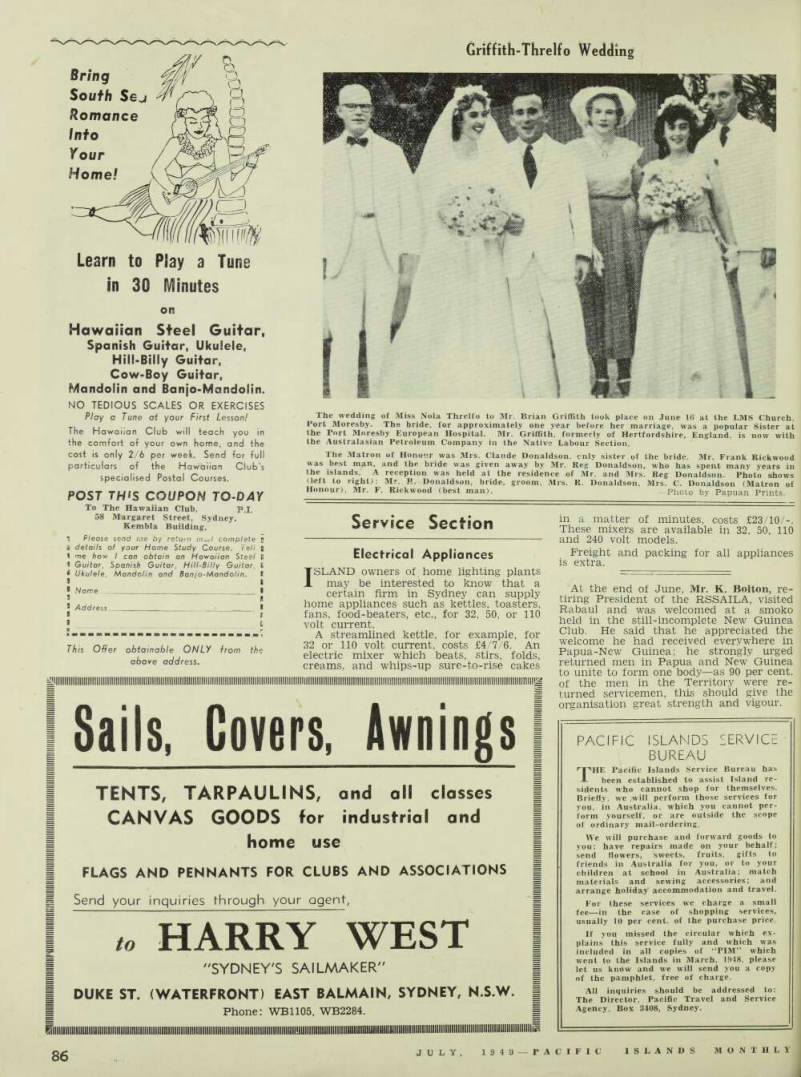
The wedding of Miss Nola Threlfo to Mr. Brian Griffith took place on June 16 at the LMS Church.
Port Moresby. The bride, for approximately one year before her marriage, was a popular Sister at the Port Moresby European Hospital. Mr. Griffith, formerly of Hertfordshire, England, is now with the Australasian Petroleum Company in the Native Labour Section.
The Matron of Honour was Mrs. Claude Donaldson, only sister of the bride. Mr. Frank Rickwood was best man, and the bride was given away by Mr. Reg Donaldson, who has spent many years in the islands. A reception was held at the residence of Mr. and Mrs. Reg Donaldson. Photo shows (left to right): Mr. R. Donaldson, bride, groom. Mrs. R. Donaldson, Mrs. C. Donaldson (Matron of Honour). Mr. F. Rickwood (best man). —Photo by Papuan Prints.
Service Section
Electrical Appliances
ISLAND owners of home lighting plants may be interested to know that a certain firm in Sydney can supply home appliances such as kettles, toasters, fans, food-beaters, etc., for 32, 50, or 110 volt current.
A streamlined kettle, for example, for 32 or 110 volt current, costs £4/7/6. An electric mixer which beats, stirs, folds, creams, and whips-up sure-to-rise cakes
in a matter of minutes, costs £23/10/-.
These mixers are available in 32. 50, 110 and 240 volt models.
Freight and packing for all appliances is extra.
At the end of June, Mr. K. Bolton, re tiring President of the RSSAILA, visited Rabaul and was welcomed at a smoko held in the still-incomplete New Guinea Club. He said that he appreciated the welcome he had received everywhere in Papua-New Guinea: he strongly urged returned men in Papua and New Guinea to unite to form one body—as 90 per cent, of the men in the Territory were re turned servicemen, this should give the organisation great strength and vigour.
Advertisements & other items, p. 88 (1 item)
Pacific Islands Servict
BUREAU
Pacific Islands Service Bureau has been established to assist Island residents who cannot shop for themselves.
Briefly, we jwill perform those services for you, in Australia, which you cannot perform yourself, or are outside the scope of ordinary mail-ordering.
We will purchase and forward goods to you: have repairs made on your behalf: send flowers, sweets, fruits, gifts to friends in Australia for you, or to your children at school in Australia; match materials and sewing accessories: and arrange holiday accommodation and travel.
For these services we charge a small fee—in the case of shopping services, usually 10 per cent, of the purchase price.
If you missed the circular which explains this service fully and which was included in all copies of “PIM” which went to the Islands in March, 1048, please let us know and we will send you a copy of the pamphlet, free of charge.
All inquiries should be addressed to: The Director, Pacific Travel and Service Agency, Box 3408, Sydney.
Minister Not Helpful Over Lae Building Muddle
A SERIES of incidents relating to the \ allocation of sites for particular buildings, in the new town of Lae, lew Guinea, indicates that some of the eople concerned are either knaves or ools.
Lae, originally, was built on an alluvial at, at the head of Huon Gulf, near the louth of the Markham River. It was r iped out entirely by bombs during the 'ar.
When the volcanoes exploded at Rabaul i 1937, the Australian Government de ided to remove the Administration [eadquarters from Rabaul to Lae. For lat purpose a town plan for Lae was irefully made. The removal of Admin tration Departments was actually going a when the invasion occurred early in )42.
After the war the Administration pro ;eded with a plan for a new Lae, but Dandoned the idea of placing Adminis ation headquarters there. It seems ear that between 1945 and 1948, when irious private persons and institutions ere eager to get on with rebuilding in ae, the Administration was working to particular plan, in accordance with hich it made allocations of building ts.
Two people who were given such affe ctions were the Reverend W. E. Moren, •iest in charge of the Anglican Church . Lae, and Mrs. Florence Stewart, who ‘fore the war owned the Hotel Cecil in te (completely destroyed). Mrs. Stewart ace has conducted an hotel in a conce rn of unsuitable huts over a mile from le and, for two years, she has been ying to get permission to build a good >tel on a suitable location.
Both of these well-known people de
dare that they were given particular sites for their buildings by the Adminis tration, in places that, according to the existing plan, were suitable, from their points of view.
Late in 1948, to their astonishment and anger, they found that the town plan on which they had been working had been scrapped, and that it now was the in tention of the Government to build the new township of Lae at a place between 14 to li miles from the township site proposed prior to 1948. This, of course, meant that the sites, which were quite suitable according to the pre-1948 plan, were now completely unsuitable.
Both Mrs. Stewart and Mr. Moren pro tested to the Administration, and asked that they be given opportunity to change their building plans to sites more suitably placed in respect of the new township: but they have been fobbed off ever since with Ministerial evasion and official shilly-shallying.
The statement of Mr. Moren—who did not mince his words —was published in the June “PIM.”
IN June, in the Australian Parliament, Mr. Howard Beale (after two at tempts) was able to bring this matter before the House. He stated the facts outlined above and demanded an ex planation from the Acting Minister for Territories, Mr. Chambers.
This Minister —who is by no means an impressive personality—said that he had interviewed the people concerned when he visited New Guinea last January and that he left them “quite satisfied.” He said that the original proposal to build Lae township near where it was in 1941
had been scrapped because it was found that the Markham River was steadily eroding the flat ground; so the township site was moved over one mile back on to a low plateau, and the plan was drawn accordingly. Although he was pressed by Mr. Beale and other members, he insisted that the sites allotted to Mr, Moren and Mrs. Stewart had been chosen in accord ance with the later plan—he even said he knew nothing about any earlier plan on which Mr. Moren and Mrs. Stewart might have selected their sites.
This, of course, is in direct conflict with the statement of Mrs. Stewart and Mr.
Moren. * The Minister took the opportunity to make slighting references to both Mrs.
Stewart and Mr. Moren. He said, for example, that nothing that he could do would make Mrs. Stewart happy; and that Mr. Moren “is completely antagonis tic to the present administration.” He also said, “I repeat that there has been only one plan for the new township.”
There was no indication given by the Minister that he would review the posi tion in order to assist Mrs. Stewart and Mr. Moren out of a serious difficulty.
One of the three people concerned is either a knave or a fool. Our readers can select the person for themselves.
New Fiji Stamps
FOUR special postage stamps in the 2d., 3d., Bd. and 1/6 values are to be issued by the Government of Fiji for three months from October 10 to cele brate the 75th anniversary of the founda tion of the Universal Postal Union.
By a coincidence, October 10 will also be the 75th anniversary of the signing of the Deed of Cession which made Fiji a British colony.
Advertisements & other items, p. 89 (2 items)
Cific Islands Monthly July, 1949
Marine Engines
HALVORSEN’S HAVE FOR IMMEDIATE DELIVERY:
“UNDERWOOD” 3 H.P. —2 Cycle—with built in Clutch —Petrol MORRIS “VEDETTE” 4 Cylinder 6/12 H.P. Petrol or Kerosene MORRIS “NAVIGATOR” 4 Cylinder 12/24 H.P. Petrol or Kerosene MORRIS “COMMODORE” 6 Cylinder 20/40 H.P. Petrol or Kerosene CHRYSLER “CROWN” 6 Cylinder 45/(02 H.P. Petrol CHRYSLER “ROYAL” 8 Cylinder 55/(32 H.P. Petrol Available soon : “LEYLAND” DIESEL MARINE 6 Cylinder 85 H.P.
Further particulars from the distributors :
LARS HALVORSEN SONS PTV. LTD.
WATERVIEW ST.. HYDE ( ). N.S.W.
Telegrams: Halvorsens, Sydney. ’Phone; Ryde 705
• FREE EXPERT PROPELLER ADVICE
Index to Volume XIX
[First numeral indicates number of issue and second numeral gives page.]
A
Airways And Aviation.—Trapas, 2-15, 4-
6. 5-95, 10-53; Qantas, 2-16, 3-32, 4-28, 5-70, 8-21. 10-33, 10-57, 11-7, 11-18, 11-67. 12-27; Guinea Air Traders, 2-68, 3-37, 5-10, 7-31, 9-67, 10-6. 11-9; Guinea Airways, 3-7; Air Transport Conference, 4-9, 5-7; Pan American Airways, 5- 87; Canadian Pacific Airways. 5-93, 11-9; British Commonwealth Pacific Airways, 9-25; NZ National Airways Corporation, 9-85; Trans Oceanic Airways, 10-11, 10-63; Tasman Empire Airways, 12-7; Cost of Air Travel, 12-23; Air- France. 12-10: India Airlines, 12-10.
Asia And Asiatic Affairs.—3-78, 7-5, 8-51
10-58, 11-91,
B BANANAS. (See also under various Terri tories.). 2-48, 9-19, 9-74, 10-7, 10-15, 10-41.
BOOK REVIEWS.—"Miss Ulysses from Puka Puka” (Frisbie), 1-47; "Anatomy of Paradise" (Furnas), 6-26; "Papuan Conquest” (Dupeyrat), 7-81; "Insects of Hawaii” (Zimmerman), 8-50; "Corona" (British Colonial Office). 8-62; "Aus tralia in New Guinea” (Mair). 9-40; "Hawaii: A History” (Kuykendall and A. Grove Day), 11-49; "Introduction to Samoan Custom” (Grattan)’ ll'gs’ * History of Fiji Mili tary Forces” (Hewlett), BUCK, Sir Peter—3-15, 7-20, 8-71.
C
Canton Island.—6-68.
CHRISTMAS ISLAND (Indian Ocean). —3-29, 4-30.
Christmas Island (Pacific) .-3-26, 8-44.
COCOA. (See also under individual Terri tories.) .-3-33, 5-54, 7-8, 8-35, 9-16.
COCOS ISLAND (Indian Ocean), —4-30, 6-5, 6- 7-7.
COCOS ISLAND (Pacific) .-11-51.
Cook Islands.—Cipa, 1-18, 1-87, 3-6, 3-64,
11- Concert Party, 1-42, 7-11; NZ Labour Dele gation, 2-29, 4-35; History, 1-53, 6-45; Mangaia, 2- 4-61, 9-66, 10-54, 10-83, 10-88, 10-89, 12-45, 12- Communications, 3-13, 11-32. 12-56; Makea Nui Ariki, 3-15, 4-7, 11-8; Ashes of Judge Ayson, 3- Islanders form Union in Auckland, 4-33; Visit of A. G. Osborne, 5-7. 6-8; Special Police Leave, 5-13; Decoration for H. H. Hickling, 5-66; Tidal Wave, 5-91; Administration, 6-37; Dr. C.
M. Dawson Retires from Niue, 9-7; Official Party Received at Sea. 10-52; Curio Trade, 12-43; Re cord Orange Crop, 12-56.
COPRA. (See also under various Territories.).— I- 1-9’, 1-32, 2-6. 2-18. 3-9, 3-11. 3-81, 4-28, 4- 4-68, 5-9, 6-4, 6-26, 6-34, 6-63, 7-9, 7-10, 7- 8-5. 8-6, 8-8, 9-5, 9-6, 9-22, 10-7, 10-9, II- 12-7, 12-32.
D DEATHS.—Mrs. C. Hutchings, 1-7; M. Milliard, 1- H. C. Reed. 1-26; R. A. Vivian. 1-30; F. W.
Blencowe, 1-31; Mrs. Maria Devonshire, 1-59; C.
Flinders Proctor, 1-60; Mrs. Maria Whippy, 2-9; Mrs. R. C. Ott, 2-22; Mrs. G. Klunkmueller, 2- L. L. F. Rex, 2-31; Robert Duncan, 2-31; Sydney Young, 2-34; L. S. Lazarus, 2-63; Miss Ruby Sturt, 2-64; R. Speight, 3-7; H. A.
Mackenzie, 3-18, 3-66; W. R. B. Thomas, 3-30; Mrs. Katarina Darley, 3-34; A. Witherow, 3-38; Peter Foster, 3-69; R. A. Robinson, 3-87; F.
Cuthbert, 4-29; Rev. Nacaniela Mataika, 4-51; Rev. Fr. J. Diehl. 5-6; E. J. Ifould, 5-9; A.
Paatsch, 5-17; Edmond Cane. 5-22; G. B. Becha, 5- Victor Jacka, 5-57; Alan H. Gould, 6-2; Thomas Horne, 6-3; Patrice Burns, 6-40; Rev.
Fr. John Glover, 6-57; Robert Dean Frisbie, 6-66; Richard Gore, 6-82; Mrs. Annie Groom, 7-20; Sir Howard Ellis, 7-29; Ambrose Smoothly, 7-35; A.
Hunter, 7-53; Edgar Groom, 7-63; Mrs. H. M. les 8-8; Otto Schaumkell, 8-19; T. P. Skif gton 8-20; W. J Blecher, 8-20; Victor Poole, 9: Lieut. Jean Gilbert, 8-40, Capt. A. naldson, 9-13; Mrs. Mollie Carter, 9-26; T, J. inson, 9-62; T. P. K. Nicholson, 9-63; E. R, lham, 9-85; Mr. and Mrs. W. Allen, 10-17; arles Christian, 10-21; Richard Heape, 10-25; s. Beryl Fox, 10-29; Georges Spitz, 10-39; mley V. Griffiths, 10-55; Isidore Richmond, 63; G. E. Zuckschwert, 10-71; Madame M.
Hot, 10-84: E. E. Lloyd, 10-85; Capt. G. V. igdale. 11-6; Sen. J. Quesnot, 11-6; Capt. H. inger, 11-8; R. C. Laycock, 11-29; T. C. irrall. 11-55; Sister Cecilia, 12-27; S. O. rtin, 12-35; Mrs. Charles Pysh, 12-38; Miss Roy, 12-41; W. H. Jefferston, 12-44; Mrs. E. ith, 12-51; Mrs. W. S. Cooper, 12-64; Max berts, 12-72; Mrs. Iris Tebb, 12-76.
E ;aster ISLAND.—3-9t).
F IJL—Copra Bill and Copra, 1-13. 1-22, 2-6, 8. 5-9. 5-60, 6-7, 6-26. 6-34, 12-7; Executive uncil. 1-13; Suva Town Council. 1-14, 4-79. ; Military Forces, 1-21; Sir Brian Freeston, 6; Tourism, 1-39, 12-45; Price Control Vege »les, 1-40: History. 1-43. 2-42, 2-59, 8-67; ctricity, 1-58; Indian Building, 1-59; NZ ckey Tour, 1-60; Bentley Golden Wedding, 2; Notes Made by R.W.R., 2-8; International port, 2-13, 4-9, 6-21, 10-88: Pineapple Cup. 4; Bus Services, 2-35. 9-67; Levuka’s Re ;sts. 2-36; Bananas. 2-48, 9-19. 10-15; Popu ion, 2-52, 6-53, 8-8; Indians, 2-63, 3-5, 3-11, 7. 3-73, 4-25. 5-26, 5-56, 5-95. 6-61, 7-30, 7-55. 5, 10-80. 11-65, 12-38; Film-making, 2-67. live Affairs, 3-6, 3-86, 5-10; Taveuni Airfield, ; New Director Medical Services. 3-13; Indian nmissioner. 3-13; Australian Canned Goods, 3, 6-28; General Administration. 3-22, 4-20. 1; Ten-Year Plan. 3-54, 3-91; Income Tax. 2. 5-10, 5-29; New Nadi Hotel. 3-70; Phos ite. 3-72; Cost of Living. 3-80, 4-56, 9-9, 12-35; bt to NZ, 4-9. 6-59; Tuna Industry, 4-21, 5-9. 4, 7-24, 7-67, 8-43; Automatic Telephones, 2; Peter Murray Practical School. 4-38 • een Victoria School, 4-50. 6-34. 8-11; Banaban tlement. 4-53; RNZAF Leaves Nausori, 4-63;
Soil Erosion, 4-76; Potato-growing. 4-79; Legislative Council, 5-6, 5-19, 5-29; New Puisne Judge Appointed, 6-13; Customs Duty Cut, 5-35; Morris, Hedstrom Scholarship, 5-35, Peanuts, 5- 50; Geological Survey, 5-SS", Crime, 5-73; Tapioca Mill, 5-92, 7-35; New Marist School, 6-4, 7-8; New Year Honours, 6-7; Hurricane Damage, 6- 13; High Chief’s Stick Returned. 6-44; Education. 6-65, 7-86; Triplets, 6-76, 7-51; Fiji Indian Betrothals, 7-7; Smithy Memorial, 7-9; Sugar, 7- 36, 8-6, 11-8; Press Bill, 8-9, 9-26; Bank Note Panic, 8-13; Agriculture. 8-40, 9-62, 11-90; 1937 Land Crisis, 9-11; Sugar Export Tax Out, 9-17;
British Scholarships, 9-25; Imports, 9-26; De fence, 9-27; Wild Pigs. 9'-55; Trade for 1948, 12- 37: ' Dally News" Ceases Publication, 10 9, Transfer of J. F. Nicoll, 10-13; Retirement J.
Judd, 10-27; Legislative Council Mace, 10-45; Plea for More European Settlers, 10-54; Detention of Tongan Prisoners, 10-58; Box ing. 10-84; Cogea, 10-90: BP Store at Ba Burned, 11-7; Birthday Honours. 11-7; New Colonial Secretary (A. F. R. Stoddart), 11-7; Rainfall, 11-7, 11-25; Presentation of Microscope, 11-9; Candlenut Oil. 11-10; Government Backs Down to Strikers, 11-13; Football Team for Aus
tralia, 11-20; New Suva Catehdral. 11-95; Taro Disease, 12-7; Poultry Importations, 12-44; Fiji Athlete Sets Another Record. 12-56; Fiji-Indian Scholarships. 12-59: Dearer Cars. 12-69; Empire Games Team, 12-71; Goral Reefs. 12-72.
G GARVEY, Mr. Ronald.—4-9, 9-15.
Giant Snails. —3-49. 9-6, 12-7.
Gilbert And Ellice Islands Colony.—
King Dick, 2-44; Phosphate (see under “P”); General, 4-56; New Resident Commissioner. 6-9; Abemama, 6-43, 8-42; Copra, 6-63; Recruiting,
7-44; Ocean Island Murder, 10-17. 11-9; Tabi teuea, 10-46; Co-operatives, 11-57.
GOLD. (See also under various Territories.).— 1-9. 1-10, 1-14, 2-9, 2-32. 3-90, 5-70. 5-91. 7-18. 7-53, 7-59, 8-9. 8-73, 9-77, 10-10. 10-17, 10-21. 10-41, 11-74, 12-63.
Groundnuts.—3-39, 10-42.
H HEALTH.—Filariasis, 1-76, 3-8, 7-65. 9-21, 12- 64; Leprosy, 3-89, 4-51. 5-68. 7-86. 8-52. 9-73, 11- 79; Malaria, 1-30, 12-25; South Pacific Health Service, 5-91; Venereal Diseases, 6-82; Tuber
culosis, 9-C6. 11-40; Mosquito Control, 11-89; Survey by SPC Expert, 12-36.
HYNE, Mr. Justice, 2-7.
L
Lord Howe Island.—9-47.
M
Malden Island.—3-44.
Missions And Missionaries.—Meianesian
Mission, 2-7, 12-52; Missions in General, 4-29, 11- Presbyterian Mission, 2-24, 3-31; Rt. Rev.
Leo Arkfeld, 2-26, 5-93, 9-24; Methodist Missions. 2-64, 7-29', 12-43, K-47, 12-58; Anglican Mission, 2-64, 10-7; Mormon Missions, 3-36; French Pro testant Mission, 5-64; Roman Catholic Missions. 10- 11-92; Rt. Rev. Stephen Applehaus, 5-93; Rev. Wilfred Paton, 4-7. 7-36; SDA Mission 7- 12-42, 12-51; Australian Board of Missions. 8- Kwato Mission, 9-21; London Missionary Society, 9-25, 11-7; Archbishop de Boismenu, 9-37; Bishop S. G. Caulton, 10-81; Bishop P. N. W.
Strong, 10-81; Lutheran Mission, 11-89.
N NAURU.—General, 3-29, 4-37; Phosphate (see under “P”); Visit of Judge Phillips, 5-7, 6-3; Glass Eyes for Natives, 6-63; Visit of Acting Minister, 9-7, 10-8; Trusteeship, 12-67.
NEW CALEDONIA. —Marshall Aid. 1-10, 3-7, 8-7; Labour, 1-16, 5-71, 6-5, 8-8. 11-9; Price of wheat, 1-23; Tourism, 1-37; Shipping Strike. 1-59; Bully Proctor, 2-46, 5-56; How de Gaullists Rallied in 1940. 2-53; Late Tibby Hagen, 3-62; Industries, 4-32, 5-71; Tunica Y Casas. 5-22, 6-6; History, 5-46, 12-57; New Official for Futuna, 5-91; Metropolitan Officials. 8-6; Forged Dollars, 8-9; Hydro-electricity, 9-39; Cheese Factory, 9- 40; Wallis Island, 9-44; Timber Country Opened Up, 10-79; French Farmer Settlers, 12-26; Nou mea Airport, 12-27; Radio Telephone to Vila, 12- NEW GUINEA i Netherlands) .-6-71, 9-33.
NEW HEBRIDES.—-Bastille Day, 1-23; Aneityum Relics, 1-44; Food for Britain, 2-52; Disposals Sale, 4-38; Torgil, 4-44; Copra. 4-55, 9-22; NZ Beer for Santo, 4-75; Jungle Covers War Base, 5- Visit of French Singer, 5-60; Native Move ments, 5-92, 6-31, 8-61; Labour, 6-5; Movies at Santo, 6-50; Weather Station in Banks Island. 6- Building Projects in Santo, 8-70; Air- Communications, 9-10; Malekulans, 9-43; Burg-i laries in Santo, 10-70; Land Settlement for Gl’s, 11- Radio Telephone to Noumea. 12-71.
Norfolk Island.—2-8. 3-13. 3-46. 4-8, 5-57.
7- 8-28, 8-63, 9-6, 9-72, 10-8. 10-19, 11-70, 12- 12-48. 12-59, 12-65. o OIL. (See also under separate Territories.).— 1- 3-29, 4-7. 5-69, 6-71. 6-89, 7-16. 7-56. 8-8. 10-11. 10-71.
Organisations And Institutions.—New
Guinea Women’s Club of Sydney, 1-74, 2-6. 4-8, 5- 6-2, 8-6, 11-7; New Guinea Scholarship Fund. 1-31, 2-16, 2-80. 8-16. 10-11; Planters’
Association of Papua. 1-80; Suva Yacht Club. 2- 7-40; Pacific Islands Society. 2-76. 3-11, 4-59. 5-7, 6-6. 7-87, 8-9. 9-87, 11-18; Morobe Citizens’ Association, 2-76; New Guinea Women’s Association of Melbourne, 2-80. 6-7; South Pacific Commission (see under “S”); Australian School of Pacific Administration, 4-8; RSSAILA. 4-18. 5-87. 6-24, 8-31, 12-13; NG Association of Brisbane. 4-67; Fiji Cricket Association, 4-76; Fiji SPCA. 5-43. 7-7: New Guinea Planters’i Association, 6-5, 9-19, 10-28; Australian-American Association, 6-62; Polynesian Club of Sydney, 6- 9-55, 11-67; Fiji Arts Club, 7-18; NGVR Re union, 8-87; Kavieng Club, 9-19, 10-9; Fiji i Amateur Athletic Association. 9-66; New Ireland Sporting Association, 9-71; New Britain Ladies’ i Club. 10-57; New Guinea Club. 11-78; Rarotonga Golf Club, 11-80; Bougainville Planters’ Associa tion, 12-10; Rabaul Chess Club, 12-18; NG Base ball Association. 12-33; Suva Boy Scouts’!
Association. 12-50.
P PACIFIC (General). —US War Damage Pay-j ments. 1-16; Australian Immigration Policy, 1-23, j 1- 2-27. 5-37, 9-23. 12-59: Tronicalities, 1-45, 2- 3-45. 4-45. 5-50. 6-47. 7-46. 8-47. 9-45., 10-48, 11-50; Nature Notes, 1-46. 2-45. 3-48. 4-42,4 6-48. 7-47. 8-46. 9-46, 10-49; US War Graves Units. 1-51, 3-72. 12-67; Intermarriage, 1-58; Yachts on Cruises. 1-78, 3-50, 4-20, 6-86: Troubles of Those in Fixed Income Group, 2-5. 6-28; British Labour Officers for Colonies. 2-6; Earthauake, 2-7: Currency, 2-10. 3-16, 5-33.
R-39; Tou’- of US Official. 2-24; Kava Drinking. 2-55: Marriage bv Sea Caotains, 2-66; Transfer of US Pacific Medical School. 3-16; Tokelaus Become NZ Territory. 3-24: Travel Conditions.'
4- Japanese Danger, 4-10; Development of Movies in Pacific, 4-39, 9-8; US Islands, 4-57, 6-55, 7-25, 8-61, 9-10, 11-68; Mutton Birds, 4-61, 6- Aerial Photography, 4-75; Indian Stowaway on Pacific Aircraft, 5-9; Mass Migration of Japs, 5- 8-73; Tourism, 5-48; Bfitish Research Funds, 5-60; Pacific Science Congress, 6-3, 7-18, 8-15, 8-18; Pacific Pact, 6-6; NZ Salvage Ships. 6- Agriculture, 7-61, 8-69. 10-84. 11-6, 12-33; Anti British Journalism, 7-69'; Spain Wants- Pacific Coaling Stations, 7-72; Godeffroy Information Wanted, 8-27; Rhinoceros Beetle, 8- McPhee Paintings, 9-6; Polynesian Popu lation Increase, 9-8: Pacific Cable, 9-76; Retire ment of Mr. W. Candler, 10-16, Meteorological, 9- Navy Cruises, 10-91; War Damage in British Islands, 11-25; Hidden U-Boat Men, 11-78; Stock Transport in LST, 12-40.
Papain.—3-10, 7-7.
PAPUA-NEW GUlNEA.—Administration and Development, 1-5, 4-7, 7-13, 8-10, 8-23, 12-21; Copra. 1-7, 1-32, 2-18. 3-9, 6-4, 7-9, 8-8, 9-5, 9-6, 10-9, Trusteeship, 1-8, 2-21, 3-55, 5-9, 7-13, 8- 12-8; Manus, 1-8, 2-40, 7-10, 7-26, 9-11, 9- 11-73; PCB, 1-8, 3-9, 4-7, 5-7; Timber Case, 1-9, 2-7, 3-7, 4-8, 5-8. 6-10, 7-9, 8-7, 9-9. 10- 11-7, 12-10. 12-29; Gold. 1-9, 1-10, 1-14, 2-9. 2-32. 3-90, 4-29, 5-70. 5-91, 6-4. 6-5, 6-24, 7- 7-53, 7-59, 8-9. 8-73. 8-87, 9-77. 10-10, 10-17. 10-21, 10-11, 11-74; Cost of Living, 1-10, 3-6, 12-36; Oil, 1-10. 3-29. 4-7, 4-8, 5-69, 6-89, 7-16, 7- 7-50, 8-8, 10-11, 10-71; Discontent in Public Service, 1-11, 3-89, 7-13; “New Statesman”
Broadcast, 1-11; Samarai. 1-27, 5-92. 12-38; Marine Borers, 1-31; British Vegetable Oil Pro ject, 1-37; War Graves, 1-40. 6-87; Talk-Talk, I- 2-41, 3-43, 4-41, 5-15, 6-41, 7-41, 8-41, 9-41, 10-43, 11-45, 12-61; History, 1-55, 4-81, 5-67, 6-89.
II- Madang, 1-57, 2-77; Mental Patient at Large in Moresby, 1-70; Wharf Damage, Moresby, 1- Bravery Awards for NG Natives, 1-76; Daru, 2-6, 7-48, 9-76, 10-83, 11-79'; Debate in Australian Parliament. 2-13, 9-29; Third Judge Appointed, 2-34, 7-9; Ramie Fibre, 2-36; Morobe District, 2-48, 2-87. 4-53. 12-13, 12-87; Timber. 2- Telefomin, 2-87; Shipping. 3-6, 10-71; UN
Children's Appeal, 3-8, 3-64; Visit of External Territories Secretary, 3-8; Cost of Administration, 3-10, 12-3; War Damage Commission, 3-11, 4-7, 10-31; Europeans Charged with Native Murder, 3- General Conditions, 3-41, 5-11, 9-11, 9-50. 10-87, 11-21, 11-69; Justice, 3-74, 4-8, 4-40, 6-3. 8-66; 9PA, 3-89, 11-64; Alligator Caught on Pish Line, 3-91; Pipe Line Inquiry, 4-8; Hallstrom Sheep Project, 4-10, 10-25; Native War Damage, 4- Revision Papuan Ordinances, ,3-7; Copra Shed Fire, 5-9; Labour, 5-11, ll-67; Rabaul Galas’ 5-13; Cost of; Stock Importations, 5-24, 10-11, 11-31; Cocoa>- 3-54; Buka-Bougainvnle, 5- 10-59, 10-64; Mrs. E. Falkner, An Apprecia tion, 5-80; Port Moresby, 5-89', 8-7, 11-7, 11-76, 12-73; E. J. Ward, 6-1; Price Fixing, 6-3; January 23, Anniversary, 6-9, 7-19; Natives Killed with-, Jap Rifles, 6-5, 7-57, 8-31; O. Solt wedel Deported, 6-5; Visit of Acting Minister, 6- 7-11, 7-53; NZ Interest in Scrap, 6-9; Murd6r of A. Robinson, 6-25, 10-27, 11-16; Col. J. K.
Murray, 6-87; Konedobu Fire, 6-6, 8-85; Decora tion to Capt. A. Maclean, 7-8; Papua Sends Out Its Rent Bills, 7-8; Kokopo. 7-9. 9-70, 10-25; De Rays Mill-stone, 7-43. 8-15, 10-49, 12-16; Kavieng, 7- 8-84, 9-65, 10-81; Native Co-operatives, 8- 11-74; Tea-growing, 8-37, 9-75; Duk-Duks. 8-55.; -Health, 9r.6, 12-33, 12-38; Education, 9-16. 10- 10-54; Preparations for Eruptions, 9-69; Decoration for C. N. Sandford. 10-6; Library • Rabaul Wharf Facilities, 10-56; Japs Pound in Manus, 10-71; Rabaul Swimming Pool. 10-83; Bannigan Family, 11-9'; Mrs. Jane Wallace, 11-13; Recordings for Australian Radio, 11- Rubber, 11-15, 12-9; Rabaul’s Big Raffle, 11-16; Giant Snails, 12-7; Rabaul Choir Com petition, 12-8; Papuans Murder European, 12-11; Visit of Australian G.-G., 12-15; Kokoda Holiday Hotel, 12-18; Plantations for Sale, 12-20; Pidgin Newspapers; 12-35; Army Equipment Lost, 12-53; Posts and Telegraphs Department, 12-63.
Pearl Shell.—I 2-9.
Phosphate.—2-50, 3-29, 3-72, 4-30, 4-37,
4-59.
Pitcairn Island.—7-24, 7-58, 7-87.
R
Rubber.—I-24, 11-15, 12-9.
s
Samoa, Eastern.—I-24, 7-22.
SAMOA, WESTERN.-—Legislative Assembly, 1- 1-83, 10-85; Monument to Rev. John Williams, 1-24; Trade, 1-28, lO-23, 12-72; Radio Service, 2"-6, Correction—the Fry Incident, 2- Polio Scare. 2-37; Rev. Pr. Deihl, 2-68; New Administrator (G. R. Powles), 3-13, 7-9, 9-9; Deportation of Chinese, 3-34; Education and Health, 3-69, 8-65; Trusteeship, 4-10, 8-16, 11-37; Finance, 4-68; Copra, 4-68, 8-66, 11-8; Road building Equipment Lost, 5-55; Col. Voelcker, 8-25; Protestant Church Anniversary, 8-33; Cocoa, 8-35, 9-16;' Flag Incident, 10-9; Dynamit ing Fish, 10-53, 10-84; Fire at Airport, 11-8.
Shipping And Shlps.—“Bulolo,” 1-6, 2-9,
2-23, 2-35; “Matson Line,” 1-7, 4-9', 5-35; “Tofua,” 1-9, 8-25; “Sagittaire,” 1-10; "Mom bah,” 1-31; “Aorangi” Fares Raised, 2-7; "Aorangi,” 2-35; KPM Line, 2-9, 4-8; “John Williams VI,” 2-11, 7-8, 9-9; “Montoro,” 2-22; “Koro,” 2-32; “Awahou,” 2-35; Cairns as Port of Call, 3-38; “Melva,” 4-19, 5-24; “Hex,” 4-40; “Cheng Ho.” 5-24, 8-59; “Quebec,” 4-60; “Marella,” 5-64; WPHC Fleet, 5-66, 7-36; Loss of “John Williams V,” 6-9, 7-50, 10-11; “Tahitienne,” 6- “Morinda,” 6-40; “Wairata,” 7-11; “Island Prince,” 7-52; “Viking Ahoy.” 8-58; “Tiare Taporo,” 8-62, “Ranui,” 9-6; “Cicily II,” 9-8; “Muliama,” 9-39; “Mandalay,” 10-39; “Capri corn,” 10-88; Suva-Vanua Levu Service, 11-16; “Matua.” 12-18; “Kinabatangan,” 12-59; “Nga taki,” 12-64.
SOLOMON ISLANDS.—Administration. 1-29, 1- 3-10, 3-27, 11-30; Ports of Entry, 1-60, 5-95. 6-35; Education, 1-85; Copra, 3-80, 5-57, 7-59; Vanikoro, 4-33; Communications, 5-31, 7- 8-70; Marching Rule, 5-44, 8-32, 12-43; Murder of Native, 6-64, 7-8; Honiara, Three Years After the War, 7-38; Labour, 7-50, 12-45; General'Conditions, 7-82; War Gratuities to BSI Natives, 8-11; Visit of Sir B. Freeston, 8-19, 9-65; Sewing Machines, 9-63; Tulagi Abandoned. 10-13: War Scrap, 10-81; Club Fire, 10-85; Islanders Have Own Club, 11-29; Disease in Taro Crops, 11-39; Fatal Jungle-juice Party, 11-40; New Hotel, 11-64; Sale of SID Plantations, 12-9; Logs from Vanikoro, 12-25; Geologist’s Visit, St.
George, 12-39, 12-41.
South Pacific Commission.—I-10. 2-9.
2- 2-36, 3-7, 4-5, 4-11. 5-7. 6-3. 7-10. 8-9’, 8- 9-6; 9-7, 10-10. 10-35. 11-5, 11-11. 12-36.
Stamp Collecting And New Issues.—
1-76, 2-21, 5-52, 8-20, 11-95, 12-52
T
Ahiii Am) French Oceania.—Tourism,
. 5-94. 10-21. 10-33. 12-11; General, 4-36 6. 3-36. 8-37, 8-56, 8-73, 10-71, 12-85; US isolate Closed, 5-17, 6-91; Fishing Industry, . 8-36. 9-8; New Governor. 8-7, 10-29; British ard for M. Riviere, 10-29.
ONGA.—Tin Can Mail, 1-59, 5-41; Vavau hr, 3-68; Banno Bros., 3-76; Agriculture, 4- General, 5-32, 8-57; Faith Healer, 5-79; >lic Works Programme, 6-29; Drinking, 6-31; tish Consul (Johnson) Retires, 8-7; Falcon md. 8-13, 12-7; New British Consul, 9-10; tory, 6-53; Airfield, 10-15; New Theatre, 10- Road Accidents. 10-53; Dispute of Chiefly e. 10-73; Hahn Family. 11-10; Growing Pains, 13; No More European Settlers Wanted,
Orres Straits.—7-6
RADING COMPANIES.—W. R. Carpenter & 3-70: Steamships Trading Co.. Ltd.. 4-6: on Manufacturing & Export Co.. 4-8 5-8 I; Burns Philp iNHi, Ltd.. 6-65; Fairymead ar Co.. 6-75; Burns Philp & Co., Ltd., 10-11 !3; Burns Philp (SSi. Ltd., 10-79; Morris Istrom. Ltd., 12-13. 12-69; Bank of Indo na, 12-16.
Rochus.—2-48, 7-29.
Advertisements & other items, pp. 90-96 (6 items)
August, 1948, To July, 1949, Inclusive
Floor
PRODUCING UNIFORM GOOD RESULTS SINCE 1868
ALWAYS ASK FOR IT
c:
VMHTS
• VAR
MtMßto
PAINT I
Specially Prepared
to withstand
Tropical Conditions
A range of high grade, quality paints, enamels, and varnishes carefully made and manufactured to withstand the destructive forces of sun, wind, rain and heat.
PROTECTS AND PRESERVES.
THE SPARTAN RANGE INCLUDES: Automobile Lacquers and Primers, Duraflex Synthetic Enamels, Auto Enamels, Traffic Paints, Aluminium Paints, Car Wax and Polish, Gasket Cement, Radiator Cement, Hardiproof Anti-Rot Compound.
SPARTAN
the name that symbolises fine Quality in Paint.
ALL TYPES OF SURFACE COATINGS
Agents:—FlJl; Colonial Trade Development Agency of Fiji. F.O. Box 273, Suva.
Other Territories —please order through usual channels.
SPARTAN PAINTS PTY., LIMITED
102-104 King St., Melbourne, Victoria.
SOLVE YOUR POWER PROBLEMS
WITH AN
ARMSTRONG SIDDELEY
Aircooled Diesel Engine, 5/6, 7/8 H.P.
DESIGNED FOR
Power Generating e A!! Plant Operation
FEATURES:
® COLD STARTING
• PRESSURE LUBRICATION
• FUEL ECONOMY
• COMPACT
• LOW WEIGHT
• BUILT TO OPERATE IN ANY
CLIMATE
IMMEDIATE DELIVERY
Sole Pacific Agents :
VENTURA TRADING COMPANY PTY. LTD.
26 BRIDGE STREET, SYDNEY.
CABLES. ‘ VENTURA.” SYDNEY.
Represented by P. & K. HUTCHINSON, Suva. H. G. EEKHOFF, Lae, T.N.G.
For the RIGHT TIME Rely on WESTCLOX The finest, smartest clocks in Westclox history—that’s what Westclox has in store for you! A wide range of stunning clocks for every room— spring-wound and electric alarm models—wall clocks for your kitchen and time clocks for the living room— yes, wrist and pocket watches, too— all with traditional Westclox dependability and smartness that have made Big Ben and other members of this time-keeping family famous all over the world.
“It’s a Westclox” is the finest thing you can say about a clock or watch.
Some Westclox have luminous dials that you can see in the dark.
You can buy any Westclox with confidence. Look for that trade mark on the dial of the next clock or watch you buy.
• QUALITY e
• RELIABILITY •
10 Baby Ben —His alarm may be adjusted to loud or soft. Quiet tick. Made in two finishes— ivory and gold colour; also black with nickel trim.
BIG
ben Big Ben is made two ways—There’s Big Ben Loud Alarm with booming intermittent call. If you want a more gentle awakening, there’s Big Ben Chime Alarm which first calls you with soft chimes. If you ignore these chimes, there’s a loud call in reserve.
PACIFIC ISLANDS TRADING CO.
244 CALIFORNIA ST., SAN FRANCISCO, CALIF., U.S.A.
Tallerman & Company Pty. Limited
60 YORK STREET, SYDNEY, N.S.W.
Also Brisbane, Melbourne, Adelaide, Perth.
Buying Agents of all Australian Products . .
Sole Exporters for numerous Australian
Manufacturers
Careful and Prompt Attention to all Enquiries Send us your inquiries which will have our careful and prompt attention.
WRITE FOR DETAILED PRICE LIST
Cable Address: “FRESHET”
A m B K. m I
NOTICE
IS HEREBY GIVEN
that the labels shown in the margin are the exclusive property and proper TRADE
MARKS Of THE DIS-
TILLERS CORPORATION
PROPRIETARY LIMITED,
of Byrne Street, South Melbourne, Victoria, Australia, Distillers: used by them in respect of
WHISKY, BRANDY,
GIN AND RUM,
and the Trade and Public are hereby cautioned against any infringement or improper use of the same.
Legal proceedings will be instituted against any person or persons selling or offering for sale goods, not the manufacture of the aforesaid. The Distillers Corporation Proprietary Limited, bearing any representation of either of the said Trade Marks or any colourable imitation thereof.
EDWD, WATERS & SONS
'nt and Trade Mark Attorneys, ' Collins Street, Melbourne, Australia
lassified Adverti s rn e n t s
PROBATE NOTICE
IX HIS BRITANNIC MAJESTY’S HIGH
COMMISSIONER S COURT FOR THE
WESTERN PACIFIC.
Civil Jurisdiction
In Probate.
Id at Vila, New Hebrides, under the Pacific Order in Council, 1893.
NOTICE:
[n the Estate of Basil St ENCE (deceased).
Clair NEVEN- IOTICE is hereby given that all creditors and ters having claim against the Estate of Basil Clair NEVEN-SPENCE. late of Tanna. in the v Hebrides, who died at Tanna, in the New jrides. on the sixth day of May, One thould . nine hundred and forty-eight, are hereby mred to send particulars thereof in writing the undersigned Administrator on or before thirtieth day of September One thousand e hundred and forty-nine. And all persons > are indebted to the above Estate are rered to pay the amounts due on or before the 1 thirtieth day of September one thousand e hundred and forty-nine.
NO NOTICE is hereby given that after the resaid date the said Administrator will pro- -1 to distribute the assets of the said deceased mg the persons entitled thereto having regard ' to , theeiaimsof which the said Adminisor has then had notice.
I™? at , Vila. New Hebrides, this twentyforty-mine JUne ’ ° ne thousand nine hundred
<Sgd.) S. DUBOIS,
Public Trustee for the New Hebrides Administrator.
Miss Ruth Watts has been appointed to the Papauta Girls.’ School. W.
Samoa.
FOR SALE
Cruiser, 60 ft. x 14y 2 ft., triple screw, powered 3 130 HP. Diesels: diesel lighting plant; built England; splendid order; still original; suitable business or pleasure. £6,300. Further particulars R. Ibbotson. 280 Forest Road. Hurstville. Sydney' LU 3571. Genuine buyers only.
AGENCIES
PART-TIME AGENCY. Good money can be earned by becoming one of our agents for the sale of Made to Measure Suits. Suit Lengths, and Outfitting. Excellent commission, and every support given to genuine applicants. Full particulars-sent on hearing from you. Why m write now to: The Mail Order Dept., PC). 8..\ No. 171. Bradford, England.
GEORGE KUI
★ Specialist in ladies 9 and gentlemen's wear , eastern fancy goods , embroidered silk wear , embroidered linen table sets , carved camphorwood trunks , furniture , curios ,
LARGE SHIPMENT AND VARIETY ARRIVES WITH
EVERY HONG KONG BOAT
GENERAL MERCHANT &
AZw;a2/s Prompt Attention and Service.
IMPORTER
RABAUL
ETABLISSEMENTS DONALD TAHITI
HEAD OFFICE—QUAI DU COMMERCE—PAPEETE
TELEGRAPHIC ADDRESS—“DONALD, PAPEETE’'
General Merchants (Wholesale & Retail) & Shipowners
Importers & Exporters—Branches Throughout Marquesas Islands
Lloyd’s Agents
ASSOCIATE
HOUSES:
Agents and Distributors for:
FRANCE:
HENNESSY COGNACS
MARIE BRIZARD & ROGER
LIQUEURS
CHARLES HEIDSIECK
CHAMPAGNES
PERRIER WATER
GRUBER BEER
U.S.A. :
GENERAL STEAMSHIP CORP.
RADIO CORP. OF AMERICA
BROWN & WILLIAMSON, LTD.
CIGARETTES: LUCKY STRIKE
WINGS, OLD GOLD ’
CHAMPION SPARK PLUG CO
KAINIER BEER
l-'UnAijJU, LIU
AUCKLAND, NEW ZEALAND
A. B DONALD, LTD.
RAROTONGA. COOK ISLANDS
DOMINION FRUIT CO
SUVA. FIJI ISLANDS.
ENGLAND:
RECKITTS «fe COLMAN
(OVERSEAS), LTD
PHILLIPS BICYCLES
NEW ZEALAND:
VACUUM OIL CO. PTY LTD
PETROLEUM PRODUCTS
Sydney Agents : burns, PHILP Sc CO., LTD.
London Agents :
BURNS, PHILP Sc CO.. LTD.
SWEDEN:
HJORTH & CIE
PRIMUS STOVES
San Francisco Agents :
BURNS. PHILP CO. OF
SAN FRANCISCO.
A.
Agents in France :
HARTH Sc CIE, PARIS
BICKART, MARSEILLES.
Classified Advts, Cont.
Positions Wonted
Certified Mechanical Engineer, non-drinker, aged 36 years, married, has own 54 ft. ketch and car, experienced native management, references available, would like purchase Plantation or would manage Plantation providing proposition was good. Apply, “Engineer,” c/o Box No. 3408, G.P.0., Sydney.
FOR SALE
BY TENDER.—IOO hectares of the property known as Kuraiba, previously planted with cocoa and cocoanut. Some palms still standing.
This property consists of 104 hectares freehold. (The owner retaining 4 hectares.) Approximately 18 miles from Rabaul. N. 8.: Tenders will be considered either for one lot of 4.00, or 2 lots of 50 hectares each, and should be addressed to: Mrs. R. Willmott, 253 Darlinghurst Road, King’s Cross, N.B.W.
TENDERS
TENDERS ARE INVITED FOR THE SUPPLY OF
THE FOLLOWING:
1,000 Cases Tinned Beef, 12 oz. tins. (Native Labour Ordinance Standard). 500 tons Brown Bice.
Deliveries of Rice to be at the rate of 100 tons per Month. The Association has been granted an Allocation.
Quotes may be either CLP., RABAUL, or at Store, RABAUL.
Tenders to be in the hands of the General Secretary, Planters & Traders Association of New Guinea, Rabaul. not later than 15th September. 1949.
Classified Advts, Cont
TENDERS
Estate John Samuel Talmage, Deceased.
Sealed Tenders endorsed “Tenders Tomala- Batt” are invited and will be received by the undersigned until 5 p.m. on the 31st July, 1949, for the purchase of the following:— (1) Situation —Tabar Island, New Ireland District —Territory of New Guinea. (2) Area—l73.7s Hectares (approx. 434 acres) planted with approx. 16,700 Coconut Palms— all mature. (3) Production—Estimated production 10-12 Tons of Copra per month. (4) Buildings—all buildings destroyed during Japanese occupation of the Territory. (5) General— (a) Secondary Growth—Heavy secondary growth over plantation. (b) Clearing Subsidy—An ex gratia allowance of £413 is available to successful tenderer from War Damage Section upon production of satisfactory evidence to the Offlcer-in-Charge that the work of clearing has been completed or is well advanced. (c> The highest or any other tender not necessarily accepted. (6) Title—Freehold and the successful tenderer shall accept such title as the Administrator of the Estate now has and without further Investigation. (7) Terms—The property will be sold subject tc the consent of the Administrator of the Territory of Papua-New Guinea and the Custodian of Expropriated Properties.
On acceptance of tender 25 per cent, of tender price to be deposited and the balance is to be paid upon the execution by the Administrator of the Estate of a conveyance of the property or such other document or Instrument as the successful tenderer may reasonably require to evidence the sale in the absence of a registerable transfer.
BURNS PHILP TRUST COMPANY, LIMITED,
7 Bridge Street. Sydney.
Administrator of the Estate of John Samuel Talmage (deceased).
Sydney, 9th June, 1949.
LEGAL NOTICE
IN THE MATTER OF THE COMPANIES
ORDINANCE. 1912-26 (PAPUA) (ADOPTED!.
AND
IN THE MATTER OF THE KAVIENG CLUB.
By Order of the Supreme Court of the Territory of Papua-New Guinea in this matter made the 22nd day of June, 1949, upon the petition ol John Hindwood McDonald, sole surviving Trustee of the abovenamed Club, it was ordered that the Kavieng Club shall be deemed to have been dissolved on the 23rd day of January, 1942; that all persons who were at that date members of the Club—that is to say. all persons who were members of one or other of the five classes of members specified in Rules 10 (e) and 10 (p) of the Club, are the persons alone entitled to any assets of the Club that remain surplus after all the liabilities of the Club have been discharged, which surplus assets shall be distributed among those persons in equal shares, the share of any one of those persons who may have died since the dissolution of the Club on 23rd January> 1942. to be paid to his legal personal representative; that the Club be wound up by the Court and that Ernest Alfred James, Accountant, of Port Moresby, be appointed Official Liquidator of the said Club.
All persons who claim to have been members of the said Club on the 23rd day of January, 1942, or to be the legal personal representatives of members of the Club at that date but who have since died, are required to submit their claims, verified by affidavit or statutory de-
(Continued on Page 94)
KANGAROO BRAND
Ropes,
Cordage,
and Twines for every purpose Backed by 86 years of service Manufactured by:
M. DONAGHY AND SONS,
Pty. Ltd., Geelong and Sydney.
Fiji Representatives:
PEARCE AND CO.
LIMITED
P.O. BOX 237, SUVA
"IT'S NEW RIGHT THROUGH"
Built by Jowetts, of Bradford, Yorkshire.
The JOWETT “JAVELIN” Car, English Body Work. Flat Four Engine, 75 m.p.h. 30-32 m.p.g.
ALSO
The BRADFORD 10 cwt. Lorry, Van, 6-seater Utility and Utility de Luxe. Ample Power and 40 m.p.g.
Pacific Islands Distributors : G. H. ROBINSON EXPORTS & IMPORTS PTY. LTD 51 Macquarie Street, Sydney For early deliveries Telegraph: “Sunrise, Sydney.”
A. B. DONALD Ltd.
AUCKLAND
ISLAND TRADERS 6 GENERAL MERCHANTS
P.O. Box 1509. Cables & Telegrams, "Kingdom/' Auckland.
The Best Stores Stock
Australia’s Best Brands !
★ "MAC ROBERTSONS" Confectionery & Cocoa ★ “CRUSADER" & "LIFEGUARD Condensed Milk ★ “TOM PIPER” Canned Foods ★ “METTERS” Enamelware ★ “DIAMOND” Torch Refills & Batteries ★ “HAMMER" Brand Butter
★ “AUSTRAL” Ghee
★ “EPICURE” Preserves ★ “FOWLERS-VACOLA” Products ★ “EEZY-FYRE” Kerosene Pressure Cookers ★ “AUSTRAMAX” Kerosene Pressure Lamps ★ “CAC” Cast Aluminiumware ★ “GLENLEIGH” Immersion Heaters ★ "SETCO” Cast Iron Pots & Boilers ★ “BRISTOL” Paints ★ “SETCO” Brown Paper Bags Wholesole Merchants should place orders and
inquiries through their own Australian Repre-
sentatives otherwise direct to us
S. E. TATHAM & COMPANY
178 Collins Street
MELBOURNE AUSTRALIA
stablished 1924 Cables: 'SET 7 , Melbourne
Opnldked by
DAVISON
For Tropical conditions
Velvene Water Paint and Davison's Zinc Base Paints are used extensively throughout the islands and Mandated Territories on Government and Private buildings, giving full satisfaction under severe tropical conditions.
DAVISON PAINTS LTD
BOX 24, AUBURN, N.S.W.
(Continued from Page 92)
claration. on or before the twenty-fifth day of November. 1949, to E. A. James, Public Accountant, Cuthbertson Street, Port Moresby, the Official Liquidator.
The Official Liquidator may. at any time after the twenty-fifth day of November, 19'49, the date fixed for the submission to him of such claims, proceed with the winding-up and seek the sanction of the Court or a Judge to a distribution of the surplus assets of the Club without further regard l?eing had to any claim not received by him by that date.
DATED THIS SEVENTH DAY OF JULY, 1949.
E. A. JAMES,
OFFICIAL LIQUIDATOR.
MEDICAL
Confidential advice on all health matters, Australian Health Services, 156 Castlereagh Street, Sydney.
SLIM-TABS—the new effective treatment.
Guaranteed harmless. No tiresome exercises, no starvation dieting. Follow simple directions and reduce up to 7 lb. in a week. Send 20/by air mail to-day to Australian Health Services, 156 Castlereagh Street, Sydney.
MAN-TON, the new tonic treatment tablets.
Men and women have benefited. Quick improvement in nerves, health, complexion, and youthful vigour. Safe —free from drugs. Send now 20/- for course, by air mail, to The Superintendent, Australian Health Services, 156 Castlereagh Street, Sydney.
WHITE SATIN
Notice est donne ci-dessous que la MARQUE DE FABRIQUE au-dessus, contenant les mots WHITE SATIN, represents dans la maniere qui paralt immediatement au-dessus de cette notice, ou dans n’importe quelle autre maniere, dimension, forme, couleur ou style, ou employe seul ou en conjonction avec d’autres mots ou matiere, est I’exclusive propriety de la.
THE DISTILLERS CORPORATION PROPRIETARY LIMITED
de Byrne Street, South Melbourne, Victoria, Australia, distilleurs, employe par eux concernant.
WHISKY, BRANDY, GIN et RHUM,
et que I’industrie et le Public sont prevenus par cette annonce centre toute fraude ou abus de cette marque.
Les precedes legaux seront institutes centre toute personne vendant ou offrant pour la vente, les marchandises qui ne sont pas factures par la-dite Distillers Corporation Proprietary, Limited, portant aucune representation de cette Marque de Fabrique ou aucune Imitation specieuse de cette Marque.
EDWD. WATERS & SONS
Patent and Trade Mark Attorneys, 422-428 Collins Street, Melbourne, Victoria, Australia.
89
ACIFIC ISLANDS MONTHLY JULY, 1949
90
IMS-PACIFIC ISLANDS MONT H I
91
1F 1 C ISLANDS MONTHLY-JULY, 1949
93
CIFIC ISLANDS MONTHLY JULY, 1949
A Well-Produced Play
P. Moresby. July 6
all the performances of the three-act play, “Night of January 16th,” are as good as the one I saw .here last night, i the producer and cast can congratu themselves on an excellent iob. The r is being presented at the Papuan atre on four nights by a cast of 19 1 artists and proceeds will go to the Cross. Last night’s performance was second. •oduced by Lester Sims, who obviously
knows his business, the play is interesting, smoothly presented and well cast. In most cases Mr, Sims seems to have found exactly the right person for each pan— and in a small place like Moresby this would not be easy to do. Some of the artists are surprisingly good; but, as al-
ways, quite a bit of the play's success is due to the many behind-the-scenes workers. if Mr. Sims and his players can main tain this standard they will have plenty of public support for any successors to -Night of January 16th.” ‘
Advertisements & other items, p. 97 (2 items)
95
IFIC ISLANDS MONTHLY JULY, 1949
Wholesale Merchants
WHITE S A T I N
NOTICE IS HEREBY GIVEN that the above Trade Mark, consisting of the words WHITE SATIN represented in the manner appearing immediately above this notice, or in any other manner, size shape, colour or form, whether used alone or in conjunction with other words or matter, is the exclusive property of
THE DISTILLERS CORPORATION PROPRIETARY LIMITED
of Byrne Street, South Melbourne, Victoria, Australia, Distillers, used by them in respect of
WHISKY, BRANDY, GIN AND RUM,
and the Trade and Public are hereby cautioned against any infringement or improper use of the same.
Legal proceedings will be instituted against any person or persons selling or offering for sale goods not the manufacture of the aforesaid, The Distillers Corporation Proprietary, Limited, bearing any representation of the said Trade Mark or any colourable imitation thereof.
EDWD. WATERS & SONS
Patent and Trade Mark Attorneys, 422-428 Collins Street, Melbourne, Victoria, Australia.
m nil IP Vi uuiecv r
pvT":
\ps
WHOLESALE MERCHANTS
, v GENERAL^AGENTS
o;o c v<* e>N^ aA> forwarding, shipping e CUSTOMS agents
Islands Produce
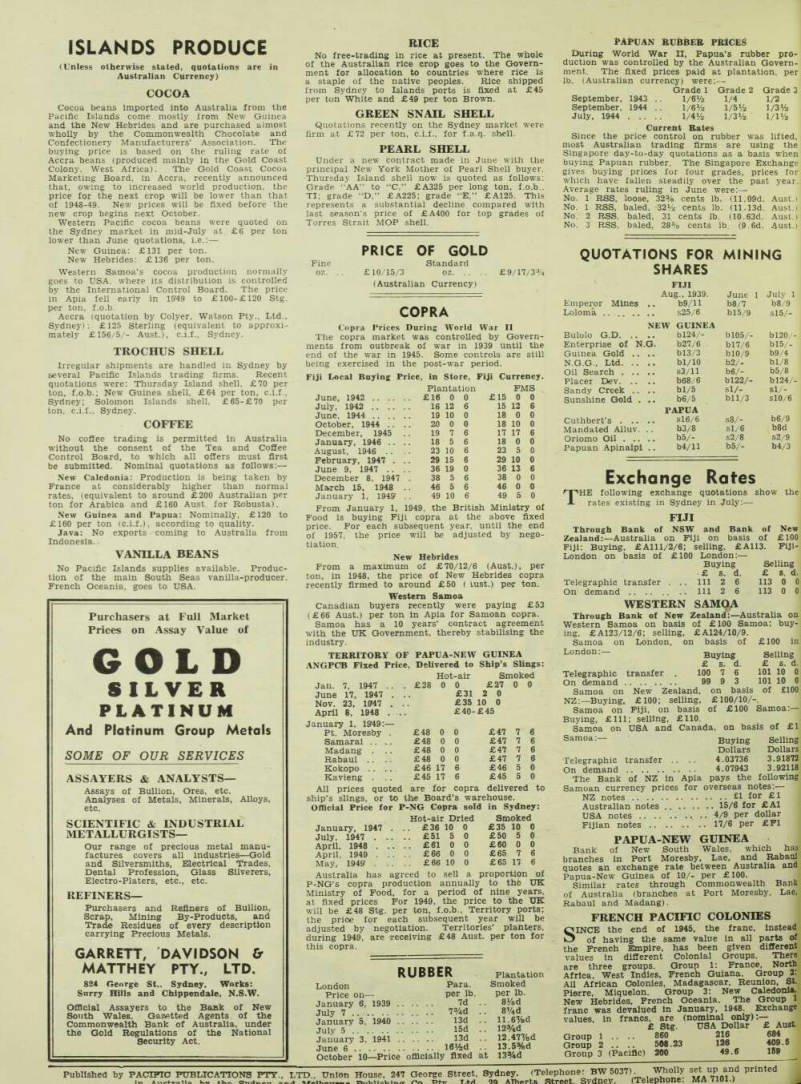
(Unless otherwise stated, quotations are in Australian Currency)
Cocoa
Cocoa beans imported into Australia from the Pacific Islands come mostly from New Guinea and the New Hebrides and are purchased almost wholly by the Commonwealth Chocolate and Confectionery Manufacturers’ Association. The buying price is based on the ruling rate of Accra beans (produced mainly in the Gold Coast Colony, West Africa). The Gold Coast Cocoa Marketing Board, in Accra, recently announced that, owing to increased world production, the price for the next crop will be lower than that of 1948-49. New prices will be fixed before the new crop begins next October.
Western Pacific cocoa beans were quoted on the Sydney market in mid-July at £6 per ton lower than June quotations, i.e.:— New Guinea; £l3l per ton.
New Hebrides: £136 per ton.
Western Samoa’s cocoa production normally goes to USA. where its distribution is controlled by the International Control Board. The price in Apia fell early in 1549 to £lOO-£l2O Stg. per ton, f.o.b.
Accra (quotation by Colyer, Watson Pty., Ltd., Sydney); £ 125 Sterling (equivalent to approxi mately £156/5/- Aust.), c.i.f., Sydney.
Trochus Shell
Irregular shipments are handled in Sydney by s«everal Pacific Islands trading firms. Recent quotations were: Thursday Island shell, £7O per ton, f.0.b.; New Guinea shell, £64 per ton, c.i.f., Sydney: Solomon Islands shell, £65-£7O per ton. c.i.f., Sydney.
Coffee
No coffee trading is permitted in Australia without the consent of the Tea and Coffee Control Board, to which all offers must first be submitted. Nominal quotations as follows; — New Caledonia: Production is being taken by France at considerably higher than normal rates, (equivalent to around £2OO Australian per ton for Arabica and £l6O Aust. for Robusta).
New Guinea and Papua: Nominally, £l2O to £l6O per ton (c.i.f.), according to quality.
Java: No exports coming to Australia from Indonesia.
Vanilla Beans
No Pacific Islands supplies available. Produc tion of the main South Seas vanilla-producer.
French Oceania, goes to USA.
Rice
No free-trading in rice at present. The whole of the Australian rice crop goes to the Govern ment for allocation to countries where rice is a staple of the native peoples. Rice shipped from Sydney to Islands ports is fixed at £45 per ton White and £49 per ton Brown.
Green Snail Shell
Quotations recently on the Sydney market were firm at £72 per ton, c.i.f., for f.a.q. shell.
Pearl Shell
Under a new contract made in June with the principal New York Mother of Pearl Shell buyer. ■Thursday Island shell now is quoted as follows: Grade “AA” to “C.” £A325 pe-r long ton, f.0.b..
TI; grade “D.” £A225; grade “E,” £AI2S. This represents a substantial decline compared with last season’s price of £A4OO for top grades of Torres Strait MOP shell.
Advertisements & other items, p. 98 (1 item)
Price Of Gold
Pine Standard oz. .. £ 10/15/3 oz £9/17/3% (Australian Currency)
Copra
Prices During World War II The copra market was controlled by Govern ments from outbreak of war in 1939 until the end of the war in 1945. Some controls are still being exercised in the post-war period.
Fiji Local Buying Price, in Store, Fiji Currency.
From January 1, 1949, the British Ministry of Food is buying Fiji copra at the above fixed price. For each subsequent year, until the end of 1957. the price will be adjusted by nego tiation.
New Hebrides From a maximum of £7O/12/6 (Aust.), per ton, in 1948, the price of New Hebrides copra recently firmed to around £5O ( lust.) per ton.
Western Samoa Canadian buyers recently were paying £53 (£66 Aust.) per ton in Apia for Samoan copra.
Samoa has a 10 years’ contract agreement with the UK Government, thereby stabilising the industry.
Territory Of Papua-New Guinea
ANGPCB Fixed Price, Delivered to Ship’s Slings:
All prices quoted are for copra delivered to ship’s slings, or to the Board’s warehouse.
Official Price for P-NG Copra sold in Sydney:
Australia has agreed to sell a proportion of P-NG’s copra production annually to the UK Ministry of Pood, for a period of nine years, at fixed prices For 1949, the price to the UK will be £4B Stg. per ton, f.0.b.. Territory ports; the price for each subsequent year will be adjusted by negotiation. Territories’ planters, during 1949, are receiving £4B Aust. per ton for this copra.
June, 1942 Plantation £16 0 0 £15
Fms
0 0 July, 1942 16 12 6 15 12 6 June, 1944 19 10 0 18 0 0 October, 1944 . . . . 20 0 0 18 10 0 December, 1945 19 7 6 17 17 6 January, 1946 .. 18 5 6 18 0 0 August, 1946 .. 23 10 6 23 5 0 February, 1947 . .. 29 15 6 29 10 0 June 9, 1947 .. .. 36 19 0 36 13 6 December 8, 1947 . 38 5 6 38 0 0 March 15, 1948 .. 46 5 6 46 0 0 January 1, 1949’ .. 49 10 6 49 5 0
Hot-air Smoked Jan. 7, 1947 .. . £28 0 0 £27 0 0 June 17, 1947 ... £31 2 0 Nov. 23, 1947 ... £35 10 0 April 8, 1948 ... £40-£45 January 1, 1949: — Pt. Moresby . £48 0 0 £47 7 6 Samarai .. .. £48 0 0 £47 7 6 Madang . .. £48 0 0 £47 7 6 Rabaul .. .. £48 0 0 £47 7 6 Kokopo .. .. £46 17 6 £46 5 0 Kavieng ... £45 17 6 £45 5 0
Hot-air Dried Smoked January, 1947 . .. £36 10 0 £35 10 0 July. 1947 . .. .. £51 5 0 £50 5 0 April, 1948 . . . .. £61 0 0 £60 0 0 April, 1949 . . . .. £66 0 0 £65 7 6 May, 1949 1 . .. £66 10 0 £65 17 6
Rubber
Plantation
Papuan Rubber Prices
During World War 11, Papua’s rubber pro duction was controlled by the Australian Govern ment, The fixed prices paid at plantation, per lb. (Australian currency) were:—
Current Rates Since the price control on rubber was lifted, most Australian trading firms are using the Singapore day-to-day quotations as a basis when buying Papuan rubber. The Singapore Exchange gives buying prices for four grades, prices for which have fallen steadily over the past year.
Average rates ruling in June were:— No. 1 RSS, loose, 32% cents lb. (11.09 d. Aust.t No. 1 RSS, baled, 32% cents lb. (11.13 d. Aust.) No. 2 RSS, baled, 31 cents lb. (10.63 d. Aust.) No. 3 RSS, baled, 28% cents lb. (9.6 d. Aust.)
London Para.
Smoked Price on— per lb. per lb.
January 6, 1939 . ... 7d SVad July 7 . ... 7%d SVid January 5, 1940 . 13d .. 11.6%d July 5 . ... I5d .. 12%d January 3. 1941 . 13d .. 12.47 7 /ad June 6 . 16ted .. 13.5%d October 10—Price officially fixed at 13 3 / 4 d
Grade 1 Grade 2 Grade 3 September, 1943 . 1/6% 1/4 1/2 September. 1944 . 1/6% 1/5% 1/3% July. 1944 1/4% 1/3 % 1/1%
Quotations For Mining
Shares
Fiji
Aug., 1939.
June 1 July 1 Emperor Mines .. b9/ll b8/7 b8/9 Loloma s25/6 bl5/9 sl5/-
New Guinea
Bulolo G.D bl24/bl05/bl20/- Enterprise of N.G. b27/6 bl7/6 bl5/- Guinea Gold .. .. bl3/3 blO/9 b9/4 N.G.G., Ltd bl/10 b2/bl/8 Oil Search s3/ll b6/b5/8 Placer Dev b68/6 bl22/bl24/- Sandy Creek .. .. bl/5 sl/sl/- Sunshine Gold . .. b6/5 bll/3 slO/6
Papua
Cuthbert’s S16/6 s8/b6/9 Mandated Alluv. .. b3/8 sl/6 b8d Oriomo Oil b5/s2/8 S2/9 Papuan Apinaipi .. b4/ll b5/b4/3
Exchange Rates
THE following exchange quotations show the rates existing in Sydney in July:—
Fiji
Through Bank of NSW and Bank of New Zealand: —Australia on Fiji on basis of £lOO Fiji: Buying, £Alll/2/6; selling, £AII3. Piji- London on basis of £lOO London: —
Western Samoa
Through Bank of New Zealand: —Australia on Western Samoa on basis of £100 Samoa: buy ing, £A123/12/6; selling, £A124/10/9.
Samoa on New Zealand, on basis of £100 NZ:—Buying, £100; selling, £100/10/-.
Samoa on Fiji, on basis of £100 Samoa; — Buying, £111; selling, £110.
The Bank of NZ in Apia pays the following Samoan currency prices for overseas notes: — NZ notes £1 f° r £1 Australian notes 15/6 for £AI USA notes . .. 4/9 per dollar Fijian notes 17/6 per £FI
Papua-New Guinea
Bank of New South Wales, which has branches in Port Moresby, Lae, and Rabaul quotes an exchange rate between Australia and Papua-New Guinea of 10/- per £lOO.
Similar rates through Commonwealth Bank of Australia (branches at Port Moresby, Lae, Rabaul and Madang).
French Pacific Colonies
SINCE the end of 1945, the franc, Instead of having the same value in all parts of the French Empire, has been given different values in different Colonial Groups. There are three groups. Group 1: France, North Africa, West Indies, French Guiana. Group 2: All African Colonies, Madagascar, Reunion, St.
Pierre, Miquelon. Group 3: New Caledonia.
New Hebrides, French Oceania. The Group 1 franc was devalued in January, 1948. Exchange values, in francs, are (nominal only):
Buying Selling £ s. d. £ s. d.
Telegraphic transfer . .. Ill 2 6 113 0 0 On demand . . Ill 2 6 113 0 0
Samoa on London, on basis of £100 in London:— Buying Selling £ s. d. £ s. d.
Telegraphic transfer . 100 7 6 101 10 0 On demand 99 9 3 101 10 0
Samoa on USA and Canada, on basis of £1 Samoa;— Buying Selling Dollars Dollars Telegraphic transfer . . .. 4.03736 3.91872 On demand . .. 4.07943 3.92118
a £ stg. USA Dollar £ Aust.
Group 1 .. .. 860 216 684 Group 2 .. .. 508.23 126 409.6 Group 3 (Pacific) 200 49.6 159
Advertisements & other items, pp. 98-100 (4 items)
Published by PACIFIC PUBLICATIONS PTY., LTD., Union House, 247 George Street, Sydney. (Telephone; BW 5037). Ul JJj n . d pnnted
ir, ktt Ptr T.trf 20 Alberta Street. Sydney. (Telephone. MA 7101.) i
Gold
Purchasers at Full Market Prices on Assay Value of
SILVER
PLATINUM
And Platinum Group Metals
SOME OF OUR SERVICES
ASSAYERS & ANALYSTS—
Assays of Bullion, Ores, etc.
Analyses of Metals, Minerals, Alloys, etc.
SCIENTIFIC & INDUSTRIAL
METALLURGISTS—
Our range of precious metal manufactures covers all industries—Gold and Silversmiths, Electrical Trades, Dental Profession, Glass Silverers, Electro-Platers, etc., etc.
REFINERS—
Purchasers and Refiners of Bullion, Scrap, Mining By-Products, and Trade Residues of every description carrying Precious Metals.
GARRETT, DAVIDSON &
MATTHEY PTY., LTD.
824 George St., Sydney. Works: Sorry Hills and Chippendale, N.S.W.
Official Assayers to the Bank of New South Wales. Gazetted Agents of the Commonwealth Bank of Australia, under the Gold Regulations of the National Security Act.
July, 1549 Pac Iv Ic Islands Monthly
quench
a
tropical
thirst
r i \' s m % When hot and tired you re there
otlung
quite is
satisfy
so mg and fill!
St
ching
long cold quen as lass of K B friends <r and our guests, preciale too ill ap this
ally
line
Lag
er j h.
TOOTHS
Onr LA
GER
MERCHANTS, Sc SHIP OWNERS
Capital £1,000,000
ESTABLISHED 1914
A'
COPRA MERCHANTS & MILLERS
ASSOCIATED COMPANIES THROUGHOUT THE PACIFIC ISLANDS
Bayers and exporters of all kinds of Islands produce. Copra Merchants and Millers.
Agents for Australian, European and American Manufacturers. Distributors of every description of merchandise.
Thirty years of Pacific Islands development and service.
IN LONDON
W. R. CARPENTER & CO.
(LONDON) LTD.
Coronation House. 4 Lloyd’s Avenue, London, E.C.
IN NEW GUINEA
New Guinea Company Limited., Rabaul, Lae, Madang, Kavieng.
IN PAPUA
J. R. Clay & Co., Ltd.,
REGULAR
r*
Head
IN FIJI
W. R. Carpenter & Co. (Fiji) Ltd. ★
THE W.R.C. LINE
THE FIRST DIRECT AND
CARGO AND PASSENGER SERVICE BETWEEN
PACIFIC ISLAND PORTS WAS ESTABLISHED
W. R. CARPENTER & CO. LTD.
Office: 16 O'CONNELL STREET,
DISTRIBUTING
AGENTS FOR:
Ford Motor Company off Canada.
Electrolux Refrigerators.
T. G. & C. Bolinders (Engines), Chrysler Corporation.
Westinghouse Electrical Co.
Caterpillar Tractors.
Etc., Etc.
EUROPE
BY
AND
SYDNEY.
Cable Address:
CAMOHE.
Telephone: BW 4421.
Postal Address: P.O. Box No. 168, Sydney.