Pacific
Islands
Monthly
June, 1949
Vol. XIX. No. 11.
Established 1930.
L Registered at the G.P.0., Sydria^ffotxansmission by post as a newspaper ]
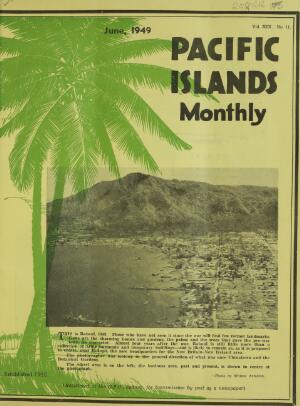
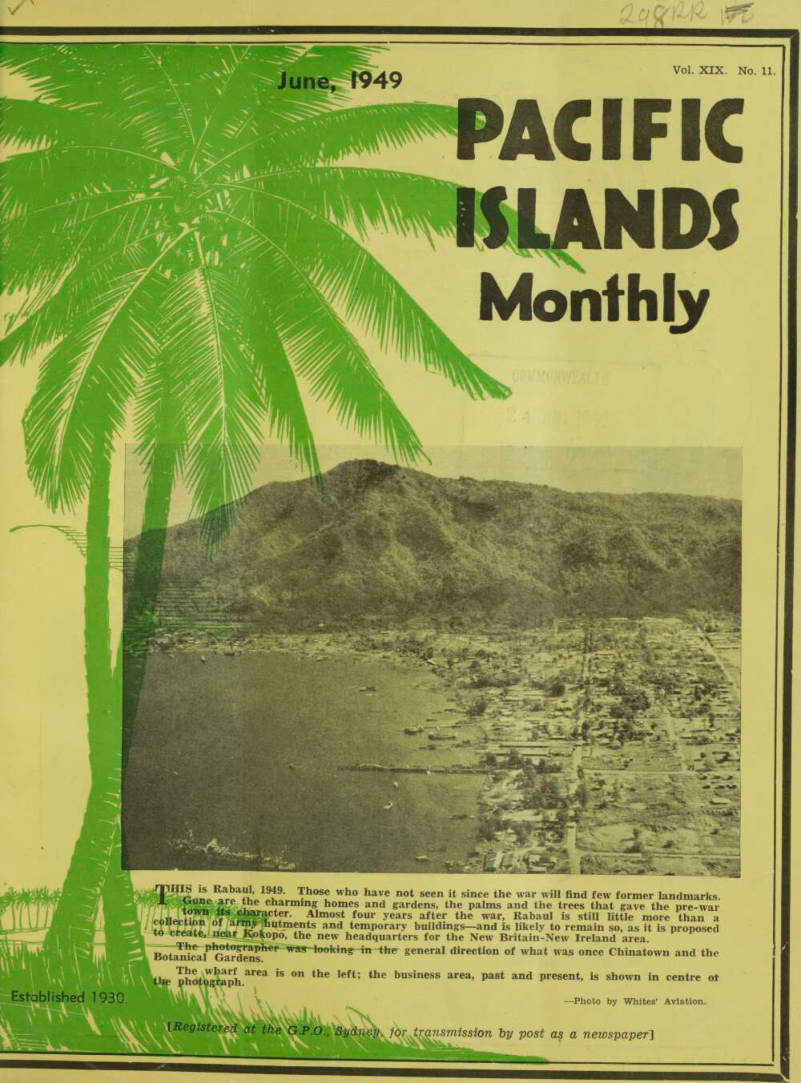
THIS is Rabaul.1949 T hose who have not se en it since the war will find few former landmarks.
Gone are the charming homes and gardens, the palms and the trees that gave the pre-war town its character.Alnost four years after the war, Rabaul is still little more than a collection of army hutments and temporary buildings—and is likely to remain so, as it is proposed to create. near Kokopo. the new headquarters for the New Britain-New Ireland area.
The photographer was looking in the general direction of what was once chinatown and the Botanical Gardens.
The wharf areais on the left; the business area. past and present. is shown in centre of the photograph. photo bywhites Aviation.
Advertisements & other items, pp. 2-4 (1 item)
Qatitab
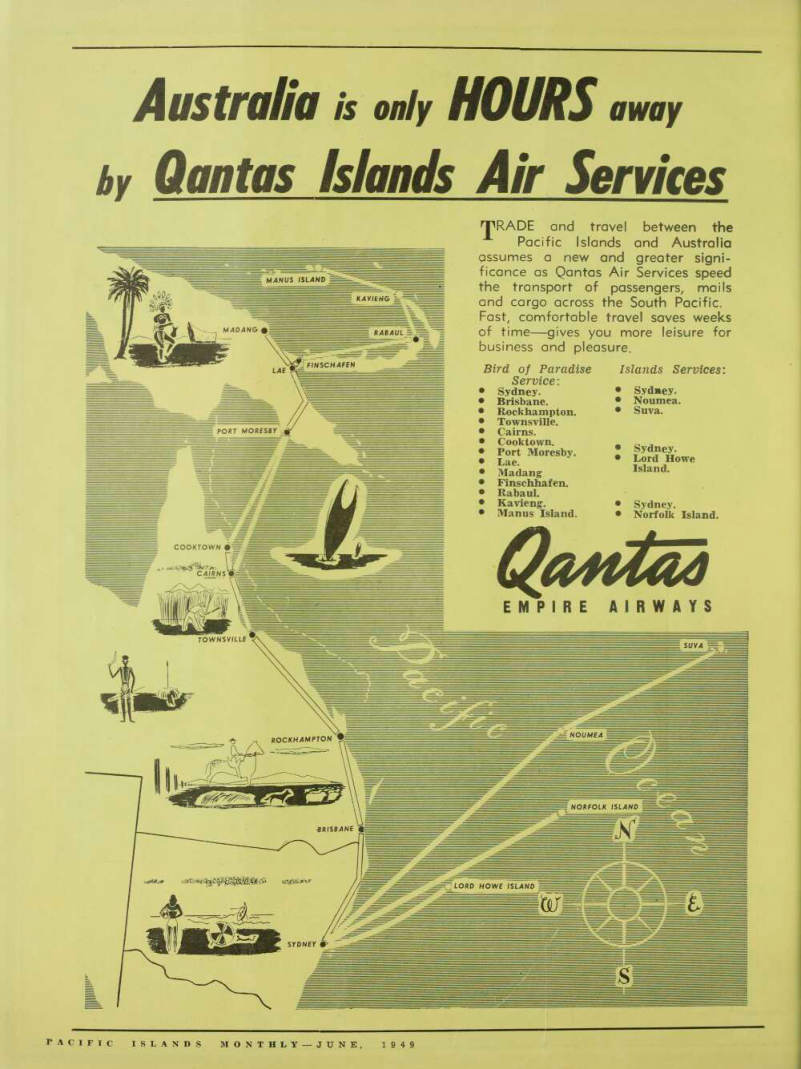
Australia h only HOURS away
by Ogatas Islands Air Senat
M4NUS ISLAND
M
KAVItN G
UADANG 0
RABAUL BJ =
FINSCHAFEN
LAE Tm
PORT MORESBY
COOKTOWN
c^-NS U a
TIRADE and travel between the
Pacific Islands and Australia
assumes a new and greater signi-
ficance as Qantas Air Services speed
the transport of passengers, mails
and cargo across the South Pacific.
Fast, comfortable travel saves weeks
of time—gives you more leisure for
business and pleasure.
Bird of Paradise Service : Sydney.
Brisbane.
Rockhampton.
Townsville.
Cairns.
Cooktown.
Port Moresby.
Lae.
Madang Finschhafen.
Rabaul.
Kavieng.
Manus Island.
Islands Services'.
Sydney.
Noumea.
Suva.
Sydney.
Lord Howe Island.
Sydney.
Norfolk Island.
Qatitab
EMPIRE AIRWAYS
TOWNSVILLE
SUVA
=NOUMEA
-ft- ROCKHAMPTON
NORFOLK ISLAND
■BRISBANE
LORD HOWE ISLAND
SYDNEY 9
s
SaAe ypufa
KEROSENE
Coleman’s fuel irons have dominated the field for over 30 years, and will continue to do so, for the experience they have gained has not been enjoyed by other makers.
Whichever you choose, petrol or kerosene, you can be sure you have the “Best of its kind."
Kerosene Iron Requires preheating with methylated spirits I Petrol Iron This model requires no preheating.
Both these self-heating irons are streamlined and have hand protected air-cooled
hoods. They are light, and perfectly
balanced to eliminate fatigue.
The irons can be used in and out of doors as there are no wires or connections. The bodies are ventilated, the edges tapered for ironing pleats and around buttons, and additional heat is developed at points for fine ironing work. Efficient, simple, economical.
Representatives for the Pacific Islands;
ROBERT GILLESPIE PTY. LTD.
54a PITT STREET, SYDNEY
PEARCE & CO. LTD.
SUVA
FOR FIJI ISLANDS
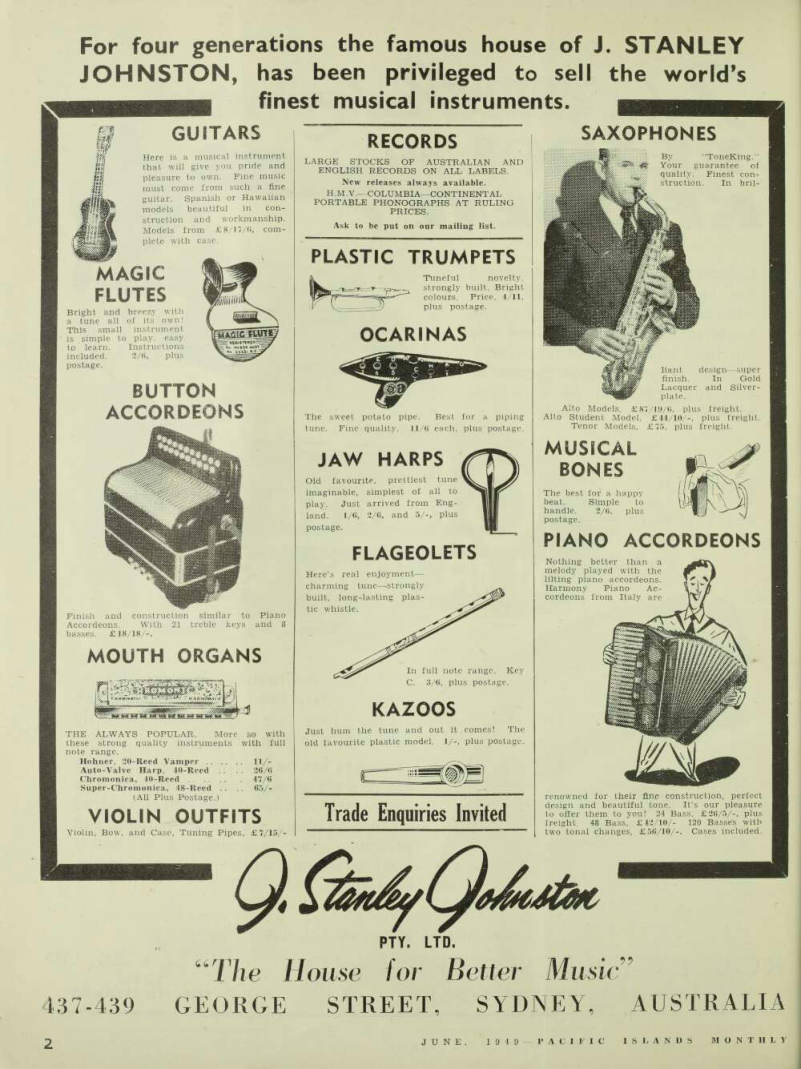
For four generations the famous house of J. STANLEY JOHNSTON, has been privileged to sell the world’s
finest musical instruments.
GUITARS
Here is a musical instrument that will give you pride and pleasure to own. Fine music must come from such a fine guitar. Spanish or Hawaiian models beautiful in construction and workmanship.
Models from £B/17/6, complete with case.
MAGIC
FLUTES
BUTTON
ACCORDEONS
MOUTH ORGANS
Finish and construction similar to Piano Accordeons. With 21 treble keys and 8 basses. £lB/18/-.
THE ALWAYS POPULAR. More so with these strong quality instruments with full note range.
Hohner, 20-Reed Vamper 11/- Auto-Valve Harp, 40-Reed . . 26/6 Chromonica, 40-Reed 47/6 Super-Chromonica, 48-Reed . . . . 65/- (All Plus Postage.)
VIOLIN OUTFITS
Violin, Bow, and Case, Tuning Pipes, £7/15/-
RECORDS
LARGE STOCKS OF AUSTRALIAN AND
ENGLISH RECORDS ON ALL LABELS.
New releases always available.
H.M.V.—COLUMBIA-—CONTINENTAL
PORTABLE PHONOGRAPHS AT RULING
PRICES.
Ask to be put on our mailing list.
PLASTIC TRUMPETS
Tuneful novelty, strongly built. Bright colours. Price, 4/11, plus postage.
OCARINAS
The sweet potato pipe. Best for a piping tune. Fine quality. 11/6 each, plus postage.
JAW HARPS
Old favourite, prettiest tune imaginable, simplest of all to play. Just arrived from England. 1/6, 2/6, and 5/-, plus postage.
FLAGEOLETS
Here’s real enjoyment— charming tune —strongly built, long-lasting plastic whistle.
In full note range. Key C. 3/6, plus postage.
KAZOOS
Just hum the tune and out it comes! The old favourite plastic model. I/-, plus postage.
Trade Enquiries Invited
MUSICAL
BONES
SAXOPHONES
m V Ik The best for a happy beat. Simple to handle. 2/6, plus postage.
PIANO ACCORDEONS
Nothing better than a melody played with the lilting piano accordeons.
Harmony Piano Accordeons from Italy are renowned for their fine construction, perfect design and beautiful tone. It’s our pleasure to offer them to you! 24 Bass, £26/5/-, plus freight, 48 Bass, £42/10/- 120 Basses with two tonal changes, £56/10/-. Cases included.
PTY. LTD.
The House lor Better Music
437-439
GEORGE STREET, SYDNEY, AUSTRALIA
Index to Advertisers
Atco Motor Mowers Pty.. Ltd. ... 81 Akun Alois & Co. . 37 Aluminium Union, Ltd 65 Achun, Gabriel . . 67 Angliss & Co. ... 44 Amplion (Aust.) Pty., Ltd. ... 80 Atkins, Wm., Pty., Ltd 75 Amalgamated Hatcheries ... 89 Broomfields ... 41 BP (SS) Co. . . . 33 Bethell, Gwya oc Co ' Brunton’s Flour . 55 Burns, Philp (New Hebrides), Ltd. . 15 Baker. W. Jno..
Pty., Ltd. ... 65 Berrys Bay Boat yard ... 68 Bank of NSW , . 16 Burns. Philp (NG), Ltd. 53 Burns. Fhilp Trust Co., Ltd 71 Budge, James, Pty. 68 Caine's Studio . . 67 W R. Carpenter & Co. (Fiji). Ltd. . 29 Carpenter. Ltd.. W.
R. . . . . . cov. iv.
Colonial Wholesale Meat 17 Colyer Watson (New Guinea), Ltd. . . 3° Carrlock & Co. . . 64 Crammond Radio Pty., Ltd. ... 72 Crilley. R. J.. Pty., Ltd .30 Costello. Vince Garrick Hotel . . 31 “Cystex” 63 Donaghy & Sons . 39 Donald. Ltd., A. B. 31 Davison Paints, Ltd .61 Dr. Williams Pink Pills 64 Dangar. Gedye & Malloch 3 Etablissements, Donald ... 27 Enmore Poultry Farm 32 Electrolux Refrigerators . . 38 Ford Sherington 35 Garrett & Davidson 96 Gillespie Pty., Ltd., Robert . . 1, 21, 40 Gregory. A.. Pty..
Ltd 70 Robt* Gillespie <NGI. Ltd. . 95. 76 Gilbey’s Gin ... 28 Gillespie’s Flour . 77 Grand Pacific Hotel Pty., Ltd 4 Gough & Co.. E. J. 15 Grove & Sons, W.
H. 25 Gordons Gin ... 61 Heinz & Co. Pty..
Ltd., H. J. . . .79 Herco 26 Hoover, Francis . . 57 Hettig. August . .21 Horlicks Malted Milk 83 Halvorsen. Lars.
Sons, Pty.. Ltd. . 57 Hemingway & Robertson ... 85 International Trad ing Co 25 J. Stanley Johnston Pty., Ltd 2 Jones, Wm. A. . .59 Jackson, S. Went worth 91 Kennedy, Capt. W.
L. ... 18 Kosak, Robert . . 94
Kodak (Aust.) Pty., Ltd 32. 74 Kolynos, Inc. ... 88 Kopsen & Co., Ltd. 54 Kerr Brothers ... 77 Kraft Walker Cheese ... 55 Kwong Chong Bros. 91 Kui, George ... 23 Locker, Geo. J. . .56 Manstocks ... 78 Mail Publicity Co. (Magazine Sub scriptions) ... 33 Maloney, N. F., & Co. ... 91 Millers, Ltd., Suva 78 Miscellaneous ... 93 “Mendaco” ... 85 Mcllraths Pty., Ltd. 20 Mobile Industrial Equipment ... 34 Morris, Hedstrom.
Ltd.. Suva ... 12 National Airways Corporation ... 58 Nordman. Oscar . 94 Nelson & Robertson Pty., Ltd. .60 "Nixoderm” ... 93 NSW Yacht Brokers 87 Pacific Is. Society 44 Pan American Air ways 14 Pacific Islands Trading Co. . . 19 “Pinkettes” ... 42 Pitt & Scott, Ltd. 75 Qantas Empire Air ways ... cov. ii.
Queensland Insur ance Co 60 Robinson, G. H.. 41, 59 Rohu, Sil . . . . 16 Reed. William E. . 25 Royalty Traders . 9'3 Scott. Ltd., J. . . 21 Shell Co. ... 90 Southern Pacific Insurance Co. . . 59 Spartan Paints Pty., Ltd. ... 23 Stewarts & Lloyds (Aust.) Pty.. Ltd. 26 Swallow & Ariell . 86 Steamships Trading Co., Ltd. . . 36. 92 Sullivan & Co., C. 82 Tatham, S. E., & Co 22 Tallerman & Co.
Pty., Ltd. ... 19 Taylor & Co.. A. . 40 Tooth & Co. Pty..
Ltd cov. iii.
Thornycroft (Aust.) Pty., Ltd. ... 42 Tilley Lamps ... 66 Tillock & Co. . . 86 Tyneside Foundry & Engineering Co.. Ltd 35 USL Batteries . 79 Union Manufactur ing & Export Co. 24 Vacuum Oil Co., Ltd 84 Ventura Trading Co. Pty., Ltd. . . 18 Vincent Chemical Co 69 Watson-Victor ... 63 Watson, Wm. H.. 43, 73 Harry West ... 65 Wynne S, Breden Pty.. Ltd. ... 31 Woods Great Pep permint Cure . . 69 Widdop, H., & Co., Ltd 30 Wills, W. D. & H. 0 62 Wright & Co., Ltd..
E. 29 Wright & Co. . . .20 Wunderlich ... 70 Yorkshire Insur ance Co., Ltd. . 15
Sister Jean Henderson, of the Anglican Mission, Papua, left Sydney in May, by the “Malaita” after furlough spent in Victoria and Tasmania. She has returned to her work at St. Margaret’s Hospital, Eroro.
Advertisements & other items, p. 5 (2 items)
3
r AGI F I ( ISLANDS MONTHLY JUNE, 1949
Lighting Plant
LIGHT
and POWER
When you need . .
. . Where you need it
when you install a
“NEVERTIRE”
Lighting Plant
Compact in design and built to a high standard of workmanship, the “Nevertire Senior” is typical of our range of Lighting Plants. Conservatively rated at 1,000 watts, it is the ideal plant for the modern smaller home, being easy to operate and economical to run. It costs less for fuel than for a similar number of kerosene lamps. Install a ‘‘Nevertire Senior” Lighting Plant in your home and give it light and power—when you need it—where you need it.
THE ENGINE: The En-
gine is a 2 H.P. Lister- Junior water-cooled, 4cycle Petrol Engine, with overhead valves, automatic lubrication, hightension magneto and dustproof construction.
It is fitted with a larger fuel tank than standard. Vapouriser for kerosene fuel extra if required.
GENERATOR. Sturdy, highly efficient 32/43- Volt Generator, shunt wound, inter-pole, with series starting winding, ball bearings, and with field regulator to adjust charging rate.
ALSO AVAILABLE: SEVERAL SIZES OF 32, 50 AND 110-VOLT D.C. PLANTS;
240/415-VOLT A.C. SETS.
Write for further details to:
DANGAR, GEDYE & MALLOCH LTD.
Malloch House, 10-14 Young St., Sydney
G.P.0., Box 509. Telephone: BU 5095.
The “Nevertire Senior”.
Capacity 1,000 Watts, 32 Volts, 20-25 lights. 1
In This Issue:
Editorial: The Tasks and Problems of the South Pacific Commission .. 5 BP’s Store Burned at Ba, Fiji ... 7 Australian Cruiser in Pacific Ports .. 7 New Colonial Secretary for Fiji ... 7 Skymasters for Norfolk Is. Service .. 7 NG Timber Lease Report Awaited .. 7 Silly Comparison Between Fiji and Queensland Sugar Production .. 8 Makea Ariki as Godmother to Baker Infant 8 Third Trans-Pacific Service Starts in July 9 World’s Most Expensive Coffee Bean 9 Guinea Air Traders Provide Welcome Airservices 9 Arrest in Ocean Island Murder Case 9 Labour for New Caledonia from Java 9 The Hahn Family of Tonga 10 South Pacific Commission Approves Research Programme —Next Ses sion in October 11 Fiji Government Backs Down Over Strike 13 Chinamen’s Luck —Result of Rabaul Raffle 16 Murder of Mr. A. Robinson 16 Suva-Vanua Levu Run Goes to New Shipping Service 16 More Air-Services for Papua-New Guinea 18 Fiji Football Team for Australia in 1950 20 Angry Padre on the Warpath—How Church Was Tricked Out of its Site in Lae 21 Lazy Turn-Around of Ships Costs Money 23 Rain by the Foot in Fiji—All Records Broken 25 War Damage in British Pacific Islands 25
Gl’s Clamour For a New Hebrides Paradise 26 Solomon Islands Have Own Club in Tulagi 29 BSI Government’s Attitude is Unsym pathetic and Unhelpful, Says Planter 30 Excessive Cost of Shipping Stock to New Guinea 31 Peace, Prosperity and More Ships for Cook Islands 32 Tonga’s Growing Pains —A Call for Urgently Needed Minor Reforms 33 Empire Day Rally in Rabaul ... 35 He Laid the Foundations of a Better Native Policy 41 Territories’ Talk-Talk 45 Just No Trouble At All 46 Papeete Goes to the Movies 48 Private Enterprise Did This 48 The Navy Shows the Flag 48 Book Reviews 49 Tropicalities 50 Island of Pirates’ Gold 51 The KO—Short Story 52 NZ Administration in Samoa Gets Official Approval, but Much Advice from UN 37 Disease Threatens BSI Taro Crops .. 39 Why Fijians Develop TB 40 Death Follows Jungle-Juice Party in BSI 40 Native Co-Operatives in G & E Colony—Connection With Govt.
Trade Scheme 57 Young Fijian Drowned by Cupful of Water 60 Radio Receivers for Native Broadcasts 64 Honiara Now Has An Hotel 64 Indian or Fijian—Problem for the Employer of Labour 65
Special Air Fares for Island Students 67 NG Workers Get at Least £6 per Month 67 Mission Work Among Fiji Indians .. 68 American Pacific Islands Transferred to Civil Administration 68 Wardist Regime in NG Described as Negligent Trusteeship 69 Tourist —Here’s Your Guide to Norfolk Island 70 Poor Old Fiji—Victim of Woman Writer 73 More Evidence of Muddling at Manus 73 Native Co-Operatives for Papua— NSW Send Adviser 74 The Month in Moresby 76 Hidden U-boat Men—Story of 40 Germans with Island Wives .. .. 78 New Airservice and New Doctor for Daru 79 Rarotonga Golfers Conclude Success ful Season 80 Plane and Shipping Services .. .. 82 Mosquito Control —Successful Cam paign in Guiana 89 New Lutheran Church in NG High lands 89 Giant Snails a Major Pacific Problem 90 Praise for Fiji Agricultural Journal .. 90 Indonesia is Danger Spot for South Pacific 91 One Plane, 12 Horses for Rabaul Mis sion 92 Fijians Notable History in Pacific War 95 Commercial, Markets, etc 96 OBITUARY: G. V. Langdale, 6; Senator Quesnot, 6; Capt. H. Stringer, 8; R.
C. Laycock, 29; T. C. Worrall, 55; W.
H. Chance, 78.
ORGANISATIONS; New Guinea Women’s Club, Sydney, 7; Pacific Islands Society, 18; Polynesian Club, 67.
INDUSTRIES: Copra. 10; Candlenut oil, 10; Rubber, 15; Gold, 74.
Advertisements & other items, p. 6 (1 item)
*
so* tav s
Pacific Islands Monthly
The Newspaper-Magazine of the South Seas
IRegistered at the G.P.0., Sydney, for transmission by post as a newspaper ] Published Once Each Month and Circulated in Australia and New Zealand and in the following Pacific Territories and Islands Groups:
Australian Territory ot Papua.
Trustee Territory (Australia) of New Guinea Australian Territory of Norfolk Island.
New Zealand Territory of Cook Islands Trustee Territory (NZ) of Western Samoa British Colony of Fiji.
British Solomon Islands Protectorate.
British Protectorate of Tongan Islands British Crown Colony of Gilbert and Ellice Islands.
Trustee Territory of Nauru.
British and French Condominium of New Hebrides.
French Colony of New Caledonia.
French Colony of Oceania (Tahiti, etc.), American Territory of Eastern Samoa.
American Territory of Hawaiian Islands.
Owned and Produced by Pacific Publications Pty., Ltd., Union House, 247 George Street, Sydney.
Telephone: General Office and Advertising BW 5037.
Po - Box 3408
Registered Address for Telegrams, Radiograms and Cables: “Pacpub,” Sydney.
Contributions.
Artides Stories, and Photographs dealing with Pacific Islands subjects are invited and will be paid for on publication.
Subscription Rates.
Per Annum, Pre-paid, Including Postage.
In Australia, New Zealand, Fiji, New Guinea, Papua, Western Samoa,’ Cook Islands, Tonga, British Solomons, Gil- T b T er . fc f Ellice Colon y- Nauru, and United Kingdom <c » Elsewhere .. „ Single Copies " ” j J
Editor and Publisher:
R. W. Robson, P.R.Q.S.
Assistant Editor: JUDY TUDOR.
General Office: Union House, 247 George Street Sydney. Telephone: BW 5037, Advertising Manager: W. E. Rogers.
Representative In London.
J. T. Wallis, Coronation House, 4 Lloyds Avenue, London. E.C.3, from whom may be obtained copies of Pacific Islands Monthly, Pacific Is. Year Book, advertising schedules, etc.
Representative In U.S.A.
Pacific Islands Trading Co.,
244 California St., San Francisco, U.S.A
Agents.
The following are authorised to receive sub scriptions for Pacific Islands Monthly:— Burns. Phllp & Co.. Ltd., and Burns Phllp (South Sea) Co., Ltd. All branches.
W. R. Carpenter & Co.. Ltd. All branches.
Morris, Hedstrom. Ltd. All branches.
Steamships Trading Co., Papua. All branches.
W. M. Caldwell, Suva, FIJI.
Cook Islands Trading Co., Rarotonga, Cook Is.
Oscar Nordman, Papeete, Tahiti.
Islands Branches and Representatives of W H Grove & Sons, Ltd., Auckland, New Zealknd.’
Ed. Pentecost. Noumea, New Caledonia.
SOC Ca.edonU bbay K " r “ C,e ’
Vol. Xix. No. 11.
June, 1949.
n . ( 1/6 Per Copy Price Prepaid, p.a.: 15/- Aus, ' In USA. p.a.: $3.
South Pacific Commission
The Task and Problems of the South Pacific Commission
THE South Pacific Commission, brought into being on the initiative of Aus traha and New Zealand to undertake an important task of international sig nificance, has made an impressive start Energy, vision and organisational ability have been displayed by the new Secre tanat in setting the Commission to work and the Research Council already is dis tinguished by the skill, enthusiasm and practical commonsense of the men seby the six nations concerned (Britain, France, United States, Nether lands, Australia and New Zealand) to discover, describe, study and find a solu tion of the problems of government in the fourteen Territories of the South Pacific.
The Secretariat provides the organisa tion, and equipment: the highly qualified °.i the Research Council—all experts in their various fields—study the problems and suggest the answer; and the Com missioners themselves have the responsi bly for co-ordinating administrative activities, especially in relation to the problems dealt with.
An examination of the list of “projects” already receiving the attention of the Re search Council (published in this issue) will give some idea of the scope, purpose and potential usefulness of the South Pacific Commission.
AT the end of the Victorian era, when the scramble for “colonies” in the Pacific Islands had died away, it be came apparent to all observers who felt a sense of responsibility for the Islanders’ welfare that there was need for some authority to undertake study, research and co-ordination of European activities
and administration. There were less than two milhons of native people in the South Pacmc: Islands—most of them in primitive Melanesia—but they were divided up among more than a dozen separate and independent administrations: and each administration was conducted in a jealously-guarded compartment, insulated by bureaucrats against any exchange of experience or ideas with the organisation next door.
Soon after it was established. 20 years ago the “PIM” repeatedly directed at tention to the ridiculous situation exist ing m the Australian • Pacific Territories Only an imaginary line separated Papua trom what was then the Mandated Terri tory of New Guinea. In the two Terri tories were the same types of natives, the same degree of native culture (or lack of n), the same diseases, the same kind of Europeans and European industries, the same problems of health, education, transport, trade. In fact, the things which divided them were as nothing, compared with the conditions which united them.
Yet, believe it or not, those two Terri tories, both governed from the same Department in Canberra, did not in any w J*y. exchange ideas or experiences or officials—instead of being practically one area, for administrative purposes, they were governed as if they had been on separate planets.
Government after Government (mostly n 9fi~ La^OUr) refused to concern itself with. Territories responsibilities, and nothing was done, until World War 11.
However much we may dislike the Evatt- Ward combination politically, we must give to the Australian Socialists the credit
Between-Wars Period. m the slightest degree, with the condi tions ruling in the adjoining Territorv S n< ?sp la 5 y ’ ther ? was a certain amount of inter change of knowledge; but what research and co-ordination ther !, were « were due to the in officfaS C6 rn th* . e ,P ter P rise of individual officials, rather than to any national or colonial policy. _.
I T not be correct to say that re , , , would be easy to wander into a tb? e^ a ! dls cussion of the way in which the Colonial Powers, in the past, hav^-or ba jc not—discharged their obligations to the native Islanders in their care; but. in at IH rp f ard - facts and arguments would fill a volume. Better to forget the and accept the leasing fact that, crea.tmg their South Pacific Commis slon and outlining its programme of work, the six nations concerned have re moved most of the conditions that were a source of reproach during the past half century. h? 6 scb ° larl y> and eminently practical address delivered by Dr. L G M Baas Becking at the inaugural meeting of the ? es / a ,‘,' ch Council on April 30 (and printed m full in the May “PIM”) probably has
been read with pleasure by most people interested in the future of the South Pacific. The programme he has outlined and the plans envisaged, must command approval.
IN considering the future of the Com mission, one may see danger in two directions.. There is a possibility that the Commission, in giving thought and effort to the welfare of the native Islanders, will neglect the welfare of the European Islanders; and, in the long view, the one is just as important as the other.
The second danger is that, if the people who planned and launched the Commis sion are not careful, the new barque will be wrecked upon the rocks of finance.
It is the opinion of this journal, frankly and frequently expressed, that there is a tendency on the part of the younger Planners of this strange post-war period to overdo their preoccupation with the welfare of native races, and to dismiss the claims of the European settlers of the Islands as merely the greedy clamour ings of convicted “exploiters.” That policy has been very marked in the Aus tralian Territories, and it has slowed up post-war rehabilitation, and created a spirit of frustration and despair, in a way that has to be seen to be believed.
The safest and surest way of securing the welfare of the natives, and of ensuring their rapid training and material progress, is to harness those desirable things to the interests of the European community.
Ninety per cent, of the Europeans like the native Islanders and understand them, and are happy to assist them in every possible way: and the New Planners should accept that fact, and make use of it, instead of regarding all Europeans as the natural enemies of the natives. If the very sincere men who planned the South Pacific Commission and its organ isation had spent more time with the experienced European settlers of the Islands, and a little less with the equally sincere but usually impractical anthro pologists and academicians, they could count on quicker results and more success.
European settlement throughout the South Pacific Islands is a permanent thing, and should be provided for accord ingly. The future of the Islands lies jointly with the Europeans and the native Islanders; and it should be one of the chief functions of the Commission to shape, and guard, and police their re lationship. In that way, success is as sured. An unsympathetic, non-co operative European community could slow up the work of the Commission.
IT is probable that the Commission al ready realises that it has made a serious mistake in selecting Noumea to be its headquarters. The French pre sented a very attractive proposition, and the Commission naturally accepted it— and neither the French nor the Com
mission are to be blamed for the fact that the cost of living, and of all activities, is about twice as great in New Caledonia as it is in the English-speaking centres. But the implications of that fact might have been foreseen.
The Research Council has a great deal to do, especially in these early, formative years. It needs plenty of staff, and plenty of travel facilities. Both, when ar ranged in Noumea, are fearfully expensive.
So far, the six Governments have been generous with funds; but, even so, the new organisation is finding difficulties with its budget.. Those generous funds probably are being eaten up at a distress ing rate by the unexpectedly heavy and apparently inescapable costs of the Noumea establishment. We probably shall hear more about this before 1949 is ended.
The Commission has made an excellent beginning, in organisation, in personnel, in envisaging the task and in the enthusiasm with which the selected men have applied themselves to that task. It would be a thousand pities if this new establishment were to be crippled, in the beginning, by lack of funds. There is the further danger that new political set ups will make less money available through the six nations. Might it not be possible, before it is too late, to con sider the removal of the Commission’s headquarters back to Sydney, where all possible facilities —staff, accommodation for staff, means of travel—are available, at much less cost? Sydney, after all, is the metropolis of the South Pacific and, with radio and these ever-growing air services, it is now in close daily contact with all the principal Territories of the South Pacific.
Sudden Death Of Captain
G. V. Langdale
A MAN who was popular and highly respected in the Central Pacific, Captain Geoffrey V. Langdale (usually called “Bunna” Langdale) was drowned in the lagoon at Canton Island international air-station, on the night of May 30.
It is not known how he got into the water. He was master of the Western Pacific High Commission shin, “Maureen,” which was lying off Canton Island, and it is presumed he fell accidentally from the vessel, and injured himself. Although crippled—he lost both his legs, some years ago, as the result of coral poisoning— he was a good swimmer.
He was a member of an old Fiji family and was in his middle forties. His parents were the late Captain Fred L. Langdale, of Wakaya, and Mrs. Langdale (formerly Miss L. Morris). He was for some years a member of the staff of the Government yacht, “Pioneer.”
After leave in Australia, Mr. V. Pearson, manager of Rabaul branch of Colyer Wat son (NG) Ltd., returned at the end of May with his wife and family.
A successful cocktail party was held on May 31, in the Sisters’ Mess at the Euro pean Hospital, Namanula, Rabaul. NG, to introduce Matron Stock to Rabaul resi dents. Matron Stock arrived in Rabaul recently to take over control of the hospi tal during Matron Hanlon’s leave in Aus tralia. Matron Hanlon departed in the May “Bulolo.” 'Sister Betty Henry, also from Namanula went on leave in the same vessel. Sister Henry was the first woman to set foot in Rabaul after the Australian re-occupation. She helped establish the Army hospital and with the rest of the staff spent a busy time in assisting re leased prisoners-of-war back <o health.
Quesnot
Tributes To Late Senator
Papeete, May 10.
THE body of the late Senator Joseph Quesnot was brought to Tahiti for burial, on April 29. As the SS “Pioneer Glen” entered Papeete harbour, early in the morning, all ships sounded their sirens; the quay was lined by a silent multitude; and the town ceased all work for the day.
The body was buried in the afternoon with full official and military honours.
The Governor described the Senator’s unceasing good work for French Oceania, and tributes were paid by Monsieur Anziani (who asked that a street of Papeete be named after Senator Quesnot), Monsieur Leboucher (Vice- President of the Representative Assembly), Monsieur Teriieroo (Dean of the Islands chiefs), and Monsieur Pouvanaa (Head of the Opposition party).
M. Quesnot, Tahitian representative on the French Conseil de la Republique, and President of the Tahitian Repre sentative Assembly, died at sea on the “Eridan” of a heart attack while on his way to Marseilles.
Fronds,
Palms, Robbed Of
Soon Wither
Letter to the Editor THE Tongan who wrote to you and de scribed the harm done to coconut palms by the indiscriminate cutting of fronds for village purposes is per fectly right. This can be a serious matter.
To maintain full bearing, a palm-tree requires 24 healthy leaves. Therefore, when the fronds are removed, the palm has to produce more leaves before bear ing more fruit. Without the support of its leaves, the growing bunch of nuts will gradually lose hold, until it is torn off by its own height.
You may see examples of this kind of vandalism in Fiji, just as in Tonga— especially around the native villages, where handy trees, continually denuded of their foliage, remain stunted and un profitable, and gradually die off in the end.
I am, etc.,
Elizabeth Hennings.
Vaitauba, Fiji.
Matua Passengers
Passengers on the Union Steamship Co.’s “Matua,” which arrived in Suva, Fiji, on May 23, included Mrs. M. Gillmore and Mr. A. Herrick.
Both had been on holiday in New, Zealand.
Advertisements & other items, p. 8 (1 item)
Handy Sydney Addresses
PACIFIC ISLANDS SOCIETY meets every fourth Wednesday of each month at History House, 8 Young Street, Sydney.
President: Major A. C. Swinbourne.
Tel.: XJ 3205.
NEW GUINEA WOMEN’S CLUB meets in
the Feminist Club Roorhs, 7th Floor, 77 King Street, every Thursday morning at 11; and approximately once each month in the evening.
POLYNESIAN CLUB OF SYDNEY meets
every Monday evening at 38 Clarence Street, Sydney (near Margaret Street).
Hon. Sec.: W. Byron. Polynesian visitors always welcome.
PACIFIC TRAVEL AGENCY and Sydney
office of Fiji Tourist Board—7th Floor, Union House, 247 George Street, Sydney. BW 5037.
Bp Store Burned
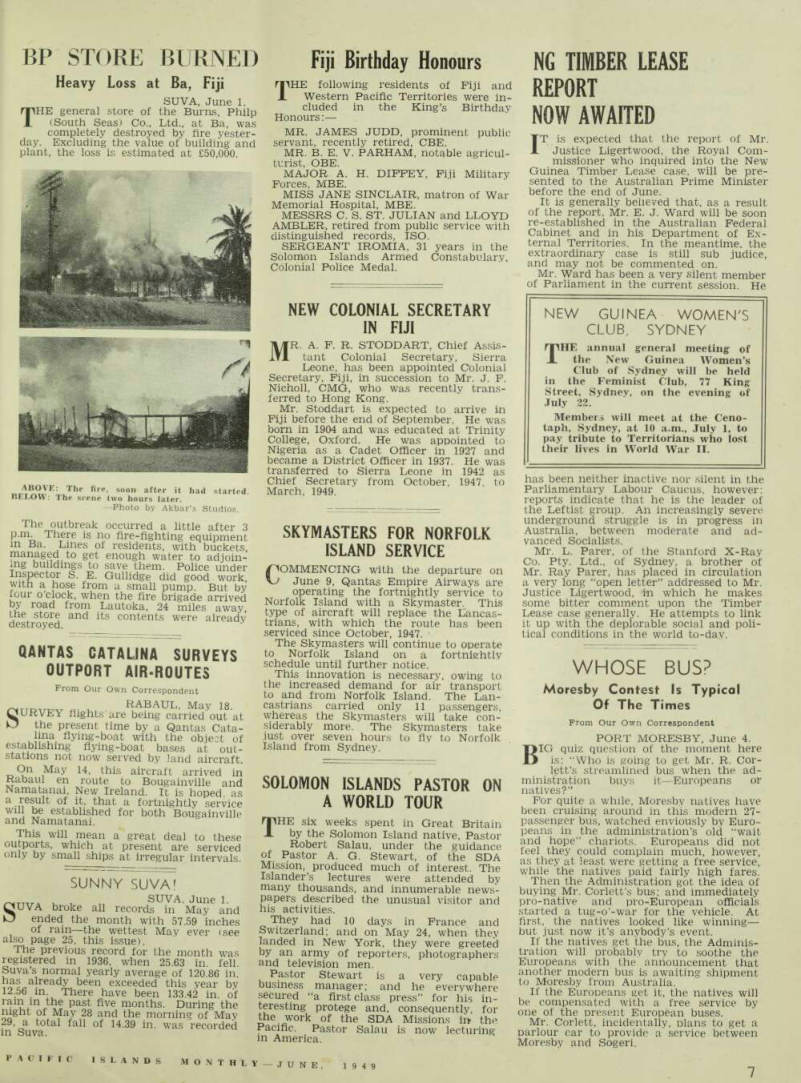
Heavy Loss at Ba, Fiji
SUVA, June 1.
THE general store of the Burns, Philp (South Seas) Co., Ltd., at Ba, was completely destroyed by fire yester day. Excluding the value of building and plant, the loss is estimated at £50,000.
The rr2 utbreak occurred a little after 3 P-m. There is no fire-fighting equipment m Ba. Lines of residents, with buckets, managed to get enough water to adjoin ing buildings to save them. Police under Inspector S. E. Gullidge did good work, with a hose from a small pump. But by four o’clock, when the fire brigade arrived by road from Lautoka, 24 miles away, the store and its contents were alreadv destroyed. J
ABOVE: The fire, soon after it had started.
BELOW: The scene two hours later, Photo by Akbar’s Studios.
Outport Air-Routes
Qantas Catalina Surveys
From Our Own Correspondent
Srabaul, May 18.
URVEY flights are being carried out at the present time by a Qantas Cata lina flying-boat with the object of establishing flying-boat bases at out stations not now served by land aircraft.
On May 14, this aircraft arrived in Rabaul en route to Bougainville and Namatanai, New Ireland. It is hoped as a -vi e^ a fortnightly service will be established for both Bougainville and Namatanai.
This will mean a great deal to these outports, which at present are serviced only by small ships at irregular intervals.
Sunny Suva!
Sy T tr a K , „ SUVA, June 1.
UVA broke all records in May and ended the month with 57.59 inches of rain—the wettest May ever (see also page 25, this issue).
The previous record for the month was registered in 1936, when 25.63 in fell Suva’s normal yearly average of 120.86 in. has already been exceeded this year by 12.56 in. There have been 133.42 in. of ram m the past five months. During the night of May 28 and the morning of May 29, a total fall of 14.39 in. was recorded in Suva.
Fiji Birthday Honours
THE following residents of Fiji and Western Pacific Territories were in cluded in the King’s Birthday Honours: — MR. JAMES JUDD, prominent public servant, recently retired, CBE.
MR. B. E. V. PARHAM, notable agricul turist, OBE.
MAJOR A. H. DIFPEY, Fiji Military Forces, MBE.
MISS JANE SINCLAIR, matron of War Memorial Hospital, MBE.
MESSRS C. S. ST. JULIAN and LLOYD AMBLER, retired from public service with distinguished records, ISO.
SERGEANT IROMIA, 31 years in the Solomon Islands Armed Constabulary, Colonial Police Medal.
New Colonial Secretary
In Fiji
MR. A. F. R. STODDART, Chief Assis tant Colonial Secretary, Sierra Leone, has been appointed Colonial Secretary, Fiji, in succession to Mr. J. P.
Nicholl, CMG, who was recently trans ferred to Hong Kong.
Mr. Stoddart is expected to arrive in Fiji before the end of September. He was bom in 1904 and was educated at Trinity College, Oxford. He was appointed to Nigeria as a Cadet Officer in 1927 and became a District Officer in 1937. He was transferred to Sierra Leone in 1942 as Chief Secretary from October, 1947, to March, 1949.
Island Service
Skymasters For Norfolk
(COMMENCING with the departure on J June 9, Qantas Empire Airways are operating the fortnightly service to Norfolk Island with a Skymaster. This type of aircraft will replace the Lancas trians, with which the route has been serviced since October, 1947.
The Skymasters will continue to operate to Norfolk Island on a fortnightly schedule until further notice.
This innovation is necessary, owing to the increased demand for air transport to and from Norfolk Island. The Lan castrians carried only 11 passengers, whereas the Skymasters will take con siderably more. The Skymasters take just over seven hours to fly to Norfolk Island from Sydney.
Solomon Islands Pastor On
A World Tour
11HE six weeks spent in Great Britain by the Solomon Island native, Pastor Robert Salau, under the guidance of Pastor A. G. Stewart, of the SDA Mission, produced much of interest. The Islander’s lectures were attended by many thousands, and innumerable news papers described the unusual visitor and his activities.
They had 10 days in France and Switzerland; and on May 24, when they landed in New York, they were greeted by an army of reporters, photographers and television men.
Pastor Stewart is a very capable business manager; and he everywhere secured “a first class press” for his in teresting protege and, consequently, for the work of the SDA Missions ir> the Pacific. Pastor Salau is now lecturing in America.
Report
Ng Timber Lease
Now Awaited
IT is expected that the report of Mr.
Justice Ligertwood, the Royal Com missioner who inquired into the New Guinea Timber Lease case, will be pre sented to the Australian Prime Minister before the end of June.
It is generally believed that, as a result of the report, Mr. E. J. Ward will be soon re-established in the Australian Federal Cabinet and in his Department of Ex ternal Territories. In the meantime, the extraordinary case is still sub judice, and may not be commented on.
Mr. Ward has been a very silent member of Parliament in the current session. He
has been neither inactive nor silent in the Parliamentary Labour Caucus, however: reports indicate that he is the leader of the Leftist group. An increasingly severe underground struggle is in progress in Australia, between moderate and ad vanced Socialists.
Mr. L. Parer, of the Stanford X-Ray Co. Pty. Ltd., of Sydney, a brother of Mr. Ray Parer, has placed in circulation a very long “open letter” addressed to Mr.
Justice Ligertwood, in which he makes some bitter comment upon the Timber Lease case generally. He attempts to link it up with the deplorable social and poli tical conditions in the world to-day.
Whose Bus?
Moresby Contest Is Typical Of The Times
From Our Own Correspondent
Port Moresby, June 4.
BIG quiz question of the moment here is: “Who is going to get Mr. R. Cor lett’s streamlined bus when the ad ministration buys it —Europeans or natives?”
For quite a while, Moresby natives have been cruising around in this modern 27passenger bus, watched enviously by Euro peans in the administration’s old “wait and hope” chariots. Europeans did not feel they could complain much, however, as they at least were getting a free service, while the natives paid fairly high fares.
Then the Administration got the idea of buying Mr. Corlett’s bus; and immediately pro-native and pro-European officials started a tug-o’-war for the vehicle. At first, the natives looked like winning— but just now it’s anybody’s event.
If the natives get the bus, the Adminis tration will probably try to soothe the Europeans with the announcement that another modern bus is awaiting shipment to Moresby from Australia.
If the Europeans get it, the natives will be compensated with a free service by one of the present European buses, Mr. Corlett, incidentally, plans to get a parlour car to provide a service between Moresby and Sogeri.
Advertisements & other items, p. 9 (1 item)
New Guinea Women's
CLUB, SYDNEY
THE annual general meeting of the New Guinea Women’s Club of Sydney will be held in the Feminist Club, 77 King Street, Sydney, on the evening of July 22.
Members will meet at the Cenotaph, Sydney, at 10 a.m., July 1, to pay tribute to Territorians who lost their lives in World War 11.
A Silly Comparison
Between Queensland and Fiji- Indian Sugar Workers
IT is reported that an emissary of the Fiji-Indian cane-growers, who visited the Queensland sugar-towns and made an industrial investigation, has pro duced a pamphlet, in which a sharp com parison is made between the wages paid by the CSR Company to European cane growers in Australia, and by the same Co. to Indian cane-growers in Fiji.
There is a wide difference, of course; and the data is being used to foment restlessness and discontent among the Indian cane-growers.
This is a good example of the stupidity of the average agitator and amateur eco nomist. It is impossible to make any helpful comparison between sugar producing conditions in Australia and Fiji.
THE Queensland canefields produce sugar only for the Australian market.
Partly by import duty, partly by sub sidy, the Australian market is reserved for the Queensland industry. Australia pays more than world parity for her sugar, because the Australian workers in the Australian sugar industry get much higher wages than the workers in the innumerable other tropical and sub tropical countries who produce sugar for the world market. Australian sugar could not be sold profitably in the world market —its production is much too costly.
In Fiji, there is no domestic market worth mentioning—if the Fiji industry is to survive, the sugar produced in Fiji must be produced cheaply enough to be sold at a profit in the world’s markets. That in turn means that the standard of wages in the Fiji sugar industry must re main much below the Australian standard.
Anyone who has travelled in Fiji will agree that the standards of living in the Indian sugar-towns could be raised, with advantage to everyone. But those stan dards are not controlled by the CSR Company (which makes only a modest profit out of its Fiji enterprises), or by the British Government of Fiji. They are controlled by the industrial conditions ruling in the various tropical and sub tropical countries which produce the sugar that is sold under competition in the world markets. Any improvement in those conditions would be immediately re flected in the Fiji-Indians’ standards of life.
If the Fiji-Indian agitators would cease their attacks upon the CSR Co. and the British administration, and co-operate with those who are trying to get agree ment concerning sugar-workers’ condi tions between all countries which export sugar, some real good might be achieved.
Makea Ariki As Godmother
Rarotonga, May 16.
THE Makea Nui Teremoana Ariki be came godmother to the infant son of Mr. and Mrs. M. B. Baker, at his christening in Rarotonga recently. Mr.
Baker is Director of Agriculture for the Cook Islands Administration. Mrs.
Baker is a daughter of Mr. Mark Estall, a well-known local planter.
The child was named Hugh, Mark, Davida —the last name being chosen by Makea Ariki after Makea Davida, holder of the Makea Nui' Ariki title when missionaries first went to Rarotonga. He presented to the LMS the lands on which the church and other mission properties were established at Avarua. Davida’s only daughter was Queen Makea, who placed the Cook Islands under the pro tection of the New Zealand government.
Fatal Bus Accident In
Western Samoa
APIA, June 1.
ON May 23, a passenger motor-bus of the Gold Star Co., Ltd., driven by a Samoan, Lui Hane, travelling from Apia to Falelatai, smashed into a coco nut tree at Peapatela Plantation (NZ Reparation Estates) and caused two deaths.
The bus took a curve in the road at speed, struck and killed a Samoan pedestrian, and hit a tree so hard that the left side of the bus was smashed and four of the passengers injured—one of whom, a child, died later. The cause of the accident is the subject of police investigation.
Fire At Faleolo Airport
DURING the night of May 10, the Radio Office of NZ National Air ways Corporation at Faleolo Airport, 20 miles west of Apia, was completely de stroyed by fire, with radio equipment and plant. Loss is £4,000. Cause of the fire is unknown.
Congestion Of Produce
SOME 5,000 tons of copra are accumu lated in Apia produce sheds, with a large quantity of cocoa beans, awaiting transport. An English cargo steamer is expected to lift some 4,000 tons of copra during June, while another 1,000 tons are earmarked for New Zealand.
The Norwegian motor-ship “Thor I” is expected shortly to lift a large quantity of cocoa beans, some 100 tons of which have been purchased by Syria at a price of approximately £l3O sterling per ton FOB Apia.
Recent abnormal heavy rains do not augur well for the incoming cocoa crop.
Wedding In Apia
THE marriage took place at the Apia Protestant Church on May 28 of Rev. Francis Auld, Resident LMS Missionary and Minister of Apia Protestant Church, and Miss Barbara Joy Fowles, headmistress of LMS Papauta Girls’ School. The ceremony was performed by Rev. H. W. Whyte, of Malua, and was followed by a reception and a Samoan feast and entertainment.
There was a large gathering of Euro peans and Samoans.
Lms Meeting At Malua
THE annual Meeting of the London Missionary Society took place from May 11 to May 21 and, as usual, was attended by thousands of Samoan
adherents from all districts of Western and American Samoa. The Rev. Nor man Cocks, Secretary of the South Pacific Conference of the LMS, was present and Rev. P. Kightley, of Tuasivi, Savaii, was elected Chairman of the Samoan Church.
Mrs.Baker. Mr.T Duggen .Makea Nai Teremoana Ariki (hoiding baby).Mr.M.B. Baken
Death Of Captain Stringer
BOTH Captain H. Stringer (who was lost in the foundering of the “Bom bo” off the NSW coast) and Mrs.
Stringer (now a resident of Sydney) were very well known in Ocean Island and Nauru. Captain Stringer, in the service of the British Phosphate Commission, was in Nauru for 8 years, and for over 20 years he was harbour-master at Ocean Island.
Mrs. Stringer was one of the Europeans captured by the German raiders in 1940, when the Nauru installations were bom barded. She had been in Australia, and was on her way home to Ocean Island by the “Triona” when the “Triona” was
taken off Nauru and sunk by the raider.
She and others were a fortnight aboard the raider before they were all put ashore on Emirau (near New Ireland) at Christ mas-time, 1940.
Another Ocean Island woman aboard the raider, who was landed at Emirau at that time was Mrs. W. Allen, another old resident, who was cruelly murdered on Ocean Island last month —see report else where. Mrs. Stringer and Mrs. Allen re turned to Ocean Island in 1941, but were evacuated before the phosphate islands were invaded by the Japs, a year later.
Captain Stringer, who was held gener ally in high regard, was to have taken command of the “Bombo”—he had gone aboard as first mate, to learn something of the coastal service, just before the vessel left on her last voyage.
The late Captain Stringer and Mrs. Stringer.
Third Trans-Pacific
Service Starts in July
IT is expected that a third trans-Pacific service will be in operation shortly.
This will be operated by Canadian Pacific Airways, using four-engined Canadian built, pressurised aircraft (Canadair Fours, somewhat similar to Skymasters but with Rolls Royce Merlin engines).
They will carry 36 passengers.
The first flight will leave Sydney on July 22 and thence every two weeks, for the present. Later, it is expected that the service will be increased and that Auckland, NZ, will also be a terminal.
Stops between Sydney and Vancouver will be Nadi (Fiji), Canton Island, Honolulu, San Francisco. At present, CPA are not permitted to set down passengers in San Francisco.
The way was left open for CPA to come into the Pacific service when nego tiations between UK-Australia-NZ. on the one hand, and the USA, on the other, were completed in mid-1946. Pan Ameri can World Airways and British Common wealth Pacific Airlines began services immediately negotiations were completed; CPA’s plans were indefinite at that time.
With restrictions on dollars and the extremely high cost of trans-Pacific fares, it might be imagined that there would be little room for a third operator. However, the general public will, no doubt, welcome the advent of CPA in the hope that com petition between the three operators will eventually force down fares.
Each company now has something a little different to offer patrons. CPA’s specialty is to be day-time flying with nights spent in hotels as the Company’s guest. This hotel accommodation will be nrovided at Nadi and Honolulu.
Fares by CPA will be £ll/10/- less to Vancouver than BCPA. The Union Steam ship Company are the CPA booking agents.
Mr. W. Woollett, the special representa tive of the new Airline, already has been established in Sydney, in the offices of the Canadian Pacific Railways, in Union House.
Welcome Air Services
Guinea Air Traders Provide Welcome Air Services
From Our Own Correspondent
Rabaul. June 1.
THE weekly Guinea Air Traders Ltd. service which leaves Lae each Mon day for Madang, Wewak, Rabaul and Kavieng (returning from Rabaul to Lae each Tuesday via Wewak and Madang), has now been operating for two months.
The service has been well received by the public of Rabaul and Kavieng, It is operated by C 47 aircraft, and apart from providing Kavieng with a welcome additional passenger and mail service, it also enables Kavieng to be supplied weekly with fresh meat, fruit, etc. The service gives the Rabaul public an additional mail service to Australia, as the aircraft connects with the southern-bound Qantas plane which leaves Lae each Wednesday, and also provides direct connection with Madang and Wewak, which hitherto could only be reached by first proceeding to Lae.
The Wewak-Rabaul link has been well supported by local planters and traders and, also, by the Administration, for the transportation of native labourers.
Captain T. Deegan, permanent crew captain of GAT, and traflic-officer, John Rowbotham, have become popular with the Rabaul and Kavieng public.
World's Most Expensive
Coffee Bean
IT cost Mr. and Mrs. Fred Bannigan of Wau, New Guinea, £1,200, in May, to have one small coffee-bean extracted from the throat of their son Murray.
Bannigan Junior had inhaled the bean into his bronchial tubes, while playing on the Wau coffee plantation where his father was repairing a truck. He was rushed to Wau hospital but there was, of course, no bronchoscope there. Mr. Ban nigan borrowed a jeep to drive to Lae, but the jeep overturned and he himself was injured. Then he was able to charter a plane to fly his son to Lae, taking along with him a bottle of oxygen used in weld ing, and a mask obtained from the Wau hospital. Lae Hospital could not help either. A Qantas Dakota was chartered and landed the Bannigans in Townsville that same night. But there was no ear, nose and throat specialist in Townsville and no bronchoscope. So the next morn ing the Bannigans chartered more planes and finally reached Brisbane at 9.40 a.m.
The bean was successfully removed an hour later.
The whole episode took less than 24 hours but it cost the Bannigans their en tire savings. They expressed themselves well satisfied in that their young son’s life was saved.
Their story interested the good people of Brisbane, however, and the Brisbane “Courier Mail’’ launched a bob-in fund and six Brisbane motor cycle clubs held a gala day and donated £2O to the Coffee bean Boy.
Maybe New Guinea residents, to whom the Bannigans are well known, would also like to help?
Department
New Microscope for Fiji Health Department
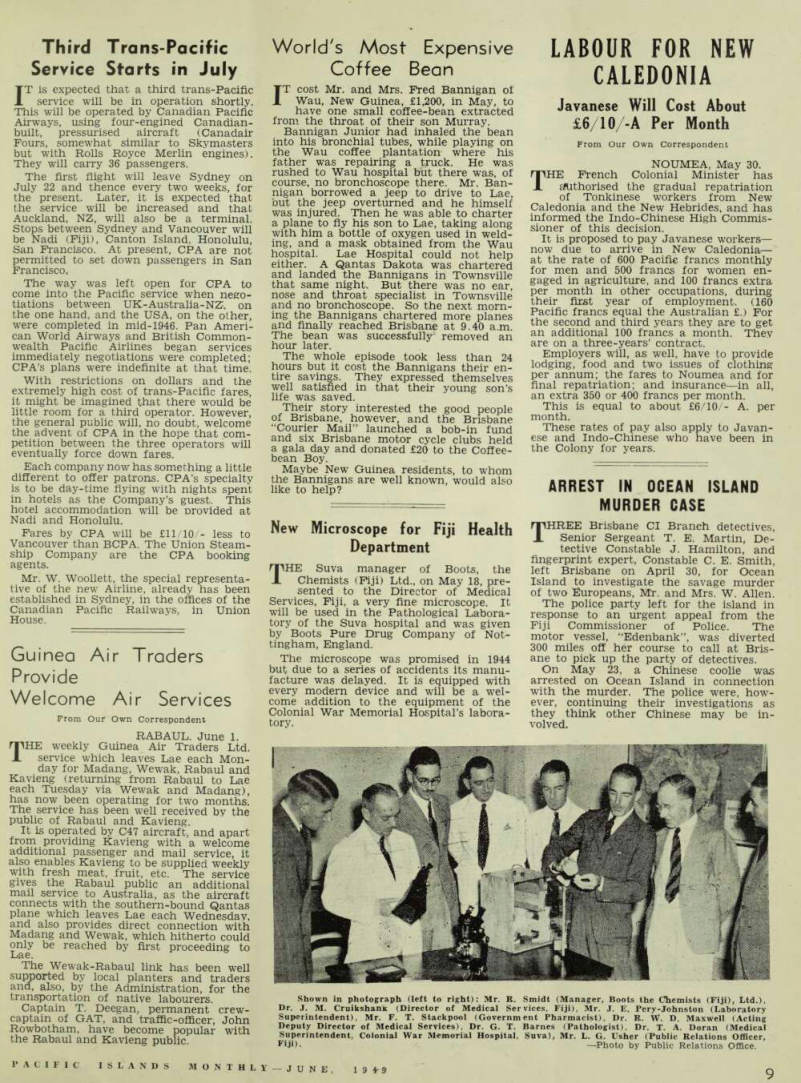
THE Suva manager of Boots, the Chemists (Fiji) Ltd., on May 18, pre sented to the Director of Medical Services, Fiji, a very fine microscope. It will be used in the Pathological Labora tory of the Suva hospital and was given by Boots Pure Drug Company of Not tingham, England, The microscope was promised in 1944 but due to a series of accidents its manu facture was delayed. It is equipped with every modern device and will be a wel come addition to the equipment of the Colonial War Memorial Hospital’s labora tory.
Labour For New
Caledonia
Javanese Will Cost About £6/10/-A Per Month
From Our Own Correspondent
Noumea, May 30.
THE French Colonial Minister has £iuthorised the gradual repatriation of Tonkinese workers from New Caledonia and the New Hebrides, and has informed the Indo-Chinese High Commis sioner of this decision.
It is proposed to pay Javanese workers — now due to arrive in New Caledonia— at the rate of 600 Pacific francs monthly for men and 500 francs for women en gaged in agriculture, and 100 francs extra per month in other occupations, during their first year of employment. (160 Pacific francs equal the Australian £.) For the second and third years they are to get an additional 100 francs a month. They are on a three-years’ contract.
Employers will, as well, have to provide lodging, food and two issues of clothing per annum; the fares to Noumea and for final repatriation; and insurance—in all, an extra 350 or 400 francs per month.
This is equal to about £6/10/- A, per month.
These rates of pay also apply to Javan ese and Indo-Chinese who have been in the Colony for years.
Arrest In Ocean Island
Murder Case
THREE Brisbane Cl Branch detectives, Senior Sergeant T. E. Martin, De tective Constable J. Hamilton, and fingerprint expert, Constable C. E. Smith, left Brisbane on April 30, for Ocean Island to investigate the savage murder of two Europeans, Mr. and Mrs. W. Allen.
The police party left for the island in response to an urgent appeal from the Fiji Commissioner of Police. The motor vessel, “Edenbank”, was diverted 300 miles off her course to call at Bris ane to pick up the party of detectives.
On May 23, a Chinese coolie was arrested on Ocean Island in connection with the murder. The police were, how ever, continuing their investigations as they think other Chinese may be in volved.
Shown in photograph (left to right): Mr. R. Smidt (Manager, Boots the Chemists (Fiji), Ltd.), Dr. J. M. Cruikshank (Director of Medical Services, Fiji), Mr. J. E. Pery-Johnston (Laboratory Superintendent). Mr. F. T. Stackpool (Government Pharmacist), Dr. R. W. D. Maxwell (Acting Deputy Director of Medical Services). Dr. G. T. Barnes (Pathologist), Dr. T. A. Doran (Medical Superintendent, Colonial War Memorial Hospital. Suva), Mr. L. G. Usher (Public Relations Officer, Fiji). —Photo by Public Relations Office.
World Copra Prices Show Slight Decline
Demand Eases as Other Fats and Oils Become Available
IN step with what appears to be a world wide lowering in prices of all tropical products, copra values have declined in recent months in most of the countries where free trading in fats and oils is still conducted.
USA market prices have receded gen erally and early in April copra was quoted on the San Francisco exchange at 165 dollars (equal to £ASI/l/6) per short ton, down from 200 dollars (£A6I/18/6) a couple of months previously.
London copra market observers last month put the current decline in Philip pines prices down to a restricted demand, caused by increased offerings of other oils and fats. Philippines copra rates settled at 167.5 dollars (£ASI/11/0), f.0.b., following the sale of some 500 tons to France at 162.5 dollars (£ASO 6/6).
Because they consider the price asked for sterling area copra too high, Euro pean buyers have been holding off and, in consequence, Straits copra dropped £3 to £4 to £Stg.6B for May shipments. Taking advantage of the situation, Dutch East Indies sellers have been offering' copra in guilders at considerably under the Straits parity.
Coconut Oil Market Easier
WITH buyers somewhat reserved, the market for coconut oil has been easier lately. London sources re port that May-June shipments of Straits oil were offered at £lOB Stg. per ton, c.i.f., but Continental crushers remained aloof, anticipating the price to go lower.
Some Philippines coconut oil has been finding its way to Europe, mainly to Ger man buyers, at 310 dollars (£96 Stg.) per metric ton, c. and f.
Of all the South Seas territories, the market trend in coconut oil is of greater interest to Fiji, where this industry has shown remarkable growth since World War 11. Before 1939, coconut oil exports never amounted to more than 200 tons, worth annually a couple of thousand pounds. 'Two copra-crushing mills now are in operation in Suva, with the oil be ing exported to the United Kingdom and the residue oil cake going to New Zealand, where it is in over-demand.
The following table shows post war coconut oil exports from Fiji:—
Sydney Crushers Pay Mo^E
THE Commonwealth Government, at
the end of May, granted permission to the Australian New Guinea Con trol Board to add 10/- per ton to the prices of Papua-New Guinea copra sold to mills in Sydney. This is to cover in creased shipping freight charges. Prices to Australian crushers now stand at: Hot-air Dried, £A66/10/- and -Smoked,
Ea6S/17/6.
The ANGPCB still is marking time until the Commonwealth Government decides to implement its decision announced al most a year ago, of abolishing the Board.
Territories’ planters are continuing to de liver copra to ANGPCB depots, deceiving
Seven natives were admitted to hospi tal in Rabaul on June 1 when a truck travelling along the North Coast Road, about 10 miles from the town, struck another parked by the roadside.
a fixed price of £A4B per ton; while ANGPCB, in turn, ships the copra to Aus tralia for sale to crushers and soap manu facturers (at £A66/10/-) or sends it abroad in chartered shipping for the use of the British Ministry of Food (at a fixed price of £A60 —or£Stg.4B—under the terms of the recent nine-years’ contract).
The Future
SOME planters in Papua and New Guinea believe that the original plan of the Commonwealth Government to remould the ANGPCB will not be pro ceeded with in its entirety, but that ANQPCB will be reconstituted and re named something akin to a “Copra Board” and will proceed along similar lines as at present. This would be in line with the Socialist Federal Government’s avowed policy of keeping the big commercial firms’ interest in the profitable Islands copra trade down to a minimum.
The downward trend of the world copra market will not immediately affect plan ters in the South Pacific Islands, except those in French Territories, All others, during the past nine months, have en tered into the British Ministry of Food contract, under which they get a guaran teed price for nine years—around £4B in the first year, and no fall in the follow ing years to be more than 10 per cent, of the year preceding. This British guarantee has given remarkable security to the South Pacific copra market.
Year Amount Value tons 1945 689 £28 230 1946 1.807 74,068 1947 .. .. 6,570 440,189 1948 9,053 760,774
Protected Industry
Candlenut Oil Now A
mHE Fiji company, Industrial Oils (Fiji) i Ltd., which started in a very small way in 1945 to crush candlenuts for their oil, has become a Protected Industry —which virtually gives it a monopoly of the candlenut oil business in Fiji. They are to purchase candlenuts, process them, refine, sell and export the oil therefrom.
For their part the Company must gunrantee to submit financial statements to the Colonial Secretary twice per year, purchase candlenuts at £7/10/- per ton, purchase all candlenuts that pass a “float test,” refrain from exporting any nuts and “diligently engage in the business of ex tracting oil”.
The success of the candlenut oil busi ness in Fiji is a personal triumph for Mr. H. A. Mitchell, an Australian, who became interested in the oil before the war and after it was oyer went back to start operations in Fiji. Candlenut oil is used in paint and in this respect is equal to linseed oil. The great problem was how to crush it from the very woody candlenut. Mr. Mitchell solved this and other problems of production and put the industry on its feet in Fiji.
It is interesting to note that one of Australia’s biggest paint manufacturers has recently been advertising the fact that it has now commenced to make candle nut oil in Queensland.
‘Westclox’ From Scotland
It is announced that Westclox Ltd., a subsidiary Of General Time Corporation, of the United States, have commenced production'at their factory in Strathleyen, Dumbarton, Scotland. This means that traders irf the Sterling area now may ob tain shipments invoiced in British ster ling, instead of being dependent upon un certain Dollar quotas from USA. Details may be obtained from Pacific Islands Trading Co., 244 California Street, San Francisco.
The Hahn Family Of Tonga
OVER 20 years ago, three youngsters named Hahn, from Tonga—where they were connections of the well known Reichelman family—settled down in Sydney with their mother. They were Olita, Dick and Charles. When Mrs.
Hahn died, Olita and Dick shared a flat together.
Then came the war. Dick, who by then was holding a high position in the accounts department of David Jones,
Ltd,, went to New Guinea with the Aus tralians and, in Bougainville, he received injuries from which he later died. He was a leading member of the Sydney Polynesian Club, and his death was re gretted by very many friends.
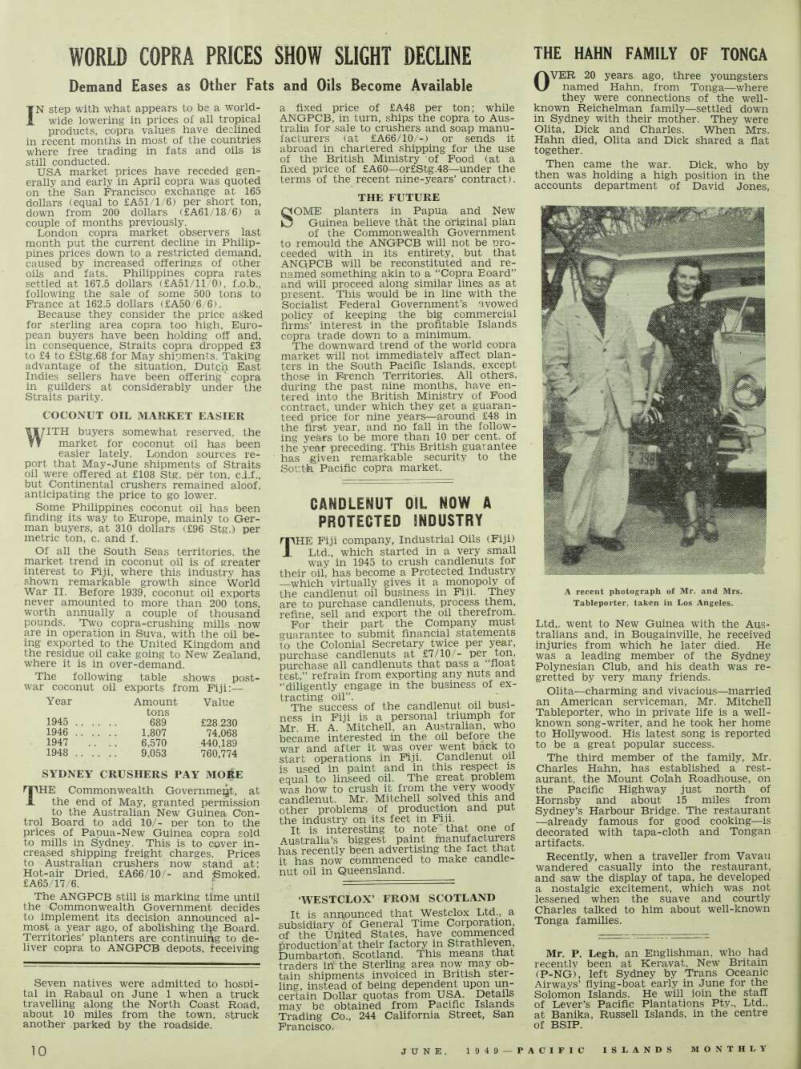
Olita —charming and vivacious—married an American serviceman, Mr. Mitchell Tableporter, who in private life is a well known song-writer, and he took her home to Hollywood. His latest song is reported to be a great popular success.
The third member of the family, Mr.
Charles Hahn, has established a rest aurant, the Mount Colah Roadhouse, on the Pacific Highway just north of Hornsby and about 15 miles from Sydney’s Harbour Bridge. The restaurant —already famous for good cooking—is decorated with tapa-cloth and Tongan artifacts.
Recently, when a traveller from Vavau wandered casually into the restaurant, and saw the display of tapa, he developed a nostalgic excitement, which was not lessened when the suave and courtly Charles talked to him about well-known Tonga families.
Mr. P. Legh, an Englishman, who had recently been at Keravat, New Britain (P-NG), left Sydney by Trans Oceanic Airways’ flying-boat early in June for the Solomon Islands. He will loin the staff of Lever’s Pacific Plantations Pty., Ltd., at Banika, Russell Islands, in the centre of BSIP.
A recent photograph of Mr. and Mrs.
Tableporter, taken in Los Angeles.
South Pacific Commission Approves
Extensive Research Programme Next Session, Noumea, October: South Pacific Conference, Suva, April
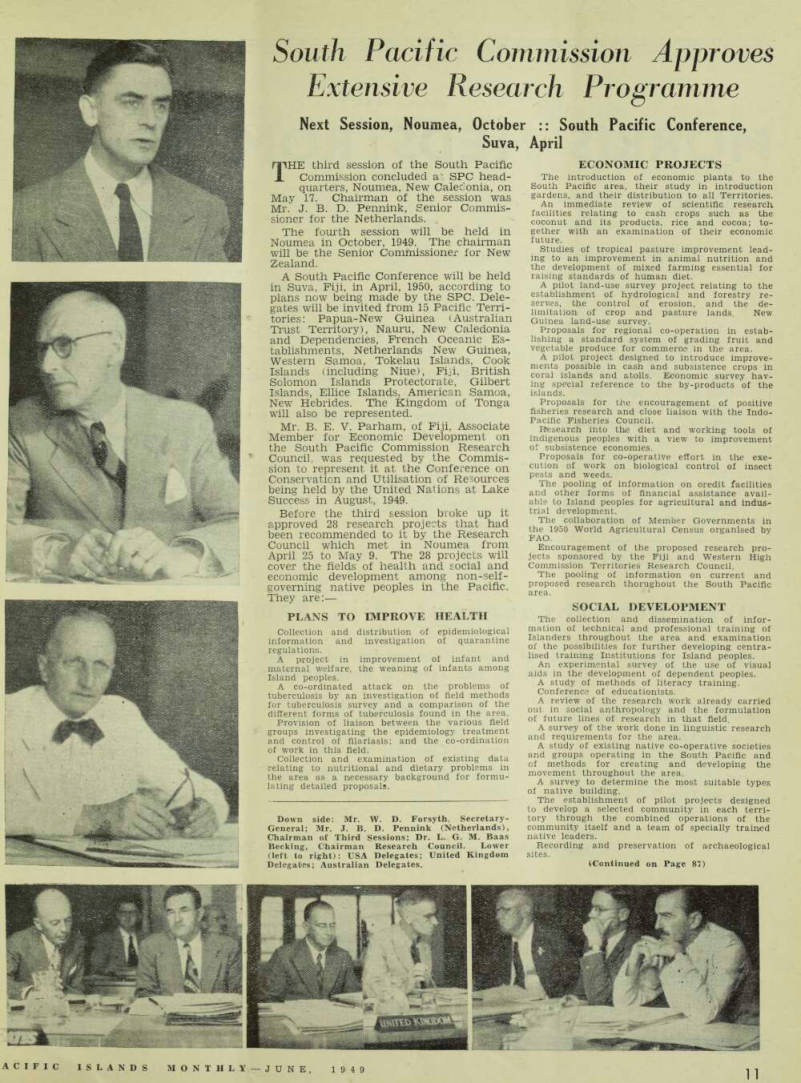
THE third session of the South Pacific Commission concluded a: SPC head quarters, Noumea, New Caledonia, on May 17. Chairman of the session was Mr. J. B. D. Pennink, Senior Commis sioner for the Netherlands. .
The fourth session will be held in Noumea in October, 1949. The chairman will be the Senior Commissioner for New Zealand.
A South Pacific Conference will be held in Suva, Fiji, in April, 1950, according to plans now being made by the SPC. Dele gates will be invited from 15 Pacific Terri tories: Papua-New Guinea (Australian Trust Territory), Nauru, New Caledonia and Dependencies, French Oceanic Es tablishments, Netherlands New Guinea, Western Samoa, Tokelau Islands, Cook Islands (including Niue), Fiji, British Solomon Islands Protectorate, Gilbert Islands, Ellice Islands, American Samoa, New Hebrides. The Kingdom of Tonga will also be represented.
Mr. B. E. V. Parham, of Fiji, Associate Member for Economic Development on the South Pacific Commission Research Council, was requested by the Commis sion to represent it at the Conference on Conservation and Utilisation of Resources being held by the United Nations at Lake Success in August, 1949.
Before the third session broke up it approved 28 research projects that had been recommended to it by the Research Council which met in Noumea from April 25 to May 9. The 28 projects will cover the fields of health and social and economic development among non-self governing native peoples in the Pacific.
They are:—
Plans To Improve Health
Collection and distribution of epidemiological information and investigation of quarantine regulations.
A project in improvement of infant and maternal welfare, the weaning of infants among Island peoples.
A co-ordinated attack on the problems of tuberculosis by an investigation of field methods for tuberculosis survey and a comparison of the different forms of tuberculosis found in the area.
Provision of liaison between the various field groups investigating the epidemiology treatment and control of filariasis; and the co-ordination of work in this field.
Collection and examination of existing data relating to nutritional and dietary problems in the area as a necessary background for formu lating detailed proposals.
Economic Projects
The introduction of economic plants to the South Pacific area, their study in introduction gardens, and their distribution to all Territories.
An immediate review of scientific research facilities relating to cash crops such as the coconut and its products, rice and cocoa; to gether with an examination of their economic future.
Studies of tropical pasture improvement lead ing to an improvement in animal nutrition and the development of mixed farming essential for raising standards of human diet.
A pilot land-use survey project relating to the establishment of hydrological and forestry re serves, the control of erosion, and the de limitation of crop and pasture lands. New Guinea land-use survey.
Proposals for regional co-operation in estab lishing a standard system of grading fruit and vegetable produce for commerce in the area.
A pilot project designed to introduce improve ments possible in cash and subsistence crops in coral islands and atolls. Economic survey hav ing special reference to the by-products of the islands.
Proposals for the encouragement of positive fisheries research and close liaison with the Indo- Pacific Fisheries Council.
Research into the diet and working tools of indigenous peoples with a view to improvement of subsistence economies.
Proposals for co-operative effort in the exe cution of work on biological control of insect pests and weeds.
The pooling of information on credit facilities and other forms of financial assistance avail able to Island peoples for agricultural and indus trial development.
The collaboration of Member Governments in the 1950 World Agricultural Census organised by
Fao.
Encouragement of the proposed research pro jects sponsored by the Fiji and Western High Commission Territories Research Council.
The pooling of information on current and proposed research thorughout the South Pacific area.
Social Development
The collection and dissemination of infor mation of technical and professional training of Islanders throughout the area and examination of the possibilities for further developing centra lised training Institutions for Island peoples.
An experimental survey of the use of visual aids in the development of dependent peoples.
A study of methods of literacy training.
Conference of educationists.
A review of the research work already carried out in social anthropology and the formulation of future lines of research in that field.
A survey of the work done in linguistic research and requirements for the area.
A study of existing native co-operative societies and groups operating in the South Pacific and of methods for creating and developing the movement throughout the area.
A survey to determine the most suitable types of native building.
The establishment of pilot projects designed to develop a selected community in each terri tory through the combined operations of the community itself and a team of specially trained native leaders.
Recording and preservation of archaeological sites.
(Continued on Page 87)
Down side: Mr. W. D. Forsyth, Secretary- General; Mr. J. B. D. Pennink (Netherlands), Chairman of Third Sessions; Dr. L. G. M. Baas Becking, Chairman Research Council. Lower (left to right): USA Delegates; United Kingdom Delegates; Australian Delegates.
THE projects outlined call for the pro vision of £7,440 in 1949 and £35,275 in 1950. Of the latter amount, £7,000 represents research contingencies voted and £4,000 possibly to be incurred for a conference of educationists.
The Third Session authorised the Secretary-General to maintain the Com mission subsidiary office in Sydney as long as need for the office exists.
Accomodation In Noumea
IT was reported that the question of providing permanent housing for the Commission and its staff in Noumea was surrounded by difficult problems, and any idea of undertaking a new building programme was set aside —probably for a long time. The Commission expressed utmost appreciation of the active and generous co-operation of the French authorities in adapting the Pentagon Building to its requirements. A sum of £66,000 Sterling has been spent on the Pentagon Building by the French authori ties, and £60,000 of this will remain as a debt against the Commission, repayable yearly at the rate of 4i per cent., includ ing interest.
The Commission’s staff has been housed in the Pentagon Building, where a central mess has been provided. Arrangements were made to construct four self contained flats in the west wing of the Pentagon Building, for the use of Com
mission personnel.
Cost-of-living allowances, about £5 sterling per week, have been made to most of the Commission’s permanent officers.
The high cost of living in New Caledonia has already proved an embarrassment to the Commission and its officers.
The next Session of the Commission will commence in Noumea about Satur day, October 21, 1949.
Technical Help
QTEPS were taken by the Commission to implement the resolutions of the UNO Economic and Social Council on March 4, relating to the need for giving technical assistance to under-developed areas.
Inquiries are being made of the six member Governments (United Kingdom, United States, Netherlands, France, Aus tralia and New Zealand) to ascertain what, in their view, should be done to afford technical help to the people of the South Pacific area.
Finance—A Problem
r pHE Research Council informed the JL Commission that the permanent members of the Council required one Research Assistant at £1,003 per annum, three Research Assistants, at £7OO per an num, and four Secretary-Typistes at £5OO per annum. Finance is likely to be one of the chief problems of this new organ isation. Up to date, the six Governments concerned have contributed about £64,000 in cash (of which Australia has provided about £27,000). The accounts suggest that the regular contribution to the Commis sion from the six Governments will total between £30,000 and £35,000 Sterling per annum. This will not be enough, if the plans at present in contemplation are carried out.
Advertisements & other items, p. 14 (2 items)
12
JUNE, 1949 PACIFIC ISLANDS MONTHLV
Morris Hedstrom Limited
General Merchants, Importers and Exporters,
Shipowners, Plantation Owners,
Commission and Insurance Agents
HEAD OFFICE
SUVA, FIJI
Established 1868
SERVICE IN THE SOUTH PACIFIC TERRITORIES
THROUGH our Large Establishment*; in Suva and our Numerous Branches, we distribute a wide and comprehensive range of General Merchandise and provide almost every kind of service. Our departments and associated businesses include:
DRAPERY
MOTOR SALES
AND SERVICE
TOBACCO
TIMBER AND
BUILDING
GROCERY
CONFECTIONERY
HARDWARE
ELECTRICAL
LIQUORS
DRUGS
Branches Throughout Fiji, Samoa and Tonga
There is a Branch or Agent of Morris Hedstrom Limited in every Town in the Three Territories.
We are Sole Agents in these Territories for British Drug Houses Ltd.
Electrolux Ltd.
Ford Motor Co.
General Electric Co. Ltd.
Goodyear Tyre £r Rubber Co.
B. A. Hjorth Gr Co. (Primus Products) Imperial Chemical Industries Ltd.
International Harvester Export Co.
Matson Navigation Company Max Factor and Co. Inc.
Ransomes, Sims £r Jefferies Ltd.
Ruston & Hornsby Ltd.
Vacuum Oil Co. Pty. Ltd.
Yorkshire Copper Works Ltd.
Morris Hedstrom Limited, are LLOYD’S AGENTS in Fiji and Samoa.
IN AUSTRALIA:
Morris Hedstrom (Aust.) Pty. Ltd.,
Asbestos House, 65 York Street, SYDNEY
IN GREAT BRITAIN:
Morris Hedstrom Limited,
Africa House, Kingsway, LONDON
Government Backs
Down
Unfortunate Strike Sequel In Fiji
From a Special Correspondent
Lautoka, June 2.
X> EM ARK ABLE aspects of a strike which occurred in the Ra district is May direct attention to the national un dercurrents which are interfering with orderliness and good government in this Colony.
On Tuesday, May 24, the Ra Road Over seer refused to allow a truck to be sent 10 miles, to bring food for a party of 8 men. He pointed out that there was food growing at the Depot and there was a truck going out the following day, which could bring food on its return journey.
The men were not entitled to special con sideration, because they were supposed to have brought in with them, according to custom, sufficient supplies for a week.
On Tuesday, May 24, the Ra Road Over seer’s helpers, said to be a Communist, was instructed that the men could go and do what they liked, so long as they were back at 7 a.m. next day, to start work.
He passed this on as “Pack up your bed ding and return to your villages.”
On Wednesday morning, out of a mixed labour force of 61 Indians and Fijians, only 6 reported for work. The Overseer was informed by telephone from Lautoka, 68 miles away, that “your men are on strike.”
The District Engineer hurriedly investi gated. He learned that three Indian members of the striking road gang, during the night, had interviewed the Fijian village chiefs, and informed them that all Fijian labourers in the Sigatoka, Lautoka and Ba districts were to strike in the morning; and the chiefs were persuaded to authorise the men from their villages to cease work.
A WELL-KNOWN Indian political leader told the District Engineer that the three Indian agitators were not acting for the Union—he said that the Union wanted the labourers to return to work. As this put the three Indians “in wrong,” they were sacked by the Chief Engineer.
The labour force returned to work on Saturday morning, minus the three. But the same Overseer’s assistant again jumped into the picture, and ordered the men to cease work and go home. They obeyed.
Public Works men thereupon inter viewed the highest native authority, Roko Tui Ra, and he promised that the Fijians would return to work on Monday, with instructions to disregard the Indian mis chief-makers. This looked like a clear victory for law and order.
But, meanwhile, a hurriedly-called con ference, attended by the Governor, the Acting Government Secretary, the Com missioner of Labour and the Director of Public Works had decided that the three sacked Indians should be immediately re instated, pending an investigation. The Public Works Director fought against this, but was over-ruled. The decision was telephoned to Ba, and was obeyed by a reluctant staff.
So here we have another case of the Government displaying its ridiculous super-sensitiveness to Indian feelings.
Surely it might have had enough back bone to allow its officials on the spot to handle a situation that had been created by Indian cheekiness and mischief making. Such incidents only encourage a class' of men who are making conditions in this Colony more difficult. Everyone who knows the circumstances agrees that those three Indians should not have been reinstated.
Mrs. Jane I. Wallace
Returns to the Charge Through Trustee Council
IT will be remembered that, in the palmy days between the wars, Mrs, Jane T.
Wallace made miserable the lives of sundry high officials in New Guinea, by her persistent charges that natives were being cruelly ill-treated and exploited.
Again and again, her charges were in vestigated and blown cut —both by Aus tralian officials and by the League of Nations —but Mrs. Wallace —a highly educated, cultured woman, and a tireless campaigner—refused to stay put, and re turned regularly to the attack. Official files groaned under the weight of her manuscripts, written in perfect copper plate.
Mrs. Wallace and, her son operated a small plantation near Rabaul. They were in constant, close touch with the natives: und their influence was not favourably regarded by officialdom.
Mrs. Wallace was evacuated in 1941, and was not heard of for several years. Her son, Mr. Tom V. Wallace, also a well educated man, remained in the Rabaul district and was captured by the invading Japs, and was among the hundreds who lost their lives on the “Montevideo Maru” —sacrificed by blundering Australian officials.
Mrs. Wallace, 81, and as active and warrior-like as ever, now lives in Spring Street, Melbourne, and she has turned her batteries upon the Trusteeship Council of UNO. Her sensational charges of “vir tual slave labour’’ have been seized upon with delight by that section of Council members who are classified as “Com munists, fellow-travellers and Anglo phobes generally,” and the sensational Press on May 25 carried large slabs of her fiercely-written communications. The fact that her charges are not treated seriously by anyone who knows New Guinea, past or present, makes no difference to the Anglophobes.
Much as one deplores her campaign, one must admire the ability, tenacity and strength of character of little old Mrs.
Wallace. She could have achieved so much, had she put her hand to a different kind of plough.—RWß.
Australian Radio Sessions
Rabaul Recordings For
From Our Own Correspondent
Rabaul, May 18.
MR. FRED EDWARDS, Acting Officer in-Charge, Port Moresby ABC Station, 9PA, accompanied by Mr.
Cunningham, technician, of ABC, Sydney, have arrived in Rabaul by Qantas Cata lina.
Their purpose is to make recordings of interesting objects in and around Rabaul, not only for broadcast purposes but also for the National Museum at Canberra.
The recordings made over the week end were excellent and very soon Aus tralian folk will hear such things as the Vunapope band of 45 pieces, the Vuna pope choir of 100 voices, Rabaul women folk discussing their attitude towards domestic native servants, and sing-sings made by various tribes at present working in Rabaul.
Some of these items will be heard in the ABC Walkabout Series and others probably, in the women’s sessions.
Mr. Colin Simpson, ABC special com mentator was to have made this trio but he became ill in Port Moresby and was replaced by Mr. Edwards.
Advertisements & other items, pp. 15-16 (1 item)
Islands Residents!
Let PTA Arrange
Your Travel
You are going on Leave?
Or planning a Business Trip?
Or you are Called Away Suddenly and Urgently?
We have a complete organisation for arranging Travel, from anywhere in the Islands to anywhere in Australia, New Zealand, Britain, United States, Europe. Send us a Radiogram, stating your Requirements, and we shall book you to your Destination, by Air, or by Sea, or by Car, or by Tourist Coach.
Pleasure-Travel and Sight-Seeing Tours in Australia and New Zealand arranged for Islands Visitors.
THESE SERVICES COST YOU
NOTHING
i i
ACCOMMODATION
Hotel and Flat Accommodation in Sydney and Melbourne arranged for Visitors who make their Travel Bookings through us. City Hotels and Guest-Houses are booked out far in advance—so give us your instructions early.
Are you interested in Pleasure-Travel in Fiji, Western Samoa, Norfolk Is., New Caledonia? If so, send for our Booklet, "Tours in the South Sea Islands".
Pacific Travel Agency
Union House, 247 George St.,
Sydney.
Radiograms:
“PACPUB”, SYDNEY.
TELEPHONE: BW 5037
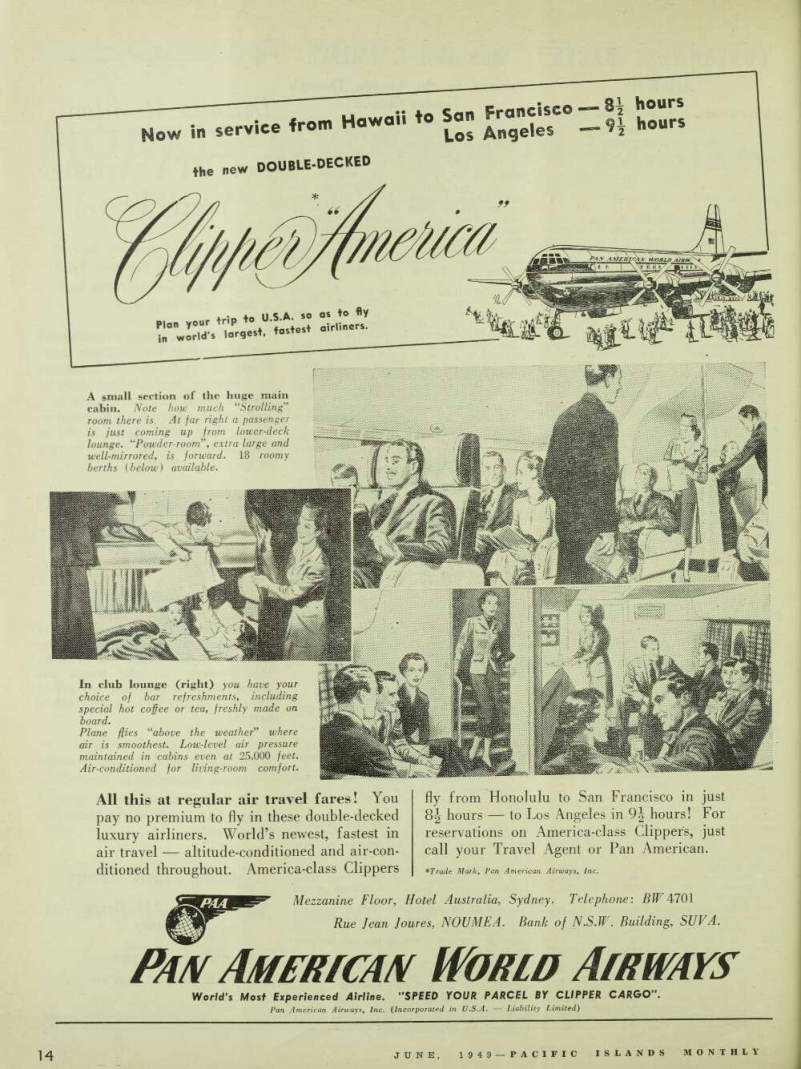
Now in service from Howoii to Son the new DOUBLE-DECKED B '2 hours
9i hours
1 . . 1. n 5 a so as to fly o %t U tsfesf oiriiners. ■ m r.
1 m'yA
mg f M wm. ■ r x V mm 03 \ tl m- • r* In club lounge (right) you have your choice of bar refreshments, including special hot coffee or tea, freshly made on board.
Plane flies “above the weather ” where air is smoothest. Low-level air pressure maintained in cabins even at 25,000 feet.
Air-conditioned for living-room comfort.
All this at regular air travel fares! You pay no premium to fly in these double-decked luxury airliners. World’s newest, fastest in air travel altitude-conditioned and air-con-
ditioned throughout. America-class Clippers
fly from Honolulu to San Francisco in just hours —to Los Angeles in 9\ hours! For reservations on America-class Clippers, just call your Travel Agent or Pan American. *Trade Mark, Pan American Airways, Inc.
Mezzanine Floor, Hotel Australia , Sydney. Telephone : BW 4701 Rue Jean Joures, NOUMEA. Bank of N.S.W. Building , SUVA.
Pan American World Airways
World's Most Experienced Airline. "SPEED YOUR PARCEL BY CLIPPER CARGO".
Pan American Airways, Inc. ( Incorporated in U.S.A. Liability Limited)
Australian Manufacturers Wont Buy
Papuan First Grade Rubber
From Our Own Correspondent
Port Moresby, May 26.
HUNDREDS of tons of rubber are piling up at plantations and storage centres in Papua, because planters refuse to sell to Australian manufacturers at a re duced price.
Little rubber has been shipped to Aus tralia since the end of March when the “Bulolo” took away a consignment.
While the “Bulolo” was on her way to Sydney on that occasion, Papuan planters were notified, by their agents in Australia, that manufacturers could not use No, 1 grade smoked sheet rubber from Papua for some time.
The manufacturers said they could buy Papuan rubber only if growers were pre pared to sell their No. 1 grade product, comprising about 85 per cent, of the total production, at the price usually paid for No. 2 grade—a difference of about four fifths of a penny per lb.
The Papuan Planters’ Association im mediately advised its members not to sell at the reduced price and the “Bulolo” con signment was placed in storage in Sydney.
The Association has asked the Com monwealth Government to intervene to help planters get the full price and to en sure that Papuan rubber is given prefer ence, grade for grade, over rubber from Malaya and other countries.
Planters can’t understand the manu facturers’ attitude. They say the manu facturers must be using some No. 1 grade and if so it should come from Papua, not foreign countries.
The manufacturers’ move is not re garded as an attempt to lower the grading of Papuan rubber, which is recognised as being equal to the best from overseas.
While the Planters’ Association tries to straighten things out, rubber is accumu lating and planters may soon have to cut production through lack of storage space.
Papua sends Australia its full rubber output, which at present is about 1,500 tons annually. Despite labour shortages and other problems, production is reported to be rising steadily.
Prices are calculated on Singapore day to-day quotations, which are considerably below the prices paid during the war when the Australian Government controlled production and prices of Papuan rubber.
Why First Grade Is Not Wanted
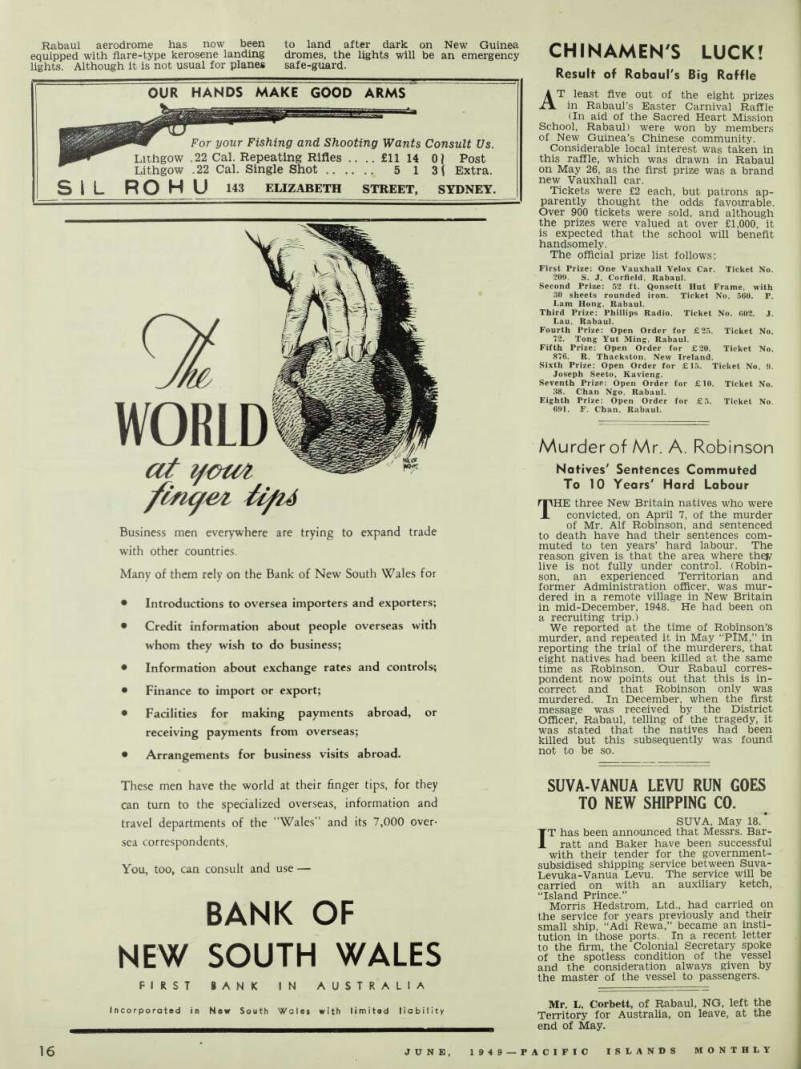
INQUIRIES made in Sydney show there is no ill-feeling between Papuan rubber producers and Australian rubber manufacturers. The main trouble is that, during the war period, when manufacturing processes had to be adapted to difficult conditions created by the war, the manufacturers found that they could do just as well with Papuan
second-grade rubber as with first-grade.
Therefore, they naturally want only second-grade, which is sold by the planters at severr-eighths of a penny per pound less than first-grade.
The planters, on the other hand, having suffered a considerable reduction in the world price of their product in the past couple of years, are naturally reluctant to sell their first-grade rubber at second grade prices.
Discussions between the two sides are proceeding. Mr. T. L. Sefton, a well known Papuan planter who returned to Papua from Sydney on June 11, expressed the opinion that negotiations would find a happy compromise, Mr. Ward’s Production Control Board handled rubber with enthusiasm when the rubber market was good. But when the slump came, the Board hurriedly passed over the marketing of the product to the planters. It retained complete control of the other Territorids’ product, copra, how ever. Copra can be sold easily, anywhere.
Mr. Thomas Inglis, who died in Bris bane some months ago, became well known to Papua residents during the two years he was there as inspector of
schools. He left a widow and two daughters.
Rabaul aerodrome has now been equipped with flare-type kerosene landing lights. Although it is not usual for planes
to land after dark on New Guinea dromes, the lights will be an emergency safe-guard.
Advertisements & other items, pp. 17-18 (1 item)
£. J. Gougr) S. Co.
THE
YORKSHIRE
INSURANCE
CO. LTD.
(Incorporated in England)
ALL CLASSES OF
INSURANCE
Including Fire Motor Guarantee Accident Workers Marine Island Representatives:
PORT MORESBY: E. A. James
RABAUL: G. B. Blnck LAE: New Guinea Industries Ltd.
MADANG: R. MacGregor SUVA: Williams & Gosling Ltd, NOUMEA: Y. Mortensen
NORFOLK ISLAND;
A. E. Martin
BURNS PHILP (New Hebrides) LTD.
Registered Office: VILA, NEW HEBRIDES
Branch Office at SANTO
Exporters,, Importers and General Merchants
(Retail and Wholesale) Commission, Shipping
and Customs Agents
Representatives for BURNS PHILP TRUST COMPANY LIMITED, QUEENS- LAND INSURANCE CO., LTD., and LLOYDS OF LONDON. Agents for SOCIETE DES PETROLES SHELL DES ILES FRANCAISES DU PACIFIQUE, and numerous overseas manufacturers of all classes of merchandise.
Sydney Agents: Burns, Philp & Co., Ltd., 7 Bridge Street.
San Francisco Agents: Burns, Philp Co. of San Francisco, Matson Building, 215 Market Street, London Agents: Burns, Philp & Co., Ltd., 35 Crutched Friars, E.C.3.
£. J. GOUGr) S. CO.
Bond Street, Sydney, Australia Tel. BIT 2195. Box 3615 G.P.O.
SUPPLIERS OF GENERAL MERCHANDISE TO LEADING FIRMS THROUGHOUT THE
PACIFIC ISLANDS
Exporters ... Importers ... Manufacturers' Representatives Bankers: Bank of N.S.W. Bank of Adelaide. Comptoir Nat. d’Escompte de Paris.
Cable Address: “SEAFOODS,’' SYDNEY.
Codes: Bentley’s, 2nd and Comp. Phrase; A. 8.0., sth and 6th; Peterson, 2nd and 3rd; Banking; Acme.
OUR HANDS MAKE GOOD ARMS
S I L
For your Fishing and Shooting Wants Consult Us.
Lithgow .22 Cal. Repeating Rifles ... £ll 14 0| Post Lithgow .22 Cal. Single Shot 5 1 3( Extra.
RO h u 143 ELIZABETH STREET, SYDNEY.
WORLD
at i/oat
fina&t
Business men everywhere are trying to expand trade with other countries.
Many of them rely on the Bank of New South Wales for • Introductions to oversea importers and exporters; • Credit information about people overseas with whom they wish to do business; • Information about exchange rates and controls; • Finance to import or export; • Facilities for making payments abroad, or receiving payments from overseas; • Arrangements for business visits abroad.
These men have the world at their finger tips, for they can turn to the specialized overseas, information and travel departments of the "Wales” and its 7,000 over-
sea correspondents.
You, too, can consult and use
BANK OF
NEW SOUTH WALES
FIRST SANK IN AUSTRALIA
Incorporated in New South Wales with limited liability
Chinamen's Luck!
Result of RabauTs Big Raffle
AT least five out of the eight prizes in Rabaul’s Easter Carnival Raffle (In aid of the Sacred Heart Mission School, Rabaul) were won by members of New Guinea’s Chinese community.
Considerable local interest was taken in this raffle, which was drawn in Rabaul on May 26, as the first prize was a brand new Vauxhall car.
Tickets were £2 each, but patrons ap parently thought the odds favourable.
Over 900 tickets were sold, and although the prizes were valued at over £l,OOO, it is expected that the school will benefit
handsomely.
The official prize list follows: First Prize: One Vauxhall Velox Car. Ticket No. 209. S, J. Corfield, Rabaul.
Second Prize: 52 ft. Qonsett Hut Frame, with 30 sheets rounded iron. Ticket No. 560. P.
Lam Hong, Rabaul.
Third Prize: Phillips Radio. Ticket No. 602. J.
Lau, Rabaul.
Fourth Prize: Open Order for £25. Ticket No. 72. Tong Yut Ming, Rabaul.
Fifth Prize: Open Order for £2O. Ticket No. 876. R. Thackston. New Ireland.
Sixth Prize: Open Order for £l5. Ticket No. 9.
Joseph Seeto, Kavieng.
Seventh Prize: Open Order for £lO. Ticket No. 38. Chan Ngo, Rabaul.
Eighth Prize: Open Order for £5. Ticket No. 691. F. Chan, Rabaul.
Murder of Mr. A. Robinson
Natives 'Sentences Commuted To 10 Years ' Hard Labour
THE three New Britain natives who were convicted, on April 7, of the murder of Mr. Alf Robinson, and sentenced to death have had their sentences com muted to ten years’ hard labour. The reason given is that the area where thej/ live is not fully under control. (Robin son, an experienced Territorian and former Administration officer, was mur dered in a remote village in New Britain in mid-December, 1948. He had been on a recruiting trip.) We reported at the time of Robinson’s murder, and repeated it in May “PIM,” in reporting the trial of the murderers, that eight natives had been killed at the same time as Robinson. 'Our Rabaul corres pondent now points out that this is in correct and that Robinson only was murdered. In December, when the first message was received by the District Officer, Rabaul, telling of the tragedy, it was stated that the natives had been killed but this subsequently was found not to be so.
Suva-Vanua Levu Run Goes
To New Shipping Co.
Suva, May 18.
IT has been announced that Messrs. Bar ratt and Baker have been successful with their tender for the government subsidised shipping service between Suva- Levuka-Vanua Levu. The service will be carried on with an auxiliary ketch, “Island Prince.”
Morris Hedstrom, Ltd., had carried on the service for years previously and their small ship, “Adi Rewa,” became an insti tution in those ports. In a recent letter to the firm, the Colonial Secretary spoke of the spotless condition of the vessel and the consideration always given by the master of the vessel to passengers.
Mr. L. Corbett, of Rabaul, NG, left the Territory for Australia, on leave, at the end of May.
Advertisements & other items, p. 19 (1 item)
Australia’s
1 z % 7a 8 - 3 Kf m i s
BRONTE BRAND:
Chili Con Came Braised Steak and Onions Curried Beef Curried Mutton Steak and Onions Mutton and Peas Irish Stew Beef Steak Pudding Corned Beef Hash Corned Beef Loaf With Cereal Mutton Broth Mulligatawny Soup Tomato Soup Vegetable Soup
From
Australia’s
Finest Fat
Stock
From the finest fat stock and the rich-
est vegetables in Australia we produce
these high-grade canned meats and
soups. BRONTE BRAND meats,
hotmeals and soups are deliciously flavoured and are made from ONLY meats and vegetables
of the highest quality
THE COLONIAL WHOLESALE MEAT CO.
PTY. LTD.
Canning Factory, State Abattoirs, Homebush Bay, Sydney.
N.S.W.
PHONES:
PHONE: UM 8436.
CABLE ADDRESS:
WOOLMTLL. SYDNEY.
m p w
Pacific Islands Society
GUEST speaker at the monthly meeting of the Pacific Islands Society, 8 Young Street, Sydney, on May 25, was Mr. A. E. Heath, CMG, President of Sydney Chamber of Commerce. His sub ject was ‘‘Britain and World Problems.”
The Annual General Meeting of the Society will be held on July 27. Nomina tions for office bearers to be elected at the meeting, must be in the hands of the se
cretary not later than July 6.
NEW MEMBERS:— Mrs. E. Banks, Mrs.
H. Carr, Mrs. M. Eheret, Mrs. Hallan, Mr. and Mrs. J. Gardiner, Mr. Randolph Grif fiths and Mr. P. E. Sturt.
Mr. J. K. Stone, of the “Fiji Times” staff, suffered a severe injury in May, when he fell and lacerated the tendons in his leg. He is having a spell in Suva Memorial Hospital, with his leg encased in plaster.
For Papua-NG
More Air Services
Qantas Catalina Pioneers Three New Routes
From Our Own Correspondent
Port Moresby, June 4.
MOST important event in the Territory, for years, was the recent introduc tion by Qantas of Catalina air services to the neglected areas east and west of Moresby, and between Moresby, New Britain and Bougainville.
The Administration thought it import ant enough for an official send-off by the Deputy Administrator, Judge Bignold, just before the plane left Moresby on May 30 on the first flight of the new services.
In the soft light of approaching dawn, Judge Bignold addressed a small audience consisting of crew and passengers of the Catalina and a few others, including Qantas assistant operations manager, Captain Orme Denny, who got the new services going. Judge Bignold spoke of how the services would benefit adminis tration and commerce, and wished Qantas success.
The Catalina will make fortnightly trips along each of the new routes. The draft itineraries are as follow;
Western Papua Schedule
Alternate Mondays—Tuesdays Depart Moresby, 6 a.m.
Yule Island. Lake Kutubu.
Kerema. Lake Murray.
Kikori. Daru.
On return flight, the plane calls only at Kikori, Kerema and Yule Is. Arrives in Port Moresby at noon.
Fare, Moresby-Daru, £9/15/-.
Eastern Papua Schedule
Alternate Wednesdays and Thursdays Departs Moresby at 9 a.m.
Abau.
Milne Bay.
Samarai, Remains overnight.
Departs Samarai early.
Esa’ala.
Kiriwina (Trobriands).
Woodlark Island (ont.).
Deboyne Lagoon.
Samarai.
Milne Bay.
Abau.
Arrives Moresby about 5 p.m.
Fare Moresby-Samarai, £7.
New Britain-Bougainville
Schedule
Alternate Mondays—Thursdays Departs Moresby 6 a.m.
Moewe Harbour (south coast of New Britain).
Talasea (north coast of New Britain).
Rabaul.
Rabaul to Buka Island.
Kieta (east Bougainville).
Buin (south Bougainville).
Return via Kieta and Buka to Rabaul.
Depart Rabaul, and call at Talasea, Moewe Harbour, Jacquinot Bay (southeast New Britain) and return to Rabaul.
Return to Port Moresby at 11.50 a.m. on Thursday.
Fare, Moresby—Rabaul, £l6.
The Catalina plane will carry 20 European passengers, or 20 natives, and a maxi mum load of 5,000 lb.
The Catalina is the Island Chieftain, which formerly made chartered flights in the Territory for Island Airways. The present skipper, Captain Hugh Birch, and Flight Engineers Ken Smith and Tom Mitchell, were in the plane’s crew when it was flying for Island Airways. Other crew members are First Officer Ross Treadgold and Pursers Arthur Grogan and Keith Rawlings.
Qantas hopes to bring up another Catalina, later, as a reserve plane.
Residents served by the Catalina are looking forward to swift mail deliveries and regular supplies of fresh meat, and most of them are thankful for this chance to avoid travelling on the coastal ships.
IWENT on the first flight of the Moresby-Daru service as the guest of Qantas and I heard plenty of uncomplimentary remarks about the coastal boats.
“It wouldn’t be so bad if only they were clean,’’ said one woman. “I’m just wondering how long it will be before the plane is full of cockroaches, too!”
Passengers on this historic first trip (Western Papua) were the Rev. and Mrs.
E. R. Fenn, of the LMS, who were re turning from leave with their two child ren; Mr. B. W. Brazier, of the Treasury Department, bound for Daru on business; Mr. C. McCubbery, Deputy Crown Law Officer, who made the round trip on
official business; Dr. Pike, who went to Daru on inspectipn work; and Assistant District Officer Sid Smith.
Mr. Smith will re-open the Government post at Lake Kutubu, and he went on this first flight to tell the natives there that the Government would soon be returning.
Because of bad weather, however the Catalina had to by-pass Lake Kutubu.
Sid will go there on the next trip.
Young Peter Burchett boarded the plane at Yule Island for the round trip, and a number of natives were also carried.
At Lake Murray, Patrol Officer Ken Earle and Dr. Boyd were so eager to reach the Catalina that their launch hit the
tail-end of the fuselage, denting it and knocking a native policeman from the launch into the water.
The overnight stop was made at Kikori, where passengers and crew were accom modated in the homes of District Officer C. Healey, and Patrol Officer “Speed”
Graham. Later, Qantas hopes to have its own rest house at Kikori.
Warm welcomes were given the Catalina crew at all stopping-places; but the wel comes would have been warmer except for one thing—through no fault of Qantas, there was no fresh meat aboard. The crew assured disappointed residents that it would not happen again.
Incidentally, the Qantas plane wnich arrives from Australia on Saturdays now goes to Bulolo and Wau, as well as to Lae,
Advertisements & other items, pp. 20-22 (3 items)
Captain W. L. Kennedy
Established 1931,
Shipbrokers, Business & Real Estate
163 Pitt St., Sydney
'Phone: BW 6461
LISTING FOR SALE;
Craft, all sizes and types, including 60 ft. TRAWLER TYPE VESSEL, 100 H.P. Vivian Diesel, £5,250. 56 ft. TRAWLER TYPE, 85 H.P. Vivian Diesel, £4,000. 40 ft. ARMY WORKBOAT, coppered. 100 H.P. Perkins Diesel, £2,650.
SMALL CARGO BOAT, 30 H.P. Lister Diesel, £2,000. 33 ft. ALSIA CRAIG DIESEL, £1,350. Good type, 26 ft. FISHING BOAT, 8 H.P. Lister 3-1 Reduction Sails, £750.
Also Power Pleasure Cruisers, Auxiliary Yachts, Speed Craft and Runabouts, Whaleboats, Diesel Engines.
Through our real estate branch we have Sydney properties, land and businesses for sale. Correspondence invited and promptly attended to.
- the PIXIE food MIXER!
The NEW LOOK
in e
lectt
ic mixers
- the PIXIE food MIXER!
i
FOR A PERFECT MIX UNDER ALL
CONDITIONS
>for use on 240 A.C. or D.C. poiver.)
10 SPEEDS. SYNCROMIX FEATURE: AUTOMATICALLY
ADJUSTS SPEED. EASY TO MAINTAIN AND CLEAN
PIXIE IS IDEAL FOR MIXING:
VENTURA TRADING CO. PTY. LTD.
26 BRIDGE STREET, SYDNEY, N.S.W.
Cables: “Ventura,” Sydney.
Represented by: P. & R. HUTCHINSON H. G. EEKHOFF Suva Lae
Tallerman & Company Pty. Limited
60 YORK STREET, SYDNEY, N.S.W.
Also Brisbane, Melbourne, Adelaide, Perth.
Buying Agents of all Australian Products . .
Sole Exporters for numerous Australian
M anufacturers
Careful and Prompt Attention to all Enquiries Send us your inquiries which will have our careful and prompt attention.
WRITE FOR DETAILED PRICE LIST
Cable Address: “FRESHET”
For the RIGHT TIME Rely on WESTCLOX The finest, smartest clocks in Westclox history—that’s what Westclox has in store for you! A wide range of stunning clocks for every room— spring-wound and electric alarm models—wall clocks for your kitchen and time clocks for the living room— yes, wrist and pocket watches, too— all with traditional Westclox dependability and smartness that have made Big Ben and other members of this time-keeping family famous all over the world.
“It’s a Westclox” is the finest thing you can say about a clock or watch.
Some Westclox have luminous dials that you can see in the dark.
You can buy any Westclox with confidence. Look for that trade mark on the dial of the next clock or watch you buy.
• QUALITY •
* RELIABILITY •
10 Baby Ben—His alarm may be adjusted to loud or soft. Quiet tick. Made in two finishes — ivory and gold colour; also black with jiickel trim.
BIG
BEN
Big Ben is made two ways—There’s Big Ben Loud Alarm with booming intermittent call. If you want a more gentle awakening, there’s Big Ben Chime Alarm which first calls you with soft chimes. If you ignore these chimes, there’s a loud call in reserve.
PACIFIC ISLANDS TRADING CO.
244 CALIFORNIA ST„ SAN FRANCISCO, CALIF., U.S.A.
McILRATH’S
SYDNEY'S LEADING GROCERY HOUSE
Specialise in supplying residents of the Pacific Islands with general household requirements—and offer the following lines for immediate shipment:— BELLS WATERPROOF WAX VESTAS (No. 4 Tins), 51/- gross Packed in Tin-lined Wooden Cases, each 6 gross.
MILNE'S AUSTRALIAN GIN, 49/6 cose
Cases each, 1 doz. 26 oz. bottles.
MILNE'S AUSTRALIAN WHISKY, 62/6 cose
Cases each, 1 doz. 26 oz. bottles.
All prices F. 0.8. Sydney.
McILRATH’S PTY. LTD.
202 Pitt Street, Sydney, Australia Cable address —ROTUNDA, Sydney.
A
PROPELLER SHAFTS
mean less power loss in transmission
Monel shafts are renowned for their rugged strength, stiffness and freedom from whip. These characteristics are very important since a good, stiff shaft reduces vibration, transmits more power to propeller and thereby increases speed and efficiency. Of still greater importance is the fact that Monel retains these properties indefinitely, because Monel cannot rust and is not corroded by fresh or salt water. That is why a Monel shaft, stronger than others when new, is still in perfect condition after years of continuous service.
Complete information on the many marine uses of Monel will gladly he forwarded hy:
WRIGHT AND COMPANY
SOLE AUSTRALIAN DISTRIBUTORS OF MONEL
81 CLARENCE STREET, SYDNEY, N.S.W. PHONE: BX 1211 (SIX LINES) Monel is a registered trade-mark covering a rich nickel alloy, mined in Canada and rolled in Great Britain.
May Play
Fiji Football Team
In Sydney In 1950
The Fijians are in danger of be coming as famous in the world of Rugby football as their cousins the Maoris. It is proposed to send a Fiji Fifteen to Australia, next winter. The following is from “Sydney Morning Herald” of June 6: — NEXT season is likely to be a busy one for Australian Rugby Union. A Fijian team may come here in the early portion of the 1950 season. Later, the British side will play in Australia.
News has been received by the NSW Rugby Union that a representative of the Fijian Union is coming to Australia to negotiate for a tour by a Fijian team. The chairman of the Union’s management committee, Mr. F. Herlihy, hopes arrange ments can be made for the Fijians to ar rive early next season.
Nine of the Maori players now touring Australia were in Fiji with an official team last year. The standard of play amazed them. In a six-match tour, they were beaten by Fiji, 9-8, at Suva, and drew with Suva-Rewa, 3-3. The Maoris won the other matches, including a test, at Suva.
Last year’s Fijian team held the Maoris in hard rucking, and provided fireworks with their big fast backs.
If it is not possible to fit a Fijian tour into next season’s programme, it probably will take place in 1951. A tour in that year would assist the Australian selectors in choosing the team for South Africa.
Angry Padre On The Warpath
How Church Was Tricked Out of Its Site In Lae
IN the_ language of the proletariat, the Anglican Church in New Guinea has been “double-crossed” by the Papua-New Guinea Administration; and the Rev. W. E. Moren, priest in charge of the Church of England in Lae, has denounced the Administration in plain and forthright language.
Here are the facts, as published by Mr.
Moren in his monthly Parish Newsletter, dated June 6: In 1934, the Church obtained title to land in Lae, whereon to build a church.
After the war, the Administration pro ceeded to make anew plan for the town of Lae. In February, 1948, it appealed to the Church, and other landowners, to surrender their titles, so as to assist the new planning. The officials assured the Church that there would be a town plan in operation within three months.
Naturally, the Church agreed.
Three months passed. There was no sign of a town plan. The Church, now anxious to get on with its building plans, asked if it could have a temporary lease.
The Administration begged the Church not to take up a temporary lease, as that would be “embarrassing”. But there still was no plan.
Failing to get satisfaction from the officials at Lae, the Church applied to Moresby. Moresby did not even answer the Church’s letters. Then the Church got angry, and then Moresby said the matter was one for Canberra. This was in conflict with a letter which the Church already had received from the Minister.
An Acting-Minister went to the Terri tory, and was appealed to. The Church again was asked not to embarrass the Administration.
Then the town plan was published; two mission leases were advertised as available. Neither represented what the Church wanted—the positions were not quite right according to the new plan— but the Church reluctantly applied for one, and got it. The terms showed that the land was granted “by administrative act”: it could have been so granted at any time during the previous frustrating period of 14 months.
LAST month, the Church learned, to its dismay, that the town plan had been scrapped; and anew one, which completely altered the situation of the Church’s lease in relation to the rest of the proposed town, had been substituted.
“Our site, therefore, has become simply three acres of land on the fringe of the outskirts of anew town plan,” says the Padre. “In a real sense it is not the site we applied for. Thus there comes’to an end 14 months of administrative evasive ness, temporising and questionable con duct . . . When that grant was made it was already known in official circles that the plan under which we had applied had been superseded ... Let them re call that we lost our chance to build in 1948, when we surrendered our land on their advice and for their convenience.”
The Padre goes on to point out that this incident is symptomatic of the con ditions in the Territory. “What do we
find here? Persons are being pushed around, kept in the dark as to their future, denied any say in self-determi nation. In short, persons are being treated more as if they were things.
“Furthermore, far from the decencies of personal living being ensured, our living conditions are a shocking scandal.
In the scandal of our material environ ment the real wealth of this Territory— the courage, the civic virtues, the enter prise of people—is itself decaying. Every where there is frustration, misery, and a growing apathy.
“To dissipate material wealth is bad business. To dissipate spiritual wealth is criminal folly. Had there been a plan to create frustration, apathy, and misery, and the destruction of civic virtues, it could not have succeeded better than the methods of this administration through three-and-a-half years of town planning.
“Territorians have taken this sort of thing since November, 1945. The time has come to stop ‘taking it’. The time has come to act. The challenge in this situation is to assert ourselves as per sons, with rights, and with responsibility to self-determination.
“There are men and women here who desire nothing more than that this Terri tory shall once again be worthy of Aus tralia. There are officials yet who want
to see the work of Government a credit to their country, “We need leadership. We need the means of expression. The apathy is not so far advanced yet that we can find neither. The situation to-day in this Territory is a challenge to public-minded men and women to get together, and determine action.”
Editorial Note
Most people who know conditions in Papua-New Guinea will understand and sympathise with the Padre. But his re proaches, cast in the general direction of Port Moresby, should go farther and deeper.
The fault lies not with the frustrated
and silent Administrator at Moresby, but with the Minister at Canberra, whose political associations created for him such a situation that he has been kept danc ing attendance on courts, and judges and Royal Commissions during 1948 and part of 1949. He will be back, on the job, any time now, full of fierce invective and blistering phrases—none of which will hide the fact that the Territories for the better part of two years, in a most critical period, have been drifting helplessly before wind and weather.
There surely is frustration throughout
the Territories—but in no place is it felt more keenly than in the private offices of Moresby’s high officials who are trying to do a creditable job.
The Rev. A. Kroenert and Mr. A. 11.
Orr, Baptist Missionary Secretary, left Brisbane recently by the motor vessel, “Malaita,” to pioneer anew mission field on the Central Highlands of New Guinea.
Mr. Kroenert, who is 28, is an ex-service man. He was trained at the NSW Baptist Theological School and School of Pacific Administration.
Advertisements & other items, pp. 23-24 (1 item)
Robert Gillespie Ptv Ltd
ART POSTCARDS OF
TONGA
Per Dozen, Postage Paid: 6/- (one US Dollar).
TONGAN PHOTOS BUREAU
Nukualofa, Tonga
IMPORTERS
EXPORTERS
ALL CLASSES OF MERCHANDISE PURCHASED FOR ISLAND CLIENTS
THROUGHOUT THE SOUTH-WEST PACIFIC.
ISLAND PRODUCE SOLD ON AUSTRALIAN AND OVERSEAS MARKETS
ON COMMISSION BASIS.
JAliAli&cutkiLktii, ... .
ROBERT GILLESPIE PTV LTD
BANKERS; BANK OF N.S.W.
COMPTOIR NATIONAL
DESCOMPTE DE PARIS
54a PITT ST. SYDNEY N.S.W.
CABLE ADDRESS:
“ROB ERG ILL"
PHONES BW 4782-B 1305
PACIFIC
MEIBOURNE
THE GREAT AUSTRALIAN
INDUSTRIAL CENTRE
* MA) The Great Name
in Confectionery
Specially wrapped and packed for export Chocolates in i lb. boxes, 4 lb. BLOCKS, available for prompt shipment. to the Tropics, the famous "OLD GOLD"
COLUMBINES and MILK-KISSES are now * *
Jom|piped
The Name of Goodness in Fresh Canned Foods The great variety of TOM PIPER Canned Food Products are in constant demand in Australia for their superb, consistent quality.
“EEZY-FYRE”
Kerosene Pressure Cookers in
Single and Double Types
These renowned cookers are ideal for many purposes, combining low fuel consumption with simplicity of operation and matchless efficiency. Work on ordinary kerosene, and can be operated with the utmost confidence. Spare parts are readily available.
SINGLE BURNER
DOUBLE BURNER.
DIAMOND” BATTERIES—BROWN PAPER BAGS—BUTTER—GHEE—CANNED FOODS of
all descriptions—GLUCOSE—HONEY—JAMS—CANNED FRUITS—ENAMELWARE—CAST-
IRON POTS and BOILERS, and ALL GENERAL MERCHANDISE. 25 years’ experience ensures prompt service and shipments —
embracing KEENEST PRICES, HIGHEST QUALITY, INSPECTION
and TROPICAL PACKING.
Your valued orders and inquiries should be placed
with your own Representatives in Australia,
otherwise direct with us.
S. E. TATHAM & COMPANY
178 Collins Street
MELBOURNE - AUSTRALIA
Established 1924 Cables "SET" Melbourne
Lazy Turnaround Of Ships
What It Costs Burns, Philp
DISCUSSING the Company’s affairs at the annnai meeting of shareholders of Burns Philp &’ Co., Ltd., in Syd ney last month, the chairman, Mr. Joseph Mitchell, said that the firm’s Island ship ping services, in the financial year iust closed, made a loss of almost £73,000.
The chief cause contributing to this state of affairs, he said, was the lament able conditions in the Australian ports— the vessels had spent one-third of their S6a two-thirds of their time in It is impossible, of course, to make anv creappri^v 1 *? 6 D f y un 3f r the conditions Fortunately for the old firm, Islands shipping services now represent only a smaFr percentage of ite opeiations. During the past couple of de fn?]r S Af^£ e C ? m ?? ny ha s transferred the ??| lts activities from Islands shipping and Islands industries generally to the ownership and operation of chains of stores in Australia. Thus, despite the Co^mnHp 5601 by g £" slow dock-workers the Co. made a very handsome overall profit.
Advertisements & other items, pp. 25-26 (1 item)
Spartan
GEORGE Kill
★ Specialist in ladies and gentlemen s wear, eastern fancy goods, embroidered silk wear, embroidered linen table sets, carved camphorwood trunks, cane furniture, curios, etc. large shipment and variety arrives with
EVERY HONG KONG BOAT
GENERAL MERCHANT IMPORTER
Always Prompt n , niTTT Attention and Service. O A U 1 j
Specially Prepared
to withstand
Tropical Conditions
A range of high grade, quality paints enamels, and varnishes carefully made and manufactured to withstand the destructive forces of sun, wind, rain and heat.
PROTECTS AND PRESERVES.
Spartan
HOUSE PAINTS
ROOF PAINTS
ENAMELS
VARNISHES
Automobile Lacquers and Primers, Duraflex Synthetic Enamels Auto ‘ Co, Woxand Po)ish° basket Cement, Rad.ator Cement, Hardiproof Anti-Rot Compound. all types of surface coatings.
SPARTAN the name that symbolises fine quality in Paint
SPARTAN PAINTS PTY. LIMITED
102-104 King St., Melbourne, Victoria.
<»na —,\'
Jdi j 3 Jsb
Ht** 1 SS
COFHf
NEW ZEALAND
OFFERS
SHIPPING AND TRADE
to the Residents of New
Caledonia, New Hebrides,
Gilbert Islands, Ellice
Islands, British Solomon
Islands and New Guinea.
We are operating a regular shipping service throughout the above Islands. All goods ordered will be delivered without delay. Should large orders be contemplated we will arrange tor a representative to visit you with samples and discuss the transaction.
Many classes of general merchandise are available at competitive prices and for early delivery.
SAWN TIMBER.
PLYWOODS.
WAI..LBOARDS.
PAINTS.
VARNISHES.
BUILDING PAPER.
ASBESTOS
SIDINGS.
FURNITURE.
CANDLES.
WASHING SOAP.
TOILET SOAP.
TENNIS SHOES.
LEATHER BOOTS
AND SHOES.
LEATHER SOLES
AND HEELS.
LEATHER BELTING.
LEATHER BENDS,
ETC.
SEEDS (INCLUDING
BLUE & MAPLE
PEAS).
LIVESTOCK.
FROZEN MEATS.
TINNED MEATS.
TINNED PISH.
FROZEN FISH.
BUTTER.
CHEESE.
DRIED MILK, ETC.
TINNED
VEGETABLES.
TINNED SOUPS.
TINNED JAMS.
CUSTARD POWDER.
BAKING POWDER.
COFFEE ESSENCE.
POTATOES, FRESH
AND CANNED.
ONIONS.
CORDIALS.
BEER.
SILVERPLATE
WARE.
We are ahso buyers of Islands Produce of every description and we can provide shipping. Our sell
ing organisation is world-wide.
BUYING OR SELLING—WE CAN HELP YOU
r Cl* W
UNION MANUFACTURING
& EXPORT CO. LTD.
1/4S/P.
G.P.O. Box 1060, Wellington, NEW ZEALAND
Cables: "UMEC", Wellington
In Fiji
Rain By The Foot
Ail Records Broken
Suva, May 16.
WITH more than a foot of rain in six hours, Suva on the night of May 5-6 broke the Laucala Bay record of 11.8 in., created on April 29.
In the second deluge, Suva registered 14.5 in.—most of it between 10 p.m. and 4 a.m. On this occasion, Laucala Bay had only 6.16 in. in the same period, but Walu Bay, close to Suva, had 12.98 in.
On May 5 and 6 Nausori, Airport was waterlogged and unusable. Mails which are normally flown from Nausori to Nadi had to be taken by road.
Highways in southern and eastern Viti Levu suffered severely and the King’s Road has been blocked by a bad wash out, north of Nayavu.
Serious flooding occurred in the Nubu kalou Creek area of Suva on the night of May 5. Gumming Street shops (mostly Indian and Chinese) were under water to a depth of more than a foot. Stocks were damaged.
Lowlying stretches of the highway past Walu Bay were under a swirling torrent deep enough to stall the engines of cars.
The following morning saw many garages jammed with cars and trucks towed in for repairs.
Food Supplies Threatened
Suva, May 16.
IMPORTANT, locally-grown foodstuffs are likely to be desperately scarce in south-eastern Viti Levu, including Suva, if the unprecedented spell of sun less weather continues much longer.
Fiji’s butter supplies (local production supplemented by limited imports from New Zealand) have been inadequate for years. And on May 12, Mr. J. A. Garnett, chairman of directors of the Rewa Co operative Dairy Co., Ltd., said that a further serious decline in output is likely in the near future.
The endless rain (the 1949 figure al ready is 108.68 in. up to May 16) has caused a deterioration of pasture grasses, with the result that the cream supply at both Rewa and Tailevu has dropped by 50 per cent., with a corresponding de crease in butter production. Only im mediate improvement in the weather can prevent a further slump.
Eggs, at 5/- a doz^n —and much more on the black market—are all but unob tainable in Suva. Usually there is a seasonal increase in production with the end of hot weather in May, but this year many fowls refuse to start laying.
A considerable part of the south eastern Viti Levu rice crop has already been lost. Cultivators are doing their best to the remainder, but how much is saved depends entirely on the weather.
Market gardens have suffered severely and vegetables and supplies of cultivated fruit are likely to become progressively scarcer.
With regard to the butter shortage—an old complaint is still current: There is no check on the amount of butter bought up by strategically-placed Indians for conversion into ghee. (The rainfall in south-eastern Viti Levu this year has broken all previous records. Since January 1, Suva has had 108.72 inches. The previous record for five complete months was 99.34 inches.
Since 1884, the heaviest rainfall re corded for the whole month of May has been 25.63 inches. In the first 17 days of May, 1949, 32,89 inches fell. The aver
age rainfall for a year in Suva is 120.86 inches.)
Little Hope of Compensation
War Damage In British
Islands
THE Solomon Islands planters have not much to thank the Communists for.
Now they may also place to the debit of the Reds the fact that they are un likely to receive any adequate war damage compensation, such as was paid just across the border, in New Guinea.
Britain made it clear, some years ago, that the possibility of paying compensa tion in respect of war damage in Solo mons, Gilbert Islands, Malaya, Hongkong, and other invaded colonies depended on the amount of indemnity ultimately paid by Japan.
The Western Nations, especially the United States, now are rebuilding Japan economically as a barrier against Com munist Asia; and, as part of that plan, it is not proposed to force the Japanese to pay war indemnities. Presumably, no Jap indemnities means no war damage com* pensation.
Sister M. St. Florent, of the Sacred Heart Order, passed through Brisbane in the “Bulolo” recently on her way home to France after spending 23 years con tinuously as a missionary in Papua.
Lady Freeston, wife of the Governor of Fiji, Sir Brian Freeston, returned to Fiji from the United Kingdom in May. She was accompanied by her 15-year-old daughter, Miss Wanda Freeston.
Advertisements & other items, pp. 27-28 (1 item)
.H.Grov
Buy on the Best Market!
When you buy through us you buy at lowest
prices. YOU RECEIVE ORIGINAL INVOICES
AT INVOICED COST. Enquiries invited for all plantation and trading requirements.
WILLIAM E. REED
(Established 36 years).
Broker and Agent 145 a George St., Circular Quay, Sydney.
Cables: “WILREED,” Sydney.
Livraison IMMEDIATE LINOLEUM ECOSSAIS IMPORTS
delivery immediate
(fe
IMPORTED
LINOLEUM
Ideal for Island Conditions. Long Wearing.
Hessian Back. Cork based. Full range of colours, patterned or plain. Full rolls (30 yards by 6 ft.) only supplied. Order to-day through your Trading House for delivery by first boat.
Ideal pour les pays tropicaux. D’une durabilite sans pareille, a base de liege couvert en toile de chanvre. Dessins ou unis. Rouleaux de 30 yards par 6 pieds de large. Commandez aujourd’hui chez votre Agent pour livraison par premier bateau.
TAY SIDE Linoleum distributed by:
INTERNATIONAL TRADING
PTY. LTD.
Halifax House, 26 O’Connell Street, Sydney.
Phone; BL 1543. Cables: “Mondial,” Sydney. *B* m m r
.H.GROV
Limited
Established 1896.
AUCKLAND
‘Grove’
P.O. BOX 490.
Auckland.
Island Traders.
Telegraphic and Cable Address: Entrust Your Orders to the Firm with Fifty Years Practical Experience in the Island Trade.
Shippers of all classes of New Zealand products.
Representing English Manufacturers throughout the Cook and Society Islands, Fiji, Tonga, Samoa, Niue, New Hebrides, the Solomon Islands and New Caledonia.
In FIJI as—W. H. Grove & Sons (Fiji) Ltd.
4r Stewarts and Lloyds (Australia) pt y . Ltd.
Manufacturers of "S&L" PIPES and FITTINGS for GAS, WATER, STEAM and other purposes.
AND Distributors of:
MILD STEEL BARS. PLATES and SECTIONS;
GALVANISED IRON; BOLTS and NUTS; ELECTRODES
and WELDING EQUIPMENT.
Stewarts and Lloyds (Australia) pt y . Ltd.
SYDNEY WAREHOUSE - - - Herbert Street, St. Leonards BRISBANE WAREHOUSE - Montague Road, South Brisbane MELBOURNE WAREHOUSE - - City Road, South Melbourne Telegraphic Address: "Tubes" — Sydney, Brisbane or Melbourne
GPS Clamour For A New Hebrides
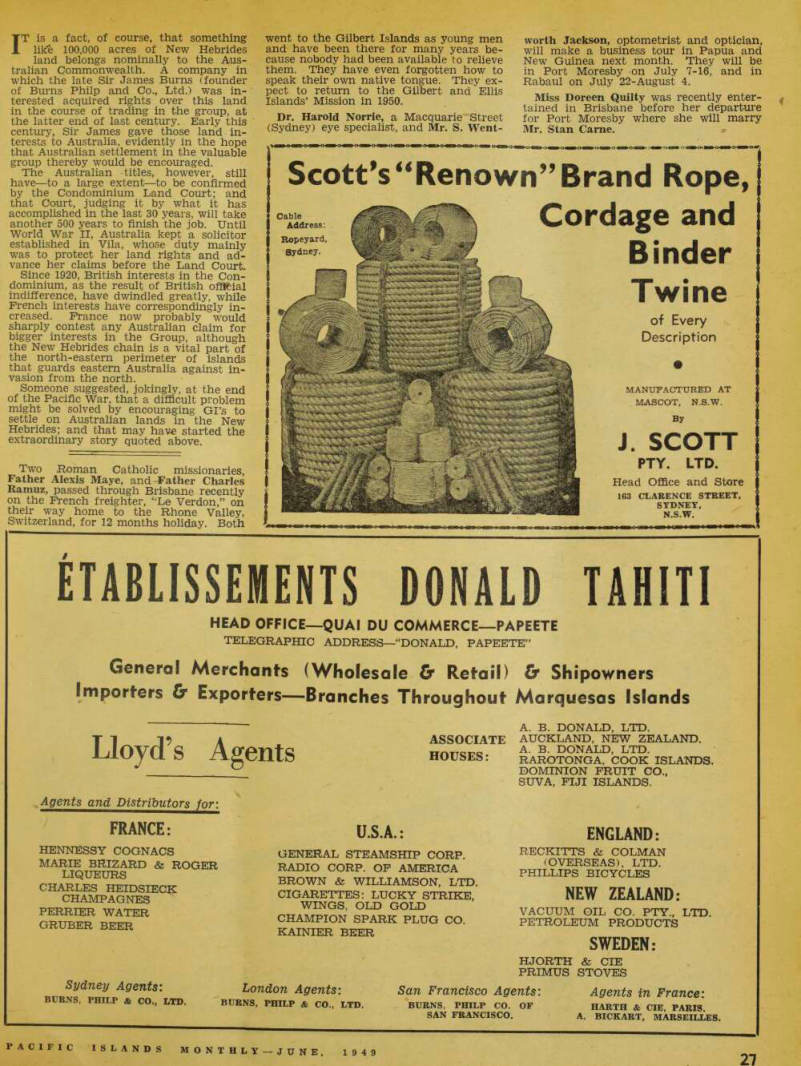
Paradise
THE following remarkable story was published in a large number of United States newspapers on April 29:
“Do you want to get away from it all, to a plantation in the South Seas where most all the cultivation can be done from a hammock while beautiful island girls feed you tropical fruit with music and dancing? Well, for the plantation part, at least, there’s some 100,000 acres of land for rent in the New Hebrides at 20 cents a year per 50-acre plot.
“Left for British settlers by the will of Sir James Bums, founder of the Burns- Philp group of companies, the Australian government as trustee has declared Gls eligible, reports “Pacific Islands Monthly” of Sydney.
“There is a catch —no doubt only minor to some enterprising GI —in that the neighbours are mostly cannibals. Other wise, it’s a cinch and the soil is as fer tile as one could find anywhere in the world”
NEEDLESS to say, the story is a fig ment of some worthy pressman’s imagination. Such a report was never published by the “PIM.”
Ever since the beginning of May, the “PIM” has been getting excited letters from former servicemen. They are most eager to get to this new Elysium. Every one of them seeks more details —how do they obtain the land, to whom do they apply, how soon can the matter be ar ranged—and what are the girls like?
We could not answer all the letters, so we have appealed to the Press Association which distributed the silly story to make a correction, and let us sleep in peace.
(Continued on Next Page)
IT is a fact, of course, that something like 100,000 acres of New Hebrides land belongs nominally to the Aus tralian Commonwealth. A company in which the late Sir James Burns (founder of Burns Philp and Co., Ltd.) was in terested acquired rights over this land in the course of trading in the group, at the latter end of last century. Early this century, Sir James gave those land in terests to Australia, evidently in the hope that Australian settlement in the valuable group thereby would be encouraged.
The Australian titles, however, still have —to a large extent—to be confirmed by the Condominium Land Court; and that Court, judging it by what it has accomplished in the last 30 years, will take another 500 years to finish the job. Until World War 11, Australia kept a solicitor established in Vila, whose duty mainly was to protect her land rights and ad vance her claims before the Land Court.
Since 1920, British interests in the Con dominium, as the result of British official indifference, have dwindled greatly, while French interests have correspondingly in creased. France now probably would sharply contest any Australian claim for bigger interests in the Group, although the New Hebrides chain is a vital part of the north-eastern perimeter of islands that guards eastern Australia against in vasion from the north.
Someone suggested, jokingly, at the end of the Pacific War, that a difficult problem might be solved by encouraging Gl’s to settle on Australian lands in the New Hebrides; and that may have started the extraordinary story quoted above.
Two Roman Catholic missionaries, Father Alexis Maye, and Father Charles Ramuz, passed through Brisbane recently on the French freighter, “Le Verdon,” on their way home to the Rhone Valley, Switzerland, for 12 months holiday. Both
went to the Gilbert Islands as young men and have been there for many years be cause nobody had been available to relieve them. They have even forgotten how to speak their own native tongue. They ex pect to return to the Gilbert and Ellis Islands’ Mission in 1950.
Dr. Harold Norrie, a Macquarie Street (Sydney) eye specialist, and Mr. S. Went
worth Jackson, optometrist and optician, will make a business tour in Papua and New Guinea next month. They will be in Port Moresby on July 7-16, and in Rabaul on July 22-August 4.
Miss Doreen Quilty was recently enter tained in Brisbane before her departure for Port Moresby where she will marry Mr. Stan Came.
Advertisements & other items, pp. 28-30 (1 item)
J. C. Merrillees Pty. Ltd., Sydney
'V 1 ,4 m
L} SMOOTH HANDS
t'/i (V*9 :f . tiw dMr^l k tik *r X ■i y % if
MAKt
UP
BASE
r v
SMOOTH
SKIN
I These goods are stocked by all the leading stores of the Pacific Islands. Order through your usual channels. Further enquiries to:
J. C. Merrillees Pty. Ltd., Sydney
ScottV'Renown”Brand Rope,
Cordage and
Cable Address; Ropeyard Sydney. wm >. —.. ■ - * - Sj ■■ --
Binder
Twine
of Every
Description
MANUFACTURED AT
MASCOT, N.S.W.
By
J. SCOTT
PTY. LTD.
Head Office and Store
163 CLARENCE STREET,
SYDNEY,
N.S.W.
ETABLISSEHENTS DONALD TAHITI
HEAD OFFICE—QUAI DU COMMERCE—PAPEETE
TELEGRAPHIC ADDRESS—“DONALD, PAPEETE”
General Merchants (Wholesale & Retail) & Shipowners
Importers & Exporters—Branches Throughout Marquesas Islands
Lloyd’s Agents
ASSOCIATE
HOUSES:
A. B. DONALD, LTD.
AUCKLAND, NEW ZEALAND.
A. B. DONALD, LTD.
RAROTONGA, COOK ISLANDS.
DOMINION FRUIT CO..
SUVA, FIJI ISLANDS.
Agents and Distributors for:
FRANCE:
U.S.A.:
ENGLAND:
HENNESSY COGNACS
MARIE BRIZARD & ROGER
LIQUEURS
CHARLES HEIDSIECK
CHAMPAGNES
PERRIER WATER
GRUBER BEER
GENERAL STEAMSHIP CORP.
RADIO CORP. OF AMERICA
BROWN & WILLIAMSON, LTD.
CIGARETTES: LUCKY STRIKE,
WINGS, OLD GOLD
CHAMPION SPARK PLUG CO.
KAINIER BEER
RECKITTS & COLMAN
(OVERSEAS), LTD.
PHILLIPS BICYCLES
NEW ZEALAND:
VACUUM OIL CO. PTY., LTD.
PETROLEUM PRODUCTS
SWEDEN:
Sydney Agents :
BURNS, PHILP & CO., LTD.
HJORTH & CIE
PRIMUS STOVES
London Agents :
BURNS, PHILP & CO., LTD.
San Francisco Agents : Agents in France :
BURNS, PHILP CO. OF
SAN FRANCISCO.
HARTH & CIE, PARIS.
A, BICKART, MARSEILLES.
DON'T SAY § I M DON'T SAY G J |f
DON'T SAY GIA .DON'T SAY
jns -»» <.&n
N»QOO, “«*'
DON'T SAY © I 3V
]V DON'T SAY
'T SAY « I M
[V DON'T SAY
OONT SAY G I N
[ ft DON'T SAY
T SAY G I m
w J M DON'T SAY
DON'T SAY G I M DON
M DON'T SAY GIN DON'tI
I'T SAY G I M DON'T SAY G I N DON'T SAY G I M DON'T SAY GIN I N DON'T SAY G I/ J *U>ON'T SAY
DON'T SAY GIN DO
GIN DON'T SAY G
DON'T SAY G I N D
GIN DON'T SAY
DON'T SAY GIN
GIN DON'T SAY
T SAY
[ M DON'T SAY
DON'T SAY GIN DON'T
G I M DON'T SAY GIN DON'T
DON'T SAY GIN DON'T SAY GIN
DON'T SAY G I N
GIN DON'T SAY
DON'T SAY G I N
DON'T SAY
M Y H DO D S AY m
VQU
&HS *lb L *o °Ur c °c*.
SAY
* ycUj IN ey s *7£ T Br 'sb °Os
SAY
T 11 ■i* nlH?
DON'T
DON'T SAY G I
G I IV DON'T SAY
DON'T SAY G I IV
DON'T SAY
Y S AT * uqu Ibo *T 0 * °°CKt
SAY
I TV
Br *sb Q *e
T SAY
DON"
T Address aU inquiries to Telegrams and Cables: “GILBEYS,” Melbonme.
W. & A. GILBEY LTD
Telegrams and Cables: “GILBEYS.” Sydney. 33 ROSSLYN STREET, WEST MELBOURNE. 109 REGENT STREET, SYDNEY.
Death of Mr. 'Dick’ Laycock

Well-Known Solomon Is. Planter
Prom Our Own Correspondent HONIARA, April 21.
WITH the death of Mr. R. C. (Dick) Laycock on May 16, at his planta tion, Papari, Ysabel, BSI has lost one of its really old identities and one of those few remaining pioneers who know the Protectorate like the palms of their hands and have done their share towards its development.
Mr. Laycock’s Islands career dated frqm about 1905, when he arrived in the Group as a tall young man to take a job in the late Billy Pop’s workshop at Aola, Guadal canal. Two years later, he opened up a store at Balusuna, not far along the coast, gradually expanding his activities until he was in a position to start the big store in Tulagi which was to be later the basis of Messrs. W. R. Carpenters’ in terests in the Solomons.
The sudden drop in the copra price at the end of World War I hit Mr. Laycock hard, but, undefeated, he set to work and firmly rebuilt his fortunes. One of his secrets was an immense popularity among his boys—indeed, hundreds of Solomon Islanders knew of “Dick” almost as a sort of tradition—and another his capacity for hard work.
He had a brother who joined him in the Protectorate and lost his life during a recruiting expedition on Makira.
Devoted to boats, Mr. Laycock owned, during 40 years, a succession of craft too numerous to recall. His lugger, “Joan,” was used, under command of the late Gordon Train, to evacuate Chinese from Choiseul at the onset of the Japanese in vasion, and remained in war-time Government service after the civilian evacuation of the Solomons.
Mr. Laycock returned to the Protec torate after the Pacific war in the epic trip made by Southern Cross early in 1946; and, of the thirteen former resi dents battered and tossed on that un lucky journey, he was the only one to return to anything resembling his former possessions. He found his house still standing, the “Joan” was waiting, and so were his stores and bags of shell, which his devoted boss-boy had taken inland and securely hidden. Sadly enough, this faithful servant died just before his master’s return.
Mr. Laycock’s death came as' a great shock to all his friends in the Protec torate. Although in indifferent health for some time, he had visited Honiara a few days before and cheerily fraternised with local identities. He died, alone, at Papari, shortly after he returned home and was buried near his coconut palms.
Mr. Laycock was a correspondent of the Pacific Islands Monthly almost from its first issue, 20 years ago. His pungent, well written articles, based on sound common sense, received much favourable comment.
Solomon Islanders Now Have
Own Club
From Our Own Correspondent
Honiara, May 15.
AN innovation for the Solomons is a club for Solomon Islanders, officially opened in Honiara on May 14.
Housed temporarily in an ex-Army quonset hut, the club will serve as a rec reational centre for male native residents of Honiara. Annual subscription, 12/-.
It has ping pong facilities and members are hoping to be allowed space for their own tennis court nearby.
The Interisland Steam Navigation Co. of Honolulu proposed to send the SS “Hualalai” on a cruise of the Pacific Islands in June, with 200 passengers. She was to spend five days in Tahiti. The Governor of French/ Oceania has ex pressed his earnest desire to promote Tourism.
Advertisements & other items, p. 31 (1 item)
“Caterpillar”
Woven Wire for all Industry
COPRA DRYING TRAYS, FLOORS, Etc.
FRUIT DRYING TRAYS, MINING SCREENS.
Heavy Mosquito Gauze in Phosphor Bronze and other Metals Impervious to Salt Sea Air.
WIRE DOOR MATS AND GENERAL WIRE WORKS
E. WRIGHT & CO. LTD.
Office and Works: 148*152 Cleveland Street, Sydney, N.8.W.
Telegraphic Address: “Wrlghtmake," Chippendale. : 0 *iv r. £
\ 1 m A Hyster Crane at Work on Suva Wharves.
We Supply all Types of
“CATERPILLAR”
MACHINERY
WE ARE DISTRIBUTORS IN FIJI FOR
The Caterpillar Tractor
Company
Caterpillar Diesel Tractors Caterpillar Bulldozers Caterpillar Earth-movers Caterpillar Road Building and Maintenance Machines
ALL MADE BY “CATERPILLAR.”
'Hyster" Winches, Logging Arches and Equipment "Tracson" Excavators for use with Caterpillar Tractors "Caterpillar" Diesel Marine Engines, 34 to 135 BHP Continuous Rating Stocks of Spare Parts carried in Suva. Information available about Agricultural Implements Inquiries from anywhere gladly answered to suit Caterpillar Tractors.
W. R. CARPENTER & CO, (Fiji) Ltd.
SUVA
FIJI
and Unhelpful , Says BSI Planter
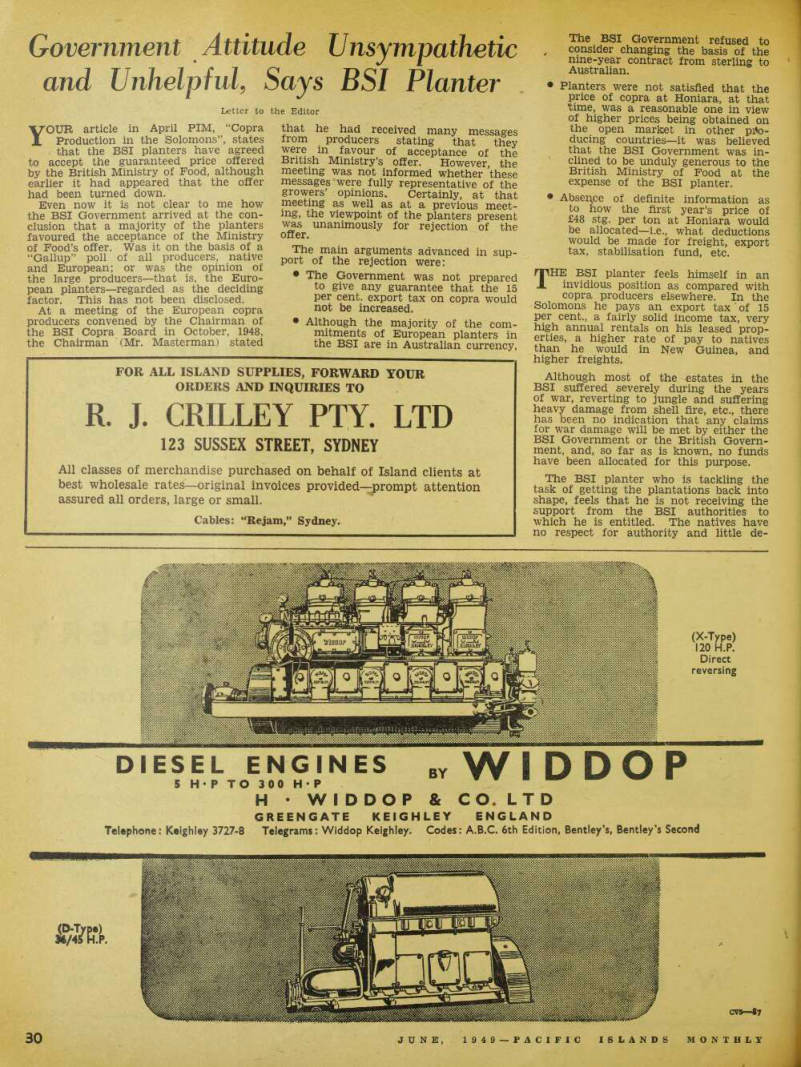
Government Attitude Unsympathetic and Unhelpful , Says BSI Planter
Letter to the Editor
YOUR article in April PIM, “Copra Production in the Solomons”, states i that the BSI planters have agreed to accept the guaranteed price offered by the British Ministry of Food, although earlier it had appeared that the offer had been turned down.
Even now it is not clear to me how the BSI Government arrived at the con clusion that a majority of the planters favoured the acceptance of the Ministry of Food’s offer. Was it on the basis of a “Gallup” poll of all producers, native and European; or was the opinion of the large producers—that is. the Euro pean planters—regarded as the deciding factor. This has not been disclosed.
At a meeting of the European copra producers convened by the Chairman of the BSI Copra Board in October, 1948, the Chairman (Mr. Masterman) stated
that he had received many messages from producers stating that they were in favour of acceptance of the British Ministry’s offer. However, the meeting was not informed whether these messages were fully representative of the growers’ opinions. Certainly, at that meeting as well as at a previous meet ing, the viewpoint of the planters present was unanimously for rejection of the offer.
The main arguments advanced in sup port of the rejection were: • The Government was not prepared to give any guarantee that the 15 per cent, export tax on copra would not be increased. • Although the majority of the com mitments of European planters in the BSI are in Australian currency,
The BSI Government refused to consider changing the basis of the nine-year contract from sterling to Australian. • Planters were not satisfied that the price of copra at Honiara, at that time, was a reasonable one in view of higher prices being obtained on the open market in other pro ducing countries—it was believed that the BSI Government was in clined to be unduly generous to the British Ministry of Food at the expense of the BSI planter. • Absence of definite information as to how the first year’s price of £4B stg. per ton at Honiara would be allocated—i.e., what deductions would be made for freight, export tax, stabilisation fund, etc.
THE BSI planter feels himself in an invidious position as compared with copra producers elsewhere. In the Solomons he pays an export tax ’of 15 per cent., a fairly solid income tax, very high annual rentals on his leased prop erties, a higher rate of pay to natives than he would in New Guinea, and higher freights.
Although most of the estates in the BSI suffered severely during the years of war, reverting to jungle and suffering heavy damage from shell fire, etc., there has been no indication that any claims for war damage will be met by either the BSI Government or the British Govern ment, and, so far as is known, no funds have been allocated for this purpose.
The BSI planter who is tackling the task of getting the plantations back into shape, feels that he is not receiving the support from the BSI authorities to which he is entitled. The natives have no respect for authority and little de
sire to seek regular plantation employ ment.
The BSI planter feels that the copra export tax during the period of rehabili tation is unjust, and also that lease rents could, in fairness, be greatly re duced or even waived until such times as the areas are brought under control once more.
To my mind, the refusal of the as sembled planters at the meetings held in Honiara last year to ratify the nine year Ministry of Food’s offer, was not so much due to hostility of the offer in it self, but more in the nature of a pro test against the unsympathetic and un helpful nature of the treatment they have received from the BSI Government over the past two or three years
I am, etc.,
Bsi Planter.
Sydney, May 6, 1949.
Advertisements & other items, p. 32 (1 item)
Widdop
FOR ALL ISLAND SUPPLIES, FORWARD YOUR
ORDERS AND INQUIRIES TO
R. J. CRILLEY PTY. LTD
123 SUSSEX STREET, SYDNEY
All classes of merchandise purchased on behalf of Island clients at best wholesale rates—original invoices provided—prompt attention assured all orders, large or small.
Cables: “Rejam,” Sydney.
r ; «sr*
K I * - ■ • Bas ■ •A. ii
p:T:,T ■ -4:1
(X-Type) 120 H.P.
Direct reversing BY
WIDDOP
DIESEL ENGINES
5 H* P TO 300 H* P
H • WIDDOP & CO. LTD
GREENGATE KEIGHLEY ENGLAND
Telephone: Keighley 3727-8 Telegrams: Widdop Keighley. Codes: A.B.C. 6th Edition, Bentley’s, Bentley’s Second *
life
mp 3 ■ --/■ r cvs—S?
iss S&wwkss
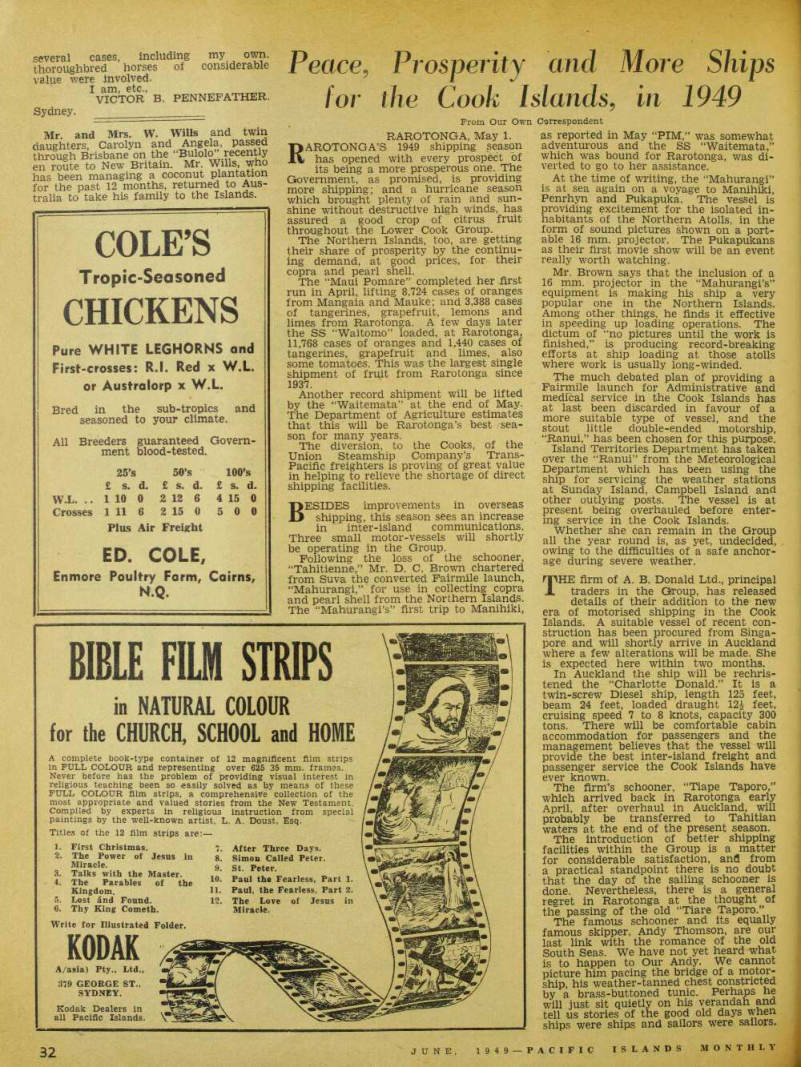
Excessive Cost Of
Shipping Stock
To New Guinea
Letter to the Editor A STOCK-BOAT, the SS “River Fitz r°y , was made available recently . to carry livestock to the Islands Being m Sydney, I took the opportunity of sending six horses to Rabaul, for the Mr ° f T m nf« Sel i^ nd a nei g h bouring planter, Mr- J. T. Allan. I think the public should know what this cost us.
The horses were ordinary utility marcs required for general plantation us” and the purchase price for the six animals amounted to £ll2, which was reasonable “ “J °^ However, when settling Phfln y nf T th f ag . en ‘ s ’ Messrs. Burns, HhpP» ht d -> I found I had to pay £2O e ? ht ' a . nd no less than £143 for the erection of six stalls. cost^nf 1 1 q S® r i? d the excessive o?er alls v w h l ch worked out at Stabs £ hcfnrp +iq inspected these stalls before the ship sailed, and found they were constructed of, perhaps. .thiS rate timber and, as they were situated
wal needed.’ comparativel y Httle material
Burns Philp did say it was intended to dismantle the stalls on the arrival bv timber would be sold priw Admi nistr a ti° n , and subsequently stock W ° Uld be made t 0 shippers of t t 0 the costs I have men tioned, there was an amount of £3l for ince Sl° n the voyage, and hLS a v l , has yet to be paid and for But C Vere a L e S? acTount” cost to rn Of th» d 0U u t that the total cost 10 us of the six horses will be an. proximately £3OO, or more. P no ?, ne ,, would have expected more sym pathetic treatment bv the * It should at lea y sthlve A bornfthe'
iss S&wwkss
& Darnlge ld Comm? ? oint °^ t th at the War of £10 S6 per head SS fnr i? aid a maximum the To So™ o d for horses lost during the Japanese invasion, although, in
several cases, including my own. thoroughbred horses of considerable value were Involved.
I am, etc., ...
Victor B. Pennefather.
Sydney.
Mr. and Mrs. W. Wills and twin daughters, Carolyn and ( Angela, passea through Brisbane on the B^ lo] who en route to New Britain. Mr. has been managing a P la for the past 12 months, returned to Au tralia to take his family to the Islands.
Advertisements & other items, pp. 33-34 (1 item)
A. B. Donald Ltd.
Wynne S. Breden Pty. Ltd.
BOAT BUILD AND ENGINEERS.
"PHOENIX SHIPYARDS" NEWCASTLE, N.S.W.
Designers, Builders & Outfitters of ISLAND Vessels Work Boats, Cargo Boats and Auxiliary Craft up to 200 tons.
A. B. DONALD Ltd.
AUCKLAND
ISLAND TRADERS & GENERAL MERCHANTS
P.O. Box 1509. Cables & Telegrams, "Kingdom/' Auckland.
Tnc Garrick Hotel
Fit ■l mm 4 »
'iqr
X ii
till I SUVA
• Pttfcfi FIJI
This well-known Hotel is centrally situated in Suva's main business quarter :: Modern accommodation provides comfort ir all climatic conditions :: Only the best of Beers, Spirits and Wines is served Telephone; 80.
VINCE COSTELLO
Proprietor.
COLE’S
Tropic-Seasoned
CHICKENS
Pure WHITE LEGHORNS and
First-crosses; R.l. Red x W.L. or Australorp x W.L.
Bred in the sub-tropics and seasoned to your climate.
All Breeders guaranteed Government blood-tested. 25’s 50’s 100’s £ s. d. £ s. d. £ s. d.
W.L. .. 110 0 212 6 415 0 Crosses 111 6 215 0 500 Plus Air Freight
ED. COLE,
Enmore Poultry Farm, Cairns, N.Q.
1. First Christmas. 2. The Power of Jesus in Miracle. 3. Talks with the Master. 4. The Parables of the Kingdom. 5. Lost and Found. 6. Thy King Cometh.
Write for Illustrated Folder.
KODAK
A/asia) Pty., Ltd.,
379 GEORGE ST.,
SYDNEY.
Kodak Dealers in all Pacific Islands.
After Three Days.
Simon Called Peter.
St. Peter.
Paul the Fearless, Part 1.
Paul, the Fearless, Part 2.
The Love of Jesus in Miracle. 10.
BEE FUJI SHUTS
in NATURAL COLOUR
for the CHURCH, SCHOOL and HOME
A complete book-type container of 12 magnificent film strips in FULL COLOUR and representing over 625 35 mm. frames.
Never before has the problem of providing visual interest in religious teaching been so easily solved as by means of these FULL COLOUR film strips, a comprehensive collection of the most appropriate and valued stories from the New Testament.
Compiled by experts in religious instruction from special paintings by the well-known artist, L. A. Doust, Esq.
Titles of the 12 film strips are:—
Peace , Prosperity and More Ships
for the Cook Isl, 1949
From Our Own Correspondent
Rarotonga, May 1.
RAROTONGA’S 1949 shipping season has opened with every prospect of its being a more prosperous one. The Government, as promised, is providing more shipping; and a hurricane season which brought plenty of rain and sun shine without destructive high winds, has assured a good crop of citrus fruit throughout the Lower Cook Group.
The Northern Islands, too, are getting their share of prosperity by the continu ing demand, at good prices, for their copra and pearl shell.
The “Maui Pomare” completed her first run in April, lifting 8,724 cases of oranges from Mangaia and Mauke; and 3,388 cases of tangerines, grapefruit, lemons and limes from Rarotonga. A few days later the SS “Waitomo” loaded, at Rarotonga, 11,768 cases of oranges and 1,440 cases of tangerines, grapefruit and limes, also some tomatoes. This was the largest single shipment of fruit from Rarotonga since 1937.
Another record shipment will be lifted by the “Waitemata” at the end of May.
The Department of Agriculture estimates that this will be Rarotonga’s best sea son for many years.
The diversion, to the Cooks, of the Union Steamship Company’s Trans pacific freighters is proving of great value in helping to relieve the shortage of direct shipping facilities.
BESIDES improvements in overseas shipping, this season sees an increase in inter-island communications.
Three small motor-vessels will shortly be operating in the Group.
Following the loss of the schooner, “Tahitienne,” Mr. D. C. Brown chartered from Suva the converted Fairmile launch, “Mahurangi,” for use in collecting copra and pearl shell from the Northern Islands.
The “Mahurangi’s” first trip to Manihiki,
as reported in May “PIM,” was somewhat adventurous and the SS “Waitemata,” which was bound for Rarotonga, was di verted to go to her assistance.
At the time of writing, the “Mahurangi” is at sea again on a voyage to Manihiki, Penrhyn and Pukapuka. The vessel is providing excitement for the isolated in habitants of the Northern Atolls, in the form of sound pictures shown on a port able 16 mm. projector. The Pukapukans as their first movie show will be an event really worth watching.
Mr. Brown says that the inclusion of a 16 mm. projector in the “Mahurangi’s” equipment is making his ship a very popular one in the Northern Islands.
Among other things, he finds it effective in speeding up loading operations. The dictum of “no pictures until the work is finished,” is producing record-breaking efforts at ship loading at those atolls where work is usually long-winded.
The much debated plan of providing a Fairmile launch for Administrative and medical service in the Cook Islands has at last been discarded in favour of a more suitable type of vessel, and the stout little double-ended motorship, “Ranui,” has been chosen for this purpose.
Island Territories Department has taken over the “Ranui” from the Meteorological Department which has been using the ship for servicing the weather stations at Sunday Island, Campbell Island and other outlying posts. The vessel is at present being overhauled before enter ing service in the Cook Islands.
Whether she can remain in the Group all the year round is, as yet, undecided, owing to the difficulties of a safe anchor age during severe weather.
THE firm of A. B. Donald Ltd., principal traders in the Group, has released details of their addition to the new era of motorised shipping in the Cook Islands. A suitable vessel of recent con struction has been procured from Singa pore and will shortly arrive in Auckland where a few alterations will be made. She is expected here within two months.
In Auckland the ship will be rechris tened the “Charlotte Donald.” It is a twin-screw Diesel ship, length 125 feet, beam 24 feet, loaded draught 12i feet, cruising speed 7 to 8 knots, capacity 300 tons. There will be comfortable cabin accommodation for passengers and the management believes that the vessel will provide the best inter-island freight and passenger service the Cook Islands have ever known.
The firm’s schooner, “Tiape Taporo,” which arrived back in Rarotonga early April, after overhaul in Auckland, will probably be transferred to Tahitian waters at the end of the present season.
The introduction of better shipping facilities within the Group is a matter for considerable satisfaction, and from a practical standpoint there is no doubt that the day of the sailing schooner is done. Nevertheless, there is a general regret in Rarotonga at the thought of the passing of the old “Tiare Taporo.”
The famous schooner and its equally famous skipper, Andy Thomson, are our last link with the romance of the old South Seas. We have not yet heard what is to happen to Our Andy. We cannot picture him pacing the bridge of a miDtor ship, his weather-tanned chest constricted by a brass-buttoned tunic. Perhaps he will just sit quietly on his verandah and tell us stories of the good old days when ships were ships and sailors were sailors.
Tonga’S Growing Pains
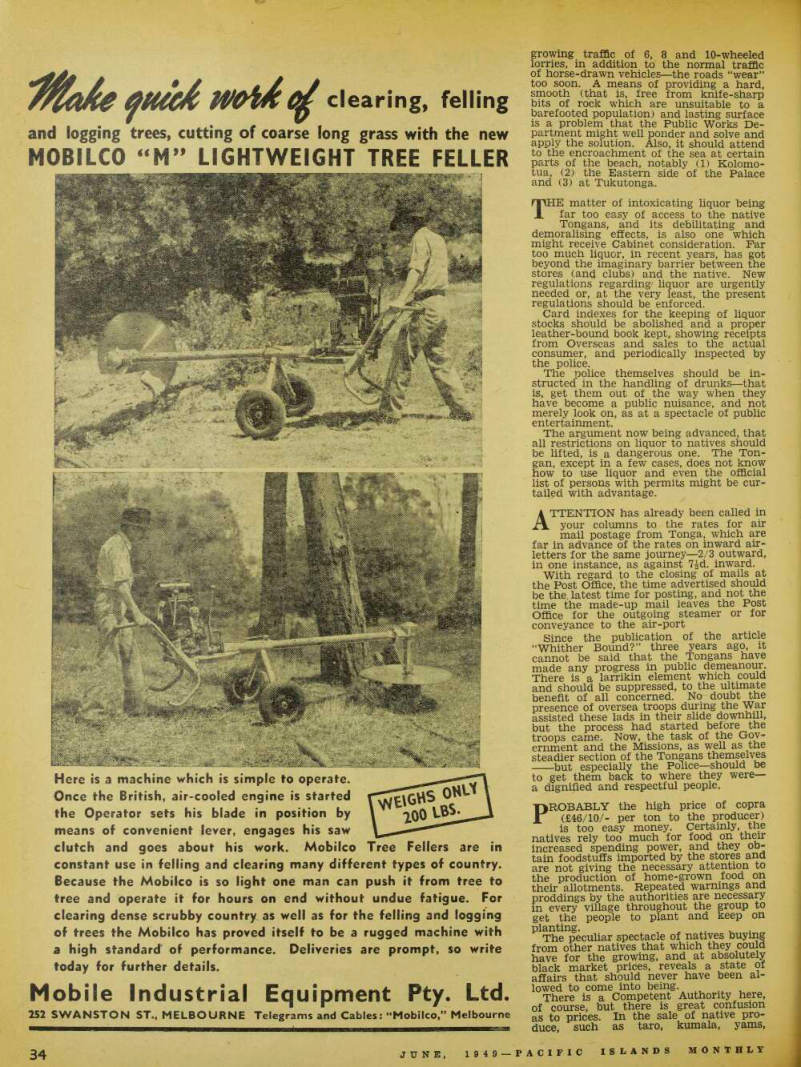
A Call For Some Urgently-Needed Minor Reforms
A contributor, calling himself “Whither Bound? ” who knows Tongan conditions well, points to some minor evils which need attention. It is an interesting description of the country's condition, because a great deal now is being said about the Pacific Islander's capacity for self government, and Tonga is the only Pacific country which is almost completely independent.
IN the “Pacific Islands Monthly” of December, 1945, there was a stimu lating article entitled “Whither Bound? If Tonga has a future, what is it?”
In the three years that have elapsed since, not much change has been recorded.
And, while there is much to be said against Tonga trying to change itself into a commercialised and industrialised com munity, some advance on present “laisser faire” methods would be advantageous, while retaining the main characteristics of Tongan life, as it has been lived for centuries. The desire to get into the van of civilisation may be all very well theoretically, but there are grave disad vantages in it; and the best thing to do with the Tongan, if he is to preserve his placid existence in a distracted world, is to leave him largely alone—to leave him, in fact with the “hope that light and graciousness, and the survival of a simple view of life, that accepts birth and death as it does the fecundity of the earth, will remain long exempt from mechanisation and organisation.”
But where the authorities fail is in leaving too much to right itself.
THE January “PIM” published a resume of Revenue and Expenditure for
1948-49, with some ambitious spending forecast in the last paragraph.
The new telephone exchange is needed, provided it will improve the telephone service; but the electric light scheme for Nukualofa, estimated to cost £28,000 is a doubtful proposition, as it must be run on imported fuel, which may make the cost to users prohibitive.
So many new schemes are in the air, and in the minds of their promoters, that needful work on schemes already passed, having lost their novelty, is shelved—e.g., the repair of the Yellow Wharf and the improvement of the water-front. The water-front, from the Palace to Mauf anga, could be improved out of sight by the judicious expenditure of a few pounds.
In a country whose population has a marked tendency to pulmonary diseases, greater attention could well be bestowed on the roads. Within twelve hours of the cessation of heavy rains, dust is raised by a passing motor lorry or car and, after a day or two, clouds of pul verised coral hang in the air for several minutes, when passing vehicles disturb it. The surface of the roads (outside those in the town, some of which are tarred) is not hard enough to stand the
growing traffic of 6, 8 and 10-wheeled lorries, in addition to the normal traffic of horse-drawn vehicles—the roads “wear” too soon. A means of providing a hard, smooth (that is, free from knife-sharp bits of rock which are unsuitable to a barefooted population) and lasting surface is a problem that the Public Works De partment might well ponder and solve and apply the solution. Also, it should attend to the encroachment of the sea at certain parts of the beach, notably (1) Kolomo tua, (2) the Eastern side of the Palace and (3) at Tukutonga.
THE matter of intoxicating liquor being far too easy of access to the native Tongans, and its debilitating and demoralising effects, is also one which might receive Cabinet consideration. Far too much liquor, in recent years, has got beyond the imaginary barrier between the stores (and clubs) and the native. New regulations regarding' liquor are urgently needed or, at the very least, the present regulations should be enforced.
Card indexes for the keeping of liquor stocks should be abolished and a proper leather-bound book kept, showing receipts from Overseas and sales to the actual consumer, and periodically inspected by the police.
The police themselves should be in structed in the handling of drunks —that is, get them out of the way when they have become a public nuisance, and not merely look on, as at a spectacle of public entertainment.
The argument now being advanced, that all restrictions on liquor to natives should be lifted, is a dangerous one. The Ton gan, except in a few cases, does not know how to use liquor and even the official list of persons with permits might be cur tailed with advantage.
ATTENTION has already been called in your columns to the rates for air mail postage from Tonga, which are far in advance of the rates on inward air letters for the same journey—2/3 outward, in one instance, as against 7gd. inward.
With regard to the closing of mails at the Post Office, the time advertised should be the latest time for posting, and not the time the made-up mail leaves the Post Office for the outgoing steamer or for conveyance to the air-port Since the publication of the article “Whither Bound?” three years ago, it cannot be said that the Tongans have made any progress in public demeanour.
There is a larrikin element which could and should be suppressed, to the ultimate benefit of all concerned. No doubt the presence of oversea troops during the War assisted these lads in their slide downhill, but the process had started before the troops came. Now, the task of the Gov ernment and the Missions, as well as the steadier section of the Tongans themselves but especially the Police —should be to get them back to where they were— a dignified and respectful people.
PROBABLY the high price of copra (£46/10/- per ton to the producer) is too easy money. Certainly, the natives rely too much for food on their increased spending power, and they ob tain foodstuffs imported by the stores and are not giving the necessary attention to the production of home-grown food on their allotments. Repeated warnings and proddings by the authorities are necessary in every village throughout the group to get the people to plant and keep on planting.
The peculiar spectacle of natives buying from other natives that which they could have for the growing, and at absolutely black market prices, reveals a state of affairs that should never have been al lowed to come into being.
There is a Competent Authority here, of course, but there is great c(pnfusion as to prices. In the sale of native pro duce, such as taro, kumala, yams,
bananas, eggs, chickens, etc., there seems to be not even a suggestion of sticking to the published figures, whilst in tailoring, bootmaking and repairing, the listed rates do not have any bearing on the rates charged.
With regard to imported goods, some of the prices fixed by the Competent Authority are less than landed cost, some are about the equivalent of landed cost, some leave a meagre suggestion of profit if everything goes right (no pilferages on board ship, short weight, or anything of that sort) while on others there is a modest return.
These contradictory levels, together with an unnecessarily complicated system for the assessment of duty, and other calcu lations, apparently cause a confusion of mind which is worse confounded by numerous other regulations and restric tions.
Recent figures give £141,000 as the Customs duties expected in the current financial year, which includes £21,000 from the iniquitous Port & Service Tax of 5 per cent, calculated on a basis which puts a value on imported goods in excess of the true value, and further adds directly to the already stratospheric cost of living. This tax should be abolished.
With £400,000 odd in the stocking the Government could forego this.
AT the 1948 session of Parliament a motion was brought in and passed designed to simplify the tortuous method of ascertaining values for the payment of duty and to arrive at a value nearer to the true value of the commodity.
The result of this, after the “experts” had finished with it, was a method more com plicated than the one superseded. The only true value of a commodity for the assessment of duty is its prime or invoice cost, plus actual freight, insurance, etc.
It is to be hoped that this miscarriage will be put right by the next Parliament.
But the brightest jewel in the glittering crown is that while the Government charges 3 per cent, to remit money in payment of imported goods and 3 per cent, on the exchange (if any), there is a regulation in the official Tongan Govern ment Gazette which specifically prohibits this charge to be included in an Im porter's costing of goods at more than U per cent. What sort of comedy is this?
Not to use a harsher term, it is at least unethical.
FR the past two or three years the community has been afflicted with periodical goal-breaking. Habitual and desperate criminals are housed in buildings quite inadequate to contain them, and slack supervision makes es cape easy. During their periods at large these criminals perpetrate further crimes, those of robbery and intimidation, and are a source of fear and terror to the law-abiding and tax-paying natives, par ticularly those in the remote and more
secluded villages who have everv right to expect and to recelve DrotSlon from these marauders receive P rotectlon lrom Before anv grandiose schemes are nut
into tST^
abldlnE citizen should be assured One nf the first reforms necessary in Tonga is the comnlete reorganisation of the noiiop
ton^teThem“nefflden?force“for the
™“temS”tpu& f “Cwme
S e° b SV e ° U « "the -^!£ era r oes .. xfi 6
Srl^emlnts' “n
Ed‘‘ P Plm"’l (Thls has n ° w been done.-
Pimi
Uraia N. Koroi, of Fiji, was a con spicuous exhibitor at the recent Ipswich Show (Queensland). He is a third year animal husbandry student at the Gatton Agricultural College. On completion of hls course he plans to take a Government position in Fiji.
Advertisements & other items, pp. 35-38 (2 items)
Burns Philp (South Sea) Go. Ltd.
OVERSEAS MAGAZINES
Direct to You from th 6
Publishers.
American:'
CHARM 32/6
COLLIERS WEEKLY 60/.
CORONET 18/9
ESQUIRE 75/m
HARPER’S BAZAAR 75/.
LADIES’ HOME JOURNAL 37/6
LIFE .. 49/-
LOOK 39/-
POPULAR MECHANICS 28/3
READERS* DIGEST 12/ .
SATURDAY EVENING POST 68/9
SCIENTIFIC AMERICAN 52/6
TI >IE 06/-
VOGUE 105/ .
YACHTING 40/.
English;
APOLLO 52/6
COURIER 50/6
PICTURE POST 27/6
™ R ••
IAILLK 1227.
TIMES WEEKLY / 38/1
Rates are for one year and include all charges. Many other overseas periodicals available on all subjects.
ALL ORDERS AIR-MAILED TO
PUBLISHERS.
MAIL PUBLICITY CO., 175 PITT
STREET, SYDNEY, N.S.W.
BURNS PHILP (SOUTH SEA) Go. ltd.
ISLAND TRADERS AND SHIPOWNERS
General Merchants (Wholesale and Retail)
Shipping, Customs and General Agents
Representatives for QUEENSLAND INSURANCE CO. LTD.
Distributing Agents for SHELL COMPANY (PACIFIC ISLANDS) LTD.
Registered Office; SUVA, FIJI
Code Address: “BURNSOUTH”
BRANCHES:
Sydney Agents:
BURNS, PHILP & CO., LTD.,
7 Bridge Street.
FIJI—
SUVA.
LEVUKA.
lautoka.
LAB ASA.
BA.
SIGATOKA.
ROTUMA ISLAND.
TONGA—
NUKUALOFA.
SAMOA—
APIA.
PAGO PAGO.
HAAPAI.
VAVAU.
San Francisco Agents:
BURNS, PHILP 00. OF SAN FRANCISCO,
Matson Building, 215 Market Street, London Agents:
BURNS, PHILP & CO., LTD.,
35 Crutched Friars, E.C.3.
NORFOLK IS.—
NIUE IS.—
Agencies Throughout the World.
Wafa quiet woit e£ clearing, felling
and logging trees, cutting of coarse long grass with the new
MOBILCO “M” LIGHTWEIGHT TREE FELLER
mMmmm-
OHU
WEIGHS
lbs
100 Here is a machine which is simple to operate.
Once the British, air-cooled engine is started the Operator sets his blade in position by means of convenient lever, engages his saw clutch and goes about his work. Mobilco Tree Fellers are in constant use in felling and clearing many different types of country.
Because the Mobilco is so light one man can push it from tree to tree and operate it for hours on end without undue fatigue. For clearing dense scrubby country as well as for the felling and logging of trees the Mobilco has proved itself to be a rugged machine with a high standard of performance. Deliveries are prompt, so write today for further details.
Mobile Industrial Equipment Pty. Ltd.
252 SWANSTON ST., MELBOURNE Telegrams and Cables: “Mobilco,” Melbourne
You'll travel
lighter with
OLOBITE
TRAVEL CASES
Stronger, smarter, longer-lastingl 7//JA
/JAG/ REDUCTION IN I
LABOUR COSTSj
with the CHULA Patent COPRA DRYER
This remarkable Dryer also
• PRODUCES 12 TONS OF COPRA PER WEEK at the rate of 2 Tons every 24 hours. • PRODUCES COPRA OF HIGHER OIL CONTENT.
• IS SIMPLE AND
QUICK TO ERECT.
THE INVENTORS AND MANUFACTURERS OF
THE "CHULA” COPRA DRYER ALSO MAKE
DESICCATED COCONUT
MACHINERY
TYNESIDE FOUNDRY &
ENGINEERING CO. LTD.
ELSWICK • NEWCASTLE-ON-TYNE • ENGLAND
Established 1898.
Telegrams & Cables: " FOUNDRY , NEWCASTLE-ON-TYNE" . Codes: ABC. sth & 6th Edl % m 3 V
Mwifi M
Write for Catalogues of
CHULA
COPRA DRYERS
Capacities from 1,000 to 10,000 nuts per day.
HEAVY MACHINERY AND EQUIPMENT
FOR THE ISLANDS TERRITORIES
Steamships Trading Company Ltd.
AUTOMOTIVE and MACHINERY DEPARTMENT
Distributors in Papua and New Guinea for —
MOTOR CARS
ROOTS, LTD.—Hillman Minx —Humber Hawk — Humber Snipe and Sunbeam—Talbot Cars.
WILLYS-OVERLAND —Universal Jeeps—Jeepsters —Jeep Station Waggons.
Papua only.
R PAD T RANSPORT
INTERNATIONAL HEAVY DUTY MOTOR
TRUCKS —15 cwt. to 8 tons Gross Carrying Capacity. Utility Bodies—Platform Bodies — Tippers—Semi-Trailers—Low Loaders, etc.
AGRICULTURAL MACHINERY
McCORMICK-DEERING FARM TRACTORS, all
sizes, Wheel and Crawler Types.
FARM MACHINERY to suit every Purpose— Ploughs Harrows Cultivators Planters Harvesters Grass-Mowers Hay Rakes & Power Pressers—Chaff Cutters —Feed Grinders —Hammer Mills, Etc.
RICE-MILLING MACHlNERY—Hullers—Pearlers Polishers Threshers & Dressers Seed Graders—Aspirators—also Mills from 100 to 3,000 lb. capacity rice per hour.
EARTH-MOVING EQUIPMENT
Bullgraders Dozers Excavators Front End Loaders—Road Graders—Road-Rippers—Waggon Scoops—Quarry Dumpers—Bitumen Sprayers, Etc.
TIMBER LOGGING AND
MILLING EQUIPMENT
' ■—— Diesel Logging Tractors—Timber Trucks—Timber Jinkers—Log Haulers—Tractor Logging Winches —Truck Mounted Loading & Front End Pull Winches—Wire Rope, Etc.
SAW-MILLING MACHINERY Circular Saw
Benches—Circular; Rack Saws & Log Mills up to 31 " depth of cut.
INDUSTRIAL EQUIPMENT
DIESEL STATIONARY ENGINES—from 5 h.p.
upward, all purposes.
DIESEL MARINE ENGINES—from 5 h.p. upward W/Reverse Gr Reducing Gears.
OUTBOARD MOTORS—2J to 22 h.p.
MOBILE CRANES—Wharf & Material Handling, 1 to 5 tons Capacity.
PUMPS & PUMPING PLANTS—Agriculture- Mining and General Purpose Pumps.
ELECTRIC GENERATING SETS—sizes to suit every purpose—A.C.-D.C. current.
ELECTRIC MOTORS—GENERATORS—FractionaI
sizes upwards—A.C. and D.C. current.
GANG & POWER GRASS MOWERS—Municipal,
Golf Course and Airfield use.
REFRIGERATORS
ELECTRIC COMPRESSOR and KEROSENE
OPERATED Food Storage Capacity. Models 4 to 7 Cubic Feet.
AUTOMOTIVE EQUIPMENT
STORAGE BATTERIES—for every purpose—Car —Truck—Radio—Marine —Lighting sets.
TYRES & TUBES—Cars —Trucks—Tractors — Industrial Equipment.
HYDRAULIC LIFTING JACKS—i ton to 10 ton capacity.
GENERAL CAR AND TRUCK ACCESSORIES—
Electrical £r Hydraulic Replacements—Clutch Linings, Brake Linings, Etc.
Adequate stocks of spare parts are available for all vehicles and machinery at our
SERVICE PARTS DEPOT
PORT MORESBY
t
35
PACIFIC ISLANDS MONTHLY - J U N E , 1949
NZ’s Samoan Administration Gets

Official Approval and Much Advice
AT the end of March, the Trusteeship Council of the United Nations Or ganisation officially approved the annual report by New Zealand in respect of Western Samoa. The Council, how ever, made a number of what were called recommendations.
One of the wishes expressed was that Western Samoa should have, at the earliest moment, a system of universal suffrage in order that the Legislative Assembly may be as representative as possible. Another desire was that the administering authority (NZ), should encourage further thte development of their own culture among the Samoans.
Delegates to the Trusteeship Council apparently are not aware that there is nothing in Samoan culture to support universal suffrage. This is not due to any restrictive measure on New Zealand’s part but because the Western Samoans themselves prefer their own traditional methods of selecting their leaders.
Other recommendations are that New Zealand take all possible steps to protect the Territory against a fall in prices of primary production by introducing secondary industries, that the Dominion intensify efforts towards developing the Territory’s natural resources so as to “raise the standard of living of its poorer inhabitants” and to elaborate an overall plan for the economic de velopment of the Territory. It is also suggested that NZ should not let up in its efforts to provide improved social service, educational and health benefits.
Finally, the Trusteeship Council appears
cheered to know that "an inquiry “re garding the existing preferential treat ment of 11 per cent, in favour of British goods is under way.”
IN short, the “approval” of the Council is just a babble of words, issued ap parently with the express purpose of trying to justify the existence of a team of delegates who know less about con ditions in Western Samoa than does the man in the moon.
It is hard to imagine the officials in Wellington, whose concern Western
Samoa is, suddenly whipped into action by the stratospheric idealisms of those precious gentlemen at Lake Success.
ABOUT the same time that the mani festo on Western Samoa was issued by the Trusteeship Council, Colonel McCormick’s “Chicago Tribune” borrowed a number of Russia’s well-worn methods of hurling abuse at what they are pleased to call “imperialistic powers,” and attacked New Zealand’s rule in Western Samoa.
In an editorial the “Tribune”, on March 25, contrasts conditions in West ern Samoa with those ruling in the neighbouring American territory of Eastern Samoa—to the disadvantage of New Zealand’s Territory.
Eastern Samoa, the “Tribune” states, voluntarily placed itself under American
rule; New Zealand, on the other hand, seized Western Samoa from the Germans.
The editorial goes on: “American Samoa is run for the Samoans. They own the land, pay no income taxes and most of the expenses are borne by the United States. Western Samoa presents a fairly typical example of colonial exploitation under the British Empire.
When they seized the islands the New Zealanders also seized the best agricultural estates, which had been held by Germans. These properties are now operated for profit of the New Zealand Government on the claim that the seizure represented reparations for the New Zealanders’ war costs. The reparations, of course, are actually collected from the Samoans, who were innocent bystanders in the war. ' “New Zealanders also have a State monopoly of the marketing of copra.
This is sold at only a half to one-third of the prices realised by their kinsmen in American Samoa. Although Western Samoans pay taxes they get less in the way of roads, schools and hospitals than the Eastern Samoans receive, largely free, from the American Government.
“Western Samoans should be freed from this economic slavery. If the United Nations were an honest organisation it would tell New Zealanders to get out.
Unfortunately the United Nations was formed for the very purpose of protecting such robbery as New Zealand is perpetrating.”
Colonel McCormick’s anti-British views are now so exaggerated as to have become merely ridiculous. The opinions expressed in this present article on Western Samoa are uninformed, ignorant nonsense, not worthy of the trouble of contradiction.
Advertisements & other items, pp. 39-40 (2 items)
pacific ISLANDS MONIHLV-jdne
Alois Akun & Co.
LONDON-SUVA
VIA
PANAMA
For Sailings and Further Particulars Apply To: BETHELL, GWYN & CO., BURNS, PHILP (SOUTH SEA)
138 LEADENHALL ST., CO., LTD.,
LONDON, E.C.3. SUVA
Vt. c <?>
ALOIS AKUN & CO.
RABAUL, NEW GUINEA
Also Branch At 180 NATHAN RD„ KOWLOON, HONG KONG
Planters, Shipowners and General Merchants
Dealers in EMBROIDERED SILKWEAR—CARVED CAMPH. BOXES—
EASTERN FANCY GOODS
TRADE GOODS SPECIALISTS : : : Wholesale Retail Prompt Attention To All Orders Telephone: 136, Telegram; Aloisakun Sydney Representatives: NELSON & ROBERTSON PTY., LTD., Electra Honse, 12 Spring St., Sydney, N.S.W,
There is only one
ELECTROLUX
THE MODERN KEROSENE-OPERATED REFRIGERATOR
THAT ACHIEVES THE MIRACLE OF ICE FROM HEAT
Lasting Efficiency, Silent Operation, Streamlined Beauty
Economically operated by kerosene, with a simple precision-built freezing unit that has no moving parts and is GUARANTEED FOR
FIVE (5) YEARS.
Obtainable from:
NEW GUINEA COMPANY, LIMITED.
Rabaul, Madang, Lae, Kavieng.
J. R. CLAY & CO., LTD., Port Moresby.
W. R. CARPENTER & CO. (Sol. Is.), LTD., Tulagi.
For New Hebrides, Butaritari, Noumea, New Caledonia. Apply— Model LKSSI
PRICES ON APPLICATION.
Storage capacity: 5i cub. ft. (approx.); shelf area, 9 sq. ft. food shelves, six—five removable; 2 self-supporting when half drawn. Ice-making: Four trays—s lb. ice per freezing; 80 cubes. Fuel consumption: 1.8 pints kerosene per day (approx.).
Height: 4 ft. 10 in. Depth: 2 ft. 3i in, Weight, unpacked, 406 lb. Packed, 574 lb.
W. R. CARPENTER & CO., LTD. Head Office: 16 O'Connell St., Sydney, N. S. Wales
Disease Theatens Taro
Crops in BSI
From our Own correspondent
Honiara, May 17.
fTIARO crops in the Shortlands (BSD J. have suffered heavily through an outbreak of some taro disease. It was first observed three years ago and identified in the Australian territories is months later as Phytophthora colo casia. It has caused consternation among native garden growers, since taro is the principal item of their diet, The Administration, on the advice of the Agricultural Department, instituted strict plant sanitation which, although not 100 per cent, effective, contributed largely to the regeneration of clean taro beds, From the Shortlands the disease hopped to the north-western end of Choiseul and appears now to be work ing its way to the south-eastern side.
BSI agricultural officers have been ob serving the disease on Choiseul and think that it may next make its way to taro crops on other islands.
The disease is thought to have been endemic and to have become epidemic through some indeterminable cause— possibly through a combination of cer tain climatic conditions. ’The spore might be airborne from island to island, or might be carried by canoe. Phythoph thora colocasia in small patches can be controlled with Bordeaux mixture spray but this is not practicable in a wide spread attack. Effective plant sanitation is almost equally difficult to enforce in
Bsi.
It is thought that there is no cause for great alarm. Taro will certainly be
in short supply for a while, but in the Shortlands depleted gardens are already beginning to stage a recovery and it will not now be necessary to import new planting material from unaffected islands.
The Choiseul epidemic is expected to be similarly but a passing phase, which is being closely watched by the district agricultural officer.
Mr. A. W. L. Savage, CMG, was recently appointed Governor and Commander-in- Chief of Barbados. From 1935 to 1939
Mr. Savage was Deputy Treasurer, Fiji.
Prom Fiji Mr. Savage went to Palestine and in 1946 to Nigeria.
Advertisements & other items, pp. 41-42 (1 item)
Ropes,
KANGAROO BRAND
Cordage,
and Twines for every purpose Backed by 86 years of service Manufactured by:
M. DONAGHY AND SONS,
Pty. Ltd., Geelong and Sydney.
Fiji Representatives :
PEARCE AND CO.
LIMITED
P.O. BOX 237, SUVA
Wholesale and Retail Merchants. Shipowners. Sawmillers.
General Engineers. Customs and Shipping Agents.
Catering for all Plantation Supplies. Buyers of Island Produce.
Plantation Owners and Managing Agents.
Agents for:— Australia-West Pacific Line.
China Navigation Co.
Canton Insurance Office, Ltd.
Union Assurance Society, Ltd.
Aust. T. & G. Mutual Life Society, Ltd.
Guinea Air Traders, Ltd.
'Tor'f VTO.
lH Wellington,
Distributing Agents in New Guinea for:— Hillman, Humber, Sunbeam-Talbot, Chrysler and Plymouth Cars.
Commer, Harrier and Fargo Trucks.
Willys Overland Jeeps.
G.M. Marine and Industrial Engines.
Olympic Tyres and Cables.
Hygeia Dissolvenatorsl Prefect Refrigerators.
Mullard Radios.
Ewo Beer.
Snowflake Unsweetened Evaporated Milk.
Allen Taylor 81 Co. Ltd.
COMMERCIAL ROAD, ROZELLE,
SYDNEY
Sawmillers and Wholesale Suppliers of Hardwoods for Constructional Purposes GIRDERS . . . PILES . . . POLES . . . SLEEPERS, Etc.
EXPORTING TO PACIFIC^ISLANDS SINCE 1893
ff A 0 4* m UP
GIVES FULL LIGHT AND AIR
WITH YEAR ROUND WEATHER PROTECTION
This ultra modern window comprises a series of glass blades swung one above the other and inclinable to any angle.
Air entering the room is diverted towards the ceiling thus preventing draughts. AGCO Supaluvres have all the advantages of other louvre windows plus exclusive features.
The specially designed rain guards cannot be fouled by the glass holders and provide flush finish so that fly screens, curtains or blinds can be attached. By an automatic locking device AGCO Supaluvres can be locked open in four positions, thus eliminating rattle and are also fitted with rack and pinion movement. All exposed surfaces are made of rust resisting zincanneal metal.
For Verandahs, Sun-rooms, Lounge-rooms, Kitchens and Laundries Illustrated leaflet, price list and installation instructions on request.
Sole Agents for South-west Pacific :
ROBERT GILLESPIE PTY IT?
54a PITT ST.,SYDNEY - PHONES 8W4782- DUOS
Why Fijians
Develop Tb
From Our Own Correspondent
Suva, May 9.
TUBERCULOSIS among Fijians was the chief topic for discussion at a recent health conference at Nausori, Fiji.
The Southern District Medical Officer, Dr. T. U. Clunie, said that tuberculosis was a very much more infectious and con tagious disease than leprosy, which, up to the present, had gained much more public sympathy.
“The spread of tuberculosis is en couraged by overcrowding, bad housing and inadequate diet ... in Fiji it is a particular danger to the Fijian race, which does not have behind it genera tions of resistance or immunity, as found in Europe or India. The ratio of in fection in Fiji is four Fijians to one Indian”.
Dr. Clunie, as well as a number of prominent Fijian medical practitioners, made it clear that the Medical Depart ment is now achieving as much as limited funds and shortages of staff and equipment permit.
Injreply to questions about the reasons for Fijian susceptibility to the disease, Dr. Clunie said that under the communal system the Fijian, especially in the last decade, is much more subject to over crowding than the individualistic Indian, that the change in diet of young Fijians leaving their villages to work in mines, plantations, ships and towns is much more pronounced than in the case of Indians; and that young Fijian women working in towns undergo a similar drastic change in diet and conditions.
He added: “That the Fijian lacks ade quate immunity is confirmed by the fact that the disease in the Fijian usually runs a more rapid course than is the case with those races which have de veloped immunity throughout the centuries”.
Death Follows Jungle-Juice
Party
From Our Own Correspondent
Honiara, May 9.
ONE native death and one serious ill ness resulted from a drinking ex periment near Lunga River, Guadalcanal, on April 30.
Finding a drum of some war-purpose fluid, abandoned in a former American air-raid shelter, a native stevedore from Honiara offered it to two friends, an other stevedore and a Honiara cookboy.
Both tried it and took a small quantity of the “liquor” home with them.
Five days later the cookboy was ad mitted to Central Hospital and died the same night. The other victim pulled through but is left with permanent, partial-blindness. The fluid had a high alcoholic content.
A charge will be preferred against the finder of the drum, who prudently re frained from sampling its contents him self.
Mr. Marvin Henry, a 25-year-old Ameri can, left Brisbane recently in a 26 ft. con verted life-boat (bought in Brisbane), for a tour round the Pacific Islands on one of which he plans to settle. He served in the US Merchant Marine Service dur ing the war; said that he liked the Islands and the people, and that he wanted to go back and start a coconut plantation.
Native Policy
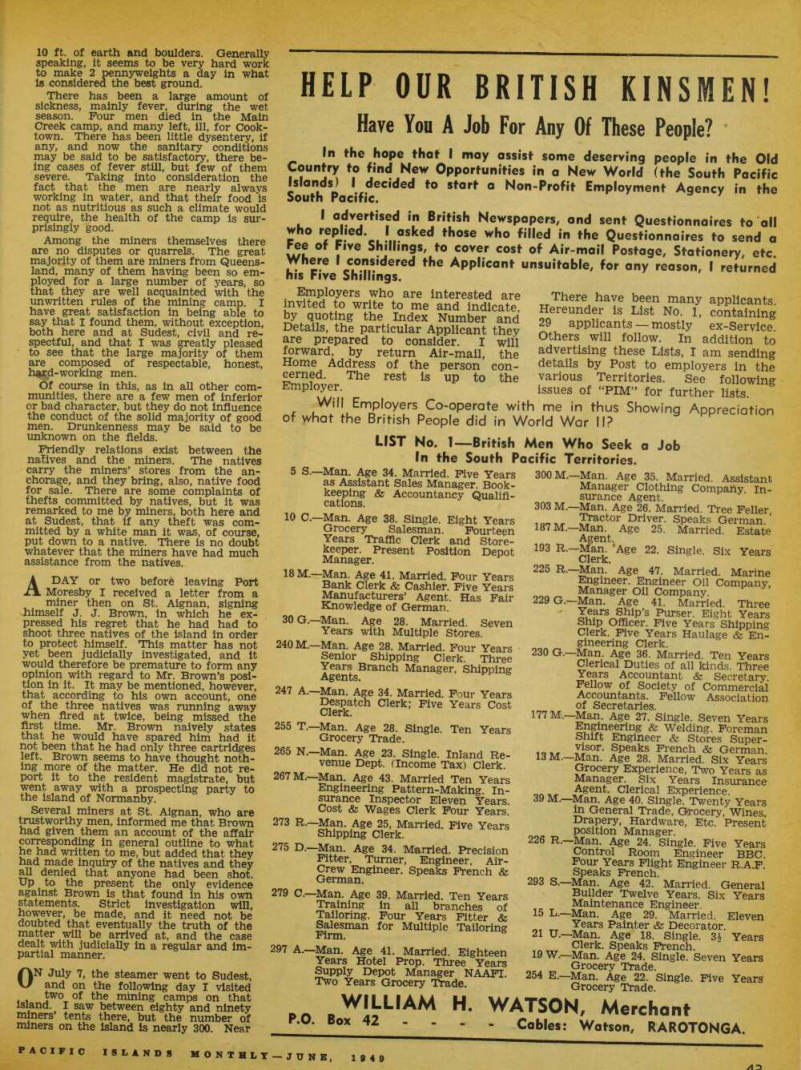
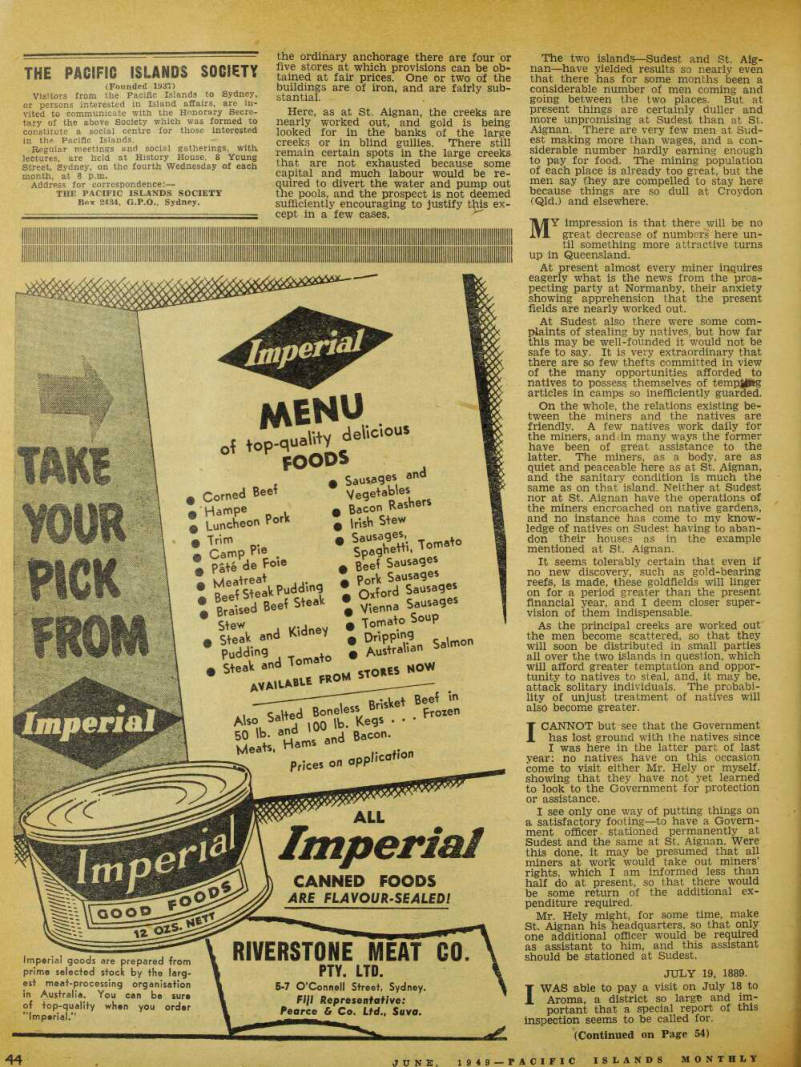
He Laid the Foundations of a Better
Some of the Achievements of Sir William MacGregor, from material collected by Alice Allen Innes.
IN this period when Governments are so complacently producing what they claim as new native policies, it is as well to remember that there is nothing particularly new in any of them; and that the basis of the current plans for native health, education and general ad vancement were laid by a former genera tion of humanitarians—and not by the theorists and politicians of to-day.
Of these outstanding men of the past, Sir William MacGregor is particularly worthy of note, for his service to native peoples was not confined to one territory.
Many writers have referred to his career and his wide and varied interests, but a comprehensive story of his life has yet to be written. Mr. L. Austin, in the 1927 edition of the “Australian Encyclopedia,” has, with brevity and clarity, gathered the following informative facts, which are worth quoting: “Sir William MacGregor was born in 1846, at Towie in Aberdeenshire, and was the eldest son of John MacGregor, a farm labourer. He received part of his early education at Strathdon manse and after wards at a small school at Tillyduke.
From 1865 to 1867 he attended the Aber deen Grammar School, then entered King’s College and took his Arts degree.
Later he changed to Medicine (MB and CM, 1872; Watson Gold Medal, LRCP, Edin., 1872; MD, Cambridge, 1874). He also studied in Berlin, Florence, and Paris.”
Like Cecil Rhodes, this wide-visioned empire-builder undertook his long and distinguished colonial career for his health’s sake, in the first place. Chest weakness developed when he was on the staff of the Glasgow Infirmary and later, at Aberdeen, it gave him further cause for alarm. So in 1873, he became Assis tant Medical Officer at Seychelles, Then in 1874 he was sent to Mauritius as surgeon of Port Louis Hospital; and, from 1875 to 1888 he was Chief Medical Officer in Fiji. In Fiji he also acted as Receiver-General, Commissioner for Lands, High Commissioner and Consul- General for Western Pacific. Colonial Secretary and Auditor—surely as unique a record of public service as ever made by one man. Furthermore, he was no mere figurehead in any capacity, for he was so keen a student that to each branch of the service he could bring knowledge and wisdom.
The native risings in the mountains of Viti Levu, in 1876, were suppressed with firmness and dignity which left no ran cour but built up mutual respect between Fijian and European which developed with later years. In 1877, the Fiji Native Regulations Board came into wider powers under his leadership.
The story of the measles epidemic in Fiji, and how Dr. MacGregor (as he then was), trained the first Native Medical Practitioner, and laid the foundations of the Suva Medical School, must be well known to all Pacific Islands readers.
However, the story of his winning the Albert and Clark Medal is not so well known to the present generation.
When, about 1874, the “Syria” was wrecked some twelve hours’ sail from Suva, one can imagine the panic there must have been amongst the large coolie passenger list. Dr. MacGregor not only hastily organised relief but went himself with the rescue party.
It is told that he was almost god-like
in his great physical strength and deter mination, dragging one woman by her hair, held in his teeth while he pulled a man in each hand, so bringing them out of the swirling waters into safety. He crawled along the broken mast and saved other helpless and, no doubt, hysterical Indians. One wonders that the descen dants of those Indians, in Fiji, have never built a memorial to their benefactor.
It was in 1879 that the Colonial Office needed this versatile genius to report on financial conditions in Tonga, and in this task also, he was most successful.
The wisdom and forbearance of his Fiji Administration has become a byword, his plans and ambitions to develop the native races, coupled with the remarkable programme (for that time) for a native medical network, led to Dr. MacGregor becoming Administrator of British New Guinea in 1888.
IN 1895 he was appointed Lieutenant- Governor of Papua. In Papua (as British New Guinea was later known) he himself considered that his best work was the establishment of the native Police Force, and system of village constabu lary.
Sir William introduced specified dis tricts for various missions, to prevent overlapping and confusion of denomina tions—but that wise rule faded into the limbo of lost causes, to leave, in Papua, some heritage of bitterness and sectarianism.
He pioneered native training for the Government Service; the land regulations ensuring native rights; the regulations forbidding the sale of liquor or drugs to natives—-in short, he laid the foundations of a native policy which endures to this day. It was taken up loyally, and added
to, and . splendidly developed, by Sir Hubert Murray.
Sir William went forward on a long and distinguished career until he retired in 1914. He died in his native Aberdeen in 1919. (Continued on Next Page)
FROM his lengthy handwritten reports, it is now possible and opportune to read and realise the grip of detail and wide vision that he had in those pioneering days. In rebuilding and replanning our territories in the South- West Pacific we may cull much of value from him.
The reoorts, reprinted were prenared by Sir WUliam for the Governor of Queensland in July, 1889, and cover visits of inspection to the goldmining islands of St. Aignan and Sudest, and
the district of Aroma, east of Port Moresby. sir William wrote: ppttl p of
ttj® ScchkS
spent in V? L w2? P S S f^ a^rS.c P °vt lb if work The schoone? “Markm”was at anchor at usuaf’ * ancnor at me usual ancnorage. .A small native village of some eight or nine houses, fully inhabited, stood at this anchorage when I was at the same spot in the latter part of last year; their houses are still there, but the natives have left them, with the exception of a few who Unger ’ employed more or less by the Europeans living there or passing through to and from the gold diggings in the island. There are fpur or five small stores ° n he , I 1 1?,., thls v J la « e i all u , nsub ; s? n ’ P r a /“y ° f
totrl?tfV“me“rV native
own- received forjheir on this point needs fuller inquiry, on the spot. At these stores provisions can be purchased at moderate prices, and some of them sell the ordinary and betterknown medicines such as fever mixtures, tC The nearest mining camp was on a creek about three miles from the anchorage, and to this I first proceeded. The men’s tents extended over a large area— in fact the miners are so widely distrib uted that it is difficult to say where a camp begins or ends. About 60 or 70 miners’ tents came under observation; but it is believed by the Resident Magistrate and by th e Customs officer at Samarai that there are altogether nearly 400 mi ners 0 n the island, at present. It was impossible to visit all these, or even to learn where many of them were at work, but/1 was able to see enough to
form an opinion with regard to the points that formed the object of my in spection.
The bed of the main creek and of most of its branches have already been searched and washed for gold, and now the men are scattered about looking for new ground ’ or sinking small pits and shaf , ts into the lower terraces near the creek, or are digging into the banks of the creek from its bed. The creeks them selves are practically exhausted, but gold has been found on some of the terraces which may be sufficiently rich to pay working. Traces of gold may be found almost anywhere over this part of the island, but no gold-bearing reef has been reported. jt would thus appear that the future 1 of this field is chiefly dependent on the results that may be obtained from working on the terraces or the
h^fafdU-’
fe™? epochs been the fed of the creek.
While O Cr SS S o ™ first time, not a few men were believed to be making considerably more than wages, as rough gold was found some times m several f ounces.
So Ij are 0 ipriS
Xn4t nothin* “ ar6 domg aimosu nouung.
But it has to be remembered that men that are doing well on gold are very reti cent, while those that are indolent or unfortunate are, generally speaking, the reverse. i saw a great many dishes of stuff washed, none without “colours” of gold, but none yielding more than from 2 gr. to 4 gr., and the best only where there was but a small quantity of the deposit worth washing, and below sometimes 8 ft. or
10 ft. of earth and boulders. Generally speaking, it seems to be very hard work to make 2 pennyweights a day in what is considered the best ground.
There has been a large amount of sickness, mainly fever, during the wet season. Pour men died in the Main Creek camp, and many left, ill, for Cook town. There has been little dysentery, if any, and now the sanitary conditions may be said to be satisfactory, there be ing cases of fever still, but few of them severe. Taking into consideration the fact that the men are nearly always working in water, and that their food is not as nutritious as such a climate would require, the health of the camp is sur prisingly good.
Among the miners themselves there are no disputes or quarrels. The great majority of them are miners from Queens land, many of them having been so em ployed for a large number of years, so that they are well acquainted with the unwritten rules of the mining camp. I have great satisfaction in being able to say that I found them, without exception, both here and at Sudest, civil and re spectful, and that I was greatly pleased to see that the large majority of them are composed of respectable, honest,
hard-working men.
Of course in this, as in all other com munities, there are a few men of inferior or bad character, but they do not influence the conduct of the solid majority of good men. Drunkenness may be said to be unknown on the fields.
Friendly relations exist between the natives and the miners. The natives carry the miners’ stores from the an chorage, and they bring, also, native food for sale. There are some complaints of thefts committed by natives, but it was remarked to me by miners, both here and at Sudest, that if any theft was com mitted by a white man it was, of course, put down to a native. There is no doubt whatever that the miners have had much assistance from the natives.
A DAY or two before leaving Port Moresby I received a letter from a miner then on St, Aignan, signing himself J. J. Brown, in which he ex pressed his regret that he had had to shoot three natives of the island in order to protect himself. This matter has not yet been judicially investigated, and It would therefore be premature to form any opinion with regard to Mr. Brown’s posi tion in it. It may be mentioned, however, that according to his own account, one of the three natives was running away when fired at twice, being missed the first time. Mr. Brown naively states that he would have spared him had it not been that he had only three cartridges left. Brown seems to have thought noth ing more of the matter. He did not re port it to the resident magistrate, but went away with a prospecting party to the island of Normanby.
Several miners at St. Aignan, who are trustworthy men, informed me that Brown had given them an account of the affair corresponding in general outline to what he had written to me, but added that they had made inquiry of the natives and they all denied that anyone had been shot.
Up to the present the only evidence against Brown is that found in his own statements. Strict investigation will, however, be made, and it need not be doubted that eventually the truth of the matter will be arrived at, and the case dealt with judicially in a regular and im partial manner.
ON July 7, the steamer went to Sudest, and on the following day I visited two of the mining camps on that Island. I saw between eighty and ninety miners’ tents there, but the number of miners on the island is nearly 300. Near
the ordinary anchorage there are four or five stores at which provisions can be ob tained at fair prices. One or two of the buildings are of iron, and are fairly sub stantial.
Here, as at St. Aignan, the creeks are nearly worked out, and gold is being looked for in the banks of the large creeks or in blind gullies. There still remain certain spots in the large creeks that are not exhausted because some capital and much labour would be re quired to divert the water and pump out the pools, and the prospect is not deemed sufficiently encouraging to justify t)iis ex cept in a few cases.
The two islands—Sudest and St. Aig nan—have yielded results so nearly even that there has for some months been a considerable number of men coming and going between the two places. But at present things are certainly duller and more unpromising at Sudest than at St.
Aignan. There are very few men at Sud est making more than wages, and a con siderable number hardly earning enough to pay for food. The mining population of each place is already too great, but the men say they are compelled to stay here because things are so dull at Croydon (Qld.) and elsewhere.
MY impression is that there will be no great decrease of numbers here un til something more attractive turns up in Queensland.
At present almost every miner inquires eagerly what is the news from the pros pecting party at Normanby, their anxiety showing apprehension that the present fields are nearly worked out.
At Sudest also there were some com plaints of stealing by natives, but how far this may be well-founded it would not be safe to say. It is very extraordinary that there are so few thefts committed in view of the many opportunities afforded to natives to possess themselves of tempjißg articles in camps so inefficiently guarded.
On the whole, the relations existing be tween the miners and the natives are friendly. A few natives work daily for the miners, and in many ways the former have been of great assistance to the latter. The miners, as a body, are as quiet and peaceable here as at St. Aignan, and the sanitary condition is much the same as on that island. Neither at Sudpst nor at St. Aignan have the operations of the miners encroached on native gardens, and no instance has come to my know ledge of natives on Sudest having to aban don their houses as in the example mentioned at St. Aignan.
It seems tolerably certain that even if no new discovery, such as gold-bearing reefs, is made, these goldfields will linger on for a period greater than the present financial year, and I deem closer super vision of them indispensable.
As the principal creeks are worked out the men become scattered, so that they will soon be distributed in small parties all over the two islands in question, which will afford greater temptation and oppor tunity to natives to steal, and, it may be, attack solitary individuals. The probabi lity of unjust treatment of natives will also become greater.
I CANNOT but see that the Government has lost ground with the natives since I was here in the latter part of last year: no natives have on this occasion come to visit either Mr. Hely or myself, showing that they have not yet learned to look to the Government for protection or assistance.
I see only one way of putting things on a satisfactory footing—to have a Govern ment officer stationed permanently at Sudest and the same at St. Aignan. Were this done, it may be presumed that all miners at work would take out miners’ rights, which I am informed less than half do at present, so that there would be some return of the additional ex penditure required.
Mr. Hely might, for some time, make St. Aignan his headquarters, so that only one additional officer would be required as assistant to him, and this assistant should be stationed at Sudest.
July 19, 1889.
IWAS able to pay a visit on July 18 to Aroma, a district so large and im portant that a special report of this inspection seems to be called for.
(Continued on Page 54)
The population of Aroma is estimated at about 4,000 native people, who live all closely together and seem to act as one community—circumstances which render Aroma the most powerful people on the coast east of Port Moresby, They are, moreover, notorious for independence of character, and have among them Koa pena, perhaps the most influential chief in British New Guinea. I had a strong wish to pay a visit to Aroma before I left the possession to proceed to Austra lia, as the district has been of doubtful loyalty, and several messages reached me . that I should be attacked if I went there.
It is therefore very satisfactory to be able to state that I had every reason to be pleased with my reception and the immediate results of my inspection, for which I am no doubt indebted to some ex tent to the tact and forethought of the Rev. Mr. Pearse, of Kerepuni, who had come from his station to meet me .at Aroma, but had to return before my ar rival there.
The t eac h ers of the London Missionary Society, accompanied by Koapena, came on board the “Merrie England” soon after W e dropped anchor, and after breakfast i went ashore with them. We went first
to the mission establishment at the land ing place, where I was carried ashore by Koapena himself, and then I heard the scholars read and sing.
About 50 children were present, half a dozen of whom read the New Testament in the Hula and Kalo language—they do not possess books printed in the Aroma tongue. Here I had presented to me Koapena’s eldest son, his wife, and daughters.
I then went about three miles along the beach to Koapena’s large village, and after calling on the mission establishment there, which is about 200 yards from the native village and surrounded by a fence, we proceeded to Koapena’s house.
The village is a very large one, in a sandy hollow about 300 yards from the beach, from which it is separated by sand-dunes about 50 feet or 60 feet high, on one of which stands the church. There are about 334 houses, built on posts about 6 feet or 8 feet off the ground, with wide open ends as in the houses on Good enough Island. They are built closely together, so that a fire would be readily communicated from one to another. 11TE went from Koapena’s house to the ▼ T church and school, where about 150 adults and children assembled, and I heard the pupils read and sing. We then returned and had lunch with Koa pena in his own house, and received from him and his son some presents of native craftsmanship. Hundreds of people came round about us and accompanied us all day, behaving in the most friendly man ner, none carrying arms of any kind, and the most curious of all being the women and children—the latter in swarms.
I have proposed to Koapena that his eldest son, a fine young man of 25 or 26, shall come and live with me for about six months after my return from Aus tralia, in order that he may be able to understand something of the Government and of the ways of Europeans. Koapena warmly approved of this proposal, from which it is expected that considerable advantage will be derived in many ways.
The population of Aroma is a healthy one, practically free from leprosy, ele phantiasis, and dysentery; but, unfor tunately, largely affected by that loath some species of ringworm, Tinea des quamans. Food is abundant. They have yams, sweet potatoes, and bananas in plenty and they possess large areas of coconut trees, for which the district is specially suitable.
The London Missionary Society is strongly represented here by four or five native teachers, but at few places have they had greater difficulties to contend with.
WHEREVER a Papuan community is large and powerful it is insolent, and Aroma has, in proportion to its great power and its numbers, tried the patience and the courage of those men and women who have laboured disin terestedly for the good of those people, often at the risk of their lives.
The London Missionary Society has now, however, a footing at Aroma, which I consider firm: but although many hun dreds of children and adults go to school and chutrch, difficulty and danger in missionary work are not yet extinct in this district.
Koanena is and has been consistently a protector of the missionaries, for.which I warmly thanked him, but he steadfastly remains a heathen himself. Many people who have experience of Papuans and are acquainted with Aroma have expressed to me the opinion that the Aroma natives would resist the Government, and that it whuld be a difficult task to subdue them.
I have, however, strong hopes that with tact and patience Aroma may be brought under Government influence
and control without resort to force, and if Koapena’s son comes to live near me for six. months, as arranged, my hope of obtaining control over Aroma in a peace ful manner will be much strengthened.
I did not land a large party at Aroma, as it was not desirable that the natives should think I was in any way intimi dated by the threats some of them have uttered. But three or four of my men carried rifles —although I had none my self —that they might see we are always on our guard, whether among friends or otherwise, and cannot be surprised in the sandhills, as they boasted we could be.
It should never be forgotten that Aroma, like every other district here, has a deep respect for power, and an insolent contempt for the want of it.
EDITORIAL NOTE: And in that last sentence Sir William MacGregor said something that is as true to-day as it was when he wrote it, 60 years ago. It ap plies to all peoples—not alone to Papua.
Advertisements & other items, pp. 43-46 (1 item)
Broomfields Ltd.
G. H. Robinson
Exports & Imports Pty., Ltd.
ISLAND SUPPLIES
of all kinds—Selected and Shipped to order at lowest possible prices—Piecegoods in Wool, Cotton and Silk, Under and Outerwear, Manchester, Drapery, Grocery, Hardware, Engineers and Leathergoods trade supplies a specialty.
Indents and Transhipments arranged. Large or small orders treated with equal care.
Use our 25 years’ extensive experience.
Enquiries solicited to —
G. H. ROBINSON
Exports & Imports Pty., Ltd. 51 Macquarie Street, Sydney, N.S.W.
Telegrams; Sunrise, Sydney.
Letters: Box 3317, G.P.0., Sydney.
BROOMFIELDS Ltd.
Suppliers of
Building Hardware
Ship Chandlery, Paint Materials
3
WRITE DIRECT TO:
Broomfields Ltd., 152 Sussex Street, Sydney
The Twinkle in
Your Eye
COMES FROM ACTIVE
DIGESTION
Good normal digestive and liver activity means good, normal health and fitness. If yo» are becoming gloomy and feel tired out, the cause may be a congested state of your intestinal tract. So many people are troubled with constipation, which, through the retention of waste in the digestive system, causes sick headache, biliousness, pimply skin, unpleasant breath, irritability, slackness and dull eyes.
Regain your bright and attractive appearance by banishing constipation with Pinkettes. Tiny, perfectly harmless, gentle yet effective, these famous laxative and liver pills painlessly exercise and strengthen the bowels, keep the food tract clean and active, stir the liver, and thus banish sick headache, bilious attacks, pimples, unpleasant breath and gloom. All chemists and stores sell Pinkettes, the perfect laxative and liver pills.
hit* m m i Above: 90 HP RNR6 type with 2/1 or 3/1 reduction, and patent angle lever control. ★ Sterngear made to order After sales, service and spares facilities always available
THORNYCROFT (Anst.) Pty. Ltd.
6-10 WATTLE ST., PYRMONT, N.S.W.
A DIRECT BRANCH OF THE MANUFACTURERS.
T 0
MARINE ENGINES
PETROL OR DIESEL
9 to 130 HP Reliable —efficient and economical for all types of vessels
FULL PARTICULARS ON REQUEST.
1 65 HP RTR6 type, 2/1 reduction.
HELP OUR BRITISH KINSMEN!
Have You A Job For Any Of These People?
In Hie hope thot I may assist some deserving people in the Old Country to find New Opportunities in a New World (the South Pacific Islands) I decided to start a Non-Profit Employment Agency in the South Pacific.
I advertised in British Newspapers, and sent Questionnaires to all who replied. I asked those who filled in the Questionnaires to send a Fee of Five Shillings to cover cost of Air-mail Postage, Stationery, etc.
Where I considered the Applicant unsuitable, for any reason, I returned his Five Shillings.
Employers who are interested are invited to write to me and indicate, by quoting the Index Number and Details, the particular Applicant they are prepared to consider. I will forward, by return Air-mail, the Home Address of the person concerned. The rest is up to the Employer.
There have been many applicants.
Hereunder is List No. 1, containing 29 applicants mostly ex-Service.
Others will follow. In addition to advertising these Lists, I am sending details by Post to employers in the various Territories. See following issues of “PIM” for further lists.
Will Employers Co-operate with me in thus Showing Appreciation of what the British People did in World War II? 5 s.
LIST No. I—British Men Who Seek a Job In the South Pacific Territories. .—Man. Age 34. Married. Five Years as Assistant Sales Manager. Bookkeeping & Accountancy Qualifications. 10 C.—Man. Age 38. Single. Eight Years Grocery Salesman. Fourteen Years Traffic Clerk and Storekeeper. Present Position Depot Manager. —Man. Age 41. Married. Four Years Bank Clerk & Cashier. Five Years Manufacturers’ Agent. Has Fair Knowledge of German. -Man. Age 28. Married. Seven Years with Multiple Stores. -Man. Age 28. Married, Pour Years Senior Shipping Clerk. Three Years Branch Manager, Shipping Agents.
Man. Age 34. Married. Four Years Despatch Clerk; Five Years Cost Clerk. -Man. Age 28. Single. Ten Years Grocery Trade. -Man. Age 23. Single. Inland Revenue Dept. (Income Tax) Clerk. -Man. Age 43. Married Ten Years Engineering Pattern-Making. Insurance Inspector Eleven Years.
Cost & Wages Clerk Pour Years. -Man. Age 25, Married. Five Years Shipping Clerk. -Man. Age 34. Married. Precision Fitter, Turner, Engineer. Air- Crew Engineer. Speaks French & German. -Man. Age 39. Married. Ten Years Training In all branches of Tailoring. Four Years Fitter & Salesman for Multiple Tailoring Firm. 18 M, 30 G. 240 M. 247 A.—: 255 T. 265 N.- 267 M.- 273 R.- 275 D.- 279 C.- 297 A.—j Man. Age 41. Married. Eighteen Years Hotel Prop. Three Years Supply Depot Manager NAAFI.
Two Years Grocery Trade. 300 M.—Man. Age 35. Married. Assistant Manager Clothing Company, insurance Agent. 303 M.—Man. Age 26. Married. Tree Feller lon tut factor Driver. Speaks German.’ 187 M.—Man. Age 25. Married. Estate Agent, 193 R-—Man. 'Age 22. Single. Six Years Clerk. 225 R.—Man. Age 47. Married. Marine Engineer. Engineer Oil Company, Manager Oil Company. 229 G.—Man. Age 41. Married. Three Years Ship’s Purser. Eight Years Ship Officer. Five Years Shipping Clerk. Five Years Haulage & Engineering Clerk. 230 G.—Man. Age 36. Married. Ten Years Clerical Duties of all kinds. Three Years Accountant & Secretary.
Fellow of Society of Commercial Accountants. Fellow Association of RpprpfQiHac 177 M». Man. Age 27. Single. Seven Years Engineering & Welding. Foreman Shift Engineer & Stores Supervisor. Speaks French & German. 13 M.—Man. Age 28. Married. Six Years Grocery Experience, Two Years as Manager. Six Years Insurance . Agent. Clerical Experience. 39 M.—Man. Age 40. Single. Twenty Years m General Trade, Grocery, Wines, Drapery, Hardware, Etc. Present Potion Manager. 226 R.—Man. Age 24. Single. Five Years Control Room Engineer BBC.
Four Years Flight Engineer R.A.F.
Speaks French. 293 S.—Man. Age 42. Married. General Builder Twelve Years. Six Years Maintenance Engineer. 15 L.—Man. Age 29. Married. Eleven Years Painter Decorator. 21 U.—Man. Age 18. Single. 3i Years Clerk. Speaks French. 19 W.—-Man. Age 24. Single. Seven Years Grocery Trade. 254 E.—Man. Age 22. Single. Five Years Grocery Trade.
WILLIAM H. WATSON, Merchant
PO ‘ Box 42 - - - - Cables: Watson, RAROTONGA.
THE PACIFIC ISLANDS SOCIETY
(Founded 1937) Visitors from the Pacific Islands to Sydney, or persons interested in Island affairs, are invited to communicate with the Honorary Secretary of the above Society which was formed to constitute a social centre for those interested in the Pacific Islands.
Regular meetings and social gatherings, with lectures, are held at History House, 8 Young Street, Sydney, on the fourth Wednesday of each month, at 8 p.m.
Address for correspondence:—
THE PACIFIC ISLANDS SOCIETY
Box 2434, G.P.0,, Sydney.
I' r->, . :ii
menu
0 , top-q U .'«V defeoUs
foods
9 Corned Beet • Hampe s Luncheon PorK • Trim r>- 9 Camp P>« 9 Pate de Foie
9 tdeatreat
9 Sausag® s and
Vegetables
9 Bacon Rashers 9 Irish Stew * |£5S. To»»"
B r ee f Sausages w « i. Caiicaaes -v; - * a pate ae rw«« beeT ■* ; §l. : & s, “ i ; vi.». stew Kidney • To ™ a * 0 ,, P
•SAT' :S3S.«*-
/ s ,„ k ..ar-a * w To 3^ Imperial goods are prepared from prime selected stock by the largest meat-processing organisation in Australia. You can be sure of top-quality when you order "Imperial."
ALL
Imperial
CANNED FOODS
ARE FLAVOUR-SEALED!
RIVERSTONE MEAT CO.
PTY. LTD.
5-7 O'Connell Street, Sydney.
Fiji Representative: Pearce & Co. Ltd., Suva.
Magazine Section
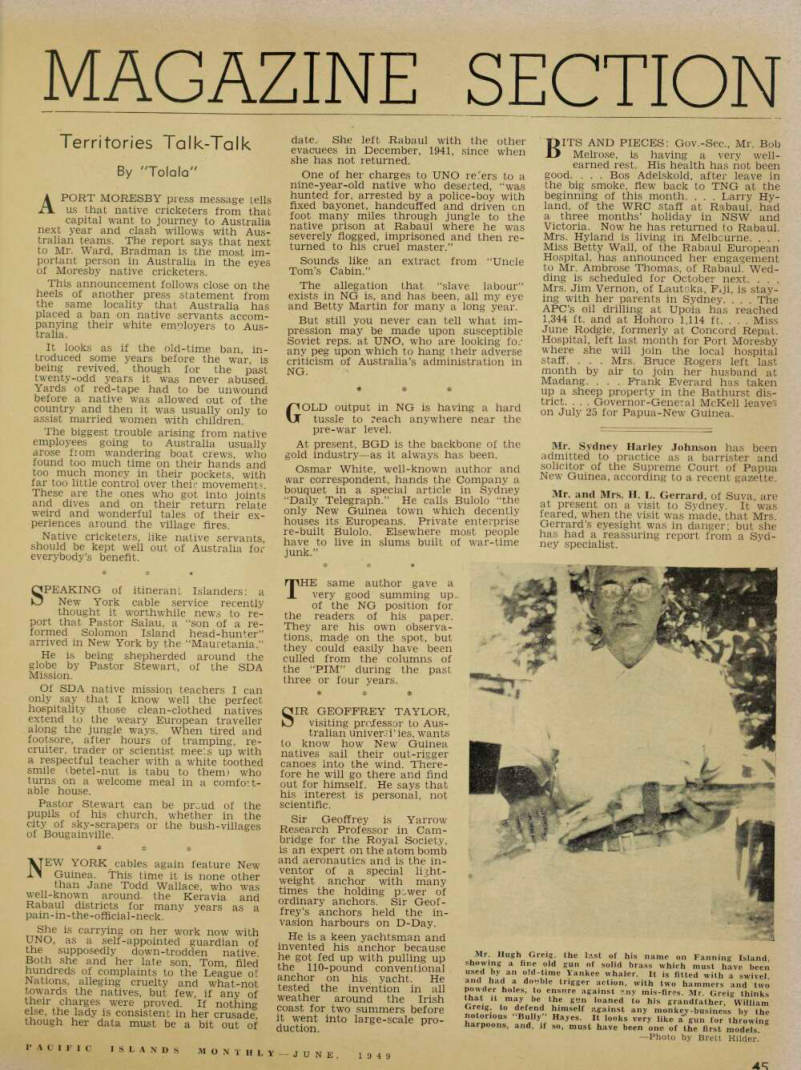
Territories Talk-Talk
By "Tolala"
A PORT MORESBY press message tells us that native cricketers from that capital want to journey to Australia next year and clash willows with Aus tralian teams. The report says that next to Mr. Ward, Bradman is the most im portant person in Australia in the eyes of Moresby native cricketers.
This announcement follows close on the heels of another press statement from the same locality that Australia has placed a ban on native servants accom panying their white employers to Aus tralia.
It looks as if the old-time ban, in troduced some years before the war, is being revived, though for the past twenty-odd years it was never abused.
Yards of red-tape had to be unwound before a native was allowed out of the country and then it was usually only to assist married women with children.
The biggest trouble arising from native employees going to Australia usually arose from wandering boat crews, who found too much time on their hands and too much money in their pockets, with far too little control over their movement?.
These are the ones who got into joints and dives and on their return relate weird and wonderful tales of their ex periences around the village fires.
Native cricketers, like native servants, should be kept well out of Australia for everybody’s benefit. * * * SPEAKING of itinerant Islanders: a New York cable service recently thought it worthwhile news to re port that Pastor Salau, a “son of a re formed Solomon Island head-hunter” arrived in New York by the “Mauretania.”
He is being shepherded around the globe by Pastor Stewart, of the SDA Mission.
Of SDA native mission teachers I can only say that I know well the perfect hospitality those clean-clothed natives extend to the weary European traveller along the jungle ways. When tired and footsore, after hours of tramping, re cruiter, trader or scientist mee's up with a respectful teacher with a white toothed smile (betel-nut is tabu to them) who turns on a welcome meal in a comfoit able house.
Pastor Stewart can be proud of the pupils of his church, whether in the city of sky-scrapers or the bush-villages of Bougainville. * * * NEW YORK cables again feature New Guinea. This time it is none other than Jane Todd Wallace, who was well-known around the Keravia and Rabaul districts for many years as a pain-in-the-official-neck.
She is carrying on her work now with UNO, as a self-appointed guardian of the supposedly down-trodden native Both she and her late son, Tom, filed hundreds of complaints to the League of Nations, alleging cruelty and what-not towards the natives, but few, if any of their charges were proved. If nothing else, the lady is consistent in her crusade, though her data must be a bit out of
date. She left Rabaul with the other evacuees in December, 1941, since when she has not returned.
One of her charges to UNO refers to a nine-year-old native who deserted, “was hunted for, arrested by a police-boy with fixed bayonet, handcuffed and driven on foot many miles through jungle to the native prison at Rabaul where he was severely flogged, imprisoned and then re turned to his cruel master.”
Sounds like an extract from “Uncle Tom’s Cabin.”
The allegation that “slave labour” exists in NG is, and has been, all my eye and Betty Martin for many a long year.
But still you never can tell what im pression may be made upon susceptible Soviet reps, at UNO, who are looking for any peg upon which to hang their adverse criticism of Australia’s administration in NG. ♦ * * GOLD output in NG is having a hard tussle to reach anywhere near the pre-war level.
At present, BGD is the backbone of the gold industry—as it always has been.
Osmar White, well-known author and war correspondent, hands the Company a bouquet in a special article in Sydney “Daily Telegraph.” He calls Bulolo “the only New Guinea town which decently houses its Europeans. Private enterprise re-built Bulolo. Elsewhere most people have to live in slums built of war-time junk,”
THE same author gave a very good summing up of the NG position for the readers of his paper.
They are his own observa tions, made on the spot, but they could easily have been culled from the columns of the “PIM” during the past three or four years. ♦ * ♦
Sir Geoffrey Taylor,
visiting processor to Aus tralian universities, wants to know how New Guinea natives sail their out-rigger canoes into the wind. There fore he will go there and find out for himself. He says that his interest is personal, not scientific.
Sir Geoffrey is Yarrow Research Professor in Cam bridge for the Royal Society, is an expert on the atom bomb and aeronautics and is the in ventor of a special light weight anchor with many times the holding power of ordinary anchors. Sir Geof frey’s anchors held the in vasion harbours on D-Day.
He is a keen yachtsman and invented his anchor because he got fed up with pulling up the 110-pound conventional anchor on his yacht. He tested the invention in all weather around the Irish coast for two summers before it went into large-scale pro duction.
Bits And Pieces: Gov.-Sec., Mr. Bob
Melrose, is having a very well earned rest. His health has not been good. . . . Bos Adelskold, after leave in the big smoke, flew back to TNG at the beginning of this month. , . . Larry Hy land, of the WRC staff at Rabaul, had a three months’ holiday in NSW and Victoria. Now he has returned to Rabaul.
Mrs. Hyland is living in Melbourne. . . .
Miss Betty Wall, of the Rabaul European Hospital, has announced her engagement to Mr. Ambrose Thomas, of Rabaul. Wed ding is scheduled for October next. . . .
Mrs. Jim Vernon, of Lautoka, Fiji, is stay ing with her parents in Sydney. . . . The APC’s oil drilling at Upoia has reached 1,344 ft. and at Hohoro 1,114 ft. . . . Miss June Rodgie, formerly at Concord Repat.
Hospital, left last month for Port Moresby where she will join the local hospital staff. , . . Mrs. Bruce Rogers left last month by air to join her husband at Madang. . . . Frank Everard has taken up a sheep property in the Bathurst dis trict. . . . Governor-General McKell leaves on July 25 for Papua-New Guinea.
Mr. Sydney Harley Johnson has been admitted to practice as a barrister and solicitor of the Supreme Court of Papua New Guinea, according to a recent gazette.
Mr. and Mrs. H. L. Gerrard, of Suva, are at present on a visit to Sydney. It was feared, when the visit was made, that Mrs.
Gerrard’s eyesight was in danger; but she has had a reassuring report from a Syd ney specialist.
Mr. Hugh Greig, the last of his name on Fanning Island, showing a hue old gun of solid brass which must have been used by an old-time Yankee whaler. It is fitted with a swivel and had a double trigger action, with two hammers and two powder holes, to ensure against any mis-fires. Mr. Greig thinks that “ may be the gun loaned to his grandfather, William Greig. to defend himself against any monkey-business by the notorious Bully Hayes. It looks very like a gun for throwing harpoons, and, if so, must have been one of the first models. —Photo by Brett Hilder.
Just No Trouble At All
“Dang! Bang! Clang!”
O The raucous ringing of the store bell shatters for a few brassy seconds the customary quiet of the village, and heralds another day. The boys hitch up their lava lavas, leave their houses and come down to work.
We on the “hill” leave our breakfast tables and plunge into the day. I pick up a tin of cigarettes, pocket another box of matches, and scramble down the muddy track.
At the store, I open the small door in the big door, and climb inside the store.
Bella is hot on my heels. She is a good dog and is going to have pups. I have already promised 25.
Inside the store I take a quick look around —what for I do not know. Force of habit mainly, I suppose. I close the small door and open the big door, Aleck, my boss boy, and his minions come from around the corner and begin by sweeping the floor and knocking things over.
I begin by sitting at my desk, lighting a first cigarette and planning a day’s activity. The plan usually runs some thing like this: “I'll get the three sheds cleaned up, and the shelves in the store replenished, and if business is slack I’ll go through that basket of letters and see what has to be answered and filed, and then I’ll answer and file them and tell Maki to clean the refrigerator, and watch that he does it properly, then shift the baro meters and compasses and put them where the clocks are, so everybody who comes in can see them. When I finish that it might be a good idea to mark off the new stock, and tell Maet to go out and get me some razor blades, and take a letter to so-and-so, and enter up the copra brought in yesterday after noon, and get the dock ready for any copra that might come in to-day. Then it will be morning tea-time and I’ll take time out to have a smoke and a cup that cheers.”
All this thinking goes on aloud.
I GLANCE at my watch which prob ably says seven thirty, and the store clock, which if it is working, more than likely points to anything between five past two and next Wednesday, and I tell a boy to open the store.
“Allez! You open ’im.”
He greets this direction with a look of blank and marvellous-to-behold amaze ment, as if opening the door were an unheard of thing.
The vanguard of the day’s army falls in, and a stream of babbling, squabbling, rowdy Tonkinese fills the store. No sound above them can be heard. A few Euro peans drift in, and soon a sea of smiling, scowling, grinning, toothy and toothless faces surrounds me.
Experience has taught me that they all have more time than I, so I calmly light a cigarette, size up the waiting mass and plunge in. Before me on the counter I have ready sundry debit books and odd scraps of paper.
My first choice falls simultaneously on a Frenchman, a Tonkinese and a native.
All three talk at the' same time and somehow, by a miracle I suppose, they are all heard and served, likewise, simul taneously.
The Tonkinese may get the native’s order and the native may get the French man’s and the Frenchman may be sent away with something altogether different
from what he had in mind. But they all get a smile and a friendly word.
Counter conversation may run some thing like this; “Bonjour, monsieur. Que desirez vous?
You fella you make ’im wha’ name ’ere.
Merci beaucoup, nine-and-six a kilo aux soixante seize francs. One storeboy take ’im small case ’ere 'long put ’im all something ’ere ’long ’im. You say you did not get that case of biscuits last week?”
So the conversation runs, with no breaks for punctuation and little for breath.
GRADUALLY the first rush runs itself out. Tonkinese waddle away with cases of gin and brandy; natives are happy with their two shillings worth of tea and one-and-sixpence worth of sugar, and a carefully calculated fifteen and ninepence worth of calico; the Frenchman has gone and left an order with you and you have promised him that you will
By Trader Jack
have it delivered to his ship to-morrow afternoon. You make a mental note that you must “collar” one of the store’s two decrepit trucks when it pauses for a moment on its breathless, round-the clock activity.
Calm restores itself out of what could easily have been chaos, but the remark able part about the whole thing is that it never resolves itself into such an abandoned state as that. The old theory of “take your time” saves the situation.
JUST when you think you have a moment to get to your typewriter and finish off the Indents which should have gone to Sydney last week, a trader comes in with a long list, and a yen for a yarn.
He bemoans conditions as compared with what they were 20 years ago, and gives you a detailed account of his activi ties; while you spend the time thinking how you will shift the hardware down to the next shelf and go through the fancy goods properly, and sort out the odd items of grocery which seem to have got mixed up in them, and restore them to their rightful place.
“You remember that case of biscuits I got from you last month?” the trader asks.
“Yes,” you say. But you do not, be cause you have sold a thousand since then. But anything to keep him happy.
“Well,” he replies, “some of them were rotten.”
“They were?” you ask, astonished that such a thing could have happened, even though you would have been more sur prised if it had not.
But you know him well and he is honest, so you make up the loss and join him in wailing about the way things are done these days.
“Have you seen so and so since I was last over?”
You do not know whether you have or not but “yes” or “no” is equally suit able, so you say whichever comes first.
“He told me he .would leave a dozen duck-eggs with you. Have you got them?
No! Well, will you keep them for me and ask him if he got those spark plugs for his engine he was wanting last year.” He rounds off this miscellany, which is more in Dorothy Dix’s line than yours, by ask ing: “It won’t be any bother will it?”
“No trouble at all!”
So you make a note of it, right before his eyes, and put it on a nail on the wall along with a thousand other notes dating from anything up to a year ago, all aimed at reminding you to think of such varied things as telling John Jones never to put more than three duck-eggs under a ducky hen, and prompting Tom Smith to buy a collar for his dog!
BY the time this client is gone you should be a neurotic wreck—if you are the neurotic type—but as you are not, you are still, more or less, cool, calm and collected. You believe in the philos ophy that what cannot be done to-day will be done to-morrow; because, if you do not you will go mad.
As he goes out the door, he promises he will be ‘‘back to-morrow”. Though why he should be, you cannot imagine.
By this time, all thoughts of cleaning up the hardware are forgotten and you throw yourself into a wild “cleaning up of the files.” Just as you start an indig nant female client sweeps in, and as you stave off her tears, she implores you not to forget her tomato sauce next time.
The time has now arrived, where, if that plan over the first cigarette had held, you would be sitting down drinking tea.
But you can’t, because someone with nothing in particular to do has dropped in.
Even while you are wishing him miles away you are leaning over the counter thinking how you will organise a proper unloading of the next ship only interrupt ing his one-sided conversation with a “yes” or “no”, dropped in the right places by sheer experience. You do not voice your thoughts and tell him to take him self 20 miles away, because he is a good client and a good friend. He has brought you in meat, fruit and vegetables from his plantation many a time.
But you do wish him away, and quickly!
When he does go the tea is cold and it is 11 a.m. and time to knock off. You want to finish that book, or write that letter. But even though you drop the broad hint of telling the store boys to “close ’im up altoget’er,” and call out in a very loud voice to the cook asking him if “kai kai belong you ’e ready?”, the lingerers in the store do not go.
Finally they do go; but your three hours’ noon break—which you were going to use to clean up the bulk shed —has been re duced to one hour, because you promised someone you would take a look at his copra at 12.30 and give it the OK.
“No trouble at all,” you assure them.
But you should ask them if they will be a witness for the defense in the event of your committing what you feel would be
justifiable homicide.
By flying from Nadi to Mascot, 1,980 miles, on May 15, in 7 hours, 10 minutes, a BOAC airliner, a DC6, clipped five minutes off the previous Fiji-Sydney record, which had been made by a similar machine last November. The plane flew at 270 m.p.h. * * * The Banks line cargo steamer “Meadowbank’’ arrived at Honiara from Townsville on May 20. She will load for Britain the biggest post-war ship ment of Solomon Islands copra—2,3oo tons.
The Movies
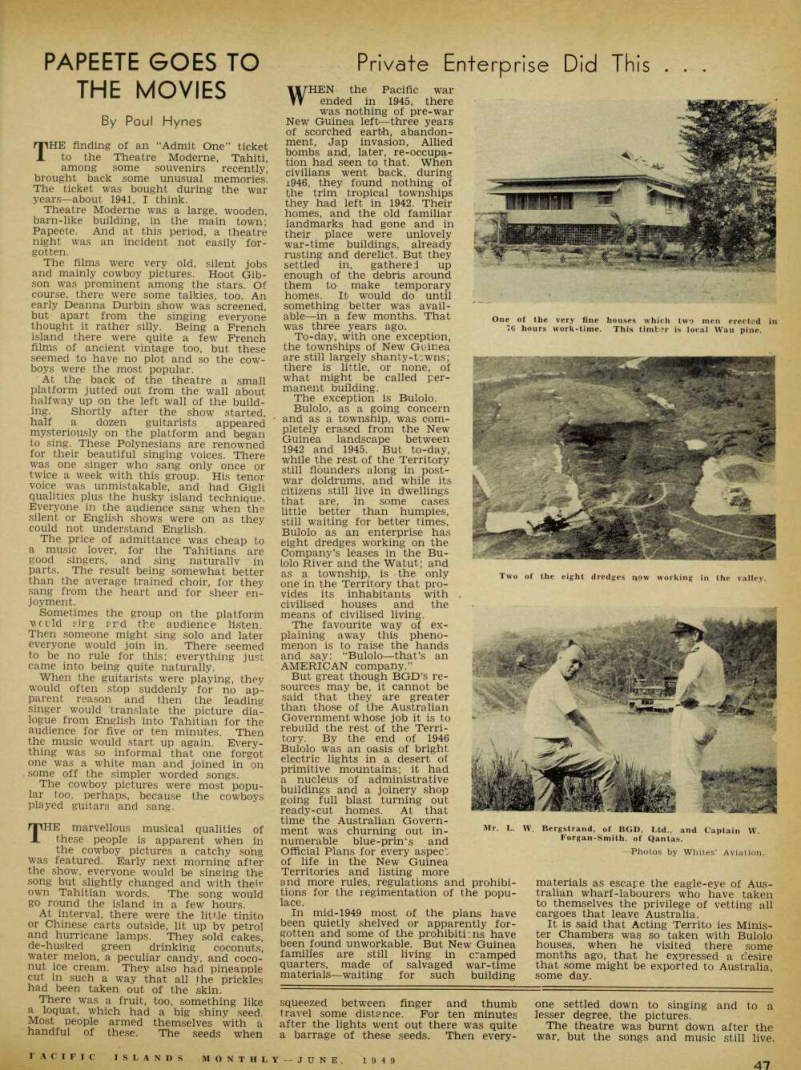
Papeete Goes To
By Paul Hynes
THE finding of an “Admit One’’ ticket to the Theatre Moderne, Tahiti, among some souvenirs recently, brought back some unusual memories.
The ticket was bought during the war years—about 1941, I think.
Theatre Moderne was a large, wooden, barn-like building, in the main town; Papeete. And at this period, a theatre night was an incident not easily for gotten.
The films were very old, silent jobs and mainly cowboy pictures. Hoot Gib son was prominent among the stars. Of course, there were some talkies, too. An early Deanna Durbin show was screened, but apart from the singing everyone thought it rather silly. Being a French island there were quite a few French films of ancient vintage too, but these seemed to have no plot and so the cow boys were the most popular.
At the back of the theatre a small platform jutted out from the wall about halfway up on the left wall of the build ing. Shortly after the show started, half a dozen guitarists appeared mysteriously on the platform and began to sing. These Polynesians are renowned for their beautiful singing voices. There was one singer who sang only once or twice a week with this group. His tenor voice was unmistakable, and had Gigli qualities plus the husky island technique.
Everyone in the audience sang when the silent or English shows were on as they could not understand English.
The price of admittance was cheap to a music lover, for the Tahitians are good singers, and sing naturallv in parts. The result being somewhat better than the average trained choir, for they sang from the heart and for sheer en joyment.
Sometimes the group on the platform vculd sirg gird the audience listen.
Then someone might sing solo and later everyone would join in. There seemed to be no rule for this; everything just came into being quite naturally.
When the guitarists were playing, they would often stop suddenly for no ap parent reason and then the leading singer would translate the picture dia logue from English into Tahitian for the audience for five or ten minutes. Then the music would start up again. Every thing was so informal that one forgot one was a white man and joined in on some off the simpler worded songs.
The cowboy pictures were most popu lar too, perhaps, because the cowboys played guitars and sang.
THE marvellous musical qualities of these people is apparent when in the cowboy pictures a catchy song was featured. Early next morning after the show, everyone would be sinking the song but slightly changed and with their own Tahitian words. The song would go round the island in a few hours.
At interval, there were the little tinito or Chinese carts outside, lit up by petrol and hurricane lamps. They sold cakes, de-husked green drinking coconuts, water melon, a peculiar candy, and coco nut ice cream. They also had pineapple cut in such a way that all the prickles had been taken out of the skin.
There was a fruit, too, something like a loquat, which had a big shiny seed.
Most people armed themselves with a handful of these. The seeds when
squeezed between finger and thumb travel some distance. For ten minutes after the lights went out there was quite a barrage of these seeds. Then every-
one settled down to singing and to a lesser degree, the pictures, The theatre was burnt down after the war, but the songs and music still live.
Private Enterprise Did This . . .
WHEN the Pacific war ended in 1945, there was nothing of pre-war New Guinea left—three years of scorched earth, abandon ment, Jap invasion, Allied bombs and, later, re-occupa tion had seen to that. When civilians went back, during i 946, they found nothing of the trim tropical townships they had left in 1942. Their homes, and the old familiar landmarks had gone and in their place were unlovely war-time buildings, already rusting and derelict. But they settled in, gathered up enough of the debris around them to make temporary homes. It would do until something better was avail able —in a few months. That was three years ago.
To-day, with one exception, the townships of New Guinea are still largely shanty-tcwns; there is little, or none, of what might be called per manent building.
The exception is Bulolo.
Bulolo, as a going concern and as a township, was com pletely erased from the New Guinea landscape between 1942 and 1945. But to-day, while the rest of the Territory still flounders along in post war doldrums, and while its citizens still live in dwellings that are, in some cases little better than humpies, still waiting for better times, Bulolo as an enterprise has eight dredges working on the Company’s leases in the Bu lolo River and the Watut; and as a township, is the only one in the Territory that pro vides its inhabitants with civilised houses and the means of civilised living.
The favourite way of ex plaining away this pheno menon is to raise the hands and say: “Bulolo —that’s an AMERICAN company.’’
But great though BGD’s re sources may be, it cannot be said that they are greater than those of the Australian Government whose job it is to rebuild the rest of the Terri tory. By the end of 1946 Bulolo was an oasis of bright electric lights in a desert of primitive mountains; it had a nucleus of administrative buildings and a joinery shop going full blast turning out ready-cut homes. At that time the Australian Govern ment was churning out in numerable blue-prhTs and Official Plans for every aspect of life in the New Guinea Territories and listing more
and more rules, regulations and prohibi tions for the regimentation of the popu lace.
In mid-1949 most of the plans have been quietly shelved or apparently for gotten and some of the prohibitions have been found unworkable. But New Guinea families are still living in cramped quarters, made of salvaged war-time materials —waiting for such building
materials as escape the eagle-eye of Aus tralian wharf-labourers who have taken to themselves the privilege of vetting all cargoes that leave Australia.
It is said that Acting Territo.ies Minis ter Chambers was so taken with Bulolo houses, when he visited there some months ago, that he expressed a desire that some might be exported to Australia, some day.
One of the very fine houses which two men erected in 76 hours work-time. This timber is local Wau pine.
Two of the eight dredges now working in the valley.
Mr. L. W. Bergstrand, of BGD, Ltd., and Captain W.
Forgan-Smith, of Qantas.
Photos by Whites’ Aviation.
The Navy Shows The Flag
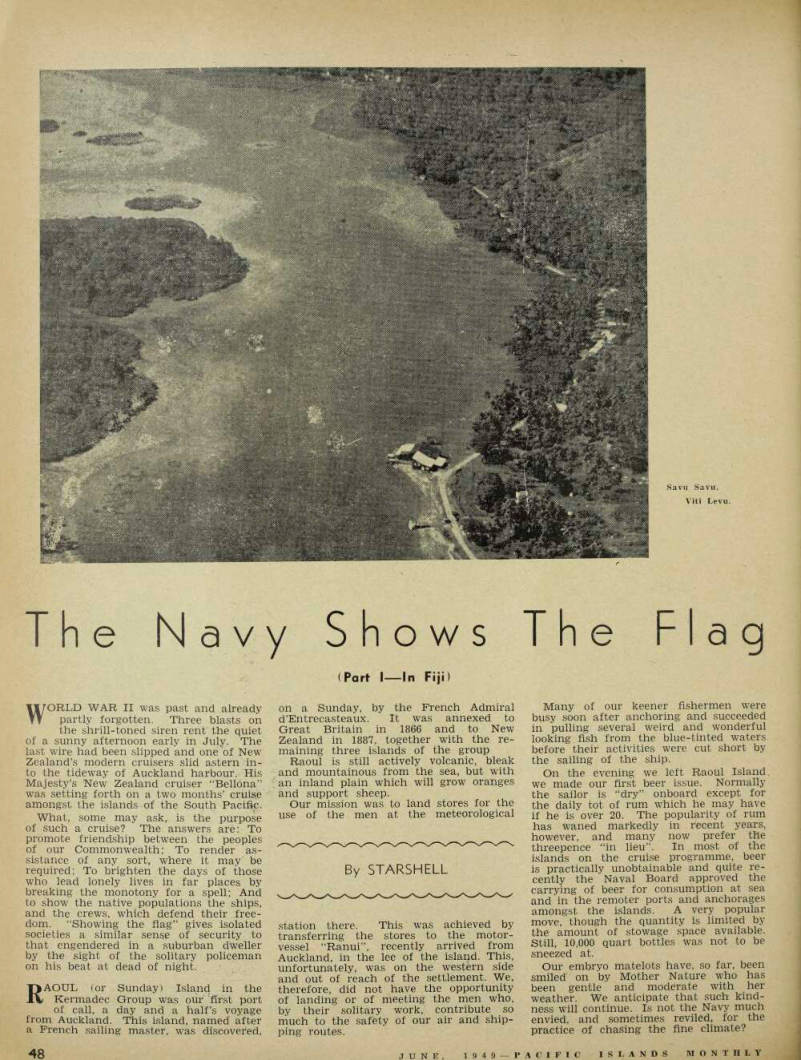
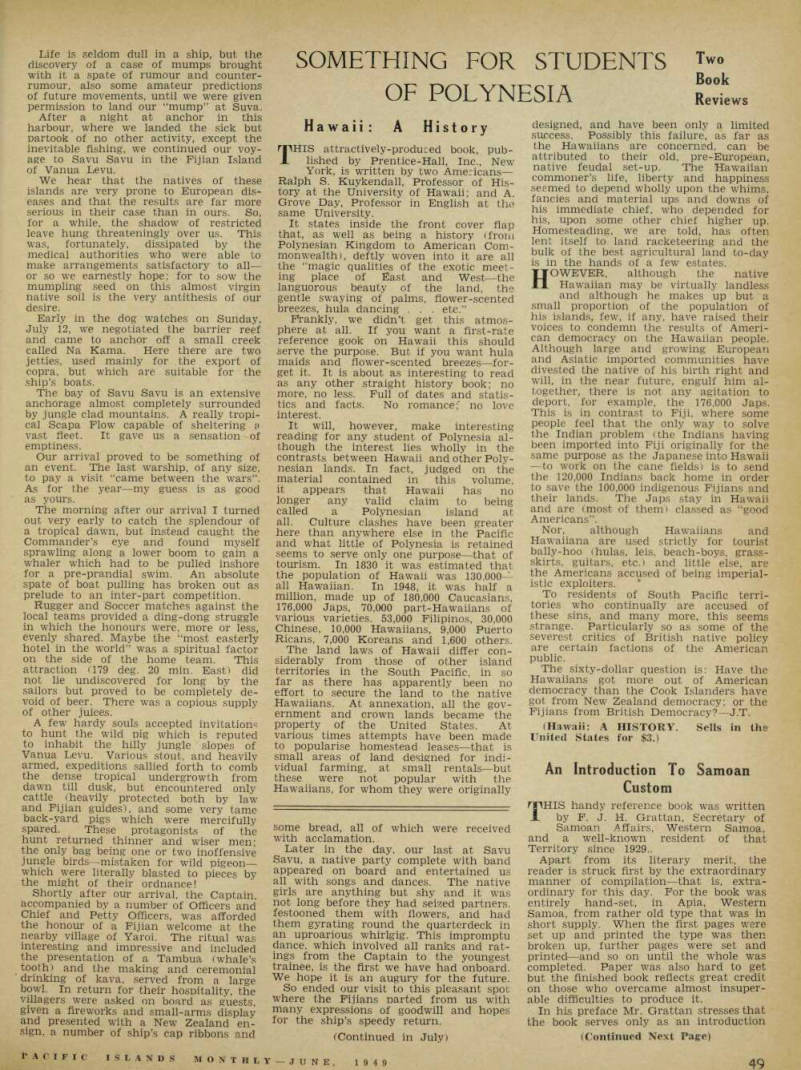
(Fart I—ln Fiji)
WORLD WAR II was past and already partly forgotten. Three blasts on the shrill-toned siren rent the quiet of a sunny afternoon early in July. The last wire had been slipped and one of New Zealand’s modern cruisers slid astern in to the tideway of Auckland harbour. His Majesty’s New Zealand cruiser “Belldna” was setting forth on a two months’ cruise amongst the islands of the South Pacific.
What, some may ask, is the purpose of such a cruise? The answers are; To promote friendship between the peoples of our Commonwealth: To render as sistance of any sort, where it may' be required; To brighten the days of those who lead lonely lives in far places by breaking the monotony for a spell; And to show the native populations the ships, and the crews, which defend their free dom. “Showing the flag” gives isolated societies a similar sense of security to that engendered in a suburban dweller by the sight of the solitary policeman on his beat at dead of night.
RAOUL (or Sunday) Island in the Kermadec Group was our first port of call, a day and a half’s voyage from Auckland. This island, named after a French sailing master, was discovered,
on a Sunday, by the French Admiral d’Entrecasteaux. It was annexed to Great Britain in 1866 and to New Zealand in 1887, together with the re maining three islands of the group Raoul is still actively volcanic, bleak and mountainous from the sea, but with an inland plain which will grow oranges and support sheep.
Our mission was to land stores for the use of the men at the meteorological
By Starshell
station there. This was achieved by transferring the stores to the motor vessel “Ranui”, recently arrived from Auckland, in the lee of the island. This, unfortunately, was on the western side and out of reach of the settlement. We, therefore, did not have the opportunity of landing or of meeting the men who. by their solitary work, contribute so much to the safety of our air and ship ping routes.
Many of our keener fishermen were busy soon after anchoring and succeeded in pulling several weird and wonderful looking fish from the blue-tinted waters before their activities were cut short by the sailing of the ship.
On the evening we left Raoul Island we made our first beer issue. Normally the sailor is “dry” onboard except for the daily tot of rum which he may have if he is over 20. The popularity of rum has waned markedly in recent years, however, and many now prefer the threepence “in lieu”. In most of the islands on the cruise programme, beer is practically unobtainable and quite re cently the Naval Board approved the carrying of beer for consumption at sea and in the remoter ports and anchorages amongst the islands. A very popular move, though the quantity is limited by the amount of stowage space available.
Still, 10,000 quart bottles was not to be sneezed at.
Our embryo matelots have, so far, been smiled on by Mother Nature who has been gentle and moderate with her weather. We anticipate that such kind ness will continue. Is not the Navy much envied, and sometimes reviled, for the practice of chasing the fine climate?
Savu Savu, Viti Levu.
Life is seldom dull in a ship, but the discovery of a case of mumps brought with it a spate of rumour and counter rumour, also some amateur predictions of future movements, until we were given permission to land our “mump” at Suva.
After a night at anchor in this harbour, where we landed the sick but partook of no other activity, except the inevitable fishing, we continued our voy age to Savu Savu in the Fijian Island of Vanua Levu.
We hear that the natives of these islands are very prone to European dis eases and that the results are far more serious in their case than in ours. So, for a while, the shadow of restricted leave hung threateningly over us. This was, fortunately, dissipated by the medical authorities who were able to make arrangements satisfactory to all— or so we earnestly hope; for to sow the mumpling seed on this almost virgin native soil is the very antithesis of our desire.
Early in the dog watches on Sunday, July 12, we negotiated the barrier reef and came to anchor off a small creek called Na Kama. Here there are two jetties, used mainly for the export of copra, but which are suitable for the ship’s boats.
The bay of Savu Savu is an extensive anchorage almost completely surrounded by jungle clad mountains. A really tropi cal Scapa Flow capable of sheltering a vast fleet. It gave us a sensation of emptiness.
Our arrival proved to be something of an event. The last warship, of any size, to pay a visit “came between the wars”.
As for the year—my guess is as good as yours.
The morning after our arrival I turned out very early to catch the splendour of a tropical dawn, but instead caught the Commander’s eye and found myself sprawling along a lower boom to gain a whaler which had to be pulled inshore for a pre-prandial swim. An absolute spate of boat pulling has broken out as prelude to an inter-part competition.
Rugger and Soccer matches against the local teams provided a ding-dong struggle in which the honours were, more or less, evenly shared. Maybe the “most easterly hotel in the world” was a spiritual factor on the side of the home team. This attraction (179 deg. 20 min. East) did not lie undiscovered for long by the sailors but proved to be completely de void of beer. There was a copious supply of other juices.
A few hardy souls accepted invitations to hunt the wild pig which is reputed to inhabit the hilly jungle slopes of Vanua Levu. Various stout, and heavily armed, expeditions sallied forth to comb the dense tropical undergrowth from dawn till dusk, but encountered only cattle (heavily protected both by law and Fijian guides), and some very tame back-yard pigs which were mercifully spared. These protagonists of the hunt returned thinner and wiser men; the only bag being one or two inoffensive jungle birds—mistaken for wild pigeon— which were literally blasted to pieces by the might of their ordnance!
Shortly after our arrival, the Captain, accompanied by a number of Officers and Chief and Petty Officers, was afforded the honour of a Fijian welcome at the nearby village of Yaroi. The ritual was interesting and imnressive and included the presentation of a Tambua (whale’s tooth) and the making and ceremonial drinking of kava, served from a large bowl. In return for their hospitality, the villagers were asked on board as guests given a fireworks and small-arms display and presented with a New Zealand en sign, a number of ship’s cap ribbons and
some bread, all of which were received with acclamation.
Later in the day. our last at Savu Savu, a native party complete with band appeared on board and entertained us all with songs and dances. The native girls are anything but shy and it was not long before they had seized partners, festooned them with flowers, and had them gyrating round the quarterdeck in an uproarious whirlgig. This impromptu dance, which involved all ranks and rat ings from the Captain to the youngest trainee, is the first we have had onboard.
We hope it is an augury for the future.
So ended our visit to this pleasant spot where the Fijians parted from us with many expressions of goodwill and hopes for the ship’s speedy return. (Continued in July)
Of Polynesia
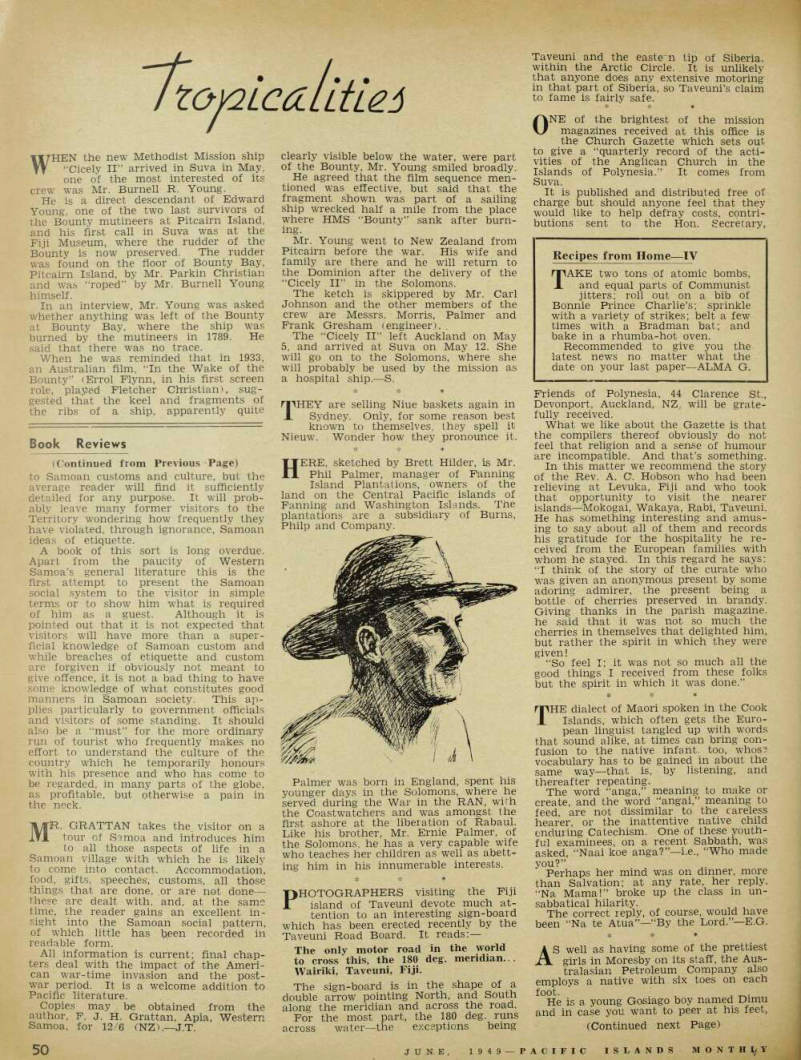
Something For Students
Two Book Reviews
Hawaii: A History
rpHIS attractively-produced book, pub- X lished by Prentice-Hall, Inc., New York, is written by two Americans — Ralph S. Kuykendall, Professor of His tory at the University of Hawaii; and A.
Grove Day, Professor in English at the same University.
It states inside the front cover flap that, as well as being a history (from Polynesian Kingdom to American Com monwealth), deftly woven into it are all the “magic qualities of the exotic meet ing place of East and West—the languorous beauty of the land, the gentle swaying of palms, flower-scented breezes, hula dancing . . . etc.”
Frankly, we didn't get this atmos phere at all. If you want a first-rate reference gook on Hawaii this should serve the purpose. But if you want hula maids and flower-scented breezes —forget it. It is about as interesting to read as any other straight history book; no more, no less. Full of dates and statis tics and facts. No romance;' no love interest.
It will, however, make interesting reading for any student of Polynesia al though the interest lies wholly in the contrasts between Hawaii and other Poly nesian lands. In fact, judged on the material contained in this volume, it appears that Hawaii has no longer any valid claim to being called a Polynesian island at all. Culture clashes have been greater here than anywhere else in the Pacific and what little of Polynesia is retained seems to serve only one purpose—that of tourism. In 1830 it was estimated that the population of Hawaii was 130,000—all Hawaiian. In 1948, it was half a million, made up of 180,000 Caucasians, 176,000 Japs, 70,000 part-Hawaiians of various varieties. 53,000 Filipinos, 30,000 Chinese, 10,000 Hawaiians, 9,000 Puerto Ricans. 7,000 Koreans and 1,600 others.
The land laws of Hawaii differ con siderably from those of other island territories in the South Pacific, in so far as there has apparently been no effort to secure the land to the native Hawaiians. At annexation, all the gov ernment and crown lands became the property of the United States. At various times attempts have been made to popularise homestead leases —that is small areas of land designed for indi vidual farming, at small rentals—but these were not popular with the Hawaiians, for whom they were originally
designed, and have been only a limited success. Possibly this failure, as far as the Hawaiians are concerned, can be attributed to their old, pre-European, native feudal set-up. The Hawaiian commoner’s life, liberty and happiness seemed to depend wholly upon the whims, fancies and material ups and downs of his immediate chief, who depended for his, upon some other chief higher up.
Homesteading, we are told, has often lent itself to land racketeering and the bulk of the best agricultural land to-day is in the hands of a few estates.
HOWEVER. although the native Hawaiian may be virtually landless and although he makes up but a small proportion of the population of his islands, few, if any, have raised their voices to condemn the results of Ameri can democracy on the Hawaiian people.
Although large and growing European and Asiatic imported communities have divested the native of his birth right and will, in the near future, engulf him al together, there is not any agitation to deport, for example, the 176,000 Japs.
This is in contrast to Fiji, where some people feel that the only way to solve the Indian problem (the Indians having been imported into Fiji originally for the same purpose as the Japanese into Hawaii —to work on the cane fields) is to send the 120,000 Indians back home in order to save the 100,000 indigenous Fijians and their lands. The Japs stay in Hawaii and are (most of them) classed as “good Americans”.
Nor, although Hawaiians and Hawaiiana are used strictly for tourist bally-hoo (hulas, leis, beach-boys, grass skirts, guitars, etc.) and little else, are the Americans accused of being imperial istic exploiters.
To residents of South Pacific terri tories who continually are accused of these sins, and many more, this seems strange. Particularly so as some of the severest critics of British native policy are certain factions of the American public.
The sixty-dollar question is: Have the Hawaiians got more out of American democracy than the Cook Islanders have got from New Zealand democracy; or the Fijians from British Democracy?—J.T. (Hawaii: A HISTORY. Sells in the United States for $3.)
An Introduction To Samoan
Custom
rjMHIS handy reference book was written X by F. J. H. Grattan, Secretary of Samoan Affairs, Western Samoa, and a well-known resident of that Territory since 1929..
Apart from its literary merit, the reader is struck first by the extraordinary manner of compilation—that is, extra ordinary for this day. For the book was entirely hand-set, in Apia, Western Samoa, from rather old type that was in short supply. When the first pages were set up and printed the type was then broken up, further pages were set and printed—and so on until the whole was completed. Paper was also hard to get but the finished book reflects great credit on those who overcame almost insuper able difficulties to produce it.
In his preface Mr. Grattan stresses that the book serves only as an introduction (Continued Next Page)
to Samoan customs and culture, but the average reader will find it sufficiently detailed for any purpose. It will prob ably leave many former visitors to the Territory wondering how frequently they have violated, through ignorance, Samoan ideas of etiquette.
A book of this sort is long overdue.
Apart from the paucity of Western Samoa’s general literature this is the first attempt to present the Samoan social system to the visitor in simple terms or to show him what is required of him as a guest. Although it is pointed out that it is not expected that visitors will have more than a super ficial knowledge of Samoan custom and while breaches of etiquette and custom are forgiven if obviously not meant to give offence, it is not a bad thing to have some knowledge of what constitutes good manners in Samoan society. This ap plies particularly to government officials and visitors of some standing. It should also be a “must” for the more ordinary run of tourist who frequently makes no effort to understand the culture of the country which he temporarily honours with his presence and who has come to be regarded, in many parts of the globe, as profitable, but otherwise a pain in the neck.
MR. GRATTAN takes the, visitor on a tour of Samoa and introduces him to all those aspects of life in a Samoan village with which he is likely to come into contact. Accommodation, food, gifts, speeches, customs, all those things that are done, or are not done— these are dealt with, and, at the same time, the reader gains an excellent in sight into the Samoan social pattern, of which little has Ipeen recorded in readable form.
All information is current; final chap ters deal with the impact of the Ameri can war-time invasion and the post war period. It is a welcome addition to Pacific literature.
Copies may be obtained from the author, F. J. H. Grattan, Apia, Western Samoa, for 12/6 (NZ).-J.T.
Tropicalities
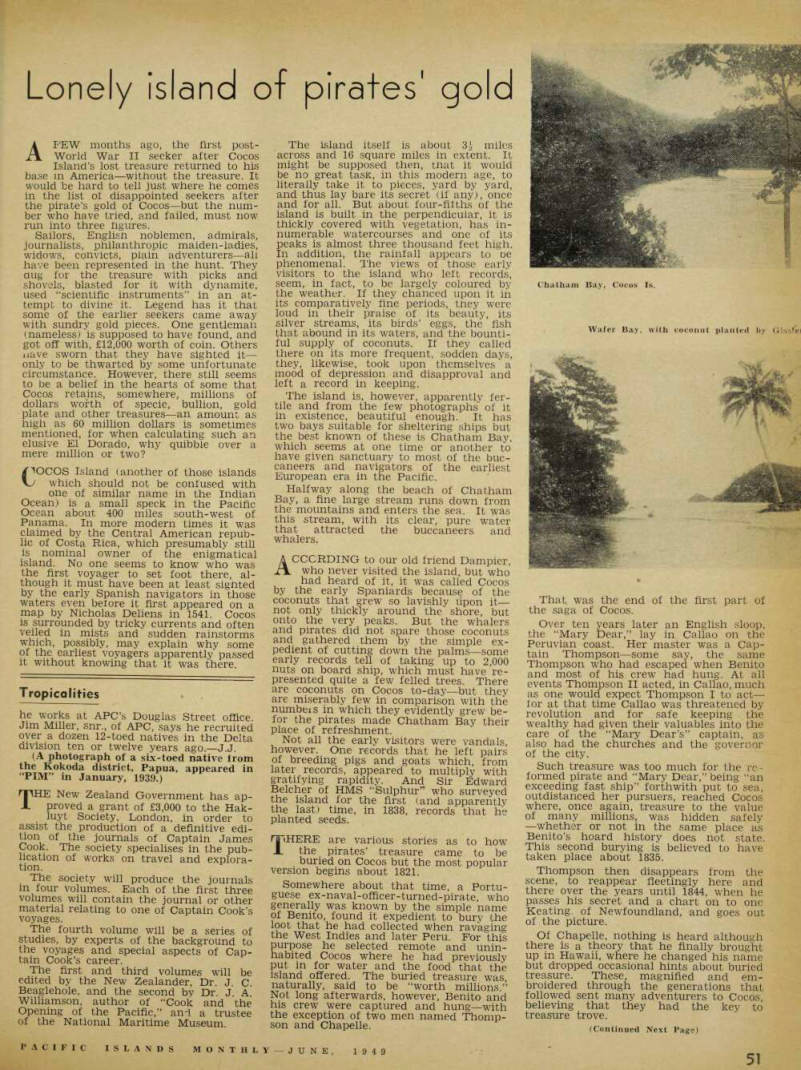
WHEN the new Methodist Mission ship “Cicely II” arrived in Suva in May, one of the most interested of its crew was Mr. Burnell R. Young.
He is a direct descendant of Edward Young, one of the two last survivors of the Bounty mutineers at Pitcairn Island, and his first call in Suva was at the Fiji Museum, where the rudder of the Bounty is now preserved. The rudder was found on the floor of Bounty Bay, Pitcairn Island, by Mr. Parkin Christian and was “roped” by Mr. Burnell Young himself.
In an interview, Mr. Young was asked whether anything was left of the Bounty at Bounty Bay, where the ship was burned by the mutineers in 1789. He said that there was no trace.
When he was reminded that in 1933, an Australian film, “In the Wake of the Bounty” (Errol Flynn, in his first screen role, played Fletcher Christian), sug gested that the keel and fragments of the ribs of a ship, apparently quite
clearly visible below the water, were part of the Bounty, Mr. Young smiled broadly.
He agreed that the film sequence men tioned was effective, but said that the fragment shown was part of a sailing ship wrecked half a mile from the place where HMS “Bounty” sank after burn ing.
Mr. Young went to New Zealand from Pitcairn before the war. His wife and family are there and he will return to the Dominion after the delivery of the “Cicely 11" in the Solomons.
The ketch is skippered by Mr. Carl Johnson and the other members of the crew are Messrs. Morris, Palmer and Frank Gresham (engineer). .
The “Cicely II" left Auckland on May 5, and arrived at Suva on May 12. She will go on to the Solomons, where she will probably be used by the mission as a hospital ship.—S. * * * THEY are selling Niue baskets, again in Sydney. Only, for some reason best known to themselves, they spell it Nieuw. Wonder how they pronounce it. * $ * HERE, sketched by Brett Hilder, is Mr.
Phil Palmer, manager of Fanning Island Plantations, owners of the land on the Central Pacific islands of Fanning and Washington Islands. The plantations are a subsidiary of Burns, Philp and Company.
Palmer was born in England, spent his younger days in the Solomons, where he served during the War in the RAN, with the Coastwatchers and was amongst the first ashore at the liberation of Rabaul.
Like his brother, Mr. Ernie Palmer, of the Solomons, he has a very capable wife who teaches her children as well as abett ing him in his innumerable interests. * * * Photographers visiting the Fiji island of Taveuni devote much at tention to an interesting sign-board which has been erected recently by the Taveuni Road Board. It reads: — The only motor road in the world to cross this, the 180 deg. meridian.
Wairiki, Taveuni, Fiji.
The sign-board is in the shape of a double arrow pointing North, and South along the meridian and across the road.
For the most part, the 180 deg. runs across water—the exceptions being
Taveuni and the eastern tip of Siberia, within the Arctic Circle. It is unlikely that anyone does any extensive motoring in that part of Siberia, so Taveuni’s claim to fame is fairly safe. * * * ONE of the brightest of the mission magazines received at this office is the Church Gazette which sets out to give a “quarterly record of the acti vities of the Anglican Church in the Islands of Polynesia.” It comes from Suva.
It is published and distributed free of charge but should anyone feel that they would like to help defray costs, contri butions sent to the Hon. Secretary,
Friends of Polynesia, 44 Clarence St., Devonport, Auckland, NZ, will be grate fully received.
What we like about the Gazette is that the compilers thereof obviously do not feel that religion and a sense of humour are incompatible. And that’s something.
In this matter we recommend the story of the Rev. A. C. Hobson who had been relieving at Levuka, Fiji and who took that opportunity to visit the nearer islands —Mokogai, Wakaya, Rabi, Taveuni.
He has something interesting and amus ing to say about all of them and records his gratitude for the hospitality he re ceived from the European families with whom he stayed. In this regard he says: “I think of the story of the curate who was given an anonymous present by some adoring admirer, the present being a bottle of cherries preserved in brandy.
Giving thanks in the parish magazine, he said that it was not so much the cherries in themselves that delighted him, but rather the spirit in which they were given!
“So feel I; it was not so much all the good things I received from these folks but the spirit in which it was done.’’ * * * THE dialect of Maori spoken in the Cook Islands, which often gets the Euro pean linguist tangled up with words that sound alike, at times can bring con fusion to the native infant, too, whos3 vocabulary has to be gained in about the same way—that is, by listening, and thereafter repeating.
The word “anga,” meaning to make or create, and the word “angai,” meaning to feed, are not dissimilar to the careless hearer, or the inattentive native child enduring Catechism. One of these youth ful examinees, on a recent Sabbath, was asked, “Naai koe anga?”—i.e., “Who made you?”
Perhaps her mind was on dinner, more than Salvation; at any rate, her reply, “Na Mama!” broke up the class in un sabbatical hilarity.
The correct reply, of course, would have been “Na te Atua”—“By the Lord.”—E.G. * * * AS well as having some of the prettiest girls in Moresby on its staff, the Aus tralasian Petroleum Company also employs a native with six toes on each foot. , . _.
He is a young Gosiago boy named Dimu and in case you want to peer at his feet, (Continued next Page)
he works at APC’s Douglas Street office.
Jim Miller, snr., of APC, says he recruited over a dozen 12-toed natives in the Delta division ten or twelve years ago.—J.J. (A photograph of a six-toed native from the Kokoda district, Papua, appeared in “PIM” in January, 1939.) THE New Zealand Government has ap proved a grant of £3,000 to the Hak luyt Society, London, in order to assist the production of a definitive edi tion of the journals of Captain James Cook. The society specialises in the pub lication of works on travel and explora tion.
The society will produce the journals m four volumes. Each of the first three volumes will contain the journal or other material relating to one of Captain Cook’s voyages.
The fourth volume will be a series of studies, by experts of the background to the voyages and special aspects of Cap tain Cook’s career.
The first and third volumes will be edited by the New Zealander, Dr. J. C.
Beaglehole, and the second by Dr. J A Williamson, author of “Cook and the Opening of the Pacific,” and a trustee of the National Maritime Museum.
Recipes from Home—IV
TAKE two tons of atomic bombs, and equal parts of Communist jitters: roll out on a bib of Bonnie Prince Charlie’s; sprinkle with a variety of strikes; belt a few times with a Bradman bat; and bake in a rhumba-hot oven.
Recommended to give you the latest news no matter what the
date on your last paper-
Alma G.
Advertisements & other items, p. 52 (1 item)
Book Reviews
(Continued from Previous Page)
Lonely island of pirates' gold
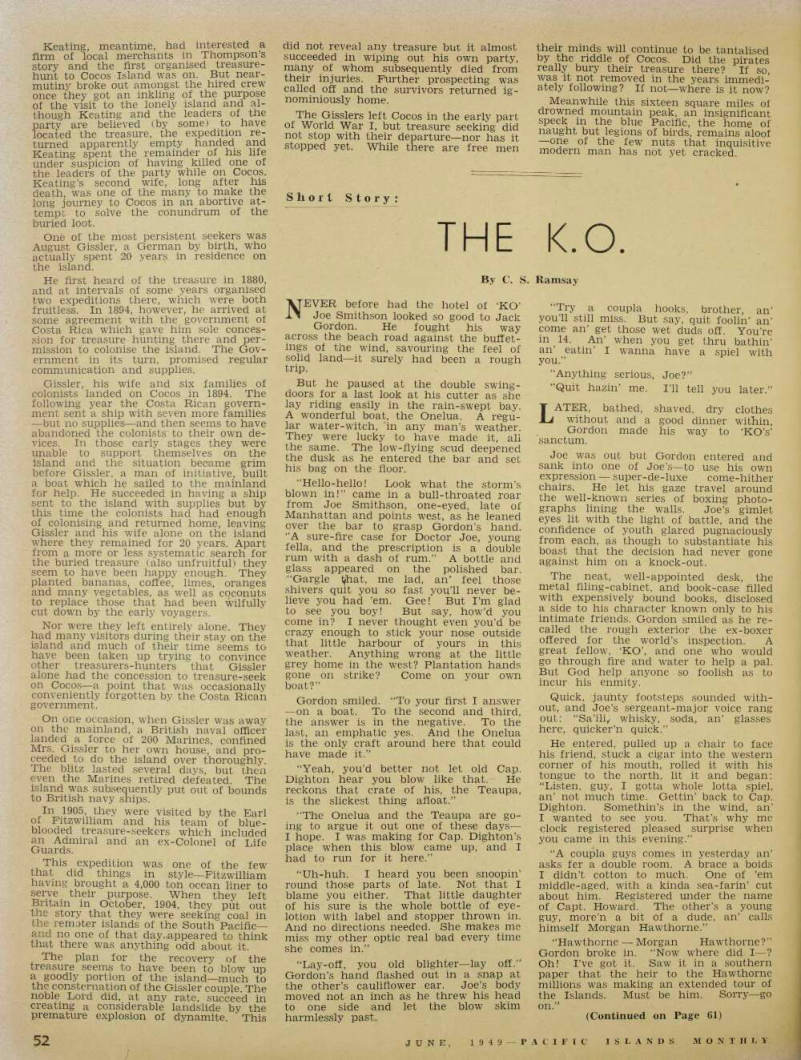
A FEW months ago, the first post- World War II seeker after Cocos Island’s lost treasure returned to his base m America —without the treasure. It would be hard to tell just where he comes in the list of disappointed seekers after the pirate’s gold of Cocos —but the num ber who have tried, and failed, must now run into three figures.
Sailors, English noblemen, admirals, journalists, philanthropic maiden-ladies, widows, convicts, plain adventurers —ah have been represented in the hunt. They dug for the treasure with picks and shovels, blasted for it with dynamite, used “scientific instruments” in an at tempt to divine it. Legend has it that some of the earlier seekers came away with sundry gold pieces. One gentleman (nameless) is supposed to have found, and got off with, £12,000 worth of coin. Others nave sworn that they have sighted it — only to be thwarted by some unfortunate circumstance. However, there still seems to be a belief in the hearts of some that Cocos retains, somewhere, millions of dollars worth of specie, bullion, gold plate and other treasures —an amount as high as 60 million dollars is sometimes mentioned, for when calculating such an elusive El Dorado, why quibble over a mere million or two? lsland (another of those islands J which should not be confused with one of similar name in the Indian Ocean) is a small speck in the Pacific Ocean about 400 miles south-west of Panama. In more modern times it was claimed by the Central American repub lic of Costa Rica, which presumably still is nominal owner of the enigmatical island. No one seems to know who was the first voyager to set foot there, al though it must have been at least sighted by the early Spanish navigators in those waters even before it first appeared on a map by Nicholas Deliens in 1541. Cocos is surrounded by tricky currents and often veiled in mists and sudden rainstorms which, possibly, may explain why some of the earliest voyagers apparently passed it without knowing that it was there.
The island itself is about miles across and 16 square miles in extent. It might be supposed then, that it would be no great task, in this modern age, to literally take it to pieces, yard by yard, and thus lay bare its secret (if any), once and for all. But about four-fifths of the island is built in the perpendicular, it is thickly covered with vegetation, has in numerable watercourses and one of its peaks is almost three thousand feet high.
In addition, the rainfall appears to oe phenomenal. The views of those early visitors to the island who left records, seem, in fact, to be largely coloured by the weather. If they chanced upon it in its comparatively fine periods, they were loud in their praise of its beauty, its silver streams, its birds’ eggs, the fish that abound in its waters, and the bounti ful supply of coconuts. If they called there on its more frequent, sodden days, they, likewise, took upon themselves a mood of depression and disapproval and left a record in keeping.
The island is, however, apparently fer tile and from the few photographs of it in existence, beautiful enough. It has two bays suitable for sheltering ships but the best known of these is Chatham Bay, which seems at one time or another to have given sanctuary to most of the buc caneers and navigators of the earliest European era in the Pacific.
Halfway along the beach of Chatham Bay, a fine large stream runs down from the mountains and enters the sea. it was this stream, with its clear, pure water that attracted the buccaneers and whalers.
ACCORDING to our old friend Dampier, who never visited the island, but who had heard of it, it was called Cocos by the early Spaniards because of the coconuts that grew so lavishly upon it— not only thickly around the shore, but onto the very peaks. But the whalers and pirates did not spare those coconuts and gathered them by the simple ex pedient of cutting down the palms—some early records tell of taking up to 2,000 nuts on board ship, which must have re presented quite a few felled trees. There are coconuts on Cocos to-day—but they are miserably few in comparison with the numbeis in which they evidently grew be for the pirates made Chatham Bay their place of refreshment.
Not all the early visitors were vandals, however. One records that he left pairs of breeding pigs and goats which, from later records, appeared to multiply with gratifying rapidity. And Sir Edward Belcher of HMS “Sulphur" who surveyed the island for the first (and apparently the last) time, in 1838, records that he planted seeds.
TiHERE are various stories as to how the pirates’ treasure came to be buried on Cocos but the most popular version begins about 1821.
Somewhere about that time, a Portu guese ex-naval-officer-turned-pirate, who generally was known by the simple name of Benito, found it expedient to bury the loot that he had collected when ravaging the West Indies and later Peru. For this purpose he selected remote and unin habited Cocos where he had previously put in for water and the food that the island offered. The buried treasure was, naturally, said to be “worth millions.’’
Not long afterwards, however, Benito and his crew were captured and hung—with the exception of two men named Thomp son and Chapelle.
That was the end of the first part of the saga of Cocos.
Over ten years later an English sloop, the “Mary Dear,” lay in Callao on the Peruvian coast. Her master was a Cap tain Thompson—some say, the same Thompson who had escaped when Benito and most of his crew had hung. At all events Thompson II acted, in Callao, much as one would expect Thompson I to act— for at that time Callao was threatened by revolution and for safe keeping the wealthy had given their valuables into the care of the “Mary Dear’s” captain, as also had the churches and the governor of the city.
Such treasure was too much for the re formed pirate and “Mary Dear,” being “an exceeding fast ship” forthwith put to sea, outdistanced her pursuers, reached Cocos where, once again, treasure to the value of many millions, was hidden safely —whether or not in the same place as Benito’s hoard history does not state.
This second burying is believed to have taken place about 1835.
Thompson then disappears from the scene, to reappear fleetingly here and there over the years until 1844, when he passes his secret and a chart on to one Keating, of Newfoundland, and goes out of the picture.
Of Chapelle, nothing is heard although there is a theory that he finally brought up in Hawaii, where he changed his name but dropped occasional hints about buried treasure. These, magnified and em broidered through the generations that followed sent many adventurers to Cocos, believing that they had the key to treasure trove. (Continued Next Pag?e)
Chatham Bay, Cocos Is.
Wafer Bay, with coconut planted by (Gissley [?]
Keating, meantime, had interested a firm of local merchants in Thompson’s story and the first organised treasure hunt to Cocos Island was on. But near mutiny broke out amongst the hired crew once they got an inkling of the purpose of the visit to the lonely island and al though Keating and the leaders of the party are believed (by some) to have located the treasure, the expedition re turned apparently empty handed and Keating spent the remainder of his life under suspicion of having killed one of the leaders of the party while on Cocos.
Keating’s second wife, long after his death, was one of the many to make the long journey to Cocos in an abortive at tempt to solve the conundrum of the buried loot.
One of the most persistent seekers was August Gissler, a German by birth, who actually spent 20 years in residence on the island.
He first heard of the treasure in 1880, and at intervals of some years organised two expeditions there, which were both fruitless. In 1894, however, he arrived at some agreement with the government of Costa Rica which gave him sole conces sion for treasure hunting there and per mission to colonise the island. The Gov ernment in its turn, promised regular communication and supplies.
Gissler, his wife and six families of colonists landed on Cocos in 1894. The following year the Costa Rican govern ment sent a ship with seven more families —but no supplies—and then seems to have abandoned the colonists to their own de vices. In those early stages they were unable to support themselves on the island and the situation became grim before Gissler, a man of initiative, built a boat which he sailed to the mainland for help. He succeeded in having a ship sent to the island with supplies but by this time the colonists had had enough of colonising and returned home, leaving Gissler and his wife alone on the island where they remained for 20 years. Apart from a more or less systematic search for the buried treasure (also unfruitful) they seem to have been happy enough. They planted bananas, coffee, limes, oranges and many vegetables, as well as coconuts to replace those that had been wilfully cut down by the early voyagers.
Nor were they left entirely alone. They had many visitors during their stay on the island and much of their time seems to have been taken up trying to convince other treasurers-hunters that Gissler alone had the concession to treasure-seek on Cocos —a point that was occasionally conveniently forgotten by the Costa Rican government.
On one occasion, when Gissler was away on the mainland, a British naval officer landed a force of 200 Marines, confined Mrs. Gissler to her own house, and pro ceeded to do the island over thoroughly.
The blitz lasted several days, but then even the Marines retired defeated. The island was subsequently put out of bounds to British navy ships.
In 1905, they were visited by the Earl of Fitzwilliam and his team of blue blooded treasure-seekers which included an Admiral and an ex-Colonel of Life Guards.
This expedition was one of the few that did things in style—Fitzwilliam having brought a 4,000 ton ocean liner to serve their purpose. When they left Britain in October, 1904, they put out the story that they were seeking coal in the remoter islands of the South Pacific— and no one of that day,.appeared to think that there was anything odd about it.
The plan for the recovery of the treasure seems to have been to blow up a goodly portion of the island—much to the consternation of the Gissler couple The noble Lord did, at any rate, succeed in creating a considerable landslide by the premature explosion of dynamite. This
did not reveal any treasure bur it almost succeeded in wiping out his own party, many of whom subsequently died from their injuries. Further prospecting was called off and the survivors returned ig nominiously home.
The Gisslers left Cocos in the early part of World War I, but treasure seeking did not stop with their departure—nor has it stopped yet. While there are free men
their minds will continue to be tantalised by the riddle of Cocos. Did the pirates really bury their treasure there? If so, was it not removed in the years immedi ately following? If not—where is it now?
Meanwhile this sixteen square miles of drowned mountain peak, an insignificant speck in the blue Pacific, the home of naught but legions of birds, remains aloof —one of the few nuts that inquisitive modern man has not yet cracked.
The K.O.
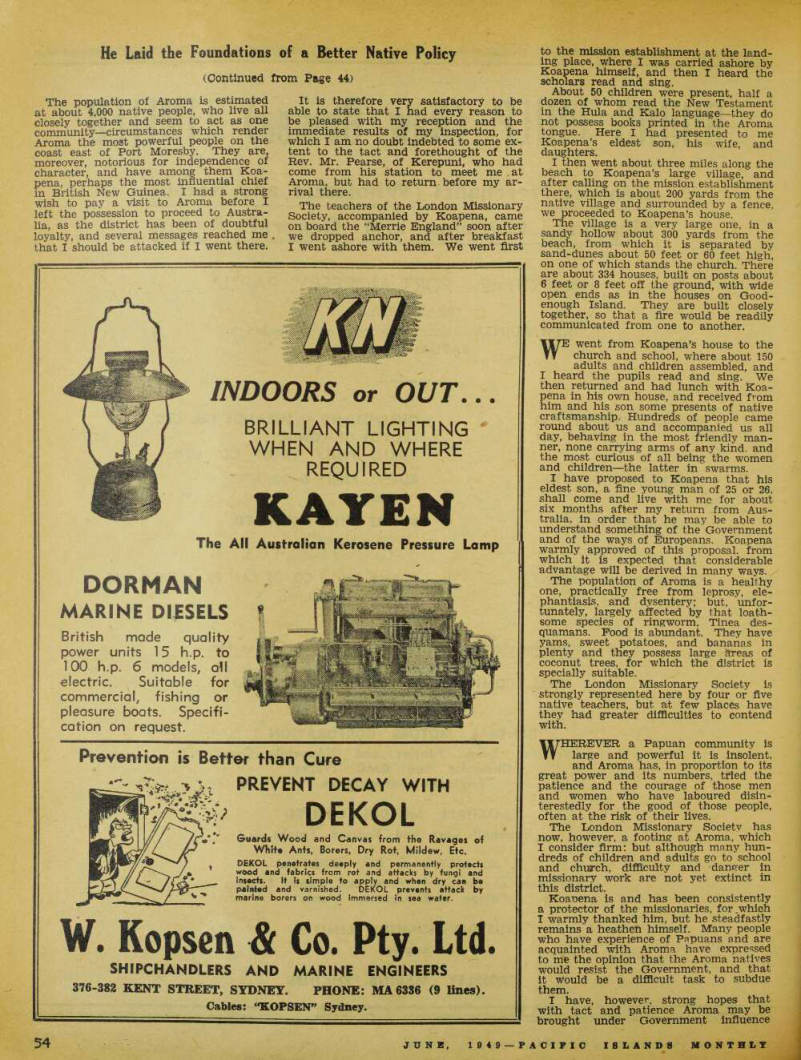
Short Story:
By C. S. Ramsay
NEVER before had the hotel of ‘KO’
Joe Smithson looked so good to Jack Gordon. He fought his way across the beach road against the buffet ings of the wind, savouring the feel of solid land—it surely had been a rough trip.
But he paused at the double swing doors for a last look at his cutter as she lay riding easily in the rain-swept bay.
A wonderful boat, the Onelua. A regu lar water-witch, in any man’s weather.
They were lucky to have made it, all the same. The low-flying scud deepened the dusk as he entered the bar and set his bag on the floor.
“Hello-hello! Look what the storm’s blown in!” came in a bull-throated roar from Joe Smithson, one-eyed, late of Manhattan and points west, as he leaned over the bar to grasp Gordon’s hand.
“A sure-fire case for Doctor Joe, young fella, and the prescription is a double rum with a dash of rum.” A bottle and glass appeared on the polished bar.
“Gargle tyhat, me lad, an’ feel those shivers quit you so fast you’ll never be lieve you had ’em. Gee! But I’m glad to see you boy! But say, how’d you come in? I never thought even you’d be crazy enough to stick your nose outside that little harbour of yours in this weather. Anything wrong at the little grey home in the west? Plantation hands gone on strike? Come on your own boat?”
Gordon smiled. “To your first I answer —on a boat. To the second and third, the answer is in the negative. To the last, an emphatic yes. And the Onelua is the only craft around here that could have made it.”
“Yeah, you’d better not let old Cap.
Dighton hear you blow like that. He reckons that crate of his, the Teaupa, is the slickest thing afloat.”
“The Onelua and the Teaupa are go ing to argue it out one of these days— I hope. I was making for Cap. Dighton’s place when this blow came up, and I had to run for it here.”
“Uh-huh. I heard you been snoopin’ round those parts of late. Not that I blame you either. That little daughter of his sure is the whole bottle of eye lotion with label and stopper thrown in.
And no directions needed. She makes me miss my other optic real bad every time she comes in.”
“Lay-off, you old blighter—lay off."
Gordon’s hand flashed out in a snap at the other’s cauliflower ear. Joe’s body moved not an inch as he threw his head to one side and let the blow skim harmlessly past.
“Try a coupla hooks, brother, an’ you’ll still miss. But say, quit foolin’ an’ come an’ get those wet duds off. You’re in 14. An’ when you get thru bathin’ an’ eatin’ I wanna have a spiel with you.”
“Anything serious, Joe?”
“Quit hazin’ me. I’ll tell you later.”
LATER, bathed, shaved, dry clothes without and a good dinner within, Gordon made his way to ‘KO’s’ sanctum.
Joe was out but Gordon entered and sank into one of Joe’s —to use his own expression super-de-luxe come-hither chairs. He let his gaze travel around the well-known series of boxing photo graphs lining the walls. Joe’s gimlet eyes lit with the light of battle, and the confidence of youth glared pugnaciously from each, as though to substantiate his boast that the decision had never gone against him on a knock-out.
The neat, well-appointed desk, the metal filing-cabinet, and book-case filled with expensively bound books, disclosed a side to his character known only to his intimate friends. Gordon smiled as he re called the rough exterior the ex-boxer offered for the world’s inspection. A great fellow, ‘KG’, and one who would go through fire and water to help a pal.
But God help anyone so foolish as to incur his enmity.
Quick, jaunty footsteps sounded with out, and Joe’s sergeant-major voice rang out: “Sa’ilv whisky, soda, an’ glasses here, quicker’n quick.”
He entered, pulled up a chair to face his friend, stuck a cigar into the western corner of his mouth, rolled it with his tongue to the north, lit it and began: “Listen, guy, I gotta whole lotta spiel, an’ not much time. Gettin’ back to Cap.
Dighton. Somethin’s in the wind, an’
I wanted to see you. That’s why me clock registered pleased surprise when you came in this evening.”
“A coupla guys comes in yesterday an’ asks fer a double room. A brace a boids I didn’t cotton to much. One of ’em middle-aged, with a kinda sea-farin’ cut about him. Registered under the name of Capt. Howard. The other’s a young guy, more’n a bit of a dude, an’ calls himself Morgan Hawthorne.”
“Hawthorne Morgan Hawthorne?”
Gordon broke in. “Now where did I—?
Oh! I’ve got it. Saw it in a southern paper that the heir to the Hawthorne millions was making an extended tour of the Islands. Must be him. Sorry—go on.”
(Continued on Page 61)
“Well, I fixed ’em in No. 12, right above this. Last night as I was settin’ here figurin’ me absentee profits, I heard ’em come out on the balcony. It was Cap. that roped in me thoughts with a jerk, an’ the mention of a friend’s name always makes me stop, look, an’ eavesdrop if I can. Especially this time when the older guy says—by the way, he didn’t talk pure English like I do, but I’ll tell it in me own way. He says: ‘But man alive, you’ve only seen her once. It‘s like buyin’ a pig in a poke. Oh! I don’t doubt you can put it over on the girl. You always can when you lay yourself out to knock ’em over. But it’s the old man you gotta take into account, an’ from what I’ve heard you’ll never get his consent. The talk around here has it that he’d rather part with his heart an’ liver than part with her.’
“That was enough to set me old lugs tinglin’, so, as I was scared they’d jimmy that someone was in this room, I stumped across to the door, switched off the glim, slammed the door, an’ tiptoed back an’ outside ’s quick ’s a cat afore dogs. Nothin’ was said for a bit, but I could hear a tappin’ on the balcony rail like a guy does when he’s tryin’ to get his grey-matter to start tickin.”
“Then the young fellow Hawthorne opened up kinda haw-haw: “But Charlie, old boy, what’s the alternative? Surely with persuasion and sufficient induce ment he’ll agree. We can’t just go and grab her. The jolly old cave-man-cum bold-buccaneer stuff is frightfully out of date and all that. What?”’
The glasses were filled and sampled, and Gordon said: “Joe, old man, this
is mighty interesting. I’m more than glad now that I came. Yes, what happened then?”
“fWell, the sea-farin’ guy lets outa kinda groan an’ says: ‘Let’s get inside an’ thrash this out. Too public out here.’
Knowin’ I couldn’t hear no more from where I stood, I skips up to my room, kicks off me daisy roots, and shines inta No. 14 next-door. I didn’t like riskin’ bein’ caught standin’ with the nosey parker ear on the balcony, so I drapes meself as far out over the window-sill as I could, an’ listened so hard it hurt.
“I heard ’em garglin’ some hooch, then Charlie’s growl again, an’ then he goes on the air: ‘Now listen, Morgan, if you hadn’t lost your head like you have, you might be able to think this out an’ face the facts. To my mind there’s nothin’ on land or water what’s worth gettin’ all hot an’ bothered over, an’ I just can’t figure what’s hit you. Here’s you com pletely lost your nut over this little hooker, but you don’t know nothin’ about her. Granted she looks pretty enough all dolled up with paint an’ trimmin’s
but what’s she goin’ to be like when the squalls come up? Life ain’t all sun shine an’ fair winds. An’ when you get her. how long you goin’ ta be crazy over her? I’ll lay odds right now you wanna be shut of her within a ’twelvemonth.
You always been a spoilt brat with too much money, an’ I’m tired of gettin’ you outa trouble.’
“Then the young dude gets on a kinda sob note an’ begs the other guy not to leave him to the job, and says he’s made up his mind, an’ nothin’ ain’t goin’ ta stop him if he can help it, no matter what the cost.”
“I think I’ll borrow your pet expression an say ‘Oh yeah’,” interjected Gordon, grimly.
“Yeah, an’ if ‘KO’ Joe Smithson has anythin’ of an excuse ta make ta Peter at the Pearly Gates, it’ll be that he never yet let down a pal. I’m with you pard, but wait—you ain’t heard nothin’ yet.
“Blast me if the old rooster didn’t come out with a line of stuff tha£—well, here it is, an’ keep a holda yourself. He says:
‘Oh, alright, have it your own way. You always have had it, an’ you always will till you get a knife in your guts or some thin’ for some fool stunt. Now listen.
While you been moonin’ round like an orphaned calf, I been doin’ some snoop in’. I’ve found the old man’s away in Tutu’ila till Friday. This is Monday, an’ we got plenty of time. I’ve found a cutter we can charter on Wednesday morning.
We can get to their place by late after noon. We then go ashore, an’ you has a session with the gal, an’ it’s up ta you ta persuade her. If you can put it over on her, we can go aboard right away, an’ leave before dark. If not, then we gotta use some . . .’
“An’’ then, blast it, if that damn win dow didn’t come right down with a rattle on me back an’ ketch me with both feet off the floor inside the room, an’ me mitts not reachin’ ta the balcony floor on the outside. I tell you, if them guys had come out ta see what was the clatter, I’d a looked worse ’n a Peepin’ Tom caught in a Nudist Colony. But all that happened was they shut right up, an’ I couldn’t hear another word. An’ as for me, I just lay doggo an’ sweated worse ’n a pig for about five hours. Or so it seemed like to me. Then I managed ta get the cock-eyed window up far enough for me ta go inta reverse.”
Before Joe had finished Gordon was on his feet, fire in his eye.
“The dirty skunks! That sounds as though they figure that if Sylvia Dighton won’t elope with them, they’re going to use force. By hell, they can’t get away with that!”
“Now, Jack, me son, keep your wool on.
I got the answer to this all pat as soon as I set eyes on you to-night. This storm’s blowin’ itself out, an’ you an’ me’s gonna get an early start on the Onelua an’ be there waitin’ for them.
An’ is it just a shame (or is it a shame?) how me ’n you’s gonna give them kidnappin’ kykes the proper KO.
Meanwhile there ain’t nothin’ gonna happen ta the girl-friend, so you have another snifter of that hooch, an’ go an’ get some sleep. An’ I said sleep.”
VT/OON of the following day saw the Onelua come neatly into the wind and drop anchor at the Dighton plantation, a cable’s length from the Captain’s spick and span Teaupa, riding gracefully at her moorings. A lithe, golden-haired figure in white left the house and ran down the path to the beach. It was followed, to the amaze ment of the two friends aboard, by a short, stocky form moving at a more leisurely pace, and a stentorian hail came across the water.
Joe’s one eye screwed to a slit. “Wa-al, if that ain’t old Cap. Dighton himself!
So he didn’t go to Tutu’ila after all!
What d’ya know about that? Now, if that ain’t a bit of luck I’ll chew my stetson!”
As they stepped from the dinghy on to the beach Cap. Dighton seized Joe in a bear’s hug, beating him on the back with clenched fists.
“Well-well-well, if this isn’t a pleasant surprise! The great ‘KO’ himself. How the heck did you manage to leave that hotel of yours? Will it stand up on its own? Hello, Gordon, how’s things?”
“Now then, Cap.” appealed Joe, “if you’ll quit mistakin’ me for a drum an’ come outa that clinch an’ lead us nicely by the hand to the house like the best folks deserve, I’ll try an’ tell you why we’re here—if you’ll keep still long enough. Meantime get one of your boys to keep an eye windward. There’s an
other boat behind us. Miss Dighton, if you’ll be kind enough to order this wild man off me chest, I’ll shake you by your pretty hand.”
On the cool verandah of the Dighton home, after Joe’s recital, Captain Dighton’s language was up to the stand ard of the best of sea-dogs at times of crisis. His daughter fled at the open ing words.
Joe quietly handed the Captain a full glass. “Now Cap., drink that an’ keep quiet for a bit, an’ I’ll tell what we’ll do.
First off, Gordon sends his boys with the Onelua round the point outa sight. When the pair shows up, Miss Dighton can meet ’em on the front steps, invite ’em in, an’ lead ’em round to the other side of the|house, where we’ll be settin’. After that it’s your house, your show, your boots, an’ my mitts. Gordon can be referee. How’s that for a set-up?”
“It suits me fine,*’ replied Dighton.
“And they can’t come too soon for me.”
A LITTLE later Sail-ho was sounded by the boy on the look-out, and by late afternoon a cutter’s chain rattled out at the anchorage.
Cap. Dighton peered through the creeper festooning the verandah. “That’s them alright, the blasted ...”
“Now, Father,” said the girl, “just go and sit quietly, and leave matters to me for a bit. Your turn will come.”
The three men seated themselves at the side of the house as voices sounded on the front steps. They heard Sylvia Dighton greet the men and invite them in, then footsteps as they approached.
Surprise was written plain on the faces of Hawthorne and his friend How ard as their eyes lit upon the scowling group before them. The younger man quickly recovered his poise and advanced with outstretched hand to Cap. Dighton, who by now was on his feet and glower ing darkly.
“Captain Dighton, this is an unex pected pleasure for us to find you home.”
Dighton took a threatening step for ward and snarled: “Oh yes? And what do you mean by coming to my home if you did not expect to find me here? Come on—out with what’s your little game—the pair of you?”
Taken aback, the young man stam (Continned Next Page)
mered, “But—but Captain Dighton, this is rather an unorthodox kind of greet ing ”
“Greeting! What the hell kind d’you expect—you blasted flash crook! Think yourself lucky I don’t take hold of you and rip you in two! You think you can come sneaking round here with your stinking millions and dazzle my girl’s eyes, eh? I’ll show you—you bloody kid napping tyke. Ah-h-h-h! Get out of here before I forget there’s a lady present.”
Utter bewilderment showed for a mo ment on the young man’s face, followed by a flush of quick anger. Advancing a pace he retorted hotly: “Kidnapping!
Girl! Why, man alive, you’re crazy—or drunk! Now let me tell you something Our sole object in coming here was to offer £5OO over market value for the “Teaupa”. Needless to add, that offer now will not be made —and, a very good day to you. Howard, we’re leaving.”
Key JOE SMITHSON gasped, swal lowed hard, and turned to Gordon with a hoarse whisper; “Holy suf ferin’ cats! KO’d in the first round!
Let’s beat it outa here before Cap.
Dighton comes outa his trance!”
Advertisements & other items, pp. 55-56 (2 items)
Burns Philp (New Guinea) Limited
General Merchants (Wholesale and Retail)
Shipping, Customs and General Agents
Head Office: PORT MORESBY, PAPUA
BRANCHES;
NEW GUINEA: Rabaul, Kokopo, L.ae Gr Madang.
PAPUA: Samarai.
QUEENSLAND INSURANCE CO. LTD.
LLOYDS OF LONDON
BURNS PHILP TRUST CO. LTD.
BURNS, PHILP Cr CO. LTD.
All States.
BURNS, PHILP & CO. LTD.
"London House", 35 Crutched Friars, E.C.3.
BURNS, PHILP CO. OF SAN FRANCISCO INC. 510 Matson Building.
Distributing Agents, Territory of Papuo-New Guinea for;
SHELL COMPANY OF AUSTRALIA LIMITED
Petroleum Products
GENERAL MOTORS CORPORATION
Chevrolet, Buick, Pontiac and Oldsmobile Cars Chevrolet and GMC Trucks Frigidaire Refrigerators
VAUXHALL MOTORS LIMITED
Vauxhall Cars and Bedford Trucks
R. A. LISTER fir CO., BRISTOL
Producers of Petrol, Parrafin and Diesel Engines Pumps and Lighting plants
RUSTON HORNSBY LIMITED
Engines
CROSSLEY MARINE ENGINES
REPRESENTATIVES FOR:
AUSTRALIAN AGENTS:
LONDON AGENTS:
SAN FRANCISCO AGENTS:
INDOORS or ...
BRILLIANT LIGHTING
WHEN AND WHERE
REQUIRED
KAYEN
The All Australian Kerosene Pressure Lamp
DORMAN
MARINE DIESELS
British made quality power units 15 h.p. to 100 h.p. 6 models, all electric. Suitable for commercial, fishing or pleasure boats. Specification on request.
Prevention is Better than Cure
vjfcv..,? Jr
PREVENT DECAY WITH
DEKOL
Guards Wood and Canvas from the Ravages of White Ants, Borers, Dry Rot, Mildew, Etc.
DEKOL penetrates deeply and permanently protects wood and fabrics from rot and attacks by fungi and insects. It is simple to apply and when dry can be painted and varnished. DEKOL prevents attack by marine borers on wood immersed in sea water.
W. Kopsen & Co. Pty. Ltd.
SHIPCHANDLERS AND MARINE ENGINEERS
376-382 KENT STREET, SYDNEY. PHONE; MA6336 (9 lines).
Cables; “KOPSEN” Sydney.
54
JUNE, 1 9 4 9 —PACIFIC ISLANDS MONTHLY
He Laid the Foundations of a Better Native Policy (Continued from Page 44)
Funeral Of The Late
T. C. Worrall
From Our Own Correspondent
Rarotonga, May* 20.
THE ashes of the late Mr. T. C. Wor rall, which were sent from Auck land, were interred at the London Missionary Society churchyard, Raro tonga, on May 13. A number of Euro pean friends attended the service.
Mr. Worrall was an Englishman. He first settled in Rarotonga in 1912. In World War I he served with the NZ forces and was severely wounded. Re turning to Rarotonga he established a motor repairing business. At the out break of World War II he again enlisted with the N.Z. army. Mr. Worrall was 56 at the time of his death.
Mrs. Jessie T. Horn, who was in the South Pacific Islands some time ago as a 'member of the company aboard the “Oiseau de lies”, and who since has been residing in Honolulu, is again a wanderer in the South Seas—this time aboard a friend’s yacht, en route to Tahiti. i Mr. and Mrs. C. W. Seton, well-known 881 residents, have purchased the for mer Burns Philp plantation, Lutee, on Choiseul, Western Solomons, which they have been working under lease since their post-war return to the Protector ate. They have also leased Manning Straits. In Honiara, this energetic pair are building up the nucleus of a farm to supply foodstuffs to local residents.
Miss Pauline Hay has returned to Bris bane after spending four months in Papua.
The tragic story of a former Fijian Provincial Scribe, who, after becoming totally blind, attempted to commit sui cide, was told at the Suva Magistrate’s Court in May. The police prosecutor said that, depressed by his blindness, the man (who has a wife and child de pendant on him) found a bottle of what he believed was poison but which actually contained liniment. He drank a small portion before he changed his mind about suicide and before any serious harm was done. The man was bound over for one year.
Advertisements & other items, pp. 57-58 (1 item)
Look for KRAFT
PRODUCING UNIFORM GOOD RESULTS SINCE 1868
ALWAYS ASK FOR IT
and find QUALITY
The unchanging quality of Kraft foods is a byword wherever fine foods find appreciation. In their constant vigilance over quality, Kraft experts have achieved even more than just that, for hand in hand with Kraft quality goes flavour perfection and food value of a very high order.
Wherever you see the name “Kraft”, buy confidently, and remember, “Red Feather” foods are made by Kraft too. No finer foods can be found.
Export Division .
Kraft Walker Cheese Co. Pty. Ltd
Riverside Ave., South Melbourne,
AUSTRALIA.
KRAFT
\ \ \ Three famous Kraft Foods note available in full supply everywhere .
VEGEMITE the delicious, healthful yeast extract. One of the richest known sources of the important Vitamin B complex. Strongly recommended in all areas where fresh vegetables are scarce. A little does a power of good.
KRAFT CHEDDAR CHEESE a
creamy-smooth, choice processed cheddar.
Rich in Vitamins A, B and D, calcium, phosphorus, and other nutrients of milk.
Always fresh whether in the attractive blue can or in its hygienic foil wrapping. Not too sharp not too mild just too good for words.
BONOX pre-digested beef in its tastiest and most assimilable form. A valuable food for its high content of niacin (the anti-pellagric factor), and a powerful digestive stimulant. Dissolve in hot water for an appetising drink, or use as a spread or a flavouring for cooked dishes. Eat it and drink it for a lift I
GEORGE J. LOGKYER & COMPANY
CONSULTING ENGINEERS DOCKYARD MACHINERY
In association with GEORGE J. LOCKYER (Far East) & CO. and GEORGE J. LOCKYER (Overseas) & CO.
ENGINEERING SUPPLIES, GENERAL HARDWARE EXPORTERS AND MERCHANTS Agents for the Finest Australian Liquors Aerated Water and Cordial Manufacturing Machinery, Bottling and Capping Machinery, etc.
IF YOU ARE INTERESTED IN:—
MILLS
Flour mills. Hard semolina mills. Self-contained Colonial Flour Mills. Flour improving equipment. Feed milling equipment. Grinding and blending plants. Saw dust mills. Grinding and blend plants for spices and colours. Laboratory equipment.
HULLING INDUSTRY
Hulling mills for rice, barley (for making groats), oats (for flakes and groats), peas, buckwheat, millets, kauliang, tenths, Dal and other pulses.
CONSTRUCTION OF GRANARIES AND
WAREHOUSES
Construction of Export and Import Granaries. Agricultural and Mill Granaries for all kinds of grain, oil fruits, pulses, and seed, in bulk or in sacks. Mechanical and pneumatic handling plants for loading and unloading ships and railway cars with the above-named goods. Steel Silos. Grain Cleaning Plants. Machinery for dressing seed.
PNEUMATIC HANDLING PLANTS
OIL MULLING
Complete equipments for the manufacture and refining of vegetable oils and fats. Pressing, Extraction-, and Refining plants. Oil separating plants for wool and leather. Margarine granulators, Melting and Tempering Pand for the manufacture of margarine.
For grain, bran, flour, oil seed, coal, salt, chemical products, ashes, blast furnace dust, wood chips, woodshavings. Floating pneumatic elevators. Floating pneumatic grain elevators. Stationary and travelling ship discharging plants. Conveying plants for rubbish from wash plants and rubbish disposal plants for mines.
SUGAR TREATING MACHINERY
Installations for drying, cooling and assorting granulated sugar. Conveying plants. Grinding plants for pile and granulated sugar. Manufacture of powdered sugar.
MALTING AND BREWING PLANTS
Equipments of complete maltings and breweries. Barley and Malt cleaning plants. Pneumatic Maltings (Drum and Saladin Box Maltings). Malt Kilns. High Capacity Malt Kilns. Floor Stores and Silos for barley and malt.
Pneumatic and mechanical handling plants for barley and malt. Malt crushing plants. Brew house equipment. Mash filters. Wort colling plants. Fermentation and Storage Tanks. Conveying plants for barrels and bottles. Laboratory equipments.
MACHINES FOR SOAP MAKING
Soap boiling equipment. Pumps. Soap slabs cooling plants. Cutting machines. Presses. Drying plants.
Milling equipment. Pendulum cutter. Flaking rolls.
Soap-powder plants.
MACHINES FOR THE CHOCOLATE INDUSTRY
Cocoa beans crushing, cleaning and grinding plants.
Cocoa presses. Cocoa and chocolate roller mills.
MECHANICAL HANDLING PLANTS
For all kinds of goods in bulk and packages, such as grain, coal, salt, earth and ores, stornes, bags, cases, bales, barrels, wood logs, etc. Mechanical equipment for warehouses of salt works and the chemical industry.
Frans-shipping plants for loading salts into ships and railway cars. Coal handling plants for boiler houses.
Equipment for the automatic operation of mail offices.
CEMENT WORKS AND ROCK CRUSHING
PLANTS
Equipment of complete cement works. Crushing, burning, grinding, and conveying equipment for the chemical industry; specially for Dolomite, Magnesite, and Aluminium Works. Installations for salt mills and salt stores. Crushing and grinding plants for coal.
Road metal plants, etc.
MECHANICAL PULP AND BOARD MILLS
Complete equipment for mechanical wood pulp mills and board mills of every size. Preparing plants for cellulose and pulp wood. Wopd barking plants. Installations for handling wood sticks and pulp.
- CONSULT US
All communications to be addressed Bankers: Telegraphic and Cable Address: to The General Manager, Commonwealth Bank of AustraUa, Sydney. “LOCKMACH,” Sydney.
G.P.O., Box 4553, Sydney. Also Bank of N.S.W., Sydney.
Colony
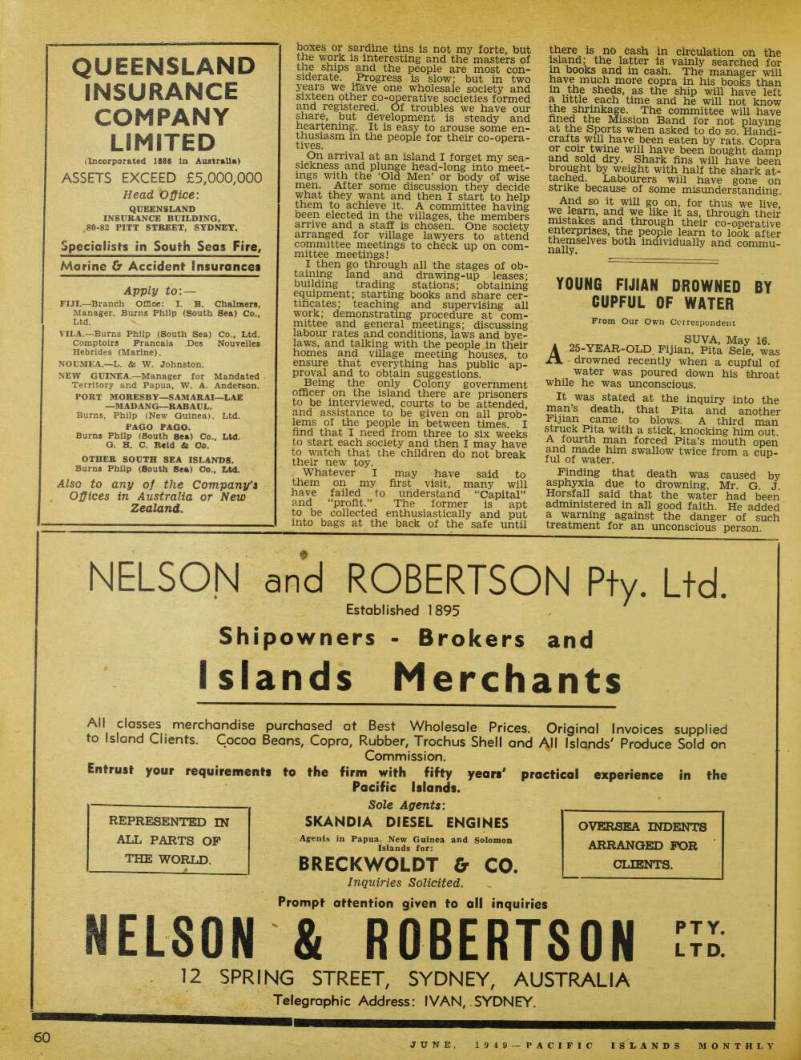
Native Co-Operatives In G. And E.
Connection With Government Trade Scheme
T'HERE has been much curiosity concerning the operation of the Government Trade Schemes in the Solomons and the Gilbert and . Ellice Colony—organisations brought into being by the British Socialist Govern ment to take the places of the private trading and shipping enterprises dis placed by the Jap invasion and not officially encouraged to return. The New Guinea counterpart (established by the Australian Socialist Govern ment) is the Production Control Board.
The following article, by Mr. W. G.
Alexander, appears in the June issue of “Corona,” the new journal of the Colonial Office. It shows, in an interesting and authoritative way, the connection between the G. & E. Trade Scheme, and the Native Co-operatives.
I WRITE this short account from the remarkable little Colony of the Gil bert and Ellice Islands, whose thirty seven coral islands, amounting to a land area of about one hundred and fifty square miles only, lie scattered around more than a million square miles of the Pacific Ocean southwards and westwards of Hawaii. The Colony is comprised of the Gilbert, Ellice and Phoenix Groups and the individual islands of Fanning, Wash ington, Christmas and Ocean. About
4.500 Polynesian Ellice Islanders and 31.500 Gilbertese of mixed Micronesian race inhabit these low lying, palm covered isles.
It is ridiculous, but true, to state that the colony doubles its land area at low tide and one has to keep a wary eye on the atom bomb experiments for, should the sea rise double its normal six foot tide, I imagine well over 90 per cent, of the land would be inundated.
The first trading ships came sailing into this quiet back-water of the Pacific in about 1850, and by 1870 several firms were competing for the trade. The principal exports are phosphates from Ocean Island and sun-dried copra from all other in habited islands.
In 1926, Mr. D, G. Kennedy started the first co-operative society at Vaitupu in the Ellice Group and under his guidance this society flourished. In 1931, Mr. H. E.
Maude, having visited the Ellice Group on census duties and having been im pressed by the Vaitupu society, started two societies at Beru in the Gilberts. By 1934 there were 34 societies in the Gil berts. This rapid development is indica tive of the eagerness of the people to handle their own trading affairs, and also of the peculiar suitability of the co-opera tive form of trading for a people living in small isolated communities, whose traditional custom contains so many co operative principles.
I hasten to add at this point that the Gilbertese are extreme individualists in respect of any matter which is not ac
cepted as being of great importance to the island or the family and, on entering a new realm of experience such as co operative trading, they were extremely distrustful of anyone who was handling for them a matter which they did not completely understand.
The result is that every society is sub ject to the constant critical interest of every member, a healthy factor, but one
which in the early stages results in a tendency to pitch out the committee or the staff over the slightest misunder standing. Mr. Maude records an early problem with his first two societies, whose committees kept demanding to see their capital in cash despite explanations as to the work of the capital in buying goods and produce, and he further mentions the more recent case of a manager who got himself reinstated in his job because he had taken the precaution of burying all the society’s books on a lonely beach without being observed. rpHE start of the Co-operative trading movement was so simple that it did not occur to the people to start dif ferent societies for different purposes.
The original societies were retail societies, which retailed goods to their members only, at prices about 10 per cent, above what they paid to the trading companies.
The people’s money in these islands is copra, so copra was accepted from mem bers at a price about 10/- per ton less than that at which it was passed on to the trading firms. Thus, from the very start, the societies performed the func tions of both retail and producers’ Mar keting societies.
Now, many other functions are being added and societies can be seen financ ing schools or purchases of land; market ing handicrafts, marine produce, firewood, charcoal or building materials; providing land or water transport, entertainment, sports meetings, supplies of drinking water, caretakership of land or making improve ments to harbours and channels. In other words they set out to cater for every requirement of their community.
Until 1940 co-operative societies were restricted to trading with their own members. From 1940 to 1947 only five societies managed to afford the trading licence to enable them to trade outside their membership. In 1947 legislation was enacted which cancelled the membership limit of 200 for a society and inaugurated specially reduced licence fees for regis tered co-operative societies.
THE co-operative movement suffered a setback during the period of the war between the Allies and Japan, and peace found the colony devoid of trading firms, other than the British Phosphate Commissioners at Ocean Island and Messrs. Burns, Philp (South Seas) Ltd., with their plantations at Fanning and Washington Islands. The Resident Com missioner, assisted by his staff, particu larly Mr. Dickes and Mr. Wernham, at tempted to revive the people’s co-opera tive movement through the instrument of a Government Trade Scheme, which had a monopoly of copra exports from all islands of the colony except Fanning, Washington and Christmas.
Two difficulties arose at once.* Firstly, for reasons of rehabilitation of the civilian population, the Government and its Trade Scheme could not wait for co-oper ative societies to be formed. They found it necessary to send out cargoes at once on credit. Secondly, the staff, capital and shipping were insufficient to cater for the many small pre-war co-operatives At first, only one agency on each island could be serviced and that agency had perforce to receive cargo and ship copra from only one point. The most reliable trader or Island government official on each island was appointed as agent, ex cept on a few islands where there had been but one society pre-war and that society had survived the war period.
The Colony government officers on tour then attempted to arrange committees and create co-operative societies out of the agencies. The part-time help from busy government officers achieved very little. The people were not free to have as many societies as they wanted dealing directly with the Trade Scheme. Only a few societies had any capital, most of
them trading purely on credit. Conse quently the superimposed post-war trad ing system was regarded as belonging throughout to the Government. The pre-war co-operative movement had been created by the people, with the help of individual government officers. They had fought against many difficulties and the Societies were their own.
IWAS therefore told to find a Gilbertese clerk and, after fixing up the legal aspects, to set about visiting the islands, starting in the Gilbert Group, and to build up the co-operative trading in the way the people wanted, with their own capital, control and representation.
I was also to investigate any trading pos sibilities other than copra and cargo, and to see about the development of the Trade Scheme into a Co-operative Wholesale Society.
The Trade Scheme is now the Colony Wholesale Society with an advisory com mittee of elected representatives, as an intermediate stage to becoming a Co operative Wholesale Society at a later date.
The Handicrafts Co-operative Whole sale Society deals with an ever-increasing volume of handicrafts, sea shells, marine products, coir twine, pandanus mats and native building materials.
I am a family man, and constant travelling in ships the size of match
boxes or sardine tins is not my forte, but the work is interesting and the masters of the ships and the people are most con siderate. Progress is slow; but in two years we have one wholesale society and sixteen qther co-operative societies formed and registered. Of troubles we have our share, but development is steady and heartening. It is easy to arouse some en thusiasm in the people for their co-opera tives.
On arrival at an island I forget my sea sickness and plunge head-long into meet ings with the ‘Old Men’ or body of wise men. After some discussion they decide what they want and then I start to help them to achieve it. A committee having oeen elected in the villages, the members arrive and a staff is chosen. One society arranged for village lawyers to attend committee meetings to check up on com mittee meetings!
I then go through all the stages of ob taining land and drawing-up leases; building trading stations; obtaining equipment; starting books and share cer tificates; teaching and supervising all work; demonstrating procedure at com mittee and general meetings; discussing labour rates and conditions, laws and bye laws, and talking with the people in their homes and village meeting houses, to ensure that everything has public ap proval and to obtain suggestions.
Being the only Colony government officer on the island there are prisoners to be interviewed, courts to be attended, and assistance to be given on all prob lems of the people in between times. I find that I need from three to six weeks to start each society and then I may have to watch that the children do not break their new toy. , Whatever I may have said to them on my first visit, many will have failed to understand “Capital” and “profit.” The former is apt to be collected enthusiastically and put into bags at the back of the safe until
there is no cash in circulation on the island; the latter is vainly searched for in books and in cash. The manager will have much more copra tohteboSftffi in the sheds, as the ship will have left a little each time and he will not V know the shrinkage. The committee will hav^ fined the Mission Band for not playing at the s P° r ts when asked to do so. Hand!? crafts will have been eaten by rats. Copra or coir twine will have been bought damn and sold dry. Shark fins will have been tached. 1
StI Z *oTn
we iJSrn for we live, and fhrnneh tJ ? eir “JSSS? i th ir , co : op , era £ lve
thenSelvel’ h?th after
nfliu? selves both individually and commu-
Advertisements & other items, pp. 59-62 (1 item)
Marine Engines
FRANCIS HOOVER
4 Castlereagh Street, Sydney • Cables: Petwer, G.P.0., Box 4623.
ISLAND TRADERS
All classes of merchandise supplied. Careful attention given to big and small orders.
MARINE ENGINES
HALVORSEN’S HAVE FOR IMMEDIATE DELIVERY:
“UNDERWOOD” 3 H.P. —2 Cycle—with built in Clutch —Petrol MORRIS “VEDETTE” 4 Cylinder 6/12 H.P. Petrol or Kerosene MORRIS “NAVIGATOR” 4 Cylinder 12/24 H.P. Petrol or Kerosene MORRIS “COMMODORE” 6 Cylinder 20/40 H.P. Petrol or Kerosene CHRYSLER “CROWN” 6 Cylinder 45/102 H.P. Petrol CHRYSLER “ROYAL” 8 Cylinder 55/132 H.P. Petrol Available soon: “LEYLAND” DIESEL MARINE 6 Cylinder 85 H.P.
Further particulars from the distributors :
LARS HALVORSEN SONS PTV. LTD.
WATERVIEW ST., RYDE ( s gXy° f )- N.S.W.
Telegrams: Halvorsens, Sydney. ’Phone: Ryde 705
• FREE EXPERT PROPELLER ADVICE
ONE OF THE WORLD’S
WONDER-SIGHTS
Miles of
mom ice
mm
See New Zealand’s
FRANZ JOSEF-GLACIER
From the Air !
NOWHERE else in the world can you see an eight-mile long river of ice framed in an evergreen setting of sub-tropical forest. Franz Josef is one of the scenic wonders of the world. Why not take the holiday you’ve promised yourself . . . relax in comfort, in scenic surroundings? Travel in comfort too, by N.A.C. aircraft that land you fresh and unweary two hundred yards from hotel door.
HOTEL ACCOMMODATION
Comfortable accommodation and attentive service is provided by the Government Tourist Department’s Hotel at the foot of the Glacier.
-AT YOUR SERVICE
New Zealand National Airways Corporation provides a network of air services throughout the Dominion and the South-west Pacific. General Agents in the Dominion for British Commonwealth Pacific Airlines and Trans-Australia Airlines. Booking Agents for Tasman Empire Airways, Qantas Empire Airways, the 8.0.A.C. and other overseas airlines. , Offices and Agents throughout New Zealand and the South-west Pacific NM
m
SPECIALISINQ IN
PACIFIC ISLAND INSURANCES
FIRE—MOTOR VEHICLE
MARINE—HULLS AND CARGO
LIABILITY
BONDS—In accordance with
ADMINISTRATION ORDINANCES.
COPRA INSURED FROM DRIER
TO BUYER.
AND ALL OTHER CLASSES ARRANGED
AT LOWEST CURRENT RATES.
Established Agencies throughout the Territory of Papua and New Guinea.
Managing Agents: New Guinea Company, Limited.
Island Representative: G. D. A. Kent, Kabanl Branch.
SOUTHERN PACIFIC INSURANCE
CO., LTD.
HEAD OFFICE: 60 HUNTER STREET,
SYDNEY.
" IT'S NEW RIGHT THROUGH"'
Built by Jowetts, of Bradford, Yorkshire.
The JOWETT “JAVELIN” Car, English Body Work, Flat Four Engine, 75 m.p.h. 30-32 m.p.g.
ALSO
The BRADFORD 10 cwt. Lorry, Van, 6-seater Utility and Utility de Luxe. Afiple Power and 40 m.p.g.
Pacific Islands Distributors : G. H. ROBINSON EXPORTS & IMPORTS PTY. LTD 51 Macquarie Street, Sydney For early deliveries Telegraph: “Sunrise, Sydney.”
WILLIAM A JONES PTV. LTD.
Livestock Exporters
Livestock Exported To All Ports Inquiries Invited Address:
108 QUEEN ST., MELBOURNE
Telegrams'. “VALKYRIE,” Melbourne.
QUEENSLAND
INSURANCE
COMPANY
LIMITED
(Incorporated 1886 in Australia)
ASSETS EXCEED £5,000,000
Head Office:
QUEENSLAND
INSURANCE BUILDING,
80-82 PITT STREET, SYDNEY.
Speciolists in South Seas Fire,
Marine & Accident Insurances
Apply to:
FlJl.—Branch Office: I. B. Chalmers, Manager, Burns Philp (South Sea) Co., Ltd.
VlLA.—Burns Philp (South Sea) Co., Ltd.
Comptoirs Prancais Des Nouvelles Hebrides (Marine).
NOUMEA.—L. & W. Johnston.
NEW GUlNEA.—Manager for Mandated Territory and Papua, W. A. Anderson.
PORT MORESBY—SAMARAI—LAE
—MADANG—RABAUL.
Burns, Philp (New Guinea), Ltd.
PAGO PAGO.
Burns Philp (South Sea) Co., Ltd.
G. H. C. Reid As Co.
OTHER SOUTH SEA ISLANDS.
Burns Philp (South Sea) 00., Ltd.
Also to any of the Company’s Offices in Australia or Hew Zealand.
Young Fijian Drowned By
Cupful Of Water
n om ° ur ° wn Oct respondent
C Ttva A/Rqtt
i 25-YEAR-oi n wHinS 16 ‘ \ OLD - PlJiai }' Plta Sele « was drowned recently when a cupful of . water was poured down his throat while he was unconscious, it was stated nt innnw man - s tw h n if quiry , mto * he “JJ 1, . tha * Plta an d. another A , . third man s . tn J ck P i ta with a stick, knocking him out. orJ 0 ™? for^ d Pita’s mouth open f i him swallow twice from a cup lUI 01 water.
Finding that death was caused by asphyxia due to drowning, Mr G J Horsfall said that the water had been administered in all good faith. He added a warning against the danger of such treatment for an unconscious person
Advertisements & other items, pp. 62-66 (2 items)
Nelson & Robertson Si
NELSON and ROBERTSON Pty. Ltd.
Established 1895
Shipowners - Brokers and
Islands Merchants
A| l classes merchandise purchased at Best Wholesale Prices. Original Invoices supplied to Island Clients. Cocoa Beans, Copra, Rubber, Trochus Shell and All Islands' Produce Sold on Commission.
Entrust your requirements to the firm with fifty years' practical experience in the Pacific Islands.
Sole Agents :
NELSON & ROBERTSON Si
12 SPRING STREET, SYDNEY, AUSTRALIA
Telegraphic Address: IVAN, SYDNEY.
Oftnldked by
DAVISON
For Tropical conditions
Velvene Water Paint and Davison's Zinc Base Paints are used extensively throughout the islands and Mandated Territories on Government and Private buildings, giving full satisfaction under severe tropical conditions.
DAVISON
PAINTS
LTD
BOX 24, AUBURN, N.S.W.
m vY/^t n m m 1
£n*xrnt^ct/t4t&e
Gordon's
Stands Supk&MA
Gin Distillers to H.M. King George VI Tanqueray, Gordon & Co. Ltd.
An ornate example of historical
keys, this XVlth Century
French key features the sporting motif in its club and animal carvings. It seems to have been the key to a Duke’s country
lodge.
ft V' ~£r / m m ill rm R*
The key
to smoking pleasure
CAPSTAN
FINE CUT
NAVY CUT
TOBACCOS
or
Rid Kidneys Of
Poisons And Adds
If you suffer sharp, stabbing pains, If Joint* are swollen, It shows your blood Is poisoned through faulty kidney action. Other symptom* of Kidney Disorders are Backache, Aching Jelnts and Limbs, Sciatica, Neuritis, Lumbago, Sleepless Nights, Dizziness, Nervousness, Circles under Eyes, Loss of Energy and Appetite and Frequent Headaches and Colds, etc. Ordinary medicine* can’t help much because you must get to the root cause of the trouble.
The Cystex treatment is specially compounded to soothe, tone and clean kidneys and bladder and remove acids and poisons from your system safely, quickly and surely, yet contains no harmful or dangerous drugs. Oystex works In 3 way* to end your troubles. 1. Starts killing the germs which are attacking your Kidneys, Bladder and Urinary System in two hours, yet is absolutely harmless to human tissue.
X. Gets rid of health-destroying, deadly poisonous acids with which your system has become saturated. 3. Strengthens and reinvigorates the kidneys, protects from the ravages of disease-attack on the delicate filter organism, and stimulates the entire system.
Praised by One-time Sufferers
Oystex is approved by one-time sufferers In 73 countries from the troubles shown above.
Mr. Reg Thomas, Townsville, Queensland, recently wrote: “My Joints were all stiff, I had leg pains, my back used to ache day and night.
My bladder was weak. I had headaches and no appetite. The first dose of Cystez helped use and before I finished three boxes my health and strength came back.”
Guaranteed to Satisfy or Money Back
Get Cystex from your chemist or store to-day.
Give It a thorough test. Cystex Is guaranteed to make you feel younger, stronger, better U every way, or your money back If you return the empty package.
Now In 2 slice—4/-, •/-.
Cystex
for Your Kidneys, Bladder, Rheumatism.
X-RAY, PHYSICAL-THERAPY
SURGICAL & SCIENTIFIC EQUIPMENT
Prompt Attention to All Inquiries Watts ®w Victwir.
BL II m/OL ITE B
Watson House, 9-13 Bligh Street, Sydney, Australia
If You
Cannot Sleep
FEEL FIT FOR NOTHING.
You may be anaemic or bloodless, for this ailment plays havoc with your health and nervous energy. You feel terribly iiervy; suffer headaches and dizzy spells, have poor appetite, cannot sleep at night —losing those precious hours of rest and recovery, essential for your health and fitness.
Many people have recovered from these miseries by taking Dr. Williams’ Pink Pills, which have reinvigorated, strengthened their systems and banished the vague pains and weariness. Dr. WUliams’ Pink Pills always help to enrich and increase the blood supply, giving beneficial help to the nerves, tissues and organs of the body. With enriched blood you cannot help feeling happier, sleeping better, becoming reinvigorated.
Stop anaemia making you a suffering invalid without delay. Take Dr. Williams' Pink Pills and soon notice the difference in your eyes, skin, nerves and general health. At all chemists and stores.
61
PACIFIC ISLANDS MONTHLY JUNE, 1949
THE KO
(Continued from Page 52)
Radio Receivers for Native
Broadcasts
From Our Own Correspondent
Rabaul, May 24.
SO that natives may listen to the daily native broadcasts between 5 and 6 p.m. over 9PA, Port Moresby, the Department of Education has issued radio receiving sets to the Education De partment in Rabaul, Kavieng, Sohana and Manus, the CRTS School at Mala guna, the Education Centre, Kerevat, native hospitals at Rabaul, Kokopo Wakunai, Anelaua, etc., and to the Gov ernment Stations at such places as Pomio, Kandrian and Talasea.
A native from Nodup, Rabaul, named Towalaka, gives the Pidgin broadcast from 5.30 to 6 p.m. Some of the records used are recordings made by the Edu cation Department staff at the Choral Festival, Rabaul last year and at Vuvu Mission.
Honiara Now Has An Hotel
From Our Own Correspondent
Honiara, May 15.
THERE opened with a flourish in Honiara on May 14, the Woodford Hotel, whose licensee is Kenneth Houston Dalrymple Hay, formerly of Levers’ Pacific Plantations Pty., Ltd., well-known BSI identity who remained behind when the civilian evacuation of the Solomons was carried out.
Precipitated into existence by the loss by fire of the Guadalcanal Club, which contained Honiara’s only bar, the new hotel has its being in a former Army hut, a stone’s throw from the Government offices in the centre of the “town”.
Free beer for Honiara customers marked the hotel’s opening yesterday morning. In the evening the doors opened again for business with the as sistance of a hatchet—the new licensee having mislaid the key.
The hotel is named after the first Solomon Islands Resident Commissioner, C. E. Woodford, CMG, who was appointed in 1896 as a result of his close study of the Group as a naturalist-collector. It is owned by the Trade Scheme and is the forerunner of a projected permanent residential hotel for Honiara.
Mr. Hay has also taken over the handling of the Trade Scheme’s Honiara butchery, as well as leasing Levers’ property, Three Sisters, in South-eastern Solomons.
Flying Officer Victor Hjorring, a mem ber of a former well-known Levuka family, Fiji, received the MBE at the hands of the Governor-General of New Zealand, at an investiture in Auckland in May.
Advertisements & other items, p. 66 (1 item)
Carrlock Co. Ltd.
Telegram: "CARRLOCK" P.O. Box 2140, Hong Kong
2nd Floor, Queen's Bldg., Chafer Road, HONG KONG
General Merchants :: Commission Agents
Exporters and Shippers of All Kinds of Merchandise To the Pacific Islands Representatives of Leading Manufacturers
in HONG KONG
INQUIRIES INVITED
Indian Or Fijian?
A Problem for the Employer of Labour
Letter to the Editor IDO not agree with some of the state ments which you have published in regard to the Indians in Fiji. In some issues, you have suggested that the In dians should be shifted back to India.
If that were done, what would happen to plantation-owners who need labour?
Fijians are irresponsible and lazy, and will not work. They expect to be paid a full day’s pay for a third of a day’s work —and that badly done —except when cut ting copra on piece-work. They also are cheeky and dishonest.
I would sell out and return to New Zealand if I could not employ Indians or Solomons—the latter are the most re liable labour I have worked in the Fiji islands. I refer to the older Solomons— the younger generation are on a par with the Fijians.
I notice in your March issue that you anticipate trouble among the Indian cane growers. It seems to me you are trying to foment trouble in Fiji by keeping this Fiji-Indian pot boiling, and making great play about the Fijians’ super-war-effort.
Far be it from me to make unpleasant re marks about anyone’s war effort—but why not forget all this, and let us try to have some peace? Surely there is enough trouble all over the world, most of it perhaps Communist-inspired, without making more here.
Anyone, to really write about labour conditions in Fiji ought to have resided on and worked a plantation for a few years—he would have a better under standing of the mentality of the different races here.
I am, etc.,
J. Price.
Savu Savu, Fiji.
EDITORIAL NOTE: We have not ad vocated the removal of the Indian popu lation from Fiji, because we know that that is quite impracticable. We merely mentioned that plan as offering about the simplest solution of a problem that grows progressively worse. There are various alternatives—all difficult. Many practical, highly respected planters like Mr. Price share his views, exactly; but how many of them are prepared to con template life in Fiji as an Indian colony?
Yet that is quite a possibility. The In dians already are howling for it; and the Bloomsbury Socialists who now control the British Government, if they are re
turned to power next October, are quite capable of surrendering Fiji, Ma\iritius, and one or two other islands similarly circumstanced, to “the Republic of India” . . . We surely have no wish to stir up trouble in Fiji. But neither do we wish to see the responsible citizens of Fiji ignoring the danger disclosed in the census figures, and in the Indians’ ceaseless political activities.
A New Area For Suva
DESPITE difficulties created by pheno menal rain in recent weeks, a good start has been made on the Walu Bay reclamation, which is to enlarge the area available for industrial buildings in Suva. The Old Hospital Hill is steadily being removed and the spoil is being placed along the harbour foreshore.
Attention also was directed to this area by the arrival, on May 23, of the “British Knight,” the first tanker of the British Petroleum Co. to visit Suva in peacetime, and which discharged petrol direct into the company’s new tanks at Walu Bay.
The mangrove swamp which once was Walu Bay is disappearing under a broad, dry, level expanse which will add greatly to the value of both industrial area and docks.
Miss Joan Miles left Brisbane recently for Port Moresby to take up a secretarial position in one of the local hotels.
The Rev. C. F. Gribble, General Secre tary of Methodist Overseas Mission, with Mr. F. Fielding, Brisbane, a member of the Mission Board, arrived in Rabaul by Qantas aircraft on May 20. They will investigate the rebuilding problem of the Methodist Mission in New Guinea.
Advertisements & other items, pp. 67-68 (1 item)
Aluminium Roofing
VETERINARY
INSTRUMENTS
For Sheep and Cattle can be
Supplied Immediately
EARMARKERS.
SPEYING INSTRUMENTS'.
BULLRINGS.
EIRE BRANDS.
EMASCULATORS.
W. JNO. BAKER
PTY. LTD.
3 Hunter Street, Sydney, N.S.W., Australia
h
Aluminium Roofing
Now available for shipment to Pacific Islands Aluminium Corrugated Roofing is rustless and U the lightest of all fabricated roofing materials. This Is a point worth remembering when considering freight costs. Heat due to solar radiation is substantially reduced when Aluminium roofing is used.
Inquiries to:-
ALUMINIUM UNION LIMITED
(Incorporated in the Dominion of Canada ) Largest Distributors of Aluminium and its alloys in the British Commonwealth OCEAN HOUSE, 34 MARTIN PLACE. SYDNEY. N.S.W.
A Member of the Aluminium Limited Group, Montreal, Canada
TILLEY. LAMPS
. (BURN ORDINARY KEROSENE)
The Modern Form of PORTABLE LIGHTING
m i m
ATTENTION TO DETAIL
is the characteristic of all British products
TILLEY LAMPS
are British made throughout at Hendon & Cricklewood, England.
THE TILLEY LAMP COMPANY LTD. of ENGLAND London Offices and Showrooms: 33 SACKVKLLE STREET, PICCADILLY, W.l
REPRESENTATION :
MELBOURNE: T. H. Bentley, Pty. Ltd., 123-125 William Street, Melbourne, C.l.
TASMANIA: Mr. C. Sellars, 108 a Charles Street, Launceston.
FIJI: Mr. K. Witherington, 2 Burns Philp Buildings, Suva.
Students
Special Air Fares For Island
A SPECIAL 50 per cent, fare reduction for students making return air journeys in school vacation periods is announced by Qantas (Australia).
This concession will benefit students who attend Australian schools but whose homes are in India, Malaya, New Guinea New Britain, Fiji and Norfolk Island.
On overseas QEA services, Australia- England and Australia-Piji, the conces sion applies to school-children and students of colleges and secondary schools between the ages of 12 and 18 years. On regional services to New Guinea, New Britain and Norfolk Island, students be tween 15 and 19 years benefit. Children younger than these age-groups already re ceive a 50 per cent, fare reduction.
Application for student excursion tickets on overseas services must be sup ported by a certificate from the school principal certifying that the student is trayelling during a regular school vacation period and intends to visit parents or gusirdians residing in a country other than that in which the school is situated.
On regional services, the certificate need only stipulate that the student is on vacaand the rebate will also apply to a single journey. y a School vacation return fares are valid for four months.
The Polynesian Club Of
Sydney
HAIL and “farewell” have been the dominant themes at recent Monday evenmg gatherings of the Polyne sian Club at 38 Clarence St., Sydney There was a farewell to Jean le Caill, who left for home in Papeete, Tahiti, bv steamer after two years’ stay at the home President, Leonard Moran. given siene Mataafa and her husband (Mr. & Mrs. A. Vercoe) Samoa aV6 SinC6 g ° n 6 by plane to Apia ’
Among visitors have been Mr. and Mrs G. Anms and their son, Gerald, from Suva; Mr. Charles McPhee, well-known painter, from Apia; Dr. Tom Davies, an interesting personality from Rarotonga.
Among visitors from Tahiti were Captain ¥ ast Jf. r ° f the Government snip, Orohena, which was on a short trip to Sydney. With the Captain were Messieurs Olivier Ceran, H. Teihotua and others from the ship. Prance was rep- Broise ed by Madame and Mademoiselle Captain Tom Milner of the Gilbert and Adrmnistration shi P, which win St 1 “P* 1 Minoa ’ after a Gil- S™L£ sland goddess of ancient days. £?. ught a group of Ellice Island and Gil hoys from his ship who joined in with of you £ g Fijians and the Club dances 111 presenting Polynesian songs and Tr^ other i i ? tere ? ting even t in May was a Joking by a group of young Samoans, who were directed by the three Tnm h^fii?iff ert i r 2 m Apia ’ Re * Talosago, Tom Kilipati and Samu. The Kava cere- SJS? SSK a gesture of respect to the Club v *f l^ors as well as the first purely Polynesia ceremony in the new home, i™JLau no Su wooden Kava Bowl was by the Preside nt, who received it Samoa y6arS ag ° fr ° m Savail> Western Marcel Catulle has commenced practice m Port Vila. New Hebrides, as Avocat-Defenseur. He sailed from Sydney for the Condominium by the “Morinda” at the end of May.
At Least
Ng Workers Get
£6 Per Month
AVERY INTERESTING announcement is made in the Papua-New Guinea Gazette of May 25 by the Director of Native Labour. He informs employers who propose to make their unindentured native servants a monetary allowance in lieu of rations that the allowance is now officially assessed at £l/3/7 Australian per week, in addition to wages, which must not be less than 15/- per month.
Therefore, it should now be noted by Mr. Ward and his fellow-travellers, who have had so much to say about the “ex ploitation of natives” by the Europeans who pay them a miserable 15/- per month, that the wages received by the native workers, in cash or in kind, are not less than £6 per month. That is the official minimum. Actually, they are more than that.
Tragedies In Samoa
From Our Own Correspondent
A Apia, May 25.
S a result of growing sophistication, suicides amongst Samoan natives, rarely heard of in former times, are on the increase. Recently, a young Samoan woman, a medical nurse, Fiti Faamoe, committed suicide at Salailua Sayan, by poisoning herself; and a man,’ resident at Saleufi, Apia, committed suicide by hanging himself on a bread fruit tree.
A Samoan woman, Faapusa Faumi, of Savan, killed her newly-born baby and buried it. A Samoan, Seko, of Faasale leaga, killed another Samoan, Lokeni, by chopping his head off with a knife. Three murder cases are to be heard by the Apia High Court in June.
Dr. J. T - Gunther, Director of Public Health in Papua-New Guinea, who at tended the session of the South Pacific Commission in Noumea, paid a visit to Suva in May.
The Wagers : A ‘Kai Viti
Family
THAT New Caledonian timber-getting
operation, mentioned in May'“PlM,” is an undertaking by Bryant & Mays, Ltd., of Melbourne, hard-pushed ap parently to get suitable timber for match making.
In charge of the operations is Captain Guy E. Wager, a Fiji-bom man, who had service in the AIF in Australia and New Guinea, later served with the Buffs and the Durham Light Infantry in India, Malaya and Burma, finishing up with a couple of years of War Crimes Investiga tion in Burma and Siam. He was in the jeep accident you mentioned and, with a broken collar-bone, he was the least seriously injured of the party.
Of the other Fiji-born Wagers, Barbara (now Mrs. de Bohun Helm) is busy, with her husband, raising fat lambs and babies near Wagga. “Dick” Helm will be re membered by many of the planting fraternity of pre-war New Guinea. Solo mon Island friends of Fred Wager will be interested to hear that he is well estab lished in Victoria, producing fat lambs and wool. The other “Kai Viti,” Dorothy (now Mrs. Judge, of Waitara), is well known in Sydney golf circles—she was several times champion of the Cromer Club, and is the present holder of the Gatland Club championship.
The father of the flock (who was once spoken of in the Suva press as “that Beau Brummel of the Fiji Constabulary”) is usually to be found, with his good lady, at the Pacific Islands Society meet ings, enjoying a monthly hobnob with old Fiji friends.—ST.
The retiring governor of French Oceania, M. Maestracci, and his wife, spent a few weeks in Sydney, before leav ing for France in mid-June.
Advertisements & other items, p. 69 (2 items)
67
PACIFIC ISLANDS MO NIBLI-,„NE. 1„4 9
Gabriel Achun
KODAK FILMS
and all Photographic Supplies
WHOLESALE AND RETAIL
CAINE'S STUDIOS
P.O. Box 8, Suva Photographers. Est. 1904.
Write for free price lists.
Gabriel Achun
Molaguna Road, RABAUL, T.N.G.
WHOLESALE MERCHANT AND IMPORTER
CORDIAL MANUFACTURER
Piecegoods for Native Trade. (Large shipment of variety arrives with every Eastern boat.) Other Lines of Trade Goods.
High-class Aerated Water and Cordials. Beer, Wines and Spirits.
Quotations and Samples of Materials gladly sent upon request.
Telephone: No. 104 Cables & Radios: Gabriel Achun. Rabaul
Karl Nagy’S Address
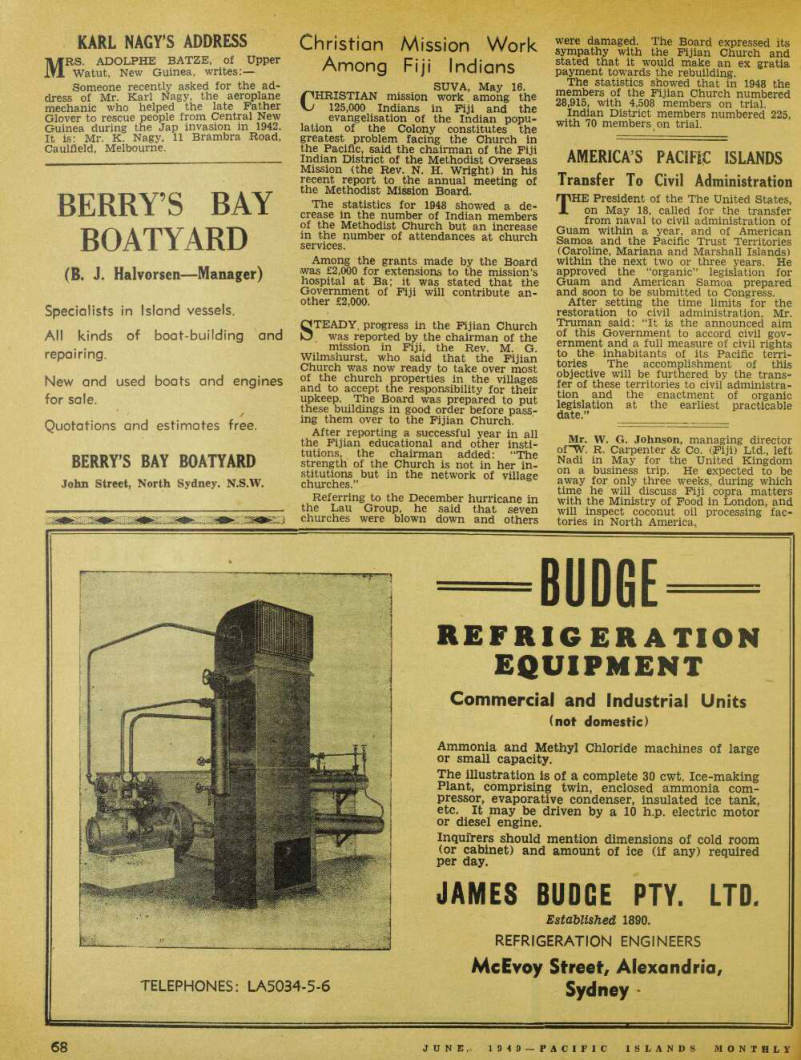
Mrs. Adolphe Batze, Of Upper
Watut, New Guinea, writes:— Someone recently asked for the ad dress of Mr. Karl Nagy, the aeroplane mechanic who helped the late Father Glover to rescue people from Central New Guinea during the Jap invasion in 1942.
It is: Mr. K. Nagy, 11 Brambra Road, Caulfield, Melbourne.
Among Fiji Indians
Christian Mission Work Among Fiji Indians
Csuva, May 16.
HRISTIAN mission work among the 125,000 Indians in Fiji and the evangelisation of the Indian popu lation of the Colony constitutes the greatest problem facing the Church in the Pacific, said the chairman of the Fiji Indian District of the Methodist Overseas Mission (the Rev. N. H. Wright) in his recent report to the annual meeting of the Methodist Mission Board.
The statistics for 1948 showed a de crease in the number of Indian members pf the Methodist Church but an increase in the number of attendances at church services.
Among the grants made by the Board was £2,000 for extensions to the mission’s hospital at Ba; it was stated that the Government of Fiji will contribute an other £2,000.
STEADY, progress in the Fijian Church was reported by the chairman of the mission in Fiji, the Rev. M. G.
Wilmshurst, who said that the Fijian Church was now ready to take over most of the church properties in the villages and to accept the responsibility for their upkeep. The Board was prepared to put these buildings in good order before pass ing them over to the Fijian Church.
After reporting a successful year in all the Fijian educational and other insti tutions, the chairman added: “The strength of the Church is not in her in stitutions but in the network of village churches.”
Referring to the December hurricane in the Lau Group, he said that seven churches were blown down and others
were damaged. The Board expressed its sympathy with the Fijian Church and stated that it would make an ex gratia payment towards the rebuilding.
The statistics showed that in 1948 the members of the Fijian Church numbered 28,915, with 4,508 members on trial.
Indian District members numbered 225, with 70 members on trial.
America’S Pacific Islands
Transfer To Civil Administration
THE President of the The United States, on May 18, called for the transfer from naval to civil administration of Guam within a year, and of American Samoa and the Pacific Trust Territories (Caroline, Mariana and Marshall Islands) within the next two or three years. He approved the “organic” legislation for Guam and American Samoa prepared and soon to be submitted to Congress.
After setting the time limits for the restoration to civil administration, Mr.
Truman said: “It is the announced aim of this Government to accord civil gov ernment and a full measure of civil rights to the inhabitants of its Pacific terri tories The accomplishment of this objective will be furthered by the trans fer of these territories to civil administra tion and the enactment of organic legislation at the earliest practicable date.”
Mr. W. G. Johnson, managing director R. Carpenter & Co. ((Fiji) Ltd., left Nadi in May for the United Kingdom on a business trip. He expected to be away for only three weeks, during which time he will discuss Fiji copra matters with the Ministry of Food in London, and will inspect coconut oil processing fac tories in North America.
Advertisements & other items, p. 70 (2 items)
Berry’S Bay
BOATYARD
(B. J. Halvorsen—Manager)
Specialists in Island vessels.
All kinds of boat-building and repairing.
New and used boats and engines for sale.
Quotations and estimates free.
BERRY’S BAY BOATYARD
John Street, North Sydney. N.S.W.
—Budge —■
TELEPHONES: LA5034-5-6
REFRIGERATION
EQUIPMENT
Commercial and Industrial Units
(not domestic) Ammonia and Methyl Chloride machines of large or small capacity.
The illustration is of a complete 30 cwt. Ice-making Plant, comprising twin, enclosed ammonia compressor, evaporative condenser, insulated ice tank, etc. It may be driven by a 10 h.p. electric motor or diesel engine.
Inquirers should mention dimensions of cold room (or cabinet) and amount of ice (if any) required per day.
JAMES BUDGE PTY. LTD.
Established 1890.
REFRIGERATION ENGINEERS
McEvoy Street, Alexandria,
Sydney
‘Negligent Trustee’
Leading Australian Daily Describes Wardist Regime in N. Guinea
THE following damning indictment of the Wardist administration in New Guinea was published as a leading article in “The Herald”, Melbourne, on May 14, under the heading “Negligent Trustee”.
No comment is needed—except that vte may poirit out that this summary of the situation supports all the criticism we have made of Territories’ conditions during the past three years.
IJIVEN before the war ended, the Aus- Jtj tralian Government had the means —and, as it then seemed, the desire —to launch a sound programme of social and economic reconstruction in New Guinea. An Australian New Guinea Ad ministrative Unit and a Production Con trol Board existed. Great resources of surplus war material, together with war made dock facilities, could have been turned to civil usfe as the camp'aign front rolled north. But the picture in 1949, after more than three and a half years of peace, is one of waste, decay and frustration.
The Herald’s observer, Mr. Osmar White, sums up in one of his recently published articles that “probably no ter ritory in the world to-day is a more cautionary example of what happens when an inefficient and ignorant met ropolitan government assumes the re sponsibility of colonial administration”.
That is the verdict of one now revisiting an area which he knew well before and during the war.
New Guinea’s importance to Australia needs no stressing, A great part of our war effort was dedicated to its libera tion, and it will be a strategic corner stone in our future defence. Responsibili ties have grown and problems have be come complex since 1945, but we can not claim inexperience as an excuse for failing to meet them.
Our pre-war administrations in both Papua and the Mandated Territory of New Guinea may have had the faults of a leisurely era. Broadly, however, they were based on a policy at Canberra which allowed offcials, white civilians and natives in New Guinea to see where they were going.
Unreal
BY contrast, the present Federal Gov ernment has instituted little beyond a “new deal” in indentured labor regulations, the first effect of which was to create chaos on the newly re-opened plantations. This has recently been fol lowed by an ordinance requiring native councils to send reports of their village meetings to Canberra. Such bureau cratic absurdity may swell the files of the External Territories Department— if village headmen along the Ramu and the Sepik can find shorthand typists.
But it will convince neither the natives nor any competent member of the United Nations Trusteeship Committee that Australia has a practical plan for New Guinea.
Window-dressing qrdinances are not what New Guinea needs. The urgent job is to provide saw-milling equipment for practical reconstruction, to repair the wharves that have been allowed to rot, to get shipping for the thousands of bags of valuable copra that is de teriorating on plantations. Above all, the need is to slash away the red tape
at Canberra which is frustrating the efforts of administrative staffs in the field.
Frustrated
WE have the nucleus of a fine colonial service in New Guinea.
It has been able to do some good post-war work, in spite of heartbreaking
difficulties. A useful start has been made in opening technical training centres for natives. But the rate of resignations from the service is high. The conditions under which the Government expects them to live and work in the tropics, and the atmosphere of negotiation which emanates from Canberra are discourag ing the young Australians who should be the pioneers.
Great play has been made by the Gov ernment on its intention of abolishing labour exploitation and giving first pri
ority to native welfare. No progressive Australian would challenge that aim.
But only the most unpractical theorist would assume that the objective could be reached by a primitive community of two million natives without a long pre paratory period in which trained and trusted white administrators are given every assistance, and in which white en terprise is allowed to give the country a sound economic foundation.
The Rt. Rev. Leo Scharmach, Roman Catholic Bishop of New Britain, returned to Rabaul, from a visit to Australia on May 13 by Qantas Airways. He was ac companied by Father Kopas. Both have now returned to Vunapope Mission.
Advertisements & other items, pp. 71-72 (2 items)
69
PACIFIC ISLANDS MONTHLY - J U N E , 1 949
Vincents
* n ic y breeze 4 The perishing caddies cough and sneeze, Until the shivering golfers, too, Retreat from the risks of cramp and ’flu.
''-'jfr — Back to the clubhouse they gaily go To sip the solace all golfers know; And glowing warmth in "a spot” they fine With Woods’ Groat Peppermint Curo combined.
TAKi Vwee NTS A PC
co/mcwce
Confidence brings success!
Place your confidence in the hospital formula of genuine Vincent's a.p.c. For over 1 C 25 years the medical profes- m sion has had absolute confidence in w this better-balanced prescription \ Take Vincent's A.P.C With Confidence.
For HEADACHE AND NERVE
AND MUSCULAR PAIN!
ft w-
VINCENTS
N4BD
V
VINCENTS
KE
j forTafeiH
SAFEST 8t BESTI
A. GREGORY PTY, LTD.
IMPORTERS, EXPORTERS AND
MANUFACTURERS
Leather Saddlery and Paint Merchants ALL CLASSES OF LEATHER SUPPLIED FROM STOCK \VVIy direct to: A. GREGORY PTY., LTD., 107 York St, Sydney
For OLD Kitchens and New
You don't have to wait until you're building a new home to enjoy the advantages of a Wunderlich Stainless Steel Sink Unit . . . you can replace the outworn sink in your present home at once with a satin smooth hygienic unit, for stocks are available now.
Made in standard lengths of 4 ft., 5 ft. and 6 ft. by !'6" wide the Wunderlich Unit is sturdily constructed of Stainless Steel and is easy to instal.
Ask your local Hardware Merchant, 'phone MX 241 I, or write to Box 474, G.P.O. Sydney, for further details and prices. N
S derlicft
.INK. UNITS
IKI STAINLESS STEEL
Tourist — Here's Your Guide To Norfolk Is
Norfolk Is.
By Vernon Wheatley
NORFOLK ISLAND has been variously described as “the Madeira of the Pacific,” “a sub-tropic Paradise” and so on. In fact, every tourist agency will produce, upon demand, a different des criptive title.
A certain tourist bureau in Auckland, NZ, perhaps wins the coconut. These enthusiastic purveyors of tickets to ob livion infer that Norfolk is bounded by
beaches—“you jump out of your bedroom window and you are practically in the surf,” was a fanciful statement made to one tourist—and that, as you walk along the beaches, you can pick pineapples off TREES! Botanically incorrect.
In spite of all this, however, Norfolk can give one a delightful holiday. The future of Norfolk, in the main, appears to be bound up in its potential tourist traffic, but, just now, the amenities are lacking. Holidaymakers should realise that the best time of the year to visit here is during the winter. During the summer, the guest houses are hopelessly overcrowded, while in the winter there is plenty of accommodation available. Dur ing summer we miss the oranges and lemons and other fruits, but in the winter, fruit, with the exception of peaches, is abundant.
TOURIST transport to Norfolk Island will have to be accelerated if the Island is to benefit by tourist trade.
At present, we have the “Morinda” from Australia calling approximately once every three months, with, perhaps, an odd trip once a year by the “Muliama,” also from Australia.
These ships, during the year, probably bring only about twenty tourists. The rest of the passengers are going through to the New Hebrides or are local resi dents returning to or arriving from Aus tralia.
The Qantas Lancastrian, arriving every second Thursday from Australia, averages about eight passengers; while each NAG plane from NZ averages about fourteen passengers. The NAG runs one plane from New Zealand one Sunday, with two planes on each alternate Sunday.
Any increased tourist traffic from NZ has not been noted since September, 1948, when the exchange became so favouarble, simply because no extra planes have been placed on the circuit. And no extra planes are running because, during the summer, the guesthouses were fully booked. So it is just a vicious circle. However, the coming winter may see the summer feast spread over to counteract the winter famine.
Whilst we are on the subject of the tourist trade, let us dwell upon the faci lities for the incoming tourist. If he comes by boat, the tourist may (depend ing on the weather) have to shoot the breakers in a whaleboat, in rather hectic fashion, and, upon reaching the pier, leap frantically like a mountain goat to gain a solid foothold. His cases are handed to him with gallons of sea-water pouring from them. It is a rugged trip, but safe, because the boatmen have had years of experience in all weathers.
By air, the arrival is depressing. The tourists are herded into a dingy hut with a dirt floor. However, we understand that the dirt floor will shortly be receiving the earnest attention of the authorities.
Once through the regulations, the poverty-stricken building, plus its other depressing features, is soon; forgotten.
After all, it is only a minor item and one is never too critical whilst on holiday.
Strangely enough, Kingston, which is often quoted as the “village” of Norfolk Island, is more or less a cul-de-sac—you cannot purchase even a match or a cup of tea there. The main features of King ston are Emily Bay, a beautiful half moon of yellow coral sand where all-year bathing may be enjoyed; the cemetery which yields interesting and poignant
facts and makes one realise that Hitler did not invent the concentration camp; the old prison ruins; and, finally, the Government offices (or the red tape fac tory).
This building produces most of the Ad ministration’s revenue by the sale of stamps. But most important of all, at Kingston, is Ye Olde Administrative Grogge Shoppe, which also does its bit in replenishing the Government coffers.
THERE are many places of interest to visit—Anson Bay and the Cable Station, Cascades, Mount Bates, Ball Bay where the whaling station is located, the Headstones, St. Barnabas Chapel, and so on. Fish are plentiful and if you are fortunate enough to be invited out in a launch —well, you are in a fisherman’s paradise.
Both the Administrator and the Official Secretary, to'give them credit, are avail able for interviews to anybody. This is a big thing, for in many Government de partments, the seeker after information is passed from one jack-in-office to an other without any real satisfaction being gained. This cannot be said of the Ad ministration here, whatever else might be said.
Much comment has been made about the roads here. In summer, they dissolve into clouds of dust and in winter they are a treacly smother of mud. There is a move to have them tar-sealed and already an experimental stretch has been laid down. Credit for this must be divided between the Administration and the Com monwealth Department of Works and Housing which is over here to remove some of the primitiveness from the aero drome and allied projects, and also to supply housing for the Civil Aviation em ployees.
Some people imagine that, because of all these improvements, the Administra tion will do something about an all weather anchorage, but I fear that this will not be seriously considered on the grounds that it will cost too much. Which is faintly ridiculous, because harbourage charges and time saved in unloading ships would pay for the installation in a very few years. It would also help the Island as a tourist resort.
THE internal political battles of the Island are between the Island Coun cil, in one comer of the ring, and, in the other, the Administration. Most of the battles, though stormy, are mainly indecisive.
This, then, is a true picture of the Island, omitting the gloss and lard so lavishly spread by organisations whose sole aim in life is to sell you a ticket. You can have a good time here although there are no super cabarets. There is an ex cellent picture theatre, but there is no casino de-luxe. Your holiday will be what YOU make it, but, without' trying very hard, you can make it very enjoyable.
Mr. H. E. Maude, member for Social Development on the Research Council of the South Pacific Commission, arrived in Sydney early in June to make that city his headquarters for six months, while carrying out various research. Mr. Maude originally was appointed Deputy Secre tary-General, but was later asked to take the more responsible position. He was joined in Sydney by Mrs. Maude, who came from Auckland, and they had the good fortune to secure a very suitable residential flat in the overcrowded city almost immediately after they arrived.
In carrying out the Social Development projects approved by the Commission, Mr.
Maude will go to various Territories to confer with educators and scientists. In August he expects to be in Fiji for two weeks and, in November and December, in Wellington, NZ, for consultations.
Advertisements & other items, pp. 73-74 (1 item)
Burns Philp Trust
'THAT
<2
IHE
Pick up
This Pilot Now
Like the skipper who takes chances in unfamiliar waters, the private executor lacks first-hand knowledge of the difficulties ahead. The administration of an estate never a simple matter these days is doubly difficult for the man who lives in the Islands. Sound advice on finance, taxation, and Investments must be available at all times. The appointment of Burns Philp Trust Company Limited as executor or trustee secures this advantage, together with the collective first-hand knowledge of experienced directors and efficient officers.
Full details of the Company's helpful services are given in "Hands That Never Leave the Wheel." A complimentary copy of this valuable booklet can be obtained from any branch of Burns Philp (South Sea) Company, Burns Philp (New Guinea) Limited, or direct from the Head Office of this Company.
S
DIRECTORS:
James Burns Joseph Mitchell P. T. W. Black Eric Priestley Lee MANAGER: L. S. Parker
SECRETARY; E. R. Overton, A.F.I.A.
Burns Philp Trust
COMPANY LIMITED
EXECUTOR • TRUSTEE • AGENT
Constituted by Speciul Act of the A/.S. W.
HEAD OFFICE: 7 BRIDGE STREET, SYDNEY
Tel. BU 5901 Box 543. G.P.O.
THE CRAMHOND TROPIC EAGLE...
Has Already Set A New Standard For Radio
Reception In The Territory
“The best set I have seen and heard here, or, in fact, anywhere,” is how one purchaser describes it.—Another owner reports: “Decided last night to see how many stations I could tune in—logged 180 at good strength—set perfect.”
THE TROPIC EAGLE
EXCLUSIVE FEATURES:—
Sealed in rustless metal cabinet.
Built in moisture-absorber.
Continuous coverage from 16-150 metres short wave. 200 to 550 broadcast.
Provision for use of Phones.
Available in four types:— (1) Six-volt vibrator. (2) All dry cell operation. (3) All electric 240 or 110 AC. (4) Two-volt accumulator and “B” batteries.
The ideal set for locations where extreme humidity prevails.
THE CRAMMOND ALL ELECTRIC
OR VIBRATOR GRAMO-RADIO
COMBINATION
VIBRATOR BATTERY MODEL
Seven valve push pull output triple wave with spring gramo motor. Price, £9O/10/- complete.
ALL ELECTRIC 240 VOLT AC
6-valve push pull output triple wave. Two speakers.
Highest grade Garrard record changer. Price, £9B/10/-. 8 and 10 valve models with triple speakers also available.
Gramo-radio combinations are supplied in moistureproofed bondwood cabinets with richly grained waterproof veneers. Set components are tropic proofed by our exclusive infra red ray method. We manufacture a range of over thirty models of console, mantel, portable receivers. Write for particulars.
ALL CRAMMOND RECEIVERS CARRY AN IRONCLAD 12 MONTHS GUARANTEE Address all inquiries to Tropical Division ...
CRAMMOND RADIO MANUFACTURING COMPANY. PTY. LTD.
No. S Queen Street', Brisbane
Poor Old Fiji!
Victim of An Irresponsible Writer
By R. C. Macpherson
AN article on Fiji, by a woman writer, in a Sydney monthly devoted to travel is so inaccurate as to be fantastic. Here are some of her out standing gems: After referring to the “emergence of Cakobau as senior chieftan”(!) the writer says: “In this more peaceful atmos phere Methodist missionaries were soon preaching their doctrine in the shadow of the great king ...”
The Methodist Mission celebrated its centenary in Fiji in 1935. Cakobau did not reach power until 25 years later. It is enough to make pioneer missionaries Cross and Cargill (1835) turn in their graves.
She says Fiji is situated midway bet ween America and Australia! The largest island is referred to as Titilevu.
She gives the population as 90,000 natives, 70,000 Indians and 5,000 Euro peans. No people of mixed descent.
The 1946 census: 118,083 natives, 120, 414 Indians, 4,594 Europeans and 6,329 of mixed descent.
She says: “The colony is governed by a Legislative Council of 13 nominated and 12 elected members (six are Euro peans, three are natives and three Indians).”
That Council ceased to exist in 1937, since when there have been 16 official and 15 unofficial members, the latter comprising five of each race—three of the European and Indian groups being elected and two nominated and all the Fijians nominated. Even prior to 1937, the three Fijian members were not
elected, but nominated by the Governor.
Fiji is governed by an Executive Council and a Legislative Council.
She says: “There is a dream quality about being on an island that can be toured in a few minutes.”
Even the pre-war American tourists (who after doing the Rewa round trip —Suva to Suva via the Rewa road and Princes road —in something over an hour were heard to remark that they had just driven round the island) are out done. The road round Vitilevu is some thing like 360 miles long.
She says, referring to the Fijians, that the tourist “may taste kava, Fijians’ alcoholic drink . . .”
Most island literature stresses the fact that kava is non-alcoholic.
Referring to Indians she says . . . “and even religious devotions are not private, for long wailing recitations from the Koran can be heard, amplifying the paper prayers that flutter from the tall bamboo poles outside the houses.”
Ye gods! Prayers from the Koran and paper prayers, for the worshippers of Buddha! The great majority of Fiji Indians are Buddhists.
Again, of the Indians: “The majority of the Indians still follow their ancient faiths and, during the feast of Ramadan, a group of tiny girl brides is as enchant ing to the stranger as the religious rites, and the tawdry tower of the goddess is intriguing.”
What a glorious mixture of the Mus lim and Hindu faiths! Can the printer be blamed for calling the fast of Ram adan a feast? And what about the Fiji Marriage Ordinance and child brides?
And the “tawdry tower of the goddess” at the fast of Ramadan!
Finally she says: “great praus that crawl like golden crabs upon a sea of glass.”
If by “praus” she is referring to Fijian outrigger canoes, I wonder when she saw them; for in 11 years in Fiji, I saw Fijian canoes under sail but once—on Jubilee Day, 1935,
Planning
At The Manus Base
More Evidence of Muddled Planning
AFTER pointing out that the small Australian Naval force in the huge base at Manus (New Guinea), aban doned by the Americans, has no ships, and the small air force only one flying boat, a “Sydney Morning Herald” writer, on June 2, proceeds:— The removal of about 250 Japanese war criminals from Rabaul to add to the Manus labour force has been welcomed.
They will be put to work by the Navy, mainly on cleaning-up work, dismantling surplus huts, and installations, and cut ting back the jungle.
The only other labour available are natives and a few Balts, who have been dismantling Quonset huts in the Lorengau area.
The Balts have pulled down a few hun dred of the 9,000 huts on Manus and packed them for shipment to Australia for re-erection as temporary housing for displaced persons due to arrive from Europe.
The dismantled huts are being sent to Australia, and galvanised iron, in short supply in Australia, is being shipped to New Guinea to replace the paper-walled houses and humpies built of wartime scrap in the past few £ears.
People in those outposts ask why they can not have the Quonset huts, which are only a few hundred miles away, and leave the galvanised iron in Australia.
Advertisements & other items, p. 75 (1 item)
William H. Watson
ESTABLISHED 1930
RAROTONGA, COOK ISLANDS
Wholesale and Retail Trader
LICENSED STAMP DEALER
Agent
BRITISH TRADERS' INSURANCE CO.
CORONA & L. C. SMITH TYPEWRITERS
KAISER & FRAZER MOTOR CARS
B.S.A. CYCLES AND MOTOR CYCLES
AMERICAN LEAD PENCIL CO.
WHITES AVIATION LTD.
Manufacturers of: FOOTWEAR, ALL CLASSES SUITABLE FOR NATIVE TRADING . . . M.O.P. PRODUCTS, INCLUDING ROUND EAR-RING BLANKS AND BUITON BLANKS Exporter of: “Rarotonga” Hula-Skirts.
Sea-Shell Necklaces.
M.O.P. Jewellery.
Island Produce.
Cable Address: “Watson” Rarotonga Wholesale and Retail Inquiries Invited.
Prepared to Consider Agencies for all Class of Goods.
Bankers: Importer of: Textiles.
General Hardware.
Fancy Goods.
General Merchandise.
Bank of New Zealand, Auckland,
Native Co-Operative
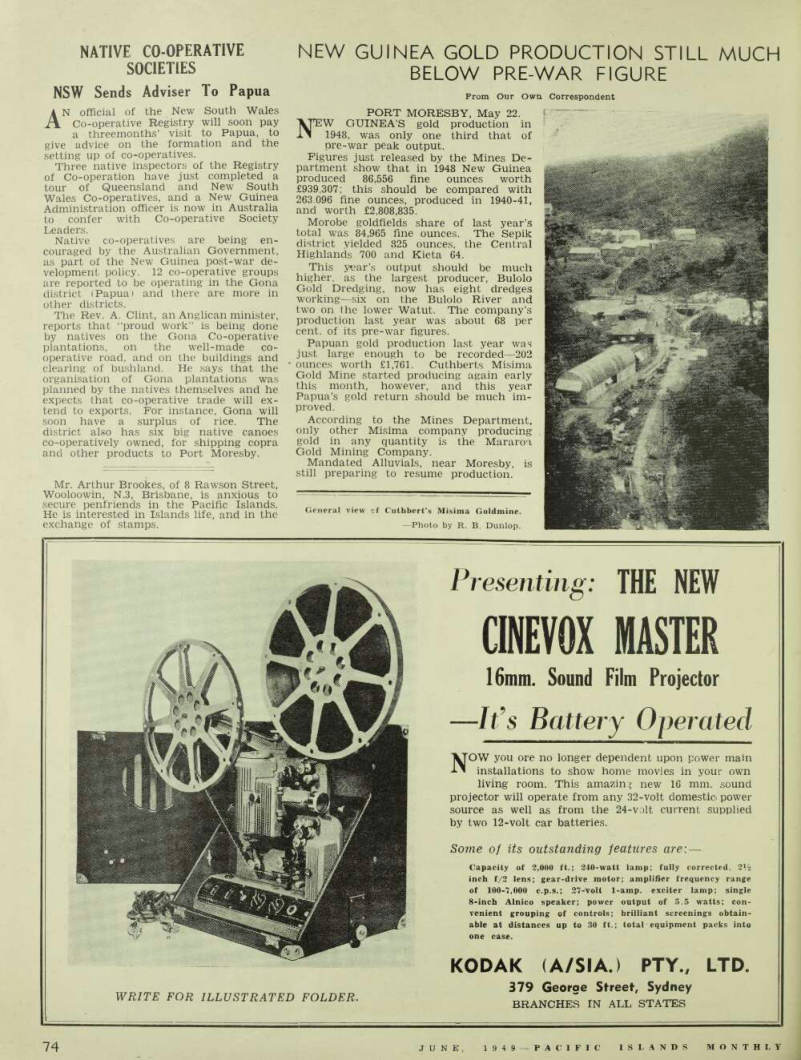
Societies
NSW Sends Adviser To Papua
AN official of the New South Wales Co-operative Registry will soon pay a threemonths’ visit to Papua, to give advice on the formation and the setting up of co-operatives.
Three native inspectors of the Registry of Co-operation have just completed a tour of Queensland and New South Wales Co-operatives, and a New Guinea Administration officer is now in Australia to confer with Co-operative Society Leaders.
Native co-operatives are being en couraged by the Australian Government, as part of the New Guinea post-war de velopment policy. 12 co-operative groups are reported to be operating in the Gona district (Papua) and there are more in other districts.
The Rev. A. Clint, an Anglican minister, reports that “proud work” is being done by natives on the Gona Co-operative plantations, on the well-made co operative road, and on the buildings and clearing of bushland. He says that the organisation of Gona plantations was planned by the natives themselves and he expects that co-operative trade will ex tend to exports. For instance, Gona will soon have a surplus of rice. The district also has six big native canoes co-operatively owned, for shipping copra and other products to Port Moresby.
Mr. Arthur Brookes, of 8 Rawson Street, Wooloowin, N. 3, Brisbane, is anxious to secure penfriends in the Pacific Islands, He is interested in Islands life, and in the exchange of stamps.
New Guinea Gold Production Still Much
Below Pre-War Figure
Prom Our Own Correspondent
Port Moresby, May 22.
VTEW GUINEA’S gold production in li 1948, was only one third that of pre-war peak output.
Figures just released by the Mines De partment show that in 1948 New Guinea produced 86,556 fine ounces worth £939.307; this should be compared with 263.096 fine ounces, produced in 1940-41, and worth £2,808,835.
Morobe goldfields share of last year’s total was 84,965 fine ounces. The Sepik district yielded 825 ounces, the Central Highlands 700 and Kieta 64.
This year’s output should be much higher, as the largest producer, Bulolo Gold Dredging, now has eight dredges working—six on the Bulolo River and two on the lower Watut. The company’s production last year was about 68 per cent, of its pre-war figures.
Papuan gold production last year was just large enough to be recorded—2o2 ounces worth £1,761. Cuthberts Misima Gold Mine started producing again early this month, however, and this year Papua’s gold return should be much im proved.
According to the Mines Department, only other Misima company producing gold in any quantity is the Mararoa Gold Mining Company.
Mandated Alluvials, near Moresby, is still preparing to resume production.
General view of Cuthbert’s Misima Goldmine.
Photo by R. B. Dunlop.
Advertisements & other items, p. 76 (1 item)
Cmevox Master
WRITE FOR ILLUSTRATED FOLDER .
Presenting: THE NEW
16mm. Sound Film Projector
—lt’s Battery Operated
NOW you ore no longer dependent upon power main installations to show home movies in your own living room. This amazin? new 16 mm. sound projector will operate from any 32-volt domestic, power source as well as from the 24-volt current supplied by two 12-volt car batteries.
Some of its outstanding features are : Capacity of 3,000 ft.; 340-watt lamp; fully corrected, inch f/3 lens; gear-drive motor; amplifier frequency range of 100-7,000 c.p.s.; 37-volt 1-amp. exciter lamp; single 8-inch Alnico speaker; power output of 5.5 watts; convenient grouping of controls; brilliant screenings obtainable at distances up to 30 ft.; total equipment packs into one case.
KODAK (A/SIA.) PTY., LTD.
379 George Street, Sydney
BRANCHES IN ALL STATES
Suva Children In Gala Dress
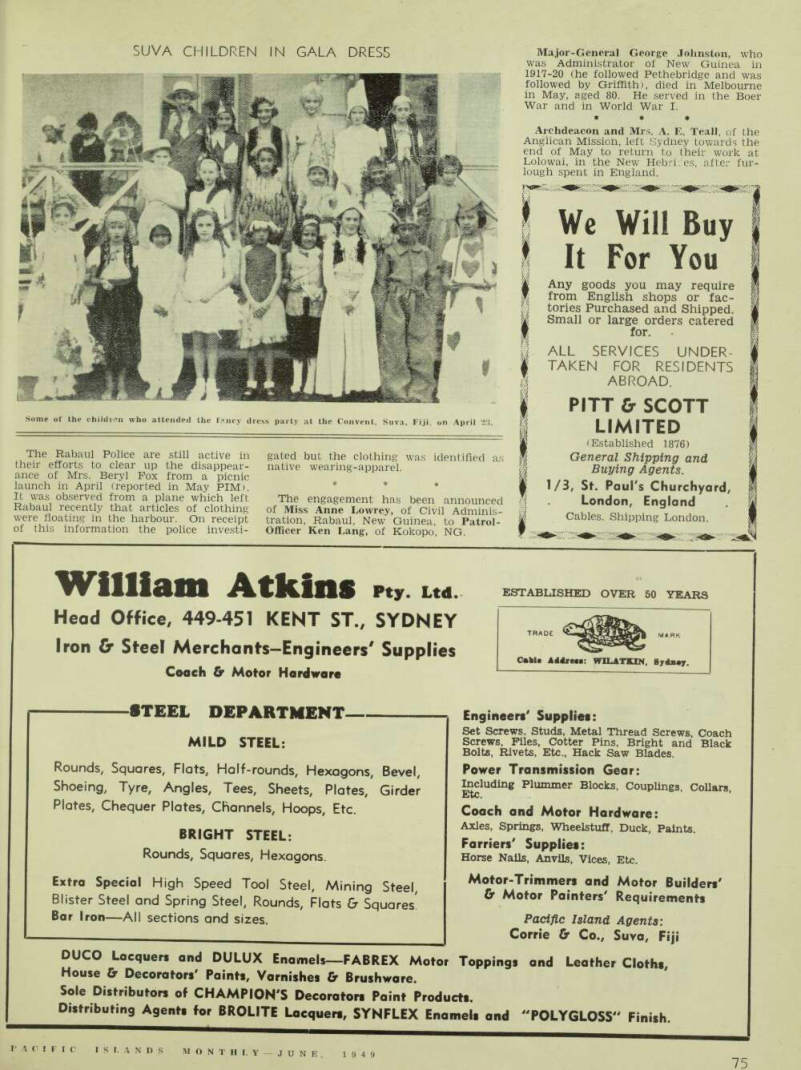
The Rabaul Police are still active in their efforts to clear up the disappear ance of Mrs. Beryl Fox from a picnic launch in April (reported in May PIM).
It was observed from a plane which left Rabaul recently that articles of clothing were floating in the harbour. On receipt of this information the police investi
gated but the clothing was identified as native wearing-apparel. * * ♦ The engagement has been announced of Miss Anne Lowrey, of Civil Adminis tration, Rabaul, New Guinea, to Patrol- Officer Ken Lang, of Kokopo, NG.
Major-General George Johnston, who was Administrator of New Guinea in 1917-20 (he followed Pethebridge and was followed by Griffith), died in Melbourne in May, aged 80. He served in the Boer War and in World War I. • * • Archdeacon and Mrs. A. E. Teall, of the Anglican Mission, left Sydney towards the end of May to return to their work at Lolowai, in the New Hebrides, after fur lough spent in England.
Some of the children who attended the fancy dress party at the Convent. Suva, Fiji, on April 23.
Advertisements & other items, p. 77 (2 items)
75
1 A ('I F I C ISLANDS MONTHLY-JUNE, 1949
William Atkins Pty. Ltd.
We Will Buy
It For You
Any goods you may require from English shops or factories Purchased and Shipped.
Small or large orders catered for.
ALL SERVICES UNDER-
TAKEN FOR RESIDENTS
ABROAD.
PITT & SCOTT
LIMITED
(Established 1876) General Shipping and Buying Agents. 1/3, St. Paul's Churchyard, London, England Cables. Shipping London,
William Atkins Pty. Ltd.
Head Office, 449-451 KENT ST., SYDNEY
Iron & Steel Merchants—Engineers' Supplies
ESTABLISHED OVER 50 YEARS
Coach fir Motor Hardware trade mark Cable Address: WDLATKIN, Bjdnay.
STEEL DEPARTMENT
MILD STEEL:
Rounds, Squares, Flats, Half-rounds, Hexagons, Bevel, Shoeing, Tyre, Angles, Tees, Sheets, Plates, Girder Plates, Chequer Plates, Channels, Hoops, Etc.
BRIGHT STEEL:
Rounds, Squares, Hexagons.
Engineers' Supplies: Set Screws, Studs, Metal Thread Screws, Coach Screws, Piles. Cotter Pins, Bright and Black Bolts, Rivets, Etc., Hack Saw Blades.
Power Transmission Gear: Including Plummer Blocks, Couplings, Collars, Etc.
Coach and Motor Hardware: Axles, Springs, Wheelstufl, Duck. Paints.
Farriers' Supplies: Horse Nails, Anvils, Vices, Etc.
Extra Special High Speed Tool Steel, Mining Steel, Blister Steel and Spring Steel, Rounds, Flats & Squares' Bar Iron—All sections and sizes.
Motor-Trimmers and Motor Builders' tr Motor Painters' Requirements Pacific Island Agents : Corrie & Co., Suva, Fiji DUCO Lacquers and DULUX Enamels—FAßßEX Motor Toppings and Leather Cloths, House O Decorators' Paints, Varnishes & Brushware.
Sole Distributors of CHAMPION'S Decorators Paint Products.
Distributing Agents for BROLITE Lacquers, SYNFLEX Enamels and "POLYGLOSS" Finish.
The Month In Moresby
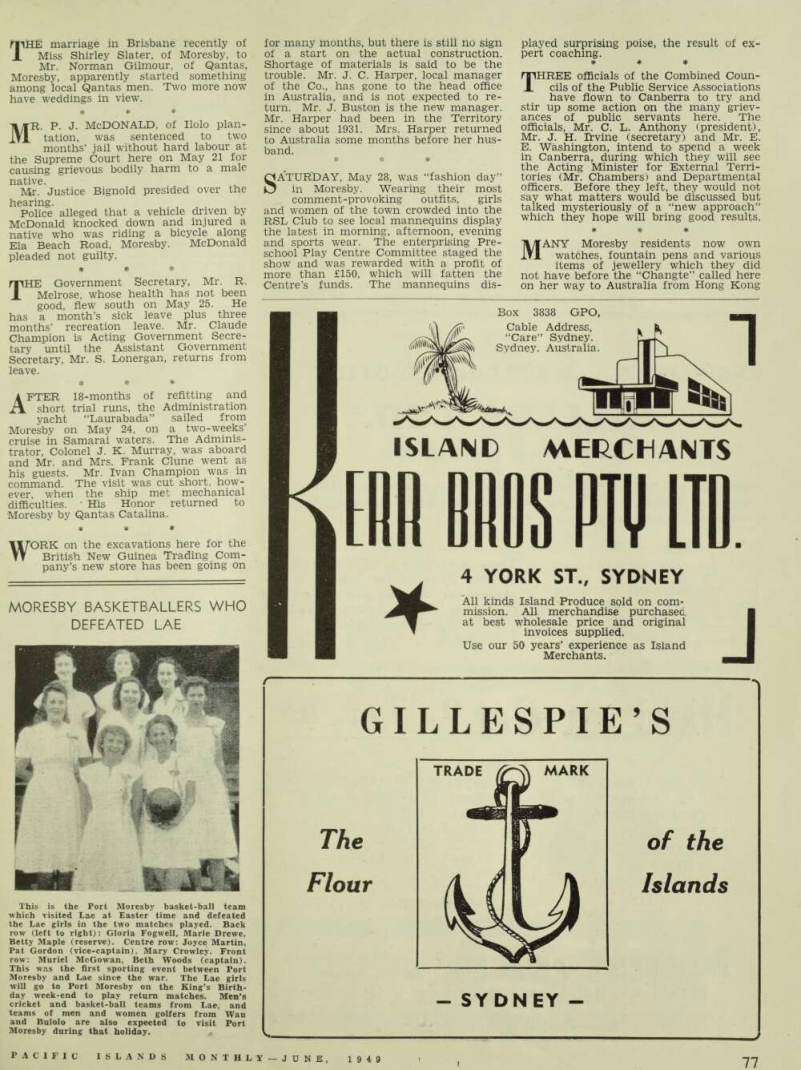
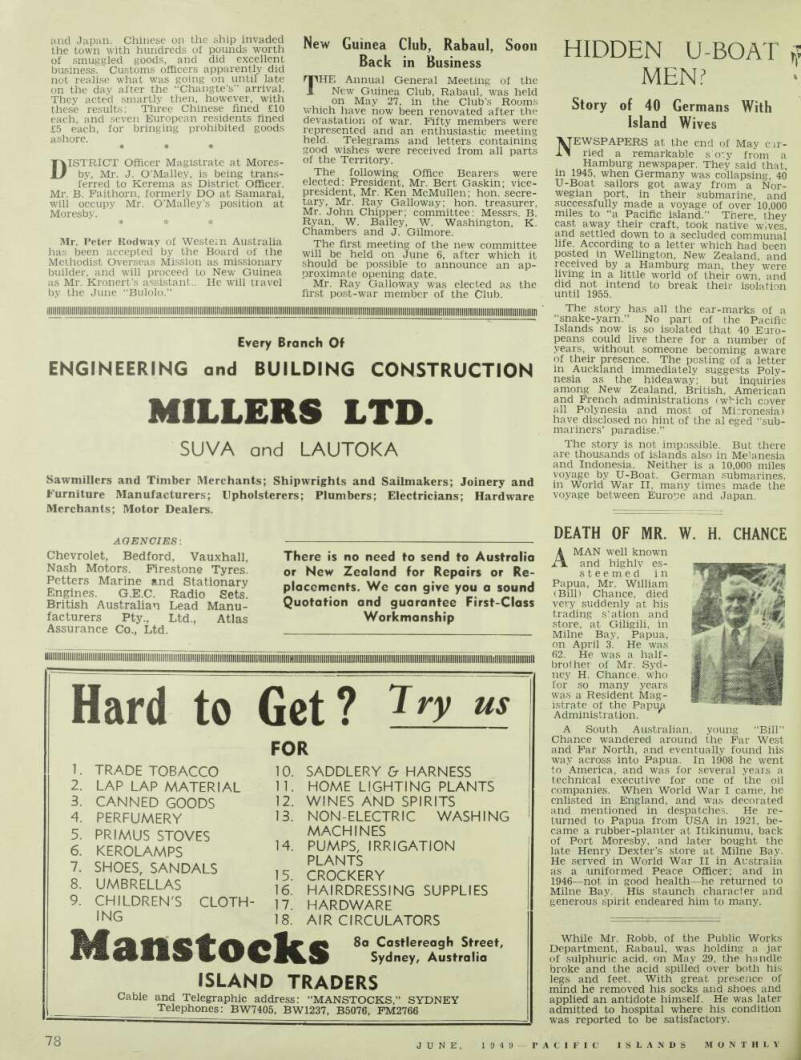
Prom Our Own Correspondent
Port Moresby, May 30.
THE Territory has been getting fourbarrelled publicity lately as a resuit of visits by four men, stars in their own professions, who came here to tell Australians about the Territory— newspaper articles from journalist Osmar White; “Walkabout” broadcasts from ABC’s Colin Simpson; paintings and sketches from artist William Dobell; and, eventually, a book from travel-writer Frank Clune.
White has finished his job here but the others are still wandering around.
Osmar White has made Administration officials keenly newspaper-conscious in the last few months. He has been touring the Territory writing many articles, mostly critical, for southern papers.
Local officials have been staggered by some of his comments, and some of them cannot understand why the Government lets him get away with it. Usually, in this country, the Administration, as the servant of Canberra, makes things uncomfortable for anyone who criticises it Publicly.
Before he returned to Australia Mr.
White summed up as follows: “I am very concerned with the apparant lack of appreciation of Papua-New Guinea’s problems in Canberra. Unless more vigorous action is taken to foster the economic development of the Territory, linking social development with economic, then there is considerable danger that the Trusteeship Council of the United Nations will intervene. I am more than ever convinced that development of the
Territory is of enormous strategic im portance to Australia. Territory policy is not a matter of party politics but one in which the best brains of both Govern ment and opposition parties should co operate.” * * * __. . „ |?X-GROUP Captain Bunny Ham- AJ mond, veteran New Guinea pilot, went around the Territory on the ■Bulolo s last trip as a tourist. He and hl s wife are now Sydneysiders, but they S°t homesick for their old friends, hence the Bulolo trip. Hammond came to New Guinea in 1932, as a pilot for Holden’s Air Transport and later for Guinea Air ways. He served in the RAAF, and in 1946 was Guinea Airways manager here until the company withdrew from the Territory. Now he’s doing well as NSW aviation sales-manager for a firm of general agents. * * * \ T FW BRITAIN nlnntpr Mr I Mnllalv \ T who nassedthrough Moresbv on the a t pas L d him? Bninio had time to tell m that eiSrt sna Is are fust r? s a as ever in New Britain. r* e says lsn 1 Putting in any new cocoa because the snails attack the young Plants. He is on a prolonged holiday’ . H . uri . ne wb T b he hopes to visit the Phil uppmes, China and Japan. * * * A NEW-COMER to Moresby is Mr.
Richard McGregor, who joined BR’s staff a t Moresby a week ago. He has earnec j general sympathy because he
was married in Sydney on the night of May 13 and had to board the Moresby plane next morning, leaving his bride behind. However, she’ll join him when he gets settled. * * * THE Malaita is now calling at Manus regularly, mainly to take supplies to the Navy and Air Force stations there. Manus planters hope that she will also take away some of their copra.
Two plantations owned by Edgell and Whiteley recently stopped production be cause they had too much copra awaiting shipment.
Mr. and Mrs, Norman Whitely, who have been on leave, are returning to Manus on the Malaita, which left here for New Guinea on May 21. * * * DR. TONAKIE, formerly of APC, re ports that his new private practice in Moresby is doing quite well. Dr.
Tonakie is in temporary rooms in the old library building in Douglas Street. * * * MRS. H. J. SUTHERLAND, formerly Miss May Grahamslaw, who has been in Japan for the last 18 months, is back in Moresby at present, on a visit. With her is ten-months-old Anne. MJrs. Sutherland was in Japan with her husband, a lieutenant in the permanent army. They will live in Sydney in future. * * * RECENT births to Moresby people: A daughter, Catherine Louise, to Mr. and Mrs. John Buckridge; a son, Peter, to Mr. and Mrs. Noel Maloney (in Melbourne), and a son to Mr. and Mrs.
Dennis O’Connor.
THE marriage in Brisbane recently of Miss Shirley Slater, of Moresby, to Mr. Norman Gilmour, of Qantas, Moresby, apparently started something among local Qantas men. Two more now have weddings in view. * * * MR. P. J. McDonald, of 11010 plan tation. was sentenced to two months’ jail without hard labour at the Supreme Court here on May 21 for causing grievous bodily harm to a male native.
Mr. Justice Bignold presided over the hearing.
Police alleged that a vehicle driven by McDonald knocked down and injured a native who was riding a bicycle along Ela Beach Road, Moresby. McDonald pleaded not guilty. ♦ * * THE Government Secretary, Mr. R.
Melrose, whose health has not been good, flew south on May 25. He has a month’s sick leave plus three months’ recreation leave. Mr. Claude Champion is Acting Government Secre tary until the Assistant Government Secretary, Mr. S. Lonergan, returns from leave. * * * AFTER 18-months of refitting and short trial runs, the Administration yacht “Laurabada” sailed from Moresby on May 24, on a two-weeks’ cruise in Samarai waters. The Adminis trator, Colonel J. K. Murray, was aboard and Mr. and Mrs. Frank Clune went as his guests. Mr, Ivan Champion was in command. The visit was cut short, how ever, when the ship met mechanical difficulties. * His Honor returned to Moresby by Qantas Catalina. * * * WORK on the excavations here for the British New Guinea Trading Com pany’s new store has been going on
for many months, but there is still no sign of a start on the actual construction.
Shortage of materials is said to be the trouble. Mr. J. C. Harper, local manager of the Co., has gone to the head office in Australia, and is not expected to return. Mr. J. Buston is the new manager.
Mr. Harper had been in the Territory since about 1931. Mrs. Harper returned to Australia some months before her husband * « * SATUR'DAY, May 28, was “fashion day” in Moresby. Wearing their most comment-provoking outfits, girls and women of the town crowded into the RSL Club to see local mannequins display the latest in morning, afternoon, evening and sports wear. The enterprising Preschool Play Centre Committee staged the show and was rewarded with a profit of more than £l5O, which will fatten the Centre’s funds. The mannequins dis-
played surprising poise, the result of ex pert coaching. * * * mHREE officials of the Combined Coun i. cils of the Public Service Associations have flown to Canberra to try and stir up some action on the many griev ances of public servants here. The officials, Mr. C. L. Anthony (president), J. Irvine (secretary) and Mr. E.
E - Washington, intend to spend a week in Canberra, during which they will see the Acting Minister for External Terri tories (Mr. Chambers) and Departmental officers. Before they left, they would not say what matters would be discussed but talked mysteriously of a “new approach” whlch t he V h °Pe will bring good results, * ♦ * myfANY Moresby residents now own JjJ[ watches, fountain pens and various items of jewellery which they did not have before the “Changte” called here on her way to Australia from Hong Kong
and Japan. Chinese on the ship invaded the town with hundreds of pounds worth of smuggled goods, and did excellent business. Customs officers apparently did not realise what was going on until late on the day after the “Changte’s” arrival.
They acted smartly then, however, with these results: Three Chinese fined £lO each, and seven European residents fined £5 each, for bringing prohibited goods ashore. * * * DISTRICT Officer Magistrate at Mores by, Mr. J. O’Malley, is being trans ferred to Kerema as District Officer.
Mr. B. Faithorn, formerly DO at Samarai, will occupy Mr. O’Malley’s position at Moresby. * * Mr. Peter Rodway of Western Australia has been accepted by the Board of the Methodist Overseas Mission as missionary builder, and will proceed to New Guinea as Mr. Kronert’s assistant.. He will travel by the June “Bulolo.”
Advertisements & other items, p. 78 (1 item)
*Masse
ENJOY YOUR
MOTORING
GET A
*Masse
BATTERY
“They’re Tigers for Work” &L There's no better battery made than Masse. Sturdy plates and husky case make for long life. Supercol Separators ensure a super-activity of acid on every part of the plates, giving a constant output of current far beyond the allotted span. That's why Masse stands up to hard work and the heaviest drains made upon it in starting and lighting.
ROEERT GILLESPIE GUINEA
LAE and RABAUL
LTD.
Moresby Basketballers Who
Defeated Lae
This is the Port Moresby basket-ball team which visited Lae at Easter time and defeated the Lae girls in the two matches played. Back row (left to right): Gloria Fogwell, Marie Drewe, Betty Maple (reserve). Centre row: Joyce Martin, Pat Gordon (vice-captain), Mary Crowley. Front row: Muriel McGowan, Beth Woods (captain).
This was the first sporting event between Port Moresby and Lae since the war. The Lae girls will go to Port Moresby on the King’s Birth day week-end to play return matches. Men’s cricket and basket-ball teams from Lae, and teams of men and women golfers from Wau and Bulolo are also expected to visit Port Moresby during that holiday.
Advertisements & other items, pp. 79-80 (1 item)
Gillespie’S
Box 3838 GPO, Cable Address, “Care” Sydney.
Sydney. Australia.
ISLAND MERCHANTS
4 YORK ST., SYDNEY
All kinds Island Produce sold on commission. All merchandise purchased at best wholesale price and original invoices supplied.
Use our 50 years’ experience as Island Merchants.
GILLESPIE’S
The Flour
MARK
TRADE
of the Islands
- SY DN EY -
Every Branch Of
ENGINEERING and BUILDING CONSTRUCTION
MILLERS LTD.
SUVA and LAUTOKA
Sawmillers and Timber Merchants; Shipwrights and Sailmakers; Joinery and Furniture Manufacturers; Upholsterers; Plumbers; Electricians; Hardware Merchants; Motor Dealers.
AGENCIES:
Chevrolet, Bedford, Vauxhall, Nash Motors. Firestone Tyres.
Fetters Marine and Stationary Engines. G.E.C. Radio Sets.
British Australian Lead Manufacturers Pty., Ltd., Atlas Assurance Co., Ltd.
There is no need to send to Australia or New Zealand for Repairs or Replacements. We can give you a sound Quotation and guarantee First-Class
Workmanship
Hard to Get? In. us
1. 2. 3. 4. 5. 6. 7. 8. 9.
TRADE TOBACCO
LAP LAP MATERIAL
CANNED GOODS
PERFUMERY
PRIMUS STOVES
KEROLAMPS
SHOES, SANDALS
UMBRELLAS
CHILDREN'S CLOTH-
ING
Manstocks
FOR
10. SADDLERY & HARNESS
11. HOME LIGHTING PLANTS
12. WINES AND SPIRITS
13. NON-ELECTRIC WASHING
MACHINES
14. PUMPS, IRRIGATION
PLANTS
15. CROCKERY
16. HAIRDRESSING SUPPLIES
17. HARDWARE
18. AIR CIRCULATORS
8a Castlereagh Street, Sydney, Australia
ISLAND TRADERS
Cable and Telegraphic address: “MANSTOCKS,” SYDNEY Telephones: 8W7405, 8W1237, 85076, FM2766
New Guinea Club, Rabaul, Soon
Back in Business
THE Annual General Meeting of the New Guinea Club, Rabaul, was held on May 27, in the Club’s Rooms which have now been renovated after the devastation of war. Fifty members were represented and an enthusiastic meeting held. Telegrams and letters containing good wishes were received from all parts of the Territory.
The following Office Bearers were elected: President, Mr. Bert Gaskin; vice president, Mr. Ken McMullen; hon. secre tary, Mr. Ray Galloway; hon. treasurer, Mr. John Chipper; committee: Messrs. B.
Ryan, W. Bailey, W. Washington, K.
Chambers and J. Gilmore.
The first meeting of the new committee will be held on June 6, after which it should be possible to announce an ap proximate opening date.
Mr. Ray Galloway was elected as the first post-war member of the Club.
Hidden U-Boat
Men?
Story of 40 Germans With Island Wives
NEWSPAPERS at the end of May car ried a remarkable s'ory from a Hamburg newspaper. They said that, in 1945, when Germany was collapsing, 40 U-Boat sailors got away from a Nor wegian port, in their submarine, and successfully made a voyage of over 10,000 miles to “a Pacific island.” There, they cast away their craft, took native wives, and settled down to a secluded communal life. According to a letter which had been posted in Wellington, New Zealand, and received by a Hamburg man, they were living in a little world of their own, and did not intend to break their isolation until 1955.
The story has all the ear-marks of a “snake-yarn.” No part of the Pacific Islands now is so isolated that 40 Euro peans could live there for a number of years, without someone becoming aware of their presence. The posting of a letter in Auckland immediately suggests Poly nesia as the hideaway; but inquiries among New Zealand, British, American and French administrations (which cover all Polynesia and most of Micronesia) have disclosed no hint of the al eged “sub mariners’ paradise.”
The story is not impossible. But there are thousands of islands also in Melanesia and Indonesia. Neither is a 10,000 miles voyage by U-Boat. German submarines, in World War 11, many times made the voyage between Eurooe and Japan.
Death Of Mr. W. H. Chance
A MAN well known and highly es steemed in Papua, Mr. William (Bill) Chance, died very suddenly at his trading station and store, at Giligili, in Milne Bay, Papua, on April 3. He was 62. He was a half brother of Mr. Syd ney H. Chance, who for so many years was a Resident Mag istrate of the Papua Administration.
A South Australian, young “Bill”
Chance wandered around the Far West and Far North, and eventually found his way across into Papua. In 1908 he went to America, and was for several years a technical executive for one of the oil companies. When World War I came, he enlisted in England, and was decorated and mentioned in despatches. He re turned to Papua from USA in 1921, be came a rubber-planter at Itikinumu, back of Port Moresby, and later bought the late Henry Dexter’s store at Milne Bay.
He served in World War II in Australia as a uniformed Peace Officer; and in 1946—n0t in good health—he returned to Milne Bay. His staunch character and generous spirit endeared him to many.
While Mr. Robb, of the Public Works Department, Rabaul, was holding a jar of sulphuric acid, on May 29, the handle broke and the acid spilled over both his legs and feet. With great presence of mind he removed his socks and shoes and applied an antidote himself. He was later admitted to hospital where his condition was reported to be satisfactory.
New Air Service

And A New Doctor
Daru, May 26.
MR. E. HICKS, who has been in charge of the Administration outpost at Lake Murray for some 15 months, recently proceeded to Thursday Island for dental treatment. It is noteworthy that Mr. Hicks appeared in very good health after such a lengthy stay at the very isolated station.
The Qantas Catalina, on charter to the Civil Aviation Dept., arrived at Daru a few days ago, and brought a large party of officials. Mr. Ivan Champion was soon in consultation with Mr. H. Thompson, our District Officer, whilst Mr. Colin Simpson, of the ABC brought along his recorder and placed on wire a few native songs. He also “bagged” a couple of song-and-dance acts by a few natives from Kiunga, a place several hundred miles up the Fly River. These natives happened to have been brought to Daru only recently by a Govt, launch.
We were informed that a regular Cata lina service will be commencing “almost
immediately”: perhaps steak-and-onions,
as a regular part of our diet, will come true, soon. An examination was made of the Daru ’drome by Civil Aviation officials. Some improvements such as lengthening the strip were mentioned.
Very good news for this Division was the announcement that Dr. Boyd has been appointed to Daru as Medical Officer—this being the first time such an appointment has been made. It is not forgotten that the late Dr. Vernon was available, in the long ago, but not as a permanent appointee. Dr. Boyd was landed by the Qantas Catalina at Lake
Murray, where he will spend a few weeks on a medical patrol. European Medical Assistants have done a great job, over the years, and credit must be given them for sterling service. To have a fully qualified Doctor on hand will be a com forting thought, not only to Europeans but also to the native population, to whom his principal effort will be directed. It is to be hoped that work will commence soon on the Doctor’s resi dence. This was dismantled and most of the material is lying under the District Office.
Gift To Leper Colony
A GIFT of 100,000 Pacific francs (£6OO Aus.) to the Leper Colony of French Oceania was handed to Monsieur Leboucher, President of the Committee for Welfare of Lepers, by Mr. Henderson, British Consul at Papeete, in the name of the Lepers’ Trust Board, of Christ church, NZ.
Brother E. Janin, of Yule Island Mis sion is visiting France after 28 years’ ser vice in Papua.
Advertisements & other items, p. 81 (1 item)
Tops for
EXPORT QUOTAS AVAILABLE
FOR THE TERRITORIES OF
NEW GUINEA U PAPUA
AND THE ISLANDS OF THE PACIFIC
OF
U.S.L.
MOTOR CAR AND TRUCK
BATTERIES
Trade inquiries to:
U.S.L DISTRIBUTORS PTY., LTD.
KEMBLA BUILDING, MARGARET STREET, SYDNEY, N.S.W.
Cable Address: LAWSTRING, Sydney.
Tops for
and Tenderness.
,wpn-bake<l to 11 • r. Uakecl Bean* are n lo J» '"T- *«”“ ■ *f 1 , ever iastect , rieb totiralo I " reto « vour . • • u 1 ]
CTVRIW
Successful Season
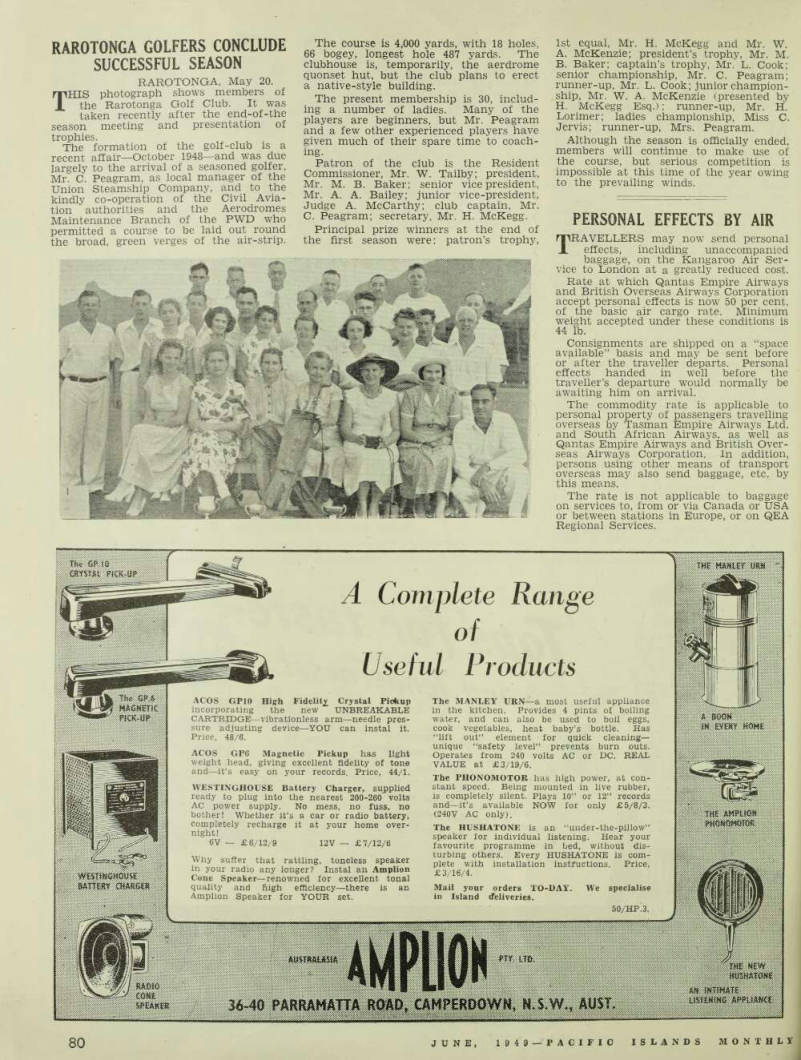
Rarotonga Golfers Conclude
Rarotonga, May 20.
THIS photograph shows members of the Rarotonga Golf Club. It was taken recently after the end-of-the season meeting and presentation of trophies.
The formation of the golf-club is a recent affair—October 1948—and was due largely to the arrival of a seasoned golfer, Mr. C. Peagram, as local manager of the Union Steamship Company, and to the kindly co-operation of the Civil Avia tion authorities and the Aerodromes Maintenance Branch of the PWD who permitted a course to be laid out round the broad, green verges of the air-strip.
The course is 4,000 yards, with 18 holes, 66 bogey, longest hole 487 yards. The clubhouse is, temporarily, the aerdrome quonset hut, but the club plans to erect a native-style building.
The present membership is 30, includ ing a number of ladies. Many of the players are beginners, but Mr. Peagram and a few other experienced players have given much of their spare time to coach ing.
Patron of the club is the Resident Commissioner, Mr. W. Tailby; president, Mr. M. B. Baker; senior vice president, Mr. A. A. Bailey; junior vice-president, Judge A. McCarthy; club captain, Mr.
C. Peagram; secretary, Mr. H. McKegg.
Principal prize winners at the end of the first season were: patron’s trophy,
Ist equal, Mr. H. McKegg and Mr. W.
A. McKenzie; president’s trophy, Mr. M.
B. Baker; captain’s trophy, Mr. L. Cook; senior championship, Mr. C. Peagram; runner-up, Mr. L. Cook; junior champion ship, Mr. W. A. McKenzie (presented by H. McKegg Esq.); runner-up, Mr. H.
Lorimer; ladies championship, Miss C.
Jervis; runner-up, Mrs. Peagram.
Although the season is officially ended, members will continue to make use of the course, but serious competition is impossible at this time of the year owing to the prevailing winds.
Personal Effects By Air
TRAVELLERS may now send personal effects, including unaccompanied baggage, on the Kangaroo Air Ser vice to London at a greatly reduced cost.
Rate at which Qantas Empire Airways and British Overseas Airways Corporation accept personal effects is now 50 per cent, of the basic air cargo rate. Minimum weight accepted under these conditions is 44 lb.
Consignments are shipped on a “space available” basis and may be sent before or after the traveller departs. Personal effects handed in well before the traveller’s departure would normally be awaiting him on arrival.
The commodity rate is applicable to personal property of passengers travelling overseas by Tasman Empire Airways Ltd. and South African Airways, as well as Qantas Empire Airways and British Over seas Airways Corporation. In addition, persons using other means of transport overseas may also send baggage, etc. by this means.
The rate is not applicable to baggage on services to, from or via Canada or USA or between stations in Europe, or on QEA Regional Services.
Advertisements & other items, pp. 82-83 (1 item)
Complete Range
The SP.IO
CRYSTAL PICK
The GP.6 magnetic
PICK-GR
Complete Range
of
Useful Products
BATTERY CHARGES
RADIO
CONE
SPEAKER
ACOS GPIO High Fidelity Crystal Pickup incorporating the new UNBREAKABLE CARTRlDGE—vibrationless arm—needle pressure adjusting device—YOU can instal it.
Price, 48/6.
ACOS GP6 Magnetic Pickup has light weight head, giving excellent fidelity of tone and—it's easy on your records. Price, 44/1.
WESTINGHOUSE Battery Charger, supplied ready to plug into the nearest 200-260 volts AC power supply. No mess, no fuss, no bother! Whether it’s a car or radio battery, completely recharge it at your home overnight! 6V £6/12/9 12V £7/12/6 Why suffer that rattling, toneless speaker in your radio any longer? Instal an Amplion Cone Speaker—renowned for excellent tonal quality and high efficiency—there is an Amplion Speaker for YOUR set.
The MANLEY URN —a most useful appliance in the kitchen. Provides 4 pints of boiling water, and can also be used to boil eggs, cook vegetables, heat baby’s bottle. Has “lift out” element for quick cleaningunique “safety level” prevents burn outs.
Operates from 240 volts AC or DC. REAL
VALUE at £3/19/6.
The PHONOMOTOR has high power, at constant speed. Being mounted in live rubber, is completely silent. Plays 10” or 12” records and —it’s available NOW for only £5/8/3. (240 V AC only).
The HUSHATONE is an “under-the-pillow” speaker for individual listening. Hear your favourite programme in bed, without disturbing others. Every HUSHATONE is complete with installation instructions. Price, £3/16/4.
Mail your orders TO-DAY. in Island deliveries.
We specialise 50/HP.3. fry. lid.
THE MANLEY
A BOON
m Evanf home
THE
THE NEW
16-40 PARRAMATTA RQAD, CAHPERDOWM, H.S.W., AUST.
AN INTIMATE
LISTENING APPLIANCE
Mil FOR THE BUMPS...
ATCO —-BOATIMPELLER
rz
ATC
• Simple to handle Light—easily carried • Surprisingly economical • It's easy starting, has smooth power and gives trouble-free performance.
ATCOSCYTHE
uA % * fi? 7 m
III!
I A Cut time and labour costs with this dependable machine. It's eight to twelve times as rapid as hand-scything. Ideal for cutting long grass, weeds, tall undergrowth, etc.
Just fill in the coupon below for illustrated booklets which will be sent post free. 7 > m E %
ATCO MOTOR MOWER
There's a full range from the 12 and 14 inch models up to the 17, 20, 28 and 34 inch for big-area requirements. The ATCO is a self-contained unit and will go anywhere.
MOTOR TRACTORS PTY. LTD.
369-385 Wattle Street, Ultimo, Sydney Please send me Atco Booklets.
NAME
ADDRESS
MOTOR TRACTORS
PTY. LIMITED
369-385 Wattle Street, Ultimo, Sydney Telegrams: “Sellmotors,” Sydney.
Samoa—Tonga
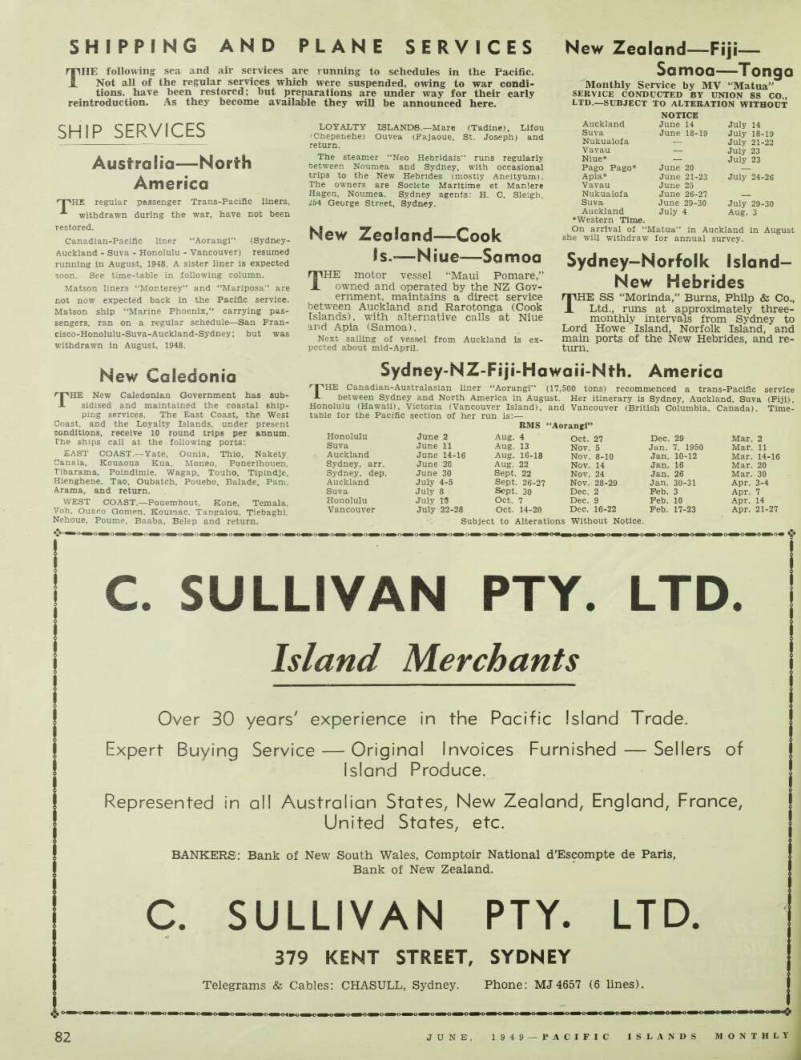
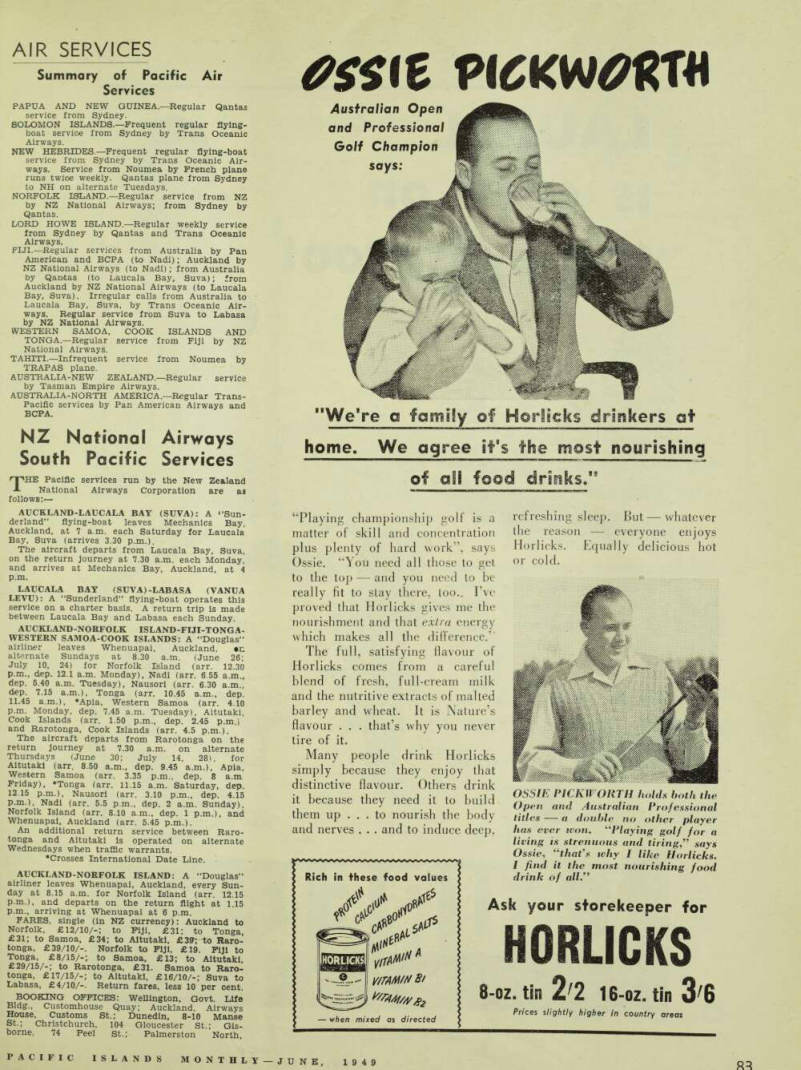

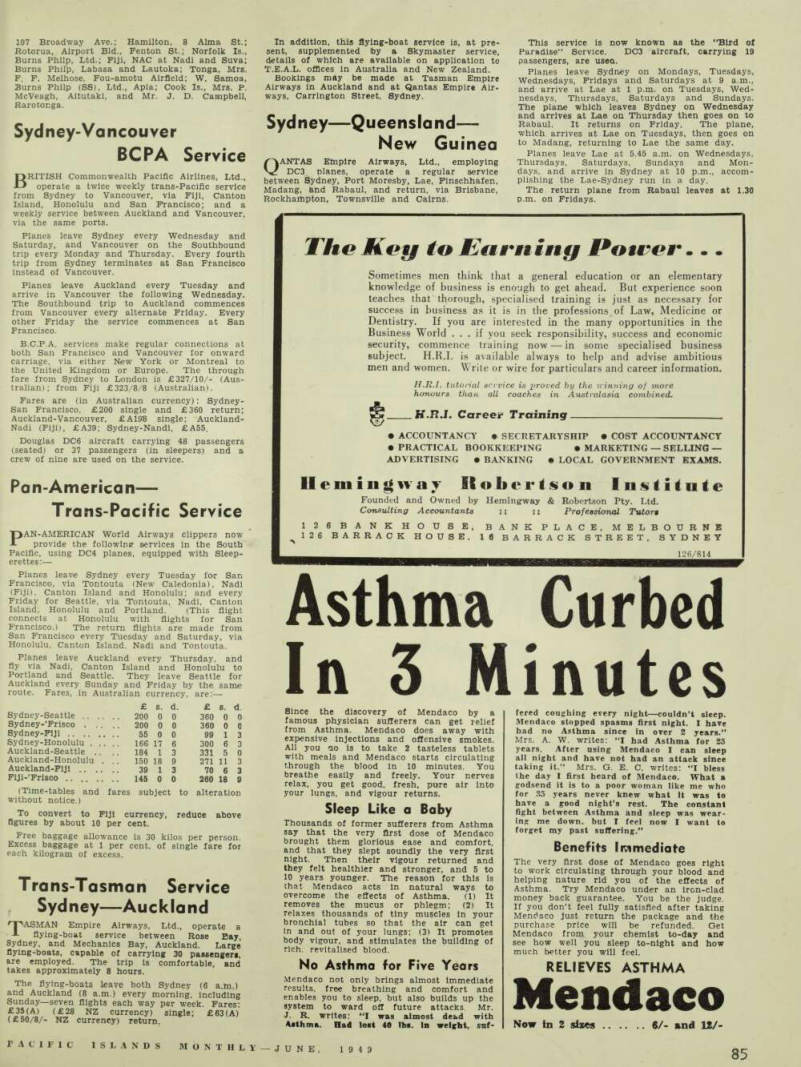
Shipping And Plane Services
THE following sea and air services are running to schedules in the Pacific.
Not all of the regular services which were suspended, owing to war condi tions. have been restored; but preparations are under way for their early reintroduction. As they become available they will be announced here.
Ship Services
Australia—North
America
r T\HE regular passenger Trans-Pacific liners, withdrawn during the war, have not been restored.
Canadian-Pacific liner “Aorangi” (Sydney- Auckland - Suva - Honolulu - Vancouver) resumed running in August, 1948. A sister liner is expected soon. See time-table in following column.
Matson liners “Monterey” and “Mariposa” are not now expected back in the Pacific service.
Matson ship “Marine Phoenix,” carrying pas sengers, ran on a regular schedule —San Pran cisco-Honolulu-Suva-Auckland-Sydney; but was withdrawn in August, 1948.
New Caledonia
THE New Caledonian Government has sub sidised and maintained the coastal ship ping services. The East Coast, the West Coast, and the Loyalty Islands, under present conditions, receive 10 round trips per annum.
The ships call at the following ports: EAST COAST. —Yate, Ounia, Thio, Nakety, Canala, Kouaoua Kua, Moneo, Ponerihouen, Tibarama, Polndlmle, Wagap, Touho, Tipindje, Hienghene, Tao, Oubatch, Pouebo, Balade, Pam, Arama, and return.
WEST COAST.—Pouembout, Kone, Temala, Voh. Ouaco Gomen, Kouioac. Tangaiou. Tiebaghl.
Nehoue, Poume, Baaba, Belep and return.
LOYALTY ISLANDS.—Mare (Tadine), Lifou 'Chepenehe) Ouvea (Fajaoue, St. Joseph) and return.
The steamer “Neo Hebridais” runs regularly between Noumea and Sydney, with occasional trips to the New Hebrides (mostly Aneityum).
The owners are Societe Maritime et Manlere Hagen, Noumea. Sydney agents: H. C. Sleigh, 254 George Street, Sydney.
New Zealand—Cook
Is.—Niue—Samoa
THE motor vessel “Maui Pomare,” owned and operated by the NZ Gov ernment, maintains a direct service between Auckland and Rarotonga (Cook Islands), with alternative calls at Niue and Apia (Samoa).
Next sailing of vessel from Auckland is ex pected about mid-April.
New Zealand—Fiji—
Samoa—Tonga
Monthly Service by MV “Matua”
Service Conducted By Union Ss Co.,
Ltd.—Subject To Alteration Without
Sydney-Norfolk Island-
New Hebrides
THE SS “Morinda,” Burns, Philp & Co., Ltd., runs at approximately three monthly intervals from Sydney to Lord Howe Island, Norfolk Island, and main ports of the New Hebrides, and re turn.
Sydney-NZ-Fiji-Hawaii-Nth. America
npHE Canadian-Australasian liner “Aorangi” (17,500 tons) recommenced a trans-Pacific service A between Sydney and North America in August. Her itinerary is Sydney, Auckland, Suva (Fiji), Honolulu (Hawaii), Victoria (Vancouver Island), and Vancouver (British Columbia, Canada). Time table for the Pacific section of her run is:—
Auckland
Notice
June 14 July 14 Suva June 18-19 July 18-19 Nukualofa — July 21-22 Vavau — July 23 Niue* — July 23 Pago Pago* June 20 — Apia* June 21-23 July 24-26 Vavau June 25 Nukualofa June 26-27 Suva June 29-30 July 29-30 Auckland July 4 Aug. 3 ♦Western Time.
On arrival of “Matua” in Auckland in August she will withdraw for annual survey.
RMS “Aorangi”
Honolulu June 2 Aug. 4 Oct. 27 Dec. 29 Mar. 2 Suva June 11 Aug. 13 Nov. 5 Jan. 7. 1950 Mar. 11 Auckland June 14-16 Aug. 16-18 Nov. 8-10 Jan. 10-12 Mar. 14-16 Sydney, arr. June 20 Aug. 22 Nov. 14 Jan. 16 Mar. 20 Sydney, dep. June 30 Sept. 22 Nov. 24 Jan, 26 Mar. 30 Auckland July 4-5 Sept. 26-27 Nov. 28-29 Jan. 30-31 Apr. 3-4 Suva July 8 Sept. 30 Dec. 2 Feb. 3 Apr. 7 Honolulu July IS Oct. 7 Dec. 9 Feb. 10 Apr. 14 Vancouver July 22-28 Oct. 14-20 Dec, 16-22 Feb. 17-23 Apr. 21-27 Subject to Alterations Without Notice.
Air Services
Summary of Pacific Air
Services
PAPUA AND NEW GUlNEA.—Regular Qantas service from Sydney.
SOLOMON ISLANDS. —Frequent regular flying boat service from Sydney by Trans Oceanic Airways.
NEW HEBRlDES—Frequent regular flying-boat service from Sydney by Trans Oceanic Air ways. Service from Noumea by French plane runs twice weekly. Qantas plane from Sydney to NH on alternate Tuesdays.
NORFOLK ISLAND.—Regular service from NZ by NZ National Airways; from Sydney by Qantas.
LORD HOWE ISLAND. —Regular weekly service from Sydney by Qantas and Trans Oceanic Airways, FlJl.—Regular services from Australia by Pan American and BCPA (to Nadi); Auckland by NZ National Airways (to Nadi); from Australia by Qantas (to Laucala Bay, Suva); from Auckland by NZ National Airways (to Laucala Bay, Suva). Irregular calls from Australia to Laucala Bay, Suva, by Trans Oceanic Air ways, Regular service from Suva to Labasa by NZ National Airways.
Western Samoa, Cook Islands And
TONGA. —Regular service from Fiji by NZ National Airways.
TAHITI. —Infrequent service from Noumea by TRAPAS plane.
AUSTRALIA-NEW ZEALAND. —Regular service by Tasman Empire Airways.
AUSTRALIA-NORTH AMERICA.—Regular Trans pacific services by Pan American Airways and
Bcpa.
NZ National Airways
South Pacific Services
THE Pacific services run by the New Zealand National Airways Corporation are as follows:
Auckland-Laucala Bay (Suva); A ‘‘Sun
derland” flying-boat leaves Mechanics Bay, Auckland, at 7 a.m. each Saturday for Laucala Bay, Suva (arrives 3.30 p.m.).
The aircraft departs from Laucala Bay, Suva, on the return journey at 7.30 a.m. each Monday, and arrives at Mechanics Bay, Auckland, at 4 p.m.
Laucala Bay (Suva)-Labasa (Vanua
LEVU): A “Sunderland” flying-boat operates this service on a charter basis. A return trip is made between Laucala Bay and Labasa each Sunday.
Auckland-Norfolk Island-Fiji-Tonga
Western Samoa-Cook Islands: A “Douglas”
airliner leaves Whenuapai, Auckland, #n alternate Sundays at 8.30 a.m. (June 26; July 10, 24) for Norfolk Island (arr. 12.30 p.m., dep. 12.1 a.m. Monday), Nadi (arr. 6,55 a.m., dep. 5.40 a.m. Tuesday), Nausori (arr. 6.30 a.m., dep. 7.15 a.m.), Tonga (arr. 10.45 a.m., dep. 11.45 a.m.), "Apia, Western Samoa (arr. 4.10 p.m. Monday, dep. 7.45 a.m. Tuesday), Aitutaki, Cook Islands (arr. 1.50 p.m., dep. 2.45 p.m.) and Rarotonga, Cook Islands (arr. 4.5 p.m.).
The aircraft departs from Rarotonga on the return journey at 7.30 a.m. on alternate Thursdays (June 30; July 14, 28), for Aitutaki (arr. 8.50 a.m., dep. 9.45 a.m.), Apia, Western Samoa (arr. 3.35 p.m., dep. 8 a.m Friday), *Tonga (arr. 11.15 a.m. Saturday, dep. 12.15 p.m.), Nausori (arr. 3.10 p.m., dep. 4.15 p.m.), Nadi (arr. 5.5 p.m., dep. 2 a.m. Sunday), Norfolk Island (arr. 8.10 a.m., dep. 1 p.m.), and Whenuapai, Auckland (arr. 5.45 p.m.).
An additional return service between Raro tonga and Aitutaki is operated on alternate Wednesdays when traffic warrants. •Crosses International Date Line.
Auckland-Norfolk Island: A “Douglas”
airliner leaves Whenuapai, Auckland, every Sun day at 8.15 a.m. for Norfolk Island (arr. 12.15 p.m.), and departs on the return flight at 1.15 p.m., arriving at Whenuapai at 6 p.m.
FARES, single (in NZ currency): Auckland to Norfolk, £l2/10/-; to Fiji, £3l; to Tonga, £3l; to Samoa, £34; to Aitutaki, £39; to Raro tonga, £39/10/-. Norfolk to FIJI, £l9. Fiji to Tonga, £B/15/-; to Samoa, £l3; to Aitutaki, £29/15/-; to Rarotonga, £3l. Samoa to Raro tonga, £l7/15/-; to Aitutaki, £l6/10/-; Suva to Labasa, £4/10/-. Return fares, less 10 per cent.
BOOKING OFFICES: Wellington, Govt. Life Bldg., Customhouse Quay; Auckland, Airways House, Customs St.; Dunedin, 8-10 Manse St.; Christchurch, 104 Gloucester St.; Gis borne, 74 Peel St.; Palmerston North,
107 Broadway Ave.; Hamilton, 8 Alma St.; Rotorua, Airport Bid., Fenton St.; Norfolk Is., Burns Phllp, Ltd.; Fiji, NAC at Nadi and Suva; Burns Phifp, Labasa and Lautoka; Tonga, Mrs.
F. F. Melhose, Fou-amotu Airfield; W, Samoa, Sums Philp (SS), Ltd., Apia; Cook Is., Mrs. P.
McVeagh, Aitutaki, and Mr. J. D. Campbell, Rarotonga.
Sydney-Vancouver
BCPA Service
BRITISH Commonwealth Pacific Airlines, Ltd., operate a twice weekly trans-Pacific service from Sydney to Vancouver, via Fiji, Canton Island, Honolulu and San Francisco; and a weekly service between Auckland and Vancouver, via the same ports.
Planes leave Sydney every Wednesday and Saturday, and Vancouver on the Southbound trip every Monday and Thursday. Every fourth trip from Sydney terminates at San Francisco instead of Vancouver.
Planes Leave Auckland every Tuesday and arrive in Vancouver the following Wednesday.
The Southbound trip to Auckland commences from Vancouver every alternate Friday. Every other Friday the service commences at San Francisco.
B.C.P.A. services make regular connections at both San Francisco and Vancouver for onward carriage, via either New York or Montreal to the United Kingdom or Europe. The through fare from Sydney to London is £327/10/- (Aus tralian); from Fiji £323/8/8 (Australian).
Fares are (in Australian currency): Sydney- San Francisco, £2OO single and £360 return; Auckland-Vancouver, £AISB single; Auckland- Nadi (Fiji), £A39; Sydney-Nandi, £ASS.
Douglas DC6 aircraft carrying 48 passengers (seated) or 37 passengers (in sleepers) and a crew of nine are used on the service.
Pan-American—
Trans-Pacific Service
PAN-AMERICAN World Airways clippers now provide the followint? services in the South Pacific, using DC4 planes, equipped with Sleep erettes: — Planes leave Sydney every Tuesday for San Francisco, via Tontouta (New Caledonia), Nadi (Fiji), Canton Island and Honolulu; and every Friday for Seattle, via Tontouta, Nadi, Canton Island, Honolulu and Portland. (This flight connects at Honolulu with flights for San Francisco.) The return flights are made from San Francisco every Tuesday and Saturday, via Honolulu, Canton Island. Nadi and Tontouta.
Planes leave Auckland every Thursday, and fly via Nadi, Canton Island and Honolulu to Portland and Seattle. They leave Seattle for Auckland every Sunday and Friday by the same route. Fares, in Australian currency, are:—
Trans-Tasmon Service
Sydney—Auckland
TASMAN Empire Airways, Ltd., operate a flying-boat service between Rose Bay, Sydney, and Mechanics Bay, Auckland. Large flying-boats, capable of carrying 30 passengers, are employed. The trip is comfortable, and takes approximately 8 hours.
The flying-boats leave both Sydney (6 a.m.) and Auckland (8 a.m.) every morning, including Sunday—seven flights each way per week. Fares; £35 (A) (£2B NZ currency) single; £63 (A) (£5O/8/- NZ currency) return.
In addition, this flying-boat service is, at present, supplemented by a Skymaster service, details of which are available on application to T.E.A.L. offices in Australia and New Zealand.
Bookings may be made at Tasman Empire Airways in Auckland and at Qantas Empire Airways, Carrington Street, Sydney.
I ■
dvaney WIIGGiISIOnCI— —
7 7 ' . r* •
QllinGO
QANTAS Empire Airways, Ltd., employing DC3 planes, operate a regular service between Sydney, Port Moresby, Lae, Pinschhafen, Madang, and Rabaul, and return, via Brisbane, Rockhaihpton, Townsville and Cairns.
This service is now known as the "Bird of Paradise" Service. DC3 aircraft, carrying 19 passengers, are useo.
Planes leave Sydney on Mondays, Tuesdays, Wednesdays, Fridays and Saturdays at 9 a.m., and arrive at Lae at 1 p.m. on Tuesdays, Wed nesdays, Thursdays, Saturdays and Sundays.
The plane which leaves Sydney on Wednesday and arrives at Lae on Thursday then goes on to Rabaul. It returns on Friday. The plane, which arrives at Lae on Tuesdays, then goes on t 0 Madan S. returning to Lae the same day.
Planes leave Lae at 5.45 a.m. on Wednesdays, Thursdays, Saturdays, Sundays and Mon days, and arrive in Sydney at 10 p.m., accom plishing the Lae-Sydney run in a day.
The return plane from Rabaul leaves at 1.30 p.m. on Fridays.
£ s. d. £ s. d Sydney-Seattle .. .. 200 0 0 360 0 0 Sydney-’Frlsco . .. 200 0 0 360 0 0 Sydney-PIJi 55 0 0 99 1 3 Sydney-Honolulu . . 166 17 6 300 6 3 Auckland-Seattle .. 184 1 3 331 5 0 Auckland-Honolulu . 150 18 9 271 11 3 Auckland-Pljl , . .. 39 1 3 70 6 3 FlJi-’Frlsco 145 0 0 260 18 9 (Time-tables and fares subject to alteration without notice.) To convert to Fiji currency, reduce above ngures by about 10 per cent.
Free baggage allowance is 30 kilos per person.
Excess baggage at 1 per cent, of single fare for each kilogram of excess.
Bookings may be made at Qantas offices &« any of the towns named. At present, berths are available only to passengers holding official per mits to visit Papua or New Guinea.
Sydney-Noumea-Suva
THE following is the time-table of the Qantas flying-boat:— Sydney dep. 9 p.m. alt. Tues.
Noumea arr. 6.55 a.m. alt. Wed.
Noumea dep. 7.55 a.m. alt. Wed.
Suva arr. 2.55 p.m. alt. Wed.
Suva dep. 6 a.m. alt. Frid.
Noumea arr. 11 a.m. alt. Frid.
Noumea .. .. .. dep. 12 noon alt. Frid.
Sydney arr. 7.45 p.m. alt. Frid.
Intending passengers may book through Qantas offices in Australia. Burns, Phllp (South Seas) Company, in Suva; and T. Johnston in Noumea.
Fares: To Noumea, £35 single; £63 return.
To Suva, £52/10/- single; £94/10/- return.
Noumea-Suva, £l7/10/- single; £3l/10/- re turn.
Sydney-Lord Howe ls.-
Norfolk Is.
QANTAS, Sydney, run a Catalina once weekly from Sydney to Lord Howe Island. Fare, single, £l2. Return, £2l/12/-.
Qantas run a land plane alt. Thursdays (re turning same day) from Sydney to Norfolk Island. Fare, £22 single; £39/12/- return. (For Norfolk Island, see also under NZ National Airways. For Lord Howe, see also under TOA.)
Noumea—Fiji—Tahiti
TRAPAS (a French company with headquarters in Noumea) ran an air service once a month from Noumea (New Caledonia), via Nadi (Fiji) and Aitutaki (Cook Islands) to Papeete (Tahiti), and return.
The Trapas Co. also runs a service to New Hebrides —see under Caledonia-New Hebrides.
TOA Services
TRANS Oceanic Airways run the following Pacific services:— SYDNEY-LORD HOWE IS.: A regular fort nightly service with large four-engine flying boats from Rose Bay. Fare; £ll single; £2l return. Free baggage allowance 50 lb. Excess baggage and freight rate 6d. per lb.
SYDNEY-NEW HEBRIDES: A regular monthly service with large four-engine flying-boats from Sydney, via Noumea (overnight stop), to Vila' and Espiritu Santo. Fare: Sydney-Vila, £45; Sydney-Santo, £5O; Noumea-Vila, £l2/10/-; Noumea-Santo, £lB/15/-. Freight: Sydney-Vila, 2/- per lb.; Sydney-Santo, 2/3.
Sydney-Solomon Islands: A Regular
monthly service from Sydney, via New Cale donia and New Hebrides to Tulagi,- Solomon Islands. This service is frequently extended to Lingatou, in the Russell Islands, and calls are sometimes made at Vanikoro, in the Santa Cruz Group. Fares: Sydney-Tulagi, £65. Free bag gage allowance, 60 lb.; excess baggage and freight, 3/- per lb.
New Caledonia-New
Hebrides—Tahiti
A TRAPAS amphibian runs twice each week between New Caledonia and New Hebrides.
The days vary, but on the selected day the planes adhere to the following time-table; — Noumea—dep. 0630. Vila—arr. 1315 Vila—dep. 0945 Santo —arr. 1115 Santo—dep. 1145 Vila—arr. 0900 Vila—dep. 1400 Noumea—arr. 1630 A TRAPAS plane runs monthly between Noumea and Tahiti.
Popua-NG Local
Services
MANDATED Airlines, Ltd., of Lae, New Guinea, and other private operators, run air ser vices between Lae and the New Guinea mainland centres of Wau. Bulolo, Madang. Wewak Aitape, Mt. Hagen. Flnschhafen, Moresby, Kokoda— in
fact anywhere in Papua or New Guinea wher6 there is an air-strip. These planes carry pas sengers, mails and cargo on regular schedules or charter flights.
Guinea Air Traders Ltd., of Lae, New Guinea, employ six aircraft on local services, and on charter work.
Under arrangement with the Administration, a Qantas plane, carrying Administration personnel and cargo, and mails, flies once each week from Lae to Rabaul, Kavieng ana planus, and returns to Lae by the same route.
Advertisements & other items, pp. 84-88 (1 item)
C. Sullivan Pty. Ltd.
Island Merchants
Over 30 years' experience in the Pacific Island Trade.
Expert Buying Service Original Invoices Furnished Sellers of Island Produce.
Represented in all Australian States, New Zealand, England, France, United States, etc.
BANKERS-: Bank of New South Wales, Comptoir National d’Escompte de Paris, Bank of New Zealand.
C. SULLIVAN PTY. LTD.
379 KENT STREET, SYDNEY
Telegrams & Cables: CHASULL, Sydney. Phone: MJ 4657 (6 lines).
Australian Open
and Professional
Golf Champion
says: . I Mm -> x mm -’wm "We're a family of HeHicks drinkers at home. We agree it's the most nourishing
of aii feed drinks."
“Playing championship golf is a matter of skill and concentration plus plenty of hard work”, says Ossie. “You need all those to get to the top and you need to be really fit to stay there, too.. I’ve proved that Horlicks gives me the nourishment and that extra energy which makes all the difference.’
The full, satisfying flavour of Horlicks comes from a careful blend of fresh, full-cream milk and the nutritive extracts of malted barley and wheat. It is Nature’s flavour . . . that’s why you never tire of it.
Many people drink Horlicks
simply because they enjoy that distinctive flavour. Others drink it because they need it to build them up ... to nourish the body and nerves . . . and to induce deep, Rich in these food values refreshing sleep. But whatever the reason everyone enjoys Horlicks. Equally delicious hot or cold. m OSSIE PICKWORTH holds both the Open and Australian Professional titles a double no other player has ever won. “Playing golf for a living is strenuous and tiring” says Ossie , “ that’s why / like Horlicks.
I find it the most nourishing food drink of all.”
SS*
V/TAMW St
when mixed as directed
HORLICKS
Ask your storekeeper for
HORLICKS
8-oz. tin 2 2 16-oz. tin 3^6 Prices slightly higher in country areas
LAUREL
is easy
the eyes,
W.
'// V Laurel burns with a Soft, White Light—flickerless, odourless, smokeless and without soot—so easy on the eyes of both young and old, yet so efficient and economical.
Always keep your lamps filled with Laurel Kerosene but, when ordering, don't ask for just "Kerosene," say LAUREL.
VACUUM OIL COMPANY PTY. LTD.
1-491 0
xtifr
VACUUM
on
too!
A- I I ,3 f
L A U R E L’
For Lighting, Heating . Cooking. Cleaning . freezing
The Key ia Ettrniny i p otver. . .
Sometimes men think that a general education or an elementary knowledge of business is enough to gel ahead. But experience soon teaches that thorough, specialised training is just as necessary for success in business as it is in the professions of Law, Medicine or Dentistry. If you are interested in the many opportunities in the Business World ... if you seek responsibility, success and economic security, commence training now —in some specialised business subject. H.R.I. is available always to help and advise ambitious men and women. Write or wire for particulars and career information.
H.R.I. tutorial service is proved by the winning of more honours than all coaches in Australasia combined.
K.JI.J. Career 1 Training
• ACCOUNTANCY • SECRETARYSHIP • COST ACCOUNTANCY
• PRACTICAL BOOKKEEPING • MARKETING SELLING
ADVERTISING • BANKING • LOCAL GOVERNMENT EXAMS.
Hemingway ilobertson Institute
Founded and Owned by Hemingway & Robertson Pty. Ltd.
Consulting Accountants Professional Tutors
126 BANK HOUSE, BANK PLACE. MELBOURNE
126 BARRACK HOUSE, 16 BARRACK STREET, SYDNEY 126/814
Asthma Curbed In 3 Minutes
Since the discovery of Mendaco by a famous physician sufferers can get relief from Asthma. Mendaco does away with expensive injections and offensive smokes.
All you oo is to take 2 tasteless tablets with meals and Mendaco starts circulating through the blood in 10 minutes. You breathe easily and freely. Your nerves relax, you get good, fresh, pure air into your lungs, and vigour returns.
Sleep Like a Baby
Thousands of former sufferers from Asthma say that the very first dose of Mendaco brought them glorious ease and comfort, and that they slept soundly the very first night. Then their vigour returned and they felt healthier and stronger, and 5 to 10 years younger. The reason for this is that Mendaco acts In natural ways to overcome the effects of Asthma. (1) It removes the mucus or phlegm; (2) It relaxes thousands of tiny muscles in your bronchial tubes so that the air can get in and out of your lungs; (3) It promotes body vigour, and stimulates the building of rich, revitalised blood.
No Asthma for Five Years
Mendaco not only brings almost Immediate results, free breathing and comfort and enables you to sleep, but also builds up the system to ward off future attacks. Mr.
J. R. writes: *T was almost dead with Asthma, dad lost 40 lbs. In weight, snf-
fered coughing every night—couldn’t sleep.
Mendaco stopped spasms first night. I have had no Asthma since in over 2 years.”
Mrs. A. W. writes: “I had Asthma for 25 years. After using Mendaco I can sleep all night and have not had an attack since taking it.” Mrs. G. E. C. writes: “I bless the day I first beard of Mendaco. What a godsend it is to a poor woman like me who for 35 years never knew what it was to have a good night’s rest. The constant fight between Asthma and sleep was wearing me down, but I feel now I want to forget my past suffering.”
Benefits Immediate
The very first dose of Mendaco goes right to work circulating through your blood and helping nature rid you of the effects of Asthma. Try Mendaco under an iron-clad money back guarantee. You be the judge.
If you don’t feel fully satisfied after taking Mendaco Just return the package and the purchase price will be refunded. Get Mendaco from your chemist to-day and see how well you sleep to-night and how much better you will feel.
RELIEVES ASTHMA
Mendaco
Now in 2 sizes 6/- and It/-
AUNT
MARYS
BAKING POWDER
For the best in delicious baking results A product of TiLLOCK AND CO. PTY. LTD. manufacturers of all the famous Aunt Mary s Pure Foods
v 0 wfl®
- . is a !* o *® : m
SWALLOW & ARIELL
LIMITED
53835 I I Master Craftsmen in the Biscuit Industry since 2854
One Night In Papeete
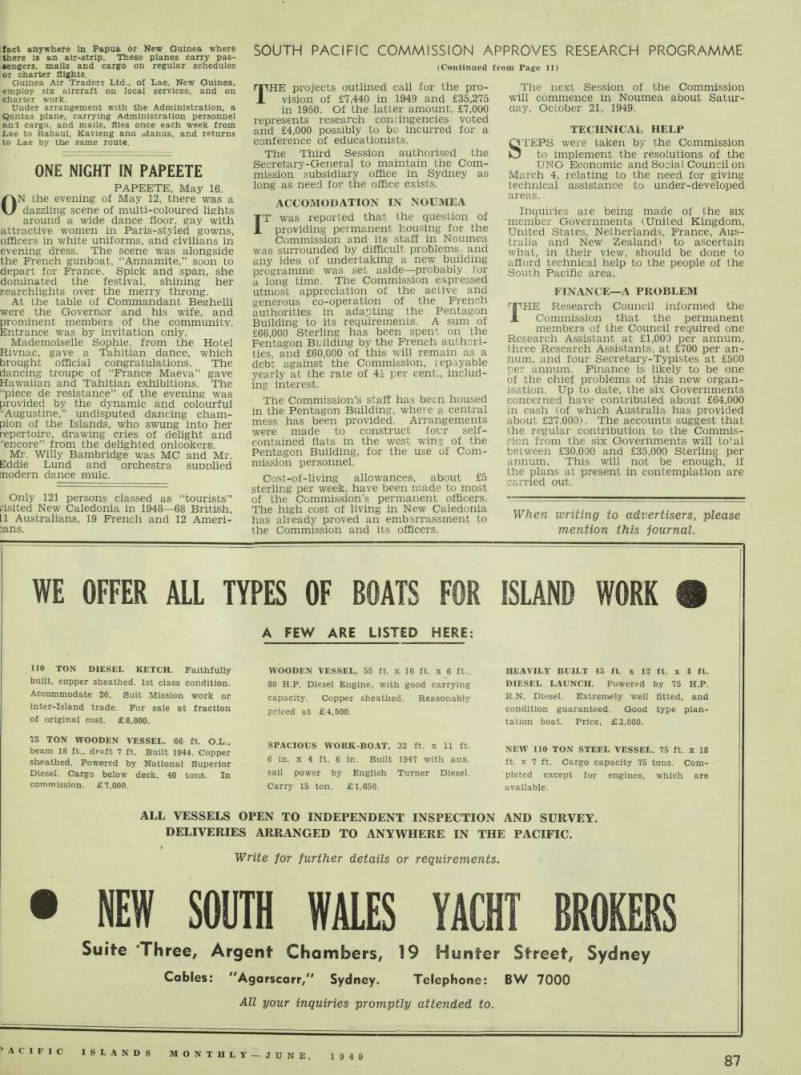
Papeete, May 16.
ON the evening of May 12, there was a dazzling scene of multi-coloured lights around a wide dance floor, gay with attractive women in Paris-styled gowns, officers in white uniforms, and civilians in evening dress. The scene was alongside the French gunboat, “Annamite,” soon to depart for France. Spick and span, she dominated the festival, shining her searchlights over the merry throng.
At the table of Commandant Beghelli were the Governor and his wife, and prominent members of the community.
Entrance was by invitation only.
Mademoiselle Sophie, from the Hotel Rivnac, gave a Tahitian dance, which brought official congratulations. The dancing troupe of “France Maeva” gave Hawaiian and Tahitian exhibitions. The “piece de resistance” of the evening was provided by the dynamic and colourful “Augustine,” undisputed dancing cham pion of the Islands, who swung into her repertoire, drawing cries of delight and ‘encore” from the delighted onlookers.
Mr. Willy Bambridge was MC and Mr.
Eddie Lund and orchestra supplied modern dance muic.
Only 121 persons classed as “tourists” /isited New Caledonia in 1948—68 British, LI Australians, 19 French and 12 Armen ians.
Advertisements & other items, pp. 89-90 (2 items)
South Pacific Commission Approves Research Programme
(Continued from Page II)
• New Soiitii Wales Yacht Brokers
When writing to advertisers, please mention this journal.
WE OFFER ALL TYPES OF BOATS FOR ISLAND WORK • 110 TON DIESEL KETCH. Faithfully built, copper sheathed. Ist class condition.
Accommodate 20. Suit Mission work or inter-island trade. For sale at fraction of original cost. £B,OOO. 75 TON WOODEN VESSEL. 66 ft. 0.L., beam 18 ft., draft 7 ft. Built 1944. Copper sheathed. Powered by National Superior Diesel. Cargo below deck, 40 tons. In commission. £7.000.
A FEW ARE LISTED HERE:
WOODEN VESSEL, 55 ft. x 16 ft. x 6 ft., 80 H.P. Diesel Engine, with good carrying capacity. Copper sheathed. Reasonably priced at £4,500.
SPACIOUS WORK-BOAT, 32 ft. x 11 ft. 6 in. x 4 ft. 6 in. Built 1947 with aux. sail power by English Turner Diesel.
Carry 15 ton. £1,650.
HEAVILY BUILT 45 ft. x 12 ft. x 4 ft.
DIESEL LAUNCH. Powered by 75 H.P.
R.N. Diesel. Extremely well fitted, and condition guaranteed. Good type plantation boat. Price, £3,000.
NEW 110 TON STEEL VESSEL. 75 ft. x 18 ft. x 7 ft. Cargo capacity 75 tons. Completed except for engines, which are available.
ALL VESSELS OPEN TO INDEPENDENT INSPECTION AND SURVEY.
DELIVERIES ARRANGED TO ANYWHERE IN THE PACIFIC.
Write for further details or requirements.
• NEW SOIITII WALES YACHT BROKERS
Suite Three, Argent Chambers, 19 Hunter Street, Sydney
Cables: "Agarscorr," Sydney. Telephone: BW 7000
All your inquiries promptly attended to.
/feve
that a?\
perfect^
clean ■ ■ ■
eSS "'
i V\ and save
money at the same dime! <3 »> % 11 **> \ rsO < 4 a» <s> * io V.
Syy % & j: */? l V Os -"/, t-:< Yes! Kolynos does save you money. Kolynos lasts longer because it is highly concentrated. Half an inch on a dry brush is all you need to leave your teeth surgically clean, and gleaming. Always ask for Kolynos.
DENTAL
CREAM
(§L£an s better -l/fores better- £as rs longer.
Mosquito Control
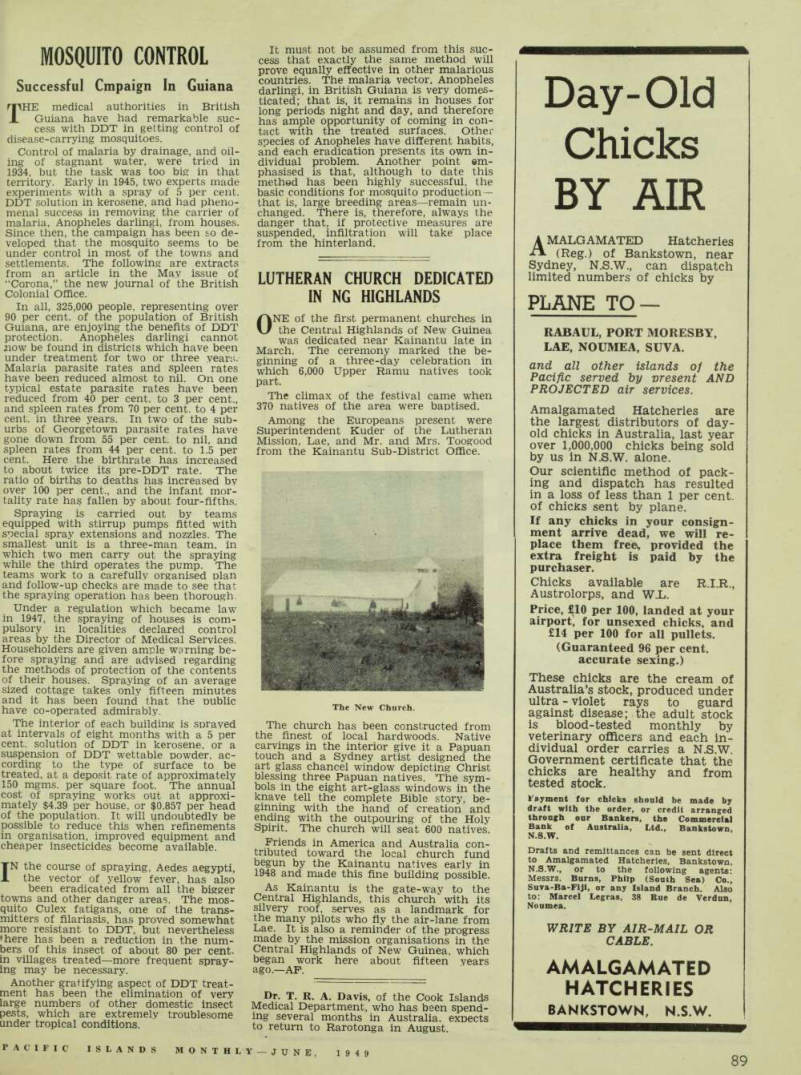
Successful Cmpaign In Guiana
THE medical authorities in British Guiana have had remarkable suc cess with DDT in getting control of disease-carrying mosquitoes.
Control of malaria by drainage, and oil ing of stagnant water, were tried in 1934, but the task was too big in that territory. Early in 1945, two experts made experiments with a spray of 5 per cent.
DDT solution in kerosene, and had pheno menal success in removing the carrier of malaria, Anopheles darlingi, from houses.
Since then, the campaign has been so de veloped that the mosquito seems to be under control in most of the towns and settlements. The following are extracts from an article in the May issue of “Corona,” the new journal of the British Colonial Office.
In all, 325,000 people, representing over 90 per cent, of the population of British Guiana, are enjoying the benefits of DDT protection. Anopheles darlingi cannot now be found in districts which have been under treatment for two or three years.
Malaria parasite rates and spleen rates have been reduced almost to nil. On one typical estate parasite rates have been reduced from 40 per cent, to 3 per cent., and spleen rates from 70 per cent, to 4 per cent, in three years. In two of the sub urbs of Georgetown parasite rates have gone down from 55 per cent, to nil, and spleen rates from 44 per cent, to 1.5 per cent. Here the birthrate has increased to about twice its pre-DDT rate. The ratio of births to deaths has increased bv over 100 per cent., and the infant mor tality rate has fallen by about four-fifths.
Spraying is carried out by teams equipped with stirrup pumps fitted with special spray extensions and nozzles. The smallest unit is a three-man team, in which two men carry out the spraying while the third operates the pump. The teams work to a carefully organised plan and follow-up checks are made to see that the spraying operation has been thorough.
Under a regulation which became law in 1947, the spraying of houses is com pulsory in localities declared control areas by the Director of Medical Services.
Householders are given ample warning be fore spraying and are advised regarding the methods of protection of the contents of their houses. Spraying of an average sized cottage takes only fifteen minutes and it has been found that the nublic have co-operated admirably.
The interior of each building is sprayed at intervals of eight months with a 5 per cent, solution of DDT in kerosene, or a suspension of DDT wettable powder, ac cording to the type of surface to be treated, at a deposit rate of approximately 150 mgms. per square foot. The annual cost of spraying works out at approxi mately $4.39 per house, or $0,857 per head of the population. It will undoubtedly be possible to reduce this when refinements in organisation, improved equipment and cheaper insecticides become available.
IN the course of spraying, Aedes aegypti, the vector of yellow fever, has also been eradicated from all the bigger towns and other danger areas. The mos quito Culex fatigans, one of the trans mitters of filariasis, has proved somewhat more resistant to DDT, but nevertheless there has been a reduction in the num bers of this insect of about 80 per cent, in villages treated —more frequent spray ing may be necessary.
Another gratifying aspect of DDT treat ment has been the elimination of very large numbers of other domestic insect pests, which are extremely troublesome under tropical conditions.
It must not be assumed from this suc cess that exactly the same method will prove equally effective in other malarious countries. The malaria vector. Anopheles darlingi, in British Guiana is very domes ticated; that is, it remains in houses for long periods night and day, and therefore has ample opportunity of coming in con tact with the treated surfaces. Other species of Anopheles have different habits, and each eradication presents its own in dividual problem. Another point em phasised is that, although to date this method has been highly successful, the basic conditions for mosquito production that is, large breeding areas—remain un changed. There is, therefore, always the danger that, if protective measures are suspended, infiltration will take place from the hinterland.
Lutheran Church Dedicated
In Ng Highlands
ONE of the first permanent churches in the Central Highlands of New Guinea was dedicated near Kainantu late in March. The ceremony marked the be ginning of a three-day celebration in which 6,000 Upper Ramu natives took
part.
The climax of the festival came when 370 natives of the area were baptised.
Among the Europeans present were Superintendent Kuder of the Lutheran Mission, Lae, and Mr. and Mrs. Toogood from the Kainantu Sub-District Office.
The church has been constructed from the finest of local hardwoods. Native carvings in the interior give it a Papuan touch and a Sydney artist designed the art glass chancel window depicting Christ blessing three Papuan natives. The sym bols in the eight art-glass windows in the knave tell the complete Bible story, be ginning with the hand of creation and ending with the outpouring of the Holy Spirit. The church will seat 600 natives.
Friends in America and Australia con tributed toward the local church fund begun by the Kainantu natives early in 1948 and made this fine building possible.
As Kainantu is the gate-way to the Central Highlands, this church with its silvery roof, serves as a landmark for the many pilots who fly the air-lane from Lae. It is also a reminder of the progress made by the mission organisations in the Central Highlands of New Guinea, which began work here about fifteen years ago.—AP.
Dr. T. R. A. Davis, of the Cook Islands Medical Department, who has been spend ing several months in Australia, expects to return to Rarotonga in August.
The New Church.
Advertisements & other items, p. 91 (1 item)
Day-Old
Chicks
BY AIR
Amalgamated Hatcheries
(Reg.) of Bankstown, near Sydney, N.S.W., can dispatch limited numbers of chicks by
PLANE TO
RABAUL, PORT MORESBY,
LAE, NOUMEA, SUVA.
and all other islands of the Pacific served by vresent AND PROJECTED air services.
Amalgamated Hatcheries are the largest distributors of dayold chicks in Australia, last year over 1,000,000 chicks being sold by us in N.S.W. alone.
Our scientific method of packing and dispatch has resulted in a loss of less than 1 per cent, of chicks sent by plane.
If any chicks in your consignment arrive dead, we will replace them free*, provided the extra freight is paid by the purchaser.
Chicks available are R.1.R., Austrolorps, and W.L.
Price, £lO per 100, landed at your airport, for unsexed chicks, and £l4 per 100 for all pullets. (Guaranteed 96 per cent, accurate sexing.) These chicks are the cream of Australia’s stock, produced under ultra - violet rays to guard against disease; the adult stock is blood-tested monthly by veterinary officers and each individual order carries a N.S.W.
Government certificate that the chicks are healthy and from tested stock.
Payment for chicks should be made by draft with the order, or credit arranged through our Bankers, the Commercial Bank of Australia, Ltd., Bankstown.
N.S.W.
Drafts and remittances can be sent direct to Amalgamated Hatcheries, Bankstown, N.S.W., or to the following agents: Messrs. Burns, Philp (South Sea) Co., Suva-Ba-Fiji, or any Island Branch. Also to: Marcel Legras. 38 Eue de Verdun, Noumea.
WRITE BY AIR-MAIL OR
CABLE.
AMALGAMATED
HATCHERIES
BANKSTOWN, N.S.W.
JaPs' Giant Snails
Now A Maior Pacific Pest
TJ NIT ED States authorities appear to be keeping a wary eye on the giant snail, lest it become an un welcome migrant. The San Francisco “Chronicle” recently printed the following article. It might also have added that the luscious creatures are now well established in New Guinea.
So far none have been reported in Australia, although their introduction, through Island ships or planes, would be fatally simple.
Perhaps the Australian authorities are keeping a strict watch for the pests, hut if so, it is a 100 per cent, silent service and the general public has no idea of the danger that exists.
IF the giant African snail—half a foot, sometimes a foot long—should get go ing in this State it could wreck California as it has wrecked some of the Pacific isles. It is a voracious destroyer of green stuff. However, the California Academy of Sciences says it has not been able to verify the recent report in Natural History magazine that the snail has been found in gardens at San Pedro.
It does appear to be a fact that just after the war a few giant snails arrived at Long Beach from the Marianas. They are all supposed to have been corralled and killed.
Such importations are chargeable to speedy modern transportation. In former times weed seeds and other nuisances travelled more slowly in the mud on boots of soldiers and emigrants—California has scores of weeds supposed to have arrived that way. Now swift steam and swifter airplanes give unwanted tourists a better chance.
Only a few years ago the Gambia mos quito, carrying a deadly form of tropical malaria, arrived in Brazil on a plane from Africa. It killed 20,000 persons before it was brought under control by the ex penditure of millions by the Rockefeller Foundation and the Brazilian Govern ment.
Constant precautions are now taken to clear insect stowaways from planes flying to the United States from tropical coun tries. Recently, shipment of- Hawaiian orchids to San Francisco was stopped for a while for fear of the Oriental fruit fly.
The giant snail has spread from Africa into Southwest Asia, the East Indies and the Pacific islands partly with the help of man, partly by its own efforts. The Japanese introduced it into the Marianas and their mandated islands to augment the food supply; then found they didn’t like it. Neither do the native islanders like it, nor the way it eats up their plant ations. It is now a pest in the Philippines, Hawaii keeps up a constant war, so far successful, to keep it from getting a foot hold.
Fiji Agricultural Journal
Good Publication Should Have a Wider Field
THE journal published by the Depart ment of Agriculture in'Fiji is prob ably the best thing of its kind in the world.
We know of no other publication in English, devoted to the interests of tropical agriculture, which even ap proaches its standard.
For that reason we venture to express the hope that the journal will be brought seriously under the notice of the South Pacific Commission, with a suggestion that its scope and usefulness may be consider ably extended.
This comment is induced by an article by Dr. K. B. Cumberland in the last issue of the journal entitled “The Similarity of Agricultural Problems in the South-west Pacific.” He points out that in the Terri tories of Fiji, Western Samoa, Tonga, Cook Islands, the problems of agriculture are governed by similar circumstances, and conditions that demand the same kind of approach. It probably will be found that the same remark applies to many problems within the Territories further west—New Caledonia, New Hebrides, Solomons and New Guinea, The Fiji Agricultural Journal, for years, has been noted for the thoroughness of its handling of these various problems of agriculture, and the conscientious and helpful way in which each has been ex plored. With some assistance and en couragement in relation to organisation, finance, and expert advice, this journal could be made an instrument of real value to planters throughout the whole of the South Pacific.
Captain Georges Dubois and Lieut. Rene Petre, who served overseas with the Free French Forces, have been made Chevaliers of the Legion of Honour. Both were among the keenest supporters of Governor Henri Sautot when he rallied the Colony to continue in the war in 1940—M. Dubois, indeed, being M. Sautot’s right-hand man and for a time local commander in Noumea, when the Vichy officers left for Indo-China.
Advertisements & other items, p. 92 (1 item)
Symbol
mw. i r a M %
The Shell Co. of Aust., Ltd. (Inc. in Great Britain).
Door To Asia's Reds
Indonesia Is Danger-Spot For South Pacific
Our Weakness In Relation To Java, Burma, Malaya, May Open Door To Asia's Reds
EVENTS and developments in the Netherlands Indies since the end of the Pacific War, in 1945, have been a puzzle to most observers.
In 1942, when war swept across the Pacific, the East Indies were in charge of the Dutch, and their control of this vast area of Indonesia was regarded as a model of colonial administration. When Japan surrendered, it was naturally assumed that the Dutch would resume control. But the following things happened: • The Japs, during their occupation, trained and set up a Javanese National istic group, called “the Republic of Indonesia”. • The Dutch, weakened by the Euro pean war, were not able immediately to reoccupy the Netherlands Indies. The British, although nominally responsible for South-east Asia, would not help the Dutch. The Americans were indifferent.
So, until well into 1946, the Japs were allowed to remain in control of the Indies, and they did everything possible to strengthen the so-called “republic”. • An upsurge of Socialist Govern ment in Europe affected Holland, as it affected Britain and France. For a long time, the Dutch official and com mercial classes were retarded in their efforts to resume control of the Indies, by political traitors at The Hague. • When, eventually, Dutch forces began to enter the Indies, mischievous elements among the Western nations— mostly “fellow travellers” operating through the United Nations, as well as direct emissaries of Russia —created all sorts of obstacles. Both openly and surreptitiously, the Javanese “republi cans”—who were mostly pro-Jap or Communist, and wholly anti-European— were encouraged to resist the Dutch. • One of the worst developments of the lot was the way in which Com munist-dominated trade unions in Aus tralia forced the Australian Socialist Government to hamper the Dutch and encourage the Indonesians.
There were countless conferences, commissions, arguments. But the Dutch, showing remarkable tenacity and patience, gradually got control of the situation. They were forced by the Planners, however, to make all sorts of political and other concessions to the “Republicans”, when they knew that the
the little, wriggling gentlemen into gaol. fTIHE situation has been complicated by A political intrigues in The Nether lands, and there lately have been
some violent administrative changes, hard to understand. Finally, on June 3, we have this statement of policy by the Dutch High Commissioner, Mr. A. H. J.
Lovink, when taking over office in- Batavia : “I do not want to speak about the past, for it is the future to which we must look. It is not enough to pay lip service to the new, while feeling inwardly that events of recent years are actually no more than symptoms of decay or de struction.
“Everyone of us has his own ideas. In the case of the Indonesians, they think of their independent existence as one nation. In the case of the Netherlands, they think of their renewed promise to implement the independence of Indonesia in the best possible way.”
Mr. Lovink then referred to the four aims formulated anew in the Renville Agreement of January, 1948, namely:— (1) Independence for the people of Indonesia. (2) Co-operation between the peoples of the Netherlands and Indonesia. (3) A Sovereign State based on a democratic constitution. (4) A Union between Indonesia and the Kingdom of the Netherlands.
“In February, 1948, Queen Wilhelmina repeated the high aim for which both peoples should strive, stating that no re lationship between two peoples can be maintained in our time if it is not based on mutual approval.
“Queen Juliana confirmed this aim when she said in January, 1949: *. . . and so the Sovereign United States of Indonesia will soon become a reality’.
“Indonesians and Netherlanders.” Mr.
Lovink continued, “will be united in a union of harmonious and healthy co
operation, and so promote a better world.
“This beautiful country has been torn asunder. In spite of that, we can work together. Then trade, industry, and agriculture will soon have recovered from the damage they have suffered in the past years, and the United States of In donesia will find again the road to prosperity, and gain the admiration of the world.”
IT is not a beautiful prospect. It looks as if the Dutch are being forced by Western European Socialism to give away too much to the Javanese nationalists.
Finally, on June 7, we have this perti nent comment by a Filipino leader: “Future Communist strategy in the Far East is being designed to by-pass Japan and the Philippines in order to direct a smashing blow at the Dutch East Indies, principal oil centre in East Asia.
“Communist leaders are working desperately to pattern their strategy after Japan’s pre-war blue-prints of ag gression, a pattern designed to gain con trol of all Asia.
“Such a strategy can be expected to materialise immediately following a com plete Communist victory in China.
“Oil fields in the Dutch East Indies have attracted Communist attention as strongly as Japan’s military leaders were drawn to depend on them for their ad vances in the Pacific.”
To put it in a nutshell: The failure of the British and Australian Socialist Gov ernments to help the Dutch to re establish control in the Indies, and British weakness in Malaya and Burma, appear to have opened wide a door through which Asiatic Communists may enter the South Pacific.
Advertisements & other items, p. 93 (1 item)
Kwong Chong Brothers
S. WENTWORTH JACKSON
(F. 1.0., SYD.)
Optometrist & Optician
185 ELIZABETH ST., SYDNEY
ANNOUNCING NEXT VISIT TO THE TERRITORY:
PT. MORESBY . . . 7-16 JULY Representative : N. F. MALONEY.
RABAUL ... 22 JULY-4 AUG.
Representative : G. RENTON.
HAVE YOUR EYES EXAMINED
FOR SALE
QUANTITY OF NEW PLUMBING FITTINGS
GALVANISED AND BLACK FITTINGS, ±
in. to 6 in.
BRASS COCKS, 818, BALL, ETC., £ in. to 1 in. 3 in. and 4 in. Johns Pattern Gate and Check Valve.
Write for Complete Catalogue.
N. F. MALONEY & CO.,
Agents, Port Moresby, PAPUA Cab. add: MALCO. P.M.
KWONG CHONG BROTHERS
General Merchants and Planters
Have row re-established their business on their original pre-war site, and are carrying stocks of Trading and Plantation requirements. All enquiries welcomed and service assured.
Sydney Representatives:
KWONG CHONG BROTHERS
Sydney, NS W. KEMARERE STREET, RABAUL
One Plane, Twelve Horses
For Rg Mission
From Our Own Correspondent
Rabaul, May 29.
A “CESSNA” monoplane has recently arrived in Rabaul from America. The plane is a gift to the Catholic Mis sion of New Britain from the United States and will be used in mission and medical work, mainly in the Admiralty Islands.
Three of the American priests at present engaged in mission work in the Rabaul Mission hold American and Aus tralian pilot’s licences.
The plane will at first be flown by Rev.
Father Charles Patrick, MSC, who is stationed at Manus Island.
The plane is an amphibian and as economical as a light car to operate— it goes 35 miles to the gallon.
About the same time the mission also imported 12 horses on the “River Fitzroy” (see page 31 for a planter’s comment on importing stock by sea).
The horses are to be used for out station work and missionaries will now be able to carry out a great deal of their bush patrol work on horseback.
The horses came from a police depot in Australia and reached Rabaul in excellent condition after their long sea journey.
There has been a great deal of local comment about the cost of these stock importations and, according to some, the 12 mission horses probably cost more than the plane to land here.
Mr. H. T. B. Hall, BVSc., a veterinary officer in the Department of Agriculture, Fiji, has been appointed Deputy Director of Agriculture (Veterinary Division), Jamaica, and expects to leave Fiji early in July. He has been in Fiji since 1938.
Advertisements & other items, pp. 94-95 (1 item)
Steamships Trading Company Ltd.
PORT MORESBY AND SAMARA! PAPUA
Wholesale & Retail Merchants, Planters, Sawmillers, Engineers, Slip
Proprietors, Shipping, Customs and Insurance Agents.
MANAGING AGENTS for:
SAWMILLERS & TRADERS LTD.
CORAL SEAS INSURANCE CO. LTD.
ACME BAKERY COMPANY.
MARIBOI RUBBER LTD.
RUBBERLANDS LTD.
KEREMA RUBBER PLANTATIONS LTD.
COCOALANDS LTD.
AGENCIES:
BANKERS & TRADERS INSURANCE CO. LTD.
VACUUM OIL CO. PTY., LTD.
DIRECTORATE OP SHIPPING—Papua—New
Guinea Division.
ROYAL PACKET NAVIGATION CO.
KOKE BAGU PTY., LTD.
TRANS OCEANIC AIRWAYS.
GUINEA AIR TRADERS.
DISTRIBUTORS IN PAPUA for:
ARMSTRONG-HOLLAND PTY., LTD. INTERNATIONAL HARVESTER CO. OF AUST. LTD.
Earth Moving and Logging Equipment. International Trucks, WILLYS-OVERLAND EXPORT CORPORATION. McCormack Deering Farming Machinery, Jeep cars, etc. Defender Refrigerators.
SYDNEY AGENTS: NELSON & ROBERTSON PTY. LTD., 12 SPRING STREET
Classified Adverti s m e nt s
TENDERS
Estate W. C. Box Deceased
Sealed tenders, endorsed ‘‘Tenders METEWOLO, METEINGE & NEIPAU,” are invited and will be received by the undersigned until 5 p.m., 31st July, 1949, for the purchase of the following:—
(a) METEWOLO PLANTATION
(1) Situation —South West Coast of New Hanover, New Ireland District, Territory of New Guinea. (2) Area—2ss-5 Hectares (approximately 638 acres). (3) Area planted, approximately 94 Hectares.
(b) METEINGE PLANTATION
(1) Situation —South West Coast of New Hanover, New Ireland District, Territory of New Guinea. (2) Area—292.24 Hectares (approximately 730 acres). (3) Whole area planted.
Average pre-war production of above plantations approximately 120 tons per annum.
(c) NEIPAU PLANTATION & MET-
EKABIT TRADING STATION
(1) Situation —on New Hanover, New Ireland District, Territory of New Guinea. (2) Area —134.1 Hectares (approximately 335 acres) —all planted.
(d) LAVANGOI TRADING STATION
Situation—New Hanover, New Ireland District, Territory of New Guinea.
GENERAL.—Above properties are heavily overgrown with secondary growth. An assessment as under has been made by War Damage Section as a subsidy towards clearing the secondary growth and will be paid to the successful tenderer by the War Damage Section when satisfactory evidence is produced to it that the work has been completed or wen advanced:— Metewolo and Meteinge Plantations .. £1,148 Neipau Plantation £lB9 TITLE. —The successful tenderer shall accept such title as the administrators of the Estate now have and without further investigation.
TERMS.—The property will he sold subject to the consent of the Administrator of the Territory of Papua-New Guinea and the Custodian of Expropriated Properties. On acceptance of tender 25 per cent, of tender price to be deposited and the balance is to be paid upon the execution by the Trustees of a conveyance of the property or such other document or instrument as the successful tenderer may reasonably require to evidence the sale in the absence of a registerable transfer. The highest or any other tender will not necessarily be accepted.
BURNS PHILP TRUST COMPANY, LIMITED,
7 Bridge Street, Sydney.
Administrator of the Estate of W. C. Box (deceased).
Sydney, 27th May, 1949.
iSfaf-C/ Latham Hamilton, Deceased
Sealed Tenders endorsed “Tenders SUMUNA ind PANAPAU” are invited and will be received >y the undersigned until 5 p.m. on 31st July 949, for the purchase of the following;—
SUMUNA PLANTATION
(1) Situation—on Djaul Island. New Ireland District—Territory of New Guinea. (2( Area —approx. 250 Hectares (approx. 625 . acres). 150 Hectares planted with coconuts and cocoa during years 1937-1939. Probably destroyed during Japanese occupation of the Territory.
’ANAPAU PLANTATION
( 1 > Situation—near Sumuna Plantation—New Ireland District—Territory of New Guinea (2) Area—approx. 400 Hectares (1,000 acres) only 55 Hectares planted before 1940.
Sumuna and Panapau plantations originally .orked as one unit. Both properties are held inder agricultural lease.
GENERAL
Above properties are heavily overgrown with econdary growth. An assessment, as under, has een made by the War Damage Section and will
be paid to the successful tenderer by them when satisfactory evidence is produced that the work has been completed or well advanced: —
SUMUNA PLANTATION . . .. £5O
PANAPAU PLANTATION ... £l5O
TITLE
The successful tenderer shall accept such title as the Administrator of the Estate now has and without further investigation.
TERMS
The properties will be sold subject to the consent of the Administrator of the Territory of Papua-New Guinea, and the Custodian of Expropriated Properties. On acceptance of tender 25 per cent, of tender price to be deposited and the balance is to be paid upon the execution by the Administrator of a Conveyance of the properties or such other document or instrument as the successful tenderer may reasonably require to evidence the sale in the absence of a registerable transfer.
The highest or any other tender will not necessarily be accepted.
BURNS PHILP TRUST CO., LTD.,
7 Bridge Street, Sydney, Administrator of the Estate of Latham Hamilton, deceased.
SYDNEY, 3rd June, 1949.
FOR SALE
RETIRING? OR IS YOUR HEALTH A SOURCE OF WORRY? Then why not enjoy the finest climate in the world? NORFOLK ISLAND offers this and more. There are no taxes, petty restrictions, or tropical diseases. Temperatures throughout the year range between 50 and 85 degrees. A new and beautiful bungalow is available for sale there at £A2,000. A bargain.
Genuine inquiries, air-mail, K. G. TUCK,
NORFOLK ISLAND.
Positions Wanted
Certified Mechanical Engineer, non-drinker, aged 36 years, married, has own 54 ft. ketch and car, experienced native management, references available, would like purchase Plantation or would manage Plantation providing proposition was good. Apply, “Engineer,” c/o Box No. 3408, G.P.0., Sydney.
Pimples and Bad Skin Fought in 24 Hours
Since the discovery of Nlxoderm by an American physician It Is no longer necessary for anyone to suffer from ugly, disgusting and disfiguring skin blemishes such as Eczema, Pimples, Rash, Ringworm, Psoriasis, Acne, Blackheads, Scabies and Red Blotches. Don’t let a bad skin make you feel inferior and cause you to lose your friends. Clear your skin this new scientific way.
A New Discovery
Nlxoderm is an ointment, but different from any ointment you have ever seen or felt. It is a new discovery, and Is not greasy but feels almost like a powder when you apply It. It penetrates rapidly into the pores and fights the cause of surface skin blemishes. Nlxoderm contains 9 ingredients which fight skin troubles in these 3 ways. I.—lt fights and kills the microbes or parasites often responsible for skin disorders. 2.—lt stops Itching, burning and smarting In 7 to 10 minutes, and cools and soothes the skin. 3.—lt helps nature heal the skin clear, soft and velvety smooth.
Works Fast
mediately, clearing and healing your skin, making It softer, whiter and velvety smooth Because Nlxoderm Is scientifically compounded to fight skin troubles, It works fast.
It stops the Itching, burning and smarting In a few minutes, then starts to work laa-
In Just a day or two your mirror will tell you that here at last Is the scientific treatment you have been needing to clear your skin—the treatment to make you look more attractive, to help you win friends. Nixoderm has brought clearer, healthier skins to thousands, such as Mr. Bob Weedon, Edmund Street, Fremantle, who writes: “I was troubled with pimples ever since I was 13, and have spent pounds and pounds on so-called cures without results. I then tried Nixoderm with astounding effect.
The pimples seemed to fade away, and after a week there was not the slightest trace of them.”
Satisfaction Guaranteed
Get Nixoderm from your chemist or store to-day. Look in the mirror in the morning and you will be amazed at the improvement.
Then just keep on using Nixoderm for one week and at the end of that time it must have made your skin soft, clear, smooth and magnetically attractive—must give you the kind of skin that will make you admired wherever you go, or you simply return the empty package and your money will be refunded in full. Get Nixoderm from your chemist or store to-day.
The guarantee protects you.
Nixoderm 2 & 4/-
For Skin Sores, Pimples and Itch.
Work On Norfolk Island
Aerodrome
UNDER control of the Australian Government, work will soon be pro ceeding on the reconstruction of the aerodrome at Norfolk Island. Two Aus tralian civil engineers have gone to Nor folk Island, where they will supervise this and other public works.
Empire Day Rally and Sports in
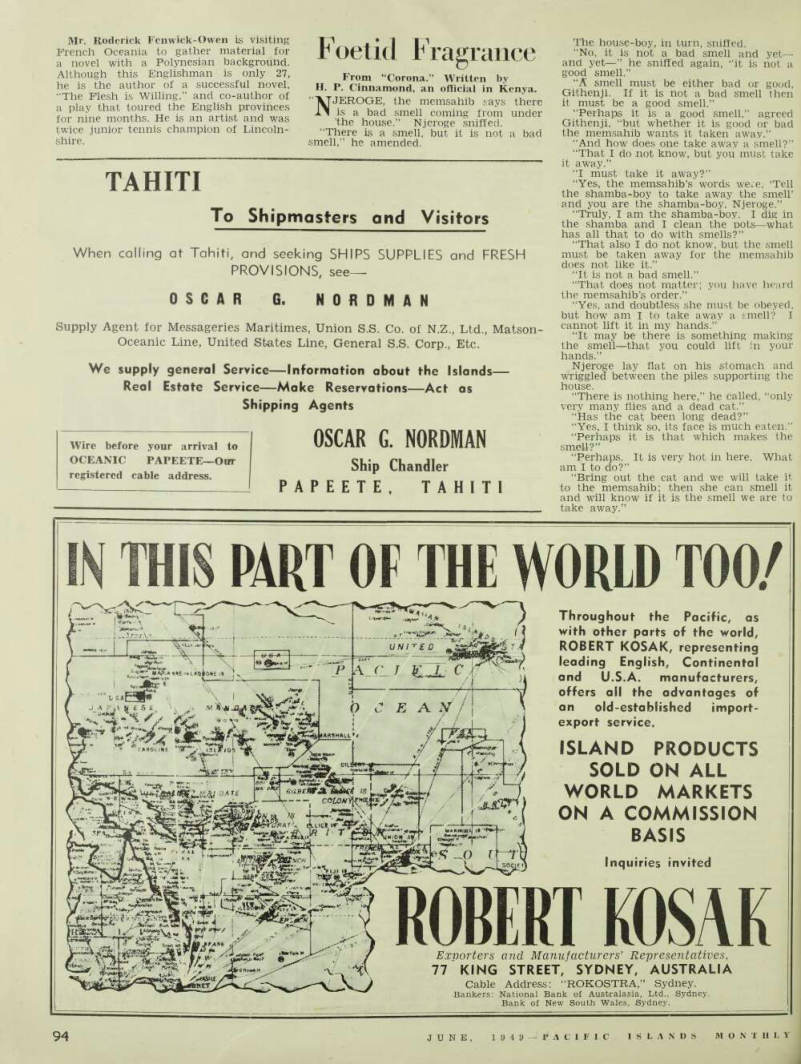
Rabaul
From Our Own Correspondent
Rabaul, May 25.
PUPILS of schools in the Rabaul- Kokopo district gathered at the Rabaul sports ground on Empire Day (May 24). They took part in sing ing and marching exercises and were addressed by the District Officer.
This formal part of Empire Day ob servance was followed by a sports pro gramme.
Mr. Roderick Fenwick-Owen is visiting French Oceania to gather material for a novel with a Polynesian background.
Although this Englishman is only 27, he is the author of a successful novel, “The Flesh is Willing,” and co-author of a play that toured the English provinces for nine months. He is an artist and was twice junior tennis champion of Lincoln shire.
Advertisements & other items, pp. 95-96 (2 items)
93
’ ACIFIC ISLANDS MONTHLY JUNE, 1949
Compel by Mental Current
Command respect, invite confidence, develop will-power. Be ; leader—make others obey you.
Have your suggestions acted on. Build your brain to new, ’mighty strength by knowing the secrets revealed in com- ’ plete instruction course, “Mind Power.” Price, 6/6 postal note. Know how now!
ALPHA POWER CO.
G.P.0., Sydney.
Box 385« HA.
TAHITI
To Shipmasters ond Visitors When calling at Tahiti, and seeking SHIPS SUPPLIES and FRESH
PROVISIONS, see—
OSCAR G. NORDMAN
Supply Agent for Messageries Maritimes, Union S.S. Co. of N.Z., Ltd., Matson- Oceanic Line, United States Line, General S.S. Corp., Etc.
We supply general Service—lnformation about the Islands— Real Estate Service—Make Reservations—Act as Shipping Agents
PAPEETE, TAHITI
Wire before your arrival to
OCEANIC PAPEETE—Our
registered cable address.
OSCAR G. NORDMAN
Ship Chandler
THIS PART OF THE WORLD TOO/
Vr/ F / c ' £ A iV
J»««HAUV
X «3l?
, */£sar
2st£; ■'--'V mm JL£t* itt TSk >3 mWfiAr\ X lKt > 1 *>**»»»♦ - *** NtO» ££ L_Sts t !*?
F Q ■3<~*~ *•** *** * •/***»* S2^ 'X Throughout the Pacific, as with other parts of the world, ROBERT KOSAK, representing leading English, Continental and U.S.A. manufacturers, offers ail the advantages of an old-established importexport service.
ISLAND PRODUCTS
SOLD ON ALL
WORLD MARKETS
ON A COMMISSION
BASIS
Inquiries invited
ROBERT KOSAK
Exvorters and Manufacturers’ Representatives,
77 KING STREET, SYDNEY, AUSTRALIA
Cable Address: “ROKOSTRA,” Sydney.
Bankers: National Bank of Australasia, Ltd., Sydney.
Bank of New South Wales, Sydney.
Foetid Fragrance
From “Corona.” Written by H. P. Cinnamond, an official in Kenya.
“VTJEROGE, the memsahib says there li is a bad smell coming from under 'the house.” Njeroge sniffed. ‘‘There is a smell, but it is not a bad smell,” he amended.
The house-boy, in turn, sniffed.
“No, it is not a bad smell and yet— and yet—” he sniffed again, “it is not a good smell.”
“A smell must be either bad or good, Githenji. If it is not a bad smell then it must be a good smell.”
“Perhaps it is a good smell,” agreed Githenji, “but whether it is good or bad the memsahib wants it taken away.”
“And how does one take away a smell?”
“That I do not know, but you must take it away.”
“I must take it away?”
“Yes, the memsahib’s words were, ‘Tell the shamba-boy to take away the smell’ and you are the shamba-boy, Njeroge.”
“Truly, lam the shamba-boy. I dig in the shamba and I clean the pots—what has all that to do with smells?”
“That also I do not know, but the smell must be taken away for the memsahib does not like it.”
“It is not a bad smell.”
“That does not matter; you have heard the memsahib’s order.”
“Yes, and doubtless she must be obeyed, but how am I to take away a smell? I cannot lift it in my hands.”
“It may be there is something making the smell —that you could lift in your hands.”
Njeroge lay flat on his stomach and wriggled between the piles supporting the house.
“There is nothing here,” he called, “only very many flies and a dead cat.”
“Has the cat been long dead?”
“Yes, I think so, its face is much eaten.”
“Perhaps it is that which makes the smell?”
“Perhaps. It is very hot in here. What am I to do?”
“Bring out the cat and we will take it to the memsahib; then she can smell it and will know if it is the smell we are to take away.”
Fijians’ Notable
History
In Pacific War
THE History of the Fiji Military Forces, 1939-45, compiled by Lieut. R. A, Hewlett, just published by Whitcomb and Tombs Ltd., at 7/6, will not only find a place in the majority of reference libraries—it also will be bought and read because of the inspiring story which it tells.
For the first time in history the Pacific area was engulfed in war. The war was connected with the struggle in Europe, which we call World War II; yet it was something separate and distinct. After three decades of intensive planning and preparation, Japan seized the moment of Europe’s direst preoccupation to strike out savagely on her own behalf, in an attempt to make herself unchallenged mistress of the Pacific. The future, if not the actual existence, of every freedom-loving people in the Pacific basin was threatened.
Under the leadership and direction of the United States and Britain, every little nation and community in the Pacific— with one or two shocking exceptions—did its part in resisting and defeating the invader. None made a better record than the people of Fiji.
The fact that men of this Islands race fought as a distinct entity in defence of their home-land; that a large proportion of their leaders and officers were native Fijians; that they displayed such skill and courage in the battlefields of the jungle that their officers boasted of them and European servicemen were proud to be associated with them; and that one of their men, Corporal Sefanaia Sukanaivalu, was the only serviceman in the whole Pacific area to win the coveted Victoria Cross—these things made Fiji’s partici pation in the war an event of historical importance. From then, henceforth Fiji became something more than the name of an archipelago. The Fijians, by their en durance and courage in the swamps of Bougainville, won something that Aus tralians and New Zealanders had similarlv won 28 years before at Anzac—national fame and high honour.
This is a war history rather than an exciting chronicle of military achieve ment; but there are many sections of it that are worth reading because of the story they tell. Fittingly, the deed that won the Victoria Cross for a Fijian has
a prominent place. But there were in numerable other examples of courage and resource—bright pages scattered through most of the attractively-printed volume of 267 pages.
Some 11,000 men passed through the Fiji Military Force. At the peak of its strength in August, 1943, there were 8,513 on the strength, of which the distribution by races was as follows; Europeans 1,070 Europeans, NZEF ... 808 Fijians 6,371 Indians 264
New Cook Islands Stamps
THE new Cook Islands pictorial stamps, to replace the present pictorial issue, will be placed on sale on August 1.
The new series will be available at the chief post offices of the four New Zealand
main centres, the Stamps Branch in Wel lington, and at all post offices in Cook Islands territory.
New Cathedral For Suva
rpHE building of an Anglican cathedral JL in Suva, for which there is a fund of £16,000 available, will probably begin late this year, the Rt. Rev. L, S. Kemp thorne, Bishop in Polynesia informed “New Zealand Herald” in June.
The cathedral would be built in con crete on the site of the old Government building near the heart of Suva, acquired ten years ago. The cathedral would be completed in stages, beginning with the chancel.
“We shall erect the shell and leave it to posterity to complete the ornamenta tion,” said the bishop. There would be pews for about 300 worshippers.
Advertisements & other items, p. 97 (2 items)
Robert Gillespie
WHOLESALEI-MERCHANTS
m ■ w»
MANUFACTURERS AGENTS
f m Et f/ mb & s* w o* t u S i H CB ♦
ROBERT GILLESPIE
NEW GUINEA
HEAD OFFICE LAE
BRANCH OFFICE RABAUL
<Jqenis ROBERT GILLESPIE PTY.LTD. 5 Street*
Bureau
PACIFIC ISLANDS SERVICE
r I Pacific Islands Service Bureau has A been established to assist Island residents who cannot shop for themselves.
Briefly, we will perform those services for you, in Australia, which you cannot perform yourself, or are outside the scope of ordinary mail-ordering.
We will purchase and forward goods to you; have repairs made on your behalf; send flowers, sweets, fruits, gifts to frends in Australia for you, or to your children at school in Australia; match materials and sewing accessories; and arrange holiday accommodation and travel.
For these services we charge a small fee—-in the case of shopping services, usually 10 per cent, of the purchase price.
If you missed the circular which explains this service fully and which was included in all copies of “PIM” which went to the Islands in March, 1948, please let us know and we will send you a copy of the pamphlet, free of charge.
All inquiries should be addressed to: The Director, Pacific Travel and Service Agency, Box 3408, Sydney
Islands Produce
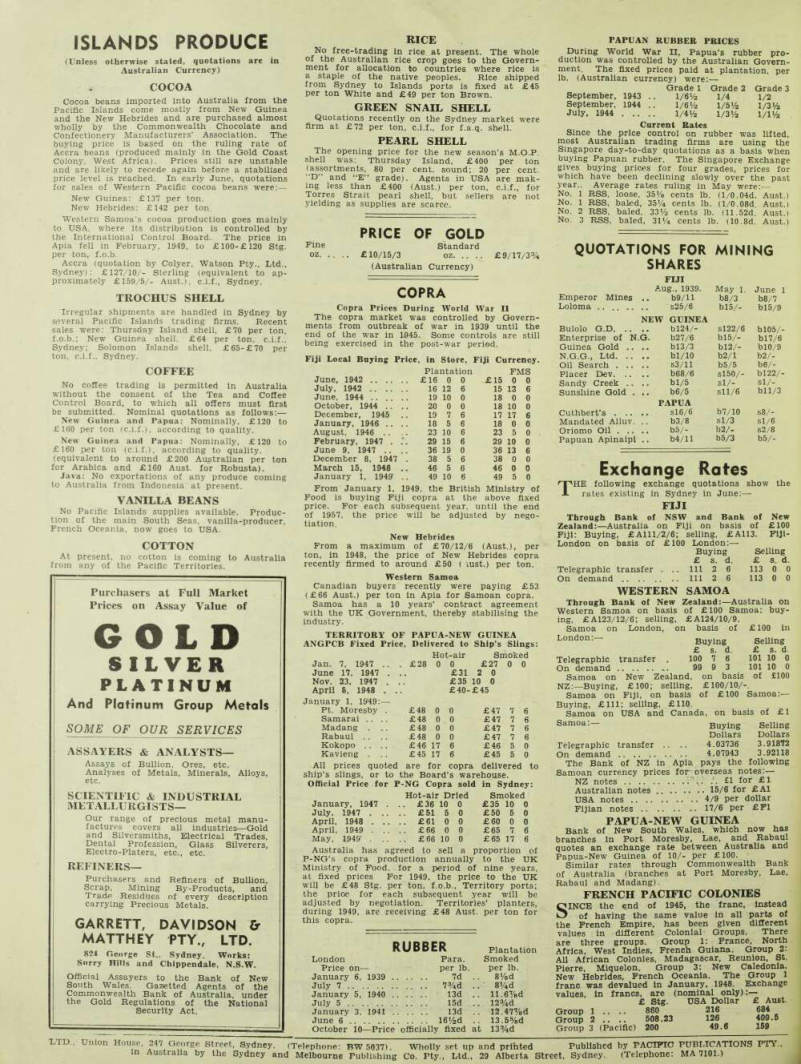
(Unless otherwise stated, quotations are in Australian Currency)
* Cocoa
Cocoa beans imported into Australia from the Pacific Islands come mostly from New Guinea and the New Hebrides and are purchased almost wholly by the Commonwealth Chocolate and Confectionery Manufacturers’ Association. The buying price is based on the ruling rate of Accra beans (produced mainly in the Gold Coast Colony, West Africa). Prices still are unstable and are likely to recede again before a stabilised price level is reached. In early June, quotations for sales of Western Pacific cocoa beans were:— New Guinea: £137 per ton.
New Hebrides: £142 per ton.
Western Samoa’s cocoa production goes mainly to USA, where its distribution is controlled by the International Control Board. The price in Apia fell in February, 1949, to £lOO-£l2O Stg. per ton, f.o.b.
Accra (quotation by Colyer, Watson Pty., Ltd., Sydney): £127/10/- Sterling (equivalent to ap proximately £159/5/- Aust.), c.i.f., Sydney.
Trochus Shell
Irregular shipments are handled in Sydney by several Pacific Islands trading firms. Recent sales were: Thursday Island shell, £7O per ton, f.0.b.; New Guinea shell, £64 per ton. c.i.f., Sydney; Solomon Islands shell, £65-£7O per ton, c.i.f., Sydney.
Coffee
No coffee trading is permitted in Australia without the consent of the Tea and Coffee Control Board, to which all offers must first be submitted. Nominal quotations as follows: — New Guinea and Papua: Nominally, £l2O to £l6O per ton (c.i.f.), according to quality.
New Guinea and Papua: Nominally, £l2O to £l6O per ton (c.i.f.), according to quality, (equivalent to around £2OO Australian per ton for Arabica and £l6O Aust. for Robusta).
Java: No exportations of any produce coming to Australia from Indonesia at present.
Vanilla Beans
No Pacific Islands supplies available. Produc tion of the main South Seas, vanilla-producer, French Oceania, now goes to USA.
Cotton
At present, no cotton is coming to Australia from any of the Pacific Territories.
Rice
No free-trading in rice at present. The whole of the Australian rice crop goes to the Govern ment for allocation to countries where rice is a staple of the native peoples. Rice shipped from Sydney to Islands ports is fixed at £45 per ton White and £49 per ton Brown.
Green Snail Shell
Quotations recently on the Sydney market were firm at £72 per ton, c.i.f., for f.a.q. shell.
Pearl Shell
The opening price for the new season’s M.O.P. shell was: Thursday Island, £4OO per ton (assortments, 80 per cent, sound; 20 per cent.
“D” and “E” grade). Agents in USA are mak ing less than £4OO (Aust.) per ton, c.i.f., for Torres Strait pearl shell, but sellers are not yielding as supplies are scarce.
Advertisements & other items, p. 98 (1 item)
Price Of Gold
Fine oz. . £10/15/3 Standard OZ £9/17/33/4 Currency) (Australian
Copra
Prices During World War II The copra market was controlled by Govern ments from outbreak of war in 1939 until the end of the war in 1945. Some controls are still being exercised in the post-war period.
From January 1, 1949, the British Ministry of Food is buying Fiji copra at the above fixed price. For each subsequent year, until the end of 1957, the price will be adjusted by nego tiation.
New Hebrides From a maximum of £7O/12/6 (Aust.), per ton, in 1948, the price of New Hebrides copra recently firmed to around £5O ( lust.) per ton.
Western Samoa Canadian buyers recently were paying £53 (£66 Aust.) per ton in Apia for Samoan copra.
Samoa has a 10 years’ contract agreement with the UK Government, thereby stabilising the industry.
All prices quoted are for copra delivered to ship’s slings, or to the Board’s warehouse.
Official Price for P-NG Copra sold in Sydney:
Australia has agreed to sell a proportion of P-NG’s copra production annually to the UK Ministry of Pood, for a period of nine years, at fixed prices For 1949, the price to the UK will be £4B Stg. per ton, f.0.b., Territory ports; the price for each subsequent year will be adjusted by negotiation. Territories’ planters, during 1949, are receiving £4B Aust. per ton for this copra.
Fiji Local Baying Price, in Store, Plantation Fiji Currency.
Fms
June, 1942 £16 0 0 £15 0 0 July. 1942 16 12 6 15 12 6 June, 1944 19 10 0 18 0 0 October, 1944 . . .. 20 0 0 18 10 0 December, 1945 .. 19 7 6 17 17 6 January, 1946 .. 18 5 6 18 0 0 August, 1946 23 10 6 23 5 0 February, 1947 . 29 15 6 29 10 0 June 9, 1947 .. 36 19 0 36 13 6 December 8, 1947 . 38 5 6 38 0 0 March 15, 1948 .. 46 5 6 46 0 0 January 1, 1949' .. 49 10 6 49 5 0
Territory Of
Papua-New
Guinea
ANGPCB Fixed Price, Delivered to Ship's Slings: Hot-air Smoked Jan. 7, 1947 .. . £28 0 0 £27 0 0 June 17, 1947 . . £31 2 0 Nov. 23. 1947 . .. £35 10 0 April 8, 1948 . .. £40- £45 January 1, 1949:— Pt. Moresby . £48 0 0 £47 7 6 Samarai .. £48 0 0 £47 7 6 Madang . .. £48 0 0 £47 7 6 Rabaul .. £48 0 0 £47 7 6 Kokopo .. £46 17 6 £46 5 0 Kavieng . .. £45 17 6 £45 5 0
Hot-air Dried Smoked January, 1947 . .. £36 10 0 £35 10 0 July. 1947 . .. .. £51 5 0 £50 5 0 April, 1948 . .. .. £61 0 0 £60 0 0 April, 1949 . .. . . £66 0 0 £65 7 6 May, 1949’ . . . £66 10 0 £65 17 6
Rubber
Plantation
Papuan Rubber Prices
During World War 11, Papua’s rubber pro duction was controlled by the Australian Govern ment. The fixed prices paid at plantation, per lb. (Australian currency) were:—
Current Bates Since the price control on rubber was lifted, most Australian trading firms are using the Singapore day-to-day quotations as a basis when buying Papuan rubber. The Singapore Exchange gives buying prices for four grades, prices for which have been declining slowly over the past year.. Average rates ruling in May were:— No. 1 RSS, loose. 35Vs cents lb. (l/0.04d. Aust.) No. 1 RSS, baled, 35(4 cents lb. (l/o.oBd Aust.) No. 2 RSS, baled, 33Vs> cents lb. (11.52 d. Aust.) No. 3 RSS, baled, 31(4 cents lb. (10.8 d. Aust.)
London Para.
Smoked Price on— per lb. per lb.
January 6, 1939 . ... 7d .. SVad July 7 . ... 7%d .. 8V 4 d January 5, 1940 .. 13d .. 11.6 7 / 8 d July 5 . ... 15d .. 12%d January 3, 1941 . 13d .. 12.47 7 / 8 d June 6 . 16»/ 2 d .. 13.5 5 /sd October 10 —Price officially fixed at 13%d
Grade 1 Grade 2 Grade 3 September, 1943 . 1/6 Vi 1/4 1/2 September, 1944 . 1/6 y 2 1/5 y 2 1/3 Vi July, 1944 . .. . l/4Vi 1/3 y 2 1/1 y 2
Quotations For Mining
Shares
Fiji
Aug., 1939.
May l.
June 1 Emperor Mines b9/ll b8/3 b8/7 Loloma S25/6 bl5/bl5/9 Bulolo G.D. ..
New Guinea
S122/6 bl05/- Enterprise of N.G. b27/6 bl5/bl7/6 Guinea Gold .. bl3/3 bl2/blO/9 N.G.G., Ltd. .. bl/10 b2/l b2/- Oil Search . ,.
S3/11 b5/5 b6/- Placer Dev. .. b68/6 sl50/bl22/- Sandy Creek .. bl/5 sl/sl/- Sunshine Gold . b6/5 sll/6 bll/3 Cuthbert’s . ..
Papua
S16/6 b7/10 s8/- Mandated Alluv. b3/8 sl/3 sl/6 Oriomo Oil . .. b5/b2/s2/8 Papuan Apinaipi b4/ll b5/3 b5/-
Exchange Rates
THE following exchange quotations show the rates existing in Sydney in June; —
Fiji
Through Bank of NSW and Bank of New Zealand: —Australia on Fiji on basis of £lOO Fiji: Buying, £Alll/2/6; selling. £AII3. Fiji- London on basis of £lOO London:—
Western Samoa
Through Bank of New Zealand: —Australia on Western Samoa on basis of £lOO Samoa: buy ing, £AI23/12/6; selling, £AI24/10/9.
Samoa on London, on basis of £lOO in London; —
Samoa on New Zealand, on basis of £100 NZ:—Buying, £100; selling, £100/10/-.
Samoa on Fiji, on basis of £100 Samoa: — Buying, £111; selling, £110.
Samoa on USA and Canada, on basis of £1
The Bank of NZ in Apia pays the following Samoan currency prices for overseas notes: — NZ notes .. .. £1 for £1 Australian notes 15/6 for £A1 USA notes 4/9 per dollar Fijian notes 17/6 per £F1
Papua-New Guinea
Bank of New South Wales, which now has branches In Port Moresby, Lae, and Rabaul quotes an exchange rate between Australia and Papua-New Guinea of 10/- per £100.
Similar rates through Commonwealth Bank of Australia (branches at Port Moresby, Lae, Rabaul and Madang).
French Pacific Colonies
SINCE the $nd of 1945, the franc, Instead of having the same value in all parts of the French Empire, has been given different values in different Colonial Groups. There are three groups. Group 1: France, North Africa, West Indies, French Guiana. Group 2: All African Colonies, Madagascar, Reunion, St.
Pierre, Miquelon. Group 3: New Caledonia, New Hebrides, French Oceania. The Group 1 franc was devalued In January, 1948. Exchange values, in francs, are (nominal only):—
Buying Selling £ s. d. £ s. d.
Telegraphic transfer . .. Ill 2 6 113 0 0 On demand .. Ill 2 6 113 0 0
London: — Buying Selling £ s. d. £ s. d Telegraphic transfer . 100 7 6 101 10 0 On demand 99 9 3 101 10 0
Samoa:— Buying Selling Dollars Dollars Telegraphic transfer .. .. 4.03736 3.91872 On demand 4.07943 3.92118
£ Stg.
USA Dollar £ Aust.
Group 1 ... 860 216 684 Group 2 .. 508.23 126 409.5 Group 3 (Pacific) 200 49.6 159
Advertisements & other items, pp. 98-100 (3 items)
TTD., Union House, 247 George street, Sydney. (Telephone: BW 5037). Wholly set up and printed Published by PACIFIC PUBLICATIONS PTY.,
m Australia by the Sydney and Melbourne Publishing Co. Pty., Ltd., 29 Alberta Street. Sydney. (Telephone: MA 7101.)
Gold
Purchasers at Full Market Prices on Assay Value of
SILVER
PLATINUM
And Platinum Group Metals
SOME OF OUR SERVICES
ASSAYERS & ANALYSTS—
Assays of Bullion, Ores, etc.
Analyses of Metals, Minerals, Alloys, etc.
SCIENTIFIC & INDUSTRIAL
METALLURGISTS—
Our range of precious metal manufactures covers all industries—Gold and Silversmiths, Electrical Trades, Dental Profession, Glass Silverers, Electro-Platers, etc., etc.
REFINERS—
Purchasers and Refiners of Bullion, Scrap, Mining By-Products, and Trade Residues of every description carrying Precious Metals.
GARRETT, DAVIDSON &
MATTHEY PTY., LTD.
824 George St., Sydney. Works: Surry Hills and Chippendale, N.S.W.
Official Assayers to the Bank of New South Wales. Gazetted Agents of the Commonwealth Bank of Australia, under the Gold Regulations of the National Security Act.
tropical thirst...
To quench a
“HP! r m if'i a %, v ' i m wmm When you’re hot and tired, there is nothing quite so satisfying and thirst quenching as a long, cold glass of Your friends and guests, too, will appreciate this really fine Lager.
TOOTH’S
LAGER
llMiip' II ifiiß
Bigg 'I — ! *»} i -; ■ <**j'
MERCHANTS. & SHIP OWNERS
Capital £1,000,000
ESTABLISHED 1914
COPRA MERCHANTS & MILLERS
ASSOCIATED COMPANIES THROUGHOUT THE PACIFIC ISLANDS
IN LONDON
Buyers and exporters of all kinds of Islands produce. Copra Merchants and Millers.
Agents for Australian, European and American Manufacturers. Distributors of every description of merchandise.
Thirty years of Pacific Islands development and service.
REGULAR CARGO
PACIFIC
Head
AND PASSENGER SERVICE BETWEEN EUROPE AND
ISLAND PORTS WAS ESTABLISHED BY
W. R. CARPENTER & CO. LTD.
Office: 16 O'CONNELL STREET, SYDNEY.
Cable Address:
C AMO HE.
Telephone: BW 4421.
Postal Address: P.O. Box No. 168, Sydney.
PACIFIC ISLANDS MONTHLT J U N E , 1949