Tropicilities
pp. 56-57 · Read in the full issue
EIGHT months ago- a Fijian farmer in the Waidina area discovered a four legged chick among a newly-hatched clutch. With others, the chick was ac quired by Mr. L. C. Bean, who now has a fully-grown healthy Rhode Island cross rooster with twice the normal allowance of legs.
The bird, as tame as a family cat, walks on two legs and keeps the others, which are fully developed, tucked up at its sides.
On August 25, Mr. Bean brought the rooster to Suva where it stopped pedes trian traffic in the streets, visited a photographer and was interviewed by the press.—S (It was later acquired by a NZ sideshow.) * » • THE Agricultural and Horticultural Society of Norfolk Island has been resurrected.
I have visions of carrying off first prize in the Edible Roots Section with my five feet long carrot.
It is simple; Simply grow the vegetable at the bottom of a chimney or a length of pipe. Shut off from the sun and water lavishly. When firmly established, allow the sun to trickle through at the top end of the pipe (or chimney). The result will be a carrot measuring from five to six feet from tip of root to ex treme end of the foliage!—V.W.
SOME years ago an American, Edward Faulkner, attacked the use of the plough in agriculture by writing a book which he called “Ploughman’s Folly.” This book provoked great interest in agricultural circles and can almost be said to have caused an agricultural revo lution.
It was left to Mr. Norman Carew. of Lautoka, Fiji, to answer Edward Faulkner, which he has now done in a book called “Ploughman’s Wisdom”. It will be published in London this month, by Faber and Faber.
Mr. Carew is Field Superintendent, Lautoka District, for the Colonial Sugar Refining Co. He has been with the CSR for 27 years and has not been con tent only to let others plough, but has conducted many experiments himself.
In a foreword, Dr. S. Graham Brade- Birks, of the S-E Agricultural College, Wye, Kent, says that although the plough is one of the most ancient of implements, no one now seems to know just why we continue to use it. Mr.
Carew, in his book tells us why we do— and why we should keep on doing so.
NEWCASTLE (NSW) Methodists ob served August 12 as “Fuzzy Wuzzy Day”. Buttons were sold in the streets and donations sought to the fund for rehabilitating Methodist work in Papua-New Guinea. * * * ACCORDING to “Whites Aviation” (NZ), Lae, New Guinea, ranks fifth in the total aircraft handled by Australia’s 16 main airports.
Essendon, Melbourne’s principal air port, handles more traffic than any other airport in the British Commonwealth.
During 1948 arrivals and departures numbered 156,856.
THE balance of nature: In recent times, the skins of leopards have come much into demand, for cos tume and decorative and ceremonial purposes. As a result, the leopard popu ation of Central Africa has decreased markedly. The leopards, under normal conditions, preyed upon the baboons, with the result that the baboon popu lation was kept within check. Now, the baboons have increased beyond all measure —they are reported to be mov ing around in packs of at least 200. Fol lowing on that there is an outcry from areas in the Gambia —at least one quarter of the Gambia’s food crops are being eaten out by the baboons. Admini stration officials in Central Africa are urgently seeking some effective method of baboon control. * * * “\\I UY do 80 man y people spell coco- Vf nut with an ‘a’?” asks a correspon dent.
We often have asked the same
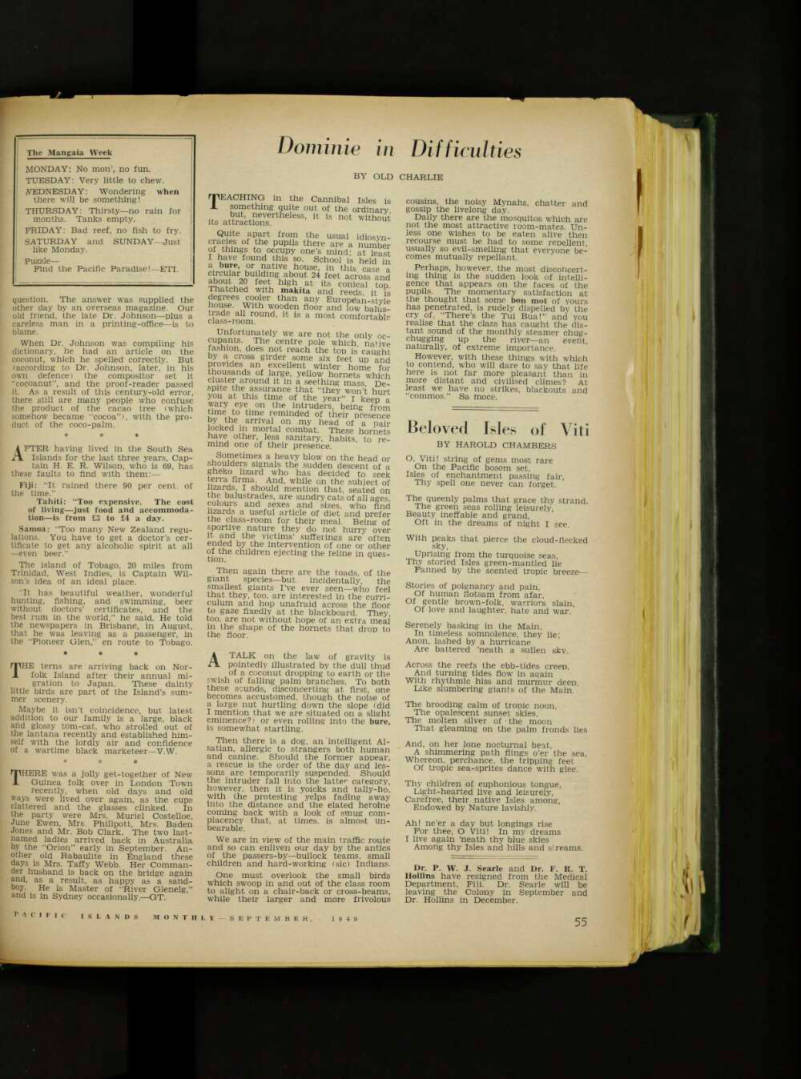
DESPITE the Royal signature and austere mien, this is not King James VI and I, but Captain Jimmy Rich mond, who runs the copra schooner, Miena, through the Solomons.
Jimmy R. flew during the war as a Navigation Instructor, and later trained the motor-boat crews for the R.A.A.F.
He is now talking of selling his ship and retiring to his family in Sydney. Al though a genuine Ancient Mariner. I show him here in the more intellectual role of mathematician and philosopher, sharing these abilities with a love of literature and living, as did the old Persian poet, Omar Khayyam—BßETT
Hilder.
question. The answer was supplied the other day by an overseas magazine. Our old friend, the late Dr. Johnson—plus a careless man in a printing-office—is to blame.
When Dr. Johnson was compiling his dictionary, he had an article on the coconut, which he spelled correctly. But (according to Dr. Johnson, later, in his own defence) the compositor set it “cocoanut”, and the proof-reader passed it. As a result of this century-old error, there still are many people who confuse the product of the cacao tree (which somehow became “cocoa”), with the pro duct of the coco-palm. * * ♦ AFTER having lived in the South Sea Islands for the last three years, Cap tain H. E. R. Wilson, who is 69, has these faults to find with them: — Fiji: “It rained there 90 per cent, of the time.”
Tahiti: “Too expensive. The cost of living—just food and accommoda tion—is from £3 to £4 a day.
Samoa: “Too many New Zealand regu lations. You have to get a doctor’s cer tificate to get any alcoholic spirit at all —even beer.”
The island of Tobago, 20 miles from Trinidad, West Indies, is Captain Wil son’s idea of an ideal place.
“It has beautiful weather, wonderful hunting, fishing, and swimming, beer without doctors’ certificates, and the best rum in the world,” he said. He told the newspapers in Brisbane, in August, that he was leaving as a passenger, in the “Pioneer Glen,” en route to Tobago. ♦ ♦ * THE terns are arriving back on Nor folk Island after their annual mi gration to Japan. These dainty little birds are part of the Island’s sum mer scenery.
Maybe it isn’t coincidence, but latest addition to our family is a large, black and glossy tom-cat, who strolled out of the lantana recently and established him self with the lordly air and confidence of a wartime black marketeer —V.W. * * ♦ THERE was a jolly get-together of New Guinea folk over in London Town recently, when old days and old ways were lived over again, as the cups clattered and the glasses clinked. In the party were Mrs. Muriel Costelloe, June Ewen, Mrs. Phillpott, Mrs. Baden Jones and Mr. Bob Clark. The two last named ladies arrived back in Australia by the “Orion” early in September. An other old Rabaulite in England these days is Mrs. Taffy Webb. Her Comman der husband is back on the bridge again and, as a result, as happy as a sand boy. He is Master of “River Glenelg,” and is in Sydney occasionally.—GT.