the Flag
pp. 52-53 · Read in the full issue
The Navy Shows the Flag
(Part II—At Funafuti)
IT was about the time of leaving Savu Savu that Rita Hayworth made her appearance—on the screen—in the old, but still hot, spectacle “Blood and Sand.” We hope that our cinema officer has noted the enthusiasm with which we devour Miss Hayworth, and that he will make arrangements for us to see more of her (if this is possible).
We duly arrived in Suva, but our so journ there was spoilt by almost con tinuous rain. Most sporting activities, of which plenty had been arranged, were cut short and only the pulling competi tion survived the weather. Their ardour unabated by soreness of joint and seat, the various crews flogged the water day after day encouraged, in victory or de feat, by the untiring efforts of the sports officer and his assistants.
Ashore there was a most pronounced drought in the beer line, though there seemed to be a fair measure of the more exotic types of refreshments.
A liaison, by both officers and men, was established with the Royal New Zealand Air Force at Laucala Bay. This proved to have great spiritual, but little bodily, comfort. And. at the request of the Air Force, we sent a party to start demolish ing a large concrete lighter which had sunk in Laucala Bay and constituted a danger to flying. These wreck clearers spent a miserable day in an open boat, being subjected to torrential rain the whole while. The divers were loath to leave the bottom for fear of getting wet.
Or, so we are told.
After six days of water-logged activity of a rather nondescript nature, we cast off and set out for our first coral atoll, Funafuti in the Ellice Islands.
We had three passengers: An officer of the Suva Meteorological Bureau, to in spect weather stations; and a District Officer, who took with him a genial, and very thrilled, Ellice boy who rejoiced in the delightful name of Moto-ka —so called because his arrival in this world coincided with the advent of the first “Model T”
Ford to grind its way into one of the re moter Ellice Islands, a quarter of a cen tury ago. History does not relate whether this monster frightened his mother; but if it did, Moto-ka shows no ill effect and he is very proud of his name.
After a calm and uneventful two-days’ passage, except for Rita Hayworth who is still displaying a good deal of everything, we made our landfall on Funafuti during the forenoon. The atoll is a coral cone sitting on top of a submerged (one time volcanic) mountain. The cone has a saucer-shaped top of which only parts of an uneven rim appear above the surface
of the sea. These parts are the islands of the atoll, the re mainder of the rim is just submerged and constitutes the anchorage. The uni formity of the lagoon’s bottom is marred in places by coral “mushrooms” which, in some cases even break the sur face. The whole assembly is a re markable feat of nature.
The entrance channel, being tor
tuous, required care ful navigating. One error here would result in tearing open the ship’s bottom. Of course, a warship, if well organised internally, is so designed that she will not sink, even with such a gaping wound. Nevertheless, such experiments are best avoided—particularly in peace time.
ABOUT three p.m., on a brilliantly sunlit day we anchored off the village of Fongafale, on the main island.
Next day a football team was landed, accompanied by the band. The latter was a great success. Many went ashore to spy out the land. The inquisitive found that
By Starshell
the island, although about three miles long, is only a few hundred yards broad at its widest point. On the lagoon side, the beaches consist of very fine white sand which do not shelve rapidly enough, in most places, for swimming. On the ocean side, the rollers have beaten the coral into a sea wall which drops away steeply to great depths. Here bathing has little future as all but the strongest swimmers would be dashed to pieces between surf and coral. We did not try it.
During the war our American allies converted the small patch of cultivated land into an air strip which was soon to be dug up for garden land again. The Americans left also a valuable heritage to the natives in the form of many modem tropical huts equipped with fly screens and most domestic conveniences.
The native hut is a rare sight in Funafuti, now. The doughboys were deprived of the opportunity of leaving any other form of heritage by the forethought of
the authorities who evacuated the entire native population to another island for the duration. The Polynesian blood re mains comparatively pure although a man called O’Brien seems to have done sterling work in earlier days.
To most of us these Polynesians are something new. Unlike the Maoris, who came, of course, from the same stock, they have had little association with European races and have thus retained a natural charm and grace. They are, in the main, highly religious; for missionaries have found these islands fertile ground. Their moral integrity, surprising in a people naturally inclined to delightful promis cuity, stands them in good stead in their dealings with strange Europeans and must be a strong factor in their obvious happi ness.
On the second evening, the Captain and officers were entertained to a supper by the District Officer and his wife. The party then joined with one from the ship’s company to witness native welcome dances and songs. To many this proved an entirely novel experience. The danc ing is graceful and not warlike. Each dance tells a story; and a particularly amusing one was the dance relating the visit of the “Achilles” to Funafuti shortly before the war. It was then that the natives saw their first aircraft: and the motions depicting the populace gazing skywards and, at the same time, bumping into trees were both realistic and funny.
Anybody who has watched Malayan and Javanese dancing can see the strong re semblance between these and the dancing of Funafuti, although the last is less serious. It is, in fact, an occasion for jollity, whereas the Malayans and Javan ese seldom verge on humour.
Some may have, at first, been disap pointed because the male performers had the lion’s share of the show. This de (Continued Opposite Page)
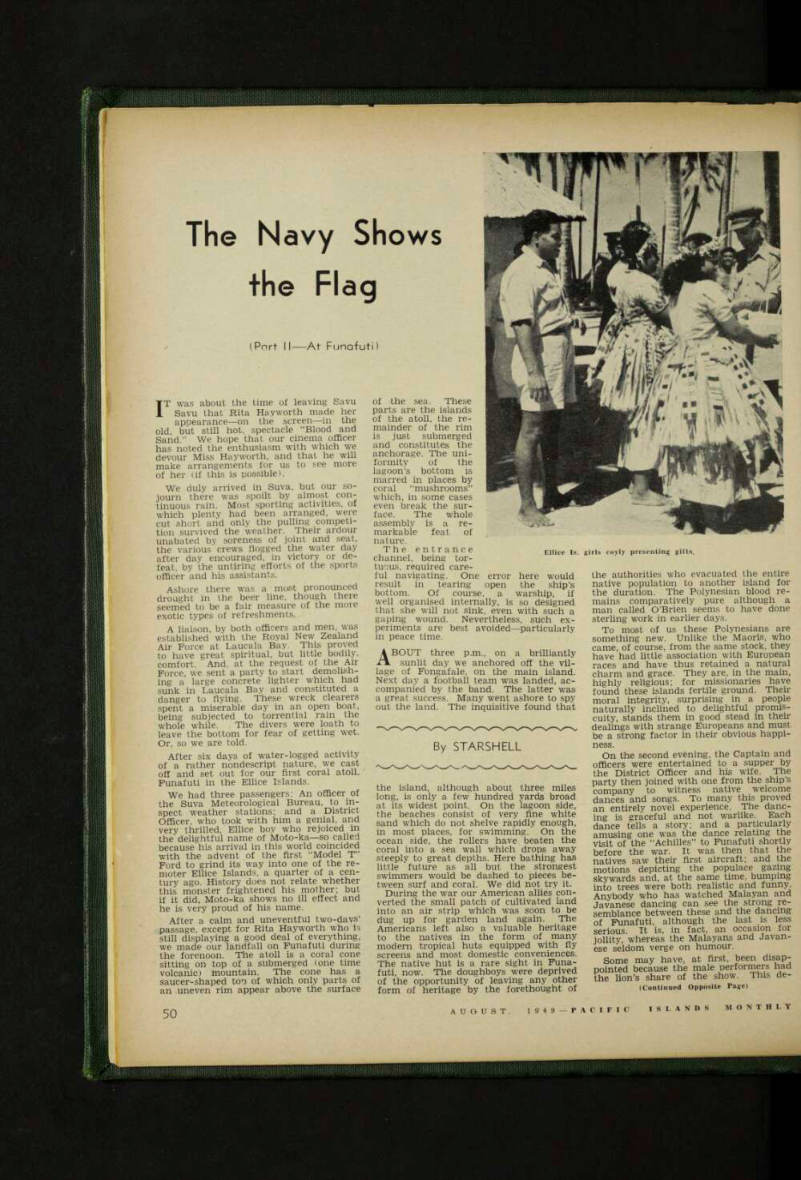
Ellice Is. girls coyly presenting gifts.
ficiency was soon remedied when the native girls pulled us out amidst blushes —ours —and made us dance or tread on their bare feet, according to our skill!
The “mump” bogey (developed in Fiji waters), has not left us, and there was consternation when two more cases made their appearance. We went into quaran tine, weighed our hook, moved a few miles, and anchored off a brand new island called Amatuku, which had been loaned to us. Though next to the main island it was uninhabited.
THE Navigating Officer went ashore with tents and set up a local colony of which he was appointed Resident Magistrate. In no time the settlement boasted a galley, three or four tents, rifle and pistol ranges, basketball and deck tennis courts, a water polo pitch, a pier (of sorts), radio communication and ample fuel—the last having been thought fullv left behind by the Americans. With all these amenities to boast, the founders of this far-flung New colony im mediately went native, and visited the ship touting the attractions of their island; even going so far as advertising in the ship’s daily paper. However, despite the cynicism of many, a gallant band could not resist the romance of a night under the tropic sky—combined with the thought of avoiding early scrubbing of decks. These heroes risked the danger from monstrous land crabs in order to fulfil their desire. Heavy rain, on the second or third night, somewhat damped their spirits but the stouter souls won through the quagmire.
The weather was very kind. So sail ing, pulling, bathing, fishing and all other forms of open air activity were the order of the week. It was hot enough to be in “tropical routine” —very popular, for it means no work after mid-day for most.
Considerable excitement was caused by the capture of a shark which is every body’s ambition at times like these. Tbe traditional treatment, which sailors are supposed to mete out to these brutes, is to capture two, tie their tails together, and then throw them back into the sea.
The only snag here is the second shark.
After a week at Funafuti we evacuated our island with genuine regret at leaving this delightful and healthy spot. The following day we sailed. Presents had been made to the native population, but we are sorry they could not visit us on board to see the ship and be entertained at the cinema.