Tropicalities
pp. 53-54 · Read in the full issue
Father Andre Dupeyrat, Ener
getic Missionary from Yule Island, Papua, has become well-known in Australia in the last year or so. He has been entrusted with the job of reviving the finances of his mission which suffered badly through the war years. Father Dupeyrat’s tolerant view of life in general has made him popular in a country where clerics usually take to themselves stern and austere habits of mind.
Recently our sprightly Frenchman ap peared upon the stage of the Princess Theatre, Melbourne, at the opening night of the National Ballet Season and, re viving an old Russian (White) custom, blessed the season and the dancers.
Father Dupeyrat is, presumably, in terested in the ballet. He was honorary chaplain to the De Basil Company, when it visited Australia.
IN July, a first-class revolution was in progress in Guatemala. The Presi dent was being guarded in his palace, and the head of the Army had been killed.
Next door, in British Honduras, all was quiet, but bombs were being dropped rather indiscriminately around the fron tier and there was a certain tenseness.
At Government House, in Belize, events were being watched carefully by Mr. and Mrs. Ronald Garvey, a couple well-known and affectionately remembered in the South Pacific. Mr. Garvey, after adminis trative work in Central Africa and West Indies, took over the governorship of British Honduras early this year. They now have four children: the eldest, Anthony, aged 14, is at school in England and the three daughters are with their parents in British Honduras. * ♦ * THE unique situation—for isolated Man gaia—of three “talkie” shows operating at the same time, on the same night, was witnessed during the stay of HMNZS “Hawea,” the navy frigate which “showed the flag” here on June 3-4.
By invitation of the warship’s captain, our local Guide group were entertained with a “talkie”-show, in the ship’s own theatre. The powerful amplifier of the warship was heard ashore, where the two local shows, at opposite ends of the beach, were also running. At the same time, a display of rocket-flares, that filled the evening sky with the glory of green and red stars, was fired off from the warship.
The gala atmosphere made a pleasant change from the customary quiet of the villages, the rocket display being visible even to distant settlements.
Before the Hitler War, Mangaia re ceived a Naval call every two years.
Islanders hope that this custom will be revived, at more frequent intervals, and that the Navy’s free “talkie”-show will next time be presented on land, for the whole community.
There was only one minor disappoint ment—the “Hawea” did not send a band ashore with her two contingents of leave men, to play marches on the parade ground. Perhaps this small oversight may be remedied next time —the Islanders love a band above all else. —ETI. ♦ * ♦ THAT most excellent book “Anatomy of Paradise”, by J. C. Furnas, is to be published soon in London by Gollanz, and should be available presently in Australia and New Zealand.
It is easily the best book yet written about the Pacific Islands; but, since it was published last year in America, it has not been available to readers in Sterling areas, owing to the dollar short age. The writer, Mr. Furnas, is now en gaged upon a centenary biography of Robert Louis Stevenson, who was born in Scotland in 1850, and died in Western Samoa in 1894, * » * FOR two years, despite spasmodic pro tests, ZJV Suva nightly broadcast an Australian dance-band-and crooner’s version of the Fijian “Isa Lei” as its signing-off tune. It appeared that some people liked it, but it has never been revealed whether these were a majority or otherwise.
Whatever the reason, the station has
now replaced the dance record with a superb recording of “Isa Lei” sung by the famous Fijian choir of the Jubilee Church, Suva. —S. * * ♦ THE “Coffee Bean” boy, five-year-old Murray Bannigan, who made news by being flown from Wau (NGi to the Brisbane General Hospital to have a coffee bean removed from his throat, returned with his mother to New Guinea recently.
Mrs. Bannigan said she was over whelmed by the response to the “bob in” appeal started by citizens of Bris bane to reimburse them for their savings of £1,250 spent to charter aircraft to bring their son to Brisbane. She had radioed her husband, who had already returned to Wau to finalise his busi ness there. Because of Brisbane’s generosity it would not now be necessary for the Bannigans to leave New Guinea.
Mrs. Bannigan took the coffee bean back with her as a souvenir. She said that she was going to keep it and show it to her son “when he grew up”. • • • MRS. A. ROGER recently arrived in Brisbane from Nauru on the “Dee bank”. She is on a shopping ex pedition.
She said she could not buy ready-made
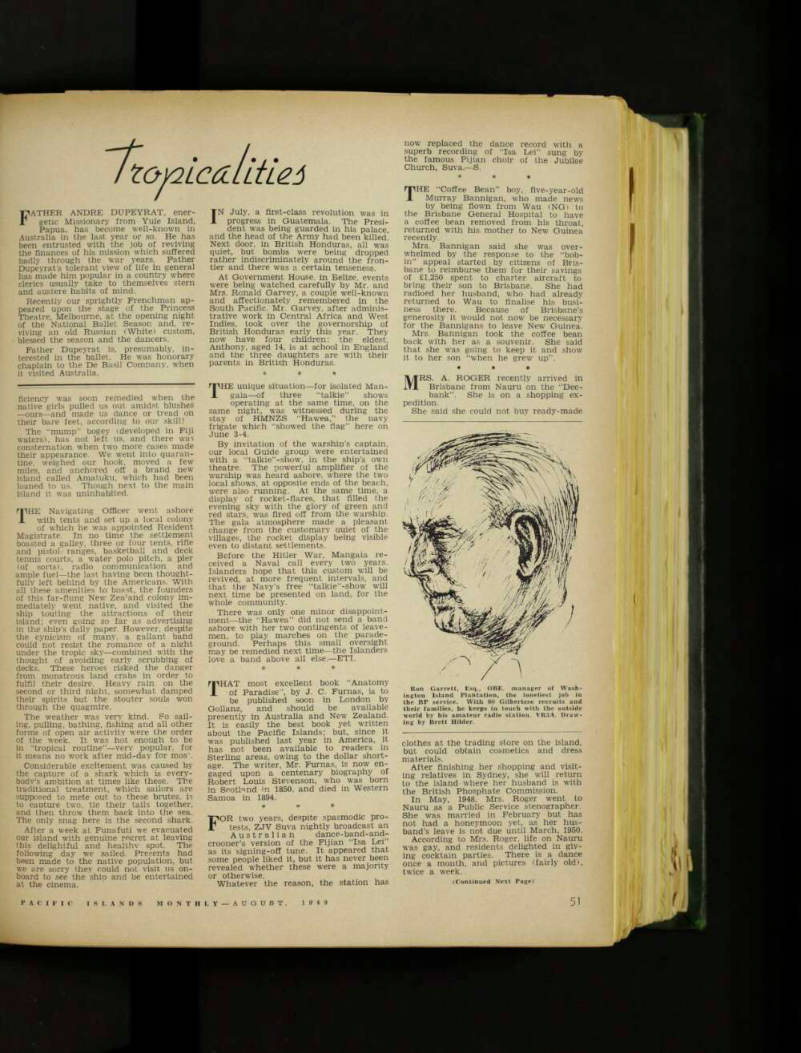
Ron Garrett, Esq., OBE, manager of Wash ington Island Plantation, the loneliest job in the BP service. With 80 Gilbertese recruits and their families, he keeps in touch with the outside world by his amateur radio station, VRBA. Draw ing by Brett Hilder. clothes at the trading store on the island, but could obtain cosmetics and dress materials.
After finishing her shopping and visit ing relatives in Sydney, she will return to the island where her husband is with the British Phosphate Commission.
In May, 1948, Mrs. Roger went to Nauru as a Public Service stenographer.
She was married in February but has not had a honeymoon yet, as her hus band’s leave is not due until March, 1950.
According to Mrs. Roger, life on Nauru was gay, and residents delighted in giv ing cocktail parties. There is a dance once a month, and pictures (fairly old), twice a week.
(Continued Next Page)
THERE are few people who cannot laugh over a schoolboy howler.
And when the schoolboy happens also to be an Islander, struggling with the foolishness of the English language, the howlers are apt to become classics.
This collection, supplied by Eti, comes from the Cook Islands: — THE Prophet Jeremiah was always sad because he said that we are here gone and to-day to-morrow.
The great bridge from Auckland to San Francisco is one of the modern wonders of the world.
King George V was a good man because, although he was a grandson of Queen
Recipes from Home —V (and finally): WANTED, job as a cook. Go anywhere. Do anything. No references from any living persons. Specialise in pickling for a hot climate.
The above testified to by the seven little wooden crosses that mark the happy resting places of my last seven employers.
Reply, bv spiritual medium, to Alma Gross, C - The Asylum.
Victoria, he had been trained in the Navy and could swear like a sailor.
Lord Nelson left his wife for Lady Hamilton but we must not be angry be cause he could not help it.
The duck is a very useful bird but you must be careful not to boil it when it is an egg.
James Watt saw the steam in his kettle move the lid and then he took the tram to London to tell the Government it was a good idea.
John Williams was killed at the Solomon Islands by the heathen and he said Father forgive me for I know not what I do.
Some foods come to us in a tin, from New Zealand, and we get our Resident Agents in the same way, because the Gov ernment is up there.
My brother fell off the horse last week and broke his color bone but God is the boss of everything, so we put him to bed and send for the doctor.
We have been playing football, and I am glad because the Headteacher made me right side out, and our team got all the golds.
Queen Elizabeth executed the Queen of Scotch because her followers called Queen Elizabeth a Virgin, but Sir Francis Drake did not have anything to do with this cruel act. * * * IF you can believe a Sydney daily paper report (and you very often cannot) Mrs. Bryan Hanrahan of Suva, Fiji,, and her son, Sean, aged two, do not speak the same language. Mrs. Hanrahan ar rived in Sydney recently on holiday with Sean. She speaks English, exclusively.
Sean speaks Fijian—exclusively.
This came about because both Mr. and Mrs. Hanrahan go to business, a Fijian nurse looked after Sean and they rarely saw him. The Fijian nurse did not come to Sydney and, denied this interpreter, Mrs. Hanrahan finds her son “a complete stranger and cannot understand a word he says.” * * ♦ REBUILDING the House of Commons, which was badly blitzed by the Germans in 1941, is officially stated to be “proceeding satisfactorily.” It is expected
to be completed towards the end of 1950.
The new Chamber will, when completed, contain something from almost every British Dominion and Colony. From Aus tralia came Queensland black bean tim ber for the Speaker’s chair and walnut for the floor; Canada has given a table in white oak. South Africa has pro vided some chairs made from timber with the decidedly unromantic name of stink wood; other tables and chairs originated in the forests of Nigeria. British Guiana has sent cigarette boxes and ashtrays and Fiji has provided 50 ounces of silver for a massive inkstand to be used by the Secretary of State for the Colonies.
IF seasick try dramamine, the new mal de-mer remedy lately developed in the United States. According to an Army doctor, with the use of this drug and a strong friend, the most seasick sailor can be got up on deck. It does not state, however, whether he feels any better for having got there.
Dramamine is likely to be the succes sor of hyocine, a drug used extensively by the Americans to cure seasick soldiers during World War 11. But in spite of medical science the best remedy for sea sick passengers seems likely to continue to be a piece of smooth sea or, better still, dry land.