Thrills, Spills
p. 51 · Read in the full issue
Copra At Washington Is.
By Brett Hilder
THE prize for the most difficult and dangerous loading port in the Pacific goes to Washington, one of the out lying islands of the Gilbert and Ellice Islands Colony. The records show that it is possible to work there on only half the days of the year, but this is deceptive, like most statistics. The same figures are quoted for Norfolk Island, but the difference lies in the definition of “work able” weather. For the twelve days on which we succeeded in working at Wash ington, not one would have been Regarded as a “safe” working day at any other place in the Pacific.
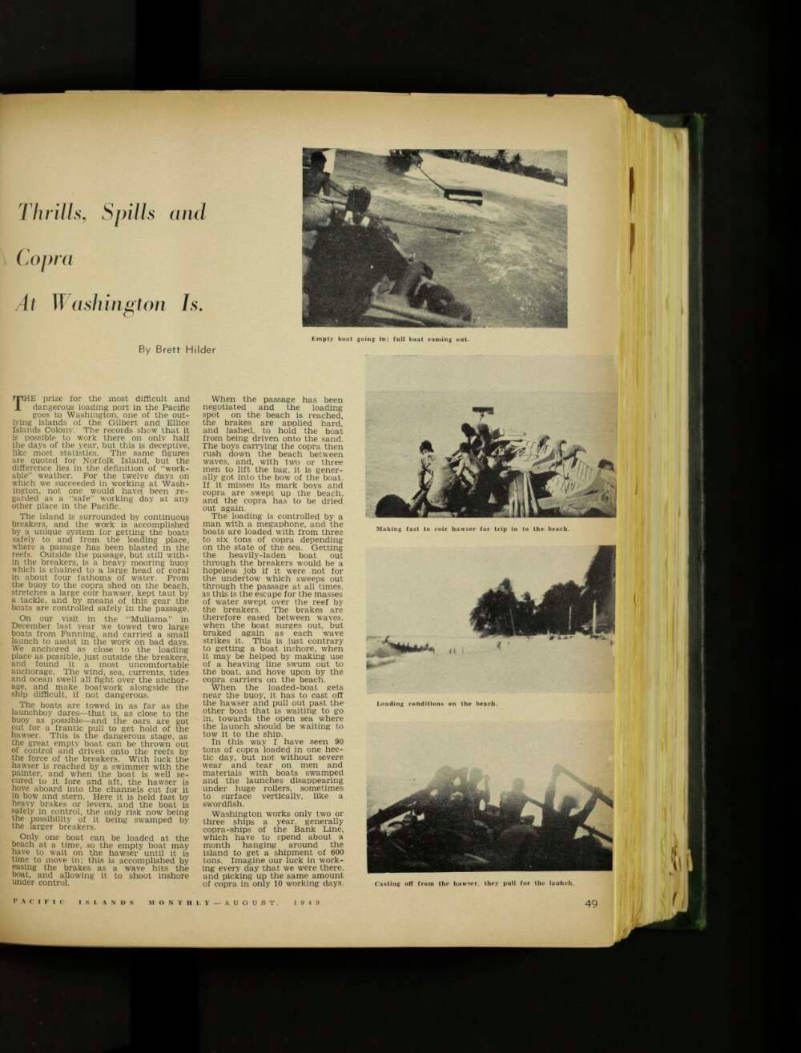
The island is surrounded by continuous breakers, and the work is accomplished by a unique system for getting the boats safely to and from the loading place, where a passage has been blasted in the reefs. Outside the passage, but still with in the breakers, is a heavy mooring buoy which is chained to a large head of coral in about four fathoms of water. From the buoy to the copra shed on the beach, stretches a large coir hawser, kept taut by a tackle, and by means of this gear the boats are controlled safely in the passage.
On our visit in the “Muliama” in December last year we towed two large boats from Fanning, and carried a small launch to assist in the work on bad days.
We anchored as close to the loading place as possible, just outside the breakers, and found it a most uncomfortable anchorage. The wind, sea, currents, tides and ocean swell all fight over the anchor age, and make boatwork alongside the ship difficult, if not dangerous.
The boats are towed in as far as the launchboy dares—that is, as close to the buoy as possible—and the oars are got out for a frantic pull to get hold of the hawser. This is the dangerous stage, as the great empty boat can be thrown out of control and driven onto the reefs by the force of the breakers. With luck the hawser is reached by a swimmer with the painter, and when the boat is well se cured to it fore and aft, the hawser is hove aboard into the channels cut for it m bow and stern. Here it is held fast by heavy brakes or levers, and the boat is safely in control, the only risk now being the possibility of it being swamped by the larger breakers.
Only one boat can be loaded at the beach at a time, so the empty boat may have to wait on the hawser until it is time to move in; this is accomplished by easing the brakes as a wave hits the boat, and allowing it to shoot inshore under control.
When the passage has been negotiated and the loading spot on the beach is reached, the brakes are applied hard, and lashed, to hold the boat from being driven onto the sand.
The boys carrying the copra then rush down the beach between waves, and, with two or three men to lift the bag, it is gener ally got into the bow of the boat.
If it misses its mark boys and copra are swept up the beach, and the copra has to be dried out again.
The loading is controlled by a man with a megaphone, and the boats are loaded with from three to six tons of copra depending on the state of the sea. Getting the heavily-laden boat out through the breakers would be a hopeless job if it were not for the undertow which sweeps out through the passage at all times, as this is the escape for the masses of water swept over the reef by the breakers. The brakes are therefore eased between waves, when the boat surges out, but braked again as each wave strikes it. This is just contrary to getting a boat inshore, when it may be helped by making use of a heaving line swum out to the boat, and hove upon by the copra carriers on the beach.
When the loaded-boat gets near the buoy, it has to cast off the hawser and pull out past the other boat that is waiting to go in, towards the open sea where the launch should be waiting to tow it to the ship.
In this way I have seen 90 tons of copra loaded in one hec tic day, but not without severe wear and tear on men and materials with boats swamped and the launches disappearing under huge rollers, sometimes to surface vertically, like a swordfish.
Washington works only two or three ships a year, generally copra-ships of the Bank Line, which have to spend about a month hanging around the island to get a shipment of 600 tons. Imagine our luck in work ing every day that we were there, and picking up the same amount of copra in only 10 working days.
Empty boat going in; full boat coming out.
Making fast to coir hawser for trip in to the beach.
Loading conditions on the beach.
Casting off from the hawser, they pull for the lauhch.