Back to school to learn how to fish
p. 45 · Read in the full issue
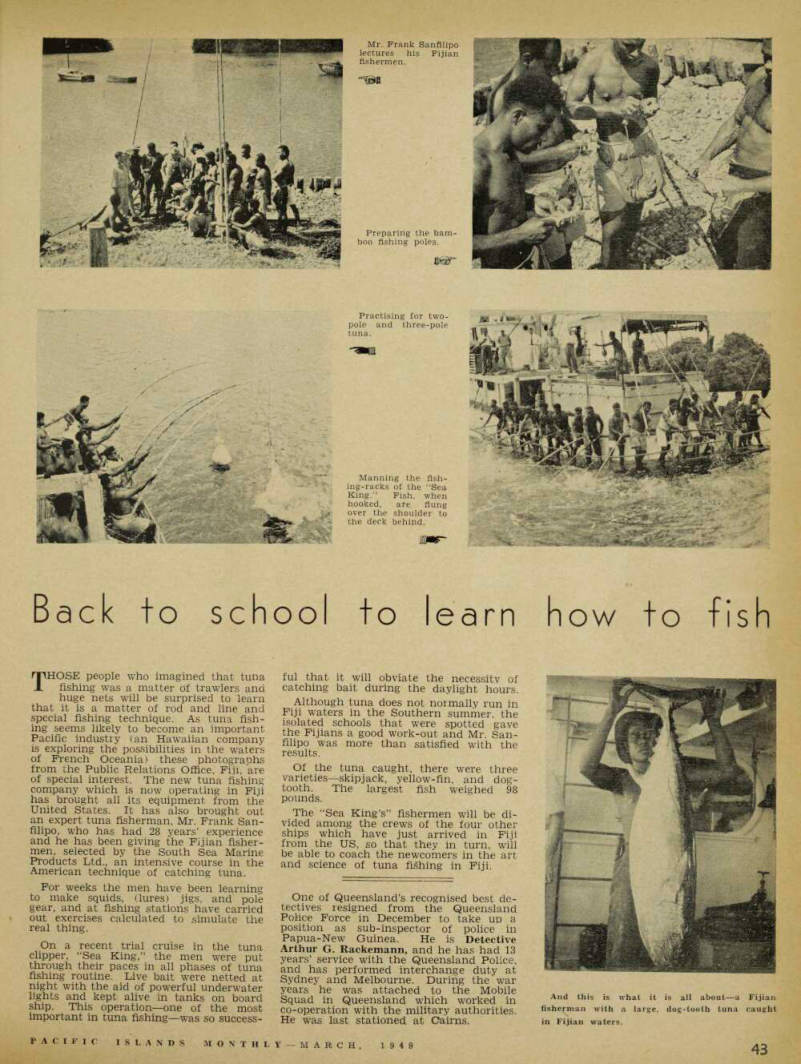
THOSE people who imagined that tuna fishing was a matter of trawlers and huge nets will be surprised to learn that it is a matter of rod and line and special fishing technique. As tuna fish ing seems likely to become an important Pacific industry (an Hawaiian company is exploring the possibilities in the waters of French Oceania) these photographs from the Public Relations Office. Fiji, are of special interest. The new tuna fishing company which is now operating in Fiji has brought all its equipment from the United States. It has also brought out an expert tuna fisherman, Mr. Frank San filipo, who has had 28 years’ experience and he has been giving the Fijian fisher men, selected by the South Sea Marine Products Ltd., an intensive course in the American technique of catching tuna.
For weeks the men have been learning to make squids, (lures) jigs, and pole gear, and at fishing stations have carried out exercises calculated to simulate the real thing.
On a recent trial cruise in the tuna clipper, “Sea King,” the men were put through their paces in all phases of tuna fishing routine. Live bait were netted at night with the aid of powerful underwater lights and kept alive in tanks on board ship. This operation—one of the most important in tuna fishing—was so success
ful that it will obviate the necessity of catching bait during the daylight hours.
Although tuna does not normally run in Fiji waters in the Southern summer, the isolated schools that were spotted gave the Fijians a good work-out and Mr. San filipo was more than satisfied with the results.
Of the tuna caught, there were three varieties—skipjack, yellow-fin, and dog tooth. The largest fish weighed 98 pounds.
The “Sea King’s” fishermen will be di vided among the crews of the four other ships which have just arrived in Fiji from the US, so that they in turn, will be able to coach the newcomers in the art and science of tuna fishing in Fiji.
One of Queensland’s recognised best de tectives resigned from the Queensland Police Force in December to take up a position as sub-inspector of police in Papua-New Guinea. He is Detective Arthur G. Rackemann, and he has had 13 years’ service with the Queensland Police, and has performed interchange duty at Sydney and Melbourne. During the war years he was attached to the Mobile Squad in Queensland which worked in co-operation with the military authorities.
He was last stationed at Cairns.
And this is what it is all about —a Fijian fisherman with a large, dog-tooth tuna caught in Fijian waters.