Moonlight
pp. 44-50 · Read in the full issue
More about the Land of Moonlight
By Teatabera
IWAS interested to read the article in the January issue of “PIM” about Abemama.
It was on December 16, 1902, that I saw thq Gilberts —at Tarawa —for the first time. I was a youngster, just 18 years of age, and was assistant supercargo on the “Ysabel,” an Island trading vessel of 333 tons.
On board we had, as passengers, the Resident Commissioner of the Gilberts, Mr. W. Telfer Campbell, his wife, his son Jack, aged 3, and a companion for Mrs. Campbell, whose name I forget; also 3 priests of the Sacred Heart Mission — Father Merg, who was on a tour of in spection; the other two priests were to live at Tarawa —and Robert Capella, a trader from Little Makin.
My chief, the supercargo, was D. O’N.
Flood, one of the best supercargoes ever in the Line Islands. His salary, I re member, was £2O per month—the same as the Captain, and Chief Engineer— while mine was £3 per month. I fear, however, that I was probably not worth 3 shillings, because I was seasick most of the voyage.
The master of the vessel, Captain Voy, hailed from Kirkwell, in the Orkney Isles and like all Orkney Islanders was a born sailor. A rough diamond whose bark was worse than his bite.
The Chief Engineer, George Wilson, known to all as “Uncle George” was surely one of the most lovable characters who sailed the sea. He was, of course, born in Glasgow but had gone to Sydney as a very young man. He served his time at the A.S.N. workshops in Sydney and used to row to and from his work from Snails’
Bay where he lived. He served in A.S.N.
Co.’s ships, the A.U.S.N. Co.’s ships and then transferred to Burns, Philp & Co.
I had the good fortune to be his shipmate in four ships, all running to the Gilberts —
‘Ysabel," “Titus,” “Tambo” and “Muniara” and I am sure there are retired engineers to-day, who still remember their first night at sea in one of those ships, when as new third engineers, they became seasick and old Uncle George went below to the engineroom to tell the junior. “Away to your bunk Lad! I’ll keep your watch.”
MY first job when we anchored at Tarawa, on that first trip, was to be sent ashore after the Resident Commissioner and his family had landed, to ask Mrs. Camobell for a list of the stores that she might re quire. These were to last her for four months, until our next voyage.
While ashore on that oc casion, I met the Deputy- Commissioner, Mr. Cogswell, the District Officer, Mr.
George Murdoch, h i s daughter Agnes, who had re cently returned from the Sacremento River, California, where she had received her education, and her two friends; Sarah and Hannah Kicking.
The Kicking girls’ father, Alf Kicking, was a trader at Tibiteuea, and a fine man.
He was a Sydneysider and we had both been to famous Fort Street school, he in 1849,
when the school opened, and I in 1899, when the school had its Jubilee.
After leaving Tarawa we proceeded to Marakei, Butaritari and Little Makin, thence to Abaian which was only a few miles north of Tarawa. While in Abaian, on Christmas morning 1902 we sighted the Government police-boat from Tarawa coming up the lagoon! It brought a letter from Mr * Campbell asking if the Captain, Chief Engineer, supercargo and I would have Christmas dinner with them ’***■ We indead P leased t 0 When we went a <*”e to the Residency that evening the tide was high and we anded righ ' d P , on the beach the “boy' ln charge of the launch being told to wait antll we came back. We had a very good dinner and I remember the thrill I re
ctean
* w wf : a Y a +v, o W 0 ScilQ. §OOQ.riloht to the Resident Commissioner and his house and m l^ de for the launch. Arrivmg at the spot where we had disembarked, we found the launch gone, for, immediately after we had come ashore, the boy had taken it out below low water mark, an chored it well out of reach of the mos quitoes and promptly gone to sleep, We walked out on the reef about half a mile till we came to the water and there, in the distance, the dark shape of the launch could just be seen. I, being the youngest, was promptly told to take off my clo thes and swim to the launch, wake the bov and brina the launch in I did
it without Tear inmy heart SS
f“ '% s i!| rks 1 imagined would 06 wait- We took on board, next morning, as passengers, District Officer Murdoch, his dauehter the Kicking girls and left for Abemama via Maiana Kuria and Ara- Abemama Vla Maiana, Kuna and Ara
(Continued on Page 48)
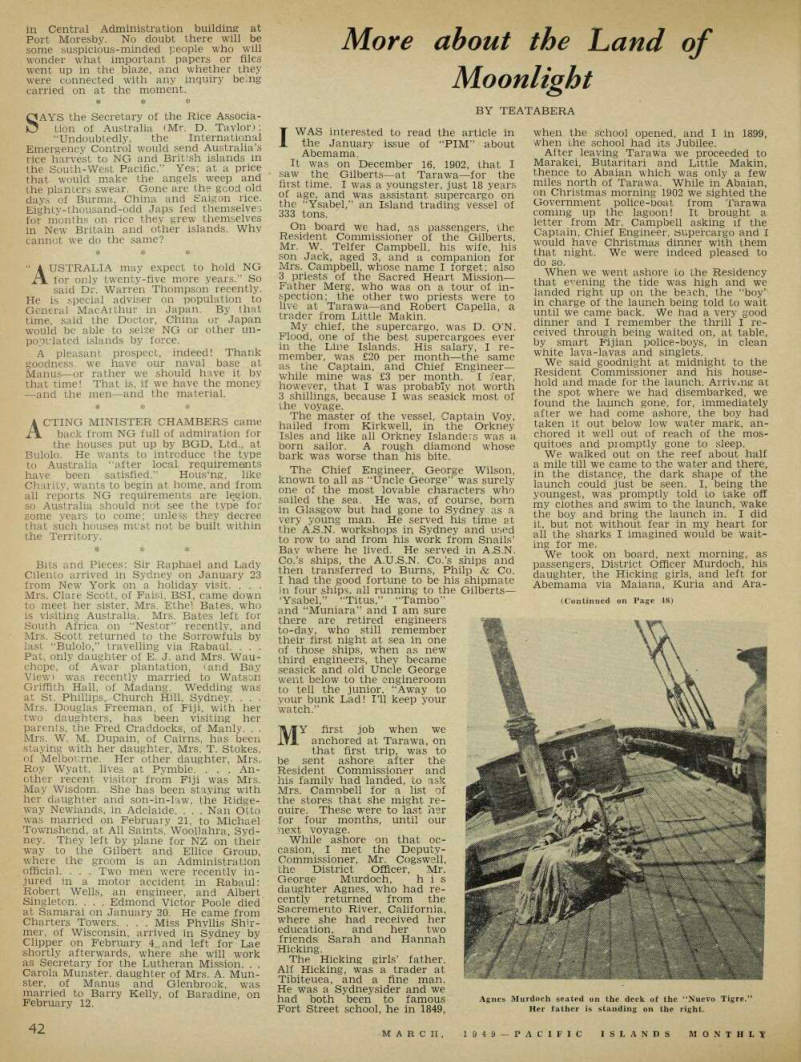
Agnes Murdoch seated on the deck of the “Nuevo Tigre.”
Her father is standing on the right.
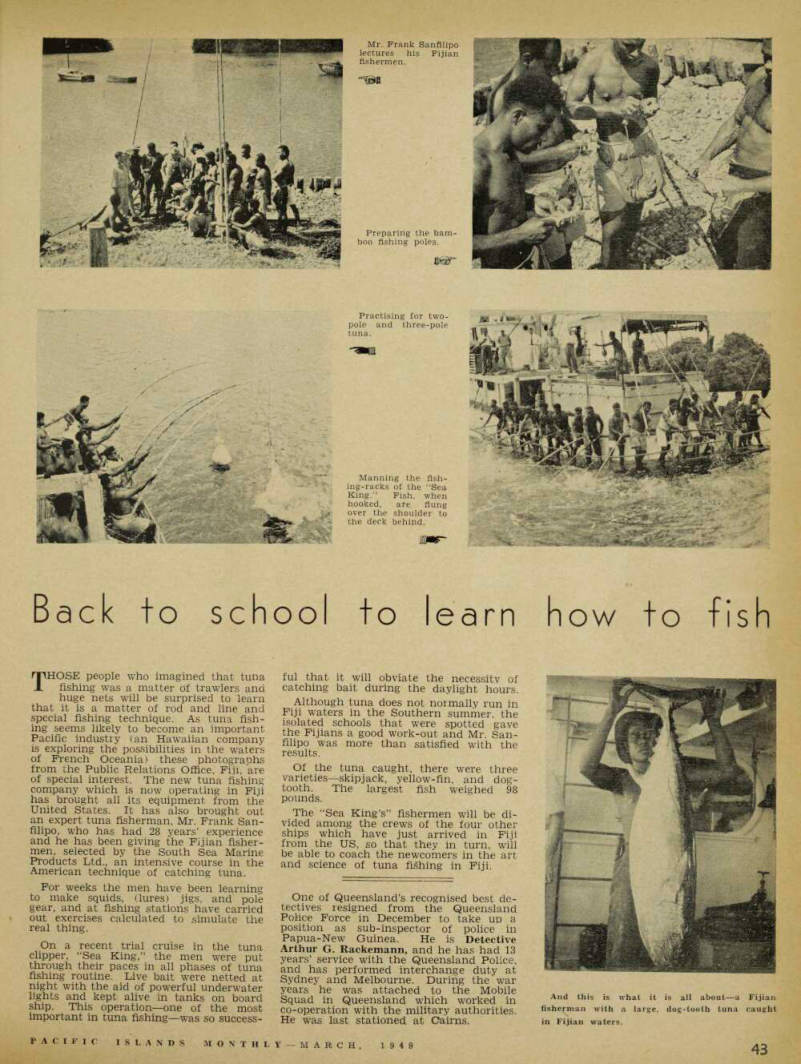
Mr. Frank Sanfllipo Lectures his Fijian fishermen.
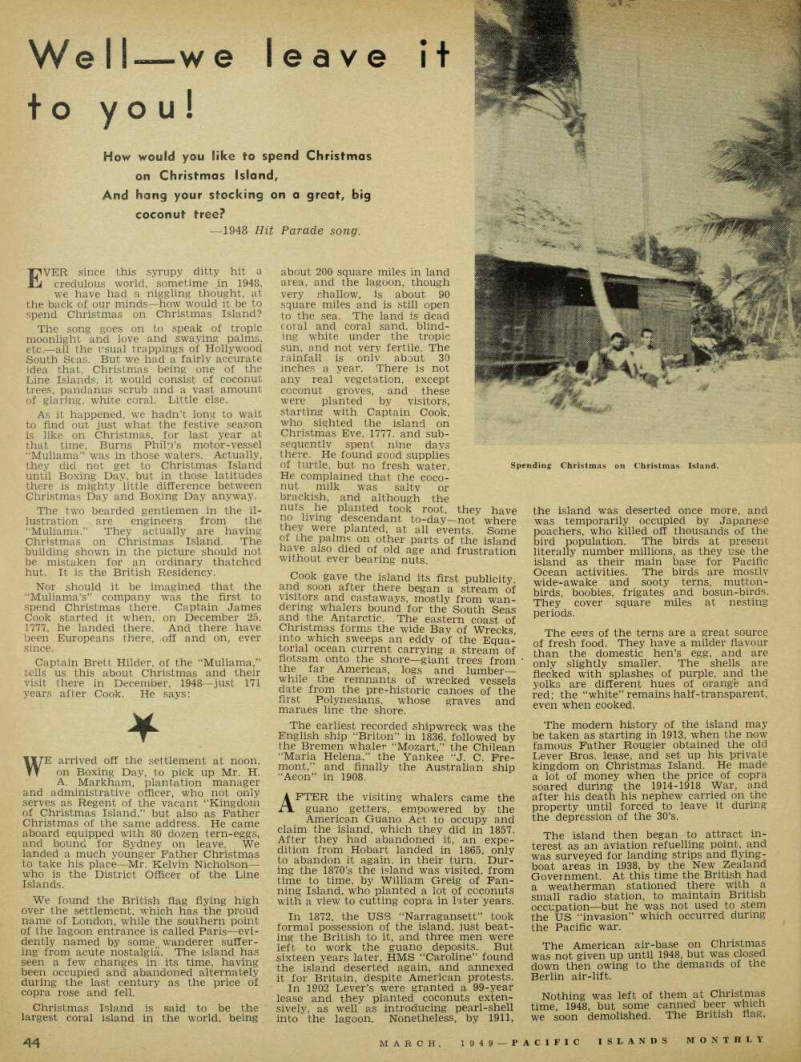
Preparing the bam boo fishing poles.
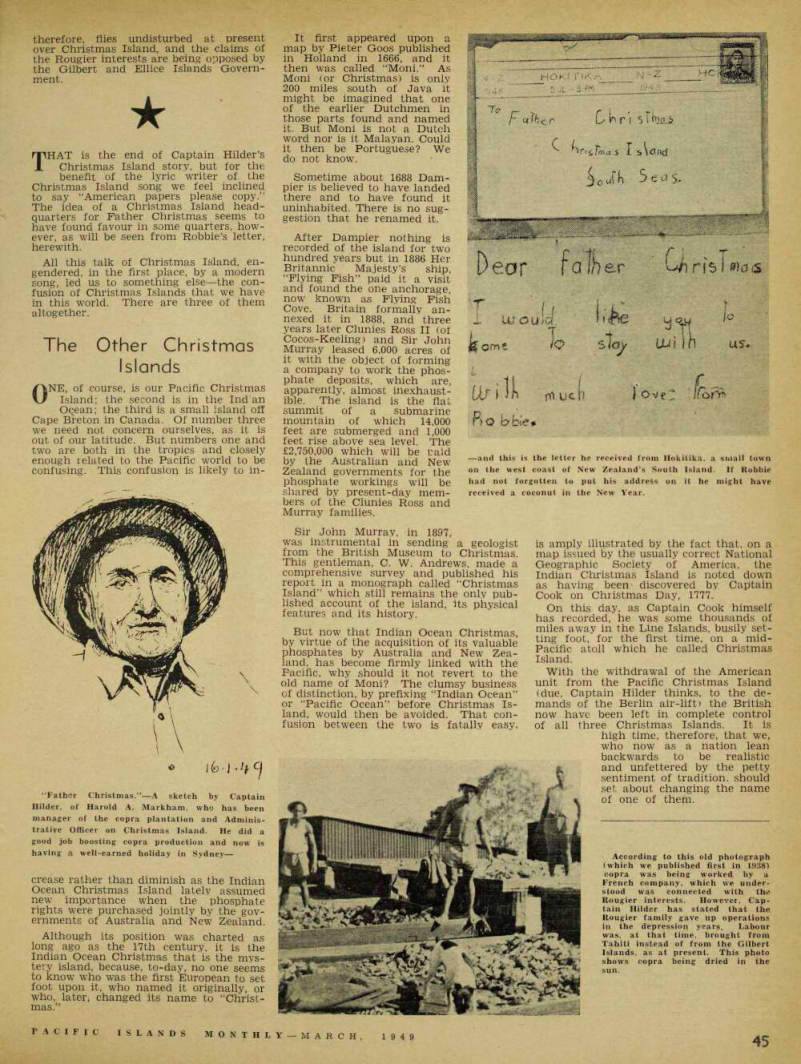
Practising for two pole and three-pole tuna.
Manning the fish ing-racks of the “Sea King," Fish, when hooked, are flung over the shoulder to the deck behind.
nuka, arriving at Abemama on New Year’s morning 1903. During that day a west erly gale, for which the Gilberts are noted, sprang up and we lay in the lagoon six days before we could attempt to take any copra aboard.
Abemama has very many happy mem ories for me. Tern Binoka was the “king” there for a long time but his son Paul was “King” during the 12 years I spent trading the Gilberts. The chief native Magistrate was Ten Teinoa, one of the most likeable and aristocratic natives one could meet.
JN January, 1908, there were anchored in Abemama two schooners, the “Laurel” from Fiji, in charge of Cap tain Malcolm, and the “Louise J. Kenny,” in charge of Captain Handley (who, dur ing the recent war was brutally murdered at Betio by the Japanese). To their surprise, one morning, they saw the masts of a small schooner, which was apparently ashore on the weather reef. Upon in vestigation this proved to be the'“Nuevo Tigre,” a schooner which started her voyage from Callao and was bound south for Valparaiso. The two men who were on the schooner, it was subsequently proved, had murdered the rest of the crew, taken the schooner, and set sail westward
with the intention of making Queensland.
On the voyage they changed the name irom “Nuevo Tigre” to “White Rose.”
Their story has been told before but it is interesting to note that Captain Handley, acting under instructions from Teinoa, the native magistrate, took the two men whose names were Mortelmans and Skerrett, to Tarawa, the seat of Govern ment and handed them over to Mr.
George Murdoch, who was acting as Chief of Police. He arrested them as pirates.
On my arrival at Tarawa, in the “Muni ££ a »’ °f which ship I was then supercargo, the Resident Commissioner, commissioned me to take the Deputy-Commissioner and che two prisoners to Abemama to Pick up some evidence from the “Nuevo ‘Tigre,” thence on to Suva to the High Com missioner. We arrived in Suva on March 30, 1908.
During the voyage, the prisoners were chained in the wheel-house, where I often spoke with them. According to Mortel mans, his life of crime had its beginning when he struck an officer while serving in the Army (he was a Belgian).
The trial of the two men, in Suva, was a sensation. Skerrett turned King’s evi
dence and was acquitted and ultimately returned to England. Due to the fact that, in British law, one man cannot hang on the evidence of only one other, Mor telmans was given a life sentence..
He served a few years of it in Suva, but after some agitation from local residents, the New South Wales prison authorities were persuaded to accept him.
He served something like 25 years in NSW jails—mostly at Maitland/ He was discharged in 1939. and, as far as is known, was returned to Europe.
Teinoa, the Magistrate.