Magazine Section
pp. 43-44 · Read in the full issue
Territories Talk-Talk
By "Tolda"
THE question, raised recently in the Canberra Parliament concerning payments to Australian POW’s work ing on the Burma-Siam railway, is liable to have some far-reaching effects, unless I am greatly misinformed. Payments— presumably ear-marked out of reparations —are due not only to Service POW’s, but civilian POW’s, who were slaving for the Nippons during the War. They are en titled to pay from their captors for work peiformed on a daily basis. I understand it is all laid down in International Law.
Assuming this to be so, then the next of-kin of the New Guinea civilians who eventually perished in the ill-fated “Mon tevideo Maru,” should have a few pounds to collect from Japanese reparations.
It’s a point that should be clarified. ♦ * * A BELATED MID comes to Warrant Officer Arthur Cotman, of Papua, who was taken prisoner in the Wes tern Desert in 1941. His CO, who re commended him, with three other men, was also taken prisoner, his despatches were lost and only recently did the CO discover his recommendations had not been acted upon. Better late than never. * * * A PROPOS of resurrecting buried war time incidents: Coast-watcher Eric Feldt—usually most careful of his facts —passed some remarks in his book concerning the Kavieng Commandos, without having sighted General Sturdee’s instructions or handsome Major Wilson’s diary. The result was that an apology appeared in Australian papers, praising the Commandos’ work, and their leader.
Eric is a big enough man to be able to do this without losing any cubits from his stature.
But the question arises: Hasn’t the time been reached when The Truth May Now Be Told about many incidents before and during the Jap invasion of New Guinea. General Sturdee’s instructions in relation to 1941 events in New Guinea would make interesting reading, surely.
His retirement as CGS is not far distant.
It would be a pity if all the instructions get lost beneath the shelter of his bowler hat.
Incidentally, from what I have been able to garner about those grim days in January, ’42, the Commandos in Kavieng did a big-size job in leaving booby-traps in and around Kavieng, which accounted for heavy Jap casualties; some of the traps were most ingenious. That may have accounted for the severe strafing the Japs gave the schooner on which the Commandos were travelling after leaving Kavieng. * * * THE Methodists are apparently becom ing concerned over the wealth of the NG natives. At a recent conference of John Wesley’s followers the General Secretary of the Methodist Overseas Mis sion (Rev. C. Gribble) built up an ad dress on statements delivered by Rev. C.
J. Mannering in Melbourne (Feb. PIM, p. 72). He had good material on which to work; for Mannering, stationed for some years in New Ireland in pre-War days, knows of what he speaks. In fact, I’d be prepared to say he knows his NG natives—the New Ireland and New Britain tribes, at any rate—as well, if not better,
than the modern brand of Administration official.
Straight-from-the-shoulder criticism of Administration methods, coming from such a man as Mr. Gnbble, might have an influence on Administration policy.
The Methodists in Australia have a good handful of votes. The Europeans in NG nave none. + T,,„ A ~.. ‘ ' ~, , HE NG Administration is not the only post-war set-up having brick-bati heaved at it. The tn-mandated island of Nauru is coming in for Its share now. Opposition members are pulling no HoS” bv Australia 1 ChiefsTn a t{?e“fand knew tLir Atlantic Charter apparently and are lodging protests to UNO. ’
What with Nauru. New Guinea and the Australian Abo. position, our handling of mixed races does not reflect credit on those in authority. The blame is largely due to crass ignorance, plus a stubborn resistance to any suggestion from informed and experienced persons.
Poor Old Tom Griffiths would turn
in his grave if he could hear what is being said by his friendly Nauruans. * * * EX-RSM” (SA) writing in the Sydney “Bulletin” about the “sacrifice of the Rabaul garrison” speaks of the inadequate supplies of quinine available to the Rabaul troops. “Yet there were mil lions of quinine tablets in our medical stores in the Middle East” and sent back to Australia and “carefully stored in SA. ’
He, too, plugs for an inquiry into the fall of Rabaul. ♦ * *.
WHAT with the Liberal Party seeking a Parliamentary Committee to “in vestigate problems of Administration in NG,” others clamouring for an in quiry into the ’42 debacle, and others still wanting the terms of reference broadened in the NG Timber Case, poor old New Guinea is well in the limelight these days.
One happening in NG. however, which received but slight publicity, was the fire (See Next Page)
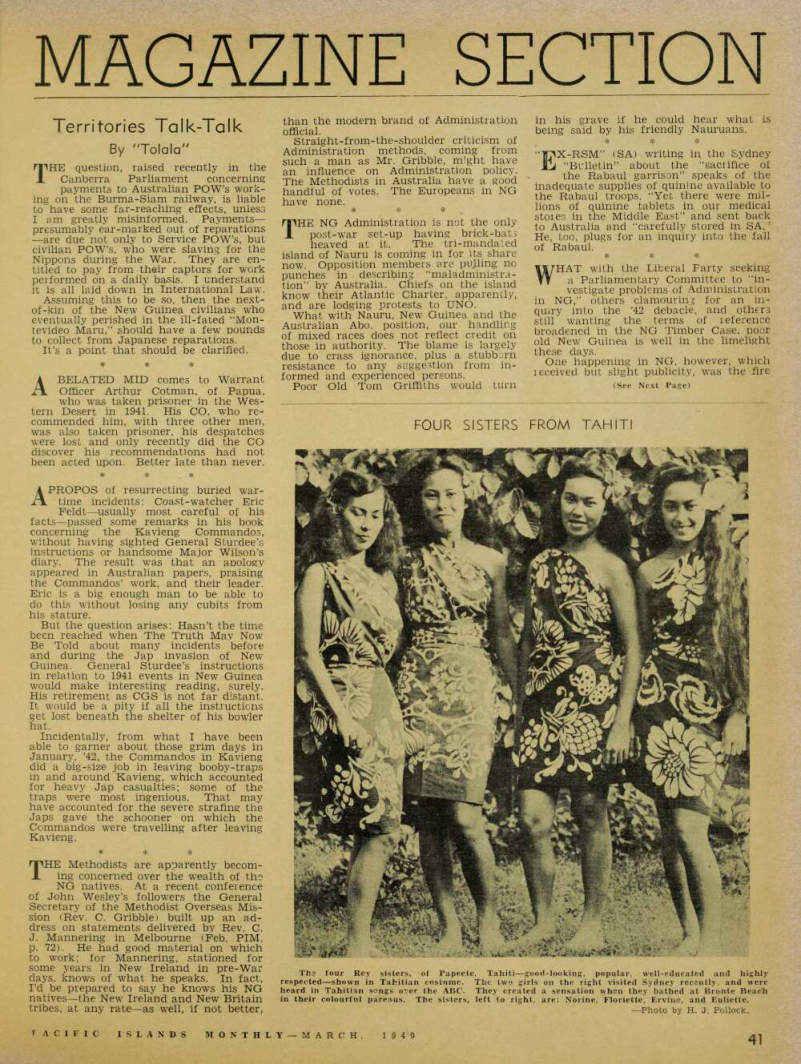
Four Sisters From Tahiti
Tb; four Rey sisters, of Papeete, Tahiti—good-looking, popular, well-educated and highly respected—shown in Tahitian costume. The two girls on the right visited Sydney recently, and were heard in Tahitian songs over the ABC. They created a sensation when they bathed at Bronte Beach in their colourful pareaus. The sisters, left to right, are: Norine, phoriette, Ervine, and Euliette.
Photo by H. J. Pollock.
in Central Administration building at Port Moresby. No doubt there will be some suspicious-minded people who will wonder what important papers or files went up in the blaze, and whether they were connected with any inquiry being carried on at the moment. * * * SAYS the Secretary of the Rice Associa tion of Australia (Mr. D. Taylor); “Undoubtedly, the International Emergency Control would send Australia’s rice harvest to NG and British islands in the South-West Pacific.” Yes; at a price that would make the angels weep and the planters swear. Gone are the good old days of Burma, China and Saigon rice.
Eighty-thousand-odd Japs fed themselves for months on rice they grew themselves in New Britain and other islands. Why cannot we do the same? * * * AUSTRALIA may expect to hold NG for only twenty-five more years.” So said Dr. Warren Thompson recently.
He is special adviser on population to General MacArthur in Japan. By that time, said the Doctor, China or Japan would be able to seize NG or other un populated islands by force.
A pleasant prospect, indeed! Thank goodness, we have our naval base at Manus —or rather we should have it by that time! That is, if we have the money —and the men—and the material. * sK * Acting minister chambers came back from NG full of admiration for the houses put up by BGD, Ltd., at Bulolo. He wants to introduce the type to Australia “after local requirements have been satisfied.” Housing, like Charity, wants to begin at home, and from all reports NG requirements are legion, so Australia should not see the type for some years to come; unless they decree that such houses must not be built within the Territory. * * * Bits and Pieces: Sir Raphael and Lady Cilento arrived in Sydney on January 23 from New York on a holiday visit. . . .
Mrs. Clare Scott, of Faisi, BSI, came down to meet her sister, Mrs. Ethel Bates, who is visiting Australia. Mrs. Bates left for South Africa on “Nestor” recently, and Mrs. Scott returned to the Sorrowfuls by last “Bulolo,” travelling via Rabaul. . . .
Pat, only daughter of E. J. and Mrs. Wau chope, of Awar plantation, (and Bay View) was recently married to Watson Griffith Hall, of Madang. Wedding was at St. Phillips, Church Hill, Sydney. . . .
Mrs. Douglas Freeman, of Fiji, with her two daughters, has been visiting her parents, the Fred Craddocks, of Manly. . .
Mrs. W. M. Dupain, of Cairns, has been staying with her daughter, Mrs. T. Stokes, of Melbourne. Her other daughter, Mrs.
Roy Wyatt, lives at Pymbie. . . . An other recent visitor from Fiji was Mrs.
May Wisdom. She has been staying with her daughter and son-in-law, the Ridge way Newlands, in Adelaide. . . . Nan Otto was married on February 21, to Michael Townshend, at All Saints, Woollahra, Syd ney. They left by plane for NZ on their way to the Gilbert and Ellice Group, where the groom is an Administration official. . , . Two men were recently in jured in a motor accident in Rabaul: Robert Wells, an engineer, and Albert Singleton. . . . Edmond Victor Poole died at Samarai on January 30. He came from Charters Towers. . . . Miss Phyllis Shir mer, of Wisconsin, arrived in Sydney by Clipper on February 4„and left for Lae shortly afterwards, where she will work as Secretary for the Lutheran Mission. . .
Carola Munster, daughter of Mrs. A. Mun ster, of Manus and Glenbrook, was married to Barry Kelly, of Baradine, on February 12.