Pacific
Islands
Monthly
March, 1949
Vol. XIX. No. 8.
Established 1930.
[Registered at the jbr transmission hy post as a newspaper ]
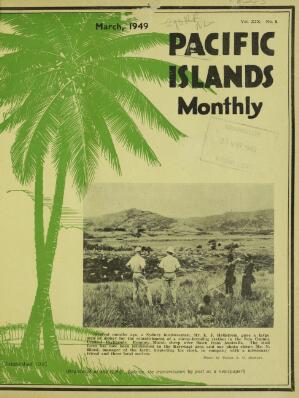
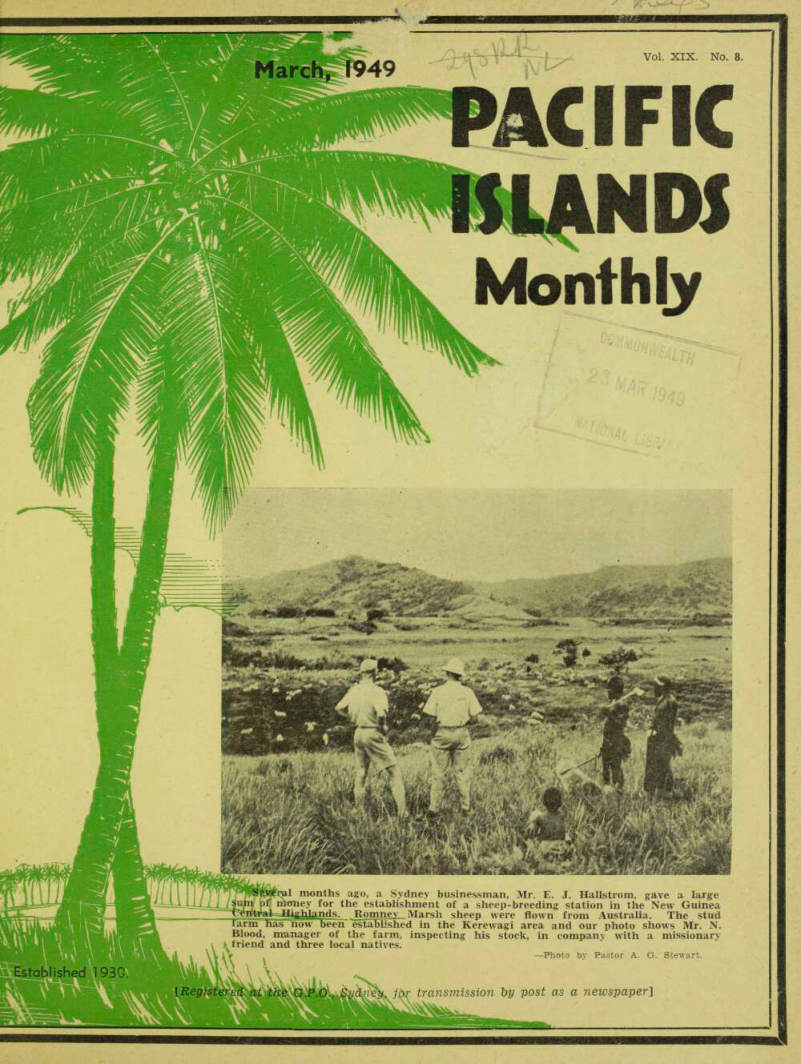
[?] months ago, a Sydney businessman, Mr. E. J. Hallstrom, gave a large sum of money for the establishment of a sheep-breeding station in the New Guinea Central Highlands. Romney Marsh sheep were flown from Australia. The stud farm has now been established in the Ke rewagi area and our photo shows Mr, N.
Blood, manager of the farm, inspecting his stock, in company with a missionary friend and three local natives.
Photo by Pastor A. G. Stewart.
Advertisements & other items, pp. 2-4 (1 item)
Qewta/i
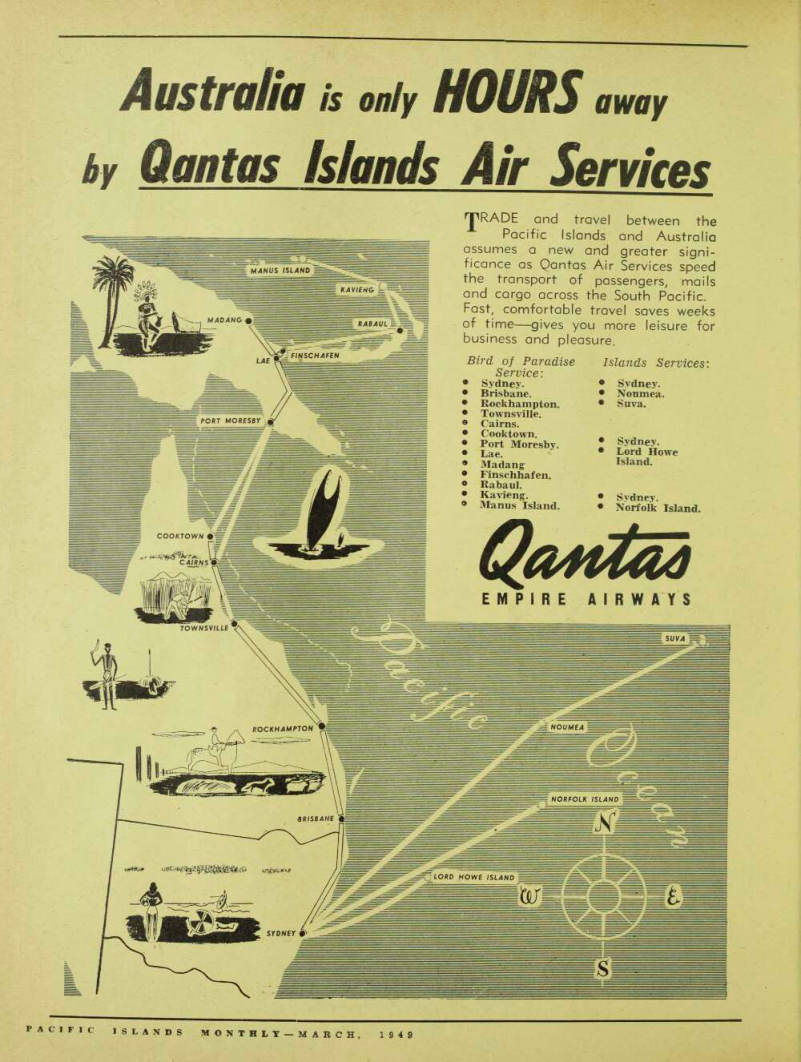
Australia « only HOURS away
by Qantgs Islands Air Services
MANUS ISLAND
KAVIENC,
MADA NG •
RABAUL mjm === -
I FINSCHAFEN
LAE
PORT MORESBY
COOKTOWN •
'JpRADE and travel between the
Pacific Islands and Australia
assumes a new and greater signi-
ficance as Qantas Air Services speed
the transport of passengers, mails
and cargo across the South Pacific.
Fast, comfortable travel saves weeks
of time—gives you more leisure for
business and pleasure.
Bird of Paradise Islands Services : Service : • Sydney. • Brisbane. • Rockhampton. • Townsville. ® Cairns. • Cooktown. • Port Moresby. • Lae. 9 Madang • Finschhafen. ° Rabaul, • Kavieng. 9 Manus Island.
Sydney.
Noumea.
Suva.
Sydney.
Lord Howe Island.
Sydney.
Norfolk Island.
Qewta/i
EMPIRE AIRWAYS
TOWNSVILLE
SUVA Sm
ft
mNOUMEA
■Cr ROCKHAMPTON
NORFOLK ISLAND
BRISBANE
ewarn
LORD HOWE ISLAND
SYDNEY •
S
♦II#, %-
eh e
as >/ IP * ■ t ss 41 D - ■■'V. . - ,i^S V &S'“ SC'* 7
Brazing Torches eßlow Lamps
Coleman Brazing Torches have solid-drawn heavy duty brass bodies with extra heavy brass bottoms.
All joints are mechanically sealed and securely soldered for double protection. Other features are : Sturdy bottom filler plug . . . positive shut-off fuel valve . . . removable gas tip . . . replaceable self cleaning needle . . . heavy longlife burners and heavy duty pump.
Each torch is inspected and given a pressure and burning test before leaving the factory.
FIG. I—Obtainable1 —Obtainable in two types, Petrol and Kerosene.
FIG. 2—Petrol burning only.
Fuel tank capacities of both are 1 pint and 1 quart.
FIG. 3—Coleman’s new Paraffin Blow Lamp which has valves interchangeable with European types of Lamps. The long-life burner and container are of heavy gauge brass. The container will withstand a pressure of 200 lbs. The flame is regulated through Air-release, there being no shut-off valve.
Tank capacities f, 1 and 2 pints.
Representatives for the Pacific Islands:
ROBERT GILLESPIE PTY. LTD.
540 PITT STREET, SYDNEY
PEARCE Gr CO LTD,
SUVA
FOR FIJI ISLANDS
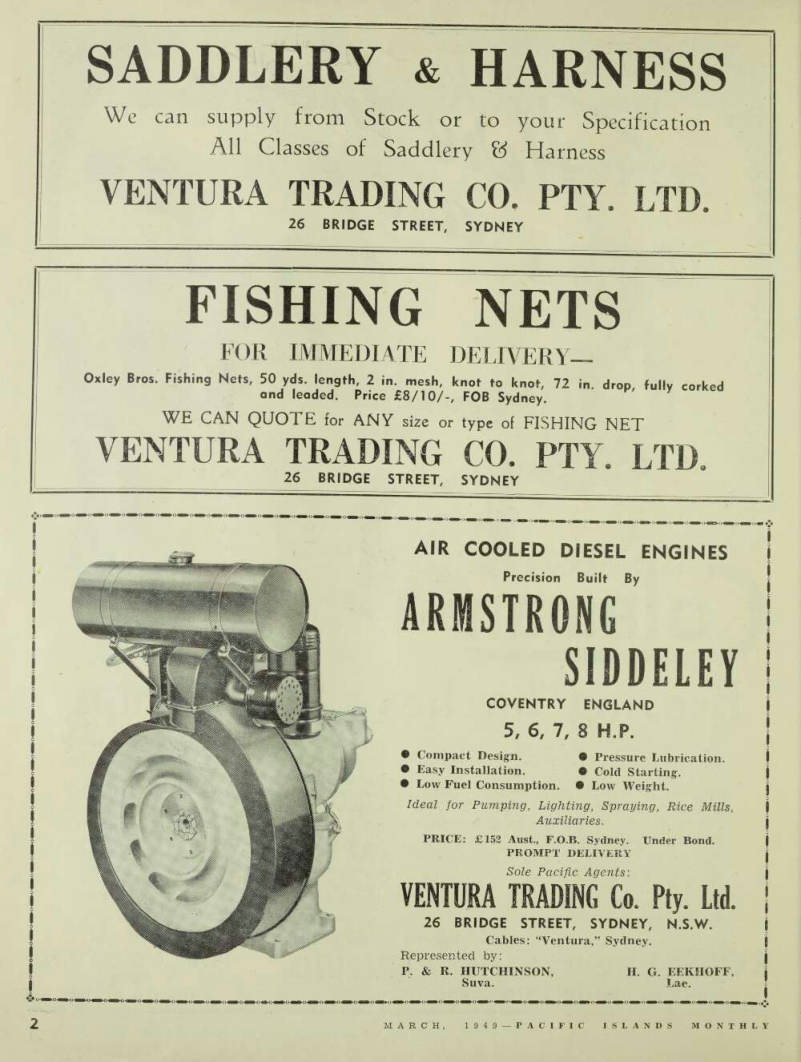
SADDLERY & HARNESS
We can supply from Stock or to your Specification All Classes of Saddlery & Harness
VENTURA TRADING CO. PTY. LTD.
26 BRIDGE STREET, SYDNEY
FISHING NETS
FOR IMMEDIATE DELIVERY—
Oxley Bros. Fishing Nets, 50 yds. length, 2 in. mesh, knot to knot, 72 in. drop fully corked and leaded. Price £B/10/-, FOB Sydney.
WE CAN QUOTE for ANY size or type of FISHING NET
VENTURA TRADING CO. PTY. LTD
26 BRIDGE STREET, SYDNEY
AIR COOLED DIESEL ENGINES
Precision Built By
ARMSTRONG
SIDDELEV
COVENTRY ENGLAND
5,6, 7, 8 H.P. ® Compact Design. 9 Pressure Lubrication. • Easy Installation. O Cold Starting. • Low Fliel Consumption. • Low Weight.
Ideal for Pumping, Lighting, Spraying, Rice Mills, Auxiliaries.
PRICE: £152 Aust., F. 0.8. Sydney. Under Bond.
PROMPT DELIVERY
Sole Pacific Agents :
VENTURA TRADING Co. Pty. ltd.
26 BRIDGE STREET, SYDNEY, N.S.W.
Cables: “Ventura,” Sydney.
Represented by: P. & R. HUTCHINSON, H. G. EEKHOFF, Suva. Lae.
Advertisers
Akun Alois & Co. . 37 Aluminium Union, Ltd . 71 Achun, Gabriel . . 73 Angliss & Co. . . 40 Amplion (Aust.) Pty., Ltd. ... 31 Atlas Mercantile Export Co. ... 39 Atkins, Wm., Pty., Ltd . 57 Atkins Kroll & Co. 70 Amalgamated Hatcheries ... 67 Broomfields ... 32 BP (SS) Co. . . . 59 Berger, Lewis & Son ... 51 Bethell, Gwyn & Co 35 Brunton’s Flour . . 57 Burns, Philp (New Hebrides). Ltd. . 15 Berrys Bay Boat yard ... 70 Bank of NSW ... 16 Burns, Philp (NG), Ltd 49 8.0.A.C 30 Burns, Philp Trust Co., Ltd 65 Brav &' Holliday Pty., Ltd 26 Budge, James Pty. . 50 W. R. Carpenter & Co. (Fiji), Ltd. . 29 Caine’s Studio . . 75 Carpenter, Ltd.. W.
R. . . . . . cov. iv.
Colonial Wholesale Meat 2 Commonwealth Bank of Aust. . 63 Colyer Watson (New Guinea), Ltd. . . 61 Carrlock & Co. . . 69 Crammond Radio Pty., Ltd. ... 17 Crilley, R. J., Pty.. Ltd. ... 21 Costello, Vince Garrick Hotel . . 58 “Cystex” 52 Donaghy & Sons . 37 Donald. Ltd., A. B. 71 Davison Paints, Ltd. 23 Dickson, Primer & Co.. Ltd 33 Dr. Williams Pink Pills ... 77 Dangar. Gedye & Malloch ... 3 Dunlop Rubber . . 35 Etablissements, Donald 75 Electrolux Refrigerators . . 34 Excelsior Supply Co. ... 36 Ford Sherington . 75 Garrett & Davidson 88 General Rubber Co.
Pty., Ltd. ... 58 Gillespie Pty., Ltd., Robert ... 1, 21, 55 Robt. Gillespie (NG), Ltd. . 27, 87 Gilbey’s Gin ... 60 Gillespie’s Flour . 32 Grand Pacific Hotel 4 Gough & Co., E. J. 15 Grove & Sons, W.
H . 28 Gordons Gin ... 77 Heinz & Co. Pty., Ltd., H. J. . . .66 Horlicks Malted Milk 24 Hoover, Francis . 29 Hettig August ... 16 Hemingway & Robertson ... 28
International Trad ing Co 67 Jones, Wm. A., Pty., Ltd. ... 78 Kennedy, Capt. W.
L 72 Kodak (Aust.) Pty., Ltd. 85 Kolynos, Inc. ... 74 Kopsen & Co., Ltd. 62 Kerr Brothers . . 73 Kwong Chong Bros. 72 Lockyer, Geo. J. . . 64 Manstocks ... 25 Mail Publicity Co. (Magazine Sub scriptions) . . 36, 39 Maloney, N. F., & Co . 71 Millers, Ltd., Suva 33 Miscellaneous, 82, 83, 84 “Mendaco” ... 80 MclTraths Pty., Ltd. 19 Morris, Hedstrom, Ltd., Suva ... 12 National Airways Corporation ... 22 Nordman, Oscar . . 33 Nelson & Robertson Pty., Ltd 53 NSW Yacht Brokers ... 76 “Nixoderm - ’ ... 25 Pacific Is. Society 40 Pa a American Air ways 14 ■ Pjnkettes” ... 50 Pitt & Scott, Ltd. . 53 Qantas Empire Air ways ... cov. ii.
Queensland Insur ance Co 27 Ransomts, Sims, & Jefferies ... 66 Robinson, G. H., 80, 28 Rohu, Sil . . . . 56 Reed, William E., 19, 80 Scott, Ltd., J. . .76 Shell Co. ... 83 Southern Pacific Insurance Co. . . 20 Stewarts & Lloyds (Aust.) Pty., Ltd. 52 Steamships Trading Co., Ltd. . . 23, 68 Sullivan & Co., C. . 20 South Sea Island Correspondence Club 51 Taylor & Co., A. . 83 Swallow & Ariell . 56 Tooth & Co. Pty., Ltd cov. iii.
Thornycroft (Aust.) Pty., Ltd. ... 18 Tilley Lamps ... 54 Tillcck & Co. . . 81 Tyneside Foundry & Engineering Co., Ltd 19 Vacuum Oil Co., Ltd .86 Ventura Trading Co.
Pty., Ltd 79 Vincent Chemical Co 82 Watson, Wm. H. . 84 Harry West ... 72 Wynne S. Breden Pty.. Lti. ... 73 Widdop, H\, & Co., Ltd. 78 Wills, W. D. & H. 0 38 White’s Aviation . 69 Wright & Co., Ltd., E. 55 Yorkshire Insur ance Co., Ltd. . . 15
During her recent voyage to the United Kingdom on the SS “Rimutaka,” Lady Freeston was able, by the courtesy of the captain, to pay a short visit to Pit cairn Island. It is unusual for the wife of the High Comm-ssioner for the Wes tern Pacific to set foot in this outlying High Commission dependency. Lady Freeston was enthusiastically welcomed by the Islanders who greatly appreciated her visit.
Advertisements & other items, p. 5 (1 item)
Blackstone
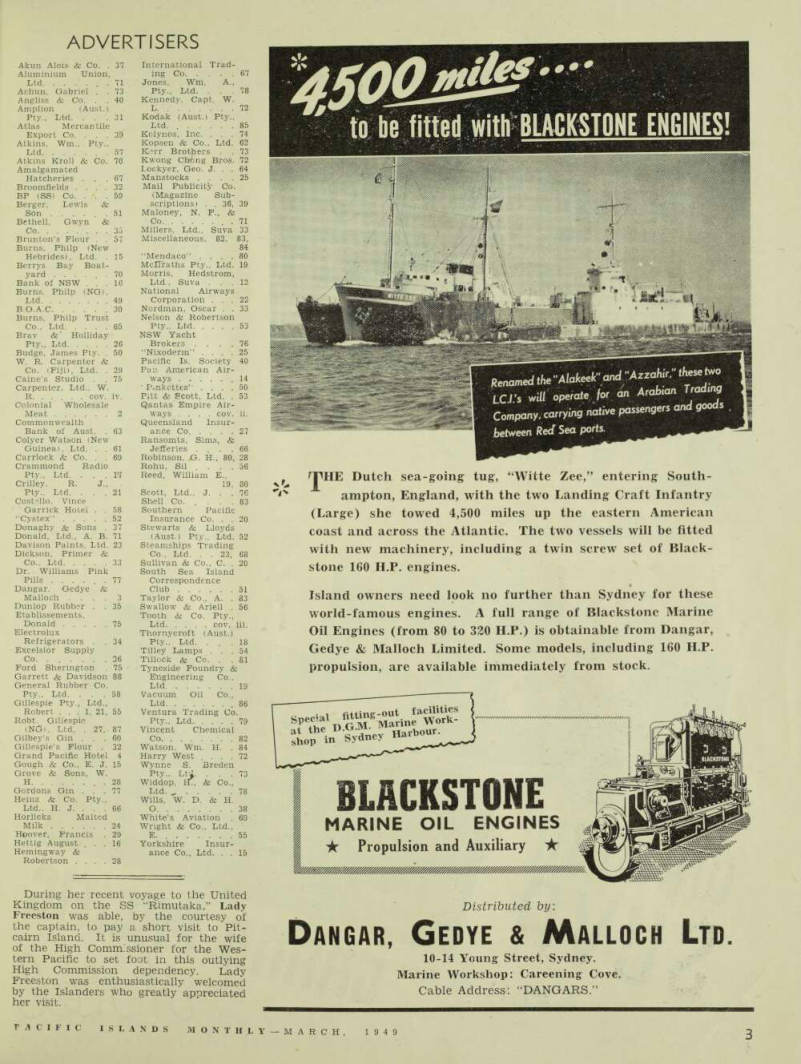
/ / / ■_ j ’ . » ' p •s * * . . - —-p*' M lenamed the "Alakeek" and"Azzah these two I CVs will operate for Arab,an Trading Company, carrying native passengers and goods between Reef Sea ports ' r JHE Dutch sea-going tug, “Witte Zee,” entering Southampton, England, with the two Landing Craft Infantry (Large) she towed 4,500 miles up the eastern American coast and across the Atlantic. The two vessels will be fitted with new machinery, including a twin screw set of Blackstone 160 H.P. engines.
I Island owners need look no further than Sydney for these world-famous engines. A full range of Blackstone Marine Oil Engines (from 80 to 320 H.P.) is obtainable from Dangar, Gedye & Malloch Limited. Some models, including 160 H.P. propulsion, are available immediately from stock. fitting-out D G M. Marine Work n Sydney Harbour. ’///✓///
MARINE OIL ENGINES
★ Propulsion and Auxiliary ★ Distributed by:
Dangar, Gedye & Malloch Ltd.
10-14 Young Street, Sydney.
Marine Workshop: Careening Cove.
Cable Address: “DANGARS.”
In This Issue:
Editorial: “A New Factor in the Copra Market” 5 Threat of Unrest in Fiji Sugar Industry 6 New Governor for French Oceania .. 7 Marshall Aid Coal for New Caledonia 7 New Guinea Timber Lease Case Drags On 7 Press Bill Creates Stir in Fiji ... 9 Forged Dollars from New Caledonia 9 South Pacific Commission Moves to New Caledonia 9 Outline of Australian Policy in Papua- New Guinea 10 Indian Organisations Suggest Changes m Fiji Constitution 11 Generous Grant for Queen Victoria School 11 War Gratuities for BSI Natives ... 11 Maori’s-Head Notes Cause Panic in Fiji 13 Bothersome Falcon Island Ap. ears Again 13 American Professor Causes Fiji News paper Storm 15 Silly Criticism of W. Samoan Admir is tration by Russia and Philippines 16 Detention of Tongan Prisoners in Suva Gaols 16 Pacific Science Congress Concludes Successful Session in NZ .. .. 18 W. Samoa’s Flag Approved in NZ .. 20 New Stamps for Cook Islands 20 Qantas on Sydney-BSI Run .. 21 Background of Islands Admin s ra tion —Interesting New Book ... 23 Colonel Voelcker Goes to SPC— Changes in Government of W.
Samoa 25 New Ship for NZ-Islands’ Run ... 25
Information Sought About the Gode ffroys 27 Native Co-ops in New Guinea ... 27 Norfolk Island Notes 28 Control of Rhinoceros Beetle 29 New ABM Chairman 29 Maikham Patrol Returns to Lae .. 30 That Old Tongan Photograph .. .. 31 Flow of NZ Currency Restricted in New Zealand 32 Marching Rule Still Active in Solo mons 32 Centenary of Protestant Church in Apia 33 BSI Natives Give Liberally to Church 33 Mysterious Drop in Cocoa Prices Shocks W. Samoa 34 Tuna Fishing in Tahiti—Hawaiian Coy’s Vessels Arrive 36 Memory of Old Tahiti 36 Noted Tahiti Residents Visit New Zealand 37 No Tea Seed for New Guinea Venture 37 Sir Hubert Murray Memorial Fund .. 39 Biological Control of Pests in Fiji .. 40 Territories “Talk-Talk” 41 More About the Land of Moonlight .. 42 Back to School to Learn How to Fish 43 Well—We Leave it to You! 44 Pacific Nature Notes 46 Tropicalities 47 Short Story: “The Floating Lei” ... 48 Monumental Work on Hawaiian Insects 50 Plea Against Sentimental Eyewash About Brown and White Relations 51 The Story of a Leper 52 Two Nights With a Duk-Duk 55
Cyclone of 1906 Recalled 56 Tonga’s First White Settlers Were Highly Undesirable 57 Luxury Yacht for Suva SDA Mission 58 Burdened with Writs—“ Cheng Ho” in Honolulu 59 Natives and Whites in New Hebrides 61 US Progress in Micronesia 61 “Tiare Taporo” in Auckland 62 Monthly Journal for British Colonial Office 62 White Norfolk—New Development of Australian Immigration Policy .. 63 Islands’ Education —Plane-Load of Samoans forNZ 63 NZ’s Earliest Inhabitants 65 Samoan Products for America .. .. 66 Strange Epidemic of Wrist-Watches in Papua 66 Dr. Burton’s Ideas About the Fiji of 1911 67 The Indiscriminate Cutting of Coco nut Leaves 69 Wrathful BSI Planter Speaics Out About Lack of Shipping 70 New Building in Santo, New Hebrides 70 Sir Peter Buck Outspoken About Care of Pacific Races 71 Jap Eyes Still on New Guinea? ... 72 Tahiti News Items 73 Plane and Shipping Timetables ... 75 Service Section 80 Notes from Kavieng 84 Commercial Markets, etc OBITUARY: Mrs. H. M. Hides, 8; T.
P. Skiffington, 20; W. J. Belcher, 20; Victor Poole; Lieut. Jean Gilbert.
ORGANISATIONS: New Guinea Women’s Club, Sydney. 6; Pacific Islands’
Society, 9: NG Scholarship Fund, 16; RSSAILA, Port Moresby, 31; NGVR, 87.
INDUSTRIES: Oil, 8. Copra, 5, 6. 9. Gold, 9, 50. 73, 87. Cocoa, 35.
Advertisements & other items, p. 6 (1 item)
t
] jc over' - r ound s , • , paCA' xC . A ic . , Gr» nd A ed ' tA ;. w des’^° e ,«. »“■-»■'■-• ... *■“'*„ oW^"
O bVe ’ *JS«
Pacific Islands Monthly
The Newspaper-Magazine of (he South Seas L Registered at the G.P.0., Sydney, for transmission by post as a newspaper ]
Published Once Each Month and Circulated in Australia and New Zealand and in the following Pacific Territories and Islands Groups:
Australian Territory ot Papua.
Trustee Territory (Australia) of New Guinea.
Australian Territory of Norfolk Island.
New Zealand Territory of Cook Islands.
Trustee Territory (NZ) of Western Samoa.
British Colony of Fiji.
British Solomon Islands Protectorate.
British Protectorate of Tongan Islands.
British Crown Colony of Gilbert and Ellice Islands.
Trustee Territory of Nauru.
British and French Condominium of New Hebrides.
French Colony of New Caledonia.
French Colony of Oceania (Tahiti, etc.).
American Territory of Eastern Samoa.
American Territory of Hawaiian Islands.
Owned and Produced by Pacific Publications Pty., Ltd., Union House, 247 George Street, Sydney.
Telephone: General Office and Advertising, BW 5037.
Po. Box 3408
Registered Address for Telegrams, Radiograms, and Cables; “Pacpub,’' Sydney.
Contributions.
Articles, Stories, and Photographs dealing with Pacific Islands subjects are invited and will be paid for on publication.
Subscription Rates.
Per Annum, Pre-paid, Including Postage.
In Australia, New Zealand, Fiji, New Guinea, Papua, Western Samoa, Cook Islands, Tonga. British Solomons, Gil bert and Ellice Colony, Nauru, and United Kingdom 15 0 Elsewhere . . <£3 18 0 Single Copies 1 6
Editor and Publisher:
R. W. Robson, F.R.G.S.
Assistant Editor: JUDY TUDOR.
General Office: Union House, 247 George Street, Sydney. Telephone: BW 5037.
Advertising Manager: W. E. Rogers.
Representative In London.
J. T. Wallis, Coronation House, 4 Lloyds Avenue, London, E.C.3, from whom may be obtained copies of Pacific Islands Monthly, Pacific Is. Year Book, advertising schedules, etc.
Representative In U.S.A.
Pacific Islands Trading Co.,
244 California St.. San Francisco. U.S.A
Agents.
The following are authorised to receive sub scriptions for Pacific Islands Monthly:— Burns. Phllp & Co., Ltd., and Burns Phllp (South Sea) Co., Ltd. All branches.
W. R. Carpenter & Co., Ltd. All branches.
Morris, Hedstrom, Ltd. All branches.
Steamships Trading Co., Papua. All branches.
W. M. Caldwell, Suva. Fiji.
Cook Islands Trading Co., Rarotonga, Cook Is.
Oscar Nordman, Papeete, Tahiti.
Islands Branches and Representatives of W. H.
Grove & Sons, Ltd,, Auckland, New Zealand.
Ed. Pentecost, Noumea, New Caledonia.
Soclete Gubbay Kerr et Cie, Noumea, New Caledonia.
Vol. Xix. No. 3.
March, 1949
r 1/6 Per Copy Price Prepaid, pa: 15/- Aua I In USA. pa ; $3
A New Factor In The Copra Market
IT is not easy to assess the value of what Britain has done to stabil ise the price of copra; but unquestion ably the guarantee of the British Ministry of Food marks a new era for the coconut palm industry in the South Pacific. Copra production always has been something of a gamble—especially since the market fell into the clutches of an inter national combine; but the gamble now is partly replaced by an element of. certainty.
Coconut planters in all the British Territories of the South Pacific— which means all the Territories ex cept New Caledonia and French Oceania—are assured until the end of 1957 of a price which will not fall below a figure that they themselves may calculate. The Fiji planters, in October, were the first to accept the 9-years’ guarantee; and the system quickly was accepted by other Ad ministrations, until now it has been extended to Papua-New Guinea.
As explained elsewhere, it repre sents an important immediate ad vance for the Australian-Pacific planter. He apparently is going to receive £6OA per ton in 1949, com pared with an average of less than £4OA in 1948. He may do much better than that.
In a praiseworthy attempt to pro vide against the recurring disastrous slumps of other years, the Australian Government, in taking over and pay ing for all NG copra, has withheld from the producer about £8 per ton,
which has been put into a “stabilisa tion fund.” The idea was sound; but the manner of its administration was typically and undesirably Wardist.
The producers have been given no indication of the amount of the fund, of how it is being held and adminis tered, and of the conditions under which it would be distributed. How ever, it is believed that there is somer thing approaching £400,000 in the fund; and that, as Britain’s guaran tee over nine years makes “stabilisa tion” no longer necessary, the fund will be distributed at an early date.
This could mean that a NG planter, now producing 30 tons per month (which he has done also in 1947 and 1948) would find himself passing rich n 1949, thus:— 360 tons at £6O per ton £21,600 720 tons, delivered in 1947-48, and now returning £8 per ton from distribution of “stab ilisation fund” 5,760 £27,360 Although production costs have soared in startling fashion, the New Guinea planters have been making a goad profit on £4OA per ton. Under the new conditions, they should show some really bonny balance sheets— and good luck to them—it took in testinal fortitude and a strong faith in the future to go back to war wrecked New Guinea, and start all over again. production is the one industry that is common to all Pacific Islands—it affects all classes,
from the wealthy European land owners to the smallest Polynesian village. The fluctuations in copra price, so common in the Between-wais Period, after Unilever was established, were quickly reflected in Islands economy. The new system of a guaranteed price must make for more stable and happier conditions throughout the South Pacific. What ever happens, we shall not experience in the ’fifties the deadly slumps of the ’thirties.
Britain’s policy of giving coconut planters a price guarantee over five years is so welcome that Britain may be regarded as a benefactor. So she is—but her guarantee is not based on altruism. As a matter of fact, her decision to enter into a contract to buy all South Seas British copra for nine years shows a very shrewd ap praisal of the world’s food situation.
There is not, nor is there likely to be, anything like enough good animal and vegetable fats and oils produced in the world this side of 1960; and Britain is making sure of some of her supplies—and at the same time pro viding a section of her Empire with a stabilising economic factor.
It must not be forgotten, however, that the great copra-producing Terri tories of the world—Philippines and Netherlands Indies—lie outside the British Empire, Under the stimulus of high prices, the countless millions of native copra-makers in those countries are coming back rapidly to pre-war production. If the history of the last 60 years goes for anything, the world price of copra will begin to fall sharply as soon as world produc tion begins to overtake demand. Then, what will happen?
The copra production of the South Pacific is such a small proportion of world production that it is unlikely that the world market will be affected one way or another by the British- South Pacific guarantee. If the world market reacts in its usual calamitous fashion to over-produc tion, and prices fall steeply, will Britain remain content with her South Pacific contracts under which the prices can be affected by slump only to the extent of 10 per cent, in one year?
Under present conditions, it is an excellent arrangement. Under other conditions, which easily may develop within the nine-year period, it could cause confusion and embarrassment.
The South Pacific planter must not imagine that the British guarantee means that the Millennium has ar rived. At the best, it means a good price for several years. At the worst, it would cushion the impact of slump —postpone the effect for two or three years.
IN these days of feverish uncertainty, the tendency among all classes is to think only of a short life and a merry one. We are inclined to spend easily to-morrow the money that comes easily to-day, for next week we may be over the precipice, into the inevitable atomic war. It does not seem to be a time when one can fittingly advise prudence and caution.
Yet the wise planter should take fullest advantage of this opportunity to consolidate his position and pro vide for the swing of the pendulum.
The international sky is very black, but war is not inevitable. With copra at around £4B sterling, the margin is big enough to allow the planter to do the things he naturally wants to do —and also to put away the few pounds per ton which will wipe off the mortgage or build up the old re tirement fund. The 1939-1946 period was one of cruel loss and sacrifice.
See that this post-war development of 1949-1957 (which is a direct result of 1939-46) really does compensate you for your sacrifices.
Copra Prices In The 30’S
Letter to the Editor IT is possible that the following figures may interest copra-growers. Thev are in sterling, and subject to 25 per cent, addition. They are the prices we in Papua received for Smoked Copra in the years mentioned, and are the average based on a weekly quotation for the year: 1931 £6/14 ' 2 1932 £8 2/- 1933 £5/1/10 1934 £3/01 I am, etc..
Percy J. Wood.
The insignia and Grant of Dignity of the MBE, -conferred on Mrs. A. M. Bode, were presented to her in Honolulu by the British Consul on January 13. During the war Mrs. Bode was a prominent mem ber of the women’s organisations re sponsible for the welfare of troops on leave in Suva.
Threat of Unrest Reported
Indians And Sugar
Threat of Unrest Reported From Fiji
PRIVATE advices from Fiji suggest that something unpleasant is being cooked up by the ‘difficult” section of the Indian community, in relation to the sugar industry.
There have been close consultations be tween Mr. Patel, who is regarded as the leader of the “difficult” Indians; the •Swami, who is the official head of the chief Indian religious organisation and who has great influence; and the new Indian Commissioner, who was sent to Fiji recently by Delhi, and was generally regarded as a potential mischief-maker, but who has behaved very well up to date.
The agitation afoot is connected with the Indian community’s official demand that the sugar-growing section of the Indians in Fiji should receive a sub stantially higher reward for their services.
So far, it has been impossible to accede to this demand. The CSR Co. is believed to be sympathetic: but the Co. can do nothing about it because the price at which Fiji sugar is sold over seas is controlled by international agree ment. Unquestionably, if the CSR Co. could get more for its sugar it would, in view of the ever-rising costs of every thing, pay more to the Indian growers and workers.
It has just been officially announced in London that the price paid for sugar in 1949 will not exceed the price paid in 1948. It is explained that if the price is raised much of Fiji’s market may dis appear.
But the Indian community is not happy about this, and it is believed that the Indian leaders referred to have privately, through Delhi, made very urgent repre sentations to London.
ONE report which has reached Sydney is to the effect that if higher rates are not paid, there will be little planting of sugar in Fiji in the next season. This, of course, would be an
economic disaster. The Colony has not yet recovered from the sugar growers’ strike of 3 years ago; and it will suffer for a couple of years from the hurricane damage to the copra industry.
Another report says that if the Indian community causes trouble in Fiji, the Fijians may take a hand. The Fijians have lived in amity with the British for so long that they now are generally re garded as a race of placid Islanders.
Actually, the Fijians are a spirited and belligerent race and it would not take a great deal to arouse them, in rather startling fashion, against the Indians.
Fiji’s well-wishers hope sincerely that the Patel-'Swami-Waiz triumvirate will not lead the Fiii Indians into trouble but, instead, will recognise the acute problem which faces the Fiji Government, and lend their co-operation accordingly, for the benefit of all.
Ng Women's Club
THE New Guinea Women’s Club of Sydney will hold a card evening in the Feminist Club Rooms, 77 King Street, Sydney on March 25. All Territorians will be welcome.
Visitors from Papua-New Guinea to Sydney are always welcome at the weekly gatherings of the Club, at the above address, every Thurs day morning at 11.
The Caledonians Don’T
Want Him!
rPHE New Caledonian General Council, X in its everlasting fight against ex cessive red tape and officialdom —the French call it fonctionnairisme—refused to pay the salary of yet another metro politan official, M. Ferratv, an engineer being sent out to join the Colony’s Public Works Department.
As a result, M. Ferraty received orders to land at Martinique, whence he will be switched to French Equatorial Africa.
It was a year ago that the New Cale donian Assembly first protested against his appointment.
"Matua" Passengers In February
These passengers were among those who travelled from the Islands to Auckland on the MV “Matua” in February:— (TOP ROW): Mr. J. W. St. Julian, of USS Co., Suva, going to NZ, on leave; Mr. H. M. Major, of Bank of NZ, Suva, also going on leave; the Rev. J. Watson, retiring minister of the Presbyterian Church, Suva; Mrs. J. S. Rennie, and daughter Sheneagh, off to NZ, where Sheneagh will go to school. (BOTTOM ROW): Miss M. A. McFadgen, Dawn Trotter, Mrs. C. Trotter and Barbara Trotter; John W. Murray, going back to King’s Preparatory School, Auckland; Miss A. Coster, who was leaving Fiji to make her home in South Africa; John Petre, returning to St. Patrick’s College, Wellington.
New Governor For French
Oceania Departure of M. Maestracci Regretted
Prom a Special Correspondent
Papeete. Feb. 3.
HIS Excellency the Governor of French Oceania, Monsieur Pierre Maestracci. has been called back to France to take another post.
He will be replaced by Monsieur Armand Anziani who at present is Sub-Director of Economic Affairs in the Ministry of French Overseas Possessions.
The Administration of Governor Maes tracci has benefited the Colony greatly, giving special attention to the improve ment and building of roads. Unfortu nately, his admirable plans for modernis ing Tahiti’s roadways are not yet completed, but we hope that the new Governor will bring these plans to a successful conclusion.
Tahiti is grateful to the retiring Gov ernor for his honest and conscientious administration, and the entire community wishes him and his wife, “bon voyage,” and a speedy return.
Monsieur and Madame Maestracci ex pect to sail for France on the SS “Eridan,” which is calling at Tahiti on her home ward journey, towards the end of Feb ruary.
Capital
P. Moresby To Be Future Capital
CANBERRA, March 15.
OFFICIALLY announced to-night that Port Moresby will be the permanent administrative .headquarters of Papua-New Guinea. This definitely can cels the 1941 plan relating to Lae. The effect on plan to build town at Kokopo is not yet clear.
Marshall Aid Coal For New
Caledonia
FOUR ships—one Greek, one Italian, one Danish and one British—have been loading 45,000 tons of coal in the United States for the New Caledonian nickel smelters. This is part of the 100,000 tons promised them under Mar shall aid, before the end of the year.
Hitherto, New Caledonia has been en tirely dependent on Australia for her supplies of coal.
Mr. Trevor Johnson To
Retire
MR. C. W. T. JOHNSON, CBE, who has been British Agent and Consul, Tonga, since 1943, will leave Tonga towards the end of March, on pre retirement leave. He will be succeeded by Mr. J. E. Windrum, until recently Dis trict Comnvssioner, Northern Fiji.
Mr. Johnson joined the Colonial Service in Fiji in 1910 and spent 30 years in or near the Secretariat. He acted on a number of occasions as Colonial Secretary and was a member of the Executive Council, before his appointment to Tonga.
The Rev. W. S. Pidgeon and Mrs.
Pidgeon, well-known and popular mem bers of the Methodist Mission, Fiji, have returned permanently to Australia.
New Guinea Timber Lease Case Still Drags On
Two New Witnesses Produce Interesting Evidence
THE various trials and inquiries which seem likely to go down in history lumped together as the “New Guinea Timber Case,” still continue to provide occasional entertainment for the Aus tralian public.
It is over 16 months since Mr. Ward called in the Attorney-General’s Depart ment to investigate what was purported to be a timber concession for Raymond Parer, in the Bulolo Valley, New Guinea Since then, J. S. (“Jock”) Garden has been tried for forgery (found guilty); and three men (members of a syndicate of four), J. S. Garden, Harcourt Garden (his son), and Raymond Parer, have been tried for alleged conspiracy to defraud Hancock and Gore Ltd., timber mer chants, of Brisbane, of a large sum of money (and have been acquitted). The fourth member of the syndicate, Edward Farrell, was said to be too ill to stand trial but when his three partners were found not guilty, charges against him were withdrawn.
The present Royal Commission, set up at the request of External Territories Min ister, E. J. Ward, commenced in Sydney on February 1, and at this writing was entering its sixth week.
Evidence generally has followed that given in the previous trials but the case has kept the public interested because of occasional new developments of a sensa tional nature and the evergreen hope that even more public figures will be drawn into the limelight through the cross examination of witnesses. 11/’HEN Edward Farrell, leader of the TT syndicate, did not stand trial for conspiracy with the two Gardens and Parer —claiming that high blood pressure made it dangerous, if not fatal, for him to do so—a great many questions remained unanswered after that trial was over. And, as Farrell appeared determined to resist being called as a witness in the Royal Commission, it seemed that they would remain so.
In early February, however, he was ar rested on warrant and certified bv doc tors, chosen by the Commission, as fit to give evidence. He subsequently gave lengthy evidence on four days.
Under cross-examination he admitted that he had served three years for false pretences in Brisbane, and that he had been introduced to Forshaw (logging manager for Hancock and Gore) by a blackmarketeer friend who had also been serving a sentence at the same time; that in the mid-thirties he had disappeared from Brisbane while a defamation action was threatened against him, leaving no address, and that his wife had subse quently divorced him for desertion.
He said that the Jao invasion had caught up with him in New Guinea (he gives his occupation as “mining engineer”) and that he had “buried £5,000 worth of gold in “rugged country about two miles behind Moresby.” After the war was over, according to Farrell, he returned and retrieved it. No one (including the officials of the Customs Department in Port Moresby) knew anything about it, because he hitch-hiked a ride in an American plane. (During the war, he said, he had hitch-hiked a ride to San Fran cisco, in the same way).
He said that he had not had much to do with the Hancock and Gore affair — except as vendor. He had met them first in December, 1944, when he had a letter, addressed to Ray Parer, and signed, “E.
J. Ward.” The letter said: — Dear Sir, —With reference to your proposed application for a licence to cut and export timber from the
Bulolo Valley, I intend to grant this application at an early date for a total of 4,000 acres.—Yours sincerely, E. J. Ward, Minister for External Territories.
Farrell could not say, however, if the signature were really Ward’s, nor could the letter be produced now. But, Han cock and Gore had professed themselves satisfied and on the strength of it and another letter, signed, “E. J. Ward per J. S. Garden,” purporting to grant Parer a concession, they had paid out £50,000 to the syndicate.
Out of the £50,000, said Farrell, he had given £30,000 to Garden for division be tween Garden, Harcourt Garden and a “fifth party”; given Parer £9,000; and kept the balance of about £IO,OOO for himself He did not know who the “fifth party' was—Garden had inferred that it was Ward and later, Mrs. Ward—but he did not believe it then, or now. He, Farrell, believed that Garden himself had always been the “fifth party.”
When asked if he had ever spoken to Ward he said that in December. 1944 “I stopped Mr. Ward as he was entering his office and introduced myself as the Farrell who was dealing with Garden in the Bulolo Valley syndicate. I showed him my power of attorney for Parer, and he said T know all about it. Garden’s office is just around the corner. He has full in structions to deal with the matter. Fol low carefully everything he te’ls you.’ ”
Ward also had often come into Garden’s room (in the Commonwealth Offices in Sydney) while Farrell and Garden were discussing the matter, and had listened to the conversation although “walking around the room pretending to be read ing.”
In the course of his activities during the war, Farrell had had the run of the Army Inventions,Directorate, whose Syd ney head was R. M. Service, who had presented Farrell to another officer of the Department as a “glorified King’s mes senger.” In view of this, plane priorities were arranged for Farrell, Hancock and Forshaw and the Directorate offices and letter paper were used for their con ferences and correspondence.
Service had had a loan of £2OO from Farrell —which, he says, he immediately repaid.
RAY PARER also dropped several bomb shells in giving evidence. He said that in June. 1947 (about six months before Mr. Ward brought the whole mat ter to a head by having Garden charged) he, Parer, had begun to be seriously worried about certain rumours that Mr.
Ward was in the syndicate, or that a bribe had been passed to him. He said that he had told his brother. Mr. Leo Parer, of the Stanford X-Ray Company, who suggested that he (Leo) should go to Canberra and put the whole thing before Senator B. Courtice, a friend of his. Later, Ray had heard from another brother, Dr. Vincent Parer, that upon being told of the rumours by Mr. Leo Parer, Senator Courtice had said that “he couldn’t afford to carry the informa tion himself —he must go to the Prime Minister.”
Mr. Leo Parer was then called as a witness. He gave the date of his meet ing with Senator Courtice as June 5, 1947; and said he had told him of the rumours of a bribe being passed to Ward and Ray’s subsequent worry. Subsequently, he learned from his brother, Vincent, that Courtice had taken the matter to Chifley.
(Continued Next Pace)
When the case broke, about six months later, Leo Parer had written to Courtice saying that he had always vo ed ‘Labour” but that if Ray became involved he had no alternative but to “release the informa tion.” Parer, apparently, was connected with some unsuccessful attempt to re tain, in Australia, a German called Junge, who, Leo Parer said, was not a Nazi, but who would help him in his X-Ray busi ness.
He denied that this was an attempt to blackmail Courtice.
JOCK GARDEN entered the witness-box on March 9. His story was the same as that told by him on previous trials He denied that he had received £30.000 from Farrell —the amount was £6,500. He said that he had never told Farrell that there was a “fifth party”: or that Ward was having an affair with his secretary and that Mrs. Ward foond out; or that he had paid Mrs. Ward £IO,OOO. The Royal Commissioner, Mr. Justice Ligertwood, commented that the only thing the syn dicate seemed to agree upon was that Hancock and Gore had paid out £50,000.
The inquiry is proceeding.
Advertisements & other items, p. 9 (1 item)
7
PACIFIC ISLANDS MONTHLY M A R C H , 1949
Death Of Mrs. H. M. Hides
Of Papua
THE death occurred, at her home in Sydney on March 6, of Mrs. Helena Marie Hides, one of Papua’s best known pioneer women.
Mrs. Hides was the mother of the late Papuan explorer, Jack Gordon Hides.
She is survived by a daughter and son in Rabaul, a daughter in Cairo (Egypt), and a daughter and two sons in Sydney.
4,000 Fewer Asiatics In
New Caledonia
THE decline in the numbers of Asiatic immigrants working in New Cale donia is shown in the following table:—
Of the present 7,988, about 2,250 work in the mining industry, and over 2,000 in agriculture. The remainder work in shops, homes, and for the Administration.
Javanese Tonkinese Total 1939 . 8.279 3,471 11,750 1944 , 7,106 3,323 10.429 1945 , 7.157 3,229 10,396 1948 , . 5,620 2,368 7 988
Oil Exploration In Papua
THE Australasian Petroleum Company Pty., Ltd. reports the following pro gress during the month of February, 1949.
OROI. Operations to seal the difficult fissured zone between 430 feet and 1087 feet were completed and drilling was re sumed reaching a depth of 1794 feet.
UPOIA. Drilling was carried from 420 feet to 1192 feet when pariing of a drill collar occasioned “fishing” operations which were still in progress at the end of the month.
HOHORO. Erection of the drilling out fit at this site was continued and installa tions of rig and pump engines is nearly completed.
MALALAUA. Good progress was made in construction of the,road to this drill ing site.
GENERAL. Mr. L. A. Pym, General manager, accompanied by Mr. G. Colvill of Anglo-Iranian Oil Company, visited Papua during February, to inspect pro gress of operations.
Copra-Growers
£6Oa Per Ton For N. Guinea
Canberra Slow In Making The Change-Over
THE announcement by the Australian Acting Minister for External Terri tories on March 3, that Australia has entered into a long-term contract with the British Ministry of Food, under which Britain for nine years will guaran tee a price for copra from the Australian Pacific Territories, had been awaited for some time.
It is substantially the same arrange ment as is now in operation in Fiji and the Solomons.
Britain, in 1949, will pay £4B Sterling per ton, fob Territory ports. This is equal to £6O Australian per ton, Terri tories ports—which is about £2OA per ton more than planters now are receiving, and probably is the best all-round price planters in the Southwest Pacific have ever received.
Britain guarantees that price for 1949, and also that during the ensuing eight years (after 1949) the price will not fall (or rise) more than 10 per cent, in any year. Assuming that the market were to fall steadily during the period, the guaranteed price in each year would be:
Under present conditions, the New Guinea producer would get the benefit of the 25 per cent, exchange premium.
But there is no indication of how long the Australian £ will remain 25 per cent, under Sterling. Many shrewd judges hold that, on an economic basis it should have been on par with Sterling many months ago, and is being held where it is by the Socialists merely as a political stratagem.
Up to the moment of this writing (March 15) there is no indication of what organisation will be created to imple ment the new arrangement.
Obviously, something has got to come in between the British Ministry of Food and the Islands copra producers, to collect and ship the copra, and receive and distribute thp monev. The Production Control Board is still functioning, taking copra over from the planters at about £4O per ton Territories ports, and selling it at over £6O per ton. It was officially announced months ago, that PCB was to be wiped out.
Some Direct Questions
WE telephoned Canberra on March 10, and asked the following questions: • What is to take the place of the PCB, to receive and nay for New Guinea copra on behalf of the British Ministry of Food? • What is to happen to the Stabili sation Fund, now reported to be in the vicinity of £400,000? Is the “Stabilisa tion fund” deduction of £8 per ton to be continued? • Is the present absurd margin of £4 per ton between hot-air-dried and smoked copra to be maintained in the new arrangement? • What is to be done to collect copra in the oiftlying districts, where it is
accumulating owing to absence of ship ping? (There is said to be a large stocx in Bougainville ports', where it is ac cumulating at the rate of 1,000 bags a week. The Director of Shipping has said that he cannot cope with the Territories’ demands for transport).
We were politely but firmly told by Canberra that there was nothing to re port, beyond the Ministerial announce ment of March 3.
Unofficially, however, we have been in formed as follows: A decision has been made, but Depart mental heads are taking an unconscion able time to work out details. It is be lieved, however, that the present organi sation and set-up of the PCB will be retained, with merely a change of name.
A cargo of copra has just arrived in Sydney from New Guinea, and the indi cations are that Australia will pay for it at the old and not the new (British) rate.
The Acting Minister has decided to wipe out most of the margin between HA dried and smoked, and he is con sidering a suggestion that suppliers of smoked, during the past year or two receive compensation for the unduly low price paid.
It is expected that the whole of the Stabilisation Fund will be distributed to those from whom the contributions were deducted. This will be a healthy wind fall for many growers. The Fund plan will not be continued.
But all that, as yet, is unofficial.
Inadequate Shipping
THE shipping position on the Territories coasts shows no sign of improve ment. Added to the usual inefficiency of Government control, there is the severe handicap of insufficient wharfage at places like Rabaul, leading to slow turn-around of the boats. The latter come in to Rabaul loaded with copra, and lie there for days Gnd weeks in some cases) because there are no facilities for unloading them.
In this respect—failure to provide adequate port facilities —the government has shown ineptitude and lack of imagi nation. The trouble was foreseen a long time ago by experienced officials; but they could never induce the higher-up bureaucrats to get a move on.
The higher-ups excuse themselves by pointing to the inability of Canberra to acquire a sufficient number of little ships.
But there is no reason why little ships should not be built in New Guinea, just as they are in other Islands Territories.
If the Australian Minister had been more concerned with Territories economics, and less preoccupied with native welfare and timber lease troubles there would have been shipyards operat ing in the Territories long ago.
Cost Of Feeding Labour
ANOTHER extreme disability of the Territories employers is the high and ever-increasing cost of providing food for their native labourers. Rice has cost £66 per ton lately in Rabauk Yet in Fiji they are growing most of their own rice.
This situation was foreseen in New Guinea two or three years ago, but the Administration has done nothing to en courage rice-growing except issue ro
(See Foot Column, Next Page)
Price per Ton Year Sterling 1949 £48 0 0 1950 43 4 0 1951 39 16 6 1952 35 15 6 1953 32 5 0 1954 29 0 0 1955 26 2 6 1956 23 10 3 1957 21 3 0
(Continued from Page 8)
ports about experiments on Department of Agriculture stations. A species of mountain rice has been grown successfully in Papua, near Yule Island and in Central New Guinea. Why not in other places?
Some planters are taking steps to grow rice; but, without assistance from head quarters, the majority will do nothing while they are getting high prices for copra.
We have heard of one planter in the Kokopo district who plans to avoid the present high price of canned meat by buying young pigs from native herds (which have been improved by the im portation of good boars) and feeding them up to the slaughtering stage with the tapioc which the Japs planted on a large scale in that district as a food crop. This is working out successfully.
Press Bill Creates Slight
From Our Own Correspondent
Suva, Feb. 21.
THE motives which induced the Gov ernor of Fiji to prepare, for his Legislative Council, a measure called the Press Correction Bill, are not quite clear; but the publication of the modest little measure on February 13 created some stir.
The Fiji Government has not suffered unduly at the hands of the press. The old-established Fiji Times always has been on the side of law and order, al though it has at times displayed some sharpness in the art of criticising the administration —an age-old British pre rogative.
The year-old “Oceania Daily News”, in its early stages, was guilty of some irre sponsible journalism—criticism of the Government based on misinformation, and refusal to publish a correction —and this may have been regarded by the Gov ernment as a matter requiring attention.
But probably the real reason why the Government proposed this Bill is the ap pearance of> an increasing number of apparently irresponsible Indian publica tions. The Indian situation in Fiji is so delicate that irresponsible journalism and an abuse of the traditional freedom of the press easily could cause the Gov ernment acute embarrassment.
The Bill, which is similar to a measure enacted in Uganda last year, provides that where an item appears in a news paper which is considered by the Gov ernor in Council to be false or distorted, the Governor in Council may order that a correcting statement shall be published in the newspaper. The correcting state ment itself emanates from the Governor in Council and contains the true facts as they appear to him.
The correcting statement, which must be delivered with the order at the principal office of the newspaper, must not contain comment and is limited in length.
No offence is committed in respect of the original publication but, if the cor recting statement is not published in accordance with the order, each pro prietor of the newspaper is guilty of an offence.
The Fiji Times said that the BiU merely set out in black and white a right which had long been granted readily and voluntarily to all governments, institu tions and individuals, by reputable British newspapers.
The Oceania Daily News denounced
the Bill because it “jettisoned the whole system of press freedom” and “brought the secret police round the corner”.
A well-known international press association picked up the Fiji proposal, and sent it around the world as an ex ample of how the bureaucrats of the British Colonial Office would muzzle the P““ er tl ? ld f get the P° we r- rather xa . gB l r o atlon f ot . a S, h ch ap ‘ Pf ar f ‘° 9 r * h ® t pec ““ d ' tlol of P ubll <;„ 11 f® “ <The B bce law early ln IVidl Lll./
Forged Dollars From
New Caledonia
SYDNEY people should be warned against buying American dollars from French visitors from Noumea.
For a long time forged notes have been in circulation in the New Caledonian port, and attempts have also been made to un load them in Sydney.
Recently a man named Francois Sialleli. who reached Noumea, clandestinely, it is said, on a Messageries Maritimes vessel from Marseilles, was arrested and charged with selling some of this forged money.
Notwithstanding unfavourable
The Pacific Islands Society
weather conditions, the:e was a big attendance of members and friends at the meeting and social gathering of the Pac'fic Islands Society at History House, Sydney, on Februa'y 23. Guest speaker, Mr. G. Hermon Slade, chose for his subject, “Colour Films as a Travel Companion,” and screened a fine collec tion of slides in colour of the United Kingdom, America, Europe. Norfolk and Australia. The visitors included Mr. W.
C. Groves, Director of Education. Papua- New Guinea, who was accompanied by Mrs. Groves.
At the meeting and social gathering to be held on March 23 Mr. F. D. McCarthy, Curator of Anthropology, Australian Museum, and life member and Past Presi dent of the Society, will be the guest speaker. His talk, illustrated with lan tern slides, will be on the recent Aus tralian-American Arnhem Land Scientific Expedition, of which he was a member.
NEW MEMBERS:—Mrs. E. C. De tman, Mrs. M. Doyle, Miss Barbara R. Fulton, Mrs. Barbara Parry and Mrs. Lazarus.
Bulolo Gold Dredging Limited
FOR the month of February seven BGD dredges handled 895,030 cufc)ic yards of gravel for a total recovery of ap proximately 4,976 ounces of fine gold.
The eighth dredge commenced operating on February 26. This means that all the dredges intended for work on the Bulolo leases are now operating:.
South Pacific
Commission
Headquarters Transferred To Noumea in March
AS from March 5, 1949, the South Pacific Commission has operated from its new headquarters at Noumea, New Caledonia.
The Secretary-General, Mr. W. D.
Forsyth, has notified all Commissioners that preparations for transferring the Secretariat from the temporary offices at Mosman, Sydney, to the Pentagon Build ing, Noumea, have been completed.
Mr. Forsyth, accompanied by his family and his chief assistant, Brigadier L.
Hunt (New Zealand), left Mascot for Noumea by Pan American Airways on March 4. A small advance party was sent to Noumea in February to complete arrangements for the opening of the headquarters.
Four members of the Commission’s Re search Council are making a tour of the Pacific Islands for the purpose of contact with the administrations. They are Dr.
L. G. M. Baas Becking (Deputy Chair man of the Research Council), Dr. E.
Massal (France), Dr. H. G. MacMillan (USA), and the Deputy Secretary- General, Mr. H. E. Maude (UK). Their itinerary includes Suva, Rarotonga, Apia, Pango Pango, Lae, Hollandia and Port Moresby. At these places they will dis cuss with officials of the respective ad ministrations a programme of work in the fields of economic development, agri culture, social development, education, etc.
The next session of the Commission will be held at Noumea early in May. Re presentatives of Australia, France, Nether lands, New Zealand, United Kingdom and United States will attend.
The Commission’s Research Council, in cluding part-time members from all mem ber countries, will meet at Noumea shortly before the session of the Com mission.
Invasion Of Kavieng In 1942
THERE is wartime tragedy in a petition made recently to the Supreme Court of Papua-New Guinea, wherein Mr.
J. H. McDonald, sole surviving trustee of the Kavieng Club, asks that the Club be regarded as having been dissolved on January 23, 1942, and that instructions be given as to the disposal of the assets.
Kavieng, at the northern end of New Ireland, was overwhelmed by the Japanese invasion at the same time (January 23, 1942) as Rabaul disappeared behind the Asiatic flood; and, as in Rabaul, a very large proportion of the leading men of the community were lost.
The petition will be heard by the Court on June 29, 1949, in Port Moresby.
Another Gazette notification refers to the settlement of the estate of the late Colin MacKellar, of Pigibut Plantation, Tabar Island. Mr. MacKellar, who was a well-known resident of the New Ireland district, died on July 1, 1942.
More Travellers To New Zealand
Among those who reached Auck land in the “Matua” in February were (left to right): Mr. E. G.
Jeffries, Bank of NSW, Suva, who has been transferred to Australia; Mr. J. G. Garnett, of Tonga, en route to Australia on holiday; Mr.
F. Ryan, of the Fiji Touist Bureau, who will holiday with his family in NZ.
Outline Of Australian Policy In Papua-New Guinea
Combined Territory Now Passes On To A New Stage Of Administration
THE Papua and New Guinea Bill, which gives formal authority for the ad ministration, as one unit, of the two Territories named, was rushed through the short February-March Ses sion of the Australian Parliament, and is to become law almost immediateiv.
This means that the Provisional Admin istration, which has functioned since June 24, 1946, Will end, and the combined Territory now will have the same cons.i tutionai and legal status as was enjoyed by the separate Territories of Papua and New Guinea prior to the Japanese in vasion of January, 1942.
It may be recorded, as a matter of in terest, that the Administrations of both Territories were suspended on February 12, 1942; that they were under Military Administration until 1945, when all Papua, and that part of the New Guinea main land south of the Markham River, were restored to Provisional Civil Administra tion; and the latter was extended over the balance of New Guinea* on June 24, 1946.
During the past 2 h years, the authority for Australian control over New Guinea has been transferred from the Mandate of the League of Nations issued in 1921, to the Trusteeship of the United Nations, issued in 1948.
It appeared that all the requirements of the new system *nad been made in the Papua-New Guinea Bill which was intro duced to the Australian Parliament in 1948; but some mischievous members ol the Trusteeship Council in 1948 criticised the Bill; and Australia, being extremely sensitive in such matters, withdrew the Bill in December last and altered it in certain directions. It was this amended Bill which was introduced late in Feb ruary, 1949, and passed through Parlia ment on March 10.
IN his second read ng speech, the Acting Minister for External Territories, Mr.
Chambers, made a number of interest ing statements relating to New Guinea, and some explanation of policy (reported below); but the expected fiery debate concerning the administration of the Ter ritories did not take place.
The reason was that the Minister for Territories (Mr. Ward) whose pol cy and administration were to have received very severe criticism, allied with a demand for a Royal Commission of inquiry, is at pre sent himself the subject of an inquiry by another Royal Commission, under Mr. Jus tice Ligertwood, in connection with which the activities of Mr. Ward in relation to the Territories are more or less under review.
The Speaker of the Australian Parlia ment therefore held that any references — especially of a critical nature —to. Mr.
Ward’s administration of the Territories were sub judice, and therefore not per mitted.
This, of course, took all the sting out of the debate and. although some mem bers made thoughtful and constructive re marks on Territories conditions, the dis cussion was generally ignored by the newspapers.
An adequate report of the debate has not been made available to the “PIM” in time for this issue, £ut it is hoped to publish a summary in next issue.
THE Minister explained that in order to meet the criticisms of the Trus teeship Council the following altera tions had been made in the Bill as originally presented to the House: —
(1) Sections 8 and 10 have been re cast to emphasise that although the two Territories will be governed under Ad ministrative Union the identity and status of the Territory of Papua as an Aus tralian possession and the Territory of New Guinea as a Trust Territory shall continue to be maintained. (2) As the majority of the members of the Trusteeship Council felt that there might be a danger of the boundaries of the provinces, for which provision was made in Section 11 of the original Bill, being so defined under that Sect on as to result in the obliteration of the boun daries of the trust territory thus pre judicing the maintenance of its separate identity, the section has been omitted. (3) A suggestion that provision be made for a definite assignment of representa tives in the Legislative Council to the inhabitants of the Trust Territory has been accepted and is embodied in Section 36 (4) of the present Bill.
THE Minister, in leading up to an ex planation of policy in relation to Papua-New Guinea said: “I quote these basic objectives as set out under Article 76 of the Charter of the United Nations: “(a) to further internat ; onal peace and security; “(b) to promote the political, economic, social and educational advancement of the inhabitants of the trust territories, and their progressive development towards self-government or independence as may be appropriate to the particular circum stances of each territory and its peoples and the freely expressed wishes of the peoples concerned, and as may be pro vided by the terms of each trusteeship agreement; “(c) to encourage respect for human rights and for fundamental freedoms for all without distinction as to race, sex, language, or religion, and to encourage recognition of the interdependence of the peoples of the world; ana “(d) to ensure equal treatment in social, economic, and commercial matters for all Members of the United Nations and their nationals, and also equal treatment for the latter in the administration of jus tice, without prejudice to the, attainment of the foregoing objectives and subject to the provisions of Article 80.
“The present Bill is designed to effect an Administrative Union between the Territory of Papua and the Territory of New Guinea and to provide a permanent Administration for these Territories which will in future be called the Territory of Papua and New Guinea. . . .
“Apart from the provision relating to the Trusteeship Agreement the present Bill follows in principle the Paoua Act and the New Guinea Act under which the former separate administrations func tioned and performed notable achieve ments within the limits of the finances that were available to them.
“mHESE are, however, significant de- X partures from the provisions of those Acts, the principal of which are: — » Part IV—Division 3 —Provis on for the establishment of Councils for Native Matters and Native Village Councils. • Part V —Division 2—Provision in the Legislative Council for three non official members to be elected and for three non-official native members to be nominated. (The Legislative Councils of the former Territory of Papua and the
Territory of New Guinea comprised only nominated members and no special provision was made for native members). —Division 3—lnterim Legislative powers of the Governor-General. • Part Vll—Special provision for pro jects to promote the development of the resources of the Territory or the welfare of its inhabitants. • Part Vlll—Provision for the training of staff for the specialised task of carrying on the Administration of the Territories. . . .
“A step towards the ultimate objective of self government for the inhabitants of the area is being taken in the establish ment of Advisory Councils for Native Matters and Native Village Councils. The latter will be the nursery from which will be drawn the members of the Advisory Councils which will function on a dis trict or perhaps regional basis. In time, the Advisory Councils should provide native members for the Legislative Council which will be empowered to make laws for the Territory.
“The legislative provision for the establishment of village councils and ad visory councils for native matters is some thing entirely new for the Territory and the step has been taken as a result of experiments and trials over some years in the functioning of village councils.
“Since 1936 village councils have beer operating to a very limited extent in New Guinea, mainly round Rabaul, and they have been watched very closely by Administration officers who attended meetings of the councils and guided their deliberations. Village councils have been functioning in Papua for many years.
“As a result of thjat experience it is considered that the time has arrived that provision can be made to vest such coun cils with some statutory authority. This will be done by Ordinance, and it is realised that at the commencement and probably for some time (councils with statutory authority will be possible only to a very limited extent. . . .
“rpHE Legislative Council will not be X constituted for at least one year after the proposed Act comes into opera tion, and during that period Ordinances will be made by the Governor-General in Council.
“The proposed composition of the Legis lative Council will ensure the non-indi genous community of representation either by nomination or election, whilst for the first time the native inhabitants will have direct representation on the body that will make laws for the Territory.
“The judicial system is in line with the practice which obtained in each Ter ritory before the war and which has been continued in the Provis onal Admin istration. There is an important addition, however —namely, provision for the es tablishment of native courts and tribunals. . . .
“It is essential that staff should be ade quately trained for their specialised task of administering a dependent territory and, for the purpose, it is proposed to maintain a school which will meet th s need. . . .
THE repair of destruction caused by the war in the Territory will entail con siderable sums of money. Some of this was forthcoming from the Australian War Damage Scheme, under which com pensation was paid to non-indigenous resi dents of the Territories for loss and damage to property during the war.
Several millions have already been paid in this way and it is anticipated that when final payments have been made for Papua and New Guinea, the amount of war damage compensation will total ap proximately £9,000,000.
(Continued on Page 81)
“The natives of the Territory were not included in the Australian War Damage Scheme but, as they had suffered con siderable losses, a special Scheme was devised and funds were provided to enable compensation to be paid to them.
“In addition to the payments made under the Australian War Damage Scheme approval was given as a special measure of assistance for the payment, ex gratia, of additional amounts to cover cost of clearing overgrown plantations and for other purooses that were designed to assist in the rehabilitation of the copra industry.
“It v/as realised that this industry could make a valuable contribution to wards relieving the world shortage of edible fats and oils and the Australian New Guinea Production Control Board was given the task of assisting in the re opening of plantations and the general restoration of this industry.
“Damage caused to plantations during the war is estimated to have reduced the potential output of establ shed plantations and the maximum output of copra from Papua and New Guinea will be about 60,000 tons per annum. Pre-war. the maxi mum output was about 87.000 tons per annum. Current output is already in the vicinity of 45,000 tons. . . .
“Wharves and other harbour installa tions are to be rebuilt, aerodrome facil ties improved, and internal communications systems expanded to meet post-war needs.
The road from the coast at Lae to Wau, which was built for strategic purposes during the war, is being maintained.
“'I7ALUABLE research work is being Y undertaken at Government Agricul tural Research Stations which have been established in the Territories. Ex periments have demonstrated that cocoa, tea, coffee, rice and jute can be culti vated in certain areas.
“At Karavat, near Rabaul, 50 acres of experimental cocoa are under cultivation and tests are being made to determine the most suitable types. Distribution of seed to planters has already started. At this centre other experiments are being carried out in the development of the best
types of vegetables suited to different localities and for distribution amongst the natives.
“At the Agricultural Research Station at Aiyura which is located in the Central Highlands successful experiments have been carried out with the cultivation of tea and coffee, “Tests have also proved that rice can be grown, but research is still proceeding to evolve a type strong enough to withstand mechanised farming, which is believed to be essential to successfully establish the industry.
“The natives are at present in a primltive stage of agricultural development but it is believed that by education and instruction into improved methods of cultivation of such crops as coffee, tea, cocoa, cinchona, rice and fibres they will reach a stage where mutual trade relationships can be established on a profitable basis.
“To promote this development the Department of Agriculture will undertake expansion of existing experimental farms,
the establishment of new ones as areas are developed, stock breeding and an mal husbandry, native training centres and the provision of technical services which will be available to natives and Euro peans alike.
“Investigations have establ.shed that cattle and certain varieties of sheep and horses can also be successfully raised m certain of the Highland areas and fertile river valleys, “ , “rrtHE formation of native co-operative 1 societies is being fostered to assist in the development of native en terprises.
“Education will play a most important part in raising the standards of living and a scheme is now in operation designed to provide an education system adequate to the needs of the natives, “At Sogeri the Education Department has established a centre for the training of native teachers to primary standard in
(Continued on Page 84)
(Continued from Page 81)
a number of subjects which include English, Arithmetic, Geography and Hy giene. Under the supervision of a Euro pean staff the natives will be trained at this centre so that they may return to their native villages to take charge of village schools.
“In addition to training as teachers, natives will also be trained for employ ment in clerical and other positions in the Public Service and industry.
“During 1948 approximately 50 natives completed refresher teachers’ courses and were sent to native schools throughout Papua and New Guinea.
“In the past much of the education oi the natives had been in the hands of the Missions. Our present plans provide for a vigorous programme of education in the broadest sense controlled and directed by the Administration. The Missions have performed very valuable service in the field of education and can continue to do so within the framework of the educa tional programme that is now in opera tion.
“Many natives whose war services ren dered them eligible are receiving training in arts, handicrafts and trades under the Commonwealth Rehabilitation Training Scheme.
EXPANDED and improved health ser vices have been inaugurated, and provision has been made for the ne cessary staff embracing 41 qualified medi cal officers including specialists in leprosy malaria, tuberculosis, venereal disease and other sicknesses common to the tropics.
“Natives are being trained as medi cal assistants, orderlies and hygiene workers at training centres through the Territory.
“It will be seen, therefore, that the Government has put into practical opera tion a policy designed to promote to the
utmost, the material and moral welfare of the inhabitants of Papua and New Guinea.”
Indian Organisations Suggest
Changes in the Fiji Constitution
From Our Own Correspondent
SUVA. February 7.
A S reported in the “PIM” some time A ago, the Constitution Comm.ttee in Fiji appealed for suggestions for re forms in the Fiji constitution. So far, only two replies have been made public.
And these come, perhaps significantly, from two Indian organisations—the In dian Association of Fiji and the Central Indian Organisafon.
The ideas of the Indian Association are considerably milder and advocate fewer sweeping changes than do those of the Central Indian Organisation.
The first-named association that the Fiji Legislative Council should consist of the Governor of Fiji, as Pre sident, four ex-officio members, six offi cial members (nominated by the Governor), six Fijian members elected directly or indirectly by the Fijians, six European unofficial members, elected by the European electors and si.< Indians elected by the Indian electors. That the Governor be vested with the power to veto any vote or resolution of the Leg s lative Council.
They think that election should be on a basis of universal suffrage and—strange for an Indian organisation—that being a female should not debar one for candi dature to the Legislative Council.
The Central Indian Organ sation, how ever, would like to see a joint electorate of all races living in the Colony, but ap parently feeling that this would rot meet with the approval of the majority, for
the present, anyway, it is suggested that, in the meantime, an equal number of members for each racial group be elected by voters on the communal rolls, u The nomination of unofficial membe s by the Governor in each of the three rac d al g, rou P s should be eliminated alto gether, to give direct representation to the people. The Council should consist of 24 members-six Europeans, six Indians, six Fijians and no more than six officials, m eluding ex-officio members nominated by the Governor. As Fiji’s Civil Servan s have a vote, it should not be necessary to have more than six ex-officio members to represent the Government’s views, The Governor should continue to be the President of the Council and have the right of veto, Tf hnwpvpr in nf nll thp m “brity in the Council is 1 ’maintained the J re s £ ould be 16 offlcial and 15 unoffl J cial mem bers divided equally into three ™‘ a / e groups ’ but wholly elected the p J* * ... . . . ... Th ® Asso pi a t lo n also would like the franchise widened to take in all adults. quallflcations would De eliminated.
Queen Victoria School
Generous Grant For Queen Victoria School
THE recent announcement that the Secretary of State for the Colonies has allocated £lOO,OOO as a free grant for the rebuilding of the Queen Victoria School, at Tailevu, Fiji, should solve the problem of the school’s future.
The Queen Victoria School—the only secondary school for Fijians—was estab lished in 1887 at the time of the old Queen's jubilee. It was financed by the Fijians themselves.
During World War 11, the school was pushed out of its home at Nasinu to make way for a military hospital which later became a tuberculosis hospital and then a teachers’ training college.
A grant of land for a new school was made available by Sir Henry Milne Scott on the Tailevu coast and the new school building was given high priority in tbe Fiji Ten Years’ Plan. But when the Ten Years’ Plan was scrapped, the bu Id ng of the Queen Victoria School was apparently scrapped with it —until late last year when protests from Fijians and Europeans in the Colony had it placed at the top of the Revised Plan, with the promise of several thousands of pounds for the work.
Whether the amount allotted would have been sufficient to re-establ sh the school successfully, seems open to doubt.
But the free grant now given from the Colonial Welfare and Development Fund seems to get everyone out of an uncom fortable position very neatly.
Until the new school is completed it is presumed that the mipils will struggle along in the makeshift quarters at Nanu kuloa, in the north-east of Vanua Leva, as they have done now for about six years.
Long Service By Fijian
Officer
IN December, at Sigatoka Village, FiJ, a farewell presentation was made by the people of the Province of Nadrcga and Navosa to Aisea Vasutoga, MBE, Roko Tui Nadroga and Navosa, who has retired after 42 years of loyal and energetic service in the Fijian Administration. Full Fijian ceremonies were performed and the presentation took the form of a gift of £7O towards a water supply for the villages of Sila and Navuevu, to which the Roko will retire.
Twvcross-Bayliss Wedding
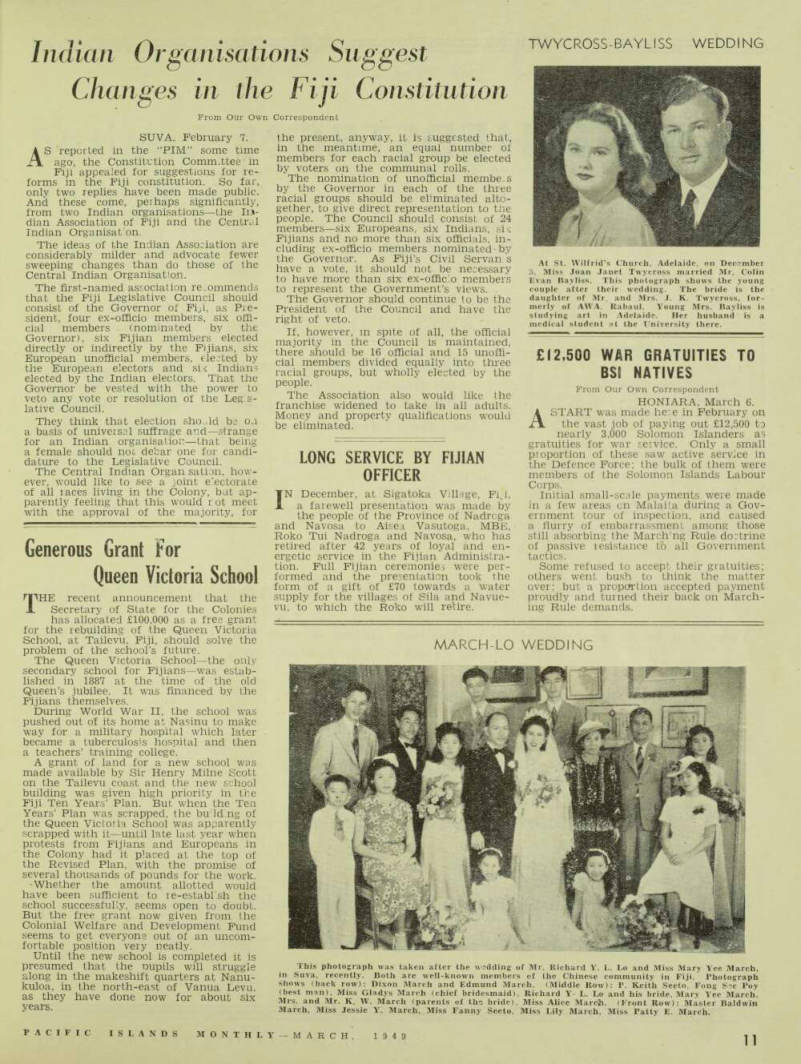
At St. Wilfrid’s Church, Adelaide, on December 3, Miss Joan Janet Twycross married Mr. Colin Evan Bayliss. This photograph shows the young couple after their wedding. The bride is the daughter of Mr. and Mrs. J. K. Twycross, for merly of AWA. Rabaul. Young Mrs. Bayliss is studying art in Adelaide. Her husband is a medical student at the University there.
£12.500 War Gratuities To
Bse Natives
From Our Own Correspondent HONIARA, March 6.
A START was made he.e in February on the vast job of paying out £12,500 to nearly 3,000 Solomon Islanders as gratuities for war service. Only a small pioportion of these saw active service in the Defence Force; the bulk of them were members of the Solomon Islands Labour Corps.
Initial small-scale payments were made in a few areas on Malaita during a Gov ernment tour of inspection, and caused a flurry of embarrassment among those still absorbing the March'ng Rule doctrine of passive resistance to all Government tactics.
Some refused to accept their gratuities; others went bush to think the matter over: but a proportion accepted payment proudly and turned their back on March ing Rule demands.
March-Lo Wedding
This photograph was taken after the wadding of Mr. Richard Y. L. Lo and Miss Mary Yee March, in Suva, recently. Both are well-known members of the Chinese community in Fiji. Photograph shows (back row): Dixon March and Edmund March. (Middle Row): P. Keith Seeto, Fong See Poy (best man), Miss Gladys March (chief bridesmaid), Richard Y. L. Lo and his bride, Mary Yee March, Mrs. and Mr. K. W. March (parents of the bride), Miss Alice March. (Front Row): Master Baldwin March, Miss Jessie Y. March, Miss Fanny Seeto. Miss Lily March, Miss Patty E. March.
Advertisements & other items, p. 14 (1 item)
Morris Hedstrom Limited
General Merchants, Importers and Exporters,
Shipowners, Plantation Owners,
Commission and Insurance Agents
HEAD OFFICE
SUVA, FIJI
Established 1868
SERVICE IN THE SOUTH PACIFIC TERRITORIES
THROUGH our Large Establishments in Suva and our Numerous Branches, we distribute a wide and comprehensive range of General Merchandise and provide almost every kind of service. Our departments and associated businesses include:
DRAPERY
MOTOR SALES
AND SERVICE
TOBACCO
TIMBER AND
BUILDING
GROCERY
CONFECTIONERY
HARDWARE
ELECTRICAL
LIQUORS
DRUGS
Branches Throughout Fiji, Samoa and Tonga
There is a Branch or Agent of Morris Hedstrom Limited in every Town in the Three Territories.
We are Sole Agents in these Territories for British Drug Houses Ltd.
Electrolux Ltd.
Ford Motor Co.
General Electric Co. Ltd.
Goodyear Tyre & Rubber Co.
B. A. Hjorth £r Co. (Primus Products) Imperial Chemical Industries Ltd.
International Harvester Export Co.
Matson Navigation Company Max Factor and Co. Inc.
Ransomes, Sims & Jefferies Ltd.
Ruston & Hornsby Ltd.
Vacuum Oil Co. Pty. Ltd.
Yorkshire Copper Works Ltd.
Morris Hedstrom Limited, are LLOYD'S AGENTS in Fiji and Samoa.
IN AUSTRALIA:
Morris Hedstrom (Aust.) Pty. Ltd.,
Asbestos House, 65 York Street, SYDNEY
IN GREAT BRITAIN;
Morris Hedstrom Limited,
Africa House, Kingsway, LONDON
Maori’s-Head Notes
Started Panic in Fiji
From Our Own Correspondent
Suva, Feb. 28.
WHEN the banks’ restrictions on the changing of Zealand bank notes in Fiji were announced dur ing the Fijian radio news session recently (see elsewhere this issue), the Fijian an nouncer explained the situation carefully, but he went a little too far. He said that the New Zealand notes in question were the “notes bearing a Maori head.”
This was perfectly correct, but he over looked the fact that, several years ago, a large number of New Zealand notes were overprinted to turn them into Fiji currency. They bear the words “Govern ment of Fiji—This note is legal tender in Fiji only.” The notes are still widely used throughout the Colony—and they all bear the Maori head!
The deadline for getting rid of New Zealand notes was February 26. But be fore that date masses of worried Fijians, some of them from far afield, descended on the two banks in Suva and. on the strength of the Maori head on the over printed notes, firmly and politely in formed the banks that they wanted their notes changed. The radio had been so explicit that in many cases the earnest explanations of bank officials were fruit less and the overprinted notes were ex changed for Fiji notes —though both were legal tender —for the sake of peace.
Bothersome Falcon
Must It Be Annexed Again?
FALCON Island, in the Tonga Group, which has been bobbing up and down and worrying mariners for about 200 years, is in the news again. The New Zealand frigate “Hawea”, en route to Samoa with a new High Commissioner, reported nine fathoms, by echo-sounder, on the place where Faison was last seen (in 1946).
There are a number of these volcanic banks in this region of active volcanoes; but Falcon is remarkable because it keeps on appearing and re-appearing.
It was first observed as a reef in the latter part of the 18th century and 100 years later it was found to have grown into a strip of barren land a mile and a quarter long and 153 ft. high. Then it subsided into the sea; but in 1896 the small remaining reef broke into violent eruption and produced an island of pumice stone more than 100 ft. high In succeeding years Falcon Island dis appeared and reappeared at irregular intervals, its most spectacular return from the ocean depths occurring in 1927, when volcanic explosions were visible as far away at Nukualofa, on Tongatabu.
Early in 1946 it had again vanished.
There was a depth of five fathoms there about the end of 1946. and now there are nine fathopis; so it looks as if Falcon is at present on the way down.
Falcon has been a source of some an noyance to the Government of Tonga.
When it really looked like an island, back in last century, the Kingdom of Tonga formally annexed it. Some years later it disapneared. When it re-appeared in 1896, and seemed disnosed to make itself a solid island, Tonga in 1927 solemnly annexed it again. Now that it is again under the waves, some troubled people want to know if it remains Tongan soil, or must it be again annexed when it makes its next appearance.
A draft Bill to establish a Court of Appeal in Fiji is at present under con sideration.
Advertisements & other items, pp. 15-16 (1 item)
Travel
Pi
easure
in the
PACIFIC
ISLANDS
'JpHOSE contemplating a tour in the Pacific Islands are invited to apply, for Information and Service, to the PACIFIC TRAVEL AGENCY (conducted as a department of Pacific Publications Pty., Ltd.). We can give you information about— • The attractions and conditions of the various Islands and Archipelagoes. • How to get there. • The class and cost of accommodation in the Islands now available to Travellers. • How Travellers should proceed, in order to see the most, with the greatest comfort, at the least cost. • How to deal with the Problems of getting from place to place, and island: to island.
We supply authentic information about Travel and Tourist Conditions in Fiji, Samoa, Tonga, Cook Islands, French Oceania, Norfolk Island, New Zealand, New Caledonia, New Hebrides, Solomons, New Guinea, Papua, etc.
Why Not Escape the Winter in a Sunshine Tour in the
Pacific Islands? Conditions are Ideal between
April and October. Fiji Recommended
If you will indicate where you would like to go anjd how much time you have available, we will draw up for your consideration alternative suggested tours and the approximate cost of each.
We Organise Your Tour from Your Home back to Your Home—All Bookings are made for you in advance—All arrangements are made ahead for your comfort—You may Travel individually, or as a member of a small party. It costs no more to travel the PTA way.
Send for the P.T.A. Booklet and get details of the services we offer.
We sell Travel and Accommodation on behalf of Airways, Shipping Lines, Hotels land Boarding Houses. We are the Australian Agents of the Fiji Government’s Publicity Board and Tourist Bureau, and of other Pacific Islands’ Travel Bureaus.
Any service we sell is under guarantee. Our Service Bureau has been operating for a year and many Islands residents have made use of it.
TO ISLANDS RESIDENTS: Do you want Bookings made, anywhere, by Airways, Shipping Lines, Railways, in Hotels? Send us your instructions.
All details of your wishes attended to.
PACIFIC TRAVEL AGENCY
and SERVICE BUREAU
Union House, 247 George Street, SYDNEY
Registered Cable Address: PACPUB SYDNEY. Telephone: BW 5037.
Take the thrifty Clipper* way
LONDON
via U S
New low fare in pounds (no dollars needed) takes care of all transportation costs. Allows you sight-seeing stopovers in principal LLS. cities. m
LEI
fl m *3* 4* mm 4 v % II / y/o'/ one / \O/ fc327 inp OnW * /\O/0
Sydney
froro Stop-over in lovely Honolulu . . . spend a day in San Francisco . . . sight-see in New York to your heart’s content! That’s the way you go when you fly by Clipper to London.
At no extra cost. And at new low fares.
The Flying Clippers take-off from Sydney every Tuesday, Friday and Sunday for San Francisco. You enjoy restful Sleeperette* service (no extra cost). And from New York, London-bound Clippers cross the Atlantic daily.
For help with your Clipper trip, see your Travel Agent or . . . , / *0
“SPEED YOUR PARCEL BY CLIPPER ”
Rue Jean Joures, NOUMEA —Bank of Building, SUVA. *Trade Marks, Pan American A irways, Inc. \ /
That Old Mill Stone!
This photograph was very kindly sent to us by Mr. A. Raschke, of Wunderlich, Ltd., Sydney.
It shows the Public Works Department building, as it was in pre-war Rabaul, and mounted out side of it, the Marquis de Ray’s mill-stone. An article about this old stone appeared in February issue of “PIM,” and told how it survived the blitz on Rabaul between 1942 and 1945. It was suggested there that the cld stone was originally mounted on the slant—as this picture proves
that it was—and that it had no inscription to show what it was. Mr. Raschke took this photo graph when he visited Rabaul in 1939, and he thinks that his firm subsequently supplied an enamelled bronze name-plate for affixing to the stone. He thinks, also, that Mr. W. L. McGowan, now Assistant Works Director, Department of Public Works, Port Moresby, then an architect in the Rabaul PWD, w?.s primarily responsible for having the stone set in place.
Fiji Newspaper Storm
American Professor Causes Fiji Newspaper Storm
From Our Own Correspondent
Suva, Feb. 28.
Professor J. W. Coulter, Slither
of “Fiji: Little India of the Pacific,” in a paper read, in absentia, at the recent Pacific Science Congress in New Zealand, quoted an opinion that Fiji might do better if it were “a land of teeming Indian hamlets and farms.”
To this the. Fiji Times retorted editor ially that such a development would be possible only if (1) the Deed of Cession were torn up: (2) the British colonial policy, as applied to indigenous peoples in their homelands, were torn down; and (3) the Fijian record since 1874, including the magnificent Fijian Second World War contribution, were erased from the history of the British Empire.
Whereupon the Pacific Review, a new Indian weekly, with distinctly Leftist leanings, came up with a leader headed “When Coulter Talks Sense,” and furi ously assailed the Fiji Times as “one of the reactionary bosses of the South Pacific.”
At which the “Oceania Daily News”— a year-old daily which is supposed to have no love for the Fiji Times —alleged that the Pacific Review was practically a Communist organ anyway!
Mr. J. .Gaffney also returned rec:nTy to Kavieng. With him came Mrs. Gaffney, who is new to the Territory.
Advertisements & other items, pp. 17-18 (2 items)
Yorkshire
THE
INSURANCE
CO. LTD.
(Incorporated in England)
ALL CLASSES OF
INSURANCE
Including Fire Motor Guarantee Accident Workers Marine Island Representatives:
PORT MORESBY: E. A. James
RABAUL: G. B. Black LAE: New Guinea Industries Ltd.
MADANG: R. MacGregor SUVA: Williams & Gosling Ltd.
NOUMEA: Y. Mortensen
NORFOLK ISLAND:
A. E. Martin
£. J. Gough S. Co.
BURNS PHILP (New Hebrides) LTD.
Registered Office: VILA, NEW HEBRIDES
Branch Office at SANTO
Exporters, Importers and General Merchants
(Retail and Wholesale) Commission, Shipping
and Customs Agents
Representatives for BURNS PHILP TRUST COMPANY LIMITED, QUEENS- LAND INSURANCE CO., LTD., and LLOYDS OF LONDON. Agents for SOCIETE DES PETROLES SHELL DES ILES FRANCAISES DU PACIFIQUE, and numerous overseas manufacturers of all classes of merchandise.
Sydney Agents: Burns, Philp & Co., Ltd.. 7 Bridge Street.
San Francisco Agents: Burns, Philp Co. of San Francisco, Matson Building, 215 Market Street, London Agents: Burns, Philp & Co., Ltd., 35 Crutched Friars, E C. 3
£. J. GOUGH S. CO.
Bond Street, Sydney, Australia Tel. BU 2195. Box 3615 G.P.O.
SUPPLIERS OF GENERAL MERCHANDISE TO LEADING FIRMS THROUGHOUT THE
PACIFIC ISLANDS
Exporters ... Importers ... . Manufacturers' Representatives Bankers: Bank of N.S.W. Bank of Adelaide. Comptoir Nat. d’Escompte de Paris, Cable Address: “SEAFOODS.” SYDNEY.
Codes: Bentley’s, 2nd and Comp. Phrase; A.8.C., sth and 6th; Peterson, 2nd and 3rd; Banking; Acme.
• The need is urgent—support the Food for Britain Appeal.
ART POSTCARDS OF
TONGA
Per Dozen, Postage Paid: 6/- (one US Dollar).
TONGAN PHOTOS BUREAU
Nukualofa, Tonga
Silly Un Criticism Of W. Samoa Administration
Russia and Philippines Feel They Know the Answers
THE approach of some members of the Trusteeship Council of the United Nations to administrative problems in the South Pacific is about as realistic as that of a mid-Victorian spinster who spent her time making woollen shirts for African heathens. The idea of the Rus s*an member, of course, invariably is to make mischief.
Latest trusteeship to come under
Trusteeship Council review is that of Western Samoa, held by New Zealand, -i- or ? that occasion, the Russian and Philippines delegates had a considerable amount of criticism to make.
Acceding to the Philippines delegate, the industrialisation” of Samoa should be increased so that the indigenous popu lation would have a better standard of liv mg All Samoans “should be given the vote.
The Russian delegate considered that Western Samoa’s newly-created Legisla tive Assembly was merely advisory, and that it gave more representation to the Europeans in the Territory than to the Samoans. Nor did he believe in the tribal system which he described as undemo cratic, inferring that this should be rooted out, whether the Samoans them selves like it or not.
Both delegates spoke nonsense. For the Philippines delegate to suggest “in creased industrialisation,” is a confession of ignorance. None of the 70,000 Samoans in the Territory has the slightest desire for industrialism. They see no virtue in sustained labour for the sake of labour.
Their wants are taken care of by the production of cocoa, copra and bananas at which they work when, or if, they feel inclined, and if they have some specific needier cash in view.
The Soviet tilt at the advisory capacity of the Assembly is a typical piece of Red distortion. The Assembly can make ordinances for the “. . . peace, order and good government of Western Samoa and dispose of the revenues of the Territory.”
Only external politics are controlled by New Zealand. The so-called tribal-sys tem has been upheld by the New Zealand Government because it is the Samoan system, one that they understand and above all, the Samoans themselves want.
No doubt, the Soviet would consider it anti-Russian and destroy it. This, more than anything else, indicates its virtue.
The Russian claim that there are five Assembly members for 1,010 Europeans and only 11 for the 70,000 Samoans, is another distortion. There are fewer than 200 full Europeans in Western Samoa now. The five elected Euronean mem bers really represent about 5,000 Euro nesians (part European, part Samoan) who live as Europeans. The five mem bers in any event, are predominantly Euronesian.
In New Zealand, the Soviet representa tive’s criticism has been described as “mischief-making nonsense,” unworthy of serious detailed reply.
Fund
New Guinea Scholarship
SINCE we last acknowledged donations to the New Guinea Memorial
Scholarship Fund the following
amounts have come in; Acknowledged to August 31, 1948 .. £3,571 711 Dorothy Stewart, Rabaul (rental panatrope and records) ... 220 M. T Duff, Police Station, Rabaul 110 Mrs. D. Stewart, Lae 110 Dorothy Stewart, Rabaul (iron rental) 100 J. Coulston. Port Moresby ... 100 Dorothy Stewart, Rabaul (iron rental) 600 Alan Gow, Don Barret, Doug Joyoey, Jock Maclean, Bob Parer, Tommy Smith, Mick Foley, Dorothy Stewart, Prince Charles Birthday collection ... 350 Total to January 31, 1949 .. £3,586 16 11
Advertisements & other items, pp. 18-19 (2 items)
Cheques
HOW THE “WALES” WORKS
Services Series No. 6
TRAVELLERS’
CHEQUES
W'HEN you go away, whether on family holidays, a business trip, or a world tour, you will need funds for your daily requirements.
It is risky to carry these funds in cash. The modern, safe means of payment for travellers is Bank of New South Wales Travellers’ Cheques.
You will find that these cheques are readily cashed by all banks and accepted by principal tourist bureaux, transport offices, hotels, restaurants and stores.
Bank of New South Wales Travellers’ Cheques can be bought at any branch of the "Wales”.
BANK OF
NEW SOUTH WALES
FIRST BANK IN AUSTRALIA
m K
Consult and use
Incorporated in New South Wales with limited liability ' ' A4822D
CRAMMONDS...
Answer the Problem ... by releasing a
thoroughly efficient tropic receiver
THE CRAMMOND NO. 1 TROPIC EAGLE
m Write for full particulars of Crammond's full range of instruments, including unit Portable receivers that may be packed amongst baggage.
All Crammonds are built of highest grade components by skilled craftsmen. Our reputatior built over more than twenty years of trading is a guarantee of satisfaction. • Our skilled engineers are always available to repair or modernise all types of receivers ai economical rates. "
Address letters to: Alfred Crammond, Managing Director , or Mr. Jack Chesterfield, Manager and Technical Director.
Crammond Tropical Receiver Available in four models:- 6 Valve 2 volt with Accumulator. 6 Valve 240 volt 50 cycle A.C. 6 Valve 1.4 volt with batteries. 6 Valve Vibrator.
Exclusive Features:
• Completely Tropic Proofed. • Continuous coverage of short wave • Sealed in Rustless Steel Metal Cabinet. lengths from 16 to 150 metres. • Provision for Loudspeaker and Headphone reception. • Designed for trouble-free operation in • Slow motion instrument type dial with areas where extreme humidity prevails, gear ratio 55 to 1 simplifies tuning on all wave lengths. • Built in moisture absorber.
CRAMMOND RADIO MANUFACTURING COMPANY. PTY. LTD.
No. 8 Queen Street, Brisbane
17
PACIFIC ISLANDS MONTHLY - M A R C H , 1949
Pacific Science Congress Concludes
Successful Session NZ
HpHE Seventh Pacific Science Congress, 1 which opened in Auckland, NZ, on February 2, ended in Christchurch on February 23.
Over 300 delegates from 30 countries attended. After the inaugural session, committees were formed to deal with the various branches of science which the Congress covered.
Tours and expeditions, designed to interest particular groups of scientists were also arranged by the host organisations in New Zealand—the Auckland Institute and Museum, Auckland University College, Christchurch branch of the Royal Society and Canterbury University College.
Scores of papers were read by the distinguished delegates—the scope of which it is impossible to deal with adequately in a newspaper report. If proceedings are published by the host organisations for the Congress they should, however, be of assistance to all Islands governments.
Native Welfare
THE majority of delegates were concerned with native welfare and it was inevitable that the old bogey of “exploitation” should be brought out for an airing.
Professor J. W. Coulter, of the University of Cincinnati, in absentia, said that the old Pacific world had gone and it was the job of governments to assist the natives during their change-over from their old culture. This change had
been brought about by with foreigners who had exploited the re sources of the islands under a Western individualistic economy commonly called private enterprise.
Dealing with the importation of Oriental labour into Pacific territories, he said that it was full of dangers from economic, social, racial and political points of view, but if an adequate supply of labour was to be available for plan tation and mine owners there appeared to be no escape from it. If Asiatics were barred from these Islands, and if European and American Administrations, now established there, turned their terri tories over to self-government, the Asiatics were likely to find some way of getting in, anyway. Once established, even in few numbers, they multiplied quickly until they became the dominant economic group. (See also page 15.) Professor E. Beaglehole, of New Zea land, criticised New Zealand’s policy in Western Samoa and the Cook Islands.
There had. he said, been a sort of con gealing of development in the Cook Islands, partly through the influence of the missions and partly because the Gov ernment had preferred to keep things orderly rather than to encourage any tendency to progress. As for the Samoans —they were beginning back wards with their self-government: They had the mechanism, but they did not know how to use it.
The mistake Colonial powers made was to believe that native communities needed
the same sort of self-government as they themselves enjoyed. The natives, how ever, had managed their simple com munities quite satisfactorily before the Europeans came. Dealing with mixed bloods he said mixture between Poly nesians, Asiatics and Europeans had done no harm to the Islands people. In Western Samoa, however, some part- Europeans had become a segregated group suffering from legal and social disabilities.
Health
DR. V. W. T. McGUSTY, formerly Director of Medical Services in Fiji, spoke of the decline and recovery of the Fijian race —the recovery, in no small measure, being due to the favourable effect of the administration of Fiji by Britain. The future of the Fijians now seemed assured.
Dr. D. W. Hoodless, formerly principal of the Central Medical School, Suva, showed slides and spoke of the training of Native Medical Practitioners from Polynesia, Micronesia and Melanesia.
Professor J. P. Walsh, of the dental faculty, Otago University, urged that a research expedition be sent to stuldy dental decay among the peoples of the South Pacific.
Three other papers on dental diseases were read by other delegates. It was stated that the incidence of dental decay among natives of New Guinea was re markably low when compared with the incidence among Australian children in Australia. This was attributed to the fact that Australian children ate too much white flour and refined sugar.
Education
MR. AMI CHANDRA, a member of the Legislative Council of Fiji, com plained that there was great
illiteracy among the Indian peoples of Fiji. He said that there were insufficient schools in the first place and that, in the second place, too many seasonal de mands upon juvenile labour. Seventy per cent, of the’ Indian children of the Colony had no more than four years’ schooling.
Meteorological And Seismo
Logy Stations
It was urged that more meteorological and seismological stations be established in the Pacific. Meteorological stations, to deal with surface and upper*air, should be established at Easter Island, Clipper ton Island and Marcus Island; these would serve large areas now completely without weather data.
It was recommended that seismology stations be established in New Caledonia and in Southern and Western Australia.
Next Meeting
The Republic of the Philippines will be host to the next meeting of the Pacific Science Congress. The date has not yet been fixed.
Advertisements & other items, p. 20 (1 item)
THORNYCROFT (Aust.) Pty. Ltd.
Nv *" I i u Above: 90 HP RNR6 type with 2/1 or 3/1 reduction, and patent angle lever control.
Sterngear made to order After sales, service and spares facilities always available
6-10 WATTLE ST., PYRMONT, N.S.W.
A DIRECT BRANCH OF THE MANUFACTURERS.
f ¥1 0 n
MARINE ENGINES
PETROL OR DIESEL
9 to 130 HP Reliable'—efficient and economical for all types of vessels
FULL PARTICULARS ON REQUEST.
i • 65 HP RTR6 type, 2/1 reduction.
High Commissioner In Bsi
From Our Own Correspondent HONIARA, March 6.
THE High Commissioner for the Western Pacific tsir Brian Freestone) will arrive in the Protectorate on March 18, by RNZAF Catalina.
He will be accompanied by Mr. Hill, second assistant secretary in the High Commission office, as ADC, and by Mr.
Hayden, education adviser. The High Commissioner will tour portions of the Protectorate in HMAS “Culgoa,” which will be here at the time of the official visit.
Death In Nz
The late Otto Peter Schaumkell, of Apia, Western Samoa, who died in Auckland. NZ, on August 7, 1948.
He had met with an accident 18 months previously and had undergone several operations. He was a member of a family well known in Apia.
Advertisements & other items, p. 21 (1 item)
Mcilrath’S
Buy on the Best Market!
When you buy through us you buy at lowest
prices. YOU RECEIVE ORIGINAL INVOICES
AT INVOICED COST, Enquiries invited for all plantation and trading requirements.
WILLIAM E. REED
(Established 36 years).
Broker and Agent 145 a George St., Circular Quay, Sydney.
Cables: “WILREED,” Sydney.
McILRATH’S
SYDNEY'S LEADING GROCERY HOUSE
Specialise in supplying residents of the PACIFIC ISLANDS with their general household requirements
COMPREHENSIVE GROCERY STOCKS AVAILABLE AT
ATTRACTIVE PRICES
ALL GENERAL AND REFRIGERATED CARGO NOW INSURED AGAINST
PILLAGE-THEFT—NON-DELIVERY
Write for Complete Grocery, Wine and Spirit Price List.
Post Free by Return Air Mail.
McILRATH’S PTY. LTD.
202 Pitt Street, Sydney, Australia Cable address —ROTUNDA, Sydney.
BETTER COPRA with LESS LABOUR!
when dried by the scientific
process made possible by the
"CHULA” Copra Dryer
... the most practical and efficient machine for drying nuts in bulk, which produces copra of a higher standard than that dried in the open, without discolouration, free from mould, thoroughly and evenly dried throughout. The "Chula” produces its two tons' of copra every 24 hours, irrespective of the weather, and with a minimum of labour.
THE INVENTORS AND MANUFACTURERS OF
THE CHULA’’ COPRA DRYER ALSO MAKE
DESICCATED COCONUT
MACHINERY
(Parers, Disintegrators, Sifters, Dryers)
TEA DRYERS
FISH DRYERS
RUBBER MACHINERY
(Continuous Sheeters, Crepeing Batteries)*
TYNESIDE FOUNDRY &
ENGINEERING CO. LTD.
ELSWICK • NEWCASTLE-ON-TYNE • ENGLAND
Telegrams A Cables : " FOUNDRY. NEWCASTLE-ON-TYNE " • Codes ; ABC, sth A 6th Eds A \ m Xi Write for the new
CATALOGUE
and further details of the
CHULA"
COPRA DRYER
W. Samoa’s Flag Approved In NZ
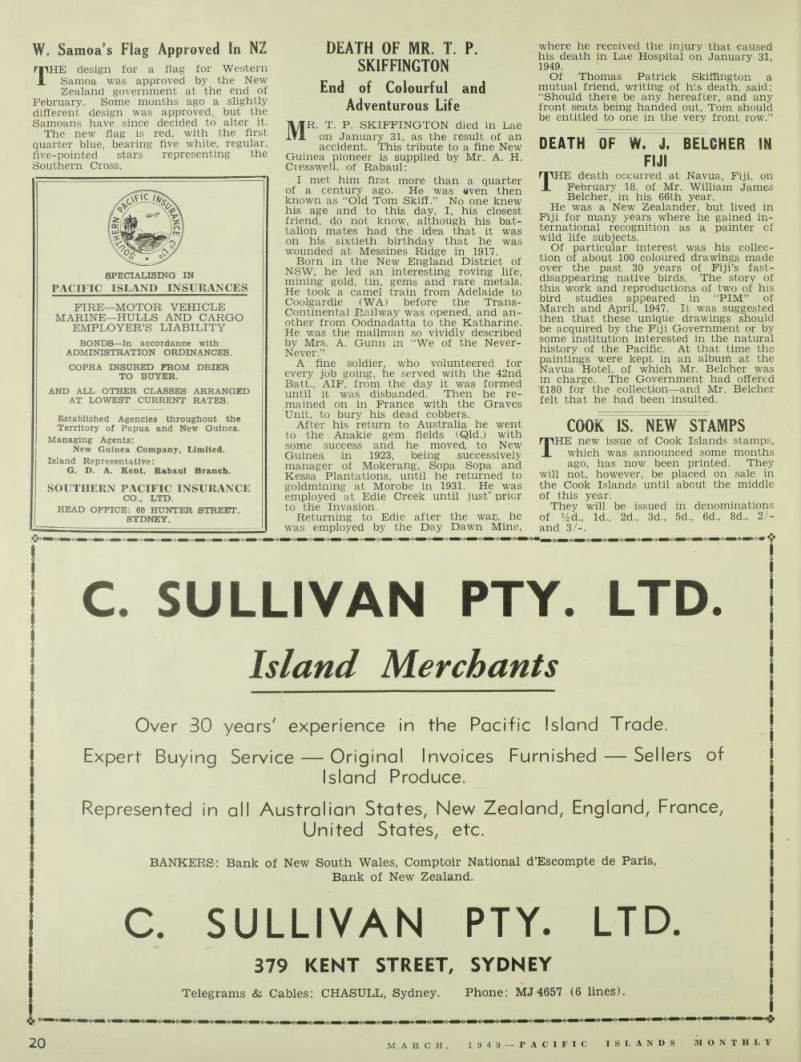
THE design for a flag for Western Samoa was approved by the New Zealand government at the end of February. Some months ago a slightly different design was approved, but the Samoans have since decided to alter it.
The new flag is red, with the first quarter blue, bearing five white, regular, five-pointed stars representing the Southern Cross.
Skiffington
Death Of Mr. T. P.
End of Colourful and Adventurous Life
MR. T. P. SKIFFINGTON died in Lae on January 31, as the result of an accident. This tribute to a fine New Guinea pioneer is supplied by Mr. A. H.
Cresswell, of Rabaul: I met him first more than a quarter of a century ago. He was even then known as “Old Tom Skiff.” No one knew his age and to this day, I, his closest friend, do not know, although his bat talion mates had the idea that it was on his sixtieth birthday that he was wounded at Messines Ridge in 1917.
Born in the New England District of NSW, he led an interesting roving life, mining gold, tin, gems and rare metals.
He took a camel train from Adelaide to Coolgardie (WA) before the Trans continental Railway was opened, and an other from Oodnadatta to the Katharine.
He was the mailman so vividly described by Mrs. A. Gunn in “We of the Never- Never.”
A fine soldier, who volunteered for every job going, he served with the 42nd Batt., AIF, from the day it was formed until it was disbanded. Then he re mained on in France with the Graves Unit, to bury his dead cobbers.
After his return to Australia he went to the Anakie gem fields (Qld.) with some success and he moved, to New Guinea in 1923, being successively manager of Mokerang, Sopa Sopa and Kessa Plantations, until he returned to goldmining at Morobe in 1931. He was employed at Edie Creek until just* prior to the Invasion.
Returning to Edie after the wai), he was employed by the Day Dawn Mine,
where he received the injury that caused his death in Lae Hospital on January 31, 1949.
Of Thomas Patrick Skifiington a mutual friend, writing of his death, said; “Should there be any hereafter, and any front seats being handed out, Tom should be entitled to one in the very front row.”
Fiji
Death Of W. J. Belcher In
THE death occurred at Navua, Fiji, on February 18, of Mr. William James Belcher, in his 66th year.
He was a New Zealander, but lived in Fiji for many years where he gained in ternational recognition as a painter of wild life subjects.
Of particular interest was his collec tion of about 100 coloured drawings made over the past 30 years of Fiji’s fast disappearing native birds. The story of this work and reproductions of two of his bird studies appeared in “PIM” of March and April, 1947. It was suggested then that these unique drawings should be acquired by the Fiji Government or by some institution interested in the natural history of the Pacific. At that time the paintings were kept in an album at the Navua Hotel, of which Mr. Belcher was in charge. The Government had offered £lBO for the collection —and Mr. Belcher felt that he had been insulted.
Cook Is. New Stamps
THE new issue of Cook Islands stamps, which was announced some months ago, has now been printed. They will not, however, be placed on sale in the Cook Islands until about the middle of this year.
They will be issued in denominations of %d., Id., 2d., 3d., 5d., 6d., Bd., 2/and 3/-.
Advertisements & other items, p. 22 (2 items)
Specialising In
PACIFIC ISLAND INSURANCES
FIRE—MOTOR VEHICLE
MARINE—HULLS AND CARGO
EMPLOYER’S LIABILITY
BONDS—In accordance with
ADMINISTRATION ORDINANCES.
COPRA INSURED FROM DRIER
TO BUYER.
AND ALL OTHER CLASSES ARRANGED
AT LOWEST CURRENT RATES.
Established Agencies throughout the Territory of Papua and New Guinea.
Managing Agents: New Guinea Company, Limited.
Island Representative: G. D. A. Kent, Rabaul Branch.
SOUTHERN PACIFIC INSURANCE
CO., LTD.
HEAD OFFICE; 60 HUNTER STREET.
SYDNEY.
C. Sullivan Pty. Ltd.
Island Merchants
Over 30 years' experience in the Pacific Island Trade.
Expert Buying Service Original Invoices Furnished Sellers of Island Produce.
Represented in all Australian States, New Zealand, England, France, United States, etc.
BANKERS: Bank of New South Wales, Comptoir National d’Escompte de Paris, Bank of New Zealand.
C. SULLIVAN PTY. LTD.
379 KENT STREET, SYDNEY
Telegrams & Cables; CHASULL, Sydney. Phone: MJ4657 (6 lines).
Qantas On Sydney-Bsi
Run
Competition With TOA
Honiara, Feb. 23.
THE Australian Co., Qantas, now are offering keen competition on the Sydney-Solomon Islands air route, which Trans Oceanic Airways pioneered in 1947.
TOA have been coming in once a month, and getting petrol from supplies put down by the Shell Co., at Tulagi. But it was announced about the end of January that these supplies now had been ear-marked for Qantas, which Government-owned concern plans to start a service to the Solomons shortly. This meant that TOA could not run its trip on February 12.
TOA got over this by bringing along four Tulagi passengers when it arrived here on February 17, on a charter flight from Sydney to Truk with a salvage party, via Tulagi and Rabaul. It evidently had expected to get petrol at Tulagi. But there was no fuel available. The flying boat lay at Tulagi for two days, while radiograms flew back and forth. Finally, Shell Co. gave them ten drums, and they got away to Rabaul on February 19.
The TOA plane is due back to-day to pick up 12 passengers who have been waiting gloomily at Tulagi since the 13th, but no one knows whether they will get any petrol when they arrive.
The amount of petrol which the Burns, Philp steamer can carry to Tulagi is limited, and it now is claimed that the Qantas service will need the lot. We do not know how TOA will manage.
New Service May Link With
New Guinea
Honiara, Feb. 25.
IT is expected that a Qantas regular fortnightly service between Sydney and the Solomons, via New Hebrides, will commence early in March.
A Catalina will be used, at first, with four seats allotted to the Solomons; but it is expected that the Catalina presently will be replaced by a land-plane (Dakota) and that this will link up with the Qantas land-plane service which now runs weekly between Lae and Rabaul, in New Guinea.
If the land-plane is introduced, Qantas probably will use the Kukum air-strip, on Gaudalcanal, about two miles from Honiara, instead of the sheltered harbour at Tulagi, more than 20 miles from the present Administration headquarters (Honiara).
Qantas are cutting the fare (Sydney (Honiara) by £l2. Government Trade Scheme has been agent for both TOA and the Shell Co. W. R. Carpenter & Co., here will be the agent for Qantas.
In New Hebrides
Santo, Feb. 10.
ARRIVING at Santo at midday on Feb ruary 4, a Qantas Catalina left shortly afterwards on a survey flight to the Solomon Islands, This is a prelude to the extension of Qantas’ present Sydney-Santo schedule to embrace the Solomons.
It is reported that the Government of the Solomon Islands is co-operative and is welcoming the new service, even cut ting away an appreciable amount of red tape.
At present the only chance BSI resi dents have of getting to Sydney is by TOA once a month and by the Burns, Philp vessel “Morinda” every second trip. Allo cations of seats for the through flight (Solomons-Sydney) on TOA have neces sarily been very limited. The new service once a fortnight is welcomed.
Toa Fares Reduced
TRANS OCEANIC AIRWAYS announced at the end of February that, as from
March 1 their single fares from Sydney would be Noumea, £32/10 -; Vila, £45- Santo, £5O; and Tulagi, £6s—with special reductions on return fares; and it was expected that this reduction would meet Qantas competition. According to
the announcement, the TOA flying-boats would continue to run on this route, the departure being on a Tuesday about the middle of each month. The overnight stops will be Noumea and Tulagi, as at present.
Advertisements & other items, pp. 23-24 (1 item)
Robert Gillespie Pty It?
FOR ALL ISLAND SUPPLIES, FORWARD YOUR
ORDERS AND INQUIRIES TO
R. J. GRILLEY PTY. LTD
12! SUSSEX STREET, SVDNEV
All classes of merchandise purchased on behalf of Island clients at best wholesale rates—original invoices provided—prompt attention assured all orders, large or small.
Cables: ‘'Rejam,” Sydney.
5k \ k \ I i Css %W All classes of merchandise purchased for Island clients throughout the South-west Pacific.
Island produce sold on Australian and overseas markets on a commission basis.
ROBERT GILLESPIE PTY IT?
S 4» PITT ST.,SYDNEY- PHONES 8W4782- BISOS
ONE OF THE WORLD’S
WONDER-SIGHTS
Miles
$
MOVING ICE
See New Zealand’s
FRANZ JOSEF-GLACIER
From the Air !
'VTOWHERE else in the world can you see an eight-mile -Li long river of ice framed in an evergreen setting of sub-tropical forest. Franz Josef is one of the scenic wonders of the world. Why not take the holiday you’ve promised yourself . . . relax in comfort, in scenic surroundings? Travel in comfort too, by N.A.C. aircraft that land you fresh and unweary two hundred yards from th« hotel door. m
HOTEL ACCOMMODATION
Comfortable accommodation and attentive service is provided by the Government Tourist Department’s Hotel at the foot of the Glacier.
-AT YOUR SERVICE
thT Airways Corporation provides a network of air services throughout the Dominion and T™?AmtS‘ ° en ,?. ral Agen ‘ s i n «? e Dominion for British Commonwealth Pacific Airlines and Sd Sher ove?sels aWtaef kmg g fOT Tasman Empire Alrwa ys, Qantas Empire Airways, the 8.0.A.C.
Offices and Agents throughout New Zealand and the South-west Pacific 37
Background of
Islands Administration
“fTIHE halting and belated recognition X that social policy has an economic context leaves the observer with the impression that New Guinea policy has in the last two years been dominated by humanitarian conceptions of a bare and abstract sort.
“However, there is a danger that unless benevolent intentions are brought into relation with economic realities they will prove sterile, and Australia will face the charge of failing to meet her obligations, not from lack of goodwill, but from im maturity in the conduct of her public affairs.
“The development of the Islands is in every way a formidable undertaking, bristling with difficulties before which the best informed are the most tempted to quail. We have yet to show that we can mobilise the resources —financial, techni cal, political and imaginative—required by both the obligations of trusteeship and the future needs of security. The penalties for failure are now much greater than in the past.” (In other —and more plain and brutal —words: Australian Planners are making a pretty poor job in New Guinea, and unless they get down to realities the failure of their administration there is going to prove embarrassing for Aus tralia.) The foregoing extract is from a book, “Trusteeship in the Pacific”, just pub lished (10/6) by Angus and Robertson, Sydney, under the auspices of the Aus tralian Institute of International Affairs.
Dr. A. H. McDonald, Professor of Ancient World History at Sydney Uni versity, has edited this compilation, and written some of its best passages, and his contributors included Mr. J. P.
McAuley, MA, lecturer in Colonial Ad ministration at the Australian School of Pacific Administration; Mr. T. Inglis Moore, MA, lecturer in Pacific Studies, Canberra University; and Mr. John M.
Ward, MA, lecturer in History at Sydney University and author of a unique and extremely valuable recent book, wherein he gives a complete and well-documented history of “British Policy in the South Pacific”.
Since the British Empire became more or less Socialist, the world has suffered —and still is suffering—cruelly from academic planners and impractical dreamers: and I confess that I picked up this book with trepidation—a feeling that was not lessened when I noticed that the back of the dust-cover carries an almost grovelling adulation of that international pain-in- the-neck, Dr. H.
V. Evatt. However, some at least of these writers and compilers have kept their feet on the hard earth, and recog nised, in relation to Pacific Islands administration, that something more is called for than idealism and benevolent intentions.
The book has great value for all students of Pacific affairs, because it gives a precise and reliable history of the Mandates plan, which has been merged into the Trusteeship system; and it is well documented and carefully indexed.
No man could deal in an authoritative way with the present condition and probable future condition of the Pacific Islands unless he has these facts at hand for ready reference.
Few people who take a realist view of Asia and the Asiatics will agree with some of the arguments and conclusions reached by these writers. But they have all assembled their facts very thoroughly and honestly, and in that alone they have given us a really valuable book.
Rwr.
Advertisements & other items, pp. 25-26 (1 item)
Steamships Trading Company
Cfinldkei by
DAVISON
For Tropical conditions
Velvene Water Paint and Davison's Zinc Base Paints are used extensively throughout the islands and Mandated Territories on Government and Private buildings, giving full satisfaction under severe tropica! conditions.
AVISON PAINTS LTD.
BOX 24, A O BURN, N.S.W.
STEAMSHIPS TRADING COMPANY
ft
PORT MORESBY AND SAMARAI PAPUA
LTD.
Wholesale & Retail Merchants , Planters> Sawmillers , Engineers , 5///) Proprietors , Shipping , Customs and Insurance Agents.
MANAGING AGENTS for:
SAWMILLERS & TRADERS LTD.
CORAL SEAS INSURANCE CO. LTD.
ACME BAKERY COMPANY.
MARIBOI RUBBER LTD.
RUBBERLANDS LTD.
KEREMA RUBBER PLANTATIONS LTD.
COCOALANDS LTD.
AGENCIES:
BANKERS & TRADERS INSURANCE CO. LTD.
VACUUM OIL CO. PTY., LTD.
DIRECTORATE OP SHIPPING—Papua—New
Guinea Division.
ROYAL PACKET NAVIGATION CO.
KOKE BAGU PTY., LTD.
TRANS OCEANIC AIRWAYS.
GUINEA AIR TRADERS.
DISTRIBUTORS IN PAPUA for:
ARMSTRONG-HOLLAND PTY., LTD.
Earth Moving and Logging Equipment,
WILLYS-OVERLAND EXPORT CORPORATION.
Jeep cars, etc.
INTERNATIONAL HARVESTER CO. OF AUST. LTD.
International Trucks, McCormack Deering Farming Machinery, Defender Refrigerators.
SYDNEY AGENTS: NELSON & ROBERTSON PTY. LTD., 12 SPRING STREET
Star of “Australia’s Amateur Hour”
and his lovely daughter agree:
v/ck mm
“You can’t beat
Horlicks for flavour
and
nourishment!
yy \ Here you see Dick Fair with his ten-year-old daughter Peita both enjoying their Horlicks. Dick says Horlicks helps him to sleep well and gives him new energy for each day. Peita says: “I just adore that Horlicks flavour!"
How would you like to travel 10,000 miles every year ! That’s what Dick Fair does with “Australia’s Amateur Hour”
Australia’s favourite radio programme.
On top of that, auditions, rehearsals and weekly performances all take a lot out of Dick.
Do you wonder he needs the extra energy Horlicks gives?
“When I feel I am slowing down, 1 have a Horlicks,’* says
PROTEIN
CAICKIM
when mixed as directed Dick. “I find it the most nourishing food drink of all.”
The full, satisfying flavour of Horlicks comes from a careful blend of fresh, full-cream milk and the nutritive extracts of malted barley and wheat. It is Nature’s flavour . . . that’s why you never tire of it.
Many people drink Horlicks at home simply because they enjoy that distinctive flavour.
Others drink Horlicks because they need it to build them up . . . nourish the body and nerves and to induce deep, refreshing sleep. Horlicks is equally delicious hot or cold.
Ask your
storekeeper for
HORLICKS
When you sit back and enjoy “Australia's Amateur Hour" you probably don't realize how much work and organization goes on behind the scenes. “My week takes a lot out of me'' says Dick Fair , “hut Horlicks helps me keep right on top." 16-oi.
TIN
3 6 8-oz.
TIN
2i (Prices slightly higher in country areas)
Voelcker For
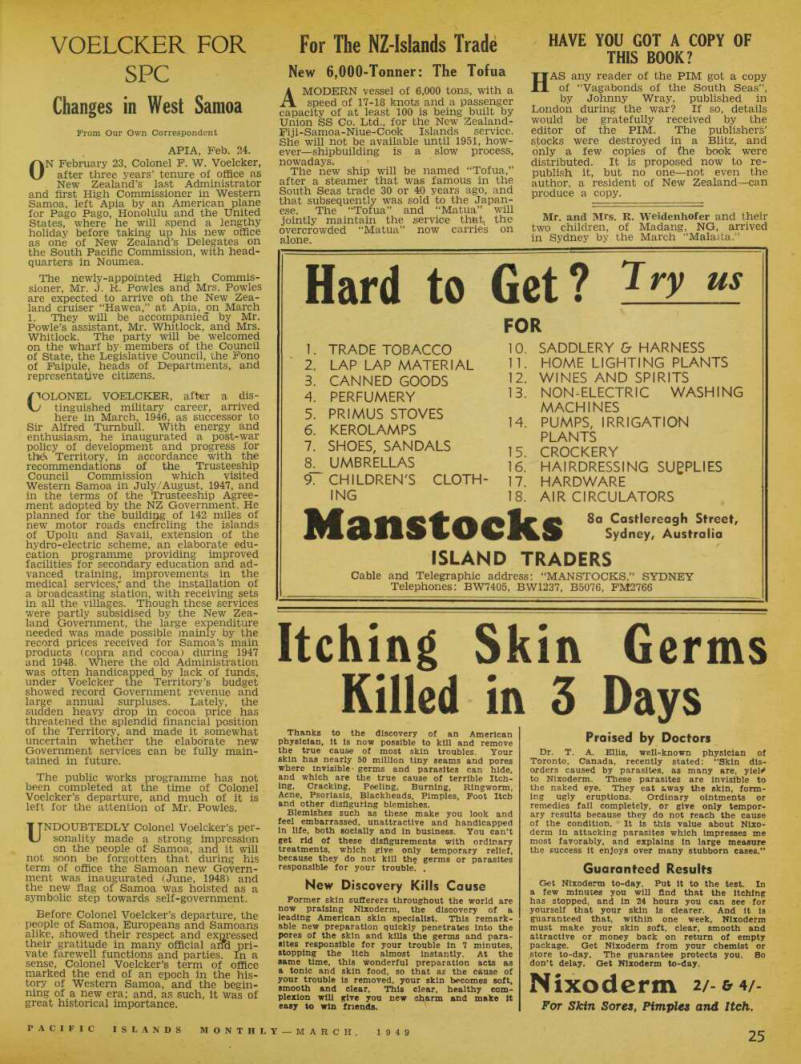
Spg
Changes in West Samoa
From Our Own Correspondent
Apia, Peb. 34.
ON February 23, Colonel F. W. Voelcker, after three years’ tenure of office as New Zealand’s last Administrator and first High Commissioner in Western Samoa, left Apia by an American plane for Pago Pago, Honolulu and the United States, where he will spend a lengthy holiday before taking up his new office as one of New Zealand’s Delegates on the South Pacific Commission, with head quarters in Noumea.
The newly-appointed High Commis sioner, Mr. J. R. Powles and Mrs. Powles are expected to arrive oh the New Zea land cruiser “Hawea,” at Apia, on March 1. They will be accompanied by Mr.
Powle’s assistant, Mr. Whitlock, and Mrs.
Whitlock. The party will be welcomed on the wharf by members of the Council of State, the Legislative Council, the Pono of Paipule, heads of Departments, and
representative citizens.
(COLONEL VOELCKER, after a dis- J tinguished military career, arrived here in March, 1946, as successor to Sir Alfred Turnbull. With energy and enthusiasm, he inaugurated a post-war policy of development and progress for tb& Territory, in accordance with the recommendations of the Trusteeship Council Commission which visited Western Samoa in July/August, 1947, and in the terms of the Trusteeship Agree ment adopted by the NZ Government, He planned for the building of 142 miles of new motor roads encircling the islands of Upolu and Savaii, extension of the hydro-electric scheme, an elaborate edu cation programme providing improved facilities for secondary education and ad vanced training, improvements in the medical services' and the installation of a broadcasting station, with receiving sets in all the villages. Though these services were partly subsidised by the New Zea land Government, the large expenditure needed was made possible mainly by the record prices received for Samoa’s main products (copra and cocoa) during 1947 and 1948. Where the old Administration was often handicapped by lack of funds, under Voelcker the Territory’s budget showed record Government revenue and large annual surpluses. Lately, the sudden heavy drop in cocoa price has threatened the splendid financial position of the Territory, and made it somewhat uncertain whether the elaborate new Government services can be fully main tained in future.
The public works programme has not been completed at the time of Colonel Voelcker’s departure, and much of it is left for the attention of Mr. Powles.
UNDOUBTEDLY Colonel Voelcker’s per sonality made a strong impression on the people of Samoa, and it will not soon be forgotten that during his term of office the Samoan new Govern ment was inaugurated (June, 1948) and the new flag of Samoa was hoisted as a symbolic step towards self-government.
Before Colonel Voelcker’s departure, the people of Samoa, Europeans and Samoans alike, showed their respect and expressed their gratitude in many official and pri vate farewell functions and parties. In a sense, Colonel Voelcker’s term of office marked the end of an epoch in the his tory of Western Samoa, and the begin ning of a new era; and, as such, it Was of great historical importance.
For The NZ-lslands Trade
New 6,000-Tonner: The Tofua
A MODERN vessel of 6,000 tons, with a speed of 17-18 knots and a passenger capacity of at least 100 is being built by Union SS Co. Ltd., for the New Zealand- Fiji-Samoa-Niue-Cook Islands service.
She will not be available until 1951, how ever—shipbuilding is a slow process, nowadays.
The new ship will be named “Tofua,” after a steamer that was famous in the South Seas trade 30 or 40 years ago, and that subsequently was sold to the Japan ese. The “Tofua” and “Matua” will jointly maintain the service thati the overcrowded “Matua” now carries on alone.
Have You Got A Copy Of
This Book?
HAS any reader of the PIM got a copy of “Vagabonds of the South Seas”, by Johnny Wray, published In London during the war? If so, details would be gratefully received by the editor of the PIM. The publishers’ stocks were destroyed in a Blitz, and only a few copies of the book were distributed. It is proposed now to re publish it, but no one—not even the author, a resident of New Zealand —can produce a copy.
Mr. and Mrs. R. Weidenhofer and their two children, of Madang, NG, arrived in Sydney by the March “Malaita.”
Advertisements & other items, pp. 27-28 (1 item)
Itching Skin Germs
Hard to Get? m
FOR
]. TRADE TOBACCO 10.
2. LAP LAP MATERIAL 11.
3. CANNED GOODS 12.
4. PERFUMERY 13 -
5. PRIMUS STOVES 14
6. KEROLAMPS 1^
7. SHOES, SANDALS 15
Bj_ UMBRELLAS 16
9. CHILDREN'S CLOTH- 17’
ING 18.
SADDLERY & HARNESS
HOME LIGHTING PLANTS
WINES AND SPIRITS
NON - ELECTRIC WASH ING
MACHINES
PUMPS, IRRIGATION
PLANTS
CROCKERY
HAIRDRESSING SUPPLIES
HARDWARE
AIR CIRCULATORS
0 So Castlereagh Street
IVlallS IVVIiS Sydney, Australia
ISLAND TRADERS
Cable and Telegraphic address: “MANSTOCKS,” SYDNEY Telephones: 8W7405, 8W1237, 85076, FM2766
Itching Skin Germs Killed in 3 Days
Thanks to the discovery of an American physician, It Is now possible to kill and remove the true cause of most skin troubles. Your skin has nearly 50 million tiny seams and pores where invisible germs and parasites can hide, and which are the true cause of terrible Itching, Cracking, Peeling, Burning, Ringworm, Acne, Psoriasis, Blackheads, Pimples, Foot Itch and other disfiguring blemishes.
Blemishes such as these make you look and feel embarrassed, unattractive and handicapped In life, both socially and In business. You can’t get rid of these disfigurements with ordinary treatments, which give only temporary relief, because they do not kill th? germs or parasites responsible for your trouble. .
New Discovery Kills Cause
Former skin sufferers throughout the world are now praising Nlxoderm, the discovery of a leading American skin specialist. This remarkable new preparation quickly penetrates Into the pores of the skin and kills the germs and parasites responsible for your trouble In 7 minutes, stopping the Itch almost instantly. At the same time, this wonderful preparation acts as a tonic and skin food, so that as the cause of your trouble is removed, your skin becomes soft, smooth and clear. This clear, healthy complexion will give you new charm and make It easy to win friends.
Praised by Doctors
Dr. T. A. Ellis, well-known physician of Toronto, Canada, recently stated: “Skin disorders caused by parasites, as many are, yiel** to Nixoderm. These parasites are invisible to the naked eye. They eat away the skin, forming ugly eruptions. Ordinary ointments or remedies fall completely, or give only temporary results because they do not reach the cause of the condition. It is this value about Nixoderm in attacking parasites which Impresses me most favorably, and explains in large measure the success It enjoys over many stubborn cases.”
Guaranteed Results
Get Nixoderm to-day. Put It to the test. In a few minutes you will find that the itching has stopped, and in 24 hours you can see for yourself that your skin Is clearer. And it is guaranteed that, within one week, Nixoderm must make your skin soft, clear, smooth and attractive or money back on return of empty package. Get Nixoderm from your chemist or store to-day. The guarantee protects you. So don't delay. Get Nixoderm to-day.
Nixoderm 2/-&4/-
For Skin Sores, Pimples and Itch.
Price at Works: £36/10/- Extra for 10 inch additional shelf and brackets (if required): £2 Glass Server to Top (if required): £l/10/- Packing and Transport to Wharf: £lO/10/- The display case is securely packed in two substantial crates occupying shipping space of 37 cubic feet. Total weight, when packed, 5 cwt.
Equip
Smart
Your Store with
Modern Counter
this
Display
Case
Specially Built for Export
As iimart as those in leading Australian city stores, and built by a firm that has been making fine store and (mice fittings for over a third of a century.
Moreover, it is specially built for export, so that it can be readily securely packed, and assembled by anyone, from simple directions, in an hour, with no tools other than a screwdriver.
Retailers all over the world have learned the selling value of modern display equipment, and this “silent salesman will soon pay for itself in increased sales.
Volume production has enabled us to make economies in manufacturing costs, and this saving has been passed on to our customers. The price has been substantially reduced, and is now only £36/10/-.
HERE ARE THE DETAILS
of the "Brahol" Export Counter Case
(as illustrated ) To help you to get an accurate picture of the ; Brahol" Special Expbrt Glass Counter Case, here are the main specifications:— ® Overall size is 6 feet long x 1 ft. 9 ins. deep x 3 ft. 3 ins. high. Made from first-class, wellseasoned Queensland Maple, hand french polished, wax finished, in natural maple colour.
Glass parts are, inch British plate glass. • The inside is lacquered ivory colour, and the recessed base is lacquered burgundy. 9 There is a pair of solid core sliding doors, and one glass shelf, 14 inches wide, on adjustable nickel-plated brackets.
Storage space below is 1 1 inches high.
The plate glass front is 22 inches high.
BRAY & HOLLIDAY
PTY. LTD.
Makers of Fine Store and Office
Fittings for over a third of a century.
Brahol House, 66-74 McLachlan Avenue, Rushcutter Bay, Sydney. Telephone: FA 4121.
Cable & Telegraphic Address: “Brahol”
The Goeffroys
Information Sought About Early German Trader
mHERE has been an interesting sequel 1 to an article written by Mrs. Eliza beth Hennings, of the Lau Group, Fiji, and published in the November “PIM.” Mrs. Hennings had been examin ing some old correspondence of 70 or 80 years ago, kept by her grandfather, Mr. William Hennings, and she compiled some interesting history, in the course of which she made several references to a German-Samoan trader, Mr. August Godeffroy.
This has brought, to the editor of the “PIM.” a letter from Mr. Carl Alfred Godeffroy, of Hamburg, wherein Mr.
Godeffroy eagerly seeks more details con cerning the references to Mr. August Godeffroy. It appears that August was the younger brother of Mr. C. A. Godde ffroy’s famous grandfather, J. Cesar Godeffroy, who founded the great world wide trading firm (Cesar Godeffroy and Sons) that entered the South Seas about 1855 and later became the DH and PG (the ‘‘long handle tan”). Mr C A. ?o°ve e r th£ e necfallvtheSoiTth 0 Pacific teanchof C ft All hif record! we?e foTtfn the war, how ever, and he now is building them up again. He says he knows very little about August Godeffroy, who went away into the Pacific and who appears to have been a “black sheep”; and he appeals to Mrs.
Hennings, and anyone else who is in terested, for materials (old letters, photo graphs, etc.) about the early days of the Godeffroys in the Pacific. There is no evidence that J. Cesar Godeffroy himself ever came to the Pacific.
August Godeffroy married in Sydney, in 1881, a Mrs. Wigger, widow of an Englishman: August died in Capetown in 1900; and his wif ’ e in Mexico City in 1892 ; Their only son> August> was killed In World War I.
The correspondence has been sent to S, 1 ® 6 Feldbounnenstrasse, Hamburg,
Native "Co-Ops"
Three Papuans Makling Study In Australia
From Our Own Correspondent , '
Brisbane, Feb. 26.
JN Brisbane recently, three Papuan J. natives (Miria Gavera, Boe Kapena and John Taru) addressed 60 mem bers of the Queensland Co-operative Union Study Group, They are designated “co-operative in spectors” with the New Guinea admini stration, and their duties are to help run more than 82 village co-operatives which have been established in New Guinea, and to organise new ones.
The natives Inspected Queensland co °Peratlve organisations. They are the St th " ‘o Australia
57 Admmistra
f°r ls kmd their visd; to Queensland they studied agn culture at the Gatton Agricultural College. The Queensland itinerary was arranged by the Queensland Co-operative Union. Inspections were made at Kingaroy, the Murrarie bacon factory, Northgate pineapple cannery and the Darling Downs. Visits are also planned to various parts of NSW.
Advertisements & other items, pp. 29-30 (1 item)
‘Masse
QUEENSLAND
INSURANCE
COMPANY
LIMITED
(Incorporated 1886 In Australia)
ASSETS EXCEED £5,000,000
Head Office :
QUEENSLAND
INSURANCE BUILDING,
80-83 PITT STREET, SYDNEY.
Specialists in South Seas Fire,
Marine & Accident Insurances
Apply to:
FIJI. —Branch Office: I. B. Chalmers, Manager, Burns Philp (South Sea) Co., Ltd.
VILA. —Burns Philp (South Sea) Co., Ltd.
Comptolrs Francais Des Nouvelles Hebrides (Marine).
NOUMEA, —L. & W. Johnston.
NEW GUlNEA.—Manager for Mandated Territory and Papua, W. A. Anderson.
PORT MORESBY—SAMARAI—LAE
—MADANG—RABAUL.
Burns, Philp (New Guinea), Ltd.
PAGO PAGO.
Burns Philp (South Sea) Co., Ltd.
G. H. C. Reid & Co.
OTHER SOUTH SEA ISLANDS.
Burns Philp (South Sea) 00., Ltd.
Also to any of the Company’s Offices in Australia or New Zealand.
3)) j e 3 :■>
‘Masse
BATTERIES
are tigers , for work
99 It is impossible to build a better battery than Every part of a Masse Battery is of one hundred per cent, quality , . . every stage of its manufacture is carried out in the Masse factory. When you recommend a Masse Battery to your customer, you can do so, with the utmost confidence that it will give him more starts and longer service.
AGENTS FOR NEW GUINEA AND PAPUA :
ROBERT GILLESPIE Js. LTD
RABAUL AND LAE
"IT'S NEW RIGHT THROUGH"
Built by Jowetts, of Bradford, Yorkshire.
The JOWETT “JAVELIN” Gar, English Body Work. Flat Four Engine, 75 m.p.h. 30-32 m.p.g.
ALSO
The BRADFORD 13 cwt. Lorry, Van, 6-seater Utility and Utility de Luxe. Ample Power—4o m.p.h.
Pacific Islands Distributors : G. H. ROBINSON EXPORTS & IMPORTS PTY. LTD 51 Macquarie Street, Sydney For early deliveries Telegraph: “Sunrise, Sydney.”
YOUR FUTURE CAREER . . .
Merchants, Accountants, Secretaries, Bankers and Business Managers ... all hold responsible positions with commensurate salaries. You too can enhance your prospects in this ever-expanding commercial field, which yields abundant returns to those with adequate qualifications. H.R.I. prepare ambitious men and women for all business positions from junior to senior executive. Tuition is practical authoritative up-to-date time saving . . . and certain in its successful results. Ihe H.R.I. is available always to advise you write or wire for information free and without obligation.
H.R.I. tutorial service is proved by the winning of more honours than all coaches in Australasia combined.
H.R.I, Career Training • ACCOUNTANCY • SECRETARYSHIP • COST ACCOUNTANCY
• PRACTICAL BOOKKEEPING • MARKETING SELLING
ADVERTISING • BANKING • LOCAL GOVERNMENT EXAMS.
Hemingway it obert so n Institute
Founded and Owned by Hemingway & Robertson Pty. Ltd.
Consulting Accountants ;: ;; Professional Tutors
126 BANK HOUSE, BANK PLACE, MELBOURNE
126 BARRACK HOUSE. 16 BARRACK STREET. SYDNEY 126/815
W. H. 6ROVE & SONS
Limited
Established 1896.
AUCKLAND
Island Traders. P.O. box 490.
Telegraphic and Cable Address: “Grove’', Auckland.
Entrust Your Orders to the Firm with Fifty Years Practical Experience in the Island Trade.
Shippers of all classes of New Zealand products.
Representing English Manufacturers through-
out the Cook and Society Islands, Fiji, Tonga, Samoa, Niue, New Caledonia, New Guinea, etc.
In FIJI as—W. H. Grove fir Sons (Fiji) Ltd.
Norfolk Is. Notes
By Vernon Wheatley
PASSING THROUGH: Mrs., Miss and Master Melville, who have left Tonga and plan to reside in NSW.
Mr. A. G. Kirk, returning to Thursday Island after spending leave in New Zea land.
Mr. Badham, on his way home to Sydney, after a fruitless search in the Islands for a small free-hold plot of land. Seems there isn’t such a thing.
Gone, But Not Forgotten: The
intense type who dashed from the plane to his guest-house, tossed his gear into his room, rushed out into the roadway and asked the first passer-by: “Where’s the nearest pub?” Upon learning that there was no such institution, his con sternation and remarks can best be imagined. He soon settled down when the intricacies of the Bond Store were ex plained.
Recent Arrival: The Ss “Holm
burn,” from New Zealand. A few of the local stores availed themselves of the opportunity to replenish their perilously low stocks. The shelves of the stores looked about as uninspiring as a Labour Budget, but a few goods soon altered that.
The “Morinda” is due shortly, and we understand the “Muliama” is due ap proximately three weeks afterwards.
Some of the locals seem to think that the “Holmburn’s” visit may have some thing to do with this, particularly when the Holm Shipping Company have made it known that they will run a regular service if sufficient freight is offering.
GRUESOME: A cow wandered about here for about three weeks with a broken hind leg. It was broken just above the fetlock and bones were protruding through the skin. It has vanished now —perhaps it was finally shot when the amateur pastoralist who owned it decided it could not be saved, or perhaps it just merely folded up and died an unnatural death. This job would be worth three months’ hard either in NZ or Australia, and it is a great pity there is no RSPCA here. The hard part is that if someone came along and put it out of its misery the simple act of mercy would have caused charges—or accusations, I should say—of interfering with stock or even black-marketing in beef.
FARCICAL: The Labour Machine in NZ, although it is groaning and grinding to an inglorious halt, due to a complete lack of inspirational lubricant, is still capable of producing a bit of ridiculous nonsense at the drop of the hat. Latest petty restriction is this; Travellers have had their £7/10/- overseas cash allowance cut down to £5. Wouldn’t it?
WHY BRING THIS UP: As it is im possible to wheedle any cement in quantity (say six bags) out of the Ad ministration for essential work, three local people have had to import it from NZ. Out of a 120-bags consignment to the South Seas Whaling Company, NI, 10 bags went “missing;’" and so far they have failed to return to their base.
HERE’S HEALTH! The Administration also availed themselves of the “Holm burn’s” visit from New Zealand. They imported some hundreds of cases of liquor, to replenish the depleted Bond Store. One can scarcely blame them, as profits from the Store, plus the sale of postage stamps, constitute the Adminis tration’s main sources of revenue. I hear over the Xmas period, the Administration raked approximately £3,000 over the Bond Store counter. This is really a “roaring trade,” when you consider the population of the Island.
The Rev. and Mrs. W. A. Coates, of the Methodist Mission, Papua, were on leave in Sydney in February.
Good Progress in the Control
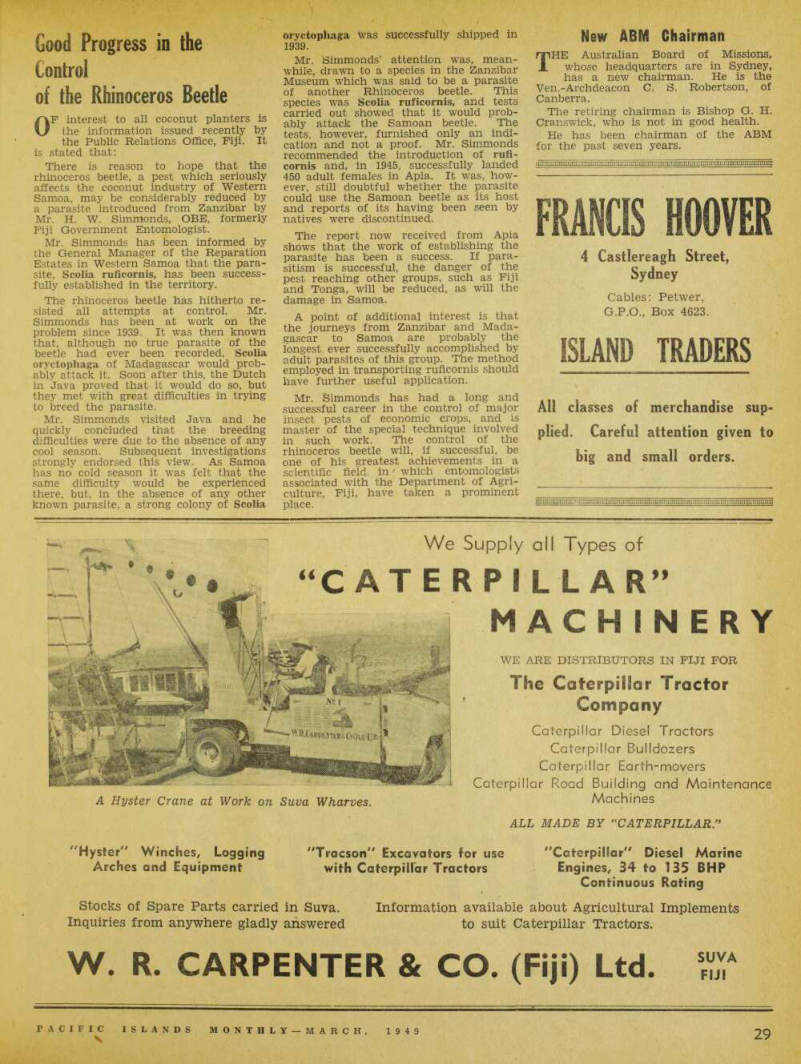
Control of the Rhinoceros Beetle
OF interest to all coconut planters is the information issued recently by the Public Relations Office, Fiji. It is stated that; There is reason to hope that the rhinoceros beetle, a pest which seriously affects the coconut industry of Western Samoa, may be considerably reduced by a parasite introduced from Zanzibar by Mr. H. W. Simmonds, OBE, formerly Fiji Government Entomologist.
Mr. Simmonds has been informed by the General Manager of the Reparation Estates in Western Samoa that the para site, Scolia ruficornis, has been success fully established in the territory.
The rhinoceros beetle has hitherto re sisted all attempts at control. Mr, Simmonds has been at work on the problem since 1939. It was then known that, although no true parasite of the beetle had ever been recorded, Scolia oryctophaga of Madagascar would prob ably attack it. Soon after this, the Dutch in Java proved that it would do so, but they met with great difficulties in trying to breed the parasite.
Mr. Simmonds visited Java and he quickly concluded that the breeding difficulties were due to the absence of any cool season. Subsequent investigations strongly endorsed this view. As Samoa has no cold season it was felt that the same difficulty would be experienced there, but, in the absence of any other known parasite, a strong colony of Scolia
oryctophaga Was successfully shipped in 1939.
Mr. Simmonds’ attention was, mean while, drawn to a species in the Zanzibar Museum which was said to be a parasite of another Rhinoceros beetle. This species was Scolia ruficornis, and tests carried out showed that it would prob ably attack the Samoan beetle. The tests, however, furnished only an indi cation and not a proof. Mr. Simmonds recommended the introduction of rufi cornis and, in 1945, successfully landed 450 adult females in Apia. It was, how ever, still doubtful whether the parasite could use the Samoan beetle as its host and reports of its having been seen by natives were discontinued.
The report now received from Apia shows that the work of establishing the parasite has been a success. If para sitism is successful, the danger of the pest reaching other groups, such as Fiji and Tonga, will be reduced, as will the damage in Samoa.
A point of additional interest is that the journeys from Zanzibar and Mada gascar to Samoa are probably the longest ever successfully accomplished by adult parasites of this group. The method employed in transporting ruficornis should have further useful application.
Mr. Simmonds has had a long and successful career in the control of major insect pests of economic crops, and is master of the special technique involved in such work. The control of the rhinoceros beetle will, if successful, be one of his greatest achievements in a scientific field in' which entomologists associated with the Department of Agri culture, Fiji, have taken a prominent place.
New ABM Chairman
THE Australian Board of Missions, whose headquarters are in Sydney, has a new chairman. He is the Ven.-Archdeacon C. S. Robertson, of Canberra.
The retiring chairman is Bishop G. H.
Cranswick, who is not in good health.
He has been chairman of the ABM for the past seven years.
Advertisements & other items, pp. 31-32 (1 item)
Francis Hoover
4 Castlereagh Street, Sydney Cables: Petwer, G.P.0., Box 4623.
ISLAND TRADERS
All classes of merchandise supplied. Careful attention given to big and small orders.
<* A Hyster Crane at Work on Suva Wharves.
We Supply all Types of
TER PILLAR”
MACHINERY
WE ARE DISTRIBUTORS IN FIJI FOR
The Caterpillar Tractor
Company
Caterpillar Diesel Tractors Caterpillar Bulldozers Caterpillar Earth-movers Caterpillar Road Building and Maintenance Machines Hyster" Winches, Logging Arches and Equipment Tracson" Excavators for use with Caterpillar Tractors
ALL MADE BY “CATERPILLAR.”
"Caterpillar" Diesel Marine Engines, 34 to 135 BHP Continuous Rating Stocks of Spare Parts carried in Suva. Information available about Agricultural Implements Inquiries from anywhere gladly answered to suit Caterpillar Tractors.
W. R. CARPENTER & CO. (Fiji) Ltd.
SUVA
FIJI
-v cc A flying visit is a longer visit
when time is short”
JMpll : h!
I can remember the time —not so long ago, either —when an overseas assignment for my firm usually meant staying overseas until the job was finished.
My leaves were too short for a holiday at home, so I was confined to ‘local’ holidays.
That’s all changed now, though. When my leave comes due I pack a bag and fly straight home by Speedbird. 8.0.A.C. air services cover 150,000 miles so that ‘home’ is usually only a matter of hours away, or a day or two at the most, instead of weeks. I spend roughly an extra six days at home out of every seven when I fly by Speedbird.
8.0.A.C. TAKES GOOD CARE OF
Yes, I repeat —a flying visit is a longer visit, especially when time is short! What’s more, I’m not travel-worn when I get home; I arrive rested and relaxed —and can really enjoy my holiday. As for the actual flight, it’s a dream of speed and comfort. The fine meals, the courteous attention —everything reflects credit on B.O.A.C’s 30-year-old tradition of Speedbird service and experience. o 1
GREAT BRITAIN
MIDDLE EAST
SOUTH AFRICA
AUSTRALIA •
• U.S.A, • BERMUDA • CANADA
• WEST AFRICA • EAST AFRICA
• PAKISTAN • INDIA • CEYLON
NEW ZEALAND • FAR EAST • JAPAN
YOU
FLY BO AC
A4/AU
Information & Bookings : Qantas Empire Airways , Sydney , Melbourne , Brisbane , Townsville , Cairns , Darwin (General Agents in Australia ), or from Booking Agents in all cities.
BRITISH OVERSEAS AIRWAYS CORPORATION WITH Q.E.A., S.A.A. AND T.E.A.L.
Markham Patrol Returns to
Lae No Jap Weapons Discovered
LAE, February 18.
ON February 18, ADO G. O’Donnell returned to Lae from a patrol of the Ufim and Umi River region. He had been out since January to investigate a report that natives had been killed by other natives who had used Jap weapons. (See January “PIM”).
The patrol was a difficult one traversing the country above the head-waters of the Markham River. Mr, O’Donnell and his party climbed to the moss-forest region which lies between 7,500 to 8,000 ft. in the Finesterre Ranges.
Natives met with had had little con tact with Europeans and were extremely shy and wary, darting of into the bush at the smallest excuse. It is many years since the area was patrolled.
One arrest was made but no Jap weapons were discovered. It is believed, however, that some natives in the region may be in possession of rifles and further patrols will be sent to the area in an endeavour to bring it under administra tion control Captain Henry Stringer, who lost his life in the foundering of the NSW coaster, “Bombo,” on February 23, was in the Public Service at Nauru for a time. He was mate on the “Bombo” and lived at Bondi, Sydney.
Miss I. Foulcher, of the Methodist Mission teaching staff in Fiji, was spend ing leave with her mother, in Sydney, in February.
Annual Rssaila Meeting
In Moresby
THE Annual General Meeting of the Port Moresby Branch of the RSS&AILA was held in the Branch’s premises on Tuesday evening, February 22.
There were 98 members present. The president, Mr. S. E. Reilly was in the chair.
The meeting stood in silence for two minutes in memory of fallen comrades.
In his report, the president said there had been a considerable increase in mem bership during 1948 —406 as against 244 in 1947.
He reported the loss of four members by death during 1948; Mr. J. Foley, a First War digger, and a pre-war presi dent, and three men of the Second World War —Mr. Richard Gore, whose tragic death cast a gloom over the whole com munity, was a son of a life-member, Mr.
Justice Gore; Mr. Howard Smith; and Mr. James Synnott.
The impending departure of the vice president of the Branch, Mr. D. L. Pullen will be a very great loss, said Mr. Reilly.
Mr. Pullen has spent most of his working life in Papua, and to him, more than to anybody else, is due the credit of the success of the Branch and the club.
Patients in hospital had been visited throughout the year, and gifts of tobacco, refreshments, etc., distributed without discrimination between returned men and others.
The Branch had been disturbed at the inadequacy of medical facilities in Port Moresby and a committee had been ap pointed to make inquiries in the matter.
Activities for the coming year included the building of a swimming pool on the lawn, and bar extensions in the club.
THE secretary of the Branch, Mr, P.
W. Bosgard, gave particulars of some of the more important functions undertaken during the year, particularly the Children’s Christmas Tree, the New Year Ball, and the first Anzac Day Dawn Service which had been held at Bomana War Cemetery last Anzac Day, There had been two important RSL re-union gatherings, he said —the Sappers and Gunners had held a dinner on Waterloo Night, June 18, attended by over 50 members; and the Branch had organised its first smoko for RSL members on Saturday, February 5, at which 85 mem bers had been present, including several country members.
New Office-Bearers THE election of officers for the year 1949 resulted as follows: — President. S. E. Reilly; vice-president, J. O. Lyons; secretary, P. W. Bosgard; assistant secretary, A. N. Minogue; treasurer, J. Aynsley.
The eight councillors elected are Messrs. F. G. Edwards, A. R. Murray, P.
Strutt, L. Elliot, N. Maloney, N. White, J. Arthur, G. Broad.
That Old Tongan Photograph
Mrs. delila s. gifford. of 2535 Le Conte Avenue, Berkeley 9, Cali fornia, writes: “The old group photograph including the Queen of Tonga and the High Commissioner for the Western Pacific (published in PIM in December) was taken either late in 1920 or early 1921. I was present when the photograph was taken. My husband, Mr.
E. W. Gifford, was conducting anthro pological work in Tonga in 1920-21.”
Advertisements & other items, p. 33 (1 item)
aHPUOh
Flood your home with brilliant light 1 t Imagine it just flick a switch and on comes a flood of electric light. How the children and Mother will delight in this new pleasure which every home needs to be really restful and cheery!
With the Amplite Electric Lighting Unit, you can serve every room, and outhouses, grounds, garage— with pulsing current—even run a vacuum cleaner!
We would like you to have our I buy.
Manufactured by—
aHPUOh
Australasia Pty. Ltd.
m r
• SOME QUICK FACTS
ABOUT THIS GREAT UNIT
• Light in weight. Plant weighs only 70 lbs. • Runs for 8-10 hours on one gallon of petrol. • Air-cooled, 4 cycle engine. • Run a few hours per week, will keep your batteries charged. • Electrical self-starting, cranking of engine.
No
YOU'LL FIND IT
FASCINATING
READING
Messrs. AMPLION (A/ASIA) PTT., LTD.,
36-40 Parramatta Boad, Camperdown, N.S.W.
Dear Sirs: Please let me have your illustrated Electric Lighting Unit brochure, Publication APC7C.
Name Address “PM,” 9/47.
Flow of NZ Currency
Restricted In Fiji
From Our Own Correspondent
Suva, Feb. 21.
ON February 28 the two banks operat ing in Fiji (Bank of New Zealand and Bank of New South Wales) will clamp down on the flow of New Zealand currency into Fiji. Restrictions will be similar to those already imposed by banks in Australia.
Ten shilling and £1 New Zealand notes up to £5 will be accepted, but only from persons who can prove that they are bona flde travellers.
Naomi, Bob, John and Pam Fisher, who recently returned to Brisbane after nine weeks holiday with their parents at Veiru Mission station, New Guinea, were un animous in the superiority of the Islands over Brisbane. Naomi and Pam are pupils of Moreton Bay High School, and Bob and John are at the Brisbane Boys’
College.
At the recent Methodist conference held in Brisbane, it was decided to admit two Fijian natives into King’s College, Bris bane, to be trained for the Methodist ministry. The admittance of the Rev, David Mone/‘of Tonga, to King’s College was also approved. He has been attached to the Methodist Mission Stations in Papua,
Marching Rule
Activities In Solomons
From Our Own Correspondent
Suva, Feb. 21.
(CONTINUED activity by “those mis- J guided people who persist in uphold ing the organisation known as the Marching Rule” was discussed, some time ago, by the Resident Commissioner (Mr.
O. C. Noel) in an address at a meeting of the Advisory Council of the British Solomon Islands Protectorate at Honiara.
The Resident Commissioner said that he would make it clear that in no circum stances could such activity, which was unconstitutional and in defiance of the existing order, be tolerated.
Later in his address, the Resident Com missioner said:— “His Excellency (High Commissioner for Western Pacific), has referred to the political movement known as Marching Rule, which continues to strive to wreck efforts towards the rehabilitation of the Protectorate. His Excellency desires this Administration resolutely to face the danger in question.
“In one area in Malaita it persists in being openly defiant and measures are being taken to check this challenge to Government authority.
“Elsewhere, particularly in North Malaita, tactics have now been changed and passive resistance is the latest method of opposition as approved by Marching Rule leaders. It is also now alleged that there are no leaders; that it is an issue of one for all and all for one.
“While I cannot say that, as yet, the challenge by Marching Rule has been successfully overcome, I can claim that, gradually, it is being overcome success fully. Native leaders in increasing num bers are using their influence to combat this unconstitutional Movement. They can see no benefit accruing to their islands from Marching Rule policy.
“Again, look at the increasing number of men at work. These men are indeed working contrary to the behests of Marching Rule; and I am convinced that this is among the reasons that have prompted the leaders now to keep their people in fenced-in villages.
“mHEIR followers are not told this, of X course. They are buoyed up by fairy tales of free cargo coming to those who go where Marching Rule advises them to live, “As more and more trade goods are imported, the misguided among the people see that cargos are actually arriving, but that they have been made by the workers of other countries for those who work in the Solomons and can pay for them, and in return that Solomon workers export their produce which workers in these other countries will also pay for.
“Also, I am glad to be able to report good progress in the establishment and development of Native Councils on Choiseul, Ysabel, the New Georgia group and Florida group of islands.
“If progress is still only very slow at Guadalcanal and San Cristoval, it must be remembered that genuine political progress is often a slow process.
“His Excellency has referred to the fact that non-official representation on various Government convened committees on affairs of public importance now includes Solomon Islanders. I am sure that we all welcome their presence during these discussions, and find their viewpoint al ways most helpful and sincere,”
A young Samoan catechist, Solipo, and his wife, have been appointed to serve with the Methodist Mission in Papua.
Advertisements & other items, p. 34 (1 item)
Broomfields Ltd.
GILLESPI
The Flour
- SY DN EY -
TRADE
MARK
’S of the Islands
BROOMFIELDS Ltd.
Suppliers of Building Hardware Ship Chandlery, Paint Materials %
WRITE DIRECT TO:
Broomfields Ltd., 152 Sussex Street, Sydney
Centenary Of Protestant
Church In Apia
From Our Own Correspondent
Apia, Feb. 10.
A SERVICE of thanksgiving was held in the Protestant Church, Apia, on January 30, to commemorate the 100th anniversary of its foundation.
As early as 1846 steps were taken to se cure a place of worship for the Europeans then beginning to settle in and around Apia. The matter was given over to the care of a special committee which made collections among local missionaries and Europeans as well as among the captains and crews of visiting ships. The collec tions amounted to £6O and Captain Mor gan of the LMS ship, “John Williams,” shortly to return to England, was com missioned to bring back an “iron chapel.”
With the help of the British and Foreign Sailors’ Society and the London Missionary Society this building was suc cessfully found and the iron building was brought out as cargo by the “John Wil liams” when she returned to Apia in 1848.
It was erected near the then British Con sulate and opened on January 28, 1849.
The site t was not, however, suitable; nor was that type of building comfortable in Apia’s climate. In 1860, the church was removed to the present site and certain alterations to the structure were made.
Its name was changed from “Apia Sea men’s Church” to “English Church.”
The church building, as it is to-day, was begun in 1890.
A document drawn up in 1849 states that the original subscribers gave the rights of ownership to the London Mis sionary Society which was to arrange for a chaplain and for the conduct of wor ship. Thenceforth the LMS placed one of its missionaries, usually the resident missionary in Apia, at the service of this church. An important feature of the church, however, was that it welcomed to its services Christians of all denomina tions. This was put into a resolution as follows:—“The fundamental principle of this church is the union of Christians of various denominations in worship under the guidance of an ordained ministry; and in order that dissentions may be avoided it has assumed such form of church government as shall appear most agreeable to the minds of all persons whom God has called into the Fellowship of His Son.”
This policy of open membership stands to-day as it did in 1849. All are welcome.
Australian Salvage Party
Reported At Truk
A PARTY of Australian civilian engineers is reported to be on the atoll of Truk, in the Eastern Caro line Islands, and engaged on a salvage job for a Sydney firm, Frank J. Hodgson and Co.
It is stated that Mr. Hodgson “has bought all the war disposals stuff on the island”, and that the SS “Nanking”, on her next trip from Hongkong to Sydney, will call at Truk for a load of former war vehicles and parts of vehicles. Truk is now in the American Trustee Territory of Micronesia.
Truk, one of the best known places in Micronesia while it was in the hands of the Japanese, was heavily fortified and garrisoned during the war. The Ameri cans did not make any serious attempt to force a landing there, however—Truk, like many other islands, was by-passed and left “out on the end of a limb”, and it was occupied by the Americans after Japan surrendered. The Australians, therefore, are probably salvaging ex enemy stuff.
A decree signed by the State Secretary for Overseas France fixes contributions of the different French territories to the Colonial Scientific Research Bureau at 51,830,000 francs. The Pacific Colonies
will contribute the following sums: New Caledonia, 1,420,000 francs; Tahiti, 669,000 francs; the New Hebrides, 78,000 francs; and the Wallis Group 10,000 francs.
Advertisements & other items, pp. 35-36 (1 item)
Millers Ltd.
Minerals, Ores and Concentrates. Buyers and Sellers
of all classes
Australasian Representatives for —METAL TRADERS, LTD., London;
METAL TRADERS INC., New York.
SCRAP METALS (Ferrous fir Non-Ferrous) GENERAL MACHINERY MERCHANTS (New and Reconditioned)
DICKSON PRIMER & CO. PTY., LTD.
Federal Wharf, 73 Day St., Sydney, N.S.W., Australia.
ALSO AT: Melbourne, Brisbane, Adelaide, Devonport (Tas.), Christchurch (N.Z.).
TAHITI
To Shipmasters and Visitors
When calling at Tahiti, and seeking SHIPS SUPPLIES and FRESH
PROVISIONS, see—
OSCAR G. NORDMAN
Supply Agent for Messageries Maritimes, Union S.S. Co. of N.Z., Ltd., Matson- Oceanic Line, United States Line, General S.S. Corp., Etc.
We supply general Service—lnformation about the Islands— Real! Estate Service —Make Reservations—Act as Shipping Agents
OSCAR G. NORDMAN
Ship Chandler
PAPEETE, TAHIT
Wire before your arrival to
OCEANIC PAPEETE—Our
registered cable address.
Every Branch Of
ENGINEERING and BUILDING CONSTRUCTION
MILLERS LTD.
SUVA and LAUTOKA
Sawmillers and Timber Merchants; Shipwrights and Sailmakers; Joinery and Furniture Manufacturers; Upholsterers; Plumbers; Electricians; Hardware Merchants; Motor Dealers.
AGENCIES:
Chevrolet, Bedford, Vauxhall, Nash Motors. Firestone Tyres.
Fetters Marine and Stationary Engines. G.E.C. Radio Sets.
British Australian Lead Manufacturers Pty., Ltd., Atlas Assurance Co., Ltd.
There is no need to send to Australia or New Zealand for Repairs or Replacements. We can give you a sound Quotation and guarantee First-Class Workmanship
There is only one
ELECTROLUX
THE MODERN KEROSENE-OPERATED REFRIGERATOR
THAT ACHIEVES THE MIRACLE OF ICE FROM HEAT
Lasting Efficiency, Silent Operation, Streamlined Beauty
Economically operated by kerosene, with a simple precision-built freezing unit that has no moving parts and is GUARANTEED FOR
FIVE (5) YEARS.
Obtainable from :
NEW GUINEA COMPANY, LIMITED.
Rabaul, Madang, Lae, Kavieng.
J. R. CLAY & CO., LTD., Port Moresby.
W. R. CARPENTER & CO. (Sol. Is.), LTD., Tulagi.
For New Hebrides, Butaritari, Noumea, New Caledonia. ( Apply— Model LKSSI
PRICES ON APPLICATION.
Storage capacity: 5i cub. ft. (approx.); shelf area, 9 sq. ft. food shelves, six—five removable; 2 self-supporting when half drawn. Ice-making: Four trays—s lb. ice per freezing: 80 cubes. Fuel consumption: 1.8 pints kerosene per day (approx.).
Height: 4 ft. 10 in. Depth: 2 ft. in.
Weight, unpacked, 406 lb. Packed, 574 lb.
W. R. CARPENTER & CO., LTD. Head Office: 16 O'Connell St., Sydney, N. S. Wales
Mysterious Drop in Cocoa Prices
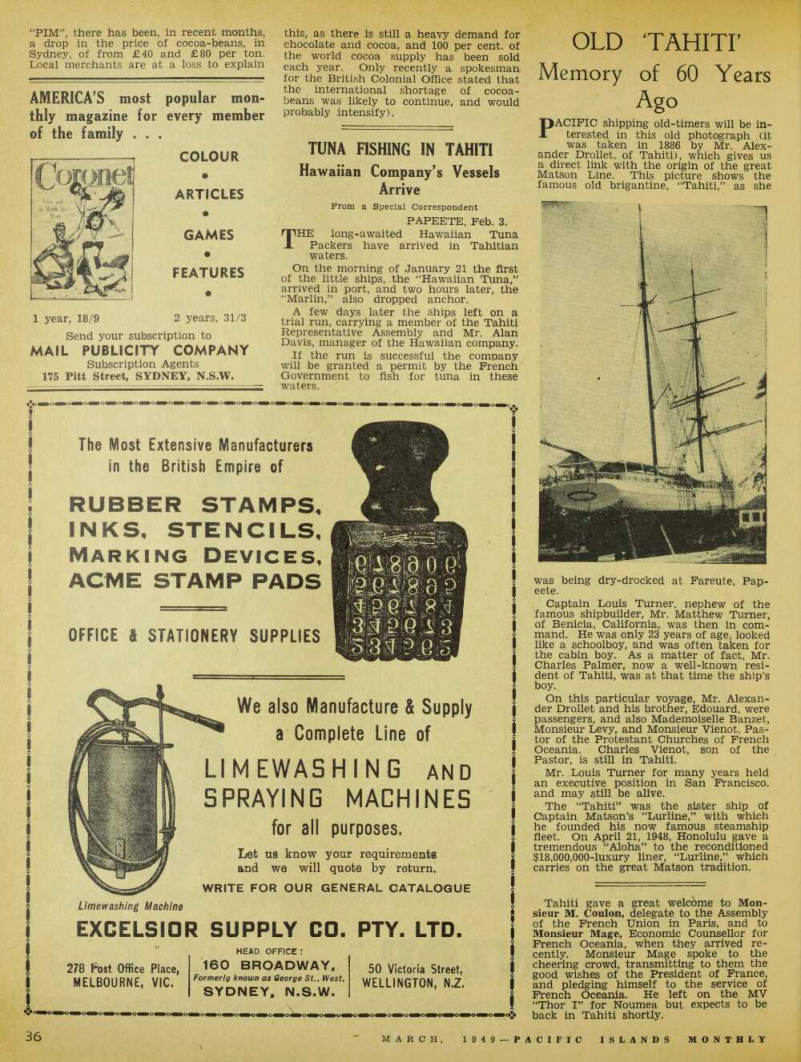
Shocks Western Samoa
From Our Owr Correspondent
Apia, Feb. 10.
CONTRARY to predictions, based on world shortage of cocoa-beans and increased world demand for cocoa and chocolate, the price of Samoan cocoa-beans has declined rapidly in the last two months.
The price of beans, fob Apia, just prior to the appreciation of the New Zealand £ in September, was £2BO. After the alteration of the exchange it was £220 Stg. per ton. This price was maintained until November, 1948, but by February, this year, the price had dropped to £lOO Stg., fob Apia, and some buyers who had bought from producers at higher rates were facing considerable losses.
A few buyers who are still working on old overseas contracts have succeeded in disposing of small lots from £l9O down to £ 150 per ton. Another gleam of hope, in an otherwise depressing situation, is that there have been many inquiries from countries which have previously not had allocations from the International Food Control Board, in Washington, to whom the bulk of Samoan cocoa goes. Sale of Western Samoa cocoa to the United States has been a great dollar-spinner but now local buyers are making efforts to get the Board to agree to sales to those countries ready to pay a higher price.
Fortunately Western Samoa has recently made a 10 years’ contract agree
ment with the United Kingdom for the supply of copra, thereby stabilising that industry. But, nonetheless, it is inevitable that the sudden slump in local cocoa prices must affect the economy of the Territory and doubts have already been expressed as to whether we will be able to carry out the elaborate schemes of road-building, education, hydro-electricity, e tc.
It has always been realised that the prices obtained for Western Samoan cocoa in recent years were abnormal; but no one believed that the drop would come so suddenly or so sharply, at this stage, when production has by no means caught up with demand. The real reason for the slump—which is contrary to all natural laws of supply and demand —is a mystery to local cocoa interests. There is a belief in some quarters that American buyers are forcing down the price of Samoa cocoa in order to resell it at a substantial profit in Europe. (Editorial Note: There has been a world-wide drop in cocoa prices—Western Samoa is by no means the only sufferer.
As we reported in the February issue of
“PIM”, there has been, in recent months, a drop in the price of cocoa-beans, in Sydney, of from £4O and £BO per ton.
Local merchants are at a loss to explain
this, as there is still a heavy demand for chocolate and cocoa, and 100 per cent, of the world cocoa supply has been sold each year. Only recently a spokesman for the British Colonial Office stated that the international shortage of cocoa beans was likely to continue, and would probably intensify).
Advertisements & other items, pp. 37-38 (1 item)
Direct
LONDON-SUVA
VIA
PANAMA
For Sailings and Further Particulars Apply To: — BETHELL, GWYN & CO., BURNS, PHILP (SOUTH SEA) 138 LEADENHALL ST., CO -» LTD -»
LONDON, E.C.3. SUVA.
Vt, c
/ Dunlop sporting equipment enjoys worldwide popularity amongst ail players of sport. You can be sure, always, of getting the best products of their kind available when you specify Dunlop Tennis Rackets, Tennis Balls, Sports Shoes, Golf Balls and Bowls.
They're still difficult to obtain but keep asking for the Dunlop Brand.
m‘so
WfMA
■■ i 5 ...
0 dunlop t
J&\ lL
mm ** D. 443
DUNLOP ihs Onduit^
AMERICA’S most popular monthly magazine for every member of the family . . .
mmml
COLOUR
ARTICLES
GAMES
FEATURES
1 year, 18/9 2 years, 31/3 Send your subscription to
MAIL PUBLICITY COMPANY
Subscription Agents 175 Pitt Street, SYDNEY, N.S.W.
Tuna Fishing In Tahiti
Hawaiian Company’s Vessels Arrive
From a Special Correspondent
Papeete, Feta. 3.
THE long-awaited Hawaiian Tuna Packers have arrived in Tahitian waters.
On the morning of January 21 the first of the little ships, the “Hawaiian Tuna,” arrived in port, and two hours later, the “Marlin,” also dropped anchor, A few days later the ships left on a trial run, carrying a member of the Tahiti Representative Assembly and Mr. Alan Davis, manager of the Hawaiian company.
If the run is successful the company will be granted a permit by the French Government to fish for tuna in these waters.
Old Tahiti'
Memory of 60 Years Ago
PACIFIC shipping old-timers will be in terested in this old photograph (it was taken in 1886 by Mr. Alex ander Drollet, of Tahiti), which gives us a direct link with the origin of the great Matson Line. This picture shows the famous old brigantine, “Tahiti,” as she
was being dry-drocked at Fareute, Pap eete.
Captain Louis Turner, nephew of the famous shipbuilder, Mr. Matthew Turner, of Benicia, California, was then in com mand. He was only 23 years of age, looked like a schoolboy, and was often taken for the cabin boy. As a matter of fact, Mr.
Charles Palmer, now a well-known resi dent of Tahiti, was at that time the ship’s boy.
On this particular voyage, Mr. Alexan der Drollet and his brother, Edouard, were passengers, and also Mademoiselle Banzet, Monsieur Levy, and Monsieur Vienot, Pas tor of the Protestant Churches of French Oceania. Charles Vienot, son of the Pastor, is still in Tahiti.
Mr. Louis Turner for many years held an executive position in San Francisco, and may still be alive.
The “Tahiti” was the sister ship of Captain Matson’s “Lurline,” with which he founded his now famous steamship fleet. On April 21, 1948, Honolulu gave a tremendous “Aloha” to the reconditioned $18,000,000-luxury liner, “Lurline,” which carries on the great Matson tradition.
Tahiti gave a great welcome to Mon sieur M. Coulon, delegate to the Assembly of the French Union in Paris, and to Monsieur Mage, Economic Counsellor for French Oceania, when they arrived re cently. Monsieur Mage spoke to the cheering crowd, transmitting to them the good wishes of the President of Prance, and pledging himself to the service of French Oceania. He left on the MV “Thor I” for Noumea but expects to be back in Tahiti shortly.
Advertisements & other items, p. 38 (1 item)
Limewashing And
The Most Extensive Manufacturers in the British Empire of
RUBBER STAMPS,
INKS, STENCILS,
Marking Devices,
ACME STAMP PADS
OFFICE & STATIONERY SUPPLIES
We also Manufacture & Supply a Complete Line of
LIMEWASHING AND
SPRAYING MACHINES
for all purposes.
Let us know your requirements and we will quote by return.
WRITE FOR OUR GENERAL CATALOGUE
Limewashing Machine
EXCELSIOR SUPPLY CO. PTY. LTD.
278 Post Office Place,
MELBOURNE, VIC.
HEAD OFFICE :
160 BROADWAY,
Formerlu known as George St., West,
SYDNEY, N.S.W.
50 Victoria Street,
WELLINGTON, N.Z.
Noted Tahiti Residents
Visit New Zealand
From a Special Correspondent
Papeete, Feb. 3.
THE British steamer, SS “Marabank,” chartered by the British Phosphate Commission, called at Papeete on January 30 to embark Captain R. J.
Owen, who, two months previously, had been landed from the same ship suffering with severe burns, sustained from an acci dent aboard the vessel while 3QO miles out at sea.
Several local people took this oppor tunity to go to New Zealand. Among them were Miss Colette Walker, daughter of a former British Vice-Consul, Mr. L. G.
Blackie, Monsieur Gaston Montarpn, Mr.
Henrix Spitz, and Commandant Pierre Mariotti.
Commandant Pierre Mariotti .toined General de Gaulle’s forces early in the war and was decorated with the Military Cross.
Monsieur Mariotti was also in the North African landing, and was then sent to Tahiti as Commandant of the Navy, in charge of the French gunboat, “Chev reuil.” Later he commanded the French Naval Base at New Caledonia, working closely with the Australian and American forces.
From New Zealand Monsieur Mariotti is going to the New Hebrides to look after his timber interests.
At All Saint’s Church, Woollahra, Syd ney on February 21, Miss Nan Otto was married to Mr. Michael Townsend of the Gilbert and Ellice Islands Administration.
Mr. Charles Friend, also of the G & E Administration acted as best man at the wedding.
No Tea Seed For New Guinea Venture
New Guinea Venture
SYDNEY tea merchants report that advices from overseas make it clear that the scarcity of tea-seed presents the greatest obstacle, at present, to open ing up new tea-growing areas. The es tablished tea growing countries regard the industry as their own close preserve.
Suitable tea. country is available in East Africa: but export of seed thereto has been prohibited by India, Ceylon and the Netherlands East Indies since the East African territories withdrew from the International Tea Agreement in 1947.
The Australian government engaged a tea expert from India to inspect likely growing areas in New Guinea but the same trouble over seed developed there.
The expert decided that Aiyura, in the New Guinea Central Highlands, was the most suitable locality for growing high grade tea.
But the governments of both India and Ceylon refused to make seed available.
Unless they can be persuaded to modify their restrictions there seems little likeli hood of the industry becoming firmly established in New Guinea.
As far as Aiyura is concerned, lab(pur and transport would be added difficulties.
Tea could be grown in the more acces ;<lble, low-land areas of New Guinea but it would not be of good quality.
IT may be recalled that a similar diffi culty developed in New Guinea nearly 20 years ago, when Agriculture Director George Murray wanted to try out the Cinchona plant (source of quinine) on the highlands. The Netherlands Indies folk, who held the auinine monopoly, resolutely refused to let any Cinchona
seed leave the East Indies; and Mr.
Murray finally had to resort to cunning.
He was in Singapore; and he went across to Java and somehow got a handful of seed. His account of how he smuggled the seed out, and his joy in the achieve ment, made an amusing story. That seed, tenderly cherished, is the origin of the Cinchona plantations on the Ramu tablelands to-day. But they do not matter so much now: science, in its war against malaria, is by-passing quinine.
Advertisements & other items, pp. 39-40 (1 item)
Alois Akun & Co.
KANGAROO BRAND
Ropes,
Cordage,
and Twines for every purpose Backed by 86 years of service Manufactured by:
M. DONAGHY AND SONS,
Pty. Ltd., Geelong and Sydney.
Fiji Representatives:
PEARCE AND CO.
LIMITED
P.O. BOX 237, SUVA
ALOIS AKUN & CO.
RABAUL, NEW GUINEA
Also Branch At 180 NATHAN RD,, KOWLOON, HONG KONG
Planters, Shipowners and General Merchants
Dealers in EMBROIDERED SILKWEAR—CARVED CAMPH. BOXES—
EASTERN FANCY GOODS
TRADE GOODS SPECIALISTS : : Wholesale Retail Prompt Attention To All Orders Telephone: 136, Telegram: Aloisakun Sydney Representatives: NELSON & ROBERTSON PTY., LTD., Electra House, 12 Spring St., Sydney, N.S.W.
An ornate example of historical
keys, this XVlth Century
French key features the sporting motif in its club and animal carvings. It seems to have been the key to a Duke’s country
lodge.
4 S' —Jj BP
A P|s!.T/A
The key
to smoking pleasure
FINE CUT
NAVY CUT
TOBACCOS
or
Late Sir Hubert
Murray
£248 In a Memorial Fund
RECENTLY, we received from abroad an inquiry concerning a fund, col lected before the war, wherewith to commemorate the worth of the late Sir Hubert Murray, Administrator of Papua.
We referred the matter to Mr. E. A.
James, of Port Moresby, who replied in February as follows: Sometime in 1941, at the instance of certain residents of Papua, a fund was started to raise money suitably to com memorate the work- of the late Sir Hubert Murray, in Papua. Mr. Tom Nevitt and I were nominated trustees, and, for the sake of convenience only, “The Papuan Courier” office acted as collectors.
No form of memorial was decided upon, it being suggested subscribers later should express their opinions on this when an idea of the amount available could be formed.
Came the war and the evacuation of civilians in February, 1942. The fund was halted. All records of the fund were lost, and moneys then collected were on fixed deposit at the bank. In Sydney, Mr. Nevitt and I ascertained the position of the fund, purchased War Savings Cer tificates and lodged them with the Bank of N, S. Wales, Sydney, in k our joint names.
Since their return to Papua the Trus tees have been somewhat at a loss to know how best to carry out the wishes of the subscribers; and for some time
now have been in communication with the Administration, with the view to ob taining their advice and co-operation in the matter. It is hoped some decision may be arrived at in the near future.
Up to 31st January, 1942, the amount collected for the fund was £196/0/6, to which was added Interest, etc., £2/7/6, totalling £l9B/8/-, which sum purchased War Savings Certificates having a face value of £248. The latest of these mature during the present year, whilst those already matured continue to earn interest.
of Papua
Death of Mr. Victor Poole, of Papua
THE death has been announced of Mr.
Victor Poole, in Papua, on January 30.
Mr. Poole was a Queenslander, born in Chartres Towers, about 60 years ago. He went to Papua first in 1908, as book-keeper for the now defunct Kulumadau Mine, on Woodlark Island. His brother was manager of the mine at that time.
Several years later he resigned to join the Papuan Government as a Customs officer and, later, he went to the Trob riands as a pearl trader. Except for the Pacific war years, when he was in Towns ville, he remained in the Trobriands for the rest of his life.
His passing is regretted by all Papuans, by whom he was held in high regard.
The Messageries Maritime steamer, “Commandant Dorise,” left Tahiti for Marseilles on January 29, carrying 5,000 tons of local copra. Among her few pas sengers were the Rev. Fr. J. F. Morvan, Brother Charles Gendron and Monsieur Japy.
Advertisements & other items, pp. 41-42 (1 item)
golden links...
OVERSEAS MAGAZINES
Direct to You from th* Publishers.
American:
CHARM S2/6
COLLIERS WEEKLY 607-
CORONET 18/9
ESQUIRE 757-
HARPER’S BAZAAR 757-
LADIES’ HOME JOURNAL 37/6
LlFtf 497-
LOOK 39/-
POPULAR MECHANICS 28/3
READERS’ DIGEST 12/-
SATURDAY EVENING POST 68/9
SCIENTIFIC AMERICAN 52/6
TIME 967-
VOGUE 1057-
YACHTING 40/-
English:
APOLLO 52/6
COURIER 50/6
PICTURE POST 27/6
PUNCH 46/3
TATLER 1227-
TIMES WEEKLY 38/-
Rates are for one year and include all charges. Many other overseas periodicals available on all subjects.
ALL ORDERS AIR-MAILED TO
PUBLISHERS.
MAIL PUBLICITY CO., 175 PITT
STREET, SYDNEY, N.S.W.
& $ o s* * 0 N o* & & & L\o * & vs ft sK Jp » rich \0 v* ,\0 & o x M & .0 <&
golden links...
with A u strati# -s
Export Trade
In the profitable and growing island trade of Australian products, our four specialised divisions offer you a complete, efficient and thoroughly up-to-the-minute service. We handle all types of Australian merchandise, including our own outstanding brands—CORONET, BANQUET, SEVEN CROWN, CAPTAIN KIDD (WINES, SPIRITS and LIQUEURS); SUNBLOOM, CAVALIER, CAVCO, C.A.V. FOOD PRODUCTS; CAKEX FLAVOURING ESSENCE; and CAVALIER EUCALYPTUS DISINFECTANTS, CLEANERS, INSECT SPRAYS, LIQUID SOAPS, etc.
Your orders or enquiries will receive prompt and expert attention.
Cable and Telegraphic Address: “Retlaw,”
Sydney. Codes: A. 8.0. sth Edition, Western Union, Bentley,
ATLAS MERCANTILE EXPORT CO. PTY. LTD.
(SUBSIDIARY TO WALTER CAVILL PTY. LTD. Wine, Spirit and General Merchants and Manufacturers)
377 SUSSEX STREET, SYDNEY, AUSTRALIA
PACIFIC ISLANDS SOCIETY
Visitors from the Islands to Sydney (or those interested In Islands affairs), are advised to communicate with the honorary secretary of the above Society, which has been formed to study the history, traditions, economics, and political developments of the Pacific Islands.
Regular monthly meetings are hold at History House, 8 Young Street, Sydney.
Address for Correspondence:
THE PACIFIC ISLANDS SOCIETY,
Box 3484 MM., G.P.0., Sydney.
Information Wanted
INFORMATION about that picturesque Torres Strait identity of forty or fifty years ago, Nicholas, “The Greek,” is sought by Mr. Malcolme Forbes, 10808— 24th Avenue, NE, Seattle 55, Washington, USA. Mr. Forbes was an American ser viceman who served in the Pacific War and he now is writing articles and stories about the South Pacific Islands for Ameri can publications.
Anyone who can give him authentic information about Nicholas should write direct to Mr. Forbes at the address given.
Biological Control Of Pests
In Fiji
BIOLOGICAL control of agricultural pests in Fiji has been highly suc cessful for four main reasons: warm, relatively non-seasonable climate which permits almost uninterrupted breeding of parasites throughout the year; isolation by the Pacific Ocean from other coun tries; indigenous fauna is relatively poor; the main crops are few in number, there by ensuring better organisation.
Outstanding examples of biological control of insect pests in the Colony are the Malayan fly (Ptychomyia remota) against purple coconut moth; the Trina dad ladybird against the coconut scale insect; the wasp (Apanteles tirathabae) and the fly (Erycia basifulva), both from Java, against the spike borer; another Javan wasp against the leaf miner; and, finally, the beetle (Plaesius javanus)— again from Java—against the banana weevil.
These are all examples of introducing insects to check other insects. However checking noxious weeds by introduced in sects is also, of course, possible but presents greater difficulties.
As long ago as 1910 the Mexican seed fly was introduced into Fiji to combat lantana; in 1930, another insect, from Trinadad, was brought in to check Roster’s Curse. The introduction of the South American moth, Cactoblastis cactorum, into Queensland to combat prickly pear, and its almost miraculous success, is one of the most famous ex amples of noxious weed control by in sects.
Some of the factors that must be taken into consideration, however, before an in sect is introduced to kill weeds, are as follows: • The weed to be attacked must be botanically distant from economic plants so that any pests of the former will not be attracted to the latter. For example, the weed Solanum torvum is related to the potato and tomato and any insect that is attracted to the weed will also be attracted to the tomato and potato. • Exhaustive testing under strict quarantine must be undertaken to find out what economic plans, unrelated to the weed, are likely to be attacked as well as the weed. • The need for the habits of weed and insect to coincide. For example, the in sect’s egg-laying must coincide with the flowering of the weed. • Whether or not the weed-attacking insect may be attacked itself, in its new home, by indigenous parasites or by those already established. —Adapted from the Fiji Department of Agriculture Bulletin No. 23.
Death Of Lieut. Jean
Gilbert
Prom Our Own Correspondent t
Papeete. Feb. 3.
ONE of our most respected citizens, Lieutenant Jean Gilbert, was laid to rest on January 23. He was 57.
He volunteered for World War I and was captured by the enemy. In 1919, he joined the 22nd RIC of the Army of the Levant, where he was transferred to the 2nd Camel Corps of the Syrian Legion.
In 1925 he arrived in Tahiti, which he grew to love as his mother countrv. He retired in 1937, and became a lanjj! sur veyor. In 1939 he again answered his country’s call and served in Libya.
Advertisements & other items, p. 42 (1 item)
imperial
cct
MENU
ol 8
FOODS
9 Corned Bee? • Hampe , Luncheon PorV • r ‘ m n-
tSSftK*
* BeetS+eaVPuddmg
* Braised Beef Steak Steak and Kidney Pudding Sausages and Vegetables Bacon Rashers Irish Stew |““S. r«““ , Beef Sausages 1 Pork Sausages * Oxford Sausages \ Vienna Sausages Tomato Soup Dripping i . . All A
sir: ’: aa
" . . n no |iw prices on appl^ fion
ALL
fO;
imperial
CANNED FOODS
ARE FLAVOUR-SEALED!
\Z Imperial goods are prepared from prime selected stock by the largest meat-processing organisation in Australia. You can be sure of top-quality when you order "Imperial."
RIVERSTONE MEAT CO.
PTY. LTD.
5-7 O'Connell Street, Sydney.
Fiji Representative: Pearce & Co. Ltd.. Suva.
Magazine Section
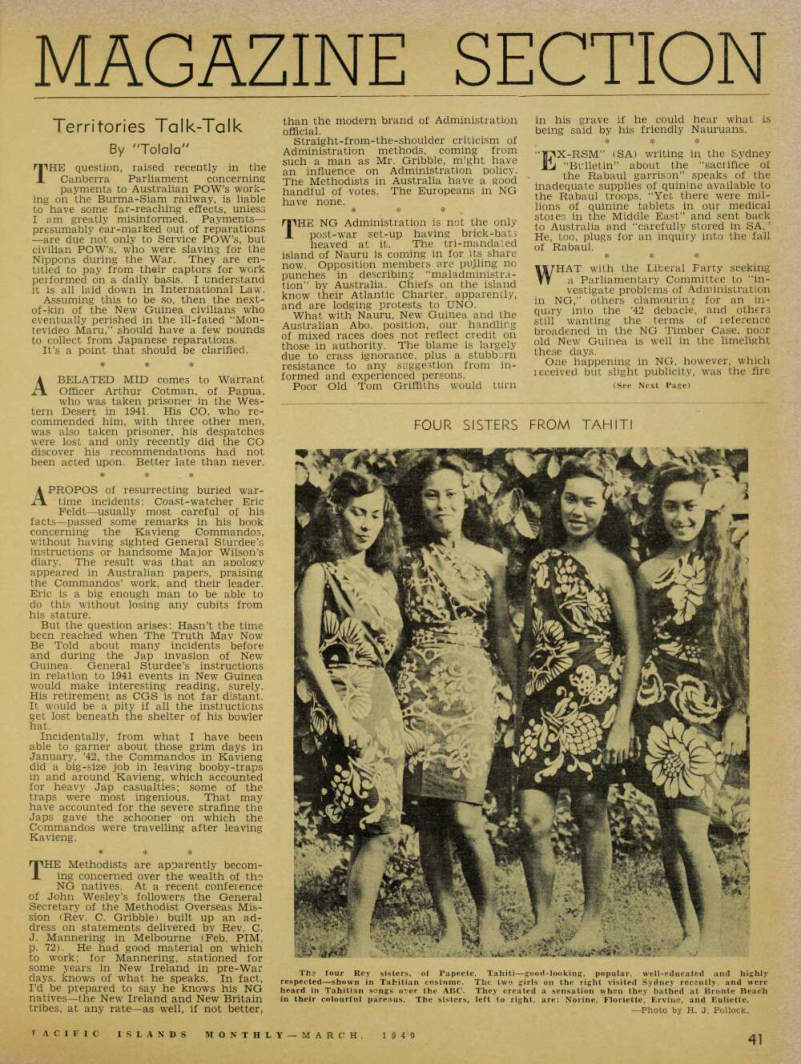
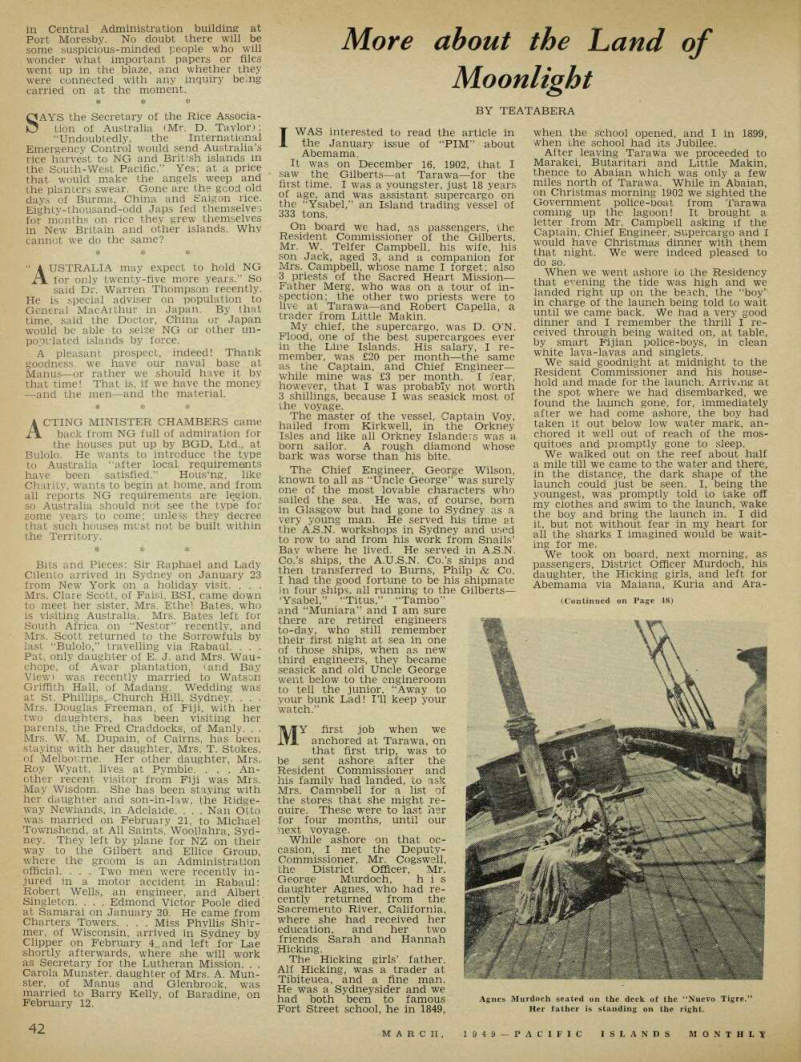
Territories Talk-Talk
By "Tolda"
THE question, raised recently in the Canberra Parliament concerning payments to Australian POW’s work ing on the Burma-Siam railway, is liable to have some far-reaching effects, unless I am greatly misinformed. Payments— presumably ear-marked out of reparations —are due not only to Service POW’s, but civilian POW’s, who were slaving for the Nippons during the War. They are en titled to pay from their captors for work peiformed on a daily basis. I understand it is all laid down in International Law.
Assuming this to be so, then the next of-kin of the New Guinea civilians who eventually perished in the ill-fated “Mon tevideo Maru,” should have a few pounds to collect from Japanese reparations.
It’s a point that should be clarified. ♦ * * A BELATED MID comes to Warrant Officer Arthur Cotman, of Papua, who was taken prisoner in the Wes tern Desert in 1941. His CO, who re commended him, with three other men, was also taken prisoner, his despatches were lost and only recently did the CO discover his recommendations had not been acted upon. Better late than never. * * * A PROPOS of resurrecting buried war time incidents: Coast-watcher Eric Feldt—usually most careful of his facts —passed some remarks in his book concerning the Kavieng Commandos, without having sighted General Sturdee’s instructions or handsome Major Wilson’s diary. The result was that an apology appeared in Australian papers, praising the Commandos’ work, and their leader.
Eric is a big enough man to be able to do this without losing any cubits from his stature.
But the question arises: Hasn’t the time been reached when The Truth May Now Be Told about many incidents before and during the Jap invasion of New Guinea. General Sturdee’s instructions in relation to 1941 events in New Guinea would make interesting reading, surely.
His retirement as CGS is not far distant.
It would be a pity if all the instructions get lost beneath the shelter of his bowler hat.
Incidentally, from what I have been able to garner about those grim days in January, ’42, the Commandos in Kavieng did a big-size job in leaving booby-traps in and around Kavieng, which accounted for heavy Jap casualties; some of the traps were most ingenious. That may have accounted for the severe strafing the Japs gave the schooner on which the Commandos were travelling after leaving Kavieng. * * * THE Methodists are apparently becom ing concerned over the wealth of the NG natives. At a recent conference of John Wesley’s followers the General Secretary of the Methodist Overseas Mis sion (Rev. C. Gribble) built up an ad dress on statements delivered by Rev. C.
J. Mannering in Melbourne (Feb. PIM, p. 72). He had good material on which to work; for Mannering, stationed for some years in New Ireland in pre-War days, knows of what he speaks. In fact, I’d be prepared to say he knows his NG natives—the New Ireland and New Britain tribes, at any rate—as well, if not better,
than the modern brand of Administration official.
Straight-from-the-shoulder criticism of Administration methods, coming from such a man as Mr. Gnbble, might have an influence on Administration policy.
The Methodists in Australia have a good handful of votes. The Europeans in NG nave none. + T,,„ A ~.. ‘ ' ~, , HE NG Administration is not the only post-war set-up having brick-bati heaved at it. The tn-mandated island of Nauru is coming in for Its share now. Opposition members are pulling no HoS” bv Australia 1 ChiefsTn a t{?e“fand knew tLir Atlantic Charter apparently and are lodging protests to UNO. ’
What with Nauru. New Guinea and the Australian Abo. position, our handling of mixed races does not reflect credit on those in authority. The blame is largely due to crass ignorance, plus a stubborn resistance to any suggestion from informed and experienced persons.
Poor Old Tom Griffiths would turn
in his grave if he could hear what is being said by his friendly Nauruans. * * * EX-RSM” (SA) writing in the Sydney “Bulletin” about the “sacrifice of the Rabaul garrison” speaks of the inadequate supplies of quinine available to the Rabaul troops. “Yet there were mil lions of quinine tablets in our medical stores in the Middle East” and sent back to Australia and “carefully stored in SA. ’
He, too, plugs for an inquiry into the fall of Rabaul. ♦ * *.
WHAT with the Liberal Party seeking a Parliamentary Committee to “in vestigate problems of Administration in NG,” others clamouring for an in quiry into the ’42 debacle, and others still wanting the terms of reference broadened in the NG Timber Case, poor old New Guinea is well in the limelight these days.
One happening in NG. however, which received but slight publicity, was the fire (See Next Page)
Four Sisters From Tahiti
Tb; four Rey sisters, of Papeete, Tahiti—good-looking, popular, well-educated and highly respected—shown in Tahitian costume. The two girls on the right visited Sydney recently, and were heard in Tahitian songs over the ABC. They created a sensation when they bathed at Bronte Beach in their colourful pareaus. The sisters, left to right, are: Norine, phoriette, Ervine, and Euliette.
Photo by H. J. Pollock.
in Central Administration building at Port Moresby. No doubt there will be some suspicious-minded people who will wonder what important papers or files went up in the blaze, and whether they were connected with any inquiry being carried on at the moment. * * * SAYS the Secretary of the Rice Associa tion of Australia (Mr. D. Taylor); “Undoubtedly, the International Emergency Control would send Australia’s rice harvest to NG and British islands in the South-West Pacific.” Yes; at a price that would make the angels weep and the planters swear. Gone are the good old days of Burma, China and Saigon rice.
Eighty-thousand-odd Japs fed themselves for months on rice they grew themselves in New Britain and other islands. Why cannot we do the same? * * * AUSTRALIA may expect to hold NG for only twenty-five more years.” So said Dr. Warren Thompson recently.
He is special adviser on population to General MacArthur in Japan. By that time, said the Doctor, China or Japan would be able to seize NG or other un populated islands by force.
A pleasant prospect, indeed! Thank goodness, we have our naval base at Manus —or rather we should have it by that time! That is, if we have the money —and the men—and the material. * sK * Acting minister chambers came back from NG full of admiration for the houses put up by BGD, Ltd., at Bulolo. He wants to introduce the type to Australia “after local requirements have been satisfied.” Housing, like Charity, wants to begin at home, and from all reports NG requirements are legion, so Australia should not see the type for some years to come; unless they decree that such houses must not be built within the Territory. * * * Bits and Pieces: Sir Raphael and Lady Cilento arrived in Sydney on January 23 from New York on a holiday visit. . . .
Mrs. Clare Scott, of Faisi, BSI, came down to meet her sister, Mrs. Ethel Bates, who is visiting Australia. Mrs. Bates left for South Africa on “Nestor” recently, and Mrs. Scott returned to the Sorrowfuls by last “Bulolo,” travelling via Rabaul. . . .
Pat, only daughter of E. J. and Mrs. Wau chope, of Awar plantation, (and Bay View) was recently married to Watson Griffith Hall, of Madang. Wedding was at St. Phillips, Church Hill, Sydney. . . .
Mrs. Douglas Freeman, of Fiji, with her two daughters, has been visiting her parents, the Fred Craddocks, of Manly. . .
Mrs. W. M. Dupain, of Cairns, has been staying with her daughter, Mrs. T. Stokes, of Melbourne. Her other daughter, Mrs.
Roy Wyatt, lives at Pymbie. . . . An other recent visitor from Fiji was Mrs.
May Wisdom. She has been staying with her daughter and son-in-law, the Ridge way Newlands, in Adelaide. . . . Nan Otto was married on February 21, to Michael Townshend, at All Saints, Woollahra, Syd ney. They left by plane for NZ on their way to the Gilbert and Ellice Group, where the groom is an Administration official. . , . Two men were recently in jured in a motor accident in Rabaul: Robert Wells, an engineer, and Albert Singleton. . . . Edmond Victor Poole died at Samarai on January 30. He came from Charters Towers. . . . Miss Phyllis Shir mer, of Wisconsin, arrived in Sydney by Clipper on February 4„and left for Lae shortly afterwards, where she will work as Secretary for the Lutheran Mission. . .
Carola Munster, daughter of Mrs. A. Mun ster, of Manus and Glenbrook, was married to Barry Kelly, of Baradine, on February 12.
Moonlight
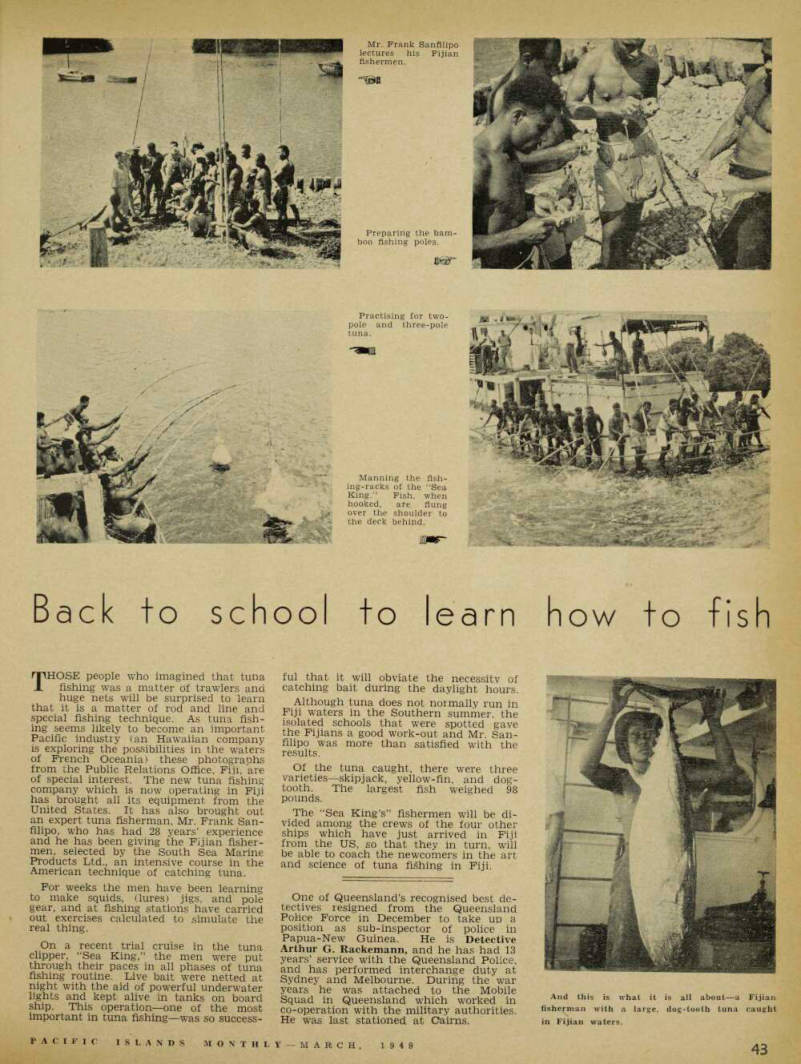
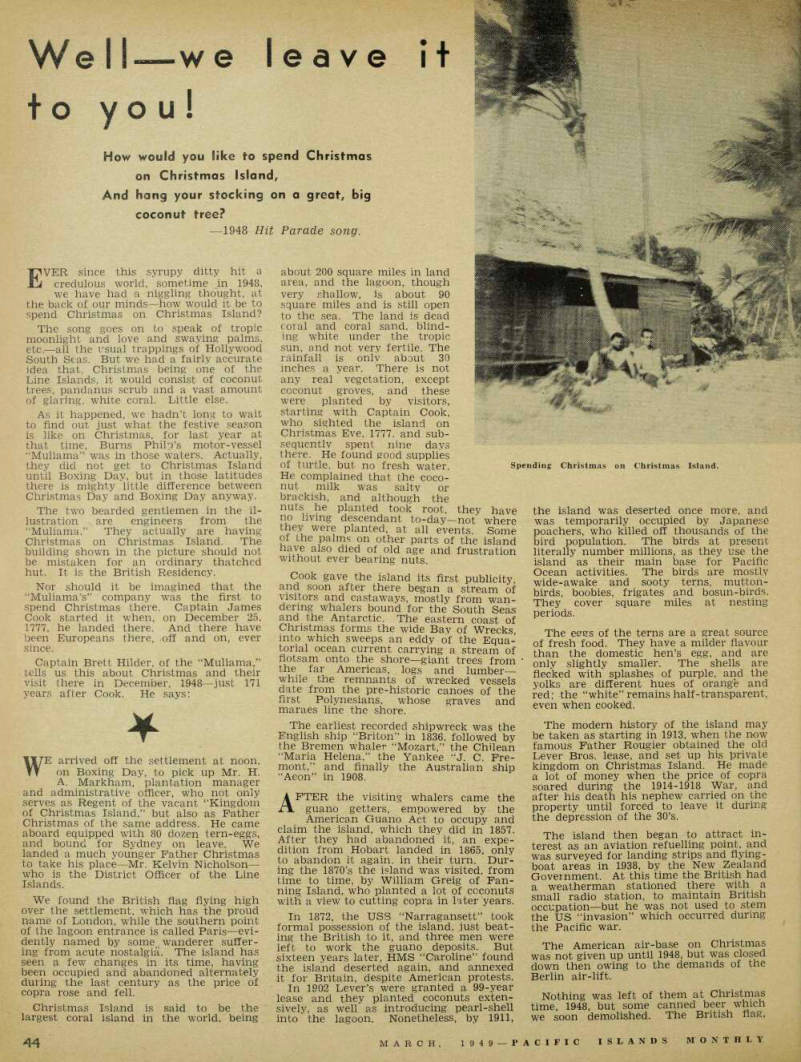
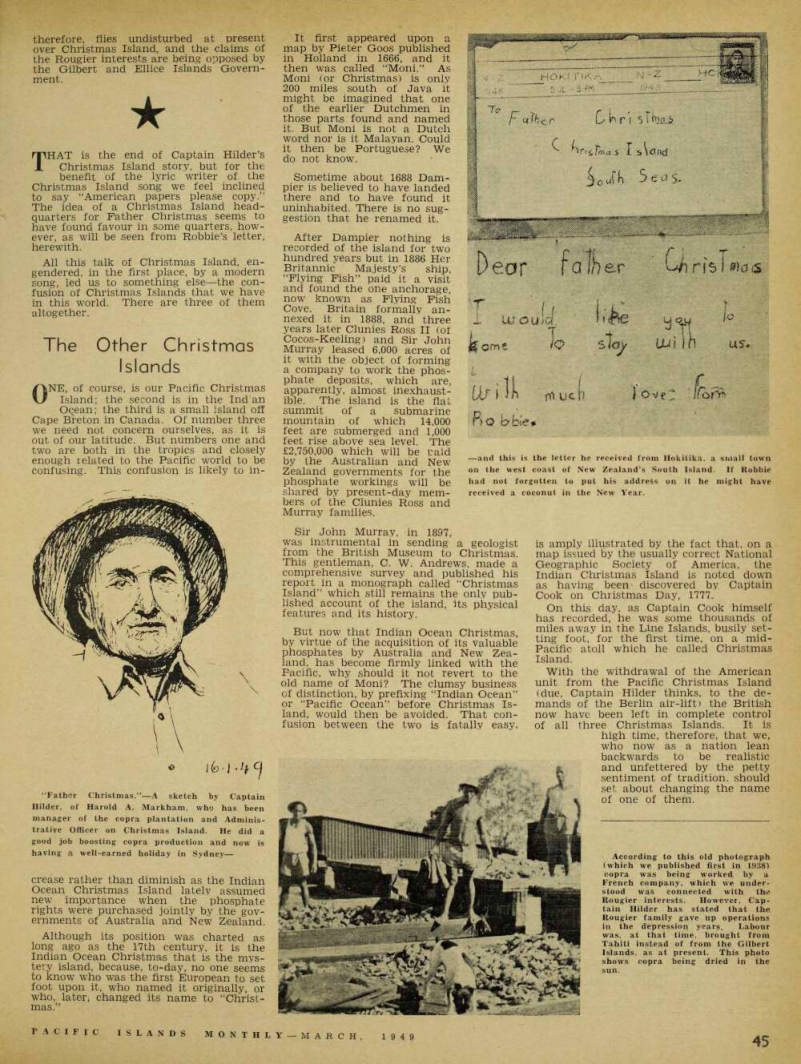
More about the Land of Moonlight
By Teatabera
IWAS interested to read the article in the January issue of “PIM” about Abemama.
It was on December 16, 1902, that I saw thq Gilberts —at Tarawa —for the first time. I was a youngster, just 18 years of age, and was assistant supercargo on the “Ysabel,” an Island trading vessel of 333 tons.
On board we had, as passengers, the Resident Commissioner of the Gilberts, Mr. W. Telfer Campbell, his wife, his son Jack, aged 3, and a companion for Mrs. Campbell, whose name I forget; also 3 priests of the Sacred Heart Mission — Father Merg, who was on a tour of in spection; the other two priests were to live at Tarawa —and Robert Capella, a trader from Little Makin.
My chief, the supercargo, was D. O’N.
Flood, one of the best supercargoes ever in the Line Islands. His salary, I re member, was £2O per month—the same as the Captain, and Chief Engineer— while mine was £3 per month. I fear, however, that I was probably not worth 3 shillings, because I was seasick most of the voyage.
The master of the vessel, Captain Voy, hailed from Kirkwell, in the Orkney Isles and like all Orkney Islanders was a born sailor. A rough diamond whose bark was worse than his bite.
The Chief Engineer, George Wilson, known to all as “Uncle George” was surely one of the most lovable characters who sailed the sea. He was, of course, born in Glasgow but had gone to Sydney as a very young man. He served his time at the A.S.N. workshops in Sydney and used to row to and from his work from Snails’
Bay where he lived. He served in A.S.N.
Co.’s ships, the A.U.S.N. Co.’s ships and then transferred to Burns, Philp & Co.
I had the good fortune to be his shipmate in four ships, all running to the Gilberts —
‘Ysabel," “Titus,” “Tambo” and “Muniara” and I am sure there are retired engineers to-day, who still remember their first night at sea in one of those ships, when as new third engineers, they became seasick and old Uncle George went below to the engineroom to tell the junior. “Away to your bunk Lad! I’ll keep your watch.”
MY first job when we anchored at Tarawa, on that first trip, was to be sent ashore after the Resident Commissioner and his family had landed, to ask Mrs. Camobell for a list of the stores that she might re quire. These were to last her for four months, until our next voyage.
While ashore on that oc casion, I met the Deputy- Commissioner, Mr. Cogswell, the District Officer, Mr.
George Murdoch, h i s daughter Agnes, who had re cently returned from the Sacremento River, California, where she had received her education, and her two friends; Sarah and Hannah Kicking.
The Kicking girls’ father, Alf Kicking, was a trader at Tibiteuea, and a fine man.
He was a Sydneysider and we had both been to famous Fort Street school, he in 1849,
when the school opened, and I in 1899, when the school had its Jubilee.
After leaving Tarawa we proceeded to Marakei, Butaritari and Little Makin, thence to Abaian which was only a few miles north of Tarawa. While in Abaian, on Christmas morning 1902 we sighted the Government police-boat from Tarawa coming up the lagoon! It brought a letter from Mr * Campbell asking if the Captain, Chief Engineer, supercargo and I would have Christmas dinner with them ’***■ We indead P leased t 0 When we went a <*”e to the Residency that evening the tide was high and we anded righ ' d P , on the beach the “boy' ln charge of the launch being told to wait antll we came back. We had a very good dinner and I remember the thrill I re
ctean
* w wf : a Y a +v, o W 0 ScilQ. §OOQ.riloht to the Resident Commissioner and his house and m l^ de for the launch. Arrivmg at the spot where we had disembarked, we found the launch gone, for, immediately after we had come ashore, the boy had taken it out below low water mark, an chored it well out of reach of the mos quitoes and promptly gone to sleep, We walked out on the reef about half a mile till we came to the water and there, in the distance, the dark shape of the launch could just be seen. I, being the youngest, was promptly told to take off my clo thes and swim to the launch, wake the bov and brina the launch in I did
it without Tear inmy heart SS
f“ '% s i!| rks 1 imagined would 06 wait- We took on board, next morning, as passengers, District Officer Murdoch, his dauehter the Kicking girls and left for Abemama via Maiana Kuria and Ara- Abemama Vla Maiana, Kuna and Ara
(Continued on Page 48)
Agnes Murdoch seated on the deck of the “Nuevo Tigre.”
Her father is standing on the right.
Mr. Frank Sanfllipo Lectures his Fijian fishermen.
Preparing the bam boo fishing poles.
Practising for two pole and three-pole tuna.
Manning the fish ing-racks of the “Sea King," Fish, when hooked, are flung over the shoulder to the deck behind.
nuka, arriving at Abemama on New Year’s morning 1903. During that day a west erly gale, for which the Gilberts are noted, sprang up and we lay in the lagoon six days before we could attempt to take any copra aboard.
Abemama has very many happy mem ories for me. Tern Binoka was the “king” there for a long time but his son Paul was “King” during the 12 years I spent trading the Gilberts. The chief native Magistrate was Ten Teinoa, one of the most likeable and aristocratic natives one could meet.
JN January, 1908, there were anchored in Abemama two schooners, the “Laurel” from Fiji, in charge of Cap tain Malcolm, and the “Louise J. Kenny,” in charge of Captain Handley (who, dur ing the recent war was brutally murdered at Betio by the Japanese). To their surprise, one morning, they saw the masts of a small schooner, which was apparently ashore on the weather reef. Upon in vestigation this proved to be the'“Nuevo Tigre,” a schooner which started her voyage from Callao and was bound south for Valparaiso. The two men who were on the schooner, it was subsequently proved, had murdered the rest of the crew, taken the schooner, and set sail westward
with the intention of making Queensland.
On the voyage they changed the name irom “Nuevo Tigre” to “White Rose.”
Their story has been told before but it is interesting to note that Captain Handley, acting under instructions from Teinoa, the native magistrate, took the two men whose names were Mortelmans and Skerrett, to Tarawa, the seat of Govern ment and handed them over to Mr.
George Murdoch, who was acting as Chief of Police. He arrested them as pirates.
On my arrival at Tarawa, in the “Muni ££ a »’ °f which ship I was then supercargo, the Resident Commissioner, commissioned me to take the Deputy-Commissioner and che two prisoners to Abemama to Pick up some evidence from the “Nuevo ‘Tigre,” thence on to Suva to the High Com missioner. We arrived in Suva on March 30, 1908.
During the voyage, the prisoners were chained in the wheel-house, where I often spoke with them. According to Mortel mans, his life of crime had its beginning when he struck an officer while serving in the Army (he was a Belgian).
The trial of the two men, in Suva, was a sensation. Skerrett turned King’s evi
dence and was acquitted and ultimately returned to England. Due to the fact that, in British law, one man cannot hang on the evidence of only one other, Mor telmans was given a life sentence..
He served a few years of it in Suva, but after some agitation from local residents, the New South Wales prison authorities were persuaded to accept him.
He served something like 25 years in NSW jails—mostly at Maitland/ He was discharged in 1939. and, as far as is known, was returned to Europe.
Teinoa, the Magistrate.
Back to school to learn how to fish
THOSE people who imagined that tuna fishing was a matter of trawlers and huge nets will be surprised to learn that it is a matter of rod and line and special fishing technique. As tuna fish ing seems likely to become an important Pacific industry (an Hawaiian company is exploring the possibilities in the waters of French Oceania) these photographs from the Public Relations Office. Fiji, are of special interest. The new tuna fishing company which is now operating in Fiji has brought all its equipment from the United States. It has also brought out an expert tuna fisherman, Mr. Frank San filipo, who has had 28 years’ experience and he has been giving the Fijian fisher men, selected by the South Sea Marine Products Ltd., an intensive course in the American technique of catching tuna.
For weeks the men have been learning to make squids, (lures) jigs, and pole gear, and at fishing stations have carried out exercises calculated to simulate the real thing.
On a recent trial cruise in the tuna clipper, “Sea King,” the men were put through their paces in all phases of tuna fishing routine. Live bait were netted at night with the aid of powerful underwater lights and kept alive in tanks on board ship. This operation—one of the most important in tuna fishing—was so success
ful that it will obviate the necessity of catching bait during the daylight hours.
Although tuna does not normally run in Fiji waters in the Southern summer, the isolated schools that were spotted gave the Fijians a good work-out and Mr. San filipo was more than satisfied with the results.
Of the tuna caught, there were three varieties—skipjack, yellow-fin, and dog tooth. The largest fish weighed 98 pounds.
The “Sea King’s” fishermen will be di vided among the crews of the four other ships which have just arrived in Fiji from the US, so that they in turn, will be able to coach the newcomers in the art and science of tuna fishing in Fiji.
One of Queensland’s recognised best de tectives resigned from the Queensland Police Force in December to take up a position as sub-inspector of police in Papua-New Guinea. He is Detective Arthur G. Rackemann, and he has had 13 years’ service with the Queensland Police, and has performed interchange duty at Sydney and Melbourne. During the war years he was attached to the Mobile Squad in Queensland which worked in co-operation with the military authorities.
He was last stationed at Cairns.
And this is what it is all about —a Fijian fisherman with a large, dog-tooth tuna caught in Fijian waters.
to you!
Well—we leave it to you!
How would you like to spend Christmas on Christmas Island, And hang your stocking on a great, big coconut tree? —1948 Hit Parade song.
Ever since this syrupy ditty hit a credulous world, sometime in 1948, we have had a niggling thought, at the back of our minds —how would it be to spend Christmas on Christmas Island?
The song goes on to speak of tropic moonlight and love and swaying palms, etc—all the usual trappings of Hollywood South Seas. But we had a fairly accurate idea that, Christmas being one of the Line Islands, it would consist of coconut trees, pandanus scrub and a vast amount of glaring, white coral. Little else.
As it happened, we hadn’t long to wait to find out just what the festive season is like on Christmas, for last year at that time, Burns Philp’s motor-vessel “Muliama” was in those waters. Actually, they did not get to Christmas Island until Boxing Day, but in those latitudes there is mighty little difference between Christmas Day and Boxing Day anyway.
The two bearded gentlemen in the il lustration are engineers from the “Muliama.” They actually are having Christmas on Christmas Island. The building shown in the picture should not be mistaken for an ordinary thatched hut. It is the British Residency.
Nor should it be imagined that the “Muliama’s” company was the first to spend Christmas there. Captain James Cook started it when, on December 25, 1777, he landed there. And there have been Europeans there, off and on, ever since.
Captain Brett Hilder, of the “Muliama,” tells us this about Christmas and their visit there in December, 1948 —just 171 years after Cook. He says: ■¥■ WE arrived off the settlement at noon, on Boxing Day, to pick up Mr. H.
A. Markham, plantation manager and administrative officer, who not only serves as Regent of the vacant “Kingdom of Christmas Island,” but also as Father Christmas of the same address. He came aboard equipped with 80 dozen tern-eggs, and bound for Sydney on leave. We landed a much younger Father Christmas to take his place—Mr. Kelvin Nicholson — who is the District Officer of the Line Islands.
We found the British flag flying high over the settlement, which has the proud name of London, while the southern point of the lagoon entrance is called Paris —evidently named by some (i wanderer suffer ing from acute nostalgia. The island has seen a few changes in its time, having been occupied and abandoned alternately during the last century as the price of copra rose and fell.
Christmas Island is said to be the largest coral island in the world, being
about 200 square miles in land area, and the lagoon, though very shallow, is about 90 square miles and is still open to the sea. The land is dead coral and coral sand, blind ing white under the tropic sun, and not very fertile. The rainfall is only about 30 inches a year. There is not any real vegetation, except coconut groves, and these were planted by visitors, starting with Captain Cook, who sighted the island on Christmas Eve. 1777. and sub sequentlv spent nine days there. He found good supplies of turtle, but no fresh water.
He complained that the coco nut milk was salty or
brackish, and although the nuts he planted took root, they have no living descendant to-day—not where they were planted, at all events. Some of the palms on other parts of the island have also died of old age and frustration without ever bearing nuts.
Cook gave the island its first publicity, and soon after there began a stream of visitors and castaways, mostly from wan dering whalers bound for the South Seas and the Antarctic. The eastern coast of Christmas forms the wide Bay of Wrecks, into which sweeps an eddy of the Equa torial ocean current carrying a stream of flotsam onto the shore-giant trees from the far Americas, logs and lumber while the remnants of wrecked vessels date from the pre-historic canoes of the first Polynesians, whose graves and maraes line the shore.
The earliest recorded shipwreck was the English ship “Briton” in 1836, followed by the Bremen whaler “Mozart,” the Chilean “Maria Helena,” the Yankee “J. C. Fre mont,” and finally the Australian ship “Aeon” in 1908.
AFTER the visiting whalers came the guano getters, empowered by the American Guano Act to occupy and claim the island, which they did in 1857.
After they had abandoned it, an expe dition from Hobart landed in 1865, only to abandon it again, in their turn. Dur ing the 1870’s the island was visited, from time to time, by William Greig of Fan ning Island, who planted a lot of coconuts with a view to cutting copra in later years.
In 1872, the USS “Narragansett” took formal possession of the island, just beat ing the British to it, and three men were left to work the guano deposits. But sixteen years later, HMS “Caroline” found the island deserted again, and annexed it for Britain, despite American protests.
In 1902 Lever’s were granted a 99-year lease and they planted coconuts exten sively, as well as introducing pearl-shell into the lagoon. Nonetheless, by 1911,
the island was deserted once more, and was temporarily occupied by Japanese poachers, who killed off thousands of the bird population. The birds at present literally number millions, as they use the island as their main base for Pacific Ocean activities. The birds are mostly wide-awake and sooty terns, mutton birds, boobies, frigates and bosun-birds.
They cover square miles at nesting periods.
The eags of the terns are a great source of fresh food. They have a milder flavour than the domestic hen’s egg, and are only slightly smaller. The shells are flecked with splashes of purple, and the yolks are different hues of orange and red; the “white” remains half-transparent, even when cooked.
The modem history of the island may be taken as starting in 1913, when the now famous Father Rougier obtained the old Lever Bros, lease, and set up his private kingdom on Christmas Island. He made a lot of money when the price of copra soared during the 1914-1918 War, and after his death his nephew carried on the property until forced to leave it during the depression of the 30’s.
The island then began to attract in terest as an aviation refuelling point, and was surveyed for landing strips and flying boat areas in 1938, by the New Zealand Government. At this time the British had a weatherman stationed there with a small radio station, to maintain British occupation—but he was not used to stem the US “invasion” which occurred during the Pacific war.
The American air-base on Christmas was not given up until 1948, but was closed down then owing to the demands of the Berlin air-lift.
Nothing was left of them at Christmas time, 1948, but some canned beer which we soon demolished. The British flag,
Spending Christmas on Christmas Island.
therefore, flies undisturbed at present over Christmas Island, and the claims of the Rougier interests are being opposed by the Gilbert and Ellice Islands Govern ment. ★ THAT is the end of Captain Hilder’s Christmas Island story, but for the benefit of the lyric writer of the Christmas Island song we feel inclined to say “American papers please copy.”
The idea of a Christmas Island head quarters for Father Christmas seems to have found favour in some quarters, how ever, as will be seen from Robbie’s letter, herewith.
All this talk of Christmas Island, en gendered, in the first place, by a modern song, led us to something else —the con fusion of Christmas Islands that we have in this world. There are three of them altogether.
The Other Christmas
Islands
ONE, of course, is our Pacific Christmas Island; the second is in the Ind an Oqean; the third is a small island off Cape Breton in Canada. Of number three we need not concern ourselves, as it is out of our latitude. But numbers one and two are both in the tropics and closely enough related to the Pacific world to be confusing. This confusion is likely to in-
crease rather than diminish as the Indian Ocean Christmas Island lately assumed new importance when the phosphate rights were purchased jointly by the gov ernments of Australia and New Zealand.
Although its position was charted as long ago as the 17th century, it is the Indian Ocean Christmas that is the mys tery island, because, to-day, no one seems to know who was the first European to set foot upon it, who named it originally, or who, later, changed its name to “Christ mas.”
It first appeared upon a map by Pieter Goos published in Holland in 1666, and it then was called “Moni.” As Moni (or Christmas) is only 200 miles south of Java it might be imagined that one of the earlier Dutchmen in those parts found and named it. But Moni is not a Dutch word nor is it Malayan. Could it then be Portuguese? We do not know.
Sometime about 1688 Dam pier is believed to have landed there and to have found it uninhabited. There is no sug gestion that he renamed it.
After Dampier nothing is recorded of the island for two hundred years but in 1886 Her Britannic Majesty’s ship, “Plying Fish” paid it a visit and found the one anchorage, now known as Flying Fish Cove. Britain formally an nexed it in 1888, and three years later Clunies Ross II (of Cocos-Keeling) and Sir John Murray leased 6,000 acres of it with the object of forming a company to work the phos phate deposits, which are, apparently, almost inexhaust ible. The island is the flat summit of a submarine mountain of which 14,000 feet are submerged and 1,000 feet rise above sea level. The £2,750,000 which will be raid by the Australian and New Zealand governments for the phosphate workings will be shared by present-day mem bers of the Clunies Ross and Murray families.
Sir John Murray, in 1897, was instrumental in sending a geologist from the British Museum to Christmas.
This gentleman, C. W. Andrews, made a comprehensive survey and published his report in a monograph called “Christmas Island” which still remains the only pubf C pSQ° ViiJ sland ’ Its physical features and its history.
But now that Indian Ocean Christmas. by virtue of the acquisition of its valuable phosphates by Australia and New Zealand, has become firmly linked with the Pacific, why should it not revert to the old name of Moni? The clumsy business of distinction, by prefixing “Indian Ocean” or “Pacific Ocean” before Christmas Island, would then be avoided. That confusion between the two is fatally easy,
is amply illustrated by the fact that, on a map issued by the usually correct National Geographic Society of America, the Indian Christmas Island is noted down as having been discovered by Captain Cook on Christmas Day, 1777.
On this day, as Captain Cook himself has reco rded, he was some thousands of es f^ ay in the Line Islands, busily set
piupH
Pacific a^oll w^ calle d Christmas island.
With the withdrawal of the American unit from the Pacific Christmas Island (due, Captain Hilder thinks, to the de mands of the Berlin air-lift) the British now have been left in complete control of all three Christmas Islands. It is
high time, therefore, that we, who now as a nation lean backwards to be realistic and unfettered by the petty sentiment of tradition, should set about changing the name of one of them.
“Father Christmas.”—A sketch by Captain Hilder. of Harold A. Markham, who has been manager of the copra plantation and Adminis trative Officer on Christmas Island. He did a good job boosting copra production and now is having a well-earned holiday in Sydney—
—and this is the letter he received from Hokitika, a small town on the west coast of New Zealand's South Island. If Robbie had not forgotten to put his address on it he might have received a coconut in the New Year.
According to this old photograph (which we published first in 1988) copra was being worked by a French company, which we under stood was connected with the Rougier interests. However, Cap tain Hilder has stated that the Rougier family gave up operations in the depression years. Labour was, at that time, brought from Tahiti instead of from the Gilbert Islands, as at present. This photo shows copra being dried in the sun.
Pacific Nature Notes
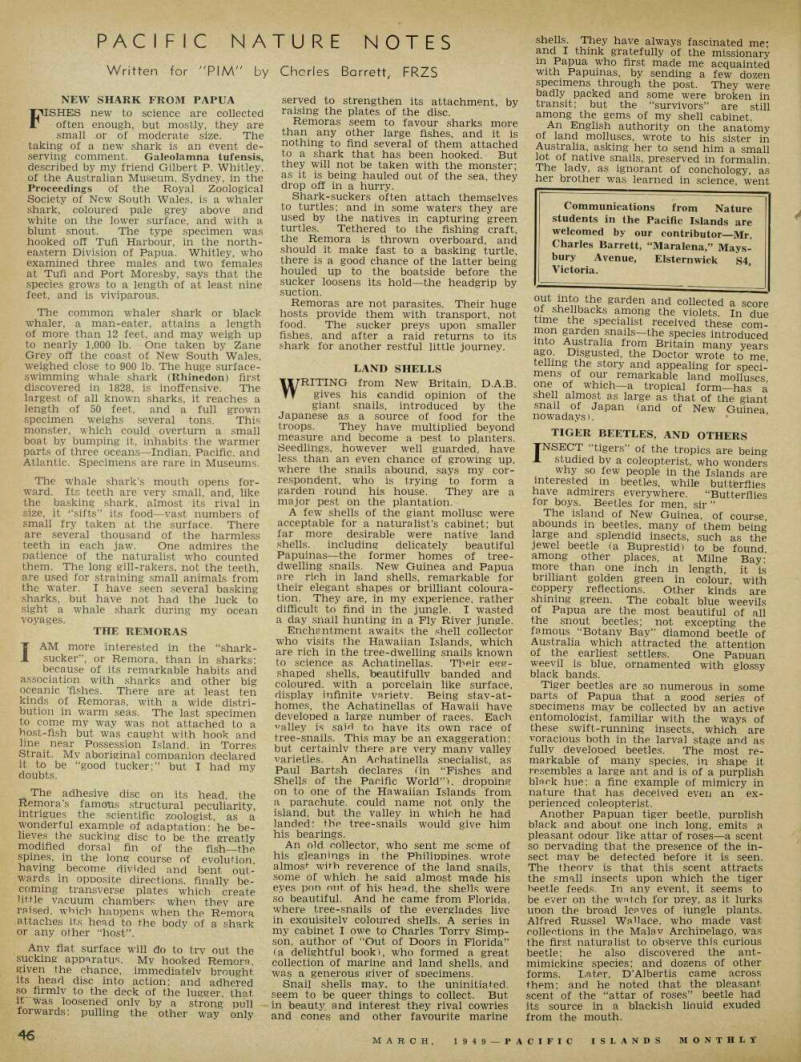
Written for "PIM" by Charles Barrett, FRZS
New Shark From Papua
FISHES new to science are collected often enough, but mostly, they are small or of moderate size. The taking of a new shark is an event de serving comment. Galeolamna tufensis, described by my friend Gilbert P. Whitley, of the Australian Museum, Sydney, in the Proceedings of the Royal Zoological Society of New South Wales, is a whaler shark, coloured pale grey above and white on the lower surface, and with a blunt snout. The type specimen was hooked off Tufi Harbour, in the north eastern Division of Papua. Whitley, who examined three males and two females at Tufi and Port Moresby, says that the species grows to a length of at least nine feet, and is viviparous.
The common whaler shark or black whaler, a man-eater, attains a length of more than 12 feet, and may weigh up to nearly 1,000 lb. One taken by Zane Grey off the coast of New South Wales, weighed close to 900 lb. The huge surface swimming whale shark (Rhinedon) first discovered in 1828, is inoffensive. The largest of all known sharks, it reaches a length of 50 feet, and a full grown specimen weighs several tons. This monster, which could overturn a small boat by bumping it, inhabits the warmer parts of three oceans—lndian, Pacific, and Atlantic. Specimens are rare in Museums.
The whale shark’s mouth opens for ward. Its teeth are very small, and, like the basking shark, almost its rival in size, it “sifts” its food—vast numbers of small fry taken at the surface. There are several thousand of the harmless teeth in each jaw. One admires the patience of the naturalist who counted them. The long gill-rakers, not the teeth, are used for straining small animals from the water. I have seen several basking sharks, but have not had the luck to sight a whale shark during my ocean voyages.
The Remoras
IAM more interested in the “shark sucker”, or Remora, than in sharks; because of its remarkable habits and association with sharks and other big oceanic 'fishes. There are at least ten kinds of Remoras, with a wide distri bution in warm seas. The last specimen to come my way was not attached to a host-fish but was caught with hook and line near Possession Island, in Torres Strait. My aboriginal companion declared it to be “good tucker;” but I had my doubts.
The adhesive disc on its head, the Remora’s famous structural peculiarity, intrigues the scientific zoologist, as a wonderful example of adaptation: he be lieves the sucking disc to be the greatly modified dorsal fin of the fish—the spines, in the long course of evolution having become divided and bent out wards in opposite directions, finally be coming transverse plates which create little vacuum chambers when thev are raised, which happens when the Remora attaches its head to the body of a shark or any other “host”.
Any flat surface will do to try out the sucking apparatus. My hooked Remora, given the chance, immediatelv brought its head disc into action: and adhered so firmlv to the deck of the lugger, that it was loosened onlv by a strong pull forwards: pulling the other way only
served to strengthen its attachment, by raising the plates of the disc.
Remoras seem to favour sharks more than any other large fishes, and it is nothing to find several of them attached to a shark that has been hooked. But they will not be taken with the monster; as it is being hauled out of the sea, they drop off in a hurry.
Shark-suckers often attach themselves to turtles: and in some waters they are used by the natives in capturing green turtles. Tethered to the fishing craft, the Remora is thrown overboard, and should it make fast to a basking turtle, there is a good chance of the latter being houled up to the boatside before the sucker loosens its hold —the headgrip by suction.
Remoras are not parasites. Their huge hosts provide them with transport, not food. The sucker preys upon smaller fishes, and after a raid returns to its shark for another restful little journey.
Land Shells
WRITING from New Britain, D.A.B. gives his candid opinion of the giant snails, introduced by the Japanese as a source of food for the troops. They have multiplied beyond measure and become a pest to planters.
Seedlings, however well guarded, have less than an even chance of growing up, where the snails abound, says my cor respondent, who is trying to form a garden round his house. They are a major pest on the plantation.
A few shells of the giant mollusc were acceptable for a naturalist’s cabinet; but far more desirable were native land shells. including delicately beautiful Papuinas—the former homes of tree dwelling snails. New Guinea and Papua are rich in land shells, remarkable for their elegant shapes or brilliant coloura tion. They are, in my experience, rather difficult to find in the jungle. I wasted a day snail hunting in a Fly River jungle.
Enchantment awaits the shell collector who visits the Hawaiian Islands, which are rich in the tree-dwelling snails known to science as Achatinellas. Their egg shaped shells, beautifully banded and coloured, with a porcelain like surface, display infinite variety. Being stay-at homes, the Achatinellas of Hawaii have developed a large number of races. Each valley is sain to have its own race of tree-snails. This may be an exaggeration; but certainly there are very many valley varieties. An Achatinella specialist, as Paul Bartsh declares (in “Fishes and Shells of the Pacific World”), dropping on to one of the Hawaiian Islands from a parachute, could name not only the island, but the valley in which he had landed: the tree-snails would give him his bearings.
An old collector, who sent me some of his gleanings in the Philippines, wrote almost with reverence of the land snails, some of which he said almost made his eyes pon nut of his head, the shells were so beautiful. And he came from Florida, where tree-snails of the everglades live in exouisitelv coloured shells. A series in my cabinet I owe to Charles Torry Simp son, author of “Out of Doors in Florida” (a delightful book), who formed a great collection of marine and land shells, and was a generous giver of specimens.
Snail shells may. to the uninitiated, seem to be queer things to collect. But in beauty and interest they rival cowries and cones and other favourite marine
shells. They have always fascinated me and I think gratefully of the missionary in Papua who first made me acquainted with Papuinas, by sending a few dozen specimens through the post. They were badly packed and some were broken in transit: but the “survivors” are still among the gems of my shell cabinet.
An English authority on the anatomy of land molluscs, wrote to his sister in Australia, asking her to send him a small lot of native snails, preserved in formalin.
The lady, as ignorant of conchology, as her brother was learned in science, went
Communications from Nature students in the Pacific Islands are welcomed by our contributor—Mr.
Charles Barrett, “Maralena,” Mays bury Avenue, Elsternwick S 4, Victoria.
°fl nt ° th , e garden and collected a score ol shellbacks among the violets. In due time the specialist received these com mon garden snails—the species introduced into Australia from Britain many years ago. Disgusted, the Doctor wrote to me, telling the story and appealing for speci mens of our remarkable land molluscs one of which—a tropical form—has a shell almost as large as that of the giant snail of Japan (and of New Guinea nowadays).
Tiger Beetles, And Others
INSECT “tigers” of the tropics are being studied by a coleopterist, who wonders why so few people in the Islands are interested in beetles, while butterflies have admirers everywhere. “Butterflies for boys. Beetles for men, sir ”
The island of New Guinea, of course, abounds in beetles, many of them being large and splendid insects, such as the jewel beetle (a Buprestid) to be found among other places, at Milne Bay’ more than one inch in length, it is brilliant golden green in colour, with coppery reflections. Other kinds are shining green. The cobalt blue weevils of Papua are the most beautiful of all the snout beetles; not excepting the famous “Botany Bay” diamond beetle of Australia which attracted the attention of the earliest settlers. One Papuan weevil is blue, ornamented with glossy black bands.
Tiger beetles are so numerous in some parts of Papua that a good series of specimens may be collected by an active entomologist, familiar with the ways of these swift-running insects, which are voracious both in the larval stage and as fully developed beetles. The most re markable of many species, in shape it resembles a large ant and is of a purplish blank hue: a fine example of mimicry in nature that has deceived even an ex perienced coleopterist.
Another Papuan tiger beetle, purplish black and about one inch long, emits a pleasant odour like attar of roses—a scent so pervading that the presence of the in sect may be detected before it is seen.
The theorv is that this scent attracts the small insects upon which the tiger beetle feeds. In any event, it seems to be ever on the watch for prey, as it lurks upon the broad leaves of iungle plants.
Alfred Russel Wallace, who made vast collections in the Malav Archipelago, was the first naturalist to observe this curious beetle: he also discovered the ant mimicking species; and dozens of other forms. Later, D’Albertis came across them; and he noted that the pleasant scent of the “attar of roses” beetle had its source in a blackish liauid exuded from the mouth.
Tropicalities
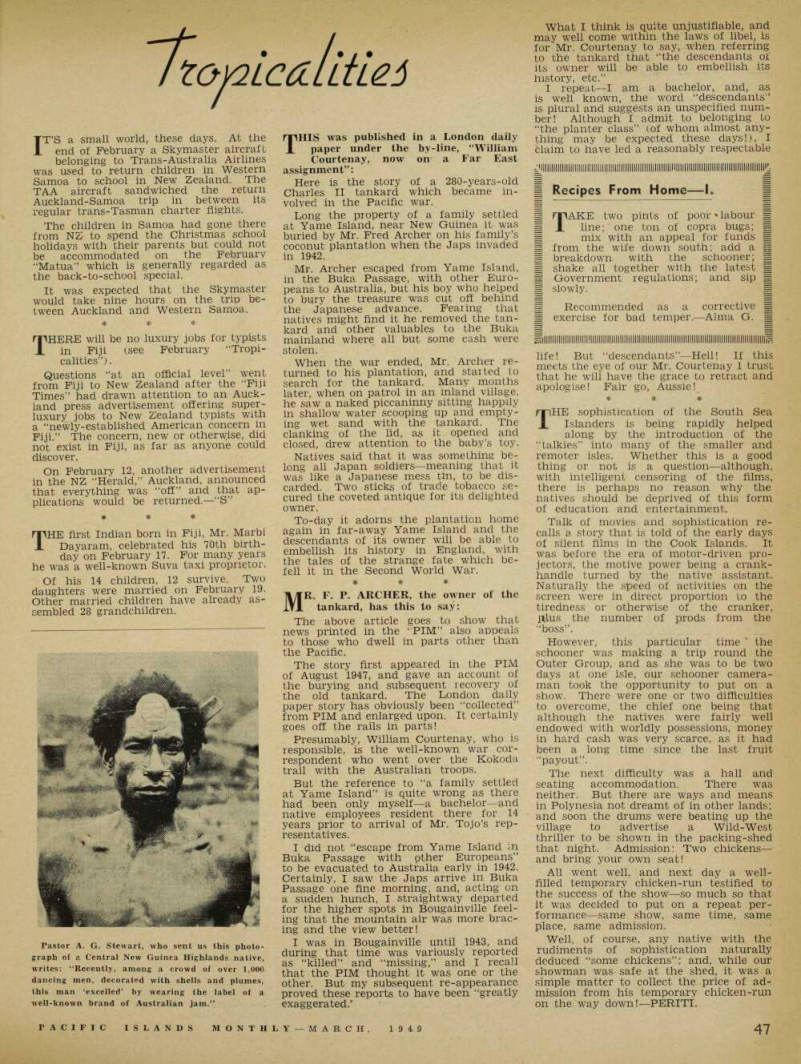
IT’S a small world, these days. At the end of February a Skymaster aircraft belonging to Trans-Australia Airlines was used to return children in Western Samoa to school in New Zealand. The TAA aircraft sandwiched the return Auckland-Samoa trip in between its regular trans-Tasman charter flights.
The children in Samoa had gone there from NZ to spend the Christmas school holidays with their parents but could not be accommodated on the February “Matua” which is generally regarded as the back-to-school special.
It was expected that the Skymaster would take nine hours on the trip be tween Auckland and Western Samoa. * * * THERE will be no luxury jobs for typists in Fiji (see February “Tropi calities”).
Questions “at an official level” went from Fiji to New Zealand after the “Fiji Times” had drawn attention to an Auck land press advertisement offering super luxury jobs to New Zealand typists with a “newly-established American concern in Fiji.” The concern, new or otherwise, did not exist in Fiji, as far as anyone could discover.
On February 12, another advertisement in the NZ “Herald,” Auckland, announced that everything was “off” and that ap plications would be returned. —“S” ♦ * ♦ THE first Indian born in Fiji, Mr. Marbi Dayaram, celebrated his 70th birth day on February 17. For many years he was a well-known Suva taxi proprietor.
Of his 14 children, 12 survive. Two daughters were married on February 19.
Other married children have already as sembled 28 grandchildren.
THIS was published in a London daily paper under the by-line, “William Courtenay, now on a Far East assignment”: Here is the story of a 280-years-old Charles II tankard which became in volved in the Pacific war.
Long the property of a family settled at Yame Island, near New Guinea it was buried by Mr. Fred Archer on his family’s coconut plantation when the Japs invaded in 1942.
Mr. Archer escaped from Yame Island, in the Buka Passage, with other Euro peans to Australia, but his boy who helped to bury the treasure was cut off behind the Japanese advance. Fearing that natives might find it he removed the tan kard and other valuables to the Buka mainland where all but some cash were stolen.
When the war ended, Mr. Archer re turned to his plantation, and started to search for the tankard. Many months later, when on patrol in an inland village, he saw a naked piccaninny sitting happily in shallow water scooping up and empty ing wet sand with the tankard. The clanking of the lid, as it opened and closed, drew attention to the baby’s toy.
Natives said that it was something be long all Japan soldiers—meaning that it was like a Japanese mess tin, to be dis carded. Two sticks of trade tobacco se cured the coveted antique for its delighted owner.
To-day it adorns the plantation home again in far-away Yame Island and the descendants of its owner will be able to embellish its history in England, with the tales of the strange fate which be fell it in the Second World War. * * * MR. F. P. ARCHER, the owner of the tankard, has this to say: The above article goes to show that news printed in the “PIM” also appeals to those who dwell in parts other than the Pacific.
The story first appeared in the PIM of August 1947, and gave an account of the burying and subsequent recovery of the old tankard. The London daily paper story has obviously been “collected” from PIM and enlarged upon. It certainly goes off the rails in parts!
Presumably, William Courtenay, who is responsible, is the well-known war cor respondent who went over the Kokoda trail with the Australian troops.
But the reference to “a family settled at Yame Island” is quite wrong as there had been only myself—a bachelor —and native employees resident there for 14 years prior to arrival of Mr. Tojo’s rep resentatives.
I did not “escape from Yame Island in Buka Passage with pther Europeans” to be evacuated to Australia early in 1942.
Certainly, I saw the Japs arrive in Buka Passage one fine morning, and, acting on a sudden hunch, I straightway departed for the higher spots in Bougainville feel ing tnat the mountain air was more brac ing and the view better!
I was in Bougainville until 1943, and during that time was variously reported as “killed” and “missing,” and I recall that the PIM thought it was one or the other. But my subsequent re-appearance proved these reports to have been “greatly exaggerated.’
What I think is quite unjustifiable, and may well come within the laws of libel, is for Mr. Courtenay to say, when referring to the tankard that “the descendants of its owner will be able to embellish its history, etc.”
I repeat—l am a bachelor, and, as is well known, the word “descendants” is plural and suggests an unspecified num ber! Although I admit to belonging to “the planter class” (of whom almost any thing may be expected these days!), I claim to have led a reasonably respectable
life! But “descendants” —Hell! If this meets the eye of our Mr. Courtenay I trust that he will have the grace to retract and apologise! Fair go, Aussie! ♦ * ♦ jrrjHE sophistication of the South Sea JL Islanders is being rapidly helped along by the introduction of the “talkies” into many of the smaller and remoter isles. Whether this is a good thing or not is a question—although, with intelligent censoring of the films, there is perhaps no reason why the natives should be deprived of this form of education and entertainment.
Talk of movies and sophistication re calls a story that is told of the early days of silent films in the Cook Islands. It was before the era of motor-driven pro jectors, the motive power being a crank handle turned by the native assistant.
Naturally the speed of activities on the screen were in direct proportion to the tiredness or otherwise of the cranker, plus the number of prods from the “boss”.
However, this particular time the schooner was making a trip round the Outer Group, and as she was to be two days at one isle, our schooner camera man took the opportunity to put on a show. There were one or two difficulties to overcome, the chief one being that although the natives were fairly well endowed with worldly possessions, money in hard cash was very scarce, as it had been a long time since the last fruit “payout”.
The next difficulty was a hall and seating accommodation. There was neither. But there are ways and means in Polynesia not dreamt of in other lands; and soon the drums were beating up the village to advertise a Wild-West thriller to be shown in the packing-shed that night. Admission: Two chickens — and bring your own seat!
All went well, and next day a well filled temporary chicken-run testified to the success of the show —so much so that it was decided to put on a repeat per formance —same show, same time, same place, same admission.
Well, of course, any native with the rudiments of sophistication naturally deduced “some chickens”; and, while our showman was safe at the shed, it was a simple matter to collect the price of ad mission from his temporary chicken-run on the way down!—PERITI.
Pastor A. G. Stewart, who sent us this photo graph of a Central New Guinea Highlands native, writes: “Recently, among a crowd of over 1,000 dancing men, decorated with shells and plumes, this man ‘excelled’ by wearing the label of a well-known brand of Australian jam.”
Advertisements & other items, p. 49 (1 item)
Recipes From Home—l.
TAKE two pints of poor • labour line; one ton of copra bugs; mix with an appeal for funds from the wife down south; add a breakdown with the schooner; shake all together with the latest Government regulations; and sip slowly.
Recommended as a corrective exercise for bad temper.—Alma G.
The Floating Lei
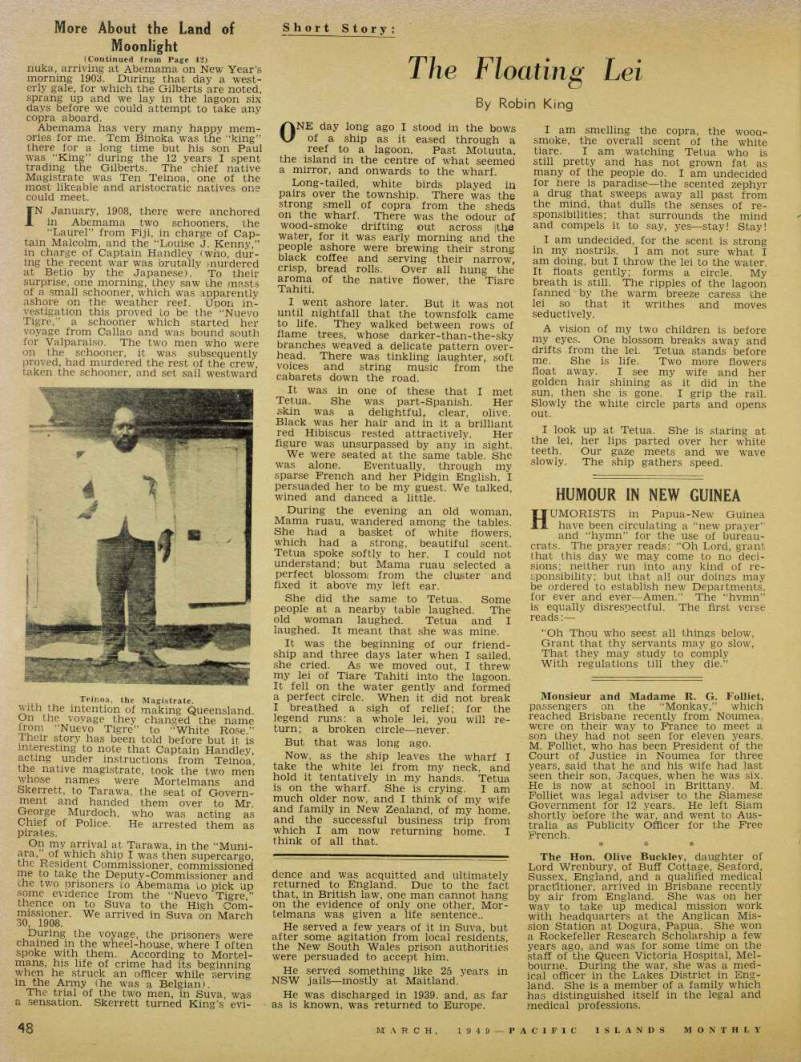
Short Story ;
By Robin King
ONE day long ago I stood in the bows of a ship as it eased through a reef to a lagoon. Past Motuuta, the island in the centre of what seemed a mirror, and onwards to the wharf.
Long-tailed, white birds played in pairs over the township. There was the strong smell of copra from the sheds on the wharf. There was the odour of wood-smoke drifting out across (the water, for it was early morning and the people ashore were brewing their strong black coffee and serving their narrow, crisp, bread rolls. Over all hung the aroma of the native flower, the Tiare Tahiti.
I went ashore later. But it was not until nightfall that the townsfolk came to life. They walked between rows of flame trees, whose darker-than-the-sky branches weaved a delicate pattern over head. There was tinkling laughter, soft voices and string music from the cabarets down the road.
It was in one of these that I met Tetua. She was part-Spanish. Her skin was a delightful, clear, olive.
Black was her hair and in it a brilliant red Hibiscus rested attractively. Her figure was unsurpassed by any in sight.
We were seated at the same table. She was alone. Eventually, through my sparse French and her Pidgin English, I persuaded her to be my guest. We talked, wined and danced a little.
During the evening an old woman, Mama ruau, wandered among the tables.
She had a basket of white flowers, which had a strong, beautiful scent.
Tetua spoke softly to her. I could not understand: but Mama ruau selected a perfect blossom; from the cluster and fixed it above my left ear.
She did the same to Tetua. Some people at a nearby table laughed. The old woman laughed. Tetua and I laughed. It meant that she was mine.
It was the beginning of our friend ship and three days later when I sailed, she cried. As we moved out, I threw my lei of Tiare Tahiti into the lagoon.
It fell on the water gently and formed a perfect circle. When it did not break I breathed a sigh of relief; for the legend runs: a whole lei, you will re turn; a broken circle—never.
But that was long ago.
Now, as the ship leaves the wharf I take the white lei from my neck, and hold it tentatively in my hands. Tetua is on the wharf. She is crying. I am much older now, and I think of my wife and family in New Zealand, of my home, and the successful business trip from which I am now returning home. I think of all that.
I am smelling the copra, the wooa= smoke, the overall scent of the white tiare. I am watching Tetua who is still pretty and has not grown fat as many of the people do. I am undecided for here is paradise—the scented zephyr a drug that sweeps away all past from the mind, that dulls the senses of re sponsibilities; that surrounds the mind and compels it to say, yes-stay! Stay!
I am undecided, for the scent is strong in my nostrils. I am not sure what I am doing, but I throw the lei to the water.
It floats gently; forms a circle. My breath is still. The ripples of the lagoon fanned by the warm breeze caress the lei so that it writhes and moves seductively.
A vision of my two children is before my eyes. One blossom breaks away and drifts from the lei. Tetua stands before me. She is life. Two more flowers float away. I see my wife and her golden hair shining as it did in the sun, then she is gone. I grip the rail.
Slowly the white circle parts and opens out.
I look up at Tetua. She is staring at the lei, her lips parted over her white teeth. Our gaze meets and we wave slowly. The ship gathers speed.
Humour In New Guinea
HUMORISTS in Papua-New Guinea have been circulating a “new prayer’* and “hymn” for the use of bureau crats. The prayer reads; “Oh Lord, grant that this day we may come to no deci sions: neither run into any kind of re sponsibility; but that all our doings may be ordered to establish new Departments, for ever and ever —Amen.” The “hvmn” is equally disrespectful. The first verse reads: — “Oh Thou who seest all things below, Grant that thy servants may go slow, That they may study to comply With regulations till they die.”
Monsieur and Madame R. G. Folliet, passengers on the “Monkay,” which reached Brisbane recently from Noumea, were on their way to France to meet a son they had not seen for eleven years.
M. Folliet, who has been President of the Court of Justice in Noumea for three years, said that he and his wife had last seen their son, Jacques, when he was six.
He is now at school in Brittany. M.
Folliet was legal adviser to the Siamese Government for 12 years. He left Siam shortly before the war, and went to Aus tralia as Publicity Officer for the Free French.
The Hon. Olive Buckley, daughter of Lord Wrenbury, of Buff Cottage, Seaford, Sussex, England, and a qualified medical practitioner, arrived in Brisbane recently by air from England. She was on her way to take up medical mission work with headquarters at the Anglican Mis sion Station at Dogura, Papua. She won a Rockefeller Research Scholarship a few years ago, and was for some time on the staff of the Queen Victoria Hospital, Mel bourne. During the war, she was a med ical officer in the Lakes District in Eng land. She is a member of a family which has distinguished itself in the legal and medical professions.
Advertisements & other items, pp. 50-51 (2 items)
Moonlight
48
MARCH, 1949 PACIFIC ISLANDS MONTHLY
More About the Land of Moonlight (Continued from Fage 42)
Burns Philp (New Guinea) Limited
General Merchants (Wholesale and Retail)
Shipping, Customs and General Agents
Head Office: PORT MORESBY, PAPUA
BRANCHES;
NEW GUINEA: Rabaul, Kokopo, L.ae Gr Madang.
PAPUA: Samarai.
REPRESENTATIVES FOR:
AUSTRALIAN AGENTS
LONDON AGENTS:
SAN FRANCISCO AGENTS
QUEENSLAND INSURANCE CO. LTD.
LLOYDS OF LONDON
BURNS PHILP TRUST CO. LTD.
BURNS, PHILP Cr CO. LTD.
All States.
BURNS, PHILP Cr CO. LTD.
"London House", 35 Crutched Friars, E.C.3.
BURNS, PHILP CO. OF SAN FRANCISCO INC 510 Matson Building.
Distributing Agents, Territory of Popua-New Guinea for:
SHELL COMPANY OF AUSTRALIA LIMITED
Petroleum Products
GENERAL MOTORS CORPORATION
Chevrolet, Buick, Pontiac and Oldsmobile Cars Chevrolet and GMC Trucks
Frigidaire Refrigerators
VAUXHALL MOTORS LIMITED
Vauxhall Cars and Bedford Trucks
R. A. LISTER Cr CO., BRISTOL
Producers of Petrol, Parrafin and Diesel Engines Pumps and Lighting plants
RUSTON HORNSBY LIMITED
Engines
CROSSLEY MARINE ENGINES
Monumental Work on
Hawaiian Insects Five Volumes Published Out of Dozen Projected
THE first five volumes of “Insects of Hawaii” have been published by the University of Hawaii press. These enumerate about 1,100 species of insects and begin a series planned to cover the entire Hawaiian insect fauna, in from 12 to 15 volumes.
Their author, Elwood C. Zimmerman, is associate entomologist of the experiment station of the Hawaiian Sugar Planters’
Association and curator of entomology at Bernice P. Bishop Museum, both in Honolulu. He began this study of the Hawaiian, insects in 1934, and is making good progress on one of the most exten sive entomological projects yet attempted by one scientist in the Pacific.
The first volume presents a detailed, 200page summary of the Hawaiian environ ment, and the origin and characteristics of the Hawaiian insects and their rela tionship to each other and this environ ment, with more than 50 illustrations. It traces the geologic history of the Hawaiian chain and presents a concise, comprehen sive account of the dispersal, speciation, evolution, and development of the plants and animals of these islands, with special emphasis on the insects.
Volume 2 deals with 371 species of the so-called “lower orders” of insects —Thysanura, Diplura, Protura, Collembola, Orthoptera, Isoptera, Dermaptera, Zorap tera, Corrodentia, Mallophaga, Anoplura, Odonata, and Thysanoptera. All known species in the Hawaiian islands are dis cussed, with keys for fcheir identification,
notes regarding where they came from, how they live, and what they do. Many of the species are illustrated, there being 228 cuts. There is an extensive biblio graphy following each order.
The 255 pages of volume 3 discuss 223 species of Heteroptera, or “true bugs.”
These include some good friends and dan gerous enemies of the agriculturist. Again, there are keys to families, genera, and species, notes, and 109 illustrations.
Volume 4 is concerned with 313 species of leafhoppers of the order Homoptera. Its 268 pages contain 109 illustrations.
Volume 5 completes the Homoptera, with 464 pages of discussion of 192 species of psyllids, aleyrodids, aphids, and scale insects found in Hawaii. Among the 238 illustrations are a number of double-page drawings by Professor F. G. Ferris, world authority on coccids, showing dorsal and ventral details of scales occurring in Hawaii.
The five volumes are attractively printed and may be obtained from the University of Hawaii press for 24 dollars for the five.
Mr. Zimmerman plans to continue pre paration of the manuscript regarding the other orders of Hawaiian insects. This work and the publication to date has been made possible through the co-operation of Bernice P. Bishop Museum, the Ha waiian Sugar Planters’ Association, and the University of Hawaii. —E.H.B.
Bulolo Gold Dredging Limited
FOR the. month of January seven dredges, working in the Bulolo Val ley, New Guinea, handled 881,081 cubic yards of gravel for a total recovery of approximately 5,057 ounces of fine gold.
The directors of Solomon Islands Rubber Plantations, Ltd. (a* £77,000 company operating in BSD report that they are now proceeding steadily with the work of rehabilitation and, in their last financial year, they were able to sell 95 tons of copra at an average of £34 per ton. The plantations became badly overgrown during the war, but between 300 and 400 acres have now been cleared.
Advertisements & other items, p. 52 (1 item)
Equipment
The Twinkle in
Your Eye
COMES FROM ACTIVE
DIGESTION
Good normal digestive and liver activity means good, normal health and fitness. If yo» are becoming gloomy and feel tired out, the cause may be a congested state of your intestinal tract. So many people are troubled with constipation, which, through the retention of waste in the digestive system, causes sick headache, biliousness, pimply skin, unpleasant breath, irritability, slackness and dull eyes.
Regain your bright and attractive appearance by banishing constipation with Pinkettes. Tiny, perfectly harmless, gentle yet effective, these famous laxative and liver pills painlessly exercise and strengthen the bowels, keep the food tract clean and active, stir the liver, and thus banish sick headache, bilious attacks, pimples, unpleasant breath and gloom. All chemists and stores sell Pinkettes, the perfect laxative and liver pills.
BUDGE REFRIGERATION and
ICE MAKING
EQUIPMENT
JAMES
Telephones: LA 5034-5-6
COMMERCIAL AND INDUSTRIAL
UNITS
(not domestic) Ammonia and Methyl Chloride machines of large or small capacity.
The illustration is of a small (nine 28 lb. blocks) electric. Methyl Chloride Icemaking plant.
Enquirers should mention dimensions of cold room (or cabinet) and of amount of ice (if any) required per day; also if electric motor or internal combustion engine is to be included.
BUDGE PTY. LTD.
REFRIGERATION ENGINEERS
McEvoy Street, Alexandria, Sydney
Established 1890
Eyewash’
Relations Between
White And Brown
A Plea Against ‘Sentimental Eyewash’
“T ET'S have no. sentimental eye-wash,”
JL A said the man on the Hythe flying boat, pulling out of Indonesia after a lifetime among the native races. ‘‘The natives had their own countries for centuries—and what did they make of them?
“What they’re after to-day—or, rather, what a small minority of westernised natives are after —is not their countries, but the countries we’ve created.
“Did they make the railways or sink the oil wells? Did they know how to make and use rubber? Did they do any thing about building roads or setting up schools and hospitals? No, of course not.
“All that is white man’s work. Now that it’s pretty well done and some of the natives have learnt what the Yanks call the ‘know-how’, they just want to take it away from the people who made it.
“If they want their own countries, let them have them, but first let the white man take away all that’s built —the rail ways and roads and hospitals and oil wells and rubber plantations and all the rest. If they can, let ’em build it all from nothing as we did.
“We’ve slaved and worked in terrible climates yes, for our own profits, I know, but also for the benefit of the natives. We’ve struggled against ignor ance and barbarism and God knows what and we’ve met with resistance at almost every step.”
THE man in the Hythe was an engineer. He had constructed and run a tropical railway for years— had the natives oiling engines, repairing, working.-Then he was moved and natives ran the line. It went to bits. Service maintenance and supervision deteriora ted. Finally a bridge buckled and killed people and the engineer was blamed for it because he first built it.
So giving the islands back to the natives ia a £ sloppy sentiment to the engineer.
George Borodin, Russian-born surgeon, of London’s Harley-st., who persists in writing interesting but wordy books about everywhere he goes, summed up differently from this engineer, who travelled with him part of the way back from Australia to England.
Borodin and other flying passengers were fired on at Batavia, attacked by a mob in Rangoon, taken Under police guard to their Calcutta hotel because of riots and a curfew, lost all possessions in Basra in a raid by self-styled patriots, and were again hotel-bound during dis turbances in Cairo.
So Borodin, who had come lazily down through the Pacific islands and Papua to Australia, then home above the civil strife of southern Asia, saw things dif ferently from the engineer who had lived close to the natives and had been their white man boss.
He found the sudden collapse of the white man during the Japanese invasion in 1942 had “freed” Asia in the native mind. But the white man had with drawn only to gather strength, and he in turn swept the Japanese back.
This action and counter-action was a
fundamental reason for the confusion of thought found among educated natives of the Pacific and Far East.
For a brief period they were free of the white man’s subjection: they saw him exposed as human, With huftnan weaknesses, as themselves. His return showed his power was unlimited.
Underlying native separatist and in dependence movements were the re mains of an inferiority complex compen sating itself by iover-aggressive asser tions of equality, a familiar psychological picture.—From a review of a new book by Dr. G. Borodin,
Advertisements & other items, pp. 53-54 (1 item)
Finishes
"ISLAND LIFE"
Official organ of the S.S.l.C.C.—Calling Collectors, Correspondents and Penfriends throughout the South Sea Islands. Over 1,000 members. Write for your free copy and particulars to —
SOUTH SEA ISLANDS CORRESPOND-
ENCE CLUB,
NATUVU, FIJI.
\ N JV 7 v\ ' ' >\\v
Trap"'
*Smm
Form" 1 "*
Every Berger finish must withstand test after test to prove worthy of the Berger label . . . every product must satisfy the Berger technicians and chemists that it will meet the challenge of all climates from tropic heat to arctic cold.
FINISHES
KEEP ON KEEPING ON!
Rid Kidneys 0!
Poisons And Adds
If you suffer sharp, stabbing pains, If Joint* are swollen, It shows your blood Is poisoned through faulty kidney action. Other symptoms of Kidney Disorders are Backache, Aching Joints and Limbs, Sciatica, Neuritis, Lumbago, Sleepless Nights, Dizziness, Nervousness, Circles under Eyes, Loss of Energy and Appetite and Frequent Headaches and Colds, etc. Ordinary medicines can’t help much because you must get to the root cause of the trouble.
The Cystex treatment is specially compounded to soothe, tone and clean kidneys and bladder and remove acids and poisons from your system safely, quickly and surely, yet contains no harmful or dangerous drugs. Cystex works In 3 ways to end your troubles. 1. Starts killing the germs which are attacking your Kidneys, Bladder and Urinary System In two hours, yet Is absolutely harmless to human tissue. 2. Gets rid of health-destroying, deadly poisonous acids with which your system has become saturated. 3. Strengthens and reinvigorates the kidneys, protects from the ravages of disease-attack on the delicate filter organism, and stimulates the entire system.
Praised by One-time Sufferers Cystex is approved by one-time sufferers In 73 countries from the troubles shown above Mr. Reg Thomas, Townsville, Queensland, recently wrote: "My joints were all stiff, 1 had leg pains, my back used to ache day and night.
My bladder was weak. I had headaches and no appetite. The first dose of Cystex helped me and before 1 finished three boxes my health and strength came back. 1 '
Guaranteed to Satisfy or Money Back
Get Cystex from your chemist or store to-day Give It a thorough test. Cystex Is guaranteed to make you feel younger, stronger, better U every way, or your money back If you return the empty package.
Now in 2 sizes—4/-, •/-.
GUARANTEED
Treatment for Your Kidneys, Bladder, Rheumatism.
The Story of a Leper
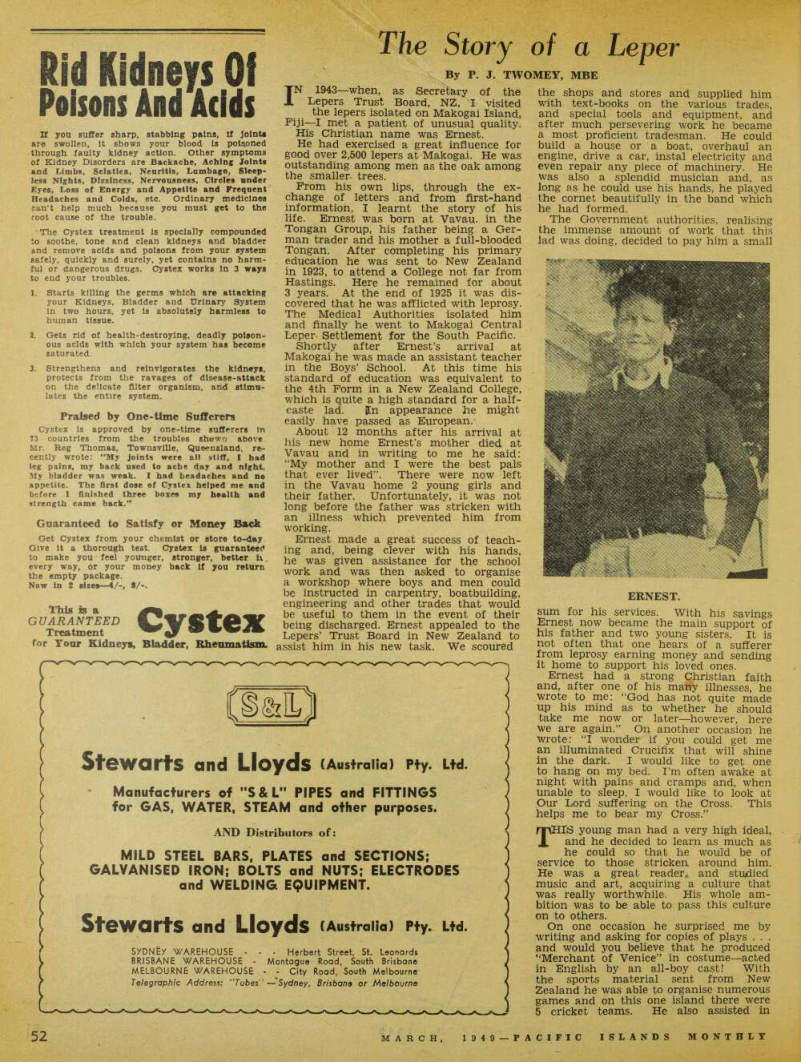
By P. J. Twomey, Mbe
IN 1943—when, as Secretary of the Lepers Trust Board, NZ, I visited the lepers isolated on Makogai Island, Fiji—l met a patient of unusual quality.
His Christian name was Ernest.
He had exercised a great influence for good over 2,500 lepers at Makogai. He was outstanding among men as the oak among the smaller trees.
From his own lips, through the ex change of letters and from first-hand information, I learnt the story of his life. Ernest was born at Vavau. in the Tongan Group, his father being a Ger man trader and his mother a full-blooded Tongan. After completing his primary education he was sent to New Zealand in 1923, to attend a College not far from Hastings. Here he remained for about 3 years. At the end of 1925 it was dis covered that he was afflicted with leprosy.
The Medical Authorities isolated him and finally he went to Makogai Central Leper Settlement for the South Pacific.
Shortly after Ernest’s arrival at Makogai he was made an assistant teacher in the Boys’ School. At this time his standard of education was equivalent to the 4th Form in a New Zealand College, which is quite a high standard for a half caste lad. ffn appearance he might easily have passed as European.
About 12 months after his arrival at his new home Ernest’s mother died at Vavau and in writing to me he said: “My mother and I were the best pals that ever lived”. There were now left in the Vavau home 2 young girls and their father. Unfortunately, it was not long before the father was stricken with an illness which prevented him from working.
Ernest made a great success of teach ing and, being clever with his hands, he was given assistance for the school work and was then asked to organise a workshop where boys and men could be instructed in carpentry, boatbuilding, engineering and other trades that would be useful to them in the event of their being discharged. Ernest appealed to the Lepers’ Trust Board in New Zealand to assist him in his new task. We scoured
the shops and stores and supplied him with text-books on the various trades, and special tools and equipment, and after much persevering work he became a most proficient tradesman. He could build a house or a boat, overhaul an engine, drive a car, instal electricity and even repair any piece of machinery. He was also a splendid musician and, as long as he could use his hands, he played the cornet beautifully in the band which he had formed.
The Government authorities, realising the immense amount of work that this lad was doing, decided to pay him a small
sum for his services. With his savings Ernest now became the main support of his father and two young sisters. It is not often that one hears of a sufferer from leprosy earning money and sending it home to support his loved ones.
Ernest had a strong Christian faith and, after one of his many illnesses, he wrote to me: “God has not quite made up his mind as to whether he should take me now or later—however, here we are again.” On another occasion he wrote: “I wonder if you could get me an illuminated Crucifix that will shine in the dark. I would like to get one to hang on my bed. I’m often awake at night with pains and cramps and, when unable to sleep, I would like to look at Our Lord suffering on the Cross. This helps me to bear my Cross.”
THIS young man had a very high ideal, and he decided to learn as much as he could so that he would be of service to those stricken around him.
He was a great reader, v and studied music and art, acquiring a culture that was really worthwhile. His whole am bition was to be able to pass this culture on to others.
On one occasion he surprised me by writing and asking for copies of plays . . . and would you believe that he produced “Merchant of Venice” in costume—acted in English by an all-boy cast! With the sports material sent from New Zealand he was able to organise numerous games and on this one island there were 5 cricket teams. He also assisted in
Ernest.
organizing concerts for the women and girls.
He had an extraordinary influence for good among all at Makogai whether Christian or pagan and for 11 years he was one of my most valued correspond ents. My friend, Dr. C. J. Austin (Medical Superintendent there) once remarked to me: “There is only one Ernest . . . there will never be another like him . . . he can always be relied upon.” He was certainly outstanding among the 700 sufferers isolated on this island. His sincerity and kindly service to others has made him kingly among men.
The Colonial Government in Fiji was so much impressed that the British Government was approached about the bestowal of a decoration on him; but, as Ernest was of German descent and had not been naturalised, nothing could be done. However, the then Secretary of State for the Colonies wrote to Ernest to thank him for all the good he had done in teaching useful trades, and par ticularly for his good influence among his fellow sufferers.
During this young man’s life-time at Makogai 834 patients were discharged, cured: and at one stage it seemed there was a chance of Ernest being freed from the disease. But Providence had other designs, or, shall I say, “man proposes but God disposes”. Ernest remained a leper and so Makogai retained its leader.
During most of the time he suffered much, but there was always a smile on his face. In speaking to him I got the impression that here was a man who truly loved his fellow-men, and was 100% manly. He seemed always to be thinking of how he could help others. One of his last works on his lonely outpost was to build a recreation ground at Makodraga,
about half a mile from Makogai. In a launch and punt of his own construction he would take the women and children for a picnic. These picnics are a great joy to the patients, as they do not feel so confined when they are able to change islands even for half a day. The authorities encouraged these outings.
Through the generosity of the New Zealand people we were able to supply £lOO worth of cement to enable Ernest and his boys to construct a concrete wharf as a suitable entrance to this picnic ground. It was arduous work and, as Ernest was always ailing, he was ad vised not to work so hard; but, like the famous Damien, of Molokai, in Hawaii, he desired to give his all, to struggle to the end, to die in harness.
In December, 1947, weakness forced him to remain in bed. Many of his fellow sufferers came to visit him and he edified all those who beheld his patience and resignation to God’s will. On January 18, 1948, with a smile on his face, he passed peacefully away while the good Nursing Sisters and his dearest friends were praying around his bedside.
He was then 40 years of age, having been a leper for 23 years. ■ i ■ '■ - . \ Mr. A. J. Halls, who was formerly in Port Moresby on the staff of the broad casting station, is returning to Papua as Publications Officer on the staff of the Director of Education.
The Rev. and Mrs. W. E. Moorhouse, of the Anglican Mission, after a long period of service in Polynesia, were spending their furlough in Victoria in January.
The Rev. and Mrs. A. W. Guy, who went back to Papua to help rehabilitate the Methodist Mission after the war, have
now retired. Other Methodist Mission aries who went back to Papua-New Guinea to help out over the post-war period are Miss Mary Woolnough and Miss Daisy Coltheart. These two workers have now also retired.
Owing to ill-health, Miss Doris Roger son, who has been with the Methodist Mission in Fiji for a number of years, has had to return permanently to Australia.
Advertisements & other items, pp. 54-56 (1 item)
Jr
Stewarts and Lloyds (Australia) pt y . Ltd.
Manufacturers of "S&L" PIPES and FITTINGS for GAS, WATER, STEAM and other purposes.
AND Distributors of:
MILD STEEL BARS, PLATES and SECTIONS;
GALVANISED IRON; BOLTS and NUTS; ELECTRODES
and WELDING EQUIPMENT.
Stewarts and Lloyds (Australia) pt y . Ltd.
SYDNEY WAREHOUSE - - - Herbert Street. St. Leonards BRISBANE WAREHOUSE - Montague Road, South Brisbane MELBOURNE WAREHOUSE - - City Road, South Melbourne Telegraphic Address: "Tubes ' Sydney, Brisbane or Melbourne
We Will Buy
It For You
Any goods you may require from English shops or factories Purchased and Shipped.
Small or large orders catered for.
ALL SERVICES UNDER-
TAKEN FOR RESIDENTS
ABROAD.
PITT & SCOTT
LIMITED
(Established 1876) General Shipping and Buying Agents . 1/3, St. Paul's Churchyard, London, England Cables. Shipping London.
NELSON and ROBERTSON Pty. Ltd.
Established 1895
Shipowners - Brokers and
Islands Merchants
All classes merchandise purchased at Best Wholesale Prices. Original Invoices supplied to Island Clients. Cocoa Beans, Copra, Rubber, Trochus Shell and All Islands' Produce Sold on Commission.
Entrust your requirements to the firm with fifty years' practical experience in the Pacific Islands.
Prompt attention giyen to on enquiries.
NELSON & ROBERTSON "i
12 SPRING STREET, SYDNEY, AUSTRALIA
Telegraphic Address: IVAN, SYDNEY.
TILLEY. LAMPS
(BURN ORDINARY KEROSENE)
The Modern Form of PORTABLE LIGHTING
ATTENTION TO DETAIL
is the characteristic of all British products
TILLEY LAMPS
are British made throughout at Hendon & Cricklewood, England.
THE TILLEY LAMP COMPANY LTD. of ENGLAND London Offices and Showrooms: 33 SACKVILLE STREET, PICCADILLY, W.l
REPRESENTATION :
MELBOURNE: T. H. Bentley, Pty. Ltd., 123-125 William Street, Melbourne, C.l.
TASMANIA: Mr. C. Sellars, 108 a Charles Street, Launceston.
FIJI: Mr. K. Wltherington, 2 Burns Philp Buildings, Suva.
Two Nights With A
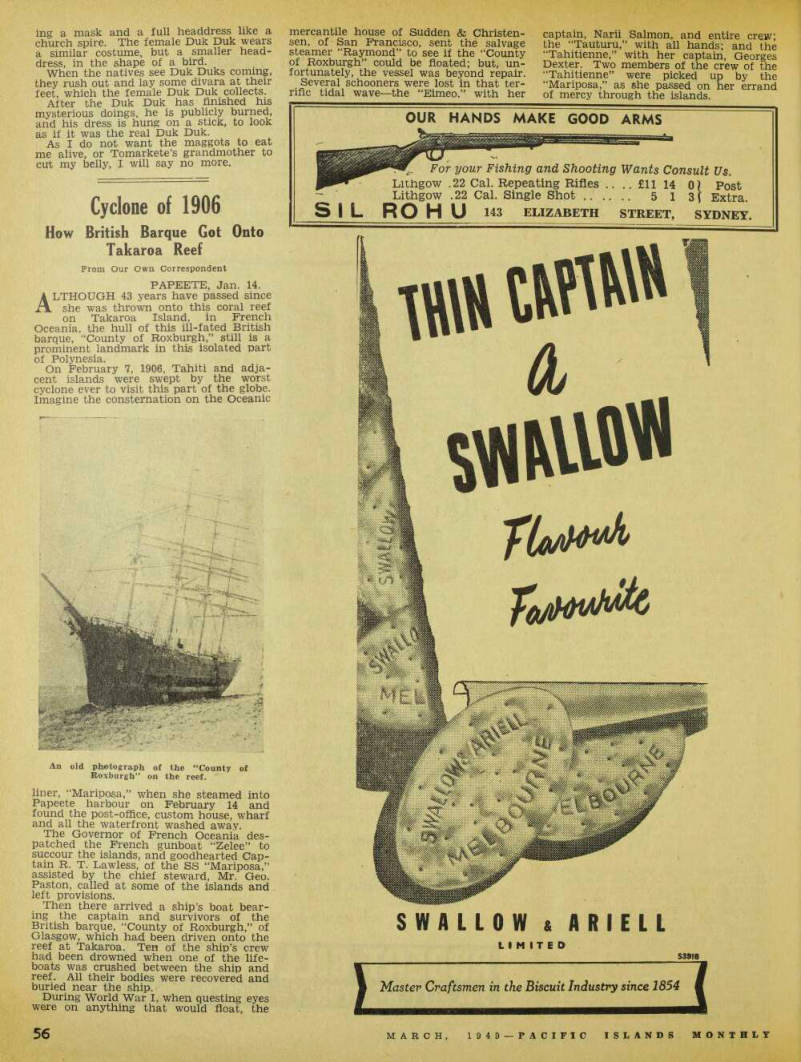
Duk Duk
The Horrors of a Young Men's House
(By “Peccavi”)
BECAUSE of something I wrote in the “PIM” a few months ago. I have received a letter from an Australian ex-serviceman, a resident of Adelaide, who served during the war in New Britain. He wants to know if I can tell him anything more of that old institution of primitive native life in New Britain, the mysterious Duk Duk.
Mr. Richard Parkinson, in his “Thirty Years in the South Seas.” and Dr. Otto Finsch, in his “My Travels in the Bis marck Archipelago,” have mentioned the Duk Duk, but only what they were told or imagined. I published a glossary article about it in a former issue of the “PIM.”
I would like to challenge any European who has been living in New Britain to tell me the real truth.
I lived in Kabaira, in New Britain, in 1884-85, and, close to my station, there was a large native house about 30 feet long. Walls and roof were made of 6-feet long grass, common in New Britain. The walls were open about two feet from the ground, so that large tree-trunks could be pushed through, smoking night and day, ready for use when required by the in mates for lighting their clay pipes.
Nobody went near this house during the day but I noticed that after dark many mysterious figures slipped into the place. My native cook. Tobilau, slept there.
Being young and inquisitive, I wanted to know more about this building. But Tobilau was silent. He only said that he could tell me nothing—if lie did, mag gots would eat him alive, his body would burn like fire, and his grandmother would come and cut his belly. But he promised to speak to the head man.
A few days later, Tomarkete, a petty chief whom I knew well, came to my station, and introduced himself as the head man of the (as he called it) “young men’s association” —young men who had not been able to buy a wife for divera (shell money), canoes, or other native artifacts, or were still working their pay in the plantations of their future fathers in-law.
Tomarkete told me that he would make me a member of the society, but if I ever told anybody what was going on inside the building, maggots would eat me alive, my body would burn like fire, and his grandmother would cut my belly.
The next day I was “inaugurated.” The ceremony of inauguration was unbeliev able, and I cannot repeat it. For two nights I slept in this house, with about 30 kanakas. If I told what I saw, nobody would believe me—and his hair would stand upright. Even now, I shiver when I think of it. lam glad I did not have to witness more.
On my third day, the German warship “Albatros” arrived, to punish the Kabaira natives for killing several Europeans; and after the ship had fulfilled her task, the Commander, Count von Baudisin, insisted that I should leave New Britain, as he was sure the natives would revenge them selves, and that I would be their object.
During my two days as a member of the young men’s society, I found out that Tomarkete was the notorious “Duk Duk,” and that the members were his tools. After six full moons of the year, the Duk Duk moves through the villages, dressed in a costume made of grass and leaves, wear
ing a mask and a full headdress like a church spire. The female Duk Duk wears a similar costume, but a smaller head dress, in the shape of a bird.
When the natives see Duk Duks coming, they rush out and lay some divara at their feet, which the female Duk Duk collects.
After the Duk Duk has finished his mysterious doings, he is publicly burned, and his dress is hung on a stick, to look as if it was the real Duk Duk.
As I do not want the maggots to eat me alive, or Tomarkete’s grandmother to cut my belly, I will say no more.
mercantile house of Sudden & Christen sen, of San Francisco, sent the salvage steamer “Raymond” to see if the “County of Roxburgh” could be floated; but, un fortunately, the vessel was beyond repair.
Several schooners were lost in that ter rific tidal wave—the “Eimeo,” with her
captain, Narii Salmon, and entire crew; the “Tauturu,” with all hands; and the “Tahitienne,” with her captain, Georges Dexter. Two members of the crew of the “Tahitienne” were picked up by the “Mariposa,” as she passed on her errand of mercy through the islands.
Advertisements & other items, p. 57 (2 items)
55
PACIFIC ISLANDS MONTHLY - M A R C H , 1949
Robert Gillespie Pit Lip
Woven Wire for all Industry
COPRA DRYING TRAYS, FLOORS, Etc.
FRUIT DRYING TRAYS, MINING SCREENS.
Heavy Mosquito Gauze in Phosphor Bronze and other Metals Impervious to Salt Sea Air.
WIRE DOOR MATS AND GENERAL WIRE WORKS
E. WRIGHT & CO. LTD.
Office and Works: 148-152 Cleveland Street. Sydney. N.S.W.
Telegraphic Address: "Wrlghtmake,” Chippendale. \ f!
Or £ V*
m HP * ft 0 A & p
UPA
GIVES FULL LIGHT AND AIR
WITH YEAR ROUND WEATHER PROTECTION
This ultra modern window comprises a series of glass blades swung one above the other and inclinable to any angle.
Air entering the room is diverted towards the ceiling thus preventing draughts. AGCO Supaluvres have all the advantages of other louvre windows plus exclusive features.
The specially designed rain guards cannot be fouled by the glass holders and provide flush finish so that fly screens, curtains or blinds can be attached. By an automatic locking device AGCO Supaluvres can be locked open in four positions, thus eliminating rattle and are also fitted with rack and pinion movement. All exposed surfaces are made of rust resisting zincanneal metal.
For Verandahs, Sun-rooms, Lounge-rooms, Kitchens and Laundries Illustrated leaflet, price list and installation instructions on request.
Sole Agents for South-west Pacific :
ROBERT GILLESPIE PIT lIP
54» PITT ST., SYDNEY - PHONES 8W4782- 61 JOS
Cyclone of 1906
How British Barque Got Onto Takaroa Reef
Prom Our Own Correspondent
Papeete, Jan. 14.
ALTHOUGH 43 years have passed since she was thrown onto this coral reef on Takaroa Island, in French Oceania, the hull of this ill-fated British barque, “County of Roxburgh,” still is a prominent landmark in this isolated part of Polynesia.
On February 7, 1906, Tahiti and adja cent islands were swept by the worst cyclone ever to visit this part of the globe.
Imagine the consternation on the Oceanic
liner, “Mariposa,” when she steamed into Papeete harbour on February 14 and found the post-office, custom house, wharf and all the waterfront washed away.
The Governor of French Oceania des patched the French gunboat “Zelee” to succour the islands, and goodhearted Cap tain R. T. Lawless, of the SS “Mariposa,” assisted by the chief steward, Mr. Geo.
Paston, called at some of the islands and left provisions.
Then there arrived a ship’s boat bear ing the captain and survivors of the British barque, “County of Roxburgh,” of Glasgow, which had; been driven onto the reef at Takaroa. Ten of the ship’s crew had been drowned when one of the life boats was crushed between the ship and reef. All their bodies were recovered and buried near the ship.
During World War I, when questing eyes were on anything that would float, the
An old photograph of the “County of Roxburgh” on the reef.
Advertisements & other items, p. 58 (1 item)
Swallow & Ariell
OUR HANDS MAKE GOOD ARMS
SI L
For your Fishing and Shooting Wants Consult Us.
Lithgow .22 Cal. Repeating Rifles ... £ll 14 01 Post Lithgow .22 Cal. Single Shot 5 1 3f Extra RO H U 143 ELIZABETH STREET, SYDNEY.
m o*® 1
«IM\P
***■ m * st
SWALLOW & ARIELL
LIMITED
I Master Craftsmen in the Biscuit Industry since 1854 53916 1
Undesirable
Tonga’S First White Settlers Were Highly
By John W. Earnshaw
(So far as we know, this article con tains some hitherto unrecorded early history of Tonga. The material was found and assembled by Mr. John Earnshaw, of 16 Lord St., Roseville, Sydney, while doing some research work.
WHEN the Boston vessel “Otter” sailed from Sydney in February, 1796, bound for the north-west coast of America, she carried away 21 convicts from the settlement. The runaways in cluded not only criminals with their natures hardened and embittered by the severity of their treatment in New South Wales, but also a Scottish intellectual who had been exiled for a political offence, and a young woman who was known as “Jane Lambert”. She was probably the first white woman to cross the Pacific from Australia to America.
A leading spirit amongst the convicts was Benjamin Ambler, a Londoner, who in 1787, at the age of 14, was sentenced at Old Bailey to 14 years’ transportation for attempted theft. The evidence against him was flimsy, and what might have been a youthful escapade certainly did not warrant the savage sentence he received.
He arrived in Sydney with the Second Fleet after suffering terrible hardships on the outward voyage. Nothing is known of his servitude in New South Wales.
Bearing away eastward, the “Otter” entered the Tongan Group on March 8, and was the first trader to visit those islands. For the next eight days the ship cruised cautiously northward, lying
to off various islands while the ship’s company bartered for food and enjoyed the amenities that were customary in these early voyages.
The enchantment of their novel surroundings, and the prospect of a life of ease and freedom in this remote spot, were too much for men fresh from the hardships and miseries of a penal settle
ment. Six of them secretly left the vessel to establish themselves on the island on Tongatabu. These were Ambler, Morgan and Connelly (both Irish) and three others, unnamed. The “Otter” then sailed away to the North American coast, where she was the first United States vessel to enter a Californian port.
THE isolation of the firsti, European settlers in Tonga was soon broken.
Later in the same year a second American vessel arrived off the island, and picked up the three unnamed convicts.
It was most probably the “Hope”, of Rhode Island, then on her second voyage to the South Seas.
A year passed and in April, 1797, the “Duff” arrived in Tonga, with the first missionaries for these islands. They were astonished to find whites already settled there; and, although Ambler disclaimed any connection with Botany Bay, they received his garbled story with suspicion.
However, Ambler’s knowledge of the language and native customs was too valuable to be disdained, and he assisted to establish the ten missionaries in various districts on Tongatabu.
It was not long, however, before Ambler and his cronies were harassing the missionaries in every way; stealing their goods and inciting the natives against
them at every opportunity. Thus matters continued until August, 1797, when the “Duff” returned from Tahiti. Fearful for the consequences should the convicts be allowed to remain in Tonga, Captain Wilson decided to seize them and hand them over to the authorities at the first opportunity.
Ambler and Morgan evaded this in tention, and only Connelly was carried away. He escaped shortly afterwards by swimming ashore at Satawal, in the Caroline Islands, On October 6 the “Mercury”, of Rhode Island, arrived off the island. She was commanded by a Scotchman, Robert
Garden, and came from Port Jackson via Dusky Sound (New Zealand) where she had picked up some of the crew of the transport “Endeavour”, who had been marooned in that isolated spot for over a year.
Garden was asked to remove Ambler and Morgan, who were causing increas ing trouble to the missionaries. He refused, saying that he knew of their Botany Bay reputation; and, to make matters worse for the missionaries, he landed seven more men from his ship These were David Sherlock, Andrew Francis, Peter Knight, Thomas Wasel, Benjamin Burnham, Peppy (a Hawaiian), and an elderly man named Beak. This gave Tonga, at the end of 1797, a white population of nine beachcombers and ten missionaries.
With the exception of Beak, the new comers threw in their lot with Ambler and -Morgan, who continued to torment the missionaries in every possible way.
The latter were further embarrassed when one of their number, George Veeson, adopted the native way of life and took several wives.
DURING 1798, civil war broke out be tween rival chiefs, and was carried on with great ferocity during that and the following year. During the struggle, three of the missionaries, Bowell, Harper and Gaulton, together with Burn ham, from the “Mercury”, were killed by one of the native factions. Morgan had parted from Ambler and had gone to Vavau, where he was put to death for brutally violating a chief’s daughter.
In January, 1800, the British privateer “Betsy”, accompanied by her Spanish prize “El Plumier”, arrived at Tonga and carried away Beak, and six of the re maining missionaries, to Sydney.
Of the six original whites who landed from the “Otter” it remains only to record the end of Ambler, the last, and their leading spirit. In September, 1799, Ambler was at Ahifu, where he spoke disrespectfully to the chief “Vakassor”, who retaliated by having him killed.
Ambler’s only epitaph is contained in a manuscript letter, written by one of the missionaries who escaped in the “Betsy”.
After describing the convict’s end, with evident satisfaction, he grimly concludes, “Venegance is mine, I will repay, sayeth the Lord”.
Advertisements & other items, pp. 59-60 (1 item)
Hour
PRODUCING UNIFORM GOOD RESULTS SINCE 1868
ALWAYS ASK FOR IT
William Atkins r< r .
Head Office, 449-451 KENT ST., SYDNEY
Iron & Steel Merchants-Engineers' Supplies
Coach & Motor Hardware
ESTABLISHED OVER 50 YEARS
TRADE
MARK
Cable Address: WXLATKIN, Sydney.
STEEL DEPARTMENT——
MILD STEEL:
Rounds, Squares, Flats, Half-rounds, Hexagons, Bevel, Shoeing, Tyre, Angles, Tees, Sheets, Plates, Girder Plates, Chequer Plates, Channels, Hoops, Etc.
BRIGHT STEEL:
Rounds, Squares, Hexagons.
Extra Special High Speed Tool Steel, Mining Steel, Blister Steel and Spring Steel, Rounds, Flats Gr Squares.
Bar Iron—All sections and sizes.
Engineers' Supplies: Set Screws, Studs, Metal Thread Screws, Coach Screws, Piles, Cotter Pins, Bright and Black Bolts, Rivets, Etc., Hack Saw Blades.
Power Transmission Gear: Including Plummer Blocks, Couplings. Collars, Etc.
Cooch and Motor Hardware: Axles, Springs, Wheelstuff, Duck, Paints.
Farriers' Supplies: Horse Nails, Anvils, Vices, Etc.
Motor-Trimmers and Motor Builders' & Motor Painters' Requirements Pacific Island Agents : Corrie & Co., Suva, Fiji DUCO Lacquers and DULUX Enamels—FA6REX Motor Toppings and Leather Cloths, House & Decorators' Points, Varnishes & Brushware.
Sole Distributors of CHAMPION'S Decorators Paint Products.
Distributing Agents for BROLITE Lacquers, SYNFLEX Enamels and "POtYGLOSS" Finish.
BE .co«Dmo«ED fflEsi
* Ford & Mercury
SHORT £7O
COMPLETE READY TO INSTAL
£lOB
GENERAL RUBBER CO. PTY., LTD.,
115-119 PARRAMATTA ROAD, CAMPERDOWN, SYDNEY
Phone: LA 3777.
Chev.
COMPLETE READY
TO INSTAL
£9O
The Garrick Hotel
■Rißi
m »
SUVA
FIJI
This well-known Hotel is centrally situated in Suva's main business quarter Modern accommodation provides comfort in all climatic conditions :: Only the best of Beers, Spirits and Wines is served Telephone: 80. VINCE COSTELLO, Proprietor.
Luxury Yacht For Suva
Sda Mission
THE yacht “Viking Ahoy,” which was taken to Fiji more than a year ago under charter to the British film company which made part of “The Blue Lagoon” in Fiji, has been sold to the Seventh Day Adventist Mission. The ves sel will be used for mission work in the Western Pacific and will be based at Suvavou, at the head of Suva Harbour.
“Viking Ahoy” was built in Brisbane and was taken over, before completion, in 1940, by the Australian Navy for use on anti-submarine service. She was bought in 1946 bv Captain H. M. Ftewen, of Dorrigo, NSW. who refitted her as a luxury yacht for tourists to the Great Barrier Reef and the islands of northern Queensland.
He has now bought the slightly larger passenger and cargo vessel “Melanesia” with which he intends to maintain a weekly service between Suva and the island of Kadavu. In this venture special attention will be given to the require ments of the growing candlenut-oil in dustry. “Melanesia” has a four-berth cabin with luxury appointments. The ship will also be .available for short holi day cruises.
Burdened With
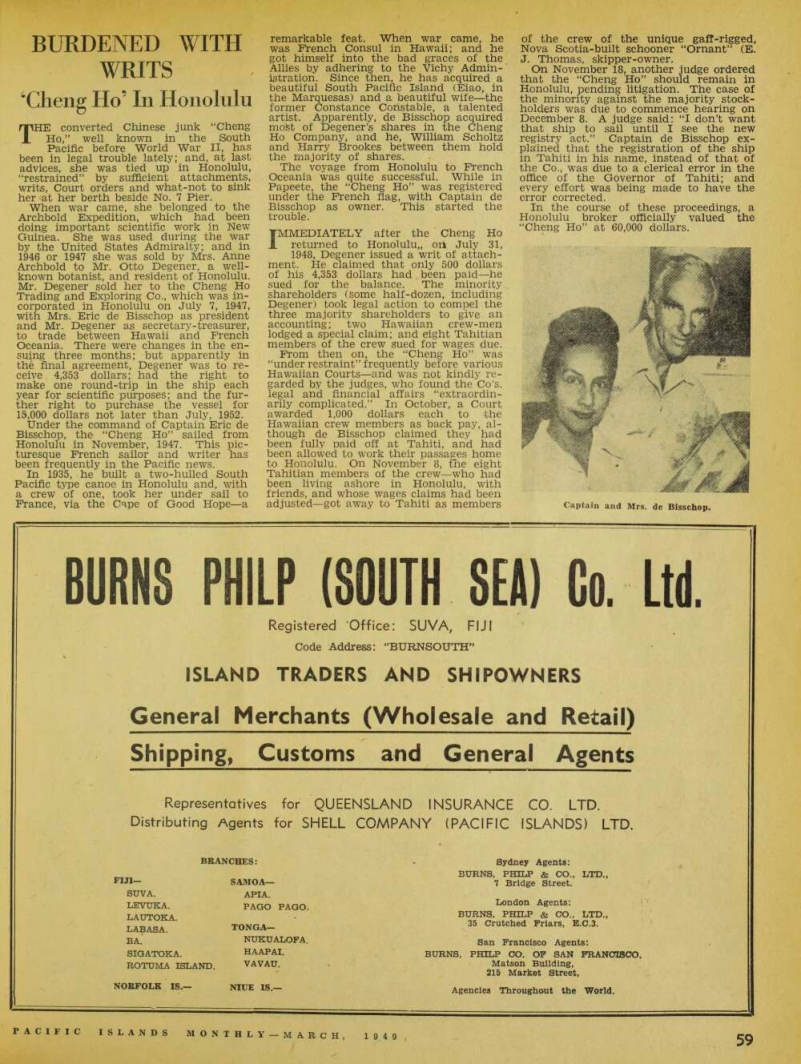
Writs
‘Cheng Ho’ In Honolulu
THE converted Chinese junk “Cheng Ho,” well known in the South Pacific before World War 11, has been in legal trouble lately; and, at last advices, she was tied up in Honolulu, “restrained” by sufficient attachments, writs, Court orders and what-not to sink her at her berth beside No. 7 Pier.
When war came, she belonged to the Archbold Expedition, which had been doing important scientific work in New Guinea. She was used during the war by the United States Admiralty; and in 1946 or 1947 she was sold by Mrs. Anne Archbold to Mr. Otto Degener, a well known botanist, and resident of Honolulu.
Mr. Degener sold her to the Cheng Ho Trading and Exploring Co., which was in corporated in Honolulu on July 7, 1947, with Mrs. Eric de Bisschop as president and Mr. Degener as secretary-treasurer, to trade between Hawaii and French Oceania. There were changes in the en suing three months; but apparently in the final agreement, Degener was to re ceive 4,353 dollars; had the right to make one round-trip in the ship each year for scientific purposes; and the fur ther right to purchase the vessel for 15,000 dollars not later than July, 1952.
Under the command of Captain Eric de Bisschop, the “Cheng Ho” sailed from Honolulu in November, 1947. This pic turesque French sailor and writer has been frequently in the Pacific news.
In 1935, he built a two-hulled South Pacific type canoe in Honolulu and, with a crew of one, took her under sail to France, via the Cape of Good Hope—a
remarkable feat. When war came, he was French Consul in Hawaii; and he got himself into the bad graces of the Allies by adhering to the Vichy Admin istration. Since then, he has acquired a beautiful South Pacific Island (Eiao, in the Marquesas) and a beautiful wife—the former Constance Constable, a talented artist. Apparently, de Bisschop acquired most of Degener’s shares in the Cheng Ho Company, and he, William Scholtz and Harry Brookes between them hold the majority of shares.
The voyage from Honolulu to French Oceania was quite successful. While in Papeete, the “Cheng Ho” was registered under the French flag, with Captain de Bisschop as owner. This started the trouble.
IMMEDIATELY after the Cheng Ho returned to Honolulu,, ort July 31, 1948, Degener issued a writ of attach ment. He claimed that only 500 dollars of his 4,353 dollars had been paid—he sued for the balance. The minority shareholders (some half-dozen, including Degener) took legal action to compel the three majority shareholders to give an accounting; two Hawaiian crew-men lodged a special claim; and eight Tahitian members of the crew sued for wages due.
From then on, the “Cheng Ho” was “under restraint” frequently before various Hawaiian Courts —and was not kindly re garded by the judges, who found the Co’s, legal and financial affairs “extraordin arily complicated.” In October, a Court awarded 1,000 dollars each to the Hawaiian crew members as back pay, al though de Bisschop claimed they had been fully paid off at Tahiti, and had been allowed to work their passages home to Honolulu. On November 8, the eight Tahitian members of the crew—who had been living ashore in Honolulu, with friends, and whose wages claims had been adjusted—got away to Tahiti as members
of the crew of the unique gaff-rigged, Nova Scotia-built schooner “Ornant” (E.
J. Thomas, skipper-owner.
On November 18, another judge ordered that the “Cheng Ho” should remain in Honolulu, pending litigation. The case of the minority against the majority stock holders was due to commence hearing on December 8. A judge said: “I don’t want that ship to sail until I see the new registry act.” Captain de Bisschop ex plained that the registration of the ship in Tahiti in his name, instead of that of the Co., was due to a clerical error in the office of the Governor of Tahiti; and every effort was being made to have the error corrected.
In the course of these proceedings, a Honolulu broker officially valued the “Cheng Ho” at 60,000 dollars.
Captain and Mrs. de Bisschop.
Advertisements & other items, pp. 61-62 (1 item)
Burns Philp (South Sea) Co. Ltd.
Registered Office: SUVA, FIJI
Code Address: “BURNSOUTH” ►
ISLAND TRADERS AND SHIPOWNERS
General Merchants (Wholesale and Retail)
Shipping, Customs and General Agents
Representatives for QUEENSLAND INSURANCE CO. LTD.
Distributing Agents for SHELL COMPANY (PACIFIC ISLANDS) LTD.
BRANCHES:
FIJI—
SUVA.
LEVUKA.
LAUTOKA.
LABASA.
BA.
SIGATOKA.
ROTUMA ISLAND.
NORFOLK IS.—
SAMOA—
APIA.
PAGO PAGO.
TONGA—
NUKUALOFA.
HAAPAI.
VAVAU.
NIUE IS.—
Sydney Agents:
BURNS, PHILP & CO., LTD.,
7 Bridge Street.
London Agents:
BURNS, PHILP & CO., LTD.,
35 Crutched Friars, E.C.3.
San Francisco Agents:
BURNS, PHILP CO. OF SAN FRANCISCO,
Matson Building, 215 Market Street, Agencies Throughout the World.
DON'T SAY (JIM DON'T SAY G I N GIN DON'T SAY Lpont say
DON'T SAT GIN
GIN don*t say g
DON'T SAY GIN
GIN DON'T SAY
DON'T SAY GIN
GIN don't s;
DON'T SAY GUI
G I M DON'T SAY
DON'T SAY GI M DON'T
GIM DON'T SAY GIN DON'T S
DON'T SAT G I M DON'T SAY GIN I
DON'T SAY GIN DON'T SAY GIN
GIN DON'T SAY G SAY
DON'T SAY GIN
GIN DON'T SAY G
DON'T SAY G I N D
GIN DON'T SAY
DON'T SAY GIN
GIN DON'T SAY
DON'T SAY GIN
GIN DON'T SAY
DON'T SAY GIN DON'T
G I M DON'T SAY CIM DON'T
DON'T SAY GIN DON'T SAY GIN
DON'T SAY G I N
I M DON'T SAY
DON'T SAT GIN
T SAY
DON
r DO AY Gift Li qu \ *r* °^h Cq c
SAY
! Ls * ey IN SK,* r '.ib
'T SAY
x *;,.y T
DON'T SAY GIN
GIN DON'T SAY
DON'T SAY © I M
'T SAY
M Y AY Li Q{j M.
IT 0 urn * Co
SAY
*OS * ey % U
T SAY
DON T
Telegrams and Cables: “GILBEYS," Melboame Address all inquiries to:
W. & A. GILBEY LTD.
33 ROSSLYN STREET, WEST MELBOURNE. 109 REGENT STREET, SYDNEY.
Telegrams and Cables: “GILBEYS,” Sydney.
Natives and Whites In New Hebrides
(A Letter to the Editor)
WITH reference to your report of my speech to the Presbyterian General Assembly regarding Nationalism in the New Hebrides, It is a pity you did not verify the statements made in it before publishing them. The reporter did not
S fm d
what he wiote gives a cpmpletely unbalanced view of what I said. , , I did not, as your sub-heading alleges, accuse planters and traders of exploitation-I doubt if I even mentioned them.
Le o S f fhTfLt r o e rs° r that weiated
neon?e f roncSned ln h brinelne
the Ip ntw Sp rh lh
the new Native Church, and that was the kmd of spirit which has shown itself from time to time m upsurges such as the Jon rxum Movement.
I was not dogmatic about its cause or its character, but simply drew upon the various sources of information which were open to me in the New Hebrides. They were not by any means limited to missionaries—although I suspect that even missionaries, who lived on Tanna and saw the matter with their own eyes, have a more accurate knowledge of what happened than others far removed from the scene. , The report I gave was to the effect that this Movement had a number of roots, some of them probably going down below the surface of consciousness. One of those, without doubt, was the measure of exploitation experienced by the native people at the hands of the whites. I made no comment on the extent of that exploitation, and whether it is being practised at present, or belongs only to the past. Everyone knows that there has
been such. You, yourself, in your edi torial footnote, acknowledge that it has had a place—and there is no doubt that, however the matter appears to the white people, to many of the natives it has been a reality.
THAT brings me to a further inaccuracy in your report. I did not say that exploitation of the natives provoked a violent reaction. I said that all these various factors which I mentioned, of which exploitation was but one, had pro duced this result. That surely was true.
People who lived on Tanna, during the tense days of the early 40’s, and those who had administrative responsibilities for them, would say that the reaction was quite violent enough for them. It fell little short of widespread bloodshed, FROM the above it should be plain that nothing in my speech to the As sembly was directed, implicitly or ex plicitly, against the traders and planters of the Islands. If they came into the picture at all, they were only incidental to the main theme, which was something quite different.
In closing, let me say that I hope your interpretation of the traders and planters’ opinion of missions is not accurate. My observations lead me to believe that if it had not been for the breaking down of the natives’ institutions and the disturbing of his normal life,” through the influence of Christianity, the lot of the White Man in these Islands, event to-day, would be a very difficult and hazardous one.
I am, etc.,
(Rev.) J. S. Murray.
Auckland, 15/2/49.
Us Progress In
Micronesia
Government of Six Races
. CHICAGO Daily News man Mr A Q Weller who made many george Weller who p made wbrld War n has had a wander through the newly-created American Trust Ter of Micronesia (Caroline, Marshall and Manana Islands) and he made some interesting statements in San Francisco „ DDear that , lthoueh the uniteJsmtes * pt un a
m2nt
Stal S teation Zch o P f ?he actual work of administration is carried out by Navy personnel, using Navy instrumentalities esneciallv shins The latter is an imnort
anV coMldeFatloi—these archipelagoes
contain only 50,000 natives, and they are more widely scattered than any other island groups in the world. T\ESCRIBING the varied problems MJ faced by the Navy in this task, Mr. . Weller said the Navy is doing a good job and the islands should not be turned over to a civilian agency, Visioning the terrific increase m the already high living costs of the islands, if commercial shipping rates on all sup phes were to be applied, Mr. Weller said th&t th. 6 tremendous problem of covering distances is one of the reasons why the Interior Department should not take over, The ba rg p ain t 0 the is i an ders in not having to gay the Navy salaries of some 50 officers and 150 enlisted men in Naval government, nor the upkeep of the ships used in island transportation, was cited by Mr Weller as another rea son for aid ing the islanders by retaining Navy ad ministration, (Continued Next Page)
“I expected to find a lot of worn-out captains only interested in comfortable living. Instead I found the work being done by lieutenants, from the Monterey school for civilian affairs officers.
“Most of them displayed a real interest in their jobs and a pride in what they have achieved.”
He continued, “All in all, our control of Micronesia (with approval of the United Nations) is a tremendous bargain in American security. The annual cost is 2,250,000 dollars—a figure only slightly loaded in that it does not include the cost of upkeep of Navy ships nor Navy pay.”
MR. WELLER suggested two adjust ments he felt the Navy should make in administration. He said: “The people out there are not one race, but six, sharply distinguishable—as dif ferent from one another as are the peoples of Europe. If they have any common language, it is Japanese, picked up during the 20 years of Jap occupation., “Sure, they have similarities. They are dark of skin and live in a warm climate.
Their economies are somewhat similar— a copra base. But there is as much dif ference between the canoe culture of the Carolines and the juke box culture of Guam as between the American Indians and Bronx.
“A basic misunderstanding is apparent in the sometime too general policies passed down from the office of the Trust Territories Commissioner in Hawaii. Even the second echelon, based in Guam, is too far from the scene. Operational headquarters should be in Truk, and the Navy is considering moving them there.
“The second adjustment deals with the economic growth of the 50,000 islanders.
Current policy is a protective one—to keep out all exploitation.”
Mi’. Weller said that he preferred the Japanese plan, under which some indus tries were established, and if the natives were exploited, they also profited by it.
Weller said he is for that.
He also hoped to see the tourist trade exploited and encouraged, letting “primi tive races” and the atomic age people mingle for their mutual good.
Advertisements & other items, pp. 63-64 (1 item)
f@A
TK> T Wholesale and Retail Merchants. Shipowners. Sawmillers.
General Engineers. Customs and Shipping Agents.
Catering for all Plantation Supplies. Buyers of Island Produce.
Plantation Owners and Managing Agents.
Agents for:— Australia-West Pacific Line.
China Navigation Co.
Canton Insurance Office, Ltd.
Union Assurance Society, Ltd.
Aust. T. & G. Mutual Life Society, Ltd.
Guinea Air Traders, Ltd.
At**'
COUER.
tro.
Melbourne Atsociatea |.tD.
COL'rEE. V, S an d, CcV-urch- Wellington, Distributing Agents in New Guinea for:— Hillman, Humber, Sunbeam-Talbot, Chrysler and Plymouth Cars.
Commer, Karrier and Fargo Trucks.
Willys Overland Jeeps.
G.M. Marine and Industrial Engines.
Olympic Tyres and Cables.
Hygeia Dissolvenators.
Prefect Refrigerators.
Mullard Radios.
Ewo Beer.
Snowflake Unsweetened Evaporated Milk.
AP2
INDOORS or OUT
BRILLIANT LIGHTING
WHEN & WHERE REQUIRED
. The vapour lamps are the last word m efficiency in modern kerosene lighting. Burn for 10 hours on 14 pints kerosene. All spare parts available.
Obtainable in two models, the AP2 and HL7. Write for leaflet. % HL7
DEKOL
Guards Wood and Canvas from the Ravages of White Ants, Borers.
Dry Rot. Mildew, etc. penefra * es deeply, permanently protect,ng wood and fabrics from rot and attacks by fungi and insects. It is simple to apply and when dry can be painted and varnished. DEKOL also prevents attack by marine borers on wood immersed in sea water.
DON'T WAIT
TILL THIS
HAPPENS.
'tz Trade Inquiries Invited.
C.Q.R. ANCHORS
The light-weight anchor with three times the holding power 9* any other anchor. Designed for positive and quick “dig in,” the C/.Q.R, anchor is two well-designed ploughshares welded together.
Write for another leaflet.
w. kopsen & co. m. im
SHIPCHANDLERS & MARINE ENGINEERS
376-382 KENT STREET, SYDNEY. PHONE: MA6336 (9 lines).
Cables: “KOPSEN” Sydney.
Hare Taporo Visits
Auckland
THE 36-year old schooner “Tiare Taporo” which is owned by A. B.
Donald Ltd., of Rarotonga, visited Auckland, NZ, in February. She was built in Auckland but has not visited the Dominion for 30 years.
She will, on this occasion, undergo refit.
The schooner was nine days overdue on her arrival. Her master, the popular and well-known Captain Andy Thompson, said that they had met strong south westerly winds most of the way.
British Colonial Office
Monthly Journal Issued By
THE British Socialist Minister who presides over the Colonial Office, Mr. A, Creech Jones, writes the “Foreword” of Corona, a new journal which now is being published (monthly, we presume, although it does not say so) for the British Colonial Office. The Minister warmly approves the plan, and welcomes this first number.
The first number of Corona is an at tractive production, and it should be of interest and help to the great British Colonial Service, scattered so widely across the world. There must be, among BCO men, an enormous mass of material which could be made of fascinating in terest to both officials and general readers. The problem lies in getting it from the official in the field onto the printed page. That is the task of the editor. He has made a good start.
But it would be unwise to expect too much of Corona. Every Socialist Minister hates the independent press, and plays with the idea of producing his own Departmental journal. We have seen plenty of such efforts in Australia.
Corona says: “The Secretary of State does not necessarily endorse any opinions expressed in this journal, nor does any of its contents necessarily represent the official policy.” Fine; but does anyone expect Corona to attack British Socialist policy at home, or criticise and expose the errors of BCO administration abroad!
That is fatal objection to such journals.
They are not free, while politicians and bureaucrats—their bosses—are fallible.
The interests and activities of the British Colonial Office world are admirably served by The Crown Colonist, one of the best monthly newspaper reviews published in Britain. It is not very critical of BCO. but it nevertheless is independent of officialdom: its editors very definitely have a mind of their own; it is a highly profitable enterprise; and so, of course, a Socialist Minister does not like it very much.
Miss E. Hardingham and Miss P. Mills, of the Methodist Mission, Fiji, have re turned there after three months’ leave in Australia.
The Rev. R. L. Barnes of the Methodist Overseas Mission, New Ireland, attended the Queensland Methodist Conference which was held in Brisbane recently. His wife, formerly Miss M. Vanderse, is a trained nurse, and will return to the mission station with him.
It has been announced in Noumea that the following officers serving locally have been awarded; the order of the Legion d’Honneur: Dr. Colonel Sanner (officer); and supply officer Albatro, Capt. Pore and Lieut, de THopital Felce (chevaliers).
'White Norfolk’
New Development of Notable Australian Decision
VILA, February 20.
INDIGNATION has been caused recently in the New Hebrides —and especially in Santo —by the application of what is apparently a new policy in Norfolk Island (an Australian Territory). It is called “the White Norfolk policy”, and appears to be a development of the White Australia Policy—the fervid application of which now is causing so much ill feeling throughout the Pacific and Indonesia.
Hitherto, residents of the New Hebrides have occasionally sent their children south to Norfolk Island, to school. The regular Australian steamer, running between Sydney and the New Hebrides, usually calls at Norfolk Island —so it was a convenient arrangement.
Some of our families have a strain of blood from Pacific Islands races.
Recently, a well-known and highly re spected resident of Santo went to Norfolk, to arrange that some of his children should go to school there. He was informed that, because of their mixed blood, they would not be allowed to reside on Norfolk.
Very angry and indignant, he pro ceeded to New Caledonia, and his children were enrolled in a school in Noumea, The French have a realistic and sympathetic outlook upon such matters.
It is reported that the Australian Gov ernment had no hand in this develop ment in Norfolk Island —local officials are believed to be responsible for the new interpretation of the law.
EDITORIAL NOTE. —Even if it is a local interpretation, it is in line with the recent pronouncements of Australia’s very remarkable Minister for Immi gration, Mr. Calwell.
In 1948, the Minister decided to keep all Polynesians out of Australia. He “fell in up to his neck”, because the New Zealand Maoris are Polynesians, and therefore, came under the ban. This aroused the NZ Government to angry protest; and the Australian Minister thereupon hurriedly found some ancient law under which the ban upon Maoris was immediately removed. But the ban remained and still remains upon Samoans, Tongans, Cook Islanders, Tahitians and Hawaiians, although racially they are exactly the same as the Maoris—they are all Polynesians. The ban applies also to persons of European- Polynesian blood (who are not New Zealanders).
There are now resident in Australia thousands of people of Polynesian and part-Polynesian blood—good and re putable citizens. They, apparently, are to be weeded out, because they have no one, like the influential Prime Minister of New Zealand, to speak for them.
In one respect, the Norfolk Island de cision is very funny. All the original Norfolk Island settlers came from Pit cairn Island, being the surplus descen dants of the “Bounty” mutineers who could not be accommodated on that overcrowded island. They, of course, practically without exception, are half Polynesian—half European and half Tahitian. All the nine “Bounty” men who cast their ship away on Pitcairn took Tahitian wives with them; and it is mainly their progeny that now populates Pitcairn, and provides the oldest community on Norfolk—excellent, law-abiding people.
The silly, fumbling application of the immigration laws by the Australian Socialists is building up against Aus tralia, throughout the Pacific area, a very strong and bitter feeling of ill-will.
Australians on tour encounter it in many places.
Dr. Elsie Came has rejoined her hus band, the Rev. T. C. Came, of the Methodist Mission, Lautoka, Fiji, after leave in Australia. Their work is among the Indians of Fiji.
Mr. J. F. A. Taylor has been appointed Inspector of Mines -on agreement for three years. Mr. Taylor is a New Zea lander who was employed for two years in Northern Rhodesia and was for two years with the Pasco Copper Corporation in Peru.
Fijian Goes to Victorian Gaol For Five Years
Five Years
A FIJIAN seaman, Ben Harrye, was re cently sentenced to five months’ gaol in the Criminal Court, Melbourne, for a serious offence against a woman, Harrye’s counsel suggested that dif ferent views prevailed in Fiji in respect of the criminality of attacks on women, and appealed for leniency on the grounds of a different standard of morality.
Mr. Justice Gavan Duffy, in imposing sentence, said that he had no reason to believe that standards differed in the two countries. He also refused to allow Harrye to be deported to Fiji. He said his offence was particularly gross, and women had to be protected from such at tacks, whether from Australians or strangers.
Advertisements & other items, pp. 65-66 (1 item)
<flbmmonwcaltb Bank
WE v
CAN HELP mu
With Full banking facilities at our ™ Island Branches
RABAUL ... LAE
PORT MORESBY
MADANG
The Service links with our Branches throughout Australia,- also our Agents and correspondents all over the world.
<flbmmonwcaltb Bank
of Australia.
Every Branch of the Bank conducts Savings Bank business.
GEORGE J. LOGKYER & COMPANY
CONSULTING ENGINEERS DOCKYARD MACHINERY
fn association with GEORGE J. LOCKYER (Far East) & CO. and GEORGE J. LOCKYER (Overseas) & CO.
ENGINEERING SUPPLIES, GENERAL HARDWARE EXPORTERS AND MERCHANTS Agents for the Finest Australian Liquors Aerated Water and Cordial Manufacturing Machinery, Bottling and Capping Machinery, etc.
IF YOU ARE INTERESTED IN:—
MILLS
Flour mills. Hard semolina mills. Self-contained Colonial Flour Mills. Flour improving equipment. Feed milling equipment. Grinding and blending plants. Saw dust mills. Grinding and blend plants for spices and colours. Laboratory equipment.
HULLING INDUSTRY
Hulling mills for rice, barley (for making groats), oats (for flakes and groats), peas, buckwheat, millets, kauliang, lentils, Dal and other pulses.
OIL MILLING
Complete equipments for the manufacture and refining of vegetable oils and fats. Pressing, Extraction-, and Refining plants. Oil separating plants for wool and leather. Margarine granulators, Melting and Tempering Pand for the manufacture of margarine.
SUGAR TREATING MACHINERY
Installations for drying, cooling and assorting granulated sugar. Conveying plants. Grinding plants for pile and granulated sugar. Manufacture of powdered sugar.
MALTING AND BREWING PLANTS
Equipments of complete maltings and breweries. Barley and Malt cleaning plants. Pneumatic Maltings (Drum and Saladin Box Maltings). Malt Kilns. High Capacity Malt Kilns. Floor Stores and Silos for barley and malt.
Pneumatic and mechanical handling plants for barley and malt. Malt crushing plants. Brew house equipment. Mash filters. Wort colling plants. Fermentation and Storage Tanks. Conveying plants for barrels and bottles. Laboratory equipments.
MACHINES FOR SOAP MAKING
Soap boiling equipment. Pumps. Soap slabs cooling plants. Cutting machines. Presses. Drying plants.
Milling equipment. Pendulum cutter. Flaking rolls.
Soap-powder plants.
MACHINES FOR THE CHOCOLATE INDUSTRY
Cocoa beans crushing, cleaning and grinding plants.
Cocoa presses. Cocoa and chocolate roller mills.
CONSTRUCTION OF GRANARIES AND
WAREHOUSES
Construction of Export and Import Granaries. Agricultural and Mill Granaries for all kinds of grain, oil fruits, pulses, and seed, in bulk or in sacks. Mechanical and pneumatic handling plants for loading and unloading ships and railway cars with the above-named goods. Steel Silos. Grain Cleaning Plants. Machinery for dressing seed.
PNEUMATIC HANDLING PLANTS
For grain, bran, flour, oil seed, coal, salt, chemical products, ashes, blast furnace dust, wood chips, woodshavings. Floating pneumatic elevators. Floating pneumatic grain elevators. Stationary and travelling ship discharging plants. Conveying plants for rubbish from wash plants and rubbish disposal plants for mines.
MECHANICAL HANDLING PLANTS
For all kinds of goods in bulk and packages, such as grain, coal, salt, earth and ores, stornes, bags, cases, bales, barrels, wood logs, etc. Mechanical equipment for warehouses of salt works and the chemical industry.
Trans-shipping plants for loading salts into ships and railway cars. Coal handling plants for boiler houses.
Equipment for the automatic operation of mail offices.
CEMENT WORKS AND ROCK CRUSHING
PLANTS
Equipment of complete cement works. Crushing, burning, grinding, and conveying equipment for the chemical industry; specially for Dolomite, Magnesite, and Aluminium Works. Installations for salt mills and salt stores. Crushing and grinding plants for coal.
Road metal plants, etc.
MECHANICAL PULP AND BOARD MILLS
Complete equipment for mechanical wood pulp mills and board mills of every size. Preparing plants for cellulose and pulp wood. Wood barking plants. Installations for handling wood sticks and pulp. ©
- CONSULT US -
All communications to be addressed to The General Manager, G.’P.O., Box 4553, Sydney.
Bankers: Commonwealth Bank of Australia, Sydney.
Also Bank of N.S.W., Sydney.
Telegraphic and Cable Address: ■‘LOCKMACH,” Sydney.
Islands Education
Plane-Load of Samoan Students For New Zealand
From Our Own Correspondent
Apia, Feb. 28.
ON February 23, an Australian Sky master/ plane left Apia for New Zealand direct, carrying 26 scholarship pupils who had spent their Christmas holidays, on leave from New Zealand, in Samoa, and 10 new scholarship) pupils who were leaving for New Zealand, to enter NZ schools under the scholarship scheme of the New Zealand Government.
Nz’S Plan To Educate Islanders
From Auckland “Star” of February 26 “We like over here, and we are glad to be back,” said several members of a party of 37 young Samoans who left Auckland by train for the south last evening. They arrived at Whenuapai by Skymaster on Thursday night.
Most of them are returning to study at schools throughout the Dominion after their first holiday in Samoa for several years. For ten of the party it was their first trip to New Zealand.
The islanders, whose ages range from ten to 21, are studying here on Govern ment scholarships. Those who came to the Dominion when the scholarship scheme was started four years ago were due to revisit their homes at the end of 1947. but were prevented from doing so by the poliomyelitis epidemic.
Farewelling the party at the station was Mr. F. R. J. Davies, officer for Islands education. He said the Samoans made model pupils.
The scholarships, which are awarded by annual examinations, are also given to Niue and Cook Islanders. A party is expected to arrive from the Cook Islands on Monday night. In all, 71 islanders will be studying here this year.
All who are awarded scholarships must agree to return to the Islands! after completing their training. They will then be offered responsible posts, such as teachers, surveyors, accountants and nurses. The scheme is part of the Gov ernment’s policy of making the peoples of New Zealand’s island territories more self-reliant.
Nz’S Earliest Inhabitants
FROM a document sent us recently by Mr. P. S. Allen (editor of Stewarts Handbook of the Pacific, which ceased publication in 1921) it appears that there is quite a literature in exist ence on the subject of the Moriori people —a strange and little-known race which inhabited New Zealand prior to the coming of the Maori, and a remnant of which exists still in the Chatham Islands —that bleak and unattractive group which lies some 300 miles south-east of New Zealand. Mr. Allen has supplied a list of books and papers, dealing more or less directly with the Moriori race, and apparently complete up to about 1920.
There are over 50 such references, and they extend from “The Log Book of the Tender Chatham” (1791-1795) up to 1919.
There was a lot of scientific interest in the Monoris, at one time; but now, like the Tasmanian aborigines, they have almost passed into the limbo of forgotten things. There were 1,200 of them in the Chathams m 1791. but they practically disappeared in the 19th century as the result of subsequent Maori immigration.
Advertisements & other items, p. 67 (1 item)
Burns Philp Trust
THAT
The
Put an End
to guesswork
No executor or trustee can afford to lose touch with day-to-day changes in taxation, finance, and investments. Living in the Islands, he finds it quite impracticable to administer an estate by remote control.
Isolated from sound advice on pressing problems, he is likely to neglect his own job without assisting the beneficiaries in the least. Such a disaster can be avoided by transferring these extra responsibilities to Burns Philp Trust Company Limited.
This step liberates you from incessant anxiety, while the beneficiaries profit by smooth and efficient administration. The Company possesses every facility for dealing with the many and complex problems connected with the management of estates.
"Hands That Never Leave the Wheel” explains in detail how this organisation can assist you. A complimentary copy of this
DIRECTORS:
James Burns Joseph Mitchell P. T. W. Black Eric Priestley Lee
Burns Philp Trust
COMPANY LIMITED
EXECUTOR • TRUSTEE • AGENT
Constituted by Special Act of the N.S.W. Parliament
HEAD OFFICE: 7 BRIDGE STREET, SYDNEY
booklet will be forwarded on request.
MANAGER: L. S. Parker
SECRETARY: E. R. Overton, A.F.I.A.
TEL.; BU 5901
BOX 543, G.P.0., SYDNEY
BP4-49
Samoan Products For
America
Apia, Feb. 24.
THE Swedish steamer “Parakoola” left Apia on February 21 for Vancouver with a cargo of 2,335 tons of copra, sold to the Canadian Government, and a small lot of 43 tons of cocoa beans.
The Norwegian steamer “Thor 1” is ex pected shortly to lift a further consign
ment of cocoa for the American market, which will somewhat relieve the present accumulation of cocoa beans in Apia sheds.
Mr. William R. Cahill, after spending several months in Brisbane and Sydney, has returned to his plantation “Wagol,”
Madang, New Guinea. Mrs. Cahill will return home in March. Their son Ken is now a medical student at Brisbane
University.
Strange Epidemic In Papua Costs
Many Wrist Watches
Strange Epidemic In Papua Costs Trader £30
Port Moresby, March 1.
LOUIS TARDY, gold-miner and trader, of Gamadoda, Milne Bay, appeared before Mr. J. MacDonald, District Officer at Samarai, in February, and pleaded guilty to having been in posses sion of smuggled goods. He was fined £3O.
Suspicion was aroused when it was noticed that a number of village natives in the Milne Bay area were wearing exclusive and expensive wrist-watches, and were lighting their fires and cigarettes with the latest designs in cigarette lighters. The village girls were also waiting an occasion to don Chinese silk blouses.
As the SS “Nellore” had recently been berthed at Milne Bay, investigations were made by members of the Native Con stabulary and it was ascertained that the natives had purchased the articles from a European trader in the area for the following prices: wrist-watches £5 (Australian price would be about £l5; cigarette lighters and cases £1; Chinese Blouses 30/-; as well as bracelets and other articles of Chinese origin.
Further investigations were carried out by Mr. J. Goad (Collector of Customs, Samarai and an officer of the RPC) and a search of the premises of the trader at Milne Bay revealed a quantity of goods, which had been purchased from the Chinese crew of the SS “Nellore” whilst in port. All goods located were confiscated.
The natives of the Milne Bay area are still considered wealthy, having hoarded their war-I’me earnings, and they pro vide a ready market for such dealings.
Advertisements & other items, p. 68 (2 items)
Perfect
results
The Illustration ■hows the “Victory”, a popular light all - steel plough, combining maximum strength with minimum weight and draoght. in any class of soil can be obtained with one implement or other in the wide selection which we offer Our range covers share and disc ploughs for animal and tractor draught, cultivators, disc harrows, planters, etc.
Ransomes other manufactures Include hand, ment, etc. Write for Illustrated literature and
PLOUGHS and
IMPLEMENTS
horse and motor lawn mowers, aerodrome equlpall information.
MORRIS, HEDSTROM LTD.,
Suva Lautoka 6a.
Made by: RANSOMES, SIMS & JEFFERIES, LTD., IPSWICH, ENG.
Heinz Braiseo
gating Me a
Heinz Braised Beef Stew is prepared just like you’d do it in your own home. Choiee cuts of beef are slowly simmered till deliciously tender , . . u-m-m . . . melt in your mouth! There’s all the flavour and goodness of fresh diced vegetables, too. It’s a family feast.
BEEF STEW
h §/m s 'S69
yseo
77 S 7
I ET‘ tS
In Fiji In 1911
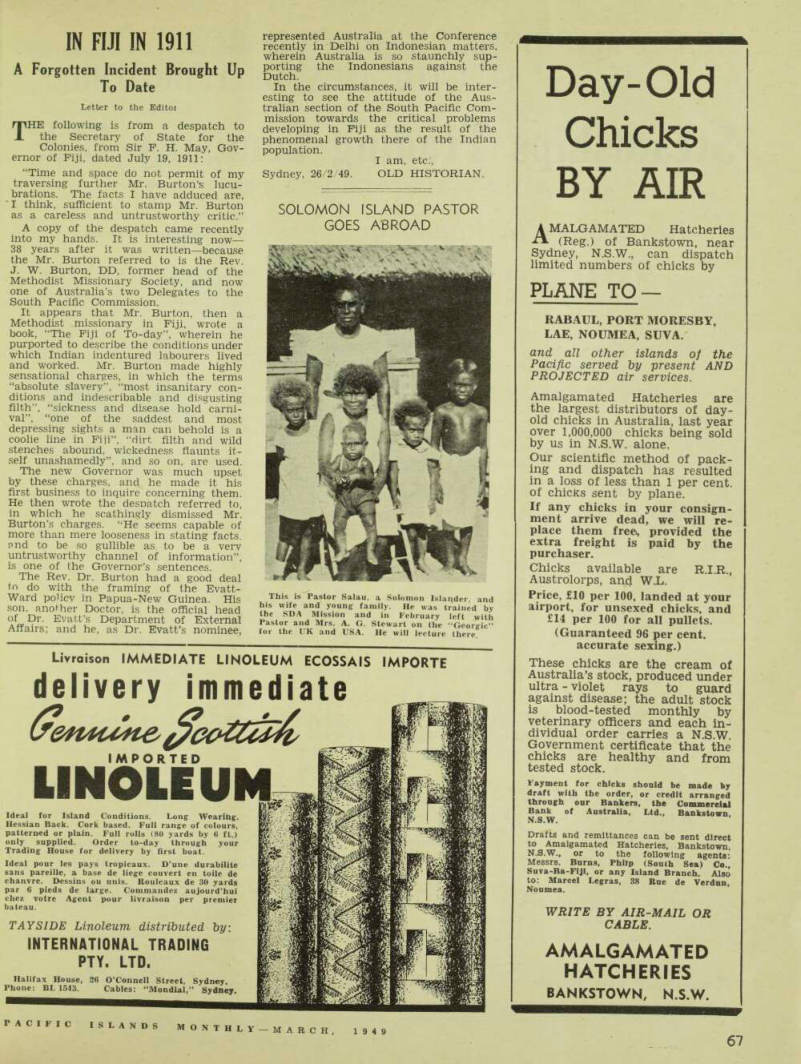
A Forgotten Incident Brought Up To Date
Letter to the Editoi THE following is from a despatch to the Secretary of State for the Colonies, from Sir F. H. May, Gov ernor of Fiji, dated July 19, 1911: “Time and space do not permit of my traversing further Mr. Burton’s lucu brations. The facts I have adduced are, 'I think, sufficient to stamp Mr. Burton as a careless and untrustworthy critic.”
A copy of the despatch came recently into my hands. It is interesting now— -38 years after it was written—because the Mr. Burton referred to is the Rev.
J. W. Burton, DD, former head of the Methodist Missionary Society, and now one of Australia’s two Delegates to the South Pacific Commission.
It appears that Mr. Burton, then a Methodist missionary in Fiji, wrote a book, “The Fiji of To-day”, wherein he purported to describe the conditions under which Indian indentured labourers lived and worked. Mr. Burton made highly sensational charges, in which the terms “absolute slavery”, “most insanitary con ditions and indescribable and disgusting filth”, “sickness and disease hold carni val”, “one of the saddest and most depressing sights a man can behold is a coolie line in Fiji”, “dirt filth and wild stenches abound, wickedness flaunts it self unashamedly”, and so on, are used.
The new Governor was much upset by these charges, and he made it his first business to inquire concerning them.
He then wrote the despatch referred to, in which he scathingly dismissed Mr.
Burton’s charges. “He seems capable of more than mere looseness in stating facts, and to be so gullible as to be a very untrustworthy channel of information”, is one of the Governor’s sentences.
The Rev. Dr. Burton had a good deal to do with the framing of the Evatt- Ward policy in Papua-New Guinea. His son, another Doctor, is the official head of Dr. Evatt’s Department of External Affairs; and he, as Dr. Evatt’s nominee,
represented Australia at the Conference recently in Delhi on Indonesian matters, wherein Australia is so staunchly sup porting the Indonesians against the Dutch.
In the circumstances, it will be inter esting to see the attitude of the Aus tralian section of the South Pacific Com mission towards the critical problems developing in Fiji as the result of the phenomenal growth there of the Indian population.
I am, etc:,
Old Historian.
Sydney, 26/2/49.
Solomon Island Pastor
Goes Abroad
This is Pastor Salau, a Solomon Islander and his wife and young family. He was trained by the SDA Mission and in February left with Pastor and Mrs. A. G. Stewart on the "Greorgic” for the UK and USA. He will lecture there
Advertisements & other items, pp. 69-70 (2 items)
67
PACIFIC ISLANDS MONTHLY M A R C H . 1949
Day-Old
Chicks
BY AIR
Amalgamated Hatcheries
(Reg.) of Bankstown, near Sydney, N.S.W., can dispatch limited numbers of chicks by
PLANE TO
RABAUL, PORT MORESBY,
LAE, NOUMEA, SUVA.
and all other islands of the Pacific served by present AND PROJECTED air services .
Amalgamated Hatcheries are the largest distributors of dayold chicks in Australia, last year over 1,000,000 chicks being sold by us in N.S.W. alone.
Our scientific method of packing and dispatch has resulted in a loss of less than 1 per cent, of chicks sent by plane.
If any chicks in your consignment arrive dead, we will replace them frees provided the extra freight is paid by the purchaser.
Chicks available are R.1.R., Austrolorps, anc} W.L.
Price, £lO per 100, landed at your airport, for unsexed chicks, and £l4 per 100 for all pullets. (Guaranteed 96 per cent, accurate sexing.) These chicks are the cream of Australia’s stock, produced under ultra-violet rays to guard against disease; the adult stock is blood-tested monthly by veterinary officers and each individual order carries a N.S.W Government certificate that the chicks are healthy and from tested stock.
Payment for chicks should be made by draft with the order, or credit arranged through our Bankers, the Commercial Bank of Australia, Ltd., Bankstown
N.S.W.
Drafts and remittances can be sent direct to Amalgamated Hatcheries, Bankstown, N.S.W., or to the following agents: Messrs. Burns, Philp (South Sea) Co., Suva-Ba-Fiji, or any Island Branch. Also to: Marcel Legras, 38 Rue de Verdun, Noumea.
WRITE by AIR-MAIL OR
CABLE.
AMALGAMATED
HATCHERIES
BANKSTOWN, N.S.W.
Livraison IMMEDIATE LINOLEUM ECOSSAIS IMPORTE
delivery immediate
(fe w,
LINOLEUM
W Halifax House, 26 O’Connell Street, Sydney.
Phone: BL 1543. Cables: “Mondial,” Sydney.
MPORTED
Ideal for Island Conditions. Long Wearing.
Hessian Back. Cork based. Full range of colours, patterned or plain. Full rolls (80 yards by 6 ft.) only supplied. Order to-day through your Trading House for delivery by first boat.
Ideal pour les pays tropicaux. D’une durabilite sans pareille, a base de liege couvert en toile de chanvre. Dessins ou unis. Rouleaux de 30 yards par 6 pieds de large. Commandez aujourd’hui chez votre Agent pour livraison per premier bateau.
TAY SIDE Linoleum distributed by:
INTERNATIONAL TRADING
PTY. LTD.
HEAVY MACHINERY AND EQUIPMENT
FOR THE ISLANDS TERRITORIES
Steamships Trading Company Ltd.
AUTOMOTIVE and MACHINERY DEPARTMENT
Distributors in Papua and New Guinea for —
MOTOR CARS
ROOTS, LTD.—Hillman Minx—Humber Hawk— Humber Snipe and Sunbeam—Talbot Cars.
WILLYS-OVERLAND—Universal Jeeps—Jeepsters —Jeep Station Waggons.
Papua only.
ROAD TRANSPORT
INTERNATIONAL HEAVY DUTY MOTOR
TRUCKS—15 cwt. to 8 tons Gross Carrying Capacity. Utility Bodies—Platform Bodies— Tippers—Semi-Trailers—Low Loaders, etc.
A JJ UJ. T URAL MACHINERY
McCORMICK-DEERING FARM TRACTORS, all
sizes, Wheel and Crawler Types.
FARM MACHINERY to suit every Purpose— Ploughs — Harrows — Cultivators — Planters — Harvesters — Grass-Mowers — Hay Rakes Gr Power Pressers—Chaff Cutters—Feed Grinders —Hammer Mills, Etc.
RICE-MILLING MACH I NERY—Hullers—Pearlers — Polishers — Threshers Gr Dressers — Seed Graders—Aspirators—also Complete Mills from 100 to 3,000 lb. capacity rice per hour.
E A R T H - M OJM N G EQ UJJ> M J N T Bullgraders — Dozers — Excavators — Front End Loaders—Road Graders—Road-Rippers—Waggon Scoops—Quarry Dumpers—Bitumen Sprayers, Etc.
T I M BER LOGGING AND
MILLING E Q U I P M E N T Diesel Logging Tractors—Timber Trucks —Timber J inkers—Log Haulers—Tractor Logging Winches —Truck Mounted Loading Gr Front End Pull Winches—Wire Rope, Etc.
SAW-MILLING MACHINERY — Circular Saw
Benches—Circular Rack Saws Gr Log Mills up to 31" depth of cut.
INDUSTRIAL EQUIPMENT
DIESEL STATIONARY ENGINES—from 5 h.p.
upward, all purposes.
DIESEL MARINE ENGINES—from 5 h.p. upward W/Reverse & Reducing Gears.
OUTBOARD MOTORS—2i to 22 h.p.
MOBILE CRANES—Wharf £r Material Handling, 1 to 5 tons Capacity.
PUMPS & PUMPING PLANTS—Agriculture- Mining and General Purpose Pumps.
ELECTRIC GENERATING SETS— sizes to suit every purpose—A.C.-D.C. current.
ELECTRIC MOTORS—GENERATORS—Fractional
sizes upwards—A.C. and D.C. current.
GANG & POWER GRASS MOWERS—Municipal,
Golf Course and Airfield use.
R EJ R I GME R A TORS
ELECTRIC COMPRESSOR and KEROSENE
OPERATED Food Storage Capacity. Models 4 to 7 Cubic Feet.
AUTOMOTIVE EQUIPMENT
STORAGE BATTERIES —for every purpose—Car —Truck—Radio—Marine—Lighting sets.
TYRES & TUBES—Cars—Trucks—Tractors— Industrial Equipment.
HYDRAULIC LIFTING JACKS —i ton to 10 ton capacity.
GENERAL CAR AND TRUCK ACCESSORIES—
Electrical & Hydraulic Replacements—Clutch Linings, Brake Linings, Etc.
Adequate stocks of spare parts are available for all vehicles and machinery at our
SERVICE PARTS DEPOT
PORT MORESBY
Cable Address : Telephone : Postal Address : “Steamships,” Port Moresby Moresby, 476 Port Moresby, Papua
The Indiscriminate Gutting
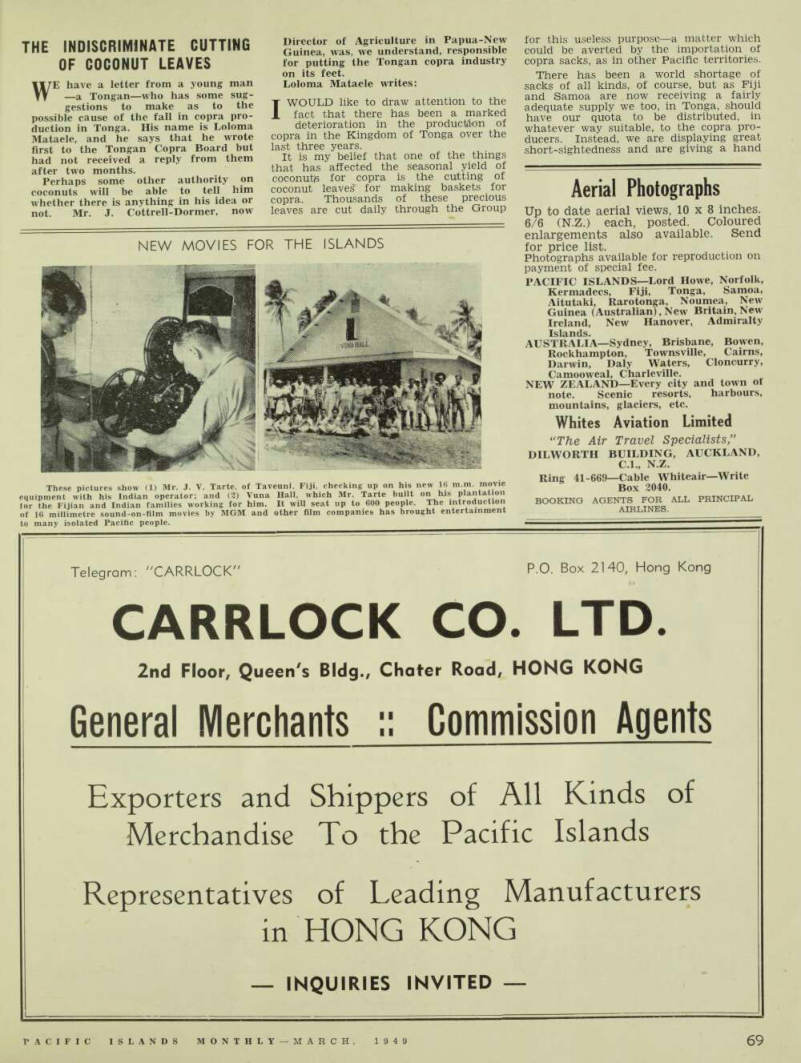
Of Coconut Leaves
WE have a letter from a young man —a Tongan—who has some sug gestions to make as to the possible cause of the fall in copra pro duction in Tonga. His name is Loloma Mataele, and he says that he wrote first to the Tongan Copra Board but had not received a reply from them after two months.
Perhaps some other authority on coconuts will be able to tell him whether there is anything in his idea or not. Mr. J. Cottrell-Dormer, now
Director of Agriculture in Papua-New Guinea, was, we understand, responsible for putting the Tongan copra industry on its feet.
Loloma Mataele writes: 1 WOULD like to draw attention to the fact that there has been a marked deterioration in the production of copra in the Kingdom of Tonga over the last three years.
It is my belief that one of the things that has affected the seasonal yield of for copra is the cutting of coconut leaves' for making baskets for copra. Thousands of these precious leaves are cut daily through the Group
for this useless purpose—a matter which could be averted by the importation of copra sacks, as in other Pacific territories.
There has been a world shortage of sacks of all kinds, of course, but as Fiji and Samoa are now receiving a fairly adequate supply we too, in Tonga, should have our quota to be distributed, in whatever way suitable, to the copra pro ducers. Instead, we are displaying great short-sightedness and are giving a hand
to the other natural parasites that destroy coconuts by wantonly cutting leaves and fronds for copra baskets.
It should be taken into consideration, also, that these are in addition to the thousands of other fronds that are cut daily for building and other purposes.
The Rev. R. A. Donne, formerly of Suva, Fiji, has been appointed to the Parish of Portland, Victoria.
New Movies For The Islands
These pictures show (1) Mr. J. V. Tarte, of Taveuni, Fiji, checking up on his new If. m m. movie equipment with his Indian operator; and (2) Vuna Hall, which Mr. Tarte built on has plantation for the Fijian and Indian families working for him. It wiU seat up to 600 people. The introduction of 16 millimetre sound-on-film movies by MGM and other film companies has brought entertainment to many isolated Pacific people.
Advertisements & other items, pp. 71-72 (1 item)
Carrlock Co. Ltd.
Aerial Photographs
Up to date aerial views, 10 x 8 inches. 6/6 (N.Z.) each, posted. Coloured enlargements also available. Send for price list.
Photographs available for reproduction on payment of special fee.
PACIFIC ISLANDS—Lord Howe, Norfolk, Kermadecs, Fiji, Tonga, Samoa, Aitutaki, Rarotonga, Noumea, New Guinea (Australian), New Britain, New Ireland, New Hanover, Admiralty Islands.
AUSTRALIA—Sydney, Brisbane, Bowen, Rockhampton, Townsville, Cairns, Darwin, Daly Waters, Clonourry, Camooweal, Charleville.
NEW ZEALAND—Every city and town ot note. Scenic resorts, harbours, mountains, glaciers, etc.
Whites Aviation Limited
“The Air Travel Specialists,”
DILWORTH BUILDING, AUCKLAND,
C. 1., N.Z.
Ring 41-669—Cable Whiteair—Write Box 2040.
BOOKING AGENTS FOR ALL PRINCIPAL
AIRLINES.
Telegram: "CARRLOCK" P-O. Box 2140, Hong Kong ll
CARRLOCK CO. LTD.
2nd Floor, Queen's Bldg., Chater Road, HONG KONG
General Merchants Commission Agents
Exporters and Shippers of All Kinds of Merchandise To the Pacific Islands Representatives of Leading Manufacturers
in HONG KONG
INQUIRIES INVITED
BERRY’S BAY
BOATYARD
(B. J. Haivorsen—Manager)
Specialists in Island vessels.
All kinds of boat-building and repairing.
New and used boats and engines for sale.
Quotations and estimates free.
BERRY’S BAY BOATYARD
John Street, North Sydney. N.S.W.
No Shipping—Wrathful
Planter Speaks Out
Letter to the Editor THE ineffectual use of the large Gov ernment fleet of inter-Island vessels is responsible for the shipping shambles in the Solomons. As a result, large quantities of copra have rotted or been lost in the last year.
Bought and paid for by the British taxpayer to do a job of work, far too many of these valuable vessels are either too dashed dainty to lift copra, or else are wastefully employed carrying part cargoes, or on sheer gallivanting cruises of doubtful importance.
The Ministry of Food would not stand for a bar of this nonsense, if it knew the position. It would not permit precious copra to rot while Government* ships raced in endless gyrations around the Group doing any and every job but that of lifting produce for Britain. (The happenings in regard to the use of Gov ernment shipping here are parallelled by the wasteful use of official cars by Can berra civil servants). After all, it is the British taxpayers who go hungry when produce is lost; and, as they are paying the piper, they will call the tune.
In this matter, all Government ship ping is referred to, not that of the Trade Scheme only. In this period of economic crisis, as in war, it is essential that every ton of shipping in the Group be used to the utmost. There are enough ships to handle the business, and they could handle it, if they were only allowed to get on with the job and not messed about. j anii e £ C
Leslie F. Gill.
Munda, BSI.
Building Progress In Santo,
NH
From Our Own Correspondent
Santo, Jan. 20.
SHORTLY after the Harris’ Cinema was opened on the Northern Arm of the Segond Canal, the Santo Branch of the New Caledonian Company, Maison Barrau, built a second store in this area of new development.
There are rumours that other stores in this important section of the New Hebrides plan to branch out also along the Northern Arm, and in addition to a new hotel, a sort of “country road-house” is planned in the vicinity of the Cinema.
It does not seem likely, though, that the original settlement facing the East, North Eastern entrance to the Canal will become secondary. Close together along this front are the stores of Burns Philp, Gubbay Freres and Tom Harris, their staff quarters, and two hotels.
Both sites have many natural advan tages and the twist-over can only result in each “town” being a duplication of the other, with equal facilities and equal influence.
The anchorage opposite the entrance to the Canal is the one that visiting traders in small ships prefer; whilst that along the Northern Arm is deeper, is lined with the wharves and docks built by the Americans during the war, and is the location of the major Tonkinese camps—sources of wealth worth catering for!
Monsieur Vidal, Inspector of Public Works in Tahiti, departed on the MV “Thor I,” recently for the USA where he w 11 select a modern dry dock for Tahiti.
Advertisements & other items, p. 72 (1 item)
Canvas Shoes
P.E
by The B. F. Goodrich Company
Rigid wedge keeps the bones of the foot in their natural normal position. . Sponge rubber cushion protects the sensitive arc of the foot.
“P-F” means Posture Foundation Here ore canvas shoes that are different. "P-F" is a scientific, correct foot support which provides extra comfort for people of all ages. It adds fun and pep to your step. "P-F" is real foot protection.
It safeguards against Flat Feet, avoids Tired, Strained Leg Muscles.
Try "P-F" Canvas Shoes and see the difference.
Agents for South Sea Islands:
ATKINS, KROLL & CO.
320 CALIFORNIA ST., SAN FRANCISCO
Cable Address: “Atisco”
Outspoken
Care Of Pacific
Races
Sir Peter Buck Is Outspoken
THE need for close study of the cus toms and manners of the natives in different areas of the Pacific by the countries responsible for the govern ment of Islands territories was empha sised by Sir Peter Buck when he de livered the 1949 Cawthron lecture at Nelson College, NZ, on March 2. Sir Peter, who is Director of the Bishop Museum, Honolulu, is on a visit to NZ in connection with the Pacific Science Congress.
There was a time, he said, when the Governments did not trouble much about the natives for whom they were responsible unless they wanted some thing from them. The tendency of the ruling races was not to pay much at tention to the culture of people, but to expect them to absorb the culture of white races.
Now, throughout the world, there was a dawning feeling that in the govern ment of the natives of the Pacific area the administration should go hand in hand with study of the peoples, their manners and customs. This would not only be of benefit to the natives, but would smooth out the problems of gov ernment.
The United States Navy’s investiga tions in Micronesia provided an example of this work and the same scheme was being adopted in the South Pacific, where the South Pacific Com mission had recently been set up by the countries concerned, New Zealand, Australia, the United Kingdom, the United States, France and the Nether lands.
One problem facing the administra tors was that no single rule could be found to cover all the different island groups, said Sir Peter. What suited one group might not suit another. They were at different stages of advancement.
Speaking as one of the native people himself (Sir Peter’s mother was a Poly nesian) he said he believed the Govern ments had been trying to get results too quickly. There was a great danger of confusing the people and making them feel that they could not do anything.
The responsibility for looking after the native peoples of the Islands could
not be shuffled any longer. There must not only be co-operation between the
white peoples, but also between the white and brown races.
Advertisements & other items, pp. 73-74 (1 item)
Aluminium Roofing
FOR SALE
QUANTITY OF NEW PLUMBING FITTINGS
GALVANISED AND BLACK FITTINGS, i
in. to 6 in.
BRASS COCKS, 818, BALL, ETC., i in. to 1 in. 3 in. and 4 in. Johns Pattern Gate and Check Valve.
Write for Complete Catalogue.
N. F. MALONEY & CO.,
Agents, Port Moresby, PAPUA Cab. add MALCO. P.M.
A. B. DONALD Ltd.
AUCKLAND
ISLAND TRADERS & GENERAL MERCHANTS
P.O. Box 1509. Cables £r Telegrams, "Kingdom/' Auckland.
A'k
Aluminium Roofing
S jot Now available for shipment to Pacific Islands Aluminium Corrugated Roofing is rustless and is the lightest of all fabricated roofing materials. This is a point worth remembering when considering freight costs. Heat due to solar radiation is substantially reduced when Aluminium roofing is used.
Inquiries to:-
ALUMINIUM UNION LIMITED
(Incorporated in the Dominion of Canada) Largest Distributors of Aluminium and its alloys in the British Commonwealth OCEAN HOUSE, 34 MARTIN PLACE, SYDNEY, N.S.W.
A Member of the Aluminium Limited Group, Montreal, Canada
xzxz
CAPTAIN W. L. KENNEDY
Ship and Yacht Broker, 63 Pitt Street, Sydney BW 6461
LISTING FOR SALE:
304 TON TWIN DIESEL CARGO VESSEL, 125 x 24 x 9 It. 6 in. Wood construction. Built 1945 in Surrey. Large hatch. Good accommodation .. £21,580 S® * 16 S™ONGLY BUILT KETCH. Carry 40 tons. Gardiner Diesel 9 knots. Hull, sails, rigging, good order £5,000 STRONGLY built SEA-GOING WORKBOAT. 42-H.P. Cross Diesel. Dimensions 42 x 13 x 4 ft. 6 in £l9OO 36 FT. CARGO BOAT. 30-H.P. Lister Diesel £2,000 FAIRMILE 112 FT., COMPLETE. Engines and Furnishing £2,100 TWO NEW 270-H.P, HERCULES MARINE DIESELS £5,250 47 x 13 COMMERCIAL CUTTER, suit pearling £1,575 Suitable boats delivered to any part of Pacific by arrangement.
To Island residents interested in Sydney Real Estate we will be pleased to answer all enquiries.
American Reporter’s
Jap Eyes On N.
Guinea
American Reporter’s Impression
The following, by a United Press man Jf 1 Toluo, Ernest Hobrecht, was pub lished in Sydney “Daily Telegraph” on March 3: MANY prominent Japanese are pri vately suggesting that Japan should be permitted to send 40,000,000 of her people to New Guinea.
Hobrecht says that supporters of the plan believe it would solve Japan’s popu lation problem.
They know quite well what Australian reaction to the suggestion would be.”
Hobrecht adds. “But they are quietly lobbying every American they meet hop ing to gain US support for the idea.” says Japanese leaders insist that something must be done to solve Japan s population problem. Japan’s population last year increased by 2,000.000 to 80,697,491. It is expected to reach 100.000.000 by 1968.
“Supporters of the New Guinea migra tion idea say that birth control, which the Japanese are reluctantly beginning to practise will help only in the distant future,” Hobrecht adds. “They believe migration is the only immediate solution.
They claim that the vast mineral and agricultural wealth of New Guinea has been barely scratched, and that there is plenty of room both for Japanese migrants and New Guinea natives.”
Report Sharply Denied
AUSTRALIAN newspapers, avid for headlines, seized upon a statement made in Tokio on March 7 by Dr.
Stanley Jones, described as an “evange list.” He said that he was a friend of President Roosevelt and the Jap Ambassa dor to USA in 1941, and acted as a middle-man between them, and he stated that Roosevelt approved a plan to buy New Guinea and give it to Japan, for the settlement of Japan’s surplus population.
The Japanese, Nomura, confirmed the statement.
In Canberra on March 8 the Australian Prime Minister, Mr. Chifley, and the former Prime Minister, Mr. Menzies, de clared that the Australian Government had never consulted with anybody in re lation to such a plan, and there was nothing on record to indicate that the idea had been even unofficially discussed, as alleged by the evangelist.
Advertisements & other items, p. 74 (1 item)
Kwong Chong Brothers
General Merchants and Planters
Have now re-established their business on their original pre-war site, and are carrying stocks of Trading and Plantation requirements. All enquiries welcomed and service assured.
Sydney Representatives: NE £f°N & ROBERTSON PTT., LTD., KWONG CHONG BROTHERS Electra House, 12 Spring Street, Sydney, NS W. . KEMARERE STREET, RABAUL
Tahiti News Items
Papeete, Feb. 20.
NEWS has arrived from Pago Pago that Mr. Murman and his wife, of the American yacht, “Seven Seas II,” have arrived safely at American Samoa.
Mr. Murman, several years ago, circled the world in his yacht, “Seven Seas I.”
Last year, with the aid of his wife, he built his second boat, and from San Diego, USA, sailed to Honolulu, Hilo, Marquesas Islands, and Tahiti. From Tahiti via the Cook Islands, they have arrived in Samoa, where the American Colony re ceived them with great hospitality,
Plane From Samoa
On February 4 there arrived a hy droplane from Tutuila, American Samoa.
Besides Lieutenant-Commander H. Paige and his crew, she carried Mr. J. D.
Moroney (Attorney-General), Mr, J.
Eikan (Governor’s Secretary) and several others.
The plane brought a vital part for the engines of one of the Hawai an Tuna Packer Boats, now fishing in Tahitian waters. It left on the return trip on February 6, carrying one passenger, Mr.
Sterling Muller,
Famous Old School
The Old Pupils’ Club of the Catholic Brothers’ School at Ploermel, Papeete, met at the schoolhouse on February 6 to make plans to raise 1,000,000 francs, to complete the new school buildmgs.
The school was founded in 1860, and many of our prominent citizens were educated there.. The first Director (1860- 65) was Brother Alpert; the present Director (1948) is Brother Arsene. Nearly 200,000 francs were collected at the meet ing, with promise of more to come.
Linesman Is Killed
One of Tahiti’s most esteemed young men, Felix Laurent, known to all as “Rico,” employed as a linesman by the electrical firm, Etablissements Martin, was accidentally killed on February 3. While making repairs, he contacted a high vol tage wire, and was thrown to the ground, striking his head against a cement block.
He died a little later in hospital. He leaves a widow and three children.
Old Lady’S Memory Of The Sea
Born in Tahiti in 1865 and now totally blind, Mrs. Julia Nordman celebrated her 84th \birthday on January 29, at the home of her son, Mr. Oscar G. Nordman.
She remembers vividly much of old Tahiti. She recalls an incident of 72 years ago. She heard the cry, “Slr.p afire,” coming from the beach, and her father, Mr. Thompson, reported the ves sel’s plight. The French authorities sent the gunboat, “Singerlay” to tow the burn ing British vessel, “Ada Iredale,” to Pa peete harbour. After she was repaired, a memorable ball was held aboard, on the eve of her departure for San Fran cisco. The “Ada Iredale” later became the four-masted auxiliary schooner, “Annie Johnson,” of American registry, owned by Captain William Matson, and became famous on the sugar run between Mahu kona and San Francisco. Some years ago the Matson Navigation Company sold her to a Frenchman, Captain Ozanne; and on one of her numerous voyages to Tahiti she became waterlogged, and was abandoned at sea near the coast of Oregon, USA.
Sandy Creek Gold Sluicing Ltd.
ADVICE has been received that during the month of January, 1949, 72 oz. 1 dwt. of gold was recovered from 6,140 cubic yards of material treated at Sandy Creek leases in Morobe, New Guinea.
Queen Salote of Tonga arrived in Auckland in the “Matua” early in February, on an official visit to New Zealand. She was accompanied by the Governor of Vavau, A. Ulukalala, a lady in-waiting, and two attendants.
Hides shipped from Fiji to Sydney have won high praise from all sections of the Australian leather industry. Hides are shipped from the Colony under the close supervision of the Department of Agriculture.
Advertisements & other items, pp. 75-76 (1 item)
M Bros Ptu Ltd.
Wynne S. Breden Pty. Ltd.
SHIPWRIGHT^S, BOAT^ BUILDERS AND ENGINEERS.
"PHOENIX SHIPYARDS", NEWCASTLE, N.S.W.
Designers, Builders & Outfitters of ISLAND Vessels Work Boats, Cargo Boats and Auxiliary Craft up to 200 tons.
Box 3838 GPO, Cable Address, “Care” Sydney.
Sydney. Australia. -A’
ISLAND MERCHANTS
m BROS PTU LTD.
4 YORK ST., SYDNEY
All kinds Island Produce sold ‘on commission. All merchandise purchasec ' at best wholesale price and original invoices supplied.
Use our 50 years’ experience as Island Merchants.
J
Gabriel Achun
Malaguna Road, RABAUL, T.N.G.
WHOLESALE MERCHANT AND IMPORTER
CORDIAL MANUFACTURER
Piecegoods for Native Trade. (Large shipment of variety arrives with every Eastern boat.) Other Lines of Trade Goods.
High-class Aerated Water and Cordials. Beer, Wines and Spirits.
Quotations and Samples of Materials gladly sent upon request.
Telephone: Cables & Radios: No. 104 Gabriel Achun, Rabaul
m te f p h
that are ‘
perfect
clean ■ ■ ■
fee*
WITH $
dove" N£SS ’''
w i\ and save \\ money at the same time! a &• *r. .)> hj \ a» $ f/. o Oj -s> % ?fe CT AX Yes! Kolynos does save you money. Kolynos lasts longer because it is highly concentrated. Half an inch on a dry brush is all you need to leave your teeth surgically clean, and gleaming. Always ask for Kolynos.
DENTAL
CREAM
(Cleans better-‘Pastes better-Sasts longer
Samoa—Tonga
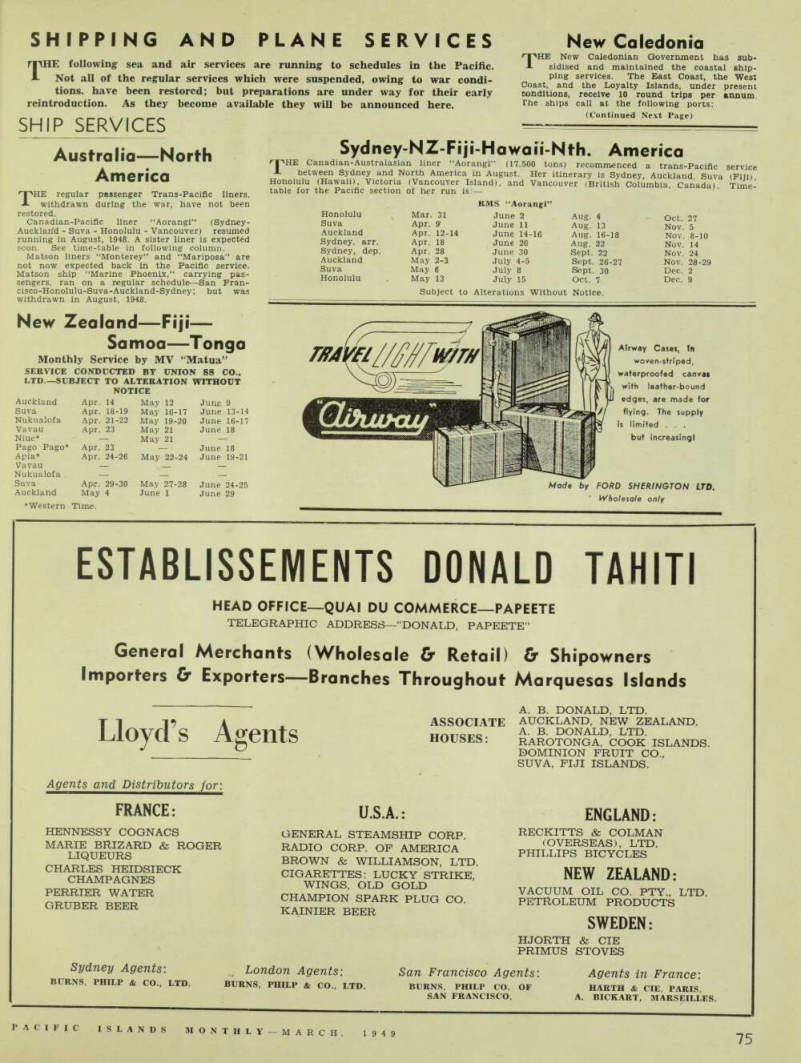
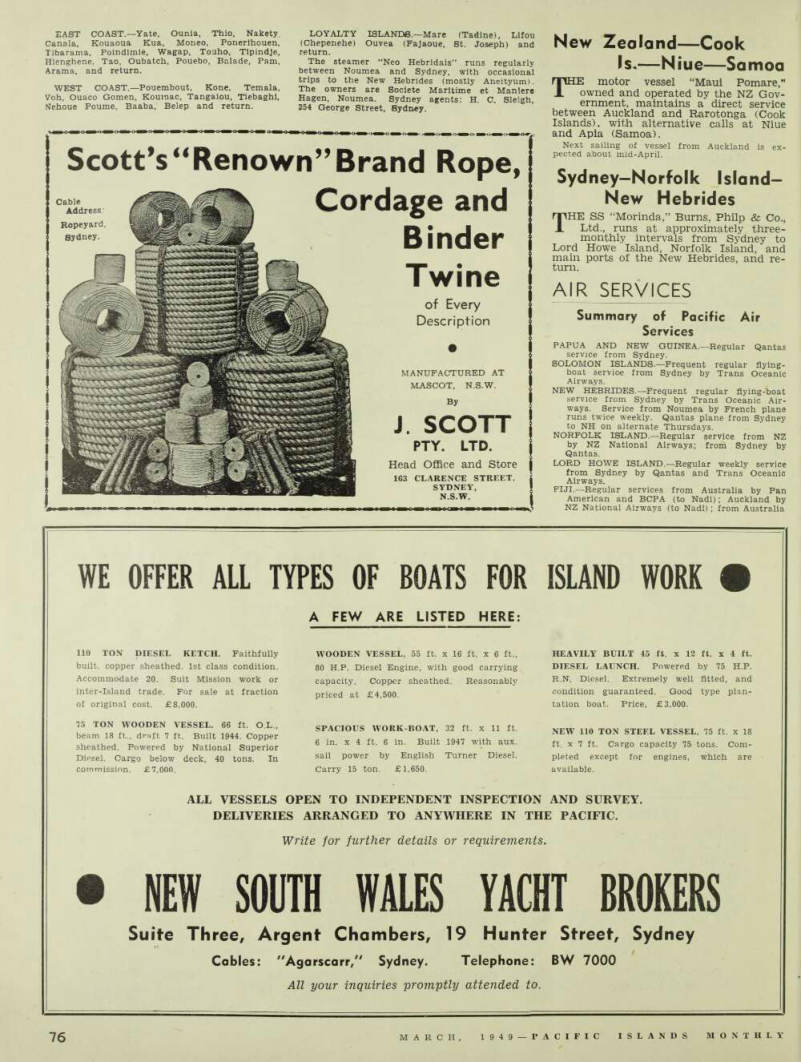
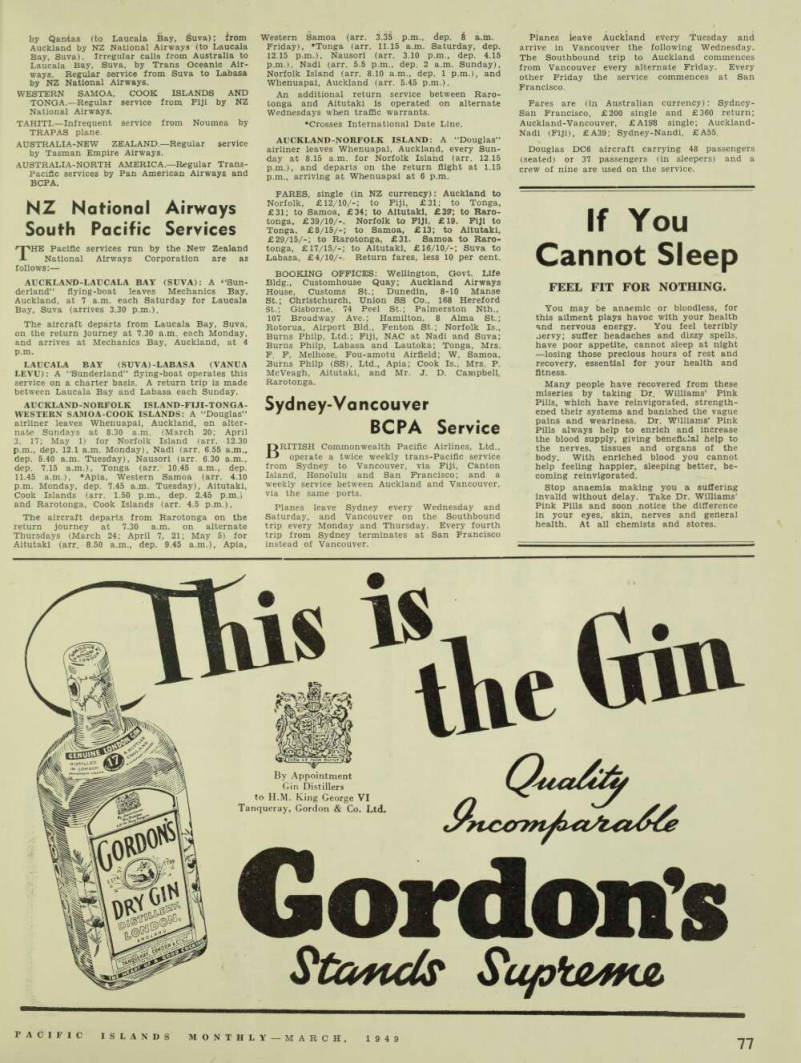
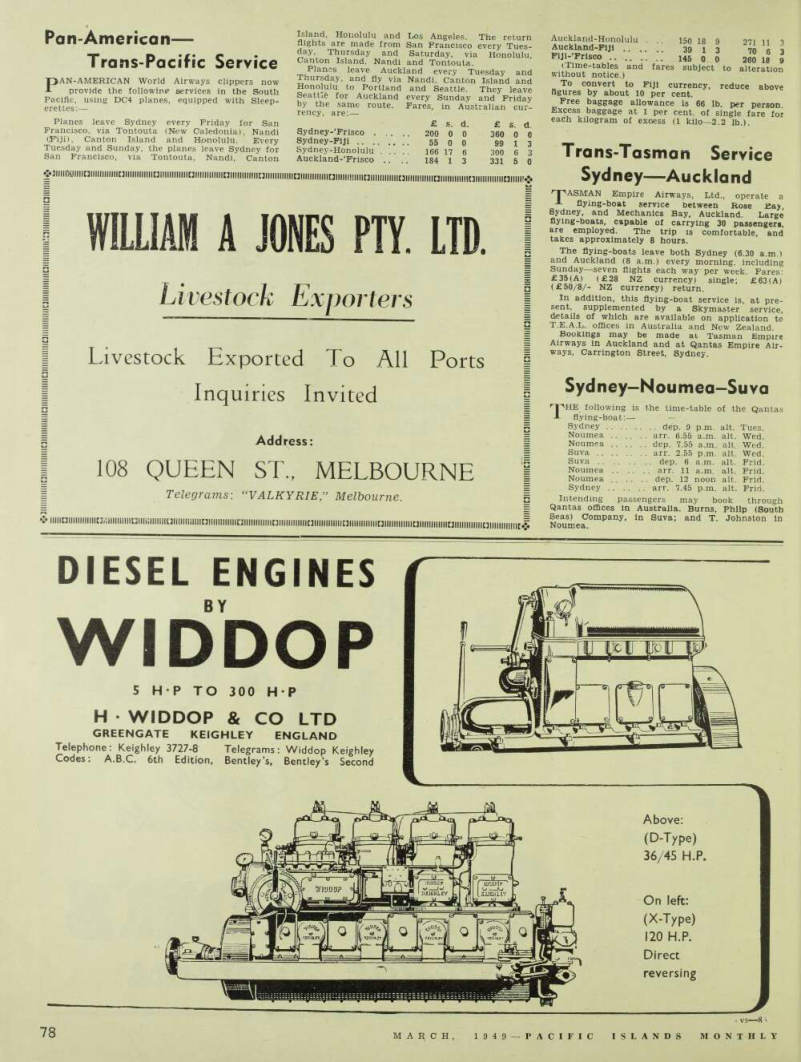
Shipping And Plane Services
THE following sea and air services are running to schedules in the Pacific.
Not all of the regular services which were suspended, owing to war condi tions. have been restored; but preparations are under way for their early reintroduction. As they become available they will be announced here.
Ship Services
Australia—North
America
THE regular passenger Trans-Pacific liners, withdrawn during the war, have not been restored.
Canadian-Pacific liner “Aorangi” (Sydney- Aucklarid - Suva - Honolulu - Vancouver) resumed running in August, 1948. A sister liner is expected soon. See time-table in following column.
Matson liners “Monterey” and “Mariposa” are not now expected back in the Pacific service.
Matson ship “Marine Phoenix,” carrying pas sengers, ran on a regular schedule—San Fran cisco-Honolulu-Suva-Auckland-Sydney; but was withdrawn in August, 1948.
New Zealand—Fiji—
Samoa—Tonga
Monthly Service by MV “Matua”
Service Conducted By Union Ss Co.,
Ltd.—Subject To Alteration Without
Notice
New Caledonia
THE New Caledonian Government has sub sidised and maintained the coastal ship ping services. The East Coast, the West Coast, and the Loyalty Islands, under present conditions, receive 10 round trips per annum The ships call at the following ports: (Continued Next Page)
Sydney-NZ-Fiji-Hawaii-Nth. America
r F' HE Canadian-Australasian liner “Aorangi” (17,500 tons) recommenced a trans-Pacific service -1- between Sydney and North America in August. Her itinerary is Sydney, Auckland Suva (Plii) Honolulu (Hawaii). Victoria (Vancouver Island), and Vancouver (British Columbia Canada) Time table for the Pacific section of her run is:—
Auckland Apr. 14 May 12 June 9 Suva Apr. 18-19 May 16-17 June 13-14 Nukualofa Apr. 21-22 May 19-20 June 16-17 Vavau Apr. 23 May 21 June 18 Niue* — May 21 Pago Pago* Apr. 23 — June 18 Apia* Apr. 24-26 May 22-24 June 19-21 Vavau — — — Nukualofa — — — Suva Apr. 29-30 May 27-28 June 24-25 Auckland May 4 June 1 June 29 ♦Western Time.
Honolulu Mar. 31 KMS “Aorangl”
June 2 Aug. 4 Oct. 27 Suva Apr. Sr June 11 Aug. 13 Nov. 5 Auckland Apr. 12-14 June 14-16 Aug. 16-18 Nov. 8-10 Sydney, arr.
Apr. 18 June 20 Aug. 22 Nov. 14 Sydney, dep.
Apr. 28 June 30 Sept. 22 Nov. 24 Auckland May 2-3 July 4-5 Sept. 26-27 Nov. 28-29 Suva May 6 July 8 Sept. 30 Dec. 2 Honolulu May 13 July 15 Oct. 7 Dec. 9 Subject to Alterations Without Notice.
EAST COAST.—Yate, Ounia, Thio, Nakety, Canala, Kouaoua Kua, Moneo, Ponerfhouen, Tibarama, Poindlmie, Wagap, Touho, Tlpindje, Hienghene, Tao, Oubatch, Pouebo, Balade, Pam, Arama, and return.
WEST COAST. —Pouembout, Kone, Temala, Voh, Ouaco Gomen, Koumac, Tangaiou, Tiebaghl, Nehoue Poume, Baaba, Belep and return.
LOYALTY ISLANDS—Mare (Tadine), Llfou (Chepenehe) Ouvea (Fajaoue, St. Joseph) and return.
The steamer “Neo Hebridais” runs regularly between Noumea and Sydney, with occasional trips to the New Hebrides (mostly Aneityum).
The owners are Societe Maritime et Manlere Hagen, Noumea. Sydney agents: H. C. Sleigh, 254 George Street, Sydney.
New Zealand—Cook
Is.—Niue—Samoa
fTTHE motor vessel “Maui Pomare,”
X owned and operated by the NZ Gov ernment, maintains a direct service between Auckland and Rarotonga (Cook Islands), with alternative calls at Niue and Apia (Samoa).
Next sailing of vessel from Auckland is ex pected about mid-April.
Sydney-Norfolk Island-
New Hebrides
THE SS “Morinda,” Burns, Philp & Co., Ltd., runs at approximately three monthly intervals from Sydney to Lord Howe Island, Norfolk Island, and main ports of the New Hebrides, and re turn.
Air Services
Summary of Pacific Air
Services
PAPUA AND NEW GUlNEA.—Regular Qantas service from Sydney.
SOLOMON ISLANDS.—Frequent regular flying boat service from Sydney by Trans Oceanic Airways.
NEW HEBRlDES.—Frequent regular flying-boat service from Sydney by Trans Oceanic Air ways. Service from Noumea by French plane runs twice weekly. Qantas plane from Sydney to NH on alternate Thursdays.
NORFOLK ISLAND.—Regular service from NZ by NZ National Airways; from Sydney by Qantas.
LORD HOWE ISLAND. —Regular weekly service from Sydney by Qantas and Trans Oceanic Airways.
FlJl.—Regular services from Australia by Pan American and BCPA (to Nadi); Auckland by NZ National Airways (to Nadi); from Australia
by Qanias (to Laucala Bay, Suva); from Auckland by NZ National Airways (to Laucala Bay, Suva). Irregular calls from Australia to Laucala Bay, Suva, by Trans Oceanic Air ways. Regular service from Suva to Labasa by NZ National Airways.
Western Samoa, Cook Islands And
TONGA. —Regular service from Fiji by NZ National Airways.
TAHITI. —Infrequent service from Noumea by TRAPAS plane.
AUSTRALIA-NEW ZEALAND.—ReguIar service by Tasman Empire Airways.
AUSTRALIA-NORTH AMERICA.—Regular Trans pacific services by Pan American Airways and
Bcpa.
NZ National Airways
South Pacific Services
THE Pacific services run by the New Zealand National Airways Corporation are as follows: —
Auckland-Laucala Bay (Suva): A “Sun
derland” flying-boat leaves Mechanics Bay, Auckland, at 7 a.m. each Saturday for Laucala Bay, Suva (arrives 3.30 p.m.).
The aircraft departs from Laucala Bay, Suva, on the return journey at 7.30 a.m. each Monday, and arrives at Mechanics Bay, Auckland, at 4 p.m.
Laucala Bay (Suva)-Labasa (Vanua
LEVU): A “Sunderland” flying-boat operates this service on a charter basis. A return trip is made between Laucala Bay and Labasa each Sunday.
Auckland-Norfolk Island-Fiji-Tonga
Western Samoa-Cook Islands: A “Douglas”
airliner leaves Whenuapai, Auckland, on alter nate Sundays at 8.30 a.m. (March 20; April 3, 17; May 1) for Norfolk Island (arr. 12.30 p.m., dep. 12.1 a.m. Monday), Nadi (arr. 6.55 a.m., dep. 5.40 a.m. Tuesday), Nausori (arr. 6.30 a.m., dep. 7.15 a.m.), Tonga (arr. 10.45 a.m., dep. 11.45 a.m.), *Apia, Western Samoa (arr. 4.10 p.m. Monday, dep. 7.45 a.m. Tuesday), Aitutaki, Cook Islands (arr. 1.50 p.m., dep. 2.45 p.m.) and Rarotonga, Cook Islands (arr. 4.5 p.m.).
The aircraft departs from Rarotonga on the return journey at 7.30 a.m. on alternate Thursdays (March 24; April 7, 21; May 5) for Aitutaki (arr. 8.50 a.m., dep. 9.45 a.m.), Apia,
Western Samoa (arr. 3.35 p.m., dep. 8 a.m.
Friday), *Tonga (arr. 11.15 a.m. Saturday, dep. 12.15 p.m.), Nausori (arr. 3.10 p.m., dep. 4.15 p.m.), Nadi (arr. 5.5 p.m., dep. 2 a.m. Sunday), Norfolk Island (arr. 8.10 a.m., dep. 1 p.m.), and Whenuapai, Auckland (arr. 5.45 p.m.).
An additional return service between Raro tonga and Aitutaki is operated on alternate Wednesdays when traffic warrants. •Crosses International Date Line.
Auckland-Norfolk Island; A “Douglas”
airliner leaves Whenuapai, Auckland, every Sun day at 8.15 a.m. for Norfolk Island (arr. 12.15 p.m.), and departs on the return flight at 1.15 p.m., arriving at Whenuapai at 6 p.m.
FARES, single (in NZ currency): Auckland to Norfolk, £l2/10/-; to Fiji, £3l; to Tonga, £3l; to Samoa, £34; to Aitutaki, £3?; to Raro tonga, £39/10/-. Norfolk to FIJI, £l9. Fiji to Tonga, £B/15/-; to Samoa, £l3; to Aitutaki, £29/15/-; to Rarotonga, £3l. Samoa to Raro tonga, £l7/15/-; to Aitutaki, £l6/10/-; Suva to Labasa, £4/10/-. Return fares, less 10 per cent.
BOOICING OFFICES: Wellington, Govt. Life Bldg., Customhouse Quay; Auckland Airways House, Customs St.; Dunedin, 8-10 Manse St.; Christchurch, Union SS Co., 168 Hereford 3t.; Gisborne, 74 Peel St.; Palmerston Nth., 107 Broadway Ave.; Hamilton, 8 Alma St.; Rotorua, Airport Bid., Fenton St.; Norfolk Is., Burns Philp, Ltd.; Fiji, NAC at Nadi and Suva; Burns Philp, Labasa and Lautoka; Tonga, Mrs.
F, F. Melhose, Fou-amotu Airfield: W. Samoa, Burns Philp (SS), Ltd., Apia; Cook Is., Mrs. P, McVeagh, Aitutaki, and Mr. J. D. Campbell, Rarotonga.
Sydney-Vancouver
BCPA Service
BRITISH Commonwealth Pacific Airlines, Ltd., operate a twice weekly trans-Paciflc service from Sydney to Vancouver, via Fiji, Canton Island, Honolulu and San Francisco; and a weekly service between Auckland and Vancouver, via the same ports.
Planes leave Sydney every Wednesday and Saturday, and Vancouver on the Southbound trip every Monday and Thursday. Every fourth trip from Sydney terminates at San Francisco instead of Vancouver.
Planes Leave Auckland every Tuesday and arrive In Vancouver the following Wednesday.
The Southbound trip to Auckland commences from Vancouver every alternate Friday. Every other Friday the service commences at San Francisco.
Fares are (in Australian currency): Sydney- San Francisco, £2OO single and £360 return; Auckland-Vancouver, £AlO’B single; Auckland- Nadi (Fiji), £A39; Sydney-Nandi, £ASS.
Douglas DC6 aircraft carrying 48 passengers (seated) or 37 passengers (in sleepers) and a crew of nine are used on the service.
Pan-American—
Trans-Pacific Service
PAN-AMERICAN World Airways clippers now provide the following services in the South Pacific, using DC4 planes, equipped with Sleep erettes:— Planes leave Sydney every Friday for San Francisco, via Tontouta (New Caledonia), Nandi (Fiji), Canton Island and Honolulu. EVery Tuesday and Sunday, the planes leave Sydney for San Francisco, via Tontouta, Nandi, Canton
Island, Honolulu and Los Angeles. The return flights are made from San Francisco every Tues day, Thursday and Saturday, via Honolulu, Canton Island, Nandi and Tontouta.
Planes leave Auckland every Tuesday and Thursday, and fly via Nandi. Canton Island and Honolulu to Portland and Seattle. They leave Seattle for Auckland every Sunday and Friday by the same route. Fares, in Australian cur rency, are:—
(Time-tables and fares subject to alteration without notice.) To convert to Fiji currency, reduce above figures by about 10 per cent.
Free baggage aUowance is 66 lb. per person Excess baggage at 1 per cent, of single fare for each kilogram of excess (1 ki10—2.2 lb.).
Trans-Tasman Service
Sydney—Auckland
HPASMAN Empire Airways, Ltd., operate a A flying-boat service between Rose Ray.
Sydney, and Mechanics Bay, Auckland. Large flying-boats, capable of carrying 30 passengera, are employed. The trip is comfortable, and takes approximately 8 hours.
The flying-boats leave both Sydney (6.30 a.m.) and Auckland (8 a.m.) every morning, including Sunday—seven flights each way per week. Fares: £35 (A) (£2B NZ currency) single; £63 (A) (£5O/8/- NZ currency) return.
In addition, this flying-boat service is, at pre sent, supplemented by a Skymaster service, details of which are available on application to T.E.A.L. offices in Australia and New Zealand.
Bookings may be made at Tasman Empire Airways in Auckland and at Qantas Empire Air ways, Carrington Street, Sydney.
Sydney-Noumea-Suva
THE following is the time-table of the Qantas flying-boat:— Sydney dep. 9 p.m. alt. Tues.
Noumea .. . . arr. 6.55 a.m. alt. Wed.
Noumea dep. 7.55 a.m. alt Wed.
Suva arr. 2.55 p.m. alt. Wed.
Suva dep. 6 a.m. alt. Frid.
Noumea arr. 11 a.m, alt. Frid.
Noumea dep. 12 noon alt. Frid.
Sydney arr. 7.45 p.m. alt. Frici.
Intending passengers may book through Qantas offices in Australia. Burns, Phllp (South Seas) Company, in Suva; and T. Johnston in Noumea.
£ s. d. £ s. d.
Sydney-’Prisco . , . 200 0 0 360 0 0 Sydney-Piji 0 0 99 1 3 Sydney-Honolulu . .. 166 17 6 300 6 3 Auckland-’Frisco .. 184 1 3 331 5 0
Auckland-ttoholulu .■ 150 18 0 271 11 3 Auckland-Pljl .. 39 1 3 70 6 3 Plji-’Frlsco .. 0 0 260 18 9
Fares: To Noumea, £35 single: £63 return.
To Suva, £52/10/- single; £94/10/- return.
Noumea-Suva, £l7/10/- single; £3l/10/- re turn.
Sydney—Queensland—
New Guinea
QANTAS Empire Airways, Ltd., employing DCS planes, operate a regular service between Sydney, Port Moresby, Lae, Finschhafen, Madang, and Rabaul, and return, via Brisbane, Rockhampton, Townsville and Cairns.
This service is now known as the “Bird of Paradise” Service. DCS aircraft, carrying 19 passengers, are usea.
Planes leave Sydney on Mondays, Wednesdays, and Fridays at 9 a.m., and arrive at Lae at 1 p.m. on Tuesdays, Thursdays and Saturdays.
The plane which leaves Sydney on Wednesday and arrives at Lae on Thursday then goes on to Rabaul. It returns on Friday. The plane, which arrives at Lae on Tuesdays, then goes on to Madang, returning to Lae the same day.
Planes leave Lae at 5.45 a.m. on Wednesdays, Saturday and Sunday, and arrive in Sydney at 10 p.m., accomplishing the Lae-Sydney run in a day.
The return plane from Rabaul leaves at 1.30 p.m. on Fridays.
Bookings may be made at Qantas offices at any of the towns named. At present, berths are available only to passengers holding official per mits to visit Papua or New Guinea.
Sydney-Lord Howe ls.-
Norfolk Is.
QANTAS, Sydney, run a Catalina once weekly from Sydney to Lord Howe Island. Fare, single, £l2. Return, £2l/12/-.
Qantas run a land plane alt. Thursdays (re turning same day) from Sydney to Norfolk Island. Fare. £22 single; £39/12/- return. (For Norfolk Island, see also under NZ National Airways. For Lord Howe, see also under TOA.)
Noumea-Fiji-Tahiti
nPRAPAS (a French company with headquarters J- in Noumea) ran an air service once a month from Noumea (New Caledonia), via Nadi (Fiji) and Altutaki (Cook Islands) to Papeete (Tahiti), and return.
The Trapas Co. also runs a service to New Hebrides—see under Caledonia-New Hebrides.
Papua-NG Local
Services
MANDATED Airlines, Ltd., of Lae, New Guinea, and other private operators, run air ser vices between Lae and the New Guinea mainland centres of Wau, Bulolo, Madang, Wewak, Aitape, Mt. Hagen, Finschhafen, Moresby, Kokoda—in
fact anywhere in Papua or New Guinea where there is an air-strip. These planes carry pas sengers, mails and cargo on regular schedules or charter flights.
Guinea Air Traders Ltd., of Lae, New Guinea, employ six aircraft on local services, and on charter work.
Under arrangement with the Administration, a Qantas plane, carrying Administration personnel and cargo, and mails, flies once each week from Lae to Rabaul, Kavieng and Manus, and returns to Lae by the same route.
New Caledonia—New
Hebrides-—Tahiti
A TRAPAS amphibian runs twice each week £"*• between New Caledonia and New Hebrides.
The days vary, but on the selected day the planes adhere to the following time-table:— Noumea—dep. 0630. Vila—arr. 1315 Vila—dep. 0945 Santo—arr. 1115 Santo—dep. 1145 Vila—arr. 0900 Vila—dep. 1400 Noumea—arr. 1630 A TRAPAS plane runs monthly between Noumea and Tahiti.
TOA Services
TRANS Oceanic Airways run the following Pacific services:— SYDNEY-LORD HOWE IS.: A regular fort nightly service with large four-engine flying boats from Rose Bay. Fare: £ll single; £2l return. Free baggage allowance 50 lb Excess baggage and freight rate 6d. per lb.
SYDNEY-NEW HEBRIDES: A regular monthly service with large four-engine flying-boats from Sydney, via Noumea (overnight stop), to Vila and Espiritu Santo. Fare: Sydney-Vila, £45; Sydney-Santo, £5O; Noumea-Vila, £l2/10/-; Noumea-Santo. £lB/15/-. Freight: Sydney-Vila, 2/- per lb.; Sydney-Santo, 2/3.
Sydney-Solomon Islands: A Regular
monthly service from Sydney, via New Cale donia and New Hebrides to Tulagi, Solomon Islands. This service is frequently extended to Lingatou, in the Russell Islands, and calls are sometimes made at Vanikoro, in the Santa Cruz Group. Fares: Sydney-Tulagi, £65. Free bag gage allowance, 60 lb.; excess baggage and freight, 3/- per lb.
Advertisements & other items, pp. 77-82 (1 item)
Establissements Donald Tahiti
numi/M<vr*
0 ■- - Airway Casas, In woven-striped, waterproofed canvas with leather-bound edges, are made for flying. The supply is limited . . . but increasing!
Wholesale only
ESTABLISSEMENTS DONALD TAHITI
HEAD OFFICE—QUAI DU COMMERCE—PAPEETE
TELEGRAPHIC ADDRESS—“DONALD, PAPEETE”
General Merchants (Wholesale & Retail) & Shipowners
Importers & Exporters—Branches Throughout Marquesas Islands
Lloyd’s Agents
ASSOCIATE
HOUSES:
Agents and Distributors for:
FRANCE:
HENNESSY COGNACS
MARIE BRIZARD & ROGER
LIQUEURS
CHARLES HEIDSIECK
CHAMPAGNES
PERRIER WATER
GRUBER BEER
U.S.A.:
GENERAL STEAMSHIP CORP.
RADIO CORP. OF AMERICA
BROWN & WILLIAMSON, LTD.
CIGARETTES: LUCKY STRIKE,
WINGS, OLD GOLD
CHAMPION SPARK PLUG CO.
KAINIER BEER
A. B. DONALD, LTD.
AUCKLAND, NEW ZEALAND.
A. B. DONALD, LTD.
RAROTONGA, COOK ISLANDS.
DOMINION FRUIT CO.,
SUVA, FIJI ISLANDS.
ENGLAND:
RECKITTS & COLMAN
(OVERSEAS), LTD.
PHILLIPS BICYCLES
NEW ZEALAND:
VACUUM OIL CO. PTY., LTD.
PETROLEUM PRODUCTS
SWEDEN
HJORTH & CIE
PRIMUS STOVES
Sydney Agents :
BURNS, PHILP & CO., LTD,
London Agents :
BURNS, PHILP & CO., LTD.
San Francisco Agents :
BURNS, PHILP CO. OF
SAN FRANCISCO,
Agents in France :
HARTH & CIE, PARIS.
A. BICKART, MARSEILLES.
Scott’s “Renown” Brand Rope,
Cordage and
Binder
Twine
of Every
Description
Cable Address: Ropeyard Sydney.
MANUFACTURED AT
MASCOT, N.S.W.
J. SCOTT
PTY. LTD.
Head Office and Store
163 CLARENCE STREET.
SYDNEY,
N.S.W.
WE OFFER ALL TYPES OF BOATS FOR ISLAND WORK •
A FEW ARE LISTED HERE:
110 TON DIESEL KETCH. Faithfully built, copper sheathed. Ist class condition.
Accommodate 20. Suit Mission work or inter-island trade. For sale at fraction of original cost. £B,OOO. 75 TON WOODEN VESSEL, 66 ft. 0.L., beam 18 ft., draft 7 ft. Built 1944. Copper sheathed. Powered by National Superior Diesel. Cargo below deck, 40 tons. In commission. £7,000.
WOODEN VESSEL, 55 ft. x 16 ft. X 6 ft., 80 H.P. Diesel Engine, with good carrying capacity. Copper sheathed. Reasonably priced at £4,500.
SPACIOUS WORK-BOAT, 32 ft. X 11 ft. 6 in. x 4 ft. 6 in. Built 1947 with aux. sail power by English Turner Diesel.
Carry 15 ton. £1,650.
HEAVILY BUILT 45 ft. X 12 ft. x 4 ft.
DIESEL LAUNCH. Powered by 75 H.P.
R.N. Diesel. Extremely well fitted, and condition guaranteed. Good type plantation boat. Price, £3,000.
NEW 110 TON STEEL VESSEL. 75 ft. X 18 ft. x 7 ft. Cargo capacity 75 tons. Completed except for engines, which are available.
ALL VESSELS OPEN TO INDEPENDENT INSPECTION AND SURVEY.
DELIVERIES ARRANGED TO ANYWHERE IN THE PACIFIC.
Write for further details or requirements.
• NEW SOUTH WALES YACHT BROKERS
Suite Three, Argent Chambers, 19 Hunter Street, Sydney
Cables: "Agarscarr," Sydney. Telephone: BW 7000
All your inquiries promptly attended to.
If You
Cannot Sleep
FEEL FIT FOR NOTHING.
You may be anaemic or bloodless, for this ailment plays havoc with your health and nervous energy. You feel terribly *iervy; suffer headaches and dizzy spells, have poor appetite, cannot sleep at night —losing those precious hours of rest and recovery, essential for your health and fitness.
Many people have recovered from these miseries by taking Dr. Williams’ Pink Pills, which have reinvigorated, strengthened their systems and banished the vague pains and weariness. Dr. Williams’ Pink Pills always help to enrich and increase the blood supply, giving beneficial help to the nerves, tissues and organs of the body. With enriched blood you cannot help feeling happier, sleeping better, becoming reinvigorated.
Stop anaemia making you a suffering Invalid without delay. Take Dr. Williams’
Pink Pills and soon notice the difference in your eyes, skin, nerves and general health. At all chemists and stores.
& By Appointment Gin Distillers m m l\u-
Gordon's
Stanck r Supieme.
to H.M. King George VI Tanqueray, Gordon & Co. Ltd.
WILLIAM A JONES PTY. LTD.
Livestock Exporters
Livestock Exported To All Ports Inquiries Invited Address:
108 QUEEN ST.. MELBOURNE
Telegrams ; “VALKYRIE,” Melbourne.
DIESEL ENGINES
WIDDOP
S H P TO 300 H P
H • WIDDOP & CO LTD
GREENGATE KEIGHLEY ENGLAND
Telephone: Keighley 3727-8 Telegrams: Widdop Keighley Codes: A.B.C. 6th Edition, Bentley’s, Bentley’s Second r ia Above: (D-Type) 36/45 H.P.
On left: (X-Type) 120 H.P.
Direct reversing y vs—B
7i Va Va mm % i K ■ **. cL« I to L
From
Australia’s
Finest Fat
Stock
I I I
BRONTE BRAND:
• Chili Con Came • Braised Steak and Onions • Curried Beef • Curried Mutton • Steak and Onions • Mutton and Peas • Irish Stew • Beef Steak Pudding • Corned Beef Hash • Corned Beef Loaf With Cereal • Mutton Broth • Mulligatawny Soup • Tomato Soup • Vegetable Soup From the finest fat stock and the rich-
est vegetables in Australia we produce
these high-grade canned meats and
soups. BRONTE BRAND meats,
hotmeals and soups are deliciously
flavoured and are made from
ONLY meats and vegetables
of the highest quality. . . . . ★
THE COLONIAL WHOLESALE MEAT CO.
PTY. LTD.
Canning Factory, State Abattoirs, Homebush Bay, Sydney.
N.S.W.
PHONES:
PHONE: UM 8436.
CABLE ADDRESS:
WOOLMILL. SYDNEY.
A i CA M P mm i whou«*u ca
G. H. Robinson
Exports & Imports Pty., Ltd.
ISLAND SUPPLIES
of all kinds—Selected and Shipped to order at lowest possible prices—Piecegoods in Wool, Cotton and Silk, Under and Outerwear, Manchester, Drapery, Grocery, Hardware, Engineers and Leathergoods trade supplies a specialty.
Indents and Transhipments arranged. Large or small orders treated with equal care.
Use our 25 years’ extensive experience.
Enquiries solicited to—
G. H. ROBINSON
Exports & Imports Pty., Ltd. 51 Macquarie Street, Sydney, N.S.W.
Telegrams: Sunrise, Sydney.
Letters: Box 3317, G.P.0., Sydney.
Service Section
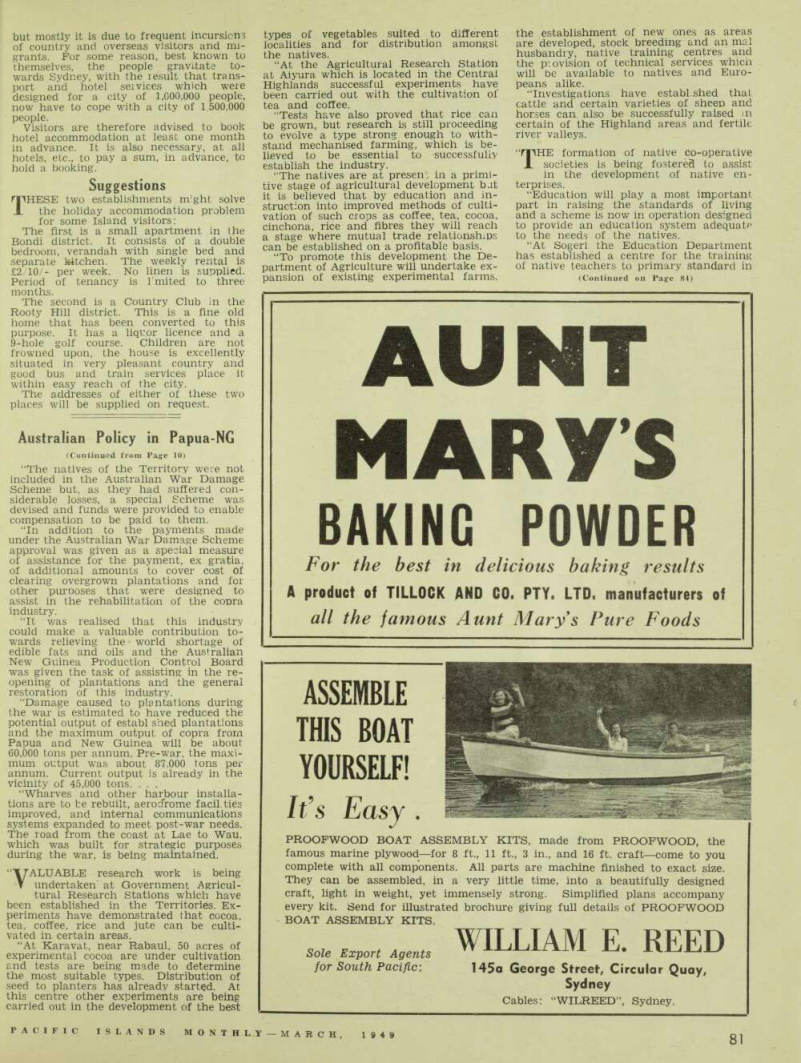
Sydney Hotel Accommodation
THE situation with regard to hotel ac commodation in Sydney has wor sened considerably in the last four months. Where formerly it was usually
possible to secure some accommodation, it is now virtually impossible at short notice. This situation prevails, not only
in the city itself, but extends frequently to suburban hotels, guest houses and private hotels.
The reason for this is partly seasonal
but mostly it is due to frequent incursions of country and overseas visitors and mi grants. For some reason, best known to themselves, the people gravitate to wards Sydney, with the result that trans port and hotel services which were designed for a city of 1,000,000 people, now have to cope with a city of 1 500,000 people.
Visitors are therefore advised to book hotel accommodation at least one month in advance. It is also necessary, at all hotels, etc., to pay a sum, in advance, to hold a booking.
Suggestions
THESE two establishments might solve the holiday accommodation problem for some Island visitors: The first is a small apartment in the Bondi district. It consists of a double bedroom, verandah with single bed and separate kitchen. The weekly rental is £2 10/- per week. No linen is supplied.
Period of tenancy is limited to three months.
The second is a Country Club in the Rooty Hill district. This is a fine old home that has been converted to this purpose. It has a liquor licence and a 9-hole golf course. Children are not frowned upon, the house is excellently situated in very pleasant country and good bus and train services place it within easy reach of the city.
The addresses of either of these two places will be supplied on request.
Pacific Islands Service
Bureau
THE Pacific Islands Service Bureau has been established to assist Island re sidents who cannot shop for themselves.
Briefly, we will perform those services for you, in Australia, which you cannot per form yourself, or are outside the scope of ordinary mail-ordering.
We will purchase and forward goods to you; have repairs made on your behalf; send flowers, sweets, fruits, gifts to frends in Australia for you, or to your children at school in Australia; match materials and sewing accessories; and arrange holiday accommodation and travel.
For these services we charge a small fee —in the case of shopping services, usually 10 per cent, of the purchase price.
If you missed the circular which ex plains this service fully and which was included in all copies of “PIM” which went to the Islands in March, 1948, please let us know and we will send you a copy of the pamphlet, free of charge.
All inquiries should be addressed to: The Director, Pacific Travel and Service Agency, Box 3408, Sydney.
Advertisements & other items, pp. 82-86 (3 items)
Asthma, Bronchitis Coughing,
Curbed in 3 Minutes
Do you have attacks of Asthma or Bronchitis so bad that you can’t sleep? Do you feel weak, unable to work, and have to be careful not to take cold and can’t eat certain foods?
No matter how long you have suffered or what you have tried, there is new hope for you In a doctor’s prescription called Mendaco.
No dopes, no smokes, no injections, no atomizer.
All you do Is take two tasteless tablets at meals and In 3 minutes Mendaco starts working through your blood, aiding nature to remove phlegm, promote free easy breathing and bring sound sleep the first night, so that you soon feel years younger and stronger.
No Asthma in 2 Years
Mendaco not only brings almost Immediate comfort and free breathing but builds up the system to ward off future attacks. For Instance, J. Richards, Hamilton, Ont„ Canada, had lost 40 lbs., suffered coughing every night, couldn’t sleep. Mendaco stopped Asthma
spasms first night and he has had none since In over two years.
Money Back Guarantee
The very first dose of Mendaco goes right to work circulating through your blood and helping nature relieve you of the effects of Asthma. Try Mendaco under an iron-clad money back gaurantee. You be the Judge. If you don’t feel fully satisfied after taking Mendaco just return the empty package and the full purchase price will be refunded. Get Mendaco from your chemist to-day and see how well you sleep to-night and how much better you feel to-morrow. The guarantee protects
RELIEVES ASTHMA
Mendaco
Now in 2 sizes . . . 6/- and 12/-
AUNT
MARYS
BAKING POWDER
For the best in delicious baking results A product of TILLOGK AND CO. PTY. LTD. manufacturers of all the famous Aunt Marys Pure Foods
ASSEMBLE
THIS BOAT
YOURSELF!
It’s Easy .
PROOFWOOD BOAT ASSEMBLY KITS, made from PROOFWOOD, the famous marine plywood—for 8 ft., 11 ft., 3 in., and 16 ft. craft—come to you complete with all components. All parts are machine finished to exact size.
They can be assembled, in a very little time, into a beautifully designed craft, light in weight, yet immensely strong. Simplified plans accompany every kit. Send for illustrated brochure giving full details of PROOFWOOD
BOAT ASSEMBLY KITS.
Sole Export Agents for South Pacific :
WILLIAM E. REED
145 a George Street, Circular Quay,
Sydney Cables: “WILREED”, Sydney.
Classified Advertisements
LEGAL NOTICES
Notice to Creditors
In the Estate of COLIN MACKELLAR, late of PIGIBUT PLANTATION, in the Territory of New Guinea, Planter and Trader, deceased.
CREDITORS having claims against the Estate of the abovenamed deceased, who died on the first day of July, one thousand nine hundred and forty-two, are called upon to submit their claims, verified by affidavit, to Burns, Philp Trust Company, Limited, of 7 Bridge Street, Sydney, the Administrator of the abovenamed Estate, within three months from the date of publication hereof, after which time the Administrator will proceed to distribute the Estate, having regard only to claims of which it then shall have had notice in writing.
Dated this twenty-eighth day of February, 1949.
J. IRWIN CROMIE,
Solicitor for the Company, Port Moresby.
Notice to Creditors
In the Estate of WILLIAM MELVILLE MUR- CUTT, late of Lae, in the Territory of New Guinea, Sawmiller, deceased.
CREDITORS having claims against the Estate of the abovenamed deceased, who died on the fourth day of December, One thousand nine
hundred and forty-six, are called upon to submit their claims, verified by affidavit, to Burns, Philp Trust Company, Limited, of 7 Bridge Street, Sydney, the Administrator of the abovenamed Estate, within three months from the date of publication hereof, after which time the Administrator will proceed to distribute the Estate, having regard only to claims of which it then shall have had notice in writing.
Dated this twenty-eighth day of February, 1949.
J. IRWIN CROMIE,
Solicitor for the Company, Port Moresby.
IN THE MATTER of THE KAVIENG CLUB.
NOTICE is hereby given that a Petition in connection with the affairs of the abovenamed Kavieng Club was presented to the Supreme Court of the Territory of Papua-New Guinea, on the twenty-second day of February, 1949, by JOHN HINWOOD McDONALD, the sole surviving Trustee of the said Club, asking as follows: — (1) That the Club may be declared to have been dissolved as at the twenty-third day of January, 1942, or at such other date as the Court may determine. (2) That directions be given by the Court as to the disposal of the assets of the said Club. (3) That the Court determine the persons who are entitled to share in the said assets. (4) That the Petitioner’s costs of and in-
cidental to the Petition may be provided for. (5) That such further or other order may be made as shall seem meet. The Court directed that the said Petition be heard before the said Court at 9.30 o’clock in the forenoon, on Monday, the twentieth day of June, 1949, at the Supreme Court House, Port Moresby. Any person desiring to support or oppose the making of an Order on the said Petition should appear in person, or by his Counsel, at the time fixed for the hearing of the Petition.
Dated this twenty-fourth day of February, 1949.
J. IRWIN CROMIE,
Solicitor for the Petitioner.
Re the Estate of DONALD MACDOUGALL, late of Rabaul, in the Territory of New Guinea, Policeman, deceased. LETTERS OP ADMINIS- TRATION, granted by the Supreme Court of New South Wales, on the 14th day of December, 1948. . . . PURSUANT to the Wills Probate and Administration Act, 1898-1940; Testator’s Family Maintenance and Guardianship of Infants Act, 1916-1938; and Trustee Act, 1925-1942; The PUBLIC TRUSTEE, the Administrator of the Estate of the said DONALD MACDOUGALL, who became missing on the Ist day of July, 19’42, and is for official purposes presumed to be dead, hereby gives notice that creditors and others having any claim against or to the Estate of the said deceased, are required to send particulars of their claims to the said PUBLIC TRUSTEE, at 19 O’Connell Street, Sydney, on or before the eighteenth day c<T June, 1949, at the expiration of which time the said Public Trustee will distribute the assets of the said deceased to the persons entitled, having regard only to the claims of which he then has notice.
P. J. P. PULLEN.
Public Trustee.
TENDERS
ESTATE, W. L. HERON, DECEASED.
Sealed tenders endorsed “Tender Tovakundum” are invited tee received by the undersigned until 3.30 p.m. on the 15th May, 1949, for the purchase or lease of the following properties:— (a) Tovakundum Plantation, having an area of 213 hectares or thereabouts, situate on the North Coast Road, about 17 miles from Rabaul, planted with cocoanut palms. (b) Vunaloba Trading Station, also situate on the North Coast Road, near Tovakundum Plantation, containing 18 hectares or thereabouts, and planted with a number of cocoanut palms and interplanted cacao.
Both properties are freehold.
Tovakundum and Vunaloba both suffered damage by bombing, gunfire and the cutting down of palms. It is estimated (and no representation is made to this effect) that Tovakundum is capable of producing 14 tons of copra per month and about 1 ton per month may be obtained from Vunaloba.
The remaining palms appear to be in good condition, but there is a considerable amount of secondary growth throughout both Tovakundum and Vunaloba. It is not, however, of a very serious nature and can be readily cleared.
The only buildings on the properties are of a temporary nature and the property of the present Lessees.
It is considered that cacao could be established on Tovakundum and was prior Jo the war successfully grown on Vunaloba.
TITLES: The Title to Tovakundum has been lost or destroyed during the Japanese occupation of the Territory. This Title is in the name of the Custodian of Expropriated Property and legislation is now
TAK€ HHCCNTS tV/TH
-fCONFiDEMCe
<- Confidence brings success!
Place your confidence in the : hospital formula of genuine \V" ■ Vincent's a.p.c. For over 25 years the medical profes- Js sion has had absolute confidence in W this better-balanced prescription Take Vincent's A.P.C With Confidence.
For HEADACHE AND NERVE
AND MUSCULAR PAIN!
KM ./
VINCENTS
N46D
TTTcTNTfI
SAFEST 8t BESTI
Mr. R. J. Clissold, who has had con siderable experience with small boats in Malaya and the Middle East, has gone
to Rabaul to take charge of one of Burns Philp’s 20-ton launches which services Bougainville.
TENDERS (Cont.)
pending which when operative will permit substitute titles to issue. The successful tenderer shall accept such title as the Trustees now have and without further investigation: title to Vunaloba being Certificate of Title Register Book, Volume 8, Folio 41.
TERMS: The properties will be sold or leased subject to the consent of the Administrator.
In the case of a tender for purchase, the Tender is to be accompanied by a deposit by bank cheque of 5 per cent, of the amount tendered: a further 45 per cent, is to be paid on acceptance of tender; the balance is to be paid in 30 days after the acceptance and upon the execution by the Trustees of a conveyance of the properties or such other document or instrument as the successful tenderer may reasonably require to evidence the sale in the absence of a registerable transfer fin the case of Tovakundunu owing to the loss of title as mentioned above.
Tenders for leasing for a period of five years must be accompanied by a quarter of the proposed annual rent and should a tender for lease be accepted the successful tenderer will be Let into possession upon —-— execution of a formal lease of the properties duly approved by the Supreme Court of the Territory of Papua-New Guinea, and upon such terms as the Trustees in their absolute discretion require.
The highest or any tender will not necessarily be accepted.
Port Moresby, Papua-New Guinea, Bth March, 19'49.
J. IRWIN CROMIE,
Solicitor for the Trustees of the Estate of W. L. HERON, DECEASED.
ESTATE, A. G. ALLEN, DECEASED.
Sealed tenders endorsed “Tenders MIOKO & MAKADA” are invited and will be received by the undersigned until 5 p.m., 30th April, 1949 for the purchase in one lot of the following properties, situated in DUKE OF YORK ISLAND
GROUP:-
MIOKO PLN.. Vol. 2, Folio 31 INABUI T/S., Vol. 5. Folio 32 NAPIA T/S., Vol. 1. Folio 34
URAKAKUR T/S., Vol. 1.
Folio 71 UKAMAINA T/S. (particulars not available)
KABAKOR T/S., A.L., Vol. 1.
Polio 65 MAKADA PLN. (particulars not available)
IMPROVEMENTS
APPROX. AREA.
4 Hectares 13 % v 4 107 MIOKO PLN., approx. 550 palms, more or less.
MAKADA PLN., approx. 10.000 palms, more or less.
Plantations generally overgrown mainly with convolvulus. All buildings destroyed.
Clearing subsidy of £227 has been assessed by the War Damage Section towards cost of clearing plantations and will be paid to the successful tenderer subject to satisfactory evidence of clearance of properties.
TITLES;—Titles to the properties have been lost or destroyed during enemy occupation of the Territory.
Legislation is pending to restore lost titles and in the meantime purchaser shall accent such title as the administrator now has without further investigation.
TERMS: Properties are sold subject to th consent of the Administrator of the Territory o Papua-New Guinea and Custodian of Expro priated Properties. On acceptance, 25 per cent of tender price to be deposited. Balance pay able upon the execution of a conveyance of th properties or such other document as the success tul tenderer may reasonably require as evidenc of sale in the absence of registerable transfe due to loss of titles.
The highest or any other tender will no necessarily be accepted.
BURNS PHILP TRUST COMPANY, LIMITED
Administrator of the Estate. J A. G. Allen (deceased).
Sydney. 9th March, 1949. . v
INSURANCE
THE MUTUAL LIFE AND CITIZENS’ ASSTI
of N ?n°tPn^ TD 'V he - roby giV6S ° ne month ’S not ot its intention to issue a SPECIAL POLICY K N m rr2li 607150/N on the life K. N. McLEAN, declared to have been lost.
Allen Taylor & Co. Ltd.
COMMERCIAL ROAD, ROZELLE,
SYDNEY
Sawmillers and Wholesale Suppliers of Hardwoods for Constructional Purposes GIRDERS . . . PILES . . . POLES . . . SLEEPERS, Etc.
EXPORTING TO PACIFIC ISLANDS SINCE 1893
m m & m H
SYMBOL of
The Shell Co. of Aust., Ltd. (Inc. in Great Britain).
POSITIONS VACANT
Western Australian Public Service
Applications are invited up to March 31, 1949, for the following permanent positions, under the Public Service Act, in the Native Affairs Department.
Senior Administrative Officer, Northern Region: Headquarters Broome. Salary range £7lO-£736 (gross per annum on present basic wage). District allowance £BO per annum for married man. £4O per annum for single man.
District Officer, South-West. Headquarters Narrogin.
District Officer, Metropolitan and Eastern Coalfields Districts.
Salary range £628-£654 on present basic wage.
Applicants should state age, marital state, and give full details of experience of native administration.
S. A. TAYLOR.
Public Service Commissioner, Treasury Buildings, Perth.
FOR SALE
BUSINESS BLOCKS: Lot 4, Section A.
Town of Wau and Lot 4, Section O, town of Wau. For particulars apply to: M. A.
Goodwyn, Jandowae, Queensland or James Wright, Wau, New Guinea. 7,000 acres freehold land, Madang district of New Guinea. Particulars: Mrs. V. Pratt, 31 Alma St., E. Malverne, 5.E.10 Vic.
INFORMATION WANTED
The children of Bernard Wenno, late of Madang, New Guinea who died in September, 1946, are being urgently sought by the Curator of Intestate Estates, Port Moresby.
Australian Policy in Papua-NG
81
PACIFIC ISLANDS MONTHLY M A R C H , 1949
Australian Policy in Papua-NG (Continued from Page 10)
83
PACIFIC ISLANDS MONTHLY M A R C H , 1949
Notes From Kavieng
From a Special Correspondent KAVIENG, February 22.
THE Qantas plane of February 3, re stored to us Mrs. H. Thackston and Mr. J. Widdup, of OTC, both of whom had gone away ill some weeks previously. Both had recovered. Mrs.
W. J. Read, wife of the local District Offi cer, also returned on this plane after seeing her daughter off to school. Mr. and Mrs. R. Clancy, of Kimidan Planta tion, and Mr. and Mrs. Wood, of Kapsu Plantation, returned from leave in Aus tralia.
The inter-island ship, “Karu” which discharged cargo here early in the month, loaded our copra, and left for the south eastern ports on February 5, returned to port the same day with the master, Cap tain Feneally, ill with pneumonia.
The Rev. and Mrs. B. Chenoweth, popular members of the Methodist Mis sion, paid us a brief visit in mid- February. We hope that they will soon make their permanent station here.
European Medical Assistant. Mr. R.
W. Carlan, arrived here from Taskul, New Hanover, by canoe on February 19. and later returned to his station by the same means. He expects his wife and two children to join him shortly, Mr. W. J. Peel, the new Resident Com missioner in the Gilbert & Ellice Islands, was in Sydney in February, en route to Tarawa, in the Gilbert Islands. Mrs.
Peel, and their two children are expected to arrive in Sydney by the “Strathaird” about July 7.
Advertisements & other items, p. 86 (1 item)
William H. Watson
ESTABLISHED 1930
RAROTONGA, COOK ISLANDS
Wholesale and Retail Trader
LICENSED STAMP DEALER
Agent For:—
BRITISH TRADERS' INSURANCE CO.
CORONA & L. C. SMITH TYPEWRITERS
KAISER & FRAZER MOTOR CARS
B.S.A. CYCLES AND MOTOR CYCLES
AMERICAN LEAD PENCIL CO.
WHITES AVIATION LTD.
Manufacturers of: FOOTWEAR, ALL CLASSES SUITABLE FOR NATIVE TRADING . . . M.O.P. PRODUCTS, INCLUDING ROUND EAR-RING BLANKS AND BUITON BLANKS Exporter of: “Rarotonga” Hula-Skirts.
Sea-ghell Necklaces.
M.O.P. Jewellery.
Island Produce.
Wholesale and Retail Inquiries Invited.
Prepared to Consider Agencies for all Class of Goods.
Importer of: Textiles.
General Hardware.
Fancy Goods.
General Merchandise.
Cable Address: “Watson” Rarotonga Bankers: Bank of New Zealand, Auckland.
Administration's Loss In Port Moresby Fire
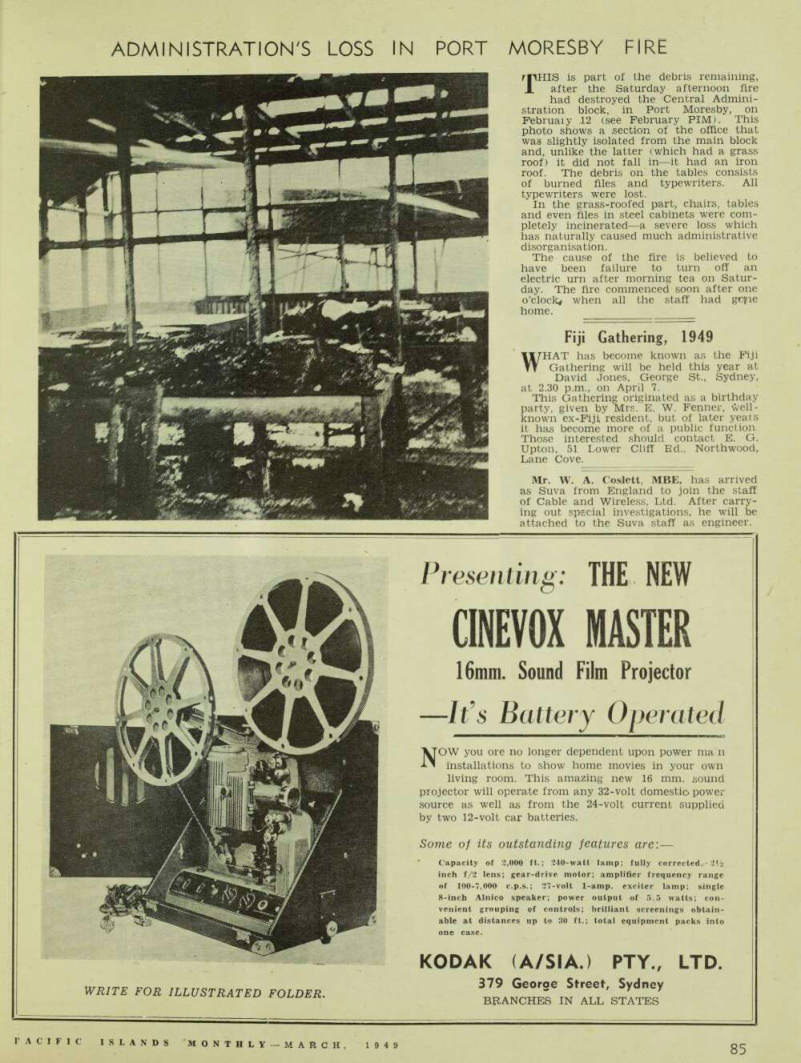
rpHIS is part of the debris remaining, X after the Saturday afternoon fire had destroyed the Central Admini stration block, in Port Moresby, on Februaiy 12 (see February PIM). This photo shows a section of the office that was slightly isolated from the main block and, unlike the latter (which had a grass roof) it did not fall in—it had an iron roof. The debris on the tables consists of burned files and typewriters. All typewriters were lost.
In the grass-roofed part, chairs, tables and even files in steel cabinets were com pletely incinerated —a severe loss which has naturally caused much administrative disorganisation.
The cause of the fire is believed to have been failure to turn off an electric urn after morning tea on Satur day. The fire commenced soon after one o'clock* when all the staff had gqae home.
Fiji Gathering, 1949
WHAT has become known as the Fiji Gathering will be held this year at David Jones, George St., Sydney, at 2.30 p.m., on April 7.
This Gathering originated as a birthday party, given by Mrs. E. W. Fenner, Well known ex-Fiji resident, but of later years it has become more of a public function Those interested should contact E. G.
Upton, 51 Lower Cliff Rd.. Northwood, Lane Cove.
Mr. W. A. Coslett, MBE, has arrived as Suva from England to join the staff of Cable and Wireless, Ltd. After carry ing out special investigations, he will be attached to the Suva staff as engineer.
Advertisements & other items, pp. 87-88 (1 item)
Cinevox Master
WRITE FOR ILLUSTRATED FOLDER.
Presenting: THE NEW
16mm. Sound Film Projector
—lt s Battery Operated
NOW you ore no longer dependent upon power ma n installations to show home movies in your own living room. This amazing new 16 mm. sound projector will operate from any 32-volt domestic power source as well as from the 24-volt current supplied by two 12-volt car batteries.
Some of its outstanding features are : Capacity of 2,000 ft.; 240-watt lamp; fully corrected,-21i inch f/2 lens; gear-drive motor; amplifier frequency range of 100-7,000 c.p.s.; 27-volt 1-amp. exciter lamp; single 8-inch Alnico speaker; power output of 5.5 watts; convenient grouping of controls; brilliant screenings obtainable at distances up to 30 ft.; total equipment packs into one case.
KODAK (A/SIA.) PTY., LTD.
379 George Street, Sydney
BRANCHES IN ALL STATES
YOU’LL ALWAYS CET
THE BEST FROM THE
PLUME
PUMP!
aiilßl
When you buy Plume today, you are getting the best petrol available. And as world conditions permit, the Plume Pump will serve the finest petrol ever made. Form the habit now of going to the PLUME Pump, where you'll always get the best petrol. -i
VACUUM
mm#* -.xm mmmv (incorporated + in AustraiM
N. Guinea
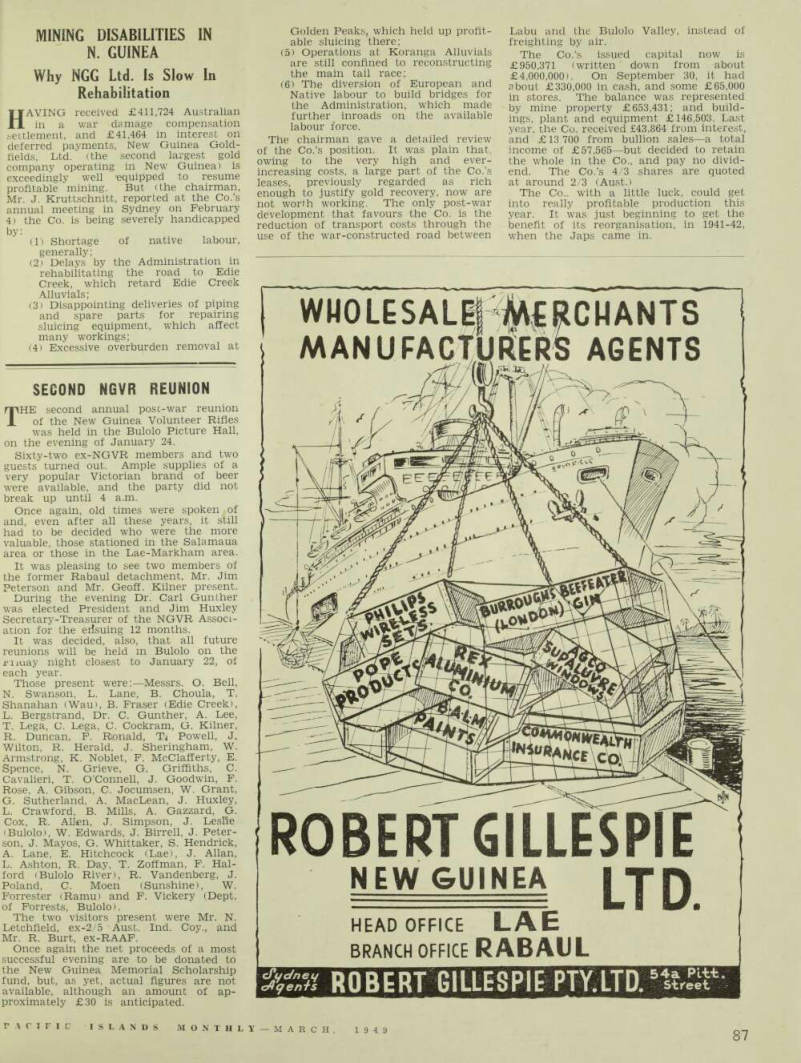
Mining Disabilities In
Why NGG Ltd. Is Slow In Rehabilitation
HAVING received £411,724 Australian in a war damage compensation settlement, and £41,464 in interest on deferred payments, New Guinea Gold fields, Ltd. (the second largest gold company operating in New Guinea) is exceedingly well 'equipped to resume profitable mining. But (the chairman, Mr. J. Kruttschnitt, reported at the Co.’s annual meeting in Sydney on February 4) the Co. is being severely handicapped by: (1) Shortage of native labour, generally; (2) Delays by the Administration in rehabilitating the road to Edie Creek, which retard Edie Creek Alluvials; (3) Disappointing deliveries of piping and spare parts for repairing sluicing equipment, which affect many workings; (4) Excessive overburden removal at
Second Ngvr Reunion
THE second annual posc-war reunion of the New Guinea Volunteer Rifles was held in the Bulolo Picture Hall, on the evening of January 24.
Sixty-two ex-NGVR members and two guests turned out. Ample supplies of a very popular Victorian brand of beer were available, and the party did not break up until 4 a.m.
Once again, old times were spoken of and, even after all these years, it still had to be decided who were the more valuable, those stationed in the Salamaua area or those in the Lae-Markham area.
It was pleasing to see two members of the former Rabaul detachment, Mr. Jim Peterson and Mr. Geoff. Kilner present.
During the evening Dr. Carl Gunther was elected President and Jim Huxley Secretary-Treasurer of the NGVR Associ ation for the erfsuing 12 months.
It was decided, also, that all future reunions will be held in Bulolo on the rnaay night closest to January 22, of each year.
Those present were:—Messrs. O. Bell, N. Swanson, L. Lane, B. Choula, T.
Shanahan (Wau), B. Fraser (Edie Creek), L. Bergstrand, Dr. C. Gunther, A. Lee, T. Lega, C. Lega, C. Cockram, G. Kilner, R. Duncan, F. Ronald, Ti Powell, J.
Wilton, R. Herald, J. Sheringham, W.
Armstrong, K. Noblet, F. McClafferty, E.
Spence, N. Grieve, G. Griffiths, C.
Cavalieri, T. O’Connell, J. Goodwin, F.
Rose, A. Gibson, C. Jocumsen, W. Grant, G. Sutherland, A. Mac Lean, J. Huxley, L. Crawford, B. Mills, A. Gazzard, G.
Cox, R. Allen, J. Simpson, J. Leslie (Bulolo), W. Edwards, J. Birrell, J. Peter son, J. Mayos, G. Whittaker, S. Hendrick, A. Lane, E. Hitchcock (Lae), J. Allan, L. Ashton, R. Day, T. Zoffman, F. Hal ford (Bulolo River), R. Vandenberg, J.
Poland, C. Moen (Sunshine), W.
Forrester (Ramu) and F. Vickery (Dept, of Forrests, Bulolo), The two visitors present were Mr. N.
Letchfield, ex-2/5 Aust. Ind. Coy., and Mr. R. Burt, ex-RAAF.
Once again the net proceeds of a most successful evening are to be donated to the New Guinea Memorial Scholarship fund, but, as yet, actual figures are not available, although an amount of ap proximately £3O is anticipated.
Golden Peaks, which held up profit able sluicing there; (5) Operations at Koranga Alluvials are still confined to reconstructing the main tail race; (6) The diversion of European and Native labour to build bridges for the Administration, which made further inroads on the available labour force.
The chairman gave a detailed review of the Co.’s position. It was plain that, owing to the very high and ever increasing costs, a large part of the Co.’s leases, previously regarded as rich enough to justify gold recovery, now are not worth working. The only post-war development that favours the Co. is the reduction of transport costs through the use of the war-constructed road between
Labu and the Bulolo Valley, instead of freighting by air.
The Co.’s issued capital now is £950,371 (written down from about £4,000,000). On September 30, it had about £330,000 in cash, and some £65,000 in stores. The balance was represented by mine property £653,431; and build ings, plant and equipment £146,503. Last year, the Co. received £43,864 from interest, and £l3 700 from bullion sales —a total income of £57,565 —but decided to retain the whole in the Co., and pay no divid end. The Co.’s 4/3 shares are quoted at around 2/3 (Aust.) The Co., with a little luck, could get into really profitable production this year. It was just beginning to get the benefit of its reorganisation, in 1941-42, when the Japs came in.
Advertisements & other items, p. 89 (1 item)
Robert Gillespie
WHOLESALE|ifIA€RCHANTS
MANUFACTURERS AGENTS
U \'y > A m fF Et is & \V v s* o* •t o & S M CB ♦
ROBERT GILLESPIE
NEW GUINEA
HEAD OFFICE LAE
BRANCH OFFICE RABAUL
ggK ROBERT 'GILLESPIE PTY.LTD.
Islands Produce
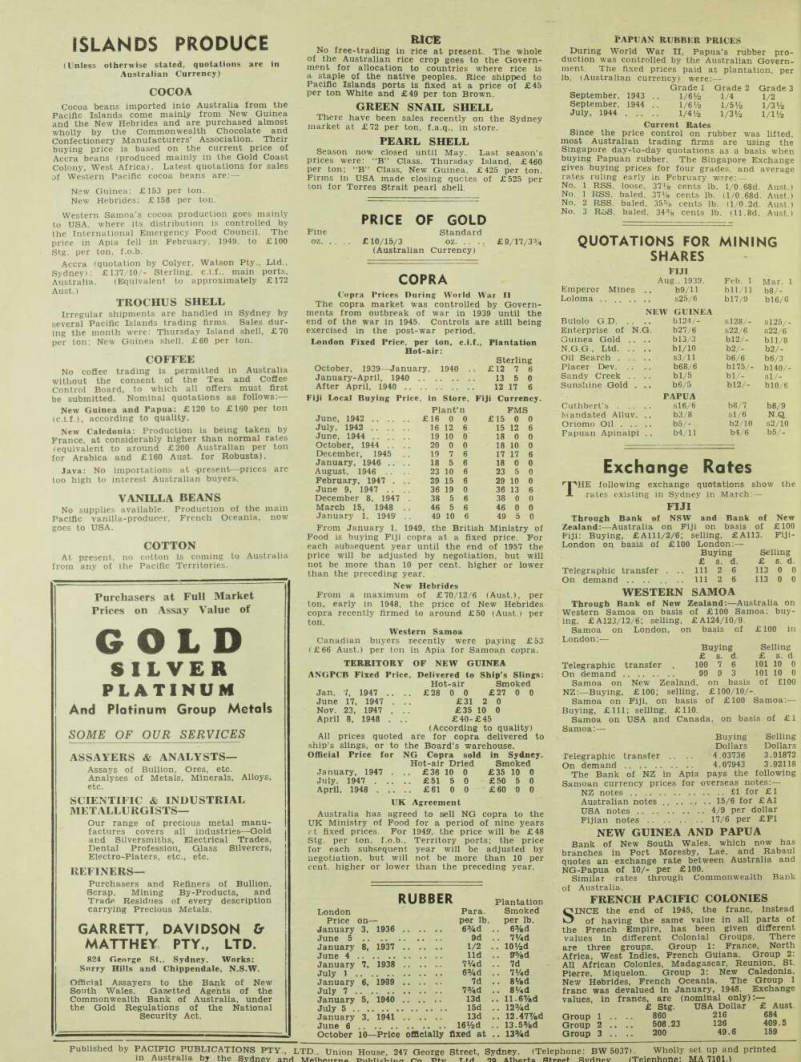
(Unless otherwise stated, quotations arc in Australian Currency)
Cocoa
Cocoa beans imported into Australia from the Pacific Islands come mainly from New Guinea and the New Hebrides and are purchased almost wholly by the Commonwealth Chocolate and Confectionery Manufacturers’ Association. Their buying price is based on the current price of Accra beans (produced mainly in the Gold Coast Colony, West Africa). Latest quotations for sales of Western Pacific cocoa beans are:— New Guinea: £153 per ton.
New Hebrides: £l5B per ton.
Western Samoa’s cocoa production goes mainly to USA. where its distribution is controlled by the International Emergency Food Council. The price in Apia fell in February, 1949. to £lOO Stg. per ton, f.o.b.
Accra (quotation by Colyer, Watson Pty., Ltd., Sydney): £137/10/- Sterling, c.i.f.. main ports, Australia. (Equivalent to approximately £172 Aust.)
Trochus Shell
Irregular shipments are handled in Sydney by several Pacific Islands trading firms. Sales dur ing the month wei’e: Thursday Island shell, £7O per ton; New Guinea shell, £6O per ton.
Coffee
No coffee trading is permitted in Australia without the consent of the Tea and Coffee Control Board, to which all offers must first be submitted. Nominal quotations as follows; — New Guinea and Papua: £l2O to £l6O per ton (c.i.f.), according to quality.
New Caledonia: Production is being taken by France, at considerably higher than normal rates (equivalent to around £2OO Australian per ton for Arabica and £l6O Aust. for Robusta).
Java: No importations at -present—prices are too high to interest Australian buyers.
Vanilla Beans
No supplies available. Production of the main Pacific vanilla-producer, French Oceania, now goes to USA.
Cotton
At present, no cotton is coming to Australia from any of the Pacific Territories.
Rice
No free-trading in rice at present. The whole of the Australian rice crop goes to the Govern ment for allocation to countries where rice is a staple of the native peoples. Rice shipped to Pacific Islands ports is fixed at a price of £45 per ton White and £49 per ton Brown.
Green Snail Shell
There have been sales recently on the Sydney market at £72 per ton, f.a.q., in store.
Pearl Shell
Season now closed until May. Last season’s prices were: “B” Class, Thursday Island, £460 per ton; “B” Class, New Guinea. £425 per ton.
Firms in USA made closing quotes of £525 per ton for Torres Strait pearl shell.
Advertisements & other items, p. 90 (1 item)
Price Of Gold
Pine Standard oz. .. . . £ 10/15/3 oz £9/17/33/4 (Australian Currency)
Copra
Prices During World War II The copra market was controlled by Govern ments from outbreak of war in 1939 until the end of the war in 1945. Controls are still being exercised in the post-war period.
London Fixed Price, per ton, c.i.f., Plantation Hot-air: Sterling October, 1939—January, 1940 .. £l2 7 6 January-April, 1940 13 5 0 After April, 1940 12 17 6 Fiji Local Buying Price, in Store, Fiji Currency.
From January 1, 1949, the British Ministry of Food is buying Fiji copra at a fixed price. For each subsequent year until the end of 1957 the price will be adjusted by negotiation, but will not be more than 10 per cent, higher or lower than the preceding year.
New Hebrides From a maximum of £7O/12/6 (Aust.), per ton, early in 1948, the price of New Hebrides copra recently firmed to around £5O (Aust.) per ton.
Western Samoa Canadian buyers recently were paying £53 (£66 Aust.) per ton in Apia for Samoan copra.
Territory Of New Guinea
ANGPCB Fixed Price, Delivered to Ship’s Slings:
(According to quality) All prices quoted are for copra delivered to ship’s slings, or to the Board’s warehouse.
Official Price for NG Copra sold in Sydney.
UK Agreement Australia has agreed to sell NG copra to the UK Ministry of Food for a period of nine years ?t fixed prices. For 194 ff, the price will be £4B Stg. per ton, f.0.b., Territory ports; the price for each subsequent year will be adjusted by negotiation, but will not be more than 10 per cent, higher or lower than the preceding year.
Plant’n FMS June, 1942 £16 0 0 £15 0 0 July. 1942 16 12 6 15 12 6 June, 1944 19 10 0 18 0 0 October, 1944 ... 20 0 0 18 10 0 December, 1945 19 7 6 17 17 6 January. 1946 ... 18 5 6 18 0 0 August. 1946 ... 23 10 6 23 5 0 February, 1947 ... 29 15 6 29 10 0 June 9. 1947 ... 36 19 0 36 13 6 December 8. 1947 . 38 5 6 38 0 0 March 15, 1948 .. 46 5 6 46 0 0 January 1. 1949 .. 49 10 6 49 5 0
Hot-air Smoked Jan. •I. 1947 .. .. £28 0 0 £27 0 0 June 17. 1947 . £31 2 0 Nov. 23, 1947 . £35 10 0 April 8. 1948 . . £40- £45
Hot-air Dried Smoked January, 1947 . .. £36 10 0 £35 10 0 July. 1947 . .. £51 5 0 £50 5 0 April, 1948 . .. £61 0 0 £60 0 0
Rubber
Plantation
Papuan Rubber Prices
During World War 11, Papua’s rubber pro duction was controlled by the Australian Govern ment. The fixed prices paid at plantation, per lb. (Australian currency) were:—
Current Bates Since the price control on rubber was lifted, most Australian trading firms are using the Singapore day-to-day quotations as a basis when buying Papuan rubber. The Singapore Exchange gives buying prices for four grades, and average rates ruling early in February wtsre: — No. 1 RSS, loose, 37 Va cents lb. 1/0.68d. Aust.) No. 1 RSS. baled, 37% cents lb. d/0.68d. Aust.) No. 2 RSS. baled, 35% cents lb, (1/0.2d. Aust.) No. 3 RoS, baled, 34% cents lb. (11.8 d. Aust.)
London Para.
Smoked Price onper lb. per lb.
January 3, 1936 . 6%d June 5 9d . . 7*/ 4 d January 8, 1937 1/2 . . 10V2d June 4 lid . . 9 s /ad January 7. 1938 7»/ 4 d . . 7d July 1 . . 7V 4 d January 6. 1939 7d . . 8Vad July 7 . . 8V 4 d January 5. 1940 13d . . 11.6%d July 5 . 15d . . 12%d January 3, 1941 13d . . 12.47 7 / 8 d June 6 16 J / 2 d . . 13.55/ 8 d October 10 —Price officially fixed at . . 13%d
Grade 1 Grade 2 Grade 3 September, 1943 . 1/6 % 1/4 1/2 September, 1944 . 1/6 1 / 2 1/5% 1/3% July, 1944 1/4 y 2 1/3% 1/1%
Quotations For Mining
Shares
Emperor Mines
Fiji
Aug.. 1939. b9/H Feb. 1 bll/11 Mar. 1 b8/- Loloma s25/6 bl7/9 bl6/6 Bulolo G.D. ..
New Guinea
bl24/si28 s!25/- Enterprise of N.G. b27/6 S22/6 S22/6 Guinea Gold .. . , bl3/3 bl2/bll/8 N.G.G , Ltd. .. ., bl/10 b2/b2/- Oil Search . .. ..
S3/11 b6/6 b6/3 Placer Dev. .. b68/6 bl75/bl40/- Sandy Creek . . bl/5 bl/sl/- Sunshine Gold . .. b6/5 bl2/blO/6 Cuthbert’s . ..
Papua
sl6/6 b8/7 b8/9 Mandated Alluv. b3/8 sl/6 N.Q.
Oriomo Oil . .. b5/b2/10 52/10 Papuan Apinaipi b4/ll b4/6 b5/-
Exchange Rates
THE following exchange quotations show the rates existing in Sydney in March:—
Fiji
Through Bank of NSW and Bank of New Zealand: —Australia on Fiji on basis of £lOO Fiji: Buying. £Alll/2/6; selling. £AII3. Fiji- London on basis of £lOO London: —
Western Samoa
Through Bank of New Zealand: —Australia on Western Samoa on basis of £lOO Samoa; buy ing, £AI23/12/6; selling. £AI24/10/9.
Samoa on London, on basis of £ 100 in London: —
Samoa on New Zealand, on basis of £lOO NZ:—Buying, £100; selling, £lOO/10/-.
Samoa on Fiji, on basis of £lOO Samoa: — Buying, £111; selling, £llO.
Samoa on USA and Canada, on basis of £1 Samoa:—
The Bank of NZ in Apia pays the following Samoan currency prices for overseas notes: — NZ notes £1 for £1 Australian notes 15/6 for £AI USA notes 4/9 per dollar Fijian notes 17/6 per £PI
New Guinea And Papua
Bank of New South Wales, which now has branches in Port Moresby, Lae, and Rabaul quotes an exchange rate between Australia and NG-Papua of 10/- per £lOO.
Similar rates through Commonwealth Bank of Australia.
French Pacific Colonies
SINCE the end of 1945, the franc, instead of having the same value in all parts of the French Empire, has been given different values in different Colonial Groups. There are three groups. Group 1: France, North Africa, West Indies, French Guiana. Group 2: All African Colonies, Madagascar, Reunion, St.
Pierre, Miquelon. Group 3: New Caledonia.
New Hebrides, French Oceania. The Group 1 franc was devalued in January, 1948. Exchange values, in francs, are (nominal only); £ stg. USA Dollar £ Aust.
Group 1 .. .. 860 216 684 Group 2 .. .. 508.23 126 409.5 Group 3 .. .. 200 49. 6 159
Buying Selling £ s. d. £ s. d.
Telegraphic transfer . .. Ill 2 6 113 0 0 On demand . . Ill 2 6 113 0 0
Buying
Selling £ s. d. £ s. d.
Telegraphic transfer . 100 7 6 101 10 0 On demand 99 9 3 101 10 0
Buying Selling Dollars Dollars Telegraphic transfer 4.03736 3.91872 On demand 4.07943 3.92118
Advertisements & other items, pp. 90-92 (3 items)
Published by PACIFIC PUBLICATIONS PTY., LTD.. Union House, 247 George Street, Sydney. (Telephone: BW 5037). Wholly set up and printed
in Australia by the Sydney and Mcihnnmo r<n ntv r.frf Aihort.o st.rppt. Rvdnpv iTelenhone; MA 7101.)
Gold
Purchasers at Full Market Prices on Assay Value of
SILVER
PLATINUM
And Platinum Group Metals
SOME OF OUR SERVICES
ASSAYERS & ANALYSTS—
Assays of Bullion, Ores, etc.
Analyses of Metals, Minerals, Alloys, etc.
SCIENTIFIC & INDUSTRIAL
METALLURGISTS—
Our range of precious metal manufactures covers all industries —Gold and Silversmiths, Electrical Trades, Dental Profession, Glass Silverers, Electro-Platers, etc., etc.
REFINERS—
Purchasers and Refiners of Bullion.
Scrap, Mining By-Products, and Trade Residues of every description carrying Precious Metals.
GARRETT, DAVIDSON Cr
MATTHEY PTY., LTD.
824 George St., Sydney. Works: Surry Hills and Chippendale, N.S.W.
Official Assayers to the Bank of New South Wales. Gazetted Agents of the Commonwealth Bank of Australia, under the Gold Regulations of the National Security Act.
tropical thirst...
To quench a
tm o « • »• .
V L-A
A « t ° ot *i co’i/M'Teo
i YO IM( T
*om AtJ HB t *• VJ When you’re hot and tired, m
there is nothing quite so satisfying
and thirst quenching as a long, cold glass of “K. 8.” Your friends and guests, too, will ap-
preciate this really fine
Lager, for “Everybody
drinks K. 8.”
TOOTHS
LAGER
Capital £1,000,000 V
ESTABLISHED 1914
COPRA MERCHANTS & MILLERS
ASSOCIATED COMPANIES THROUGHOUT THE PACIFIC ISLANDS
IN LONDON
PACIFIC ISLAND PORTS WAS ESTABLISHED BY
W. R. CARPENTER & CO. LTD.
Head Office: 16 O'CONNELL STREET, SYDNEY.
Cable Address: Telephone: Postal Address: CAMOHE. BW 4421. P.O. Box No. 168, Sydney.
PACIFIC ISLANDS MONTHLY MARCH. 1949